As filed with the Securities and Exchange Commission on May 11, 2026.
Registration No. 333‑
UNITED STATES
SECURITIES AND EXCHANGE COMMISSION
Washington, D.C. 20549
FORM S-1
REGISTRATION STATEMENT UNDER
THE SECURITIES ACT OF 1933
INNIO Holding GmbH*
(Exact name of registrant as specified in its charter)
|
|
|
Germany |
3621 |
Not Applicable |
(State or other jurisdiction of incorporation or organization) |
(Primary Standard Industrial Classification Code Number) |
(I.R.S. Employer Identification Number) |
|
|
Nymphenburger Strasse 5 80335 Munich Germany +49.89.89.82.7221 |
1101 W. St. Paul Ave. Waukesha, WI 53188 +1.262.547.3311 |
(Address, including zip code, and telephone number, including area code, of registrant’s principal executive offices)
INNIO Holding Inc.
1101 W. St. Paul Ave.
Waukesha, WI 53188
+1.262.547.3311
(Name, address, including zip code, and telephone number, including area code, of agent for service)
Copies to:
|
|
|
Marc D. Jaffe Ian D. Schuman Oliver Seiler Jennifer M. Gascoyne Latham & Watkins LLP 1271 Avenue of the Americas New York, NY 10020 (212) 906-1200 |
Paul van der Bijl
NautaDutilh N.V. Beethovenstraat 400
1082 PR Amsterdam The Netherlands +31 20 717 1000 |
Rod Miller David Dixter Philipp Klöckner Milbank LLP 55 Hudson Yards New York, NY 10001 (212) 530-5000 |
Approximate date of commencement of proposed sale to the public: As soon as practicable after this registration statement becomes effective.
If any of the securities being registered on this Form are to be offered on a delayed or continuous basis pursuant to Rule 415 under the Securities Act of 1933 check the following box: ☐
If this Form is filed to register additional securities for an offering pursuant to Rule 462(b) under the Securities Act, please check the following box and list the Securities Act registration statement number of the earlier effective registration statement for the same offering. ☐
If this Form is a post-effective amendment filed pursuant to Rule 462(c) under the Securities Act, check the following box and list the Securities Act registration statement number of the earlier effective registration statement for the same offering. ☐
If this Form is a post-effective amendment filed pursuant to Rule 462(d) under the Securities Act, check the following box and list the Securities Act registration statement number of the earlier effective registration statement for the same offering. ☐
Indicate by check mark whether the registrant is a large accelerated filer, an accelerated filer, a non-accelerated filer, a smaller reporting company, or an emerging growth company. See the definitions of “large accelerated filer,” “accelerated filer,” “smaller reporting company” and “emerging growth company” in Rule 12b-2 of the Exchange Act.
|
|
|
|
Large accelerated filer |
☐ |
Accelerated filer |
☐ |
Non-accelerated filer |
☒ |
Smaller reporting company |
☐ |
|
|
Emerging growth company |
☐ |
If an emerging growth company, indicate by check mark if the registrant has elected not to use the extended transition period for complying with any new or revised financial accounting standards provided pursuant to Section 7(a)(2)(B) of the Securities Act. ☐
The registrant hereby amends this registration statement on such date or dates as may be necessary to delay its effective date until the registrant shall file a further amendment which specifically states that this registration statement shall thereafter become effective in accordance with Section 8(a) of the Securities Act of 1933 or until the registration statement shall become effective on such date as the Securities and Exchange Commission, acting pursuant to said Section 8(a), may determine.
(*) We intend to convert the legal form of our company from a German limited liability company (Gesellschaft mit beschränkter Haftung) to a Dutch private company with limited liability (besloten vennootschap met beperkte aansprakelijkheid) and then to a Dutch public company (naamloze vennootschap) under Dutch law and to change our name from INNIO Holding GmbH to INNIO Group Holding B.V. and then to INNIO N.V. prior to the closing of this offering.
The information contained in this preliminary prospectus is not complete and may be changed. These securities may not be sold until the registration statement filed with the Securities and Exchange Commission is effective. This preliminary prospectus is not an offer to sell these securities and is not soliciting an offer to buy these securities in any jurisdiction where the offer or sale is not permitted.
Subject to Completion, Dated , 2026
PRELIMINARY PROSPECTUS
Common Shares

INNIO Holding GmbH
to be converted into and renamed
INNIO N.V.
This is the initial public offering of the common shares of INNIO Holding GmbH (to be converted into and renamed INNIO N.V.). We are offering common shares, nominal value EUR per common share. The selling shareholders identified in this prospectus are selling common shares. We will not receive any proceeds from the sale of the common shares by the selling shareholders in this offering.
Prior to this offering, there has been no public market for our common shares. It is currently estimated that the initial public offering price will be between $ and $ per common share.
We have applied to list our common shares on the Nasdaq Global Select Market (“Nasdaq”) under the symbol “INIO.”
Immediately following the completion of this offering, AI Alpine (Luxembourg) S.à r.l. (our “Principal Shareholder”), which will be a selling shareholder in this offering, will hold an aggregate of common shares, representing approximately % of the voting power of our outstanding share capital, assuming no exercise of the underwriters’ option to purchase additional common shares. As a result, following this offering we will be a “controlled company” within the meaning of the corporate governance rules of Nasdaq. For additional information, see the section titled “Management—Controlled Company.”
Investing in our common shares involves risks. See the section titled “Risk Factors” beginning on page 26 to read about factors you should consider before deciding to invest in our common shares.
Neither the Securities and Exchange Commission (the “SEC”) nor any state securities commission has approved or disapproved of these securities or passed upon the accuracy or adequacy of this prospectus. Any representation to the contrary is a criminal offense.
|
|
|
|
|
|
|
|
|
Per Share |
|
Total |
Initial public offering price |
|
$ |
|
|
$ |
|
Underwriting discounts and commissions(1) |
|
$ |
|
|
$ |
|
Proceeds to us, before expenses |
|
$ |
|
|
$ |
|
Proceeds to the selling shareholders, before expenses |
|
$ |
|
|
$ |
|
(1) See the section titled “Underwriting” for a description of the compensation payable to the underwriters.
The selling shareholders have granted the underwriters an option to purchase up to an additional common shares from them at the initial public offering price, less underwriting discounts and commissions. We will not receive any proceeds from the sale of such additional common shares by the selling shareholders.
The underwriters expect to deliver the shares against payment in New York, New York on or about , 2026.
|
|
|
Joint Lead Bookrunning Managers |
Goldman Sachs & Co. LLC* |
J.P. Morgan* |
Morgan Stanley* |
Bookrunners |
BofA Securities |
Barclays |
Citigroup |
|
|
|
|
|
Baird |
BNP PARIBAS |
Deutsche Bank Securities |
RBC Capital Markets |
UBS Investment Bank |
Co-Managers |
|
|
|
Credit Agricole CIB |
Erste Group |
UniCredit |
|
|
Academy Securities |
Drexel Hamilton |
*listed in alphabetical order
Prospectus dated , 2026
You should rely only on the information contained in this prospectus and any free writing prospectus prepared by or on behalf of us that we have referred to you. Neither we, the selling shareholders, nor the underwriters have authorized anyone to provide you with additional or different information. If anyone provides you with additional, different or inconsistent information, you should not rely on it. Offers to sell, and solicitations of offers to buy, our common shares are being made only in jurisdictions where offers and sales are permitted. The information contained in this prospectus is accurate only as of the date of this prospectus, regardless of the time of delivery of this prospectus or of any sale of our common shares. Our business, financial condition, operating results and prospects may have changed since such date.
For investors outside the United States: Neither we, the selling shareholders, nor any of the underwriters have done anything that would permit this offering or possession or distribution of this prospectus in any jurisdiction where action for that purpose is required, other than in the United States. Persons outside of the United States who come into possession of this prospectus must inform themselves about, and observe any restrictions relating to, this offering of our common shares and the distribution of this prospectus outside of the United States.
About this Prospectus
Prior to the closing of this offering, we will complete a corporate reorganization described in more detail under “Corporate Reorganization,” in the course of which we will be converted into a Dutch private company (besloten vennootschap met beperkte aansprakelijkheid), and our legal name will change to INNIO Group Holding B.V. We will then be converted into a public company under Dutch law (naamloze vennootschap), and our legal name will change to INNIO N.V. (the “Reorganization”).
As used in this prospectus, unless the context otherwise indicates, any reference to the “Group,” “INNIO,” “our Company,” “us,” “we,” and “our” refers to (i) INNIO Holding GmbH, incorporated under the laws of Germany, together with its consolidated subsidiaries, prior to the completion of its conversion into INNIO Group Holding B.V. (the “Conversion”), (ii) INNIO Group Holding B.V. together with its consolidated subsidiaries, as of the completion of the Conversion and (iii) INNIO N.V. and its consolidated subsidiaries after the completion of the Reorganization.
Certain monetary amounts, percentages and other figures included in this prospectus have been subject to rounding adjustments. Percentage amounts included in this prospectus have not in all cases been calculated on the basis of such rounded figures, but on the basis of such amounts prior to rounding. For this reason, percentage amounts in this prospectus may vary from those obtained by performing the same calculations using the figures in our consolidated financial statements included elsewhere in this prospectus. Certain other amounts that appear in this prospectus may not sum due to rounding.
Financial information presented in parentheses denotes the negative of such number presented. A dash (“–”) signifies that the relevant figure is not available or zero, while a zero (“0.0”) signifies that the relevant figure has been rounded to zero.
Compression metrics in this prospectus have been converted from horsepower to megawatts for consistency across metrics.
Basis of Presentation
Except as otherwise disclosed in this prospectus, the historical consolidated financial statements, the summary historical consolidated financial data and the other financial information included elsewhere in this prospectus have been prepared in U.S. dollars in accordance with accounting principles generally accepted in the United States (“GAAP”). This historical financial information does not give effect to this offering.
Glossary of Certain Terms
AI infrastructure. The combination of high-performance computing, networking and storage components that collectively enables the development and deployment of AI models.
AI workloads. The computing tasks specifically related to artificial intelligence applications. These include activities such as training machine learning models, running inference (making predictions with trained models), processing large datasets, natural language processing, computer vision and other AI-driven tasks. AI workloads typically require significant computational resources, often using specialized hardware like GPUs to handle complex calculations efficiently.
Backup power. A secondary source of electricity that automatically activates when the primary power supply fails, ensuring power supply for critical equipment and systems during outages.
Baseload. The minimum level of electricity demand that a power grid must continuously meet.
Behind-the-meter. Power generation equipment or energy systems that are installed on the customer's side of the electric utility meter, allowing the customer to generate and consume electricity on-site without relying on the public grid.
Capital expenditures. The sum of the additions to property, plant and equipment and additions to intangible assets over a given period.
Colocation operator. A third-party company that owns and manages data center facilities, renting out space, power, cooling and security to other businesses. They provide the infrastructure to host client-owned servers, enabling companies to reduce IT overhead, improve security and ensure high uptime.
Combined heat and power (“CHP”). A system that simultaneously generates electricity and useable heat from the same energy source.
Compute. The processing power required to execute software tasks and applications, such as running AI workloads, and typically provided by GPUs, CPUs or other specialized chips.
Conversions, modifications and upgrades (“CM&U”). Service activities that convert, modify or upgrade existing equipment to improve performance or extend life.
Digital-twin. A virtual replica of a physical asset, such as an engine or power generation system, that uses real-time data and simulation to monitor performance, predict maintenance needs and optimize operations.
Distributed power generation. Electricity generation that occurs at or near the point of use, rather than at a large, centralized facility.
Energy-as-a-Service (“EaaS”). A business model where customers pay for energy services rather than purchasing equipment directly.
Equipment Order Backlog. Equipment Order Intake that has not yet been fulfilled towards the customer. Equipment Order Backlog is measured as of the end of a given period.
Equipment Order Intake. The booking of a new sales order for our Equipment segment within a given year when specific criteria are met, including a signed contract, defined scope, fixed price, delivery schedule, and fully defined terms and conditions. The order must have a low probability of cancellation, all necessary approvals and risk reviews completed, and any required down payment (if any) received. Equipment Order Intake is measured over a given period.
Firm capacity. The uninterruptible and reliable amount of energy, utility or production output that a provider promises to deliver at any given time, regardless of conditions.
Full-time equivalent (“FTE”). Each of our employees or employees of record, which are employees hired on behalf of us by a third-party organization, excluding interns, contractors, apprentices, passive employees and employees on leaves of absence.
Genset. A generator set. A self-contained unit including an engine and an electrical generator.
Graphics Processing Unit (“GPU”). A type of processor optimized for parallel data processing, widely used in graphics rendering and high-performance computing tasks. GPUs are built on underlying design architectures that define how the GPU will operate, including its processing cores, memory systems, data pathways and features.
Grid balancing/grid firming/firming. The continuous process of matching electricity supply with demand across the power grid, often achieved by adjusting the output of flexible power sources like gas engines to maintain stable grid frequency and voltage.
Hyperscaler. A cloud provider or technology company that is capable of delivering computing infrastructure and services at massive scale, typically through large data centers and geographically distributed networks.
In-front-of-the-meter. Power generation equipment or energy systems that are installed on the utility’s side of the electric meter and connected directly to the public grid, typically delivering electricity to multiple customers or the wholesale power market.
Independent power producer (“IPP”). A non-utility company that owns and operates power generation facilities and sells the electricity it produces to utilities, end users or into wholesale markets but typically does not own or operate the transmission or distribution grid.
Installed base. All active Jenbacher and Waukesha engines with their corresponding power output, measured in gigawatts (“GW”). Active is defined as operationally available for the customer without implying any operational running profile. Active excludes all inactive engines (i.e. engines on stock or not yet commissioned, engines decommissioned) and all engines owned or controlled by customers for whom the provision of services is restricted or prohibited where we are unable to deliver the full service scope.
Islanded. A mode of operation in which a power generation system operates independently from the main electric grid, providing electricity to a localized area or facility without any grid connection.
Microgrid. A localized group of electricity sources and loads that can disconnect from the traditional grid.
N+x. A measure of redundancy in power or cooling systems where “N” represents the capacity needed to meet operational requirements and “x” represents the number of additional backup units available to take over if one or more primary units fail.
Peaking. Power generation that operates during periods of highest electricity demand, typically for short durations, to supplement baseload power and prevent grid shortages.
Power Delivered. The aggregate electrical power output, measured in GW, of engines/gensets for which revenue has been recognized in the relevant period. Specifically, Power Delivered is calculated as the sum across all delivered units of the nameplate electrical output, measured in megawatts (“MW”) of each engine/genset multiplied by the respective quantity recognized. For our compression business line, Power Delivered is calculated by converting horsepower output into megawatts. Power Delivered is measured over a given period.
Prime power. A power system designed to serve as the primary and continuous source of electricity for a facility, operating for extended or unlimited periods rather than as a backup solution.
Time-to-power. The total duration required to move a new electricity generation asset from conception to full commercial operation.
Workloads. The computational tasks or applications, such as training AI models or running inference, that consume resources like GPUs, memory and storage in a computing environment.
MARKET, INDUSTRY, AND OTHER DATA
This prospectus contains estimates, projections and information concerning our industry, including the size of the markets in which we participate, that are based on various third-party sources, industry publications and reports, as well as our own internal information.
This information involves a number of assumptions and limitations, and you are cautioned not to give undue weight to such estimates and information. The markets in which we operate are subject to a high degree of uncertainty and risk due to a variety of factors, including those described in the section titled “Risk Factors.” These and other factors could cause results to differ materially from those expressed in these sources, publications, and reports.
Certain information in the text of this prospectus is contained in publicly available reports, as well as third-party sources, including:
•BCG, Energy Demand from Compute November 2025 Update Whitepaper (“BCG Whitepaper”).
•BloombergNEF, New Energy Outlook 2025 Report (“BloombergNEF”).
•Center for Strategic and International Studies, Powering the Commanding Heights: The Strategic Context of Emergent U.S. Electricity Demand Growth, October 2024 (“CSIS”).
•CoreSite, Breaking Down Data Center Tier Level Classifications (“CoreSite”).
•datacenterhawk, data center market intelligence platform (“Datacenter Hawk”).
•Datacenters.com Energy, Data Center Construction in 2025: Permitting, Power, and Pitfalls to Avoid, October 2025 (“Datacenters Energy”).
•Enverus, 2026 Interconnection Queue Outlook & ISO Market Trends (“Enverus”).
•EMBER, Grids for Data Centers in Europe, June 2025 (“EMBER”).
•The International Energy Agency, Renewables 2025 Analysis and forecasts to 2030, October 2025 (“IEA Forecast Report”) and Energy Employment has Surged, but Growing Skills Shortages Threaten Future Momentum, December 2025 (“IEA Report”).
•Jaime Sevilla et al. (2024), "Can AI scaling continue through 2030?". Published online at epoch.ai. (the “Epoch AI Analysis”).
•JLL, 2026 Global Data Center Outlook, Navigating AI Demand, Power Constraints and Global Opportunities in 2026 (“JLL”).
•North American Electric Reliability Company (“NERC”), Characteristics and Risks of Emerging Large Loads, Large Load Tasks Force White Paper, July 2025 and 2024 Summer Reliability Assessment, May 2024 (“NERC Reports”).
•Oxcap Analytics, Power Generation: The Fourth Cycle (“Oxcap Analytics”).
•Semianalysis, How AI Labs are Solving the Power Crisis: the Onsite Gas Deep Dive, December 2025 (“Semianalysis”).
•Spears & Associates, The Upstream Gas Compression Market: October 2025 (“Spears & Associates”).
•S&P Capital IQ, a financial data and analytics platform provided by S&P Global (“S&P”).
•The U.S. Department of Energy (“DOE”) Report on Evaluating U.S. Grid Reliability and Security, July 2025 (the “DOE Report”) and Fact Sheet: The Department of Energy is Ending the War on Beautiful, Clean Oil, January 2026 (the “DOE Fact Sheet”).
•The U.S. Environmental Protection Agency (“EPA”), CHP’s Role Providing Reliability and Resiliency, December 2025 and CHP Benefits, August 2025 (the “EPA CHP Articles”).
PROSPECTUS SUMMARY
This summary highlights information contained elsewhere in this prospectus and does not contain all of the information that you should consider in making your investment decision. Before investing in our common shares, you should carefully read this entire prospectus. In particular, you should carefully read the sections entitled “Risk Factors,” “Special Note Regarding Forward-Looking Statements” and “Management’s Discussion and Analysis of Financial Condition and Results of Operations” and our consolidated historical financial statements and the accompanying notes included elsewhere in this prospectus.
Overview
We are a leading global distributed energy solutions provider that delivers reliable, flexible, transient, decentralized, modular and efficient power. Our reciprocating gas engines convert gaseous fuels, such as natural, renewable and specialty gases, into electricity and heat or compression for a wide array of critical infrastructure, including the grid, data centers and industrial applications. Our solution portfolio is fully focused on gaseous fuels rather than diesel-based solutions. With an installed base of approximately 44 GW and 3.4 GW of power delivered as of December 31, 2025, compared to an installed base of 42 GW and 2.5 GW of power delivered as of December 31, 2024, our technology platforms have proven themselves for decades in a variety of demanding applications and environments.
We operate through two primary segments: Equipment and Services. Our Equipment segment addresses the data center, power solutions and compression end-markets through our modular, flexible and highly efficient engine-based solutions, providing high quality power characteristics for their applications. In our data center business line, our modular, high-efficiency systems are ideally positioned to deliver the prime and backup power required to sustain intensive artificial intelligence (“AI”) workloads. By minimizing the complex auxiliary subsystems often required by alternative power sources, our technology offers a scalable, capital efficient behind-the-meter solution specifically optimized for rapid data center deployment. Our power solutions provide baseload and peaking power to stabilize utility grids (in-front-of-the-meter) and power independent microgrids (behind-the-meter). Our compression solutions support the full energy value chain, including gas lift, gathering, processing, storage and transmission, enabling efficient gaseous fuel transport. These solutions are mission critical and non-discretionary; our systems help our customers maintain operational continuity, generate electricity and produce oil and natural gas. As the backbone of resilient energy infrastructure, our equipment and services enable operators to mitigate grid capacity shortfalls and reduce reliance on unstable centralized power and intermittent renewables.
Our sizable and growing installed base drives our Services segment, as our gas engine solutions require regular maintenance and replacement of parts to deliver reliable performance. The proprietary design of many critical components positions us to capture a substantial majority of the life cycle service and parts opportunity. Given the critical role our equipment plays in our customers’ operations, we have strong uptake of, and a steady demand for, our support and maintenance offerings. For customers seeking long-term certainty of maintenance costs, we offer multi-year service agreements, which can extend to ten years or more. We also offer upgrades and overhaul services, which substantially extend the life of our engines. Supported by an internal service team of over 1,600 specialists as of March 31, 2026, our Services segment generates highly predictable, recurring and high-margin revenue streams. This near-captive aftermarket business underpins a compounding business model characterized by a virtuous cycle of equipment placement, service attachment and long-term customer loyalty. The expected growth of our installed base and our aftermarket exposure provide significant Services revenue visibility extending well beyond 2030.
The table below gives an overview of our two segments, Equipment and Services, Equipment Order Intake and our revenue, along with customer types and use cases.
|
|
|
|
|
|
Equipment |
Services |
|
Data Center |
Power Solutions |
Compression |
|
LTM Q1 2026 Equipment
Order Intake (% of LTM Total Equipment Order Intake) |
$2,979M (61%) |
$1,522M (31%) |
$348M (7%) |
N/A |
LTM Q1 2026 Revenue
(% of LTM Total Revenue)
|
$317M (11%) |
$946M (34%) |
$215M (8%) |
$1,334M (47%) |
Customers |
•Energy-as-a-Service providers |
•Data center co-located
power generation |
•Exploration &
production companies •Oil companies (international and national) |
•Same customers as Equipment
segment |
Use Cases |
•Behind-the-meter
prime power •Behind-the-meter
backup power |
•Decentralized behind
the meter •Heat and power application |
|
•Minor overhaul (approx. 30-40k operating hours) •Major overhaul (approx. 60-80k operating hours) •Long-term service agreements |
Our global manufacturing footprint spans more than seven million square feet of land, anchored by production hubs in Austria (Jenbach, Hall, Kapfenberg) and North America (Welland, Ontario, Canada; Waukesha, Wisconsin, USA; Waller, Texas, USA and Trenton, New Jersey, USA) as of March 31, 2026. We have strengthened our North American footprint, including targeted investments in U.S. manufacturing and assembly capacity, to support growing demand for distributed and behind-the-meter power solutions and to improve proximity to key data center development regions. These facilities enable localized production and testing, shorter lead times and increased capacity and flexibility, supporting projects that need power quickly. We have global coverage across approximately 100 countries, as of March 31, 2026, through a robust commercial network that integrates direct sales, authorized distributors and channel partners, packagers and strategic key accounts. This extensive global reach, combined with our localized service capabilities, ideally positions us to effectively capture the growing demand for our energy solutions.
Although the Jenbacher and Waukesha brands possess a rich heritage established within major industrial conglomerates, our trajectory accelerated in 2018 when Advent International (“Advent”) carved out the businesses from General Electric Company (“GE”) to form INNIO as a standalone entity. In 2023, we further strengthened our capital base when Luxinva S.A. (“Luxinva”), a wholly owned subsidiary of the Abu Dhabi Investment Authority (“ADIA”), acquired a significant minority stake. Our Principal Shareholder is co-owned by funds managed by Advent and ADIA. For further information on our organizational history, see “—Organizational History.” Following our separation from GE, we have delivered record performance by enhancing our operational agility, digital capabilities and technological leadership. We have specifically focused on high-growth opportunities through substantial investments in our U.S. manufacturing infrastructure, targeted research and development (“R&D”), containerized solutions and service distribution network. With approximately 5,200 full-time equivalents (“FTEs”) as of March 31, 2026, our team is united by a vision to deliver the mission-critical power required for the economy’s vital operations.
For the three months ended March 31, 2026, we had an Equipment Order Intake (as defined in “Summary Historical Consolidated Financial and Other Data—Key Operating Metrics and Non-GAAP Financial Measures”) of $1,617.5 million (resulting in a 147.7% period-over-period increase, from $652.8 million for the three months ended March 31, 2025), $668.6 million in revenue (resulting in a 35.3% period-over-period increase from $494.0 million for the three months ended March 31, 2025), net loss of $9.0 million (reflecting a 125.7% period-over-period change from a net income of $35.0 million for the three months ended March 31, 2025) and an Adjusted EBITDA of $122.5 million (reflecting a 7.5% period-over-period increase from $114.0 million for the three months ended March 31, 2025).
For the year ended December 31, 2025, we had an Equipment Order Intake of $3,884.0 million (resulting in a 187.8% year-over-year increase, from $1,349.6 million for the year ended December 31, 2024), $2,636.8 million in revenue (resulting in a 22.1% year-over-year increase from $2,159.1 million for the year ended December 31, 2024), net income of $141.8 million (reflecting a 54.1% year-over-year increase from $92.0 million for the year ended December 31, 2024) and an Adjusted EBITDA of $549.0 million (reflecting a 19.4% year-over-year increase from $459.9 million for the year ended December 31, 2024). See “Management’s Discussion and Analysis of Financial Condition and Results of Operations—Non-GAAP Financial Measures” for a reconciliation of Adjusted EBITDA to net income.
Our Markets
Global power demand is entering a new growth phase, driven by a step-change in electricity consumption from data centers to enable the AI revolution, alongside broader electrification across industrial, commercial and residential end markets. Based on third-party research, we estimate that the average annual growth in electricity consumption across the US and Europe will step up from 0.3% from 2010 to 2025, to 1.6%, from 2025 to 2035, resulting in an incremental annual consumption of around 1.2 billion MWh.
AI-driven compute workloads are particularly power intensive, continuous and highly concentrated, requiring not just increased power, but a differentiated power, distinguished by high-quality capacity with fast start capability, strong transient response and the ability to manage rapid load fluctuations. As a result, data centers account for a disproportionate share of incremental load growth and are reshaping requirements for power supply at the gigawatt scale with global data center power demand expected to grow by around 14% to 18% per annum over the next five years according to JLL and Company estimates based on third-party sources.
At the same time, grid reliability and availability have become binding constraints. Years of underinvestment in generation, transmission and distribution infrastructure, combined with permitting complexity, interconnection queues and skilled-labor shortages, have extended time-to-power to multiple years in many regions. According to
Enverus and EMBER, the average interconnection queue in the U.S. and key European countries now exceeds six years.
Rapid growth in large, concentrated loads, most notably data centers, has outpaced grid expansion, creating localized supply and demand imbalances that existing networks are structurally unable to absorb. Rising renewable penetration further increases system volatility, structurally elevating the need for firming and balancing capacity.
As a result, governments and regulators are increasingly intervening to protect residential consumers and incumbent industries from reliability risks and rising system costs associated with large, concentrated electricity loads. These interventions include connection moratoria, explicit load caps, curtailment obligations, large-load tariff structures and requirements for on-site or dedicated power supply.
These measures reflect growing recognition that existing grids are increasingly constrained. According to the DOE Fact Sheet, the U.S. power system is not positioned to sustain the combined impact of coal and other plant retirements, increasing reliance on intermittent generation sources such as wind and solar, and rapid growth in data center demand, underscoring the urgency of adding new dispatchable and locally available power capacity. The utility of behind-the-meter power generation is growing as U.S. interconnection rates have slowed in recent years. The miles of transmission lines added per year would require a multiple-fold increase to meet the required average build rate to comply with DOE 2030 or 2035 targets, according to our estimates based on third-party reports.
In this environment, certainty and speed of power delivery are central to project success and help to shift power generation from a basic utility to a strategic asset. Behind-the-meter power solutions are increasing sharply in share and are becoming a permanent component of data center and industrial power architectures rather than a temporary bridge to grid connection. These behind-the-meter solutions directly address availability, reliability and performance requirements, while mitigating regulatory risk and preserving long-term optionality as grid conditions evolve. Together, these dynamics are driving sustained demand for distributed, fast-ramping and highly reliable gas-based solutions across our end markets.
As dispatchable generation becomes essential for reliability and firming, natural gas gains importance in the power mix due to its scalability, availability and flexibility. Growing gas-fired generation, expanding liquified natural gas (“LNG”) exports and higher utilization of existing pipeline infrastructure are increasing compression intensity across the value chain, particularly as maturing fields and higher throughput require more frequent and higher-performance compression. As a result, demand for efficient, reliable compression equipment and services is structurally supported by the same trends driving growth in data centers and distributed power generation.
Within the broader power market, data centers represent one of the fastest-growing and most power-intensive end markets. Power availability has emerged as a binding constraint on computation growth and AI advancement, directly limiting the pace at which large-scale compute capacity can be deployed. Power constraints are expected to become a key factor restricting data center operators from deploying capacity and expanding on AI training capabilities, stifling growth earlier and more acutely than other potential supply chain limitations such as chip production. For example, Epoch AI Analysis estimates that by 2030, the power demand implied by available computing chips could exceed available power generation capacity by approximately four to five times. In this environment, timely access to reliable, scalable power is becoming a decisive factor in determining how quickly more capable AI models can be trained and deployed and, ultimately, a critical determinant of who can remain competitive in the global development of advanced AI systems.
As AI-driven load growth accelerates, existing transmission and distribution networks, which have been severely underinvested for decades, are increasingly unable to absorb large, concentrated demand. Consequently, grid availability and time-to-power have become binding constraints in many regions. In response, the adoption of behind-the-meter power is growing significantly faster than overall data center capacity, with the penetration of behind-the-meter and hybrid solutions in new-build projects expected to expand from around 10-20% in 2025 to around 50-60% by 2030, according to the DOE Report and Oxcap Analytics, as operators prioritize supply certainty, deployment speed and insulation from grid constraints.
As a result, we believe we are well positioned in the disproportionately fast-growing data center power end-market. Our focus on flexible, dispatchable, behind-the-meter gas power generation aligns with multiple, layered demand drivers: rapid growth in overall data center electricity consumption, a rising share of new capacity requiring dedicated prime power and an increasing preference for such prime power to be deployed on-site or in hybrid configurations. As these trends compound, the addressable market for modular, rapidly deployable, behind-the-meter solutions is expanding materially faster than data center power demand overall, which we believe allows us to benefit from growth on top of growth as power architectures evolve.
This structural shift is underpinned by accelerating legislative momentum supporting decentralized generation. This trend was pioneered in Europe by Ireland’s Commission for Regulation of Utilities (the “CRU”), which first required on-site generation for data centers in November 2021. This regulatory trajectory was further cemented by the CRU’s recent December 2025 decision, which reinforced and expanded mandates for dispatchable, on-site power to mitigate grid instability. This legislative pivot has also gained momentum in the United States, evidenced by the passage of Texas Senate Bill 6 and evolving guidance from the PJM Interconnection, a regional transmission organization in the United States, both of which establish frameworks to standardize and facilitate co-located loads. In particular, Texas Senate Bill 6 effectively requires large, new power consumers to bring their own firm power or accept the risk of being curtailed. As a result, behind-the-meter power has evolved from a temporary fix into a primary enabler of data center growth globally. This shift also makes gas-based backup solutions more appealing to our data center customers given they are used more often and run longer than our customers would typically expect, becoming more economical and more emissions compliant than diesel-based alternatives.
Data center operators face stringent requirements around reliability, availability, power quality and emissions performance, reflecting the continuous, latency-sensitive nature of AI workloads. Power systems must deliver fast start-up, strong transient response and stable voltage and frequency given that power performance directly impacts server utilization and overall economics. These requirements favor dispatchable, highly transient and power dense solutions that can operate reliably across variable load profiles, support both grid-connected and islanded operation and comply with increasingly stringent emissions standards.
According to S&P, hyperscalers’ capex expectations for 2028 have almost doubled over the last 12 months. While hyperscale campuses are often planned at gigawatt scale, they are typically executed in phased increments, reinforcing the need for modular power solutions that can be deployed rapidly, energized independently and expanded in line with staged compute rollouts. More than 90% of planned data center capacity additions relate to incremental building blocks of up to 200 MW, according to Datacenter Hawk and Datacenters Energy. This development model increases the value proposition of prefabricated, modular power blocks. These standardized units not only compress time-to-power and reduce execution risk but also provide significant operational flexibility, serving as the primary energy source during initial phases with the potential to transition into a permanent backup or peaking role once permanent grid infrastructure is established. Semianalysis has found that, when comparing different power nodes, larger power nodes per unit necessitate a greater redundancy overbuild. This highlights a key advantage of our 5 MW engines for data center campuses, especially when compared to larger power nodes such as 50 MW turbines.
We address these requirements with gas engine-based power solutions deployed in behind-the-meter and hybrid configurations. Our solutions support both primary and backup power applications and are well suited to phased campus development, high-availability architectures and sustained long-duration operation. As data center operators increasingly prioritize speed of deployment, reliability and independence from constrained grids, we believe our solutions directly align with the evolving power architecture of the data center end market.
Power Solutions
Power systems globally are facing accelerating demand growth alongside the tightening availability of firm, reliable energy supply. Electrification of transportation and heat, together with AI-related load growth, is increasing both absolute electricity demand and peak volatility, while coal retirements and rising renewable energy penetration are reducing firm capacity, system inertia and grid stability. Reserve margins have declined to 15-20% in some regions in the United States, underscoring the growing need for flexible, dispatchable generation to support peaking, firming, balancing and grid stability, according to NERC Reports, IEA Report and Company estimates. As power systems become more unpredictable and less stable, value is shifting away from baseload generation toward assets that can start quickly, cycle frequently, provide stability and operate reliably and efficiently under variable load conditions.
Within this context, natural gas is gaining share in power generation as a reliable and scalable fuel, particularly within flexible gas capacity, which is growing materially faster than baseload gas generation due to the operational requirements of renewable-heavy systems. Even under decarbonization and net-zero transition pathways, dispatchable thermal capacity remains critical to complement intermittent renewables and storage, according to the IEA Forecast Report. Flexible gas-based power solutions are therefore expected to grow three to four times faster than other gas-fired capacity between 2025 and 2030, according to BloombergNEF.
Grid constraints, interconnection delays, congestion and multi-year grid modernization timelines are further accelerating the structural adoption of on-site, decentralized and microgrid-based power solutions, which are increasingly viewed as permanent components of future power architectures rather than temporary bridges to grid connection. Demand for power solutions is broad-based, spanning utilities and independent power producers (“IPPs”), commercial and industrial customers, combined heat and power (“CHP”) applications and off-grid and mobile use cases. CHP plays a central role in applications requiring reliable heat and power, particularly where renewable electricity alone cannot meet continuous or high-temperature heat requirements. At the same time, tightening emissions standards and decarbonization objectives are increasing demand for lower-emissions, fuel-flexible and hydrogen-ready solutions capable of supporting biogas, renewable gases and staged hydrogen adoption over time.
We are well positioned to address these market conditions through our portfolio of flexible, dispatchable gas engine-based power solutions. Our platforms are designed for fast start, frequent cycling, high part-load efficiency and reliable operation under variable load profiles, directly aligning with the technical requirements of peaking, balancing, firming and CHP applications in increasingly volatile power systems. Modular, multi-engine architectures enable scalable deployment across utility, microgrid, industrial and on-site configurations, while fuel flexibility and hydrogen-ready capability provide customers with a pathway to comply with tightening emissions standards over time. As a result, our solutions are structurally aligned with fast-growing segments of gas-fired capacity and decentralized power architectures globally.
The same megatrends driving growth in our data center and power solutions business lines, including accelerating electricity demand, tightening reliability requirements and increased reliance on dispatchable generation, are also strengthening the role of natural gas in the global energy system. As a reliable and scalable fuel supporting power generation, industrial demand and energy security, natural gas is seeing rising utilization across global infrastructure, reinforced by the rapid expansion of LNG trade, with U.S. LNG export volumes forecast to grow at approximately 12% per year through 2030 based on currently planned projects, according to Spears & Associates.
Beyond higher volumes, compression demand is supported by structural changes in production and transport. Maturing reservoirs, declining pressures, basin mix shifts toward lower-pressure regions and increasingly complex gathering and pipeline networks are driving higher compression intensity across existing infrastructure. At the same time, aging compression fleets and high utilization levels limit further sweating of assets, necessitating replacement, restaging and incremental additions of compression capacity. Electrification of compression remains constrained by grid availability, permitting timelines and power congestion, particularly in regions experiencing rapid data center-driven load growth, supporting continued reliance on engine-driven solutions.
We address this demand through gas compression solutions deployed across upstream and midstream applications. Our solutions support higher volume and increasing compression needs associated with LNG-linked flows and broader gas infrastructure utilization for power generation, residential and petrochemical end markets. Increased regulatory focus on methane and emissions may further support modernization and upgrade activity across compressor stations.
Our Competitive Strengths
Our position as a trusted global distributed energy platform providing mission-critical applications is underpinned by our distinctive gas engine portfolio, long-standing customer relationships, differentiated technology and a compounding service business model. Unlike nascent technologies with limited operational history, our reciprocating gas engines represent a commercially mature standard known for exceptional reliability and performance. This track record is evidenced by our large installed base of approximately 44 GW as of December 31,
2025, validating our technology on a global scale. Our strengths differentiate us from our competitors and drive growth over time.
Proven Growth Platform Well Positioned to Provide Behind-the-Meter and Co-location Solutions to Data Centers
One of the most prevalent constraints on data center growth is the availability of power sources that can handle AI-driven workload requirements and that can operate in locations without grid connectivity. Our gas engines are ideally positioned for data center use given they address many of the technical challenges facing our customers across the data center ecosystem, especially delivering the power characteristics required for AI workloads. By streamlining the power architecture, our solutions reduce the need for costly auxiliary infrastructure, such as batteries or supercapacitors, thereby driving higher total capex efficiency. We offer behind-the-meter solutions underpinned by modularity and fast three-month deployment timeframe to reduce time-to-power and service campuses of all sizes.
Our high-speed engine platforms, anchored by the up to 5 MW Jenbacher Type 6, are engineered to deliver rapid start-up capabilities and superior part-load efficiency, making them suited to handle large load fluctuations. These engines achieve start-to-first-load in approximately 15 seconds for backup operation and can manage dynamic load swings of 25-40% without requiring extensive battery buffering, all while maintaining strict power quality tolerances, a key value requirement for AI training and inferencing data center workloads.
To accelerate deployment, customers use our engines in pre-engineered containerized solutions scaling up to approximately 25 MW per module. Our units deliver competitive power density with built-in redundancy and “plug-and-play” integration, significantly shortening project timelines and reducing risks associated with implementation. Our systems achieve high electrical efficiency (43-45%) with minimal degradation at partial loads, allowing for N+x configurations, which allow for flexibility and reliability even under partial failure conditions, with lower total redundancy capacity than competing technologies. Notably, our fast start capability enables these assets to serve dual roles: operating as reliable prime power while simultaneously preserving the optionality to switch to backup power or grid-support services in the future. While our engines are already deployed as backup solutions for grid-connected sites today, this flexibility allows customers to monetize unused backup capacity and adapt to evolving regulatory frameworks without compromising availability standards.
Our customer value proposition is characterized by accountability and efficiency. Our go-to-market model and service network have allowed us to streamline execution and maximize accountability with our customer base, including hyperscalers, colocation operators and data center developers. Furthermore, the strength of our customer relationships and service network have allowed us to quickly enhance our product capabilities to meet AI workloads across prime and backup power. Approximately 80% of our data center Equipment Order Backlog as of December 31, 2025 was associated with prime power applications, while the remaining 20% was associated with backup power applications.
Our annual data center Equipment Order Intake increased from $27 million as of December 31, 2023 to $2,282 million as of December 31, 2025 due to the strength of our solutions and quality of our platform. Our data center Equipment Order Intake continued growing through the first quarter and was $1,005 million as of March 31, 2026, compared to $309 million as of March 31, 2025. These orders have included some marquee wins, including our agreement for a multi gigawatt power plant for one of the largest data centers in the world, utilizing our high-efficiency gas engines as the core technology.
Our behind-the-meter solutions provide a structural cost advantage over grid reliance. Depending on the specific regulatory jurisdiction, grid-related charges, including transmission, capacity and, where applicable, distribution, can alone be equal to the total variable cash operating costs of an on-site INNIO engine once the engine has been installed. This allows our technology to serve as a long-term power solution, rather than a temporary bridge during grid interconnection delays. The chart below illustrates key attributes that underpin our competitive advantage and drive customer adoption of our gas engine solutions over alternative power generation solutions.
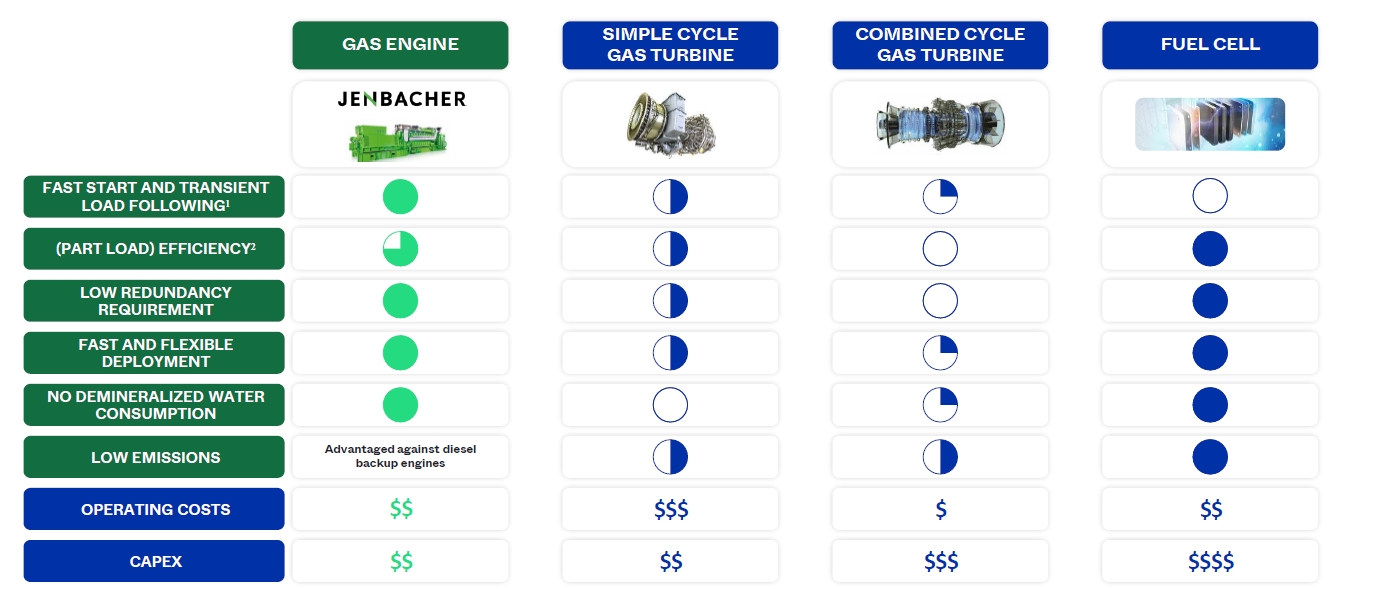
Source: Company information and estimates based on third-party sources.
(1)Transient capability refers to the ability to rapidly change power output in response to sudden changes in load or grid conditions while maintaining stable operation.
(2)Part load efficiency is calculated as electrical output divided by fuel energy input at a defined load level. It is commonly assessed by comparing efficiency at 50%, 75% and 100% of rated load to evaluate how performance changes across the operating range.
Established Leadership Position in Gas Engines for Balancing, Firming, CHP and Specialty Gas Applications
Our success in decentralized power generation is rooted in a long-standing focus on gaseous-fuel engine technology and a deliberate concentration on stationary power generation. Unlike diversified engine manufacturers that also serve marine, transportation or off-highway markets, our solutions have been engineered specifically for gas-based power generation and CHP applications.
We distinguish ourselves through deep specialization in gaseous fuels, with engines optimized for natural gas, associated petroleum gas, coal mine gas, biogases, such as landfill and sewage gas, and industrial waste gases. Our engine portfolio spans outputs from 220 kW to 10.6 MW, enabling deployment across a broad range of balancing, firming, CHP and specialty gas applications. All relevant Jenbacher engine platforms are ready to run on 25% hydrogen, and our Type 4 engine is capable of operating on up to 100% hydrogen. Additionally, as of April 15, 2026, our 3 MW Jenbacher engines have been validated to run on 100% hydrogen. This achievement was validated using various AI load profiles and large, rapid load fluctuations to simulate real-world data center conditions, demonstrating that our 3 MW engine can meet the demanding response profiles required for critical data center operations while running on 100% hydrogen.
High start-stop capability, strong part-load efficiency and stable performance under frequent cycling make our engines well suited for balancing and firming applications, which are critically required in power systems facing increasing volatility from renewable penetration. In CHP and district heating applications, modular factory-tested heat exchanger configurations enable customer-specific temperature levels at high total efficiency.
In addition, our engine platforms are designed to accommodate increasing shares of renewable and low-carbon fuels, including hydrogen blends, providing customers with future pathways toward low-carbon operation. This combination of gas specialization, power-focused engineering, operational flexibility and reliability underpins our established leadership position in flexible decentralized power generation.
Top Two Position in Gas Engine Driven Gas Compression with Leading Technology in Gas Compression Applications that have Significant Barriers to Entry
Gas compression applications require equipment that can withstand harsher fuel and ambient conditions compared to other engine applications. Our engines are designed to operate in constantly changing conditions. Our engines’ hardware and controls are extremely flexible to maximize uptime during fuel, load and ambient condition changes. Our rich burn combustion technology provides the widest operating window compared to other engines in the category. This provides customers with the flexibility to deploy our engines in compression applications without modification or adjustment. It also achieves extremely low emissions without requiring expensive and complex exhaust aftermarket treatment systems.
Our engines perform particularly well in high-intensity compression applications characterized by higher pressures and output per unit, making them well suited for evolving field developments where declining gas well counts are offset by increasing production volumes.
Our strategy also aims to minimize the number of service intervals required for the entire compression package. We work to align the maintenance requirements with the compressor by reducing the number of maintenance events needed to keep the equipment operating to promote operational efficiency. We have simplified the digital interface with our equipment to expedite troubleshooting and remote support needed to bring the equipment back to operating condition.
Additionally, our extensive network of distributors and packagers can support sophisticated planned and unplanned maintenance activities. The combination of application-specific design and service access enables our engines to positively influence our customers’ ability to meet their production goals at low operating cost.
Service Capture Enabled by Proprietary, High-Performance Parts and a Global Service Network Drives Highly Profitable Recurring Revenues
The stable operation and availability of our engines are critical to our customers’ operations, making service an essential and structurally defensible component of our business model. Our service offerings are not only reliable but also strengthen customer relationships, generate recurring multi-year Services revenue for us and deliver higher margins, helping mitigate the impact of economic cyclicality.
Our strong Equipment Order Intake continues to expand our active fleet of engines. With approximately 44 GW of installed base as of December 31, 2025, the fleet forms the foundation of a growing and highly visible service business. Given the mission-critical nature of our engines, customers are structurally incentivized to source parts and services directly from us as the original equipment manufacturer (“OEM”). Our Equipment Order Intake is centered around engines at the higher end of our power generation capability portfolio where proprietary components, engine specifications and integrated control systems may make it more expensive to switch providers, as even a single component failure or improper intervention can materially increase the total cost of an outage. As a result, service capture is driven by risk management and operational certainty on top of discretionary customer choice.
Our strong Equipment Order Intake provides Services revenue visibility well beyond 2030, as each newly installed engine enables a long-duration service relationship over its operating life. We deliver services both transactionally and through long-term service agreements (“LSAs”), which can extend to ten years or more, supporting recurring and predictable revenue streams.
To maintain seamless performance and maximize useful life, our engines require comprehensive overhauls at specific operating intervals. We leverage these requisite milestones to deploy next-generation technology upgrades, a process that revitalizes the customer’s asset while driving predictable, accretive revenue growth for our platform. For the majority of the engines in our portfolio, minor overhauls are typically due between 30,000 to 40,000 operating hours. At this stage, key components are exchanged at mid-life. Major overhauls occur after 60,000 to 80,000 operating hours, and significant upgrades to new specifications are made. These major overhauls give the engines
performance upgrades plus second and third working lives, which could extend an engine’s life to over 40 years in some cases.
Our “local-for-local” strategy in direct, strategic markets such as the United States and Germany, enables us to deliver fast, reliable support where it matters most—close to our customers’ operations—and assists us with mitigating our potential exposure to tariffs. By leveraging regional service hubs and local expertise, we minimize downtime and ensure rapid response for products that are critical to our customers’ business continuity. This proximity-driven approach reinforces trust and positions us as a dependable partner in the markets we serve. This has been particularly true in the United States, where, as of March 31, 2026, we have more than doubled service headcount since 2024 to prepare for data center growth.
System Integration and Execution Capability
Our ability to deliver fully integrated, turnkey power systems sets us apart in the distributed energy market. Unlike providers that supply only engines, we offer complete solutions, including generation, controls, containerization and grid interface, designed to meet the most demanding operational requirements. By maintaining our own distribution channels, we achieve superior customer intimacy and a localized presence, enabling us to provide tailored solutions that align with customer requirements. Our execution capabilities extend beyond product delivery. We operate effectively in complex and multi-vendor environments, facilitating seamless integration across diverse project stakeholders. By providing accountability from initial design and engineering through commissioning and lifecycle service, we simplify project management for our customers and reduce execution risk.
This integrated approach shortens time-to-power, a critical advantage for customers operating under tight delivery timelines, such as data centers and industrial facilities facing urgent capacity needs. Our track record in delivering projects on schedule and within scope reinforces our reputation as a trusted partner for mission-critical applications.
We complement these capabilities with a robust network of long-term supply chain and channel partners, enabling reliability and scalability across global markets. This ecosystem enables us to maintain quality standards, accelerate deployment and support customers throughout the asset lifecycle.
Global Manufacturing and Distribution Footprint
We serve our customers through an integrated global footprint spanning approximately seven million square feet of land for manufacturing spaces across North America and Europe, with global direct and indirect coverage across approximately 100 countries, supported by an internal service team of over 1,600 specialists as of March 31, 2026.
Our production capabilities are anchored by major manufacturing hubs on both sides of the Atlantic. In Europe, our Jenbach, Austria campus serves as a fully integrated center of excellence, housing our primary R&D, customer engineering and gas engine manufacturing operations. This hub is supported by specialized component and machining facilities in Hall and Kapfenberg, Austria.
In North America, our facilities in Welland, Ontario; Waukesha, Wisconsin and Waller, Texas serve as key regional hubs. Crucially, our Trenton, New Jersey facility operates as a dedicated containerization center specifically optimized for our data center business line. Recent investments in our North American footprint underscore our commitment to a “local-for-local” strategy, enhancing our in-region maintenance, component manufacturing and assembly capabilities to reduce lead times and mitigate supply chain and tariff risks.
This level of integration enables us to serve customers across the full asset lifecycle: from initial sale to recurring maintenance and replacement. This comprehensive approach deepens customer intimacy and positions us to capture significant upselling opportunities over time. Furthermore, between 2020 and 2025, we strategically expanded our value chain by acquiring the businesses and assets of six distributors or system integrators and a white-label service provider. These acquisitions have allowed us to internalize critical sales and distribution capabilities and more effectively serve our global customer base.
Established Track Record of Innovation
Our track record of innovation reflects more than 100 years of sustained investment and strategic focus, spanning power density, efficiency, fuel technology, solution modularity and digital capabilities. In recent years, this innovation has increasingly been directed toward the specific requirements of data center applications, where power quality, transient performance and rapid load-following are critical to the reliable operation of AI-driven computing infrastructure.
Most recently, we introduced the latest generation of the Jenbacher Type 6 engine, incorporating a set of design innovations specifically targeted at improving power quality, transient response and deployment speed under the highly dynamic load conditions typical for modern data center applications. These include (i) an optimized generator module that improves frequency stability during rapid load changes, (ii) a decentralized gas addition that enhances fuel availability during block load events and materially reduces frequency and voltage deviations and (iii) turbocharging optimized for transient operation to support fast AI-driven load ramps. Within the Type 6 engine, a large-bore, 24-cylinder engine architecture further increases power density, delivering up to approximately 5 MW of peak power per unit while maintaining strong transient behavior. Together, these features reduce reliance on external inertia and battery systems, increase power density per genset (which combine engine and alternator together with controls) (“genset”), and lower overall system footprint, capex and complexity. These engine-level innovations are complemented by expanded, containerized solutions tailored for data center deployments, enabling aggregation of units, rapid installation, accelerated time-to-power and compliance with increasingly stringent emissions standards through proprietary in-house exhaust aftertreatment solutions.
As pioneers in alternative gaseous fuel technology, we are recognized as a leading provider of gas engines for renewables (e.g., biogas, landfill gas and sewage gas) and specialty gases (e.g., industrial waste, pyrolysis and coal mine gases). Our leadership, spanning decades, is reflected in our comprehensive portfolio. By 2020, our Jenbacher Type 4 platform demonstrated the capability to operate on up to 100% hydrogen, and as of 2022, all Jenbacher products were ready for hydrogen blends of up to 25% by volume. This offers customers the flexibility to decarbonize as supply chains for low-carbon molecules mature.
We continue to invest in extending our technological leadership. Since 2024, we have increased annual R&D expense by over 15% in 2025, focusing on emissions performance, fuel flexibility, electrical efficiency, power density and ramp rates. In parallel, we have developed digital solutions for the energy technology sector. As of March 31, 2026, our workforce included over 450 employees with R&D capabilities and we hold 1,132 issued patents, reinforcing that innovation remains central to both our heritage and our long-term growth strategy.
Digital Leadership Through myplant and Proprietary AI Enhance Both Our Customer Value Proposition and Operations
Our digital ecosystem enhances the reliability, performance and lifecycle economics of our equipment and services. At its core is myplant, our proprietary, AI-enabled fleet management platform. The platform uses high-frequency operational data to enable predictive maintenance, remote diagnostics, automated optimization and fleet-level analytics, improving asset availability and allowing a significant share of service events to be resolved remotely.
Myplant is built on machine-learning, AI, and digital-twin technologies and is integrated into our internal service processes. This strengthens service attachment, supports performance commitments, improves resource utilization and enables scalable growth with limited incremental cost. Our proprietary digital approach enables us to maintain control over the development of our solutions, reinforcing long-term customer relationships and creating a defensible competitive moat.
By separately embedding AI across corporate functions, including operations, sales, engineering, service, HR, IT and legal, we aim to improve productivity, optimize resource allocation and strengthen margins.
Our Growth Strategies
We believe our strengths and competitive position enable us to capitalize on the evolving market opportunity, differentiate us from our competitors and drive highly profitable growth over time.
Order intake and revenue trends demonstrate our strong exposure to structurally high-growth segments of the global power generation market, reflecting our established positioning and leading technology in flexible, modular, gas-based power solutions.
We are particularly well placed to capture accelerating demand in behind-the-meter data center applications, notably in North America, where our solutions align closely with customer requirements for speed of deployment, reliability and dispatchability. The resulting step-up in Equipment Order Intake is materially expanding the installed base and is expected to translate into a sustained increase in Services revenues over the coming years, as reflected in the long-term revenue mix. In parallel, we are executing a disciplined, self-funded capacity expansion and advancing product innovation, partnerships and may conduct selective M&A to support continued growth and reinforce our leadership across these attractive end markets.
Capitalize on Data Center–Driven Power Demand and Energy Transition Tailwinds with Differentiated Gas Engine Solutions
We are positioned at the intersection of two powerful global trends: accelerating AI adoption and the global energy transition. All three of our Equipment business lines, data centers, power solutions and compression, benefit directly from surging data center power demand, driven by AI workloads. Our data center solutions are well positioned given our established behind-the-meter and co-location offerings. We are investing in our capacity, sales, distribution and R&D to scale these solutions through standardized, pre-engineered power blocks that can be deployed rapidly and replicated across campuses and geographies.
In parallel, rising renewable penetration and the accelerated retirement of coal‑fired capacity are structurally increasing the need for flexible, dispatchable generation to support peaking, firming, balancing and overall grid stability. As dispatchable generation becomes increasingly essential for reliability, we believe natural gas is set to play a larger role in the power mix due to its scalability, availability and flexibility, which in turn accelerates demand for our compression solutions.
Our predominantly direct go-to-market strategy enhances our ability to engage regularly with customers and adapt our offering to their requirements. Our strong position and competitive advantage in the markets in which we operate is validated by a robust and growing Equipment Order Backlog, supported by a 2.8x Equipment Order Intake book-to-bill ratio and an approximately 16 times increase in data center Equipment Order Intake from 2020 to 2025. We recently partnered with an energy-as-a-service (“EaaS”) provider to deploy 2.3 GW of advanced power-infrastructure solutions. With AI adoption and build-up of supporting infrastructure, our runway for future growth becomes stronger.
Sizable and Growing Installed Base Initiates “Service Flywheel,” Driving Resilient Growth and Profitability
The step-change in installed base that we expect in the coming years will accelerate the long-term growth of our Services segment. As our fleet expands, we are positioned to capture recurring parts and service revenues over the full lifecycle of each engine. Our Services revenue is derived from sales of parts and labor, where, as of December 31, 2025, parts represent around 85% of our Services revenue and labor represents around 15% of our Services revenue, based on management’s estimates on calculations in Euros. As a result, a substantial portion of lifecycle value is driven by parts, which are frequently proprietary and therefore naturally exhibit high OEM capture rates, particularly in high-growth applications such as data centers where reliability is paramount. To support incremental future growth, we expect to selectively expand our direct access to the labor value pool through a combination of targeted acquisitions and organic capability build-out, consistent with our historical approach. In parallel, we strive to continue strengthening customer compliance with our standard maintenance schedule and articulating the value proposition of OEM parts, reinforcing service capture across the installed base.
This structurally high service capture rate provides revenue visibility extending well beyond 2030, as a strong Equipment Order Intake expands the future service opportunity set. Equipment Order Intake has increased by 188% from 2024 to 2025, reinforcing the growth trajectory of the installed base. As the fleet grows and matures, these dynamics create a self-reinforcing service flywheel: incremental equipment deployments expand the installed base, the proprietary nature of parts and LSAs drive recurring aftermarket activity and deep customer relationships support incremental future equipment sales.
The impact of this flywheel is evident in our recent financial performance, including Services revenue growth of 15% between 2023 and 2025, and Services revenue growth for seven consecutive years as of December 31, 2025. Together, these dynamics position us to sustain long-term value creation through continued investment in innovation, operational excellence and market expansion.
Execute on Our Self-Funded Global Manufacturing Capacity Expansion
In response to accelerating demand for our Equipment and Services segments, we are executing a series of self-funded manufacturing capacity expansion initiatives, with a particular focus on capturing U.S. data center demand. In 2025, our annual capital expenditures represented approximately 6.5% of revenue, with the majority allocated to growth initiatives and funded from operating cash flow. A significant portion of recent and planned growth capital expenditures are directed towards North America, reflecting the strength of U.S. data center demand and our strategic focus on local manufacturing and execution.
Investments such as our Trenton, New Jersey facility are designed to expand containerization capabilities that are supporting data center deployments in the U.S. market. Across our manufacturing network, our current investment plan is expected to provide us with sufficient headroom and flexibility to deliver our growth plan and capture incremental market opportunities. The flexibility of our supply chain and long-standing supplier relationships further enable efficient scaling with controlled execution risk.
Our ability to bring incremental capacity online is supported by a proven execution track record, including the recent opening of our second facility in Hall, Austria. Building on this foundation, we are continuing to expand capacity, with our current plans designed to significantly increase MW output, targeting approximately a tripling of our total capacity. These plans include a near-term, elevated investment phase, where we expect spending to temporarily rise meaningfully as we accelerate build-out, followed by a return to our historical, normalized investment cadence once the additional capacity is in place.
Commercialize New Products and Solutions to Meet Evolving End Market Needs
Our ability to commercialize new products and solutions is underpinned by a long-standing engineering track record across gas engine technology, controls and system integration. This includes a series of category-defining milestones such as leadership in cogeneration, development of large-bore high-speed and high-efficiency engine platforms, advances in fast start and transient-capable designs, early innovation in alternative and hydrogen-ready gaseous fuels and the introduction of digital engine management and asset performance solutions.
This innovation capability is shaped through close collaboration and co-creation with key customers, technology partners and system integrators, ensuring new technologies are engineered for operational relevance, rapid deployment and scalability from inception. Innovations are industrialized into standardized platforms that can be deployed repeatedly across end markets rather than developed as one-off solutions.
Importantly, this long-term innovation capability is not episodic but platform-based, allowing new technologies to be consistently translated into commercially relevant products and solutions. The same engineering depth that enabled historical milestones now underpins recent innovations targeted at data centers, power solutions and compression, supporting advances in transient performance, power quality, power density, containerized deployment, digital optimization and hydrogen readiness as end-market requirements continue to evolve.
Pursue Targeted Partnerships and Selective M&A Opportunities
We regularly assess partnership and inorganic growth opportunities that expand our addressable market, accelerate adoption of low-carbon solutions and deepen our presence in high-growth verticals such as data centers, industrial microgrids and critical infrastructure. Our track record of leveraging partnerships to drive growth include our recent containerization project with Gföllner to address growing U.S. data center demand, our long-standing partnership with ExxonMobil and Q8 for developing specialized lubricants that extend oil life and reduce operators’ costs and our acquisition of numerous distributors and systems integrators that have enhanced our go-to-market strategy and service coverage.
We continue to evaluate strategic partnerships and selective acquisitions that will enhance our product portfolio, accelerate hydrogen or renewable natural gas capabilities, expand service intensity or provide access to
high-growth segments. We plan to prioritize accretive opportunities that strengthen our technology roadmap and production capabilities.
Our Principal Shareholder
AI Alpine (Luxembourg) S.à r.l., our “Principal Shareholder,” is co-owned by funds managed and/or advised by Advent and ADIA. Please see “Principal and Selling Shareholders” for more information.
Advent. Funds managed and/or advised by Advent initially acquired an interest in INNIO in 2018. Advent is a leading global private equity investor committed to working in partnership with management teams, entrepreneurs and founders to help transform businesses. With 16 offices across five continents, Advent oversees more than $100 billion in assets under management as of December 31, 2025 and has made more than 430 investments across 44 countries. Since its founding in 1984, Advent has developed specialist market expertise across its five core sectors: business & financial services, consumer, healthcare, industrial and technology. This approach is bolstered by Advent’s deep sub-sector knowledge, which informs every aspect of its investment strategy, from sourcing opportunities to working in partnership with management to execute value creation plans. Advent brings hands-on operational expertise to enhance and accelerate businesses. As one of the largest privately owned partnerships, its over 600 colleagues leverage the full ecosystem of Advent’s global resources, including its Portfolio Support Group, insights provided by industry expert Operating Partners and Operations Advisors, as well as bespoke tools to support and guide its portfolio companies as they seek to achieve their strategic goals.
ADIA. The ADIA shareholder is a wholly owned subsidiary of ADIA. ADIA is a globally diversified investment institution that prudently invests funds on behalf of the Government of Abu Dhabi through a strategy focused on long-term value creation. ADIA’s portfolio comprises more than two dozen asset classes and subcategories, from equities and fixed income to hedge funds, real estate, private equity and infrastructure.
Risk Factors Summary
Our business is subject to numerous risks and uncertainties, including those highlighted in the section titled “Risk Factors” immediately following this prospectus summary. If any of these risks actually occurs, our business, financial condition or results of operations could be materially and adversely affected. In such case, the trading price of our common shares would likely decline, and you may lose all or part of your investment. The following is a summary of the principal risks we face:
•We operate in a highly competitive environment, and competing solutions for distributed energy include renewables such as solar, wind and storage, reciprocating engines, fuel cells and other engines or turbines, any or all of which might be perceived as superior to our technology;
•Our business and operations expose us to numerous legal and regulatory requirements, and any actual or alleged violation of these requirements could materially adversely affect our business, results of operations, and financial condition;
•Future legislation and regulation governing internet-related services, other related communications services information technologies and critical infrastructure, such as data centers, could disrupt our customers’ businesses and markets, resulting in declines in sales volume and prices of our products;
•Our operations are expanding rapidly, and we may fail to effectively manage our anticipated growth and expansion of our operations. Our rapid growth and expansion have required and will continue to require significant capital expenditures and valuable management and employee resources;
•We may not be able to successfully implement our strategies; in particular, we may fail to successfully benefit from the disruptive trends in global energy markets (such as the shift to hydrogen as an alternative fuel) and to increase the share of our Services business;
•We rely on the continued growth of our customers’ data center networks to grow our business, operations and revenue;
•Our Services business, which is a key contributor to our success and competitiveness, may not generate the revenue and profitability we expect;
•Our products involve a lengthy sales cycle, and we may not anticipate sales levels appropriately;
•Our business depends on the timely availability of high-quality raw materials, parts, components and other inputs at reasonable prices. We are currently facing, and may continue to face, delays, shortages and price volatility as a result of global supply chain disruptions and other factors;
•We are engineering our systems to be able to run on 100% hydrogen and other eFuels, or electricity-based synthetic fuels. However, if we are unsuccessful or if there is an insufficient supply of, or demand for, hydrogen or other synthetic fuels, our sales growth could be adversely affected;
•A substantial portion of our revenue is driven by a limited number of our customers;
•We currently rely on a limited number of suppliers for certain parts and equipment to build our products, and we may not be able to find replacements or immediately transition to alternative suppliers;
•We are increasingly exposed to large-scale projects;
•Amounts included in our backlog may not result in actual revenue or translate into profits. Our backlog is subject to cancellation and unexpected adjustments and is, therefore, an uncertain indicator of future operating results;
•Our business requires access to significant credit and guarantee lines and other financing instruments. Our business activities could be negatively affected if we are unable to meet our capital requirements in the future or if access to capital becomes more expensive;
•We may fail to comply with environmental, social and governance (“ESG”) market expectations;
•Our operations are subject to various environmental, health and safety laws and regulations, and potential litigation, non-compliance with, or liabilities under, such laws and regulations could result in substantial costs, fines, sanctions, claims, additional regulatory oversight, suspension of operations and reputational harm;
•We are subject to the U.S. Foreign Corrupt Practices Act of 1977, as amended (15 U.S.C. § 78dd1, et seq.) (“FCPA”) and similar anti‑corruption laws and regulations. Our global operations and interactions with government officials, state‑owned entities, and third‑parties create compliance risks;
•We may be unable to adequately obtain, maintain, protect or enforce our intellectual property rights;
•Our Principal Shareholder will continue to own a significant percentage of our common shares upon the closing of this offering, and our Principal Shareholder will have certain governance rights upon the closing of this offering. Consequently, our Principal Shareholder will have significant influence on, and may control, all major corporate decisions and their interests may conflict with your interests as an owner of our common shares and our interests;
•We are a “controlled company” within the meaning of the Nasdaq rules and, as a result, will qualify for, and may rely on, exemptions from certain corporate governance requirements;
•We have identified material weaknesses in our internal control over financial reporting and may identify additional material weaknesses in the future or fail to maintain an effective system of internal control over financial reporting, which may result in material misstatements of our consolidated financial statements or cause us to fail to meet our periodic reporting obligations; and
•Upon the closing of this offering, we will be a Dutch public company. The rights of our shareholders may be different from the rights of shareholders in companies governed by the laws of U.S. jurisdictions and may not protect investors in a similar fashion afforded by incorporation in a U.S. jurisdiction.
Our Risk Factors are not guarantees that no such conditions exist as of the date of this prospectus and should not be interpreted as an affirmative statement that such risks or conditions have not materialized, in whole or in part.
Organizational History
We historically conducted our business through INNIO Group Holding GmbH, an Austrian limited liability company (Gesellschaft mit beschränkter Haftung), which was established on April 19, 2018 and became operational on November 1, 2018 after we were carved out of GE. For the years ended December 31, 2023 and 2024, our audited consolidated financial statements were those of INNIO Group Holding GmbH.
On September 26, 2025, we completed an income tax-free corporate restructuring to facilitate an initial public offering and establish a holding company structure. On September 1, 2025, our Principal Shareholder, the parent company of INNIO Group Holding GmbH, established a two-tier German holding structure with two German entities: INNIO Holding GmbH and INNIO Beteiligungs GmbH. As a result, INNIO Group Holding GmbH became an indirect wholly owned subsidiary of INNIO Holding GmbH, with INNIO Beteiligungs GmbH established between the two entities.
For the year ended December 31, 2025, our audited consolidated financial statements were those of INNIO Holding GmbH. Our beneficial ownership remained the same during this corporate reorganization. This corporate restructuring was accounted for as a transaction under common control and reflected prospectively from the date of transfer. For further details on this reorganization, including the relevant accounting treatment, see note 1 to our audited consolidated financial statements included elsewhere in this prospectus.
Prior to the closing of this offering, INNIO Holding GmbH will be converted from a German limited liability company (Gesellschaft mit beschränkter Haftung), into INNIO Group Holding B.V., a Dutch private company with limited liability (besloten vennootschap met beperkte aansprakelijkheid) and then converted into a public company under Dutch law (naamloze vennootschap) and our legal name will change to INNIO N.V. We refer to these steps as the “Reorganization.”
The following diagram illustrates our corporate structure immediately following the Reorganization and the consummation of this offering:
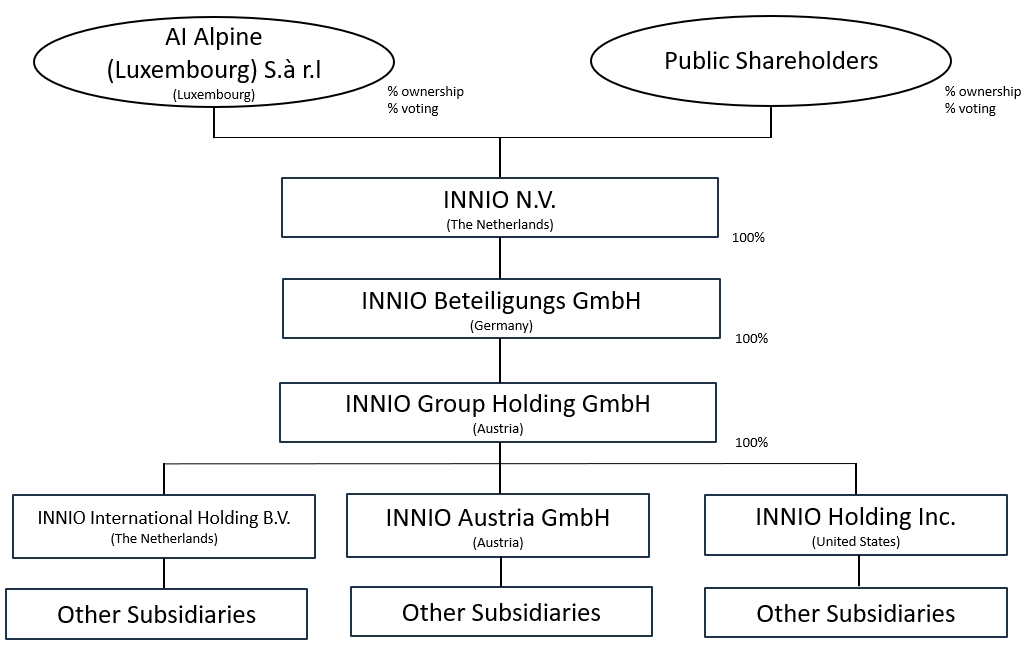
Corporate Information
INNIO Holding GmbH is the issuer of the common shares offered by this prospectus, and prior to the closing of this offering, we will be converted into INNIO Group Holding B.V., a Dutch private company with limited liability (besloten vennootschap met beperkte aansprakelijkheid) and then into a public company under Dutch law (naamloze vennootschap) and our legal name will change to INNIO N.V. as described above. Our principal executive offices are located at Nymphenburger Strasse 5, 80335 Munich, Federal Republic of Germany. Our telephone number is +49.89.89.82.7221. Our website is https://www.innio.com. Information contained on, or that can be accessed through, our website is not a part of, and is not incorporated into, this prospectus, and the inclusion of our website address in this prospectus is an inactive textual reference only.
We use INNIO, the INNIO logo, and other marks as trademarks in the United States and other countries. This prospectus contains references to our trademarks and service marks and to those belonging to other entities. Solely for convenience, trademarks and trade names referred to in this prospectus, including logos, artwork, and other visual displays, may appear without the ® or ™ symbols, but such references are not intended to indicate in any way that we will not assert, to the fullest extent under applicable law, our rights or the rights of the applicable licensor to these trademarks and trade names. We do not intend our use or display of other entities’ trade names, trademarks, or service marks to imply a relationship with, or an endorsement or sponsorship of, any other entity.
Channels for Disclosure of Information
Investors, the media, and others should note that, following the effectiveness of the registration statement of which this prospectus forms a part, we intend to announce material information to the public through filings with the SEC, the investor relations page on our website, press releases, public conference calls and webcasts.
The information disclosed by the foregoing channels could be deemed to be material information. As such, we encourage investors, the media and others to follow the channels listed above and to review the information disclosed through such channels. However, information disclosed through these channels does not constitute part of this prospectus and is not incorporated by reference herein.
We intend to post any updates to the list of disclosure channels through which we will announce information on the investor relations page on our website.
THE OFFERING
|
|
Common shares offered by us |
common shares. |
Common shares offered by the selling shareholders |
common shares. |
Underwriters’ over-allotment option to purchase additional common shares from the selling shareholders |
common shares. |
Common shares to be outstanding immediately after completion of this offering |
common shares. |
Use of proceeds |
We estimate that the net proceeds to us from the sale of our common shares in this offering will be approximately $ million, based upon the assumed initial public offering price of $ per share, which is the midpoint of the price range set forth on the cover page of this prospectus, and after deducting underwriting discounts and commissions and estimated offering expenses payable by us. We will not receive any proceeds from the sale of common shares by the selling shareholders in this offering (including any common shares sold pursuant to the underwriters’ option to purchase additional shares to cover over-allotments). The principal purposes of this offering are to increase our capitalization and financial flexibility, create a public market for our common shares, facilitate future access to the public equity markets and to increase our visibility in the marketplace. We intend to use the net proceeds from this offering for general corporate purposes, including working capital, operating expenses and capital expenditures. Additionally, we may use a portion of the net proceeds to acquire or invest in businesses, products, services or technologies. However, we do not have agreements or commitments for any material acquisitions or investments at this time. We will have broad discretion in the way that we use the net proceeds of this offering. See “Use of Proceeds” for a more complete description of the intended use of proceeds from this offering. |
Risk factors |
See the section titled “Risk Factors” beginning on page 26 and the other information included in this prospectus for a discussion of factors you should carefully consider before deciding to invest in our common shares. |
|
|
Controlled Company |
Following this offering, we will be a “controlled company” within the meaning of the corporate governance rules of Nasdaq. For additional information, see the section titled “Management—Controlled Company.” |
Dividend policy |
We do not currently intend to pay any cash dividends on our common shares in the foreseeable future. We currently intend to retain all available funds and any future earnings to fund the further development and expansion of our business. However, we expect to reevaluate our dividend policy on a regular basis following the offering and may, subject to compliance with the covenants contained in our SFA (as defined in “Management’s Discussion and Analysis of Financial Condition and Results of Operations—Liquidity and Capital Resources—Senior Facilities Agreement”) and other considerations, determine to pay dividends in the future. Upon the completion of the Reorganization, under Dutch law, we may only pay dividends and other distributions from our reserves to the extent our shareholders’ equity (eigen vermogen) exceeds the sum of our paid-in and called-up share capital plus the reserves we must maintain under Dutch law or our articles of association and (if it concerns a distribution of profits) after adoption of our statutory annual accounts by our general meeting from which it appears that such dividend distribution is allowed. Subject to those restrictions, any future determination to pay dividends or other distributions from our reserves will be at the discretion of our board of directors and will depend upon a number of factors, including our results of operations, financial condition, future prospects, contractual restrictions, restrictions imposed by applicable law and other factors we deem relevant. See “Dividend Policy.” |
Proposed trading symbol |
“INIO” |
The total number of our common shares that will be outstanding immediately prior to this offering is based on common shares outstanding as of March 31, 2026.
The total number of common shares that will be outstanding immediately after this offering is based on of our common shares outstanding as of March 31, 2026 and excludes:
• common shares reserved for future issuance under our 2026 Plan, which will become effective in connection with the consummation of this offering, as well as any common shares that become available pursuant to provisions in the 2026 Plan that automatically increase the share reserve under the 2026 Plan (which number includes common shares subject to restricted share unit awards that will be granted to certain of our employees and directors pursuant to our 2026 Plan in connection with the consummation of this offering, based upon an assumed initial public offering price of $ per share (the midpoint of the price range set forth on the cover page of this prospectus)).
For additional information, see the section titled “Compensation Discussion and Analysis—Equity-Based Compensation.”
Except as otherwise indicated, all information in this prospectus assumes or gives effect to the following:
•the completion of the Reorganization, as further described under the section titled “Corporate Reorganization;”
•an initial public offering price of $ per common share, which is the midpoint of the price range set forth on the cover page of this prospectus; and
•no exercise of the underwriters’ option to purchase additional common shares.
SUMMARY HISTORICAL CONSOLIDATED FINANCIAL AND OTHER DATA
The following tables set forth summary consolidated financial and other data as of March 31, 2026 and 2025, and for the years ended December 31, 2025, 2024 and 2023. The consolidated statements of operations and condensed cash flows data for the three months ended March 31, 2026 and 2025, and the condensed consolidated statement of financial position data as of March 31, 2026, are derived from the unaudited consolidated financial statements and related notes included elsewhere in this prospectus. The consolidated statements of operations and condensed cash flows data for the years ended December 31, 2025, 2024 and 2023 are derived from the audited consolidated financial statements and related notes included elsewhere in this prospectus.
You should read this data together with the consolidated financial statements and related notes appearing elsewhere in this prospectus and the information in the section titled “Management’s Discussion and Analysis of Financial Condition and Results of Operations.” Our historical results are not necessarily indicative of our future results. The summary consolidated financial data in this section are not intended to replace, and are qualified in their entirety by, the consolidated financial statements and related notes included elsewhere in this prospectus.
Consolidated Statements of Operations:
|
|
|
|
|
|
|
|
|
|
|
|
|
|
|
|
|
|
|
|
|
|
|
|
|
|
|
|
|
|
|
For the Three Months Ended March 31, |
|
For the Years Ended December 31, |
($ in millions, except share and per share amounts) |
2026 |
|
2025 |
|
2025 |
|
2024 |
|
2023 |
Sales of equipment and products |
$ |
322.4 |
|
$ |
210.2 |
|
$ |
1,365.4 |
|
$ |
935.5 |
|
$ |
909.7 |
Sales of services |
|
346.2 |
|
|
283.8 |
|
|
1,271.4 |
|
|
1,223.6 |
|
|
1,105.3 |
Net sales |
|
668.6 |
|
|
494.0 |
|
|
2,636.8 |
|
|
2,159.1 |
|
|
2,015.0 |
Cost of equipment and products sold |
|
240.8 |
|
|
146.5 |
|
|
994.5 |
|
|
691.1 |
|
|
692.0 |
Cost of services sold |
|
194.0 |
|
|
158.1 |
|
|
730.5 |
|
|
696.6 |
|
|
649.6 |
Gross profit |
|
233.8 |
|
|
189.4 |
|
|
911.8 |
|
|
771.4 |
|
|
673.4 |
Selling, general, and administrative expenses |
|
143.0 |
|
|
97.0 |
|
|
467.1 |
|
|
390.1 |
|
|
351.0 |
Research and development expenses |
|
28.9 |
|
|
19.3 |
|
|
103.5 |
|
|
89.7 |
|
|
83.7 |
Other operating (income) expense - net |
|
(1.2) |
|
|
(1.8) |
|
|
(5.3) |
|
|
(6.2) |
|
|
—– |
Operating income |
|
63.1 |
|
|
74.9 |
|
|
346.5 |
|
|
297.8 |
|
|
238.7 |
Interest expense and related financing costs - net |
|
70.8 |
|
|
28.5 |
|
|
163.6 |
|
|
192.3 |
|
|
133.9 |
Other (income) expense - net |
|
(3.2) |
|
|
(0.6) |
|
|
(1.3) |
|
|
(0.5) |
|
|
(4.0) |
Income before income taxes |
|
(4.5) |
|
|
47.0 |
|
|
184.2 |
|
|
106.0 |
|
|
108.8 |
Income tax expense |
|
4.5 |
|
|
12.0 |
|
|
42.4 |
|
|
14.0 |
|
|
30.1 |
Net income |
$ |
(9.0) |
|
$ |
35.0 |
|
$ |
141.8 |
|
$ |
92.0 |
|
$ |
78.7 |
Net income (loss) attributable to non-controlling interests(1) |
|
(1.8) |
|
|
—– |
|
|
(2.5) |
|
|
—– |
|
|
—– |
Net income attributable to INNIO Holding GmbH shareholder(1) |
$ |
(7.2) |
|
$ |
35.0 |
|
$ |
144.3 |
|
$ |
92.0 |
|
$ |
78.7 |
Earnings per share attributable to INNIO Holding GmbH shareholder, basic and diluted(1)(2) |
$ |
(288.3) |
|
$ |
1,401.3 |
|
$ |
5,772.5 |
|
$ |
3,678.0 |
|
$ |
3,148.0 |
Weighted average number of common shares outstanding used in computing earnings per share attributable to INNIO Holding GmbH shareholder, basic and diluted(1)(2) |
|
25,000 |
|
|
25,000 |
|
|
25,000 |
|
|
25,000 |
|
|
25,000 |
Pro forma data - giving effect to the capital repayment adjustment (unaudited) |
|
|
|
|
|
|
|
|
|
|
|
|
|
|
Pro forma net income (loss) per share attributable to INNIO Holding GmbH shareholder(3) |
$ |
|
|
$ |
—– |
|
$ |
|
|
$ |
—– |
|
$ |
—– |
Pro forma earnings per share attributable to INNIO Holding GmbH shareholder, basic and diluted(3) |
$ |
|
|
$ |
—– |
|
$ |
|
|
$ |
—– |
|
$ |
—– |
Pro forma weighted average number of common shares outstanding used in computing earnings per share attributable to INNIO Holding GmbH shareholder, basic and diluted(3) |
|
|
|
|
—– |
|
|
|
|
|
—– |
|
|
—– |
(1)On September 1, 2025, we were incorporated with 25,000 shares that were assumed by our Principal Shareholder as part of our corporate reorganization in September 2025. All share and per share information presented has been retrospectively adjusted to reflect the new capital structure. Prior to the corporate reorganization in September 2025, as a private limited liability company, INNIO Group Holding GmbH had only one shareholder whose ownership interest was represented by a monetary share capital amount and no shares. See note 23 to our consolidated financial statements included elsewhere in this prospectus.
(2)There were no potentially dilutive securities in calculating earnings per share for the periods presented, therefore, basic and diluted earnings per share are the same. See note 23 to our consolidated financial statements included elsewhere in this prospectus.
(3)In the year preceding this offering, we distributed $723.8 million as capital repayment to our Principal Shareholder. This amount was in excess of our earnings for the year ended December 31, 2025. As such, the pro forma earnings per share for the year ended December 31, 2025 and
for the three months ended March 31, 2026 give effect to the pro forma adjustments to the number of shares that would be required to generate the proceeds necessary to pay the full amount of the capital repayment in excess of earnings for the year ended December 31, 2025. The computation is based on an offering price of $ per share, which is the midpoint of the price range set forth on the cover page of this prospectus.
This pro forma adjustment relates only to the capital repayment described in this footnote and does not give separate effect to the corporate reorganization described in footnote (1), which is already reflected through a retrospective adjustment of the historical share and per share information presented above.
Condensed Consolidated Statements of Cash Flows:
|
|
|
|
|
|
|
|
|
|
|
|
|
|
|
|
|
|
|
|
|
|
|
|
|
|
|
|
|
|
|
Three Months Ended March 31, |
|
Year Ended December 31, |
($ in millions) |
2026 |
|
2025 |
|
2025 |
|
2024 |
|
2023 |
Net cash provided by operating activities |
$ |
189.0 |
|
$ |
24.1 |
|
$ |
547.9 |
|
$ |
392.0 |
|
$ |
149.3 |
Net cash used for investing activities |
|
(51.4) |
|
|
(25.5) |
|
|
(168.3) |
|
|
(87.8) |
|
|
(112.4) |
Net cash used for financing activities |
$ |
19.8 |
|
$ |
41.2 |
|
$ |
(86.8) |
|
$ |
(209.4) |
|
$ |
(29.0) |
Condensed Consolidated Statement of Financial Position:
|
|
|
|
|
|
|
As of March 31, 2026 |
($ in millions) |
Actual |
|
As
Adjusted(1) |
Cash and cash equivalents |
$ |
841.2 |
|
|
|
Total Assets |
|
5,290.1 |
|
|
|
Long-term debt - net |
|
2,621.1 |
|
|
|
Total liabilities |
|
5,053.9 |
|
|
|
Total shareholders’ equity |
$ |
236.2 |
|
|
|
(1)Reflects, on an as adjusted basis, the issuance and sale by us of our common shares at the assumed initial public offering price of $ per common share, which is the midpoint of the price range set forth on the cover page of this prospectus, after deducting estimated underwriting discounts and commissions and estimated offering expenses payable by us. Each $1.00 increase or decrease in the assumed initial public offering price of $ per common share, which is the midpoint of the price range set forth on the cover page of this prospectus, would increase or decrease, as applicable, each of our as adjusted cash and cash equivalents, total assets, and total shareholders’ equity by approximately $ million, assuming that the number of common shares offered by us, as set forth on the cover page of this prospectus, remains the same, and after deducting estimated underwriting discounts and commissions and estimated offering expenses payable by us. Similarly, each increase or decrease of 1.0 million in the number of common shares offered by us would increase or decrease, as applicable, each of our as adjusted cash and cash equivalents, total assets and total shareholders’ equity by approximately $ million, assuming that the assumed initial public offering price remains the same, and after deducting underwriting discounts and commissions and estimated offering expenses payable by us. The as adjusted information discussed above is illustrative only and will adjust based on the actual initial public offering price and other terms of this offering.
Key Operating Metrics and Non-GAAP Financial Measures
We review a number of operating and financial metrics, including the following key metrics and non-GAAP financial measures to evaluate our business, measure our performance, identify trends affecting our business, formulate business plans, and make strategic decisions. See the section titled “Management’s Discussion and Analysis of Financial Condition and Results of Operations—Non-GAAP Financial Measures” for a description of Adjusted EBITDA, Adjusted EBITDA Margin and Cash Conversion and reconciliations of such non-GAAP financial measures to their directly comparable financial measures calculated in accordance with GAAP. The following table sets forth
Adjusted EBITDA, Adjusted EBITDA Margin and Cash Conversion, which we use to evaluate our business, for the three months ended March 31, 2026 and 2025, and for the years ended December 31, 2025, 2024 and 2023:
|
|
|
|
|
|
|
|
|
|
|
|
|
|
|
|
|
|
|
|
|
|
|
|
|
|
|
|
|
|
|
|
|
|
|
|
|
|
|
|
|
Three Months Ended March 31, |
|
Year Ended December 31, |
($ in millions, other than percentages) |
2026 |
|
2025 |
|
2025 |
|
2024 |
|
2023 |
Non-GAAP Financial Measures |
|
|
|
|
|
|
|
|
|
|
|
|
|
|
|
|
|
|
|
Adjusted EBITDA(1) |
$ |
122.5 |
|
|
$ |
114.0 |
|
|
$ |
549.0 |
|
|
$ |
459.9 |
|
|
$ |
401.1 |
|
Adjusted EBITDA Margin(1) |
|
18.3 |
% |
|
|
23.1 |
% |
|
|
20.8 |
% |
|
|
21.3 |
% |
|
|
19.9 |
% |
Cash Conversion(1) |
|
57.9 |
% |
|
|
76.4 |
% |
|
|
68.8 |
% |
|
|
81.2 |
% |
|
|
80.5 |
% |
(1)We define Adjusted EBITDA as net income as adjusted for (i) income tax expense, (ii) interest and other financial charges - net, (iii) other non-operating (income)/expense - net, (iv) depreciation and amortization, (v) other non-cash items, (vi) public market readiness costs, (vii) transformation costs, (viii) transaction costs and (ix) acquisition and divestment related gains and losses. We define Adjusted EBITDA Margin as Adjusted EBITDA divided by revenue.
We define Cash Conversion as Adjusted EBITDA less capital expenditures divided by Adjusted EBITDA. Capital expenditures are the sum of the additions to property, plant and equipment and additions to intangible assets over a given period.
The following table reconciles Adjusted EBITDA, Adjusted EBITDA Margin and Cash Conversion from the most directly comparable GAAP metric, net income, for the periods presented:
|
|
|
|
|
|
|
|
|
|
|
|
|
|
|
|
|
|
|
|
|
|
|
|
|
|
|
|
|
|
|
|
|
|
|
|
|
|
|
|
|
Three Months Ended March 31, |
|
Year Ended December 31, |
($ in millions, other than percentages) |
2026 |
|
2025 |
|
2025 |
|
2024 |
|
2023 |
Net Income |
$ |
(9.0) |
|
|
$ |
35.0 |
|
|
$ |
141.8 |
|
|
$ |
92.0 |
|
|
$ |
78.7 |
|
Income tax expense |
|
4.5 |
|
|
|
12.0 |
|
|
|
42.4 |
|
|
|
14.0 |
|
|
|
30.1 |
|
Interest expense and related financing costs - net |
|
70.8 |
|
|
|
28.5 |
|
|
|
163.6 |
|
|
|
192.3 |
|
|
|
133.9 |
|
Other (income) expense - net |
|
(3.2) |
|
|
|
(0.5) |
|
|
|
(1.3) |
|
|
|
(0.5) |
|
|
|
(4.0) |
|
Depreciation and amortization |
|
38.2 |
|
|
|
35.1 |
|
|
|
153.5 |
|
|
|
145.6 |
|
|
|
132.7 |
|
Other non-cash items(a) |
|
3.5 |
|
|
|
1.6 |
|
|
|
9.9 |
|
|
|
8.6 |
|
|
|
8.3 |
|
Public market readiness costs(b) |
|
9.9 |
|
|
|
—– |
|
|
|
12.0 |
|
|
|
—– |
|
|
|
—– |
|
Transformation costs(c) |
|
3.5 |
|
|
|
2.6 |
|
|
|
12.9 |
|
|
|
8.6 |
|
|
|
4.8 |
|
Transaction costs(d) |
|
4.1 |
|
|
|
—– |
|
|
|
11.4 |
|
|
|
0.5 |
|
|
|
12.0 |
|
Acquisition and divestment related gains(e) |
|
(0.3) |
|
|
|
(0.6) |
|
|
|
(0.6) |
|
|
|
(3.3) |
|
|
|
—– |
|
Acquisition and divestment related losses(e) |
|
0.5 |
|
|
|
0.3 |
|
|
|
3.3 |
|
|
|
2.1 |
|
|
|
4.6 |
|
Adjusted EBITDA |
$ |
122.5 |
|
|
$ |
114.0 |
|
|
$ |
549.0 |
|
|
$ |
459.9 |
|
|
$ |
401.1 |
|
Adjusted EBITDA Margin |
|
18.3 |
% |
|
|
23.1 |
% |
|
|
20.8 |
% |
|
|
21.3 |
% |
|
|
19.9 |
% |
Additions to property, plant, and equipment |
|
(47.6) |
|
|
|
(22.7) |
|
|
|
(151.0) |
|
|
|
(68.3) |
|
|
|
(64.0) |
|
Additions to intangible assets |
|
(4.0) |
|
|
|
(4.2) |
|
|
|
(20.2) |
|
|
|
(18.3) |
|
|
|
(14.2) |
|
Capital expenditures |
|
(51.6) |
|
|
|
(26.9) |
|
|
|
(171.2) |
|
|
|
(86.6) |
|
|
|
(78.2) |
|
Cash Conversion |
|
57.9 |
% |
|
|
76.4 |
% |
|
|
68.8 |
% |
|
|
81.2 |
% |
|
|
80.5 |
% |
(a)Other non-cash items include amortization expenses of capitalized costs to obtain contracts.
(b)Public market readiness costs include costs incurred transitioning our financial statements into U.S. GAAP and implementing SOX-compliant internal controls and processes and organization required for a public company.
(c)Transformation costs include costs in a given year incurred in relation to significant operational change initiatives and the ramp up of supply chain capacity. This includes the ramp up of our business transformation efforts to support our capacity expansion initiatives to strengthen internal manufacturing and supply chain foundations, supported by dedicated third-party expertise to accelerate the capacity uplift. Costs also include those associated with streamlining management structures, processes and operational performance.
(d)Transaction costs include legal and professional fees related to our legal reorganization, as described in “—Organizational History,” and adapting our financing structure and costs related to the July 2023 investment by Luxinva into INNIO.
(e)Acquisition and divestment related gains and losses incurred in connection with planned and completed acquisitions, including legal and professional fees. Contingent consideration arrangements (earn-outs) relate to specific acquisitions.
We use Equipment Order Intake, Equipment Order Backlog, Installed Base and Power Delivered as key performance indicators (“KPIs”) to assess the performance of our business and believe that these KPIs provide useful information to both management and investors by showing the growth of our business across the periods presented. Our management uses these KPIs to evaluate our business strategies and to facilitate operating performance comparisons from period to period. The following table shows our Equipment Order Intake, Equipment Order Backlog, Installed Base and Power Delivered for or as of the periods presented.
|
|
|
|
|
|
|
|
|
|
|
|
|
|
|
|
|
|
|
|
|
|
|
|
|
|
|
|
|
|
|
Three Months Ended March 31, |
|
For or as of the Year Ended December 31, |
($ in millions, other than gigawatts) |
2026 |
|
2025 |
|
2025 |
|
2024 |
|
2023 |
Equipment Order Intake(1) |
$ |
1,617.5 |
|
$ |
652.8 |
|
$ |
3,884.0 |
|
$ |
1,349.6 |
|
$ |
910.3 |
Equipment Order Backlog(2) |
$ |
4,780.7 |
|
$ |
1,400.5 |
|
$ |
3,599.3 |
|
$ |
994.1 |
|
$ |
650.1 |
Installed Base(3) |
|
—– |
|
|
—– |
|
|
44 GW |
|
|
42 GW |
|
|
41 GW |
Power Delivered(4) |
|
0.7 GW |
|
|
0.5 GW |
|
|
3.4 GW |
|
|
2.5 GW |
|
|
2.5 GW |
(1)We define Equipment Order Intake as the booking of a new sales order for our Equipment segment within a given year when specific criteria are met, including a signed contract, defined scope, fixed price, delivery schedule, and fully defined terms and conditions. The order must have a low probability of cancellation, all necessary approvals and risk reviews completed, and any required down payment (if any) received. Equipment Order Intake is measured over a given period.
(2)We define Equipment Order Backlog as Equipment Order Intake that has not yet been fulfilled towards the customer. Normal book-to-bill cycle for the Equipment segment is 3-12 months; however, this can range up to three years, depending on how far ahead customers place orders and/or the availability of production slots for specific end use or product configuration. Equipment Order Backlog is measured as of the end of a given period.
(3)We define Installed Base as all active Jenbacher and Waukesha engines with their corresponding power output, measured in gigawatts (GW). Active is defined as operationally available for the customer without implying any operational running profile. Active excludes all inactive engines (i.e. engines on stock or not yet commissioned, engines decommissioned) and all engines owned or controlled by customers for whom the provision of services is restricted or prohibited where we are unable to deliver the full service scope. Installed Base is measured as of the end of a given year. We report Installed Base on an annual basis.
(4)We define Power Delivered as the aggregate electrical power output (MW) of engines/gensets for which revenue has been recognized in the relevant period. Specifically, Power Delivered is calculated as the sum across all delivered units of the nameplate electrical output (MW) of each engine/genset multiplied by the respective quantity recognized. For our compression business line, Power Delivered is calculated by converting horsepower output into megawatts. Power Delivered is measured over a given period.
RISK FACTORS
Investing in our common shares involves a high degree of risk. Before making an investment decision, you should carefully consider the risks and uncertainties described below, together with all of the other information in this prospectus, including the section titled “Management’s Discussion and Analysis of Financial Condition and Results of Operations” and our consolidated financial statements and related notes thereto included elsewhere in this prospectus. Our business, results of operations, financial condition, or prospects could also be harmed by risks and uncertainties not currently known to us or that we currently do not believe are material. If any of the risks actually occur, our business, results of operations, financial condition, and prospects could be adversely affected. In that event, the market price of our common shares could decline, and you could lose part or all of your investment. The risks and uncertainties described below are not guarantees that no such conditions exist as of the date of this prospectus and should not be interpreted as an affirmative statement that such risks or conditions have not materialized, in whole or in part.
Risks Related to Our Industry
The distributed power generation and gas compression markets are highly competitive. Competing solutions for distributed energy include renewables such as solar, wind and storage, reciprocating engines, fuel cells and other engines or turbines, any or all of which might be perceived as superior to our technology, for economic, ecological or other reasons.
We manufacture reciprocating, fuel-flexible engines that provide energy solutions and services for power generation and compression at or near the point of use (distributed power generation). Our business operations encompass the production and sale of gas engines for the conversion of gaseous input fuels, including renewable, industrial waste and hydrogen-rich gases into mechanical, electrical and thermal energy, along with services such as spare parts, maintenance and repair, as well as digital solutions.
The worldwide markets for energy solutions, power systems and related services are highly competitive. Factors such as pricing, product and service quality, product development and launch time, power output, lead times (the time between order placement and delivery), power density (power output per square foot of land area), modularity, scalability, environmental regulations and requirements, permitting processes, incentivization schemes, customer relations, financing conditions, supplier capacity, consolidation of our competitors, delivery times, opportunity for electrical grid expansion and the ability to adapt quickly to changing market demands each have a key role to play in our highly competitive market environment. We face strong, existing competitors and rising new competitors from established markets, where many competitors have developed their offerings locally and are now expanding globally, who may offer more advanced products or solutions or have a more affordable cost structure. We also face competition as new technologies develop, such as small modular nuclear reactors and fuel cells. If the demand for our offerings decreased as a result of a weaker market position, we could experience increases in inventory of finished or work-in-progress goods or unexpected price erosion.
Within our addressable market, we face competition from technologies that can also provide onsite power as well as competition from a wide variety of distributed generation sources that can allow businesses to self-generate a portion of their energy demand and utilities or IPPs to provide energy to their end customers. The most direct competition to our solutions is other manufacturers of fuel-flexible (reciprocating) or diesel engines and energy solutions, such as turbines, and services for power generation and regional rental businesses that own and operate a fleet of diesel or gas-fueled reciprocating engines and turbines. The OEM equipment providers of these engines are typically large, well-established companies that benefit from global scale, cost advantages, high-volume manufacturing, strong supplier relationships, large customer bases and extensive service networks. If these competitors shift significant production or commercial focus toward gas-capable engines, we could experience price competition, which could negatively affect our market share, overall business and results of operations. Competing rental companies in partnership with large engine OEM providers also have extensive manufacturing, field service and financial resources that create intense competition in the form of large available supply capacity and highly competitive pricing.
In addition, renewable energy such as solar and wind power may decrease demand for our energy solutions and power systems due to a faster than expected transition towards renewables and decarbonization. For example, the European power generation market is transitioning to flexible grid-balance and peak-reducing applications from
continuous baseload operations due to the expansion of wind and solar power, which could reduce our engines’ anticipated annual operating hours. Fewer operating hours could result in reduced Services revenue, including decreased parts consumption and fewer maintenance events and overhauls. Additionally, while natural gas is well suited to serve as a bridge technology if renewables expand, the adoption of energy storage technology paired with intermittent renewables could emerge as a viable and proven baseload solution in the future and could thus become direct competition to our energy solutions and power systems.
Any inability to compete effectively against our competitors or achieve satisfactory prices in negotiations with customers could have a material adverse effect on our business, financial position and results of operations.
Adverse changes of certain external economic factors may materially and adversely affect our business, financial position and results of operations.
If the macroeconomic conditions of the economies in which we operate deteriorate, our business may be materially and adversely affected. For example, an actual or expected deterioration of macroeconomic conditions could lead to our customers modifying, delaying or, in rare instances, canceling plans to purchase our products, solutions and services, or they may fail to follow through on purchases or contracts already executed. For the same reasons, the prices that are achievable for our products, solutions and services may decline. In addition, it may become more difficult for our customers to obtain financing, including project financing and securities, or customers could request to move agreed payment dates, which could negatively impact our financial position. Additionally, region-specific macroeconomic factors, such as local gross domestic product growth rates, inflation, currency exchange rate fluctuations, taxation policies and the quality of infrastructure, could affect our customers’ purchasing power, operating costs and investment decisions, which could negatively impact our business.
The availability and terms of financing for our customers, including, in particular, interest rates for such financing are impacted by macroeconomic and other market conditions. As a result, large projects may become increasingly difficult to finance and subject to stricter requirements. For example, in 2022, as a result of the sharp rise in gas prices immediately following the beginning of the conflict between Russia and Ukraine, European governments began increasing subsidies, causing gas prices to fall. However, due to the structure of the government subsidies, electricity prices did not immediately decrease alongside gas prices, creating customer reluctance to make new investments, which decreased our order intake for equipment sales compared to the previous year.
Additionally, persistent high energy prices in the markets in which we operate may have an adverse impact on our business. There is a risk that certain sectors of our customer base could experience financial distress due to persistent high energy prices, leading to potential defaults on contractual obligations, or may choose to relocate their operations to other geographies with more favorable economic or regulatory conditions. Unforeseen and persistent high energy prices could decrease demand for our products, solutions or services and could affect the markets in which we operate and competitive position, which could materially impact our business, financial position and results of operations. For more information concerning macroeconomic conditions related to AI, see “—We rely on the continued growth of our customers’ data center networks to grow our business, operations and revenue, and any decreases in demand for these networks could lead to a decrease in our product offerings” and “—Uncertainties with respect to the development and use of AI in our business, products, and solutions may result in harm to our business and reputation.”
A deterioration of macroeconomic conditions, including an adverse development of financing conditions and reduced credit support for our customers, could lead to reduced demand for our offerings or reduced engine operating hours, which could have a material adverse effect on our business, financial position and results of operations.
Changes in tariffs, international trade policies or new trade barriers may have a material adverse effect on our business, financial position and results of operations.
Our operations are exposed to international trade policies, tariff regimes and related protectionist measures that may materially affect our cost structure and competitiveness. Changes in the political and economic framework due to trade wars, tariffs, sanctions, protectionist measures, among other things, could increase our input costs, decrease our ability to source key components, increase the risk of project fulfillment, decrease our ability to predict upcoming projects and reduce our margins.
The United States imposed a series of tariffs, including on steel and aluminum imports, beginning in early 2025, on a wide range of trading partners, including the European Union (“EU”), Canada and Mexico, who historically benefited from treaties that provided for beneficial treatment when selling goods into the United States. The announcement of these tariffs in February 2025 resulted in an incredibly volatile market environment, leading to the implementation and subsequent partial suspension of the tariffs in April 2025, which partially eased the volatility. The suspension of some of the tariffs was lifted in August 2025, and there can be no assurance that similar tariffs will not be implemented in the future, which could have a material adverse effect on our business and results of operations. Additionally, in the United States, tariffs on steel and aluminum have subsequently been expanded. For example, since August 2025, our equipment has been subject to tariffs of up to 200%, corresponding with a proportion of aluminum and steel imported into the United States. The calculation of aluminum and steel tariffs applied to our equipment is difficult to assess under the current United States tariff framework, and the continued expansion of these tariffs could have a material adverse effect on our cost structure, business and results of operations. There can be no assurance that such market volatility and other negative effects in the United States and globally will not continue as the result of such significant changes in trade policies and tariffs.
Additionally, the ongoing economic conflict between the United States and China and the geopolitical tensions between China and Taiwan may result in restrictions on the export of certain goods from China to the United States and other countries. This could impact the availability of specific rare earth minerals, elements and metals and other products and production capacity in our supply chain, which could hinder our ability to manufacture certain engine parts, necessitate production at substantially higher costs, lead to legal uncertainty and delay order processing.
While we employ a “local-for-local” strategy, where we produce and source our equipment and services within the markets where we operate, to alleviate the impact of trade wars, tariffs, sanctions, customs, protectionist measures or other similar macroeconomic impacts on our equipment and services costs, due to increasing global price competition, there is no assurance that we will be able to pass increased costs through to customers, sustain historical pricing, or maintain contractual leverage with existing and prospective customers.
Prolonged trade disputes, trade barriers and broader geopolitical tensions may exacerbate these risks by triggering policy volatility, heightened enforcement of trade measures, and supply chain interruptions affecting critical components and raw materials. Such developments could contribute to financial market instability, commodity and energy price volatility, including potential energy market instability illustrated by elevated gas and electricity prices, short-term substitution toward coal or diesel, and restrictions on the availability of inputs necessary to operate our equipment. Any material escalation in tariffs or other adverse trade policy actions, or the realization of significant related political developments, could have a material adverse effect on our business, financial condition and results of operations.
Political instability or international conflicts may have a negative effect on our business, financial position and results of operations.
Our business prospects and the execution of projects awarded to us may be negatively affected by political instability or international conflicts. For example, we may be forced to reorganize, reduce or terminate business operations in geographical areas where our employees, partners, suppliers or subcontractors would otherwise be subject to unacceptable economic or personal risks due to situations such as ongoing or threatened civil unrest, terrorist attacks or military conflicts or otherwise unfavorable circumstances that would make it difficult to operate in such regions. Some of our current and planned projects and service activities are in regions that are exposed to a higher risk in this respect, including in many emerging markets such as in Pakistan, Bangladesh, Lebanon, Ukraine and other countries, which are subject to unpredictable changes in policies and regulations. Furthermore, changes in the political and economic framework due to boycotts or economic weakness of economies or industries, among other things, could negatively affect our business by increasing the costs of our inputs, decreasing our ability to source key components, increasing the risk of project fulfillment, decreasing our ability to predict upcoming projects and reducing our margins.
We employ a local-for-local strategy to mitigate the impact of boycotts or other similar macroeconomic impacts on our cost base. Due to global price competition, there can be no assurance that we can continue to pass these costs through to end markets nor that we can continue to maintain our contractual leverage with existing and potential customers. The long-term effects of trade wars, international conflicts and geopolitical tensions could lead to political and social instability, instability in financial markets, significant market and other disruptions, including a restructuring of the global energy market with increasing energy prices, particularly with respect to gas and electricity,
a short-term shift towards coal and diesel due to customer fears of gas shortages and restrictions on supply chain inputs needed to operate our equipment. The realization of any significant adverse political development could have a material adverse effect on our business, financial position and results of operations.
The spread between gas and electricity prices and the predictability of electricity prices could result in reduced demand for our equipment and services, which could negatively affect our profitability.
The economic benefits of our equipment and services to our customers depend on both the price of gas available from the local gas utilities and the cost of electricity available from alternative sources, including local electric utility companies. Historically, increases in gas prices have led to corresponding increases in electricity prices. However, if the relationship between gas and electricity prices weakens or deteriorates, our customers may face challenges in offsetting higher gas costs through elevated electricity pricing. For example, in 2021, due to government intervention in European gas markets in response to rising gas prices, the relationship between gas prices and electricity prices weakened, reducing the demand for our customers’ products and, therefore, our equipment used to support those products. Should this decoupling occur again, it could reduce demand for our gas engines or negatively impact our Services segment, resulting in a material adverse impact on our business, financial position and results of operations. Furthermore, actual or perceived potential increases in gas prices or other fuels or restrictions on their availability, whether due to physical constraints or unfavorable regulatory conditions affecting delivery or production of natural gas or other fuels, could render our equipment less economically appealing to potential customers, thereby reducing demand for our equipment and services.
Additionally, our customers’ decisions to purchase our equipment and services are significantly influenced by the price of our equipment and services, the price predictability of electricity generated by our equipment in comparison to the retail price, and the future price outlook of electricity from the local utility grid and other energy sources. These prices are subject to change and may affect the demand for our equipment and services. Factors that could influence these prices and are beyond our control include the impact of energy conservation initiatives that reduce electricity consumption; construction of additional power generation plants (including renewables, storage, nuclear, coal or natural gas); technological developments by others in the electric power industry; the imposition of interconnection, “departing load,” “standby,” power factor charges, greenhouse gas emissions charges, or other charges by local electric utility or regulatory authorities; and changes in the rates offered by local electric utilities and/or in the applicability or amounts of charges and other fees imposed or incentives granted by such utilities on customers. In addition, even with available subsidies for our equipment, in those areas where the current cost of grid electricity is low, including in some states in the United States, and some European and Asian countries, our equipment and services may not be economically attractive.
Any significant adverse change to the spread between electricity and gas prices, and to the predictability of electricity prices, could reduce customers’ demand for our equipment and services, which could have a material adverse impact on our business, financial position and results of operations.
Volatile oil and gas prices, long-term low demand for oil and gas or increasing alternative uses of byproduct, or flared, gas could result in reduced demand for certain of our offerings which could negatively affect our profitability.
Demand for certain of our products, services and solutions is affected by prices and demand for oil and gas. Since oil and gas prices are set on a commodity basis, spot market and futures market prices and their volatility, as well as storage capacities, impact the business activities of our customers from relevant industries and their investment behavior. Historically, prices for crude oil, refined products, natural gas and petrochemical products have fluctuated widely in response to changes in many factors over which we do not and will not have control and which are difficult to predict. For example, the price of crude oil has experienced significant volatility in recent years, with the price per barrel of West Texas Intermediate crude rising from a low of $35 in October 2020, due in part to reduced global demand stemming from the global COVID-19 pandemic, before surging to over $120 a barrel in early March 2022, following Russia’s invasion of Ukraine, and returning to a low of $58 in May 2025. Further volatility in the prices for oil and natural gas may occur due to heightened levels of uncertainty related to geopolitical issues such as Russia’s ongoing invasion of Ukraine and sanctions related thereto, the ongoing conflicts in the Middle East, and political, economic and social instability in Venezuela. Most recently, oil price volatility continued in early 2026 as a result of the ongoing conflict between the United States, Iran and Israel. The expansion of these hostilities has introduced further uncertainty into the global energy markets, which may lead to increased costs and delays in the near term.
Additionally, the production rates of gas could decline due to resource depletion in mature fields, reduced exploration investments, stricter environmental regulations, lower customer demand due to increased competition with renewables, geopolitical instability, technical challenges in accessing new reserves, uneconomical market conditions, aging infrastructure, climate change initiatives and disruptions from natural disasters, which could limit the availability of fuel used to power our engines, affecting demand for our gas engines and other products across our customers’ industries. For more information, see “—The spread between gas and electricity prices and the predictability of electricity prices could result in reduced demand for our equipment and services, which could negatively affect our profitability.”
In the event of long-term volatile oil and gas prices or when such prices are expected to be low for a longer period in the future, our customers whose activities in the oil and gas industry primarily depend on profitability may postpone investments, affecting demand for our distributed power packages in the oil and gas industry and, in the event of low gas prices, rendering our gas use efficiency less relevant to our customers. Conversely, long-term high prices for oil and gas could cause an overall economic recession, which could lead to a change in customer behavior as a result of cost-saving measures or force us to adapt our pricing strategies.
Customers also use our engines to utilize the abundant associated gas that is otherwise flared as primary input fuel for our engines. Annual flaring in the upstream oil and gas industry has increased in recent years as oil production, and associated gas generated by oil production, outstrips the ability to build adequate midstream gas infrastructure to collect, process and transport associated gas to commercial markets. However, should the substantial upfront investment be made to expand midstream gas infrastructure and in effect provide a greater outlet for the associated gas, our customers could decide to transport and sell the petroleum gas on commercial markets, which in turn could reduce the demand for our engines and negatively affect our sales. This could have a material adverse effect on our business, results of operations and financial condition.
Any significant adverse developments in oil and gas markets, including sustained volatility and long-term low demand, could reduce customers’ demand for our products and services, which could have a material adverse impact on our business, financial position and results of operations.
Future legislation and regulation governing internet-related services, other related communications services information technologies and critical infrastructure, such as data centers, could disrupt our customers’ businesses and markets, resulting in declines in sales volume and prices of our products, which would have an adverse effect on our business operations and performance.
Various laws and governmental regulations governing internet-related services, related communications services, information technologies (“IT”) and the construction and location of data centers, and other critical infrastructure, both in the United States and internationally, remain largely unsettled, even in areas where there has been some legislative action. It is likely there will be further laws and regulations forthcoming in the United States and other countries where our customers operate in the areas of cybersecurity, data privacy and data security, AI intelligence and critical infrastructure construction, permitting and energy consumption, any of which could impact us and our customers. Additionally, current and future laws and regulations relating to the construction and location of data centers could have an adverse effect on our business, as we are dependent on development of significant land areas within the data center business line. New laws may be introduced that may impact our clients, and that may be retrospective, in relation to environmental, land use and development regulations, which could result in a decline in our sales volume. For example, certain state and local jurisdictions in the United States have or are considering enacting restrictions or moratoria on data center development in response to public opposition, and many local jurisdictions require discretionary approvals which could prohibit, restrict or condition data center development. Any significant curtailment on the development of data centers could adversely affect our business operations and financial performance. Future legislation and regulation could impose additional costs on our business, disrupt our customers’ businesses and markets and/or require us to make changes in our operations, which could adversely affect our operations and performance.
Some of our customers currently benefit from government incentive programs, such as the availability of rebates, tax credits and other financial programs and incentives, and changes to such benefits could cause our revenue to decline and harm our financial results.
Certain of our customers benefit from government policies that support large scale renewable energy, energy efficiency or grid stability and enhance the economic feasibility of such projects and businesses in regions in which we operate. In a number of countries, notably in the EU, governments provide incentives, such as tax incentives, renewable portfolio standards or feed-in-tariffs, that support or are designed to support the sale of energy from large scale renewable energy facilities, cogeneration or flexible power plants. As a result of budgetary constraints, political factors or otherwise, governments from time to time may review such laws and policies and take actions that would be less conducive to the development, operation and manufacture of renewable energy equipment, cogeneration or flexible power plants. Any reductions or the elimination of governmental incentives or policies that support the utilization of our technology, such as the removal or reduction of tax incentives or the imposition of additional taxes or other assessments, could result in reduced demand for our equipment and services. Relatedly, a broad decline in public support or a rollback of policy support could adversely impact our business and results of operations.
In Europe, our customers, and indirectly our business, have benefited from a number of government-sponsored programs, incentives and initiatives related to renewable energy. For example, Germany extended their renewable energy law in 2025, which will expire in 2029, aimed at incentivizing flexible power generation with biogas, allowing our customers to benefit from biogas subsidy schemes, which we believe has increased their ability to purchase from us. There can be no assurance that these subsidy schemes will remain in effect in their present form or at all, and the elimination, reduction or modification of these regulations could materially harm our business and results of operations.
International, national, and state governments and agencies continue to evaluate and promulgate legislation and regulations that are focused on reducing greenhouse gas emissions. Caps or fees on carbon emissions have been and may continue to be established, and the cost of such caps or fees could disproportionately affect the fossil fuel sectors. While such legislation and regulations could boost demand for our equipment and services that contribute to the reduction of greenhouse gas emissions, compliance with greenhouse gas emission legislation and regulations applicable to our or our customers’ operations may have significant implications that could adversely affect our business and results of operations.
Risks Related to Our Business
Our operations are expanding rapidly, and we may fail to effectively manage our anticipated growth and expansion of our operations. Our rapid growth and expansion have required and will continue to require significant capital expenditures and valuable management and employee resources.
We have experienced, and expect to continue to experience, rapid growth regarding the scope and nature of our business and operations in a short timeframe, notably in the United States where there is an increasingly high demand for AI capabilities, data centers and strong prime and behind-the-meter power capabilities. Our ability to manage our operations and future growth will require us to continue to improve our operational, financial and management controls, compliance programs, reporting system, licensing and permitting processes and hiring system. We may not be able to implement improvements in an efficient or timely manner and may discover deficiencies in existing controls, programs, systems and procedures, which could have an adverse effect on our business, reputation and financial results. These improvements may require significant capital expenditures and management resources, and we cannot ensure that monetary and human resources expended to manage growth will yield financial returns. For example, we are expanding capacities across engine assembly, component manufacturing and containerization, including increasing the utilization of our Waukesha, Wisconsin and Welland, Ontario facilities to support regional production and delivery, as well as our containerization project in Trenton, New Jersey and the addition of new dedicated sites in Texas. Improving and expanding these facilities has required and may continue to require substantial investments in machinery and production, increased research into and contractual obligations with qualified suppliers for equipment parts and other critical components and greater hiring, onboarding and training of employees across manufacturing, quality, supply chain, compliance and support functions. If such improvements or investments are not implemented successfully, our ability to manage potential growth could be impaired and any impairment may require
additional expenditures. Additionally, rapid growth in our business may place a strain on our human and capital resources, increasing potential labor shortages and workforce attrition.
Our diversified, global operations have increased, and may continue to increase, demands on our resources as we expand and may continue to require us to substantially expand the capabilities of our administrative and operational resources and to attract, train, manage and retain qualified management, technical experts, engineers, mechanics, field service technicians, sales and other personnel, particularly in the United States. Notably, our rapid capacity expansion in Trenton, New Jersey and Waukesha, Wisconsin exposes us to heightened ramp up and fulfillment risks, including the risk of a mismatch between the speed of our production ramp and the delivery timelines we have committed to in customer contracts. If the ramp up of our equipment, facilities, hiring, onboarding and training progresses more slowly than planned, we may be unable to deliver engines at the volumes and dates reflected in our backlog and prior sales commitments. As of March 31, 2026, approximately 62% of our Equipment Order Intake was generated from data centers, which heightens the potential impact of any ramp up slippage on our backlog concentration. This could lead to re-sequencing of orders, delays, cost overruns, liquidated damages or other contractual penalties, renegotiations or cancellations and reputational harm, particularly for some of our large data center customers to whom our contracts provide favorable terms, such as penalties we owe for any delivery delays, equipment non-conformance and equipment failures, some of which could be substantial if there were to be significant delays or issues with deliveries. Short-term mitigation through alternative manufacturing sites is inherently limited and depends on the availability of appropriate equipment, test capacity and shift models at those locations, and there can be no assurance that such mitigation would offset near-term shortfalls. While we may be able to supplement capacity at existing facilities in Europe subject to the availability of certain equipment, tooling and test stands and only after specific upgrades expected no earlier than 2028, any such measures would likely require extended lead times and higher costs.
Further, due to increasing demand, particularly from our data center customers, if we are asked to expedite the production of our engines, we may not always be able to conduct complete or adequate quality assurance testing or field validation of our equipment. As we continue to grow our equipment sales, the chance of quality defects or design flaws could increase.
Certain of our global installed engines may have operational lifetimes exceeding 20 years, as they may have undergone an overhaul or repair that extends the life of the engine, and may change ownership during this period. As a result, comprehensive operational data and service history may not be available consistently across our global installed base, making the accuracy of information regarding components installed during initial production or replaced during servicing hard to determine. This inability to trace these engines and parts makes it difficult to forecast the exact service requirements needed or anticipate the condition of certain engines prior to onsite maintenance, which can lead to increased engine downtime and added costs to maintain such engines by requiring additional parts or servicing, and we may lose customers if we are not able to sufficiently service their engines in a timely or cost effective manner. If we fail to align the pace of our capacity ramp up with customer commitments, our growth and financial results could be adversely affected. Any of the foregoing could have a material adverse effect on our business, financial position and results of operation.
We may not be able to successfully implement our strategies; in particular, we may fail to successfully benefit from the disruptive trends in global energy markets (such as the shift to hydrogen as an alternative fuel) and increase the share of our Services business.
Our future operational performance and financial position depend to a significant degree on the success of the strategic and operational measures we plan to implement or are currently implementing. We aim to benefit from the disruptive trends in global energy markets, namely decarbonization, decentralization and digitalization. Building on our role as a key enabler and an integral part of the broader energy transition, we are committed to leading the deployment of hydrogen- and electroFuel- (“eFuel”) engines, which may help facilitate the acceleration and transformation from fossil fuels to renewable energy sources. However, we may be unable to capitalize on the industry shift to hydrogen as an alternative fuel due to a potentially limited and costly hydrogen supply, evolving regulatory regimes, intensified competition from alternative low‑carbon solutions and other customer adoption barriers. Digital solutions, one aspect of our Services segment, are needed to help improve availability and efficiency, reduce costs over an asset’s service life, and optimize performance and profitability remotely. To benefit from the ongoing digitalization trend, we plan to expand and enhance our myplant digital solution and tech support to provide further digital control to our customers allowing them to further optimize the performance of their processes. We aim to
expand our myplant offerings to monitoring-as-a-service and energy-as-a-service customers, and we aim to expand our AI capabilities to our engine fleet. While we intend to focus our R&D spending on products and solutions that we expect to offer a competitive advantage, there can be no guarantee that our R&D spending will help us increase our market share or benefit from the current trends in global energy markets to deliver the targeted economic returns.
As our order intake for Equipment increases, we anticipate that there will be a corresponding increase in the need for servicing the equipment, including through installation and commissioning, long-term maintenance, minor and major overhauls, spare parts and digital solutions, through our Services segment. Our Services segment allows us to generate recurring, multi-year revenue and drive higher overall margins than our products business. Should we fail to increase the order intake or should the correlation between order intake and equipment services weaken, we may fail to achieve our profitability improvement targets. If customers were to reduce operating hours of our energy solutions and power systems, for example, due to a faster than expected transition towards renewables, or our installed base of engines decreases, demand for our service offering may be reduced. In addition, we may face more competition in our Services business as digital technologies and additive manufacturing continue to allow competitors to service our installed base at a competitive cost or price level. For more information, see “—Our Services business, which is a key contributor to our success and competitiveness, may not generate the revenue and profitability we expect.”
Our performance depends on the successful implementation of such measures, and the assumptions underlying our business planning could prove to be incorrect or may need to be revised in the future. If we are unable to successfully implement our strategies, our business prospects, financial condition and results of operation may be negatively affected.
We rely on the continued growth of our customers’ data center networks to grow our business, operations and revenue, and any decreases in demand for these networks could lead to a decrease in our product offerings.
A substantial portion of our business depends on the continued growth of our current and potential customers’ data center networks. As of March 31, 2026, approximately 62% of our Equipment Order Intake was generated from data centers. If these networks do not continue to grow, whether as a result of changes in the economy, regulatory environment, capital spending, building capacity in excess of demand, energy demand in excess of supply, inability to obtain, or delays in receiving, required permits and approvals, public opposition, or for any other reason, overall demand could decrease for our product offerings, which would have a material adverse effect on our business, results of operations and financial condition.
Further, our data center customers tend to be larger companies, such as communication network, cloud/hyperscale and colocation data center providers, which generally have greater purchasing power than smaller entities. Accordingly, these customers often have enhanced leverage that allows them to require more favorable terms and conditions in their contracts with us. In addition, these customers may impose substantial penalties for any product or service failures caused by us or the failure by us to timely deliver products ordered by those customers. As we seek to sell more products to such customers, we may be required to agree to such terms and conditions more frequently, which may include terms that affect the timing of our cash flows and ability to recognize revenue, and could have an adverse effect on our business, results of operations and financial condition.
As our data center business line continues to grow, we may not successfully execute our data center growth strategy as it depends on various factors, some of which are outside our control. Our data center growth strategy includes sustaining reliability, improving our operational efficiency and operating margins and continuing to develop production capacity to meet the increasing demand from customers as we anticipate growth in electricity demand from data center customers. The development of the data center industry is also supported by the rapid demand for local data centers, driven by increased cloud-based services and strong government support in data center infrastructure development, digital transformation and the rise of AI. Our ability to capitalize on the data center-driven power demand and energy transition tailwinds and growth in our installed base depends on our ability to execute our self-funded global manufacturing capacity expansion, commercialize new products and solutions and pursue targeted partnerships and selective M&A opportunities. The development of the data center industry also depends on demand for local data centers and cloud-based services as well as government support in data center infrastructure development. If environmental permits continue to allow diesel to be used for backup power solutions, the adoption rate of gas powered backup solutions may progress more slowly or come to a halt. Furthermore, data center customers have historically shown a preference for connections to the grid. If grid capacity grows unexpectedly, demand for our equipment, particularly our behind-the-meter offerings, may be reduced. There can be no assurance that we will be
able to continue to grow as we currently anticipate or at all, and our failure to do so could have a material adverse effect on our business, financial condition, results of operations and prospects.
In addition, governments or regulatory bodies where our data center customers operate may change emission limits or enforce other environmental standards upon our customers through regulation, market-based emissions policies, permitting requirements or conditions or consumer preference which in turn could reduce the demand for our engines and negatively affect our business, results of operations and financial condition.
We may be unable to successfully develop and launch a portfolio of competitive and technologically advanced products, solutions and services to respond to evolving market trends.
We may not be successful in developing a portfolio of technologically advanced products, solutions and services within the envisaged timeframe or at all, or at prices that allow our new developments to be competitive when compared to similar products, solutions and services available in the market. Further, we believe that our future success will depend in part upon our ability to anticipate technology shifts and advancements, such as the use of AI, design and system changes for our data center customers, improvements to algorithms to create more efficient processes and to enhance and develop new products and services that meet or anticipate such technology changes. For example, the increased use of AI has significantly increased the demand for high transient and high ambient temperature and altitude capabilities from our equipment by our data center customers. Increasing temperatures at our customers’ sites requires that our equipment run in ambient conditions that are warmer compared to sites in which our equipment has customarily operated in the past. The highly volatile load in AI data centers requires our equipment to perform load changes at much higher rates and amplitude than traditional applications. Any such developments will require continued investment in engineering, R&D, marketing, customer service and technical support, and we may not be able to improve ambient temperature capabilities and anticipate competitive drivers, such as change in power output, in an adequately or timely manner which could lead to de-rating, instability or performance shortfalls and may have a material adverse effect on our business, financial condition and results of operations.
Our operating results have in the past depended, and will continue to depend, to a significant extent, on our ability to meet the evolving needs of current and prospective customers, our ability to anticipate and adapt to changes in our markets and to optimize our cost base accordingly. We are currently offering our customers various pathways to transform their existing fleet of liquid fossil fuel-based power generation technology into a less carbon-intensive one, such as through the use of natural gas. However, as accelerating climate change calls for further decarbonization, our future success ultimately depends on our ability to compete with renewable energy sources and to offer our customers the energy solutions and power systems needed for a less carbon-intensive future. We are, therefore, focused on exploring different low and no carbon fuels, in particular hydrogen, to deliver energy. Furthermore, as evidenced by our portfolio of advanced digital solutions, such as our myplant application, which enables 24/7 remote monitoring, management and access to data of connected engines, we are constantly investing in our digital ecosystem.
In addition, new feature launches, product introductions or design changes could introduce new design defects that may impact product performance and life. Any design or manufacturing defects or other failures of our equipment, including catastrophic or pervasive equipment failures, could cause a large field recall, incur significant costs, divert the attention of our technical experts, engineering personnel, manufacturing personnel and field service technicians from product development efforts, delay deliveries and significantly and adversely affect customer satisfaction, competitive positioning and our business reputation.
Our large engine-based products require extensive simulation, component testing and field validation. Additionally, we have recently introduced upgraded, successor equipment offerings, with field validations and quality assurance testing scheduled throughout the introduction of the upgrade. We face risks that for our larger, more complex engine equipment, field correction programs may be required after the testing phase despite strict adherence to our quality assurance standards. Lack of performance or durability of our equipment requires significant field upgrades with high costs and labor requirements. There is a risk that our equipment may be inadequately tested or validated, which may result in operational, performance or durability shortcomings such as multiple blackouts during our customers’ operation of our engines, and we may not be able to repair or service equipment efficiently or cost effectively, which could result in warranty expense, disruption and increased expense to customers and reputational harm. Such shutdowns may result in significant costs if we are responsible for providing power from other sources during such blackouts. We have faced, and may continue to face, blackouts, which could result in significant costs,
warranty and service obligations, production slowdowns and reputational harm, which could materially affect our business, financial position and results of operations.
Additionally, we depend on a limited number of third-party container packagers for certain systems used in our data center solutions, with some of these systems not yet having been commercially tested on a large scale. Scaling an unproven packaging design to high weekly volumes from launch presents execution, qualification and reliability risks, including risks related to manufacturability, supply chain robustness, field performance and long term durability.
Even if we succeed in developing innovative and advanced technologies, our competitors may be able to commercialize similar technologies faster or more successfully than us, and we may have to compete with new digital players in the field of digital offerings related to our products that offer more advanced solutions. Introducing new products and technologies requires a significant commitment to R&D, which in return requires expenditure of considerable financial resources that may not always lead to successful new developments. Our results of operations may suffer if we invest in the development of technologies that may not operate or may not be integrated or accepted in the marketplace as expected. In addition, we may fail to introduce our energy solutions or power systems into the market in a timely manner, particularly when compared to our competitors, thus negatively impacting our business, financial position and results of operation.
Our Services business, which is a key contributor to our success and competitiveness, may not generate the revenue and profitability we expect.
We offer an array of services and parts to customers of our engines, including recurring maintenance, spare parts, minor and major overhauls, upgrades, training as well as remanufactured spare parts and remanufactured engines. The Services segment generally produces higher margins than new engine sales in certain cases, making it particularly important for our financial performance. For the three months ended March 31, 2026, our Services segment contributed 52% of our net sales. While our ambition is to further enhance our Services business, it may not keep generating the revenue and profitability we expect, and such services could decline in importance over time. This could happen for a number of reasons, including:
•changes in economic conditions, particularly the weakening of the electricity-gas price relationship, encouraging customers to become more cost conscious and less willing to commit to LSAs;
•a large proportion of customers deciding to move their services and maintenance needs in-house or to “gray market” parts (products sold outside our official, authorized distribution channels) providers;
•changes in customer preferences for connectivity and other digital services, including offerings from third-party software and hardware developers;
•competitive pressure forcing us to reduce the prices we charge for services and/or parts, thereby reducing our margins and profitability;
•pressure from supplier markets forcing us to increase costs for our supplied parts and services, thereby reducing our margins and profitability;
•circumstances outside of our customers’ control, such as economic downturns, energy prices or climate change, leading to a reduction in running hours of engines;
•extended maintenance intervals as a result of product quality improvements;
•extended hiring and training intervals as a result of rapid growth; and
•any unfavorable development of spark spread (the difference between the wholesale market price of electricity and the cost of production using natural gas) leading to a reduction of operating hours.
Our Services business tends to be less cyclical than the sale of energy solutions and power systems, as Services revenues are more closely linked to our installed base of engines and our engines’ operating hours rather than new customer investment decisions. A sustained decline in Services revenues, or a reduction in the relative contribution of Services to our overall revenue mix, would therefore increase our exposure to economic cycles, including fluctuations in energy demand, volatility in electricity and gas prices, adverse developments in spark spreads and delays or reductions in customer capital expenditures, and could make our results of operations more volatile and more sensitive to downturns in the broader energy and industrial markets. The occurrence of any of the foregoing developments could materially impact our revenue and, in particular, our profitability, and result in a lower return on our investment in our service network.
Our products involve a lengthy sales cycle, and we may not anticipate sales levels appropriately, which could adversely affect our results of operations.
A significant portion of our revenue and associated production volume in a given quarter and year stems from engines we sell outright to our customers as a capital purchase. The sale of our engine products typically involves a significant commitment of capital by customers, which has and in the future may result in delays associated with large capital expenditures. For example, due to a recent delay in the finalization of a lender agreement between our customer and the banks involved, we experienced a delay in revenue of approximately two months. A number of factors can lead to delays in placing and accepting purchase orders, such as an extensive review of all competing sources of self-generation, onsite delays including postponements in the production of data center shells and graphics processing units (“GPU”), the need to procure outside financing and delays, higher than expected order volume, lowering production and supplier capacity, and uncertainties imposed from the local authorities and utilities regarding site and interconnect permitting requirements. For these and other reasons, the sales cycle associated with our products can be lengthy and subject to a number of significant risks over which we have little or no control. We plan our production and inventory levels based on internal forecasts of customer demand, which is highly unpredictable and can fluctuate substantially. If sales in any period fall significantly below anticipated levels, this could have a material adverse effect on our business, results of operations and financial condition.
Our business depends on the timely availability of high-quality raw materials, parts, components and other inputs at reasonable prices. We are currently facing, and may continue to face, delays, shortages and price volatility as a result of global supply chain disruptions and other factors.
We purchase a broad range of materials, components and parts in connection with our manufacturing activities. These include steel, copper, aluminum, precious metals, such as rhodium and iridium, rubber, plastics, noble metals, such as platinum, and parts and components containing these and other raw materials. The cost of such parts, components and materials represents a significant portion of our total costs, and problems with their availability may in some cases pose a significant risk to our business.
The prices of these materials, components and parts are susceptible to significant and at times sharp fluctuations, including as a result of global or regional supply and demand dynamics in the commodities markets and end markets, production capacity and constraints on the part of suppliers, transportation costs and issues, energy prices, infrastructure failures, government regulations and tariffs, geopolitical events, changes in currency exchange rates, price controls, the economic climate including inflationary pressure and other unforeseen circumstances.
In addition to price and cost risks, we face risks of supply shortages for key raw materials, parts and components, which can arise due to a wide range of factors. Companies around the world are currently suffering from shortages of many raw materials, parts and components for complex reasons, many related to or triggered by geopolitics. These include surges in consumer demand, shortages of energy and labor in some markets, which have caused production and delivery delays along the entire supply chain, and shortages of truck drivers and shipping containers as well as a lack of port capacity and port worker availability, which have undermined the transport and delivery of goods. For example, in 2022 and 2023, we experienced delays with our generator deliveries due to copper and magnetic steel shortages. Furthermore, due to the specialization of the component parts required by power generation companies, particularly our cylinder head castings, generators, heat exchangers and pistons, our suppliers are heavily engaged with our competitors. This engagement could result in a decrease in our suppliers’ availability
and in a reduction in our suppliers’ flexibility for our capacity, which may materially affect our ramp up times, delivery times, reputation and overall business.
Further supply risks arise from other factors, such as decreases in extraction and production due to natural disasters, political instability or unrest or production limits imposed in extracting and producing countries. For example, China, which is currently the predominant producer of rare earth elements such as samarium, ytterbium, neodymium and cerium, has expressly limited the export of such elements in the past and is increasingly implementing measures to limit access to such materials, such as an export licensing system or the imposition of export restrictions on rare earth elements. The geopolitical and economic uncertainties created by the Russia-Ukraine crisis have also adversely impacted global energy and raw materials supply chains, including industrial metals and rare earth minerals. The degree of our exposure is dependent on (among other things) the type of materials, rates imposed, and timing of the tariffs. In addition, in 2025, the United States raised the tariff on steel and aluminum imports, which requires or incentivizes companies to source more equipment or components from domestic sources. These tariffs, and other potential legislation passed by the United States, could result in increased costs and/or impact our ability to source such materials. Significant price increases for raw materials required for our production of our engines could reduce our operating margins and could harm our business, financial condition and results of operation. Furthermore, quality issues with respect to raw materials, components and parts may necessitate technical measures involving a considerable financial outlay to the extent we cannot mitigate such developments through price increases via our end-customers.
Any of the foregoing risks, if they materialize, could have a material adverse effect on our business, assets, results of operations, financial condition and prospects.
Uncertainties with respect to the development and use of AI in our business, products, and solutions may result in harm to our business and reputation.
We incorporate AI, machine learning, and automated decision-making technologies (collectively, “AI Technologies”) into our business activities and our product and service offerings. As with many innovations, AI Technologies present risks and challenges that could adversely impact our business. The development, adoption and use of AI Technologies are still in their early stages, and ineffective or inadequate AI development or deployment practices could result in unintended consequences and additional competitive pressures to our business. In particular, if the models underlying our AI Technologies are incorrectly designed or implemented; trained or reliant on incomplete, inadequate, inaccurate, biased or otherwise poor quality datasets, or on datasets to which we do not have sufficient rights or in relation to which we and/or the providers of such data have not implemented sufficient legal compliance measures; used without sufficient oversight and governance to ensure their responsible use; and/or adversely impacted by unforeseen defects, technical challenges, cyber security threats or material performance issues, the performance of our businesses, products or solutions, as well as our reputation, could suffer or we could incur liability resulting from the violation of laws or contracts to which we are a party or civil claims.
With respect to our products or services that incorporate AI Technologies, the market for such products and services is rapidly evolving and unproven in many industries, including our own, and important assumptions about the characteristics of targeted markets, pricing, sales cycles, cost, performance and perceived value associated with our services or products may be inaccurate. We cannot be sure that the market will continue to grow or that it will grow in ways we anticipate. In addition, market acceptance of products and services that incorporate AI Technologies is uncertain. Our failure to successfully develop and commercialize our products or services involving AI Technologies could depress the market price of our shares and impair our ability to: raise capital; expand our business; provide, improve and diversify our product offerings; continue our operations and efficiently manage our operating expenses; and respond effectively to competitive developments.
We are in varying stages of development in relation to our products and internal business processes involving AI Technologies. The continuous development, maintenance and operation of our AI Technologies is expensive and complex, and may involve unforeseen difficulties including material performance problems, undetected defects or errors. For instance, the models underlying AI Technologies can experience decay (also known as “model drift”) in which its performance and accuracy decreases over time without further human intervention to correct such decay. We may not be successful in our ongoing development and maintenance of these technologies in the face of novel and evolving technical, reputational and market factors. Our efforts to develop proprietary AI models could increase our
operating costs. Our ability to develop proprietary AI models may be limited by our access to processing infrastructure or training data, and we may be dependent on third-party providers for such resources.
Conversely, any failure to successfully develop and deploy AI Technologies in our business activities, products and services could adversely affect our competitiveness (particularly if our competitors successfully deploy AI Technologies in their businesses, products and services), and the development and deployment of AI Technologies will require additional investment and increase our costs. There also may be real or perceived social harm, unfairness or other outcomes that undermine public confidence in the use and deployment of AI Technologies. Furthermore, improvements in AI research could result in more stable and predictable patterns of electricity usage, reducing the frequency and magnitude of sudden changes in power demand which could decrease the demand for and utility of our engines’ abilities to quickly adjust to sudden changes in power usage. Any of the foregoing may result in decreased demand for our products or harm to our business, financial statements or reputation.
The legal and regulatory landscape surrounding AI Technologies in the United States, Europe and elsewhere is rapidly evolving and uncertain, including in the areas of intellectual property, cybersecurity and privacy and data protection. Additionally, existing laws and regulations may be interpreted in ways that would affect the operation of the AI Technologies we provide or use, or could be rescinded or amended as new administrations take differing approaches to evolving AI Technologies. For example, in the United States the regulatory landscape remains fluid with federal agencies signaling continued oversight under existing statutory authorities and considering new guidance or rulemaking. In addition, legislation related to AI Technologies has been introduced at the federal level and has been enacted by various states. States in particular continue to advance various AI regulatory frameworks, including requirements around transparency, risk management and accountability for AI technologies. Several states, such as Colorado, California, Texas and Connecticut, have enacted or proposed laws governing the development and deployment of AI technologies to varying degrees, typically focusing on high-risk uses of AI technologies. Collectively, these developments signal an emerging trend toward a patchwork of state-level governance of AI. In Europe, the EU Artificial Intelligence Act, or the EU AI Act, which entered into force in August 2024, establishes broad obligations for the development and use of AI-based technologies in the EU based on their potential risks and level of impact. The EU AI Act includes requirements around transparency, conformity assessments and monitoring, risk assessments, human oversight, security, accuracy, general purpose AI, and foundation models, and provides fines of up to the greater of €35 million and 7% of worldwide annual turnover for violations. Compliance with new or changing laws, regulations or industry standards relating to AI may impose significant costs and may limit our ability to develop, deploy or use AI Technologies. Additionally, the rapid evolution of AI may result in governments, state actors or other regulatory agencies enacting regulations that prevent any given government, state actor or regulatory agency from achieving certain AI goals. Given our status as a supplier of technologies with AI capabilities, we may be impacted by such regulations. Failure to appropriately respond to this evolving landscape may result in legal liability, regulatory action, or brand and reputational harm.
The majority of our engines currently run with natural gas as the primary input fuel. As a fossil-fuel-based solution, natural gas power generation products are subject to a heightened risk of regulation and to changes in our customers’ energy procurement policies.
The majority of our engines still run on natural gas and thereby emit carbon dioxide and other greenhouse gases, particularly methane, nitrogen monoxide and nitrogen dioxide. Production of carbon dioxide and methane slippage have been shown to contribute to global climate change. Any pollutant-related changes in applicable laws, regulations, ordinances or rules may, therefore, negatively affect our business. Such changes, or a failure to recognize the benefit of our technology as a means to maintain reliable and resilient electric service with low greenhouse emissions of carbon based fuels, could make it more costly for us or our customers to install and operate our energy solutions and power systems on particular sites or even illegal to do so, thereby negatively affecting our ability to deliver cost savings to customers and preventing us from completing new installations or continuing to operate existing projects. For example, New York has restricted the use of natural gas and other fossil fuels in new buildings, including commercial and industrial buildings, starting in 2029. In Europe, emission trading schemes such as the EU Emissions Trading System (EU ETS) and EU Emissions Trading System 2 (EU ETS2) could influence our customers’ energy production costs by implementing caps on the amount of greenhouse gases that can be emitted by our customers’ installations. If the cost of the greenhouse gas allowances were to increase, the demand for our equipment may decrease. Furthermore, our energy procurement policies from customers and potential customers may prohibit or restrict their willingness to procure engines for the conversion of gaseous input fuels. If our engines become more
costly or if we are prevented from delivering new engines as a result of existing or new applicable laws, regulations, ordinances or rules, or by our customers’ and potential customers’ energy procurement policies, our business prospects may be negatively impacted.
We are engineering our systems to be able to run on 100% hydrogen and other eFuels, or electricity-based synthetic fuels. However, if we are unsuccessful or if there is an insufficient supply of, or demand for, hydrogen or other synthetic fuels, our sales growth could be adversely affected.
Our systems can currently run on a fuel blend comprising up to 25% hydrogen, with all of our Type 4 systems capable of running on 100% hydrogen, and we continue to engineer our remaining Jenbacher systems to be operational with only hydrogen. We are, however, unable to adequately forecast the timing and cost requirements in order to sell these products to our customers. There can be no assurances that we will achieve market acceptance of all of our products, or that products and technologies developed by others will not render our products or technologies obsolete or uncompetitive.
In addition, we are currently dependent upon, and in the future expect to be more dependent upon, the availability of cost-effective hydrogen fuel blends for the profitable commercialization of our products and services. If these fuels are not readily available or if their prices are such that power and heat produced by our products costs more than power and heat provided by other sources, our products could be less attractive to potential users and our products’ value proposition could be negatively affected. An insufficient supply of hydrogen for this market could negatively affect our sales and deployment of our products and services.
If we fail to retain existing customers, derive revenue from existing customers consistent with historical performance, or acquire new customers cost effectively, our business could be adversely affected.
Our success, and our ability to increase revenue and operate profitably, depend in part on our ability to retain and keep existing customers engaged so that they continue to purchase products, solutions and services from us. Relationships with existing customers are particularly relevant for our Services segment as our Services offering generates recurring revenue over several years through LSAs and digital solutions. While historically the majority of our revenue was generated from our Services segment, we expect this to shift and that the percentage of our revenue generated from equipment sales will increase, particularly in the near term, as a result of the increasing demand from data center customers. Our top five largest customers by revenue accounted for approximately 39% of our revenue for the three months ended March 31, 2026. Our top five largest customers by revenue accounted for approximately 34%, 27% and 28% of our revenue for the years ended December 31, 2025, 2024 and 2023, respectively. For the years ended December 31, 2025, 2024 and 2023, our top indirect account by revenue, Clarke Energy, accounted for 15.0%, 10.5% and 11.8% of our revenue, respectively. Accordingly, we are subject to customer concentration risk in the form of both the non-renewal of terminating service contracts, which can be brought on by financial distress, aggressive pricing offers from our competitors or merger and acquisition activity that is beyond our control, and as the cancellation of equipment purchases should there be any significant delays, non-conformance or other issues. See “—A substantial portion of our revenue is driven by a limited number of our customers, and the loss of, or significant reduction or delay in, spend from one or more of our top customers would adversely affect our business, operating results, financial condition and future prospects” and “—Our operations are expanding rapidly, and we may fail to effectively manage our anticipated growth and expansion of our operations. Our rapid growth and expansion have required and will continue to require significant capital expenditures and valuable management and employee resources” for more information. If one of our largest customers elects not to continue to purchase equipment from us or renew or extend existing service contracts or insists upon price concessions, we could realize a substantial loss of service revenue from a single customer, which could adversely affect our business, financial condition and results of operations.
Our continued growth also depends on our ability to cost-effectively acquire new customers for our products, solutions and services. Our ability to acquire new customers, in turn, depends on our ability to attract, train, retain and motivate sales and marketing personnel; our ability to remain competitive in our industry; our ability to anticipate and address the technological needs of our customers; and our ability to foster awareness of our products, solutions and services as well as our brand, among other factors. In addition, our ability to attract new customers in new industries, new geographies and with respect to new products, solutions and services will depend on our ability to effectively train our sales and marketing personnel and develop effective strategies to communicate the value of our offering to
decision-makers at prospective customers in those industries and geographies. If we fail to attract and retain new customers, our business, financial condition and results of operations could be adversely affected.
A substantial portion of our revenue is driven by a limited number of our customers, and the loss of, or significant reduction or delay in, spend from one or more of our top customers would adversely affect our business, operating results, financial condition and future prospects.
A substantial portion of our revenue, order intake and backlog is driven by a limited number of customers. Our top five largest customers by revenue accounted for approximately 34%, 27% and 28% of our revenue for the years ended December 31, 2025, 2024 and 2023, respectively. For the years ended December 31, 2025, 2024 and 2023, our top indirect account by revenue, Clarke Energy, accounted for 15%, 11% and 12% of our revenue, respectively. Similarly, VoltaGrid, a specialized EaaS provider for CNG and power, serving customers across data center, industrial, energy and oil & gas sectors, represents a significant portion of our Equipment Order Intake, accounting for approximately 41%, 14% and 10% of Equipment Order Intake for the years ended December 31, 2025, 2024 and 2023, respectively. Any negative changes in demand, in these customers’ ability or willingness to perform under their contracts with us, in laws or regulations applicable to these customers or the regions in which they operate, or in our broader strategic relationship with these customers could adversely affect our business, operating results, financial condition and future prospects.
We anticipate that we will continue to derive a significant portion of our revenue, order intake and backlog from a limited number of customers for the foreseeable future, and in some cases, the portion of our revenue, order intake and backlog attributable to certain customers may increase in the future. The composition of our customer base, including our top customers, may fluctuate from period to period given that our customer composition has evolved as our business continues to evolve and scale and as the use cases for AI continue to develop, for example. However, we may not be able to maintain or increase revenue, order intake or backlog from our top customers for a variety of reasons, including the following:
•customers may develop their own equipment that may compete with ours;
•customers may choose to have their equipment serviced by third parties that are not affiliated with us or have the capacity to service their own equipment;
•some of our customers may redesign their systems to require fewer of our services with limited notice to us and may choose not to renew or increase their purchases of our equipment and services; and
•our customers may have pre-existing or concurrent relationships with, or may be, current or potential competitors that may affect such customers’ decisions to purchase our equipment and services.
Our large customers may place considerable pressure on us to meet tight development and capacity availability schedules. Accordingly, we may have to devote a substantial amount of our resources to our strategic relationships, which could detract from or delay our completion of other important development projects. As many of our large customers purchase our equipment and services for data centers, any delays in the anticipated timing of data center build out could materially reduce the demand for our products and result in damage to our reputation. Our largest customers could also engage in business combinations, which could increase their size, reduce their demand for our equipment and services as they recognize synergies or rationalize assets.
Our customer concentration may also subject us to perceived or actual bargaining leverage that our direct data center customers may have, given their importance to us. If our data center customers seek to negotiate or renegotiate their agreements on terms less favorable to us, and we accept such unfavorable terms, such as higher liability limitations, penalties for delays, equipment failures and non-conformance and increased penalties for breaches of confidentiality, such unfavorable terms may have a material adverse effect on our business, results of operations and financial condition.
We currently rely on a limited number of suppliers for certain parts and equipment to build our products, and we may not be able to find replacements or immediately transition to alternative suppliers, which could adversely affect our business, financial condition and results of operations.
We currently rely on a limited number of suppliers, and in some instances, a single supplier, for certain equipment and components to build our products and replacements. In the event of supplier loss, it may be difficult to
nominate and qualify an alternative supplier within an acceptable timeframe. If demand for the equipment or components necessary to build our products increases or our suppliers face disruptions in their productions, financial distress or bankruptcy or are otherwise unable to meet their obligations under our existing supply agreements, or if any of our suppliers or supplied goods become subject to sanctions and/or trade law restrictions, we may be forced to pay higher prices to obtain the necessary raw materials and other inputs from other sources. For example, steel is the principal raw material used in manufacturing our engines. The price of steel has historically fluctuated on a cyclical basis and has often depended on a variety of factors beyond our control.
Our suppliers have in the past and may in the future be unable to provide the raw materials and components needed to build our products on schedule or at current prices and we have in the past and may in the future need to seek other suppliers, which may adversely affect our revenues, increase our costs and may require substantial efforts to qualify new suppliers, potentially leading to supply shortages and delays in component availability. In order to accurately predict or even reduce manufacturing lead times and ensure adequate component supply, we enter into agreements with certain suppliers that allow them to procure inventories based upon certain criteria. Due to the complexity and technical specification of some of our components, we may not timely find alternate suppliers, if at all. If we fail to accurately anticipate customer demand or our internal supply requirements, an oversupply of parts could result in excess or obsolete inventories, while an undersupply of parts could limit our production capacity, which would have a material adverse effect on our business and financial condition. Our inability to meet volume commitments with suppliers could affect the availability or pricing of our parts and components and may result in delayed deliveries. A reduction or interruption in supply, a significant increase in price of one or more components or a decrease in demand of products could adversely affect our business and operations and could adversely affect our customer relationships. Financial problems of suppliers on whom we rely could limit our supply of components or increase our costs.
In addition, we cannot guarantee that any of the parts or components that we purchase will be of adequate quality, there will be no increase in prices for the parts or components we purchase or that the parts or components we purchase will not be aged, outdated or obsolete. Inadequate quality of or defects in materials or products from suppliers could interrupt our ability to supply quality products to our customers or provide sufficient servicing of our customers’ engines in a timely manner and result in increased costs due to unplanned service requirements, higher warranty costs and potential delays in returning an engine to service, which could result in damage to our reputation and lead to a loss of customers. We also outsource certain of our components internationally, which may subject us to delays in delivery because of regulations associated with the import/export process, delays in transportation or regional instability and geopolitical disruption. Any of the foregoing would have a material adverse effect on our business, assets, results of operations, financial condition and prospects.
Operational failures in our value chain processes and quality issues could negatively affect our business and reputation, and result in claims, penalties and additional costs.
Our value chain comprises all steps in the product life cycle, from R&D to supply chain management, production, marketing, sales and services. Failures in our value chain processes could, among other things, result in quality, product safety or occupational safety issues. Such risks are particularly present in our engineering, production and remanufacturing facilities, which are located in Austria, the United States and Canada and have a high degree of organizational and technological complexity with automated production processes and robots and collaborative robots working hand-in-hand.
Certain products that we sold in the past have had quality issues resulting from the design, manufacture or commissioning of these products or from the software integrated into them, and such quality issues cannot be ruled out in the future. In case of software, quality issues may also manifest themselves in terms of vulnerability to cyberattacks, susceptibility to malware or other forms of disruptions and may particularly affect our automated and robot-dependent production and warehousing processes, which could significantly reduce our production output. We are also developing, and have developed, new equipment for our data center customers, which may increase the risk of quality issues arising from the design, manufacturing, or commissioning of this equipment. A failure or malfunction of one of our products may extend to other products, resulting in consequential damages significantly exceeding the value of the failing or malfunctioning product and might cause bodily harm. For example, quality problems related to engine parts could affect an entire product line of engines that may already be installed or planned to be installed at customer sites. This could result in, for example, a shutdown of engines, significant costs for fixing the quality problem
and replacing or repairing defective parts, and in case we have to issue product warnings or similar communication to our customers or to the public, negative impacts on our reputation and customer relationships.
In addition, we may incur additional costs (including significant non-conformance costs) and face claims for specific performance and damages, if we fail to meet agreed specifications, technical requirements or guarantees for our products solutions or services, particularly in the context of contract bids, complex technical projects with detailed committed specifications, or under existing contracts relating to certain technical performance parameters. Failure can specifically occur in high-lifetime components (such as bearings, liners or cylinder head valves/seats) because certain wear-out modes may only become apparent after extensive fleet operation, which is sometimes beyond our typical validation periods, despite thorough testing. Any such cases could, in addition, have particularly detrimental consequences for our reputation.
We cannot guarantee that our quality assurance measures will be effective enough to detect and adequately respond to every quality assurance issue in a timely manner or at all. Even if such measures work as intended, responding to quality issues may result in significant additional costs if quality issues arise that affect the installed base or sold new units of a certain product line. Any operational failures in our value chain processes and quality issues arising in connection with our energy solutions and power systems could result in personal injury, property damage and environmental impairments, and lead to claims for damages, including consequential or other contractual damages, or could negatively affect our reputation, specifically if we have to issue product warnings or similar communication to our customers or to the public, all of which may have a material adverse effect on our business, financial position and results of operations.
Unforeseen business interruptions at our production facilities may lead to production bottlenecks or downtime.
Our success depends on the uninterrupted operation of our manufacturing operations. Unforeseen disruption of a production facility could be caused by a number of events, including a maintenance outage, IT malfunctions or cybersecurity attacks, power failure, equipment failure, floods, fires, earthquakes or other natural disasters, severe weather conditions, social unrest or terrorist activity, labor difficulties, public health concerns or other operational problems. A prolonged disruption at a manufacturing facility could result in production downtimes or temporary operation at reduced capacity preventing us from completing production orders in a timely manner, loss of business volume, reduced productivity or profitability at a particular production site, significant repair costs that are not covered by our insurance coverage and, in severe cases, injuries or loss of life. A production downtime or stoppage at our engine production facilities in Jenbach, Austria, Waukesha, Wisconsin, USA, Trenton, New Jersey, USA, and Welland, Ontario, Canada, in particular, or our spark plug production facility in Kapfenberg, Austria, could have a material adverse effect on our business, assets, results of operations, financial condition and prospects.
We are increasingly exposed to large-scale projects, which could increase the volatility of our financial results.
A substantial portion of our orders and revenues are, and may in the future increasingly be, derived from contracts for large-scale projects. The impact of any delay or unforeseen operational, technical or business challenge to these projects may have a heightened impact on our business and financial results period over period due to their large scale. This concentration may heighten our exposure to schedule shifts, customer procurement delays or original project execution estimate changes for these large-scale projects, which could result in significant losses and have a material adverse effect on our financial results for a particular period. Any significant unforeseen changes in customers’ needs or behavior concerning large-scale projects could impact our ability to forecast our revenue results, which may divert our management’s attention to manage such risks, and materially affect our business and financial results. The uncertainties associated with our large-scale contracts make it more difficult to predict our order intake, revenue and financial results between financial periods and exacerbate the risk that our results will not match expectations.
Our business is dependent on channel partners, and the loss of one or more of our key channel partners or underperformance of our distribution network may adversely affect our sales and results of operations.
Our products are either sold and serviced directly by us or indirectly through our channel partner network of authorized distributors, packagers, sales representatives and key accounts across our international markets. All of our engines for compression are sold indirectly as of March 31, 2026. When operating through distributors, we sell our engines and potentially digital services only to the distributor, who then is responsible for the end customer. Key accounts are large customers with whom we do not have exclusive contracts (which differentiates them from distributors) and who, similar to distributors, market our engines to their end customers. Packagers are channel partners that sell our engines to end customers as parts of complete packages for gas extraction, transmission and processing, combining elements from different manufacturers.
We continually seek to expand and upgrade our channel partner network. However, we may not be able to maintain our key channel partner base, particularly as most of our channel partner contracts have a duration of one to three years, which, if these contracts are not renewed, could lead to significant channel partner fluctuation. Moreover, because certain of our key channel partners may have strong positions in their markets, such key channel partners may not be easy to replace. For example, for the years ended December 31, 2025, 2024 and 2023, Clarke Energy, accounted for 15%, 11% and 12% of our revenue, respectively. The loss of any one of our key distributors or other key channel partners would have a material adverse effect on our revenues, liquidity and financial results, which could negatively impact our ability to retain our relationships with our other channel partners and our ability to expand our market, and would place increased dependence on our other channel partners.
While we regularly monitor the performance of our channel partners and provide them with support to assist them to perform to our expectations, there can be no assurance that our expectations will be met. Any under-performance by distributors and packagers could adversely affect our sales and results of operations. In addition, if channel partners encounter financial difficulties or become insolvent and our engines and services cannot be sold or sold only in limited quantity, retail sales of such channel partners would decline. Consequently, we could be compelled to provide additional support for channel partners and, under certain circumstances, may even take over their obligations to customers, which would adversely affect our financial position and results of operations in the short term. Failure to deliver superior sales and services through our indirect distribution channels would lead to a weakening in our competitive advantage, which could have a material adverse effect on our business and financial performance.
Amounts included in our backlog may not result in actual revenue or translate into profits. Our backlog is subject to cancellation and unexpected adjustments and is, therefore, an uncertain indicator of future operating results.
Our backlog consists of the amount of revenue we expect to realize from future work on unfulfilled contracts. These expectations may prove inaccurate, which could cause estimated revenue to be realized in periods later than originally expected or not at all. In the past, we have experienced postponements, cancellations and reductions in expected future work due to changes in our customers’ spending plans, market volatility, regulatory delays and/or other factors. There can be no assurance as to our customers’ requirements or that actual results will be consistent with the estimates included in our forecasts. As a result, our backlog as of any particular date is an uncertain indicator of future revenue and earnings. In addition, contracts included in our backlog may not be profitable due to factors such as uncertain product costs with future build dates, particularly for contracts with long lead times or contracts with fixed pricing in accordance with the indices. If our backlog fails to materialize, our results of operations, cash flows and liquidity would be materially and adversely affected.
Our international operations may expose us to business, regulatory, political, legal, operational, financial, pricing and reimbursement and economic risks.
For the three months ended March 31, 2026, 39%, 40% and 21% of our revenue was derived from Europe, North America and the Rest of World, respectively, and our manufacturing footprint spans across Austria, Canada and the United States. We expect to continue to make, significant investments to expand our international operations
and production, notably in the United States, and compete with local and global competitors. Our global business is subject to risks associated with doing business across international jurisdictions, including, but not limited to:
•multiple, conflicting and changing laws and regulations such as privacy regulations, tax laws, export and import restrictions, employment laws, regulatory requirements, and other governmental approvals, permits, licenses and climate protection regulations;
•Various environmental, health and safety laws and regulations and potential litigation, non-compliance with, or liabilities under, such laws and regulations could result in substantial costs, fines, sanctions, claims, additional regulatory oversight, suspension of operations and reputational harm;
•potential infringement of third‑party intellectual property rights;
•complexities in managing unions and mitigating work stoppages, strikes and labor disputes;
•financial risks, such as longer payment cycles, difficulty collecting accounts receivable, the impact of local and regional financial crises on demand and payment for our products;
•natural disasters, political and economic instability, including wars, terrorism and political unrest, outbreak of disease, boycotts, curtailment of trade and other business restrictions;
•catastrophic events or accidents such as fires, explosions, natural disasters, earthquakes, landslides, floods, severe weather storms or other weather events (including weather conditions associated with climate change) or other similar events or catastrophes;
•economic weakness, including inflation or political instability;
•difficulties in compliance with different, complex and changing laws, regulations and court systems of multiple jurisdictions and compliance with a wide variety of foreign laws, treaties and regulations, including taxes;
•increased litigation risk, specifically contractual dispute risk; and
•certain expenses including, among others, expenses for travel, translation and insurance.
Further, our international operations employ varying currencies, including the U.S. dollar, British pound and Euro, which subject us to foreign currency exchange risk. We also have foreign currency exchange risk on some of our costs and our assets and liabilities denominated in currencies other than our functional currency. For example, a significant portion of our revenues is denominated in U.S. dollars, while a part of our operating expenses, including salaries and manufacturing or other operational costs, are incurred in Euros, resulting in a geographic misalignment between our cost-base and revenues. Additionally, we are subject to foreign exchange translation risk due to changes in the value of foreign currencies in relation to our reporting currency, the U.S. dollar. As the U.S. dollar fluctuates against other currencies in which we transact business, revenue and income can be impacted, including revenue decreases due to unfavorable foreign currency impacts. Consequently, we are exposed to foreign exchange risk arising from fluctuations in exchange rates, which could significantly affect our margins, competitive position, reported earnings and financial results. While we regularly enter into transactions to hedge foreign currency exchange risk for portions of our foreign currency translation and financial exposure, it is impossible to predict or entirely eliminate the effects of this exposure.
As we enter into new and emerging markets that are less developed, we are exposed to additional risks such as:
•our failure to obtain and maintain regulatory approvals for the operation of our business in various countries;
•complexities and difficulties in obtaining protection and enforcing our intellectual property;
•difficulties in establishing operations in new markets;
•difficulties, delays and shortages in staffing volumes and labor qualification; and
•regulatory and compliance risks that relate to maintaining accurate information and control over sales and activities that may fall within the anti-bribery laws of the jurisdictions in which we operate.
Any of these factors could significantly harm our potential international expansion and operations and, consequently, our results of operations.
We may be unable to hire or retain enough qualified staff for key competence areas, the loss of any key members of our senior management team or key employees could disrupt our operations and harm our business and/or the current number of our staff may be insufficient to adequately address the challenges we face.
Our business relies on large numbers of trained and skilled employees at our sites and in our service regions, and our continued growth depends to a significant extent on our ability to recruit, train and retain employees with technical skills and/or language capabilities at competitive cost levels. The increased competition for these professionals increases our costs to recruit and retain employees and presents challenges for us in finding employees, particularly in countries where there is only a limited pool of potential professionals. If we are unable to recruit, train and retain qualified employees, in particular engineers, digital talents, field service technicians, experienced legal personnel, key sales and key account management executives, this may reduce our ability to maintain existing customer relationships, gain new business, and protect and maintain our culture as we grow. Furthermore, restrictive immigration policies or legal or regulatory developments relating to immigration in any of the global markets in which we have employees may also negatively affect our efforts to attract and hire new personnel as well as retain our existing personnel.
In addition, the failure to provide competitive salaries and an attractive work environment for our employees could decrease our competitiveness as an employer and adversely impact our ability to attract, recruit, train and retain a skilled workforce. To attract and retain highly skilled employees, we have had to offer, and believe we will need to continue to offer, differentiated compensation packages, specific to the geography and skill sets of the employees we are seeking to attract and hire. We may need to make significant investments to attract and retain new employees, and we may not realize sufficient returns on these investments. We constantly strive to improve the working environment for our employees. If we fail to offer an attractive work environment or are accused by employees or publicly of providing poor working conditions in certain countries or during certain periods of time, this may significantly harm our reputation and could decrease our competitiveness as an employer. At the same time, changing employee expectations, such as with respect to an increase in hybrid or fully remote working models, may not coincide with our customer requirements, which in turn could lead to labor shortages and higher employee attrition. This potential labor shortage and higher employee attrition, particularly for field service technicians, electricians and mechanics, could result in delays in commissioning and delivering our equipment and services. Any unplanned increase in the attrition rate among our employees, particularly among our higher-skilled workforce, would increase our recruiting and training costs and decrease our operating efficiency, productivity and profit margins.
Additionally, our success depends, in part, on the efforts of certain key individuals, including the members of our senior management team, who have significant experience in their field and in the industry. If, for any reason, our senior executives do not continue to be active in management, or if key employees leave our company, our business, financial condition or results of operations could be adversely affected. Failure to continue to attract or retain these individuals at reasonable compensation levels could have a material adverse effect on our business, liquidity and results of operation. If we need to replace any of these individuals in the near future, the loss of their services could disrupt our operations and have a material adverse effect on our business if we do not have effective succession plans in place.
If we are not able to effectively recruit, onboard, train and retain employees and key management positions, we may see a decline in our ability to meet our customers’ demands, which may impact the demand for our services. As a result, we may not be able to innovate or execute quickly on our strategy, and our ability to achieve our strategic objectives will be adversely impacted and our business will be harmed. Any of the foregoing would have a material adverse effect on our business, prospects, financial condition and results of operations.
Extreme weather conditions due to climate change may have a negative effect on our business.
We and our customers are susceptible to losses and interruptions caused by extreme weather conditions such as droughts, hurricanes, tsunamis, blizzards, floods, wildfires and water or other natural resource shortages, which may increase in frequency and severity as a result of climate change. Such events could affect our business and have a significant impact on our operations and financial performance. Longer and warmer seasons or extreme cold could materially affect the operations of our customers and limit the attractiveness of our products. Severe weather, such as floods, droughts, hurricanes, tsunamis, water or other natural resource shortages, high winds and seas, fires, blizzards and extreme temperatures may materially impact our business and performance, including related to supply chain disruptions, evacuation of personnel, curtailment of services and suspension of operations, inability to deliver materials to job sites in accordance with contract schedules, loss of or damage to equipment, plants and warehouses, and reduced productivity. Our Jenbach plants and warehouses and our Houston warehouses and offices, in particular, are exposed to the risk of flooding, and while we have installed a flood mitigation system, there can be no assurance that the flood mitigation will be effective against all flood damage. The effect of flooding could materially affect our ability to sell our equipment and services, as well as materially impact our plants, warehouses, offices and other facilities, which could adversely impact our supply chain, business, financial position and results of operations. Additionally, an increase in temperatures may reduce the utility of the heat our engines produce and increase the risk of engine blackouts, which may adversely affect our operations and financial performance. Further, extreme weather conditions could materially impact our customers’ operations, which could affect our operations and financial performance. We cannot guarantee that extreme weather conditions will not have a more severe impact on us in the future.
We are dependent on good relationships with our workforce. Strikes or other labor-related conflicts as well as rising wages or indirect labor costs could have a material adverse effect on our business.
As of March 31, 2026, we employed 5,202 FTEs (for which we include all employees or employees of record excluding interns, contractors, apprentices, passive employees and employees on leaves of absence) worldwide. Most of our staff at the Austrian, Belgian, Brazilian, Dutch, Danish, German, Italian and Spanish locations, and to a lesser extent elsewhere in the world, are covered by collective bargaining agreements. Although we believe that we have good relationships with our workforce, works councils and unions, there is no assurance that when existing collective bargaining agreements expire, new agreements will be concluded on terms that are satisfactory to us. Further, there can be no assurance that any such agreements will only be reached following strikes or similar actions. If production is affected over a longer period of time by labor disputes, this could have a material adverse impact on our business, financial position and results of operations. The relationship with our employees and our reputation as an employer may also be negatively affected by the disruptive trends in the energy industry that require changes in our strategy and may require us to adjust our portfolio and manufacturing footprint and thus to reduce our workforce. In addition, wage inflation, driven by mandatory collective bargaining agreement increases or driven by competition for talent or ordinary course pay increases, may increase our cost of providing services and reduce our profitability if we are not able to pass those costs on to our customers or charge premium prices when justified by market demand. We may also need to adjust salaries to keep a positive labor market reputation and to be considered as an attractive and reliable employer with comfortable salaries in relation to the work offered to our employees.
Our policies, procedures and programs to safeguard the health, safety and security of our employees and others may not be adequate.
We have undertaken to implement what we believe to be the best practices to safeguard the health, safety and security of our employees, independent contractors, customers and others at our worksites. If these policies, procedures and programs are not adequate, or employees do not receive related adequate training or do not follow these policies, procedures and programs for any reason, the consequences may be harmful to us, which could impair our operations and cause us to incur significant legal liability or fines as well as reputational damage and negatively impact the engagement of our employees. Our insurance may not cover, or may be insufficient to cover, any legal liability or fines that we incur for health, safety or security incidents.
We may be unable to successfully identify, complete, integrate and realize the benefits of acquisitions or manage the associated risks.
As part of our business strategy, we regularly review potential strategic transactions, including potential acquisitions, consolidations, joint ventures or similar transactions. Through the acquisitions we pursue, we may seek opportunities to add to or enhance the services we provide, to enter new geographic markets or expand our customer base, or to scale our operations. There can be no assurance that we will successfully identify suitable candidates in the future for strategic transactions at acceptable prices or at all, have sufficient capital resources to finance potential acquisitions or be able to consummate any desired transactions. Our failure to complete potential acquisitions in which we have invested or may invest significant time and resources could have a negative impact on our financial condition.
Acquisitions involve a number of risks, including diversion of management’s attention from operating our business, developing our relationships with key customers and seeking new revenue opportunities, failure to retain key personnel of acquired companies, legal risks and liabilities relating to the acquisition or the acquired entity’s historic operations which may be unknown or undisclosed and for which we may not be indemnified fully or at all, failure to integrate the acquisition in a timely manner or at all, and, in the case of our potential acquisitions, our ability to finance the acquisitions on attractive terms or at all, any of which could have a material adverse effect on our business, financial performance, financial condition and cash flows.
Furthermore, following the completion of acquisitions, we may be required to rely on the seller to provide administrative and other support, including financial reporting and internal controls over financial reporting and other transition services to the acquired business for a period of time. We may not have experience with the newly acquired business and may be required to rely on the sellers to obtain the necessary support to operate a newly acquired business. There can be no assurance that the seller will do so in a manner that is acceptable to us or at all, which could lead to poor performance of the newly acquired business.
In order to conserve cash for operations, we may undertake acquisitions financed in part through public offerings or private placements of debt or equity securities, or other arrangements. Such acquisition financing could result in a decrease in our earnings and adversely affect other leverage measures. If we issue equity securities or equity-linked securities, the issued securities may have a dilutive effect on the interests of the holders of our common shares.
We could also experience financial or other setbacks if transactions encounter unanticipated problems, including problems related to execution, integration or underperformance relative to prior expectations. Post-acquisition activities include the review and alignment of employee cultures, accounting policies, treasury policies, corporate policies such as ethics and privacy policies, employee transfers and moves, information systems integration, optimization of service offerings and the establishment of control over new operations. Such activities may not be conducted efficiently and effectively. Our management may not be able to successfully integrate any future acquired business into our operations and culture on our anticipated timeline or at all, or maintain our standards, controls and policies, which could negatively impact the experience of our customers, optimization of our service offerings and control over operations and otherwise have a material adverse effect on our business. As a result, any acquisition we complete may not result in anticipated or long-term benefits or synergies to us or we may not be able to further develop the acquired business in the manner we anticipated. Any of the foregoing would have a material adverse effect on our business, financial condition and results of operations.
Risks Related to Our Financial Condition
Our business requires access to significant credit and guarantee lines and other financing instruments. Our business activities could be negatively affected if we are unable to meet our capital requirements in the future or if access to capital becomes more expensive.
Since the energy industry is subject to considerable technological change, our future capital requirements for the development and production of new solutions and products, future acquisitions, investments and necessary reorganization measures may be significant. Our ability to obtain debt financing, guarantees or derivative or hedging lines from financial institutions at commercially acceptable terms, including volume and costs, could depend on several factors, some of which are beyond our control, such as general economic conditions, the availability of credit from financial institutions, market interest rates and global and EU monetary policy and financial markets regulation. In addition, deterioration in our business results, financial position or credit ratings could lead to higher financing and
hedging costs, to reduced availability of credit, hedging and guarantee lines, reduced access to capital markets, other commercially unfavorable terms or an acceleration of loans or provision of security.
In December 2024, INNIO Group Holding GmbH and INNIO Holding Inc. (previously INNIO North America Holding Inc.), as borrowers, entered into a repricing arrangement with a consortium of several investment banks, comprising a term loan B facility in the amount of €1,100 million (“Term Loan B – EUR”) and a term loan B (USD) facility in the amount of $600 million (“Term Loan B – USD”). In October 2025, we entered into an additional loan of $750.0 million maturing in November 2028 (“Term Loan B2 – USD”).
Effective December 1, 2025, we also increased the guarantee facility from $120.0 million to €250.0 million.
In September 2025, we entered into a credit facility agreement with National Bank of Canada for a secured term loan facility with an aggregate principal amount of $35.2 million (CAD $49 million) which was used to purchase the land and building in Welland, Canada that was previously accounted for as a failed sale-and-leaseback liability related to our production site in Welland, Canada. Please see “Management’s Discussion & Analysis of Financial Condition and Results of Operations—Liquidity and Capital Resources—Canadian Facility” for further information.
In February 2026, we amended and extended our term loan facilities, extending the maturity of the Term Loan B – EUR from November 2028 to November 2031. Additionally, as part of the transaction, Term Loan B – USD and Term Loan B2 – USD, totaling $589.5 million and $750.0 million, respectively, were consolidated into a single $1,339.5 million facility (the “consolidated USD term loan”), with the maturity extended to November 2031. The consolidated USD term loan is our only remaining USD tranche as of today.
During the term of the consolidated USD term loan and the Term Loan B – EUR agreements, (collectively, “Term Loan B”), we must comply with the obligations, covenants, maximum leverage ratios and restrictions set out therein. This senior facility agreement provides for certain covenants such as the reporting of financial information, the holding of annual conference calls, limitation on other indebtedness subject to certain exceptions, restrictions on certain payments, including to shareholders, and on the disposal of assets. A breach of covenants or other contractual obligations contained in our external financing agreements, including any arrangements we enter into in the future, could trigger an event of default that may trigger immediate repayment obligations or may lead to the seizure of collateral posted by us, all of which may adversely affect our business. Please see “Management’s Discussion & Analysis of Financial Condition and Results of Operations—Liquidity and Capital Resources—Senior Facilities Agreement” for further information.
Additional debt financing from independent third parties may not be easily available to us. Even if additional debt financing were available, such financing may require us to grant security in favor of the relevant lenders or impose other restrictions on our business and financial position. Moreover, if we raise additional capital through debt financing on unfavorable terms, this could adversely affect our operational flexibility and profitability. Such restrictions may adversely affect our operations and limit our ability to grow our business as intended. Furthermore, if we cannot repay or refinance our debt as it becomes due, we may be forced to sell assets or take other disadvantageous actions, including undertaking alternative financing plans, which may have onerous terms or may be unavailable, dedicating an unsustainable level of our cash flow from operations to the payment of principal and interest on our indebtedness and/or reducing the amount of liquidity available for working capital, capital expenditures and general corporate purposes, all of which may have material adverse effects on our business, financial condition and prospects.
In addition, we face interest rate risks as a result of potential changes in the market interest rate particularly against the background of recent inflationary tendencies and may lead to a change in fair value in the case of fixed interest-bearing financial instruments and to fluctuations in interest payments in the case of variable interest-bearing financial instruments. Our interest risks arise primarily from the EURIBOR and USD SOFR rates’ fluctuations. We have hedged these risks with eleven interest rate swaps at the level of INNIO Group Holding GmbH, INNIO Holding Inc. (previously INNIO North America Holding Inc.) and INNIO Beteiligungs GmbH as of December 31, 2025. In addition, we used an interest rate swap to hedge the interest rate risk arising from fluctuations in the Canadian Overnight Repo Rate Average (“CORRA”) rate, which is the base rate for our credit facility agreement with the National Bank of Canada. We cannot guarantee we will be able to extend or adequately replace these swaps for future periods. If interest rates were to increase significantly in the future, our interest expenses associated with these obligations would increase, reducing cash flow available for capital expenditures. Please see “Management’s
Discussion & Analysis of Financial Condition and Results of Operations—Qualitative and Quantitative Disclosures About Market Risk—Interest Rate Risk” for further information.
We also face risks regarding certain financing requirements with respect to ESG, which may negatively impact our capabilities to procure funding, securities, hedging instruments, insurance or other financial services from banks, insurance companies and other financial institutions. Such ESG financing requirements may also limit our customers’ ability to obtain attractive financing, which may result in a lower demand for our offering. Similarly, internal ESG guidelines may prevent certain investors from providing financing to us.
Furthermore, financial institutions increasingly demand representations in financing contracts with regard to compliance with sanctions or other export control measures. Failure to comply with sanctions and other control regimes may adversely impact our financing ability. Any inability to obtain capital on economically acceptable terms, or at all, could have a material adverse effect on the implementation of our business strategy, financial condition, results of operations and prospects.
We may have to write down inventories or other assets, which could adversely affect our financial position and result in loss of profitability.
We may build up inventories (both “work-in-progress” and finished goods) that cannot be sold or only sold at lower-than-calculated prices, either because there is insufficient demand from the market (for example, due to an overall economic recession or technological obsolescence) or intense competition. This may require us to write down the carrying value of such inventory, which could adversely affect our profit, financial position and results of operations.
The risk of write-downs is particularly present in the case of goods or projects with longer lead times and where we are unable to quickly adapt our supply chain (for example, deliveries received for parts and components) to the current load situation or where slowdown or postponement in demand occurs before project completion. Impairment charges may also have to be recognized in respect of developed products and associated production lines, real estate, production tooling and other assets. Furthermore, we have in the past manufactured spare parts that were not used due to specialized orders not materializing or market and engineering changes. In some of these instances, we were required to write down the resulting inventory, and there can be no guarantee that we will be able to avoid such cases in the future.
Goodwill and other intangible assets represent a significant portion of our total assets, which could be significantly reduced if we had to recognize impairments.
As of March 31, 2026, the carrying value of goodwill amounted to $1,660 million. As of December 31, 2025, 2024 and 2023, the carrying value of goodwill amounted to $1,687 million, $1,542 million, and $1,613 million, respectively. Other intangible assets also represent a significant share of total assets. As of March 31, 2026, the carrying value of other intangible assets amounted to $744 million, or 14% of our total assets. As of December 31, 2025, 2024 and 2023, the carrying value of other intangible assets amounted to $777 million, $762 million and $882 million, respectively, or 16%, 20% and 22%, respectively, of our total assets. An impairment loss is recognized in the amount by which the asset’s carrying amount exceeds its recoverable amount. Impairment losses may result from, among other things, deterioration in performance, adverse market conditions, adverse changes in applicable laws or regulations and a variety of other factors. Any of these factors may cause an impairment of goodwill and other intangible assets if they have a lasting negative impact on our business. The amount of any quantified impairment must be expensed immediately as a charge to our results of operations. Therefore, depending on future circumstances, it cannot be ruled out that we may not realize the full value of our goodwill or other intangible assets. Any determination of impairment of goodwill or other intangible assets could have a material adverse effect on our business, financial condition, results of operations, and, in addition, may significantly deteriorate the confidence of important stakeholders.
If our estimates or judgments relating to our critical accounting policies are based on assumptions that change or prove to be incorrect or accounting principles or the interpretation thereof change, our business, financial condition and results of operations could be adversely affected.
The preparation of financial statements in conformity with GAAP requires management to make estimates and assumptions that affect the amounts reported in our consolidated financial statements and accompanying notes. We base our estimates on historical experience and on various other assumptions that we believe to be reasonable under the circumstances, the results of which form the basis for making judgments about the carrying values of assets, liabilities, equity, revenue, and expenses that are not readily apparent from other sources. Our business, financial condition and results of operations could be adversely affected if our assumptions change or if actual circumstances differ from those in our assumptions. Significant assumptions and estimates used in preparing our consolidated financial statements include those related to goodwill and intangible assets, revenue recognition and taxes.
Additionally, we regularly monitor our compliance with applicable financial reporting standards and review new pronouncements and drafts thereof that are relevant to us. Generally accepted accounting principles in the United States are subject to interpretation by the Financial Accounting Standards Board, the SEC and various bodies formed to promulgate and interpret appropriate accounting principles. A change in these principles or interpretations could have a significant impact on our reported results of operations. Additionally, the adoption of new or revised accounting principles may require that we make significant changes to our systems, processes and controls, which could negatively affect our results of operations.
We have identified material weaknesses in our internal control over financial reporting and may identify additional material weaknesses in the future or fail to maintain an effective system of internal control over financial reporting, which may result in material misstatements of our consolidated financial statements or cause us to fail to meet our periodic reporting obligations.
Until the completion of this offering, we will continue to be a private company with limited accounting and financial reporting personnel and other resources with which to address our internal controls and procedures. As a private company, we were not required to have designed or maintained an effective control environment like that of a public company under the rules and regulations of the SEC. In connection with the preparation and audit of our consolidated financial statements for the years ended December 31, 2025, 2024 and 2023, we and our independent registered public accounting firm identified material weaknesses in our internal control over financial reporting.
A material weakness is a deficiency, or a combination of deficiencies, in internal control over financial reporting such that there is a reasonable possibility that a material misstatement of our annual or condensed consolidated interim financial statements will not be prevented or detected on a timely basis. The material weaknesses relate to (i) the lack of sufficient personnel with an appropriate level of U.S. GAAP and SEC reporting expertise, along with a lack of formalized and documented accounting policies and procedures, (ii) the lack of designing and maintaining effective management review controls to detect and prevent certain accounting errors, specifically, lacking adequately designed and documented review procedures to ensure the accuracy and completeness of financial data, particularly in areas requiring significant judgment or involving complex or non-routine transactions, including jurisdictional income tax provisions, and (iii) the lack of designing and maintaining effective IT controls related to the preparation of our financial statements, specifically, lacking the designing and maintaining of sufficient controls related to: (a) logical access security to ensure appropriate segregation of duties and to adequately restrict user and privileged access to financial applications and data; (b) system change management processes to ensure changes are appropriately authorized, tested and approved and (c) IT operations.
These material weaknesses could result in misstatements of account balances or disclosures, which could result in a material misstatement to the annual or interim consolidated financial statements that may not be prevented or detected on a timely basis.
We have begun, and will continue, to implement a comprehensive remediation plan to address the identified material weaknesses and improve our internal control over financial reporting. Our remediation plan includes: (i) hiring additional accounting and financial reporting resources with U.S. GAAP and SEC reporting expertise, and engaging third-party advisors as necessary, to augment our internal resources and establish formalized accounting policies and procedures; (ii) strengthening our IT general control environment by enhancing access controls, privileged user oversight, segregation of duties, change management, IT operations and data backup; and (iii)
improving our management review controls by developing and documenting standardized review procedures, enhancing the rigor and documentation of management reviews and increasing supervisory oversight of accounting areas requiring significant judgment.
We are committed to continuing these remediation activities and further improving our internal control environment.
However, the implementation of these remediation measures may be time consuming, costly and complex. We cannot assure you that the measures we have taken to date, and actions we may take in the future, will be sufficient to remediate the control deficiencies or that they will prevent or avoid potential future material weaknesses. Furthermore, the material weaknesses will not be considered remediated until the new controls operate for a sufficient period of time and management has concluded, through testing, that the controls are operating effectively. As a result, the timing of when we will be able to remediate the material weaknesses is uncertain, and we may not remediate these material weaknesses during the year ended December 31, 2026 or any subsequent periods thereafter.
In addition, neither our management nor our independent registered public accounting firm has performed an evaluation of our internal control over financial reporting in accordance with the provisions of the Sarbanes-Oxley Act because no such evaluation has been required. Had we or our independent registered public accounting firm performed an evaluation of our internal control over financial reporting in accordance with the provisions of the Sarbanes-Oxley Act, additional material weaknesses may have been identified. Once public, we will be subject to reporting obligations under U.S. securities laws and the Sarbanes-Oxley Act. Section 404(a) of the Sarbanes-Oxley Act will require that we include a report from management on the effectiveness of our internal control over financial reporting in our annual report on Form 10-K beginning with our second annual report following this offering, which we anticipate will be for the fiscal year ending December 31, 2027.
In addition, pursuant to Section 404(b) of the Sarbanes-Oxley Act, our independent registered public accounting firm will eventually be required to attest to the effectiveness of our internal control over financial reporting. If we fail to remediate the material weaknesses identified above, or if we identify additional material weaknesses in the future, our management may conclude that our internal control over financial reporting is not effective. The inability to maintain effective internal controls could harm our operating results, cause us to fail to meet our reporting obligations, result in material misstatements in our financial statements or cause investors to lose confidence in the accuracy of our financial reports, which could have a material adverse effect on the market price of our common shares and expose us to potential regulatory investigations or litigation.
If we are unable to successfully remediate the existing material weaknesses in our internal control over financial reporting, the accuracy and timing of our financial reporting and the price of our common shares may be adversely affected, and we may be unable to maintain compliance with the applicable stock exchange listing requirements. Implementing any appropriate changes to our internal control over financial reporting may divert the attention of our management and employees, entail substantial costs to modify our existing processes and take significant time to complete. These changes may not, however, be effective in maintaining the adequacy of our internal control over financial reporting, and any failure to maintain that adequacy, or consequent inability to produce accurate financial statements on a timely basis, could increase our operating costs and harm our business.
Risks Related to Compliance, Regulatory and Legal
We and our customers are subject to laws and regulations globally, which increases the difficulty of compliance and may involve significant costs and risks.
As a global business, we are subject to a wide variety of laws and regulations such as anti-corruption, data privacy and protection, wage-and-hour standards, employment and labor relations, taxation, data and transaction processing security, product regulation, environmental laws, health and safety regulations, as well as energy production and emissions regulations. Relevant laws and regulatory frameworks may differ from each other in different regions where we are active and are subject to constant evolution and amendments. In addition, some of our customers, suppliers and distributors operate in countries that have business environments, legal systems, as well as political and cultural influences, that differ from those which prevail in Western Europe or the United States. We have
limited or no insight on how our customers use the products we supply. All these circumstances inherently create a risk that applicable legislation and regulations may be breached.
Compliance with diverse legal requirements is costly, time-consuming and requires significant resources. We have implemented a compliance system and organization, established a code of conduct and provide regular training in order to ensure compliance with applicable laws, such as anti-corruption, anti-bribery, antitrust, fair competition, anti-money laundering, data privacy, human rights, sanctions and other forms of export control regimes, including customs regulations and other legislation. Nevertheless, our existing compliance processes, systems and controls may not be sufficient, and our employees, customers, suppliers, distributors and other partners may not act in compliance with applicable statutory laws, contractual obligations and our policies or procedures. With regard to sanctions and other export control regimes, sanctioned parties may be indirectly involved, making it difficult to detect their involvement. The high pressure arising from a fast changing, more complex and aggressive business environment and aggressive target setting may foster non-compliant behavior of our employees. In addition, our compliance system and monitoring capabilities may not be sufficient to detect and address current compliance issues, identify past non-compliance or prevent damage from such non-compliance. Additionally, we may be subject to internal fraud and as a result, from time to time, we may become a party, as a victim, to claims to recover damages for such claims. Furthermore, changes in applicable laws and regulations, including those relating to AI regulation and other laws relating to data access such as the EU Data Act or EU AI Act, new guidance by competent authorities or interpretations of laws and regulations by the courts pose additional challenges for our compliance systems.
For example, the EU Data Act came into effect in September 2025, establishing new requirements for providers of data processing services (including cloud and software-as-a-service) into the EU. The EU Data Act requires providers to facilitate customers switching to other providers or on-premises solutions and porting their data within certain timeframes; remove technical, contractual and commercial obstacles to service switching (including switching charges); and include certain mandatory terms in customer contracts. Failure to comply with the EU Data Act can result in regulatory enforcement and fines, civil claims, and reputational damage. The EU Data Act, together with developing guidance in this area, may require changes to our customer contracts, operations and business practices, increase our compliance costs, require adjustments to our revenue recognition practices, and adversely affect our financial condition, business and results of operations.
Although we take precautions to prevent our services from being provided or deployed in violation of such laws, our services could be provided inadvertently in violation of such laws despite the precautions we take, including usage by our customers in violation of our terms of service. We also cannot assure that our employees, customers, suppliers or distributors will not take actions in violation of our policies and applicable law, for which we may be ultimately held responsible, including entering into contracts or agreements with third parties without our knowledge or consent that may result in such violation.
Violations of one or more of these laws and regulations in the conduct of our business could result in adverse regulatory actions or litigation as well as significant penalties, fines and other sanctions, including criminal sanctions against us, our management or employees, prohibitions on doing business and damage to our reputation. Violations of these laws and regulations in connection with the performance of our obligations to our customers and distributors could also result in liability for significant monetary damages, fines or criminal prosecution, unfavorable publicity and other reputational damage, restrictions on our ability to process information and allegations by our customers that we have not performed our contractual obligations. Due to the varying degrees of development of the legal systems of the countries in which we operate, local laws might be insufficient to protect our rights.
If our risk management or internal compliance controls are not successful at preventing or detecting such risks, we may be liable for fines, damage claims, payment claims and may suffer reputational damage and the termination of relationships with customers or suppliers, each of which could have a material adverse effect on our reputation, competitive position and our business, financial position and results of operations.
We may be subject to litigation, regulatory proceedings, enforcement actions and other disputes, which could result in significant liabilities and severe impacts on our business.
From time to time, we have been and may in the future be a party to various claims, regulatory proceedings, enforcement actions and litigation proceedings, including class actions. These actions and proceedings may involve claims for or relate to, among other things, breach of contract, and, in some cases, compensation for personal injury, including class actions, workers’ compensation, employment discrimination and other employment-related damages, damages related to breaches of privacy or data security, property damage, natural resource damages, environmental matters, permitting, liquidated damages, consequential damages, punitive damages and civil penalties or other losses, or injunctive or declaratory relief. We evaluate these actions, claims and litigation proceedings to assess the likelihood of unfavorable outcomes and to estimate, if possible, the amount of potential losses. Based on these assessments and estimates, we establish reserves, as appropriate. These assessments and estimates are based on the information available to management at the time and involve a significant amount of management judgment.
Even when these claims are not meritorious, the defense of these claims may divert our management’s attention and may result in significant expenses. The results of litigation and other legal proceedings are inherently uncertain, and adverse judgments or settlements in some of these legal disputes may result in adverse monetary damages, penalties or injunctive relief against us, which could have a material adverse effect on our financial position, cash flows or results of operations. Any claims or litigation, even if fully indemnified or insured, could damage our reputation and make it more difficult to compete effectively or to obtain adequate insurance in the future.
We are subject to increasingly stringent environmental, health and safety laws and regulations that impose significant compliance costs, and potential litigation, and non-compliance with or liabilities under such laws and regulations could result in substantial costs, fines, sanctions, claims, and reputational harm.
Our facilities, operations and products are subject to extensive and increasingly stringent environmental laws, environmental permitting requirements and regulations globally, including laws and regulations governing noise, air emissions, pollution, releases of hazardous substances, consumption of natural resources, withdrawal and discharges of water, occupational safety, personal protective equipment, incident reporting, product compliance and the generation, handling, storage, transportation, treatment and disposal of non-hazardous and hazardous waste materials. Maintaining compliance with applicable environmental laws, such as the Clean Air Act (CAA), requires significant time and management resources. Some environmental laws, such as the Comprehensive Environmental Response, Compensation, and Liability Act (CERCLA), impose strict, retroactive and joint and several liability for the remediation of the release of hazardous substances, even for conduct that was lawful at the time it occurred, or for the conduct of, or conditions caused by, prior operators, predecessors or other third parties. Failure to comply with environmental laws could expose us to penalties or clean-up costs, civil or criminal liability and sanctions on certain of our activities, as well as damage to property or natural resources. The potential liabilities, sanctions, damages and remediation efforts related to any non-compliance with such laws and regulations could negatively impact our ability to conduct our operations and have a material adverse effect on our financial condition and results of operations. In addition, there can be no assurance that we will not be adversely affected by costs, liabilities or claims with respect to existing or subsequently acquired operations or under present laws and regulations or those that may be adopted or imposed in the future.
In addition to EHS regulatory compliance obligations, we may face liability arising out of the normal course of business, including alleged personal injury, property damage and human health risks due to exposure to hazardous substances, processes or working conditions at our current or former facilities. We may also face liability in connection with the actions or omissions of third parties working at our project sites. Any perceived or actual employee safety issues could result in substantial costs to us that may exceed our reserves, harm our reputation, divert management’s attention and could potentially affect our ability to continue operating in certain jurisdictions.
Our operations and products typically require various national, state, local and other governmental environmental approvals and permits. We and our customers must obtain, maintain and periodically renew numerous permits and approvals, some with conditions tied to emissions, discharges or operational restrictions. Our failure, or our customer’s failure, to maintain, obtain or renew required permits or governmental approvals, could stall the installation process of our products or impact our manufacturing operations and affect our operations and financial performance. If we fail to obtain necessary permit renewals, satisfy permit conditions, comply with permit restrictions or comply with any statutory or regulatory environmental standards, we could become subject to regulatory enforcement action, our permits could be revoked and our operations could be adversely affected. These laws and regulations can affect the markets for our products and the costs and time required for their installation and we could also be subject to fines, penalties or additional costs or other sanctions, including the imposition of investigatory or remedial obligations or the issuance of orders limiting or prohibiting our operations.
In addition, emerging international, federal and state emissions disclosure requirements may pose a burden to existing or potential customers. The costs of complying with all the various environmental laws, regulations and customer requirements, and any claims concerning non-compliance, could have a material adverse effect on our financial condition or operating results. Also, the rules and regulations regarding the production, transportation, storage and use of hydrogen may limit the market for our products that utilize hydrogen as a fuel source.
Environmental laws, permitting requirements and regulations may change from time to time, as may related interpretations and other guidance. Changes in environmental laws, permitting requirements or regulations could result in higher expenses and payments. Uncertainty relating to environmental laws, permitting requirements or regulations may also affect how we conduct our operations and structure our investments and could limit our ability to enforce our rights. Changes in environmental and climate change laws, permitting requirements or regulations, including laws relating to greenhouse gas emissions, could lead to new or additional investment in product designs, could increase environmental compliance expenditures and could make it more costly for us or our customers to install and operate our energy solutions and power systems or even illegal to do so. Changes in climate change concerns, or in the regulation of such concerns, including greenhouse gas emissions, could subject us to additional costs and restrictions, including increased energy and raw materials costs. Any changes or adoptions of environmental laws, increases in carbon taxes and impositions of significant operational restrictions and compliance requirements upon us or our products could negatively affect our reputation, business, capital expenditures, results of operations, financial condition and competitive position.
Our insurance coverage may not be sufficient and insurance premiums may increase.
We maintain insurance coverage in relation to a number of risks associated with our business activities, including commercial general liability, employment practices liability, property damage and business interruption, environmental damage, natural resource damages, workers compensation and employers liability, directors and officers liability, third-party liability for company cars. These insurance policies may not cover all losses or damages resulting from the materialization of any of the risks and there can be no assurance that our insurance providers will continue to grant coverage on commercially acceptable terms or at all. In addition, there are risks left intentionally uninsured, and we therefore have no insurance against these events. Furthermore, agreed limits and other restrictions (for example, exclusions) within the insurance coverage may prove to be too low or inadequate for compensating potential damages or losses, ultimately resulting in a gap in the insurance coverage. If we sustain damages for which there is no or insufficient insurance coverage, or if we have to pay higher insurance premiums or encounter restrictions on insurance coverage, this may have a material adverse effect on our business, financial position and results of operations.
Our operations are subject to trade and economic sanctions, export controls, anti-bribery, anticorruption, anti-money laundering and antitrust laws and regulations and the risk of fraud.
We must comply with trade and economic sanctions, export controls, anti-bribery and anti-corruption laws and regulations in the jurisdictions in which we operate. In particular, our international operations expose us to potential liability under the FCPA, the UK Bribery Act 2010 (“UKBA”), any applicable law, rule or regulation promulgated to implement the Organization for Economic Cooperation and Development (“OECD”) Convention on Combating Bribery of Foreign Public Officials in International Business Transactions, signed December 17, 1997, and other similar laws and regulations relating to anti-bribery and anti-corruption. The FCPA, among others, prohibits us and our officers, directors, employees and third parties acting on our behalf, including agents, from corruptly offering, promising, authorizing or providing anything of value to a “foreign official” for the purposes of influencing official decisions, inducing the misuse of an official position, obtaining or retaining business or otherwise securing an improper advantage. The provisions of the UKBA extend beyond bribery of government officials and are broader than
the FCPA. In particular, the UKBA (unlike the FCPA) also applies to the active payment of bribes to private persons (i.e. non-government officials) as well as the receiving of bribes.
In the course of our business, we engage with representatives of national governments and other officials, including those who are in a position of awarding government contracts and who therefore come within the scope of the FCPA and other anti-bribery and anti-corruption laws. Further, some of the countries in which we operate are perceived to have higher levels of bribery or corruption, including in connection with public sector procurement practices. As we use distributors for a significant portion of our sales, we face the risk that such distributors may engage in fraudulent activity, corruption or bribery, or may circumvent or override our policies and internal controls.
U.S. public companies are required to maintain records that accurately and fairly represent their transactions and have an adequate system of internal accounting controls. We have implemented internal controls, policies, procedures and training designed to ensure compliance by us and our directors, officers, employees, suppliers, distributors and others acting on our behalf with the FCPA, UKBA and other applicable anti-bribery laws. We cannot assure you that our internal controls, policies and procedures will effectively detect and prevent all violations of the applicable anti-bribery laws committed by our employees or agents, nor can we assure you that our business partners have not engaged and will not engage in conduct that could materially affect their ability to perform their contractual obligations to us or even result in our being held liable for such conduct.
In addition, our business operations must be compliant with economic and trade sanctions and export control laws and regulations, including those administered and enforced by the EU, any member state of the EU, the U.S. Department of the Treasury’s Office of Foreign Assets Control, the U.S. Department of State, the U.S. Department of Commerce, the Austrian Ministry of Economy, Energy and Tourism, the German Ministry of Economic Affairs and Energy, the United Nations Security Council, the Canadian Governor in Council, His Majesty’s Treasury of the United Kingdom and other relevant sanctions and export controls authorities, as applicable, in particular with regard to the various sanctions and export controls imposed on Russia, Belarus and Ukraine and certain entities, sectors and individuals in Russia, Belarus and Ukraine as a result of Russia’s military invasion into Ukraine. These regimes are complex and are subject to change, and, while we maintain compliance policies and procedures that are designed to maintain compliance with applicable economic and trade sanctions and export controls, we cannot ensure that such policies and procedures will effectively prevent violations of these laws and regulations. Thus, our global operations expose us to the risk of violating, or being accused of violating, economic and trade sanctions and export control laws and regulations. In addition, rapidly changing export control laws and regulations regarding business activities in certain high-risk countries, especially those export controls existing in the United States, which have extraterritorial reach, may increase the risk that we inadvertently violate relevant jurisdictions’ export control regulations and laws. For example, we engage in certain sales involving Belarus, Russia, and Ukraine, with de minimis transactional activity in Belarus and Russia. With respect to Ukraine, we have generated less than 5% of our total revenue from that country each year since 2023. Despite the low amount of revenue derived from these relationships and dealings involving Russia, Belarus and Ukraine in proportion to our total revenue, our dealings involving these jurisdictions remain subject to complex and evolving sanctions and export control restrictions and requirements. Our failure or alleged failure to comply with these laws and regulations may expose us to reputational harm as well as significant penalties, including criminal fines, imprisonment, civil fines, disgorgement of profits, injunctions and debarment from government contracts, as well as other remedial measures.
In addition, such sanctions may impact us indirectly. For example, if our distributors or other third-party service providers cease to render services to us in order to comply with sanctions applicable to them, banks may refuse to facilitate financial transactions or provide guarantees. Additionally, banks may not provide financing to our customers if they are sanctioned or may become sanctioned in the future. Sanctions-related risks are further exacerbated by the fact that compliance with sanctions of one country may constitute a violation of the anti-sanction legislation of another, potentially leading to civil or even criminal liability of us or our representatives.
If we or any party related to us is found to have acted in violation of trade and economic sanctions, export controls, anti-bribery, anti-corruption, anti-money laundering or antitrust laws or to have engaged in fraudulent behavior, it would have a material adverse effect on our reputation, competitive position and, ultimately, our results of operations.
Changes in tax laws and examinations by tax authorities could have a material adverse effect on our business, financial condition, and results of operations.
Our international operations are subject to taxes in the jurisdictions in which we operate. The governing tax laws and applicable tax rates vary by jurisdiction and are subject to change and interpretation.
We may be subject to examination in the future, by U.S. federal, state and local and non-U.S. authorities on income, employment, sales and other tax matters. While we regularly assess the likelihood of adverse outcomes from such examinations and the adequacy of our provision for taxes, there can be no assurance that such provision is sufficient and that a determination by a tax authority would not have a material adverse effect on our business, financial condition, and results of operations. Various tax authorities may disagree with tax positions we take, and if any such tax authorities were to successfully challenge one or more of our tax positions, the results could materially affect our business, financial condition, and results of operations. Further, the ultimate amount of tax payable in a given financial statement period may be impacted by sudden or unforeseen changes in tax laws, changes in the mix and level of earnings by taxing jurisdictions, or changes to existing accounting rules or regulations. The determination of our overall provision for income and other taxes is inherently uncertain as it requires significant judgment around complex transactions and calculations. As a result, fluctuations in our ultimate tax obligations may differ materially from amounts recorded in our financial statements and could materially affect our business, financial condition and results of operations in the periods for which such determination is made.
Our ability to use tax loss carryforwards and other favorable tax provisions depends on national tax laws and their interpretation in these countries. Changes in tax laws or regulations, tax treaties or any change in position by the relevant authorities regarding the application, administration and interpretation (including any form of administrative guidance or through the interpretation by courts) in any applicable jurisdiction, could result in higher tax expenses and increased tax payments (prospectively or retrospectively). In addition, the uncertain legal environment in some regions could limit our ability to enforce our rights regarding any particular tax treatment.
Furthermore, as we are operating in numerous countries and taxing jurisdictions, tax laws may be interpreted differently by the competent tax authorities and courts, and their interpretation may change at any time, which could lead to an increase in our tax burden. For example, if a taxing authority interprets international regulations on permanent establishments, transfer pricing, and the deductibility of certain operating expenses differently from another taxing authority, then we could be subject to double taxation. If taxing authorities were to subject us to double taxation or assess interest and penalties, our tax liabilities could increase, which could adversely affect our business, financial condition, and results of operations.
Legislators and tax authorities also may change territoriality rules or their interpretation for the application of value-added tax (“VAT”) on cross-border services or in general, which may lead to significant additional payments for past, present and future periods. Furthermore, the documentation obligations under applicable VAT and VAT-related laws are considerable. Therefore, it cannot be ruled out that certain of our companies may not fully comply, or, as the case may be, may have not fully complied with applicable VAT regulations throughout all phases of their development. Court decisions are sometimes ignored by competent tax authorities or overruled by higher courts, which could lead to higher legal and tax advisory costs and create significant uncertainty. New taxes could also result in additional costs necessary to collect the data required to assess these taxes and to remit them to the relevant tax authorities.
Furthermore, due to the global nature of our business, it is possible that countries might attempt to impose additional or new regulations on our business or levy additional or new sales, income or other taxes relating to our activities. For example, as part of the OECD base erosion and profit shifting (“BEPS”) project, rules dealing with the abuse of double tax treaties, restriction on the deductibility of excessive interest payments or hybrid mismatch arrangements, have been or will be introduced into the respective domestic laws of jurisdictions which form part of the BEPS project, through European directives and a multilateral instrument. In addition, we may be subject to transaction-related taxes, which could, depending on the circumstances, also be applied retroactively.
We are also regularly subject to tax audits and examinations in the jurisdictions in which we operate. While we believe that we have paid all material tax liabilities and filed all material tax returns as of the date of this prospectus, and made provisions that we believe to be adequate with respect to material tax risks resulting from current or past tax audits, there can be no assurance that tax deficiencies will not be asserted against us or that the taxes assessed by
the competent authorities pursuant to such tax audits will not exceed such provisions. All of the tax assessments issued for periods that were not yet finally audited may be subject to review. Future tax audits and other investigations may result in additional tax, interest payments and/or penalties, which would negatively affect our business, financial condition and results of operation.
Any of these events occurring could, alone or in combination, have a material adverse effect on our business, financial condition, results of operations and prospects.
Risks Related to Environmental, Social and Governance Issues
We may fail to comply with ESG market expectations which could adversely impact our business and reputation.
ESG standards and expectations regarding environmental concerns (for example, climate change and sustainability, decarbonization), social concerns (for example, human capital management and human rights), and corporate governance concerns (for example, stakeholder relations when making business and investment decisions) have become increasingly important to both stakeholders and investors. Companies which do not adapt to or comply with investor or other industry stakeholders expectations and standards, or which are perceived to have not responded appropriately to the growing concern for ESG issues, regardless of whether there is a legal requirement to do so, may suffer from reputational damage and the business, financial condition, and/or share price of such a company could be materially and adversely affected. At the same time, compliance with certain ESG standards, in particular environmental standards, may pose challenges to our business and lead to additional costs to report and monitor wide ranging multi-national and international ESG requirements.
In addition, insufficient funding or procurement of other financing instruments and other financial services such as financing, securities, hedging instruments or insurance provided by banks, insurance companies and other financial institutions for specific projects or our whole business operations due to financial institutions’ internal, industry-wide or policy-driven prerequisites for all dimensions of ESG, or the consideration of ESG factors at all, present further risks for our business and our existing and potential customers when acquiring project finance for investments in our engines and services. If financing options are unavailable due to non-compliance or compliance with certain ESG standards, or if we are unable to access alternative means of financing on acceptable terms, or at all, we may be unable to implement our business strategy, which would have a material adverse effect on our financial condition and results of operations and impair our ability to service our then indebtedness. The occurrence of any of the foregoing could have a material adverse effect on our business and financial condition.
Our ESG practices and disclosures may not satisfy, appropriately respond to the concerns of, or be supported by all investors, customers, partners, regulators, enforcement authorities, or other stakeholders (including those in support of or in opposition to ESG practices), whose expectations are evolving and varied. Any violation of, non-compliance with, or failure to meet such expectations, or negative publicity related to our ESG practices or disclosures, could harm our brand and reputation and adversely impact employee retention, our access to capital, or our attractiveness as a business partner, and could expose us to increased scrutiny or criticism or to government enforcement actions and private litigation.
ESG standards may negatively affect our ability to realize projects in the distributed energy sector. For example, even if we are indirectly involved, we may be confronted with protests against our participation in the coal, oil and gas industries from climate, environmental or other civil groups which, in particular if such protests receive extensive media coverage, could have an impact on the willingness of important stakeholders to contribute or support our energy solutions and power systems, which may have a material adverse effect on our business, financial position, reputation and results of operations.
Increasing and diverging shareholder, customer and regulatory agency emphasis on ESG responsibility may impose additional costs on us or expose us to new risks.
Certain of our shareholders, customers and employees and regulators in certain countries and municipalities continue to expect a more comprehensive response to ESG matters while others are moving away from consideration of ESG matters. We may incur increased costs and may be exposed to new risks responding to these higher expectations and regulatory requirements, including the EU’s Corporate Sustainability Reporting Directive (CSRD), the EU Taxonomy Regulation and Corporate Sustainability Due Diligence Directive (CSDDD), California’s Climate
Corporate Data Accountability Act, or SB 253, and the Climate-Related Financial Risk Act or SB 261, the Australia Sustainability Reporting Standards and other active, proposed or future regulations. As ESG stakeholder expectations, reporting standards, and disclosure requirements continue to develop, we may incur increasing costs related to ESG monitoring and reporting. We may also face additional costs connected with acquiring and auditing data, and may be exposed to data quality issues outside of our control. We may face reputational challenges in the event that we are unable to achieve these goals or our ESG standards do not meet those set by certain constituencies. These reputational challenges could have a material adverse effect on our business, financial condition, results of operations and prospects.
Relatedly, there is increasing focus by regulators, customers and other stakeholders on greenwashing issues and environmental marketing and sustainability-related claims. Given the increasing scrutiny on ESG matters as well as the increasing number of regulatory obligations relating to our business, there is also an increasing risk that we could be perceived as or accused of making inaccurate or misleading statements regarding our ESG claims or our performance against ESG-related measures and/or ESG initiatives. We may be subject to greenwashing allegations or claims associated with the veracity of our environmental- and sustainability-related claims in the future, which could expose us to liabilities, require us to incur additional costs to adequately prepare disclosures or improve internal controls, or damage our reputation.
Conversely, anti-ESG sentiment has gained momentum across the United States, especially at the Federal executive branch and the executive branches of certain states as well as with certain activists and non-government organizations (NGOs). Various presidential executive orders issued since early 2025 implement new obligations for Federal contractors/subcontractors to certify compliance with existing Federal anti-discrimination laws, encourages private employers to end programs supporting illegal Diversity, Equity, and Inclusion (DEI) discrimination and preferences, and directs Federal agencies to formulate enforcement plans to deter DEI programs in the private sector that advance unlawful discrimination or preferences. Moreover, several states have enacted or proposed “anti-ESG” policies or legislation. Increased anti-ESG sentiment, policies and certain deregulation in the United States could increase customer demand for diesel-based backup engines due to lower upfront capital costs and simpler regulatory compliance, decreasing the demand for our gas-powered engines. Declining demand for our engines in the United States could negatively impact our United States growth strategy, profitability margins and competitive position in key markets, which could materially affect our sales, business and results of operations. In addition, NGOs, activists and other stakeholders may criticize our sustainability initiatives or take actions against us like boycotts or adverse media campaigns. Failure to successfully manage divergent ESG-related expectations across stakeholders, including regulators, could erode stakeholder trust, impact our reputation, result in regulatory fines or other adverse action, and otherwise adversely affect our business.
Risks Related to Our Data, Security and Intellectual Property
Cybersecurity incidents affecting our IT systems, products, or confidential or personal information could result in material financial penalties and legal liability, which could in turn materially adversely affect our business, results of operations and financial condition.
We rely on computer systems, hardware, software technology infrastructure and online sites and networks for both external and internal operations that are critical to our business (“IT Systems”). We own and manage some of these IT Systems, while some are provided by third-party service providers. In addition, we sell products and systems with digital capabilities and offer digital solutions, such as our myplant application, for remote operation and monitoring of assets or AI-based maintenance forecasting and planning. We and certain of our third-party providers also collect, maintain and process data about customers, employees, business partners and others, including personal information, as well as proprietary information belonging to our business such as trade secrets (collectively, “Confidential Information”).
We face numerous and evolving cybersecurity risks that threaten the confidentiality, integrity and availability of our IT Systems and Confidential Information. These threats may arise from diverse threat actors such as state-sponsored organizations and opportunistic hackers and hacktivists, human error, malfeasance, internal threats, various kinds of system errors, system vulnerabilities and lack of or inadequate cybersecurity controls and protective mechanisms as well as through diverse attack vectors, including, but not limited to, malware, social engineering/phishing, credential harvesting, ransomware, malfeasance by insiders, human or technological error and other increasingly sophisticated attacks. Cyberattacks continue to expand and evolve, making it difficult to detect and
prevent such threats from impacting us and our operations. Globally, there continues to be an elevated volume of cyber threats, exploitation of previously unknown software vulnerabilities, ransomware attempts and social engineering attacks, such as phishing and impersonation, and attackers increasingly use tools and techniques that are designed to circumvent controls, avoid detection, and remove or obfuscate forensic evidence. The proliferation of Internet of Things (IoT) devices and Operational Technology (OT) systems has expanded the potential points of entry for an unauthorized user to access a system or network. Threat actors are targeting IoT and OT systems to disrupt critical infrastructure or gain lateral access to corporate networks. In addition, the rise of AI Technologies has led to more sophisticated and deceptive attacks. Cybercriminals are increasingly using AI-generated deepfake videos, audio and text to deceive individuals and organizations. These attacks can be used for impersonation in social engineering and fraud. Attackers can manipulate systems in new ways and more easily perform functions at scale. As a result, we may be unable to detect, investigate, remediate, or recover from future attacks or incidents, or avoid a material adverse impact to our business.
In addition, global remote working dynamics continue to present additional risk that threat actors will engage in social engineering (for example, phishing) and exploit vulnerabilities in corporate and non-corporate networks. Ransomware attacks have become easier to execute, and with the rise of ransomware as a service, it has become an increasingly popular business model to lease or sell ransomware variants to anyone willing to pay the fee.
There can be no assurance that our cybersecurity risk management program and processes, including our policies, controls or procedures for our connected assets, will be fully complied with or effective in protecting our IT Systems and Confidential Information. The techniques used to obtain unauthorized access to systems or sabotage systems, or disable or degrade services, change frequently and are often unrecognizable until launched against a target, and therefore we may be unable to anticipate these techniques and implement adequate preventative measures. Our servers may be vulnerable to computer viruses or physical or electronic break-ins that our security measures may not detect. Individuals able to circumvent our security measures may misappropriate Confidential Information held by or on behalf of us, disrupt our operations, damage our computers or otherwise damage our business.
We and the third parties upon whom we may rely for certain IT services have been, and expect to continue to be, a target of various cybersecurity attacks, including, but not limited to, ransomware attacks, phishing and other sophisticated threats. While the impact of previous attacks has not been material, future cybersecurity incidents could lead to unauthorized access to and potentially impair our Confidential Information, IT Systems, products, customers, suppliers and third-party service providers. Cybersecurity incidents could result in disruptions of our business operations, delay or obstruction of manufacturing and production, the inability to access critical data and other operational disruptions, reputational damage that may cause the loss of existing or future customers, the loss of our intellectual property, the release of Confidential Information, litigation with third parties (including class actions) and/or governmental investigations, fines and other penalties, among other things, which could have a material adverse effect on our business, financial condition and results of operations. Additionally, our agreements with our customers may obligate us to investigate and notify our customers of, and provide cooperation to our customers with respect to, security incidents. Most of our agreements with our customers do not include any limitation on our liability to them with respect to breaches of our obligation to keep the information we receive from them confidential. As such, a security incident could expose us to claims from customers that could result in material liability. Finally, we cannot guarantee that any costs and liabilities incurred in relation to an attack or incident will be covered by our existing insurance policies or that applicable insurance will be available to us in the future on economically reasonable terms or at all.
Additionally, due to concerns about data security and integrity, a growing number of legislative and regulatory bodies have adopted mandatory breach notification rules and other requirements in the event that information subject to such laws is accessed by unauthorized persons. We may need to notify governmental authorities and affected individuals with respect to such incidents. For example, laws in the EU and all 50 U.S. states may require businesses to provide notice to individuals whose personal information has been disclosed as a result of a data security breach. Complying with such numerous and complex regulations in the event of a data security breach would be expensive and difficult, and failure to comply with these regulations could subject us to regulatory scrutiny and additional liability. We may also be contractually required to notify customers or other counterparties of a security incident, including a data security breach. Regardless of our contractual protections, any actual or perceived data security breach, or breach of our contractual obligations, could harm our reputation and brand, expose us to potential liability or require us to expend significant resources on data security and in responding to any such actual or perceived breach.
Security regulations, such as the EU’s Network and Information Security 2 Directive, together with its implementing laws, impose further security obligations, including electronic communications networks and services. We may be required to implement and contractually commit to additional security measures to remain a competitor, as our customers may need to ensure we are able to meet the obligations they are subject to, or our customers may alternatively choose one of our competitors. This could result in additional costs and require operational changes which could adversely affect our business, financial condition and results of operation.
We may be unable to adequately obtain, maintain, protect or enforce our intellectual property rights, which could adversely affect our business, financial position and results of operations.
We rely on a combination of trademark, service mark, trade secret, patent and copyright laws in the United States and other jurisdictions, as well as contractual arrangements and confidentiality procedures, to obtain, establish, enforce and defend our intellectual property rights in the various geographic regions in which we operate. However, the steps we take to protect our intellectual property rights may provide only limited protection and may not now or in the future provide us with a competitive advantage.
We rely on our trademarks and trade names to distinguish our products and solutions from those of our competitors, including our key trademarks for our company and business names, such as INNIO, JENBACHER, WAUKESHA, MYPLANT and the “myplant” logo, and have registered or applied to register our key trademarks. We cannot be sure that our existing trademarks will be maintained or new applications will be approved. If others assert rights in or ownership of our trademarks or in trademarks that are similar to ours, this could harm our corporate or brand identity and lead to customer confusion. Third parties may also oppose our trademark applications or otherwise challenge our use of the trademarks. If our trademarks are successfully challenged, we could be forced to rebrand our products and solutions, which could result in loss of brand recognition, and could require us to devote resources to advertising and marketing new brands (which could result in loss of goodwill and brand recognition). Further, we cannot be sure that competitors will not infringe upon, dilute, or otherwise violate or diminish the value of our trademarks, or that we will have adequate resources to enforce our trademarks.
We have applied for and obtained, and expect to continue to apply for, patent protection relating to certain of our existing and proposed products and solutions. We cannot assure you our patent applications will result in issued patents, and that all patents issued as a result of our patent applications will result in sufficient scope or strength to provide us with any meaningful protection or commercial advantage. If we fail to obtain issuance of patents, or our patent claims or other intellectual property rights are rendered invalid or unenforceable, or narrowed in scope, the patent protections afforded for our products and solutions could be impaired. Such impairment could harm our ability to market our products and solutions, negatively affect our competitive position and harm our business and operating results, including by requiring us to re-design our affected products or services. Even in cases where we are granted patent protection, patents have a finite term and may only cover particular aspects of our products or technologies. Further, there can be no assurance that our competitors will not infringe our patents, that we will have adequate resources to enforce our patents, or that third parties will not create new products, processes, or other technologies that achieve similar or better results without infringing upon patents we own.
Our business operations also rely on trade secrets and know-how, which can be difficult to protect, in particular as some courts inside and outside the United States are less willing or unwilling to protect trade secrets and know-how. We seek to protect our trade secrets through access controls and confidentiality agreements with our relevant employees, independent contractors and others. Nevertheless, the steps we take to protect our trade secrets against misappropriation or other violation may be inadequate. Despite our precautions, it may be possible for unauthorized third parties to copy our technology and use information that we regard as proprietary to create products and services that compete with our solutions, which may cause us to lose market share or render us unable to operate our business profitably. If any of our trade secrets were to be lawfully obtained or independently developed by a competitor or other third party, we would have no right to prevent them from using that technology or information to compete with us, and our competitive position would be materially and adversely harmed. The loss of trade secret protection could make it easier for third parties to compete with our products and solutions by copying functionality.
Legal standards relating to the validity, enforceability and scope of protection of intellectual property rights are uncertain. From time to time, legal action by us may be necessary to enforce our patents and other intellectual property rights, to protect our trade secrets, to determine the validity and scope of the proprietary rights of others, or to defend against claims of infringement or invalidity. Protecting our intellectual property rights, both as a defendant
and plaintiff, as applicable, through litigation in the United States and internationally may entail significant time and expense. Such litigation could result in substantial costs and diversion of resources and could negatively affect our business, financial condition, and results of operations, and may not be successful. Our inability to protect our proprietary technology against unauthorized copying or use, as well as any costly litigation that we may enter into to protect and enforce our intellectual property rights, could make it more expensive for us to do business and adversely affect our operating results by delaying further sales or the implementation of our technologies, impairing the functionality of our solutions, delaying introductions of new features or applications or injuring our reputation. Furthermore, our efforts to enforce our intellectual property rights may be met with defenses, counterclaims or countersuits attacking the validity and enforceability of our intellectual property rights. If such defenses, counterclaims, or countersuits are successful, we could lose valuable intellectual property rights. In addition, the laws of some countries do not protect intellectual property rights to the same extent as the laws in Europe and the United States, and, as a result, we may not be able to protect our technology and intellectual property in all jurisdictions in which we operate.
Third parties may bring intellectual property infringement claims against us, and such claims could be time-consuming or costly, and could have a material adverse effect on our business, financial position and results of operations.
Our success depends, in part, on our ability to develop and commercialize our products and services without infringing, misappropriating, or otherwise violating the intellectual property rights of third parties. Our products are proprietary developments, but their basic designs could resemble competing products. Although we have implemented processes designed to avoid our products or parts thereof infringing intellectual property rights of third parties (in particular patents, trademarks and design rights), there can be no guarantee that our mechanisms will detect infringements in time or at all. We may become subject to claims that our current or future offerings infringe upon, misappropriate, dilute or otherwise violate third parties’ intellectual property rights. Any infringement claims, regardless of their merit or resolution, may be time consuming, costly, damaging to our brand and reputation, harmful to our customer relationships, create liability for us, and cause diversion of the efforts and attention of our management. Additionally, we may be contractually expected to indemnify our partners and customers for expenses or liabilities incurred as a result of third-party intellectual property infringement claims associated with our technologies.
A successful infringement claim against us could result in our being required to enter into license agreements (if available on commercially reasonable terms or at all), substitute inferior or costlier technologies into our solutions, pay monetary damages or royalties and/or comply with an injunction against providing some or all of our products and solutions to customers. If we cannot license or develop alternative non-infringing substitutes for any infringing technology used in any aspect of our business, we could be forced to limit or stop sales of our technologies and may be unable to compete effectively. Due to the significant amount of discovery required in connection with intellectual property litigation, our confidential information could also be compromised by disclosure during litigation. Any of these results may have a material adverse effect on our business, financial position and results of operations.
Our use of “open-source” software in our technology could have a material adverse effect on our business, financial position and results of operations.
We use third-party open-source software in connection with the development and deployment of our products and solutions and may continue to use open-source software in the future. Certain open-source licenses contain requirements that users who distribute proprietary software containing or linked to open-source software to publicly disclose all or part of the source code to such proprietary software and/or make available any derivative works of the open-source code under the same open-source license, which could include proprietary source code. While we employ practices designed to monitor our compliance with the licenses of open-source software and to ensure that we do not use any of the open-source software in a manner that would require us to disclose the source code of our proprietary software to the public, we cannot guarantee that we will be successful. We cannot guarantee that all open-source software is reviewed prior to use in our products and solutions, or that our developers have not incorporated (and will not in the future incorporate) open-source software into our products and solutions without our knowledge. Furthermore, there are an increasing number of open-source license types, almost none of which have been tested in a court of law, resulting in a dearth of guidance regarding the proper legal interpretation of such licenses. As a result, there is a risk that open-source software licenses could be construed in a manner that imposes unanticipated conditions or restrictions on our ability to market or provide our products or solutions. If we were to receive a claim of
non-compliance with the terms of any of our open-source licenses, we may be required to publicly release certain portions of our proprietary source code or expend substantial time and resources to re-engineer some or all of our proprietary software.
The use and distribution of open-source software may entail greater risks than the use of third-party commercial software, as open-source licensors generally do not provide support, warranties, indemnification or other contractual controls or protections regarding infringement claims, the origin of the software, or the functionality or quality of the code. To the extent that our technologies depend upon the successful operation of open-source software, any undetected errors or defects could prevent the deployment or impair the functionality of our systems and injure our reputation. In addition, the use of open-source software in our offerings could expose us to security vulnerabilities because the public availability of such software may make it easier for hackers and other third parties to compromise our technologies. Any of the foregoing could materially adversely affect our business, financial position and results of operations, as well as our reputation, including if we are required to take remedial action that may divert resources away from our development efforts.
From time to time, we may face claims from third parties asserting ownership of, or demanding release of, the open-source software or derivative works that we developed using such software (which could include our proprietary source code), or otherwise seeking to enforce the terms of the applicable open-source license. These claims, regardless of validity, could result in time consuming and costly litigation, divert management’s time and attention away from developing the business, expose us to customer indemnity claims, or force us to disclose source code. Litigation could be costly for us to defend, result in our paying damages or entering into unfavorable licenses, have a negative effect on our business, operating results, financial condition, and future prospects or cause delays by requiring us to devote additional R&D resources to change our solution.
Non-compliance with data protection laws and other requirements could result in significant liability and reputational harm to our business, and adverse changes in the applicable legal framework could increase our costs of operations.
We and our customers are subject to privacy- and data security-related laws, regulations and other requirements that impose obligations in connection with the collection, use, storage, transfer, dissemination, security, and/or other processing of personal data. Existing privacy- and information security-related laws and regulations are rapidly evolving and subject to potentially differing interpretations, and we expect that legislative and regulatory bodies will expand existing or enact new laws and regulations regarding privacy- and information security-related matters in the future. New laws, amendments to, or re-interpretations of, existing laws and regulations, rules of self-regulatory bodies, industry standards and contractual obligations may each impact our business and practices, and we may be required to expend significant resources to adapt to these changes or stop offering our services in certain countries. In addition, because the scope of these laws is changing, it may be subject to differing interpretations, may be inconsistent among countries and jurisdictions in which we operate, or conflict with other rules, it may be costly for us to comply with these laws and regulations, and our attempts to comply with them may adversely affect our business, results of operations and financial condition.
Numerous countries and governmental bodies, including the EU member states, have laws and regulations concerning the collection, retention, storage, use, processing, sharing, and disclosing of personal data. These include, for example, the EU General Data Protection Regulation (“EU GDPR”), the California Consumer Privacy Act (CCPA) in the United States and similar laws in other jurisdictions. These laws impose comprehensive data privacy compliance obligations in relation to our collection, processing, sharing, disclosure, transfer and other use of data relating to an identifiable living individual or “personal data,” including a principle of accountability and the obligation to demonstrate compliance through policies, procedures, training and audit, as well as regulating cross-border transfers of personal data out of the European Economic Area (“EEA”). In relation to data transfers from the EEA to the United States, the EU-U.S. Data Privacy Framework (“DPF”) was approved by the European Commission in July 2023 as an effective EU GDPR data transfer mechanism to U.S. entities self-certified under the DPF.
In relation to such cross-border transfers of personal data, we expect the existing legal complexity and uncertainty regarding international personal data transfers to continue, and international transfers to the United States and to other jurisdictions more generally to continue to be subject to enhanced scrutiny by regulators. As the regulatory guidance and enforcement landscape in relation to data transfers continue to develop, we could suffer additional costs, complaints and/or regulatory investigations or fines; we may have to stop using certain tools and vendors and make other operational changes; we may have to implement alternative data transfer mechanisms under the EU GDPR and/or take additional compliance and operational measures; and/or it could otherwise affect the manner in which we provide our services, and could adversely affect our business, operations and financial condition.
Penalties for certain breaches are up to the greater of €20 million or four percent of our global annual turnover. In addition to fines, a breach of the EU GDPR may result in regulatory investigations, reputational damage, orders to cease/change our use of data, enforcement notices, and potential civil claims (including class action type litigation). We seek to comply with and abide by all laws, regulations, and other requirements to which we are subject and devote significant time and resources to our compliance efforts. Despite such efforts, there is a risk that we may fail, or be perceived to fail, to comply with our data privacy obligations, which could result in legal claims or proceedings (including class actions), regulatory investigations or enforcement actions. We could incur significant costs in investigating and defending such claims and, if found liable, pay significant damages or fines or be required to make changes to our business. These proceedings and any subsequent adverse outcomes may subject us to significant negative publicity and an erosion of trust. If any of these events were to occur, our business, results of operations and financial condition could be materially adversely affected.
Risks Related to the Offering
The requirements of being a public company may strain our resources, divert management’s attention, and affect our ability to attract and retain qualified board members.
As a public company, we will be subject to the reporting requirements of the Exchange Act, the Sarbanes-Oxley Act of 2002 (the “Sarbanes-Oxley Act”), the Dodd-Frank Act, the listing requirements of Nasdaq and other applicable securities rules and regulations. Compliance with these rules and regulations will increase our legal and financial compliance costs, make some activities more difficult, time consuming, or costly, and increase demand on our systems and resources. The Exchange Act requires, among other things, that we file annual, quarterly, and current reports with respect to our business and results of operations. In addition, we expect that our management and other personnel will need to divert attention from operational and other business matters to devote substantial time to these public company requirements. We cannot predict or estimate the amount of additional costs we may incur as a result of becoming a public company or the timing of such costs.
Our executive officers have limited experience in dealing with the increasingly complex laws pertaining to public companies, which may increase the amount of their time devoted to these activities and result in less time being devoted to the management and growth of the business. We continue to evaluate whether we have adequate personnel with the appropriate level of knowledge, experience and training in the accounting policies, practices or internal control over financial reporting required of public companies. We may expand our employee base and hire additional employees to support our operations as a public company, which may in the future cause our operating costs to increase. For additional information, see the section titled “—Risks Related to Our Financial Condition—If our estimates or judgments relating to our critical accounting policies are based on assumptions that change or prove to be incorrect or accounting principles or the interpretation thereof change, our business, financial condition and results of operations could be adversely affected.”
Being a public company will also make it more expensive for us to obtain director and officer liability insurance, and we may be required to accept reduced coverage, incur substantially higher costs to obtain coverage or only obtain coverage with a significant deductible. These factors could also make it more difficult for us to attract and retain qualified executive officers and qualified members of our board of directors, particularly to serve on our audit committee and compensation committee.
In addition, changing laws, regulations, and standards relating to corporate governance and public disclosure are creating uncertainty for public companies, increasing legal and financial compliance costs, and making some activities more time consuming. These laws, regulations, and standards are subject to varying interpretations in many cases due to their lack of specificity, and as a result, their application in practice may evolve over time as new guidance
is provided by regulatory and governing bodies. Evolving laws, regulations, and standards could result in continuing uncertainty regarding compliance matters and higher costs necessitated by ongoing revisions to disclosure and governance practices. We invest resources to comply with evolving laws, regulations and standards, and this investment may result in increased general and administrative expenses and a diversion of management’s time and attention from revenue-generating activities to compliance activities. If, notwithstanding our efforts, we fail to comply with new laws, regulations and standards or our efforts differ from the activities intended by regulatory or governing bodies due to ambiguities related to their application and practice, regulatory authorities may initiate legal proceedings against us, and our business, financial condition, and results of operations could be adversely affected.
We do not know whether an active market will develop for our common shares or what the market price of our common shares will be, and, as a result, it may be difficult for you to sell your shares.
We have applied to list our common shares on Nasdaq under the symbol “INIO.” However, prior to this offering, there has been no prior public trading market for our common shares. We cannot assure you that an active trading market for our common shares will develop on that exchange or elsewhere or, if developed, that any market will be sustained. Accordingly, we cannot assure you of the liquidity of any trading market, your ability to sell our common shares when desired or the prices that you may obtain for your shares.
You will experience immediate and substantial dilution in the net tangible book value of the common shares you purchase in this offering.
The initial public offering price of our common shares substantially exceeds the net tangible book value per common share immediately after this offering. Therefore, if you purchase our common shares in this offering, you will suffer immediate dilution of $ per common share in net tangible book value after giving effect to the sale of common shares in this offering at an assumed initial public offering price of $ per common share, which is the midpoint of the price range set forth on the cover page of this prospectus. If we issue additional common shares in the future, you will experience additional dilution. See “Dilution.”
The market price of our common shares may be volatile, and you could lose all or part of your investment.
The initial public offering price of our common shares will be determined through negotiation among us, the selling shareholders and the underwriters. This price does not necessarily reflect the price at which investors in the market will be willing to buy and sell our common shares following this offering. In addition, the trading price of our common shares following this offering is likely to be volatile and could be subject to fluctuations in response to various factors, some of which are beyond our control. These fluctuations could cause you to lose all or part of your investment in our common shares since you might be unable to sell your shares at or above the price you paid in this offering. Factors that could cause fluctuations in the trading price of our common shares include the following:
•price and volume fluctuations, as well as volatility, in the overall stock market from time to time;
•changes in operating performance and stock market valuations of other energy infrastructure companies generally, or those in our industry in particular;
•actual or perceived security breaches or other security incidents;
•any actual or anticipated changes in the financial projections we may provide to the public or our failure to meet those projections;
•sales of shares of our common shares by us or our shareholders;
•the recruitment or departure of key personnel;
•changes in prevailing interest rates and other macroeconomic conditions;
•fluctuations in the trading volume of our shares or the size of our public float;
•actual or anticipated developments in our business, our competitors’ businesses, or the competitive landscape generally;
•failure of securities analysts to maintain coverage of us, changes in actual or future expectations of investors or securities analysts or our failure to meet these estimates or the expectations of investors;
•litigation involving us, our industry or both;
•governmental or regulatory actions or audits;
•regulatory or legal developments in the United States and other countries;
•our ability to produce timely and accurate financial statements; and
•changes in accounting standards, policies, guidelines, interpretations, or principles.
The realization of any of the above risks or any of a broad range of other risks, including those described in this “Risk Factors” section, could have an adverse impact on the market price of our common shares.
In addition, in the past, following periods of volatility in the overall market and the market price of a particular company’s securities, securities class action litigation has often been instituted. This litigation, if instituted against us, could result in substantial costs and a diversion of our management’s attention and resources.
Our quarterly results are likely to fluctuate and as a result may adversely affect the trading price of our common shares.
Our quarterly results of operations have historically varied from period to period, and we expect that our results of operations will continue to vary in the future, and period-to-period comparisons of our results of operations may not be meaningful. Accordingly, the results for any one quarter are not necessarily an accurate indication of future performance. Our quarterly financial results may fluctuate due to a variety of factors, many of which are outside of our control. Factors that may cause fluctuations in our quarterly financial results include:
•general economic conditions, including economic slowdowns, recessions, interest rate changes, inflation, and the tightening of credit markets;
•the demand of new equipment and services;
•the amount and timing of costs and availability related to our materials;
•the amount and timing of operating expenses related to maintaining and expanding our business, operations and infrastructure;
•our ability to manage our expanding global capacity and geographic mix;
•network outages or actual or perceived security breaches or incidents;
•our involvement in litigation or regulatory enforcement efforts (or the threat thereof) or those that impact our industry generally; and
•changes in laws and regulations that impact our business.
If securities or industry analysts either do not publish research about us or publish inaccurate or unfavorable research about us, our business, or our market, or if they adversely change their recommendations regarding our common shares, the trading price or trading volume of our common shares could decline.
The trading market for our common shares will be influenced in part by the research and reports that securities or industry analysts may publish about us, our business, our market, or our competitors. If one or more securities analysts initiate research with an unfavorable rating or downgrade our common shares, provide a more favorable recommendation about our competitors, or publish inaccurate or unfavorable research about our business, our common share price would likely decline. If few securities analysts commence coverage of us, or if one or more of these analysts cease coverage of us or fail to publish reports on us regularly, we could lose visibility in the financial markets and demand for our common shares could decrease, which in turn could cause the price and trading volume of our common shares to decline.
Our Principal Shareholder will continue to own a significant percentage of our common shares upon the closing of this offering, and our Principal Shareholder will have certain governance rights upon the closing of this offering. Consequently, our Principal Shareholder will have significant influence on, and may control, all major corporate decisions and their interests may conflict with your interests as an owner of our common shares and our interests.
We are controlled by our Principal Shareholder, who will own approximately % of our common shares in the aggregate after the consummation of this offering, assuming no exercise of the underwriters’ over-allotment option to purchase additional common shares. Accordingly, our Principal Shareholder will be able to control the outcome of substantially all matters that would require a resolution of our general meeting, including the appointment of our directors and the approval of material transactions. Consequently, by virtue of its shareholding, our Principal Shareholder could exercise a controlling interest over our business, affairs and policies, including the appointment of our directors and the entering into of business combinations or dispositions and other corporate transactions. Even if our Principal Shareholder was to own or control less than a majority of our total outstanding common shares, it would still be able to exert significant influence over the outcome of substantially all matters that would require a resolution of our general meeting so long as they own a significant portion of our total outstanding common shares.
Additionally, in connection with this offering, we intend to enter into a relationship agreement with our Principal Shareholder, which we will refer to herein as the “Relationship Agreement.” The Relationship Agreement is intended to regulate the ongoing relationship between us and our Principal Shareholder and to govern the exercise by our Principal Shareholder of certain rights in respect of us following the completion of this offering. See “Certain Relationships And Related Party Transactions—Relationship Agreement” for a summary of the Relationship Agreement.
Moreover, upon the closing of this offering and for as long as the Relationship Agreement has not terminated in accordance with its terms, our Principal Shareholder will have certain rights in respect of the composition of our board of directors and our governance:
•our Principal Shareholder will have the right to make a binding nomination for up to five (5) of our non-executive directors, depending on and commensurate to the percentage of our issued share capital held by our Principal Shareholder, which can only be overruled by a two-thirds majority of votes cast by our general meeting representing more than half of our issued share capital (for more details on the appointment of directors, see “Description of Share Capital and Articles of Association—Directors—Appointment of Directors”);
•our Principal Shareholder may appoint up to four (4) observers to our board of directors, who will be allowed to attend meetings of our board of directors, may have consultation rights in relation to resolutions passed by our board of directors in writing, and may receive certain information and documents in connection therewith, for as long as our Principal Shareholder holds at least 15% of our issued share capital;
•for as long as our Principal Shareholder holds more than 15% of our issued share capital, subject to certain exceptions, resolutions of our board of directors can only be passed if at least one nominee of our Principal Shareholder, selected by our Principal Shareholder, serving on our board of directors is present or
represented (provided that such nominee(s) is/are allowed to exercise his/her/their voting rights under applicable law);
•for as long as our Principal Shareholder holds more than 20% of our issued share capital, it may convene our general meeting and set the agenda for our general meeting;
•for as long as our Principal Shareholder holds more than 25% of our issued share capital, certain resolutions of our board of directors can only be passed with the affirmative vote of at least one nominee of our Principal Shareholder, selected by our Principal Shareholder, serving on our board of directors (provided that such nominee(s) is/are allowed to exercise his/her/their voting rights under applicable law); and
•for as long as our Principal Shareholder holds more than 50% of our issued share capital, certain resolutions of our general meeting, including to amend our articles of association, will require a proposal of our board of directors with the affirmative vote of at least one nominee of our Principal Shareholder, selected by our Principal Shareholder, serving on our board of directors (provided that such nominee(s) is/are allowed to exercise his/her/their voting rights under applicable law).
Our Principal Shareholder may have interests that are different from yours and may vote and/or exercise its governance rights reflected above in a way with which you disagree and that may be adverse to your interests. In addition, our Principal Shareholder’s concentration of ownership could have the effect of delaying or preventing a change in control or otherwise discouraging a potential acquirer from attempting to obtain control of us, which could cause the market price of our common shares to decline or prevent our shareholders from realizing a premium over the market price for their common shares.
Additionally, our Principal Shareholder is in the business of making investments in companies and may from time to time acquire and hold interests in businesses that compete directly or indirectly with us or supply us with goods and services. Our Principal Shareholder may also pursue acquisition opportunities that may be complementary to our business and, as a result, those acquisition opportunities may not be available to us. Shareholders should consider that the interests of our Principal Shareholder may differ from their interests in material respects.
We are a “controlled company” within the meaning of the Nasdaq rules and, as a result, will qualify for, and may rely on, exemptions from certain corporate governance requirements.
Following the consummation of this offering, our Principal Shareholder will continue to control a majority of our outstanding common shares. As a result, we expect to be a “controlled company” within the meaning of the Nasdaq corporate governance standards. A company of which more than 50% of the voting power is held by an individual, a group or another company is a “controlled company” within the meaning of the Nasdaq rules and may elect not to comply with certain corporate governance requirements of Nasdaq, including:
•the requirement that a majority of our board of directors consist of independent directors;
•the requirement that we have a nominating and corporate governance committee that is comprised entirely of independent directors with a written charter addressing the committee’s purpose and responsibilities;
•the requirement that we have a compensation committee that is comprised entirely of independent directors with a written charter addressing the committee’s purpose and responsibilities; and
•the requirement for an annual performance evaluation of the nominating and corporate governance and compensation committees.
Following this offering, we intend to rely on certain of the foregoing exemptions provided to controlled companies under the corporate governance rules of Nasdaq. Therefore, immediately following the consummation of this offering, we may not have a majority of independent directors on our board of directors, an entirely independent nominating and corporate governance committee or an entirely independent compensation committee, and we may not perform annual performance evaluations of the nominating and corporate governance committee and compensation committee unless and until such time as we are required to do so. The independence standards are
intended to ensure that directors who meet those standards are free of any conflicting interest that could influence their actions as directors. Accordingly, you will not have the same protections afforded to shareholders of companies that are subject to all of the corporate governance requirements of Nasdaq.
We may become subject to the Dutch large company regime, which would affect our governance structure, including how the members of our board are appointed and dismissed.
We may become subject to the large company regime (structuurregime) under Dutch law if we have filed a statement with the Dutch trade register for a consecutive period of three years stating that (i) according to our balance sheet with explanatory notes, our issued share capital together with our reserves amounts to at least EUR 16 million (as such standard may be revised from time to time), (ii) we, or any of our dependent companies (as defined by Dutch law), have established a Dutch works council pursuant to a statutory requirement under Dutch law and (iii) we and our dependent companies (as defined by Dutch law) together regularly employ at least 100 employees in the Netherlands. If we meet the criteria of the large company regime, we will be obligated to file this statement with the Dutch trade register within two months after adoption of our statutory annual accounts by the general meeting. If we become subject to this large company regime, this would affect the governance structure of our company. Among other matters, our executive directors would then be appointed by our non-executive directors (instead of the general meeting) and certain nomination rights (including for our Dutch works council) would apply to the appointment of our non-executive directors. We have not yet filed a statement that we meet the criteria of the large company regime.
Sales of a substantial number of common shares in the public market by our existing shareholders could cause our share price to fall.
Sales of a substantial number of common shares in the public market or the perception that these sales might occur, could depress the market price of our common shares and could impair our ability to raise capital through the sale of additional equity securities. Substantially all of our existing shareholders, including the selling shareholders, are subject to lock-up agreements with the underwriters of this offering that restrict the shareholders’ ability to transfer common shares for 180 days from the date of this prospectus, subject to certain exceptions. The lock-up agreements limit the number of common shares that may be sold immediately following the public offering. After this offering, we will have outstanding common shares based on the number of shares outstanding. Subject to limitations, shares will become eligible for sale upon expiration of the lock-up period, as calculated and described in more detail in the sections entitled “Common Shares Eligible for Future Sale” and “Underwriting.” In addition, none of the shares issued or issuable upon exercise of options vested as of the expiration of the lock-up period will be eligible for sale at that time. Further, may, in their sole discretion, release all or some portion of the shares subject to the lock-up agreements at any time and for any reason. See “Common Shares Eligible for Future Sale” and “Underwriting” for more information. Sales of a substantial number of such shares upon expiration of the lock-up agreements, the perception that such sales may occur, or early release of these agreements, could have a material and adverse effect on the trading price of our common shares.
Moreover, after this offering, holders of % of our outstanding common shares will have rights pursuant to the Registration Rights Agreement, subject to certain conditions such as the 180-day lock-up arrangement described above, to require us to file registration statements for the public sale of their shares or to include their shares in registration statements that we may file for ourselves or other shareholders. Any sales of securities by these shareholders could have a material and adverse effect on the trading price of our common shares. See “Certain Relationships and Related Party Transactions—Transactions with our Principal Shareholder.”
If we do pay dividends, we may need to withhold tax on such dividends payable to holders of our shares in both Germany and the Netherlands.
Dividends distributed by a company may be subject to Dutch dividend withholding tax and/or Dutch conditional withholding tax if such company (i) has its place of effective management in the Netherlands, or (ii) is incorporated under Dutch law pursuant to the so-called incorporation rule as laid down in article 1(3) of the Dutch Dividend Withholding Tax Act 1965 (Wet op de dividendbelasting 1965) and article 1.3(1) of the Dutch Withholding Tax Act 2021 (Wet bronbelasting 2021) (the “Incorporation Rule”). We were incorporated pursuant to the laws of Germany as INNIO Holding GmbH on September 1, 2025. Prior to the closing of this offering, INNIO Holding GmbH will be converted from a German limited liability company (Gesellschaft mit beschränkter Haftung), into INNIO Group Holding B.V., a private company with limited liability under Dutch law (besloten vennootschap met beperkte
aansprakelijkheid), and then into a public company under Dutch law (naamloze vennootschap) and our legal name will change to INNIO N.V. We take the position that for purposes of the Incorporation Rule, we continue to be incorporated under German law, and should not be considered incorporated under Dutch law, following the Conversion (see “Material Tax Considerations—Material Dutch Tax Considerations—Withholding Tax on Dividends”). Therefore, we should not be considered a tax resident of the Netherlands for Dutch withholding tax purposes on the basis of the Incorporation Rule. As a result, and as long as our place of effective management is in Germany, or in any event not in the Netherlands, any dividends distributed by us should not be subject to Dutch dividend withholding tax or Dutch conditional withholding tax.
However, in the event the Dutch tax authorities would take a different position, or there is a change in applicable tax laws or interpretations thereof, and it is subsequently determined that we should be considered to be incorporated under Dutch law for purposes of the Incorporation Rule, we would also be a tax resident of the Netherlands for Dutch corporate income tax, Dutch dividend withholding tax and Dutch conditional withholding tax purposes and as such, dividends distributed by us, if any, would generally be subject to Dutch dividend withholding tax and may, in certain specific situations, also be subject to Dutch conditional withholding tax. This would also result in us being a tax resident in both the Netherlands, based on the Incorporation Rule, and Germany (provided that our place of effective management is in Germany). In such event, the so-called tie-breaker provision (the “Tie-Breaker Provision”) included in article 4(3) of the 2012 Convention between the Federal Republic of Germany and the Kingdom of the Netherlands for the avoidance of double taxation with respect to taxes on income (the “German-NL Tax Treaty”) as in effect on the date of this prospectus, determines that we should qualify solely as a tax resident in Germany for purposes of the German-NL Tax Treaty, provided that our place of “effective management” is in Germany. As a result, and as long as our place of effective management is in Germany and the Tie-Breaker Provision or, in the event the German-NL Tax Treaty would become a “Covered Tax Agreement” for the purposes of the Multilateral Convention to Implement Tax Treaty Related Measures to Prevent Base Erosion and Profit Shifting (“MLI”), the reservation made by Germany with respect to the Tie-Breaker Provision as part of the MLI are not changed, we should solely qualify as a tax resident in Germany for purposes of the German-NL Tax Treaty and the Netherlands may, as a consequence thereof, only levy Dutch dividend withholding taxes with respect to dividends distributed by us to (i) holders of common shares who are resident or deemed to be resident in the Netherlands for Dutch income tax purposes (“Dutch Resident Holders”) or (ii) holders of common shares that are neither resident nor deemed to be resident of the Netherlands (“Non-Resident Holders”) if the common shares are attributable to a Dutch permanent establishment of such Non-Resident Holder. In such event, dividends distributed by us to Dutch Resident Holders and a Dutch permanent establishment of Non-Resident Holders are subject to Dutch dividend withholding tax at a rate of, as per the date of this prospectus, 15% and, in certain specific situations, to Dutch conditional withholding tax at a rate of, as per the date of this prospectus, 25.8% (with a maximum overall effective tax rate of 25.8% as per the date of this prospectus). In addition, we would be required to identify our shareholders in order to assess whether there are Dutch Resident Holders or Non-Resident Holders with a permanent establishment in the Netherlands to which such common shares are attributable. Such identification may not always be possible in practice and if the identity of our shareholders in such event cannot be determined, withholding of both Dutch and German (provided that our place of effective management is in Germany) dividend withholding tax may occur upon a payment of dividends.
We do not intend to pay cash dividends on our common shares for the foreseeable future, and we may change our dividend policy at any time.
We currently intend to retain our future earnings, if any, to finance the further development and expansion of our business and do not intend to pay cash dividends on our common shares in the foreseeable future. Following this offering we intend to retain any future earnings and do not anticipate declaring or paying any cash dividends in the foreseeable future. Our dividend policy may change at any time without notice. The declaration, amount and payment of any future dividends on our common shares will be at the sole discretion of our board of directors, in accordance with our articles of association in effect upon the listing of our common shares and are subject to Dutch law. In addition, our ability to pay dividends on our common shares is currently limited by the covenants of our SFA (as defined in “—Liquidity and Capital Resources—Senior Facilities Agreement”) and may be further restricted by the terms of any future debt or preferred securities. Under Dutch law, we may only pay dividends and other distributions from our reserves to the extent our shareholders’ equity (eigen vermogen) exceeds the sum of our paid-in and called-up share capital plus the reserves we must maintain under Dutch law or our articles of association. Additionally, for profit distributions, we may only distribute after the adoption of our statutory annual accounts at our general meeting, evidencing that such dividend distribution is allowed. Subject to those restrictions, any future
determination to pay dividends or other distributions from our reserves will be at the discretion of our board of directors and will depend upon a number of factors, including our results of operations, financial condition, future prospects, contractual restrictions, restrictions imposed by applicable law and other factors we deem relevant. See “Dividend Policy.” As a result, we may not pay dividends at any rate or at all.
Shareholders may not be able to exercise preemption rights and, as a result, may experience substantial dilution upon future issuances of common shares or grants of rights to subscribe for shares.
In the event of an issuance of common shares or a grant of rights to subscribe for common shares, subject to certain exceptions, each shareholder will have a pro rata preemption right in proportion to the aggregate nominal value of such holder’s common shares. These preemption rights may be restricted or excluded by a resolution of the general meeting or by another corporate body designated by the general meeting. Prior to the closing of this offering, our board of directors will be authorized for a period of five years from the completion of the Reorganization to issue shares or grant rights to subscribe for shares up to our authorized share capital from time to time and to limit or exclude preemption rights in connection therewith. This could cause existing shareholders to experience substantial dilution of their interest in us.
There can be no assurance that we will not be classified as a passive foreign investment company, which could result in material adverse U.S. federal income tax consequences to U.S. Holders of the shares.
Special U.S. tax rules apply to non-U.S. companies that are considered to be a passive foreign investment company (“PFIC”). We will be classified as a PFIC for any taxable year if, either (i) 75% or more of our gross income consists of passive income or (ii) 50% or more of the average value of our assets (generally determined on a quarterly basis) consists of assets that produce, or are held for the production of, passive income. For purposes of the above calculations, a non-U.S. corporation that owns, directly or indirectly, at least 25% by value of the equity of another entity generally is treated as if it held its proportionate share of the assets of the other entity and received directly its proportionate share of the income of the other entity. Passive income generally includes dividends, interest, certain royalties (other than those derived in the active conduct of a trade or business) and certain gains. Cash is generally a passive asset for these purposes. The value of our goodwill is an active asset under the PFIC rules to the extent attributable to activities that produce active income.
Based on the current and anticipated composition of our income, assets and our operations and activities, we do not expect to be a PFIC for the current taxable year or in the foreseeable future. However, the determination of whether we may be classified as a PFIC for the current taxable year cannot be made until after the end of the taxable year and will depend on all of the relevant facts and circumstances at that time, some of which may be beyond our control, such as the trading price of our common shares and the value of our assets, including unbooked goodwill and other intangible assets.
As the PFIC tests must be applied at the end of each year, and the composition of our income and assets and the value of our assets may change over time, it is possible that we may become a PFIC in the current or a future taxable year. Accordingly, there can be no assurance that we will not be a PFIC for any year in which a U.S. Holder (as defined “Material Tax Considerations—Material United States Federal Income Tax Considerations”) holds its stock. If we were a PFIC for any taxable year during which a U.S. Holder owned a common share, certain adverse U.S. federal income tax consequences could apply to U.S. Holders, see “Material Tax Considerations—Material United States Federal Income Tax Considerations—Passive Foreign Investment Company.” U.S. investors are urged to consult their own tax advisors about the application of the PFIC rules to us.
Investors may have difficulty enforcing civil liabilities against us or our directors and/or other officers.
Upon the completion of the Reorganization, we will be a public company (naamloze vennootschap) under the laws of the Netherlands. As such, under Dutch private international law, the rights and obligations of our shareholders vis-à-vis the company originating from Dutch corporate law and our articles of association, as well as the civil liability of our officers (functionarissen) (including our directors and executive officers) will be governed in certain respects by the laws of the Netherlands.
We are not a resident of the United States and our officers may also not all be residents of the United States. As a result, depending on the subject matter of the action brought against us and/or our officers, United States courts may not have jurisdiction. If a Dutch court has jurisdiction with respect to such action, that court will apply Dutch
procedural law and Dutch private international law to determine the law applicable to that action. Depending on the subject matter of the relevant action, a competent Dutch court may apply another law than the laws of the United States. Additionally, service of process against non-residents of the United States can in principle, but absent, for example, a valid choice of domicile, not be effected in the United States, which may increase the difficulty of our investors to enforce civil liabilities against us, our directors and our officers.
Furthermore, a large portion of our assets are located outside the United States. As of the date of this prospectus, (i) there is no treaty in force between the United States and the Netherlands for the reciprocal recognition and enforcement of judgments, other than arbitration awards, in civil and commercial matters and (ii) both the Hague Convention on Choice of Court Agreements (2005) and the Hague Judgments Convention (2019) have entered into force for the Netherlands but have not entered into force for the United States. Consequently, a judgment rendered by a court in the United States will not automatically be recognized and enforced by the competent Dutch courts. However, if a person has obtained a judgment rendered by a court in the United States that is enforceable under the laws of the United States and files a claim with the competent Dutch court, the Dutch court will in principle give binding effect to that United States judgment if (i) the jurisdiction of the United States court was based on a ground of jurisdiction that is generally acceptable according to international standards, (ii) the judgment by the United States court was rendered in legal proceedings that comply with the Dutch standards of proper administration of justice including sufficient safeguards (behoorlijke rechtspleging), (iii) binding effect of such United States judgment is not contrary to Dutch public order (openbare orde) and (iv) the judgment by the United States court is not incompatible with a decision rendered between the same parties by a Dutch court, or with a previous decision rendered between the same parties by a foreign court in a dispute that concerns the same subject and is based on the same cause, provided that the previous decision qualifies for recognition in the Netherlands. Even if such a United States judgment is given binding effect, a claim based thereon may, however, still be rejected if the United States judgment is not or no longer formally enforceable. Moreover, if the United States judgment is not final (for instance, when appeal is possible or pending) a competent Dutch court may postpone recognition until the United States judgment will have become final, refuse recognition under the understanding that recognition can be asked again once the United States judgment will have become final, or impose as a condition for recognition that security is posted.
A competent Dutch court may deny the recognition and enforcement of punitive damages or other awards. Moreover, a competent Dutch court may reduce the amount of damages granted by a United States court and recognize damages only to the extent that they are necessary to compensate actual losses or damages. Finally, there may be specific other instances, including pursuant to anti-boycott rules and regulations, where Dutch law prohibits the recognition and enforcement of a United States judgment. Thus, United States investors may not be able, or experience difficulty, to enforce a judgment obtained in a United States court against us or our officers.
The United States and Germany currently do not have a treaty providing for the reciprocal recognition and enforcement of judgments, in civil and commercial matters. Consequently, a final judgment for payment or declaratory judgments given by a court in the United States, whether or not predicated solely upon U.S. securities laws, would not automatically be recognized or enforceable in Germany. German courts may deny the recognition and enforcement of a judgment rendered by a U.S. court if they consider the U.S. court not to be competent or the decision to be in violation of German public policy principles. For example, judgments awarding punitive damages are generally not enforceable in Germany. A German court may reduce the amount of damages granted by a U.S. court and recognize damages only to the extent that they are necessary to compensate actual losses or damages.
In addition, actions brought in a German court against us, our executive officers, directors, senior management and the experts named herein to enforce liabilities based on U.S. federal securities laws may be subject to certain restrictions. In particular, German courts generally do not award punitive damages. Litigation in Germany is also subject to rules of procedure that differ from the U.S. rules, including with respect to the taking and admissibility of evidence, the conduct of the proceedings and the allocation of costs. German procedural law does not provide for pre-trial discovery of documents, nor does Germany support pre-trial discovery of documents under the 1970 Hague Evidence Convention. Proceedings in Germany would have to be conducted in the German language and all documents submitted to the court would, in principle, have to be translated into German. For these reasons, it may be difficult for a U.S. investor to bring an original action in a German court predicated upon the civil liability provisions of the U.S. federal securities laws against us, our executive officers, directors, senior management and the experts named in this prospectus.
Based on the foregoing, there can be no assurance that U.S. investors will be able to enforce against us or our executive officers, directors or certain experts named herein who are residents of or possessing assets in the Netherlands, Germany, or other countries other than the United States any judgments obtained in U.S. courts in civil and commercial matters, including judgments under the U.S. federal securities laws.
Holders of our common shares have limited choice of forum, which could limit our shareholders’ ability to obtain a favorable judicial forum for disputes with us or our directors, officers or employees.
Upon completion of this offering, our articles of association will provide for a federal forum selection provision stating that, unless we consent in writing to the selection of an alternative forum, the sole and exclusive forum for any complaint asserting a cause of action arising under the U.S. Securities Act of 1933, as amended, or under the U.S. Securities Exchange Act of 1934, as amended, to the fullest extent permitted by applicable law, shall be the U.S. federal district courts. In principle, our shareholders will be bound by this arrangement, provided, however, that our shareholders cannot and will not be deemed to have waived compliance with U.S. federal securities laws and the rules and regulations thereunder. Our federal forum selection provision may limit a shareholder’s ability to bring a claim in a judicial forum that it finds favorable for disputes with us or our directors, officers or employees, which may discourage the filing of lawsuits against us or our directors, officers or employees, even though an action, if successful, might benefit our shareholders. In addition, while the Delaware Supreme Court ruled in March 2020 that federal forum selection provisions purporting to require claims under the U.S. Securities Act of 1933, as amended, be brought in federal court are “facially valid” under Delaware law, there is uncertainty as to whether other courts, including the competent courts of the Netherlands and other courts within the United States, will enforce our federal forum selection provision. If our federal forum selection provision is found to be inapplicable or unenforceable in an action, we may incur additional costs associated with resolving such action in other jurisdictions and/or before other courts, which could adversely affect our results of operations and financial condition. Our federal forum provision may also impose additional litigation costs on our shareholders who assert that the provision is not enforceable or invalid. The competent courts of the Netherlands and the U.S. federal district courts may also reach different judgments or results than would other courts, including courts where a shareholder considering an action may be located or would otherwise choose to bring the action, and such judgments may be more or less favorable to us than our shareholders.
Upon the closing of this offering, we will be a Dutch public company. The rights of our shareholders may be different from the rights of shareholders in companies governed by the laws of U.S. jurisdictions and may not protect investors in a similar fashion afforded by incorporation in a U.S. jurisdiction.
Upon the closing of this offering, we will be a public company (naamloze vennootschap) under Dutch law. Our corporate affairs will be governed by our articles of association, the rules of our board of directors, our other internal rules and policies and by Dutch law. There can be no assurance that Dutch law will not change in the future or that it will serve to protect shareholders in a similar fashion afforded under corporate law principles in the United States, which could adversely affect the rights of our shareholders.
The rights of shareholders and the responsibilities of our directors may be different from the rights and obligations of shareholders and directors in companies governed by the laws of U.S. jurisdictions. Upon the closing of this offering, in the performance of their duties, our directors will be required by Dutch law to consider the interests of our company, its shareholders, its employees and other stakeholders, in all cases with due regard to the principles of reasonableness and fairness. It is possible that some of these stakeholders will have interests that are different from, or in addition to, your interests as a shareholder.
For more information on relevant provisions of Dutch corporation law and of our articles of association, see “Description of Share Capital and Articles of Association” and “Comparison of Dutch Corporate Law and U.S. Corporate Law.”
Provisions of our articles of association or Dutch corporate law might deter acquisition bids for us that might be considered favorable and prevent, delay or frustrate any attempt to replace or dismiss directors.
Under Dutch law, various protective measures are possible and permissible within the boundaries set by Dutch law and Dutch case law. In this respect, certain provisions of our articles of association as they will read upon
the closing of this offering may make it more difficult for a third-party to acquire control of us or effect a change in the composition of our board of directors. These include:
•a provision that our directors can only be appointed on the basis of a binding nomination prepared by our Principal Shareholder or by our board of directors (as applicable), which can only be overruled by a two-thirds majority of votes cast representing more than half of our issued share capital;
•a provision that our directors can only be dismissed by the general meeting by a two-thirds majority of votes cast representing more than half of our issued share capital, unless the dismissal is proposed by our board of directors in which latter case a simple majority of the votes cast would be sufficient;
•a provision allowing, among other matters, our Principal Shareholder (if it concerns any of its nominees serving on our board of directors) or our board of directors (for all other directors) to appoint a temporary replacement if one or more (but not all) directors are absent or unable to act, including if they are dismissed by our general meeting; and
•a requirement that certain matters, including an amendment of our articles of association, may only be resolved upon by our general meeting without a proposal by our board of directors with an increased majority of at least two-thirds of the votes cast.
Dutch law also allows for staggered multi-year terms of our directors, as a result of which only part of our directors may be subject to appointment or re-appointment in any given year.
Furthermore, in accordance with the Dutch Corporate Governance Code (“DCGC”), shareholders who have the right to put an item on the agenda for our general meeting or to request the convening of a general meeting shall not exercise such rights until after they have consulted our board of directors, except if it concerns our Principal Shareholder convening our general meeting and setting the agenda for our general meeting for as long as it holds more than 20% of our issued share capital and the Relationship Agreement has not terminated in accordance with its terms. If exercising such rights may result in a change in our strategy (for example, through the dismissal of one or more of our directors), our board of directors must be given the opportunity to invoke a reasonable period of up to 180 days to respond to the shareholders’ intentions. If invoked, our board of directors must use such response period for further deliberation and constructive consultation, in any event with the shareholder(s) concerned and exploring alternatives. At the end of the response time, our board of directors shall report on this consultation and the exploration of alternatives to our general meeting. The response period may be invoked only once for any given general meeting and shall not apply (i) in respect of a matter for which either a response period or a statutory cooling-off period (as discussed below) has been previously invoked or (ii) in situations where a shareholder holds at least 75% of our issued share capital as a consequence of a successful public bid.
Moreover, following the closing of this offering, our board of directors will be able to invoke a cooling-off period of up to 250 days when shareholders, using their right to have items added to the agenda for a general meeting or their right to request a general meeting, propose an agenda item for our general meeting to dismiss, suspend or appoint one or more directors (or to amend any provision in our articles of association dealing with those matters) or when a public offer for our company is made or announced without our support, provided, in each case, that our board of directors believes that such proposal or offer materially conflicts with the interests of our company and its business. During a cooling-off period, our general meeting cannot dismiss, suspend or appoint directors (or amend the provisions in our articles of association dealing with those matters) except at the proposal of our board of directors. During a cooling-off period, our board of directors must gather all relevant information necessary for a careful decision-making process and at least consult with shareholders representing 3% or more of our issued share capital at the time the cooling-off period was invoked, as well as with our Dutch works council (if we or, under certain circumstances, any of our subsidiaries would have one). Formal statements expressed by these stakeholders during such consultations must be published on our website to the extent these stakeholders have approved that publication. Ultimately one week following the last day of the cooling-off period, our board of directors must publish a report in respect of its policy and conduct of affairs during the cooling-off period on our website. This report must remain available for inspection by shareholders and others with meeting rights under Dutch law at our office and must be tabled for discussion at the next general meeting. Shareholders representing at least 3% of our issued share capital may request the Enterprise Chamber of the Amsterdam Court of Appeal, or the Enterprise Chamber (Ondernemingskamer), for early termination
of the cooling-off period. The Enterprise Chamber must rule in favor of the request if the shareholders can demonstrate that:
•our board of directors, in light of the circumstances at hand when the cooling-off period was invoked, could not reasonably have concluded that the relevant proposal or hostile offer constituted a material conflict with the interests of our company and its business;
•our board of directors cannot reasonably believe that a continuation of the cooling-off period would contribute to careful policymaking; or
•other defensive measures, having the same purpose, nature and scope as the cooling-off period, have been activated during the cooling-off period and have not since been terminated or suspended within a reasonable period at the relevant shareholders’ request (i.e., no ‘stacking’ of defensive measures).
We are not obligated to, and do not, comply with all best practice provisions of the DCGC.
Upon the closing of this offering, we will be subject to the DCGC. The DCGC contains principles and best practice provisions on corporate governance that regulate relations between the board of directors and the general meeting and matters in respect of financial reporting, auditors, disclosure, compliance and enforcement standards. The DCGC is based on a “comply or explain” principle. Accordingly, companies subject to the DCGC must disclose in their statutory annual reports whether they comply with the provisions of the DCGC. If a company subject to the DCGC does not comply with those provisions, that company would be required to provide in such disclosure the reasons for such noncompliance. We do not comply with all best practice provisions of the DCGC. See “Description of Share Capital and Articles of Association.” This may affect your rights as a shareholder, and you may not have the same level of protection as a shareholder in a Dutch company that fully complies with the DCGC.
Dutch and European insolvency laws are substantially different from U.S. insolvency laws and may offer our shareholders less protection than they would have under U.S. insolvency laws.
Upon completion of the Reorganization, we will be subject to Dutch insolvency laws in the event any insolvency proceedings are initiated against us, including, among other laws and regulations, Regulation (EU) 2015/848 of the European Parliament and of the Council of May 20, 2015 on insolvency proceedings. Should a court in another Member State of the EU determine that our center of main interests (COMI) is situated in that Member State, the courts in that Member State will in principle have jurisdiction over the insolvency proceedings initiated against us and the insolvency laws of that Member State will in principle apply to us, in accordance with and subject to such the aforementioned Regulation and the rules promulgated thereunder. Insolvency laws in the Netherlands or the relevant other Member State of the EU, as applicable, may offer our shareholders less protection than they would have under U.S. insolvency laws and make it more difficult for our shareholders to recover the amount they could expect to recover in a liquidation or restructuring under U.S. insolvency laws.
SPECIAL NOTE REGARDING FORWARD-LOOKING STATEMENTS
This prospectus contains forward-looking statements, which statements involve substantial risks and uncertainties. Forward-looking statements generally relate to future events or our future financial or operating performance. In some cases, you can identify forward-looking statements because they contain words such as “may,” “will,” “should,” “aim,” “expect,” “plan,” “anticipate,” “could,” “intend,” “target,” “project,” “contemplate,” “believe,” “estimate,” “predict,” “potential” or “continue” or the negative of these words or other similar terms or expressions that concern our expectations, strategy, plans or intentions. Forward-looking statements contained in this prospectus include statements about:
•changes in macroeconomic and market conditions and market volatility, including risk of recession, inflation, supply chain constraints or disruptions, interest rates, the value of securities and other financial assets, oil, natural gas and other commodity prices and exchange rates, and the impact of such changes and volatility on our business operations, financial results and financial position;
•global economic trends, competition and geopolitical risks, including impacts from the ongoing geopolitical conflicts (such as the Iran conflict, Russia-Ukraine conflict, ongoing tensions between the United States and China and China and Taiwan), demand or supply shocks from events such as a major terrorist attack, natural disasters or actual or threatened public health pandemics or other emergencies, or an escalation of sanctions, tariffs or other trade tensions, and related impacts on our supply chains and strategies;
•our ability to successfully execute our business and growth strategy;
•our future financial performance, including our expectations regarding the performance of our Services segment, our revenue, operating expenses and ability to remain profitable;
•economic and industry trends, projected growth, or trend analysis, particularly as it relates to AI;
•our ability to develop and introduce new technologies to meet market demand and evolving customer needs, which depends on many factors, including the ability to obtain any required permits, licenses, and registrations;
•our ability to attract and retain highly qualified personnel;
•our expectations concerning relationships with our channel partners and distribution network;
•our ability to manage and predict our backlog;
•actual or perceived quality issues or safety failures related to our complex and specialized products, solutions and services;
•significant disruptions in our supply chain, including the high cost or unavailability of raw materials, components, and products essential to our business, and significant disruptions to our manufacturing and production facilities and distribution networks;
•our ability to obtain, maintain, protect, and effectively enforce our intellectual property rights;
•our capital allocation plans, including the timing and amount of dividends;
•shifts in market and other dynamics related to electrification, decarbonization or sustainability;
•the amount and timing of our cash flows and earnings, which may be impacted by macroeconomic, customer, supplier, competitive, contractual and other dynamics and conditions;
•actions by our joint venture arrangements and similar collaborations with third parties for certain projects that result in additional costs and obligations;
•any reductions or modifications to, or the elimination of, governmental incentives or policies that support renewable energy and energy transition innovation and technology;
•our ability to stay in compliance with laws and regulations that currently apply or may become applicable to our business both in the United States and internationally and changes in law, regulation or policy that may affect our businesses;
•our ability to maintain the security and availability of our platform and protect against data breaches and other security incidents;
•our ability and challenges to manage the transition as a newly stand-alone public company, including the increased expenses associated with being a public company, or achieve some or all of the benefits we expect to achieve from such transition;
•the risk of an active trading market not developing or being sustained or significant volatility in our share price;
•our ability to retain tax residency in Germany;
•our ability to remediate the material weaknesses we identified in our internal control over financial reporting or prevent material weaknesses in the future; and
•other statements regarding our future operations, financial condition, and prospects and business strategies.
We caution you that the foregoing list may not contain all of the forward-looking statements made in this prospectus.
You should not rely upon forward-looking statements as predictions of future events. We have based the forward-looking statements contained in this prospectus primarily on our current expectations and projections about future events and trends that we believe may affect our business, results of operations, financial condition, and prospects. The outcome of the events described in these forward-looking statements is subject to risks, uncertainties, and other factors, including those described in the section titled “Risk Factors” and elsewhere in this prospectus. Moreover, we operate in a very competitive and rapidly changing environment. New risks and uncertainties emerge from time to time, and it is not possible for us to predict all risks and uncertainties that could have an impact on the forward-looking statements contained in this prospectus. We cannot assure you that the results, events, and circumstances reflected in the forward-looking statements will be achieved or occur, and actual results, events or circumstances could differ materially from those described in the forward-looking statements.
The forward-looking statements made in this prospectus relate only to events as of the date on which the statements are made. We undertake no obligation to update any forward-looking statements made in this prospectus to reflect events or circumstances after the date of this prospectus or to reflect new information or the occurrence of unanticipated events, except as required by law. You should not place undue reliance on our forward-looking statements. Our forward-looking statements do not reflect the potential impact of any future acquisitions, mergers, dispositions, joint ventures, or investments we may make.
In addition, statements that “we believe” and similar statements reflect our beliefs and opinions on the relevant subject. These statements are based upon information available to us as of the date of this prospectus, and while we believe such information forms a reasonable basis for such statements, such information may be limited or incomplete, and our statements should not be read to indicate that we have conducted an exhaustive inquiry into, or review of, all potentially available relevant information. These statements are inherently uncertain, and investors are cautioned not to unduly rely upon these statements.
USE OF PROCEEDS
We estimate that the net proceeds to us from this offering will be approximately $ million, based upon the assumed initial public offering price of $ per common share, which is the midpoint of the price range set forth on the cover page of this prospectus, and after deducting underwriting discounts and commissions and estimated offering expenses payable by us.
Each $1.00 increase or decrease in the assumed initial public offering price of $ per common share, which is the midpoint of the price range set forth on the cover page of this prospectus, would increase or decrease, as applicable, the net proceeds to us from this offering by approximately $ million, assuming the number of common shares offered by us, as set forth on the cover page of this prospectus, remains the same and after deducting estimated underwriting discounts and commissions and estimated offering expenses payable by us. We may also increase or decrease the number of common shares we are offering. Each increase or decrease of 1.0 million common shares in the number of common shares offered by us would increase or decrease, as applicable, the net proceeds to us from this offering by approximately $ million, assuming that the assumed initial public offering price remains the same and after deducting underwriting discounts and commissions and estimated offering expenses payable by us. We do not expect that a change in the initial public offering price or the number of shares by these amounts would have a material effect on our use of the proceeds from this offering.
The principal purposes of this offering are to increase our capitalization and financial flexibility, create a public market for our common shares, facilitate future access to the public equity markets and to increase our visibility in the marketplace. We intend to use the net proceeds from this offering for general corporate purposes, including working capital, operating expenses and capital expenditures. Additionally, we may use a portion of the net proceeds to acquire or invest in businesses, products, services or technologies. However, we do not have agreements or commitments for any material acquisitions or investments at this time.
Because we expect to use the net proceeds to us from this offering for working capital and other general corporate purposes, our management will have broad discretion over the use of the net proceeds from this offering.
We will not receive any proceeds from the sale of the common shares by the selling shareholders (including any proceeds from any sale of common shares pursuant to the underwriters’ over-allotment option to purchase additional common shares from the selling shareholders). See “Principal and Selling Shareholders” and “Underwriting.”
DIVIDEND POLICY
We distributed $723.8 million as capital repayment in the year ended December 31, 2025 to our Principal Shareholder. We distributed $163.4 million as a dividend in the year ended December 31, 2024 to our Principal Shareholder. We did not pay dividends in the year ended December 31, 2023.
We do not currently intend to pay any cash dividends on our common shares in the foreseeable future. We currently intend to retain all available funds and any future earnings to fund the further development and expansion of our business. However, we expect to reevaluate our dividend policy on a regular basis following the offering and may, subject to compliance with the covenants contained in our SFA (as defined in “Management’s Discussion and Analysis of Financial Condition and Results of Operations—Liquidity and Capital Resources—Senior Facilities Agreement”) and other considerations, determine to pay dividends in the future.
Upon the completion of the Reorganization, under Dutch law, we may only pay dividends and other distributions from our reserves to the extent our shareholders’ equity (eigen vermogen) exceeds the sum of our paid-in and called-up share capital plus the reserves we must maintain under Dutch law or our articles of association. Additionally, for profit distributions, we may only distribute after the adoption of our statutory annual accounts at our general meeting, evidencing that such dividend distribution is allowed. Subject to those restrictions, any future determination to pay dividends or other distributions from our reserves will be at the discretion of our board of directors and will depend upon a number of factors, including our results of operations, financial condition, future prospects, contractual restrictions, restrictions imposed by applicable law and other factors we deem relevant.
Under our articles of association as they will be in effect upon the closing of this offering, our board of directors may decide that all or part of the profits shown in our adopted statutory annual accounts will be added to our reserves. After reservation of any such profits, any remaining profits will be at the disposal of the general meeting at the proposal of our board of directors for distribution on our common shares, subject to applicable restrictions of Dutch law. Our board of directors is permitted, subject to certain requirements and applicable restrictions of Dutch law, to declare interim dividends without the approval of our general meeting. Dividends and other distributions shall be made payable no later than a date determined by us. Claims to dividends and other distributions not made within five years from the date that such dividends or distributions became payable will lapse and any such amounts will be considered to have been forfeited to us (verjaring).
CORPORATE REORGANIZATION
We were incorporated by notarial deed on September 1, 2025 pursuant to the laws of Germany with the company name INNIO Holding GmbH and registered seat in Munich, Germany, and came into existence as a German limited liability company (Gesellschaft mit beschränkter Haftung) by registration with the commercial register (Handelsregister) of the local court (Amtsgericht) of Munich, Germany, on September 23, 2025. Prior to the closing of this offering, INNIO Holding GmbH will be converted, without interruption of its existence as legal entity, from a German limited liability company (Gesellschaft mit beschränkter Haftung) into INNIO Group Holding B.V., a Dutch private company with limited liability (besloten vennootschap met beperkte aansprakelijkheid), and then, without interruption of its existence as legal entity, into a public company under Dutch law (naamloze vennootschap), and our legal name will change to INNIO N.V. (the “Reorganization”).
As part of the Reorganization, the legal form of INNIO Group Holding B.V. will be converted from a Dutch private company with limited liability (besloten vennootschap met beperkte aansprakelijkheid) into a Dutch public company (naamloze vennootschap), and our articles of association will be amended, including a change of our legal name to INNIO N.V. This will take place by means of the execution of a notarial deed of conversion and amendment, which will take place prior to the listing of our common shares on Nasdaq. This deed will be executed following the delivery of a Dutch auditor’s statement confirming that, on a day within five months prior to the conversion, our shareholders’ equity (eigen vermogen) at least equaled the paid-in part of our issued share capital as set forth in the deed. Our articles of association as they will be in effect upon the closing of this offering, are described in further detail in “Description of Share Capital and Articles of Association” and will be filed as an English translation of the official Dutch version as an exhibit to the registration statement of which this prospectus forms part.
CAPITALIZATION
The following table summarizes our cash and cash equivalents, as well as our capitalization, as of March 31, 2026:
•on an as adjusted basis to reflect the issuance and sale by us of common shares in this offering at the assumed initial public offering price of $ per common share, which is the midpoint of the price range set forth on the cover page of this prospectus, and after deducting estimated underwriting discounts and commissions and estimated offering expenses payable by us.
The as adjusted information set forth in the table below is illustrative only. You should read this table together with our consolidated financial statements and the related notes included elsewhere in this prospectus and the sections titled “Management’s Discussion and Analysis of Financial Condition and Results of Operations” and “Use of Proceeds.”
|
|
|
|
|
|
|
|
As of March 31, 2026 |
|
($ in millions, except share data) |
Actual |
|
|
As
Adjusted (1) |
|
Cash and cash equivalents |
$ |
841.2 |
|
|
|
|
Total long-term debt |
|
2,634.0 |
|
|
|
|
Shareholder’s equity (deficit): |
|
|
|
|
|
|
Common shares, nominal value € 1.00 per share, 25,000 shares issued and outstanding (actual); and shares authorized, shares issued and outstanding as adjusted |
|
0.0 |
|
|
|
|
Additional paid-in capital |
|
145.4 |
|
|
|
|
Retained earnings |
|
93.1 |
|
|
|
|
Accumulated other comprehensive loss |
|
(14.1) |
|
|
|
|
Total shareholders’ equity |
|
236.2 |
|
|
|
|
Total capitalization |
$ |
2,870.2 |
|
|
|
|
(1)Each $1.00 increase or decrease in the assumed initial public offering price of $ per common share, which is the midpoint of the price range set forth on the cover page of this prospectus, would increase or decrease, as applicable, the amount of our as adjusted cash and cash equivalents, additional paid-in capital, retained earnings, accumulated other comprehensive loss, total shareholders’ equity, and total capitalization by approximately $ million, assuming that the number of common shares offered by us, as set forth on the cover page of this prospectus, remains the same, and after deducting underwriting discounts and commissions and estimated offering expenses payable by us. Similarly, each increase or decrease of 1.0 million in the number of common shares offered by us would increase or decrease, as applicable, each of our cash and cash equivalents, additional paid-in capital, retained earnings, accumulated other comprehensive loss, total shareholders’ equity, and total capitalization by approximately $ million, assuming that the assumed initial public offering price remains the same, and after deducting the underwriting discounts and commissions and estimated offering expenses payable by us. The as adjusted information discussed above is illustrative only and will adjust based on the actual initial public offering price and other terms of this offering determined at pricing.
The as adjusted column in the table above is based on of our common shares outstanding as of March 31, 2026 and excludes:
• common shares reserved for future issuance under our 2026 Plan, which will become effective in connection with the consummation of this offering, as well as any common shares that become available pursuant to provisions in the 2026 Plan that automatically increase the share reserve under the 2026 Plan (which number includes common shares subject to restricted share unit awards that will be granted to certain of our employees and directors pursuant to our 2026 Plan in connection with the consummation of this offering, based upon an assumed initial public offering price of $ per share (the midpoint of the price range set forth on the cover page of this prospectus)).
For additional information, see the section titled “Compensation Discussion and Analysis—Equity-Based Compensation.”
DILUTION
If you invest in our common shares in this offering, your ownership interest will be diluted to the extent of the difference between the initial public offering price per common share and the as adjusted net tangible book value per common share immediately after this offering. Net tangible book value dilution per common share to new investors represents the difference between the amount per common share paid by purchasers of our common shares in this offering and the as adjusted net tangible book value per common share immediately after this offering.
Net tangible book value (deficit) represents the amount of our total assets less our total liabilities, excluding goodwill and other intangible assets. Net tangible book value (deficit) per common share represents the amount of our total assets less our total liabilities, excluding goodwill and other intangible assets, divided by the number of our common shares outstanding. Our historical net tangible book value (deficit) as of , 2026 was $ million, or $ per common share.
After giving effect to the sale by us of common shares and the sale by the selling shareholders of common shares in this offering at the assumed initial public offering price of $ per common share, which is the midpoint of the price range set forth on the cover page of this prospectus, and after deducting underwriting discounts and commissions and estimated offering expenses payable by us, our as adjusted net tangible book value to give effect to this offering as of , 2026 would have been $ million, or $ per common share. This represents an immediate increase in net tangible book value of $ per common share to our existing shareholders and an immediate dilution in as adjusted net tangible book value of $ per common share to investors purchasing our common shares in this offering at the assumed initial public offering price. The following table illustrates this dilution:
|
|
|
|
|
|
Assumed initial public offering price per common share |
|
|
|
$ |
|
Historical net tangible book value (deficit) per common share as
of , 2026 |
$ |
|
|
|
|
Increase in net tangible book value per share attributable to
investors purchasing common shares in this offering |
|
|
|
|
|
As adjusted net tangible book value per common share
immediately after this offering |
|
|
|
|
|
Dilution in net tangible book value per common share to
investors in this offering |
|
|
|
$ |
|
Each $1.00 increase or decrease in the assumed initial public offering price of $ per common share, which is the midpoint of the price range set forth on the cover page of this prospectus, would increase or decrease, as applicable, our as adjusted net tangible book value per common share immediately after this offering by approximately $ , and would increase or decrease, as applicable, dilution per common share to new investors purchasing common shares in this offering by $ , assuming that the number of common shares offered by us, as set forth on the cover page of this prospectus, remains the same and after deducting underwriting discounts and commissions and estimated offering expenses payable by us. Similarly, each increase or decrease of 1.0 million common shares in the number of common shares offered by us would increase or decrease, as applicable, our as adjusted net tangible book value immediately after this offering by approximately $ per common share and increase or decrease, as applicable, the dilution to new investors purchasing common shares in this offering by $ per common share, assuming the assumed initial public offering price remains the same, and after deducting underwriting discounts and commissions and estimated offering expenses payable by us.
The following table presents, on an as adjusted basis to give effect to this offering, as of , 2026, the differences between the existing shareholders and the investors purchasing our common shares in this offering with respect to the number of common shares purchased from us, the total consideration paid or to be paid to us and the average price per common share paid or to be paid to us at the assumed initial public offering price of $ per common share, which is the midpoint of the price range set forth on the cover page of this prospectus, before deducting underwriting discounts and commissions and estimated offering expenses payable by us:
|
|
|
|
|
|
|
|
|
|
|
|
|
|
|
Common Shares
Purchased |
|
|
Total Consideration |
|
Average Price
Per Common
Share |
|
|
Number |
|
Percent |
|
|
Amount |
|
Percent |
|
Existing shareholders before this offering |
|
|
|
% |
|
$ |
|
|
% |
|
$ |
|
New investors participating in this offering |
|
|
|
% |
|
$ |
|
|
% |
|
$ |
|
Total |
|
|
|
% |
|
$ |
|
|
% |
|
$ |
|
Each $1.00 increase or decrease in the assumed initial public offering price of $ per common share, which is the midpoint of the price range set forth on the cover page of this prospectus, would increase or decrease, as applicable, the total consideration paid by investors participating in this offering and the total consideration paid by all shareholders by approximately $ million, assuming that the number of common shares offered by us, as set forth on the cover page of this prospectus, remains the same and after deducting underwriting discounts and commissions and estimated offering expenses payable by us. Similarly, each increase or decrease of 1.0 million in the number of common shares offered by us would increase or decrease, as applicable, total consideration paid by investors participating in this offering and total consideration paid by all shareholders, by approximately $ million, assuming that the assumed initial public offering price remains the same, and after deducting the underwriting discounts and commissions and estimated offering expenses payable by us.
The total number of common shares reflected in the discussion and tables above is based on common shares outstanding as of , 2026 on an as adjusted basis and does not reflect:
• common shares reserved for future issuance under our 2026 Plan, which will become effective in connection with the consummation of this offering, as well as any common shares that become available pursuant to provisions in the 2026 Plan that automatically increase the share reserve under the 2026 Plan (which number includes common shares subject to restricted share unit awards that will be granted to certain of our employees and directors pursuant to our 2026 Plan in connection with the consummation of this offering, based upon an assumed initial public offering price of $ per share (the midpoint of the price range set forth on the cover page of this prospectus)); and
•common shares purchased by new investors from the selling shareholders.
Sales by the selling shareholders in this offering including sales of shares issued upon the exercise of options by such selling shareholders will reduce the number of common shares held by existing shareholders to , or approximately %, of the total number of common shares outstanding after this offering, and will increase the number of common shares held by new investors to common shares, or % of the total number of common shares outstanding after this offering.
We will not receive any proceeds from the sale of common shares by the selling shareholders in this offering. Accordingly, there will be no dilutive impact as a result of such sales.
MANAGEMENT’S DISCUSSION AND ANALYSIS OF FINANCIAL CONDITION AND RESULTS OF OPERATIONS
You should read the following discussion and analysis of our financial condition and results of operations together with our consolidated financial statements and the related notes appearing elsewhere in this prospectus. Some of the information contained in this discussion and analysis or set forth elsewhere in this prospectus, including information with respect to our plans and strategy for our business, includes forward-looking statements that involve risks and uncertainties. You should read the sections titled “Risk Factors” and “Special Note Regarding Forward-Looking Statements” for a discussion of important factors that could cause actual results to differ materially from the results described in or implied by the forward-looking statements contained in the following discussion and analysis.
Overview
We are a leading global distributed energy solutions provider that delivers reliable, flexible, transient, decentralized, modular and efficient power. Our reciprocating gas engines convert gaseous fuels, such as natural, renewable and specialty gases, into electricity and heat or compression for a wide array of critical infrastructure, including the grid, data centers and industrial applications. Our solution portfolio is fully focused on gaseous fuels rather than diesel-based solutions. With an installed base of approximately 44 GW and 3.4 GW of power delivered as of December 31, 2025, compared to an installed base of 42 GW and 2.5 GW of power delivered as of December 31, 2024, our technology platforms have proven themselves for decades in a variety of demanding applications and environments.
We operate through two primary segments: Equipment and Services. Our Equipment segment addresses the data center, power solutions and compression end-markets through our modular, flexible and highly efficient engine-based solutions, providing high quality power characteristics for their applications. In our data center business line, our modular, high-efficiency systems are ideally positioned to deliver the prime and backup power required to sustain intensive AI workloads. By minimizing the complex auxiliary subsystems often required by alternative power sources, our technology offers a scalable, capital efficient behind-the-meter solution specifically optimized for rapid data center deployment. Our power solutions provide baseload and peaking power to stabilize utility grids (in-front-of-the-meter) and power independent microgrids (behind-the-meter). Our compression solutions support the full energy value chain, including gas lift, gathering, processing, storage and transmission, enabling efficient gaseous fuel transport. These solutions are mission critical and non-discretionary; our systems help our customers maintain operational continuity, generate electricity and produce oil and natural gas. As the backbone of resilient energy infrastructure, our equipment and services enable operators to mitigate grid capacity shortfalls and reduce reliance on unstable centralized power and intermittent renewables.
Our sizable and growing installed base drives our Services segment, as our gas engine solutions require regular maintenance and replacement of parts to deliver reliable performance. The proprietary design of many critical components positions us to capture a substantial majority of the life cycle service and parts opportunity. Given the critical role our equipment plays in our customers’ operations, we have strong uptake of, and a steady demand for, our support and maintenance offerings. For customers seeking long-term certainty of maintenance costs, we offer multi-year service agreements, which can extend to ten years or more. We also offer upgrades and overhaul services, which substantially extend the life of our engines. Supported by an internal service team of over 1,600 specialists as of March 31, 2026, our Services segment generates highly predictable, recurring and high-margin revenue streams. This near-captive aftermarket business underpins a compounding business model characterized by a virtuous cycle of equipment placement, service attachment and long-term customer loyalty. The expected growth of our installed base and our aftermarket exposure provide significant Services revenue visibility extending well beyond 2030.
The table below gives an overview of our two segments, Equipment and Services, Equipment Order Intake and our revenue, along with customer types and use cases.
|
|
|
|
|
|
Equipment |
Services |
|
Data Center |
Power Solutions |
Compression |
|
LTM Q1 2026 Equipment
Order Intake (% of LTM Total Equipment Order Intake) |
$2,979M (61%) |
$1,522M (31%) |
$348M (7%) |
N/A |
LTM Q1 2026 Revenue
(% of LTM Total Revenue) |
$317 M (11%) |
$946 M (34%) |
$215 M (8%) |
$1,334 M (47%) |
Customers |
•Energy-as-a-Service providers |
•Data center co-located power generation |
•Exploration & production companies •Oil companies (international and national) |
•Same customers as Equipment segment |
Use Cases |
•Behind-the-meter prime power •Behind-the-meter backup power |
•Decentralized behind
the meter •Heat and power application |
|
•Minor overhaul (approx. 30-40k operating hours) •Major overhaul (approx. 60-80k operating hours) |
Our global manufacturing footprint spans more than seven million square feet of land, anchored by production hubs in Austria (Jenbach, Hall, Kapfenberg) and North America (Welland, Ontario, Canada; Waukesha, Wisconsin, USA; Waller, Texas, USA and Trenton, New Jersey, USA) as of March 31, 2026. We have strengthened our North American footprint, including targeted investments in U.S. manufacturing and assembly capacity, to support growing demand for distributed and behind-the-meter power solutions and to improve proximity to key data center development regions. These facilities enable localized production and testing, shorter lead times and increased capacity and flexibility, supporting projects that need power quickly. We have global coverage across approximately 100 countries, as of March 31, 2026, through a robust commercial network that integrates direct sales, authorized distributors and channel partners, packagers and strategic key accounts. This extensive global reach, combined with our localized service capabilities, ideally positions us to effectively capture the growing demand for our energy solutions.
Although the Jenbacher and Waukesha brands possess a rich heritage established within major industrial conglomerates, our trajectory accelerated in 2018 when Advent carved out the businesses from GE to form INNIO as a standalone entity. In 2023, we further strengthened our capital base when Luxinva, a wholly owned subsidiary of ADIA, acquired a significant minority stake. Following our separation from GE, we have delivered record performance by enhancing our operational agility, digital capabilities and technological leadership. We have specifically focused on high-growth opportunities through substantial investments in our U.S. manufacturing infrastructure, targeted R&D, containerized solutions and service distribution network. With approximately 5,200 FTEs as of March 31, 2026, our team is united by a vision to deliver the mission-critical power required for the economy’s vital operations.
For the three months ended March 31, 2026, we had an Equipment Order Intake of $1,617.5 million (resulting in a 147.7% period-over-period increase, from $652.8 million for the three months ended March 31, 2025), $668.6 million in revenue (resulting in a 35.3% period-over-period increase from $494.0 million for the three months ended March 31, 2025), net loss of $9.0 million (reflecting a 125.7% period-over-period change from a net income of $35.0 million for the three months ended March 31, 2025) and an Adjusted EBITDA of $122.5 million (reflecting a 7.5% period-over-period increase from $114.0 million for the three months ended March 31, 2025).
For the year ended December 31, 2025, we had an Equipment Order Intake of $3,884.0 million (resulting in a 187.8% year-over-year increase, from $1,349.6 million for the year ended December 31, 2024), $2,636.8 million in revenue (resulting in a 22.1% year-over-year increase from $2,159.1 million for the year ended December 31, 2024), net income of $141.8 million (reflecting a 54.1% year-over-year increase from $92.0 million for the year ended December 31, 2024) and an Adjusted EBITDA of $549.0 million (reflecting a 19.4% year-over-year increase from $459.9 million for the year ended December 31, 2024). See “—Non-GAAP Financial Measures” for a reconciliation of Adjusted EBITDA to net income.
Organizational History
We historically conducted our business through INNIO Group Holding GmbH, an Austrian limited liability company (Gesellschaft mit beschränkter Haftung), which was established on April 19, 2018 and became operational on November 1, 2018 after we were carved out of GE. For the years ended December 31, 2023 and 2024, our audited consolidated financial statements were those of INNIO Group Holding GmbH.
On September 26, 2025, we completed an income tax-free corporate restructuring to facilitate an initial public offering and establish a holding company structure. On September 1, 2025, our Principal Shareholder, the parent company of INNIO Group Holding GmbH, established a two-tier German holding structure with two German entities: INNIO Holding GmbH and INNIO Beteiligungs GmbH. As a result, INNIO Group Holding GmbH became an indirect wholly owned subsidiary of INNIO Holding GmbH, with INNIO Beteiligungs GmbH established between the two entities.
For the year ended December 31, 2025, our audited consolidated financial statements were those of INNIO Holding GmbH. Our beneficial ownership remained the same during this corporate reorganization. This corporate restructuring was accounted for as a transaction under common control and reflected prospectively from the date of transfer. For further details on this reorganization, including the relevant accounting treatment, see note 1 to our audited consolidated financial statements included elsewhere in this prospectus.
As of September 26, 2025, INNIO Holding GmbH operates all of the business and consolidates the financial results of INNIO Beteiligungs GmbH and INNIO Group Holding GmbH and its subsidiaries. For the year ended December 31, 2025, our audited consolidated financial statements were those of INNIO Holding GmbH.
Prior to the closing of this offering, INNIO Holding GmbH will be converted from a German limited liability company (Gesellschaft mit beschränkter Haftung), into INNIO Group Holding B.V., a Dutch private company with limited liability (besloten vennootschap met beperkte aansprakelijkheid) and then converted into a public company under Dutch law (naamloze vennootschap) and our legal name will change to INNIO N.V. We refer to these steps as the “Reorganization.” Our beneficial ownership has not, and will not change, due to the Reorganization. For more information, see “Corporate Reorganization.”
Our Segments
We operate through two primary segments: Equipment and Services.
Our Equipment segment designs, manufactures and sells new engines, product-related equipment and solutions to address our data center, power solutions and compression business lines. While the sale of our equipment generates one-off revenue for each sale, our Services segment is a recurring revenue model, providing after-market services through an engine’s lifecycle, including through LSAs, spare parts, overhauls, remanufacturing of engines and components, digital solutions and other service-related activities. Our Services segment is also driven by our sizable and growing installed base, as our gas engine solutions require regular maintenance and replacement of parts to continue delivering reliable performance. We offer both transactional services as well as multi-year contracts, which can extend to ten years or more, for customers seeking long-term certainty of maintenance costs.
Key Factors Affecting Our Performance
Increasing Demand for our Equipment and Services, Driven Primarily by Data Centers and Global Shift towards Renewable Energy Sources
Demand for our equipment and services is the key driver of our revenue and profitability. A significant portion of our business comes from the global power generation market where demand for flexible and distributed engine-based power plants is growing. Demand for power has continued to significantly outpace the available power generation supply from the grid, with the need for power becoming more acute in recent years.
A key factor driving the increasing demand includes the rapid adoption and deployment of AI that has led to an increasing need for computing power which is served by increasing capacity additions of data centers. This has led to unprecedented investment in hyperscale and modular data centers, particularly in North America. This, along with increasing general needs for electricity, has put significant stress on the energy supply from the grid and has led companies or municipalities to consider our onsite, prime and backup power solutions equipment to meet their power needs, which we believe will drive demand for our equipment and services. Subsequently, we have seen an acceleration in order intake volume driven by data centers, especially in prime operation. Our annual data center Equipment Order Intake increased from $27 million as of December 31, 2023 to $2,282 million as of December 31, 2025. Our data center Equipment Order Intake continued growing through the first quarter and was $1,005 million as of March 31, 2026, compared to $309 million as of March 31, 2025. We expect this growth to remain strong, driving both new equipment sales and long-term service growth under our recurring revenue model. In the United States, data center growth also drives demand for gas, driving growth in our compression business line.
In addition to the rapid growth in order intake from data centers, we have also seen an increase in the proportion of these orders that represent larger projects with a limited number of customers. While this provides us with increased visibility over our expected revenue and costs likely to be incurred in the near to medium term, it also exposes us to greater potential volatility if there are any delays, cancellations or significant changes to these larger projects. As data center growth continues, we expect to continue to receive an increasing number of orders connected to large projects.
Retirement of coal plants, capacity constraints and the increasing share of renewable power on the grid drive the demand growth for dispatchable power plants both in-front-of and behind-the-meter. Our flexible power solutions engine offering is designed to meet this growing demand, catering to a variety of business needs, including baseload (or prime), backup, hybrid and grid balancing operating profiles.
Our strong service business, characterized by a large and growing global installed base, allows us to establish a recurring revenue model and provide growth opportunities within our Services segment. Our indirect and direct global coverage across approximately 100 countries facilitates high service penetration and, we believe, customer satisfaction. This robust service infrastructure not only supports our existing customer base but also attracts new customers, contributing to our expanding global footprint. As we continue to capitalize on the increasing demand for decentralized, flexible power solutions, particularly in the fast-growing data center industry, we anticipate that our Services segment will remain a key driver of sustainable revenue growth.
Expanding Global Production Capacity and Geographic Mix
Our results of operations are impacted by the geographic distribution of our sales and production footprint. From 2024 through the first quarter of 2026, our mix continued to shift towards the United States and North America, primarily reflecting increasing equipment orders from our data center customers, and we expect this shift to continue. The following table sets forth our revenue breakdown as a percentage of net sales by geography for the periods presented:
|
|
|
|
|
|
|
|
|
|
|
Three Months Ended March 31, |
|
Year Ended December 31, |
(as of percentage of Net sales) |
2026 |
|
2025 |
|
2025 |
|
2024 |
2023 |
Revenue by geography |
|
|
|
|
|
|
|
|
|
Europe |
39.4% |
|
38.4% |
|
43.8% |
|
43.8% |
|
46.2% |
North America |
39.7% |
|
34.0% |
|
29.9% |
|
26.9% |
|
23.4% |
Rest of World |
20.9% |
|
27.6% |
|
26.3% |
|
29.3% |
|
30.4% |
Of our North American revenue, 88% and 86% was derived from the United States for the years ended December 31, 2025 and 2024, respectively, and 90% and 86% of our North American revenue was derived from the United States for the three months ended March 31, 2026 and 2025, respectively.
Our growth to date has been supported by a well‑invested, assembly‑focused asset base, and we are expanding capacity, notably genset production and containerization capacity, to meet accelerating demand, particularly from our North American data center customers. We are executing self‑funded expansions across Europe and North America designed to increase output, shorten lead times and enable a commercially optimized “local‑for‑local” supply model in the United States.
In Europe, we have expanded our Jenbach campus capabilities from approximately 1,800,000 square feet of land, including over 1,000,000 square feet of building space, to approximately 2,100,000 square feet of land space through an expansion into peripheral areas, such as our site at Hall in Tyrol, Austria with land space expansion accounting for approximately 109,000 square feet of that expansion as of March 31, 2026. Furthermore, through an investment in additional test benches, and a new assembly and logistics hall for our Type 6 and 9 engines, we increased the embedded space for production. There are further plans to continue expanding the Jenbach facilities to accommodate our data center and power solutions growth.
In North America, we are increasing vertical integration across our segments and expanding our facilities. We currently conduct remanufacturing, repair and overhaul in our Waukesha facility, currently housed on approximately 1,700,000 square feet of land, including approximately 890,000 square feet of building space. We expect to ramp up the capacity of this facility, leveraging our Jenbach factory model, to include equipment assembly, specifically to support our data center business line. Additionally, to support data center solutions, in 2024 we started establishing containerization capabilities with our long-term containerization partner Gföllner in Trenton, New Jersey in a new site of approximately 93,000 square feet of building space on approximately 376,000 square feet of land. Production started in the Trenton facility in 2025. We also invested in a site of approximately 68,500 square feet of land in Waller, Texas to be dedicated to containerization and packaging efforts in 2025. Another main production site is our Welland, Ontario facility, with approximately 3,400,000 square feet of land, including over 500,000 square feet of building space, which has ample spare capacity for components, assembly and testing. This footprint is designed to reduce lead times for North American customers, enhance supply assurance as our growth scales and increase our well-invested asset base. Importantly, by shifting a greater share of value-added activities and local content to North America, we also seek to reduce exposure to potential U.S. tariffs and trade policy volatility, while improving our ability to respond quickly should tariff regimes change.
Since 2024, we have intensified our business transformation efforts alongside the capacity expansion initiatives outlined above, establishing the internal manufacturing and supply chain foundations required to support our growth. To accelerate this ramp up and improve our execution, we have engaged dedicated third-party expertise to support and professionalize the capacity expansion program.
Maintaining a Robust Supply Chain to Service AI and High-Performance Compute Requirements
Our future success depends in part on our access to raw materials, components and spare parts for the production of our equipment. We have established and actively manage a diversified, global supplier network, augmented by in-house machining and specialized component production, to secure availability of quality materials, components and parts and to continue innovating at scale. We also use long-term supply agreements to secure our access to raw materials, components and spare parts needed in the production of our equipment. We use long-term supply agreements with our suppliers where supplier diversification is not feasible or strategically desirable and with our top suppliers, even if the material, component or part is non-critical for the production of our equipment. We work actively with our suppliers on future capacity and regionalization to anticipate our future resource needs while continuing to develop our relationships with leading providers to meet the expanding needs of our customers.
Ongoing Digitalization in our Industry
Revenue and profitability in our Services segment are driven by the ongoing digitalization and increased use of AI in our industry, as we offer our digital services as a combined part of our solutions. Customers are increasingly asking for digital solutions to reach higher reliability and efficiency, to provide more cost transparency and to drive profits in their day-to-day operations.
Internally, we integrate AI across our operations to drive efficiency and enhance decision-making. Our AI-enabled tools are used for predictive maintenance, process automation and data-driven quality management, enabling proactive service interventions and optimized plant performance. Additionally, our generative AI solutions support all of our departments, simplifying access to our institutional knowledge through AI-based chatbots, streamlining and automating workflows and accelerating our product development cycles.
A key digitalization highlight we use to address our customers’ demand is our myplant platform, which is used to optimize engine performance, reduce potential unplanned downtime through continuous development of predictive maintenance algorithms and help customers manage their operations from anywhere at any time. Our myplant platform addresses our customers’ increasing need for digital solutions by leveraging digital-twin technology, machine learning and advanced analytics to deliver actionable insights and operational intelligence. It empowers operators to manage energy assets remotely, optimize uptime and reduce their carbon footprint.
With our comprehensive digital services offering, we believe we are well positioned to benefit from the digitalization in the energy sector. For example, we believe that major trends like electrification, sustainability and digitalization, along with the increased use of AI, benefit our Services segment, which employs digital solutions. Digital solutions are increasing the productivity of our service operations by enhancing data-driven business forecasting to automate planning of our Services business, improving remote support to avoid dispatches of field technicians, utilizing smarter scoping and dispatching of field jobs to improve our first-time fix rates, creating route optimization for our field service technicians and using generative AI-supported debriefs of field jobs. We expect these megatrends to continue and further drive growth.
Investment in Research and Development
We are a technology driven company with a history of innovative equipment and services developments, creating power generation innovations for the data center business line and enhancing our capabilities in grid stabilization and digital developments within the industry. We are one of the first companies to offer hydrogen-ready engines at megawatt‑scale, supporting the shift towards low-carbon and circular energy systems.
Accordingly, we regularly dedicate parts of our resources to R&D. Our total R&D expenses amounted to $28.9 million for the three months ended March 31, 2026, compared to $19.3 million for the three months ended March 31, 2025. Our total R&D expenses amounted to $103.5 million in the year ended December 31, 2025, compared to the total R&D expenses of $89.7 million for the year ended December 31, 2024 and therefore increased our R&D expenses by 15.4%. R&D activities in 2025 were mainly driven by the focus on the development of product innovations such as the improvement of power output, electrical efficiency, ramp up times, transient capabilities, increase of genset inertia to stabilize electrical grids and the reduction of our engines’ emissions, including our hydrogen-gas engines. We expect to continue to focus on these areas going forward.
Costs and Operational Efficiency
Our results of operations are significantly affected by the cost and availability of materials, which include raw materials, engine parts and components, and represent the largest portion of our total costs. Our cost of equipment and products sold consists principally of our cost of materials, employee salaries, depreciation and amortization, infrastructure expenses as well as other purchased services. Our cost of services sold consists principally of our cost of materials, employee salaries, depreciation and amortization, infrastructure expenses and purchased services. For the three months ended March 31, 2026, our cost of equipment and products sold, together with our cost of services sold amounted to $434.8 million, representing 65.0% of our total revenue for the same period, as compared to the three months ended March 31, 2025, where the total cost of equipment and products sold, together with our cost of services sold was $304.6 million, representing 61.7% of our total revenue for the same period. For the year ended December 31, 2025, our cost of equipment and products sold, together with our cost of services sold amounted to $1,725.0 million, representing 65.4% of our total revenue for the same period, as compared to the year ended December 31, 2024, where the total cost of equipment and products sold, together with our cost of services sold was $1,387.7 million, representing 64.3% of our total revenue for the same period.
The principal raw materials that we use in our manufacturing operations include steel, copper, aluminum, precious metals, such as rhodium and iridium, rubber, plastics, noble metals such as platinum, and parts and components containing these and other raw materials. The prices and availability of raw materials and the parts and components containing them are influenced by global or regional supply and demand dynamics, transportation costs, government regulations and tariffs, geopolitical events, changes in currency exchange rates, price controls, the economic climate, capacity constraints caused by supplier failures and financial bottlenecks at suppliers, among other factors and circumstances. With respect to raw materials, in most cases, we do not act as a direct purchaser but rather rely on our suppliers to source such raw materials. Supplier costs often include pass‑through pricing for raw materials or, in some cases, indexation clauses.
Our results of operations are also significantly affected by selling, general and administrative expenses, which were $143.0 million and $97.0 million for the three months ended March 31, 2026 and 2025, respectively, and were $467.1 million and $390.1 million for the years ended December 31, 2025 and 2024, respectively. This represented the second largest component of our costs after the cost of equipment and products together with our cost of services sold. Our selling, general and administrative expenses consist of employee compensation and benefits, depreciation and amortization, cost of services purchased from external vendors, IT, travel and facility management related expenses. Employee benefits include wages and salaries, paid annual leave, paid sick leave, short-term bonuses and non‑monetary benefits.
For the three months ended March 31, 2026, we employed 5,202 FTEs, compared to 4,541 FTEs for the three months ended March 31, 2025, located across 22 countries, with over 650 engineers and over 450 employees with R&D capabilities comprising our workforce. To develop and manufacture innovative engines and to provide high-quality services to our customers, we make significant investments to attract and retain top talent in each of the countries in which we operate. For example, our Shared Service Center in Budapest has grown over the last six years and, as of March 31, 2026 employs more than 300 FTEs across many functions, predominantly in finance, services, sourcing and IT. Its growth has been fostered by centralizing and standardizing support functions processes and transferring additional scope to the Shared Services Center, which underlines its strategic importance and thereby helps to attract and retain talent.
Wage inflation, competition for talent and ordinary‑course increases in compensation may elevate personnel costs and reduce profitability if not offset by increases in our Equipment and Services prices. Personnel expenses may further increase as we expand our operations and global footprint, particularly as our historic M&A strategy has followed a go-to-market approach, which can increase our amount of personnel.
Seasonality
The financial results of our business closely follow changes in the markets in which we operate. In addition, certain aspects of our business have seasonal fluctuations although our revenue distribution throughout the year shows limited seasonality influence driven by different factors for the Equipment and Services segments. In the Services segment, engines in CHP applications in particular run higher operating hours in the winter months, which generates higher revenue on CSAs (as defined in “—Components of Results of Operations—Sales of Services”), which are billed
on an operating hours basis. For the Equipment segment, given the less than one year book-to-bill cycle for most of the products, there is typically a slight increase in revenue recognized in the fourth quarter.
Climate change effects such as flooding and other extreme weather events can also impact business continuity and financial performance and could disrupt our operations or those of our customers, suppliers or business partners, including through direct damage to physical assets and indirect impacts from supply chain disruption and market volatility. Our Jenbach facilities are exposed to the risk of flooding, and we have a flood mitigation system in place in those facilities. The global shift towards renewable energy sources and increased environmental regulations presents both challenges and opportunities. We address seasonality through flexible production planning, diversified geographic operations and digital forecasting tools that help us anticipate demand shifts and optimize inventory and resource allocation.
Macroeconomic Trends
We are a globally active corporation with worldwide operations. As a global business, our operations are affected by worldwide, regional and industry-specific economic factors as well as political, geopolitical, environmental and social factors wherever we operate or do business. Our geographic diversity and the breadth of our Equipment and Services segments have helped mitigate the impact of any one industry or the economy of any single country on our consolidated operating results.
Macroeconomic factors influence our business through several channels. Customer investment cycles and capital allocation decisions affect the timing and mix of orders for our equipment and services. Interest rate environments, government subsidies and regulation changes, credit availability, energy pricing dynamics and other market conditions impact whether our customers will modify, delay, in rare instances, cancel plans to purchase our products, solutions and services, or fail to follow through on previously executed purchases or contracts.
Key Performance Indicators
Throughout this prospectus, we provide Equipment Order Intake, Equipment Order Backlog, Installed Base and Power Delivered as KPIs used by our management and often used by competitors in our industry. We regularly monitor Equipment Order Intake, Equipment Order Backlog and Installed Base in order to measure our current performance and project our future performance.
“Equipment Order Intake” means the booking of a new sales order for our Equipment segment within a given year when specific criteria are met, including a signed contract, defined scope, fixed price, delivery schedule, and fully defined terms and conditions. The order must have a low probability of cancellation, all necessary approvals and risk reviews completed, and any required down payment (if any) received. Equipment Order Intake is measured over a given period.
“Equipment Order Backlog” means Equipment Order Intake that has not yet been fulfilled towards the customer. Normal book-to-bill cycle for the Equipment segment is 3-12 months; however, this can range up to three years, depending on how far ahead customers place orders and/or the availability of production slots for specific end use or product configuration. Equipment Order Backlog is measured as of the end of a given period.
“Installed Base” means all active Jenbacher and Waukesha engines with their corresponding power output, measured in gigawatts (GW). Active is defined as operationally available for the customer without implying any operational running profile. Active excludes all inactive engines (i.e. engines on stock or not yet commissioned, engines decommissioned) and all engines owned or controlled by customers for whom the provision of services is restricted or prohibited where we are unable to deliver the full service scope. Installed Base is measured as of the end of a given year. We report Installed Base on an annual basis.
“Power Delivered” means the aggregate electrical power output (MW) of engines/gensets for which revenue has been recognized in the relevant period. Specifically, Power Delivered is calculated as the sum across all delivered units of the nameplate electrical output (MW) of each engine/genset multiplied by the respective quantity recognized. For our compression business line, Power Delivered is calculated by converting horsepower output into megawatts. Power Delivered is measured over a given period.
The following table presents our Equipment Order Intake, Equipment Order Backlog, Installed Base and Power Delivered for or as of the periods presented.
|
|
|
|
|
|
|
|
|
|
|
|
|
|
|
|
|
|
|
|
|
|
|
|
|
|
|
|
|
|
|
For or as of the Three Months Ended March 31, |
|
For or as of the Year Ended December 31, |
($ in millions, other than gigawatts) |
2026 |
|
2025 |
|
2025 |
|
2024 |
|
2023 |
Equipment Order Intake |
$ |
1,617.5 |
|
$ |
652.8 |
|
$ |
3,884.0 |
|
$ |
1,349.6 |
|
$ |
910.3 |
Equipment Order Backlog |
$ |
4,780.7 |
|
$ |
1,400.5 |
|
$ |
3,599.3 |
|
$ |
994.1 |
|
$ |
650.1 |
Installed Base(1) |
|
—– |
|
|
—– |
|
|
44 GW |
|
|
42 GW |
|
|
41 GW |
Power Delivered |
|
0.7 GW |
|
|
0.5 GW |
|
|
3.4 GW |
|
|
2.5 GW |
|
|
2.5 GW |
(1) We report Installed Base on an annual basis.
Components of Results of Operations
Sales of Equipment and Products
Our sales of equipment and products consist of the sales of gas engines, gensets, containerized products and other power generation equipment manufactured by us. We sell our offerings to the data center, power solutions and compression markets. We operate based on a multi-channel go-to-market strategy, set up for both direct and indirect sales of our equipment and products. When selling indirectly through distributors, we sell our engines and digital services only to the distributor, and they sell our engines and other power generation equipment under our brands to the end customer.
Sales of Services
For our Services segment, we distinguish between contractual and transactional services. Contractual Service Agreements (“CSAs”), which cover parts and labor, and Material Stream Agreements (“MSAs”), which cover parts only, together comprise our LSAs, which together with digital solutions, including myplant, form contractual services. Contractual services represented 36% of the Services segment revenue in 2025. Transactional services represented 64% of Services segment revenue in 2025 and cover transactional parts and labor, overhaul and repair, engine upgrades (“CM&U”). In the case of direct markets, our services typically comprise both parts and labor, while in the case of our indirect distribution channels, we typically sell parts only, while labor is provided by our distributors and our other channel partners. In both cases, direct and indirect, our sales of services may be purely transactional or embedded into LSAs.
Cost of Equipment and Products Sold
Our cost of equipment and products sold consists principally of our cost of materials, employee salaries, depreciation and amortization, infrastructure expenses as well as other purchased services.
Cost of Services Sold
Our cost of services sold consists principally of our cost of materials, employee salaries, depreciation and amortization, infrastructure expenses and purchased services.
Selling, General and Administrative Expenses
Our selling, general and administrative expenses consist of employee compensation and benefits, depreciation and amortization, cost of services purchased from external vendors, IT, travel and facility management related expenses. These expenses are all expenses that are not directly related to the production of our equipment or to the delivery of our services to customers. Our selling, general and administrative expenses typically include overhead costs such as sales, marketing, finance and costs from other support functions. We expect that selling, general and administrative expenses will continue to be affected by various factors, including wage inflation or increases in the costs of purchased services, such as professional, sales and marketing services, in line with respective inflation levels.
Research and Development Expenses
Our R&D expenses consist of costs incurred in performing R&D activities, including personnel, materials, prototypes, testing and allocated overhead, related to the discovery of new knowledge and the design and development of new or significantly improved equipment and products prior to the commencement of commercial production.
Other Operating (Income) Expense – Net
Our other operating (income) expense – net primarily consists of income from government grants and write-offs of unclaimed items as well as gains and losses related to contingent considerations from acquisitions.
Interest Expense and Related Financing Costs - Net
Our interest expense and related financing costs – net consists of interest on loan facilities, such as our Term Loan B – EUR, Term Loan B – USD and a revolving credit facility (the “RCF”) and including amortization of premiums and discounts net of interest rate swaps, interest expenses on finance leases and interest expenses on factoring and supplier financing arrangements and related foreign currency gains and losses. See “—Liquidity and Capital Resources—Senior Facilities Agreement.” For the year ended December 31, 2025, interest expense and related financing costs – net also consisted of foreign exchange and other effects from our sale-and-leaseback repurchase, as described in note 20 to our audited consolidated financial statements included elsewhere in this prospectus.
Other (Income) Expense – Net
Our other (income) expenses – net primarily consist of gains and losses from divestments and interest income and interest expense on bank balances. For the year ended December 31, 2025, other (income) expense – net also consisted of the consolidation effect of a variable interest entity, as described in note 1 to our audited consolidated financial statements and note 26 of our unaudited consolidated financial statements included elsewhere in this prospectus.
Income tax expense
Income tax expense represents the provision for domestic and foreign income taxes for the period and includes both current tax expense (taxes payable based on taxable income) and deferred tax expense and benefit (changes in deferred tax assets and liabilities arising from temporary differences between financial reporting and tax bases). Our income tax expense and effective tax rate are primarily driven by pre-tax income (or loss), our geographic mix of earnings, tax benefits and non-deductible items and discrete items such as tax audit settlements and changes in valuation allowances. Recent trends include variability in the effective tax rate due to changes in profitability, jurisdictional mix and discrete tax items, while key uncertainties include the outcome of tax audits and interpretations and potential impacts from changes in tax laws and regulations (including global minimum tax, Pillar Two and evolving guidance).
Consolidated Statements of Operations for the Three Months Ended March 31, 2026 and 2025 and the Years Ended December 31, 2025, 2024 and 2023
The following table sets forth our consolidated statements of operations for the periods presented:
|
|
|
|
|
|
|
|
|
|
|
|
|
|
|
|
|
|
|
|
|
|
|
|
|
|
|
|
|
|
|
Three Months Ended March 31, |
|
Year Ended December 31, |
($ in millions) |
2026 |
|
2025 |
|
2025 |
|
2024 |
|
2023 |
Sales of equipment and products |
$ |
322.4 |
|
$ |
210.2 |
|
$ |
1,365.4 |
|
$ |
935.5 |
|
$ |
909.7 |
Sales of services |
|
346.2 |
|
|
283.8 |
|
|
1,271.4 |
|
|
1,223.6 |
|
|
1,105.3 |
Net sales |
|
668.6 |
|
|
494.0 |
|
|
2,636.8 |
|
|
2,159.1 |
|
|
2,015.0 |
Cost of equipment and products sold |
|
240.8 |
|
|
146.5 |
|
|
994.5 |
|
|
691.1 |
|
|
692.0 |
Cost of services sold |
|
194.0 |
|
|
158.1 |
|
|
730.5 |
|
|
696.6 |
|
|
649.6 |
Gross profit |
|
233.8 |
|
|
189.4 |
|
|
911.8 |
|
|
771.4 |
|
|
673.4 |
Selling, general, and administrative expenses |
|
143.0 |
|
|
97.0 |
|
|
467.1 |
|
|
390.1 |
|
|
351.0 |
Research and development expenses |
|
28.9 |
|
|
19.3 |
|
|
103.5 |
|
|
89.7 |
|
|
83.7 |
Other operating (income) expense - net |
|
(1.2) |
|
|
(1.8) |
|
|
(5.3) |
|
|
(6.2) |
|
|
— |
Operating income |
|
63.1 |
|
|
74.9 |
|
|
346.5 |
|
|
297.8 |
|
|
238.7 |
Interest expense and related financing costs - net |
|
70.8 |
|
|
28.5 |
|
|
163.6 |
|
|
192.3 |
|
|
133.9 |
Other (income) expense - net |
|
(3.2) |
|
|
(0.6) |
|
|
(1.3) |
|
|
(0.5) |
|
|
(4.0) |
Income before income taxes |
|
(4.5) |
|
|
47.0 |
|
|
184.2 |
|
|
106.0 |
|
|
108.8 |
Income tax expense |
|
4.5 |
|
|
12.0 |
|
|
42.4 |
|
|
14.0 |
|
|
30.1 |
Net income |
$ |
(9.0) |
|
$ |
35.0 |
|
$ |
141.8 |
|
$ |
92.0 |
|
$ |
78.7 |
Comparison of the Three Months Ended March 31, 2025 and 2026
Sales of Equipment and Products
Sales of equipment and products increased by $112.2 million, or 53.4%, to $322.4 million for the three months ended March 31, 2026 compared to $210.2 million for the three months ended March 31, 2025. The increase was mainly driven by the continuous high demand for our Type 6 engines, both in our data center and power solutions business lines, and increased sales of our Type 3 engines in the power solutions business line.
Sales of Services
Sales of services increased by $62.4 million, or 22.0%, to $346.2 million for the three months ended March 31, 2026 compared to $283.8 million for the three months ended March 31, 2025. This increase was primarily driven by an increase in sales of transactional spare parts to customers in Europe, North America and the Rest of World and an increase of CSA revenues in Europe and MSA revenues in the Rest of World. Our other services sales remained stable during the period.
Cost of Equipment and Products Sold
Cost of equipment and products sold increased by $94.3 million, or 64.4%, to $240.8 million for the three months ended March 31, 2026 compared to $146.5 million for the three months ended March 31, 2025. This increase was primarily due to the increase in our equipment and products sold, partially offset by cost savings and efficiency measures from material and labor costs.
Cost of Services Sold
Cost of services sold increased by $35.9 million, or 22.7%, to $194.0 million for the three months ended March 31, 2026 compared to $158.1 million for the three months ended March 31, 2025. This increase was primarily due to the ramp up costs and increase in the number of FTEs to support our growing business in North America.
Selling, General and Administrative Expenses
Selling, general and administrative expenses increased by $46.0 million, or 47.4%, to $143.0 million for the three months ended March 31, 2026 compared to $97.0 million for the three months ended March 31, 2025. This increase was primarily due to the increase in the number of FTEs we employed, coupled with salary inflation and significant additional professional service costs related to our contemplated initial public offering, including consultancy and audit fees.
Research and Development Expenses
Research and development expenses increased by $9.6 million, or 49.7%, to $28.9 million for the three months ended March 31, 2026 compared to $19.3 million for the three months ended March 31, 2025. This increase was primarily due to the continued investment into R&D at approximately the same percentage of total sales compared to the spending in the three months ended March 31, 2025, with some improvement in operational leverage.
Other Operating (Income) Expense – Net
Other operating (income) expense – net changed by $0.6 million, or 33.3%, to an income of $1.2 million for the three months ended March 31, 2026 compared to an income of $1.8 million for the three months ended March 31, 2025. This change was primarily due to a lower value of minor write-offs.
Interest Expense and Related Financing Costs – Net
Interest expense and related financing costs – net increased by $42.3 million, or 148.4%, to $70.8 million for the three months ended March 31, 2026 compared to $28.5 million for the three months ended March 31, 2025. This increase was primarily due to unrealized foreign currency revaluation of USD denominated loans in EUR entities for $31.7 million, $6.4 million costs related to our February 2026 refinancing, and $6.0 million in increased interest expenses.
Other (Income) Expense – Net
Other (income) expense – net changed by $2.6 million, or 433.3%, to an income of $3.2 million for the three months ended March 31, 2026 compared to an income of $0.6 million for the three months ended March 31, 2025. This change was primarily due to an increase in the interest earned on bank balances.
Income tax expense
Income tax expense net decreased by $7.5 million, or 62.5%, to $4.5 million for the three months ended March 31, 2026 compared to $12.0 million for the three months ended March 31, 2025. This change was primarily due to decreases in pre-tax income.
Comparison of Years Ended December 31, 2024 and 2025
Sales of Equipment and Products
Sales of equipment and products increased by $429.9 million, or 46.0%, to $1,365.4 million in the year ended December 31, 2025 compared to $935.5 million for the year ended December 31, 2024. The increase was mainly driven by a shift towards our equipment and solutions with higher power nodes. Sales of our Type 6 and Type 9 engines rose in our data center and power solutions business lines, and sales of our 275GL engines increased in our compression business line.
Sales of Services
Sales of services increased by $47.8 million, or 3.9%, to $1,271.4 million for the year ended December 31, 2025 compared to $1,223.6 million in the year ended December 31, 2024. This increase was primarily driven by an increase in sales of transactional spare parts to customers in Europe, North America and the Rest of World, with our other services sales remaining stable to slightly increased during the period.
Cost of Equipment and Products Sold
Cost of equipment and products sold increased by $303.4 million, or 43.9%, to $994.5 million in the year ended December 31, 2025 compared to $691.1 million for the year ended December 31, 2024. This increase was primarily due to, and in line with, the increase in our equipment and products sold, partially offset by cost savings and efficiency measures from material and labor costs.
Cost of Services Sold
Cost of services sold increased by $33.9 million, or 4.9%, to $730.5 million in the year ended December 31, 2025 compared to $696.6 million for the year ended December 31, 2024. This increase remained in line with the previous year and was primarily due to ramp up costs associated with our capacity build out in North America.
Selling, General and Administrative Expenses
Selling, general and administrative expenses increased by $77.0 million, or 19.7%, to $467.1 million in the year ended December 31, 2025 compared to $390.1 million for the year ended December 31, 2024. This increase was primarily due to the increase in the number of FTEs we employed, coupled with salary inflation. Even with the increase in our selling, general and administrative expenses, we were still able to achieve improved operational leverage as selling, general and administrative expenses as a percentage of sales decreased from 18.1% in 2024 to 17.7% in 2025.
Research and Development Expenses
Research and development expenses increased by $13.8 million, or 15.4%, to $103.5 million in the year ended December 31, 2025 compared to $89.7 million for the year ended December 31, 2024. This increase was primarily due to the continued investment into R&D at approximately the same percentage of total sales compared to the spending in 2024, with a limited improvement in operational leverage.
Other Operating (Income) Expense – Net
Other operating (income) expense – net changed by $0.9 million, or 14.5%, to an income of $5.3 million in the year ended December 31, 2025 compared to an income of $6.2 million for the year ended December 31, 2024. This change was primarily due to increased income from grid balancing, offset by a one-time release of contingent considerations related to an acquisition accounted for in 2024 only.
Interest Expense and Related Financing Costs – Net
Interest expense and related financing costs – net decreased by $28.7 million, or 14.9%, to $163.6 million in the year ended December 31, 2025 compared to $192.3 million for the year ended December 31, 2024. This decrease was primarily due to lower interest expenses, driven by both decreases in base rates (SOFR and EURIBOR) as well as in margins, accompanied by a decreased amortization of debt issuance costs associated with our SFA (as defined in “—Liquidity and Capital Resources—Senior Facilities Agreement”) refinancing in October 2025. Additionally, we recognized a loss from the early redemption of a sale and leaseback transaction for our Jenbach facilities, offset by foreign exchange gains on our loans.
Other (Income) Expense – Net
Other (income) expense – net changed by $0.8 million, or over 160.0%, to an income of $1.3 million in the year ended December 31, 2025 compared to an income of $0.5 million for the year ended December 31, 2024. This change was primarily due to an increase in the interest earned on bank balances, offset by the first-time consolidation effect of a variable interest entity created in 2025, as described in note 1 to our audited consolidated financial statements included elsewhere in this prospectus.
Income tax expense
Income tax expense changed by $28.4 million, or 202.9%, to an expense of $42.4 million in the year ended December 31, 2025 compared to an expense of $14.0 million for the year ended December 31, 2024. This change was primarily due to an increase in pre-tax income.
Comparison of Years Ended December 31, 2023 and 2024
Sales of Equipment and Products
Sales of equipment and products increased by $25.8 million, or 2.8%, to $935.5 million in the year ended December 31, 2024 compared to $909.7 million for the year ended December 31, 2023. The increase was mainly driven by a shift towards our equipment and solutions with higher power nodes. Sales of our Type 6 engines rose in our data center and power solutions business lines, and sales of our 275GL engines increased in our compression business line. These increased sales were partially offset by a decrease in sales of our VHP engines in both the compression and power solutions business lines.
Sales of Services
Sales of services increased by $118.3 million, or 10.7%, to $1,223.6 million for the year ended December 31, 2024 compared to $1,105.3 million in the year ended December 31, 2023. This increase was primarily driven by an increase in LSAs with customers in Europe and North America, as well as an increase in overhaul and repair services with customers in Europe. These increases were partially offset by a reduction in the sale of transactional spare parts in Europe and the Rest of World due to the shift towards LSAs.
Cost of Equipment and Products Sold
Cost of equipment and products sold decreased by $0.9 million, or 0.1%, to $691.1 million in the year ended December 31, 2024 compared to $692.0 million for the year ended December 31, 2023. This decrease was primarily due to the impact of efficiency measures on product costs, including materials and labor costs.
Cost of Services Sold
Cost of services sold increased by $47.0 million, or 7.2%, to $696.6 million in the year ended December 31, 2024 compared to $649.6 million for the year ended December 31, 2023. This increase was primarily due to an increase in our sales of services, partially offset by efficiency and performance improvement measures, which reduced material costs, labor costs and other variable costs.
Selling, General and Administrative Expenses
Selling, general and administrative expenses increased by $39.1 million, or 11.1%, to $390.1 million in the year ended December 31, 2024 compared to $351.0 million for the year ended December 31, 2023. This increase was primarily due to the increase in the number of FTEs we employed, coupled with salary inflation.
Research and Development Expenses
Research and development expenses increased by $6.0 million, or 7.2%, to $89.7 million in the year ended December 31, 2024 compared to $83.7 million for the year ended December 31, 2023. This increase was primarily due to increased investment in product cost reduction measures and new product development.
Other Operating (Income) Expense – Net
Other operating (income) expense – net changed to an income of $6.2 million in the year ended December 31, 2024 compared to $0.0 million for the year ended December 31, 2023. This change was primarily due to the release of contingent considerations related to an acquisition completed in 2023.
Interest Expense and Related Financing Costs – Net
Interest expense and related financing costs – net increased by $58.4 million, or 43.6%, to $192.3 million in the year ended December 31, 2024 compared to $133.9 million for the year ended December 31, 2023. This increase was primarily due to higher interest expenses, driven by both increases in base rates (SOFR and EURIBOR) as well as in margins, after the repricing and refinancing of the SFA (as defined in “—Liquidity and Capital Resources—Senior Facilities Agreement”) in January 2024, accompanied by an increased amortization of debt issuance costs associated with the refinancing.
Other (Income) Expense – Net
Other (income) expense – net changed by $3.5 million, or 87.5%, to an income of $0.5 million in the year ended December 31, 2024 compared to an income of $4.0 million for the year ended December 31, 2023. This change was primarily due to fluctuations in the interest earned on bank balances.
Income tax expense
Income tax expense decreased by $16.1 million, or 53.5%, to $14.0 million in the year ended December 31, 2024 compared to $30.1 million for the year ended December 31, 2023. This decrease was primarily due to higher non-deductible expenses in 2023 and higher tax exempt income during 2024 in Austria.
Segment Information
Total Revenue and Adjusted Segment EBITDA
Our total revenue and Adjusted Segment EBITDA are summarized below.
|
|
|
|
|
|
|
|
|
|
|
|
|
|
|
|
|
|
|
|
|
|
|
|
|
|
|
|
|
|
|
Three Months Ended March 31, |
|
Year Ended December 31, |
($ in millions) |
2026 |
|
2025 |
|
2025 |
|
2024 |
|
2023 |
Total revenue |
|
|
|
|
|
|
|
|
|
|
|
|
|
|
Equipment revenue |
|
|
|
|
|
|
|
|
|
|
|
|
|
|
Data center |
$ |
107.0 |
|
$ |
52.3 |
|
$ |
261.8 |
|
$ |
57.2 |
|
$ |
70.5 |
Power solutions |
|
168.1 |
|
|
114.3 |
|
|
892.6 |
|
|
696.2 |
|
|
666.9 |
Compression |
|
47.3 |
|
|
43.6 |
|
|
211.0 |
|
|
182.1 |
|
|
172.3 |
Total |
|
322.4 |
|
|
210.2 |
|
|
1,365.4 |
|
|
935.5 |
|
|
909.7 |
Services revenue(1) |
|
346.2 |
|
|
283.8 |
|
|
1,271.4 |
|
|
1,223.6 |
|
|
1,105.3 |
Total revenue |
$ |
668.6 |
|
$ |
494.0 |
|
$ |
2,636.8 |
|
$ |
2,159.1 |
|
$ |
2,015.0 |
Adjusted Segment EBITDA |
|
|
|
|
|
|
|
|
|
|
|
|
|
|
Equipment |
|
22.9 |
|
|
28.2 |
|
|
204.6 |
|
|
120.6 |
|
|
115.4 |
Services |
$ |
110.0 |
|
$ |
90.2 |
|
$ |
373.1 |
|
$ |
373.5 |
|
$ |
319.5 |
(1)Myplant subscription and related digital services revenue are included within Services for all periods presented.
Comparison of the Three Months Ended March 31, 2025 and 2026
Revenue for our Equipment segment increased by 53.4% to $322.4 million for the three months ended March 31, 2026 from $210.2 million for the three months ended March 31, 2025. This increase was mainly driven by the continuous high demand for our Type 6 engines in both our data center and power solutions business lines, and increased sales of our Type 3 engines in our power solutions business line.
Data center revenue, within Equipment revenue, increased by 104.6% to $107.0 million for the three months ended March 31, 2026 from $52.3 million for the three months ended March 31, 2025. This increase was primarily due to a continued build out of data center infrastructure in North America.
Power solutions revenue, within Equipment revenue, increased by 47.1% to $168.1 million for the three months ended March 31, 2026 from $114.3 million for the three months ended March 31, 2025. This increase was mainly driven by higher sales in the biogas power solutions market in Europe and stronger demand for our Type 6 engines in North America.
Compression revenue, within Equipment revenue, increased by 8.5% to $47.3 million for the three months ended March 31, 2026 from $43.6 million for the three months ended March 31, 2025. This increase was primarily due to higher market demand for our core compression equipment, notably the VHP and 275 engines.
Equipment Adjusted Segment EBITDA
Adjusted Segment EBITDA for our Equipment segment decreased by 18.8% to $22.9 million for the three months ended March 31, 2026 from $28.2 million for the three months ended March 31, 2025. This decrease was driven by our changing product mix, as well as costs associated with the capacity ramp-up. This decrease in our gross profit resulted in a 6.3% change in Equipment Adjusted Segment EBITDA Margin, from 13.4% for the three months ended March 31, 2025 to 7.1% for the three months ended March 31, 2026.
Services Revenue
Revenue for our Services segment increased by 22.0% to $346.2 million for the three months ended March 31, 2026 from $283.8 million for the three months ended March 31, 2025. This increase was primarily driven by an increase in the sales of transactional spare parts to customers in Europe, North America and the Rest of World, an increase of CSA revenues in Europe and an increase in MSA revenues in the Rest of World.
Services Adjusted Segment EBITDA
Adjusted Segment EBITDA for our Services segment increased by 22.0% to $110.0 million for the three months ended March 31, 2026 from $90.2 million for the three months ended March 31, 2025. This increase was primarily due to an increase in gross profit driven by the higher revenues from our Services segment and the lower allocated R&D and selling, general and administrative expenses.
Comparison of Years Ended December 31, 2024 and 2025
Revenue for our Equipment segment increased by 46.0% to $1,365.4 million for the year ended December 31, 2025 from $935.5 million for the year ended December 31, 2024. The increase was mainly driven by a shift towards our equipment and solutions with higher power nodes. Sales of our Type 6 and Type 9 engines rose in our data center and power solutions business lines, and sales of our 275GL engines increased in our compression business line.
Data center revenue, within Equipment revenue, increased by 357.7% to $261.8 million for the year ended December 31, 2025 from $57.2 million for the year ended December 31, 2024. This increase was primarily due to a continued build out of data center infrastructure in North America.
Power solutions revenue, within Equipment revenue, increased by 28.2% to $892.6 million for the year ended December 31, 2025 from $696.2 million for the year ended December 31, 2024. This increase was mainly driven by a shift in sales towards our equipment with higher power nodes with sales of our Type 6 and Type 9 engines rising in Europe. This increase in sales was partially offset by lower than expected sales to North American oil field power generation producers.
Compression revenue, within Equipment revenue, increased by 15.9% to $211.0 million for the year ended December 31, 2025 from $182.1 million for the year ended December 31, 2024. This increase was primarily due to a shift towards our equipment and solutions with higher power nodes, and, within our compression business line, an increase in sales of our 275GL engine sales.
Equipment Adjusted Segment EBITDA
Adjusted Segment EBITDA for our Equipment segment increased by 69.7% to $204.6 million for the year ended December 31, 2025 from $120.6 million for the year ended December 31, 2024. This increase was primarily due to favorable volume and pricing of our equipment combined with positive operational leverage, evidenced by a 2.1% improvement in Equipment Adjusted Segment EBITDA Margin from 12.9% in 2024 to 15.0% in 2025.
Services Revenue
Revenue for our Services segment increased by 3.9% to $1,271.4 million for the year ended December 31, 2025 from $1,223.6 million for the year ended December 31, 2024. This increase was primarily driven by an increase
in sales of transactional spare parts to customers in Europe, North America and the Rest of World, with our other services sales remaining stable to slightly increased during the period.
Services Adjusted Segment EBITDA
Adjusted Segment EBITDA for our Services segment decreased by 0.1% to $373.1 million for the year ended December 31, 2025 from $373.5 million for the year ended December 31, 2024. This slight decrease was primarily due to an increase in volume being offset by increases in both variable costs and selling, general and administrative expenses required to support our future growth, notably in the North American region.
Comparison of Years Ended December 31, 2023 and 2024
Revenue for our Equipment segment increased by 2.8% to $935.5 million for the year ended December 31, 2024 from $909.7 million for the year ended December 31, 2023. The increase was mainly driven by a shift towards our equipment and solutions with higher power nodes. Sales of our Type 6 engines rose in our data center and power solutions business lines, and sales of our 275GL engines increased in our compression business line. These increases were partially offset by a decrease in sales of our VHP engines in both the compression and power solutions business lines.
Data center revenue, within Equipment revenue, decreased by 18.9% to $57.2 million for the year ended December 31, 2024 from $70.5 million for the year ended December 31, 2023. This decrease was primarily due to a decrease in sales to customers in Europe and the Rest of World but was partially offset by increased sales to customers in North America.
Power solutions revenue, within Equipment revenue, increased by 4.4% to $696.2 million for the year ended December 31, 2024 from $666.9 million for the year ended December 31, 2023. This increase was mainly driven by a shift towards our equipment with higher power nodes with sales of our Type 6 engines rising in North America, partially offset by a decrease in sales of our VHP engines.
Compression revenue, within Equipment revenue, increased by 5.7% to $182.1 million for the year ended December 31, 2024 from $172.3 million for the year ended December 31, 2023. This increase was primarily due to a shift towards our equipment and solutions with higher power nodes, and, within our compression business line, our 275GL engine sales increased to customers in the Rest of World.
Equipment Adjusted Segment EBITDA
Adjusted Segment EBITDA for our Equipment segment increased by 4.5% to $120.6 million for the year ended December 31, 2024 from $115.4 million for the year ended December 31, 2023. This increase was primarily due to increased sales, partially offset by an increase of selling, general and administrative expenses.
Services Revenue
Revenue for our Services segment increased by 10.7% to $1,223.6 million for the year ended December 31, 2024 from $1,105.3 million for the year ended December 31, 2023. This increase was primarily driven by an increase in LSAs with customers in Europe and North America, as well as an increase in overhaul and repair services with customers in Europe. These gains were partially offset by a reduction in the sale of transactional spare parts in Europe and the Rest of World.
Services Adjusted Segment EBITDA
Adjusted Segment EBITDA for our Services segment increased by 16.9% to $373.5 million for the year ended December 31, 2024 from $319.5 million for the year ended December 31, 2023. This increase was primarily due to an increased sales volume and favorable pricing, combined with efficiency and performance improvement measures which reduced material costs, labor costs and other variable costs.
Revenue by Geography
Our revenue by geography is summarized below.
|
|
|
|
|
|
|
|
|
|
|
|
|
|
|
|
|
|
|
|
|
|
|
|
|
|
|
|
|
|
|
Three Months Ended March 31, |
|
Year Ended December 31, |
($ in millions) |
2026 |
|
2025 |
|
2025 |
|
2024 |
2023 |
Revenue by geography |
|
|
|
|
|
|
|
|
|
|
|
|
|
|
Germany |
$ |
72.3 |
|
|
72.9 |
|
$ |
301.7 |
|
$ |
295.6 |
|
$ |
296.9 |
Total Europe |
|
263.2 |
|
|
189.9 |
|
|
1,154.6 |
|
|
945.9 |
|
|
931.4 |
United States |
|
240.3 |
|
|
143.6 |
|
|
697.2 |
|
|
495.9 |
|
|
346.9 |
Total North America |
|
265.7 |
|
|
167.9 |
|
|
788.2 |
|
|
580.0 |
|
|
471.1 |
Rest of World |
|
139.7 |
|
|
136.2 |
|
|
694.0 |
|
|
633.2 |
|
|
612.5 |
Total geographic revenue |
$ |
668.6 |
|
$ |
494.0 |
|
$ |
2,636.8 |
|
$ |
2,159.1 |
|
$ |
2,015.0 |
Comparison of the Three Months Ended March 31, 2025 and 2026
Europe
Our revenue from Europe increased by 38.6% to $263.2 million for the three months ended March 31, 2026 from $189.9 million for the three months ended March 31, 2025. This increase was primarily due to increased sales of our Type 3 and Type 4 engines in the power solution business line.
North America
Our revenue from North America increased by 58.2% to $265.7 million for the three months ended March 31, 2026 from $167.9 million for the three months ended March 31, 2025. This increase was primarily due to continued build out of power infrastructure in the data center space, as well as increased sales of our Type 6 engines to our power solution customers.
Rest of World
Our revenue from the Rest of World increased by 2.6% to $139.7 million for the three months ended March 31, 2026 from $136.2 million for the three months ended March 31, 2025. This increase was primarily due to increased volumes of transactional spare parts and MSA revenues in our Services segment. This increase was partially offset by a reduction in sales of our Type 4 engines.
Comparison of Years Ended December 31, 2024 and 2025
Europe
Our revenue from Europe increased by 22.1% to $1,154.6 million for the year ended December 31, 2025 from $945.9 million for the year ended December 31, 2024. This increase was primarily due to favorable LSA and transactional spare part sales, combined with a shift towards our equipment with higher power nodes as evidenced by increased sales of our Type 6 and Type 9 engines. This increase was partially offset by a reduction in volume for our overhaul and repair services.
North America
Our revenue from North America increased by 35.9% to $788.2 million for the year ended December 31, 2025 from $580.0 million for the year ended December 31, 2024. This increase was primarily due to continued build out of power infrastructure in the data center space, as well as increased sales of our 275GL engines to our compression customers, partially offset by a large deal in North America in oil field power generation in 2024 not repeating in 2025. Our Services segment benefited from increased volumes on overhaul and repair services and transactional spare parts.
Rest of World
Our revenue from the Rest of World increased by 9.6% to $694.0 million for the year ended December 31, 2025 from $633.2 million for the year ended December 31, 2024. This increase was primarily due to an increase in sales of our Type 4 and Type 6 engines generally, along with increased sales of our 275GL engines within our compression business line. Our revenue attributed to our Services segment remained in line with the prior year’s performance.
Comparison of Years Ended December 31, 2023 and 2024
Europe
Our revenue from Europe increased by 1.6% to $945.9 million for the year ended December 31, 2024 from $931.4 million for the year ended December 31, 2023. This increase was primarily due to an increase in the number of LSAs with customers in Europe, as well as an increase in overhaul and repair services with customers in Europe. This increase was partially offset by the reduction of Type 6 engine sales to customers in Europe.
North America
Our revenue from North America increased by 23.1% to $580.0 million for the year ended December 31, 2024 from $471.1 million for the year ended December 31, 2023. This increase was primarily due to an increase in the volume of sales of our Type 6 engine in the power solutions and data center business lines, which was partially offset by a reduction in the volume of sales of our VHP engine in the power solutions and compression business lines.
Rest of World
Our revenue from the Rest of World increased by 3.4% to $633.2 million for the year ended December 31, 2024 from $612.5 million for the year ended December 31, 2023. This increase was primarily due to an increase in the number of LSAs with customers in the Rest of World.
Non-GAAP Financial Measures
We report our financial results in accordance with U.S. GAAP. We believe that certain non-GAAP financial measures provide our investors with additional useful information in evaluating our performance. We believe that excluding certain items that may vary substantially in frequency and magnitude period-to-period from net income creates useful, supplemental measures that may assist our investors in evaluating our ability to generate earnings and to more readily compare these metrics between past and future periods. These non-GAAP financial measures may be different than similarly titled measures used by other companies.
We define Adjusted EBITDA as net income as adjusted for (i) income tax expense, (ii) interest and other financial charges - net, (iii) other non-operating (income)/expense - net, (iv) depreciation and amortization, (v) other non-cash items, (vi) public market readiness costs, (vii) transformation costs, (viii) transaction costs and (ix) acquisition and divestment related gains and losses. The most directly comparable GAAP metric is net income. We define Adjusted EBITDA Margin as Adjusted EBITDA divided by revenue.
We define Cash Conversion as Adjusted EBITDA less capital expenditures, divided by Adjusted EBITDA. Capital expenditures are the sum of the additions to property, plant and equipment and additions to intangible assets over a given period. Cash Conversion is a supplemental non-GAAP financial measure used by our management to evaluate the proportion of Adjusted EBITDA retained after capital expenditures in a given period and to assess capital intensity relative to operating performance and is reviewed by management as part of regular operating and financial performance reviews. Accordingly, we believe this measure provides useful information to investors in understanding and evaluating our operating results in the same manner as our management.
The following table presents our Adjusted EBITDA, Adjusted EBITDA Margin and Cash Conversion for the periods presented.
|
|
|
|
|
|
|
|
|
|
|
|
|
|
|
|
|
|
|
|
|
|
|
|
|
|
|
|
|
|
|
|
|
|
|
|
|
|
|
|
|
Three Months Ended March 31, |
|
Year Ended December 31, |
($ in millions, other than percentages) |
2026 |
|
2025 |
|
2025 |
|
2024 |
|
2023 |
Non-GAAP Financial Measures |
|
|
|
|
|
|
|
|
|
|
|
|
|
Adjusted EBITDA |
$ |
122.5 |
|
|
$ |
114.0 |
|
|
$ |
549.0 |
|
|
$ |
459.9 |
|
|
$ |
401.1 |
|
Adjusted EBITDA Margin |
|
18.3 |
% |
|
|
23.1 |
% |
|
|
20.8 |
% |
|
|
21.3 |
% |
|
|
19.9 |
% |
Cash Conversion |
|
57.9 |
% |
|
|
76.4 |
% |
|
|
68.8 |
% |
|
|
81.2 |
% |
|
|
80.5 |
% |
Adjusted EBITDA and Adjusted EBITDA Margin should not be considered in isolation from, or as a substitute for, financial information prepared in accordance with GAAP. There are several limitations related to the use of Adjusted EBITDA and Adjusted EBITDA Margin as compared to the closest comparable GAAP measure. Some of these limitations are that this measure excludes:
•depreciation and amortization, a non-cash expense, where the assets being depreciated and amortized may have to be replaced in the future, and this measure does not reflect cash capital expenditure requirements for such replacements or for new capital expenditure requirements;
•interest and other financial charges - net, or the cash requirements necessary to service interest or principal payments on our indebtedness, which reduces cash available to us;
•provision for income taxes, which may represent a reduction in cash available to us; and
•other income for certain non-cash items that are not reflective of our ongoing operational results.
Accordingly, prospective investors should not place undue reliance on Adjusted EBITDA and Adjusted EBITDA Margin.
Cash Conversion should not be considered in isolation from, or as a substitute for, financial information prepared in accordance with GAAP such as net cash provided by operating activities or net income. Cash Conversion should not be considered as discretionary cash available to us to reinvest in our business, to service our indebtedness or to meet our obligations. There are several limitations related to the use of Cash Conversion as compared to the closest comparable GAAP measure. Some of these limitations are:
•it does not reflect working capital movements, cash interest expense or cash taxes paid;
•capital expenditures may vary significantly from period to period based on our investment cycle; and
•it may not be comparable to similarly titled measures used by other companies.
Accordingly, prospective investors should not place undue reliance on Cash Conversion.
The following table reconciles Adjusted EBITDA, Adjusted EBITDA Margin and Cash Conversion from the most directly comparable GAAP metric, net income, for the periods presented:
|
|
|
|
|
|
|
|
|
|
|
|
|
|
|
|
|
|
|
|
|
|
|
|
|
|
|
|
|
|
|
|
|
|
|
|
|
|
|
|
|
Three months ended March 31, |
|
Year ended December 31, |
($ in millions, other than percentages) |
2026 |
|
2025 |
|
2025 |
|
2024 |
|
2023 |
Net Income |
$ |
(9.0) |
|
|
$ |
35.0 |
|
|
$ |
141.8 |
|
|
$ |
92.0 |
|
|
$ |
78.7 |
|
Income tax expense |
|
4.5 |
|
|
|
12.0 |
|
|
|
42.4 |
|
|
|
14.0 |
|
|
|
30.1 |
|
Interest expense and related financing costs - net |
|
70.8 |
|
|
|
28.5 |
|
|
|
163.6 |
|
|
|
192.3 |
|
|
|
133.9 |
|
Other (income) expense - net |
|
(3.2) |
|
|
|
(0.6) |
|
|
|
(1.3 |
) |
|
|
(0.5 |
) |
|
|
(4.0 |
) |
Depreciation and amortization |
|
38.2 |
|
|
|
35.1 |
|
|
|
153.5 |
|
|
|
145.6 |
|
|
|
132.7 |
|
Other non-cash items(1) |
|
3.5 |
|
|
|
1.6 |
|
|
|
9.9 |
|
|
|
8.6 |
|
|
|
8.3 |
|
Public market readiness costs(2) |
|
9.9 |
|
|
|
— |
|
|
|
12.0 |
|
|
|
— |
|
|
|
— |
|
Transformation costs(3) |
|
3.5 |
|
|
|
2.6 |
|
|
|
12.9 |
|
|
|
8.6 |
|
|
|
4.8 |
|
Transaction costs(4) |
|
4.1 |
|
|
|
— |
|
|
|
11.4 |
|
|
|
0.5 |
|
|
|
12.0 |
|
Acquisition and divestment related gains(5) |
|
(0.3) |
|
|
|
(0.6) |
|
|
|
(0.6 |
) |
|
|
(3.3 |
) |
|
|
— |
|
Acquisition and divestment related losses(5) |
|
0.5 |
|
|
|
0.3 |
|
|
|
3.3 |
|
|
|
2.1 |
|
|
|
4.6 |
|
Adjusted EBITDA |
$ |
122.5 |
|
|
$ |
114.0 |
|
|
$ |
549.0 |
|
|
$ |
459.9 |
|
|
$ |
401.1 |
|
Adjusted EBITDA Margin |
|
18.3 |
% |
|
|
23.1 |
% |
|
|
20.8 |
% |
|
|
21.3 |
% |
|
|
19.9 |
% |
Additions to property, plant and equipment |
|
(47.6) |
|
|
|
(22.7) |
|
|
|
(151.0) |
|
|
|
(68.3) |
|
|
|
(64.0) |
|
Additions to intangible assets |
|
(4.0) |
|
|
|
(4.2) |
|
|
|
(20.2) |
|
|
|
(18.3) |
|
|
|
(14.2) |
|
Capital expenditures |
|
(51.6) |
|
|
|
(26.9) |
|
|
|
(171.2) |
|
|
|
(86.6) |
|
|
|
(78.2) |
|
Cash Conversion |
|
57.9 |
% |
|
|
76.4 |
% |
|
|
68.8 |
% |
|
|
81.2 |
% |
|
|
80.5 |
% |
(1)Other non-cash items include amortization expenses of capitalized costs to obtain contracts.
(2)Public market readiness costs include costs incurred transitioning our financial statements into U.S. GAAP and implementing SOX-compliant internal controls and processes and organization required for a public company.
(3)Transformation costs include costs in a given year incurred in relation to significant operational change initiatives and the ramp up of supply chain capacity. This includes the ramp up of our business transformation efforts to support our capacity expansion initiatives to strengthen internal manufacturing and supply chain foundations, supported by dedicated third-party expertise to accelerate the capacity uplift. Costs also include those associated with streamlining management structures, processes and operational performance.
(4)Transaction costs include legal and professional fees related to our legal reorganization, as described in “—Organizational History,” and adapting our financing structure and costs related to the July 2023 investment by Luxinva into INNIO.
(5)Acquisition and divestment related gains and losses incurred in connection with planned and completed acquisitions, including legal and professional fees. Contingent consideration arrangements (earn-outs) relate to specific acquisitions.
Liquidity and Capital Resources
Since inception, we have financed operations primarily through cash generated from customer-related activities such as the selling of our equipment, services and solutions. As of March 31, 2026, we had $841.2 million of cash and cash equivalents. As of December 31, 2025, 2024 and 2023, we had $689.5 million, $378.4 million and $301.1 million of cash and cash equivalents, respectively. Our cash and cash equivalents consist of cash on hand, demand deposits and highly liquid investments with original maturities of three months or less. We believe that existing cash and cash equivalents and positive cash flows from operations will be sufficient to support working capital and capital expenditure requirements for at least the next 12 months.
Senior Facilities Agreement
In October 2018, we entered into a senior facilities agreement with, amongst others, Bank of America Merrill Lynch International Limited, Bank of America, N.A., BNP Paribas Fortis S.A./N.V., Crédit Agricole Corporate and Investment Bank Deutschland, Niederlassung einer Französischen Société Anonyme, Citigroup Global Markets Limited, Deutsche Bank AG, London Branch, Erste Group Bank AG, Landesbank Hessen-Thüringen Girozentrale, Jefferies Finance Europe, SCSP and UniCredit Bank Austria AG (the “SFA”). The SFA consisted of one euro-denominated term loan facility, one USD-denominated term loan facility, an RCF, and a guarantee facility. Also in October 2018, we entered into a second lien facility agreement with, amongst others, Bank of America Merrill Lynch International Limited, Bank of America, N.A., BNP Paribas Fortis S.A./N.V., Citigroup Global Markets Limited, Jefferies Finance Europe, SCSP and Deutsche Bank AG, London Branch. The second lien facility consisted of one euro-denominated term loan facility and one USD-denominated term loan facility. In February 2019 and June 2019, Erste Group Bank AG and Landesbank Hessen-Thüringen Girozentrale, respectively, made available for us two ancillary facilities under the RCF. In February 2022, we repaid the second lien facilities in full with the proceeds of a euro-denominated term loan facility upsize established under the SFA.
In January 2024, we refinanced the outstanding term loan facilities under the SFA (the “2024 Refinancing”). The term loans were refinanced by way of additional facilities established under the SFA which mature in November 2028 and consist of Term Loan B – EUR and Term Loan B – USD with aggregate principal amounts of €1,100.0 million and $600.0 million, respectively, and bearing variable interest rates of EURIBOR+4.25% and SOFR+4.25%, respectively. The opening margins of 4.25% added to the base rates (EURIBOR and SOFR) are determined by reference to our Senior Secured Net Leverage Ratio (the “Performance Ratio”), which is the ratio of senior secured indebtedness incurred by us under the SFA (net of cash/cash equivalents of the Group) to our LTM Consolidated Pro Forma EBITDA. The applicable margin for each facility under the SFA is subject to reduction upon de-leveraging of the Performance Ratio in accordance with the margin ratchet provisions in the SFA. Additionally, as part of the 2024 Refinancing, the maturity of the RCF (with undrawn and available commitments thereunder being $140.0 million as at December 31, 2024) and the $120 million guarantee facility were extended to May 2028. The maturity of the ancillary facility with Landesbank Hessen-Thüringen Girozentrale (with undrawn and available amount thereunder being $45.0 million as at December 31, 2024) was also extended to May 2028. The maturity of the $40.0 million ancillary facility with Erste Group Bank AG (originally maturing in July 2024) is subject to extension on an annual basis.
On July 12, 2024, we executed a repricing transaction for all facilities under the SFA, with the repricing effective as of July 16, 2024. Another repricing transaction, applicable only to Term Loan B – EUR and Term Loan B – USD, was executed on December 17, 2024, with an effective date of January 16, 2025.
On October 10, 2025, we established Term Loan B2 – USD, a term loan facility, in the principal amount of $750.0 million maturing in November 2028, as an additional facility under the SFA. The borrowers under Term Loan B2 – USD are INNIO Holding GmbH (which utilized $23.3 million of Term Loan B2 – USD), INNIO Beteiligungs GmbH (which utilized $726.7 million of Term Loan B2 – USD) and INNIO Holding Inc. (previously INNIO North America Holding Inc.)(synthetic co-borrower only). Effective as of November 28, 2025, we increased and redenominated the guarantee facility from $120.0 million to €250.0 million.
As a result of the above mentioned refinancing and upsizing transactions, as of December 31, 2025, our facilities under the SFA comprised (i) three term loan B tranches maturing in November 2028 (the €1,100.0 million Term Loan B – EUR, $589.5 million Term Loan B – USD and $750.0 million Term Loan B2 – USD), (ii) €250.0 million guarantee facility maturing in May 2028, and (iii) $225 million RCF (comprising of $140.0 million RCF (undrawn) maturing in May 2028, $45.0 million ancillary facility with Landesbank Hessen-Thüringen Girozentrale (undrawn) maturing in May 2028, as well as a $40.0 million ancillary facility with Erste Group Bank AG
(€13.0 million from the ancillary facility line as of December 31, 2025 is temporarily designated to our supplier finance program and the remaining part of the ancillary facility was undrawn), maturing in July 2026 (subject to annual extension)).
In February 2026, we executed an amend and extend transaction for our Term Loan B facilities (the “2026 Extension”). This transaction extended the maturity of the €1,100.0 million Term Loan B – EUR from November 2028 to November 2031, with INNIO Group Holding GmbH remaining as the borrower. As part of the transaction, the two USD-denominated term loan facilities, totaling $589.5 million and $750 million, were consolidated into a single $1,339.5 million facility (the “Consolidated Term Loan B – USD”), with the maturity also extended from November 2028 to November 2031. The borrowers under the Consolidated Term Loan B – USD are INNIO Holding Inc. (previously INNIO North America Holding Inc.), INNIO Holding GmbH, and INNIO Beteiligungs GmbH. Additionally, the 2026 Extension resulted in a variable interest rate for Term Loan B – EUR at EURIBOR+2.50%, and SOFR+2.00% for the Consolidated Term Loan B – USD. The margins of 2.50% and 2.00% added to the base rates (EURIBOR and SOFR, respectively) are determined by the Performance Ratio. As of March 31, 2026, €1,100.0 million and $1,339.5 million, respectively, were outstanding.
The SFA includes various restrictive covenants, including compliance with maximum leverage ratios, as well as certain restrictions on our ability to, among other things, incur additional indebtedness, pay dividends and make certain loans, investments and asset dispositions as well as certain events of default and mandatory prepayment obligations.
Canadian Facility
On September 25, 2025, we entered into a credit agreement with National Bank of Canada, which provides a term loan facility (the “Term Facility”) with an aggregate principal amount of $35.2 million (CAD $49 million) on a secured basis. The Term Facility was used to purchase the land and building in Welland, Canada that was previously accounted for as a failed sale-and-leaseback liability related to our production site in Welland, Canada. Refer to notes 20 and 27 to our audited consolidated financial statements and note 26 to our unaudited consolidated financial statements included elsewhere in this prospectus for further information.
The Term Facility is jointly and severally guaranteed by the general partner of the subsidiary that issued the debt. The guarantees are limited to 25% of the Term Facility commitment amount, or CAD $12.3 million, which is reducible to 10%, or CAD $4.9 million after one year, subject to no event of default and at the lender's discretion.
The Term Facility matures on September 25, 2030 and bears variable interest at an adjusted term CORRA rate or an adjusted daily compounded CORRA rate, plus a margin of 1.36%, and subject to installment payments of principal and interest. As of March 31, 2026, $34.9 million was outstanding under the Term Facility.
Factoring Agreements
We utilize a trade receivables factoring program to enhance liquidity. Transfers of receivables under this program are accounted for as sales when we surrender control of the receivables. The accounts receivable sold are derecognized and excluded from accounts receivable – net, in our consolidated statements of financial position, and the related cash proceeds are classified as operating activities in the consolidated statements of cash flows. Gains or losses resulting from factoring transactions accounted for as sales are recorded in selling, general and administrative expenses in the consolidated statements of operations. Assets obtained and liabilities incurred in connection with these sales are initially measured at fair value and recognized on the consolidated statement of financial position.
As of March 31, 2026, we derecognized accounts receivable of $195.6 million in connection with our receivables factoring program that is accounted for as a sale. As of December 31, 2025, 2024 and 2023, we derecognized accounts receivable of $175.2 million, $143.4 million and $147.9 million, respectively. The net cash proceeds received from these transfers for the three months ended March 31, 2026 totaled $195.2 million. The factoring fees on receivables sold under the factoring program for the three months ended March 31, 2026 amounted to $0.4 million. The net cash proceeds received from the transfers for the years ended December 31, 2025, 2024 and 2023 totaled $173.6 million ($234.7 million monetized amount at the factoring day deducted by $59.5 million cash collection from the customers and a $1.6 million factoring fee), $142.0 million and $146.6 million, respectively.
Guarantees
We have provided various guarantees to customers in connection with prepayments and performance guarantees.
As of December 31, 2025, we had a guarantee facility under the SFA in the amount of €250.0 million and two surety bond agreements (“Kautionsversicherungsvertrag”) with SWISS RE and Allianz Trade Deutschland in the amount of €15.0 million each. The total balance of guarantees issued by banks and insurance companies as of December 31, 2025 stood at $123.0 million (including both advance payment guarantees and performance/warranty guarantees). As of March 31, 2026, the total balance of guarantees issued by banks and insurance companies amounted to $160.5 million. For the years ended December 31, 2023, 2024 and 2025, no guarantees were called and no liquidated damages were paid.
Cash Flows
The following table summarizes our cash flows for the periods presented:
|
|
|
|
|
|
|
|
|
|
|
|
|
|
|
|
|
|
|
|
|
|
|
|
|
|
|
|
|
|
|
Three Months Ended March 31, |
|
Year Ended December 31, |
($ in millions) |
2026 |
|
2025 |
|
2025 |
|
2024 |
2023 |
Net cash provided by operating activities |
$ |
189.0 |
|
$ |
24.1 |
|
$ |
547.9 |
|
$ |
392.0 |
|
$ |
149.3 |
Net cash used for investing activities |
|
(51.4) |
|
|
(25.5) |
|
|
(168.3) |
|
|
(87.8) |
|
|
(112.4) |
Net cash used for financing activities |
$ |
19.8 |
|
$ |
41.2 |
|
$ |
(86.8) |
|
$ |
(209.4) |
|
$ |
(29.0) |
Operating Activities
Cash provided by operating activities increased by $164.9 million, or 684.2%, to $189.0 million for the three months ended March 31, 2026 as compared to $24.1 million for the three months ended March 31, 2025. The increase was due to a favorable increase in customer pre-payments as a function of our continued growing Equipment Order Intake and our robust operational performance. As a result, we were able to sustain our production volume expansion through an increase in inventory. The increase in inventory was in line with expected needs to fulfill sales from Equipment Order Intake booked in the year ended December 31, 2025 and backlog conversion from Order Intake booked in the three months ended March 31, 2026.
Cash provided by operating activities increased by $155.9 million, or 39.8%, to $547.9 million for the year ended December 31, 2025 as compared to $392.0 million for the year ended December 31, 2024. The increase was due to our strong operational performance combined with a favorable increase in customer pre-payments as a function of our growing Equipment Order Intake. As a result, we were able to fund the ramp up in our production volume by an increase in inventory and pre-payments to our suppliers.
Cash provided by operating activities increased by $242.7 million, or 162.6%, to $392.0 million for the year ended December 31, 2024 as compared to $149.3 million for the year ended December 31, 2023. The increase was due to an increase in contract liabilities, an increase in accrued liabilities and a decrease in inventories. Contract liabilities increased primarily due to higher cash collected under Equipment and Services contracts. Accrued liabilities increased due to accrued interest following the SFA refinancing and because we set aside more money for costs in the Equipment segment, which had increased sales compared to 2023. Inventories decreased primarily due to operations stabilizing after supply chain disruptions experienced in 2023.
Investing Activities
Cash used for investing activities increased by $25.9 million, or 101.6%, to a use of $51.4 million for the three months ended March 31, 2026 as compared to a use of $25.5 million for the three months ended March 31, 2025. This increase was primarily due to our ongoing investment in capacity, mainly machinery and suppliers’ assets expansion, to support our sales backlog and expected future growth.
Cash used for investing activities increased by $80.5 million, or 91.7%, to a use of $168.3 million for the year ended December 31, 2025 as compared to a use of $87.8 million for the year ended December 31, 2024. This
increase was primarily due to our investment in ongoing operations as well as investment in capacity to support our expected future growth.
Cash used for investing activities decreased by $24.6 million, or 21.9%, to a use of $87.8 million for the year ended December 31, 2024 as compared to a use of $112.4 million for the year ended December 31, 2023. This decrease was primarily due to purchase consideration totaling $38.6 million for a U.S.-based distributor and service provider acquired in 2023.
Financing Activities
Cash used for financing activities decreased by $21.4 million, or 51.9% to $19.8 million for the three months ended March 31, 2026 as compared to $41.2 million for the three months ended March 31, 2025. The decrease was primarily due to lower proceeds from supplier finance programs because, for the three months ended March 31, 2026, these programs had already been optimized compared to the three months ended March 31, 2025 when production ramp up started to take place. Instead, cash proceeds due to an increase in suppliers’ needs favored operating activities, resulting in an increase in accounts payable for the three months ended March 31, 2026. Additionally, the decrease in cash use for financing activities was due to proceeds from non-controlling contributions of $3.4 million and financing costs of $3.3 million related to our February 2026 refinancing.
Cash used for financing activities decreased by $122.6 million, or 58.5% to a use of $86.8 million for the year ended December 31, 2025 as compared to a use of $209.4 million for the year ended December 31, 2024. The decrease was primarily due to the amendment of the SFA, the CAD-denominated Term Facility and proceeds from supplier finance programs, offset by the $723.8 million distribution to our Principal Shareholder. The change was also impacted by new debt contracts and increased cash from the supplier finance program, offset by early reimbursement of the Jenbach sale-and-leaseback and the cash distribution described above.
Cash used for financing activities increased by $180.4 million, or 622.1% to a use of $209.4 million for the year ended December 31, 2024 as compared to a use of $29.0 million for the year ended December 31, 2023. The increase was primarily due to the declaration and payment of a $163.4 million dividend in March 2024. In addition, $24.5 million was used to repurchase the equipment located in Welland and Jenbach and $12.6 million was used for transaction costs related to the SFA refinancing.
Contractual Obligations and Commitments
As of March 31, 2026, we have entered into firm commitments totaling $196.0 million for property, plant and equipment, primarily focused on expanding our production capacity and upgrading critical infrastructure to support our growth. Additionally, we have allocated $34.7 million towards intangible assets, with the majority directed at software investments and licenses.
Off-Balance Sheet Arrangements
We did not have any off-balance sheet arrangements during the periods presented, and we do not currently have any off-balance sheet financing arrangements or any relationships with unconsolidated entities or financial partnerships, including entities sometimes referred to as structured finance or special purpose entities, that were established for the purpose of facilitating off-balance sheet arrangements or other contractually narrow or limited purposes. See note 1 to our audited and unaudited consolidated financial statements included elsewhere in this prospectus.
Qualitative and Quantitative Disclosures About Market Risk
We are exposed to market risks in the ordinary course of our business. Market risk represents the risk of loss that may impact our financial position due to adverse changes in financial market prices and rates. Our market risk exposure is primarily the result of fluctuations in credit, liquidity, foreign currency and interest rate.
Credit Risk
Our exposure to credit risk arises from accounts receivable not yet sold, contract assets, cash and cash equivalents and other financial assets measured at amortized cost. We maintain an allowance for expected credit losses that reflects historical experience, current conditions and reasonable and supportable forecasts and we may pool assets
with similar credit and country risk characteristics when estimating expected losses. Credit risk on contract assets is driven by the specific characteristics of each customer, and we consider broader factors such as industry- and country-specific default risks affecting our customer base. As of March 31, 2026, we had accounts receivable – net of $206.5 million and an allowance for credit losses of $8.9 million. As of December 31, 2025, 2024 and 2023, we had accounts receivable – net of $204.4 million, $189.1 million and $168.3 million, respectively, and an allowance for credit losses of $8.2 million, $7.8 million and $6.8 million, respectively.
We operate under a formal credit policy pursuant to which each new customer is individually assessed for creditworthiness before non-standard payment and delivery terms are extended, including review of external ratings where available, financial statements, credit agency and industry information and, in some cases, bank references. We further mitigate risk through the use of payment security instruments such as bank guarantees and letters of credit from first-class banks. Credit risk related to cash and cash equivalents is monitored at the company level; we place funds only in monetary deposits and enter into financial instruments with banks that have at least a BB rating from S&P, and we diversify balances across multiple counterparties to avoid concentrations. We avoid maintaining large deposits and place them only with highly rated banks. Expected credit losses on contract assets are measured on a lifetime basis, while impairment on cash and cash equivalents is measured on a 12-month expected loss basis, reflecting the short tenor of those exposures. Based on the external credit ratings of our banking counterparties, we consider our cash and cash equivalents to have low credit risk.
Liquidity Risk
We define liquidity risk as the risk that we may encounter difficulty in meeting obligations associated with our financial liabilities that are settled by delivering cash or another financial asset. We generally have access to multiple funding sources to support operations, investments and potential acquisitions, including existing cash and cash equivalents of $841.2 million as of March 31, 2026, operating cash flows and committed but undrawn credit facilities. As of March 31, 2026, our $140.0 million RCF was undrawn, and we had ancillary facilities of $40.0 million (€15.0 million from the ancillary facility line as of March 31, 2026 was temporarily designated to our supplier finance program and the remaining part of the ancillary facility was undrawn) and $45.0 million that were also undrawn. In February 2026, we amended and extended our term loans. See “—Liquidity and Capital Resources—Senior Facilities Agreement.” To enhance daily liquidity management, we operate three global cash pooling solutions, two in Euros and one in U.S. dollars, using zero-balancing structures that concentrate available cash in header accounts. We have immediate access to liquidity through intraday overdraft limits, with end-of-day settlements executed from the respective header accounts at Frankfurt, Vienna and New York cut-off times. By aggregating financing volumes, short‑term liquidity surpluses of certain of our companies can be deployed to fund the cash requirements of others, reducing external borrowing needs and optimizing cash investments, which in turn benefits our net interest result.
In addition, we have implemented both a factoring program and a reverse factoring program to further support working capital efficiency and liquidity. Based on the above, we consider our liquidity risk to be low.
Foreign Currency Risk
Our reporting is in U.S. dollars. Transactions that are denominated in a currency other than the respective functional currency of an operation are recorded at that functional currency, and the spot exchange rate is applied at the date when the underlying transactions initially are recognized. At the end of the reporting period, foreign currency-denominated monetary assets and liabilities are translated in the functional currency by applying the spot exchange rate prevailing on that date. Gains and losses arising from these foreign currency revaluation differences are recognized in net income. Foreign currency-denominated transactions classified as non-monetary and accounted for at a historical cost are not revalued and translated using the historical spot exchange rate. For the three months ended March 31, 2026 and 2025, we recorded currency translation adjustments of a gain of $8.2 million and a gain of $11.3 million, respectively, and an effect of exchange rate changes on cash of a loss of $5.7 million and a gain of $6.1 million, respectively. For the years ended December 31, 2025, 2024 and 2023, we recorded currency translation adjustments, net of taxes, of a gain of $28.2 million, a loss of $21.6 million and a gain of $18.7 million, respectively, and an effect of exchange rate changes on cash of a gain of $18.3 million, a loss of $17.5 million and a gain of $5.2 million, respectively.
As of March 31, 2026, 43.4% of our sales were denominated in U.S. dollars, and our supply purchases were split in substantially similar proportions between euro and U.S. dollars. The volatility of exchange rates depends on many factors that we cannot forecast with reliable accuracy. We have experienced and will continue to experience
fluctuations in foreign exchange gains and losses related to changes in foreign currency exchange rates. In the event our foreign currency denominated assets, liabilities, revenue or expenses increase, our operations may be more greatly affected by fluctuations in the exchange rates of the currencies in which we do business.
Since August 2025, we have hedged international sales contracts where collections and revenues are in a currency different from the one in which production costs are incurred, specifically, entering USD to EUR foreign exchange forward agreements with a group of our relationship banks. As of March 31, 2026, the total notional hedged amount in U.S. dollars was $1,467.6 million across different maturity dates.
Interest Rate Risk
As of March 31, 2026, we had cash and cash equivalents of $841.2 million. Interest earning instruments carry a degree of interest rate risk. Our borrowings under the SFA generally bear variable interest based on one- or three-month EURIBOR or one- or three-month USD SOFR. The interest rate for Term Loan B – EUR in the amount of €1,100.0 million consists of a variable EURIBOR plus a margin, as defined in the SFA and determined by the Senior Secured Net Leverage Ratio as of each quarter-end date. The interest rates for Term Loan B – USD in the amount of $589.5 million and for Term Loan B2 – USD in the amount of $750.0 million consist of a variable Term SOFR plus a margin, also defined in the SFA and determined by the Senior Secured Net Leverage Ratio as of each quarter-end date. A hypothetical 10% change in interest rates would not result in a material impact on our financial statements.
We use derivative financial instruments, primarily interest rate swaps designated as cash flow hedges, to manage exposure to variability in cash flows associated with our variable borrowings. We do not hold or issue derivatives for trading or speculative purposes. In the year ended December 31, 2025, we hedged 70% of the nominal amount of Term Loan B – EUR and 71% of the nominal amounts of Term Loan B – USD and Term Loan B2 – USD through eleven interest rate swaps, valid until November 2028. For the three months ended March 31, 2026, the number of interest rate swaps (valid until November 2028) and the hedged portion of Term Loan B – EUR and Consolidated Term Loan B – USD remain unchanged. At March 31, 2026, outstanding notional amounts included $885.3 million (EURIBOR swaps) and $945.0 million (SOFR swaps), with related derivative assets and liabilities recognized at fair value within other current and non-current line items. In addition, we used an interest rate swap to hedge the interest rate risk arising from fluctuations in the CORRA rate, which is the base rate for our credit facility agreement with the National Bank of Canada. The effective portion of fair value changes for these cash flow hedges is recorded in accumulated other comprehensive income (loss) and reclassified into earnings in the periods in which the hedged interest cash flows affect earnings. We recognized no hedge ineffectiveness for the year ended December 31, 2025 or the three months ended March 31, 2026.
Critical Accounting Policies and Estimates
We believe that the following accounting policies involve a high degree of judgment and complexity. Senior management reviews these estimates periodically, and significant judgments are discussed with the Audit Committee. Accordingly, these are the policies we believe are the most critical to aid in fully understanding and evaluating our financial condition and results of our operations. See note 1 to our audited and unaudited consolidated financial statements included elsewhere in this prospectus for a description of our other significant accounting policies. The preparation of our financial statements in conformity with GAAP requires us to make estimates and judgments that affect the amounts reported in those financial statements and accompanying notes. Although we believe that the estimates we use are reasonable, due to the inherent uncertainty involved in making those estimates, actual results reported in future periods could differ from those estimates.
Goodwill and Intangible Assets
Goodwill totaled $1,659.9 million as of March 31, 2026. For the years ended December 31, 2025 and 2024, goodwill totaled $1,686.6 million and $1,542.3 million respectively. We test goodwill for impairment annually during the fourth quarter, or more frequently if events or circumstances indicate that goodwill may be impaired. The fair value of our segments is primarily determined by using a discounted cash flow model. This model incorporates assumptions and judgments surrounding current market and economic conditions, internal forecasts of future business performance including revenue growth rates, EBITDA margins and discount rates. As of our most recent annual test, each reporting unit estimated fair value exceeded its carrying amount. Adverse changes in market conditions, forecasted cash flows, discount rates or other assumptions could result in impairment charges in future periods.
Indefinite-lived intangible assets (primarily trade names) are tested for impairment at least annually using a relief-from-royalty method. The valuation involves significant judgment, including assumptions about the projected revenue base to which the royalty rate is applied, selection of an appropriate market-participant royalty rate (based on observable licensing and market data for comparable assets, where available) and the discount rate used to present-value the resulting cash flows. Changes in these assumptions could affect the estimated fair value and, if adverse, could result in an impairment charge.
During the three months ended March 31, 2026, we did not identify any reporting units or indefinite-lived intangibles that required an interim impairment test. For the years ended December 31, 2025, 2024 and 2023, our annual impairment assessments did not result in the recognition of any goodwill or indefinite-lived intangible asset impairment.
Revenue Recognition – CSA portfolio practical expedient
For a significant portion of our CSAs, we apply the portfolio practical expedient under Accounting Standards Codification Topic 606 (“ASC 606”) for contracts having similar characteristics and we reasonably expect that the effects on the financial statements of applying the guidance to the portfolio would not differ materially from applying it to the individual contracts. This requires management judgment (i) in determining whether the CSAs included in the portfolio have sufficiently similar characteristics and (ii) in concluding that portfolio accounting is not expected to differ materially from a contract-by-contract application of ASC 606. We evaluate this conclusion based on the size and composition of the portfolio and reassess it as facts and circumstances change (including changes in contract terms, customer mix and other relevant portfolio attributes). If our conclusion regarding the portfolio practical expedient were to change, we could be required to account for more CSAs on an individual contract basis, which could affect the timing of revenue recognition for those arrangements.
Taxes
We record liabilities for uncertain tax positions when it is more likely than not that a tax position will not be sustained upon examination.As of March 31, 2026, we did not have unrecognized tax benefits. If new information becomes available, adjustments are charged or credited against income at that time. However, it is possible that the resolution of tax matters could have a material impact on our effective tax rate and results of operations in the period of resolution. Changes in tax laws, interpretations, audit outcomes or our earnings mix across jurisdictions could affect our effective tax rate and the amount of unrecognized tax benefits.
Accounting Standards Issued but Not Yet Adopted
Disaggregation of income statement expenses (ASU 2024-03, Subtopic 220-40)
In November 2024, the Financial Accounting Standards Board (“FASB”) issued ASU 2024-03, which requires tabular disaggregation of specified natural expense categories (for example, employee compensation, depreciation, amortization of intangibles and inventory-related costs) that are included in income statement captions such as cost of sales and sales, general and administrative expenses. The amendments are effective for annual periods beginning after December 15, 2026 (calendar year 2027), with interim periods beginning after December 15, 2027. We are evaluating the impact; no recognition or measurement changes are expected, but annual note disclosure may expand upon adoption.
Derivatives and revenue recognition (ASU 2025‑07, Topics 815 and 606)
In September 2025, the FASB issued ASU 2025-07, Derivatives and Hedging (Topic 815) and Revenue from Contracts with Customers (Topic 606): Derivatives Scope Refinements and Scope Clarification for Share-Based Noncash Consideration from a Customer in a Revenue Contract. The amendments refine the scope of derivative accounting by introducing a new scope exception for certain non-exchange-traded contracts and clarify the accounting for share-based noncash consideration received from customers in revenue arrangements. The amendments are effective for fiscal years beginning after December 15, 2026, with early adoption permitted. We are evaluating the impact of the amendments on our accounting policies and disclosures; no recognition or measurement changes are expected.
Derivatives and hedging (ASU 2025‑09, Topic 815)
In November 2025, the FASB issued ASU 2025-09, Derivatives and Hedging (Topic 815): Hedge Accounting Improvements, which makes targeted amendments to hedge accounting guidance intended to better align accounting with entities’ risk management activities and to clarify certain aspects of cash flow, fair value and net investment hedges. The amendments are effective for fiscal years beginning after December 15, 2026 for public business entities and after December 15, 2027 for all other entities, with early adoption permitted. We are evaluating the impact of the amendments on our hedge accounting policies and disclosures; no recognition or measurement changes are expected.
Government grants (ASU 2025-10, Topic 832)
In December 2025, the FASB issued ASU 2025-10, which adds guidance to ASC 832 on the recognition, measurement, and presentation of government grants. The amendments are effective for fiscal years beginning after December 15, 2028, with early adoption permitted. We are evaluating the impact of these amendments.
All other ASUs issued but not yet adopted were assessed and determined that they either were not applicable or were not expected to have a material impact on our financial statements.
Internal Control Over Financial Reporting
In connection with the preparation and audit of our audited consolidated financial statements for the years ended December 31, 2025, 2024 and 2023, we and our independent registered public accounting firm identified material weaknesses in our internal control over financial reporting.
The material weaknesses relate to (i) the lack of sufficient personnel with an appropriate level of U.S. GAAP and SEC reporting expertise, along with a lack of formalized and documented accounting policies and procedures, (ii) the lack of designing and maintaining effective management review controls to detect and prevent certain accounting errors, specifically, lacking adequately designed and documented review procedures to ensure the accuracy and completeness of financial data, particularly in areas requiring significant judgment or involving complex or non-routine transactions, including jurisdictional income tax provisions, and (iii) the lack of designing and maintaining effective IT controls related to the preparation of our financial statements, specifically, lacking the designing and maintaining of sufficient controls related to: (a) logical access security to ensure appropriate segregation of duties and to adequately restrict user and privileged access to financial applications and data; (b) system change management processes to ensure changes are appropriately authorized, tested, and approved; and (c) IT operations.
We have begun, and will continue, to implement a comprehensive remediation plan to address the identified material weaknesses and improve our internal control over financial reporting. Our remediation plan includes: (i) hiring additional accounting and financial reporting resources with U.S. GAAP and SEC reporting expertise, and engaging third-party advisors as necessary, to augment our internal resources and establish formalized accounting policies and procedures; (ii) strengthening our IT general control environment by enhancing access controls, privileged user oversight, segregation of duties, change management, IT operations and data backup; and (iii) improving our management review controls by developing and documenting standardized review procedures, enhancing the rigor and documentation of management reviews, and increasing supervisory oversight of accounting areas requiring significant judgment.
See “Risk Factors—Risks Relating to the Offering—We have identified material weaknesses in our internal control over financial reporting and may identify additional material weaknesses in the future or fail to maintain an effective system of internal control over financial reporting, which may result in material misstatements of our consolidated financial statements or cause us to fail to meet our periodic reporting obligations.”
BUSINESS
Overview
We are a leading global distributed energy solutions provider that delivers reliable, flexible, transient, decentralized, modular and efficient power. Our reciprocating gas engines convert gaseous fuels, such as natural, renewable and specialty gases, into electricity and heat or compression for a wide array of critical infrastructure, including the grid, data centers and industrial applications. Our solution portfolio is fully focused on gaseous fuels rather than diesel-based solutions. With an installed base of approximately 44 GW and 3.4 GW of power delivered as of December 31, 2025, compared to an installed base of 42 GW and 2.5 GW of power delivered as of December 31, 2024, our technology platforms have proven themselves for decades in a variety of demanding applications and environments.
We operate through two primary segments: Equipment and Services. Our Equipment segment addresses the data center, power solutions and compression end-markets through our modular, flexible and highly efficient engine-based solutions, providing high quality power characteristics for their applications. In our data center business line, our modular, high-efficiency systems are ideally positioned to deliver the prime and backup power required to sustain intensive AI workloads. By minimizing the complex auxiliary subsystems often required by alternative power sources, our technology offers a scalable, capital efficient behind-the-meter solution specifically optimized for rapid data center deployment. Our power solutions provide baseload and peaking power to stabilize utility grids (in-front-of-the-meter) and power independent microgrids (behind-the-meter). Our compression solutions support the full energy value chain, including gas lift, gathering, processing, storage and transmission, enabling efficient gaseous fuel transport. These solutions are mission critical and non-discretionary; our systems help our customers maintain operational continuity, generate electricity and produce oil and natural gas. As the backbone of resilient energy infrastructure, our equipment and services enable operators to mitigate grid capacity shortfalls and reduce reliance on unstable centralized power and intermittent renewables.
Our sizable and growing installed base drives our Services segment, as our gas engine solutions require regular maintenance and replacement of parts to deliver reliable performance. The proprietary design of many critical components positions us to capture a substantial majority of the life cycle service and parts opportunity. Given the critical role our equipment plays in our customers’ operations, we have strong uptake of, and a steady demand for, our support and maintenance offerings. For customers seeking long-term certainty of maintenance costs, we offer multi-year service agreements, which can extend to ten years or more. We also offer upgrades and overhaul services, which substantially extend the life of our engines. Supported by an internal service team of over 1,600 specialists as of March 31, 2026, our Services segment generates highly predictable, recurring and high-margin revenue streams. This near-captive aftermarket business underpins a compounding business model characterized by a virtuous cycle of equipment placement, service attachment and long-term customer loyalty. The expected growth of our installed base and our aftermarket exposure provide significant Services revenue visibility extending well beyond 2030.
The table below gives an overview of our two segments, Equipment and Services, Equipment Order Intake and our revenue, along with customer types and use cases.
|
|
|
|
|
|
Equipment |
Services |
|
Data Center |
Power Solutions |
Compression |
|
LTM Q1 2026 Equipment
Order Intake (% of LTM Total Equipment Order Intake) |
$2,979M (61%) |
$1,522M (31%) |
$348M (7%) |
N/A |
LTM Q1 2026 Revenue
(% of LTM Total Revenue)
|
$317M (11%) |
$946M (34%) |
$215M (8%) |
$1,334M (47%) |
Customers |
•Energy-as-a-Service providers |
•Data center co-located power generation |
•Exploration & production companies •Oil companies (international and national) |
•Same customers as Equipment segment |
Use Cases |
•Behind-the-meter prime power •Behind-the-meter backup power |
•Decentralized behind
the meter •Heat and power application |
|
•Minor overhaul (approx. 30-40k operating hours) •Major overhaul (approx. 60-80k operating hours) |
Our global manufacturing footprint spans more than seven million square feet of land, anchored by production hubs in Austria (Jenbach, Hall, Kapfenberg) and North America (Welland, Ontario, Canada; Waukesha, Wisconsin, USA; Waller, Texas, USA and Trenton, New Jersey, USA) as of March 31, 2026. We have strengthened our North American footprint, including targeted investments in U.S. manufacturing and assembly capacity, to support growing demand for distributed and behind-the-meter power solutions and to improve proximity to key data center development regions. These facilities enable localized production and testing, shorter lead times and increased capacity and flexibility, supporting projects that need power quickly. We have global coverage across approximately 100 countries, as of March 31, 2026, through a robust commercial network that integrates direct sales, authorized distributors and channel partners, packagers and strategic key accounts. This extensive global reach, combined with our localized service capabilities, ideally positions us to effectively capture the growing demand for our energy solutions.
Although the Jenbacher and Waukesha brands possess a rich heritage established within major industrial conglomerates, our trajectory accelerated in 2018 when Advent carved out the businesses from GE to form INNIO as a standalone entity. In 2023, we further strengthened our capital base when Luxinva, a wholly owned subsidiary of ADIA, acquired a significant minority stake. Following our separation from GE, we have delivered record performance by enhancing our operational agility, digital capabilities and technological leadership. We have specifically focused on high-growth opportunities through substantial investments in our U.S. manufacturing infrastructure, targeted R&D, containerized solutions and service distribution network. With approximately 5,200 FTEs as of March 31, 2026, our team is united by a vision to deliver the mission-critical power required for the economy’s vital operations.
For the three months ended March 31, 2026, we had an Equipment Order Intake of $1,617.5 million (resulting in a 147.7% period-over-period increase, from $652.8 million for the three months ended March 31, 2025), $668.6 million in revenue (resulting in a 35.3% period-over-period increase from $494.0 million for the three months ended March 31, 2025), net loss of $9.0 million (reflecting a 125.7% period-over-period change from a net income of $35.0 million for the three months ended March 31, 2025) and an Adjusted EBITDA of $122.5 million (reflecting a 7.5% period-over-period increase from $114.0 million for the three months ended March 31, 2025).
For the year ended December 31, 2025, we had an Equipment Order Intake of $3,884.0 million (resulting in a 187.8% year-over-year increase, from $1,349.6 million for the year ended December 31, 2024), $2,636.8 million in revenue (resulting in a 22.1% year-over-year increase from $2,159.1 million for the year ended December 31, 2024), net income of $141.8 million (reflecting a 54.1% year-over-year increase from $92.0 million for the year ended December 31, 2024) and an Adjusted EBITDA of $549.0 million (reflecting a 19.4% year-over-year increase from $459.9 million for the year ended December 31, 2024). See “Management’s Discussion and Analysis of Financial Condition and Results of Operations—Non-GAAP Financial Measures” for a reconciliation of Adjusted EBITDA to net income.
Our Markets
We operate in the global power generation and energy infrastructure market, which encompasses the production, management and delivery of electricity and related energy services for utilities, commercial and industrial customers, including data centers.
While headline electricity demand is shifting to a higher growth path, growth is not evenly distributed across the power generation landscape. Certain applications are expanding at materially higher rates and gaining share within the broader market. These categories include behind-the-meter generation, flexible and fast-ramping gas-fired power, peaking and balancing capacity and distributed energy solutions, which are increasingly required to address localized power constraints, reliability requirements and variability in load and generation profiles.
Several secular trends are driving this divergence in growth. The expansion of data centers to support AI cloud computing and digitalization is contributing to a disproportionate share of incremental power demand, with installed data center gigawatt capacity expected to grow by approximately 20% per annum in the next five years according to the BCG Whitepaper. In parallel, the electrification of transportation, heating and industrial processes is increasing baseline electricity consumption, while renewable energy penetration and coal retirement are increasing the need for firm, dispatchable and flexible generation to maintain system stability.
At the same time, grid infrastructure expansion has not kept pace with demand growth in many regions. Extended interconnection timelines, tighter capacity margins, permitting and other supply-chain constraints have increased reliance on power solutions that can be deployed independently of large-scale grid upgrades, including behind-the-meter and distributed generation. As a result, flexible power assets capable of fast start, partial-load operation and frequent cycling are becoming increasingly relevant across both grid-connected and off-grid applications. In many regions, regulatory frameworks governing reliability, permitting and cost allocation for grid upgrades are increasingly influencing customer preference toward distributed and behind-the-meter power solutions.
These dynamics are driving above-market growth in select fields of the power generation market and reshaping demand toward solutions that provide flexibility, reliability and speed of deployment. Within this context, we address three primary end-markets with our three business lines, data centers, power solutions and compression, which are each influenced by these broader trends but exhibit distinct demand drivers and growth characteristics. The following sections describe these business lines in greater detail.
Data Centers
Acceleration of Power Demand from AI-Driven Data Center Expansion with Existing Grid Unable to Meet Increasing Demands
The expansion of data centers to support AI and advanced cloud computing is driving a material increase in electricity demand. AI workloads are significantly more power-intensive than traditional data processing, operate at high utilization levels and are increasingly deployed in large, centralized campuses. Industry and government analyses from CSIS indicate that data centers could account for approximately 40% of incremental electricity demand growth in the United States, with total U.S. data center power consumption expected to more than double by the end of the decade.
Data center developments are typically planned at gigawatt scale but often are executed in phased increments of approximately 25 to 100 MW, according to Datacenter Hawk, reflecting staged deployment of compute infrastructure. Our modular, containerized gas engine solutions support this phased development model by allowing customers to add power capacity incrementally in line with compute rollouts, without requiring full upfront grid build-out.
Differentiated Power Performance Requirements for AI Workloads
AI-driven data centers require power with operating characteristics beyond aggregate capacity, including fast start capability, high transient response, stable voltage and frequency control and the ability to accommodate large block loads. Synchronized GPU clusters can generate millisecond-to-seconds load fluctuations, placing elevated demands on generation and control systems.
As a result, installed capacity alone does not determine suitability for AI workloads. Power quality and transient performance directly affect compute utilization, system stability and hardware economics, with instability directly reducing usable compute capacity and returns on AI infrastructure investment. According to CoreSite, typical architectures require availability of 99.9% or higher, supported by N+x redundancy levels, black-start capability and stable operation in both grid-connected and islanded modes.
Our high-speed reciprocating gas engine technology is inherently suited to these requirements, providing fast ramp rates, strong block-load acceptance and stable voltage and frequency control across a wide operating range, including partial-load operation. These performance characteristics are achieved without reliance on extensive ancillary systems, enabling data center operators to meet stringent performance and reliability requirements using a simpler, more predictable system architecture.
Increasing Importance of Time-to-Power in Project Economics
For data center operators, particularly those deploying AI workloads, time-to-power has become a significant economic consideration. Delays in energization can defer compute deployment and associated revenue, directly affecting project returns and site economics. As a result, certainty and speed of power delivery are increasingly important factors in site selection and power-supply decisions.
In many regions, natural gas infrastructure is less constrained than electrical transmission infrastructure, enabling earlier deployment of on-site generation where grid power is unavailable or delayed. Our pre-engineered, containerized power solutions are designed to shorten deployment timelines and support earlier energization compared to grid-dependent alternatives.
Growing Adoption of Behind-the-Meter Power Solutions
Grid infrastructure constraints are increasingly shaping data center power strategies. In many regions, developers face multi-year grid interconnection delays driven by transmission limitations, permitting processes, equipment availability and labor constraints. At the same time, tightening capacity margins and the rising penetration of intermittent renewable generation have increased system volatility, particularly during peak demand periods.
Beyond delays, large data center loads may be exposed to curtailment or load shedding during periods of grid stress, including after interconnection. In certain U.S. markets, this curtailment risk is embedded in independent
system operator and regional transmission organization large-load frameworks that explicitly permit load reduction, including for interconnected facilities, directly affecting uptime and service-level performance.
As a result, data center operators are increasingly adopting behind-the-meter power solutions to secure certainty of supply and reduce exposure to grid constraints and curtailment risk as evidenced by the penetration of behind-the-meter and hybrid solutions, increasing from 10-20% of incremental data center power demand in 2025 to 50-60% of incremental data center power demand by 2030, according to the DOE Report and Oxcap Analytics.
Behind-the-meter solutions are increasingly designed as long-term operating architectures, rather than temporary bridges to grid connection. In many cases, on-site generation assets are retained after grid interconnection to support resilience, power quality, cost certainty and insulation from transmission upgrade requirements and cost reallocation to large loads. Our gas engine solutions are deployed in both hybrid and fully islanded configurations, allowing customers to adapt power strategies over time while maintaining long-term utilization of installed assets.
Preference for Technologies with Established Operating Histories
Equipment technology selection in the data center market is influenced by risk considerations associated with capital intensity and uptime requirements. AI infrastructure investments involve substantial upfront capital, and downtime can result in significant economic and operational impacts. As a result, operators tend to favor technologies with established operating histories, large installed bases and predictable performance characteristics under continuous, mission-critical conditions. Long OEM qualification cycles and limited approved supplier lists further concentrate demand among providers with proven track records.
Reciprocating gas engines represent a mature generation technology with decades of operating experience. Our large, global installed base, demonstrated reliability across mission-critical applications and an extensive service network collectively reduce technology and operational risk for data center operators compared with less-proven power generation alternatives.
Convergence of Primary and Backup Power Architectures
The distinction between primary and backup power in data center applications is becoming less pronounced. Gas-based solutions are increasingly deployed for both roles, particularly as diesel backup systems face regulatory, permitting and operating constraints, including runtime limitations and restrictions in certain urban or non-attainment areas.
Our gas engine solutions can be configured to serve as both prime and backup power, supporting unified architectures that improve reliability, regulatory compliance and lifecycle economics. The convergence of these two types of power extend our addressable market beyond new AI-driven data center developments to include replacement and repowering opportunities within existing data center fleets.
Emissions Performance as a Power-Solution Selection Criterion for Data Centers
Alongside reliability, speed of deployment and power quality, emissions performance is becoming an increasingly important factor in data center power-solution selection. Hyperscale and AI-focused operators face growing pressure from customers, investors, and regulators to limit the carbon intensity of their operations, while still meeting stringent uptime and performance requirements. As a result, many data centers are prioritizing dispatchable power technologies that deliver materially lower emissions than diesel or coal-based alternatives and offer credible pathways for further reductions over time, as supported by Data Center Knowledge. This includes the ability to operate on biogas or renewable natural gas, as well as hydrogen blending and hydrogen-ready configurations that enable progressive decarbonization as fuel availability and economics evolve. Our gas engine solutions align with these requirements by combining high-performance, dispatchable power with lower emissions today and a clear, investable pathway to further emissions reduction without compromising reliability or asset utilization.
Power Solutions
Demand Growth and Firm Capacity Constraints Are Elevating the Importance of Flexible Power
Global power systems are entering a period of imbalance between rapidly growing demand and the availability of firm, reliable supply. Electrification of transportation and heat, including industrial electrification, together with AI-related load growth is increasing both absolute demand and peak volatility. At the same time, coal retirements and rising renewable penetration are reducing firm capacity, system inertia and overall grid stability.
As renewable resources account for a larger share of total electricity generation, power systems increasingly depend on dispatchable assets to provide fast ramping, frequency control, grid stabilization and inertia. The absence of scalable long-duration energy storage further reinforces this need. As a result, power generation for peaking, firming and balancing applications is gaining importance and market share. Power systems increasingly require assets capable of fast start, frequent cycling, efficient part-load operation and strong transient response. Our gas engine technology is aligned with these evolving technical requirements, providing flexible, dispatchable capacity designed for cycling-intensive duty in renewable-heavy systems.
Natural Gas Is Gaining Share in Power Generation, Led by Faster Growth in Flexible Capacity
Natural gas is increasing its share of global power generation as coal assets retire and reliability requirements tighten. Within gas-fired generation, flexible gas capacity, which is used for peaking, balancing and cycling applications, is growing faster than baseload gas generation, reflecting the operational demands of renewable-dominated power systems.
This trend is supported by the scalability and dispatchability of gas, as well as by extensive gas production and pipeline infrastructure that is enabling fuel availability and rapid deployment across regions. Even under net-zero transition scenarios, dispatchable thermal capacity remains critical to complement renewables and storage. Our equipment, solutions and services address this demand for flexible gas, positioning us to disproportionately capture share gains within gas and from above-market growth in flexible capacity.
Grid Constraints Are Driving Structural Adoption of On-Site and Decentralized Power Solutions
Grid constraints, interconnection delays, congestion and multi-year grid modernization timelines are creating persistent power availability risks across many regions. As power systems become more decentralized and two-way power flows increase operational complexity, centralized grids face growing challenges in delivering timely, reliable capacity at the point of demand.
In response, utilities, commercial and industrial customers are increasingly deploying on-site generation, microgrids and islandable architectures to reduce availability risk, manage congestion exposure, and ensure power quality and operational continuity. These solutions are no longer viewed as temporary bridges to grid connection, but as permanent components of future power architectures. Our modular, containerized gas engine solutions enable localized, controllable generation across behind-the-meter, microgrid and fully islanded configurations, allowing customers to secure capacity independently of grid timelines.
Power Solutions Demand Is Broad Based, Mission-Critical and Spans Multiple Use Cases
Demand for flexible power solutions spans a wide range of applications and end markets. Utilities and IPPs procure flexible generation to support grid balancing, peak capacity, reserves and renewable integration. Commercial and industrial customers deploy on-site power to secure availability, power quality and operational continuity. Remote, mobile and emergency power applications address weak-grid, temporary and location-constrained environments.
These use cases span mining, agriculture, oil and gas, landfill and waste-to-energy, and remote sites. Across these uses, power is mission-critical, with low tolerance for outages or power-quality disruptions. Our fuel-flexible stationary, containerized and mobile solutions support this breadth of applications, enabling rapid deployment and reliable operation in demanding, exigent environments.
CHP Addresses Structural Limitations of Renewable Electricity in Heat Applications
CHP materially improves system efficiency and emissions intensity relative to separate heat and power generation. While renewable electricity generation is expanding rapidly, most renewable technologies do not directly provide high-temperature, continuous or process-reliable heat, limiting their applicability for many industrial, agricultural and municipal energy uses.
Demand for integrated power-and-heat solutions is increasing across industrial, agricultural, municipal energy and resource-based applications where electrification of heat and industrial processes is limited. In these settings, CHP enables on-site generation of both electricity and usable thermal energy, supporting operational continuity and system efficiency.
According to the EPA CHP Articles, in many industries, CHP is crucial for process reliability, rather than merely an efficiency optimization. In suitable applications, CHP can also reduce delivered energy costs compared to grid electricity combined with standalone heat production. CHP is a core capability within our Power Solutions business line and a key differentiator across industrial and commercial end markets.
Power System Decarbonization and Emission Constraints Are Increasing Demand for Dispatchable, Lower Emissions Gas-Based Power Solutions
Coal phase-outs and tightening air quality regulations are accelerating the shift toward dispatchable, lower emissions alternatives to coal-fired and diesel-based generation. In applications where reliability is critical to customers, gas is increasingly positioned as a clean and flexible power source. At the same time, we believe that customers and developers are prioritizing credible, investable decarbonization pathways that deliver near-term emissions reductions while maintaining reliability and economic viability.
These pathways include the use of biogas and renewable natural gas, as well as hydrogen blending and hydrogen-ready architectures, that allow gradual integration of hydrogen as fuel supply, infrastructure and regulation evolve. Policy frameworks and transition support mechanisms are reinforcing investment in dispatchable, lower-emissions capacity. Our equipment is designed to be hydrogen-ready, providing customers with a clear, staged pathway to incorporate hydrogen over time while preserving dispatchability and asset utilization, supporting long-term relevance through the energy transition.
Compression
Accelerating Power Demand and LNG Growth Are Increasing Gas Throughput and Compression Demand
The same megatrends driving growth in our data center and power solutions business lines, such as the accelerating electricity demand, tightening reliability requirements, and increased reliance on dispatchable generation, are also strengthening the role of natural gas in the global energy system. As dispatchable gas-fired generation expands to complement intermittent renewables and support system stability, gas throughput across gathering, processing, transmission and storage infrastructure is increasing.
LNG expansion is a major structural driver of incremental gas flows through the midstream value chain. Based on currently planned projects, global LNG export volumes are forecast to grow at approximately 12% per year through 2030 (Spears & Associates), increasing utilization across multiple compression “touch points” from upstream gathering through transmission and storage. This supports compression demand not only through new build, but also via higher throughput across existing systems.
Compression Demand Is Supported by Both Throughput Growth and Higher Compression Intensity
Compression requirements are shaped not only by total gas volumes but also by the horsepower required to move each unit of gas as operating conditions evolve. According to Spears & Associates, underlying gas throughput growth contributes approximately 2-3% per annum, driven primarily by continued U.S. production growth and LNG-related flow increases, with the Rest of World growing more slowly and in regional pockets.
In parallel, rising compression intensity adds approximately 1-2% per annum according to Spears & Associates, as maturing wells and declining reservoir pressure require materially more horsepower per unit of gas moved.
High Fleet Utilization and Aging Infrastructure Drive Additions and Replacement
Over the past years, the utilization of the existing infrastructure has increased materially and has reached approximately over 90% levels, limiting the ability to meet incremental demand through additional utilization of installed assets and increasing the need for physical horsepower additions. At the same time, aging infrastructure and replacement demand contribute to market growth, as pipelines, gathering systems and legacy compression fleets approach end of life and require upgrades, restaging and replacement independent of headline production growth.
Emissions Regulation Is Driving Modernization and Influencing Combustion Strategy Selection
Regulatory and stakeholder pressure to reduce methane emissions and criteria pollutants is increasing retrofit and replacement activity across compressor stations. Operators increasingly make equipment decisions based on emissions performance and upgradeability, not solely on throughput growth.
As standards tighten and monitoring expectations increase, combustion strategy selection becomes more central. Rich-burn engines paired with three-way catalysts tend to be favored where very low regulated emissions are required, while lean-burn engines tend to be preferred where fuel efficiency, tolerance to variability and lower aftertreatment complexity are prioritized, supporting demand for platforms capable of serving both operating regimes.
Electrification Constraints Protect Engine-Driven Compression and Barriers to Entry Limit Competition
Electrification of compression remains constrained by grid availability, congestion and permitting timelines, particularly in regions experiencing rapid data center-driven load growth, delaying electric motor drive solutions and supporting continued reliance on engine-driven compression.
Compression is a technically demanding, continuous-duty application with variable fuel quality, harsh environments and high uptime requirements. These requirements create meaningful barriers to entry and limit effective competition to a small set of established engine platforms with proven field performance and deep application-specific expertise.
Our Competitive Strengths
Our position as a trusted global distributed energy platform providing mission-critical applications is underpinned by our distinctive gas engine portfolio, long-standing customer relationships, differentiated technology and a compounding service business model. Unlike nascent technologies with limited operational history, our reciprocating gas engines represent a commercially mature standard known for exceptional reliability and performance. This track record is evidenced by our large installed base of approximately 44 GW as of December 31, 2025, validating our technology on a global scale. Our strengths differentiate us from our competitors and drive growth over time.
Proven Growth Platform Well Positioned to Provide Behind-the-Meter and Co-location Solutions to Data Centers
One of the most prevalent constraints on data center growth is the availability of power sources that can handle AI-driven workload requirements and that can operate in locations without grid connectivity. Our gas engines are ideally positioned for data center use given they address many of the technical challenges facing our customers across the data center ecosystem, especially delivering the power characteristics required for AI workloads. By streamlining the power architecture, our solutions reduce the need for costly auxiliary infrastructure, such as batteries or supercapacitors, thereby driving higher total capex efficiency. We offer behind-the-meter solutions underpinned by modularity and fast three-month deployment timeframe to reduce time-to-power and service campuses of all sizes.
Our high-speed engine platforms, anchored by the up to 5 MW Jenbacher Type 6, are engineered to deliver rapid start-up capabilities and superior part-load efficiency, making them suited to handle large load fluctuations. These engines achieve start-to-first-load in approximately 15 seconds for backup operation and can manage dynamic load swings of 25-40% without requiring extensive battery buffering, all while maintaining strict power quality tolerances, a key value requirement for AI training and inferencing data center workloads.
To accelerate deployment, customers use our engines in pre-engineered containerized solutions scaling up to approximately 25 MW per module. Our units deliver competitive power density with built-in redundancy and “plug-and-play” integration, significantly shortening project timelines and reducing risks associated with implementation. Our systems achieve high electrical efficiency (43-45%) with minimal degradation at partial loads, allowing for N+x configurations, which allow for flexibility and reliability even under partial failure conditions, with lower total redundancy capacity than competing technologies. Notably, our fast start capability enables these assets to serve dual roles: operating as reliable prime power while simultaneously preserving the optionality to switch to backup power or grid-support services in the future. While our engines are already deployed as backup solutions for grid-connected sites today, this flexibility allows customers to monetize unused backup capacity and adapt to evolving regulatory frameworks without compromising availability standards.
Our customer value proposition is characterized by accountability and efficiency. Our go-to-market model and service network have allowed us to streamline execution and maximize accountability with our customer base, including hyperscalers, colocation operators and data center developers. Furthermore, the strength of our customer relationships and service network have allowed us to quickly enhance our product capabilities to meet AI workloads across prime and backup power. Approximately 80% of our data center Equipment Order Backlog as of December 31, 2025 was associated with prime power applications, while the remaining 20% was associated with backup power applications.
Our annual data center Equipment Order Intake increased from $27 million as of December 31, 2023 to $2,282 million as of December 31, 2025 due to the strength of our solutions and quality of our platform. Our data center Equipment Order Intake continued growing through the first quarter and was $1,005 million as of March 31, 2026, compared to $309 million as of March 31, 2025. These orders have included some marquee wins, including our agreement for a multi gigawatt power plant for one of the largest data centers in the world, utilizing our high-efficiency gas engines as the core technology.
Our behind-the-meter solutions provide a structural cost advantage over grid reliance. Depending on the specific regulatory jurisdiction, grid-related charges, including transmission, capacity and, where applicable, distribution, can alone be equal to the total variable cash operating costs of an on-site INNIO engine once the engine has been installed. This allows our technology to serve as a long-term power solution, rather than a temporary bridge during grid interconnection delays. The chart below illustrates key attributes that underpin our competitive advantage and drive customer adoption of our gas engine solutions over alternative power generation solutions.
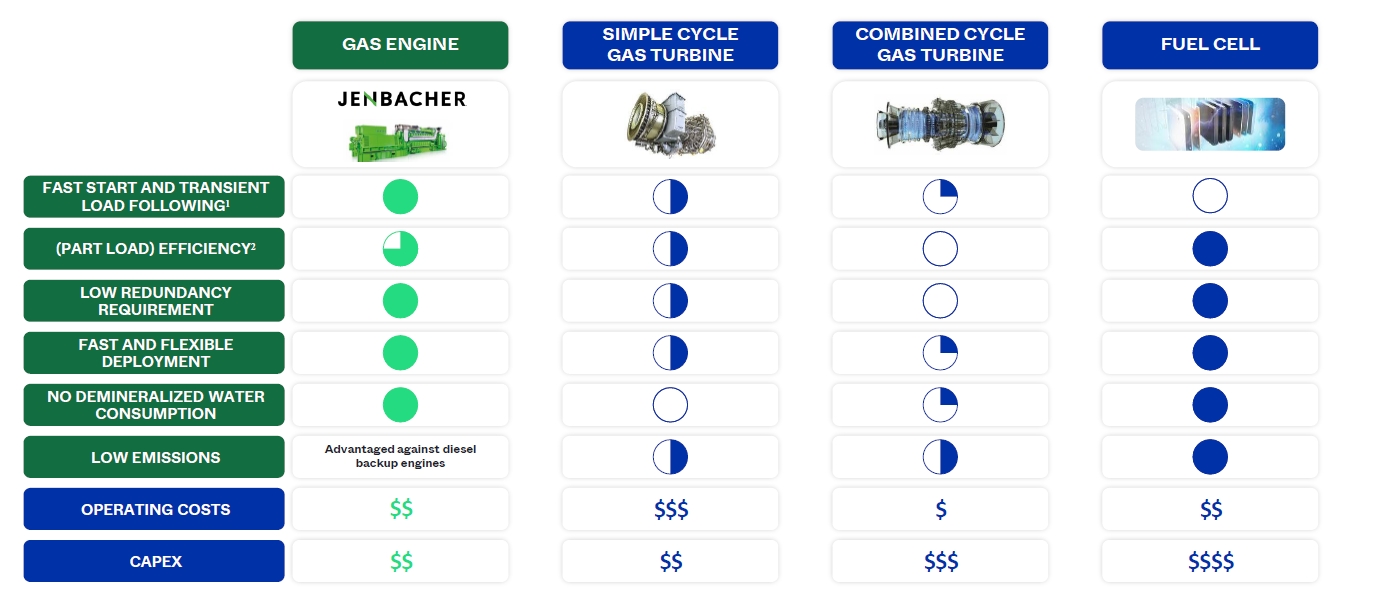
Source: Company information and estimates based on third-party sources.
(1)Transient capability refers to the ability to rapidly change power output in response to sudden changes in load or grid conditions while maintaining stable operation.
(2)Part load efficiency is calculated as electrical output divided by fuel energy input at a defined load level. It is commonly assessed by comparing efficiency at 50%, 75% and 100% of rated load to evaluate how performance changes across the operating range.
Established Leadership Position in Gas Engines for Balancing, Firming, CHP and Specialty Gas Applications
Our success in decentralized power generation is rooted in a long-standing focus on gaseous-fuel engine technology and a deliberate concentration on stationary power generation. Unlike diversified engine manufacturers that also serve marine, transportation or off-highway markets, our solutions have been engineered specifically for gas-based power generation and CHP applications.
We distinguish ourselves through deep specialization in gaseous fuels, with engines optimized for natural gas, associated petroleum gas, coal mine gas, biogases, such as landfill and sewage gas, and industrial waste gases. Our engine portfolio spans outputs from 220 kW to 10.6 MW, enabling deployment across a broad range of balancing, firming, CHP and specialty gas applications. All relevant Jenbacher engine platforms are ready to run on 25% hydrogen, and our Type 4 engine is capable of operating on up to 100% hydrogen. Additionally, as of April 15, 2026, our 3 MW Jenbacher engines have been validated to run on 100% hydrogen. This achievement was validated using various AI load profiles and large, rapid load fluctuations to simulate real-world data center conditions, demonstrating that our 3 MW engine can meet the demanding response profiles required for critical data center operations while running on 100% hydrogen.
High start-stop capability, strong part-load efficiency and stable performance under frequent cycling make our engines well suited for balancing and firming applications, which are critically required in power systems facing increasing volatility from renewable penetration. In CHP and district heating applications, modular factory-tested heat exchanger configurations enable customer-specific temperature levels at high total efficiency.
In addition, our engine platforms are designed to accommodate increasing shares of renewable and low-carbon fuels, including hydrogen blends, providing customers with future pathways toward low-carbon operation.
This combination of gas specialization, power-focused engineering, operational flexibility and reliability underpins our established leadership position in flexible decentralized power generation.
Top Two Position in Gas Engine Driven Gas Compression with Leading Technology in Gas Compression Applications that have Significant Barriers to Entry
Gas compression applications require equipment that can withstand harsher fuel and ambient conditions compared to other engine applications. Our engines are designed to operate in constantly changing conditions. Our engines’ hardware and controls are extremely flexible to maximize uptime during fuel, load and ambient condition changes. Our rich burn combustion technology provides the widest operating window compared to other engines in the category. This provides customers with the flexibility to deploy our engines in compression applications without modification or adjustment. It also achieves extremely low emissions without requiring expensive and complex exhaust aftermarket treatment systems.
Our engines perform particularly well in high-intensity compression applications characterized by higher pressures and output per unit, making them well suited for evolving field developments where declining gas well counts are offset by increasing production volumes.
Our strategy also aims to minimize the number of service intervals required for the entire compression package. We work to align the maintenance requirements with the compressor by reducing the number of maintenance events needed to keep the equipment operating to promote operational efficiency. We have simplified the digital interface with our equipment to expedite troubleshooting and remote support needed to bring the equipment back to operating condition.
Additionally, our extensive network of distributors and packagers can support sophisticated planned and unplanned maintenance activities. The combination of application-specific design and service access enables our engines to positively influence our customers’ ability to meet their production goals at low operating cost.
Service Capture Enabled by Proprietary, High-Performance Parts and a Global Service Network Drives Highly Profitable Recurring Revenues
The stable operation and availability of our engines are critical to our customers’ operations, making service an essential and structurally defensible component of our business model. Our service offerings are not only reliable but also strengthen customer relationships, generate recurring multi-year Services revenue for us and deliver higher margins, helping mitigate the impact of economic cyclicality.
Our strong Equipment Order Intake continues to expand our active fleet of engines. With approximately 44 GW of installed base as of December 31, 2025, the fleet forms the foundation of a growing and highly visible service business. Given the mission-critical nature of our engines, customers are structurally incentivized to source parts and services directly from us as the OEM. Our Equipment Order Intake is centered around engines at the higher end of our power generation capability portfolio where proprietary components, engine specifications and integrated control systems may make it more expensive to switch providers, as even a single component failure or improper intervention can materially increase the total cost of an outage. As a result, service capture is driven by risk management and operational certainty on top of discretionary customer choice.
Our strong Equipment Order Intake provides Services revenue visibility well beyond 2030, as each newly installed engine enables a long-duration service relationship over its operating life. We deliver services both transactionally and through LSAs, which can extend to ten years or more, supporting recurring and predictable revenue streams.
To maintain seamless performance and maximize useful life, our engines require comprehensive overhauls at specific operating intervals. We leverage these requisite milestones to deploy next-generation technology upgrades, a process that revitalizes the customer’s asset while driving predictable, accretive revenue growth for our platform. For the majority of the engines in our portfolio, minor overhauls are typically due between 30,000 to 40,000 operating hours. At this stage, key components are exchanged at mid-life. Major overhauls occur after 60,000 to 80,000 operating hours, and significant upgrades to new specifications are made. These major overhauls give the engines performance upgrades plus second and third working lives, which could extend an engine’s life to over 40 years in some cases.
Our “local-for-local” strategy in direct, strategic markets such as the United States and Germany, enables us to deliver fast, reliable support where it matters most—close to our customers’ operations—and assists us with mitigating our potential exposure to tariffs. By leveraging regional service hubs and local expertise, we minimize downtime and ensure rapid response for products that are critical to our customers’ business continuity. This proximity-driven approach reinforces trust and positions us as a dependable partner in the markets we serve. This has been particularly true in the United States, where, as of March 31, 2026, we have more than doubled service headcount since 2024 to prepare for data center growth.
System Integration and Execution Capability
Our ability to deliver fully integrated, turnkey power systems sets us apart in the distributed energy market. Unlike providers that supply only engines, we offer complete solutions, including generation, controls, containerization and grid interface, designed to meet the most demanding operational requirements. By maintaining our own distribution channels, we achieve superior customer intimacy and a localized presence, enabling us to provide tailored solutions that align with customer requirements. Our execution capabilities extend beyond product delivery. We operate effectively in complex and multi-vendor environments, facilitating seamless integration across diverse project stakeholders. By providing accountability from initial design and engineering through commissioning and lifecycle service, we simplify project management for our customers and reduce execution risk.
This integrated approach shortens time-to-power, a critical advantage for customers operating under tight delivery timelines, such as data centers and industrial facilities facing urgent capacity needs. Our track record in delivering projects on schedule and within scope reinforces our reputation as a trusted partner for mission-critical applications.
We complement these capabilities with a robust network of long-term supply chain and channel partners, enabling reliability and scalability across global markets. This ecosystem enables us to maintain quality standards, accelerate deployment and support customers throughout the asset lifecycle.
Global Manufacturing and Distribution Footprint
We serve our customers through an integrated global footprint spanning approximately seven million square feet of land for manufacturing spaces across North America and Europe, with global direct and indirect coverage across approximately 100 countries, supported by an internal service team of over 1,600 specialists as of March 31, 2026.
Our production capabilities are anchored by major manufacturing hubs on both sides of the Atlantic. In Europe, our Jenbach, Austria campus serves as a fully integrated center of excellence, housing our primary R&D, customer engineering and gas engine manufacturing operations. This hub is supported by specialized component and machining facilities in Hall and Kapfenberg, Austria.
In North America, our facilities in Welland, Ontario; Waukesha, Wisconsin and Waller, Texas serve as key regional hubs. Crucially, our Trenton, New Jersey facility operates as a dedicated containerization center specifically optimized for our data center business line. Recent investments in our North American footprint underscore our commitment to a “local-for-local” strategy, enhancing our in-region maintenance, component manufacturing and assembly capabilities to reduce lead times and mitigate supply chain and tariff risks.
This level of integration enables us to serve customers across the full asset lifecycle: from initial sale to recurring maintenance and replacement. This comprehensive approach deepens customer intimacy and positions us to capture significant upselling opportunities over time. Furthermore, between 2020 and 2025, we strategically expanded our value chain by acquiring the businesses and assets of six distributors or system integrators and a white-label service provider. These acquisitions have allowed us to internalize critical sales and distribution capabilities and more effectively serve our global customer base.
Established Track Record of Innovation
Our track record of innovation reflects more than 100 years of sustained investment and strategic focus, spanning power density, efficiency, fuel technology, solution modularity and digital capabilities. In recent years, this innovation has increasingly been directed toward the specific requirements of data center applications, where power
quality, transient performance and rapid load-following are critical to the reliable operation of AI-driven computing infrastructure.
Most recently, we introduced the latest generation of the Jenbacher Type 6 engine, incorporating a set of design innovations specifically targeted at improving power quality, transient response and deployment speed under the highly dynamic load conditions typical for modern data center applications. These include (i) an optimized generator module that improves frequency stability during rapid load changes, (ii) a decentralized gas addition that enhances fuel availability during block load events and materially reduces frequency and voltage deviations and (iii) turbocharging optimized for transient operation to support fast AI-driven load ramps. Within the Type 6 engine, a large-bore, 24-cylinder engine architecture further increases power density, delivering up to approximately 5 MW of peak power per unit while maintaining strong transient behavior. Together, these features reduce reliance on external inertia and battery systems, increase power density per genset, and lower overall system footprint, capex and complexity. These engine-level innovations are complemented by expanded, containerized solutions tailored for data center deployments, enabling aggregation of units, rapid installation, accelerated time-to-power and compliance with increasingly stringent emissions standards through proprietary in-house exhaust aftertreatment solutions.
As pioneers in alternative gaseous fuel technology, we are recognized as a leading provider of gas engines for renewables (e.g., biogas, landfill gas and sewage gas) and specialty gases (e.g., industrial waste, pyrolysis and coal mine gases). Our leadership, spanning decades, is reflected in our comprehensive portfolio. By 2020, our Jenbacher Type 4 platform demonstrated the capability to operate on up to 100% hydrogen, and as of 2022, all Jenbacher products were ready for hydrogen blends of up to 25% by volume. This offers customers the flexibility to decarbonize as supply chains for low-carbon molecules mature.
We continue to invest in extending our technological leadership. Since 2024, we have increased annual R&D expense by over 15% in 2025, focusing on emissions performance, fuel flexibility, electrical efficiency, power density and ramp rates. In parallel, we have developed digital solutions for the energy technology sector. As of March 31, 2026, our workforce included over 450 employees with R&D capabilities and we hold 1,132 issued patents, reinforcing that innovation remains central to both our heritage and our long-term growth strategy.
Digital Leadership Through myplant and Proprietary AI Enhance Both Our Customer Value Proposition and Operations
Our digital ecosystem enhances the reliability, performance and lifecycle economics of our equipment and services. At its core is myplant, our proprietary, AI-enabled fleet management platform. The platform uses high-frequency operational data to enable predictive maintenance, remote diagnostics, automated optimization and fleet-level analytics, improving asset availability and allowing a significant share of service events to be resolved remotely.
Myplant is built on machine-learning, AI, and digital-twin technologies and is integrated into our internal service processes. This strengthens service attachment, supports performance commitments, improves resource utilization and enables scalable growth with limited incremental cost. Our proprietary digital approach enables us to maintain control over the development of our solutions, reinforcing long-term customer relationships and creating a defensible competitive moat.
By separately embedding AI across corporate functions, including operations, sales, engineering, service, HR, IT and legal, we aim to improve productivity, optimize resource allocation and strengthen margins.
Our Growth Strategies
We believe our strengths and competitive position enable us to capitalize on the evolving market opportunity, differentiate us from our competitors and drive highly profitable growth over time.
Order intake and revenue trends demonstrate our strong exposure to structurally high-growth segments of the global power generation market, reflecting our established positioning and leading technology in flexible, modular, gas-based power solutions.
We are particularly well placed to capture accelerating demand in behind-the-meter data center applications, notably in North America, where our solutions align closely with customer requirements for speed of deployment,
reliability and dispatchability. The resulting step-up in Equipment Order Intake is materially expanding the installed base and is expected to translate into a sustained increase in Services revenues over the coming years, as reflected in the long-term revenue mix. In parallel, we are executing a disciplined, self-funded capacity expansion and advancing product innovation, partnerships and may conduct selective M&A to support continued growth and reinforce our leadership across these attractive end markets.
Capitalize on Data Center–Driven Power Demand and Energy Transition Tailwinds with Differentiated Gas Engine Solutions
We are positioned at the intersection of two powerful global trends: accelerating AI adoption and the global energy transition. All three of our Equipment business lines, data centers, power solutions and compression, benefit directly from surging data center power demand, driven by AI workloads. Our data center solutions are well positioned given our established behind-the-meter and co-location offerings. We are investing in our capacity, sales, distribution and R&D to scale these solutions through standardized, pre-engineered power blocks that can be deployed rapidly and replicated across campuses and geographies.
In parallel, rising renewable penetration and the accelerated retirement of coal‑fired capacity are structurally increasing the need for flexible, dispatchable generation to support peaking, firming, balancing and overall grid stability. As dispatchable generation becomes increasingly essential for reliability, we believe natural gas is set to play a larger role in the power mix due to its scalability, availability and flexibility, which in turn accelerates demand for our compression solutions.
Our predominantly direct go-to-market strategy enhances our ability to engage regularly with customers and adapt our offering to their requirements. Our strong position and competitive advantage in the markets in which we operate is validated by a robust and growing Equipment Order Backlog, supported by a 2.8x Equipment Order Intake book-to-bill ratio and an approximately 16 times increase in data center Equipment Order Intake from 2020 to 2025. We recently partnered with an EaaS provider to deploy 2.3 GW of advanced power-infrastructure solutions. With AI adoption and build-up of supporting infrastructure, our runway for future growth becomes stronger.
Sizable and Growing Installed Base Initiates “Service Flywheel,” Driving Resilient Growth and Profitability
The step-change in installed base that we expect in the coming years will accelerate the long-term growth of our Services segment. As our fleet expands, we are positioned to capture recurring parts and service revenues over the full lifecycle of each engine. Our Services revenue is derived from sales of parts and labor, where, as of December 31, 2025, parts represent around 85% of our Services revenue and labor represents around 15% of our Services revenue, based on management’s estimates on calculations in Euros. As a result, a substantial portion of lifecycle value is driven by parts, which are frequently proprietary and therefore naturally exhibit high OEM capture rates, particularly in high-growth applications such as data centers where reliability is paramount. To support incremental future growth, we expect to selectively expand our direct access to the labor value pool through a combination of targeted acquisitions and organic capability build-out, consistent with our historical approach. In parallel, we strive to continue strengthening customer compliance with our standard maintenance schedule and articulating the value proposition of OEM parts, reinforcing service capture across the installed base.
This structurally high service capture rate provides revenue visibility extending well beyond 2030, as a strong Equipment Order Intake expands the future service opportunity set. Equipment Order Intake has increased by 188% from 2024 to 2025, reinforcing the growth trajectory of the installed base. As the fleet grows and matures, these dynamics create a self-reinforcing service flywheel: incremental equipment deployments expand the installed base, the proprietary nature of parts and LSAs drive recurring aftermarket activity and deep customer relationships support incremental future equipment sales.
The impact of this flywheel is evident in our recent financial performance, including Services revenue growth of 15% between 2023 and 2025, and Services revenue growth for seven consecutive years as of December 31, 2025. Together, these dynamics position us to sustain long-term value creation through continued investment in innovation, operational excellence and market expansion.
Execute on Our Self-Funded Global Manufacturing Capacity Expansion
In response to accelerating demand for our Equipment and Services segments, we are executing a series of self-funded manufacturing capacity expansion initiatives, with a particular focus on capturing U.S. data center demand. In 2025, our annual capital expenditures represented approximately 6.5% of revenue, with the majority allocated to growth initiatives and funded from operating cash flow. A significant portion of recent and planned growth capital expenditures are directed towards North America, reflecting the strength of U.S. data center demand and our strategic focus on local manufacturing and execution.
Investments such as our Trenton, New Jersey facility are designed to expand containerization capabilities that are supporting data center deployments in the U.S. market. Across our manufacturing network, our current investment plan is expected to provide us with sufficient headroom and flexibility to deliver our growth plan and capture incremental market opportunities. The flexibility of our supply chain and long-standing supplier relationships further enable efficient scaling with controlled execution risk.
Our ability to bring incremental capacity online is supported by a proven execution track record, including the recent opening of our second facility in Hall, Austria. Building on this foundation, we are continuing to expand capacity, with our current plans designed to significantly increase MW output, targeting approximately a tripling of our total capacity. These plans include a near-term, elevated investment phase, where we expect spending to temporarily rise meaningfully as we accelerate build-out, followed by a return to our historical, normalized investment cadence once the additional capacity is in place.
Commercialize New Products and Solutions to Meet Evolving End Market Needs
Our ability to commercialize new products and solutions is underpinned by a long-standing engineering track record across gas engine technology, controls and system integration. This includes a series of category-defining milestones such as leadership in cogeneration, development of large-bore high-speed and high-efficiency engine platforms, advances in fast start and transient-capable designs, early innovation in alternative and hydrogen-ready gaseous fuels and the introduction of digital engine management and asset performance solutions.
This innovation capability is shaped through close collaboration and co-creation with key customers, technology partners and system integrators, ensuring new technologies are engineered for operational relevance, rapid deployment and scalability from inception. Innovations are industrialized into standardized platforms that can be deployed repeatedly across end markets rather than developed as one-off solutions.
Importantly, this long-term innovation capability is not episodic but platform-based, allowing new technologies to be consistently translated into commercially relevant products and solutions. The same engineering depth that enabled historical milestones now underpins recent innovations targeted at data centers, power solutions and compression, supporting advances in transient performance, power quality, power density, containerized deployment, digital optimization and hydrogen readiness as end-market requirements continue to evolve.
Pursue Targeted Partnerships and Selective M&A Opportunities
We regularly assess partnership and inorganic growth opportunities that expand our addressable market, accelerate adoption of low-carbon solutions and deepen our presence in high-growth verticals such as data centers, industrial microgrids and critical infrastructure. Our track record of leveraging partnerships to drive growth include our recent containerization project with Gföllner to address growing U.S. data center demand, our long-standing partnership with ExxonMobil and Q8 for developing specialized lubricants that extend oil life and reduce operators’ costs and our acquisition of numerous distributors and systems integrators that have enhanced our go-to-market strategy and service coverage.
We continue to evaluate strategic partnerships and selective acquisitions that will enhance our product portfolio, accelerate hydrogen or renewable natural gas capabilities, expand service intensity or provide access to high-growth segments. We plan to prioritize accretive opportunities that strengthen our technology roadmap and production capabilities.
Our Equipment and Services
Our operations consist of two segments: Equipment and Services. The following table provides a breakdown of total revenue for these two segments during the periods indicated:
|
|
|
|
|
|
|
|
|
|
|
|
|
|
|
|
|
|
|
|
|
|
|
|
|
|
|
|
|
|
|
|
|
|
Three Months Ended March 31, |
|
Year Ended December 31, |
($ in millions) |
|
2026 |
|
2025 |
|
2025 |
|
2024 |
|
2023 |
Total revenue |
|
|
|
|
|
|
|
|
|
|
|
|
|
|
|
Equipment revenue |
|
|
|
|
|
|
|
|
|
|
|
|
|
|
|
Data center |
|
$ |
107.0 |
|
$ |
52.3 |
|
$ |
261.8 |
|
$ |
57.2 |
|
$ |
70.5 |
Power solutions |
|
|
168.1 |
|
|
114.3 |
|
|
892.6 |
|
|
696.2 |
|
|
666.9 |
Compression |
|
|
47.3 |
|
|
43.6 |
|
|
211.0 |
|
|
182.1 |
|
|
172.3 |
Total |
|
|
322.4 |
|
|
210.2 |
|
|
1,365.4 |
|
|
935.5 |
|
|
909.7 |
Services revenue(1) |
|
|
346.2 |
|
|
283.8 |
|
|
1,271.4 |
|
|
1,223.6 |
|
|
1,105.3 |
Total revenue |
|
$ |
668.6 |
|
$ |
494.0 |
|
$ |
2,636.8 |
|
$ |
2,159.1 |
|
$ |
2,015.0 |
(1)Myplant subscription and related digital services revenue are included within Services for all periods presented.
For further information on our segments, see “Management’s Discussion & Analysis of Financial Condition and Results of Operations—Segment Information.”
Equipment
Our state-of-the-art energy equipment solutions comprise our fuel-flexible and highly efficient Jenbacher and Waukesha engines, serving power and compression needs for multiple mission-critical applications in various end markets. The portfolio is engineered to support a wide range of duty cycles, including continuous baseload operation, frequent cycling, fast-response peaking and mission-critical backup applications.
We provide genset solutions (which include engine and generator, together with controls), heat recovery options and extended scope solutions comprising our containerized products available for our data center and power solution offerings. We complement our solutions with controls from simple genset control up to the most demanding master control and microgrid solutions on our proprietary controls platform. For example, we have delivered and commissioned several projects such as the containerized solution deployed in collaboration with VoltaGrid for one of VoltaGrid’s major data center customers. Additionally, in the United Kingdom, 98 Type 6 engines were installed together with Clarke Energy to deliver approximately 450 MW of peak power near London. Our containerized solutions are turnkey systems requiring limited on-site installation and commissioning effort and are engineered for rapid deployment and redeployment across sites, including mobile and temporary power applications. These multi-packs solutions operate in modular designs and allow for high power densities, increased electrical efficiencies and configurable power node sizes.
Additionally, we provide stationary and mobile power generation solutions for oil and gas customers. These solutions are designed to substitute diesel-based generation with gas-fueled engines capable of operating on associated or field gas, while meeting applicable mobile and stationary emissions standards. They are highly flexible and can utilize field and flare gas to provide production power to oil and gas production sites. For example, these assets have been deployed to provide microgrid power generation to the Permian basin in Texas and New Mexico in line with mobile and stationary emissions standards needed for temporary or permanent placement in oil and gas fields.
Our engine portfolio consists of eight types, which we categorize as “Type 2,” “Type 3,” “Type 4,” “Type 6,” “Type 9,” “275GL+,” “VHP” and “VGF” engines ranging from 220 kW up to 10.6 MW power output per engine.
Our portfolio is among the broadest which allows us and our channel partners to operate as a “one stop shop,” offering a full suite of products across a broad range of power plant sizes.
With our Type 6 engines, we believe we are well positioned as we offer the only high-speed gas engines solution in the 5 MW class, allowing us to offer high power density solutions to both our data center and power solutions customers. Additionally, our engines are fuel flexible. They are able to burn a wide range of natural gas fuels ranging from high quality pipeline gas to fuel gases such as associated petroleum gas. Depending on the engine type, renewable gases such as biogas, landfill gas, sewage gas, industrial waste gases such as converter gas, coke gas, blast furnace gas and coal mine gases are suitable fuel sources. Our Type 4 engine has been capable of running on 100% hydrogen since 2020. From 2022 onwards, our other engines have been capable of running on up to 25% hydrogen by volume. We are working on expanding 100% hydrogen capability for our portfolio, with select models already including this capability.
For an overview of the various business applications of the engines, see “—Our Equipment and Services—Customers and Use Cases.”
Data Centers
Our data centers business line includes all equipment sales for behind-the-meter power generation solutions, deployed directly at data center sites for primary and backup power applications. While growth in data center power demand also drives investment in co-located, in-front-of-the-meter generation assets, such installations are classified within our power solutions business line in accordance with our reporting framework, even where facilities are physically adjacent to or primarily serve data centers. As a result, our total equipment exposure to data center-driven demand extends beyond the data centers business line. This business line is currently served exclusively by our Jenbacher-branded engines.
The data centers business line is centered on modular, behind-the-meter gas engine power generation systems designed for primary, backup, and peaking applications. The core offering for this segment is our containerized Jenbacher Type 6 engine platform, typically deployed as single units (5 MW) or aggregated into standardized multi-pack configurations, such as 25 MW. These configurations allow capacity and redundancy requirements to be met by combining multiple identical engines, enabling flexible system sizing and phased capacity expansion using repeatable, pre-engineered power blocks.
The same engine platforms can operate in continuous prime power mode and later be reconfigured for backup or peaking operation without equipment replacement, preserving asset utilization and avoiding stranded capacity as site power configurations evolve. We believe that engine-based systems require simpler balance-of-plant and auxiliary infrastructure compared with large gas turbines, supporting faster installation and commissioning timelines.
Our engines are specifically engineered to support data center load profiles, with fast start capability, rapid ramp rates, and strong transient performance to maintain stable voltage and frequency during sudden load changes. The platforms deliver high electrical efficiency across a wide operating range, including partial-load operation, and are designed to provide rated output under high ambient temperatures and at high altitudes with limited efficiency degradation.
The engines feature inherently low nitrous oxides emissions, which can be further reduced through proprietary exhaust aftertreatment solutions developed in-house. In backup configurations, natural-gas-fueled engines provide fast start-up and high load capability with materially lower nitrogen oxide emissions than, for example, Tier 4 diesel-based solutions and without the need for on-site liquid fuel storage. The platforms are fuel-flexible and capable of operating on natural gas and hydrogen blends, supporting continued operation and emissions performance under varying fuel availability.
Power Solutions
Our power solutions business line includes equipment sales for in-front-of-the-meter and behind-the-meter power generation solutions deployed across a broad range of grid-connected, microgrid and industrial applications. These solutions are used by utilities, IPPs, municipalities, and commercial and industrial customers for baseload, peaking, balancing, firming and CHP applications. Our portfolio operates on a wide range of gaseous fuels, including natural gas, biogas, landfill gas, sewage gas, and other industrial and waste gases, enabling deployment across diverse
operating environments and project sizes, from small, decentralized installations to multi-engine power plants. This business line is served by both our Jenbacher- and Waukesha-branded engines.
The power solutions business line comprises a broad portfolio of reciprocating gas engine-based power generation systems designed for baseload, peaking, balancing, cycling, and microgrid applications in grid-connected and on-site configurations. The portfolio spans multiple engine platforms under the Jenbacher and Waukesha brands, covering a wide output range and enabling tailored solutions for different duty cycles, fuels and operating environments.
Jenbacher engines are optimized for applications requiring high electrical efficiency, strong part-load performance, and frequent cycling, and are widely deployed in CHP configurations. Jenbacher Type 2, 3 and 4 engines are commonly deployed in biogas, landfill gas, sewage gas, and greenhouse CHP applications requiring tolerance to variable fuel composition. Jenbacher Type 6 engines address larger-scale industrial, peaking, CHP, microgrid, and in-front-of-the-meter data center–related power generation applications, combining high power density with fast start capability, rapid ramping and strong dispatchability. Jenbacher Type 9 engines are suited for high-output baseload and coal-replacement CHP applications requiring larger power nodes and electrical efficiency.
Waukesha engines complement the portfolio with platforms engineered for robustness under demanding operating conditions, including sustained high utilization, elevated thermal stress, and poor or highly variable fuel quality. These characteristics enable deployment close to the fuel source, including upstream, remote and flare-gas-related applications.
Across both brands, the portfolio offers exceptional fuel flexibility. Engine platforms are designed to operate on natural gas, associated petroleum gas, coal mine gas, landfill gas, sewage gas, biogas, hydrogen blends and other industrial and waste gases, and are engineered to accommodate significant variability in fuel composition and quality.
CHP is a core configuration within our power solutions equipment portfolio. Our engines are designed to operate in integrated CHP systems that simultaneously generate electricity and recover thermal energy for space heating, district heating, and industrial process heat. Heat recovery is achieved through standardized interfaces utilizing heat from oil, jacket water, charge and exhaust gas, enabling high total system efficiency and flexible integration into site-specific thermal networks across commercial, municipal, industrial and agricultural applications.
The engines provide high dispatchability, fast start capability, and strong load-following performance, enabling rapid response to grid events, balancing requirements and short-duration peak demand. High electrical efficiency is maintained across a wide operating range, including partial-load operation and the platforms deliver reliable performance under high ambient temperatures and at high altitude.
Systems are typically deployed in modular, multi-engine configurations, allowing incremental scaling of capacity and redundancy while enabling plants to operate with exceptional efficiency at partial load. Solutions can be delivered as stationary installations or in containerized and trailorized formats, enabling relocatable and mobile power generation. While plant layouts, auxiliaries, and control systems are tailored to site-specific requirements, deployments leverage standardized engine platforms and proven system architectures.
Engine platforms support upgrades over time, including enhancements related to efficiency, emissions performance, digital functionality, and fuel capability. Many platforms are hydrogen-ready, supporting operation on hydrogen blends today and enabling conversion to higher hydrogen shares, including up to 100% hydrogen on select engine types, providing long-term compatibility with evolving regulatory requirements and future fuel pathways.
Compression
Our compression business line includes equipment sales of gas engine-driven compression solutions deployed across upstream, midstream and downstream natural gas infrastructure. These solutions are used in gas lift, gathering, processing, transmission and storage applications and are designed to operate reliably under variable fuel quality, pressure, and ambient conditions across a wide range of compressor sizes and configurations. This business line is served exclusively by our Waukesha-branded engines.
Our compression business line focuses on gas engine-driven compression solutions designed for continuous-duty operation in demanding oil and gas applications. Engines are supplied as bare units and integrated by distribution partners into complete compression packages, allowing compressors, auxiliaries, and control systems to be tailored to site-specific requirements. The compression portfolio comprises three fuel-flexible engine types, 275GL+, VGF, and VHP, with power outputs ranging from approximately 220 kW to 3.7 MW, enabling deployment across gas lift, gathering, processing, storage and transmission applications.
Compression engines are engineered for sustained high utilization and stable operation under continuous duty cycles, variable loads, and changing suction and discharge pressures. A core differentiator is exceptional tolerance to low-quality and variable gaseous fuels, including associated and field gas, which enables deployment close to the gas source in upstream and remote locations. Engines are available in both lean-burn and rich-burn configurations, allowing operators to select the appropriate combustion strategy based on fuel characteristics, efficiency targets, and local emissions requirements; rich-burn variants can be paired with three-way catalysts to achieve very low regulated emissions, while lean-burn variants emphasize efficiency with reduced aftertreatment complexity.
The platforms are compatible with a wide range of compressor technologies and configurations, supporting bespoke solutions across different pressure ratios and flow requirements. Over their operating life, compression engines support upgrades to controls, efficiency and emissions performance, providing long-term asset durability and adaptability to evolving regulatory requirements.
Services
At the core of our business operations is a comprehensive services offering that spans the full lifecycle of our engines, including transactional parts and labor, lifetime service agreements, overhaul and repair, remanufacturing, conversions, modifications and upgrades, commissioning and digital services. Services represented 48% of total revenues in the year ended December 31, 2025 and are characterized by recurring, multi-year revenue streams, attractive margins and reduced exposure to equipment cyclicality. Given the long operating life of our engines, service lifetime value typically extends over ten years or more per engine, providing high forward visibility as our Equipment Order Intake expands the installed base. Growth in equipment demand is therefore expected to translate into materially higher Services revenues over time, with the full effect anticipated to materialize around 2030 and beyond, supporting resilient profits for many years thereafter.
Transactional Parts and Labor
As part of our services offering, we supply genuine OEM spare parts, either on a stand-alone basis or bundled with labor for installation and replacement. Our parts portfolio spans a broad range of engine components, including major power-unit components, ignition and fuel-system parts, filters, sensors, control-related components and other consumables. OEM parts are designed to maximize engine availability, reliability, performance, safety and regulatory compliance across the full operating envelope.
The use of non-OEM parts materially increases the risk of failure and total cost of ownership, as such parts are often reverse-engineered and may be missing critical design elements or fail to meet OEM material, tolerance and performance specifications. In addition, non-OEM parts can limit digital monitoring capability and may be inconsistent with applicable warranty terms. Over the engine lifecycle, spare parts account for a substantially higher share of service profit than labor and attach early and consistently to new equipment sales, creating a strong linkage between equipment placement and future service profitability. Optional oil management and lubricant supply are offered using certified oil types developed in collaboration with ExxonMobil and Q8Oils, supporting longer service intervals and engine longevity.
Long-term Service Agreements (LSAs)
We offer LSAs designed to align service delivery with the full operating life of the engine while providing predictable economics for customers and recurring revenue for our business. These LSAs include CSAs, which cover parts and labor, and MSAs, which cover parts only.
Multi-year agreements provide customers with high certainty on service pricing over the contract term and typically shift service costs from event-based payments to periodic fees, resulting in a predictable and plannable operating cost profile. Pricing includes inflation indexation clauses, protecting long-term margins while maintaining economic alignment with customers. These agreements underpin a significant portion of contracted service backlog and are complemented by highly predictable, non-contracted service demand driven by defined maintenance intervals and overhaul cycles across the installed base.
CSAs typically cover preventive maintenance and, depending on scope, corrective repairs, including spare parts, on-site labor, travel and logistics, and access to digital services. Service levels range from limited maintenance coverage to full-scope agreements with availability and performance commitments. Through our 24/7 Global Help Desk and remote diagnostics capabilities, we can resolve technical issues remotely, reducing downtime and service cost. CSAs are particularly prevalent in mission-critical applications, such as data centers and EaaS models, where customers exhibit high compliance with OEM service sourcing due to uptime and availability requirements.
MSAs are primarily offered to distributors and customers that perform their own labor. These agreements provide predefined spare-parts packages aligned with standard service intervals, with pricing indexed for inflation over the contract term, and enable distributors to structure their own service offerings for end customers while preserving OEM parts attachment.
Overhaul and Repair
The majority of our engine portfolio typically requires a major overhaul after approximately 60,000 to 80,000 operating hours. Overhauls are performed in dedicated overhaul workshops using OEM processes, tooling and quality standards. Customers may choose between exchanging their engine for an overhauled unit to minimize downtime and operational disruption or having their specific engine returned following overhaul. Overhaul events represent value-defining lifecycle milestones and frequently serve as anchor points for additional service offerings and upgrades.
Remanufacturing Program
As part of our overhaul and repair activities, we operate a global remanufacturing program under which used components are recycled and reconditioned to “like-new” factory standards. The program leverages fleet-level operational data, deep engine know-how, and advanced manufacturing methods to extend component and engine life, reduce environmental footprint, and lower lifecycle cost compared with new components. Remanufactured components are redeployed across service offerings worldwide.
Engine Upgrades (CM&U)
We offer conversions, modifications and upgrades to sustain or enhance engine value over its operating life. CM&U offerings allow customers to adopt the latest performance, efficiency, emissions, digital and fuel-capability improvements and are frequently combined with major or minor overhauls to minimize incremental cost. The ability to upgrade engines to current technical standards over time is a key differentiator versus unauthorized service providers and supports long-term asset relevance in a changing regulatory and market environment.
Commissioning
Our commissioning services ensure correct installation, integration and safe startup of engines at the customer site. Scope includes gas and electrical connection, wiring, parameter configuration, testing and initial startup. Commissioning is performed either by our own service technicians or by certified distributor personnel, depending on the go-to-market model.
Digital Solutions (myplant)
Our digital services are delivered through the myplant platform, which currently supports approximately 13,000 connected engines and industrial assets globally. The platform collects high-frequency operational data from the installed base and uses this data to improve service efficiency, asset availability and lifecycle economics. Key use cases include predictive maintenance, early fault detection, remote diagnostics, automated parameter optimization, remote maintenance and service planning, enabling a significant share of service events to be resolved without on-site intervention.
The platform enables fleet-level analytics and customer insights, allowing operators to monitor performance, assess component health and plan maintenance activities in a more structured and predictable manner. Myplant is underpinned by advanced analytics technologies, including machine-learning models, AI and digital-twin concepts that replicate engine behavior under different operating conditions and continuously learn from fleet data. Digital tools are tightly integrated into our service processes and lifetime service agreements, increase service attachment, and support availability and performance commitments. Full digital functionality is enabled only when genuine OEM parts are used.
Customers and Use Cases
We serve a diversified customer base across our three business lines: data centers, power solutions and compression. Our customers operate mission-critical and industrial infrastructure across a wide range of end markets and geographies. Customer concentration is limited and varies from year to year, reflecting the project-based nature of our business and the timing and size of individual large equipment orders. Certain reporting periods may include larger contracts with specific customers, which can temporarily increase concentration metrics. For example, Clarke Energy, our largest indirect account by revenue, accounted for 15%, 11% and 12% of our revenue for the years ended December 31, 2025, 2024 and 2023, respectively. Similarly, VoltaGrid, a specialized EaaS provider for CNG and power, serving customers across data center, industrial, energy and oil & gas sectors, is a significant source of our Equipment Order Intake, accounting for approximately 41%, 14% and 10% of Equipment Order Intake for the years ended December 31, 2025, 2024 and 2023, respectively. Order intake concentration does not translate directly into the same level of revenue concentration in a given period. Revenue recognition is operationally phased and therefore materially smoother, supported by our production planning, delivery scheduling and backlog conversion cycle. While certain customers may currently represent meaningful portions of Equipment Order Intake in any given period, the underlying end-customer demand is not tied to any single intermediary and can be served through alternative channels, including other intermediaries or direct sales. As we continue to expand our installed base and broaden our customer relationships and partnerships, we expect the relative contribution of individual customers and channel partners to fluctuate with the timing of large project awards and to decrease overall. The technical capabilities of our products and the market dynamics underlying customer demand are described in greater detail in the Equipment and Our Markets sections. For further information, please see “—Our Markets” and “—Our Equipment and Services—Equipment.”
Data Center Customers and Use Cases
In our data centers business line, we work directly with hyperscale data center operators, as well as with co-location operators, data center developers and landowners and EaaS providers to supply power to data center facilities. Data center customers primarily deploy our engines for behind-the-meter prime power and backup power applications, including high-transient load use cases driven by AI training and compute-intensive workloads.
Representative installations include a large prime-power data center project in Utah, where 72 Type 6 engines with a combined output of approximately 230 MW were installed for a co-location data center. We have also supplied 20 Type 6 engines and 4 multi-pack platforms in San Antonio, Texas, where the engines provide prime power for a hyperscaler-related data center project.
In addition to natural-gas-fueled prime and backup applications, we have delivered six Type 4 engines to a data center customer in the Netherlands, providing approximately 8 MW of backup power using 100% hydrogen.
Power Solutions Customers and Use Cases
Our power solutions customers include utilities, IPPs, commercial and industrial customers across a broad range of end industries, agricultural customers such as greenhouse operators, and EaaS providers. These customers deploy our engines across grid balancing and peaking, baseload and CHP, microgrids and on-site power generation, and power generation using natural gas, renewable gases, biogas and industrial and waste gases.
In the utility sector, municipal and IPPs use our engines for grid-stabilizing and heat-production purposes. A large capacity-market installation in the United Kingdom demonstrates the modularity and scalability of our technology, where 98 Type 6 engines were installed to deliver approximately 450 MW of peak power near London. In Germany, 20 Type 9 (J920 FleXtra) engines form the core of the municipal power plant in Kiel, replacing an old coal plant, generating approximately 190 MW of electrical and thermal power.
Our engines are also deployed in commercial and institutional settings. At a London hospital, a Type 4 engine forms the centerpiece of the hospital’s energy center, improving efficiency, reliability, and cost performance. At a U.S. airport, five Type 6 engines are integrated into a microgrid providing a resilient alternative to the public grid and supporting emissions reduction.
Industrial customers deploy our engines across diverse manufacturing and processing applications. For a German automotive manufacturer, more than 30 Type 6 engines have been installed across multiple sites, providing electricity and heat for production processes as well as backup power for selected loads. In agricultural applications, CHP solutions are widely used in greenhouses, where engine exhaust carbon dioxide is often utilized for plant fertilization. For example, approximately 30 Type 4 and Type 6 engines have been installed across several greenhouse locations for a horticultural company.
Our power solutions portfolio also includes extensive use of renewable and waste gases. In Montreal, three Type 6 engines are installed at a landfill site, converting biogas into electricity for a utility customer while supplying heat to surrounding buildings. In Southeast Asia, two Type 4 engines and one Type 3 engine supply a food-processing facility with electricity and thermal power using biogas derived from pineapple processing. At a large wastewater treatment plant near Cairo, six Jenbacher Type 6 engines run on renewable sewage gas to fully power the plant’s operations and heat its biogas digesters.
In oil and gas-related power applications, our engines are used to convert associated gas that would otherwise be flared into useful power. We have delivered more than 100 trailer-mounted Type 6 engines to an energy company to power electric fracturing pumps and these engines can be redeployed to other sites as needed. Our engines are also employed to utilize field gas in the Bakken shale and to power drilling rigs with our natural-gas-fueled gensets.
Compression Customers and Use Cases
In our compression business line, our only material direct customers are compression packagers and systems integrators, which purchase our engines and integrate them into complete compression packages for end users. Approximately 9% of our Equipment Order Intake as of March 31, 2026 was allocated to compression customers.
Through packagers, our engines are deployed across upstream and midstream gas compression applications, including gas gathering, processing, artificial lift, transportation and gas reinjection. Large fleets of engines support operations across major U.S. shale basins in Texas, New Mexico and Oklahoma. Midstream operators also use our engines in compression systems transporting and processing natural gas prior to delivery to end markets.
Internationally, our engines are deployed in large-scale gas reinjection projects, including multi-unit compression trains used in the Middle East to utilize associated gas, support domestic consumption and enhance oil recovery.
Competition
Competitive dynamics in engine technology, as well as power generation and compression solutions, are shaped by long product development cycles, often spanning decades for new engine platforms, high capital and engineering requirements, regulatory and emissions compliance standards and the importance of a proven installed base and global service infrastructure. These factors create high barriers to entry.
Power Generation (Data Centers and Power Solutions Business Lines)
Customers may choose among a range of alternative technologies and delivery models for power generation, including centralized grid-based power supply, distributed or behind-the-meter generation and solutions designed for baseload, peaking, balancing or backup applications.
Customer procurement decisions depend on application-specific requirements, including the intended duty cycle (baseload, peaking, balancing or backup), time-to-power, reliability and availability targets, efficiency at partial load, cycling capability, modularity, emissions constraints and total lifecycle economics.
Competing technologies include reciprocating gas engines, gas turbine-based systems, fuel cells, nuclear generation and diesel-based solutions, as well as reliance on centralized grid power where interconnection is available and economically viable. Gas turbine-based systems include both heavy-duty and aeroderivative turbines. Heavy-duty gas turbines are typically deployed at a large scale or where high-grade steam production or combined-cycle configurations are required and are more commonly used in centralized generation. Aeroderivative gas turbines also offer fast start characteristics and compete in selected distributed power and behind-the-meter applications, particularly for peaking or fast-response use cases, but are typically deployed as larger single-unit blocks and may exhibit different efficiency and operating profiles, particularly at partial load. Fuel cells compete in selected distributed power applications with different cost structures and operating characteristics. Nuclear power primarily serves long-term baseload planning due to large unit sizes and extended development and permitting timelines. Diesel-based solutions are typically used for backup, emergency and rental or temporary power applications.
Within this competitive landscape, we focus exclusively on gas engine-based power generation solutions for distributed power and behind-the-meter applications. Unlike many competitors, we do not manufacture or deploy diesel-based generation assets and do not operate across unrelated end markets or fuel platforms such as marine, rail, transport or off-highway equipment. Our activities are dedicated to stationary and mobile gas-based power generation, enabling a consistent technology roadmap and application focus without dilution from other industries.
Reciprocating gas engines are well suited for applications requiring fast start capability, strong transient response and efficient operation across a wide range of part-load conditions. These characteristics support deployment across baseload, peaking, balancing and high-availability backup configurations, including in behind-the-meter applications, and allow solutions to be delivered in stationary or mobile formats, including containerized or trailer-mounted systems for temporary, transitional and rapid-deployment use cases where time-to-power and operational flexibility are important considerations.
Compression
Customers may choose among a range of alternative technologies and system configurations for gas compression, depending on end market, operating conditions and application requirements. Compression solutions are deployed across upstream and midstream applications.
Customer procurement decisions in compression are driven by application-specific requirements, including required reliability and uptime, efficiency across operating ranges, fuel availability and operating cost, emissions and regulatory constraints, maintenance intervals, service accessibility and total lifecycle economics. These considerations vary materially depending on site conditions, duty cycle and throughput requirements.
Competing technologies include reciprocating engine-driven compression, electric motor-driven compression and gas turbine-driven compression. Electric motor-driven compression competes in applications where grid access is available, reliable and economically viable. Gas turbine-driven compression is used in selected large-scale or high-throughput applications and is typically characterized by different efficiency and operating profiles, particularly at partial load. Rental and mobile compression solutions are primarily used for short-term, temporary or contingency applications.
Within this competitive landscape, competition in compression is more concentrated than in power generation and is characterized by a limited number of large, established incumbents with long operating track records, extensive installed bases and global service capabilities. Competitive dynamics are also influenced by system integrators, packagers and engineering, procurement and construction contractors, who often play a significant role in
equipment selection based on integration requirements, prior operating experience under similar conditions and availability of lifecycle service and support.
We focus on gas-based compression solutions utilizing rich-burn reciprocating engines. Our compression offerings are designed for high-duty-cycle and continuous operation and can be deployed in stationary or mobile configurations depending on application requirements. Our activities are dedicated to gas engine-based compression and are not diluted by exposure to unrelated end markets or alternative fuel platforms.
Sales and Marketing
We follow a multi-channel go-to-market strategy, set up for both direct and indirect sales, which allows us to engage with and cover our addressable market in a variety of ways.
Within our direct channels, our subsidiaries sell the engines and provide services to end customers. This is done directly without any intermediaries. In certain instances, we engage sales representatives who earn a commission, instead of using our in-house sales team.
When operating indirectly through distributors, we sell our engines and digital services only to the distributor, who then in turn sells our engines under our brands to the end customer. Services may be provided by the distributor and if a distributor lacks the capacity or qualifications to provide services, they may engage our team to deliver these services on their behalf. Most of our distributors have exclusive contracts with us, only allowing them to sell our equipment focused on a specific territory.
For our data center customers, we typically employ a direct go-to market strategy, selling and delivering turnkey power solutions directly to hyperscalers, co-location operators, energy-as-a-service providers and data center land developers.
For our compression customers, we generally rely on an indirect go-to-market approach. We have established long-term partnerships with distributors and packagers/solution providers to achieve broad market coverage. By combining our partners’ strengths such as infrastructure, local knowledge and fast response times with our manufacturing expertise, intellectual property and solutions capabilities, we believe we are able to provide enhanced value for compression equipment. Part of our indirect marketing strategy for our compression customers includes our Channel Partner Program which is divided into three categories: bronze, gold and platinum. While all of our partners directly buy their engines, only platinum solution providers and distributors source their parts directly with our spare parts business and have certified technicians. Additionally, platinum solution providers and distributors have complete access to our compression training and technical materials. Through our indirect and direct approach, we create a competitive environment allowing end users to access our engines and parts, resulting in global coverage across approximately 100 countries.
In general, our marketing focuses on developing new, and strengthening existing, customer relationships to acquire new orders and grow our business. Our marketing channels include search engine optimization (SEO) for our homepages, competitor research and market intelligence using generative AI. We continually promote our equipment, services and solutions on our websites, through social media, blogs and other public relation activities. We also continuously aim to improve the ranking of our websites in organic and paid searches, a process known as SEO, primarily by analyzing the relevance of key search terms and adapting our website content accordingly. All marketing activities, analysis (market, competition, trends, customers and regional or economic development and regulations) and communications (events, brand communication, advertisements, campaigns, collaterals, media relations, political communication, financial communication, corporate communication and social media), are designed to contribute to the achievement of these targets. In addition, we actively participate in and host globally recognized energy trade fairs and events such as Big Power and Clean Energy Conference PowerGen, ADIPEC and others. A major task of our marketing is to guide customers in finding the application, equipment, service, or solution they need. Therefore, a major part of our marketing activities focuses on providing expertise to our customers in all sales channels drawing on our extensive portfolio of equipment, solutions and services. We also produce white papers relevant to our industry with the aim to inform customers with research about challenges in the specific industry segment and about potential solutions.
Manufacturing and Supply Chain
Our manufacturing and supply chain are strategically positioned to support our global customer base and installed base. We operate a manufacturing and assembly footprint spanning Europe and North America and source components and materials through a globally diversified supplier network, enabling us to support both new equipment demand and our installed base across regions.
We combine selective in-house manufacturing with external sourcing. We maintain internal machining and manufacturing capabilities for critical and complex components where technical differentiation, quality, lead time and flexibility are important, while sourcing other components from qualified third-party suppliers. This approach allows us to focus internal resources on sophisticated technologies and core components while benefiting from scale and specialization within our supplier base.
We deploy a dual-sourcing strategy for most of our materials, components, parts and services. For some of our more complex parts, we employ a triple-sourcing strategy. For example, the majority of our auxiliary castings are triple sourced from our global suppliers, enhancing our supply chain robustness. We use this strategy to reduce risks such as supply chain disruptions, price fluctuations, or quality issues, and to support the security of materials, components, parts and services in case these risks manifest.
Our supply chain is globally diversified and coordinated through a centralized procurement organization. We source materials, components and services primarily from suppliers in Europe, North America and Asia, which we believe enhances supply security, operational flexibility and responsiveness to regional customer requirements.
In recent years, we have made targeted investments to strengthen and expand our manufacturing and supply chain footprint in the United States and Austria. These investments have increased production capacity, enhanced proximity to customers and improved responsiveness, supporting growing demand, including for large-scale power generation applications such as data centers.
Our supply chain operations are guided by disciplined operating principles focused on safety, quality, delivery and cost. We continuously improve supply chain effectiveness through standardization, process optimization and close collaboration with suppliers as product technologies and market requirements evolve.
Research and Development
Research and development is a key competitive differentiator for us. Our R&D resources and investments are fully concentrated on gas engine–based technologies and gas-based power and compression applications, enabling deep specialization without dilution across other fuels or industries.
Our R&D activities are organized around engine platforms and integrated systems. This platform-based approach supports long-term technology development, new product generations and continuous enhancement of existing platforms and has enabled multiple industry-first innovations as well as advanced capabilities for specialty and low-carbon gases.
Our R&D efforts focus on a range of core technology areas, including emissions reduction and electrical efficiency improvements, increased power output and power density, fuel flexibility across hydrogen and other low- and no-carbon gases, fast start capability and transient performance and system integration, modularity, scalability and serviceability. These focus areas represent key elements of our broader and evolving technology roadmap.
Our innovation priorities are driven by application requirements across a wide range of duty cycles, including baseload, peaking, balancing and backup operation. For mission-critical and high-availability applications, including data centers, our R&D emphasizes fast-start and transient performance, grid-forming behavior, operational stability and compliance with increasingly stringent permitting and operating requirements. We continue to advance containerized and multi-unit architectures to improve deployment speed, power density and scalability.
Our R&D activities also address requirements typical of continuous-duty and industrial applications, including reliability, operational flexibility and emissions reduction. Our development efforts include technologies,
conversion solutions and system enhancements designed to support demanding operating environments and lifecycle optimization.
We believe that our focused R&D model, platform-based development approach and application-driven innovation enable us to adapt to evolving energy systems, support long product lifecycles and reinforce durable competitive advantages.
Intellectual Property
We maintain a portfolio of intellectual property assets that supports our investments in R&D and protects our products, technologies and services. We rely on a combination of trademark, service mark, trade secret, patent and copyright laws, as well as contractual arrangements and confidentiality procedures to obtain, establish, enforce and defend our intellectual property rights in the various geographic regions in which we operate.
As of March 31, 2026, we had 1,132 issued patents and 281 pending patent applications in the United States and various other countries, covering aspects of our gas engine technologies, systems and related innovations. For example, we have existing patents covering engine start times and transient, grid stabilization, emissions and efficiency. We actively manage and review our patent portfolio to align protection with our technology roadmap, key markets and areas of commercial activity, and may seek additional patent protection for new developments where appropriate.
We also maintain a portfolio of registered trademarks and service marks in multiple jurisdictions, including INNIO, JENBACHER, WAUKESHA and MYPLANT and related logos, which support our brand identity and customer recognition across our end markets.
In addition to registered intellectual property rights, we protect our proprietary know-how and other trade secrets through internal policies and procedures and through confidentiality, non-disclosure, invention assignment and intellectual property agreements with employees, contractors and third parties.
While intellectual property protection is important to our business, we do not believe that any single patent, trademark or other intellectual property right is individually material to our operations. Rather, we believe that our technology expertise, application know-how, long product lifecycles and manufacturing capabilities, together with our aggregate intellectual property portfolio, are critical to our competitive position.
Information Technology
Development and delivery of IT and business solutions are integral parts of our operations and strategy, enabling process optimization, productivity increases and digitalization of the value chain. Our IT infrastructure and application portfolio covers the entire business including engineering, procurement, manufacturing, sales and logistics, as well as digital product offerings such as our myplant platform.
Our IT strategy focuses on increasing customer benefit, leveraging synergies and fostering knowledge sharing, for example, through digital trainings, wherever possible. This includes a “cloud-first” approach, focus on mainstream applications, reduction of the number of IT suppliers and implementation of a more global control and delivery model for our operations. We also connect partners and suppliers through interfaces like Electronic Data Interchange (“EDI”) to speed up the supply chain.
Throughout the production process, we use a variety of digital tools and applications. Our manufacturing execution system comprises computer-aided tools. For example, computerized numerical control machines and 44 automated robots allow for increased precision and quality control. Our full statistical process protocol and the complete traceability of major components via a braille code enable us to monitor and improve the production process.
We also integrate AI across our operations to drive efficiency and enhance decision-making. Our AI-enabled tools are used for predictive maintenance, process automation and data-driven quality management, enabling proactive service interventions and optimized plant performance. Additionally, our generative AI solutions support all of our departments, simplifying access to our institutional knowledge through AI-based chatbots, streamlining and automating workflows and accelerating our product development cycles.
Our internal framework for IT security is based on industry standards and common practices and is ISO 27001:2022 certified as of October 2025. We strive to identify cyber threats over the entire lifecycle of applications and systems and deal with these threats in line with their perceived seriousness. We pay particular attention to risks that could result in the disruption of business processes due to the failure of IT systems or could cause the loss or corruption of data. See “Risk Factors—Risks Related to Our Data, Security and Intellectual Property.” We use coordinated technical and organizational security measures to address the advancing digitization and connectivity of our production equipment and services.
Government Policies
We operate in a regulated industrial environment and are subject to a wide range of laws, regulations and standards across the jurisdictions in which we conduct business. These include, among others, environmental and emissions regulations, permitting and product standards, health and safety requirements, labor and employment laws, taxation, trade and export controls, data privacy and cybersecurity laws and anti-corruption and compliance regulations. Regulatory requirements vary by region and are subject to change over time.
Our products and operations must comply with applicable regulatory requirements throughout the production lifecycle, including design, manufacturing, installation and operation. In addition, we serve a customer base that includes regulated entities, such as utilities, municipalities and other public-sector or infrastructure customers, which may impose additional compliance obligations, including public procurement requirements. Meeting these requirements can increase costs and operational complexity, particularly in jurisdictions where regulatory frameworks are evolving or where we have a more limited local presence.
We maintain processes and procedures designed to support compliance with applicable laws and regulations across our operations. However, changes in regulatory frameworks, permitting requirements, environmental standards or enforcement practices could affect our operations, costs or ability to market and deploy our products in certain jurisdictions. See “Risk Factors—Risks Related to Compliance, Regulatory and Legal.”
Data Privacy and Security
We and our customers are subject to privacy- and data security-related laws, regulations and other requirements that impose obligations in connection with the collection, use, storage, transfer, dissemination, security or other processing of personal data and other sensitive or regulated data. For example, numerous states, countries and governmental bodies have enacted or are considering laws and regulations concerning the collection, retention, storage, use, processing, sharing and disclosing of personal data such as the EU GDPR and the California Consumer Privacy Act. These laws impose comprehensive data privacy compliance obligations in relation to our collection, processing, sharing, disclosure, transfer and other use of data relating to an identifiable living individual or “personal data,” including a principle of accountability and the obligation to demonstrate compliance through policies, procedures, training and audit. We seek to comply with and abide by all laws, regulations and obligations to which we are subject and devote significant time and resources to our compliance efforts.
The data we collect, store, use, share, disclose, transmit and otherwise process is integral to our business, serving as a key input to our operations and providing us with insights to improve our digital platforms and equipment. For example, our myplant platform aggregates data from thousands of connected engines, generating large-scale time-series datasets that power advanced analytics and machine learning applications. While no security measures are perfect, we implement various measures designed to collect and manage this data securely, such as employing appropriate encryption procedures, access controls and monitoring practices designed to safeguard our customer and operational information.
For additional information, see the section titled “Risk Factors—Risks Related to Our Data, Security and Intellectual Property.”
Environmental, Health and Safety
We are committed to providing and promoting a safe and healthy working environment for our employees and contractors, minimizing adverse impacts on the environment and surrounding communities and supporting our customers through high standards of environmental, health and safety (“EHS”) performance across our operations and products.
Our activities are subject to a broad range of domestic and international EHS laws, regulations and permitting requirements. These requirements apply across the full lifecycle of our operations and products, including design, manufacturing, installation, commissioning and operation, and address areas such as occupational health and safety, environmental protection and use of natural resources, emissions to air and water, noise, waste management and the handling, storage, transportation and disposal of hazardous and non-hazardous materials, among other areas.
EHS requirements vary by jurisdiction and have become increasingly stringent over time. Compliance with these requirements can increase operational complexity and costs, including the need to obtain and maintain permits, implement control technologies and meet evolving monitoring and reporting obligations. We maintain internal processes, standards and procedures designed to support compliance with applicable EHS requirements and to promote a culture of safety and on-going improvement across our organization.
EHS considerations are integrated into our operating practices and management systems. Our approach includes regular audits, employee training and on-going improvement initiatives to reduce risk, support regulatory compliance and protect our employees, communities and the environment. See “Risk Factors—We are subject to increasingly stringent environmental, health and safety laws and regulations that impose significant compliance costs, and potential litigation, and non-compliance with or liabilities under such laws and regulations could result in substantial costs, fines, sanctions, claims, and reputational harm.”
Sustainability
Sustainability and the pursuit of ESG goals are integral parts of our business strategy. We believe that we can only remain successful over the long term if we grow our business responsibly. Our Sustainability ambitions focus on four pillars, Low Carbon & Circular Products, Resilient Supply Chain & Manufacturing, Responsible Operations & Social Responsibility, and Governance, Business Ethics & Transparency. Our ESG-related reporting is based off global sustainability standards such as the Global Reporting Initiative (GRI), the Sustainability Accounting Standards Board (SASB) and Directive 2014/95/EU (the Non-financial Reporting Directive (NFRD)). As of December 31, 2025, our disclosure also includes the recommendations of the Financial Stability Board’s Task Force on Climate-Related Financial Disclosures (TCFD). In July 2023, the Financial Stability Board announced that the work of the TCFD had been completed, and, having fulfilled its remit, TCFD disbanded in October 2023. However, companies can continue to use the TCFD recommendations.
Furthermore, to promote sustainability and low-carbon technology, we work with the UN Global Compact (International), Responsible Minerals Initiative (International), klimaaktiv (Austria), Race to Net Zero (International), Chamber of Commerce Austria, workgroup Energy and Environment, Standortagentur Tyrol and workgroup Circular Economy, VDMA – Mechanical Engineering Industry Association, workgroup reporting standards and RWTH University Aachen (Germany) – Complexity Management Academy and workgroup Managing Sustainable Innovation.
Sustainability-Related Regimes
We, our suppliers and our customers may be subject to environmental, climate change and sustainability laws and requirements in various jurisdictions. For example, in 2023, the state of California passed two climate disclosure laws, SB 253 and SB 261, which require disclosure of Scope 1, 2 and 3 GHG emissions and climate-related financial risks, respectively. The potential direct and indirect impacts on us are not fully known at this time, in particular given ongoing litigation, but additional costs may be expected in relation to these disclosures. Furthermore, in the EU, the CSDDD, CSRD and EU Taxonomy may have an impact on us and our disclosure obligations.
The EU CSDDD
The EU CSDDD requires in-scope companies to take appropriate measures to identify, assess, prevent, mitigate or bring to an end certain actual or potential adverse human rights and environmental impacts arising from their own operations, subsidiaries and parts of their value chain. The EU CSDDD was amended by the Omnibus
Directive, which came into force on March 18, 2026. The transposition deadline for the EU CSDDD has been postponed to July 26, 2028, with in-scope companies required to comply from July 26, 2029. The obligation to publish annual statements on due diligence matters applies to financial years starting on or after January 1, 2030. We are continuing to monitor Member State transposition and are assessing the potential impact of the EU CSDDD on our operations.
The CSRD
The CSRD introduces, through amendments to other EU Directives, a requirement for in-scope entities to make sustainability disclosures in their management report in accordance with new European Sustainability Reporting Standards (“ESRS”) requirements. These requirements introduce significant operational demands on data collection, internal controls and assurance processes across multiple jurisdictions. The European Commission’s Omnibus Simplification Package also amends the CSRD. The Omnibus Directive came into force on March 18, 2026 and Member State transposition of the changes to CSRD into national law are required by March 19, 2027. The ESRS are also under review. We are continuing to monitor this legislative process.
The EU Taxonomy Regulation
The EU Taxonomy Regulation (Regulation (EU) 2020/852) establishes a classification system for environmentally sustainable economic activities. Where entities are subject to the CSRD, they must include disclosures in the management report on the extent to which its economic activities are covered by the Taxonomy Regulation and, of those activities, which qualify as environmentally sustainable, taking into account detailed criteria. On March 17, 2026, the European Commission launched a consultation on revising technical screening criteria under the EU Taxonomy Regulation. The consultation closed on April 14, 2026, and the European Commission intends to adopt the legislation in Q2 2026.
Environment
Our operations are subject to environmental laws and regulations across the jurisdictions in which we operate, including those governing greenhouse gas emissions, air and water discharges, noise, waste management and the use of natural resources. We seek to manage our environmental footprint through operational discipline, compliance with applicable requirements and on-going improvement initiatives.
We focus on reducing greenhouse gas emissions associated with our operations and improving resource efficiency across our manufacturing and service activities. Our environmental initiatives include efforts to reduce Scope 1 and Scope 2 emissions, improve energy efficiency through technical and process optimization, and increase the reuse, remanufacturing and recycling of materials to support a more circular use of resources. As of December 31, 2025, approximately 56% of the input materials used in our equipment were sourced from recycled materials.
We also continue to evaluate opportunities to improve environmental performance through process improvements and the use of lower-carbon and renewable energy sources where feasible. Environmental considerations are integrated into our operational planning and capital investment decisions and are supported by internal standards, monitoring and periodic reviews.
Social
For our employees, we aim to create and maintain a pleasant and safe working environment. Employee training and skills enhancement are a central part of our human resources policy. In 2025, our employees participated in 149,486 hours of training, including digital and instructor led hours, equaling an average of 29 hours of training for each employee. We uphold stringent occupational health and safety as well as ethical and compliance standards and have developed policies and guidelines to guide employees to work responsibly and, in 2024, we introduced a new Anti-Discrimination and Anti-Harassment Policy. We also value good working conditions and continuous personnel development for employees. Regular face-to-face employee meetings, transparent communications and continuous dialogue are part of our day-to-day culture.
We always strive to create and sustain a workplace culture where individuals can flourish and contribute to the shared success of the business. One of our initiatives includes monthly group roundtables which are open to all employees, which we believe is an effective and efficient method for improving employee engagement and inclusion.
These small, cross-functional group conversations facilitate open discussions and provide direct exposure to, and interaction with, key influential senior leaders. In relation to our continuous efforts towards sustainability, operational excellence and workforce inclusion, we received various awards in 2025. For example, we were awarded the EcoVadis Platinum badge, and INNIO Waukesha Canada Corporation was an excellence awardee by Canada’s Safest New Employers in 2025.
Employees
Our employees are a key asset in executing our strategy and supporting our customers. We seek to foster a workplace environment that emphasizes safety, respect, accountability and professional development, and that supports operational discipline and collaboration across the organization.
We invest in the training and development of our workforce to support skills development, operational excellence and long-term talent retention. Our approach includes a combination of formal training programs, on-the-job learning and continuous development initiatives. In 2025, we delivered more than 145,000 hours of employee training focused on technical, professional and leadership skills.
We seek to attract and retain qualified employees through market-based compensation, benefits and development opportunities. Our benefits offerings are designed to support employee well-being and financial security. We believe that retaining experienced employees with deep technical and application knowledge is important to sustaining our operational performance and growth.
As of March 31, 2026, we had 5,202 FTEs and 339 part-time employees, and we also engage contractors and consultants to support our operations. Certain of our employees are represented by labor unions or covered by collective bargaining agreements. We maintain constructive relationships with our workforce and employee representatives, and we have not experienced any work stoppages due to labor disputes.
Facilities
We conduct manufacturing, distribution and administrative activities in owned and leased facilities. The table below sets forth our principal properties as of March 31, 2026:
|
|
|
|
|
|
|
|
|
|
|
Country |
|
Location |
|
Owner or Lessee |
|
Land Square Footage (approx.) |
|
Building Square Footage (approx.) |
|
Use |
Germany |
|
Munich |
|
Lessee |
|
— |
|
3,000 |
|
Corporate headquarters |
Austria |
|
Jenbach |
|
Owner |
|
2,100,000 |
|
1,000,000 |
|
Equipment and Services (offices and component, assembly, repair & overhaul and test) |
Canada |
|
Welland, Ontario |
|
Owner* |
|
3,400,000 |
|
500,000 |
|
Equipment and Services (components, assembly and test) |
United States |
|
Waukesha, Wisconsin |
|
Owner |
|
1,700,000 |
|
890,000 |
|
Corporate headquarters. Equipment and Services (remanufacturing operations) |
United States |
|
Houston, Texas |
|
Lessee |
|
— |
|
27,000 |
|
Equipment and Services (offices and parts warehouse) |
United States |
|
Waller, Texas |
|
Owner |
|
68,500 |
|
65,000 |
|
Equipment (containerization) |
United States |
|
Trenton, New Jersey |
|
Lessee |
|
376,000 |
|
93,000 |
|
Equipment (containerization) |
Austria |
|
Hall |
|
Lessee |
|
109,000 |
|
69,000 |
|
Equipment and Services (components manufacturing) |
Austria |
|
Kapfenberg |
|
Owner |
|
92,000 |
|
45,000 |
|
Equipment and Services (spark plug manufacturing) |
Hungary |
|
Budapest |
|
Lessee |
|
— |
|
26,000 |
|
Shared Services Center. Services (parts fulfillment) |
United States |
|
Pleasant Prairie |
|
Lessee |
|
— |
|
134,000 |
|
Services (parts warehouse) |
* We hold an investment in a variable interest entity (“Welland VIE”) that was created in 2025 together with a group of investors to acquire, own and lease land and buildings used in our production operations in Welland, Canada. The Welland VIE is financed through a combination of equity contributions from the investors and third-party debt. Our variable interests in the Welland VIE consist of our equity investment and a lease arrangement of the production site in Welland, Canada, and the Welland VIE is consolidated by the Company. See note 27 to our audited consolidated financial statements included elsewhere in this prospectus.
We believe that our existing facilities are adequate and suitable for our current needs and that, should it be needed, suitable additional or alternative space will be available on commercially reasonable terms.
Legal Proceedings
From time to time, we are, and from time to time in the future may be, subject to legal proceedings, claims and investigations arising in the ordinary course of our business. Although the results of these legal proceedings, claims and investigations cannot be predicted with certainty, we are not currently a party to or aware of any proceedings that we believe will have, individually or in the aggregate, a material adverse effect on our business, financial condition or results of operations. Regardless of final outcomes, however, any such proceedings, claims and investigations may nonetheless impose a significant burden on management and employees and be costly to defend, with unfavorable preliminary or interim rulings.
MANAGEMENT
Board Structure
We have a one-tier board structure consisting of a board of directors, which includes executive and non-executive directors.
Board of Directors
Our board of directors consists of eleven members, including two executive directors, whom we consider to also be executive officers, and nine non-executive directors. Following the closing of this offering, each of our directors will hold office for the term set by our general meeting (as set forth in the table below), except in the case of his or her earlier death, resignation or dismissal. Our directors do not have a retirement age requirement under our articles of association.
The following table sets forth information regarding our executive officers and board of directors as of the date of this prospectus:
|
|
|
|
|
|
|
|
|
Name |
|
Age |
|
Term Served |
|
Year in which
Term Expires |
|
Position |
Board of Directors |
|
|
|
|
|
|
|
|
Dr. Olaf Berlien |
|
63 |
|
2021 – Present |
|
|
|
Executive Director, Chief Executive Officer and President |
Dr. Dennis Schulze |
|
57 |
|
2019 – Present |
|
|
|
Executive Director and Chief Financial Officer |
Tom Linebarger* |
|
63 |
|
|
|
|
|
Non-Executive Director and Chairperson of the Board |
Lee Banks* |
|
63 |
|
|
|
|
|
Non-Executive Director |
Abhishek Chauhan* |
|
42 |
|
|
|
|
|
Non-Executive Director |
Nicoletta Giadrossi* |
|
59 |
|
|
|
|
|
Non-Executive Director |
Stefan Klebert* |
|
60 |
|
|
|
|
|
Non-Executive Director |
Ranjan Sen* |
|
57 |
|
|
|
|
|
Non-Executive Director |
Karin Sonnenmoser* |
|
56 |
|
|
|
|
|
Non-Executive Director |
Rainer Thuerbach* |
|
41 |
|
|
|
|
|
Non-Executive Director |
Chris Yetman* |
|
64 |
|
|
|
|
|
Non-Executive Director |
Executive Officers |
|
|
|
|
|
|
|
|
Dr. Olaf Berlien |
|
63 |
|
2021 – Present |
|
|
|
Executive Director, Chief Executive Officer and President |
Dr. Dennis Schulze |
|
57 |
|
2019 – Present |
|
|
|
Executive Director and Chief Financial Officer |
Dr. Andreas Kunz |
|
55 |
|
2021 – Present |
|
|
|
Chief Technology Officer |
*Appointment as a director subject to the completion of this offering.
The following is a brief summary of the business experience of our directors and executive officers listed above. Unless otherwise indicated, the current business address for each director and executive officer is the same as our business address: Nymphenburger Strasse 5, 80335 Munich, Federal Republic of Germany.
Executive Officers
The following is a brief summary of the business experience of our executive officers.
Dr. Olaf Berlien. Dr. Berlien has served as our President and Chief Executive Officer and as a member of our board of directors since October 2021. Prior to joining INNIO, Dr. Berlien worked at Osram AG, Munich, a publicly listed global leader in the semiconductor-based lighting and sensor industries, where he served as President and Chief Executive Officer from January 2015 to February 2021. Prior to Osram AG, Dr. Berlien was the Chief Executive Officer at Exyte AG, a global leader in engineering, from November 2013 to January 2015. Prior to Exyte AG, Dr. Berlien worked at ThyssenKrupp AG, Essen, a publicly listed company, between 2002 and 2013, and was named a member of the executive board in 2002. Dr. Berlien’s responsibilities at ThyssenKrupp AG included
overseeing the controlling, M&A, corporate development and IT departments. In 2004, he was named CEO of ThyssenKrupp Technologies AG, a leader in plant technology in the fertilizer, oil, and gas, and automotive industries, and in 2009, he became CEO of ThyssenKrupp Elevator AG, a global leader in elevators and escalators. Prior to joining ThyssenKrupp AG, Dr. Berlien worked at Carl Zeiss AG, a leader in optics and optoelectronics, from 1996 to 2002 as the head of the Measurement Division. Dr. Berlien also served as President of Carl Zeiss IMT Corp. and was named a member of the executive board as CFO of Carl Zeiss AG in 1998. Dr. Berlien began his career at IBM in 1988 and there held leadership roles in controlling, software development, and general management. Dr. Berlien also served on the boards of directors of public and non-public companies including Osram AG, where he served on the compensation, audit and strategy committees from 2015 to 2021, and ThyssenKrupp AG. Dr. Berlien holds a Master’s Degree in Business Administration and a Doctorate in Economics from the Technical University of Berlin, Germany. He has held an Honorary Professorship of the Faculty of Technology and Innovation Management at the Technical University of Berlin since 2011 and a teaching lectureship since 2006. We believe Dr. Berlien’s prior executive leadership, global industrial and technology sector expertise and public company governance experience, as well as his knowledge of M&A, finance and corporate development and decades of experience leading complex, multinational businesses make him particularly qualified to serve on our board of directors.
Dr. Dennis Schulze. Dr. Schulze has served as our Chief Financial Officer and on our board of directors since April 2019. In addition to his responsibilities as Chief Financial Officer, Dr. Schulze is responsible for heading mergers and acquisitions at INNIO. In his roles, Dr. Schulze oversees global finance, accounting, controlling, treasury, tax, financial reporting, corporate governance, capital structure and M&A activities. Prior to joining INNIO, Dr. Schulze was the Group Chief Financial Officer and a managing director of H.C. Starck Group, a global market leader in refractory metals and advanced technical ceramics, from December 2016 to April 2019. Prior to H.C. Starck, Dr. Schulze was the Chief Financial Officer at Douglas Holding AG, a leading European omnichannel beauty retailer with operations in 19 countries, from 2013 to 2015. At Douglas Holding AG, Dr. Schulze was responsible for group finance, investor relations, corporate finance, mergers and acquisitions and change management, and supervised acquisitions, divestments and capital markets initiatives, including IPO-readiness and dual-track exit processes. Prior to his tenure at Douglas Holding AG, Dr. Schulze served as a Managing Director at the Carlyle Group, from 1999 to 2012, where he led the firm’s DACH (Germany, Austria, Switzerland) buyout business from 2009 to 2012 and was integral to the management of a multi-billion European focused fund. During his tenure at the Carlyle Group, Dr. Schulze led and executed acquisitions, carve-outs and exits across industrial, automotive, healthcare and consumer sectors, served on portfolio company boards and worked closely with management teams on strategy, governance, operational improvement and value creation initiatives. Dr. Schulze began his professional career as an Assistant Professor and Project Manager at the Institut für Revisionswesen at the University of Münster in 1995. Dr. Schulze holds a Master’s Degree in Business Administration (Diplom-Kaufmann) and a Doctorate in Business Administration from the University of Münster. We believe Dr. Schulze’s extensive senior financial leadership experience, private equity background and expertise in accounting, financial reporting, corporate finance, capital markets, mergers and acquisitions and governance, together with his proven experience leading value-generation initiatives and operational and strategic transformation programs, as well as overseeing the execution of complex transactions across multinational businesses, make him particularly qualified to serve on our board of directors.
Dr. Andreas Kunz. Dr. Kunz has served as our Chief Technology Officer since September 2020. In his role, Dr. Kunz oversees innovation and new technology introduction, product development and new product introduction as well as the entire customer order engineering. Prior to joining INNIO, Dr. Kunz spent nearly two decades at Rolls Royce Power Systems (formerly DaimlerChrysler, Tognum, MTU), a global leader in power and energy solutions based on diesel and gas engines, from January 2001 to August 2020. During his tenure at Rolls Royce Power Systems, Dr. Kunz held a series of increasingly senior leadership roles, including Vice President Engine Platforms, where he was responsible for all engine platform product developments, Vice President of Global Manufacturing and Vice President Operations Onsite Energy, where he was responsible for the global operational setup and growth of the stationary power generation business. In parallel, Dr. Kunz served as Managing Director of Rolls Royce Solutions Augsburg, where the gas engine based power generation products where developed and assembled. Dr. Kunz was also elected as a member of the Supervisory Board of Rolls Royce Power Systems AG and MTU Friedrichshafen as a representative of the executives from 2017 to 2020. Dr. Kunz has also served as a member of the board of VDMA Engines & Systems, a globally active, German-based mechanical engineering and trade association since January 2021. Dr. Kunz holds a Vordiplom (Bachelor of Science) in Mechanical Engineering and a Diplom-Ingenieur (Master of Science) in Mechanical Engineering from the University of Duisburg-Essen and a Doktor-Ingenieur (Ph.D.) in Mechanical and Process Engineering from the Institut of Combustion and Gas Dynamics in Duisburg. Dr. Kunz has
also completed the Global Leadership Program at the Tuck School of Business at Dartmouth College, Lean Management Training in Japan and various Rolls Royce Management Development Programs.
Non-Executive Directors
The following is a brief summary of the business experience of our non-executive directors.
Tom Linebarger. Mr. Linebarger has served as a senior advisor and executive at General Catalyst from January 2025 to May 2026. Mr. Linebarger previously served in a number of roles at Cummins Inc. where he was Chief Executive Officer from January 2012 to July 2022 and Chairman of the board of directors from January 2012 to July 2023. Mr. Linebarger has also served as a member of the board of directors of Republic Services since February 2024. Prior to Republic Services, Mr. Linebarger served as a member of the board of directors of Harley Davidson from 2008 to 2025. Mr. Linebarger holds a Bachelor of Arts degree in Management Engineering from Claremont McKenna College, a Bachelor of Science degree in Mechanical Engineering from Stanford University, a Master of Science in Manufacturing Systems Engineering from Stanford University and a Master of Business Administration from Stanford University. We believe Mr. Linebarger's extensive leadership and management experience, logistics, manufacturing and operations expertise and understanding of sustainable technologies in highly regulated industries, as well as his expertise in supply chain management, engineering and corporate governance, make him particularly qualified to serve on our board of directors.
Lee Banks. Mr. Banks has served as a member of the board of directors of Wabtec, Inc. since December 2020. Mr. Banks previously served in a number of roles at Parker Hannifin, Inc. where he was President and Chief Operating Officer from February 2015 to August 2021, Vice Chairman from August 2021 to December 2023 and a member of the board of directors from 2015 to 2023. Prior to Parker Hannifin, Mr. Banks served as a member of the board of directors of Nordson Corporation from February 2010 to November 2020. Mr. Banks holds a Bachelor of Arts degree in Economics and Finance from DePauw University and a Master of Business Administration from DeVry University. We believe Mr. Banks’s extensive senior leadership acumen, insight of the industrials sector, public company expertise and corporate governance background make him particularly qualified to serve on our board of directors.
Abhishek Chauhan. Mr. Chauhan is a Managing Director at Advent. Mr. Chauhan started at Advent in 2008. He currently serves as a member of the board of directors of Layer Zero Power Systems, Slingshot Aerospace and Vantor Technologies Inc. From 2010 to 2014, Mr. Chauhan helped scale Bacfo Pharmaceuticals as CEO and then returned to Advent in 2014. Prior to joining Advent in 2008, he spent a few years with Merrill Lynch in their investment banking division. Mr. Chauhan holds a Bachelor of Science degree in Economics from the Wharton School, University of Pennsylvania. We believe Mr. Chauhan's extensive private equity and investment experience, extensive leadership and management experience, knowledge of the industrials sector and established relationship with INNIO through Advent make him particularly qualified to serve on our board of directors.
Nicoletta Giadrossi. Ms. Giadrossi chairs the board of Adura Energy Ltd since December 2025, and MSX International since May 2022. Ms. Giadrossi has been engaged by our Principal Shareholder to provide board services to us since October 2023. She has served as a director of Egis Group SA since September 2025, a director of Univar Solutions Inc. since September 2023, a director of TKE since September 2021 and a supervisory board member of Koninklijke Vopak N.V. since September 2018. Additionally, Ms. Giadrossi previously chaired Ferrovie dello Stato Italiane Spa from April 2021 to June 2024, and served as a director of ReNew Energy plc, listed on the NYSE, from August 2023 to March 2026, as a director of Brembo spa from April 2017 to April 2023, as chair of TechHouse AsA from September 2018 to May 2023, as chair of Capricorn Energy plc from January 2021 to January 2023, as a director of Renatis from April 2020 to July 2022 and as a director of IHS Markit Ltd from January 2018 to February 2022 while it was a publicly listed company in the U.S. Ms. Giadrossi holds a Bachelor of Arts degree in Mathematics and Economics from Yale University and a Master of Business Administration from Harvard Business School. We believe Ms. Giadrossi's extensive corporate governance experience across multiple jurisdictions, expertise in sustainability strategy and strong background in financial oversight and risk management make her particularly qualified to serve on our board of directors.
Stefan Klebert. Mr. Klebert has served as Chief Executive Officer of GEA Group AG since February 2019. Mr. Klebert has been engaged by our Principal Shareholder to provide board and committee services to us since June 2022. Prior to GEA Group AG, Mr. Klebert served as Chief Executive Officer of the Schuler Group AG from 2010 to 2018. Prior to the Schuler Group AG, Mr. Klebert served as Chief Executive Officer of the Industrial Service Division at ThyssenKrupp Services AG from 2004 to 2009 and as Executive Board Member of ThyssenKrupp Services AG from 2006 to 2009. Mr. Klebert holds a Diplom-Ingenieur (FH) degree in Mechanical Engineering from the Esslingen University of Applied Sciences and a Master of Business Administration from Brunel University, London. We believe Mr. Klebert's extensive senior leadership experience, expertise in industrial management and corporate governance and strong track record of driving growth and profitability of industrial companies make him particularly qualified to serve on our board of directors.
Ranjan Sen. Mr. Sen is a Managing Partner at Advent. Mr. Sen has been with Advent since 2003. Mr. Sen has served on the Supervisory Board of AI Alpine Parent & Cy S.C.A., an affiliate of Advent and parent company of our Principal Shareholder, since August 2023 and on the Supervisory Board of InPost S.A. (Poland) since January 2021. Mr. Sen has also served as a member of the board of directors of Avolta AG since October 2020. Mr. Sen holds a Bachelor of Business Administration from Richmond University in London. We believe Mr. Sen's extensive private equity and investment experience, extensive leadership and management experience, knowledge of the industrial sector and established relationship with INNIO through Advent make him particularly qualified to serve on our board of directors.
Karin Sonnenmoser. Ms. Sonnenmoser has served as a member of the board of directors of Testo SE since July 2025, a member of the board of directors of technotrans SE since July 2025 and a member of the Supervisory Board of Renk AG since June 2024. Ms. Sonnenmoser has been engaged by our Principal Shareholder to provide board services to us since June 2022. Ms. Sonnenmoser previously served as a member of the board of directors of u-blox AG from November 2022 to November 2025, as Interim Chief Financial Officer of LSG Group from June 2023 to May 2024, as a member of the Supervisory Board for Leoni AG from May 2022 to August 2023, as the Chief Financial Officer of Ceconomy AG from March 2019 through April 2021 and as Group Chief Financial Officer of Zumtobel Group AG from May 2014 to March 2018. Ms. Sonnenmoser holds a Diplom-Kaufmann degree in Business Administration from the University of Augsburg and a Master of Business Administration from the University of Dayton. We believe Ms. Sonnenmoser's extensive accounting expertise and financial leadership, risk management experience and comprehensive corporate finance experience make her particularly qualified to serve on our board of directors.
Rainer Thuerbach. Mr. Thuerbach is a Managing Director at Advent. Mr. Thuerbach has been with Advent since 2011. Mr. Thuerbach has also served on the Supervisory Board of AI Alpine Parent & Cy S.C.A., an affiliate of Advent and indirect parent company of our Principal Shareholder, since August 2023. Mr. Thuerbach holds a Bachelor of Science degree in General Management from the European Business School in Germany. We believe Mr. Thuerbach's extensive private equity and investment experience, knowledge of the energy solutions and energy transition sub-sectors, complex financial transactions and business development and established relationship with INNIO through Advent make him particularly qualified to serve on our board of directors.
Chris Yetman. Mr. Yetman has been the owner of Yeti Advisory Services, LLC since November 2024. Mr. Yetman previously served as the Chief Operating Officer at Vantage Data Centers from September 2013 to December 2024. Additionally, Mr. Yetman has served as a member of the board of directors of Layer Zero Power Systems, Inc. since October 2025 and as a member of the Professional Advisory Board of St. Jude Children’s Research Hospital since November 2025. Mr. Yetman holds a Bachelor of Science degree in Computer Engineering from Northeastern University. We believe Mr. Yetman's significant data center operations experience, information services and technology expertise, talent management, leadership development acumen and knowledge of risk management and planning make him particularly qualified to serve on our board of directors.
Family Relationships
There are no family relationships among any of our directors or executive officers.
Code of Conduct
Prior to the closing of this offering, our board of directors will adopt a written code of conduct that applies to all of our directors, officers and employees (including our principal executive officer, principal financial officer, principal accounting officer or controller, or persons performing similar functions). Upon the closing of this offering, the full text of the code of conduct will be available on the investors section of our website at https://www.innio.com. We intend to make any legally required disclosures regarding amendments to, or waivers of, provisions of our code of conduct on our website rather than by filing a Current Report on Form 8-K. The information on, or that can be accessed through, any of our websites is deemed not to be incorporated in this prospectus or to be part of this prospectus.
Director Independence
Our board of directors has undertaken a review of the independence of each director. Based on information provided by each director concerning their background, employment, and affiliations, our board has determined that Mr. Linebarger, Mr. Banks, Mr. Chauhan, Ms. Giadrossi, Mr. Klebert, Mr. Sen, Ms. Sonnenmoser, Mr. Thuerbach, and Mr. Yetman, representing nine of our eleven directors, do not have a relationship that would interfere with the exercise of independent judgment in carrying out the responsibilities of a director and that each of these directors is an “independent director” as defined under the listing standards of Nasdaq. In making these determinations, our board considered the current and prior relationships that each non-employee director has with our company and all other facts and circumstances that our board deemed relevant in determining their independence, including the beneficial ownership of our share capital by each non-employee director, and the transactions involving them described in the section titled “Certain Relationships and Related Party Transactions.”
Controlled Company
Upon the completion of this offering, our Principal Shareholder will hold an aggregate of common shares, representing approximately % of the voting power of our outstanding share capital, assuming no exercise of the underwriters’ over-allotment option to purchase additional common shares. As a result, we will be a “controlled company” within the meaning of the corporate governance rules of Nasdaq. Under these corporate governance rules, a company of which more than 50% of the voting power for the election of directors is held by an individual, a group or another company is a “controlled company” and may elect not to comply with certain corporate governance requirements. We intend to rely on the foregoing exemptions provided to controlled companies under the corporate governance rules of Nasdaq. Therefore, immediately following the consummation of this offering, we may not have a majority of independent directors on our board, an entirely independent nominating and corporate governance committee or an entirely independent compensation committee, and may not perform annual performance evaluations of the nominating and corporate governance committee and compensation committee unless and until such time as we are required to do so. Accordingly, you may not have the same protections afforded to shareholders of companies that are subject to all of these corporate governance requirements. If we cease to be a “controlled company” and our shares continue to be listed on Nasdaq, we will be required to comply with these provisions within the applicable transition periods. For additional information, see the section titled “Risk Factors—Risks Related to the Offering—We are a “controlled company” within the meaning of the Nasdaq rules and, as a result, will qualify for, and may rely on, exemptions from certain corporate governance requirements.
Board Committees
Upon completion of this offering, our board of directors will establish an audit committee, a compensation committee, and a nominating and corporate governance committee. The composition and responsibilities of each of the committees of our board of directors are described below. Members will serve on these committees until the earlier of their resignation or removal by our board of directors in its discretion.
Each of the audit committee, the compensation committee and the nominating and corporate governance committee will operate under a written charter that will be approved by our board of directors in connection with this offering and that will satisfy the applicable rules and regulations of the SEC and the listing standards of Nasdaq. Prior to the listing of our common shares, each committee’s charter will be available on the investors section of our website.
The information on, or that can be accessed through, our website is deemed not to be incorporated in this prospectus or to be part of this prospectus.
The audit committee is expected to consist of Mr. Banks, Ms. Giadrossi, Ms. Sonnenmoser and Mr. Yetman, with Ms. Sonnenmoser serving as chairperson, each of whom meets the requirements for independence under the rules and regulations of the SEC and the listing standards of Nasdaq applicable to audit committee members. Each member of our audit committee also meets the financial literacy requirements of the listing standards of Nasdaq. In addition, our board of directors has determined that Ms. Sonnenmoser is an audit committee financial expert within the meaning of Item 407(d) of Regulation S-K under the Securities Act.
Our audit committee will oversee our corporate accounting and financial reporting process. Our audit committee’s responsibilities will include, among other things:
•overseeing the responsibilities of the board of directors with respect to: our relationship with, and compliance with recommendations and follow-up of comments made by, our internal auditor, independent auditor, and, if relevant, other parties involved in the audit of our financial and sustainability reporting; our funding, the operation of our Code of Conduct and other internal policies, and our tax policy;
•preparing our internal audit plan in consultation with and for approval by the board of directors;
•reviewing and discussing our internal auditor’s internal work plan and our independent auditor’s audit plan, including with our internal auditor and independent auditor;
•issuing recommendations concerning the appointment and the dismissal of the head of the internal auditor and reviewing and discussing the performance of the internal auditor;
•reviewing and discussing the audit results, including with our internal auditor and independent auditor, including: (i) any flaws in the effectiveness of our internal controls, (ii) any findings and observations with a material impact on our risk profile; and (iii) any failings in the follow-up of recommendations made previously;
•at least annually, reviewing and discussing with our independent auditor the scope and materiality of the independent auditor’s audit plan and the principal risks of our financial reporting and sustainability reporting identified by the independent auditor in the audit plan, the findings and outcome of our independent auditor’s audit of our financial statements and our management letter, and any significant findings from the audit of our financial statements and any problems or difficulties encountered, including restrictions on the scope of our independent auditor’s activities or on access to requested information, as well as significant disagreements with our management;
•reviewing and discussing with management and the independent auditor our annual and quarterly financial statements, including our disclosures under "Management's Discussion and Analysis of Financial Condition and Results of Operations" in our annual reports on Form 10-K and quarterly reports on Form 10-Q;
•discussing our earnings press releases, as well as financial information and earnings guidance provided to analysts and rating agencies;
•ensuring that the independent auditor prepares and delivers, at least annually, a written statement delineating all relationships between the company and the independent auditor; actively engaging in a dialogue with the independent auditor with respect to any disclosed relationships or services that, in the view of the audit committee, may impact the objectivity and independence of the independent auditor; and, if the audit committee determines that further inquiry is advisable, taking appropriate action in response to the independent auditor’s report to satisfy itself of the auditor’s independence;
•reviewing and discussing the effectiveness of the design and operation of our internal controls over financial reporting with the board of directors;
•advising the board of directors regarding our independent auditor’s nomination for (re)appointment or dismissal and having direct responsibility for preparing the selection of the independent auditor for such purpose;
•reviewing and discussing the terms of engagement of the independent auditor to audit our financial statements, to prepare or issue an audit report, or to perform other audit, review or attest services, submitting proposals to our board of directors concerning the independent auditor’s engagement to audit our financial statements, and causing the company, without further action by the board of directors, to pay the compensation of the independent auditor as approved by the audit committee;
•pre-approving all audit services to be provided to us, whether provided by the independent auditor or other firms, and all other services (review, attest and non-audit) to be provided to us by the independent auditor, however, that de minimis non-audit services may instead be approved in accordance with applicable SEC rules;
•preparing an annual committee report for inclusion where necessary in our annual proxy statement relating to our annual general meeting of shareholders, to the extent required;
•establishing clear policies for the hiring of current or former employees of the independent auditor;
•establishing procedures for (i) the receipt, retention and treatment of complaints received by us regarding accounting, internal accounting controls or auditing matters; and (ii) the confidential, anonymous submission by our employees of concerns regarding questionable accounting or auditing matters;
•discussing our policies with respect to risk assessment and risk management and overseeing the management of our financial risks and information technology risks, including cybersecurity and data privacy risks, and discussing with management the steps management has taken to monitor and control these risks;
•reviewing potential conflicts of interest involving our board of directors, including whether they may take part in the deliberations and the decision-making on any issue as to which there may be a conflict; and
•developing and recommending to our board of directors the Related Person Transaction Policy, and reviewing and, if appropriate, approving related person transactions and overseeing such transactions on an ongoing basis, in accordance with the Related Person Transaction Policy and Nasdaq rules.
Compensation Committee
The compensation committee is expected to consist of Mr. Linebarger, Mr. Banks and Mr. Thuerbach, with Mr. Banks serving as chairperson. The composition of our compensation committee will meet the requirements for independence under the rules and regulations of the SEC and the listing standards of Nasdaq, including Nasdaq’s controlled company exemption. Each member of our compensation committee is also a non-employee director, as defined pursuant to Rule 16b-3 promulgated under the Exchange Act.
Our compensation committee will be responsible for assisting the board of directors in the discharge of its responsibilities relating to the compensation of our executive officers and directors. Our compensation committee’s responsibilities will include, among other things:
•reviewing and evaluating our compensation policy and benefits policies generally, including the review and recommendation of our incentive compensation and equity-based plans and arrangements and related administration;
•reviewing and approving the corporate goals and objectives, and evaluating the performance of and reviewing and approving (either alone or, if directed by the board of directors, in conjunction with a majority of the independent directors on the board of directors) the compensation of our Chief Executive Officer;
•reviewing and setting, or making recommendations to the board of directors regarding, the compensation of our other executive officers;
•submitting proposals to the board of directors concerning the compensation of our directors;
•reviewing and discussing with management the Compensation Discussion and Analysis (“CD&A”) included in our proxy statement or annual report on Form 10-K and considering whether it will recommend to the board of directors that the CD&A be included in the appropriate filing;
•administration and oversight of our compliance with the compensation recovery policy required by applicable SEC and Nasdaq rules;
•reviewing and assessing risks arising from our compensation policies and practices and whether any such risks are reasonably likely to have a material adverse effect on the company;
•preparing our compensation report for the board of directors;
•preparing the compensation committee's report to be included in our annual proxy statement under SEC rules or the rules of any other regulatory body, to the extent required; and
•retaining and overseeing the work of any compensation consultant, legal counsel, or other advisors (independent or otherwise), as necessary or appropriate to carry out the compensation committee’s responsibilities in its sole discretion.
Nominating and Corporate Governance Committee
The nominating and corporate governance committee is expected to consist of Mr. Linebarger, Mr. Klebert and Mr. Sen, with Mr. Linebarger serving as chairperson. The composition of our nominating and corporate governance committee will meet the requirements for independence under the listing standards of Nasdaq, including Nasdaq’s controlled company exemption.
Our nomination and corporate governance committee’s responsibilities will include, among other things:
•drawing up selection criteria and appointment procedures for the directors;
•reviewing the size and composition of the board of directors and submitting proposals for the composition profile of the board of directors;
•reviewing the functioning of individual directors and reporting on such review to the board of directors;
•making recommendations to the board of directors as to the determination of independence of our non-executive directors;
•supervising the policy of the board of directors regarding the selection criteria and appointment procedures for our senior management and executive officers;
•overseeing the self-evaluation of the board of directors to determine whether it and its committees are functioning effectively;
•drawing up a plan for the succession of directors; and
•submitting proposals for the appointment or reappointment of directors.
Compensation Committee Interlocks and Insider Participation
The members of our compensation committee are Mr. Banks, Mr. Linebarger and Mr. Thuerbach. None of the members of our compensation committee is or has been an officer or employee of our company. None of our executive officers currently serves, or in the past year has served, as a member of the board of directors or compensation committee (or other board committee performing equivalent functions or, in the absence of any such committee, the entire board of directors) of any entity that has one or more executive officers serving on our board or compensation committee.
Director Compensation
For the year ended December 31, 2025, directors who were executives of the Company (including Drs. Berlien and Schulze) were not eligible to receive additional compensation for their services as directors. Certain individuals who served as non-employee directors on the INNIO advisory board (which functioned as a predecessor to our board of directors) were eligible to receive compensation pursuant to their respective advisory agreements as described below in the section titled “Compensation Discussion and Analysis—Compensation of our Directors.”
Under Dutch law, we must have a compensation policy relating to director compensation. Such compensation policy will be adopted by our general meeting prior to the completion of this offering. Upon completion of this offering, our board of directors will be authorized to determine director compensation, including by adopting a non-employee director compensation program, within the parameters of our compensation policy. For more details, see “Compensation Discussion and Analysis— Compensation of our Directors.”
2026 Plan
We intend to adopt a 2026 Incentive Award Plan. For more details, see “Compensation Discussion and Analysis—Equity-Based Compensation—2026 Incentive Award Plan.”
COMPENSATION DISCUSSION AND ANALYSIS
In this Compensation Discussion and Analysis (“CD&A”) set forth below, we provide an overview and analysis of the compensation awarded to or earned by our named executive officers identified in the Summary Compensation Table below during the year ended December 31, 2025, including the elements of our compensation program for named executive officers, material compensation decisions made under that program for the year ended December 31, 2025 and the material factors considered in making those decisions. Our named executive officers for the year ended December 31, 2025, which consist of our principal executive officer and our principal financial officer (collectively, the “named executive officers” or “NEOs”) are:
•Dr. Olaf Berlien, who serves as President & Chief Executive Officer, since October 1, 2021, and is our principal executive officer;
•Dr. Dennis Schulze, who serves as Chief Financial Officer, since May 1, 2019, and is our principal financial officer; and
•Dr. Andreas Kunz, who serves as Chief Technology Officer, since September 1, 2020.
This discussion may contain forward-looking statements that are based on our current plans, considerations, expectations and determinations regarding future compensation programs. Actual compensation programs that we adopt following the completion of this offering may differ materially from currently planned programs as summarized in this discussion. The compensation described herein was paid in Euros and has been converted to U.S. dollars using an exchange rate of 1 EUR to 1.15602 USD based on the average exchange rate used by the Company for December 2025.
Details of our Compensation Program
Executive Compensation Philosophy and Objective
Historically, our executive compensation program has been designed to motivate, reward, attract and retain high caliber management who are deemed critical to our success. The program seeks to align executive compensation with our short- and long-term objectives, financial performance and shareholder priorities.
The information described herein is largely historical, but we expect to adopt a public company compensation structure for our executive officers following the completion of this offering. In keeping with our new role as a publicly-held company, we also intend to maintain a commitment to strong corporate governance in connection with our named executive officer compensation arrangements where our newly-formed compensation committee will work with management to develop and maintain a compensation framework following this offering that is appropriate and competitive for a public company.
Determination of Compensation
Historically, compensation for named executive officers was generally determined through engagement between our Principal Shareholder and the individual named executive officer, though the remuneration committee of our board of directors was responsible for determining cash-based incentive compensation (including the determination of the key performance indicators with respect to the STIP (described below)). Our compensation arrangements were influenced by a variety of factors, including the relevant experience of the individual, competitive standards of pay, business conditions and performance.
We expect that our compensation committee of our board of directors will make future compensation decisions with respect to our named executive officers following the completion of this offering.
Elements of Our Executive Compensation Program
Historically, and for the year ended December 31, 2025, our executive compensation program consisted of the following elements, each established as part of our program in order to achieve our compensation objectives.
|
|
Compensation Element |
Compensation Objectives Designed to be Achieved and Key Features |
Base Salary |
Attract and retain key talent by providing base cash compensation at competitive levels |
Cash-Based Incentive Compensation |
Provides short-term incentives based on annual performance and achievement of specified strategic goals |
Severance and Other Benefits Potentially Payable upon Termination of Employment |
Create clarity around termination events and provide for retention of executives |
Statutory Health and Welfare Benefits and Additional Perquisites |
Attract and retain key talent by providing a competitive benefits package |
Base Salaries
The base salaries of our named executive officers are an important part of their total compensation package, and are intended to reflect their respective positions, duties and responsibilities. Base salary is a visible and stable fixed component of our compensation program. Base salaries for our named executive officers were initially established through individual service agreements at the time an executive was hired. We intend to continue to evaluate the mix of base salary, short-term incentive compensation and long-term incentive compensation to appropriately align the interests of our named executive officers with those of our shareholders.
The following table sets forth the base salaries of our named executive officers in effect at the end of the year ended December 31, 2025:
|
|
|
|
Named Executive Officer |
|
Fiscal 2025 Base Salary(1) |
Dr. Olaf Berlien |
|
$ |
841,583 |
Dr. Dennis Schulze |
|
$ |
601,130 |
Dr. Andreas Kunz |
|
$ |
404,607 |
(1)Amounts in this column were paid in Euros and have been converted to U.S. dollars using an exchange rate of 1 EUR to 1.15602 USD based on the average exchange rate used by the Company for December 2025.
In the year ended December 31, 2025, Dr. Schulze’s base salary increased from $485,528 to $601,130 (as of May 1, 2025). Under the 2026 Kunz Agreement (as defined below), Dr. Kunz’s base salary increased from $404,607 to $410,676 (as of January 1, 2026). The actual base salaries paid to each of our named executive officers for fiscal 2025 are set forth in the “Salary” column of the Summary Compensation Table below.
Cash-Based Incentive Compensation
We consider annual cash incentive bonuses to be an important component of our total compensation program and believe they provide incentives necessary to retain executive officers. Each named executive officer is eligible to receive an annual performance-based cash bonus based on a specified target annual bonus award amount, expressed as a percentage of the named executive officer’s base salary under the terms of our Short Term Incentive Plan (“STIP”). The annual performance-based bonus each named executive officer is eligible to receive is based on the extent to which we achieve the key performance indicators that our remuneration committee establishes each year. At the end of the year, our remuneration committee reviews our performance against each corporate goal and determines the extent to which such corporate goals were achieved.
In the year ended December 31, 2025, our named executive officers participated in our STIP at the following target percentages of base salary:
|
|
|
Named Executive Officer |
|
Target Percentage |
Dr. Olaf Berlien |
|
100% |
Dr. Dennis Schulze |
|
100% |
Dr. Andreas Kunz |
|
60% |
Performance goals for our fiscal 2025 STIP for Drs. Berlien and Schulze were based on a combination of company performance goals including certain financial key performance indicators including: order intake, sales, EBITDA and free cash flow. Performance goals for our fiscal 2025 STIP for Dr. Kunz were based on a combination of the company performance goals listed above (weighted at 75%) and individual performance goals (weighted at 25%). Payments under the STIP, if any, are typically determined and paid during the first quarter of the year following the performance year. The maximum payout of each performance category for the fiscal 2025 STIP for each of our named executive officers was equal to 150% of the target performance level.
Actual performance achievement levels and final bonus payment amounts for the fiscal 2025 performance period for Drs. Berlien and Schulze were based on a company performance achievement level corresponding to 150% of target payout, resulting in payout amounts of $1,262,374 for Dr. Berlien and $844,704 for Dr. Schulze. Actual performance achievement levels and final bonus payment amount for the fiscal 2025 performance period for Dr. Kunz was based on a company performance achievement level corresponding to 150% of target payout (weighted at 75%) and an individual performance achievement level corresponding to 142% of target payout (weighted at 25%), resulting in a payout amount of $359,291.
Equity-Based Compensation
We view equity-based compensation as a critical component of our balanced total compensation program as we transition to a public company. Equity-based compensation will create an ownership culture among our employees that will provide an incentive to contribute to the continued growth and development of our business and align the interests of executives with those of our shareholders.
2026 Incentive Award Plan
We intend to adopt a 2026 Incentive Award Plan, referred to in this prospectus as the “2026 Plan,” in order to facilitate the grant of cash and equity incentives to directors, employees (including our named executive officers) and consultants of our company and certain of its affiliates and to enable our company and certain of its affiliates to obtain and retain services of these individuals, which is essential to our long-term success. The material terms of the 2026 Plan as it is currently contemplated are further described in the section titled “—Equity Incentive Plans—2026 Incentive Award Plan” below.
Perquisites and Other Benefits
Our named executive officers are provided with certain perquisites and benefits to aid in the performance of their respective duties and to provide competitive compensation with executives with similar positions and levels of responsibilities. Pursuant to the terms of their service agreements, each of our named executive officers are provided with the use of a company car (or participation in an applicable rental car company rental program with fees payable by us). Additionally, pursuant to the terms of his service agreement, Dr. Kunz is entitled to reimbursement by us for reasonable rental accommodation at a location which is not his primary residence at which his presence is required by us in furtherance of his duties.
Health and Welfare and Retirement Benefits
Our named executive officers are eligible for certain statutory health and welfare schemes as provided under local law (including, health insurance premium reimbursement subsidies in an amount not exceeding 50% of the named executive officer’s health insurance premium cost). Additionally, pursuant to the terms of his service agreement, Dr. Schulze is entitled to a monthly allowance for healthcare costs equal to $1,156 per month, the value of which is above the statutory employer health contribution.
Our named executive officers are also eligible for certain statutory retirement schemes as provided under local law. In addition to these statutory benefits, as of October 1, 2025 (for Drs. Berlien and Schulze) and January 1, 2026 (for Dr. Kunz), we provide each of our named executive officers with a monthly payment equal to 2.5% of their total compensation intended to be used as a contribution to a privately managed retirement plan (and prior to October
1, 2025 or January 1, 2026, as applicable, such amount was 1.53% of total compensation pursuant to applicable statutory regulations).
Severance and Other Benefits Payable Upon Termination of Employment or Change in Control
Pursuant to the terms of their service agreements, each of our named executive officers are entitled to a period of six-months’ notice prior to termination of his employment and a prorated payment of a portion of his annual bonus payment under the terms of our STIP. See “—Narrative to Summary Compensation Table—Named Executive Officer Agreements” and “—Potential Payments Upon Termination or Change in Control” for information regarding benefits under these agreements.
Employment Arrangements
We are party to service agreements with each of our named executive officers that set forth the terms of their employment and provide for certain termination protections as further described in the section titled “—Narrative to Summary Compensation Table—Named Executive Officer Agreements” below.
Tax Considerations
As a general matter, our Principal Shareholder reviews and considers the various tax and accounting implications of compensation programs we utilize. We do not make gross-up payments to cover our named executive officers’ personal income taxes that may pertain to any of the compensation or perquisites paid or provided by us.
COMPENSATION OF OUR NAMED EXECUTIVE OFFICERS
Summary Compensation Table
The following table contains information about the compensation earned by each of our named executive officers during our most recently completed financial year ended December 31, 2025.
|
|
|
|
|
|
|
|
|
|
|
|
|
|
|
|
|
Name and Principal
Position |
|
Salary ($)(1) |
|
Bonus ($) |
|
Share awards ($) |
|
Option awards ($) |
|
Non-Equity Incentive Plan Compensation ($)(1)(2) |
|
Change in pension value and nonqualified deferred compensation earnings ($) |
|
All Other
Compensation ($)(1)(3) |
|
Total ($)(1) |
Dr. Olaf Berlien |
|
841,583 |
|
— |
|
— |
|
— |
|
1,262,374 |
|
— |
|
71,367 |
|
2,175,324 |
President & Chief Executive Officer |
|
|
|
|
|
|
|
|
|
|
|
|
|
|
|
|
Dr. Dennis Schulze |
|
565,349 |
|
— |
|
— |
|
— |
|
844,704 |
|
— |
|
60,189 |
|
1,470,242 |
Chief Financial Officer |
|
|
|
|
|
|
|
|
|
|
|
|
|
|
|
|
Dr. Andreas Kunz |
|
404,426 |
|
— |
|
— |
|
— |
|
359,291 |
|
— |
|
56,083 |
|
819,800 |
Chief Technology Officer |
|
|
|
|
|
|
|
|
|
|
|
|
|
|
|
|
(1)Amounts in this column were paid in Euros and have been converted to U.S. dollars using an exchange rate of 1 EUR to 1.15602 USD based on the average exchange rate used by the Company for December 2025.
(2)Amounts in this column represent each named executive officer’s bonus payment pursuant to our fiscal 2025 STIP. For additional information, see the section titled “—Cash-Based Incentive Compensation” above.
(3)Amounts in this column represent (i) for Dr. Berlien, (w) $34,364 in respect of the employer‑funded contributions and/or cash allowances associated with retirement schemes under which the named executive officer was eligible to participate in the fiscal year 2025 (the “Pension Payment”), (x) $32,598 in respect of the car benefits provided under the terms of his service agreement (the “Car Benefit”), (y) $3,376 in respect of mobile phone reimbursement and (z) $1,029 in respect of payment of Dr. Berlien’s costs for a tax advisor provided under the terms of his service agreement (the “Tax Advisor”); (ii) for Dr. Schulze, (v) $22,435 in respect of the Pension Payment, (w) $23,647 in respect of the Car Benefit, (x) $2,429 in respect of the amount received over statutory minimums towards a monthly healthcare allowance in Germany, (y) $10,404 in respect of the healthcare allowance received in Austria, and (z) $1,273 in respect of the Tax Advisor; and (iii) for Dr. Kunz, (w) $12,496 in respect of the Pension Payment, (x) $26,073 in respect of the Car Benefit, (y) $16,647 in respect of the housing allowance provided under the terms of his service agreement and (z) $867 in respect of the Tax Advisor. For more information, see the sections titled “—Health and Welfare and Retirement Benefits” and “—Perquisites and Other Benefits” above.
NARRATIVE TO SUMMARY COMPENSATION TABLE
Summary of Executive Compensation Arrangements
Named Executive Officer Agreements
We are party to service agreements with respect to each of our named executive officers as further described below.
Dr. Olaf Berlien
Effective as of October 1, 2025, we entered into the current service agreement with Dr. Berlien (the “Berlien Agreement”) providing for his position as Chief Executive Officer. The Berlien Agreement has an initial term that expires on September 30, 2027, with automatic one-year extensions unless written notice of termination is received by either party to the Berlien Agreement no later than six months prior to end of the applicable term; provided that our right to terminate Dr. Berlien’s employment for important cause with immediate effect or at another time remains unaffected.
The Berlien Agreement provides that Dr. Berlien will be entitled to an initial annual base salary of $841,583 gross. The Berlien Agreement also provides that Dr. Berlien will be entitled to receive an annual target bonus equal to 100% of his annual base salary currently in effect (up to a maximum of 150% of his annual base salary), which shall be conditioned upon the terms and conditions of the applicable bonus plan and the composition and weighting of performance targets as well as our methods of calculation of such amounts. Dr. Berlien is also entitled to receive the use of a company car (or payment by us of the fees associated with an applicable rental car company rental program), and certain payments in respect of statutory schemes including (i) a payment to use as a subsidy towards health insurance in an amount not to exceed one-half of Dr. Berlien’s spend on health insurance, (ii) reimbursement of his costs for a tax advisor and (iii) a monthly payment in respect of Dr. Berlien’s participation in certain retirement schemes.
In addition to continued pay and benefits during the applicable six-month notice period, the Berlien Agreement also provides that upon termination of Dr. Berlien’s employment he will be entitled to receive a prorated portion of his annual bonus payment.
The Berlien Agreement includes confidentiality and assignment of intellectual property provisions and certain restrictive covenants, including one-year post-employment non-competition and non-solicitation of employees and customers provisions. For compliance with such post-employment restrictive covenants, Dr. Berlien is entitled to compensation equal to 50% of his most recently received fixed remuneration during the one-year post-employment restricted period. The Berlien Agreement provides that we may waive the non‑competition and non‑solicitation covenants, in which case the obligation to pay the non‑competition compensation will end upon the expiry of three months following receipt of the waiver.
Dr. Dennis Schulze
Effective as of October 1, 2025, we entered into the current service agreement with Dr. Schulze (the “Schulze Agreement”) providing for his position as Chief Financial Officer. Effective as of May 1, 2025, the Schulze Agreement has an indefinite term. Notice of termination under the Schulze Agreement must be given by either party to the other no later than six months prior to such termination; provided that the right to terminate Dr. Schulze’s employment for important cause with immediate effect remains unaffected.
As of May 1, 2025, the Schulze Agreement provides that Dr. Schulze was entitled to an annual base salary of $601,130 gross. The Schulze Agreement also provides that Dr. Schulze will be entitled to receive an annual target bonus equal to 100% of his annual base salary currently in effect (up to a maximum of 150% of his annual base salary), which shall be conditioned upon the terms and conditions of the applicable bonus plan and the composition and weighting of performance targets as well as our methods of calculation of such amounts. Dr. Schulze is also entitled to receive (i) the use of a company car (or payment by us of the fees associated with an applicable rental car company rental program), (ii) a payment of $1,156 to use as a subsidy towards health insurance, (iii) reimbursement of his costs for a tax advisor and (iv) certain monthly payments in respect of Dr. Schulze’s participation in certain retirement schemes.
In addition to continued pay and benefits during the applicable six-month notice period, the Schulze Agreement also provides that upon termination of Dr. Schulze’s employment he will be entitled to receive a prorated portion of his annual bonus payment.
The Schulze Agreement includes confidentiality and assignment of intellectual property provisions and certain restrictive covenants, including one-year post-employment non-competition and non-solicitation of employees and customers provisions. For compliance with such post-employment restrictive covenants, Dr. Schulze is entitled to compensation equal to 50% of his most recently received fixed remuneration during the one-year post-employment restricted period.
Dr. Andreas Kunz
Effective as of September 1, 2020, we entered into an employment agreement with Dr. Kunz (the “Kunz Agreement”) providing for his position as Chief Technology Officer. The Kunz Agreement had an indefinite term. Notice of termination under the Kunz Agreement was required to be given by either party to the other no later than six months prior to the end of a calendar quarter; provided that the right to terminate Dr. Kunz’s employment for important cause with immediate effect remained unaffected.
The Kunz Agreement provided that Dr. Kunz was entitled to an annual base salary of $404,426 gross. The Kunz Agreement also provided that Dr. Kunz was entitled to receive an annual target bonus equal to 60% of his annual base salary currently in effect in case of 100% target achievement under the applicable bonus plan. Dr. Kunz is also entitled to receive (i) the use of a company car, (ii) a payment of $1,387 gross per month as a housing allowance, and (iii) certain monthly payments in respect of Dr. Kunz’s participation in certain retirement schemes.
In addition to continued pay and benefits during the applicable six-month notice period, the Kunz Agreement also provided that upon termination of Dr. Kunz’s employment he would be entitled to receive a prorated portion of his annual bonus payment.
The Kunz Agreement included confidentiality and assignment of intellectual property provisions and certain restrictive covenants, including one-year post-employment non-competition and non-solicitation of employees and customers provisions. For compliance with such post-employment restrictive covenants, Dr. Kunz would have been entitled to compensation equal to 75% of his most recently received total monthly compensation during the one-year post-employment restricted period in the event of a termination by the Company.
Effective as of January 1, 2026, we entered into a new employment agreement with Dr. Kunz which superseded the prior Kunz Agreement (the “2026 Kunz Agreement”), under which Dr. Kunz is entitled to an annual base salary of $410,676 gross. Pursuant to the 2026 Kunz Agreement, Dr. Kunz is also entitled to receive (i) the use of a company car, (ii) a monthly housing allowance of $1,387 net, (iii) reimbursement of his costs for a tax advisor and (iv) a monthly payment equal to 2.5% of his total compensation intended to be used as a contribution to a privately managed retirement plan. Notice of termination under the 2026 Kunz Agreement must be given by either party to the other no later than six months prior to the end of a calendar month; provided that the right to terminate Dr. Kunz’s employment for important cause with immediate effect remains unaffected. The 2026 Kunz Agreement does not contain post-termination restrictive covenants (nor payments due to Dr. Kunz for compliance therewith) due to the general difficulty of enforcing such provisions in Germany and associated costs to the Company.
Potential Payments Upon Termination or Change in Control
In this section, we describe payments that may be made to our named executive officers upon several events of termination, assuming the termination event occurred as of December 31, 2025 (except as otherwise noted).
We have entered into certain services agreements with each of our named executive officers, as described above, that provide for potential payments upon a termination of employment. In addition to the notice period and annual bonus benefits provided under the terms of their respective service agreements as described above, Drs. Berlien and Schulze are each entitled to a payment of compensation equal to 50% of his most recently received fixed remuneration during the one-year post-employment restricted period upon a termination of employment. Effective through December 31, 2025, Dr. Kunz was entitled to compensation equal to 75% of his most recently received total monthly compensation during the one-year post-employment restricted period in the event of a termination of employment.
The following table summarizes the payments that would be made to our named executive officers upon the occurrence of certain qualifying terminations of employment or a change in control, in any case, occurring on December 31, 2025. Amounts shown do not include (i) accrued but unpaid base salary through the date of termination, or (ii) other benefits earned or accrued by the named executive officer during his employment that are available to all salaried employees.
|
|
|
|
|
Name |
|
Benefit |
|
Termination
Without Cause or
for Good Reason / Cause (no Change in Control) ($)(1) |
Dr. Olaf Berlien |
|
Cash |
|
1,262,373(2) |
|
All Other Payments or Benefits |
|
51,995(3) |
|
Total |
|
1,314,368 |
Dr. Dennis Schulze |
|
Cash |
|
901,695(4) |
|
All Other Payments or Benefits |
|
46,889(5) |
|
Total |
|
948,584 |
Dr. Andreas Kunz |
|
Cash |
|
626,860(6) |
|
All Other Payments or Benefits |
|
37,899(7) |
|
Total |
|
664,759 |
(1)Amounts in this column were calculated in Euros and have been converted to U.S. dollars using an exchange rate of 1 EUR to 1.15602 USD based on the average exchange rate used by the Company for December 2025.
(2)Amount reflects the payments payable to Dr. Berlien by us pursuant to the terms of his service agreement, as described above in the subsection titled “—Named Executive Officer Agreements” including: (i) $420,791 in respect of six months’ pay-in-lieu-of notice, (ii) $420,791 in respect of the estimated prorated fiscal year 2026 STIP (based on target performance levels) that would be payable to Dr. Berlien for the portion of fiscal year 2026 he would be required to work during the notice period (and, for the avoidance of doubt, not including the payment in respect of the fiscal year 2025 STIP that would be earned and paid to Dr. Berlien pursuant to its terms), and (iii) $420,791 in respect of 50% of his current base salary for compliance with applicable restrictive covenants for a period of one year
(3)Amount reflects the payments payable to Dr. Berlien by us of (i) $31,559 in respect of the Pension Payment, (ii) $19,407 in respect of the Car Benefit and (iii) $1,029 in respect of the Tax Advisor.
(4)Amount reflects the payments payable to Dr. Schulze by us pursuant to the terms of his service agreement, as described above in the subsection titled “—Named Executive Officer Agreements” including: (i) $300,565 in respect of six months’ pay-in-lieu-of notice, (ii) $300,565 in respect of the estimated prorated fiscal year 2026 STIP (based on target performance levels) that would be payable to Dr. Schulze for the portion of fiscal year 2026 he would be required to work during the notice period (and, for the avoidance of doubt, not including the payment in respect of the fiscal year 2025 STIP that would be earned and paid to Dr. Schulze pursuant to its terms) and (iii) $300,565 in respect of 50% of his current base salary for compliance with applicable restrictive covenants for a period of one year.
(5)Amount reflects the payments payable to Dr. Schulze by us of: (i) $22,542 in respect of the Pension Payment, (ii) $19,407 in respect of the Car Benefit, (iii) $3,667 in respect of six months’ allowance for healthcare costs, and (iv) $1,273 in respect of the Tax Advisor.
(6)Amount reflects the payments payable to Dr. Kunz by us pursuant to the terms of his service agreement, as described above in the subsection titled “—Named Executive Officer Agreements” including: (i) $202,213 in respect of six months’ pay-in-lieu-of notice, (ii) $121,328 in respect of the estimated prorated fiscal year 2026 STIP (based on target performance levels) that would be payable to Dr. Kunz for the portion of fiscal year 2026 he would be required to work during the notice period (and, for the avoidance of doubt, not including the payment in respect of the fiscal year 2025 STIP that would be earned and paid to Dr. Kunz pursuant to its terms), and (iii) $303,319 in respect of 75% of his current base salary for compliance with applicable restrictive covenants for a period of one year.
(7)Amount reflects the payments payable to Dr. Kunz by us of: (i) $15,672 in respect of the Pension Payment, (ii) $13,037 in respect of the Car Benefit, (iii) $8,323 in respect of the monthly housing allowance for six months provided under the terms of his service agreement, and (iv) $867 in respect of the Tax Advisor.
Compensation of our Directors
For the year ended December 31, 2025, directors who were executives of the Company (including Drs. Berlien and Schulze) were not eligible to receive additional compensation for their services as directors. Certain individuals who served as non-employee directors on the functional predecessor to our board of directors were eligible to receive the compensation as described below pursuant to their respective advisory agreements.
Director Compensation Table
The following table contains information concerning the compensation of our non-employee directors in fiscal 2025:
|
|
|
|
|
|
|
|
|
|
|
|
|
|
|
Name |
|
Fees Earned or Paid in Cash ($)(1) |
|
Stock Awards ($) |
|
Option Awards ($) |
|
Non-Equity Incentive Plan Compensation ($) |
|
Nonqualified Deferred Compensation Earnings ($) |
|
All Other
Compensation ($) |
|
Total ($) |
Stefan Klebert |
|
231,204 |
|
— |
|
— |
|
— |
|
— |
|
— |
|
231,204 |
Karin Sonnenmoser |
|
127,162 |
|
— |
|
— |
|
— |
|
— |
|
— |
|
127,162 |
Nicoletta Giadrossi |
|
173,403 |
|
— |
|
— |
|
— |
|
— |
|
— |
|
173,403 |
(1)Amounts in this column were paid in Euros and have been converted to U.S. dollars using an exchange rate of 1 EUR to 1.15602 USD based on the average exchange rate used by the Company for December 2025.
NARRATIVE TO DIRECTOR COMPENSATION TABLE
Summary of Pre-Offering Agreements
Klebert Agreement
Effective on June 11, 2022, AI Alpine (Luxembourg) S.à r.l. entered into an agreement with Stefan Klebert (the “Klebert Agreement”), pursuant to which Mr. Klebert provided board services to the company, including support in connection with preparation for an initial public offering. Under the Klebert Agreement, Mr. Klebert receives an annual fee of $231,204 (exclusive of VAT), payable monthly in arrears. The Klebert Agreement includes confidentiality provisions lasting not less than two years and one-year post-service non-competition provisions.
In connection with this offering, the Klebert Agreement will terminate and be superseded by the compensation under his director service agreement (as described below). Additionally, either party may terminate the Klebert Agreement upon 60 days’ prior written notice.
Sonnenmoser Agreement
Effective on June 7, 2022, AI Alpine (Luxembourg) S.à r.l. entered into an agreement with Karin Sonnenmoser, (the “Sonnenmoser Agreement”), pursuant to which Ms. Sonnenmoser provided board services to the company, including support in connection with preparation for an initial public offering. Under the Sonnenmoser Agreement, Ms. Sonnenmoser received an annual fee of $127,162 (exclusive of VAT), payable monthly in arrears. The Sonnenmoser Agreement includes confidentiality provisions lasting not less than two years and one-year post-service non-competition provisions.
In connection with this offering, the Sonnenmoser Agreement will terminate and be superseded by the compensation under her director service agreement (as defined below). Additionally, either party may terminate the Sonnenmoser Agreement upon 60 days’ prior written notice.
Giadrossi Agreement
Effective on September 28, 2023, AI Alpine (Luxembourg) S.à r.l., Carso Internazionale Srl and Luxinva S.A. entered into an agreement pursuant to which Carso Internazionale Srl agreed to make Ms. Giadrossi available to
provide board services to AI Alpine (Luxembourg) S.à r.l. (the “Giadrossi Agreement”). Pursuant to this designation, Ms. Giadrossi provided board services to the company in respect of environmental, social and governance matters (as lead advisor), audit matters and remuneration matters. Under the Giadrossi Agreement, Ms. Giadrossi was entitled to an annual fee of $173,403 (plus VAT, if applicable), payable monthly in arrears.
Luxinva S.A. may terminate the designation pursuant to the Giadrossi Agreement with immediate effect with or without cause and Carso Internazionale Srl may terminate the Giadrossi Agreement with one month’s notice. The Giadrossi Agreement includes confidentiality provisions lasting not less than two years and one-year post-service non-competition provisions.
Summary of Post-Offering Director Compensation
In connection with this offering, we intend to adopt a compensation policy consistent with Dutch law. Our non-employee directors will be eligible to receive compensation packages consisting of a mix of cash and equity compensation in accordance with this policy. Pursuant to individual service agreements, each eligible non-employee director will receive an annual cash retainer of $100,000 that will be paid quarterly in arrears; an eligible non-employee director serving as chairperson of our board of directors will receive an additional cash retainer of $40,000; the chairperson of the audit committee will receive an additional cash retainer of $25,000; the chairperson of the compensation committee will receive an additional cash retainer of $25,000; and the chairperson of the nominating and corporate governance committee will receive an additional cash retainer of $25,000. In addition, non-employee directors will be eligible to receive an annual equity award (in a form to be approved by our board of directors) with a grant date fair value of $200,000 (or, in the case of a non-employee director serving as chair of the board of directors, $400,000), which will generally vest in full on the earlier of (i) the date of our annual general meeting immediately following the date of grant and (ii) the first anniversary of the grant date, subject to the non-employee director continuing service through such date.
In connection with this offering, we intend to grant awards of restricted stock units with a target grant value of $200,000 (or, in the case of a non-employee director serving as chair of the board of directors, $400,000) to each of our non-employee directors under the 2026 Plan. Such awards will vest in two equal installments on each of the first two anniversaries of the grant date, subject to the non-employee director’s continued service through the applicable vesting dates. Additionally, in connection with this offering and in recognition of their commencement of service on our board of directors, we intend to grant Ms. Giadrossi and Messrs. Yetman, Banks and Linebarger an award of restricted stock units with a target grant value of $60,000 (for Ms. Giadrossi), $1,000,000 (for Messrs. Yetman and Banks) and $2,000,000 (for Mr. Linebarger) under the 2026 Plan. The number of restricted stock units subject to such awards will be determined by dividing the applicable target grant value by the initial price per share established in connection with this offering. Such awards will vest in two equal installments on each of the first two anniversaries of the grant date, subject to the non-employee director’s continued service through the applicable vesting dates.
We will not provide any compensation to directors affiliated with our sponsor Advent (i.e., Messrs. Chauhan, Sen or Thuerbach) for their service on our board of directors.
Dutch law does not provide for limitations with respect to the aggregate annual compensation paid to our directors, provided that such compensation is consistent with our compensation policy. We intend that such compensation policy will be adopted by our general meeting prior to the closing of this offering. Changes to such compensation policy will require a vote of our general meeting by simple majority of votes cast.
Equity Incentive Plans
2026 Incentive Award Plan
In connection with this offering, we intend to adopt the 2026 Plan, under which we may grant cash and equity-based incentive awards to eligible service providers in order to attract, motivate and retain the talent for which we compete. The material terms of the 2026 Plan, as it is currently contemplated, are summarized below. We are still in the process of developing, approving and implementing the 2026 Plan and, accordingly, this summary is subject to change .
Eligibility and Administration
Our employees, consultants and directors, and employees, consultants and directors of our subsidiaries are eligible to receive awards under the 2026 Plan. The 2026 Plan is expected to be initially administered by our board of directors with respect to awards to non-employee directors and by our compensation committee with respect to other participants, each of which may delegate its duties and responsibilities to committees of our directors and/or officers (referred to collectively as the plan administrator below), subject to certain limitations that may be imposed under the 2026 Plan, Section 16 of the Exchange Act, and/or stock exchange rules, as applicable. The plan administrator has the authority to make all determinations and interpretations under, prescribe all forms for use with, and adopt rules for the administration of, the 2026 Plan, subject to its express terms and conditions. The plan administrator will also set the terms and conditions of all awards under the 2026 Plan, including any vesting and vesting acceleration conditions.
Limitation on Awards and Shares Available
The maximum number of our common shares available for issuance under the 2026 Plan is equal to the sum of (i) a number of common shares equal to 1.5% of the aggregate number of the fully diluted common shares outstanding at the Effective Date (as defined in the 2026 Plan), plus (ii) an annual increase on the first day of each year beginning on January 1, 2027 and ending on and including January 1, 2036, equal to the lesser of (A) 2% of the common shares outstanding on an as-converted basis on the last day of the immediately preceding fiscal year and (B) such lesser amount as determined by our board of directors; provided, however, no more than 100,000 shares may be issued upon the exercise of incentive share options. The share reserve formula under the 2026 Plan is intended to provide us with the continuing ability to grant equity awards to eligible employees, directors and consultants for the ten-year term of the 2026 Plan.
Awards granted under the 2026 Plan upon the assumption of, or in substitution for, outstanding equity awards previously granted by an entity in connection with a corporate transaction with us, such as a merger, combination, consolidation or acquisition of property or shares will not reduce the shares authorized for grant under the 2026 Plan.
Awards
The 2026 Plan provides for the grant of share options, including incentive share options (“ISOs”) and nonqualified share options (“NSOs”), restricted shares, dividend equivalents, share payments, restricted share units (“RSUs”), other incentive awards, share appreciation rights (“SARs”) and cash awards. No determination has been made as to the types or amounts of awards that will be granted to certain individuals pursuant to the 2026 Plan. Certain awards under the 2026 Plan may constitute or provide for a deferral of compensation, subject to Section 409A of the Internal Revenue Code of 1986 (the “Code”), which may impose additional requirements on the terms and conditions of such awards. All awards under the 2026 Plan will be set forth in award agreements, which will detail all terms and conditions of the awards, including any applicable vesting and payment terms and post-termination exercise limitations. Awards other than cash awards generally will be settled in shares of our common shares, or, if determined by the plan administrator, through cash settlement of any award. A brief description of each award type follows.
•Share Options. Share options provide for the purchase of our common shares in the future at an exercise price set on the grant date. ISOs, by contrast to NSOs, may provide tax deferral beyond exercise and favorable capital gains tax treatment to their holders if certain holding period and other requirements of the Code are satisfied. The exercise price of a share option may not be less than 100% of the fair market value of the underlying share on the date of grant (or 110% in the case of ISOs granted to certain significant shareholders), except with respect to certain substitute options granted in connection with a corporate transaction. The term of a share option may not be longer than ten years (or five years in the case of ISOs granted to certain significant shareholders).
•SARs. SARs entitle their holder, upon exercise, to receive from us an amount equal to the appreciation of the shares subject to the award between the grant date and the exercise date. The exercise price of a SAR may not be less than 100% of the fair market value of the underlying share on the date of grant (except with respect to certain substitute SARs granted in connection with a corporate transaction). The term of a SAR may not be longer than ten years.
•Restricted Shares and RSUs. Restricted shares are awards of nontransferable common shares that remain forfeitable unless and until specified conditions are met, and which may be subject to a purchase price.
RSUs are contractual promises to deliver our common shares in the future, which may also remain forfeitable unless and until specified conditions are met. Delivery of the shares underlying RSUs may be deferred under the terms of the award or at the election of the participant, if the plan administrator permits such a deferral.
•Share Payments, Other Incentive Awards and Cash Awards. Share payments are awards of fully vested common shares that may, but need not, be made in lieu of base salary, bonus, fees or other cash compensation otherwise payable to any individual who is eligible to receive awards. Other incentive awards are awards other than those enumerated in this summary that are denominated in, linked to or derived from our common shares for value metrics related to our shares, and may remain forfeitable unless and until specified conditions are met. Cash awards are cash incentive bonuses subject to performance goals.
•Dividend Equivalents. Dividend equivalents represent the right to receive the equivalent value of dividends paid on our common shares and may be granted alone or in tandem with awards other than share options or SARs. Dividend equivalents are credited as of dividend record dates during the period between the date an award is granted and the date such award vests, is exercised, is distributed or expires, as determined by the plan administrator. Dividend equivalents granted in tandem with RSUs will be reinvested in the form of additional RSUs and will only be paid out to the extent that the vesting conditions applicable to the underlying award are satisfied.
Vesting
Vesting conditions determined by the plan administrator may apply to each award and may include continued service, performance and/or other conditions.
Certain Transactions
The plan administrator has broad discretion to take action under the 2026 Plan, as well as make adjustments to the terms and conditions of existing and future awards, to prevent the dilution or enlargement of intended benefits, facilitate the transaction, or give effect to changes in applicable law or accounting principles, in connection with certain transactions and events affecting our common shares, such as a change in control, share dividends, share splits, mergers, consolidations and other corporate transactions. This includes cancelling awards for cash or property, accelerating the vesting of awards, providing for the assumption or substitution of awards by a successor entity, adjusting the number and type of shares subject to outstanding awards and/or with respect to which awards may be granted under the 2026 Plan and replacing or terminating awards under the 2026 Plan. In addition, in the event of certain non-reciprocal transactions with our shareholders known as “equity restructurings,” the plan administrator will make equitable adjustments to the 2026 Plan and outstanding awards.
In the event of a change in control in which a participant’s award is not continued, converted, assumed or replaced with a substantially similar award, such award will become fully vested, exercisable and/or payable immediately prior to the change in control. In the event a participant’s award is assumed in connection with a change in control and the participant’s employment or service is subsequently terminated (other than for cause or as a result of death or disability) within 12 months following such change in control, such participant’s awards will become fully vested, exercisable and/or payable.
Non-U.S. Participants, Claw-Back Provisions, Transferability, and Participant Payments
The plan administrator may modify award terms, establish subplans and/or adjust other terms and conditions of awards, subject to the share limits described above, in order to facilitate grants of awards subject to the laws and/or stock exchange rules of countries outside of the United States. All awards will be subject to the provisions of any claw-back policy implemented by us to the extent set forth in such claw-back policy and/or in the applicable award agreement. With limited exceptions for estate planning, domestic relations orders, certain beneficiary designations and the laws of descent and distribution, awards under the 2026 Plan are generally non-transferable, and are exercisable only by the participant. With regard to tax withholding, exercise price and purchase price obligations arising in connection with awards under the 2026 Plan, the plan administrator may, in its discretion, accept cash or check, provide for net withholding of shares, allow our common shares that meet specified conditions to be repurchased, allow a “market sell order” or such other consideration as it deems suitable.
Plan Amendment and Termination
Our board of directors may amend or terminate the 2026 Plan at any time; however, except in connection with certain changes in our capital structure, shareholder approval will be required for any amendment that increases the number of shares available under the 2026 Plan. No award may be granted pursuant to the 2026 Plan after the tenth anniversary of the earlier of (i) the date on which our board of directors adopts the 2026 Plan and (ii) the date on which our shareholders approve the 2026 Plan.
In addition to the compensation arrangements, including employment arrangements, discussed in the sections titled “Management” and “Compensation Discussion and Analysis,” the following is a description of each transaction since January 1, 2023, and each currently proposed transaction, in which:
•we have been or will be a participant;
•the amount involved exceeded or exceeds $120,000; or
•any of our directors, executive officers, or beneficial holders of more than 5% of any class of our share capital, or any immediate family member of, or person sharing the household with, any of these individuals or entities, had or will have a direct or indirect material interest.
Transactions with our Principal Shareholder
Distributions
In the year ended December 31, 2025, we distributed $723.8 million as capital repayment to our Principal Shareholder. In the year ended December 31, 2024, we distributed $163.4 million as a dividend to our Principal Shareholder.
Nordic LuxCo / Heaten Group
On March 30, 2026, we received a 24.9% equity interest in Nordic LuxCo as a non-cash capital contribution. The carrying amount of the Company’s Investment in Nordic LuxCo was $7.3 million as of March 31, 2026. Nordic LuxCo is the parent entity of the Heaten Group, a developer of high-temperature industrial heat pump technology. The contribution was accounted for as a transaction between entities under common control. We account for our investment in Nordic LuxCo under the equity method of accounting. See note 26 to our unaudited consolidated financial statements included elsewhere in this prospectus for information regarding our assessment of Nordic LuxCo under the variable interest entity model.
We have entered into manufacturing and service agreements with Heaten Germany GmbH, part of Heaten Group, as a subsidiary of Nordic LuxCo and an affiliate of the Company through our Principal Shareholder. Under these agreements, we provide engineering and support services and manufacture high‑temperature heat pumps to Heaten specifications. Pricing under the agreement is determined on a cost‑plus basis based on our internal cost structures.
For the three months ended March 31, 2026, we recognized $1.4 million of Services revenues under these arrangements, of which $0.7 million were outstanding as of March 31, 2026.
For the year ended December 31, 2025, we recognized $0.1 million of Services revenues under these agreements, with no amounts outstanding at year end. We also purchased parts from Heaten Group that will be used for sub-contracting Heaten components in the future, totaling $0.2 million in 2025, all of which was outstanding as of December 31, 2025. We made no purchases or sales to Heaten Group or Heaten Germany GmbH in the years ended December 31, 2023 and 2024.
Acquisitions
On December 6, 2024, we acquired Jenbacher International B.V. (Netherlands) and its participation in Jenbacher B.V. (Netherlands) from AI Alpine (Luxembourg) Top Holding II S.à r.l., an affiliate of our Principal Shareholder, for $0.1 million (equal to the original July 2023 sale price). The transaction was accounted for as a transfer between entities under common control.
Relationship Agreement
In connection with this offering, we intend to enter into the Relationship Agreement with our Principal Shareholder. The Relationship Agreement is intended to regulate the ongoing relationship between us and our Principal Shareholder and to govern the exercise by our Principal Shareholder of certain rights in respect of the Company following the completion of this offering. The section below is a summary of the material terms of the Relationship Agreement.
The Relationship Agreement sets out nomination rights of our Principal Shareholder for up to five (5) of our non-executive directors, depending on the size of its shareholding in the Company. The Relationship Agreement also sets out the composition of our board of directors and the composition of the committees of our board of directors upon the closing of this offering. Under the Relationship Agreement, for as long as our Principal Shareholder holds at least 15% of our issued share capital, our Principal Shareholder may nominate up to four (4) non-voting observers to our board of directors, and resolutions of our board of directors, subject to certain exceptions, can only be passed if at least one nominee of our Principal Shareholder, selected by our Principal Shareholder, serving on our board of directors is present or represented (provided that such nominee(s) is/are allowed to exercise his/her/their voting rights under applicable law). Moreover, certain resolutions of our board of directors will require the affirmative vote of at least one such nominee (provided that such nominee(s) is/are allowed to exercise his/her/their voting rights under applicable law), with the scope of such approval rights depending on whether our Principal Shareholder holds more than 25% or more than 50% of our issued share capital. In addition, if and for as long as the Relationship Agreement has not terminated in accordance with its terms, any proposal by our board of directors to our general meeting to dismiss or suspend any Principal Shareholder nominee serving on our board of directors shall always require the affirmative vote of at least one of our Principal Shareholder nominees as selected by our Principal Shareholder (provided that such nominee(s) is/are allowed to exercise his/her/their voting rights under applicable law).
For as long as our Principal Shareholder holds at least 15% of our outstanding shares, we will be required to provide our Principal Shareholder with monthly management reports, draft and final annual budgets, annual financial statements and audit reports, as well as information reasonably required for regulatory, tax, merger control, compliance or other reporting purposes. Our Principal Shareholder's use of such information is subject to certain restrictions, including a prohibition from using such information to compete with us or in a manner materially detrimental to the Company. Our Principal Shareholder will also have reasonable access to members of our senior management upon reasonable advance notice, in addition to regular business review and annual budget meetings between our senior management and Advent’s and ADIA’s respective investment teams.
For as long as our Principal Shareholder holds more than 50% of our outstanding shares, our Principal Shareholder will have the right to participate in new securities issuances by us on a pro rata basis on the same terms and conditions that apply to such securities issuance. This subscription right may be transferred to permitted transferees (i.e., within the Advent/ADIA holding structure, between Advent/ADIA affiliates and between companies which are majority owned by Advent-managed/advised funds or companies which are affiliates of ADIA).
For as long as our Principal Shareholder holds at least 15% of our outstanding shares, our Principal Shareholder must notify us in advance of significant transfers by it of our common shares (subject to certain exceptions) and must conduct all transfers in an orderly and law-compliant manner. Public communications regarding significant transfers of our common shares by the Principal Shareholder must be coordinated between us and our Principal Shareholder to the extent reasonably practicable and permitted under applicable law. These arrangements are in addition to, and separate from, the registration rights agreement described below.
The Relationship Agreement will be entered into for an indefinite period and will terminate upon our common shares no longer being listed, the Principal Shareholder's shareholding falling below 15% of our issued share capital, or upon certain other events such as our bankruptcy, a change of control in respect of the Principal Shareholder (subject to certain exceptions relating to transfers within the Advent/ADIA holding structure, between Advent/ADIA affiliates and between companies which are majority owned by Advent-managed/advised funds or companies which are affiliates of ADIA) and the Principal Shareholder serving written notice of termination. The Relationship Agreement will be governed exclusively by Dutch law, with jurisdiction at the competent court in Amsterdam, the Netherlands.
Registration Rights Agreement
In connection with this offering, we intend to enter into a registration rights agreement with our Principal Shareholder (the “Registration Rights Agreement”), pursuant to which the Principal Shareholder will have certain demand registration rights, short-form registration rights and piggyback registration rights in respect of any common shares and related indemnification rights from us, subject to customary restrictions and exceptions. All fees, costs and expenses of registrations, other than underwriting discounts and commissions, are expected to be borne by us. The form of the Registration Rights Agreement is filed as an exhibit to this Registration Statement.
Management Equity Participation
In connection with this offering, Dr. Olaf Berlien, our Chief Executive Officer, and Dr. Dennis Schulze, our Chief Financial Officer, will (indirectly) receive either (i) our common shares plus a cash payment or (ii) cash payments from our Principal Shareholder, at our Principal Shareholder’s sole election, following settlement of their management equity participation.
Dr. Berlien participates indirectly through PARS Capital GmbH (“PARS”), a German corporation he controls, which holds various equity interests in management participation vehicles and other entities that sit above our Principal Shareholder. In connection with this offering, our Principal Shareholder will exchange PARS’s indirect interests for either, at its sole election: (i) common shares of INNIO N.V. that will be held by our Principal Shareholder upon the completion of this offering, plus a cash payment or (ii) cash payments.
•If our Principal Shareholder elects for common shares plus a cash payment, the number of common shares and the cash payment that PARS will receive will be determined by the price per share in this offering. Assuming an initial public offering price of $ per share, which is the midpoint of the price range set forth on the cover page of this prospectus, PARS will receive common shares and an amount of $ in cash upon consummation of this offering.
oIn the event PARS receives our common shares, AI INNIO Management Beteiligungs GmbH, an entity controlled by our Principal Shareholder, will hold the common shares on behalf of PARS as trustee. Our Principal Shareholder and PARS have agreed that PARS may only sell any such common shares received at or after any sale of our common shares by our Principal Shareholder, and at that time PARS may only sell up to a percentage of such common shares received by it that is equal to the percentage of common shares sold by our Principal Shareholder in such sale in relation to the total number of common shares held by our Principal Shareholder at the time of such sale (excluding any shares acquired by our Principal Shareholder after consummation of this offering). This agreement will remain in place until the point at which the holding structure through which our management holds interests in management participation vehicles and other entities that sit above our Principal Shareholder is dissolved and our management receives our common shares directly and may dispose of them without restriction.
•Alternatively, if our Principal Shareholder elects for cash settlement as described above, PARS will receive (a) a cash payment that will be determined by the price per share in this offering, which, assuming an initial public offering price of $ per share, which is the midpoint of the price range set forth on the cover page of this prospectus, will be $ , upon consummation of this offering and (b) the right to additional future cash payments from our Principal Shareholder upon each sale of our common shares by our Principal Shareholder and in proportion to the percentage of common shares sold by our Principal Shareholder (in each case excluding any shares acquired by our Principal Shareholder after consummation of this offering). Each such future cash payment will depend on (1) the proportion of our shares sold by our Principal Shareholder in relation to the total number of shares held by our Principal Shareholder after consummation of this offering (including after any exercise of the underwriters’ option to purchase additional common shares) and (2) the net proceeds per share received by our Principal Shareholder in such sale. Assuming a future offering price of $ per share, which is the midpoint of the price range set forth on the cover page of this prospectus for illustrative purposes, PARS will be entitled to receive an aggregate amount of $ in cash in future payments. PARS will only be entitled to such future cash payments in the event our Principal Shareholder sells our common shares and in proportion to the percentage of common shares sold by our Principal Shareholder, and such cash payments may fluctuate depending on the net proceeds per share received by our Principal Shareholder in such sale.
oThis arrangement will remain in place until either (a) our Principal Shareholder no longer holds any of our common shares or (b) the point at which the holding structure through which our management holds interests in management participation vehicles and other entities that sit above our Principal Shareholder is dissolved and our management receives our common shares directly and may dispose of them without restriction. In the event the structure is dissolved while our Principal Shareholder still owns our common shares, PARS will receive either (1) % of the common shares held by our Principal Shareholder at that time or (2) % of the fair market value of the common shares held by our Principal Shareholder at that time (excluding any shares acquired by our Principal Shareholder after consummation of this offering) in cash.
Dr. Schulze participates indirectly through Blackmountain GmbH (“Blackmountain”), a German corporation he controls, which holds various equity interests in management participation vehicles and other entities that sit above our Principal Shareholder. In connection with this offering, our Principal Shareholder will exchange Blackmountain’s indirect interests for either, at its sole election: (i) common shares of INNIO N.V. that will be held by our Principal Shareholder upon the completion of this offering, plus a cash payment or (ii) cash payments.
•If our Principal Shareholder elects for common shares plus a cash payment, the number of common shares and the cash payment that Blackmountain will receive will be determined by the price per share in this offering. Assuming an initial public offering price of $ per share, which is the midpoint of the price range set forth on the cover page of this prospectus, Blackmountain will receive common shares and an amount of $ in cash upon consummation of this offering.
oIn the event Blackmountain receives our common shares, AI INNIO Management Beteiligungs GmbH, an entity controlled by our Principal Shareholder, will hold the common shares on behalf of our Blackmountain as trustee. Our Principal Shareholder and Blackmountain have agreed that Blackmountain may only sell any such common shares received by it at or after any sale of our common shares by our Principal Shareholder, and at that time Blackmountain may only sell up to a percentage of such common shares received by it that is equal to the percentage of common shares sold by our Principal Shareholder in such sale in relation to the total number of common shares held by our Principal Shareholder at the time of such sale (excluding any shares acquired by our Principal Shareholder after consummation of this offering). This agreement will remain in place until the point at which the holding structure through which our management holds interests in management participation vehicles and other entities that sit above our Principal Shareholder is dissolved and our management receives our common shares directly and may dispose of them without restriction.
•Alternatively, if our Principal Shareholder elects for cash settlement as described above, Blackmountain will receive (a) a cash payment that will be determined by the price per share in this offering, which, assuming an initial public offering price of $ per share, which is the midpoint of the price range set forth on the cover page of this prospectus, will be $ , upon consummation of this offering and (b) the right to additional future cash payments from our Principal Shareholder upon each sale of our common shares by our Principal Shareholder and in proportion to the percentage of common shares sold by our Principal Shareholder (excluding any shares acquired by our Principal Shareholder after consummation of this offering). Each such future cash payment will depend on (1) the proportion of our shares sold by our Principal Shareholder in relation to the total number of shares held by our Principal Shareholder after consummation of this offering (including after any exercise of the underwriters’ option to purchase additional common shares) and (2) the net proceeds per share received by our Principal Shareholder in such sale. Assuming a future offering price of $ per share, which is the midpoint of the price range set forth on the cover page of this prospectus for illustrative purposes, Blackmountain will be entitled to receive an aggregate amount of $ in cash in future payments. Blackmountain will only be entitled to such future cash payments in the event our Principal Shareholder sells our common shares and in proportion to the percentage of common shares sold by our Principal Shareholder, and such cash payments may fluctuate depending on the net proceeds per share received by our Principal Shareholder in such sale.
oThis arrangement will remain in place until either (a) our Principal Shareholder no longer holds any of our common shares or (b) the point at which the holding structure through which our management holds interests in management participation vehicles and other entities that sit above our Principal
Shareholder is dissolved and our management receives our common shares directly and may dispose of them without restriction. In the event the structure is dissolved while our Principal Shareholder still owns our common shares, Blackmountain will receive either (1) % of the common shares held by our Principal Shareholder at that time or (2) % of the fair market value of the common shares held by our Principal Shareholder at that time (excluding any shares acquired by our Principal Shareholder after consummation of this offering) in cash.
Dr. Kunz, our Chief Technology Officer, indirectly holds management equity participation interests: he is a limited partner of AI Alpine Neue Beteiligungs GmbH & Co. KG, a management participation vehicle that owns shares of our Principal Shareholder, with a fixed capital interest equal to approximately 5.146% of the overall fixed capital of that partnership, and he is a limited partner in AI Alpine Beteiligungs GmbH & Co. KG, a management participation vehicle that indirectly holds shares of our Principal Shareholder, with a fixed capital interest equal to approximately 0.696% of the overall fixed capital of that partnership.
Mr. Klebert, who will be a member of our board of directors upon the completion of this offering, indirectly holds management equity participation interests: he is a limited partner of AI Alpine Neue Beteiligungs GmbH & Co. KG, a management participation vehicle that owns shares of our Principal Shareholder, with a fixed capital interest equal to approximately 1.801% of the overall fixed capital of that partnership, and he is a limited partner in AI Alpine Beteiligungs IV GmbH & Co. KG, a management participation vehicle that indirectly holds shares of our Principal Shareholder, with a fixed capital interest equal to approximately 30.742% of the overall fixed capital of that partnership.
Ms. Sonnenmoser, who will be a member of our board of directors upon the completion of this offering, indirectly holds management equity participation interests: she is a limited partner of AI Alpine Neue Beteiligungs GmbH & Co. KG, a management participation vehicle that owns shares of our Principal Shareholder, with a fixed capital interest equal to approximately 0.386% of the overall fixed capital of that partnership, and she is a limited partner in AI Alpine Beteiligungs IV GmbH & Co. KG, a management participation vehicle that indirectly holds shares of our Principal Shareholder, with a fixed capital interest equal to approximately 4.897% of the overall fixed capital of that partnership.
Transactions with Executive Officers and Directors
Indemnification Agreements
Our articles of association, as they will be effective upon the closing of the offering, will require us to indemnify our current and former directors to the fullest extent permitted by law, subject to certain exceptions. We have entered into or will enter into an indemnification agreement with each of our executive officers and directors that provides, in general, that we will indemnify them to the fullest extent permitted by law in connection with their service to us or on our behalf. We have also purchased directors’ and officers’ liability insurance. For more information, see “Description of Share Capital and Articles of Association—Limitations on Liability and Indemnification Matters.”
Service Agreements
For a description of our agreements with our executive officers, see “Compensation of Our Named Executive Officers—Narrative to Summary Compensation Table—Named Executive Officer Agreements.”
Other Transactions
Rental Arrangements with HCS Beratungs GmbH
Some of our employees are shareholders of HCS Beratungs GmbH. Additionally, in the three months ended March 31, 2026, we bought $0.1 million in tangible assets from HCS Beratungs. As of March 31, 2026, $0.1 million payables were outstanding.
For the three months ended March 31, 2026, we incurred no rental expenses with HCS Beratungs GmbH. For the year ended December 31, 2025, we incurred rental expenses of $0.5 million, of which $0.1 million was incurred
during the three months ended March 31, 2025. For the year ended December 31, 2024, we incurred $0.1 million in rental expenses. No amounts were outstanding as at December 31, 2025 and 2024.
Policies and Procedures for Related Person Transactions
Prior to the effectiveness of the registration statement of which this prospectus forms a part, our board of directors will adopt a written related person transaction policy setting forth the policies and procedures for the review and approval or ratification of related person transactions. Under the policy, our finance team will be primarily responsible for developing and implementing processes and procedures to obtain information regarding related persons with respect to potential related person transactions and then determining, based on the facts and circumstances, whether such potential related person transactions do, in fact, constitute related person transactions requiring compliance with the policy. If our finance team determines that a transaction or relationship is a related person transaction requiring compliance with the policy, our VP – Group Accounting will be required to present to the audit committee all relevant facts and circumstances relating to the related person transaction. Our audit committee will be required to review the relevant facts and circumstances of each related person transaction, including if the transaction is on terms comparable to those that could be obtained in arm’s length dealings with an unrelated third party, whether the transaction arose in the ordinary course of business, and the extent of the related person’s interest in the transaction, take into account the conflicts of interest and corporate opportunity provisions of our code of conduct, and either approve or disapprove the related person transaction. If advance audit committee approval of a related person transaction requiring the audit committee’s approval is not feasible, then the transaction may be preliminarily entered into by management upon prior approval of the transaction by the chair of the audit committee subject to ratification of the transaction by the audit committee at the audit committee’s next regularly scheduled meeting; provided, that if ratification is not forthcoming, management will make all reasonable efforts to cancel or annul the transaction. If a transaction was not initially recognized as a related person transaction, then upon such recognition the transaction will be presented to the audit committee for ratification at the audit committee’s next regularly scheduled meeting; provided, that if ratification is not forthcoming, management will make all reasonable efforts to cancel or annul the transaction. Our management will update the audit committee as to any material changes to any approved or ratified related person transaction and will provide a status report at least annually of all then current related person transactions. No director may participate in approval of a related person transaction for which he or she is a related person.
PRINCIPAL AND SELLING SHAREHOLDERS
The following table sets forth the beneficial ownership of our share capital as of , 2026 by:
•each person, or group of affiliated persons, known by us to beneficially own more than 5% of any class of our common shares;
•each of our named executive officers;
•all of our executive officers and directors as a group; and
•each of the other selling shareholders.
We have determined beneficial ownership in accordance with the rules and regulations of the SEC, and thus it represents sole or shared voting or investment power with respect to our securities. Unless otherwise indicated, the persons or entities identified in the table have sole voting power and sole investment power with respect to all shares shown as beneficially owned by them, subject to community property laws where applicable. The information does not necessarily indicate beneficial ownership for any other purpose, including for purposes of Section 13(d) and 13(g) of the Exchange Act.
We have based our calculation of the percentage of beneficial ownership prior to this offering on of our common shares outstanding as of , 2026.
The information set forth below regarding the beneficial ownership for each of our principal and selling shareholders has been furnished by such shareholders. Unless otherwise indicated, the address for each person or entity listed in the table below is c/o INNIO Holding GmbH, Nymphenburger Strasse 5, 80335 Munich, Federal Republic of Germany.
|
|
|
|
|
|
|
|
|
|
|
|
|
Shares Beneficially Owned
Prior to the Offering |
|
Shares Offered Hereby |
|
Shares Beneficially Owned
After the Offering |
Name of Beneficial Owner |
|
Number of Shares |
|
% |
|
Number of Shares |
|
Number of Shares |
|
% |
Greater than 5% Shareholders: |
|
|
|
|
|
|
|
|
|
|
AI Alpine (Luxembourg) S.à r.l.(1) |
|
|
|
|
|
|
|
|
|
|
Directors and Executive Officers: |
|
|
|
|
|
|
|
|
|
|
Dr. Olaf Berlien |
|
|
|
|
|
|
|
|
|
|
Dr. Dennis Schulze |
|
|
|
|
|
|
|
|
|
|
Dr. Andreas Kunz |
|
|
|
|
|
|
|
|
|
|
Tom Linebarger |
|
|
|
|
|
|
|
|
|
|
Lee Banks |
|
|
|
|
|
|
|
|
|
|
Abhishek Chauhan |
|
|
|
|
|
|
|
|
|
|
Nicoletta Giadrossi |
|
|
|
|
|
|
|
|
|
|
Stefan Klebert |
|
|
|
|
|
|
|
|
|
|
Ranjan Sen |
|
|
|
|
|
|
|
|
|
|
Karin Sonnenmoser |
|
|
|
|
|
|
|
|
|
|
Rainer Thuerbach |
|
|
|
|
|
|
|
|
|
|
Chris Yetman |
|
|
|
|
|
|
|
|
|
|
All executive officers and directors
as a group (12 persons) |
|
|
|
|
|
|
|
|
|
|
* Represents beneficial ownership of less than 1%.
(1)The reported securities are directly held by AI Alpine (Luxembourg) S.à r.l., which is indirectly controlled by AI Alpine Parent & Cy S.C.A (“AI Alpine Parent”). Various funds and accounts affiliated with Advent International, L.P. and its general partner, Advent International GP, LLC (together with Advent International, L.P. “Advent”), indirectly hold 53.8% of the equity of AI Alpine Parent and, accordingly, Advent exercises voting and investment control of the securities directly held by AI Alpine (Luxembourg) S.à r.l. The board of Advent International GP, LLC appoints the investment committee of Advent International, L.P. (the “Investment Committee”), which committee has voting and investment power with respect to shares of the Company held by AI Alpine (Luxembourg) S.à r.l.. The Investment Committee consists of three members, John Maldonado, David Mussafer and Bryan Taylor, none of whom individually has voting or investment power with respect to shares of the Company held by AI Alpine (Luxembourg) S.à r.l. The address of Advent is c/o Advent International, L.P., Prudential Tower, 800 Boylston Street, Suite 3300 Boston, MA 02199-8069.
DESCRIPTION OF SHARE CAPITAL AND ARTICLES OF ASSOCIATION
General
We were incorporated on September 1, 2025 pursuant to the laws of Germany as INNIO Holding GmbH and came into existence as a German limited liability company (Gesellschaft mit beschränkter Haftung) by registration with the commercial register (Handelsregister) of the local court (Amtsgericht) of Munich, Germany, on September 23, 2025. Prior to the closing of this offering, INNIO Holding GmbH will be converted from a German limited liability company (Gesellschaft mit beschränkter Haftung) into INNIO Group Holding B.V., a Dutch private company with limited liability (besloten vennootschap met beperkte aansprakelijkheid), and then into a public company under Dutch law (naamloze vennootschap), and our legal name will change to INNIO N.V. Upon the completion of the Reorganization, our corporate affairs will be governed by our articles of association, the rules of our board of directors, our other internal rules and policies and by Dutch law. Upon the completion of the Reorganization, we will be registered with the Dutch Trade Register, our corporate seat is expected to be in Amsterdam, the Netherlands, and our office address will continue to be Nymphenburger Strasse 5, 80335 Munich, Federal Republic of Germany.
The following is a summary of material information concerning our share capital and our articles of association as they will be in effect upon the closing of this offering, assuming the completion of the Reorganization. The summaries of our articles of association as set forth herein are qualified in their entirety by reference to the full text of our articles of association. This summary does not constitute legal advice regarding those matters and should not be regarded as such.
Share Capital
Under Dutch law, our authorized share capital is the maximum capital that we may issue without amending our articles of association. An amendment of our articles of association would require a resolution of the general meeting upon proposal by our board of directors. Upon the closing of this offering, our authorized share capital will amount to EUR , divided into common shares, each with a nominal value of EUR .
Initial settlement of our common shares issued in this offering will take place on the closing date of this offering through The Depository Trust Company, or DTC, in accordance with its customary settlement procedures for equity securities. Each person owning common shares held through DTC must rely on the procedures thereof and on institutions that have accounts therewith to exercise any rights of a holder of the common shares.
Upon the closing of this offering, our articles of association will provide that, for as long as any of our common shares are admitted to trading on Nasdaq, the New York Stock Exchange or on any other regulated stock exchange located in the United States, the laws of the State of New York shall apply to the property law aspects of our common shares reflected in the register administered by our transfer agent, subject to certain overriding exceptions under Dutch law.
Common Shares
The following summarizes the main rights of holders of our common shares:
•each holder of common shares is entitled to one vote per share on all matters to be voted on by shareholders generally, including the appointment of directors;
•there are no cumulative voting rights;
•the holders of our common shares are entitled to dividends and other distributions as may be declared from time to time by us out of funds legally available for that purpose, if any;
•upon our liquidation and dissolution, the holders of common shares will be entitled to share ratably in the distribution of all of our assets remaining available for distribution after satisfaction of all our liabilities; and
•the holders of our common shares have preemption rights in case of share issuances or the grant of rights to subscribe for shares, except if such rights are limited or excluded by the corporate body authorized to do so and except in such cases as provided by Dutch law and our articles of association.
Shareholders’ Register
Pursuant to Dutch law and our articles of association, we must keep our shareholders’ register accurate and current. Our board of directors keeps our shareholders’ register and records names and addresses of all holders of registered shares, showing the date on which the shares were acquired, the date of the acknowledgement by or notification of us as well as the amount paid on each share. The register also includes the names and addresses of those with a right of usufruct (vruchtgebruik) on registered shares belonging to another or a pledge (pandrecht) in respect of such shares. The common shares offered in this offering will be held through DTC. Therefore, DTC or its nominee will be recorded in the shareholders’ register as the holder of those common shares. Our common shares shall be in registered form (op naam). We may issue share certificates (aandeelbewijzen) for registered shares in such form as may be approved by our board of directors.
Corporate Objectives
Pursuant to our articles of association, our main corporate objectives are:
•to develop, manufacture, market, sell, install, maintain, service and overhaul distributed energy solutions, including reciprocating gas engines and related equipment, systems and components, that convert gaseous fuels into electricity, heat or compression for critical infrastructure applications such as data centers, power grids and industrial operations, and to provide related aftermarket services, parts, upgrades and multi-year service agreements;
•to incorporate, to participate in, to finance, to hold any other interest in and to conduct the management or supervision of other entities, companies, partnerships and businesses;
•to acquire, to manage, to invest, to exploit, to encumber and to dispose of assets and liabilities;
•to furnish guarantees, to provide security, to warrant performance in any other way and to assume liability, whether jointly and severally or otherwise, in respect of obligations of group companies or other parties; and
•to do anything which, in the widest sense, is connected with or may be conducive to the objects described above.
Limitations on the Rights to Own Securities
Our common shares may be issued to individuals, corporations, trusts, estates of deceased individuals, partnerships and unincorporated associations of persons. Our articles of association contain no limitation on the rights to own our shares and no limitation on the rights of non-residents of the Netherlands or foreign shareholders to hold or exercise voting rights.
Limitation on Liability and Indemnification Matters
Under Dutch law, our directors may be held liable for damages in the event of improper or negligent performance of their duties. They may be held liable for damages to our company and to third parties for infringement of our articles of association or of certain provisions of Dutch law. In certain circumstances, they may also incur other specific civil and criminal liabilities. Subject to certain exceptions, our articles of association provide for indemnification of our current and former directors and other current and former officers and employees as designated by our board of directors. No indemnification under our articles of association shall be given to an indemnified person:
•if a competent court or arbitral tribunal has established, without having (or no longer having) the possibility for appeal, that the acts or omissions of such indemnified person that led to the financial losses, damages, expenses, suit, claim, action or legal proceedings as described above are of an unlawful nature (including acts or omissions which are considered to constitute malice, gross negligence, intentional recklessness and/or serious culpability attributable to such indemnified person);
•to the extent that his or her financial losses, damages and expenses are covered under insurance and the relevant insurer has settled, or has provided reimbursement for, these financial losses, damages and expenses (or has irrevocably undertaken to do so);
•in relation to proceedings brought by such indemnified person against our company, except for proceedings brought to enforce indemnification to which he or she is entitled pursuant to our articles of association, pursuant to an agreement between such indemnified person and our company which has been approved by our board of directors or pursuant to insurance taken out by our company for the benefit of such indemnified person; and
•for any financial losses, damages or expenses incurred in connection with a settlement of any proceedings effected without our prior consent.
Under our articles of association, our board of directors may stipulate additional terms, conditions and restrictions in relation to the indemnification described above.
Federal Forum Provision
Our articles of association provide that, unless we consent in writing to the selection of an alternative forum, the sole and exclusive forum for any complaint asserting a cause of action arising under the U.S. Securities Act of 1933, as amended, or the U.S. Securities Exchange Act of 1934, as amended, to the fullest extent permitted by applicable law, shall be the U.S. federal district courts.
Shareholders’ Meeting
General meetings must be held in the Netherlands, in any of the locations specified in our articles of association. The annual general meeting must be held within six months of the end of each financial year. Additional extraordinary general meetings may also be held, whenever considered appropriate by our board of directors and shall be held within three months after our board of directors has considered it to be likely that our shareholders’ equity (eigen vermogen) has decreased to an amount equal to or lower than half of our paid-in and called up share capital, in order to discuss the measures to be taken if so required.
Pursuant to Dutch law, one or more shareholders or others with meeting rights under Dutch law who jointly represent at least one-tenth of our issued share capital may request us to convene a general meeting, setting out in detail the matters to be discussed. If we have not taken the steps necessary to ensure that such meeting can be held within six weeks after the request, the proponent(s) may, on their application, be authorized by the competent Dutch court in preliminary relief proceedings to convene a general meeting. The court shall disallow the application if it does not appear that the proponent(s) has/have previously requested our board of directors to convene a general meeting and our board of directors has not taken the necessary steps so that the general meeting could be held within six weeks after the request. The application shall also be disallowed if the proponent(s) has/have not demonstrated to have a reasonable interest in the convening of the general meeting. In addition, for as long as our Principal Shareholder holds more than 20% of our issued share capital and the Relationship Agreement has not terminated in accordance with its terms, it may convene our general meeting and set the agenda for our general meeting,
General meetings must be convened by an announcement published in a Dutch daily newspaper with national distribution. The notice must state the agenda, the time and place of the meeting, the record date (if any), the procedure for participating in the general meeting by proxy, as well as other information as required by Dutch law. The notice must be given at least 15 calendar days prior to the day of the meeting. The agenda for the annual general meeting shall include, among other things, the adoption of our statutory annual accounts, appropriation of our profits and proposals relating to the composition of our board of directors, including the filling of any vacancies. In addition, the agenda shall include such items as have been included therein by our board of directors. The agenda shall also include such items requested by one or more shareholders or others with meeting rights under Dutch law representing at least 3% of our issued share capital. These requests must be made in writing or by electronic means and received by us at least 60 days before the day of the meeting. No resolutions shall be adopted on items other than those that have been included in the agenda.
In accordance with the DCGC, shareholders who have the right to put an item on the agenda for our general meeting or to request the convening of a general meeting shall not exercise such rights until after they have consulted our board of directors, except if it concerns our Principal Shareholder convening our general meeting and setting the agenda for our general meeting for as long as it holds more than 20% of our issued share capital and the Relationship Agreement has not terminated in accordance with its terms. If exercising such rights may result in a change in our strategy (for example, through the dismissal of one or more of our directors), our board of directors must be given the opportunity to invoke a reasonable period of up to 180 days to respond to the shareholders’ intentions. If invoked, our board of directors must use such response period for further deliberation and constructive consultation, in any event with the shareholder(s) concerned and exploring alternatives. At the end of the response time, our board of directors shall report on this consultation and the exploration of alternatives to our general meeting. The response period may be invoked only once for any given general meeting and shall not apply (i) in respect of a matter for which either a response period or a statutory cooling-off period (as discussed below) has been previously invoked or (ii) in situations where a shareholder holds at least 75% of our issued share capital as a consequence of a successful public bid.
Moreover, our board of directors can invoke a cooling-off period of up to 250 days when shareholders, using their right to have items added to the agenda for a general meeting or their right to request a general meeting, propose an agenda item for our general meeting to dismiss, suspend or appoint one or more directors (or to amend any provision in our articles of association dealing with those matters) or when a public offer for our company is made or announced without our support, provided, in each case, that our board of directors believes that such proposal or offer materially conflicts with the interests of our company and its business. During a cooling-off period, our general meeting cannot dismiss, suspend or appoint directors (or amend the provisions in our articles of association dealing with those matters) except at the proposal of our board of directors. During a cooling-off period, our board of directors must gather all relevant information necessary for a careful decision-making process and at least consult with shareholders representing 3% or more of our issued share capital at the time the cooling-off period was invoked, as well as with our Dutch works council (if we or, under certain circumstances, any of our subsidiaries would have one). Formal statements expressed by these stakeholders during such consultations must be published on our website to the extent these stakeholders have approved that publication. Ultimately one week following the last day of the cooling-off period, our board of directors must publish a report in respect of its policy and conduct of affairs during the cooling-off period on our website. This report must remain available for inspection by shareholders and others with meeting rights under Dutch law at our office and must be tabled for discussion at the next general meeting. Shareholders representing at least 3% of our issued share capital may request the Enterprise Chamber for early termination of the cooling-off period. The Enterprise Chamber must rule in favor of the request if the shareholders can demonstrate that:
•our board of directors, in light of the circumstances at hand when the cooling-off period was invoked, could not reasonably have concluded that the relevant proposal or hostile offer constituted a material conflict with the interests of our company and its business;
•our board of directors cannot reasonably believe that a continuation of the cooling-off period would contribute to careful policymaking; or
•other defensive measures, having the same purpose, nature and scope as the cooling-off period, have been activated during the cooling-off period and have not since been terminated or suspended within a reasonable period at the relevant shareholders’ request (i.e., no ‘stacking’ of defensive measures).
The general meeting is presided over by the chairperson of our board of directors. If no chairperson has been elected or if he or she is not present at the meeting, the general meeting shall be presided over by the vice-chairperson of our board of directors. If no vice-chairperson has been elected or if he or she is not present at the meeting, the general meeting shall be presided over by another person designated in accordance with our articles of association. Our directors may always attend a general meeting. In these meetings, they have an advisory vote. The chairperson of the meeting may decide at his or her discretion to admit other persons to the meeting.
All shareholders and others with meeting rights under Dutch law are authorized to attend the general meeting, to address the meeting and, in so far as they have such right, to vote pro rata to his or her shareholding. Shareholders may exercise these rights, if they are the holders of shares on the record date, if any, as required by Dutch law, which is currently the 28th day before the day of the general meeting. Under our articles of association, shareholders and others with meeting rights under Dutch law must notify us in writing or by electronic means of their identity and
intention to attend the general meeting. This notice must be received by us ultimately on the seventh day prior to the general meeting, unless indicated otherwise when such meeting is convened.
Each common share confers the right on the holder to cast one vote at the general meeting. Shareholders may vote by proxy. No votes may be cast at a general meeting on shares held by us or our subsidiaries or on shares for which we or our subsidiaries hold depository receipts. Nonetheless, the holders of a right of usufruct (vruchtgebruik) and the holders of a right of pledge (pandrecht) in respect of shares held by us or our subsidiaries in our share capital are not excluded from the right to vote on such shares, if the right of usufruct (vruchtgebruik) or the right of pledge (pandrecht) was granted prior to the time such shares were acquired by us or any of our subsidiaries. Neither we nor any of our subsidiaries may cast votes in respect of a share on which we or such subsidiary holds a right of usufruct (vruchtgebruik) or a right of pledge (pandrecht). Shares which are not entitled to voting rights pursuant to the preceding sentences will not be taken into account for the purpose of determining the number of shareholders that vote and that are present or represented, or the amount of the share capital that is provided or that is represented at a general meeting.
Decisions of the general meeting are taken by a simple majority of votes cast, except where Dutch law or our articles of association provide for a qualified majority or unanimity. Subject to any provision of mandatory Dutch law and any higher quorum requirement stipulated by our articles of association, if we would be subject to the requirement that our general meeting can only pass resolutions if a certain part of our issued share capital is present or represented at such general meeting under applicable securities laws or listing rules, then such resolutions shall be subject to such quorum as specified by such securities laws or listing rules pursuant to our articles of association.
Directors
Appointment of Directors
Our directors will be appointed by the general meeting upon binding nomination by our Principal Shareholder or by our board of directors (as applicable). The general meeting can only appoint directors upon a nomination by our Principal Shareholder (for as long as the Relationship Agreement has not terminated in accordance with its terms) as follows:
•for up to five non-executive directors if and for as long as our Principal Shareholder holds at least 40% of our issued share capital;
•for up to four non-executive directors if and for as long as our Principal Shareholder holds at least 30% but less than 40% of our issued share capital;
•for up to three non-executive directors if and for as long as our Principal Shareholder holds at least 25% but less than 30% of our issued share capital;
•for up to two non-executive directors if and for as long as our Principal Shareholder holds at least 20% but less than 25% of our issued share capital; and
•for one non-executive director if and for as long as our Principal Shareholder holds at least 15% but less than 20% of our issued share capital.
All executive directors and all other non-executive directors are appointed by the general meeting upon binding nomination by our board of directors. The general meeting may at all times overrule a binding nomination by a resolution adopted by at least a two-thirds majority of the votes cast, provided such majority represents more than half of the issued share capital. If the general meeting overrules a binding nomination, our Principal Shareholder or our board of directors (as applicable) shall make a new nomination.
Prior to the closing of this offering, our board of directors shall adopt a profile for the composition of our board of directors. Our Principal Shareholder or our board of directors (as applicable) shall make any nomination for the appointment of a director with due regard to the rules and principles set forth in such profile, in addition to those requirements that apply pursuant to applicable law.
At a general meeting, a resolution to appoint a director can only be passed in respect of candidates whose names are stated for that purpose in the agenda of that general meeting or in the explanatory notes thereto.
Duties and Liabilities of Directors
Under Dutch law, our board of directors is charged with the management of the company, which includes setting the company’s policies and strategy, subject to the restrictions contained in our articles of association. Our executive directors manage our day-to-day business and operations and implement our strategy. Our non-executive directors focus on the supervision on the policy and functioning of the performance of the duties of all of our directors and our general state of affairs. Our directors may divide their tasks among themselves in or pursuant to internal rules. Specific tasks can be delegated to one or more directors, taking into account the legal distinction between executives and non-executive directors. Each director has a statutory duty to act in the corporate interest of our company and its business. Under Dutch law, the corporate interest extends to the interests of all corporate stakeholders, such as shareholders, creditors, employees, customers and suppliers. The duty to act in the corporate interest of our company also applies in the event of a proposed sale or break-up of our company, provided that the circumstances generally dictate how such duty is to be applied and how the respective interests of various groups of stakeholders should be weighed.
Our board of directors is entitled to represent our company. The power to represent our company also vests in two executive directors acting jointly, or in any executive director and any non-executive director acting jointly. The company may also be represented by the holder of a power of attorney to that effect.
Observers
Our board of directors may appoint individuals to serve as observers on our board of directors. Each observer must enter into an observer agreement with us prior to taking up their role, setting out the further terms and conditions applicable to their appointment. For as long as our Principal Shareholder holds at least 15% of our issued share capital and the Relationship Agreement has not terminated in accordance with its terms, the board of directors must, at the nomination of the Principal Shareholder, appoint up to four (4) individuals to serve as observers on our board of directors.
Observers are invited to attend, and are allowed to attend, all meetings of our board of directors. At those meetings, observers have the right to speak and participate in discussions, and any statements made by an observer may be recorded in the minutes as if the observer were a director. Observers do not form part of any quorum and may not exercise any voting rights in respect of any resolution of our board of directors. When attending a meeting, each observer must comply with all reasonable directions of the chairperson and with applicable law, the articles of association and any other internal rules, codes and policies of the company applicable to the directors, in each case as if the observer were a director.
In certain situations, including to ensure compliance with applicable law and the fiduciary duties of our board of directors, we may withhold the distribution of information and/or documents from observers, exclude observers from a meeting of our board of directors (or any portion thereof) and/or refrain from consulting observers with respect to any written resolution to be passed by our board of directors.
Dividends and Other Distributions
Dividends
Under Dutch law, we may only pay dividends and other distributions from our reserves to the extent our shareholders’ equity (eigen vermogen) exceeds the sum of our paid-in and called-up share capital plus the reserves we must maintain under Dutch law or our articles of association. Additionally, for profit distributions, we may only distribute after the adoption of our statutory annual accounts at our general meeting, evidencing that such dividend distribution is allowed.
Under our articles of association as they will read upon the closing of this offering, our board of directors may decide that all or part of the profits shown in our adopted statutory annual accounts will be added to our reserves. After reservation of any such profits, any remaining profits will be at the disposal of the general meeting at the proposal of our board of directors for distribution on our common shares, subject to applicable restrictions of Dutch law. Our board of directors is permitted, subject to certain requirements and applicable restrictions of Dutch law, to declare interim dividends without the approval of our general meeting. Dividends and other distributions shall be made
payable no later than a date determined by us. Claims to dividends and other distributions not made within five years from the date that such dividends or distributions became payable will lapse and any such amounts will be considered to have been forfeited to us (verjaring).
Exchange Controls
Under Dutch law, there are no exchange controls applicable to the transfer to persons outside of the Netherlands of dividends or other distributions with respect to, or of the proceeds from the sale of, shares of a Dutch company, subject to applicable restrictions under sanctions and measures, including those concerning export control, pursuant to EU regulations, the Sanctions Act 1977 (Sanctiewet 1977) or other legislation, applicable anti-boycott regulations, applicable anti-money-laundering regulations and similar rules and provided that, under certain circumstances, payments of such dividends or other distributions must be reported to the Dutch Central Bank at their request for statistical purposes. There are no special restrictions in our articles of association or Dutch law that limit the right of shareholders who are not citizens or residents of the Netherlands to hold or vote shares.
Squeeze-Out Procedures
A shareholder who holds at least 95% of our issued share capital for his or her own account, alone or together with group companies, may initiate proceedings against our other shareholders jointly for the transfer of their shares to such shareholder. The proceedings are held before the Enterprise Chamber (Ondernemingskamer) and can be instituted by means of a writ of summons served upon each of the other shareholders in accordance with the provisions of the Dutch Code of Civil Procedure (Wetboek van Burgerlijke Rechtsvordering). The Enterprise Chamber may grant the claim for squeeze-out in relation to the other shareholders and will determine the price to be paid for the shares, if necessary, after appointment of one or three experts who will offer an opinion to the Enterprise Chamber on the value to be paid for the shares of the other shareholders. Once the order to transfer becomes final before the Enterprise Chamber, the person acquiring the shares shall give written notice of the date and place of payment and the price to the holders of the shares to be acquired whose addresses are known to him. Unless the addresses of all of them are known to the acquiring person, such person is required to publish the same in a daily newspaper with a national circulation.
Dissolution and Liquidation
Under our articles of association, we may be dissolved by a resolution of the general meeting, subject to a proposal of our board of directors. In the event of a dissolution, the liquidation shall be effected by our board of directors, unless our general meeting decides otherwise. During liquidation, the provisions of our articles of association will remain in force as far as possible. To the extent that any assets remain after payment of all of our liabilities, any remaining assets shall be distributed to our shareholders in proportion to their number of shares.
Dutch Corporate Governance Code
Upon the closing of this offering, we will be subject to the DCGC. The DCGC contains principles and best practice provisions on corporate governance that regulate relations between the board of directors and the general meeting and matters in respect of financial reporting, auditors, disclosure, compliance and enforcement standards. The DCGC is based on a “comply or explain” principle. Accordingly, companies subject to the DCGC must disclose in their statutory annual reports whether they comply with the provisions of the DCGC. If a company subject to the DCGC does not comply with those provisions, that company would be required to provide in such disclosure the reasons for such non-compliance. We do not comply with all best practice provisions of the DCGC. As of the date of this prospectus, our main deviations from the DCGC are summarized below, but we cannot exclude the possibility of deviating from additional provisions of the DCGC after the date of this prospectus, including in order to follow market practice or governance practices in the United States.
Under our articles of association, our directors are to be appointed on the basis of a binding nomination prepared by our Principal Shareholder or our board of directors (as applicable). This means that the nominee will be appointed unless the general meeting removes the binding nature of the nomination (in which case a new nomination will be prepared for a subsequent general meeting). Our articles of association provide that the general meeting can only pass such resolution by a two-thirds majority representing more than half of the issued share capital. However,
the DCGC recommends that the general meeting can pass such a resolution by simple majority, representing no more than one-third of the issued share capital.
Under our articles of association, our directors can only be dismissed by the general meeting by simple majority, provided that our board of directors proposes the dismissal. In other cases, the general meeting can only pass such resolution by a two-thirds majority representing more than half of the issued share capital. The DCGC recommends that the general meeting can pass a resolution to dismiss a director by simple majority, representing no more than one-third of the issued share capital.
The DCGC recommends that severance pay for our directors should not exceed an amount equal to the director’s annual base salary and that severance pay should not be awarded if the service agreement with the director concerned is terminated before its expiration date at the initiative of the director, or in the event of seriously culpable or negligent behavior on the part of the director concerned. The service agreements with Drs. Berlien and Schulze may provide for arrangements that may deviate from these recommendations of the DCGC. See the section titled “Compensation Discussion and Analysis—Compensation Of Our Named Executive Officers.”
The DCGC recommends against providing equity awards as part of the compensation of a non-executive director. However, we may deviate from this recommendation and grant equity awards to our non-executive directors, consistent with U.S. market practice.
Although the material terms of the 2026 Plan have not yet been determined, we expect we will not include binding limitations in the 2026 Plan regarding lock-up periods of at least five years nor regarding exercise restrictions for options of at least three years. This might cause additional deviations from the DCGC when grants are made under the 2026 Plan.
The DCGC recommends that the board of directors elects a vice-chairperson amongst our non-executive directors. However, upon the closing of this offering, no vice-chairperson will have been elected.
Dutch Financial Reporting Supervision Act
On the basis of the Dutch Financial Reporting Supervision Act (Wet toezicht financiële verslaggeving, or the “FRSA”), the Dutch Authority for the Financial Markets (Stichting Autoriteit Financiële Markten, or the “AFM”), supervises the application of financial reporting standards by Dutch companies whose securities are listed on a Dutch or foreign stock exchange.
Pursuant to the FRSA, the AFM has an independent right to (i) request an explanation from us regarding our application of the applicable financial reporting standards if, based on publicly known facts or circumstances, it has reason to doubt that our financial reporting meets such standards and (ii) recommend to us the making available of further explanations. If we do not comply with such a request or recommendation, the AFM may request that the Enterprise Chamber order us to (i) make available further explanations as recommended by the AFM, (ii) provide an explanation of the way we have applied the applicable financial reporting standards to our financial reports or (iii) prepare or restate our financial reports in accordance with the Enterprise Chamber’s orders.
Transfer Agent and Registrar
Upon the completion of this offering, the transfer agent and registrar for our common shares will be Computershare Trust Company, N.A.
Listing
We have applied to list our common shares on Nasdaq under the symbol “INIO.”
COMPARISON OF DUTCH CORPORATE LAW AND U.S. CORPORATE LAW
The following comparison between Dutch corporate law, as it will apply to us upon the closing of this offering, and Delaware corporation law, the law under which many publicly listed corporations in the United States are incorporated, discusses additional matters not otherwise described in this prospectus. Although we believe this summary is materially accurate, the summary is subject to Dutch law, including Book 2 of the Dutch Civil Code, and the DCGC and Delaware corporation law, including the Delaware General Corporation Law (the “DGCL”). This summary assumes the completion of the Reorganization.
Corporate Governance
Duties of Directors
We have a one-tier board structure consisting of a board of directors, which includes executive and non-executive directors.
The Netherlands. Under Dutch law, our board of directors is charged with the management of the company, including setting the company’s policies and strategy, subject to the restrictions contained in our articles of association. Our executive directors manage our day-to-day business and operations and implement our strategy. Our non-executive directors focus on the supervision on the policy and functioning of the performance of the duties of all of our directors and our general state of affairs. Our directors may divide their tasks among themselves in or pursuant to internal rules. Specific tasks can be delegated to one or more directors, taking into account the legal distinction between executives and non-executive directors. Each director has a statutory duty to act in the corporate interest of our company and its business. Under Dutch law, the corporate interest extends to the interests of all corporate stakeholders, such as shareholders, creditors, employees, customers and suppliers. The duty to act in the corporate interest of our company also applies in the event of a proposed sale or break-up of our company, provided that the circumstances generally dictate how such duty is to be applied and how the respective interests of various groups of stakeholders should be weighed.
Our board of directors is entitled to represent our company. The power to represent our company also vests in two executive directors acting jointly, or in any executive director and any non-executive director acting jointly. The company may also be represented by the holder of a power of attorney to that effect.
Any resolution of our board of directors regarding a material change in our identity or character requires approval of the general meeting. The absence of the approval of the general meeting shall result in the relevant resolution being null and void but shall not affect the powers of representation of the board of directors or of the executive directors.
Delaware. Under the DGCL, a corporation’s directors are charged with fiduciary duties of care and loyalty. The duty of care requires that directors act in an informed and deliberate manner and inform themselves, prior to making a business decision, of all relevant material information reasonably available to them. The duty of care also requires that directors exercise care in overseeing and investigating the conduct of corporate employees. The duty of loyalty may be summarized as the duty to act in good faith, not out of self-interest, and in a manner that the director reasonably believes to be in the best interests of the corporation and its shareholders.
A party challenging the propriety of a decision of a board of directors typically bears the burden of rebutting the applicability of the presumptions afforded to directors by the “business judgment rule,” which presumes that the director acted in accordance with the duties of care and loyalty. If the presumption is not rebutted, the business judgment rule attaches to protect the directors and their decisions. Notwithstanding the foregoing, Delaware courts may subject directors’ conduct to enhanced scrutiny in respect of, among other matters, defensive actions taken in response to a threat to corporate control and approval of a transaction resulting in a sale of control of the corporation.
Under the DGCL, a member of the board of directors, or a member of any committee designated by the board of directors, shall, in the performance of such member’s duties, be fully protected in relying in good faith upon the records of the corporation and upon such information, opinions, reports or statements presented to the corporation by any of the corporation’s officers or employees, or committees of the board of directors, or by any other person as to matters the member reasonably believes are within such other person’s professional or expert competence and who has been selected with reasonable care by or on behalf of the corporation.
Director Terms
The Netherlands. The DCGC provides the following best practice recommendations on the terms for tenure of our directors:
•executive directors should be appointed for a maximum period of four years, without limiting the number of consecutive terms they may serve; and
•non-executive directors should be appointed for two consecutive periods of no more than four years. Thereafter, non-executive directors may be reappointed for a maximum of two consecutive periods of no more than two years, provided that the reasons for any reappointment after an eight-year term of office should be disclosed in our statutory annual report.
Under our board rules, a person may be appointed as director for a term of up to three years. The general meeting shall at all times be entitled to suspend or dismiss a director. Under our articles of association as they will read upon the closing of this offering, the general meeting may only adopt a resolution to suspend or dismiss a director by at least a two-thirds majority of the votes cast, provided that such majority represents more than half of our issued share capital, unless the resolution is passed at the proposal of our board of directors, in which latter case a simple majority of the votes cast is sufficient. If a director is suspended and the general meeting does not resolve to dismiss him or her within three months from the date of such suspension, the suspension shall lapse.
Delaware. The DGCL generally provides for a one-year term for directors, but permits directorships to be divided into up to three classes with up to three-year terms, with the years for each class expiring in different years, if permitted by the certificate of incorporation, an initial bylaw or a bylaw adopted by the shareholders. A director elected to serve a term on a “classified” board may not be removed by shareholders without cause. There is no limit in the number of terms a director may serve.
Director Vacancies
The Netherlands. Our Principal Shareholder, if it concerns a nominee of the Principal Shareholder serving as a director, or our board of directors, in all other cases, can temporarily fill vacancies in its midst caused by temporary absence or incapacity of directors without requiring a shareholder vote. If all of our directors are absent or incapacitated, our management shall be attributed to one or more persons whom the general meeting has designated for that purpose. The person(s) charged with our management in this manner may designate one or more persons to be charged with our management instead of, or together with, such person(s).
Under Dutch law, our directors are appointed and re-appointed by the general meeting. Under our articles of association as they will read upon the closing of this offering, our directors will be appointed by the general meeting upon binding nomination by our Principal Shareholder or our board of directors (as applicable). However, the general meeting may at all times overrule a binding nomination by a resolution adopted by at least a two-thirds majority of the votes cast, provided such majority represents more than half of the issued share capital. If the general meeting overrules a binding nomination, our Principal Shareholder or our board of directors (as applicable) shall make a new nomination.
Delaware. The DGCL provides that vacancies and newly created directorships may be filled by a majority of the directors then in office (even though less than a quorum) unless (i) otherwise provided in the certificate of incorporation or bylaws of the corporation or (ii) the certificate of incorporation directs that a particular class of shares is to elect such director, in which case any other directors elected by such class, or a sole remaining director elected by such class, will fill such vacancy.
Conflict-of-Interest Transactions
The Netherlands. Under Dutch law and our articles of association, our directors shall not take part in any discussion or decision-making that involves a subject or transaction in relation to which he or she has a direct or indirect personal conflict of interest with us. Such a conflict of interest would generally arise if the director concerned is unable to serve our interests and the business connected with our company with the required level of integrity and objectivity due to the existence of the conflicting personal interest. Our articles of association provide that if no resolution of the board of directors can be adopted as a result of conflicts of interest, the resolution may nonetheless be adopted by the board of directors as if none of the directors had a conflict of interest. In that latter case, each director is entitled to participate in the discussion and decision-making process and to cast a vote.
The DCGC provides the following best practice recommendations in relation to conflicts of interest in respect of directors:
•A director should report any conflict of interest or potential conflict of interest in a transaction that is of material significance to the company and/or to such person to the chairperson of the board of directors without delay and should provide all relevant information in that regard, including the relevant information pertaining to his or her spouse, registered partner or other life companion, foster child and relatives by blood or marriage up to the second degree. If the chairperson of the board of directors has a conflict of interest or potential conflict of interest, he or she should report this to the vice-chairperson of the board of directors without delay.
•The board of directors should decide, outside the presence of the director concerned, whether there is a conflict of interest.
•All transactions in which there are conflicts of interest with directors should be agreed on terms that are customary in the market.
•Decisions to enter into transactions in which there are conflicts of interest with directors that are of material significance to the company and/or to the relevant directors should require the approval of the board of directors. Such transactions should be published in our statutory annual report, together with a description of the conflict of interest and a declaration that the relevant best practice provisions of the DCGC have been complied with.
Delaware. Under the DGCL, a contract or transaction in which a director has an interest will not be voidable solely for this reason if:
•the material facts with respect to such interested director’s relationship or interest are disclosed or are known to the board of directors, and the board of directors in good faith authorizes the transaction by the affirmative vote of a majority of the disinterested directors;
•the material facts with respect to such interested director’s relationship or interest are disclosed or are known to the shareholders entitled to vote on such transaction, and the transaction is specifically approved in good faith by vote of the majority of shares entitled to vote thereon; or
•the transaction is fair to the corporation as of the time it is authorized, approved or ratified.
The mere fact that an interested director is present and voting on a transaction in which he or she is interested will not itself make the transaction void. Under the DGCL, an interested director could be held liable for a transaction in which such director derived an improper personal benefit.
Proxy Voting
The Netherlands. An absent director may issue a proxy for a specific meeting of the board of directors but only to another director in writing or by electronic means.
Delaware. A director of a Delaware corporation may not issue a proxy representing the director’s voting rights as a director.
Shareholder Rights
Voting Rights
The Netherlands. In accordance with Dutch law and our articles of association, each issued common share confers the right to cast one vote at the general meeting. No votes may be cast at a general meeting on shares held by us or our subsidiaries or on shares for which we or our subsidiaries hold depository receipts. Nonetheless, the holders of a right of usufruct (vruchtgebruik) and the holders of a right of pledge (pandrecht) in respect of shares held by us or our subsidiaries in our share capital are not excluded from the right to vote on such shares, if the right of usufruct (vruchtgebruik) or the right of pledge (pandrecht) was granted prior to the time such shares were acquired by us or any of our subsidiaries. Neither we nor any of our subsidiaries may cast votes in respect of a share on which we or such subsidiary holds a right of usufruct (vruchtgebruik) or a right of pledge (pandrecht). Shares which are not entitled to voting rights pursuant to the preceding sentences will not be taken into account for the purpose of determining the number of shareholders that vote and that are present or represented, or the amount of the share capital that is provided or that is represented at a general meeting.
For each general meeting, the board of directors may determine that a record date will be applied in order to establish which shareholders are entitled to attend and vote at the general meeting. Such record date shall be the 28th day prior to the day of the general meeting. The record date and the manner in which shareholders can register and exercise their rights will be set out in the notice of the meeting which must be published in a Dutch daily newspaper with national distribution at least 15 calendar days prior to the meeting (and such notice may therefore be published after the record date for such meeting). Under our articles of association, shareholders and others with meeting rights under Dutch law must notify us in writing or by electronic means of their identity and intention to attend the general meeting. This notice must be received by us ultimately on the seventh day prior to the general meeting, unless indicated otherwise when such meeting is convened.
Delaware. Under the DGCL, each stockholder is entitled to one vote per share of stock, unless the certificate of incorporation provides otherwise. In addition, the certificate of incorporation may provide for cumulative voting at all elections of directors of the corporation, or at elections held under specified circumstances. Either the certificate of incorporation or the bylaws may specify the number of shares and/or the amount of other securities that must be represented at a meeting in order to constitute a quorum, but in no event will a quorum consist of less than one-third of the shares entitled to vote at a meeting.
Stockholders as of the record date for the meeting are entitled to vote at the meeting, and the board of directors may fix a record date that is no more than 60 nor less than 10 days before the date of the meeting, and if no record date is set then the record date is the close of business on the day next preceding the day on which notice is given, or if notice is waived then the record date is the close of business on the day next preceding the day on which the meeting is held. The determination of the stockholders of record entitled to notice or to vote at a meeting of stockholders shall apply to any adjournment of the meeting, but the board of directors may fix a new record date for the adjourned meeting.
Shareholder Proposals
The Netherlands. Pursuant to Dutch law, one or more shareholders or others with meeting rights under Dutch law who jointly represent at least one-tenth of our issued share capital may request us to convene a general meeting, setting out in detail the matters to be discussed. If we have not taken the steps necessary to ensure that such meeting can be held within six weeks after the request, the proponent(s) may, on their application, be authorized by the competent Dutch court in preliminary relief proceedings to convene a general meeting. The court shall disallow the application if it does not appear that the proponent(s) has/have previously requested our board of directors to convene a general meeting and our board of directors has not taken the necessary steps so that the general meeting could be held within six weeks after the request. The application shall also be disallowed if the proponent(s) has/have not demonstrated to have a reasonable interest in the convening of the general meeting. In addition, for as long as our Principal Shareholder holds more than 20% of our issued share capital and the Relationship Agreement has not terminated in accordance with its terms, it may convene our general meeting and set the agenda for our general meeting.
The agenda for our general meetings shall also include such items requested by one or more shareholders or others with meeting rights under Dutch law representing at least 3% of our issued share capital. These requests must be made in writing or by electronic means and received by us at least 60 days before the day of the meeting. No resolutions shall be adopted on items other than those that have been included in the agenda.
In accordance with the DCGC, shareholders who have the right to put an item on the agenda for our general meeting or to request the convening of a general meeting shall not exercise such rights until after they have consulted our board of directors, except if it concerns our Principal Shareholder convening our general meeting and setting the agenda for our general meeting for as long as it holds more than 20% of our issued share capital and the Relationship Agreement has not terminated in accordance with its terms. If exercising such rights may result in a change in our strategy (for example, through the dismissal of one or more of our directors), our board of directors must be given the opportunity to invoke a reasonable period of up to 180 days to respond to the shareholders’ intentions. If invoked, our board of directors must use such response period for further deliberation and constructive consultation, in any event with the shareholder(s) concerned and exploring alternatives. At the end of the response time, our board of directors shall report on this consultation and the exploration of alternatives to our general meeting. The response period may be invoked only once for any given general meeting and shall not apply (i) in respect of a matter for which either a response period or a statutory cooling-off period (as discussed below) has been previously invoked or (ii) in situations where a shareholder holds at least 75% of our issued share capital as a consequence of a successful public bid.
Moreover, our board of directors can invoke a cooling-off period of up to 250 days when shareholders, using their right to have items added to the agenda for a general meeting or their right to request a general meeting, propose an agenda item for our general meeting to dismiss, suspend or appoint one or more directors (or to amend any provision in our articles of association dealing with those matters) or when a public offer for our company is made or announced without our support, provided, in each case, that our board of directors believes that such proposal or offer materially conflicts with the interests of our company and its business. During a cooling-off period, our general meeting cannot dismiss, suspend or appoint directors (or amend the provisions in our articles of association dealing with those matters) except at the proposal of our board of directors. During a cooling-off period, our board of directors must gather all relevant information necessary for a careful decision-making process and at least consult with shareholders representing 3% or more of our issued share capital at the time the cooling-off period was invoked, as well as with our Dutch works council (if we or, under certain circumstances, any of our subsidiaries would have one). Formal statements expressed by these stakeholders during such consultations must be published on our website to the extent these stakeholders have approved that publication. Ultimately one week following the last day of the cooling-off period, our board of directors must publish a report in respect of its policy and conduct of affairs during the cooling-off period on our website. This report must remain available for inspection by shareholders and others with meeting rights under Dutch law at our office and must be tabled for discussion at the next general meeting. Shareholders representing at least 3% of our issued share capital may request the Enterprise Chamber for early termination of the cooling-off period. The Enterprise Chamber must rule in favor of the request if the shareholders can demonstrate that:
•our board of directors, in light of the circumstances at hand when the cooling-off period was invoked, could not reasonably have concluded that the relevant proposal or hostile offer constituted a material conflict with the interests of our company and its business;
•our board of directors cannot reasonably believe that a continuation of the cooling-off period would contribute to careful policy-making; or
•other defensive measures, having the same purpose, nature and scope as the cooling-off period, have been activated during the cooling-off period and have not since been terminated or suspended within a reasonable period at the relevant shareholders’ request (i.e., no ‘stacking’ of defensive measures).
Delaware. Delaware law does not specifically grant shareholders the right to bring business before an annual or special meeting. However, if a Delaware corporation is subject to the SEC’s proxy rules, a shareholder who owns at least $2,000 in market value, or 1% of the corporation’s securities entitled to vote, may propose a matter for a vote at an annual or special meeting in accordance with those rules.
Action by Written Consent
The Netherlands. Under Dutch law, shareholders’ resolutions may be adopted in writing without holding a meeting of shareholders, provided that (i) the articles of association allow such action by written consent, (ii) the company has not issued bearer shares or, with its cooperation, depository receipts for shares in its capital, and (iii) the resolution is adopted unanimously by all shareholders that are entitled to vote. Although our articles of association allow for shareholders’ resolutions to be adopted in writing, the requirement of unanimity renders the adoption of shareholder resolutions without holding a meeting not feasible for us as a publicly traded company.
Delaware. Although permitted by Delaware law, publicly listed companies do not typically permit stockholders of a corporation to take action by written consent.
Appraisal Rights
The Netherlands. Subject to certain exceptions, Dutch law does not recognize the concept of appraisal or dissenters’ rights. However, Dutch law does provide for squeeze-out procedures. See “Description of Share Capital and Articles of Association—Dividends and Other Distributions—Squeeze-Out Procedures” for more information. Also, Dutch law provides for cash exit rights in certain situations for shareholders of a company organized under Dutch law entering into certain types of mergers, demergers or conversion. In those situations, a shareholder may file a claim with the Dutch company for compensation or re-examination of the exchange ratio, as applicable, subject to certain conditions and in accordance with the procedures stipulated by Dutch law. Such compensation shall then be determined by one or more independent experts. Except in the case of a shareholder seeking re-examination of an exchange ratio, the shares of such shareholder that are subject to such claim will cease to exist as of the moment of entry into effect of the merger, demerger or conversion.
Delaware. Under the DGCL, shareholders have appraisal rights in connection with mergers and consolidations, provided the shareholder complies with certain procedural requirements of the DGCL. However, this right to demand appraisal does not apply to shares of any class or series if, at the record date fixed to determine the shareholders entitled to receive notice of and to vote: (i) the shares are listed on a national securities exchange; or (ii) the shares are held of record by more than 2,000 shareholders.
However, even if the target corporation’s shares were listed on a national exchange or held by more than 2,000 holders, when the target shareholders receive consideration of any form other than shares, depository receipts in respect thereof, cash in lieu of fractional shares, or any combination thereof, the right to demand appraisal still applies.
Shareholder Suits
The Netherlands. In the event a third-party is liable to a Dutch company, only the company itself can bring a civil action against that party. The individual shareholders do not have the right to bring an action on behalf of the company. Only in the event that the cause for the liability of a third-party to the company also constitutes a tortious act directly against a shareholder does that shareholder have an individual right of action against such third-party in its own name. Dutch law provides for the possibility to initiate such actions collectively, in which a foundation or an association can act as a class representative and has standing to commence proceedings and claim damages if certain criteria are met. The court will first determine if those criteria are met. If so, the case will go forward as a class action on the merits after a period allowing class members to opt out from the case has lapsed. All members of the class who are residents of the Netherlands and who did not opt-out will be bound to the outcome of the case. Residents of other countries must actively opt in in order to be able to benefit from the class action. The defendant is not required to file defenses on the merits prior to the merits phase having commenced. It is possible for the parties to reach a settlement during the merits phase. Such a settlement can be approved by the court, which approval will then bind the members of the class, subject to a second opt-out. This new regime applies to claims brought after January 1, 2020 and which relate to certain events that occurred prior to that date. For other matters, the old Dutch class actions regime will apply. Under the old regime, no monetary damages can be sought. Also, a judgment rendered under the old regime will not always bind all individual class members. Even though Dutch law does not provide for derivative suits, our directors and officers can still be subject to liability under U.S. securities laws.
Our articles of association as they will read upon closing of this offering provide that, unless we consent in writing to the selection of an alternative forum, the sole and exclusive forum for any complaint asserting a cause of action arising under the U.S. Securities Act of 1933, as amended, or the U.S. Securities Exchange Act of 1934, as amended, to the fullest extent permitted by applicable law, shall be the U.S. federal district courts.
Delaware. Under the DGCL, a shareholder may bring a derivative action on behalf of the corporation to enforce the rights of the corporation. An individual also may commence a class action suit on behalf of himself and other similarly situated shareholders where the requirements for maintaining a class action under Delaware law have been met. A person may institute and maintain such a suit only if that person was a shareholder at the time of the transaction which is the subject of the suit. In addition, under Delaware case law, the plaintiff normally must be a shareholder at the time of the transaction that is the subject of the suit and throughout the duration of the derivative suit. Delaware law also requires that the derivative plaintiff make a demand on the directors of the corporation to assert the corporate claim before the suit may be prosecuted by the derivative plaintiff in court, unless such a demand would be futile.
Repurchase of Shares
The Netherlands. Under Dutch law, when issuing shares, a public company such as ours may not subscribe for newly issued shares in its own capital. Such company may, however, subject to certain restrictions of Dutch law and its articles of association, acquire shares in its own capital. A listed public company such as ours may acquire fully paid shares in its own capital at any time for no valuable consideration. Furthermore, subject to certain provisions of Dutch law and its articles of association, such company may repurchase fully paid shares in its own capital if (i) the company’s shareholders’ equity (eigen vermogen) less the payment required to make the acquisition does not fall below the sum of paid-in and called-up share capital plus any reserves required by Dutch law or its articles of association and (ii) the aggregate nominal value of shares of the company which the company acquires, holds or on which the company holds a pledge (pandrecht) or which are held by a subsidiary of the company, would not exceed 50% of its then-current issued share capital.
An acquisition by us of shares in our capital for a consideration must be authorized by our general meeting. Such authorization may be granted for a maximum period of 18 months and must specify the number of shares that may be acquired, the manner in which shares may be acquired and the price limits within which shares may be acquired. The actual acquisition may only be effected pursuant to a resolution of our board of directors. Our board of directors will be authorized for a period of 18 months following the completion of the Reorganization to cause the repurchase of shares (or depository receipts for shares) by us of up to 10% of our issued share capital, for a price per share not exceeding 110% of the average market price of our common shares (such average market price being the average of the closing prices on each of the five consecutive trading days preceding the date the acquisition is agreed upon by us), provided that, until our common shares are listed on a stock exchange, the maximum purchase price shall be 110% of the original issue price of the shares concerned.
No authorization of the general meeting is required if fully paid common shares are acquired by us with the intention of transferring such common shares to our employees under an applicable employee share purchase plan.
Delaware. Under the DGCL, a corporation may purchase or redeem its own shares unless the capital of the corporation is impaired or the purchase or redemption would cause an impairment of the capital of the corporation. A Delaware corporation may, however, purchase or redeem out of capital any of its preferred shares or, if no preferred shares are outstanding, any of its own shares if such shares will be retired upon acquisition and the capital of the corporation will be reduced in accordance with specified limitations.
Anti-Takeover Provisions
The Netherlands. Under Dutch law, various protective measures are possible and permissible within the boundaries set by Dutch law and Dutch case law.
In this respect, certain provisions of our articles of association may make it more difficult for a third-party to acquire control of us or effect a change in the composition of our board of directors. These include:
•a provision that our directors can only be appointed on the basis of a binding nomination prepared by our Principal Shareholder or our board of directors (as applicable) which can only be overruled by a two-thirds majority of votes cast representing more than half of our issued share capital;
•a provision that our directors can only be dismissed by the general meeting by a two-thirds majority of votes cast representing more than half of our issued share capital, unless the dismissal is proposed by our board of directors in which latter case a simple majority of the votes cast would be sufficient;
•a provision allowing, among other matters, our Principal Shareholder (if it concerns any of its nominees serving on our board of directors) or our board of directors (for all other directors) to appoint a temporary replacement if one or more (but not all) directors are absent or unable to act, including if they are dismissed by our general meeting; and
•a requirement that certain matters, including an amendment of our articles of association, may only be resolved upon by our general meeting without a proposal by our board of directors with an increased majority of at least two-thirds of the votes cast.
Dutch law also allows for staggered multi-year terms of our directors, as a result of which only part of our directors may be subject to appointment or re-appointment in any given year.
Furthermore, our board of directors may, under certain circumstances invoke a reasonable period of up to 180 days to respond to certain shareholder proposals or a statutory cooling-off period of up to 250 days to respond to certain shareholder proposals or a hostile bid. For more information, please see “—Shareholder Proposals.”
Delaware. In addition to other aspects of Delaware law governing fiduciary duties of directors during a potential takeover, the DGCL also contains a business combination statute that protects Delaware companies from hostile takeovers and from actions following the takeover by prohibiting some transactions once an acquirer has gained a significant holding in the corporation.
Section 203 of the DGCL Law prohibits “business combinations,” including mergers, sales and leases of assets, issuances of securities and similar transactions by a corporation or a subsidiary with an interested shareholder that beneficially owns 15% or more of a corporation’s voting shares, within three years after the person becomes an interested shareholder, unless:
•the transaction that will cause the person to become an interested shareholder is approved by the board of directors of the target prior to the transactions;
•after the completion of the transaction in which the person becomes an interested shareholder, the interested shareholder holds at least 85% of the voting shares of the corporation not including shares owned by persons who are directors and officers of interested shareholders and shares owned by specified employee benefit plans; or
•after the person becomes an interested shareholder, the business combination is approved by the board of directors of the corporation and holders of at least 66.67% of the outstanding voting shares, excluding shares held by the interested shareholder.
A Delaware corporation may elect not to be governed by Section 203 by a provision contained in the original certificate of incorporation of the corporation or an amendment to the original certificate of incorporation or to the bylaws of the company, which amendment must be approved by a majority of the shares entitled to vote and may not be further amended by the board of directors of the corporation. Such an amendment is not effective until 12 months following its adoption.
Inspection of Books and Records
The Netherlands. The board of directors must provide the general meeting all information that it requires, unless this would be contrary to an overriding interest of our company. If the board of directors invokes such an overriding interest, it must give reasons.
Delaware. Under the DGCL, a shareholder or his or her agent has a right to inspect the corporation’s ledger, a list of all of its shareholders and its other books and records during the usual hours of business upon written demand stating his or her purpose (which must be reasonably related to such person’s interest as a shareholder). If the
corporation refuses to permit such inspection or fails to reply to the request within five business days after the demand, the shareholder may apply to a Delaware court for an order to compel such inspection.
Dismissal of Directors
The Netherlands. The DCGC recommends that the general meeting can pass a resolution to dismiss a director by simple majority, representing no more than one-third of the issued share capital. Under our articles of association, our directors can only be dismissed by the general meeting by simple majority, provided that our board of directors proposes the dismissal. In other cases, the general meeting can only pass such resolution by a two-thirds majority representing more than half of the issued share capital.
Delaware. Under the DGCL, any director or the entire board of directors may be removed, with or without cause, by the holders of a majority of the shares then entitled to vote at an election of directors, except (i) unless the certificate of incorporation provides otherwise, in the case of a corporation whose board is classified, shareholders may effect such removal only for cause, or (ii) in the case of a corporation having cumulative voting, if less than the entire board is to be removed, no director may be removed without cause if the votes cast against his removal would be sufficient to elect him if then cumulatively voted at an election of the entire board of directors, or, if there are classes of directors, at an election of the class of directors of which he or she is a part.
Issuance of Shares
The Netherlands. Under Dutch law, a company’s general meeting is the corporate body authorized to resolve on the issuance of shares and the granting of rights to subscribe for shares. The general meeting can delegate such authority to another corporate body of the company for a period not exceeding five years; this authorization may only be extended from time to time for a maximum period of five years. Prior to the closing of this offering, our board of directors will be authorized for a period of five years from the completion of the Reorganization to issue shares or grant rights to subscribe for shares up to our authorized share capital from time to time. We may not subscribe for our own shares on issue.
Delaware. All creation of shares require the board of directors to adopt a resolution or resolutions, pursuant to authority expressly vested in the board of directors by the provisions of the company’s certificate of incorporation.
Preemption Rights
The Netherlands. Under Dutch law, in the event of an issuance of shares, each shareholder will have a pro rata preemption right in proportion to the aggregate nominal value of the shares held by such holder (except in case of an issue of shares to employees, against a contribution other than in cash or pursuant to the exercise of a previously acquired right to subscribe for shares). Under our articles of association, the preemption rights in respect of newly issued shares may be restricted or excluded by a resolution of the general meeting. Another corporate body may restrict or exclude the preemption rights in respect of newly issued shares if it has been designated as the authorized body to do so by the general meeting. Such designation can be granted for a period not exceeding five years. A resolution of the general meeting to restrict or exclude the preemption rights or to designate another corporate body as the authorized body to do so requires a majority of not less than two-thirds of the votes cast, if less than one-half of our issued share capital is represented at the meeting. Prior to the closing of this offering, our board of directors will be authorized for a period of five years from the completion of the Reorganization to limit or exclude preemption rights in relation to an issuance of shares or a grant of rights to subscribe for shares that the board of directors is authorized to resolve upon. For more information, see “—Issuance of Shares.”
Delaware. Under the DGCL, shareholders have no preemptive rights to subscribe for additional issues of shares or to any security convertible into such shares unless, and to the extent that, such rights are expressly provided for in the certificate of incorporation.
Dividends
The Netherlands. Under Dutch law, we may only pay dividends and other distributions from our reserves to the extent our shareholders’ equity (eigen vermogen) exceeds the sum of our paid-in and called-up share capital plus the reserves we must maintain under Dutch law or our articles of association. Additionally, for profit distributions, we
may only distribute after the adoption of our statutory annual accounts at our general meeting, evidencing that such dividend distribution is allowed. Subject to those restrictions, any future determination to pay dividends or other distributions from our reserves will be at the discretion of our board of directors and will depend upon a number of factors, including our results of operations, financial condition, future prospects, contractual restrictions, restrictions imposed by applicable law and other factors we deem relevant. For more information, see “Dividend Policy.”
Under our articles of association as they will read upon the closing of this offering, our board of directors may decide that all or part of the profits shown in our adopted statutory annual accounts will be added to our reserves. After reservation of any such profits, any remaining profits will be at the disposal of the general meeting at the proposal of our board of directors for distribution on our common shares, subject to applicable restrictions of Dutch law. Our board of directors is permitted, subject to certain requirements and applicable restrictions of Dutch law, to declare interim dividends without the approval of our general meeting. Dividends and other distributions shall be made payable no later than a date determined by us. Claims to dividends and other distributions not made within five years from the date that such dividends or distributions became payable will lapse and any such amounts will be considered to have been forfeited to us (verjaring).
Delaware. Under the DGCL, a Delaware corporation may pay dividends out of its surplus (the excess of net assets over capital), or in case there is no surplus, out of its net profits for the fiscal year in which the dividend is declared and/or the preceding fiscal year (provided that the amount of the capital of the corporation is not less than the aggregate amount of the capital represented by the issued and outstanding shares of all classes having a preference upon the distribution of assets). In determining the amount of surplus of a Delaware corporation, the assets of the corporation, including shares of subsidiaries owned by the corporation, must be valued at their fair market value as determined by the board of directors, without regard to their historical book value. Dividends may be paid in the form of common shares, property or cash.
Shareholder Vote on Certain Reorganizations
The Netherlands. Under Dutch law, the general meeting must approve resolutions of the board of directors relating to a significant change in the identity or the character of the company or the business of the company, which includes in any case:
•a transfer of the business or virtually the entire business to a third-party;
•the entry into or termination of a long-term cooperation of the company or a subsidiary with another legal entity or company or as a fully liable partner in a limited partnership or general partnership, if such cooperation or termination is of a far-reaching significance for the company; and
•the acquisition or divestment by the company or a subsidiary of a participating interest in the capital of a company having a value of at least one-third of the amount of its assets according to its balance sheet and explanatory notes or, if the company prepares a consolidated balance sheet, according to its consolidated balance sheet and explanatory notes in the last adopted annual accounts of the company.
The absence of such approval shall result in the relevant resolution being null and void but shall not affect the powers of representation of the board of directors or of the executive directors.
Delaware. Under the DGCL, the vote of a majority of the outstanding share capital entitled to vote thereon generally is necessary to approve a merger or consolidation or the sale of all or substantially all of the assets of a corporation. The DGCL permits a corporation to include in its certificate of incorporation a provision requiring for any corporate action the vote of a larger portion of the shares or of any class or series of shares than would otherwise be required.
Under the DGCL, no vote of the shareholders of a surviving corporation to a merger is needed, however, unless required by the certificate of incorporation, if (i) the agreement of merger does not amend in any respect the certificate of incorporation of the surviving corporation, (ii) the shares of the surviving corporation are not changed in the merger and (iii) the number of shares of the surviving corporation into which any other shares, securities or obligations to be issued in the merger may be converted does not exceed 20% of the surviving corporation’s outstanding shares immediately prior to the effective date of the merger. In addition, shareholders may not be entitled
to vote in certain mergers with other corporations that own 90% or more of the outstanding shares of each class of shares of such corporation, but the shareholders will be entitled to appraisal rights.
Remuneration of Directors
The Netherlands. Dutch law does not provide for limitations with respect to the aggregate annual compensation paid to our directors, provided that such compensation is consistent with our compensation policy. Such compensation policy will be adopted by our general meeting prior to the closing of this offering. Changes to such compensation policy will require a vote of our general meeting by simple majority of votes cast. Our board of directors determines the remuneration of individual directors with due observance of the compensation policy. A proposal with respect to remuneration schemes in the form of shares or rights to shares in which directors may participate is subject to approval by our general meeting by simple majority of votes cast. Such a proposal must set out at least the maximum number of shares or rights to subscribe for shares to be granted to our directors and the criteria for granting or amendment.
Our compensation policy will authorize our board of directors to determine the amount, level and structure of the compensation packages of our directors at the recommendation of our compensation committee. These compensation packages may consist of a mix of fixed and variable compensation components, including base salary, short-term incentives, long-term incentives, fringe benefits, severance pay and pension arrangements, as determined by our board of directors in accordance with our compensation policy and Dutch law.
Delaware. Under the DGCL, the shareholders do not generally have the right to approve the compensation policy for directors or the senior management of the corporation, although certain aspects of the compensation policy may be subject to shareholder vote due to the provisions of U.S. federal securities and tax law.
COMMON SHARES ELIGIBLE FOR FUTURE SALE
Prior to this offering, there has been no public market for our common shares, and we cannot predict the effect, if any, that market sales of our common shares or the availability of our common shares for sale will have on the market price of our common shares prevailing from time to time. Future sales of our common shares in the public market, or the availability of such shares for sale in the public market, could adversely affect market prices of our common shares prevailing from time to time. As described below, only a limited number of our common shares will be available for sale shortly after this offering due to contractual and legal restrictions on resale. Nevertheless, sales of our common shares in the public market after such restrictions lapse, or the perception that those sales may occur, could adversely affect the prevailing market price at such time and our ability to raise equity capital in the future.
Upon the completion of this offering, based on our common shares outstanding as of , 2026, we will have a total of common shares outstanding. Of these outstanding shares, all common shares sold in this offering will be freely tradable, except that any shares purchased in this offering by our “affiliates,” as that term is defined in Rule 144 under the Securities Act, would only be able to be sold in compliance with the Rule 144 limitations described below.
The remaining outstanding common shares will be, and shares subject to share options will be upon issuance, deemed “restricted securities” as that term is defined under Rule 144. Restricted securities may be sold in the public market only if their offer and sale is registered under the Securities Act or if the offer and sale of those securities qualify for an exemption from registration, including exemptions provided by Rules 144 and 701 under the Securities Act, which are summarized below. As a result of the lock-up agreements described below and subject to the provisions of Rules 144 or 701, our common shares will be available for sale in the public market as follows:
•beginning on the date of this prospectus, all common shares sold in this offering will be immediately available for sale in the public market; and
•beginning 181 days after the date of this prospectus, subject to the terms of the lock-up agreements described below, all remaining shares will become eligible for sale in the public market, of which shares will be held by affiliates and subject to the volume and other restrictions of Rule 144, as described below.
Lock-up Agreements
We, our directors and executive officers and substantially all of the holders of our equity securities have agreed or expect to agree, subject to certain exceptions, not to offer, sell or transfer any of our common shares or securities convertible into or exchangeable or exercisable for our common shares for 180 days after the date of this prospectus without first obtaining the written consent of . may, in their sole discretion, and subject to FINRA Rule 5131, release any of the securities subject to the lock-up agreements with the underwriters at any time. For additional information about the lock-up agreements see the section titled “Underwriting.”
Rule 144
In general, under Rule 144 as currently in effect, once we have been subject to the public company reporting requirements of Section 13 or Section 15(d) of the Exchange Act for at least 90 days, a person who is not deemed to have been one of our affiliates for purposes of the Securities Act at any time during the 90 days preceding a sale and who has beneficially owned our common shares proposed to be sold for at least six months is entitled to sell those shares without complying with the manner of sale, volume limitation or notice provisions of Rule 144, subject to compliance with the public information requirements of Rule 144. If such a person has beneficially owned the shares proposed to be sold for at least one year, including the holding period of any prior owner other than our affiliates, then that person would be entitled to sell those shares without complying with any of the requirements of Rule 144.
In general, under Rule 144, as currently in effect, our affiliates or persons selling our common shares on behalf of our affiliates are entitled to sell upon expiration of the lock-up agreements and market standoff provisions described above, within any three-month period, a number of shares that does not exceed the greater of:
•1% of the number of our common shares then outstanding, which will equal approximately shares immediately after this offering; and
•the average weekly trading volume of our common shares on Nasdaq during the four calendar weeks preceding the date of filing of a notice on Form 144 with respect to the sale.
Sales under Rule 144 by our affiliates or persons selling our common shares on behalf of our affiliates are also subject to certain manner of sale provisions and notice requirements and to the availability of current public information about us.
Rule 701
In general, under Rule 701 a person who purchased shares of our share capital pursuant to a written compensatory plan or contract and who is not deemed to have been one of our affiliates during the immediately preceding 90 days may sell these shares in reliance upon Rule 144, but without being required to comply with the notice, manner of sale or public information requirements or volume limitation provisions of Rule 144. Rule 701 also permits affiliates to sell their Rule 701 shares under Rule 144 without complying with the holding period requirements of Rule 144. All holders of Rule 701 shares, however, are required to wait until 90 days after the effective date of this prospectus before selling such shares pursuant to Rule 701.
Registration Statement on Form S-8
We intend to file a registration statement on Form S-8 under the Securities Act promptly after the completion of this offering to register our common shares subject to options outstanding, as well as reserved for future issuance, under our equity compensation plans. The registration statement on Form S-8 is expected to become effective immediately upon filing, and shares covered by the registration statement will then become eligible for sale in the public market, subject to the Rule 144 limitations applicable to affiliates, vesting restrictions and any applicable market standoff provisions and lock-up agreements. See the section titled “Compensation Discussion and Analysis—Equity-Based Compensation—2026 Incentive Award Plan,” for a description of our equity compensation plans.
MATERIAL TAX CONSIDERATIONS
Material Dutch Tax Considerations
Scope of Discussion
This section only outlines certain material Dutch tax consequences of the acquisition, holding and disposal of our common shares. This section does not purport to describe all possible tax considerations or consequences that may be relevant to a holder or prospective holder of our common shares and does not purport to deal with the tax consequences applicable to all categories of investors, some of which (such as trusts or similar arrangements) may be subject to special rules. In view of its general nature, this section should be treated with corresponding caution.
This section is based on the tax laws of the Netherlands, published regulations thereunder and published authoritative case law, all as in effect on the date hereof, including, for the avoidance of doubt, the tax rates, tax brackets and deemed returns applicable on the date hereof, and all of which are subject to change, possibly with retroactive effect. Any such change may invalidate the contents of this section, which will not be updated to reflect such change. Where this section refers to “the Netherlands” or “Dutch” it refers only to the part of the Kingdom of the Netherlands located in Europe.
This section is intended as general information only and is not Dutch tax advice or a complete description of all Dutch tax consequences relating to the acquisition, holding and disposal of the common shares. Holders or prospective holders of common shares should consult their own tax advisor regarding the Dutch tax consequences relating to the acquisition, holding and disposal of common shares in light of their particular circumstances.
This section does not describe any Dutch tax considerations or consequences arising from the Dutch Minimum Tax Act 2024 (Wet minimumbelasting 2024; the Dutch implementation of Directive (EU) 2022/2523 of 14 December 2022 on ensuring a global minimum level of taxation for multinational enterprise groups and large-scale domestic groups in the EU) which may be relevant for a particular holder.
Please note that this section does not describe the Dutch tax consequences for:
(a)a holder of common shares if such holder has a substantial interest (aanmerkelijk belang) or deemed substantial interest (fictief aanmerkelijk belang) in us under the Dutch Income Tax Act 2001 (Wet inkomstenbelasting 2001). Generally, a holder is considered to hold a substantial interest in us, if such holder alone or, in the case of an individual, together with such holder’s partner for Dutch income tax purposes, or any relatives by blood or marriage in the direct line (including foster children), directly or indirectly, holds (i) an interest of 5% or more of the total issued and outstanding capital of us or of 5% or more of the issued and outstanding capital of a certain class of shares; or (ii) rights to acquire, directly or indirectly, such interest; or (iii) certain profit sharing rights that relate to 5% or more of our annual profits or to 5% or more of our liquidation proceeds. A deemed substantial interest may arise if a substantial interest (or part thereof) in us has been disposed of, or is deemed to have been disposed of, on a non-recognition basis;
(b)a holder of common shares if the common shares held by such holder qualify or qualified as a participation (deelneming) for purposes of the Dutch Corporate Income Tax Act 1969 (Wet op de vennootschapsbelasting 1969). Generally, a holder’s shareholding of, or right to acquire, 5% or more in our nominal paid-up share capital qualifies as a participation. A holder may also have a participation if such holder does not have a shareholding of 5% or more but a related entity (statutorily defined term) has a participation, or we are a related entity (statutorily defined term);
(c)a holder of common shares which is or who is entitled to the dividend withholding tax exemption (inhoudingsvrijstelling) with respect to any income (opbrengst) derived from the common shares (as defined in Article 4 of the Dutch Dividend Withholding Tax Act 1965 (Wet op de dividendbelasting 1965)). Generally, a holder of common shares may be entitled to the application of, subject to certain other requirements, the dividend withholding tax exemption if it is an entity and holds an interest of 5% or more in our nominal paid-up share capital;
(d)pension funds, investment institutions (fiscale beleggingsinstellingen) and tax-exempt investment institutions (vrijgestelde beleggingsinstellingen) (each as defined in the Dutch Corporate Income Tax Act 1969) and other entities that are, in whole or in part, not subject to or exempt from Dutch corporate income tax, entities that have a function comparable to an investment institution or a tax-exempt investment institution, as well as entities that are exempt from corporate income tax in their country of residence and would not have been subject to Dutch corporate income tax had that entity been resident in the Netherlands, such country of residence being another state of the EU, Norway, Liechtenstein, Iceland or any other state that has been designated by means of a ministerial decree as a state with which the Netherlands has agreed to exchange information in line with international standards;
(e)a holder of common shares if such holder is an individual for whom the common shares or any benefit derived from the common shares is a remuneration or deemed to be a remuneration for (employment) activities performed by such holder or certain individuals related to such holder (as defined in the Dutch Income Tax Act 2001); and
(f)holders of common shares that are entities resident in Aruba, Curaçao, or Sint Maarten, conducting a business through a permanent establishment (vaste inrichting) or permanent representative (vaste vertegenwoordiger) in Bonaire, Sint Eustatius, or Saba, to which the common shares are attributable.
Withholding Tax on Dividends
Dividends distributed by a company may be subject to Dutch dividend withholding tax and/or Dutch conditional withholding tax if such company is (deemed to be) tax resident in the Netherlands on the basis that it (i) has its place of effective management in the Netherlands, or (ii) is incorporated under Dutch law. The latter is the case pursuant to the so-called incorporation rules as laid down in article 1(3) of the Dutch Dividend Withholding Tax Act 1965 and article 1.3(1) of the Dutch Withholding Tax Act 2021 (Wet bronbelasting 2021) (the “Incorporation Rule”). As described in more detail under “Corporate Reorganization,” we have not been incorporated under Dutch law. We were incorporated pursuant to the laws of Germany as a German limited liability company (Gesellschaft mit beschränkter Haftung) and subsequently converted into a private company with limited liability under Dutch law (besloten vennootschap met beperkte aansprakelijkheid).
On the basis of decrees published by the Dutch Ministry of Finance dated March 19, 2019, no. 2019-30576 (in which decree the Dutch State Secretary for Finance takes the position that entities incorporated under Dutch law remain considered incorporated under Dutch law, and therefore remain a tax resident of the Netherlands for Dutch corporate income tax purposes, following the change of their registered address to a jurisdiction other than the Netherlands and the subsequent change of their legal form if the legal personality of the relevant entity does not end), and June 16, 2023, no.2023-17534 (in which decree the Dutch State Secretary for Finance takes the position that, where a foreign legal form is cross‑border converted into a Dutch legal form, the entity will be regarded as incorporated under Dutch law– and therefore as becoming a Dutch tax resident for Dutch corporate income tax purposes – if, according to the conversion deed, the conversion constitutes, from a civil‑law perspective, the incorporation of a new Dutch legal entity, rather than a continuation of the existing legal entity), and in the absence of any published policy on the application of the Incorporation Rule for Dutch dividend withholding tax and Dutch conditional withholding tax purposes in the context of cross-border conversions and in the absence of Dutch case law in this respect, we take the position that for purposes of the Incorporation Rule, we continue to be incorporated under German law, and should not be considered incorporated under Dutch law, following the Conversion. Therefore, we should not be considered a tax resident of the Netherlands for Dutch dividend withholding tax and Dutch conditional withholding tax purposes on the basis of the Incorporation Rule. As a result, and as long as our place of effective management is in Germany, or in any event not in the Netherlands, any dividends distributed by us should not be subject to Dutch dividend withholding tax or Dutch conditional withholding tax.
Taxes on Income and Capital Gains
Dutch Resident Entities
Generally, if the holder of common shares is a corporate legal entity that is resident or deemed to be resident of the Netherlands for Dutch corporate income tax purposes (a “Dutch Resident Entity”), any income derived or deemed to be derived from the common shares or any capital gains realized on the disposal or deemed disposal of the common shares is subject to Dutch corporate income tax at a rate of 19% with respect to taxable profits up to €200,000 and 25.8% with respect to taxable profits in excess of that amount (rates and brackets for 2026).
Dutch Resident Individuals
If the holder of common shares is an individual who is resident or deemed to be resident of the Netherlands for Dutch personal income tax purposes (a “Dutch Resident Individual”), any income derived or deemed to be derived from the common shares or any capital gains realized on the disposal or deemed disposal of our common shares is subject to Dutch personal income tax at the progressive rates (with a maximum of 49.5% in 2026), if:
(a)the common shares are attributable or deemed to be attributable to an enterprise from which the holder of common shares derives a share of the profit, whether as an entrepreneur (ondernemer) or as a person who has a co-entitlement to the net worth (medegerechtigd tot het vermogen) of such enterprise without being a shareholder (as defined in the Dutch Income Tax Act 2001); or
(b)the holder of common shares is considered to perform activities with respect to the common shares that go beyond ordinary asset management (normaal, actief vermogensbeheer) or otherwise derives benefits from the common shares that are taxable as benefits from miscellaneous activities (resultaat uit overige werkzaamheden).
Taxation of Savings and Investments
If the above-mentioned conditions (a) and (b) do not apply to the Dutch Resident Individual, the common shares will be subject to an annual Dutch income tax imposed on the basis of a fictitious yield percentage applied to the fair market value of such shares under the regime for savings and investments (inkomen uit sparen en beleggen). Taxation only occurs insofar the Dutch Resident Individual’s net investment assets for the year exceed a statutory threshold (heffingvrij vermogen). The net investment assets for the year are the fair market value of the investment assets less the fair market value of the liabilities on January 1 of the relevant calendar year (reference date; peildatum). Actual income or capital gains realized in respect of the common shares are in principle not subject to Dutch income tax.
The Dutch Resident Individual’s assets and liabilities taxed under this regime, including the common shares, are allocated over the following three categories: (a) bank savings (banktegoeden), (b) other investments (overige bezittingen), including the common shares, and (c) liabilities (schulden). The taxable benefit for the year (voordeel uit sparen en beleggen) is equal to the product of (x) the total deemed return divided by the sum of bank savings, other investments and liabilities and (y) the sum of bank savings, other investments and liabilities minus the statutory threshold, and is taxed at a flat rate of 36% (rate for 2026).
The deemed return applicable to other investments, including the common shares, is set at 6.00% for the calendar year 2026. Transactions in the three-month period before and after January 1 of the relevant calendar year implemented to arbitrate between the deemed return percentages applicable to bank savings, other investments and liabilities will for this purpose be ignored if the holder of common shares cannot sufficiently demonstrate that such transactions are implemented for other than tax reasons.
On June 6 and 14, 2024, the Dutch Supreme Court (Hoge Raad) ruled that the Dutch income tax regime for savings and investments as described above (the “Box 3 Regime”) in certain specific circumstances contravenes with Section 1 of the First Protocol to the European Convention on Human Rights in combination with Section 14 of the European Convention on Human Rights (the “Rulings”). In the Rulings, the Dutch Supreme Court introduced a rebuttal provision (tegenbewijsregeling) pursuant to which taxpayers have the possibility to demonstrate that the actual return realized by the taxpayer in respect of their investment assets (as calculated in line with the rules as set out in the Rulings), is less than the deemed return realized by the taxpayer in respect of those assets (as calculated in accordance with the rules of the Box 3 Regime). The rebuttal provision introduced by the Dutch Supreme Court as well as the rules set out in the Rulings have been implemented in Dutch tax law pursuant to the Dutch Box 3 Rebuttal Scheme Act (Wet tegenbewijsregeling box 3). If the taxpayer successfully demonstrates that the actual return is less than the deemed return (using a standardized form), the taxpayer will be taxed on the actual return instead of the deemed return. The Dutch Box 3 Rebuttal Scheme Act offers a temporary solution until a new Box 3 Regime is introduced, which is expected as of January 1, 2028 at the earliest.
Holders of common shares are advised to consult their own tax advisor to ensure that the tax in respect of the common shares is levied in accordance with the applicable Dutch tax rules at the relevant time.
Non-residents of the Netherlands
A holder of common shares that is neither a Dutch Resident Entity nor a Dutch Resident Individual will not be subject to Dutch income tax in respect of income derived or deemed to be derived from the common shares or in respect of capital gains realized on the disposal or deemed disposal of the common shares, provided that:
(a)such holder does not derive profits from or have an interest in an enterprise or deemed enterprise (as defined in the Dutch Income Tax Act 2001 and the Dutch Corporate Income Tax Act 1969, as applicable) which enterprise, in whole or in part, is either effectively managed in the Netherlands or carried on through a permanent establishment, a deemed permanent establishment or a permanent representative in the Netherlands and to which enterprise or part of an enterprise the common shares are attributable or deemed attributable; and
(b)in the event the holder is an individual, such holder does not carry out any activities in the Netherlands with respect to the common shares that go beyond ordinary asset management and does not otherwise derive benefits from the common shares that are taxable as benefits from miscellaneous activities in the Netherlands.
Gift and Inheritance Taxes
Residents of the Netherlands
Gift or inheritance taxes will arise in the Netherlands with respect to a transfer of common shares by way of a gift by, or on the death of, a holder of common shares who is resident or deemed resident of the Netherlands at the time of the gift or such holder’s death.
Non-Residents of the Netherlands
No gift or inheritance taxes will arise in the Netherlands with respect to a transfer of common shares by way of a gift by, or on the death of, a holder of common shares who is neither resident nor deemed to be resident of the Netherlands, unless:
(a)in the case of a gift of a common share by an individual who at the date of the gift was neither resident nor deemed to be resident of the Netherlands, such individual dies within 180 days after the date of the gift, while being resident or deemed to be resident of the Netherlands;
(b)in the case of a gift of a common share is made under a condition precedent, the holder of common shares is resident or is deemed to be resident of the Netherlands at the time the condition is fulfilled; or
(c)the transfer is otherwise construed as a gift or inheritance made by, or on behalf of, a person who, at the time of the gift or death, is or is deemed to be resident of the Netherlands.
For purposes of Dutch gift and inheritance taxes, amongst others, an individual that holds the Dutch nationality will be deemed to be resident of the Netherlands if such individual has been a resident of the Netherlands at any time during the ten years preceding the date of the gift or such person’s death. Additionally, for purposes of Dutch gift tax, amongst others, an individual not holding the Dutch nationality will be deemed to be resident of the Netherlands if such individual has been a resident of the Netherlands at any time during the twelve months preceding the date of the gift. Applicable tax treaties may override deemed residency.
Value Added Tax (“VAT”)
No Dutch VAT will be payable by a holder of common shares in respect of any payment in consideration for the holding or disposal of the common shares.
Real Property Transfer Tax
Under circumstances, the common shares could, for the purposes of Dutch real property transfer tax (overdrachtsbelasting), be treated as real property (fictieve onroerende zaken) located in the Netherlands, in which case this tax could be payable upon acquisition of common shares.
The common shares will generally not be treated as real property if at the time of, or at any time during the year preceding, the acquisition of the common shares:
(a)our assets do not and did not include real property situated in the Netherlands; or
(b)our assets only include and included real property, situated either in or outside the Netherlands, that we do not and did not hold, and currently do not intend to hold, predominantly as a financial investment.
Real property as referred to under (a) and (b) above includes legal ownership and more limited legal rights over the property (rights in rem) (zakelijke rechten) as well as contractual rights that give us economic exposure to the value of such real property, and certain participations or interests in entities that are treated as real property.
Our assets do not include and have not included real property situated in the Netherlands as described above.
Stamp Duties
No Dutch documentation taxes (commonly referred to as stamp duties) will be payable by a holder of common shares in respect of any payment in consideration for the holding or disposal, of the common shares.
Material German Tax Considerations
The following section summarizes the material principal German tax considerations of the acquiring, holding and disposal of our common shares, but it does not purport to be a comprehensive description of all possible German tax considerations that may be relevant to all categories of investors as some investors may be subject to special treatment under applicable law (such as trusts or other similar arrangements). This section does not refer to any U.S. Foreign Account Tax Compliance Act aspects.
Shareholders and (prospective) holders are advised to consult their own tax advisers with regard to the application of German tax law to their particular situations, in particular with respect to the procedure to be complied with to obtain a relief of withholding tax on dividends and on capital gains (Kapitalertragsteuer) and with respect to the influence of double tax treaty provisions, as well as any tax consequences arising under the laws of any state, local or other foreign jurisdiction. For German tax purposes, a shareholder may include an individual who or an entity that does not have the legal title to the shares, but to whom nevertheless the shares are attributed, based either on such individual or entity owning a beneficial interest in the shares or based on specific statutory provisions.
Where this summary refers to a holder of common shares, such reference is restricted to an individual or entity holding legal title to as well as an economic interest in such common shares. It is noted that for purposes of German income, corporate, gift and inheritance tax, assets legally owned by a third party such as a trustee, foundation or similar entity, may be treated as assets owned by the (deemed) settlor, grantor or similar originator or the beneficiaries in proportion to their interest in such arrangement.
Except as otherwise indicated, this summary only addresses German national tax legislation, published regulations, treaties concluded by Germany, in each case as in force as of the date of hereof and as interpreted in published case law until this date, without prejudice to any developments or amendments introduced (or to become effective) at a later date and/or implemented with or without retroactive effect.
INNIO N.V. has its place of management in Germany and, therefore, qualifies as a corporation subject to German unlimited income taxation.
German Taxation of Dividends
German Tax on Dividends
Dividends distributed from a company to its shareholders are subject to withholding tax, subject to certain exemptions (for example, repayments of capital from the tax equity account (steuerliches Einlagekonto)), as described in the following. The withholding tax rate is 25% plus 5.5% solidarity surcharge (Solidaritätszuschlag) thereon (in total 26.375% plus church tax, if applicable) of the gross dividend approved by the shareholders’ meeting. Withholding tax is to be withheld and passed on for the account of the shareholders by (i) a domestic branch of a domestic or foreign credit or financial services institution (Kredit- und Finanzdienstleistungsinstitut), by the domestic securities institution (inländisches Wertpapierinstitut) which keeps and administers the shares and disburses or credits the dividends or disburses the dividends to a foreign agent, (ii) the securities custodian bank (Wertpapiersammelbank) to which the shares were entrusted for collective custody if the dividends are distributed to a foreign agent by such securities custodian bank, or (iii) the company itself if and to the extent shares held in collective safe custody (girosammelverwahrt) by the central securities depository (Wertpapiersammelbank) or in case of electronic shares, if an to the extent shares registered with a registry office (registerführende Stelle) pursuant to Section 12 paragraph 2 or Section 16 paragraph 2 of the Electronic Securities Act (Gesetz über elektronische Wertpapiere), are treated as stock being held separately (so-called “abgesetzte Bestände”) (each person within the meaning of (i) through (iii) being a “Dividend Paying Agent”).
Such withholding tax is levied and withheld irrespective of whether and to what extent the dividend distribution is taxable at the level of the shareholder and whether the shareholder is a person residing in Germany or in a foreign country.
In the case of dividends distributed to a company within the meaning of Art. 2 of the amended EU Directive 2011/96/EU of the Council of November 30, 2011, or the EU Parent Subsidiary Directive, domiciled in another Member State of the EU, an exemption from withholding tax will be granted upon request if further prerequisites are satisfied (Freistellung im Steuerabzugsverfahren). This also applies to dividends distributed to a permanent establishment located in another Member State of the EU of such a parent company or of a parent company tax resident in Germany if the participation in INNIO N.V. is effectively connected with this permanent establishment. The key prerequisite for the application of the EU Parent Subsidiary Directive is that the shareholder has held a direct participation in the share capital of INNIO N.V. of at least 10% for at least one year.
The withholding tax on distributions to other foreign resident shareholders is reduced in accordance with a double taxation treaty if Germany has concluded such double taxation treaty with the country of residence of the shareholder and if the shareholder does not hold his shares either as part of the assets of a permanent establishment or a fixed place of business in Germany or as business assets for which a permanent representative has been appointed in Germany. The reduction of the withholding tax is procedurally granted in such a manner that the difference between the total amount withheld, including the solidarity surcharge, and the tax liability determined on the basis of the tax rate set forth in the applicable double taxation treaty (usually 15% unless further qualifications are met) is refunded by the German tax administration upon request (Federal Central Office for Taxes (Bundeszentralamt für Steuern), main office in Bonn-Beuel, An der Küppe 1, 53225 Bonn, Germany).
In the case of dividends received by corporations whose statutory seat and effective place of management are not located in Germany and who are therefore not tax resident in Germany, two-fifths of the withholding tax deducted and remitted are refunded, upon application, without the need to fulfill all prerequisites required for such refund under the EU Parent Subsidiary Directive or under a double taxation treaty or if no double taxation treaty has been concluded between the state of residence of the shareholder.
A refund pursuant to a double taxation treaty or the aforementioned option for foreign corporations is generally obtained by applying electronically via the online portal of the Federal Central Office for Taxes. Such application requires to submit a withholding tax certificate (Kapitalertragsteuerbescheinigung) issued by the institution that withheld the tax.
The exemption from withholding tax in accordance with the EU Parent Subsidiary Directive or a double tax treaty and the aforementioned options for a refund of the withholding tax (with or without protection under a double taxation treaty) depend on whether certain additional prerequisites (in particular so-called substance requirements) are fulfilled. The applicable withholding tax relief will only be granted if the preconditions of the German anti avoidance rules (so called Directive Override or Treaty Override), in particular Section 50d, paragraph 3, German Income Tax Act (Einkommensteuergesetz) are fulfilled.
The aforementioned reductions of (or exemptions from) withholding tax are further restricted if (i) the applicable double taxation treaty provides for a tax reduction resulting in an applicable tax rate of less than 15% and (ii) the shareholder is not a corporation that directly holds at least 10% in the equity capital of the company and is subject to tax on its income and profits in its state of residence without being exempt. In this case, the reduction of (or exemption from) withholding tax is subject to the following three cumulative prerequisites: (i) the shareholder must qualify as beneficial owner of the shares in the company for a minimum holding period of 45 consecutive days occurring within a period of 45 days prior and 45 days after the due date of the dividends, (ii) the shareholder has to bear at least 70% of the change in value risk related to the shares in the company during the minimum holding period without being directly or indirectly hedged and (iii) the shareholder must not be required to fully or largely compensate directly or indirectly the dividends to third parties. However, these further prerequisites do not apply if the shareholder has been the beneficial owner of the shares in INNIO N.V. for at least one uninterrupted year upon receipt of the dividends.
For individual or corporate shareholders tax resident outside Germany not holding the shares through a permanent establishment (Betriebsstätte) in Germany or as business assets (Betriebsvermögen) for which a permanent representative (ständiger Vertreter) has been appointed in Germany, the remaining and paid withholding tax (if any) is final (i.e., not refundable) and settles the shareholder’s limited tax liability in Germany. For individual or corporate shareholders tax resident in Germany (that are, for example, shareholders whose residence, domicile, registered office or place of management is located in Germany) holding their shares as business assets, as well as for shareholders tax resident outside of Germany holding their shares through a permanent establishment in Germany or as business assets for which a permanent representative has been appointed in Germany, the withholding tax withheld (including solidarity surcharge) can be credited against the shareholder’s personal income tax or corporate income tax liability in Germany. Any withholding tax (including solidarity surcharge) in excess of such tax liability is refunded. For individual shareholders tax resident in Germany holding INNIO N.V. shares as private assets, the withholding tax is a final tax (Abgeltungsteuer), subject to the exceptions described in the following section.
Pursuant to special rules on the restriction of withholding tax credit, the credit of withholding tax is subject to the following three cumulative prerequisites:
(i)the shareholder must qualify as beneficial owner of the shares in the company for a minimum holding period of 45 consecutive days occurring within a period of 45 days prior and 45 days after the due date of the dividends;
(ii)the shareholder has to bear at least 70% of the change in value risk related to the shares in INNIO N.V. during the minimum holding period without being directly or indirectly hedged; and
(iii)the shareholder must not be required to fully or largely compensate directly or indirectly the dividends to third parties. Absent the fulfillment of all of the three prerequisites, three-fifths of the withholding tax imposed on the dividends must not be credited against the shareholder’s (corporate) income tax liability, but may, upon application, be deducted from the shareholder’s tax base for the relevant assessment period. A shareholder that has received gross dividends without any deduction of withholding tax due to a tax exemption without qualifying for a full tax credit has to notify the competent local tax office accordingly and has to make a payment in the amount of the omitted withholding tax deduction. The special rules on the restriction of withholding tax credit do not apply to a shareholder whose overall dividend earnings within an assessment period do not exceed €20,000 or that has been the beneficial owner of the shares in INNIO N.V. for at least one uninterrupted year upon receipt of the dividends.
Further to the statutory amendments, the German Federal Ministry of Finance published a decree dated July 09, 2021, reference number IV C 1—S 2252/19/10035 :014, outlining the treatment of transactions where the statutory Minimum Risk Test is not applicable but in which a credit of withholding tax will nevertheless be denied as an anti-abuse measure. Prospective holders of the shares are advised to seek their own professional advice in relation to the possibility to obtain a tax credit or refund of withholding tax on dividends.
Taxation of dividend income of shareholders tax resident in Germany holding the company’s shares as private assets
For individual shareholders (individuals) resident in Germany holding INNIO N.V. shares as private assets, dividends are subject to a flat tax rate which is satisfied by the withholding tax actually withheld (Abgeltungsteuer). Accordingly, dividend income will be taxed at a flat tax rate of 25% plus 5.5% solidarity surcharge thereon (in total 26.375%) and church tax (Kirchensteuer) in case the shareholder is subject to church tax because of his individual circumstances. An automatic procedure for deduction of church tax by way of withholding will apply to shareholders being subject to church tax unless the shareholder has filed a blocking notice (Sperrvermerk) with the German Federal Tax Office (details related to the computation of the concrete tax rate including church tax are to be discussed with the individual tax adviser of the relevant shareholder). Except for an annual lump sum savings allowance (Sparer-Pauschbetrag) of up to €1,000 (for individual filers) or up to €2,000 (for married couples and for partners in accordance with the registered partnership law (Gesetz über die Eingetragene Lebenspartnerschaft) filing jointly), private individual shareholders will not be entitled to deduct expenses incurred in connection with the capital investment from their dividend income.
The income tax owed for the dividend income is satisfied by the withholding tax withheld by the Dividend Paying Agent. However, if the flat tax results in a higher tax burden as opposed to the private shareholder’s individual tax rate, the private shareholder can opt for taxation at his individual personal income tax rate. In that case, the final withholding tax will be credited against the income tax. However, pursuant to the German tax authorities and a court ruling, private shareholders are nevertheless not entitled to deduct expenses incurred in connection with the capital investment from their income. The option can be exercised only for all capital income from capital investments received in the relevant assessment period uniformly, and married couples as well as partners in accordance with the registered partnership law filing jointly may only jointly exercise the option.
Exceptions from the flat tax rate (satisfied by withholding at source) (Abgeltungsteuer) may apply – that is, only upon application – for shareholders who have a shareholding of at least 25% in INNIO N.V. and for shareholders who have a shareholding of at least 1% in INNIO N.V. and work for INNIO N.V. in a professional capacity, which enables them to exert significant entrepreneurial influence on the company’s business activities. In such a case, the same rules apply as for sole proprietors holding the shares as business assets. See “—Taxation of dividend income of shareholders tax resident in Germany holding the company’s shares as business assets—Sole proprietors.”
Taxation of dividend income of shareholders tax resident in Germany holding the company’s shares as business assets
If a shareholder holds INNIO N.V. shares as business assets, the taxation of the dividend income depends on whether the respective shareholder is a corporation, a sole proprietor or a partnership.
Corporations
Dividend income of corporate shareholders is exempt from corporate income tax, provided that the incorporated entity holds a direct participation of at least 10% in the share capital of a company at the beginning of the calendar year in which the dividends are paid. The acquisition of a participation of at least 10% in the course of a calendar year is deemed to have occurred at the beginning of such calendar year for the purpose of this rule. Participations in the share capital of INNIO N.V. which a corporate shareholder holds through a partnership, including co-entrepreneurships (Mitunternehmerschaften), are attributable to such corporate shareholder only on a pro rata basis at the ratio of the interest share of the corporate shareholder in the assets of the relevant partnership. However, 5% of the tax exempt dividends are deemed to be non-deductible business expenses for tax purposes and therefore are subject to corporate income tax (plus solidarity surcharge) and trade tax, i.e., tax exemption of 95%. Business expenses incurred in connection with the dividends received are entirely tax-deductible.
For trade tax purposes the entire dividend income is subject to trade tax (i.e., the tax-exempt dividends must be added back when determining the trade taxable income), unless the corporation shareholder holds at least 15% of INNIO N.V. registered share capital at the beginning of the relevant tax assessment period (Erhebungszeitraum). In case of an indirect participation via a partnership please refer to the section “Partnerships” below.
If the shareholding is below 10% in the share capital, dividends are taxable at the applicable corporate income tax rate of 15% plus 5.5% solidarity surcharge thereon and trade tax (the rate of which depends on the municipalities, which the corporate shareholder maintains permanent establishments in Germany). However, the German corporate income tax rate will gradually be reduced from 15% to 10%, starting on January 1, 2028 and concluding in 2032.
Special regulations apply which abolish the 95% tax exemption if the INNIO N.V. shares are held as trading portfolio assets in the meaning of Section 340e of the German commercial code (Handelsgesetzbuch) by (i) a credit institution (Kreditinstitut), (ii) a securities institution (Wertpapierinstitut) (iii) a financial service institution (Finanzdienstleistungsinstitut) or (iv) a financial enterprise within the meaning of the German Banking Act (Kreditwesengesetz), in case more than 50% of the shares of such financial enterprise are held directly or indirectly by a credit institution or a financial service institution, as well as by a life insurance company, a health insurance company or a pension fund in case the shares are attributable to the capital investments, resulting in fully taxable income.
Sole proprietors
For sole proprietors (individuals) resident in Germany holding shares as business assets dividends are subject to the partial income rule (Teileinkünfteverfahren). Accordingly, only (i) 60% of the dividend income will be taxed at his/her individual personal income tax rate plus, if applicable, 5.5% solidarity surcharge thereon and church tax (if applicable) and (ii) 60% of the business expenses related to the dividend income are deductible for tax purposes. However, the partial income rule does not apply for the purpose of calculating church tax. In addition, the dividend income is entirely subject to trade tax if the shares are held as business assets of a permanent establishment in Germany within the meaning of the German Trade Tax Act (Gewerbesteuergesetz), unless the shareholder holds at least 15% of the INNIO N.V. registered share capital at the beginning of the relevant assessment period. The trade tax levied may be partly or entirely eligible for credit against the shareholder’s personal income tax liability based on the applicable municipal trade tax rate and the individual tax situation of the shareholder.
Partnerships
In case shares are held by a partnership, the partnership itself is not subject to corporate income tax or personal income tax. In this regard, corporate income tax or personal income tax (and church tax, if applicable) as well as solidarity surcharge, if applicable, are levied only at the level of the partner with respect to their relevant part of the profit and depending on their individual circumstances.
If the partner is a corporation, the dividend income will be subject to corporate income tax plus solidarity surcharge. See “—Corporations.”
If the partner is a sole proprietor (individual), the dividend income will be subject to the partial income rule. See “—Sole Proprietors.”
The dividend income is subject to trade tax at the level of the partnership (provided that the partnership is liable to trade tax), unless the partnership holds at least 15% of a company’s registered share capital at the beginning of the relevant assessment period, in which case the dividend income is exempt from trade tax.
If a partner is an individual, depending on the applicable municipal trade tax rate and the individual tax situation, the trade tax paid at the level of the partnership may partly or entirely be credited against the partner’s personal income tax liability.
In case of a corporation being a partner, special regulations will apply with respect to trading portfolio assets of credit institutions, financial service institutions, securities institutions or financial enterprises within the meaning of the German Banking Act (Kreditwesengesetz) or life insurance companies, health insurance companies or pension funds. See “—Corporations.”
Thus, the actual trade tax charge, if any, at the level of the partnership depends on the shareholding quota of the partnership and the nature of the partners (e.g., individual or corporation).
Taxation of dividend income of shareholders tax resident outside of Germany
For foreign individual or corporate shareholders tax resident outside of Germany not holding the shares through a permanent establishment in Germany or as business assets for which a permanent representative has been appointed in Germany, the deducted withholding tax (possibly reduced by way of a tax relief under a double tax treaty or domestic tax law, such as in connection with the EU Parent Subsidiary Directive) is final (that is, not refundable) and settles the shareholder’s limited tax liability in Germany, unless the shareholder is entitled to apply for a withholding tax refund or exemption.
In contrast, individual or corporate shareholders tax resident outside of Germany holding the INNIO N.V. shares through a permanent establishment in Germany or as business assets for which a permanent representative has been appointed in Germany are subject to the same rules as applicable (and described above) to shareholders resident in Germany holding the shares as business assets. The withholding tax withheld (including solidarity surcharge) is credited against the shareholder’s personal income tax or corporate income tax liability in Germany.
German Taxation of Capital Gains
Withholding tax on capital gains
Capital gains realized on the disposal of shares are only subject to withholding tax if a German branch of a German or foreign credit or financial services institution, a German securities institution stores or administrates or carries out the sale of the shares and pays or credits the capital gains. In those cases, the institution (and not the company) is required to deduct the withholding tax at the time of payment for the account of the shareholder and has to pay the withholding tax to the competent tax authority. In case the shares in INNIO N.V. are held (i) as business assets by a sole proprietor, a partnership or a corporation and such shares are attributable to a German business or (ii) in case of a corporation being subject to unlimited corporate income tax liability in Germany, the capital gains are not subject to withholding tax. In case of clause (i), the withholding tax exemption is subject to the condition that the paying agent has been notified by the beneficiary (Gläubiger) that the capital gains are exempt from withholding tax. The respective notification has to be filed by using the officially prescribed form.
Taxation of capital gains realized by shareholders tax resident in Germany holding shares as private assets
For individual shareholders (individuals) resident in Germany holding shares as private assets, capital gains realized on the disposal of shares are subject to final withholding tax. Accordingly, capital gains will be taxed at a flat tax rate of 25% plus 5.5% solidarity surcharge thereon (in total 26.375%) and church tax, in case the shareholder is subject to church tax because of his individual circumstances. An automatic procedure for deduction of church tax by way of withholding will apply to shareholders being subject to church tax unless the shareholder has filed a blocking notice (Sperrvermerk) with the German Federal Tax Office (details related to the computation of the concrete tax rate including church tax are to be discussed with the individual tax adviser of the relevant shareholder). The taxable capital gain is calculated by deducting the acquisition costs of the shares and the expenses directly related to the disposal from the proceeds of the disposal. Apart from that, except for an annual lump sum savings allowance (Sparer-Pauschbetrag) of up to €1,000 (for individual filers) or up to €2,000 (for married couples and for partners in accordance with the registered partnership law (Gesetz über die Eingetragene Lebenspartnerschaft) filing jointly), private individual shareholders will not be entitled to deduct expenses incurred in connection with the capital investment from their capital gain.
In case the flat tax results in a higher tax burden as opposed to the private shareholder’s individual tax rate, the private shareholder can opt for taxation at his individual personal income tax rate. In that case, the withholding tax (including solidarity surcharge) withheld will be credited against the income tax. However, pursuant to the German tax authorities the private shareholders are nevertheless not entitled to deduct expenses incurred in connection with the capital investment from their income. The option can be exercised only for all capital income from capital investments received in the relevant assessment period uniformly, and married couples as well as for partners in accordance with the registered partnership law filing jointly may only jointly exercise the option.
Capital losses arising from the sale of the shares can only be offset against other capital gains resulting from the disposition of the shares or shares in other stock corporations during the same calendar year. Offsetting of overall losses with other income (such as business or rental income) and other capital income is not possible. Such losses are to be carried forward and to be offset against positive capital gains deriving from the sale of shares in stock corporations in future years.
The final withholding tax will not apply if the seller of the shares or in case of a preceding gratuitous transfer, its legal predecessor has held, directly or indirectly, at least 1% of the INNIO N.V. registered share capital at any time during the five years prior to the disposal. In that case capital gains are subject to the partial income rule. Accordingly, only (i) 60% of the capital gains will be taxed at his individual personal income tax rate plus, if applicable, 5.5% solidarity surcharge thereon and church tax (if applicable) and (ii) 60% of the business expenses related to the capital gains are deductible for tax purposes. The withholding tax withheld (including solidarity surcharge) will be credited against the shareholder’s personal income tax liability in Germany.
Taxation of capital gains realized by shareholders tax resident in Germany holding shares as business assets
If a shareholder holds shares as business assets, the taxation of capital gains realized on the disposal of such shares depends on whether the respective shareholder is a corporation, a sole proprietor or a partnership:
Corporations
Capital gains realized on the disposal of shares by a corporate shareholder are generally exempt from corporate income tax and trade tax. However, 5% of the tax-exempt capital gains are deemed to be non-deductible business expenses for tax purposes and therefore are subject to corporate income tax (plus solidarity surcharge) and trade tax, i.e., tax exemption of 95%. Business expenses incurred in connection with the capital gains are entirely tax-deductible.
Capital losses incurred upon the disposal of shares or other impairments of the share value are not tax-deductible. A reduction of profit is also defined as any losses incurred in connection with a loan or security in the event the loan or the security is granted by a shareholder or by a related party thereto or by a third person with the right of recourse against the before-mentioned persons, and the shareholder holds directly or indirectly more than 25% of the company’s registered share capital.
Special regulations apply if the shares are held as trading portfolio assets by a credit institution, a financial service institution, a securities institution or a financial enterprise within the meaning of the German Banking Act (Kreditwesengesetz) as well as by a life insurance company, a health insurance company or a pension fund. See “—Corporations.”
Sole Proprietors
If the shares are held by a sole proprietor, capital gains realized on the disposal of the shares are subject to the partial income rule. Accordingly, only (i) 60% of the capital gains will be taxed at his/her individual personal income tax rate plus, if applicable, 5.5% solidarity surcharge thereon and church tax (if applicable) and (ii) 60% of the business expenses related to the dividend income are deductible for tax purposes. However, the partial income rule does not apply for the purpose of calculating church tax. In addition, 60% of the capital gains are subject to trade tax if the shares are held as business assets of a permanent establishment in Germany within the meaning of the German Trade Tax Act (Gewerbesteuergesetz). The trade tax levied, depending on the applicable municipal trade tax rate and the individual tax situation, is partly or entirely credited against the shareholder’s personal income tax liability.
Partnerships
In case the shares are held by a partnership, the partnership itself is not subject to corporate income tax or personal income tax as well as a solidarity surcharge (and church tax) since partnerships qualify as transparent for German tax purposes. In this regard, corporate income tax or personal income tax as well as, if applicable, a solidarity surcharge (and church tax, if applicable) are levied only at the level of the partner with respect to their relevant part of the profit and depending on their individual circumstances.
If the partner is a corporation, the capital gains will be subject to corporate income tax plus a solidarity surcharge. See “—Corporations.” Trade tax will be levied additionally at the level of the partner insofar as the relevant profit of the partnership is not subject to trade tax at the level of the partnership. However, with respect to both corporate income and trade tax, the 95% exemption rule as described above applies.
If the partner is a sole proprietor (individual), the capital gains are subject to the partial income rule. See “—Sole Proprietors.”
In addition, if the partnership is liable to trade tax, 60% of the capital gains are subject to trade tax at the level of the partnership, to the extent the partners are individuals, and 5% of the capital gains are subject to trade tax, to the extent the partners are corporations. However, if a partner is an individual, depending on the applicable municipal trade tax rate and the individual tax situation, the trade tax paid at the level of the partnership may be partly or entirely credited against the partner’s personal income tax liability.
With regard to corporate partners, special regulations apply if they are held as trading portfolio assets by credit institutions, financial service institutions, securities institutions or financial enterprises within the meaning of the German Banking Act (Kreditwesengesetz) or life insurance companies, health insurance companies or pension funds, as described above.
Taxation of capital gains realized by shareholders tax resident outside of Germany
Capital gains realized on the disposal of the shares by a shareholder tax resident outside of Germany are subject to German taxation provided that (i) the INNIO N.V. shares are held as business assets of a permanent establishment or as business assets for which a permanent representative has been appointed in Germany, or (ii) the shareholder or, in case of a preceding gratuitous transfer, its legal predecessor has held, directly or indirectly, at least 1% of the company’s shares capital at any time during a five-year period prior to the disposal. In these cases, capital gains are generally subject to the same rules as described above for shareholders resident in Germany. However, in case the shares are not attributable to a German permanent establishment or permanent representative the 5% taxation (see “—Taxation of capital gains realized by shareholders tax resident in Germany holding shares as business assets—Corporations”) shall not apply and the capital gains are fully exempt from German tax.
However, except for the cases referred to in clause (i) above, some of the double tax treaties concluded with Germany provide for a full exemption from German taxation.
German Inheritance and Gift Tax
The transfer of the INNIO N.V. shares to another person by way of succession or donation is subject to German inheritance and gift tax (Erbschaft- und Schenkungsteuer) if:
(i)the decedent, the donor, the heir, the donee or any other beneficiary has his/her/its residence, domicile, registered office or place of management in Germany at the time of the transfer, or is a German citizen who has not stayed abroad for more than five consecutive years (this term is extended to ten years for German expatriates with residence in the United States) without having a residence in Germany; or
(ii)(irrespective of the personal circumstances) the shares are held by the decedent or donor as business assets for which a permanent establishment in Germany is maintained or a permanent representative is appointed in Germany; or
(iii)(irrespective of the personal circumstances) at least 10% of the shares are held, directly or indirectly by, the decedent or person making the gift, himself or together with a related party in terms of Section 6 Foreign Tax Act.
Special regulations apply to qualified German citizens who maintain neither a residence nor their domicile in Germany but in a low tax jurisdiction, and to former German citizens, also resulting in inheritance and gift tax. The few double tax treaties on inheritance and gift tax which Germany has entered into provide that German inheritance and gift tax is levied only in case of (i) and, with certain restrictions, in case of (ii).
German Value Added Tax
In general, no German value added tax is payable by a holder of common shares in respect of payments in consideration for an acquisition or a disposal of common shares, unless the shareholder validly opts for it.
Other German Taxes and Duties
There is no registration tax (Registrierungsgebühr), capital transfer tax (Kapitalverkehrsteuer), stamp duty (Stempelgebühr) or any other similar (documentary) tax or duty payable in Germany by a holder of common shares in respect of or in connection the acquisition, holding and sale of the common shares or the performance of an issuer’s obligations under the common shares. Net wealth tax (Vermögensteuer) is currently not levied in Germany.
On January 22, 2013, the Council of the EU approved the resolution of the ministers of finance from eleven EU member states (including Germany) to introduce a Financial Transaction Tax, or FTT, within the framework of enhanced cooperation. On February 14, 2013, the European Commission published a proposal for a Council Directive implementing enhanced cooperation in the area of financial transaction tax. The plan focuses on levying a tax of 0.1% (0.01% for derivatives) on the purchase and sale of financial instruments.
A joint statement issued by 10 of the 11 participating EU member states in October 2016 reaffirmed the intention to introduce FTT. However, at the moment not many details are available. Thus, it is not known to what extent the elements of the European Commission’s proposal outlined in the preceding paragraph will be followed in relation to the taxation of shares. The FTT proposal remains subject to negotiation between the participating Member States and is subject to political discussion. It may, therefore, be altered prior to the implementation, the timing of which remains unclear. Additional EU member states may decide to participate.
Prospective holders of the shares are advised to seek their own professional advice in relation to FTT.
Material United States Federal Income Tax Considerations
The following summary describes certain United States federal income tax considerations generally applicable to United States Holders (as defined below) of acquiring, holding and disposing of our common shares. This summary deals only with our common shares held as capital assets within the meaning of Section 1221 of the Internal Revenue Code of 1986, as amended (“the Code”). This summary also does not address the tax consequences that may be relevant to holders in special tax situations including, without limitation, dealers in securities, traders that elect to use a mark-to-market method of accounting, holders that own our common shares as part of a “straddle,” “hedge,” “conversion transaction,” or other integrated investment, banks or other financial institutions, individual retirement accounts and other tax-deferred accounts, insurance companies, tax-exempt organizations, United States expatriates, United States Holders whose functional currency is not the U.S. dollar, holders subject to the alternative minimum tax, holders that acquired our common shares in a compensatory transaction, holders subject to special tax accounting rules as a result of any item of gross income with respect to our common shares being taken into account in an applicable financial statement, holders which are entities or arrangements treated as partnerships for United States federal income tax purposes or holders that actually or constructively through attribution own 10% or more of the total voting power or value of our outstanding shares.
This summary is based upon the Code, applicable United States Treasury regulations, administrative pronouncements and judicial decisions, in each case as in effect on the date hereof, all of which are subject to change (possibly with retroactive effect). No ruling will be requested from the Internal Revenue Service (the “IRS”), regarding the tax consequences described herein, and there can be no assurance that the IRS will agree with the discussion set out below. This summary does not address any United States federal tax consequences other than United States federal income tax consequences (such as the estate and gift tax or the Medicare tax on net investment income).
As used herein, the term “United States Holder” means a beneficial owner of our common shares that is, for United States federal income tax purposes, (i) an individual who is a citizen or resident of the United States, (ii) a corporation or other entity taxable as a corporation created or organized under the laws of the United States or any state thereof or therein or the District of Columbia, (iii) an estate the income of which is subject to United States federal income taxation regardless of its source, or (iv) a trust (a) that is subject to the supervision of a court within the United States and the control of one or more United States persons as described in the Code Section 7701(a)(30), or (b) that has a valid election in effect under applicable United States Treasury regulations to be treated as a “United States person.”
If an entity or arrangement treated as a partnership for United States federal income tax purposes acquires our common shares, the U.S. federal income tax treatment of a partner in the partnership generally will depend upon the status of the partner and the activities of the partnership. Partners of a partnership considering an investment in our common shares should consult their tax advisors regarding the United States federal income tax consequences of acquiring, owning and disposing of our common shares.
THE SUMMARY OF UNITED STATES FEDERAL INCOME TAX CONSEQUENCES SET OUT BELOW IS FOR GENERAL INFORMATION ONLY. ALL PROSPECTIVE INVESTORS SHOULD CONSULT THEIR TAX ADVISORS AS TO THE PARTICULAR TAX CONSEQUENCES TO THEM OF ACQUIRING, OWNING AND DISPOSING OF OUR COMMON SHARES, INCLUDING THE APPLICABILITY AND EFFECT OF FEDERAL, STATE, LOCAL AND NON-U.S. TAX LAWS AND POSSIBLE CHANGES IN TAX LAW.
Dividends
Although we do not anticipate paying any dividends in the foreseeable future, as described in the section titled “Dividend Policy” above, if we do make any distributions, subject to the discussion below under “—Passive Foreign Investment Company,” the amount of distributions paid to a United States Holder with respect to our common shares before reduction for any taxes withheld therefrom generally will be included in the United States Holder’s gross income, in accordance with such United States Holder’s method of accounting for U.S. federal income tax purposes, as ordinary income from foreign sources to the extent paid out of our current or accumulated earnings and profits (as determined under United States federal income tax principles). Distributions in excess of earnings and profits will be treated as a non-taxable return of capital to the extent of the United States Holder’s adjusted tax basis in those common shares and thereafter as capital gains. However, we do not intend to calculate our earnings and profits under United States federal income tax principles. Therefore, United States Holders should expect that a distribution will generally be treated as a dividend even if that distribution would otherwise be treated as a non-taxable return of capital or as capital gain under the rules described above.
If a dividend is paid in currency other than the U.S. dollar, the amount of dividend income will be the U.S. dollar value of such currency calculated by reference to the spot rate of exchange on the date such distribution is received, regardless of whether the payment is in fact converted into U.S. dollars at that time and of the exchange gain or loss upon conversion. If the dividend is converted into U.S. dollars on the date of receipt, a United States Holder should not be required to recognize foreign currency gain or loss in respect of the dividend income. A United States Holder may have foreign currency gain or loss if the dividend is converted into U.S. dollars after the date of receipt. In general, foreign currency gain or loss will be treated as U.S.-source ordinary income or loss.
Foreign withholding tax paid on dividends on our common shares at the rate applicable to a United States Holder (taking into account any applicable income tax treaty) will, subject to limitations and conditions, be treated as foreign income tax eligible for credit against such holder’s United States federal income tax liability or, at such holder’s election, eligible for deduction in computing such holder’s United States federal taxable income. Dividends paid on our common shares generally will constitute “foreign source income” and “passive category income” for purposes of the foreign tax credit. The rules governing the treatment of foreign taxes imposed on a United States Holder and foreign tax credits are complex. Applicable United States Treasury regulations may further restrict the availability of any such credit based on the nature of the withholding tax imposed by the foreign jurisdiction, although IRS notices allow taxpayers, subject to certain conditions, to defer the application of many aspects of such Treasury regulations until the date when a notice or other guidance withdrawing or modifying this temporary relief is issued (or any later date specified in such notice or other guidance). United States Holders should consult their tax advisors about the impact of these rules in their particular situation.
Dividends received by certain non-corporate United States Holders (including individuals) may be “qualified dividend income,” which is taxed at the lower applicable capital gains rate, provided that (i) either our common shares are readily tradable on an established securities market in the United States or we are eligible for benefits under a comprehensive United States income tax treaty that includes an exchange of information program and which the United States Treasury Department has determined is satisfactory for these purposes, (ii) we are neither a PFIC (as discussed below) nor treated as such with respect to the United States Holder for either the taxable year in which the dividend is paid or the preceding taxable year, and (iii) the United States Holder satisfies certain holding periods and other requirements. In this regard, shares generally are considered to be readily tradable on an established securities market in the United States if they are listed on Nasdaq, as our common shares are expected to be. United States
Holders should consult their tax advisors regarding the availability of the reduced tax rate on dividends paid with respect to our common shares. The dividends will not be eligible for the dividends received deduction available to corporations in respect of dividends received from other United States corporations.
Disposition of Common Shares
Subject to the discussion below in the section titled “—Passive Foreign Investment Company,” a United States Holder generally will recognize capital gain or loss for United States federal income tax purposes on the sale or other taxable disposition of our common shares equal to the difference, if any, between the amount realized and the United States Holder’s adjusted tax basis in those common shares. If any non-U.S. tax is imposed on the sale, exchange or other disposition of our common shares, a United States Holder’s amount realized generally will include the gross amount of the proceeds before deduction of the non-U.S. tax. In general, capital gains recognized by a non-corporate United States Holder, including an individual, are subject to a lower rate under current law if such United States Holder held shares for more than one year. The deductibility of capital losses is subject to limitations. A United States Holder is generally entitled to use foreign tax credits to offset only the portion of its U.S. federal income tax liability that is attributable to foreign-source income. Because capital gain is generally treated as U.S.-source income, this limitation may preclude a United States Holder from claiming a credit for all or a portion of any non-U.S. taxes imposed on any gain. In addition, if such United States Holder is entitled to an exemption from non-U.S. taxation on disposition gain under either domestic law in the applicable foreign jurisdiction or the applicable United States Tax Treaty, such United States Holder will not be able to claim foreign tax credits in respect of any non-U.S. taxes on the gain. Furthermore, applicable United States Treasury regulations may further restrict the availability of any foreign tax credit based on the nature of the withholding tax imposed by a non-U.S. jurisdiction, although IRS notices allow taxpayers, subject to certain conditions, to defer the application of many aspects of such Treasury regulations until the date when a notice or other guidance withdrawing or modifying this temporary relief is issued (or any later date specified in such notice or other guidance). The foreign tax credit rules are complex and United States Holders should consult their tax advisors as to the foreign tax credit and other U.S. federal income tax implications if any non-U.S. taxes are imposed on a sale, exchange or other taxable disposition of the common shares in their particular circumstances, including whether such taxes are deductible and the applicability of any United States Tax Treaty.
If the consideration received upon the sale or other taxable disposition of common shares is paid in foreign currency, the amount realized will be the U.S. dollar value of the payment received, translated at the spot rate of exchange on the date of taxable disposition. If the common shares are treated as traded on an established securities market for U.S. federal income tax purposes and the relevant United States Holder is either a cash basis taxpayer or an accrual basis taxpayer who has made a special election (which must be applied consistently from year to year and cannot be changed without the consent of the IRS), such holder will determine the U.S. dollar value of the amount realized in foreign currency by translating the amount received at the spot rate of exchange on the settlement date of the taxable disposition. An accrual basis taxpayer that does not make the special election will recognize exchange gain or loss to the extent attributable to the difference between the exchange rates on the sale date and the settlement date, and such exchange gain or loss generally will constitute U.S.-source ordinary income or loss.
Passive Foreign Investment Company
We would be a PFIC for any taxable year if, after the application of certain look-through rules, either: (i) 75% or more of our gross income for such year is “passive income” (as defined in the relevant provisions of the Code), or (ii) 50% or more of the value of our assets (generally determined on the basis of a quarterly average) during such year is attributable to assets that produce or are held for the production of passive income. For these purposes, cash and other assets readily convertible into cash or that do or could generate passive income are categorized as passive assets, and the value of goodwill and other unbooked intangible assets is generally taken into account. Passive income generally includes, among other things, rents, dividends, interest, royalties, gains from the disposition of passive assets, and gains from commodities and securities transactions. For purposes of this test, we will be treated as owning a proportionate share of the assets and earning a proportionate share of the income of any other corporation of which we own, directly or indirectly, at least 25% (by value) of the stock. Based on our anticipated market capitalization and the composition of our income, assets, and operations, we do not expect to be a PFIC for United States federal income tax purposes for the current taxable year or in the foreseeable future. However, this is a factual determination that must be made annually after the close of each taxable year. Moreover, the aggregate value of our assets for purposes of the PFIC determination may be determined by reference to the trading value of our common shares at the time of our initial public offering and in the future, which could fluctuate significantly and a decrease in the market price of the common shares may cause us to be classified as a PFIC for the current or any future taxable year. In addition, it is possible that the IRS may take a contrary position with respect to our determination in any particular year, and
therefore, there can be no assurance that we will not be classified as a PFIC for the current taxable year or in the future. Certain adverse United States federal income tax consequences could apply to a United States Holder if we are treated as a PFIC for any taxable year during which such United States Holder holds our common shares. Under the PFIC rules, if we were considered a PFIC at any time that a United States Holder holds our common shares, we would continue to be treated as a PFIC with respect to such holder’s investment unless (i) we cease to be a PFIC, and (ii) the United States Holder has made a “deemed sale” election under the PFIC rules.
If we are a PFIC for any taxable year that a United States Holder holds our common shares, unless the United States Holder makes certain elections, any gain recognized by the United States Holder on a sale or other disposition of our common shares, as well as the amount of any “excess distribution” (as defined below) received by the United States Holder, would be allocated pro-rata over the United States Holder’s holding period for the common shares. The amounts allocated to the taxable year of the sale, exchange or other disposition (or the taxable year of receipt, in the case of an excess distribution) and to any year before we became a PFIC would be taxed as ordinary income. The amount allocated to each other taxable year would be subject to tax at the highest rate in effect for individuals or the highest rate in effect for corporations, as appropriate, for that taxable year, and an interest charge would be imposed. Further, to the extent that any distribution received by a United States Holder on our common shares exceeds 125% of the average of the annual distributions on the common shares received during the preceding three years or the United States Holder’s holding period, whichever is shorter, that distribution (the “excess distribution”) would be subject to taxation in the same manner as gain on the sale or other disposition of our common shares if we were a PFIC, described above. If we are treated as a PFIC with respect to a United States Holder for any taxable year, the United States Holder will be deemed to own equity in any of the entities in which we hold equity that also are PFICs. Certain elections may be available that would result in alternative treatments (such as mark-to-market treatment) of the common shares. In addition, a timely election to treat us as a qualified electing fund under the Code would result in an alternative treatment. However, we do not intend to prepare or provide the information that would enable United States Holders to make a qualified electing fund election. If we are considered a PFIC, a United States Holder also will be subject to annual information reporting requirements. United States Holders should consult their tax advisors about the potential application of the PFIC rules, including the availability and consequences of making a mark-to-market election, with respect to an investment in the common shares.
Information Reporting and Backup Withholding
Distributions on and proceeds paid from the sale or other taxable disposition of our common shares may be subject to information reporting to the IRS. In addition, a United States Holder (other than an exempt holder who establishes its exempt status if required) may be subject to backup withholding on dividend payments and proceeds from the sale or other taxable disposition of our common shares paid within the United States or through certain U.S.-related financial intermediaries.
Backup withholding will not apply, however, to a United States Holder who furnishes a correct taxpayer identification number, makes other required certification and otherwise complies with the applicable requirements of the backup withholding rules. Backup withholding is not an additional tax. Rather, any amount withheld under the backup withholding rules will be creditable or refundable against the United States Holder’s United States federal income tax liability, provided the required information is timely furnished to the IRS.
Foreign Financial Asset Reporting
Certain United States Holders are required to report their holdings of certain foreign financial assets, including equity of foreign entities, if the aggregate value of all of these assets exceeds certain threshold amounts. Our common shares are expected to constitute foreign financial assets subject to these requirements unless the common shares are held in an account at certain financial institutions. Penalties can apply if U.S. Holders fail to satisfy such reporting requirements. United States Holders should consult their tax advisors regarding the application of these reporting requirements.
UNDERWRITING
Under the terms and subject to the conditions in an underwriting agreement dated the date of this prospectus, the underwriters named below, for whom Goldman Sachs & Co. LLC, J.P. Morgan Securities LLC and Morgan Stanley & Co. LLC are acting as representatives, have severally agreed to purchase, and we and the selling shareholders have agreed to sell to them, severally, the number of common shares indicated below:
|
|
|
Name |
|
Number
of Common
Shares |
Goldman Sachs & Co. LLC |
|
|
J.P. Morgan Securities LLC |
|
|
Morgan Stanley & Co. LLC |
|
|
BofA Securities Inc. |
|
|
Barclays Bank Ireland PLC |
|
|
Citigroup Global Markets Inc. |
|
|
Robert W. Baird & Co. Incorporated |
|
|
BNP Paribas Securities Corp. |
|
|
Deutsche Bank Securities Inc. |
|
|
RBC Capital Markets, LLC |
|
|
UBS Securities LLC |
|
|
Academy Securities, Inc. |
|
|
Credit Agricole Securities (USA) Inc. |
|
|
Drexel Hamilton, LLC |
|
|
Erste Group Bank AG |
|
|
UniCredit Capital Markets LLC |
|
|
Total |
|
|
The underwriters and the representatives are collectively referred to as the “underwriters” and the “representatives,” respectively. The underwriters are offering the common shares subject to their acceptance of the shares from us and the selling shareholders and subject to prior sale. The underwriting agreement provides that the obligations of the several underwriters to pay for and accept delivery of the common shares offered by this prospectus are subject to the approval of certain legal matters by their counsel and to certain other conditions. The underwriters are obligated to take and pay for all of the common shares offered by this prospectus if any such shares are taken. However, the underwriters are not required to take or pay for the shares covered by the underwriters’ over-allotment option described below.
The underwriters initially propose to offer part of the common shares directly to the public at the offering price set forth on the cover page of this prospectus and part to certain dealers at a price that represents a concession not in excess of $ per share under the public offering price. After the initial offering of the common shares, the offering price and other selling terms may from time to time be varied by the representatives. The offering of the common shares by the underwriters is subject to their receipt and acceptance of the shares being offered and subject to the underwriters’ right to reject any order in whole or in part. Certain of the underwriters are expected to make offers and sales both inside and outside the U.S. through their respective selling agents. Any offers or sales in the U.S. will be conducted by broker-dealers registered with the SEC. Barclays Bank Ireland PLC and Erste Group Bank AG are not broker-dealers registered with the SEC. Therefore, Erste Group Bank AG will not effect any sales of any common shares in the United States and, to the extent that Barclays Bank Ireland PLC intends to effect any sales of any common shares in the United States, it will do so through its SEC-registered broker-dealer affiliate in the United States, Barclays Capital Inc., in compliance with applicable U.S. laws and regulations and as permitted by FINRA regulations.
The selling shareholders have granted to the underwriters an option, exercisable for 30 days from the date of this prospectus, to purchase up to additional common shares at the public offering price set forth on the cover page of this prospectus, less underwriting discounts and commissions. The underwriters may exercise this option solely for the purpose of covering over-allotments, if any, made in connection with the offering of the common shares offered by this prospectus. To the extent the option is exercised, each underwriter will become obligated, subject to
certain conditions, to purchase from the selling shareholders about the same percentage of the additional common shares as the number listed next to the underwriter’s name in the preceding table bears to the total number of common shares listed next to the names of all underwriters in the preceding table.
The following table shows the per share and total public offering price, underwriting discounts and commissions, and proceeds before expenses to us and the selling shareholders. These amounts are shown assuming both no exercise and full exercise of the underwriters’ over-allotment option.
|
|
|
|
|
|
|
|
|
|
|
|
|
|
|
|
Total |
|
|
|
Per
Share |
|
|
No
Exercise |
|
|
Full
Exercise |
Public offering price |
|
$ |
|
|
$ |
|
|
$ |
|
Underwriting discounts and commissions to be paid by: |
|
|
|
|
|
|
|
|
|
Us |
|
$ |
|
|
$ |
|
|
$ |
|
The selling shareholders |
|
$ |
|
|
$ |
|
|
$ |
|
Proceeds, before expenses, to us |
|
$ |
|
|
$ |
|
|
$ |
|
Proceeds, before expenses, to the selling shareholders |
|
$ |
|
|
$ |
|
|
$ |
|
The estimated offering expenses payable by us (including the expenses of the selling shareholders), exclusive of the underwriting discounts and commissions, are approximately $ million. We have agreed to reimburse the underwriters for expenses relating to clearance of this offering with the Financial Industry Regulatory Authority.
The underwriters have informed us and the selling shareholders that they do not intend sales to discretionary accounts to exceed 5% of the total number of common shares offered by them.
We have applied to list our common shares on Nasdaq under the trading symbol “INIO.”
We and our officers, directors, and holders of substantially all of our common shares, including the selling shareholders, have agreed with the underwriters, subject to certain exceptions, not to dispose of or hedge any of their common shares or securities convertible into or exchangeable for common shares during the period from the date of this prospectus continuing through the date 180 days after the date of this prospectus, except with the prior written consent of . This agreement does not apply to any existing employee benefit plans.
In order to facilitate the offering of the common shares, the underwriters may engage in transactions that stabilize, maintain or otherwise affect the price of the common shares. Specifically, the underwriters may sell more shares than they are obligated to purchase under the underwriting agreement, creating a short position. A short sale is covered if the short position is no greater than the number of shares available for purchase by the underwriters under the over-allotment option. The underwriters can close out a covered short sale by exercising the over-allotment option or purchasing shares in the open market. In determining the source of shares to close out a covered short sale, the underwriters will consider, among other things, the open market price of shares compared to the price available under the over-allotment option. The underwriters may also sell common shares in excess of the over-allotment option, creating a naked short position. The underwriters must close out any naked short position by purchasing shares in the open market. A naked short position is more likely to be created if the underwriters are concerned that there may be downward pressure on the price of the common shares in the open market after pricing that could adversely affect investors who purchase in this offering. As an additional means of facilitating this offering, the underwriters may bid for, and purchase, common shares in the open market to stabilize the price of the common shares. These activities may raise or maintain the market price of the common shares above independent market levels or prevent or retard a decline in the market price of the common shares. The underwriters are not required to engage in these activities and may end any of these activities at any time.
We, the selling shareholders and the underwriters have agreed to indemnify each other against certain liabilities, including liabilities under the Securities Act.
A prospectus in electronic format may be made available on websites maintained by one or more underwriters, or selling group members, if any, participating in this offering. The representatives may agree to allocate a number of common shares to underwriters for sale to their online brokerage account holders. Internet distributions will be allocated by the representatives to underwriters that may make Internet distributions on the same basis as other allocations.
Other Relationships
The underwriters and their respective affiliates are full service financial institutions engaged in various activities, which may include securities trading, commercial and investment banking, financial advisory, investment management, investment research, principal investment, hedging, financing and brokerage activities. Certain of the underwriters and their respective affiliates have, from time to time, performed, and may in the future perform, various financial advisory and investment banking services for us, for which they received or will receive customary fees and expenses.
In addition, in the ordinary course of their various business activities, the underwriters and their respective affiliates may make or hold a broad array of investments and actively trade debt and equity securities (or related derivative securities) and financial instruments (including bank loans) for their own account and for the accounts of their customers and may at any time hold long and short positions in such securities and instruments. Such investment and securities activities may involve our securities and instruments. The underwriters and their respective affiliates may also make investment recommendations or publish or express independent research views in respect of such securities or instruments and may at any time hold, or recommend to clients that they acquire, long or short positions in such securities and instruments.
Pricing of the Offering
Prior to this offering, there has been no public market for our common shares. The initial public offering price will be determined by negotiations between us and the selling shareholders and the representatives. Among the factors to be considered in determining the initial public offering price will be our future prospects and those of our industry in general, our results of operations and certain other financial and operating information in recent periods, and the price-earnings ratios, price-sales ratios, market prices of securities, and certain financial and operating information of companies engaged in activities similar to ours.
Selling Restrictions
Other than in the United States, no action has been taken by us or the underwriters that would permit a public offering of the securities offered by this prospectus in any jurisdiction where action for that purpose is required. The securities offered by this prospectus may not be offered or sold, directly or indirectly, nor may this prospectus or any other offering material or advertisements in connection with the offer and sale of any such securities be distributed or published in any jurisdiction, except under circumstances that will result in compliance with the applicable rules and regulations of that jurisdiction. Persons into whose possession this prospectus comes are advised to inform themselves about and to observe any restrictions relating to the offering and the distribution of this prospectus. This prospectus does not constitute an offer to sell or a solicitation of an offer to buy any securities offered by this prospectus in any jurisdiction in which such an offer or a solicitation is unlawful.
Notice to Prospective Investors in Canada
The common shares may be sold only to purchasers purchasing, or deemed to be purchasing, as principal that are accredited investors, as defined in National Instrument 45-106 Prospectus Exemptions or subsection 73.3(1) of the Securities Act (Ontario), and are permitted clients, as defined in National Instrument 31-103 Registration Requirements, Exemptions and Ongoing Registrant Obligations. Any resale of the common shares must be made in accordance with an exemption from, or in a transaction not subject to, the prospectus requirements of applicable securities laws.
Securities legislation in certain provinces or territories of Canada may provide a purchaser with remedies for rescission or damages if this prospectus (including any amendment thereto) contains a misrepresentation, provided that the remedies for rescission or damages are exercised by the purchaser within the time limit prescribed by the securities legislation of the purchaser’s province or territory. The purchaser should refer to any applicable provisions of the securities legislation of the purchaser’s province or territory for particulars of these rights or consult with a legal advisor.
Pursuant to section 3A.3 of National Instrument 33-105 Underwriting Conflicts (NI 33-105), the underwriters are not required to comply with the disclosure requirements of NI 33-105 regarding underwriter conflicts of interest in connection with this offering.
Notice to Prospective Investors in the European Economic Area
In relation to each Member State of the EEA (each a “Relevant State”), no common shares have been offered or will be offered pursuant to the offering contemplated by this prospectus to the public in that Relevant State unless a prospectus has been published in relation to the offering of common shares which has been approved by the competent authority in that Relevant State or, where appropriate, approved in another Relevant State and notified to the competent authority in that Relevant State, all in accordance with the Prospectus Regulation, except that offers of common shares may be made to the public in that Relevant State at any time under the following exemptions under the Prospectus Regulation:
(a)to any legal entity which is a qualified investor as defined under Article 2(e) of the Prospectus Regulation;
(b)to fewer than 150 natural or legal persons (other than qualified investors as defined under Article 2(e) of the Prospectus Regulation), subject to obtaining the prior consent of the underwriters; or
(c)in any other circumstances falling within Article 1(4) of the Prospectus Regulation,
provided that no such offer of common shares shall require us or any underwriter to publish a prospectus pursuant to Article 3 of the Prospectus Regulation or supplement a prospectus pursuant to Article 23 of the Prospectus Regulation. and each person who initially acquires any common shares or to whom any offer is made will be deemed to have represented, acknowledged and agreed to and with each of the underwriters and us that it is a “qualified investor” within the meaning of Article 2(e) of the Prospectus Regulation, with the exception of those who obtained prior consent of the underwriters as referred to in (b) above. In the case of any common shares being offered to a financial intermediary as that term is used in the Prospectus Regulation, each such financial intermediary will be deemed to have represented, acknowledged and agreed that the common shares acquired by it in the offer have not been acquired on a non-discretionary basis on behalf of, nor have they been acquired with a view to their offer or resale to, persons in circumstances which may give rise to an offer of any common shares to the public other than their offer or resale in a Relevant State to qualified investors as so defined or in circumstances in which the prior consent of the underwriters have been obtained to each such proposed offer or resale.
For the purposes of this provision, the expression an “offer to the public” in relation to common shares in any Relevant State means the communication in any form and by any means of sufficient information on the terms of the offer and any common shares to be offered so as to enable an investor to decide to purchase or subscribe for any common shares, and the expression “Prospectus Regulation” means Regulation (EU) 2017/1129 (as amended).
Notice to Prospective Investors in the United Kingdom
No common shares have been offered or will be offered pursuant to the offering to the public in the United Kingdom prior to the publication of a prospectus in relation to the common shares which has been approved by the Financial Conduct Authority, except that the common shares may be offered to the public in the United Kingdom at any time:
(a)where the offer is conditional on the admission of the common shares to trading on the London Stock Exchange plc’s main market (in reliance on the exception in paragraph 6(a) of Schedule 1 of the POATR);
(b)to any qualified investor as defined under paragraph 15 of Schedule 1 of the POATR;
(c)to fewer than 150 persons (other than qualified investors as defined under paragraph 15 of Schedule 1 of the POATR), subject to obtaining the prior consent of the underwriters for any such offer; or
(d)in any other circumstances falling within Part 1 of Schedule 1 of the POATR.
For the purposes of this provision, the expression an “offer to the public” in relation to the common shares in the United Kingdom means the communication to any person which presents sufficient information on: (a) the common shares to be offered; and (b) the terms on which they are to be offered, to enable an investor to decide to buy or subscribe for the common shares and the expressions “POATR” means the Public Offers and Admissions to Trading Regulations 2024.
Notice to Prospective Investors in Japan
The common shares have not been and will not be registered pursuant to Article 4, Paragraph 1 of the Financial Instruments and Exchange Act. Accordingly, none of the common shares nor any interest therein may be offered or sold, directly or indirectly, in Japan or to, or for the benefit of, any “resident” of Japan (which term as used herein means any person resident in Japan, including any corporation or other entity organized under the laws of Japan), or to others for re-offering or resale, directly or indirectly, in Japan or to or for the benefit of a resident of Japan, except pursuant to an exemption from the registration requirements of, and otherwise in compliance with, the Financial Instruments and Exchange Act and any other applicable laws, regulations and ministerial guidelines of Japan in effect at the relevant time.
Notice to Prospective Investors in Hong Kong
The common shares have not been offered or sold and will not be offered or sold in Hong Kong, by means of any document, other than (a) to “professional investors” as defined in the Securities and Futures Ordinance (Cap. 571 of the Laws of Hong Kong) (the “SFO”) of Hong Kong and any rules made thereunder; or (b) in other circumstances which do not result in the document being a “prospectus” as defined in the Companies (Winding Up and Miscellaneous Provisions) Ordinance (Cap. 32) of Hong Kong) (the “CO”) or which do not constitute an offer to the public within the meaning of the CO. No advertisement, invitation or document relating to the common shares has been or may be issued or has been or may be in the possession of any person for the purposes of issue, whether in Hong Kong or elsewhere, which is directed at, or the contents of which are likely to be accessed or read by, the public of Hong Kong (except if permitted to do so under the securities laws of Hong Kong) other than with respect to the common shares which are or are intended to be disposed of only to persons outside Hong Kong or only to “professional investors” as defined in the SFO and any rules made thereunder.
Notice to Prospective Investors in Singapore
This prospectus has not been registered as a prospectus with the Monetary Authority of Singapore. Accordingly, no common shares (1) have been or will be offered or sold and no common shares have been or will be made the subject of an invitation for subscription or purchase, and no prospectus or any other document or material in connection with the offer or sale, or invitation for subscription or purchase, of the common shares, has been or will be circulated or distributed, whether directly or indirectly, to any person in Singapore other than (i) to an institutional investor (as defined in Section 4A of the Securities and Futures Act 2001 of Singapore, as modified or amended from time to time (the “SFA”)) pursuant to Section 274 of the SFA or (ii) to an accredited investor (as defined in Section 4A of the SFA) pursuant to and in accordance with the conditions specified in Section 275 of the SFA.
Singapore SFA Product Classification – In connection with Section 309B of the SFA and the CMP Regulations 2018, unless otherwise specified before an offer of common shares, the Issuer has determined, and hereby notifies all relevant persons (as defined in Section 309A(1) of the SFA), that the common shares are “prescribed capital markets products” (as defined in the CMP Regulations 2018) and Excluded Investment Products (as defined in MAS Notice SFA 04-N12: Notice on the Sale of Investment Products and MAS Notice FAA-N16: Notice on Recommendations on Investment Products).
Notice to Prospective Investors in Brazil
The offer and sale of the common shares have not been and will not be registered with the Brazilian Securities Commission (Comissão de Valores Mobiliários, or “CVM”) and, therefore, will not be carried out by any means that would constitute a public offering in Brazil under CVM Resolution No. 160, dated 13 July 2022, as amended, or unauthorized distribution under Brazilian laws and regulations. The common shares will be authorized for trading on organized non-Brazilian securities markets and may only be offered to Brazilian Professional Investors (as defined by applicable CVM regulation), who may only acquire the common shares through a non-Brazilian account, with settlement outside Brazil in non-Brazilian currency. The trading of these common shares on regulated securities markets in Brazil is prohibited.
Information to Distributors
Solely for the purposes of the product governance requirements contained within: (a) EU Directive 2014/65/EU on markets in financial instruments, as amended (“MiFID II”); (b) Articles 9 and 10 of Commission Delegated Directive (EU) 2017/593 supplementing MiFID II; and (c) local implementing measures (together, the “MiFID II Product Governance Requirements”) and/or any equivalent requirements elsewhere to the extent determined to be applicable, and disclaiming all and any liability, whether arising in tort, contract or otherwise, which any “manufacturer” (for the purposes of MiFID II Product Governance Requirements and/or any equivalent requirements elsewhere to the extent determined to be applicable) may otherwise have with respect thereto, the common shares have been subject to a product approval process, which has determined that the common shares are: (i) compatible with an end target market of retail investors and investors who meet the criteria of professional clients and eligible counterparties, each as defined in MiFID II; and (ii) eligible for distribution through all distribution channels as are permitted by MiFID II (the “Target Market Assessment”). Notwithstanding the Target Market Assessment, distributors should note that: the price of the common shares may decline and investors could lose all or part of their investment; the common shares offer no guaranteed income and no capital protection; and an investment in the common shares is compatible only with investors who do not need a guaranteed income or capital protection, who (either alone or in conjunction with an appropriate financial or other adviser) are capable of evaluating the merits and risks of such an investment and who have sufficient resources to be able to bear any losses that may result therefrom. The Target Market Assessment is without prejudice to the requirements of any contractual, legal or regulatory selling restrictions in relation to the initial public offering of the common shares. Furthermore, it is noted that, notwithstanding the Target Market Assessment, the underwriters will only procure investors who meet the criteria of professional clients and eligible counterparties. For the avoidance of doubt, the Target Market Assessment does not constitute: (a) an assessment of suitability or appropriateness for the purposes of MiFID II; or (b) a recommendation to any investor or group of investors to invest in, or purchase, or take any other action whatsoever with respect to the common shares. Each distributor is responsible for undertaking its own target market assessment in respect of the common shares and determining appropriate distribution channels.
LEGAL MATTERS
The validity of the common shares offered hereby and certain other matters of Dutch law will be passed upon for us by NautaDutilh N.V. Certain matters of U.S. federal law will be passed upon for us by Latham & Watkins LLP. Certain legal matters will be passed upon for the underwriters by Milbank LLP, with respect to U.S. federal law, and De Brauw Blackstone Westbroek N.V., with respect to Dutch law.
EXPERTS
The consolidated financial statements of INNIO Holding GmbH as of December 31, 2024 and 2025, and for each of the years in the three year period ended December 31, 2025, have been included herein and in the registration statement in reliance upon the report of KPMG AG Wirtschaftsprüfungsgesellschaft, independent registered public accounting firm, appearing elsewhere herein, and upon the authority of said firm as experts in accounting and auditing.
WHERE YOU CAN FIND ADDITIONAL INFORMATION
We have filed with the SEC a registration statement on Form S-1 under the Securities Act with respect to the common shares offered by this prospectus. This prospectus constitutes only a part of the registration statement. Some items are contained in exhibits to the registration statement as permitted by the rules and regulations of the SEC. For further information with respect to us and our common shares, we refer you to the registration statement, including the exhibits filed as a part of the registration statement. Statements contained in this prospectus concerning the contents of any contract or document referred to are not necessarily complete. If a contract or document has been filed as an exhibit to the registration statement, please see the copy of the contract or document that has been filed. Each statement in this prospectus relating to a contract or document filed as an exhibit is qualified in all respects by the filed exhibit. The SEC also maintains an internet website at www.sec.gov that contains reports, proxy and information statements, and other information about issuers, like us, that file electronically with the SEC.
Immediately upon the effectiveness of the registration statement of which this prospectus forms a part, we will become subject to the information and reporting requirements of the Exchange Act and, in accordance with this law, will file periodic reports, proxy statements, and other information with the SEC.
Upon the completion of this offering, we will be subject to the information and periodic reporting requirements of the Exchange Act. We will continue to fulfill our obligations with respect to such requirements by filing periodic reports and other information with the SEC. We intend to furnish our shareholders with annual reports containing financial statements certified by an independent registered public accounting firm. We also maintain a website at https://www.innio.com. Upon the effectiveness of the registration statement of which this prospectus forms a part, you may access these materials free of charge as soon as reasonably practicable after they are electronically filed with, or furnished to, the SEC. Information contained on our website is not a part of or incorporated by reference into this prospectus and the inclusion of our website address in this prospectus is an inactive textual reference only.
ENFORCEMENT OF JUDGMENTS
Upon the completion of the Reorganization, we will be a public company (naamloze vennootschap) under the laws of the Netherlands. As such, under Dutch private international law, the rights and obligations of our shareholders vis-à-vis the company originating from Dutch corporate law and our articles of association, as well as the civil liability of our officers (functionarissen) (including our directors and executive officers) will be governed in certain respects by the laws of the Netherlands.
We are not a resident of the United States and our officers may also not all be residents of the United States. As a result, depending on the subject matter of the action brought against us and/or our officers, United States courts may not have jurisdiction. If a Dutch court has jurisdiction with respect to such action, that court will apply Dutch procedural law and Dutch private international law to determine the law applicable to that action. Depending on the subject matter of the relevant action, a competent Dutch court may apply another law than the laws of the United States. Additionally, service of process against non-residents of the United States can in principle, but absent, for example, a valid choice of domicile, not be effected in the United States, which may increase the difficulty of our investors to enforce civil liabilities against us, our directors and our officers.
Furthermore, a large portion of our assets are located outside the United States. On the date of this prospectus, (i) there is no treaty in force between the United States and the Netherlands for the reciprocal recognition and enforcement of judgments, other than arbitration awards, in civil and commercial matters and (ii) both the Hague Convention on Choice of Court Agreements (2005) and the Hague Judgments Convention (2019) have entered into force for the Netherlands, but have not entered into force for the United States. Consequently, a judgment rendered by a court in the United States will not automatically be recognized and enforced by the competent Dutch courts. However, if a person has obtained a judgment rendered by a court in the United States that is enforceable under the laws of the United States and files a claim with the competent Dutch court, the Dutch court will in principle give binding effect to that United States judgment if (i) the jurisdiction of the United States court was based on a ground of jurisdiction that is generally acceptable according to international standards, (ii) the judgment by the United States court was rendered in legal proceedings that comply with the Dutch standards of proper administration of justice including sufficient safeguards (behoorlijke rechtspleging), (iii) binding effect of such United States judgment is not contrary to Dutch public order (openbare orde) and (iv) the judgment by the United States court is not incompatible with a decision rendered between the same parties by a Dutch court, or with a previous decision rendered between the same parties by a foreign court in a dispute that concerns the same subject and is based on the same cause, provided that the previous decision qualifies for recognition in the Netherlands. Even if such a United States judgment is given binding effect, a claim based thereon may, however, still be rejected if the United States judgment is not or no longer formally enforceable. Moreover, if the United States judgment is not final (for instance, when appeal is possible or pending), a competent Dutch court may postpone recognition until the United States judgment will have become final, refuse recognition under the understanding that recognition can be asked again once the United States judgment will have become final, or impose as a condition for recognition that security is posted.
A competent Dutch court may deny the recognition and enforcement of punitive damages or other awards. Moreover, a competent Dutch court may reduce the amount of damages granted by a United States court and recognize damages only to the extent that they are necessary to compensate actual losses or damages. Finally, there may be specific other instances, including pursuant to anti-boycott rules and regulations, where Dutch law prohibits the recognition and enforcement of a United States judgment. Thus, United States investors may not be able, or experience difficulty, to enforce a judgment obtained in a United States court against us or our officers.
In addition, awards of punitive damages in actions brought in the United States or elsewhere are generally not enforceable in Germany. Actions brought in a German court against us or our board of directors, our executive officers and the experts named herein to enforce liabilities based on U.S. federal securities laws may be subject to certain restrictions. In particular, German courts generally do not award punitive damages. Litigation in Germany is also subject to rules of procedure that differ from the U.S. rules, including with respect to the taking and admissibility of evidence, the conduct of the proceedings and the allocation of costs. Proceedings in Germany would generally have to be conducted in the German language, and all documents submitted to the court would, in principle, have to be translated into German. For these reasons, it may be difficult for a U.S. investor to bring an original action in a German court predicated upon the civil liability provisions of the U.S. federal securities laws against us, our board of directors, supervisory board and executive officers and the experts named in this prospectus. In addition, even if a judgment against our company, the non-U.S. members of our board of directors, executive officers or the experts named in this prospectus based on the civil liability provisions of the U.S. federal securities laws is obtained, a U.S. investor may not be able to enforce it in U.S. or German courts.
INDEX TO CONSOLIDATED FINANCIAL STATEMENTS
Report of Independent Registered Public Accounting Firm
To the Shareholder and Board of Directors
INNIO Holding GmbH:
Opinion on the Consolidated Financial Statements
We have audited the accompanying consolidated statements of financial position of INNIO Holding GmbH and subsidiaries (the Company) as of December 31, 2025 and 2024, the related consolidated statements of operations, comprehensive income, changes in shareholder’s equity, and cash flows for each of the years in the three-year period ended December 31, 2025, and the related notes (collectively, the consolidated financial statements). In our opinion, the consolidated financial statements present fairly, in all material respects, the financial position of the Company as of December 31, 2025 and 2024, and the results of its operations and its cash flows for each of the years in the three-year period ended December 31, 2025, in conformity with U.S. generally accepted accounting principles.
Basis for Opinion
These consolidated financial statements are the responsibility of the Company’s management. Our responsibility is to express an opinion on these consolidated financial statements based on our audits. We are a public accounting firm registered with the Public Company Accounting Oversight Board (United States) (PCAOB) and are required to be independent with respect to the Company in accordance with the U.S. federal securities laws and the applicable rules and regulations of the Securities and Exchange Commission and the PCAOB.
We conducted our audits in accordance with the standards of the PCAOB. Those standards require that we plan and perform the audit to obtain reasonable assurance about whether the consolidated financial statements are free of material misstatement, whether due to error or fraud. Our audits included performing procedures to assess the risks of material misstatement of the consolidated financial statements, whether due to error or fraud, and performing procedures that respond to those risks. Such procedures included examining, on a test basis, evidence regarding the amounts and disclosures in the consolidated financial statements. Our audits also included evaluating the accounting principles used and significant estimates made by management, as well as evaluating the overall presentation of the consolidated financial statements. We believe that our audits provide a reasonable basis for our opinion.
Critical Audit Matter
The critical audit matter communicated below is a matter arising from the current period audit of the consolidated financial statements that was communicated or required to be communicated to the audit committee and that: (1) relates to accounts or disclosures that are material to the consolidated financial statements and (2) involved our especially challenging, subjective, or complex judgments. The communication of a critical audit matter does not alter in any way our opinion on the consolidated financial statements, taken as a whole, and we are not, by communicating the critical audit matter below, providing a separate opinion on the critical audit matter or on the accounts or disclosures to which it relates.
Revenue recognition for contractual service arrangements (CSAs)
As discussed in Note 1.17. to the consolidated financial statements, among the various services provided to customers within Sales of Services, the Company enters into certain long-term contractual service agreements (CSAs) with customers. These agreements require the Company to provide preventive or preventive and corrective maintenance services over the term of the contract. The Company recognizes revenue for a significant majority of such contracts on a portfolio basis using the right to invoice practical expedient.
We identified the evaluation of the sufficiency of audit evidence over recognizing revenue and costs for long-term CSAs as a critical audit matter. Complex auditor judgment was required to assess the Company’s identification and evaluation of the characteristics that constitute a portfolio due to the complex accounting application.
The following are the primary procedures we performed to address this critical audit matter.
•We evaluated the Company’s analysis of the size and composition of the long-term CSA portfolio by inspecting a selection of long-term CSAs to assess the Company’s identification of similar characteristics.
•We performed sensitivity analyses over the composition of the contracts included within the portfolio to assess the impact of changes in the composition of the portfolio on the portfolio’s margin.
•We tested the Company’s annual portfolio margin analysis to assess the appropriateness of the use of the portfolio approach by comparing the portfolio margin to the expected range, based on historical results.
•For a sample of revenue transactions, we assessed the revenue recognized by comparing to underlying documentation, including customer contracts, invoices, and payments received.
•We evaluated the sufficiency of audit evidence obtained by assessing the results of procedures performed, including the appropriateness of the nature and extent of such evidence.
/s/ KPMG AG Wirtschaftsprüfungsgesellschaft
We have served as the Company’s auditor since 2025.
Stuttgart, Germany
March 26, 2026
Consolidated Statements of Operations for the Years Ended December 31
|
|
|
|
|
|
|
|
|
|
|
|
|
|
|
(in millions of $, except share and per share amounts) |
|
Note |
|
2025 |
|
|
2024 |
|
|
2023 |
|
Sales of equipment and products |
|
2 |
|
|
1,365.4 |
|
|
|
935.5 |
|
|
|
909.7 |
|
Sales of services |
|
2 |
|
|
1,271.4 |
|
|
|
1,223.6 |
|
|
|
1,105.3 |
|
Net sales |
|
|
|
|
2,636.8 |
|
|
|
2,159.1 |
|
|
|
2,015.0 |
|
Cost of equipment and products sold |
|
|
|
|
994.5 |
|
|
|
691.1 |
|
|
|
692.0 |
|
Cost of services sold |
|
|
|
|
730.5 |
|
|
|
696.6 |
|
|
|
649.6 |
|
Gross profit |
|
|
|
|
911.8 |
|
|
|
771.4 |
|
|
|
673.4 |
|
Selling, general, and administrative expenses |
|
|
|
|
467.1 |
|
|
|
390.1 |
|
|
|
351.0 |
|
Research and development expenses |
|
|
|
|
103.5 |
|
|
|
89.7 |
|
|
|
83.7 |
|
Other operating (income) expense - net |
|
|
|
|
(5.3 |
) |
|
|
(6.2 |
) |
|
|
— |
|
Operating income |
|
|
|
|
346.5 |
|
|
|
297.8 |
|
|
|
238.7 |
|
Interest expense and related financing costs - net |
|
|
|
|
163.6 |
|
|
|
192.3 |
|
|
|
133.9 |
|
Other (income) expense - net |
|
|
|
|
(1.3 |
) |
|
|
(0.5 |
) |
|
|
(4.0 |
) |
Income before income taxes |
|
|
|
|
184.2 |
|
|
|
106.0 |
|
|
|
108.8 |
|
Income tax expense |
|
17 |
|
|
42.4 |
|
|
|
14.0 |
|
|
|
30.1 |
|
Net income |
|
|
|
|
141.8 |
|
|
|
92.0 |
|
|
|
78.7 |
|
Net income (loss) attributable to non-controlling interests |
|
|
|
|
(2.5 |
) |
|
|
— |
|
|
|
— |
|
Net income attributable to INNIO Holding GmbH shareholder |
|
|
|
|
144.3 |
|
|
|
92.0 |
|
|
|
78.7 |
|
Earnings per share attributable to INNIO Holding GmbH: |
|
|
|
|
|
|
|
|
|
|
|
Basic and diluted |
|
23 |
|
|
5,772.47 |
|
|
|
3,678.00 |
|
|
|
3,148.00 |
|
Weighted-average number of shares outstanding: |
|
|
|
|
|
|
|
|
|
|
|
Basic and diluted |
|
23 |
|
|
25,000 |
|
|
|
25,000 |
|
|
|
25,000 |
|
The accompanying notes are an integral part of these consolidated financial statements.
Consolidated Statements of Comprehensive Income for Years Ended December 31
|
|
|
|
|
|
|
|
|
|
|
|
|
(in millions of $) |
|
2025 |
|
|
2024 |
|
|
2023 |
|
Net income attributable to INNIO Holding GmbH
shareholder |
|
|
144.3 |
|
|
|
92.0 |
|
|
|
78.7 |
|
Net income (loss) attributable to non-controlling interests |
|
|
(2.5 |
) |
|
|
— |
|
|
|
— |
|
Net income |
|
|
141.8 |
|
|
|
92.0 |
|
|
|
78.7 |
|
Other comprehensive income (loss), net of taxes: |
|
|
|
|
|
|
|
|
|
Defined benefit plans, net of taxes |
|
|
3.7 |
|
|
|
2.7 |
|
|
|
(3.3 |
) |
Currency translation adjustments |
|
|
28.2 |
|
|
|
(21.6 |
) |
|
|
18.7 |
|
Cash flow hedges, net of taxes |
|
|
2.7 |
|
|
|
(0.1 |
) |
|
|
(20.6 |
) |
Other comprehensive income (loss) for the period |
|
|
34.6 |
|
|
|
(19.0 |
) |
|
|
(5.2 |
) |
Other income (loss) attributable to shareholder of INNIO
Holding GmbH, net of taxes |
|
|
34.6 |
|
|
|
(19.0 |
) |
|
|
(5.2 |
) |
Other income (loss) attributable to non-controlling interests,
net of taxes |
|
|
0.0 |
|
|
|
— |
|
|
|
— |
|
Comprehensive income attributable to INNIO
Holding GmbH shareholder |
|
|
178.9 |
|
|
|
73.0 |
|
|
|
73.5 |
|
The accompanying notes are an integral part of these consolidated financial statements.
Consolidated Statements of Financial Position at December 31
|
|
|
|
|
|
|
|
|
|
|
(in millions of $, except share data) |
|
Note |
|
2025 |
|
|
2024 |
|
Assets |
|
|
|
|
|
|
|
|
Current assets: |
|
|
|
|
|
|
|
|
Cash and cash equivalents |
|
|
|
|
689.5 |
|
|
|
378.4 |
|
Accounts receivable - net |
|
15 |
|
|
204.4 |
|
|
|
189.1 |
|
Inventories |
|
13 |
|
|
601.2 |
|
|
|
400.6 |
|
Prepaid expenses |
|
14 |
|
|
117.9 |
|
|
|
20.6 |
|
Other current assets |
|
16 |
|
|
180.8 |
|
|
|
54.1 |
|
Total current assets |
|
|
|
|
1,793.8 |
|
|
|
1,042.8 |
|
Property, plant, and equipment - net |
|
6 |
|
|
540.4 |
|
|
|
417.2 |
|
Goodwill |
|
5 |
|
|
1,686.6 |
|
|
|
1,542.3 |
|
Intangible assets - net |
|
5 |
|
|
777.3 |
|
|
|
762.3 |
|
Other non-current assets |
|
16 |
|
|
104.4 |
|
|
|
80.3 |
|
Total assets |
|
|
|
|
4,902.5 |
|
|
|
3,844.9 |
|
Liabilities |
|
|
|
|
|
|
|
|
Current liabilities |
|
|
|
|
|
|
|
|
Accounts payable |
|
|
|
|
273.3 |
|
|
|
214.7 |
|
Contract liabilities |
|
18 |
|
|
546.2 |
|
|
|
275.2 |
|
Accrued liabilities |
|
19 |
|
|
186.1 |
|
|
|
155.7 |
|
Obligations under supplier finance programs |
|
9 |
|
|
157.0 |
|
|
|
76.6 |
|
Obligations related to factoring arrangements |
|
|
|
|
59.5 |
|
|
|
46.5 |
|
Other current liabilities |
|
20 |
|
|
153.7 |
|
|
|
134.1 |
|
Total current liabilities |
|
|
|
|
1,375.8 |
|
|
|
902.8 |
|
Long-term debt - net |
|
8 |
|
|
2,647.4 |
|
|
|
1,725.7 |
|
Contract liabilities |
|
18 |
|
|
269.9 |
|
|
|
0.7 |
|
Deferred taxes |
|
17 |
|
|
214.6 |
|
|
174.6(1) |
|
Other non-current liabilities |
|
20 |
|
|
166.7 |
|
|
|
278.4 |
|
Total liabilities |
|
|
|
|
4,674.4 |
|
|
|
3,082.2 |
|
Commitments and guarantees |
|
22 |
|
|
|
|
|
|
Shareholder's equity |
|
21 |
|
|
|
|
|
|
Common stock, €1.00 nominal value; 25,000 shares issued
and outstanding |
|
|
|
|
0.0 |
|
|
|
0.0 |
|
Additional paid-in capital |
|
|
|
|
138.1 |
|
|
|
861.9 |
|
Retained earnings |
|
|
|
|
100.3 |
|
|
|
(44.0 |
) |
Accumulated other comprehensive loss |
|
|
|
|
(20.6 |
) |
|
|
(55.2 |
) |
Total INNIO Holding GmbH shareholder's equity |
|
|
|
|
217.8 |
|
|
|
762.7 |
|
Non-controlling interests |
|
|
|
|
10.3 |
|
|
|
0.0 |
|
Total shareholder's equity |
|
|
|
|
228.1 |
|
|
|
762.7 |
|
Total liabilities and shareholder's equity |
|
|
|
|
4,902.5 |
|
|
|
3,844.9 |
|
(1)The December 31, 2024 balance for deferred taxes has been revised to correct an error in the previously issued financial statements. The figure previously disclosed was $152.4 million. Refer to Note 1.30 for more information.
The accompanying notes are an integral part of these consolidated financial statements.
Consolidated Statements of Changes in Shareholder’s Equity for the Years Ended December 31, 2025, 2024 and 2023
|
|
|
|
|
|
|
|
|
|
|
|
|
|
|
|
|
|
|
|
|
|
|
|
|
|
|
|
|
|
|
|
|
|
|
|
|
|
|
|
|
|
|
|
|
|
|
|
Accumulated other comprehensive income (loss) |
|
|
|
|
|
|
|
|
|
|
(in millions of $) |
|
Common
Stock |
|
|
Additional
paid-in
capital |
|
|
Retained
earnings(1) |
|
|
Currency
translation
reserve |
|
|
Cash flow
hedge reserve |
|
|
Defined
benefit
plans reserve |
|
|
Equity attributable
to shareholders
of INNIO
Holding GmbH |
|
|
Non-
controlling
interests |
|
|
Total |
|
Balance as of Jan. 1, 2023 |
|
|
0.0 |
|
|
|
861.9 |
|
|
|
(51.3 |
) |
|
|
(48.8 |
) |
|
|
17.4 |
|
|
|
0.4 |
|
|
|
779.6 |
|
|
— |
|
|
|
779.6 |
|
Net income |
|
|
— |
|
|
|
— |
|
|
|
78.7 |
|
|
— |
|
|
|
— |
|
|
— |
|
|
|
78.7 |
|
|
— |
|
|
|
78.7 |
|
Other comprehensive income (loss), net
of tax |
|
|
— |
|
|
|
— |
|
|
— |
|
|
|
18.7 |
|
|
|
(20.6 |
) |
|
|
(3.3 |
) |
|
|
(5.2 |
) |
|
— |
|
|
|
(5.2 |
) |
Balance as of Dec. 31, 2023 |
|
|
0.0 |
|
|
|
861.9 |
|
|
|
27.4 |
|
|
|
(30.1 |
) |
|
|
(3.2 |
) |
|
|
(2.9 |
) |
|
|
853.1 |
|
|
— |
|
|
|
853.1 |
|
Balance as of Jan. 1, 2024 |
|
|
0.0 |
|
|
|
861.9 |
|
|
|
27.4 |
|
|
|
(30.1 |
) |
|
|
(3.2 |
) |
|
|
(2.9 |
) |
|
|
853.1 |
|
|
— |
|
|
|
853.1 |
|
Net income |
|
|
— |
|
|
|
— |
|
|
|
92.0 |
|
|
— |
|
|
|
— |
|
|
|
— |
|
|
|
92.0 |
|
|
— |
|
|
|
92.0 |
|
Other comprehensive income (loss), net
of tax |
|
|
— |
|
|
|
— |
|
|
— |
|
|
|
(21.6 |
) |
|
|
(0.1 |
) |
|
|
2.7 |
|
|
|
(19.0 |
) |
|
— |
|
|
|
(19.0 |
) |
Dividend declared and paid |
|
|
— |
|
|
|
— |
|
|
|
(163.4 |
) |
|
— |
|
|
|
— |
|
|
|
— |
|
|
|
(163.4 |
) |
|
— |
|
|
|
(163.4 |
) |
Balance as of Dec. 31, 2024 |
|
|
0.0 |
|
|
|
861.9 |
|
|
|
(44.0 |
) |
|
|
(51.7 |
) |
|
|
(3.3 |
) |
|
|
(0.2 |
) |
|
|
762.7 |
|
|
— |
|
|
|
762.7 |
|
Balance as of Jan. 1, 2025 |
|
|
0.0 |
|
|
861.9 |
|
|
|
(44.0 |
) |
|
|
(51.7 |
) |
|
|
(3.3 |
) |
|
|
(0.2 |
) |
|
|
762.7 |
|
|
— |
|
|
762.7 |
|
Net income |
|
— |
|
|
— |
|
|
144.3 |
|
|
— |
|
|
— |
|
|
— |
|
|
|
144.3 |
|
|
|
(2.5 |
) |
|
141.8 |
|
Other comprehensive income (loss), net
of tax |
|
— |
|
|
— |
|
|
— |
|
|
28.2 |
|
|
2.7 |
|
|
3.7 |
|
|
|
34.6 |
|
|
|
0.0 |
|
|
34.6 |
|
Contribution from non-controlling
Interests |
|
— |
|
|
— |
|
|
— |
|
|
— |
|
|
— |
|
|
— |
|
|
— |
|
|
|
12.8 |
|
|
12.8 |
|
Distribution to Parent, net |
|
|
0.0 |
|
|
|
(723.8 |
) |
|
— |
|
|
— |
|
|
— |
|
|
— |
|
|
|
(723.8 |
) |
|
— |
|
|
|
(723.8 |
) |
Balance as of Dec. 31, 2025 |
|
|
0.0 |
|
|
138.1 |
|
|
100.3 |
|
|
|
(23.5 |
) |
|
|
(0.6 |
) |
|
3.5 |
|
|
|
217.8 |
|
|
|
10.3 |
|
|
228.1 |
|
(1)The retained earnings balances as of January 1, 2023, December 31, 2023, and December 31, 2024 have been revised to correct the retained earnings balance for an error in deferred tax calculation prior to January 1, 2023. The previously disclosed balances were $(29.6) million, $49.2 million, and $(22.2) million, respectively. Refer to Note 1.30 for more information on the revision of previously issued financial statements.
The accompanying notes are an integral part of these consolidated financial statements.
Consolidated Statements of Cash Flows for the Years Ended December 31
|
|
|
|
|
|
|
|
|
|
|
|
|
|
|
|
|
(in millions of $) |
|
Notes |
|
|
2025 |
|
|
2024 |
|
|
2023 |
|
Net income |
|
|
|
|
|
141.8 |
|
|
|
92.0 |
|
|
|
78.7 |
|
Adjustments to reconcile net income to cash from
operating activities |
|
|
|
|
|
|
|
|
|
|
|
|
Depreciation of property, plant, and equipment |
|
|
6 |
|
|
|
58.0 |
|
|
|
51.4 |
|
|
|
44.3 |
|
Amortization of intangible assets |
|
|
5 |
|
|
|
95.5 |
|
|
|
94.1 |
|
|
|
88.2 |
|
Loss from repurchase of sale and lease back |
|
|
|
|
|
51.4 |
|
|
|
— |
|
|
|
— |
|
Other non-cash expense (income) |
|
|
|
|
|
(36.6 |
) |
|
|
4.4 |
|
|
|
17.6 |
|
Deferred tax expense (benefit) |
|
|
17 |
|
|
|
18.5 |
|
|
|
(6.0 |
) |
|
|
6.0 |
|
Changes in assets and liabilities: |
|
|
|
|
|
|
|
|
|
|
|
|
Accounts receivable |
|
|
|
|
|
(4.1 |
) |
|
|
(26.6 |
) |
|
|
(9.0 |
) |
Inventories |
|
|
|
|
|
(155.4 |
) |
|
|
7.8 |
|
|
|
(26.2 |
) |
Prepaid expenses |
|
|
|
|
|
(94.9 |
) |
|
|
(5.6 |
) |
|
|
(0.9 |
) |
Accounts payable |
|
|
|
|
|
37.2 |
|
|
|
(1.4 |
) |
|
|
(11.8 |
) |
Contract liabilities |
|
|
|
|
|
506.1 |
|
|
|
97.2 |
|
|
|
(25.9 |
) |
Accrued liabilities |
|
|
|
|
|
17.1 |
|
|
|
44.7 |
|
|
|
(8.7 |
) |
All other assets and liabilities |
|
|
|
|
|
(86.7 |
) |
|
|
40.0 |
|
|
|
(3.0 |
) |
Net cash provided by operating activities |
|
|
|
|
|
547.9 |
|
|
|
392.0 |
|
|
|
149.3 |
|
Additions to property, plant, and equipment |
|
|
6 |
|
|
|
(151.0 |
) |
|
|
(68.3 |
) |
|
|
(64.0 |
) |
Additions to intangible assets |
|
|
|
|
|
(20.2 |
) |
|
|
(18.3 |
) |
|
|
(14.2 |
) |
Acquisitions, net of cash acquired |
|
|
4 |
|
|
|
— |
|
|
|
(5.0 |
) |
|
|
(37.4 |
) |
All other investing activities |
|
|
|
|
|
2.9 |
|
|
|
3.8 |
|
|
|
3.2 |
|
Net cash used for investing activities |
|
|
|
|
|
(168.3 |
) |
|
|
(87.8 |
) |
|
|
(112.4 |
) |
Distribution to Parent, net |
|
1 |
|
|
|
(723.8 |
) |
|
|
— |
|
|
|
— |
|
Dividends paid |
|
|
|
|
|
— |
|
|
|
(163.4 |
) |
|
|
— |
|
Proceeds from loans and borrowings |
|
|
8 |
|
|
|
785.2 |
|
|
|
— |
|
|
|
— |
|
Repayment of loans and borrowings |
|
|
|
|
|
(6.3 |
) |
|
|
(6.0 |
) |
|
|
(4.0 |
) |
Proceeds / (payments) from supplier finance
programs, net |
|
9 |
|
|
|
66.0 |
|
|
|
6.8 |
|
|
|
(9.6 |
) |
Payments for obligations from finance lease and sale-
and-leaseback transactions |
|
|
|
|
|
(4.3 |
) |
|
|
(9.7 |
) |
|
|
(15.4 |
) |
Payments on repurchase of sale and lease back |
|
|
20 |
|
|
|
(211.9 |
) |
|
|
(24.5 |
) |
|
|
— |
|
Proceeds from contribution from non-controlling interest |
|
|
|
|
|
12.8 |
|
|
|
— |
|
|
|
— |
|
Transaction costs related to new loans and
refinancing of existing loans |
|
|
8 |
|
|
|
(2.6 |
) |
|
|
(12.6 |
) |
|
|
— |
|
All other financing activities |
|
|
|
|
|
(1.9 |
) |
|
|
— |
|
|
|
— |
|
Net cash used for financing activities |
|
|
|
|
|
(86.8 |
) |
|
|
(209.4 |
) |
|
|
(29.0 |
) |
Effect of currency exchange rate changes on cash
and cash equivalents |
|
|
|
|
|
18.3 |
|
|
|
(17.5 |
) |
|
|
5.2 |
|
Increase in cash and cash equivalents |
|
|
|
|
|
311.1 |
|
|
|
77.3 |
|
|
|
13.1 |
|
Cash and cash equivalents at the beginning of the period |
|
|
|
|
|
378.4 |
|
|
|
301.1 |
|
|
|
288.0 |
|
Cash and cash equivalents at the end of the period |
|
|
|
|
|
689.5 |
|
|
|
378.4 |
|
|
|
301.1 |
|
Supplemental disclosure of cash flows information |
|
|
|
|
|
|
|
|
|
|
|
|
Cash paid during the year for interest |
|
|
|
|
|
(143.7 |
) |
|
|
(148.9 |
) |
|
|
(144.2 |
) |
The accompanying notes are an integral part of these consolidated financial statements.
INNIO Holding GmbH
Notes to Consolidated Financial Statements
Note 1. Operations and summary of significant accounting policies
1.1. Organization. INNIO Holding GmbH (the “Company,” “INNIO,” or the “Group”) is a global provider of distributed power generation equipment and services operating primarily under the Jenbacher and Waukesha brands. The Group designs, manufactures, and services gas-fueled reciprocating engines and related solutions for industrial, commercial, municipal and data center applications, with primary operations in Austria, the United States, and Canada, supported by a worldwide services network. The Group reports financial results through two operating segments: Equipment and Services.
1.The Equipment segment designs, manufactures, and sells new engines, product-related equipment and related solutions addressing data center, power solutions, and compression business lines.
2.The Services segment provides aftermarket services through an engine's lifecycle, including long-term service agreements, spare parts, overhauls, remanufacturing of engines and components, digital solutions, and service-related activities.
1.2. Reorganization. On September 26, 2025, the Company completed a tax-free corporate restructuring to facilitate an initial public offering and establish a holding company structure (the "Reorganization"). On September 1, 2025, Al Alpine (Luxembourg) S.à.r.l., the parent company of INNIO Group Holding GmbH ("Parent"), formed two German entities: INNIO Holding GmbH and INNIO Beteiligungs GmbH.
Pursuant to the Reorganization, the Parent sold and contributed its shares in INNIO Group Holding GmbH to INNIO Beteiligungs GmbH. In connection with these transactions, the Company distributed $723.8 million to Parent which was funded through external bank debt and is presented as Distribution to Parent, net on the Consolidated Statements of Changes in Shareholder's Equity. Refer to Note 8 - Long-term debt - current and non-current for additional information on the related debt.
As a result of the Reorganization, INNIO Group Holding GmbH became an indirect wholly-owned subsidiary of INNIO Holding GmbH, with INNIO Beteiligungs GmbH established between the two entities. The Reorganization was accounted for as a transaction under common control in accordance with Accounting Standards Codification ("ASC") Topic 805-50. Therefore, INNIO Group Holding GmbH is treated as the accounting predecessor, and its assets and liabilities are reflected in the consolidated financial statements at their historical carrying amounts. The insertion of non-substantive holding companies did not result in a change in reporting entity. Accordingly, the Reorganization is reflected prospectively from the date of transfer and prior periods have not been recast. All intercompany balances and transactions are eliminated in consolidation.
1.3. Basis of presentation. The consolidated financial statements have been prepared in accordance with U.S. generally accepted accounting principles ("U.S. GAAP") and present the historical results of operations, comprehensive income (loss), changes in equity and cash flows for the years ended December 31, 2025, 2024, and 2023 and the financial position as of December 31, 2025 and 2024. The consolidated financial statements are presented in millions of U.S. dollars ("USD") unless otherwise stated. Certain amounts may not sum due to rounding and percentages are calculated based on underlying amounts expressed in millions.
1.4. Use of Estimates. The preparation of consolidated financial statements in conformity with U.S. GAAP requires management to make estimates based on assumptions about current, and for certain estimates, future, economic and market conditions that affect reported amounts and related disclosures. These assumptions are deemed to be reasonable under the circumstances and although current estimates contemplate current and expected future conditions, as applicable, it is reasonably possible that actual conditions could differ from expectations, which could materially affect the results of operations, financial position and cash flows.
The Company uses estimates when determining the point in time when control transfers to the customer for Material Stream Agreements ("MSAs") and spare parts. These estimates are based on contractual Incoterms and shipping locations. For certain long-term Contractual Service Agreements ("CSA") that are accounted for on an individual contract basis rather than under the Company's portfolio approach, the Company estimates contract margins and costs to complete the project when applying the percentage-of-completion method. Estimates are also used in the recognition and measurement of warranty obligations, impairment assessments of goodwill and indefinite-lived intangible assets, contingent consideration liabilities, fair-value measurements, and the recognition and measurement of deferred tax valuation allowances.
1.5. Principles of consolidation. The consolidated financial statements include the accounts of wholly-owned subsidiaries and entities in which the Company has a controlling financial interest through majority voting rights, as well as variable interest entities ("VIE") for which the Company is the primary beneficiary. Arrangements where voting or similar rights may not be indicative of control are evaluated under the variable interest entity model. Determination of the primary beneficiary considers all relevant facts and circumstances, including whether the Company has (i) the power to direct the activities that most significantly impact the VIE’s economic performance and (ii) the obligation to absorb expected losses or the right to receive the expected returns of the VIE. All intercompany balances and transactions are eliminated. See Note 27 - Variable interest entity for further information on the Company's consolidated VIE.
1.6. Foreign currency. The functional currency of each consolidated entity is generally its local currency. Transaction gains and losses from remeasurement of foreign currency-denominated transactions are included in cost of equipment and products sold, cost of services sold, selling, general, and administrative expenses, or interest expense and related financing costs - net, consistent with the nature of the underlying transaction. The Group's reporting currency is USD. Assets and liabilities of foreign operations are translated into USD at period-end exchange rates, and revenues and expenses are translated at average exchange rates for the period. Translation adjustments from the translation of foreign operations are recorded in Accumulated other comprehensive income (loss) ("AOCI").
1.7. Income Taxes. Income taxes include current and deferred taxes. Tax positions are recognized only when they are more likely than not of being sustained and are measured at the largest amount greater than 50% likely to be realized. Where current or deferred tax is recognized, it must be reported as income or expense allocated to continuing operations or to other areas to the extent that the tax arises from a transaction which is recognized outside continuing operations, either in Other comprehensive income (loss) ("OCI") or directly in equity, or in connection with a business combination using the step-by-step approach.
Current tax assets and liabilities reflect amounts expected to be recovered from or paid to the taxing authorities for current and prior periods.
The Company accrues interest and penalties on tax exposures for which reserves have been established consistently with jurisdictional tax laws. Interest relating to income taxes and penalties relating to income taxes are classified as income tax expense (benefit) in the financial statements.
Residual income tax effects in AOCI are tracked using a portfolio method and released only when the entire related portfolio is liquidated.
Deferred taxes are recognized for temporary differences between the financial statement carrying amounts and the tax base of assets and liabilities (balance sheet liability method). Deferred tax assets are recognized for operating loss carry forwards and unused tax credit carry forwards. Deferred tax assets are recognized to the extent that it is more likely than not that taxable profit will be available against which the deductible temporary differences and carryforwards can be utilized. Each of the tax-paying components is assessed individually with regard to the probability of a positive tax result in future years.
Deferred tax assets and liabilities are measured using the enacted tax rates to be applicable for taxable income in the years in which temporary differences are expected to be recovered or settled. The Group is subject to the Minimum Tax Act, implementing the OECD model rules for Pillar 2. This minimum taxation does not result in any additional taxes for the years ended December 31, 2025, 2024 and 2023.
The Company’s policy is to review tax filing positions by jurisdiction and record unrecognized tax benefits, including interest and penalties. Tax positions are recognized only if those positions are more likely than not of being sustained. Recognized income tax positions are measured at the largest amount that is greater than 50% likely to be realized. The Group currently has no unrecognized tax benefits. If new information becomes available, adjustments are charged or credited against income at that time. Management does not anticipate that such adjustments would have a material effect on the Company’s consolidated financial position or liquidity; however, it is possible that the final outcomes could have a material impact on the Company’s reported results of operations.
1.8. Cash and cash equivalents. Cash and cash equivalents consist of cash on hand, demand deposits, and highly liquid investments with original maturities of three months or less. The Company had no restricted cash as of December 31, 2025 or 2024.
1.9. Prepaid expenses. Prepaid expenses are payments made in advance for goods or services to be received in future periods and are recorded as assets because they provide future economic benefits. Such amounts are unsecured, non-interest bearing and generally short-term in nature. Prepaid expenses are reclassified as inventory or the appropriate expenses on a systematic basis over the period the related goods or services are received or consumed. Amounts expected to be realized beyond one year, if any, are classified as non-current.
1.10. Accounts receivable - net. Accounts receivable - net are recorded at the invoiced amount, presented net of an allowance for credit losses, and do not bear interest. The Company utilizes a receivables factoring program in the ordinary course of business to manage liquidity. Transfers of receivables are accounted for as sales when control of the receivables is surrendered and the receivables are derecognized and excluded from accounts receivable - net, in the consolidated statements of financial position, and the related cash proceeds are classified as operating activities in the consolidated statements of cash flows. Gains or losses resulting from factoring transactions accounted for as sales are recorded in Selling, general, and administrative expenses in the consolidated statements of operations. Assets obtained and liabilities incurred in connection with these sales are initially measured at fair value and recognized on the consolidated statements of financial position. The Company’s continuing involvement in receivables accounted for as sales includes servicing the receivables and providing limited recourse. When applicable, a servicing liability is recorded for the estimated fair value of the servicing. The amounts associated with the servicing liability were not material as of December 31, 2025 and 2024.
1.11. Allowance for credit losses. The Company maintains an allowance for expected credit losses based on historical experience, current conditions, and reasonable and supportable forecasts. The allowance for credit losses is a valuation account that reduces the amortized cost basis to the net amount expected to be collected. When measuring expected credit losses, assets with similar country and credit risk characteristics are pooled together. The Group’s exposure to credit risk arises from accounts receivable not yet sold, contract assets, cash and cash equivalents and other financial assets (comprising cash deposits and government bonds) measured at amortized cost.
For accounts receivable measured at amortized cost, the Current Expected Credit Loss ("CECL") is calculated over the contractual life of the asset, using a provision matrix. The loss ratio is calculated based on a rolling average of the historical write-off losses in proportion to the gross accounts receivable in the particular aging category and is adjusted based on the current conditions and reasonable and supportable forecasts. The estimate of expected credit losses includes expected recoveries of previously written off amounts as well as amounts expected to be written off. Changes in estimated credit losses are adjusted through Cost of equipment and products sold and Cost of services sold in subsequent period.
1.12. Inventories. Inventories are stated at the lower of cost or net realizable value, with cost determined on a first-in, first-out method. Reserves for excess and obsolete inventories are recognized based on historical usage, forecast demand, product life-cycle, and technological developments. Write-downs to net realizable value are recognized in cost of sales.
1.13. Property, plant and equipment - net. Property, plant and equipment - net, with the exception of finance leases, are recognized at cost less accumulated depreciation. Depreciation is computed using the straight-line method over estimated useful lives:
|
|
|
Property, plant and equipment |
|
Useful lives |
Buildings |
|
4 - 30 years |
Machinery & equipment |
|
5 - 17 years |
Furniture, fixtures & IT |
|
4 - 10 years |
1.14. Goodwill and intangible assets. Goodwill represents the excess of the purchase consideration over the fair value of identifiable net assets acquired in business combinations. Goodwill is tested for impairment at least annually and more frequently if events or changes in circumstances indicate it is more likely than not that the fair value of a reporting unit is less than its carrying amount. Goodwill impairment testing is performed at the reporting unit level. Goodwill primarily reflects the expected synergies from the combined operations. Indefinite-lived intangible assets are not amortized but are tested for impairment at least annually, or more frequently if events or changes in circumstances indicate that the asset may be impaired. For the years ended December 31, 2025, 2024 and 2023, the Company's annual impairment assessment did not result in the recognition of any goodwill impairment.
Definite-lived intangibles (e.g., customer relationships, technology and software) are amortized on a straight-line basis over their estimated useful lives as follows:
|
|
|
Intangible assets |
|
Useful lives |
Trade names & trademarks |
|
Indefinite life |
Customer relationships |
|
1-30 years |
Capitalized development costs |
|
2-19 years |
Developed technology |
|
1-5 years |
1.15. Leases. At contract inception, the Company determines whether an arrangement contains a lease, defined as a right to control the use of an identified asset for a period of time in exchange for consideration. Upon lease commencement, the Company recognizes a liability measured at the present value of fixed lease payments over the lease term and a corresponding right-of-use ("ROU") asset. The ROU asset is initially measured at the amount of the lease liability, adjusted for initial direct costs incurred, lease incentives received, and amounts expected to be payable under residual value guarantees. Leases are classified as operating or financing leases at commencement, and subsequent measurement depends on the lease classification. The Company has elected not to recognize ROU assets and lease liabilities for short-term leases with terms of 12 months or less from recognition, except for motor vehicle leases which, are capitalized when the lease term exceeds six months. Lease expense for short-term leases is recognized on a straight-line basis over the lease term.
Lease liabilities are classified as current or non-current in the consolidated statements of financial position. The current portion of lease liabilities represents the amount by which the total lease liability will be reduced over the next 12 months, which generally reflects scheduled lease payments, net of interest accretion.
Operating lease ROU assets are presented in other non-current assets, while finance lease ROU assets are included in Property, plant, and equipment - net. Corresponding operating and finance lease liabilities are reported within Other current liabilities and Other non-current liabilities. ROU assets are evaluated for impairment whenever events or changes in circumstances indicate that the carrying amount may not be recoverable.
The discount rate used to measure lease liabilities is the rate implicit in the lease; however, when the implicit rate cannot be readily determined, which is typically the case, the Company uses its incremental collateralized borrowing rate at lease commencement, determined based on the lease term, currency, and payment terms.
Lease agreements that include both lease and non-lease components are accounted for separately based on the relative stand-alone prices. Non-lease components are generally services that the lessor performs for the Company associated with the leased asset.
Certain leases contain renewal or termination options. The Company evaluates such options under a “reasonably certain” threshold when determining the lease term. As a result, renewal periods are generally excluded from the lease term unless the Company is reasonably certain to exercise the renewal option. Similarly, termination options are included in the lease term when the Company is reasonably certain to exercise such options.
Lease liabilities and ROU assets are remeasured when there is a change in the Company's assessment of whether it is reasonably certain to exercise a renewal or termination option, a change in the lease term, a change in the amounts expected to be owed under residual value guarantees, or a change in fixed lease payments, including the resolution of contingencies that result in variable payments becoming fixed. The Group has entered into sale-and-leaseback transactions with unrelated third parties involving the sale of property and equipment and subsequent leaseback of such assets. When a sale-and-leaseback transaction qualifies as a sale, the Company recognizes a gain or loss on the sale and records a lease liability and ROU asset for the leaseback. When a transaction does not qualify as a sale, the proceeds received are accounted for as a financial liability, and rental payments are allocated between interest expense and a reduction of the financial liability based on the Company's incremental borrowing rate, or an effective interest rate when the use of the incremental borrowing rate would result in negative accretion of the financial liability or a built-in loss at the end of the lease term. Such financial liabilities are subsequently measured at amortized cost and presented within Other current or non-current liabilities. The underlying assets remain on the consolidated statements of financial position and continue to be depreciated over their remaining useful lives.
1.16. Non-controlling interest. Non-controlling interests represent the portion of equity in consolidated subsidiaries not attributable to the Company and are presented as a separate component of equity. Net income (loss) and Other comprehensive income (loss) are attributed to controlling and non-controlling interest; the portion attributable to non-controlling interests is presented as Net income (loss) attributable to non-controlling interests in the consolidated statements of operations.
1.17. Revenue recognition.
Equipment. Sales of equipment include new engines and other power generation equipment; most of which is manufactured by the Company.
The Company recognizes revenue for a substantial majority of its new equipment sales at a point in time when control of the goods and any related services is transferred to the customer in accordance with ASC 606 - Revenue from Contracts with Customers. Control typically transfers upon title transfer as specified in the contract. When contracts include substantive customer acceptance provisions, revenue is recognized upon customer acceptance. Shipping and handling activities promised in connection with equipment sales, for which the engine has already been transferred to the customer, are accounted for as a separate performance obligation. The related costs are recognized within Cost of equipment and products sold. The amount of revenue recognized reflects the transaction price to which the Company expects to be entitled, considering historical experience.
Occasionally, customer contracts involve the delivery of fully functional solutions that include power generating equipment integrated with construction-related activities. The underlying equipment is not customized until the integration process begins. Revenue for these arrangements is recognized over time because the customer controls the work-in-process as construction occurs, and the assets being created have no alternative use to the Company. Progress is measured using a cost-to-cost input method, which the Company believes represents the best measure of its performance, and which includes direct materials, labor, subcontractor costs, and other directly attributable fulfillment costs, excluding significant uninstalled materials. Revenue recognized over-time related to such contracts was not significant for all periods presented.
Payment terms and conditions vary by market region. For large equipment orders, the Company may issue progress billings, primarily to secure production slots. In general, all of the Company's billings are due and paid within 30 to 180 days of issuance.
The Company may receive advance payments from customers, including in some cases, more than 12 months before delivery. These advance payments are typically required to reserve production capacity, secure long-lead materials, or address other operational requirements, and therefore are not intended to provide financing to the Company. Because the reasons for the advance payments are operational rather than financial, these arrangements generally do not give rise to a significant financing component under ASC 606.
For contracts where customers make advance payments less than 12 months before the transfer of goods or services, the Company does not adjust the transaction price for the time value of money. If it is determined that an arrangement includes payment terms whose primary purpose is to provide financing to the Company, the Company adjusts the transaction price for the time value of money.
Services. Sales of services cover aftermarket services through an engine's lifecycle, including transactional parts and labor, contractual services, overhaul and repair, or overhaul and upgrades, remanufacturing programs, commissioning, and digital solutions. These services are often delivered under long-term agreements, including Contractual Service Agreements ("CSAs") and Material Stream Agreements ("MSAs"). Together, CSAs and MSAs comprise our long-term service agreements ("LSAs"). Certain contracts include performance clauses (e.g., liquidated damages), which are treated as variable consideration and estimated using the most likely amount.
Under CSAs, the Company provides preventive only, or corrective and preventive maintenance through an engine’s lifecycle. Items related to ongoing maintenance are accounted for as a separate performance obligation when they are distinct (i.e., capable of being distinct and separately identifiable within the contract).
Revenue for CSAs is recognized over time because the customers simultaneously receive and consume the benefits as the Company performs the services. A significant majority of CSAs are accounted for under the portfolio approach practical expedient because they share similar contract terms, risk profiles, service components, and economic characteristics. CSAs are delivered through uniform methodologies and priced based on estimated average lifecycle costs, which result in comparable economic patterns across years and regions.
For CSA portfolios with similar characteristics, the Company applies the “right to invoice” practical expedient, recognizing revenue in the amount that corresponds directly to the value transferred to the customer (generally, a fixed per-unit rate multiplied by operating hours). On a portfolio basis, this output faithfully depicts performance completed to date. CSAs are invoiced primarily based on operating hours, and to a lesser extent based on milestones billable at predetermined operating-hour thresholds typically corresponding to predetermined service events such as minor overhauls. Where the portfolio approach and right to invoice practical expedients do not apply, for example, when CSA contracts are excluded from the portfolio due to dissimilar characteristics, the Company measures progress using an input method such as the percentage of completion, which depicts the transfer of services to the customer. Revenue generated from such contracts accounted for on a percentage of completion method was insignificant in all periods presented.
MSAs cover the supply of parts specified by the equipment’s standard service manual. Parts are delivered when a maintenance event occurs. Because the parts generally have an alternative use, revenue is recognized at a point in time when control transfers to the customer, typically upon delivery. Revenue equals the transaction price per part multiplied by the number of parts delivered. Billing under MSAs generally occurs upon shipment.
The Company operates a remanufacturing program for engines and related components (cores). At the time of sale, the Company recognizes a core deposit liability and a core-related asset for the expected value of the core to be returned (based on historical experience with used cores). Upon receipt of an acceptable core, the Company refunds the deposit, and the core-related asset is reclassified to inventory at its actual inspected value. If the customer fails to return an acceptable core within the specified time period, the deposit becomes non-refundable and the deposit liability is recognized as revenue, while the corresponding core-related asset is recognized in cost of services sold. The Company obtains title to the cores when they are returned by customers. The rebuilt engine or component (consisting of the core plus any new components) is then sold as a remanufactured product to customers. Revenue from remanufactured engines and components is recognized when control transfers to the customer, typically upon delivery.
As part of its service offering, the Company provides spare parts, or spare parts together with labor services. Revenue from spare parts is recognized at a point in time when control transfers to the customer, typically based on the applicable Incoterms.
Overhaul and repair services include both unscheduled repairs and scheduled major overhauls. Revenue from these services is recognized at a point in time when control of the serviced engine or component transfers to the customer.
The Company also offers conversions, modifications and upgrades ("CM&U"). Revenue for CM&U is recognized at a point in time upon delivery in accordance with the agreed Incoterms, or when installation is included in the scope, upon customer acceptance.
Commissioning services are performed at the customer’s site and revenue is recognized at a point in time upon customer acceptance.
The Company also offers myplant Asset Performance Management ("APM") digital services under subscription arrangements. Because customers receive and consume the benefits continuously, revenue is recognized over time on a straight-line basis over the subscription period, typically ranging from one year.
Contract assets and contract liabilities. A contract asset is recognized when the Company has transferred goods or services but does not yet have an unconditional right to consideration. Contract assets are presented net of expected credit losses. A contract liability is recognized when consideration is received, or due, before the related performance obligations are satisfied and primarily represent advance payments from customers under ordinary commercial payment terms.
Contract acquisition costs. Contract acquisition costs relate to incremental costs of obtaining a contract (e.g., certain sales commissions) which are capitalized when recoverable and amortized on a systematic basis consistent with the transfer of the related goods or services. These costs are included within Other non-current assets. The Company applies the practical expedient to expense, as incurred, the incremental costs of obtaining a contract when the amortization period is one year or less.
1.18. Warranties. The Company provides assurance-type warranties on its products, generally for a period of up to three years from the date of sale. The Company recognizes a warranty provision when the related equipment and products are sold, representing the estimated costs to fulfill warranty obligations. Estimates are based on historical claims data, product performance, and engineering assessments. Actual amounts may differ from amounts provided. Estimated future warranty costs are recorded in Cost of equipment and products sold and Cost of services sold. The assumptions and estimates did not change significantly period over period.
1.19. Financial instruments and derivatives. The Company uses derivative instruments to manage exposure to interest rate and foreign exchange risks. Derivative instruments are recognized on the consolidated statements of financial position at fair value, with changes in fair value recognized in earnings or in Other comprehensive income (loss), depending on the derivative's designation and hedge effectiveness.
Derivative assets and liabilities primarily consist of interest rate swap contracts and foreign currency forward contracts. The Company's derivatives are valued using recognized valuation methods that utilize observable market inputs, including interest rate curves and foreign exchange rates, and are therefore classified within Level 2 of the fair value hierarchy.
Fair value measurements. Fair value measurements are classified within a three-level hierarchy based on the observability of inputs used in valuation techniques, as follows:
•Level 1: Quoted prices in active markets for identical assets or liabilities.
•Level 2: Observable inputs other than quoted prices included within Level 1 that are directly or indirectly observable.
•Level 3: Unobservable inputs.
Recurring Fair Value Measurements. Financial assets and liabilities measured at fair value on a recurring basis are measured at the price that would be received to sell an asset or paid to transfer a liability in an orderly transaction with market participants at the measurement date. When quoted prices in active markets for identical assets or liabilities are not available, fair value is determined using valuation techniques that maximize the use of observable market inputs and minimize the use of unobservable inputs.
Nonrecurring Fair Value Measurements. Certain assets and liabilities are measured at fair value on a nonrecurring basis, including loans, long-lived assets, and assets acquired and liabilities assumed in business combinations.
Financing Receivables. Financing receivables classified as held for sale are measured at the lower of cost or fair value. Fair value is determined using market participant assumptions, when observable market data is available, Level 2 inputs are used. When data is unobservable, discounted cash flow methodologies reflecting current market interest rates and inherent credit risk are applied, resulting in Level 3 classification.
1.20. Supplier finance arrangements. The Company maintains supplier finance (reverse factoring) programs with certain financial institutions for the benefit of participating suppliers. Obligations to suppliers under these programs are presented as obligations under supplier finance programs in the consolidated statements of financial position. Additional quantitative disclosures are provided in Note 9 - Obligations under supplier finance programs.
1.21. Research and Development. The Company conducts research and development ("R&D") activities to enhance existing products and services, develop new products and services, and to address emerging market opportunities. R&D expenses include internal costs as well as costs incurred for third-party research and development services and are expensed as incurred.
Certain development costs, primarily related to software and technology that meet the capitalization criteria under applicable U.S. GAAP, are capitalized and presented as capitalized development costs in Note 5 – Goodwill and intangible assets. All other research and development costs are expensed as incurred.
1.22. Government grants. The Company receives government grants and refundable tax credits in exchange for compliance with certain conditions related to activities conducted in specific jurisdictions. Government incentives are received in cash and recognized as a reduction of the related expense or as deferred income when it is probable that the Company will comply with the applicable conditions, the incentive has been received or is probable of receipt, and the amount is determinable. Government grants reduced research and development expense by $20.4 million, $15.3 million, and $4.7 million for the years ended December 31, 2025, 2024, and 2023, respectively. Grants related to the acquisition or development of assets are recorded as deferred income within Other non-current liabilities in the consolidated statements of financial position and are recognized in the consolidated statements of operations within Other operating (income) expense - net, on a straight-line basis over the estimated useful lives of the related assets. The Company recognized $2.6 million and $2.7 million in Non-current liabilities as of December 31, 2025 and 2024, respectively.
1.23. Employee benefits.
Defined benefit plans. Certain employees, former employees, and retirees of the Group participate in postretirement benefit plans sponsored by the Group. Following the final settlement of the Waukesha Pension Plan in the United States in 2024, the Group's significant pension plans are primarily in Austria and provide benefits based on employees' final salaries.
Defined benefit obligations are measured using the projected unit credit method at the present value of estimated future benefit payments. Plan assets are measured at fair value.
The determination of benefit obligations and net periodic benefit costs requires the use of significant actuarial assumptions, including discount rates and expected returns on plan assets, which are evaluated at least annually on a plan and country-specific basis.
Discount rates are determined based on a weighted average of market-observed yields of high-quality fixed income securities with maturities that approximate the expected timing of the related benefit payments. Vested benefit obligations are included in the actuarial measurement of the defined benefit obligation.
Certain benefit obligations are indexed to inflation, including salary and annuity-linked benefits, and certain Austrian pension plans provide life annuities. For Austrian benefit obligations, the relevant mortality table is used.
Remeasurements of defined benefit plans, including actuarial gains and losses and returns on plan assets excluding amounts included in net interest are recognized in Other comprehensive income (loss).
For defined benefit pension plans, the components of the net periodic benefit cost are recognized within Selling, general, and administrative expenses in the consolidated statements of operations.
Actuarial gains and losses are recognized in OCI and amortized into net periodic pension cost using the corridor approach. The gains and losses in excess of 10% of the greater of the projected benefit obligation or the fair value of the plan assets are amortized over the average future service of the active plan participants.
Defined contribution plans. The Group operates defined contribution plans primarily in the United States and Austria. Under these plans, the Group makes fixed contributions to a separate fund.
Defined contribution plan costs are recognized as incurred within Selling, general, and administrative expenses, Research and development expenses, or Cost of equipment and products sold, depending on the function of the employee. The cost incurred amounted to $40.5 million, $30.8 million, and $30.3 million for the years ended December 31, 2025, 2024, and 2023, respectively.
1.24. Accounts payables. Accounts payables include amounts owed to suppliers and liabilities for costs and expenses incurred or accrued for which invoices have not yet been received.
1.25. Loans & borrowings. Loans & borrowings are initially recognized at the transaction price, net of debt issuance costs, and subsequently measured at amortized cost using the effective interest method. Debt issuance costs are amortized over the contractual term of the related borrowings and are presented as a direct deduction from the carrying amount of the associated liability. Classifications between current or non-current in the consolidated statements of financial position are based on contractual maturity and compliance with applicable debt covenants.
1.26. Other liabilities. Other liabilities are recognized at their estimated settlement amounts and classified as current or non-current in the consolidated statements of financial position based on the expected timing of settlement.
1.27. Credit risk. Exposure to credit risk arises from accounts receivable not sold, contract assets, cash and cash equivalents and other financial assets measured at amortized cost. The allowance for expected credit losses reflects historical experience, current conditions and reasonable and supportable forecasts and we may pool assets with similar credit and country risk characteristics when estimating expected losses. Credit risk on contract assets is driven by customer specific characteristics and broader factors such as industry-and country-specific default risks. As of December 31, 2025 and 2024, we had Accounts receivable – net of $204.4 million and $189.1 million, respectively, and allowance for credit losses of $8.2 million and $7.8 million, respectively.
1.28. Recently adopted accounting standards.
Income taxes (ASU 2023-09, Topic 740). In December 2023, the FASB issued ASU 2023-09, which expands income tax disclosures, including (i) a disaggregated rate reconciliation with prescribed categories and jurisdiction-level granularity for certain reconciling items, and (ii) disclosure of income taxes paid by jurisdiction. The Company adopted ASU 2023-09 an a prospective basis effective for the year ended December 31, 2025. The adoption did not have a material impact on the Company's consolidated financial statements, but did expand the disclosures included within the notes to consolidated financial statements. Refer to Note 17 - Income taxes for expanded rate reconciliation disclosures and disaggregation of income taxes paid.
Codification improvements (ASU 2024-02). In March 2024, the FASB issued ASU 2024-02, which removes or updates certain references to Concepts Statements and makes other minor Codification edits. The Company adopted ASU 2024-02 effective for the year ended December 31, 2025 and subsequent interim periods. ASU 2024-02 did not have a material impact on the consolidated financial statements or disclosures.
1.29 Accounting standards issued but not yet adopted.
Disaggregation of income statement expenses (ASU 2024-03, Subtopic 220-40). In November 2024, the FASB issued ASU 2024-03, which requires tabular disaggregation of specified natural expense categories (for example, employee compensation, depreciation, amortization of intangibles, and inventory-related costs) that are included in income statement captions such as cost of sales and SG&A. The amendments are effective for annual periods beginning after December 15, 2026 (calendar 2027), with interim periods beginning after December 15, 2027.
The Company is evaluating the impact; no recognition or measurement changes are expected, but annual note disclosure may expand upon adoption.
Financial instruments - Credit losses (ASU 2025-05, Topic 326). In July 2025, the FASB issued ASU 2025-05, which amends ASC 326-202 to provide a practical expedient and an accounting policy election related to the estimation of expected credit losses for current accounts receivable and current contract assets that arise from transactions accounted for under ASC 606. The amendments are effective for fiscal years beginning after December 15, 2025, with early adoption permitted. The Company is evaluating the impact; no recognition or measurement changes are expected.
Derivatives and revenue recognition (ASU 2025‑07, Topics 815 and 606). In September 2025, the FASB issued ASU 2025‑07, Derivatives and Hedging (Topic 815) and Revenue from Contracts with Customers (Topic 606): Derivatives Scope Refinements and Scope Clarification for Share‑Based Noncash Consideration from a Customer in a Revenue Contract. The amendments refine the scope of derivative accounting by introducing a new scope exception for certain non‑exchange‑traded contracts and clarify the accounting for share‑based noncash consideration received from customers in revenue arrangements. The amendments are effective for fiscal years beginning after December 15, 2026, with early adoption permitted. The Company is evaluating the impact of the amendments on its accounting policies and disclosures; no recognition or measurement changes are expected.
Derivatives and hedging (ASU 2025‑09, Topic 815). In November 2025, the FASB issued ASU 2025‑09, Derivatives and Hedging (Topic 815): Hedge Accounting Improvements, which makes targeted amendments to hedge accounting guidance intended to better align accounting with entities’ risk management activities and to clarify certain aspects of cash flow, fair value, and net investment hedges. The amendments are effective for fiscal years beginning after December 15, 2026 for public business entities and after December 15, 2027 for all other entities, with early adoption permitted. The Company is evaluating the impact of the amendments on its hedge accounting policies and disclosures; no recognition or measurement changes are expected.
Government grants (ASU 2025-10, Topic 832). In December 2025, the FASB issued ASU 2025-10, which adds guidance to ASC 832 on the recognition, measurement, and presentation of government grants. The amendments are effective for fiscal years beginning after December 15, 2028, with early adoption permitted. The Company is evaluating the impact of these amendments.
All other ASUs issued but not yet adopted were assessed and determined that they either were not applicable or were not expected to have a material impact on our financial statements.
1.30. Revision of Previously Issued Financial Statements.
During the preparation of the consolidated financial statements for the year ended December 31, 2025, the Company identified certain errors affecting previously issued financial statements and related disclosures. After evaluation of the materiality of these amounts quantitatively and qualitatively under SEC Staff Accounting Bulletin No. 99 (Materiality) and FASB ASC Topic 250, Accounting Changes and Error Corrections, management concluded that the errors were not material to the previously issued financial statements. The consolidated statements of financial position as of December 31, 2024 and consolidated statement of changes in shareholder's equity for the year ended December 31, 2023, as well as Note 2 - Revenue from contracts with customers, Note 9 - Obligations under supplier finance programs, and Note 17 - Income taxes, have been revised in accordance with SAB No. 108, Considering the Effects of Prior Year Misstatements when Quantifying Misstatements in Current Year Financial Statements, in order to reflect these corrections.
The Company identified (i) an error in the calculation of deferred income taxes prior to fiscal year 2023, which affected the carrying amounts of net deferred taxes and retained earnings as of January 1, 2023 and deferred taxes as of December 31, 2024 whereby deferred tax liabilities decreased by $21.7 million, (ii) an error in the cash flow disclosure related to obligations under the Company's supplier finance programs whereby reported cash inflows and outflows related to these programs were increased for the years ended December 31, 2024 and 2023 as further described in Note 9, and (iii) an error in the disclosure related to disaggregated sales by geographic market disclosures for the years ended December 31, 2024 and 2023, which are further described in Note 2.. Also, for the year ended December 31, 2023, one major customer is disclosed whereas none was disclosed in the previously issued financial statements.
The deferred tax error did not affect the consolidated statements of operations, comprehensive income, or cash flows for any previously issued period, and resulted in a decrease in Deferred tax liabilities of $21.7 million and retained earnings as indicated in the consolidated statements of financial position and changes in shareholder's equity. Also see Note 17.
None of these errors affected net income, earnings per share, or net cash flows for any period presented.
Note 2. Revenue from contracts with customers
Disaggregation of sales. The Company’s sales are disaggregated by geographic market and by type as follows for the years ended December 31:
|
|
|
|
|
|
|
|
|
|
|
|
|
2025 (in millions of $) |
|
Equipment |
|
|
Service |
|
|
Total |
|
Germany |
|
|
95.4 |
|
|
|
206.3 |
|
|
|
301.7 |
|
Total Europe |
|
|
520.8 |
|
|
|
633.8 |
|
|
|
1,154.6 |
|
United States |
|
|
457.9 |
|
|
|
239.3 |
|
|
|
697.2 |
|
Total North America |
|
|
477.2 |
|
|
|
311.0 |
|
|
|
788.2 |
|
Rest of World |
|
|
367.4 |
|
|
|
326.6 |
|
|
|
694.0 |
|
Total |
|
|
1,365.4 |
|
|
|
1,271.4 |
|
|
|
2,636.8 |
|
|
|
|
|
|
|
|
|
|
|
|
|
|
2024 (in millions of $) |
|
Equipment |
|
|
Service(1) |
|
|
Total |
|
Germany |
|
|
96.5 |
|
|
|
199.1 |
|
|
|
295.6 |
|
Total Europe |
|
|
328.6 |
|
|
|
617.3 |
|
|
|
945.9 |
|
United States |
|
|
280.0 |
|
|
|
215.9 |
|
|
|
495.9 |
|
Total North America |
|
|
298.6 |
|
|
|
281.4 |
|
|
|
580.0 |
|
Rest of World |
|
|
308.3 |
|
|
|
324.9 |
|
|
|
633.2 |
|
Total |
|
|
935.5 |
|
|
|
1,223.6 |
|
|
|
2,159.1 |
|
(1)The balances for the year ended December 31, 2024 have been revised to correct the geographical disaggregation. The figures previously disclosed for Europe, North America and Rest of World were $644.1 million, $279.1 million, and $300.4 million, respectively. Refer to Note 1.30 for more information.
|
|
|
|
|
|
|
|
|
|
|
|
|
2023 (in millions of $) |
|
Equipment |
|
|
Service(2) |
|
|
Total |
|
Germany |
|
|
117.3 |
|
|
|
179.6 |
|
|
|
296.9 |
|
Total Europe |
|
|
376.4 |
|
|
|
555.0 |
|
|
|
931.4 |
|
United States |
|
|
171.0 |
|
|
|
175.9 |
|
|
|
346.9 |
|
Total North America |
|
|
222.4 |
|
|
|
248.7 |
|
|
|
471.1 |
|
Rest of World |
|
|
310.9 |
|
|
|
301.6 |
|
|
|
612.5 |
|
Total |
|
|
909.7 |
|
|
|
1,105.3 |
|
|
|
2,015.0 |
|
(2)The balances for the year ended December 31, 2023 have been revised to correct the geographical disaggregation. The figures previously disclosed for Europe, North America and Rest of World were $573.5 million, $246.9 million, and $284.9 million, respectively. Refer to Note 1.30 for more information.
Revenues from customers are attributed to geographic areas based on the end customer’s location when known at the time of revenue recognition. In case of stock orders by distributors or packagers where the end customer location is not known at the time of the sale, the ship to location is used. Information is aggregated as Europe, North America and Rest of World. For additional disaggregation disclosure on a segment-level and end-market basis, refer to Note 3 - Segment Reporting.
For the years ended December 31, 2025, 2024 and 2023, one customer accounted for more than 10% of total revenue. The revenue from this customer was $395.6 million, $226 million and $238 million for the years ended December 31, 2025, 2024 and 2023, respectively. Revenue from this customer related to the Equipment segment represented 70%, 54%, and 57% and related to the Services segment represented 30%, 46%, and 43% for the years ended December 31, 2025, 2024, and 2023, respectively.
Remaining Performance Obligations
As of December 31, 2025, the Company entered into contracts with customers for which revenue has not been recognized as the performance obligations have not yet been satisfied. The amount of unsatisfied performance obligations is $5,456.8 million, with approximately 76% of the amount expected to be recognized in the 24 months following December 31, 2025. The Company expects to recognize this revenue as the remaining performance obligations are satisfied.
The amounts disclosed above exclude amounts related to CSAs for which the Company recognizes revenue in accordance with the “right to invoice” practical expedient, for which the Company applies the related disclosure exception in ASC 606-10-50-14(b). The duration of CSAs can extend to 10 years or more. Remaining performance obligations that the Company considers not likely to be able to deliver due to geopolitical developments and or sanctions have been excluded from Remaining Performance Obligations.
The amounts reflect the transaction price allocated to unsatisfied or partially unsatisfied performance obligations within the enforceable contract term and therefore do not include consideration related to optional future purchases, renewals, or contract modifications that have not been exercised or executed.
Capitalized costs of obtaining a contract were $15.3 million and $12.7 million for the years ended December 31, 2025 and 2024, respectively. Amortization of capitalized costs of obtaining contracts for the years ended December 31, 2025, 2024 and 2023 was $9.9 million, $8.5 million and $8.3 million, respectively.
Note 3. Segment reporting
Effective December 2025, the Company realigned its internal reporting structure to reflect changes in how the Chief Operating Decision Maker ("CODM") reviews budgets and forecasts, operating results, evaluates performance and allocates resources. As a result, the Company now manages its business in two reportable segments: (i) Equipment and (ii) Services.
•The Equipment Segment designs, manufactures, and sells new Jenbacher and Waukesha engines, project-related equipment, and related solutions. Equipment segment revenues are further disaggregated by end market into Data center, Power Solutions, and Compression, consistent with how the CODM evaluates performance across key markets.
•The Services Segment provides aftermarket services through an engine's lifecycle, including long-term service agreements, spare parts, overhauls, remanufacturing of engines and components, digital solutions, and other service-related activities.
Prior to December 2025, the Company’s internal management reporting was prepared in accordance with International Financial Reporting Standards ("IFRS"). For purposes of these consolidated financial statements, Segment information for the years ended December 31, 2024 and 2023 has been converted to U.S. GAAP and revised to be consistent with the aforementioned modified segment organization and reporting structure, as well as the Company’s presentation currency, and the accounting policies described in Note 1.
The Company’s CODM is the senior management team, consisting of the Chief Executive Officer and Chief Financial Officer.
The CODM uses Adjusted Segment EBITDA as the primary measure of segment profit or loss to assess segment performance and allocate resources. The CODM reviews Adjusted Segment EBITDA by segment in the annual budgeting process and in quarterly business reviews, including comparisons to budget, prior year and the latest forecast. These reviews inform decisions regarding prioritization of resources (such as staffing and discretionary spending), sequencing of operational initiatives, and capital investment priorities across the Equipment and Services Segments.
Adjusted Segment EBITDA is defined as earnings before interest, income taxes, depreciation and amortization, adjusted for items that management believes are not indicative of core operating performance, including restructuring costs, transaction related costs associated with acquisitions and other strategic activities, transformation costs related to significant organizational change initiatives, and costs incurred for public-market readiness.
Certain corporate functions, including Group Management, Compliance, Executive Consultancy, Communication, Group Treasury, Transformation and Legal are not allocated to operating segments and are reported as unallocated corporate costs. Other shared costs may be allocated to segments based on usage, when applicable, in a manner consistent with the CODM reporting package.
Revenues are reported for the Equipment and Service groupings described above; sub-unit information is presented where it is regularly provided to the CODM.
|
|
|
|
|
|
|
|
|
|
|
|
|
Year ended December 31 (in millions of $) |
|
2025 |
|
|
2024 |
|
|
2023 |
|
Equipment revenue |
|
|
|
|
|
|
|
|
|
Data Center |
|
261.8 |
|
|
|
57.2 |
|
|
|
70.5 |
|
Power Solutions |
|
892.6 |
|
|
|
696.2 |
|
|
|
666.9 |
|
Compression |
|
211.0 |
|
|
|
182.1 |
|
|
|
172.3 |
|
Total equipment revenue |
|
1,365.4 |
|
|
|
935.5 |
|
|
|
909.7 |
|
Service revenue |
|
|
|
|
|
|
|
|
|
Transactional |
|
|
808.6 |
|
|
|
762.2 |
|
|
|
745.8 |
|
Contractual |
|
|
462.8 |
|
|
|
461.4 |
|
|
|
359.5 |
|
Total service revenue |
|
|
1,271.4 |
|
|
|
1,223.6 |
|
|
|
1,105.3 |
|
Total revenue |
|
|
2,636.8 |
|
|
|
2,159.1 |
|
|
|
2,015.0 |
|
Contractual Service Agreements (“CSAs”) cover parts and labor, and Material Stream Agreements (“MSAs”), which cover parts only, together comprise our LSAs, and digital solutions including myPlant. Transactional services cover transactional parts and labor, overhaul and repair, engine upgrades (“CM&U”), and commissioning.
Segment accounting policies are consistent with those described in Note 1. There are no intersegment revenues in the periods presented.
The following expense categories are regularly reviewed by the CODM and are included in the determination of Adjusted Segment EBITDA:
•Cost of goods and services sold, including materials and components, direct manufacturing labor, warranty provisions, cost of quality, logistics and freight, other variable costs, manufacturing variances from standard costs, and variable factory overhead.
•Selling, general & administrative expenses, including selling, marketing, and segment-level administrative costs.
•Research and development expenses, and
•Other segment items, primarily consisting of other operating income or expense, non-significant cost categories, and limited management adjustments reviewed by the CODM.
Selected financial information for each segment is as follows:
|
|
|
|
|
|
|
|
|
|
|
|
|
For the year ended December 31, 2025 (in millions of $) |
|
Equipment |
|
|
Service |
|
|
Total from
Reportable
Segments |
|
Total revenue |
|
|
1,365.4 |
|
|
|
1,271.4 |
|
|
|
2,636.8 |
|
Less: Significant segment expenses regularly provided to
the CODM (a) |
|
|
|
|
|
|
|
|
|
Cost of goods and services sold |
|
|
(994.4 |
) |
|
|
(730.5 |
) |
|
|
(1,724.9 |
) |
Research and development expenses |
|
|
(53.1 |
) |
|
|
(50.4 |
) |
|
|
(103.5 |
) |
Selling, general and administrative expenses |
|
|
(169.4 |
) |
|
|
(183.7 |
) |
|
|
(353.1 |
) |
Depreciation and amortization |
|
|
44.7 |
|
|
|
58.5 |
|
|
|
103.2 |
|
Other non-cash items (b) |
|
|
5.7 |
|
|
|
4.2 |
|
|
|
9.9 |
|
Management adjustments (c) |
|
|
1.1 |
|
|
|
3.2 |
|
|
|
4.3 |
|
Other segment items (d) |
|
|
4.6 |
|
|
|
0.4 |
|
|
|
5.0 |
|
Adjusted Segment EBITDA (e) |
|
|
204.6 |
|
|
|
373.1 |
|
|
|
577.7 |
|
|
|
|
|
|
|
|
|
|
|
|
|
|
For the year ended December 31, 2024 (in millions of $) |
|
Equipment |
|
|
Service |
|
|
Total from
Reportable
Segments |
|
Total revenue |
|
|
935.5 |
|
|
|
1,223.6 |
|
|
|
2,159.1 |
|
Less: Significant segment expenses regularly provided to
the CODM (a) |
|
|
|
|
|
|
|
|
|
Cost of goods and services sold |
|
|
(691.1 |
) |
|
|
(696.6 |
) |
|
|
(1,387.7 |
) |
Research and development expenses |
|
|
(39.0 |
) |
|
|
(50.7 |
) |
|
|
(89.7 |
) |
Selling, general and administrative expenses |
|
|
(134.0 |
) |
|
|
(160.6 |
) |
|
|
(294.6 |
) |
Depreciation and amortization |
|
|
41.8 |
|
|
|
51.2 |
|
|
|
93.0 |
|
Other non-cash items (b) |
|
|
4.9 |
|
|
|
3.7 |
|
|
|
8.6 |
|
Management adjustments (c) |
|
|
0.4 |
|
|
|
2.6 |
|
|
|
3.0 |
|
Other segment items (d) |
|
|
2.1 |
|
|
|
0.3 |
|
|
|
2.4 |
|
Adjusted Segment EBITDA (e) |
|
|
120.6 |
|
|
|
373.5 |
|
|
|
494.1 |
|
|
|
|
|
|
|
|
|
|
|
|
|
|
For the year ended December 31, 2023 (in millions of $) |
|
Equipment |
|
|
Service |
|
|
Total from
Reportable
Segments |
|
Total revenue |
|
|
909.7 |
|
|
|
1,105.3 |
|
|
|
2,015.0 |
|
Less: Significant segment expenses regularly provided to
the CODM (a) |
|
|
|
|
|
|
|
|
|
Cost of goods and services sold |
|
|
(692.0 |
) |
|
|
(649.6 |
) |
|
|
(1,341.6 |
) |
Research and development expenses |
|
|
(36.7 |
) |
|
|
(47.0 |
) |
|
|
(83.7 |
) |
Selling, general and administrative expenses |
|
|
(117.5 |
) |
|
|
(141.0 |
) |
|
|
(258.5 |
) |
Depreciation and amortization |
|
|
41.3 |
|
|
|
41.6 |
|
|
|
82.9 |
|
Other non-cash items (b) |
|
|
4.5 |
|
|
|
3.8 |
|
|
|
8.3 |
|
Management adjustments (c) |
|
|
5.3 |
|
|
|
6.1 |
|
|
|
11.4 |
|
Other segment items (d) |
|
|
0.8 |
|
|
|
0.3 |
|
|
|
1.1 |
|
Adjusted Segment EBITDA (e) |
|
|
115.4 |
|
|
|
319.5 |
|
|
|
434.9 |
|
Notes:
(a)Significant segment expenses represent categories that are regularly provided to and used by the CODM to assess performance and allocate resources. These include Cost of equipment and products sold, Cost of services sold, Selling, general and administrative expenses, Research and development expenses, and Other segment items that are not individually significant.
(b)Other non-cash items include amortization expenses of capitalized costs to obtain contracts.
(c)Management adjustments include the following breakdowns, and are reviewed by the CODM:
•Acquisition and divestment related gains and losses incurred in connection with planned and completed acquisitions, including legal and professional fees. Contingent consideration arrangements (earn-outs) relate to specific acquisitions.
•Transaction costs include legal and profession fees related to legal reorganization, adapting INNIO's financing structure, and costs related to the July 2023 investment by Luxinva into INNIO.
•Transformation costs include costs in a given year incurred in relation to significant organizational change initiatives, including capacity expansion initiatives. This includes the ramp up of our business transformation efforts to support our capacity expansion initiatives to strengthen internal manufacturing and supply chain foundations, supported by dedicated third-party expertise to accelerate the capacity uplift. Costs also include those associated with streamlining management structures, processes and operational performance.
•Public market readiness costs includes costs incurred transitioning our financial statements into U.S. GAAP and implementing SOX-compliant internal controls and processes and organization required for a public company.
(d)Other segment items represents the residual components of the CODM measure of segment profit that are not otherwise separately disclosed as revenue or significant expense categories. It primarily includes Other operating (income) expense - net and other non-significant cost categories (including certain shared or allocated costs included in segment results) that are reviewed by the CODM in aggregate (e.g., foreign currency transaction gains and losses, gains and losses on asset disposals, and miscellaneous operating items).
(e)Adjusted Segment EBITDA is the CODM’s segment profit measure. Corporate/unallocated costs ("HQ") are not included in Adjusted Segment EBITDA and are presented in the reconciliation to consolidated Net income.
The above expense categories are derived from internal management reports and may not correspond directly to the line items in the consolidated statements of operations. The reconciliation below represents how segment results reconcile to the consolidated financial statements.
Reconciliation of Adjusted Segment EBITDA to Net income
Adjusted Segment EBITDA is reconciled to Net income by presenting unallocated corporate costs not included in segment results, management adjustments, other non-cash items, depreciation and amortization, Interest and other financial charges—net, non-operating income (expense) and Income tax expense.
|
|
|
|
|
|
|
|
|
|
|
|
|
For the year ended December 31 (in millions of $) |
|
2025 |
|
|
2024 |
|
|
2023 |
|
Total Adjusted Segment EBITDA |
|
|
577.7 |
|
|
|
494.1 |
|
|
|
434.9 |
|
Unallocated corporate costs (HQ & other not included in
Adjusted Segment EBITDA) |
|
|
(28.7 |
) |
|
|
(34.2 |
) |
|
|
(33.8 |
) |
Acquisition and Divestment related gains |
|
|
0.6 |
|
|
|
3.3 |
|
|
|
— |
|
Acquisition and Divestment related losses |
|
|
(3.3 |
) |
|
|
(2.1 |
) |
|
|
(4.6 |
) |
Transaction costs |
|
|
(11.4 |
) |
|
|
(0.5 |
) |
|
|
(12.0 |
) |
Transformation costs |
|
|
(12.9 |
) |
|
|
(8.6 |
) |
|
|
(4.8 |
) |
Public market readiness costs |
|
|
(12.0 |
) |
|
|
— |
|
|
|
— |
|
Management adjustments |
|
|
(39.0 |
) |
|
|
(7.9 |
) |
|
|
(21.4 |
) |
Other non-cash items |
|
|
(9.9 |
) |
|
|
(8.6 |
) |
|
|
(8.3 |
) |
Depreciation and amortization |
|
|
(153.5 |
) |
|
|
(145.6 |
) |
|
|
(132.7 |
) |
Other Income (expense) - net |
|
|
1.3 |
|
|
|
0.5 |
|
|
|
4.0 |
|
Interest expense and related financing costs - net |
|
|
(163.6 |
) |
|
|
(192.3 |
) |
|
|
(133.9 |
) |
Income tax expense |
|
|
(42.4 |
) |
|
|
(14.0 |
) |
|
|
(30.1 |
) |
Net income |
|
|
141.8 |
|
|
|
92.0 |
|
|
|
78.7 |
|
Assets by segment are not disclosed because such information is not regularly reviewed by the CODM in allocating resources or assessing segment performance.
Long‑lived assets attributable to geographic areas based on their physical location and include property, plant and equipment.
|
|
|
|
|
|
|
|
|
Long lived assets by geography (in millions of $) |
|
Dec. 31, 2025 |
|
|
Dec. 31, 2024 |
|
Austria |
|
|
335.8 |
|
|
|
248.2 |
|
Rest of Europe |
|
|
31.1 |
|
|
|
19.5 |
|
North America |
|
|
169.4 |
|
|
|
145.4 |
|
Rest of World |
|
|
4.1 |
|
|
|
4.1 |
|
Total long-lived assets |
|
|
540.4 |
|
|
|
417.2 |
|
Note 4. Business combinations
Northeast-Western Energy Systems.
On October 13, 2023, the Company acquired Northeast-Western Energy Systems (“NES-WES”), a U.S.-based distributor and service provider for Jenbacher engines. The acquisition expands the Company's installed base and services footprint in North America. The transaction was accounted for as a business combination, as the acquired assets and activities met the definition of a business.
During the fourth quarter of 2024, the Company finalized the purchase accounting for the acquisition. Measurement period adjustments, which were not material to the consolidated financial statements, primarily related to increases in the fair value of inventory and other liabilities and the finalization of the purchase consideration. These adjustments resulted in a net decrease to goodwill of $2.6 million.
The final purchase consideration totaled $38.6 million and includes a contingent consideration arrangement that provides for additional payments to the sellers upon the achievement of specified earnings targets for the years ended December 31, 2024 and 2025. The contingent consideration payments range from zero to a maximum aggregate amount of $16.0 million and are payable only upon the achievement of performance levels in excess of the base financial projections reflected in the initial purchase price.
The estimated fair value of the contingent consideration obligation at the acquisition date was $4.1 million and was recorded as a liability. The fair value measurement utilizes significant unobservable inputs, and is classified as a Level 3 fair value measurement. Key assumptions used in determining the fair value include projected earnings before interest, taxes, depreciation and amortization ("EBITDA"), as well as discount rates and volatility assumptions.
Final Purchase Price Allocation (in millions of $)
|
|
|
|
|
Assets acquired / liabilities assumed |
|
Amount |
|
Cash and cash equivalents |
|
|
— |
|
Accounts receivable - net |
|
|
5.5 |
|
Inventories |
|
|
10.6 |
|
Property, plant & equipment |
|
|
0.5 |
|
Right-of-use assets |
|
|
2.0 |
|
Definite-life intangible assets (customer relationships) |
|
|
32.7 |
|
Other assets |
|
|
0.2 |
|
Total identifiable assets |
|
|
51.5 |
|
Lease liabilities |
|
|
(1.9 |
) |
Trade payables and other liabilities |
|
|
(14.5 |
) |
Contract liabilities |
|
|
(1.0 |
) |
Net assets acquired |
|
|
34.1 |
|
Goodwill |
|
|
4.5 |
|
Total purchase consideration |
|
|
38.6 |
|
The net identifiable assets acquired totaled $34.1 million and goodwill of $4.5 million was recognized, primarily attributable to synergies and the assembled workforce. Goodwill represents the excess of the fair value of the consideration transferred over the fair value of the identifiable net assets acquired and is primarily attributable to expected synergies and the assembled workforce. The goodwill is expected to be deductible for income tax purposes. The entire amount of goodwill is included in the Services segment.
Definite-life intangible assets acquired consists of customer relationships, which were capitalized and have an estimated useful life of 15 years. Amortization expense related to these intangible assets is approximately $2.2 million annually. The acquisition-date fair value of these intangible assets was estimated using the multi-period excess earnings method (MEEM). Because the valuation relies on significant unobservable inputs, the measurement is classified as a Level 3 measurement of the fair value hierarchy.
Customer relationships primarily relate to long-term service agreements with existing customers, with contract terms generally ranging from 5 to 20 years. The valuation was based on projected cash flows derived from remaining contracted operating hours, with service fees assumed at the average of 2024 through 2026. Key assumptions included projected cash flows, customer attrition rates, and discount rates.
The fair value of the assets acquired includes trade receivables of $5.5 million that are not purchased financial assets with credit deterioration. The gross amount due under contracts is $8.4 million, of which $2.9 million was expected to be uncollectible as of the acquisition date. INNIO did not acquire any other class of receivable as a result of the acquisition.
Acquisition-related costs primarily consisted of professional service fees and other third-party costs. Such costs totaled $0.4 million for the year ended December 31, 2023, and were recognized in Selling, general, and administrative expenses in the Consolidated Statements of Operations.
The acquired business contributed incremental revenue of $52.5 million, $59.0 million, and $6.8 million for the years ended December 31, 2025, 2024 and 2023, respectively. The acquired business contributed incremental earnings of $(2.9) million, $5.8 million, and $(0.1) million for the years ended December 31, 2025, 2024, and 2023, respectively.
Souer Company Ltd.
On November 29, 2024, the Company acquired 100% of the equity interests of Souer Company Ltd. ("Souer"), a Thailand based provider of engine-based technology and services for energy and power generation sectors. The acquisition expands the Company's presence in the Asia Pacific region. The transaction was accounted for as a business combination, as the acquired assets and activities met the definition of a business under U.S. GAAP.
The total purchase consideration was $13.5 million and includes a contingent consideration arrangement that provides for additional payments to the sellers upon the achievement of specified post-closing performance criteria during the calendar years 2024 through 2027. The contingent consideration payments range from zero to a maximum aggregate amount of $9.4 million and are payable only upon performance in excess of the base financial projections reflected in the initial purchase price.
The estimated fair value of the contingent consideration obligation at the acquisition date was $4.7 million and was recorded as a liability. The fair value measurement utilizes significant unobservable inputs and is therefore classified within Level 3 of the fair value hierarchy. Key assumptions used in determining the fair value include projected EBITDA, as well as discount rates and volatility assumptions.
Final Purchase Price Allocation (in millions of $)
|
|
|
|
|
Assets acquired / liabilities assumed |
|
Amount |
|
Cash and cash equivalents |
|
|
2.0 |
|
Accounts receivable - net |
|
|
1.0 |
|
Inventories |
|
|
3.2 |
|
Property, plant & equipment |
|
|
2.3 |
|
Definite-life intangible assets (customer relationships) |
|
|
5.5 |
|
Other assets |
|
|
1.7 |
|
Total identifiable assets |
|
|
15.7 |
|
Trade payables and other liabilities |
|
|
(3.1 |
) |
Deferred tax liability |
|
|
(1.2 |
) |
Net assets acquired |
|
|
11.4 |
|
Goodwill |
|
|
2.1 |
|
Total purchase consideration |
|
|
13.5 |
|
Definite-life intangible assets acquired consist of customer relationships, which were capitalized and have an estimated useful life of 15 years. Amortization expense related to these intangible assets is approximately $0.4 million annually. The acquisition-date fair value of these intangible assets was estimated using the multi-period excess earnings method ("MEEM"). Because the valuation relies on significant unobservable inputs, the measurement is classified as a Level 3 measurement within the fair value hierarchy.
Customer relationships primarily relate to long-term service agreements with existing customers, with contract terms generally ranging from 5 to 20 years. The valuation was based on projected cash flows derived from remaining contracted operating hours, with service fees assumed at the average of 2024 through 2027. Key assumptions included projected cash flows, customer attrition rates and discount rates.
Accounts receivable acquired of approximately $1.0 million were short-term in nature and considered to be collectible; therefore, the carrying amounts of these assets represented their fair values as of the acquisition date. The related cash inflows or outflows are not expected to materially vary from the contractual amounts. INNIO did not acquire any other classes of receivable as a result of the acquisition.
The goodwill recognized is expected to be deductible for income tax purposes. The entire amount of goodwill is included in the Services segment.
The acquired business contributed no revenue and earnings for the year ended December 31, 2024 and $12.8 million and $1.9 million, respectively, for the year ended December 31, 2025.
Note 5. Goodwill and intangible assets
The following table summarizes the changes in the carrying amount of goodwill for the years ended December 31, 2025, 2024 and 2023:
|
|
|
|
|
|
|
|
|
|
|
|
|
|
|
|
|
|
|
|
|
|
|
|
|
|
|
|
|
|
|
|
|
|
|
|
|
|
|
Dec. 31, 2025 |
|
|
Dec. 31, 2024 |
|
|
Dec. 31, 2023 |
|
(in millions of $) |
|
Equipment |
|
|
Services |
|
|
Total |
|
|
Equipment |
|
|
Services |
|
|
Total |
|
|
Equipment |
|
|
Services |
|
|
Total |
|
Balance at January 1 |
|
|
568.1 |
|
|
|
974.2 |
|
|
|
1,542.3 |
|
|
|
594.2 |
|
|
|
1,018.7 |
|
|
|
1,612.9 |
|
|
|
578.4 |
|
|
|
984.9 |
|
|
|
1,563.3 |
|
Acquisitions |
|
|
— |
|
|
|
— |
|
|
|
— |
|
|
|
— |
|
|
|
2.0 |
|
|
|
2.0 |
|
|
|
— |
|
|
|
7.0 |
|
|
|
7.0 |
|
Other(1) |
|
|
— |
|
|
|
(0.3 |
) |
|
|
(0.3 |
) |
|
|
— |
|
|
|
(2.6 |
) |
|
|
(2.6 |
) |
|
|
— |
|
|
|
— |
|
|
|
— |
|
Foreign currency effect |
|
|
50.7 |
|
|
|
93.9 |
|
|
|
144.6 |
|
|
|
(26.1 |
) |
|
|
(43.9 |
) |
|
|
(70.0 |
) |
|
|
15.8 |
|
|
|
26.8 |
|
|
|
42.6 |
|
Balance at December 31 |
|
|
618.8 |
|
|
|
1,067.8 |
|
|
|
1,686.6 |
|
|
|
568.1 |
|
|
|
974.2 |
|
|
|
1,542.3 |
|
|
|
594.2 |
|
|
|
1,018.7 |
|
|
|
1,612.9 |
|
(1)Relates to purchase price allocation adjustments for Souer and NES-WES.
Intangible assets - net
Intangible assets consist primarily of customer relationships, capitalized development costs, trade names, and developed technology. Definite-lived intangibles are amortized on a straight-line basis over their estimated useful lives.
Intangible Assets:
|
|
|
|
|
|
|
|
|
|
|
|
|
2025 (in millions of $) |
|
Gross
carrying
amount |
|
|
Accum. Amort. |
|
|
Net |
|
Customer relationships |
|
|
912.4 |
|
|
|
(473.4 |
) |
|
|
439.0 |
|
Capitalized development costs |
|
|
465.3 |
|
|
|
(334.2 |
) |
|
|
131.1 |
|
Trade names & trademarks (indefinite) |
|
|
207.0 |
|
|
|
— |
|
|
|
207.0 |
|
Developed technology |
|
|
0.8 |
|
|
|
(0.6 |
) |
|
|
0.2 |
|
Total (1) |
|
|
1,585.5 |
|
|
|
(808.2 |
) |
|
|
777.3 |
|
(1)Certain intangible assets are denominated in foreign currencies. As such, the change in intangible assets includes a component attributable to foreign currency translation.
|
|
|
|
|
|
|
|
|
|
|
|
|
2024 (in millions of $) |
|
Gross
carrying
amount |
|
|
Accum. Amort. |
|
|
Net |
|
Customer relationships |
|
|
810.3 |
|
|
|
(377.6 |
) |
|
|
432.7 |
|
Capitalized development costs |
|
|
400.7 |
|
|
|
(259.3 |
) |
|
|
141.4 |
|
Trade names & trademarks (indefinite) |
|
|
187.9 |
|
|
|
— |
|
|
|
187.9 |
|
Developed technology |
|
|
0.7 |
|
|
|
(0.4 |
) |
|
|
0.3 |
|
Total (1) |
|
|
1,399.5 |
|
|
|
(637.3 |
) |
|
|
762.3 |
|
(1)Certain intangible assets are denominated in foreign currencies. As such, the change in intangible assets includes a component attributable to foreign currency translation.
Amortization expense of definite-lived intangible assets amounted to $95.5 million, $94.1 million and $88.2 million for the years ended December 31, 2025, 2024 and 2023, respectively.
The following table summarizes the average weighted remaining useful life of the definite-lived intangible assets by asset classes:
|
|
|
|
|
Weighted average remaining useful life (in years) |
|
Dec. 31, 2025 |
|
Customer relationships |
|
|
15.6 |
|
Capitalized development costs |
|
|
5.1 |
|
Developed technology |
|
|
2.7 |
|
The following table summarizes the expected amortization expense over the next five years:
|
|
|
|
|
|
|
|
|
|
|
|
|
|
|
|
|
|
|
|
|
(in millions of $) |
|
2026 |
|
|
2027 |
|
|
2028 |
|
|
2029 |
|
|
2030 |
|
Amortization expense (forecast) |
|
|
91.6 |
|
|
|
77.1 |
|
|
|
46.8 |
|
|
|
40.9 |
|
|
|
39.2 |
|
The Company performed its annual impairment tests for goodwill and indefinite-lived intangible as of December 31, 2025. No impairments were recognized for the years ended December 31, 2025, 2024 or 2023.
Note 6. Property, plant and equipment - net
Property, plant and equipment - net is comprised of the following:
|
|
|
|
|
|
|
|
|
|
|
|
|
Dec. 31, 2025 (in millions of $) |
|
Gross amount |
|
|
Accumulated
depreciation |
|
|
Net |
|
Land & buildings |
|
|
235.1 |
|
|
|
(66.1 |
) |
|
|
169.0 |
|
Machinery & equipment |
|
|
548.6 |
|
|
|
(266.0 |
) |
|
|
282.6 |
|
Furniture, fixtures & IT |
|
|
13.4 |
|
|
|
(8.7 |
) |
|
|
4.7 |
|
Construction in progress |
|
|
84.1 |
|
|
— |
|
|
|
84.1 |
|
Total |
|
|
881.2 |
|
|
|
(340.8 |
) |
|
|
540.4 |
|
|
|
|
|
|
|
|
|
|
|
|
|
|
Dec. 31, 2024 (in millions of $) |
|
Gross amount |
|
|
Accumulated depreciation |
|
|
Net |
|
Land & buildings |
|
|
192.0 |
|
|
|
(49.7 |
) |
|
|
142.3 |
|
Machinery & equipment |
|
|
451.9 |
|
|
|
(207.5 |
) |
|
|
244.4 |
|
Furniture, fixtures & IT |
|
|
5.0 |
|
|
|
(4.0 |
) |
|
|
1.0 |
|
Construction in progress |
|
|
29.5 |
|
|
— |
|
|
|
29.5 |
|
Total |
|
|
678.4 |
|
|
|
(261.2 |
) |
|
|
417.2 |
|
|
|
|
|
|
|
|
|
|
|
|
|
(in millions of $) |
|
2025 |
|
|
2024 |
|
2023 |
|
Balance at January 1 |
|
|
417.2 |
|
|
|
415.7 |
|
|
389.1 |
|
Additions |
|
|
151.0 |
|
|
|
68.3 |
|
|
64.0 |
|
Disposals |
|
|
(2.9 |
) |
|
|
(0.7 |
) |
|
(3.4 |
) |
Depreciation expense |
|
|
(58.0 |
) |
|
|
(51.4 |
) |
|
(44.3 |
) |
Foreign currency effect |
|
|
33.4 |
|
|
|
(17.1 |
) |
|
9.6 |
|
Other |
|
|
(0.3 |
) |
|
|
2.4 |
|
|
0.7 |
|
Balance at December 31 |
|
|
540.4 |
|
|
|
417.2 |
|
|
415.7 |
|
Finance lease ROU assets had a net carrying amount of $17.0 million and $7.7 million as of December 31, 2025 and 2024, respectively.
Note 7. Leases
The Company leases offices, manufacturing facilities, vehicles, and other equipment.
The Company has entered into sale-and-leaseback transactions with unrelated third parties, all of which were accounted for as failed sale-and-leaseback transactions. See Note 20 - Other liabilities for additional information regarding the Company's failed sale-and-leaseback transactions.
Operating lease ROU assets are included in other non-current assets in the consolidated statements of financial position. The current portion of operating lease liabilities is included in Other current liabilities and the long-term portion is included in Other non-current liabilities in the consolidated statements of financial position. Operating lease expense is included within Cost of equipment and products sold, Cost of services sold and selling, general and administrative expenses within the consolidated statements of operations.
|
|
|
|
|
|
|
|
|
(in millions of $) |
|
Dec. 31, 2025 |
|
|
Dec. 31, 2024 |
|
Current portion of operating lease liability |
|
|
18.4 |
|
|
|
12.9 |
|
Non-current portion of operating lease liability |
|
|
50.9 |
|
|
|
26.5 |
|
Total operating lease liability |
|
|
69.3 |
|
|
|
39.4 |
|
Finance lease ROU assets are included within Property, plant and equipment - net in the consolidated statement of financial position. The current portion of finance lease liabilities is included in Other current liabilities, and the long-term portion is included in Other non-current liabilities in the consolidated statements of financial position.
|
|
|
|
|
|
|
|
|
(in millions of $) |
|
Dec. 31, 2025 |
|
|
Dec. 31, 2024 |
|
Current portion of finance lease liability |
|
|
2.7 |
|
|
|
1.0 |
|
Non-current portion of finance lease liability |
|
|
15.1 |
|
|
|
7.7 |
|
Total finance lease liability |
|
|
17.8 |
|
|
|
8.7 |
|
|
|
|
|
|
|
|
|
|
|
|
|
|
(in millions of $) |
|
Dec. 31, 2025 |
|
|
Dec. 31, 2024 |
|
|
Dec. 31, 2023 |
|
Operating lease expense |
|
|
21.1 |
|
|
|
16.7 |
|
|
|
14.7 |
|
Short term lease expense |
|
|
0.5 |
|
|
|
0.1 |
|
|
|
0.0 |
|
Finance leases - amortization |
|
|
2.1 |
|
|
|
1.0 |
|
|
|
0.4 |
|
Finance leases - interest |
|
|
0.8 |
|
|
|
0.8 |
|
|
|
0.4 |
|
Total lease expense |
|
|
24.5 |
|
|
|
18.6 |
|
|
|
15.5 |
|
No variable lease expense was incurred for the years ended December 31, 2025, 2024 and 2023.
|
|
|
|
|
|
|
|
|
|
|
|
|
|
|
|
|
|
|
|
|
|
|
|
|
|
|
|
|
(in millions of $) |
|
2026 |
|
|
2027 |
|
|
2028 |
|
|
2029 |
|
|
2030 |
|
|
Thereafter |
|
|
Total |
|
Undiscounted lease payments |
|
|
21.4 |
|
|
|
18.4 |
|
|
|
12.8 |
|
|
|
8.6 |
|
|
|
5.2 |
|
|
|
11.3 |
|
|
|
77.7 |
|
Less: Imputed interest |
|
|
(3.0 |
) |
|
|
(2.0 |
) |
|
|
(1.3 |
) |
|
|
(0.9 |
) |
|
|
(0.6 |
) |
|
|
(0.6 |
) |
|
|
(8.4 |
) |
Total operating lease liability as of
Dec. 31, 2025 |
|
|
18.4 |
|
|
|
16.4 |
|
|
|
11.5 |
|
|
|
7.7 |
|
|
|
4.6 |
|
|
|
10.7 |
|
|
|
69.3 |
|
|
|
|
|
|
|
|
|
|
|
|
|
|
|
|
|
|
|
|
|
|
|
|
|
|
|
|
|
|
(in millions of $) |
|
2026 |
|
|
2027 |
|
|
2028 |
|
|
2029 |
|
|
2030 |
|
|
Thereafter |
|
|
Total |
|
Undiscounted lease payments |
|
|
3.7 |
|
|
|
3.6 |
|
|
|
3.5 |
|
|
|
2.7 |
|
|
|
2.1 |
|
|
|
6.4 |
|
|
|
22.0 |
|
Less: Imputed interest |
|
|
(1.0 |
) |
|
|
(0.8 |
) |
|
|
(0.7 |
) |
|
|
(0.5 |
) |
|
|
(0.4 |
) |
|
|
(0.8 |
) |
|
|
(4.2 |
) |
Total finance lease liability as of
Dec. 31, 2025 |
|
|
2.7 |
|
|
|
2.8 |
|
|
|
2.8 |
|
|
|
2.2 |
|
|
|
1.7 |
|
|
|
5.6 |
|
|
|
17.8 |
|
|
|
|
|
|
|
|
|
|
|
|
|
|
(in millions of $ except lease term and discount rates) |
|
Dec. 31, 2025 |
|
|
Dec. 31, 2024 |
|
|
Dec. 31, 2023 |
|
Operating cash flows used for operating leases |
|
|
20.4 |
|
|
|
16.9 |
|
|
|
14.4 |
|
Operating cash flows used for finance leases |
|
0.8 |
|
|
|
0.8 |
|
|
|
0.4 |
|
Financing cash flows for finance leases |
|
1.9 |
|
|
|
1.2 |
|
|
|
0.3 |
|
Right-of-use assets obtained in exchange for new lease
liabilities - operating leases |
|
43.5 |
|
|
|
26.3 |
|
|
|
20.2 |
|
Right-of-use assets obtained in exchange for new lease
liabilities - finance leases |
|
9.4 |
|
|
|
5.3 |
|
|
|
1.8 |
|
Weighted average remaining lease term (years) - operating lease |
|
4.9 |
|
|
|
4.0 |
|
|
|
3.1 |
|
Weighted average remaining lease term (years) - finance lease |
|
|
7.0 |
|
|
|
9.0 |
|
|
|
11.4 |
|
Weighted average discount rate - operating lease |
|
|
5.3 |
% |
|
|
6.7 |
% |
|
|
7.7 |
% |
Weighted average discount rate - finance lease |
|
|
5.9 |
% |
|
|
7.7 |
% |
|
|
9.1 |
% |
Note 8. Long-term debt - current and non-current
The Company's current and non-current portions of long-term debt is comprised of the following:
|
|
|
|
|
|
|
|
|
(in millions of $) |
|
Dec. 31, 2025 |
|
|
Dec. 31, 2024 |
|
Long-term debt - net |
|
|
2,647.4 |
|
|
|
1,725.7 |
|
Current portion of Long-term debt -net |
|
|
11.4 |
|
|
|
4.2 |
|
Total |
|
|
2,658.8 |
|
|
|
1,729.9 |
|
Total debt includes unamortized issuance costs of $14.0 million and $14.6 million for the years ended December 31, 2025 and 2024, respectively.
Available facilities as of December 31, 2025 are:
|
|
|
|
|
|
|
|
|
|
|
Facility drawn |
|
Nominal
Amount (a) |
|
|
Currency |
|
Rate / Margin (b) |
|
Maturity |
Term Loan B – EUR |
|
|
1,100.0 |
|
|
EUR |
|
Euribor + 2.75% (0% floor) |
|
11/2/2028 |
Term Loan B – USD |
|
|
589.5 |
|
|
USD |
|
SOFR + 2.25% (0% floor) |
|
11/2/2028 |
Term Loan B2 – USD |
|
|
750.0 |
|
|
USD |
|
SOFR + 2.25% (0% floor) |
|
11/2/2028 |
Term Facility - CAD |
|
|
49.0 |
|
|
CAD |
|
CORRA + 1.36% |
|
9/25/2030 |
Facility undrawn |
|
|
|
|
|
|
|
|
|
Revolving Credit Facility (RCF) |
|
|
140.0 |
|
|
USD |
|
SOFR/Euribor + 2.50% |
|
5/2/2028 |
Ancillary Facility – ERSTE Bank (c) |
|
|
40.0 |
|
|
USD |
|
SOFR/Euribor + 2.50% |
|
7/31/2026 |
Ancillary Facility – HELABA |
|
|
45.0 |
|
|
USD |
|
SOFR/Euribor + 2.50% |
|
5/2/2028 |
(a)Nominal amounts reflect reductions in principal due to principal amortization payments.
(b)The table includes the conditions relevant for 31.12.2025 and loans bear variable interest rates based on Secured Overnight Finance Rate ("SOFR") or Euro Interbank Offered Rate ("EURIBOR") plus applicable margins depending on the leverage ratios.
(c)€13 million of the ERSTE Bank ancillary facility line was temporarily allocated to the supplier finance program as of December 31, 2025.
Interest expense on loans & borrowings (including the effect of hedging) for the years ended December 31, 2025, 2024, and 2023 was $119.4 million, $137.0 million, and $94.5 million, respectively. Amortization of issuance costs and debt extinguishment costs for the years ended December 31, 2025, 2024, and 2023 was $4.3 million, $8.2 million, and $5.6 million, respectively.
The following table summarizes the undiscounted future cash outflows of the Company’s long-term debt including interest as of December 31, 2025:
|
|
|
|
|
|
|
|
|
|
|
|
|
|
|
|
|
|
|
|
|
|
|
(in millions of $) |
|
2026 |
|
|
2027 |
|
|
2028 |
|
|
2029 |
|
|
2030 |
|
Total |
|
Principal |
|
|
14.3 |
|
|
|
14.3 |
|
|
|
2,611.0 |
|
|
|
0.9 |
|
|
32.3 |
|
|
2,672.8 |
|
Interest |
|
|
146.9 |
|
|
|
146.1 |
|
|
|
129.3 |
|
|
|
1.5 |
|
|
1.1 |
|
|
424.9 |
|
Total |
|
|
161.2 |
|
|
|
160.4 |
|
|
|
2,740.3 |
|
|
|
2.4 |
|
|
33.4 |
|
|
3,097.7 |
|
In October 2018, the Group entered into a Senior Facilities Agreement ("SFA") and into a second lien facility agreement to finance the acquisition of the Group. The SFA consisted of one Euro-denominated term loan B (EUR) facility, one U.S. dollar-denominated term loan B (USD) facility, a revolving credit facility ("RCF"), and a guarantee facility. The second lien facility consisted of one Euro-denominated loan facility and one U.S. dollar-denominated loan facility. The loans bore variable interest rates based on Secured Overnight Finance Rate ("SOFR") or Euro Interbank Offered Rate ("EURIBOR") plus applicable margins depending on the leverage ratios. In February 2019 and June 2019 ERSTE Group Bank AG and Landesbank Hessen-Thüringen Girozentrale respectively, made available for the Company two ancillary facilities under RCF.
On January 16, 2024, the Company refinanced the outstanding term loans under the SFA. The refinanced facilities consisted of new term loans with aggregate principal amounts of €1,100.0 million and $600.0 million and reduced applicable margins to 4.25% for each facility, which resulted in effective margins used to amortize debt issuance costs of 4.45% and 4.44%, respectively (please refer above for the structure of effective interest rate). The facilities will mature in November 2028. The Euro-denominated loan facility is to be repaid at maturity, the U.S. dollar-denominated facility requires quarterly installment payments of $1.5 million beginning mid-2024. As of December 31, 2025 and 2024, $589.5 million and $595.5 million, respectively, were still outstanding.
The Company also has access to a revolving credit facility ("RCF") of $140.0 million and ancillary facilities of $45.0 million and $40.0 million, all of which are undrawn as of December 31, 2024; €13.0 million of the $40.0 million ancillary facility as of December 31, 2025 is temporarily designated to the Company's supplier finance program and, as a result, is not available for general corporate purposes. The maturities of the RCF and the $45.0 million ancillary facility were extended to May 2028. The maturity of the $40.0 million ancillary facility is July 2026 (subject to annual extension). The RCF includes a commitment fee calculated on the undrawn amount multiplied by the applicable margin, which is then multiplied by 30%.
The Company evaluated the January 16, 2024, refinancing under ASC 470-50, Debt - Modifications and Extinguishments, to determine whether the transaction represented a debt modification or extinguishment. This evaluation was performed on a lender-by-lender basis and considered changes in lender participation and whether changes in terms were substantial.
For lenders that exited the syndicate, the refinancing was accounted for as a debt extinguishment, and the related unamortized debt issuance costs were expensed. For lenders that reduced their commitments, a proportionate amount of previously capitalized financing costs was expensed. For continuing lenders whose modified terms did not result in a change in the present value of future cash flows exceeding 10%, the refinancing was accounted for as a debt modification, with third-party fees expensed. New financing costs associated with incremental borrowings were capitalized and amortized using the effective interest method.
As a result of the refinancing, the Company expensed $3.7 million of unamortized debt issuance costs related to the portions of the SFA accounted for as extinguishments and continues to amortize $4.8 million of deferred financing costs related to the portion of debt that remained outstanding and was accounted for as a modification. In addition, the Company incurred new financing costs of $12.6 million, of which $10.3 million were capitalized and are being amortized to interest expense and related financing costs - net using the effective interest method.
On September 25, 2025, the Company entered into a credit agreement with National Bank of Canada, which provides for a term loan facility ("Term Facility") with an aggregate principal amount of $35.2 million ($49.0 million CAD) on a secured basis. The Term Facility was used to purchase the land and building in Welland, Canada that was previously accounted for as a failed sale-and-leaseback. Refer to Note 20 - Other liabilities and Note 27 - Variable interest entity for further information. The Term Facility matures on September 25, 2030 and bears variable interest at an adjusted term Canadian Overnight Repo Rate Average ("CORRA") rate or an adjusted daily compounded CORRA rate, plus a margin of 1.36%, and subject to installment payments of principal and interest. As of December 31, 2025, the Term Facility was $35.7 million.
On October 10, 2025, the Company amended the SFA and entered into an additional USD-denominated term loan B2 (USD) facility (“Facility B2”). The new Facility B2 has a principal amount of $750 million, bears interest at SOFR plus a margin between 2.00% and 2.25%, depending on the Company's leverage ratio (0% floor), with an effective margin of 2.37%, and matures on November 2, 2028. The loan ranks senior secured and pari passu with the other term loan facilities under the SFA and requires quarterly installment payments of $1.9 million with the remainder required to be repaid in full at maturity. As a result, the Company incurred new financing costs of $2.6 million, which were capitalized and are amortized to interest expense and related financing costs - net using the effective interest method.
In connection with the amendment, the Group reaffirmed all existing guarantees and security arrangements under the SFA.
The Company's borrowings are primarily secured by a pledge of all of outstanding shares of the Company, liens over the Company’s bank accounts along with certain assets of the Company mainly relating to the North American subsidiaries. The total assets pledged as collateral in connection with the Company’s borrowing arrangements were:
|
|
|
|
|
|
|
|
|
(in millions of $) |
|
Dec. 31, 2025 |
|
|
Dec. 31, 2024 |
|
Cash and cash equivalents |
|
|
430.4 |
|
|
|
31.4 |
|
Accounts receivable - net |
|
|
78.4 |
|
|
|
99.6 |
|
Inventories |
|
|
221.4 |
|
|
|
148.8 |
|
Other current assets |
|
|
8.4 |
|
|
|
3.7 |
|
Property, plant, and equipment - net |
|
|
106.3 |
|
|
|
97.3 |
|
Intangible assets - net |
|
|
27.8 |
|
|
|
29.9 |
|
Other non-current assets |
|
|
10.0 |
|
|
|
5.9 |
|
Total |
|
|
882.7 |
|
|
|
416.6 |
|
The credit agreements include various restrictive covenants, including compliance with maximum leverage ratios, as well as certain restrictions on the borrower’s ability to, among other things, incur additional indebtedness, pay dividends, and make certain loans, investments, and asset dispositions.
The Company was in compliance with all applicable financial covenants as of December 31, 2025 and 2024. In the event of non-compliance with the financial covenants or the occurrence of an event of default under the SFA, the lenders may, at their discretion exercise remedies available under the agreement, including acceleration of outstanding borrowings. Fees related to the unused portions of the facilities were not material for the years ended December 31, 2025, 2024, and 2023.
Note 9. Obligations under supplier finance programs
The Company maintains supplier finance arrangements (also referred to as “reverse factoring”) with certain financial institutions to facilitate early payment to participating suppliers. The Company's payment terms with these suppliers, which are considered to be commercially reasonable, generally extend up to 180 days.
Upon these arrangements, participating suppliers may elect to assign their receivables to a financial institution, which pays the supplier prior to the original invoice due date, net of any applicable early payment discount. The Company settles the assigned payables with the financial institution at the original contractual maturity date, net of the early payment discount, and incurs interest charges for the period between the early payment date and the contractual due date.
INNIO Group Holding GmbH provides a guarantee in connection with these supplier finance arrangements. No additional assets are pledged as collateral. The settlement terms for trade payables subject to these programs are consistent with the Company's standard payment terms.
Program Balances
The following table presents the movement in the Company's supplier finance programs as of December 31, 2025, 2024 and 2023.
|
|
|
|
|
|
|
|
|
|
|
|
|
(in millions of $) |
|
2025 |
|
|
2024 |
|
|
2023 |
|
Balance at January 1 |
|
|
76.6 |
|
|
|
73.6 |
|
|
|
80.8 |
|
Additions (invoices confirmed to programs)(1) |
|
|
568.7 |
|
|
|
380.3 |
|
|
|
384.9 |
|
Settlements (payments to finance providers)(2) |
|
|
(502.7 |
) |
|
|
(373.4 |
) |
|
|
(394.5 |
) |
Proceeds / (payments) from supplier finance programs, net |
|
|
66.0 |
|
|
|
6.8 |
|
|
|
(9.6 |
) |
Foreign currency effect and other |
|
|
14.4 |
|
|
|
(3.9 |
) |
|
|
2.3 |
|
Balance at December 31 |
|
|
157.0 |
|
|
|
76.6 |
|
|
|
73.6 |
|
(1)The balances for the year ended December 31, 2024 and 2023 have been revised to correct the activity for the year. The figures previously disclosed were $146.2 million and $78.9 million, respectively. Refer to Note 1.30 for more information.
(2)The balances for the year ended December 31, 2024 and 2023 have been revised to correct the activity for the year. The figures previously disclosed were $(139.4) million and $(88.5) million, respectively. Refer to Note 1.30 for more information.
The Company monitors its use of the supplier finance programs and does not expect these arrangements to have a material impact on its liquidity risk. Except for foreign currency exchange gains and losses, the obligations under the supplier finance programs do not give rise to material non-cash charges.
Note 10. Warranty provisions
The Company recognizes warranty provisions for the estimated costs of fulfilling its warranty obligations. Warranty provisions are categorized as either general or specific.
Warranty provisions are presented within the Company's other current liabilities and other non-current liabilities in the consolidated statements of financial position.
General warranty provisions represent expected costs for routine post-sale warranty coverage and are estimated based on historical experience and current trends. Specific warranty provisions relate to identified field actions or serial issues that have been approved by the Quality Approval Board. Standard warranty coverage generally ranges from 12 to 36 months from delivery or commissioning, depending on the product line, and provisions reflect the estimated costs over the applicable coverage period.
|
|
|
|
|
(in millions of $) |
|
Total
warranty
provision |
|
Balance at Jan 1, 2024 |
|
|
64.7 |
|
Current year provisions |
|
|
22.8 |
|
Expenditure |
|
|
(17.5 |
) |
Other changes |
|
|
(14.9 |
) |
Balance at Dec 31, 2024 |
|
|
55.1 |
|
Current year provisions |
|
|
30.2 |
|
Expenditure |
|
|
(18.6 |
) |
Other changes |
|
|
(5.9 |
) |
Balance at Dec 31, 2025 |
|
|
60.8 |
|
current |
|
|
22.0 |
|
non-current |
|
|
38.8 |
|
Note 11. Employee benefits
The Company operates defined benefit plans in Austria, in the United States, and in certain other jurisdictions.
Defined Benefit Plans
At December 31, 2025, and 2024, the net defined benefit liability was $31.6 million and $29.7 million, respectively, and is included within employee benefits in Note 20 – Other liabilities. The net liability from defined benefit plans is recorded in Other liabilities in the consolidated statements of financial position.
The Group operates a material defined benefit obligation plan in Austria only, which relates to the previous severance payment system generally called "Abfertigung Alt". The plan is unfunded and applies to employee relationships that started before January 1, 2003. There are no plan assets for the plans in Austria. In this system, the severance pay is due only if the employment relationship ends under specific conditions (e.g. termination by employer, mutual agreement or retirement). The severance payment is paid directly by the Company upon the termination, while the amount of the payment depends on the length of the employee's service and the last monthly remuneration.
The following table represents the defined benefit obligations related to the Group's (unfunded) plans in Austria:
(Negative figures are representing an asset, an increase of an asset or a gain, or a decrease of a liability)
|
|
|
|
|
|
|
|
|
|
|
|
|
(in millions of $) |
|
2025 |
|
|
2024 |
|
|
2023 |
|
Balance at January 1 |
|
27.9 |
|
|
|
31.5 |
|
|
|
26.7 |
|
Acquisition / Divestiture / transfers |
|
|
— |
|
|
|
0.8 |
|
|
|
— |
|
Currency translation and reclassification |
|
3.6 |
|
|
|
(2.5 |
) |
|
1.1 |
|
Service cost |
|
1.1 |
|
|
|
1.0 |
|
|
0.9 |
|
Interest cost |
|
|
1.0 |
|
|
|
0.9 |
|
|
|
1.0 |
|
Actuarial (gain) and loss |
|
|
(3.1 |
) |
|
|
(1.6 |
) |
|
|
3.3 |
|
Benefits paid |
|
|
(2.2 |
) |
|
|
(2.2 |
) |
|
|
(1.5 |
) |
Balance at December 31 |
|
28.3 |
|
|
|
27.9 |
|
|
|
31.5 |
|
current |
|
0.8 |
|
|
|
1.7 |
|
|
|
1.9 |
|
non-current |
|
27.5 |
|
|
|
26.2 |
|
|
|
29.6 |
|
In 2023, the Waukesha Pension Plan in the United States offered a lump-sum settlement to its members, which the majority accepted. The partial settlement resulted in $4.6 million decrease in the net benefit obligation and in a net settlement gain of $(0.02) million recognized immediately in net income (loss) for the period.
As of February 28, 2024, the remaining benefit obligation for the 84 participants was transferred to Mutual of Omaha, a third party. The final settlement value equaled the net asset (defined benefit obligation of $4.8 million and plan assets of $3.3 million, reduced by administrative expenses, and increased by $1.4 million employer contributions) adjusted for a settlement gain of $0.1 million, which was recognized in OCI and released upon plan termination to the profit and loss for the period.
After the final settlement of the Waukesha Pension Plan, the Group does not maintain material funded plans.
During the fourth quarter of 2025, the Company finalized the purchase accounting for the acquisition of Souer Company Ltd. ("Souer") (see further details in Note 4), and recognized a net defined benefit obligation of $1.2 million related to a severance payment program of the company. The net defined benefit obligation related to the new acquisition was $1.3 million, after deduction of the service cost of $0.09 million, the interest cost of $0.02 million as of December 31, 2025, and recognizing $0.07 million loss for the period which was recognized in AOCI.
Components of Net Periodic Benefit Cost
The following table represents the (gains) and losses that are components of net periodic benefit cost of the Group's (unfunded) plans in Austria:
|
|
|
|
|
|
|
|
|
|
|
|
|
(in millions of $) |
|
Dec. 31, 2025 |
|
|
Dec. 31, 2024 |
|
|
Dec. 31, 2023 |
|
Service cost |
|
1.1 |
|
|
|
1.0 |
|
|
0.9 |
|
Interest cost |
|
|
1.0 |
|
|
0.9 |
|
|
|
1.0 |
|
Net periodic benefit cost |
|
2.1 |
|
|
1.9 |
|
|
|
1.9 |
|
An immaterial amount of the net periodic benefit costs arose from the amortization of net gains and losses for the years ended December 31, 2025, 2024 and 2023.
The following table represents the gains and losses recognized in Accumulated other comprehensive income and amortized during the period for the Group's (unfunded) plans in Austria:
|
|
|
|
|
|
|
|
|
|
|
2025 |
|
|
2024 |
|
Balance at January 1 |
|
|
0.9 |
|
|
|
2.6 |
|
(Gains) and losses of the current period |
|
|
(3.1 |
) |
|
|
(1.5 |
) |
Currency (gains) and losses |
|
|
(0.1 |
) |
|
|
(0.2 |
) |
Amortization of net (gains) and losses |
|
|
— |
|
|
|
— |
|
Balance at December 31 |
|
|
(2.3 |
) |
|
|
0.9 |
|
The Company expects to make the following benefit payments under its defined benefit plans in Austria for the next five fiscal years and in aggregate for the five fiscal years afterwards: approximately $0.8 million in 2026, $0.7 million in 2027, $1.3 million in 2028, $1.6 million in 2029, $3.5 million in 2030, and $14.4 million in the period 2031 through 2035.
The significant actuarial assumptions used in measuring the defined benefit obligations and net periodic benefit cost are described below.
|
|
|
|
|
|
|
|
|
|
|
2025 |
|
|
2024 |
|
Assumptions |
|
Austria |
|
|
Austria |
|
Discount rate |
|
|
4.0 |
% |
|
|
3.4 |
% |
Rate of compensation increase |
|
|
3.0 |
% |
|
|
3.5 |
% |
Average duration of obligations |
|
13.6 years |
|
|
13.6 years |
|
Average Remaining Working Lifetime as of the Period End Date |
|
13.2 years |
|
|
14.4 years |
|
The following table represents the breakdown of the defined benefit obligation based on the membership records:
|
|
|
|
|
|
|
|
|
(in millions of $) |
|
Dec. 31, 2025 |
|
|
Dec. 31, 2024 |
|
Active participants |
|
|
31.3 |
|
|
|
27.6 |
|
Retirees |
|
|
0.3 |
|
|
|
0.3 |
|
Total |
|
|
31.6 |
|
|
|
27.9 |
|
Note 12. Derivative instruments and hedge accounting
The Company uses derivative financial instruments, primarily interest rate swap contracts and foreign currency forward contracts to manage its exposure to interest rate and exchange rate risks.
Derivative assets and liabilities are classified as current or non-current in the consolidated statements of financial position based on the contractual maturity of the underlying derivative instruments and are presented within the applicable line items of the consolidated statements of financial position:
|
|
|
|
|
|
|
|
|
|
|
|
|
|
|
|
|
|
|
|
|
|
|
|
|
|
Derivative assets |
|
|
Derivative liabilities |
|
As of Dec. 31, 2025
(in millions of $) |
|
Notional
amount |
|
|
Other
current
assets |
|
|
Other
non-current
asset |
|
|
Other
current
liabilities |
|
|
Other
non-current
liabilities |
|
Interest rate swaps (Euribor) |
|
|
904.8 |
|
|
|
— |
|
|
|
0.1 |
|
|
|
— |
|
|
|
(2.5 |
) |
Interest rate swaps (SOFR) |
|
|
945.0 |
|
|
|
— |
|
|
|
— |
|
|
|
— |
|
|
|
(4.8 |
) |
Total - Interest rate swaps |
|
|
1,849.8 |
|
|
|
— |
|
|
|
0.1 |
|
|
|
— |
|
|
|
(7.3 |
) |
Foreign currency hedges |
|
|
926.7 |
|
|
|
3.7 |
|
|
|
— |
|
|
|
(0.3 |
) |
|
|
(0.3 |
) |
Total - Foreign currency hedges |
|
|
926.7 |
|
|
|
3.7 |
|
|
|
— |
|
|
|
(0.3 |
) |
|
|
(0.3 |
) |
Total |
|
|
2,776.5 |
|
|
|
3.7 |
|
|
|
0.1 |
|
|
|
(0.3 |
) |
|
|
(7.6 |
) |
|
|
|
|
|
|
|
|
|
|
|
|
|
|
|
|
|
|
|
|
|
|
|
|
|
|
Derivative assets |
|
|
Derivative liabilities |
|
As of Dec. 31, 2024
(in millions of $) |
|
Notional
amount |
|
|
Other
current
assets |
|
|
Other
non-current
asset |
|
|
Other
current
liabilities |
|
|
Other
non-current
liabilities |
|
Interest rate swaps (Euribor) |
|
|
1,371.3 |
|
|
|
— |
|
|
|
— |
|
|
|
(3.4 |
) |
|
|
(5.0 |
) |
Interest rate swaps (SOFR) |
|
|
580.0 |
|
|
|
1.2 |
|
|
|
5.3 |
|
|
|
— |
|
|
|
— |
|
Total - Interest rate swaps |
|
|
1,951.3 |
|
|
|
1.2 |
|
|
|
5.3 |
|
|
|
(3.4 |
) |
|
|
(5.0 |
) |
Foreign currency hedges |
|
|
— |
|
|
|
— |
|
|
|
— |
|
|
|
— |
|
|
|
— |
|
Total - Foreign currency hedges |
|
|
— |
|
|
|
— |
|
|
|
— |
|
|
|
— |
|
|
|
— |
|
Total |
|
|
1,951.3 |
|
|
|
1.2 |
|
|
|
5.3 |
|
|
|
(3.4 |
) |
|
|
(5.0 |
) |
The Company does not hold or issue derivative instruments for trading or speculative purposes.
At December 31, 2025, the Company had interest rate swaps designated as cash flow hedges of variable-rate borrowings (for further information on borrowings, refer to Note 8 - Long-term debt - current and non-current). The objective of these cash flow hedges is to convert variable interest payments into fixed interest payments.
At December 31, 2025, the Company had foreign exchange forward contracts designated as cash flow hedges of the Group’s USD-denominated intercompany revenues and revenue contracts with external customers. The objective of these contracts is to hedge the variability in the forecasted revenues due to the foreign currency fluctuation risks associated with the specific forecasted USD revenues.
Interest rate swaps
The Company's borrowings under the SFA bear variable interest based on the one- or three-month EURIBOR or the one- or three-month USD SOFR. To reduce exposure to variability in cash flows from changes in the interest rates, the Company has hedged approximately 70% of the nominal amounts of these variable-rate borrowings. Due to changes of the underlying loan agreements (see further details in Note 8 - Long-term debt - current and non-current), the Group entered into further hedge contracts to cover the previously unhedged term-loans under the Group floating rate credit agreement dated October 10, 2025 over and above any amount previously designated as hedged. The changes of the loan agreements did not result in discontinuing hedge accounting.
The interest rate swap arrangements have critical terms that closely match those of the hedged borrowings, including reference rate, reset dates, payment dates, maturities, and notional amount.
Due to optionality in the lengths of the interest term, the Group performed a regression analysis at hedge inception comparing historical changes in the fair value of the designated interest rate swaps (excluding ASC 820 credit valuation adjustments) with those of a hypothetical swap. Based on this analysis and the continued alignment of critical terms, an economic relationship was established with a hedge ratio of 1:1.
The variable interest rate of the interest rate swaps is not subject to a contractual floor, whereas the underlying hedged borrowings include a floor of 0.0% on three months USD SOFR or on the three month EURIBOR. This difference was considered in the regression analysis as well.
Hedging relationships that qualify as highly effective, are recorded on the balance sheet at fair value and AOCI is adjusted to a balance that reflects the cumulative change in the fair value of the hedging instrument. No hedge ineffectiveness was recognized during the current or prior year.
Foreign currency hedges
Some of the Company's subsidiaries with the EUR as functional currency have intercompany and third-party revenue contracts that are denominated in USD. Such sales expose the Group to exchange rate fluctuations between EUR and USD. Therefore, the Group enters into foreign currency forward contracts to sell USD and buy EUR. The Group hedges individual milestone sales associated with each hedged revenue contract.
The Company elected the spot method and designated only the spot component of the foreign currency forward contracts. Therefore, the hedge effectiveness test excludes the forward points and is performed on an undiscounted spot-to-spot basis.
At the hedge inception date, the Group performed a quantitative analysis, and expects that the hedging relationship between each hedging instrument is highly effective, because the key features and terms (e.g. notional amount, currency) are matched, it is probable that the counterparty bank will not default on its hedge obligation, and the fair value of the hedging instruments are zero at inception.
Hedging relationships that qualify as highly effective, are recorded on the balance sheet at fair value and AOCI is adjusted to a balance that reflects the cumulative change in the fair value of the hedging instrument. No hedge ineffectiveness was recognized during the current year.
The Group recognizes the impact of excluded components (changes in spot-forward differential) within the same income statement line item as the hedged forecasted transactions (i.e. revenue).
Effects of hedge accounting
Amounts deferred in Accumulated other comprehensive income (loss) for the interest rate hedge accounting were reclassified to the consolidated statement of operations as follows:
|
|
|
|
|
|
|
|
|
|
|
|
|
(in millions of $) |
|
Dec. 31, 2025 |
|
|
Dec. 31, 2024 |
|
|
Dec. 31, 2023 |
|
Gains (losses) recognized in OCI |
|
|
(5.9 |
) |
|
|
12.9 |
|
|
|
(3.4 |
) |
Reclassified to interest expense |
|
|
1.5 |
|
|
|
(11.9 |
) |
|
|
(25.8 |
) |
Amounts recognized in earnings due to ineffectiveness |
|
|
— |
|
|
|
— |
|
|
|
— |
|
The following table represents the amounts recognized in the statement of operation for the foreign currency hedge accounting:
|
|
|
|
|
|
|
|
|
|
|
|
|
(in millions of $) |
|
Dec. 31, 2025 |
|
|
Dec. 31, 2024 |
|
|
Dec. 31, 2023 |
|
Gains (losses) recognized in OCI |
|
|
9.0 |
|
|
|
— |
|
|
|
— |
|
Recycled to revenue |
|
|
0.1 |
|
|
|
— |
|
|
|
— |
|
Amounts recognized in revenue due to ineffectiveness |
|
|
— |
|
|
|
— |
|
|
|
— |
|
Changes in spot-forward differential |
|
|
6.2 |
|
|
|
— |
|
|
|
— |
|
Changes in spot-forward differential are recognized in the consolidated statement of operation. Spot rate changes during the period are reclassified to the consolidated statement of operation.
Amounts in Accumulated other comprehensive income (loss) are reclassified in the same periods during which the interest expense on the related hedged borrowings, or during which the hedged forecasted transaction (the revenue associated with the external third-party contract) is recognized in the consolidated statements of operations. The Company reviews the amounts deferred in OCI at each reporting date to ensure appropriate timing of OCI release.
The Company did not discontinue any cash flow hedges during the years ended December 31, 2025, 2024 or 2023.
Offsetting
The Company enters into derivative transactions under master netting arrangements with its counterparties, which provide for the offsetting of derivative assets and liabilities in the event of default or bankruptcy. The Company has not elected to offset assets and liabilities subject to legally enforceable master netting arrangements in the consolidated statements of financial position. The Company has not received or pledged any cash collateral in connection with these master netting agreements.
Derivatives instruments subject to master netting agreements are presented in the following table:
|
|
|
|
|
|
|
|
|
|
|
|
|
|
|
|
|
|
|
|
|
|
|
|
|
|
|
|
|
|
|
|
|
Net Amounts
of Assets/ |
|
|
|
|
|
|
|
|
|
|
|
|
Gross
Amounts of |
|
|
Gross Amounts
Offset in the |
|
|
Liabilities
Presented
in the |
|
|
Gross Amounts Not Offset
in the Statement
of Financial Position |
|
|
|
|
As of Dec. 31, 2025
(in millions of $) |
|
Recognized
Assets/
Liabilities |
|
|
Statement of
Financial
Position |
|
|
Statement of
Financial
Position |
|
|
Financial
Instruments |
|
|
Cash
Collateral
Received |
|
|
Net Amount |
|
Derivative assets |
|
|
3.8 |
|
|
|
— |
|
|
|
3.8 |
|
|
|
(0.2 |
) |
|
|
— |
|
|
|
3.6 |
|
From which interest hedges |
|
|
0.1 |
|
|
|
— |
|
|
|
0.1 |
|
|
|
— |
|
|
|
— |
|
|
|
0.1 |
|
From which FX hedges |
|
|
3.7 |
|
|
|
— |
|
|
|
3.7 |
|
|
|
(0.2 |
) |
|
|
— |
|
|
|
3.5 |
|
Derivative liabilities |
|
|
(7.9 |
) |
|
|
— |
|
|
|
(7.9 |
) |
|
|
0.2 |
|
|
|
— |
|
|
|
(7.7 |
) |
From which interest hedges |
|
|
(7.3 |
) |
|
|
— |
|
|
|
(7.3 |
) |
|
|
— |
|
|
|
— |
|
|
|
(7.3 |
) |
From which FX hedges |
|
|
(0.6 |
) |
|
|
— |
|
|
|
(0.6 |
) |
|
|
0.2 |
|
|
|
— |
|
|
|
(0.4 |
) |
|
|
|
|
|
|
|
|
|
|
|
|
|
|
|
|
|
|
|
|
|
|
|
|
|
|
|
|
|
|
|
|
|
Net Amounts
of Assets/ |
|
|
|
|
|
|
|
|
|
|
|
|
Gross
Amounts of |
|
|
Gross Amounts
Offset in the |
|
|
Liabilities
Presented
in the |
|
|
Gross Amounts Not Offset
in the Statement
of Financial Position |
|
|
|
|
As of Dec. 31, 2024
(in millions of $) |
|
Recognized
Assets/
Liabilities |
|
|
Statement of
Financial
Position |
|
|
Statement of
Financial
Position |
|
|
Financial
Instruments |
|
|
Cash
Collateral
Received |
|
|
Net Amount |
|
Derivative assets |
|
|
6.5 |
|
|
|
— |
|
|
|
6.5 |
|
|
|
— |
|
|
|
— |
|
|
|
6.5 |
|
From which interest hedges |
|
|
6.5 |
|
|
|
— |
|
|
|
6.5 |
|
|
|
— |
|
|
|
— |
|
|
|
6.5 |
|
Derivative liabilities |
|
|
(8.4 |
) |
|
|
— |
|
|
|
(8.4 |
) |
|
|
— |
|
|
|
— |
|
|
|
(8.4 |
) |
From which interest hedges |
|
|
(8.4 |
) |
|
|
— |
|
|
|
(8.4 |
) |
|
|
— |
|
|
|
— |
|
|
|
(8.4 |
) |
The Company’s assets and liabilities measured at fair value on a recurring basis are disclosed in Note 25 - Fair value disclosures
Besides market interest rate risk and the risk of foreign exchange rate fluctuation, the Company is exposed to credit risk in the event of non-performance by counterparties to its derivative instruments. The Company monitors counterparty credit risk on a regular basis. Credit risk on derivative financial instruments is mitigated through the use of counterparties that are major financial institutions with investment-grade credit ratings, and through the use of netting agreements.
As a result, the impact of credit valuation adjustments ("CVA") and debit valuation adjustments ("DVA") on the fair value of derivative instruments was not material, and no such adjustments were recognized. The Company did not enter into any derivative instruments that include credit-risk related to contingent features.
No cash collateral was posted or received under derivative contracts as of December 31, 2025 or 2024. The Company’s risk management policy is to hedge a portion of its variable-rate debt, and the exchange rate fluctuations between EUR and USD. Hedge effectiveness is assessed on a prospective and retrospective basis in accordance with ASC 815.
Note 13. Inventories
Inventories are comprised of the following:
|
|
|
|
|
|
|
|
|
(in millions of $) |
|
Dec. 31, 2025 |
|
|
Dec. 31, 2024 |
|
Finished goods |
|
|
212.0 |
|
|
|
147.0 |
|
Raw materials and supplies |
|
|
171.9 |
|
|
|
127.1 |
|
Work in process |
|
|
188.5 |
|
|
|
112.7 |
|
Goods in transit |
|
|
28.8 |
|
|
|
13.8 |
|
Total inventories |
|
|
601.2 |
|
|
|
400.6 |
|
Note 14. Prepaid expenses
Prepaid expenses are comprised of the following;
|
|
|
|
|
|
|
|
|
(in millions of $) |
|
Dec. 31, 2025 |
|
|
Dec. 31, 2024 |
|
Advance payments to suppliers |
|
|
100.0 |
|
|
|
7.8 |
|
Prepaid expenses, easements & rights of way |
|
|
17.9 |
|
|
|
12.8 |
|
Total Prepaid expenses |
|
|
117.9 |
|
|
|
20.6 |
|
The Company made advanced payments to suppliers to secure materials and to address other operational requirements.
Note 15. Accounts receivable - net
Accounts receivable - net is comprised of the following:
|
|
|
|
|
|
|
|
|
(in millions of $) |
|
Dec. 31, 2025 |
|
|
Dec. 31, 2024 |
|
Customer receivables |
|
|
212.6 |
|
|
|
196.9 |
|
Allowance for credit losses |
|
|
(8.2 |
) |
|
|
(7.8 |
) |
Total accounts receivable - net |
|
|
204.4 |
|
|
|
189.1 |
|
The following table provides an aging analysis of our financing receivables as of December 31, 2025 and 2024:
|
|
|
|
|
|
|
|
|
|
|
|
|
|
|
|
|
|
|
|
|
(in millions of $) |
|
31-60 Days Past Due |
|
61-90 Days Past Due |
|
|
>90 Days Past Due |
|
Total Past Due |
|
|
Current |
|
Total Billed |
|
Unbilled |
|
Customer receivables |
Dec.31, 2025 |
|
3.2 |
|
|
5.2 |
|
|
17.7 |
|
|
26.1 |
|
|
150.2 |
|
176.3 |
|
36.3 |
|
212.6 |
Dec.31, 2024 |
|
12.7 |
|
4.3 |
|
|
15.6 |
|
32.6 |
|
|
133.6 |
|
166.2 |
|
30.7 |
|
196.9 |
The Company considers receivables past due after 30 days.
The following table provides the roll-forward of the credit loss allowances recognized for the accounts receivable not yet sold:
|
|
|
|
|
|
|
|
|
|
|
|
|
(in millions of $) |
|
2025 |
|
|
2024 |
|
|
2023 |
|
Balance as of January 1 |
|
|
(7.8 |
) |
|
|
(6.8 |
) |
|
|
(3.8 |
) |
Changes to the current provision |
|
|
(1.7 |
) |
|
|
(2.1 |
) |
|
|
(3.4 |
) |
Write-offs, net |
|
|
1.7 |
|
|
|
0.9 |
|
|
|
0.5 |
|
Foreign currency effect |
|
|
(0.4 |
) |
|
|
0.2 |
|
|
|
(0.1 |
) |
Balance as of December 31 |
|
|
(8.2 |
) |
|
|
(7.8 |
) |
|
|
(6.8 |
) |
When necessary, the Company records an allowance for credit losses for individually evaluated customer accounts deemed uncollectible in accordance with ASC 326. Such individually evaluated receivables totaled $5.5 million and $4.6 million as of December 31, 2025 and 2024, respectively. Account balances are written off against the allowance for credit losses in the period in which it is determined that collection is not probable. Write-offs amounted to $1.7 million, $0.9 million, and $0.5 million for the years ended December 31, 2025, 2024 and 2023, respectively.
As of December 31, 2025, 2024, and 2023 the Company derecognized accounts receivable of $175.2 million, $143.4 million, and $147.9 million, respectively, in connection with its receivables factoring program that is accounted for as sales. Cash proceeds received from these transfers totaled $173.6 million, $142.0 million, and $146.6 million for the years ended December 31, 2025, 2024, and 2023 respectively. Losses recognized on receivables sold under the factoring program amounted to $1.6 million, $1.4 million, and $1.4 million for the years ended December 31, 2025, 2024, and 2023. The Obligations related to factoring arrangements in the consolidated statements of financial position represent cash collected from customers after the transfer of trade receivables and remitted on behalf of the factors.
Note 16. Other assets
Other assets are comprised of the following:
|
|
|
|
|
|
|
|
|
(in millions of $) |
|
Dec. 31, 2025 |
|
|
Dec. 31, 2024 |
|
Governmental grants |
|
|
34.3 |
|
|
|
15.7 |
|
Contract assets |
|
|
58.8 |
|
|
|
14.4 |
|
Non-income based tax receivables |
|
|
36.8 |
|
|
|
13.6 |
|
Derivative instruments |
|
|
3.7 |
|
|
|
1.3 |
|
Other |
|
|
47.2 |
|
|
|
9.1 |
|
Other current assets |
|
|
180.8 |
|
|
|
54.1 |
|
Operating lease right-of-use assets |
|
|
68.4 |
|
|
|
39.1 |
|
Deferred tax assets |
|
|
15.1 |
|
|
|
18.4 |
|
Contract acquisition cost |
|
|
15.3 |
|
|
|
12.7 |
|
Derivative instruments |
|
|
0.1 |
|
|
|
5.2 |
|
Other |
|
|
5.5 |
|
|
|
4.9 |
|
Other non-current assets |
|
|
104.4 |
|
|
|
80.3 |
|
Note 17. Income taxes
Deferred tax assets and liabilities are measured using the enacted tax rates expected to apply in the period in which the deferred tax asset or liability is expected to be recovered or settled. The INNIO Group is subject to the Minimum Tax Act, which implements the OECD model rules for Pillar 2. This minimum taxation does not result in any additional taxes for the financial years 2025 and 2024.
INNIO has not recognized a deferred tax liability of approximately $19.5 million for the undistributed earnings of its 100% owned foreign US and Austrian subsidiaries that arose in 2025 and prior years, because it currently plans to indefinitely reinvest those unremitted earnings. The amount will become taxable upon a distribution from or a liquidation of the subsidiary. As of December 31, 2025, the undistributed earnings of these subsidiaries were approximately $642.2 million.
The following table provides details of income (loss) before taxes, income taxes, including deferred taxes, for the periods indicated:
Income (loss) before taxes
|
|
|
|
|
|
|
|
|
|
|
|
|
(in millions of $) |
|
Dec. 31, 2025 |
|
|
Dec. 31, 2024 |
|
|
Dec. 31, 2023 |
|
Germany |
|
|
15.1 |
|
|
|
|
|
|
|
Non-Germany |
|
|
169.1 |
|
|
|
|
|
|
|
Austria |
|
|
|
|
|
(17.8 |
) |
|
|
(28.6 |
) |
Non-Austria |
|
|
|
|
|
123.8 |
|
|
|
137.4 |
|
Total |
|
|
184.2 |
|
|
|
106.0 |
|
|
|
108.8 |
|
Tax expense (benefit) for income taxes
|
|
|
|
|
|
|
|
|
|
|
|
|
(in millions of $) |
|
|
|
|
|
|
|
|
|
Current tax expense (benefit) |
|
Dec. 31, 2025 |
|
|
Dec. 31, 2024 |
|
|
Dec. 31, 2023 |
|
Germany Federal |
|
|
0.3 |
|
|
|
|
|
|
|
Germany Local |
|
|
1.2 |
|
|
|
|
|
|
|
Non-Germany |
|
|
22.4 |
|
|
|
|
|
|
|
Austria |
|
|
|
|
|
(7.0 |
) |
|
|
9.5 |
|
Non-Austria |
|
|
|
|
|
27.0 |
|
|
|
14.6 |
|
|
|
|
23.9 |
|
|
|
20.0 |
|
|
|
24.1 |
|
Deferred tax expense (benefit)
|
|
|
|
|
|
|
|
|
|
|
|
|
Germany Federal |
|
|
5.3 |
|
|
|
|
|
|
|
Germany Local |
|
|
5.0 |
|
|
|
|
|
|
|
Non-Germany |
|
|
8.2 |
|
|
|
|
|
|
|
Austria |
|
|
|
|
|
(8.0 |
) |
|
|
(9.9 |
) |
Non-Austria |
|
|
|
|
|
2.0 |
|
|
|
15.9 |
|
|
|
|
18.5 |
|
|
|
(6.0 |
) |
|
|
6.0 |
|
Total expense (benefit) for income taxes |
|
|
|
|
|
|
|
|
|
Germany Federal |
|
|
5.6 |
|
|
|
|
|
|
|
Germany Local |
|
|
6.2 |
|
|
|
|
|
|
|
Non-Germany |
|
|
30.6 |
|
|
|
|
|
|
|
Austria |
|
|
|
|
|
(15.0 |
) |
|
|
(0.4 |
) |
Non-Austria |
|
|
|
|
|
29.0 |
|
|
|
30.5 |
|
|
|
|
42.4 |
|
|
|
14.0 |
|
|
|
30.1 |
|
Effective tax rate reconciliation
In accordance with the updated requirements of ASU 2023-09 for the year ended December 31, 2025, a reconciliation of the German statutory federal tax rate of 15.8% to the effective tax rate was as follows:
|
|
|
|
|
|
|
|
|
|
|
Dec. 31, 2025 |
|
(in millions of $) |
|
Amount |
|
|
% of expected tax |
|
German Federal Statutory Income Tax Rate |
|
|
29.2 |
|
|
|
15.8 |
|
German Tax Effects: |
|
|
|
|
|
|
State and Local Income Taxes, Net of Federal Benefit (a) |
|
|
6.4 |
|
|
|
2.9 |
|
Changes in Valuation Allowances |
|
|
3.1 |
|
|
|
2.2 |
|
Other Adjustments |
|
|
(0.8 |
) |
|
|
(0.3 |
) |
Foreign Tax Effects: |
|
|
|
|
|
|
United States |
|
|
|
|
|
|
Statutory Income Tax Rate Differential |
|
|
7.0 |
|
|
|
3.8 |
|
Tax Income Deductions FDII |
|
|
(2.2 |
) |
|
|
(1.2 |
) |
Others |
|
|
(1.1 |
) |
|
|
(0.6 |
) |
|
|
|
|
|
|
|
Austria |
|
|
|
|
|
|
Statutory Income Tax Rate Differential |
|
|
2.7 |
|
|
|
1.5 |
|
Tax-exempt income from R&D grants |
|
|
(4.0 |
) |
|
|
(2.2 |
) |
Others |
|
|
(0.5 |
) |
|
|
(0.2 |
) |
|
|
|
|
|
|
|
Netherlands |
|
|
1.9 |
|
|
|
1.0 |
|
|
|
|
|
|
|
|
Other Jurisdictions |
|
|
0.7 |
|
|
|
0.3 |
|
Effective Tax |
|
|
42.4 |
|
|
|
23.0 |
|
(a)Trade taxes in Ravensburg, Frankenthal and Beesten compromise the majority of the State and Local Income Taxes, net of federal benefit category.
As previously disclosed for the years ended December 31, 2024 and 2023, a reconciliation of the Austrian tax rate of 23% for 2024 and 24% for 2023, was as follows:
|
|
|
|
|
|
|
|
|
(in millions of $) |
|
Dec. 31, 2024 |
|
|
Dec. 31, 2023 |
|
Income before income taxes |
|
|
106.0 |
|
|
|
108.8 |
|
Tax using the Group's domestic income tax rate |
|
|
24.4 |
|
|
|
26.1 |
|
Effect of tax rates in foreign jurisdictions |
|
|
2.9 |
|
|
|
1.5 |
|
Non-deductible expenses |
|
|
— |
|
|
|
3.4 |
|
Tax-exempt income |
|
|
(4.4 |
) |
|
|
(1.0 |
) |
Adjustments to existing interest carry forwards |
|
|
0.1 |
|
|
|
3.5 |
|
Changes in unrecognized tax benefits |
|
|
(4.4 |
) |
|
|
— |
|
Deductions for foreign-derived income in the US |
|
|
(3.2 |
) |
|
|
(3.8 |
) |
Other |
|
|
(1.4 |
) |
|
|
0.4 |
|
Total |
|
|
14.0 |
|
|
|
30.1 |
|
Effective Tax rate |
|
|
13.2 |
% |
|
|
27.7 |
% |
Unrecognized tax benefits roll-forward schedule
|
|
|
|
|
|
|
|
|
|
|
|
|
(in millions of $) |
|
Dec. 31, 2025 |
|
|
Dec. 31, 2024 |
|
|
Dec. 31, 2023 |
|
Balance at January 1 |
|
|
— |
|
|
|
4.4 |
|
|
|
4.4 |
|
Decrease related to prior year tax positions |
|
|
— |
|
|
|
(4.4 |
) |
|
|
— |
|
Additions |
|
|
— |
|
|
|
— |
|
|
|
— |
|
Releases |
|
|
— |
|
|
|
— |
|
|
|
— |
|
Net change |
|
|
— |
|
|
|
(4.4 |
) |
|
|
— |
|
Balance at December 31 |
|
|
— |
|
|
|
— |
|
|
|
4.4 |
|
The unrecognized tax benefits resulted mainly from remedial procedures in Austria. For 2023, $4.4 million would affect the effective tax rate if recognized.
Deferred Tax Assets and Liabilities
Deferred tax assets and liabilities as of December 31, 2025 and December 31, 2024, break down as shown in the following table:
Change in deferred tax assets and liabilities
|
|
|
|
|
|
|
|
|
(in millions of $) |
|
Dec. 31, 2025 |
|
|
Dec. 31, 2024(1) |
|
Deferred tax assets |
|
|
15.1 |
|
|
|
18.4 |
|
Deferred tax liabilities1 |
|
|
(214.6 |
) |
|
|
(174.6 |
) |
Net deferred taxes recognized |
|
|
(199.5 |
) |
|
|
(156.2 |
) |
Year-on-year change |
|
|
|
|
|
|
thereof recognized in profit or loss |
|
|
(18.5 |
) |
|
|
6.0 |
|
thereof recognized in OCI |
|
|
(2.2 |
) |
|
|
(1.1 |
) |
thereof foreign currency effect |
|
|
(21.4 |
) |
|
|
10.9 |
|
thereof business combinations |
|
|
(1.2 |
) |
|
|
|
(1)The December 31, 2024 balance has been revised to correct the deferred taxes in previously issued financial statements. The revision is made to equity as of January 1, 2023, with a corresponding correction to deferred tax liabilities in the consolidated statements of financial position. The figure previously disclosed for deferred tax liabilities was $(152.4) million as of December 31, 2024, Refer to Note 1.30 for more information.
The deferred tax assets amounted to $15.1 million net of valuation allowances of $10.6 million and the deferred tax liabilities amounted to $214.6million, netting to deferred tax liabilities of $199.5 million as of December 31, 2025. The deferred tax assets amounted to $18.4 million net of valuation allowances of $2.3 million and the deferred tax liabilities amounted to $174.6 million, netting to deferred tax liabilities of $156.2 million as of December 31, 2024. For the year ended December 31, 2025, $18.5 million is recognized as deferred tax expense in the consolidated results of operations and $2.2 million is allocated to OCI. For the year ended December 31, 2024, $6.0 million as deferred tax benefit in the consolidated results of operations and $1.1 million is allocated to OCI.
The Company accounts for items of OCI on a gross basis, with the related income tax effects recorded in Accumulated other comprehensive income (loss). Amounts reclassified from Accumulated other comprehensive income (loss) to earnings are reclassified net of tax, with the corresponding income tax effects recognized in income tax expense in the period of reclassification.
The following table shows the tax effect of temporary differences by balance sheet position, the offsetting amount, the tax Loss Carry Forwards ("LCF") as well as the valuation allowance.
The components of deferred tax assets and liabilities were:
|
|
|
|
|
|
|
|
|
(in millions of $) |
|
Dec. 31, 2025 |
|
|
Dec. 31, 2024 |
|
Deferred income tax assets: |
|
|
|
|
|
|
Long-term debt |
|
|
12.9 |
|
|
|
44.5 |
|
Inventories |
|
|
24.0 |
|
|
|
33.0 |
|
Accrued liabilities |
|
|
22.1 |
|
|
|
10.6 |
|
Net operating loss carry forwards |
|
|
17.4 |
|
|
|
15.5 |
|
Interest carry forwards |
|
|
10.5 |
|
|
|
13.1 |
|
Other non-current liabilities |
|
|
14.1 |
|
|
|
11.1 |
|
Other current assets |
|
|
4.2 |
|
|
|
14.5 |
|
Accounts receivable |
|
|
10.9 |
|
|
|
9.0 |
|
Other current liabilities |
|
|
2.4 |
|
|
|
38.5 |
|
Intangible assets |
|
|
11.6 |
|
|
|
5.8 |
|
Contract liabilities (current) |
|
|
9.2 |
|
|
|
0.9 |
|
Others |
|
|
2.5 |
|
|
|
4.0 |
|
Total deferred tax assets(1) |
|
|
141.8 |
|
|
|
200.5 |
|
less valuation allowance |
|
|
(10.6 |
) |
|
|
(2.3 |
) |
Deferred tax assets, net of valuation allowance |
|
|
131.2 |
|
|
|
198.2 |
|
(1)The components of deferred tax assets as of December 31, 2024 have been revised to correct the activity for the year. The deferred tax assets previously disclosed was $206.5 million. Refer to Note 1.30 for more information.
|
|
|
|
|
|
|
|
|
(in millions of $) |
|
Dec. 31, 2025 |
|
|
Dec. 31, 2024 |
|
Intangible assets |
|
|
205.6 |
|
|
|
162.0 |
|
Property, plant, and equipment |
|
|
43.6 |
|
|
|
82.0 |
|
Accounts payable |
|
|
21.2 |
|
|
|
20.2 |
|
Contract liabilities |
|
|
6.7 |
|
|
|
46.0 |
|
Long-term debt |
|
|
14.7 |
|
|
|
0.5 |
|
Accounts receivable |
|
|
0.9 |
|
|
|
14.0 |
|
Other non-current liabilities |
|
|
2.6 |
|
|
|
17.4 |
|
Other non-current assets |
|
|
13.5 |
|
|
|
2.2 |
|
Investment in foreign subsidiaries |
|
|
4.9 |
|
|
|
4.3 |
|
Others |
|
|
17.0 |
|
|
|
5.8 |
|
Total deferred tax liabilities(2) |
|
|
330.7 |
|
|
|
354.4 |
|
Deferred income taxes net(2) |
|
|
(199.5 |
) |
|
|
(156.2 |
) |
(2)The components of deferred tax liabilities as of December 31, 2024 have been revised to correct the activity for the year. The deferred tax liabilities and deferred income taxes net previously disclosed were $338.2 million and $(134.0) million, respectively. Refer to Note 1.30 for more information.
Deferred tax liabilities for intangible assets - net and property, plant and equipment - net mainly result from fair value step up regarding the purchase price allocation in 2018.
Net operating loss carry forwards amounted to $62.6 million and $58.7 million as of December 31, 2025 and 2024, respectively. The only restriction on the net operating loss carry forwards applicable is in respect of the Canadian NOL in the amount of $41.7 million and $52.4 million as of December 31, 2025 and 2024, respectively. It will expire in the years 2039-2041 while the remaining net operating loss carry forwards carry forward indefinitely. Interest Carry Forwards (ICF) exist in the amount of $40.5 million and $50.6 million as of December 31, 2025 and 2024, respectively. Interest carry forwards can be carried forward indefinitely. Deferred tax assets are recognized on the basis of management’s assessment that there is material evidence that the entities will generate future taxable profits, against which deductible temporary differences and carryforwards can be offset.
DTA Valuation roll-forward schedule
|
|
|
|
|
|
|
|
|
|
|
|
|
|
|
|
|
|
|
|
|
|
|
|
|
In million $ |
|
Dec. 31, 2023 |
|
|
Charged to
costs and
expenses |
|
|
Increase of
LCF/ICF |
|
|
Use of
LCF/ICF |
|
|
Net change |
|
|
Dec. 31, 2024 |
|
Valuation Allowance ICF |
|
|
1.0 |
|
|
|
0.8 |
|
|
|
— |
|
|
|
— |
|
|
|
0.8 |
|
|
|
1.8 |
|
Valuation Allowance LCF |
|
|
0.4 |
|
|
|
0.2 |
|
|
|
— |
|
|
|
(0.1 |
) |
|
|
0.1 |
|
|
|
0.5 |
|
Total DTA Valuation
Allowance |
|
|
1.4 |
|
|
|
1.0 |
|
|
|
— |
|
|
|
(0.1 |
) |
|
|
0.9 |
|
|
|
2.3 |
|
In million $ |
|
Dec. 31, 2024 |
|
|
Charged to
costs and
expenses |
|
|
Increase of
LCF/ICF |
|
|
Use of
LCF/ICF |
|
|
Net change |
|
|
Dec. 31, 2025 |
|
German Federal |
|
|
— |
|
|
1.2 |
|
|
|
— |
|
|
|
— |
|
|
|
1.2 |
|
|
|
1.2 |
|
German State |
|
|
— |
|
|
|
0.9 |
|
|
|
— |
|
|
|
— |
|
|
|
0.9 |
|
|
|
0.9 |
|
Other |
|
|
1.8 |
|
|
|
1.2 |
|
|
|
— |
|
|
|
— |
|
|
|
1.2 |
|
|
|
3.0 |
|
Valuation Allowance ICF |
|
|
1.8 |
|
|
|
3.3 |
|
|
|
— |
|
|
|
— |
|
|
|
3.3 |
|
|
|
5.1 |
|
German Federal |
|
|
— |
|
|
|
1.9 |
|
|
|
— |
|
|
|
— |
|
|
|
1.9 |
|
|
|
1.9 |
|
German State |
|
|
— |
|
|
|
2.1 |
|
|
|
— |
|
|
|
— |
|
|
|
2.1 |
|
|
|
2.1 |
|
Other |
|
|
0.5 |
|
|
|
1.1 |
|
|
|
— |
|
|
|
(0.1 |
) |
|
|
1.0 |
|
|
|
1.5 |
|
Valuation Allowance LCF |
|
|
0.5 |
|
|
|
5.1 |
|
|
|
— |
|
|
|
(0.1 |
) |
|
|
5.0 |
|
|
|
5.5 |
|
Total DTA Valuation
Allowance |
|
|
2.3 |
|
|
|
8.4 |
|
|
|
— |
|
|
|
(0.1 |
) |
|
|
8.3 |
|
|
|
10.6 |
|
Cash Paid for Income Taxes
|
|
|
|
|
|
|
|
|
|
|
|
|
(in millions of $) |
|
Dec. 31, 2025 |
|
|
Dec. 31, 2024 |
|
|
Dec. 31, 2023 |
|
Germany Federal |
|
|
0.1 |
|
|
|
1.6 |
|
|
|
4.6 |
|
Germany Local - Frankenthal |
|
|
0.1 |
|
|
|
0.6 |
|
|
|
2.4 |
|
Germany Local - other |
|
|
0.7 |
|
|
|
0.5 |
|
|
|
1.7 |
|
Total Germany Local |
|
|
0.8 |
|
|
|
1.1 |
|
|
|
4.1 |
|
USA Federal |
|
|
18.5 |
|
|
|
16.2 |
|
|
|
1.7 |
|
Austria |
|
|
16.0 |
|
|
|
6.9 |
|
|
|
— |
|
Netherlands |
|
|
1.5 |
|
|
|
1.7 |
|
|
|
2.0 |
|
Italy Federal |
|
|
2.6 |
|
|
|
0.4 |
|
|
|
1.0 |
|
Other foreign jurisdictions |
|
|
5.7 |
|
|
|
3.9 |
|
|
|
2.1 |
|
Total Foreign Income Taxes Paid |
|
|
44.3 |
|
|
|
29.1 |
|
|
|
6.8 |
|
Payments |
|
|
45.2 |
|
|
|
31.8 |
|
|
|
15.5 |
|
Tax years that remain subject to examination for the major tax jurisdictions are as follows: Austria 2020-2025, USA 2021-2025, Germany 2020-2025, Canada 2021-2025, Spain 2020-2025, and Italy 2019-2025.
Note 18. Contract assets and contract liabilities
Contract balances were as follows:
|
|
|
|
|
|
|
|
|
(in millions of $) |
|
Dec. 31, 2025 |
|
|
Dec. 31, 2024 |
|
Current |
|
|
58.8 |
|
|
|
14.4 |
|
Non-current |
|
|
— |
|
|
|
— |
|
Total Contract assets |
|
|
58.8 |
|
|
|
14.4 |
|
|
|
|
|
|
|
|
Current |
|
|
546.2 |
|
|
|
275.2 |
|
Non-current |
|
|
269.9 |
|
|
|
0.7 |
|
Total Contract liabilities |
|
|
816.1 |
|
|
|
275.9 |
|
Contract assets increased $44.4 million during 2025, primarily due to revenue recognized for satisfied performance obligations in advance of billing milestones.
Contract liabilities increased $540.2 million during 2025, primarily reflecting significant cash received from customers to reserve production capacity, offset by revenue recognized as performance obligations were satisfied. Revenue recognized that was included in the contract liability balance at the beginning of the year was $275.2 million and $189.6 million for the years ended December 31, 2025 and 2024, respectively. Information about the Company's performance obligations and the timing of their satisfaction is provided in Note 2 - Revenue from contracts with customers.
Note 19. Accrued liabilities
Accrued liabilities are comprised of the following:
|
|
|
|
|
|
|
|
|
(in millions of $) |
|
Dec. 31, 2025 |
|
|
Dec. 31, 2024 |
|
Personnel accruals |
|
|
89.0 |
|
|
|
72.4 |
|
Accrual for outstanding invoices |
|
|
48.4 |
|
|
|
47.6 |
|
Accrued interest |
|
|
30.5 |
|
|
|
28.1 |
|
Accrued freight expenses |
|
|
9.3 |
|
|
|
5.0 |
|
Accruals for professional fees |
|
|
5.9 |
|
|
|
2.3 |
|
Other accruals |
|
|
3.0 |
|
|
|
0.3 |
|
Accrued Liabilities |
|
|
186.1 |
|
|
|
155.7 |
|
Note 20. Other liabilities
Other liabilities are comprised of the following:
|
|
|
|
|
|
|
|
|
(in millions of $) |
|
Dec. 31, 2025 |
|
|
Dec. 31, 2024 |
|
Consideration payable |
|
|
50.4 |
|
|
|
42.8 |
|
Non-income based tax liabilities |
|
|
17.4 |
|
|
|
23.5 |
|
Provisions |
|
|
23.3 |
|
|
|
17.0 |
|
Current portion of operating lease liability |
|
|
18.4 |
|
|
|
12.9 |
|
Income tax liabilities |
|
|
15.0 |
|
|
|
13.0 |
|
Current portion of long term debt - net |
|
|
11.4 |
|
|
|
4.2 |
|
Derivative instruments |
|
|
0.3 |
|
|
|
3.4 |
|
Other |
|
|
17.5 |
|
|
|
17.2 |
|
Other current liabilities |
|
|
153.7 |
|
|
|
134.0 |
|
Sale-and-leaseback liabilities |
|
|
— |
|
|
|
146.7 |
|
Non-current portion of operating lease liability |
|
|
50.9 |
|
|
|
26.5 |
|
Employee benefits |
|
|
47.5 |
|
|
|
44.7 |
|
Provisions |
|
|
40.1 |
|
|
|
42.5 |
|
Derivative instruments |
|
|
7.6 |
|
|
|
5.0 |
|
Other |
|
|
20.6 |
|
|
|
13.1 |
|
Other non-current liabilities |
|
|
166.7 |
|
|
|
278.5 |
|
In 2017 and 2019, the Company entered into sale-and-leaseback transactions with unrelated third parties. In March 2017, the Company sold and subsequently leased back machinery and equipment from the production site in Jenbach, Austria. The noncancellable lease term was seven years and the lease provided INNIO a repurchase option.
In July 2019, the Company sold and subsequently leased back land and buildings at production sites in Welland, Canada and Jenbach, Austria. The lease term for the land and buildings in Jenbach was 20 years and the lease term for the land and buildings in Welland was 30 years.
In December 2019, the Company sold and subsequently leased back machinery and equipment from the production site in Welland, Canada. The noncancellable lease term was five and a half years and the lease provided INNIO a repurchase option. All the above transactions were accounted for as failed sale and leaseback transactions.
During 2024, the Company repurchased the machinery and equipment located in Welland and Jenbach, resulting in a decrease in sale-and-leaseback liabilities of $24.5 million.
In the third quarter of 2025, the Company established an entity together with a group of investors to acquire and hold the land and buildings at the production site in Welland, Canada, and assume the lease of the land and buildings to the Company. The Company consolidated the VIE, resulting in a settlement in sale-and-leaseback liabilities of $47.6 million and a loss of $4.6 million recognized in other (income) expense - net in the consolidated statements of operations. Refer to Note 27 - Variable interest entity for further information.
In the fourth quarter of 2025, the Company negotiated with the owner-lessor to repurchase the land and buildings in Jenbach, resulting in a settlement in sale-and-leaseback liabilities of $112.4 million and a loss of $46.9 million recognized in Interest expense and related financing costs - net in the consolidated statements of operations. With the completion of this transaction, no sale-and-leaseback liability remains outstanding as of December 31, 2025.
Interest expense related to the failed sale and leaseback liabilities amounted to $7.8 million, $11.2 million, and $13.2 million for the years ended December 31, 2025, 2024, and 2023 respectively.
Note 21. Accumulated Other Comprehensive Income (Loss)
Changes in the balances for each component of Accumulated Other Comprehensive Income (Loss) were as follows:
|
|
|
|
|
|
|
|
|
|
|
|
|
|
|
|
|
(in millions of $) |
|
Currency translation reserve |
|
|
Cash flow hedge reserve |
|
|
Defined benefit plans reserve |
|
|
Total |
|
Balance as of Jan. 1, 2023 |
|
|
(48.8 |
) |
|
|
17.4 |
|
|
|
0.4 |
|
|
|
(31.0 |
) |
Other comprehensive income (loss), net of taxes (a) |
|
|
18.7 |
|
|
|
(1.0 |
) |
|
|
(3.6 |
) |
|
|
14.1 |
|
Reclass from AOCI, net of taxes (b) |
|
|
— |
|
|
|
(19.6 |
) |
|
|
0.3 |
|
|
|
(19.3 |
) |
Balance as of Dec. 31, 2023 |
|
|
(30.1 |
) |
|
|
(3.2 |
) |
|
|
(2.9 |
) |
|
|
(36.2 |
) |
Balance as of Jan. 1, 2024 |
|
|
(30.1 |
) |
|
|
(3.2 |
) |
|
|
(2.9 |
) |
|
|
(36.2 |
) |
Other comprehensive income (loss), net of taxes (a) |
|
|
(21.6 |
) |
|
|
9.1 |
|
|
|
3.1 |
|
|
|
(9.4 |
) |
Reclass from AOCI, net of taxes (b) |
|
|
— |
|
|
|
(9.2 |
) |
|
|
(0.4 |
) |
|
|
(9.6 |
) |
Balance as of Dec. 31, 2024 |
|
|
(51.7 |
) |
|
|
(3.3 |
) |
|
|
(0.2 |
) |
|
|
(55.2 |
) |
Balance as of Jan. 1, 2025 |
|
|
(51.7 |
) |
|
|
(3.3 |
) |
|
|
(0.2 |
) |
|
|
(55.2 |
) |
Other comprehensive income (loss), net of taxes (a) |
|
|
28.2 |
|
|
|
1.6 |
|
|
|
3.7 |
|
|
|
33.5 |
|
Reclass from AOCI, net of taxes (b) |
|
|
— |
|
|
|
1.1 |
|
|
|
0.0 |
|
|
|
1.1 |
|
Balance as of Dec. 31, 2025 |
|
|
(23.5 |
) |
|
|
(0.6 |
) |
|
|
3.5 |
|
|
|
(20.6 |
) |
(a)net of taxes of 2025: $—, $(0.6) and $(1.5) (2024: $—, $(2.7) and $(0.9)) (2023: $—, $0.3 and $1.2).
(b)net of taxes of 2025: $—, $0.5 and $— (2024: $—, $(2.7) and $0.1) (2023: $—, $(6.2) and $(0.1)).
Note 22. Commitments and guarantees
Commitments
As of December 31, 2025, the Company had contractual commitments to acquire Intangible assets totaling $34.2 million and Property, plant and equipment totaling $150.2 million. As of December 31, 2024, the Company had contractual commitments to acquire Intangible assets totaling $16.1 million and Property, plant and equipment totaling $20.0 million.
Guarantees
The Company has provided advance payment and performance guarantees issued in favor of customers in connection with customer contracts. Under the guarantees, non-performance could require the Company to satisfy the contractual obligation by providing goods, services or financial compensation. The Company regularly monitors its contracts with customers to determine whether it will not meet the performance requirements under advance payment and performance guarantees. As of December 31, 2025, the Company determined it was not probable it would provide additional compensation under the guarantees. The maximum potential amount of future payments (undiscounted and without reduction for any amounts possibly recoverable) that the Company could be required to make under the guarantees amounting to $123.0 million and $72.7 million as of December 31, 2025 and 2024, respectively. Customer guarantees are secured by the guarantee facility issued under the Senior Facilities Agreement discussed in Note 8 - Long-term debt - current and non-current.
The Term Facility - CAD as defined in Note 8 - Long-term debt - current and non-current is jointly and severally guaranteed by the general partner of the subsidiary that issued the debt. The guarantees are limited to 25% of the Term Facility commitment amount, or $12.3 million CAD, which is reducible to 10%, or $4.9 million CAD after one year, subject to no event of default and at the lender's discretion.
Note 23. Earnings per share
The Company issued 25,000 shares on September 26, 2025 as part of the Reorganization described in Note 1. All share and per share information presented has been retrospectively adjusted to reflect the new capital structure. Prior to the Reorganization, as a private limited liability company, INNIO Group Holding GmbH had only one shareholder whose ownership interest was represented by a monetary share capital amount and no shares.
Basic earnings per share is computed by dividing net income attributable to the INNIO Holding GmbH stockholder by the weighted-average number of common shares outstanding for the period. There were no potentially dilutive securities in calculating diluted earnings per share for all the periods presented, therefore, basic and diluted earnings per share are the same.
The following table sets forth the calculation of basic and diluted earnings per share for the periods presented.
|
|
|
|
|
|
|
|
|
|
|
|
|
(in millions of $, except share and per share amounts) |
|
Dec. 31, 2025 |
|
|
Dec. 31, 2024 |
|
|
Dec. 31, 2023 |
|
Numerator: |
|
|
|
|
|
|
|
|
|
Net income |
|
141.8 |
|
|
|
92.0 |
|
|
|
78.7 |
|
Net loss attributable to non-controlling interests |
|
|
(2.5 |
) |
|
|
— |
|
|
|
— |
|
Net income attributable to INNIO Holding GmbH shareholder |
|
|
144.3 |
|
|
|
92.0 |
|
|
|
78.7 |
|
Denominator: |
|
|
|
|
|
|
|
|
|
Weighted-average shares outstanding — basic and diluted |
|
|
25,000 |
|
|
|
25,000 |
|
|
|
25,000 |
|
Earnings per share — basic and diluted |
|
|
5,772.47 |
|
|
|
3,678.00 |
|
|
|
3,148.00 |
|
Note 24. Share-based compensation
In June 2020, the Company adopted the Group Long-Term Incentive Plan ("2020 LTIP") to provide a select group of managers the opportunity to participate in the Company’s value creation. Awards granted under the 2020 LTIP are subject to performance-vesting and market-vesting conditions and provide for cash settlement upon the occurrence of certain exit events or a change in control ("Exit"). Upon an Exit, participants are entitled to receive compensation based on the value of the Company's shares in excess of a specified threshold. If an Exit has not occurred within ten years of issuance, the 2020 LTIP awards expire. As the awards are cash-settled, they are classified as liability awards under ASC 718.
In July 2023, a new shareholder was added, resulting in vesting of all outstanding awards granted under the 2020 LTIP. In October 2023, 210 units vested, and the Company recognized compensation expense of $7.3 million and paid a corresponding cash bonus of $7.3 million. The related expense was recognized within Selling, general and administrative expenses in the consolidated statements of operations.
In October 2023, the Company adopted a new Group Long-Term Incentive Plan ("2023 LTIP") for a select group of managers. Awards granted under the 2023 LTIP are subject to substantially the same vesting and settlement conditions as those under the 2020 LTIP. Because vesting is subject to a performance condition that is not considered probable until the condition is achieved, no compensation expense has been recognized for the 2023 LTIP for the years ended December 31, 2025, 2024, and 2023. Compensation expense for awards granted under the 2023 LTIP will be recognized when the performance condition becomes probable of achievement. Additional awards were granted to employees for the years ended December 31, 2024 and 2025. Several employees forfeited their awards in 2025 when they left the Company.
At December 31, 2025, total unrecognized compensation cost related to outstanding LTIP awards was approximately $13.6 million. The unrecognized compensation cost is expected to be recognized over a weighted-average remaining term of 1.7 years.
The fair value of LTIP awards is determined based on the Company’s equity value and incorporates assumptions related to performance conditions, payout probabilities, volatility, and discounts for lack of marketability. A dividend yield of 0.0% is assumed, as LTIP participants are not entitled to receive dividends.
Note 25. Fair value disclosures
The Company performs fair value measurements to record financial assets and liabilities at their fair value or to provide fair value disclosures for financial assets and liabilities measured at amortized cost. The Company's only financial assets and liabilities measured at fair value on a recurring basis are derivative instruments and contingent consideration. All other financial assets and liabilities in place, including cash and cash equivalents, accounts receivable - net, accounts payable, and accrued liabilities, are measured at amortized cost in the consolidated statements of financial position. The carrying amounts of these financial assets and liabilities approximate their fair values because of their immediate or short-term maturities.
In accordance with ASC 820, the Company groups the fair values of its financial assets and liabilities in three levels based on the inputs used to determine fair value. No transfers between levels occurred during 2025 and 2024.
The following tables include (i) financial assets and liabilities measured at fair value on a recurring basis and (ii) financial instruments measured at amortized costs for which fair value disclosures are required under ASC 820:
|
|
|
|
|
|
|
|
|
|
|
|
|
(in millions of $) |
|
Carrying
amount at
Dec. 31, 2025 |
|
|
Fair value at
Dec. 31, 2025 |
|
|
Fair value
hierarchy level |
|
Assets |
|
|
|
|
|
|
|
|
|
Derivative instruments |
|
|
3.8 |
|
|
|
3.8 |
|
|
|
2 |
|
|
|
|
|
|
|
|
|
|
|
Liabilities |
|
|
|
|
|
|
|
|
|
Debt |
|
|
2,658.8 |
|
|
|
2,699.7 |
|
|
|
2 |
|
Contingent consideration |
|
|
2.7 |
|
|
|
2.7 |
|
|
|
3 |
|
Derivative instruments |
|
|
7.9 |
|
|
|
7.9 |
|
|
|
2 |
|
|
|
|
|
|
|
|
|
|
|
|
|
|
(in millions of $) |
|
Carrying
amount at
Dec.31, 2024 |
|
|
Fair value at
Dec. 31, 2024 |
|
|
Fair value
hierarchy level |
|
Assets |
|
|
|
|
|
|
|
|
|
Derivative instruments |
|
|
6.5 |
|
|
|
6.5 |
|
|
|
2 |
|
|
|
|
|
|
|
|
|
|
|
Liabilities |
|
|
|
|
|
|
|
|
|
Debt |
|
|
1,729.9 |
|
|
|
1,744.5 |
|
|
|
2 |
|
Contingent consideration |
|
|
1.4 |
|
|
|
1.4 |
|
|
|
3 |
|
Derivative instruments |
|
|
8.4 |
|
|
|
8.4 |
|
|
|
2 |
|
The fair value of derivative instruments is determined using recognized valuation techniques and observable market data, including forward yield curves and interest rate curves. Accordingly, the fair values of derivative instruments are classified within Level 2 of the fair value hierarchy.
The fair value of the Company's debt is determined by discounting future contractual cash flows using term-specific and risk-adjusted market interest rates derived from quoted market prices for similar instruments and other observable market data (Level 2 inputs). Debt is recognized at amortized cost in the consolidated statements of financial position under long-term debt net and other current liabilities (see Note 8 - Long-term debt - current and non-current and Note 20 - Other liabilities for more information).
Refer to Note 4 - Business combinations for more information on the valuation methodologies applied and significant Level 3 inputs used to measure the fair value of contingent consideration. The fair values of contingent consideration as of the reporting dates reconcile as follows:
|
|
|
|
|
(in millions of $) |
|
Contingent consideration |
|
Opening balance January 1, 2024 |
|
|
4.2 |
|
Additions |
|
|
0.3 |
|
Adjustments/Payments |
|
|
(3.0 |
) |
Remeasurement effects |
|
|
(0.1 |
) |
Closing balance December 31, 2024 |
|
|
1.4 |
|
Additions |
|
|
— |
|
Adjustments/Payments |
|
|
0.9 |
|
Remeasurement effects |
|
|
0.4 |
|
Closing balance December 31, 2025 |
|
|
2.7 |
|
Note 26. Related party transactions
INNIO enters into transactions with related parties, including affiliates and entities under common control, in the ordinary course of business.
The most significant related party activity relates to service agreements with Heaten Germany GmbH, part of Heaten Group, an entity under common control with the Company through its Parent. Under these agreements, INNIO provides engineering and support services and will manufacture high-temperature heat pumps to Heaten specifications. Pricing under the agreement is determined on a cost‑plus basis.
For the year ended December 31, 2025, INNIO recognized $0.1 million of service revenues under these agreements, with no amounts outstanding at year end. INNIO also purchased parts from Heaten Group that will be used for sub-contracting Heaten components in the future, totaling $0.2 million in 2025, all of which was outstanding as of December 31, 2025. No transactions occurred in 2024 and 2023.
INNIO incurred rental expenses of $0.5 million and $0.0 million for the years ended December 31, 2025 and December 31, 2024 with HCS Beratungs GmbH, in which INNIO employees are shareholders. No amounts were outstanding as at December 31, 2025 and December 31, 2024.
Note 27. Variable interest entity
The Company holds an investment in a variable interest entity that was created in 2025 together with a group of investors to acquire, own, and lease land and buildings used in the Company's production operations in Welland, Canada. The VIE is financed through a combination of equity contributions from investors and third party debt.
The Company's variable interests in the VIE consists of its equity investment and a lease arrangement for the production facility in Welland, Canada. The Company determined that it is the primary beneficiary of the VIE because it has (i) the power to direct the activities that most significantly impact the VIE’s economic performance and (ii) the obligation to absorb losses and the right to receive benefits that could potentially be significant to the VIE. Accordingly, the Company consolidates the VIE.
The underlying property, plant and equipment held by the VIE were previously transferred by the Company in a transaction that did not qualify for sale-leaseback accounting under ASC 842. As such, the transaction was accounted for as a failed sale-leaseback and the assets remained recognized on the Company’s consolidated statements of financial position. The VIE’s assets and liabilities included in the Company’s consolidated statements of financial position primarily consist of debt of $35.7 million and non-controlling interests of $8.9 million as of December 31, 2025. Upon initial consolidation of the VIE, a loss of $4.6 million was recognized in other (income) expense - net in the consolidated statements of operations.
The Company has no obligation to provide additional financial support to the VIE and creditors of the VIE have no recourse to the Company. Additional information related to the Company's debt and sale-and-leaseback transaction is included in Note 8 - Long-term debt - current and non-current and Note 20 - Other liabilities, respectively.
Note 28. Subsequent events
The Company evaluated events subsequent to the year ended December 31, 2025 for transactions and other events.
Amendment and Extension of Senior Credit Facilities
On February 9, 2026, the Company refinanced and extended its senior secured term loan facilities.
The refinancing was affected through the establishment of new extended term loan facilities and the concurrent repayment of the Company's existing term loan B and term loan B2 facilities outstanding as of December 31, 2025, substantially through cashless rollovers by existing lenders.
The amended facilities consist of a €1.1 billion euro-denominated term loan B facility and a $1.34 billion U.S. dollar-denominated term loan B facility, each maturing on November 2, 2031. The facilities bear interest at variable rates based on EURIBOR plus 2.5% or SOFR plus 2.0%. The U.S. dollar-denominated term loan includes quarterly installment payments, with the remaining balance due at maturity.
Acquisition of Enerflex Service PTY Ltd., PT. Enerflex and Exterran (Thailand) Ltd.
On February 25, 2026, the Company entered into a definitive agreement to acquire 100% of the outstanding equity interests of Enerflex Service PTY Ltd., PT. Enerflex and Exterran (Thailand) Ltd. for total consideration of approximately $66.0 million. The Enerflex Asia-Pacific aftermarket business operates principally in three countries and eight locations. These entities have a strong installed base and significant workshop capacity. The installed base includes long-term service agreements with major oil and gas companies.
The transaction remains subject to customary closing conditions, including regulatory approvals and other conditions precedent, and is expected to close in the second half of 2026.
Consolidated Statements of Operations (unaudited)
|
|
|
|
|
|
|
|
|
|
|
|
|
|
|
Three months ended March 31 |
|
(in millions of $, except share and per share amounts) |
|
Notes |
|
2026 |
|
|
2025 |
|
Sales of equipment and products |
|
2 |
|
|
322.4 |
|
|
|
210.2 |
|
Sales of services |
|
2 |
|
|
346.2 |
|
|
|
283.8 |
|
Net sales |
|
|
|
|
668.6 |
|
|
|
494.0 |
|
Cost of equipment and products sold |
|
|
|
|
240.8 |
|
|
|
146.5 |
|
Cost of services sold |
|
|
|
|
194.0 |
|
|
|
158.1 |
|
Gross profit |
|
|
|
|
233.8 |
|
|
|
189.4 |
|
Selling, general, and administrative expenses |
|
|
|
|
143.0 |
|
|
|
97.0 |
|
Research and development expenses |
|
|
|
|
28.9 |
|
|
|
19.3 |
|
Other operating (income) expense - net |
|
|
|
|
(1.2 |
) |
|
|
(1.8 |
) |
Operating income |
|
|
|
|
63.1 |
|
|
|
74.9 |
|
Interest expense and related financing costs - net |
|
|
|
|
70.8 |
|
|
|
28.5 |
|
Other (income) expense - net |
|
|
|
|
(3.2 |
) |
|
|
(0.6 |
) |
Income (loss) before income taxes |
|
|
|
|
(4.5 |
) |
|
|
47.0 |
|
Income tax expense |
|
16 |
|
|
4.5 |
|
|
|
12.0 |
|
Net income (loss) |
|
|
|
|
(9.0 |
) |
|
|
35.0 |
|
Net income (loss) attributable to non-controlling interests |
|
|
|
|
(1.8 |
) |
|
|
— |
|
Net income (loss) attributable to INNIO Holding GmbH
shareholder |
|
|
|
|
(7.2 |
) |
|
|
35.0 |
|
Earnings (Loss) per share attributable to INNIO Holding GmbH: |
|
|
|
|
|
|
|
|
Basic and diluted |
|
22 |
|
|
(288.32 |
) |
|
|
1,401.27 |
|
Weighted-average number of shares outstanding: |
|
|
|
|
|
|
|
|
Basic and diluted |
|
22 |
|
|
25,000 |
|
|
|
25,000 |
|
The accompanying notes are an integral part of these consolidated financial statements.
Consolidated Statements of Comprehensive Income (unaudited)
|
|
|
|
|
|
|
|
|
|
|
Three months ended March 31 |
|
(in millions of $) |
|
2026 |
|
|
2025 |
|
Net income (loss) attributable to INNIO Holding GmbH shareholder |
|
|
(7.2 |
) |
|
|
35.0 |
|
Net income (loss) attributable to non-controlling interests |
|
|
(1.8 |
) |
|
|
— |
|
Net income (loss) |
|
|
(9.0 |
) |
|
|
35.0 |
|
Other comprehensive income (loss), net of taxes: |
|
|
|
|
|
|
Defined benefit plans, net of taxes |
|
|
(1.4 |
) |
|
|
(0.1 |
) |
Currency translation adjustments |
|
|
8.2 |
|
|
|
11.3 |
|
Cash flow hedges, net of taxes |
|
|
(0.3 |
) |
|
|
(1.9 |
) |
Other Comprehensive income (loss) attributable to shareholder of
INNIO Holding GmbH, net of taxes |
|
|
6.5 |
|
|
|
9.3 |
|
Other comprehensive income (loss) attributable to non-controlling
interests, net of taxes |
|
|
(0.1 |
) |
|
|
— |
|
Other comprehensive income (loss) for the period |
|
|
6.4 |
|
|
|
9.3 |
|
Comprehensive income (loss) attributable to INNIO Holding
GmbH shareholder |
|
|
(2.5 |
) |
|
|
44.3 |
|
The accompanying notes are an integral part of these consolidated financial statements.
Consolidated Statements of Financial Position (unaudited)
|
|
|
|
|
|
|
|
|
|
|
(in millions of $, except share data) |
|
Note |
|
Mar. 31, 2026 |
|
|
Dec. 31, 2025 |
|
Assets |
|
|
|
|
|
|
|
|
Current assets: |
|
|
|
|
|
|
|
|
Cash and cash equivalents |
|
|
|
|
841.2 |
|
|
|
689.5 |
|
Accounts receivable - net |
|
14 |
|
|
206.5 |
|
|
|
204.4 |
|
Inventories |
|
12 |
|
|
815.2 |
|
|
|
601.2 |
|
Prepaid expenses |
|
13 |
|
|
129.5 |
|
|
|
117.9 |
|
Other current assets |
|
15 |
|
|
198.2 |
|
|
|
180.8 |
|
Total current assets |
|
|
|
|
2,190.6 |
|
|
|
1,793.8 |
|
Property, plant, and equipment - net |
|
5 |
|
|
563.5 |
|
|
|
540.4 |
|
Goodwill |
|
4 |
|
|
1,659.9 |
|
|
|
1,686.6 |
|
Intangible assets - net |
|
4 |
|
|
744.2 |
|
|
|
777.3 |
|
Other non-current assets |
|
15 |
|
|
131.9 |
|
|
|
104.4 |
|
Total assets |
|
|
|
|
5,290.1 |
|
|
|
4,902.5 |
|
Liabilities |
|
|
|
|
|
|
|
|
Current liabilities |
|
|
|
|
|
|
|
|
Accounts payable |
|
|
|
|
383.5 |
|
|
|
273.3 |
|
Contract liabilities |
|
17 |
|
|
712.1 |
|
|
|
546.2 |
|
Accrued liabilities |
|
18 |
|
|
157.5 |
|
|
|
186.1 |
|
Obligations under supplier finance programs |
|
8 |
|
|
175.1 |
|
|
|
157.0 |
|
Obligations related to factoring arrangements |
|
|
|
|
34.6 |
|
|
|
59.5 |
|
Other current liabilities |
|
19 |
|
|
188.6 |
|
|
|
153.7 |
|
Total current liabilities |
|
|
|
|
1,651.4 |
|
|
|
1,375.8 |
|
Long-term debt - net |
|
7 |
|
|
2,621.1 |
|
|
|
2,647.4 |
|
Contract liabilities |
|
17 |
|
|
403.8 |
|
|
|
269.9 |
|
Deferred taxes |
|
16 |
|
|
210.1 |
|
|
|
214.6 |
|
Other non-current liabilities |
|
19 |
|
|
167.5 |
|
|
|
166.7 |
|
Total liabilities |
|
|
|
|
5,053.9 |
|
|
|
4,674.4 |
|
Commitments and guarantees |
|
21 |
|
|
|
|
|
|
Shareholder's equity |
|
20 |
|
|
|
|
|
|
Common stock, €1.00 nominal value; 25,000 shares issued
and outstanding |
|
|
|
|
0.0 |
|
|
|
0.0 |
|
Additional paid-in capital |
|
|
|
|
145.4 |
|
|
|
138.1 |
|
Retained earnings |
|
|
|
|
93.1 |
|
|
|
100.3 |
|
Accumulated other comprehensive loss |
|
|
|
|
(14.1 |
) |
|
|
(20.6 |
) |
Total INNIO Holding GmbH shareholder's equity |
|
|
|
|
224.4 |
|
|
|
217.8 |
|
Non-controlling interests |
|
|
|
|
11.8 |
|
|
|
10.3 |
|
Total shareholder's equity |
|
|
|
|
236.2 |
|
|
|
228.1 |
|
Total liabilities and shareholder's equity |
|
|
|
|
5,290.1 |
|
|
|
4,902.5 |
|
The accompanying notes are an integral part of these consolidated financial statements.
Consolidated Statements of Changes in Shareholder's Equity (unaudited)
|
|
|
|
|
|
|
|
|
|
|
|
|
|
|
|
|
|
|
|
|
|
|
|
|
|
|
|
|
|
|
|
|
|
|
|
|
|
|
|
|
|
|
|
|
|
|
|
Accumulated other comprehensive income (loss) |
|
|
Equity
attributable
to |
|
|
|
|
|
|
|
|
|
Common |
|
|
Additional
paid-in |
|
|
Retained |
|
|
Currency
translation |
|
|
Cash flow
hedge |
|
|
Defined
benefit
plans |
|
|
shareholders
of INNIO
Holding |
|
|
Non-
controlling |
|
|
|
|
(in millions of $) |
|
stock |
|
|
capital |
|
|
earnings |
|
|
reserve |
|
|
reserve |
|
|
reserve |
|
|
GmbH |
|
|
interests |
|
|
Total |
|
Balance as of Jan. 1, 2025 |
|
|
0.0 |
|
|
|
861.9 |
|
|
|
(44.0 |
) |
|
|
(51.7 |
) |
|
|
(3.3 |
) |
|
|
(0.2 |
) |
|
|
762.7 |
|
|
|
— |
|
|
|
762.7 |
|
Net income (loss) |
|
|
— |
|
|
|
— |
|
|
|
35.0 |
|
|
|
— |
|
|
|
— |
|
|
|
— |
|
|
|
35.0 |
|
|
|
— |
|
|
|
35.0 |
|
Other comprehensive income
(loss), net of tax |
|
|
— |
|
|
|
— |
|
|
|
— |
|
|
|
11.3 |
|
|
|
(1.9 |
) |
|
|
(0.1 |
) |
|
|
9.3 |
|
|
|
— |
|
|
|
9.3 |
|
Balance as of Mar. 31, 2025 |
|
|
0.0 |
|
|
|
861.9 |
|
|
|
(9.0 |
) |
|
|
(40.4 |
) |
|
|
(5.2 |
) |
|
|
(0.3 |
) |
|
|
807.0 |
|
|
|
— |
|
|
|
807.0 |
|
Balance as of Jan. 1, 2026 |
|
|
0.0 |
|
|
|
138.1 |
|
|
|
100.3 |
|
|
|
(23.5 |
) |
|
|
(0.6 |
) |
|
|
3.5 |
|
|
|
217.8 |
|
|
|
10.3 |
|
|
|
228.1 |
|
Net income (loss) |
|
|
— |
|
|
|
— |
|
|
|
(7.2 |
) |
|
|
— |
|
|
|
— |
|
|
|
— |
|
|
|
(7.2 |
) |
|
|
(1.8 |
) |
|
|
(9.0 |
) |
Other comprehensive income
(loss), net of tax |
|
|
— |
|
|
|
— |
|
|
|
— |
|
|
|
8.2 |
|
|
|
(0.3 |
) |
|
|
(1.4 |
) |
|
|
6.5 |
|
|
|
(0.1 |
) |
|
|
6.4 |
|
Contribution from Parent |
|
|
— |
|
|
|
7.3 |
|
|
|
— |
|
|
|
— |
|
|
|
— |
|
|
|
— |
|
|
|
7.3 |
|
|
|
— |
|
|
|
7.3 |
|
Contribution from non-
controlling Interests |
|
|
— |
|
|
|
— |
|
|
|
— |
|
|
|
— |
|
|
|
— |
|
|
|
— |
|
|
|
— |
|
|
|
3.4 |
|
|
|
3.4 |
|
Balance as of Mar. 31, 2026 |
|
|
0.0 |
|
|
|
145.4 |
|
|
|
93.1 |
|
|
|
(15.3 |
) |
|
|
(0.9 |
) |
|
|
2.1 |
|
|
|
224.4 |
|
|
|
11.8 |
|
|
|
236.2 |
|
The accompanying notes are an integral part of these consolidated financial statements.
Consolidated Statements of Cash Flows (unaudited)
|
|
|
|
|
|
|
|
|
|
|
|
|
|
|
Three months ended March 31 |
|
(in millions of $) |
|
Notes |
|
2026 |
|
|
2025 |
|
Net income (loss) |
|
|
|
|
(9.0 |
) |
|
|
35.0 |
|
Adjustments to reconcile net income to cash from operating
activities |
|
|
|
|
|
|
|
|
Depreciation of property, plant, and equipment |
|
5 |
|
|
15.7 |
|
|
|
12.5 |
|
Amortization of intangible assets |
|
4 |
|
|
22.4 |
|
|
|
22.6 |
|
Other non-cash expense (income) |
|
|
|
|
44.1 |
|
|
|
(4.3 |
) |
Changes in assets and liabilities |
|
|
|
|
|
|
|
|
Accounts receivable |
|
|
|
|
(5.7 |
) |
|
|
34.8 |
|
Inventories |
|
|
|
|
(231.9 |
) |
|
|
(104.8 |
) |
Prepaid expenses |
|
|
|
|
(12.7 |
) |
|
|
(3.5 |
) |
Accounts payable |
|
|
|
|
117.7 |
|
|
|
(3.7 |
) |
Contract liabilities |
|
|
|
|
309.7 |
|
|
|
80.2 |
|
Accrued liabilities |
|
|
|
|
(25.9 |
) |
|
|
(29.9 |
) |
All other assets and liabilities |
|
|
|
|
(35.4 |
) |
|
|
(14.8 |
) |
Net cash provided by operating activities |
|
|
|
|
189.0 |
|
|
|
24.1 |
|
Additions to property, plant, and equipment |
|
5 |
|
|
(47.6 |
) |
|
|
(22.7 |
) |
Additions to intangible assets |
|
|
|
|
(4.0 |
) |
|
|
(4.2 |
) |
All other investing activities |
|
|
|
|
0.2 |
|
|
|
1.4 |
|
Net cash used for investing activities |
|
|
|
|
(51.4 |
) |
|
|
(25.5 |
) |
Repayment of loans and borrowings |
|
|
|
|
(0.2 |
) |
|
|
(1.5 |
) |
Proceeds / (payments) from supplier finance programs, net |
|
8 |
|
|
21.6 |
|
|
|
43.6 |
|
Payments for obligations from finance lease and sale-and-
leaseback transactions |
|
|
|
|
(0.8 |
) |
|
|
(0.9 |
) |
Proceeds from contribution from non controlling interest |
|
|
|
|
3.4 |
|
|
|
— |
|
Transaction costs related to new loans and refinancing of
existing loans |
|
|
|
|
(3.3 |
) |
|
|
— |
|
All other financing activities |
|
|
|
|
(0.9 |
) |
|
|
— |
|
Net cash used for financing activities |
|
|
|
|
19.8 |
|
|
|
41.2 |
|
Effect of currency exchange rate changes on cash and cash
equivalents |
|
|
|
|
(5.7 |
) |
|
|
6.1 |
|
Increase in cash and cash equivalents |
|
|
|
|
151.7 |
|
|
|
45.9 |
|
Cash and cash equivalents at the beginning of the period |
|
|
|
|
689.5 |
|
|
|
378.5 |
|
Cash and cash equivalents at the end of the period |
|
|
|
|
841.2 |
|
|
|
424.4 |
|
Supplemental disclosure of cash flows information |
|
|
|
|
|
|
|
|
Cash paid during the period for interest |
|
|
|
|
(50.9 |
) |
|
|
(39.4 |
) |
The accompanying notes are an integral part of these consolidated financial statements.
INNIO Holding GmbH
Notes to Consolidated Financial Statements
(Unaudited)
Note 1. Operations and summary of significant accounting policies
1.1. Organization. INNIO Holding GmbH (the “Company,” “INNIO,” or the “Group”) is a global provider of distributed power generation equipment and services operating primarily under the Jenbacher and Waukesha brands. The Group designs, manufactures, and services gas-fueled reciprocating engines and related solutions for industrial, commercial, municipal and data center applications, with primary operations in Austria, the United States, and Canada, supported by a worldwide services network. The Group reports financial results through two operating segments: Equipment and Services.
1.The Equipment segment designs, manufactures, and sells new engines, product-related equipment and related solutions addressing data center, power solutions, and compression business lines.
2.The Services segment provides aftermarket services through an engine's lifecycle, including long-term service agreements, spare parts, overhauls, remanufacturing of engines and components, digital solutions, and service-related activities.
1.2. Reorganization. On September 26 2025, the Company completed a reorganization of its legal entity structure, whereby the accounting predecessor INNIO Group Holding GmbH became an indirect wholly-owned subsidiary of INNIO Holding GmbH. The Reorganization was accounted for as a transaction under common control and reflected prospectively from the date of transfer. See Note 1.2 in the Notes to our audited consolidated financial statements for the year ended December 31, 2025 for further information.
1.3. Basis of presentation. The unaudited consolidated financial statements have been prepared in accordance with U.S. generally accepted accounting principles ("U.S. GAAP") and present the historical results of operations, comprehensive income (loss), changes in equity and cash flows for the three months ended March 31, 2026 and 2025, and the financial position as of March 31, 2026 and December 31, 2025. Certain information related to our significant accounting policies and note disclosures have been condensed or omitted. These unaudited consolidated financial statements should be read in conjunction with our annual audited consolidated financial statements, corresponding notes, and significant accounting policies. The unaudited consolidated financial statements are presented in millions of U.S. dollars ("USD"), unless otherwise stated. Certain amounts may not sum due to rounding and percentages are calculated based on underlying amounts expressed in millions.
1.4. Use of Estimates. The preparation of the unaudited consolidated financial statements in conformity with U.S. GAAP requires management to make estimates based on assumptions about current, and for certain estimates, future, economic and market conditions that affect reported amounts and related disclosures. These assumptions are deemed to be reasonable under the circumstances and although current estimates contemplate current and expected future conditions, as applicable, it is reasonably possible that actual conditions could differ from expectations, which could materially affect the results of operations, financial position and cash flows.
Estimates are used for, but are not limited to, determining the point in time when control transfers to the customer for revenues, contract margins and costs to complete the project when applying the percentage-of-completion method for revenues, recognition and measurement of warranty obligations, impairment assessments of goodwill and indefinite‑lived intangible assets, contingent consideration liabilities, fair‑value measurements, and the recognition and measurement of deferred tax asset valuation allowances.
For further information on our significant accounting policies, please refer to our annual audited consolidated financial statements for the fiscal year ended December 31, 2025.
1.6 Equity method investments
Equity method investments represent investments in entities over which the Company has the ability to exercise significant influence, but not control. The initial investments in these entities are recorded at cost and subsequently adjusted for the Company's proportionate share of the investees’ net income or losses. Where the
Company executes transactions with its equity method investments, its proportionate share in any profits or losses of an equity method investment is eliminated until realization of the related profit and losses by the investee. Dividends received from equity method investees reduce the carrying amount of investment when received and do not impact the Company's earnings. Equity method investments are assessed for other-than-temporary impairment when indicators suggest that its carrying amount may not be recoverable. Investments are presented within Other non-current assets in the consolidated statements of financial position and the Company's share of the results from these investments is reported in consolidated statements of operations within Other (income) expense - net.
As of March 31, 2026, the Company's equity method investments balance consists only of a 24.9% interest in Nordic (Luxembourg) S.à r.l. ("Nordic LuxCo"). The equity method investment is recognized in Other non-current assets in the consolidated statements of financial position. The income (loss) from equity method investments for the three months ended March 31, 2026 was not material to the Company's financial statements. Refer to Note 25 – Related party transactions and Note 26 – Variable interest entities for further information.
1.7. Recently adopted accounting standards.
Codification improvements (ASU 2024-02). In March 2024, the FASB issued ASU 2024-02, which removes or updates certain references to Concepts Statements and makes other minor Codification edits. The Company adopted ASU 2024-02 effective for the year ended December 31, 2025 and subsequent interim periods. ASU 2024-02 did not have a material impact on the consolidated financial statements or disclosures.
Financial instruments - Credit losses (ASU 2025-05, Topic 326). In July 2025, the FASB issued ASU 2025-05, which amends ASC 326-202 to provide a practical expedient and an accounting policy election related to the estimation of expected credit losses for current accounts receivable and current contract assets that arise from transactions accounted for under ASC 606. The Company adopted ASU 2025-05 and applied the practical expedient effective for the three months ended March 31, 2026 which did not have a material impact on the consolidated financial statements or disclosures.
Note 2. Revenue from contracts with customers
Disaggregation of sales. The Company’s sales are disaggregated by geographic market and by type as follows for the three months ended March 31, 2026 and 2025:
|
|
|
|
|
|
|
|
|
|
|
|
|
For the period ended Mar. 31, 2026 (in millions of $) |
|
Equipment |
|
|
Service |
|
|
Total |
|
Germany |
|
|
18.8 |
|
|
|
53.5 |
|
|
|
72.3 |
|
Total Europe |
|
|
88.2 |
|
|
|
175.0 |
|
|
|
263.2 |
|
United States |
|
|
180.4 |
|
|
|
59.9 |
|
|
|
240.3 |
|
Total North America |
|
|
186.0 |
|
|
|
79.7 |
|
|
|
265.7 |
|
Rest of World |
|
|
48.2 |
|
|
|
91.5 |
|
|
|
139.7 |
|
Total |
|
|
322.4 |
|
|
|
346.2 |
|
|
|
668.6 |
|
|
|
|
|
|
|
|
|
|
|
|
|
|
For the period ended Mar. 31, 2025 (in millions of $) |
|
Equipment |
|
|
Service |
|
|
Total |
|
Germany |
|
|
22.3 |
|
|
|
50.6 |
|
|
|
72.9 |
|
Total Europe |
|
|
43.4 |
|
|
|
146.5 |
|
|
|
189.9 |
|
United States |
|
|
92.8 |
|
|
|
50.8 |
|
|
|
143.6 |
|
Total North America |
|
|
101.0 |
|
|
|
66.9 |
|
|
|
167.9 |
|
Rest of World |
|
|
65.8 |
|
|
|
70.4 |
|
|
|
136.2 |
|
Total |
|
|
210.2 |
|
|
|
283.8 |
|
|
|
494.0 |
|
Revenues from customers are attributed to geographic areas based on the end customer's location when known at the time of revenue recognition. In case of stock orders by distributors or packagers where the end customer location is not known at the time of the sale, the ship to location is used. Information is aggregated as Europe, North America and Rest of World.
Remaining Performance Obligations
As of March 31, 2026, the Company entered into contracts with customers for which revenue has not been recognized as the performance obligations have not yet been satisfied. The amount of unsatisfied performance obligations is $7,019.7 million, with approximately 80% of the amount expected to be recognized in the 24 months following March 31, 2026. The Company expects to recognize this revenue as the remaining performance obligations are satisfied.
Note 3. Segment reporting
Effective December 2025, the Company realigned its internal reporting structure to reflect changes in how the Chief Operating Decision Maker ("CODM") reviews budgets and forecasts, operating results, evaluates performance and allocates resources. As a result, the Company now manages its business in two reportable segments: (i) Equipment and (ii) Services.
•The Equipment Segment designs, manufactures, and sells new Jenbacher and Waukesha engines, project-related equipment, and related solutions. Equipment segment revenues are further disaggregated by end market into Data Center, Power Solutions, and Compression, consistent with how the CODM evaluates performance across key markets.
•The Services Segment provides aftermarket services through an engine's lifecycle, including long-term service agreements, spare parts, overhauls, remanufacturing of engines and components, digital solutions, and other service-related activities.
Prior to December 2025, the Company’s internal management reporting was prepared in accordance with International Financial Reporting Standards ("IFRS"). For purposes of these consolidated financial statements, Segment information for the three months ended March 31, 2025 has been converted to U.S. GAAP and revised to be consistent with the aforementioned modified segment organization and reporting structure, as well as the Company’s presentation currency.
The Company’s CODM is the senior management team, consisting of the Chief Executive Officer and Chief Financial Officer.
The CODM uses Adjusted Segment EBITDA as the primary measure of segment profit or loss to assess segment performance and allocate resources. The CODM reviews Adjusted Segment EBITDA by segment in the annual budgeting process and in quarterly business reviews, including comparisons to budget, prior year and the latest forecast. These reviews inform decisions regarding prioritization of resources (such as staffing and discretionary spending), sequencing of operational initiatives, and capital investment priorities across the Equipment and Services Segments.
Adjusted Segment EBITDA is defined as earnings before interest, income taxes, depreciation and amortization, adjusted for items that management believes are not indicative of core operating performance, including restructuring costs, transaction related costs associated with acquisitions and other strategic activities, transformation costs related to significant organizational change initiatives, and costs incurred for public-market readiness.
Certain corporate functions, including Group Management, Compliance, Executive Consultancy, Communication, Group Treasury, Transformation and Legal are not allocated to operating segments and are reported as unallocated corporate costs. Other shared costs may be allocated to segments based on usage, when applicable, in a manner consistent with the CODM reporting package.
Revenues are reported for the Equipment and Service groupings described above; sub-unit information is presented where it is regularly provided to the CODM.
|
|
|
|
|
|
|
|
|
For the period ended Mar. 31 (in millions of $) |
|
2026 |
|
|
2025 |
|
Equipment revenue |
|
|
|
|
|
|
Data Center |
|
|
107.0 |
|
|
|
52.3 |
|
Power Solutions |
|
|
168.1 |
|
|
|
114.3 |
|
Compression |
|
|
47.3 |
|
|
|
43.6 |
|
Total equipment revenue |
|
|
322.4 |
|
|
|
210.2 |
|
Service revenue |
|
|
|
|
|
|
Transactional |
|
|
206.2 |
|
|
|
172.0 |
|
Contractual |
|
|
140.0 |
|
|
|
111.8 |
|
Total service revenue |
|
|
346.2 |
|
|
|
283.8 |
|
Total revenue |
|
|
668.6 |
|
|
|
494.0 |
|
Contractual Service Agreements (“CSAs”), which cover parts and labor, and Material Stream Agreements (“MSAs”), which cover parts only, together comprise our long-term service agreements ("LSAs"). LSAs and digital solutions including myPlant together form Contractual Services. Transactional services cover transactional parts and labor, overhaul and repair, engine conversions, modifications and upgrades ("CM&U") and commissioning.
There are no intersegment revenues in the periods presented.
The following expense categories are regularly reviewed by the CODM and are included in the determination of Adjusted Segment EBITDA:
•Cost of goods and services sold, including materials and components, direct manufacturing labor, warranty provisions, cost of quality, logistics and freight, other variable costs, manufacturing variances from standard costs, and variable factory overhead.
•Selling, general & administrative expenses, including selling, marketing, and segment-level administrative costs.
•Research and development expenses, and
•Other segment items, primarily consisting of other operating income or expense, non-significant cost categories, and limited management adjustments reviewed by the CODM.
Selected financial information for each segment is as follows:
|
|
|
|
|
|
|
|
|
|
|
|
|
For the period ended Mar. 31, 2026 (in millions of $) |
|
Equipment |
|
|
Service |
|
|
Total from
Reportable
Segments |
|
Total revenue |
|
|
322.4 |
|
|
|
346.2 |
|
|
|
668.6 |
|
Less: Significant segment expenses regularly provided
to the CODM (a) |
|
|
|
|
|
|
|
|
|
Cost of goods and services sold |
|
|
(240.8 |
) |
|
|
(194.0 |
) |
|
|
(434.8 |
) |
Research and development |
|
|
(18.7 |
) |
|
|
(10.2 |
) |
|
|
(28.9 |
) |
Selling, general and administrative expenses |
|
|
(55.5 |
) |
|
|
(46.7 |
) |
|
|
(102.2 |
) |
Depreciation and amortization |
|
|
12.7 |
|
|
|
12.5 |
|
|
|
25.2 |
|
Other non-cash items (b) |
|
|
2.1 |
|
|
|
1.4 |
|
|
|
3.5 |
|
Management adjustments (c) |
|
|
0.2 |
|
|
|
0.6 |
|
|
|
0.8 |
|
Other segment items (d) |
|
|
0.5 |
|
|
|
0.2 |
|
|
|
0.7 |
|
Adjusted Segment EBITDA (e) |
|
|
22.9 |
|
|
|
110.0 |
|
|
|
132.9 |
|
|
|
|
|
|
|
|
|
|
|
|
|
|
For the period ended Mar. 31, 2025 (in millions of $) |
|
Equipment |
|
|
Service |
|
|
Total from
Reportable
Segments |
|
Total revenue |
|
|
210.2 |
|
|
|
283.8 |
|
|
|
494.0 |
|
Less: Significant segment expenses regularly provided
to the CODM (a) |
|
|
|
|
|
|
|
|
|
Cost of goods and services sold |
|
|
(146.5 |
) |
|
|
(158.1 |
) |
|
|
(304.6 |
) |
Research and development |
|
|
(9.9 |
) |
|
|
(9.4 |
) |
|
|
(19.3 |
) |
Selling, general and administrative expenses |
|
|
(37.4 |
) |
|
|
(40.3 |
) |
|
|
(77.7 |
) |
Depreciation and amortization |
|
|
10.6 |
|
|
|
12.8 |
|
|
|
23.4 |
|
Other non-cash items (b) |
|
|
0.9 |
|
|
|
0.7 |
|
|
|
1.6 |
|
Management adjustments (c) |
|
|
— |
|
|
|
0.4 |
|
|
|
0.4 |
|
Other segment items (d) |
|
|
0.3 |
|
|
|
0.3 |
|
|
|
0.6 |
|
Adjusted Segment EBITDA (e) |
|
|
28.2 |
|
|
|
90.2 |
|
|
|
118.4 |
|
Notes:
(a)Significant segment expenses represent categories that are regularly provided to and used by the CODM to assess performance and allocate resources. These include Cost of equipment and products sold, Cost of services sold, Selling, general and administrative expenses, Research and development expenses, and Other segment items that are not individually significant.
(b)Other non-cash items include amortization expenses of capitalized costs to obtain contracts.
(c)Management adjustments include the following breakdowns, and are reviewed by the CODM:
•Acquisition and divestment related gains and losses incurred in connection with planned and completed acquisitions, including legal and professional fees. Contingent consideration arrangements (earn-outs) relate to specific acquisitions.
•Transaction costs include legal and profession fees related to legal reorganization, adapting INNIO's financing structure.
•Transformation costs include costs in a given year incurred in relation to significant organizational change initiatives, including capacity expansion initiatives. This includes the ramp up of our business transformation efforts to support our capacity expansion initiatives to strengthen internal manufacturing and supply chain foundations, supported by dedicated third-party expertise to accelerate the capacity uplift. Costs also include those associated with streamlining management structures, processes and operational performance.
•Public market readiness costs that the Company incurs to implement financial statements in US GAAP, put in place SOX-compliant internal controls, and put in place processes and an organization required for public US markets.
(d)Other segment items represents the residual components of the CODM measure of segment profit that are not otherwise separately disclosed as revenue or significant expense categories. It primarily includes Other operating (income) expense - net and other non-significant cost categories (including certain shared or allocated costs included in segment results) that are reviewed by the CODM in aggregate (e.g., foreign currency transaction gains and losses, gains and losses on asset disposals, and miscellaneous operating items).
(e)Adjusted Segment EBITDA is the CODM’s segment profit measure. Corporate/unallocated costs ("HQ") are not included in Adjusted Segment EBITDA and are presented in the reconciliation to consolidated Net income.
The above expense categories are derived from internal management reports and may not correspond directly to the line items in the consolidated statements of operations. The reconciliation below represents how segment results reconcile to the consolidated financial statements.
Reconciliation of Adjusted Segment EBITDA to Net income
Adjusted Segment EBITDA is reconciled to Net income by presenting unallocated corporate costs not included in segment results, management adjustments, other non-cash items, depreciation and amortization, Interest and other financial charges—net, non-operating income (expense) and Income tax expense.
|
|
|
|
|
|
|
|
|
For the period ended Mar. 31 (in millions of $) |
|
2026 |
|
|
2025 |
|
Total Adjusted Segment EBITDA |
|
|
132.9 |
|
|
|
118.4 |
|
Unallocated corporate costs (HQ & other not included
in Adjusted Segment EBITDA) |
|
|
(10.4 |
) |
|
|
(4.4 |
) |
Acquisition and Divestment related gains |
|
|
0.3 |
|
|
|
0.6 |
|
Acquisition and Divestment related losses |
|
|
(0.5 |
) |
|
|
(0.3 |
) |
Transaction costs |
|
|
(4.1 |
) |
|
|
— |
|
Transformation costs |
|
|
(3.5 |
) |
|
|
(2.6 |
) |
Public market readiness costs |
|
|
(9.9 |
) |
|
|
— |
|
Management adjustments |
|
|
(17.7 |
) |
|
|
(2.3 |
) |
Other non-cash items |
|
|
(3.5 |
) |
|
|
(1.6 |
) |
Depreciation and amortization |
|
|
(38.2 |
) |
|
|
(35.1 |
) |
Other income (expense) - net |
|
|
3.2 |
|
|
|
0.5 |
|
Interest expense and related financing costs - net |
|
|
(70.8 |
) |
|
|
(28.5 |
) |
Income tax expense |
|
|
(4.5 |
) |
|
|
(12.0 |
) |
Net income |
|
|
(9.0 |
) |
|
|
35.0 |
|
Assets by segment are not disclosed because such information is not regularly reviewed by the CODM in allocating resources or assessing segment performance.
Note 4. Goodwill and intangible assets
The following table summarizes the changes in the carrying amount of goodwill for the three months ended March 31, 2026:
|
|
|
|
|
|
|
|
|
|
|
|
|
|
|
2026 |
|
(in millions of $) |
|
Equipment |
|
|
Services |
|
|
Total |
|
Balance at January 1 |
|
|
618.8 |
|
|
|
1,067.8 |
|
|
|
1,686.6 |
|
Foreign currency effect |
|
|
(9.8 |
) |
|
|
(16.9 |
) |
|
|
(26.7 |
) |
Balance at March 31 |
|
|
609.0 |
|
|
|
1,050.9 |
|
|
|
1,659.9 |
|
Intangible Assets:
|
|
|
|
|
|
|
|
|
|
|
|
|
Mar. 31, 2026 (in millions of $) |
|
Gross
carrying
amount |
|
|
Accum.
Amort. |
|
|
Net |
|
Customer relationships |
|
|
894.3 |
|
|
|
(477.0 |
) |
|
|
417.3 |
|
Capitalized development costs |
|
|
460.5 |
|
|
|
(337.3 |
) |
|
|
123.2 |
|
Trade names & trademarks (indefinite) |
|
|
203.5 |
|
|
|
— |
|
|
|
203.5 |
|
Developed technology |
|
|
0.8 |
|
|
|
(0.6 |
) |
|
|
0.2 |
|
Total (1) |
|
|
1,559.1 |
|
|
|
(814.9 |
) |
|
|
744.2 |
|
(1)Certain intangible assets are denominated in foreign currencies. As such, the change in intangible assets includes a component attributable to foreign currency translation.
|
|
|
|
|
|
|
|
|
|
|
|
|
Dec. 31, 2025 (in millions of $) |
|
Gross
carrying
amount |
|
|
Accum.
Amort. |
|
|
Net |
|
Customer relationships |
|
|
912.4 |
|
|
|
(473.4 |
) |
|
|
439.0 |
|
Capitalized development costs |
|
|
465.3 |
|
|
|
(334.2 |
) |
|
|
131.1 |
|
Trade names & trademarks (indefinite) |
|
|
207.0 |
|
|
|
— |
|
|
|
207.0 |
|
Developed technology |
|
|
0.8 |
|
|
|
(0.6 |
) |
|
|
0.2 |
|
Total (1) |
|
|
1,585.5 |
|
|
|
(808.2 |
) |
|
|
777.3 |
|
(1)Certain intangible assets are denominated in foreign currencies. As such, the change in intangible assets includes a component attributable to foreign currency translation.
Amortization expense of definite-lived intangible assets amounted to $22.4 million and $22.6 million for the three months ended March 31, 2026 and 2025, respectively.
During the three months ended March 31, 2026, the Company did not identify any reporting units or indefinite-lived intangibles that required an interim impairment test.
Note 5. Property, plant and equipment - net
Property, plant and equipment - net is comprised of the following:
|
|
|
|
|
|
|
|
|
(in millions of $) |
|
March 31, 2026 |
|
|
Dec. 31, 2025 |
|
Property, plant, and equipment - original cost |
|
|
914.4 |
|
|
|
881.2 |
|
Accumulated depreciation |
|
|
(350.9 |
) |
|
|
(340.8 |
) |
Total Property, plant, and equipment - net |
|
|
563.5 |
|
|
|
540.4 |
|
Depreciation related to property, plant and equipment amounted to $15.7 million and $12.6 million in the three months ended March 31, 2026 and 2025, respectively.
Finance lease right-of-use ("ROU") assets had a net carrying amount of $18.0 million and $17.0 million as of March 31, 2026 and December 31, 2025, respectively.
Note 6. Leases
The Company leases offices, manufacturing facilities, vehicles, and other equipment.
Operating lease ROU assets are included in other non-current assets in the consolidated statements of financial position. The current portion of operating lease liabilities is included in Other current liabilities and the long-term portion is included in Other non-current liabilities in the consolidated statements of financial position. Operating lease expense is included within Cost of equipment and products sold, Cost of services sold and selling, general and administrative expenses within the consolidated statements of operations.
|
|
|
|
|
|
|
|
|
(in millions of $) |
|
Mar. 31, 2026 |
|
|
Dec. 31, 2025 |
|
Current portion of operating lease liability |
|
|
19.7 |
|
|
|
18.4 |
|
Non-current portion of operating lease liability |
|
|
59.8 |
|
|
|
50.9 |
|
Total operating lease liability |
|
|
79.5 |
|
|
|
69.3 |
|
Finance lease ROU assets are included within Property, plant and equipment - net in the consolidated statement of financial position. The current portion of finance lease liabilities is included in Other current liabilities, and the long-term portion is included in Other non-current liabilities in the consolidated statements of financial position.
|
|
|
|
|
|
|
|
|
(in millions of $) |
|
Mar. 31, 2026 |
|
|
Dec. 31, 2025 |
|
Current portion of finance lease liability |
|
|
3.0 |
|
|
|
2.7 |
|
Non-current portion of finance lease liability |
|
|
15.8 |
|
|
|
15.1 |
|
Total finance lease liability |
|
|
18.8 |
|
|
|
17.8 |
|
|
|
|
|
|
|
|
|
|
(in millions of $) |
|
Mar. 31, 2026 |
|
|
Mar. 31, 2025 |
|
Operating lease expense |
|
|
6.4 |
|
|
|
4.4 |
|
Short term lease expense |
|
|
0.1 |
|
|
|
0.1 |
|
Finance leases - amortization |
|
|
0.8 |
|
|
|
0.3 |
|
Finance leases - interest |
|
|
0.3 |
|
|
|
0.2 |
|
Total lease expense |
|
|
7.6 |
|
|
|
5.0 |
|
No variable lease expense was incurred for the three months ended March 31, 2026 and 2025.
Note 7. Long-term debt - current and non-current
The Company's current and non-current portions of long-term debt are comprised of the following:
|
|
|
|
|
|
|
|
|
(in millions of $) |
|
Mar. 31, 2026 |
|
|
Dec. 31, 2025 |
|
Long-term debt - net |
|
|
2,621.1 |
|
|
|
2,647.4 |
|
Current portion of Long-term debt -net |
|
|
12.9 |
|
|
|
11.4 |
|
Total |
|
|
2,634.0 |
|
|
|
2,658.8 |
|
Total debt includes unamortized issuance costs of $9.8 million and $14.0 million for the years ended March 31, 2026 and December 31, 2025, respectively.
Available facilities as of March 31, 2026 are:
|
|
|
|
|
|
|
|
|
|
|
Facility drawn |
|
Nominal
Amount (a) |
|
|
Currency |
|
Rate / Margin (b) |
|
Maturity |
Term Loan B – EUR |
|
|
1,100.0 |
|
|
EUR |
|
Euribor + 2.50% (0% floor) |
|
11/2/2031 |
Term Loan B – USD |
|
|
1,339.5 |
|
|
USD |
|
SOFR + 2.00% (0% floor) |
|
11/2/2031 |
Term Facility - CAD |
|
|
49.0 |
|
|
CAD |
|
CORRA + 1.36% |
|
9/25/2030 |
Facility undrawn |
|
|
|
|
|
|
|
|
|
Revolving Credit Facility (RCF) |
|
|
140.0 |
|
|
USD |
|
SOFR/Euribor + 2.50% |
|
5/2/2028 |
Ancillary Facility – ERSTE Bank (c) |
|
|
40.0 |
|
|
USD |
|
SOFR/Euribor + 2.50% |
|
7/31/2026 |
Ancillary Facility – HELABA |
|
|
45.0 |
|
|
USD |
|
SOFR/Euribor + 2.50% |
|
5/2/2028 |
(a)Nominal amounts reflect reductions in principal due to principal amortization payments.
(b)The table includes the conditions as of 31.03.2026 and loans bear variable interest rates based on Secured Overnight Finance Rate ("SOFR") or Euro Interbank Offered Rate ("EURIBOR") plus applicable margins depending on the leverage ratios.
(c)€15 million of the ERSTE Bank ancillary facility line was temporarily allocated to the supplier finance program as of March 31, 2026.
Interest expense on loans & borrowings (including the effect of hedging) for the three months ended March 31, 2026 and 2025 was $34.5 million and $28.0 million, respectively. Amortization of issuance costs and debt extinguishment costs for the three months ended March 31, 2026 and 2025 was $7.4 million and $1.0 million, respectively.
The following table summarizes the undiscounted future cash outflows of the Company’s long-term debt including interest:
|
|
|
|
|
|
|
|
|
|
|
|
|
|
|
|
|
|
|
|
|
|
|
|
|
|
|
|
|
(in millions of $) |
|
2026 |
|
|
2027 |
|
|
2028 |
|
|
2029 |
|
|
2030 |
|
|
Thereafter |
|
|
Total |
|
Principal |
|
|
11.2 |
|
|
|
15.6 |
|
|
|
14.3 |
|
|
|
14.6 |
|
|
|
46.3 |
|
|
|
2,541.8 |
|
|
|
2,643.8 |
|
Interest |
|
|
102.6 |
|
|
|
135.5 |
|
|
|
135.1 |
|
|
|
133.9 |
|
|
|
132.7 |
|
|
|
109.8 |
|
|
|
749.6 |
|
Total |
|
|
113.8 |
|
|
|
151.1 |
|
|
|
149.4 |
|
|
|
148.5 |
|
|
|
179.0 |
|
|
|
2,651.6 |
|
|
|
3,393.4 |
|
The Company also has access to a revolving credit facility ("RCF") of $140 million and ancillary facilities of $45 million and $40 million. As of March 31, 2026 and December 31, 2025, €15.0 million and €13.0 million, respectively, of the $40.0 million ancillary facility are temporarily designated to the Company's supplier finance program and, as a result, are not available for general corporate purposes. The maturities of the RCF and the $45 million ancillary facility are in May 2028. The maturity of the $40 million ancillary facility is in July 2026 (subject to annual extension). The RCF includes a commitment fee calculated on the undrawn amount multiplied by the applicable margin, which is then multiplied by 30%.
On February 16, 2026, the Company amended the SFA and refinanced the Facility B2. Following the amendment, commitments under the Facility B (EUR) and Facility B (USD) were €1,100.0 million and $1.339.5 million, respectively. The amendment lowered the margin of Facility B (EUR) and Facility B (USD) to 2.5% and 2.0%, which resulted in effective margins used to amortize debt issuance costs of 2.56% and 2.06%, respectively (please refer above for the structure of effective interest rate). As a result of the amended SFA, the facilities will mature on November 2, 2031. The Euro-denominated loan facility is to be repaid at maturity, the U.S. dollar-denominated facility requires quarterly installment payments of $3.3 million beginning mid-2026. As of March 31, 2026, €1,100.0 million and $1.339.5 million, respectively, were still outstanding.
The Company evaluated the February 16, 2026 refinancing under ASC 470-50, Debt - Modifications and Extinguishments, to determine whether the transaction represented a debt modification or extinguishment. This evaluation was performed on a lender-by-lender basis and considered changes in lender participation and whether changes in terms were substantial. For lenders that exited the syndicate, the refinancing was accounted for as a debt extinguishment, and the related unamortized debt issuance costs were expensed. For lenders that reduced their commitments, a proportionate amount of previously capitalized financing costs was expensed. For continuing lenders whose modified terms did not result in a change in the present value of future cash flows exceeding 10%, the refinancing was accounted for as a debt modification, with third-party fees expensed.
As a result of the refinancing, the Company expensed $3.0 million of unamortized debt issuance costs related to the portions of the SFA accounted for as extinguishments and continues to amortize $8.2 million of deferred financing costs related to the portion of debt that remained outstanding and was accounted for as a modification. In addition, the Company incurred new financing costs of $3.3 million, which were expensed in accordance with the ASC 470 assessment.
The Company's borrowings are primarily secured by a pledge of all of outstanding shares of the Company, liens over the Company’s bank accounts along with certain assets of the Company, mainly relating to the North American subsidiaries. The total assets pledged as collateral in connection with the Company’s borrowing arrangements were:
|
|
|
|
|
|
|
|
|
(in millions of $) |
|
Mar. 31, 2026 |
|
|
Dec. 31, 2025 |
|
Cash and cash equivalents |
|
|
593.2 |
|
|
|
430.4 |
|
Accounts receivable - net |
|
|
84.8 |
|
|
|
78.4 |
|
Inventories |
|
|
311.1 |
|
|
|
221.4 |
|
Other current assets |
|
|
7.1 |
|
|
|
8.4 |
|
Property, plant, and equipment - net |
|
|
106.9 |
|
|
|
106.3 |
|
Intangible assets - net |
|
|
27.2 |
|
|
|
27.8 |
|
Other non-current assets |
|
|
9.9 |
|
|
|
10.0 |
|
Total |
|
|
1,140.2 |
|
|
|
882.7 |
|
The Company was in compliance with all applicable financial covenants as of March 31, 2026 and December 31, 2025. In the event of non-compliance with the financial covenants or the occurrence of an event of default under the Senior Facilities Agreement ("SFA"), the lenders may, at their discretion exercise remedies available under the agreement, including acceleration of outstanding borrowings. Fees related to the unused portions of the facilities were not material for the three months ended March 31, 2026 and 2025.
Note 8. Obligations under supplier finance programs
The Company maintains supplier finance arrangements (also referred to as “reverse factoring”) with certain financial institutions to facilitate early payment to participating suppliers. The Company's payment terms with these suppliers, which are considered to be commercially reasonable, generally extend up to 180 days.
INNIO Holding GmbH and other subsidiaries provide a guarantee in connection with these supplier finance arrangements. No additional assets are pledged as collateral. The settlement terms for trade payables subject to these programs are consistent with the Company's standard payment terms.
As of March 31, 2026 and December 31, 2025, outstanding obligations under supplier finance programs were $175.1 million and $157.0 million, respectively.
Note 9. Warranty provisions
The Company recognizes warranty provisions for the estimated costs of fulfilling its warranty obligations. Warranty provisions are categorized as either general or specific.
Warranty provisions are presented within the Company's other current liabilities and other non-current liabilities in the consolidated statements of financial position. Warranty provisions were $58.6 and $60.8 million as of March 31, 2026 and December 31, 2025, respectively.
Standard warranty coverage generally ranges from 12 to 36 months from delivery or commissioning, depending on the product line, and provisions reflect the estimated costs over the applicable coverage period.
|
|
|
|
|
|
|
|
|
(in millions of $) |
|
2026 |
|
|
2025 |
|
Balance at January 1 |
|
|
60.8 |
|
|
|
55.1 |
|
Current year provisions |
|
|
5.2 |
|
|
|
3.2 |
|
Expenditure |
|
|
(5.8 |
) |
|
|
(3.4 |
) |
Other changes |
|
|
(1.6 |
) |
|
|
(0.9 |
) |
Balance at March 31 |
|
|
58.6 |
|
|
|
54.0 |
|
current |
|
|
20.7 |
|
|
|
16.2 |
|
non-current |
|
|
37.9 |
|
|
|
37.8 |
|
Note 10. Employee benefits
The Company operates defined benefit plans in Austria and in certain other jurisdictions.
Defined Benefit Plans
At March 31, 2026 and December 31, 2025, the net defined benefit liability was $30.2 million and $31.6 million, respectively, and is included within employee benefits in Note 19 – Other liabilities. The net liability from defined benefit plans is recorded in Other liabilities in the consolidated statements of financial position.
The Company expects to make the following benefit payments under its defined benefit plans in Austria for the next five fiscal years and in aggregate for the five fiscal years afterwards: approximately $0.8 million in 2026, $0.7 million in 2027, $1.3 million in 2028, $1.6 million in 2029, $3.4 million in 2030, and $14.1 million in the period 2031 through 2035.
Defined Contribution Plans
The cost incurred related to the Company's defined contribution plans amounted to $11.9 million and $9.8 million for the three months ended March 31, 2026 and 2025, respectively.
Note 11. Derivative instruments and hedge accounting
The Company uses derivative financial instruments, primarily interest rate swap contracts and foreign currency forward contracts to manage its exposure to interest rate and exchange rate risks.
|
|
|
|
|
|
|
|
|
|
|
|
|
|
|
|
|
|
|
|
|
|
|
|
|
|
Derivative assets |
|
|
Derivative liabilities |
|
As of Mar. 31, 2026 (in millions of $) |
|
Notional
amount |
|
|
Other
current
assets |
|
|
Other
non-current
asset |
|
|
Other
current
liabilities |
|
|
Other
non-current
liabilities |
|
Interest rate swaps (Euribor) |
|
|
885.3 |
|
|
|
— |
|
|
|
7.7 |
|
|
|
— |
|
|
|
— |
|
Interest rate swaps (SOFR) |
|
|
945.0 |
|
|
|
— |
|
|
|
1.9 |
|
|
|
— |
|
|
|
(0.7 |
) |
Total - Interest rate swaps |
|
|
1,830.3 |
|
|
|
— |
|
|
|
9.6 |
|
|
|
— |
|
|
|
(0.7 |
) |
Foreign currency hedges |
|
|
1,467.6 |
|
|
|
— |
|
|
|
— |
|
|
|
(15.5 |
) |
|
|
(3.8 |
) |
Total - Foreign currency hedges |
|
|
1,467.6 |
|
|
|
— |
|
|
|
— |
|
|
|
(15.5 |
) |
|
|
(3.8 |
) |
Total |
|
|
3,297.9 |
|
|
|
— |
|
|
|
9.6 |
|
|
|
(15.5 |
) |
|
|
(4.5 |
) |
|
|
|
|
|
|
|
|
|
|
|
|
|
|
|
|
|
|
|
|
|
|
|
|
|
|
Derivative assets |
|
|
Derivative liabilities |
|
As of Dec. 31, 2025 (in millions of $) |
|
Notional
amount |
|
|
Other
current
assets |
|
|
Other
non-current
asset |
|
|
Other
current
liabilities |
|
|
Other
non-current
liabilities |
|
Interest rate swaps (Euribor) |
|
|
904.8 |
|
|
|
— |
|
|
|
0.1 |
|
|
|
— |
|
|
|
(2.5 |
) |
Interest rate swaps (SOFR) |
|
|
945.0 |
|
|
|
— |
|
|
|
— |
|
|
|
— |
|
|
|
(4.8 |
) |
Total - Interest rate swaps |
|
|
1,849.8 |
|
|
|
— |
|
|
|
0.1 |
|
|
|
— |
|
|
|
(7.3 |
) |
Foreign currency hedges |
|
|
926.7 |
|
|
|
3.7 |
|
|
|
— |
|
|
|
(0.3 |
) |
|
|
(0.3 |
) |
Total - Foreign currency hedges |
|
|
926.7 |
|
|
|
3.7 |
|
|
|
— |
|
|
|
(0.3 |
) |
|
|
(0.3 |
) |
Total |
|
|
2,776.5 |
|
|
|
3.7 |
|
|
|
0.1 |
|
|
|
(0.3 |
) |
|
|
(7.6 |
) |
At March 31, 2026, the Company had interest rate swaps designated as cash flow hedges of variable-rate borrowings (for further information on borrowings, refer to Note 7 - Long-term debt - current and non-current). The objective of these cash flow hedges is to convert variable interest payments into fixed interest payments.
At March 31, 2026, the Company had foreign exchange forward contracts designated as cash flow hedges of the Group’s USD-denominated intercompany revenues and revenue contracts with external customers. The program started in August, 2025 with the objective to hedge the variability in the forecasted revenues due to the foreign currency fluctuation risks associated with the specific forecasted USD revenues.
Effects of hedge accounting
Amounts deferred in Accumulated other comprehensive income (loss) for the interest rate hedge accounting were reclassified to the consolidated statement of operations as follows:
|
|
|
|
|
|
|
|
|
(in millions of $) |
|
Mar. 31, 2026 |
|
|
Mar. 31, 2025 |
|
Gains (losses) recognized in OCI |
|
|
16.4 |
|
|
|
(2.4 |
) |
Reclassified to interest expense |
|
|
0.1 |
|
|
|
(0.5 |
) |
Amounts recognized in earnings due to ineffectiveness |
|
|
— |
|
|
|
— |
|
The following table represents the amounts recognized in the statement of operation for the foreign currency hedge accounting, started in August, 2025:
|
|
|
|
|
|
|
|
|
(in millions of $) |
|
Mar. 31, 2026 |
|
|
Mar. 31, 2025 |
|
Gains (losses) recognized in OCI |
|
|
(18.4 |
) |
|
|
— |
|
Recycled to revenue |
|
|
0.5 |
|
|
|
— |
|
Amounts recognized in revenue due to ineffectiveness |
|
|
— |
|
|
|
— |
|
Changes in spot-forward differential |
|
|
(4.7 |
) |
|
|
— |
|
Changes in spot-forward differential are recognized in the consolidated statement of operation. Spot rate changes during the period are reclassified to the consolidated statement of operation.
The Company did not discontinue any cash flow hedges during the three months ended March 31, 2026 or 2025.
Offsetting
Derivatives instruments subject to master netting agreements are presented in the following table:
|
|
|
|
|
|
|
|
|
|
|
|
|
|
|
|
|
|
|
|
|
|
|
|
|
|
|
Gross
Amounts of |
|
|
Gross
Amounts
Offset in the |
|
|
Net Amounts
of Assets/
Liabilities
Presented
in the |
|
|
Gross Amounts Not
Offset in the Statements
of Financial Position |
|
|
|
|
As of Mar. 31, 2026
(in millions of $) |
|
Recognized
Assets/
Liabilities |
|
|
Statements of
Financial
Position |
|
|
Statements of
Financial
Position |
|
|
Financial Instruments |
|
|
Cash
Collateral
Received |
|
|
Net
Amount |
|
Derivative assets |
|
|
9.7 |
|
|
|
— |
|
|
|
9.7 |
|
|
|
(0.1 |
) |
|
|
— |
|
|
|
9.6 |
|
From which interest
hedges |
|
|
9.7 |
|
|
|
— |
|
|
|
9.7 |
|
|
|
(0.1 |
) |
|
|
— |
|
|
|
9.6 |
|
From which FX hedges |
|
|
— |
|
|
|
— |
|
|
|
— |
|
|
|
— |
|
|
|
— |
|
|
|
— |
|
Derivative liabilities |
|
|
(20.0 |
) |
|
|
— |
|
|
|
(20.0 |
) |
|
|
— |
|
|
|
— |
|
|
|
(20.0 |
) |
From which interest
hedges |
|
|
(0.7 |
) |
|
|
— |
|
|
|
(0.7 |
) |
|
|
— |
|
|
|
— |
|
|
|
(0.7 |
) |
From which FX hedges |
|
|
(19.3 |
) |
|
|
— |
|
|
|
(19.3 |
) |
|
|
— |
|
|
|
— |
|
|
|
(19.3 |
) |
|
|
|
|
|
|
|
|
|
|
|
|
|
|
|
|
|
|
|
|
|
|
|
|
|
|
|
Gross
Amounts of |
|
|
Gross
Amounts
Offset in the |
|
|
Net Amounts
of Assets/
Liabilities
Presented
in the |
|
|
Gross Amounts Not
Offset in the Statements
of Financial Position |
|
|
|
|
As of Dec. 31, 2025
(in millions of $) |
|
Recognized
Assets/
Liabilities |
|
|
Statement of
Financial
Position |
|
|
Statements of
Financial
Position |
|
|
Financial Instruments |
|
|
Cash
Collateral
Received |
|
|
Net
Amount |
|
Derivative assets |
|
|
3.8 |
|
|
|
— |
|
|
|
3.8 |
|
|
|
(0.2 |
) |
|
|
— |
|
|
|
3.6 |
|
From which interest
hedges |
|
|
0.1 |
|
|
|
— |
|
|
|
0.1 |
|
|
|
— |
|
|
|
— |
|
|
|
0.1 |
|
From which FX hedges |
|
|
3.7 |
|
|
|
— |
|
|
|
3.7 |
|
|
|
(0.2 |
) |
|
|
— |
|
|
|
3.5 |
|
Derivative liabilities |
|
|
(7.9 |
) |
|
|
— |
|
|
|
(7.9 |
) |
|
|
0.2 |
|
|
|
— |
|
|
|
(7.7 |
) |
From which interest
hedges |
|
|
(7.3 |
) |
|
|
— |
|
|
|
(7.3 |
) |
|
|
— |
|
|
|
— |
|
|
|
(7.3 |
) |
From which FX hedges |
|
|
(0.6 |
) |
|
|
— |
|
|
|
(0.6 |
) |
|
|
0.2 |
|
|
|
— |
|
|
|
(0.4 |
) |
The Company’s assets and liabilities measured at fair value on a recurring basis are disclosed in Note 24 - Fair value disclosures.
Besides market interest rate risk and the risk of foreign exchange rate fluctuation, the Company is exposed to credit risk in the event of non-performance by counterparties to its derivative instruments. The Company monitors counterparty credit risk on a regular basis. Credit risk on derivative financial instruments is mitigated through the use of counterparties that are major financial institutions with investment-grade credit ratings, and through the use of netting agreements.
As a result, the impact of credit valuation adjustments ("CVA") and debit valuation adjustments ("DVA") on the fair value of derivative instruments was not material, and no such adjustments were recognized. The Company did not enter into any derivative instruments that include credit-risk related to contingent features.
No cash collateral was posted or received under derivative contracts as of March 31, 2026 or December 31, 2025. The Company’s risk management policy is to hedge a portion of its variable-rate debt, and the exchange rate fluctuations between EUR and USD for some of the Company's subsidiaries with the EUR as functional currency have intercompany and third-party revenue contracts that are denominated in USD. Hedge effectiveness is assessed on a prospective and retrospective basis in accordance with ASC 815.
Note 12. Inventories
Inventories are comprised of the following:
|
|
|
|
|
|
|
|
|
(in millions of $) |
|
Mar. 31, 2026 |
|
|
Dec. 31, 2025 |
|
Finished goods |
|
|
224.3 |
|
|
|
212.0 |
|
Raw materials and supplies |
|
|
258.1 |
|
|
|
171.9 |
|
Work in process |
|
|
265.4 |
|
|
|
188.5 |
|
Goods in transit |
|
|
67.4 |
|
|
|
28.8 |
|
Total inventories |
|
|
815.2 |
|
|
|
601.2 |
|
Note 13. Prepaid expenses
Prepaid expenses are comprised of the following;
|
|
|
|
|
|
|
|
|
(in millions of $) |
|
Mar. 31, 2026 |
|
|
Dec. 31, 2025 |
|
Advance payments to suppliers |
|
|
109.9 |
|
|
|
100.0 |
|
Prepaid expenses, easements & rights of way |
|
|
19.6 |
|
|
|
17.9 |
|
Total Prepaid expenses |
|
|
129.5 |
|
|
|
117.9 |
|
The Company made advanced payments to suppliers to secure materials and to address other operational requirements.
Note 14. Accounts receivable - net
Accounts receivable - net is comprised of the following:
|
|
|
|
|
|
|
|
|
(in millions of $) |
|
Mar. 31, 2026 |
|
|
Dec. 31, 2025 |
|
Customer receivables |
|
|
215.4 |
|
|
|
212.6 |
|
Allowance for credit losses |
|
|
(8.9 |
) |
|
|
(8.2 |
) |
Total accounts receivable - net |
|
|
206.5 |
|
|
|
204.4 |
|
The following table provides the roll-forward of the credit loss allowances recognized for the accounts receivable not yet sold:
|
|
|
|
|
|
|
|
|
(in millions of $) |
|
2026 |
|
|
2025 |
|
Balance as of January 1 |
|
|
(8.2 |
) |
|
|
(7.8 |
) |
Changes to the current provision |
|
|
(0.9 |
) |
|
|
(1.4 |
) |
Write-offs, net |
|
|
0.1 |
|
|
|
0.1 |
|
Foreign currency effect |
|
|
0.1 |
|
|
|
(0.1 |
) |
Balance as of March 31 |
|
|
(8.9 |
) |
|
|
(9.2 |
) |
When necessary, the Company records an allowance for credit losses for individually evaluated customer accounts deemed uncollectible in accordance with ASC 326. Such individually evaluated receivables totaled $5.4 million and $5.5 million as of March 31, 2026 and December 31, 2025, respectively. Account balances are written off against the allowance for credit losses in the period in which it is determined that collection is not probable. Write-offs amounted to $0.1 million and $0.1 million for the three months ended March 31, 2026 and 2025, respectively.
As of March 31, 2026 and December 31, 2025 the Company derecognized accounts receivable of $195.6 million and $175.2 million, respectively, in connection with its receivables factoring program that is accounted for as sales. Cash proceeds received from these transfers totaled $195.2 million for the three months ended March 31, 2026 and $173.6 million for the year ended December 31, 2025. Factoring fees recognized on receivables sold under the factoring program amounted to $0.4 million and $0.4 million for the three months ended March 31, 2026 and ended March 31, 2025, respectively. The obligations related to factoring arrangements in the consolidated statements of financial position represent cash collected from customers after the transfer of trade receivables and remitted on behalf of the factors.
Note 15. Other assets
Other assets are comprised of the following:
|
|
|
|
|
|
|
|
|
(in millions of $) |
|
Mar. 31, 2026 |
|
|
Dec. 31, 2025 |
|
Governmental grants |
|
|
35.2 |
|
|
|
34.3 |
|
Contract assets |
|
|
64.3 |
|
|
|
58.8 |
|
Non-income based tax receivables |
|
|
50.3 |
|
|
|
36.8 |
|
Derivative instruments |
|
|
— |
|
|
|
3.7 |
|
Other |
|
|
48.4 |
|
|
|
47.2 |
|
Other current assets |
|
|
198.2 |
|
|
|
180.8 |
|
Operating lease right-of-use assets |
|
|
78.4 |
|
|
|
68.4 |
|
Contract acquisition costs |
|
|
15.9 |
|
|
|
15.3 |
|
Deferred tax assets |
|
|
15.0 |
|
|
|
15.1 |
|
Derivative instruments |
|
|
9.6 |
|
|
|
0.1 |
|
Equity method investments |
|
|
7.3 |
|
|
|
— |
|
Other |
|
|
5.7 |
|
|
|
5.5 |
|
Other non-current assets |
|
|
131.9 |
|
|
|
104.4 |
|
Note 16. Income taxes
Our income tax expense for interim periods is determined using an estimate of our annual effective tax rate, adjusted for discrete items, if any, that are taken into account in the relevant period. Each quarter we update our estimate of the annual effective tax rate, and if our annual effective tax rate changes, we make a cumulative adjustment. Significant judgment is required in estimating our annual effective tax rate and in evaluating our tax positions.
The effective tax rate for the three months ended March 31, 2026 was -99.8%, compared to 25.5% for the three months ended March 31, 2025. The effective tax rate decreased for the three months ended March 31, 2026 compared to the three months ended March 31, 2025. The decrease of the annual effective tax rate was primarily due to losses and expenses providing no income tax benefit in certain jurisdictions. Furthermore a change in the estimate for U.S. federal Foreign Derived Intangible Income tax deduction also decreased the annual effective tax rate for 2026.
Note 17. Contract assets and contract liabilities
Contract balances were as follows:
|
|
|
|
|
|
|
|
|
(in millions of $) |
|
Mar. 31, 2026 |
|
|
Dec. 31, 2025 |
|
Current |
|
|
64.3 |
|
|
|
58.8 |
|
Non-current |
|
|
— |
|
|
|
— |
|
Total Contract assets |
|
|
64.3 |
|
|
|
58.8 |
|
|
|
|
|
|
|
|
Current |
|
|
712.1 |
|
|
|
546.2 |
|
Non-current |
|
|
403.8 |
|
|
|
269.9 |
|
Total Contract liabilities |
|
|
1,115.9 |
|
|
|
816.1 |
|
Contract assets increased $5.5 million during the first quarter of 2026, primarily due to revenue recognized for satisfied performance obligations in advance of billing milestones.
Contract liabilities increased $299.8 million during the first quarter of 2026, primarily due to new collections received, offset by revenue recognized as performance obligations were satisfied. Revenue recognized that was included in the contract liability balance at the beginning of the year was $258.0 million and $275.2 million for the three months ended March 31, 2026 and 2025, respectively. Information about the Company's performance obligations and the timing of their satisfaction is provided in Note 2 - Revenue from contracts with customers.
Note 18. Accrued liabilities
Accrued liabilities are comprised of the following:
|
|
|
|
|
|
|
|
|
(in millions of $) |
|
Mar. 31, 2026 |
|
|
Dec. 31, 2025 |
|
Personnel accruals |
|
|
67.8 |
|
|
|
89.0 |
|
Accrual for outstanding invoices |
|
|
44.5 |
|
|
|
48.4 |
|
Accrued interest |
|
|
19.6 |
|
|
|
30.5 |
|
Accrued freight expenses |
|
|
13.5 |
|
|
|
9.3 |
|
Accruals for professional fees |
|
|
6.4 |
|
|
|
5.9 |
|
Other accruals |
|
|
5.7 |
|
|
|
3.0 |
|
Accrued Liabilities |
|
|
157.5 |
|
|
|
186.1 |
|
Note 19. Other liabilities
Other liabilities are comprised of the following:
|
|
|
|
|
|
|
|
|
(in millions of $) |
|
Mar. 31, 2026 |
|
|
Dec. 31, 2025 |
|
Consideration payable |
|
|
54.2 |
|
|
|
50.4 |
|
Non-income based tax liabilities |
|
|
23.6 |
|
|
|
17.4 |
|
Provisions |
|
|
22.1 |
|
|
|
23.3 |
|
Current portion of operating lease liability |
|
|
19.7 |
|
|
|
18.4 |
|
Income tax liabilities |
|
|
15.2 |
|
|
|
15.0 |
|
Current portion of long term debt - net |
|
|
12.9 |
|
|
|
11.4 |
|
Derivative instruments |
|
|
15.5 |
|
|
|
0.3 |
|
Other |
|
|
25.4 |
|
|
|
17.5 |
|
Other current liabilities |
|
|
188.6 |
|
|
|
153.7 |
|
Non-current portion of operating lease liability |
|
|
59.8 |
|
|
|
50.9 |
|
Employee benefits |
|
|
43.3 |
|
|
|
47.5 |
|
Provisions |
|
|
38.3 |
|
|
|
40.1 |
|
Derivative instruments |
|
|
4.5 |
|
|
|
7.6 |
|
Other |
|
|
21.6 |
|
|
|
20.6 |
|
Other non-current liabilities |
|
|
167.5 |
|
|
|
166.7 |
|
Interest expense related to the failed sale and leaseback liabilities amounted to $2.3 million for the three months ended March 31, 2025. The Company settled all its outstanding failed sale and leaseback liabilities in the second half of 2025.
Note 20. Accumulated Other Comprehensive Income (Loss)
Changes in the balances for each component of Accumulated Other Comprehensive Income (Loss) were as follows:
|
|
|
|
|
|
|
|
|
|
|
|
|
|
|
|
|
(in millions of $) |
|
Currency
translation
reserve |
|
|
Cash flow
hedge
reserve |
|
|
Defined
benefit plans
reserve |
|
|
Total |
|
Balance as of Jan. 1, 2025 |
|
|
(51.7 |
) |
|
|
(3.3 |
) |
|
|
(0.2 |
) |
|
|
(55.2 |
) |
Other comprehensive income (loss), net of taxes (a) |
|
|
11.3 |
|
|
|
(1.5 |
) |
|
|
(0.1 |
) |
|
|
9.7 |
|
Reclass from AOCI, net of taxes (b) |
|
|
— |
|
|
|
(0.4 |
) |
|
|
0.0 |
|
|
|
(0.4 |
) |
Balance as of Mar. 31, 2025 |
|
|
(40.4 |
) |
|
|
(5.2 |
) |
|
|
(0.3 |
) |
|
|
(45.9 |
) |
Balance as of Jan. 1, 2026 |
|
|
(23.5 |
) |
|
|
(0.6 |
) |
|
|
3.5 |
|
|
|
(20.6 |
) |
Other comprehensive income (loss), net of taxes (a) |
|
|
8.2 |
|
|
|
(0.7 |
) |
|
|
(1.4 |
) |
|
|
6.1 |
|
Reclass from AOCI, net of taxes (b) |
|
|
— |
|
|
|
0.4 |
|
|
|
— |
|
|
|
0.4 |
|
Balance as of Mar. 31, 2026 |
|
|
(15.3 |
) |
|
|
(0.9 |
) |
|
|
2.1 |
|
|
|
(14.1 |
) |
(a)net of taxes of 2026: $—, $0.3 and $0.6 (2025: $—, $0.5 and $0.0).
(b)net of taxes of 2026: $—, $(0.2) and $— (2025: $—, $0.1 and $0.0).
Note 21. Commitments and guarantees
Commitments
As of March 31, 2026, the Company had contractual commitments to acquire Intangible assets totaling $34.7 million and Property, plant and equipment totaling $196.0 million.
Guarantees
The Company has provided advance payment and performance guarantees issued in favor of customers in connection with customer contracts. As of March 31, 2026, the Company determined it was not probable it would provide additional compensation under the guarantees. The maximum potential amount of future payments (undiscounted and without reduction for any amounts possibly recoverable) that the Company could be required to make under the guarantees amounting to $160.5 million as of March 31, 2026. Customer guarantees are secured by the guarantee facility issued under the Senior Facilities Agreement discussed in Note 7 - Long-term debt - current and non-current.
The Term Facility - CAD as described in Note 7 - Long-term debt - current and non-current is jointly and severally guaranteed by the general partner of the subsidiary that issued the debt. The guarantees are limited to 25% of the Term Facility commitment amount, or $12.3 million CAD, which is reducible to 10%, or $4.9 million CAD after one year, subject to no event of default and at the lender's discretion.
Note 22. Earnings (loss) per share
The Company issued 25,000 shares on September 26, 2025 as part of the Reorganization described in Note 1. All share and per share information presented has been retrospectively adjusted to reflect the new capital structure.
There were no potentially dilutive securities in calculating diluted earnings per share for all the periods presented, therefore, basic and diluted earnings per share are the same. The following table sets forth the calculation of basic and diluted earnings (loss) per share for the periods presented.
|
|
|
|
|
|
|
|
|
(in millions of $, except share and per share amounts) |
|
Mar. 31, 2026 |
|
|
Mar. 31, 2025 |
|
Numerator: |
|
|
|
|
|
|
Net income (loss) |
|
|
(9.0 |
) |
|
|
35.0 |
|
Net loss attributable to noncontrolling interests |
|
|
(1.8 |
) |
|
|
— |
|
Net income (loss) attributable to INNIO Holding GmbH shareholder |
|
|
(7.2 |
) |
|
|
35.0 |
|
Denominator: |
|
|
|
|
|
|
Weighted-average shares outstanding — basic and diluted |
|
|
25,000 |
|
|
|
25,000 |
|
Earnings (loss) per share — basic and diluted |
|
|
(288.32 |
) |
|
|
1,401.27 |
|
Note 23. Share-based compensation
In October 2023, the Company adopted the Group Long-Term Incentive Plan ("2023 LTIP") to provide a select group of managers the opportunity to participate in the Company's value creation. Awards granted under the 2023 LTIP are subject to performance-vesting and market-vesting conditions and provide for cash settlement upon the occurrence of certain exit events or a change in control ("Exit").
No compensation expense has been recognized for the 2023 LTIP for the three months ended March 31, 2026 and 2025. Compensation expense for awards granted under the 2023 LTIP will be recognized once the performance condition is considered probable of being achieved. Additional awards were granted to employees for the three months ended March 31, 2026 and 2025. Several employees forfeited their awards in the three months ended March 31, 2025 when they left the Company.
At March 31, 2026, total unrecognized compensation cost after-tax related to outstanding LTIP awards was approximately $24.3 million.
Note 24. Fair value disclosures
The Company's only financial assets and liabilities measured at fair value on a recurring basis are derivative instruments and contingent consideration.
In accordance with ASC 820, the Company groups the fair values of its financial assets and liabilities in three levels based on the inputs used to determine fair value. No transfers between levels occurred during the first quarter of 2026 and 2025.
The following tables include (i) financial assets and liabilities measured at fair value on a recurring basis and (ii) financial instruments measured at amortized costs for which fair value disclosures are required under ASC 820:
|
|
|
|
|
|
|
|
|
|
|
|
|
(in millions of $) |
|
Carrying
amount at
Mar.31, 2026 |
|
|
Fair value at
Mar. 31, 2026 |
|
|
Fair value
hierarchy level |
|
Assets |
|
|
|
|
|
|
|
|
|
Derivative instruments |
|
|
9.6 |
|
|
|
9.6 |
|
|
|
2 |
|
Liabilities |
|
|
|
|
|
|
|
|
|
Debt |
|
|
2,634.0 |
|
|
|
2,643.8 |
|
|
|
2 |
|
Contingent consideration |
|
|
3.7 |
|
|
|
3.7 |
|
|
|
3 |
|
Derivative instruments |
|
|
20.0 |
|
|
|
20.0 |
|
|
|
2 |
|
|
|
|
|
|
|
|
|
|
|
|
|
|
(in millions of $) |
|
Carrying
amount at
Dec. 31, 2025 |
|
|
Fair value at
Dec. 31, 2025 |
|
|
Fair value
hierarchy level |
|
Assets |
|
|
|
|
|
|
|
|
|
Derivative instruments |
|
|
3.8 |
|
|
|
3.8 |
|
|
|
2 |
|
Liabilities |
|
|
|
|
|
|
|
|
|
Debt |
|
|
2,658.8 |
|
|
|
2,699.7 |
|
|
|
2 |
|
Contingent consideration |
|
|
2.7 |
|
|
|
2.7 |
|
|
|
3 |
|
Derivative instruments |
|
|
7.9 |
|
|
|
7.9 |
|
|
|
2 |
|
Fair value measurements are classified within a three-level hierarchy based on the observability of inputs used in valuation techniques, as follows:
•Level 1: Quoted prices in active markets for identical assets or liabilities.
•Level 2: Observable inputs other than quoted prices included within Level 1 that are directly or indirectly observable.
•Level 3: Unobservable inputs.
The fair values of contingent consideration as of the reporting dates reconcile as follows:
|
|
|
|
|
|
|
|
|
|
|
Contingent consideration |
|
(in millions of $) |
|
2026 |
|
|
2025 |
|
Balance at January 1 |
|
|
2.7 |
|
|
|
1.4 |
|
Additions |
|
|
— |
|
|
|
— |
|
Adjustments/Payments |
|
|
0.9 |
|
|
|
— |
|
Remeasurement effects |
|
|
0.1 |
|
|
|
(0.1 |
) |
Balance at March 31 |
|
|
3.7 |
|
|
|
1.3 |
|
Note 25. Related party transactions
The Company enters into transactions with related parties, including affiliates and entities under common control, in the ordinary course of business.
Nordic LuxCo / Heaten Group
On March 30, 2026, the Company received a 24.9% equity interest in Nordic LuxCo as a non-cash capital contribution of $7.3 million from its parent, Al Alpine (Luxembourg) S.à.r.l. Nordic LuxCo is the parent entity of the Heaten Group, a developer of high-temperature industrial heat pump technology. The contribution was accounted for as a transaction between entities under common control. The Company accounts for its investment in Nordic LuxCo under the equity method of accounting. See Note 26 - Variable interest entities for information regarding the Company's assessment of Nordic LuxCo under the variable interest entity model.
The most significant ongoing related party activity relates to agreements with Heaten Germany GmbH, a subsidiary of Nordic LuxCo and an affiliate of the Company through its parent. Under these agreements, the Company provides engineering and support services and manufactures high‑temperature heat pumps to Heaten specifications. Pricing is determined on a cost‑plus basis based on the Company's internal cost structures.
For the three months ended March 31, 2026, the Company recognized $1.4 million of revenues under these arrangements, out of which $0.7 million were outstanding as of March 31, 2026.
HCS Beratungs GmbH
The Company bought less than $0.1 million tangible assets in the three months ended March 31, 2026 from HCS Beratungs GmbH, in which certain Company employees are shareholders. The Company incurred no rental expenses for the three months ended March 31, 2026 with HCS Beratungs GmbH. As of March 31, 2026, less than $0.1 million payables were outstanding. Rental expenses of $0.1 million were incurred in the three months ended March 31, 2025, with no amounts outstanding as of March 31, 2025.
Note 26. Variable interest entities
Welland, Canada Production Facility
The Company holds an investment in a variable interest entity ("Welland VIE") that was created in the third quarter of 2025 together with a group of investors to acquire, own, and lease land and buildings used in the Company's production operations in Welland, Canada. The Welland VIE is financed through a combination of equity contributions from investors and third-party debt.
The Company's variable interests in the Welland VIE consist of its equity investment and a lease arrangement for the production facility in Welland, Canada. The Company determined that it is the primary beneficiary of the Welland VIE because it has (i) the power to direct the activities that most significantly impact the Welland VIE’s economic performance and (ii) the obligation to absorb losses and the right to receive benefits that could potentially be significant to the Welland VIE. Accordingly, the Company consolidates the Welland VIE.
The Welland VIE’s assets and liabilities included in the Company’s consolidated statements of financial position primarily consist of debt of $34.9 million as of March 31, 2026.
The Company has no obligation to provide additional financial support to the Welland VIE and creditors of the Welland VIE have no recourse to the Company.
Nordic LuxCo / Heaten Group
The Company holds a 24.9% equity interest in Nordic LuxCo, which was acquired through a non-cash capital contribution from its parent on March 30, 2026. See Note 25 - Related party transactions for a description of the related-party service and manufacturing agreements with Heaten Germany GmbH, a subsidiary of Nordic LuxCo.
The Company has determined that it is not the primary beneficiary of Nordic LuxCo because it does not have the power to direct the activities that most significantly impact Nordic LuxCo’s economic performance, which are governed by Nordic LuxCo’s board of directors and its majority shareholder. Accordingly, Nordic LuxCo is not consolidated by the Company and the Company accounts for its interest under the equity method of accounting.
The carrying amount of the Company’s investment in Nordic LuxCo was approximately $7.3 million as of March 31, 2026. The Company’s maximum exposure to loss as of March 31, 2026 was $8.0 million, limited to the carrying amount of its investment and amounts receivable under the related service and manufacturing arrangements. The Company has not provided any explicit guarantees or other forms of financial support to Nordic LuxCo beyond its equity investment. -
Common Shares

INNIO Holding GmbH
to be converted into and renamed
INNIO N.V.
Common Shares
|
|
|
|
|
|
|
|
|
Joint Lead Bookrunning Managers |
Goldman Sachs & Co. LLC* |
J.P. Morgan* |
Morgan Stanley* |
Bookrunners |
BofA Securities |
Barclays |
Citigroup |
Baird |
BNP PARIBAS |
Deutsche Bank Securities |
RBC Capital Markets |
UBS Investment Bank |
Co-Managers |
Credit Agricole CIB |
Erste Group |
UniCredit |
Academy Securities |
Drexel Hamilton |
*listed in alphabetical order
Through and including , 2026 (the 25th day after the date of this prospectus), all dealers effecting transactions in these securities, whether or not participating in this offering, may be required to deliver a prospectus. This is in addition to a dealer’s obligation to deliver a prospectus when acting as an underwriter and with respect to an unsold allotment or subscription.
Prospectus dated , 2026
PART II
INFORMATION NOT REQUIRED IN PROSPECTUS
Item 13. Other Expenses of Issuance and Distribution
The following table sets forth all expenses to be paid by us in connection with this registration statement and the listing of our common shares. All amounts shown are estimates except for the SEC registration fee, the FINRA filing fee, and the exchange listing fee.
|
|
|
|
Amount Paid
or to be Paid |
SEC registration fee |
$ |
* |
FINRA filing fee |
* |
Stock exchange listing fee |
* |
Printing and engraving expenses |
* |
Accounting fees and expenses |
* |
Legal fees and expenses |
* |
Transfer agent and registrar fees and expenses |
* |
Miscellaneous expenses |
* |
Total |
$ |
* |
_______________
* To be provided by amendment.
Item 14. Indemnification of Directors and Officers
Under Dutch law, our directors may be held liable for damages in the event of improper or negligent performance of their duties. They may be held liable for damages to our company and to third parties for infringement of our articles of association or of certain provisions of Dutch law. In certain circumstances, they may also incur other specific civil and criminal liabilities. Subject to certain exceptions, our articles of association provide for indemnification of our current and former directors and other current and former officers and employees as designated by our board of directors. No indemnification under our articles of association shall be given to an indemnified person:
•if a competent court or arbitral tribunal has established, without having (or no longer having) the possibility for appeal, that the acts or omissions of such indemnified person that led to the financial losses, damages, expenses, suit, claim, action or legal proceedings as described above are of an unlawful nature (including acts or omissions which are considered to constitute malice, gross negligence, intentional recklessness and/or serious culpability attributable to such indemnified person);
•to the extent that his or her financial losses, damages and expenses are covered under insurance and the relevant insurer has settled, or has provided reimbursement for, these financial losses, damages and expenses (or has irrevocably undertaken to do so);
•in relation to proceedings brought by such indemnified person against our company, except for proceedings brought to enforce indemnification to which he is entitled pursuant to our articles of association, pursuant to an agreement between such indemnified person and our company which has been approved by our board of directors or pursuant to insurance taken out by our company for the benefit of such indemnified person; and
•for any financial losses, damages or expenses incurred in connection with a settlement of any proceedings effected without our prior consent.
Under our articles of association, our board of directors may stipulate additional terms, conditions and restrictions in relation to the indemnification described above.
Further, we have entered into or will enter into indemnification agreements with each of our directors and executive officers that may be broader than the specific indemnification provisions contained in our articles of association. These indemnification agreements require us to, among other things, indemnify our directors and executive officers against liabilities that may arise by reason of their status or service. These indemnification agreements also generally require us to advance all expenses reasonably and actually incurred by our directors and executive officers in investigating or defending any such action, suit, or proceeding. We believe that these agreements are necessary to attract and retain qualified individuals to serve as directors and executive officers.
We expect to obtain and maintain insurance policies under which our directors and officers are insured, within the limits and subject to the limitations of those policies, against certain expenses in connection with the defense of, and certain liabilities which might be imposed as a result of, actions, suits, or proceedings to which they are parties by reason of being or having been our directors or officers. The coverage provided by these policies may apply whether or not we would have the power to indemnify such person against such liability under the provisions of Dutch law.
Certain of our non-employee directors may, through their relationships with their employers, be insured and/or indemnified against certain liabilities incurred in their capacity as members of our board.
The underwriting agreement to be filed as Exhibit 1.1 to this registration statement will provide for indemnification by the underwriters of us and directors and officers for certain liabilities arising under the Securities Act of 1933, as amended, or the Securities Act, or otherwise.
Item 15. Recent Sales of Unregistered Securities
On , , INNIO Holding GmbH issued . The issuances of common shares described above were made in reliance on the exemption contained in Section 4(a)(2) of the Securities Act and Rule 506 promulgated thereunder, on the basis that the transaction did not involve a public offering. No underwriters were involved in the transaction.
Item 16. Exhibits
(10)(a) Exhibits
See the Exhibit Index immediately preceding the signature page hereto for a list of exhibits filed as part of this registration statement on Form S-1, which Exhibit Index is incorporated herein by reference.
(b)Financial Statement Schedules
All financial statement schedules are omitted because the information called for is not required or is shown either in the consolidated financial statements or in the accompanying notes.
Item 17. Undertakings
Insofar as indemnification for liabilities arising under the Securities Act may be permitted to directors, officers and controlling persons of the registrant pursuant to the foregoing provisions, or otherwise, the registrant has been advised that in the opinion of the SEC such indemnification is against public policy as expressed in the Securities Act and, therefore, unenforceable. In the event that a claim for indemnification against such liabilities (other than the payment by the registrant of expenses incurred or paid by a director, officer or controlling person of the registrant in the successful defense of any action, suit or proceeding) is asserted by such director, officer or controlling person in connection with the securities being registered, the registrant will, unless in the opinion of its counsel the matter has been settled by controlling precedent, submit to a court of appropriate jurisdiction the question whether such indemnification by it is against public policy as expressed in the Securities Act and will be governed by the final adjudication of such issue.
The undersigned registrant hereby undertakes that:
(1)For purposes of determining any liability under the Securities Act, the information omitted from the form of prospectus filed as part of this registration statement in reliance upon Rule 430A and contained in a form of prospectus filed by the registrant pursuant to Rule 424(b)(1) or (4) or 497(h) under the Securities Act shall be deemed to be part of this registration statement as of the time it was declared effective.
(2)For the purpose of determining any liability under the Securities Act, each post-effective amendment that contains a form of prospectus shall be deemed to be a new registration statement relating to the securities offered therein, and the offering of such securities at that time shall be deemed to be the initial bona fide offering thereof.
EXHIBIT INDEX
|
|
|
Exhibit Number |
|
Description |
1.1* |
|
Form of Underwriting Agreement. |
3.1* |
|
Form of articles of association (as an English translation) of the registrant, to be in effect upon completion of this offering. |
5.1 |
|
Form of Opinion of NautaDutilh N.V., Dutch counsel to the registrant, as to the validity of common shares. |
10.1+* |
|
Form of Director and Executive Officer Indemnification Agreement. |
10.2+* |
|
2026 Equity Incentive Plan, to be in effect upon completion of this offering. |
10.2.1+* |
|
Form of Option Grant Notice and Award Agreement under the 2026 Incentive Award Plan. |
10.2.2+* |
|
Form of RSU Grant Notice and Award Agreement under the 2026 Incentive Award Plan. |
10.3+* |
|
Compensation Policy. |
10.4+ |
|
Services Agreement, dated as of October 1, 2025, by and between INNIO Holding GmbH and Dr. Olaf Berlien. |
10.5+ |
|
Services Agreement, dated as of May 1, 2019 (as amended as of May 1, 2022, May 1, 2025 and October 1, 2025), by and between INNIO Holding GmbH and Dr. Dennis Schulze. |
10.6+ |
|
Employment Agreement, dated as of January 1, 2026, by and between INNIO Holding GmbH and Dr. Andreas Kunz. |
10.7 |
|
Amendment and Restatement Agreement to the Senior Facilities Agreement, dated December 18, 2023, originally dated as of October 25, 2018, by and among INNIO Group Holding GmbH, AI Alpine (Luxembourg) S.à r.l. and Wilmington Trust (London) Limited as security agent. |
10.8 |
|
Repricing Additional Facility Notices (Term Loan B – USD and Term Loan B – EUR) to the Senior Facilities Agreement, dated July 12, 2024, by and among INNIO Group Holding GmbH, INNIO North America Holding Inc. and AI Alpine (Luxembourg) S.à r.l., the original lenders and the agent thereto. |
10.9 |
|
Form of Registration Rights Agreement by and between INNIO Holding GmbH, AI Alpine (Luxembourg) S.à r.l. and certain shareholders of INNIO Holding GmbH. |
10.10 |
|
Form of Relationship Agreement by and between INNIO N.V. and AI Alpine (Luxembourg) S.à r.l. |
21.1 |
|
List of subsidiaries of the registrant. |
23.1 |
|
Consent of KPMG AG Wirtschaftsprüfungsgesellschaft, Independent Registered Public Accounting Firm. |
23.2 |
|
Consent of NautaDutilh N.V. (included in the opinion filed as Exhibit 5.1 to this registration statement). |
24.1 |
|
Power of Attorney (included on the signature page to this registration statement). |
99.1 |
|
Consent of Director Nominees |
107 |
|
Filing Fee Table. |
+ Indicates management contract or compensatory plan.
* To be filed by amendment.
SIGNATURES
Pursuant to the requirements of the Securities Act of 1933, the registrant has duly caused this registration statement to be signed on its behalf by the undersigned, thereunto duly authorized in the City of Munich, Germany, on May 11, 2026.
|
|
|
|
INNIO Holding GmbH |
|
|
|
|
By: |
/s/ Olaf Berlien |
|
|
Dr. Olaf Berlien |
|
|
President and Chief Executive Officer |
|
|
|
|
By: |
/s/ Dennis Schulze |
|
|
Dr. Dennis Schulze |
|
|
Chief Financial Officer |
POWER OF ATTORNEY
KNOW ALL PERSONS BY THESE PRESENTS, that each person whose signature appears below constitutes and appoints Dr. Olaf Berlien and Dr. Dennis Schulze, and each one of them, as their true and lawful attorneys-in-fact and agents, with full power of substitution and resubstitution, for them and in their name, place and stead, in any and all capacities, to sign any and all amendments (including post-effective amendments) to this registration statement, and to sign any new registration statement with respect to the offering contemplated thereby filed pursuant to Rule 462(b) under the Securities Act of 1933, as amended, and all post-effective amendments thereto, and to file the same, with all exhibits thereto and other documents in connection therewith, with the Securities and Exchange Commission, granting unto said attorneys-in-fact and agents, and each of them, full power and authority to do and perform each and every act and thing requisite and necessary to be done in connection therewith, as fully to all intents and purposes as they might or could do in person, hereby ratifying and confirming all that said attorneys-in-fact and agents or any of them, or their substitute or substitutes, may lawfully do or cause to be done by virtue hereof.
Pursuant to the requirements of the Securities Act of 1933, this registration statement has been signed by the following persons in the capacities and on the dates indicated.
|
|
|
|
|
Signature |
|
Title |
|
Date |
|
|
|
|
|
/s/ Olaf Berlien |
|
Chief Executive Officer and Director (Principal Executive Officer) |
|
May 11, 2026 |
Dr. Olaf Berlien |
|
|
|
|
|
|
|
/s/ Dennis Schulze |
|
Chief Financial Officer and Director (Principal Financial Officer and Principal Accounting Officer) |
|
May 11, 2026 |
Dr. Dennis Schulze |
|
|
|
|
|
|
|
|
|
|
|
|
|
|
|
|
|
SIGNATURE OF AUTHORIZED U.S. REPRESENTATIVE OF THE REGISTRANT
Pursuant to the requirements of the Securities Act, the undersigned certifies that it is the duly authorized United States representative of the registrant and has duly caused this registration statement to be signed by the undersigned, thereunto duly authorized, in the City of Waukesha, Wisconsin, on May 11, 2026.
INNIO Holding Inc.
|
|
|
By: |
|
/s/ Andrew Dawson |
Name: |
|
Andrew Dawson |
Title: |
|
North America Chief Financial Officer |
|
|
|
By: |
|
/s/ Roger George |
Name: |
|
Roger George |
Title: |
|
North America Chief Executive Officer |