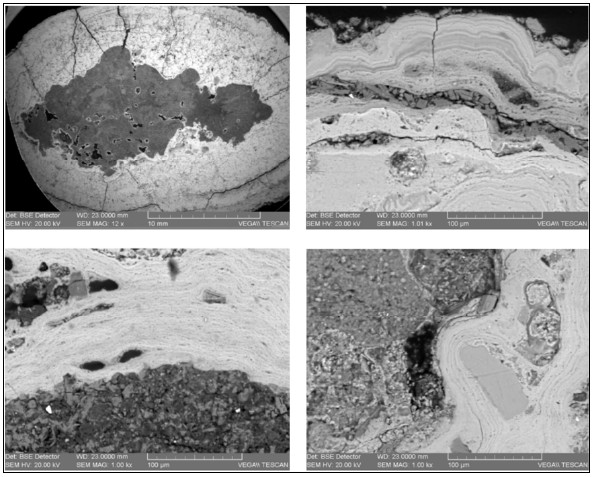
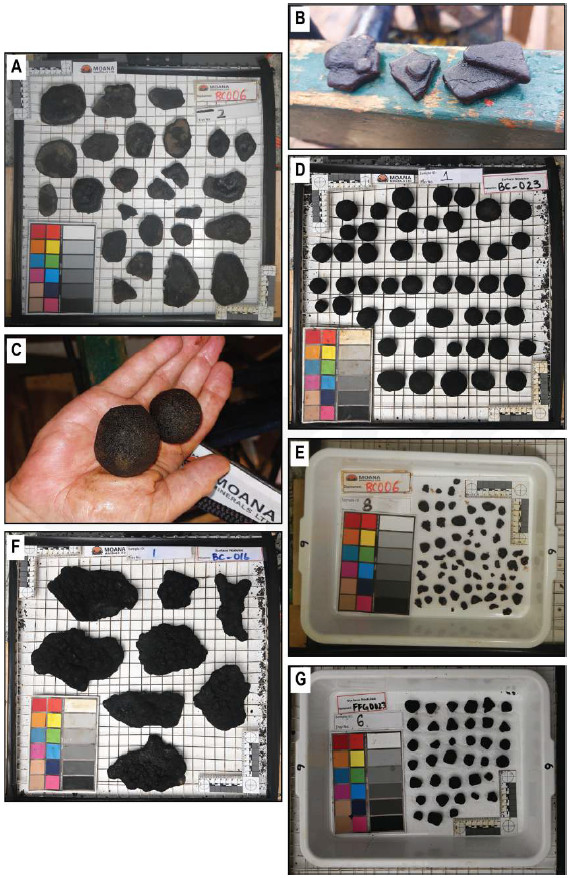
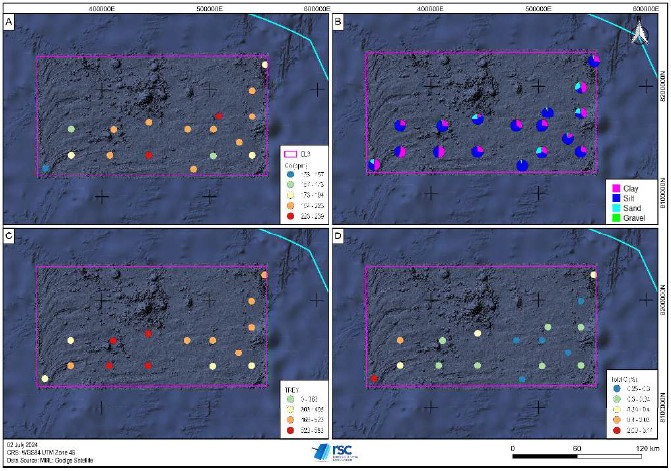
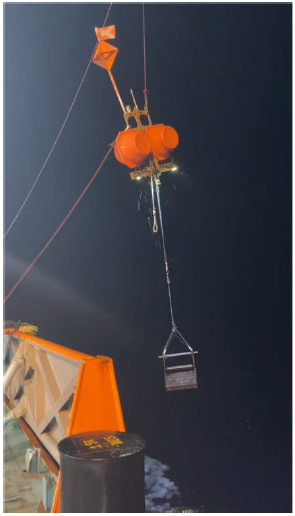
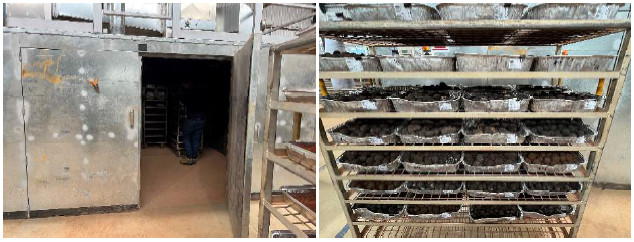
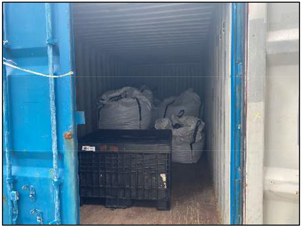
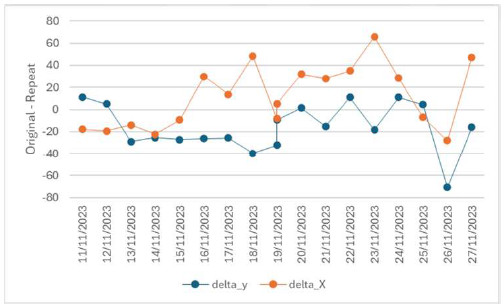
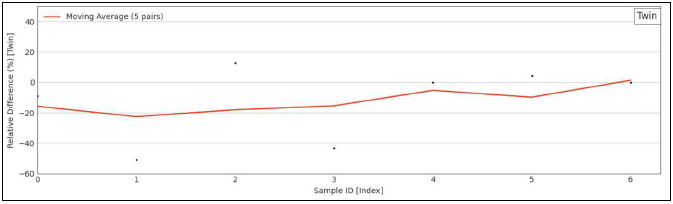
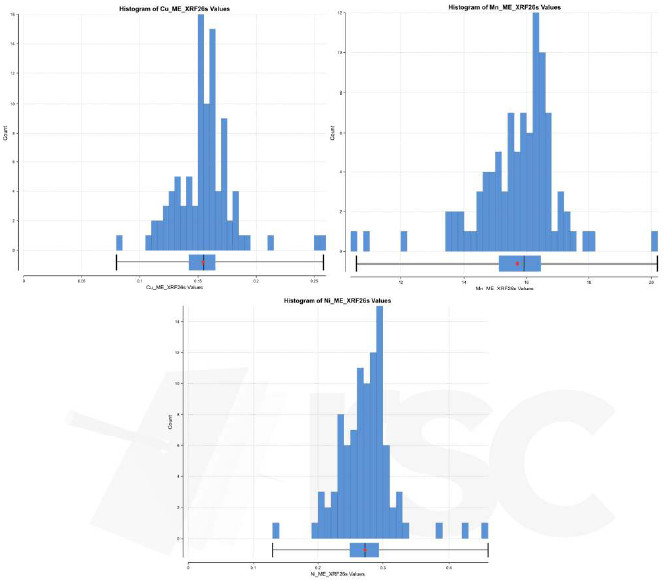
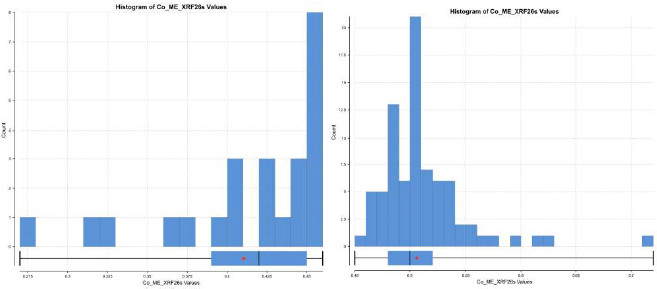
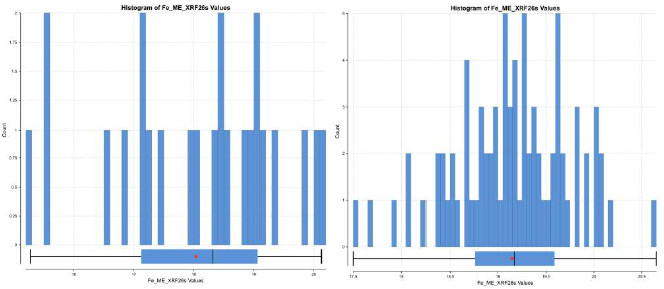
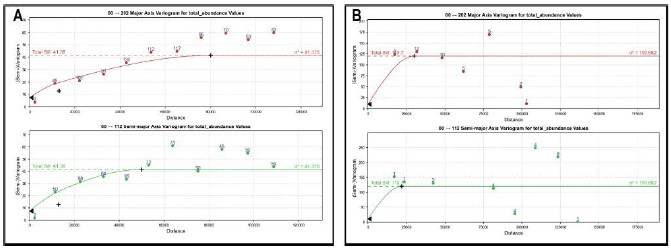
Exhibit 96.2


LOGO

MINERAL RESOURCE ESTIMATE FOR

THE EL3 COOK ISLANDS

POLYMETALLIC NODULE DEPOSIT

Initial Assessment and Technical Report Summary for the EL3 Cook Islands Polymetallic Nodule Deposit, South Pacific Ocean


Report prepared for (Registrant):    MOANA MINERALS LTD
   Grand Central Building
   Main Road
   Avarua
   Rarotonga, Cook Islands


LOGO


Date & Signature

Report issued by

RSC Consulting Ltd

24 Smith Street, Dunedin 9016, New Zealand

Postal Address: PO Box 5647, Dunedin, 9054, New Zealand

Report prepared for


Client name    MOANA MINERALS LTD
Project name    EL3 COOK ISLANDS POLYMETALLIC NODULE DEPOSIT
Contact name    Hans Smit
Contact title    President and CEO
Contact address    Grand Central Building, Main Road, Avarua, Rarotonga, Cook Islands

Report Information


File name    250711 RSC Moana Technical Report
Effective date    December 31, 2025
Report status    Final

Date & Signature


Contributing author (QP)


Signature


Date

Prepared by Qualified Persons from the following Third-Party firm:    /s/ RSC Consulting Ltd    May 6, 2026
RSC Consulting Ltd      


LOGO   

MINERAL RESOURCE ESTIMATE FOR THE EL3 COOK ISLANDS POLYMETALLIC NODULE DEPOSIT

MOANA MINERALS LTD.


Contents   

Date & Signature


List of Tables

     7  

List of Figures

     9  

Acronyms

     12  

1.   Executive Summary

     15  

1.1  Property Description & Ownership

     15  

1.2  Geology & Mineralization

     15  

1.3  Status of Exploration

     16  

1.4  Development & Operations

     16  

1.5  Mineral Resource Estimate

     16  

1.6  Mineral Reserve Estimate

     18  

1.7  Capital & Operating Costs

     18  

1.8  Economic Analysis

     18  

1.9  Permitting Requirements

     18  

1.10  Conclusions & Recommendations

     18  

2.   Introduction

     20  

2.1  Registrant Information

     20  

2.2  Terms of Reference & Purpose

     20  

2.3  Sources of Information

     20  

2.4  Qualified Persons

     20  

2.5  Personal Inspection Summary

     21  

2.6  Previously Filed Technical Report Summary Reports

     21  

3.   Property Description

     22  

3.1  Location

     22  

3.2  Mineral Tenure

     22  

3.3  Royalties & Encumbrances

     23  

3.4  Environmental Liabilities & Permits

     23  

4.   Accessibility, Climate, Local Resources, Infrastructure & Physiography

     25  


Page 1 of 154


LOGO   

MINERAL RESOURCE ESTIMATE FOR THE EL3 COOK ISLANDS POLYMETALLIC NODULE DEPOSIT

MOANA MINERALS LTD.


4.1  Accessibility

     25  

4.2  Climate

     25  

4.3  Bathymetry

     26  

4.4  Local Resources & Infrastructure

     26  

5.   History

     27  

5.1  Tenure & Operating History

     27  

5.2  Exploration History

     27  

5.3  Production History

     30  

5.4  Historical Mineral Resource Estimates


5.4.1 2017 MRE


5.4.2 2023 MRE


6.   Geological Setting, Mineralization & Deposit

     31  

6.1  Regional Geology

     31  

6.1.1 Global Distribution of Nodules

     31  

6.1.2 Tectonic Setting

     32  

6.1.3 Ocean Currents

     33  

6.1.4 Seabed Morphology

     34  

6.2  Local & Property Geology

     36  

6.3  Mineralization

     38  

6.4  Mineral Deposit Model & Known Comparable Deposits

     38  

7.   Exploration

     42  

7.1  Bathymetry

     42  

7.1.1 Geomorphological Domains

     43  

7.2  Seabed Sampling

     45  

7.2.1 Research Cruise 1 (RC01)

     45  

7.2.2 Expedition 1, Leg 2

     45  

7.2.3 Expedition 2

     45  

7.2.4 Expedition 3

     45  

7.2.5 Expedition 4

     46  

7.3  Nodule Abundance

     46  

7.4  Nodule Moisture & Density

     49  


Page 2 of 154


LOGO   

MINERAL RESOURCE ESTIMATE FOR THE EL3 COOK ISLANDS POLYMETALLIC NODULE DEPOSIT

MOANA MINERALS LTD.


7.5  Nodule Geochemistry

     49  

7.5.1 Chemical Analysis

     49  

7.5.2 Mineralogical Characteristics

     52  

7.6  Nodule Morphology

     54  

7.7  Sediment Geochemistry

     54  

8.   Sample Preparation, Analyses & Security

     57  

8.1  Sampling

     57  

8.1.1 Freefall Grab

     57  

8.1.2 Box Core

     58  

8.1.3 Multicore

     59  

8.1.4 Benthic Sled

     59  

8.1.5 Remotely Operated Vehicle

     60  

8.2  Sample Preparation

     61  

8.2.1 Onboard Sample Preparation

     61  

8.2.2 BC Processing

     61  

8.2.3 FFG Processing

     62  

8.2.4 Nodule Removal

     62  

8.2.5 Nodule Washing

     64  

8.2.6 Onshore Sample Preparation

     65  

8.3  Analysis

     65  

8.3.1 Wet Nodule Weight

     65  

8.3.2 Wet Nodule Abundance

     66  

8.3.3 Dry Nodule Weight & Moisture Content

     66  

8.3.4 Laboratory Assay

     67  

8.4  Density & Moisture Content

     67  

8.5  Security

     68  

8.6  Data Quality

     69  

8.6.1 Data Quality Objective

     69  

8.6.2 Quality Assurance

     69  

8.6.2.1 Location Data

     69  

8.6.2.2 Density & Moisture Content

     70  

8.6.2.3 Primary Sample

     70  


Page 3 of 154


LOGO   

MINERAL RESOURCE ESTIMATE FOR THE EL3 COOK ISLANDS POLYMETALLIC NODULE DEPOSIT

MOANA MINERALS LTD.


8.6.2.4  Sample Preparation & First Split

     71  

8.6.2.5  Nodule Abundance

     72  

8.6.2.6  Second Split

     72  

8.6.2.7  Third Split

     72  

8.6.2.8  Analytical Process

     72  

8.6.3 Quality Control

     73  

8.6.3.1  Location Data

     73  

8.6.3.2  Density & Moisture Data

     74  

8.6.3.3  Primary Sample

     74  

8.6.3.4  First Split

     75  

8.6.3.5  Nodule Abundance

     76  

8.6.3.6  Second Split

     77  

8.6.3.7  Third Split

     78  

8.6.3.8  Analytical Process

     78  

8.6.4 Quality Acceptance Testing

     81  

8.6.4.1  Location Data

     82  

8.6.4.2  Density & Moisture Data

     82  

8.6.4.3  Primary Sample

     83  

8.6.4.4  First Split

     90  

8.6.4.5  Nodule Abundance

     90  

8.6.4.6  Second Split

     92  

8.6.4.7  Third Split

     92  

8.6.4.8  Analytical Process

     93  

8.7  Summary

     95  

9.   Data Verification

     96  

10.  Mineral Processing & Metallurgical Testing

     97  

10.1.1 BGRIMM Testing

     97  

10.1.2 ALS Testing

     98  

11.  Mineral Resource Estimates

     100  

11.1  Informing Data

     100  

11.1.1 Data Handling

     100  

11.1.1.1  Sample Compositing

     100  

11.1.1.2  Sample Quality Rank

     100  

11.1.1.3  Exclusion of Repeat Samples

     101  

11.1.1.4  Handling of BC_017

     101  


Page 4 of 154


LOGO   

MINERAL RESOURCE ESTIMATE FOR THE EL3 COOK ISLANDS POLYMETALLIC NODULE DEPOSIT

MOANA MINERALS LTD.


11.1.2 Location Data

     101  

11.2  Interpretation & Model Definition

     101  

11.2.2.1  Abundance

     102  

11.2.2.2  Geochemistry

     103  

11.2.4 Alternative Interpretations

     104  

11.3  Summary Statistics & Data Preparation

     104  

11.3.1 Sample Support

     104  

11.3.2 Estimation Domain Statistics

     104  

11.4  Spatial Analysis & Variography

     107  

11.4.1 Variogram Analysis

     107  

11.5  Block Model

     110  

11.6  Search Neighborhood Parameters

     111  

11.7  Estimation

     111  

11.7.1 Domain

     111  

11.8  Validation

     113  

11.9  Sensitivity Testing

     114  

11.10 Multi-Factor Scorecard Modeling

     116  

11.11 Classification

     117  

11.11.1 Cut-Off Grade


11.11.2 Mining & Metallurgical Methods & Parameters

     120  

11.11.3 RPEEE

     121  

11.11.4 Comparison with Historical Estimate


11.11.4.1 2017 OML MRE


11.11.4.2 2023 SBMA Estimate


11.12 Risks

     122  

12.  Mineral Reserves Estimates

     127  

13.  Mining Methods

     128  

14.  Processing & Recovery Methods

     129  

15.  Project Infrastructure

     130  

16.  Market Studies

     131  

17.  Environmental Studies, Permitting & Plans, Negotiations, or Agreements with Local Individuals or Groups

     132  


Page 5 of 154


LOGO   

MINERAL RESOURCE ESTIMATE FOR THE EL3 COOK ISLANDS POLYMETALLIC NODULE DEPOSIT

MOANA MINERALS LTD.


17.1.1 Exploration Environment Programs & Impacts


17.1.2 Environmental Impacts from Minerals Harvesting


17.2  Environmental Studies


17.2.1 Benthic Zone


17.2.2 Pelagic & Surface Zones


18.  Capital & Operating Costs

     133  

19.  Economic Analysis

     134  

20.  Adjacent Properties

     135  

20.1  CIC Limited

     135  

20.2  Cook Islands Investment Corporation Seabed Resources Limited


21.  Other Relevant Data & Information

     137  

22.  Interpretation & Conclusions

     138  

23.  Recommendations

     140  

24.  References

     141  

25.  Reliance on Information Provided by the Registrant

     146  

26.  Certificate of Qualified Person: René Sterk


27.  Certificate of Qualified Person: Sean Aldrich


Page 6 of 154


LOGO   

MINERAL RESOURCE ESTIMATE FOR THE EL3 COOK ISLANDS POLYMETALLIC NODULE DEPOSIT

MOANA MINERALS LTD.


List of Tables   

Table 1-1: Mineral Resource statement at a nodule abundance cut-off of 12.5 kg/m2

     16  

Table 3-1: Status of MML’s license

     23  

Table 5-1: Summary of historical sample type by expedition

     27  

Table 5-2: JICA-MMAJ navigation systems

     29  

Table 5-3: Mineral Resource statement for 2017 MRE prepared for OML


Table 5-4: Mineral Resource statement for the 2023 MRE prepared for SBMA


Table 6-1: Summary of global nodule grades

     31  

Table 6-2: Summary of global nodule grades

     41  

Table 7-1: Summary of slope analysis

     43  

Table 7-2: Summary of nodule abundance data

     47  

Table 7-3: Summary of nodule chemical analysis

     50  

Table 7-4: Summary statistics for sediment geochemistry and grain size

     54  

Table 8-1: Analytical methods used by ALS Brisbane

     67  

Table 8-2: Explanation of the Westgard rules

     81  

Table 8-3: Summary of BC video review for BC sampler bouncing and other quality factors

     86  

Table 8-4: Summary of primary sample quality based on video footage review

     86  

Table 8-5: Precision summary for replicate and repeat nodule weight measurements

     91  

Table 8-6: Precision summary for third-split repeat pairs

     93  

Table 8-7: Performance summary of MME3NDLB0 submitted for the EL3 Project

     94  

Table 8-8: Summary of data quality for EL3 for the purpose of resource estimation and classification

     95  

Table 11-1: Primary sample quality rank based on sampling video footage

     101  

Table 11-2: Summary statistics of abundance estimation domains

     105  

Table 11-3: Summary statistics of geochemistry domains

     105  

Table 11-4: Abundance variogram parameters

     107  

Table 11-5: Variogram parameters for Cu, Mn, Ni, Co, and Fe

     108  

Table 11-6: Block model description

     110  

Table 11-7: Search neighborhood parameters

     111  

Table 11-8: Estimated block summary statistics

     112  

Table 11-9: Mean comparison of sample and estimate block grades

     113  

Table 11-10: Comparison of mean abundance block grade

     115  

Table 11-11: Data quality multi-factor rankings applied to the samples

     116  

Table 11-12: Weighting system used to determine overall score

     116  

Table 11-13: Mineral Resource statement at nodule abundance cut-off of 12.5 kg/m2

     119  

Table 11-14: Average production estimate. From Smit (2024)

     119  

Table 11-15: Summary of tons and grade at a cut-off of 10, 12.5 and 15 kg/m2

     120  


Page 7 of 154


LOGO   

MINERAL RESOURCE ESTIMATE FOR THE EL3 COOK ISLANDS POLYMETALLIC NODULE DEPOSIT

MOANA MINERALS LTD.


Table 11-16: Risk assessment criteria

     123  

Table 11-17: List and analysis of risks

     124  

Table 23-1: Proposed Phase 1 and 2 expenditures in USD

     140  


Page 8 of 154


LOGO   

MINERAL RESOURCE ESTIMATE FOR THE EL3 COOK ISLANDS POLYMETALLIC NODULE DEPOSIT

MOANA MINERALS LTD.


List of Figures   

Figure 3-1: Location of the Project (EL3) in the South Pacific Ocean

     22  

Figure 4-1: Bathymetric map of the Project area

     26  

Figure 5-1: Historical samples and cruise tracks within the Project area

     28  

Figure 5-2: Standard survey station layout conducted by JICA

     28  

Figure 5-3: Standard sampling layout conducted by JICA at each station

     29  

Figure 5-4: High-resolution bathymetric map over the 16-159 Area

     30  

Figure 5-5: Plan view of nodule abundance block model


Figure 5-6: Plan view of estimation block grade and sample data


Figure 6-1: Fe-Mn crust and nodule samples collected from around the world

     31  

Figure 6-2: Tectonic setting of the Cook Islands EEZ and surrounding seabed

     32  

Figure 6-3: Volcanic chains and hotspot tracks

     33  

Figure 6-4: Schematic of ocean currents in and near the EEZ

     34  

Figure 6-5: Seabed geomorphology for the Cook Islands and surrounds

     35  

Figure 6-6: Gravy cores collected by JICA-MMAJ in the 16-159 Area


Figure 6-7: Sub-bottom profiles from JICA-MMAJ (2001)

     37  

Figure 6-8: Nodules recovered from the Project area. Mineralization nucleated around a megalodon tooth

     39  

Figure 6-9: (a) Schematic illustrating the formation of Mn-oxides and Fe-oxyhydroxides

     40  

Figure 7-1: MBES survey lines

     42  

Figure 7-2: Project bathymetry

     43  

Figure 7-3: Geomorphological domain maps for EL3

     44  

Figure 7-4: Photographs of before and after moving BC samplers

     46  

Figure 7-5: BC and FFG samples collected by MML

     48  

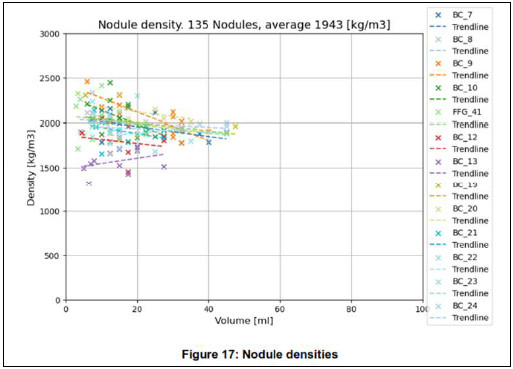
Figure 7-6: Nodule density

     49  

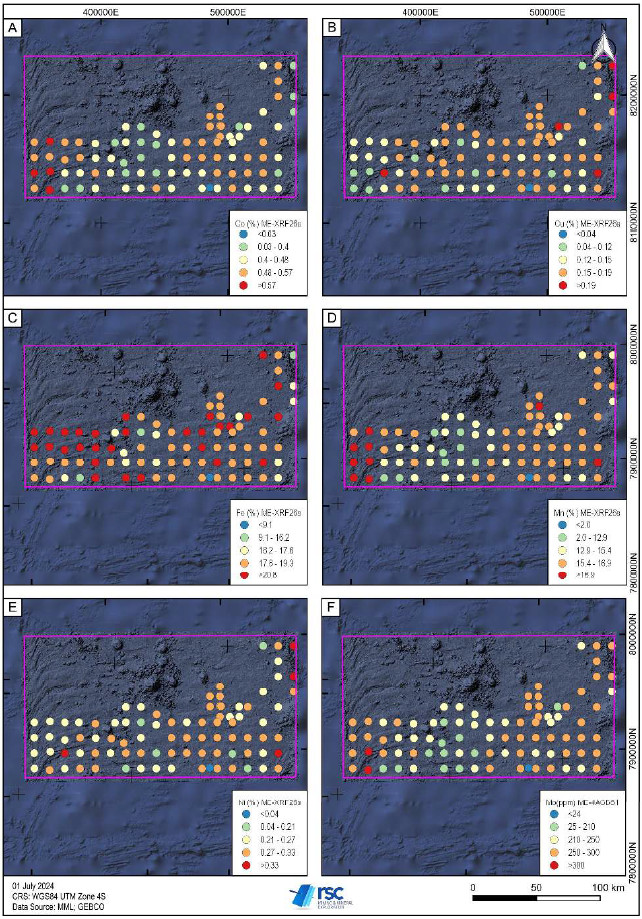
Figure 7-7: Map of nodule geochemistry

     51  

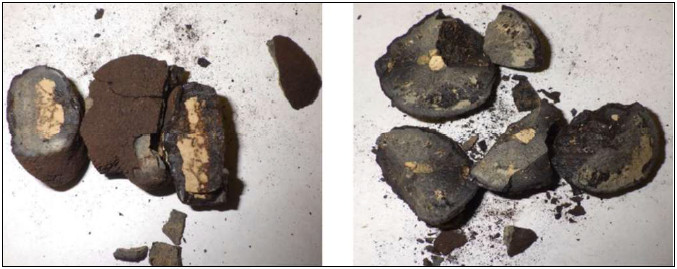
Figure 7-8: Photographs of characterized nodules

     52  

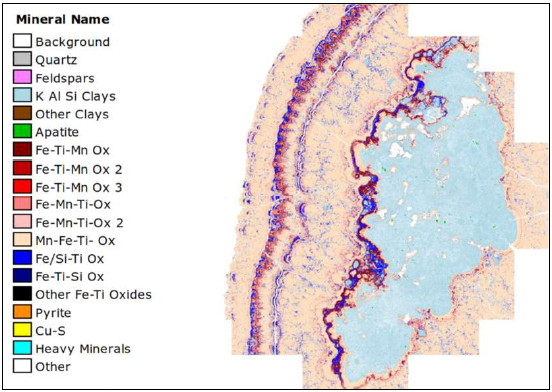
Figure 7-9: QEMSCAN map for Nodule 1

     53  

Figure 7-10: SEM photomicrographs of Nodule 1

     53  

Figure 7-11: Examples of the different nodule morphologies recovered from EL3

     55  

Figure 7-12: Sediment geochemistry maps

     56  

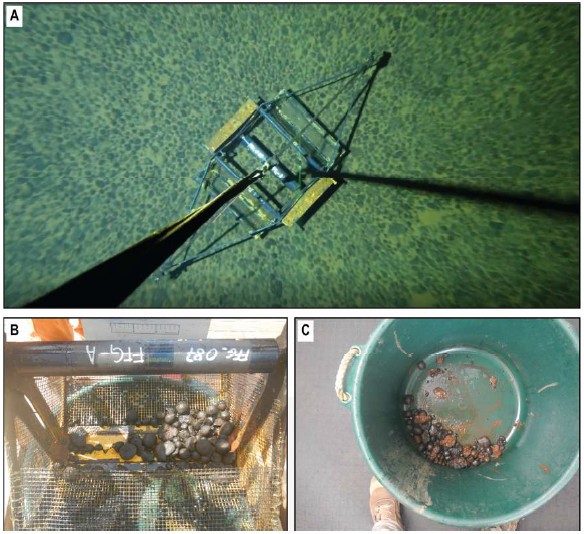
Figure 8-1: FFG being recovered at night

     57  

Figure 8-2: Front and side profile of the BC

     58  

Figure 8-3: Multicore recovered to deck with samples. From van Eck (2023a)

     59  

Figure 8-4: The benthic sled unloading nodules on the aft deck

     60  

Figure 8-5: ROV launching of starboard side of the MV Anuanua Moana during EXP2 (van Eck, 2023b)

     61  

Figure 8-6: Examples of tray photographs collected

     62  


Page 9 of 154


LOGO   

MINERAL RESOURCE ESTIMATE FOR THE EL3 COOK ISLANDS POLYMETALLIC NODULE DEPOSIT

MOANA MINERALS LTD.


Figure 8-7: Removing the surface nodules and sediment of a BC sample

     63  

Figure 8-8: FFG sampler sitting in the FFG cradle

     63  

Figure 8-9: Nodule washing station

     64  

Figure 8-10: Sample collected from FFG_0069, with an Fe-Mn outer microbotryoidal layer

     65  

Figure 8-11: Scales used during E1L2 (left) and EXP4 (right)

     66  

Figure 8-12: Nodule drying process at ALS Brisbane

     67  

Figure 8-13: Nodules from E1L2 were stored in a locked container at MML’s warehouse facilities

     69  

Figure 8-14: Difference in x and y coordinates (in m) plotted against time

     73  

Figure 8-15: Relative difference plot comparing FFG repeat samples collected during E1L2

     75  

Figure 8-16: Relative difference plot comparing nodule abundance grades in FFG and BC repeat samples

     75  

Figure 8-17: Reference weight data plotted in sequence

     76  

Figure 8-18: Relative difference of nodule weight replicate data

     77  

Figure 8-19: Relative difference plot for at-sea vs on-land nodule weights

     77  

Figure 8-20: Relative difference plot over sample sequence (proxy time) for Co grades

     78  

Figure 8-21: Shewhart control plots for reference material MME3NDLB0

     80  

Figure 8-22: OREAS C27h blank data

     81  

Figure 8-23: Scatter plots comparing the ship’s DGPS data (x axis) with the handheld GPS data (y axis)

     82  

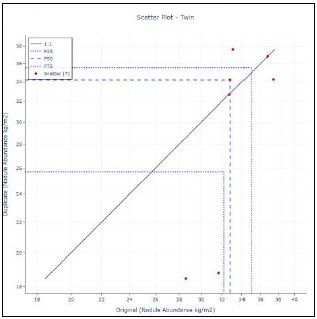
Figure 8-24: Scatter plot for nodule abundance between FFG repeat samples collected during E1L2

     83  

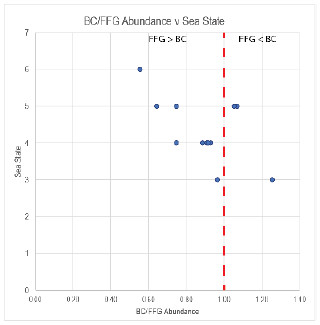
Figure 8-25: BC/FFG nodule abundance ratio vs sea state

     84  

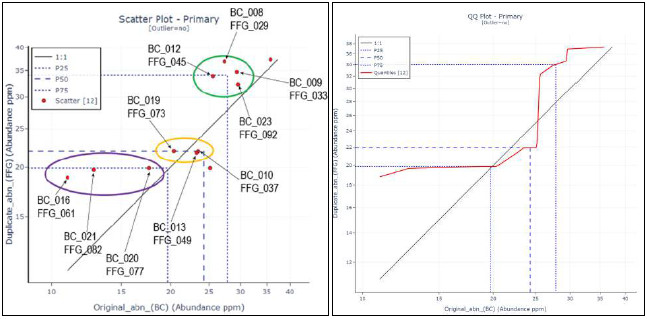
Figure 8-26: Scatter and QQ plots for nodule abundance for BC and FFG repeat samples collected during EXP4

     85  

Figure 8-27: Photographs of BC_015

     85  

Figure 8-28: Comparison photographs of nodules collected by FFG_087

     87  

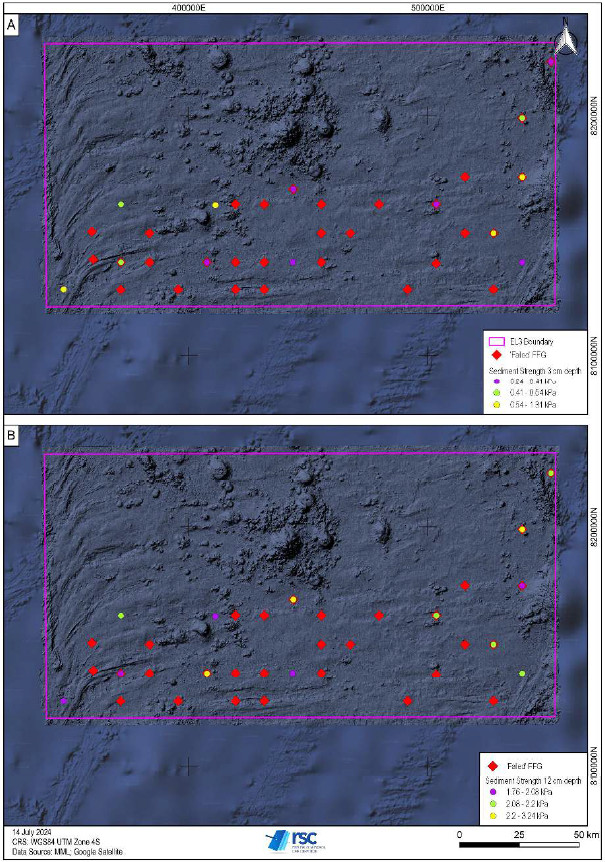
Figure 8-29: Maps displaying the ‘failed’ FFG samples and sediment strength data collected at 3 and 12 cm depths

     88  

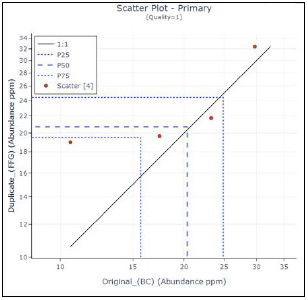
Figure 8-30: Scatter plot comparing BC and FFG repat pairs

     89  

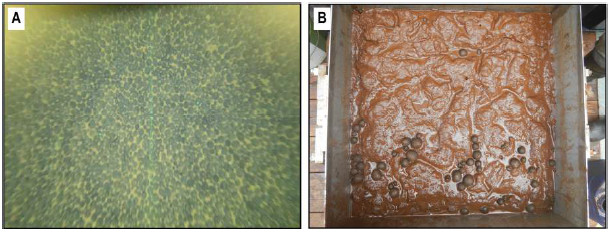
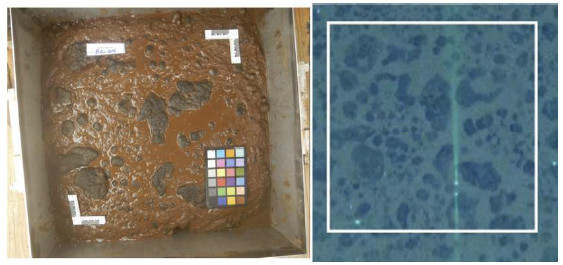
Figure 8-31: Comparison between the BC top shot and seabed image for BC_016

     89  

Figure 8-32: Scatter and QQ plot of replicate weight data

     91  

Figure 8-33: Scatter and QQ plot comparing at-sea and on-land nodule weights

     92  

Figure 8-34: Scatter and QQ plots comparing third-split repeat pairs for Co

     93  

Figure 10-1: Simplified flowsheet of extraction and recovery of Co, Ni, Cu, and Mn from Cook Islands nodules

     98  

Figure 10-2: Simplified flowsheet of extraction and recovery of Co, Ni, Cu, and Mn from Cook Islands nodules

     99  

Figure 11-1: Estimation domains for nodule abundance

     103  

Figure 11-2: Geochemistry estimation domains for Co and Fe

     103  

Figure 11-3: Histogram of High Abundance estimation domain (left) and Low Abundance estimation domain (right)

     105  

Figure 11-4: Histogram of Cu (top left), Mn (top right), and Ni (bottom center) estimation domains

     106  

Figure 11-5: Histograms of low (left) and high (right) Co estimation domains

     106  

Figure 11-6: Histograms of low (left) and high (right) Fe estimation domains

     107  


Page 10 of 154


LOGO   

MINERAL RESOURCE ESTIMATE FOR THE EL3 COOK ISLANDS POLYMETALLIC NODULE DEPOSIT

MOANA MINERALS LTD.


Figure 11-7: Experimental semi-variogram models for (A) High Abundance domain, (B) Low Abundance domain

     108  

Figure 11-8: Experimental semi-variogram models for (A) Cu, (B) Mn, and (C) Ni

     109  

Figure 11-9: Experimental semi-variograms models

     110  

Figure 11-10: Contact analysis plots

     112  

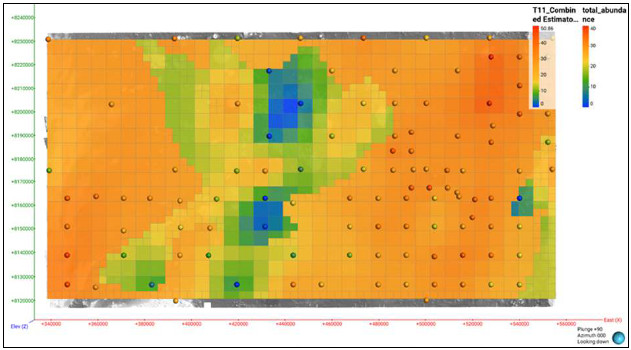
Figure 11-11: Plan view of estimated block grades and sample data for abundance

     113  

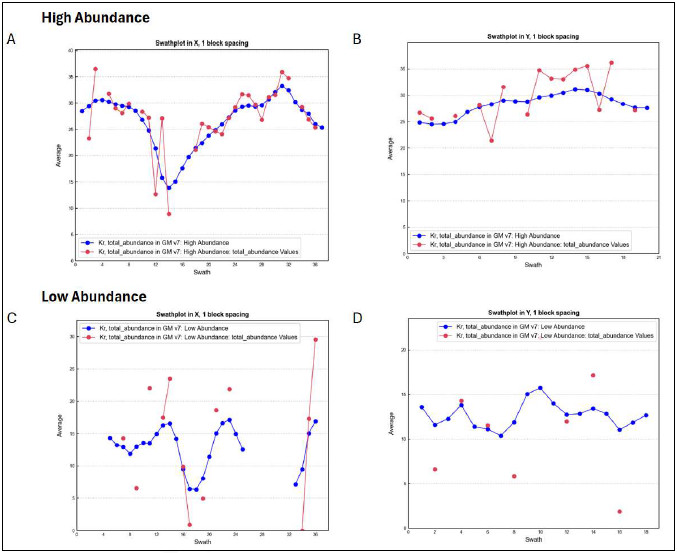
Figure 11-12: Swath plots comparing sample (blue) and estimated (red) abundance grades

     114  

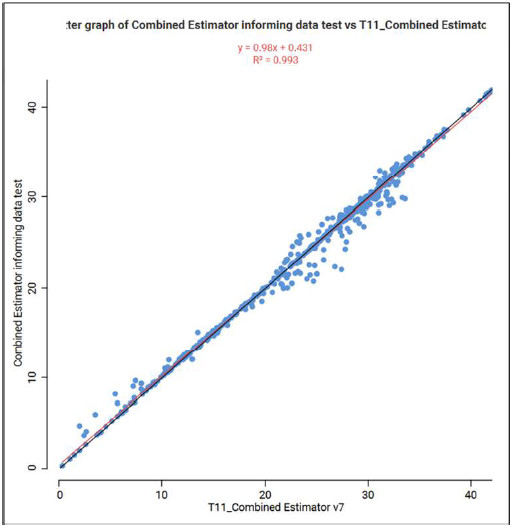
Figure 11-13: Scatter plot comparing block abundance grade

     115  

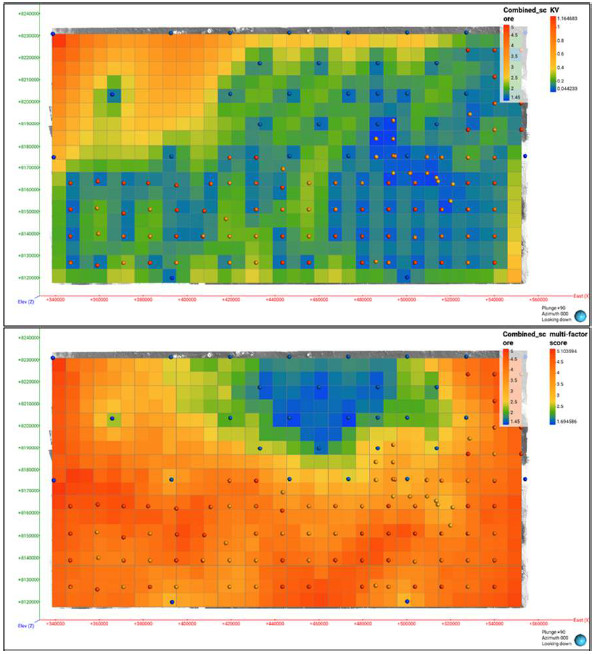
Figure 11-14: Plan view of estimated multifactor scorecard

     117  

Figure 11-15: Abundance block model outlining the classification of the Mineral Resource

     118  

Figure 11-16: RSC’s risk score matrix

     123  

Figure 17-1: Net organic export in the Cook Islands and CCZ


Figure 17-2: Schematic section of ocean zones and areas


Figure 20-1: Map of licenses and reserved areas in the Cook Islands EEZ

     135  

Figure 22-1: Areas of exploration potential

     139  


Page 11 of 154


LOGO   

MINERAL RESOURCE ESTIMATE FOR THE EL3 COOK ISLANDS POLYMETALLIC NODULE DEPOSIT

MOANA MINERALS LTD.


Acronyms   
°C    degrees Celsius
2D    two-dimensional
3D    three-dimensional
µm    micrometer
AD    armed dredge
Ag    silver
Al    aluminum
As    arsenic
AusIMM    Australasian Institute of Mining and Metallurgy
AUV    autonomous underwater vehicle
Ba    barium
BC    box core
BGRIMM    Beijing General Research Institute for Mining and Metallurgy
BS    benthic sled
BSE    backscattered electron mode
Ca    calcium
CCD    carbonate compensation depth
CCOP/SOPAC    Committee for Coordination of Joint Prospecting for Minerals Resources in South Pacific Offshore Areas
CCZ    Clarion-Clipperton Zone
Cd    cadmium
Ce    cerium
CIPA    Cook Islands Port Authority
CO    carbon monoxide
Co    cobalt
CPGeo    Chartered Professional Geologist
Cr    chromium
CRM    certified reference material
Cs    cesium
CSR    Cobalt Seabed Resources Limited
CTD    conductivity, temperature, depth
Cu    copper
CV    coefficient of variation
DGPS    differential global positioning system
DQO    data quality objective
DVL    doppler velocity logger
  
Dy    dysprosium
E1L2    Expedition 1, Leg 2
eDNA    environmental DNA
EEZ    exclusive economic zone
EIA    environmental impact assessment
EL3    Exploration License 3
ENSO    El Niño–Southern Oscillation
Er    erbium
Eu    europium
EXP2    Expedition 2
EXP3    Expedition 3
EXP4    Expedition 4
Fe    iron
FFG    freefall grab
FS    Feasibility Study
g    gram
Ga    gallium
GCS    geographic coordinate system
Gd    gadolinium
GPS    global positioning system
GSR    Global Sea Mineral Resources
Hf    hafnium
Ho    holmium
ICI    Infrastructure Cook Islands
ICP-AES    inductively coupled plasma atomic emission spectroscopy
ICP-MS    inductively coupled plasma mass spectrometry
ISA    International Seabed Authority
ISO    International Organization for Standardization
JICA    Japan International Cooperation Agency
K    potassium
KE    kriging efficiency
ka    thousand years ago
kg    kilogram
kHz    kilohertz
km    kilometer


Page 12 of 154


LOGO   

MINERAL RESOURCE ESTIMATE FOR THE EL3 COOK ISLANDS POLYMETALLIC NODULE DEPOSIT

MOANA MINERALS LTD.


kyr    thousand years    QEMSCAN    quantitative evaluation of minerals by
L    liter       scanning electron microscopy
La    lanthanum    QP    Qualified Person
LARS    launch and recovery system    QQ    quantile-quantile
LC    long core    RALS    riser and lift system
LED    light-emitting diode    Rb    rubidium
LOI    loss on ignition    RBF    radial basis functions
LOQ    limit of quantification    RC01    Research Cruise 1
Lu    lutetium    REEs    rare earth elements
m    meter    REY    rare earth elements and yttrium
Ma    million years ago    RL    reduced level
MBES    multibeam echosounder    RMSCV    root mean square coefficient of variation
MC    multicore    ROV    remotely operated vehicle
MFES    multi-frequency exploration system    RPEEE    reasonable prospects for eventual
Mg    magnesium       economic extraction
mi    miles    RSC    RSC Consulting Ltd
ml    milliliter    SBMA    Seabed Minerals Authority
mm    millimeter    SD    standard deviation
MMAJ    Metal Mining Agency of Japan    SEC    South Equatorial Current
MML    Moana Minerals Limited    SEM    scanning electron microscope
Mn    manganese    S    sulfur
Mo    molybdenum    Sc    scandium
MRE    mineral resource estimate    Si    silicon
Mt    megaton    Sm    samarium
MV    motor vessel    Sn    tin
Na    sodium    SOP    standard operating procedure
Nb    niobium    Sr    strontium
Ni    nickel    t    ton
NNSS    Navy Navigation Satellite System    Ta    tantalum
NOAA    National Oceanic and Atmospheric    Tb    terbium
   Administration    Th    thorium
OML    Ocean Minerals LLC    Ti    titanium
O    oxygen    Tl    thallium
P    phosphorous    Tm    thulium
Pb    lead    TMS    tether management system
PFS    Pre-Feasibility Study    TRS    Technical Report Summary
Pr    praseodymium    U    uranium
QA    quality assurance    USBL    ultra-short baseline
QAT    quality assurance testing    UTM    Universal Transverse Mercator
QC    quality control      


Page 13 of 154


LOGO   

MINERAL RESOURCE ESTIMATE FOR THE EL3 COOK ISLANDS POLYMETALLIC NODULE DEPOSIT

MOANA MINERALS LTD.


V    vanadium
W    tungsten
XRD    X-ray diffraction
XRF    X-ray fluorescence
Y    yttrium
Yb    ytterbium
Zn    zirconium


Page 14 of 154


LOGO   

MINERAL RESOURCE ESTIMATE FOR THE EL3 COOK ISLANDS POLYMETALLIC NODULE DEPOSIT

MOANA MINERALS LTD


1. Executive Summary

Moana Minerals Limited (MML) commissioned RSC to prepare a technical report, compliant with S-K 1300 standards, on its polymetallic nodule project (Project) located within the Cook Island exclusive economic zone (EEZ). RSC prepared an independent technical report in accordance with the JORC Code (2012) in July 2024. RSC was engaged by MML to report the mineral resource in this report, conforming to the United States Securities and Exchange Commission’s (SEC) Modernized Property Disclosure Requirements for Mining Registrants, as described in Subpart 229.1300 of Regulation S-K, Disclosure by Registrants Engaged in Mining Operations (S-K 1300), and Item 601 (b)(96) Technical Report Summary (TRS). No Mineral Reserve estimate is reported in this Report.

The effective date of this TRS report is December 31, 2025. All material assumptions underlying the MRE are current as of the effective date of the report.

The interpretations and conclusions reached in this Report are based on current scientific understanding and the best evidence available to RSC at the time of writing. It is the nature of all scientific conclusions that they are founded on an assessment of probabilities and, however high the probabilities might be, make no claim for absolute certainty.

The ability of any person to achieve forward-looking production and economic targets depends on numerous factors beyond RSC’s control and that RSC cannot anticipate. These factors include, but are not limited to, site-specific mining and geological conditions, management and personnel capabilities, availability of funding to properly operate and capitalize the operation, variations in cost elements and market conditions, developing and operating the mine efficiently, unforeseen changes in legislation, and new industry developments. Any of these factors may substantially alter the performance of any mining operation.

1.1 Property Description & Ownership

The Project is located within the EEZ of the Cook Islands, in the South Pacific Ocean. While the Project is confined to the boundary of EL3, the project is part of a wider known deposit of polymetallic nodules found within the Cook Islands’ EEZ. The Project is located on the seabed, more than 5,000 m below sea level.

EL3 was granted to Moana Minerals Limited (MML) — a wholly owned Cook Islands registered company subsidiary of Ocean Minerals, LLC (OML) — on 23 February 2022, by the Seabed Minerals Authority (SBMA) on behalf of the Cook Island Government. The license is valid for a term of five years. An application for license renewal can be made at least 90 days before the expiry of the license, in line with Section 63 of the Seabed Minerals (Exploration) Regulations (2020).

1.2 Geology & Mineralization

Polymetallic nodules are part of a spectrum of ferromanganese precipitates that are found throughout the world’s oceans. The Cook Islands are distinctive in having relatively ancient and stable ocean crust, coupled with very low-modelled net export of organic material to the seabed, and the interpreted influence of a long-lived deep-water ocean current.

Most of the Project area consists of relatively flat abyssal plains, with sea knolls and seamounts scattered across the Project area, but with a higher concentration in the center and center-west.

Polymetallic nodule abundance and element grades vary throughout the Project area but are more consistent compared to the wider EEZ. ‘Nodule abundance’ is the term used to describe the number of nodules found in a given sample area; it is measured in kilograms per square meter because nodules typically form on the seabed as a single layer, several centimeters thick, so are, in effect, a two-dimensional deposit. The nodule abundance in the Project ranges from 0–50.8 kg/m2 and has an average abundance of 26.9 kg/m2. Nodule abundance is typically higher in areas of abyssal plains.

Polymetallic nodules in the Cook Islands are geochemically unique, compared to other deposits, due to their low Mn/Fe ratio and elevated Co grades. The average Mn/Fe ratio is 0.83, which indicates the nodules are formed via hydrogenetic processes. This is supported by nodule morphology (relatively smooth texture), and the low number of buried nodules recovered — most nodules are found on the surface of the seabed.


Page 15 of 154


LOGO   

MINERAL RESOURCE ESTIMATE FOR THE EL3 COOK ISLANDS POLYMETALLIC NODULE DEPOSIT

MOANA MINERALS LTD


1.3 Status of Exploration

Exploration has been conducted to at least some extent across the entire Project. The eastern and southern quadrants are the most explored, as MML has conducted sampling on a nominal 12-km grid. By contrast, the northwestern quadrant is the least explored and was sampled on ~50-km sample spacing by the Japan International Cooperation Agency (JICA).

1.4 Development & Operations

Since 2019, MML has conducted at least five cruises. MML used freefall grab (FFG), box core (BC), multicore (MC), and benthic sled (BS) sampling tools to collect polymetallic nodule samples, supported by remotely operated vehicle (ROV) surveys.

1.5 Mineral Resource Estimate and Initial Assessment

The Mineral Resources for the Project are summarized in Table 1-1. The data informing the MRE consists of declustered samples collected by JICA and during Research Cruise 1 (RC01), as well as samples collected during Expedition 1 Leg 2 (E1L2) and Expedition 4 (EXP4) for which no sampling issues were indicated. All samples were reprojected to Universal Transverse Mercator (UTM) zone 4S. The reduced level (RL) was set to 0. No corrections were applied to the geochemical or nodule abundance data. In RSC’s opinion, the quality of the data provided by MML is fit for purpose and suitable for use in the mineral resource estimation.

Table 1-1: Mineral Resource statement at a nodule abundance cut-off of 12.5 kg/m2.


Classification

   Abundance
(wet) kg/m2
     Nodules
(wet) Mt
     Metal Grade  
   Co (%)      Cu (%      Fe (%)      Mn (%)      Ni (%)  

Indicated

     26.7        417        0.49        0.15        18.9        15.6        0.27  

Inferred

     26        102        0.5        0.1        19        16        0.2  

Notes:


1.

Mineral Resources have an effective date of December 31, 2025..


2.

Mineral Resources are reported using the S-K 1300 definitions.


3.

Mineral Resources are not Mineral Reserves and do not have demonstrated economic viability.


4.

The third-party firm responsible for the MRE is RSC.


5.

Numbers have been rounded as required by reporting guidelines and may result in apparent summation differences.


6.

Abundance is the wet weight (kilograms) of polymetallic nodules per square meter.


7.

The estimate of tons and abundance is provided at a cut-off abundance of 12.5 kg/m2.


8.

The estimate is reported where the modifying factor of slope has been considered, and the proportion of slope >10° is applied locally to each block within the Low Abundance domain.

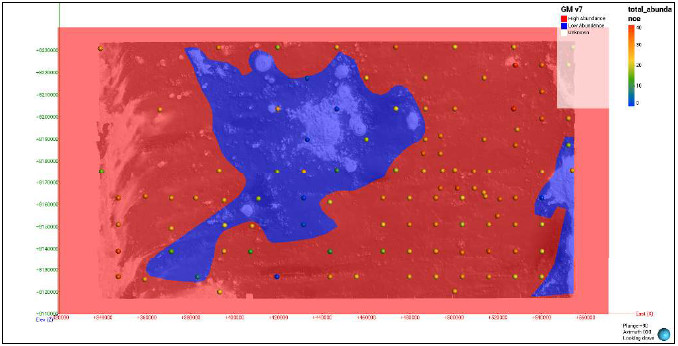
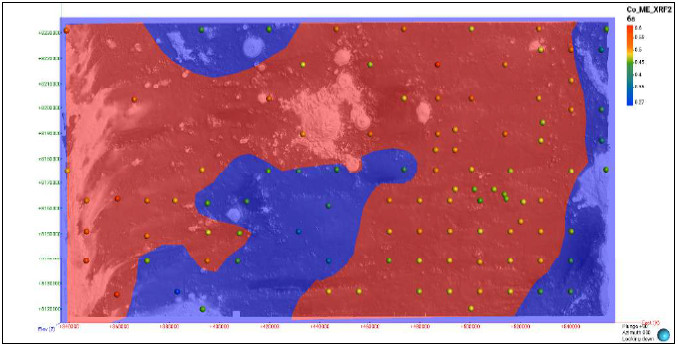
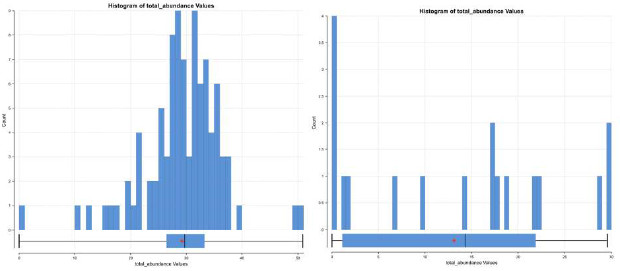
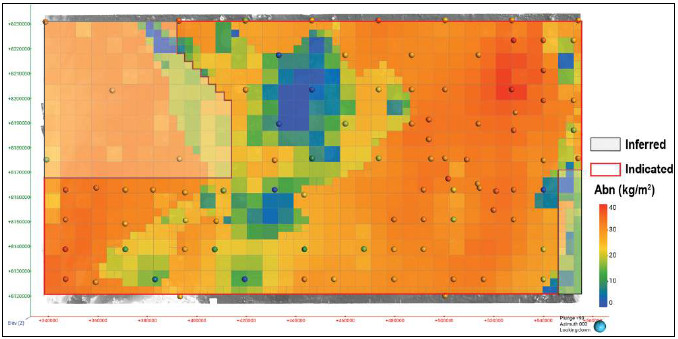
The controls on mineralization are consistent across the Project area and fit in with the wider EEZ geological framework. At deposit scale, variation in Cu, Mn and Ni grades is low and RSC did not identify any sub-populations. Variations in Co, Fe and Mo and nodule abundance were identified, with an area of low grade and low abundance associated with areas of relief (e.g. around the central seamount and eastern ridge geomorphological domains).


Page 16 of 154


LOGO   

MINERAL RESOURCE ESTIMATE FOR THE EL3 COOK ISLANDS POLYMETALLIC NODULE DEPOSIT

MOANA MINERALS LTD


Experimental semi-variograms were modelled with relatively low g0 values and one or two spherical structures. All variograms display reasonable structure for global estimation and are compatible with the classification of Indicated and Inferred Mineral Resources. A block size of 6,250 m × 6,250 m was selected for estimation, based on sample spacing and existing mineral resource models. Sub-blocking of 3,125 m × 3,125 m was applied to gain a better definition of the license boundary and of the geomorphological domain. Estimation was done using ordinary kriging. Validation methods included visual review and comparison of means as well as validation plots. Sensitivity testing through variance of the parameter settings found the estimate to be robust. A multifactor scorecard was also applied to data quality to support the classification of the estimate.

The MRE is supported by consideration of minerals harvesting (mining) and metallurgical processing methods. In assessing the reasonable prospects for eventual economic extraction (RPEEE), RSC has considered conceptual mining, metallurgical, and economic parameters as well as environmental and social aspects.

1.5.1 Cut-Off Abundance & RPEEE

The Mineral Resource has been reported at a nodule cut-off abundance of 12.5 kg/m2 . This cut-off abundance was selected based on the consideration of previous studies of comparable deposits (Aldrich and Sterk, 2017), as well as considering assumed mining parameters with respect to the RPEEE.

When assessing the cut-off abundance, a base case, which would result in a moderate internal rate of return, and a breakeven scenario were reviewed. Using a projected production rate of 289 kg/s for the base case, and a 12-m wide collector harvesting at a rate of 1.0 m/s and an efficiency of 86%, would require a nodule abundance of 28 kg/m2 .

To break even, using the same assumed mining parameters, a cut-off of 12.5 kg/m2 is required. RSC notes that applying a cut-off abundance of 12.5 kg/m2 results in an average abundance for the MRE of 25 kg/m2 and notes that a blending mining program could be used to satisfy the production targets by mining both low and high grades. In that context, RSC considers that a cut-off abundance of 12.5 kg/m2 would be reasonable.

Portions of the deposit that do not have RPEEE are not included in the Mineral Resource. In assessing the reasonable prospects, RSC has evaluated conceptual mining, metallurgical and economic parameters as well as environmental and social aspects. The Mineral Resource reported here is a realistic inventory of mineralization which, under assumed and justifiable technical, economic and developmental conditions, might, in whole or in part, become economically extractable.

In accessing RPEEE, RSC has considered all the available baseline studies and evaluated the political and world view on marine mining. Although it may take time to develop laws and appropriate mitigation measures for environmental risks, on balance, it is more likely than not that economic extraction may become reasonable in the reasonably foreseeable future.

1.5.2 Initial Assessment Summary

RSC has conducted an Initial Assessment of the MML polymetallic MRE reported in this TRS to determine its economic potential. The results are summarized in Table 1-2. As the Project is still at an early stage, neither an economic and cash flow analysis nor cash flow analysis have been completed on the MRE disclosed in this TRS. However, RSC has completed a high-level preliminary technical and economic study of the economic potential of either all or parts of mineralization to support the disclosure of Mineral Resources.

Table 1-2: Initial Assessment summary for the MML polymetallic nodule project.


Factor


Initial Assessment

Site Infrastructure    The project is located in the central west of the Cook Islands EEZ and ~5,000 m below the sea surface. Therefore, all exploration and potential extraction occur from vessels. The vessels have their own power and water supplies and provide accommodation for all crew. Access to the Project is through the waters of the Cook Islands rather than access roads.
Mine Design & Planning   

Any future mining would take place from production and support vessels. Mining would occur on the surface of the seafloor. MML has not conducted a scoping study or preliminary economic assessment to design a mine plan, but is working with Boskalis to develop concept nodule collectors. The current nodule collector designed is assumed to operate at a production rate of 259 t/h.


MML has partnered with Transocean to develop a nodule harvesting system. In 2019, MML conducted a Mining System Scoping Study and continues to update the study to reflect updates and changes made since 2019 and improve the accuracy of input parameters and results of trials performed by other contractors in the industry (e.g. TMC and Allseas).


MML’s concept nodule harvesting system comprises a remotely operated nodule collector, which is connected to a surface vessel by a suspended pipe. Up to three nodule collectors would be provided, to ensure that spares are available to swap in and out to maintain production at 100% capacity with minimal downtime while collectors are subject to regular maintenance.


Nodules would be transported via a riser and lift system that uses multiple mechanical lift pumps to transport the nodules as part of a slurry to the surface. Once onboard the surface vessel, the nodules would be dewatered, with water and any remaining sediment returned to the deep sea. Nodules would be transferred to bulk carriers for transport to processing facilities.

Processing Plant   

Currently, no polymetallic nodule project has reached extraction; therefore, no processing plants to handle polymetallic nodules are in operation. New processing plants would have to be designed and built, or existing facilities would need to be repurposed.


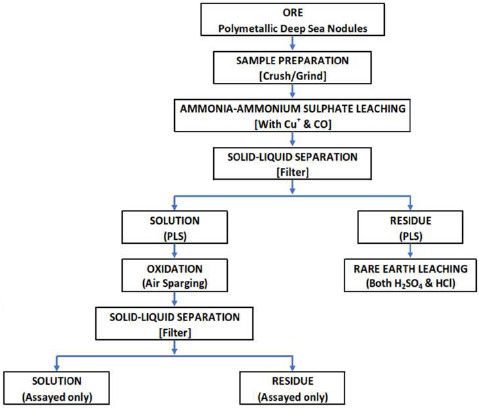
MML has conducted metallurgical testing on Cook Island nodules, which indicates good extraction using the Cuprion process. However, larger-scale testing is required to demonstrate economic viability. For Cook Islands nodules, Co is expected to be the most valuable metal, with demand currently driven by its use in special steels used in the aviation industry as well as battery cathodes.


Page 17 of 154


LOGO   

MINERAL RESOURCE ESTIMATE FOR THE EL3 COOK ISLANDS POLYMETALLIC NODULE DEPOSIT

MOANA MINERALS LTD


Factor


Initial Assessment

Environmental Compliance & Permitting   

There are no registered environmental liabilities in the Project area.


Activities under the Environmental Act and Environment (Seabed Minerals Activities) Regulations (2023) are managed under a tiered system: Tier 1 activities are managed under the exploration license, Tier 2 activities require Environmental Consent, and Tier 3 activities require an Environmental Permit after submission of an Environmental Impact Assessment (EIA).


For exploration activities, MML must provide environmental notice (e.g. environmental significance declaration) and an objectives plan prior to each cruise to the National Environmental Service and SBMA.


For activities including (trial) mining and mineral harvesting, MML needs to undertake an environmental risk assessment, environmental scoping exercise and EIA, and provide an Environmental Impact Statement (EIS), Environmental Management System including an Environmental Management and Monitoring Plan (EMMP), and closure plan. Environmental and compliance permitting is managed by the National Environment Services and the Seabed Minerals Authority.


Due to the nature of mineralization, no tailings will be produced during nodule harvesting. Any seawater collected during the harvesting process will be returned to the sea.

Other Relevant Factors    It is the opinion of RSC that all material information has been stated in the above sections of this TRS.
Capital Costs    No capital costs have been estimated for the Project.
Operating Costs    No operating costs have been estimated for the Project.
Economic Analysis    No economic or cash flow analysis for the Project has been completed as of the effective date of this Report.

1.6 Mineral Reserve Estimate

Not applicable to this TRS.

1.7 Capital & Operating Costs

Not applicable to this TRS.

1.8 Economic Analysis

Not applicable to this TRS.

1.9 Permitting Requirements

Not applicable to this TRS.

1.10 Conclusions & Recommendations

1.10.1 Conclusions

RSC has completed an MRE for MML’s polymetallic nodule project within EL3. RSC reviewed the available data, including historical sampling collected by JICA, samples collected by MML, SOPs, and QC data.

RSC conducted a review of the data quality (Section 8.6) and identified issues with the FFG and BC data. Video footage of the sampling was a critical component of the quality review process, as it allowed RSC to identify samples without sampling issues, and separate these from samples where issues had occurred.

Polymetallic nodule abundance and element grades vary throughout the Project area but are more consistent compared to the wider EEZ. The average nodule abundance in the Project area is 26.9 kg/m2; however, nodule abundance is higher in areas of abyssal plains. The nodules found in the Cook Islands are geochemically unique compared to other deposits due to their low Mn/Fe ratio and elevated Co grades. The average Mn/Fe ratio is 0.83, which indicates the nodules are formed via hydrogenetic processes. This is supported by nodule morphology (relatively smooth texture), and the low number of buried nodules recovered — most nodules are found on the surface of the seabed.


Page 18 of 154


LOGO   

MINERAL RESOURCE ESTIMATE FOR THE EL3 COOK ISLANDS POLYMETALLIC NODULE DEPOSIT

MOANA MINERALS LTD


RSC estimated nodule abundance and elemental concentrations using ordinary kriging. A range of block sizes and search parameters were assessed and optimized. A range of sensitivity testing was performed which indicated the estimation was sound and robust. The Mineral Resource has been classified following S-K 1300 definitions. The classification of the resource is based on sample quality, confidence in geological understanding, and on the quality of the estimate itself, as broadly determined during the validation process. Based on the review of all provided data and information, RSC regards the data as fit for the purpose of classifying Indicated and Inferred Mineral Resources.

RSC is of the opinion that the Indicated and Inferred Mineral Resource classifications are appropriate based on the informing data and underlying understanding of the mineralization and nodule abundance within the EL3 area at this stage of the Project. Furthermore, RSC is of the opinion that the EL3 area is of sufficient grade, quantity, and coherence to have RPEEE at this stage of the Project development. Further work is required, particularly additional sampling at a closer spacing, to enable detailed interpretation of domaining of the mineralization to inform advanced mine studies and economic evaluation.

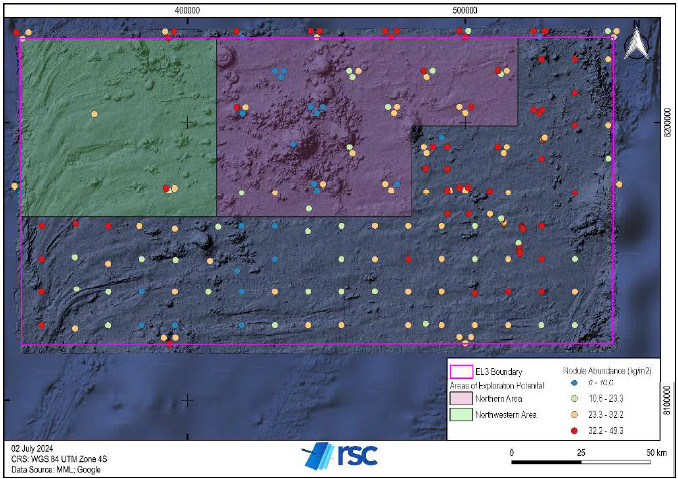
The exploration potential for polymetallic nodules in the Cook Islands EEZ is significant, especially within EL3, as indicated by exploration by JICA and MML. A large proportion of EL3 has been explored by 12-km grid sampling; however, the area in the north, particularly the northwest, remains under investigated.

1.10.2 Recommendations

Future exploration work should aim to:


increase sample density in the northwest, where the current sample spacing is ~50 km; and


increase sample density in the north, where the current sample spacing is ~25 km.

This exploration work would provide the basis for upgrading the Inferred portion of the Mineral Resource to indicated, on the condition that the quality of the data collected supports the upgrade. Infill sampling in the north will also provide additional sample support and validation to the historical sampling conducted by JICA.

With further exploration (i.e. infill sampling), and some management of the risks identified in Section 11.12, areas of the Project could be upgraded to the Measured category.

In addition, RSC makes the following recommendations.


Move BC operations to the port-side winch to reduce the impact of pitching and sea state on the BC sampler.


Modify the FFG basket to stop nodules rolling over the top of the basket.


Improve the quality of top shots by creating a shroud that sits on top of the BC to provide shade and prevent glare. The camera should also be mounted on a frame and connected to a computer. This will allow the geologists or camera operators to preview the photograph and review the quality of the photograph without having to remove the camera from the mount.


Ensure that all future samplers are equipped with a video camera to capture sampling footage.


Collect additional BC and FFG repeat pairs to increase the total number of sample pairs in order to statistically prove the robustness of both sampling methods.


Undertake polymetallic nodule sampling in the northwestern corner of EL3 to decrease sample spacing and increase confidence in the geological and grade continuity of this region of the Project area.


To undertake additional exploration with the purpose of upgrading a portion of the Mineral Resources to Measured, MML should undertake sampling based on a maximum sample spacing of 6 km × 6 km. Sampling strictly on a 6 km × 6 km grid does not guarantee MML a Mineral Resource classified in the Measured category, and classification of a mineral resource is based on a several factors including but not limited to sample spacing, data quality, grade and geological continuity and RPEEE.

RSC recommends the following plan of work, broken down into two phases of work, where the Phase 2 program is dependent on the success of Phase 1. Estimated costs are in USD.

Table 1-3: Proposed Phase 1 and 2 expenditures in USD.


Phase    Field    Details    Estimated Cost (USD)
1    Exploration/Sampling    Conduct a cruise to sample the northwestern corner of EL3 to decrease sample spacing and increase the geological and grade continuity of this region of the Project. Collect environmental sample data during the cruise to help inform environmental baseline studies.    500,000
Phase 1 Total          500,000
2    Exploration/Sampling    Conduct a cruise to collect close-space samples with the objective of defining a Mineral Resource in the Measure category.    1,5000,000
2    Mineral Resource    Conduct a Mineral Resource summary based on the sample data collected during the Phase 1 cruise.    75,000
Phase 2 Total          1,575,000


Page 19 of 154


LOGO   

MINERAL RESOURCE ESTIMATE FOR THE EL3 COOK ISLANDS POLYMETALLIC NODULE DEPOSIT

MOANA MINERALS LTD


2. Introduction

2.1 Registrant Information

Moana Minerals Limited (the Company, MML, or the Registrant), is a Cook Islands company and a wholly owned subsidiary company of Ocean Minerals, LLC (OML). MML is completing exploration work on the EL3 property (the Property), located in the EEZ of the Cook Islands in the South Pacific Ocean. This Initial Assessment and TRS were prepared for MML by RSC Consulting Ltd (RSC). The purpose of this TRS is to support MML’s disclosure of a Mineral Resource estimate (MRE) for the EL3 property for the year ending December 31, 2025. No Mineral Reserve estimate is reported in this Report. This TRS has been prepared in accordance with the U.S. Securities and Exchange Commission’s (SEC) Subpart 1300 of Regulation S-K, Disclosure by Registrants Engaged in Mining Operations and Item 601(b)(96) of Regulation S-K, Technical Report Summary.

2.2 Purpose & Terms of Reference

The purpose of this TRS is to report Mineral Resources for MML’s EL3 property.

The effective date of this TRS report is December 31, 2025. All material assumptions underlying the MRE are current as of the effective date of the report.

This TRS uses US English spelling and a combination of metric and imperial units of measure.

Tonnages are expressed as metric tons (t), unless otherwise stated. All currency amounts are in United States dollars (USD) unless otherwise stated. Except where noted otherwise, coordinates in this TRS are presented in metric units, using the WGS UTM Zone 4S coordinate system. The purpose of this TRS is to report Mineral Resources for MML’s EL3 property.

The interpretations and conclusions reached in this Report are based on current scientific understanding and the best evidence available to RSC at the time of writing. It is the nature of all scientific conclusions that they are founded on an assessment of probabilities and, however high the probabilities might be, make no claim for absolute certainty.

The ability of any person to achieve forward-looking production and economic targets depends on numerous factors beyond RSC’s control and that RSC cannot anticipate. These factors include, but are not limited to, site-specific mining and geological conditions, management and personnel capabilities, availability of funding to properly operate and capitalize the operation, variations in cost elements and market conditions, developing and operating the mine efficiently, unforeseen changes in legislation, and new industry developments. Any of these factors may substantially alter the performance of any mining operation.

2.3 Sources of Information

The information in this TRS is based on data supplied by MML.

MML provided the following data via access to its SharePoint folders:


standard operating procedures and method statements;


deployment data;


geological data including deck logging sheets, weighing log sheets, nodule description logs, and sedimentary logs;


a media drive including sampling videography, deck photographs, and tray photographs;


surveying data;


a GIS database; and


assay certificates.

RSC has endeavored to confirm the authenticity and completeness of the technical data upon which the Report is based by making all reasonable enquiries within the time available.

2.4 Qualified Persons

This Report was prepared by RSC, a third-party consulting firm comprising mining experts in accordance with §229.1302(b)(1)1. MML has determined that RSC meets the


Page 20 of 154


LOGO   

MINERAL RESOURCE ESTIMATE FOR THE EL3 COOK ISLANDS POLYMETALLIC NODULE DEPOSIT

MOANA MINERALS LTD


qualifications and relevant experience specified under the definition of Qualified Person (QP) in § 229.1300. Any references to the Qualified Person or QP in this report, are references to RSC and not to any individual employed at RSC.

2.5 Personal Inspection Summary

An RSC QP was onboard the MV Anuanua Moana for E1L2 from 13–26 May 2023. The QP monitored geological sampling and preparation and reviewed standard operating procedures (SOPs) and quality control (QC) processes. The QP did not conduct a further site visit; however, an RSC consultant was onboard MV Anuanua Moana for EXP4 from 8–30 November 2023. The RSC consultant remained on site in Rarotonga for an additional 10 days to conduct check measurements.

The RSC QP conducting the personal inspection meets the definition of QP defined in Subpart 229.1300 of Regulation SK, Disclosure by Registrants Engaged in Mining Operations (S-K 1300).

2.6 Previously Filed Technical Report Summary Reports

This is the first TRS filed for the EL3 property.


Page 21 of 154


LOGO   

MINERAL RESOURCE ESTIMATE FOR THE EL3 COOK ISLANDS POLYMETALLIC NODULE DEPOSIT

MOANA MINERALS LTD


3. Property Description

3.1 Location

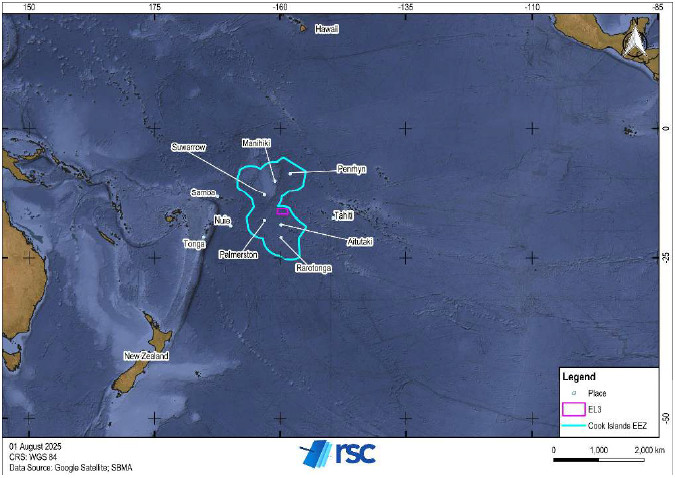
The Project is located within the EEZ of the Cook Islands, in the South Pacific Ocean (Figure 3-1). While the Project is confined to the boundary of EL3, which covers an area of 9,118 mi2, the Project is part of a wider known deposit of polymetallic nodules found within the Cook Islands’ EEZ. The Project is located on the seabed, more than 5,000 m below sea level. The Project is located 323 miles from Avarua, Rarotonga, 163 miles from Aitutaki, and 2,370 miles from Auckland, New Zealand.

The center of the Project is located at 16.5° S and 159.5° W.


LOGO

Figure 3-1: Location of the Project (EL3) in the South Pacific Ocean.

3.2 Mineral Tenure

EL3 was granted to MML, a wholly owned subsidiary Cook Islands registered company of Ocean Minerals, LLC (OML), on 23 February 2022 by the Seabed Minerals Authority (SBMA) on behalf of the Cook Island Government (Table 3-1). The license is valid for a term of five years. An application for license renewal can be made at least 90 days before the expiry of the license in line with Section 63 of the Seabed Minerals (Exploration) Regulations (2020).


Page 22 of 154


LOGO   

MINERAL RESOURCE ESTIMATE FOR THE EL3 COOK ISLANDS POLYMETALLIC NODULE DEPOSIT

MOANA MINERALS LTD


MML must comply with the Seabed Minerals Act (2019), Seabed Mineral (Exploration) Regulations (2020), and license’s term including continuously and actively conduct exploration in accordance with the approved work plan and comply with expenditure commitments outlined in the approved work plan. Failure to do so may lead to action being taken by the Authority (SBMA) under the Act, including but not limited suspension or cancellation of License.

MML submits detailed annual reports to the SBMA, which include financial statements on levels of expenditure on EL3. In the opinion of RSC, MML has made efforts in good faith to comply with the requirements of the approved work plan.

Table 3-1: Status of MML’s license.


License


License Name


Ownership


Commodities


Grant Date


Expiry Date

   Size (mi2)  

EL3

   Exploration License 3    100% Moana Minerals Ltd    Polymetallic nodules    February 23, 2022    February 23, 2027      9,118  

3.3 Royalties & Encumbrances

Royalties are dealt with in the Seabed Minerals (Royalties) Regulations 2013. The regulations state that holders of a mining license are liable for a royalty equal to 3% of the export value of minerals recovered under a mining license. The export value of minerals recovered is the free-on-board (FOB) price received. Transfer pricing considerations are included in Income Tax (Transfer Pricing) Regulations 2014.

Under the Seabed Minerals Act 2019, any royalties paid to the Crown or the Authority (Seabed Minerals Authority; SBMA) are to be managed by the Ministry of Finance and Economic Management separately from other public money within an established sovereign wealth fund.

The Income Tax Act (consolidated as of 2019) contains provisions concerning various tax issues, including:


tax payable by local companies (20%; all license holders are required to be local companies) as well as foreign contractors (28%);


deductions and exempt income (for example, deductions related to ongoing exploration and remedial work and environmental funds);


ring-fencing of accounts and income to jurisdiction;


write-downs and capital gains tax;


withholding tax; and mi2


additional profits tax, including adjustments and instalments.

3.4 Environmental Liabilities & Permits

There are no registered environmental liabilities in the Project area.

Activities under the Environmental Act and Environment (Seabed Minerals Activities) Regulations (2023) are managed under a tiered system: Tier 1 activities are managed under the exploration license, Tier 2 activities require Environmental Consent, and Tier 3 activities require an Environmental Permit after submission of an Environmental Impact Assessment (EIA).

For exploration activities, MML must provide environmental notice (e.g. environmental significance declaration) and an objectives plan prior to each cruise to the National Environmental Service and SBMA.


Page 23 of 154


LOGO   

MINERAL RESOURCE ESTIMATE FOR THE EL3 COOK ISLANDS POLYMETALLIC NODULE DEPOSIT

MOANA MINERALS LTD


For activities including (trial) mining and mineral harvesting, MML would need to undertake an environmental risk assessment, environmental scoping exercise and report, environmental impact assessment, environmental impact statement, environmental management system including an environmental management and monitoring plan, and closure plan. Guidelines regarding the various environmental assessments, plans and statements are reported on the SBMA website; however, some plans are still in the drafting process.

3.5 Significant Encumbrances to the Project

RSC is not aware of any significant encumbrances to the Project, and the exploration license remains in good standing as of the effective date of this TRS.

3.6 Other Significant Factors or Risks

RSC is not aware of any significant factors or risks that may affect access, title to the right, or ability to perform work on the Project.


Page 24 of 154


LOGO   

MINERAL RESOURCE ESTIMATE FOR THE EL3 COOK ISLANDS POLYMETALLIC NODULE DEPOSIT

MOANA MINERALS LTD


4. Accessibility, Climate, Local Resources, Infrastructure & Physiography

4.1 Accessibility

The Project area is only accessible via ship. Exploration operations are conducted by ocean-going vessels. There are no access restrictions within the Project. The area is open to shipping and fishing vessels; therefore, public notices to mariners are required to be filed for any deployment of equipment, moorings, or operations that could affect shipping.

Most vessel movements within the EEZ are through-traffic, typically traveling between the Americas and Southeast Asia, Australia, or traffic moving between island groups. Large numbers of vessels are tracked to the west of Cook Islands, in Samoa and to the east, near Tahiti. On a global scale, shipping and total vessel traffic in the EEZ are generally low, but commercial shipping is critical to the delivery of products to Cook Islands and the economy in general. Avatiu Harbour on Rarotonga is the main commercial harbor in Cook Islands and receives most of the SOLAS (Safety of Life at Sea Convention) vessels, including dry cargo, cruise ships and yachts.

Cook Islands Port Authority (CIPA) manages the international seaport in Rarotonga (Port of Avatiu) and is a 100% state-owned entity (Asian Development Bank, 2005). Reconstruction of Avatiu Harbour was completed in 2013 to provide a deeper harbor and increased capacity to cater for larger vessels. The Port of Avatiu is limited in size and infrastructure, which places restrictions on the size class of ships that can be accommodated. Two international shipping lines service Cook Islands on an approximate three-week cycle.

Island Councils administer unregulated harbor facilities on the other islands, with technical support provided by the Ministry of Infrastructure Cook Islands (ICI) and CIPA. Inter-island shipping is essential and is offered by the private sector, with the overall quality being at a low standard that requires improvement.

4.2 Climate

The Cook Islands lie within the extensive and persistent trade wind zone of the South Pacific. The area has a tropical, mild maritime climate (21–28°C) with a pronounced warmer, wet season during November to April, when two-thirds of the ~2,000 mm annual rain falls, and a cooler, dry season from May to October.

The warmer season coincides with the cyclone season for the South Pacific region. Cyclones tend to form to the far west of the northern Cook Islands and migrate toward the southeast, often reaching latitude 15°S if not further south.

The climate is often strongly influenced by large inter-annual variations and the El Niño Southern Oscillation phenomenon. During El Niño years, the southern Cook Islands experience a reduction of rainfall, by up to 60% of the annual rainfall, while in the northern Cook Islands rainfall increases by up to 200%. The situation reverses during the La Niña phase.

A climate risk study for the Cook Islands by Asian Development Bank (2005) focused on the potential for extreme wave and wind events primarily driven by tropical cyclones. Annually, the Cook Islands receive between zero and three cyclones, with an increase in tropical cyclone frequency during El Niño conditions.


Page 25 of 154


LOGO   

MINERAL RESOURCE ESTIMATE FOR THE EL3 COOK ISLANDS POLYMETALLIC NODULE DEPOSIT

MOANA MINERALS LTD


4.3 Bathymetry

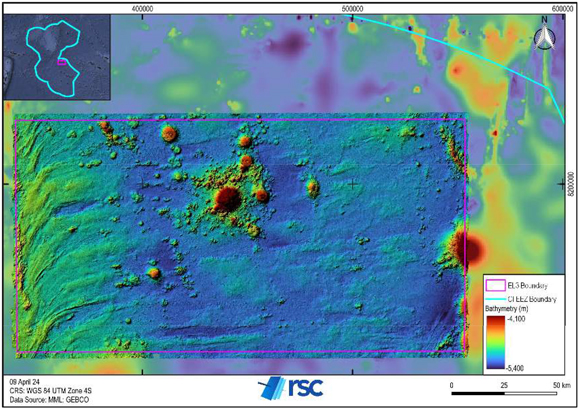
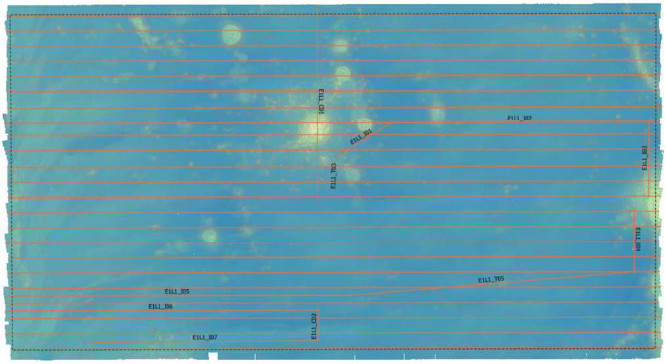
High-resolution (35 m) bathymetry is available for the Project area. The Project area comprises mainly low-lying abyssal plains, with a prominent seamount in the center (Figure 4-1). The eastern margin is marked by a north-trending ridge. To the west, northeast-trending structures splay off the Aitutaki Fault. Guyots are scattered around the area, and the bathymetry varies from approximately -4,100 m at the highest point of the central seamount to -5,400 m in the southeast valley.


LOGO

Figure 4-1: Bathymetric map of the Project area.

4.4 Local Resources & Infrastructure

The Project area is remote, with no services other than the equipment on board the vessel. The closest port is the Port of Avatiu, in Avatiu Harbour, Rarotonga. Ships can also anchor at the Arutanga Port, Aitutaki.

The island of Rarotonga hosts the Cook Islands international airport and has facilities including a hospital, food and trade stores, and has the highest population of the Cook Islands. The regional airport on Aitutaki operates daily flights to Rarotonga. Fuel is available in Rarotonga, although ships typically refuel in Papeete, Tahiti.

MML owns its own purposely fitted-out exploration vessel, MV Anuanua Moana, through its subsidiary Kiva Marine. The MV Anuanua Moana is equipped with three laboratories (geology, biology, chemistry), an online survey room, an electronic workshop, a tools container, a refrigerated container (reefer), a cool-water container, sampling equipment (box core, freefall grab, benthic sled), a remotely operated vehicle, multiple winch and crane systems, and bathymetric survey equipment. The vessel can house up to 42 personnel and transits at 12 knots.


Page 26 of 154


LOGO   

MINERAL RESOURCE ESTIMATE FOR THE EL3 COOK ISLANDS POLYMETALLIC NODULE DEPOSIT

MOANA MINERALS LTD


5. History

5.1 Tenure & Operating History

The first cruise programs dedicated to investigating nodules in the Cook Islands and adjacent regions were mounted in the mid-1970s by the New Zealand Oceanographic Institute. As a precursor to this, the Institute compiled all available data into maps of the nodule properties in the region, including their Mn, Fe, Ni, Co, and Cu contents, and their distribution (Glasby et al., 1974). Further cruises were undertaken in the late 1970s, targeting polymetallic nodules in the South Penrhyn Basin and Aitutaki Passage. Between 1976 and 1981, the Committee for Coordination of Joint Prospecting for Minerals Resources in South Pacific Offshore Areas (CCOP/SOPAC) carried out several cruises in the Cook Islands region. During these cruises, nodules were collected, and the results of their analyses served to define areas of potential economic interest to be surveyed in more detail by later cruises under the Japan-SOPAC Cooperative Study on Deep Sea Mineral Resources in the South Pacific (Cronan, 2013).

There have been several expeditions in the Cook Islands for polymetallic nodules, which are documented in (Tay et al., 2023b), with three historical cruises taking samples from within EL3.

5.2 Exploration History

The only exploration that predates that by MML took place between 1986 and 2000 and was carried out by JICA.

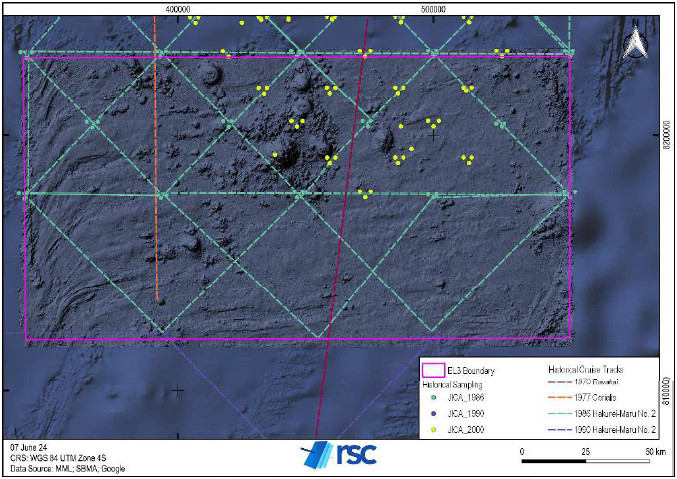
In response to the request of CCOP/SOPAC (see section 5.1), the Japanese Government conducted seabed mineral exploration in the South Pacific. Implementation of the survey was consigned to the Japan International Cooperation Agency (JICA) and the Metal Mining Agency of Japan (MMAJ) to execute the survey. JICA conducted three expeditions to the Project area using the RV Hakurei Maru No. 2 in 1986, 1990 and 2000 (Figure 5-1). An in-depth summary of the JICA sampling program is given in Tay et al. (2023a). A short summary is presented below.

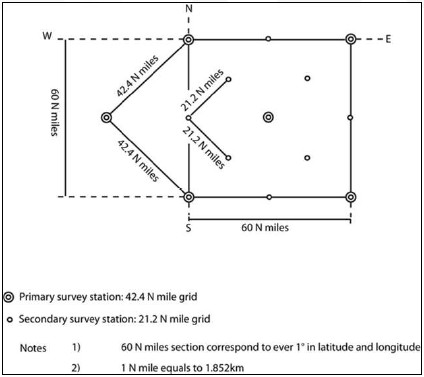
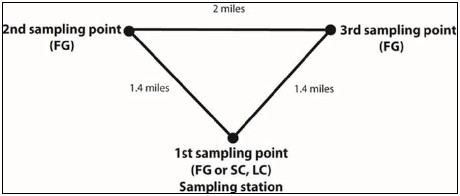
Samples were collected by freefall grab (FFG), box core (BC), long core (LC) and armed dredge (AD; Table 5-1). Survey stations were placed based on datum lines every 1° (111 km) in latitude and longitude (Figure 5-2). Infill sites were placed on a 39.3-km grid. Three samples (FFG or BC) were collected at each survey station in the form of an inverted triangle (Figure 5-3). The base sampling point of each station was set at the southern apex of the triangle, and the two other samples were collected at the remaining apexes of the triangle. Sampling points were ~2.6 km apart. Sampling was conducted in a clockwise direction.

Table 5-1: Summary of historical sample type by expedition.


Cruise

   No. of FFG
Samples
     No. of BC
Samples
     No. of LC
Samples
     No of AD
Samples
     Total Number of
Samples
 

JICA 1986

     27        0        0        0        27  

JICA 1990

     6        0        0        0        6  

JICA 2000

     27        2        2        2        33  

Total Historical Samples

     60        2        2        2        66  


Page 27 of 154


LOGO   

MINERAL RESOURCE ESTIMATE FOR THE EL3 COOK ISLANDS POLYMETALLIC NODULE DEPOSIT

MOANA MINERALS LTD


LOGO

Figure 5-1: Historical samples and cruise tracks within the Project area.


LOGO

Figure 5-2: Standard survey station layout conducted by JICA.


Page 28 of 154


LOGO   

MINERAL RESOURCE ESTIMATE FOR THE EL3 COOK ISLANDS POLYMETALLIC NODULE DEPOSIT

MOANA MINERALS LTD


LOGO

Figure 5-3: Standard sampling layout conducted by JICA at each station.

Sample locations were collected by different satellite systems for each expedition, with accuracy improving with each survey (Table 5-2). Sample locations were determined by the ship’s location during deployment. It is noted that sampling equipment can drift (including tethered sampling methods). Sample location precision is estimated to be in the order of 100–500 m against sample spacing of ~25 km.

Table 5-2: JICA-MMAJ navigation systems.


Expedition


Satellite system


Comments

1986    Navy Navigation Satellite System (NNSS) or Transit    Corrected positions between updates from the NNSS (Doppler rangefinder) indicate a surface accuracy of 200–500 m. The system likely used WGS72 as the geographic coordinate system (GCS).
1990    GPS + NNSS    GPS is likely Navstar. Accuracy of the system at the time of surveying is likely to be ~ 200 m. WGS84 as GCS.
2000    GPS + GLONASS    Accuracy of the system at the time of surveying is likely to be 20–60 m. WGS84 as GCS.

During the 1986 and 1990 cruises, the samples were assayed by X-ray fluorescence (XRF) onboard the vessel for Cu, Co, Fe, Mn and Ni. Samples collected during the 2000 cruise were analyzed at ALS Chemex, Canada, by inductively coupled plasma emission spectroscopy for Cu, Co, Fe, Mn, Ni, Ti, Si, Al, Ca, Na, K, and P.

JICA expeditions were also equipped with deep-sea cameras that collected a photograph of the mineralized seabed prior to a sample being collected.

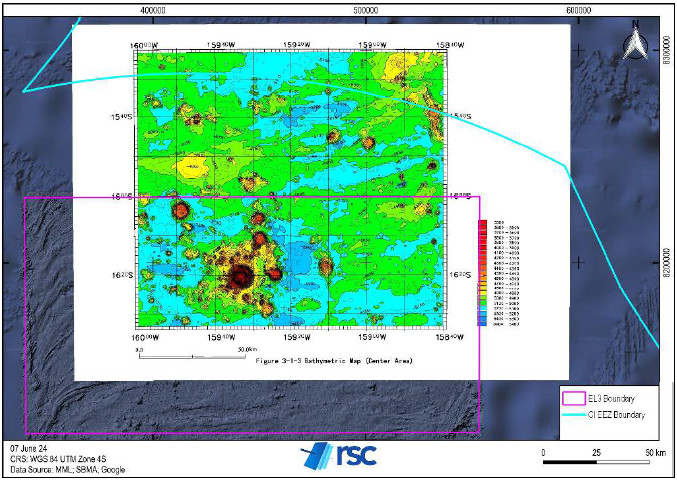
For the 1986 expedition, the RV Hakurei Maru No.2 was equipped with a multi-frequency exploration system (MFES) to collect high-resolution bathymetry data of an area of the Cook Islands EEZ known as the Central Area or 16-159 (Figure 5-4).


Page 29 of 154


LOGO   

MINERAL RESOURCE ESTIMATE FOR THE EL3 COOK ISLANDS POLYMETALLIC NODULE DEPOSIT

MOANA MINERALS LTD


LOGO

Figure 5-4: High-resolution bathymetric map over the 16-159 Area produced from MFES data collected during the JICA 2000 cruise.

5.3 Production History

To date, there has been no commercial production of nodules from the Project area.


Page 30 of 154


LOGO   

MINERAL RESOURCE ESTIMATE FOR THE EL3 COOK ISLANDS POLYMETALLIC NODULE DEPOSIT

MOANA MINERALS LTD


6. Geological Setting, Mineralization & Deposit

6.1 Regional Geology

6.1.1 Global Distribution of Nodules

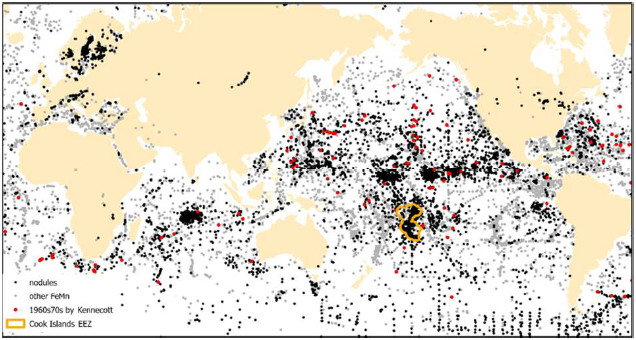
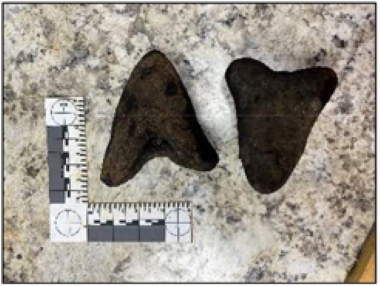
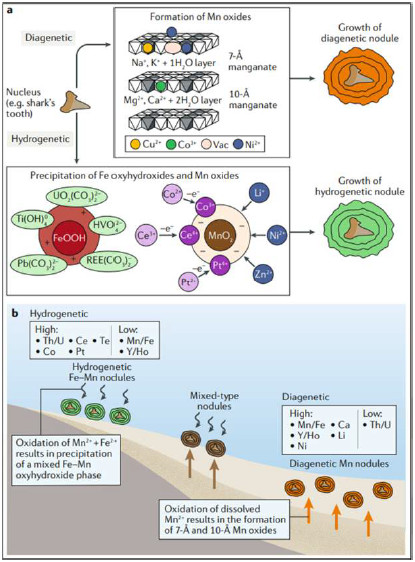
Polymetallic nodules with various grades of base metals are found in submarine settings worldwide (Monget, 2015). This widespread distribution was recognized by the early 1970s when Kennecott Exploration surveyed all the major ocean basins (Figure 6-1). Nodules form at a wide range of depths, from 4,000–6,000 m below sea level in the mid Pacific to 200 m below sea level in the Gulf of Bothnia (Boström et al., 1982) and 30 m in the Baltic Sea (Anufriev and Boltenkov, 2007). The location of nodule formation is reflected in nodule chemistry. Nodules with relatively high Co grades are found within the EEZ (Table 6-1), often accompanied by high nodule abundances.


LOGO

Figure 6-1: Fe-Mn crust and nodule samples collected from around the world. The Cook Islands EEZ is outlined in orange.

Sourced from Kennecott Corporation (1965) and Monget (2022).

Table 6-1: Summary of global nodule grades. From Tay et al. (2023b).


Element (wt.%)

   All Pacific
Ocean
     Cook Islands      South Penrhyn
Basin–Aitutaki
Passage
     Clarion-
Clipperton
Zone
     Atlantic
Ocean
     Indian
Ocean
 

Mn

     20.1        16.3        16.2        26.3        13.3        15.3  

Fe

     11.4        15.8        16.5        6.6        17.0        14.2  

Ni

     0.76        0.44        0.37        1.20        0.32        0.43  

Cu

     0.54        0.27        0.21        0.98        0.13        0.25  

Co

     0.27        0.38        0.42        0.20        0.27        0.21  


Page 31 of 154


LOGO   

MINERAL RESOURCE ESTIMATE FOR THE EL3 COOK ISLANDS POLYMETALLIC NODULE DEPOSIT

MOANA MINERALS LTD


6.1.2 Tectonic Setting

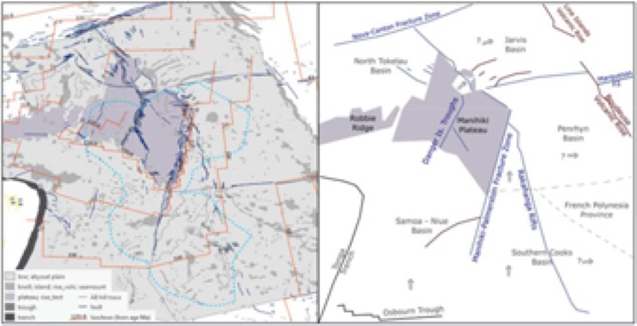
The Cook Islands include some of the oldest seafloor known (90–124 Ma) (Müller et al., 2016). To the northwest, the Manihiki Plateau is dated at ~124–123 Ma (Taylor, 2006; Timm et al., 2011) and might be part of a much larger submarine large igneous province that rifted apart shortly after its formation. The plateau has boundary faults and horsts on its northern and eastern sides as well as internal and broadly sub-parallel rift zones (Figure 6-2) (Winterer et al., 1974). Dating of the region is compromised by a lack of detailed seabed magnetic data, and much of the formation formed during the Cretaceous long normal period (Chron 34, 124.6–84 Ma).


LOGO

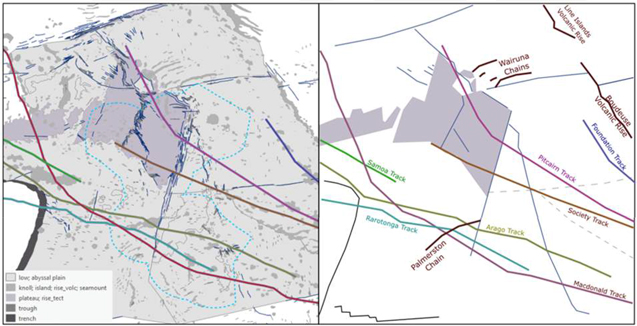
Figure 6-2: Tectonic setting of the Cook Islands EEZ and surrounding seabed.

Volcanic edifices are superimposed onto the seabed geology (Figure 6-3). These include isolated chains of seamounts and knolls as well as more continuous volcanic rises. The chains are in a variety of orientations, but predominantly west-northwest trending and some are interpreted to have resulted from hotspot activity (Wessel and Kroenke, 2008; Jackson et al., 2020). Knolls and seamounts are found on the plateau as well as the abyssal plain, not least in the western Manihiki Plateau.


Page 32 of 154


LOGO   

MINERAL RESOURCE ESTIMATE FOR THE EL3 COOK ISLANDS POLYMETALLIC NODULE DEPOSIT

MOANA MINERALS LTD


LOGO

Figure 6-3: Volcanic chains and hotspot tracks. Tracks after Wessel and Kroenke (2008) and Jackson et al. (2020). Refer to Figure 6-2 for the names of other features.

6.1.3 Ocean Currents

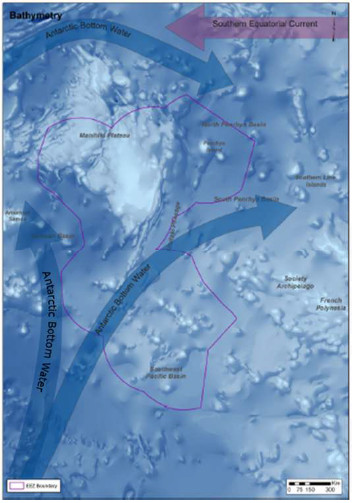
Two major oceanic currents supplying well-oxidized bottom water are thought to influence mineralization in the EEZ (Glasby et al., 1986). The westward-flowing Southern Equatorial Current system (Figure 6-4) is derived from a divergence along the equator that leads to the upwelling of nutrient-rich waters, stimulating high biological productivity. The current system is the northern limb of an anticlockwise circulating gyre within which the EEZ sits. Biological productivity in the southern part of the EEZ is low (Lutz et al., 2007; Cronan, 2013).

The Antarctic Bottom Water, which flows between the seafloor and ~3,500 m, has been inferred to flow to the northeast along the Aitutaki Passage (Usui, 1983), along the ridge immediately south of the Nova-Canton Trough (Yamazaki, 1992), and around the northeastern margin of the Manihiki Plateau to enter the North Penrhyn Basin (Figure 6-4). Increased flow of the Antarctic Bottom Water during the Paleogene or Cretaceous has been attributed to the formation of polymetallic nodules (Usui, 1994).


Page 33 of 154


LOGO   

MINERAL RESOURCE ESTIMATE FOR THE EL3 COOK ISLANDS POLYMETALLIC NODULE DEPOSIT

MOANA MINERALS LTD


LOGO

Figure 6-4: Schematic of ocean currents in and near the EEZ. Source: Cronan (2013).

6.1.4 Seabed Morphology

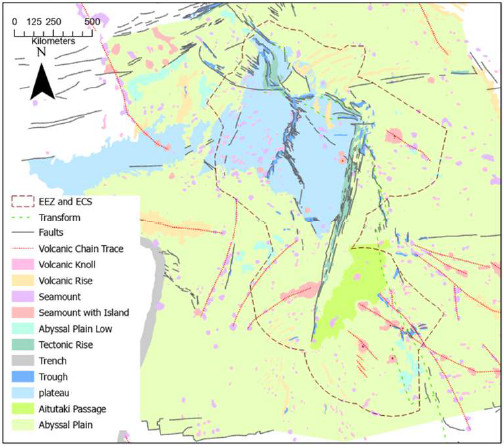
The 2021 GEBCO grid was used as the basis for a 1:4,000,000 scale geomorphological map of the Cook Islands seabed

(Figure 6-5). This was supplanted with multi-beam echosounder bathymetric data, regional magnetic field data, and mapping

from the literature review.

Mapped units comprise the following:


Abyssal plains: areas with limited relief except for abyssal hill traces and small knolls. Typically presented as “basins” bound by major features, e.g. transform fracture zones, plateaus, and volcanic rises. Interpreted to be the domain containing significant polymetallic nodules within the EEZ.


Abyssal plain lows: restricted areas of abyssal plains characterized by slightly greater depth (100–300 m) than adjacent plains.


Knolls: probable volcanic edifices <1,000 m, found on plains and plateaus. Only the larger knolls were mapped, either as singular (usually circular) or compound forms. Found among seamount chains but may form their own chains.


Seamounts: probable volcanic edifices >1,000 m, found on plains and plateaus. Typically form chains of various orientations, including the Hawaiian-Emperor orientation. Chains often grade into volcanic rises. Mapped as singular (usually circular) and compound forms. Islands within the EEZ are mapped seamounts that breach the sea surface. The existence of flat-topped edifices located on the Manihiki Plateau may support a past shallower position.


Page 34 of 154


LOGO   

MINERAL RESOURCE ESTIMATE FOR THE EL3 COOK ISLANDS POLYMETALLIC NODULE DEPOSIT

MOANA MINERALS LTD


Volcanic rises: typically, elongated rises of probable volcanic origin. Merge into volcanic chains and compound forms of seamounts. Some are very extensive, including the Boudeuse Volcanic Rise at the eastern limit of the Penrhyn Basin. Volcanic chains are lineaments of interrupted alignments of seamounts and knolls.


Plateaus: extensive areas of seafloor elevated (500–2,000 m) relative to plains. Do not present evidence of abyssal hills; all units are likely to be part of the much older Manihiki Plateau, which is known to have significant sediment cover (in some places ~1 km thick). Some parts of the plateaus have more knolls; it is not known if this is due to later volcanic activity or differing amounts of sediment cover.


Tectonic rises: typically, elongate rises of probable tectonic origin along the northern and eastern edges of the Manihiki Plateau and along the Manihiki-Palmerston Fracture Zone, which trends to the southeast of the plateau.


Troughs: narrow/elongated and typically aligned depressions that are 500–1,000 m deep. Typically cut both plains and plateaus.


Mapped faults: mapped breaks in the seabed bathymetry either at a high angle to prevailing abyssal hill traces or of too great a magnitude to be the normally faulted escarpments of abyssal hills.


LOGO

Figure 6-5: Seabed geomorphology for the Cook Islands and surrounds. Source: Browne et al. (2023). EEZ: exclusive economic zone; ECS: Extended Continental Shelf application.


Page 35 of 154


LOGO   

MINERAL RESOURCE ESTIMATE FOR THE EL3 COOK ISLANDS POLYMETALLIC NODULE DEPOSIT

MOANA MINERALS LTD


6.2 Local & Property Geology

The majority of the Project area consists of relatively flat abyssal plains, with sea knolls and seamounts randomly scattered across the Project, but with a higher concentration in the center and center-west of the Project.

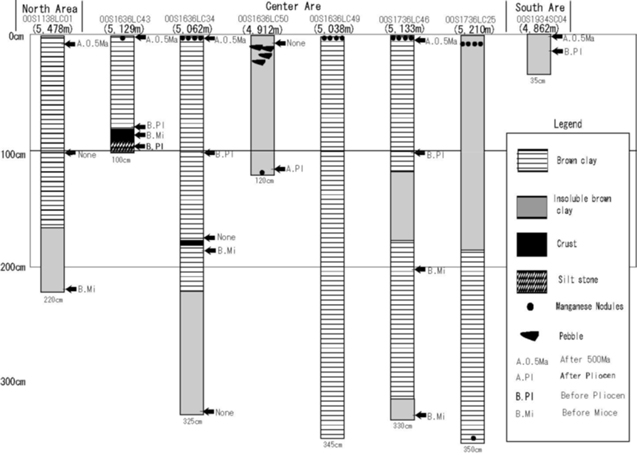
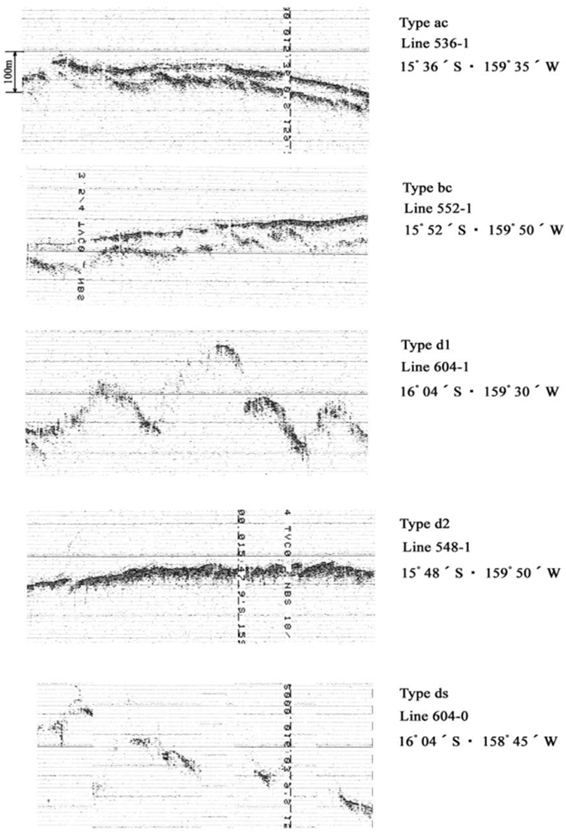
Brown clay is the predominant sediment type (Figure 6-6). Deposition began during the pre-late Miocene, with the surface sediment likely to be deposited within the last 500 kyr (JICA-MMAJ, 2001). Sub-bottom profiling indicates that abyssal plains are covered by unconsolidated sediments, ≤20 m thick, and rarely exceed 40 m. The central seamount is classified as acoustic type d1 (see JICA-MMAJ, 2001), which represents exposed rocks. There is an acoustic transition zone (type d2) between the flat plains and seamount/knoll zones that is inferred as exposed rocks, which may be covered by consolidated sediment or crust-like material (Figure 6-7) (JICA-MMAJ, 2001). Any sediment in this area, if present, would be thin.


LOGO

Figure 6-6: Gravity cores collected by JICA-MMAJ in the 16-159 Area or Central Area, which overlaps with the Project area. Brown clay and insoluble brown clay are the most common types of sediment. From JICA (1984).


Page 36 of 154


LOGO   

MINERAL RESOURCE ESTIMATE FOR THE EL3 COOK ISLANDS POLYMETALLIC NODULE DEPOSIT

MOANA MINERALS LTD


LOGO

Figure 6-7: Sub-bottom profiles from JICA-MMAJ (2001).


Page 37 of 154


LOGO   

MINERAL RESOURCE ESTIMATE FOR THE EL3 COOK ISLANDS POLYMETALLIC NODULE DEPOSIT

MOANA MINERALS LTD


6.3 Mineralization

The mineralization occurs at the water-sediment interface on the seafloor, in the form of polymetallic nodules that are significantly enriched in Co, Ni, and Cu. Locally, a minority component of the nodules occurs within the sediment, up to 30 cm deep. Polymetallic nodules are ubiquitous on the abyssal plains surrounding the Cook Islands, mostly at depths between 4,800 and 5,200 m (Kenex, 2014), in the shape of nodules fields that are continuous on a scale of tens of kilometers, essentially forming 2D deposits that trace the sediment-water interface.

The continuity of the mineralization on a regional scale (10s of km) is one of the main characteristics of this deposit type and a direct result of the factors controlling the mineralization also operating a regional scale (see section 6.4). Within areas that are conducive to nodule formation, smaller-scale (several 100s of m) features can be present (e.g. knolls, escarpments, sub-circular depression and grooves) that prevent or negatively influence nodule formation. In general, within the abyssal plains, the areal extent of these smaller-scale features tends to be marginal compared to the areal extent of the nodule field.

Because the thickness of the mineralized layer (up to several decimeters) is five orders of magnitude less than the lateral extent of the nodule fields (several 10s of km), no meaningful cross sections can be drafted. The closest alternative to a cross section is formed by a series of stratigraphic columns as presented in Figure 6-6.

Four main parameters determine the environment of deep-sea nodule growth:


local sedimentation rate;


sedimentary facies related to carbonate compensation depth (CCD) and biological productivity in surface waters;


relative topography; and


bottom current activity (Halbach et al., 1981; von Stackelberg and Beiersdorf, 1991).

Variations in these parameters result in the growth of two different kinds of nodules: hydrogenetic and diagenetic. Nodules in Cook Island waters, including the Project area, are typically derived from hydrogenetic growth. The process for the formation of any type of ferromanganese precipitate is distinct from the process of enriching them in base metals such as Co, Ni and Cu.

Sedimentary hiatuses are an important control on the formation of nodules. Hydrogenetic nodule activity typically occurs in areas of negligible rates of sedimentation (von Stackelberg and Beiersdorf, 1991; Hein et al., 2020). Nodule formation also requires operating mechanisms that prevent the nodules from being buried or becoming a solid crust. Biological activity and seabed currents are the dominant controls on nodule formation in the area (Parianos et al., 2021).

Nodule abundance is influenced by local and regional topography as well as seafloor morphology. Abyssal plains are typically associated with abundant nodule formation (average grade 28.7 kg/m2). These flat plains consist of soft pelagic clays, where the sedimentation rate is low. The size, shape, and abundance of nodules vary as the topography becomes more complex, i.e. on seamounts or sloped terrain.

Nodules with a relatively high Co grade (>0.26% Co) are found in the central Cook Islands (including the Project area). The higher grades are likely due to a high proportion of hydrogenetic growth, promoting the relative accumulation of Co ions in the oxic vernadite crystal structure (Fe is >13%) and a highly oxygenated bottom water mass (assumed to be the Antarctic Bottom Water). Similar controls on mineralization are described for ferromanganese crusts on seamounts and guyots where Co grades are typically >0.5% and have reported >1% Co (Hein and Morgan, 1999; Hein and Koschinsky, 2014).

In the northeastern Cook Islands, higher Ni and Cu grades are associated with higher primary productivity (surface plankton). Net export of this may have also helped lead to sub-oxic conditions and higher Ni and Mn grades, similar to those described in the CCZ (Lipton et al., 2016).

6.4 Mineral Deposit Model & Known Comparable Deposits

Polymetallic nodule deposits form at almost all depths and latitudes in all the world’s oceans and seas, including the CCZ, Peru Basin, Central Indian Ocean, Southwest Atlantic Ocean, and the Arctic Ocean. The Cook Islands deposit is distinguished by the high Co grades (>0.26%) and high nodule abundances (>20 kg/m2).

Polymetallic nodule deposits mainly occur below the CCD (~3,500–4,000), in areas with low sedimentation rates typically associated with argillaceous and siliceous oozes in abyssal plains of oceanic basins. A sedimentation rate of <10 mm/kyr is required to prevent the growing nodules from being buried, considering their extremely slow growth rate (Hein et al.,


Page 38 of 154


LOGO   

MINERAL RESOURCE ESTIMATE FOR THE EL3 COOK ISLANDS POLYMETALLIC NODULE DEPOSIT

MOANA MINERALS LTD


2020). Bioturbation likely plays an important role in keeping nodules at the sediment-water interface. Nodules can also be found in the top decimeters of sediment (Heath, 1979; Piper and Fowler, 1980; Kerr, 1984; Sanderson, 1985; McCave, 1988; Banerjee, 2000; Dorgan et al., 2005; Hoffert, 2008). The accumulation and degradation of organic matter at the sediment-water interface is a source of the nodule’s elemental content (e.g. Mn, Fe, Co, Ni, Cu) (von Stackelberg and Beiersdorf, 1991; Skornyakova and Murdmaa, 1992; von Stackelberg, 2000; Hoffert, 2008).

Polymetallic nodules exhibit concentric layering, which indicates a gradual accretion over time. The layers are composed of various amounts of Mn- and Fe-rich minerals of different types and textures. Manganese is very mobile in seawater and can readily oxidize to Mn2+. Polymetallic nodules usually grow around a nucleus of a variable nature, such as a rock fragment, volcanic material, bone, tooth, or other nodules (Figure 6-8). The growth rate is estimated to be ~1–10 mm/myr based on nodule geochronology (Somayajulu, 1967; Guichard et al., 1978; Macdougall, 1979; Finney et al., 1984; Anufriev et al., 1996; Bollhöfer et al., 1999). This growth rate is 1,000 times slower than the rate of sedimentation, which raises the problem of maintaining nodules at the sediment-water interface. Variations in nodule growth rate can be linked to changes in climate including periods of glaciation (Segl et al., 1989; Han et al., 2003).


LOGO

Figure 6-8: Nodules recovered from the Project area. Mineralization nucleated around a megalodon tooth.

Most nodules are formed by a combination of hydrogenetic and diagenetic growth. In the first case, the minerals precipitate from cold ambient seawater, and in the second from pore waters within the sediment (Hein and Koschinsky, 2014; Hein et al., 2020). The metals in seawater are concentrated by adsorption onto ultrafine particles of Fe- and Mn-oxides (nanoparticles) that are attracted electrostatically to one another in the water column. The Mn-oxide particles have a negative surface charge and so scavenge other trace elements as they form, especially positively charged ions such as Co, Ni and Cu that are also present in seawater in trace concentrations. The Fe-oxide particles, in contrast, have a slight positive surface charge and attract negative ions in seawater, such as the oxyanions Mo, V, As, and some REEs (Figure 6-9). Diagenetic precipitation within the sediment occurs under oxic or suboxic conditions from pore fluids that consist of seawater modified by chemical reactions within the sediment. In the Cook Islands, nodules that are derived from a hydrogenetic process are common, whereas nodules found in the CCZ typically represent a mixed origin. These ‘mixed’ nodules usually show an equatorial rim that separates the hydrogenetic from the diagenetic hemisphere (Halbach et al., 1981).


Page 39 of 154


LOGO   

MINERAL RESOURCE ESTIMATE FOR THE EL3 COOK ISLANDS POLYMETALLIC NODULE DEPOSIT

MOANA MINERALS LTD


LOGO

Figure 6-9: (a) Schematic illustrating the formation of Mn-oxides and Fe-oxyhydroxides. Positively charged ions are attracted to the negatively charged surface of Mn-oxides, whereas negatively charged ions sorb onto the surface of positively charged Fe-oxides and oxyhydroxides. (b) Schematic illustrating the formation of hydrogenic, diagenetic and mixed-type nodules and the variation in chemistry. From Hein et al. (2020).

The polymetallic nodules in the Project area are part of the wider Cook Island polymetallic nodule deposit. The largest known deposit is located between the Clarion and Clipperton Fracture Zones in the North Pacific Ocean, between Hawaii and Mexico. Of all nodule deposits globally, the CCZ nodule deposit has been the most extensively researched. The deposit was first identified in the late 1880s, and commercial-focused exploration began in the 1960s. Exploration is now overseen by the International Seabed Authority, which regulates deep sea exploration in international waters. As of June 2024, the International Seabed Authority has issued 17 exploration contracts.

Nodule abundance and geochemistry vary both between and within deposits. A summary of global nodule geochemical grades is presented in Table 6-2.


Page 40 of 154


LOGO   

MINERAL RESOURCE ESTIMATE FOR THE EL3 COOK ISLANDS POLYMETALLIC NODULE DEPOSIT

MOANA MINERALS LTD


Table 6-2: Summary of global nodule grades. Modified from McKelvey et al. (1983). Data for the Cook Islands and South Penrhyn Basin–Aitutaki Passage are summarized from the dataset used in this Project.


Element (wt.%)

   All Pacific
Ocean
     Cook Islands      South Penrhyn
Basin–Aitutaki
Passage
     Clarion-
Clipperton
Zone
     Atlantic Ocean      Indian Ocean  

Mn

     20.1        16.3        16.2        26.3        13.3        15.3  

Fe

     11.4        15.8        16.5        6.6        17.0        14.2  

Ni

     0.76        0.44        0.37        1.20        0.32        0.43  

Cu

     0.54        0.27        0.21        0.98        0.13        0.25  

Co

     0.27        0.38        0.42        0.20        0.27        0.21  


Page 41 of 154


LOGO   

MINERAL RESOURCE ESTIMATE FOR THE EL3 COOK ISLANDS POLYMETALLIC NODULE DEPOSIT

MOANA MINERALS LTD


7. Exploration

7.1 Bathymetry

In 2023 (Expedition 1, Leg 1), high-resolution (35 m) bathymetric and backscatter data were collected using a hull-mounted Kongsberg EM 304 Mk 11 multibeam echosounder (MBES) with an operating frequency of 20–32 kHz. As each line of data was collected, it was processed immediately to check for any gaps and the overall quality of the data, enabling almost real-time data collection corrections to be conducted.

Survey lines were run east–west (Figure 7-1). A line spacing of 5,000 m was selected based on the average beam swath size of 6,000 m to ensure there was adequate overlap between lines. North–south cross lines in the center of the Project were collected as verification. Infill lines were collected to fill any holes in the data.

A total of 5,007 line-km of survey data was collected including 561.63 km of infill and crossline data. Survey lines were conducted at a speed of 8 knots. The MBES was operated at 26 kHz nominal frequency with 65° total swath angle, resulting in ~7,200 m swath in the deepest areas and ~5,100 m swath in the shallowest areas encountered. Data coverage overlap between lines was between 25%–30%.

Bathymetric and backscatter data were processed using Caris HIPS 11.4.22. Bathymetry data were re-processed to produce slope maps for EL3.


LOGO

Figure 7-1: MBES survey lines.From van Eck (2023a).


Page 42 of 154


LOGO   

MINERAL RESOURCE ESTIMATE FOR THE EL3 COOK ISLANDS POLYMETALLIC NODULE DEPOSIT

MOANA MINERALS LTD


The bathymetry outlines the seamounts in the center of the Project area, as well as ridges to the east and west.

A slope analysis was run on the bathymetric data. To remove the background “noise”, a gaussian filter was applied to the data and resampled at 500-m resolution. The analysis was run at slope thresholds of 5°, 7°, and 10° (Figure 7-2). Eighty-nine per cent of the Project area has a slope of <10° (Table 7-1).


LOGO

Figure 7-2: Project bathymetry.

Table 7-1: Summary of slope analysis.


Slope Threshold

   Area greater than
slope threshold
     Percentage of area
below slope
threshold
 

     5,255        78

     3,783        84

10°

     2,576        89

7.1.1 Geomorphological Domains

Odyssey Marine used the backscatter, slope and rugosity data to create a geomorphological domain map for EL3 (Figure 7-3). This resulted in the classification of 11 geomorphological domains: abyssal hill, bench, caldera, depression, guyot, hill, incline, plain, ridge, seamount and valley (Figure 7-3A). The predominant geomorphological domain is abyssal plains, which is typically associated with high nodule abundance.


Page 43 of 154


LOGO   

MINERAL RESOURCE ESTIMATE FOR THE EL3 COOK ISLANDS POLYMETALLIC NODULE DEPOSIT

MOANA MINERALS LTD


RSC simplified the domain map to aid with geological domaining (Figure 7-3B).


LOGO

Figure 7-3: Geomorphological domain maps for EL3. A) Geomorphological domain map created by Odyssey Marine; B) simplified version created by RSC.


Page 44 of 154


LOGO   

MINERAL RESOURCE ESTIMATE FOR THE EL3 COOK ISLANDS POLYMETALLIC NODULE DEPOSIT

MOANA MINERALS LTD


7.2 Seabed Sampling

7.2.1 Research Cruise 1 (RC01)

At the end of 2019, MML’s parent company OML conducted its first expedition to what is now called EL3. Using the MV Grinna II, a short campaign of FFG sampling was conducted, resulting in the collection of 50 FFG samples at five sites. At each site, 10 FFG samplers were deployed one after the other. After the tenth FFG sampler was deployed, the ship turned around to prepare for the recovery of all 10 grabs. All FFG samplers were successful, collecting over 250 kg of nodules.

Two nodules were sent off for X-ray diffraction (XRD), quantitative evaluation of minerals by scanning electron microscopy (QEMSCAN®) and scanning electron microscope (SEM) imaging.

7.2.2 Expedition 1, Leg 2

Expedition 1, Leg 2 (E1L2) was conducted during May–June 2023. The expedition focused on refining sampling practices, data management associated with BC, FFG and benthic sled deployments. A key objective was working through obtaining environmental data without compromising the quality of either the geological/resource or the environmental data.

Sampling was conducted on an 8-km grid. Sites were grouped in threes, forming eight triads. At each site, two FFG samplers were deployed. In total, there were 17 successful FFG samplers from 20 deployments sampling nine discrete sites.

Five BC deployments were conducted in a dice five pattern; however, only two successfully returned a sampling containing polymetallic nodules. Failed BC deployments were a result of either incorrect set-up of the trigger mechanism or the vessel applying horizontal force on the trigger mechanism. Video footage indicates the BC was penetrating the seabed sediment.

Nodules and sediment were sampled from the FFG and BC samples as outlined in section 8.

7.2.3 Expedition 2

Expedition 2 (EXP2) was conducted in August 2023. During the expedition, the ROV conducted three operational dives, up to -5,065 m depth, with the longest dive lasting 11 hours and 50 minutes. Tests were also run on the ROV to ensure that all systems (lights, cameras, and manipulator arm) were working.

The benthic sled was deployed twice, collecting an estimated 100 kg bulk sample for metallurgical purposes. The MBES runs continuously when the ship is operating, resulting in an additional 672 line-km of bathymetric data.

7.2.4 Expedition 3

Expedition 3 (EXP3) was conducted in late August 2023. The benthic sled was deployed 12 times, collecting a 5.6-t bulk nodule sample. An additional 1,349 line-km of bathymetric data were collected by MBES.


Page 45 of 154


LOGO   

MINERAL RESOURCE ESTIMATE FOR THE EL3 COOK ISLANDS POLYMETALLIC NODULE DEPOSIT

MOANA MINERALS LTD


7.2.5 Expedition 4

From November to December 2023, Expedition 4 (EXP4) was conducted in EL3. Sampling was conducted predominantly by FFG (80 deployments including two failed deployments) and supported by BC (19 deployments including two failed deployments), resulting in the collection of 477.8 kg of nodules. In addition to geological sampling, environmental and geotechnical sampling was conducted collecting environmental DNA (eDNA), sedimentary geochemistry and geotechnical samples. The CTD (conductivity, temperature, depth) probe was deployed 33 times. The ROV was deployed seven times recording 22 line-km of footage before it was retired due to rough weather and mechanical breakdowns. The benthic sled was not deployed during EXP4.

7.3 Nodule Abundance

The burial depth of surface noodles, as measured as the proportion of the nodule resting below the surface sediment, ranges from 25–50% (Figure 7-4) (Biesheuvel, 2023). Due to the soft nature of the upper sediment, during transportation of the BC sample from the recovery site to the processing site, surface nodules often sank into the sediment by approximately a quarter of the height of the nodule.


LOGO

Figure 7-4: Photographs of before and after moving BC samplers. A) Close up photograph of nodules from BC_022 just after dewatering at the recovery site on the aft deck. B) Close up from BC_022 after moving the BC sampler to the processing site next to the Geology Lab. C) Top shot of BC_021 before moving. D) Top shot of BC_021 after moving. The nodules have sunk and many of the small nodules are no longer visible.


Page 46 of 154


LOGO   

MINERAL RESOURCE ESTIMATE FOR THE EL3 COOK ISLANDS POLYMETALLIC NODULE DEPOSIT

MOANA MINERALS LTD


Nodules within the Project area predominantly lie on the surface of the seafloor. From E1L2, 0.5% of the nodules were defined as buried nodules; whereas 0.8% of the nodules recovered from BC samples were classified as buried nodules.

Nodule abundance is summarized in Table 7-2 and Figure 7-5A. Following the data quality review (see section 8.6.4.3), 31% of the samples were observed losing nodules from the FFG basket or bouncing on the seafloor. These samples were classified as “failed” as the data collected did not reflect the primary sample (Figure 7-5B). Table 7-2 summarizes all data collected and nodule abundance, excluding the samples that failed.

Table 7-2: Summary of nodule abundance data.


         RC01      E1L2      E1L2      EXP4      EXP4  
         All Data      All Data      Excl. Failed
Samples
     All Data      Excl. Failed
Samples
 
  No. of Samples      —         2        2        19        14  

BC Surface

  Mean      —         31.1        31.1        19.7        20.4  

Abundance

  Minimum      —         29.0        29.0        0        0  
  Maximum      —         33.2        33.2        36.7        36.7  
  No. of Samples      —         1        1        14        12  

BC Buried

  Mean      —         0.36        0.36        0.24        0.24  

Abundance

  Minimum      —         0.36        0.36        0.01        0.01  
  Maximum      —         0.36        0.36        3.32        1.13  

BC Total

  No. of Samples      —         2        2        19        14  

Abundance

  Mean      —         31.3        31.3        19.9        20.7  
  No. of Samples      50        16        16        77        58  
  Mean      32.1        32.2        32.2        23.5        27.1  

FFG Abundance

  Minimum      17.8        18.5        18.5        0        0  
  Maximum      42.7        37.8        37.8        49.3        49.3  

Total Abundance

  No. of Samples      50        18        18        96        17  
  Mean      32.1        32.1        32.1        23.0        25.9  


Page 47 of 154


LOGO   

MINERAL RESOURCE ESTIMATE FOR THE EL3 COOK ISLANDS POLYMETALLIC NODULE DEPOSIT

MOANA MINERALS LTD


LOGO

Figure 7-5: BC and FFG samples collected by MML. A) Nodule abundance; B) quality rank based on sampling video.


Page 48 of 154


LOGO   

MINERAL RESOURCE ESTIMATE FOR THE EL3 COOK ISLANDS POLYMETALLIC NODULE DEPOSIT

MOANA MINERALS LTD


7.4 Nodule Moisture & Density

As nodules form at the bottom of the seafloor in a wet environment, they contain a high primary moisture content (natural inherent moisture content). The moisture content of two sub-samples (BC_012 and BC_024) was calculated once on shore in Rarotonga. After a drying period of 66 hours, only small nodules (initial weight <60 g) had fully dried, indicating polymetallic nodules require a very long drying time. The average moisture content of the small nodules is 28.9%.

All samples were dried at ALS Brisbane, after which the moisture content was calculated. Moisture content varies from 18.9–45.2% and averages 25.1%.

Wet density was calculated on a sub-sample of individual nodules, and averaged 1,943 kg/m3 (Figure 7-6).


LOGO

Figure 7-6: Nodule density. From Biesheuvel (2023).

7.5 Nodule Geochemistry

7.5.1 Chemical Analysis

Chemical analysis indicates the nodules primarily consist of Fe, Mn, Si, Al, Ca, Mg, Ti and K but are also enriched in Co, Cu, Ni and REEs (Figure 7-7). Compared to typical deep-sea nodules (Table 6-1), the nodules from EL3 contain higher concentrations of Fe and Co but lower concentrations of Mn (Table 7-3). The nodules also contain relatively high concentrations of REEs (mean REY = 2,336 ppm), which is predominantly Ce (mean = 1,513 ppm). The Mn/Fe ratio is low (0.8), which supports hydrogenetic nodule formation.


Page 49 of 154


LOGO   

MINERAL RESOURCE ESTIMATE FOR THE EL3 COOK ISLANDS POLYMETALLIC NODULE DEPOSIT

MOANA MINERALS LTD


Table 7-3: Summary of nodule chemical analysis.


Analyte

   Unit  

Analytical Method

   Number of
Samples
     Mean      Minimum      Maximum  

Al2O3

   %   ME-XRF26s      112        5.98        3.72        14.4  

CaO

   %   ME-XRF26s      112        2.78        2.39        3.21  

Co

   %   ME-XRF26s      112        0.47        0.03        0.72  

Cu

   %   ME-XRF26s      112        0.15        0.04        0.26  

Fe

   %   ME-XRF26s      112        18.7        9.1        20.8  

K2O

   %   ME-XRF26s      112        0.90        0.62        2.19  

MgO

   %   ME-XRF26s      112        2.07        1.86        3.65  

Mn

   %   ME-XRF26s      112        15.5        1.98        20.2  

Mo

   ppm   ME-4ACD81      112        245        24        371  

Ni

   %   ME-XRF26s      112        0.27        0.04        0.46  

REY

   ppm   ME-MS81      112        2,336        722        2,919  

SiO2

   %   ME-XRF26s      112        16.2        10.1        41.2  

TiO2

   %   ME-XRF26s      112        2.75        1.65        3.43  


Page 50 of 154


LOGO   

MINERAL RESOURCE ESTIMATE FOR THE EL3 COOK ISLANDS POLYMETALLIC NODULE DEPOSIT

MOANA MINERALS LTD


LOGO

Figure 7-7: Map of nodule geochemistry. A) Co, B) Cu, C), Fe, D) Mn, E) Ni, and F) Mo.


Page 51 of 154


LOGO   

MINERAL RESOURCE ESTIMATE FOR THE EL3 COOK ISLANDS POLYMETALLIC NODULE DEPOSIT

MOANA MINERALS LTD


7.5.2 Mineralogical Characteristics

Two randomly selected nodules from the RC01 cruise (Figure 7-8) were subjected to chemical analysis (8-Peroxide ICPMS) and mineral characterization (XRD, QEMSCAN, and SEM imaging) by XPS Expert Process Solutions (XPS, 2020).


LOGO

Figure 7-8: Photographs of characterized nodules. Left: Nodule 1; Right: Nodule 2 (XPS, 2020).

Mineralogical characterization was conducted using QEMSCAN, XRD, and SEM imaging at the XPS mineral science facility in Sudbury, Ontario.

The QEMSCAN analysis provided a detailed mapping of the internal surface of Nodule 1 (Figure 7-9). This illustrates that the nodule is dominated by a mixture of Mn-Fe, Fe-Mn, and Fe-Si oxides with minor Si and Ca, varying in composition moving from the center to the outer regions. The center of the nodule is dominated by K-Al-Si clays (~illite), with Fe and Mn enrichment. The clay matrix includes minor apatite and fine Cu-sulfides (mean 10 µm).

XRD analysis on both Nodule 1 and 2 indicated a high degree of amorphicity of the Fe and Mn compounds, which is likely related to the small particle size and poor ordering (low crystallinity). Some peaks are related to K-Al-Si clays and/or zeolite minerals at the center of the nodule.

SEM imaging in backscattered electron mode (BSE) further facilitated micro-characterization of Nodule 1. An overview of the Mn-nodule is illustrated in Figure 7-10 (top left), with the darker center representing predominant K-Al-Si illite clays enriched in Fe and Mn. This central region is surrounded by brighter Mn and Fe outer radial growth. The upper right image shows an exposure surface with clay lamination and Fe-Si oxides. The bottom two photomicrographs in Figure 7-10 illustrate the sharp contact between the fine-grained clays and the Mn-Fe oxide outer radial section. Additionally, fine bright particles within the clay matrix represent Cu-bearing sulfides and pyrite.


Page 52 of 154


LOGO   

MINERAL RESOURCE ESTIMATE FOR THE EL3 COOK ISLANDS POLYMETALLIC NODULE DEPOSIT

MOANA MINERALS LTD


LOGO

Figure 7-9: QEMSCAN map for Nodule 1 (XPS, 2020).


LOGO

Figure 7-10: SEM photomicrographs of Nodule 1 (XPS, 2020).


Page 53 of 154


LOGO   

MINERAL RESOURCE ESTIMATE FOR THE EL3 COOK ISLANDS POLYMETALLIC NODULE DEPOSIT

MOANA MINERALS LTD


7.6 Nodule Morphology

The morphology of the nodules recovered was logged using a number of key qualifiers, including nodule size, shape, texture, growth habits, angularity and texture. The predominant nodule morphology identified was medium size (2–5 cm), mononucleate, spheroid nodules with a microbotryoidal texture. Colloquially, they are referred to as “golf balls”. These were extremely common in abyssal plain regions; however, the proportion of this type of nodule decreased with further distance from the abyssal plains. Other common nodule types included “popcorn”, jacks, cigars, plates or tiles, and large, flat, “crust-like” nodules (Figure 7-11). Nodules located close to seamounts or on the slope of ridges tended to have a keel.

7.7 Sediment Geochemistry

Sediment samples (collected from the 0–5 cm and 5–10 cm horizons) were collected and analyzed for grain size, and a selection of analytes including assorted metals, rare earth elements (REEs), nitrogen and carbon (Figure 7-12). A summary of the sample geochemistry and grain size is presented in Table 7-4. The sediment is enriched in the same elements that are found in the nodules (Co, Cu, Fe, Mn, and Ni).

Table 7-4: Summary statistics for sediment geochemistry and grain size.


     Unit    Number of
Samples
     Mean      Minimum      Maximum  

Co

   ppm      24        201        153        239  

Cu

   ppm      24        332        263        412  

Fe

   ppm      24        78,279        56,800        251,000  

Mn

   ppm      24        14,692        11,200        17,800  

Ni

   ppm      24        229        172        286  

REY

   ppm      21        491        363        583  

Total N

   %      24        0.19        0.05        0.9  

Total C

   %      24        0.54        0.25        3.14  

Clay

   %      24        29        0.5        56  

Silt

   %      24        63        21        95  

Sand

   %      24        7.4        1        28  

Gravel

   %      24        1.3        0.5        5  


Page 54 of 154


LOGO   

MINERAL RESOURCE ESTIMATE FOR THE EL3 COOK ISLANDS POLYMETALLIC NODULE DEPOSIT

MOANA MINERALS LTD


LOGO

Figure 7-11: Examples of the different nodule morphologies recovered from EL3. A) Large nodules with a flat top but keel on the underside; B) platy or tile shape nodules with smooth flat surfaces; C) typical round or ‘golf ball’ nodules found throughout the Project; D) a tray of round nodules; E) small popcorn-shaped nodules; F) large, flat, crust-like nodules; G) small, faceted nodules that in some cases resemble jacks.


Page 55 of 154


LOGO   

MINERAL RESOURCE ESTIMATE FOR THE EL3 COOK ISLANDS POLYMETALLIC NODULE DEPOSIT

MOANA MINERALS LTD


LOGO

Figure 7-12: Sediment geochemistry maps. A) sediment Co grade; B) pie charts displaying sediment grain size; C) sediment total REE + Y grade; D) sediment total carbon.


Page 56 of 154


LOGO   

MINERAL RESOURCE ESTIMATE FOR THE EL3 COOK ISLANDS POLYMETALLIC NODULE DEPOSIT

MOANA MINERALS LTD


8. Sample Preparation, Analyses & Security

8.1 Sampling

MML has predominantly used freefall grab (FFG) and box core (BC) sampling methods to recover polymetallic nodules, as well as multicore (MC), benthic sled, and ROV methods.

8.1.1 Freefall Grab

FFG sampling is an untethered method of seabed sampling. A grab and flotation frame were deployed, with two ballast weights attached to the open grab, providing the negative buoyancy for the FFG sampler to sink. On impact with the soft seafloor sediment, the FFG grab sinks, dislodging the ballast weights. The upward motion pulls on the two grab arms, causing the sample jaws to close, encasing the sample. At the surface, the FFG sampler was recovered by crane and two 3-m grab hooks and placed into the FFG cradle on the back deck (Figure 8-1). Once in the cradle, the sample was photographed before being emptied into a bucket placed underneath the jaws.


LOGO

Figure 8-1: FFG being recovered at night.


Page 57 of 154


LOGO   

MINERAL RESOURCE ESTIMATE FOR THE EL3 COOK ISLANDS POLYMETALLIC NODULE DEPOSIT

MOANA MINERALS LTD


The FFG flotation frame was equipped with a Garmin inReach® Mini GPS tracker (encased in a titanium housing rated to 6,000 m depth) and strobe light. These were used to help locate the FFG sampler for recovery. The frame also has room to attach a CTD probe and a 4K-resolution video camera with Viperfish LED lighting. The grab and floats were attached by two galvanic quick-release hooks.

MML has a set of 10 FFG units, which were acquired in 2019. MML refurbished the grabs before their first deployment in May 2019.

The FFG samplers were deployed during RC01, E1L2, and EXP4.

8.1.2 Box Core

BC sampling is a tethered seabed sampling method, whereby the BC unit is lowered to the seabed by winch, typically at a rate of 50 m per minute (m/min). Approximately 200 m above the seabed, the winch was stopped for 1–2 minutes to allow the frame to settle, then the winch lowered the BC at a reduced rate (half speed) for impact. Upon landing on the seabed, extra winch line was paid out. This is important, especially in rougher sea conditions, to prevent the BC unit bouncing or pulling up, causing the spade to prematurely deploy owing to the large pitch and heave of the vessel. Once the BC unit lands on the seabed, the box sinks into the sediment, triggering the spade, which cuts the sediment underneath the box and secures the sediment (and nodules) for retrieval. The BC unit was winched back to the surface at ~50 m/min.

Once secured on deck, the top water was removed to expose the nodules. Nodules were removed in layers, using taped wooden dowels to indicate depth. The removed nodules were placed in labeled, color-coded buckets for sample processing.

The BC has hinged vents at the top to minimize bow-wave effects during descent. On the frame of the BC unit, there is room to attach a CTD probe and a 4K-resolution camera with LED lighting (Figure 8-2).

MML has two Ocean Instruments BX-750 BC units. These have a stainless-steel box with nominal dimensions of 0.75 m × 0.75 m and can sample up to 60 cm of seabed sediments.

The BC units were deployed during E1L2 and EXP4.


LOGO

Figure 8-2: Front and side profile of the BC.


Page 58 of 154


LOGO   

MINERAL RESOURCE ESTIMATE FOR THE EL3 COOK ISLANDS POLYMETALLIC NODULE DEPOSIT

MOANA MINERALS LTD


8.1.3 Multicore

MC samplers are a tethered sampling method typically used for the collection of multiple high-quality, undisturbed sediment core samples, which may at times include nodules. The MC sampler was deployed following similar procedures to the BC sampler, using a winch.

The MC sampler is equipped with eight separate cores that were simultaneously activated to sample the sediment (Figure 8-3). The frame is also equipped with a CTD probe and a 4K-resolution camera with LED lighting system. Due to the small sample area of the cores compared with the size of the nodules, the MC sampler is not suitable for assessing nodule abundance, and data resulting from its use were not included in the MRE.

The MC sampler was deployed during E1L2.


LOGO

Figure 8-3: Multicore recovered to deck with samples. From van Eck (2023a).

8.1.4 Benthic Sled

MML acquired two tube-framed benthic sleds on long-term lease from Global Sea Mineral Resources (GSR). The sleds were refurbished in September 2022. Each sled is 1,050 mm wide, 500 mm high, and 1,850 mm long, giving an internal volume of 0.97 m2.

The sled is fitted with a 4K-resolution camera with two lights, all with scaling lasers embedded, providing ~3 hours of video. The camera can be programmed with a time delay to capture video footage of the dredging only. The front of the sled is painted black to reduce light interference for the camera.


Page 59 of 154


LOGO   

MINERAL RESOURCE ESTIMATE FOR THE EL3 COOK ISLANDS POLYMETALLIC NODULE DEPOSIT

MOANA MINERALS LTD


The sled was deployed from the aft deck winch and towed behind the ship at between 1 and 2 knots. MML used the sleds to collect bulk nodules over large areas for metallurgical studies. Owing to poor location control and the variable areas sampled, these data were not included in the MRE.

The benthic sled was deployed during E1L2 (Figure 8-4).


LOGO

Figure 8-4: The benthic sled unloading nodules on the aft deck.

8.1.5 Remotely Operated Vehicle

A Comanche 6000 Observation ROV was used to run surveys of the seabed. A dedicated ROV Launch and Recovery System (LARS) is installed on the MV Anuanua Moana’s mezzanine deck. An A-frame was used to extend the ROV over the water, and a dedicated winch was used to lower the ROV into and through the water column (Figure 8-5). The 6,500 m ROV umbilical was stored on a traction winch. The ROV is electrically powered and controlled from the ship using an umbilical and tether management system (TMS). Onboard the ROV, electrical power is used to run several thrusters for maneuvering, to power hydraulics for the manipulators, and to power cameras and sensors needed for safe and proper operation of the system. The ROV is equipped with two Arctic Ray 4K Mako cameras. One is mounted on the Pan & Tilt apparatus in a forward-looking position and the stereo-imaging lasers activated at a known separation distance of 35 mm. The other camera is mounted on the forward part of the vehicle in a downward-looking position, with no lasers activated.

The descent to the seafloor was at an average speed of 50 m/min. The TMS stopped ~50 m above the seafloor, at which point the ROV then exited the TMS and used the doppler velocity logger (DVL) and cameras to find the true bottom. The average time for the ROV to be ready on the seafloor for a survey was ~2 hours.

ROV surveys were conducted at an altitude of ~2.2 m and a velocity of ~0.4 knots.


Page 60 of 154


LOGO   

MINERAL RESOURCE ESTIMATE FOR THE EL3 COOK ISLANDS POLYMETALLIC NODULE DEPOSIT

MOANA MINERALS LTD


LOGO

Figure 8-5: ROV launching of starboard side of the MV Anuanua Moana during EXP2 (van Eck, 2023b).

8.2 Sample Preparation

8.2.1 Onboard Sample Preparation

Preparation of the nodule samples typically occurred in two stages: first, collection of the primary sample via BC or FFG sampler, and then sample splitting, drying, crushing, and pulverization at laboratory facilities.

8.2.2 BC Processing

Once the BC sampler was recovered and the frame secured on deck, the sample box and spade were disconnected from the frame and lowered onto a pallet jack. The pallet jack was pulled forward away from the frame, allowing the science team to start processing the sample. First, the top water was photographed and the top water temperature measured. The top water was syphoned off, with ~15 L retained for eDNA sampling. The remaining water was discarded overboard.

Once the water was removed, any macrofauna present was photographed and removed for close-up photography, identification, and preservation. The BC sample was then moved across the back deck by the pallet jack and secured against the side of the Geology Lab.


Page 61 of 154


LOGO   

MINERAL RESOURCE ESTIMATE FOR THE EL3 COOK ISLANDS POLYMETALLIC NODULE DEPOSIT

MOANA MINERALS LTD


Once secured against the side of the Geology Lab, overhead photographs of the sample in situ (top shots) were taken. Various cores were inserted for environmental, geotechnical, and sediment chemistry sampling. Afterwards, the nodules were removed and washed (see sections 8.2.4 and 8.2.5 for more details). Clean nodules were taken into the Geology Lab for further processing, including nodule weighing (see section 8.3.1), tray photography (Figure 8-6), morphology description (see section 8.5), and sample bagging. A small amount of sediment was collected for sedimentary logging. Once back in Rarotonga, the bagged samples were sent to ALS Brisbane for additional sample preparation prior to assaying.

Approximately four representative nodules were sub-sampled for archival purposes or to be used for future analysis (e.g. petrological). These samples were not sent for assay.


LOGO

Figure 8-6: Examples of tray photographs collected. Large nodules were photographed on the base grid, but smaller nodules were photographed on a smaller tray, as they tended to get stuck under the string grid.

8.2.3 FFG Processing

The FFG was recovered by the deck crew using the port-side 4-tonne crane and grappling poles. The grab basket was secured in the cradle and disconnected from the buoys and frame. Once secured, the geology team photographed the samples in the grab before opening the grab to release the nodules into the bucket below. If any sediment was present (it is often washed out in the wave zone), it was collected for sedimentary logging. Clean nodules were processed in the Geology Lab following the same procedures as the BC samples (e.g. nodule weighing, photography, morphology logging, and sample bagging).

8.2.4 Nodule Removal

Once the sampling platform was recovered and secured on deck, the sample was handed over to the scientific team. The process for documenting the sample and removing the nodules was slightly different for BC versus FFG samples, but the same principles apply. First, the sample was photographed to capture its condition after it had traveled ~5,000 m through the water column. For a BC sample, the top water was then removed, and the sample was photographed a second time. Nodules were removed by hand in layers in order to understand the vertical distribution of nodules (Figure 8-7). Nodules were placed in labeled buckets for additional processing. Owing to the design and operation of BC sampling, nodules can be pushed down from the seafloor surface by the edges of the BC. To ensure all nodules were recovered, the edges of the BC were excavated by hand to check for displaced nodules. For E1L2, surface nodules were defined as nodules found in the upper 5 cm of sediment, and buried nodules were recovered from below 5 cm of sediment. In EXP4, surface nodules were defined as nodules found in the upper 3 cm of sediment, and buried nodules were from below 3 cm of sediment.


Page 62 of 154


LOGO   

MINERAL RESOURCE ESTIMATE FOR THE EL3 COOK ISLANDS POLYMETALLIC NODULE DEPOSIT

MOANA MINERALS LTD


LOGO

Figure 8-7: Removing the surface nodules and sediment of a BC sample.

For an FFG sample, the FFG sampler was placed in a purpose-built cradle (Figure 8-8). When the jaws of the grab were opened over a large bucket, the nodules fell into the bucket below. A geologist checked the grab to ensure that all nodules had been removed. As FFG sampling does not preserve nodule stratification, nodules recovered by FFG samplers were not sampled based on different horizons.


LOGO

Figure 8-8: FFG sampler sitting in the FFG cradle, with a sample bucket placed underneath to catch the nodules when the jaws are opened.


Page 63 of 154


LOGO   

MINERAL RESOURCE ESTIMATE FOR THE EL3 COOK ISLANDS POLYMETALLIC NODULE DEPOSIT

MOANA MINERALS LTD


8.2.5 Nodule Washing

Nodules were washed using ambient seawater to remove deep-sea sediment. Nodules were washed in a large 5-mm plastic sieve stacked on a solid tray (Figure 8-9). The deep-sea sediment was particularly sticky and difficult to remove from the nodules. Owing to the delicate nature of the nodules’ exterior surfaces (while the nodules as a whole are fairly robust, the nodules are typically coated in a ~2 mm microbotryoidal layer; Figure 8-10), the water pressure used to wash the nodules had to be gentle to minimize damage to the outer layer of the nodule. The solid tray under the sieve captured the excess water and any small nodules (<5 mm diameter). The water in the tray was decanted slowly to ensure small nodules were not washed down the drain.

During EXP4, sediment from the buried nodule horizon (from 3 to ~10 cm of sediment depth) was wet sieved to ensure all buried nodules were recovered.

The FFG units typically needed minimal washing or no washing at all. Once the FFG unit resurfaced, it took some time for the ship to turn around in order to retrieve it. During this time, the FFG unit was bobbing up and down in the wash zone, which removed most of the deep-sea sediment collected by the grab.


LOGO

Figure 8-9: Nodule washing station.


Page 64 of 154


LOGO   

MINERAL RESOURCE ESTIMATE FOR THE EL3 COOK ISLANDS POLYMETALLIC NODULE DEPOSIT

MOANA MINERALS LTD


LOGO

Figure 8-10: Sample collected from FFG_0069, with an Fe-Mn outer microbotryoidal layer covering a large basaltic-like core.

8.2.6 Onshore Sample Preparation

Onshore sample preparation was conducted by staff at ALS Brisbane. The samples were dried at 105°C; the drying process can take a long time (i.e. days) owing to the high inherent moisture content of the nodules. Once dried, the nodules were crushed to 70% passing 2 mm (CRU-21 followed by CRU-31). The sample was passed through a rotary splitter, and the sample was pulverized to 85% passing <75 µm. A scoop split was collected for analysis.

8.3 Analysis

8.3.1 Wet Nodule Weight

Nodule weight is an important value to capture, as it is used to calculate nodule abundance. Wet nodules were weighed on the ship as part of the onboard processing, except for the samples collected during the RC01 expedition. Owing to poor weather conditions, the samples from RC01 were weighed onshore.

Weighing a sample on a dynamic ship comes with more challenges compared with weighing onshore. For the E1L2 expedition, Amput electronic scales were used to weigh the samples (Figure 8-11, left). Owing to the low maximum weight, the samples were weighed in batches of 1–3 kg, then summed to calculate the total weight of the sample. A sub-sample or batch of nodules was placed in a small plastic tray of a known weight. The tray was placed on the scales to take the weight measurement. The Amput electronic scales are not motion compensated or linked to a computer. The weight displayed on the scales can fluctuate owing to the rolling motion of the vessel, and the geologist in charge gauges the variation and records an average value.


Page 65 of 154


LOGO   

MINERAL RESOURCE ESTIMATE FOR THE EL3 COOK ISLANDS POLYMETALLIC NODULE DEPOSIT

MOANA MINERALS LTD


For EXP4, Arlyn 620L bench scales were used to weigh samples (Figure 8-11). These have a maximum capacity of 22 kg and readability of 0.05 kg. To compensate for the rolling motion of the vessel, the Arlyn 620L has an averaging function that averages the weight of the sample over ~60 seconds. Before the weight of the nodules was measured, the scales had to be tared. Taring scales while at sea is difficult, and often the tare value was greater or smaller than 0. The nodules were placed in a 20 L bucket of a known weight and placed onto the scales. The process of weighing the nodules was conducted twice, and the final weight was calculated as the average of the two weights minus the weight of the bucket and tare.


LOGO

Figure 8-11: Scales used during E1L2 (left) and EXP4 (right).

8.3.2 Wet Nodule Abundance

Nodule abundance is calculated by dividing the wet nodule weight by the area of the sampling tool (BC or FFG sampler) and is reported in wet kg/m2.


Nodule abundance =   sample weight
   sample area

BC samplers have a sampling area of 0.5625 m2 (0.75 m × 0.75 m), and FFG samplers have a sampling area of 0.16 m2 (0.4 m × 0.4 m).

For BC samples, nodule weight was recorded for different nodule horizons. For E1L2, surface nodules were defined as nodules residing in the top 5 cm of sediment, and for EXP4, surface nodules were defined as nodules residing in the top 3 cm of sediment. Nodules below these thresholds were classified as buried nodules.

8.3.3 Dry Nodule Weight & Moisture Content

Nodules were dried at 105°C at ALS Brisbane (Figure 8-12). Because of their high inherent moisture content, it takes more than 24 hours to fully dry polymetallic nodules. Once dried, the nodules were weighed again, and the moisture content of the nodules were calculated.


Page 66 of 154


LOGO   

MINERAL RESOURCE ESTIMATE FOR THE EL3 COOK ISLANDS POLYMETALLIC NODULE DEPOSIT

MOANA MINERALS LTD


LOGO

Figure 8-12: Nodule drying process at ALS Brisbane. Nodule samples were dried in trays in a walk-in oven.

8.3.4 Laboratory Assay

The BC surface nodules and FFG samples were analyzed for a full multi-element suite at ALS Brisbane. To ensure all key elements (Cu, Co, Fe, Mn, and Ni) and additional elements of interest (REE and Mo) were analyzed, three different analytical methods were used (Table 8-1).

XRF was used to analyze the major constituents of the nodules, including Cu, Co, Fe, Mn, and Ni. The ME_XRF26s method is designed for high-Mn samples. The XRF method includes a pre-drying step to ensure that the sample is fully dried before analysis.

Before flux-fusion and four-acid analysis, the pulp sample was dried again to ensure it was completely dry, as polymetallic nodules are hygroscopic in nature. Rare earth and other minor elements were analyzed by lithium borate fusion prior to acid dissolution with inductively coupled plasma mass spectrometry (ICP-MS) finish. Base metals, including Mo, which cannot be analyzed by XRF, were analyzed by four-acid digestion with inductively coupled plasma atomic emission spectroscopy (ICP-AES).

MML is fully independent of ALS Brisbane, their relationship is limited to a commercial service contract. ALS Brisbane is certified to ISO/IEC 17025:2017 and ISO 9001:2015.

Table 8-1: Analytical methods used by ALS Brisbane.


ALS Method Code


Analytes

ME_XRF26s    Al2O3, BaO, CoO, Cr2O3, CuO, Fe2O3, K2O, MgO, Na2O, NiO, P2O5, Pb, SO3, SiO2, TiO2, Zn, LOI
ME-MS81    Ba, Ce, Cr, Cs, Dy, Er, Eu, Ga, Gd, Hf, Ho, La, Lu, Nb, Nd, Pr, Rb, Sc, Sm, Sn, Sr, Ta, Tb, Th, Ti, Tm, U, V, W, Y, Yb
ME-4ACD81    Ag, As, Cd, Co, Cu, Lu, Mo, Ni, Pb, Tl, Zn

8.4 Density & Moisture Content

Density data were collected from a sub-sample of nodules (~10 nodules per BC sample). Each nodule was weighed three times using scales with an averaging function. Nodule volume was measured using a 100-ml or 250-ml graduated cylinder.


Page 67 of 154


LOGO   

MINERAL RESOURCE ESTIMATE FOR THE EL3 COOK ISLANDS POLYMETALLIC NODULE DEPOSIT

MOANA MINERALS LTD


The nodule was placed inside the cylinder and a known volume of water was added. Nodule volume was measured as the difference in water volume. Density was calculated using the following equation:


density =    nodule mass
  nodule volume

The size of the nodule measured for density was restricted by the diameter of the graduated cylinder. Therefore, the density of large nodules (>5 cm diameter) was not measured, leading to a possible minor selection bias.

8.5 Security

When at sea, a strict chain-of-custody protocol was in place for samples. To limit the possibility of sample swap (and contamination), only one sample was allowed to be processed at a time. If more than one sample was recovered at a time (i.e. when FFG and BC samples were recovered from the same site within minutes), the BC sample was processed first, and the FFG sample was placed into a labeled, sealed bucket in the cold-water container.

Sealed sample bags were temporarily stored in the Geology Lab until the Database Manager photographed the sample and logged it into Fulcrum. Once photographed and logged, the sample bags were stored in a large pallet box on the back deck.

The ship was equipped with security cameras in all laboratories and outdoor working areas to monitor all activities.

If sub-samples were separated from the primary sample or sample bags set aside for any reason, a chain of custody form had to be completed and signed off by the Lead Geologist.

Once back at port, the samples were offloaded and moved to MML’s warehouse facility in Rarotonga (Figure 8-13). The facility consists of a large warehouse storage building and one large container. The samples were stored there until they were shipped to ALS. A chain of custody form was sent with the samples and signed by ALS to acknowledge receipt of the samples in Brisbane. Samples that were not sent for assay (i.e. archival samples and buried nodules) are stored securely in the warehouse.

RSC considers this good practice, and there is a low risk associated with the security of the samples and chain of custody.


Page 68 of 154


LOGO   

MINERAL RESOURCE ESTIMATE FOR THE EL3 COOK ISLANDS POLYMETALLIC NODULE DEPOSIT

MOANA MINERALS LTD


LOGO

Figure 8-13: Nodules from E1L2 were stored in a locked container at MML’s warehouse facilities.

8.6 Data Quality

8.6.1 Data Quality Objective

Every data collection process implicitly comes with expectations for the accuracy and precision of the data being collected. Data quality can only be discussed in the context of the objective for which the data are being collected (data quality objective, DQO). In the minerals industry the term ‘fit for purpose’ is commonly used to convey the principle that data should suit the objective. In the context of DQOs, fit for purpose could be translated as ‘meeting the DQO’.

For the EL3 Project, data should be of a quality that is fit for the purpose of classifying at least Indicated mineral resources in accordance with the S-K 1300 definitions for defining mineral resources. The objective of “classifying at least Indicated mineral resources” sets a required level of quality for the data and determines the DQO.

8.6.2 Quality Assurance

Quality assurance (QA) is about error prevention and establishing processes that are repeatable and self-checking. The simpler the process and the fewer steps required the better, as this reduces the potential for errors to be introduced into the sampling process. This goal can be achieved using technically sound, simple, prescriptive SOPs and management systems.

8.6.2.1 Location Data

An SOP detailing the location determination process was not available for RSC to review. From discussions with surveyors and geologists on site, BC location data were collected by the ship’s surveyors from the ship’s navigation system at the point of deployment, whereas FFG samplers were equipped with a Garmin inReach® Mini GPS unit to estimate the sample location. RSC considers this standard practice.


Page 69 of 154


LOGO   

MINERAL RESOURCE ESTIMATE FOR THE EL3 COOK ISLANDS POLYMETALLIC NODULE DEPOSIT

MOANA MINERALS LTD


FFG sample location was estimated from two sea-surface GPS points. As the GPS does not work underwater, a GPS point was established as the FFG began its descent and when it first resurfaced. Assuming the FFG traveled directly to the seafloor and back and at a constant speed, the CTD data were used to estimate the proportion of the journey the FFG spent on its descent versus ascent. This proportion was applied to the distance between the two GPS points to estimate the location at which the FFG landed on the seafloor.

RSC considers that there is a low risk associated with using the deployment location data with respect to the DQO. RSC notes the sampling apparatus and the ship’s navigation system are separated by >5,000 m vertically and, because the sampling apparatus will be influenced by currents, there is a small component of horizontal displacement that cannot be measured. The risk of the horizontal displacement has been considered when classifying the resource.

8.6.2.2 Density & Moisture Content

An SOP detailing the density or moisture content data process was not available for review. From discussions with the geotechnical engineer, the density data were collected on a sub-set of nodules from each BC sample using the water-displacement method while on the ship (see sections 8.3.3 and 8.4). RSC considers this standard practice.

Moisture content was calculated using the wet weight measured on the ship and dry weight measured by ALS. An SOP was available for the collection of wet weight but was unavailable for the drying and re-weighing of the nodules by ALS. RSC is familiar with ALS’ procedures, and ALS is aware of the hygroscopic nature of the sample.

RSC considers that there is a low risk associated with the density data and some risk associated with the dry weight and hence the moisture content data.

8.6.2.3 Primary Sample

The primary sample refers to the sediment and nodules collected from the sea floor by various sampling tools. Several variables can affect the quality of the primary sample. The collection of the primary sample is one of the most important procedures to get right in polymetallic nodule exploration, as this step is where the most variance and inaccuracies are introduced to the data. Quality assurance of the primary sample for polymetallic nodule sampling typically consists of selecting the right sampling equipment and the size of the sampling equipment, applying modifications to ensure the sample is not lost during the sampling process, using appropriate winch speeds (not relevant for FFG sampling), and having an understanding on how sea conditions can have an impact on sample quality. These decisions should be continually adjusted, based on encountered seafloor lithologies, bathymetry, and sea state. A good SOP for the collection of the primary sample should focus on sample recovery, maintaining equipment (e.g. box corer, or FFG) integrity, collection of all nodules, and accurate weight measurements. The SOP should detail how key decisions are made (i.e. what to do if the BC or FFG fails, etc.), by whom, and with a particular focus on recovery management.

An SOP pertaining to the collection of the primary sample was not available for RSC to review. The collection of the primary sample was conducted by the ship’s crew (including Bosun and Able Seamen) and overseen by the Offshore Manager. Key decisions regarding sampler modifications, and whether to re-deploy or not after a failed sampler, were made by the Offshore Manager.


Page 70 of 154


LOGO   

MINERAL RESOURCE ESTIMATE FOR THE EL3 COOK ISLANDS POLYMETALLIC NODULE DEPOSIT

MOANA MINERALS LTD


An RSC geologist was onboard and observed the deployment and recovery of the sampling equipment during E1L2 and EXP4. The sampling process is summarized in section 8.1.

The crew worked well together, often in rough sea conditions, to ensure that the sample was recovered in a timely manner — leaving the sampler in rough surface conditions for extended periods can impact the sample quality. During E1L2, three FFG deployments lost both sacrificial weights and, therefore, did not sink. During one FFG deployment in EXP4, one FFG sampler lost one of its weights. This sampler continued to sink at an assumed slower rate; however, the FFG did not resurface after over three hours (it typically takes ~three hours for an FFG sampler to complete a round trip to the seafloor and back), and the vessel could not pick up a GPS ping.

The crew were dynamic in their approach to sample deployment and recovery, often tweaking procedures in response to sea conditions. The primary sample (nodule weight and sampling area) directly influences the quality of the nodule abundance metric.

Based on the observations of RSC personnel who were present during the sampling, RSC considers that there is a low risk associated with the primary sample data with respect to the quality objective, and that any residual risk for specific sampling sites with regards to this process has been considered when classifying the resource.

8.6.2.4 Sample Preparation & First Split

Once the primary sample was on deck, it underwent several sample preparation steps before being split. The first step occurs when the nodules are removed and cleaned of sediment. Nodules from BC samplers are typically sampled based on nodule burial depth (i.e. surface and buried nodules). Nodules recovered using FFG samplers were not split based on nodule burial depth, as the sample is disturbed during sample recovery, and nodule and sediment stratification are not preserved during the sampling process.

Steps on the sample preparation and first split are outlined in a BC- and FFG-specific user guide and an onboard processing method statement (McIntyre, 2023a, b, 2024; Meyer and McIntyre, 2024). The user guides and method statements include prescriptive, step-based instructions on the procedures, flow diagrams, and photographic examples. The user guides and method statements outline the DQO. RSC has reviewed these procedural documents and notes they are fit for purpose. An RSC geologist was onboard E1L2 and EXP4 and participated and oversaw the sample preparation and first split.

Some procedural changes occurred throughout EXP4 in response to optimizing workflow and reducing fatigue-related issues. The original procedures included a shear vane test as one of the geotechnical tests to be performed; however, shear vane testing ceased after the first BC sample, as it was too time-consuming (~45–60 minutes) and was causing significant delays to the sampling procedures, particularly the time-sensitive environmental sampling. Additional geotechnical data were collected by fall cone test work.

From BC_014 onwards, non-mineralized surface material (e.g. shark teeth recovered from the top 3 cm of sediment) was not sub-sampled separately from mineralized surface material and was processed with the mineralized surface material. This modification to the procedures was made due to the extremely low amounts of non-mineralized surface material; all material sampled was assayed, including what could be accounted for by internal dilution.


Page 71 of 154


LOGO   

MINERAL RESOURCE ESTIMATE FOR THE EL3 COOK ISLANDS POLYMETALLIC NODULE DEPOSIT

MOANA MINERALS LTD


After two loose nodules were found within the Geology Lab, new procedures were adopted to ensure nodules were always kept in a labeled receptacle, e.g. either a bucket, petri dish, or sample bag. After weighing and photographing, a representative selection of nodules with different morphologies was separated temporarily to allow description of the different nodule morphologies. Placing the selected nodules into a large, labeled petri dish stopped the nodules from rolling away and kept the sub-sample together until they were placed back in the sample bag.

Approximately four representative nodules were sub-sampled by MML and archived similarly to the RC chip trays. This was conducted after the entire sample had been weighed.

RSC considers that there is a low risk associated with the sample preparation and first split with respect to the DQO.

8.6.2.5 Nodule Abundance

A method statement detailing the collection of sample weight data was available for RSC to review. The SOP is of a decent standard and describes good practice. The method statement outlines the objectives of the document, including the DQO. The sampling weighing method description includes details on how the process should be qualitied controlled (i.e. reference weight measurements). An RSC geologist was onboard, and participated in the sample weighing process for E1L2 and EXP4, to ensure procedures were followed in accordance with the method statement, which is summarized in section 8.3.2.

Based on the method statement and procedures observed and conducted by RSC staff, RSC considers the nodule weight data collection, present a low risk with respect to the quality objectives.

8.6.2.6 Second Split

An SOP for the second split was not available for RSC to review. The second split was conducted at ALS using a rotary splitter after the entire sampled had been crushed. Only BC surface samples and FFG samples were sent to ALS. RSC did not conduct an audit of the second splitting process; however, RSC is familiar with these standard ALS’ procedures and considers the risk associated with the second split to be low.

8.6.2.7 Third Split

No SOP for the third split was available for RSC to review. The third split was conducted at ALS using a scoop of pulp material for analysis, which is standard practice. RSC is familiar with ALS’ procedures and considers there is a low risk associated with the third split.

8.6.2.8 Analytical Process

The samples were assayed at ALS; however, SOPs for the analytical methods were not available for RSC to review. RSC did not audit the analytical process but was in contact with several staff members of ALS, including the Laboratory Manager, to discuss polymetallic nodule analytical best practices, particularly noting the difficulties with respect to the hygroscopic nature of the sample. RSC considers there is a low risk associated with the analysis of the polymetallic nodules with respect to the DQO.


Page 72 of 154


LOGO   

MINERAL RESOURCE ESTIMATE FOR THE EL3 COOK ISLANDS POLYMETALLIC NODULE DEPOSIT

MOANA MINERALS LTD


8.6.3 Quality Control

The purpose of quality control (QC) is to detect and correct errors while a measuring or sample-collection system is in operation. The outcome of a good QC program is that it can be demonstrated that errors were fixed during operation and that the system delivering the data was always in control.

Good QC is achieved by inserting and constantly evaluating checks and balances. These checks and balances can be incorporated at every stage of the sample process (location, primary sample collection, preparation, and analytical phases) and, if in place, should be monitored during data collection, allowing the operator to identify and fix errors as they occur.

8.6.3.1 Location Data

The quality of the location data was monitored by collecting check data using a handheld GPS instrument. The GPS data provide a rough validation of DGPS location data collected by the ship’s systems. Due to the accuracy and precision of each system, it is expected that the GPS and DGPS data are within several meters of each other.

The GPS data were collected on deck, once the BC sampler had landed on the seafloor. The GPS check-location was recorded once the horizontal accuracy was ≤5 m.

The difference between the x and y repeat measurements are plotted against time in Figure 8-14. The GPS check data indicate show quite a bit of variance, suggesting that the location process was not always in control. However, in the context of the location inaccuracies on the scale of nodule deposits, which span across many kilometers, these are considered to be fit for purpose. Any variance in location has been considered in the classification of the resource.


LOGO

Figure 8-14: Difference in x and y coordinates (in m) plotted against time.


Page 73 of 154


LOGO   

MINERAL RESOURCE ESTIMATE FOR THE EL3 COOK ISLANDS POLYMETALLIC NODULE DEPOSIT

MOANA MINERALS LTD


8.6.3.2 Density & Moisture Data

No quantitative quality control data (e.g. repeat measurements, reference weights or volumes) were available to review.

8.6.3.3 Primary Sample

The quality of the primary sample was monitored by the collection of repeat samples and constant and consistent reviewing of video footage of the sampling procedure. Owing to the nature of seabed surface sampling, a photograph of the sample can be taken before the sample is collected or disturbed. A video camera and LED lights were attached to the frame of the BC and FFG samplers and recorded the entire sampling process including descent, landing, and ascent of the sampling equipment. Once the sampling equipment was back on deck, the video footage was downloaded. If the sampler returned empty or there was an obvious sampling issue (i.e. a nodule stuck in the jaws of the FFG sampler), the video footage was immediately reviewed, and the Offshore Operations Manager decided to redeploy or move on.

MML encountered issues with the BC sometimes pre-triggering or failing to trigger the spade. The crew conducted modifications to the BC frame, including changing the number of reeve cables to change the force required to close the spade, increasing the speed the spade closes, and increasing the size and number of air escape holes to reduce the buoyancy of the frame and reduce the risk of prematurely triggering the spade.

The condition of the grab was also checked for wear and tear between deployments. If holes or tears in the wire netting were observed, the deck crew would mend the FFG basket before it was deployed again to ensure no nodules were lost through the sides of grab.

The image of the seafloor was visually reviewed by the geology team and compared with the sample top-shot (photograph of the BC sample once recovered on deck) or grab photograph as a first-pass quality assessment of the sample. When the number of nodules recovered did not correlate with what was observed in the seafloor footage, additional video footage of the landing and ascent was reviewed to identify the cause of the discrepancy. The sample quality issue was noted on the logging sheet. Nodule abundances calculated from samples with poor sampling quality are regarded as a minimum nodule abundance.

During E1L2, FFG samplers were deployed in pairs. Only one of the FFG Sampler pair was equipped with a video camera, while the other was equipped with a CTD. The relative percentage difference of the 10 FFG sample pairs is presented in Figure 8-15. RSC notes that seven sample pairs are below the minimum number of pairs required for statistically meaningful analysis (typically >25 pairs). The relative percentage difference ranges between approximately -50 and +15%. The moving average is below 0% and is strongly influenced by two samples that have a >-40% relative difference.


Page 74 of 154


LOGO   

MINERAL RESOURCE ESTIMATE FOR THE EL3 COOK ISLANDS POLYMETALLIC NODULE DEPOSIT

MOANA MINERALS LTD


LOGO

Figure 8-15: Relative difference plot comparing FFG repeat samples collected during E1L2.

During EXP4, an FFG repeat sample was collected for every BC sample. A total of 18 paired samples were deployed. The nodule abundance of the FFG and BC repeat samples was compared using the relative difference between the sample pairs, which range between approximately -20 and +60%. The moving average between the FFG and BC pairs suggests a bias towards the FFG sample (Figure 8-16).


LOGO

Figure 8-16: Relative difference plot comparing nodule abundance grades in FFG and BC repeat samples.

8.6.3.4 First Split

The first sample split occurred once the nodules were removed from the BC or FFG sampler. As FFG samples do not preserve the sediment and nodule horizons, the nodules were removed from the FFG basket as one sample and washed to remove the sediment, whereas nodules from BC samplers were split based on a defined surface and buried nodule horizon.

No duplicate or repeat samples were collected during the first split. This is standard practice for polymetallic nodule deposits. Although polymetallic nodule deposits are considered 2D, nodules are found stratified in the upper 10 cm of sediment and can be found at deeper horizons in the CCZ.


Page 75 of 154


LOGO   

MINERAL RESOURCE ESTIMATE FOR THE EL3 COOK ISLANDS POLYMETALLIC NODULE DEPOSIT

MOANA MINERALS LTD


8.6.3.5 Nodule Abundance

Nodule abundance is derived from the measurement of two factors: the area of the sampler and the weight of the nodules recovered.

A 5-kg reference weight was weighed twice to monitor the quality of the weighing process. During EXP4, the data were reviewed by the onboard geologists on an ad-hoc basis as they were collected. It was clear to MML and the RSC geologist onboard EXP4 that the reference weight was not certified, as the weight consistently recorded below 5 kg. Once back on shore, MML confirmed that the reference weights weighed between 4,980 and 4,990 g — the same reference weight was weighed on the ship for consistency.

RSC performed an a posteriori performance review of the reference weight data (Figure 8-17). No step jumps or trends are present in the reference weight data, suggesting the weighing process was mostly in control; however, there are four outliers. A review of the four outliers indicates at least one result is due to an input transcription error, and a second outlier is due to a possible input transcription error. A cause or possible cause for the other two outliers is unknown. MML has subsequently updated the scale set-up onboard the MV Anuanua Moana, whereby the scales are connected to a computer and the weight of the sample is captured electronically without the need for manual input.


LOGO

Figure 8-17: Reference weight data plotted in sequence.

To monitor the consistency of the weighing process conducted during E1L2 and EXP4, replicate measurements were collected for every sample/sub-sample. A replicate measurement is where a second weight was collected following the same procedures without touching or moving the container of nodules. The relative difference of the replicate pair data (including BC surface and buried nodule weights, FFG sample weights, and sub-sample weights) indicates the weighing process produced consistent data. Increased variance is reported in the first ~60 measurements (Figure 8-18), corresponding to samples collected as part of E1L2, which did not use motion-compensating or averaging scales. Some outliers represent samples of a low weight, where the impact in discrepancies between the replicate data is more noticeable due to the relatively large readability of the scales (5 g).


Page 76 of 154


LOGO   

MINERAL RESOURCE ESTIMATE FOR THE EL3 COOK ISLANDS POLYMETALLIC NODULE DEPOSIT

MOANA MINERALS LTD


LOGO

Figure 8-18: Relative difference of nodule weight replicate data.

To confirm the scales used during EXP4 performed well at sea, all samples were re-weighed back on shore. The samples were stored in ambient temperatures in zip-tied plastic bags. A small amount of seawater was stored in the sample bag to reduce the chances of nodules drying out. There is a low relative percentage difference between the at-sea and on-land weights, indicating the nodule weighing process was in control. A step jump in the moving average is observed owing to an outlier sample (FFG_069), which reports a >60% relative difference (Figure 8-19).


LOGO

Figure 8-19: Relative difference plot for at-sea vs on-land nodule weights.

The dimensions of the sampling equipment were measured periodically during E1L2 and EXP4. The dimensions of the FFG samplers were measured with sacrificial weights in place as the insertion of the weight changes the opening of the grab. The dimensions of the FFG samplers varied slightly between each grab but averaged a sampling area of 0.16 m2. The area of the BC averaged 0.56 m2.

8.6.3.6 Second Split

The quality of the second-splitting process is typically monitored by the collection of duplicate or repeat samples. The samples were split at the ALS Brisbane preparation facility after they had been crushed. No duplicate or repeat samples were collected during the second-splitting process; therefore, RSC cannot confirm whether the second-splitting process was in control.


Page 77 of 154


LOGO   

MINERAL RESOURCE ESTIMATE FOR THE EL3 COOK ISLANDS POLYMETALLIC NODULE DEPOSIT

MOANA MINERALS LTD


8.6.3.7 Third Split

The third split was conducted at the ALS Brisbane preparation facility after pulverization of the sample. The quality of the third split was monitored by the collection of 30 pulp repeat samples.

RSC performed an a posteriori performance review of the third-split repeat pairs. The relative difference between the repeat pairs varies from -7.5% to +10% but is typically less (Figure 8-20). The relative difference plots indicate consistence performance for all elements; however, Cu and Ni report a larger variance.


LOGO

Figure 8-20: Relative difference plot over sample sequence (proxy time) for Co grades between the original and third-split (pulp) repeat pairs.

8.6.3.8 Analytical Process

Quality control of the analytical process involves the repeated and continuous evaluation of certified reference materials (CRMs). As part of its requirements under ISO accreditation, the laboratory inserts such reference materials into the sample stream, evaluates these, and makes corrections to the system when errors occur. RSC notes that analytical results of the internal reference material used by the laboratory are typically already corrected (e.g. QC has already taken place, the system stopped when transgressions were identified, and the values were replaced by new and correct values).

It is common in the minerals industry for companies to submit their own (disguised) CRMs. However, in RSC’s experience, this only achieves its intended purpose when the data are immediately and properly analyzed, and correct decisions are drawn from the data. The timeframe between analysis and evaluation of the results means that correcting a system in real-time is not possible; therefore, QC cannot be effectively carried out.

Typically, companies insert matrix-matched CRMs into the sample stream; however, due to the unique mineralization type, commercially prepared CRMs for polymetallic nodules are not readily available. MML commissioned OREAS to make a matrix-matched reference material (named MME3NDLB0) from bulk material collected during E1L2. The reference material was inserted into the sample stream for analysis at a rate of ~1:4.

The analytical process was assessed using RSC’s in-house QC tool. Special-cause variation was assessed for MME3NDLB0 using statistical control plots (Figure 8-21). Westgard rules 1x3s, 2x2s, 4x1s, 7x and 6t (Table 8-2) (Westgard et al., 1981; Sterk, 2015) were used for the detection of special cause variation.


Page 78 of 154


LOGO   

MINERAL RESOURCE ESTIMATE FOR THE EL3 COOK ISLANDS POLYMETALLIC NODULE DEPOSIT

MOANA MINERALS LTD


No special cause variation was reported in the Cu and Ni data (Figure 8-21A and B); however, 1x3s (Mn) and 7x (Fe2O3 and Mn) types of special cause variation were detected (Figure 8-21C and D). RSC did not review the CRM data for Co, as the threshold of eight unique values was not met. Some similarities were observed across the control plots, e.g. the special cause variation observed in Fe and Mn overlap for four samples. RSC considers the processes to have been largely in control and any demonstrated special-cause variation was considered by RSC in classifying the resource.


Page 79 of 154


LOGO   

MINERAL RESOURCE ESTIMATE FOR THE EL3 COOK ISLANDS POLYMETALLIC NODULE DEPOSIT

MOANA MINERALS LTD


LOGO

Figure 8-21: Shewhart control plots for reference material MME3NDLB0 for A) Cu, B) Ni, C) Mn, and D) Fe2O3.


Page 80 of 154


LOGO   

MINERAL RESOURCE ESTIMATE FOR THE EL3 COOK ISLANDS POLYMETALLIC NODULE DEPOSIT

MOANA MINERALS LTD


Table 8-2: Explanation of the Westgard rules.

Rule


Explanation

1x3s    One result outside of three standard deviations from the mean
2x2s    Two consecutive results outside two standard deviations from the mean
4x1s    Four consecutive results outside one standard deviation from the mean
7x    Seven consecutive results on one side of the mean
6t    Six consecutive results trending in the same direction (e.g. six results where every result is higher than the previous)

MML also inserted six certified blanks (OREAS C27h, rhyodacite blank chip). Before insertion into the sample stream, OREAS re-packaged the blank material into 2-kg aliquots to reflect the size of the nodule samples submitted. RSC reviewed the blank data for CoO, CuO, Fe2O, MnO, and NiO. The data for CoO, CuO, and NiO analyzed by ME-XRF26s plot below the limit of quantification (LOQ; 10 times the limit of detection; Figure 8-22C). Fe2O3 plots around its certified values, and MnO plots around the LOQ but below the certified value (Figure 8-22A, B).


LOGO

Figure 8-22: OREAS C27h blank data.

8.6.4 Quality Acceptance Testing

Quality acceptance testing (QAT) is where a final judgement of the data is made by assessing the accuracy and precision of the data for those periods where the process was demonstrated to be in control, and separately for those periods where the process was demonstrated to be not in control. Accuracy and precision are evaluated, and a final pass/fail assessment is made based on the DQO.


Page 81 of 154


LOGO   

MINERAL RESOURCE ESTIMATE FOR THE EL3 COOK ISLANDS POLYMETALLIC NODULE DEPOSIT

MOANA MINERALS LTD


8.6.4.1 Location Data

The scatter plots for x and y location data comparing the ship’s DGPS and handheld GPS indicate a strong correlation between the two datasets at a project scale (Figure 8-23). However, from RSC’s review of the QC data (section 8.6.2.1), locally at each site, there is some variance between the paired data points. A visual review of the y location data scatter plot does not suggest a bias, and RSC considers the location data are fit for purpose with respect to the DQO.

Due to a data management issue with EXP4 GPS data, the ship’s deployment location was used as the sample location data. Based on GPS data collected for the FFG samples deployed in E1L2, FFG samples typically landed 340 m from their deployment location, but ranged from 44 to 783 m. In addition, it is known from USBL data that the landing position of a BC is typically ±150–200 m from the vessel. With respect to the predominant sample spacing of 12 km, the error associated with using the deployment location rather than estimated seafloor sampling positions is low.


LOGO

Figure 8-23: Scatter plots comparing the ship’s DGPS data (x axis) with the handheld GPS data (y axis).

8.6.4.2 Density & Moisture Data

There are no quantitative quality data for the collection of density or moisture data. Therefore, it is not possible for RSC to accept the quality of the density and moisture data based on statistically defined thresholds.

The moisture content was calculated using the wet and dry sample weights collected by ALS Brisbane. The moisture content of two sub-samples was also measured in Rarotonga. Ten nodules from BC_012 and BC_024 were dried at 105°C for 66 hours. The nodules were weighed three times a day to assess the progress of the drying process. By the end of the 66 hours, only small nodules (initial weight <60 g) had reached a stable dry weight. The average moisture content calculated using fully dried nodules from BC_012 and BC_024 is 28.9% moisture.

The average moisture content calculated by ALS was 25.1%, and for BC_012 and BC_024 it was 23.8%. This is lower than the average moisture content calculated in Rarotonga. In RSC’s opinion, there is some risk associated with the moisture data. It is possible that due to the extremely long drying time required for a sample of this type, the sample was not completely dry when removed from the oven at ALS.


Page 82 of 154


LOGO   

MINERAL RESOURCE ESTIMATE FOR THE EL3 COOK ISLANDS POLYMETALLIC NODULE DEPOSIT

MOANA MINERALS LTD


8.6.4.3 Primary Sample

It is difficult to quantify the quality of the primary samples collected by the BC or FFG sampler. Typically, twin drilling is used for conventional deposits to assess the accuracy and precision of the primary sample; however, collecting a twin (repeat) sample is far more difficult for seabed deposits, as there are 4,000–5,000 m of cable connecting the sampling equipment and the seabed, and it is difficult to control the exact placement of the BC sampler on the seafloor. During E1L2, two FFG samplers were deployed at each site, and in two cases, one BC and two FFG samplers were deployed at the same site. For EXP4, each BC sample was repeated by FFG deployment. Based on the estimated horizonal error in location data for FFG and BC samples (section 8.6.4.1), RSC estimates the maximum distance between paired samples is ~1,000 m but is likely to be less than this.

The comparison of FFG repeat samples from E1L2 revealed a moderate degree of scatter with two outliers, where the repeat FFG samples returned a lower nodule abundance (Figure 8-24). For E1L2, only one sampler of each pair was equipped with a video camera. The samples that returned a low nodule abundance (FFG_006 and FFG_014) were both equipped with a camera. No sampling issues were visible in the footage collected for FFG_006; however, the FFG sampler was swinging in and out of the frame for FFG_014. As no video footage is available for the FFG_005 and FFG_013, it is not possible for RSC to compare the seabed images for each landing site, and it is unknown whether the difference in nodule abundance is due to a sampling issue or reflective of the short-spaced variability at the site.


LOGO

Figure 8-24: Scatter plot for nodule abundance between FFG repeat samples collected during E1L2.


Page 83 of 154


LOGO   

MINERAL RESOURCE ESTIMATE FOR THE EL3 COOK ISLANDS POLYMETALLIC NODULE DEPOSIT

MOANA MINERALS LTD


Repeat BC and FFG pairs deployed during EXP4 also revealed a wide degree of scatter, which is biased towards the FFG sample. This contradicts the industry consensus that FFG samples typically underestimate nodule abundance (Lee et al., 2008). Of the 19 BC/FFG pair samples deployed, seven sample pairs were excluded from the initial sample review owing to various technical issues (i.e. no sample recovered owing to premature spade triggering, FFG sampler not recovered, and sampler landing on crust).

One of the key differences between the BC and FFG sampling systems is that BC is tethered to the ship and FFG untethered. Therefore, BC sampling is more sensitive to the vessel’s response to sea conditions (e.g. pitch, heave and roll). This is evident in the video footage of BC sampling, where the BC sampler is jerked upwards when the ship pitches. As FFG samplers are untethered, once in the water column, the FFG sampler is not subject to surface weather and sea conditions but is only influenced by deep-sea currents.

Sea state influences the quality of the BC sample (Figure 8-25), where nodule abundance is underestimated in high sea state conditions compared with FFG samples. During EXP4, the minimum sea state observed during sampling was sea state 3 (characterized by a gentle breeze and wave height of 0.6–1 m) to sea state 6 (characterized by a strong breeze and wave height of 3–4 m).


LOGO

Figure 8-25: BC/FFG nodule abundance ratio vs sea state.

Red dashed line indicates BC abundance = FFG abundance.

Video footage indicates that during episodes of increased sea state, the BC sampler tended to bounce on the seafloor. Once the BC sampler landed on the seabed, extra winch line was paid out to keep the line slack as the ship pitched and heaved. However, in the case where the extra winch line was not paid out fast enough, as the ship pitched, the BC sampler was jerked back up and then landed again on the seafloor. As the BC sampler landed and was then pulled up, it washed and displaced nodules in the vicinity. Therefore, when the BC sampler landed for the second time, often slightly displaced from the original site, the sample had been compromised. Additionally, when the BC sampler landed on the seafloor, downwash may have caused nodules at the edges of the box to be pushed outwards. Flaps were installed at the top of the box to minimize the effect of bow wave or downwash, but these did not eliminate the problem.


Page 84 of 154


LOGO   

MINERAL RESOURCE ESTIMATE FOR THE EL3 COOK ISLANDS POLYMETALLIC NODULE DEPOSIT

MOANA MINERALS LTD


Three clusters were identified in the paired dataset (Figure 8-26) but do not correspond to a spatial or geomorphological relationship between the samples within each cluster.


LOGO

Figure 8-26: Scatter and QQ plots for nodule abundance for BC and FFG repeat samples collected during EXP4. BC nodule abundance is plotted on the x axis, and FFG nodule abundance is plotted on the y axis. BC nodule abundance is calculated using both the surface and buried nodule components.

Following the review of paired sample data, RSC performed a performance review on all the FFG and BC video footage available. Of the 19 BC deployments, five BC samplers bounced on the seabed, and one sample potentially bounced, but it was not clearly visible due to a sediment plume (Table 8-3).

The most extreme impact of a BC bouncing is observed in BC_015. After the initial impact with the seafloor, the BC bounced, causing almost all the nodules and soft sediment to wash out. The BC then landed approximately in the same place (Figure 8-27).


LOGO

Figure 8-27: Photographs of BC_015. A) Seafloor image prior to BC sampling. B) Top shot of BC_015. The BC bounced and landed on the same site. During the bouncing process, most of the surface nodules were washed out along with the soft surface sediment. The top of the box now shows small valleys and ridges of the more competent sediment.


Page 85 of 154


LOGO   

MINERAL RESOURCE ESTIMATE FOR THE EL3 COOK ISLANDS POLYMETALLIC NODULE DEPOSIT

MOANA MINERALS LTD


Table 8-3: Summary of BC video review for BC sampler bouncing and other quality factors.


Deployment

ID


Sea

State


Bounce

Status


Comment

BC_006    3    Did not bounce   
BC_007    3    Did not bounce   
BC_008    4    Did not bounce   
BC_009    4    Did not bounce   
      Possibly    Visible absence of nodules next to the BC sampler; would have been washed
BC_010    5    bounced    out during landing. Sediment plume obscured the view of the BC sampler landing.
BC_011    5    Did not bounce   
BC_012    5    Bounced   
BC_013    5    Did not bounce   
BC_014    5    Bounced   
BC_015    6    Bounced   
BC_016    6    Did not bounce   
BC_017    6    Bounced    Conjoined nodules, forming hardened crust-like surface
BC_018    5    Did not bounce    Landed on crust
BC_019    3    Bounced   
BC_020    5    Did not bounce   
BC_021    6    Did not bounce   
BC_022    4    Did not bounce   
BC_023    5    Did not bounce   
BC_024    4    Did not bounce   

RSC notes that 13 FFG samplers were not equipped with a camera; therefore, of the 65 successful deployments/recoveries equipped with a camera, 41 FFG samplers performed well with no issues observed (Table 8-4). Seventeen (21%) of FFG samplers experienced nodule loss, with nodules rolling over the top of the grab basket during ascent (Figure 8-28). The footage from seven FFG samples was of low quality (e.g. too dark, dirty lens, FFG sampler out of frame), and the quality of the FFG samples could not be determined. The FFG samplers that lost nodules were randomly distributed across the sampling area and do not correlate with sediment strength data (Figure 8-29).

Table 8-4: Summary of primary sample quality based on video footage review.


Count


Percentage


Summary Review

38    48%    FFG sampler performed well, no loss of nodules observed
17    21%    Observed nodules rolling out of the FFG basket
13    16%    Primary sample quality is unknown due to absence of video footage
7    9%    Primary sample quality is unknown due to poor video footage
3    4%    FFG sampler performed well but landed on crust
2    2%    FFG sampler not recovered


Page 86 of 154


LOGO   

MINERAL RESOURCE ESTIMATE FOR THE EL3 COOK ISLANDS POLYMETALLIC NODULE DEPOSIT

MOANA MINERALS LTD


LOGO

Figure 8-28: Comparison photographs of nodules collected by FFG_087. A) Seafloor sampling photograph of FFG_087. B) Nodules recovered by FFG_087. C) Nodules from FFG_087 emptied into sample bucket. The nodule abundance recorded for FFG_087 does not accurately reflect the nodule abundance at this site owing to loss of nodules during ascent.


Page 87 of 154


LOGO   

MINERAL RESOURCE ESTIMATE FOR THE EL3 COOK ISLANDS POLYMETALLIC NODULE DEPOSIT

MOANA MINERALS LTD


LOGO

Figure 8-29: Maps displaying the ‘failed’ FFG samples and sediment strength data collected at 3 and 12 cm depths. Note, ‘fail’ does not mean the sampler failed to collect a sample, but rather that the sampler lost nodules during recovery and that the sample recovered does not accurately represent the nodule abundance at that site.


Page 88 of 154


LOGO   

MINERAL RESOURCE ESTIMATE FOR THE EL3 COOK ISLANDS POLYMETALLIC NODULE DEPOSIT

MOANA MINERALS LTD


After removing BC samples that bounced and FFG samples that lost nodules, only four sample repeat pairs remained (Figure 8-30). Three samples plot around the 1:1 line and have a relative percentage difference between -12% and +6%. This reflects the variance expected between two samples collected between ~100 and 500 m apart for this mineralization style. One pair, BC_016 and FFG_061, exhibits a large bias towards FFG_061. BC_016 was deployed during sea state 6. Video footage demonstrated that as the BC sampler neared the seabed, it was pulled up by the pitching of the ship, causing a sediment plume to form. It is possible the pitching of the BC sampler also disturbed the nodules, but owing to the position of the video camera, RSC is unable to confirm this. Nodules recovered from this site vary in size, and a comparison of the BC top shot and sampling video indicates that a number of small and large nodules at the edges of the BC sampling area were not collected (Figure 8-31).


LOGO

Figure 8-30: Scatter plot comparing BC and FFG repat pairs, which did not exhibit quality issues in seabed sampling video footage.


LOGO

Figure 8-31: Comparison between the BC top shot and seabed image for BC_016. A couple of large nodules in the bottom of the frame were not collected by the BC sampler.


Page 89 of 154


LOGO   

MINERAL RESOURCE ESTIMATE FOR THE EL3 COOK ISLANDS POLYMETALLIC NODULE DEPOSIT

MOANA MINERALS LTD


Overall, both the BC and FFG sampling methods had issues, and this is common for such sampling programs. The BC sampling quality decreased with an increase in sea state, and the FFG sampler lost nodules over the top of the grab basket. RSC recommends in future for the BC operations to move from the aft deck winch to the port-side winch to minimize the impact of the ship pitching on the BC sampler. Additionally, RSC recommends making modifications to the FFG apparatus to prevent nodules from rolling over the top of the grab basket.

Additional FFG and BC repeat samples should be collected to confirm the suitability of both sample collection methods.

When the samplers (FFG and BC) performed well, as observed in the seabed sampling video footage, the data collected are fit for purpose with respect to the objective of classifying at least Indicated mineral resources. However, there is a high risk associated with data collected by the FFG and BC samplers when they encountered sampling issues. Inclusion of the compromised nodule abundance data could result in the smearing of low nodule abundance grades that does not accurately reflect the local nodule abundance for that particular site.

RSC also notes that the quality of BC top shots varied (see Figure 8-27, Figure 8-31, and Figure 7-4) with glare from the sun making it difficult to observe all features in the box. RSC recommends building a shroud structure that can be placed on top of the BC during top shot photography to remove any glare. The camera should also be fixed on a mount and be connected to a computer to allow the geologist or camera operator to preview the photograph and make any necessary adjustments to the sample. The shroud frame could also have a place to add scale bars, color scales, and ID cards so they don’t have to be placed on top of the nodules. Using a camera connected to a computer will also allow the geologist or camera operator to check the quality of the photo taken without needing to remove the camera from the mount.

8.6.4.4 First Split

No quantitative quality control data were collected during the first split; therefore, accepting the quality (accuracy and precision) of the second split based on statistically defined thresholds is not possible. The samples resulting from the first split, buried and surface nodules, both go on to be processed (i.e. weighed); therefore, the resulting data from the first split can be reconciled to represent the unsplit primary sample.

Based on the review of processes, systems, and QC available to determine the first split (section 8.6.2.4), the first-split process is considered fit for purpose with respect to the DQO.

8.6.4.5 Nodule Abundance

The reference weight data indicate that the weighing process was generally in control. The scatter and QQ plots of the replicate weight data indicate very little scatter (although increased variance for low-weight samples) and no bias (Figure 8-32). A Wilcoxon signed-ranked test indicates no statistically significant bias at 95% confidence and a low root mean squared coefficient of variation (RMSCV) of 7.8%.


Page 90 of 154


LOGO   

MINERAL RESOURCE ESTIMATE FOR THE EL3 COOK ISLANDS POLYMETALLIC NODULE DEPOSIT

MOANA MINERALS LTD


LOGO

Figure 8-32: Scatter and QQ plot of replicate weight data.

The scatter and QQ plots comparing the at-sea and on-land nodule weights indicate very little scatter and visually suggest no bias between the at-sea and on-land weight data (Figure 8-33). One outlier is observed. This sample (FFG_069) is unique, as only one large, boulder-size ‘nodule’ was recovered, which on inspection looks like a basaltic boulder coated in a layer of Mn-Fe-rich mineralization (Figure 8-10).

A Wilcoxon ranked-signed test indicates a statistically significant bias at 95% confidence, but the data have a very low RMSCV of 1.4% (Table 8-5).

RSC considers the nodule weight data and hence the nodule abundance data fit for purpose with respect to the DQO. The comparison of at-sea and on-land weight data indicates the scales produced consistent data irrespective of the sea state.

Table 8-5: Precision summary for replicate and repeat nodule weight measurements.


Analyte


Process

   N Pairs      Unit      Wilcoxon p-
value
    

Wilcoxon
Verdict

   RMSCV (%)  

Weight

   At-sea replicate      216        g        0.767      Accept H0      0.75  

Weight

   On-land repeat      89        g        0.008      Reject H0      1.43  


Page 91 of 154


LOGO   

MINERAL RESOURCE ESTIMATE FOR THE EL3 COOK ISLANDS POLYMETALLIC NODULE DEPOSIT

MOANA MINERALS LTD


LOGO

Figure 8-33: Scatter and QQ plot comparing at-sea and on-land nodule weights. Note that the outlier sample has been removed from the QQ plot.

8.6.4.6 Second Split

There are no quantitative quality data for the second splitting process; therefore, accepting the quality (accuracy and precision) of the second split based on statistically defined thresholds is not possible. Based on a review of the processes, systems, and tools available to determine the second split (section 8.6.2.4), the second-split process is considered fit for purpose with respect to the DQO.

8.6.4.7 Third Split

The quality of the third split can be determined following the determination that this process was in control throughout the reporting periods (section 8.6.3.7).

A Wilcoxon signed-ranked test was performed for all elements of interest and demonstrates no statistically significant biases (p95; Table 8-6). RSC also visually reviewed the scatter and QQ plots and did not observe a bias (Figure 8-34). The RMSCV values for the third split ranged from 0.7% to 3.5%, which is in line with expectations for this mineralization style and this comminution stage, thereby indicating good precision.


Page 92 of 154


LOGO   

MINERAL RESOURCE ESTIMATE FOR THE EL3 COOK ISLANDS POLYMETALLIC NODULE DEPOSIT

MOANA MINERALS LTD


LOGO

Figure 8-34: Scatter and QQ plots comparing third-split repeat pairs for Co.

Table 8-6: Precision summary for third-split repeat pairs.


Analyte

   Split      N Pairs      Unit      Wilcoxon
p-value
     Wilcoxon
Verdict
     RMSCV (%)  

Co

     Pulp        30        %        0.74        Accept H0        1.2  

Cu

     Pulp        30        %        0.95        Accept H0        3.5  

Fe

     Pulp        30        %        1.00        Accept H0        0.7  

Mn

     Pulp        30        %        0.66        Accept H0        0.7  

Ni

     Pulp        30        %        0.37        Accept H0        2.3  

8.6.4.8 Analytical Process

Quantitative acceptance criteria for the performance of CRMs, based on statistical thresholds, are set in RSC’s QC WebApp, and match the expectations of the DQO. Precision acceptance is assessed by comparing the total variance of the analysis of CRMs as determined by the laboratory with the certified variance for each CRM. This is done using a Fisher test, which determines if the variance in the laboratory assay data of the CRMs is statistically different to the certified variance at a 95% confidence limit. Accuracy was assessed by comparing the process mean grade of the analysis of CRMs as determined by the laboratory with the certified mean value of the CRM, using t-tests or absolute average z-score tests. The t-tests determine whether the difference between the two grades is statistically significant at a 95% confidence limit.

The CRM results suggest that the analytical results were precise, with all analytes passing the precision tests (Table 8-7). The accuracy assessment indicates a statistically significant bias for each element of interest: 2.4% for Cu, -0.8% for Fe2O3, -2.0% for Mn and -1.4% for Ni. Although statistically significant, these biases are considered low, and well within the generally considered acceptable framework for accuracy of CRMs. As the biases are both positive and negative, they are unlikely to be caused by moisture in the sample as that would only result in a negative bias. Overall, RSC considers the quality of the analytical data acceptable with respect to the DQO.

The blank data returned grades well below the grades found in polymetallic nodules and any future economic cut-off.


Page 93 of 154


LOGO   

MINERAL RESOURCE ESTIMATE FOR THE EL3 COOK ISLANDS POLYMETALLIC NODULE DEPOSIT

MOANA MINERALS LTD


Table 8-7: Performance summary of MME3NDLB0 submitted for the EL3 Project.

Analyte

   CRM
Mean
     CRM
SD
     Number      Process
Mean
     Process
Variance
     Process
Std
     F- test
(p)
     F-test
Result
(a=95)
     Precision      Precision
Z-Result
   Bias
(%)
     Student-
t(p)
     Student-t
Results
(a=95)
     Accuracy      Accuracy
Z result

Cu

     0.149        0.007        30        0.153        0        0.003        0        Reject H0        Pass      Good      2.438        0.011        Reject H0        Fail      Acceptable

Fe2O3

     27.91        0.234        30        27.674        0.033        0.18        0.098        Accept H0        Pass      Marginal      -0.844        0        Reject H0        Fail      Marginal

Mn

     16.41        0.25        30        16.075        0.057        0.238        0.405        Accept H0        Pass      Not
Acceptable
     -2.04        0        Reject H0        Fail      Not
Acceptable

Ni

     0.271        0.007        30        0.267        0        0.005        0.043        Reject H0        Pass      Good      -1.378        0.015        Reject H0        Fail      Acceptable


Page 94 of 154


LOGO   

MINERAL RESOURCE ESTIMATE FOR THE EL3 COOK ISLANDS POLYMETALLIC NODULE DEPOSIT

MOANA MINERALS LTD


8.7 Summary

Following a review of the available quality data and SOPs, RSC considers the location, density, moisture, sampling, preparation, and analytical data to be fit for purpose with respect to the DQO.

A summary of the data quality is presented in Table 8-8, where the process has been divided into the various sampling and preparation stages.

Table 8-8: Summary of data quality for EL3 for the purpose of resource estimation and classification.

NA = no data available/insufficient data.


Data Type


QA


QC


Accuracy


Precision


Fit for
Purpose


Comment

Location    NA    Pass    Pass    Pass    Yes    Location data were collected by surveyors using the ship’s DGPS. Checks performed by handheld GPS confirm the location data collection process was in control.
Density    NA    NA    Unknown    Unknown    Yes    No SOP or quantitative control data available were for review. Data were fit for purpose based on observed methodology and the data are consistent with respect to comparable deposits.
Moisture    NA    NA    Unknown    Unknown    Yes    No SOP or quantitative control data were available. Comparison between two (very) small datasets indicates a discrepancy in moisture data, but data are fit for purpose.
Primary Sample    NA    Pass    Pass with issues    Pass with issues    Yes    Issues were encountered with both FFG and BC samplers for different reasons. However, a thorough review of the support video data indicates which samples are fit for purpose and which are compromised.
First Split    Pass    NA    Unknown    Unknown    Yes    SOP available for sample preparation and splitting of BC samples based on depth horizon. No quantitative control data collected, as industry standard.
Nodule Abundance    Pass    Pass    Pass    Pass    Yes    SOP available for review. Quantitative control data indicate nodule weight data, which are critical nodule abundance calculations, and are fit for purpose.
Second Split    NA    NA    Unknown    Unknown    Yes    No SOP available for review. No duplicate samples were collected from coarse crush material.
Third Split    NA    Pass    Pass    Pass    Yes    No SOP available for review. Pulp repeat samples indicate data are fit for purpose.
Analytical    NA    Pass    Unknown    Unknown    Yes    No SOP available for review. Monitored by matrix- matched CRMs; quality of the data are fit for purpose.

8.7 Qualified Person’s Opinion

In RSC’s opinion, data have been collected, sampled, subsampled, and analyzed in a manner that meets or exceeds current industry standards. Additionally, security measures around sample handling, storage and transport meet current industry standards. In addition, sample preparation, security and analytical procedures are adequate to support the MRE and fit for purpose considering the target resource classification.


Page 95 of 154


LOGO   

MINERAL RESOURCE ESTIMATE FOR THE EL3 COOK ISLANDS POLYMETALLIC NODULE DEPOSIT

MOANA MINERALS LTD


9. Data Verification

Data verification is the process of checking and verifying hard-copy logs and digital records for accuracy, making sure that the data on which mineral resource estimates are based can be linked from digital databases or records to log sheets and drilling or sampling intervals. It is an additional verification process to determine that QA and QC processes have been effectively applied, and that these were working to assure and control the quality of the data. Data verification is carried out after samples have been collected, assays have been returned, and data have been stored in the database. Where relevant, data verification may also include check sampling carried out by the QP, especially if SOPs are not available or difficult to audit, and QC data are limited to demonstrate processes were in control.

RSC checked a representative number of samples from MML’s FileMaker (digital database) against the scans of the original deck logs and weighing log sheet. MML quickly updated minor errors with one missing entry, export issues regarding x,y data, and incorrect dates (one reported in American format). RSC reviewed the video footage of the sampling for every FFG or BC sample to check sample quality and as a visual comparison with the calculated nodule abundance.

RSC received a copy of the assay results directly from ALS. The assay results were used to inform the MRE.

An RSC QP was onboard the MV Anuanua Moana for E1L2 from 13–26 May 2023 to complete a site inspection. The QP monitored geological sampling and preparation and reviewed standard operating procedures (SOPs) and quality control (QC) processes. The QP did not observe any irregularities that would adversely affect the quality of the data used to support the MRE process. The QP did not collect check/verification samples during the site visit, as all the samples were sent in their entirety for assay, with the exception of an archive sample. In addition, an RSC consultant was onboard MV Anuanua Moana for EXP4 from 8–30 November 2023. The RSC consultant remained on site in Rarotonga for an additional 10 days to conduct check measurements.

RSC verified that the data stored in the database exist, can be successfully correlated with samples, photos or other data, are correct, true and without errors. Overall, in RSC’s opinion, the data on which the mineral resources are based are verified and fit for the purpose of generating an MRE and classifying it in the Indicated category for the Project.


Page 96 of 154


LOGO   

MINERAL RESOURCE ESTIMATE FOR THE EL3 COOK ISLANDS POLYMETALLIC NODULE DEPOSIT

MOANA MINERALS LTD


10. Mineral Processing & Metallurgical Testing

Polymetallic nodules are a bulk-oxide type ore and are generally amenable to processing like other broadly similar ore types such as Ni-Co laterites and Mn oxide ores. Kojima (1997), part of the JICA-MMAJ team in the Cook Islands, summarizes processing options for nodules in general but does not specifically mention the Cook Islands nodules. However, the MMAJ-developed smelting and chlorine-leaching process is unlikely to be effective for Cook Islands nodules due to their high Fe content (B. Zhao, 21 June 2022, personal communication).

MML has completed two rounds of metallurgical testing, at the Beijing General Research Institute for Mining and Metallurgy (BGRIMM) and at ALS Metallurgical. MML is fully independent of BGRIMM and ALS Metallurgical, and their respective relationships are limited to a commercial service contract. ALS Metallurgical is certified to ISO/IEC 17025:2017 and ISO 9001:2015. BGRIMM is certified to ISO 9001:2015.

10.1.1 BGRIMM Testing

In 2020, a bulk sample of nodules (wet weight of 111.7 kg) from 50 FFG sites was sent to the Beijing General Research Institute for Mining and Metallurgy (BGRIMM) processing laboratory (BGRIMM, 2020). BGRIMM, which has extensive experience in researching various metal extraction processes from nodules, conducted processing tests on both the ammonium sulphate and ammonium carbonate versions of the Cuprion process. This Cuprion circuit has the ability to selectively extract Co, Ni and Cu, while the Fe-Mg-rich tailings could in theory be subsequently smelted to produce a ferromanganese alloy (B. Zhao, 21 June 2022, personal communication).

The BGRIMM bench-scale laboratory work adapted the flowsheets reported previously reported by Kennecott Corporation (1965) for its ammonium carbonate Cuprion process, as well as the ammonia reductive leaching process (both carbonate and sulphate adaptations of the Cuprion process) by BGRIMM researchers. A simplified outline of the final selected process flowsheet is shown in Figure 10-1.

Key points of the test program include the following BGRIMM (2020):


Initial leaching test results supported the ammonium sulphate version of the Cuprion process.


Solids density in the leaching process varied between 2.5% and 10%, and leaching time ranged from 1 to 4 hours.


Oxidation of the filtered leachate showed potential for removing manganese as a MnO2 precipitate, which could then be recycled to the leaching stage to react with CO2, forming manganese carbonate for subsequent recovery.


Extraction results achieved were over 93% for Co, 85% for Ni, 61% for Cu, and 60% for Mn.


Initial laboratory tests indicated negligible losses (<1%) in recovering Ni and Cu products from the leachate, and over 99.9% Co recovery from the leachate with a cobalt hydroxide grade of approximately 58%.


A concentrate containing 30% Mn at 83% recovery was also achieved, with further optimization of the Mn concentrate grade recommended for future work.


REEs remained in the residue and did not leach, suggesting the need for future development in this area.


Page 97 of 154


LOGO   

MINERAL RESOURCE ESTIMATE FOR THE EL3 COOK ISLANDS POLYMETALLIC NODULE DEPOSIT

MOANA MINERALS LTD


LOGO

Figure 10-1: Simplified flowsheet of extraction and recovery of Co, Ni, Cu, and Mn from Cook Islands nodules (BGRIMM, 2020).

10.1.2 ALS Testing

In 2022, 50 kg of polymetallic deep-sea nodules were provided to ALS Metallurgy for cuprous ion ammonia leaching (Cuprion process) test work (ALS Metallurgy, 2024) (Figure 10-2). The head sample assay, analyzed using both XRF and ICP methods, revealed elemental compositions of Al (~2.5%), Ca (~1.7%), Co (~0.4%), Cu (~0.1%), Fe (~17.0%), Mg, (~1.0%), Mn (~14.3%), Ni (~0.2%), Si (~5.9%), and Zn (~0.1%).

A program of 30 leach tests was conducted using the ammonia/ammonium sulphate Cuprion process, with carbon monoxide (CO) gas sparged into the leach as a reductant. Initial tests at 2.5% and 5% solids (w/w) aimed to replicate or improve the previous tests by BGRIMM (2020), while later tests optimized Co extraction at a higher slurry density (10% solids, w/w). Conditions for achieving over 90% Co extraction included using 10% solids (w/w), 240 g/L NH3 and 20 g/L total SO4 (as ammonium sulphate and from metal sulphates), 80 g/L Cu+ (as cuprous chloride), 4 g/L Co, 2 g/L Mn, 2 g/L Ni (as metal sulphates), with a CO gas sparge rate of 1.0 L/min at 30°C, over a residence time of 3 hours. Manganese oxidation test work indicated that Mn could be precipitated from the pregnant leach solution (PLS) by oxidation with air. Rare earth leaching


Page 98 of 154


LOGO   

MINERAL RESOURCE ESTIMATE FOR THE EL3 COOK ISLANDS POLYMETALLIC NODULE DEPOSIT

MOANA MINERALS LTD


test work involved sighter tests to evaluate the extraction of rare earth elements from the ammonia leach residue using both sulfuric and hydrochloric acids as lixiviants. The tests, conducted at ambient temperature over 24 hours, demonstrated that both acids achieved high extractions of REE (e.g. Nd, Pr, Dy, and Tb averaged 85–90%), with additional extractions of Cu (>70%), Co (>70%), Mn (>40%), and Ni (>50%) from the Cuprion leach residue.


LOGO

Figure 10-2: Simplified flowsheet of extraction and recovery of Co, Ni, Cu, and Mn from Cook Islands nodules (ALS Metallurgy, 2024).

Key points of the test program include the following:


The Cuprion leach process, using ammonia/ammonium sulphate with CO to regenerate the cuprous ion catalyst, can achieve high Co (>90%), Ni (>80%), and Cu (>40%) extractions from Mn-rich deep-sea nodules. Manganese leaching into solution can exceed 55%.


High metal extractions could be achieved by leaching at 10% solids in a solution containing high concentrations of ammonia (240 g/L) and high cuprous (80 g/L Cu+) concentrations.


Although the batch test of ALS Metallurgy (2024) were a factor of 5 greater than the size used in the study of BGRIMM (2020; 400 mL tests), it is recommended that further leach tests should be conducted at a larger batch scale (>10–20 L) before considering continuous pilot operations.

RSC is of the opinion that the metallurgical data disclosed collected by BGRIMM and ALS are adequate for the purposes of the TRS. RSC considers that the samples selected for metallurgical testing are representative of the project.


Page 99 of 154


LOGO   

MINERAL RESOURCE ESTIMATE FOR THE EL3 COOK ISLANDS POLYMETALLIC NODULE DEPOSIT

MOANA MINERALS LTD


11. Mineral Resource Estimates

11.1 Informing Data

The MRE is based on BC and FFG samples collected by MML and its parent company OML, as well as historical data collected prior to 2000. The data collected by MML and OML are stored in an online database (FileMaker). The historical data are managed by SBMA. The data collected by MML and OML were exported as flat tables from the online database and merged with the historical data before being imported into the implicit modeling software.

In RSC’s opinion, the quality of the dataset provided by MML is fit for purpose and suitable for use in the mineral resource estimation (See Sections 8.6, 8.7 and 9 for details).

11.1.1 Data Handling

11.1.1.1 Sample Compositing

The historical sampling method (section 5.2) involved collecting three samples, in a triangular formation, spaced only a few kilometers apart. The resultant clustered sampling pattern may negatively impact variography and estimation processes, and the three samples were therefore averaged together, with the average value assigned to the barycenter of the locations of the three samples. This resulted in a database of samples spaced ~25 km in the northeast of EL3 and ~50 km in the northwest of EL3.

Similarly, the samples collected during the 2019 research cruise are closely spaced (10 FFG samples per site), and the average of the 10 FFG samples was assigned to the barycenter of the sample site.

This process is somewhat similar to the process of compositing drillhole samples, or the averaging of two pulp results to represent one single meter of drilling in classic terrestrial exploration settings and reduces the variance in the dataset used in estimation. This process is only statistically valid if all sites have a similar number of increments, as the averaged data of sites with only two samples will show higher variances than those where three samples were used to create the average. In this case, there are only a few sites with less than three samples, and only a couple of instances where averaging occurs over more numerous FFG samples. RSC considers that the sample compositing to have little impact on the estimate.

11.1.1.2 Sample Quality Rank

During the data quality review (section 8.6.4.4), a number of samples were identified as being compromised during sample recovery with BC samplers bouncing on the seabed during rough weather conditions and FFG samplers losing nodules over the top of the basket. Based on the review, each sample was assigned a quality rank as outlined in Table 11-1.

Samples that were identified to have ‘failed’ or do not represent the true nature of the seafloor due to loss of sample material were excluded from the MRE. Samples that do not have video footage or had video footage of poor quality (classified as unknown quality) were included in the MRE. RSC considers there is a low risk associated with including samples that have no (or no usable) video footage due to unknown sample loss and potential under reporting of the mineral resources.


Page 100 of 154


LOGO   

MINERAL RESOURCE ESTIMATE FOR THE EL3 COOK ISLANDS POLYMETALLIC NODULE DEPOSIT

MOANA MINERALS LTD


Table 11-1: Primary sample quality rank based on sampling video footage.


Quality Rank


Definition

Pass    Samplers that showed no issues during recovery, i.e. no loss of nodules or bouncing by the sampler.
Fail    Samplers that lost nodules during the recovery, or sampler bounced on the seafloor.
Unknown    Sample quality could not be determined due to poor video quality, e.g. video footage was too dark, or sampler was out of video frame.
No video data available    Sampling unit was not equipped with a video camera. No video footage of the sampling process.

11.1.1.3 Exclusion of Repeat Samples

During E1L2 and EXP4, from a representative number of sites, a repeat sample was collected, e.g. an FFG sampler was deployed at the site of a BC sampler or a second FFG unit was deployed at an FFG sample site. Repeat samples were removed from the informing data. However, if the primary sample was classified as a “fail” sample based on the sample quality ranking system (Table 11-1), the repeat sample was included instead. If the primary and repeat sample were both classified as ‘fail’, the data point was excluded from the estimate.

11.1.1.4 Handling of BC_017

The sample at collection site MML-0193 (BC_017) was unique as it landed on a hard seafloor covered in conjoined/cemented nodules. This site recorded a nodule abundance of 0 kg/m2. While BC_017 (and the repeat sample FFG_065) landed in a unique geological setting, creation of a separate estimation domain is not justified. The sample is south of the Low Abundance domain. RSC does not recommend extending the Low Abundance domain to include BC_017, as the surrounding geological data indicate the nodule abundance in this area is higher. To minimize the impact of this sample locally, RSC excluded BC_017 from the variography of the High Abundance domain but retained the datapoint in the estimation protocol, limiting its influence on the estimation of the rest of the domain (by discarding the value beyond a distance deemed compatible with the extent of that specific setting).

11.1.2 Location Data

The Project area is located in WGS UTM zone 4S. The location data were collected in latitude and longitude and were transformed to UTM zone 4S using GIS software. Reduced level (RL) was set to 0 for all samples to create a 2D dataset.

11.2 Interpretation & Model Definition

11.2.1 Geological Domains

Geological domains are important to provide a first-order constraint on estimation populations and should reflect the controls on mineralization. Nodule abundance varies throughout the Project area in response to topography, hydrodynamics and sedimentation rates. Localized structures, including steep slopes and depressions, also influence the rate of nodule accumulation.


Page 101 of 154


LOGO   

MINERAL RESOURCE ESTIMATE FOR THE EL3 COOK ISLANDS POLYMETALLIC NODULE DEPOSIT

MOANA MINERALS LTD


Considerable work has been completed by various parties to define geomorphological and bathymetric domains in the Project area and wider seabed. SBMA used GEBCO 2021 bathymetric data and JICA 2000 MBES bathymetry survey to create regional geomorphological map (1:3,000,000 scale) and 16-159 Area geological map (1:500,000 scale) (Browne et al., 2023; Tay et al., 2023a), outlining features including abyssal plains, islands, knolls, low zones, plateaus, tectonic rises, volcanic rises, seamounts, trenches and troughs. Nodule formation is primarily linked with abyssal plains.

Odyssey Marine created a high-resolution bathymetric domain map from the backscatter and bathymetry data collected by MML within EL3. Eleven different domains were identified: abyssal hill, bench, caldera, depression, guyot, hill, incline, plain, ridge, seamount and valley. To establish broader trends, RSC simplified the bathymetric domain map to aid geological domaining (Figure 7-3).

The relationship between slope and nodule abundance was investigated as part of the geological domaining. No relationship between nodule abundance grades and slope is observed in the data currently available; however, due to the small sample size and tendency to avoid sampling steep ridges and atop seamounts, it is not possible to draw statistical meaningful conclusions between the relationship of slope and nodule abundance. The historical data collected by JICA indicate the presence of low nodule abundance associated with the large seamount in the center of the Project area.

Seafloor imagery was also used to help identify geological domains based on seafloor morphology. Areas of crust were identified, where nodule abundance is very low or zero.

11.2.2 Estimation Domains

11.2.2.1 Abundance

A visual assessment and statistical review of abundance values was used in combination with the final geological domain models to identify high and low abundance estimation domains (Figure 11-1). Implicit RBF numeric indicator models were created at various abundance cut-off abundances, which indicated a domain of low abundance using a cut-off abundance of 20 kg/m2 in the center of the Project area could be delineated. The Low Abundance domain broadly correlates to the central seamount area that is geologically domained as seamounts, hills, guyots and valleys and extends to the south of the seamount where seafloor imagery indicates areas of crust.

The high- and low-abundance domains were reviewed by a visual assessment of their continuity and by comparing domain statistics (mean, variance and coefficient of variation, CV). This demonstrated monomodal distributions with consistent mean and variance across domains (Figure 11-1).


Page 102 of 154


LOGO   

MINERAL RESOURCE ESTIMATE FOR THE EL3 COOK ISLANDS POLYMETALLIC NODULE DEPOSIT

MOANA MINERALS LTD


LOGO

Figure 11-1: Estimation domains for nodule abundance.

11.2.2.2 Geochemistry

The histograms and spatial trends were reviewed for Cu, Co, Fe, Mn and Ni grades. There was no spatial trend evident for Cu, Mn and Ni within the Project area and these elements were therefore estimated without domaining constraints. Elements Co and Fe were estimated using low-Co and high-Co domains. Areas of low-Co and low-Fe correlate well and are associated with the central seamount zone and eastern ridge (Figure 11-2).


LOGO

Figure 11-2: Geochemistry estimation domains for Co and Fe.


Page 103 of 154


LOGO   

MINERAL RESOURCE ESTIMATE FOR THE EL3 COOK ISLANDS POLYMETALLIC NODULE DEPOSIT

MOANA MINERALS LTD


11.2.3 Extrapolation

Freefall grab or BC sampling has been completed over the entire Project area at various degrees of sample spacing. Approximately 50% of the project area has been sampled on a nominal spacing of 12 km × 12 km. The northeast of the Project has a nominal sample spacing of 25 km × 25 km, and the northwest of the Project has a nominal sample spacing of 50 km × 50 km, in a dice five arrangement.

The MRE was confined within the Project boundaries of EL3 and has not been extrapolated beyond those boundaries.

11.2.4 Alternative Interpretations

At a large scale, the controls on mineralization and nodule abundance are typically well understood and supported by the data. The Low Abundance domain also includes a couple of samples reporting nodule abundances >20 kg/m2. Several iterations of the low and high abundance domains were tested, which indicated a low sensitivity of the abundance estimates to the input estimation domain models (see section 11.9). However, additional sampling may provide alternative interpretations. Locally, the understanding of the geological and grade continuity in the northwestern quadrant is lacking due to the wide sample spacing (~50,000 m), which is reflected in the classification of the Mineral Resource (see section 11.1.1).

RSC considers that, at this stage in the Project, at this level of data resolution, and at this classification level, alternative interpretations of the geology and mineralization are possible; however, they are not likely to generate models or estimates that are significantly different.

11.3 Summary Statistics & Data Preparation

11.3.1 Sample Support

Sampling has been conducted using varying methods and sample sizes over the history of the Project. In total, ~54% of the samples informing the MRE were collected by FFG samplers, 32% composite FFG and BC data (collected by JICA or OML) and the remainder (14%) collected by BC samplers.

The variance due to the sample volume difference is not expected to influence the precision of the estimate significantly and all data, regardless of their support, were included in the estimate.

11.3.2 Estimation Domain Statistics

The statistics for abundance are presented in Table 11-2. The High Abundance domain has a very low skew, low CV, and a monomodal distribution (Figure 11-3). The Low Abundance domain has a low number of sample points (<20) and includes three high-grade samples (two historical composite samples, one FFG sample from EXP4). The populations of Cu, Mn, and Ni grades all report a low CV and display a monomodal grade population (Table 11-3, with histogram presented in Figure 11-4). The summary statistics for Co and Fe in the low- and high-Co domains are given in Table 11-3, with histograms presented in Figure 11-5 and Figure 11-6.


Page 104 of 154


LOGO   

MINERAL RESOURCE ESTIMATE FOR THE EL3 COOK ISLANDS POLYMETALLIC NODULE DEPOSIT

MOANA MINERALS LTD


LOGO

Figure 11-3: Histogram of High Abundance estimation domain (left) and Low Abundance estimation domain (right).

Table 11-2: Summary statistics of abundance estimation domains.


Domains

   Count      Mean
(kg/m2)
     SD      CV      Variance      Minimum
(kg/m2)
     Q1
(kg/m2)
     Q2
(kg/m2)
     Q3
(kg/m2)
     Maximum
(kg/m2)
 

High Abundance

     93        29.2        7.1        0.24        50.3        0        26.4        29.7        33.3        50.9  

Low Abundance

     18        13.1        10.9        0.83        119.7        0        1.1        14.3        21.89        29.6  

Table 11-3: Summary statistics of geochemistry domains.


Domains

   Analyte      Count      Mean
(kg/m2)
     SD      CV      Variance      Min
(kg/m2)
     Q1
(kg/m2)
     Q2
(kg/m2)
     Q3
(kg/m2)
     Max
(kg/m2)
 

Unconstrained

     Cu        94        0.15        0.03        0.16        0.001        0.08        0.14        0.16        0.17        0.26  

Unconstrained

     Mn        94        15.7        1.3        0.09        1.81        10.58        15.1        15.9        16.5        20.2  

Unconstrained

     Ni        94        0.27        0.04        0.16        0.002        0.13        0.25        0.27        0.29        0.46  

High Co

     Co        80        0.51        0.04        0.08        0.002        0.45        0.48        0.50        0.52        0.72  

Low Co

     Co        24        0.41        0.05        0.12        0.003        0.27        0.39        0.42        0.45        0.46  

High Co

     Fe        80        19.1        0.6        0.03        0.358        17.5        18.8        19.2        19.6        20.7  

Low Co

     Fe        24        18.0        1.4        0.08        1.96        15.28        17.1        18.3        19.1        20.1  


Page 105 of 154


LOGO   

MINERAL RESOURCE ESTIMATE FOR THE EL3 COOK ISLANDS POLYMETALLIC NODULE DEPOSIT

MOANA MINERALS LTD


LOGO

Figure 11-4: Histogram of Cu (top left), Mn (top right), and Ni (bottom center) estimation domains.


LOGO

Figure 11-5: Histograms of low (left) and high (right) Co estimation domains.


Page 106 of 154


LOGO   

MINERAL RESOURCE ESTIMATE FOR THE EL3 COOK ISLANDS POLYMETALLIC NODULE DEPOSIT

MOANA MINERALS LTD


LOGO

Figure 11-6: Histograms of low (left) and high (right) Fe estimation domains.

11.4 Spatial Analysis & Variography

11.4.1 Variogram Analysis

The spatial continuity of abundance, Co, Cu, Fe, Mn, and Ni was independently modeled in the horizontal plane.

Experimental semi-variograms were modelled with relatively low g0 values (normalized sills vary between 0.07 and 0.22, with the exception of Fe in low-Co, 0.41), with one or two spherical structures (Table 11-4 and Table 11-5). All variograms display reasonable structure for global estimation and support classification of Indicated and Inferred Mineral Resources (Figure 11-7 to Figure 11-9).

For the abundance data, the major direction (112.5°) was determined from the maximum abundance continuity within the estimation domains. The major direction for Co in the low-grade Co domain, Fe (both low- and high-Co domains), and Mn is 135°. Clear trends of mineralization were not evident for Cu, Ni and Co in the high-grade domain and these variables were modeled using omni-directional variograms (Figure 11-8 and Figure 11-9).

Table 11-4: Abundance variogram parameters.


Estimation Domain

   Structure      Model Type    Sill      Range Major (m)      Range Semi-Major (m)  

High Abundance

      Nugget      7.3        
     1      Spherical      5.4        13,000        13,000  
     2      Spherical      26.6        80,000        50,000  

Low Abundance

      Nugget      10        
     1      Spherical      109.7        30,000        22,0000  


Page 107 of 154


LOGO   

MINERAL RESOURCE ESTIMATE FOR THE EL3 COOK ISLANDS POLYMETALLIC NODULE DEPOSIT

MOANA MINERALS LTD


LOGO

Figure 11-7: Experimental semi-variogram models for (A) High Abundance domain, (B) Low Abundance domain.

Table 11-5: Variogram parameters for Cu, Mn, Ni, Co, and Fe.


Analyte


Estimation Domain

   Structure    Model Type    Sill      Range Major (m)      Range Semi-Major (m)  

Cu

   Unconstrained       Nugget      0.16        
   1    Spherical      0.39        20,000        20,000  
   2    Spherical      0.45        80,000        80,000  

Mn

   Unconstrained       Nugget      0.20        
   1    Spherical      0.27        25,000        10,000  
   2    Spherical      1.35        80,000        55,000  

Ni

   Unconstrained       Nugget      0.0003        
   1    Spherical      0.0007        20,000        20,000  
   2    Spherical      0.0008        65,000        65,000  

Co

   High Co       Nugget      0.0001        
   1    Spherical      0.0015        95,000        55,000  
   Low Co       Nugget      0.0005        
   1    Spherical      0.0022        40,000        40,000  

Fe

   High Co       Nugget      0.08        
   1    Spherical      0.11        40,000        40,000  
   2    Spherical      0.17        100,000        60,000  
   Low Co       Nugget      0.8        
   1    Spherical      1.09        40,000        40,000  
   2    Spherical      0.07        75,000        40,000  


Page 108 of 154


LOGO   

MINERAL RESOURCE ESTIMATE FOR THE EL3 COOK ISLANDS POLYMETALLIC NODULE DEPOSIT

MOANA MINERALS LTD


LOGO


LOGO

Figure 11-8: Experimental semi-variogram models for (A) Cu, (B) Mn, and (C) Ni.


Page 109 of 154


LOGO   

MINERAL RESOURCE ESTIMATE FOR THE EL3 COOK ISLANDS POLYMETALLIC NODULE DEPOSIT

MOANA MINERALS LTD


LOGO

Figure 11-9: Experimental semi-variograms models for (A) Co in high-Co domain, (B) Co in low-Co domain, (C) Fe in high-Co domain, (D) Fe in low-Co domain.

11.5 Block Model

A block size of 6,250 m × 6,250 m was selected for estimation based on sample spacing and existing mineral resource models. Block model parameters are outlined in Table 11-6. The parent blocks were discretized to 5 × 5 (x, y). Sub-blocking of 3,125 m × 3,125 m was applied to gain a better definition of the license boundary and of the estimation domains. Overall, the block model contains 864 blocks of 6,250 m × 6,250 m.

Table 11-6: Block model description.


Parameter

   X      Y  

Parent Block Size (m)

     6,250        6,250  

Sub-block Size (m)

     3,125        3,125  

Base Point Coordinate (corner)

     332,883.7        8,111,691.4  

Block Model Extent (m)

     321,250        137,500  

Size (blocks)

     37        22  

Azimuth

     0     

Dip

     0     

Pitch

     0     


Page 110 of 154


LOGO   

MINERAL RESOURCE ESTIMATE FOR THE EL3 COOK ISLANDS POLYMETALLIC NODULE DEPOSIT

MOANA MINERALS LTD


11.6 Search Neighborhood Parameters

A single-pass estimate strategy was adopted based on the reasonable sample coverage with respect to the size of the project. The size of the search ellipse varied, based on the number of samples within each domain and the shape of the domain. The minimum and maximum numbers of samples also varied to ensure that the single neighborhood filled every block within the Project while assuring the highest estimation quality possible for the MRE. As a consequence, the minimum number of samples varied between three and four samples, and the maximum number of samples varied between 20 and 24. The search neighborhood parameters are considered appropriate to support a robust 2D estimate.

The search neighborhood parameters are summarized in Table 11-7.

Table 11-7: Search neighborhood parameters.


Variable

   Domain    Search Ellipse (m)     Minimum Number
of Samples
     Maximum Number
of Samples
 

Abundance

   High-Abundance      60,000  × 50,000      4        20  
   Low Abundance      80,000  × 70,000      3        24  

Co

   High Co      70,000  × 60,000      3        20  
   Low Co      70,000  × 70,000      3        20  

Fe

   High Co      70,000  × 60,000      3        20  
   Low Co      70,000  × 70,000      3        24  

Cu

   Unconstrained      80,000  × 70,000      4        24  

Mn

   Unconstrained      80,000  × 70,000      4        24  

Ni

   Unconstrained      80,000  × 70,000      4        24  

11.7 Estimation

11.7.1 Domain

Block abundances and elemental grades were estimated using ordinary kriging, a robust linear unbiased estimation method, fit for the purpose of 2D abundance and grade estimation. Hard domain boundaries were used for the nodule abundance domains following an assessment of abundance variability across domain boundaries (Figure 11-10) and ground-truthing from ROV transect data.


Page 111 of 154


LOGO   

MINERAL RESOURCE ESTIMATE FOR THE EL3 COOK ISLANDS POLYMETALLIC NODULE DEPOSIT

MOANA MINERALS LTD


LOGO

Figure 11-10: Contact analysis plots for A) High Abundance domain and B) Low Abundance domain.

11.7.2 Grade

Summary statistics for the estimated block values for abundance, Co, Cu, Fe, Mn, and Ni are provided in Table 11-8. A comparison of sample and block model means is reported in section 11.8.

Table 11-8: Estimated block summary statistics.


Variable


Domain

   Mean      SD      CV      Variance      Minimum      Median      Maximum  
   High-Abundance      27.7        5.3        0.19        28.2        7.3        28.4        42.0  

Abundance

                       
   Low Abundance      13.2        4.5        0.34        20.4        0.19        13.5        25.7  
   High Co      0.52        0.04        0.08        0.002        0.46        0.51        0.69  

Co

                       
   Low Co      0.41        0.03        0.08        0.001        0.33        0.42        0.45  
   High Co      19.1        0.4        0.02        0.16        18.2        19.1        20.2  

Fe

                       
   Low Co      18.1        0.8        0.04        0.62        16.7        18.0        19.7  

Cu

   Undomained      0.15        0.02        0.11        0.00        0.10        0.15        0.22  

Mn

   Undomained      15.4        1.0        0.07        1.1        12.0        15.5        18.6  

Ni

   Undomained      0.26        0.03        0.11        0.001        0.17        0.26        0.39  

11.7.3 Density

Nodule wet density was measured from selected nodules during EXP4; however, its estimation was not required for the estimation of wet tonnages which are obtained from the direct estimation of abundance (wet kg/m2).

11.7.4 Slope

Slope is a modifying factor for polymetallic nodules, as nodule collectors cannot mine across areas of the seafloor with a high slope. Slope was estimates using the bathymetric data. The data were resampled in QGIS to 500-m resolution and converted from raster to vector data. The vector slope data were imported into the implicit modeling software and applied to each block as a proportion of the seabed above a slope threshold. Various slope thresholds were tested, and RSC selected a threshold of 10° slope to determine the proportion of the estimate occurring in areas of the seafloor with a high slope unlikely to be collected based on the expected capabilities of conceptual mining systems.


Page 112 of 154


LOGO   

MINERAL RESOURCE ESTIMATE FOR THE EL3 COOK ISLANDS POLYMETALLIC NODULE DEPOSIT

MOANA MINERALS LTD


11.8 Validation

The estimates (abundance, Co, Cu, Fe, Mn, and Ni) were validated through visual inspection of the input grade and output estimate (Figure 11-11), global statistical comparisons between the sample mean value and estimated block mean (Table 11-9), analysis of swath plot orientated in northing and easting slices (Figure 11-12). At the resolution of the parent cell estimate, the validations support acceptable representation of the model against input grades.


LOGO

Figure 11-11: Plan view of estimated block grades and sample data for abundance.

Table 11-9: Mean comparison of sample and estimate block grades. No top cutting was applied.


Variable

   Domain      Estimation Sample Mean     Block Mean     Percentage Difference  

Cu

     Undomained        0.15     0.15     1.4

Mn

     Undomained        15.7     15.4     1.0

Ni

     Undomained        0.27     0.26     1.5

Co

     High Co        0.51     0.52     -1.2
     Low Co        0.41     0.41     -0.1

Fe

     High Fe        19.1     19.1     0.1
     Low Fe        18.0     18.1     -0.2

Abundance

     High Abundance        29.2 kg/m2       27.7 kg/m2       2.7
     Low Abundance        13.1 kg/m2       13.2 kg/m2       -0.3


Page 113 of 154


LOGO   

MINERAL RESOURCE ESTIMATE FOR THE EL3 COOK ISLANDS POLYMETALLIC NODULE DEPOSIT

MOANA MINERALS LTD


LOGO

Figure 11-12: Swath plots comparing sample (blue) and estimated (red) abundance grades.

11.9 Sensitivity Testing

Sensitivity testing was carried out to assess the robustness of the estimate to changes in estimation parameter settings. The effect of a series of sensitivity tests were performed (Appendix A):


alternative domaining strategies (testing both abundance and Co domains);


alternative search neighborhood parameters (search ellipse size, search ellipse orientation, minimum and maximum sample sizes);


impact of informing data;


estimation of slope; and


block size.

All sensitivity tests revealed the different estimates are stable relative to reasonable changes/alternatives in estimation parameter settings.


Page 114 of 154


LOGO   

MINERAL RESOURCE ESTIMATE FOR THE EL3 COOK ISLANDS POLYMETALLIC NODULE DEPOSIT

MOANA MINERALS LTD


To test the impact of decisions on the informing data, the estimate was run only using the historical average (from JICA and RC01) and FFG and BC samples assigned a ‘pass’ quality rank based on the sampling video footage (Table 11-1). Therefore, samples ranked as fail, unknown or no data available were excluded from the test. The number of informing samples varied from 111 (final abundance model) and 90 (sensitivity test model).

The removal of 21 samples has a negligible impact on the estimate block means for nodules abundance (Table 11-10), and results in a strong correlation between blocks estimates with the full vs the reduced estimation dataset (Figure 11-13).

Table 11-10: Comparison of mean abundance block grade between the final abundance model and sensitivity model assessing the impact on the informing data selection.


Domain

   Final Model
Mean (kg/m2)
     Sensitivity Test
Mean (kg/m2)
     Difference
(%)
 

High Abundance

     27.7        27.5        0.25  

Low Abundance

     13.2        13.4        -0.81  

Combined

     22.7        22.7        -0.04  


LOGO

Figure 11-13: Scatter plot comparing block abundance grade. X axis = final abundance model informed by all samples except those ranked as failed. Y axis = sensitivity abundance model informed by historical samples and FFG and BC samples that ranked as pass.


Page 115 of 154


LOGO   

MINERAL RESOURCE ESTIMATE FOR THE EL3 COOK ISLANDS POLYMETALLIC NODULE DEPOSIT

MOANA MINERALS LTD


11.10 Multi-Factor Scorecard Modeling

RSC’s multifactor scorecard analysis considers data quality, confidence in the geological domain modeling and local estimation precision to derive and overall semi-quantitative measure to support mineral resource classification.

For data quality mapping, each sample is assigned a ranking based on a set of criteria (Table 11-11). A weighting scheme is used to determine the overall score or rank per sample (Table 11-12). Mapping of the data quality ranking is performed using an interpolation scheme that favors nearby information (ID1 with a maximum of six samples used; Figure 11-14).

Finally, local estimation precision is also mapped using the kriging variance obtained for abundance with a generic variogram model that averages the key features (sills and ranges) of the individual domain variograms using the undomained dataset.

Table 11-11: Data quality multi-factor rankings applied to the samples.


Rank


Definition

Quality of Sample Based on Video Support
5    Video supports good overall quality of the sample - no nodule loss or bouncing
3    Unknown sample quality - poor quality video or no video
1    Poor sample quality - see nodule loss or bouncing
Quality of Weight Data
5    Weight measure at sea and validated with onshore check measurements
4    Weights recorded onshore, time delay between sample collection and sample weighing
2    Weighed at sea using non-motion compensating scales
1    Unknown
Regional geological confidence
5    Bathymetry and backscatter interpretated geomorphology domains + within Central Area geological domain zone
1    Bathymetry and backscatter interpretated geomorphology domains
Quality Assurance availability
5    Comprehensive SOPs available that outline best practice. Site visit performed and indicated SOPs were adhered to.
4    SOPs available and assumed adhered to
1    No SOPs available

Table 11-12: Weighting system used to determine overall score.


Multifactor Variable

   Weighting Factor  

Video Support

     35

Weight Data

     35

Geological Confidence

     15

QA

     15


Page 116 of 154


LOGO   

MINERAL RESOURCE ESTIMATE FOR THE EL3 COOK ISLANDS POLYMETALLIC NODULE DEPOSIT

MOANA MINERALS LTD


LOGO

Figure 11-14: Plan view of estimated multifactor scorecard. Top: Kriging efficiency (KE); Bottom: KE plus combined score ranking.

11.11 Classification

RSC has classified the Mineral Resource in the Indicated and Inferred categories in accordance with S-K 1300 definitions (Table 11-13 and Figure 11-15). The estimation methodology and classification have been reviewed by RSC and are consistent with the requirements of S-K 1300, including the criteria set forth in §229.1300(d)(1). The MRE is based on an assessment of geological understanding of the deposit, geological and grade continuity, BC and FFG sample spacing, QC results, and search and interpolation parameters. The Inferred and Indicated Mineral Resources have not been significantly extrapolated beyond the limits of the samples collected.

RSC notes that Mineral Resources are not Mineral Reserves and do not have demonstrated economic viability. There is no certainty that all or any part of an Inferred Mineral Resource will be converted into Indicated or Measured Resources or that Indicated Mineral Resources will be converted into Measured Resources or Mineral Reserves.

Confidence in the estimate of Inferred Mineral Resources is not sufficient to allow the results of the application of any technical and economic parameters to be used for detailed mine planning as part of pre-feasibility or feasibility studies.

The Mineral Resource has been reported at a cut-off of 12.5 kg/m2 nodule abundance, which was selected based on the consideration of previous studies of comparable deposits and assumed mining parameters (section 11.11.1). The Mineral Resource tonnage is stated as wet tonnes, and no material has been classified as Measured.

The consideration of modifying factors, in particular seafloor slope, has been considered in the classification of the Mineral Resources.


Page 117 of 154


LOGO   

MINERAL RESOURCE ESTIMATE FOR THE EL3 COOK ISLANDS POLYMETALLIC NODULE DEPOSIT

MOANA MINERALS LTD


LOGO

Figure 11-15: Abundance block model outlining the classification of the Mineral Resource. The areas in the northwest and southeast are classified as Inferred, the rest of the block model is classified in the Indicated category.

Geological evidence is sufficient to imply but not verify geological and grade continuity. The Mineral Resource is based on exploration, sampling and assaying information gathered through appropriate techniques from BC and FFG sampling.

The northwest quadrant of the Mineral Resource is classified as Inferred. It does not constitute a Mineral Reserve, and therefore does not have demonstrated economic viability. The portion that is classified as Indicated may lead to the definition of an economically mineable part (Mineral Reserve) after taking all relevant modifying factors (including ore losses and mining dilutions) into account. The determination of Modifying Factors necessitates work at Pre-Feasibility Study (PFS) or Feasibility Study (FS) levels that demonstrate – at the time of reporting – extraction can be justified.

The classification of the Mineral Resource is based on sample quality (section 11.10), confidence in geological understanding, and on the quality of the estimate itself, as broadly determined during the validation process. Caution should be exercised if Inferred Mineral Resources are used to support technical and economic studies such as Scoping Studies.

It is reasonably expected that most of the Inferred Mineral Resources could be upgraded to Indicated Mineral Resources with continued exploration. Likewise, it is reasonably expected that most of the Indicated Mineral Resources could be upgraded to Measured Mineral Resources with continued exploration.

Future work should seek to decrease the sample spacing, improve geological evidence to verify geological continuity, and waste components of the model.


Page 118 of 154


LOGO   

MINERAL RESOURCE ESTIMATE FOR THE EL3 COOK ISLANDS POLYMETALLIC NODULE DEPOSIT

MOANA MINERALS LTD


Table 11-13: Mineral Resource statement at nodule abundance cut-off of 12.5 kg/m2.


Classification

   Abundance
(wet) kg/m2
     Nodules
(wet) Mt
     Metal Grade  
   Co (%)      Cu (%      Fe (%)      Mn (%)      Ni (%)  

Indicated

     26.7        417        0.49        0.15        18.9        15.6        0.27  

Inferred

     26        102        0.5        0.1        19        16        0.2  

Notes:

1.

Mineral Resources have an effective date of 31 December, 2025.

2.

Mineral Resources are reported using the S-K 1300 definitions.

3.

The third-party firm responsible for the MRE is RSC.

4.

Mineral Resources are not Mineral Reserves and do not have demonstrated economic viability.

5.

Numbers have been rounded as required by reporting guidelines and may result in apparent summation differences.

6.

Abundance is the wet weight (kilograms) of polymetallic nodules per square meter.

7.

The estimate of tons and abundance is provided at a cut-off of 12.5 kg/m2.

8.

The estimate is reported where the modifying factor of slope has been considered, and the proportion of slope >10° is applied locally to each block within the Low Abundance domain.

11.11.1 Nodule Cut-Off Abundance

The Mineral Resource has been reported at a cut-off of 12.5 kg/m2 nodule abundance. This cut-off abundance was selected based on the consideration of previous studies of comparable deposits (Aldrich and Sterk, 2017), as well as considering assumed mining parameters and initial economic assessment with respect to reasonable prospects for eventual economic extraction.

A cut-off value is derived from an economic assessment to determine the minimum grade of material that generates an acceptable profit, or minimum grade of material that allows a marketable project to be processed. Polymetallic nodules are consistent in grade; therefore, nodule abundance is the characteristic that will contribute most to determination of profitability.

MML is yet to conduct an economic assessment due to the stage of the project. Therefore, the operating costs (e.g. collection, transport, processing, corporate costs, and royalites) and revenue (e.g. metal pricing and metallurgical processing recoveries) have not been assessed to determine the required production rate for economic viability of the Project.

When assessing the cut-off abundance, a base case, which would result in a moderate internal rate of return, and a break-even scenario were reviewed. These cases were assessed using commodity pricing outlined in Table 11-14, which RSC selected based on the recent spot and 18-month closing price moving average at the time of selecting the cut-off abundance (July 2024). Using a projected production rate of 289 kg/s for the base case, and a 12-m wide collector harvesting at a rate of 1.0 m/s and an efficiency of 86%, would require a nodule abundance of 28 kg/m2 (Table 11-14).

Table 11-14: commodity prices selected for the determination of cut-off abundance.


Commodity


Unit

   Price  

Co

   USD/tonne      52,500  

Ni

   USD/tonne      23,000  

Cu

   USD/tonne      7,000  

Mg

   USD/mtu      400  

To break even, using the same assumed mining parameters, a cut-off of 12.5 kg/m2 is required (Table 11-14). RSC notes that applying a cut-off abundance of 12.5 kg/m2 results in an average abundance for the MRE of 25 kg/m2 and notes that a blending mining program could be used to satisfy the production targets by mining both low and high grades. In that context, RSC considers that a cut-off abundance of 12.5 kg/m2 would be reasonable.

Table 11-14: Average production estimate. From Smit (2024).


Parameter

   Base Case    Break Even    Unit

Abundance

   28    12.5    kg/m2

Efficiency

   0.86    0.86   

Effective Width

   12    12    m

Speed

   1    1    m/s

Availability

   247    247    days/year

Production Rate

(wet weight)

   289    129    kg/s
   24,970    11,150    wtpd
   ~6,167,500    ~2,753,000    wtpa

A range of cut-off abundances around 12.5 kg/m2 were reviewed (Table 11-15) by RSC to assess the sensitivity of the stated resource to the choice of cut-off abundance. The metal grades for Co, Cu, Fe, Mn, and Ni are stable at all cut-off abundances considered. Nodule abundance does vary with an increase in the cut-off abundance, which is expected and not unreasonable for a deposit of this nature. The resource is more sensitive to an increase of the cut-off grade to 15 kg/m2 (-4% in wet tons) than to a decrease to 10 kg/m2 (+2.5% in reported wet tons).


Page 119 of 154


LOGO   

MINERAL RESOURCE ESTIMATE FOR THE EL3 COOK ISLANDS POLYMETALLIC NODULE DEPOSIT

MOANA MINERALS LTD


Table 11-15: Summary of tons and grade at a cut-off of 10, 12.5 and 15 kg/m2.


Cut-off Grade

kg/m2

   Classification    Abundance
(wet) kg/m2
     Nodules
(wet) Mt
     Metal Grade  
   Co (%)      Cu (%      Fe (%)      Mn (%)      Ni (%)  

15

   Indicated      27.8        401        0.49        0.15        18.9        15.7        0.27  
   Inferred      28        96        0.5        0.1        19        16        0.2  

12.5

   Indicated      26.7        417        0.49        0.15        18.9        15.6        0.27  
   Inferred      26        102        0.5        0.1        19        16        0.2  

10

   Indicated      26.0        425        0.48        0.15        18.8        15.5        0.27  
   Inferred      25        106        0.5        0.1        19        16        0.2  

Notes:

1.

Multiple cut-off abundances are reported to demonstrate the sensitivity of the mineral resources.

2.

The Mineral Resource estimate is only reported at a cut-off of 12.5 kg/m2, as indicated in bold in the table.

3.

Mineral Resources are reported using the S-K 1300 definitions.

4.

Mineral Resources that are not Mineral Reserves do not have demonstrated economic viability.

5.

The estimate of tons and abundance is contained within the Exploration License 3 (EL3) area.

6.

Mineral Resources have been rounded to reflect their confidence. Some totals do not add up exactly due to rounding.

7.

Abundance is the wet weight (kilograms) of polymetallic nodules per square meter.

8.

The estimate is reported where the modifying factor of slope has been considered, and the proportion of slope >10° is applied locally to each block within the Low Abundance domain.

11.11.2 Mining & Metallurgical Methods & Parameters

Globally, the harvesting or mining of polymetallic nodules has not yet progressed past the integrated pilot stage, but technical methods are not likely to be a serious issue in eventual economic development of polymetallic nodule resources. Integrated (collector, lift system and surface vessel) piloting of a nodule minerals harvesting system first took place in 1975 at a depth of ~1,000 m on the Drake Plateau offshore Florida, USA, by Deepsea Ventures (Lipton et al., 2016). Subsequent integrated pilot programs were carried out in the CCZ in 1978 (4,500–5,000 m), and offshore South Korea in 2016 (Hong et al., 2021). In 2021, a collector test was conducted in the CCZ by ISA contractor GSR (Muñoz-Royo et al., 2022), and in late 2022, another integrated test was conducted by ISA contractor NORI recovering ~3,000 t of nodules (The Metals Company, 2023). All piloted concepts have been broadly similar, with most using either a drill ship or a converted bulk carrier as the surface vessel, hydraulic or airlift riser with pipe based on drilling string used at similar depths for oil and gas exploration and a combination of towed collector sleds or self-driving tracked or screw-drive vehicles. Lifting concepts using cable and skips have been proposed (Xiao et al., 2019; Hong et al., 2021) but not piloted, although it is noted that sample dredging is in effect a simple form of cable lifting. Nodules are located offshore and thus have some logistical and operational parallels with offshore oil and gas (e.g. requirements for a floating production storage and offloading facility) and with blue ocean fishing (e.g. refueling, reprovisioning, and remanning of work vessels).

Nodules are located at significant depths (~5,000 m in the Cook Islands) but do not require overburden removal, rock cutting, or infrastructure and development specific to a mine panel. The location of nodules can also be measured accurately ahead of collection, implying equipment utilization could be more precisely managed. Dilution of nodules is unlikely in terms of inclusion of seabed clay-ooze due to the nature of hydraulic collector heads used in piloting (Office of Ocean Minerals and Energy, 1981). However, the mineral resource almost certainly includes areas of lower nodule abundance where collection


Page 120 of 154


LOGO   

MINERAL RESOURCE ESTIMATE FOR THE EL3 COOK ISLANDS POLYMETALLIC NODULE DEPOSIT

MOANA MINERALS LTD


would be inefficient. It is reasonable to expect that these would be excluded in short-term mine plans as the nodules are relatively easily mapped from autonomous underwater vehicle (AUVs) or other towed acoustic-optical packages (e.g. Lipton et al., 2016; Kuhn and Rühlemann, 2021; Lipton et al., 2021; Parianos et al., 2021; Parianos, 2021). As the samples used to estimate the Mineral Resource were taken on a regular grid, low abundance areas within the domain should also have been sampled and will be excluded from the MRE via an abundance-based cut-off.

MML has partnered with Transocean, the world’s largest deep water drilling company, to develop a nodule harvesting system. In 2019, MML conducted a Mining System Scoping Study and continues to update the study to reflect updates and changes made since 2019 and improve the accuracy of input parameters and results of trials performed by other contractors in the industry (e.g. TMC and Allseas).

MML’s concept nodule harvesting system comprises a remotely operated nodule collector, which is connected to a surface vessel by a suspended pipe. Up to three nodule collectors would be provided, to ensure that spares are available to swap in and out to maintain production at 100% capacity with minimal downtime while collectors are subject to regular maintenance.

Nodules would be transported via a riser and lift system (RALS) that uses multiple mechanical lift pumps to transport the nodules as part of a slurry to the surface. Once onboard the surface vessel, the nodules would be dewatered, with water and any remaining sediment returned to the deep sea. Nodules would be transferred to bulk carriers for transport to processing facilities. One of the most significant factors affecting utilization, as defined as the average production per day times the number of days per year of operations, is downtime to due collector maintenance, planned or unplanned, since recovery and redeployment of a collector could take several days. Methods for rapidly removing a collector for maintenance and replacing it with a spare collector are crucial. Drawing on experience with diamond mining crawlers, to minimize the impact on utilization based on mechanical issues associated with the collector, it is best to recover the crawler before failure and to do planned maintenance.

MML has conducted metallurgical testing on Cook Island nodules, which indicates good extraction using the Cuprion process. However, larger-scale testing is required to demonstrate economic viability. For Cook Islands nodules, Co is expected to be the most valuable metal, with demand currently driven by its use in special steels used in the aviation industry as well as battery cathodes (e.g. Chu et al., 2022). Battery demand is currently being driven by growth in the use of electric vehicles, which could be roughly six-fold over the next 10 years.

11.11.3 RPEEE

Portions of the deposit that do not have reasonable prospects for eventual economic extraction (RPEEE) are not included in the Mineral Resource. In assessing the reasonable prospects, RSC has evaluated conceptual mining, metallurgical and economic parameters as well as environmental and social aspects. The Mineral Resource reported here is a realistic inventory of mineralization which, under assumed and justifiable technical, economic and developmental conditions, might, in whole or in part, become economically extractable.


Page 121 of 154


LOGO   

MINERAL RESOURCE ESTIMATE FOR THE EL3 COOK ISLANDS POLYMETALLIC NODULE DEPOSIT

MOANA MINERALS LTD


In accessing RPEEE, RSC has considered all the available baseline studies and evaluated the political and world view on marine mining. Although it may take time to develop laws and appropriate mitigation measures for environmental risks, on balance, it is more likely than not that economic extraction may become reasonable in the reasonably foreseeable future.

All exploration and mineral harvesting operations would have to be undertaken from vessels. The mineral harvesting vessel would supply its own power requirements. It is assumed that water for mineral harvesting and processing (washing and sieving) would be sourced from the sea. Fine material (return sediment) would be returned to the seafloor at a yet-to-be-determined depth. The retained nodules would be stored in the ship’s hold. It is anticipated that mining would be from a specialized deep-water mineral harvesting vessel. Material would be transported to shore by the mineral harvesting vessel or by transport bulk carrier vessels loaded at the site. Supply and crewing logistics as well as medical evacuation could be from nearby islands that are one to two days’ steaming distance (the shortest distance between two ports) away.

11.12 Initial Assessment Summary

RSC has conducted an Initial Assessment of the MML polymetallic MRE reported in this TRS to determine its economic potential. The results are summarized in Table 11-17. As the Project is still at an early stage, neither an economic and cash flow analysis nor cash flow analysis have been completed on the MRE disclosed in this TRS. However, RSC has completed a high-level preliminary technical and economic study of the economic potential of either all or parts of mineralization to support the disclosure of Mineral Resources.

Table 11-17:

Initial Assessment summary for the MML polymetallic nodule project.


Factor


Initial Assessment

Site Infrastructure    The project is located in the central west of the Cook Islands EEZ and ~5,000 m below the sea surface. Therefore, all exploration and potential extraction occur from vessels. The vessels have their own power and water supplies and provide accommodation for all crew. Access to the Project is through the waters of the Cook Islands rather than access roads.
Mine Design & Planning   

Any future mining would take place from production and support vessels. Mining would occur on the surface of the seafloor. MML has not conducted a preliminary feasibility study to design a mine plan, but as part of its initial assessment MML is working with Boskalis to develop concept nodule collectors. The current nodule collector designed is assumed to operate at a production rate of 259 t/h.


MML has partnered with Transocean to develop a nodule harvesting system. In 2019, MML conducted a Mining System Scoping Study and continues to update the study to reflect updates and changes made since 2019 and improve the accuracy of input parameters and results of trials performed by other contractors in the industry (e.g. TMC and Allseas).


MML’s concept nodule harvesting system comprises a remotely operated nodule collector, which is connected to a surface vessel by a suspended pipe. Up to three nodule collectors would be provided, to ensure that spares are available to swap in and out to maintain production at 100% capacity with minimal downtime while collectors are subject to regular maintenance.


Nodules would be transported via a riser and lift system that uses multiple mechanical lift pumps to transport the nodules as part of a slurry to the surface. Once onboard the surface vessel, the nodules would be dewatered, with water and any remaining sediment returned to the deep sea. Nodules would be transferred to bulk carriers for transport to processing facilities.

Processing Plant   

Currently, no polymetallic nodule project has reached extraction; therefore, no processing plants to handle polymetallic nodules are in operation. New processing plants would have to be designed and built, or existing facilities would need to be repurposed.


MML has conducted metallurgical testing on Cook Island nodules, which indicates good extraction using the Cuprion process. However, larger-scale testing is required to demonstrate economic viability. For Cook Islands nodules, Co is expected to be the most valuable metal, with demand currently driven by its use in special steels used in the aviation industry as well as battery cathodes.

Environmental Compliance & Permitting   

There are no registered environmental liabilities in the Project area.


Activities under the Environmental Act and Environment (Seabed Minerals Activities) Regulations (2023) are managed under a tiered system: Tier 1 activities are managed under the exploration license, Tier 2 activities require Environmental Consent, and Tier 3 activities require an Environmental Permit after submission of an Environmental Impact Assessment (EIA).


For exploration activities, MML must provide environmental notice (e.g. environmental significance declaration) and an objectives plan prior to each cruise to the National Environmental Service and SBMA.


For activities including (trial) mining and mineral harvesting, MML needs to undertake an environmental risk assessment, environmental scoping exercise and EIA, and provide an Environmental Impact Statement (EIS), Environmental Management System including an Environmental Management and Monitoring Plan (EMMP), and closure plan. Environmental and compliance permitting is managed by the National Environment Services and the Seabed Minerals Authority.


Due to the nature of mineralization, no tailings will be produced during nodule harvesting. Any seawater collected during the harvesting process will be returned to the sea.

Other Relevant Factors    It is the opinion of RSC that all material information has been stated in the above sections of this TRS.
Capital Costs    No capital costs have been estimated for the Project.
Operating Costs    No operating costs have been estimated for the Project.
Economic Analysis    No economic or cash flow analysis for the Project has been completed as of the effective date of this Report.

11.13 Risks

The risks involved in the modeling and estimation for the Project were assessed based on the criteria reported in Table 11-16 and Figure 11-16 and are summarized in Table 11-17. The most pertinent risks have also been noted throughout this report.


Page 122 of 154


LOGO   

MINERAL RESOURCE ESTIMATE FOR THE EL3 COOK ISLANDS POLYMETALLIC NODULE DEPOSIT

MOANA MINERALS LTD


Table 11-16: Risk assessment criteria.


Availability of Data
Absent    Entirely absent
Poor    Incomplete MS Excel/export files
   Briefly described in report
Average    Basic MS Excel/export files
   Briefly described in report
Good    Advanced MS Excel/export files
   Well described in report and supporting appendices available
Excellent    Industry best practice SQL or MS Access database
   Well described and supported by extensive SOPs
Performance Score Card
0    Complete failure or erroneous
0–3    Largely incorrect
3–5    Largely correct
5–8    Correctly undertaken and industry standard
8–10    Exceeds industry standard and is best practice
Risk Rating
None    No risk to Mineral Resource or project
Low    Minimal risk to Mineral Resource, Ore Reserves or project viability, within the ranges of Measured or Proved Ore Reserves
Moderate    Moderate risk, within the ranges of Indicated or Probable Ore Reserves
High    Notable or consequential risk, within the range of Inferred Mineral Resources
Extreme    Significant risk to Mineral Resource, ranges of error could prevent the
   classification of Mineral Resources or result in a non-viable project


LOGO

Figure 11-16: RSC’s risk score matrix.


Page 123 of 154


LOGO   

MINERAL RESOURCE ESTIMATE FOR THE EL3 COOK ISLANDS POLYMETALLIC NODULE DEPOSIT

MOANA MINERALS LTD


Table 11-17: List and analysis of risks.


Item


Data/Information
Availability


Score
(1–10)


Impact
Factor
(1–5)


Risk
Factor


Comments

Database Format    Good    8    2    Low    The data informing the MRE are stored in an online database compiled by MML. A database containing historical sample data is managed by SBMA.
Primary Sampling Techniques    Excellent    8    4    Low    The MRE is based on FFG and BC samples collected both by historical campaigns and more recently by MML. The SOPs for FFG and BC sampling were provided for the most recent sampling campaigns and outline good practice.
Primary Sampling Recovery    Excellent    7    5    Moderate    Sampling recovery records can be difficult to establish as the weight of the sample or number of nodules recovered varies with each sample. Video footage (where available) is used to check sample recovery. Out of the 80 FFG samples deployed during EXP4, 24% lost nodules during the ascent. The video footage is an important tool to help decrease risk associated with the primary sample recovery, and samples that do not have footage are associated with a higher risk. BC sampling typically provides high sample recovery, due to its ability to consistently extract intact samples from the seafloor. However, high sea state can negatively impact BC nodule recovery. RSC considers that excellent tools were available to monitor the more recent campaigns, but these are only effective when used. The risk associated with the historical data and samples not equipped with video equipment is higher.
Logging    Excellent    8    2    Low    Geological logging was completed to a high standard.
Sub-Sampling Techniques and Sample Preparation    Good    7    2    Low    There is limited information on how the historical samples were prepared but historical reports indicate they were crushed, dried and stored in a desiccator. Sample collected by MML were sent to ALS laboratory for sample preparation, where they were dried crushed, split, and pulverized.
Quality of Assay Data and Laboratory Tests    Good    8    4    Low    Pulp duplicate analyses display a very good agreement. Polymetallic nodules are hygroscopic and can readily draw moisture out of the atmosphere. The laboratory was made aware of this unique characteristic and dried each sample again immediately prior to the sample assay. Matrix-matched reference material was inserted into the sample stream. MML is in the process of having this reference material certified.
Verification of Sampling and Assaying    Good    7    2.5    Low    RSC checked a representative number of sample data from the FileMaker export with the original logging sheets. No errors were identified. All available FFG and BC landing footage was reviewed to verify the sample recovery and visually assess nodule coverage.


Page 124 of 154


LOGO   

MINERAL RESOURCE ESTIMATE FOR THE EL3 COOK ISLANDS POLYMETALLIC NODULE DEPOSIT

MOANA MINERALS LTD


Location of Data Points    Average    5    3    Low- moderate    Most of the location data refer to the ship’s location at the time of deployment rather than the actual position on the seafloor. The landing position was calculated and used for FFG samples collected during E1L2. The scale of potential error is thought to be small (<1%) compared to the sample spacing. RSC notes that due to the scale of the sample spacing and the assumed potential error, the discrepancy between any two location points does not have a significant impact on the MRE.
Data Spacing and Distribution    Good    7    3    Low    Sample spacing varies over the Project, but nominal spacing varies between ~8–50 km, with the southern half of the Project area sampled on a nominal 12-km grid. RSC considers the sample spacing over the majority of the Project area sufficient to support the Indicated classification of the Mineral Resource. RSC deems the sample spacing and distribution for the rest of the Project to be sufficient to support Inferred classification of the Mineral Resource.
Bulk Density    Average    6    2    Low    Wet and dry nodule density was calculated on a sub-sample of nodules. There is no SOP for bulk density determination, but the process was documented in post-expedition reports. Density was not used to estimate wet nodule abundance, and therefore, RSC considers the risk to the MRE low.
Sample Security    Excellent    9    2    Low    Clear chain-of-custody procedures were in place both on the ship and off, with chain-of-custody documentation required when nodules were removed for additional processing. All laboratories and outdoor work areas on the ship were monitored by cameras. RSC considers it unlikely that the sample security will pose a material risk to the Mineral Resource classification as grades between nodule samples have low variance.
Database Integrity    Good    7    3    Low    MML compiles and maintains the database. The database was custom-built to specifically record data pertaining to polymetallic nodules.
Geological Interpretation    Good    7    4.5    Low- moderate    Geological interpretation is restricted to interpretation of bathymetry and backscatter data, and seafloor imagery from the sampling equipment and ROV surveys. Given the relatively large project area, and the distance between the mineral deposit and the sea surface, it is challenging to survey the geology of the seafloor. Geological interpretation for the Project has been aided by the geomorphological domain maps created by SBMA and Odyssey Marine.
Estimation and Modeling: Domaining    Good    8    4.5    Low- moderate    The domaining strategy used is adequate to support an Indicated Mineral Resource. Sensitivity testing was conducted on variations of the domaining strategy and indicates variations to the domaining strategy had little effect globally on estimated abundance values and resulting wet tons.
Estimation and Modeling: Compositing    Good    6    2    Low    Sample triplicates collected during the historical era of sampling and the RC01 samples were composited, and the barycentric of the points was adopted as the composite location.
Estimation and Modeling: Grade Capping    Good    8    3.5    Low    The domains have low to very low CV values. Capping of abundance and elemental grade populations was not required.


Page 125 of 154


LOGO   

MINERAL RESOURCE ESTIMATE FOR THE EL3 COOK ISLANDS POLYMETALLIC NODULE DEPOSIT

MOANA MINERALS LTD


Estimation and Modeling: Variography    Good    8    3.5    Low    All variograms display reasonable structure (in particular low g0 values) to support acceptable levels of global estimation precisions compatible with estimation of Indicated Mineral Resources.
Estimation and Modeling: Interpolation and Extrapolation    Good    8    4    Low    Interpolation is controlled by kriging weights within each domain. The majority of the Project area has sampled on a nominal grid of ~12 km, with wider spacing in the north (~25 km) and northwest (~50 km). The confidence in the data and sample spacing is reflected in the classification. The MRE has not been extrapolated beyond the EL3 boundary.
Estimation and Modeling: Block Size    Good    8    4    Low    A block size of 6,250 m × 6,250 m was selected for estimation based on sample spacing and spatial continuity as modeled by the variograms. A sub-block size of 3,125 m × 3,125, was selected to provide high resolution around the edges of the domain and license boundary.
Estimation and Modeling: Checks and Validation    Good    8    4    Low    The model was validated through visual validation, mean comparison checks, estimation of data quality, and a review of swath plots. RSC considers the block model to be robustly estimated with block grades representative of the input data.
Estimation and Modeling: Cut-Off    Good    5    4.5    Moderate- High    No commercial mining of seafloor nodules has occurred to date, and cut-off assumptions are based on unproven mining scenarios.
Estimation and Modeling: Density    Good    7    1    Low    The density of nodules was measured using standardized methods. Density was not estimated in the MRE as the nodule weights/abundance and the MRE are reported in wet kg/m2 and tons respectively.
Estimation and Modeling: Classification    Good    8    4    Low    Most of the model is classified as Indicated. The northwest corner is classified as Inferred. Wide sample spacing and the limited details regarding historical sampling data quality prevents the northwest portion of the EL3 being classified at a higher level of confidence.
Reasonable Prospects of Eventual Economic Extraction    Average    4    3    Low- moderate    The Project is in the resource development stage. No polymetallic nodule project in the Cook Islands or CCZ has reached product stage, and regulations for the harvesting of nodules are still being developed by the relevant governing body.
Risk Discussion    Good    5    3    Low- moderate   

MML has engaged RSC to provide technical assistance for the resource development stage of this Project. At each key planning step for the resource development work, RSC worked with MML and provided guidance and outlined the risks to the Project.


In addition, RSC has provided regular progress report and progress meetings with MML over the duration of the MRE work.


Page 126 of 154


LOGO   

MINERAL RESOURCE ESTIMATE FOR THE EL3 COOK ISLANDS POLYMETALLIC NODULE DEPOSIT

MOANA MINERALS LTD


12. Mineral Reserves Estimates

No mineral reserves have been estimated for the Project.


Page 127 of 154


LOGO   

MINERAL RESOURCE ESTIMATE FOR THE EL3 COOK ISLANDS POLYMETALLIC NODULE DEPOSIT

MOANA MINERALS LTD


13. Mining Methods

This section is not applicable to this TRS.


Page 128 of 154


LOGO   

MINERAL RESOURCE ESTIMATE FOR THE EL3 COOK ISLANDS POLYMETALLIC NODULE DEPOSIT

MOANA MINERALS LTD


14. Processing & Recovery Methods

This section is not applicable to this TRS.


Page 129 of 154


LOGO   

MINERAL RESOURCE ESTIMATE FOR THE EL3 COOK ISLANDS POLYMETALLIC NODULE DEPOSIT

MOANA MINERALS LTD


15. Project Infrastructure

This section is not applicable to this TRS.


Page 130 of 154


LOGO   

MINERAL RESOURCE ESTIMATE FOR THE EL3 COOK ISLANDS POLYMETALLIC NODULE DEPOSIT

MOANA MINERALS LTD


16. Market Studies

This section is not applicable to this TRS.


Page 131 of 154


LOGO   

MINERAL RESOURCE ESTIMATE FOR THE EL3 COOK ISLANDS POLYMETALLIC NODULE DEPOSIT

MOANA MINERALS LTD


17.

Environmental Studies, Permitting & Plans, Negotiations, or Agreements with Local Individuals or Groups

This section is not applicable to this TRS.


Page 132 of 154


LOGO   

MINERAL RESOURCE ESTIMATE FOR THE EL3 COOK ISLANDS POLYMETALLIC NODULE DEPOSIT

MOANA MINERALS LTD


18. Capital & Operating Costs

This section is not applicable to this TRS.


Page 133 of 154


LOGO   

MINERAL RESOURCE ESTIMATE FOR THE EL3 COOK ISLANDS POLYMETALLIC NODULE DEPOSIT

MOANA MINERALS LTD


19. Economic Analysis

This section is not applicable to this TRS.


Page 134 of 154


LOGO   

MINERAL RESOURCE ESTIMATE FOR THE EL3 COOK ISLANDS POLYMETALLIC NODULE DEPOSIT

MOANA MINERALS LTD


20. Adjacent Properties

There are two active seabed mineral exploration licenses adjacent to the Project area in the Cook Islands EEZ (Figure 20-1). RSC has not verified the scientific and technical information related to the adjacent properties discussed in Sections 20.1 and 20.2, and this information is not necessarily indicative of the mineralization potential in the Project area.


LOGO

Figure 20-1: Map of licenses and reserved areas in the Cook Islands EEZ.

20.1 CIC Limited

On 23 February 2022, CIC Limited (CIC) received an exploration license (EL1) from the Cook Islands Government to explore an area within the Cook Islands EEZ under the Seabed Minerals Act 2019 (Seabed Minerals Authority, 2022a). EL1 is valid for a period of five years and covers an area of 131,448 mi2, within which the primary area of interest is located at abyssal depths, 180–380 miles from Rarotonga and more than 50 nautical miles away from any island in the nation. New Zealand is ~2,112 miles to the southwest, and Hawaii is ~2,858 miles north of Rarotonga.


Page 135 of 154


LOGO   

MINERAL RESOURCE ESTIMATE FOR THE EL3 COOK ISLANDS POLYMETALLIC NODULE DEPOSIT

MOANA MINERALS LTD


20.2 Cobalt Seabed Resources Limited

In 2018, a declaration was made by the responsible Minister to reserve areas of the seabed in the Cook Islands EEZ for seabed mineral exploration. This declaration gave Cobalt Seabed Resources Limited (CSR) (previously called Cook Islands Investment Corporation Seabed Resources Limited) — a joint venture between Global Seabed Resources and the Cook Islands Investment Corporation (on behalf of the Cook Islands Government) — exclusive rights to apply for an exploration title. CSR was subsequently granted an exploration license (EL2) on 23 February 2022 for a period of five years, covering an area of ~12,100 mi2 (Seabed Minerals Authority, 2022b).


Page 136 of 154


LOGO   

MINERAL RESOURCE ESTIMATE FOR THE EL3 COOK ISLANDS POLYMETALLIC NODULE DEPOSIT

MOANA MINERALS LTD


21. Other Relevant Data & Information

It is the opinion of RSC that all material information has been stated in the above sections of this TRS.


Page 137 of 154


LOGO   

MINERAL RESOURCE ESTIMATE FOR THE EL3 COOK ISLANDS POLYMETALLIC NODULE DEPOSIT

MOANA MINERALS LTD


22. Interpretation & Conclusions

RSC has completed an MRE for MML’s polymetallic nodule project within EL3. The Project license area was granted to MML by the SBMA in 2021. MML has conducted several expeditions to its license area, dating back to 2019, including three cruises to collect polymetallic nodule samples.

RSC has reviewed the available data, including historical sampling collected by JICA, samples collected by MML, SOPs and QC data. The sampling conducted used a mix of FFG and BC samplers.

The data quality review was conducted by RSC (section 8). Issues with both the FFG and BC sampling were identified. Some FFG samplers lost nodules over the top of the FFG basket, whereas BC sample quality was impacted by sea state conditions, and tended to bounce when pitching of the vessel was large and not enough winch line was paid out. Video footage of the sampling was a critical component of the quality review process, as it allowed RSC to identify samples that had no sampling issues and separate them from the samples that encountered sampling issues.

Most of the Project area consists of relatively flat abyssal plains, with sea knolls and seamounts scattered across the Project, but with a higher concentration in the center and center-west.

Polymetallic nodule abundance and element grades vary throughout the Project area but are more consistent compared to the wider EEZ. The average nodule abundance in the Project is 26.9 kg/m2; however, nodule abundance is higher in areas of abyssal plains.

Polymetallic nodules found in the Cook Islands are geochemically unique compared to other deposits due to their low Mn/Fe ratio and elevated Co grades. The average Mn/Fe ratio is 0.83, which indicates the nodules are formed via hydrogenetic processes. This is supported by nodule morphology (relatively smooth texture), and the low number of buried nodules recovered – most nodules are found on the surface of the seabed.

Exploration has been conducted to at least some extent across the entire Project. The eastern and southern are the most explored, as MML has conducted sampling on a nominal 12-km grid. By contrast, the northwestern quadrant is the least explored and was sampled on ~50-km sample spacing by JICA.

Nodule abundance and elemental concentrations were estimated using ordinary kriging. A range of block sizes and search parameters were assessed and optimized. A range of sensitivity testing was performed which indicated the estimation was sound and robust. The Mineral Resource has been classified following S-K 1300 definitions and the accompanying TRS has been prepared in accordance with the U.S. Securities and Exchange Commission’s (SEC) Subpart 1300 of Regulation S-K, Disclosure by Registrants Engaged in Mining Operations and Item 601(b)(96) of Regulation S-K, Technical Report Summary. The classification of the resource is based on sample quality, confidence in geological understanding, and on the quality of the estimate itself, as broadly determined during the validation process. Based on the review of all the provided data and information, RSC regards the data to be fit for the purpose of classifying an Indicated and Inferred Mineral Resources.

RSC has estimated an Indicated Mineral Resource within EL3 of 417 Mt wet nodules at with an average abundance of 26.7 kg/m2, and an Inferred Mineral Resource of 102 Mt wet nodules with an average abundance of 26 kg/m2, both reported at a cut-off of 12.5 kg/m2. It is expected that a proportion of the Indicated Mineral Resource could be upgraded to higher confidence classification with additional exploration.


Page 138 of 154


LOGO   

MINERAL RESOURCE ESTIMATE FOR THE EL3 COOK ISLANDS POLYMETALLIC NODULE DEPOSIT

MOANA MINERALS LTD


The exploration potential for polymetallic nodules in the Cook Islands EEZ is significant, especially within EL3, as indicated by exploration by JICA and MML. A large proportion of EL3 has been explored by 12-km grid sampling; however, the area in the north, particularly northwest, remains under-investigated (Figure 22-1).

Future exploration work should aim to:


increase sample density in the northwest, where the current sample spacing is ~50 km; and


increase sample density in the north, where the current sample spacing is ~25 km.

This would provide the basis for upgrading the Inferred portion of the Mineral Resource on the condition that the quality of the data collected supports the upgrade. Infill sampling in the north will also provide additional sample support and validation to the historical sampling conducted by JICA.


LOGO

Figure 22-1: Areas of exploration potential.


Page 139 of 154


LOGO   

MINERAL RESOURCE ESTIMATE FOR THE EL3 COOK ISLANDS POLYMETALLIC NODULE DEPOSIT

MOANA MINERALS LTD


23. Recommendations

The recommendations focus on the management of risks identified in section 11.12 and elsewhere in the report.

RSC makes the following recommendations.


Move BC operations to the port-side winch to reduce the impact of pitching and sea state on the BC sampler.


Modify the FFG basket to stop nodules rolling over the top of the basket.


Improve the quality of top shots by creating a shroud that sits on top of the BC to provide shade and prevent glare. The camera should also be mounted on a frame and connected to a computer. This will allow the geologists or camera operators to preview the photograph and review the quality of the photograph without having to remove the camera from the mount.


Ensure that all future samplers are equipped with a video camera to capture sampling footage.


Collect additional BC and FFG repeat pairs to increase the total number of sample pairs in order to statistically prove the robustness of both sampling methods.


Undertake polymetallic nodule sampling in the northwestern corner of EL3 to decrease sample spacing and increase confidence in the geological and grade continuity of this region of the Project area.


To undertake additional exploration with the purpose of upgrading a portion of the Mineral Resources to Measured, MML should undertake sampling based on a maximum sample spacing of 6 km × 6 km. Sampling strictly on a 6 km × 6 km grid does not guarantee MML a Mineral Resource classified in the Measured category, and classification of a mineral resource is based on a several factors including but not limited to sample spacing, data quality, grade and geological continuity and RPEEE.

RSC recommends the following plan of work, broken down into two phases of work, where the Phase 2 program is dependent on the success of Phase 1. Estimated costs are in USD.

Table 23-1: Proposed Phase 1 and 2 expenditures in USD.


Phase


Field


Details


Estimated Cost (USD)

1    Exploration/Sampling    Conduct a cruise to sample the northwestern corner of EL3 to decrease sample spacing and increase the geological and grade continuity of this region of the Project. Collect environmental sample data during the cruise to help inform environmental baseline studies.    500,000
Phase 1 Total          500,000
2    Exploration/Sampling    Conduct a cruise to collect close-space samples with the objective of defining a Mineral Resource in the Measure category.    1,500,000
2    Mineral Resource    Conduct a Mineral Resource summary based on the sample data collected during the Phase 1 cruise.    75,000
Phase 2 Total          1,575,000


Page 140 of 154


LOGO   

MINERAL RESOURCE ESTIMATE FOR THE EL3 COOK ISLANDS POLYMETALLIC NODULE DEPOSIT

MOANA MINERALS LTD


24. References

Aldrich, S. & Sterk, R., 2017. Independent JORC (2012) Technical Report and Mineral Resource Estimate on the Cook Islands Polymetallic Nodule Project. RSC Unpublished Report. p. 188.

ALS Metallurgy, 2024. Ammonia-Ammonium Sulphate Leaching Testwork: Conducted upon polymetallic deep-sea nodules for Moana Minerals Incorporated.

Anufriev, G. S. & Boltenkov, B. S., 2007. Ferromanganese nodules of the Baltic Sea: Composition, helium isotopes, and growth rate. Lithology and Mineral Resources, 42, 240–245.

Anufriev, G. S., Boltenkov, B. S., Volkov, I. I. & Kapitonov, I. N., 1996. Growth Rate Estimates for Oceanic Ferromanganese Nodules Based on Helium and Neon Stable Isotopes. Lithology and Mineral Resources, 31, 1–8.

Ashworth, J., 2022. Two thirds of life in the seabed is unknown to science.

Asian Development Bank, 2005. Climate Proofing - A Risk-Based Approach to Adaptation. https://www.adb.org/sites/default/files/publication/28796/climate-proofing.pdf [accessed on Banerjee, R., 2000. A documentation on burrows in hard substrates of ferromanganese crusts and associated soft sediments from the Central Indian Ocean. Current science, 79, 517–521.

BGR, 2018. Environmental Impact Assessment for the testing of a pre-prototype manganese nodule collector vehicle in the Eastern German license area (Clarion-Clipperton Zone) in the framework of the European JPI-O MiningImpact 2 research project. BGR, p. 204.

BGRIMM, 2020. Hydrometallurgy Experiment Report about Cook Islands Polymetallic Nodules. Biesheuvel, M., 2023. Post Expedition Geotechnical Report. Moana Minerals, p. 50.

Bischoff, J. L. & Piper, D. Z., 1979. Marine Geology and Oceanography of the Pacific Manganese Nodule Province, Springer New York, NY, p. 855.

Bollhöfer, A., Frank, N., Rohloff, S., Mangini, A. & Scholten, J. C., 1999. A record of changing redox conditions in the northern Peru Basin during the Late Quaternary deduced from Mn/Fe and growth rate variations in two diagenetic manganese nodules. Earth and Planetary Science Letters, 170, 403–415.

Bostock, H. C., Sutton, P. J., Williams, M. J. M. & Opdyke, B. N., 2013. Reviewing the circulation and mixing of Antarctic Intermediate Water in the South Pacific using evidence from geochemical tracers and Argo float trajectories. Deep Sea Research Part I: Oceanographic Research Papers, 73, 84–98.

Boström, K., Wiborg, L. & Ingri, J., 1982. Geochemistry and origin of ferromanganese concretions in the Gulf of Bothnia.

Marine Geology, 50, 1–24.

Bribiesca-Contreras, G., Dahlgren, T. G., Amon, D. J., Cairns, S., Drennan, R., Durden, J. M., Eléaume, M. P., Hosie, A. M., Kremenetskaia, A. & McQuaid, K., 2022. Benthic megafauna of the western Clarion-Clipperton Zone, Pacific Ocean. ZooKeys, 1113, 1.

Browne, R., Parianos, J. & Murphy, A., 2023. Geomorphology of the Cook Islands, tropical South Pacific Ocean. Journal of Maps, 19, 2169889.

Chu, B., Guo, Y.-J., Shi, J.-L., Yin, Y.-X., Huang, T., Su, H., Yu, A., Guo, Y.-G. & Li, Y., 2022. Cobalt in high-energy-density layered cathode materials for lithium ion batteries. Journal of Power Sources, 544, 231873.

Cronan, D. A., 2013. The Distribution, Abundance, Composition and Resource Potential of the Manganese Nodules in the Cook Islands Exclusive Economic Zone. Cook Islands Seabed Minerals Authority, 1.

De Smet, B., Pape, E., Riehl, T., Bonifácio, P., Colson, L. & Vanreusel, A., 2017. The community structure of deep-sea macrofauna associated with polymetallic nodules in the eastern part of the Clarion-Clipperton Fracture Zone.

Frontiers in Marine Science, 4, 103.

Dorgan, K. M., Jumars, P. A., Johnson, B., Boudreau, B. P. & Landis, E., 2005. Burrow extension by crack propagation. Nature, 433, 475–475.

Dunstan, P. K., Dambacher, J. M., Thornborough, K., Marshall, N. & Stuart-Smith, R., 2019. Technical Report describing Guidelines for analysis of cumulative impacts and risks to the Great Barrier Reef (Part 1). National Environmental Science Program, Marine Biodiversity Hub, p. 87.

Fathom Pacific and ERIAS Group, 2022. Moana Minerals ESIA Scoping Study, Competent Person: Melbourne, Australia. Finney, B., Heath, G. R. & Lyle, M., 1984. Growth rates of manganese-rich nodules at MANOP Site H (Eastern North Pacific). Geochimica et Cosmochimica Acta, 48, 911–919.

Glasby, G. P., Lawrence, P. & Dean, K., 1974. Manganese deposits in the South Pacific Ocean: manganese content. New Zealand Oceanographic Institute, https://natlib.govt.nz/records/30558546?search%5Bi%5D%5Bcreator%5D=Glasby%2C+G.+P.&search%5Bi%5D% 5Bsubject%5D=Manganese+nodules+--+South+Pacific+Ocean+--+Maps&search%5Bpath%5D=items [accessed on 17/7/2024].


Page 141 of 154


LOGO   

MINERAL RESOURCE ESTIMATE FOR THE EL3 COOK ISLANDS POLYMETALLIC NODULE DEPOSIT

MOANA MINERALS LTD


Glasby, G. P., Stoffers, P., Grapes, R. H., Plüger, W. L., McKnight, D. G. & DeL. Main, W., 1986. Manganese nodule occurrence in the Tasman Sea. New Zealand Journal of Marine and Freshwater Research, 20, 489–494.

Global Sea Mineral Resources, 2018. Environmental Impact Statement: Small-scale testing of nodule collector components on the seafloor of the Clarion-Clipperton Fracture Zone and its environmental impact. DEME Group.

Gooday, A. J., Levin, L. A., Linke, P. & Heeger, T., 1992. The Role of Benthic Foraminifera in Deep-Sea Food Webs and Carbon Cycling. in Rowe, G. T. & Pariente, V., eds., Deep-Sea Food Chains and the Global Carbon Cycle, Dordrecht, Springer Netherlands, 63–91.

Guichard, F., Reyss, J.-L. & Yokoyama, Y., 1978. Growth rate of manganese nodule measured with <SUP>10</SUP>Be and <SUP>26</SUP>Al. Nature, 272, 155–156.

Halbach, P., Scherhag, C., Hebisch, U. & Marchig, V., 1981. Geochemical and mineralogical control of different genetic types of deep-sea nodules from the Pacific Ocean. Mineralium Deposita, 16, 59–84.

Han, X., Jin, X., Yang, S., Fietzke, J. & Eisenhauer, A., 2003. Rhythmic growth of Pacific ferromanganese nodules and their Milankovitch climatic origin. Earth and Planetary Science Letters, 211, 143–157.

Haugan, I., 2015. We know more about the moon than the ocean floor.

Heath, G. R., 1979. Burial Rates, Growth Rates, and Size Distributions of Deep-Sea Manganese Nodules. Science, 205, 903–904.

Hein, J. & Koschinsky, A., 2014. Deep-ocean ferromanganese crusts and nodules. Geochemistry of Mineral Deposits:

Treatise of Geochemistry, 2nd Edition, 13, 273–291.

Hein, J. R., Koschinsky, A. & Kuhn, T., 2020. Deep-ocean polymetallic nodules as a resource for critical materials. Nature Reviews Earth & Environment, 1, 158–169.

Hein, J. R. & Morgan, C. L., 1999. Influence of substrate rocks on Fe–Mn crust composition. Deep Sea Research Part I: Oceanographic Research Papers, 46, 855-875.

Hoffert, M., 2008. Les Nodules Polymétalliques dans les Grands Fonds Océaniques. Vuibert, Paris, Société Géologique de France, p. 432.

Hong, S., Kim, H.-W., Yeu, T.-K., Arai, R. & Yamazaki, T., 2021. Preliminary Economic Feasibility Study of Ferromanganese Nodule Mining by Mechanical Lifting and Small-Scale Collectors. 11,

International Seabed Authority, 2013. 2013 ISBA/19/C/17. https://www.isa.org.jm/wp-content/uploads/2022/04/isba-19c- 17_0-2.pdf [accessed on 17/06/2024].

Jackson, M. G., Halldórsson, S. A., Price, A., Kurz, M. D., Konter, J. G., Koppers, A. A. P. & Day, J. M. D., 2020. Contrasting Old and Young Volcanism from Aitutaki, Cook Islands: Implications for the Origins of the Cook–Austral Volcanic Chain. Journal of Petrology, 61, egaa037.

JICA-MMAJ, 2001. Report on the Cooperative Study Project on the Deepsea Mineral Resources in Selected Offshore Area on the Sopac Region.

JICA, 1984. Republic of Zimbabwe Report on the cooperative mineral exploration of Shamva Area. Japan International Cooporation Agency (JICA) Metal Mining Agency of Japan, Phase 1, 82.

Jones, D. O., Kaiser, S., Sweetman, A. K., Smith, C. R., Menot, L., Vink, A., Trueblood, D., Greinert, J., Billett, D. S. & Arbizu, P. M., 2017. Biological responses to disturbance from simulated deep-sea polymetallic nodule mining. PLoS One, 12, e0171750.

JORC Code, 2012. JORC, 2012, Australasian Code for Reporting of Exploration Results, Mineral Resources and Ore Reserves (The JORC Code).

Kamenskaya, O. E., Gooday, A. J., Tendal, O. S. & Melnik, V. F., 2015. Xenophyophores (Protista, Foraminifera) from the Clarion-Clipperton Fracture Zone with description of three new species. Marine Biodiversity, 45, 581–593.

Kennecott Corporation, 1965. Chemical composition of manganese nodules and a ferromanganese crust using different methods.

Kerr, R. A., 1984. Manganese Nodules Grow by Rain from Above: The rain of plant and animal remains falling into the deep sea not only provides metals to nodules but also determines nodule growth rates and composition. Science, 223, 576–577.

Kojima, K., 1997. Review of Studies On Manganese Nodules Processing. Second ISOPE Ocean Mining Symposium, ISOPE–M–97–004.

Kuhn, T. & Rühlemann, C., 2021. Exploration of Polymetallic Nodules and Resource Assessment: A Case Study from the German Contract Area in the Clarion-Clipperton Zone of the Tropical Northeast Pacific. 11, Lee, G. C., Kim, J., Chi, S. B., Ko, Y. T. & Ham, D. J., 2008. Examination for correction factor for manganese nodule abundance using the free fall grab and box corer. Journal of the Korean Society of Oceanography, 13, 280–285.


Page 142 of 154


LOGO   

MINERAL RESOURCE ESTIMATE FOR THE EL3 COOK ISLANDS POLYMETALLIC NODULE DEPOSIT

MOANA MINERALS LTD


Lipton, I., Nimmo, M. & Stevenson, I., 2021. NORI Area D Clarion Clipperton Zone Mineral Resource Estimate - Update. AMC Consultants Pty Ltd.

Lipton, I. T., Nimmo, M. J. & Parianos, J. M., 2016. NI 43-101 Technical Report TOML Clarion Clipperton Zone Project, Pacific Ocean. AMC Consultants Pty Lt, p. 280.

Longhurst, A. R., 2007. Chapter 1—TOWARD AN ECOLOGICAL GEOGRAPHY OF THE SEA. in Longhurst, A. R., ed., Ecological Geography of the Sea (Second Edition), Burlington, Academic Press, 1–17.

Lutz, M. J., Caldeira, K., Dunbar, R. B. & Behrenfeld, M. J., 2007. Seasonal rhythms of net primary production and particulate organic carbon flux to depth describe the efficiency of biological pump in the global ocean. Journal of Geophysical Research: Oceans, 112.

Macdougall, J. D., 1979. The Distribution of Total Alpha Radioactivity in Selected Manganese Nodules from the North Pacific: Implications for Growth Processes. in Bischoff, J. L. & Piper, D. Z., eds., Marine Geology and Oceanography of the Pacific Manganese Nodule Province, Boston, MA, Springer US, 775–789.

McCave, I. N., 1988. Biological pumping upwards of the coarse fraction of deep-sea sediments. Journal of Sedimentary Research, 58, 148–158.

McIntyre, J., 2023a. Manganese Nodule Samples Onboard Processing Method Statement. MML, NPMTS-41201-LPNMS- 10.

-, 2023b. Weighing Samples Onboard Method Statement. MML, NPMTS-41202-WENMS-10.

-, 2024. Standard Operating Procedure Freefall Grab Processing. MML, NPPRO-41203-FGSOP-12.

McKelvey, V. E., Wright, N. A. & Bowen, R. W., 1983. Analysis of the world distribution of metal-rich subsea manganese nodules / by V.E. McKelvey, Nancy A. Wright, and Roger W. Bowen. Reston, Va.?, U.S. Dept. of the Interior, Geological Survey.

McQuaid, K., Washbum, T. & Howell, K., 2019. Annex K: Habitat Mapping and Environmental Data – Assessing representativity of the CCZ APEI network using habitat modelling and classification approaches. Workshop Report Deep CCZ Biodiversity Synthesis Workshop Friday Harbor, Washington, USA, Kingston, Jamaica, International Seabed Authority, 199–206.

Meyer, L. & McIntyre, J., 2024. Box Corer Sample Processing Standard Operating Procedure. MML, NPPRO-41201- BCSOP-23.

Miljutina, M. A., Miljutin, D. M., Mahatma, R. & Galéron, J., 2010. Deep-sea nematode assemblages of the Clarion- Clipperton Nodule Province (Tropical North-Eastern Pacific). Marine Biodiversity, 40, 1–15.

Monget, J.-M., 2015. The NeoNodule Project - A Summary.

-, 2022. NeoNodule Project DataBase - Compilation table of world-wide stations where ferromanganese oxide deposits are located.

Mormede, S., Baird, S. J. & Roux, M.-J., 2021. Developing quantitative methods for the assessment of risk to benthic habitats from bottom fishing activities using the test case of holothurians on the Chatham Rise. New Zealand Aquatic Environment and Biodiversity, 274, p. 38.

Müller, R. D., Seton, M., Zahirovic, S., Williams, S. E., Matthews, K. J., Wright, N. M., Shephard, G. E., Maloney, K. T., Barnett-Moore, N., Hosseinpour, M., Bower, D. J. & Cannon, J., 2016. Ocean Basin Evolution and Global-Scale Plate Reorganization Events Since Pangea Breakup. Annual Review of Earth and Planetary Sciences, 44, 107–138.

Mullineaux, L. S., 1987. Organisms living on manganese nodules and crusts: distribution and abundance at three North Pacific sites. Deep Sea Research Part A. Oceanographic Research Papers, 34, 165–184.

Muñoz-Royo, C., Ouillon, R., El Mousadik, S., Alford, M. H. & Peacock, T., 2022. An in situ study of abyssal turbidity-current sediment plumes generated by a deep seabed polymetallic nodule mining preprototype collector vehicle. Science Advances, 8, eabn1219.

National Ocean Service, 2021. How much of the ocean have we explored. https://oceanservice.noaa.gov/facts/exploration.html [accessed on 10 June 2024]. 

National Oceanic and Atmospheric Administration, 2021. Ecosystem Modeling, National Oceanic and Atmospheric Adminstration.

-, 2023. How deep is the ocean? https://oceanservice.noaa.gov/facts/oceandepth.html [accessed on 10 June 2024].

Office of Ocean Minerals and Energy, 1981. Deep Seabed Mining: Draft Programmatic Environmental Impact Statement.

US Dept. of Commerce, National Oceanic and Atmospheric Administration, https://archive.org/stream/deepseabedminin00unit/deepseabedminin00unit_djvu.txt [accessed on 18/7/24].

Parianos, J., Lipton, I. & Nimmo, M., 2016. TOML Clarion Clipperton Zone Project, Pacific Ocean.

-, 2021. Aspects of Estimation and Reporting of Mineral Resources of Seabed Polymetallic Nodules: A Contemporaneous Case Study. 11,


Page 143 of 154


LOGO   

MINERAL RESOURCE ESTIMATE FOR THE EL3 COOK ISLANDS POLYMETALLIC NODULE DEPOSIT

MOANA MINERALS LTD


Parianos, J. M., 2021. Geology of the Clarion-Clipperton Zone: fundamental attributes in polymetallic nodule resource development. PhD Thesis, University of Évora, p. 663.

Piper, D. Z. & Fowler, B., 1980. New constraint on the maintenance of Mn nodules at the sediment surface. Nature, 286, 880–883.

Radziejewska, T., 2014. Meiobenthos in the sub-equatorial Pacific Abyss: a proxy in anthropogenic impact evaluation, Springer.

Sanderson, B., 1985. How bioturbation supports manganese nodules at the sediment-water interface. Deep Sea Research Part A. Oceanographic Research Papers, 32, 1281–1285.

Seabed Minerals Authority, 2022a. Exploration Licence: CIC Ltd EL1. https://static1.squarespace.com/static/5cca30fab2cf793ec6d94096/t/6317a015fb69ed40d0d5d84f/1662492834843/ EL1_CIC.pdf. p. 266.

-, 2022b. Exploration Licence: CIIC Seabed Resources Limited EL2. Seabed Minerals Authority,, https://static1.squarespace.com/static/5cca30fab2cf793ec6d94096/t/6317a3deba3fbb22dda22643/1662493819554 /EL2_CIICSR.pdf.

Segl, M., Mangini, A., Beer, J., Bonani, G., Suter, M. & Wölfli, W., 1989. Growth rate variations of manganese nodules and crusts induced by paleoceanographic events. Paleoceanography, 4, 511–530.

Simon-Lledó, E., Pomee, C., Ahokava, A., Drazen, J. C., Leitner, A. B., Flynn, A., Parianos, J. & Jones, D. O., 2020. Multi- scale variations in invertebrate and fish megafauna in the mid-eastern Clarion Clipperton Zone. Progress in Oceanography, 187, 102405.

Simon-Lledó, E., Thompson, S., Yool, A., Flynn, A., Pomee, C., Parianos, J. & Jones, D. O., 2019. Preliminary observations of the abyssal megafauna of Kiribati. Frontiers in Marine Science, 6, 605.

Skornyakova, N. S. & Murdmaa, I. O., 1992. Local variations in distribution and composition of ferromanganese nodules in the Clarion-Clipperton Nodule Province. Marine Geology, 103, 381–405.

Smit, H., 2024. Technical Note: Mining system production and grade cut-off. Internal company memo. Unpublished Report.

Sokolov, S. & Rintoul, S., 2000. Circulation and water masses of the southwest Pacific: WOCE Section P11, Papua New Guinea to Tasmania. Journal of Marine Research, 58, 223–268.

Somayajulu, B. L. K., 1967. Beryllium-10 in a Manganese Nodule. Science, 156, 1219–1220.

Sterk, R., 2015. Quality control on assays: addressing some issues. AusIMM New Zealand Branch Annual Conference, Dunedin.

Stoyanova, V., 2014. Status of macrofaunal studies carried out by the Interoceanmetal Joint Organization (IOM). Workshop on taxonomic methods and standardization of macrofauna in the Clarion-Clipperton Fracture zone, Uljin-gun, South Korea, International Seabed Authority.

Tay, S. L., Browne, R. & Bertoli, O., 2023a. Mineral Resource Estimate for Cook Islands Polymetallic Nodule Field. Maps for SMBA. https://static1.squarespace.com/static/5cca30fab2cf793ec6d94096/t/6581ed3054532131d036f11c/1703013799356/CIMinRscMaprev1.pdf [accessed on 18/7/2024].

Tay, S. L., Browne, R. & Bertoli, O., 2023b. Technical Report and Supporting Documentation for the Cook Islands Polymetallic Nodules Resource Estimate. RSC, Competent Person: Parianos, John Sterk, Rene, p. 219.

Taylor, B., 2006. The single largest oceanic plateau: Ontong Java–Manihiki–Hikurangi. Earth and Planetary Science Letters, 241, 372–380.

The Metals Company, 2023. NORI and Allseas Lift Over 3,000 Tonnes of Polymetallic Nodules to Surface from Planet’s Largest Deposit of Battery Metals, as Leading Scientists and Marine Experts Continue Gathering Environmental Data. The Metals Company, NORI and Allseas Lift Over 3,000 Tonnes of Polymetallic Nodules to Surface from Planet’s Largest Deposit of Battery Metals, as Leading Scientists and Marine Experts Continue Gathering Environmental Data [accessed on 18/7/2024].

Tilot, V., Ormond, R., Moreno Navas, J. & Catalá, T. S., 2018. The benthic megafaunal assemblages of the CCZ (Eastern Pacific) and an approach to their management in the face of threatened anthropogenic impacts. Frontiers in Marine Science, 5, 7.

Timm, C., Hoernle, K., Werner, R., Hauff, F., den Bogaard, P. v., Michael, P., Coffin, M. F. & Koppers, A., 2011. Age and geochemistry of the oceanic Manihiki Plateau, SW Pacific: New evidence for a plume origin. Earth and Planetary Science Letters, 304, 135–146.

UK Seabed Resources, 2021. Environmental Science Work. https://www.lockheedmartin.com/content/dam/lockheed- martin/uk/documents/products/21_09841_001_Environmental_Papers_07_2021.pdf [accessed on 10 June 2024].


Page 144 of 154


LOGO   

MINERAL RESOURCE ESTIMATE FOR THE EL3 COOK ISLANDS POLYMETALLIC NODULE DEPOSIT

MOANA MINERALS LTD


Usui, A., 1983. Regional variation of manganese nodule facies on the Wake-Tahiti transect: Morphological, chemical and mineralogical study. Marine Geology, 54, 27–51.

-, 1994. Manganese Nodules facies in the western part of the Penrhyn Basin, South Pacific (GH83-3 area). Geological Survey of Japan, 23, p. 87–194.

van Eck, G., 2023a. Expedition 1 Post Expedition Report. MML, NPREP-00000-E1PER-00, p. 143.

-, 2023b. Expedition 2 Post Expedition Report. MML, NPREP-00000-E2PER-01, p. 192.

Vanreusel, A., Hilario, A., Ribeiro, P. A., Menot, L. & Arbizu, P. M., 2016. Threatened by mining, polymetallic nodules are required to preserve abyssal epifauna. Scientific Reports, 6, 26808.

Veillette, J., Sarrazin, J., Gooday, A. J., Galéron, J., Caprais, J.-C., Vangriesheim, A., Étoubleau, J. & Christian, J. R., 2007. Ferromanganese nodule fauna in the Tropical North Pacific Ocean: Species richness, faunal cover and spatial distribution. Deep Sea Research Part I: Oceanographic Research Papers, 54, 1912–1935.

von Stackelberg, U., 2000. Manganese nodules of the Peru Basin. in Cronan, D. S., ed., Handbook of Marine Minerals, New York, Routledge, 197–238.

von Stackelberg, U. & Beiersdorf, H., 1991. The formation of manganese nodules between the Clarion and Clipperton fracture zones southeast of Hawaii. Marine Geology, 98, 411–423.

Wessel, P. & Kroenke, L. W., 2008. Pacific absolute plate motion since 145 Ma: An assessment of the fixed hot spot hypothesis. Journal of Geophysical Research: Solid Earth, 113.

Westgard, J. O., Barry, P. L., Hunt, M. R. & Groth, T., 1981. A multi-rule Shewhart chart for quality control in clinical chemistry. Clinical Chemistry, 27, 493–501.

Winterer, E. L., Lonsdale, P. F., Matthews, J. L. & Rosendahl, B. R., 1974. Structure and acoustic stratigraphy of the Manihiki Plateau. Deep Sea Research and Oceanographic Abstracts, 21, 793–813.

Xiao, J., Hong, S., Yang, N., Xiong, H., Liu, J., Ou, W., Parianos, J. & Chen, Y., 2019. Model Test of Skip Lifting System for

Deep-Sea Mining. The 29th International Ocean and Polar Engineering Conference, ISOPE–I–19–296.

XPS, 2020. Characterization of Sea Nodules from Ocean Minerals.

Yamazaki, T., 1992. Bottom water temperature in the south of the Nova-Canton Trough, central equatorial Pacific (GH82-4 area). Geological Survey of Japan, 22, p. 253–261.


Page 145 of 154


LOGO   

MINERAL RESOURCE ESTIMATE FOR THE EL3 COOK ISLANDS POLYMETALLIC NODULE DEPOSIT

MOANA MINERALS LTD


25. Reliance on Information Provided by the Registrant

This TRS has been prepared by RSC for MML (the “Registrant”). The information, conclusions, opinions, and estimates contained herein are based on:


Information available to RSC at the time of preparation of this TRS;


Assumptions, conditions, and qualifications as set forth in this TRS;


Data, reports, and other information supplied by MML and other third-party sources, including:


Operational and deployment documents, geological data, sampling media, survey and GIS data, and assay certificates;


Page 146 of 154


LOGO   

MINERAL RESOURCE ESTIMATE FOR THE EL3 COOK ISLANDS POLYMETALLIC NODULE DEPOSIT

MOANA MINERALS LTD


Macroeconomic trends, data, and assumptions, and interest rates;


Marketing information and plans within the control of the Registrant;

Legal matters outside the expertise of RSC, such as statutory and regulatory interpretations regarding the permitting regime for polymetallic nodules in the Pacific Ocean;


Environmental matters outside the expertise of RSC;


Governmental factors outside the expertise of RSC; and


Accommodations the registrant commits or plans to provide to local individuals or groups.


Page 147 of 154


LOGO   

MINERAL RESOURCE ESTIMATE FOR THE EL3 COOK ISLANDS POLYMETALLIC NODULE DEPOSIT

MOANA MINERALS LTD


RSC has not researched mineral permits for the Project as RSC considers it reasonable to rely on MML’s legal counsel who is responsible for maintaining this information. RSC has relied on MML for guidance on applicable taxes, royalties, and other international levies or interests applicable to the Project as stated in the Executive Summary and Section 3 (Property Description) of this TRS. The Project is considered at an early-stage exploration stage; however, MML’s management team has considerable experience in exploration and development on other mining projects.

RSC has taken all appropriate steps, in its professional opinion, to ensure that the above information from MML is sound.

Except for the purposes legislated under U.S. federal securities laws or regulations, any use of this TRS by any third party is at that party’s sole risk.

RSC considers it is reasonable to rely upon the information provided by the registrant in respect of the above factors as the registrant employs specialist personnel in these areas who have access to information to which RSC does not.

26. Forward-Looking Statement

This Technical Report Summary contains forward-looking statements and information that reflect the current expectations, assumptions, and opinions of the Registrant and RSC regarding future events and the potential development of the Project. Forward-looking statements are often identified by words such as “believe”, “expect”, “anticipate”, “intend”, “plan”, “estimate”, “may”, “could”, “would”, or similar expressions.

Such statements include, but are not limited to, estimates of Mineral Resources; interpretations of geological and metallurgical information; expectations regarding exploration potential, mining methods, recovery rates, capital and operating costs, permitting schedules, and market conditions for base and critical minerals, and offshore polymetallic nodules. These statements are based on assumptions considered reasonable at the time of preparation; however, they are subject to known and unknown risks, uncertainties, and other factors that may cause actual results to differ materially from those expressed or implied.

The Registrant and RSC do not undertake any obligation to update or revise forward-looking statements except as required by applicable securities laws. Readers are cautioned not to place undue reliance on forward-looking statements contained herein, which are provided for the purpose of demonstrating reasonable prospects for economic extraction and should not be construed as guarantees of future performance.


Page 148 of 154


LOGO   

MINERAL RESOURCE ESTIMATE FOR THE EL3 COOK ISLANDS POLYMETALLIC NODULE DEPOSIT

MOANA MINERALS LTD


Appendix A: Sensitivity Testing

Alternative Domaining Strategies: Nodule Abundance

Table A1: Comparison of estimation statistics for abundance within the Low Abundance domain across the alternative abundance domain strategies.


     Variation 1      Variation 2      Variation 3      Variation 4      Variation 5      Variation 6      Final Model  

Count

     19        22        23        16        19        17        18  

Mean

     12.4        14.0        14.4        14.0        13.9        12.4        13.1  

SD

     9.72        10.1        9.98        10.2        9.55        10.6        10.9  

CV

     0.786        0.718        0.64        0.731        0.689        0.857        0.833  

Variance

     94.4        101.4        99.5        104.0        91.18        112.9        119.7  

Minimum

     0.0        0.0        0.0        0.0        0.0        0.0        0.0  

Maximum

     29.6        29.6        29.6        29.6        29.6        29.6        29.6  

Table A2: Comparison of estimation statistics for abundance within the High Abundance domain across the alternative abundance domain strategies.


     Variation 1      Variation 2      Variation 3      Variation 4      Variation 5      Variation 6      Final Model  

Count

     92        89        88        95        92        94        93  

Mean

     29.4        29.6        29.7        29.6        29.1        29.2        29.2  

SD

     6.22        6.22        6.20        7.51        7.03        7.12        7.09  

CV

     0.212        0.210        0.209        0.262        0.242        0.244        0.243  

Variance

     38.7        38.7        38.4        56.4        49.5        50.6        50.3  

Minimum

     15.6        15.6        15.6        0.0        0.0        0.0        0.0  

Maximum

     50.9        50.9        50.9        50.9        50.9        50.9        50.9  

Alternative Domaining Strategies: Co

Table A3: Comparison of estimation statistics for abundance within the High Abundance domain across the alternative abundance domain strategies.


     Alternative Model      Final Model      Alternative Model      Final Model  
     High Co      Low Co      High Co      Low Co      High Fe      Low Fe      High Fe      Low Fe  

Count

     82        22        80        24        82        22        80        24  

Mean

     0.51        0.41        0.51        0.41        19.1        18.0        19.1        18.0  

SD

     0.04        0.05        0.04        0.05        0.59        1.43        0.60        1.40  

CV

     0.08        0.13        0.08        0.12        0.03        0.08        0.03        0.08  

Variance

     0.002        0.002        0.002        0.002        0.35        2.05        0.36        1.96  

Minimum

     0.45        0.27        0.45        0.27        17.5        15.3        17.5        15.3  

Maximum

     0.72        0.45        0.72        0.46        20.7        20.1        20.7        20.1  


Page 149 of 154


LOGO   

MINERAL RESOURCE ESTIMATE FOR THE EL3 COOK ISLANDS POLYMETALLIC NODULE DEPOSIT

MOANA MINERALS LTD


A.3 Alternative Estimation Parameters

Search Ellipse Orientation: 90° vs 112.5°

Table A4: Block statistics for nodule abundance comparing two alternative models testing the impact of search ellipse orientation.


     90°      112.5°  

Block Count

     336        326  

Volume

     52,500,000,000        50,937,500,000  

Mean

     24.7        24.8  

SD

     7.87        7.93  

CV

     0.318        0.319  

Variance

     61.9        62.8  

Minimum

     2.13        1.65  

Maximum

     42.8        42.7  


LOGO

Figure A3: Scatter plot comparing two alternative models testing the impact of search ellipse orientation on block abundance grade. The model on the x axis used a search orientation of 90°; the model on the y axis used a search orientation of 112.5°.

Sample Size Sensitivity

Table A5: Different estimation parameters used for sample size sensitivity test.


     Test A      Test B  

Minimum no. of Samples

     4        3  

Maximum no. of Samples

     20        24  


Page 150 of 154


LOGO   

MINERAL RESOURCE ESTIMATE FOR THE EL3 COOK ISLANDS POLYMETALLIC NODULE DEPOSIT

MOANA MINERALS LTD


Table A6: Block statistics for nodule abundance comparing two alternative models testing the impact of sample size.


     Test A      Test B  

Block Count

     336        356  

Volume

     52,500,000,000        55,625,000,000  

Mean

     24.7        24.8  

SD

     7.87        7.69  

CV

     0.318        0.310  

Variance

     61.9        59.2  

Minimum

     2.13        2.13  

Maximum

     42.8        42.8  


LOGO

Figure A4: Comparison of block model (plan view) for sample size sensitivity tests.


Page 151 of 154


LOGO   

MINERAL RESOURCE ESTIMATE FOR THE EL3 COOK ISLANDS POLYMETALLIC NODULE DEPOSIT

MOANA MINERALS LTD


A.4 Block Size

Table A8: Block statistics for nodule abundance comparing two alternative models testing the block size.


     Test A    Test B

Block Size

   12,500 m x 12,500 m    6,250 m x 6,250 m

Sub-block Size

   2,500 m x 2,500 m    3,125 m x 3,125 m

Block Count

   1,600    864

Volume

   23,650,000,000    23,583,984,375

Mean

   23.7    23.8

SD

   8.66    8.77

CV

   0.365    0.369

Variance

   75.0    76.9

Minimum

   1.34    0.19

Maximum

   40.4    42.0

A.5 Estimation of Slope

Table A7: Block statistics for nodule abundance comparing two alternative models testing the impact of sample size.


     Indicator Coding    Proportion based on Bathymetry

Block Count

   306    306

Volume

   4.78 x 106    4.78 x 106

Mean

   22.1    22.2

SD

   9.18    9.02

CV

   0.415    0.406

Variance

   84.32    81.41

Minimum

   1.27    0.74

Maximum

   41.4    39.5


Page 152 of 154
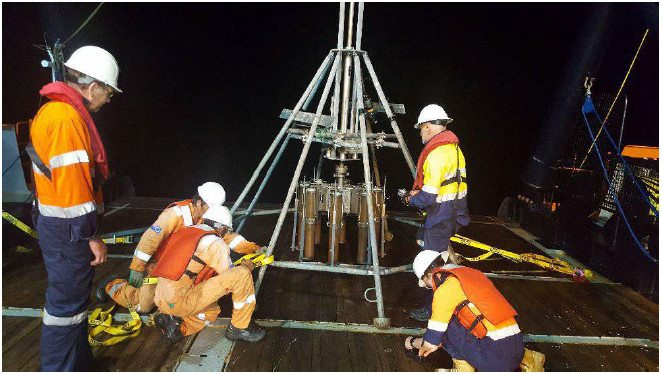

LOGO   

MINERAL RESOURCE ESTIMATE FOR THE EL3 COOK ISLANDS POLYMETALLIC NODULE DEPOSIT

MOANA MINERALS LTD


LOGO

Figure A5: Block models (plan view) comparing the sensitivity of different slope estimations (threshold 10° slope). A) Proportion of each block >10° slope estimated using indicator coding OK; B) proportion of each block >10° slope estimated based on bathymetry, C) block model of nodule abundance factored by slope >10° as estimated by indicator coding; D) block model for nodule abundance factored by slope >10° as estimated by bathymetry.


Page 153 of 154
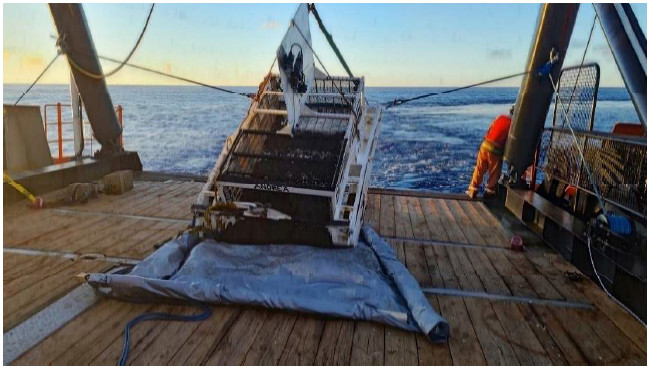

LOGO   

MINERAL RESOURCE ESTIMATE FOR THE EL3 COOK ISLANDS POLYMETALLIC NODULE DEPOSIT

MOANA MINERALS LTD


Page 154 of 154