Exhibit 96.1
INITIAL ASSESSMENT FOR THE EL1
Initial Assessment and Technical Report Summary for the EL1 Cook Islands Polymetallic Nodule Deposit, South Pacific Ocean
| Report prepared for (Registrant) : | CIC LIMITED | |
| Airport Authority House 2 | ||
| Nikao, Rarotonga | ||
| Cook Islands | ||
| Prepared by: | RSC Consulting Ltd | |
| Dr Simon Nielsen, PhD, MAusIMM | ||
| Effective date: | December 31, 2025 | |
Date & Signature Page
Report prepared by
RSC Consulting Ltd
24 Smith Street, Dunedin 9016, New Zealand
Postal Address: PO Box 5647, Dunedin, 9054, New Zealand
Report prepared for
| Client name | CIC LIMITED | |
| Project name | EL1 COOK ISLANDS POLYMETALLIC NODULE DEPOSIT | |
| Contact name | Adam Stemm | |
| Contact title | Chief Operations Officer | |
| Contact address | CIC Limited. Airport Authority, House 2, Nikao, Rarotonga, Cook Islands. | |
Report Information
| File name | 260112 RSC CIC SK1300 Technical Report | |
| Effective date | December 31, 2025 | |
| Report status | Final | |
Date & Signature
| Contributing author |
Signature |
Signature Date | ||
| Prepared by Qualified Persons from the following Third-Party firm:
RSC Consulting Ltd |
/s/ RSC Consulting Ltd | February 9, 2026 | ||
| Dr Simon Nielsen, PhD, MAusIMM (Qualified Person) | /s/ Dr. Simon Nielsen | February 9, 2026 | ||
|
INITIAL ASSESSMENT FOR THE EL1 CIC LIMITED. |
| Contents | ||||
| Date & Signature Page |
1 | |||
| List of Tables |
7 | |||
| List of Figures |
9 | |||
| Acronyms |
12 | |||
| 1. Executive Summary |
15 | |||
| 1.1 Property Description & Ownership |
15 | |||
| 1.2 Geology & Mineralization |
17 | |||
| 1.3 Status of Exploration |
17 | |||
| 1.4 Mineral Resource Estimate and Initial Assessment |
18 | |||
| 1.4.1 Cut-Off Abundance & RPEE |
19 | |||
| 1.4.2 Initial Assessment Summary |
20 | |||
| 1.5 Conclusions & Recommendations |
20 | |||
| 1.5.1 Conclusions |
20 | |||
| 1.5.2 Recommendations |
21 | |||
| 2. Introduction |
25 | |||
| 2.1 Registrant Information |
25 | |||
| 2.2 Sources of Information |
25 | |||
| 2.3 Qualified Persons |
26 | |||
| 2.3.1 RSC Consulting Ltd: Third-Party Consulting Firm |
26 | |||
| 2.3.2 Dr. Simon Nielsen |
26 | |||
| 2.4 Site Visit & Personal Inspection |
27 | |||
| 3. Property Description |
28 | |||
| 3.1 Location of Property |
28 | |||
| 3.2 Exploration Licenses & Mineral Rights |
29 | |||
| 3.3 Royalties & Encumbrances |
29 | |||
| 3.4 Environmental Liabilities & Permits Required for Work |
30 | |||
| 3.4.1 Exploration Environment Programs & Impacts |
31 | |||
| 3.4.2 Environmental Impacts from Minerals Harvesting |
31 | |||
| 3.4.3 Environmental Baseline Studies |
32 | |||
Page 1 of 185
|
INITIAL ASSESSMENT FOR THE EL1 CIC LIMITED. |
| 3.5 Significant Encumbrances to the Project |
32 | |||
| 3.6 Other Significant Factors or Risks |
32 | |||
| 4. Accessibility, Climate, Local Resources, Infrastructure & Physiography |
33 | |||
| 4.1 Accessibility |
33 | |||
| 4.2 Climate |
33 | |||
| 4.3 Seafloor Bathymetry (Physiography) |
34 | |||
| 4.4 Local Resources & Infrastructure |
35 | |||
| 5. History |
36 | |||
| 5.1 Tenure & Operating History |
36 | |||
| 5.2 Exploration History |
36 | |||
| 5.2.1 Cook Islands |
36 | |||
| 5.2.2 EL1 |
36 | |||
| 5.3 Production History |
40 | |||
| 6. Geological Setting, Mineralization & Deposit |
41 | |||
| 6.1 Regional Geology |
41 | |||
| 6.1.1 Global Distribution of Nodules |
41 | |||
| 6.2 Local Geology |
42 | |||
| 6.2.1 Tectonic Setting |
42 | |||
| 6.2.2 Ocean Currents |
43 | |||
| 6.2.3 Seabed Morphology |
45 | |||
| 6.3 Property Geology |
46 | |||
| 6.4 Mineralization |
49 | |||
| 6.5 Mineral Deposit Model & Known Comparable Deposits |
50 | |||
| 7. Exploration |
53 | |||
| 7.1 CIC Expeditions |
53 | |||
| 7.1.1 Expedition 1 Leg 1 |
53 | |||
| 7.1.2 Expedition 1 Leg 2 |
53 | |||
| 7.1.3 Expedition 2 |
55 | |||
| 7.1.4 Expedition 3 |
56 | |||
| 7.1.5 Expedition 4 Leg 1 |
56 | |||
| 7.1.6 Expedition 4 Leg 2 |
56 | |||
Page 2 of 185
|
INITIAL ASSESSMENT FOR THE EL1 CIC LIMITED. |
| 7.1.7 Expedition 4 Leg 3 |
58 | |||
| 7.2 Exploration Procedures and Parameters |
58 | |||
| 7.2.1 Location Determination |
58 | |||
| 7.2.1.1 Surface Location Determination |
58 | |||
| 7.2.1.2 Submarine Location Determination |
58 | |||
| 7.2.2 MBES Surveying |
59 | |||
| 7.2.3 Box Core Sampling Procedures |
59 | |||
| 7.2.3.1 Equipment Specifications |
59 | |||
| 7.2.3.2 Deployment & Sampling Procedure |
60 | |||
| 7.2.4 Freefall Grab Sampling Procedures |
62 | |||
| 7.2.5 Multi-Core Sampling Procedures |
64 | |||
| 7.2.6 Bulk Sampling Procedures |
65 | |||
| 7.2.7 ROV Surveying Procedures |
66 | |||
| 7.3 Exploration Results |
67 | |||
| 7.3.1 MBES Surveying |
67 | |||
| 7.3.2 Box Core Sampling |
72 | |||
| 7.3.3 Freefall Grab Sampling |
78 | |||
| 7.3.4 Nodule Size Distribution & Morphology |
79 | |||
| 7.3.5 ROV Surveying |
83 | |||
| 7.4 Drilling |
84 | |||
| 7.5 Hydrogeology |
84 | |||
| 7.6 Geotechnical |
84 | |||
| 7.6.1 Shear Strength Results |
84 | |||
| 7.6.2 Other Geotechnical Measurements |
86 | |||
| 8. Sample Preparation, Analyses & Security |
87 | |||
| 8.1 Sample Preparation |
87 | |||
| 8.1.1 Onboard Sample Processing |
87 | |||
| 8.1.1.1 Nodule Removal |
87 | |||
| 8.1.1.2 Nodule Washing |
88 | |||
| 8.1.2 Onshore Sample Processing |
89 | |||
| 8.1.2.1 Sample Processing at CIC facilities |
89 | |||
| 8.1.2.2 Sample Processing at ALS Brisbane |
90 | |||
| 8.2 Analysis |
91 | |||
Page 3 of 185
|
INITIAL ASSESSMENT FOR THE EL1 CIC LIMITED. |
| 8.2.1 Wet Nodule Weight |
91 | |||
| 8.2.2 Wet Nodule Abundance |
92 | |||
| 8.2.3 Dry Nodule Weight & Moisture Content |
93 | |||
| 8.2.4 Laboratory Analysis |
93 | |||
| 8.3 Density & Moisture Content |
94 | |||
| 8.4 Sample Security |
95 | |||
| 8.4.1 Offshore Sample Handling |
95 | |||
| 8.4.2 Onshore Sample Handling |
96 | |||
| 8.5 Data Quality and QAQC |
98 | |||
| 8.5.1 CIC Data |
98 | |||
| 8.5.1.1 Data Quality Objective |
98 | |||
| 8.5.1.2 Quality Assurance |
98 | |||
| 8.5.1.3 Quality Control |
105 | |||
| 8.5.1.4 Quality Acceptance Testing |
117 | |||
| 8.5.1.5 Summary |
123 | |||
| 8.5.2 Historical Data |
124 | |||
| 8.6 Qualified Person’s Opinion |
126 | |||
| 9. Data Verification |
127 | |||
| 9.1 Site Visit Details |
127 | |||
| 9.1.1 2022 MV Seasurveyor Mobilization & Expedition 1 (2022) |
127 | |||
| 9.1.2 Expedition 2 (2023) |
127 | |||
| 9.1.3 Environmental Research Survey 1 AUV Operations (2024) |
127 | |||
| 9.1.4 Expedition 4 (2025) |
128 | |||
| 9.2 Database Verification |
128 | |||
| 9.3 Qualified Person’s Opinion |
129 | |||
| 10. Mineral Processing & Metallurgical Testing |
130 | |||
| 11. Mineral Resource Estimate |
132 | |||
| 11.1 Informing Data |
132 | |||
| 11.1.1 Data Handling |
132 | |||
| 11.1.1.1 Sample Compositing/Averaging |
132 | |||
| 11.1.1.2 Sample Quality |
132 | |||
| 11.1.1.3 Exclusion of Repeat Samples |
133 | |||
| 11.1.2 Location Data |
133 | |||
Page 4 of 185
|
INITIAL ASSESSMENT FOR THE EL1 CIC LIMITED. |
| 11.2 Interpretation & Model Definition |
133 | |||
| 11.2.1 Geological Domains |
133 | |||
| 11.2.2 Estimation Domains |
135 | |||
| 11.2.2.1 Abundance |
135 | |||
| 11.2.2.2 Geochemistry |
136 | |||
| 11.2.3 Extrapolation |
137 | |||
| 11.2.4 Alternative Interpretations |
137 | |||
| 11.3 Summary Statistics & Data Preparation |
137 | |||
| 11.3.1 Sample Support |
137 | |||
| 11.3.2 Estimation Domain Statistics |
137 | |||
| 11.4 Spatial Analysis & Variography |
140 | |||
| 11.4.1 Variogram Analysis |
140 | |||
| 11.5 Block Model |
142 | |||
| 11.6 Search Neighborhood Parameters |
143 | |||
| 11.7 Estimation |
143 | |||
| 11.7.1 Domain |
143 | |||
| 11.7.2 Grade |
144 | |||
| 11.7.3 Density |
144 | |||
| 11.7.4 Moisture |
144 | |||
| 11.7.5 Slope |
144 | |||
| 11.8 Validation |
145 | |||
| 11.9 Sensitivity Testing |
146 | |||
| 11.10 Multi-Factor Scorecard Modeling |
148 | |||
| 11.11 Mineral Resource Estimate Classification |
151 | |||
| 11.11.1 Nodule Cut-Off Abundance |
153 | |||
| 11.11.2 Mining & Metallurgical Methods & Parameters |
154 | |||
| 11.11.3 Reasonable Prospects for Economic Extraction |
156 | |||
| 11.12 Initial Assessment Summary |
157 | |||
| 11.13 Risks |
157 | |||
| 12. Mineral Reserves Estimates |
164 | |||
| 13. Mining Methods |
165 | |||
| 14. Processing & Recovery Methods |
166 | |||
Page 5 of 185
|
INITIAL ASSESSMENT FOR THE EL1 CIC LIMITED. |
| 15. Project Infrastructure |
167 | |||
| 16. Market Studies |
168 | |||
| 17. Environmental Studies, Permitting & Plans, Negotiations, or Agreements with Local Individuals or Groups |
169 | |||
| 18. Capital & Operating Costs |
170 | |||
| 19. Economic Analysis |
171 | |||
| 20. Adjacent Properties |
172 | |||
| 20.1 Moana Minerals Limited |
172 | |||
| 20.2 Cobalt Seabed Resources Limited |
173 | |||
| 21. Other Relevant Data & Information |
174 | |||
| 22. Interpretation & Conclusions |
175 | |||
| 23. Recommendations |
177 | |||
| 24. References |
180 | |||
| 25. Reliance on Information Provided by the Registrant |
184 | |||
| 26. Forward-Looking Statement |
185 | |||
Page 6 of 185
|
INITIAL ASSESSMENT FOR THE EL1 CIC LIMITED. |
|
List of Tables |
||||
| Table 1-1: Status of CIC’s license |
16 | |||
| Table 1-2: Mineral Resource statement at nodule abundance cut-off of 13 kg/m2 |
19 | |||
| Table 1-3: Initial assessment summary for the CIC polymetallic nodule project |
20 | |||
| Table 1-4: Proposed Phase 1 and 2 expenditures in USD |
24 | |||
| Table 3-1: Status of CIC’s license |
29 | |||
| Table 5-1: Summary of historical sample type by year |
38 | |||
| Table 5-2: JICA-MMAJ navigation systems |
39 | |||
| Table 6-1: Chemical compositions of nodules from different areas of the global ocean |
42 | |||
| Table 7-1: MV Seasurveyor vessel characteristics |
53 | |||
| Table 7-2: MV Anuanua Moana vessel characteristics |
55 | |||
| Table 7-3: Summary of nodule abundance and geochemistry data collected by BC samplers |
73 | |||
| Table 7-4: Summary of nodule abundance and geochemistry data collected by FFG samplers |
79 | |||
| Table 8-1: Summary of the sampling tools and their sampling areas |
93 | |||
| Table 8-2: Summary of the analytical methods performed at ALS Brisbane |
93 | |||
| Table 8-3: ME-XRF26s analytes, units, and detection limits |
94 | |||
| Table 8-4: ME-MS81 analytes, units, and detection limits |
94 | |||
| Table 8-5: ME-GRA05 and OA-GRA05g analytes, units, and detection limits |
94 | |||
| Table 8-6. Nodule minimum moisture content, measured at ALS Brisbane using method OA-GRA05g |
95 | |||
| Table 8-7: Primary sample quality assessment designators and ranking |
106 | |||
| Table 8-8: Primary sample quality assessment comparison |
107 | |||
| Table 8-9: CGL-131 certified values and standard deviations for CoO, CuO, MnO and NiO |
115 | |||
| Table 8-10: Performance summary of the Exp 4 Ryco 820 scales’ reference weight data |
118 | |||
| Table 8-11: Second-split repeat pair data performance summary for selected analytes |
121 | |||
| Table 8-12: Third-split repeat pair data performance summary for selected analytes |
123 | |||
| Table 8-13: Summary of QA/QC review of the CIC data considering an Inferred classification |
124 | |||
| Table 8-14: Historical data quality assessment summary |
124 | |||
| Table 10-1: Metallurgical bench test results to date |
131 | |||
| Table 11-1: Summary statistics of abundance estimation domains |
138 | |||
| Table 11-2: Summary statistics of geochemistry domains |
138 | |||
| Table 11-3: Abundance variogram parameters |
140 | |||
| Table 11-4: Variogram parameters for Cu, Mn, Ni, Co, and Fe |
141 | |||
| Table 11-5: Block model description |
143 | |||
| Table 11-6: Search neighborhood parameters |
143 | |||
| Table 11-7: Estimated block summary statistics |
144 | |||
| Table 11-8: Mean comparison of sample and estimate block grades |
146 | |||
Page 7 of 185
|
INITIAL ASSESSMENT FOR THE EL1 CIC LIMITED. |
| Table 11-9: Comparison of mean abundance block grade |
147 | |||
| Table 11-10: Comparison of mean abundance block grade |
148 | |||
| Table 11-11: Data quality multi-factor rankings applied to the samples |
148 | |||
| Table 11-12: Weighting system used to determine overall score |
149 | |||
| Table 11-13: Mineral Resource statement at nodule abundance cut-off of 13 kg/m2 |
152 | |||
| Table 11-14: Sensitivity of tonnes and grade at cut-off abundances of 8, 10, 12, 13, and 15 kg/m2 |
153 | |||
| Table 11-15: Parameters of conceptual nodule collector |
155 | |||
| Table 11-16: Average LOM commodity prices. From AMC Consultants (2025) |
156 | |||
| Table 11-17: Initial assessment summary for the CIC polymetallic nodule project |
157 | |||
| Table 11-18: Risk assessment criteria |
158 | |||
| Table 11-19: List and analysis of risks |
160 | |||
| Table 23-1: Proposed Phase 1 and 2 expenditures in USD |
179 | |||
Page 8 of 185
|
INITIAL ASSESSMENT FOR THE EL1 CIC LIMITED. |
| List of Figures | ||
| Figure 1-1: EL1 Project location | 16 | |
| Figure 3-1: EL1 Project location | 28 | |
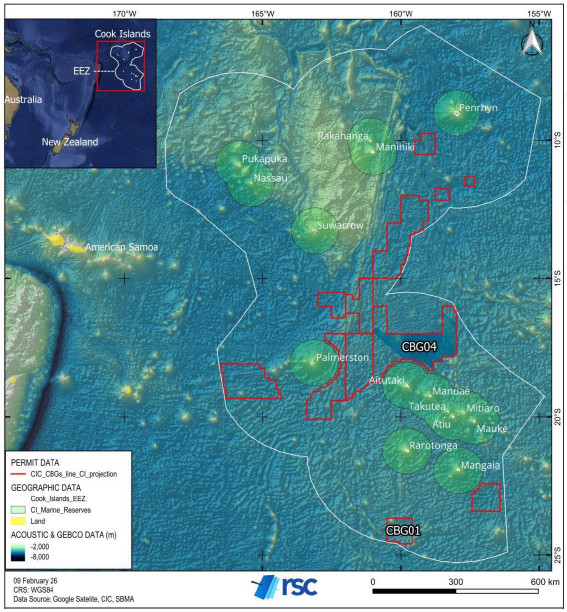
| Figure 4-1: Bathymetric map of the Project area | 34 | |
| Figure 5-1: Historical samples within the Project area | 37 | |
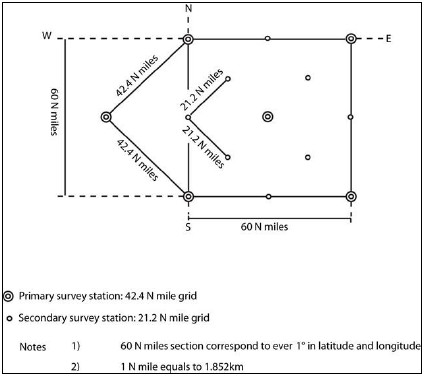
| Figure 5-2: Standard survey station layout used by JICA | 38 | |
| Figure 5-3: Standard station sampling layout used by JICA | 39 | |
| Figure 5-4: Cook Islands nodule sampling expeditions | 40 | |
| Figure 6-1: Fe-Mn crust and nodule samples collected from around the world | 41 | |
| Figure 6-2: Tectonic setting of the Cook Islands EEZ and surrounding seabed | 42 | |
| Figure 6-3: Volcanic chains and hotspot tracks | 43 | |
| Figure 6-4: Schematic of ocean currents in and near the EEZ | 44 | |
| Figure 6-5: Seabed geomorphology for the Cook Islands and surrounds | 46 | |
| Figure 6-6: Stratigraphic column from gravity cores collected by JICA-MMAJ in the 16-159 Area | 47 | |
| Figure 6-7: Sub-bottom profiles from (JICA-MMAJ, 2001) | 48 | |
| Figure 6-8: Nodule section showing a couple of shark teeth as nuclei surrounded by concentric growth bands | 49 | |
| Figure 6-9: (a) Schematic illustrating the formation of Mn-oxides and Fe-oxyhydroxides | 52 | |
| Figure 7-1: Samples collected in CBG04 | 54 | |
| Figure 7-2: Samples collected in CBG01 | 54 | |
| Figure 7-3: Ship track for Exp 2, including dredge lines (light green) and ROV track (dark green) | 55 | |
| Figure 7-4: Sample distribution and nodule abundance for Exp 4 Leg 1 | 57 | |
| Figure 7-5: Multicore locations, Exp 4 Leg 2 | 57 | |
| Figure 7-6: Original BX-635 BC design used in 2022 | 60 | |
| Figure 7-7: Examples of nodules photographs taken offshore | 62 | |
| Figure 7-8: Recovered FFG sampler on deck | 63 | |
| Figure 7-9: Example of nodule samples from an FFG launch during Exp 3 | 64 | |
| Figure 7-10: MC-400 multicorer recovered to deck with samples | 65 | |
| Figure 7-11: Benthic sled unloading nodules on the back deck | 66 | |
| Figure 7-12: ROV launching on starboard side of the MV Anuanua Moana during Exp 2 | 67 | |
| Figure 7-13: Bathymetric (50 m resolution) data collected within CBG04 | 68 | |
| Figure 7-14: Backscatter (50 m resolution) data collected within CBG04 | 68 | |
| Figure 7-15: Slope map displaying areas with a slope >10° | 69 | |
| Figure 7-16. Interpreted seafloor geomorphology | 70 | |
| Figure 7-17: BTM-derived geomorphological domains (Morgan, 2024) | 71 | |
| Figure 7-18: Geological interpretation of the bathymetric and backscatter data | 72 | |
| Figure 7-19: Map of BC nodule geochemistry within CGB04: surface abundance, Co, Cu, Fe, Mn, and Ni | 76 | |
Page 9 of 185
|
INITIAL ASSESSMENT FOR THE EL1 CIC LIMITED. |
| Figure 7-20: Map of BC nodule geochemistry within CGB01: | 77 | |
| Figure 7-21: Back deck images of (A) BC051 sample surface | 78 | |
| Figure 7-22: Nodule size distribution in CBG4 West | 80 | |
| Figure 7-23: Nodule size distribution in bulk sample DR001 | 80 | |
| Figure 7-24: Nodule size distribution for CBG04 East, FFG samples from Exp 3 | 81 | |
| Figure 7-25: Nodule descriptors used by CIC | 81 | |
| Figure 7-26: Modelled examples of nodule morphologies and textures. | 81 | |
| Figure 7-27: Nodule morphologies | 82 | |
| Figure 7-28: Distribution of nodule morphologies in CBG04 by the end of Exp 3 | 83 | |
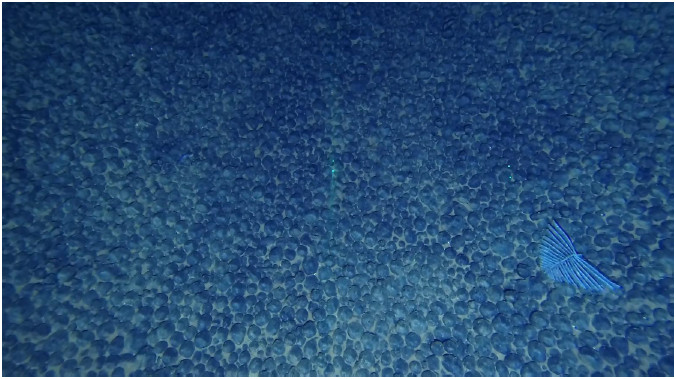
| Figure 7-29: Screenshot of ROV footage showing a high-abundance nodule field | 83 | |
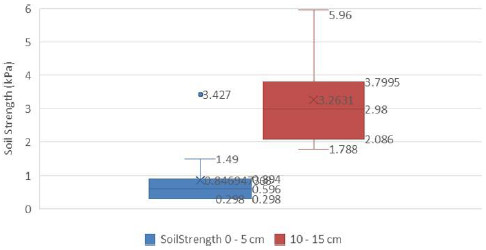
| Figure 7-30: Box-and-whisker plot of soil strength results from Exp 1 in western CBG04 | 85 | |
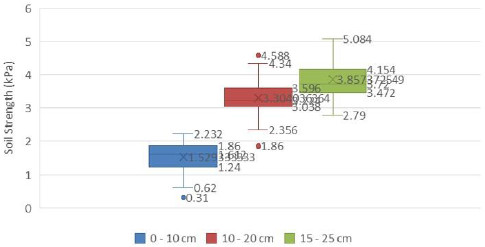
| Figure 7-31: Box-and-whisker plot of soil strength results from Exp 4 in eastern CBG04 | 85 | |
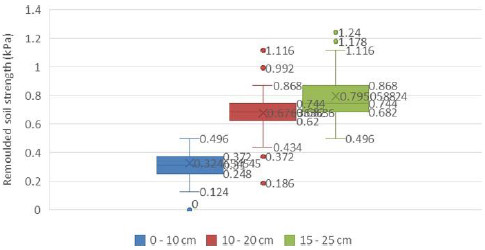
| Figure 7-32: Remolded soil strength measured during Exp 4 Leg 1, in eastern CBG04 | 86 | |
| Figure 8-1: Removing surface nodules and sediment from BC samples | 87 | |
| Figure 8-2: FFG basket in the cradle, ready to dump the nodule sample into the bucket below | 88 | |
| Figure 8-3: Nodule processing on the MV Seasurveyor back deck | 89 | |
| Figure 8-4: Sample photography of BC052, from BC sample surface (left) | 90 | |
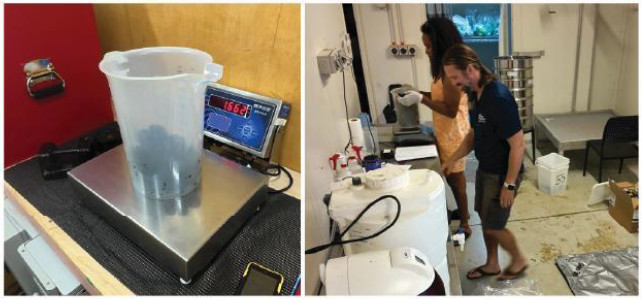
| Figure 8-5: Offshore weighing of a sample during Exp 4 using the Ryco 820 scale (left) | 92 | |
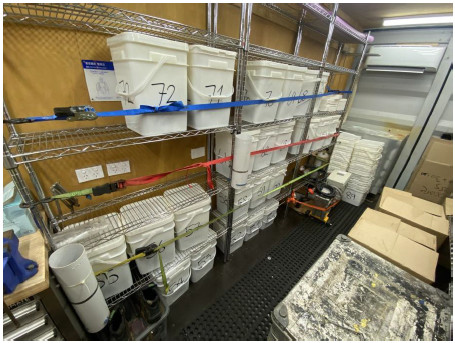
| Figure 8-6: Workshop container on the MV Seasurveyor, with sample buckets in storage | 96 | |
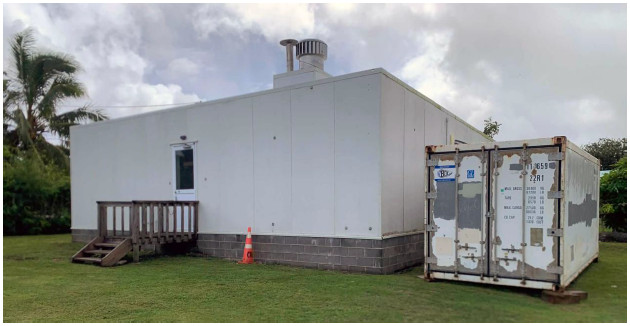
| Figure 8-7: CIC’s processing laboratory in Rarotonga | 97 | |
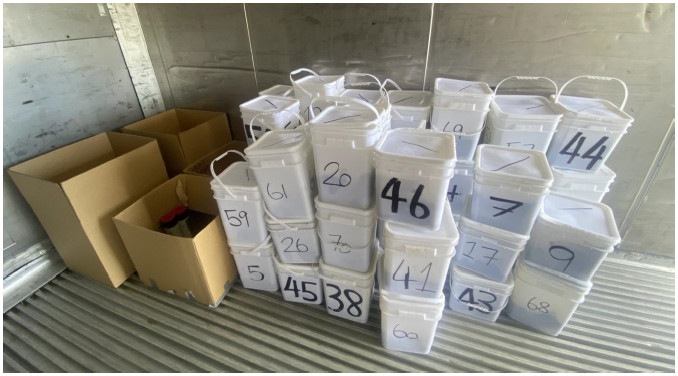
| Figure 8-8: Samples from Exp 4 Leg 1 inside the refrigerated container by the Processing Laboratory | 97 | |
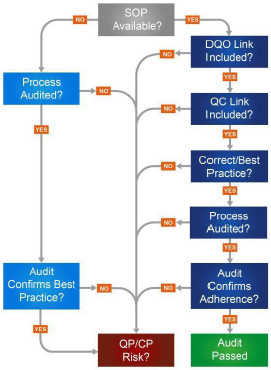
| Figure 8-9: Flowchart of RSC’s QA review process | 99 | |
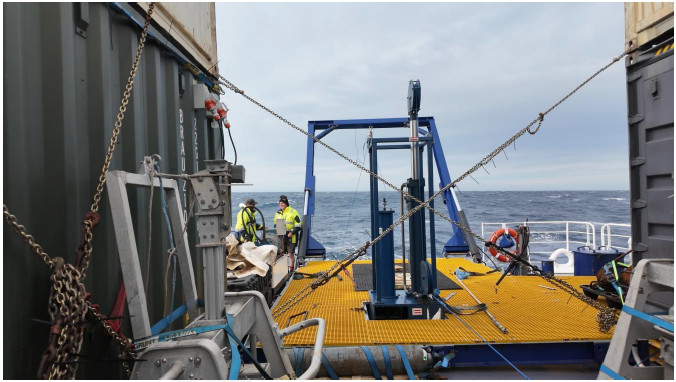
| Figure 8-10: Passive heave compensator on the back deck of the MV Seasurveyor | 102 | |
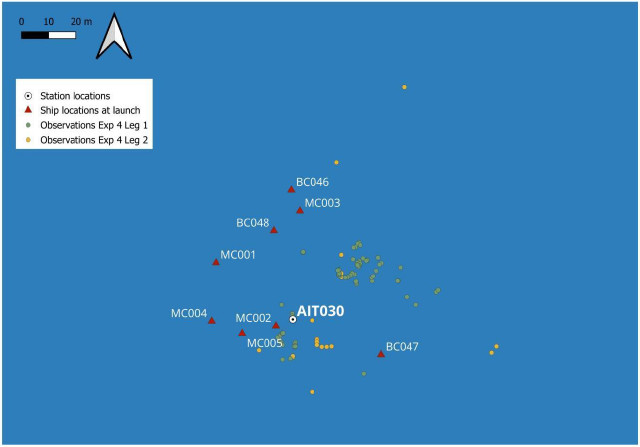
| Figure 8-11. Example of camera locations vs. ship locations during operations | 105 | |
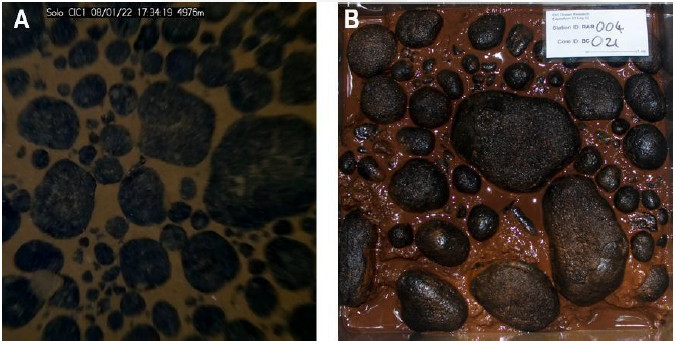
| Figure 8-12: Video still of seafloor (A) and on-deck top shot (B) for BC021 | 106 | |
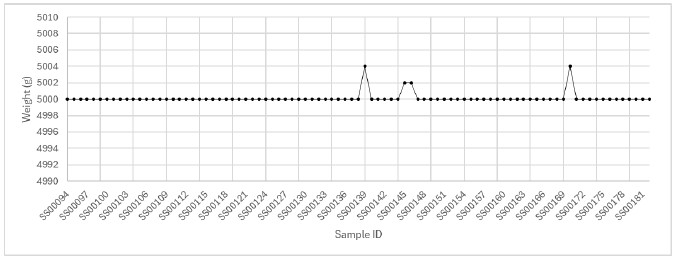
| Figure 8-13: Exp 4 – 5,000-g calibration weight results | 111 | |
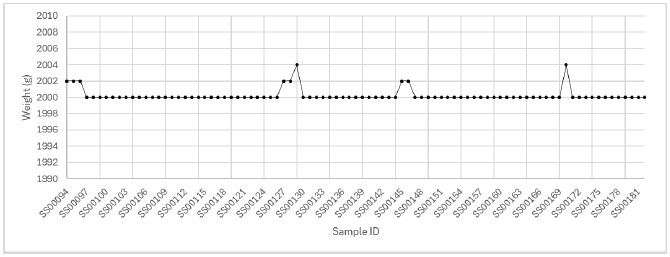
| Figure 8-14: Exp 4 – 2,000-g calibration weight results | 111 | |
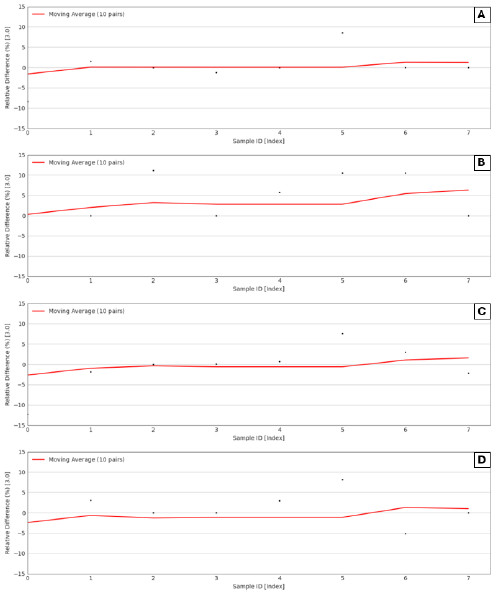
| Figure 8-15: RDP plots of second-split repeat samples for CoO (A), CuO (B), MnO (C) and NiO (D) | 112 | |
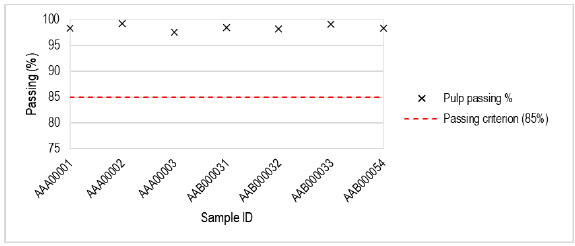
| Figure 8-16: PUL-21 sizing test results | 113 | |
| Figure 8-17: RDP plots of third-split repeat samples for CoO (A), CuO (B), MnO (C) and NiO (D) | 114 | |
| Figure 8-18: Control plot CGL-131 CoO results. Certified value in purple and +/- 1 standard deviation in green | 116 | |
| Figure 8-19: Control plot CGL-131 CuO results. Certified value in purple and +/- 1 standard deviation in green | 116 | |
| Figure 8-20: Control plot CGL-131 MnO results | 116 | |
| Figure 8-21: Control plot CGL-131 NiO results. Certified value in purple and +/- 1 standard deviation in green | 117 | |
| Figure 8-22: Scatter plot (left) and QQ plot (right) of second-split repeat pair CoO data | 120 | |
| Figure 8-23: Scatter plot (left) and QQ plot (right) of second-split repeat pair CuO data | 120 | |
Page 10 of 185
|
INITIAL ASSESSMENT FOR THE EL1 CIC LIMITED. |
| Figure 8-24: Scatter plot (left) and QQ plot (right) of second-split repeat pair MnO data | 120 | |
| Figure 8-25: Scatter plot (left) and QQ plot (right) of second-split repeat pair NiO data | 121 | |
| Figure 8-26: Scatter plot (left) and QQ plot (right) of second-split repeat pair CoO data | 122 | |
| Figure 8-27: Scatter plot (left) and QQ plot (right) of second-split repeat pair CuO data | 122 | |
| Figure 8-28: Scatter plot (left) and QQ plot (right) of second-split repeat pair MnO data | 122 | |
| Figure 8-29: Scatter plot (left) and QQ plot (right) of second-split repeat pair NiO data | 123 | |
| Figure 11-1: Abyssal plains mapped by SBMA | 134 | |
| Figure 11-2: Estimation domains for nodule abundance | 135 | |
| Figure 11-3: Outline of the region with increased Ni grade | 136 | |
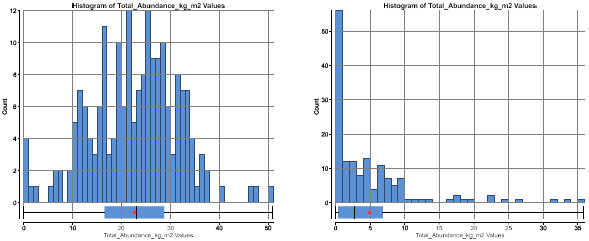
| Figure 11-4: Histogram of High Abundance estimation domain (left) | 138 | |
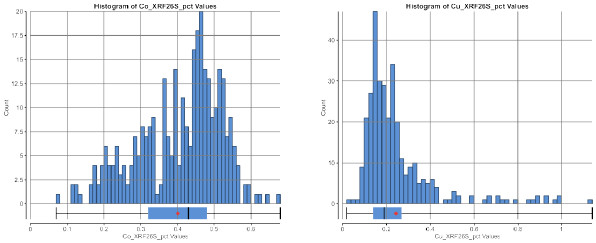
| Figure 11-5: Histogram of Co (left) and Cu (right) estimation domains. | 139 | |
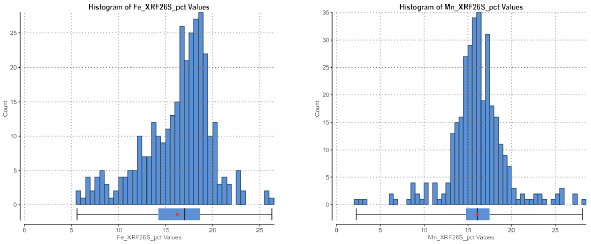
| Figure 11-6: Histograms of Fe (left) and Mn (right) estimation domains | 139 | |
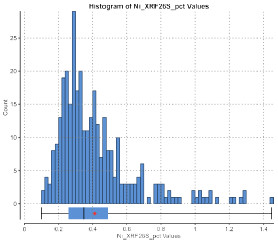
| Figure 11-7: Histogram of Ni estimation domains | 139 | |
| Figure 11-8: Experimental semi-variogram models for High Abundance domain | 140 | |
| Figure 11-9: Experimental semi-variogram models for Co (left) and Cu (right) | 141 | |
| Figure 11-10: Experimental semi-variograms models for Fe (left) and Mn (right) | 142 | |
| Figure 11-11: Experimental semi-variograms models for Ni | 142 | |
| Figure 11-12: Contact analysis plots | 144 | |
| Figure 11-13: Plan view of estimated block grades and sample data for abundance | 145 | |
| Figure 11-14: Swath plots comparing sample (blue) and estimated (red) abundance grades | 146 | |
| Figure 11-15: Scatter plot comparing block abundance grade | 147 | |
| Figure 11-16: Plan view of estimated multi-factor scorecard | 150 | |
| Figure 11-17: Abundance block model defining the Inferred Mineral Resource within the CIC Project area | 152 | |
| Figure 11-18: Conceptual design of the nodule harvesting system, from CIC Limited (2024) | 155 | |
| Figure 11-19: RSC’s risk score matrix | 159 | |
| Figure 20-1: Map of licenses and reserved areas in the Cook Islands EEZ | 172 | |
Page 11 of 185
|
INITIAL ASSESSMENT FOR THE EL1 CIC LIMITED. |
Acronyms
| °C | degrees Celsius | |
| 2D | two-dimensional | |
| 3D | three-dimensional | |
| µm | micrometer | |
| AD | armed dredge | |
| Ag | silver | |
| Al | aluminum | |
| As | arsenic | |
| AusIMM | Australasian Institute of Mining and Metallurgy | |
| AUV | autonomous underwater vehicle | |
| Ba | barium | |
| BC | box core | |
| BGRIMM | Beijing General Research Institute for Mining and Metallurgy | |
| BS | benthic sled | |
| BSE | backscattered electron mode | |
| Ca | calcium | |
| CBG | continuous block group | |
| CCD | carbonate compensation depth | |
| CCOP/SOPAC | Committee for Coordination of Joint Prospecting for Minerals Resources in South Pacific Offshore Areas | |
| CCZ | Clarion-Clipperton Zone | |
| Cd | cadmium | |
| Ce | cerium | |
| CIC | CIC Limited | |
| CIPA | Cook Islands Port Authority | |
| CO | carbon monoxide | |
| Co | cobalt | |
| CPGeo | Chartered Professional Geologist | |
| Cr | chromium | |
| CRM | certified reference material | |
| Cs | cesium | |
| CSR | Cobalt Seabed Resources Limited | |
| CTD | conductivity, temperature, depth | |
| Cu | copper | |
| CV | coefficient of variation | |
| DGPS | differential global positioning system | |
| DQO | data quality objective | |
| DVL | doppler velocity logger | |
| Dy | dysprosium | |
| E1L2 | Expedition 1, Leg 2 | |
| eDNA | environmental DNA | |
| EEZ | exclusive economic zone | |
| EIA | environmental impact assessment | |
| EL1 | Exploration License 1 | |
| ENSO | El Niño–Southern Oscillation | |
| Er | erbium | |
| ERS 1 | Environmental Research Survey 1 | |
| Eu | europium | |
| Exp 1 | Expedition 1 | |
| Exp 2 | Expedition 2 | |
| Exp 3 | Expedition 3 | |
| Exp 4 | Expedition 4 | |
| Fe | iron | |
| FFG | freefall grab | |
| FS | Feasibility Study | |
| g | grams | |
| Ga | gallium | |
| GCS | geographic coordinate system | |
| Gd | gadolinium | |
| GPS | global positioning system | |
| GSR | Global Sea Mineral Resources | |
| Hf | hafnium | |
| Ho | holmium | |
| ICI | Infrastructure Cook Islands | |
| ICP-AES | inductively coupled plasma atomic emission spectroscopy | |
| ICP-MS | inductively coupled plasma mass spectrometry | |
| ISA | International Seabed Authority | |
| ISO | International Organization for Standardization | |
| JICA | Japan International Cooperation Agency | |
| K | potassium | |
| KE | kriging efficiency | |
Page 12 of 185
|
INITIAL ASSESSMENT FOR THE EL1 CIC LIMITED. |
| ka | thousand years ago | |
| kg | kilogram | |
| kHz | kilohertz | |
| km | kilometer | |
| kyr | thousand years | |
| L | liter | |
| La | lanthanum | |
| LARS | launch and recovery system | |
| LC | long core | |
| LED | light-emitting diode | |
| LOI | loss on ignition | |
| LOQ | limit of quantification | |
| Lu | lutetium | |
| m | meter | |
| Ma | million years ago | |
| MBES | multibeam echosounder | |
| MC | multicore | |
| MFES | multi-frequency exploration system | |
| Mg | magnesium | |
| mi | miles | |
| ml | milliliter | |
| mm | millimeter | |
| MMAJ | Metal Mining Agency of Japan | |
| MML | Moana Minerals Limited | |
| Mn | manganese | |
| Mo | molybdenum | |
| MRE | mineral resource estimate | |
| Mt | megaton | |
| MV | motor vessel | |
| myr | millions of years | |
| Na | sodium | |
| Nb | niobium | |
| Ni | nickel | |
| NNSS | Navy Navigation Satellite System | |
| NOAA | National Oceanic and Atmospheric Administration | |
| OML | Ocean Minerals, LLC | |
| O | oxygen | |
| P | phosphorous | |
| Pb | lead | |
| PFS | Pre-Feasibility Study | |
| Pr | praseodymium | |
| QA | quality assurance | |
| QAT | quality assurance testing | |
| QC | quality control | |
| QEMSCAN | quantitative evaluation of minerals by scanning electron microscopy | |
| QP | Qualified Person | |
| quantile-quantile | ||
| Rb | rubidium | |
| RBF | radial basis functions | |
| RC01 | Research Cruise 1 | |
| REEs | rare earth elements | |
| REY | rare earth elements and yttrium | |
| RL | reduced level | |
| RMSCV | root mean square coefficient of variation | |
| ROV | remotely operated vehicle | |
| RPEEE | reasonable prospects for eventual economic extraction | |
| rpSEP | Research Permit for small Environmental Programs | |
| RSC | RSC Consulting Ltd | |
| SBMA | Seabed Minerals Authority | |
| SD | standard deviation | |
| SEC | South Equatorial Current | |
| SEM | scanning electron microscope | |
| S | sulfur | |
| Sc | scandium | |
| Si | silicon | |
| Sm | samarium | |
| Sn | tin | |
| SOP | standard operating procedure | |
| Sr | strontium | |
| SVP | sound velocity profiler | |
| t | tonne | |
| Ta | tantalum | |
| Tb | terbium | |
| Th | thorium | |
| Ti | titanium | |
| Tl | thallium | |
Page 13 of 185
|
INITIAL ASSESSMENT FOR THE EL1 CIC LIMITED. |
| Tm | thulium | |
| TMS | tether management system | |
| TRS | Technical Report Summary | |
| U | uranium | |
| USBL | ultra-short baseline | |
| UTM | Universal Transverse Mercator | |
| V | vanadium | |
| W | tungsten | |
| XRD | X-ray diffraction | |
| XRF | X-ray fluorescence | |
| Y | yttrium | |
| Yb | ytterbium | |
| Zn | zirconium | |
Page 14 of 185
|
INITIAL ASSESSMENT FOR THE EL1 CIC LIMITED. |
1. Executive Summary
CIC Limited (the Company, CIC, or the Registrant) is completing exploration work on the EL1 property (the Property), located in the EEZ of the Cook Islands in the South Pacific Ocean. This Initial Assessment and Technical Report Summary (TRS or Report) was prepared for CIC by RSC Consulting Ltd (RSC). The purpose of this Report is to support CIC’s disclosure of a Mineral Resource Estimate (“MRE”) for the EL1 property, effective as of December 31, 2025, for use in CIC’s fiscal year 2026 disclosures. No Mineral Reserve estimate is reported in this Report. This TRS has been prepared in accordance with the U.S. Securities and Exchange Commission’s (SEC) Subpart 1300 of Regulation S-K, Disclosure by Registrants Engaged in Mining Operations and Item 601(b)(96) of Regulation S-K, Technical Report Summary.
All currency amounts are in United States dollars (USD) unless otherwise stated.
The effective date of this TRS report is December 31, 2025. RSC confirms that there are no known material changes impacting the MRE.
The interpretations and conclusions reached in this Report are based on current scientific understanding and the best evidence available to RSC at the time of writing. It is the nature of all scientific conclusions that they are founded on an assessment of probabilities and, however high the probabilities might be, make no claim for absolute certainty.
The ability of any person to achieve forward-looking production and economic targets depends on numerous factors beyond RSC’s control and that RSC cannot anticipate. These factors include, but are not limited to, site-specific mining and geological conditions, management and personnel capabilities, availability of funding to properly operate and capitalize the operation, variations in cost elements and market conditions, developing and operating the mine efficiently, unforeseen changes in legislation, and new industry developments. Any of these factors may substantially alter the performance of any mining operation.
1.1 Property Description & Ownership
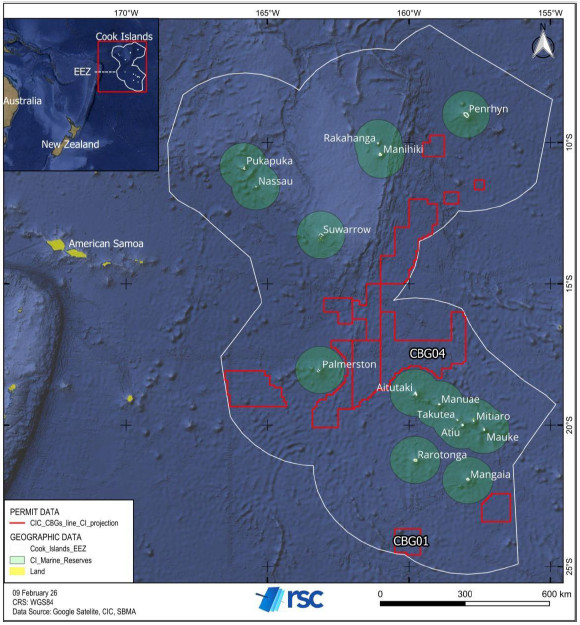
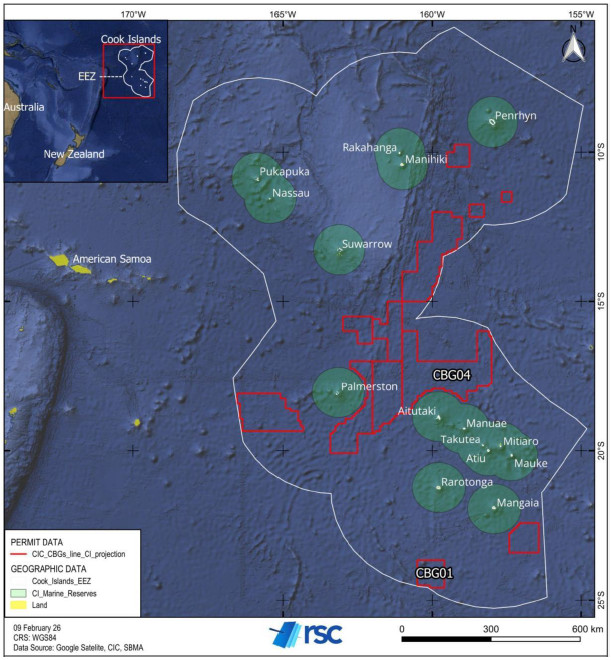
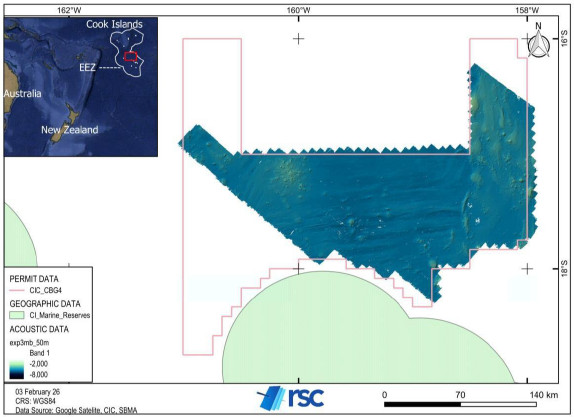
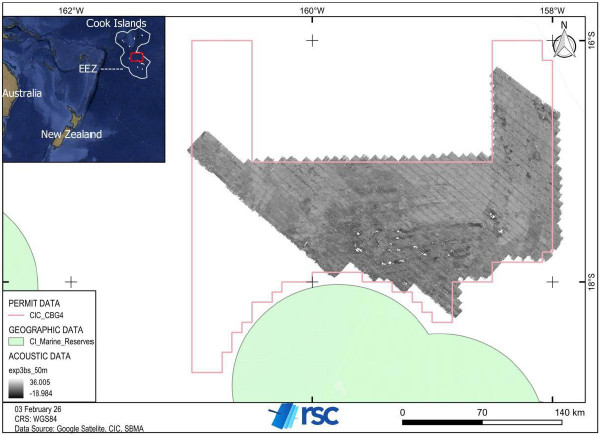
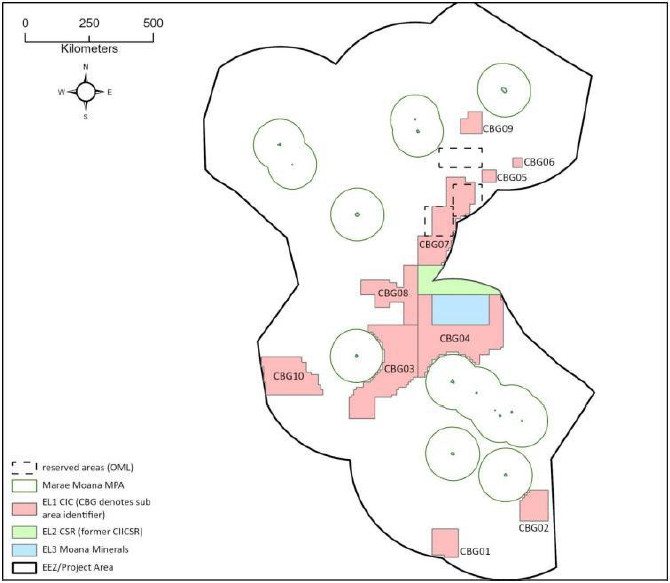
The Project is located within the economic exclusion zone (EEZ) of the Cook Islands, in the South Pacific Ocean (Figure 1-1). While the Project is confined to the boundary of EL1, the Project is part of a wider known deposit of polymetallic nodules found within the Cook Islands EEZ. The Project is located on the seabed, more than 5,000 m below sea level.
The Project is centered at 17.5° S latitude and 160.5° W longitude (WGS 84), which is 261 miles (420 km) north from Rarotonga, Cook Islands, 105 miles (170 km) north from Aitutaki, Cook Islands, and ~2,300 miles (3,700 km) northeast from Wellington, New Zealand. While the Project is confined to the boundary of EL1, which covers an area of 81,678 mi2 (211,545 km2), the Project is part of a wider known deposit of polymetallic nodules found within the Cook Islands’ EEZ.
Page 15 of 185
|
INITIAL ASSESSMENT FOR THE EL1 CIC LIMITED. |
EL1 was granted to CIC Limited, a Cook Islands registered company whose primary shareholder is CIC LLC, a Florida Limited Liability Company, on 23 February 2022 by the Seabed Minerals Authority (SBMA) on behalf of the Cook Islands Government (Table 1-1). The exploration license (EL) is valid for a term of five years and expires on 23 February 2027. An application for license renewal can be made at least 90 days before the expiry of the license in line with Section 63 of the Seabed Minerals (Exploration) Regulations (Seabed Minerals (Exploration) Regulations, 2020). -1
Figure 1-1: EL1 Project location.
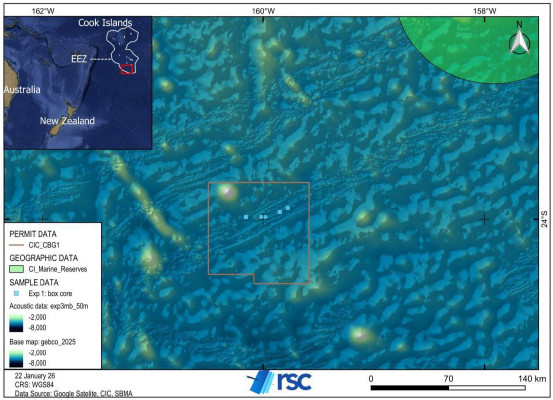
The license area comprises 2,592 5’ x 5’ blocks, grouped into ten Contiguous Block Groups (CBG) (Figure 1-1).
Table 1-1: Status of CIC’s license.
| License |
License Name |
Ownership |
Commodities |
Grant Date |
Expiry Date |
Size (mi2) | ||||||
| EL1 | Exploration License 1 | CIC | Polymetallic nodules | 23 February 2022 | 23 February 2027 | 81,678 |
The conditions for CIC’s exploration license EL1 include a relinquishment schedule as follows:
| | 20% of the total license area must be relinquished after 3 years of exploration activities. |
| | Up to an additional 40% of the total license area must be relinquished by the end of the 5-year license period. |
Page 16 of 185
|
INITIAL ASSESSMENT FOR THE EL1 CIC LIMITED. |
The first relinquishment is currently being negotiated between CIC and SBMA. Relinquishment of an area less than the proposed relinquishment area in the schedule by the stated times is possible and will be subject to discussion between CIC and SBMA.
1.2 Geology & Mineralization
Polymetallic nodules are part of a spectrum of ferromanganese precipitates that are found throughout the world’s oceans. The Cook Islands are distinctive in having relatively ancient and stable ocean crust, coupled with very low-modelled net export of organic material to the seabed, and the interpreted influence of a long-lived deep-water ocean current.
Most of the Project area consists of relatively flat abyssal plains, with sea knolls, seamounts, depressions, hills, valleys, and horst-and-graben structures scattered across the area.
Polymetallic nodule abundance and element grades vary throughout the Project area. ‘Nodule abundance’ is the term used to describe the number of nodules found in a given sample area; it is measured in kilograms per square meter because nodules typically form on the seabed as a single layer, several centimeters thick, so are, in effect, a two-dimensional deposit. The nodule abundance in the Project ranges from 0.0–48.0 kg/m2, with an average abundance of 17.7 kg/m2. Nodule abundance is typically higher in areas of abyssal plains compared to other parts of the seafloor.
Polymetallic nodules in the Cook Islands are geochemically unique, compared to other deposits, due to their low Mn/Fe ratio and elevated Co grades. The average Mn/Fe ratio is 0.92, which indicates that the nodules are formed via hydrogenetic processes. This is supported by nodule morphology (relatively smooth texture), and the low number of buried nodules recovered — most nodules are found on the surface of the seabed.
1.3 Status of Exploration
CIC has conducted exploration across two of the ten contiguous block groups (CBGs), including CBG01 and CBG04. Most exploration work has been conducted in CBG04, with sample spacing based on an 11-km dice-five grid. All ten CBGs were sampled historically (pre-2000).
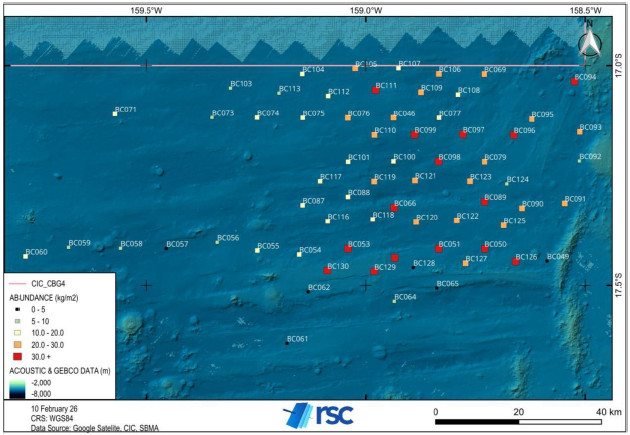
Since 2022, CIC has conducted four expeditions. CIC used box core (BC), freefall grab (FFG), multicore (MC), and benthic sled (BS) sampling tools to collect polymetallic nodule samples, supported by both remotely operated vehicle (ROV) and autonomous underwater vehicle (AUV) surveys.
Geotechnical work was conducted during Exp 1 and Exp 4, mainly shear vane measurements of seafloor sediment shear strength as observed in the BC samples. Other geotechnical work on Exp 4 Leg 1 subcores was subsequently undertaken onshore, but not yet fully reported on.
No hydrogeological studies have been conducted on the Project.
Further details are discussed in section 7 of this TRS.
Page 17 of 185
|
INITIAL ASSESSMENT FOR THE EL1 CIC LIMITED. |
1.4 Mineral Resource Estimate and Initial Assessment
A Mineral Resource Estimate (MRE) for the Project is summarized in Table 1-2. The data informing the MRE consists of declustered samples collected by JICA, as well as BC and FFG samples collected by CIC during Exp 1, Exp 3, and Exp 4. All sample coordinates were transformed into a custom reference system using Lambert azimuthal equal-area projection, with the origin at 160°W, 16°S. The reprojection is necessary as the Project extends across two different Universal Transverse Mercator (UTM) zones. The reduced level (RL) was set to 0. No corrections were applied to either the geochemical or the nodule abundance data. In RSC’s opinion, the quality of the data set provided by CIC is fit for purpose and suitable for use in the mineral resource estimation.
The MRE has been prepared and reported in accordance with Item 1300 of Regulation S-K (Subpart 229.1300) under the United States Securities and Exchange Commission (SEC). The Mineral Resource category of Inferred Mineral Resource used in this Report follows the definitions set out in §229.1300 Definitions. The estimation methodology and classification criteria have been reviewed by RSC and are consistent with the requirements of S-K 1300, including the criteria set forth in §229.1302(d)(1). The MRE classification is based upon an assessment of geological understanding of the deposit, geological and grade continuity, BC and FFG sample spacing, QC results, search and interpolation parameters, and an analysis of available density information. The Inferred Mineral Resource has not been significantly extrapolated beyond the limits of the samples collected.
Confidence in the estimate of Inferred Mineral Resources is not sufficient to allow the results of the application of any technical and economic parameters to be used for detailed mine planning as part of either pre-feasibility or feasibility studies.
The MRE has an effective date of December 31, 2025 and has been reported at a cut-off of 13 kg/m2 nodule abundance, which was selected based on the consideration of previous studies of comparable deposits and assumed mining parameters. The MRE tonnage is stated as wet tonnes, and no material has been classified as Indicated or Measured mineral resources.
Geological evidence is sufficient to imply but not verify geological and grade continuity. The MRE is based on exploration, sampling, and assaying information gathered through appropriate techniques from BC and FFG sampling.
The consideration of modifying factors, in particular seafloor slope, has been considered in the classification of the Mineral Resources.
In general, it is reasonably expected that a portion of the Inferred Mineral Resources could be upgraded to Indicated Mineral Resources with continued exploration by CIC. For the CBG04 E area, closer-spaced BC sample data and higher-resolution multibeam data are available. Upgrading the Inferred Mineral Resources within the CBG04 E area to Indicated Mineral Resources might be feasible once the geochemical data for the samples collected in this area have been received. Future work throughout EL1 should seek to decrease sample spacing, to improve geological evidence to verify geological continuity (including bathymetric survey of the entire license area), and to decrease waste components of the model.
Page 18 of 185
|
INITIAL ASSESSMENT FOR THE EL1 CIC LIMITED. |
Table 1-2: Mineral Resource statement at nodule abundance cut-off of 13 kg/m2 with an effective date of December 31, 2025.
| Resource Classification |
Abundance (wet) kg/m2 |
Nodules (wet) Mt |
Metal Grade | Metal Content | ||||||||||||||||||||
| Co (%) |
Cu (%) |
Fe (%) |
Mn (%) |
Ni (%) |
Co (kt) |
Cu (kt) |
Fe (kt) | Mn (kt) | Ni (kt) | |||||||||||||||
| Inferred |
19.9 | 1,950 | 0.46 | 0.19 | 17.8 | 15.7 | 0.33 | 7,000 | 3,000 | 290,000 | 256,000 | 5,000 | ||||||||||||
Notes:
| 1. | Mineral Resources are reported using definitions set out in Regulations S-K 1300 and have an effective date of December 31, 2025. |
| 2. | Mineral Resources are not Mineral Reserves and do not have demonstrated economic viability. |
| 3. | The third-party firm responsible for the MRE is RSC. |
| 4. | Numbers have been rounded as required by reporting guidelines and may result in apparent summation differences. |
| 5. | The estimate of tonnes and abundance is contained within the Exploration License 1 (EL1) area. |
| 6. | Abundance is the wet weight (kilograms) of polymetallic nodules per square meter. |
| 7. | The estimate of tonnes and abundance is provided at a cut-off of 13 kg/m2. |
| 8. | The metal content has been estimated using dry nodule tonnes. Dry nodule tonnage was estimated using the average moisture content of 25%. |
| 9. | The estimate is reported where the modifying factor of slope has been considered, and the proportion of slope >10° is applied locally to each block in CGB04, where bathymetric data are available. The estimate is restricted to areas of inferred abyssal plains and excludes known seamounts. |
1.4.1 Cut-Off Abundance & RPEE
The MRE has been reported at a cut-off of 13 kg/m2 nodule abundance. This cut-off abundance was selected based on the consideration of previous studies of comparable deposits (Tay et al., 2023b), as well as considering assumed mining parameters with respect to reasonable prospects for economic extraction (RPEE).
CIC is yet to conduct an economic assessment due at this stage of the project. In order to determine RPEE, RSC has assessed economic assessments from comparable projects and the proposed mining parameters including a project production rate of 259 t/hr, a 16-m wide collector, harvesting nodules at a rate of 0.4 m/s and an efficiency of 75–90%, which would require a nodule abundance of 12–15 kg/m2.
The controls on mineralization are consistent across the Project area and fit in with the wider EEZ geological framework. At deposit scale, RSC did not identify any sub-populations in the metal grades. Variations in nodule abundance were identified, with an area of high abundance associated with a north–south trend in the north, and a northeast trend in the south of the Project area.
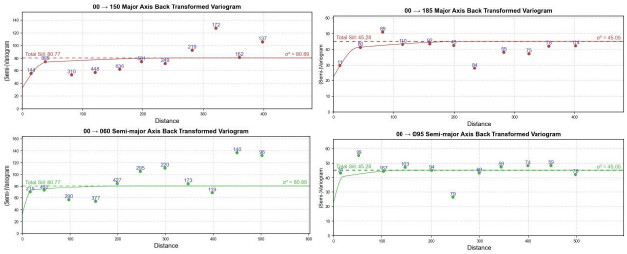
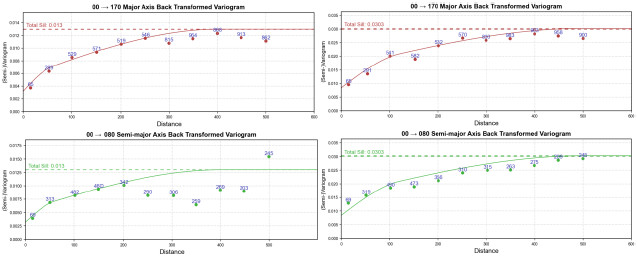
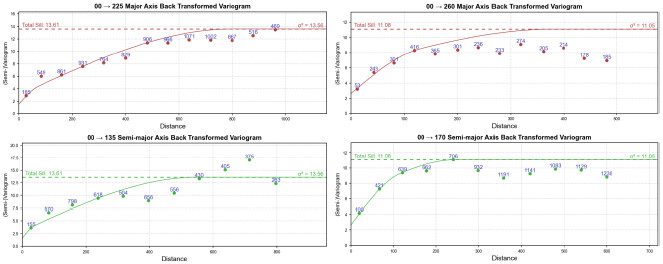
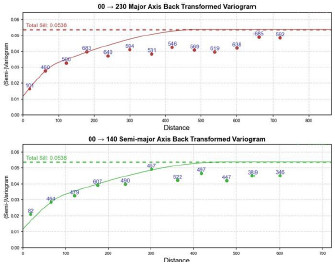
Experimental semi-variograms were modelled with relatively low–moderate g0 values and two-spherical structures. All variograms display reasonable structure for global estimation and are compatible with the classification of Inferred Mineral Resources. A block size of 50 km × 50 km was selected for estimation, based on sample spacing and existing mineral resource models. Sub-blocking of 25 km × 25 km and 12.5 km × 12.5 km was applied to gain a better definition of the license boundary and of the geomorphological domain, and the tighter sample spacing in CBG04. Estimation was done using ordinary kriging. Validation methods included visual review and comparison of means as well as validation plots. Sensitivity testing through variance of the parameter settings found the estimate to be robust. A multi-factor scorecard was also applied to data quality to support the classification of the estimate.
Page 19 of 185
|
INITIAL ASSESSMENT FOR THE EL1 CIC LIMITED. |
The MRE is supported by consideration of potential minerals harvesting (mining) and metallurgical processing methods. In assessing the reasonable prospects for economic extraction (RPEE), RSC has considered conceptual mining, metallurgical, and economic parameters as well as environmental and social aspects. Further details are disclosed in section 11 of this TRS.
1.4.2 Initial Assessment Summary
RSC has conducted an Initial Assessment of the CIC polymetallic MRE reported in this TRS to determine its economic potential. The results are summarized in Table 1-3. As the Project is still at an early stage, neither an economic and cash flow analysis nor cash flow analysis have been completed on the MRE disclosed in this TRS. However, RSC has completed a high-level preliminary technical and economic study of the economic potential of either all or parts of mineralization to support the disclosure of Mineral Resources.
Table 1-3: Initial assessment summary for the CIC polymetallic nodule project.
| Factor |
Initial Assessment | |
| Site Infrastructure | The project is located in the middle of the Cook Islands EEZ and ~5,000 m below the sea surface. Therefore, all exploration and potential extraction occur from vessels. The vessels have their own power and water supplies and provide accommodation for all crew. Access to the Project is through the waters of the Cook Islands rather than access roads. | |
| Mine Design & Planning | Any future mining would take place from production and support vessels. Mining would occur on the surface of the seafloor. CIC has not conducted a scoping study or preliminary economic assessment to design a mine plan, but is working with Boskalis to develop concept nodule collectors. The current nodule collector designed is assumed to operate at a production rate of 259 t/h. | |
| Processing Plant | Currently, no polymetallic nodule project has reached extraction; therefore, no processing plants to handle polymetallic nodules are in operation. New processing plants would have to be designed and built, or existing facilities would need to be repurposed. CIC has conducted initial metallurgical test work, is reviewing a hydrometallurgical and a combined pyrometallurgical/hydrometallurgical flowsheet and is looking at ways to optimize the process to have the lowest environmental impact. | |
| Environmental Compliance & Permitting | The Seabed Minerals (Minerals Harvesting and Other Mining) Regulations (2024) have been formally enacted and establish the regulatory framework for minerals harvesting and other mining activities under the Seabed Minerals Act (2019). However, no commercial harvesting or mining activities have been authorized or commenced to date. | |
| Other Relevant Factors | For activities including (trial) mining and mineral harvesting, CIC needs to undertake an environmental risk assessment, environmental scoping exercise and EIA, and provide an Environmental Impact Statement (EIS), Environmental Management System including an Environmental Management and Monitoring Plan (EMMP), and closure plan. Environmental and compliance permitting is managed by the National Environment Services and the Seabed Minerals Authority. | |
| Capital Costs | Due to the nature of mineralization, no tailings will be produced during nodule harvesting. Any seawater collected during the harvesting process will be returned to the sea. | |
| Operating Costs | It is the opinion of RSC that all material information has been stated in the above sections of this TRS. | |
| Economic Analysis | No capital costs have been estimated for the Project. | |
1.5 Conclusions & Recommendations
1.5.1 Conclusions
RSC has completed an MRE for CIC’s polymetallic nodule project within EL1. RSC has reviewed the available data, including historical sampling collected by JICA, samples collected by CIC, SOPs and QC data.
Page 20 of 185
|
INITIAL ASSESSMENT FOR THE EL1 CIC LIMITED. |
RSC conducted a data quality review (section 8). Issues with the FFG location data were identified, with malfunctioning GPS units and the ship’s logged coordinates averaging ~1,400 m away from the planned station. Early issues with BC sampling (e.g. premature triggering during Exp 1) were addressed, and a passive heave compensator was used during later expeditions to minimize the impact of the vessel’s motion. Sampling equipment included a video camera that recorded the moment of sampling; RSC reviewed the video footage to assess the quality of the primary sample.
Polymetallic nodule abundance and element grades vary throughout the Project area. The average nodule abundance in the Project is 17.7 kg/m2. The nodules found in the Cook Islands are geochemically unique compared to other nodule deposits due to their low Mn/Fe ratio and elevated Co grades. The average Mn/Fe ratio is 0.92, which indicates that the nodules are formed via hydrogenetic processes. This is supported by nodule morphology (relatively smooth texture), and the low number of buried nodules recovered – most nodules are found on the surface of the seabed.
RSC estimated nodule abundance and elemental concentrations were estimated using ordinary kriging. A range of block sizes and search parameters were assessed and optimized. A range of sensitivity testing was performed which indicated the estimation was sound and robust. The Mineral Resource has been classified following S-K 1300 definitions and the accompanying TRS has been prepared in accordance with the U.S. Securities and Exchange Commission’s (SEC) Subpart 1300 of Regulation S-K, Disclosure by Registrants Engaged in Mining Operations and Item 601(b)(96) of Regulation S-K, Technical Report Summary. The classification of the resource is based on sample quality, confidence in geological understanding, and on the quality of the estimate itself, as broadly determined during the validation process. Based on the review of all the data and information provided, RSC considers the quality of the data to be fit for the purpose of classifying an Inferred Mineral Resource for the Project.
RSC as part of an Initial Assessment is of the opinion that the Inferred Mineral Resource classification is appropriate based on the informing data and underlying understanding of the mineralization and nodule abundance within the EL1 area at this stage of the Project. Furthermore, RSC is of the opinion that the EL1 area is of sufficient grade, quantity, and coherence to have RPEE at this stage of the Project development. Further work is required, particularly additional sampling at a closer spacing, to enable detailed interpretation of domaining of the mineralization to inform advanced mine studies and economic evaluation.
RSC is of the opinion that the exploration potential for the Project is high. The combination of favorable polymetallic nodule abundances and successful sample results to date from past expeditions, confirm the prospectivity of the area for discovery of additional mineral resources and eventual conversion of Inferred mineral resources to Indicated and Measured mineral resources after future sampling programs.
1.5.2 Recommendations
The exploration potential for polymetallic nodules in the Cook Islands EEZ is significant, especially within EL1, as indicated by exploration by JICA and CIC. CIC’s exploration efforts to date have focused predominantly on CBG04. Continued exploration through image surveys, and additional sampling, could provide the basis for eventually upgrading (a portion of) the Inferred Mineral Resources to Indicated and Measured Mineral Resources.
Page 21 of 185
|
INITIAL ASSESSMENT FOR THE EL1 CIC LIMITED. |
The remaining CBGs remain largely unexplored by CIC and modern sampling processes. Additional exploration, particularly bathymetric mapping and infill sampling of the entire license area, should be prioritized by CIC.
RSC recommends the following actions are completed to support the ongoing Mineral Resource evaluation and expansion and to support future mining and economic studies (i.e. Scoping Study or Preliminary Economic Study) for the Project:
| | Undertake additional exploration (BC sampling, bathymetric mapping, ROV/AUV surveying, etc.) to further test the extent and continuity of polymetallic nodules mineralization. This includes testing parts of the EL1 area that are currently untested. |
| | Endeavor to upgrade the MRE once; |
| ○ | CIC has received the Exp 4 analytical data. |
| ○ | CIC has completed its 2026 exploration season and all analytical results for the samples collected during 2026 have been received. |
| | Design and create a fit-for-purpose database to ensure efficient, secure, and organized management of the exploration data. |
| | Conduct additional ROV work to further validate nodule abundance continuity, covering representative sections of the license area. |
| | Update sampling method and procedure documents to prescriptive SOPs that include references to the DQO and cover applicable QC procedures. |
| ○ | Add thresholds regarding the acceptable levels of variance in reference weight data to the SOPs. Also provide instructions for the operators regarding what steps to undertake if the reference weight data exceed the thresholds. |
| | To send any sample that will be used to support a MRE in its entirety to the laboratory for splitting. This minimizes the introduction of additional variance or bias during the sample splitting stages. If this is undesirable due to the risk of losing an entire sample in transit, fit-for-purpose crushing and splitting equipment and procedures should be used to crush and split the samples prior to submission to the laboratory. |
| | Using the entire sample to capture wet density, dry density and moisture content data, as this avoids having to split the sample before submission to the laboratory. RSC recommends the following process. |
| ○ | Capturing the wet weight of the entire nodule sample directly after the nodules have been collected from the core box, cleaned and allowed to drip-dry. |
| ○ | Sending the entire sample to the geochemical laboratory where the sample is dried in its entirety to determine the moisture content. The dry weight of the sample can subsequently be used to calculate the dry density of the nodules by using the sample volume of the entire sample that was determined at either CIC’s onboard or onshore laboratory. |
| ○ | Having the dried samples crushed and split by the laboratory. |
If CIC prefers splitting the sample before sending it to the laboratory, RSC recommends equipping the vessel with an industrial oven so that the entire sample can be dried onboard the vessel after the volume determination process has been completed, but before crushing and splitting the sample at CIC’s onboard or onshore laboratory. The dry weight of the entire sample captured by CIC can subsequently be used to calculate the moisture content and dry density of the sample.
Page 22 of 185
|
INITIAL ASSESSMENT FOR THE EL1 CIC LIMITED. |
| | To avoid introducing bias in the geochemistry data by also including the buried nodule component when submitting samples to the laboratory for analysis. This can be done by either combining the surface and buried nodule components after the surface and buried samples have been processed separate at CIC’s laboratories, but before submission to the geochemical laboratory, or by submitting the surface and buried nodules sample for geochemical analysis separately. In case of the latter, the geochemical composition of the entire sample can be back calculated using the surface and buried nodule sample weights. |
| | Improve the volume determination process by (also) determining the sample volume on shore. This is particularly relevant for small samples. This recommendation is based on the assumption that the nodules do not break into small pieces during storage and transport. |
| | Introduce strict sample security and sample custody procedures to protect the integrity of the sample. This is to avoid specific nodules from being collected by third parties, possibly biasing the sample. |
| | Collect sample weight repeat data to test the repeatability of the scales. |
| | Although not critical for this TRS reports, RSC recommends an independent QP partakes in at least one cruise every exploration season as this will improve the independent nature of future reports. |
| | Design and create a purpose-built photo station, with a shroud and remote camera operation to improve the quality of the sample photographs (particularly for BC samples) taken on deck. The shroud should reduce glare and shadows on the sample. |
| | Conduct XRF mapping and mineralogical studies of nodules to better understand the mineralogical make-up and internal structure of the nodules. This work can be completed during Phase 2 of the recommended exploration program (Table 23-1) |
| | Submit at least 30 blind second-split repeat samples for analysis to have sufficient data for a fit-for-purpose statistical analysis. |
| | Submit at least 30 blind pulp repeat samples for analysis to be able to independently assess the consistency of the third-split process. |
| | Submit at least 30 blind CRM samples of one type for analysis, to allow for the statistically significant assessment of the CRM results. |
| | Submit at least 30 pulp samples to another geochemical laboratory for umpire testing. |
| | Conduct a sample spacing analysis to identify the sample spacing requirements to target higher-confidence mineral resources. |
| | Ensure all sampling tools are equipped with working video equipment (including appropriate cameras and lights) to collect high quality videos of the sampling process that can be used to assess the quality of the sampling process and to quantify the sample recovery. One of the cameras ideally captures the sampling footprint on the seafloor before the sample is taken as this will allow for improving the primary sample quality assessment procedure. |
| | If available, validate historical samples through the submission of verification samples to the laboratory. |
Page 23 of 185
|
INITIAL ASSESSMENT FOR THE EL1 CIC LIMITED. |
| | Conduct additional metallurgical test work to better understand the metallurgical properties of the mineralization. |
| | Draft a conceptual mining and processing plan to better constrain the cost and limitations of the mining and processing methods. |
RSC recommends the following plan of work (Table 23-1), broken down into two phases of work, where the Phase 2 program is contingent on the results of the Phase 1 program. Estimated costs are in USD.
Table 1-4: Proposed Phase 1 and 2 expenditures in USD.
| Phase |
Field |
Details |
Estimated Cost (USD) |
|||||
| 1 |
Mineral Resource | Pending assay results from 2025 sampling, upgrade resource to Indicated in suitable areas | 150,000 | |||||
| 1 |
Exploration/Sampling | ROV video transects, BC and bulk sampling during 2026 cruise season. | 1,250,000 | |||||
|
|
|
|||||||
| Phase 1 Total |
1,400,000 | |||||||
|
|
|
|||||||
| 2 |
Exploration/Sampling | Multibeam mapping of entire license area | 3,500,000 | |||||
| 2 |
Exploration/Sampling | Sampling in wider license area based on results from multibeam mapping | 2,000,000 | |||||
| 2 |
Exploration/Sampling | Sampling in developed areas for environmental, geotechnical and metallurgical purposes | 1,500,000 | |||||
| 2 |
Mineral Resource | Update Mineral Resource based on results from Phase 2 mapping. | 250,000 | |||||
|
|
|
|||||||
| Phase 2 Total |
7,250,000 | |||||||
|
|
|
|||||||
RSC has reviewed these expenditures in the context of the work activities recommended for the Project and considers the proposed budgets consistent with the exploration potential of the Project, adequate to cover the costs of the proposed programs, and appropriate for the type and weighting of activities at the Project
Page 24 of 185
|
INITIAL ASSESSMENT FOR THE EL1 CIC LIMITED. |
2. Introduction
2.1 Registrant Information
CIC LIMITED (the Company, CIC, or the Registrant), a Cook Islands company, is completing exploration work on the EL1 property (the Property), located in the EEZ of the Cook Islands in the South Pacific Ocean This Initial Assessment and Technical Report Summary (TRS or Report) was prepared for CIC by RSC Consulting Ltd (RSC). The purpose of this Report is to support CIC’s disclosure of Mineral Resource estimate (MRE) for the EL1 property for the fiscal year ended December 31, 2025. No Mineral Reserve estimate is reported in this Report. This TRS has been prepared in accordance with the U.S. Securities and Exchange Commission’s (SEC) Subpart 1300 of Regulation S-K, Disclosure by Registrants Engaged in Mining Operations and Item 601(b)(96) of Regulation S-K, Technical Report Summary.
All currency amounts are in United States dollars (USD) unless otherwise stated. Tonnages are expressed as metric tons (t), unless otherwise stated.
The effective date of this TRS report is December 31, 2025. RSC confirms that there are no known material changes impacting the MRE.
Except where noted otherwise, coordinates in this TRS are presented in degrees, using World Geodetic System 84 (WGS84) Lat Long/European Petroleum Survey Group (EPSG) code 4326. The data informing the MRE were reprojected using a custom equal area projection. This was necessary because the modelling software required cartesian coordinates and because the project spans two Universal Transverse Mercator (UTM) zones (UTM zones 3S and 4S).
The interpretations and conclusions reached in this Report are based on current scientific understanding and the best evidence available to RSC at the time of writing. It is the nature of all scientific conclusions that they are founded on an assessment of probabilities and, however high the probabilities might be, make no claim for absolute certainty.
The ability of any person to achieve forward-looking production and economic targets depends on numerous factors beyond RSC’s control and that RSC cannot anticipate. These factors include, but are not limited to, site-specific mining and geological conditions, management and personnel capabilities, availability of funding to properly operate and capitalize the operation, variations in cost elements and market conditions, developing and operating the mine efficiently, unforeseen changes in legislation, and new industry developments. Any of these factors may substantially alter the performance of any mining operation.
2.2 Sources of Information
The information in this TRS is based on data supplied by CIC. CIC provided the following information through a shared Dropbox folder:
| | shape files of the license blocks, Cook Islands EEZ, Cook Islands marine reserves and the New Zealand coastline |
| | geochemical data for Exp 1, 2 and 3 (including ALS laboratory reports) |
| | sample data for Exp 1, 2, 3 and 4 (including nodule abundance data) |
Page 25 of 185
|
INITIAL ASSESSMENT FOR THE EL1 CIC LIMITED. |
| | sample collection and processing data for Exp 1, 2, 3 and 4 |
| | station information |
| | vessel position fixes for Exp 4 BC samples |
| | 50-m resolution MBES bathymetry data |
| | shear vane data |
| | data entry forms and templates |
| | scanned copies of original log sheets |
| | 2022 cruise report |
| | post-expedition reports for Exp 1, 2 ,3 and 4 (interim reports for Exp 4 only) |
| | geotechnical study report |
| | processing and metallurgical test work summary |
| | seafloor images |
| | seafloor video footage (BC and FFG landing videos) |
| | ROV seafloor transect video (rough cut only) |
| | on-deck and on shore sample photographs |
| | SOPs for sampling and sample processing procedures |
RSC has endeavored to confirm the authenticity and completeness of the technical data upon which the Report is based by making all reasonable enquiries within the time available.
2.3 Qualified Persons
2.3.1 RSC Consulting Ltd: Third-Party Consulting Firm
This Report was prepared by RSC, a third-party consulting firm comprising mining experts in accordance with § 229.1302(b)(1)1. CIC has determined that RSC meets the qualifications and relevant experience specified under the definition of Qualified Person (QP) in § 229.1300. With the exception of specific references to Dr. Simon Nielsen, any references to the Qualified Person or QP in this report are references to RSC and not to any individual employed at RSC.
| | RSC takes responsibility for Sections 1, 2.1–2.3, 8.5–8.6, 9.2– 9.3, 11–19 and 21–25 of this TRS. |
2.3.2 Dr. Simon Nielsen
RSC prepared this Report in close collaboration with Dr. Simon Nielsen, who is a co-author of this TRS. CIC has determined that Dr. Nielsen also meets the qualifications and relevant experience specified under the definition of Qualified Person (QP) in § 229.1300. Dr. Nielsen is a marine geologist and Member of the AusIMM, an internationally recognized professional organization as defined in § 229.1300. He holds bachelor and candidate degrees in geology from Copenhagen University in Denmark and a doctorate in geology from the University of Tromsoe, Norway, with more than ten years of experience with marine coring and drilling for academic research in the polar regions. He has five years of experience with offshore phosphate and polymetallic nodule projects in the Pacific region, as well as more than ten years of experience with terrestrial mineral exploration, including 2D and 3D geological and geostatistical modelling for projects mainly located in Australia and New Zealand, as well as in Canada, Oman and Turkey.
Dr. Nielsen contracts as a consultant to CIC (the Registrant), filling the role of Chief Marine Geologist. He was onboard the MV Seasurveyor for Expedition (Exp) 1, Exp 4 and Environmental Research Survey (ERS) 1, as well as on the MV Anuanua Moana for Exp 2, in all cases functioning as chief scientist and offshore project manager. He prepared the SOPs, QC check points and data entry forms and templates. He also led and oversaw the back deck sample processing and the onboard lab sample processing. He holds no equity in CIC or companies affiliated with CIC.
Page 26 of 185
|
INITIAL ASSESSMENT FOR THE EL1 CIC LIMITED. |
In preparation for this Report Dr. Nielsen also travelled to RSC’s office in Dunedin, New Zealand and spent approximately two weeks, from 12–25 January 2026, working closely together with RSC’s team to review and validate all supporting data and to discuss his site visits in detail.
Dr. Nielsen takes responsibility for Sections 2.4, 3–8.4, 9.1, 10 and 20 of this TRS.
2.4 Site Visit & Personal Inspection
RSC staff did not complete a site visit of the Project. However, Dr. Simon Nielsen, CIC’s Chief Scientist and co-author (QP) of this TRS, took part in most exploration cruises (Exp 1, Exp 2 and Exp 4) undertaken by CIC, with each cruise doubling as a site visit (personal inspection) as required under S-K 1300. For most cruises, Dr. Nielsen was the Offshore Project or Operations Manager, and he is therefore intimately familiar with the work that has been completed. The information that Dr. Nielsen provided with respect to the site visits aligns fully with the information and data provided to, and validated by, RSC. Underwater video footage of the sampling operations played a particularly important role, as this allowed RSC to validate the presence or absence of the mineralization at almost every sampling location. The visits took place during the periods listed below. Additional details about the site visits that Dr. Nielsen took part in are provided in Sections 9.1.1 to 9.1.4.
| | Exp 1: 15 June–9 September 2022, on board the MV Seasurveyor; |
| | Exp 2: 6–31 August 2023, on board the MV Anuanua Moana; |
| | Environmental Research Survey 1: 8–16 November 2024, on board the MV Seasurveyor; and |
| | Exp 4: 9 June–30 September 2025 (Leg 1) and 7–27 October 2025 (Leg 2), on board the MV Seasurveyor. |
Page 27 of 185
|
INITIAL ASSESSMENT FOR THE EL1 CIC LIMITED. |
3. Property Description
3.1 Location of Property
The Project is situated within the EEZ offshore of the Cook Islands, in the South Pacific Ocean (Figure 3-1). The Project is located on the seabed, more than 5,000 m below sea level. The Project is centered at 17.5° S latitude and 160.5° W longitude (WGS84), which is 261 miles (420 km) north from Rarotonga, Cook Islands, 105 miles (170 km) north from Aitutaki, Cook Islands, and ~2,300 miles (3,700 km) northeast from Wellington, New Zealand. While the Project is confined to the boundary of the EL1 area, which covers an area of 81,678 mi2 (211,545 km2), the Project is part of a wider known deposit of polymetallic nodules found within the Cook Islands EEZ.
Figure 3-1: EL1 Project location.
Page 28 of 185
|
INITIAL ASSESSMENT FOR THE EL1 CIC LIMITED. |
3.2 Exploration Licenses & Mineral Rights
EL1 was granted to CIC Ltd, a Cook Islands registered company whose primary shareholder is CIC LLC, on 23 February 2022 by the Seabed Minerals Authority (SBMA) on behalf of the Cook Islands Government (Table 3-1). The exploration license (EL) is valid for a term of five years and expires on 23 February 2027. An application for license renewal can be made at least 90 days before the expiry of the license in line with Section 63 of the Seabed Minerals (Exploration) Regulations (2020).
The license area comprises 2,592 5’ × 5’ blocks, grouped into ten contiguous block groups (CBGs) (Figure 3-1).
Table 3-1: Status of CIC’s license.
| License |
License Name |
Ownership |
Commodities |
Grant Date |
Expiry Date |
Size (mi2) | ||||||
| EL1 | Exploration License 1 | CIC | Polymetallic nodules | 23 February 2022 | 23 February 2027 | 81,678 |
The conditions for CIC’s exploration license EL1 include a relinquishment schedule as follows:
| | 20% of the total license area must be relinquished after 3 years of exploration activities. |
| | Up to an additional 40% of the total license area must be relinquished by the end of the 5-year license period. |
The first relinquishment is currently being negotiated between CIC and SBMA. Relinquishment of an area less than the proposed relinquishment area in the schedule by the stated times is possible and will be subject to discussion between CIC and SBMA.
3.3 Royalties & Encumbrances
Royalties are defined in the Seabed Minerals (Royalties) Regulations (2013). The regulations state that holders of a mining license are liable for a royalty equal to 3% of the export value of minerals recovered under a mining license. The export value of minerals recovered is the free-on-board (FOB) price received. Transfer pricing considerations are included in Income Tax (Transfer Pricing) Regulations (2014).
CIC currently holds one exploration license (EL1). To upgrade the EL to a mining license (ML), CIC must meet the terms specified under section 67 of the Seabed Minerals (Exploration) Regulations (2020), which involves the license holder having:
| | s67(a): collected and analyzed data and information to at least a pre-feasibility study level in all material respects; |
| | s67(b): completed in all material respects the studies and investigations relating to an environmental impact assessment (EIA) study for a mining license application; and |
| | s(67c): established the existence of seabed mineral resources or reserves that have the potential for commercial recovery. |
Page 29 of 185
|
INITIAL ASSESSMENT FOR THE EL1 CIC LIMITED. |
Under the Seabed Minerals Act (2019) (consolidated as of 2024), any royalties paid to the Crown or the Authority (SBMA) are to be managed by the Ministry of Finance and Economic Management separately from other public money within an established sovereign wealth fund.
The Income Tax Act (1997) (consolidated as of 2023) contains provisions concerning various tax issues, including:
| | tax payable by local companies (20%; all license holders are required to be local companies) as well as foreign contractors (28%); |
| | deductions and exempt income (for example, deductions related to ongoing exploration and remedial work and environmental funds); |
| | ring-fencing of accounts and income to the jurisdiction; |
| | write-downs and capital gains tax; |
| | withholding tax; and |
| | additional profits tax, including adjustments and instalments. |
3.4 Environmental Liabilities & Permits Required for Work
RSC is not aware of any environmental liabilities in the Project area.
Activities under the Environment Act (2003) and Environment (Seabed Minerals Activities) Regulations (2023) are managed under a tiered system: Tier 1 activities are managed under the exploration license, Tier 2 activities require Environmental Consent, and Tier 3 activities require an Environmental Permit after submission of an EIA report.
For exploration activities, CIC must provide environmental notice (e.g. environmental significance declaration) and an objectives plan prior to each cruise to the National Environmental Service and SBMA.
For activities including (trial) mining and mineral harvesting, CIC needs to undertake an environmental risk assessment, environmental scoping exercise and EIA, and provide an Environmental Impact Statement (EIS), Environmental Management System including an Environmental Management and Monitoring Plan (EMMP), and closure plan. Guidelines regarding the various environmental assessments, plans and statements are reported on the SBMA website (https://www.sbma.gov.ck/standards-guidelines); however, some plans are still in the drafting process.
CIC has undertaken several campaigns collecting data for environmental research:
| | Environmental Survey RC03 in 2023, completed under SBMA’s Research Permit for Small Environmental Programs (rpSEP): A single line of multibeam data recorded in CBG03 and CBG04. |
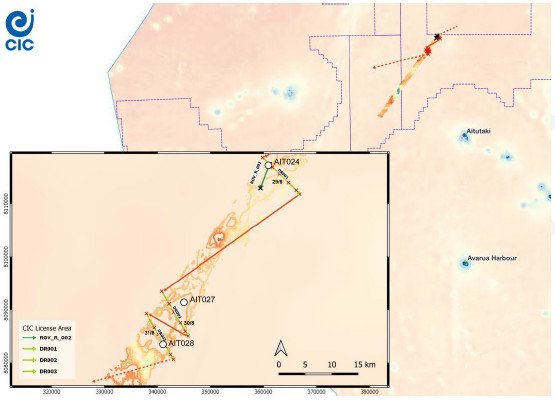
| | Environmental Survey RC05 in 2023 (also under rpSEP): A 5-km transect imaged by ROV in CIC’s CBG04 area, commencing at station AIT024. |
| | CIC Environmental Research Survey 1 (ERS01) in CBG10 (2024): 16 stations surveyed with an AUV recording multibeam echosounder, side-scan sonar, magnetic, and seafloor still photograph datasets. |
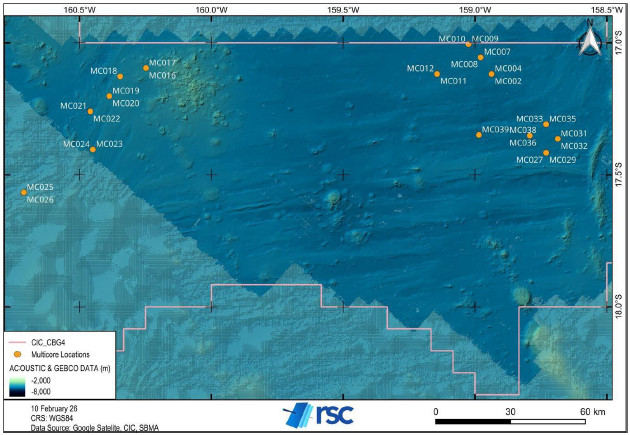
| | CIC Exp 4 Leg 2 in 2025: Environmental sampling in CBG04 using a multi-corer. |
Page 30 of 185
|
INITIAL ASSESSMENT FOR THE EL1 CIC LIMITED. |
To maintain a social license for exploration activities, CIC frequently engages with local groups and community leaders. SBMA also tours the islands, to bring local populations up to date with exploration activities. The license holders, including CIC, will at times accompany SBMA on these journeys.
3.4.1 Exploration Environment Programs & Impacts
Exploration licenses granted in the Cook Islands require applicants to submit detailed work programs, including Environmental Management Programs (EMPs), that seek to describe the marine environment prior to any consideration of further development. The EMPs are reviewed by an independent panel (Licensing Panel) that includes selected experts in the deep-sea minerals’ marine environment. The programs are also public documents and available from the SBMA website (https://www.sbma.gov.ck/register-of-titles).
Cook Islands’ environmental legislation is broadly aligned with equivalents in other jurisdictions such as the International Seabed Authority (ISA) and New Zealand, and exploration activities are managed through a tiered system at both Act and Regulations levels. Activities expected to have minimal impact (such as MBES survey, BC and FFG sampling) are permitted under the exploration license (an expedition notice is required to be submitted beforehand). Activities likely to have greater impact (such as large-scale sample dredging) require environmental consent, and activities such as trial mineral harvesting will require an approved and fit-for-purpose EIA and a comprehensive EMMP.
Standards and guidelines developed by the SBMA (https://www.sbma.gov.ck/standards-guidelines) seek to encourage innovation, focusing on reducing exploration impacts to as low as reasonably possible, e.g. through use of lower-impact sacrificial ballast. Some of these are interim, and while carrying legal weight these are to be refined in the future.
3.4.2 Environmental Impacts from Minerals Harvesting
The exact nature of impacts (or pressures) from mining of nodules is still unknown due to limited testing and studies and because actual mining of nodules has not yet taken place. Polymetallic nodule mining has only been demonstrated at a pilot scale, with collectors with or without attached risers operating for very limited amounts of time and covering only very small areas.
Conceptual views on minerals harvesting and associated impacts usually fail to properly express scale (both globally in terms of the deposit, and locally in terms of landform and deposit internal continuity), which is understandable given the spatial complexity of any likely operation. The pilot programs of the late 1970s (Parianos et al., 2016) as well as benthic impact experiments of the time (Parianos et al., 2016; Jones et al., 2017) provide some useful information on plume extents and organism recovery, but these tests are predicated on technology that is unlikely to be used industrially in the near future.
In 2018 and 2021, BGR (2018) and Global Sea Mineral Resources (2018) tested collector prototypes. In 2022, The Metals Company (2023) conducted an integrated mining test. When post-test surveys are complete, it may prove possible to apply learnings from these to inform impact assessments in the Cook Islands (Mormede et al., 2021).
Page 31 of 185
|
INITIAL ASSESSMENT FOR THE EL1 CIC LIMITED. |
Lists of potential impacts and a description of possible issues related to them are useful as checklists for modeling and monitoring programs, e.g. Flynn (2025). Cumulative impact assessment modeling (Dunstan et al., 2019) may help to put such list items in context in terms of priority and uncertainty.
At this stage, the environmental impacts associated with metallurgical processing (including generation of plant tailings) are unknown. However, it is reasonable to assume that such impacts would be roughly similar to those from existing bulk oxide metallurgical processing plants.
Under the Cook Islands governance framework, development proponents need to supply an independently reviewed EIA prior to any consideration for an application for a minerals mining license. The onus on the proponents is thus to demonstrate that the development will not lead to serious harm in the marine environment.
3.4.3 Environmental Baseline Studies
Environmental baseline research is work in progress for the CIC exploration program. Several expeditions undertaken by CIC include environmental sampling and/or data collection. As a minimum, each expedition collects marine wildlife observations. An initiative to train CIC personnel and local people as observers to international standards is in development.
During Exp 1 and Exp 4 Leg 1 environmental DNA (eDNA) samples were collected from BC sediments. The Exp 1 eDNA samples were compromised during transport and unfit for study. The eDNA samples from Exp 4 have not been analyzed at the effective date of this Report.
In addition, during Exp 4 Leg 1 subcores were collected from BCs to supply samples for environmental geochemistry, foraminiferal, and meiofaunal studies. CTD data were collected from Exp 1 and Exp 4, to be analyzed for water column properties and spatial variability.
Multicores collected during Exp 4 Leg 2 were sent to universities and institutions in Florida, USA, and in New Zealand, for further study. These studies are ongoing, and the results were not available by the effective date of this Report. Methods for quantitative analysis of datasets gathered by ROV and AUV during RC05 and ERS 1 are in development.
An Environmental Scoping Exercise Report for the CIC Project was generated by EMM Consulting in 2024. In 2025, EMM prepared An Environmental Risk Assessment for Trial Minerals Harvesting for the Project.
3.5 Significant Encumbrances to the Project
RSC is not aware of any significant encumbrances to the Project, and the exploration license remains in good standing as of the effective date of this TRS.
3.6 Other Significant Factors or Risks
RSC is not aware of any significant factors or risks that may affect access, title to the right, or ability to perform work on the Project.
Page 32 of 185
|
INITIAL ASSESSMENT FOR THE EL1 CIC LIMITED. |
4. Accessibility, Climate, Local Resources, Infrastructure & Physiography
4.1 Accessibility
The Project area is in the Pacific Ocean and only accessible via ship. Exploration operations are conducted by ocean-going vessels. There are no access restrictions within the Project area. The area is open to shipping and fishing vessels; therefore, public notices to mariners are required to be filed by license holders for any deployment of equipment, moorings, or operations that could affect shipping.
Most vessel movements within the EEZ are through-traffic, typically traveling between the Americas and Southeast Asia, or Australia, or traffic moving between island groups. Large numbers of vessels are tracked to the west of the Cook Islands, in Samoa and to the east, near Tahiti. On a global scale, shipping and total vessel traffic in the EEZ is generally low, but commercial shipping is critical to the delivery of products to Cook Islands and the economy in general. Avatiu Harbour on Rarotonga is an international seaport and main commercial harbor in Cook Islands. It receives most of the SOLAS (Safety of Life at Sea Convention) vessels, including dry cargo, cruise ships and yachts.
Cook Islands Port Authority (CIPA) manages the Port of Avatiu and is a 100% state-owned entity (Asian Development Bank, 2005). Reconstruction of Avatiu Harbour was completed in 2013 to provide a deeper harbor with increased capacity for larger vessels. The Port of Avatiu is limited in size and infrastructure, which places restrictions on the size class of ships that can be accommodated. Two international shipping lines service the Cook Islands on an approximate three-week cycle.
Island Councils administer unregulated harbor facilities on the other islands, with technical support provided by the Ministry of Infrastructure Cook Islands (ICI) and CIPA. Inter-island shipping is essential and is offered by the private sector. The overall quality of inter-island shipping is of low standard.
The nearest international port to the Project is the Cook Islands and international airport on Rarotonga.
4.2 Climate
The Cook Islands lie within the extensive and persistent trade wind zone of the South Pacific. The area has a tropical, mild maritime climate (21–28°C) with a pronounced warmer, wet season during November to April, when two-thirds of the ~2,000 mm annual rain falls, and a cooler, dry season from May to October.
The warmer season coincides with the cyclone season for the South Pacific region. Cyclones tend to form to the far west of the northern Cook Islands and migrate toward the southeast, often reaching latitude 15°S if not further south.
The weather is often strongly influenced by large inter-annual variations and the El Niño Southern Oscillation phenomenon. During El Niño years, the southern Cook Islands experience a reduction of rainfall, by up to 60% of the annual rainfall, while in the northern Cook Islands rainfall increases by up to 200%. The situation reverses during the La Niña phase.
Page 33 of 185
|
INITIAL ASSESSMENT FOR THE EL1 CIC LIMITED. |
A climate risk study for the Cook Islands by Asian Development Bank (2005) focused on the potential for extreme wave and wind events primarily driven by tropical cyclones. Annually, the Cook Islands receive between zero and three cyclones, with an increase in tropical cyclone frequency during El Niño conditions.
4.3 Seafloor Bathymetry (Physiography)
The CIC license area covers ~10% of the Cook Islands EEZ. Bathymetric coverage is generally poor, with GEBCO global bathymetric data being the only available bathymetry for the majority of the license area. High-resolution (50 m) bathymetry is available for ~15% of the Project area. The high-resolution bathymetry data were collected by CIC during Exp 3. The Project area comprises mainly low-lying abyssal plains of the Southern Cooks Basin, Penrhyn Basin and Samoa-Niue Basin (Browne et al., 2023). Part of the license follows the Manihiki-Palmerston Fracture Zone (Figure 4-1). Bathymetry in the license area generally varies from 4,700–5,300 m below sea level.-1
Figure 4-1: Bathymetric map of the Project area.
Page 34 of 185
|
INITIAL ASSESSMENT FOR THE EL1 CIC LIMITED. |
4.4 Local Resources & Infrastructure
The Project area is remote and at sea, with no services available other than those provided by the exploration vessels visiting the Project area. The nearest port for logistic support is the Port of Avatiu, in Avarua, Rarotonga, ~261 miles (420 km) or 22 hours at 10 knots south of the Project centroid. Ships can also anchor at the Arutanga Port, Aitutaki, which is 105 miles (170 km) or 9 hours at 10 knots south of the center of the Project area.
The island of Rarotonga hosts the Cook Islands international airport and has facilities including a hospital, food and trade stores, and has the highest population of the Cook Islands. The regional airport on Aitutaki operates daily flights to Rarotonga. Fuel is available in Rarotonga, although ocean-going ships typically refuel in Papeete, Tahiti.
For future exploration and mining of the seafloor, CIC would require custom exploration/mining and supply vessels, including crew.
Page 35 of 185
|
INITIAL ASSESSMENT FOR THE EL1 CIC LIMITED. |
5. History
5.1 Tenure & Operating History
The EL1 license area, or any part thereof, has not been held by any operator other than CIC.
5.2 Exploration History
| 5.2.1 | Cook Islands |
The first cruise programs dedicated to investigating nodules in the Cook Islands and adjacent regions were mounted in the mid-1970s by the New Zealand Oceanographic Institute. As a precursor to this, the Institute compiled all available data from Challenger and Eltanin cruises, completed elsewhere in the region, into maps of the nodule properties, including their Mn, Fe, Ni, Co, and Cu contents, and their distribution (Glasby et al., 1974). Further cruises were undertaken in the late 1970s, targeting polymetallic nodules in the South Penrhyn Basin and Aitutaki Passage. Between 1976 and 1981, the Committee for Coordination of Joint Prospecting for Minerals Resources in South Pacific Offshore Areas (CCOP/SOPAC) carried out several cruises in the Cook Islands region. During these cruises, nodules were collected, and the results of their analyses served to define areas of potential economic interest to be surveyed in more detail by later cruises under the Japan-SOPAC Cooperative Study on Deep Sea Mineral Resources in the South Pacific (Cronan, 2013) .
There have been several expeditions in the Cook Islands for polymetallic nodules, which are documented in Tay et al. (2023b), with multiple historical cruises taking samples from within the EL1 area.
5.2.2 EL1
The only exploration within the EL1 area that predates the exploration undertaken by CIC was carried out by the Japan International Cooperation Agency (JICA) between 1986 and 2000.
In response to the request of CCOP/SOPAC (see section 5.1), the Japanese Government conducted seabed mineral exploration in the South Pacific. Implementation and execution of the survey were consigned to JICA in cooperation with the Metal Mining Agency of Japan (MMAJ). JICA conducted three expeditions to the Project area using the RV Hakurei Maru No. 2 in 1986, 1990 and 2000 (Figure 5-1). An in-depth summary of the JICA sampling program is given in Tay et al. (2023a). A short summary is presented below. A summary overview of the JICA data quality is provided in Section 8.5.2.
Samples were collected by BC, FFG, long core (LC) and armed dredge (AD) tools. A summary is provided in Table 5-1. Survey stations were placed based on datum lines every 1° (111 km) in latitude and longitude (Figure 5-2). Infill sites were placed on a 39.3-km (21.5-mi) grid. Three samples (FFG or BC) were collected at each survey station in the form of an inverted triangle (Figure 5-3). The base sampling point of each station was set at the southern apex of the triangle, and the two other samples were collected at the remaining apexes of the triangle. Sampling points were ~2.6 km (~1.4 mi) apart. Sampling was conducted in a clockwise direction.
Page 36 of 185
|
INITIAL ASSESSMENT FOR THE EL1 CIC LIMITED. |
Figure 5-1: Historical samples within the Project area.
Page 37 of 185
|
INITIAL ASSESSMENT FOR THE EL1 CIC LIMITED. |
Table 5-1: Summary of historical sample type by year.
| Year Collected |
No. of FG Samples |
No. of ‘Oth’ Samples |
No. of SC Samples |
Total Number of Samples | ||||
| 1976 | 3 | 3 | ||||||
| 1978 | 10 | 1 | 11 | |||||
| 1983 | 31 | 2 | 33 | |||||
| 1985 | 52 | 21 | 73 | |||||
| 1986 | 21 | 21 | ||||||
| 1990 | 18 | 1 | 19 | |||||
| 2000 | 34 | 2 | 36 | |||||
| No date | 2 | 1 | 3 | |||||
|
|
|
|
| |||||
| Total samples | 171 | 25 | 3 | 199 |
Figure 5-2: Standard survey station layout used by JICA.
Page 38 of 185
|
INITIAL ASSESSMENT FOR THE EL1 CIC LIMITED. |
Figure 5-3: Standard station sampling layout used by JICA.
Sample locations were collected by different satellite systems for each expedition, with accuracy improving with each survey (Table 5-2). Sample locations were determined by the ship’s location during deployment. It is noted that sampling equipment can drift (including tethered sampling methods). Sample location precision is estimated to be in the order of 100–500 m against a sample spacing of ~25 km.
Table 5-2: JICA-MMAJ navigation systems.
| Expedition |
Satellite system |
Comments | ||
| 1986 | Navy Navigation Satellite System (NNSS) or Transit | Corrected positions between updates from the NNSS (Doppler rangefinder) indicate a surface accuracy of 200–500 m. The system likely used WGS72 as the geographic coordinate system (GCS). | ||
| 1990 | GPS + NNSS | GPS is likely Navstar. Accuracy of the system at the time of surveying is likely to be ~200 m. WGS84 as GCS. | ||
| 2000 | GPS + GLONASS | Accuracy of the system at the time of surveying is likely to be 20–60 m. WGS84 as GCS. |
During the 1986 and 1990 cruises, the samples were assayed by X-ray fluorescence (XRF) onboard the vessel for Cu, Co, Fe, Mn, and Ni. Samples collected during the 2000 cruise were analyzed at ALS Laboratories, Canada, by inductively coupled plasma emission spectroscopy for Cu, Co, Fe, Mn, Ni, Ti, Si, Al, Ca, Na, K, and P.
JICA expeditions were also equipped with deep-sea cameras that collected a photograph of the mineralized seabed prior to a sample being collected.
For the 1986 expedition, the RV Hakurei Maru No. 2 was equipped with a multi-frequency exploration system (MFES) to collect high-resolution bathymetry data of an area of the Cook Islands EEZ known as the Central Area or 16-159. The area covered by this expedition does not overlap with the CIC license area.
Page 39 of 185
|
INITIAL ASSESSMENT FOR THE EL1 CIC LIMITED. |
Figure 5-4: Cook Islands nodule sampling expeditions. The Project outline in white. Modified from Tay et al. (2023b)
5.3 Production History
To date, there has been no commercial production of polymetallic nodules from the Project area.
Page 40 of 185
|
INITIAL ASSESSMENT FOR THE EL1 CIC LIMITED. |
6. Geological Setting, Mineralization & Deposit
6.1 Regional Geology
6.1.1 Global Distribution of Nodules
Polymetallic nodules with various grades of base metals are found in submarine settings worldwide (Monget, 2015). This widespread distribution was recognized by the early 1970s when Kennecott Exploration surveyed all the major ocean basins (Figure 6-1). Nodules form at a wide range of depths, from 4,000–6,000 m below sea level in the mid Pacific to 200 m below sea level in the Gulf of Bothnia (Boström et al., 1982) and 30 m in the Baltic Sea (Anufriev and Boltenkov, 2007). The location of nodule formation is reflected in nodule chemistry. Nodules with relatively high Co grades are found within the Cook Islands EEZ (Table 6-1) – often accompanied by high nodule abundances.
Figure 6-1: Fe-Mn crust and nodule samples collected from around the world. Cook Islands EEZ is outlined in red.
Sourced from Monget (2022).
Page 41 of 185
|
INITIAL ASSESSMENT FOR THE EL1 CIC LIMITED. |
Table 6-1: Chemical compositions of nodules from different areas of the global ocean. Modified from Kuhn et al. (2017).
| Element |
CCZ | Eastern CCZ |
Central CCZ |
Peru Basin |
Indian Ocean |
Cook Islands |
Gulf of Cadiz |
Baltic Sea |
Fiji Basin |
|||||||||||||||||||||||||||
| Mn (%) | 28.4 | 31.4 | 27.56 | 34.2 | 24.4 | 16.1 | 6.03 | 18.1 | 40.23 | |||||||||||||||||||||||||||
| Fe (%) | 6.16 | 6.3 | 6.1 | 6.12 | 7.14 | 16.1 | 38.58 | 14.5 | 0.48 | |||||||||||||||||||||||||||
| Ni (%) | 1.3 | 1.4 | 1.36 | 1.3 | 1.1 | 0.38 | 0.01 | 0.01 | 0.01 | |||||||||||||||||||||||||||
| Cu (%) | 1.07 | 1.18 | 1.08 | 0.6 | 1.04 | 0.22 | 0 | 0 | 0 | |||||||||||||||||||||||||||
| Co (%) | 0.21 | 0.17 | 0.25 | 0.05 | 0.11 | 0.41 | 0.01 | 0 | 0 | |||||||||||||||||||||||||||
| ∑REE (ppm) | 813 | 701 | 801 | 403 | 1,039 | 1,678 | 78 | — | — | |||||||||||||||||||||||||||
6.2 Local Geology
6.2.1 Tectonic Setting
The Cook Islands include some of the oldest (90–124 Ma) known oceanic seafloor (Müller et al., 2016), compared to a global average oceanic crust age of 64 Ma (Seton et al., 2012). To the northwest, the Manihiki Plateau is dated ~123–124 Ma (Taylor, 2006; Timm et al., 2011), and might be part of a much larger submarine large igneous province that rifted apart shortly after its formation. The plateau has boundary faults and horsts on its northern and eastern sides as well as internal and broadly sub-parallel rift zones (Figure 6-2) (Winterer et al., 1974). Dating of the region is compromised by a lack of detailed seabed magnetic data. Much of the formation formed during the Cretaceous long normal period (Chron 34, 124.6–84 Ma).-2
Figure 6-2: Tectonic setting of the Cook Islands EEZ and surrounding seabed. The Project is outlined in black on the left.
Volcanic edifices are superimposed onto the seabed geology (Figure 6-3). These include isolated chains of seamounts and knolls as well as more continuous volcanic rises. The chains are in a variety of orientations, but predominantly west-northwest trending and some are interpreted to have resulted from hotspot activity (Wessel and Kroenke, 2008; Jackson et al., 2020). Knolls and seamounts are found on the plateau as well as the abyssal plain, not least in the western Manihiki Plateau.
Page 42 of 185
|
INITIAL ASSESSMENT FOR THE EL1 CIC LIMITED. |
Figure 6-3: Volcanic chains and hotspot tracks. Tracks after Wessel and Kroenke (2008) and Jackson et al. (2020). Refer
to Figure 6-2 for the names of other features.
6.2.2 Ocean Currents
Two major oceanic currents supplying well-oxidized bottom water are thought to influence mineralization in the Cook Islands EEZ (Glasby et al., 1986). The westward-flowing Southern Equatorial Current system (Figure 6-4) is derived from a divergence along the equator that leads to the upwelling of nutrient-rich waters, stimulating high biological productivity. The current system is the northern limb of an anticlockwise-circulating gyre within which the Cook Islands EEZ sits. Biological productivity in the southern part of the Cook Islands EEZ is low (Lutz et al., 2007; Cronan, 2013).
The Antarctic Bottom Water, which flows between the seafloor and ~3,500 m, has been inferred to flow to the northeast along the Aitutaki Passage (Usui, 1983), along the ridge immediately south of the Nova-Canton Trough (Yamazaki, 1992), and around the northeastern margin of the Manihiki Plateau to enter the North Penrhyn Basin (Figure 6-4). The formation of polymetallic nodules has been attributed to increased flow of the Antarctic Bottom Water during the Paleogene or Cretaceous (Usui, 1994).
Page 43 of 185
|
INITIAL ASSESSMENT FOR THE EL1 CIC LIMITED. |
Figure 6-4: Schematic of ocean currents in and near the EEZ. Source: Cronan (2013).
Page 44 of 185
|
INITIAL ASSESSMENT FOR THE EL1 CIC LIMITED. |
6.2.3 Seabed Morphology
The 2021 GEBCO grid was used as the basis for a 1: 4,000,000-scale geomorphological map of the Cook Islands seabed (Figure 6-5). This was supplanted with MBES bathymetric data, regional magnetic field data, and mapping from the literature review.
Mapped units comprise the following:
| | Abyssal plains: areas with limited relief except for abyssal hill traces and small knolls. Typically presented as ‘basins’ bound by major features, e.g. transform fracture zones, plateaus, and volcanic rises. Interpreted to be the domain containing significant amounts of polymetallic nodules within the Cook Islands EEZ. |
| | Abyssal plain lows: restricted areas of abyssal plains characterized by slightly greater depth (100–300 m) than adjacent plains. |
| | Knolls: probable volcanic edifices <1,000 m high, found on plains and plateaus. Only the larger knolls were mapped, either as singular (usually circular) or compound forms. Found among seamount chains but may form their own chains. |
| | Seamounts: probable volcanic edifices >1,000 m high, found on plains and plateaus. Typically form chains of various orientations, including the Hawaiian-Emperor orientation. Chains often grade into volcanic rises. Mapped as singular (usually circular) and compound forms. Islands within the EEZ are mapped seamounts that breach the sea surface. The existence of flat-topped edifices located on the Manihiki Plateau may support a past shallower position. |
| | Volcanic rises: typically, elongated rises of probable volcanic origin. Merge into volcanic chains and compound forms of seamounts. Some are very extensive, including the Boudeuse Volcanic Rise at the eastern limit of the Penrhyn Basin. Volcanic chains are lineaments of interrupted alignments of seamounts and knolls. |
| | Plateaus: extensive areas of seafloor elevated (500–2,000 m) relative to plains. Do not present evidence of abyssal hills; all units are likely to be part of the much older Manihiki Plateau, which is known to have significant sediment cover (in some places ~1 km thick). Some parts of the plateaus have more knolls; it is not known if this is due to later volcanic activity or differing amounts of sediment cover. |
| | Tectonic rises: typically, elongate rises of probable tectonic origin along the northern and eastern edges of the Manihiki Plateau and along the Manihiki-Palmerston Fracture Zone, which trends to the southeast of the plateau. |
| | Troughs: narrow/elongated and typically aligned depressions that are 500–1,000 m deep. Typically cut both plains and plateaus. |
| | Mapped faults: mapped breaks in the seabed bathymetry either at a high angle to prevailing abyssal hill traces or of too great a magnitude to be the normally faulted escarpments of abyssal hills. |
Page 45 of 185
|
INITIAL ASSESSMENT FOR THE EL1 CIC LIMITED. |
Figure 6-5: Seabed geomorphology for the Cook Islands and surrounds. Source: Browne et al. (2023). ECS: Extended Continental Shelf application.
6.3 Property Geology
The region covered by the EL1 license is generally poorly covered by high-resolution bathymetric data. CIC has acquired 50-m resolution multibeam data covering ~15% of the license area, concentrated in the CBG04 area. The seafloor features of the CBG04 area consist of relatively flat abyssal plains, with scattered sea knolls and seamounts. In the center-west of the Project, concentration of sea knolls and seamounts is higher. There are approximately east-west striking lineations across the southern half of CBG04 resulting from the bathymetric slope differences defined as ‘hills’ and ‘valleys’ (Figure 7-4). Approximately north-south trending chains of depressions, depicted by ‘Slopes > 10deg’ in Figure 7.4, characterize the bathymetry of the east and south areas of CBG04.
Red clay is the dominant sediment in abyssal basins of the South Pacific (Glasby, 1976), described as predominantly zeolite-rich and red-brown pelagic clay, with biogenic silica and carbon increasing with decreasing latitude and at depths above 4,800 m (Heine et al., 2015).
The CBG01 area is covered only by GEBCO bathymetric data, and appears to be characterized by northeast striking linear ‘hills’ and ‘valleys’ visible in transit multibeam data embedded in the GEBCO bathymetry. There is one conspicuous seamount in the northwest of the Project area (Figure 7-2). The seamount rises to ~2,160 m below the sea surface, or ~2,600–3,000 m above the surrounding seafloor (GEBCO, 2024).
Page 46 of 185
|
INITIAL ASSESSMENT FOR THE EL1 CIC LIMITED. |
Fine pelagic sediments described as red or brown clay are the predominant sediment type in CBG04 (Figure 6-6) and CBG01 (JICA-MMAJ, 2001). Deposition began during the pre-late Miocene, with the surface sediment likely to be deposited within the last 500 kyr (JICA-MMAJ, 2001). Sub-bottom profiling indicates that abyssal plains are covered by unconsolidated sediments, ≤20 m thick, and rarely exceed 40 m (JICA-MMAJ, 2001).
Seamounts are classified as acoustic Type D1, representing exposed rocks (see JICA-MMAJ, 2001), such as the large seamount in the NW corner of the CBG01 area and scattered small seamounts/knolls within CBG04. There is an acoustic transition zone (Type D2) between the flat plains and seamount/knoll zones that is inferred as exposed rocks, which may be covered by consolidated sediment or crust-like material (Figure 6-7; JICA-MMAJ (2001)). Any sediment in this area, if present, would be thin.
Figure 6-6: Stratigraphic column from gravity cores collected by JICA-MMAJ in the 16-159 Area or Central Area, which is directly adjacent to and north of the CBG04 area. Brown clay and insoluble brown clay are the most common types of sediment. After JICA (1984).
Page 47 of 185
|
INITIAL ASSESSMENT FOR THE EL1 CIC LIMITED. |
Figure 6-7: Sub-bottom profiles from (JICA-MMAJ, 2001).
Page 48 of 185
|
INITIAL ASSESSMENT FOR THE EL1 CIC LIMITED. |
6.4 Mineralization
The mineralization occurs at the water-sediment interface on the seafloor, in the form of polymetallic nodules that are significantly enriched in Co, Ni, and Cu. Locally, a minority component of the nodules occurs within the sediment, up to 30 cm deep (Figure 6-6). Polymetallic nodules are ubiquitous on the abyssal plains surrounding the Cook Islands, mostly at depths between 4,800 and 5,200 m (Kenex, 2014), in the shape of nodules fields that are continuous on a scale of tens of kilometers, essentially forming 2D deposits that trace the sediment-water interface.
The continuity of the mineralization on a regional scale (10s of km) is one of the main characteristics of this deposit type and a direct result of the factors controlling the mineralization also operating a regional scale (see section 6.5). Within areas that are conducive to nodule formation, smaller-scale (several 100s of m) features can be present (e.g. knolls, escarpments, sub-circular depression and grooves) that prevent or negatively influence nodule formation. In general, within the abyssal plains, the areal extent of these smaller-scale features tends to be marginal compared to the areal extent of the nodule field.
Because the thickness of the mineralized layer (up to several decimeters) is five orders of magnitude less than the lateral extent of the nodule fields (several 10s of km), no meaningful cross sections can be drafted. The closest alternative to a cross section is formed by a series of stratigraphic columns as presented in Figure 6-6.
The nodules within the Project area are dark brown to black and measure up to ~20 cm along their long axis. Nodule shape and size are highly variable across the Project area, ranging from centimeter-sized, irregularly shaped pellets to decimeter-sized spheres and plates. See Section 7.3.4 for a detailed description of nodule morphology. The nodules exhibit concentric layering, with the nucleus often being a ‘foreign’ object (e.g. a shark’s tooth or a piece of pumice) (Figure 6-8).
Figure 6-8: Nodule section showing a couple of shark teeth as nuclei surrounded by concentric growth bands.
Page 49 of 185
|
INITIAL ASSESSMENT FOR THE EL1 CIC LIMITED. |
The layers are composed of various amounts of Mn- and Fe-rich minerals depending on the conditions for deposition, such as buserite (diagenetic manganate) and vernadite (hydrogenetic Fe-Mn oxide) as determined by XRD analysis (Usui et al., 1993). The nodules within the Project area have elevated concentrations of several metals, mainly Fe (~16%) and Mn (~16%), but are also significantly enriched in Co (~0.4%), Ni (~0.4%), ~Cu (~0.2%) and REE (1,678 ppm on average) (Kuhn et al., 2017). The geochemical variation, including that of the elements of economic interest, is very low at the scale of the Project area. Given that the shape and size of the nodules is dependent on a combination of physical factors, the abundance of nodules (i.e. the total wet weight of nodules per square meter) tends to be laterally variable. This variability is often directly coupled with changes in seafloor morphology.
Nodules with a relatively high Co grade (>0.26% Co) are found in the central Cook Islands (including the Project area). The higher grades are likely due to a high proportion of hydrogenetic growth, promoting the relative accumulation of Co ions in the oxic vernadite crystal structure (Fe is >13%) and a highly oxygenated bottom water mass (assumed to be the Antarctic Bottom Water). Similar controls on mineralization are described for ferromanganese crusts on seamounts and guyots where Co grades are typically >0.5% and have reported >1% Co (Hein and Morgan, 1999; Hein and Koschinsky, 2014).
In the northeastern Cook Islands, higher Ni and Cu grades are associated with higher primary productivity (surface plankton). Net export of this may have also helped lead to suboxic conditions and higher Ni and Mn grades, similar to those described in the CCZ (Lipton et al., 2016).
The mineralization within the EL1 area is consistent with nodule mineralization elsewhere in the Cook Islands EEZ: The “Central Area” (JICA-MMAJ, 2001) is the only area where historical sample density is high enough to evaluate grade continuity, and the continuity there was found to be good (Tay et al., 2023b). The Central Area is also where historical resource estimates have reached Indicated: The Central Area has an Indicated Mineral Resource of 304 Mt nodules (wet), while the remaining Cook Islands EEZ has an Inferred Mineral Resource of 6,400 Mt nodules (wet) (Tay et al., 2023b).
6.5 Mineral Deposit Model & Known Comparable Deposits
Polymetallic nodule deposits form at almost all depths and latitudes in all the world’s oceans and seas, including the CCZ, Peru Basin, Central Indian Ocean, Southwest Atlantic Ocean, and the Arctic Ocean. Polymetallic nodule deposits mainly occur below the Carbon Compensation Depth (CCD, below ~3,500 m), in areas with low sedimentation rates typically associated with argillaceous and siliceous oozes in abyssal plains of oceanic basins. A sedimentation rate of <10 mm/kyr is required to prevent the growing nodules from being buried, considering their extremely slow growth rate (Hein et al., 2020). Bioturbation likely plays an important role in keeping nodules at the sediment-water interface. Nodules can also be found in the top decimeters of sediment (Heath, 1979; Piper and Fowler, 1980; Kerr, 1984; Sanderson, 1985; McCave, 1988; Banerjee, 2000; Dorgan et al., 2005; Hoffert, 2008). The accumulation and degradation of organic matter at the sediment-water interface is a source of the nodules’ elemental content (e.g. Mn, Fe, Co, Ni, Cu) (von Stackelberg and Beiersdorf, 1991; Skornyakova and Murdmaa, 1992; von Stackelberg, 2000; Hoffert, 2008).
Page 50 of 185
|
INITIAL ASSESSMENT FOR THE EL1 CIC LIMITED. |
Polymetallic nodules exhibit concentric layering, which indicates a gradual accretion over time. The layers are composed of various amounts of Mn- and Fe-rich minerals of different types and textures. Manganese is very mobile in seawater and can readily oxidize to Mn2+. Polymetallic nodules usually grow around a nucleus of a variable nature, such as a rock fragment, volcanic material, bone, tooth, or other nodules (Figure 6-8). The growth rate is estimated to be ~1–10 mm/myr based on nodule geochronology (Somayajulu, 1967; Guichard et al., 1978; Macdougall, 1979; Finney et al., 1984; Anufriev et al., 1996; Bollhöfer et al., 1999). This growth rate is 1,000 times slower than the rate of sedimentation, which raises the problem of maintaining nodules at the sediment-water interface. Variations in nodule growth rate can be linked to changes in climate, including periods of glaciation (Segl et al., 1989; Han et al., 2003).
Four main parameters determine the environment of polymetallic nodule growth:
| | local sedimentation rate; |
| | sedimentary facies related to the CCD and biological productivity in surface waters; |
| | relative topography; and |
| | bottom current activity (Halbach et al., 1981; von Stackelberg and Beiersdorf, 1991). |
Variations in these parameters result in the growth of two different kinds of nodules: hydrogenetic and diagenetic. Most nodules are formed by a combination of hydrogenetic and diagenetic growth. In the first case, the minerals precipitate from cold ambient seawater, and in the second from pore water within the sediment (Hein and Koschinsky, 2014; Hein et al., 2020). The metals in seawater are concentrated by adsorption onto ultrafine particles of Fe- and Mn-oxides (nanoparticles) that are attracted electrostatically to one another in the water column. The Mn-oxide particles have a negative surface charge and so scavenge other trace elements as they form, especially positively charged ions such as Co, Ni and Cu that are also present in seawater in trace concentrations. The Fe-oxide particles, in contrast, have a slight positive surface charge and attract negative ions in seawater, such as the oxyanions Mo, V, As, and some REEs (Figure 6-9). Diagenetic precipitation within the sediment occurs under oxic or suboxic conditions from pore fluids that consist of seawater modified by chemical reactions within the sediment. In the Cook Islands, nodules that are derived from a hydrogenetic process are common, whereas nodules found in the CCZ typically represent a mixed origin. These ‘mixed’ nodules usually have an equatorial rim that separates the hydrogenetic from the diagenetic hemisphere (Halbach et al., 1981).
Sedimentary hiatuses are an important control on the formation of nodules. Hydrogenetic nodule activity typically occurs in areas of negligible rates of sedimentation (von Stackelberg and Beiersdorf, 1991; Hein et al., 2020). Nodule formation also requires operating mechanisms, like biological activity and seabed currents (Parianos et al., 2021), which prevent the nodules from being buried or becoming a solid crust. Buried nodules are rare and thought to be left behind during sedimentation (Usai et al., 1993) by the biological processes that are the most likely reason for the uplift.
Page 51 of 185
|
INITIAL ASSESSMENT FOR THE EL1 CIC LIMITED. |
Figure 6-9: (a) Schematic illustrating the formation of Mn-oxides and Fe-oxyhydroxides. Positively charged ions are attracted to the negatively charged surface of Mn-oxides, whereas negatively charged ions sorb onto the surface of positively charged Fe-oxides and oxyhydroxides. (b) Schematic illustrating the formation of hydrogenic, diagenetic and mixed-type nodules and the variation in chemistry. From Hein et al. (2020).
Polymetallic nodules occur on the seafloor of abyssal plains in about 4,000–6,000 m water depth in all major oceans. The average geochemical composition of polymetallic nodules varies between different basins, as well as regionally within major basins. Compared to the main nodule occurrences in other areas (CCZ, Peru Basin and Indian Ocean), the Cook Islands nodules have high Co and REE grades, but lower Ni and Cu grades (Table 6-1). The average abundance of the Cook Islands nodules (15 kg/m2) is similar to that of the CCZ (15 kg/m2) and higher than that of the Peru Basin (10 kg/m2) and the Indian Ocean (4.5 kg/m2).
Page 52 of 185
|
INITIAL ASSESSMENT FOR THE EL1 CIC LIMITED. |
7. Exploration
CIC’s exploration programs included multibeam data acquisition and box coring, focusing on CBG04 East but also included minor work in CBG01. Other work undertaken includes environmental sampling in CBG04, FFG sampling in CBG04 and an AUV seafloor survey in CBG10.
7.1 CIC Expeditions
7.1.1 Expedition 1 Leg 1
In collaboration with Odyssey, CIC leased the MV Seasurveyor in 2022 with the purpose of commencing sampling in the newly granted EL1 license area. The focus was CBG04, in an area previously indicated by JICA to have elevated nodule abundance. The main vessel characteristics of the MV Seasurveyor are presented in Table 7-1.
In March 2022, the MV Seasurveyor was mobilized in Wellington, including mounting an electric winch with 7,000 m of 8 mm synthetic rope, A-frame, as well as laboratory and workshop containers. The vessel departed Wellington for the Cook Islands on 15 June 2022. Expedition 1 Leg 1 took place from 27 June to 7 July 2022. The first leg launched eight box cores at four stations in CBG04 (Figure 7-1), six of which failed. One attempt encountered crust while five failed due to early triggers. All deployments produced seafloor video and full-depth water column CTD (conductivity temperature, depth) profiles.
Table 7-1: MV Seasurveyor vessel characteristics.
| Characteristic |
Vale | |
| Length | 39 m | |
| Beam | 10 m | |
| Draught | 3.2 m | |
| Gross Registered Tonnage | 359 t | |
| Owner | Seaworks | |
| Operator | Seaworks | |
| IMO Number | 8824543 |
7.1.2 Expedition 1 Leg 2
The second leg of Exp 1 began on 18 July 2022, after crew change, a period of equipment modifications, and a change of the sample plan to include all CBGs to allow for flexibility with respect to changing weather. Box cores were primarily launched in western CBG04, with a few BCs deployed in eastern CBG04 and CBG01. The average sample spacing is ~11 km. Odyssey did not participate in the offshore operations from Exp 1 Leg 2 and onwards.
A total of 37 BCs were launched, 32 in CBG04 (Figure 7-1) and 5 in CBG01 (Figure 7-2), collecting 24 samples in total. Of the 13 failures, four BCs landed on crust and nine BCs triggered early. Early triggers were typically caused by the BC jostling in poor sea conditions. This issue was gradually overcome by modifying the trigger mechanism to increase its tolerance to rough handling. All deployments were equipped with a CTD probe and at least one video camera. All but one deployment captured seafloor video, resulting in seafloor video being recorded at all targeted stations. Expedition 1 Leg 2 ended on 9 September 2022.
Page 53 of 185
|
INITIAL ASSESSMENT FOR THE EL1 CIC LIMITED. |
Figure 7-1: Samples collected in CBG04.
Figure 7-2: Samples collected in CBG01.
Page 54 of 185
|
INITIAL ASSESSMENT FOR THE EL1 CIC LIMITED. |
7.1.3 Expedition 2
Expedition 2 took place from 29–31 August 2023 using the MV Anuanua Moana. The goal of Exp 2 was to collect a number of bulk samples and ROV data in western CBG04. The vessel characteristics of the MV Anuanua Moana are presented in Table 7-2.
The bulk sampling was planned based on a single multibeam line collected by MML for CIC. The multibeam line runs through an area of high nodule abundance sampled during CIC’s Exp 1. Three stations (AIT024, AIT027 and AIT028) were picked as targets for bulk sampling (Figure 7-3). MML’s benthic sled was used to collect three bulk samples (DR001, DR002 and DR003), collecting a total ~1.4 t of nodules for metallurgical testing and method development purposes.
Starting at station AIT024, using an ROV, seafloor video footage was collected along a ~5 km long transect. MML collected the ROV footage under its environmental umbrella permit as part of MML’s expedition RC05.
Figure 7-3: Ship track for Exp 2, including dredge lines (light green) and ROV track (dark green).
Table 7-2: MV Anuanua Moana vessel characteristics.
| Characteristic |
Value | |
| Length | 61 m | |
| Beam | 15.8 m | |
| Draught | 6.5 m | |
| Gross Registered Tonnage | 2,163 t | |
| Owner | Kiva Marine | |
| Operator | Moana Minerals Ltd | |
| IMO Number | 9352224 |
Page 55 of 185
|
INITIAL ASSESSMENT FOR THE EL1 CIC LIMITED. |
7.1.4 Expedition 3
The third expedition undertaken by CIC took place from 11 September–11 October 2023 and used the MV Anuanua Moana for multibeam data acquisition in CBG04. In total, 32,750 km2 (12,645 mi2) new bathymetry data at 50 m resolution was collected. As a secondary objective, 22 FFG samples at 11 new stations were collected. Secondary objectives included wildlife observation and collection of bio-acoustic data from the top 1,000 m of the water column using the onboard EK-80 system. Sub-bottom profiling was also planned for Exp 3, but did not take place as the sub-bottom profiler was inoperable for the duration of the expedition.
The multibeam data were acquired using the vessel’s Kongsberg M304 Mk II 28 kHz multibeam echosounder. Data acquisition was managed with Kongsberg’s Seafloor Information System (SIS), and data were shared between the survey station and the ship’s bridge crew using the Hypack software package from Xylem Water Solutions. To accurately calculate the depth of the seafloor from the multibeam data, five sound velocity profiles were recorded at intervals spaced throughout the expedition.
The 22 FFG samples acquired during Exp 3 were taken as paired launches at 11 new stations on a loose E-W transect across the survey area (Figure 7-1). The FFG sampling recovered a total of 78.5 kg of nodules.
7.1.5 Expedition 4 Leg 1
Expedition 4 Leg 1 took place from 15 July–29 September 2025 using the MV Seasurveyor, focusing on the eastern part of CBG04 (Figure 7-4). Approximately 170 kg of nodules were recovered from 73 BC samples out of 85 deployments, with an average sample spacing of ~11 km. Eleven BC deployments landed on crust, and one landed on basement (pillow basalt outcrops). One BC triggered early in rough sea conditions.
7.1.6 Expedition 4 Leg 2
Expedition 4 Leg 2 took place using the MV Seasurveyor from 7–26 October 2026 following a short equipment swap. Expedition 4 Leg 2 ended prematurely due to mechanical issues with the winch.
Exp 4 Leg 2 saw 39 deployments of the multi-coring system at 14 stations in the eastern and western CBG04 (Figure 7-5). A total of 88 cores were recovered, of which 56 were deemed of sufficient quality to be processed further. Samples sliced from the accepted cores were sent to laboratories in New Zealand and the USA for analyses for environmental DNA, microfauna, meiofauna, phytopigments, organic geochemistry, gamma spectroscopy, as well as elemental and geochemical analysis.
Page 56 of 185
|
INITIAL ASSESSMENT FOR THE EL1 CIC LIMITED. |
Figure 7-4: Sample distribution and nodule abundance for Exp 4 Leg 1.
Figure 7-5: Multicore locations, Exp 4 Leg 2.
Page 57 of 185
|
INITIAL ASSESSMENT FOR THE EL1 CIC LIMITED. |
7.1.7 Expedition 4 Leg 3
Expedition 4 Leg 3 took place using the MV Seasurveyor from 5–18 November 2025 after a period of mobilization and verification that the Orpheus AUV could be launched using the winch and A-frame without needing the defunct winch level wind. The plan was to trial the AUV imaging capabilities on 10 transects in the CBG04 East area, as well as test the landing of the AUV on the seafloor to sample with the onboard small environmental sediment coring system.
Leg 3 was terminated after several attempts at getting the AUV to approach the seafloor safely and move along pre-planned transect lines. No samples were taken and no useful video footage was recorded.
7.2 Exploration Procedures and Parameters
7.2.1 Location Determination
7.2.1.1 Surface Location Determination
The MV Seasurveyor used a Hemisphere Crescent VS110 GPS navigation system as the primary method for surface location determination. This differential GPS system has integrated gyro and tilt sensors and can obtain differential positioning accuracy of 60 cm with 95% confidence. A single axis gyro provides <1° heading uncertainty for up to 3 minutes if GPS lock is lost.
Surface location was managed by surveyors hired by Seaworks or CIC (Exp 1), and Bintang Subsea (Exp 4), using processes laid out by the CIC Operations Manager. The Seaworks and Bintang Subsea surveyors measured offsets in regards to the constellation of GPS, ship midpoint and A-frame overboarding location. Location data were shared with the bridge crew using the Qinsy survey system, and with the Operations Manager using CIC’s survey data entry form.
A premade plan comprised of existing and planned stations was loaded up to the ships navigation system using a data file that was also shared with the surveyor. The Chief Scientist would determine what location to go to next, in conference with the Captain and the Operations Manager. When the ship was on location, the accuracy of the location was checked against the surveyor’s location in Qinsy, and later against independent GPS locations from the wildlife observations camera.
7.2.1.2 Submarine Location Determination
The MV Seasurveyor was equipped with a Sonardyne Ranger 2 USBL system, which was used to determine the submarine location of the BC assembly relative to the vessel. The system comprises a transponder mounted to a pole lowered into the sea on the port side of the vessel, and a Sonardyne WMT MF DIR 7000 PA-20/600BAR beacon fitted to the frame of the box corer. This system enabled the two platforms to track relative positions in three dimensions. The accuracy of the USBL system can be better than 0.1% of the slant range when optimized, or ~10 m at a depth of 5,000 m. The USBL accuracy is dependent on acoustic propagation conditions, water depth, signal to noise ratio, and GPS grade. Similar to the DGPS, the USBL system was interfaced to the Qinsy navigation software and displayed on a screen at the surveyor’s workstation. The submarine location determination process was managed by MV Seasurveyor’s surveyors, guided by the survey data entry form provided by the Operations Manager. The final sample location was determined by the process described in the box coring SOP: the location of the corer (location of the USBL beacon) was continuously tracked during descent and ascent,
Page 58 of 185
|
INITIAL ASSESSMENT FOR THE EL1 CIC LIMITED. |
and checked against the length of rope paid out, indicated by the overboarding sheave software. When the box corer was observed to have landed on the seafloor, the surveyor – prompted by the winch operator – would record the location of the box corer once per second for at least a minute. When enough data points were recorded to obtain an accurate location, the surveyor prompted the winch operator, who then began the box corer recovery procedure.
7.2.2 MBES Surveying
In 2023 (Expedition 3 Leg 1), high-resolution bathymetric and backscatter data were collected using the MML-owned hydrographic survey equipment installed on the MV Anuanua Moana within CGB04. The multibeam echosounder (MBES) system was a Kongsberg EM304 Mk II, with position and attitude provided by a Kongsberg SeaPath 380 R2. Sound velocity profiles were generated using a ValePort Midas sound velocity profiler (SVP).
The survey was typically run in Very Deep Mode, with a reliable swath width of 10–12 km. The exception was for water depths beyond 5,100 m, when data coverage and quality degraded noticeably. The system was then switched to Extra Deep Mode, which reduced the swath width.
The vessel speed during the survey was ~7–8 knots, except when heavy seas required the vessel speed to be lower. Survey lines were oriented northwest as directed by prevailing sea conditions.
When each survey line was completed, it was transferred via the internal vessel network to the Data Processing Room for immediate post-processing. Distance offsets between navigation sensors and the EM304 transducer were measured in 2022 (ANKO Marine AS, 2023). In early 2023, calibration of angular offsets between navigation and the transducer was carried out. Both sets of measurements are incorporated into a vessel file used by Caris HIPS software for post-processing of the data. An initial review of processed data indicated no artifacts were apparent in the bathymetry data that may be caused by incorrect calibration values, and the entire survey was processed with the existing vessel file calibration values.
A ValePort Midas SVP was deployed using the vessel Dyneema rope winch over the stern A-frame to collect full water depth speed of sound velocity profiles. The time for an SVP measurement over 5,000 m was ~3 hours. Following completion of the profile, the data were downloaded and then opened in the Sound Speed Manager to convert to Kongsberg format. The converted data were then loaded to SIS for inclusion in data acquisition before recommencing the survey. The only exception to this was during the original transit from Rarotonga to the project location when data were acquired using the existing SVP data loaded into SIS, which was acquired in March 2023.
7.2.3 Box Core Sampling Procedures
7.2.3.1 Equipment Specifications
CIC used two Ocean Instruments BX-635 box corers (Figure 7-6). Each corer consists of a frame and a detachable sample box, and a third sample box was available as a spare. The sample boxes have a footprint of 35 cm × 35 cm (0.1225 m2) and are 58 cm tall. The corers weigh ~500 kg on deck and ~350 kg in water. The maximum sample thickness of 30 cm was set by the stroke length of the central mast of the frame, guided by the position of the valves on the core boxes. In general, samples of good quality have a thickness of ~25 cm.
Page 59 of 185
|
INITIAL ASSESSMENT FOR THE EL1 CIC LIMITED. |
The BX-625 has one-way valves on the sides of the sample boxes, working as vents to minimize bow-wave effects during descent. The original design used during Exp 1 used a single valve. For Exp 4, a larger valve model was used, and four valves were mounted on each box instead of the single valve used during Exp 1. Two subsea cameras with lights, a USBL beacon and a CTD logger (Figure 7-6) were attached to the BC assembly before deployment. At least one camera, one USBL and one CTD logger were mounted for all BC launches.
A second model, Ocean Instruments Gomex-50, was trialed during Exp 4. This is a compact double-spade design which can take superior quality samples compared to the BX (USNEL-style single-spade) models in soft sediments. However, the model was found to be of inferior construction, failed on the first launch, and was not used again.
All box coring operations were executed using the MV Seasurveyor.
Figure 7-6: Original BX-635 BC design used in 2022 during Exp 1 (left). Updated design (right)
7.2.3.2 Deployment & Sampling Procedure
Box core sampling is a tethered seabed sampling method, whereby a BC unit is lowered to the seabed by winch, typically at a rate of 50–60 m per minute (m/min). For Exp 4, a passive heave compensator was inserted between the winch and the overboarding sheave, reducing swell-induced heaving by the length of the compensator stroke of ~3 m.
Approximately 100 m above the seabed, the winch was stopped for 1 minute to allow the box corer to settle to an upright position. The winch then lowered the box corer at a rate of 20–25 m/minute until the seafloor was reached. A telltale sign of the box corer reaching the seafloor was the increase of the heave compensator stroke beyond the range and out of the
Page 60 of 185
|
INITIAL ASSESSMENT FOR THE EL1 CIC LIMITED. |
rhythm set by the current sea state. Another sign was a slacking of the rope as the pull of the box corer reduced to zero. When signs of seafloor landing became apparent, extra rope was paid out at elevated speed until the ram was fully extended and the rope slackened. This was important, especially in rougher sea conditions, to prevent the BC unit bouncing before triggering, thereby disturbing the seafloor before a sample is taken.
Once the BC unit landed on the seabed, the box sunk into the sediment, releasing the trigger of the spade. The box corer was left on the seafloor for 3–5 minutes to allow the surveyor to generate a Location Fix Report with the USBL system, as well as for cameras to adequately photograph the seafloor.
After the surveyor had generated the Location Fix Report, the rope was slowly pulled in until tension started to build. This tension would first close the heave compensator ram. When or if tension reached values greater than the expected box corer weight (500 kg) and the heave compensator ram was fully closed, the winch was stopped, allowing the box corer to be gently worked out of the seafloor using the heave motion of the ship. Release tensions ranged between 600–1,100 kg.
When enough tension was added to the rope to pull the box corer free of the seafloor, the spade was first pulled to close under the sample box, which cut the sediment underneath the box and secured the sample for retrieval. The box corer was winched back to the surface at a rate of 60–80 m/min.
The procedure described above mainly applies to Exp 4. The procedure used for Exp 1 was generally the same, but the heave compensator was not available. The BC extraction method was therefore slightly different for Exp 1. When the box corer reached the seafloor, tension would drop to zero and the rope would slacken. Extra rope was paid out to mitigate the effect of ship movements, including pitching and heaving. Recovery would start with pulling on the rope to close the spade under the box corer, stopping the winch and letting the ship heaving gently release the box corer if tension built to 1,000 kg or more.
Once the box corer was recovered and secured on deck, the spade was removed from the frame and the sample box placed on a skid. The skid with the sample box was moved to the port-side processing station, allowing the science team to start processing the sample.
Sample quality was assessed from the processing outset. The top water quality was evaluated (clear, cloudy or turbid), and water temperature measured. After siphoning off the water, the sample surface was described and photographed. Depth to the sample surface was measured at the four sides of the sample box, with significant differences in that depth indicating a disturbed sample. Any macrofauna present were photographed and removed for close-up photography, identification, and preservation. If the macrofauna were encrusting, the substrate nodules were removed with the macrofauna, then returned after the macrofauna had been processed and stored.
Surface nodules were removed and placed in a bucket labelled ‘0 – 5’. When all nodules in the surface layers were removed, geotechnical shear vane measurements were taken at two locations. Various subcores were then inserted for sediment sampling. Samples for environmental DNA (eDNA) were immediately taken to the onboard -80°C freezer.
Page 61 of 185
|
INITIAL ASSESSMENT FOR THE EL1 CIC LIMITED. |
The ‘0 – 5’ bucket with nodules was taken to the laboratory for offshore preliminary analysis and bagging, together with a small amount of sediment for color description using the Munsell color chart. In the laboratory, loose mud was rinsed off the nodules using seawater, and the nodules were allowed to drip dry before being subjected to sample weight and volume measurements. After the preliminary measurements of both sample weight and average nodule density, the nodules were laid out on a photography table, overall morphology was described, and photographs were taken of each sample depth interval if more nodules were present below 0–5 cm (Figure 7-7).
Meanwhile, the BC sediment was subsampled by stripping it back in layers (0–5 cm, 5–10 cm, 10 cm – bottom), and anything unusual was documented and preserved, if possible. For Exp 1, the sediment was generally discarded except for planned eDNA samples and a scoop of sediment for descriptive analysis. For Exp 4, 8 cm × 30 cm subcores were taken, as well as paired bulk samples of several hundred cubic centimeters of sediment for each interval (5–10 cm, 10 cm – bottom).
After processing, nodules were bagged, provided with chain-of-custody tags, and stored with the sediment samples in food-grade, sealed, plastic buckets. These buckets were again stored in climate-controlled conditions in the onboard workshop container.
Figure 7-7: Examples of nodules photographs taken offshore. Background grid size is 1 cm.
7.2.4 Freefall Grab Sampling Procedures
During Exp 3, CIC used the FFG units with a nominal sampling area of 0.2 m2 owned by MML, from MML’s research vessel MV Anuanua Moana (Figure 7-8). FFG sampling is an untethered seafloor sampling method. A grab and flotation frame are combined with two ballast weights attached to the open grab, providing the negative buoyancy for the FFG sampler to sink.
Page 62 of 185
|
INITIAL ASSESSMENT FOR THE EL1 CIC LIMITED. |
On impact with the seafloor, the FFG sampler dislodges the ballast weights, changing buoyancy to positive and thus lifting the grab. The upward motion pulls on the two grab arms, causing the sample jaws to close, encasing any sample. At the surface, the FFG sampler was recovered using the port-side 4-tonne crane and 3-m-long grappling poles. The sampler was placed into the FFG cradle on the back deck (Figure 7-8). Once in the cradle, the sample was photographed before being emptied into a bucket placed underneath the jaws (Figure 7-9). From this point onwards, the nodules collected by FFG were processed in a manner identical to that described for the BC nodules in section 7.2.3.2.
The FFG flotation frame was equipped with a Garmin inReach® Mini GPS tracker (encased in a titanium housing rated to 6,000 m depth) and strobe light. These were used to help locate the FFG sampler for recovery. The frame also has room to attach a CTD probe and a subsea camera with external light. The grab and floats were attached by two galvanic quick-release hooks.
Figure 7-8: Recovered FFG sampler on deck.
Page 63 of 185
|
INITIAL ASSESSMENT FOR THE EL1 CIC LIMITED. |
Figure 7-9: Example of nodule samples from an FFG launch during Exp 3.
7.2.5 Multi-Core Sampling Procedures
Multicore (MC) samplers are a tethered sampling method typically used for the collection of multiple high-quality, undisturbed sediment core samples, which may at times include nodules. The MC sampler was deployed from the MV Seasurveyor during Exp 4 Leg 2 following similar procedures to the BC sampler, using the winch and passive heave compensator.
The Ocean Instruments MC-400 multicorer was equipped with four coring tubes that were simultaneously activated to sample the sediment (Figure 7-10). The frame was also equipped with a CTD probe, USBL beacon and two subsea cameras with external lights. Due to the small sample area of the cores compared with the size of the nodules, the MC sampler was not suitable for assessing nodule abundance, and data resulting from its use were not included in the MRE. Samples taken using the MC have been shipped to partners at universities for the research required for an EIA.
Page 64 of 185
|
INITIAL ASSESSMENT FOR THE EL1 CIC LIMITED. |
Figure 7-10: MC-400 multicorer recovered to deck with samples.
7.2.6 Bulk Sampling Procedures
For bulk sampling, CIC used the benthic sleds operated by MML from its vessel MV Anuanua Moana. Each sled is 1,050 mm wide, 500 mm high, and 1,850 mm long, giving an internal volume of 0.97 m2. The sled was fitted with at least one 4K-resolution camera, each with two lights, and all with scaling lasers embedded, providing ~3 hours of video. The cameras can be programmed with a time delay to capture video footage of the dredging only. The front of the sled was painted black to reduce light interference for the camera. A second camera was mounted on the sled during one launch, facing backwards to capture the sled landing on the seafloor.
The sled was deployed from the back deck winch and towed behind the ship at between 1 and 2 knots. MML used the sleds to collect bulk nodules over large areas for use in metallurgical studies.
The benthic sled was deployed during Exp 2 (Figure 7-11).
Page 65 of 185
|
INITIAL ASSESSMENT FOR THE EL1 CIC LIMITED. |
Figure 7-11: Benthic sled unloading nodules on the back deck.
7.2.7 ROV Surveying Procedures
A Comanche 6000 Observation ROV was used to run a survey of the seabed in CBG04 East, just prior to Exp 2. A dedicated ROV Launch and Recovery System (LARS) was installed on the MV Anuanua Moana’s mezzanine deck. An A-frame was used to extend the ROV over the water, and a dedicated winch was used to lower the ROV into and through the water column (Figure 7-12). The 6,500-m-long ROV umbilical was stored on a traction winch. The ROV is electrically powered and controlled from the ship using an umbilical and tether management system (TMS). Onboard the ROV, electrical power is used to run several thrusters for maneuvering, to power hydraulics for the manipulators, and to power cameras and sensors needed for safe and proper operation of the system. The ROV was equipped with two Arctic Ray 4K Mako cameras. One is mounted on a pan and tilt apparatus in a forward-looking position and the stereo-imaging lasers activated at a known separation distance of 35 mm. The other camera was mounted on the forward part of the vehicle in a downward-looking position, with no lasers activated. -12
The descent to the seafloor was at an average speed of 50 m/min. The TMS stopped ~50 m above the seafloor, at which point the ROV then exited the TMS and used the doppler velocity logger (DVL) and cameras to find the true bottom. The average time for the ROV to be ready on the seafloor for a survey was ~2 hours.
The ROV survey was conducted at an altitude of ~2.2 m and a velocity of ~0.4 knots.
Page 66 of 185
|
INITIAL ASSESSMENT FOR THE EL1 CIC LIMITED. |
Figure 7-12: ROV launching on starboard side of the MV Anuanua Moana during Exp 2.
7.3 Exploration Results
7.3.1 MBES Surveying
The total coverage of MBES data is 32,758 km2 (12,648 mi2), or ~15% of the total license area. Bathymetric and backscatter data were processed to 50 m resolution (Figure 7-13 and Figure 7-14). A slope analysis was run on the bathymetric data (Figure 7-15).
Page 67 of 185
|
INITIAL ASSESSMENT FOR THE EL1 CIC LIMITED. |
Figure 7-13: Bathymetric (50 m resolution) data collected within CBG04.
Figure 7-14: Backscatter (50 m resolution) data collected within CBG04.
Page 68 of 185
|
INITIAL ASSESSMENT FOR THE EL1 CIC LIMITED. |
Figure 7-15: Slope map displaying areas with a slope >10°.
Two approaches were taken to interpret seafloor geomorphology from the MBES data: (1) a statistics-driven approach (Morgan, 2024) using the Exp 3 multibeam data domained primarily using the Benthic Terrain Modeller (BTM) tool for ArcGIS (Walbridge et al., 2018); (2) a visual interpretation of multibeam bathymetry and backscatter (Nielsen, 2025).
Both approaches refer to the terrain-based study generated by the Cook Islands Seabed Mineral Authority (Browne et al., 2023) (Section 6.2.3). This study used the BTM tool to interpret regional geomorphology and structures using GEBCO bathymetric data (GEBCO, 2024). The areas of focus for CIC are abyssal plains, often described as gently rolling hills and valleys.
Page 69 of 185
|
INITIAL ASSESSMENT FOR THE EL1 CIC LIMITED. |
Figure 7-16. Interpreted seafloor geomorphology with CIC license area (hatched areas) (Browne et al., 2023).
Morgan (2024) studied the multibeam data dividing the seafloor into depressions, hills, and valleys (Figure 7-17). Areas with a slope >10° were used as a pragmatic indicator of areas too steep to be either safely sampled or harvested in the future. The study further compared the sparse assayed sample set with the geomorphological domains and found that ‘hills’ had higher values of Mn, Fe, Co, and REE while ‘valleys’ had higher values of Ni and Cu. While suggesting that this may indicate elevated occurrence of hydrogenetic nodules on the hills and elevated diagenetic nodule presence in the valleys, the study also noted that this is not statistically testable at the time of the reporting.
Nielsen (2025) interpreted the multibeam and backscatter data to identify structural features on the seafloor. The bathymetric data display east-trending features, which Nielsen (2025) interpreted as horst-and-graben structures that are characteristic of oceanic seafloor. Nielsen (2025) identified approximately north-trending lineaments in a bathymetry-derived slope map as faults, and their pattern of intercept in roughly 30° angles were suggested to indicate east-west oriented tectonic reactivation and compression. Areas of high backscatter intensity are often considered indicative of either hard substrata or high nodule abundance, although backscatter intensity is influenced by seafloor geometry, seafloor roughness and volume properties (Blondel, 2001; Brown et al., 2015),. High backscatter intensity in the eastern CBG04 may therefore indicate an area with potential for high nodule abundance. Broad, linear, north-oriented features with intermediate to high backscatter intensity were interpreted by Nielsen (2025) as relatively young chains of knolls following the similarly trending faults and overprinting the horst-and-graben pattern.
Page 70 of 185
|
INITIAL ASSESSMENT FOR THE EL1 CIC LIMITED. |
Figure 7-17: BTM-derived geomorphological domains (Morgan, 2024).
Nielsen (2025) suggested at least two major periods of tectonic activity: (1) early seafloor spreading leading to the development of the horst-and-graben structures, and (2) a later period of tectonic inversion (compression) leading to the north trending faults that guided the formation of knolls. Based on this tectonic history, Nielsen (2025) suggested that the risk of polymetallic crust formation along faults may be elevated due to periods of fault reactivation.
Page 71 of 185
|
INITIAL ASSESSMENT FOR THE EL1 CIC LIMITED. |
Figure 7-18: Geological interpretation of the bathymetric and backscatter data Nielsen (2025).Top: North trending lineaments and potential crusts outcrops in the bathymetry data. Bottom: Seafloor textures in backscatter data, including high reflectivity in a continuous abyssal plain area and intermediate reflectivity in elongated areas characterized by chains of knolls.
7.3.2 Box Core Sampling
A total of 130 BC deployments resulted in the collection of 83 nodule samples. Samples were collected from CBG01 and CBG04 areas across two expeditions (four legs in total). The BC samples were collected on a ~11-km space dice-five grid.
Page 72 of 185
|
INITIAL ASSESSMENT FOR THE EL1 CIC LIMITED. |
A total of 47 deployments failed (i.e. no nodules sample was returned). The reason for sample failure was either equipment failure (early triggering of the spade) or the BC sampler landing on either crust or basement rock. In most instances where sampling failed due to triggering of the spade, when the landing video footage indicated that nodules were present, the BC sampler was redeployed, and a sample of acceptable quality was collected. In RSC’s opinion, the BC samples collected are representative with respect to the mineralization style.
The locations of all BC samplers deployed, as well as the abundance and geochemistry (Co, Cu, Fe, Mn, and Ni grade) are presented in Table 7-3, Figure 7-19 (CBG04), and Figure 7-20 (CBG01). The moisture content and density data are presented in section 8.3. The samples collected during Exp 4 are currently at the laboratory, awaiting geochemical analysis.
Table 7-3: Summary of nodule abundance and geochemistry data collected by BC samplers. - = no data, NA = not yet available.
| Sample ID |
Cruise | Date (UTC) |
Latitude (°) | Longitude (°) | Sample Status |
Abundance (kg/m2) |
Co (%) |
Cu (%) |
Fe (%) |
Mn (%) |
Ni (%) |
|||||||||||||||||||||||||||||
| BC001 |
Exp 1 Leg 1 | 3/07/2022 | -17.49920 | -160.28380 | Fail | 0 | — | — | — | — | — | |||||||||||||||||||||||||||||
| BC002 |
Exp 1 Leg 1 | 3/07/2022 | -17.49940 | -160.28580 | Fail | — | — | — | — | — | — | |||||||||||||||||||||||||||||
| BC003 |
Exp 1 Leg 1 | 3/07/2022 | -17.49920 | -160.36400 | Fail | — | — | — | — | — | — | |||||||||||||||||||||||||||||
| BC004 |
Exp 1 Leg 1 | 4/07/2022 | -17.49920 | -160.36410 | Fail | — | — | — | — | — | — | |||||||||||||||||||||||||||||
| BC005 |
Exp 1 Leg 1 | 4/07/2022 | -17.48580 | -160.45105 | Fail | — | — | — | — | — | — | |||||||||||||||||||||||||||||
| BC006 |
Exp 1 Leg 1 | 4/07/2022 | -17.48610 | -160.45160 | Fail | — | — | — | — | — | — | |||||||||||||||||||||||||||||
| BC007 |
Exp 1 Leg 1 | 5/07/2022 | -17.49470 | -160.51000 | Valid | 21.73 | 0.5 | 0.09 | 18.19 | 13.83 | 0.18 | |||||||||||||||||||||||||||||
| BC008 |
Exp 1 Leg 1 | 5/07/2022 | -17.49461 | -160.51005 | Valid | 19.33 | — | — | — | — | — | |||||||||||||||||||||||||||||
| BC009 |
Exp 1 Leg 2 | 19/07/2022 | -17.96200 | -158.69100 | Fail | 0 | — | — | — | — | — | |||||||||||||||||||||||||||||
| BC010 |
Exp 1 Leg 2 | 22/07/2022 | -17.97880 | -159.46420 | Valid | 3.27 | — | — | — | — | — | |||||||||||||||||||||||||||||
| BC011 |
Exp 1 Leg 2 | 22/07/2022 | -17.90800 | -159.42200 | Fail | — | — | — | — | — | — | |||||||||||||||||||||||||||||
| BC012 |
Exp 1 Leg 2 | 23/07/2022 | -17.90810 | -159.42220 | Fail | 0 | — | — | — | — | — | |||||||||||||||||||||||||||||
| BC013 |
Exp 1 Leg 2 | 23/07/2022 | -17.84300 | -159.39410 | Valid | 1.31 | — | — | — | — | — | |||||||||||||||||||||||||||||
| BC014 |
Exp 1 Leg 2 | 24/07/2022 | -17.77720 | -159.32688 | Fail | 0 | — | — | — | — | — | |||||||||||||||||||||||||||||
| BC015 |
Exp 1 Leg 2 | 24/07/2022 | -17.77785 | -159.32730 | Fail | — | — | — | — | — | — | |||||||||||||||||||||||||||||
| BC016 |
Exp 1 Leg 2 | 24/07/2022 | -17.68600 | -159.28100 | Fail | — | — | — | — | — | — | |||||||||||||||||||||||||||||
| BC017 |
Exp 1 Leg 2 | 31/07/2022 | -23.98050 | -160.01600 | Fail | — | — | — | — | — | — | |||||||||||||||||||||||||||||
| BC018 |
Exp 1 Leg 2 | 31/07/2022 | -23.98050 | -160.15800 | Fail | — | — | — | — | — | — | |||||||||||||||||||||||||||||
| BC019 |
Exp 1 Leg 2 | 1/08/2022 | -23.98217 | -159.98134 | Valid | 22.26 | 0.54 | 0.19 | 18.05 | 17.47 | 0.39 | |||||||||||||||||||||||||||||
| BC020 |
Exp 1 Leg 2 | 1/08/2022 | -23.93594 | -159.85058 | Valid | 31.12 | 0.5 | 0.24 | 17.19 | 17.31 | 0.5 | |||||||||||||||||||||||||||||
| BC021 |
Exp 1 Leg 2 | 1/08/2022 | -23.89906 | -159.77895 | Valid | 33.47 | 0.53 | 0.18 | 17.46 | 17.68 | 0.36 | |||||||||||||||||||||||||||||
| BC022 |
Exp 1 Leg 2 | 11/08/2022 | -17.43711 | -160.57711 | Fail | 0 | — | — | — | — | — | |||||||||||||||||||||||||||||
| BC023 |
Exp 1 Leg 2 | 11/08/2022 | -17.43629 | -160.57709 | Fail | 12.62 | — | — | — | — | — | |||||||||||||||||||||||||||||
| BC024 |
Exp 1 Leg 2 | 11/08/2022 | -17.37990 | -160.63543 | Valid | 12.98 | — | — | — | — | — | |||||||||||||||||||||||||||||
| BC025 |
Exp 1 Leg 2 | 12/08/2022 | -17.40388 | -160.76013 | Valid | 21.01 | 0.49 | 0.17 | 17.75 | 17.34 | 0.33 | |||||||||||||||||||||||||||||
| BC026 |
Exp 1 Leg 2 | 12/08/2022 | -17.40287 | -160.88106 | Valid | 2.065 | — | — | — | — | — | |||||||||||||||||||||||||||||
| BC027 |
Exp 1 Leg 2 | 12/08/2022 | -17.40189 | -160.96538 | Valid | 0.4 | — | — | — | — | — | |||||||||||||||||||||||||||||
| BC028 |
Exp 1 Leg 2 | 28/08/2022 | -17.56700 | -160.71303 | Fail | — | — | — | — | — | — | |||||||||||||||||||||||||||||
| BC029 |
Exp 1 Leg 2 | 28/08/2022 | -17.56699 | -160.71302 | Valid | 31.08 | 0.46 | 0.15 | 17.87 | 16.54 | 0.29 | |||||||||||||||||||||||||||||
| BC030 |
Exp 1 Leg 2 | 29/08/2022 | -17.54057 | -160.57613 | Valid | 11.26 | — | — | — | — | — | |||||||||||||||||||||||||||||
| BC031 |
Exp 1 Leg 2 | 29/08/2022 | -17.40458 | -160.44989 | Valid | 11.67 | — | — | — | — | — | |||||||||||||||||||||||||||||
| BC032 |
Exp 1 Leg 2 | 30/08/2022 | -17.33032 | -160.39703 | Valid | 26.31 | 0.5 | 0.14 | 19.25 | 16.33 | 0.25 | |||||||||||||||||||||||||||||
| BC033 |
Exp 1 Leg 2 | 30/08/2022 | -17.26179 | -160.36211 | Valid | 23 | 0.53 | 0.11 | 19.4 | 16.33 | 0.22 | |||||||||||||||||||||||||||||
| BC034 |
Exp 1 Leg 2 | 31/08/2022 | -17.19530 | -160.31806 | Fail | — | — | — | — | — | — | |||||||||||||||||||||||||||||
Page 73 of 185
|
INITIAL ASSESSMENT FOR THE EL1 CIC LIMITED. |
| Sample ID |
Cruise | Date (UTC) |
Latitude (°) | Longitude (°) | Sample Status |
Abundance (kg/m2) |
Co (%) |
Cu (%) |
Fe (%) |
Mn (%) |
Ni (%) |
|||||||||||||||||||||||||||||
| BC035 |
Exp 1 Leg 2 | 31/08/2022 | -17.09591 | -160.24911 | Valid | 27.92 | 0.46 | 0.14 | 19.92 | 15.52 | 0.26 | |||||||||||||||||||||||||||||
| BC036 |
Exp 1 Leg 2 | 1/09/2022 | -17.01915 | -160.20601 | Valid | 11.88 | — | — | — | — | — | |||||||||||||||||||||||||||||
| BC037 |
Exp 1 Leg 2 | 1/09/2022 | -17.02270 | -160.30474 | Valid | 33.76 | 0.64 | 0.1 | 18.86 | 18.91 | 0.25 | |||||||||||||||||||||||||||||
| BC038 |
Exp 1 Leg 2 | 2/09/2022 | -17.26732 | -160.34593 | Valid | 15.84 | — | — | — | — | — | |||||||||||||||||||||||||||||
| BC039 |
Exp 1 Leg 2 | 2/09/2022 | -17.20226 | -160.38790 | Fail | — | — | — | — | — | — | |||||||||||||||||||||||||||||
| BC040 |
Exp 1 Leg 2 | 3/09/2022 | -17.20219 | -160.38800 | Valid | 20.22 | 0.55 | 0.1 | 19.47 | 17.06 | 0.2 | |||||||||||||||||||||||||||||
| BC041 |
Exp 1 Leg 2 | 3/09/2022 | -17.25994 | -160.45991 | Valid | 25.87 | 0.48 | 0.13 | 17.84 | 14.88 | 0.25 | |||||||||||||||||||||||||||||
| BC042 |
Exp 1 Leg 2 | 4/09/2022 | -17.32301 | -160.49703 | Valid | 19.67 | 0.52 | 0.14 | 19.24 | 16.49 | 0.28 | |||||||||||||||||||||||||||||
| BC043 |
Exp 1 Leg 2 | 4/09/2022 | -17.56734 | -160.45173 | Fail | 0 | — | — | — | — | — | |||||||||||||||||||||||||||||
| BC044 |
Exp 1 Leg 2 | 6/09/2022 | -17.49918 | -160.36396 | Valid | 12.64 | — | — | — | — | — | |||||||||||||||||||||||||||||
| BC045 |
Exp 1 Leg 2 | 6/09/2022 | -17.48578 | -160.45107 | Fail | 5.01 | — | — | — | — | — | |||||||||||||||||||||||||||||
| BC046 |
Exp 4 Leg 1 | 15/07/2025 | -17.11859 | -158.93710 | Valid | 22.09 | NA | NA | NA | NA | NA | |||||||||||||||||||||||||||||
| BC047 |
Exp 4 Leg 1 | 15/07/2025 | -17.11805 | -158.93650 | Valid | 25.31 | NA | NA | NA | NA | NA | |||||||||||||||||||||||||||||
| BC048 |
Exp 4 Leg 1 | 16/07/2025 | -17.11901 | -158.93740 | Fail | — | NA | NA | NA | NA | NA | |||||||||||||||||||||||||||||
| BC049 |
Exp 4 Leg 1 | 17/07/2025 | -17.44419 | -158.58710 | Fail | 0.98 | NA | NA | NA | NA | NA | |||||||||||||||||||||||||||||
| BC050 |
Exp 4 Leg 1 | 17/07/2025 | -17.41626 | -158.72930 | Valid | 33.06 | NA | NA | NA | NA | NA | |||||||||||||||||||||||||||||
| BC051 |
Exp 4 Leg 1 | 18/07/2025 | -17.41614 | -158.83370 | Valid | 46.81 | NA | NA | NA | NA | NA | |||||||||||||||||||||||||||||
| BC052 |
Exp 4 Leg 1 | 18/07/2025 | -17.43696 | -158.93390 | Valid | 34.4 | NA | NA | NA | NA | NA | |||||||||||||||||||||||||||||
| BC053 |
Exp 4 Leg 1 | 19/07/2025 | -17.41611 | -159.04030 | Valid | 33.5 | NA | NA | NA | NA | NA | |||||||||||||||||||||||||||||
| BC054 |
Exp 4 Leg 1 | 19/07/2025 | -17.42930 | -159.15140 | Valid | 16.73 | NA | NA | NA | NA | NA | |||||||||||||||||||||||||||||
| BC055 |
Exp 4 Leg 1 | 20/07/2025 | -17.42025 | -159.24690 | Valid | 13.94 | NA | NA | NA | NA | NA | |||||||||||||||||||||||||||||
| BC056 |
Exp 4 Leg 1 | 20/07/2025 | -17.40175 | -159.33850 | Valid | 9.29 | NA | NA | NA | NA | NA | |||||||||||||||||||||||||||||
| BC057 |
Exp 4 Leg 1 | 21/07/2025 | -17.41610 | -159.45420 | Fail | 2.69 | NA | NA | NA | NA | NA | |||||||||||||||||||||||||||||
| BC058 |
Exp 4 Leg 1 | 21/07/2025 | -17.41523 | -159.55850 | Valid | 8.82 | NA | NA | NA | NA | NA | |||||||||||||||||||||||||||||
| BC059 |
Exp 4 Leg 1 | 22/07/2025 | -17.41320 | -159.67680 | Valid | 6.43 | NA | NA | NA | NA | NA | |||||||||||||||||||||||||||||
| BC060 |
Exp 4 Leg 1 | 22/07/2025 | -17.43373 | -159.77490 | Valid | 12.34 | NA | NA | NA | NA | NA | |||||||||||||||||||||||||||||
| BC061 |
Exp 4 Leg 1 | 23/07/2025 | -17.63192 | -159.17980 | Valid | 6.11 | NA | NA | NA | NA | NA | |||||||||||||||||||||||||||||
| BC062 |
Exp 4 Leg 1 | 23/07/2025 | -17.51481 | -159.13130 | Fail | 3.17 | NA | NA | NA | NA | NA | |||||||||||||||||||||||||||||
| BC063 |
Exp 4 Leg 1 | 24/07/2025 | -17.50649 | -159.04960 | Fail | 0 | NA | NA | NA | NA | NA | |||||||||||||||||||||||||||||
| BC064 |
Exp 4 Leg 1 | 24/07/2025 | -17.53617 | -158.93490 | Valid | 6.12 | NA | NA | NA | NA | NA | |||||||||||||||||||||||||||||
| BC065 |
Exp 4 Leg 1 | 25/07/2025 | -17.50622 | -158.83790 | Fail | 1.96 | NA | NA | NA | NA | NA | |||||||||||||||||||||||||||||
| BC066 |
Exp 4 Leg 1 | 25/07/2025 | -17.32293 | -158.93530 | Valid | 47.95 | NA | NA | NA | NA | NA | |||||||||||||||||||||||||||||
| BC067 |
Exp 4 Leg 1 | 26/07/2025 | -17.21781 | -158.72980 | Fail | — | NA | NA | NA | NA | NA | |||||||||||||||||||||||||||||
| BC068 |
Exp 4 Leg 1 | 26/07/2025 | -17.11768 | -158.72950 | Fail | 0 | NA | NA | NA | NA | NA | |||||||||||||||||||||||||||||
| BC069 |
Exp 4 Leg 1 | 27/07/2025 | -17.01909 | -158.73010 | Valid | 28.69 | NA | NA | NA | NA | NA | |||||||||||||||||||||||||||||
| BC070 |
Exp 4 Leg 1 | 27/07/2025 | -17.03519 | -158.52410 | Fail | 1.39 | NA | NA | NA | NA | NA | |||||||||||||||||||||||||||||
| BC071 |
Exp 4 Leg 1 | 1/08/2025 | -17.10958 | -159.57120 | Valid | 10.25 | NA | NA | NA | NA | NA | |||||||||||||||||||||||||||||
| BC072 |
Exp 4 Leg 1 | 1/08/2025 | -17.10947 | -159.46050 | Fail | 0 | NA | NA | NA | NA | NA | |||||||||||||||||||||||||||||
| BC073 |
Exp 4 Leg 1 | 2/08/2025 | -17.11758 | -159.35010 | Valid | 6.96 | NA | NA | NA | NA | NA | |||||||||||||||||||||||||||||
| BC074 |
Exp 4 Leg 1 | 2/08/2025 | -17.11785 | -159.24740 | Valid | 14.97 | NA | NA | NA | NA | NA | |||||||||||||||||||||||||||||
| BC075 |
Exp 4 Leg 1 | 3/08/2025 | -17.11826 | -159.14340 | Valid | 16.73 | NA | NA | NA | NA | NA | |||||||||||||||||||||||||||||
| BC076 |
Exp 4 Leg 1 | 3/08/2025 | -17.11832 | -159.04060 | Valid | 23.25 | NA | NA | NA | NA | NA | |||||||||||||||||||||||||||||
| BC077 |
Exp 4 Leg 1 | 4/08/2025 | -17.11829 | -158.83290 | Valid | 19.17 | NA | NA | NA | NA | NA | |||||||||||||||||||||||||||||
| BC078 |
Exp 4 Leg 1 | 4/08/2025 | -17.12105 | -158.62270 | Fail | 1.91 | NA | NA | NA | NA | NA | |||||||||||||||||||||||||||||
| BC079 |
Exp 4 Leg 1 | 5/08/2025 | -17.21789 | -158.72960 | Valid | 25.08 | NA | NA | NA | NA | NA | |||||||||||||||||||||||||||||
| BC080 |
Exp 4 Leg 1 | 5/08/2025 | -17.21732 | -158.83350 | Fail | — | NA | NA | NA | NA | NA | |||||||||||||||||||||||||||||
| BC081 |
Exp 4 Leg 1 | 7/08/2025 | -17.21770 | -158.93640 | Fail | 10.04 | NA | NA | NA | NA | NA | |||||||||||||||||||||||||||||
| BC082 |
Exp 4 Leg 1 | 7/08/2025 | -17.21740 | -159.04040 | Fail | 4.13 | NA | NA | NA | NA | NA | |||||||||||||||||||||||||||||
Page 74 of 185
|
INITIAL ASSESSMENT FOR THE EL1 CIC LIMITED. |
| Sample ID |
Cruise | Date (UTC) |
Latitude (°) | Longitude (°) | Sample Status |
Abundance (kg/m2) |
Co (%) |
Cu (%) |
Fe (%) |
Mn (%) |
Ni (%) |
|||||||||||||||||||||||||||||
| BC083 |
Exp 4 Leg 1 | 8/08/2025 | -17.21765 | -159.14320 | Fail | 0 | NA | NA | NA | NA | NA | |||||||||||||||||||||||||||||
| BC084 |
Exp 4 Leg 1 | 8/08/2025 | -17.21733 | -159.24690 | Fail | 0 | NA | NA | NA | NA | NA | |||||||||||||||||||||||||||||
| BC085 |
Exp 4 Leg 1 | 9/08/2025 | -17.31691 | -159.35080 | Fail | 0 | NA | NA | NA | NA | NA | |||||||||||||||||||||||||||||
| BC086 |
Exp 4 Leg 1 | 9/08/2025 | -17.28106 | -159.25190 | Fail | 0 | NA | NA | NA | NA | NA | |||||||||||||||||||||||||||||
| BC087 |
Exp 4 Leg 1 | 10/08/2025 | -17.31756 | -159.14370 | Valid | 16.33 | NA | NA | NA | NA | NA | |||||||||||||||||||||||||||||
| BC088 |
Exp 4 Leg 1 | 10/08/2025 | -17.29862 | -159.04030 | Valid | 16.69 | NA | NA | NA | NA | NA | |||||||||||||||||||||||||||||
| BC089 |
Exp 4 Leg 1 | 11/08/2025 | -17.30936 | -158.72950 | Valid | 30.51 | NA | NA | NA | NA | NA | |||||||||||||||||||||||||||||
| BC090 |
Exp 4 Leg 1 | 11/08/2025 | -17.32425 | -158.64470 | Valid | 26.14 | NA | NA | NA | NA | NA | |||||||||||||||||||||||||||||
| BC091 |
Exp 4 Leg 1 | 17/08/2025 | -17.31302 | -158.54720 | Valid | 22.45 | NA | NA | NA | NA | NA | |||||||||||||||||||||||||||||
| BC092 |
Exp 4 Leg 2 | 17/08/2025 | -17.21623 | -158.51330 | Fail | 6.48 | NA | NA | NA | NA | NA | |||||||||||||||||||||||||||||
| BC093 |
Exp 4 Leg 2 | 18/08/2025 | -17.15014 | -158.51260 | Valid | 24.59 | NA | NA | NA | NA | NA | |||||||||||||||||||||||||||||
| BC094 |
Exp 4 Leg 2 | 18/08/2025 | -17.03569 | -158.52470 | Valid | 32.03 | NA | NA | NA | NA | NA | |||||||||||||||||||||||||||||
| BC095 |
Exp 4 Leg 2 | 19/08/2025 | -17.12130 | -158.62200 | Valid | 29.49 | NA | NA | NA | NA | NA | |||||||||||||||||||||||||||||
| BC096 |
Exp 4 Leg 2 | 19/08/2025 | -17.15744 | -158.66310 | Valid | 31.89 | NA | NA | NA | NA | NA | |||||||||||||||||||||||||||||
| BC097 |
Exp 4 Leg 2 | 20/08/2025 | -17.15613 | -158.77910 | Valid | 31.49 | NA | NA | NA | NA | NA | |||||||||||||||||||||||||||||
| BC098 |
Exp 4 Leg 2 | 20/08/2025 | -17.21737 | -158.83380 | Valid | 33.14 | NA | NA | NA | NA | NA | |||||||||||||||||||||||||||||
| BC099 |
Exp 4 Leg 2 | 21/08/2025 | -17.15648 | -158.88900 | Valid | 34.97 | NA | NA | NA | NA | NA | |||||||||||||||||||||||||||||
| BC100 |
Exp 4 Leg 2 | 21/08/2025 | -17.21704 | -158.93670 | Valid | 18.5 | NA | NA | NA | NA | NA | |||||||||||||||||||||||||||||
| BC101 |
Exp 4 Leg 2 | 22/08/2025 | -17.21807 | -159.04000 | Valid | 17.5 | NA | NA | NA | NA | NA | |||||||||||||||||||||||||||||
| BC102 |
Exp 4 Leg 2 | 22/08/2025 | -17.17062 | -159.08280 | Fail | 0 | NA | NA | NA | NA | NA | |||||||||||||||||||||||||||||
| BC103 |
Exp 4 Leg 2 | 23/08/2025 | -17.05088 | -159.30850 | Fail | 6.56 | NA | NA | NA | NA | NA | |||||||||||||||||||||||||||||
| BC104 |
Exp 4 Leg 2 | 23/08/2025 | -17.0189 | -159.14450 | Fail | 15 | NA | NA | NA | NA | NA | |||||||||||||||||||||||||||||
| BC105 |
Exp 4 Leg 2 | 24/08/2025 | -17.00690 | -159.02400 | Fail | 0.83 | NA | NA | NA | NA | NA | |||||||||||||||||||||||||||||
| BC106 |
Exp 4 Leg 2 | 13/09/2025 | -17.01864 | -158.83320 | Valid | 23.05 | NA | NA | NA | NA | NA | |||||||||||||||||||||||||||||
| BC107 |
Exp 4 Leg 2 | 13/09/2025 | -17.00571 | -158.92540 | Valid | 20.38 | NA | NA | NA | NA | NA | |||||||||||||||||||||||||||||
| BC108 |
Exp 4 Leg 2 | 14/09/2025 | -17.06571 | -158.79020 | Valid | 11.43 | NA | NA | NA | NA | NA | |||||||||||||||||||||||||||||
| BC109 |
Exp 4 Leg 2 | 14/09/2025 | -17.06024 | -158.87460 | Valid | 28.26 | NA | NA | NA | NA | NA | |||||||||||||||||||||||||||||
| BC110 |
Exp 4 Leg 2 | 15/09/2025 | -17.15715 | -158.98070 | Valid | 28.91 | NA | NA | NA | NA | NA | |||||||||||||||||||||||||||||
| BC111 |
Exp 4 Leg 2 | 15/09/2025 | -17.05508 | -158.97790 | Valid | 40.41 | NA | NA | NA | NA | NA | |||||||||||||||||||||||||||||
| BC112 |
Exp 4 Leg 2 | 16/09/2025 | -17.06879 | -159.08610 | Valid | 17.65 | NA | NA | NA | NA | NA | |||||||||||||||||||||||||||||
| BC113 |
Exp 4 Leg 2 | 16/09/2025 | -17.06217 | -159.19810 | Valid | 19.54 | NA | NA | NA | NA | NA | |||||||||||||||||||||||||||||
| BC114 |
Exp 4 Leg 2 | 19/09/2025 | -17.00605 | -159.02390 | Valid | 20.34 | NA | NA | NA | NA | NA | |||||||||||||||||||||||||||||
| BC115 |
Exp 4 Leg 2 | 19/09/2025 | -17.01864 | -159.14350 | Fail | — | NA | NA | NA | NA | NA | |||||||||||||||||||||||||||||
| BC116 |
Exp 4 Leg 2 | 20/09/2025 | -17.35391 | -159.08710 | Valid | 12.79 | NA | NA | NA | NA | NA | |||||||||||||||||||||||||||||
| BC117 |
Exp 4 Leg 2 | 20/09/2025 | -17.26303 | -159.10430 | Valid | 12.54 | NA | NA | NA | NA | NA | |||||||||||||||||||||||||||||
| BC118 |
Exp 4 Leg 2 | 21/09/2025 | -17.34965 | -158.98460 | Valid | 19.3 | NA | NA | NA | NA | NA | |||||||||||||||||||||||||||||
| BC119 |
Exp 4 Leg 2 | 21/09/2025 | -17.26370 | -158.98120 | Valid | 20.9 | NA | NA | NA | NA | NA | |||||||||||||||||||||||||||||
| BC120 |
Exp 4 Leg 2 | 22/09/2025 | -17.35535 | -158.88550 | Valid | 24.82 | NA | NA | NA | NA | NA | |||||||||||||||||||||||||||||
| BC121 |
Exp 4 Leg 2 | 22/09/2025 | -17.26129 | -158.88810 | Valid | 20.54 | NA | NA | NA | NA | NA | |||||||||||||||||||||||||||||
| BC122 |
Exp 4 Leg 2 | 25/09/2025 | -17.35200 | -158.79300 | Valid | 24.95 | NA | NA | NA | NA | NA | |||||||||||||||||||||||||||||
| BC123 |
Exp 4 Leg 2 | 25/09/2025 | -17.26300 | -158.76300 | Valid | 27.43 | NA | NA | NA | NA | NA | |||||||||||||||||||||||||||||
| BC124 |
Exp 4 Leg 2 | 26/09/2025 | -17.26900 | -158.67900 | Fail | 7.85 | NA | NA | NA | NA | NA | |||||||||||||||||||||||||||||
| BC125 |
Exp 4 Leg 2 | 26/09/2025 | -17.36300 | -158.68600 | Valid | 25.84 | NA | NA | NA | NA | NA | |||||||||||||||||||||||||||||
| BC126 |
Exp 4 Leg 2 | 27/09/2025 | -17.44500 | -158.65900 | Valid | 33.47 | NA | NA | NA | NA | NA | |||||||||||||||||||||||||||||
| BC127 |
Exp 4 Leg 2 | 27/09/2025 | -17.44900 | -158.77300 | Valid | 27.69 | NA | NA | NA | NA | NA | |||||||||||||||||||||||||||||
| BC128 |
Exp 4 Leg 2 | 28/09/2025 | -17.45900 | -158.89200 | Fail | 0.38 | NA | NA | NA | NA | NA | |||||||||||||||||||||||||||||
| BC129 |
Exp 4 Leg 2 | 28/09/2025 | -17.46800 | -158.98100 | Valid | 33.47 | NA | NA | NA | NA | NA | |||||||||||||||||||||||||||||
| BC130 |
Exp 4 Leg 2 | 29/09/2025 | -17.46600 | -159.08800 | Valid | 35.22 | NA | NA | NA | NA | NA | |||||||||||||||||||||||||||||
Page 75 of 185
|
INITIAL ASSESSMENT FOR THE EL1 CIC LIMITED. |
Figure 7-19: Map of BC nodule geochemistry within CGB04: surface abundance, Co, Cu, Fe, Mn, and Ni. Squares represent BC sample locations, circles FFG sample locations.
Page 76 of 185
|
INITIAL ASSESSMENT FOR THE EL1 CIC LIMITED. |
Figure 7-20: Map of BC nodule geochemistry within CGB01:surface abundance, Co, Cu, Fe, Mn, and Ni.
Page 77 of 185
|
INITIAL ASSESSMENT FOR THE EL1 CIC LIMITED. |
The burial depth of surface nodules, measured as the proportion of the nodule resting below the surface sediment, indicated by sediment remnants visible on the underside of recovered nodules, ranges from 25–50% (Figure 7-21) (Biesheuvel, 2023). With few exceptions, nodules recovered in the Project area predominantly lie on the surface of the seafloor. From Exp 1, 2.9% of the nodules were found below the top 5 cm of the BC samples. Nodules at depth are generally small, described as gravel or ‘popcorn’. Larger nodules including mammillary nodules (or ‘slabs’) when present at depth were found at the edge of the sample box and interpreted as having been pushed into the sediment by the sides of the core box. For Exp 4 Leg 1, only ~3% nodules were recovered from below 5 cm of sediment.
Figure 7-21: Back deck images of (A) BC051 sample surface and (B) disturbed mammillary and spheroid nodules at depth in sample BC051.
7.3.3 Freefall Grab Sampling
A total of 22 FFG samplers were deployed in the CBG04 area during Exp 3 Leg 1. In each instance, a polymetallic nodule sample was retrieved. FFG samplers were deployed on an ~9 km grid, and an ~20 km east trending transect. The FFG samplers were deployed in pairs, so a total of 11 stations were sampled. In RSC’s opinion, the FFG samples collected are representative with respect to the mineralization style.
The locations of all FFG samplers, as well as their abundance and geochemistry (Co, Cu, Fe, Mn, and Ni grade) are presented in Table 7-4 and Figure 7-19. The FFG moisture content and density data are presented in section 8.3.
As nodules collected by FFG samplers do not preserve the sediment and stratification of nodules, it is not possible to calculate the proportion of buried and surface nodules for FFG samples.
Page 78 of 185
|
INITIAL ASSESSMENT FOR THE EL1 CIC LIMITED. |
Table 7-4: Summary of nodule abundance and geochemistry data collected by FFG samplers.
| Sample ID |
Cruise | Date (UTC) |
Latitude (°) |
Longitude (°) |
Sample Status |
Abundance (kg/m2) |
Co (%) |
Cu (%) |
Fe (%) |
Mn (%) |
Ni (%) |
|||||||||||||||||||||||||||||
| FFG001 |
Expedition 3 Leg 1 | 6:12 | -17.1189 | -158.9347 | Valid | 17.85 | 0.44 | 0.14 | 18.11 | 15.53 | 0.28 | |||||||||||||||||||||||||||||
| FFG002 |
Expedition 3 Leg 1 | 6:25 | -17.1189 | -158.9347 | Valid | 19.53 | 0.47 | 0.16 | 18.60 | 16.47 | 0.31 | |||||||||||||||||||||||||||||
| FFG003 |
Expedition 3 Leg 1 | 10:52 | -17.1886 | -158.9739 | Valid | 22.27 | 0.46 | 0.15 | 19.62 | 15.89 | 0.28 | |||||||||||||||||||||||||||||
| FFG004 |
Expedition 3 Leg 1 | 10:54 | -17.1886 | -158.9739 | Valid | 22.67 | 0.47 | 0.16 | 20.05 | 16.06 | 0.30 | |||||||||||||||||||||||||||||
| FFG005 |
Expedition 3 Leg 1 | 15:13 | -17.2602 | -159.0157 | Valid | 16.37 | 0.44 | 0.16 | 18.93 | 15.68 | 0.29 | |||||||||||||||||||||||||||||
| FFG006 |
Expedition 3 Leg 1 | 15:17 | -17.2602 | -159.0157 | Valid | 17.37 | 0.42 | 0.17 | 18.35 | 15.30 | 0.30 | |||||||||||||||||||||||||||||
| FFG007 |
Expedition 3 Leg 1 | 6:12 | -17.0805 | -159.0084 | Valid | 22.44 | 0.47 | 0.15 | 18.71 | 16.51 | 0.31 | |||||||||||||||||||||||||||||
| FFG008 |
Expedition 3 Leg 1 | 6:15 | -17.0805 | -159.0084 | Valid | 27.35 | 0.48 | 0.14 | 19.38 | 16.44 | 0.31 | |||||||||||||||||||||||||||||
| FFG009 |
Expedition 3 Leg 1 | 10:56 | -17.1511 | -159.0495 | Valid | 16.70 | 0.47 | 0.17 | 18.39 | 16.65 | 0.32 | |||||||||||||||||||||||||||||
| FFG010 |
Expedition 3 Leg 1 | 11:01 | -17.1507 | -159.0489 | Valid | 18.32 | 0.46 | 0.18 | 18.50 | 16.57 | 0.34 | |||||||||||||||||||||||||||||
| FFG011 |
Expedition 3 Leg 1 | 15:35 | -17.2228 | -159.0912 | Valid | 16.74 | 0.43 | 0.12 | 16.83 | 13.96 | 0.23 | |||||||||||||||||||||||||||||
| FFG012 |
Expedition 3 Leg 1 | 15:40 | -17.2221 | -159.0905 | Valid | 20.13 | 0.41 | 0.12 | 17.28 | 13.57 | 0.22 | |||||||||||||||||||||||||||||
| FFG013 |
Expedition 3 Leg 1 | 7:49 | -17.0667 | -159.7 | Valid | 6.83 | — | — | — | — | — | |||||||||||||||||||||||||||||
| FFG014 |
Expedition 3 Leg 1 | 8:00 | -17.0668 | -159.7001 | Valid | 10.76 | 0.42 | 0.22 | 17.59 | 15.61 | 0.42 | |||||||||||||||||||||||||||||
| FFG015 |
Expedition 3 Leg 1 | 12:26 | -17.0667 | -159.8335 | Valid | 22.59 | 0.59 | 0.11 | 19.84 | 17.87 | 0.22 | |||||||||||||||||||||||||||||
| FFG016 |
Expedition 3 Leg 1 | 12:33 | -17.0667 | -159.8335 | Valid | 24.13 | 0.61 | 0.12 | 20.02 | 18.82 | 0.24 | |||||||||||||||||||||||||||||
| FFG017 |
Expedition 3 Leg 1 | 5:13 | -17.0667 | -159.5167 | Valid | 22.49 | 0.50 | 0.14 | 19.18 | 16.63 | 0.27 | |||||||||||||||||||||||||||||
| FFG018 |
Expedition 3 Leg 1 | 5:21 | -17.0667 | -159.5167 | Valid | 23.80 | 0.50 | 0.14 | 19.72 | 15.95 | 0.26 | |||||||||||||||||||||||||||||
| FFG019 |
Expedition 3 Leg 1 | 10:01 | -17.0834 | -159.3335 | Valid | 4.47 | 0.42 | 0.16 | 16.98 | 14.97 | 0.31 | |||||||||||||||||||||||||||||
| FFG020 |
Expedition 3 Leg 1 | 10:10 | -17.0834 | -159.3334 | Valid | 4.02 | — | — | — | — | — | |||||||||||||||||||||||||||||
| FFG021 |
Expedition 3 Leg 1 | 15:04 | -17.1001 | -159.1501 | Valid | 18.21 | 0.46 | 0.16 | 19.09 | 16.22 | 0.30 | |||||||||||||||||||||||||||||
| FFG022 |
Expedition 3 Leg 1 | 15:15 | -17.1002 | -159.1501 | Valid | 17.55 | 0.46 | 0.16 | 19.51 | 15.98 | 0.35 | |||||||||||||||||||||||||||||
7.3.4 Nodule Size Distribution & Morphology
The size distribution of nodules was determined onshore by screening the nodule samples from Exp 1, 2 and 3 through a stack of sieves designed for grading road surfacing material. At the effective date of this TRS, nodule size distribution data for Exp 4 were not available.
For Exp 1 and Exp 3, each sample was screened in its entirety. For the Exp 2 bulk samples, a 25-kg subsample was taken from each bulk sample and screened. For morphology, the Exp 2 subsamples were further split into 5-kg lots before morphological determination.
The number of nodules and the morphologies represented in each size fraction were recorded for each sample. To represent general size distributions in each target area, the results of each area were combined (Figure 7-22).
Page 79 of 185
|
INITIAL ASSESSMENT FOR THE EL1 CIC LIMITED. |
Figure 7-22: Nodule size distribution in CBG4 West.
Nodules from BC samples in CBG04 West typically ranged from 1–5 cm in size, with a peak (by weight) in the ~3–5 cm size fraction (Figure 7-22). A bulk sample from the same area (DR001 at AIT024) yielded a similar size distribution, but with the finer fraction lost due to the mesh size of the benthic sled (Figure 7-23).
Figure 7-23: Nodule size distribution in bulk sample DR001.
In CBG04 East, nodule size data are available from all 22 FFG samplers. Similar to the bulk sample, the fine fraction of nodules was partly lost through the ~0.5-inch mesh of the basket. The nodules recovered by FFG in CBG04 are typically 2–5 cm in size, with a peak in the 2.65–5.3 cm size fraction (Figure 7-24).
Page 80 of 185
|
INITIAL ASSESSMENT FOR THE EL1 CIC LIMITED. |
Figure 7-24: Nodule size distribution for CBG04 East, FFG samples from Exp 3.
Nodule morphology was described using a set of objective qualifiers describing angularity and sphericity, morphology, growth habit and texture (Figure 7-25). Other descriptors were added, such as ‘tooth’, ‘fragments’, ‘rim’ and ‘keel’.
Figure 7-25: Nodule descriptors used by CIC.
Nodule morphology (Figure 7-26) was described for all nodules in each size fraction of each sample, resulting in quantitative morphology datasets on both general size, weight and the number of nodules in each morphological category.
Figure 7-26: Modelled examples of nodule morphologies and textures. Biogenic nodules are generally teeth.
Page 81 of 185
|
INITIAL ASSESSMENT FOR THE EL1 CIC LIMITED. |
Figure 7-27: Nodule morphologies. A) small subangular ‘popcorn’ nodules and large, flat mammillary nodules. B) medium-sized spheroid and ovoid nodules. C) Very large spheroid and discoid nodules with rims and keels. D) Complex nodule growth history: spheroid original nodule with a single nucleus, developed a keel of indurated mud, then became the basis for renewed growth as an ovoid nodule.
The shape of nodules can vary greatly within a single sample (Figure 7-27) and across the license area (Figure 7-28). However, nodules that are 1–2 cm in size are typically angular to subangular, irregular and polynucleate with a smooth texture – ‘popcorn’ nodules (Figure 7-27).
Slightly larger nodules (1.5–2 cm) typically have a flat underside and are referred to as ‘gummy bear’ nodules. The most common nodules, by weight, are 2–5 cm in size and are round to subround spheroids or close to spheroid (ovoids and ellipsoids), or irregular. Nodules 4–5 cm in size tend to be flattened in shape (e.g. discoids or irregular mammillary/crust shapes). Features such as rims or keels are rarely observed. In general, nodules are mononucleate and round (spheroid/ovoid), or polynucleate and irregular. Some areas seem to have a predominance of irregular and flat nodules (mammillary nodules), with small samples from other areas having generally smooth nodules (Figure 7-28).
Page 82 of 185
|
INITIAL ASSESSMENT FOR THE EL1 CIC LIMITED. |
Figure 7-28: Distribution of nodule morphologies in CBG04 by the end of Exp 3.
7.3.5 ROV Surveying
An~5-km long ROV video-survey transect was completed in CBG04 East, capturing footage of a high-abundance nodule field (Figure 7-29). The ROV footage confirms the km-scale nodule abundance continuity inferred from the BC and FFG sampling programs.
Figure 7-29: Screenshot of ROV footage showing a high-abundance nodule field.
Page 83 of 185
|
INITIAL ASSESSMENT FOR THE EL1 CIC LIMITED. |
7.4 Drilling
The Project is considered a 2D deposit as the polymetallic nodules mineralization traces the sediment-water interface and has a thickness of only several decimeters. Therefore, traditional drilling techniques do not apply in collecting seafloor polymetallic nodules for determining spatial continuity, geochemical analysis, and for mineral resource estimation. The exploration techniques discussed above such as BC sampling, FFG sampling, and acoustic surveys (e.g. multibeam analysis) are the current industry standard for polymetallic nodule exploration and for the purposes of mineral resource estimation (2D continuity) and determining potential economic extraction.
While these exploration techniques are constantly evolving and improving as the polymetallic nodule industry grows, RSC considers it fit for purpose for mineral resource estimation. RSC also notes that the samples collected using the techniques noted above are representative, and there are no factors that may have resulted in sample biases.
7.5 Hydrogeology
Being seafloor deposits, hydrogeological characterization does not apply to either polymetallic nodule exploration or extraction methods.
7.6 Geotechnical
The collection of multibeam data and seafloor bathymetry data as discussed above provides an indication of the geotechnical characteristics of the abyssal seafloor but is mainly used to interpret seafloor geomorphology and whether the seafloor is too steep for either the collection or formation of polymetallic nodules.
Geotechnical data were collected by CIC on Exp 1 in 2022 and Exp 4 in 2025. Offshore, shear vane measurements were taken for all box cores of sufficient quality.
7.6.1 Shear Strength Results
In 2022, two shear-strength measurements were taken in each BC sample using a calibrated shear vane from Geotechnics NZ, showing very soft mud at the surface interval, stiffening slightly if still very soft at depth (Figure 7-30). An engineer from Boskalis was present during the very last sampling operations during Exp 1 Leg 2, verifying the results.
Page 84 of 185
|
INITIAL ASSESSMENT FOR THE EL1 CIC LIMITED. |
Figure 7-30: Box-and-whisker plot of soil strength results from Exp 1 in western CBG04.
In 2025, a Boskalis engineer was present for the first two phases of Exp 4 Leg 1, supporting the geotechnical measurements on suitable BC samples. A different shear vane, sourced from EijkelKamp AgriSearch Equipment in the Netherlands, was used. This instrument used a custom 10 cm-long vane blade to better measure the very soft sediment and was accompanied by a certified calibration chart. The results are overall similar to the 2022 results, showing very soft mud stiffening slightly down core (Figure 7-31).
Figure 7-31: Box-and-whisker plot of soil strength results from Exp 4 in eastern CBG04.
Remolded soil strength was also measured during Exp 4 Leg 1, on the same intervals at which the undrained shear strength was measured. Remolded soil strength was measured by turning the vane blade 25 times before resetting the dial and taking the measurement. The sediment after remolding has its soil strength reduced to a fifth of the undrained shear strength (Figure 7-32).
Page 85 of 185
|
INITIAL ASSESSMENT FOR THE EL1 CIC LIMITED. |
Figure 7-32: Remolded soil strength measured during Exp 4 Leg 1, in eastern CBG04.
7.6.2 Other Geotechnical Measurements
Particle size distribution, density (in situ and dry), moisture content, dry matter content, shear strength (fall cone), liquid and plastic limits, as well as plasticity index were measured on selected subcores from Exp 4 Leg 1 BC samples by Boskalis personnel. The results of this test work remain pending at the time of writing of this Report.
Page 86 of 185
|
INITIAL ASSESSMENT FOR THE EL1 CIC LIMITED. |
8. Sample Preparation, Analyses & Security
8.1 Sample Preparation
The processing of samples in preparation for various analyses was undertaken in three stages. The first stage took place onboard the vessel after BC recovery and included extraction of the nodules from the core box and nodule washing, bagging and labelling. The second stage took place on shore and comprised splitting the samples and preparing them for shipping to ALS Brisbane for geochemical analysis. At ALS Brisbane, the third sample preparation stage took place, during which the samples were dried, crushed, pulverized, and split. The details of each sample preparation step are provided in the sections below.
8.1.1 Onboard Sample Processing
Offshore sample processing occurred in two stages. First, the BC sample itself was recovered and subsampled on the back deck. Second, the nodule and sediment subsamples were processed at the onboard laboratory, and data from cameras and the BC-mounted CTD probe were downloaded.
8.1.1.1 Nodule Removal
Following removal of the supernatant water and prior to removal of any nodules from a sample, the sample surface was photographed, enabling comparison between the seafloor images of the nodule adjacent to the sample location, the nodules recovered and observed at the surface in the sample box, and any subsequent photography of cleaned nodules in the offshore and onshore laboratories. Nodules were removed by hand, one by one, to capture any macrofauna on or between the nodules. Once the obvious portion of the nodules had been removed, the remaining sediment in the 0–5 cm horizon was scraped off using trowels and washed through 3 mm and 1 mm mesh size sieves to capture any remaining surface nodules.
Figure 8-1: Removing surface nodules and sediment from BC samples.
Page 87 of 185
|
INITIAL ASSESSMENT FOR THE EL1 CIC LIMITED. |
For a FFG sample, the FFG sampler was placed in a purpose-built cradle (Figure 8-2). When the jaws of the grab were opened over a large bucket, the nodules fell into the bucket below. A geologist checked the grab to ensure that all nodules had been removed. As FFG sampling does not preserve nodule stratification, sampling of nodules recovered by FFG samplers was not based on different horizons.
Figure 8-2: FFG basket in the cradle, ready to dump the nodule sample into the bucket below.
8.1.1.2 Nodule Washing
Nodules were washed using ambient seawater to remove loose sediment. Nodules were washed in a stack of stainless-steel sieves (30 cm diameter), with 3 mm and 1 mm mesh sizes (Figure 8-3). The same sieves were used for siphoned BC water, to avoid losing small nodules and macrofauna during the siphoning process.
Page 88 of 185
|
INITIAL ASSESSMENT FOR THE EL1 CIC LIMITED. |
The water pressure was gentle, to avoid damaging the nodules and to avoid blowing nodules out of the sieve. The water washed through the sieves was captured in a basin below the grated decking and returned to the sea.
All sediment that was not subsampled was washed through the sieves, to ensure all buried nodules were captured.
Nodule samples recovered by FFG samplers generally did not require washing, as the FFG samplers spent considerable time near the sea surface before being retrieved by the ship. The motion of the surface waves and the open mesh of the basket ensured that the nodules were clean before being hoisted on the ship.
Figure 8-3: Nodule processing on the MV Seasurveyor back deck.
8.1.2 Onshore Sample Processing
Onshore processing was done in two phases. First, samples were processed in CIC’s laboratory facilities on Rarotonga. Second, processed samples were shipped to ALS in Brisbane, Australia, for further preparation and geochemical analysis.
8.1.2.1 Sample Processing at CIC facilities
When the ship returned to Rarotonga, either for resupply and crew change during an expedition, or at the end of an expedition, sample buckets and bags were transferred from the ship to the onshore facilities. For Exp 1, 2 and 3, these facilities were a climate-controlled room in CIC’s processing laboratory near the Avatiu Harbour. For Exp 4, the samples were stored in a refrigerated container set to 4°C and locked with a padlock.
Onshore processing included:
| | sample inventorization |
Page 89 of 185
|
INITIAL ASSESSMENT FOR THE EL1 CIC LIMITED. |
| | sample weighing |
| | nodule size distribution determination |
| | nodule morphology determination |
| | nodule sample photography |
| | nodule sample splitting; and |
| | sample preparation for shipping to external laboratory (ALS Brisbane). |
The purpose of the onshore processing was to both check and refine the offshore results. Certain measurements, such as nodule sample weight, can be done more precisely at a stationary laboratory, and will also provide an estimate of moisture and material loss during handling and storage. Additional sample photography also facilitated digital analysis of nodule morphology and provides another check of sample quality (Figure 8-4).
Figure 8-4: Sample photography of BC052, from BC sample surface (left) to offshore laboratory (middle) to onshore laboratory (right).
Onshore sample splitting was done by coning and quartering, of samples from the 0–5 cm interval only. Samples >2 kg were split into ~1 kg splits, with one split prepared to be submitted for geochemical analysis, and at least one split retained as an archive sample with the option for future testing. When more than one split was available for a particular sample, the surplus splits were selected as duplicate and triplicate samples for geochemical analysis. Sample splits selected for external processing were provided with a new chain-of-custody tag from a second set of ticket books, with one tag attached to the sample to be shipped and the other remaining in the ticket book.
8.1.2.2 Sample Processing at ALS Brisbane
Selected sample splits were sent to the International Organization of Standardization/International Electrotechnical Commission (ISO/IEC) 17025-2017 and ISO 9001:2015-accredited ALS Global laboratory in Brisbane, Australia. ALS Global is independent of CIC (Registrant). As part of Australia’s biosecurity-related importation requirements, the samples were sent to Steritech for sterilization using gamma radiation, before being processed by ALS.
On arrival at ALS Brisbane, the take-in weight of each sample, including its packaging, was captured in kilograms (ALS method code WEI-21). Next, the moisture content of the samples was determined (OA-GRA05g). This involved capturing the wet weight of the samples in grams (WEI-23g), drying the samples at 105°C, and then capturing their dry weight in grams (WEI-21g).
Page 90 of 185
|
INITIAL ASSESSMENT FOR THE EL1 CIC LIMITED. |
The entire sample was then crushed (CRU-21). No size tests were conducted to check the quality of the crushing stage. After crushing, the entire sample was pulverized to a target of 85% passing 75 µm (PUL-21). For the first sample of each bowl, and for every 50th sample after that, a 10-g wet sizing test using a 75-µm screen was completed.
Polymetallic nodules are strongly hygroscopic. To account for any atmospheric moisture absorbed after the initial drying process, each sample pulp was dried for 1 hour at 105°C immediately prior to aliquot weighing. This drying step was only applied for method ME-XRF26s and not for method ME-MS81. The ME-MS81 results were corrected after analysis using the moisture content of samples also determined by ALS. The aliquots were extracted from the pulp bag using a metal spatula (third split).
In RSC’s opinion, the sample preparation techniques used by CIC are fit for purpose considering the Project objectives.
8.2 Analysis
8.2.1 Wet Nodule Weight
The weight of the nodule samples directly determines the nodule abundance, which forms one of the main input parameters in the MRE process. Sample weight is therefore a critical value to determine accurately. To get an accurate wet weight of nodule samples, nodules are best weighed immediately after BC retrieval, onboard the ship. This can be challenging due to the ship being in a constant state of motion, placing high demands on the ability of the weighing equipment and method to produce fit-for-purpose results. To be able to verify the sample weights onshore, it is important to ensure that sample contents, including moisture, are not lost during handling, storage, and transport.
For Expedition 1, the BC nodule samples were weighed offshore using OHAUS Ranger 3000 scales. These scales have a 30-kg capacity with a 1-g accuracy, a ‘small animal mode’ that averages measurements over a 1-minute period, recording up to 300 data points. Offshore, the ‘small animal mode’ was used to approximate the sample weights. At the beginning of the day, the weight of a 5-kg standard mass was used to check if the scale performed to its specifications. The Exp 1 samples were re-weighed in the onshore laboratory six months after the end of the expedition. Overall, the samples were found to be 6% lighter onshore compared to offshore. This is likely due to the samples losing some moisture during storage between offshore and onshore processing.
Expedition 2 bulk samples were weighed on the ship using a load cell suspended from a crane. The precision was +/- 5 kg. The samples were not re-weighed onshore, except in small batches during subsampling.
Expedition 3 FFG samples were not weighed offshore, due to a malfunction of the shipboard scales. Instead, the FFG samples were weighed onshore shortly after arrival of the ship in Rarotonga.
Page 91 of 185
|
INITIAL ASSESSMENT FOR THE EL1 CIC LIMITED. |
Expedition 4 samples were weighed offshore using a marine scales set comprising a Ryco 820 marine head and an MW3040 motion-compensated base with a Flintec PC1 load cell. The scales have a 13-kg capacity and an accuracy of 1 g (Figure 8-5). Calibrations using zero and 5-kg mass points were completed at the beginning of each day, and the calibration was checked using a 2-kg mass each time before a sample was weighed. Ashore, 3–5 months later, the samples were weighed again using the OHAUS Ranger 3000 scales, which were calibrated using a 30-kg calibration mass and applying a global region correction. The average difference between offshore and onshore weights of the Exp 4 BC nodule samples was a 0.6% mass loss. This loss is most likely due to moisture and fine material left behind in the sample bags.
Figure 8-5: Offshore weighing of a sample during Exp 4 using the Ryco 820 scale (left), and onshore weighting after Exp 4 using the OHAUS RangerTM 3000 scale (right).
8.2.2 Wet Nodule Abundance
The nodule abundance is typically calculated by dividing the weight of the nodule sample by the effective sampling area of the sampling tool:
When calculating the nodule abundances, it was assumed that the effective sampling area of the sampling tools (the sample box for BC and the grab jaw for FFG samplers) remains constant between deployments. For the BC samplers, that means that no deformation takes place between sampling attempts, and the BC sampler is assumed to land smoothly and perpendicular to the seabed. For the FFG samplers, this means the grab always opens to the same position when prepared for launch and that it maintains that position when it reaches and sinks into the seafloor.
The sample areas for the various sample tools used during Exp 1, Exp 2 and Exp 4 are presented in Table 8-1.
Page 92 of 185
|
INITIAL ASSESSMENT FOR THE EL1 CIC LIMITED. |
Table 8-1: Summary of the sampling tools and their sampling areas.
| Sampling Tool |
Sampling Dimensions | Sampling Area | ||||||
| BC BX-636 |
0.35 m × 0.35 m | 0.1225 m | 2 | |||||
| BC Gomex 50 |
0.50 m × 0.50 m | 0.25 m | 2 | |||||
| FFG |
0.16 m × 0.16 m | 0.2 m | 2 | |||||
8.2.3 Dry Nodule Weight & Moisture Content
CIC did not determine the nodule moisture content. ALS Global in Brisbane measured moisture content using method OA-GRA05g: a sample was weighed (WEI-23g) and dried at 105°C for about three days to fully dry the polymetallic nodules. Once dried, the nodules were weighed again (WEI-22g), and the moisture content of the nodules was calculated by subtracting the dried weight from the wet weight and assuming that mass loss is all from evaporating moisture.
8.2.4 Laboratory Analysis
At ALS Brisbane, the pulverized samples were analyzed using several digestion and analytical techniques. Exp 4 sample analyses were in progress at this time of writing of this Report. The details of each technique are presented in Table 8-2. The reportable analytes, units, and associated upper (ULOD) and lower detection limits (LLOD) of each method are presented in Table 8-3 to Table 8-5. Polymetallic nodules are strongly hygroscopic. To account for any atmospheric moisture absorbed after the initial drying process, for method ME-XRF26s each sample pulp was dried for 1 hour at 105°C, immediately prior to aliquot weighing. The ME-MS81 results were corrected after analysis using the moisture content of samples also determined by ALS.
In RSC’s opinion, the analytical techniques used by CIC are fit for purpose considering the Project objectives.
Table 8-2: Summary of the analytical methods performed at ALS Brisbane.
| Target Analyte(s) |
Method Code | Aliquot Weight (g) |
Preparation + Digestion Method |
Analytical Method |
Batch Size |
# Lab CRM |
# Lab Blanks |
# Lab Checks |
||||||||||||||||||||
| Major Element and Base Metal Oxides |
ME-XRF26s | 2 | Lithium borate fused disc |
XRF | 48 | 3 | 1 | 2 | ||||||||||||||||||||
| Trace Elements |
ME-MS81 | 0.1 | Lithium -borate fused bead + acid digestion |
ICP-MS | 40 | 2 | 1 | 2 | ||||||||||||||||||||
| Moisture |
OA-GRA05g | Various | N/A | Gravimetric | N/A | N/A | N/A | N/A | ||||||||||||||||||||
| Loss on Ignition |
ME-GRA05 | 1 | N/A | TGA or Furnace |
19 | 1 | 0 | 1 | ||||||||||||||||||||
Page 93 of 185
|
INITIAL ASSESSMENT FOR THE EL1 CIC LIMITED. |
Table 8-3: ME-XRF26s analytes, units, and detection limits.
| Analyte |
Unit | LLOD | ULOD | |||||||||
| Al2O3 |
% | 0.01 | 100 | |||||||||
| BaO |
% | 0.01 | 66 | |||||||||
| CaO |
% | 0.01 | 60 | |||||||||
| CoO |
% | 0.01 | 9 | |||||||||
| Cr2O3 |
% | 0.01 | 60 | |||||||||
| CuO |
% | 0.01 | 2 | |||||||||
| Fe2O3 |
% | 0.01 | 100 | |||||||||
| Analyte |
Unit | LLOD | ULOD | |||||||||
| K2O |
% | 0.01 | 15 | |||||||||
| MgO |
% | 0.01 | 50 | |||||||||
| MnO |
% | 0.01 | 80 | |||||||||
| Na2O |
% | 0.01 | 10 | |||||||||
| NiO |
% | 0.01 | 10 | |||||||||
| P2O5 |
% | 0.01 | 46 | |||||||||
| Analyte |
Unit | LLOD | ULOD | |||||||||
| PbO |
% | 0.01 | 2 | |||||||||
| SO3 |
% | 0.01 | 34 | |||||||||
| SiO2 |
% | 0.05 | 100 | |||||||||
| TiO2 |
% | 0.01 | 30 | |||||||||
| ZnO |
% | 0.01 | 2 | |||||||||
| Total |
% | 0.01 | 110 | |||||||||
Table 8-4: ME-MS81 analytes, units, and detection limits.
| Analyte |
Unit | LLOD | ULOD | |||||||||
| Ba |
ppm | 0.5 | 10,000 | |||||||||
| Ce |
ppm | 0.1 | 10,000 | |||||||||
| Cr |
ppm | 5 | 10,000 | |||||||||
| Cs |
ppm | 0.01 | 10,000 | |||||||||
| Dy |
ppm | 0.05 | 1,000 | |||||||||
| Er |
ppm | 0.03 | 1,000 | |||||||||
| Eu |
ppm | 0.02 | 1,000 | |||||||||
| Ga |
ppm | 0.1 | 1,000 | |||||||||
| Gd |
ppm | 0.05 | 1,000 | |||||||||
| Hf |
ppm | 0.05 | 10,000 | |||||||||
| Ho |
ppm | 0.01 | 1,000 | |||||||||
| Analyte |
Unit | LLOD | ULOD | |||||||||
| La |
ppm | 0.1 | 10,000 | |||||||||
| Lu |
ppm | 0.01 | 1,000 | |||||||||
| Nb |
ppm | 0.05 | 2,500 | |||||||||
| Nd |
ppm | 0.1 | 10,000 | |||||||||
| Pr |
ppm | 0.02 | 1,000 | |||||||||
| Rb |
ppm | 0.2 | 10,000 | |||||||||
| Sc |
ppm | 0.5 | 500 | |||||||||
| Sm |
ppm | 0.03 | 1,000 | |||||||||
| Sn |
ppm | 0.5 | 10,000 | |||||||||
| Sr |
ppm | 0.1 | 10,000 | |||||||||
| Ta |
ppm | 0.1 | 2,500 | |||||||||
| Analyte |
Unit | LLOD | ULOD | |||||||||
| Tb |
ppm | 0.01 | 1,000 | |||||||||
| Th |
ppm | 0.05 | 1,000 | |||||||||
| Ti |
% | 0.01 | 10 | |||||||||
| Tm |
ppm | 0.01 | 1,000 | |||||||||
| U |
ppm | 0.05 | 1,000 | |||||||||
| V |
ppm | 5 | 10,000 | |||||||||
| W |
ppm | 0.5 | 10,000 | |||||||||
| Y |
ppm | 0.1 | 10,000 | |||||||||
| Yb |
ppm | 0.03 | 1,000 | |||||||||
| Zr |
ppm | 1 | 10,000 | |||||||||
Table 8-5: ME-GRA05 and OA-GRA05g analytes, units, and detection limits.
| Method |
Analyte | Temperature (°C) | Unit | LLOD | ULOD | |||||||||||||
| ME-GRA05 |
LOI | 1,000 | % | 0.01 | 100 | |||||||||||||
| OA-GRA05g |
Moisture | 105 | % | 0.01 | 100 | |||||||||||||
8.3 Density & Moisture Content
The wet density of the nodules was determined offshore using the Archimedes Principle, calculating the density based on the volume of water displaced by the nodules and the total wet weight of the nodules.
The method used 2 L and 5 L graduated plastic beakers. All nodules in the 0-5 cm interval of a BC sample were weighed and placed in the 5 L graduated beaker. A measured volume of water was then added to the beaker containing the nodules, usually 2–2.5 L. The amount of water added was then subtracted from the volume of water + nodules. The resulting volume was then used as the basis for the density calculation:
Page 94 of 185
|
INITIAL ASSESSMENT FOR THE EL1 CIC LIMITED. |
The errors in determining weight and volume offshore resulted in inaccurate wet density values for small nodules, leading to a wide range of wet density values for the Exp 4 samples. CIC is planning to capture the density data onshore in the near future.
CIC has not measured water content of nodules obtained within the EL1 area. However, ALS Brisbane reported water content of received samples, by calculating the difference in weight of the samples before and after drying. Moisture content from BC samples collected during Exp 1 averages 23.4% (20–26%), 25.2% (n = 3) for bulk sample splits from Exp 2, and 24.8% for FFG samples (23.8–26.1%) from Exp 3 (Table 8-6). Knowing the moisture content of the nodules is important as the results of geochemical analyses are reported on a dry basis. Therefore, to be able to calculate the in-situ metal, knowing the moisture content is required (section 11.7.4).
Table 8-6. Nodule minimum moisture content, measured at ALS Brisbane using method OA-GRA05g.
| Sample Type |
Expedition | n | Av. Moisture % | Min | Max | Std.Dev. | ||||||||||||||||||
| Box Core |
Exp 1 | 18 | 23.4 | 20 | 26 | 1.55 | ||||||||||||||||||
| Dredge |
Exp 2 | 3 | 25.2 | 23.4 | 26.4 | — | ||||||||||||||||||
| FFG |
Exp 3 | 25 | 24.8 | 24 | 25.4 | 0.37 | ||||||||||||||||||
For the moisture content test work completed by ALS Brisbane, the wet sample weight used was determined at ALS’ facilities, not onboard the vessel immediately after extraction from the core box and cleaning. If the nodules gained or lost moisture between the moment of collection and the moment their wet weight was captured, it is possible that the moisture content reported reflects an overestimation or underestimation of the actual moisture content. This is reflected in the ~6% mass loss observed for Exp 1 nodule samples when comparing offshore and onshore sample weights.
8.4 Sample Security
The offshore chain of custody protocol was put in place during Exp 1 and refined during Exp 4. During Exp 2 and Exp 3, variations were made to accommodate using a different vessel with a different set of internal workflows and facilities.
8.4.1 Offshore Sample Handling
Process guides were made available offshore and placed in relevant locations for review and as checklists if required.
Only one sample was to be processed at any time. Each sample was processed in full, including subsampling, before starting on the next sample. Any nodules with encrusting macrofauna were fully processed and recombined with the master sample before the BC sampling process could continue.
Nodule samples were photographed, described, and assigned a tag with a sample ID, with a duplicate in a sample ID logbook. All data were first logged in data entry forms at each area where logging work was completed (survey, back deck, and laboratory). Subsequently, the data were entered into data entry templates and added to the database. The person in charge of each work area signed each completed data entry form, and the Chief Geologist signed off on the data entry templates.
Page 95 of 185
|
INITIAL ASSESSMENT FOR THE EL1 CIC LIMITED. |
Figure 8-6: Workshop container on the MV Seasurveyor, with sample buckets in storage.
Fully processed samples were placed in food-grade sealable buckets and stored in a shipboard climate-controlled container. (Figure 8-6). The bucket seals were not to be broken until the samples reached shore and were ready to be processed further. On occasion, Exp 1 buckets were opened before processing continued. This was mainly done to accommodate requests to review samples with nodules that were particularly large, or those with interesting shark teeth. Where nodules or teeth were removed from a sample, this was recorded, and the sample in question was removed from the roster of samples tagged for analysis and resource estimation.
Exp 2 samples were stored in bulk bags on the back deck of the MV Anuanua Moana until reaching Rarotonga. Exp 3 samples were stored in sealed bags inside the cold-water container on the MV Anuanua Moana.
Cameras were mounted on the back deck of the MV Seasurveyor to monitor operations and allow the bridge crew to have visuals of equipment towards the stern.
8.4.2 Onshore Sample Handling
Once port side, the buckets containing samples were shifted directly to CIC’s processing laboratory for storage and further processing. For Exp 1, 2 and 3 samples, this meant storing the sample inside the climate-controlled facility. For Exp 4 samples, a refrigerated container was parked outside the processing laboratory and all Exp 4 BC samples were moved there (Figure 8-7 and Figure 8-8). The container was locked with a padlock, with the keys managed by the Chief Marine Geologist. The container was not opened until the Exp 4 samples were to be processed.
Following processing, the subsamples requiring geochemical analysis were packed in polyethylene sample bags inside calico bags, moved to CIC’s shipping facility at their Ocean Science Centre, and shipped to ALS’ facilities in Brisbane by air, using DHL, a certified shipping business.
Page 96 of 185
|
INITIAL ASSESSMENT FOR THE EL1 CIC LIMITED. |
RSC is of the opinion that, considering the objectives, there is a low risk associated with the security of the samples and the chain-of-custody.
Figure 8-7: CIC’s processing laboratory in Rarotonga.
Figure 8-8: Samples from Exp 4 Leg 1 inside the refrigerated container by the Processing Laboratory. Nodules and bulk sediment samples are in the white buckets. The cardboard boxes contain subcores.
Page 97 of 185
|
INITIAL ASSESSMENT FOR THE EL1 CIC LIMITED. |
8.5 Data Quality and QAQC
The EL1 project dataset can be divided into two subsets: the historical exploration data (i.e. Project data collected by JICA prior to 2022) and exploration data collected by CIC. The data quality of the data collected by CIC and the historical data were assessed separately, and the outcomes on these assessments are presented in sections 8.5.1 and 8.5.2, respectively.
8.5.1 CIC Data
8.5.1.1 Data Quality Objective
Every data collection process implicitly comes with expectations for the accuracy and precision of the data being collected. Data quality can only be discussed in the context of the objective for which the data are being collected (data quality objective, DQO). In the minerals industry, the term ‘fit for purpose’ is commonly used to convey the principle that data should suit the objective. In the context of DQOs, fit for purpose could be translated as ‘meeting the DQO’.
For the EL1 Project, data should be of a quality that is fit for the purpose of classifying at least Inferred mineral resources in accordance with the S-K 1300 definitions, which is that sampling is sufficient to suggest grade and continuity, but not enough to allow the application of Modifying Factors (SME, 2021). The objective of ‘classifying at least Inferred mineral resources’ sets a required level of quality for the data and determines the DQO.
8.5.1.2 Quality Assurance
Quality assurance (QA) is about error prevention and establishing processes that are repeatable and self-checking. The simpler the process and the fewer steps required, the better, as this reduces the potential for errors to be introduced into the sampling process. This goal can be achieved using technically-sound, simple, prescriptive SOPs and management systems.
In discussing the suitability of QA systems for data collection, RSC has applied the process summarized in Figure 8-9.
This summary discusses whether:
| | processes were clearly documented in an SOP, and they represent good practice; |
| | the SOP included clear statements on clear DQOs; and |
| | the SOP included clear details on QC measures. |
Page 98 of 185
|
INITIAL ASSESSMENT FOR THE EL1 CIC LIMITED. |
Figure 8-9: Flowchart of RSC’s QA review process.
Regarding QA documentation, CIC provided 12 MS Word documents outlining the BC and FFG sample collection and processing procedures:
| | Standard Operational Procedures Expedition 1.docx |
| | NPUGD-41202-UGFFG-01_UG_Freefall Grab.docx (MML document) |
| | Subsea Camera Setup Procedure.docx |
| | Winch startup procedure and box core deployment.docx |
| | Box core handling procedure.docx |
| | Box core processing procedure.docx |
| | Nodule processing procedure.docx |
| | Sample description procedure.docx |
| | Sample weighing procedure.docx |
| | Shear vane procedure.docx |
| | Subsampling procedure.docx, and |
| | Subsea camera footage download procedure.docx. |
The first document covers procedures for Exp 1 and the second procedures for Exp 3. The remaining documents apply to Exp 4. No documents for Exp 2 were provided. The style of most of these documents is between that of method descriptions and that of SOPs. The level of detail is higher than that of a method description, but the processes are not always described on a step-by-step basis as would be the case in an SOP. The documents do not include a reference to the DQO, nor are QC procedures described, if applicable. RSC recommends upgrading these documents to SOPs that include references to the DQO and cover applicable QC procedures.
Page 99 of 185
|
INITIAL ASSESSMENT FOR THE EL1 CIC LIMITED. |
8.5.1.2.1 Location Data
8.5.1.2.1.1 Surface Location Determination
No SOP outlining the surface location determination process was available for review. RSC therefore cannot comment on the suitability of the surface location determination process. The location determination process was described by CIC’s Chief Geologist and is a standard process for ocean-going vessels involving professional surveyors using calibrated and fit-for-purpose equipment. RSC is therefore of the opinion that the risk associated with the surface location determination process is likely low with respect to the objectives.
The FFG samplers were equipped with a Garmin inReach® Mini GPS tracker, which was encased in a titanium housing rated to 6,000 m depth. Following ascent from the seafloor, upon surfacing, the GPS tracker would record and transmit its location. The FFG sample location was subsequently recorded as the halfway point between the vessel location at the moment of deployment and the FFG sample location as recorded by the GPS tracker at the moment of surfacing. This process is considered industry standard, but due to the reduced accuracy in the FFG sample location, RSC is of the opinion that there is some risk associated with FFG sample location determination process with respect to the target resource classification.
8.5.1.2.1.2 Submarine Location Determination
CIC’s submarine location determination process is outlined in Standard Operational Procedures Expedition 1, Appendix B. The process reflects an industry-standard process, using an USBL system (Sonardyne 2) to determine the BC sampling locations. The USBL location pings collected while the BC assembly was on the seafloor were averaged for at least one minute, or 60 pings, to determine the BC sample location, which was captured in a Beacon Fix Report. RSC considers the risk associated with the submarine location determination process low with respect to the objectives.
8.5.1.2.2 Primary Sample
Quality assurance of the primary sample for polymetallic nodule sampling typically consists of selecting the right sampling equipment and the size of the sampling equipment, applying modifications to ensure the sample is not lost during the sampling process, using appropriate winch speeds (not relevant for FFG sampling), and having an understanding on how sea conditions can have an impact on sample quality. These decisions should be continually adjusted, based on encountered seafloor lithologies, bathymetry, and sea state. A good SOP for the collection of the primary sample should focus on sample recovery, maintaining equipment (e.g. BC, or FFG) integrity, collection of all nodules, and accurate weight measurements. The SOP should detail how key decisions are made (i.e. actions to take if the BC or FFG fails, etc.), by whom, and with a particular focus on recovery management.
Page 100 of 185
|
INITIAL ASSESSMENT FOR THE EL1 CIC LIMITED. |
8.5.1.2.2.1 Primary Box Core Sample
The primary BC sample refers to all sediment and nodules collected from the seafloor by BC samplers. Several variables can affect the quality of the primary sample. The collection of the primary sample is one of the most important procedures to master in polymetallic nodule exploration, as this step is where the most variance and inaccuracies in the data are introduced.
The large majority of the primary BC samples were collected using Ocean Instruments BX-635 box corers with a nominal sampling area of 0.1225 m2. In one instance, an Ocean Instruments Gomex-50 box corer with a nominal sampling area of 0.25 m2 was used. RSC considers the BC models used fit-for-purpose considering the objectives but recommends trialing a BC model with a larger sampling area (e.g. 50 cm × 50 cm/0.25 m2, or 75 cm × 75 cm/0.5625 m2). Larger samples tend to be more representative, and the edge effects of the core box pushing nodules into the sediment and/or away are comparatively less. However, larger BC assemblies tend to generate a larger bow wave, which could reduce the sample quality during rough sea conditions. RSC considers use of a passive heave compensator (Figure 8-10) to reduce the impact of ship motion on the primary sample quality, and video cameras to capture video footage of the seafloor and the landing and sampling process, to be industry good practice.
The primary sample collection process is outlined in the ‘Standard Operational Procedures Expedition 1’ and ‘Box core handling procedure’ documents. The process outlined in the documents reflects an industry-standard BC sampling procedure. Sufficient details with respect to the deployment, landing and recovery procedures are provided to ensure that the quality of the primary sample is fit-for-purpose. The documents do not outline what process should be followed in case no sample or a sample of poor quality is recovered (e.g. remain on station and redeploy, or move to the next station and possibly return for redeployment later). CIC’s Chief Scientist indicated that the collection of the primary BC sample was overseen by the Chief Scientist, who also functioned as the Bosun and Offshore Operations Manager, while in continuous contact with the surveyor and bridge crew. Key decisions regarding sampler modifications, and whether to redeploy after a failed sampler, were made by the Chief Scientist. Any issues with respect to the BC sampling process encountered during Exp 1 were addressed prior to the start of Exp 4.
RSC considers the risk associated with the submarine location determination process low with respect to the target resource classification.
Page 101 of 185
|
INITIAL ASSESSMENT FOR THE EL1 CIC LIMITED. |
Figure 8-10: Passive heave compensator on the back deck of the MV Seasurveyor.
8.5.1.2.2.2 Primary Free-Fall Grab Sample
The primary FFG sampling process is outlined in a document titled “NPUGD-41202-UGFFG-01_UG_Freefall Grab”. The FFG samples are collected using MML’s FFG samplers with a nominal sampling area of 0.2 m2. The FFG primary sampling process described reflects industry-standard practice. RSC considers the use of a video camera attached to the FFG assembly to capture video footage of the seafloor and the landing and sampling process to be industry good practice.
In RSC’s opinion, the risk associated with the FFG primary sampling process is low with respect to the objectives.
8.5.1.2.3 First Split
The first split took place on the back deck of the MVSeasurveyor when the nodules were extracted from the sediment in the core box and is outlined in the “Standard Operational Procedures Expedition 1 Appendix E – Back deck sample handling SOP”, “Box core handling procedure” and “Box core processing procedure” documents. It involved the manual extraction of nodules from the sediment in two steps. First, all nodules in the top 5 cm of the sediment were extracted. All sediment recovered from the top 5 cm of sediment was passed through a 1-mm sieve to ensure that all nodules were recovered. Next, this process was repeated for the remaining sediment in the core box. Each lot of nodules was stored in a separate bucket that was labeled with the sample ID and the sample interval.
The first-split process described reflects industry good practice and in RSC’s opinion the risk associated with the BC first-split process is low with respect to the target resource classification.
In the case of FFG samples, the first-split process does not apply as FFG samplers do not recover sediment, only nodules.
Page 102 of 185
|
INITIAL ASSESSMENT FOR THE EL1 CIC LIMITED. |
8.5.1.2.4 Weight Determination
The nodule samples were weighed at sea, using OHAUS Ranger 3000 scales for Exp 1 and marine scales set comprising a Ryco 820 marine head with a MW3040 motion-compensated scale base and a PC1 load cell for weighing dynamic loads for Exp 4. The OHAUS Ranger scales have a dynamic weighing feature that averages ~300 weight measurements over a period of one minute, while the marine scales used on Exp 4 have both motion-compensation and a load cell built for dynamic weighing. RSC considers both scales fit for purpose for collecting weight data on a moving vessel at sea, but is of the opinion that in general, motion-compensated scales capture better-quality weight data at sea, particularly if the motion-compensated scales also have a dynamic weighing feature.
The weight determination process completed at sea is outlined in two documents, titled “Standard Operational Procedures Expedition 1 Appendix F – Shipboard Lab SOP” and “Sample weighing procedure”, for Exp 1 and Exp 4, respectively. The weighing process is outlined in detail in a step-by-step fashion in both documents. Both documents provide details regarding the calibration of the scales and include QC steps in the form of weighing reference weights. Neither document provides thresholds that establish the point at which the reference weight data indicate that the weighing process is no longer in control. RSC recommends adding these thresholds to the documentation as well as instructions for the operators regarding steps to undertake if the reference weight data exceed these thresholds.
Due to issues with the scales onboard the MV Anuanua Moana, the FFG samples collected during Exp 3 were not weighed at sea, but at CIC’s onshore laboratory facilities.
RSC is of the opinion that CIC’s at-sea weighing procedures reflect industry good practice and considers the risk associated with the at-sea weighing process low with respect to the objective of an Inferred resource classification.
To validate the quality of the weight data collected at sea, CIC reweighed all samples at the onshore laboratory. In RSC’s opinion, this is good practice as this process serves as a semi-quantitative QC check and allows for the detection of any weight changes that occurred while the samples were transported and stored (e.g. the 6% weight difference between the Exp 1 offshore and onshore sample weights (see section 8.2.1)).
Weighing nodule samples on land should however not be undertaken as an alternative for sample weighing at sea, as any of the potential changes in weight that may occur during transport and storage will not be captured, leading to over- or underestimation of sample weights and consequently of the abundance values.
8.5.1.2.5 Volume Determination
The sample volume determination process completed at sea is outlined in two documents, titled “Standard Operational Procedures Expedition 1 Appendix F – Shipboard Lab SOP” and “Nodule processing procedure”, for Exp 1 and Exp 4, respectively. The sample volume determination process reflects an industry-standard sample immersion technique using graduated beakers of different sizes (e.g. 5 L and 10 L). Operator error is likely the main contributor to the overall volume measurement error as it is difficult to accurately read the water level in a graduated beaker on a moving ship. To determine the size of the operator error and to monitor the operator error during a cruise, RSC recommends that operators determine the volume of an object with a known volume 30 times during transit to the Project area and at least once every measuring session.
Page 103 of 185
|
INITIAL ASSESSMENT FOR THE EL1 CIC LIMITED. |
RSC is of the opinion that CIC’s at-sea volume determination process reflects industry-standard practice and considers the risk associated with the at-sea volume determination process low with respect to the objectives.
8.5.1.2.6 Density Determination
The wet density of the nodules was determined by dividing the wet weight of the samples in kilograms by their volume in liters, as outlined in the sample weighing SOP. CIC did not determine the dry density of nodules. Going forward, RSC recommends determining the dry density of nodules by either drying the nodules in an industrial oven on board the vessel during a cruise, or by having a shore-based laboratory do so. In case of the latter, the wet weight of the sample submitted to the laboratory should be captured shortly after recovery.
8.5.1.2.7 Moisture Content Determination
The moisture content of the nodules was determined by ALS Brisbane (see section 8.5.1.2.9).
8.5.1.2.8 Second Split
The second-split process took place at CIC’s onshore laboratory when the nodule samples were split using coning and quartering. An SOP describing the second-split procedures was not available for review. Although there is minimal variance in the geochemistry between Cook Islands nodules from a single sample, there is a relationship between the size of the nodules and the concentration of the elements of interest. These concentrations also vary based on the size of the unmineralized nucleus of the nodule. Compared to other splitting methods like riffle or rotary splitting, RSC considers coning and quartering to be a poor splitting method as it is not precise and is susceptible to bias, particularly given the relatively large particle size of the nodule samples. Going forward, RSC recommends that CIC does not split the samples before laboratory submission but sends any samples that require geochemical analyses i in support of an MRE process to the laboratory in their entirety.
RSC considers CIC’s second-split process was comparatively poor, carrying some risk with respect to the target resource classification.
8.5.1.2.9 Laboratory Procedures
The sample drying, third-split and analytical procedures took place at ALS Brisbane in Australia. SOPs outlining the drying, third-split and analytical procedures undertaken by ALS Brisbane were not available for review, nor were these procedures audited by the RSC, which results in some residual risk for the laboratory processes. ALS Brisbane is an ISO/IEC 17025 accredited laboratory, and RSC has in-depth knowledge of ALS laboratories and its SOPs around the world. RSC therefore considers the risk associated with the drying, third-split and analytical procedures at ALS Brisbane low with respect to the DQO.
Page 104 of 185
|
INITIAL ASSESSMENT FOR THE EL1 CIC LIMITED. |
8.5.1.3 Quality Control
The purpose of quality control (QC) is to detect and correct errors while a measuring or sample collection system is in operation. The outcome of a good QC program is that it can be demonstrated that errors were fixed during operation and that the system delivering the data was always in control.
Good QC is achieved by inserting and constantly evaluating checks and balances. These checks and balances can be incorporated at every stage of the sample process (location, primary sample collection, preparation, and analytical phases) and, if in place, should be monitored during data collection, allowing the operator to identify and fix errors as they occur.
8.5.1.3.1 Location Data
No quantitative QC data are available for review. Location data acquired with a Nikon Z9 camera with a built-in GPS used for wildlife observations served as a check on location, as photos were generally taken during operations on station. The camera data shows the ship was generally within 20–100 m of the target station during operations (Figure 8-11).
Figure 8-11. Example of camera locations vs. ship locations during operations.
Based on the semi-quantitative GPS location QC data, RSC is of the opinion and that the collection of the location data was most likely in control. RSC recommended obtaining a dedicated GPS unit for the purpose of validating the sample location data.
Page 105 of 185
|
INITIAL ASSESSMENT FOR THE EL1 CIC LIMITED. |
8.5.1.3.2 Primary Sample
The quality of each BC sample was assessed twice: CIC completed an assessment on the back deck shortly after BC recovery and RSC completed an assessment to validate CIC’s assessment as part of the MRE data preparation work.
CIC’s primary sample checks on the back deck included measuring the top water temperature, determining the top turbidity, assessing the disturbance level of the nodules and sediment, and checking if the sediment is level. Each of the factors assessed could indicate if the BC sample was disturbed.
Video footage and seafloor photographs were used to compare the coverage and nodule geometry of the on-deck sample with the abundance and nodule geometry on seafloor at the sample location (Figure 8-12). The video footage was also used to determine if any reduction in sample quality or failed attempts were due to equipment failure or unfavorable seafloor conditions (e.g. crust or outcropping basement rock). If the reason for reduced quality or failure was found to be equipment issues, these were addressed and the sampling attempt was repeated.
RSC reviewed the quality of all BC samples by assessing the landing videos and comparing the seafloor appearance with that of the nodules and sediment surface in the core box, and by checking the primary sample quality based on the on-deck photographs of the nodules and sediment in the core box. The rankings applied are shown in Table 8-7.
Figure 8-12: Video still of seafloor (A) and on-deck top shot (B) for BC021.
Table 8-7: Primary sample quality assessment designators and ranking.
| Ranking |
Quality Designator |
On-deck and Seafloor Comparison of Abundance and Nodule Geometry |
On-Deck Sample Quality | |||
| 1 | Excellent | Approximately or completely the same | (Virtually) undisturbed | |||
| 2 | Good | Mostly the same | Somewhat disturbed | |||
| 3 | Poor | Mostly different | Mostly disturbed | |||
| 4 | Very poor/No sample | Very or completely different | Completely disturbed/No sample | |||
Page 106 of 185
|
INITIAL ASSESSMENT FOR THE EL1 CIC LIMITED. |
The outcomes of CIC’s and RSC’s primary sample quality assessment are presented in Table 8-8. CIC’s and RSC’s primary sample quality assessment match very well, with only one instance (sample BC013) for which the sample quality designation differs by two ranks (Good for CIC and Poor for RSC). Most of the samples that failed due to technical issues and for which the video footage indicated nodules were present on the seafloor, were successfully resampled. The reduction of sample failures due to technical issues indicates that CIC’s QC process functioned as intended.
Based on the outcomes of the primary sample quality assessment and the review of all BC landing videos and all on-deck sample photographs, RSC is of the opinion that the BC primary sampling process was in control during Exp 1 and Exp 4.
Table 8-8: Primary sample quality assessment comparison. - = insufficient information available.
| Sample ID |
Station ID |
CIC Quality Designation |
RSC Quality Designation |
Sample Type |
Verdict |
Comment | ||||||
| BC001 | AIT001 | — | — | Crust | Fail | |||||||
| BC002 | AIT001 | — | — | Nodules | Fail | |||||||
| BC003 | AIT002 | — | — | Nodules | Fail | |||||||
| BC004 | AIT002 | — | — | Nodules | Fail | |||||||
| BC005 | AIT003 | — | — | Nodules | Fail | |||||||
| BC006 | AIT003 | — | — | Nodules | Fail | |||||||
| BC007 | AIT004 | Good | Excellent | Nodules | Valid | |||||||
| BC008 | AIT004 | Good | Good | Nodules | Valid | |||||||
| BC009 | AIT005 | — | — | Crust | Fail | |||||||
| BC010 | AIT006 | Good | — | Nodules | Valid | |||||||
| BC011 | AIT007 | — | — | Nodules | Fail | |||||||
| BC012 | AIT007 | — | — | Crust | Fail | |||||||
| BC013 | AIT008 | Good | Poor | Nodules | Valid | |||||||
| BC014 | AIT009 | — | — | Crust | Fail | |||||||
| BC015 | AIT009 | — | — | Nodules | Fail | |||||||
| BC016 | AIT010 | — | — | Nodules | Fail | |||||||
| BC017 | RAR001 | — | — | Nodules | Fail | |||||||
| BC018 | RAR001 | — | — | Nodules | Fail | |||||||
| BC019 | RAR002 | Good | Excellent | Nodules | Valid | |||||||
| BC020 | RAR003 | Good | Good | Nodules | Valid | |||||||
| BC021 | RAR004 | Good | Excellent | Nodules | Valid | |||||||
| BC022 | AIT011 | — | — | Nodules | Fail | |||||||
| BC023 | AIT011 | Very poor | Very poor | Nodules | Fail | |||||||
| BC024 | AIT012 | Good | Good | Nodules | Valid | |||||||
| BC025 | AIT013 | Good | Excellent | Nodules | Valid | |||||||
| BC026 | AIT014 | Good | Good | Nodules | Valid | |||||||
| BC027 | AIT015 | Good | Good | Nodules | Valid | |||||||
| BC028 | AIT016 | — | — | Nodules | Fail | |||||||
| BC029 | AIT016 | Good | Good | Nodules | Valid | Redeployment of BC028. | ||||||
| BC030 | AIT017 | Good | Good | Nodules | Valid | |||||||
| BC031 | AIT018 | Very poor | Poor | Nodules | Valid | |||||||
| BC032 | AIT019 | Good | Excellent | Nodules | Valid | |||||||
| BC033 | AIT020 | Good | Good | Nodules | Valid |
Page 107 of 185
|
INITIAL ASSESSMENT FOR THE EL1 CIC LIMITED. |
| Sample ID |
Station ID |
CIC Quality Designation |
RSC Quality Designation |
Sample Type |
Verdict |
Comment | ||||||
| BC034 | AIT021 | — | — | Nodules | Fail | |||||||
| BC035 | AIT022 | Good | Excellent | Nodules | Valid | |||||||
| BC036 | AIT023 | Poor | Poor | Nodules | Valid | |||||||
| BC037 | AIT024 | Good | Good | Nodules | Valid | |||||||
| BC038 | AIT025 | Good | Excellent | Nodules | Valid | |||||||
| BC039 | AIT026 | — | — | Nodules | Fail | |||||||
| BC040 | AIT026 | Good | Excellent | Nodules | Valid | Redeployment of BC039. | ||||||
| BC041 | AIT027 | Good | Good | Nodules | Valid | |||||||
| BC042 | AIT028 | Good | Good | Nodules | Valid | |||||||
| BC043 | AIT029 | — | — | Crust | Fail | |||||||
| BC044 | AIT002 | Poor | Good | Nodules | Valid | Redeployment of BC003/BC004. | ||||||
| BC045 | AIT003 | Very poor | Very Poor | Nodules | Fail | |||||||
| DR001 | AIT024 | — | — | Nodules | Valid | Redeployment of BC037. | ||||||
| DR002 | AIT027 | — | — | Nodules | Valid | |||||||
| DR003 | AIT028 | — | — | Nodules | Valid | |||||||
| BC046 | AIT030 | Excellent | Good | Nodules | Valid | |||||||
| BC047 | AIT030 | Excellent | Excellent | Nodules | Valid | |||||||
| BC048 | AIT030 | — | — | Nodules | Fail | |||||||
| BC049 | AIT041 | Poor | Very poor | Crust | Fail | |||||||
| BC050 | AIT042 | Excellent | Excellent | Nodules | Valid | |||||||
| BC051 | AIT043 | Good | Excellent | Nodules | Valid | |||||||
| BC052 | AIT044 | Excellent | Excellent | Nodules | Valid | |||||||
| BC053 | AIT045 | Excellent | Excellent | Nodules | Valid | |||||||
| BC054 | AIT046 | Excellent | Good | Nodules | Valid | |||||||
| BC055 | AIT047 | Excellent | Excellent | Nodules | Valid | |||||||
| BC056 | AIT048 | Excellent | Excellent | Nodules | Valid | |||||||
| BC057 | AIT049 | Poor | Very poor | Crust | Fail | |||||||
| BC058 | AIT050 | Excellent | Excellent | Nodules | Valid | |||||||
| BC059 | AIT051 | Excellent | Good | Nodules | Valid | |||||||
| BC060 | AIT052 | Excellent | Excellent | Nodules | Valid | |||||||
| BC061 | AIT053 | Excellent | Good | Nodules | Valid | |||||||
| BC062 | AIT054 | Poor | Very poor | Crust | Fail | |||||||
| BC063 | AIT055 | — | — | Crust | Fail | |||||||
| BC064 | AIT056 | Good | Excellent | Nodules | Valid | |||||||
| BC065 | AIT057 | Poor | Very poor | Crust | Fail | |||||||
| BC066 | AIT058 | Good | Good | Nodules | Valid | |||||||
| BC067 | AIT059 | No Sample | Very poor | Nodules | Fail | |||||||
| BC068 | AIT060 | — | — | Outcrop | Fail | |||||||
| BC069 | AIT061 | Excellent | Good | Nodules | Valid | |||||||
| BC070 | AIT062 | Poor | Very poor | Nodules | Fail | |||||||
| BC071 | AIT063 | Excellent | Good | Nodules | Valid | |||||||
| BC072 | AIT064 | — | — | Crust | Fail | |||||||
| BC073 | AIT065 | Excellent | Good | Nodules | Valid | |||||||
| BC074 | AIT066 | Good | Excellent | Nodules | Valid |
Page 108 of 185
|
INITIAL ASSESSMENT FOR THE EL1 CIC LIMITED. |
| Sample ID |
Station ID |
CIC Quality Designation |
RSC Quality Designation |
Sample Type |
Verdict |
Comment | ||||||
| BC075 | AIT067 | Excellent | Good | Nodules | Valid | |||||||
| BC076 | AIT068 | Excellent | Excellent | Nodules | Valid | |||||||
| BC077 | AIT069 | Good | Excellent | Nodules | Valid | |||||||
| BC078 | AIT070 | Poor | Very poor | Nodules | Fail | |||||||
| BC079 | AIT059 | Excellent | Excellent | Nodules | Valid | Redeployment of BC067. | ||||||
| BC080 | AIT071 | — | — | Nodules | Fail | |||||||
| BC081 | AIT072 | Poor | Very poor | Nodules | Fail | |||||||
| BC082 | AIT073 | Poor | Very poor | Nodules | Fail | |||||||
| BC083 | AIT074 | — | — | Crust | Fail | |||||||
| BC084 | AIT075 | Poor | Very poor | Crust | Fail | |||||||
| BC085 | AIT076 | — | — | Crust | Fail | |||||||
| BC086 | AIT077 | Poor | Very poor | Crust | Fail | |||||||
| BC087 | AIT078 | Good | Good | Nodules | Valid | |||||||
| BC088 | AIT079 | Excellent | Good | Nodules | Valid | |||||||
| BC089 | AIT080 | Excellent | Excellent | Nodules | Valid | |||||||
| BC090 | AIT081 | Excellent | Excellent | Nodules | Valid | |||||||
| BC091 | AIT082 | Excellent | Excellent | Nodules | Valid | |||||||
| BC092 | AIT083 | Poor | Very poor | Crust | Fail | |||||||
| BC093 | AIT084 | Excellent | Excellent | Nodules | Valid | |||||||
| BC094 | AIT062 | Excellent | Excellent | Nodules | Valid | Redeployment of BC070. | ||||||
| BC095 | AIT070 | Good | Excellent | Nodules | Valid | Redeployment of BC078. | ||||||
| BC096 | AIT085 | Excellent | Excellent | Nodules | Valid | |||||||
| BC097 | AIT086 | Excellent | Excellent | Nodules | Valid | |||||||
| BC098 | AIT071 | Excellent | Excellent | Nodules | Valid | Redeployment of BC080. | ||||||
| BC099 | AIT087 | Excellent | Excellent | Nodules | Valid | |||||||
| BC100 | AIT072 | Excellent | Excellent | Nodules | Valid | Redeployment of BC081. | ||||||
| BC101 | AIT073 | Excellent | Good | Nodules | Valid | Redeployment of BC082. | ||||||
| BC102 | AIT088 | — | — | Crust | Fail | |||||||
| BC103 | AIT089 | Poor | Very poor | Nodules | Fail | |||||||
| BC104 | AIT090 | Poor | Very poor | Nodules | Fail | |||||||
| BC105 | AIT091 | Poor | Very poor | Nodules | Fail | |||||||
| BC106 | AIT092 | Excellent | Excellent | Nodules | Valid | |||||||
| BC107 | AIT093 | Excellent | Excellent | Nodules | Valid | |||||||
| BC108 | AIT094 | Excellent | Excellent | Nodules | Valid | |||||||
| BC109 | AIT095 | Excellent | Excellent | Nodules | Valid | |||||||
| BC110 | AIT096 | Excellent | Excellent | Nodules | Valid | |||||||
| BC111 | AIT097 | Excellent | Excellent | Nodules | Valid | |||||||
| BC112 | AIT098 | Good | Good | Nodules | Valid | |||||||
| BC113 | AIT099 | Good | Poor | Nodules | Valid | |||||||
| BC114 | AIT091 | Excellent | Good | Nodules | Valid | Redeployment of BC104. | ||||||
| BC115 | AIT090 | No Sample | Very poor | Nodules | Fail | Redeployment of BC105. | ||||||
| BC116 | AIT100 | Excellent | Good | Nodules | Valid | |||||||
| BC117 | AIT101 | Excellent | Excellent | Nodules | Valid | |||||||
| BC118 | AIT102 | Excellent | Excellent | Nodules | Valid |
Page 109 of 185
|
INITIAL ASSESSMENT FOR THE EL1 CIC LIMITED. |
| Sample ID |
Station ID |
CIC Quality Designation |
RSC Quality Designation |
Sample Type |
Verdict |
Comment | ||||||
| BC119 | AIT103 | Excellent | Excellent | Nodules | Valid | |||||||
| BC120 | AIT104 | Excellent | Excellent | Nodules | Valid | |||||||
| BC121 | AIT105 | Excellent | Excellent | Nodules | Valid | |||||||
| BC122 | AIT106 | Excellent | Excellent | Nodules | Valid | |||||||
| BC123 | AIT107 | Excellent | Excellent | Nodules | Valid | |||||||
| BC124 | AIT108 | Poor | Very poor | Nodules | Fail | |||||||
| BC125 | AIT109 | Excellent | Excellent | Nodules | Valid | |||||||
| BC126 | AIT110 | Excellent | Excellent | Nodules | Valid | |||||||
| BC127 | AIT111 | Excellent | Excellent | Nodules | Valid | |||||||
| BC128 | AIT112 | Poor | Very poor | Crust | Fail | |||||||
| BC129 | AIT113 | Excellent | Excellent | Nodules | Valid | |||||||
| BC130 | AIT114 | Excellent | Excellent | Nodules | Valid |
8.5.1.3.3 First Split
The first split took place when the nodules were extracted from the sediment in core box. Following extraction, the remaining sediment was passed through either a 1-mm or a 5-mm sieve, ensuring that no nodules or pieces of nodules larger than 5 mm were inadvertently discarded, effectively controlling the first-split process.
8.5.1.3.4 Weight Determination
To monitor the performance of the scales and to ensure the weighing process remained in control during the cruises, reference weight measurements were taken. During Exp 1, a 5,000-g reference measurement was taken each time a sample was weighed. During Exp 4, a 5,000-g reference measurement was taken each time the scales were calibrated, and a 2,000-g reference measurement was taken each time a sample was weighed. No weight repeat data were collected. Figure 8-13 and Figure 8-14 shows the 5,000-g and 2,000-g reference weight data for Exp 4, respectively. The maximum variance for both the 5,000-g and 2,000-g reference weights is only 4 g (Figure 8-13 andFigure 8-14), or 0.08% and 0.2%, respectively. Exp 3 reference weight data were not available for review.
Considering the reference weight data, RSC is of the opinion that the at-sea nodule sample weighing process was well controlled during Exp 4.
For future cruises, RSC recommends collecting weight repeat (calibration) data to test the repeatability of the scales.
Page 110 of 185
|
INITIAL ASSESSMENT FOR THE EL1 CIC LIMITED. |
Figure 8-13: Exp 4 – 5,000-g calibration weight results.
Figure 8-14: Exp 4 – 2,000-g calibration weight results.
8.5.1.3.5 Volume Determination
No volume standard or repeat data are available. RSC therefore cannot assess whether the volume determination process was in control.
8.5.1.3.6 Density Determination
No density standard or repeat data are available. RSC therefore cannot assess whether the bulk density determination process was in control.
8.5.1.3.7 Moisture Content Determination
The moisture content of the nodule samples was determined at ALS Brisbane. No moisture content standard or repeat data are available. RSC therefore cannot assess whether the moisture content determination process was in control.
Page 111 of 185
|
INITIAL ASSESSMENT FOR THE EL1 CIC LIMITED. |
8.5.1.3.8 Second Split
Eight second-split repeat samples were submitted for geochemical analysis. Figure 8-15 presents relative difference percentage (RDP) plots of the ME-XRF26s second-split repeat pair results for CoO, CuO, MnO and NiO. Since only eight repeat pairs were analyzed, the possibility of identifying step changes and trends is limited. Overall, considering that coning and quartering is a relatively poor splitting technique, the RPD range is small, ranging from ~-2.5% to ~2.5% for CoO and NiO, and ~-10% to ~10% for MnO. The RDP for CuO ranges between 0% and ~10%.
Based on the outcomes of the second-split repeat data assessment, RSC is of the opinion that the second-split process was generally in control. The RPD range for CuO differs from that of the other analytes, but due to the very limited number of data points available for the assessment, RSC cannot establish whether this difference is significant. RSC recommends that CIC submits at least 30 blind second-split repeat samples for analysis to have sufficient data points for a fit-for-purpose statistical analysis.
Figure 8-15: RDP plots of second-split repeat samples for CoO (A), CuO (B), MnO (C) and NiO (D).
Page 112 of 185
|
INITIAL ASSESSMENT FOR THE EL1 CIC LIMITED. |
8.5.1.3.9 Third Split
Prior to the third-splitting process, the samples were pulverized using method PUL-21, which requires 85% passing 75 µm. ALS performed seven pulp sizing tests for the batches of samples submitted. The results of these tests (Figure 8-16) demonstrate that each tested sample passed. Based on the limited sizing test results available, the pulverizing process appears to have been in control.
Figure 8-16: PUL-21 sizing test results.
CIC did not request ALS to collect and analyze any blind pulp repeat samples. For internal laboratory QC purposes, ALS collected pulp repeat samples at a rate of 1 repeat every 20 regular samples for ME-MS81 and ME-OG62, and at a rate of 1 repeat every 24 samples for ME-XRF26s.
Figure 8-17 presents the RDP plots of the ME-XRF26s third-split repeat pair results for CoO, CuO, MnO and NiO. No step changes and trends are observed. Overall, the RPD range is small, ranging from -2.5% to 2.5% for CoO, ~-5% to ~5% for CuO, -5% to ~2% for MnO and ~-5% to ~10% for NiO.
Based on the outcomes of the pulp repeat data assessment, RSC is of the opinion that the third-split process was in control. For future cruises, RSC recommends that CIC submits at least 30 blind pulp repeat samples for analysis to be able to independently assess the consistency of the third-split process.
Page 113 of 185
|
INITIAL ASSESSMENT FOR THE EL1 CIC LIMITED. |
Figure 8-17: RDP plots of third-split repeat samples for CoO (A), CuO (B), MnO (C) and NiO (D).
8.5.1.3.10 Analytical Process
Quality control of the analytical process involves the repeated and continuous evaluation of certified reference materials (CRMs). As part of its requirements under ISO accreditation, the laboratory inserts such reference materials into the sample stream, evaluates these, and makes corrections to the system when errors occur. RSC notes that analytical results of the internal reference material (IRM) used by the laboratory are typically already corrected (e.g. QC has already taken place, the system stopped when transgressions were identified, and the values were replaced by new and correct values).
Page 114 of 185
|
INITIAL ASSESSMENT FOR THE EL1 CIC LIMITED. |
It is common in the minerals industry for companies to submit their own (disguised) CRMs. However, in RSC’s experience, this only achieves its intended purpose when the data are immediately and properly analyzed, and correct decisions are drawn from the data. The timeframe between analysis and evaluation of the results means that correcting a system in real-time is not possible; therefore, QC cannot be effectively carried out.
To be able to assess the quality of the analytical process completed at ALS Brisbane, CIC inserted at least two CGL-131 CRM samples in every batch shipped to ALS Brisbane. CGL-131 is a polymetallic nodule CRM created by the Mongolia Central Geological Laboratory from polymetallic nodule samples collected from the east part of the German license area in the CCZ. ALS Brisbane also used CGL-131 as a CRM for its internal laboratory QC procedure. The CGL-131 certified values are presented in Table 8-9.
Combined, CIC and ALS inserted 15 CGL-131 CRM samples in the sample stream. Since the total number of analyses for CGL-131, as well as other IRMs used by ALS, is less than 30, use of RSC’s QC WebApp for in-depth statistical analysis is precluded. Instead, the CRM and IRM results were visually assessed using control plots (Figure 8-18 to Figure 8-21). No irregularities were observed for CoO, CuO and NiO. For MnO, the first four CRM results differ more than one standard deviation from the certified value, which indicates some minor special-cause variation in the system. However, since the other analytes do not exhibit any special cause variation, RSC is of the opinion that the analytical systems were in control.
CIC also inserted seven blanks (aquarium sand) into the sample stream. The maximum CoO, CuO, MnO and NiO results of the aquarium sand samples are 0.01%, 0.01%, 0.33% and 0.01%, respectively. In RSC’s opinion, the concentrations of the elements of interest in the aquarium sand samples are not indicative of contamination, but the result of impurities in the aquarium sand samples themselves. This is supported by the results of the pulp blanks analyzed by ALS Brisbane as part of its internal QC procedures, which returned below detection results for each element of interest.
Based on the limited available information, RSC is of the opinion that the analytical process at ALS was in control.
Table 8-9: CGL-131 certified values and standard deviations for CoO, CuO, MnO and NiO.
| Analyte |
Certified Value (%) |
Certified Standard Deviation (%) |
||||||
| CoO |
0.21 | 0.015 | ||||||
| CuO |
1.39 | 0.05 | ||||||
| MnO |
36.39 | 0.98 | ||||||
| NiO |
1.78 | 0.95 | ||||||
Page 115 of 185
|
INITIAL ASSESSMENT FOR THE EL1 CIC LIMITED. |
Figure 8-18: Control plot CGL-131 CoO results. Certified value in purple and +/- 1 standard deviation in green.
Figure 8-19: Control plot CGL-131 CuO results. Certified value in purple and +/- 1 standard deviation in green.
Figure 8-20: Control plot CGL-131 MnO results. Certified value in purple, +/- 1 standard deviation in green and +/- 2 standard deviations in orange.
Page 116 of 185
|
INITIAL ASSESSMENT FOR THE EL1 CIC LIMITED. |
Figure 8-21: Control plot CGL-131 NiO results. Certified value in purple and +/- 1 standard deviation in green.
8.5.1.4 Quality Acceptance Testing
Quality acceptance testing (QAT) is where a final judgement of the data is made by assessing the accuracy and precision of the data for those periods where the process was demonstrated to be in control, and separately for those periods where the process was demonstrated to be not in control. Accuracy and precision are evaluated, and a final pass/fail assessment is made based on the DQO.
8.5.1.4.1 Location Data
No quantitative QC location data were collected. Therefore, accepting the quality (accuracy and precision) of determining the sample location based on statistically defined thresholds is not possible. However, given that the location data are collected by state-of-the-art and precise equipment, and assessed and processed by professional surveyors, RSC considers the quality of the location data fit for purpose with respect to the objectives. This is supported by the semi-quantitative QC location data captured by the camera used for wildlife photography, which indicated that the vessel was mostly within 20–100 m of the sampling station.
Dr Nielsen indicated that during Exp 3, an unexplained ~1.4 km offset between the ship’s locations in relation to the targeted stations was observed and that this offset significantly reduces the confidence in the location data from Exp 3. RSC has taken this offset into account during the estimation and classification processes.
8.5.1.4.2 Primary Sample
It is difficult to quantify the quality of the primary samples collected by BC or FFG samplers. Typically, twinned drilling is used for conventional deposits to assess the accuracy and precision of the primary sample; however, collecting a twinned (repeat) sample is far more difficult for seabed deposits, as there are 4,000–5,000 m of rope connecting the sampling equipment and the seabed, and it is impossible to control the exact placement of the BC sampler on the seafloor.
In the absence of twinned samples, the video footage collected during the sampling process can be reviewed to confirm if the nodule count in the footage is in line with the nodule count in the core box.
Page 117 of 185
|
INITIAL ASSESSMENT FOR THE EL1 CIC LIMITED. |
RSC reviewed the deck photographs and landing video footage, where available, of all BC samplers at sea (section 8.5.1.3.2), confirming that for the large majority of BC samples, no nodules, or only limited number of nodules, were lost. Based on the assessment of the landing videos and the primary sample recovery, RSC is of the opinion that the quality of the primary samples is fit for purpose with respect to the target resource classification.
8.5.1.4.3 First Split
No QC data are available for the first-split stage. Quality acceptance testing could therefore not be completed for this split stage. Based on a review of the processes, systems, and tools involved with the first split (Section 8.1.1.1), RSC considers the first spitting process fit for purpose with respect to the target resource classification.
8.5.1.4.4 Weight Determination
Following the determination that the weighing process was in control (section 8.5.1.3.4), the accuracy and precision of the reference weight data can be calculated. Quantitative acceptance criteria for the performance of reference weights, based on statistical thresholds, are set in RSC’s QC WebApp, and match the expectations of the DQO. Precision acceptance is assessed by comparing the total variance of the reference weight data collected using the scales with the certified variance for each reference weight. This is done using a Fisher test, which determines whether the variance in the reference weight data is statistically different to the certified variance at a 95% confidence limit. Accuracy was assessed by comparing the process mean weights of the reference weights with the certified mean value of the reference weight. The student’s t-test determines whether the difference between the two grades is statistically significant at a 95% confidence limit.
Table 8-10 details the reference weight performance summary for the Ryco 820 scales. The performance results indicate that the weight data are precise and accurate, with the scales passing both the precision and accuracy test. Offshore weight reference data for the OHAUS Ranger 3000 scales were not available.
Based on the outcomes of the assessments of the reference weight data, and considering the DQO, RSC is of the opinion that the quality of the weight data is fit for purpose.
Table 8-10: Performance summary of the Exp 4 Ryco 820 scales’ reference weight data.
| Analyte |
From |
To |
Ref. Mean |
Ref. STD |
N |
Process Mean |
Process STD |
Bias (%) |
F-Test (p) |
F-Test Result (a=95.0) |
Precision |
Student-t (p) |
Student-t Result (a=95.0) |
Accuracy | ||||||||||||||
| Weight | 15/07/2025 | 29/09/2025 | 2000 | 2 | 89 | 2000 | 1 | 0.026 | 0 | Reject H0 | Pass | 0.112 | Accept H0 | Pass | ||||||||||||||
| Weight | 15/07/2025 | 29/09/2025 | 5000 | 2 | 89 | 5000 | 0 | 0.007 | 0 | Reject H0 | Pass | 0.192 | Accept H0 | Pass |
8.5.1.4.5 Volume Determination
No quantitative QC volume data were collected. Therefore, accepting the quality (accuracy and precision) of determining the sample volume based on statistically defined thresholds is not possible. However, given that the volume data are collected by a straightforward process requiring basic tools, RSC considers the quality of the volume data fit for purpose with respect to the intended resource classification.
To determine the influence of the operator error and to monitor the operator error during a cruise, RSC recommends that, going forward, operators determine the volume of an object with a known volume 30 times during operations on station in the Project area, and at least once every measuring session.
Page 118 of 185
|
INITIAL ASSESSMENT FOR THE EL1 CIC LIMITED. |
8.5.1.4.6 Density Data Determination
No quantitative quality data for the collection of density data are available. Therefore, it is not possible for RSC to accept the quality of the density data based on statistically defined thresholds.
8.5.1.4.7 Moisture Content Determination
No quantitative quality data for the collection of moisture content data are available. Therefore, it is not possible for RSC to accept the quality of the moisture content data based on statistically defined thresholds.
RSC notes that the moisture content of the samples was determined by ALS after a prolonged storage period and international shipping. RSC therefore considers it possible that the moisture content of the samples when their wet weights were captured likely differed from the moisture content of the samples immediately after recovery. The average moisture content of the CIC samples (25.2%) is less than the average moisture content of 30% calculated historically for Cook Islands nodules (JICA-MMAJ, 2001). A mass loss of 6% calculated for Exp 1 samples between ship weights and shore-based weights suggest that the difference could be due to drying during storage and transport, from ship to shore in Rarotonga, and from Rarotonga to the analytical laboratory in Australia. Going forward, RSC recommends capturing the wet weight of the samples used to determine the moisture content on board the vessel, instead of at an onshore laboratory.
In RSC’s opinion, there is some risk associated with the moisture content data, as the moisture content of the samples when their wet weights were captured likely differed from the moisture content of the samples immediately after recovery.
8.5.1.4.8 Second Split
The quality of the second-split process was assessed following the determination that the second-split process was in control (section 8.5.1.3.8). Scatter and QQ plots of the second-split repeat data for CoO, CuO, NiO and MnO are presented in Figure 8-22, Figure 8-23, Figure 8-24 and Figure 8-25, respectively. The scatter plots demonstrate some scatter, which is also reflected in the RMS CV precisions (~3.8%, ~7.8%, ~6.6% and 4.7% for CoO, CuO, MnO and NiO, respectively). These precisions are in line with expectations for the mineralization style and splitting method. The QQ plots do not indicate significant relative bias and ranked Wilcoxon tests confirm the absence of statistically significant bias at 95% confidence (Table 8-11).
Therefore, RSC is of the opinion that the quality of the second-split process is fit for purpose with respect to the objectives.
Page 119 of 185
|
INITIAL ASSESSMENT FOR THE EL1 CIC LIMITED. |
Figure 8-22: Scatter plot (left) and QQ plot (right) of second-split repeat pair CoO data.
Figure 8-23: Scatter plot (left) and QQ plot (right) of second-split repeat pair CuO data.
Figure 8-24: Scatter plot (left) and QQ plot (right) of second-split repeat pair MnO data.
Page 120 of 185
|
INITIAL ASSESSMENT FOR THE EL1 CIC LIMITED. |
Figure 8-25: Scatter plot (left) and QQ plot (right) of second-split repeat pair NiO data.
Table 8-11: Second-split repeat pair data performance summary for selected analytes.
| Analyte |
Split | N Pairs | Unit | Wilcoxon p-Value |
Wilcoxon Verdict (p95) |
RMSCV (%) | ||||||||||||||||
| CoO |
3 | 8 | % | 1 | Accept H0 | 3.81 | ||||||||||||||||
| CuO |
3 | 8 | % | 0.498 | Accept H0 | 7.77 | ||||||||||||||||
| MnO |
3 | 8 | % | 1 | Accept H0 | 4.72 | ||||||||||||||||
| NiO |
3 | 8 | % | 0.892 | Accept H0 | 6.59 | ||||||||||||||||
8.5.1.4.9 Third Split
The quality of the third-split process was assessed following the determination that the third-split process was in control (section 8.5.1.3.9). Scatter and QQ plots of the third-split repeat data for CoO, CuO, MnO, and NiO are presented in Figure 8-26, Figure 8-27, Figure 8-28 and Figure 8-29, respectively. The scatter plots demonstrate low scatter, which is also reflected in the RMS CV precisions (~1.2%, ~1.8%, ~0.7% and 0.9% for CoO, CuO, MnO and NiO, respectively). These precisions are in line with expectations for the mineralization style and comminution stage. The QQ plots do not indicate significant relative bias, and, other than for MnO, ranked Wilcoxon tests confirm the absence of statistically significant bias at 95% confidence (Table 8-12). For MnO, the ranked Wilcoxon test indicates a statistically significant bias, with the repeat MnO concentrations being marginally (~1%) lower than those of the original samples. Although statistically significant, the bias is only very small and RSC is of the opinion that this bias is not material.
Therefore, RSC considers the quality of the third-split process to be fit for purpose with respect to the DQO.
Page 121 of 185
|
INITIAL ASSESSMENT FOR THE EL1 CIC LIMITED. |
Figure 8-26: Scatter plot (left) and QQ plot (right) of second-split repeat pair CoO data.
Figure 8-27: Scatter plot (left) and QQ plot (right) of second-split repeat pair CuO data.
Figure 8-28: Scatter plot (left) and QQ plot (right) of second-split repeat pair MnO data.
Page 122 of 185
|
INITIAL ASSESSMENT FOR THE EL1 CIC LIMITED. |
Figure 8-29: Scatter plot (left) and QQ plot (right) of second-split repeat pair NiO data.
Table 8-12: Third-split repeat pair data performance summary for selected analytes.
| Analyte |
Split | N Pairs | Unit | Wilcoxon p-Value |
Wilcoxon Verdict (p95) |
RMSCV (%) | ||||||||||||||||
| CoO |
3 | 8 | % | 1 | Accept H0 | 0.78 | ||||||||||||||||
| CuO |
3 | 8 | % | 1 | Accept H0 | 2.82 | ||||||||||||||||
| MnO |
3 | 8 | % | 0.016 | Reject H0 | 1.12 | ||||||||||||||||
| NiO |
3 | 8 | % | 0.336 | Accept H0 | 4.26 | ||||||||||||||||
8.5.1.4.10 Analytical Process
The total number of analyses for each of the IRMs used by ALS and the CRM samples inserted by CIC was less than 25, precluding an in-depth statistical analysis. A visual assessment of the CRM and IRM results using control plots did not indicate any irregularities.
The aquarium sand and pulp blank samples returned grades well below the Co, Cu, Ni, and Mn grades found in polymetallic nodules, and any future economic cut-off abundance, and do not indicate that any contamination took place during the analytical stage.
Based on the assessment of CRM, IRM and blank data, RSC is of the opinion that the quality of the analytical data reported by ALS is fit for purpose, with respect to the target resource classification.
8.5.1.5 Summary
Following a review of the available quality data and SOPs, RSC considers the location, sampling, weight, volume, moisture, bulk density and analytical data to be fit for purpose with respect to the target resource classification. RSC is not aware of any sampling or recovery factors that could materially impact the accuracy and reliability of the results disclosed in this technical report and supporting the current MRE.
A summary of the data quality is presented in Table 8-13
Page 123 of 185
|
INITIAL ASSESSMENT FOR THE EL1 CIC LIMITED. |
Table 8-13: Summary of QA/QC review of the CIC data considering an Inferred classification.
| Data Type |
QA |
QC |
Accuracy |
Precision |
Fit for Purpose |
Comment | ||||||
| Location | NA | NA | Unknown | Unknown | Yes | Location data were collected by the vessels’ staff using the ship’s DGPS and USBL systems. No quantitative control data were available for review. | ||||||
| Primary Sample | Pass | Pass | Pass | Pass | Yes | SOP available. Primary sample quality controlled by means of video footage of seafloor, prior to sampling. | ||||||
| Weight Determination | Pass | Pass | Pass | Pass | Yes | SOP and quantitative control data are available. | ||||||
| Volume Determination | Pass | Assumed Pass | Pass | Pass | Yes | SOP available. Quantitative control data are not available. | ||||||
| Bulk Density Determination | Pass | Assumed Pass | Pass | Pass | Yes | SOP available. Quantitative control data are not available. | ||||||
| First Split | Pass | Pass | Pass | Pass | Yes | SOP available. No quantitative control data are available, but the sieving process ensures that 100% of the nodules are extracted from the sediment in the core box. | ||||||
| Second Split | Assumed Pass | Pass | Pass | Pass | Yes | No SOP available. Quantitative control data are available. | ||||||
| Third Split | Assumed Pass | Pass | Pass | Pass | Yes | No SOP available for review. Quantitative control data are available. | ||||||
| Analytical Process | Assumed Pass | Pass | Pass | Pass | Yes | No SOP available for review. Quantitative control data are available. | ||||||
| 8.5.2 | Historical Data |
The quality of the historical data was assessed using the same approach and tools that were used for the CIC data quality review (section 8.5.1). The outcomes of the historical data quality assessment are presented in Table 8-14. Based on the outcomes of the quality assessment of the historical data, RSC is of the opinion that the quality of the historical data is fit for purpose considering the target Inferred resource classification; however, more work is required to understand the implication of quality issues if future higher-confidence categories are targeted.
Table 8-14: Historical data quality assessment summary.
| Activity |
Use in MRE |
Quality Assurance |
Quality Control |
Quality Acceptance Testing Against DQO | ||||||||||
| Documentation of Procedures |
Other |
Present |
Control Risk |
Results and Comments |
Inferred | |||||||||
| JICA-MMAJ Seabed Sampling | ||||||||||||||
| GPS surface location of vessel and deployment points | Referenced as proxy for seabed x-y location | Use of NNSS±GPS referenced only; datum had to be inferred In 2000, use of GLONASS as well as GPS (Navstar) should have reduced chance of errors. | Standard practice | No | Low as measurement is straightforward and any errors easily detectable due to systematic nature of sampling used. | No quantitative QC data collected. Data considered fit for purpose. | OK | |||||||
Page 124 of 185
|
INITIAL ASSESSMENT FOR THE EL1 CIC LIMITED. |
| Activity |
Use in MRE |
Quality Assurance |
Quality Control |
Quality Acceptance Testing Against DQO | ||||||||||
| Documentation of Procedures |
Other |
Present |
Control Risk |
Results and Comments |
Inferred | |||||||||
| Location of sampling equipment | Critical as x-y location needed in model | Method description only | Standard practice for FFG samplers |
No | Moderate risk, known accuracy is hundreds of meters | No quantitative QC data collected. Data considered fit for purpose. | OK | |||||||
| Sample replicates/ triplicates | Critical as FFG samplers have a reputation for occasional poor sampling and abundance is more variable than grade. |
Method description and diagram | Standard practice for FFG samplers |
Yes | Moderate as FFG samplers are thought to sometimes fail to sample accurately | Example of a good QC check implemented to control the quality of the primary sample. | OK | |||||||
| Logging of samples | Referenced as nodule types relate to seabed clay-ooze type and thus to the geological interpretation that forms the domain | Method descriptions | Leading practice | No | Low as nodule forms are readily classified | No quantitative QC data collected, but provides support for the quality of other data collection processes. Data are fit for purpose. | NA | |||||||
| Chemical analysis of samples | Critical as Co, Mn, Fe, Ni, Cu are estimated in the model | Method description and flowchart, laboratories referenced but not usually specified; duplicates in datasheets | Lacks detail | Yes | Low-moderate as QC processes in place, also nodule grades have low variance. No CRMs were inserted to monitor the analytical process. |
Quantitative QC data collected. Data considered fit for purpose. | OK | |||||||
| Weight of samples | Critical as abundance is estimated in the model | Description and flowchart; no duplicates | Lacks detail | No | Moderate as there is a lack of documentation stating if vessel heave was accounted for. No standard weights were measured. | Results of FFG samplers correlate well against MBES seabed interpretation, i.e. low abundances in FFG samplers dropped above seamounts and knolls. |
OK | |||||||
| Density and moisture | Referenced for completeness as not needed for MRE but will likely be material in terms of modifying factors | Description and flowchart; no duplicates | Lacks detail | No | Low as both values have low variance so errors easy to spot | No quantitative QC data collected. Results correspond to data collected from other nodule fields (e.g. CCZ). Data are fit for purpose. |
NA | |||||||
| JICA-MMAJ photography | ||||||||||||||
| Seabed photographs from FFG sample | Referenced as used to estimate abundance in some cases | Description and flowchart, duplicates only between seabed and sample (on surface) | Leading practice | No | Moderate as camera sometimes malfunctions due to severe operating conditions | Quantitative QC data collected – good correlation between photographs and FFG data. Data are fit for purpose. |
OK | |||||||
| Estimation of nodule abundance | Critical as used to support or replace weight if FFG sampler deemed to have not sampled correctly | Description only | Standard practice | No | Low as process demonstrated to be reliable statistically | No quantitative QC data collected. Data considered fit for purpose. | OK | |||||||
| Deck sample photographs | Illustrate geology and effectiveness of seabed photography | Description and flowchart | Standard practice | No | Low as process straightforward | No quantitative QC data collected; however, correlates well with seabed images. Data considered fit for purpose. |
OK | |||||||
Page 125 of 185
|
INITIAL ASSESSMENT FOR THE EL1 CIC LIMITED. |
| Activity |
Use in MRE |
Quality Assurance |
Quality Control |
Quality Acceptance Testing Against DQO | ||||||||||
| Documentation of Procedures |
Other |
Present |
Control Risk |
Results and Comments |
Inferred | |||||||||
| Photos of seabed from FDC | Helps in understanding seabed geology | Description only | Standard practice | No | Low as process straightforward – malfunctions reduced as camera is not pressure cycled and housing opened as with FFG sampler |
No quantitative QC data collected. Photographs correlate adequately with bathymetry and backscatter. Data are fit for purpose. |
NA | |||||||
| Location of FDC | Referenced to place FDC images of seabed | Description only | No longer used | No | Moderate as method described may not adequately account for the tow cable catenary | No quantitative QC data collected. Location correlates adequately with bathymetry and backscatter. Data considered fit for purpose. |
NA | |||||||
| JICA-MMAJ seabed acoustic survey | ||||||||||||||
| Single-beam (sounding) depth | Referenced (estimate sample depth), but does not impact MRE | Description and flowchart for early expeditions (Figure 6-5) | Past and standard practice | No | Low as a standard process actively monitored and managed on the vessel | No quantitative QC data collected. Data considered fit for purpose. | OK | |||||||
| Sub-bottom profiler | Used in geological interpretation, input into the geological domain | Description only | Standard practice | No | Low as a standard process actively monitored and managed on the vessel | No quantitative QC data collected. SBP data correlate well with MBES bathymetry. Data considered fit for purpose. |
NA | |||||||
| MFES | Referenced as used in geological interpretation and thus domaining | Description only | No longer used | No | Moderate as system is complicated, needs local calibration and is prone to psuedo anomalies | No quantitative QC data collected. MFES correlates well with FFG abundance data. Data considered fit for purpose. |
NA | |||||||
| MBES bathymetry |
Used in geological interpretation. input into the geological domain | Brief description only | Lacks detail | No | Low as a standard process actively monitored and managed on the vessel | No quantitative QC data collected. MBES bathymetry correlates well with satellite and transit bathymetry (GEBCO). Data considered fit for purpose. |
NA | |||||||
| MBES backscatter |
Used in geological interpretation; input into the geological domain | Brief description only | Lacks detail | No | Low as a standard process actively monitored and managed on the vessel | No quantitative QC data collected. Backscatter correlates well with MBES bathymetry and MFES. Data considered fit for purpose. |
NA | |||||||
8.6 Qualified Person’s Opinion
In RSC’s opinion, data have been collected, sampled, subsampled, and analyzed in a manner that meets or exceeds current industry standards. Additionally, security measures around sample handling, storage and transport meet current industry standards. In addition, sample preparation, security and analytical procedures are adequate to support the MRE and fit for purpose considering the target resource classification.
Page 126 of 185
|
INITIAL ASSESSMENT FOR THE EL1 CIC LIMITED. |
9. Data Verification
9.1 Site Visit Details
RSC staff did not complete a site visit of the Project. Dr. Simon Nielsen, CIC’s Chief Scientist and co-author (QP) of this TRS, took part in most exploration cruises (Exp 1, Exp 2 and Exp 4) undertaken by CIC, with each cruise doubling as a site visit (personal inspection) as per S-K 1300 requirements. For most cruises, Dr. Nielsen was the Offshore Project or Operations Manager, and he is therefore intimately familiar with the work that has been completed. The information that Dr. Nielsen provided with respect to the site visits aligns fully with the information and data provided to and validated by RSC.
Brief summaries of the cruises that Dr. Nielsen took part in are provided in Sections 9.1.1 to 9.1.4. Additional details about these cruises can be found in Section 7.
| 9.1.1 | 2022 MV Seasurveyor Mobilization & Expedition 1 (2022) |
The MV Seasurveyor is 39-m-long catamaran operated by Seaworks Ltd in Wellington, New Zealand. Dr. Nielsen participated in the discussions and planned the sampling program along with Seaworks and CIC and he inspected the sampling equipment. He was onboard the MV Seasurveyor during transit from New Zealand as well as Exp 1 operations from 15 June–9 September 2022. Dr. Nielsen aided sample collection and onboard sample processing as Chief Scientist and Project Manager during Exp 1 Leg 1 and functioned as Chief Scientist as well as Offshore Project and Operations Manager during Leg 2. After demobilization, Dr. Nielsen conducted additional sample processing onshore at the CIC laboratory in Rarotonga. Dr. Nielsen verifies that the data from this expedition exist, are correct, true and without errors.
| 9.1.2 | Expedition 2 (2023) |
The MV Anuanua Moana is operated by Moana Minerals Limited (MML) through Kiva Marine Ltd. The ship is a 60-m long DP-2 capable former marine support vessel. Dr. Nielsen refined the benthic sled SOPs prior to and during Exp 2. From 6–31 August 2023, Dr Nielsen participated in the benthic sled and ROV operations and, as Chief Scientist and Offshore Project Manager, was in charge of planning bulk sampling and ROV transect locations. He also oversaw the ROV operations and back deck sample handling, including chain of custody. Dr. Nielsen verifies that the data from this expedition exist, are correct, true and without errors.
| 9.1.3 | Environmental Research Survey 1 AUV Operations (2024) |
Together with Deep Sea Vision (DSV), Dr. Nielsen planned and oversaw the operation of the HUGIN 6000 AUV within CIC’s license area, in CBG10. The purpose of ERS 1 was to test the utility of the AUV instrumentation for surveying of the seafloor, in regard to both mineral exploration and environmental surveying. The AUV recorded high-resolution multibeam data, multispectral side scan sonar data, magnetic data and undertook seafloor photograph transects. No physical samples were collected during ERS 1. As Chief Scientist and Offshore Project Manager, Dr. Nielsen planned the survey program and, in collaboration with DSV, refined the plan and oversaw its execution. He also followed up with DSV on issues encountered
with image processing, location data, and data quality. Dr. Nielsen verifies that the data from this expedition exist, are correct, true and without errors.
Page 127 of 185
|
INITIAL ASSESSMENT FOR THE EL1 CIC LIMITED. |
| 9.1.4 | Expedition 4 (2025) |
Dr. Nielsen oversaw the remobilization of the MV Seasurveyor from Wellington, New Zealand, including inspections of modified and updated equipment such as sampling devices, the winch, and the laboratory container. From 9 June–30 September 2025, he participated in the planning and execution of Exp 4 Leg 1, as Chief Scientist and Offshore Project and Operations Manager overseeing box core operations, and in Exp 4 Leg 2 from 7–27 October 2025 as Offshore Project and Operations Manager, overseeing multicoring operations. Dr. Nielsen verifies that the data from this expedition exist, are correct, true and without errors.
Dr Nielsen confirms no material changes have occurred to the Project since the Exp 4 personal inspection.
9.2 Database Verification
Data verification completed by RSC includes the process of checking and verifying hard-copy logs and digital records for accuracy and making sure that the data on which mineral resource estimates are based can be linked from digital databases or records to log sheets and drilling or sampling intervals. An additional verification process included determining that QA and QC processes have been effectively applied, and that these were working to assure and control the quality of the data. Data verification was carried out after samples had been collected, assays had been returned, and data had been stored in the database.
CIC did not provide the exploration data in a database, but in the shape of a number of Excel spreadsheets. RSC strongly recommends that CIC stores all exploration data (including laboratory QC and metadata) in a fit-for-purpose database to ensure efficient, secure, and organized management of the exploration data. Not doing so would generate a risk for future resource upgrades.
RSC checked the analytical results for each of the analytes with the elements of interest (CoO, CuO, MnO and NiO) of all samples in the files provided by CIC against the records in the original laboratory reports provided by ALS Brisbane. No errors were found. RSC reviewed the video footage of the sampling for every FFG or BC sample and compared the nodule coverage observed on the seafloor against the nodule coverage observed in the core box on deck. RSC considers the quality of the large majority of samples appropriate with respect to the target mineral resource classification (see Section 8.5.1.3.2 for details). The majority of samples that were determined to be of poor quality were successfully resampled by CIC.
RSC checked a representative number of records from the data files provided by CIC against scans of the original back deck and weighing log sheets. Several minor errors were found, which were promptly rectified by CIC.
Page 128 of 185
|
INITIAL ASSESSMENT FOR THE EL1 CIC LIMITED. |
9.3 Qualified Person’s Opinion
RSC conducted a detailed independent verification of the exploration, sampling and analytical data used to support the MRE for the Project. In summary, the verification program included:
| | Checking the analytical results for the analytes with the elements of interest (CoO, CuO, MnO and NiO) of all samples against the records in the original laboratory reports provided by ALS Brisbane. |
| | Reviewing the video footage of the sampling for every FFG or BC sample and comparing the nodule coverage observed on the seafloor against the nodule coverage observed in the core box on deck. |
| | Checking a representative number of records from the data files provided by CIC against scans of the original back deck, weighing log sheets and beacon fix reports. |
The data verification and validation process did not identify any material errors or omissions that would materially affect the MRE for the Project.
Based on this review, RSC is satisfied that the geological, analytical, and spatial data are accurate, complete, and reliable for use in mineral resource estimation. The data verification procedures undertaken are consistent with current industry best practice and meet the requirements under S-K 1300.
RSC notes that all exploration data (including laboratory QC and metadata) should be stored in a fit-for-purpose database; however, this limitation does not affect the validity of the current Inferred Mineral Resource classification for the Project.
RSC verifies that the data stored in the database exist, can be successfully correlated with samples, photos or other data, are correct, true and without errors. Overall, in RSC’s opinion, the data on which the mineral resources are based are verified and fit for the purpose of generating an MRE and classifying it in the Inferred category for the Project.
Page 129 of 185
|
INITIAL ASSESSMENT FOR THE EL1 CIC LIMITED. |
10. Mineral Processing & Metallurgical Testing
The polymetallic nodules of the Cook Islands EEZ contain many critical and strategically important metals and together with Hatch Ltd, the global multidisciplinary management, engineering and development consultancy, CIC identified Co, Ni, Cu, Mn and REE (and Y) as attractive payable metals which could be commercially extracted from these nodules. Other metals of interest include titanium (Ti), magnesium and Fe (in a high purity form). Together with CIC, Hatch developed a preliminary processing model (Sea Nodule Concept Study, Hatch – May 2021) which reviewed a hydrometallurgical flowsheet and a combined pyrometallurgical/hydrometallurgical flowsheet. From this work, it was concluded that hydrometallurgical treatment of nodules would be the preferred route to extract the payable metals from the polymetallic nodules.
CIC is in the early process of assessing various processing options and is focused on obtaining the lowest environmental impact. To this end, CIC is looking closely at the overall process and the reagents used in the flowsheet, with the objectives of minimizing inputs (e.g. reagents, energy and water) and waste (particularly hazardous waste) with near-zero generation of processing waste material (tailings). It is also the intention to incorporate a recycling option within the overall process. For this, CIC is looking into the possibility of blending of nodules with the black mass that is produced during battery manufacturing and from end-of-life batteries.
CIC has outsourced nodule samples to trial processing partners to learn more about the processability of nodules in existing and innovative flowsheets. The goal is to use the information obtained to optimize the proposed CIC commercial process flowsheet to augment value from end-products or intermediates. This activity also introduces nodules to the wider market. Some 15 samples, ranging in size from 2 to 1,000+ lbs., have been distributed to a range of established and emerging processing companies. These samples are representative of the mineralization style and of the mineral deposit as a whole. Most companies applied hydrometallurgical solutions for the extraction of key metals and vapor deposition, and bioleaching techniques are being examined. Further work is being done on bio-reduction and pyrolysis, which are innovative metal extraction techniques. All recipients of nodule samples reported analyses in close agreement with those established by CIC through its work with ALS on the environmental assessment. A summary of findings is provided in Table 10-1.
To date, CIC has only completed early-stage metallurgical test work. Additional test work is required to establish a more detailed processing model and to identify possibilities to extract the other possibly payable metals (e.g. Ti).
CIC has yet to complete a full metallurgical test work program for the Project, and the information provided in this section is disclosed to summarize preliminary desktop work completed thus far. RSC is of the opinion that the preliminary data disclosed are adequate for the purposes of the TRS. CIC plans to proceed with advanced metallurgical test work in the near future as discussed in section 23 (Recommendations) of this TRS.
Page 130 of 185
|
INITIAL ASSESSMENT FOR THE EL1 CIC LIMITED. |
Table 10-1: Metallurgical bench test results to date.
| Processing Method |
Initial Nodule Analysis |
Main Metals of Interest |
Comment |
Metal Extraction | ||||
| Acid leaching | Close correlation with CIC assays | Co, Ni, Cu, Mn and REE (&Y) | Selective precipitation of payable metals. Several trial processors applied hydrometallurgical processing | Extraction rates typically 85% to 95% | ||||
| Vapor Deposition | Close correlation with CIC assays | Ni, Co, Cu, Mn, Fe and REE (&Y) | Metal reduction in the carbonyl process | Extraction rates typically 94% to 99.9% | ||||
| Bio-leaching | Close correlation with CIC assays | Ni, Co, Mn, Cu, Ce, Al, V and Ti | Post leaching, bacteria are used to reduce Fe3+ to Fe2+ which produces H2SO4 as by-product | Extraction rates in laboratory tests 20% to 60% | ||||
| Bio reduction | Awaiting analysis results | Ni, Co, Cu, Mn, Fe and REE (&Y) | Emerging technology | Awaiting results | ||||
| Pyrolysis | Close correlation with CIC assays | Ni, Co, Cu, Mn, Fe, Ti and REE (&Y) | Emerging technology applying ultra-high temperatures to reduce our metals in patented process | Awaiting results | ||||
Page 131 of 185
|
INITIAL ASSESSMENT FOR THE EL1 CIC LIMITED. |
11. Mineral Resource Estimate
11.1 Informing Data
The Mineral Resource Estimate (MRE) for the Project is based on BC and FFG samples collected by CIC, as well as historical data collected prior to 2000. The data collected by CIC are stored in various separate Excel spreadsheets. The historical data are managed by the SBMA. The data collected by CIC were merged with the historical data before being imported into the estimation and modeling software.
Most of the data informing the MRE were collected by JICA-MMAJ (section 5.2). Within the project area, ~19% of the informing samples were collected by CIC. Within CBG01 and CGB04, CIC collected 43% and 90% of the samples, respectively.
In RSC’s opinion, the quality of the dataset provided by CIC is fit for purpose and suitable for use in the mineral resource estimation (see Sections 8.5.1.5, 8.5.2, 8.6 and 9.3 for further information).
| 11.1.1 | Data Handling |
11.1.1.1 Sample Compositing/Averaging
The historical sampling method (section 5.2) involved collecting three samples, in a triangular formation, spaced only a few kilometers apart. The resultant clustered sampling pattern may negatively impact variography and estimation processes. Therefore, the three samples were averaged together, with the average value assigned to the barycenter of the locations of the three samples.
This process is similar to the process of compositing drillhole samples, or the averaging of two pulp results to represent one single meter of drilling in classic terrestrial exploration settings, and reduces the variance in the dataset used in estimation. This process is only statistically valid if all sites have a similar number of increments, as the averaged data of sites with only two samples will have higher variances than those where three samples were used to create the average. In this case, there are only a few sites with fewer than three samples. This resulted in a database of samples spaced ~10 km east and west of CBG04 and east of CBG07, ~50 km in CBG05 and CBG09, and ~100 km in the other CBGs.
RSC considers that the sample averaging has minimal impact on the estimate.
11.1.1.2 Sample Quality
During the data quality review (section 8.5), RSC used video footage of the BC sampling process and on-deck photographs were used to assess the quality of the BC samples. A number of BC samples were determined to be of poor quality, often due to a rough landing of the BC assembly on the seafloor. A number of other sampling attempts failed due to the BC spade triggering prematurely. Samples that ‘failed’ or were determined by RSC not to be representative of mineralization on the seafloor and due to loss of sample material, these samples were excluded from the MRE. Samples that returned no or a small sample due to landing on a hard surface (e.g. crust or basement) were included in the MRE as these samples accurately reflect the nodule abundance at that location.
Page 132 of 185
|
INITIAL ASSESSMENT FOR THE EL1 CIC LIMITED. |
The FFG video footage was of poor quality and could not be used to assess the quality of the sample collected. These samples were retained as they represent a minimum nodule abundance, and their inclusion does not have a risk of overestimating the resource. RSC considers there is some risk associated with including samples that have no (or no usable) video footage as the amount of sample loss, if any, cannot be quantified, possibly resulting in local under-reporting of the mineral resources.
11.1.1.3 Exclusion of Repeat Samples
During Exp 3, FFG samplers were deployed in pairs. All deployments were successful in returning a valid sample. RSC regards the sample with the lower sample ID number as the primary sample, and the sample with the higher sample ID as the repeat sample. All repeat samples were excluded from the estimation.
| 11.1.2 | Location Data |
The Project area extends across two different Universal Transverse Mercator (UTM) zones. Therefore, the location data were transformed into a custom reference system using Lambert azimuthal equal-area projection, with the origin at 160°W, 16°S. Due to the large sample spacing, the custom reference system unit is kilometers. The custom coordinate reference system was created in ArcGIS and imported into QGIS. Both software programs were used to transform location data for various informing data (i.e. sample location data, domain shapefiles). Reduced level (RL) was set to 0 for all samples to create a 2D dataset.
11.2 Interpretation & Model Definition
| 11.2.1 | Geological Domains |
Geological domains are important to provide a first-order constraint on estimation populations and should reflect the controls on mineralization. Nodule abundance varies throughout the Project area in response to topography, hydrodynamics and sedimentation rates. Localized structures, including steep slopes and depressions, also influence the rate of nodule accumulation.
The SBMA has undertaken considerable work to define geomorphological domains in the EEZ and wider seabed (Browne et al., 2023). Geomorphological domains were created in ArcGIS and include abyssal plains, islands, knolls, low zones, plateaus, tectonic rises, volcanic rises, seamounts, trenches and troughs. Nodule formation is primarily linked with the abyssal plains. The MRE was constrained within a single geological domain based on the modelling of the abyssal plains and excludes known seamounts and knolls (Figure 11-1). The geological domain has lower confidence in areas with limited sampling (e.g. Manihiki Plateau and southeast of Aitutaki Passage).
Page 133 of 185
|
INITIAL ASSESSMENT FOR THE EL1 CIC LIMITED. |
Figure 11-1: Abyssal plains mapped by SBMA.
Additional work has been carried out by (Morgan, 2024) and (Nielsen, 2025) that used recently acquired bathymetric and backscatter data to refine the geomorphological mapping in CBG04 (section 7.3.1), leading to an increased resolution in the definition of seabed features including depressions, hills, valleys, and horst-and-graben structures.
The relationship between slope and nodule abundance was investigated as part of the geological domaining. No relationship between nodule abundance or geochemical grades and slopes is observed in the data currently available; however, due to the small sample size, and tendency to avoid sampling steep ridges and atop seamounts, it is not possible to draw statistical meaningful conclusions about the relationship between slope and nodule abundance.
Seafloor imagery was also used to help identify geological domains based on seafloor morphology. Areas of crust were identified in the central CBG04 area, where nodule abundance is very low or zero.
Page 134 of 185
|
INITIAL ASSESSMENT FOR THE EL1 CIC LIMITED. |
11.2.2 Estimation Domains
11.2.2.1 Abundance
A visual assessment and statistical review of abundance values was used in combination with the final geological domain model to identify different abundance population estimation domains (Figure 11-2). Implicit RBF numeric indicator models were created at various cut-off abundances, which indicated an optimal sub-domain of high abundance using a cut-off abundance of 10 kg/m2 with north–south trend in the north, and a northeast trend in the south of the Project area, could be delineated. The definition of the Low Abundance domain includes the areas of nodule crust identified in the image data. -2
The high- and low-abundance domains were reviewed by a visual assessment of their continuity and by comparing domain statistics (mean, variance and coefficient of variation, CV). This demonstrated monomodal distributions with a consistent mean and variance across domains.
Figure 11-2: Estimation domains for nodule abundance. X and Y axes are in kilometers.
Page 135 of 185
|
INITIAL ASSESSMENT FOR THE EL1 CIC LIMITED. |
11.2.2.2 Geochemistry
The estimation of Co, Cu, Fe, Mn, and Ni was conducted on an unconstrained basis. The histograms and spatial trends were reviewed for Cu, Co, Fe, Mn and Ni grades. An area in the far north of the Cook Islands EEZ was identified to have a high-grade Ni population (>0.8%; Figure 11-3) and broadly corresponds to elevated Cu (>0.5%) and Mn (>20%), and low Co (<0.2%) and Fe (<10%). This area is north of the EL1 area.
Sensitivity testing supports RSC’s decision to use unconstrained estimates as testing indicates the estimates are relatively insensitive to the estimation domaining decisions for geochemistry (unconstrained vs implementation of high- and low-grade domains).
Figure 11-3: Outline of the region with increased Ni grade.
Page 136 of 185
|
INITIAL ASSESSMENT FOR THE EL1 CIC LIMITED. |
11.2.3 Extrapolation
While all CBGs have been sampled, either by CIC or historically by JICA, sample spacing varies from ~11 km × 11 km within CBG04, to 100 km × 100 km in CBG03, CBG08 and CBG10. To prevent extrapolating the MRE into areas of low data density, the estimation was confined within the Project boundaries of EL1 and has not been extrapolated beyond those boundaries.
11.2.4 Alternative Interpretations
At a large scale, the controls on mineralization and nodule abundance are typically well understood and supported by the data. However, smaller-scale controls such as ridge morphology and seamounts need high-resolution bathymetric data to better define these zones. RSC considers that, at this stage in the Project, at this level of data resolution, and at this classification level, alternative interpretations of the geology and mineralization are possible; however, they are not likely to generate models or estimates that are significantly different.
11.3 Summary Statistics & Data Preparation
11.3.1 Sample Support
Sampling has been conducted using varying methods and sample sizes over the history of the Project. In total, ~91% of the samples collected by CIC informing the MRE were collected by BC samplers and the remaining 9% were collected by FFG samplers. Historical sampling methods also included BC and FFG sampling, although FFG sampling was used more prevalently.
The variance due to the sample volume difference is not expected to influence the precision of the estimate significantly and all data, regardless of their support, were included in the estimate.
11.3.2 Estimation Domain Statistics
The statistics for abundance and geochemistry domains are presented in Table 11-1 and Table 11-2. The High Abundance domain has a monomodal distribution (Figure 11-4). The Low Abundance domain displays a moderate skew due to the presence of isolated high values (Figure 11-4). The populations of Co, Cu, Fe, Mn, and Ni display a monomodal grade population (Figure 11-5 to Figure 11-7). The Cu and Ni populations are most affected by the isolated high-Ni domain to the north. All domains have a low CV.
Page 137 of 185
|
INITIAL ASSESSMENT FOR THE EL1 CIC LIMITED. |
Figure 11-4: Histogram of High Abundance estimation domain (left) and Low Abundance estimation domain (right).
Table 11-1: Summary statistics of abundance estimation domains.
| Domain |
Count | Mean (kg/m2) |
SD | CV | Variance | Minimum (kg/m2) |
Q1 (kg/m2) |
Q2 (kg/m2) |
Q3 (kg/m2) |
Maximum (kg/m2) |
||||||||||||||||||||||||||||||
| High Abundance |
195 | 22.6 | 9.0 | 0.4 | 80.9 | 0.0 | 16.5 | 23.1 | 28.7 | 50.9 | ||||||||||||||||||||||||||||||
| Low Abundance |
151 | 4.9 | 6.7 | 1.4 | 45 | 0.0 | 0.4 | 2.7 | 6.8 | 35.9 | ||||||||||||||||||||||||||||||
Table 11-2: Summary statistics of geochemistry domains.
| Analyte |
Count | Mean (kg/m2) |
SD | CV | Variance | Minimum (kg/m2) |
Q1 (kg/m2) |
Q2 (kg/m2) |
Q3 (kg/m2) |
Maximum (kg/m2) |
||||||||||||||||||||||||||||||
| Co |
327 | 0.40 | 0.11 | 0.28 | 0.01 | 0.07 | 0.32 | 0.43 | 0.48 | 0.68 | ||||||||||||||||||||||||||||||
| Cu |
331 | 0.24 | 0.17 | 0.71 | 0.03 | 0.02 | 0.14 | 0.19 | 0.27 | 1.14 | ||||||||||||||||||||||||||||||
| Fe |
327 | 16.26 | 3.68 | 0.23 | 13.56 | 5.61 | 14.24 | 17.03 | 18.66 | 26.32 | ||||||||||||||||||||||||||||||
| Mn |
331 | 16.09 | 3.32 | 0.21 | 11.05 | 2.23 | 14.75 | 16.10 | 17.50 | 28.08 | ||||||||||||||||||||||||||||||
| Ni |
330 | 0.41 | 0.23 | 0.56 | 0.05 | 0.10 | 0.26 | 0.35 | 0.49 | 1.45 | ||||||||||||||||||||||||||||||
Page 138 of 185
|
INITIAL ASSESSMENT FOR THE EL1 CIC LIMITED. |
Figure 11-5: Histogram of Co (left) and Cu (right) estimation domains.
Figure 11-6: Histograms of Fe (left) and Mn (right) estimation domains.
Figure 11-7: Histogram of Ni estimation domains.
Page 139 of 185
|
INITIAL ASSESSMENT FOR THE EL1 CIC LIMITED. |
11.4 Spatial Analysis & Variography
11.4.1 Variogram Analysis
The spatial continuity of abundance, Co, Cu, Fe, Mn, and Ni was independently modeled in the horizontal plane.
Experimental semi-variograms were modelled with relatively low (to low) g0 values (normalized sills vary between 0.11 and 0.28), with the exception of abundance, where g0 values are moderate to high at 0.41 (High Abundance domain) and 0.49, (Low Abundance domain). All variograms are modelled with two-spherical structures (Table 11-3 and Table 11-4). All variograms display reasonable structure for global estimation and support classification of Inferred mineral resources (Figure 11-8 to Figure 11-11).
For the abundance, the major direction (high abundance 60°; low abundance 95°) was determined from the maximum abundance continuity within the estimation domains. The major direction for Fe is 135°, Mn is 170°, and Ni is 140°. Clear trends of mineralization were not evident for Cu and Co, and these variables were modeled using omni-directional variograms.
Table 11-3: Abundance variogram parameters.
| Domain |
Structure | Model Type | Sill | Range Major (m) | Range Semi-Major (m) | |||||
| High Abundance |
Nugget | 0.41 | ||||||||
| 1 | Spherical | 0.49 | 40,000 | 20,000 | ||||||
| 2 | Spherical | 0.10 | 260,000 | 200,000 | ||||||
| Low Abundance |
Nugget | 0.49 | ||||||||
| 1 | Spherical | 0.39 | 40,000 | 20,000 | ||||||
| 2 | Spherical | 0.12 | 230,000 | 150,000 |
Figure 11-8: Experimental semi-variogram models for High Abundance domain (left) and Low Abundance domain (right).
Page 140 of 185
|
INITIAL ASSESSMENT FOR THE EL1 CIC LIMITED. |
Table 11-4: Variogram parameters for Cu, Mn, Ni, Co, and Fe.
| Analyte |
Structure | Model Type | Sill | Range Major (km) | Range Semi-Major (km) | |||||
| Co |
Nugget | 0.24 | ||||||||
| 1 | Spherical | 0.17 | 60 | 60 | ||||||
| 2 | Spherical | 0.59 | 400 | 400 | ||||||
| Cu |
Nugget | 0.28 | ||||||||
| 1 | Spherical | 0.25 | 120 | 120 | ||||||
| 2 | Spherical | 0.49 | 500 | 500 | ||||||
| Fe |
Nugget | 0.11 | ||||||||
| 1 | Spherical | 0.10 | 75 | 40 | ||||||
| 2 | Spherical | 0.78 | 800 | 550 | ||||||
| Mn |
Nugget | 0.24 | ||||||||
| 1 | Spherical | 0.30 | 130 | 115 | ||||||
| 2 | Spherical | 0.46 | 380 | 250 | ||||||
| Ni |
Nugget | 0.22 | ||||||||
| 1 | Spherical | 0.24 | 100 | 100 | ||||||
| 2 | Spherical | 0.55 | 500 | 475 |
Figure 11-9: Experimental semi-variogram models for Co (left) and Cu (right).
Page 141 of 185
|
INITIAL ASSESSMENT FOR THE EL1 CIC LIMITED. |
Figure 11-10: Experimental semi-variograms models for Fe (left) and Mn (right).
Figure 11-11: Experimental semi-variograms models for Ni.
11.5 Block Model
A block size of 50 km × 50 km was selected for estimation based on sample spacing. Block model parameters are outlined in Table 11-5. The parent blocks were discretized to 5 × 5 (x, y). The parameters and dimensions are based on sample spacing. Sub-blocking of 25 km × 25 km was applied to gain a better definition of the license boundary and of the estimation domains. A sub-block of 12.5 km × 12.5 km was used in CBG04 for the abundance estimate based on the infill sampling conducted by CIC. As most of the assay results from the latest exploration campaign are still pending at the effective date of this Report, RSC considered it appropriate to estimate 50 km2 blocks and 25 km2 sub-blocks for the estimation of Co, Cu, Fe, Mn, and Ni. Overall, the block model for abundance contains 36 50-km2 blocks, 153 25-km2 blocks and 157 12.5-km2 blocks. For the estimation of Co, Cu, Fe, Mn, and Ni, there are a total of 41 50-km2 blocks, and 171 25-km2 blocks.
Page 142 of 185
|
INITIAL ASSESSMENT FOR THE EL1 CIC LIMITED. |
Table 11-5: Block model description. Custom Lambert azimuthal equal-area projection used.
| Parameter |
X | Y | ||
| Parent Block Size (km) |
50 | 50 | ||
| Sub-Block Size (km) |
25 | 25 | ||
| Sub-Block Size (km) |
12.5 | 12.5 | ||
| Base Point Coordinate (corner) |
-600 | -1,000 | ||
| Block Model Extent (m) |
1,150 | 2,100 | ||
| Size (blocks) |
23 | 42 | ||
| Azimuth |
0 | |||
| Dip |
0 | |||
| Pitch |
0 |
11.6 Search Neighborhood Parameters
Given the two-dimensional (2D) nature of the deposit, estimation of nodule abundance and metal grade used a static search neighborhood ellipse of 100 km × 70 km. The blocks not informed by this search pass were estimated in a second or third pass, which increased in size (Table 11-6). The long axis of the search passes was oriented based on the major direction of continuity. A minimum of 4 samples and a maximum of 32 samples were used for the first and second passes of the abundance estimates, and the minimum number of samples required was reduced to 3 for the third pass. For the metal grade estimates, a minimum of 4 samples and a maximum of 16 samples were used for the first and second passes, and the minimum number of samples was set at 3 for the third pass. RSC considers the search neighborhood parameters appropriate to support a robust 2D estimate.
Table 11-6: Search neighborhood parameters.
| Variable |
Parameter | Pass 1 | Pass 2 | Pass 3 | ||||
| High Abundance |
Ellipsoid Range | 100 km × 70 km | 150 km × 100 km | 250 km × 175 km | ||||
| Minimum Samples | 4 | 4 | 3 | |||||
| Maximum Samples | 32 | 32 | 32 | |||||
| Low Abundance |
Ellipsoid Range | 100 km × 70 km | 150 km × 100 km | 300 km × 200 km | ||||
| Minimum Samples | 4 | 4 | 3 | |||||
| Maximum Samples | 32 | 32 | 32 | |||||
| Metals |
Ellipsoid Range | 100 km × 70 km | 150 km × 100 km | 200 km × 150 km | ||||
| Minimum Samples | 4 | 4 | 3 | |||||
| Maximum Samples | 16 | 16 | 16 |
11.7 Estimation
11.7.1 Domain
Block abundances and elemental grades were estimated using ordinary kriging, a robust linear unbiased estimation method, fit for the purpose of 2D abundance and grade estimation. Hard domain boundaries were used for the nodule abundance domains following an assessment of abundance variability across domain boundaries (Figure 11-12).
Page 143 of 185
|
INITIAL ASSESSMENT FOR THE EL1 CIC LIMITED. |
Figure 11-12: Contact analysis plots for High Abundance domain (left) and Low Abundance domain (right).
11.7.2 Grade
Summary statistics for the estimated block values for abundance, Co, Cu, Fe, Mn, and Ni are provided in Table 11-7. A comparison of sample and block model means is reported in section 11.8.
Table 11-7: Estimated block summary statistics.
| Variable |
Domain |
Mean | SD | CV | Variance | Minimum | Median | Maximum | ||||||||
| Abundance |
High-Abundance | 18.82 | 3.85 | 0.20 | 14.79 | 12.31 | 18.35 | 28.77 | ||||||||
| Low Abundance | 6.95 | 7.32 | 1.05 | 53.52 | 0.01 | 4.36 | 29.52 | |||||||||
| Co |
Undomained | 0.45 | 0.04 | 0.08 | 0.001 | 0.34 | 0.46 | 0.53 | ||||||||
| Cu |
Undomained | 0.18 | 0.05 | 0.25 | 0.002 | 0.11 | 0.17 | 0.36 | ||||||||
| Fe |
Undomained | 17.98 | 1.53 | 0.09 | 2.34 | 13.31 | 18.19 | 21.79 | ||||||||
| Mn |
Undomained | 15.52 | 1.45 | 0.09 | 2.09 | 12.43 | 15.47 | 19.04 | ||||||||
| Ni |
Undomained | 0.33 | 0.09 | 0.28 | 0.009 | 0.20 | 0.30 | 0.62 |
11.7.3 Density
Nodule wet density was measured from selected nodules during Exp 1 and Exp 4; however, its estimation was not required for the estimation of wet tonnages; these are obtained from the direct estimation of abundance (wet kg/m2).
11.7.4 Moisture
Nodule moisture content was obtained from samples collected during Exp 1, 2, and 3, and averages 25.2% (section 8.3). This is lower than the average moisture content of 30% calculated historically for Cook Islands nodules (JICA-MMAJ, 2001). RSC has estimated wet tonnages of nodules only from the estimation of abundance (wet kg/m2). An average moisture content of 25% was used to derive dry tonnages for the estimation of metal content.
11.7.5 Slope
Slope is a modifying factor for polymetallic nodules, as nodule collectors cannot mine across areas of the seafloor with a high slope angle. Slope was estimated using the bathymetric data, where available. The data were resampled in QGIS to 500-m resolution and converted from raster to vector data. The vector slope data were imported into the implicit modeling software and applied to each block as a proportion of the seabed above a slope threshold. RSC selected a threshold of 10°
Page 144 of 185
|
INITIAL ASSESSMENT FOR THE EL1 CIC LIMITED. |
slope to determine the proportion of the estimate occurring in areas of the seafloor with a high slope angle unlikely to be collected based on the expected capabilities of conceptual mining systems.
The geological domain model is based on the SBMA’s geomorphological map of the EEZ. The estimate was restricted to the interpreted abyssal plains and excludes areas interpreted as seamounts, volcanic rises and knolls.
11.8 Validation
The estimates (abundance, Co, Cu, Fe, Mn, and Ni) were validated through visual inspection of the input grade and output estimate (Figure 11-13), global statistical comparisons between the sample mean value and estimated block mean (Table 11-8), analysis of swath plots oriented in northing and easting slices (Figure 11-14). At the resolution of the parent cell estimate, the validations support acceptable representation of the model against input grades.
Figure 11-13: Plan view of estimated block grades and sample data for abundance.
Page 145 of 185
|
INITIAL ASSESSMENT FOR THE EL1 CIC LIMITED. |
Table 11-8: Mean comparison of sample and estimate block grades. No top cutting was applied.
| Variable |
Domain | Estimation Sample Mean | Block Mean | Percentage Difference | ||||
| Abundance |
High Abundance | 19.5 kg/m2 | 18.8 kg/m2 | -4% | ||||
| Low Abundance | 3.7 kg/m2 | 4.3 kg/m2 | 15% | |||||
| Cu |
Undomained | 0.40% | 0.45% | 12% | ||||
| Cu |
Undomained | 0.24% | 0.18% | -29% | ||||
| Fe |
Undomained | 16.3% | 18.0% | 10% | ||||
| Mn |
Undomained | 16.1% | 15.5% | -4% | ||||
| Ni |
Undomained | 0.41% | 0.33% | -23% |
Figure 11-14: Swath plots comparing sample (blue) and estimated (red) abundance grades.
11.9 Sensitivity Testing
Sensitivity testing was carried out to assess the robustness of the estimate to changes in estimation parameter settings. The effects of a series of sensitivity tests were tested:
| | impact of informing data; |
Page 146 of 185
|
INITIAL ASSESSMENT FOR THE EL1 CIC LIMITED. |
| | alternative search neighborhood parameters (search ellipse size, search ellipse orientation, minimum and maximum sample sizes); and |
| | block size. |
All sensitivity tests revealed that the different estimates are stable relative to reasonable changes/alternatives in estimation parameter settings.
The FFG samples collected by CIC are of lower confidence compared to the BC samples due to errors associated with the location data. RSC tested the impact of including/excluding the FFG samples. The removal of the FFG samples has a negligible impact on the estimate block means for nodule abundance (Table 11-8), and results in a strong correlation between blocks estimates with the full vs the reduced estimation dataset (Figure 11-15). Therefore, RSC decided to retain the FFG samples in the estimation of abundance and grade, as the assay data from the Exp 4 samples were not available for inclusion.
Table 11-9: Comparison of mean abundance block grade between the final abundance model and sensitivity model assessing the impact on the informing data selection.
| Domain |
Final Model Mean (kg/m2) |
Sensitivity Test Mean (kg/m2) |
Difference (%) |
|||||||||
| High + Low Abundance |
12.6 | 12.5 | 0.3 | |||||||||
Figure 11-15: Scatter plot comparing block abundance grade. X axis = final abundance model that includes CIC’s FFG samples. Y axis = sensitivity abundance model that excludes CIC’s FFG samples. A) Comparison of blocks within EL1.
B) Comparison of blocks within CBG04 (area where the FFG samples were collected).
RSC investigated different block and sub-blocking sizes for EL1 and the different CBGs. Within CBG04, RSC evaluated three different scenarios: 50 km2 blocks with 25 km2 sub-blocks, 25 km2 blocks with 12.5 km2 sub-blocks, and 12.5 km2 blocks only. The 50 km2 with 25 km2 blocks report the highest mean nodule abundance out of the three scenarios because the large block size does not clearly define the boundary of the low and high abundance domains in CBG04. The impact of block size is negligible between the 25 km2 blocks with 12.5 km2 sub-blocks, and the 12.5 km2 blocks only (Table 11-10). Therefore, RSC opted for 25 km2 blocks with 12.5 km2 sub-blocks to provide a balance between the varied sample spacing in CBG04.
Page 147 of 185
|
INITIAL ASSESSMENT FOR THE EL1 CIC LIMITED. |
Table 11-10: Comparison of mean abundance block grade between block size selection for CBG04.
| Alternative Block Size |
Final Model Mean (kg/m2) |
Sensitivity Test Mean (kg/m2) |
Difference (%) |
|||||||||
| 50 km2 blocks with 25 km2 sub-blocks |
9.3 | 10.3 | —10.6 | |||||||||
| 12.5 km2 blocks only |
9.3 | 9.2 | 0.5 | |||||||||
11.10 Multi-Factor Scorecard Modeling
RSC’s multi-factor scorecard analysis considers data quality, confidence in the geological domain modeling and estimation precision to derive and overall semi-quantitative measure to support mineral resource classification.
For data quality mapping, each sample is assigned a ranking based on a set of criteria (Table 11-11). A weighting scheme is used to determine the overall score or rank per sample (Table 11-12). Best-quality samples were ranked 5, and samples of a poor quality were assigned a value of 1. Mapping of the data quality ranking is performed using an interpolation scheme that favors nearby information (inverse distance (ID1) with a maximum of six samples used; Figure 11-16).
Table 11-11: Data quality multi-factor rankings applied to the samples.
| Rank |
Definition | |
| Quality of Sample Based on Video Support | ||
| 5 | Video supports good overall quality of the sample – no nodule loss or bouncing | |
| 3 | Unknown sample quality – poor quality video or no video | |
| 2 | Sample recovered but obvious disturbance | |
| 1 | Poor sample quality – obvious nodule loss or bouncing | |
| Quality of Weight Data | ||
| 5 | Weight measured at sea and validated with onshore check measurements | |
| 3 | Weights recorded onshore, time delay between sample collection and sample weighing | |
| 1 | Unknown | |
| Quality of Location Data | ||
| 5 | Location data collected by professional surveyors using USBL | |
| 4 | Sample location recorded as ship’s location during deployment using GPS/DGPS | |
| 3 | Sample location recorded as ship’s location during deployment using NNSS assisted by GPS | |
| 1 | Poor location control, obvious errors noted in location data | |
| Regional geological confidence | ||
| 5 | Bathymetry and backscatter interpreted geomorphology domains + within Central Area geological domain zone | |
Page 148 of 185
|
INITIAL ASSESSMENT FOR THE EL1 CIC LIMITED. |
| Rank |
Definition | |
| 2 | Regional geomorphological mapping, absence of high-resolution bathymetric data | |
| Quality Assurance availability | ||
| 4 | SOPs available and assumed adhered to | |
| 1 | No SOPs available | |
Table 11-12: Weighting system used to determine overall score.
| Multi-factor Variable |
Weighting Factor | |||
| Video Support |
25 | % | ||
| Weight Data |
25 | % | ||
| Location Data |
25 | % | ||
| Geological Confidence |
15 | % | ||
| QA |
10 | % | ||
Finally, local estimation precision is also mapped using the slope of regression (SOR) obtained for abundance with a generic variogram model that averages the key features (sills and ranges) of the individual domain variograms using the undomained dataset.
The multi-factor scorecard analysis indicates a cluster of high-quality data and good estimation precision around CBG04, which highlights an area of the Project that could support a higher-confidence classification with minimal additional exploration.
Page 149 of 185
|
INITIAL ASSESSMENT FOR THE EL1 CIC LIMITED. |
Figure 11-16: Plan view of estimated multi-factor scorecard. A) estimated final data quality multi-factor score; B) final multi-factor score, considering both data quality and estimation precision (SOR). Samples (spheres) are colored by abundance.
Page 150 of 185
|
INITIAL ASSESSMENT FOR THE EL1 CIC LIMITED. |
11.11 Mineral Resource Estimate Classification
The MRE has been prepared and reported in accordance with Item 1300 of Regulation S-K (Subpart 229.1300) under the United States SEC (Table 11-13 and Figure 11-17). The Mineral Resource category of Inferred Mineral Resource used in this Report follows the definitions set out in §229.1300 Definitions. The estimation methodology and classification have been reviewed by RSC and are consistent with the requirements of S-K 1300, including the criteria set forth in §229.1300(d)(1). The MRE is based on an assessment of geological understanding of the deposit, geological and grade continuity, BC and FFG sample spacing, QC results, and search and interpolation parameters. The Inferred Mineral Resource has not been significantly extrapolated beyond the limits of the samples collected.
RSC noted that Mineral Resources are not Mineral Reserves and do not have demonstrated economic viability. There is no certainty that all or any part of an Inferred Mineral Resource will be converted into Indicated or Measured Resources or that Mineral Resources will be converted into Mineral Reserves.
Confidence in the estimate of Inferred Mineral Resources is not sufficient to allow the results of the application of any technical and economic parameters to be used for detailed mine planning as part of pre-feasibility or feasibility studies.
The MRE has an effective date of December 31, 2025, and has been reported at a cut-off of 13 kg/m2 nodule abundance, which was selected based on the consideration of previous studies of comparable deposits and assumed mining parameters (section 11.11.2). The MRE tonnage is stated as wet tonnes, and no material has been classified as Indicated or Measured Mineral Resources. Contained metals have been estimated using an average moisture content of 25% (Table 11-13).
Geological evidence is sufficient to imply but not verify geological and grade continuity. The MRE is based on exploration, sampling and assaying information gathered through appropriate techniques from BC and FFG sampling.
The consideration of modifying factors, in particular seafloor slope, has been considered in the classification of the Mineral Resources. RSC has retained isolated blocks or groups of isolated blocks in the Mineral Resource as the Project is contained within a large area of mineralization.
It is reasonably expected that a portion of the Inferred Mineral Resources could be upgraded to Indicated Mineral Resources with continued exploration by CIC.
Future work should seek to decrease sample spacing, improve geological evidence to verify geological continuity (including bathymetric survey of the entire license area), and waste components of the model.
Page 151 of 185
|
INITIAL ASSESSMENT FOR THE EL1 CIC LIMITED. |
Figure 11-17: Abundance block model defining the Inferred Mineral Resource within the CIC Project area.
Table 11-13: Mineral Resource statement at nodule abundance cut-off of 13 kg/m2 with an effective date of December 31, 2025.
| Resource Classification |
Abundance (wet) kg/m2 |
Nodules (wet) Mt |
Metal Grade | Metal Content | ||||||||||||||||||||||||||||||||||||||||||||
| Co (%) |
Cu (%) |
Fe (%) |
Mn (%) |
Ni (%) |
Co (kt) |
Cu (kt) |
Fe (kt) | Mn (kt) | Ni (kt) | |||||||||||||||||||||||||||||||||||||||
| Inferred |
19.9 | 1,950 | 0.46 | 0.19 | 17.8 | 15.7 | 0.33 | 7,000 | 3,000 | 290,000 | 256,000 | 5,000 | ||||||||||||||||||||||||||||||||||||
Notes:
| 1. | Mineral Resources are reported using definitions set out in Regulation S-K 1300 and have an effective date of December 31, 2025. |
| 2. | Mineral Resources are not Mineral Reserves and do not have demonstrated economic viability. |
| 3. | The third-party firm responsible for the MRE is RSC. |
| 4. | Numbers have been rounded as required by reporting guidelines and may result in apparent summation differences. |
| 5. | The estimate of tonnes and abundance is contained within the Exploration License 1 (EL1) area. |
| 6. | Abundance is the wet weight (kilograms) of polymetallic nodules per square meter. |
| 7. | The estimate of tonnes and abundance is provided at a cut-off of 13 kg/m2. |
| 8. | The metal content has been estimated using dry nodule tonnes. Dry nodule tonnage was estimated using the average moisture content of 25%. |
| 9. | The estimate is reported where the modifying factor of slope has been considered, and the proportion of slope >10° is applied locally to each block in CGB04, where bathymetric data are available. The estimate is restricted to areas of inferred abyssal plains and excludes known seamounts. |
Page 152 of 185
|
INITIAL ASSESSMENT FOR THE EL1 CIC LIMITED. |
11.11.1 Nodule Cut-Off Abundance
The MRE has been reported at a nodule abundance cut-off of 13 kg/m2. This cut-off abundance was based on RSC’s consideration of previous studies of comparable deposits by other operators (Tay et al., 2023b), as well as assumed mining parameters with respect to meeting criteria for reasonable prospects for economic extraction (RPEE).
A cut-off value is derived from an economic assessment to determine the minimum grade of material that generates an acceptable profit, or minimum grade of material that allows a marketable project to be processed. Polymetallic nodules are consistent in grade; therefore, nodule abundance is the characteristic that will contribute most to determination of profitability.
CIC is yet to conduct an economic assessment due to the stage of the project. Therefore, the operating costs (e.g. collection, transport, processing, corporate costs, and royalites) and revenue (e.g. metal pricing and metallurgical processing recoveries) have not been assessed to determine the required production rate for economic viability of the Project.
Based on the parameters of CIC’s conceptual nodule collector (Table 11-15), which has a production rate of 259 t/h, a nodule abundance of 13 kg/m2 with two collectors operating would achieve annual production rates that are economically viable. Initial investigations by Boskalis suggest a lower cut-off abundance may be supported (e.g. 8 kg/m2) (pers. comm., C. Morgan, 2026), but additional studies are required to support this claim.
Several abundance cut-offs around 13 kg/m2 were reviewed (Table 11-14) by RSC to assess the sensitivity of the stated resource to the choice of cut-off abundance. The metal grades for Co, Cu, Fe, Mn, and Ni are stable at all cut-off abundances considered; no metal cut-off abundances were therefore applied. The resource is more sensitive to an increase of the cut-off abundance to 15 kg/m2 (-15% in wet tonnes) than to a decrease to 10 kg/m2 (+2% in reported wet tonnes).
Table 11-14: Sensitivity of tonnes and grade at cut-off abundances of 8, 10, 12, 13, and 15 kg/m2. Base case is 13 kg/m2, which forms the basis of the MRE.
| Cut-off Abundance (kg/m2) |
Classification | Abundance (wet) kg/m2 |
Nodules (wet) Mt |
Metal Grade | ||||||||||||||||||||||||||||
| Co (%) | Cu (% | Fe (%) | Mn (%) | Ni (%) | ||||||||||||||||||||||||||||
| 15 |
Inferred | 21.2 | 1,720 | 0.46 | 0.18 | 17.7 | 15.9 | 0.33 | ||||||||||||||||||||||||
| 13 |
Inferred | 19.9 | 1,950 | 0.46 | 0.19 | 17.8 | 15.7 | 0.33 | ||||||||||||||||||||||||
| 12 |
Inferred | 19.6 | 2,010 | 0.46 | 0.18 | 17.9 | 15.7 | 0.33 | ||||||||||||||||||||||||
| 10 |
Inferred | 19.3 | 2,050 | 0.45 | 0.19 | 17.8 | 15.8 | 0.34 | ||||||||||||||||||||||||
| 8 |
Inferred | 18.8 | 2,100 | 0.45 | 0.19 | 17.7 | 15.9 | 0.35 | ||||||||||||||||||||||||
Notes:
| 1. | Multiple cut-off abundances are reported to demonstrate the sensitivity of the Mineral Resources. |
| 2. | Mineral Resources are reported using definitions set out in Regulation S-K 1300 and are current as of December 31, 2025. |
| 3. | Mineral Resources that are not Mineral Reserves do not have demonstrated economic viability. |
| 4. | The third-party firm responsible for the MRE is RSC. |
| 5. | Mineral Resources have been rounded to reflect their confidence. |
| 6. | The estimate of tonnes and abundance is contained within the Exploration License 1 (EL1) area. |
| 7. | The estimate of tonnes and abundance is provided at a cut-off of 13 kg/m2, as indicated in bold in the table. |
| 8. | Abundance is the wet weight (kilograms) of polymetallic nodules per square meter. |
| 9. | The estimate is reported where the modifying factor of slope has been considered, and the proportion of slope >10° is applied locally to each block in CGB04, where bathymetric data are available. The estimate is restricted to areas of inferred abyssal plains and excludes known seamounts. |
Page 153 of 185
|
INITIAL ASSESSMENT FOR THE EL1 CIC LIMITED. |
| 11.11.2 | Mining & Metallurgical Methods & Parameters |
Globally, the harvesting or mining of polymetallic nodules has not yet progressed past the integrated pilot stage, but technical methods are not likely to be a serious issue in eventual economic development of polymetallic nodule resources. Integrated (collector, lift system and surface vessel) piloting of a nodule minerals harvesting system first took place in 1975 at a depth of ~1,000 m on the Drake Plateau offshore Florida, USA, by Deepsea Ventures (Lipton et al., 2016). Subsequent integrated pilot programs were carried out in the CCZ in 1978 (4,500–5,000 m), and offshore South Korea in 2016 (Hong et al., 2021). In 2021, a collector test was conducted in the CCZ by ISA contractor GSR (Muñoz-Royo et al., 2022), and in late 2022, another integrated test was conducted by ISA contractor NORI, recovering ~3,000 t of nodules (The Metals Company, 2023). All piloted concepts have been broadly similar, with most using either a drill ship or a converted bulk carrier as the surface vessel, hydraulic or airlift riser with pipe based on drilling string used at similar depths for oil and gas exploration, and a combination of towed collector sleds or self-driving tracked or screw-drive vehicles. Lifting concepts using cable and skips have been proposed (Xiao et al., 2019; Hong et al., 2021) but not piloted, although it is noted that sample dredging is in effect a simple form of cable lifting. Nodules are located offshore and thus have some logistical and operational parallels with offshore oil and gas (e.g. requirements for a floating production storage and offloading facility) and with blue ocean fishing (e.g. refueling, reprovisioning and remanning of work vessels).
Nodules are located at significant depths (~5,000 m in the Cook Islands) but do not require overburden removal, rock cutting, or infrastructure and development specific to a mine panel. The location of nodules can also be measured accurately ahead of collection, implying equipment utilization could be more precisely managed. Dilution of nodules is unlikely in terms of inclusion of seabed clay-ooze due to the nature of hydraulic collector heads used in piloting (Office of Ocean Minerals and Energy, 1981). However, the mineral resource almost certainly includes areas of lower nodule abundance where collection would be inefficient. It is reasonable to expect that these would be excluded in short-term mine plans as the nodules are relatively easily mapped from autonomous underwater vehicle (AUVs) or other towed acoustic-optical packages (e.g. Lipton et al., 2016; Kuhn and Rühlemann, 2021; Lipton et al., 2021; Parianos et al., 2021; Parianos, 2021). As the samples used to estimate the mineral resource were taken on a regular grid, low abundance areas within the domain should also have been sampled and will be excluded from the MRE via an abundance-based cut-off.
CIC’s concept nodule harvesting system was developed by Boskalis (Figure 11-18 and Table 11-15) (CIC, 2024).The system comprises a remotely operated nodule collector, which is connected to a surface vessel by a lifting system comprising synthetic ropes or steel cables. On the seafloor, a collector unit will gather nodules in the top 5 cm of the sediment, separate these from the sediment and place them in a hopper used to fill skips for transport to the surface.
To harvest polymetallic nodules, Boskalis has developed a system concept on behalf of CIC (Figure 11-18) (CIC, 2024). The system consists of a remotely operated hydraulic nodule collection system, a lifting system, and traction winches. The mobile hydraulic nodule collection system has a docking unit that can hold several skips to be filled with nodules. The skips with nodules would be transported vertically in the skips along ropes or cables to a vessel for initial processing, storage of the nodules, and transporting the nodules to shore for processing. Once onboard the surface vessel, the nodules would be dewatered, and water would be returned to the sea. The operation is planned using multiple bulk carriers with the dredging equipment installed, minimizing downtime and drawing on Boskalis’ experience in the dredging field.
Page 154 of 185
|
INITIAL ASSESSMENT FOR THE EL1 CIC LIMITED. |
The skip-lift system mitigates the issues of mid-water level sediment plumes by separating the nodules and sediment at the seafloor and reduces noise by eliminating the need for pumps at stages in the water column. The collector head uses Coandă flow to lift nodules free of the seafloor as well as ballistics and screening to separate nodules from suspended sediment. While the setting is novel, the system is based on proven technologies and highly flexible in design (CIC Limited, 2024).
Table 11-15: Parameters of conceptual nodule collector.
| Parameter |
Conceptual Nodule Collector | |||
| Efficiency |
0.85 | |||
| Effective Width |
16 m | |||
| Speed |
0.4 m/s | |||
| Operational Days |
280 | |||
| Production Rate |
259 t/h | |||
Figure 11-18: Conceptual design of the nodule harvesting system, from CIC Limited (2024).
CIC has conducted bench-scale metallurgical testing on Cook Islands nodules, which indicates good extraction using hydrometallurgical processes (Section 10). However, larger-scale testing is required to demonstrate economic viability. For Cook Islands nodules, Co is expected to be the most valuable metal, with demand currently driven by its use in special steels used in the aviation industry as well as battery cathodes (e.g. Chu et al., 2022). Battery demand is currently being driven by growth in the use of electric vehicles, which could be roughly six-fold over the next 10 years.
Page 155 of 185
|
INITIAL ASSESSMENT FOR THE EL1 CIC LIMITED. |
11.11.3 Reasonable Prospects for Economic Extraction
Portions of the deposit that do not have reasonable prospects for economic extraction (RPEE) are not included in the Mineral Resource. In assessing the RPEE, RSC has evaluated conceptual mining, metallurgical, and economic parameters as well as environmental and social aspects. The Mineral Resource reported here is a realistic inventory of mineralization which, under assumed and justifiable technical, economic and developmental conditions, might, in whole or in part, become economically extractable.
The cut-off abundance applied to the Mineral Resource was selected based on the consideration of previous studies of comparable deposits, assumed mining parameters, and economic analysis conducted by other operators (section 11.11.1). AMC Consultants (2025) conducted an economic analysis of the Nauru Ocean Resource Inc. (NORI) and Tonga Offshore Mining Limited (TOML) polymetallic nodule projects in the CCZ. In assessing the economic viability of the two projects, AMC used the commodity prices from Benchmark Mineral Intelligence as of 30 June 2025. The production rate calculated based on the economic analysis including the commodity pricing was used by RSC to support cut-off abundance selection.
Table 11-16: Average LOM commodity prices. From AMC Consultants (2025).
| Commodity |
Unit | Price | ||||||
| Ni Price (C1 LME) |
USD/t | 20,360 | ||||||
| Co Price (C1 LME) |
USD/t | 62,530 | ||||||
| Cu Cathode Price (C1 LME) |
USD/t | 11,456 | ||||||
| Mn Ore Price |
USD/dmtu | 4.7 | ||||||
| Ni Sulfate Price (1005 contained Ni basis) |
USD/t | 21,835 | ||||||
| Co Sulfate Price (100% contained Co basis) |
USD/t | 62,530 | ||||||
In assessing RPEE, RSC has considered all the available baseline studies and evaluated the political and world view on marine mining. Although it may take time to develop laws and appropriate mitigation measures for environmental risks, on balance, it is more likely than not that economic extraction may become reasonable in the foreseeable future.
All exploration and mineral harvesting operations would have to be undertaken from vessels. The mineral harvesting vessel would supply its own power requirements. It is assumed that water for mineral harvesting and processing (washing and sieving) would be sourced from the sea. It is anticipated that mining would be from a specialized deep-water mineral harvesting vessel. Material would be transported to shore by the harvesting vessel or by dedicated bulk carrier vessels loaded at the site. Supply and crewing logistics as well as medical evacuation could be from nearby islands that are one to two days’ steaming distance (the shortest distance between two ports) away.
The Seabed Minerals (Minerals Harvesting and Other Mining) Regulations (2024) have been formally enacted and establish the regulatory framework for minerals harvesting and other mining activities under the Seabed Minerals Act (2019). However, no commercial harvesting or mining activities have been authorized or commenced to date.
The Seabed Minerals Authority (SBMA), as the national regulator of seabed minerals activities in the Cook Islands, continues to implement the Regulations, develop supporting technical guidelines, and undertake stakeholder and community engagement to ensure transparency and public awareness regarding any future developments.
Page 156 of 185
|
INITIAL ASSESSMENT FOR THE EL1 CIC LIMITED. |
11.12 Initial Assessment Summary
RSC has conducted an Initial Assessment of the CIC polymetallic MRE reported in this TRS to determine its economic potential. The results are summarized in Table 11-17. As the Project is still at an early stage, neither an economic analysis nor cash flow analysis have been completed on the MRE disclosed in this TRS. However, RSC has completed a preliminary technical and economic study of the economic potential of all or parts of mineralization for the sole purpose of supporting the disclosure of Mineral Resources.
Table 11-17: Initial assessment summary for the CIC polymetallic nodule project.
| Factor |
Initial Assessment | |
| Site Infrastructure | The project is located in the middle of the Cook Islands EEZ and ~5,000 m below the sea surface. Therefore, all exploration and potential extraction occur from vessels. The vessels have their own power and water supplies and provide accommodation for all crew. Access to the Project is through the waters of the Cook Islands rather than access roads. | |
| Mine Design & Planning | Any future mining would take place from production and support vessels. Mining would occur on the surface of the seafloor. CIC has not conducted a scoping study or preliminary economic assessment to design a mine plan, but is working with Boskalis to develop concept nodule collectors. The current nodule collector designed is assumed to operate at a production rate of 259 t/h. | |
| Processing Plant | Currently, no polymetallic nodule project has reached extraction; therefore, no processing plants to handle polymetallic nodules are in operation. New processing plants would have to be designed and built, or existing facilities would need to be repurposed. CIC has conducted initial metallurgical test work, is reviewing a hydrometallurgical and a combined pyrometallurgical/hydrometallurgical flowsheet and is looking at ways to optimize the process to have the lowest environmental impact. | |
| Environmental Compliance & Permitting | The Seabed Minerals (Minerals Harvesting and Other Mining) Regulations (2024) have been formally enacted and establish the regulatory framework for minerals harvesting and other mining activities under the Seabed Minerals Act (2019). However, no commercial harvesting or mining activities have been authorized or commenced to date. For activities including (trial) mining and mineral harvesting, CIC needs to undertake an environmental risk assessment, environmental scoping exercise and EIA, and provide an Environmental Impact Statement (EIS), Environmental Management System including an Environmental Management and Monitoring Plan (EMMP), and closure plan. Environmental and compliance permitting is managed by the National Environment Services and the Seabed Minerals Authority. Due to the nature of mineralization, no tailings will be produced during nodule harvesting. Any seawater collected during the harvesting process will be returned to the sea. | |
| Other Relevant Factors | It is the opinion of RSC that all material information has been stated in the above sections of this TRS. | |
| Capital Costs | No capital costs have been estimated for the Project. | |
| Operating Costs | No operating costs have been estimated for the Project. | |
| Economic Analysis | No economic or cash flow analysis for the Project has been completed as of the effective date of this Report. | |
11.13 Risks
The risks involved in the modeling and estimation for the Project were assessed based on both the criteria reported in Table 11-18 and the risk score matrix illustrated in Figure 11-19. RSC used a first-principles approach in the risk assessment for the MRE, first ascertaining whether appropriate procedures are in place to assure the quality of estimation process data and output information, and to determine compliance with best practice.
Page 157 of 185
|
INITIAL ASSESSMENT FOR THE EL1 CIC LIMITED. |
For each section, there are comments on the availability of the data, the overall quality of the data or the work related to the section, the estimated impact of the specific variable reviewed, and the effect of quality × impact as a project risk factor. The most pertinent risks have also been noted throughout this Report. A summary table is presented in Table 11-19.
Table 11-18: Risk assessment criteria.
| Availability of Data | ||
| Absent | Entirely absent | |
| Poor | Incomplete MS Excel/export files, no metadata | |
| Briefly described in report | ||
| Average | Basic MS Excel/export files | |
| Briefly described in report | ||
| Good | Advanced MS Excel/export files | |
| Well described in report and supporting appendices available | ||
| Excellent | Industry best practice SQL or MS Access database | |
| Well described and supported by extensive SOPs | ||
| Performance Score Card | ||
| 0 | Complete failure or erroneous | |
| 0–3 | Largely incorrect | |
| 3–5 | Largely correct | |
| 5–8 | Correctly undertaken and industry standard | |
| 8–10 | Exceeds industry standard and is best practice | |
| Impact Score | ||
| 1–Low | Low impact with respect to the objective (Inferred, Indicated, or Measured resources) or deposit (bulk commodity) | |
| 2 | Low–medium impact | |
| 3 | Medium impact | |
| 4 | Medium–high impact | |
| 5–High | High impact with respect to the objective (Inferred, Indicated, or Measured resources, or Probable or Proven reserves) or deposit (bulk commodity or orogenic Au, etc.) | |
| Risk Factor | ||
| None | No risk to resource or project | |
| Low | A low possibility of a materially negative outcome or loss1 | |
| Medium | A medium possibility of a materially negative outcome or loss1 | |
| High | A high possibility of a materially negative outcome or loss1 | |
| Extreme | An extreme likelihood of a materially negative outcome or loss1 | |
1Negative outcome or loss:
| a) | Eventual harvesting to production reconciliation outside the company’s defined tolerances. |
| b) | Balance sheet impairments, significant reductions to LOM, NPV or net profit margins, project closure, which could include a fatal flaw that would objectively prevent classification in the target category, or at all. |
| c) | Public announcement/correction/retraction statements, or punitive regulatory measures due to a reporting code compliance issue. |
Page 158 of 185
|
INITIAL ASSESSMENT FOR THE EL1 CIC LIMITED. |
Figure 11-19: RSC’s risk score matrix.
Page 159 of 185
|
INITIAL ASSESSMENT FOR THE EL1 CIC LIMITED. |
Table 11-19: List and analysis of risks.
| Item |
Data/Information |
Score (1–10) |
Impact |
Risk |
Comments | |||||
| Primary Sampling Techniques | Excellent | 8 | 3.5 | Low-Medium | The MRE is based on FFG and BC samples collected both by historical campaigns and more recently by CIC. CIC used Ocean Instruments BX-635 box corers that have a sampling footprint of 35 cm × 35 cm (0.1225 m2) and are 58 cm tall. The FFG units have a nominal sampling area of 0.2 m2. The SOPs for FFG and BC sampling were provided for the most recent sampling campaigns and outline good practice. | |||||
| Primary Sampling Recovery | Excellent | 7 | 4 | Medium | Sampling recovery records can be difficult to establish as the weight of the sample or number of nodules recovered varies with each sample. Video footage (where available) is used to check sample recovery.
Sample quality during Exp 1 suffered due to rough sea conditions, while BCs from Exp 4 were of higher quality due to the inclusion of a passive heave compensator. Sampling video footage is available for almost all BC samples, as well as on-deck processing photographs. A total of 47 deployments failed (i.e. no nodules sample was returned). The reason for sample failure was either equipment failure (early triggering of the spade) or the BC sampler landing on crust or basement rock. In most instances where sampling failed due early triggering of the spade and where the landing video footage indicated that nodules were present, the BC sampler was redeployed, and a sample of acceptable quality was collected.
Video footage from the FFG sampling was of poor quality and could not be used to assess sample recovery.
No recovery data were available for the assessment of the historical samples.
Video footage is an important tool to help decrease risk associated with the primary sample recovery, and samples that do not have footage are associated with a higher risk. BC sampling typically provides high sample recovery, due to its ability to consistently extract intact samples from the seafloor. However, high sea state can negatively impact BC nodule recovery. RSC considers that excellent tools were available to monitor the more recent campaigns, but these are only effective when used. The risk associated with the historical data and samples not equipped with video equipment is higher. | |||||
| Logging | Excellent | 8 | 2 | Low | Geological logging was completed to a high standard. | |||||
| Sub-Sampling Techniques & Sample Preparation | Good | 6 | 2.5 | Medium | There is limited information on how the historical samples were prepared but historical reports indicate they were crushed, dried and stored in a desiccator. Samples collected by CIC were first logged offshore, then checked onshore before splits were sent to ALS laboratory for sample preparation, where they were dried crushed, split, and pulverized. | |||||
Page 160 of 185
|
INITIAL ASSESSMENT FOR THE EL1 CIC LIMITED. |
| Item |
Data/Information |
Score (1–10) |
Impact |
Risk |
Comments | |||||
| CIC split samples (second split) using cone and quartering. RSC does not consider cone and quartering splitting to be best practice and recommends sending all samples to ALS in their entirety to be crushed, pulverized and split. Analysis of the second-split repeat analytical data shows some scatter for Ni, possibly due to the splitting method used by CIC. Pulp repeat analyses display very good agreement. | ||||||||||
| Quality of Assay Data & Laboratory Tests | Good | 7 | 4 | Medium | Polymetallic nodules are hygroscopic and can readily draw moisture out of the atmosphere. The laboratory, while aware of this unique characteristic, only dried each sample again immediately prior to the XRF assays. CGL-131 reference material was inserted into the sample stream. | |||||
| Verification of Sampling & Assaying | Good | 8 | 2.5 | Low | RSC checked a representative number of sample data from the data tables with the original logging sheets. RSC checked all analytical data for the analytes with elements of interest against the original laboratory reports. No material errors were identified during these checks. All available FFG and BC landing footage and deck photographs were reviewed to verify the sample recovery and visually assess nodule coverage. | |||||
| Location of Data Points | Average | 6 | 3 | Low-Medium | Location data represent a mix of the ship’s location at the time of deployment (historical samples), USBL data (BC sampling by CIC) and from GPS instruments (mounted to FFG samplers by CIC). These methods result in a range of accuracy and precision for the location data.
Issues were persistent with USBL data collected during Exp 1; therefore, the location of ship at deployment is the most accurate location data for these samples, with an uncertainty of ~100 m based on observed BC drift during descent.
Location data collected by the GPS mounted on the FFG sampler were recorded erroneously. The ship’s position was also on average ~1.4 km away from the planned sample station. These samples have poor location control, and the quality of the location data of these samples was considered when classifying the mineral resource.
The Exp 4 BC sample location data were recorded by a surveyor using a calibrated and functional USBL system and following industry standard practice. The surface locations were verified with an independent GPS unit.
Overall, the location data pose a low to medium risk on the classification of Inferred Mineral Resources. | |||||
| Data Spacing & Distribution | Average | 6 | 2.5 | Medium | Sample spacing varies over the Project, but nominal spacing varies between ~11–100 km, with tighter sample spacing ~11 km × 11 km dice-five in parts of CBG04. RSC considers the sample spacing over the Project area sufficient to support the Inferred classification of the Mineral Resource. | |||||
| Database Integrity | Average | 6 | 2.5 | Medium | CIC has compiled exploration in a MS Access database. The database contains exploration data collected by CIC from 2024 and earlier. The database has not yet been updated with exploration data collected in 2025. RSC recommends CIC update the database with all exploration data. | |||||
Page 161 of 185
|
INITIAL ASSESSMENT FOR THE EL1 CIC LIMITED. |
| Item |
Data/Information |
Score (1–10) |
Impact |
Risk |
Comments | |||||
| Density & Moisture Content | Average | 5 | 1 | Low | Wet nodule density was calculated on all valid BC samples. A prescriptive SOP was available for review and outlines industry standard practice. RSC considers the risk associated with the density data to be low. | |||||
| Geological Interpretation | Average | 5 | 4 | High | Geological interpretation is restricted to interpretation of bathymetry and backscatter data, and seafloor imagery from the sampling equipment and ROV surveys. Given the large project area, and the distance between the mineral deposit and the sea surface, it is challenging to survey the geology of the seafloor. Geological interpretation for the Project has been aided by the geomorphological maps created by SBMA.
High-resolution bathymetric and backscatter data are limited to ~15% of the Project area. RSC considers there is a high risk associated with the geological interpretation of the Project, and the collection of additional high-resolution bathymetric and backscatter data would help to reduce the risk. | |||||
| Estimation & Modeling: Domaining | Good | 7 | 4 | Medium | The domaining strategy used is adequate to support an Inferred Mineral Resource. Sensitivity testing was conducted on variations of the domaining strategy and indicates variations to the domaining strategy had little effect globally on estimated abundance values and resulting wet tonnes. | |||||
| Estimation & Modeling: Compositing | Good | 7 | 2 | Low | Sample triplicates collected during the historical era of sampling were composited, and the barycenter of the points was adopted as the composite location. | |||||
| Estimation & Modeling: Grade Capping | Good | 8 | 3 | Low | The domains have low to very low CV values. Capping of abundance and elemental grade populations was not required. | |||||
| Estimation & Modeling: Variography | Good | 8 | 3 | Low | All variograms display reasonable structure to support acceptable levels of global estimation precisions compatible with estimation of Inferred Mineral Resources. | |||||
| Estimation & Modeling: Interpolation & Validation | Good | 8 | 3.5 | Low-Medium | A three-pass ordinary kriging (OK) regime was implemented by varying the search radii.
A block size of 50 km × 50 km was selected for estimation based on sample spacing. Sub-blocking of 25 km × 25 km was applied to gain a better definition of the license boundary and of the estimation domains. A sub-block of 12.5 km × 12.5 km was used in CBG04 for the abundance estimate based on the infill sampling conducted by CIC.
Discretization of 5 × 5 was used.
For abundance, pass 1 (P1) and P2 used a minimum of 4 and a maximum of 32 samples, and P3 used a minimum of 3 samples and a maximum of 32 samples. For abundance, pass 1 (P1) and P2 used a minimum of 4 and a maximum of 24 samples, and P3 used a minimum of 3 samples and a maximum of 24 samples. The MRE has not been extrapolated beyond the EL1 license boundary. | |||||
Page 162 of 185
|
INITIAL ASSESSMENT FOR THE EL1 CIC LIMITED. |
| Item |
Data/Information |
Score (1–10) |
Impact |
Risk |
Comments | |||||
| The model was validated through visual validation, mean comparison checks, estimation of data quality, and a review of swath plots. | ||||||||||
| RSC considers there is an overall low-medium risk associated with the interpolation and validation of the models with respect to the classification of Inferred Mineral Resources. | ||||||||||
| Estimation & Modeling: Cut-Off | Average | 7 | 4 | Medium | No commercial mining of seafloor nodules has occurred to date, and cut-off assumptions are based on conceptual mining scenarios. | |||||
| Estimation & Modeling: Density | Good | 7 | 1 | Low | The density of nodules was measured using standardized methods. Density was not estimated in the MRE as the nodule weights/abundance and the MRE are reported in wet kg/m2 and metric tonnes, respectively. | |||||
| Estimation & Modeling: Moisture | Average | 4 | 2.5 | Medium- High | RSC notes that the moisture content of the samples was determined by ALS after a prolonged storage period and international shipping. RSC therefore considers it possible that the moisture content of the samples when their wet weights were captured likely differed from the moisture content of the samples immediately after recovery. The average moisture content of the CIC samples (25.2%) is less than the average moisture content of 30% calculated historically for Cook Islands nodules. Moisture content is used to estimate the contained metal, and there is a medium-high risk that the contained metal content is overestimated due to the relatively low moisture content. | |||||
| Classification Methodology/Practices | Good | 8 | 3.5 | Low- Medium | The model is classified as Inferred. Classification was determined using a multi-factor-scorecard analysis that considers sample quality, geological confidence and estimation quality. Wide sample spacing and the limited details regarding historical sample quality, as well as the missing assay data from Exp 4 prevents portions of the Mineral Resource being considered for a classification at a higher confidence level. | |||||
| Discussion on Risks | Good | 7 | 3 | Low- Medium | RSC has reviewed a wide array of data, and conducted sensitivity checks to assess the quality and confidence of the estimate of mineral resources. However, additional geological data (e.g. bathymetric and image data), infill sampling or difference in handling the informing data may result in a different interpretation of the domaining and estimation parameters, which could in turn change the outputs of the estimate. | |||||
Page 163 of 185
|
INITIAL ASSESSMENT FOR THE EL1 CIC LIMITED. |
12. Mineral Reserves Estimates
No mineral reserves have been estimated for the Project.
Page 164 of 185
|
INITIAL ASSESSMENT FOR THE EL1 CIC LIMITED. |
13. Mining Methods
This section is not applicable to this TRS.
Page 165 of 185
|
INITIAL ASSESSMENT FOR THE EL1 CIC LIMITED. |
14. Processing & Recovery Methods
This section is not applicable to this TRS.
Page 166 of 185
|
INITIAL ASSESSMENT FOR THE EL1 CIC LIMITED. |
15. Project Infrastructure
This section is not applicable to this TRS.
Page 167 of 185
|
INITIAL ASSESSMENT FOR THE EL1 CIC LIMITED. |
16. Market Studies
This section is not applicable to this TRS.
Page 168 of 185
|
INITIAL ASSESSMENT FOR THE EL1 CIC LIMITED. |
17. Environmental Studies, Permitting & Plans, Negotiations, or Agreements with Local Individuals or Groups
This section is not applicable to this TRS.
Page 169 of 185
|
INITIAL ASSESSMENT FOR THE EL1 CIC LIMITED. |
18. Capital & Operating Costs
This section is not applicable to this TRS.
Page 170 of 185
|
INITIAL ASSESSMENT FOR THE EL1 CIC LIMITED. |
19. Economic Analysis
This section is not applicable to this TRS.
Page 171 of 185
|
INITIAL ASSESSMENT FOR THE EL1 CIC LIMITED. |
20. Adjacent Properties
There are two active seabed mineral exploration licenses adjacent to the Project area in the Cook Islands EEZ: EL2 owned by CSR and EL3 owned by MML (Figure 20-1). RSC has been unable to verify the scientific and technical information related to the adjacent properties discussed in sections 20.1 and 20.2, and this information is not necessarily indicative of the mineralization potential in the Project area.
Figure 20-1: Map of licenses and reserved areas in the Cook Islands EEZ.
20.1 Moana Minerals Limited
In 2016, Ocean Minerals, LLC (OML) entered an agreement with the Cook Islands government and was granted the rights to explore within the Cook Islands EEZ. An area of 7,546 mi2 was set aside as exclusive for OML to explore; this was increased to 14,291 mi2 in 2017 (source: www.omlus.com/ocean-minerals-llc-news/, cited January 31, 2026).
Page 172 of 185
|
INITIAL ASSESSMENT FOR THE EL1 CIC LIMITED. |
In 2019, OML undertook an ocean research voyage including limited exploration to the OML Reserve Area, using the local vessel MV Grinna and local crew. The 8-day voyage focused mainly on FFG sampling (source: www.omlus.com/ocean-minerals-llc-news/, cited January 31, 2026).
Based on the Reserve Area, OML began preparing an exploration license application when the Cook Islands government announced the seabed would become open for exploration, with the licensing process officially open by 2020. The EL3 license was granted to Moana Minerals Ltd – a Cook Islands company wholly owned by OML on February 23, 2022, for a period of five years www.sbma.gov.ck/moana-minerals, cited February 9, 2026).
20.2 Cobalt Seabed Resources Limited
In 2018, a declaration was made by the Cook Islands government to reserve areas of the seabed in the Cook Islands EEZ for seabed mineral exploration. This declaration gave Cobalt Seabed Resources Limited (CSR, a joint venture between Cook Islands Investment Corporation on behalf of the Cook Islands government and the Belgian company GSR) exclusive rights to apply for an exploration title. CSR was subsequently granted an exploration license (EL2) on 23 February 2022 for a period of five years, covering an area of ~12,100 mi2 (Seabed Minerals Authority, 2022). In addition to its license in the Cook Islands, CSR holds interests in the Clarion-Clipperton Zone (source: www.ciic.gov.ck/cook-islands-investment-corporation-seabed-resources-limited-ciicsr/, cited January 31, 2026).
RSC is not aware of any other adjacent properties to the Project.
Page 173 of 185
|
INITIAL ASSESSMENT FOR THE EL1 CIC LIMITED. |
21. Other Relevant Data & Information
It is the opinion of RSC that all material information has been stated in the above sections of this TRS.
Page 174 of 185
|
INITIAL ASSESSMENT FOR THE EL1 CIC LIMITED. |
22. Interpretation & Conclusions
RSC has completed an MRE for CIC LLC’s polymetallic nodule project within EL1. The Project license area was granted to CIC Limited by the SBMA on February 23, 2022. CIC has conducted several expeditions to its license area, dating back to 2022, including four cruises to collect polymetallic nodule samples.
RSC has reviewed the available data, including historical sampling collected by JICA, samples collected by CIC, SOPs and QC data. The sampling conducted used a mix of FFG and BC samplers.
RSC conducted a data quality review (section 8). Issues with the FFG location data were identified, with malfunctioning GPS units and the ship’s logged coordinates averaging ~1,400 m away from the planned station. Early issues with BC sampling (e.g. premature triggering during Exp 1) were addressed swiftly, and a passive heave compensator was used on later expeditions to minimize the impact of strong sea conditions. Sampling equipment included video cameras which recorded the moment of sampling; RSC reviewed the video footage to assess the quality of the primary sample.
Most of the Project area consists of relatively flat abyssal plains, with sea knolls, seamounts, depressions, hills, valleys, and horst-and-graben structures scattered across the Project.
Polymetallic nodule abundance and element grades vary throughout the Project area. The average nodule abundance in the Project is 17.7 kg/m2; however, nodule abundance is higher in areas of abyssal plains.
Polymetallic nodules found in the Cook Islands are geochemically unique compared to other deposits due to their low Mn/Fe ratio and elevated Co grades. The average Mn/Fe ratio is 0.92, which indicates the nodules are formed via hydrogenetic processes. This is supported by nodule morphology (relatively simple morphology and rough if fragile surface texture), and the low number of buried nodules recovered – most nodules are found on the surface of the seabed.
Exploration has been conducted to at least some extent across the entire Project, but CIC has focused physical sampling in CBG01 and CBG04. Regular sample spacing varies from ~11 km × 11 km dice-five to 100 km × 100 km in different areas of the Project.
Nodule abundance and elemental concentrations were estimated using ordinary kriging. A range of block sizes and search parameters were assessed and optimized. A range of sensitivity testing was performed which indicated the estimation was sound and robust. The Mineral Resource has been classified following S-K 1300 definitions and the accompanying TRS has been prepared in accordance with the U.S. Securities and Exchange Commission’s (SEC) Subpart 1300 of Regulation S-K, Disclosure by Registrants Engaged in Mining Operations and Item 601(b)(96) of Regulation S-K, Technical Report Summary. The classification of the resource is based on sample quality, confidence in geological understanding, and on the quality of the estimate itself, as broadly determined during the validation process. Based on the review of all the data and information provided, RSC considers the quality of the data to be fit for the purpose of classifying an Inferred Mineral Resource.
Page 175 of 185
|
INITIAL ASSESSMENT FOR THE EL1 CIC LIMITED. |
RSC has estimated an Inferred Mineral Resource within the EL1 area of 1,950 Mt wet nodules with an average abundance of 19.9 kg/m2, reported at a cut-off abundance of 13 kg/m2. It is expected that a proportion of the Inferred Mineral Resource can be upgraded to a higher confidence classification with additional exploration.
The exploration potential for polymetallic nodules in the Cook Islands EEZ is significant, especially within EL1, as indicated by exploration by JICA and CIC. CIC has focused exploration efforts to date predominantly in CBG04. Continued exploration through image surveys, and additional sampling, could provide the basis for upgrading a portion of the Inferred Mineral Resource.
The remaining CBGs remain largely unexplored by CIC and modern sampling processes. Additional exploration, particularly bathymetric mapping and infill sampling of the entire license area should be prioritized by CIC.
Page 176 of 185
|
INITIAL ASSESSMENT FOR THE EL1 CIC LIMITED. |
23. Recommendations
The exploration potential for polymetallic nodules in the Cook Islands EEZ is significant, especially within EL1, as indicated by exploration by JICA and CIC. CIC’s exploration efforts to date have focused predominantly in CBG04. Continued exploration through image surveys, and additional sampling, could provide the basis for eventually upgrading (a portion of) the Inferred Mineral Resources to Indicated and Measured Mineral Resources.
The remaining CBGs remain largely unexplored by CIC and modern sampling processes. Additional exploration, particularly bathymetric mapping and infill sampling of the entire license area should be prioritized by CIC.
RSC recommends the following actions are completed to support the ongoing Mineral Resource evaluation and expansion and to support future mining and economic studies (i.e. Scoping Study or Preliminary Economic Study) for the Project:
| | Undertake additional exploration (BC sampling, bathymetric mapping, ROV/AUV surveying, etc.) to further test the extent and continuity of polymetallic nodules mineralization. This includes testing parts of the EL1 area that are currently untested. |
| | Endeavor to upgrade the MRE once; |
| | CIC has received the Exp 4 analytical data. |
| | CIC has completed its 2026 exploration season and all analytical results for the samples collected during 2026 have been received. |
| | Design and create a fit-for-purpose database to ensure efficient, secure, and organized management of the exploration data. |
| | Conduct additional ROV work to further validate nodule abundance continuity, covering representative sections of the license area. |
| | Update sampling method and procedure documents to prescriptive SOPs that include references to the DQO and cover applicable QC procedures. |
| | Add thresholds regarding the acceptable levels of variance in reference weight data to the SOPs. Also provide instructions for the operators regarding what steps to undertake if the reference weight data exceed the thresholds. |
| | To send any sample that will be used to support a MRE in its entirety to the laboratory for splitting. This minimizes the introduction of additional variance or bias during the sample splitting stages. If this is undesirable due to the risk of losing an entire sample in transit, fit-for-purpose crushing and splitting equipment and procedures should be used to crush and split the samples prior to submission to the laboratory. |
| | Using the entire sample to capture wet density, dry density and moisture content data, as this avoids having to split the sample before submission to the laboratory. RSC recommends the following process. |
| | Capturing the wet weight of the entire nodule sample directly after the nodules have been collected from the core box, cleaned and allowed to drip-dry. |
| | Sending the entire sample to the geochemical laboratory where the sample is dried in its entirety to determine the moisture content. The dry weight of the sample can subsequently be used to calculate the dry density of the nodules by using the sample volume of the entire sample that was determined at either CIC’s onboard or onshore laboratory. |
Page 177 of 185
|
INITIAL ASSESSMENT FOR THE EL1 CIC LIMITED. |
| | Having the dried samples crushed and split by the laboratory. |
If CIC prefers splitting the sample before sending it to the laboratory, RSC recommends equipping the vessel with an industrial oven so that the entire sample can be dried onboard the vessel after the volume determination process has been completed, but before crushing and splitting the sample at CIC’s onboard or onshore laboratory. The dry weight of the entire sample captured by CIC can subsequently be used to calculate the moisture content and dry density of the sample.
| | To avoid introducing bias in the geochemistry data by also including the buried nodule component when submitting samples to the laboratory for analysis. This can be done by either combining the surface and buried nodule components after the surface and buried samples have been processed separate at CIC’s laboratories, but before submission to the geochemical laboratory, or by submitting the surface and buried nodules sample for geochemical analysis separately. In case of the latter, the geochemical composition of the entire sample can be back calculated using the surface and buried nodule sample weights. |
| | Improve the volume determination process by (also) determining the sample volume on shore. This is particularly relevant for small samples. This recommendation is based on the assumption that the nodules do not break into small pieces during storage and transport. |
| | Introduce strict sample security and sample custody procedures to protect the integrity of the sample. This is to avoid specific nodules from being collected by third parties, possibly biasing the sample. |
| | Collect sample weight repeat data to test the repeatability of the scales. |
| | Although not critical for this TRS reports, RSC recommends an independent QP partakes in at least one cruise every exploration season as this will improve the independent nature of future reports. |
| | Design and create a purpose-built photo station, with a shroud and remote camera operation to improve the quality of the sample photographs (particularly for BC samples) taken on deck. The shroud should reduce glare and shadows on the sample. |
| | Conduct XRF mapping and mineralogical studies of nodules to better understand the mineralogical make-up and internal structure of the nodules. This work can be completed during Phase 2 of the recommended exploration program (Table 23-1) |
| | Submit at least 30 blind second-split repeat samples for analysis to have sufficient data for a fit-for-purpose statistical analysis. |
| | Submit at least 30 blind pulp repeat samples for analysis to be able to independently assess the consistency of the third-split process. |
| | Submit at least 30 blind CRM samples of one type for analysis, to allow for the statistically significant assessment of the CRM results. |
| | Submit at least 30 pulp samples to another geochemical laboratory for umpire testing. |
Page 178 of 185
|
INITIAL ASSESSMENT FOR THE EL1 CIC LIMITED. |
| | Conduct a sample spacing analysis to identify the sample spacing requirements to target higher-confidence mineral resources. |
| | Ensure all sampling tools are equipped with working video equipment (including appropriate cameras and lights) to collect high quality videos of the sampling process that can be used to assess the quality of the sampling process and to quantify the sample recovery. One of the cameras ideally captures the sampling footprint on the seafloor before the sample is taken as this will allow for improving the primary sample quality assessment procedure. |
| | If available, validate historical samples through the submission of verification samples to the laboratory. |
| | Conduct additional metallurgical test work to better understand the metallurgical properties of the mineralization. |
| | Draft a conceptual mining and processing plan to better constrain the cost and limitations of the mining and processing methods. |
RSC recommends the following plan of work, broken down into two phases of work, where the Phase 2 program is contingent on the results of the Phase 1 program. Estimated costs are in USD.
Table 23-1: Proposed Phase 1 and 2 expenditures in USD.
| Phase |
Field |
Details |
Estimated Cost (USD) |
|||||
| 1 |
Mineral Resource | Pending assay results from 2025 sampling, upgrade resource to Indicated in suitable areas | 150,000 | |||||
| 1 |
Exploration/Sampling | ROV video transects, BC and bulk sampling during 2026 cruise season. | 1,250,000 | |||||
| Phase 1 Total |
1,400,000 | |||||||
| 2 |
Exploration/Sampling | Multibeam mapping of entire license area | 3,500,000 | |||||
| 2 |
Exploration/Sampling | Sampling in wider license area based on results from multibeam mapping | 2,000,000 | |||||
| 2 |
Exploration/Sampling | Sampling in developed areas for environmental, geotechnical and metallurgical purposes | 1,500,000 | |||||
| 2 |
Mineral Resource | Update Mineral Resource based on results from Phase 2 mapping. | 250,000 | |||||
| Phase 2 Total |
7,250,000 | |||||||
RSC has reviewed these expenditures in the context of the work activities recommended for the Project and considers the proposed budgets consistent with the exploration potential of the Project, adequate to cover the costs of the proposed programs, and appropriate for the type and weighting of activities at the Project
Page 179 of 185
|
INITIAL ASSESSMENT FOR THE EL1 CIC LIMITED. |
24. References
AMC Consultants, 2025. Technical Report Summary-Inital Assessment of TOML and NORI Properties, Clarion-Clipperton Zone. AMC Consultants, 0225054, Competent Person: AMC Consultants Pty Ltd, MARGIN, APYS Subsea Ltd, Canadian Engineering Associates Ltd, Lanasera Pty Ltd, A. O’Sullivan, M. Clark, R. Bosland, A. Price, p. 312.
ANKO Marine AS, 2023. Anuanua Moana, Dimensional Survey Report.
Anufriev, G. S. & Boltenkov, B. S., 2007. Ferromanganese nodules of the Baltic Sea: Composition, helium isotopes, and growth rate. Lithology and Mineral Resources, 42, 240–245.
Anufriev, G. S., Boltenkov, B. S., Volkov, I. I. & Kapitonov, I. N., 1996. Growth Rate Estimates for Oceanic Ferromanganese Nodules Based on Helium and Neon Stable Isotopes. Lithology and Mineral Resources, 31, 1–8.
Asian Development Bank, 2005. Climate Proofing—A Risk-Based Approach to Adaptation. https://www.adb.org/sites/default/files/publication/28796/climate-proofing.pdf [accessed on
Banerjee, R., 2000. A documentation on burrows in hard substrates of ferromanganese crusts and associated soft sediments from the Central Indian Ocean. Current science, 79, 517–521.
BGR, 2018. Environmental Impact Assessment for the testing of a pre-prototype manganese nodule collector vehicle in the Eastern German license area (Clarion-Clipperton Zone) in the framework of the European JPI-O MiningImpact 2 research project. BGR, p. 204.
Biesheuvel, M., 2023. Post Expedition Geotechnical Report. Moana Minerals, p. 50.
Blondel, P., 2001. Seabed Classification at Ocean Margins. Springer Verlag.
Bollhöfer, A., Frank, N., Rohloff, S., Mangini, A. & Scholten, J. C., 1999. A record of changing redox conditions in the northern Peru Basin during the Late Quaternary deduced from Mn/Fe and growth rate variations in two diagenetic manganese nodules. Earth and Planetary Science Letters, 170, 403–415.
Boström, K., Wiborg, L. & Ingri, J., 1982. Geochemistry and origin of ferromanganese concretions in the Gulf of Bothnia.
Marine Geology, 50, 1–24.
Brown, C. J., Schmidt, V., Malik, M. & Le Bourrant, N., 2015. Backscatter Measurement by Bathymetric Echo Sounders.
Backscatter measurements by seafloor mapping sonars - Guidelines and Recommendations, 73-101.
Browne, R., Parianos, J. & Murphy, A., 2023. Geomorphology of the Cook Islands, tropical South Pacific Ocean. Journal of Maps, 19, 2169889.
Chu, B., Guo, Y.-J., Shi, J.-L., Yin, Y.-X., Huang, T., Su, H., Yu, A., Guo, Y.-G. & Li, Y., 2022. Cobalt in high-energy-density layered cathode materials for lithium ion batteries. Journal of Power Sources, 544, 231873.
CIC Limited, 2024. Engineering and Economic Scoping Study Technical Summary (Preliminary Working Draft).
Cronan, D. A., 2013. The Distribution, Abundance, Composition and Resource Potential of the Manganese Nodules in the Cook Islands Exclusive Economic Zone. Cook Islands Seabed Minerals Authority, 1.
Dorgan, K. M., Jumars, P. A., Johnson, B., Boudreau, B. P. & Landis, E., 2005. Burrow extension by crack propagation.
Nature, 433, 475–475.
Dunstan, P. K., Dambacher, J. M., Thornborough, K., Marshall, N. & Stuart-Smith, R., 2019. Technical Report describing Guidelines for analysis of cumulative impacts and risks to the Great Barrier Reef (Part 1). National Environmental Science Program, Marine Biodiversity Hub, p. 87.
Environment (Seabed Minerals Activities) Regulations, 2023. https://environment.gov.ck/wp-content/uploads/2023/09/FINAL-Environment-Seabed-Minerals-Activities-Regulations-2023-use.pdf.
Environment Act, 2003. https://environment.gov.ck/wp-content/uploads/2023/02/Environment-Act-2003-UNOFFICIAL-CONSOLIDATED-VERSION.pdf.
Finney, B., Heath, G. R. & Lyle, M., 1984. Growth rates of manganese-rich nodules at MANOP Site H (Eastern North Pacific). Geochimica et Cosmochimica Acta, 48, 911–919.
Flynn, A., Cecino, G., 2025. Ecosystem-based ESIA approaches in deep-sea mining. Fathom Pacific Pty Ltd, Melbourne, Australia.
GEBCO, C. G., 2024. 10.5285/1c44ce99-0a0d-5f4fe063-7086abc0ea0f.
Glasby, G. P., 1976. Manganese nodules in the South Pacific: A review. New Zealand Journal of Geology & Geophysics, 19, 707-736.
Glasby, G. P., Lawrence, P. & Dean, K., 1974. Manganese deposits in the South Pacific Ocean: manganese content. New Zealand Oceanographic Institute, https://natlib.govt.nz/records/30558546?search%5Bi%5D%5Bcreator%5D=Glasby%2C+G.+P.&search%5Bi%5D% 5Bsubject%5D=Manganese+nodules+—+South+Pacific+Ocean+—+Maps&search%5Bpath%5D=items [accessed on 17/7/2024].
Page 180 of 185
|
INITIAL ASSESSMENT FOR THE EL1 CIC LIMITED. |
Glasby, G. P., Stoffers, P., Grapes, R. H., Plüger, W. L., McKnight, D. G. & DeL. Main, W., 1986. Manganese nodule occurrence in the Tasman Sea. New Zealand Journal of Marine and Freshwater Research, 20, 489–494.
Global Sea Mineral Resources, 2018. Environmental Impact Statement: Small-scale testing of nodule collector components on the seafloor of the Clarion-Clipperton Fracture Zone and its environmental impact. DEME Group.
Guichard, F., Reyss, J.-L. & Yokoyama, Y., 1978. Growth rate of manganese nodule measured with <SUP>10</SUP>Be and <SUP>26</SUP>Al. Nature, 272, 155–156.
Halbach, P., Scherhag, C., Hebisch, U. & Marchig, V., 1981. Geochemical and mineralogical control of different genetic types of deep-sea nodules from the Pacific Ocean. Mineralium Deposita, 16, 59–84.
Han, X., Jin, X., Yang, S., Fietzke, J. & Eisenhauer, A., 2003. Rhythmic growth of Pacific ferromanganese nodules and their Milankovitch climatic origin. Earth and Planetary Science Letters, 211, 143–157.
Heath, G. R., 1979. Burial Rates, Growth Rates, and Size Distributions of Deep-Sea Manganese Nodules. Science, 205, 903–904.
Hein, J. & Koschinsky, A., 2014. Deep-ocean ferromanganese crusts and nodules. Geochemistry of Mineral Deposits: Treatise of Geochemistry, 2nd Edition, 13, 273–291.
Hein, J. R., Koschinsky, A. & Kuhn, T., 2020. Deep-ocean polymetallic nodules as a resource for critical materials. Nature Reviews Earth & Environment, 1, 158–169.
Hein, J. R. & Morgan, C. L., 1999. Influence of substrate rocks on Fe–Mn crust composition. Deep Sea Research Part I: Oceanographic Research Papers, 46, 855–875.
Heine, C., Yeo, L. G. & Müller, R. D., 2015. Evaluating global paleoshoreline models for the Cretaceous and Cenozoic. Australian Journal of Earth Sciences, 62, 275–287.
Hoffert, M., 2008. Les Nodules Polymétalliques dans les Grands Fonds Océaniques. Vuibert, Paris, Société Géologique de France, p. 432.
Hong, S., Kim, H.-W., Yeu, T.-K., Arai, R. & Yamazaki, T., 2021. Preliminary Economic Feasibility Study of Ferromanganese Nodule Mining by Mechanical Lifting and Small-Scale Collectors. 11,
Income Tax (Transfer Pricing) Regulations, 2014. https://parliamentci.wpenginepowered.com/wp-content/uploads/2022/07/Income-Tax-Transfer-Pricing-Regs-2014-No.-19.pdf.
Income Tax Act, 1997. https://parliamentci.wpenginepowered.com/wp-content/uploads/2022/06/Income-Tax-Amendment-No.-5.pdf .
Jackson, M. G., Halldórsson, S. A., Price, A., Kurz, M. D., Konter, J. G., Koppers, A. A. P. & Day, J. M. D., 2020. Contrasting Old and Young Volcanism from Aitutaki, Cook Islands: Implications for the Origins of the Cook–Austral Volcanic Chain. Journal of Petrology, 61, egaa037.
JICA-MMAJ, 2001. Report on the Cooperative Study Project on the Deepsea Mineral Resources in Selected Offshore Area on the Sopac Region.
JICA, 1984. Republic of Zimbabwe Report on the cooperative mineral exploration of Shamva Area. Japan International Cooporation Agency (JICA) Metal Mining Agency of Japan, Phase 1, 82.
Jones, D. O., Kaiser, S., Sweetman, A. K., Smith, C. R., Menot, L., Vink, A., Trueblood, D., Greinert, J., Billett, D. S. & Arbizu, P. M., 2017. Biological responses to disturbance from simulated deep-sea polymetallic nodule mining. PLoS One, 12, e0171750.
Kenex, 2014. Cook Islands Economic Exclusive Zone Prospectivity Study. Kenex.
Kerr, R. A., 1984. Manganese Nodules Grow by Rain from Above: The rain of plant and animal remains falling into the deep sea not only provides metals to nodules but also determines nodule growth rates and composition. Science, 223, 576–577.
Kuhn, T. & Rühlemann, C., 2021. Exploration of Polymetallic Nodules and Resource Assessment: A Case Study from the German Contract Area in the Clarion-Clipperton Zone of the Tropical Northeast Pacific. 11,
Kuhn, T., Wegorzewski, A., Rühlemann, C. & Vink, A., 2017. Composition, formation, and occurrence of polymetallic nodules. Deep-sea mining: Resource potential, technical and environmental considerations, 23-63.
Lipton, I., Nimmo, M. & Stevenson, I., 2021. NORI Area D Clarion Clipperton Zone Mineral Resource Estimate - Update. AMC Consultants Pty Ltd.
Lipton, I. T., Nimmo, M. J. & Parianos, J. M., 2016. NI 43-101 Technical Report TOML Clarion Clipperton Zone Project, Pacific Ocean. AMC Consultants Pty Lt, p. 280.
Lutz, M. J., Caldeira, K., Dunbar, R. B. & Behrenfeld, M. J., 2007. Seasonal rhythms of net primary production and particulate organic carbon flux to depth describe the efficiency of biological pump in the global ocean. Journal of Geophysical Research: Oceans, 112.
Page 181 of 185

|
INITIAL ASSESSMENT FOR THE EL1 CIC LIMITED. |
Macdougall, J. D., 1979. The Distribution of Total Alpha Radioactivity in Selected Manganese Nodules from the North Pacific: Implications for Growth Processes. in Bischoff, J. L. & Piper, D. Z., eds., Marine Geology and Oceanography of the Pacific Manganese Nodule Province, Boston, MA, Springer US, 775–789.
McCave, I. N., 1988. Biological pumping upwards of the coarse fraction of deep-sea sediments. Journal of Sedimentary Research, 58, 148–158.
Monget, J.-M., 2015. The NeoNodule Project - A Summary.
-, 2022. NeoNodule Project DataBase - Compilation table of world-wide stations where ferromanganese oxide deposits are located.
Morgan, C., 2024. Terrain-Based Domains in Areas with Multibeam Data.
Mormede, S., Baird, S. J. & Roux, M.-J., 2021. Developing quantitative methods for the assessment of risk to benthic habitats from bottom fishing activities using the test case of holothurians on the Chatham Rise. New Zealand Aquatic Environment and Biodiversity, 274, p. 38.
Müller, R. D., Seton, M., Zahirovic, S., Williams, S. E., Matthews, K. J., Wright, N. M., Shephard, G. E., Maloney, K. T., Barnett-Moore, N., Hosseinpour, M., Bower, D. J. & Cannon, J., 2016. Ocean Basin Evolution and Global-Scale Plate Reorganization Events Since Pangea Breakup. Annual Review of Earth and Planetary Sciences, 44, 107–138.
Muñoz-Royo, C., Ouillon, R., El Mousadik, S., Alford, M. H. & Peacock, T., 2022. An in situ study of abyssal turbidity-current sediment plumes generated by a deep seabed polymetallic nodule mining preprototype collector vehicle. Science Advances, 8, eabn1219.
Nielsen, S., 2025. CIC Expedition 4 leg 1: Interim Report 2 (30 July - 11 August, 2025), p. 21.
Office of Ocean Minerals and Energy, 1981. Deep Seabed Mining: Draft Programmatic Environmental Impact Statement. US Dept. of Commerce, National Oceanic and Atmospheric Administration, https://archive.org/stream/deepseabedminin00unit/deepseabedminin00unit_djvu.txt [accessed on 18/7/24].
Parianos, J., Lipton, I. & Nimmo, M., 2016. TOML Clarion Clipperton Zone Project, Pacific Ocean.-, 2021. Aspects of Estimation and Reporting of Mineral Resources of Seabed Polymetallic Nodules: A Contemporaneous Case Study. 11,
Parianos, J. M., 2021. Geology of the Clarion-Clipperton Zone: fundamental attributes in polymetallic nodule resource development. PhD Thesis, University of Évora, p. 663.
Piper, D. Z. & Fowler, B., 1980. New constraint on the maintenance of Mn nodules at the sediment surface. Nature, 286, 880–883.
Sanderson, B., 1985. How bioturbation supports manganese nodules at the sediment-water interface. Deep Sea Research Part A. Oceanographic Research Papers, 32, 1281–1285.
Seabed Minerals (Exploration) Regulations, 2020.
https://static1.squarespace.com/static/5cca30fab2cf793ec6d94096/t/67f9823b41fb9530f5649717/1744405059968/ Seabed%2BMinerals%2B%28Exploration%29%2BRegulations%2B2020%2B%28formatted%2B15-10-20%29%2Bclean+%281%29.pdf.
Seabed Minerals (Minerals Harvesting and Other Mining) Regulations, 2024.
https://static1.squarespace.com/static/5cca30fab2cf793ec6d94096/t/67f982691cd83b68c1c4b9db/1744405105794
/241002%2BSeabed%2BMinerals%2B%28Minerals%2BHarvesting%2Band%2BOther%2BMining%29%2BRegulat ions%2B2024%2B%28Signed%29.pdf.
Seabed Minerals (Royalties) Regulations, 2013. https://environment.gov.ck/wp-content/uploads/2023/02/Environment-Act-2003-UNOFFICIAL-CONSOLIDATED-VERSION.pdf.
Seabed Minerals Act, 2019. Seabed Minerals Act 2019 Unofficial Consolidated Version (2024) https://static1.squarespace.com/static/5cca30fab2cf793ec6d94096/t/67f97bfae44bb664c6ed51e4/1744403458998/ Seabed+Minerals+Act+2019_Unofficial+Consolidated+version+2024.pdf.
Seabed Minerals Authority, 2022. Exploration Licence: CIIC Seabed Resources Limited EL2. Seabed Minerals Authority,, https://static1.squarespace.com/static/5cca30fab2cf793ec6d94096/t/6317a3deba3fbb22dda22643/1662493819554 /EL2_CIICSR.pdf.
Segl, M., Mangini, A., Beer, J., Bonani, G., Suter, M. & Wölfli, W., 1989. Growth rate variations of manganese nodules and crusts induced by paleoceanographic events. Paleoceanography, 4, 511–530.
Seton, M., Müller, R. D., Zahirovic, S., Gaina, C., Torsvik, T., Shephard, G., Talsma, A., Gurnis, M., Turner, M. & Maus, S., 2012. Global continental and ocean basin reconstructions since 200 Ma. Earth-Science Reviews, 113, 212-270.
Skornyakova, N. S. & Murdmaa, I. O., 1992. Local variations in distribution and composition of ferromanganese nodules in the Clarion-Clipperton Nodule Province. Marine Geology, 103, 381–405.
Page 182 of 185
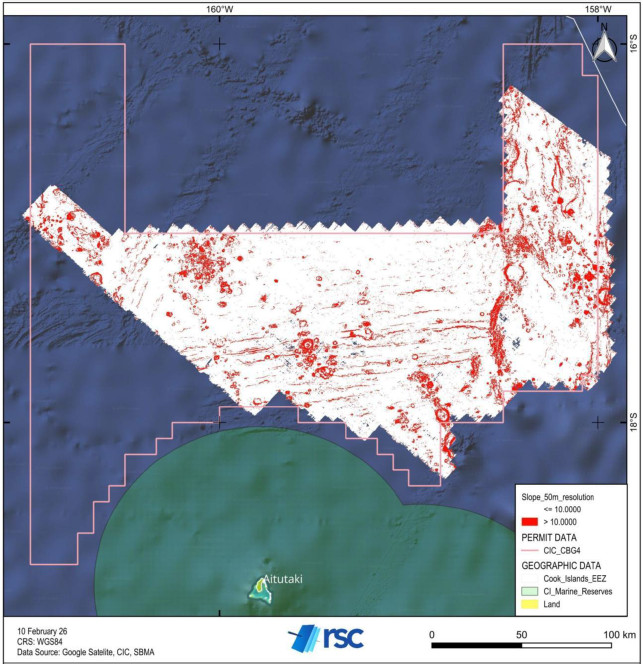
|
INITIAL ASSESSMENT FOR THE EL1 CIC LIMITED. |
SME, 2021. The SME Guide for Reporting Exploration Results, Mineral Resources and Mineral Reserves (The 2017 SME Guide).
Somayajulu, B. L. K., 1967. Beryllium-10 in a Manganese Nodule. Science, 156, 1219–1220.
Tay, S. L., Browne, R. & Bertoli, O., 2023a. Mineral Resource Estimate for Cook Islands Polymetallic Nodule Field. Maps for SBMA.
https://static1.squarespace.com/static/5cca30fab2cf793ec6d94096/t/6581ed3054532131d036f11c/1703013799356 /CIMinRscMaprev1.pdf [accessed on 18/7/2024].
Tay, S. L., Browne, R. & Bertoli, O., 2023b. Technical Report and Supporting Documentation for the Cook Islands Polymetallic Nodules Resource Estimate. RSC, Competent Person: Parianos, John Sterk, Rene, p. 219.
Taylor, B., 2006. The single largest oceanic plateau: Ontong Java–Manihiki–Hikurangi. Earth and Planetary Science Letters, 241, 372–380.
The Metals Company, 2023. NORI and Allseas Lift Over 3,000 Tonnes of Polymetallic Nodules to Surface from Planet’s Largest Deposit of Battery Metals, as Leading Scientists and Marine Experts Continue Gathering Environmental Data. The Metals Company, NORI and Allseas Lift Over 3,000 Tonnes of Polymetallic Nodules to Surface from Planet’s Largest Deposit of Battery Metals, as Leading Scientists and Marine Experts Continue Gathering Environmental Data [accessed on 18/7/2024].
Timm, C., Hoernle, K., Werner, R., Hauff, F., den Bogaard, P. v., Michael, P., Coffin, M. F. & Koppers, A., 2011. Age and geochemistry of the oceanic Manihiki Plateau, SW Pacific: New evidence for a plume origin. Earth and Planetary Science Letters, 304, 135–146.
Usai, A., Nishimura, A. & Mita, N., 1993. Composition and growth history of surficial and buried manganese nodules in the Penrhyn Basin, Southwestern Pacific. Elsevier Science Publishers B.V., Amsterdam, 114, 133-153.
Usui, A., 1983. Regional variation of manganese nodule facies on the Wake-Tahiti transect: Morphological, chemical and mineralogical study. Marine Geology, 54, 27–51.
-, 1994. Manganese Nodules facies in the western part of the Penrhyn Basin, South Pacific (GH83-3 area). Geological Survey of Japan, 23, p. 87–194.
von Stackelberg, U., 2000. Manganese nodules of the Peru Basin. in Cronan, D. S., ed., Handbook of Marine Minerals, New York, Routledge, 197–238.
von Stackelberg, U. & Beiersdorf, H., 1991. The formation of manganese nodules between the Clarion and Clipperton fracture zones southeast of Hawaii. Marine Geology, 98, 411–423.
Walbridge, S., Slocum, N., Pobuda, M. & Wright, D. J., 2018. Unified geomorphological analysis workflows with benthic terrain modeler. Geosciences, 8, 94.
Wessel, P. & Kroenke, L. W., 2008. Pacific absolute plate motion since 145 Ma: An assessment of the fixed hot spot hypothesis. Journal of Geophysical Research: Solid Earth, 113.
Winterer, E. L., Lonsdale, P. F., Matthews, J. L. & Rosendahl, B. R., 1974. Structure and acoustic stratigraphy of the Manihiki Plateau. Deep Sea Research and Oceanographic Abstracts, 21, 793–813.
Xiao, J., Hong, S., Yang, N., Xiong, H., Liu, J., Ou, W., Parianos, J. & Chen, Y., 2019. Model Test of Skip Lifting System for Deep-Sea Mining. The 29th International Ocean and Polar Engineering Conference, ISOPE–I–19–296.
Yamazaki, T., 1992. Bottom water temperature in the south of the Nova-Canton Trough, central equatorial Pacific (GH82-4 area). Geological Survey of Japan, 22, p. 253–261.
Page 183 of 185
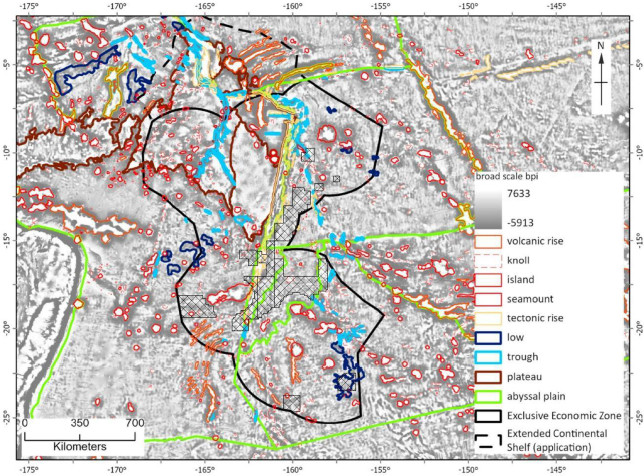
|
INITIAL ASSESSMENT FOR THE EL1 CIC LIMITED. |
25. Reliance on Information Provided by the Registrant
This TRS has been prepared by RSC for CIC (the “Registrant”). The information, conclusions, opinions, and estimates contained herein are based on:
| | Information available to RSC at the time of preparation of this TRS; |
| | Assumptions, conditions, and qualifications as set forth in this TRS; |
| | Data, reports, and other information supplied by CIC and other third-party sources, including: |
| | Operational and deployment documents, geological data, sampling media, survey and GIS data, and assay certificates; |
| | Macroeconomic trends, data, and assumptions, and interest rates; |
| | Marketing information and plans within the control of the Registrant; |
| | Legal matters outside the expertise of RSC, such as statutory and regulatory interpretations regarding the permitting regime for polymetallic nodules in the Pacific Ocean; |
| | Environmental matters outside the expertise of RSC; |
| | Governmental factors outside the expertise of RSC; and |
| | Accommodations the registrant commits or plans to provide to local individuals or groups. |
RSC has not researched mineral permits for the Project as RSC considers it reasonable to rely on CIC’s legal counsel who is responsible for maintaining this information. RSC has relied on CIC for guidance on applicable taxes, royalties, and other international levies or interests applicable to the Project as stated in the Executive Summary and Section 3 (Property Description) of this TRS. The Project is considered at an early-stage exploration stage; however, CIC’s management team has considerable experience in exploration and development on other mining projects.
RSC has taken all appropriate steps, in its professional opinion, to ensure that the above information from CIC is sound.
Except for the purposes legislated under U.S. federal securities laws or regulations, any use of this TRS by any third party is at that party’s sole risk.
RSC considers it is reasonable to rely upon the information provided by the registrant in respect of the above factors as the registrant employs specialist personnel in these areas who have access to information to which RSC does not.
Page 184 of 185
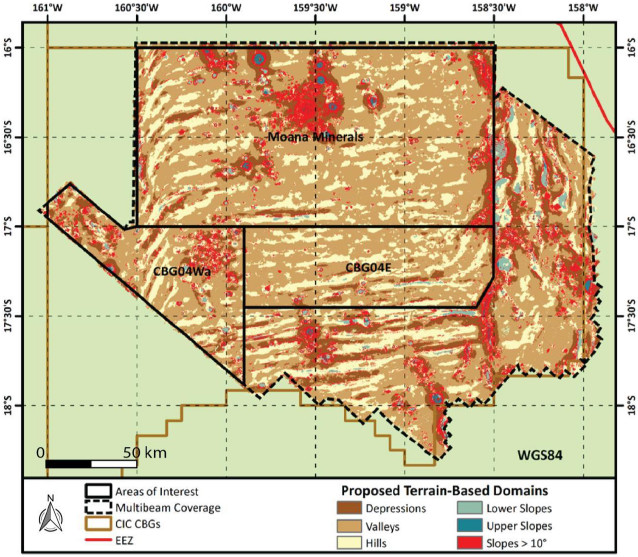
|
INITIAL ASSESSMENT FOR THE EL1 CIC LIMITED. |
26. Forward-Looking Statement
This Technical Report Summary contains forward-looking statements and information that reflect the current expectations, assumptions, and opinions of the Registrant and RSC regarding future events and the potential development of the Project. Forward-looking statements are often identified by words such as “believe”, “expect”, “anticipate”, “intend”, “plan”, “estimate”, “may”, “could”, “would”, or similar expressions.
Such statements include, but are not limited to, estimates of Mineral Resources; interpretations of geological and metallurgical information; expectations regarding exploration potential, mining methods, recovery rates, capital and operating costs, permitting schedules, and market conditions for base and critical minerals, and offshore polymetallic nodules. These statements are based on assumptions considered reasonable at the time of preparation; however, they are subject to known and unknown risks, uncertainties, and other factors that may cause actual results to differ materially from those expressed or implied.
The Registrant and RSC do not undertake any obligation to update or revise forward-looking statements except as required by applicable securities laws. Readers are cautioned not to place undue reliance on forward-looking statements contained herein, which are provided for the purpose of demonstrating reasonable prospects for economic extraction and should not be construed as guarantees of future performance.
Page 185 of 185