EXHIBIT (e)
Management report
General information about Rentenbank
Promotional mandate
Rentenbank is a promotional bank operating throughout Germany. Under the Law Governing Landwirtschaftliche Rentenbank, its mandate is to promote agriculture, related upstream and downstream sectors, and rural areas in general. Its business model is defined by the framework set out in the Law Governing Rentenbank and its Articles of Incorporation.
As a promotional bank for agribusiness and rural areas, Rentenbank provides earmarked funding for a wide range of investments and initiatives. It grants special promotional loans to local banks on a competitively neutral basis for the financing of projects in Germany. These loans are granted to enterprises in the agriculture and forestry, viticulture and horticulture, and aquaculture and fisheries sectors. Rentenbank also supports projects in the food industry and in other sectors upstream and downstream of agriculture, as well as investments in renewable energy and infrastructure projects in rural areas. In addition, Rentenbank carries out promotional activities on behalf of the federal government and the federal states. The appropriation of profits is aligned with the promotional mandate: One half of distributable profit is allocated to Rentenbank’s Promotional Fund and the other half to the Federal Government’s Special-Purpose Fund administered by Rentenbank. The Special-Purpose Fund is used to promote innovation in agriculture on the basis of the guidelines issued by the Federal Ministry of Agriculture, Food and Regional Identity (BMLEH). Rentenbank also promotes innovative business models by investing in venture capital funds that provide targeted financing to start-ups in the ag-tech and food-tech sectors and help them gain a foothold in the market. In addition, Rentenbank provides refinancing to banks, savings banks and public authorities, including through the purchase of registered bonds, promissory note loans and securities.
| Landwirtschaftliche Rentenbank | Annual Report 2025 | 1 |
Management system
Rentenbank’s strategic objectives and the measures required to achieve them, as well as the strategic control parameters, are derived from its business strategy. The strategic objectives are operationalised through a number of sub-strategies.
The strategic control parameters are applied in four categories to assess the effectiveness of strategic measures at the bank-wide level:
| • | Attractive promotional programmes |
| • | Efficient bank operations |
| • | Appropriate risk culture |
| • | Compliance with the capital and liquidity requirements defined in the Risk Appetite Statement |
Segments
Rentenbank is managed on the basis of three segments:
| • | Promotional Activity |
| • | Capital Investment |
| • | Treasury Management |
In the “Promotional Activity” segment, Rentenbank promotes investment in the agricultural sector and in rural areas. This is done by refinancing earmarked loans granted by local banks to ultimate borrowers for use in Germany in accordance with the terms and conditions of the special promotional lending programmes.
In addition, Rentenbank fulfils its promotional mandate by acting as a refinancing partner to local banks with business activities in the agricultural sector and in rural areas, as well as to domestic public authorities. This is achieved through various forms of funding, including registered bonds, promissory note loans and securities. Some of these transactions also contribute to meeting regulatory liquidity requirements. Rentenbank manages both its business volume and its risk structure. Rentenbank’s promotional offering for the financing of start-ups related to its promotional mandate also includes investments in venture capital funds, which are reported in the “Promotional Activity” segment.
| Landwirtschaftliche Rentenbank | Annual Report 2025 | 2 |
Refinancing, which is largely maturity-matched, is also allocated to the “Promotional Activity” segment.
The “Capital Investment” comprises the investment of equity and long-term provisions. Investments are made primarily in registered bonds, promissory note loans and securities issued by banks and public-sector issuers.
Short-term liquidity and short-term interest rate risk are managed in the “Treasury Management” segment. Rentenbank has a range of instruments with maturities of up to one year at its disposal both for the short-term investment of surplus liquidity and for raising the liquidity required. In addition to entering into money market transactions, debt securities with longer maturities may also be acquired to manage the Rentenbank’s liquidity profile.
Financial key performance indicators
Financial key performance indicators (KPI) are the principal metrics used within the internal management system to measure the achievement of strategic objectives in financial reporting. These KPIs reflect Rentenbank’s business activities. They include:
| • | Operating result (operating result before loan loss provisions and valuation effects) |
Rentenbank’s business activities are not
primarily aimed at generating profits, but
at fulfilling its statutory promotional mandate. At the same time, sound
business management principles must be observed in order to enable Rentenbank to conduct its promotional activities on a
self-supporting basis. In particular, this means that Rentenbank’s activities must be economically efficient so that it
can sustain its promotional activities on a permanent basis and adapt them where necessary. In view of increasing regulatory
requirements, the operating result is retained in order to strengthen Rentenbank’s capital base. As a promotional
institution under public law, Rentenbank relies on its high credit rating, combined with an appropriate capital markets
strategy, to raise funding on favourable terms.
| • | Cost-income ratio1 |
As a key performance indicator measuring costs in relation to income, the cost-income ratio is used to ensure the efficient use of Rentenbank’s resources. As it reflects the relationship between costs and income, it is influenced by changes in both variables. In order to enhance operational transparency, allocations to promotional contributions and reversals of promotional grants from previous years are excluded from the calculation of the cost-income ratio. The cost-income ratio is monitored over a longer period and supplemented by periodic analyses of changes in costs.
| 1 | The cost-income ratio is calculated as the ratio of costs to income. The numerator comprises the sum of general administrative expenses, depreciation, amortisation and impairment losses on intangible assets and property and equipment, other operating expenses and income taxes. The denominator comprises the sum of interest income and current income less interest expenses (plus allocations to interest subsidies and less reversals from previous years), other operating income and fee and commission income less fee and commission expenses. |
| Landwirtschaftliche Rentenbank | Annual Report 2025 | 3 |
| • | Promotional activity volume |
Promotional activity volume refers to the volume of new special promotional loans granted in a given year. The special promotional loans granted to promote agribusiness and rural areas form the core of Rentenbank’s promotional activities. These loans are granted as earmarked funding instruments. Loans granted to the promotional institutions of the federal states may also be bundled.
These three financial key performance indicators and their principal components are calculated and compared with the corresponding budget figures as part of the monthly reporting process. They are also included as separate indicators in the multi-year plan. Further information on the financial key performance indicators is provided in the section on Rentenbank’s net assets, financial position and results of operations, as well as in the forecast report.
Non-financial key performance indicators
| • | Employees |
Highly qualified and committed employees are the basis for Rentenbank’s long-term success. The objectives of the related HR strategy, which is consistently derived from the business strategy, include ensuring adequate staffing in quantitative and qualitative terms, promoting equal opportunities, and providing and further developing HR management instruments and processes.
| • | Corporate social responsibility |
A key aspect of Rentenbank’s corporate social responsibility is closely linked to its promotional mandate. However, as a direct public law institution, Rentenbank is also committed to serving the public good beyond the scope of that mandate.
| • | ESG ratings |
An enterprise’s sustainability management activities are reflected in its ESG ratings, which assess the enterprise’s overall efforts in this area. ESG ratings are an important indicator for external stakeholders, but they also serve as a measure of the effectiveness of implemented sustainability measures. Rentenbank aims to continuously improve its ESG ratings or maintain them at a consistently high level.
| Landwirtschaftliche Rentenbank | Annual Report 2025 | 4 |
Affiliated companies
Rentenbank’s direct and indirect subsidiaries are:
| • | LR Beteiligungsgesellschaft mbH (LRB) |
| • | DSV Silo- und Verwaltungsgesellschaft mbH (DSV) |
All material risks of the subsidiaries are concentrated at Rentenbank and managed centrally by it. As in previous years, the scope of the subsidiaries’ business activities remained strictly limited in the 2025 financial year. DSV’s principal activity was limited to fulfilling pension obligations towards its former employees and employees of Getreide-Import-Gesellschaft mbH (GIG), the former subsidiary of LRB, which was merged into DSV with retroactive effect from 1 January 2024, with the result that DSV is now its legal successor. LRB’s business activity essentially consists in the management as a holding company and business management agent of the affiliate DSV and the investment of liquid funds. Rentenbank has issued a letter of comfort in favour of LRB, under it which it undertakes, insofar as and for as long as it holds 100% of LRB’s equity, to provide it with enough financial resources that it will be able to fulfil its obligations punctually at all times.
Public Corporate Governance Code
The Statement of Compliance with the German Public Corporate Governance Code issued by the Management Board and the Supervisory Board is publicly available on Rentenbank’s website.
| Landwirtschaftliche Rentenbank | Annual Report 2025 | 5 |
Economic report
General economic and institution-specific conditions
International interest rate and monetary policy
In 2025, following two years of recession, Germany recorded only modest year-on-year growth in gross domestic product (GDP) of 0.2%. Growth was attributable primarily to higher consumer spending by households and the government. The export sector faced higher US tariffs, the appreciation of the euro and stronger competition from China. As a result, exports declined again. Investment weakness also persisted. Investment in both equipment and construction was lower than in the previous year.1
Inflation in the euro area continued to decline over the course of 2025. Growth in the Harmonised Index of Consumer Prices (HICP) initially fell from 2.5% in January to 1.9% in May. In the second half of the year, momentum picked up slightly at first before easing again. In December, consumer prices were 1.9% higher than in the same month of the previous year and, on average, 2.1% above the 2024 level.2
In line with the favourable inflation trend, the European Central Bank (ECB) lowered its deposit rate in four steps from 3.00% to 2.00% in June during the first half of 2025 and then left it unchanged until the end of the year. The ECB also announced that its holdings of securities under the Asset Purchase Programme (APP) and the Pandemic Emergency Purchase Programme (PEPP) had been declining at a measured and predictable pace, as the Eurosystem did not reinvest the principal payments from maturing securities.3
The US Federal Reserve (Fed) also continued to ease its monetary policy in 2025. From the end of October, the Fed lowered its key policy rate in three steps from a range of 4.25% to 4.50% to a range of 3.50% to 3.75% by the end of the year.4
Over the course of 2025, the euro appreciated against the US dollar. At the end of 2025, the ECB set the reference rate for the euro/US dollar exchange rate at 1.175, which was 13.1% above the rate at the end of 2024 (1.039).5
| 1 | Destatis: Press Release No. 017 of 15 January 2026. |
| 2 | Eurostat: Euro indicators June 2025, Annual inflation up to 2.0% in the euro area, 17 July 2025; Euro indicators December 2025, Annual inflation down to 1.9% in the euro area, 19 January 2026. |
| 3 | ECB press releases of 30 January, 6 March, 17 April and 5 June 2025. |
| 4 | http://www.leitzinsen.info/usa.htm |
| 5 | ECB reference exchange rates: https://www.ecb.europa.eu/stats/policy_and_exchange_rates/euro_reference_exchange_rates/html/eurofxref-graph-usd.de.html |
| Landwirtschaftliche Rentenbank | Annual Report 2025 | 6 |
Development of long-term interest rates
In the capital market, the new federal government’s announcement at the beginning of March of a debt-financed increase in public spending on infrastructure and defence led to a marked rise in the yield on ten-year German government bonds. Although yields initially declined again in the following weeks, they rose once more towards the end of the year. As a result, at the end of 2025 the yield on ten-year German government bonds stood at 2.86%, above the year-end 2024 level of 2.36%.1
Development of the economic environment in promotional activity
According to estimates by the Federal
Information Centre for Agriculture (Bundesinformationszentrums Landwirtschaft), the production value of German
agriculture rose slightly in 2025 to EUR 76.8 billion, up 1.7% on the previous year. While production value in crop
production fell by 5.2% to EUR 32.4 billion, the value of animal production and animal products rose significantly year
on year by 8.4% to EUR 39.3 billion. Here, demand was met by relatively limited supply of livestock for slaughter,
resulting in higher producer prices. This did not apply to pigs, however, for which revenues were lower. By contrast, farmers
received higher average prices for
raw milk and eggs over the year.
In crop production, producer prices were mostly below the previous year’s level, particularly for potatoes, sugar beet, fodder crops and fresh vegetables. In the case of cereals, however, the strong harvest more than offset the decline in prices. As a result, production value increased. Higher revenues were also recorded for oilseeds and fruit.2
Overall, the economic situation of full-time agricultural enterprises in the 2024/2025 financial year (1 July 2024 to 30 June 2025) was only slightly better. On average, the business result stood at EUR 78,500, 0.4% higher than in the previous year.3
Revenue in the German food industry rose by around EUR 10 billion to EUR 240 billion in 2025. Exports accounted for 23.6% of this figure. The sector’s revenue continues to be driven above all by still high costs for consumers, particularly for fresh food.4
Electricity generation from renewable energy sources continued to gain in importance in Germany in 2025. It rose by 1% to 289.5 TWh. Onshore wind power generation accounted for the greatest share (37%), followed by photovoltaics (31%) and biomass (15%). The preliminary net increase in onshore wind power capacity was 4,605 MW in 2025, that being 7.2% more than in the
| 1 | Börsen-Zeitung of 31 December 2025, p. 45. |
| 2 | BMLEH statistics: https://www.bmel-statistik.de/landwirtschaft/landwirtschaftliche-gesamtrechnung/produktionswert |
| 3 | Situation Report 2024/2025 of the German Farmers Association (Deutscher Bauernverband, DBV), Chapter 5.2. |
| 4 | EY press release, “Revenue in agribusiness rises again, but outlook remains gloomy” (Umsatz im Agribusiness steigt wieder, Aussichten bleiben allerdings trüb), 13 January 2026. |
| Landwirtschaftliche Rentenbank | Annual Report 2025 | 7 |
previous year. The preliminary net increase in photovoltaics capacity was 16,577 MW, which was nearly 16.5% more than in 2024.1
Business development
New business involving special promotional loans reached EUR 6.6 billion in 2025, compared with EUR 3.6 billion in the previous year. The normalisation of the yield curve led to a significant increase in loan demand, particularly in the “Renewable energy” promotional line. Volume growth was also achieved in all other promotional lines, especially in the “Agribusiness” promotional line. New business in the “Agriculture” promotional line was likewise above the previous year’s level. In this area, the upward trend seen in the previous year continued in the funding of livestock housing. In the “Rural development” promotional line, the promotional institutions of the federal states increased their demand for global loans for rural areas. To strengthen Germany’s innovation landscape, Rentenbank once again invested during the reporting year in venture capital funds focused on the AgTech and FoodTech sectors.
In the financial year under review, new business involving special promotional loans, registered debt securities, promissory notes, securities and venture capital totalled EUR 11.8 billion (EUR 7.9 billion), and was therefore significantly above the previous year’s level.
Overall, new business was as follows:
|
1/1/ to mEUR |
1/1/ to mEUR |
Change mEUR | |
| Special promotional loans | 6,559 | 3,602 | 2,957 |
| Registered bonds/ promissory notes2 |
1,725 | 2,241 | -516 |
| Securities3 | 3,464 | 2,033 | 1,431 |
| Venture capital investments | 21 | 48 | -27 |
| Total | 11,769 | 7,925 | 3,875 |
.
| 1 | German Federal Environment Agency: Monthly Report on the Development of Renewable Electricity Generation and Output in Germany, as of 13 January 2026. |
| 2 | *excluding “non-EU” |
| 3 | *excluding “non-EU” |
| Landwirtschaftliche Rentenbank | Annual Report 2025 | 8 |
In the reporting year, Rentenbank raised EUR 10.9 billion (EUR 8.2 billion) in medium and long-term funding in the national and international financial markets. Rentenbank used the following instruments for medium- and long-term refinancing:
|
1/1/ to bEUR |
1/1/ to bEUR |
Change bEUR | |
| Euro Medium-Term Note (EMTN) | 7.6 | 6.2 | 1.4 |
| Global bonds | 2.6 | 1.4 | 1.2 |
| AUD Medium-Term Note (MTN) | 0.6 | 0.6 | 0.0 |
| Domestic capital market instruments | 0.1 | 0.0 | 0.1 |
| Total | 10.9 | 8.2 | 2.6 |
| Landwirtschaftliche Rentenbank | Annual Report 2025 | 9 |
Economic position
Financial performance
The Bank’s financial performance is presented in the table below:
|
1/1/ to mEUR |
1/1/ to mEUR |
Change mEUR | |
| Net interest income1 | 228.8 | 287.5 | -58.7 |
| Net commission income | -4.6 | -4.7 | 0.1 |
| Administrative expenses | 146.2 | 130.8 | 15.4 |
| Other operating result | 10.3 | 11.3 | -1.0 |
| Income taxes / other taxes | 1.7 | 1.7 | 0.1 |
| Operating result before loan loss provisions and valuation effects | 86.6 | 161.6 | -75.0 |
| Loan loss provisions and valuation effects | 47.6 | 123.6 | -76.0 |
| Net income for the year | 39.0 | 38.0 | 1.0 |
1 Net interest income including income from equity interests.
Operating result before loan loss provisions and valuation effects
The operating result before loan loss provisions and valuation amounted to EUR 86.6 million. It was therefore significantly below the previous year’s level (EUR 161.6 million). The year-on-year decline was attributable primarily to a higher promotional contribution and thus lower income in the “Promotional Activity” segment. In addition, administrative expenses increased.
| Landwirtschaftliche Rentenbank | Annual Report 2025 | 10 |
Net interest income
Net interest income by segment:
|
1/1/ to mEUR |
1/1/ to mEUR |
Change mEUR | |
| Net interest income | |||
| Promotional Activity | 128.6 | 195.0 | -66.4 |
| Capital Investment | 88.5 | 75.6 | 12.9 |
| Treasury Management | 11.7 | 16.9 | -5.2 |
| Total net interest income | 228.8 | 287.5 | -58.7 |
Net interest income in the “Promotional Activity” segment amounted to EUR 128.6 million and was therefore significantly below the previous year’s level (EUR 195.0 million). As the volume of special promotional loans increased significantly compared with the previous year, more grants were once again granted, which had an adverse effect on net interest income. In addition, the higher issuance volume, combined with a declining funding margin, had a negative impact on results.
In the “Capital Investment” segment, net interest income was slightly above our planning and increased by 17% year on year to EUR 88.5 million. This was due not only to the additional income from the higher investment volume resulting from the new allocation, but also to reinvestment yields that were above the yields on maturing investments.
Net interest income in the “Treasury Management” segment, at EUR 11.7 million, was below the previous year’s figure of EUR 16.9 million. The 2025 financial year was marked by a continued narrowing of margins in the money market business, which had a corresponding adverse effect on results.
Administrative expenses
Administrative expenses increased by 12% to EUR 146.2 million (EUR 130.8 million). This was due primarily to an increase of EUR 9.2 million in personnel expenses. At the same time, other operating expenses rose by EUR 3.9 million and depreciation, amortisation and impairments by EUR 2.3 million.
The increase in personnel expenses was attributable mainly to an average increase of 22 employees (as defined in Section 267 (5) of the German Commercial Code [Handelsgesetzbuch; HGB]), as well as to collectively agreed pay increases and higher pension expenses (special effect in 2024 due to a reduced inflation assumption).
| Landwirtschaftliche Rentenbank | Annual Report 2025 | 11 |
The increase in other operating expenses resulted primarily from the continued implementation of the IT roadmap and from targeted investment in the IT landscape.
Depreciation, amortisation and impairments of intangible assets as well as property and equipment rose to EUR 16.5 million (EUR 14.2 million), due in particular to higher amortisation of software.
Other operating result
Other operating result declined from EUR 11.3 million to EUR 10.3 million. This was due mainly to lower reimbursements of costs arising from the settlement of the federal programmes.
Loan loss provisions / valuation effects
Under “Loan loss provisions / valuation effects”, a net amount of EUR 47.8 million was used to increase the contingency reserve. Of this amount, EUR 22.8m was allocated to the fund for general banking risks.
Net income for the year / distributable profit
Net income for the year increased from EUR 38.0 million to EUR 39.0 million in the financial year under review.
Subject to the approval of the Supervisory Board, a total of EUR 19.5 million (EUR 19.0 million) from net income for the year was allocated to the principal reserve in the preparation of the annual financial statements.
After the allocation to the principal reserve, distributable profit amounted to EUR 19.5 million, slightly above the previous year’s level (EUR 19.0 million). Distributable profit is to be allocated in equal parts to the Federal Government’s Special-Purpose Fund at Rentenbank and to Rentenbank’s Promotional Fund.
| Landwirtschaftliche Rentenbank | Annual Report 2025 | 12 |
Net assets and financial position
Rentenbank’s net assets and financial position as presented in the annual financial statements are as follows:
Changes in significant asset items
|
31 December 2025 mEUR |
31 December 2024 mEUR |
Change mEUR | |
| Loans and advances to banks |
57,827.5 | 65,615.4 | -7,787.9 |
| Loans and advances to customers |
7,100.8 | 7,003.2 | 97.6 |
| Bonds and other fixed-income securities | 18,949.0 | 16,742.6 | 2,206.4 |
Loans and advances to banks amounted to EUR 57.8 billion at the year-end reporting date (EUR 65.6 billion). Their share of total assets was 63.9% and was lower than in the previous year. However, they continued to represent the largest asset class. The decline in loans and advances to banks was attributable mainly to a reduction in money market business. In addition, the stock of special promotional loans declined slightly. In the 2025 financial year, new business involving special promotional loans increased significantly. As a substantial portion of the committed funds has not yet been drawn down, the stock of special promotional loans is expected to rise again in 2026 as these commitments are utilised, thereby offsetting the current decline.
Loans and advances to customers consist primarily of promissory notes issued by the federal states and municipalities. Overall, this balance sheet item increased slightly year on year by EUR 0.1 billion to EUR 7.1 billion.
At the year-end reporting date, the stock of bonds and other
fixed-income securities had increased by EUR 2.2 billion year on year to EUR 18.9 billion. As in the previous year, the
entire stock was classified as fixed assets.
| Landwirtschaftliche Rentenbank | Annual Report 2025 | 13 |
Changes in key items of liabilities and equity
|
31 December 2025 mEUR |
31 December 2024 mEUR |
Change mEUR | |
| Liabilities | |||
| Liabilities to banks | 814.3 | 1,528.3 | -714.0 |
| Liabilities to customers | 1,497.4 | 1,490.4 | 7.0 |
| Securitised liabilities | 80,523.4 | 83,752.3 | -3,228.9 |
| Total | 82,835.1 | 86,771.0 | -3,935.9 |
| Equity (including the fund for general banking risks) | |||
| Subscribed capital | 135.0 | 135.0 | 0.0 |
| Retained earnings | 1,272.1 | 1,252.6 | 19.5 |
| Distributable profit | 19.5 | 19.0 | 0.5 |
| Fund for general banking risks | 3,576.3 | 3,553.5 | 22.8 |
| Total | 5,002.9 | 4,960.1 | 42.8 |
Liabilities
Liabilities to banks, at EUR 0.8 billion, were EUR 0.7 billion below the previous year’s level. The decline in outstanding amounts was attributable mainly to the maturity of global loans totalling EUR 0.5 billion. In addition, liabilities to customers, at EUR 1.5 billion, remained at the previous year’s level.
Securitised liabilities declined by EUR 3.2 billion, or 3.9%, to EUR 80.5 billion. At EUR 63.7 billion, the Medium-Term Note (MTN) programmes remained the most important source of funding and increased by EUR 2.2 billion compared with the previous year. The stock of outstanding Euro Commercial Paper (ECP) issuances declined to EUR 3.7 billion (EUR 7.0 billion). Likewise, the stock of outstanding global bonds decreased to EUR 12.6 billion (EUR 14.8 billion).
Equity
Equity, including the fund for general banking risks pursuant to section 340g HGB, increased by EUR 42.8 million to EUR 5,002.9 million. Net income for the year of EUR 39.0 million was allocated in equal parts to retained earnings and recognised as distributable profit, respectively. The fund for general banking risks was increased by EUR 22.8 million.
| Landwirtschaftliche Rentenbank | Annual Report 2025 | 14 |
Regulatory capital ratios
The total capital ratio and the Common Equity Tier 1 capital ratio both stood at 32.6% (38.3%). They reflect Rentenbank’s strong capital base even upon initial application of CRR III and continue to remain well above the regulatory minimum requirements.
For the amount and development of regulatory own funds and risk-weighted assets (RWA), please refer to the “Risk-bearing capacity” section.
Capital expenditures
In the year under review, capital expenditures continued to focus on modernising the IT landscape, in particular replacing the proprietary host-based core banking system. In this context, major milestones were successfully achieved through implementations in SAP and Murex. In addition, further implementation measures were launched. Substantial funds were also invested in implementing regulatory requirements and enhancing IT security.
The funding portal introduced in December 2020 as part of the Federal Forestry Programme was further optimised, and the internal IT systems were integrated.
To further digitalise processes, additional bots were developed to handle routine tasks in application processing and thereby contribute to greater efficiency.
Aside from modernising the IT landscape, Rentenbank is investing in the energy-efficient refurbishment of the listed building at its Hochstrasse site in Frankfurt am Main.
Liquidity
The Federal Republic of Germany bears institutional responsibility for Rentenbank and has assumed liability for Rentenbank’s obligations (refinancing guarantee).
On the basis of the resulting AAA ratings, liquidity can be raised
in the market without difficulty. The high volume of debt securities eligible for refinancing with Deutsche Bundesbank constitutes
an additional liquidity reserve. For further details, please refer
to the presentation of liquidity risks in the risk report forming part of this management report.
Overall assessment of business development and economic position
The Management Board considers business development and the development of Rentenbank’s net assets, financial position and results of operations to have been solid overall, albeit below expectations. This also applies to the financial and non-financial key performance indicators defined in the “Management system” section.
| Landwirtschaftliche Rentenbank | Annual Report 2025 | 15 |
Financial and non-financial key performance indicators
Financial key performance indicators
The operating result before “Loan loss provisions / valuation effects” (operating result) amounted to EUR 86.6 million and was therefore 46% below the previous year’s figure of EUR 161.6 million. Expectations for 2025 were not met. Net interest income declined by 20% year on year, while administrative expenses increased by 12%.
The developments in income and administrative expenses described above also affected the cost-income ratio key performance indicator. In addition, allocations to promotional contributions (EUR 66.6m) and reversals of promotional subsidies from previous years (EUR 4.1 million) are excluded. Accordingly, the cost-income ratio increased to 50.7% (41.8%) compared with the previous year. Overall, the cost-income ratio remains at a solid level.
The promotional volume key performance indicator comprises the annual volume of new special promotional loans committed, which amounted to EUR 6.6 billion (EUR 3.6 billion) in the reporting year and was therefore above expectations.
Non-financial key performance indicators
With regard to the key performance indicator “Employees”, a total of 492 (459) employees worked at Rentenbank at the end of 2025, excluding trainees, interns, employees on parental leave and members of the Management Board.
In 2025, employee training averaged 2.9 days per person, below the previous year’s level (3.3 days).
The proportion of women at the top management level below the Management Board (FK I) stood at 33% at year-end. Among all other managers (FK II), the figure was 38%.
Rentenbank is committed to society in a variety of ways. Through the Promotional Fund, agribusiness funding, innovation funding and general sponsorship, the forest project in the Buchenborn forestry district, as well as donations to cultural institutions and social organisations in Frankfurt am Main, a total of EUR 9.87 million in support was provided in 2025.
Rentenbank’s sustainability performance is regularly assessed by rating agencies specialising in sustainability. Rentenbank receives regular ratings from ISS ESG, MSCI ESG and Sustainalytics. In 2025, our ISS ESG rating remained unchanged at C- (48.6 points). Our MSCI ESG rating was downgraded from AA to A (on a scale from AAA to CCC). In the 2025 financial year, the Sustainalytics rating deteriorated from 9.1 to 10.9.
| Landwirtschaftliche Rentenbank | Annual Report 2025 | 16 |
Despite the slight deterioration in the MSCI ESG and Sustainalytics ratings, Rentenbank remains at a level that is average for the sector in these ratings. Accordingly, the development of the ESG ratings was slightly below expectations.
Overview
| • | ISS ESG (as at 21 December 2025): C- (on a scale from A+ to D-) |
| • | MSCI ESG Ratings (as at 22 April 2025): A (on a scale from AAA to CCC) |
| • | Sustainalytics (as at 20 February 2025): Low Risk, with a score of 10.9 out of a possible 100 points, where 0 represents the best score |
We will continue to make further efforts in the coming years to improve our ESG ratings on an ongoing basis.
| Landwirtschaftliche Rentenbank | Annual Report 2025 | 17 |
Forecast and opportunities report
Development
of business conditions and the
operating environment
Rentenbank’s economic performance is shaped primarily by conditions in the lending and financial markets. These are influenced to a significant extent by central bank monetary policy, price and exchange rate developments, and trends in public finances.
Macroeconomic outlook
The persistent uncertainties seen in 2025, caused by geopolitical conflicts, erratic US tariff policy and further trade tensions, will continue in 2026 and weigh on economic activity worldwide to varying degrees. As an exporting nation, Germany is particularly affected by these developments.
According to the International Monetary Fund (IMF), global economic growth of 3.3% is expected in 2026. For Germany, however, the IMF anticipates a much lower increase in gross domestic product (GDP) of only 1.1% year on year.1 According to Deutsche Bundesbank, this growth is likely to be driven primarily by the federal government’s expansionary fiscal stance, with additional public spending on defence and infrastructure.2
The price trend is expected to continue broadly sideways. According to Deutsche Bundesbank, growth in the Harmonised Index of Consumer Prices (HICP) will remain almost unchanged in 2026 compared with the previous year, averaging 2.2% for the year after 2.3% in the previous year.3 This would leave it only slightly above the European Central Bank’s (ECB) target of 2%.
Against the backdrop of low inflation rates, key interest rate increases are not currently expected either in the euro area or in the United States. However, owing to the rising financing needs of sovereign issuers and the first interest rate increases in Japan, Rentenbank expects the capital market yield curve to steepen over the further course of the year, while volatility remains elevated. If geopolitical tensions intensify, a flight to safe government bonds can no longer be taken for granted; instead, investors may also demand higher risk premiums in this segment in future.
Outlook for the economic environment in promotional activity
Investment activity in the agriculture and agribusiness sector, and thus also demand for special promotional loans, is influenced by a wide range of factors. These include the development of general economic conditions, which affect demand and prices in agricultural
| 1 | IMF: World Economic Outlook Update, January 2026: https://www.imf.org/en/publications/weo/issues/2026/01/19/world-economic-outlook-update-january-2026 |
| 2 | Deutsche Bundesbank Monthly Report, December 2025, p. 6. |
| 3 | Deutsche Bundesbank Monthly Report, December 2025, p. 6. |
| Landwirtschaftliche Rentenbank | Annual Report 2025 | 18 |
markets. However, investment behaviour in agriculture also depends heavily on political and regulatory conditions as well as on public funding.
The Association of Chambers of Agriculture (Verband der Landwirtschaftskammern; VLK) expects declining business results for agricultural enterprises of all types in the current financial year 2025/26. Despite high yields of market crops and basic fodder from the 2025 harvest across Germany, farms face significant economic challenges, as market prices – particularly for arable crops and most animal products – are under pressure, not least due to challenging conditions in national and international agricultural markets. With regard to agricultural inputs, the VLK expects some easing in expenditure on seeds and planting materials as well as fuels. By contrast, higher costs are anticipated for fertilisers, crop protection, services and personnel.1
The “Rentenbank Agricultural Barometer” survey commissioned by Rentenbank reflects farmers’ assessment of their current and future economic situation in Germany. According to the latest survey results from December 2025, the assessment of the future economic situation has deteriorated further compared with the September survey. Farms engaged in pig and poultry farming assess their future economic situation somewhat more positively than other types of operations. High agricultural input costs, agricultural policy and low producer prices are the main reasons for negative assessments. Despite the subdued sentiment, 62% of respondents are planning investments (previous survey: 60%), albeit with a somewhat lower average investment volume.2
The economic recovery in Germany also offers growth opportunities for companies in the agribusiness sector. Nevertheless, challenges remain, particularly with regard to labour and energy costs, while uncertainties arising from geopolitical crises and US tariffs continue to weigh on exports. Certain food trends observed in recent years are expected to persist, such as health awareness, sustainability and convenience.3
In the field of renewable energy, Rentenbank expects further growth momentum. For 2026, the German Wind Energy Association (Bundesverband Windenergie; BWE) anticipates additional gross installations of wind power capacity of between 8 and 8.5 GW.4 By contrast, the German Solar Association (Bundesverband Solarwirtschaft; BSW) expects a slight decline in photovoltaic expansion and anticipates a deterioration in the funding environment and regulatory framework.5
Geopolitical tensions are leading primarily to higher price volatility in agricultural markets, affecting both agricultural commodities and agricultural inputs such as energy, fertilisers and construction materials. In addition, agricultural input costs are expected to rise further as a result of the increase in CO₂ taxation on heating and motor fuels at the beginning of 2026, and from 2026 onwards the EU’s carbon border adjustment mechanism will make imported mineral fertilisers more expensive.6
| 1 | VLK: Forecast of economic developments for the 2025/26 financial year. |
| 2 | Rentenbank Agricultural Barometer, December 2025 survey. |
| 3 | EY: “Economic Barometer Agribusiness in Germany 2026”, pp. 39–40. |
| 4 | BWE press release: “Onshore wind energy expansion in 2025: sustaining strong growth, ensuring resilience” (15 January 2026) |
| 5 | BSW press release: “Photovoltaics surpass lignite and natural gas” (5 January 2026) |
| 6 | https://www.agrarheute.com/markt/duengemittel/eu-verschaerft-klimaschutz-duengerpreise-duerften-2026-deutlich-steigen-636955 |
| Landwirtschaftliche Rentenbank | Annual Report 2025 | 19 |
In general, volatile agricultural markets (including those affected by weather events) are not a new phenomenon for agriculture. We therefore do not expect international crises to have any significant impact on our promotional activity. Only under extreme scenarios is a degree of restraint in agricultural investment to be expected. As an instrument, we offer liquidity assistance loans.
German agricultural exports to the United States are of minor importance (1.3% of total German agricultural exports)1, meaning that the imposition of tariffs by the United States has no material impact on German agriculture, with only a few exceptions (e.g. viticulture). Accordingly, US tariff policy is also unlikely to have a significant effect on our promotional activity.
In January of the current year, a comprehensive free trade agreement between the EU and South American countries (the Mercosur Agreement) was signed and is currently under review by the European Court of Justice. This will create the world’s largest free trade area, in which tariffs on more than 90% of exports are to be eliminated. This will improve access for German agribusiness to the markets of the Mercosur countries, for example for dairy products, confectionery, fresh fruit and wine, particularly also for organic products and processed foods. In addition, protection for traditional geographical indications (e.g. “Black Forest ham”) will be strengthened. The opening of the European market to imports of beef, poultry, sugar and ethanol is limited by supply quotas, long transition periods and bilateral safeguard clauses. Imports from Mercosur countries will also continue to be subject to EU regulatory requirements.2 It is currently unclear when the agreement will enter into force. No impact on our promotional activity is expected.
The same applies to the current free trade agreement between the EU and India. While this improves access for German agribusiness to the Indian market, certain European agricultural sectors remain fully protected, as products such as beef, poultry meat, rice and sugar are excluded from liberalisation. All imports from India will likewise remain subject to EU regulatory requirements.3
Business development forecast
In the 2025 financial year, loan loss provisions remained largely unchanged. Rentenbank expects only minor fluctuations in loan loss provisions in 2026. No significant changes are anticipated for the volume-weighted average credit quality of the loan portfolio, which is rated AA. This is supported by the low unsecured portion of the credit portfolio of 8.1% and the stable development, with counterparties continuing to have strong credit ratings. Rentenbank continuously monitors the economic performance of its counterparties. In 2025, there was no need for specific loan loss provisions (specific valuation allowances, and none are included in the planning for 2026.
To forecast future net assets, financial position and results of operations, annual and multi-year plans are prepared over a five-year horizon. These include planning for new business, portfolio development, capital, income and costs, as well as adverse scenarios. In addition, the planning includes key regulatory metrics relevant for management purposes and a forecast of the
| 1 | https://www.bmel-statistik.de/aussenhandel/deutscher-aussenhandel/aussenhandel-mit-den-usa |
| 2 | https://www.bmleh.de/SharedDocs/FAQs/DE/faq-eu-mercosur/FAQ-eu-mercosur_List.html |
| 3 | https://germany.representation.ec.europa.eu/news/eu-und-indien-beschliessen-freihandelsabkommen-2026-01-27_de |
| Landwirtschaftliche Rentenbank | Annual Report 2025 | 20 |
development of risk-bearing capacity. The forecasts set out below relate in each case to the plan for 2026.
Planning for the 2026 financial year
Under the current planning assumptions, the “Promotional Activity” segment is expected to show an average portfolio broadly in line with the previous year, with largely unchanged lending and funding margins in new business. Although planned new business margins for 2026 are below the margins on maturing positions, the reduction in provisions for subsidies in special promotional loans results overall in a moderate increase in planned net interest income in the “Promotional Activity” segment. The reduction in provisions is due to a change in presentation and is not related to the actual subsidies granted.
Special promotional loans will continue to be the main focus of lending activity. Rentenbank is planning new business of EUR 6.2 billion for 2026.
In the “Promotional Activity” segment, the portfolio of securities as well as registered bonds and promissory notes is expected to remain broadly at the 2025 level.
In 2022, Rentenbank expanded its promotional offering for financing start-ups aligned with its promotional mandate to include investments in venture capital funds. To date, commitments in the three-digit million euro range have already been made. Further investments in the mid double-digit million euro range are planned for 2026.
In the “Capital Investment”, Rentenbank expects interest income in 2026 to be slightly above the previous year’s level. This is due primarily to new business yields exceeding the yields on maturing investments, as well as the investment of new allocations.
Net interest income in the “Treasury Management” segment is expected to remain at the current level in 2026 due to the continued narrowing of margins.
Overall, a moderately increasing trend in net interest income across the three segments is planned for 2026.
The number of employees is expected to increase further in 2026.
Following a decline in the previous year, the number of training days per employee is expected to rise moderately.
Administrative expenses for 2026 are expected to be below the previous year’s level. The anticipated increase in personnel expenses is likely to be more than offset by a decline in IT consulting expenses. Against the backdrop of developments in income and costs, an increase in the operating result before “Loan loss provisions / valuation effects” is planned overall for 2026. Rentenbank will continue to be able to deliver its planned promotional activities in full from its ongoing income.
| Landwirtschaftliche Rentenbank | Annual Report 2025 | 21 |
As a result of the expected moderate increase in net interest income and the decline in administrative expenses, the cost-income ratio is expected to decrease slightly compared with 2025.
Rentenbank’s ESG ratings are expected to remain at least at their current level.
Its corporate citizenship is also expected to
remain broadly in line with the previous financial year.
| Landwirtschaftliche Rentenbank | Annual Report 2025 | 22 |
Opportunities and risks
Compared with the results planned for 2026, changes in the underlying
conditions may give rise to additional opportunities and risks for business development.
The further development of the economic situation in Germany will remain subject to uncertainty in 2026. In addition to weak domestic
economic momentum, geopolitical tensions are having a negative impact on the global economy. These factors could contribute to
a pronounced reluctance to invest and thereby impair economic development. Against this backdrop, the risk of a persistently subdued
or declining economic environment remains.
In such a scenario, the key factors affecting opportunities and risks, in addition to loan demand, are developments in interest rates and credit spreads. However, owing to Rentenbank’s business model as a promotional bank, the opportunities and risks for its net assets, financial position and results of operations are limited.
In an economically uncertain environment, Rentenbank’s own credit spreads have generally proved relatively stable on the basis of its rating. A widening of counterparties’ credit spreads would then have a positive effect on net interest income. Rising interest rates would likewise have a positive effect on net interest income, as Rentenbank invests its equity over the long term in fixed-income positions.
For net assets, this would have a temporary adverse effect through an increase in unrealised losses. In a deteriorating economic environment, there is a risk that credit quality in the credit portfolio could worsen and/or that loan demand, and thus the volume of new business, could decline. In such an environment, the economic conditions for venture capital investments would also deteriorate, increasing the risk of impairments and defaults.
Further reporting on risks is provided in the Risk Report section.
Additional burdens on administrative expenses could arise from
further regulatory requirements that are not yet known. This could lead to higher IT and personnel costs. In addition, further
changes to the IT infrastructure may become necessary beyond the investments already planned. As part of the refurbishment of the
listed bank building on Hochstrasse, adverse changes to planning assumptions may arise, which would result in correspondingly higher
costs.
| Landwirtschaftliche Rentenbank | Annual Report 2025 | 23 |
Development in the current financial year
At the beginning of the year, the operating result before loan loss provisions / valuation effects was above both the previous year’s level and the planned level. This was due in particular to net interest income, which benefited from several factors at the beginning of the year.
Based on developments to date in the current financial year, the Management Board currently considers the planned operating result for the 2026 financial year to be achievable.
The forecast report contains certain forward-looking statements based on the current expectations, assumptions, estimates and projections of the Management Board, as well as on the information available to it. These include, in particular, statements regarding plans, business strategy and prospects. Words such as “expect”, “anticipate”, “intend”, “plan”, “believe”, “seek”, “estimate” and similar expressions identify such forward-looking statements. These statements should not be understood as guarantees of the future developments referred to therein; rather, they depend on factors that involve risks and uncertainties and are based on assumptions that may prove to be incorrect. Unless required otherwise by law, Rentenbank assumes no obligation to update forward-looking statements after the publication of this information.
| Landwirtschaftliche Rentenbank | Annual Report 2025 | 24 |
Risk report
Rentenbank’s Risk Management System (RMS) serves to identify, manage and monitor the risks arising from its business activities. Rentenbank’s risk management is based on regulatory requirements and the specific features of its business model as a promotional bank. The key elements of risk management are:
| • | the risk strategy, which is derived consistently from the market-oriented business strategy, |
| • | the Risk Appetite Framework and the Risk Appetite Statement, |
| • | the risk culture, |
| • | the ongoing review of the adequacy of capital and liquidity, |
| • | a clear organisational and procedural structure for the RMS within a three-lines-of-defence structure. |
Rentenbank is not a CRR institution within the meaning of Section 1 (3d) KWG and is supervised at national level by BaFin and Deutsche Bundesbank. Nevertheless, pursuant to Section 1a (1) KWG, the provisions of the CRR apply to Rentenbank. In addition, Rentenbank does not maintain a trading book within the meaning of Article 4 (1), items 85 and 86 CRR.
Organisation of risk management
Overall responsibility for the RMS lies with the Management Board. It is informed regularly and on an ad hoc basis about the risk situation.
As part of its regular meetings, the Supervisory Board is informed by the Management Board about the risk situation; if material risk-relevant events occur, ad hoc information is provided.
The Supervisory Board has established various committees to address specific topics. In the Risk Committee, the Management Board reports on the risk situation. In addition to discussing the risk situation, the Risk Committee addresses the risk strategy and material risk-related matters. The Audit Committee focuses in particular on the audit report and the annual financial statements. Both committees, as well as the competent supervisory authorities, receive the risk report on a quarterly basis.
| Landwirtschaftliche Rentenbank | Annual Report 2025 | 25 |
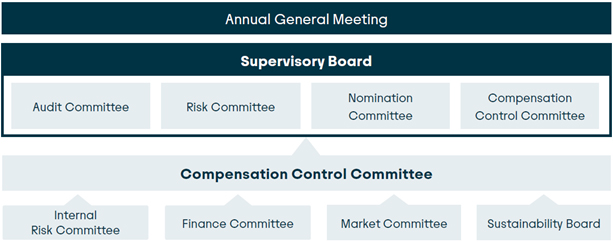
Rentenbank has established various bodies
for business and risk management. The central body for risk management is the Risk Board, which meets at least
quarterly.
It discusses key questions and topics relating to risk management and advises the Management Board on these
matters. In addition to the Management Board, its members are the heads of the Risk Controlling Department and the Cyber
Security & Non-Financial Risk Department, as well as the heads of the Credit, Finance, Treasury and Promotional activity
divisions. The Financial Board addresses Rentenbank’s financial position, while the Market Board deals with promotional
activity topics and treasury topics. The Sustainability Board addresses the requirements and the operational and strategic
implications of sustainability for Rentenbank.
To ensure a robust RMS, Rentenbank has organised its Internal Control System (ICS) within a clear three-lines-of-defence structure. The first line of defence consists of primary and key controls in the operational units. The second line of defence comprises the Regulatory Working Group (Arbeitskreis Regulatorische Themen; ART), the special MaRisk functions Risk Controlling and Compliance, the ICT risk control function under the Digital Operational Resilience Act (DORA), the Chief Information Security Officer (CISO), the Central Outsourcing Officer, the officers responsible for anti-money laundering and other criminal offences, and the Data Protection Officer. Internal Audit constitutes the third line of defence.
Responsibility for the Risk Controlling function under MaRisk (Mindestanforderungen an das Risikomanagement; minimum requirements for risk management) lies with the Chief Risk Officer (CRO). The Risk Controlling Department performs key tasks of the Risk Controlling function. These include supporting senior management in all matters of risk policy, in particular in the development and implementation of the risk strategy, regularly monitoring limits within risk-bearing capacity, risk reporting, the daily valuation of financial instruments and market conformity checks, as well as risk assessment in the New Products Process (NPP). The Cyber Security & Non-Financial Risks (CNR) Department, newly established in 2025, performs a substantial part of these tasks in relation to non-financial risks.
In accordance with the requirements of MaRisk, risk monitoring and reporting are carried out independently of the Promotional activity and Treasury market divisions.
| Landwirtschaftliche Rentenbank | Annual Report 2025 | 26 |
The back-office function is performed by the Credit division, which provides the independent second vote for lending decisions. In addition, this division monitors compliance with counterparty risk limits as part of credit portfolio management.
Rentenbank’s Compliance function reports directly to, and is directly subordinate to, the Management Board. In addition, a central office has been established for the prevention of money laundering, terrorist financing and other criminal offences. The Anti-Money Laundering Officer is organisationally directly subordinate to the Management Board and reports directly to it.
The CNR Department is also responsible for performing and ensuring all matters relating to information security. The head of the CNR Department performs the roles of ICT risk control function, Central Outsourcing Officer and Chief Information Security Officer.
Internal Audit reviews and evaluates, on a risk-oriented
and process-independent basis, the propriety of activities and processes as well as the adequacy and effectiveness of the RMS and
the ICS. It reports directly to the Management Board and performs its duties autonomously and independently.
| Landwirtschaftliche Rentenbank | Annual Report 2025 | 27 |
Business and risk strategy
Rentenbank’s risk strategy is derived from, and is consistent with, the market-oriented business strategy and comprises, in addition to the overarching cross-risk strategy, sub-strategies relating to individual risk types as well as the Venture Capital Policy.
The Risk Appetite Framework comprises all strategies and guidelines, methods, processes, responsibilities, controls, and systems from which the risk appetite is derived, communicated, and monitored. In addition to minimum target values, warning thresholds and limit systems, this also includes appropriate compliance and an appropriate risk culture.
The Risk Appetite Statement describes the extent to which Rentenbank is willing to assume risks and allocate risk coverage potential in order to achieve its strategic objectives. Risk appetite is defined on the basis of quantitative requirements and qualitative statements. These requirements are specified through the determination of limits and warning thresholds within the framework of risk-bearing capacity.
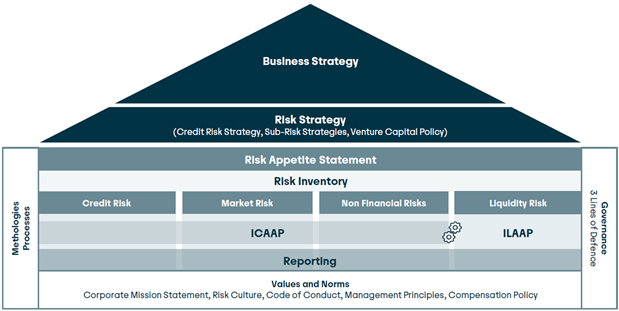
Through the risk strategy, the Risk Appetite Framework and the Risk Appetite Statement, the Management Board defines the key parameters
for risk management.
The credit risk strategy is shaped by the promotional mandate. To promote the agricultural sector and rural areas, financial resources are, in principle, provided only to banks established in the Federal Republic of Germany or another EU country that conduct business with agricultural enterprises, companies operating in upstream and downstream sectors, or companies active in rural areas. In this context, special promotional loans are restricted to Germany as the location for investment.
| Landwirtschaftliche Rentenbank | Annual Report 2025 | 28 |
In addition, Rentenbank may enter into participations, acquire interests in venture capital funds and provide debt capital to German federal states and German municipalities in the form of promissory notes, registered securities or bearer securities.
Accordingly, lending business is limited to the refinancing of banks or institutions and financial institutions within the meaning of Article 4 CRR, as well as to the provision of capital to domestic public authorities.
As part of the credit risk strategy, it has been stipulated that lending to companies in the direct lending business may only be undertaken through a subsidiary of Rentenbank. No corresponding new business was concluded in 2025.
Derivatives are used exclusively as hedging instruments and are only entered into with counterparties with whom Rentenbank has concluded a collateral agreement.
Rentenbank’s credit risk strategy requires prudent selection of counterparties and products in all business activities. In line with its core competencies and business model, Rentenbank focuses on the banking sector and public-sector borrowers. Rentenbank has a sectoral concentration risk vis-à-vis the banking sector, which arises from its promotional mandate. As an indicator of Rentenbank’s risk profile, the average credit quality of the overall credit portfolio – taking product ratings into account – must be at least A+.
The principal objective of the market risk strategy is to avoid risks that could jeopardise net interest income and thus the fulfilment of the promotional mandate. At the same time, market risks are limited and managed from a present-value perspective within the framework of economic risk-bearing capacity. Foreign currency positions are generally closed out.
The objectives of the liquidity risk strategy are to ensure solvency at all times, including under stress conditions, and to optimise the refinancing structure.
Non-financial risks, which include operational and strategic risks, are managed with the objective of preventing losses and thereby ensuring the quality of all operational processes at Rentenbank Compliance with regulatory requirements and the minimisation of reputational risks through appropriate communications management and a code of conduct are also integral components of the risk strategy.
Risk culture
Rentenbank’s risk culture shapes its self-image in the day-to-day handling of risks. It comprises the totality of the company’s norms, attitudes and behaviours with regard to risk awareness, risk appetite and risk management. Rentenbank has defined and established its approach to risk culture. In addition, indicators have been defined to monitor how risk culture is put into practice. Key elements of the risk culture are the autonomous and responsible handling of Rentenbank’s risks by all managers and employees within the scope of their assigned responsibilities, as well as the
| Landwirtschaftliche Rentenbank | Annual Report 2025 | 29 |
accountability of all managers and employees for their risk behaviour. An employee survey was used to assess the current state of risk culture and to identify measures for its further improvement.
Risk inventory
Through the risk inventory, Rentenbank obtains a structured overview of all risks that may impair its net assets, capital base, results of operations or liquidity position. This also includes risk concentrations within individual risk types and across risk types.
The resulting risk profile forms the basis for the Risk Appetite Statement and for risk measurement, monitoring and management at Rentenbank. In addition, the risk inventory serves to increase risk transparency and thereby supports Rentenbank’s risk culture. The risk profile comprises counterparty default risk, market risk, liquidity risk and non-financial risks as the material risk types. Non-financial risks comprise operational risks and strategic risks. Risks arising from changes in the areas of environmental, social and governance (ESG) are also a focus of risk analysis. These are incorporated into the RMS as risk drivers of the various risk types, including through scenario analyses.
In addition, material risks are identified and reported using indicators based on quantitative and qualitative risk characteristics. Further risks are identified in the New Products Process (NPP), in key ICS controls and in day-to-day control and monitoring activities.
Validation of risk measurement
A validation framework aligned with regulatory requirements defines the modalities for validating the methods and procedures used to measure the material risk types in Rentenbank’s ICAAP and ILAAP.
The methods and procedures are validated at least
annually, with independence between method development and validation ensured through an organisational separation. The aim of
validation is to critically review, on the basis of quantitative and qualitative analyses, the quality of the methods or models
used for risk measurement, as well as their parameters and assumptions. The assessment is performed in accordance with a defined
methodology. The validation results are discussed in the Risk Committee.
| Landwirtschaftliche Rentenbank | Annual Report 2025 | 30 |
Risk-bearing capacity
Rentenbank’s risk-bearing capacity concept is the central element of the Internal Capital Adequacy Assessment Process (ICAAP) and the basis for the operational implementation of the risk strategy. The objectives of the risk-bearing capacity concept are to ensure the institution’s continuation in fulfilling its promotional mandate while complying with regulatory requirements, as well as to safeguard the institution’s substance over the long term and to protect creditors against losses from an economic perspective. These objectives are reflected in the two perspectives of the risk-bearing capacity concept, which comprises a normative approach and an economic approach. Risk management processes are designed to meet these objectives and requirements on an equal footing. Monitoring of limits within risk-bearing capacity is supplemented by stress tests. These are reported regularly to the Management Board and discussed there as well as in the Risk Committee.
Normative approach
The management objective of the normative approach is to comply with all minimum regulatory capital requirements and provisions. It is assessed whether the capital base, both on a reporting-date basis and within the multi-year capital planning horizon (covering five years), ensures compliance with all regulatory requirements and thus the institution’s continued existence in the baseline scenario and in the adverse scenarios. The capital base should also enable the sustainable pursuit of the business strategy in these scenarios.
The following table shows regulatory own funds under the normative approach at the reporting date compared with the previous year:
|
31 December 2025 mEUR |
31 December 2024 mEUR | |
| Subscribed capital | 135.0 | 135.0 |
| Retained earnings | 1,252.6 | 1,233.6 |
| Fund for general banking risks | 3,553.5 | 3,479.8 |
| Intangible assets | -56.2 | -48.4 |
| Tier 2 capital | 0.0 | 0.0 |
| Regulatory own funds | 4,884.9 | 4,800.0 |
The increase in own funds compared with the previous year resulted from an increase in retained earnings and an increase in the fund for general banking risks following the adoption of the 2024 annual financial statements.
Risk-weighted assets (RWA) are shown in the following table:
| Landwirtschaftliche Rentenbank | Annual Report 2025 | 31 |
|
Risk amount 31 December 2025 mEUR |
Risk amount 31 December 2024 mEUR | |
| Credit risk | 13,909.6 | 11,454.8 |
| CVA charge | 612.1 | 530.5 |
| Operational risk | 487.3 | 544.3 |
| Total RWA | 15,008.9 | 12,529.6 |
The expected significant increase in RWA is due to the application of CRR III; the effect on capital ratios is mitigated to some extent by profit retention. Even after application of CRR III, the capital ratios remain well above the regulatory minimum requirements:
| Reporting date | ||||
|
(%) |
Reporting date 31 December 2025 |
2026 |
Baseline scenario 2027 |
2028 |
| Total capital ratio | 32.6 | 33.3 | 33.5 | 33.9 |
| Tier 1 capital ratio | 32.6 | 33.3 | 33.5 | 33.9 |
| Common Equity Tier 1 capital ratio | 32.6 | 33.3 | 33.5 | 33.9 |
| Leverage ratio | 11.5 | 10.7 | 11.1 | 11.8 |
In 2025, no material impact of the geopolitical crises and Germany’s economic stagnation on Rentenbank’s risk metrics could be observed. For the baseline scenario of capital planning, it is assumed that the conflicts will persist while the economy recovers slightly. Rentenbank therefore expects the portfolio to develop in a relatively stable manner from a risk perspective in the baseline scenario. This is reflected accordingly in the capital ratios.
Regulatory requirements are met at the reporting date and in the baseline scenario of capital planning at all points in time considered.
In addition to the baseline scenario, various adverse scenarios with significantly negative market-wide and institution-specific developments are analysed in the capital planning. Even taking CRR III effects into account, all regulatory requirements are met at all times.
| Landwirtschaftliche Rentenbank | Annual Report 2025 | 32 |
Economic Approach
The objectives of the economic approach are to safeguard the institution’s substance over the long term and to protect creditors against losses from an economic perspective. For this purpose, the economic risk coverage potential is compared with the aggregate risk amount and reviewed both at the reporting date and within the baseline scenario of capital planning.
The risk coverage potential includes hidden reserves and hidden charges from securities and promissory notes of German federal states, including the related hedging transactions, as well as the reserves pursuant to Section 340f HGB. The profit and loss result accrued during the year is taken into account, whereas planned profits that have not yet been realised are not included.
At the reporting date, the risk coverage potential under the economic approach was as follows compared with the previous year:
|
31 December 2025 mEUR |
31 December 2024 mEUR | |
| Subscribed capital | 135.0 | 135.0 |
| Retained earnings | 1,272.1 | 1,252.6 |
| Fund for general banking risks | 3,576.3 | 3,553.5 |
| Hidden charges / reserves | 596.9 | 211.1 |
| Risk coverage potential | 5,580.3 | 5,152.2 |
In the economic risk coverage potential, the planned appropriation of the result achieved in 2025 is taken into account. This results in slightly higher figures for retained earnings (+EUR 19.5 million) and for the fund for general banking risks (+EUR 22.8 million), as well as an addition to reserves. The substantial increase in risk coverage potential in 2025 is attributable mainly to higher hidden reserves or lower hidden charges on securities, promissory notes and registered bonds.
Under the economic approach, risks arising from all
positions are considered irrespective of their accounting treatment. The risks are calculated on the basis of a confidence
level of 99.9% and a time horizon of one year. The risk amounts of the individual risk types are added without
taking diversification effects into account and are distributed as follows:
| Landwirtschaftliche Rentenbank | Annual Report 2025 | 33 |
Risk amount 31 December 2025 mEUR |
Risk amount 31 December 2024 mEUR | |
| Credit risks | 468.3 | 470.5 |
| Market risks | 1,732.8 | 1,826.6 |
| of which: interest rate risks | 562.0 | 558.6 |
| of which: CVA risk from derivatives | 43.9 | 39.6 |
of which: spread and other risks |
1,111.9 | 1,213.4 |
| of which: risk buffer | 15.0 | 15.0 |
| Non-financial risks | 101.4 | 93.1 |
| of which: operational risks | 72.8 | 62.1 |
| of which: strategic risks | 28.6 | 31.0 |
| Total risk | 2,302.5 | 2,390.2 |
Risk-bearing capacity under the economic approach was ensured at all observation dates in 2025. All limits were complied with. Owing to the higher risk coverage potential and a decline in spread risks, utilisation of risk coverage potential at the reporting date was significantly lower at 41.26% than in the previous year (46.39%).
Stress tests
The purpose of stress tests is to analyse whether Rentenbank’s risk-bearing capacity remains ensured even under extraordinary but plausible cross-risk scenarios. For this purpose, a hypothetical scenario (economic downturn) and a historical scenario (financial market crisis followed by the sovereign debt crisis) are simulated. The scenarios consider both market-wide and institution-specific aspects. In doing so, geopolitical tensions and conflicts, as well as the resulting macroeconomic uncertainties – such as volatile energy prices, recurring supply bottlenecks and increased capital market volatility – were taken into account. These developments were translated qualitatively and quantitatively into their potential effects on refinancing costs, credit risks and Rentenbank’s capital market environment, so that the key risk impulses of the global environment are adequately reflected in the scenarios.
The key risk parameters underlying the stress scenarios are the deterioration in credit quality, changes in interest rates and increases in credit spreads. In the stress tests, the effects of the stress scenarios are analysed from both the normative and the economic perspective. Under the normative approach, the effects of the scenarios on the income statement and on equity, in particular the effects on risk-weighted assets, are simulated over a three-year horizon. Under the
| Landwirtschaftliche Rentenbank | Annual Report 2025 | 34 |
normative approach, the dominant risk is counterparty default risk, while under the economic approach counterparty default risk and market risk are particularly relevant.
Risk-bearing capacity is ensured under both approaches even in the stress scenarios without recourse to regulatory relief measures relating to capital and liquidity requirements, thereby confirming Rentenbank’s comfortable capital position. In addition to these stress scenarios, a reverse stress test is used to examine which events would cause risk-bearing capacity no longer to be ensured. Furthermore, the effects of sustainability risks are examined in various scenarios (see separate section).
Credit risks
Definition
Credit risk is the risk that a counterparty will fail to meet its payment obligations, or will meet them only in part, as well as the risk of valuation losses resulting from rating downgrades. A distinction is made between the following risk sub-types: default risk, migration risk and country risk.
Lending business is largely limited to the refinancing of banks or institutions and financial institutions within the meaning of Article 4 of the CRR, as well as other interbank business. In the case of special promotional loans, the default risk relating to the ultimate borrower lies with the local bank. In addition, German federal states, districts and municipalities are refinanced.
Risk assessment and management
The key risk parameters used to determine credit risk are probability of default, loss given default, exposure at default and the correlations between counterparties, which are used in the credit portfolio model to simulate simultaneous defaults by counterparties.
Probability of default is derived from the credit assessment of counterparties. The credit assessment is carried out using an internal risk rating system. Under this procedure, individual counterparties or types of business are assigned to one of 20 rating categories. The best ten rating categories, from AAA to BBB-, are reserved for counterparties with low risks (“investment grade”). In addition, the seven rating categories from BB+ to C are intended for latent or elevated latent risks, while the three rating classes from DDD to D are intended for non-performing loans and defaulted counterparties.
The credit assessment of counterparties is reviewed at least annually on the basis of an evaluation of their annual financial statements and an analysis of their economic circumstances. In doing so, account is taken of financial ratios, qualitative characteristics, shareholder background and further support factors, such as membership of an institutional protection scheme or government liability mechanisms. The country risk of the counterparty’s country of domicile is also taken into account in determining credit quality. For certain products, such as German mortgage bonds (Pfandbriefe), the
| Landwirtschaftliche Rentenbank | Annual Report 2025 | 35 |
associated collateral or cover assets are taken into account as an additional criterion for determining the product rating, alongside the relevant national statutory provisions. If current information becomes available regarding negative financial data or a weakening of a counterparty’s economic outlook, the credit rating is reviewed and adjusted if necessary.
Loss given default quantifies the proportion of an exposure that remains irrecoverable after a counterparty has defaulted and the collateral provided has been realised. To quantify counterparty credit risks, Rentenbank uses product-specific or business-type-specific loss given default parameters, which are determined using analytical and expert-based methods. In particular, the recovery chain of special promotional loans granted under the so-called on-lending procedure is taken into account in the assessment and parameterisation of loss given default for special promotional loans. In addition, Rentenbank relies on external data sources for certain types of business.
Exposure at default corresponds to the reporting-date balance plus off-balance-sheet transactions of individual counterparties. This corresponds to the residual amount of the receivable or the market value. For derivatives, exposure is determined as the amount of the exposure plus an add-on for market value fluctuations, taking contractual netting and posted and received collateral (cash collateral) into account.
Credit risk under the economic approach (credit value at risk) is calculated using a credit portfolio model, taking into account correlations between counterparties and including migration risks.
The method described makes it possible to assess, monitor and manage risks within the meaning of MaRisk. Negative developments and portfolio concentrations can thus be identified at an early stage and countermeasures initiated.
Limitation and monitoring
The overall credit ceiling for all counterparty default risk limits, as well as an unsecured ceiling, are set by the Management Board and thereby limit counterparty default risks. Concentration risks within Rentenbank are managed and limited at several levels through various targeted approaches. Country lending limits and currency transfer limits are also in place to limit risk.
A limit system manages the amount and structure of all counterparty default risks. Internal limits are recorded for all borrowers, issuers and counterparties and are, where appropriate, broken down by product and maturity. Rentenbank’s risk classification system constitutes the central basis for decisions on limit allocation. In addition, specific minimum credit qualities apply to certain business types or limit types.
The limitation of credit risks within the framework of risk-bearing capacity is based on the credit value at risk determined in the credit portfolio model.
| Landwirtschaftliche Rentenbank | Annual Report 2025 | 36 |
In addition, risk indicators provide early signals of a possible increase in risk or shifts in risk within the portfolio. Warning thresholds ensure that higher levels of limit utilisation are identified at an early stage and that appropriate courses of action can be taken.
Limits are monitored on a daily basis. Limit overruns are immediately reported to the Management Board.
Credit risks are therefore managed, monitored and reported at the level of individual transactions, at the level of the borrowers and the group of connected clients, at country level and at the level of the overall credit portfolio.
Portfolio overview
For more than 90% of the risk exposures, collateral exists in the form of assignments of the refinanced receivables of the ultimate borrowers and state liability mechanisms, or the exposures consist of collateralised products such as German mortgage bonds (Pfandbriefe) or covered bonds. Unsecured risk exposures relate predominantly to receivables from credit institutions belonging to domestic liability schemes.
The total credit portfolio of EUR 88 billion (EUR 92 billion) comprises the nominal amounts of the risk exposures denominated in euros. These include special promotional loans with assignment of the refinanced receivables of the ultimate borrowers, state-guaranteed special promotional loans, registered bonds, promissory notes and securities, money market and derivative transactions, participations, venture capital investments and all externally committed credit lines, but not lending from the Federal Government’s Special-Purpose Fund. In the case of participations, the risk exposures of Rentenbank’s direct participations are included.
The conclusion of financial instruments in derivatives business is permissible exclusively as a hedging instrument on the basis of a netting and collateral agreement.
Aggregation in the following three presentations is based on
the counterparty’s country of domicile or at the level of the legally independent counterparty, without taking group relationships
into account. Allocation to the rating categories is based on product ratings. The amounts shown are based on nominal values.
| Landwirtschaftliche Rentenbank | Annual Report 2025 | 37 |
More than 90% of the portfolio is collateralised and distributed as follows:
Credit Rating Categories (in euro billions)
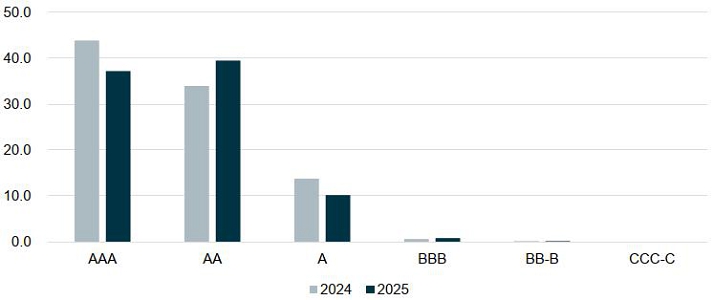
Country Groups (in euro billions)
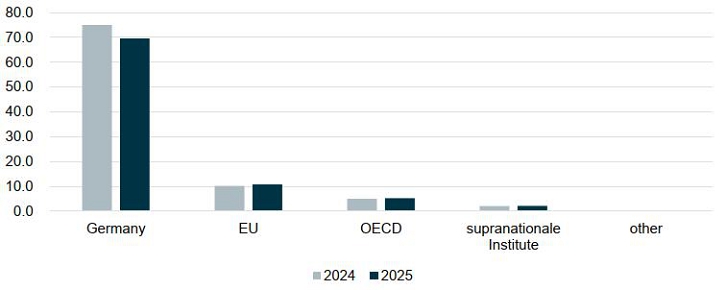
Counterparty Groups (in euro billions)
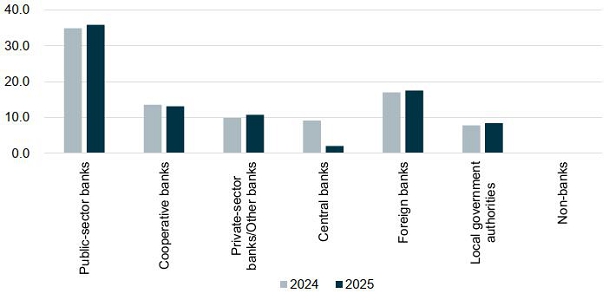
| Landwirtschaftliche Rentenbank | Annual Report 2025 | 38 |
Rentenbank has no exposure to Russian, Belarusian or Ukrainian counterparties or their subsidiaries. The exposure of Rentenbank’s counterparties in Russia and/or Ukraine is limited. The direct effects of the Russia-Ukraine crisis on the business development of the institutions concerned are therefore manageable overall. Rentenbank is also monitoring domestic political developments in the United States, the ongoing trade conflicts, particularly with China, and regional hotspots (Gaza, Iran, Venezuela). At present, Rentenbank sees no direct effects on its banking counterparties.
Loan loss provisions
Specific valuation provision
Each month, an assessment is made as to whether there is objective evidence that not all interest and principal payments can be made in accordance with the contractual terms. For accounting purposes, the need to recognise a specific valuation allowance for a receivable is assessed on the basis of the following criteria:
| • | internal credit assessment in the non-investment-grade category, |
| • | non-performing, forborne or restructured exposures, |
| • | material deterioration in the counterparty’s credit quality, |
| • | material deterioration in the credit quality of the counterparty’s country of domicile. |
As in the previous year, there was no need to recognise specific valuation allowances at the reporting date.
Valuation adjustments for venture capital participations
At Rentenbank, the venture capital funds are classified as fixed assets. No valuation adjustments were required in 2025.
General valuation allowance
General valuation allowances are recognised for latent credit risks, the amount of which is calculated on the basis of probability of default and loss given default.
General valuation allowances for receivables, securities and
irrevocable loan commitments amount to EUR 2.9 million and were therefore slightly below the previous year’s level (EUR 3.1
million).
| Landwirtschaftliche Rentenbank | Annual Report 2025 | 39 |
Market risks
Definition
Market risk is the potential loss arising from changes in market data. It comprises interest rate risks, CVA risks from derivatives, and spread and other market risks. The latter include currency risks and volatility risks. Spread risks are differentiated into credit spread risks, cross-currency basis spread risks and tenor basis spread risks.
Risk assessment and management
Interest rate risks
Interest rate risks are measured from a present-value perspective and from an earnings perspective by shifting yield curves.
Present-value calculation and monitoring are carried out daily for the “Treasury Management” and “Promotional Activity” segments and monthly at overall bank level. The earnings-based measurement of interest rate risks is performed in the stress scenarios under the normative approach over a three-year horizon on the basis of the gap structure in the interest rate scenarios considered.
In addition, six supervisory interest rate shock scenarios prescribed by the supervisory authorities are calculated. At the reporting date, the supervisory interest rate coefficient (Supervisory Outlier Test [SOT]) based on Economic Value of Equity [EVE]) for rising interest rates was 10.4%. Rentenbank’s coefficient (SOT NII) for falling interest rates was 0.4%.
Generating material income through the assumption of interest rate risk is not one of Rentenbank’s strategic objectives. Interest rate risk is limited through the use of derivatives on the basis of micro hedges or macro hedges, the latter for special promotional loans.
Spread risks
Spread risks are calculated using a value-at-risk (VaR) model
based on historical simulation. Credit spread risks for securities, promissory notes and all registered bonds, as well as basis
spread risks, are quantified and limited on this basis. Credit spread risks are managed on the basis of the buy-and-hold strategy,
in particular through the requirements of the credit risk strategy.
| Landwirtschaftliche Rentenbank | Annual Report 2025 | 40 |
Other market risks
Even with closed foreign currency positions, the market values of the underlying transactions and hedging transactions may differ because of different valuation parameters, primarily spreads. When translated into euros, this results in exchange rate-related present-value differences, which are taken into account as currency risk. Apart from immaterial positions in clearing accounts, there are no open foreign currency positions. Volatility risk describes the risk that the value of an option changes as a result of changes in volatility. Rentenbank holds only interest rate-related options, and embedded options are also taken into account, particularly in the case of loans with termination rights. Currency and volatility risks are measured and limited through scenario-based changes in exchange rates and in cap/floor and swaption volatilities.
Other market risks, such as equity price risks and commodity risks, are not relevant due to the business model.
CVA risk
CVA risk is the risk of potential fair value losses on derivatives resulting from a deterioration in the counterparty’s credit quality. In addition to probability of default, which is derived from credit default swaps, the calculation also incorporates counterparties’ loss given default and potential future exposure at the level of the netting pools. CVA risk is limited through the conclusion of collateral agreements and through limits.
Risk buffer
A risk buffer is used to additionally take account of imprecision
and simplifications in risk modelling.
| Landwirtschaftliche Rentenbank | Annual Report 2025 | 41 |
Liquidity risks
Definition
Liquidity risk is the risk of being unable, or only partially able, to meet current or future payment obligations. This also includes intraday liquidity risk, market liquidity risk and refinancing cost risk.
Refinancing cost risk is the risk that future refinancing funds can only be raised on unexpectedly less favourable cost terms or that surplus liquidity has to be invested on unexpectedly less favourable terms.
Risk assessment and management
The objectives of liquidity management are to ensure solvency at all times, even under stress conditions, to optimise the refinancing structure and to coordinate own issuances in the money and capital markets. For this purpose, Rentenbank has implemented an appropriate Internal Liquidity Adequacy Assessment Process (ILAAP).
Within the ILAAP, liquidity risks are backed by liquidity coverage potential or liquid assets. The starting point for measuring liquidity risk is cumulative net liquidity demand, which is also assessed under various stress scenarios. Cumulative net liquidity demand is compared with the liquidity coverage potential available at the relevant point in time (liquidity buffer). Utilisation is assessed across short-, medium- and long-term horizons and is subject to limits. In accordance with MaRisk, the potential utilisation of liquidity coverage potential is explicitly determined for periods of one week and one month.
The stress scenarios are used to assess the impact of unexpected, extraordinary events on the liquidity position and on market liquidity risk. The scenarios comprise a market-wide scenario involving a decline in securities prices (market liquidity) as well as liquidity outflows resulting from cash collateral to be posted. In addition, an idiosyncratic scenario is simulated that assumes the simultaneous drawdown of all irrevocable loan commitments and the default of significant borrowers. The scenario mix simulates the cumulative occurrence of the liquidity stress scenarios. Event-driven liquidity stress tests are also performed where risk-relevant events occur. The composition and appropriate diversification of liquidity coverage potential are reviewed as part of validation.
In addition, the regulatory liquidity ratios, the Liquidity Coverage Ratio (LCR) and the Net Stable Funding Ratio (NSFR), are calculated and limited.
The scenario mix has been defined as the management-relevant scenario and, through a traffic-light system, ensures the minimum survival horizon.
| Landwirtschaftliche Rentenbank | Annual Report 2025 | 42 |
Short-term as well as medium- and long-term liquidity limits are monitored and reported on a daily basis.
The actual liquidity position and utilisation of the liquidity buffer, as well as a 90-day forecast of net liquidity demand in accordance with the LCR, are monitored daily. The remaining internal and regulatory metrics are calculated and monitored monthly.
Interbank funds, reverse repos under Eurex GC Pooling, ECP issuances and open market operations with Deutsche Bundesbank are available as instruments for managing the short-term liquidity position. In addition, securities may be purchased for liquidity management purposes. Funding with maturities of up to two years may be raised through the Euro Medium-Term Note Programme (EMTN programme), promissory notes, global bonds and domestic capital market instruments. Bonds issued by Rentenbank are classified in the EU as “liquid assets” in accordance with the LCR. Rentenbank bonds may also be held as high-quality liquid assets in other jurisdictions (for example, the United States and Canada).
As in the previous year, liquidity was secured at all observation dates during the reporting year, including under stress assumptions. All liquidity limits and regulatory liquidity ratios were complied with by a comfortable margin. The average LCR was 3.85 (4.15) and the average NSFR was 1.30 (1.32).
Funding cost risks are measured as part of the risk inventory
and validation process. During the reporting year, they remained below the internally defined materiality threshold.
| Landwirtschaftliche Rentenbank | Annual Report 2025 | 43 |
Non-financial risks
Definition
Non-financial risks comprise operational risks and strategic risks.
Operational risks arise from inadequate or failed systems and processes, from human misconduct or from external events. They also include legal risks, compliance risks, outsourcing risks, IT risks, information security risks, personnel risks, model risks, project risks and event-related or environmental risks.
Strategic risks comprise the risk sub-types business/strategic risks, reputational risks and pension risks.
Business/strategic risk describes the risk that Rentenbank’s business-strategic objectives are not achieved as a result of its business policy positioning or adverse framework conditions, and that this has a negative effect on its net assets and earnings position.
Reputational risk is the risk of losses arising from a deterioration in the way Rentenbank is perceived by relevant internal and external stakeholders, resulting in adverse economic effects or a loss of confidence in Rentenbank.
Pension risk refers to the risk of pension provisions being measured inadequately.
Risk assessment and management
From an economic perspective, non-financial risks are quantified using a simulation model (value at risk). The data basis consists of the risk estimates from self-assessments carried out by process owners, the risk analyses of other organisational units and the historical loss events arising from operational risks. The risk model allows a detailed analysis of individual risks and risk drivers as well as the simulation of scenarios.
All loss events and near misses at Rentenbank are recorded decentrally in a loss event database by operational risk officers. Risk Controlling analyses and aggregates the loss events and further develops the methodology of the instrumentarium.
In the self-assessments, material operational risk scenarios in individual business processes are analysed and assessed on a risk-oriented basis. Risk-reducing measures are also determined in this context.
The Risk Controlling Department centrally aggregates and analyses all non-financial risks. It is responsible for the use of relevant instruments and the development of methods for the identification, assessment, management and communication of risks. Non-financial risks are managed by the respective organisational units.
| Landwirtschaftliche Rentenbank | Annual Report 2025 | 44 |
The Cyber Security & Non-Financial Risk Department monitors information security risks, third-party service provider risks and risks relating to business continuity management. To this end, processes and methods for the identification, assessment, management and monitoring of risks have been established.
The Legal & Committees Department manages and monitors legal risk. It informs the Management Board, both on an ad hoc basis and regularly in the form of half-yearly reports, about pending or threatened legal disputes. Rentenbank reduces legal risks arising from the conclusion of transactions by using largely standardised contracts. For this purpose, the Legal Department is involved at an early stage in decision-making, and material projects must be coordinated with the Legal & Committees division. Legal disputes are recorded in the loss event database without delay. A designated risk indicator is monitored for the early identification of risk.
Regulatory risk, as a component of compliance risk, is managed by the Compliance function and the ART through the active monitoring of regulatory projects and other legislative initiatives affecting Rentenbank, as well as through the identification of potential consequences for Rentenbank.
On the basis of a materiality and risk analysis, compliance-related risks are identified and it is analysed whether general and institution-specific requirements for an effective organisation are being met. The same applies to risks arising from money laundering, terrorist financing and criminal offences that could endanger Rentenbank’s assets. Organisational measures are derived from the risks identified in order to optimise risk prevention.
In particular, compliance with due diligence obligations and the identification of counterparties (know-your-customer principle) are important elements of anti-money laundering prevention. The necessary procedures and processes for this purpose have been established, and any suspicious cases are reported without delay by the Anti-Money Laundering Officer to the Financial Intelligence Unit (FIU). In 2025, there were no suspicious cases relating to money laundering or terrorist financing, nor were any other criminal offences identified.
The risks associated with outsourcing and other external sourcing of IT services are captured under operational risks. Rentenbank has established the function of a Central Outsourcing Officer, who is supported by the Central Outsourcing Management Department. Outsourcing monitoring is carried out on a decentralised basis. Central outsourcing management also includes the management and monitoring of the outsourcing portfolio. On the basis of a standardized risk analysis, a distinction is made between material and non-material outsourcing arrangements. Special requirements apply to material outsourcing arrangements, in particular with regard to contracts, management and monitoring, and reporting. Third-party service provider risks are integrated into operational risk management and presented transparently.
To protect data, systems, networks and the site, Rentenbank has implemented an Information Security Management System (ISMS). The Cyber Security & Non-Financial Risk Department monitors compliance with the requirements set out in the ISMS regarding the confidentiality, availability and integrity of information. Employees receive regular information security training and are made
| Landwirtschaftliche Rentenbank | Annual Report 2025 | 45 |
aware of risks through various channels. Information security risks are integrated into operational risk management and presented transparently. This also includes risks arising from threats related to cyber risks. To this end, penetration tests are carried out regularly by external service providers.
For emergency or crisis situations, Rentenbank’s Business Continuity Management Department has established preventive and reactive measures for time-critical business processes. Emergency manuals, business continuity plans and recovery plans govern the handling of operational disruptions. Rentenbank reviews and monitors the effectiveness of these plans on the basis of test and exercise plans. Rentenbank reviews and monitors the effectiveness of these plans on the basis of test and exercise plans.
The Code of Conduct and professional external corporate communications contribute to mitigating reputational risks.
For the measurement of pension provisions, parameters such as interest rates, inflation and life expectancy are used on the basis of an external actuarial report. The related interest rate risks are taken into account within interest rate risk in the banking book (IRRBB).
Non-financial risks are limited within economic risk-bearing capacity, separately for operational risks and strategic risks.
The loss events identified during the reporting year, the findings from the self-assessments, the risk analyses of the organisational units and the monitoring of early warning indicators do not indicate any risks that could endanger Rentenbank’s continued existence.
| Landwirtschaftliche Rentenbank | Annual Report 2025 | 46 |
ESG risks
ESG risks in the areas of climate and the environment are divided into physical risks and transition risks. Physical risks arise both in relation to individual extreme weather events and their consequences and with regard to long-term changes in climatic and ecological conditions. Transition risks arise in connection with the transition to a low-carbon economy.
At Rentenbank, ESG risks are not viewed as a separate risk type, but as risk drivers of the traditional risk types. Starting from a long list of possible ESG risk drivers, those relevant to Rentenbank were identified. In identifying these ESG risk drivers, vulnerability, financial impact and the possible transmission channel were taken into account.
As part of its promotional activities, Rentenbank provides refinancing for local banks in respect of its special promotional loans. In this context, the local bank bears the default risk of the ultimate borrower. Rentenbank’s customers are therefore classified almost exclusively as banks or domestic public-sector institutions. Accordingly, these are not direct investments in the agriculture and forestry sector.
Against the background of this classification, Rentenbank analyses the potential effects of sustainability risks. Within the existing credit assessment procedures, individual ESG aspects are already taken into account. Since 2023, Rentenbank has used controversy screening as part of credit assessment. In 2024, an ESG scoring system was introduced.
Since 2020, various ESG scenarios relating to future developments, with a focus on climate and environmental risks, have been considered, and the possible effects of climate change on Rentenbank’s capital and risk position have been examined. The ESG scenarios were developed largely on the basis of currently available information and assessments (including those of the Network for Greening the Financial System). The scenarios considered are intended to reflect Rentenbank’s physical and transition risk drivers as broadly as possible. For these scenarios, quantitative estimates of the short- and long-term effects were made, the impact of which on Rentenbank’s risk metrics is expected to be limited. The scenarios are continuously refined on the basis of new insights, in particular those provided by the NGFS. In addition, developments in the CO₂ price are monitored as a risk indicator.
| Landwirtschaftliche Rentenbank | Annual Report 2025 | 47 |
Financial reporting process
The purpose of the financial reporting process is to map the coding and processing of a business transaction through to the preparation of the required annual financial statements.
The objective of the accounting-related ICS/RMS is to ensure compliance with accounting standards and regulations and to safeguard proper accounting.
Rentenbank prepares its financial statements in accordance with the provisions of the German Commercial Code (HGB) and the German Regulation on the Accounting of Banks and Financial Services Institutions (Verordnung über die Rechnungslegung der Kreditinstitute, Finanzdienstleistungsinstitute und Wertpapierinstitute; RechKredV).
These rules are documented in manuals and work instructions. The Finance division monitors them regularly and adapts them to changes in legal, regulatory and procedural requirements. The involvement of the Finance division in the New Products Process ensures that new products are properly reflected for accounting purposes.
The documentation of the accounting process complies with the principles of proper accounting (Grundsätze ordnungsgemäßer Buchführung; GoB) and is understandable to knowledgeable third parties. The statutory retention periods are observed when storing the relevant documents.
The functions of the organisational units that are material to the accounting process are clearly segregated. Separate sub-ledgers are assigned to, and monitored by, the respective organisational units for money market business, loans, securities and liabilities accounting. The data from the sub-ledgers are transferred to the general ledger via automated interfaces. The Finance division is responsible for accounting, defining posting rules, the posting logic, the control of posting programs and the administration of the financial accounting system.
Rentenbank uses standard software for financial reporting. The allocation of task-specific access rights protects the financial reporting process against unauthorised access. Plausibility checks are performed on a regular basis. In addition, the four-eyes principle, standardised reconciliation routines and budget versus actual comparisons in the finance system are intended to ensure that errors are identified and corrected promptly. At the same time, these measures serve to ensure the correct recognition, presentation and measurement of assets and liabilities.
The effectiveness of the accounting-related ICS/RMS is monitored through regular process-independent audits by Internal Audit.
Within the framework of the management information system, reporting to those responsible is timely, quality-assured and relevant. The Supervisory Board and its committees are regularly informed by the Management Board about current business developments. In addition, they are informed promptly about special events.
| Landwirtschaftliche Rentenbank | Annual Report 2025 | 48 |
Annual
financial
statements
| Landwirtschaftliche Rentenbank | Annual Report 2025 | 49 |
Balance sheet of Landwirtschaftliche Rentenbank at 31 December 2025
| Assets | |||||||
| 31/12/2025 | 31/12/2024 | ||||||
| Note | mEUR | mEUR | mEUR | ||||
| 1. | Cash reserve | ||||||
| a) Cash on hand | 0.0 | 0.0 | |||||
| b) Balances with central banks | 44.5 | 56.2 | |||||
| of which: | |||||||
| Deutsche Bundesbank mEUR 44.5 (PY: mEUR 56.1) | 44.5 | 56.2 | |||||
| 2. | Loans and advances to banks | 1/17 | |||||
| a) Payable on demand | 1,973.7 | 9,081.4 | |||||
| b) Other loans and receivables | 55,853.8 | 56,534.0 | |||||
| 57,827.5 | 65,615.4 | ||||||
| 3. | Loans and advances to customers | 2/20 | |||||
| of which: | |||||||
| Secured by mortgages mEUR – (PY: mEUR –) | |||||||
| Municipal loans mEUR 7,003.1 (PY: mEUR 6,980.1) | 7,100.8 | 7,003.2 | |||||
| 4. | Bonds and other fixed-income securities | 3/7/17 | |||||
| a) Commercial paper | |||||||
| aa) Other issuers | 0.0 | 50.4 | |||||
| of which: | |||||||
| eligible as collateral with Deutsche Bundesbank | |||||||
| mEUR – (PY: mEUR –) | |||||||
| b) | Bonds and notes | ||||||
| ba) public-sector issuers | 1,610.3 | 977.5 | |||||
| of which: | |||||||
| Eligible as collateral with Deutsche Bundesbank | |||||||
| mEUR 1,481.2 (PY: mEUR 848.4) | |||||||
| bb) Other issuers | 17,338.7 | 15,714.7 | |||||
| of which: | |||||||
| Eligible as collateral with Deutsche Bundesbank | |||||||
| mEUR 15,318.2 (PY: mEUR 13,367.6) | 18,949.0 | 16,742.6 | |||||
| 5. | Shares and other non-fixed income securities | 4/7 | 46.7 | 33.2 | |||
| 6. | Equity interests | 5/7 | |||||
| of which: | |||||||
| in banks: mEUR 321.9 (PY: mEUR 321.9) | |||||||
in financial services institutions: mEUR – (PY: mEUR –) |
|||||||
| in investments firms: mEUR – (PY: mEUR –) | 327.9 | 327.9 | |||||
| 7. | Shares in affiliated companies | 5/7 | |||||
| of which: | |||||||
| in banks: mEUR – (PY: mEUR –) | |||||||
| in financial services institutions: mEUR – (PY: mEUR –) | |||||||
| in investment firms: mEUR – (PY: mEUR –) | 49.6 | 49.6 | |||||
| 8. | Trust assets | 6 | |||||
| of which: | |||||||
| Trust loans: mEUR 178.3 (PY: mEUR 168.5) | 178.3 | 168.5 | |||||
| 9. | Intangible assets | 7 | |||||
| a)
Purchased concessions, industrial property rights and similar rights, and licenses to such rights |
41.6
|
36.5
| |||||
| 10. | Property and equipment | 7 | 91.7 | 80.1 | |||
| 11. | Other assets | 8 | 3,812.1 | 2,426.4 | |||
| 12. | Prepaid expenses | 9/17 | |||||
| a) From issuing and lending business | 1,751.6 | 2,114.8 | |||||
| b) Other | 249.4 | 330.6 | |||||
| 2,001.0 | 2,445.4 | ||||||
| Total assets | 90,470.7 | 94,985.0 | |||||
| Landwirtschaftliche Rentenbank | Annual Report 2025 | 50 |
| Liabilities and equity | ||||||||
31/12/2025 |
31/12/2024 | |||||||
| Note | mEUR | mEUR | mEUR | mEUR | ||||
| 1. | Liabilities to banks | 10 | ||||||
| a) | Payable on demand | 0.2 | 0.0 | |||||
| b) | With agreed term or notice period | 814.1 | 1,528.3 | |||||
| 814.3 | 1,528.3 | |||||||
| 2. | Liabilities to customers | 11/17 | ||||||
| a) | Other liabilities | |||||||
| aa) | Payable on demand | 0.1 | 0.0 | |||||
| ab) | With agreed term or notice period | 1,497.3 | 1,490.4 | |||||
| 1,497.4 | 1,490.4 | |||||||
| 3. | Securitised liabilities | 12/17/20 | ||||||
| a) | Debt securities issued | 80,523.4 | 83,752.3 | |||||
| 4. | Trust liabilities | 13 | ||||||
| of which: | ||||||||
| Trust loans: mEUR 178.3 (PY: mEUR 168.5) | 178.3 | 168.5 | ||||||
| 5. | Other liabilities | 14 | 142.0 | 351.7 | ||||
| 6. | Deferred income | 15/17 | ||||||
| a) | From issuing and lending business | 231.2 | 310.9 | |||||
| b) | Other | 1,720.9 | 2,081.1 | |||||
| 1,952.1 | 2,392.0 | |||||||
| 7. | Provisions | 16 | ||||||
| a) | Provisions for pensions and similar obligations | 154.2 | 153.7 | |||||
| b) | Other provisions | 206.1 | 188.0 | |||||
| 360.3 | 341.7 | |||||||
| 8. | Fund for general banking risk | 3,576.3 | 3,553.5 | |||||
| 9. | Equity | |||||||
| a) | Subscribed capital | 135.0 | 135.0 | |||||
| b) | Retained earnings | |||||||
| ba) | Principal reserve pursuant to Section 2 (2) of Rentenbank’s Governing Law | 1,252.6 | 1,233.6 | |||||
| Allocations from guarantee reserve | 0.0 | 0.0 | ||||||
| Allocations from net income | 19.5 | 19.0 | ||||||
| 1,272.1 | 1,252.6 | |||||||
| bb) | Guarantee reserve pursuant to Section 2 (3) of | |||||||
| Rentenbank’s Governing Law | 0.0 | 0.0 | ||||||
| Withdrawals pursuant to Section 2 (3) of Rentenbank’s Governing Law | 0.0 | 0.0 | ||||||
| 0.0 | 0.0 | |||||||
| c) | Distributable profit | 19.5 | 19.0 | |||||
| 1,426.6 | 1,406.6 | |||||||
| Total liabilities and equity | 90,470.7 | 94,985.0 | ||||||
| 1. | Contingent liabilities | 18 | ||||||
| a) | Liabilities from guarantees | |||||||
| and indemnity agreements | 9.9 | 17.0 | ||||||
| 2. | Other commitments | 19 | ||||||
| a) | Irrevocable loan commitments | 1,909.4 | 589.9 | |||||
| Landwirtschaftliche Rentenbank | Annual Report 2025 | 51 |
Income statement of Landwirtschaftliche Rentenbank
for the period from 1 January to 31 December 2025
| 2025 | 2025 | 2025 | 2024 | |||||
| Note | mEUR | mEUR | mEUR | mEUR | ||||
| 1. | Interest income from | 21 | ||||||
| a) | Lending and money market transactions | 2,482.6 | 3,503.6 | |||||
| b) | Fixed-income securities | |||||||
| and debt register claims | 424.4 | 346.0 | ||||||
| 2,907.0 | 3,849.6 | |||||||
| less negative interest: mEUR 2.3 | (2.9) | |||||||
| 2. | Interest expenses | 22 | 2,688.8 | 3,572.7 | ||||
| 218.2 | 276.9 | |||||||
| 3. | Current income from | |||||||
| a) | Shares and other non-fixed-income | |||||||
| securities | 0.0 | 0.0 | ||||||
| b) | Equity interests | 10.6 | 10.6 | |||||
| 10.6 | 10.6 | |||||||
| 4. | Fee and commission income | 0.8 | 0.6 | |||||
| 5. | Fee and commission expenses | 5.4 | 5.3 | |||||
| - 4,6 | - 4,7 | |||||||
| 6. | Other operating income | 23 | 15.6 | 16.8 | ||||
| 7. | General administrative expenses | |||||||
| a) | Personnel expenses | |||||||
| aa) Wages and salaries | 47.2 | 43.1 | ||||||
| ab) Social security contributions and expenses | ||||||||
| for pensions and other employee benefits | 14.8 | 9.7 | ||||||
| 62.0 | 52.8 | |||||||
| of which: mEUR 7.1 for pensions | (3.1) | |||||||
| b) | Other administrative expenses | 67.7 | 63.8 | |||||
| 129.7 | 116.6 | |||||||
| 8. | Depreciation, amortisation and impairments of | |||||||
| intangible assets as well as property and equipment | 16.5 | 14.2 | ||||||
| 9. | Other operating expenses | 24 | 5.3 | 5.5 | ||||
| 10. | Write-downs and impairments of loans and advances | |||||||
| and certain securities and additions to provisions for loan losses | 24.8 | 49.8 | ||||||
| 11. | Write-downs and impairments of equity interests, shares in affiliated | |||||||
| companies and securities held as fixed assets | 0.0 | 0.1 | ||||||
| 12. | Income from reversals of write-downs and impairments | |||||||
| of equity interests, shares in affiliated companies and securities | ||||||||
| held as fixed assets | 0.0 | 0.0 | ||||||
| 13. | Additions to the fund for general banking risks | 22.8 | 73.7 | |||||
| 14. | Profit on ordinary activities | 40.7 | 39.7 | |||||
| 15. | Taxes on income and profit | 1.7 | 1.6 | |||||
| 16. | Other taxes not included in “Other operating expenses” | 0.0 | 0.1 | |||||
| 1.7 | 1.7 | |||||||
| 17. | Net income for the year | 39.0 | 38.0 | |||||
| 18. | Additions to retained earnings | |||||||
| to principal reserve pursuant to Section 2 (2) of Rentenbank’s Governing Law | ||||||||
| from net income | 19.5 | 19.0 | ||||||
| 19. | Distributable profit | 19.5 | 19.0 | |||||
| Landwirtschaftliche Rentenbank | Annual Report 2025 | 52 |
Cash flow statement as at 31 December 2025
2025 mEUR |
2024 mEUR | |
| Net income/loss for the period | 39.0 | 38.0 |
| Depreciation, amortisation and impairments, and reversal of impairments of loans and advances and fixed assets | 16.5 | 14.2 |
| Increase (+)/decrease (-) in provisions | 18.6 | - 16,3 |
| Other non-cash expenses/income | 47.6 | 123.8 |
| Other adjustments (net) | 53.3 | 21.9 |
| Increase (-)/decrease (+) in loans and advances to banks | 7,763.1 | 1,579.1 |
| Increase (-)/decrease (+) in loans and advances to customers | -97.6 | 499.2 |
| Increase (-)/decrease (+) in securities (not held as fixed assets) | 50.4 | - 50,0 |
| Increase (-)/decrease (+) in other assets from operating activities | -1,006.5 | 1,611.2 |
| Increase (+)/decrease (-) in liabilities to banks | - 714.0 | - 236.8 |
| Increase (+)/decrease (-) in liabilities to customers | 7.0 | - 344.1 |
| Increase (+)/decrease (-) in securitised liabilities | - 3,228.9 | - 2,004.2 |
| Increase (+)/decrease (-) in other liabilities from operating activities | - 639.9 | - 254.3 |
| Interest expenses / interest income | - 218.2 | - 276.9 |
| Income tax expenses / income | 1.6 | 1.7 |
| Interest and dividends received | 2,919.8 | 3,863.2 |
| Interest paid | - 2,754.9 | - 3,608.2 |
| Income taxes paid | -1.6 | - 1.7 |
| Cash flow from operating activities | 2,255.3 | 959.8 |
| Proceeds from disposals of financial investments | 2,114.8 | 2,213.1 |
| Payments for investments in financial investments | - 4,329.4 | - 3,048.7 |
| Proceeds from disposals of property and equipment | 0.0 | 2.4 |
| Payments for investments in property and equipment | - 13.6 | - 16.0 |
| Proceeds from disposals of intangible assets | 0.0 | 0.0 |
| Payments for investments in intangible assets | - 19.7 | - 17.6 |
| Cash flow from investing activities | - 2,247.9 | - 866.8 |
| Appropriation of distributable profit pursuant to Section 9 of Rentenbank’s Governing Law | - 19.0 | - 18.5 |
| Net change in funds from other capital | 0.0 | - 40.0 |
| Cash flow from financing activities | - 19.0 | - 58.5 |
| Net change in cash and cash equivalents | -11.6 | 34.5 |
| Cash and cash equivalents at beginning of period | 56.1 | 21.6 |
| Cash and cash equivalents at end of period | 44.5 | 56.1 |
The Statement of Cash Flows shows the changes in cash and cash equivalents for the 2025 and 2024 fiscal years from operating, investing and financing activities. Cash and cash equivalents correspond to the “cash reserve” item reported in the balance sheet.
| Landwirtschaftliche Rentenbank | Annual Report 2025 | 53 |
Cash flows are allocated to operating activities based on the definition of the operating result. Cash flows from investing and financing activities are derived directly from the accounting system. Cash flow from investing activities results from payments for and proceeds from property and equipment, intangible assets and securities classified as fixed assets. Cash flow from financing activities includes payments for regulatory supplementary capital and the distribution of distributable profit.
The Statement of Cash Flows was prepared on the basis of the regulations set out in German Accounting Standard number 21.
The informative value of the Statement of Cash Flows as an indicator of the liquidity position is limited. For further details on liquidity management, please refer to the information in the Management Report.
| Landwirtschaftliche Rentenbank | Annual Report 2025 | 54 |
Statement of changes in equity as at 31 December 2025
| Subscribed Capital mEUR |
Principal reserve mEUR |
Guarantee reserve mEUR |
Distribut-able profit m mEUR |
Total
2025 mEUR | |
| Equity at 1 January | 135.0 | 1,252.6 | 0.0 | 19.0 | 1,406.6 |
| Profit distribution | - | - | - | - 19,0 | - 19,0 |
| Net income | - | 19.5 | - | 19.5 | 39.0 |
| Allocation to/withdrawal from guarantee reserve | - | 0.0 | 0.0 | - | 0.0 |
| Equity at 31 December | 135.0 | 1,272.1 | 0.0 | 19.5 | 1,426.6 |
Statement of changes in equity at 31 December 2024
| Subscribed
Capital mEUR |
Principal
reserve mEUR |
Guarantee reserve mEUR |
Distribut-able
profit mEUR |
Total
2024 mEUR | |
| Equity at 1 January | 135.0 | 1,233.6 | 0.0 | 18.5 | 1,387.1 |
| Profit distribution | - | - | - | - 18,5 | - 18,5 |
| Net income | - | 19.0 | - | 19.0 | 38.0 |
| Allocation to/withdrawal from guarantee reserve | - | 0.0 | 0.0 | - | 0.0 |
| Equity at 31 December | 135.0 | 1,252.6 | 0.0 | 19.0 | 1,406.6 |
| Landwirtschaftliche Rentenbank | Annual Report 2025 | 55 |
Notes to the financial statements
Basis of accounting
Landwirtschaftliche Rentenbank (hereinafter referred to as Rentenbank) has its registered office in Frankfurt am Main. It is recorded in the commercial register of the Local Court of Frankfurt am Main under number HRA 30636.
Rentenbank’s annual financial statements have been prepared in accordance with the regulations of the German Commercial Code (Handelsgesetzbuch; HGB) applicable to large corporations and the relevant provisions of the German Regulation on the Accounting of Banks and Financial Services Institutions (Verordnung über die Rechnungslegung der Kreditinstitute und Finanzdienstleistungs-institute; RechKredV). The vertical format structure of the balance sheet and the income statement is based on the templates set out in RechKredV. Balance sheet and income statement items that are included in the template, but not used at Rentenbank are not reported.
Based on the exemption pursuant to Section 290 (5) in conjunction with Section 296 (2) HGB, Rentenbank is not required by law to prepare consolidated financial statements in accordance with HGB.
Rentenbank is exempt from corporation tax in accordance with Section 5 (1) number 2 (Körperschaftsteuergesetz; KStG) and trade tax in accordance with Section 3 number 2 (Gewerbesteuergesetz; GewStG). Accordingly, deferred taxes pursuant to Section 274 HGB are not to be recognised in the annual financial statements of Rentenbank.
| Landwirtschaftliche Rentenbank | Annual Report 2025 | 56 |
Accounting policies
General information
Assets, liabilities, and pending transactions are recognised and measured in accordance with the provisions of Sections 252 et seq. HGB, with due regard to the supplementary provisions for banks (Sections 340 et seq. HGB). The annual financial statements at 31 December 2025 are generally based on the same accounting policies as were applied in the prior year’s annual financial statements. Any changes are described below.
Recognition and measurement of financial instruments
In accordance with Section 11 RechKredV pro rata interest is presented in the corresponding balance sheet item.
Loans and advances / liabilities
Loans and advances are accounted for in accordance with Section 340e (2) HGB, id est at their nominal amount less any write-downs. Liabilities are measured at their settlement amount in accordance with Section 253 (1) sentence 2 HGB. Premiums and discounts on loans as well as advances and liabilities are presented as either prepaid expenses or deferred income. Zero bonds are measured at their issue price plus capitalised interest based on the issue yield.
Securities held as fixed assets
Rentenbank does not keep a trading book pursuant to Section 1 (35) German Banking Act (Kreditwesengesetz, KWG) in conjunction with Article 4 (1) number 86 Regulation (EU) number 575/2013.
All securities are carried at amortised cost less any impairments. Reversals of impairments are recognised if the reasons for an earlier impairment no longer apply.
Fixed-income securities held as fixed assets are measured in accordance with the moderate lower of cost or market principle pursuant to Section 253 (3) sentence 5 HGB. On the basis of the criteria defined by the Insurance Committee of the Institute of Public Auditors in Germany (IDW), Rentenbank tests for a potential permanent impairment if the carrying amount of the bond was more than 20% below the fair value in the last six months prior to the reporting date or if the average of daily fair values over the last twelve months was more than 10% below the carrying amount.
| Landwirtschaftliche Rentenbank | Annual Report 2025 | 57 |
Because these securities are intended to be held over the long term, no write-downs to fair value are recognised if an identified impairment is considered to be only temporary. In particular, write-downs are not recognised when an identified impairment is only of a temporary nature with respect to future financial performance and it is expected that the securities will be fully repaid when due.
The shares in venture capital funds presented under Shares and other non-fixed-interest securities are held as fixed assets and measured in accordance with the moderate lower of cost or market principle. The elective option allowed by Section 253 (3) Sentence 6 HGB permits the recognition of impairments even when an impairment is not expected to be permanent. This elective option is generally exercised with due regard to the different life phases of the venture capital funds.
Securities allocated to the liquidity reserve
Securities allocated to the liquidity reserve are measured in accordance with the strict lower of cost or market principle (Section 253 (4) HGB). These securities are written down to their lower fair value where applicable.
Equity interests and shares in affiliated companies
Equity interests and shares in affiliated companies are measured at cost in accordance with the rules applicable to fixed assets. They are written down to their lower fair value to account for any impairment that is expected to be permanent.
Derivatives
Derivatives are only used to hedge existing or foreseeable market price risks. Measurement effects from derivatives are taken into account in the loss-free valuation of the banking book.
Upfront payments made and received from derivatives contracts are presented as prepaid expenses or deferred income, respectively. The reversal amounts from upfront payments from swap transactions are netted with the nominal interest income or expenses, depending on the contract.
Other assets / liabilities
“Other assets” are measured at their nominal amount and “Other liabilities” at their settlement amount.
Loan loss provisions
Identifiable risks in the lending business are sufficiently accounted for by specific valuation allowances and provisions. In addition to the fund for general banking risks presented in the balance
| Landwirtschaftliche Rentenbank | Annual Report 2025 | 58 |
sheet, general valuation allowances and contingency reserves pursuant to Section 340f HGB are recognised to account for latent (credit) risks and deducted from the corresponding asset items.
Rentenbank assesses on a monthly basis whether there are any objective indications that not all payments of interest and principal can be made in accordance with the terms of the underlying contracts. For accounting purposes, the Bank applies the following criteria to determine whether the recognition of a specific valuation allowance for a given receivable is required:
| • | significant financial difficulties; |
| • | breach of contract, such as default or overdraft event exceeding 90 days; |
| • | economic or contractual concessions by creditors; |
| • | probable insolvency or financial restructuring of the borrower. |
The amount of specific valuation allowances on loans and advances is equal to the difference between the outstanding loan amount and the lower fair value at the reporting date. The fair value is determined on the basis of the still expected discounted returns from the loan exposure. Due consideration is given to furnished collateral.
In accordance with IDW RS BFA 7, general valuation allowances are recognised for latent credit risks, the amount of which is calculated using the probability of default and the loss ratio as a basis.
Due to the low default rates of its portfolio, Rentenbank does not have enough of a default history to allow for a reliable estimate of its default rate.
Therefore, the internal master scale is derived from the realised default rates published by the rating agencies Fitch, Moody’s, and S & P. The probabilities of default are allocated on the basis of the credit quality of the respective business partner.
The loss given default (LGD) rates for specific products and types of transactions are determined by application of analytical and expert-based methods, with due regard to the respective collateralisation.
Determination of fair value of financial instruments
Fair value is the price that would be received to sell an asset or paid to transfer a liability in an orderly transaction between market participants. Fair value is determined with reference to either directly observable exchange or market prices or the Bank’s own calculations on the basis of valuation models and observable market parameters. When valuation models are applied, the fair value of contracts without option features is determined on the basis of the discounted expected future cash flows (discounted cash flow (DCF) method). Contracts with option features are measured by application of recognised option pricing models. Hedged items are discounted to present value using a base curve plus a credit spread based on credit quality.
| Landwirtschaftliche Rentenbank | Annual Report 2025 | 59 |
Derivatives are discounted to present value on the basis of the OIS (overnight interest rate swap) swap curve, as well as basis swap spreads and cross-currency basis spreads. These are differentiated by maturity and currency and obtained from external market data providers. Apart from the yield curves and spreads mentioned above, volatilities and correlations are also taken into account in the calculations.
Loss-free valuation of the banking book
According to the IDW Accounting Principle “Specific aspects of the loss-free valuation of interest rate transactions in the banking book (interest book)” (new version of IDW RS BFA 3), a provision for onerous contracts must be recognised in respect of any excess liability in the banking book resulting from an interest rate transaction on the basis of an overall assessment of the transaction.
A periodic (income statement) approach was applied to calculate the amount required to be recognised as a provision in the context of the loss-free valuation of the banking book. The banking book comprises all of Rentenbank’s interest-bearing transactions and is managed on a uniform basis.
For calculation purposes, future period gains or losses in the banking book were determined on the basis of the profit/loss contributions of closed and open interest rate positions.
These future cash flows were discounted to present value at the reporting date on the basis of generally recognised, maturity-matched money market and capital market rates. Risk expenses were calculated on the basis of future expected losses and the proportion of administrative expenses allocable to portfolio management was determined on the basis of internal assessments. Based on these calculations, it was determined that no such provisions needed to be recognised at 31 December 2025.
Trust assets / trust liabilities
Trust assets and liabilities are presented as separate balance sheet items in accordance with Section 6 RechKredV. Due to the correlation between trust assets and liabilities, both are measured at nominal amounts.
Property and equipment and intangible assets
In accordance with German commercial law, items of property and equipment and intangible assets are measured at cost, less any depreciation and amortisation over their estimated useful lives.
Depreciation of property and equipment and amortisation of intangible assets are charged on a straight-line basis over estimated useful lives, ranging from 33 to 50 years for buildings and from three to six years for operational and office equipment. Intangible assets are amortised on a straight-line basis over a period of three to four years.
| Landwirtschaftliche Rentenbank | Annual Report 2025 | 60 |
Other assets
Other assets are recognised at acquisition or production cost.
Prepaid expenses / deferred income
Other prepaid expenses and as deferred income are recognised in accordance with Section 250 (1) and (2) HGB.
Provisions
Provisions are measured at the necessary settlement amount according to prudent business judgement, with due regard to future price and cost increases. Provisions with a remaining term of more than one year are discounted to present value at the reporting date.
Pension provisions
Pension obligations are discounted to present value by application of the average market interest rate for the last ten financial years, as calculated and published on a monthly basis by the Bundesbank in accordance with the German Regulation on the Discounting of Provisions (Rückstellungsabzinsungsverordnung, RückAbzins V). This average interest rate corresponds to the remaining term of the provisions. In accordance with Section 253 (2) sentence 2 H G B, provisions for pension obligations are discounted to present value on a flat-rate basis by application of the average market interest rate corresponding to an assumed remaining term of 15 years.
In accordance with Section 253 HGB, as amended in 2016, provisions for pension obligations are discounted to present value by application of the average market interest rate for the last ten financial years (last seven financial years up to and including 2015), which corresponds to the remaining term of the pension obligations. On this basis, a difference of EUR -3.6 million (EUR -1.4 million) was calculated for 2025. According to Section 253 (6) sentence 2 HGB, profits may only be distributed if the freely disposable reserves remaining after distribution, plus any profit carried forward and minus any loss carried forward, are at least equal to the (positive) difference determined in accordance with Section 253 (6) sentence 1 HGB.
Pension provisions are measured in accordance with actuarial principles using the projected unit credit (PUC) method. Under the PUC method, the provision amount is defined as the actuarial present value of the pension obligations earned by employees in the past periods of service up to the reporting date in accordance with the pension formula. The 2018 G Mortality Tables of Professor Dr Klaus Heubeck are applied as the biometric calculation parameters.
| Landwirtschaftliche Rentenbank | Annual Report 2025 | 61 |
The following parameters were applied as the basis for the calculation as of 31 December 2025:
2025 p. a. |
2024
p. a. | |
| Actuarial interest rate pursuant to Section 253 (2) sentence 2 HGB | 2.06% | 1.90% |
| Career trend | 1.00% | 1.00% |
| Trend of creditable compensation | 2.50% | 2.50% |
| Pension trends (range of adjustments) | 1.00 – 2.50% | 1.00 – 2.20% |
| Employee turnover | 5.00% on average |
5.00% on average |
| Increase in Consumer Price Index (CPI)¹ | 2.20% | 2.20% |
| Development of contribution assessment ceilings | 3.00% | 3.50% |
| 1 | In 2025, accumulated inflation was not taken into account for CPI adjustments with subsequent funding (previous year: 4.2%). |
Other provisions
Other provisions are discounted to present value by application of the average market interest rates for the past seven financial years, as calculated and published on a monthly basis by the Bundesbank in accordance with the German Regulation on the Discounting of Provisions. This average interest rate corresponds to the remaining terms of the provisions.
Provisions for special promotional loans cover the interest subsidy for the entire term of the loan or until the repricing date.
| Landwirtschaftliche Rentenbank | Annual Report 2025 | 62 |
Valuation units / currency translation
Currency translation and the presentation of the transactions in the balance sheet without currency hedging are done in accordance with Section 340h in conjunction with Section 256a HGB and Section 252 (1) number 4 HGB. In accordance with Section 277 (5) sentence 2 HGB, currency translation gains are presented in the item of “Other operating income” (cf. note 24) and currency translation losses in the item of “Other operating expenses” (cf. note 25).
Rentenbank uses currency swaps and cross-currency interest rate swaps to hedge currency risks. Currency hedges are presented in the balance sheet by way of currency valuation units pursuant to Section 254 HGB. In these valuation units, the cash flows of the hedged item are fully reflected in the hedging instrument, id est the derivative (perfect hedge). The Bank utilises the net hedge presentation method to present the offsetting value changes between the hedged item and the hedging instrument.
To measure the effectiveness of hedging relationships, the Bank uses the critical terms match method, by which the terms of the hedged item are continually compared with those of the hedging instrument. Exchange rate fluctuations of the corresponding hedged items and hedging derivatives move in opposite directions and will offset each other in the time until the planned maturity dates of the valuation units with respect to the holding intention for the hedged risk.
Foreign currency-denominated assets, liabilities and pending transactions were translated into euros at the mean spot exchange rate at 31 December 2025. Rentenbank uses the reference rate of the European Central Bank (ECB) for this purpose.
| Landwirtschaftliche Rentenbank | Annual Report 2025 | 63 |
Notes to the balance sheet
The disclosures in the notes to the financial statements exclude pro rata interest, which may result in differences from the amounts presented on the face of the balance sheet.
| (1) | Loans and advances to banks |
| Breakdown by residual maturity | 31/12/2025 mEUR |
31/12/2024 mEUR |
| Payable on demand | 1,974 | 9,081 |
| Other loans and advances | ||
| • up to three months | 2,672 | 1,929 |
| • more than three months and up to one year | 6,825 | 5,549 |
| • more than one year and up to five years | 23,876 | 25,112 |
| • more than five years | 21,725 | 23,161 |
| Total | 57,072 | 64,832 |
Loans and advances to companies in which an equity interest is held amounted to EUR 4,000 million (EUR 4,428 million).
| (2) | Loans and advances to customers |
| Breakdown by residual maturity | 31/12/2025 mEUR |
31/12/2024 mEUR |
| up to three months | 253 | 66 |
| more than three months and up to one year | 531 | 301 |
| more than one year and up to five years | 3,347 | 3,241 |
| more than five years | 2,791 | 3,225 |
| Total | 6,922 | 6,833 |
As of 31 December 2025, there were no loans and advances to customers with an indefinite term to maturity within the meaning of Section 9 (3) number 1 RechKredV.
| Landwirtschaftliche Rentenbank | Annual Report 2025 | 64 |
| (3) | Bonds and other fixed-income securities |
Securities with a total carrying amount of EUR 18,686 million (EUR 16,535 million) are assigned to fixed assets. For securities totalling EUR 11,969 million (EUR 11,033 million), the fair value of EUR 11,428 million (EUR 10,357 million) is less than the carrying amount. The undisclosed liabilities resulted from the changed environment of market interest rates.
Based on the regular monitoring of issuers, there were no permanent impairments of securities held as fixed assets, as in the prior year. Avoided impairments amounted to EUR 541 million, as compared to EUR 675 million in the prior year.
As in the prior year, no securities of affiliated companies or companies in which an equity interest is held were included in bonds and other fixed-income securities.
Of the total bond holdings, an amount of EUR 16,799 million is eligible as collateral with Deutsche Bundesbank. Of this amount, one security with a nominal value of EUR 5 million has been deposited as collateral with EUREX.
Separate disclosures on exchange listing and residual maturity:
| Exchange listing | 31/12/2025 mEUR |
31/12/2024 mEUR |
| Exchange-listed | 18,356 | 15,896 |
| Not exchange-listed | 331 | 639 |
| Total | 18,686 | 16,535 |
| Residual maturity up to one year | 31/12/2025 mEUR |
31/12/2024 mEUR |
| Public-sector issuers | 122 | 156 |
| Other issuers | 2,032 | 2,010 |
| Total | 2,154 | 2,166 |
| (4) | Shares and other non-fixed income securities |
The line item of “Shares and other non-fixed securities” with a total carrying amount of EUR 46.7 million (EUR 33.2 million), included exchange-listed securities with a carrying amount of EUR 0.1 million (EUR 0.1 million) and non-exchange-tradable securities with a carrying amount of EUR 46.6 million (EUR 33.1 million).
| Landwirtschaftliche Rentenbank | Annual Report 2025 | 65 |
Securities in the form of shares in venture capital funds with a carrying amount of EUR 46.6 million (EUR 33.1 million) are held as fixed assets. In the case of securities totalling EUR 24.7 million (EUR 6.5 million), the fair value of EUR 23.1 million (EUR 5.8 million) is less than the carrying amount. In view of the early life phase of the venture capital funds, no impairment was recognised. The avoided impairments amount to EUR 1.6 million (EUR 0.7 million).
| (5) | Equity interests and shares in affiliated companies |
Rentenbank holds equity investments amounting to EUR 328 million (EUR 328 million) and shares in affiliated companies amounting to EUR 50 million (EUR 50 million). As in the prior year, no exchange-tradable securities are included in the balance sheet items of “Equity interests” and “Shares in affiliated companies”.
| (6) | Trust assets |
| Breakdown | 31/12/2025 mEUR |
31/12/2024 mEUR |
| Receivables from the German Federal Republic’s Special-Purpose Fund held by Rentenbank | 178 | 169 |
| Total | 178 | 169 |
| Landwirtschaftliche Rentenbank | Annual Report 2025 | 66 |
| (7) | Fixed assets |
Statement of changes in fixed assets (in euro millions)
Intangible assets |
Property and equipment | Financial investments | ||||||
| Software and licenses |
Land
and buildings |
Operatio-nal and office equipment |
Assets
under construction |
Bonds
and other fixed- income securities |
Shares and other non -fixed income securities |
Equity interests |
Shares
in affiliated companies | |
| Acquisition/pro-duction
cost 1/1/2025 |
112 | 55 | 19 | 33 | 16,485 | 33 | 328 | 50 |
| Acquisitions | 20 | - | 1 | 12 | 4,316 | 14 | - | - |
| Disposals | - | - | - | - | - 2,115 | 0 | - | - |
| Transfers | - | - | - | - | 0 | - | - | - |
| Acquisition/pro-duction cost 31/12/2025 | 132 | 55 | 20 | 45 | 18,686 | 47 | 328 | 50 |
| Accumulated depreciation and amortisation 1/1/ 2025 | -75 | -10 | -17 | - | Net change pursuant to Section 34 (3) sentence 2 RechKredV: 0,3 EURm | |||
| Depreciation, amortisation and impairments | ||||||||
| Accumulated depreciation and amortisation on disposals | - | - | - | - | ||||
| Depreciation and amortisation 2025 | -15 | -1 | -1 | - | ||||
| Accumulated depreciation and amortisation 1 Dec 2025 | -90 | -11 | -18 | - | ||||
| Write-ups | – | – | – | – | ||||
| Carrying amounts 31/12/2025 | 42 | 44 | 2 | 45 | 18,686 | 47 | 328 | 50 |
| Carrying amounts 31/12/2024 | 37 | 45 | 2 | 33 | 16,485 | 33 | 328 | 50 |
| Landwirtschaftliche Rentenbank | Annual Report 2025 | 67 |
| (8) | Other assets |
| Breakdown | 31/12/2025 mEUR |
31/12/2024 mEUR |
| Cash collateral provided for derivatives contracts | 3,809 | 2,425 |
| Miscellaneous | 2 | 1 |
| Total | 3,811 | 2,426 |
| (9) | Prepaid expenses |
| Breakdown | 31/12/2025 mEUR |
31/12/2024 mEUR |
| Premium from lending business | 1,083 | 1,366 |
| Discount from issuing business | 669 | 749 |
| Upfront payments made from derivatives | 246 | 328 |
| Other | 3 | 2 |
| Total | 2,001 | 2,445 |
| (10) | Liabilities to banks |
| Breakdown by residual maturity | 31/12/2025 mEUR |
31/12/2024 mEUR |
| Payable on demand | 0 | 0 |
| With agreed term or notice period | ||
| • up to three months | 81 | 642 |
| • more than three months and up to one year | 9 | 27 |
| • more than one year and up to five years | 64 | 124 |
| • more than five years | - | 0 |
| Total | 154 | 793 |
| (11) | Liabilities to customers |
| Breakdown by residual maturity | 31/12/2025 mEUR |
31/12/2024 mEUR |
| Payable on demand | 0 | 0 |
| Landwirtschaftliche Rentenbank | Annual Report 2025 | 68 |
| With agreed term or notice period | ||
| • up to three months | - | 62 |
| • more than three months and up to one year | 136 | 16 |
| • more than one year and up to five years | 280 | 404 |
| • more than five years | 1,021 | 938 |
| Total | 1,437 | 1,420 |
This item includes liabilities to affiliated companies in the amount of EUR 30 million (EUR 30 million). There were no liabilities to companies in which an equity interest is held at the reporting date.
| (12) | Securitised liabilities |
| Breakdown by residual maturity |
mEUR |
31/12/2024 mEUR |
| Debt securities issued | ||
| • up to one year | 12,480 | 17,843 |
| • more than one year and up to five years | 46,201 | 44,215 |
| • more than five years | 21,294 | 21,228 |
| Total | 79,975 | 83,286 |
| Landwirtschaftliche Rentenbank | Annual Report 2025 | 69 |
| (13) | Trust liabilities |
| Breakdown | 31/12/2025 mEUR |
31/12/2024 mEUR |
| Liabilities from German Federal Republic’s Special-Purpose Fund held at Rentenbank | 178 | 169 |
| Total | 178 | 169 |
| (14) | Other liabilities |
| Breakdown | 31/12/2025 mEUR |
31/12/2024 mEUR |
| Cash collateral received for derivatives contracts | 130 | 344 |
| Miscellaneous | 12 | 8 |
| Total | 142 | 352 |
| (15) | Deferred income |
| Breakdown | 31/12/2025 mEUR |
31/12/2024 mEUR |
| Discount from lending business | 46 | 47 |
| Premium from issuing business | 185 | 264 |
| Upfront payments received from derivatives | 1,713 | 2,071 |
| Payments received from EONIA–€STR conversion | 8 | 10 |
| Total | 1,952 | 2,392 |
| Landwirtschaftliche Rentenbank | Annual Report 2025 | 70 |
| (16) | Provisions |
This balance sheet item includes provisions for pension obligations to employees who are contractually entitled to pension benefits in the amount of EUR 154 million (EUR 154 million). The Other provisions break down as follows:
| Other provisions | 31/12/2025 mEUR |
31/12/2024 mEUR |
| Interest subsidy for promotional loans | 168 | 150 |
| Promotion of research for innovation in agribusiness | 15 | 17 |
| Promotion of agriculture (Promotional Fund) | 9 | 7 |
| Miscellaneous provisions | 14 | 14 |
| Total | 206 | 188 |
| (17) | Foreign currency assets and liabilities |
As at the reporting date, assets denominated in foreign currency amount to EUR 3,434 million (EUR 4,001 million) and liabilities denominated in foreign currency amount to EUR 30,499 million (EUR 35,994 million). Currency risks arising from foreign currency holdings have been almost completely hedged by derivatives.
| (18) | Contingent liabilities |
Contingent liabilities of EUR 10 million (EUR 17 million) result from deficiency guarantees. Deficiency guarantees were issued for interest-subsidised capital market loans backed by public sector counter-guarantees. We do not expect these guarantees to be called.
| (19) | Other commitments |
Other commitments consist of irrevocable loan commitments of EUR 1,909 million (EUR 590 million), almost all of which in the special promotional loan business.
Irrevocable loan commitments result from transactions for which Rentenbank has made a binding commitment to its customers, thereby exposing Rentenbank to a future credit risk. Based on experience values from previous years, Rentenbank expects that these irrevocable loan commitments will be drawn down almost entirely in 2026.
| Landwirtschaftliche Rentenbank | Annual Report 2025 | 71 |
| (20) | Cover calculation |
Outstanding liabilities requiring cover consist exclusively of a small number of bearer bonds of insignificant amounts, the submission period for which has not yet expired. Loans and advances to customers in the amount of EUR 1 million (EUR 1 million) have been designated as cover assets to back debt securities issued.
| Landwirtschaftliche Rentenbank | Annual Report 2025 | 72 |
Notes to the income statement
| (21) | Interest income |
Interest income from cash collateral posted as well as from lending and money market transactions is presented after deduction of negative interest in the total amount of EUR 2.3 million (EUR 2.9 million) (reducing income). Interest income includes the pro rata utilisation of the corresponding provisions for special promotional loans in the amount of EUR 45.9 million (EUR 48.9 million).
| (22) | Interest expenses |
Interest expenses for the recognition of provisions for the interest subsidy for special promotional loans amounted to EUR 63.8 million (EUR 32.6 million) in 2025.
| (23) | Other operating income |
Presentation of the most important sub-items according to Section 35 (1) number 4 RechKredV:
| Other operating income | 31/12/2025 mEUR |
31/12/2024 mEUR |
| Rental income / cost allocations from residential buildings and properties | 3 | 2 |
| Income from reversal of provisions | 3 | 3 |
| Capitalisation of project work contributed by internal employees | 3 | 3 |
| Other reimbursements | 6 | 8 |
| Other income | 1 | 1 |
| Total | 16 | 17 |
The item “Other operating income” includes currency translation gains of EUR 8.4 thousand (EUR 8.1 thousand). This currency translation item resulted exclusively from the currency valuation of balances in foreign currency accounts with correspondent banks in foreign countries.
| (24) | Other operating expenses |
Presentation of the most important items according to Section 35 (1) number 4 RechKredV:
| Landwirtschaftliche Rentenbank | Annual Report 2025 | 73 |
| Other operating expenses | 31/12/2025 mEUR |
31/12/2024 mEUR |
| Interest expenses from the valuation of pension provisions | 0 | 1 |
| Capital allocation research for innovation in agribusiness | 4 | 3 |
| Other expenses | 1 | 1 |
| Total | 5 | 5 |
The item “Other operating expenses” includes expenses from foreign currency translation amounting to EUR 8.2 thousand (EUR 13.5 thousand). This foreign currency translation item results exclusively from the valuation of balances on foreign currency accounts with correspondent banks abroad.
| Landwirtschaftliche Rentenbank | Annual Report 2025 | 74 |
Other disclosures
Other financial commitments
In 2025, framework agreements were concluded with the development banks of the German federal states in relation to the granting of promotional loans for the 2026 financial year in the amount of EUR 2,115 million (EUR 2,155 million).
Derivative financial instruments
Derivatives are only used to hedge existing or foreseeable market price risks. The transaction volume is limited by counterparty-specific and product-specific limits and is continuously monitored as part of the risk management function.
Derivative transactions
Pursuant to Section 285 number 19 HGB, derivative transactions not measured at fair value are presented in the table below (netting and collateral agreements are not included in the table):
| Derivatives
carried in the banking book to hedge |
mEUR |
Nominal values mEUR |
Market values positive 31/12/2025 mEUR |
Market mEUR |
| Interest rate risks | ||||
| Interest rate swaps | 124,249 | 123,466 | 2,136 | 3,786 |
| • of which €STR swaps | 1,300 | 1,200 | 1 | 0 |
| • of which termination and conversion rights embedded in swaps | 2,364 | 2,323 | 135 | 244 |
| Swaptions (sales) | 49 | 49 | 0 | 1 |
| Total interest rate risks | 124,298 | 123,515 | 2,136 | 3,787 |
| Currency risks | ||||
| Cross-currency interest rate swaps | 30,860 | 35,860 | 183 | 2,111 |
| Currency swaps | 2,783 | 3,714 | 4 | 14 |
| Total currency risks | 33,643 | 39,574 | 187 | 2,125 |
| Total interest rate and currency risks | 157,941 | 163,089 | 2,323 | 5,912 |
| Landwirtschaftliche Rentenbank | Annual Report 2025 | 75 |
Derivative transactions are broken down by residual maturity in the table below:
| Derivatives in the banking book | Nominal values interest rate risks |
Nominal
values currency risks | ||
| 31/12/2025 mEUR |
31/12/2024 mEUR |
31/12/2025 mEUR |
31/12/2024 mEUR | |
| Up to three months | 6,430 | 8,166 | 4,581 | 6,887 |
| More than three months and up to one year | 12,371 | 10,718 | 3,168 | 5,003 |
| More than one year and up to five years | 64,657 | 64,691 | 20,992 | 22,116 |
| More than five years | 40,840 | 39,940 | 4,902 | 5,568 |
| Total | 124,298 | 123,515 | 33,643 | 39,574 |
Derivative transactions are broken down by counterparty in the table below:
| Derivatives in the banking book | Nominal values 31/12/2025 mEUR |
Nominal values |
Market values positive 31/12/2025 mEUR |
Market values negative 31/12/2025 mEUR |
| Banks in the OECD | 145,781 | 153,089 | 2,229 | 5,478 |
| Other counterparties in the OECD | 12,160 | 10,000 | 94 | 434 |
| Total | 157,941 | 163,089 | 2,323 | 5,912 |
| Landwirtschaftliche Rentenbank | Annual Report 2025 | 76 |
Disclosures
on valuation units pursuant to
Section 285 number 23 HGB
Hedged items were grouped into valuation units at the reporting date as follows:
| Balance sheet item | Risk type | Carrying amount 2025 mEUR |
Carrying amount 2024 mEUR |
nominal
value |
Hedged risk/ nominal
value |
| Other loans and advances to banks | Currency | 48 | 27 | 54 | 32 |
| Bonds and other fixed-income securities | Currency | 3,391 | 3,741 | 3,225 | 3,745 |
| Liabilities to customers | Currency | 27 | 27 | 26 | 29 |
| Securitised liabilities | Currency | 32,104 | 34,801 | 30,331 | 35,768 |
Please refer to the Section entitled valuation units / currency translation for a description of the qualitative formation of valuation units.
| Landwirtschaftliche Rentenbank | Annual Report 2025 | 77 |
Compensation of the Management Board and the Supervisory Board
Pursuant
to Section 285 number 9a HGB, the total compensation of the members of the Bank’s Management Board amounted
to EUR 1,582 thousand in the 2025 financial year (EUR 1,580 thousand).
The following compensation was paid to the individual Management Board members in the 2025 financial year:
| Breakdown | Fixed compensation kEUR |
Other compensation kEUR |
Total kEUR |
| Nikola Steinbock | 550 | 14 | 564 |
| Dietmar Ilg | 500 | 8 | 508 |
| Dr Marc Kaninke | 500 | 10 | 510 |
| Total Management Board | 1,550 | 32 | 1,582 |
As of 31 December 2025, the provision for pension commitments to former members of the Management Board and their survivors totalled EUR 23,666 thousand (EUR 22,596 thousand). An amount of EUR 1,817 thousand (EUR 1,706 thousand) was paid for current pension benefits.
Under the established compensation system, the annual base compensation of the Chairperson of the Supervisory Board amounts to EUR 30 thousand, that of the Vice Chairperson to EUR 20 thousand, and that of all other Supervisory Board members EUR 10 thousand each. An additional compensation of EUR 2 thousand is paid to members for each committee membership and EUR 4 thousand to the Chairperson of each committee. The compensation of members of the German federal government, who are members of the Supervisory Board pursuant to Section 7 (1) number 4 of Rentenbank’s Governing Law, and the Representative of the German Federal Ministry of Food and Agriculture pursuant to Section 7 (5) of the Rentenbank’s Governing Law, has been set at EUR 0.
The total compensation granted to the Supervisory Board members in the past financial year amounted to EUR 228.5 thousand (EUR 239.2 thousand).
| Landwirtschaftliche Rentenbank | Annual Report 2025 | 78 |
The individual compensation amounts are presented in the table below:
| Member | Time period |
Compensation | ||
| 2025 | 2024 | 2025 | 2024 | |
| Joachim Rukwied | 1.1. – 31.12. | 1.1. – 31.12. | 46.0 | 46.0 |
| Cem Özdemir | 1.1. – 6.5. | 1.1. – 31.12. | 0.0 | 0.0 |
| Alois Rainer | 6.5 – 31.12. | - | 0.0 | - |
| Silvia Bender | 1.1. – 20.5. | 1.1. – 31.12. | 0.0 | 0.0 |
| Petra Bentkämper | - | 1.1. – 4.7. | - | 5.1 |
| Silvia Breher | 24.6. – 31.12. | - | 0.0 | - |
| Dr Frank Czichowski | 1.1. – 31.12. | 4.7. – 31.12. | 16.0 | 7.9 |
| Martin Courbier | 1.1. – 31.12. | - | 10.0 | - |
| Doris Dietze | 19.6. – 31.12. | - | 0.0 | - |
| Jan Fries | 1.1. – 31.12. | 1.1. – 31.12. | 10.0 | 10.0 |
| Dr Holger Hennies | 1.1. – 31.12. | 1.1. – 31.12. | 10.0 | 10.0 |
| Franz-Josef Holzenkamp | 1.1. – 31.12. | 1.1. – 31.12. | 14.0 | 14.0 |
| Michaela Kaniber | 1.1. – 31.12. | 1.1. – 31.12. | 10.0 | 10.0 |
| Torsten Krawczyk | 1.1. – 31.12. | 4.7. – 31.12. | 10.0 | 4.9 |
| Bernhard Krüsken | 1.1. – 31.12. | 1.1. – 31.12. | 18.0 | 18.0 |
| Detlef Kurreck | - | 1.1. – 4.7. | - | 5.1 |
| Stefanie Münz | 1.1. – 31.12. | 4.7. – 31.12. | 14.0 | 6.9 |
| Dr Marcus Pleyer | 1.1. – 10.5. | 1.1. – 31.12. | 6.5 | 18.0 |
| Michael Reuther | - | 1.1. – 4.7. | - | 8.2 |
| Dr Birgit Roos | - | 1.1. – 4.7. | - | 7.2 |
| Harald Schaum | 1.1. – 31.12. | 1.1. – 31.12. | 14.0 | 14.0 |
| Karsten Schmal | 1.1. – 31.12. | 1.1. – 31.12. | 12.0 | 13.0 |
| Rainer Schuler | - | 4.7. – 31.12. | - | 4.9 |
| Tim Schwertner | - | 1.1. – 4.7. | - | 5.1 |
| Sven Schulze | 1.1. – 31.12. | 1.1. – 31.12. | 10.0 | 10.0 |
| Susanne Schulze Bockeloh | 1.1. – 31.12. | 4.7. – 31.12. | 14.0 | 6.9 |
| Dr Caroline Toffel | 1.1. – 31.12. | 1.1. – 31.12. | 14.0 | 14.0 |
| Total compensation | 228.5 | 239.2 | ||
| Landwirtschaftliche Rentenbank | Annual Report 2025 | 79 |
Average number of employees pursuant to Section 267 (5) HGB
| Employees | 2025 |
2024 | ||||
| Men | Women | Total | Men | Women | Total | |
| Full-time | 232 | 124 | 356 | 227 | 125 | 352 |
| Part-time | 32 | 85 | 117 | 23 | 76 | 99 |
| Total | 264 | 209 | 473 | 250 | 201 | 451 |
Rentenbank had an annual average of 209 female employees (201) and 264 male employees (250), - full-time and part-time - under contract in the 2025 financial year.
Shareholdings pursuant to Section 285 number 11 and Section 340a (4) number 2 HGB
In accordance with Section 286 (3) sentence 1 number 1 HGB, we have opted not to provide a list of share-holdings pursuant to Section 285 number 11 HGB due to their minor significance for an assessment of Bank’s financial position, cash flows, and financial performance.
Pursuant to Section 340a (4) number 2 HGB, the equity interests held in large corporations exceeding 5% of the voting rights in each case are listed in the following:
| • | Niedersächsische Landgesellschaft mbH, Hanover |
Other liability agreements
Rentenbank has undertaken in a letter of comfort to endow LR Beteiligungsgesellschaft mbH with its registered head office in Frankfurt am Main with sufficient financial resources to ensure that it is always able to meet its obligations on time insofar and as long as it holds 100% of the equity in LR Beteiligungsgesellschaft mbH.
| Landwirtschaftliche Rentenbank | Annual Report 2025 | 80 |
Auditor’s fees pursuant to Section 285 number 17 HGB
The fees of Rentenbank’s auditors are as follows:
| Breakdown1 |
2025 |
2024 kEUR |
| Auditing services | 384.6 | 482.8 |
| Other assurance services | 114.2 | 117.3 |
| Other services | 48.7 | 18.0 |
| Total | 547.5 | 618.1 |
| 1 | Of the total fees payable to the auditor in 2025, an amount of EUR 6,4 thousand was for auditing services provided in the previous year. |
Events after the reporting date pursuant to Section 285 number 33 HGB
No events of particular significance occurred after the close of the financial year that were not included in the income statement or the balance sheet.
Proposals for the utilisation of profit pursuant to Section 285 number 34 HGB
The profit utilisation proposal included in the annual financial statements for the 2025 financial year requires the adoption of approving resolutions by the Supervisory Board.
The proposal for the utilisation of 2025 net income and profit is set out in the following draft resolutions:
| • | From the net income of EUR 39,000,000 presented in the income statement, an amount of EUR 19,500,000 will be allocated to the principal reserve pursuant to Section 2 (2) of Rentenbank’s Governing Law. |
| • | From the remaining distributable profit of EUR 19,500,000, an amount of EUR 9,750,000 will be allocated to the Federal Republic of Germany’s Special-Purpose Fund and an amount of EUR 9,750,000 to the Promotional Fund. |
| Landwirtschaftliche Rentenbank | Annual Report 2025 | 81 |
Disclosures of mandates pursuant to Section 340a (4) number 1 HGB
Pursuant to Section 340a (4) number 1 HGB, the mandates held by the legal representatives or other employees of Rentenbank on the legally required supervisory boards of large corporations (Section 267 (3) HGB) are listed below:
| Nikola Steinbock | Universitätsklinikum Leipzig, AöR (Member of the Supervisory Board) |
| Dietmar Ilg | BVVG Bodenverwertungs- und -verwaltungs GmbH (Member of the Supervisory Board until 14 August 2025) Internationales Bankhaus Bodensee AG (Member of the Supervisory Board) VR Smart Finanz AG, Eschborn (Member of the Supervisory Board) |
The Management Board’s and Supervisory Board’s Statement of Compliance with the Public Corporate Governance Code of the Federal Republic of Germany is publicly available at Rentenbank’s website.
The annual financial statements and the management report are available on Rentenbank’s website and in the Company Register.
| Landwirtschaftliche Rentenbank | Annual Report 2025 | 82 |
Members of the Management Board and the Supervisory Board
(Time period: 1/1/2025 to 2/3/2026)
Management Board
| Nikola Steinbock | (Chairperson of the Management Board), foreign trade merchant |
| Dietmar Ilg | (Chief Risk Officer), Dipl.-Kaufmann |
| Dr Marc Kaninke | (Chief Financial and I T Officer), Dipl.-Volkswirt, Dipl.-Kaufmann |
Supervisory Board
Chairperson:
| Joachim Rukwied | President of Deutscher Bauernverband e. V. |
Deputy Chair:
| Alois Rainer (since 6 May 2025) |
Federal Minister of Agriculture, Food and Regional Identity |
Cem Özdemir (until 6 May 2025) |
German Federal Minister of Food and Agriculture |
Representatives of Deutscher Bauernverband e. V.:
| Stefanie Sabet (since 1 January 2026) |
Secretary General of Deutscher Bauernverband e. V. |
| Bernhard Krüsken | Secretary General of Deutscher Bauernverband e. V. |
(until 31 December 2025)
| Karsten Schmal | President of Hessischer Bauernverband e. V. |
| Dr Holger Hennies | President of Landvolk Niedersachsen Landesbauernverband e.V. |
| Torsten Krawczyk | President of Sächsischer Landesbauernverband e. V. |
| Landwirtschaftliche Rentenbank | Annual Report 2025 | 83 |
| Susanne Schulze Bockeloh | Vice President of Deutscher Bauernverband e. V. |
Representative of Deutscher Raiffeisenverband e. V.:
| Franz-Josef Holzenkamp | President of Deutscher Raiffeisenverband e. V. |
Representative of the food industry:
| Martin Courbier | Managing Director of DER AGRARHANDEL – Bundesverband Agrarhandel und Verein der Getreidehändler der Hamburger Börse e. V. |
Agriculture Ministers of the German federal states:
Baden-Württemberg:
| Peter Hauk | Minister of Food, Rural Affairs and Consumer Protection of |
| (since 1 January 2026) | the State of Baden-Württemberg |
Brandenburg:
| Hanka Mittelstädt | Minister of Agriculture and Food, Environment and Consumer |
| (since 1 January 2026) | Protection of the State of Brandenburg |
Hamburg:
| Katharina Fegebank | Second Mayor of the Free and Hanseatic City of Hamburg |
| (since 1 January 2026) | and Senator of the Authority for Environment, Climate,
Energy and Agriculture of the Free and Hanseatic City of Hamburg |
Bavaria:
| Michaela Kaniber | State Minister in the Bavarian State Ministry of Food, |
| (until 31 December 2025) | Agriculture, Forestry and Tourism |
Bremen:
| Jan Fries | State Councillor, Senate for Environment, Climate and |
| (until 31 December 2025) | Science of the Free Hanseatic City of Bremen |
Saxony-Anhalt:
| Sven Schulze | Minister Economic Affairs, Tourism, Agriculture |
| (until 31 December 2025) | and Forests of the Federal State of Saxony-Anhalt |
| Landwirtschaftliche Rentenbank | Annual Report 2025 | 84 |
Representative of the trade unions:
| Harald Schaum | Federal Executive Board of the IG Bauen-Agrar-Umwelt |
Representatives of the German Federal Ministry of Agriculture, Food and Regional Identity:
| Silvia Breher (since 24 June 2025) |
Parliamentary State Secretary |
| Silvia Bender | State Secretary |
(until 20 May 2025)
Representative of the German Federal Ministry of Finance:
| Doris Dietze (since 19 June 2025) |
Head of Sub-Directorate VII B |
| Dr Marcus Pleyer | Head of Directorate |
(until 10 May 2025)
Representatives of banks or other lending experts:
| Dr Frank Czichowski | Member of the Supervisory Board of Commerzbank AG |
| Stefanie Münz | Member of the Management Board of Landesbank Baden-Württemberg |
| Dr Caroline Toffel | Member of the Management Board of Berliner Volksbank e G |
Frankfurt am Main, 2 March 2026
LANDWIRTSCHAFTLICHE RENTENBANK
The Management Board
 |
 |
 |
| Nikola Steinbock | Dietmar Ilg | Dr Marc Kaninke |
| Landwirtschaftliche Rentenbank | Annual Report 2025 | 85 |
Statement by the legal representatives
To the best of our knowledge, and in accordance with the applicable reporting principles, the annual financial statements give a true and fair view of the financial position, cash flows and financial performance of Rentenbank, and the management report includes a fair review of the development and performance of the business and the position of Rentenbank, together with a description of the principal opportunities and risks associated with the expected development of Rentenbank.
Frankfurt am Main, 2 March 2026
LANDWIRTSCHAFTLICHE RENTENBANK
The Management Board
| |
|
|
| Nikola Steinbock | Dietmar Ilg | Dr Marc Kaninke |
| Landwirtschaftliche Rentenbank | Annual Report 2025 | 86 |
Independent Auditor’s Report1
To Landwirtschaftliche Rentenbank, Frankfurt am Main
Report on the audit of the annual financial statements and of the management report
Audit Opinions
We have audited the annual financial statements of Landwirtschaftliche Rentenbank, Frankfurt am Main/Germany, which comprise the balance sheet as at 31 December 2025, and the statement of profit and loss, the cash flow statement and the statement of changes in equity for the financial year from 1 January to 31 December 2025, and the notes to the financial statements, including the presentation of the recognition and measurement policies. In addition, we have audited the management report of Landwirtschaftliche Rentenbank, Frankfurt am Main/Germany, for the financial year from 1 January to 31 December 2025. In accordance with the German legal requirements, we have not audited the content of the declaration of compliance of the executive board and the supervisory board concerning the Public Corporate Governance Code of the German Federal Government referred to in section “Public Corporate Governance Code” of the management report.
In our opinion, on the basis of the knowledge obtained in the audit,
| ● | the accompanying annual financial statements comply, in all material respects, with the requirements of German commercial law and give a true and fair view of the assets, liabilities and financial position of the Company as at 31 December 2025 and of its financial performance for the financial year from 1 January to 31 December 2025 in compliance with German Legally Required Accounting Principles, and |
| ● | the accompanying management report as a whole provides an appropriate view of the Company’s position. In all material respects, this management report is consistent with the annual financial statements, complies with German legal requirements and appropriately presents the opportunities and risks of future development. Our audit opinion on the management report does not cover the content of the above-mentioned declaration of compliance referred to in section “Public Corporate Governance Code” of the management report. |
Pursuant to Section 322 (3) sentence 1 German Commercial Code (HGB), we declare that our audit has not led to any reservations relating to the legal compliance of the annual financial statements and of the management report.
| 1 | Translation of the independent auditor’s report issued in German language on the financial statements and the management report prepared in German language by the executive board of Landwirtschaftliche Rentenbank, Frankfurt am Main. The German language statements are decisive. |
| Landwirtschaftliche Rentenbank | Annual Report 2025 | 87 |
Basis for the Audit opinions
We conducted our audit of the annual financial statements and of the management report in accordance with Section 317 HGB and the EU Audit Regulation (Number 537/2014; referred to subsequently as “EU Audit Regulation”) and in compliance with German Generally Accepted Standards for Financial Statement Audits promulgated by the Institut der Wirtschaftsprüfer (IDW). Our responsibilities under those requirements and principles are further described in the “Auditor’s Responsibilities for the Audit of the Annual Financial Statements and of the Management Report” section of our auditor’s report. We are independent of the Company in accordance with the requirements of European law and German commercial and professional law and of the International Code of Ethics for Professional Accountants (including International Independence Standards) of the International Ethics Standards Board for Accountants (IESBA Code), and we have fulfilled our other German professional responsibilities in accordance with these requirements and the IESBA Code. In addition, in accordance with Article 10 (2) point (f) of the EU Audit Regulation, we declare that we have not provided non-audit services prohibited under Article 5 (1) of the EU Audit Regulation. We believe that the audit evidence we have obtained is sufficient and appropriate to provide a basis for our audit opinions on the annual financial statements and on the management report.
Key Audit Matters in the Audit of the Annual Financial Statements
We determined that there are no key audit matters to be stated in our auditor’s report.
Other Information
The executive directors and/or the supervisory board are responsible for the other information. The other information comprises:
| ● | the report of the supervisory Board, |
| ● | the declaration of compliance of the executive board and the supervisory board concerning the Public Corporate Governance Code of the German Federal Government referred to in section “Public Corporate Governance Code” of the management report, |
| ● | the executive directors’ confirmations in accordance with Section 264 (2) sentence 3 HGB regarding the annual financial statements and in accordance with Section 289 (1) sentence 5 HGB regarding the management report, and |
| ● | all other parts of the annual report, |
| ● | but not the annual financial statements, not the audited content of the disclosures in the management report and not our auditor’s report thereon. |
The supervisory board is responsible for the report of the supervisory board. The executive directors and the supervisory board are responsible for the declaration of compliance concerning the Public
| Landwirtschaftliche Rentenbank | Annual Report 2025 | 88 |
Corporate Governance Code of the German Federal Government. Otherwise, the executive directors are responsible for the other information.
Our audit opinions on the annual financial statements and on the management report do not cover the other information, and consequently we do not express an audit opinion or any other form of assurance conclusion thereon.
In connection with our audit, our responsibility is to read the other information identified above and, in doing so, to consider whether the other information
| ● | is materially inconsistent with the annual financial statements, with the audited content of the disclosures in the management report or our knowledge obtained in the audit, or |
| ● | otherwise appears to be materially misstated. |
Responsibility of the Executive Directors and the Supervisory Board for the Annual Financial Statements and the Management Report
The executive directors are responsible for the preparation of the annual financial statements that comply, in all material respects, with the requirements of German commercial law, and that the annual financial statements give a true and fair view of the assets, liabilities, financial position and financial performance of the Company in compliance with German Legally Required Accounting Principles. In addition, the executive directors are responsible for such internal control as they, in accordance with German Legally Required Accounting Principles, have determined necessary to enable the preparation of annual financial statements that are free from material misstatement, whether due to fraud (i.e. fraudulent financial reporting and misappropriation of assets) or error.
In preparing the annual financial statements, the executive directors are responsible for assessing the Company’s ability to continue as a going concern. They also have the responsibility for disclosing, as applicable, matters related to going concern. In addition, they are responsible for financial reporting based on the going concern basis of accounting, provided no actual or legal circumstances conflict therewith.
Furthermore, the executive directors are responsible for the preparation of the management report that as a whole provides an appropriate view of the Company’s position and is, in all material respects, consistent with the annual financial statements, complies with German legal requirements, and appropriately presents the opportunities and risks of future development. In addition, the executive directors are responsible for such arrangements and measures (systems) as they have considered necessary to enable the preparation of a management report that is in accordance with the applicable German legal requirements, and to be able to provide sufficient appropriate evidence for the assertions in the management report.
The supervisory board is responsible for overseeing the Company’s financial reporting process for the preparation of the annual financial statements and of the management report.
| Landwirtschaftliche Rentenbank | Annual Report 2025 | 89 |
Auditor’s Responsibilities for the Audit of the Annual Financial Statements and of the Management Report
Our objectives are to obtain reasonable assurance about whether the annual financial statements as a whole are free from material misstatement, whether due to fraud or error, and whether the management report as a whole provides an appropriate view of the Company’s position and, in all material respects, is consistent with the annual financial statements and the knowledge obtained in the audit, complies with the German legal requirements and appropriately presents the opportunities and risks of future development, as well as to issue an auditor’s report that includes our audit opinions on the annual financial statements and on the management report.
Reasonable assurance is a high level of assurance, but is not a guarantee that an audit conducted in accordance with Section 317 HGB and the EU Audit Regulation and in compliance with German Generally Accepted Standards for Financial Statement Audits promulgated by the Institut der Wirtschaftsprüfer (IDW) will always detect a material misstatement. Misstatements can arise from fraud or error and are considered material if, individually or in the aggregate, they could reasonably be expected to influence the economic decisions of users taken on the basis of these annual financial statements and this management report.
We exercise professional judgement and maintain professional scepticism throughout the audit. We also:
| ● | identify and assess the risks of material misstatement of the annual financial statements and of the management report, whether due to fraud or error, design and perform audit procedures responsive to those risks, and obtain audit evidence that is sufficient and appropriate to provide a basis for our audit opinions. The risk of not detecting a material misstatement resulting from fraud is higher than the risk of not detecting a material misstatement resulting from error, as fraud may involve collusion, forgery, intentional omissions, misrepresentations, or the override of internal control. |
| ● | obtain an understanding of internal control relevant to the audit of the annual financial statements and of arrangements and measures relevant to the audit of the management report in order to design audit procedures that are appropriate in the circumstances, but not for the purpose of expressing an audit opinion on the effectiveness of internal control or these arrangements and measures of the Company. |
| ● | evaluate the appropriateness of accounting policies used by the executive directors and the reasonableness of estimates made by the executive directors and related disclosures. |
| ● | conclude on the appropriateness of the executive directors’ use of the going concern basis of accounting and, based on the audit evidence obtained, whether a material uncertainty exists related to events or conditions that may cast significant doubt on the Company’s ability to continue as a going concern. If we conclude that a material uncertainty exists, we are required to draw attention in the auditor’s report to the related disclosures in the annual financial statements and in the management report or, if such disclosures are inadequate, to modify our |
| Landwirtschaftliche Rentenbank | Annual Report 2025 | 90 |
respective audit opinions. Our conclusions are based on the audit evidence obtained up to the date of our auditor’s report. However, future events or conditions may cause the Company to cease to be able to continue as a going concern.
| ● | evaluate the overall presentation, structure and content of the annual financial statements, including the disclosures, and whether the annual financial statements present the underlying transactions and events in a manner that the annual financial statements give a true and fair view of the assets, liabilities, financial position and financial performance of the Company in compliance with German Legally Required Accounting Principles. |
| ● | evaluate the consistency of the management report with the annual financial statements, its conformity with German law, and the view of the Company’s position it provides. |
| ● | perform audit procedures on the prospective information presented by the executive directors in the management report. On the basis of sufficient appropriate audit evidence we evaluate, in particular, the significant assumptions used by the executive directors as a basis for the prospective information, and evaluate the proper derivation of the prospective information from these assumptions. We do not express a separate audit opinion on the prospective information and on the assumptions used as a basis. There is a substantial unavoidable risk that future events will differ materially from the prospective information. |
We communicate with those charged with governance regarding, among other matters, the planned scope and timing of the audit and significant audit findings, including any significant deficiencies in internal control that we identify during our audit.
We provide those charged with governance with a statement that we have complied with the relevant independence requirements, and communicate with them all relationships and other matters that may reasonably be thought to bear on our independence, and where applicable, the actions taken or safeguards applied to eliminate independence threats.
From the matters communicated with those charged with governance, we determine those matters that were of most significance in the audit of the annual financial statements for the current period and are therefore the key audit matters. We describe these matters in the auditor’s report unless law or regulation precludes public disclosure about the matter.
| Landwirtschaftliche Rentenbank | Annual Report 2025 | 91 |
Other legal and regulatory requirements
Report on the Assurance on the Electronic Reproductions of the Annual Financial Statements and of the Management Report Prepared for Publication Pursuant to Section 317 (3a) HGB
Assurance Opinion
We have performed assurance work in accordance with Section 317 (3a) HGB to obtain reasonable assurance whether the electronic reproductions of the annual financial statements and of the management report (hereinafter referred to as “ESEF documents”) prepared for publication, contained in the file, which has the SHA-256 value 3247ab5f38a35d8bdfc12652546854b2880ebf56deba6e1df72554d0bccf67a7, meet, in all material respects, the requirements for the electronic reporting format pursuant to Section 328 (1) HGB (“ESEF format”). In accordance with the German legal requirements, this assurance work only covers the conversion of the information contained in the annual financial statements and the management report into the ESEF format, and therefore covers neither the information contained in these electronic reproductions nor any other information contained in the file identified above.
In our opinion, the electronic reproductions of the annual financial statements and of the management report prepared for publication contained in the file identified above meet, in all material respects, the requirements for the electronic reporting format pursuant to Section 328 (1) HGB. Beyond this assurance opinion and our audit opinions on the accompanying annual financial statements and on the accompanying management report for the financial year from 1 January to 31 December 2025 contained in the “Report on the Audit of the Annual Financial Statements and of the Management Report” above, we do not express any assurance opinion on the information contained within these electronic reproductions or on any other information contained in the file identified above.
Basis for the Assurance Opinion
We conducted our assurance work on the electronic reproductions of the annual financial statements and of the management report contained in the file identified above in accordance with Section 317 (3a) HGB and on the basis of the IDW Assurance Standard: Assurance Work on the Electronic Reproductions of Financial Statements and Management Reports Prepared for Publication Purposes Pursuant to Section 317 (3a) HGB (IDW AsS 410 (06.2022)). Our responsibilities in this context are further described in the “Auditor’s Responsibilities for the Assurance Work on the ESEF Documents” section. Our audit firm has applied the IDW Quality Management Standards.
Responsibilities of the Executive Directors and the Supervisory Board for the ESEF documents
| Landwirtschaftliche Rentenbank | Annual Report 2025 | 92 |
The executive directors of the Company are responsible for the preparation of the ESEF documents based on the electronic files of the annual financial statements and of the management report according to Section 328 (1) sentence 4 no. 1 HGB.
In addition, the executive directors of the Company are responsible for such internal control that they have considered necessary to enable the preparation of ESEF documents that are free from material intentional or unintentional non-compliance with the requirements for the electronic reporting format pursuant to Section 328 (1) HGB.
The supervisory board is responsible for overseeing the process for preparing the ESEF documents as part of the financial reporting process.
Auditor’s Responsibilities for the Assurance Work on the ESEF documents
Our objective is to obtain reasonable assurance about whether the ESEF documents are free from material intentional or unintentional non-compliance with the requirements of Section 328 (1) HGB. We exercise professional judgement and maintain professional scepticism throughout the assurance work. We also:
| ● | identify and assess the risks of material intentional or unintentional non-compliance with the requirements of Section 328 (1) HGB, design and perform assurance procedures responsive to those risks, and obtain assurance evidence that is sufficient and appropriate to provide a basis for our assurance opinion. |
| ● | obtain an understanding of internal control relevant to the assurance on the ESEF documents in order to design assurance procedures that are appropriate in the circumstances, but not for the purpose of expressing an assurance opinion on the effectiveness of these controls. |
| ● | evaluate the technical validity of the ESEF documents, i.e. whether the file containing the ESEF documents meets the requirements of the Delegated Regulation (EU) 2019/815, in the version in force at the balance sheet date, on the technical specification for this electronic file. |
| ● | evaluate whether the ESEF documents enable an XHTML reproduction with content equivalent to the audited annual financial statements and to the audited management report. |
| Landwirtschaftliche Rentenbank | Annual Report 2025 | 93 |
Further Information Pursuant to Article 10 of the EU Audit Regulation
We were elected as auditor by resolution of the supervisory board on 20 March 2025. We were engaged by the supervisory board on 16 July 2025. We have been the auditor of Landwirtschaftliche Rentenbank, Frankfurt am Main/Germany, without interruption since the financial year 2019.
We declare that the audit opinions expressed in this auditor’s report are consistent with the additional report to the audit committee pursuant to Article 11 of the EU Audit Regulation (long-form audit report).
In addition to the financial statement audit, we have provided to the audited Company and to those entities controlled by the Company the following services that are not disclosed in the annual financial statements or in the management report of the audited Company:
| ● | project-based audit of the project “CRR III Umsetzung” (CRR III implementation), |
| ● | performance of agreed-upon procedures in accordance with ISRS 4400 (Revised) concerning the partial |
| ● | invoice 2023 on the federal programmes, |
| ● | issuance of comfort letters and other assurance services, |
| ● | audit related to the utilisation of credit claims as eligible collateral (MACCs), |
| ● | confirmation of the questionnaire for contributions to the deposit guarantee fund of the Association of German Public Sector Banks (Bundesverband Öffentlicher Banken Deutschlands e.V.), |
| ● | training courses for committee members and executive employees, and |
| ● | voluntary audit of subsidiaries as well as audit of annual accounts of the Federal Republic’s Special Purpose Fund which is administered by Rentenbank. |
Other matter – use of the auditor’s report
Our auditor’s report must always be read together with the audited annual financial statements and the audited management report as well as with the assured ESEF documents. The annual financial statements and the management report converted into the ESEF format – including the versions to be submitted for inclusion in the Company Register – are merely electronic reproductions of the audited annual financial statements and the audited management report and do not take their place. In particular, the ESEF report and our assurance opinion contained therein are to be used solely together with the assured ESEF documents made available in electronic form.
German public auditor responsible for the engagement
The German Public Auditor responsible for the engagement is Martina Mietzner.
| Landwirtschaftliche Rentenbank | Annual Report 2025 | 94 |
Frankfurt am Main/Germany, 2 March 2026
Deloitte GmbH
Wirtschaftsprüfungsgesellschaft
| Martina Mietzner | Martin Maurer |
| Wirtschaftsprüferin | Wirtschaftsprüferin |
| (German public auditor) | (German public auditor) |
| Landwirtschaftliche Rentenbank | Annual Report 2025 | 95 |
Governing bodies
(as of 12 January 2026)
Management Board and Supervisory Board
The members of the Management Board and the Supervisory Board are listed on pages 116 to 118 of this annual report.
General Meeting
Appointed by the State of Baden-Württemberg:
| Bernhard Bolkart | Juliane Vees |
Appointed by the Free State of Bavaria:
| Maria Hoßmann | Stefan Köhler |
Appointed by the State of Berlin:
Dinah Hoffmann
Appointed by the State of Brandenburg:
| Julia Bar-Tal | Henrik Wendorff |
Appointed by the Free Hanseatic City of Bremen:
Ralf Hagens
Appointed by the Free and Hanseatic City of Hamburg:
Heinz Behrmann
Appointed by the State of Hesse:
| Stefan Emert | Stefan Schneider |
Appointed by the State of Mecklenburg-Western Pomerania:
| Dr Kathrin Marianne Naumann | Harald Nitschke |
Appointed by the State of Lower Saxony:
| Elisabeth Brunkhorst | Ottmar Ilchmann |
Appointed by the State of North Rhine-Westphalia:
| Bernhard Conzen | Karl Werring |
| Landwirtschaftliche Rentenbank | Annual Report 2025 | 96 |
Appointed by the State of Rhineland-Palatinate:
| Eberhard Hartelt | Michael Prinz zu Salm-Salm |
Appointed by the State of Saarland:
Peter Hoffmann
Appointed by the Free State of Saxony:
| Robert Otto | Dr Anna Catharina Voges |
Appointed by the State of Saxony-Anhalt:
| Jochen Dettmer | Olaf Feuerborn |
Appointed by the State of Schleswig-Holstein:
| Malte Jacobsen | Kirsten Wosnitza |
Appointed by the Free State of Thuringia:
| Joachim Lissner | Dr Wolfgang Peter |
Trustee:
| Alois Bauer | Ministerial Director |
| Federal Ministry of Agriculture, Food | |
| and Regional Identity |
Deputy trustee:
| Martinus Wejwer | Senior Ministerial Official |
| Federal Ministry of Agriculture, Food | |
| and Regional Identity |
| Landwirtschaftliche Rentenbank | Annual Report 2025 | 97 |
Report of the Supervisory Board
The Supervisory Board and its committees performed the duties assigned to them by law and by Rentenbank’s Articles of Association and corporate governance principles and they advised and supervised the Management Board on the proper conduct of its work during the past financial year.
The Supervisory Board assured itself that the Management Board and Supervisory Board observed the Public Corporate Governance Code of the Federal Republic of Germany in the version of 6 November 2024. It will continually see to it that the Code is observed and implemented. The Supervisory Board approves the Corporate Governance Report, including the Statement of Compliance.
The annual financial statements and additionally the management report at 31 December 2025 prepared by the Management Board in accordance with the regulations of the German Commercial Code have been audited and provided with an unqualified audit opinion by Deloitte GmbH Wirtschaftsprüfungsgesellschaft, Frankfurt am Main/Germany. The Supervisory Board has acknowledged and concurred with the audit results.
The Supervisory Board has reviewed the annual financial statements, including the management report, and the Annual Report 2025 of Landwirtschaftliche Rentenbank. It hereby adopts Rentenbank’s 2025 annual financial statements and management report.
Of the net income of euro 39,000,000 presented in the income statement, an amount of euro 19,500,000 will be allocated to the principal reserve pursuant to Section 2 (2) of Rentenbank’s Governing Law. The Supervisory Board resolves to utilise the remaining distributable profit of euro 19,500,000 in such a way that euro 9,750,000 will be allocated to the Federal Republic of Germany’s Special-Purpose Fund and euro 9,750,000 to the Promotional Fund.
Frankfurt am Main/Germany, 18 March 2026
THE SUPERVISORY BOARD OF LANDWIRTSCHAFTLICHE RENTENBANK
The Chairman
Joachim Rukwied
| Landwirtschaftliche Rentenbank | Annual Report 2025 | 98 |