img109187306_0.jpg

May 6, 2026

Management’s Discussion and Analysis

Management's Discussion and Analysis ("MD&A") for Enerflex Ltd. ("Enerflex" or the “Company") should be read in conjunction with the unaudited interim condensed consolidated financial statements (the "Financial Statements") for the three months ended March 31, 2026 and 2025, the Company’s 2025 Annual Report, the Annual Information Form (“AIF”) for the year ended December 31, 2025, and the cautionary statements regarding forward-looking information and statements in the “Forward-Looking Statements” section of this MD&A.

The MD&A focuses on information and material results from the Financial Statements and considers known risks and uncertainties relating to the energy sector. This discussion should not be considered exhaustive, as it excludes possible future changes that may occur in general economic, political, technological, and environmental conditions. Additionally, other factors and events may or may not occur, which could affect industry conditions and/or Enerflex in the future. Additional information relating to the Company can be found in the Management Information Circular dated March 20, 2026 and the AIF, both of which are available on the Company’s website at www.enerflex.com and under the Company’s SEDAR+ and EDGAR profiles at www.sedarplus.ca and www.sec.gov/edgar, respectively, as well as in the Annual Report on Form 40-F, which is available on the Company’s EDGAR profile at www.sec.gov/edgar.

The financial information reported herein has been prepared in accordance with International Financial Reporting Standards (“IFRS”) as issued by the International Accounting Standards Board (“IASB”) applicable to the preparation of interim financial statements, in particular IAS 34 “Interim Financial Reporting”, and is presented in United States dollars ("USD") unless otherwise stated.

Enerflex Strategy

Enerflex’s strategy for success is premised on:

Simplify: Focusing on what we do best. We’re honing our operations to strengthen our core markets, optimizing resources where they drive the most value. By streamlining our offerings and prioritizing high-impact opportunities, we create a stronger, more agile business.
Optimize: Maximizing efficiency, delivering more. We’re enhancing engineering, manufacturing, and operational processes to increase performance and create additional value. Every project, every system, and every workflow is an opportunity to fine-tune and do better.
Grow: Expanding where it matters most. With a focused and efficient foundation, we’re scaling in key markets or offerings – deepening our presence, increasing market share, and driving long-term success in energy infrastructure.

Outlook

Enerflex’s outlook for 2026 reflects steady demand across its business lines and geographic regions. Operating results will continue to be underpinned by the highly contracted Energy Infrastructure (“EI”) product line and the recurring nature of After Market Services (“AMS”). The EI product line is supported by customer contracts expected to generate approximately $1.3 billion of revenue over their remaining terms.
 

img109187306_1.gif

M-1 img109187306_2.jpg


Performance for Enerflex's Engineered Systems ("ES") product line is expected to remain steady, supported by a backlog of approximately $1.3 billion as at March 31, 2026, the majority of which is expected to convert into revenue over the next 12 months. The medium-term outlook for ES products and services continues to be attractive, driven by expected increases in natural gas and electric power generation across Enerflex’s core operating countries.

Enerflex’s priorities in 2026 include:

1.
leveraging our leading position in core operating countries to capitalize on expected increases in demand for Enerflex’s solutions;
2.
enhancing the profitability of core operations; and
3.
maximizing free cash flow, positioning the Company to invest in customer supported growth opportunities and provide meaningful direct shareholder returns.

Capital Allocation

Enerflex continues to target organic capital expenditures of $175 million to $195 million during 2026. This includes: (1) organic growth capital expenditures of $90 million to $100 million; (2) maintenance capital expenditures of $70 million to $80 million; and (3) PP&E and infrastructure investments of approximately $15 million to support the Company’s ES business and activity in adjacent markets, including electric power generation.

Organic growth capital spending will continue to focus on customer supported opportunities and primarily allocated to expand the Company’s contract compression fleet in the USA. Notably, the fundamentals for contract compression in the USA remain strong, led by expected increases in natural gas production and capital spending discipline from market participants.


img109187306_3.jpg M-2Q1 2026 Report


Summary Results


Three months ended March 31,


($ millions, except percentages and ratios)


2026


2025


Revenue


$

584


$

552


Gross margin ("GM")


145


128


GM as a percentage of revenue ("GM %")


24.8

%


23.2

%

Selling, general and administrative expenses (“SG&A”)


79


57


Operating income


68


71


EBITDA1


110


105


EBIT1


73


66


Net earnings


43


24


Long-term debt


552


639


Net debt2


505


564


Cash provided by operating activities


32


96


Key Financial Performance Indicators (“KPIs”)


ES backlog3


$

1,265


$

1,206


ES bookings3


483


205


EI contract backlog4


1,283


1,497


GM before depreciation and amortization (“GM before D&A”)5


179


161


GM before D&A as a percentage of revenue ("GM before D&A %")5


30.7

%


29.2

%

Adjusted EBITDA6


137


113


Free cash flow7


15


85


Bank-adjusted net debt to EBITDA ratio7


0.9

x


1.3x


Return on capital employed (“ROCE”)7,8


17.3

%


14.2

%

1 EBITDA is defined as earnings before net finance costs, income taxes, depreciation and amortization. EBIT is defined as earnings before net finance costs and income taxes.

2 Net debt is defined as total long-term debt less cash and cash equivalents, as presented in the Financial Statements.

3 Refer to the “ES Backlog and Bookings” section of this MD&A for further details.

4 Refer to the “EI Contract Backlog” section of this MD&A for further details.

5 Refer to the “Gross Margin before D&A by Product Line and Recurring Gross Margin before D&A” section of this MD&A for further details.

6 Refer to the “Adjusted EBITDA” section of this MD&A for further details.

7 Refer to the “Non-IFRS Measures” section of this MD&A for further details.

8Determined by using the trailing 12-month ("TTM") period.


img109187306_4.jpg

M-3 img109187306_5.jpg


Results Overview

Enerflex generated revenue of $584 million for the three months ended March 31, 2026, an increase of $32 million compared to the same period in 2025. The increase was primarily driven by higher ES activity in North America (“NAM”), higher EI revenue from increased contracted horsepower related to prior year capital investments in NAM, and the Bisat‑C Expansion in the Eastern Hemisphere (“EH”) segment. These increases were partially offset by lower AMS revenue resulting from reduced parts sales in Latin America (“LATAM”) and NAM, and lower service utilization in NAM; lower EI revenue in LATAM primarily due to prior year asset sales; and reduced ES activity in LATAM.
Gross margin for the three months ended March 31, 2026 was $145 million, compared to $128 million in the same period of 2025. The increase was primarily attributable to increased operational activity and higher cost saving realized in the NAM ES business, higher EI margin contribution from the Bisat-C Expansion in EH and increased contracted horsepower in NAM resulting from prior year capital investments, partially offset by lower contribution from the AMS business in LATAM and the Middle East.
SG&A was $79 million for the three months ended March 31, 2026, an increase of $22 million compared to the same period in 2025, primarily driven by higher share-based compensation expense resulting from an increased share price.
During the three months ended March 31, 2026, the Company recognized an embedded derivative asset related to the redemption options on its 6.875% senior unsecured notes (the "2031 Notes"). These redemption features constitute an embedded derivative asset that is required to be separated from the 2031 Notes and measured at fair value. The Company recognized a gain of $5 million related to the redemption options.
Net earnings of $43 million or $0.35 per share for the three months ended March 31, 2026, increased from $24 million or $0.19 per share for the same period in 2025. The increase was primarily driven by higher gross margin, unrealized mark-to-market gain on the redemption options associated with the 2031 Notes, and lower net finance costs. These improvements were partially offset by higher share-based compensation expense in the first quarter of 2026.
Adjusted EBITDA of $137 million for the three months ended March 31, 2026, increased from $113 million in the same period of 2025, primarily attributable to higher gross margin.
Cash provided by operating activities of $32 million during the three months ended March 31, 2026, decreased compared to $96 million in the same period in 2025, mainly attributable to investment in working capital, partially offset by higher funds generated from operations before working capital during the three months ended March 31, 2026. Strong operating cash flows before working capital, demonstrated by increased adjusted EBITDA, allowed for continued investment in the business and debt repayment.
During the three months ended March 31, 2026, changes in net working capital resulted in approximately $63 million use of cash, compared to an approximately $34 million source of cash in the same period of 2025. The working capital investment was primarily driven by higher accounts receivable reflecting strong collections in the fourth quarter of 2025 as well as sustained strong ES activity levels in NAM, and timing of collections from a major customer in EH. Net working capital was also impacted by high vendor payments, a strategic inventory investment in NAM ES and a build in LATAM in preparation for scheduled EI maintenance activities. These impacts were partially offset by collections of finance lease receivables and higher net taxes payable during the quarter. Overall, the working capital investment reflects strong operational execution and planned positioning to support activity levels.
Enerflex generated free cash flow of $15 million during the three months ended March 31, 2026, compared to $85 million during the same period in 2025. The decrease is primarily attributable to the investment in working capital, higher capital expenditures, and lower proceeds from sale of EI assets in LATAM, partially offset by higher adjusted EBITDA for the three months ended March 31, 2026.


img109187306_3.jpg M-4Q1 2026 Report


Return on capital employed (“ROCE”) increased to 17.3% in the three months ended March 31, 2026, a new record for the Company, compared to 14.2% in the same period in 2025. ROCE benefited on a year-over-year basis from increased EBIT for the past four quarters driven by operational improvements, and lower average capital employed, predominantly due to a decline in net debt.
Enerflex continues to manage its leverage ratio through strong performance and disciplined capital allocation, which resulted in a reduction of its net funded debt to EBITDA (“bank-adjusted net debt to EBITDA”) ratio to approximately 0.9x at the end of the first quarter of 2026. At March 31, 2026, the Company was in compliance with its covenants.
The Company invested $16 million in capital expenditures ("CAPEX") during the three months ended March 31, 2026, comprised of $9 million in maintenance expenditures across the global EI assets and PP&E, and $7 million in growth expenditures, primarily allocated to expand the Company's contract compression fleet in the USA.
ES backlog was $1.3 billion at March 31, 2026, increasing from $1.1 billion at December 31, 2025, and above the 8-quarter average ES backlog of approximately $1.2 billion. The increase was primarily attributable to new bookings secured in NAM and LATAM segments, partially offset by advancement of ES projects in NAM for the three months ended March 31, 2026. Enerflex's backlog continues to provide strong visibility into future revenue generation and business activity levels.
Enerflex recorded ES bookings of $483 million during the three months ended March 31, 2026, compared to $205 million during the same period of 2025, primarily driven by bookings from a newly awarded behind-the-meter power generation project for a data center, as well as continued steady client demand for compression and processing products in NAM. ES bookings remained above the 8-quarter average of $344 million, reflecting continued strong bookings in NAM. The ES product line has realized a strong book-to-bill ratio (calculated as bookings divided by revenue) of 1.5x during the first quarter of 2026, indicating that new bookings well outpaced revenue recognition.
Enerflex's EI contract backlog of $1.3 billion at March 31, 2026, remained consistent with December 31, 2025.
During the three months ended March 31, 2026, Enerflex entered into a definitive agreement to divest the majority of its operations in the Asia Pacific (the "APAC") region to INNIO Group (“INNIO”). This business operates principally in Australia, Indonesia and Thailand and is primarily focused on the AMS product line. Completion of the transaction is subject to standard closing conditions and regulatory approvals, and is expected to close during the second half of 2026. The assets and liabilities associated with the divestiture are classified as held for sale on the interim consolidated statements of financial position. Refer to Note 4 of the Financial Statements.
Enerflex is closely monitoring the conflict in the Middle East, and to date, the Company’s operations in the region have operated uninterrupted. Local teams are actively managing with established response processes and contingency planning, ensuring continued safety of Enerflex's people and reliability of the Company’s operations. Enerflex’s operations, which are principally in Bahrain and Oman, comprise 17 distinct natural gas and produced water projects, and an installed compression and power generation fleet of approximately 350,000 horsepower.
Subsequent to March 31, 2026, Enerflex declared a quarterly dividend of CAD $0.0425 per common share, payable on June 3, 2026 to shareholders of record on May 20, 2026. The Board will continue to evaluate dividend payments on a quarterly basis based on availability of cash flow, anticipated market conditions, and the general needs of the business.


img109187306_4.jpg

M-5 img109187306_5.jpg


Adjusted EBITDA

Enerflex’s financial results include items that are unique, and items that Management and users of the Financial Statements adjust for when evaluating results. The Company removes the impact of these items when calculating Adjusted EBITDA. The presentation of Adjusted EBITDA should not be considered in isolation from EBIT or EBITDA or as a replacement for measures prepared as determined under IFRS. Adjusted EBITDA may not be comparable to similar non-IFRS measures disclosed by other issuers.

Enerflex believes adjustment of items that are unique or not in the normal course of continuing operations increases the comparability across items within the Financial Statements or between periods of the Financial Statements. Items the Company has adjusted for in the past include, but are not limited to, restructuring, transaction, and integration costs; share-based compensation which fluctuates based on share price that can be influenced by factors not directly relevant to the Company's operations; impact of finance leases to account for the lease principal payments received over the term of the related lease and removing the non-cash upfront selling profit; gain or loss on redemption options associated with the senior notes; and impairment of goodwill. These items are considered either unique, non-recurring, or non-cash transactions, and not indicative of the ongoing normal operations of the Company.

Adjusted EBITDA is presented by reporting segment as follows:


Three months ended March 31, 2026


($ millions)


NAM


LATAM


EH


Total


Net earnings1


$

43


Income taxes1


20


Net finance costs1,2


10


EBIT3


$

38


$

18


$

12


$

73


Depreciation and amortization


15


10


12


37


EBITDA


$

53


$

28


$

24


$

110


Share-based compensation


15


3


4


22


Impact of finance leases


Principal payments received


-


-


10


10


Unrealized gain on redemption options3


(5

)

Adjusted EBITDA


$

68


$

31


$

38


$

137


1The Company included net earnings, income taxes, and net finance costs on a consolidated basis to reconcile to EBIT.

2Net finance costs are considered corporate expenditure and therefore have not been allocated to reporting segments.

3EBIT includes $5 million unrealized gain on redemption options associated with the 2031 Notes. Debt is managed within Corporate and is not allocated to reporting segments.

Three months ended March 31, 2025


($ millions)


NAM


LATAM


EH


Total


Net earnings 1


$

24


Income taxes1


19


Net finance costs1,2


23


EBIT3


$

38


$

19


$

12


$

66


Depreciation and amortization


16


11


12


39


EBITDA


$

54


$

30


$

24


$

105


Share-based compensation


(2

)


(1

)


-


(3

)

Impact of finance leases


Principal payments received


-


-


8


8


Unrealized loss on redemption options3


3


Adjusted EBITDA


$

52


$

29


$

32


$

113


1The Company included net earnings, income taxes, and net finance costs on a consolidated basis to reconcile to EBIT.

2Net finance costs are considered corporate expenditure and therefore have not been allocated to reporting segments.

3EBIT includes $3 million unrealized loss on redemption options associated with the 2027 Notes. Debt is managed within Corporate and is not allocated to reporting segments.


Refer to the section “Segmented Results” of this MD&A for information about results by reporting segment.


img109187306_3.jpg M-6Q1 2026 Report


ES Backlog and Bookings

Enerflex monitors its ES backlog and bookings as indicators of future revenue generation and business activity levels for the ES product line. ES bookings are recorded in the period when a firm commitment or order is received from clients. Bookings increase backlog in the period they are received, while revenue recognized on ES projects decrease backlog in the period the revenue is recognized. Accordingly, ES backlog is an indication of revenue to be recognized in future periods. In the event a project is cancelled, the remaining contract price associated with the unsatisfied performance obligation is derecognized from the backlog. ES backlog represents unsatisfied performance obligations related to the ES product line, and further information on recognition of revenue from the ES backlog is included in Note 7 of the Financial Statements.

Revenue from contracts that have been classified as finance leases for newly built equipment is recorded as ES bookings. The full amount of revenue is removed from backlog at commencement of the lease.

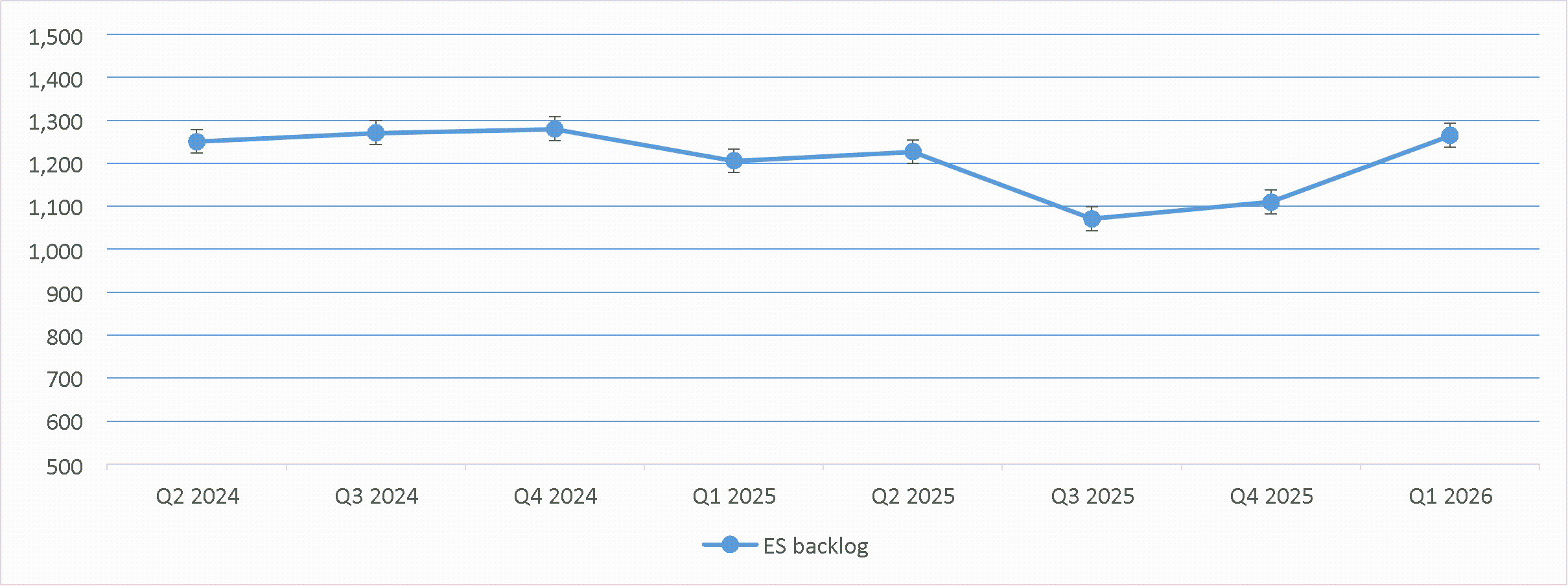
ES backlog was $1.3 billion at March 31, 2026, increasing from $1.1 billion at December 31, 2025, and above the 8-quarter average ES backlog of approximately $1.2 billion. The increase was primarily attributable to new bookings secured in NAM and LATAM segments, partially offset by advancement of ES projects in NAM for the three months ended March 31, 2026. This sustained level of backlog over a two-year period reflects stable demand for Enerflex's ES solutions across global energy infrastructure markets. The 8-quarter average also serves as a key indicator of operational consistency and revenue visibility, smoothing out short-term fluctuations in ES bookings and project timings. This trend demonstrates that the ES product line continues to benefit from a diversified portfolio of gas compression and processing projects, reinforcing management's confidence in the ES product line's ability to generate predictable revenue and margin performance in the near-term.

ES backlog for the past 8 quarters are illustrated below in millions:

img109187306_6.gif

Enerflex recorded ES bookings of $483 million during the three months ended March 31, 2026, an increase compared to $205 million during the same period of 2025, primarily driven by bookings from a newly awarded behind-the-meter power generation project for a data center, as well as continued steady client demand for compression and processing products in NAM. ES bookings remained above the 8-quarter average of $344 million, reflecting continued strong bookings in NAM.

The ES product line has realized a strong book-to-bill ratio of 1.5x during the three months ended March 31, 2026, indicating that new bookings well outpaced revenue recognition. The current balance between bookings and revenue supports near-term revenue visibility and reflects a stable demand environment. The 8-quarter average book-to-bill ratio has also remained at 1.0x, an indication that the Company is consistently replenishing its backlog in line with project execution.

ES backlog and bookings by reporting segment are disclosed in the “Segmented Results” section of this MD&A.


img109187306_4.jpg

M-7 img109187306_5.jpg


EI Contract Backlog

The Company’s EI contract backlog is recognized from lease agreements executed with clients for leasing and operations and maintenance of the Company’s EI assets. Lease agreements executed during the period increase EI contract backlog while revenue recognized on EI assets decreases the EI contract backlog in the period the revenue is recognized. EI contract backlog represents unsatisfied performance obligations related to the EI product line, and further information on recognition of revenue from the EI contract backlog is included in Note 7 of the Financial Statements.

Enerflex has lease agreements with clients for EI assets with initial terms ranging from one to 10 years.

The following table sets forth EI contract backlog by reporting segment:


($ millions)


March 31, 2026


December 31, 2025


NAM


$

153


$

160


LATAM


375


361


EH


755


800


Total EI contract backlog


$

1,283


$

1,321


Segmented Results

Enerflex has three reporting segments: NAM, LATAM, and EH, each of which are supported by Enerflex’s corporate functions. Corporate overhead is allocated to operating segments based on revenue. In assessing its reporting segments, the Company considers geographic locations, economic characteristics, the nature of products and services provided, the nature of production processes, the types of clients for its products and services, and distribution methods used.


img109187306_3.jpg M-8Q1 2026 Report


NAM


Three months ended March 31,


($ millions, except percentages)


2026


2025


ES backlog


$

1,228


$

1,022


ES bookings


463


169


EI contract backlog


153


152


Segment revenue


$

419


$

368


Intersegment revenue


(1

)


(6

)

Revenue


$

418


$

362


EI


$

40


$

36


AMS


55


60


ES


323


266


Revenue


418


362


EI


19


18


AMS


8


8


ES


59


44


GM


86


70


GM %


20.6

%


19.3

%


EI


30


26


AMS


9


10


ES


61


46


GM before D&A


100


82


GM before D&A %


23.9

%


22.7

%


SG&A


49


32


Foreign exchange (gain)


(1

)


-


Operating income


38


38


EBIT


38


38


EBITDA


53


54


Adjusted EBITDA


68


52


ES backlog increased to $1.2 billion at March 31, 2026. ES bookings of $463 million for the three months ended March 31, 2026, increased by $294 million compared to the same period in 2025, primarily driven by bookings for a newly awarded behind-the-meter power generation project for a data center, as well as continued steady client demand for compression and processing products. The high level of bookings also reflects sustained demand within the energy sector across the segment.

EI contract backlog of $153 million at March 31, 2026, decreased slightly from December 31, 2025, attributable to revenue recognized during the period, partially offset by management's investment in assets deployed under longer term rental contracts.

Revenue increased by $56 million during the three months ended March 31, 2026, compared to the same period in 2025. The increase was primarily driven by higher operational activity in the ES business and higher EI revenue driven by additional horsepower deployed from prior year capital investments, partially offset by lower parts sales and service utilization in the AMS business during the first quarter of 2026.

Gross margin increased by $16 million during the three months ended March 31, 2026, compared to the same period in 2025, primarily attributable to increased operational activity and higher cost savings realized in the ES business, as well as increased EI horsepower driven by prior year capital investments.

SG&A expenses increased by $17 million for the three months ended March 31, 2026, compared to the same period in 2025, primarily driven by higher share-based compensation resulting from an increased share price in the current period.

At March 31, 2026, the USA contract compression fleet totaled 486,000 horsepower. The average utilization for the three months ended March 31, 2026 of 94% is consistent with the three months ended March 31, 2025.


img109187306_4.jpg

M-9 img109187306_5.jpg


LATAM


Three months ended March 31,


($ millions, except percentages)


2026


2025


ES backlog


$

18


$

13


ES bookings


17


5


EI contract backlog


375


438


Segment revenue


$

78


$

102


Intersegment revenue


-


-


Revenue


$

78


$

102


EI


$

63


$

74


AMS


13


20


ES


2


8


Revenue


78


102


EI


24


23


AMS


4


6


ES


-


2


GM


28


31


GM %


35.9

%


30.4

%


EI


34


33


AMS


4


6


ES


-


2


GM before D&A


38


41


GM before D&A %


48.7

%


40.2

%


SG&A


11


10


Foreign exchange (gain)


(1

)


-


Operating income


18


21


EBIT


18


19


EBITDA


28


30


Adjusted EBITDA


31


29


ES backlog of $18 million at March 31, 2026 reflects new bookings in the current quarter and ongoing projects near completion. ES bookings were $17 million for the three months ended March 31, 2026, an increase of $12 million compared to the same period in 2025, primarily driven by expansion of existing projects.

EI contract backlog of $375 million at March 31, 2026, increased compared to $361 million at December 31, 2025, primarily due to new bookings in the first quarter of 2026, partially offset by revenue recognition on existing contracts.

Revenue decreased by $24 million for the three months ended March 31, 2026, compared to the same period in 2025, primarily driven by lower EI revenue resulting from asset sales in 2025, lower AMS parts sales, and lower ES revenue driven by timing of new bookings and ongoing projects near completion.

Gross margin decreased by $3 million during the three months ended March 31, 2026, compared to the same period in 2025, primarily due to lower contribution from the ES and AMS product lines, partially offset by a shift towards a higher-margin project mix and higher cost savings realized in the EI business in the current quarter.

SG&A of $11 million for the three months ended March 31, 2026, increased slightly compared with the same period in 2025, primarily driven by higher shared-based compensation.


img109187306_3.jpg M-10Q1 2026 Report


EH


Three months ended March 31,


($ millions, except percentages)


2026


2025


ES backlog


$

19


$

171


ES bookings


3


31


EI contract backlog


755


907


Segment revenue


$

89


$

89


Intersegment revenue


(1

)


(1

)

Revenue


$

88


$

88


EI


$

46


$

43


AMS


39


40


ES


3


5


Revenue


88


88


EI


22


16


AMS


8


10


ES


1


1


GM


31


27


GM %


35.2

%


30.7

%


EI


31


27


AMS


9


10


ES


1


1


GM before D&A


41


38


GM before D&A %


46.6

%


43.2

%


SG&A


19


15


Operating income


12


12


EBIT


12


12


EBITDA


24


24


Adjusted EBITDA


38


32


ES backlog of $19 million at March 31, 2026, remained consistent with December 31, 2025, attributable to new bookings, offset by progression of ongoing projects. ES backlog of $19 million at March 31, 2026 decreased compared to $171 million at March 31, 2025, primarily attributable to completion of construction and commencement of the Bisat-C Expansion project in the third quarter of 2025. ES bookings for the three months ended March 31, 2026 were $3 million, compared to $31 million during the same period in 2025.

EI contract backlog of $755 million at March 31, 2026, decreased from $800 million at December 31, 2025, attributable to revenue recognition from existing contracts.

Revenue for the three months ended March 31, 2026 remained consistent with the same period in 2025, primarily attributable to ES projects nearing completion, offset by increased EI revenue contribution from the Bisat-C Expansion.

Gross margin and gross margin percentage were $31 million and 35.2% for the three months ended March 31, 2026, increasing from the same period of 2025, primarily attributable to higher margin contribution from the EI business resulting from the Bisat-C Expansion.

SG&A increased by $4 million for the three months ended March 31, 2026, compared to the same period in 2025, primarily attributable to higher share-based compensation. SG&A for the first quarter of 2025 also benefited from receipt of a non-recurring input tax refund.


img109187306_4.jpg

M-11 img109187306_5.jpg


Non-IFRS Measures

Enerflex measures its financial performance using several key financial performance indicators, some of which do not have standardized meanings as prescribed by IFRS and therefore may not be comparable to similar measures presented by other issuers. These non-IFRS measures include Adjusted EBITDA, ES bookings, ES book-to-bill ratio, GM before D&A, recurring GM before D&A, free cash flow, dividend payout ratio, bank-adjusted net debt to EBITDA ratio, and ROCE. These measures should not be considered as alternatives to net earnings or any other measure of performance under IFRS. Reconciliation of these non-IFRS measures to the most directly comparable IFRS measure is provided below and in the relevant sections where appropriate. ES bookings and ES book-to-bill ratio do not have a directly comparable IFRS measure.

Gross Margin before D&A by Product Line and Recurring Gross Margin before D&A

Enerflex’s three reporting segments oversee execution of three main product lines:

EI: Infrastructure solutions under contract for natural gas processing, compression, treated water, and electric power.
AMS: Provision of after-market services such as mechanical maintenance, parts distribution, operations and maintenance solutions, equipment optimization and maintenance programs, manufacturer warranties, exchange components, and long-term service agreements.
ES: Engineer, design, and manufacture processing, compression, cryogenic, electric power, and treated water solutions.

EI and AMS product lines are considered recurring, as they are typically contracted and extend into future periods, generating ongoing revenue for the Company. While the EI and AMS contracts may vary in duration and are subject to cancellation, the Company believes they exhibit characteristics consistent with recurring business activities. In contrast, the ES product line is non-recurring, as individual sales do not typically generate repeat revenue after delivery of products, However, the Company does benefit from repeat business with many ES customers over time.

The Company uses GM before D&A to evaluate operational performance of each product line. GM before D&A is defined as gross margin excluding depreciation and amortization, which can vary based on the nature and origin of assets. The Company also presents recurring GM before D&A to evaluate its recurring business, and it is defined as GM before D&A from the EI and AMS product lines.

Presentation of GM before D&A and recurring GM before D&A improves transparency into the profitability and capital intensity across the Company's product lines, and should not be considered in isolation from gross margin or as a replacement for measures prepared as determined under IFRS.

Reconciliation of GM before D&A to the most comparable IFRS measure, and recurring GM before D&A is presented in the tables below.

Three months ended March 31, 2026


($ millions, except percentages)


EI


AMS


Recurring
Product Lines


ES


Total


Revenue


$

149


$

107


$

256


$

328


$

584


Cost of goods sold:


Operating expenses


54


85


139


266


405


Depreciation and amortization


30


2


32


2


34


Gross margin


$

65


$

20


$

85


$

60


$

145


Gross margin %


43.6

%


18.7

%


33.2

%


18.3

%


24.8

%

Gross margin before D&A


$

95


$

22


$

117


$

62


$

179


Gross margin before D&A %


63.8

%


20.6

%


45.7

%


18.9

%


30.7

%

% of total Gross margin before D&A


53.1

%


12.3

%


65.4

%


34.6

%


img109187306_3.jpg M-12Q1 2026 Report


Three months ended March 31, 2025


($ millions, except percentages)


EI


AMS


Recurring
Product Lines


ES


Total


Revenue


$

153


$

120


$

273


$

279


$

552


Cost of goods sold:


Operating expenses


67


94


161


230


391


Depreciation and amortization


29


2


31


2


33


Gross margin


$

57


$

24


$

81


$

47


$

128


Gross margin %


37.3

%


20.0

%


29.7

%


16.8

%


23.2

%

Gross margin before D&A


$

86


$

26


$

112


$

49


$

161


Gross margin before D&A %


56.2

%


21.7

%


41.0

%


17.6

%


29.2

%

% of total Gross margin before D&A


53.4

%


16.1

%


69.6

%


30.4

%


Free Cash Flow and Dividend Payout Ratio

The Company defines free cash flow ("FCF") as cash provided by (used in) operating activities, less total capital expenditures (growth and maintenance) for EI assets - operating leases and PP&E, mandatory debt repayments, and lease principal repayment, while proceeds on disposals of EI assets - operating leases and PP&E are added back. Management uses this non-IFRS measure to assess the level of free cash generated to fund other non-operating activities. These activities could include dividend payments, share repurchases, and non-mandatory debt repayments. FCF is also used in calculating the dividend payout ratio.

Reconciliation of FCF to the most directly comparable IFRS measure, cash provided by operating activities:


Three months ended March 31,


($ millions)


2026


2025


Funds from operations ("FFO")1


$

95


$

62


Net change in working capital and other


(63

)


34


Cash provided by operating activities ("CFO")2


$

32


$

96


Less:


CAPEX - Maintenance and PP&E


(9

)


(8

)

CAPEX - Growth


(7

)


(6

)

Lease payments


(6

)


(6

)

Add:


Proceeds on disposals of PP&E and EI assets - operating leases


5


9


Free cash flow


$

15


$

85


1Enerflex also refers to cash provided by operating activities before net change in working capital and other as “Funds from Operations” or “FFO”.

2Enerflex also refers to cash provided by operating activities as “Cash flow from Operations” or “CFO”.


The Company defines dividend payout ratio as dividends paid divided by free cash flow. Dividend payout ratio is used to assess the proportion of free cash flow returned to shareholders.

Dividend payout ratio for the trailing 12-months was as follows:


Three months ended March 31,


($ millions, except percentages)


2026


2025


Trailing 12-months dividends paid


$

15


$

13


Trailing 12-months free cash flow


160


235


Dividend payout ratio


9.4

%


5.5

%


img109187306_4.jpg

M-13 img109187306_5.jpg


Bank-Adjusted Net Debt to EBITDA Ratio

Enerflex defines bank-adjusted net debt to EBITDA as borrowings under the revolving credit facility (“RCF”) and senior notes less cash and cash equivalents, divided by EBITDA for the trailing 12-months, as defined by the Company’s lenders. In assessing the Company's compliance with financial covenants related to its debt, certain adjustments are made to EBITDA to determine Enerflex's bank-adjusted net debt to EBITDA ratio. These adjustments, and Enerflex's bank-adjusted net debt to EBITDA ratio, are calculated in accordance with, and derived from, the Company's financing agreements.

ROCE

ROCE is a measure used to analyze operating performance and efficiency of the Company’s capital allocation process. The ratio is calculated by taking TTM EBIT divided by capital employed. Capital employed is average debt and shareholders’ equity less average cash for the trailing four quarters.


Three months ended March 31,


($ millions, except percentages)


2026


2025


Trailing 12-months EBIT


$

290


$

242


Average capital employed


Average net debt1


$

550


$

659


Average shareholders’ equity1


1,129


1,051


Average capital employed


$

1,679


$

1,710


ROCE


17.3

%


14.2

%


1Based on a trailing four-quarter average.

Liquidity

The Company expects that cash flows from operations in 2026, together with cash and cash equivalents on hand and currently available credit facilities, will be more than sufficient to fund its requirements for investments in working capital and capital assets.

($ millions)


March 31, 2026


Cash and cash equivalents


 $


47


RCF


800


Less: Drawings on the RCF


(162

)


Less: Letters of Credit1


(75

)


563


Available liquidity


 $


610


1Represents letters of credit that the Company has funded with the RCF. Additional letters of credit of $26 million are funded from the $70 million LC Facility. Refer to Note 6 “Long-Term Debt” of the Financial Statements for further details.

Covenant Compliance

As at March 31, 2026, the Company met the covenant requirements of its funded debt, comprised of the secured RCF and the 2031 Notes, reflecting strong performance and cash flow generation, and Enerflex’s focus of repaying debt and lowering finance costs.

The following table sets forth a summary of the covenant requirements and the Company’s performance:


Three months ended March 31


2026


2025


Requirement


Performance


Performance

Senior secured net funded debt to EBITDA ratio1 – Maximum


2.5x


0.2

x


0.1x

Bank-adjusted net debt to EBITDA ratio2 – Maximum


4.0x


0.9

x


1.3x

Interest coverage ratio3 – Minimum


2.5x


5.1

x


5.1x

1Senior secured net funded debt to EBITDA is defined as borrowings under the RCF less cash and cash equivalents divided by TTM EBITDA, as defined by the Company’s lenders.

2Refer to the "Bank-Adjusted Net Debt to EBITDA Ratio" section of this MD&A.

3Interest coverage ratio is calculated by dividing the TTM EBITDA by interest expense over the same timeframe, as defined by the Company’s lenders.


img109187306_3.jpg M-14Q1 2026 Report


Credit Rating

Enerflex’s credit ratings affect the cost and ability to access the capital markets, and it is the Company’s objective to maintain high quality credit ratings. As at May 6, 2026, S&P Global Ratings ("S&P"), Moody’s Investors Service, Inc. ("Moody’s"), and Fitch Ratings, Inc. ("Fitch") assigned the following credit ratings to Enerflex and the 2031 Notes:

S&P

Moody’s

Fitch

Corporate Credit Rating

BB (stable outlook)

Ba2 (stable outlook)

BB (stable outlook)

2031 Notes

BB (stable outlook)

Ba3 (stable outlook)

BB (stable outlook)


Summarized Statements of Cash Flow


Three months ended March 31,


($ millions)


2026


2025


Cash and cash equivalents, beginning of period


$

81


$

92


Cash provided by (used in):


Operating activities


32


96


Investing activities


(19

)


(26

)

Financing activities


(37

)


(86

)

Effect of exchange rate changes on cash and cash
  equivalents denominated in foreign currencies


1


(1

)

Cash and cash equivalents reclassified to assets held for sale


(11

)


-


Cash and cash equivalents, end of period


$

47


$

75


Operating Activities

Cash provided by operating activities was $32 million during the three months ended March 31, 2026, compared to $96 million in the same period in 2025. The decrease primarily reflects the investment in working capital, partially offset by higher net earnings for the three months ended March 31, 2026.

Investing Activities

Cash used in investing activities of $19 million for the three months ended March 31, 2026, decreased compared to $26 million in the same period in 2025, primarily attributable to lower use of working capital for investing activities and lower purchase of financial instruments, partially offset by increased capital expenditures and lower proceeds on sale of EI assets in the first quarter of 2026.

Financing Activities

During the three months ended March 31, 2026, cash used in financing activities was $37 million, compared to $86 million used in the same period in 2025, primarily due to lower net repayment of the RCF in the current quarter.


img109187306_4.jpg

M-15 img109187306_5.jpg


Capital Expenditures and Expenditures for Finance Leases

Enerflex distinguishes CAPEX invested in EI assets - operating leases as either maintenance or growth. Maintenance expenditures are necessary costs to continue utilizing existing EI assets - operating leases, while growth expenditures are intended to expand the Company’s EI assets - operating leases. The Company may also incur costs related to the construction of EI assets determined to be finance leases. These costs are accounted for as work-in-progress related to finance leases, and once the project is completed and enters service, it is reclassified to cost of goods sold.

CAPEX and expenditures for finance leases are shown in the table below:


Three months ended March 31,


($ millions)


2026


2025


Maintenance and PP&E


$

9


$

8


Growth


7


6


Total CAPEX


16


14


Expenditures for finance leases


-


19


Total CAPEX and expenditures for finance leases


$

16


$

33


Selling, General & Administrative Expenses

SG&A expenses are comprised of costs incurred by the Company to support business operations that are not directly attributable to the production of goods or services.


Three months ended March 31,


($ millions)


2026


2025


Core SG&A1


$

55


$

54


Share-based compensation


22


(3

)

Depreciation and amortization


3


6


Bad debt recovery


(1

)


-


Total SG&A


$

79


$

57


1 Core SG&A is primarily comprised of compensation, third-party services, and information technology expenses.

SG&A was $79 million for the three months ended March 31, 2026, an increase of $22 million compared to the same period in 2025, primarily driven by higher share-based compensation expense resulting from an increased share price.

Income Taxes

The Company reported income tax expense of $20 million for the three months ended March 31, 2026, which is consistent with the $19 million for the same period in 2025.


img109187306_3.jpg M-16Q1 2026 Report


Financial Position

The following table outlines significant changes in the consolidated statements of financial position as at March 31, 2026, compared to December 31, 2025:

($ millions)


Increase
(Decrease)


Explanation

Current assets


61


Current assets increased primarily due to higher accounts receivable reflecting strong collections in the fourth quarter of 2025 with sustained strong ES activity levels in NAM, and the timing of collections from a major customer in EH. The increase also reflected a strategic inventory investment in the ES business in NAM and a build of inventory for scheduled EI maintenance activities in LATAM, as well as reclassification of non‑current assets associated with the APAC divestiture as held for sale. These increases were partially offset by decreases in cash and cash equivalents, unbilled revenue, and income tax receivable.

EI assets - operating leases


(14)


Decrease in EI assets - operating lease is primarily due to depreciation and sale of certain EI assets in the LATAM segment, partially offset by capital expenditures during the quarter.

Goodwill


(18)


Goodwill decreased due to the classification of goodwill allocated to the APAC divestiture as held for sale.

Long-term debt


(30)


Long-term debt has decreased due to net repayment of the RCF, partially offset by amortization of deferred transaction costs.

Total shareholders' equity


47


Total shareholders' equity increased primarily due to net earnings for the three months ended March 2026, partially offset by dividend payments in the first quarter of 2026.


Quarterly Summary

($ millions, except per share amounts and ratios)

Q1 2026


Q4 2025


Q3 2025


Q2 2025


Q1 2025


Q4 2024


Q3 2024


Q2 2024


ES backlog

$

1,265


$

1,110


$

1,071


$

1,227


$

1,206


$

1,280


$

1,271


$

1,251


ES book-to-bill ratio


1.5


1.1


0.7


1.1


0.7


1.1


1.1


1.0


ES bookings


483


377


339


365


205


301


349


331


EI contract backlog


1,283


1,321


1,370


1,462


1,497


1,545


1,601


1,604


Revenue


584


627


777


615


552


561


601


614


GM


145


143


172


139


128


140


141


136


GM before D&A


179


177


206


175


161


174


176


173


SG&A


79


83


71


61


57


92


82


75


EBIT


73


43


82


92


66


47


74


55


EBITDA


110


83


122


134


105


92


122


103


Adjusted EBITDA


137


123


145


130


113


121


120


122


Net earnings (loss)


43


(57

)


37


60


24


15


30


5


Earnings (loss) per share – basic


0.35


(0.47

)


0.30


0.49


0.19


0.12


0.24


0.04


Earnings (loss) per share – diluted


0.35


(0.47

)


0.30


0.49


0.19


0.12


0.24


0.04


FFO1


95


60


115


89


62


74


63


63


CFO2


32


179


74


(4

)


96


113


98


12


Free cash flow


15


141


43


(39

)


85


76


78


(4

)

Cash dividends declared per share (CAD $)3


0.0425


0.0425


0.0375


0.0375


0.0375


0.0375


0.0250


0.0250


CAPEX – Maintenance & PP&E


9


20


18


11


8


21


14


9


CAPEX – Growth


7


14


15


23


6


11


2


1


1 FFO or “Funds from Operations” is also referred to by Enerflex as “Cash provided by operating activities before net change in working capital and other”.

2 CFO or “Cash flow from Operations” is also referred to by Enerflex as “Cash provided by (used in) operating activities”.

3 Cash dividend declared represents the declaration in the quarter.


img109187306_4.jpg

M-17 img109187306_5.jpg


Capital Resources

On April 30, 2026, Enerflex had 122,066,954 common shares outstanding. Enerflex has not established a formal dividend policy. Subsequent to March 31, 2026, Enerflex declared a quarterly dividend of CAD $0.0425 per common share, payable on June 3, 2026 to shareholders of record on May 20, 2026. The Board will continue to evaluate dividend payments on a quarterly basis based on availability of cash flow, anticipated market conditions, and the general needs of the business.

At March 31, 2026, the Company had drawings of $162 million against the RCF (December 31, 2025 – $193 million). The weighted average interest rate on the RCF for the three months ended March 31, 2026 was 5.0% (December 31, 2025 – 5.6%).

The composition of the borrowings on the 2031 Notes and RCF were as follows:


Maturity Date


March 31, 2026


December 31, 2025


2031 Notes


January 15, 2031


$

400


$

400


Drawings on the RCF


July 11, 2028


162


193


562


593


Deferred transaction costs


(10

)


(11

)

Long-term debt


$

552


$

582


Non-current portion of long-term debt


$

552


$

582


Long-term debt


$

552


$

582


At March 31, 2026, without considering renewal at similar terms, the USD equivalent principal payments due over the next five years was $562 million.

Legal Proceedings

In the normal course of business, the Company and certain of its subsidiaries are involved in or subject to lawsuits, claims, and other legal proceedings that seek, among other things, compensation for alleged personal injury, breach of contract, property damage or other losses, punitive damages, civil penalties, or injunctive or declaratory relief. Some lawsuits, claims, and legal proceedings involve acquired or disposed assets with respect to which a third party, the Company, or its subsidiary retains liability or indemnifies the other party for conditions that existed prior to the transaction. In accordance with applicable accounting guidance, Enerflex and its subsidiaries accrue reserves for outstanding lawsuits, claims, and proceedings when it is probable that a liability has been incurred and the liability can be reasonably estimated. The Company does not currently expect that any of the outstanding lawsuits, claims, or legal proceedings will have a material adverse effect on Enerflex, including its consolidated financial position, results of operations or cash flows. Although Enerflex’s expectations and estimates are based on information known about the legal matters and its experience in contesting, litigating and settling similar matters, the results of any outstanding lawsuits, claims, and other legal proceedings are inherently uncertain, and there can be no assurance that monetary damages, fines, penalties, or injunctive relief resulting from adverse judgments or settlements in some or all of these outstanding lawsuits, claims, or legal proceedings will not have a material adverse effect on Enerflex, including its consolidated financial position, results of operations or cash flows. The Company will reassess the probability and estimability of contingent losses as new information becomes available in these proceedings or otherwise.

As previously disclosed, in response to a fatal attack at an adjacent site in Q2 2024, Enerflex declared Force Majeure on an international ES project, suspended activity at the project site, and demobilized its personnel. Enerflex subsequently received notice from its customer purporting to terminate the project contract and commencing arbitration proceedings against Enerflex alleging breach of the project contract. In Q4 2024, Enerflex delivered notice to the customer terminating the project contract. As part of the arbitration proceedings, Enerflex has brought a counterclaim against the customer to recover amounts owing to Enerflex


img109187306_3.jpg M-18Q1 2026 Report


following Enerflex’s termination of the project contract. Pursuant to the rules for arbitration agreed between Enerflex and its customer, the content of the proceedings is confidential and not otherwise publicly available. In Q2 2025, the customer filed its Statement of Case in the arbitration asserting various claims against and seeking material monetary damages from Enerflex and in Q3 2025 the Company filed its Statement of Defence and Counterclaim against the customer. In Q4 2025, the customer filed its Statement of Reply and Defence to Counterclaim to which the Company responded to by filing its Statement of Rejoinder and Reply to Defence to Counterclaim on February 27, 2026 in accordance with the arbitration timeline. Enerflex disputes the customer’s claims and asserts that it acted in accordance with the project contract and that its declaration of Force Majeure and its subsequent termination of the project were proper. Given the current stage of the arbitration and the inherent uncertainty of arbitration, the final outcome of the arbitration is unknown. While the Company is pursuing recovery of amounts it believes are owed, it is possible that the Company may not prevail on its counterclaims or in defending against the customer’s claims. In those circumstances, there can be no assurance that the outcome will not have a material adverse effect on Enerflex, including on its consolidated financial position, results of operations or cash flows. Enerflex intends to continue vigorously defending itself against the customer’s claims while pursuing its own counterclaims.

As at March 31, 2026, the carrying value of the remaining assets associated with the project on the Company’s consolidated statement of financial position was $161 million. Notwithstanding its termination of the project contract, Enerflex maintains a $31 million Letter of Credit in support of its obligation under the project contract. Enerflex would view any drawing of the financial security in the prevailing circumstances as improper and would be considered as an additional amount owed by the customer.

Disclosure Controls and Procedures

Management is responsible for establishing and maintaining adequate disclosure controls and processes (“DC&P”). DC&P are designed to ensure that information required to be disclosed in Enerflex’s financial reports is recorded, processed, summarized and reported to the Company’s Management, including its Chief Executive Officer and Chief Financial Officer, as appropriate, to allow timely decisions regarding required disclosure. Management recognizes that any system of controls and procedures, no matter how well designed and operated, can provide only reasonable assurance of achieving the desired control objectives. Due to the inherent limitations of control systems, not all misstatements may be detected. For example, there may be faulty judgments in decision-making or breakdowns can occur because of a simple error or mistake. Additionally, controls can be circumvented by the acts of individuals, by collusion of two or more people, or by Management override of the control. Controls and procedures can only provide reasonable, not absolute, assurance that the desired control objectives have been met.

Based on the Company’s evaluation, Management concluded that its DC&P were effective as of March 31, 2026.

Internal Control Over Financial Reporting

Management is also responsible for establishing and maintaining adequate internal control over financial reporting (“ICFR”). ICFR is a framework designed to provide reasonable assurance regarding the preparation and reliability of the unaudited interim condensed consolidated financial statements for external reporting in accordance with IFRS.

Under the supervision, and with the participation of Enerflex’s Management, including the Chief Executive Officer and Chief Financial Officer, the Company conducted an evaluation of the effectiveness of its ICFR and DC&P as of March 31, 2026, the end of the period covered by this MD&A. In conducting this evaluation, Management used the criteria described in Internal Control—Integrated Framework (2013) issued by the Committee of Sponsoring Organizations of the Treadway Commission (the “COSO 2013 Framework”).

Based on the Company’s evaluation, Management concluded that its ICFR were effective as of March 31, 2026.


img109187306_4.jpg

M-19 img109187306_5.jpg


Changes in Internal Control Over Financial Reporting:

Management regularly reviews its system of ICFR and makes changes to the Company’s processes and systems to improve controls and increase efficiency. There have been no changes in the design of the Company’s ICFR during the three months ended March 31, 2026, that would materially affect, or is reasonably likely to materially affect, the Company’s ICFR.

Subsequent Events

Subsequent to March 31, 2026, Enerflex declared a quarterly dividend of CAD $0.0425 per common share, payable on June 3, 2026 to shareholders of record on May 20, 2026. The Board will continue to evaluate dividend payments on a quarterly basis based on availability of cash flow, anticipated market conditions, and the general needs of the business.

Forward-Looking Statements

This MD&A contains “forward-looking information” within the meaning of applicable Canadian securities laws and “forward-looking statements” (and together with “forward-looking information”, “FLI”) within the meaning of the safe harbor provisions of the US Private Securities Litigation Reform Act of 1995. FLI relates Management’s expectations about future events, results of operations, and the future performance (both financial and operational) and business prospects of Enerflex. All statements other than statements of historical fact are FLI. FLI may contain, but is not limited to, words such as "anticipate", "future", “create”, “continue”, “expect”, “intend”, “propose”, “might”, “may”, “will”, “generate”, "should", "could", "would", "believe", "predict", "forecast", “future”, “opportunity”, "pursue", "potential", "objective", “focus”, “endeavor”, “commit”, “target”, “growth”, or “ensure”, or the inverse of such terms or similar expressions suggesting future conditions, events, or expectations. In particular, this MD&A includes (without limitation) FLI pertaining to:

Enerflex’s ability to implement its strategy for success, premised on simplifying, optimizing, and growing its business, and the time required in connection therewith, if at all;
disclosures under the heading “Outlook” including:
o
expectations for continued steady demand across our business lines and geographic regions;
o
the highly contracted EI product line and the recurring nature of AMS will continue to underpin operating results;
o
customer contracts within Enerflex’s EI product line will generate approximately $1.3 billion of revenue over their remaining terms;
o
expectations that performance of Enerflex’s ES product line will remain steady, with the majority of the backlog of approximately $1.3 billion as at March 31, 2026 expected to convert into revenue over the next 12 months;
o
expected increases in natural gas and electric power generation across Enerflex’s core operating countries will drive an attractive medium-term outlook for ES products and services;
o
Enerflex’s ability to deliver on its priorities in 2026 and the time required in connection therewith, if at all;
o
targeted organic capital expenditures during 2026 of $175 million to $195 million, including (i) organic growth capital expenditures of $90 million to $100 million; (2) maintenance capital expenditures of $70 million to $80 million; and (3) PP&E and infrastructure investments of approximately $15 million;
o
selective customer supported growth investments continuing to be made in the USA contract compression business;


img109187306_3.jpg M-20Q1 2026 Report


o
continued strength in the fundamentals for contract compression in the USA, led by expected increases in natural gas production and capital spending discipline from market participants;
the anticipated completion of the divestiture of a majority of the Company’s operations in the APAC region (the “APAC Divestiture”), and the timing thereof, if at all;
that the Board will set the Company’s quarterly dividends based on the availability of cash flow, anticipated market conditions, and the general needs of the business and that this will support expectations regarding the ability of the Company to continue to pay a quarterly sustainable dividend;
ES backlog, the impact of project cancellations on ES backlog, and the ability to secure future bookings;
the 8-quarter average ES backlog serves as a key indicator of operational consistency and revenue visibility, and ES backlog generally provides strong visibility into future revenue generation, business activity levels, and margin performance in the near-term;
the availability of free cash generated and that such cash may be used to fund non-operating activities including dividend payments, share repurchases, and other non-mandatory debt repayments, if any;
expectations that cash flows from operations in 2026, together with cash and cash equivalents on hand and currently available credit facilities, will be more than sufficient to fund Enerflex’s requirements for investments in working capital and capital assets;
the ability of the Company to continue to meet its covenant requirements of its funded debt, including the secured RCF and 2031 Notes;
the potential for the Company to incur costs related to the construction of EI assets determined to be finance leases;
the ability of the Company to capitalize on opportunities should they proceed, if at all; and
expectations that potential liabilities that may arise in connection with outstanding lawsuits, arbitrations or other legal proceedings will not have a material adverse effect on Enerflex, including its consolidated financial position, results of operations or cash flows.

FLI is based on assumptions, estimates, and analysis made in light of the Company’s experience and its perception of trends, current conditions, and expected developments, including assumptions and estimates as to associated timing and costs, as well as other factors that are believed by the Company to be reasonable and relevant in the circumstances. FLI involves known and unknown risks and uncertainties and other factors which are difficult to predict, including, without limitation:

that all conditions to completion of the APAC Divestiture will be satisfied or waived in a timely manner, that all regulatory and other approvals required for completion of the APAC Divestiture will be obtained and obtained in a timely manner, that the transaction to effect the APAC Divestiture will be completed on the agreed terms, and that the expected benefits of the APAC Divestiture will be realized within the expected timeframes;
potential impacts of the situation in the Middle East on Enerflex’s operations in Bahrain and Oman and the broader region;
the ability of the Company to proactively manage the ES business line in response near-term risks and uncertainties, including tariffs and commodity price volatility;
natural gas and associated liquids and produced water volumes across Enerflex’s global footprint will increase in line with expectations;
the impact of general economic and industry conditions on the Company’s business, including its existing product offerings and the potential for growth and expansion of the business;
the ES product line continuing to benefit from a diversified portfolio of gas compression and processing projects and continuing to generate predictable revenue and margin performance;
existing customer contracts within the EI product line will remain in effect and with no material cancellations or renegotiations over their remaining terms;


img109187306_4.jpg

M-21 img109187306_5.jpg


risks related to lawsuits, arbitrations or other legal proceedings;
the execution of projects within the ES product line will proceed as scheduled and the conversion to revenue will proceed without significant delays or cancellations;
the Company’s backlog providing strong visibility into future revenue generation and business activity levels;
no significant unforeseen cost overruns or project delays;
supply chain interruptions leading to delays in receiving materials and parts to produce equipment and/or the impact of tariffs and/or retaliatory tariffs on the supply chain;
interest rates and foreign exchange rates;
new environmental, taxation, and other laws and regulations;
continued capital spending discipline from market participants;
the fulfillment by our customer partners of the terms of their contracts;
the ability to continue to build and improve on proven manufacturing capabilities and innovate into new product lines and new and emerging markets;
increased competition across all business lines;
Enerflex will maintain sufficient cash flow, profitability, and financial flexibility to support the ongoing payment of a sustainable quarterly cash dividend, subject to market conditions, operational performance, and board approval;
sufficiency of funds to support capital investments required to grow the business;
availability of qualified personnel or management and difficulties in retaining qualified personnel;
political unrest; and
other factors, many of which are beyond the control of Enerflex.

Readers are cautioned that the foregoing list of assumptions and risk factors should not be construed as exhaustive. While the Company believes that there is a reasonable basis for the FLI included in this MD&A, as a result of known and unknown risks, uncertainties, and other factors, Enerflex’s actual results, performance, or achievements could differ and such differences could be material from those expressed in, or implied by, these statements. The FLI included in this MD&A should not be unduly relied upon as a number of factors could cause actual results to differ materially from the results discussed in these forward-looking statements, including but not limited to: the ability to maintain desirable financial ratios; the ability to access various sources of debt and equity capital, generally, and on acceptable terms, if at all; the ability to utilize tax losses in the future; the ability to maintain relationships with partners and to successfully manage and operate the business; risks associated with technology and equipment, including potential cyber attacks; the occurrence of unexpected events such as pandemics, war, terrorist threats, and the instability resulting therefrom; risks associated with existing and potential future lawsuits, arbitrations or other legal proceedings, shareholder proposals, and regulatory actions; and those factors referred to under the heading "Risk Factors" in (i) Enerflex's AIF for the year ended December 31, 2025 and Enerflex’s 2025 Annual Report; and (ii) in other filings with Canadian securities regulators and the SEC, copies of which are available under the electronic profile of the Company on SEDAR+ and EDGAR at www.sedarplus.ca and www.sec.gov/edgar, respectively.

This MD&A contains information that may constitute future-oriented financial information or financial outlook information ("FOFI") about Enerflex and its prospective financial performance, financial position, or cash flows, all of which is subject to the same assumptions, risk factors, limitations, and qualifications as set forth above. Except as otherwise stated herein, the FOFI included in this MD&A was made and approved by Management and the Board as of the date hereof. Readers are cautioned that the assumptions used in the preparation of such information, although considered reasonable at the time of preparation, may prove to be imprecise or inaccurate and, as such, undue reliance should not be placed on FOFI. The Company’s actual results, performance and achievements could differ materially from those expressed in, or implied by, FOFI.


img109187306_3.jpg M-22Q1 2026 Report


The inclusion of FOFI in this MD&A is to provide readers with a more complete perspective on the Company’s future operations and Management's current expectations regarding the Company’s future performance. Readers are cautioned that such information may not be appropriate for other purposes.

The FLI and FOFI contained herein is expressly qualified in its entirety by the above cautionary statement and are given as of the date of this MD&A. Other than as required by law, Enerflex disclaims any intention or obligation to update or revise any FLI or FOFI, whether as a result of new information, future events, or otherwise.


img109187306_4.jpg

M-23 img109187306_5.jpg