
1 1Q26 Earnings Call Presentation1 John McCallion Chief Financial Officer and Head of MetLife Investment Management Exhibit 99.4 1 These slides highlight information in MetLife, Inc.'s earnings release, quarterly financial supplement and other prior public disclosures.
2 2 Page No. Key 1Q26 highlights 3 Adjusted earnings by segment and Corporate & Other (C&O) 4 Variable investment income (VII) 5 Investments 7 Direct expense ratio 9 Cash & Capital 10 Appendix 11 Table of contents
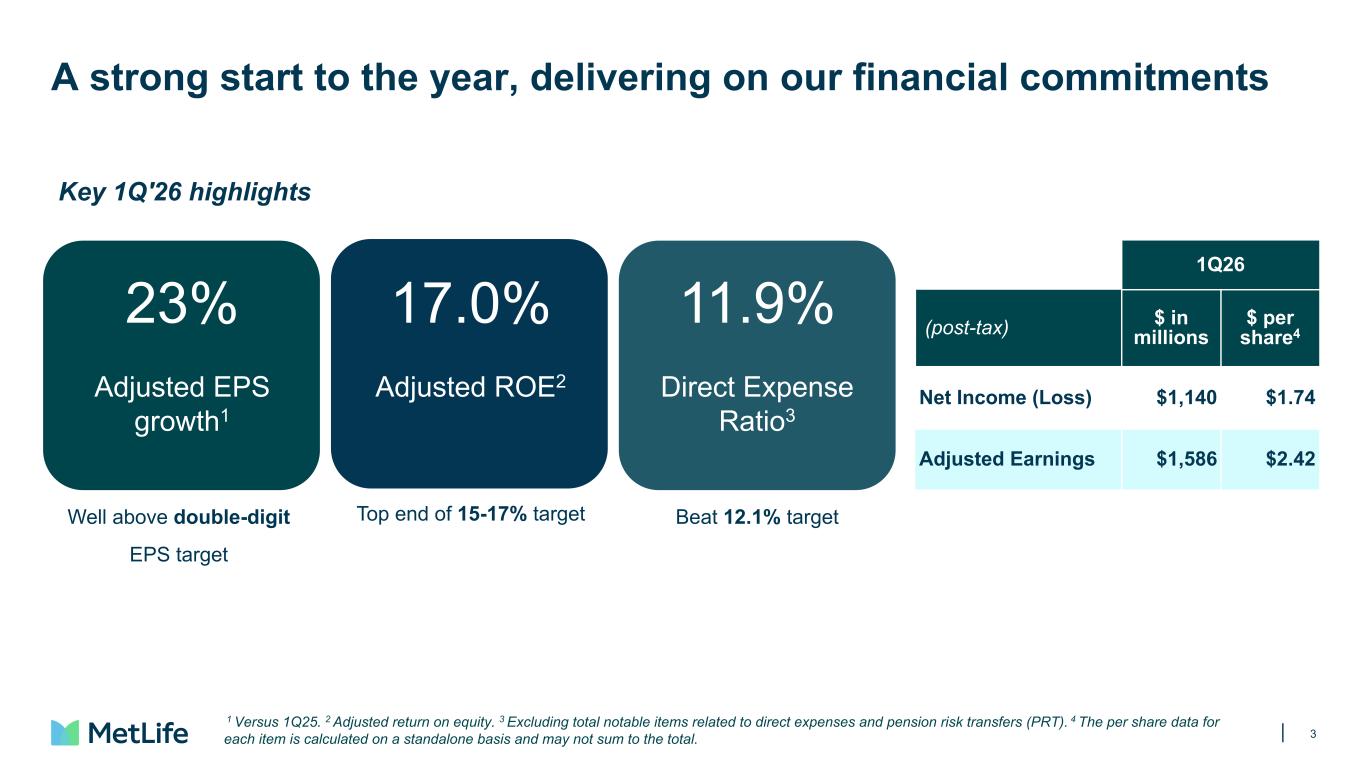
3 3 A strong start to the year, delivering on our financial commitments 1Q26 (post-tax) $ in millions $ per share4 Net Income (Loss) $1,140 $1.74 Adjusted Earnings $1,586 $2.42 1 Versus 1Q25. 2 Adjusted return on equity. 3 Excluding total notable items related to direct expenses and pension risk transfers (PRT). 4 The per share data for each item is calculated on a standalone basis and may not sum to the total. Key 1Q'26 highlights 11.9% Direct Expense Ratio3 17.0% Adjusted ROE2 23% Adjusted EPS growth1 Beat 12.1% targetTop end of 15-17% targetWell above double-digit EPS target
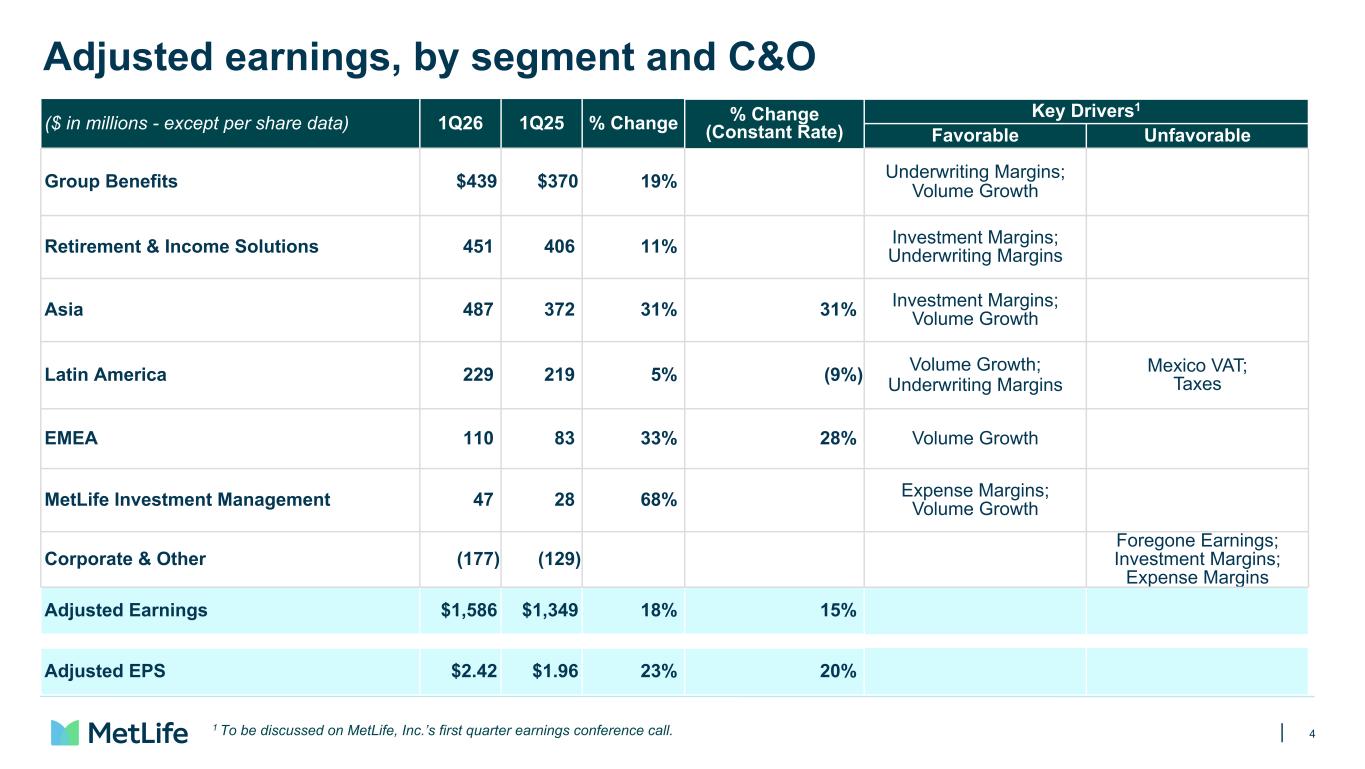
4 Adjusted earnings, by segment and C&O ($ in millions - except per share data) 1Q26 1Q25 % Change % Change (Constant Rate) Key Drivers1 Favorable Unfavorable Group Benefits $439 $370 19% Underwriting Margins; Volume Growth Retirement & Income Solutions 451 406 11% Investment Margins; Underwriting Margins Asia 487 372 31% 31% Investment Margins; Volume Growth Latin America 229 219 5% (9%) Volume Growth; Underwriting Margins Mexico VAT; Taxes EMEA 110 83 33% 28% Volume Growth MetLife Investment Management 47 28 68% Expense Margins; Volume Growth Corporate & Other (177) (129) Foregone Earnings; Investment Margins; Expense Margins Adjusted Earnings $1,586 $1,349 18% 15% Adjusted EPS $2.42 $1.96 23% 20% 1 To be discussed on MetLife, Inc.’s first quarter earnings conference call.
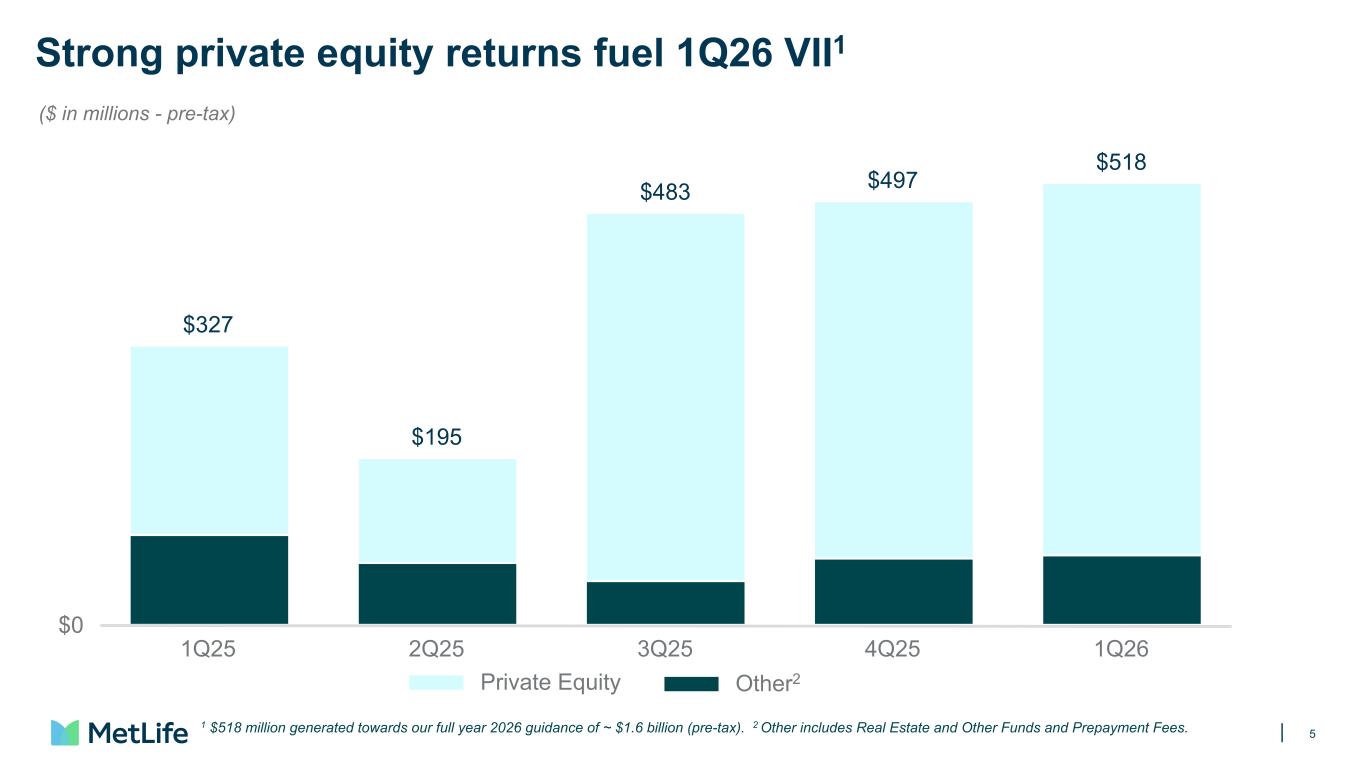
5 $327 $195 $483 $497 $518 1Q25 2Q25 3Q25 4Q25 1Q26 ($ in millions - pre-tax) Private Equity Other2 1 $518 million generated towards our full year 2026 guidance of ~ $1.6 billion (pre-tax). 2 Other includes Real Estate and Other Funds and Prepayment Fees. $0 Strong private equity returns fuel 1Q26 VII1
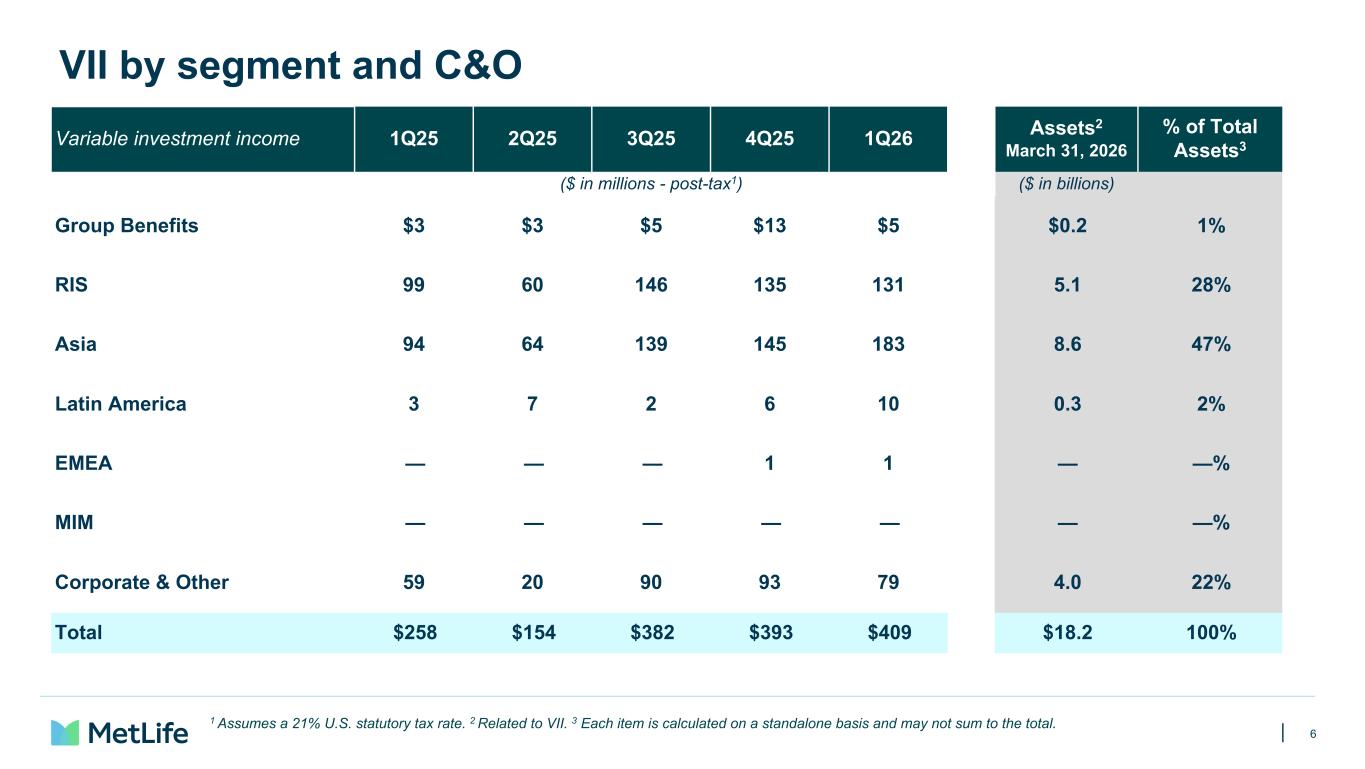
6 6 VII by segment and C&O Variable investment income 1Q25 2Q25 3Q25 4Q25 1Q26 Assets2 March 31, 2026 % of Total Assets3 ($ in millions - post-tax1) ($ in billions) Group Benefits $3 $3 $5 $13 $5 $0.2 1% RIS 99 60 146 135 131 5.1 28% Asia 94 64 139 145 183 8.6 47% Latin America 3 7 2 6 10 0.3 2% EMEA — — — 1 1 — —% MIM — — — — — — —% Corporate & Other 59 20 90 93 79 4.0 22% Total $258 $154 $382 $393 $409 $18.2 100% 1 Assumes a 21% U.S. statutory tax rate. 2 Related to VII. 3 Each item is calculated on a standalone basis and may not sum to the total.
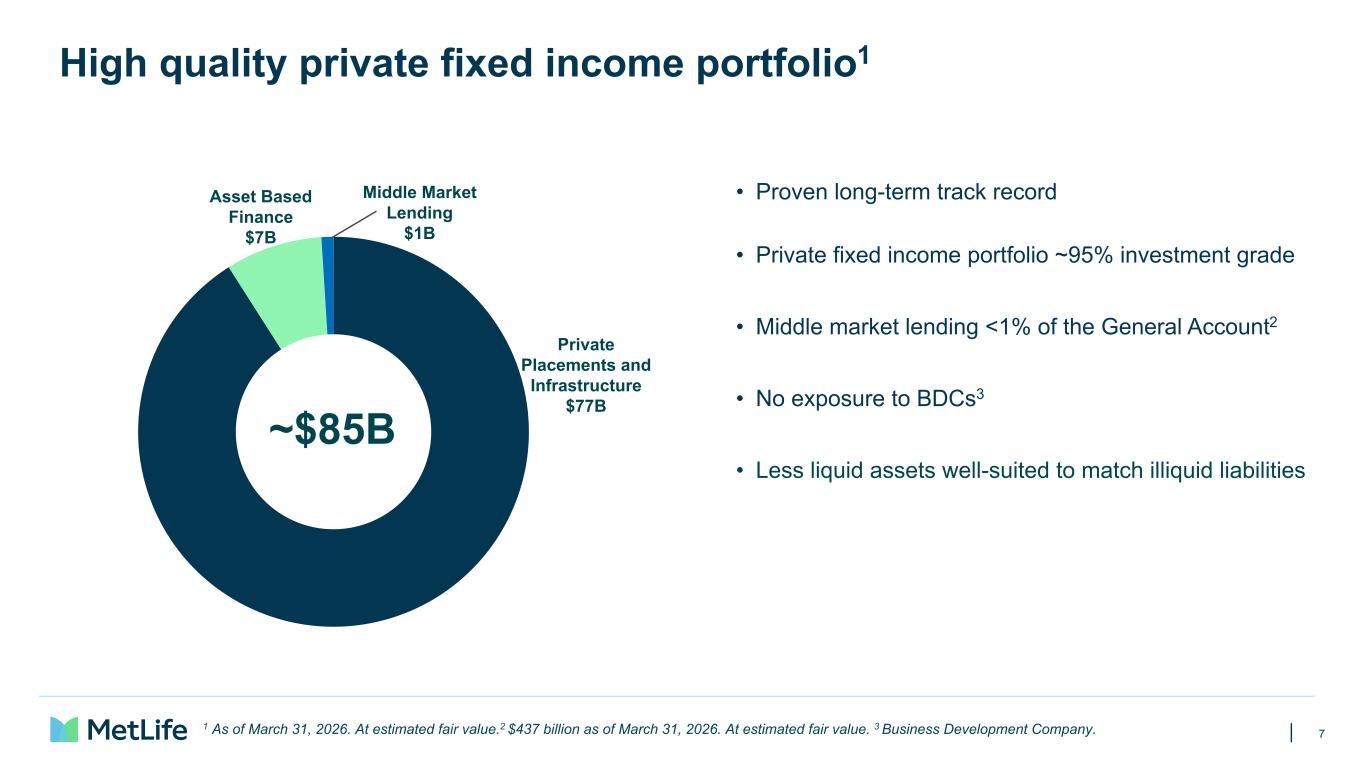
7 7 7 High quality private fixed income portfolio1 1 As of March 31, 2026. At estimated fair value.2 $437 billion as of March 31, 2026. At estimated fair value. 3 Business Development Company. ~$85B Private Placements and Infrastructure $77B Asset Based Finance $7B Middle Market Lending $1B • Proven long-term track record • Private fixed income portfolio ~95% investment grade • Middle market lending <1% of the General Account2 • No exposure to BDCs3 • Less liquid assets well-suited to match illiquid liabilities
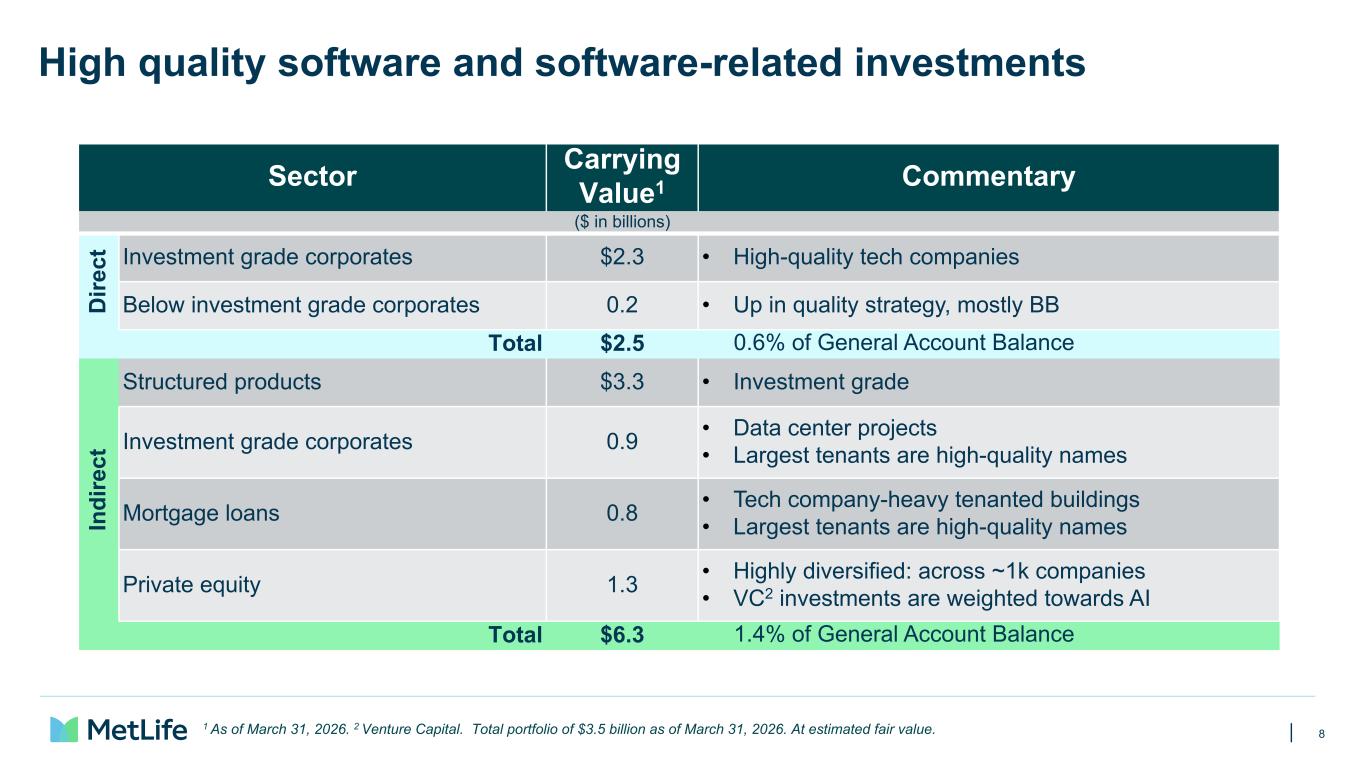
8 8 8 1 As of March 31, 2026. 2 Venture Capital. Total portfolio of $3.5 billion as of March 31, 2026. At estimated fair value. High quality software and software-related investments Sector Carrying Value1 Commentary ($ in billions) D ire ct Investment grade corporates $2.3 • High-quality tech companies Below investment grade corporates 0.2 • Up in quality strategy, mostly BB Total $2.5 0.6% of General Account Balance In di re ct Structured products $3.3 • Investment grade Investment grade corporates 0.9 • Data center projects • Largest tenants are high-quality names Mortgage loans 0.8 • Tech company-heavy tenanted buildings • Largest tenants are high-quality names Private equity 1.3 • Highly diversified: across ~1k companies • VC2 investments are weighted towards AI Total $6.3 1.4% of General Account Balance
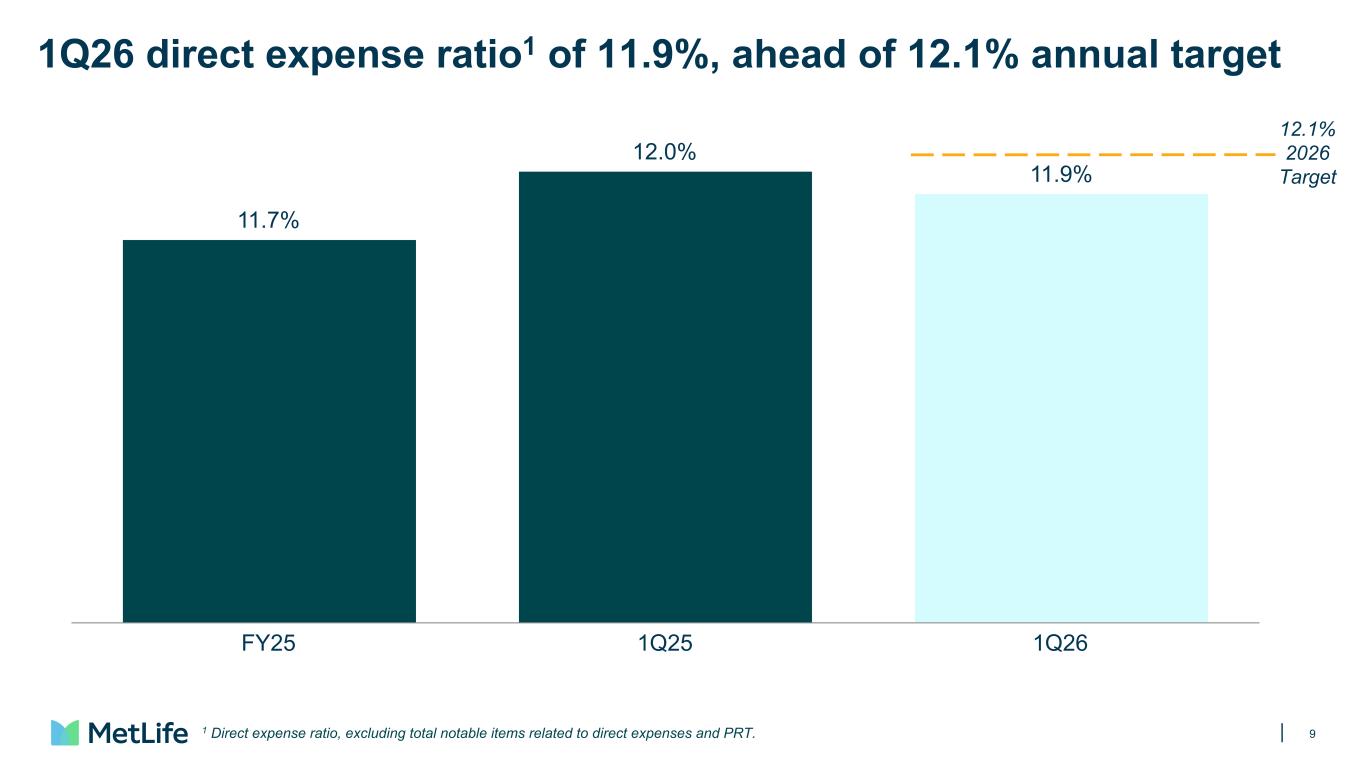
9 11.7% 12.0% 11.9% FY25 1Q25 1Q26 1 Direct expense ratio, excluding total notable items related to direct expenses and PRT. 12.1% 2026 Target 1Q26 direct expense ratio1 of 11.9%, ahead of 12.1% annual target
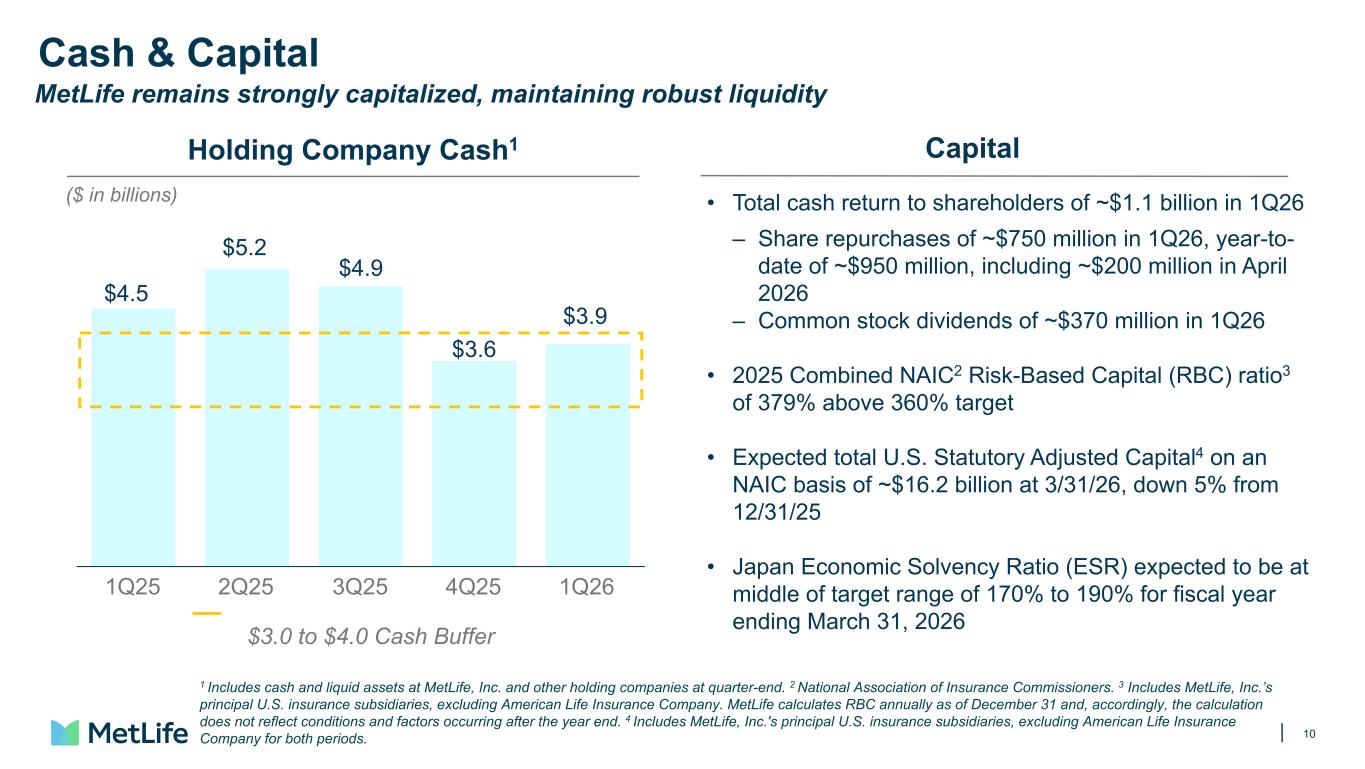
10 Holding Company Cash1 1Q25 2Q25 3Q25 4Q25 1Q26 Cash & Capital 1 Includes cash and liquid assets at MetLife, Inc. and other holding companies at quarter-end. 2 National Association of Insurance Commissioners. 3 Includes MetLife, Inc.’s principal U.S. insurance subsidiaries, excluding American Life Insurance Company. MetLife calculates RBC annually as of December 31 and, accordingly, the calculation does not reflect conditions and factors occurring after the year end. 4 Includes MetLife, Inc.'s principal U.S. insurance subsidiaries, excluding American Life Insurance Company for both periods. $3.0 to $4.0 Cash Buffer Capital ($ in billions) MetLife remains strongly capitalized, maintaining robust liquidity • Total cash return to shareholders of ~$1.1 billion in 1Q26 – Share repurchases of ~$750 million in 1Q26, year-to- date of ~$950 million, including ~$200 million in April 2026 – Common stock dividends of ~$370 million in 1Q26 • 2025 Combined NAIC2 Risk-Based Capital (RBC) ratio3 of 379% above 360% target • Expected total U.S. Statutory Adjusted Capital4 on an NAIC basis of ~$16.2 billion at 3/31/26, down 5% from 12/31/25 • Japan Economic Solvency Ratio (ESR) expected to be at middle of target range of 170% to 190% for fiscal year ending March 31, 2026 $4.5 $5.2 $4.9 $3.6 $3.9

Appendix
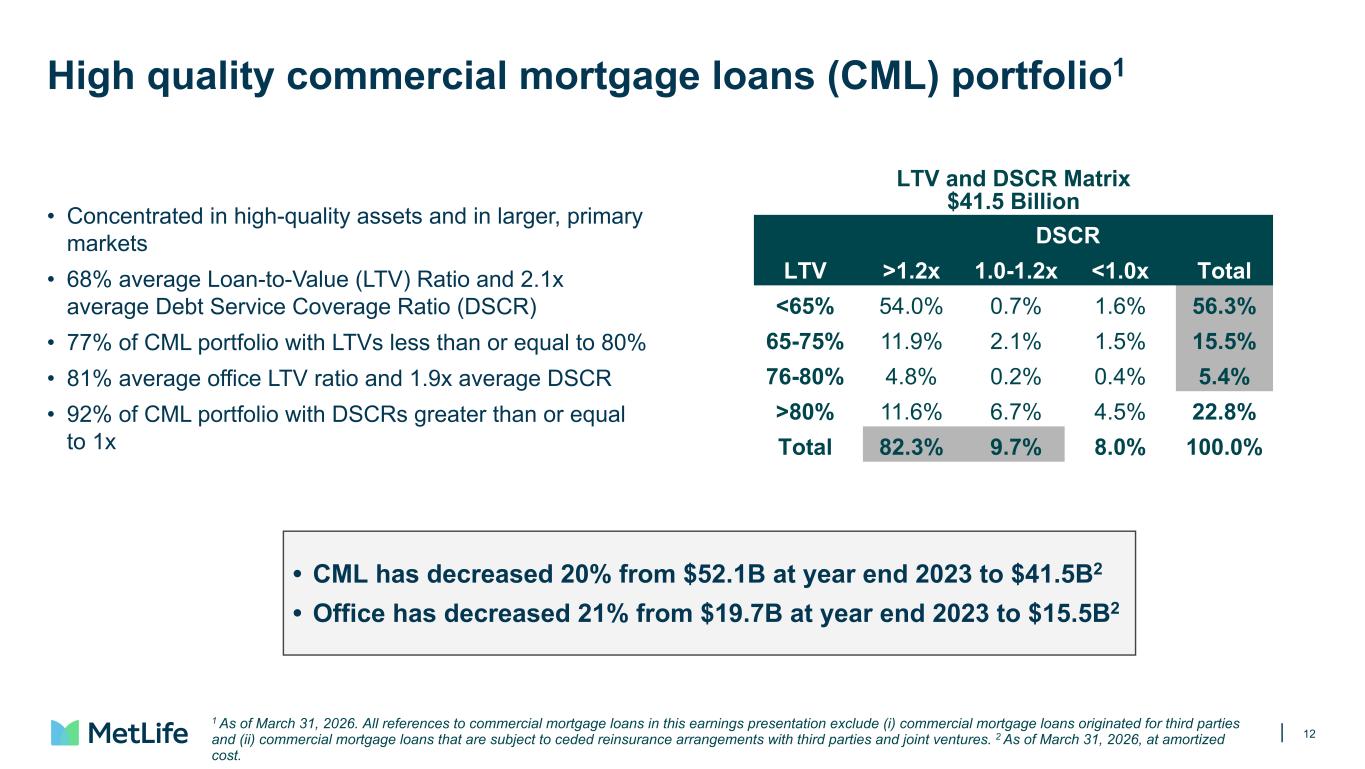
12 1 As of March 31, 2026. All references to commercial mortgage loans in this earnings presentation exclude (i) commercial mortgage loans originated for third parties and (ii) commercial mortgage loans that are subject to ceded reinsurance arrangements with third parties and joint ventures. 2 As of March 31, 2026, at amortized cost. • CML has decreased 20% from $52.1B at year end 2023 to $41.5B2 • Office has decreased 21% from $19.7B at year end 2023 to $15.5B2 High quality commercial mortgage loans (CML) portfolio1 • Concentrated in high-quality assets and in larger, primary markets • 68% average Loan-to-Value (LTV) Ratio and 2.1x average Debt Service Coverage Ratio (DSCR) • 77% of CML portfolio with LTVs less than or equal to 80% • 81% average office LTV ratio and 1.9x average DSCR • 92% of CML portfolio with DSCRs greater than or equal to 1x LTV and DSCR Matrix $41.5 Billion DSCR LTV >1.2x 1.0-1.2x <1.0x Total <65% 54.0% 0.7% 1.6% 56.3% 65-75% 11.9% 2.1% 1.5% 15.5% 76-80% 4.8% 0.2% 0.4% 5.4% >80% 11.6% 6.7% 4.5% 22.8% Total 82.3% 9.7% 8.0% 100.0%
13 Cautionary Statement on Forward-Looking Statements The forward-looking statements in this presentation, using words such as “anticipate,” “are confident,” “assume,” “believe,” “continue,” “could,” “estimate,” “expect,” “if,” “intend,” “likely,” “may,” “plan,” “potential,” “project,” “should,” “target,” “will,” “would” and other words and terms of similar meaning or that are otherwise tied to future periods or future performance, in each case in all derivative forms, are based on assumptions and expectations that involve risks and uncertainties, including the “Risk Factors” MetLife, Inc. describes in its U.S. Securities and Exchange Commission filings. MetLife’s future results could differ, and it does not undertake any obligation to publicly correct or update any of these statements.
14 Explanatory Note on Non-GAAP and Other Financial Information Any references in this presentation (except in this Explanatory Note on Non-GAAP and Other Financial Information and Reconciliations) to: Should be read as, respectively: (i) net income (loss) (i) net income (loss) available to MetLife, Inc.’s common shareholders (ii) net income (loss) per share (ii) net income (loss) available to MetLife, Inc.’s common shareholders per diluted common share (iii) adjusted earnings (iii) adjusted earnings available to common shareholders (iv) adjusted earnings per share (iv) adjusted earnings available to common shareholders per diluted common share (v) book value per share (v) book value per common share (vi) adjusted book value per share (vi) adjusted book value per common share (vii) return on equity (vii) return on MetLife, Inc.’s common stockholders’ equity (viii) adjusted return on equity (viii) adjusted return on MetLife, Inc.’s common stockholders’ equity In this presentation, MetLife presents certain measures of its performance on a consolidated and segment basis that are not calculated in accordance with accounting principles generally accepted in the United States of America (GAAP). MetLife believes that these non-GAAP financial measures enhance our investors’ understanding of MetLife’s performance by highlighting the results of operations and the underlying profitability drivers of the business. Segment-specific financial measures are calculated using only the portion of consolidated results attributable to that specific segment. The following non-GAAP financial measures should not be viewed as substitutes for the most directly comparable financial measures calculated in accordance with GAAP: Non-GAAP financial measures: Comparable GAAP financial measures: (i) adjusted premiums, fees and other revenues (i) premiums, fees and other revenues (ii) adjusted premiums, fees and other revenues, excluding PRT (ii) premiums, fees and other revenues (iii) adjusted capitalization of deferred policy acquisition costs (DAC) (iii) capitalization of DAC (iv) adjusted earnings available to common shareholders (iv) net income (loss) available to MetLife, Inc.’s common shareholders (v) adjusted earnings available to common shareholders, excluding total notable items (v) net income (loss) available to MetLife, Inc.’s common shareholders (vi) adjusted earnings available to common shareholders per diluted common share (vi) net income (loss) available to MetLife, Inc.’s common shareholders per diluted common share (vii) adjusted earnings available to common shareholders, excluding total notable items, per diluted common share (vii) net income (loss) available to MetLife, Inc.’s common shareholders per diluted common share (viii) adjusted return on equity (viii) return on equity (ix) adjusted return on equity, excluding total notable items (ix) return on equity (x) adjusted other expenses (x) other expenses (xi) adjusted other expenses, net of adjusted capitalization of DAC (xi) other expenses, net of capitalization of DAC (xii) adjusted other expenses, net of adjusted capitalization of DAC, excluding total notable items related to adjusted other expenses (xii) other expenses, net of capitalization of DAC (xiii) adjusted expense ratio (xiii) expense ratio (xiv) adjusted expense ratio, excluding total notable items related to adjusted other expenses and PRT (xiv) expense ratio (xv) direct expenses (xv) other expenses (xvi) direct expenses, excluding total notable items related to direct expenses (xvi) other expenses (xvii) direct expense ratio (xvii) expense ratio (xviii) direct expense ratio, excluding total notable items related to direct expenses and PRT (xviii) expense ratio (xix) future policy benefits at original discount rate (xix) future policy benefits at balance sheet discount rate (xx) free cash flows of all holding companies (xx) MetLife, Inc. (parent company) net cash provided by (used in) operating activities
15 MetLife’s definitions of non-GAAP and other financial measures discussed in this presentation may differ from those used by other companies: Adjusted earnings and related measures • adjusted earnings; • adjusted earnings available to common shareholders; • adjusted earnings available to common shareholders, on a constant currency basis; • adjusted earnings available to common shareholders, excluding total notable items; • adjusted earnings available to common shareholders, excluding total notable items, on a constant currency basis; • adjusted earnings available to common shareholders per diluted common share; • adjusted earnings available to common shareholders, on a constant currency basis per diluted common share; • adjusted earnings available to common shareholders, excluding total notable items per diluted common share; and • adjusted earnings available to common shareholders, excluding total notable items, on a constant currency basis per diluted common share. Adjusted earnings is used by MetLife’s chief operating decision maker, its chief executive officer, to evaluate performance and allocate resources. Consistent with GAAP guidance for segment reporting, adjusted earnings is MetLife’s GAAP measure of segment performance. Adjusted earnings and related measures based on adjusted earnings are also the measures by which senior management’s and many other employees’ performance is evaluated for the purposes of determining their compensation under applicable compensation plans. Adjusted earnings and related measures based on adjusted earnings allow analysis of MetLife’s performance relative to its business plan and facilitate comparisons to industry results. Adjusted earnings is defined as adjusted revenues less adjusted expenses, net of income tax. Adjusted earnings available to common shareholders is defined as adjusted earnings less preferred stock dividends. Adjusted earnings, along with the related adjusted revenues, adjusted expenses and adjusted premiums, fees and other revenues, focus on our primary businesses principally by excluding the impact of (i) market volatility which could distort trends, (ii) asymmetrical and non-economic accounting, (iii) revenues and costs related to divested businesses, and (iv) other adjustments. Also, adjusted earnings and related measures exclude results of discontinued operations under GAAP. Market volatility can have a significant impact on MetLife’s financial results. Adjusted earnings excludes net investment gains (losses), net derivative gains (losses), market risk benefit remeasurement gains (losses) and goodwill impairments. Further, net investment income is adjusted to exclude similar items relating to joint ventures accounted for under the equity method (“Joint venture adjustments”), and policyholder benefits and claims exclude (i) changes in the discount rate on certain annuitization guarantees accounted for as additional liabilities and (ii) market value adjustments. Explanatory Note on Non-GAAP and Other Financial Information (Continued) Reconciliations of these non-GAAP measures to the most directly comparable GAAP measures are not accessible on a forward-looking basis because we believe it is not possible without unreasonable effort to provide other than a range of net investment gains and losses and net derivative gains and losses, which can fluctuate significantly within or outside the range and from period to period and may have a material impact on net income (loss). Any of these financial measures shown on a constant currency basis reflect the impact of changes in foreign currency exchange rates and are calculated using the average foreign currency exchange rates for the current period and applied to the comparable prior period (“constant currency basis”). Reconciliations of these non-GAAP financial measures to the most directly comparable GAAP financial measures are included in this presentation and in this period’s earnings materials, which are available at MetLife’s Investor Relations webpage (https://investor.metlife.com).
16 Explanatory Note on Non-GAAP and Other Financial Information (Continued) Asymmetrical and non-economic accounting adjustments are made in calculating adjusted earnings: • Universal life and investment-type product policy fees exclude asymmetrical accounting associated with in-force reinsurance. • Net investment income includes earned income on derivatives and amortization of premium on derivatives that are hedges of investments or that are used to replicate certain investments, but do not qualify for hedge accounting treatment (“Investment hedge adjustments”). • Other revenues include settlements of foreign currency earnings hedges and exclude asymmetrical accounting associated with in-force reinsurance. • Policyholder benefits and claims excludes (i) inflation-indexed benefit adjustments associated with contracts backed by inflation-indexed investments, (ii) asymmetrical accounting associated with in-force reinsurance, and (iii) non-economic losses incurred at contract inception for certain single premium annuity business. These losses are amortized into adjusted earnings within policyholder benefits and claims over the estimated lives of the contracts. • Policyholder liability remeasurement gains (losses) excludes asymmetrical accounting associated with in-force reinsurance. • Interest credited to policyholder account balances excludes amounts associated with periodic crediting rate adjustments based on the total return of a contractually referenced pool of assets and other pass-through adjustments and asymmetrical accounting associated with in-force reinsurance. “Divested businesses” are those that have been or will be sold or exited by MetLife but do not meet the discontinued operations criteria under GAAP. Divested businesses also include the net impact of transactions with exited businesses that have been eliminated in consolidation under GAAP and costs relating to businesses that have been or will be sold or exited by MetLife that do not meet the criteria to be included in results of discontinued operations under GAAP. Other adjustments are made in calculating adjusted earnings: • Beginning in the fourth quarter of 2025, net investment income excludes depreciation of wholly-owned real estate and real estate joint ventures. • Net investment income and interest credited to policyholder account balances exclude certain amounts related to contractholder-directed equity securities (“Unit-linked contract income” and “Unit-linked contract costs”). • Net investment income and other expenses exclude Reinsurance activity (as defined below). • Net investment income and interest expense on debt exclude amounts related to collateralized financing entities that are consolidated variable interest entities. • Other revenues and other expenses exclude asset management distribution fees on funds that are passed through to distribution partners. • Other revenues include fee revenue on synthetic guaranteed interest contracts (“GICs”) accounted for as freestanding derivatives. • Other expenses exclude (i) amortization and impairment of asset management intangible assets, (ii) implementation of new insurance regulatory requirements and other costs, and (iii) acquisition, integration and other related costs. Other expenses include (i) deductions for net income (loss) attributable to noncontrolling interests and redeemable noncontrolling interests, and (ii) benefits accrued on synthetic GICs accounted for as freestanding derivatives. • “Reinsurance activity” relates to amounts subject to ceded reinsurance arrangements with third parties and joint ventures, including (i) the related investment returns and expenses which are passed through to the reinsurers and (ii) the corresponding invested assets and cash and cash equivalents. Adjusted earnings also excludes the recognition of certain contingent assets and liabilities that could not be recognized at acquisition or adjusted for during the measurement period under GAAP business combination accounting guidance. The tax impact of the adjustments mentioned above are calculated net of the U.S. or foreign statutory tax rate, which could differ from MetLife’s effective tax rate. Additionally, the provision for income tax (expense) benefit also includes the impact related to the timing of certain tax credits, as well as certain tax reforms. In addition, adjusted earnings available to common shareholders excludes the impact of preferred stock redemption premium, which is reported as a reduction to net income (loss) available to MetLife, Inc.’s common shareholders. Investment portfolio gains (losses) and derivative gains (losses) These are measures of investment and hedging activity. Investment portfolio gains (losses) principally excludes amounts that are reported within net investment gains (losses) but do not relate to the performance of the investment portfolio, such as gains (losses) on sales and divestitures of businesses, as well as investment portfolio gains (losses) of divested businesses. Derivative gains (losses) principally excludes earned income on derivatives and amortization of premium on derivatives, where such derivatives are either hedges of investments or are used to replicate certain investments, and where such derivatives do not qualify for hedge accounting. This earned income and amortization of premium is reported within adjusted earnings and not within derivative gains (losses).
17 Explanatory Note on Non-GAAP and Other Financial Information (Continued) Return on equity and related measures • Total MetLife, Inc.’s adjusted common stockholders’ equity: total MetLife, Inc.’s common stockholders’ equity, excluding unrealized investment gains (losses), net of related offsets, deferred gains (losses) on derivatives, future policy benefits discount rate remeasurement gains (losses), market risk benefits instrument-specific credit risk remeasurement gains (losses) and defined benefit plans adjustment components of accumulated other comprehensive income (loss) (“AOCI”) and the estimated fair value of certain ceded reinsurance-related embedded derivatives, all net of income tax. • Total MetLife, Inc.’s adjusted common stockholders’ equity, excluding total notable items: total MetLife, Inc.’s common stockholders’ equity, excluding unrealized investment gains (losses), net of related offsets, deferred gains (losses) on derivatives, future policy benefits discount rate remeasurement gains (losses), market risk benefits instrument-specific credit risk remeasurement gains (losses) and defined benefit plans adjustment components of AOCI, the estimated fair value of certain ceded reinsurance-related embedded derivatives and total notable items, all net of income tax. • Return on MetLife, Inc.’s common stockholders’ equity: net income (loss) available to MetLife, Inc.’s common shareholders divided by MetLife, Inc.’s average common stockholders’ equity. • Adjusted return on MetLife, Inc.’s common stockholders’ equity: adjusted earnings available to common shareholders divided by MetLife, Inc.’s average adjusted common stockholders’ equity. • Adjusted return on MetLife, Inc.’s common stockholders’ equity, excluding total notable items: adjusted earnings available to common shareholders, excluding total notable items, divided by MetLife, Inc.’s average adjusted common stockholders’ equity, excluding total notable items. The above measures represent a level of equity that excludes most components of AOCI, such as unrealized investment gains (losses), net of related offsets, and future policy benefits discount rate remeasurement gains (losses), as well as the impact of certain ceded reinsurance-related embedded derivatives, as these amounts are primarily driven by market volatility. Expense ratio, direct expense ratio, adjusted expense ratio and related measures • Expense ratio: other expenses, net of capitalization of DAC, divided by premiums, fees and other revenues. • Direct expense ratio: direct expenses divided by adjusted premiums, fees and other revenues. Direct expenses are comprised of employee-related costs, third-party staffing costs, and general and administrative expenses. • Direct expense ratio, excluding total notable items related to direct expenses and PRT: direct expenses, excluding total notable items related to direct expenses, divided by adjusted premiums, fees and other revenues, excluding PRT. • Adjusted expense ratio: adjusted other expenses, net of adjusted capitalization of DAC, divided by adjusted premiums, fees and other revenues. • Adjusted expense ratio, excluding total notable items related to adjusted other expenses and PRT: adjusted other expenses, net of adjusted capitalization of DAC, excluding total notable items related to adjusted other expenses, divided by adjusted premiums, fees and other revenues, excluding PRT. Assets Under Management (“AUM”) • Total Assets Under Management (“Total AUM”) is comprised of MIM GA AUM plus Institutional Client AUM (each, as defined below). • MIM General Account AUM (“MIM GA AUM”) is used by MetLife to describe the portion of GA AUM (as defined below) that MetLife Investment Management, LLC and certain of its affiliates (“MIM”) manages or advises. • General Account AUM (“GA AUM”) is used by MetLife to describe assets in its general account (“GA”) investment portfolio. GA AUM is stated at estimated fair value and is comprised of GA total investments, the portion of the GA investment portfolio classified within assets held-for-sale, cash and cash equivalents, and accrued investment income on such assets, and excludes policy loans, certain contractholder-directed equity securities, fair value option securities, mortgage loans originated for third parties, assets subject to ceded reinsurance arrangements with third parties and joint ventures, and certain other invested assets. Mortgage loans and real estate and real estate joint ventures included in GA AUM (at net asset value, net of deduction for encumbering debt) have been adjusted from carrying value to estimated fair value. Classification of GA AUM by sector is based on the nature and characteristics of the underlying investments which can vary from how they are classified under GAAP. Accordingly, the underlying investments within certain real estate and real estate joint ventures that are primarily commercial mortgage loans (at net asset value, net of deduction for encumbering debt) have been reclassified to exclude them from real estate and real estate joint ventures and include them as commercial mortgage loans. • Institutional Client AUM is comprised of SA AUM plus Reinsurance AUM plus TP AUM (each, as defined below). MIM manages or advises Institutional Client AUM in accordance with client guidelines contained in each investment advisory agreement. ◦ Separate Account AUM (“SA AUM”) is comprised of separate account investment portfolios, which are managed or advised by MIM and included in MetLife, Inc.’s consolidated financial statements at estimated fair value, as well as accrued investment income on such assets. ◦ Reinsurance AUM is comprised of GA assets subject to ceded reinsurance arrangements with third parties and joint ventures, which are managed or advised by MIM and are generally included in MetLife, Inc.’s consolidated financial statements at estimated fair value, as well as accrued investment income on such assets. ◦ Third-Party AUM (“TP AUM”) is comprised of non-proprietary assets managed or advised by MIM on behalf of unaffiliated/third-party clients, which are stated at estimated fair value, as well as accrued investment income on such assets. Such non-proprietary assets are owned by unaffiliated/third-party clients and, accordingly, are generally not included in MetLife, Inc.’s consolidated financial statements.
18 Explanatory Note on Non-GAAP and Other Financial Information (Continued) Assets Under Management (Continued) • Asia General Account AUM (“Asia GA AUM”) is used by MetLife to describe assets in its Asia GA investment portfolio. Asia GA AUM is stated at estimated fair value and is comprised of Asia GA total investments, the portion of the Asia GA investment portfolio classified within assets held-for-sale, cash and cash equivalents, and accrued investment income on such assets, and excludes policy loans, certain contractholder-directed equity securities, fair value option securities, mortgage loans originated for third parties, assets subject to ceded reinsurance arrangements with third parties and joint ventures, and certain other invested assets. Mortgage loans and real estate and real estate joint ventures included in Asia GA AUM (at net asset value, net of deduction for encumbering debt) have been adjusted from carrying value to estimated fair value. At the segment level, intersegment balances (intercompany activity, primarily related to investments in subsidiaries that eliminate at the MetLife consolidated level) are excluded from Asia GA AUM. Asia GA AUM (at amortized cost) excludes the following adjustments: (i) unrealized gain (loss) on investments carried at estimated fair value and (ii) adjustments from carrying value to estimated fair value on mortgage loans and real estate and real estate joint ventures. Asia GA AUM (at amortized cost) is presented net of related allowance for credit loss. Other items The following additional information is relevant to an understanding of MetLife’s performance: • Statistical sales information: • Group Benefits: calculated using 10% of single premium deposits and 100% of annualized full-year premiums and fees from recurring premium policy sales of all products. • Retirement and Income Solutions: calculated using 10% of single premium contracts, on and off-balance sheet deposits, and the contract value for new U.K. longevity reinsurance contracts, and 100% of annualized full-year premiums and fees only from recurring premium policy sales of specialized benefit resources and corporate-owned life insurance. • Asia, Latin America and EMEA: calculated using 10% of single premium deposits (mainly from retirement products such as variable annuity, fixed annuity and pensions), 20% of single premium deposits from credit insurance and 100% of annualized full-year premiums and fees from recurring-premium policy sales of all products (mainly from risk and protection products such as individual life, accident & health and group). Sales statistics do not correspond to revenues under GAAP, but are used as relevant measures of business activity. • Volume growth, where cited, represents the change in certain measures of our segment results, including adjusted earnings, attributable to business growth, applying a model in which certain margins and factors are held constant, the most significant of which are underwriting margins, investment margins, changes in equity market performance, expense margins and the impact of changes in foreign currency exchange rates. • PRT includes U.K. funded reinsurance. • Institutional net flows reflect Institutional Client AUM total fund additions less withdrawals. • “Third-party mortgage loan activity” relates to amounts associated with mortgage loans originated and acquired for third parties, including (i) the related investment returns and expenses which are passed through to the third-party lenders and (ii) the corresponding mortgage loan assets. • We refer to observable forward yield curves as of a particular date in connection with making our estimates for future results. The observable forward yield curves at a given time are based on implied future interest rates along a range of interest rate durations. This includes the 10-year U.S. Treasury rate which we use as a benchmark rate to describe longer-term interest rates used in our estimates for future results. • Notable items reflect the unexpected impact of events that affect MetLife’s results, but that were unknown and that MetLife could not anticipate when it devised its business plan. Notable items also include certain items regardless of the extent anticipated in the business plan, to help investors have a better understanding of MetLife’s results and to evaluate and forecast those results. Notable items represent a positive (negative) impact to adjusted earnings available to common shareholders. • Holding company cash and liquid assets are held by MetLife, Inc. collectively with other MetLife holding companies and include cash and cash equivalents, short-term investments and publicly traded securities excluding assets that are pledged or otherwise committed. Assets pledged or otherwise committed include amounts received in connection with securities lending, repurchase agreements, derivatives, regulatory deposits, the collateral financing arrangement, funding agreements and secured borrowings, as well as amounts held in the closed block. • MetLife uses a measure of free cash flow to facilitate an understanding of its ability to generate cash for reinvestment into its businesses or use in non-mandatory capital actions. MetLife defines free cash flow as the sum of cash available at MetLife’s holding companies from dividends from operating subsidiaries, expenses and other net flows of the holding companies (including capital contributions to subsidiaries), and net contributions from debt to be at or below target leverage ratios. This measure of free cash flow is prior to capital actions, such as common stock dividends and repurchases, debt reduction and mergers and acquisitions. Free cash flow should not be viewed as a substitute for net cash provided by (used in) operating activities calculated in accordance with GAAP. The free cash flow ratio is typically expressed as a percentage of annual adjusted earnings available to common shareholders.
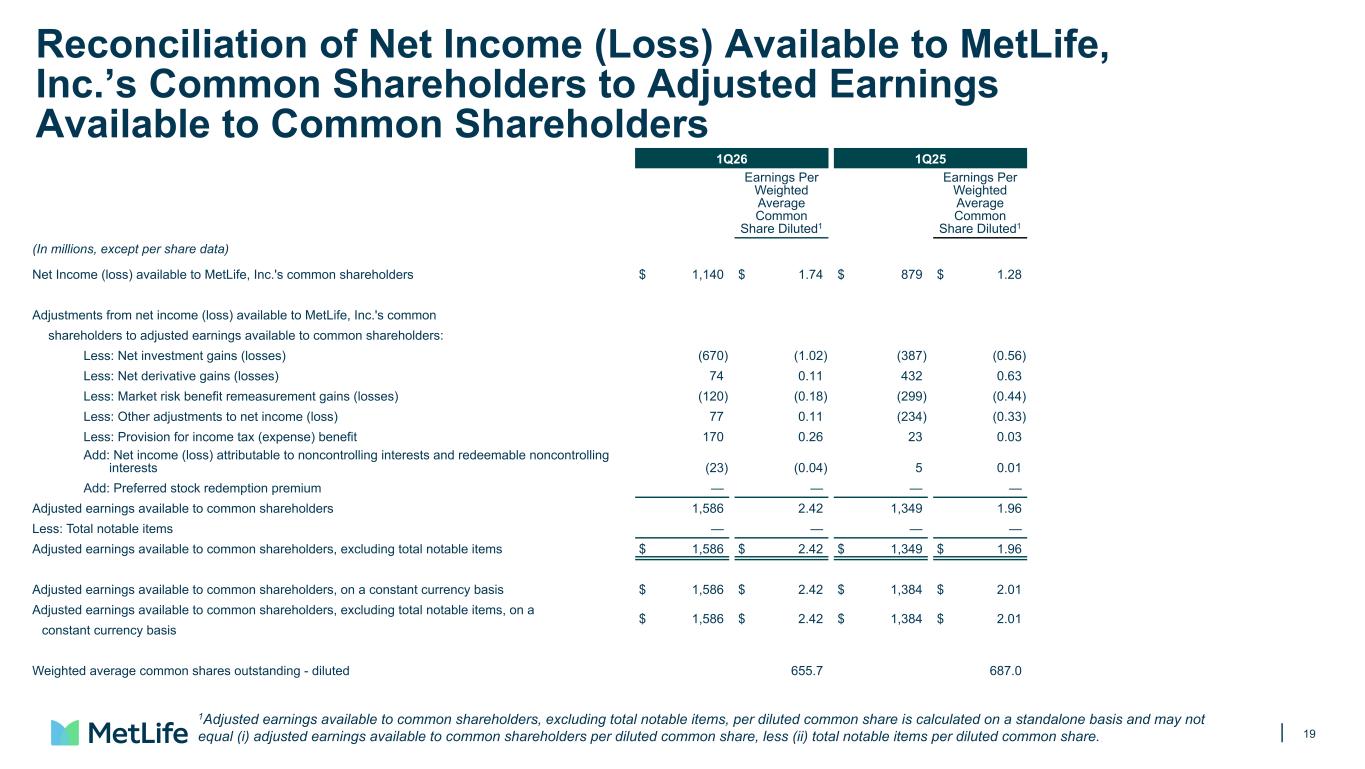
19 Reconciliation of Net Income (Loss) Available to MetLife, Inc.’s Common Shareholders to Adjusted Earnings Available to Common Shareholders 1Q26 1Q25 Earnings Per Weighted Average Common Share Diluted1 Earnings Per Weighted Average Common Share Diluted1 (In millions, except per share data) Net Income (loss) available to MetLife, Inc.'s common shareholders $ 1,140 $ 1.74 $ 879 $ 1.28 Adjustments from net income (loss) available to MetLife, Inc.'s common shareholders to adjusted earnings available to common shareholders: Less: Net investment gains (losses) (670) (1.02) (387) (0.56) Less: Net derivative gains (losses) 74 0.11 432 0.63 Less: Market risk benefit remeasurement gains (losses) (120) (0.18) (299) (0.44) Less: Other adjustments to net income (loss) 77 0.11 (234) (0.33) Less: Provision for income tax (expense) benefit 170 0.26 23 0.03 Add: Net income (loss) attributable to noncontrolling interests and redeemable noncontrolling interests (23) (0.04) 5 0.01 Add: Preferred stock redemption premium — — — — Adjusted earnings available to common shareholders 1,586 2.42 1,349 1.96 Less: Total notable items — — — — Adjusted earnings available to common shareholders, excluding total notable items $ 1,586 $ 2.42 $ 1,349 $ 1.96 Adjusted earnings available to common shareholders, on a constant currency basis $ 1,586 $ 2.42 $ 1,384 $ 2.01 Adjusted earnings available to common shareholders, excluding total notable items, on a $ 1,586 $ 2.42 $ 1,384 $ 2.01 constant currency basis Weighted average common shares outstanding - diluted 655.7 687.0 1Adjusted earnings available to common shareholders, excluding total notable items, per diluted common share is calculated on a standalone basis and may not equal (i) adjusted earnings available to common shareholders per diluted common share, less (ii) total notable items per diluted common share.
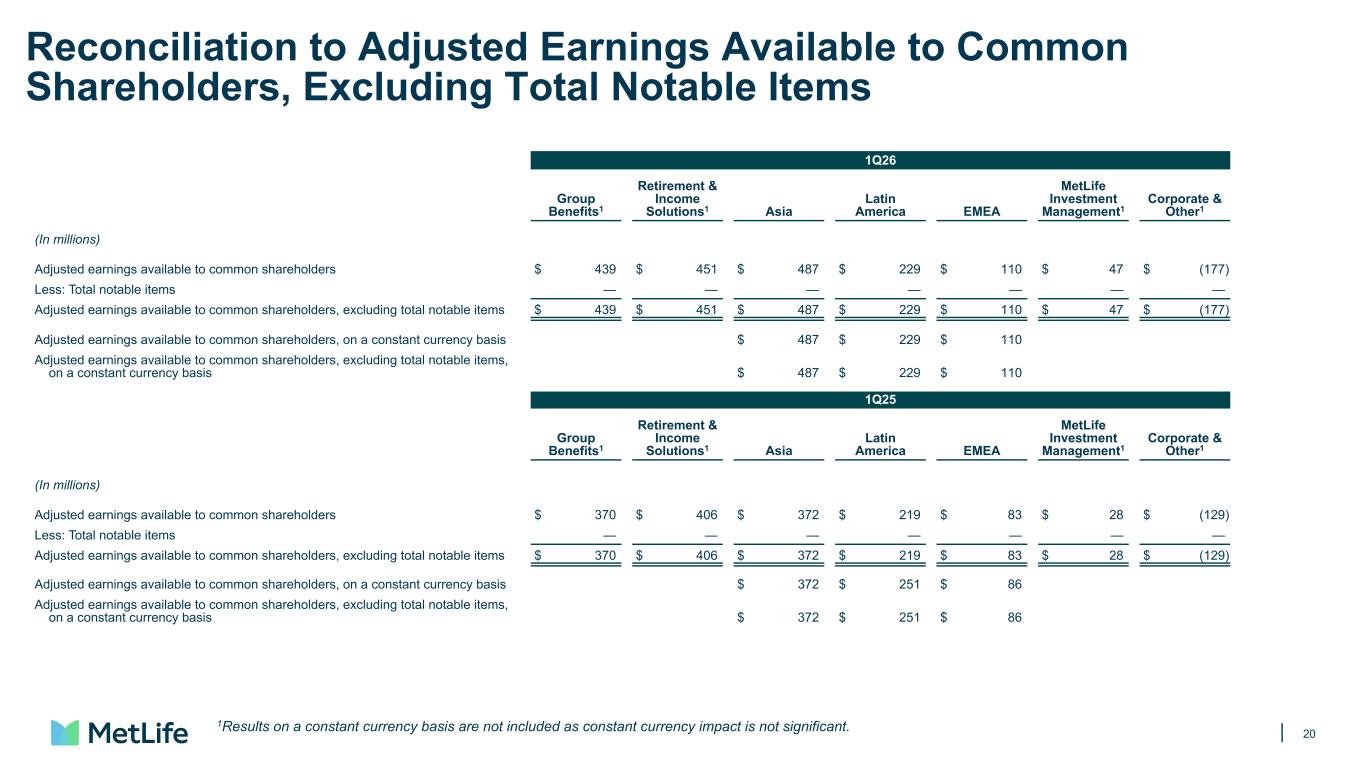
20 Reconciliation to Adjusted Earnings Available to Common Shareholders, Excluding Total Notable Items 1Q26 Group Benefits1 Retirement & Income Solutions1 Asia Latin America EMEA MetLife Investment Management1 Corporate & Other1 (In millions) Adjusted earnings available to common shareholders $ 439 $ 451 $ 487 $ 229 $ 110 $ 47 $ (177) Less: Total notable items — — — — — — — Adjusted earnings available to common shareholders, excluding total notable items $ 439 $ 451 $ 487 $ 229 $ 110 $ 47 $ (177) Adjusted earnings available to common shareholders, on a constant currency basis $ 487 $ 229 $ 110 Adjusted earnings available to common shareholders, excluding total notable items, on a constant currency basis $ 487 $ 229 $ 110 1Q25 Group Benefits1 Retirement & Income Solutions1 Asia Latin America EMEA MetLife Investment Management1 Corporate & Other1 (In millions) Adjusted earnings available to common shareholders $ 370 $ 406 $ 372 $ 219 $ 83 $ 28 $ (129) Less: Total notable items — — — — — — — Adjusted earnings available to common shareholders, excluding total notable items $ 370 $ 406 $ 372 $ 219 $ 83 $ 28 $ (129) Adjusted earnings available to common shareholders, on a constant currency basis $ 372 $ 251 $ 86 Adjusted earnings available to common shareholders, excluding total notable items, on a constant currency basis $ 372 $ 251 $ 86 1Results on a constant currency basis are not included as constant currency impact is not significant.
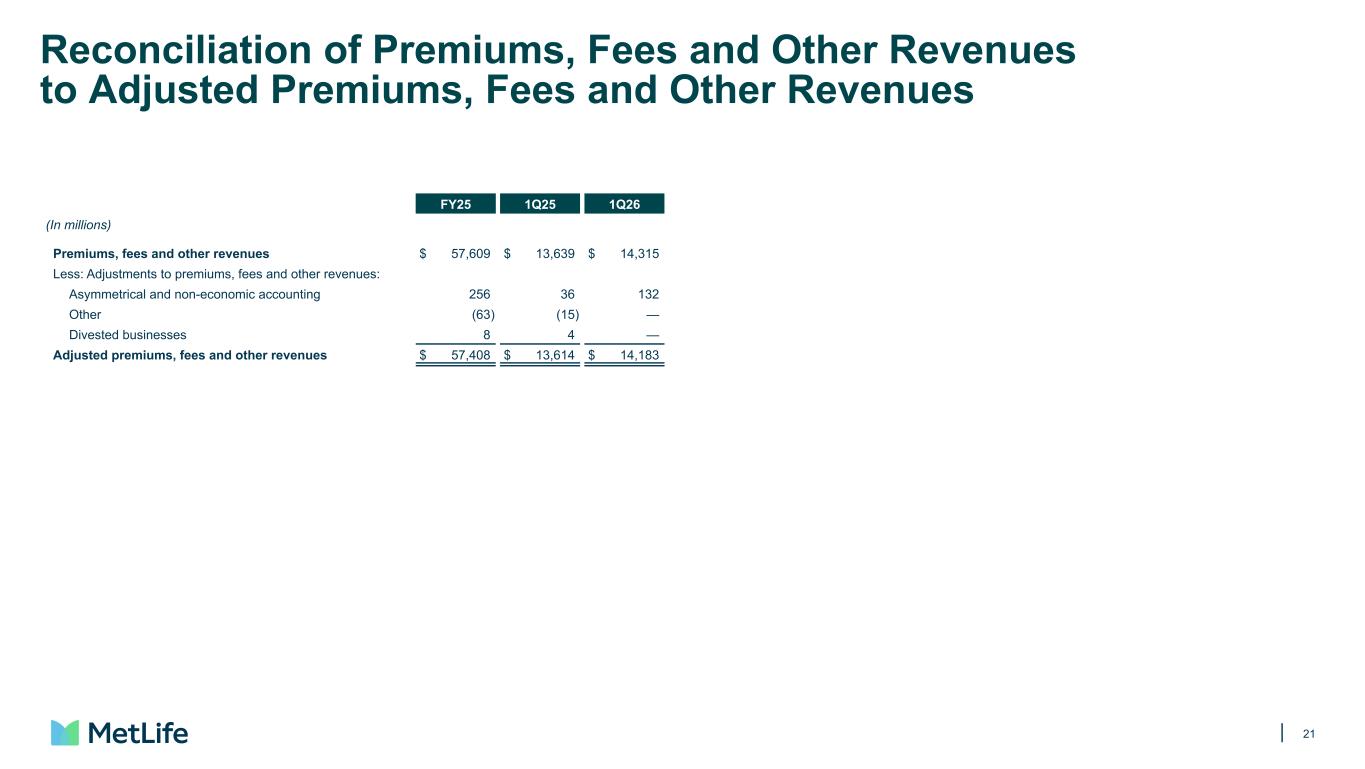
21 Reconciliation of Premiums, Fees and Other Revenues to Adjusted Premiums, Fees and Other Revenues FY25 1Q25 1Q26 (In millions) Premiums, fees and other revenues $ 57,609 $ 13,639 $ 14,315 Less: Adjustments to premiums, fees and other revenues: Asymmetrical and non-economic accounting 256 36 132 Other (63) (15) — Divested businesses 8 4 — Adjusted premiums, fees and other revenues $ 57,408 $ 13,614 $ 14,183
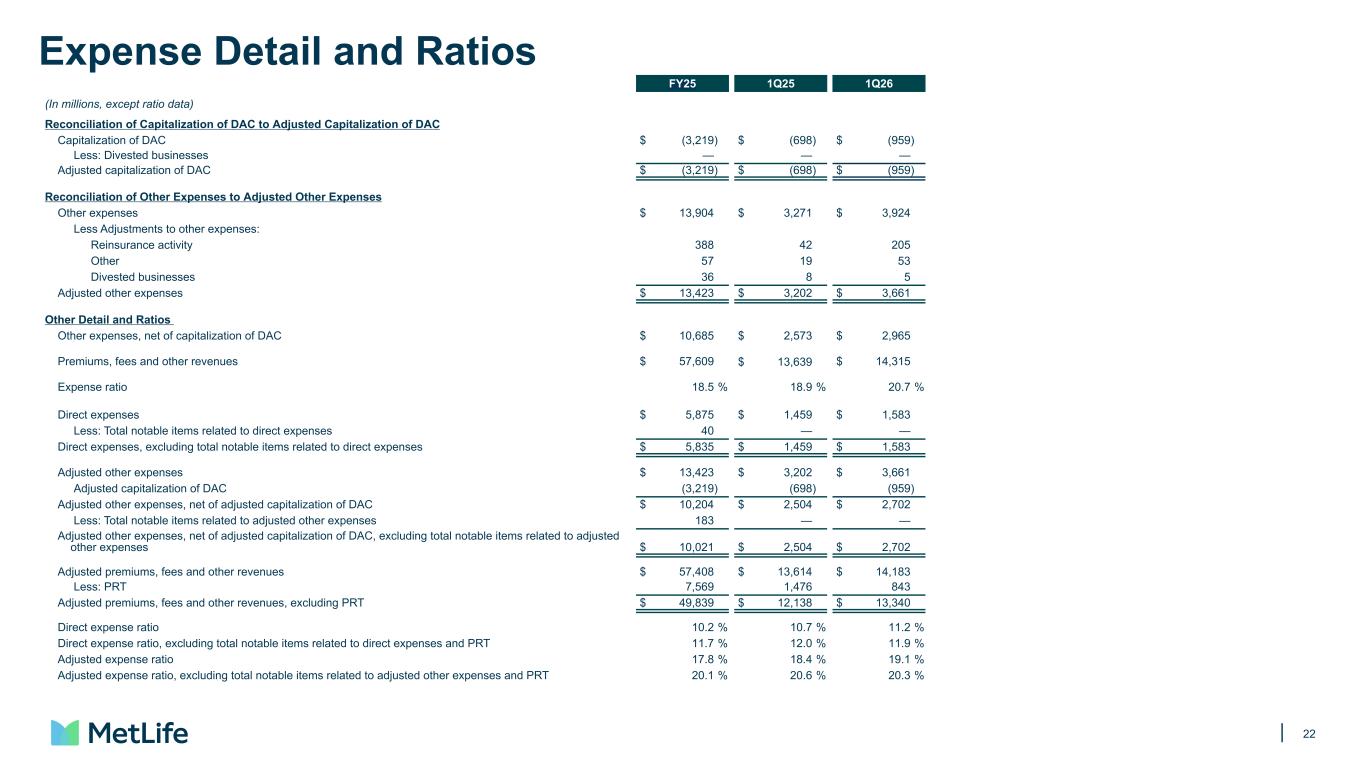
22 Expense Detail and Ratios FY25 1Q25 1Q26 (In millions, except ratio data) Reconciliation of Capitalization of DAC to Adjusted Capitalization of DAC Capitalization of DAC $ (3,219) $ (698) $ (959) Less: Divested businesses — — — Adjusted capitalization of DAC $ (3,219) $ (698) $ (959) Reconciliation of Other Expenses to Adjusted Other Expenses Other expenses $ 13,904 $ 3,271 $ 3,924 Less Adjustments to other expenses: Reinsurance activity 388 42 205 Other 57 19 53 Divested businesses 36 8 5 Adjusted other expenses $ 13,423 $ 3,202 $ 3,661 Other Detail and Ratios Other expenses, net of capitalization of DAC $ 10,685 $ 2,573 $ 2,965 Premiums, fees and other revenues $ 57,609 $ 13,639 $ 14,315 Expense ratio 18.5 % 18.9 % 20.7 % Direct expenses $ 5,875 $ 1,459 $ 1,583 Less: Total notable items related to direct expenses 40 — — Direct expenses, excluding total notable items related to direct expenses $ 5,835 $ 1,459 $ 1,583 Adjusted other expenses $ 13,423 $ 3,202 $ 3,661 Adjusted capitalization of DAC (3,219) (698) (959) Adjusted other expenses, net of adjusted capitalization of DAC $ 10,204 $ 2,504 $ 2,702 Less: Total notable items related to adjusted other expenses 183 — — Adjusted other expenses, net of adjusted capitalization of DAC, excluding total notable items related to adjusted other expenses $ 10,021 $ 2,504 $ 2,702 Adjusted premiums, fees and other revenues $ 57,408 $ 13,614 $ 14,183 Less: PRT 7,569 1,476 843 Adjusted premiums, fees and other revenues, excluding PRT $ 49,839 $ 12,138 $ 13,340 Direct expense ratio 10.2 % 10.7 % 11.2 % Direct expense ratio, excluding total notable items related to direct expenses and PRT 11.7 % 12.0 % 11.9 % Adjusted expense ratio 17.8 % 18.4 % 19.1 % Adjusted expense ratio, excluding total notable items related to adjusted other expenses and PRT 20.1 % 20.6 % 20.3 %
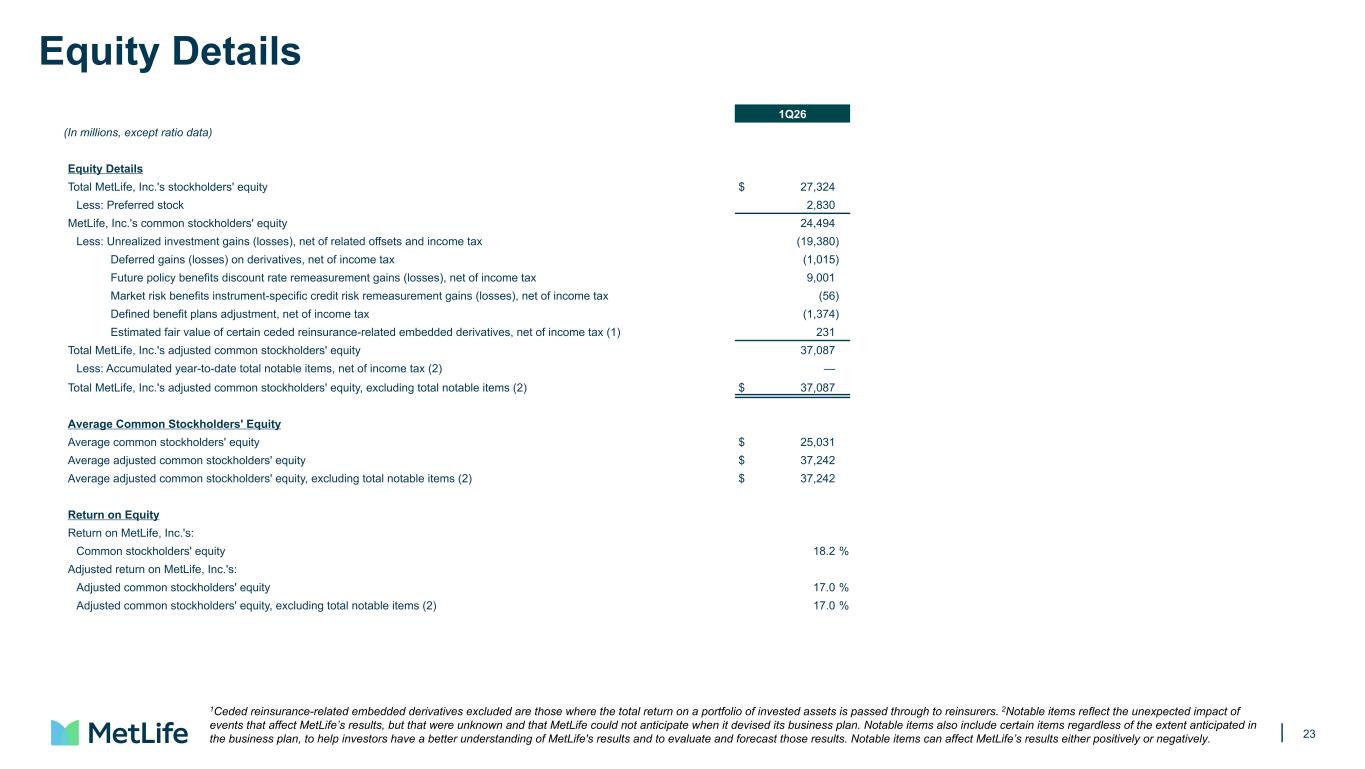
23 Equity Details 1Ceded reinsurance-related embedded derivatives excluded are those where the total return on a portfolio of invested assets is passed through to reinsurers. 2Notable items reflect the unexpected impact of events that affect MetLife’s results, but that were unknown and that MetLife could not anticipate when it devised its business plan. Notable items also include certain items regardless of the extent anticipated in the business plan, to help investors have a better understanding of MetLife's results and to evaluate and forecast those results. Notable items can affect MetLife’s results either positively or negatively. 1Q26 (In millions, except ratio data) Equity Details Total MetLife, Inc.'s stockholders' equity $ 27,324 Less: Preferred stock 2,830 MetLife, Inc.'s common stockholders' equity 24,494 Less: Unrealized investment gains (losses), net of related offsets and income tax (19,380) Deferred gains (losses) on derivatives, net of income tax (1,015) Future policy benefits discount rate remeasurement gains (losses), net of income tax 9,001 Market risk benefits instrument-specific credit risk remeasurement gains (losses), net of income tax (56) Defined benefit plans adjustment, net of income tax (1,374) Estimated fair value of certain ceded reinsurance-related embedded derivatives, net of income tax (1) 231 Total MetLife, Inc.'s adjusted common stockholders' equity 37,087 Less: Accumulated year-to-date total notable items, net of income tax (2) — Total MetLife, Inc.'s adjusted common stockholders' equity, excluding total notable items (2) $ 37,087 Average Common Stockholders' Equity Average common stockholders' equity $ 25,031 Average adjusted common stockholders' equity $ 37,242 Average adjusted common stockholders' equity, excluding total notable items (2) $ 37,242 Return on Equity Return on MetLife, Inc.'s: Common stockholders' equity 18.2 % Adjusted return on MetLife, Inc.'s: Adjusted common stockholders' equity 17.0 % Adjusted common stockholders' equity, excluding total notable items (2) 17.0 %

24