NOTE 21 - SUBSEQUENT EVENTS
The Company has evaluated subsequent events through the filing of this report and determined that there have not been any events, other than those described below, that have occurred that would require adjustments to or disclosures in the consolidated financial statements.
As previously announced, on April 29, 2026, the Company entered into an Agreement and Plan of Merger (the “Merger Agreement”) with ACRES Holdings Sub LLC (“Merger Sub”), a subsidiary of the Company, on one hand and ACRES Capital Corp (“ACC”) and ACRES Capital, LLC, a subsidiary of ACC and the external manager of the Company (the “Manager”), on the other hand, pursuant to which ACC will be merged with and into Merger Sub, with Merger Sub surviving as a wholly-owned subsidiary of the Company (the “Merger”). As a result of the Merger, among other things, (i) the Company will acquire the Manager, (ii) the Manager will cease to perform any outside management services for the Company, (iii) the Company and the Manager will terminate the existing Management Agreement (as defined below) between the parties, and (iv) the Company will become internally managed (the “Internalization”).
The closing of the Merger (the “Closing”) is subject to a number of conditions, including the issuance of common stock at the Closing which is subject to approval by the Company’s common stockholders at the Company’s 2026 Annual Meeting. The Company expects to hold its 2026 Annual Meeting in June 2026, and close the Merger (and consummate the Internalization) early in the third quarter of 2026.
Pursuant to the Merger Agreement, at Closing, (i) each outstanding share of common stock, $0.0001 par value per share, of ACC (“ACC Common Stock”) will be converted into the right to receive 2.61882 shares of common stock, $0.001 par value per share, of the Company (the “ACR Common Stock”) and (ii) the Fourth Amended and Restated Management Agreement, dated as of July 31, 2020, as amended, by and among the Company, the Manager and ACC (the “Management Agreement”), will terminate for no additional consideration. The Company expects to issue a maximum of approximately 7.487 million shares of ACR Common Stock at Closing (the “Stock Issuance”), the exact number of which will be determined based on the number of outstanding shares of ACC Common Stock immediately prior to the Closing.
ITEM 2. MANAGEMENT’S DISCUSSION AND ANALYSIS OF FINANCIAL CONDITION AND RESULTS OF OPERATIONS
References in this quarterly report to "we," "us" or the "Company" refer to ACRES Commercial Realty Corp. The following discussion and analysis of the Company’s financial condition and results of operations should be read in conjunction with the consolidated financial statements and accompanying notes appearing elsewhere in this report. Certain information contained in the discussion and analysis set forth below includes forward-looking statements that involve risks and uncertainties.
Special Note Regarding Forward-Looking Statements
This report contains certain forward-looking statements within the meaning of Section 27A of the Securities Act of 1933, as amended, and Section 21E of the Securities Exchange Act of 1934, as amended. Such forward-looking statements can generally be identified by our use of forward-looking terminology such as "may," "will," "continue," "expect," "intend," "anticipate," "estimate," "believe," "look forward" or other similar words or terms. Because such statements include risks, uncertainties and contingencies, actual results may differ materially from the expectations, intentions, beliefs, plans or predictions of the future expressed or implied by such forward-looking statements. Factors that could cause actual results to differ materially from those anticipated in the forward-looking statements include:
• changes in our industry, interest rates, the debt securities markets, real estate markets or the general economy;
• increased rates of default and/or decreased recovery rates on our investments;
• the performance and financial condition of our borrowers;
• our ability to consummate the proposed Merger (as defined below) and achieve the expected cost savings or other benefits therefrom;
•if we fail to consummate the proposed Merger, our dependence on our Manager and ability to find a suitable replacement in a timely manner, or at all, if our Manager or we were to terminate the management agreement;
• the cost and availability of our financings, which depend in part on our asset quality, the nature of our relationships with our lenders and other capital providers, our business prospects and outlook and general market conditions;
• the availability and attractiveness of terms of additional debt repurchases;
• availability, terms and deployment of short-term and long-term capital;
• events giving rise to increases in our current expected credit loss reserve, including the impact of the current economic environment;
• availability of, and ability to retain, qualified personnel;
• changes in our business strategy;
• the degree and nature of our competition;
• the resolution of our non-performing and sub-performing assets;
• our ability to comply with financial covenants in our debt instruments;
• the adequacy of our cash reserves and working capital;
• the timing of cash flows, if any, from our investments;
• unanticipated increases in financial and other costs, including a rise in interest rates;
• our ability to maintain compliance with over-collateralization and interest coverage tests in our collateralized loan obligations (“CLOs”);
• environmental and/or safety requirements;
• our ability to satisfy complex rules in order for us to qualify as a real estate investment trust (“REIT”), for federal income tax purposes and qualify for our exemption under the Investment Company Act of 1940, as amended, and our ability and the ability of our subsidiaries to operate effectively within the limitations imposed by these rules;
• legislative and regulatory changes (including changes to laws governing the taxation of REITs or the exemptions from registration as an investment company); and
• the factors described in this report and the Company’s Annual Report on Form 10-K for the year ended December 31, 2025, including those set forth under the sections captioned “Risk Factors,” “Business” and “Management’s Discussion and Analysis of Financial Conditions and Results of Operations,” as applicable.
We caution you not to place undue reliance on these forward-looking statements, which speak only as of the date of this report. All subsequent written and oral forward-looking statements attributable to us or any person acting on our behalf are expressly qualified in their entirety by the cautionary statements contained or referred to in this section. Except to the extent required by applicable law or regulation, we undertake no obligation to update these forward-looking statements to reflect events or circumstances after the date of this report or to reflect the occurrence of unanticipated events.
Overview
We are a Maryland corporation and an externally-managed real estate investment trust ("REIT") that is primarily focused on originating, holding and managing commercial real estate ("CRE") mortgage loans and equity investments in commercial real estate properties through direct ownership and joint ventures. Our manager is ACRES Capital, LLC (our "Manager"), a subsidiary of ACRES Capital Corp. ("ACC," and collectively with our Manager, "ACRES"), a private commercial real estate lender exclusively dedicated to nationwide middle market CRE lending with a focus on multifamily, student housing, hospitality, office and industrial properties in top United States ("U.S.") markets. Our Manager draws upon the management team of ACRES and its collective investment experience to provide its services. Our longer-term objective is to provide our stockholders with total returns over time, including quarterly distributions and capital appreciation, while seeking to manage the risks associated with our investment strategies, as well as to maximize long-term stockholder value by maintaining stability through our available liquidity and diversified CRE loan portfolio.
Currently, markets are grappling with trade tensions, geopolitical tensions, the risk of increased tariffs, inflation and labor volatility. These market pressures have caused continued disruption in many market segments, including the financial services, real estate and credit markets and these disruptions have affected the availability and the cost of capital. The increase in the cost of capital is expected to cause dislocations in various investment and financing markets in which we participate as we and other market participants adjust to the new financing environment.
Since September 2024, the U.S. Federal Reserve lowered the Federal Funds rate by 1.75% in six rate cuts reaching its lowest levels since 2022. Lowering rates and decreasing costs may encourage consumer spending and accelerate corporate profit growth, which may positively impact the credit profile of the collateral underlying our loans and positively impact our borrowers' ability to sell or refinance in the current market; however, lower rates would also correlate to decreases in our net income. There is also no certainty with respect to the direction, timing, or pace of change for future interest rates.
The multifamily real estate market continues to be a competitive market, and as a result of investors' continued confidence in that asset class, the market for those assets continues to experience spread compression on newly originated deals. Furthermore, the office property market continues to experience high vacancies, slower leasing activity and current tenants reevaluating their needs for physical office space due to remote-work trends across the country. These factors, coupled with inflation, higher interest rates and dislocations in market liquidity, have converged to create higher levels of uncertainty surrounding property values, which in turn, also negatively impact borrowers' ability and willingness to financially support and standby their investments in their office properties, their abilities to sell or refinance their positions in the current market and ultimately our financial results.
In response, we continue to manage corporate liquidity actively and responsibly, manage our CRE assets through a solutions-based approach with our borrowers and manage our daily operations in light of changing macroeconomic circumstances. Our Manager also continuously monitors for new capital opportunities and selectively executes on agreements that are expected to enhance our returns.
As previously reported, on April 29, 2026, we entered into an Agreement and Plan of Merger (the “Merger Agreement”), pursuant to which we will acquire ACC in an all-stock transaction (the “Merger”). As a result of the Merger, among other things, we will acquire our Manager, and transition from an externally-managed REIT to an internally-managed REIT (the “Internalization”).
We originate transitional floating-rate CRE loans with a target size between $10.0 million and $100.0 million. During the three months ended March 31, 2026, we originated nine new CRE floating-rate whole loans, purchased one new CRE floating-rate whole loan and purchased a participation in an existing CRE floating-rate whole loan, with total commitments of $495.6 million and funded $13.6 million of loan commitments. These increases were offset by loan payoffs and sales during the three months ended March 31, 2026 in the amount of $110.6 million and unfunded commitments of $24.2 million, producing a net increase to the portfolio of $374.4 million. During the year ended December 31, 2025, we originated 14 new CRE floating-rate whole loans, with total commitments of $733.0 million, one new $15.0 million CRE mezzanine loan, one new $9.3 million CRE preferred equity investment and net funded commitments of $3.1 million. Loan payoffs and sales during the year ended December 31, 2025 were $418.9 million, producing a net increase to the portfolio of $341.5 million.
Our CRE loan portfolio, which had carrying values of $2.2 billion and $1.8 billion at March 31, 2026 and December 31, 2025, respectively, comprised:
We generate our income primarily from the spread between the revenues we receive from our assets and the cost to finance our ownership of those assets, including corporate debt.
While the CRE whole loans included in the CRE loan portfolio are substantially composed of floating-rate loans benchmarked to the one-month Term Secured Overnight Financing Rate ("Term SOFR"), asset yields are protected through the use of benchmark floors and minimum interest periods that typically range from 12 to 18 months at the time of a loan’s origination. Our benchmark floors provide asset yield protection when the benchmark rate falls below an in-place benchmark floor. Our net investment returns are enhanced by a decline in the cost of our floating-rate liabilities that do not have benchmark floors. Our net investment returns will be negatively impacted by the rising cost of our floating-rate liabilities that do not have floors until the benchmark rate is above the benchmark floor, at which point our floating-rate loans and floating-rate liabilities will be match-funded, effectively locking in our net interest margin until the benchmark floor rate is activated again or the floating-rate loan is paid off or refinanced.
In a business environment where benchmark rates are increasing significantly, cash flows of the CRE assets underlying our loans may not be sufficient to pay debt service on our loans, which could result in non-performance or default. We partially mitigate this risk by generally requiring our borrowers to purchase interest rate cap agreements with non-affiliated, well-capitalized third parties and by selectively requiring our borrowers to have and maintain debt service reserves. These interest rate caps generally mature prior to the maturity date of the loan and the borrowers are required to pay to extend them. In certain cases, the sponsors will need to fund additional equity into the properties to cover these costs as the property may not generate sufficient cash flow to pay these costs. At March 31, 2026, 74% of the par value of our CRE loan portfolio had interest rate caps or funded debt service reserves in place. Our interest rate caps have a weighted-average maturity of 15 months.
At March 31, 2026, our par-value $2.2 billion floating-rate CRE loan portfolio had a weighted average benchmark floor of 2.13%. At December 31, 2025, our par value $1.8 billion floating rate CRE loan portfolio had a weighted average benchmark floor of 1.78%. With the current trend of decreasing benchmark rates, we have seen the coupons on all of our floating-rate assets and debt decrease accordingly. Because we have equity invested in each floating-rate loan, and because in all instances the benchmark interest rates are above our loan floors, the decrease in interest rates resulted in a decrease in our net interest income. See "Interest Rate Risk" in "Item 3: Quantitative and Qualitative Disclosures About Market Risk."
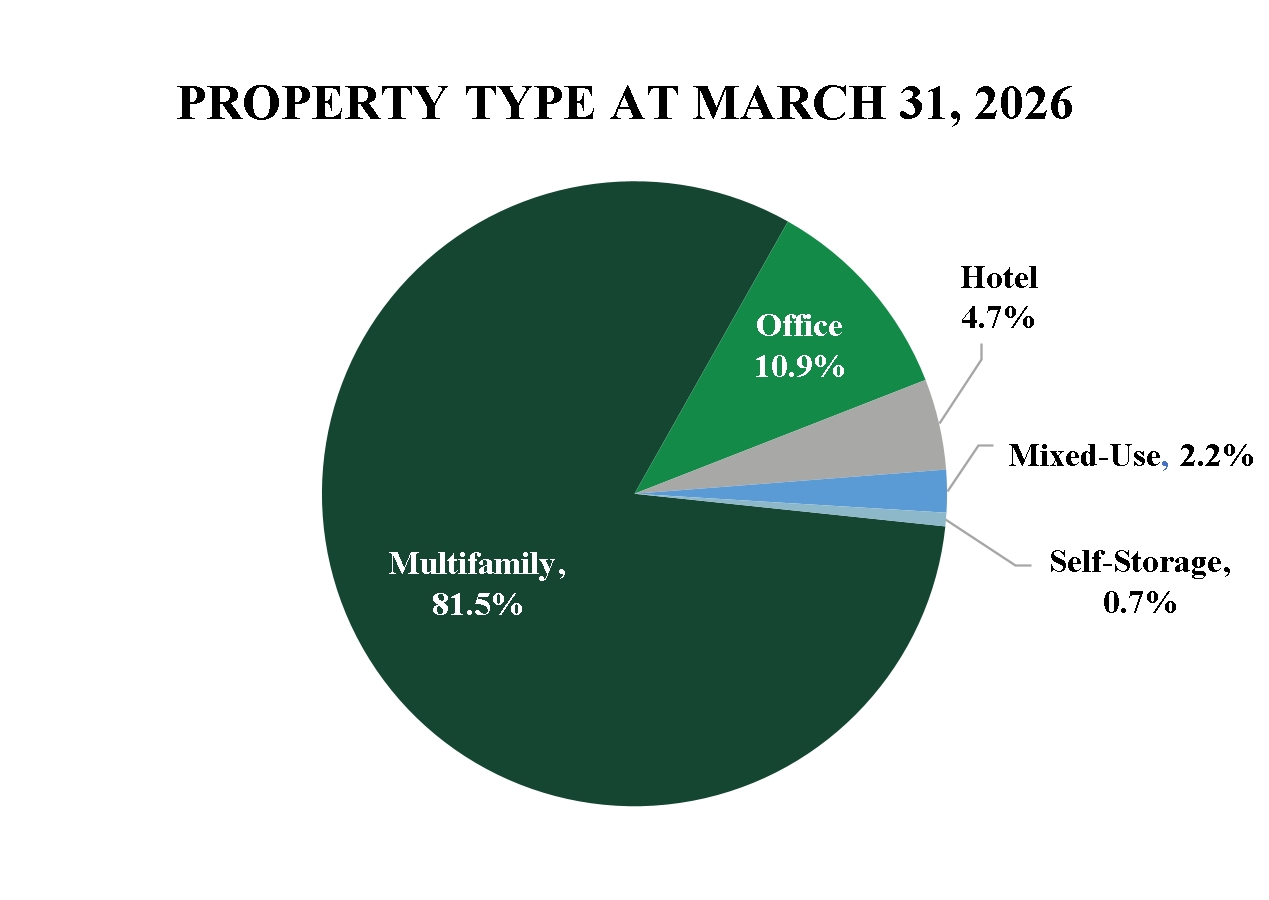
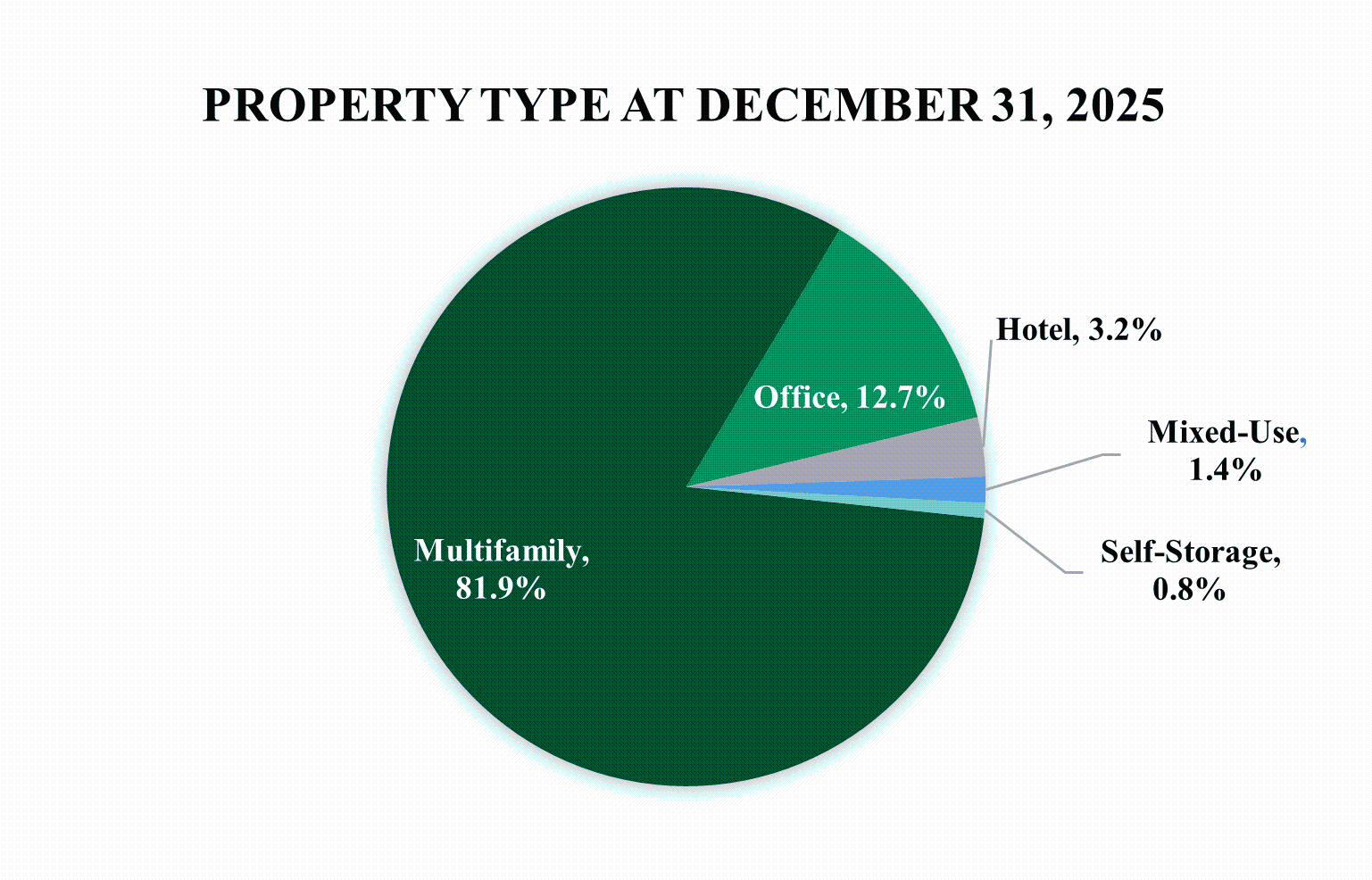
Our portfolio comprises loans with a diverse array of collateral types and locations. Multifamily continues to comprise the majority of our portfolio, with 81.5% of our portfolio allocated to multifamily at March 31, 2026 and 81.9% at December 31, 2025. The following charts show our portfolio allocation at carrying value by property type at March 31, 2026 and December 31, 2025:
From time to time, we may acquire real estate property through direct equity investments or as a result of our lending activities. We did not acquire any real estate property in the three months ended March 31, 2026.
At March 31, 2026, the net carrying value of our net real estate-related assets and liabilities was $106.3 million on five properties owned, two of which are included in investments in real estate and three of which are included in properties held for sale on our consolidated balance sheets.
We use leverage to enhance our returns. The cost of borrowings to finance our investments is a significant part of our expenses. Our net interest income depends on our ability to control these expenses relative to our revenue. Our CRE loans may initially be financed with term facilities, such as CRE loan warehouse financing facilities, in anticipation of their ultimate securitization. We ultimately seek to finance our CRE loans through the use of non-recourse long-term, match-funded CRE debt securitizations.
At March 31, 2026 and December 31, 2025, our financing arrangements were as follows (dollars in thousands):
|
|
Outstanding Borrowings |
|
|
Percentage of Borrowings |
|
||
At March 31, 2026 |
|
|
|
|
|
|
||
CRE debt securitization (1)(2) |
|
$ |
873,463 |
|
|
|
46.9 |
% |
CRE - term reinvestment financing facility (1)(3) |
|
|
709,206 |
|
|
|
38.0 |
% |
CRE - term warehouse financing facilities(1) |
|
|
18,938 |
|
|
|
1.0 |
% |
Senior secured financing facility(1) |
|
|
41,654 |
|
|
|
2.2 |
% |
Mortgage payable(1) |
|
|
20,145 |
|
|
|
1.1 |
% |
5.75% Senior Unsecured Notes |
|
|
149,717 |
|
|
|
8.0 |
% |
Unsecured junior subordinated debentures |
|
|
51,548 |
|
|
|
2.8 |
% |
Total |
|
$ |
1,864,671 |
|
|
|
100.0 |
% |
|
|
|
|
|
|
|
||
|
|
Outstanding Borrowings |
|
|
Percentage of Borrowings |
|
||
At December 31, 2025: |
|
|
|
|
|
|
||
CRE - term reinvestment financing facility (1)(2) |
|
$ |
728,167 |
|
|
|
47.1 |
% |
CRE - term warehouse financing facilities(1) |
|
|
533,862 |
|
|
|
34.6 |
% |
Senior secured financing facility(1) |
|
|
61,645 |
|
|
|
4.0 |
% |
Mortgage payable(1) |
|
|
20,185 |
|
|
|
1.3 |
% |
5.75% Senior Unsecured Notes |
|
|
149,531 |
|
|
|
9.7 |
% |
Unsecured junior subordinated debentures |
|
|
51,548 |
|
|
|
3.3 |
% |
Total |
|
$ |
1,544,938 |
|
|
|
100.0 |
% |
We reevaluate our current expected credit losses ("CECL") allowance quarterly, incorporating our current expectations of macroeconomic factors considered in the determination of our CECL reserves. At March 31, 2026, the CECL allowance on our CRE loan portfolio was $19.4 million, or 0.9% of our $2.2 billion loan portfolio. During the three months ended March 31, 2026, we recorded a reversal of credit losses primarily attributable to improvements in projected macroeconomic factors during the quarter, offset by an increase in the modeled credit risk of our loan portfolio.
At December 31, 2025, the CECL allowance on our CRE loan portfolio was $20.4 million, or 1.1% of our $1.8 billion loan portfolio. During the year ended December 31, 2025, we recorded a reversal of credit losses primarily driven by net improvements in the modeled credit risk of our loan portfolio as well as loan payoffs. These reversals were offset by a general decline in projected macroeconomic factors. We also recorded a charge-off of $4.7 million for one mezzanine loan that was fully reserved for in 2022.
Additionally, the decline in our CECL reserves from our highest reserve balance at June 30, 2020 of $61.1 million, or 3.4% of the par balance of our CRE loan portfolio, to our current reserve balance at March 31, 2026 of $19.4 million, or 0.9% of the par balance of our CRE loan portfolio, has been due to the following: the successful resolution of our individually evaluated loans with specific reserves, except for the charge-off noted above, the overall newer vintage of our CRE loan portfolio (with only 6.3% of the portfolio, at March 31, 2026, being originated prior to the fourth quarter of 2020) as well as the increased percentage allocation of our CRE loan portfolio to multifamily loans over time. Multifamily loans have historically had the lowest credit losses of any asset class, and our percentage allocation of our CRE loan portfolio to multifamily at carrying value has grown from 58.4% at June 30, 2020 to 81.5% at March 31, 2026.
Common stock book value was $29.98 per share at March 31, 2026, a $0.03 per share decrease from December 31, 2025.
Results of Operations
Our net loss allocable to common shares for the three months ended March 31, 2026 was $1.0 million or $(0.16) per share-basic ($(0.16) per share-diluted) as compared to net loss allocable to common shares for the three months ended March 31, 2025 of $5.9 million or $(0.80) per share-basic ($0.80) per share-diluted.
Net Interest Income
The following table analyzes the change in interest income and interest expense for the comparative three months ended March 31, 2026 and 2025 by changes in volume and changes in rates. The changes attributable to the combined changes in volume and rate have been allocated proportionately, based on absolute values, to the changes due to volume and changes due to rates (dollars in thousands, except amounts in footnotes):
|
|
Three Months Ended March 31, 2026 Compared to Three Months Ended March 31, 2025 |
|
|||||||||||||
|
|
|
|
|
|
|
|
Due to Changes in |
|
|||||||
|
|
Net Change |
|
|
Percent Change (1) |
|
|
Volume |
|
|
Rate |
|
||||
Increase (decrease) in interest income: |
|
|
|
|
|
|
|
|
|
|
|
|
||||
CRE whole loans (2) |
|
$ |
4,289 |
|
|
|
15 |
% |
|
$ |
8,225 |
|
|
$ |
(3,936 |
) |
CRE mezzanine loans |
|
|
(63 |
) |
|
|
(100 |
)% |
|
|
(63 |
) |
|
|
— |
|
CRE preferred equity loan |
|
|
247 |
|
|
|
100 |
% |
|
|
247 |
|
|
|
— |
|
Other |
|
|
1,161 |
|
|
|
452 |
% |
|
|
974 |
|
|
|
187 |
|
Total increase (decrease) in interest income |
|
|
5,634 |
|
|
|
20 |
% |
|
|
9,383 |
|
|
|
(3,749 |
) |
|
|
|
|
|
|
|
|
|
|
|
|
|
||||
Increase (decrease) in interest expense: |
|
|
|
|
|
|
|
|
|
|
|
|
||||
Securitized borrowings: |
|
|
|
|
|
|
|
|
|
|
|
|
||||
ACR 2026-FL4 Senior Notes |
|
|
6,292 |
|
|
|
100 |
% |
|
|
6,292 |
|
|
|
— |
|
ACR 2021-FL1 Senior Notes |
|
|
(6,535 |
) |
|
|
(100 |
)% |
|
|
(6,535 |
) |
|
|
— |
|
ACR 2021-FL2 Senior Notes |
|
|
(6,554 |
) |
|
|
(100 |
)% |
|
|
(6,554 |
) |
|
|
— |
|
Senior secured financing facility |
|
|
(167 |
) |
|
|
(11 |
)% |
|
|
(66 |
) |
|
|
(101 |
) |
CRE - term warehouse financing facilities |
|
|
1,537 |
|
|
|
60 |
% |
|
|
1,874 |
|
|
|
(337 |
) |
CRE - term reinvestment financing facility |
|
|
7,557 |
|
|
|
350 |
% |
|
|
7,779 |
|
|
|
(222 |
) |
5.75% Senior Unsecured Notes (3) |
|
|
11 |
|
|
|
— |
% |
|
|
11 |
|
|
|
— |
|
Unsecured junior subordinated debentures |
|
|
(84 |
) |
|
|
(8 |
)% |
|
|
— |
|
|
|
(84 |
) |
Hedging (4) |
|
|
(66 |
) |
|
|
(17 |
)% |
|
|
(66 |
) |
|
|
— |
|
Total increase (decrease) in interest expense |
|
|
1,991 |
|
|
|
9 |
% |
|
|
2,735 |
|
|
|
(744 |
) |
Net increase (decrease) increase in net interest income |
|
$ |
3,643 |
|
|
|
|
|
$ |
6,648 |
|
|
$ |
(3,005 |
) |
|
Net Change in Interest Income for the Comparative three months ended March 31, 2026 and 2025:
Aggregate interest income increased by $5.6 million for the comparative three months ended March 31, 2026 and 2025. We attribute the change to the following:
CRE whole loans. The increase of $4.3 million for the comparative three months ended March 31, 2026 and 2025 was primarily attributable to an increase in the daily average par value of our CRE portfolio resulting from loan production, offset by a decrease in the benchmark rate over the comparative period.
CRE mezzanine loans. The decrease of $63,000 for the comparative three months ended March 31, 2026 and 2025 was primarily attributable to the origination and payoff of a mezzanine loan during fiscal year 2025.
CRE preferred equity loan. The increase of $247,000 for the comparative three months ended March 31, 2026 and 2025 was primarily attributable to the origination of a preferred equity loan in September 2025.
Other. The increase of $1.2 million for the comparative three months ended March 31, 2026 and 2025, was primarily attributable to an increase in restricted cash from the close of our new CRE securitization, ACRES Commercial Realty 2026-FL4 Issuer, LLC ("ACR 2026-FL4"), and increase in yields on our interest earning money market accounts.
Net Change in Interest Expense for the Comparative three months ended March 31, 2026 and 2025:
Aggregate interest expense increased by $2.0 million for the comparative three months ended March 31, 2026 and 2025. We attribute the change to the following:
Securitized borrowings. The net decrease of $6.8 million for the comparative three months ended March 31, 2026 and 2025, was primarily attributable to the issuance of our ACR 2026-FL4 securitization, offset by the redemptions of our ACR 2021-FL1 and ACR 2021-FL2 securitizations and a decrease in the benchmark rate over the comparative periods.
Senior secured financing facility. The decrease of $167,000 for the comparative three months ended March 31, 2026 and 2025, was primarily attributable to a decrease in borrowings and benchmark rate over the comparative periods.
CRE - term warehouse financing facilities. The increase of $1.5 million for the comparative three months ended March 31, 2026 and 2025, was primarily attributable to an increase in the average daily borrowings balance, offset by a decrease in the benchmark rate over the comparative periods.
CRE - term reinvestment financing facility. The increase of $7.6 million was attributable to the close of our new CRE term reinvestment financing facility in March 2025.
Unsecured junior subordinated debentures. The decrease of $84,000 for the comparative three months ended March 31, 2026 and 2025, was primarily attributable to a decrease in the benchmark rate over the comparative periods.
Average Net Yield and Average Cost of Funds:
The following table presents the average net yield and average cost of funds for the three months ended March 31, 2026 and 2025 (dollars in thousands, except amounts in footnotes):
|
|
Three Months Ended March 31, 2026 |
|
|
Three Months Ended March 31, 2025 |
|
||||||||||||||||||
|
|
Average Amortized Cost |
|
|
Interest Income (Expense) |
|
|
Average Net Yield (Cost of Funds) (1) |
|
|
Average Amortized Cost |
|
|
Interest Income (Expense) |
|
|
Average Net Yield (Cost of Funds) (1) |
|
||||||
Interest-earning assets |
|
|
|
|
|
|
|
|
|
|
|
|
|
|
|
|
|
|
||||||
CRE whole loans, floating-rate (2) |
|
$ |
1,848,878 |
|
|
$ |
32,694 |
|
|
|
7.17 |
% |
|
$ |
1,408,582 |
|
|
$ |
28,406 |
|
|
|
8.18 |
% |
CRE mezzanine loans |
|
|
— |
|
|
|
— |
|
|
|
— |
% |
|
|
6,367 |
|
|
|
63 |
|
|
|
3.93 |
% |
CRE preferred equity loan |
|
|
9,675 |
|
|
|
248 |
|
|
|
10.38 |
% |
|
|
— |
|
|
|
— |
|
|
|
— |
% |
Other |
|
|
138,052 |
|
|
|
1,418 |
|
|
|
4.17 |
% |
|
|
37,834 |
|
|
|
257 |
|
|
|
2.76 |
% |
Total interest income/average net yield |
|
|
1,996,605 |
|
|
|
34,360 |
|
|
|
6.98 |
% |
|
|
1,452,783 |
|
|
|
28,726 |
|
|
|
8.02 |
% |
Interest-bearing liabilities |
|
|
|
|
|
|
|
|
|
|
|
|
|
|
|
|
|
|
||||||
Collateralized by: |
|
|
|
|
|
|
|
|
|
|
|
|
|
|
|
|
|
|
||||||
CRE whole loans (3) |
|
|
1,484,707 |
|
|
|
(21,425 |
) |
|
|
(5.85 |
)% |
|
|
1,019,882 |
|
|
|
(19,295 |
) |
|
|
(7.67 |
)% |
General corporate debt: |
|
|
|
|
|
|
|
|
|
|
|
|
|
|
|
|
|
|
||||||
5.75% Senior Unsecured Notes (4) |
|
|
149,625 |
|
|
|
(2,342 |
) |
|
|
(6.35 |
)% |
|
|
148,902 |
|
|
|
(2,331 |
) |
|
|
(6.35 |
)% |
Unsecured junior subordinated debentures |
|
|
51,548 |
|
|
|
(1,020 |
) |
|
|
(7.92 |
)% |
|
|
51,548 |
|
|
|
(1,104 |
) |
|
|
(8.57 |
)% |
Hedging (5) |
|
|
— |
|
|
|
(327 |
) |
|
|
— |
% |
|
|
— |
|
|
|
(393 |
) |
|
|
— |
% |
Total interest expense/average cost of funds |
|
|
1,685,880 |
|
|
|
(25,114 |
) |
|
|
(5.96 |
)% |
|
|
1,220,332 |
|
|
|
(23,123 |
) |
|
|
(7.55 |
)% |
Total net interest income |
|
|
|
|
$ |
9,246 |
|
|
|
|
|
|
|
|
$ |
5,603 |
|
|
|
|
||||
Real Estate Income and Other Revenue
The following table sets forth information relating to our real estate income and other revenue for the periods presented (dollars in thousands):
|
|
For the Three Months Ended March 31, |
|
|
|
|
|
|
|
|||||||
|
|
2026 |
|
|
2025 |
|
|
Dollar Change |
|
|
Percent Change |
|
||||
Real estate income and other revenue: |
|
|
|
|
|
|
|
|
|
|
|
|
||||
Real estate income |
|
$ |
8,547 |
|
|
$ |
11,366 |
|
|
$ |
(2,819 |
) |
|
|
(25 |
)% |
Other revenue |
|
|
31 |
|
|
|
33 |
|
|
|
(2 |
) |
|
|
— |
% |
Total |
|
$ |
8,578 |
|
|
$ |
11,399 |
|
|
$ |
(2,821 |
) |
|
|
(25 |
)% |
Aggregate real estate income and other revenue decreased by $2.8 million for the comparative three months ended March 31, 2026 and 2025. The decrease in the comparative three months was attributed to: (i) a decrease in revenue related to a student housing property that was sold in September 2025, and (ii) a decrease in revenue at an office property that was sold in December 2025, partially offset by an increase in revenues at a hotel property in the northeast region that had increased occupancy and rates in the comparative period.
Operating Expenses
The following table sets forth information relating to our operating expenses for the periods presented (dollars in thousands):
|
|
For the Three Months Ended March 31, |
|
|
|
|
|
|
|
|||||||
|
|
2026 |
|
|
2025 |
|
|
Dollar Change |
|
|
Percent Change |
|
||||
Operating expenses: |
|
|
|
|
|
|
|
|
|
|
|
|
||||
General and administrative |
|
$ |
3,036 |
|
|
$ |
3,159 |
|
|
$ |
(123 |
) |
|
|
(4 |
)% |
Real estate expenses |
|
|
9,710 |
|
|
|
13,342 |
|
|
|
(3,632 |
) |
|
|
(27 |
)% |
Management fees - related party |
|
|
1,561 |
|
|
|
1,631 |
|
|
|
(70 |
) |
|
|
(4 |
)% |
Equity compensation - related party |
|
|
540 |
|
|
|
815 |
|
|
|
(275 |
) |
|
|
(34 |
)% |
Corporate depreciation and amortization |
|
|
19 |
|
|
|
18 |
|
|
|
1 |
|
|
|
6 |
% |
Reversal of credit losses, net |
|
|
(967 |
) |
|
|
(1,717 |
) |
|
|
750 |
|
|
|
(44 |
)% |
Total |
|
$ |
13,899 |
|
|
$ |
17,248 |
|
|
$ |
(3,349 |
) |
|
|
(19 |
)% |
Aggregate operating expenses decreased by $3.3 million for the comparative three months ended March 31, 2026 and 2025. We attribute the changes to the following:
General and administrative. General and administrative expenses decreased by $123,000 for the comparative three months ended March 31, 2026 and 2025. The following table summarizes the information relating to our general and administrative expenses for the periods presented (dollars in thousands):
|
|
For the Three Months Ended March 31, |
|
|
|
|
|
|
|
|||||||
|
|
2026 |
|
|
2025 |
|
|
Dollar Change |
|
|
Percent Change |
|
||||
General and administrative |
|
|
|
|
|
|
|
|
|
|
|
|
||||
Professional services |
|
$ |
1,554 |
|
|
$ |
1,707 |
|
|
$ |
(153 |
) |
|
|
(9 |
)% |
Wages and benefits |
|
|
370 |
|
|
|
427 |
|
|
|
(57 |
) |
|
|
(13 |
)% |
D&O insurance |
|
|
242 |
|
|
|
242 |
|
|
|
- |
|
|
|
(— |
)% |
Operating expenses |
|
|
347 |
|
|
|
254 |
|
|
|
93 |
|
|
|
37 |
% |
Dues and subscriptions |
|
|
184 |
|
|
|
217 |
|
|
|
(33 |
) |
|
|
(15 |
)% |
Director fees |
|
|
204 |
|
|
|
204 |
|
|
|
— |
|
|
|
(— |
)% |
Tax penalties, interest & franchise tax |
|
|
100 |
|
|
|
88 |
|
|
|
12 |
|
|
|
14 |
% |
Travel |
|
|
35 |
|
|
|
20 |
|
|
|
15 |
|
|
|
75 |
% |
Total |
|
$ |
3,036 |
|
|
$ |
3,159 |
|
|
$ |
(123 |
) |
|
|
(4 |
)% |
The decrease in general and administrative expense for the comparative three months ended March 31, 2026 and 2025 was primarily attributable to decreased professional services related to consulting fees being paid in the first quarter of 2025 that related to prior year services.
Real estate expenses. The decrease of $3.6 million for the comparative three months ended March 31, 2026 was primarily related to (i) a decrease in expenses related to a student housing property that was sold in September 2025, (ii) a decrease in expenses at an office property that was sold in December 2025, and (iii) a decrease in expenses at a student housing property related to a decrease in marketing and other operating expenses in the comparative periods.
Equity compensation - related party. The decrease in equity compensation - related party of $275,000 is related to the amortization of unvested shares. The unvested share balance decreased period over period due to a portion of shares vesting in May 2025, thus decreasing amortization related to unvested shares in the comparable periods.
Reversal of credit losses. The decrease in the reversal for credit losses of $750,000 for the comparative three months ended March 31, 2026 was primarily driven by improvements in projected macroeconomic factors during the quarter, offset by an increase in the modeled credit risk of our loan portfolio.
Other Income (Expense)
The following table sets forth information relating to our other income (expense) incurred for the periods presented (dollars in thousands):
|
|
For the Three Months Ended March 31, |
|
|
|
|
|
|
|
|||||||
|
|
2026 |
|
|
2025 |
|
|
Dollar Change |
|
|
Percent Change |
|
||||
Other income (expense): |
|
|
|
|
|
|
|
|
|
|
|
|
||||
Equity in income (losses) of unconsolidated subsidiaries |
|
$ |
245 |
|
|
$ |
(492 |
) |
|
$ |
737 |
|
|
|
150 |
% |
Gain on sale of investment in real estate |
|
|
3,336 |
|
|
|
— |
|
|
|
3,336 |
|
|
|
100 |
% |
Other income |
|
|
23 |
|
|
|
84 |
|
|
|
(61 |
) |
|
|
(73 |
)% |
Total |
|
$ |
3,604 |
|
|
$ |
(408 |
) |
|
$ |
4,012 |
|
|
|
983 |
% |
Aggregate other income (expense) increased $4.0 million for the comparative three months ended March 31, 2026 and 2025. We attribute the change to the following:
Equity in income (losses) of unconsolidated subsidiaries. The increase of $737,000 for the comparative three months ended March 31, 2026 and 2025 was primarily related to recognizing income at one unconsolidated entity, which is partially offset by loss recognition at two other unconsolidated entities. The two unconsolidated entities with losses are off-balance sheet and losses are only recognized when contributions are made.
Gain on sale of investment in real estate. The increase of $3.3 million for the comparative three months ended March 31, 2026 and 2025 was primarily attributed to the sale of a property generating a gain of $3.3 million in the first quarter of 2026 compared to no sales on real estate in the first quarter of 2025.
Financial Condition
Summary
Our total assets were $2.5 billion and $2.2 billion at March 31, 2026 and December 31, 2025, respectively.
Investment Portfolio
The tables below summarize the amortized cost and net carrying amount of our investment portfolio, classified by asset type, at March 31, 2026 and December 31, 2025 as follows (dollars in thousands, except amounts in footnotes):
At March 31, 2026 |
|
Amortized Cost |
|
|
Net Carrying Amount (1) |
|
|
Percent of Portfolio |
|
|
Weighted Average Coupon |
|||
Loans held for investment: |
|
|
|
|
|
|
|
|
|
|
|
|||
CRE whole loans |
|
$ |
2,193,165 |
|
|
$ |
2,173,945 |
|
|
|
93.73 |
% |
|
7.12% |
CRE preferred equity investment |
|
|
9,672 |
|
|
|
9,461 |
|
|
|
0.41 |
% |
|
10.00% |
|
|
|
2,202,837 |
|
|
|
2,183,406 |
|
|
|
94.14 |
% |
|
|
Other investments: |
|
|
|
|
|
|
|
|
|
|
|
|||
Investments in unconsolidated entities |
|
|
29,722 |
|
|
|
29,722 |
|
|
|
1.28 |
% |
|
N/A(4) |
Investments in real estate(2) |
|
|
38,752 |
|
|
|
38,752 |
|
|
|
1.67 |
% |
|
N/A(4) |
Properties held for sale(3) |
|
|
67,523 |
|
|
|
67,523 |
|
|
|
2.91 |
% |
|
N/A(4) |
|
|
|
135,997 |
|
|
|
135,997 |
|
|
|
5.86 |
% |
|
|
|
|
|
|
|
|
|
|
|
|
|
|
|||
Total investment portfolio |
|
$ |
2,338,834 |
|
|
$ |
2,319,403 |
|
|
|
100.00 |
% |
|
|
|
|
|
|
|
|
|
|
|
|
|
|
|||
|
|
|
|
|
|
|
|
|
|
|
|
|||
At December 31, 2025 |
|
Amortized Cost |
|
|
Net Carrying Amount (1) |
|
|
Percent of Portfolio |
|
|
Weighted Average Coupon |
|||
Loans held for investment: |
|
|
|
|
|
|
|
|
|
|
|
|||
CRE whole loans |
|
$ |
1,820,942 |
|
|
$ |
1,800,784 |
|
|
|
91.74 |
% |
|
7.32% |
CRE preferred equity investment |
|
|
9,425 |
|
|
|
9,185 |
|
|
|
0.47 |
% |
|
10.00% |
|
|
|
1,830,367 |
|
|
|
1,809,969 |
|
|
|
92.21 |
% |
|
|
Other investments: |
|
|
|
|
|
|
|
|
|
|
|
|||
Investments in unconsolidated entities |
|
|
29,237 |
|
|
|
29,237 |
|
|
|
1.49 |
% |
|
N/A(4) |
Investments in real estate(2) |
|
|
56,277 |
|
|
|
56,277 |
|
|
|
2.86 |
% |
|
N/A(4) |
Properties held for sale(3) |
|
|
67,509 |
|
|
|
67,509 |
|
|
|
3.44 |
% |
|
N/A(4) |
|
|
|
153,023 |
|
|
|
153,023 |
|
|
|
7.79 |
% |
|
|
|
|
|
|
|
|
|
|
|
|
|
|
|||
Total investment portfolio |
|
$ |
1,983,390 |
|
|
$ |
1,962,992 |
|
|
|
100.00 |
% |
|
|
CRE loans. During the three months ended March 31, 2026, we originated nine new CRE floating-rate whole loans, purchased one new CRE floating-rate whole loan and purchased a participation in an existing CRE floating-rate whole loan, with total commitments of $495.6 million of floating-rate CRE whole loan commitments and funded $13.6 million of loan commitments. These increases were offset by $110.6 million in proceeds from loan payoffs and sales and unfunded loan commitments of $24.2 million, producing a net increase of $374.4 million in the par balance of the portfolio.
The following is a summary of our loans (dollars in thousands, except amounts in footnotes):
Description |
|
Quantity |
|
Principal |
|
|
Unamortized (Discount) Premium, net (1) |
|
|
Amortized Cost |
|
|
Allowance for Credit Losses |
|
|
Carrying Value |
|
|
Contractual Interest Rates (2) |
|
Maturity Dates (3)(4) |
|||||
At March 31, 2026: |
|
|
|
|
|
|
|
|
|
|
|
|
|
|
|
|
|
|
|
|
|
|||||
Whole loans (5)(6)(7) |
|
60 |
|
$ |
2,202,675 |
|
|
$ |
(9,510 |
) |
|
$ |
2,193,165 |
|
|
$ |
(19,220 |
) |
|
$ |
2,173,945 |
|
|
1M Term SOFR + 2.50% to 1M Term SOFR + 7.00% |
|
April 2026 to May 2030 |
Preferred equity investment (see Note 3) (8) |
|
|
|
|
9,750 |
|
|
|
(78 |
) |
|
|
9,672 |
|
|
|
(211 |
) |
|
|
9,461 |
|
|
10.00% |
|
October 2028 |
Total |
|
|
|
$ |
2,212,425 |
|
|
$ |
(9,588 |
) |
|
$ |
2,202,837 |
|
|
$ |
(19,431 |
) |
|
$ |
2,183,406 |
|
|
|
|
|
|
|
|
|
|
|
|
|
|
|
|
|
|
|
|
|
|
|
|
|
|
|
|||||
At December 31, 2025: |
|
|
|
|
|
|
|
|
|
|
|
|
|
|
|
|
|
|
|
|
|
|||||
Whole loans (5)(6)(7) |
|
53 |
|
$ |
1,828,299 |
|
|
$ |
(7,357 |
) |
|
$ |
1,820,942 |
|
|
$ |
(20,158 |
) |
|
$ |
1,800,784 |
|
|
1M Term SOFR + 2.50% to 1M Term SOFR + 7.00% |
|
January 2026 to May 2030 |
Preferred equity investment (see Note 3) (8) |
|
|
|
|
9,511 |
|
|
|
(86 |
) |
|
|
9,425 |
|
|
|
(240 |
) |
|
|
9,185 |
|
|
10.00% |
|
October 2028 |
Total |
|
|
|
$ |
1,837,810 |
|
|
$ |
(7,443 |
) |
|
$ |
1,830,367 |
|
|
$ |
(20,398 |
) |
|
$ |
1,809,969 |
|
|
|
|
|
At March 31, 2026, 19.0%, 16.9% and 14.1% of our CRE loan portfolio based on carrying value was concentrated in the Southeast, Southwest and East North Central regions, respectively, as defined by the NCREIF. At December 31, 2025, 24.2%, 20.6% and 14.0% of our CRE loan portfolio based on carrying value was concentrated in the Southwest, Southeast, and Pacific regions, respectively. At March 31, 2026 and December 31, 2025, no single loan or investment group represented more than 10% of our total assets and one investment group generated 12% and 14% of our revenue, respectively.
Investments in unconsolidated entities.
The following table summarizes our investments in unconsolidated entities at March 31, 2026 and December 31, 2025 and equity in earnings (losses) of unconsolidated entities for the three months ended March 31, 2026 and 2025 (dollars in thousands, except in the footnotes):
|
|
|
|
|
|
|
|
|
|
|
Earnings (Losses) of Unconsolidated Entities |
|||||||||
|
|
Ownership % |
|
|
|
For the Three Months Ended March 31, |
|
|
||||||||||||
|
|
at March 31, 2026 |
|
March 31, 2026 |
|
|
December 31, 2025 |
|
|
|
2026 |
|
|
2025 |
|
|
||||
Unsecured Junior Subordinated Debentures(1) |
|
3% |
|
$ |
1,548 |
|
|
$ |
1,548 |
|
|
|
$ |
— |
|
|
$ |
— |
|
|
65 E. Wacker Joint Venture, LLC |
|
90% |
|
|
28,174 |
|
|
|
27,689 |
|
|
|
|
484 |
|
|
|
(188 |
) |
|
7720 McCallum JV, LLC |
|
50% |
|
|
— |
|
|
|
— |
|
|
|
|
(108 |
) |
|
|
(304 |
) |
|
Pacmulti Affiliates JV, LLC |
|
50% |
|
|
— |
|
|
|
— |
|
|
|
|
(131 |
) |
|
|
— |
|
|
Total |
|
|
|
$ |
29,722 |
|
|
$ |
29,237 |
|
|
|
$ |
245 |
|
|
$ |
(492 |
) |
|
We record our investments in RCT I’s and RCT II’s common shares as investments in unconsolidated entities using the cost method. We record our investment in the Wacker JV, the McCallum JV and the Pacmulti JV as equity method investments.
Investments in real estate and properties held for sale. At March 31, 2026, we held investments in five real estate properties, two of which are included in investments in real estate and three of which are included in properties held for sale on the consolidated balance sheets. We sold a property in March 2026 for $20.0 million, generating a gain on sale of $3.3 million, net of selling costs.
The following table summarizes the book value of our investments in real estate and related intangible assets at March 31, 2026 and December 31, 2025 (in thousands, except amounts in the footnotes):
|
|
March 31, 2026 |
|
|
December 31, 2025 |
|
||||||||||||||||||
|
|
Cost Basis |
|
|
Accumulated Depreciation & Amortization |
|
|
Carrying Value |
|
|
Cost Basis |
|
|
Accumulated Depreciation & Amortization |
|
|
Carrying Value |
|
||||||
Assets acquired: |
|
|
|
|
|
|
|
|
|
|
|
|
|
|
|
|
|
|
||||||
Investments in real estate, equity: |
|
|
|
|
|
|
|
|
|
|
|
|
|
|
|
|
|
|
||||||
Investments in real estate (1) |
|
$ |
58,070 |
|
|
$ |
(8,378 |
) |
|
$ |
49,692 |
|
|
$ |
74,468 |
|
|
$ |
(7,797 |
) |
|
$ |
66,671 |
|
Right of use assets (2)(3) |
|
|
19,664 |
|
|
|
(1,091 |
) |
|
|
18,573 |
|
|
|
19,665 |
|
|
|
(1,024 |
) |
|
|
18,641 |
|
Intangible assets (4) |
|
|
9,469 |
|
|
|
(3,529 |
) |
|
|
5,940 |
|
|
|
9,469 |
|
|
|
(3,342 |
) |
|
|
6,127 |
|
Subtotal |
|
|
87,203 |
|
|
|
(12,998 |
) |
|
|
74,205 |
|
|
|
103,602 |
|
|
|
(12,163 |
) |
|
|
91,439 |
|
|
|
|
|
|
|
|
|
|
|
|
|
|
|
|
|
|
|
|
||||||
Investments in real estate from lending activities: |
|
|
|
|
|
|
|
|
|
|
|
|
|
|
|
|
|
|
||||||
Investments in real estate (1) |
|
|
10,025 |
|
|
|
(335 |
) |
|
|
9,690 |
|
|
|
10,025 |
|
|
|
(281 |
) |
|
|
9,744 |
|
Right of use assets (2)(3) |
|
|
399 |
|
|
|
(76 |
) |
|
|
323 |
|
|
|
399 |
|
|
|
(63 |
) |
|
|
336 |
|
Intangible assets (4) |
|
|
364 |
|
|
|
(304 |
) |
|
|
60 |
|
|
|
364 |
|
|
|
(270 |
) |
|
|
94 |
|
Subtotal |
|
|
10,788 |
|
|
|
(715 |
) |
|
|
10,073 |
|
|
|
10,788 |
|
|
|
(614 |
) |
|
|
10,174 |
|
|
|
|
|
|
|
|
|
|
|
|
|
|
|
|
|
|
|
|
||||||
Properties held for sale (5) |
|
|
90,851 |
|
|
|
— |
|
|
|
90,851 |
|
|
|
90,825 |
|
|
|
— |
|
|
|
90,825 |
|
Total |
|
$ |
188,842 |
|
|
$ |
(13,713 |
) |
|
$ |
175,129 |
|
|
$ |
205,215 |
|
|
$ |
(12,777 |
) |
|
$ |
192,438 |
|
|
|
|
|
|
|
|
|
|
|
|
|
|
|
|
|
|
|
|
||||||
Liabilities assumed: |
|
|
|
|
|
|
|
|
|
|
|
|
|
|
|
|
|
|
||||||
Investments in real estate, equity: |
|
|
|
|
|
|
|
|
|
|
|
|
|
|
|
|
|
|
||||||
Mortgage payables |
|
$ |
19,525 |
|
|
$ |
620 |
|
|
$ |
20,145 |
|
|
$ |
19,565 |
|
|
$ |
620 |
|
|
$ |
20,185 |
|
Lease liabilities (3)(6) |
|
|
45,145 |
|
|
|
— |
|
|
|
45,145 |
|
|
|
44,958 |
|
|
|
— |
|
|
|
44,958 |
|
Subtotal |
|
|
64,670 |
|
|
|
620 |
|
|
|
65,290 |
|
|
|
64,523 |
|
|
|
620 |
|
|
|
65,143 |
|
|
|
|
|
|
|
|
|
|
|
|
|
|
|
|
|
|
|
|
||||||
Investments in real estate from lending activities: |
|
|
|
|
|
|
|
|
|
|
|
|
|
|
|
|
|
|
||||||
Other liabilities |
|
|
41 |
|
|
|
(41 |
) |
|
|
— |
|
|
|
41 |
|
|
|
(41 |
) |
|
|
— |
|
Lease liabilities (3)(6) |
|
|
380 |
|
|
|
— |
|
|
|
380 |
|
|
|
378 |
|
|
|
— |
|
|
|
378 |
|
Subtotal |
|
|
421 |
|
|
|
(41 |
) |
|
|
380 |
|
|
|
419 |
|
|
|
(41 |
) |
|
|
378 |
|
|
|
|
|
|
|
|
|
|
|
|
|
|
|
|
|
|
|
|
||||||
Liabilities held for sale (7) |
|
|
3,181 |
|
|
|
— |
|
|
|
3,181 |
|
|
|
3,131 |
|
|
|
— |
|
|
|
3,131 |
|
Total |
|
$ |
68,272 |
|
|
$ |
579 |
|
|
$ |
68,851 |
|
|
$ |
68,073 |
|
|
$ |
579 |
|
|
$ |
68,652 |
|
|
|
|
|
|
|
|
|
|
|
|
|
|
|
|
|
|
|
|
||||||
Total net investments in real estate and properties held for sale (8) |
|
$ |
120,570 |
|
|
|
|
|
$ |
106,278 |
|
|
$ |
137,142 |
|
|
|
|
|
$ |
123,786 |
|
||
Financing Receivables
Current market conditions have resulted in, and may continue to result in, a dislocation in capital markets, declining real estate values of certain asset classes and increased delinquencies and defaults, resulting in increased loan modifications, increased allowances for credit losses and an increased risk to borrowers of foreclosure actions. We routinely employ rigorous risk management and underwriting practices to proactively evaluate and maintain the credit quality of our CRE loan portfolio and work closely with our borrowers to mitigate potential losses.
The following table shows the activity in the allowance for credit losses for the three months ended March 31, 2026 and year ended December 31, 2025 (in thousands):
|
|
Three Months Ended March 31, 2026 |
|
|
Year Ended December 31, 2025 |
|
||
Allowance for credit losses at beginning of period |
|
$ |
20,398 |
|
|
$ |
32,847 |
|
(Reversal of) provision for credit losses |
|
|
(967 |
) |
|
|
(7,749 |
) |
Charge-offs |
|
|
— |
|
|
|
(4,700 |
) |
Allowance for credit losses at end of period |
|
$ |
19,431 |
|
|
$ |
20,398 |
|
During the three months ended March 31, 2026, we recorded a reversal of expected credit losses of $967,000, primarily attributable to improvements in projected macroeconomic factors during the quarter, offset by an increase in modeled credit risk of our loan portfolio.
At both March 31, 2026 and December 31, 2025, we were not required to individually evaluate any CRE loans for credit loss.
Credit quality indicators
Commercial Real Estate Loans
CRE loans are collateralized by a diversified mix of real estate properties and are assessed for credit quality based on the collective evaluation of several factors, including but not limited to: collateral performance relative to underwritten plan, time since origination, current implied and/or re-underwritten loan-to-collateral value ("LTV") ratios, loan structure and exit plan. Depending on the loan’s performance against these various factors, loans are rated on a scale from 1 to 5, with loans rated 1 representing loans with the highest credit quality and loans rated 5 representing the loans with the lowest credit quality. Loans are typically rated a 2 at origination. The factors evaluated provide general criteria to monitor credit migration in our loan portfolio; as such, a loan’s rating may improve or worsen, depending on new information received.
The criteria set forth below should be used as general guidelines and, therefore, not every loan will have all of the characteristics described in each category below.
Risk Rating |
|
Risk Characteristics |
|
|
|
1 |
|
• Property performance has surpassed underwritten expectations. |
|
|
• Occupancy is stabilized, the property has had a history of consistently high occupancy, and the property has a diverse and high quality tenant mix. |
|
|
|
2 |
|
• Property performance is consistent with underwritten expectations and covenants and performance criteria are being met or exceeded. |
|
|
• Occupancy is stabilized, near stabilized or is on track with underwriting. |
|
|
|
3 |
|
• Property performance lags behind underwritten expectations. |
|
|
• Occupancy is not stabilized and the property has some tenancy rollover. |
|
|
|
4 |
|
• Property performance significantly lags behind underwritten expectations. Performance criteria and loan covenants have required occasional waivers. |
|
|
• Occupancy is not stabilized and the property has a large amount of tenancy rollover. |
|
|
|
5 |
|
• Property performance is significantly worse than underwritten expectations. The loan is not in compliance with loan covenants and performance criteria and may be in default. Expected sale proceeds would not be sufficient to pay off the loan at maturity. |
|
|
• The property has a material vacancy rate and significant rollover of remaining tenants. |
|
|
• An updated appraisal is required upon designation and updated on an as-needed basis. |
All CRE loans are evaluated for any credit deterioration by debt asset management and certain finance personnel on at least a quarterly basis. Mezzanine loans and preferred equity investments may have experienced greater credit risks due to their nature as subordinated investments.
For the purpose of calculating the quarterly provision for credit losses under CECL, we pool CRE loans based on the underlying collateral property type and utilize a probability of default and loss given default methodology for approximately one year after which we immediately revert to a historical mean loss ratio.
Credit risk profiles of CRE loans at amortized cost were as follows (in thousands, except amounts in the footnotes):
|
|
Rating 1 |
|
|
Rating 2 |
|
|
Rating 3 |
|
|
Rating 4 |
|
|
Rating 5 |
|
|
Total (1) |
|
||||||
At March 31, 2026: |
|
|
|
|
|
|
|
|
|
|
|
|
|
|
|
|
|
|
||||||
Whole loans |
|
$ |
28,154 |
|
|
$ |
1,323,792 |
|
|
$ |
455,317 |
|
|
$ |
380,288 |
|
|
$ |
5,614 |
|
|
$ |
2,193,165 |
|
Preferred equity investment |
|
|
— |
|
|
|
9,672 |
|
|
|
— |
|
|
|
— |
|
|
|
— |
|
|
|
9,672 |
|
Total |
|
$ |
28,154 |
|
|
$ |
1,333,464 |
|
|
$ |
455,317 |
|
|
$ |
380,288 |
|
|
$ |
5,614 |
|
|
$ |
2,202,837 |
|
|
|
|
|
|
|
|
|
|
|
|
|
|
|
|
|
|
|
|
||||||
|
|
|
|
|
|
|
|
|
|
|
|
|
|
|
|
|
|
|
||||||
At December 31, 2025: |
|
|
|
|
|
|
|
|
|
|
|
|
|
|
|
|
|
|
||||||
Whole loans |
|
$ |
28,137 |
|
|
$ |
938,416 |
|
|
$ |
470,871 |
|
|
$ |
377,904 |
|
|
$ |
5,614 |
|
|
$ |
1,820,942 |
|
Preferred equity investment |
|
|
— |
|
|
|
9,425 |
|
|
|
— |
|
|
|
— |
|
|
|
— |
|
|
|
9,425 |
|
Total |
|
$ |
28,137 |
|
|
$ |
947,841 |
|
|
$ |
470,871 |
|
|
$ |
377,904 |
|
|
$ |
5,614 |
|
|
$ |
1,830,367 |
|
Credit risk profiles of CRE loans by origination year at amortized cost were as follows (in thousands, except amounts in footnotes):
|
|
2026 |
|
|
2025 (1) |
|
|
2024 (2) |
|
|
2023 |
|
|
2022 |
|
|
Prior |
|
|
Total (3) |
|
|||||||
At March 31, 2026: |
|
|
|
|
|
|
|
|
|
|
|
|
|
|
|
|
|
|
|
|
|
|||||||
Whole loans: (4) |
|
|
|
|
|
|
|
|
|
|
|
|
|
|
|
|
|
|
|
|
|
|||||||
Rating 1 |
|
$ |
— |
|
|
$ |
— |
|
|
$ |
— |
|
|
$ |
— |
|
|
$ |
— |
|
|
$ |
28,154 |
|
|
$ |
28,154 |
|
Rating 2 |
|
|
406,943 |
|
|
|
625,955 |
|
|
|
27,021 |
|
|
|
29,359 |
|
|
|
— |
|
|
|
234,514 |
|
|
|
1,323,792 |
|
Rating 3 |
|
|
16,605 |
|
|
|
10,286 |
|
|
|
— |
|
|
|
— |
|
|
|
202,888 |
|
|
|
225,538 |
|
|
|
455,317 |
|
Rating 4 |
|
|
— |
|
|
|
139,700 |
|
|
|
87,786 |
|
|
|
15,996 |
|
|
|
91,718 |
|
|
|
45,088 |
|
|
|
380,288 |
|
Rating 5 |
|
|
— |
|
|
|
— |
|
|
|
— |
|
|
|
— |
|
|
|
— |
|
|
|
5,614 |
|
|
|
5,614 |
|
Total whole loans |
|
|
423,548 |
|
|
|
775,941 |
|
|
|
114,807 |
|
|
|
45,355 |
|
|
|
294,606 |
|
|
|
538,908 |
|
|
|
2,193,165 |
|
Preferred equity investment (rating 2) |
|
|
— |
|
|
|
9,672 |
|
|
|
— |
|
|
|
— |
|
|
|
— |
|
|
|
— |
|
|
|
9,672 |
|
Total loans |
|
$ |
423,548 |
|
|
$ |
785,613 |
|
|
$ |
114,807 |
|
|
$ |
45,355 |
|
|
$ |
294,606 |
|
|
$ |
538,908 |
|
|
$ |
2,202,837 |
|
Current Period Gross Write-Offs |
|
$ |
— |
|
|
$ |
— |
|
|
$ |
— |
|
|
$ |
— |
|
|
$ |
— |
|
|
$ |
— |
|
|
$ |
— |
|
|
|
|
|
|
|
|
|
|
|
|
|
|
|
|
|
|
|
|
|
|
|
|||||||
|
|
|
|
|
|
|
|
|
|
|
|
|
|
|
|
|
|
|
|
|
|
|||||||
|
|
2025 (1) |
|
|
2024 (2) |
|
|
2023 |
|
|
2022 |
|
|
2021 |
|
|
Prior |
|
|
Total (3) |
|
|||||||
At December 31, 2025: |
|
|
|
|
|
|
|
|
|
|
|
|
|
|
|
|
|
|
|
|
|
|||||||
Whole loans: (4) |
|
|
|
|
|
|
|
|
|
|
|
|
|
|
|
|
|
|
|
|
|
|||||||
Rating 1 |
|
$ |
— |
|
|
$ |
— |
|
|
$ |
— |
|
|
$ |
— |
|
|
$ |
28,137 |
|
|
$ |
— |
|
|
$ |
28,137 |
|
Rating 2 |
|
|
649,712 |
|
|
|
22,249 |
|
|
|
49,376 |
|
|
|
— |
|
|
|
203,263 |
|
|
|
13,816 |
|
|
|
938,416 |
|
Rating 3 |
|
|
10,283 |
|
|
|
— |
|
|
|
— |
|
|
|
235,271 |
|
|
|
214,356 |
|
|
|
10,961 |
|
|
|
470,871 |
|
Rating 4 |
|
|
137,906 |
|
|
|
87,370 |
|
|
|
15,991 |
|
|
|
91,675 |
|
|
|
— |
|
|
|
44,962 |
|
|
|
377,904 |
|
Rating 5 |
|
|
— |
|
|
|
— |
|
|
|
— |
|
|
|
— |
|
|
|
— |
|
|
|
5,614 |
|
|
|
5,614 |
|
Total whole loans |
|
|
797,901 |
|
|
|
109,619 |
|
|
|
65,367 |
|
|
|
326,946 |
|
|
|
445,756 |
|
|
|
75,353 |
|
|
|
1,820,942 |
|
Preferred equity investment (rating 2) |
|
|
9,425 |
|
|
|
— |
|
|
|
— |
|
|
|
— |
|
|
|
— |
|
|
|
— |
|
|
|
9,425 |
|
Total loans |
|
$ |
807,326 |
|
|
$ |
109,619 |
|
|
$ |
65,367 |
|
|
$ |
326,946 |
|
|
$ |
445,756 |
|
|
$ |
75,353 |
|
|
$ |
1,830,367 |
|
Current Period Gross Write-Offs |
|
$ |
— |
|
|
$ |
— |
|
|
$ |
— |
|
|
$ |
— |
|
|
$ |
— |
|
|
$ |
(4,700 |
) |
|
$ |
(4,700 |
) |
Loan Portfolio Aging Analysis
The following table presents the CRE loan portfolio aging analysis as of the dates indicated for CRE loans at amortized cost (in thousands, except amounts in footnotes):
|
|
30-59 Days |
|
|
60-89 Days |
|
|
Greater than 90 |
|
|
Total Past Due |
|
|
Current (2) |
|
|
Total Loans Receivable (3) |
|
|
Total Loans > 90 Days and Accruing |
|
|||||||
At March 31, 2026: |
|
|
|
|
|
|
|
|
|
|
|
|
|
|
|
|
|
|
|
|
|
|||||||
Whole loans |
|
$ |
— |
|
|
$ |
— |
|
|
$ |
59,084 |
|
|
$ |
59,084 |
|
|
$ |
2,134,081 |
|
|
$ |
2,193,165 |
|
|
$ |
32,250 |
|
Preferred equity investment |
|
|
— |
|
|
|
— |
|
|
|
— |
|
|
|
— |
|
|
|
9,672 |
|
|
|
9,672 |
|
|
|
— |
|
Total |
|
$ |
— |
|
|
$ |
— |
|
|
$ |
59,084 |
|
|
$ |
59,084 |
|
|
$ |
2,143,753 |
|
|
$ |
2,202,837 |
|
|
$ |
32,250 |
|
|
|
|
|
|
|
|
|
|
|
|
|
|
|
|
|
|
|
|
|
|
|
|||||||
At December 31, 2025: |
|
|
|
|
|
|
|
|
|
|
|
|
|
|
|
|
|
|
|
|
|
|||||||
Whole loans |
|
$ |
— |
|
|
$ |
— |
|
|
$ |
26,834 |
|
|
$ |
26,834 |
|
|
$ |
1,794,108 |
|
|
$ |
1,820,942 |
|
|
$ |
— |
|
Preferred equity investment |
|
|
— |
|
|
|
— |
|
|
|
— |
|
|
|
— |
|
|
|
9,425 |
|
|
|
9,425 |
|
|
|
— |
|
Total |
|
$ |
— |
|
|
$ |
— |
|
|
$ |
26,834 |
|
|
$ |
26,834 |
|
|
$ |
1,803,533 |
|
|
$ |
1,830,367 |
|
|
$ |
— |
|
At March 31, 2026 and December 31, 2025, we had four and three CRE whole loans, with total amortized costs of $83.5 million and $59.1 million, respectively, in payment default.
During the three months ended March 31, 2026 and 2025, we did not recognize interest income on CRE whole loans that were placed on nonaccrual status.
Loan Modifications
We are required to disclose modifications where we determined the borrower is experiencing financial difficulty and modified the agreement to: (i) forgive principal, (ii) reduce the interest rate, (iii) cause an other-than-insignificant payment delay, (iv) extend the loan term, or (v) any combination thereof.
During the three months ended March 31, 2026 and 2025, we did not enter into any loan modifications for borrowers that were experiencing financial difficulty.
Restricted Cash
At March 31, 2026, we had restricted cash of $1.8 million held in required account balance minimums in our various escrow and deposit accounts and our consolidated CRE debt securitization that has an expense reserve and reinvestment cash that is collateral to the senior notes. At December 31, 2025, we had restricted cash of $2.2 million held in required account balance minimums in our various escrow and deposit accounts.
Accrued Interest Receivable
The following table summarizes our accrued interest receivable at March 31, 2026 and December 31, 2025 (in thousands):
|
|
March 31, 2026 |
|
|
December 31, 2025 |
|
|
Net Change |
|
|||
Accrued interest receivable from loans |
|
$ |
29,504 |
|
|
$ |
27,232 |
|
|
$ |
2,272 |
|
Accrued interest receivable from promissory note, escrow, sweep and reserve accounts |
|
|
538 |
|
|
|
27 |
|
|
|
511 |
|
Total |
|
$ |
30,042 |
|
|
$ |
27,259 |
|
|
$ |
2,783 |
|
The increase of $2.8 million in accrued interest receivable was primarily attributable to accrued deferred interest on modified loans.
Other Assets
The following table summarizes our other assets at March 31, 2026 and December 31, 2025 (in thousands):
|
|
March 31, 2026 |
|
|
December 31, 2025 |
|
|
Net Change |
|
|||
Tax receivables and prepaid taxes |
|
$ |
340 |
|
|
$ |
376 |
|
|
$ |
(36 |
) |
Other receivables |
|
|
3,058 |
|
|
|
2,987 |
|
|
|
71 |
|
Prepaid expenses |
|
|
2,432 |
|
|
|
1,890 |
|
|
|
542 |
|
Fixed assets - non real estate |
|
|
307 |
|
|
|
325 |
|
|
|
(18 |
) |
Other assets, miscellaneous |
|
|
1,030 |
|
|
|
982 |
|
|
|
48 |
|
Total |
|
$ |
7,167 |
|
|
$ |
6,560 |
|
|
$ |
607 |
|
The increase of $607,000 in other assets was primarily attributable to increases in various prepaid assets held at our real estate properties and other receivables due to a receivable from one of our financing counterparties, offset by amortization.
Deferred Tax Assets
At both March 31, 2026 and December 31, 2025, our net deferred tax asset was zero, resulting from a full valuation allowance of $21.8 million and $20.3 million, respectively, on our gross deferred tax assets as we believed it was more likely than not that the deferred tax assets would not be realized. We will continue to evaluate our ability to realize the tax benefits associated with deferred tax assets by analyzing forecasted taxable income using both historical and projected future operating results, the reversal of existing temporary differences, taxable income in prior carry back years (if permitted) and the availability of tax planning strategies.
Derivative Instruments
Historically, we sought to mitigate the potential impact on net income (loss) of adverse fluctuations in interest rates incurred on our borrowings by entering into hedging agreements. We classified our interest rate hedges as cash flow hedges, which are hedges that eliminate the risk of changes in the cash flows of a financial asset or liability.
We terminated all of our interest rate swap positions associated with our prior financed CMBS portfolio in April 2020. At termination, we realized a loss of $11.8 million. At March 31, 2026 and December 31, 2025, we had losses of $1.3 million and $1.6 million, respectively, recorded in accumulated other comprehensive loss, which will be amortized into earnings over the remaining life of the debt. During the three months ended March 31, 2026 and 2025, we recorded amortization expense of $326,000 and $415,000, respectively, reported in interest expense on the consolidated statements of operations.
For the three months ended March 31, 2025, we recorded accretion income, reported in interest expense on the consolidated statements of operations, of $23,000 to accrete the accumulated other comprehensive income on the terminated swap agreements. At December 31, 2025, we fully accreted the unrealized balance from the gain attributable to two terminated interest rate swaps, and therefore no accretion income was recorded for the three months ended March 31, 2026.
The following table presents the effect of derivative instruments on our consolidated statements of operations for the three months ended March 31, 2026 and 2025 (in thousands):
|
|
|
|
Realized and Unrealized Gain (Loss) (1) |
|
|||||
|
|
Consolidated Statements of Operations Location |
|
Three Months Ended March 31, 2026 |
|
|
Three Months Ended March 31, 2025 |
|
||
Interest rate swap contracts, hedging |
|
Interest expense |
|
$ |
(326 |
) |
|
$ |
(393 |
) |
Financing Arrangements
Borrowings under our financing arrangements are guaranteed by us or one or more of our subsidiaries. The following table sets forth certain information with respect to our borrowings (dollars in thousands, except amounts in footnotes):
|
|
March 31, 2026 |
|
December 31, 2025 |
||||||||||||||||||||||||
|
|
Outstanding Borrowings |
|
|
Value of Collateral |
|
|
Number of Positions as Collateral |
|
|
Weighted Average Interest Rate |
|
Outstanding Borrowings |
|
|
Value of Collateral |
|
|
Number of Positions as Collateral |
|
|
Weighted Average Interest Rate |
||||||
CRE - Term Reinvestment Financing Facility |
|
|
|
|
|
|
|
|
|
|
|
|
|
|
|
|
|
|
|
|
|
|
||||||
JPMorgan Chase Bank, N.A. (1) |
|
$ |
709,206 |
|
|
$ |
1,009,811 |
|
|
|
33 |
|
|
5.44% |
|
$ |
728,167 |
|
|
$ |
1,009,622 |
|
|
|
34 |
|
|
5.50% |
|
|
|
|
|
|
|
|
|
|
|
|
|
|
|
|
|
|
|
|
|
|
|
||||||
Senior Secured Financing Facility |
|
|
|
|
|
|
|
|
|
|
|
|
|
|
|
|
|
|
|
|
|
|
||||||
Massachusetts Mutual Life Insurance Company (2) |
|
|
41,654 |
|
|
|
146,354 |
|
|
|
4 |
|
|
7.44% |
|
|
61,645 |
|
|
|
166,526 |
|
|
|
5 |
|
|
7.53% |
|
|
|
|
|
|
|
|
|
|
|
|
|
|
|
|
|
|
|
|
|
|
|
||||||
CRE - Term Warehouse Financing Facilities |
|
|
|
|
|
|
|
|
|
|
|
|
|
|
|
|
|
|
|
|
|
|
||||||
JPMorgan Chase Bank, N.A. (3) |
|
|
— |
|
|
|
— |
|
|
|
— |
|
|
—% |
|
|
116,488 |
|
|
|
149,000 |
|
|
|
3 |
|
|
5.50% |
Morgan Stanley Mortgage Capital Holdings LLC (4) |
|
|
18,938 |
|
|
|
38,250 |
|
|
|
1 |
|
|
7.68% |
|
|
417,374 |
|
|
|
544,937 |
|
|
|
12 |
|
|
5.55% |
|
|
|
|
|
|
|
|
|
|
|
|
|
|
|
|
|
|
|
|
|
|
|
||||||
Mortgage Payable |
|
|
|
|
|
|
|
|
|
|
|
|
|
|
|
|
|
|
|
|
|
|
||||||
ReadyCap Commercial, LLC |
|
|
20,145 |
|
|
|
26,964 |
|
|
|
1 |
|
|
7.47% |
|
|
20,185 |
|
|
|
26,964 |
|
|
|
1 |
|
|
7.57% |
Total |
|
$ |
789,943 |
|
|
$ |
1,221,379 |
|
|
|
|
|
|
|
$ |
1,343,859 |
|
|
$ |
1,897,049 |
|
|
|
|
|
|
||
We were in compliance with all covenants in the respective agreements at March 31, 2026 and December 31, 2025.
CRE - Term Reinvestment Financing Facility
In March 2025, an indirect wholly-owned subsidiary of ours entered into a master repurchase agreement (the “JPMorgan Chase 2025 Facility”) with JPMorgan Chase Bank, N.A. (“JPMorgan Chase”) to finance existing CRE loans and the origination of CRE loans. The JPMorgan Chase 2025 Facility had an initial maximum facility amount of $939.9 million, provides match term funding, charges interest of one-month benchmark plus a 1.75% spread and matures as of the latest maturity date of any purchased asset. The JPMorgan Chase 2025 Facility includes a two-year reinvestment period enabling the reinvestment of principal proceeds from asset repayments into qualifying replacement assets. The reinvestment period for the JPMorgan Chase 2025 Facility ends in March 2027.
In connection with the JPMorgan Chase 2025 Facility, we provided "bad act" guaranties pursuant to a guarantee agreement (the "2025 JPMorgan Chase Guarantee") where we are liable for 100% of the repurchase price of the purchased assets and JPMorgan Chase’s losses, costs and expenses only upon the occurrence of certain customary bad acts. The JPMorgan Chase 2025 Guarantee includes certain financial covenants required of us, including required liquidity, required capital, ratios of total indebtedness to equity and EBITDA requirements. The JPMorgan Chase 2025 Facility also includes minimum interest coverage requirements and maximum look through LTV requirements. Also, ACRES Realty Funding, Inc. ("ACRES RF"), the direct owner of the wholly-owned subsidiary borrower, executed a pledge agreement with JPMorgan Chase pursuant to which it pledged and granted to JPMorgan Chase a continuing security interest in any and all of its right, title and interest in and to the wholly-owned subsidiary, including all distributions, proceeds, payments, income and profits from its interests in the wholly-owned subsidiary.
The JPMorgan Chase 2025 Facility specifies events of default, subject to certain materiality thresholds and grace periods, customary for this type of financing arrangement, including but not limited to: payment defaults; bankruptcy or insolvency proceedings; a change of control of the ACRES SPE 2025-1, LLC, ("Seller SPE") or of us; breaches of covenants and/or certain representations and warranties; and a judgment in an amount greater than $250,000 against the Seller SPE or ACRES RF or $10.0 million against us. The remedies for such events of default are also customary for this type of financing arrangement and include the acceleration of the principal amount outstanding under the JPMorgan Chase 2025 Facility and the liquidation by JPMorgan Chase of purchased assets then subject to the JPMorgan Chase 2025 Facility. In October 2025, the JPMorgan Chase 2025 Facility was amended to allow ACRES Mortgage Fund Levered II, LLC ("AMF Levered II, LLC"), a wholly owned subsidiary of ACRES Mortgage Fund, Ltd., to purchase a non-controlling interest in the Seller SPE. At March 31, 2026, AMF Levered II, LLC owned a $132.6 million non-controlling interest, or 43.2%, of the Seller SPE and assumed a proportionate share of risk in the portfolio.
Senior Secured Financing Facility
In July 2020, our indirect, wholly-owned subsidiary ("Holdings"), along with its direct wholly owned subsidiary (the "Borrower"), entered into a $250.0 million Loan and Servicing Agreement (the "MassMutual Loan Agreement") with Massachusetts Mutual Life Insurance Company ("MassMutual") and the other lenders party thereto (the "Lenders"). The asset-based revolving loan facility (the "MassMutual Facility") provided under the MassMutual Loan Agreement has been used to finance our core CRE lending business.
In December 2022, Holdings, the Borrower and the Lenders entered into an Amended and Restated Loan and Servicing Agreement (the "Amended and Restated Loan and Servicing Agreement"), which amends and restates the MassMutual Loan Agreement, and reflects a senior secured term loan facility, not to exceed $500.0 million, composed of individual loan series issued upon mutual agreement of the Borrower and Lenders. Each loan series will be available for three months after the closing date agreed upon by the Borrower and Lenders ("Commitment Period"), subject to the maximum dollar amount agreed upon for that series. The Commitment Period is subject to immediate termination upon the occurrence of an event of default. Each loan series will have a final maturity of five years from the issuance date for the loan series unless an additional time is mutually agreed upon by the Lenders and Borrower. The advance rate on portfolio assets will be mutually agreed upon by the Lenders and Borrower. Each loan series will have its own mutually agreed upon interest rate equal to one-month Term SOFR plus the applicable spread.
CRE - Term Warehouse Financing Facilities
In October 2018, an indirect, wholly-owned subsidiary of ours entered into a master repurchase agreement (the "JPMorgan Chase Facility") with JP Morgan Chase to finance the origination of CRE loans. As amended, the JPMorgan Chase Facility has a maximum facility amount of $250.0 million, charges interest of one-month Term SOFR plus market spreads and matures in July 2026. In August 2025, we entered into Amendment No. 7 to Guarantee, by and between us and JPMorgan Chase, which makes certain amendments and modifications to the Guarantee, dated October 26, 2018 between us and JPMorgan Chase, as amended (the "JPM Guarantee") to amend the terms of the debt service coverage period.
In November 2021, an indirect, wholly-owned subsidiary of ours entered into a Master Repurchase and Securities Contract Agreement (the "Morgan Stanley Facility") with Morgan Stanley Mortgage Capital Holdings LLC ("Morgan Stanley") to finance the origination of CRE loans. As amended, the Morgan Stanley Facility has a maximum facility amount of $250.0 million, charges interest of one-month Term SOFR plus market spreads and matures in November 2025. We also have the right to request an extension for an additional one-year period. In March 2025, we entered into Amendment No. 4 to Guaranty (the “Morgan Stanley Amendment”) by and between us and Morgan Stanley, which makes certain amendments and modifications to the Guaranty between us and Morgan Stanley as amended (the “MS Guaranty”), including but not limited to (capitalized terms each as defined in the MS Guarantee) (i) minimum unencumbered Liquidity requirement, (ii) ratio of Total Indebtedness to Total Equity, (iii) ratio of Adjusted Total Indebtedness to Total Equity, and (iv) EBITDA to Interest Expense ratio. In November 2025, we entered into Amendment No. 3 to the Morgan Stanley Facility extending its maturity to November 2026 and entered into Amendment No.4 to the Morgan Stanley Facility to increase the facility amount to $400.0 million, as increased from time to time, provided the amount shall be automatically reduced to $250.0 million on the earlier of May 2026 or when we send a request for a reduction in the facility amount. In December 2025, we entered into Amendment No. 5 to the Morgan Stanley Facility to increase the facility amount to $500.0 million. In March 2026, we entered into Amendment No. 6 to the Morgan Stanley Facility to decrease the facility amount to $250.0 million.
Mortgage Payable
In April 2022, Chapel Drive West, LLC, a wholly owned subsidiary of CS – ACRES FSU Student Venture, LLC (the "FSU Student Venture") entered into a Loan Agreement (the "Mortgage") with Readycap Commercial, LLC ("Readycap") to finance the acquisition of a student housing complex. The Mortgage is interest only and had a maximum principal balance of $20.4 million, of which, $18.7 million was advanced in the initial funding. The Mortgage charges interest of one-month Term SOFR plus a spread of 3.80%. The Mortgage was amended to mature in May 2026, subject to a one-year extension option.
The Mortgage contains events of default, subject to certain materiality thresholds and grace periods, customary for this type of financing arrangement. The remedies for such events of default are also customary for this type of transaction.
In January 2023, Chapel Drive East, LLC, a wholly owned subsidiary of the FSU Student Venture, entered into a loan agreement (the "Construction Loan Agreement") with Oceanview Life and Annuity Company ("Oceanview") to finance the construction of a student housing complex (the "Construction Loan"). The Construction Loan was interest only and has a maximum principal balance of $48.0 million. The Construction Loan charged one-month Term SOFR plus a spread of 6.00%. In February 2025, the Construction Loan was amended to bifurcate the first one-year extension option into two separate extension options and periods: a seven month extension period ended September 2025 and a five month extension ended February 2026. The Construction Loan had a maturity of September 2025.
In addition to the Construction Loan, Chapel Drive East, LLC entered into a financing agreement with Florida Pace Funding Agency to fund energy efficient building improvements and had a maximum principal balance of $15.5 million. This agreement charged fixed interest of 7.26% and was scheduled to mature in July 2053.
In September 2025, the Construction Loan and the financing agreement with Florida Pace Funding Agency were paid off in connection with the sale of the student housing complex.
Securitizations
ACR 2026-FL4
In February 2026, we closed ACRES Commercial Realty 2026-FL4 Issuer, LLC ("ACR 2026-FL4"), a CRE debt securitization transaction that can finance up to $1.0 billion of CRE loans. ACR 2026-FL4 issued a total of $879.5 million of non-recourse, floating-rate notes to third parties at par. Additionally, we retained 100% of the Class F notes, Class G notes and Income notes. ACR 2026-FL4 includes a 180-day ramp up acquisition period that allows it to acquire CRE loans using unused proceeds from the issuance of the non-recourse floating-rate notes. Additionally, ACR 2026-FL4 includes a reinvestment period, which ends in August 2028, that allows it to acquire CRE loans for reinvestment into the securitization using uninvested principal proceeds.
At closing, the offered notes issued to investors consisted of the following classes: (i) $589.7.0 million of Class A notes bearing interest at one-month SOFR plus 1.45%, increasing to 1.70% in August 2031; (ii) $104.2 million of Class A-S notes bearing interest at one-month SOFR plus 1.70%, increasing to 1.95% in August 2031; (iii) $72.4 million of Class B notes bearing interest at one-month SOFR plus 1.95%, increasing to 2.45% in August 2031; (iv) $58.5 million of Class C notes bearing interest at one-month SOFR plus 2.25%, increasing to 2.75% in August 2031; (v) $36.9 million of Class D notes bearing interest at one-month SOFR plus 2.85%, increasing to 3.35% in August 2031 and (vi) $17.8 million of Class E notes bearing interest at one-month SOFR plus 3.60%, increasing to 4.10% in August 2031.
All of the notes issued mature in August 2044, although we have the right to call the notes beginning on the payment date in August 2028 and thereafter.
ACR 2021-FL1
In May 2021, we closed ACR 2021-FL1, an $802.6 million CRE debt securitization transaction that provided financing for CRE loans. In March 2025, we exercised the optional redemption on ACR 2021-FL1 in conjunction with the closing of the JPMorgan Chase 2025 Facility.
ACR 2021-FL2
In December 2021, we closed ACR 2021-FL2, a $700.0 million CRE debt securitization transaction that provided financing for CRE loans. In March 2025, we exercised the optional redemption on ACR 2021-FL2 in conjunction with the closing of the JPMorgan Chase 2025 Facility.
Corporate Debt
5.75% Senior Unsecured Notes Due 2026
On August 16, 2021, we issued $150.0 million of our 5.75% senior unsecured notes due 2026 (the "5.75% Senior Unsecured Notes") pursuant to our Indenture, dated August 16, 2021 (the "Base Indenture"), between Wells Fargo, now Computershare Trust Company, N.A. ("CTC"), as trustee (the "Trustee"), and us as supplemented by the First Supplemental Indenture, dated August 16, 2021, between Wells Fargo, now CTC, and us (the "Supplemental Indenture" and, together with the Base Indenture, the "Indenture"). Prior to May 15, 2026, we may at our option redeem the 5.75% Senior Unsecured Notes, in whole or in part, at a redemption price equal to the sum of (i) 100% of the principal amount of the notes to be redeemed, plus accrued and unpaid interest to, but not including, the redemption date, and (ii) a make-whole premium. On or after May 15, 2026, we may at our option redeem the 5.75% Senior Unsecured Notes, at any time, in whole or in part, on not less than 15 days nor more than 60 days’ prior notice, at a redemption price equal to 100% of the principal amount of the 5.75% Senior Unsecured Notes to be redeemed, plus accrued and unpaid interest to, but not including, the redemption date.
Unsecured Junior Subordinated Debentures
During 2006, we formed RCT I and RCT II for the sole purpose of issuing and selling capital securities representing preferred beneficial interests. RCT I and RCT II are not consolidated into our consolidated financial statements because we are not deemed to be the primary beneficiary of these entities. In connection with the issuance and sale of the capital securities, we issued junior subordinated debentures to RCT I and RCT II of $25.8 million each, representing our maximum exposure to loss. The debt issuance costs associated with the junior subordinated debentures for RCT I and RCT II were included in borrowings and were amortized into interest expense on the consolidated statements of operations using the effective yield method over a ten year period.
There were no unamortized debt issuance costs associated with the junior subordinated debentures for RCT I and RCT II outstanding at March 31, 2026 and December 31, 2025. The interest rates for RCT I and RCT II, at March 31, 2026, were 7.91% and 7.88%, respectively. The interest rates for RCT I and RCT II, at December 31, 2025, were 7.90% and 8.05%, respectively.
Equity
Total equity at March 31, 2026 was $554.9 million compared to total equity at December 31, 2025 of $550.6 million. The increase in equity during the three months ended March 31, 2026 was primarily attributable to net income and contributions from non-controlling interest partially offset by dividends on preferred stock.
Our preferred equity is composed of the following at March 31, 2026:
Balance Sheet - Book Value Reconciliation
The following table rolls forward our common stock book value for the three months ended March 31, 2026 (in thousands, except per share data and amounts in footnotes):
|
|
Three Months Ended March 31, 2026 |
|
|||||
|
|
Total Amount |
|
|
Per Share Amount |
|
||
Common stock book value at beginning of period (1) |
|
$ |
196,804 |
|
|
$ |
30.01 |
|
Net loss allocable to common shares (2) |
|
|
(1,023 |
) |
|
|
(0.16 |
) |
Change in other comprehensive income on derivatives |
|
|
326 |
|
|
|
0.05 |
|
Impact to equity of share-based compensation |
|
|
540 |
|
|
|
0.08 |
|
Total net decrease |
|
|
(157 |
) |
|
|
(0.03 |
) |
Common stock book value at end of period (1)(3) |
|
$ |
196,647 |
|
|
$ |
29.98 |
|
Management Agreement Equity
Our monthly base management fee, as defined in our Management Agreement, is equal to 1/12th of the amount of our equity multiplied by 1.50% and is calculated and paid monthly in arrears.
The following table summarizes the calculation of equity, as defined in the Management Agreement (in thousands):
|
|
Amount |
|
|
At March 31, 2026: |
|
|
|
|
Proceeds from capital stock issuances, net (1) |
|
$ |
1,330,472 |
|
Retained earnings, net (2) |
|
|
(635,845 |
) |
Payments for repurchases of capital stock |
|
|
(279,678 |
) |
Total |
|
$ |
414,949 |
|
Earnings Available for Distribution
Earnings Available for Distribution ("EAD") is a non-GAAP financial measure intended to supplement our financial results computed in accordance with accounting principles generally accepted in the United States of America ("GAAP"), and we believe EAD serves as a useful indicator for investors in evaluating our performance and ability to pay dividends.
EAD excludes the effects of certain transactions and adjustments in accordance with GAAP that we believe are not necessarily indicative of our current CRE loan portfolio and other CRE-related investments and operations. EAD excludes income (loss) from all non-core assets such as commercial finance, residential mortgage lending, certain legacy CRE loans and other non-CRE assets designated as assets held for sale at the initial measurement date of December 31, 2016.
EAD, for reporting purposes, is defined as GAAP net income (loss) allocable to common shares, excluding (i) non-cash equity compensation expense, (ii) unrealized gains and losses, (iii) non-cash provisions for credit losses, (iv) non-cash impairments on securities, (v) non-cash amortization of discounts or premiums associated with borrowings, (vi) net income or loss from a limited partnership interest owned at the initial measurement date, (vii) net income or loss from non-core assets, (viii) real estate depreciation and amortization, (ix) foreign currency gains or losses and (x) income or loss from discontinued operations. EAD may also be adjusted periodically to exclude certain one-time events pursuant to changes in GAAP and certain non-cash items.
Although pursuant to the Management Agreement we calculate incentive compensation using EAD that excludes incentive compensation payable to our Manager, we include incentive compensation payable to our Manager in calculating EAD for reporting purposes.
The following table provides a reconciliation from GAAP net (loss) income allocable to common shares to EAD allocable to common shares for the periods presented (in thousands, except per share data):
|
|
For the Three Months Ended March 31, |
|
|||||||||||||
|
|
2026 |
|
|
Per Share |
|
|
2025 |
|
|
Per Share |
|
||||
Net loss allocable to common shares - GAAP |
|
$ |
(1,023 |
) |
|
$ |
(0.15 |
) |
|
$ |
(5,859 |
) |
|
$ |
(0.80 |
) |
Adjustment for gain on sale of investment in real estate(1) |
|
|
(3,336 |
) |
|
|
(0.49 |
) |
|
|
— |
|
|
|
— |
|
Net loss allocable to common shares - GAAP, adjusted |
|
$ |
(4,359 |
) |
|
$ |
(0.64 |
) |
|
$ |
(5,859 |
) |
|
$ |
(0.80 |
) |
|
|
|
|
|
|
|
|
|
|
|
|
|
||||
Reconciling Items from Continuing Operations: |
|
|
|
|
|
|
|
|
|
|
|
|
||||
Non-cash equity compensation expense |
|
|
540 |
|
|
|
0.08 |
|
|
|
815 |
|
|
|
0.11 |
|
Non-cash reversal of for CRE loan losses(2) |
|
|
(554 |
) |
|
|
(0.08 |
) |
|
|
(1,717 |
) |
|
|
(0.23 |
) |
Realized net gain (loss) on core activities(1) |
|
|
3,336 |
|
|
|
0.49 |
|
|
|
(700 |
) |
|
|
(0.10 |
) |
Real estate depreciation and amortization |
|
|
1,170 |
|
|
|
0.17 |
|
|
|
1,155 |
|
|
|
0.16 |
|
Earnings (Loss) Available for Distribution allocable to common shares |
|
$ |
133 |
|
|
$ |
0.02 |
|
|
$ |
(6,306 |
) |
|
$ |
(0.86 |
) |
|
|
|
|
|
|
|
|
|
|
|
|
|
||||
Weighted average common shares - diluted on Earnings Available for Distribution allocable to common shares |
|
|
6,840 |
|
|
|
|
|
|
7,362 |
|
|
|
|
||
|
|
|
|
|
|
|
|
|
|
|
|
|
||||
Earnings (Loss) Available for Distribution per common share - diluted |
|
$ |
0.02 |
|
|
|
|
|
$ |
(0.86 |
) |
|
|
|
||
For the three months ended March 31, 2026 and 2025, EAD in accordance with the Management Agreement, which excludes incentive compensation payable, was a gain of $133,000 and a loss of $6.3 million, respectively, or $0.02 and ($0.86), respectively, per common share outstanding. There was no incentive compensation payable incurred by us for the three months ended March 31, 2026 and 2025.
Incentive Compensation Hurdle
With respect to each fiscal quarter commencing with the quarter ended December 31, 2022, an incentive management fee calculated and payable in arrears in an amount, not less than zero, equal to:
The following table summarizes the calculation of the Incentive Compensation Hurdle for the three months ended March 31, 2026 (dollars in thousands, except per share data):
Book Value Equity |
|
Amount |
|
|
Stockholders' equity less equity attributable to any outstanding preferred stock at September 30, 2022 |
|
$ |
216,026 |
|
Total amount of net proceeds from any issuance of common stock after October 1, 2022 |
|
|
4,646 |
|
Cumulative EAD from and after October 1, 2022 to the end of the most recently completed calendar quarter |
|
|
35,987 |
|
Amount paid to repurchase common stock after October 1, 2022 (1) |
|
|
(30,505 |
) |
Incentive Compensation paid after October 1, 2022 (1) |
|
|
(1,234 |
) |
Book value equity at March 31, 2026 |
|
$ |
224,920 |
|
Incentive Compensation Hurdle (2)(3) |
|
$ |
15,744 |
|
For the three months ended March 31, 2026, there was no incentive compensation payable to the Manager.
Liquidity and Capital Resources
Liquidity is a measurement of our ability to meet potential cash requirements, including ongoing commitments to pay dividends, fund investments, repay borrowings and provide for other general business needs, including payment of our base management fee and incentive compensation. Our ability to meet our on-going liquidity needs is subject to our ability to generate cash from operating activities, which was a net source of $913,000 for the three months ended March 31, 2026, and our ability to maintain and/or obtain additional debt financing and equity capital together with the funds referred to below.
At March 31, 2026, our liquidity consisted of $48.0 million of unrestricted cash and cash equivalents, $38.2 million of potential proceeds from unlevered financeable CRE loans and $615,000 from reinvestment proceeds at our CRE securitization.
During the three months ended March 31, 2026, our principal sources of liquidity were: (i) gross financing proceeds of $879.5 million from our CRE securitization; (ii) $55.5 million from our CRE term reinvestment financing facility; (iii) proceeds of $29.1 million from a CRE loan sale; (iv) proceeds of $20.0 million from the sale of an investment in real estate; (v) net proceeds of $14.8 million from repayments on our CRE portfolio; and (vi) $1.0 million contribution by our non-controlling interest.
These sources of liquidity were offset by paydowns on our term warehouse facilities, deployments in CRE loan portfolio and real estate investments, distributions on our preferred stock and ongoing operating expenses and substantially resulted in the $48.0 million of unrestricted cash we held at March 31, 2026.
The outstanding balance of our loan to ACRES Capital Corp., the parent of our Manager, was $10.3 million and $10.4 million at March 31, 2026 and December 31, 2025, respectively. The note bears interest at 3.00% per annum, payable monthly, and matures in July 2026, subject to two one-year extensions, at ACRES Capital Corp.’s option, and amortizes at a rate of $25,000 per month.
At March 31, 2026, $9.6 million of interest receivable is current and the remaining $20.4 million of interest receivable is deferred, which we deem fully collectible.
Cash Flows
For the three months ended March 31, 2026, our restricted and unrestricted cash and cash equivalents balance decreased from $86.0 million to $49.8 million. The cash movements can be summarized by the following:
Cash flows from operating activities. For the three months ended March 31, 2026, operating activities increased our cash balances by $913,000. Though positive, cash inflows from operating activities are down as we work with our borrowers to structure loan repayment terms that allow our borrowers to successfully complete their underwritten plans and that allow us to ultimately maximize our investment. Some of these structures have deferred loan components that impact our current cash position. We expect to be repaid these deferred amounts as our borrowers create value in the underlying collateral through the execution and completion of their project plans and exit our loans through sales or refinance transactions.
Cash flows from investing activities. For the three months ended March 31, 2026, investing activities decreased our cash balances by $351.7 million, primarily driven by deployments in CRE whole loans, funding of existing commitments on CRE whole loans, deployments in our investment in real estate and investments in unconsolidated entities with underlying real estate collateral, partially offset by repayments of CRE loans, proceeds from sales of CRE loans and proceeds from the sales of investments in real estate.
Cash flows from financing activities. For the three months ended March 31, 2026, financing activities increased our cash balances by $314.6 million, primarily driven by proceeds received on our CRE securitization notes and term reinvestment financing facility, offset by repayments on our term warehouse financing facilities, term reinvestment financing facility and distributions on our preferred stock.
Financing Availability
We utilize a variety of financing arrangements to finance certain assets. We generally utilize the following types of financing arrangements:
The issuance of ACR 2026-FL4 includes a reinvestment period, which ends in August 2028, that allows it to acquire CRE loans for reinvestment into the securitization using uninvested principal proceeds. The reinvestment feature of the securitization will allow us to extend the useful life of the securitization financing by extending the life of the senior notes and return liquidity to fund our forward loan pipeline that would otherwise pay down the senior notes of the securitization. The securitization also provides for the acquisition of future funding participations.
We were in compliance with all of our covenants at March 31, 2026 in accordance with the terms provided in agreements with our lenders.
At March 31, 2026, we had financing arrangements as summarized below (in thousands, except amounts in footnotes):
|
|
Execution Date |
|
Maturity Date |
|
Maximum Capacity |
|
|
Facility Principal |
|
|
Availability |
|
|||
CRE - term reinvestment financing facility (1) |
|
|
|
|
|
|
|
|
|
|
|
|
|
|||
JPMorgan Chase Bank, N.A. |
|
March 2025 |
|
November 2030 |
|
$ |
749,140 |
|
|
$ |
711,875 |
|
|
$ |
37,265 |
|
Senior secured financing facility (2) |
|
|
|
|
|
|
|
|
|
|
|
|
|
|||
Massachusetts Mutual Life Insurance Company |
|
July 2020 |
|
June 2028 |
|
|
500,000 |
|
|
|
42,926 |
|
|
|
457,074 |
|
CRE - term warehouse financing facilities (3) |
|
|
|
|
|
|
|
|
|
|
|
|
|
|||
JPMorgan Chase Bank, N.A. |
|
October 2018 |
|
July 2026 |
|
|
250,000 |
|
|
|
- |
|
|
|
250,000 |
|
Morgan Stanley Mortgage Capital Holdings LLC |
|
November 2021 |
|
November 2026 |
|
|
250,000 |
|
|
|
19,627 |
|
|
|
230,373 |
|
Mortgage payable |
|
|
|
|
|
|
|
|
|
|
|
|
|
|||
ReadyCap Commercial, LLC |
|
April 2022 |
|
May 2026 |
|
|
20,145 |
|
|
|
20,145 |
|
|
|
- |
|
Total |
|
|
|
|
|
|
|
|
$ |
794,573 |
|
|
|
|
||
The following table summarizes the average principal outstanding during the three months ended March 31, 2026 and December 31, 2025 and the principal outstanding on our financing arrangements at March 31, 2026 and December 31, 2025 (in thousands, except amounts in footnotes):
|
|
Three Months |
|
|
March 31, 2026 |
|
|
Three Months |
|
|
December 31, 2025 |
|
||||
|
|
Average Principal Outstanding |
|
|
Principal Outstanding |
|
|
Average Principal Outstanding |
|
|
Principal Outstanding |
|
||||
Financing Arrangement |
|
|
|
|
|
|
|
|
|
|
|
|
||||
CRE - term reinvestment financing facility (1) |
|
$ |
702,697 |
|
|
$ |
711,875 |
|
|
$ |
784,225 |
|
|
$ |
731,002 |
|
Senior secured financing facility (2) |
|
|
59,737 |
|
|
|
42,926 |
|
|
|
63,099 |
|
|
|
63,099 |
|
CRE - term warehouse financing facilities (3) |
|
|
271,110 |
|
|
|
19,627 |
|
|
|
361,988 |
|
|
|
534,760 |
|
Total |
|
$ |
1,033,544 |
|
|
$ |
774,428 |
|
|
$ |
1,209,312 |
|
|
$ |
1,328,861 |
|
The following table summarizes the maximum month-end principal outstanding on our financing arrangements during the periods presented (in thousands):
|
|
Maximum-Month-End-Principal-Outstanding-During-the |
|
||||
|
|
Three Months Ended March 31, 2026 |
|
Year-Ended-December 31, 2025 |
|
||
|
|
|
|
|
|
||
Financing Arrangement |
|
|
|
|
|
||
CRE - term reinvestment financing facility |
|
$ |
711,875 |
|
$ |
891,098 |
|
Senior secured financing facility |
|
|
63,099 |
|
|
63,099 |
|
CRE - term warehouse financing facilities |
|
|
534,760 |
|
|
534,760 |
|
Historically, we have financed the acquisition of our investments through collateralized loan obligations ("CLO") and securitizations that essentially match the maturity and repricing dates of these financing vehicles with the maturities and repricing dates of our investments. In the past, we have derived substantial operating cash from our equity investments in our CLOs and securitizations, which will cease if the CLOs and securitizations fail to meet certain tests. Through March 31, 2026, we did not experience difficulty in maintaining our CLO and securitization financing and passed all of the critical tests required by these financings. Our securitization had a balance of $879.5 million at March 31, 2026.
The following table sets forth the distributions received by us and coverage test summaries for our active securitization and financing facility for the periods presented (in thousands):
|
|
Cash Distributions |
|
|
Overcollateralization Cushion(1) |
|
|
Look Through LTV Cushion (2) |
|
|
Annualized Interest Coverage Cushion (3)(4)(5) |
|
|
|
||||||||
Name |
|
For the Three Months Ended March 31, 2026 |
|
|
At March 31, 2026 |
|
|
Initial Measurement Date |
|
|
At March 31, 2026 |
|
|
At March 31, 2026 |
|
|
Reinvestment Period End |
|||||
ACR 2026-FL4 |
|
$ |
482 |
|
|
$ |
20,378 |
|
|
$ |
20,378 |
|
|
n/a |
|
|
n/a |
|
|
August 2028 |
||
CRE - term reinvestment financing facility |
|
n/a |
|
|
n/a |
|
|
n/a |
|
|
$ |
63,090 |
|
|
$ |
19,525 |
|
|
n/a |
|||
Our leverage ratio, defined as the ratio of borrowings to total equity, may vary as a result of the various funding strategies we use. At March 31, 2026 and December 31, 2025, our leverage ratio under GAAP was 3.4 and 2.8 times, respectively. The leverage ratio increased during the period primarily due to the net increase in borrowings offset by the net increase to total equity.
Contractual Obligations and Commitments
|
|
Contractual Commitments |
|
|||||||||||||||||
|
|
(dollars in thousands, except amounts in footnotes) |
|
|||||||||||||||||
|
|
Payments due by Period |
|
|||||||||||||||||
|
|
Total |
|
|
Less than 1 year |
|
|
1 - 3 years |
|
|
3 - 5 years |
|
|
More than 5 years |
|
|||||
At March 31, 2026: |
|
|
|
|
|
|
|
|
|
|
|
|
|
|
|
|||||
CRE securitization |
|
$ |
879,499 |
|
|
$ |
— |
|
|
$ |
— |
|
|
$ |
— |
|
|
$ |
879,499 |
|
CRE - term reinvestment financing facility (1) |
|
|
711,875 |
|
|
|
— |
|
|
|
— |
|
|
|
711,875 |
|
|
|
— |
|
Senior secured financing facility (2) |
|
|
42,926 |
|
|
|
— |
|
|
|
42,926 |
|
|
|
— |
|
|
|
— |
|
CRE - term warehouse financing facilities (3) |
|
|
19,627 |
|
|
|
19,627 |
|
|
|
— |
|
|
|
— |
|
|
|
— |
|
Mortgage payable (4) |
|
|
20,145 |
|
|
|
20,145 |
|
|
|
— |
|
|
|
— |
|
|
|
— |
|
5.75% Senior Unsecured Notes (5) |
|
|
150,000 |
|
|
|
150,000 |
|
|
|
— |
|
|
|
— |
|
|
|
— |
|
Unsecured junior subordinated debentures (6) |
|
|
51,548 |
|
|
|
— |
|
|
|
— |
|
|
|
— |
|
|
|
51,548 |
|
Lease liabilities (7) |
|
|
857,787 |
|
|
|
1,739 |
|
|
|
6,139 |
|
|
|
6,705 |
|
|
|
843,204 |
|
Unfunded commitments on CRE loans (8) |
|
|
99,350 |
|
|
|
21,084 |
|
|
|
78,266 |
|
|
|
— |
|
|
|
— |
|
Base management fees (9) |
|
|
6,224 |
|
|
|
6,224 |
|
|
|
— |
|
|
|
— |
|
|
|
— |
|
Total |
|
$ |
2,838,981 |
|
|
$ |
218,819 |
|
|
$ |
127,331 |
|
|
$ |
718,580 |
|
|
$ |
1,774,251 |
|
Net Operating Losses and Loss Carryforwards
The following table sets forth the net operating losses and loss carryforwards for the periods presented (in millions):
|
|
Tax Year Recognized |
|
REIT (QRS) Tax Loss Carryforwards |
|
|
TRS Tax Loss Carryforwards |
|
||||||||||
Tax Asset Item |
|
|
|
Operating |
|
|
Capital |
|
|
Operating |
|
|
Capital |
|
||||
Net Operating Loss Carryforwards: |
|
|
|
|
|
|
|
|
|
|
|
|
|
|
||||
Cumulative as of 2024 |
|
2024 Return |
|
$ |
32.1 |
|
|
$ |
— |
|
|
$ |
62.0 |
|
|
$ |
— |
|
|
|
|
|
|
|
|
|
|
|
|
|
|
|
|
||||
Net Capital Loss Carryforwards: |
|
|
|
|
|
|
|
|
|
|
|
|
|
|
||||
Cumulative as of 2024 |
|
2024 Return |
|
|
— |
|
|
|
115.9 |
|
|
|
— |
|
|
|
20.8 |
|
Total tax asset estimates |
|
|
|
$ |
32.1 |
|
|
$ |
115.9 |
|
|
$ |
62.0 |
|
|
$ |
20.8 |
|
Useful life |
|
|
|
Unlimited |
|
|
5 years |
|
|
Various |
|
|
5 years |
|
||||
At March 31, 2026, we had $32.1 million of cumulative net operating losses ("NOL") to carry forward to future years. NOL can generally be carried forward to offset both ordinary taxable income and capital gains in future years. The Tax Cuts and Jobs Act ("TCJA"), along with revisions made by the Coronavirus Aid, Relief, and Economic Security ("CARES") Act reduced the deduction for NOLs generated post 2017 to 80% of taxable income and granted an indefinite carryforward period. Additionally, we have cumulative
total net capital losses of $115.9 million, which expired at December 31, 2025, if not utilized on our tax return to be filed in October 2026.
We also have tax assets in our taxable REIT subsidiaries ("TRS"). These tax assets are analyzed and disclosed quarterly in our financial statements. At March 31, 2026, our TRS had $62.0 million of NOLs comprising: $39.8 million of pre-TCJA NOLs, some of which are set to expire beginning in 2044 and $22.2 million of NOLs with an indefinite carryforward period. Additionally, our TRS had cumulative total net capital losses of $20.8 million, which are set to expire at December 31, 2029.
Distributions
We did not pay distributions on our common shares during the three months ended March 31, 2026 as we were able to utilize NOL carryforwards and net capital loss carryforwards to offset our REIT taxable income. This enabled us to grow book value and our investable equity base. Our Board is responsible for the establishment and evaluation of a plan for the prudent resumption of the payment of common share distributions. No assurance, however, can be given as to the amounts or timing of future distributions as such distributions are subject to our earnings, financial condition, capital requirements and such other factors as our Board deems relevant.
We intend to continue to make regular quarterly distributions to holders of our preferred stock.
U.S. federal income tax law generally requires that a REIT distribute at least 90% of its REIT taxable income annually, determined without regard to the deduction for dividends paid and excluding net capital gains, and that it pay tax at regular corporate rates to the extent that it annually distributes less than 100% of its taxable income. Before we pay any dividend, whether for U.S. federal income tax purposes or otherwise, we must first meet both our operating and debt service requirements on our repurchase agreements and other debt payable. If our cash available for distribution is less than our taxable income, we could be required to sell assets or borrow funds to make cash distributions, or we may make a portion of the required distribution in the form of a taxable stock distribution or distribution of debt securities.
Off-Balance Sheet Arrangements
General
At March 31, 2026, we did not maintain any relationships with unconsolidated entities or financial partnerships that were established for the purpose of facilitating off-balance sheet arrangements or contractually narrow or limited purposes, although we do have interests in unconsolidated entities that were not established for those purposes. At March 31, 2026, we had not guaranteed obligations of any unconsolidated entities or entered into any commitment or letter of intent to provide additional funding to any such entities, other than those discussed in the "Guarantees and Indemnifications" section below.
Unfunded Commitments
In the ordinary course of business, we make commitments to borrowers whose loans are in our CRE loan portfolio to provide additional loan funding in the future. Disbursement of funds pursuant to these commitments is subject to the borrower meeting pre-specified criteria. These commitments are subject to the same underwriting requirements and ongoing portfolio maintenance as are the on-balance sheet financial investments that we hold. Since these commitments may expire without being drawn upon, the total commitment amount does not necessarily represent future cash requirements. Whole loans had $99.3 million and $88.6 million in unfunded loan commitments at March 31, 2026 and December 31, 2025, respectively. Unfunded commitments are not considered in the CECL reserve if they are unconditionally cancellable.
Guarantees and Indemnifications
In the ordinary course of business, we may provide guarantees and indemnifications that contingently obligate us to make payments to the guaranteed or indemnified party based on changes in the value of an asset, liability or equity security of the guaranteed or indemnified party. As such, we may be obligated to make payments to a guaranteed party based on another entity’s failure to perform or achieve specified performance criteria, or we may have an indirect guarantee of the indebtedness of others.
In September 2025, we entered into guaranties related to a $62 million construction loan and an $11 million bridge loan made to a borrower that is held by a joint venture in which we have a 90% membership interest (the "Borrower"). Pursuant to the Guaranty of Completion, executed September 2025, by the individual principals of the partnership and us (collectively, the “Guarantors”) for the benefit of DL RCF I Loan Holdings, LLC and DL RCF I Loan Holdings (Evergreen), LLC (collectively, the “Lender”), the Guarantors guarantee to the Lender, the Borrower’s obligation to commence, construct, develop and complete the construction project in a good and workmanlike manner in accordance with the terms and conditions of the Loan Agreement, dated September 12, 2025 by and among
the Borrower, DL RCF I Loan Holdings, LLC (the “Agent”) and the Lender (the “Loan Agreement”) and to perform all other work contemplated or required to be completed pursuant to the loan documentation through final completion.
In September 2025, the Guarantors also entered into a Guaranty of Retail Space to guarantee the payment and performance of all of the obligations for the payment of debt and the performance of the obligations under the Loan Agreement and a Guaranty of Recourse Obligations to guarantee the payment and performance of certain liabilities (“bad boy”) and payment obligations set forth in the Loan Agreement and agree to be liable for the guaranteed obligations as a primary obligor. Also in September 2025, the Guarantors entered into the Guaranty of Interest and Carry Costs to guarantee the payment and performance of the Borrower’s obligation to timely pay all Carry Costs and Debt Service and its obligation to make deposits into the Carry Cost Account (each as defined in the agreement) in accordance with the Loan Agreement, and all interest due to the Bridge Lender (defined below) and/or preferred return due pursuant to the Master Tenant Operating Agreement. The Guarantors also unconditionally covenant and agree to be liable for these guaranteed obligations as a primary obligor. Additionally, the Guarantors with the Borrower also entered into an Environmental Indemnity Agreement jointly and severally in favor of the Lender and Agent whereby the Guarantors serving as Indemnitors provided environmental representations and warranties, covenants and indemnification.
In connection with the $10.9 million bridge loan from Hoyne Savings Bank (“Bridge Lender”) to Borrower, we entered into the Repayment and Completion Guaranty in September 2025, in favor of Bridge Lender subject to the Bridge Loan Agreement between Borrower and Bridge Lender (the “Bridge Loan Agreement”) to guarantee the prompt payment of all indebtedness under the Bridge Loan Agreement and the prompt performance of all other covenants, obligations and agreements of Borrower under the Bridge Loan Agreement, including but not limited to, construction of the improvements and completion before the completion date and material compliance with all environmental covenants and indemnities set forth in the Bridge Loan Agreement.
Critical Accounting Policies and Estimates
Our consolidated financial statements are prepared by management in accordance with GAAP. The preparation of financial statements in conformity with GAAP requires that we make estimates and assumptions that may affect the value of our assets or liabilities and disclosure of contingent assets and liabilities at the date of our financial statements and our financial results. We believe that certain of our policies are critical because they require us to make difficult, subjective and complex judgments about matters that are inherently uncertain. The critical policies summarized below relate to allowance for credit losses, investments in real estate, revenue recognition and variable interest entities (“VIEs”). We have reviewed these accounting policies with our Board and believe that all of the decisions and assessments upon which our financial statements are based were reasonable at the time made based upon information available to us at the time.
Allowance for Credit Losses
We maintain an allowance for credit losses on our loans held for investment. CRE loans that are held for investment are carried at cost, net of unamortized acquisition premiums or discounts, loan fees and origination costs as applicable. Effective January 1, 2020, we determine our allowance for credit losses, consistent with GAAP, by measuring CECL on the loan portfolio on a quarterly basis. We utilize a probability of default and loss given default methodology over a reasonable and supportable forecast period after which we revert to the historical mean loss ratio, utilizing a blended approach sourced from our own historical losses and the market losses from an engaged third-party’s database, to be applied for the remaining estimable period. The CECL model requires us to make significant judgments, including: (i) the selection of a reasonable and supportable forecast period, (ii) the selection and weighting of appropriate macroeconomic forecast scenarios, (iii) the determination of the risk characteristics in which to pool financial assets, and (iv) the appropriate historical loss data to use in the model. Unfunded commitments are not considered in the CECL reserve if they are unconditionally cancellable by us.
We measure the loan portfolio’s credit losses by grouping loans based on similar risk characteristics under CECL, which is typically based on the loan’s collateral type. We regularly evaluate the risk characteristics of our loan portfolio to determine whether a different pooling methodology is more accurate. Further, if we determine that foreclosure of a loan’s collateral is probable or repayment of the loan is expected through sale or operation of the collateral and the borrower is experiencing financial difficulty, expected credit losses are measured as the difference between the current fair value of the collateral and the amortized cost of the loan. Fair value may be determined based on (i) the present value of estimated cash flows; (ii) the market price, if available; or (iii) the fair value of the collateral less estimated disposition costs.
While a loan exhibiting credit quality deterioration may remain on accrual status, the loan is placed on nonaccrual status at such time as (i) management believes that scheduled debt service payments will not be met within the coming 12 months; (ii) the loan becomes 90 days past due; (iii) management determines the borrower is incapable of, or has ceased efforts toward, curing the cause of the credit deterioration; or (iv) the net realizable value of the loan’s underlying collateral approximates our carrying value for such loan. While on nonaccrual status, we recognize interest income only when an actual payment is received if a credit analysis supports the borrower’s principal repayment capacity. When a loan is placed on nonaccrual, previously accrued interest is reversed from interest income.
We utilize the contractual life of our loans to estimate the period over which we measure expected credit losses. Estimates for prepayments and extensions are incorporated into the inputs for our CECL model. Modifications to loan terms, such as a modification in connection with a troubled debt restructuring ("TDR"), where a concession is granted to a borrower experiencing financial difficulty, may result in the extension of the loan’s life and an increase in the allowance for credit losses.
In order to calculate the historical mean loss ratio applied to the loan portfolio, we utilize historical losses from our full underwriting history, along with the market loss history of a selected population of loans from a third-party’s database that are similar to our loan types, loan sizes, durations, interest rate structure and general LTV profiles. We may make adjustments to the historical loss history for qualitative or environmental factors if we believe there is evidence that the estimate for expected credit losses should be increased or decreased.
We record write-offs against the allowance for credit losses if we deem that all or a portion of a loan’s balance is uncollectible. If we receive cash in excess of some or all of the amounts we previously wrote off, we record a recovery to increase the allowance for credit losses.
As part of the evaluation of the loan portfolio, we assess the performance of each loan and assign a risk rating based on the collective evaluation of several factors, including but not limited to: collateral performance relative to underwritten plan, time since origination, current implied and/or re-underwritten LTV ratios, risk inherent in the loan structure and exit plan. Loans are rated “1” through “5,” from least risk to greatest risk, in connection with this review.
Investments in Real Estate
We acquire investments in real estate through direct equity investments and as a result of our lending activities (i.e. through foreclosure or the receipt of the deed-in-lieu of foreclosure on a property). Acquired investments in real estate assets are recorded initially at fair value in accordance with U.S. GAAP. We allocate the purchase price of our acquired assets and assumed liabilities based on the relative fair values of the assets acquired and liabilities assumed.
We evaluate whether property obtained as a result of our lending activities should be identified as held for sale. If a property is determined to be held for sale, all of the acquired assets and assumed liabilities will be recorded in property held for sale on the consolidated balance sheets and recorded at the lower of cost or fair value. Once a property is classified as held for sale, depreciation expense is no longer recorded.
Investments in real estate are carried net of accumulated depreciation. We depreciate real property, building and tenant improvements and furniture, fixtures, and equipment using the straight-line method over the estimated useful lives of the assets. We amortize any acquired intangible assets using the straight-line method over the estimated useful lives of the intangible assets. We amortize the value allocated to lease right of use assets and related in-place lease liabilities, when determined to be operating leases, using the straight-line method over the remaining lease term. The value allocated to any associated above or below market lease intangible asset or liability is amortized to lease expense over the remaining lease term.
Ordinary repairs and maintenance are expensed as incurred. Costs related to the improvement of the real property are capitalized and depreciated over their useful lives. Costs related to the development and construction of real property are capitalized to construction in progress during the period beginning with the commencement of development and ending with the completion of construction.
We depreciate investments in real estate and amortize intangible assets over the estimated useful lives of the assets as follows:
Category |
|
Term |
Building |
|
35 to 40 years |
Building improvements |
|
1 to 39 years |
Site improvements |
|
10 years |
Tenant improvements |
|
Shorter of lease term or expected useful life |
Furniture, fixtures and equipment |
|
1 to 12 years |
Right of use assets |
|
3 to 99 years |
Intangible assets |
|
3 months to 18 years |
Lease liabilities |
|
Shorter of lease term or expected useful life |
Revenue Recognition
Interest income from our loan portfolio is recognized over the life of each loan using the effective interest method and is recorded on the accrual basis. Premiums and discounts are amortized or accreted into income using the effective yield method. If a loan with a premium or discount is prepaid, we immediately recognize the unamortized portion as a decrease or increase to interest income. In addition, we defer loan origination and extension fees and loan origination costs and recognize them over the life of the related loan with interest income using the straight-line method, which approximates the effective yield method. Income recognition is suspended for loans at the earlier of the date at which payments become 90 days past due or when, in our opinion, a full recovery of principal and income becomes doubtful. When the ultimate collectability of the principal is in doubt, all payments received are applied to principal under the cost recovery method. When the ultimate collectability of the principal is not in doubt, contractual interest is recorded as interest income when received, under the cash method, until an accrual is resumed when the loan becomes contractually current and performance is demonstrated to be resumed.
Through our investments in real estate, we earn revenue associated with rental operations and hospitality operations, which are presented in real estate income on the consolidated statements of operations.
Rental operating revenue consists of fixed contractual base rent arising from tenant leases at our office properties under operating leases. Revenue is recognized on a straight-line basis over the non-cancelable terms of the related leases. For leases that have fixed and measurable rent escalations, the difference between such rental income earned and the cash rent due under the provisions of the lease is recorded in our consolidated balance sheets. We move to cash basis operating lease income recognition in the period in which collectability of all lease payments is no longer considered probable. At such time, any uncollectible receivable balance will be written off.
Hospitality operating revenue consists of amounts derived from hotel operations, including room sales and other hotel revenues. We recognize hospitality operating revenue when guest rooms are occupied, services have been provided or fees have been earned. Revenues are recorded net of any sales, occupancy or other taxes collected from customers on behalf of third parties. The following provides additional detail on room revenue and other operating revenue:
Variable Interest Entities
We consolidate entities that are VIEs where we have determined that we are the primary beneficiary of such entities. Once it is determined that we hold a variable interest in a VIE, management performs a qualitative analysis to determine (i) if we have the power to direct the matters that most significantly impact the VIE’s financial performance; and (ii) if we have the obligation to absorb the losses of the VIE that could potentially be significant to the VIE or the right to receive the benefits of the VIE that could potentially be significant to the VIE. If our variable interest possesses both of these characteristics, we are deemed to be the primary beneficiary and would be required to consolidate the VIE. This assessment must be done on an ongoing basis.
At March 31, 2026, we determined that there is one VIE to be consolidated.
Recent Accounting Standards
Accounting Standards to be Adopted in Future Periods
In November 2024, the Financial Accounting Standards Board issued guidance to improve transparency on certain costs and expenses. This guidance is effective for fiscal years beginning after December 15, 2026 and is to be adopted on a prospective basis with the option to apply retrospectively. We are in the process of evaluating the impact of this guidance, however, we do not expect a material impact to our consolidated financial statements.
Inflation
Virtually all of our assets and liabilities are interest rate sensitive in nature. As a result, interest rates and other factors influence our performance far more than inflation. Changes in interest rates do not necessarily correlate with inflation rates or changes in inflation rates. Our consolidated financial statements are prepared in accordance with GAAP and our distributions are determined by our Board based primarily on our maintaining our REIT qualification; in each case, our activities and balance sheet are measured with reference to historical cost and/or fair market value without considering inflation.
ITEM 3. QUANTITATIVE AND QUALITATIVE DISCLOSURES ABOUT MARKET RISK
At March 31, 2026, the primary components of our market risk were credit risk, counterparty risk, financing risk, and interest rate risk, as described below. While we do not seek to avoid risk completely, we do seek to assume risk that can be quantified from historical experience, to actively manage that risk, to earn sufficient compensation to justify assuming that risk and to maintain capital levels consistent with the risk we undertake or to which we are exposed. Additionally, refer to Item 1A, "Risk Factors" included in our Annual Report on Form 10-K for the year ended December 31, 2025 for additional information on risks we face.
Credit Risks
Our loans and investments are subject to credit risk. The performance and value of our loans and investments depend upon the sponsors’ ability to operate the properties that serve as our collateral so that they produce cash flows adequate to pay interest and principal due to us. To monitor this risk, ACRES Capital, LLC’s asset management team reviews our investment portfolios and in certain instances is in regular contact with our borrowers, monitoring performance of the collateral and enforcing our rights as necessary.
In addition, we are exposed to the risks generally associated with the commercial real estate ("CRE") market, including variances in occupancy rates, capitalization rates, absorption rates, and other macroeconomic factors beyond our control. We seek to manage these risks through our underwriting and asset management processes.
In a business environment where benchmark interest rates are increasing significantly, cash flows of the CRE assets underlying our loans may not be sufficient to pay debt service on our loans, which could result in non-performance or default. We partially mitigate this risk by generally requiring our borrowers to purchase interest rate cap agreements with non-affiliated, well-capitalized third parties and by selectively requiring our borrowers to have and maintain debt service reserves. These interest rate caps generally mature prior to the maturity date of the loan and the borrowers are required to pay to extend them. In most cases the sponsors will need to fund additional equity into the properties to cover these costs as the property may not generate sufficient cash flow to pay these costs. At March 31, 2026, 74.4% of the par value of our CRE loan portfolio had interest rate caps with a weighted-average maturity of 15 months or debt service reserves in place.
Macroeconomic conditions may persist into the future and impair our borrowers’ ability to comply with the terms under our loan agreements. We maintain a robust asset management relationship with our borrowers and have utilized these relationships to address rising interest rates, and other macroeconomic factors on our loans secured by properties experiencing cash flow pressure. These conditions may be exacerbated by recent changes in global tariff policies and escalating global trade tensions, which may introduce uncertainty in supply chains and contribute to market volatility. While we believe the principal amounts of our loans are generally adequately protected by underlying collateral value, there is a risk that we will not realize the entire principal value of certain investments. In order to mitigate that risk, we have proactively engaged with our borrowers, particularly with those with near-term maturities, in order to maximize recovery.
Counterparty Risk
The nature of our business requires us to hold our cash and cash equivalents and obtain financing with various financial institutions. This exposes us to the risk that these financial institutions may not fulfill their obligations to us under these various
contractual arrangements. We mitigate this exposure by depositing our cash and cash equivalents and entering into financing agreements with high credit-quality institutions.
Financing Risk
We finance our target assets using our CRE debt securitizations, a CRE - term reinvestment financing facility, a senior secured financing facility, warehouse financing facilities, mortgage payable and construction loans. Over time, as market conditions change, we may use other forms of leverage in addition to these methods of financing. Weakness or volatility in the financial markets, the CRE and mortgage markets or the economy generally could adversely affect one or more of our lenders or potential lenders and could cause one or more of our lenders or potential lenders to be unwilling or unable to provide us with financing, or to decrease the amount of our available financing, or to increase the costs of that financing.
Interest Rate Risk
Our business model is such that rising interest rates will increase our net income, while declining interest rates will decrease net income, subject to the impact of interest rate floors. At March 31, 2026, 98.7% of our CRE loan portfolio by par value earned a floating rate of interest and may be financed with liabilities that both pay interest at floating rates and that are fixed. Floating-rate loans financed with fixed rate liabilities have a negative correlation with declining interest rates to the extent of our financing. The remaining 1.3% of our CRE loan portfolio by par value has a contractual fixed rate of interest. To the extent that interest rate floors on our floating-rate CRE loans are in the money, our net interest will have a negative correlation with rising interest rates to the extent of those interest rate floors. Our floating-rate loan portfolio of $2.2 billion had a weighted-average benchmark floor of 2.13% at March 31, 2026.
The following table estimates the hypothetical impact on our net interest income assuming an immediate increase or decrease of 100 basis points in the applicable interest rate benchmark (in thousands, except per share data):
|
|
|
Three Months Ended March 31, 2026 |
|
||||||||||||||
|
|
|
100 Basis Point Decrease (4) |
|
|
100 Basis Point Increase |
|
|||||||||||
Net Assets Subject to Interest Rate Sensitivity (1)(2)(3) |
|
|
Increase (Decrease) to Net Interest Income |
|
|
Increase (Decrease) to Net Interest Income Per Share |
|
|
Increase (Decrease) to Net Interest Income |
|
|
Increase (Decrease) to Net Interest Income Per Share |
|
|||||
$ |
477,201 |
|
|
$ |
(604 |
) |
|
$ |
(0.02 |
) |
|
$ |
4,439 |
|
|
$ |
0.16 |
|
Risk Management
To the extent consistent with maintaining our status as a REIT, we seek to manage our interest rate risk exposure to protect our variable rate debt against the effects of major interest rate changes. We generally seek to manage our interest rate risk by monitoring and adjusting, if necessary, the reset index and interest rate related to our borrowings.
ITEM 4. CONTROLS AND PROCEDURES
Disclosure Controls and Procedures
We maintain disclosure controls and procedures that are designed to ensure that information required to be disclosed in our Securities Exchange Act of 1934, as amended, or the Exchange Act, reports is recorded, processed, summarized and reported within the time periods specified in the Securities and Exchange Commission’s rules and forms, and that such information is accumulated and communicated to our management, including our Chief Executive Officer and our Chief Financial Officer, as appropriate, to allow timely decisions regarding required disclosure. In designing and evaluating the disclosure controls and procedures, our management recognized that any controls and procedures, no matter how well designed and operated, can provide only reasonable assurance of achieving the desired control objectives, and our management necessarily was required to apply its judgment in evaluating the cost-benefit relationship of possible controls and procedures.
Under the supervision of our Chief Executive Officer and Chief Financial Officer, we have carried out an evaluation of the effectiveness of our disclosure controls and procedures as of the end of the period covered by this report. Based upon that evaluation, our Chief Executive Officer and Chief Financial Officer concluded that our disclosure controls and procedures are effective at the reasonable assurance level.
Changes in Internal Control over Financial Reporting
There were no changes in our internal control over financial reporting during the quarter ended March 31, 2026 that have materially affected, or are reasonably likely to materially affect, our internal control over financial reporting.
PART II
ITEM 1. LEGAL PROCEEDINGS
We may become involved in litigation on various matters due to the nature of our business activities. The resolution of these matters may result in adverse judgments, fines, penalties, injunctions and other relief against us as well as monetary payments or other agreements and obligations. In addition, we may enter into settlements on certain matters in order to avoid the additional costs of engaging in litigation. We are unaware of any contingencies arising from such litigation that would require accrual or disclosure in the consolidated financial statements at March 31, 2026.
ITEM 1A. RISK FACTORS
Our Annual Report on Form 10-K for the year ended December 31, 2025 filed with the Securities and Exchange Commission includes detailed discussion of our risk factors under the heading “Risk Factors.” Set forth below are certain additional factors related to the proposed Merger and Internalization.
Risks Relating to the Proposed Merger and Internalization
Completion of the Merger remains subject to conditions that we cannot control.
The Merger is subject to the satisfaction or waiver of a number of conditions as set forth in the Merger Agreement, including the approval of our stockholders. There are no assurances that all of the conditions necessary to consummate the Merger will be satisfied or that the conditions will be satisfied in the time frame expected. If the Merger is not completed within the expected timeframe or at all, such delay or failure to complete the Merger may materially and adversely affect the synergies and other benefits that we may expect to achieve as a result of the Merger and Internalization and could result in additional transaction costs, loss of revenue or other effects associated with uncertainty about the Merger and Internalization, and the trading price of our common stock may decline significantly.
We may fail to realize all of the expected benefits of the Merger or those benefits may take longer to realize than expected.
We will be required to devote management attention and resources to the integration of ACC’s business in order to realize the anticipated benefits and synergies of the Merger and Internalization. We may encounter potential difficulties in combining the companies, including, but not limited to, the inability to achieve the expense efficiencies expected to result from the Merger, potential unknown liabilities and unforeseen increased expenses associated with the Merger and ACC’s operations, and possible inconsistencies in standards, control procedures and policies.
It is possible that the integration process could take longer than anticipated or that the management of the combined organizations and achievement of anticipated benefits and synergies could be more difficult than expected. The integration of ACC into the Company could also result in the disruption of ongoing businesses, processes, systems and business relationships or inconsistencies in standards, controls, procedures, practices, policies and compensation arrangements, any of which could adversely affect our ability to achieve the anticipated benefits of the Merger. The integration process is subject to a number of risks and uncertainties, and no assurance can be given that the anticipated benefits of the Merger will be realized or, if realized, the timing of their realization. Failure to achieve these anticipated benefits could adversely affect our business, financial condition and results of operations.
We have incurred, and may continue to incur, direct and indirect costs as a result of the Merger.
We have incurred substantial legal, accounting, financial advisory and other expenses in connection with and as a result of completing the Merger and Internalization and we may may incur additional expenses in connection with the completion of the Merger and Internalization. There are a number of factors beyond our control that could affect the total amount or the timing of the transaction and integration expenses. Many of the expenses that will be incurred are, by their nature, difficult to estimate accurately at the present time.
ITEM 2. UNREGISTERED SALES OF EQUITY SECURITIES, USE OF PROCEEDS AND ISSUER PURCHASES OF EQUITY SECURITIES
None.
ITEM 5. OTHER INFORMATION
During the three months ended March 31, 2026, no director or officer of the Company adopted, modified or terminated a "Rule 10b5-1 trading arrangement" or "non-Rule 10b5-1 trading arrangement," as each term is defined in Item 408(a) of Regulation S-K.
ITEM 6. EXHIBITS
|
||
|
|
|
Exhibit No. |
|
Description |
2.1 |
|
|
3.1(a) |
|
|
3.1(b) |
|
|
3.1(c) |
|
|
3.1(d) |
|
|
3.1(e) |
|
|
3.1(f) |
|
|
3.1(g) |
|
|
3.2 |
|
|
4.1(a) |
|
|
4.1(b) |
|
|
4.1(c) |
|
|
4.2(a) |
|
|
4.2(b) |
|
|
4.3(a) |
|
|
4.3(b) |
|
|
4.4 |
|
|
4.5(a) |
|
|
4.5(b) |
|
|
4.6(a) |
|
|
4.6(b) |
|
|
4.7 |
|
|
4.8 |
|
|
4.9(a) |
|
|
4.9(b) |
|
|
4.9(c) |
|
Form of 5.75% Senior Note due 2026 (included in Exhibit 4.9(b)) |
10.1(a)* |
|
|
10.1(b)* |
|
|
10.1(c)* |
|
|
10.1 (d)* |
|
|
10.2(a)* |
|
|
10.2(b)* |
|
|
10.2(c)* |
|
|
10.2(d)* |
|
|
10.2(e)* |
|
|
10.3 |
|
|
10.4(a) |
|
|
10.4(b) |
|
|
10.4(c) |
|
|
10.4(d) |
|
|
10.4(e) |
|
|
10.4(f) |
|
|
10.4(g) |
|
|
10.4(h) |
|
|
10.4(i) |
|
10.4(j) |
|
|
10.4(k) |
|
|
10.4(l) |
|
|
10.4(m) |
|
|
10.4(n) |
|
|
10.5(a) |
|
|
10.5(b) |
|
|
10.5(c) |
|
|
10.6(a) |
|
|
10.6(b) |
|
|
10.7(a)* |
|
|
10.7(b)* |
|
|
10.8* |
|
|
10.9(a) |
|
|
10.9(b) |
|
|
10.9(c) |
|
|
10.9(d) |
|
|
10.9(e) |
|
|
10.9(f) |
|
|
10.10(a) |
|
|
10.10(b) |
|
|
10.10(c) |
|
|
10.10(d) |
|
|
10.10(e) |
|
|
10.10(f) |
|
16.1 |
|
|
31.1 |
|
Rule 13a-14(a)/Rule 15d-14(a) Certification of Chief Executive Officer. |
31.2 |
|
Rule 13a-14(a)/Rule 15d-14(a) Certification of Chief Financial Officer. |
32.1 |
|
|
32.2 |
|
|
97.1 |
|
|
99.1(a) |
|
|
99.1(b) |
|
|
99.1(c) |
|
|
99.1(d) |
|
|
99.1(e) |
|
|
99.1(f) |
|
|
99.1(g) |
|
|
99.1(h) |
|
|
99.1(i) |
|
|
99.1(j) |
|
|
99.1(k) |
|
|
99.1(l) |
|
|
99.2(a) |
|
|
99.2(b) |
|
|
99.2(c) |
|
|
99.2(d) |
|
|
99.2(e) |
|
|
99.2(f) |
|
99.2(g) |
|
|
99.2(h) |
|
|
99.2(i) |
|
|
99.2(j) |
|
|
99.2(k) |
|
|
99.3(a) |
|
|
99.3(b) |
|
|
99.3(c) |
|
|
101.INS |
|
Inline XBRL Instance Document - the instance document does not appear in the Interactive Data File because its XBRL tags are embedded within the Inline XBRL document. |
101.SCH |
|
Inline XBRL Taxonomy Extension Schema With Embedded Linkbases Document. |
104 |
|
Cover Page Interactive Data File. |
SIGNATURES
Pursuant to the requirements of the Securities Exchange Act of 1934, the registrant has duly caused this report to be signed on its behalf by the undersigned thereunto duly authorized.
|
|
|
ACRES COMMERCIAL REALTY CORP. |
|
|
|
(Registrant) |
|
|
|
|
May 6, 2026 |
|
By: |
/s/ Mark Fogel |
|
|
|
Mark Fogel |
|
|
|
President & Chief Executive Officer |
|
|
|
|
May 6, 2026 |
|
By: |
/s/ Eldron C. Blackwell |
|
|
|
Eldron C. Blackwell |
|
|
|
Senior Vice President |
|
|
|
Chief Financial Officer |
|
|
|
|
May 6, 2026 |
|
By: |
/s/ Linda M. Kilpatrick |
|
|
|
Linda M. Kilpatrick |
|
|
|
Vice President |
|
|
|
Chief Accounting Officer and Controller |