Exhibit 99.3
| | | | | | | | |
| Interim Management Discussion and Analysis |
| | | | | | | | | | | | | | |
| Contents |
| About Fortis | 1 | | Cash Flow Summary | 9 |
| Performance at a Glance | 2 | | Contractual Obligations | 10 |
| Business Unit Performance | 3 | | Capital Structure and Credit Ratings | 10 |
| ITC | 4 | | Capital Plan | 11 |
| UNS Energy | 4 | | Business Risks | 13 |
| Central Hudson | 4 | | Accounting Matters | 13 |
| FortisBC Energy | 5 | | Financial Instruments | 13 |
| FortisAlberta | 5 | | Long-Term Debt and Other | 13 |
| FortisBC Electric | 6 | | Derivatives | 13 |
| Other Electric | 6 | | Summary of Quarterly Results | 14 |
| Corporate and Other | 6 | | Related-Party and Inter-Company Transactions | 15 |
| Non-U.S. GAAP Financial Measure | 7 | | Outlook | 15 |
| Regulatory Matters | 7 | | Forward-Looking Information | 15 |
| Financial Position | 8 | | Glossary | 16 |
| Liquidity and Capital Resources | 8 | | Condensed Consolidated Interim Financial Statements (Unaudited) | F-1 |
| Cash Flow Requirements | 8 | | | |
| | | | |
Dated May 5, 2026
This Interim MD&A has been prepared in accordance with National Instrument 51-102 - Continuous Disclosure Obligations. It should be read in conjunction with the Interim Financial Statements, the 2025 Annual Financial Statements and the 2025 Annual MD&A and is subject to the cautionary statement and disclaimer provided under "Forward-Looking Information" on page 15. Further information about Fortis, including its Annual Information Form can be accessed at www.fortisinc.com, www.sedarplus.ca, or www.sec.gov.
Financial information herein has been prepared in accordance with U.S. GAAP (except for the indicated Non-U.S. GAAP Financial Measure) and, unless otherwise specified, is presented in Canadian dollars based, as applicable, on the following U.S. dollar-to-Canadian dollar exchange rates: (i) average of 1.37 and 1.43 for the quarters ended March 31, 2026 and 2025, respectively; (ii) 1.39 and 1.44 as at March 31, 2026 and 2025, respectively; (iii) 1.37 as at December 31, 2025; and (iv) 1.35 for all forecast periods. Certain terms used in this Interim MD&A are defined in the "Glossary" on page 16.
ABOUT FORTIS
Fortis (TSX/NYSE: FTS) is a diversified leader in the North American regulated electric and gas utility industry, with 2025 revenue of $12 billion and total assets of $77 billion as at March 31, 2026. The Corporation's 9,900 employees serve 3.5 million utility customers in five Canadian provinces, ten U.S. states and the Cayman Islands.
For additional information on the Corporation's operations, reportable segments and strategy, refer to the "About Fortis" section of the 2025 Annual MD&A and Note 1 of the Interim Financial Statements.
| | | | | | | | | | | |
| FORTIS INC. | MARCH 31, 2026 QUARTER REPORT | 1 |
| | | | | | | | |
| Interim Management Discussion and Analysis | |
| | | | | | | | | | | | | | | | | | | | | | | |
| PERFORMANCE AT A GLANCE | | | | | | |
| Key Financial Metrics | | | |
| Quarter ended March 31 | | | |
($ millions, except as indicated) | 2026 | | | 2025 | | | Variance | | | | | | |
| Revenue | 3,403 | | | 3,338 | | | 65 | | | | | | | |
| | | | | | | | | | | |
| Common Equity Earnings | 501 | | | 499 | | | 2 | | | | | | | |
| | | | | | | | | | | |
| | | | | | | | | | | |
Basic EPS ($) | 0.99 | | | 1.00 | | | (0.01) | | | | | | | |
| | | | | | | | | | | |
Dividends paid per common share ($) | 0.640 | | | 0.615 | | | 0.025 | | | | | | | |
Weighted average number of common shares outstanding (# millions) | 508.2 | | | 500.3 | | | 7.9 | | | | | | | |
| Operating Cash Flow | 1,103 | | | 1,213 | | | (110) | | | | | | | |
Capital Expenditures (1) | 1,362 | | | 1,420 | | | (58) | | | | | | | |
(1)See "Non-U.S. GAAP Financial Measure" on page 7
Revenue
The increase in revenue was due to: (i) overall higher flow-through and recoverable costs in customer rates, largely related to higher commodity costs at Central Hudson; (ii) Rate Base growth; and (iii) a shift in quarterly revenue at Central Hudson resulting in higher revenue in comparison to the first quarter of 2025. The increase in revenue was partially offset by the lower U.S. dollar-to-Canadian dollar exchange rate, the 2025 dispositions of FortisTCI and Fortis Belize, and lower wholesale sales revenue at UNS Energy reflecting a reduction in pricing and volumes due to market conditions.
Earnings and EPS
Common Equity Earnings were comparable with the first quarter of 2025. Rate Base growth across our utilities, along with higher earnings at Central Hudson driven by the timing of operating expenses and a shift in quarterly revenue, contributed to earnings growth in the first quarter of 2026. This growth was offset by lower earnings at UNS Energy due to wholesale market conditions, the timing of planned generation maintenance costs, milder weather conditions, and higher costs associated with Rate Base growth not yet reflected in customer rates. The lower U.S. dollar-to-Canadian dollar exchange rate and the 2025 dispositions of FortisTCI and Fortis Belize also unfavourably impacted earnings growth. On an EPS basis, the dispositions had a $0.02 dilutive impact on first quarter results, and are expected to have a $0.05 dilutive impact for the annual period.
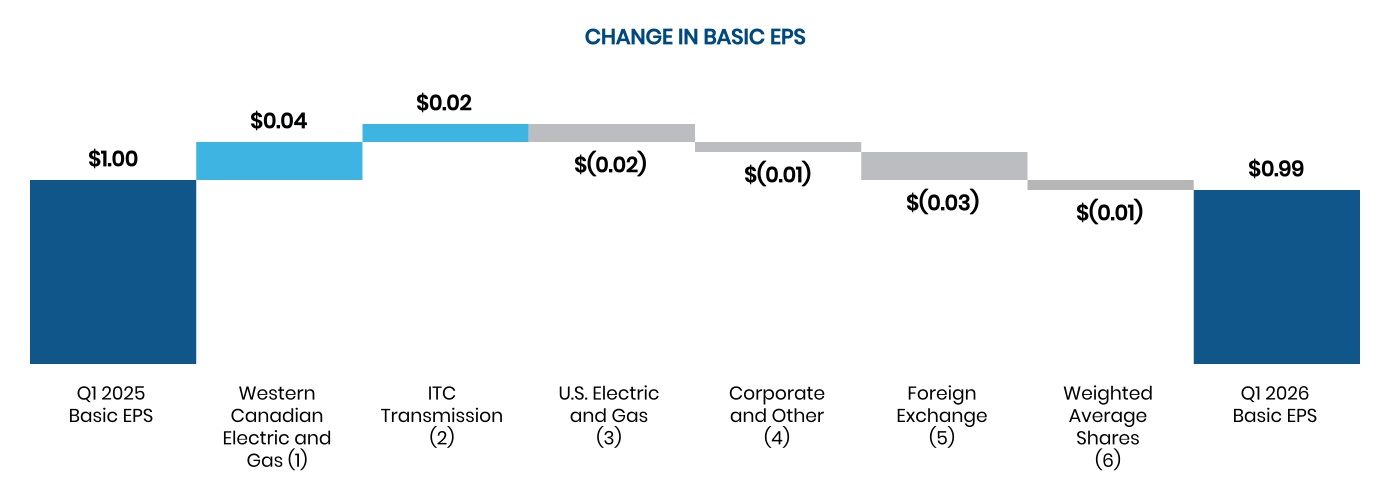
Basic EPS decreased by $0.01 compared to the first quarter of 2025. In addition to the factors impacting Common Equity Earnings, the change in basic EPS reflected an increase in the weighted average number of common shares outstanding, largely associated with the Corporation's DRIP.
The change in basic EPS for the quarter is illustrated in the following chart.
(1) Includes FortisBC Energy, FortisAlberta and FortisBC Electric. Primarily reflects Rate Base growth, as well as the timing of operating costs
(2) Reflects Rate Base growth, partially offset by higher non-recoverable stock-based compensation costs
(3) Includes UNS Energy and Central Hudson. Reflects lower earnings at UNS Energy due to lower margin on wholesale sales, the concentration of higher planned generation maintenance costs in the first quarter of 2026, milder weather conditions, and higher costs associated with Rate Base growth not yet reflected in customer rates. Also reflects higher earnings at Central Hudson due to the timing of operating expenses and a shift in quarterly revenue, as well as Rate Base growth
(4) Reflects unrealized losses on foreign exchange contracts, higher finance costs and the disposition of Fortis Belize, partially offset by higher income tax recoveries
(5) Average foreign exchange of 1.37 in 2026 compared to 1.43 in 2025
(6) Weighted average shares of 508.2 million in 2026 compared to 500.3 million in 2025
| | | | | | | | | | | |
| FORTIS INC. | MARCH 31, 2026 QUARTER REPORT | 2 |
| | | | | | | | |
| Interim Management Discussion and Analysis | |
Dividends and TSR
Fortis paid a dividend of $0.64 per common share in the first quarter of 2026, up 4.1% from $0.615 paid in the first quarter of 2025. Fortis has increased its common share dividends for 52 consecutive years and is targeting annual dividend growth of approximately 4-6% through 2030. See "Outlook" on page 15.
Growth in dividends and changes in the market price of the Corporation's common shares have yielded the following TSRs.
| | | | | | | | | | | | | | | | | | | | | | | |
TSR (1) (%) | 1-Year | | 5-Year | | 10-Year | | 20-Year |
| Fortis | 22.6 | | | 11.5 | | | 10.8 | | | 10.4 | |
(1)Annualized TSR per Bloomberg as at March 31, 2026
Operating Cash Flow
The $110 million decrease in Operating Cash Flow was largely due to: (i) the timing of flow-through costs, including higher commodity costs at Central Hudson and FortisBC Energy, as well as transmission charges at FortisAlberta; (ii) lower deposits received at FortisBC Energy associated with construction costs to be incurred for the Eagle Mountain Pipeline project; and (iii) the lower U.S. dollar-to-Canadian dollar exchange rate. The decrease was partially offset by higher cash earnings due to Rate Base growth.
Capital Expenditures
Capital Expenditures were $1.4 billion for the first quarter of 2026, consistent with expectations and representing 25% of the Corporation's annual $5.6 billion Capital Plan. Capital Expenditures were slightly below the first quarter of 2025 due to the lower U.S. dollar-to-Canadian dollar exchange rate.
Capital Expenditures is a Non-U.S. GAAP Financial Measure. Refer to "Non-U.S. GAAP Financial Measure" on page 7 and in the "Glossary" on page 16.
| | | | | | | | | | | | | | | | | | | | | | | | | | | | | | | |
| BUSINESS UNIT PERFORMANCE | | | | | | | | | | | | |
| Common Equity Earnings | | | |
| Quarter ended March 31 | | | | | Variance | | | | | | |
| ($ millions) | 2026 | | | 2025 | | | FX (1) | | Other | | | | | | | | |
| Regulated Utilities | | | | | | | | | | | | | | | |
| ITC | 153 | | | 150 | | | (7) | | | 10 | | | | | | | | | |
| UNS Energy | 51 | | | 81 | | | (4) | | | (26) | | | | | | | | | |
| Central Hudson | 79 | | | 65 | | | (3) | | | 17 | | | | | | | | | |
| FortisBC Energy | 171 | | | 156 | | | — | | | 15 | | | | | | | | | |
| FortisAlberta | 41 | | | 37 | | | — | | | 4 | | | | | | | | | |
| FortisBC Electric | 22 | | | 21 | | | — | | | 1 | | | | | | | | | |
Other Electric (2) | 40 | | | 42 | | | — | | | (2) | | | | | | | | | |
| 557 | | | 552 | | | (14) | | | 19 | | | | | | | | | |
| Non-Regulated | | | | | | | | | | | | | | | |
Corporate and Other (3) | (56) | | | (53) | | | 1 | | | (4) | | | | | | | | | |
| Common Equity Earnings | 501 | | | 499 | | | (13) | | | 15 | | | | | | | | | |
(1) The reporting currency of ITC, UNS Energy, Central Hudson, and Caribbean Utilities is the U.S. dollar. The reporting currency of the Corporation's businesses in Turks and Caicos and Belize, which were sold in 2025, was the U.S. dollar or was pegged to the U.S. dollar at BZ$2.00=US$1.00. Certain corporate and non-regulated holding company transactions, included in the Corporate and Other segment, are denominated in U.S. dollars
(2) Consists of the utility operations in eastern Canada and the Cayman Islands: Newfoundland Power; Maritime Electric; FortisOntario; Wataynikaneyap Power; and Caribbean Utilities. Also included FortisTCI up to the September 2, 2025 date of disposition and Belize Electricity up to the October 31, 2025 date of disposition
(3) Consists of non-regulated holding company expenses. Also included earnings from Fortis Belize up to the October 31, 2025 date of disposition
| | | | | | | | | | | |
| FORTIS INC. | MARCH 31, 2026 QUARTER REPORT | 3 |
| | | | | | | | |
| Interim Management Discussion and Analysis | |
| | | | | | | | | | | | | | | | | | | | | | | | | | | | | | | |
| ITC | | | |
| Quarter ended March 31 | | | | | Variance | | | | | | |
| ($ millions) | 2026 | | | 2025 | | | FX | | Other | | | | | | | | |
Revenue (1) | 648 | | | 631 | | | (28) | | | 45 | | | | | | | | | |
Earnings (1) | 153 | | | 150 | | | (7) | | | 10 | | | | | | | | | |
(1)Revenue represents 100% of ITC. Earnings represent the Corporation's 80.1% controlling ownership interest in ITC
Revenue
The increase in revenue, net of foreign exchange, was due to Rate Base growth and higher recoverable costs in customer rates.
Earnings
The increase in earnings, net of foreign exchange, was primarily due to Rate Base growth, partially offset by an increase in non-recoverable stock-based compensation costs.
| | | | | | | | | | | | | | | | | | | | | | | | | | | | | | | |
| UNS Energy | | | |
| Quarter ended March 31 | | | | | Variance | | | | | | |
| ($ millions, except as indicated) | 2026 | | | 2025 | | | FX | | Other | | | | | | | | |
Retail electricity sales (GWh) | 2,148 | | | 2,136 | | | — | | | 12 | | | | | | | | | |
Wholesale electricity sales (GWh) (1) | 998 | | | 1,157 | | | — | | | (159) | | | | | | | | | |
Gas sales (PJ) | 6 | | | 7 | | | — | | | (1) | | | | | | | | | |
| Revenue | 595 | | | 680 | | | (30) | | | (55) | | | | | | | | | |
| Earnings | 51 | | | 81 | | | (4) | | | (26) | | | | | | | | | |
(1) Primarily short-term wholesale sales
Sales
Retail electricity sales were relatively consistent with the same period in 2025. An increase in electricity sales due to higher average consumption by industrial customers was largely offset by lower average consumption by residential and commercial customers due to milder temperatures.
The decrease in wholesale electricity sales was driven by lower long-term and short-term wholesale sales due to market conditions. Revenue from short-term wholesale sales, which relate to contracts that are less than one-year in duration, is primarily credited to customers through the PPFAC mechanism and, therefore, does not materially impact earnings.
The decrease in gas sales was primarily due to lower heating load associated with milder temperatures.
Revenue
The decrease in revenue, net of foreign exchange, was primarily due to: (i) the impact of market conditions on wholesale sales, resulting in lower pricing and volumes as compared to the first quarter of 2025; and (ii) the recovery of overall lower fuel and non-fuel costs through the normal operation of regulatory mechanisms.
Earnings
The decrease in earnings, net of foreign exchange, was primarily due to: (i) lower margin on wholesale sales due to market conditions; (ii) the concentration of higher planned generation maintenance costs in the first quarter of 2026; (iii) lower margin associated with residential and commercial electricity sales due to milder weather; and (iv) higher costs associated with Rate Base growth not yet reflected in customer rates. TEP has filed a general rate application with the ACC requesting new rates effective September 1, 2026 (see "Regulatory Matters" on page 7).
| | | | | | | | | | | | | | | | | | | | | | | | | | | | | | | |
| Central Hudson | | | |
| Quarter ended March 31 | | | | | Variance | | | | | | |
| ($ millions, except as indicated) | 2026 | | | 2025 | | | FX | | Other | | | | | | | | |
Electricity sales (GWh) | 1,387 | | | 1,375 | | | — | | | 12 | | | | | | | | | |
Gas sales (PJ) | 10 | | | 9 | | | — | | | 1 | | | | | | | | | |
| Revenue | 566 | | | 473 | | | (21) | | | 114 | | | | | | | | | |
| Earnings | 79 | | | 65 | | | (3) | | | 17 | | | | | | | | | |
| | | | | | | | | | | |
| FORTIS INC. | MARCH 31, 2026 QUARTER REPORT | 4 |
| | | | | | | | |
| Interim Management Discussion and Analysis | |
Sales
The increase in electricity sales was due to higher average consumption by residential and commercial customers associated with colder weather, partially offset by lower average consumption by industrial customers.
The increase in gas sales was primarily due to higher average consumption by industrial customers.
Changes in electricity and gas sales at Central Hudson are subject to regulatory revenue decoupling mechanisms and, therefore, do not materially impact earnings.
Revenue
The increase in revenue, net of foreign exchange, was primarily due to: (i) the flow-through of higher energy supply costs driven by commodity prices; (ii) an increase in delivery rates, as approved by the PSC effective July 1, 2025 which included Rate Base growth and a shift in quarterly revenue resulting in higher revenue in comparison to the first quarter of 2025; and (iii) higher electricity and gas sales, discussed above.
Earnings
The increase in earnings, net of foreign exchange, was largely due to timing, reflecting a shift in quarterly revenue as discussed above, as well as the timing of incurring operating costs in comparison to 2025. Rate Base growth also contributed to the increase in earnings.
| | | | | | | | | | | | | | | | | | | | | | | |
| FortisBC Energy | | | | | | | |
| Quarter ended March 31 | | | |
| ($ millions, except as indicated) | 2026 | | | 2025 | | | Variance | | | | | | |
Gas sales (PJ) | 76 | | | 81 | | | (5) | | | | | | | |
| Revenue | 696 | | | 645 | | | 51 | | | | | | | |
| Earnings | 171 | | | 156 | | | 15 | | | | | | | |
Sales
The decrease in gas sales was due to lower average consumption by transportation, residential and commercial customers, partially offset by higher average consumption by industrial customers. Lower average consumption by residential and commercial customers was primarily due to milder weather in the first quarter of 2026.
Revenue
The increase in revenue was primarily due to an increase in delivery rates, including the impact of Rate Base growth, as approved by the BCUC effective January 1, 2026, and the normal operation of regulatory mechanisms.
Earnings
The increase in earnings was primarily due to Rate Base growth, as well as the timing of operating costs.
FortisBC Energy earns approximately the same margin regardless of whether a customer contracts for the purchase and delivery of natural gas or only for delivery. Due to regulatory deferral mechanisms, changes in consumption levels and commodity costs do not materially impact earnings.
| | | | | | | | | | | | | | | | | | | | | | | |
| FortisAlberta | | | |
| Quarter ended March 31 | | | |
| ($ millions, except as indicated) | 2026 | | | 2025 | | | Variance | | | | | | |
Electricity deliveries (GWh) | 4,665 | | | 4,597 | | | 68 | | | | | | | |
| Revenue | 208 | | | 201 | | | 7 | | | | | | | |
| Earnings | 41 | | | 37 | | | 4 | | | | | | | |
Deliveries
The increase in electricity deliveries was primarily due to customer growth, largely related to industrial customers.
As approximately 85% of FortisAlberta's revenue is derived from fixed or largely fixed billing determinants, changes in quantities of energy delivered are not entirely correlated with changes in revenue. Revenue is a function of numerous variables, many of which are independent of actual energy deliveries. Significant variations in weather conditions, however, can impact revenue and earnings.
Revenue and Earnings
The increase in revenue and earnings was due to Rate Base and customer growth. The timing of operating costs, and lower income tax expense associated with the enactment of an accelerated capital cost allowance deduction on certain capital additions, also contributed to the increase in earnings.
| | | | | | | | | | | |
| FORTIS INC. | MARCH 31, 2026 QUARTER REPORT | 5 |
| | | | | | | | |
| Interim Management Discussion and Analysis | |
| | | | | | | | | | | | | | | | | | | | | | | |
| FortisBC Electric | | | |
| Quarter ended March 31 | | | |
| ($ millions, except as indicated) | 2026 | | | 2025 | | | Variance | | | | | | |
Electricity sales (GWh) | 957 | | | 1,016 | | | (59) | | | | | | | |
| Revenue | 151 | | | 153 | | | (2) | | | | | | | |
| Earnings | 22 | | | 21 | | | 1 | | | | | | | |
Sales
The decrease in electricity sales was due to lower average consumption driven by milder weather in the first quarter of 2026.
Revenue
The decrease in revenue was primarily due to lower electricity sales, partially offset by Rate Base growth and the normal operation of regulatory mechanisms.
Earnings
The increase in earnings was primarily due to Rate Base growth.
Due to regulatory deferral mechanisms, changes in consumption levels do not materially impact earnings.
| | | | | | | | | | | | | | | | | | | | | | | | | | | | | | | |
| Other Electric | | | |
| Quarter ended March 31 | | | | | Variance | | | | | | |
| ($ millions, except as indicated) | 2026 | | | 2025 | | | FX | | Other | | | | | | | | |
Electricity sales (GWh) | 3,154 | | | 3,165 | | | — | | | (11) | | | | | | | | | |
| Revenue | 539 | | | 546 | | | (4) | | | (3) | | | | | | | | | |
| Earnings | 40 | | | 42 | | | — | | | (2) | | | | | | | | | |
Sales
The decrease in electricity sales was due to the September 2025 disposition of FortisTCI. This decrease was largely offset by higher average consumption associated with residential customers due to colder weather and customer growth in eastern Canada.
Revenue
The decrease in revenue, net of foreign exchange, was primarily due to the disposition of FortisTCI. This decrease was largely offset by the flow-through of higher energy supply costs recovered from customers, Rate Base growth and higher electricity sales in eastern Canada.
Earnings
The decrease in earnings was primarily due to the disposition of FortisTCI, partially offset by Rate Base growth and higher electricity sales in eastern Canada.
| | | | | | | | | | | | | | | | | | | | | | | | | | | | | | | |
| Corporate and Other | | | |
| Quarter ended March 31 | | | | | Variance | | | | | | |
| ($ millions, except as indicated) | 2026 | | | 2025 | | | FX | | Other | | | | | | | | |
Electricity sales (GWh) (1) | — | | | 47 | | | — | | | (47) | | | | | | | | | |
Revenue (1) | — | | | 9 | | | — | | | (9) | | | | | | | | | |
Net loss (2) | (56) | | | (53) | | | 1 | | | (4) | | | | | | | | | |
(1) Reflects Fortis Belize up to the October 31, 2025 date of disposition
(2) Includes non-regulated holding company expenses and earnings for Fortis Belize up to the October 31, 2025 date of disposition
Sales and Revenue
The decrease in electricity sales and revenue was due to the October 2025 disposition of Fortis Belize.
Net Loss
The increase in net loss was due to unrealized losses on foreign exchange contracts, higher finance costs, and the disposition of Fortis Belize, partially offset by higher income tax recoveries.
| | | | | | | | | | | |
| FORTIS INC. | MARCH 31, 2026 QUARTER REPORT | 6 |
| | | | | | | | |
| Interim Management Discussion and Analysis | |
NON-U.S. GAAP FINANCIAL MEASURE
Capital Expenditures is a Non-U.S. GAAP Financial Measure and may not be comparable with a similar measure used by other entities. Capital Expenditures include additions to property, plant and equipment and additions to intangible assets, as shown on the condensed consolidated interim statements of cash flows, less CIACs received by FortisBC Energy associated with the Eagle Mountain Pipeline project. The CIACs received for this Major Capital Project are significant and presentation of Capital Expenditures net of CIACs better aligns with the Rate Base growth associated with this project.
| | | | | | | | | | | | | | | | | | | | | | | |
| Non-U.S. GAAP Reconciliation | | | |
| Quarter ended March 31 | | | |
| ($ millions) | 2026 | | | 2025 | | | Variance | | | | | | |
| | | | | | | | | | | |
| | | | | | | | | | | |
| | | | | | | | | | | |
| | | | | | | | | | | |
| | | | | | | | | | | |
| | | | | | | | | | | |
| | | | | | | | | | | |
| | | | | | | | | | | |
| Capital Expenditures | | | | | | | | | | | |
| Additions to property, plant and equipment | 1,503 | | | 1,483 | | | 20 | | | | | | | |
| Additions to intangible assets | 45 | | | 60 | | | (15) | | | | | | | |
| Adjusting item: | | | | | | | | | | | |
Eagle Mountain Pipeline Project (1) | (186) | | | (123) | | | (63) | | | | | | | |
| | | | | | | | | | | |
| Capital Expenditures | 1,362 | | | 1,420 | | | (58) | | | | | | | |
(1) Represents CIACs received for the Eagle Mountain Pipeline project, included in the FortisBC Energy segment
REGULATORY MATTERS
ITC
Transmission Incentives: In 2021, FERC issued a supplemental NOPR on transmission incentives modifying the proposal in the initial NOPR released by FERC in 2020. The supplemental NOPR proposes to eliminate the 50-basis point RTO ROE incentive adder for RTO members that have been members for longer than three years. Although the timing and outcome of this proceeding are unknown, every 10-basis point change in ROE at ITC impacts Fortis' annual EPS by approximately $0.01.
UNS Energy
TEP General Rate Application: In June 2025, TEP filed a general rate application with the ACC requesting new rates effective September 1, 2026 using a December 31, 2024 test year, with post-test year adjustments through June 30, 2025. The application includes a proposal to phase-out or eliminate certain adjustor mechanisms, and requests an annual formulaic rate adjustment mechanism consistent with the ACC's approval of a formula rate policy statement in 2024.
The Residential Utility Consumer Office has challenged the ACC's authority to implement a formula rate framework through a policy statement, and in November 2025, the Arizona Court of Appeals ruled that the Residential Utility Consumer Office may proceed with its challenge. The timing and outcome of these regulatory and legal proceedings are unknown. The ACC has previously approved adjustor mechanisms, including formula-based mechanisms, in rate cases.
UNS Gas General Rate Application: In February 2026, the ACC issued an order approving an allowed ROE of 9.61% and a 56% common equity component of capital structure. The order also approved an annual formulaic rate adjustment mechanism including a range of +/- 50 basis points around the allowed ROE and the inclusion of post-test year adjustments. New rates became effective March 1, 2026.
FortisAlberta
Third PBR Term Decision: In 2023, the AUC issued a decision establishing the parameters for the third PBR term for the period of 2024 through 2028. FortisAlberta sought permission to appeal the decision to the Court of Appeal on the basis that the AUC erred in its decision to determine capital funding using 2018-2022 historical capital investments without consideration for funding of new capital programs included in the company's 2023 cost of service revenue requirement as approved by the AUC. In March 2025, the Court of Appeal granted FortisAlberta permission to appeal, which was heard in January 2026. A decision is expected in the third quarter of 2026.
Depreciation Study: In December 2025, FortisAlberta applied to the AUC for approval of a depreciation study. A negotiated settlement agreement was reached with intervenors in March 2026 and filed for approval with the AUC on April 1, 2026. As a result of the negotiated settlement agreement and the corresponding update to FortisAlberta's depreciation rates, a regulatory liability of approximately $130 million has been estimated, subject to AUC approval which is expected in the third quarter of 2026. The settlement of the liability will be addressed in a future rate application.
| | | | | | | | | | | |
| FORTIS INC. | MARCH 31, 2026 QUARTER REPORT | 7 |
| | | | | | | | |
| Interim Management Discussion and Analysis | |
FINANCIAL POSITION
| | | | | | | | | | | |
Significant Changes between March 31, 2026 and December 31, 2025 |
| | | |
| Balance Sheet Account | Increase (Decrease) | |
| ($ millions) | FX | Other | Explanation |
| | | |
| Accounts receivable and other current assets | 13 | | 117 | | Due to the seasonality of sales, particularly in Canada and New York. |
| | | |
| | | |
| | | |
| | | |
| Regulatory assets (current and long-term) | 19 | | 162 | | Due to: (i) higher unrealized losses on energy derivatives at UNS Energy and FortisBC Energy; and (ii) the normal operation of various regulatory deferral accounts. |
| Property, plant and equipment, net | 469 | | 854 | | Due to capital expenditures, partially offset by depreciation expense and CIACs. |
| | | |
| | | |
| Short-term borrowings | 6 | | 166 | | Reflects the issuance of commercial paper at ITC to finance working capital requirements. |
| Accounts payable and other current liabilities | 22 | | 239 | | Due to: (i) FortisBC Energy, reflecting an increase in net deposits associated with the construction of the Eagle Mountain Pipeline project as well as higher income taxes payable; and (ii) UNS Energy, related to the timing of payments and a decrease in the fair value of energy derivatives. |
| | | |
| | | |
| | | |
| Long-term debt (including current portion) | 269 | | 333 | | Reflects the issuance of debt at ITC, partially offset by the repayment of debt at Fortis and the net repayment of credit facilities across the Corporation. |
| | | |
| Shareholders' equity | 260 | | 312 | | Primarily due to: (i) Common Equity Earnings for the three months ended March 31, 2026, less dividends declared on common shares; and (ii) the issuance of common shares, largely under the DRIP. |
| | | |
LIQUIDITY AND CAPITAL RESOURCES
Cash Flow Requirements
At the subsidiary level, it is expected that operating expenses and interest costs will be paid from Operating Cash Flow, with varying levels of residual cash flow available for capital expenditures and/or dividend payments to Fortis. Remaining capital expenditures are expected to be financed primarily from borrowings under credit facilities, long-term debt offerings and equity injections from Fortis. Borrowings under credit facilities may be required periodically to support seasonal working capital requirements.
Cash required of Fortis to support subsidiary growth is generally derived from borrowings under the Corporation's credit facilities, the operation of the DRIP, as well as issuances of long-term debt, preference equity, and common shares including any issued through the ATM Program. The subsidiaries pay dividends to Fortis and receive equity injections from Fortis when required. Both Fortis and its subsidiaries initially borrow through their credit facilities and periodically replace these borrowings with long-term financing. Financing needs also arise to refinance maturing debt.
Credit facilities are syndicated primarily with large banks in Canada and the U.S., with no one bank holding more than approximately 20% of the Corporation's total revolving credit facilities. Approximately $5.4 billion of the total credit facilities are committed with maturities ranging from 2027 through 2031. Available credit facilities are summarized in the following table.
| | | | | | | | | | | | | | | | | | | | | | | |
| Credit Facilities | | | | | |
| As at | Regulated
Utilities | | Corporate
and Other | | March 31,
2026 | | December 31,
2025 |
| ($ millions) | | | |
Total credit facilities (1) | 4,215 | | | 1,580 | | | 5,795 | | | 5,773 | |
| Credit facilities utilized: | | | | | | | |
| Short-term borrowings | (584) | | | — | | | (584) | | | (412) | |
| Long-term debt (including current portion) | (961) | | | (205) | | | (1,166) | | | (1,515) | |
| Letters of credit outstanding | (85) | | | (22) | | | (107) | | | (105) | |
| Credit facilities unutilized | 2,585 | | | 1,353 | | | 3,938 | | | 3,741 | |
(1) See Note 14 in the 2025 Annual Financial Statements for a description of the credit facilities as at December 31, 2025
| | | | | | | | | | | |
| FORTIS INC. | MARCH 31, 2026 QUARTER REPORT | 8 |
| | | | | | | | |
| Interim Management Discussion and Analysis | |
The Corporation's ability to service debt and pay dividends is dependent on the financial results of, and the related cash payments from, its subsidiaries. Certain regulated subsidiaries are subject to restrictions that limit their ability to distribute cash to Fortis, including restrictions by certain regulators limiting annual dividends and restrictions by certain lenders limiting debt to total capitalization. There are also practical limitations on using the net assets of the regulated subsidiaries to pay dividends, based on management's intent to maintain the subsidiaries' regulator-approved capital structures. Fortis does not expect that maintaining such capital structures will impact its ability to pay dividends in the foreseeable future.
As at March 31, 2026, consolidated fixed-term debt maturities/repayments are expected to average $1.7 billion annually over the next five years, with a maximum of $2.7 billion due in any one year. Approximately 74% of the Corporation's consolidated long-term debt, excluding credit facility borrowings, had maturities beyond five years.
In December 2024, Fortis filed a short-form base shelf prospectus with a 25-month life under which it may issue common or preference shares, subscription receipts, or debt securities in an aggregate principal amount of up to $2.0 billion. Fortis also reestablished the ATM Program pursuant to the short-form base shelf prospectus, which allows the Corporation to issue up to $500 million of common shares from treasury to the public from time to time, at the Corporation's discretion, effective until January 10, 2027. As at March 31, 2026, $500 million remained available under the ATM Program and $1.5 billion remained available under the short-form base shelf prospectus.
Fortis is well positioned with strong liquidity. This combination of available credit facilities and manageable annual debt maturities/repayments provides flexibility in the timing of access to capital markets. Given current credit ratings and capital structures, the Corporation and its subsidiaries currently expect to continue to have reasonable access to long-term capital.
Fortis and its subsidiaries were in compliance with debt covenants as at March 31, 2026 and are expected to remain compliant.
| | | | | | | | | | | | | | | | | | | | | | | |
| Cash Flow Summary | | | | | | | | | | | |
| Summary of Cash Flows | | | |
| Quarter ended March 31 | | | |
| ($ millions) | 2026 | | | 2025 | | | Variance | | | | | | |
| Cash and cash equivalents, beginning of period | 367 | | | 220 | | | 147 | | | | | | | |
| Cash from (used in): | | | | | | | | | | | |
| Operating activities | 1,103 | | | 1,213 | | | (110) | | | | | | | |
| Investing activities | (1,371) | | | (1,425) | | | 54 | | | | | | | |
| Financing activities | 254 | | | 499 | | | (245) | | | | | | | |
| Effect of exchange rate changes on cash and cash equivalents | 6 | | | 3 | | | 3 | | | | | | | |
| | | | | | | | | | | |
| Cash and cash equivalents, end of period | 359 | | | 510 | | | (151) | | | | | | | |
Operating Activities
See "Performance at a Glance - Operating Cash Flow" on page 3.
Investing Activities
Cash used in investing activities was $54 million lower than the first quarter of 2025 primarily due to the lower U.S. dollar-to-Canadian dollar exchange rate. The Corporation's Capital Plan for 2026 is $5.6 billion. See "Capital Plan" on page 11.
Financing Activities
Cash flows related to financing activities will fluctuate largely as a result of changes in the subsidiaries' capital expenditures and the amount of Operating Cash Flow available to fund those capital expenditures, which together impact the amount of funding required from debt and common equity issuances. See "Cash Flow Requirements" on page 8.
| | | | | | | | | | | | | | | | | | | | | | | | | | | | | |
| Debt Financing | | | | | | | | | |
| Significant Long-Term Debt Issuances | Month | | Interest | | | | Amount | | Use of Proceeds |
| Quarter ended March 31, 2026 | Issued | | Rate (%) | | Maturity | | ($ millions) | |
| ITC | | | | | | | | | |
| Secured senior notes | January | | 5.08 | | | 2036 | | US $125 | | | (1) (2) (3) |
| Secured senior notes | January | | 5.71 | | | 2046 | | US $125 | | | (1) (2) (3) |
| First mortgage bonds | March | | 4.78 | | | 2034 | | US $175 | | | (1) (2) (3) |
| First mortgage bonds | March | | 4.86 | | | 2035 | | US $175 | | | (1) (2) (3) |
| | | | | | | | | |
| | | | | | | | | |
| | | | | | | | | |
| | | | | | | | | |
| | | | | | | | | |
| | | | | | | | | |
| | | | | | | | | |
| | | | | | | | | |
| | | | | | | | | |
| | | | | | | | | |
| | | | | | | | | |
| | | | | | | | | |
| | | | | | | | | |
| | | | | | | | | |
| | | | | | | | | |
| | | | | | | | | |
| | | | | | | | | |
| | | | | | | | | |
| | | | | | | | | |
(1) Repay credit facility borrowings
(2) Fund capital expenditures
(3) General corporate purposes
| | | | | | | | | | | |
| FORTIS INC. | MARCH 31, 2026 QUARTER REPORT | 9 |
| | | | | | | | |
| Interim Management Discussion and Analysis | |
In April 2026, ITC issued US$500 million of 5-year, 4.88% unsecured senior notes and US$400 million of 10-year, 5.50% unsecured senior notes. Proceeds will be used to repay maturing long-term debt and short-term borrowings, and for general corporate purposes. In addition, ITC priced US$50 million of 18-year, 5.41% first mortgage bonds and US$100 million of 21-year, 5.53% first mortgage bonds. Proceeds are expected in July 2026 and will be used to repay credit facility borrowings, fund capital expenditures, and for general corporate purposes.
In April 2026, Central Hudson issued US$25 million of 10-year, 5.51% unsecured senior notes, US$35 million of 15-year, 5.86% unsecured senior notes and US$10 million of 20-year, 6.01% unsecured senior notes. Proceeds will be used to repay credit facility borrowings and for general corporate purposes.
In March 2026, Fortis redeemed US$115 million of its U.S. dollar-denominated unsecured senior notes with original maturities ranging from 2029 to 2044.
| | | | | | | | | | | | | | | | | | | | | | | |
| Common Equity Financing | | | | | | | | | | | |
| Common Equity Issuances and Dividends Paid |
| Quarter ended March 31 | | | |
| ($ millions, except as indicated) | 2026 | | | 2025 | | | Variance | | | | | | |
| Common shares issued: | | | | | | | | | | | |
Cash (1) | 18 | | | 25 | | | (7) | | | | | | | |
Non-cash (2) | 117 | | | 115 | | | 2 | | | | | | | |
| Total common shares issued | 135 | | | 140 | | | (5) | | | | | | | |
Number of common shares issued (# millions) | 1.8 | | | 2.3 | | | (0.5) | | | | | | | |
| Common share dividends paid: | | | | | | | | | | | |
| Cash | (208) | | | (192) | | | (16) | | | | | | | |
Non-cash (3) | (117) | | | (115) | | | (2) | | | | | | | |
| Total common share dividends paid | (325) | | | (307) | | | (18) | | | | | | | |
Dividends paid per common share ($) | 0.64 | | | 0.615 | | | 0.025 | | | | | | | |
(1) Includes common shares issued under stock option and employee share purchase plans
(2) Common shares issued under the DRIP and stock option plan
(3) Common share dividends reinvested under the DRIP
On February 11, 2026, Fortis declared a dividend of $0.64 per common share payable on June 1, 2026. The payment of dividends is at the discretion of the Board and depends on the Corporation's financial condition and other factors
Contractual Obligations
There were no material changes to the contractual obligations disclosed in the 2025 Annual MD&A, other than issuances of long-term debt and credit facility utilization (see "Cash Flow Summary" on page 9), and new agreements at TEP and UNS Electric as disclosed in Note 14 of the Interim Financial Statements.
Off-Balance Sheet Arrangements
There were no material changes to off-balance sheet arrangements from those disclosed in the 2025 Annual MD&A.
Capital Structure and Credit Ratings
Fortis requires ongoing access to capital and, therefore, targets a consolidated long-term capital structure that will enable it to maintain investment-grade credit ratings. The regulated utilities maintain their own capital structures in line with those reflected in customer rates.
| | | | | | | | | | | | | | | | | | | | | | | |
| Consolidated Capital Structure | March 31, 2026 | | December 31, 2025 |
| As at | ($ millions) | | (%) | | ($ millions) | | (%) |
Debt (1) | 35,052 | | | 57.0 | | | 34,262 | | | 57.0 | |
| Preference shares | 1,623 | | | 2.6 | | | 1,623 | | | 2.7 | |
Common shareholders' equity and non-controlling interests (2) | 24,863 | | | 40.4 | | | 24,246 | | | 40.3 | |
| 61,538 | | | 100.0 | | | 60,131 | | | 100.0 | |
(1) Includes long-term debt and finance leases, including current portion, and short-term borrowings, net of cash
(2) Includes shareholders' equity, excluding preference shares, and non-controlling interests. Non-controlling interests represented 3.4% as at March 31, 2026 (December 31, 2025 - 3.4%)
| | | | | | | | | | | |
| FORTIS INC. | MARCH 31, 2026 QUARTER REPORT | 10 |
| | | | | | | | |
| Interim Management Discussion and Analysis | |
Outstanding Share Data
As at May 5, 2026, the Corporation had issued and outstanding 509.1 million common shares and the following first preference shares: 5.0 million Series F; 9.2 million Series G; 7.9 million Series H; 2.1 million Series I; 8.0 million Series J; 10.0 million Series K; and 24.0 million Series M.
The common shares of the Corporation have voting rights. The Corporation's first preference shares do not have voting rights unless and until Fortis fails to pay eight quarterly dividends, whether or not consecutive or declared.
If all outstanding stock options were converted as at May 5, 2026, an additional 0.8 million common shares would be issued and outstanding.
Credit Ratings
The Corporation's credit ratings shown below reflect its low business risk profile, diversity of operations, the stand-alone nature and financial separation of each regulated subsidiary, and the level of holding company debt.
| | | | | | | | | | | | | | | | | |
| As at March 31, 2026 | Rating | | Type | | Outlook |
| S&P | A- | | Issuer | | Stable |
| BBB+ | | Unsecured debt | | |
| Fitch | BBB+ | | Issuer | | Stable |
| BBB+ | | Unsecured debt | | |
| Morningstar DBRS | A (low) | | Issuer | | Stable |
| A (low) | | Unsecured debt | | Stable |
| | | | | |
| | | | | |
In May 2026, Morningstar DBRS confirmed the Corporation's A (low) issuer and unsecured debt credit ratings and stable outlook.
Capital Plan
Capital Expenditures of $1.4 billion for the first quarter of 2026 were consistent with expectations, and the Corporation's annual $5.6 billion Capital Plan is on track.
| | | | | | | | | | | | | | | | | | | | | | | | | | | | | | | | | | | | | | | | | | | | | | | | | | | | | |
Capital Expenditures (1) | | | | | | | |
| Quarter ended March 31, 2026 | | | UNS Energy | | Central Hudson | | FortisBC Energy | | Fortis Alberta | | FortisBC Electric | | Other Electric | | | |
| ($ millions, except as indicated) | | ITC | | | | | | | | | Total (1) |
| Total | | 546 | | | 259 | | | 95 | | | 163 | | | 174 | | | 42 | | | 83 | | | | 1,362 | |
(1) See "Non-U.S. GAAP Financial Measure" on page 7
The Corporation's 2026-2030 Capital Plan is $28.8 billion with investments categorized as: (i) 46% transmission; (ii) 31% distribution; (iii) 7% generation; (iv) 5% renewable gas and LNG; and (v) 11% other, largely related to information technology and facility investments. The five-year Capital Plan is low risk and highly executable, with only 21% relating to Major Capital Projects. Geographically, 63% of planned expenditures are expected in the U.S., including 34% at ITC, with 35% in Canada and the remaining 2% in the Cayman Islands.
The Capital Plan reflects an assumed U.S. dollar-to-Canadian dollar exchange rate of 1.35. A five-cent increase or decrease in the U.S. dollar relative to the Canadian dollar would increase or decrease the Capital Plan by approximately $0.7 billion over the five-year planning period.
The Capital Plan is expected to be funded primarily by cash from operations and regulated utility debt. Common equity is expected to be provided by the Corporation's DRIP, assuming current participation levels. The Corporation's $500 million ATM Program has not been utilized to date and remains available for funding flexibility as required.
Planned capital expenditures are based on detailed forecasts of energy demand as well as labour and material costs, including inflation, supply chain availability, general economic conditions, foreign exchange rates, new or revised tariffs and other factors. The Corporation continues to monitor government policy on foreign trade, including the imposition of tariffs and the potential impacts on the supply chain, commodity prices, the cost of energy and general economic conditions. These factors could change and cause actual expenditures to differ from forecast.
| | | | | | | | | | | |
| FORTIS INC. | MARCH 31, 2026 QUARTER REPORT | 11 |
| | | | | | | | |
| Interim Management Discussion and Analysis | |
Major Capital Projects Update
Springerville Natural Gas Conversion
In March 2026, the ACC approved an amendment to the Springerville Generating Station's Certificate of Environmental Compatibility to permit the conversion of Springerville Units 1 and 2 from coal-fired to natural gas-fired generation. This regulatory approval advances TEP's plans to extend the operational life of the facility and supports long-term customer affordability and system reliability.
Tilbury LNG Storage Expansion Project
In 2025, the BCUC approved the Tilbury LNG Storage Expansion project. Based on the expansion option approved by the BCUC, the project has potential upside of $300 million as the five-year Capital Plan assumed the tank replacement would be a similar size and configuration to the existing tank. The incremental opportunity may extend beyond 2030 depending on the timing of environmental assessment approvals.
In March 2026, a revised Environmental Assessment Application was submitted to the British Columbia Environmental Assessment Office, incorporating updates from various stakeholders during the application review phase as well as the expansion option approved by the BCUC. The environmental assessment process is expected to continue throughout 2026.
Additional Investment Opportunities
Fortis is pursuing investment opportunities that are not yet included in the five-year Capital Plan.
ITC
ITC estimates a total range of US$3.7 billion to US$4.2 billion in capital expenditures for the MISO tranche 2.1 projects located in Michigan and Minnesota where ROFRs are in effect and for projects requiring system upgrades in Iowa which are not subject to a competitive bidding process. The majority of the tranche 2.1 investments are expected beyond 2030.
Any additional tranche 2.1 projects awarded to ITC as part of a competitive bidding process would be incremental to the estimated range of tranche 2.1 investments discussed above. ITC is evaluating projects within the portfolio and preparing to bid as deemed appropriate.
In April 2026, ITC, along with a coalition of other transmission owners, filed a complaint at FERC related to the competitive bidding process for electric transmission projects in the MISO and SPP regions. The complaint seeks to either exempt transmission projects in the MISO and SPP regions that facilitate generation or load additions from the competitive bidding process or suspend competitive solicitations for certain categories of projects in these regions for the next five years. It is requested that the proposed change apply prospectively from the date of the complaint. While there is no stipulated timeline for FERC to act, it was requested that FERC take action in response to the complaint by July 16, 2026.
UNS Energy
In 2025, TEP entered into an energy supply agreement to serve a customer expected to be located in TEP's service territory. The agreement, requiring potential power demand of approximately 300 MW, was approved by the ACC in December 2025. The energy supply agreement provides additional consumer protections such as establishing minimum monthly payment obligations that apply irrespective of customer energy use, authorizing termination fees supported by financial assurance mechanisms, and imposing credit standards designed to mitigate the risk of default. In April 2026, the parties waived certain contractual provisions under the energy supply agreement and established a US$40 million termination payment if the agreement is terminated prior to the commencement of electric service, which was secured by a letter of credit. The initial phase of the data center campus is expected to be operational as early as 2027, with a ramp schedule through 2029. TEP expects to serve the customer from its existing and planned capacity, including solar and battery storage projects currently in development.
In addition to the energy supply agreement signed in 2025, further negotiations are ongoing with the customer for additional capacity to support a full build at the initial site for a total of 600 MW. The customer has also indicated that additional capacity may be required for 500 MW to 700 MW at a second site. Should discussions progress and an agreement be negotiated, additional generation and transmission investments would be required for these subsequent phases.
TEP is experiencing interest from other potential new large customers in the manufacturing, data center, and mining sectors with demands that may create new energy needs. TEP continues to work with the potential customers to assess capital requirements and associated timelines.
TEP and UNS Electric are expecting to file new IRPs with the ACC in 2026, which will support increasing energy needs while taking into account reliable and affordable energy solutions.
FortisBC Energy
Provincial and federal environmental assessment certificates have been issued for the Tilbury Marine Jetty project. The construction of the jetty supports further expansion of FortisBC's Tilbury LNG facility, which is uniquely positioned to meet customer demand for LNG. The site is scalable, can accommodate additional storage and liquefaction equipment and is close to international shipping lanes.
Other Opportunities
Other opportunities include incremental transmission investments across our FERC regulated jurisdictions to support customer connections and grid modernization; further renewable gas and LNG infrastructure opportunities in British Columbia; grid resiliency and climate adaptation investments; and energy infrastructure investments to support the acceleration of load growth across our jurisdictions.
| | | | | | | | | | | |
| FORTIS INC. | MARCH 31, 2026 QUARTER REPORT | 12 |
| | | | | | | | |
| Interim Management Discussion and Analysis | |
BUSINESS RISKS
The Corporation's business risks remain substantially unchanged from those disclosed in its 2025 Annual MD&A.
ACCOUNTING MATTERS
Accounting Policies
The Interim Financial Statements have been prepared following the same accounting policies and methods as those used to prepare the 2025 Annual Financial Statements.
Future Accounting Pronouncements
Expense Disaggregation: ASU No. 2024-03, Disaggregation of Income Statement Expenses, is effective for Fortis on January 1, 2027 for annual periods and on January 1, 2028 for interim periods, on a prospective basis, with retrospective application and early adoption permitted. The ASU requires detailed disclosure of certain expense categories included on the consolidated statements of earnings, including energy supply costs, operating expenses, and depreciation and amortization expense. Fortis is assessing the impact on its disclosures.
Internal-Use Software: ASU No. 2025-06, Targeted Improvements to the Accounting for Internal-Use Software, is effective for Fortis on January 1, 2028. The ASU may be adopted prospectively, retrospectively, or using a modified transition approach, and early adoption is permitted. The ASU removes references to development stages and requires capitalization of software costs once funding is authorized and project completion is probable, including assessment of whether significant development uncertainty exists. The guidance also clarifies that all capitalized internal-use software costs must follow the disclosure requirements in Subtopic 360-10, Property, Plant and Equipment. Fortis is assessing the impact on its consolidated financial statements and disclosures.
Critical Accounting Estimates
The preparation of the Interim Financial Statements required management to make estimates and judgments, including those related to regulatory decisions, that affect the reported amounts of, and disclosures related to, assets, liabilities, revenues, expenses, gains, losses and contingencies. Actual results could differ materially from estimates.
There were no material changes to the nature of the Corporation's critical accounting estimates or contingencies from those disclosed in the 2025 Annual MD&A, except as disclosed in Note 14 of the Interim Financial Statements.
FINANCIAL INSTRUMENTS
Long-Term Debt and Other
As at March 31, 2026, the carrying value of long-term debt, including current portion, was $34.7 billion (December 31, 2025 - $34.1 billion) compared to an estimated fair value of $32.5 billion (December 31, 2025 - $32.3 billion).
The consolidated carrying value of the remaining financial instruments approximates fair value, reflecting their short-term maturity, normal trade credit terms and/or nature.
Derivatives
Derivatives are recorded at fair value with certain exceptions, including those derivatives that qualify for the normal purchase and normal sale exception.
There were no material changes with respect to the nature and purpose, methodologies for fair value determination, and portfolio of the Corporation's derivatives from those disclosed in the 2025 Annual MD&A. See Note 13 of the Interim Financial Statements for additional information.
| | | | | | | | | | | |
| FORTIS INC. | MARCH 31, 2026 QUARTER REPORT | 13 |
| | | | | | | | |
| Interim Management Discussion and Analysis | |
| | | | | | | | | | | | | | | | | | | | | | | |
| SUMMARY OF QUARTERLY RESULTS | | | | |
| | | Common Equity | | | | |
| Revenue | | Earnings | | Basic EPS | | Diluted EPS |
| Quarter ended | ($ millions) | | ($ millions) | | ($) | | ($) |
| March 31, 2026 | 3,403 | | | 501 | | | 0.99 | | | 0.99 | |
| December 31, 2025 | 3,079 | | | 422 | | | 0.83 | | | 0.83 | |
| September 30, 2025 | 2,938 | | | 409 | | | 0.81 | | | 0.81 | |
| June 30, 2025 | 2,815 | | | 384 | | | 0.76 | | | 0.76 | |
| March 31, 2025 | 3,338 | | | 499 | | | 1.00 | | | 1.00 | |
| December 31, 2024 | 2,949 | | | 396 | | | 0.79 | | | 0.79 | |
| September 30, 2024 | 2,771 | | | 420 | | | 0.85 | | | 0.85 | |
| June 30, 2024 | 2,670 | | | 331 | | | 0.67 | | | 0.67 | |
Generally, within each calendar year, quarterly results fluctuate in accordance with seasonality. Given the diversified nature of the Corporation's subsidiaries, seasonality varies. Earnings for the utilities in Canada and New York tend to be highest in the first and fourth quarters due to space-heating requirements. Earnings for UNS Energy tend to be highest in the second and third quarters due to the use of air conditioning and other cooling equipment.
Generally, from one calendar year to the next, quarterly results reflect: (i) continued organic growth driven by the Corporation's Capital Plan; (ii) any significant temperature fluctuations from seasonal norms; (iii) the impact of market conditions, particularly with respect to long-term wholesale sales at UNS Energy; (iv) the timing and significance of any regulatory decisions; (v) changes in the U.S. dollar-to-Canadian dollar exchange rate; (vi) for revenue, the flow-through in customer rates of commodity costs; and (vii) for EPS, increases in the weighted average number of common shares outstanding.
March 2026/March 2025
See "Performance at a Glance" on page 2.
December 2025/December 2024
Common Equity Earnings increased by $26 million and basic EPS increased by $0.04 compared to the fourth quarter of 2024. Common Equity Earnings in the fourth quarter of 2025 were unfavourably impacted by a $31 million loss on the disposition of Fortis Belize and Belize Electricity in October 2025. In addition, Common Equity Earnings in the fourth quarter of 2024 were unfavourably impacted by $20 million at ITC associated with the retroactive impact of a reduction in the MISO base ROE as approved by FERC. Excluding these items, Common Equity Earnings increased by $37 million compared to the fourth quarter of 2024 primarily due to Rate Base growth across the utilities. Growth was also due to: (i) unrealized gains on derivative contracts; (ii) the timing of operating costs at FortisAlberta; and (iii) a favourable impact of foreign exchange. The increase was partially offset by higher costs associated with Rate Base growth not yet reflected in customer rates and lower retail electricity sales due to milder weather at UNS Energy, as well as higher stock-based compensation and holding company finance costs. Lower earnings contribution from FortisTCI and Belize due to the dispositions, net of finance cost savings associated with proceeds, also unfavourably impacted fourth quarter results in 2025. The change in basic EPS also reflected an increase in the weighted average number of common shares outstanding, largely associated with the Corporation's DRIP.
September 2025/September 2024
Common Equity Earnings decreased by $11 million and basic EPS decreased by $0.04 in comparison to the third quarter of 2024. The decrease was due to income taxes and closing costs totalling $32 million associated with the disposition of FortisTCI in September 2025. Excluding the impact of the disposition, Common Equity Earnings increased by $21 million compared to the third quarter of 2024. The increase was primarily due to Rate Base growth across the utilities, including AFUDC associated with Major Capital Projects. The higher U.S. dollar-to-Canadian dollar exchange rate also contributed to the increase in earnings. The increase was partially offset by higher costs associated with Rate Base growth not yet reflected in customer rates at UNS Energy, the expiration of a regulatory incentive and a lower allowed ROE at FortisAlberta, and higher holding company finance costs. The change in basic EPS also reflected an increase in the weighted average number of common shares outstanding, largely associated with the Corporation's DRIP.
June 2025/June 2024
Common Equity Earnings increased by $53 million and basic EPS increased by $0.09 compared to the second quarter of 2024. The increase was due to Rate Base growth across the utilities, including AFUDC associated with FortisBC Energy's investment in the Eagle Mountain Pipeline project, as well as higher earnings at Central Hudson due to the rebasing of costs and a higher allowed ROE effective July 1, 2024 and the timing of operating costs in 2025. The higher U.S. dollar-to-Canadian dollar exchange rate also favourably impacted earnings. The increase was partially offset by: (i) the timing of operating costs, the expiration of a regulatory incentive at the end of 2024 and a lower allowed ROE effective January 1, 2025 at FortisAlberta; and (ii) higher holding company finance costs. The change in basic EPS also reflected an increase in the weighted average number of common shares outstanding, largely associated with the Corporation's DRIP.
| | | | | | | | | | | |
| FORTIS INC. | MARCH 31, 2026 QUARTER REPORT | 14 |
| | | | | | | | |
| Interim Management Discussion and Analysis | |
RELATED-PARTY AND INTER-COMPANY TRANSACTIONS
Related-party transactions are in the normal course of operations and are measured at the amount of consideration agreed to by the related parties. There were no material related-party transactions for the three months ended March 31, 2026 and 2025.
Fortis periodically provides short-term financing to subsidiaries to support capital expenditures and seasonal working capital requirements, the impacts of which are eliminated on consolidation. As at March 31, 2026 and December 31, 2025, there were no material inter-segment loans outstanding. Interest charged on inter-segment loans was not material for the three months ended March 31, 2026 and 2025.
OUTLOOK
Fortis continues to enhance shareholder value through the execution of its Capital Plan, the balance and strength of its diversified portfolio of regulated utility businesses, and growth opportunities within and proximate to its service territories. The Corporation's $28.8 billion five-year Capital Plan is expected to increase midyear Rate Base from $42.4 billion in 2025 to $57.9 billion by 2030, translating into a five-year CAGR of 7.0%. Fortis expects its long-term growth in Rate Base will drive earnings that support dividend growth guidance of 4-6% annually through 2030.
Beyond the five-year Capital Plan, opportunities to expand and extend growth include: further expansion of the electric transmission grid in the U.S. to support load growth and facilitate the interconnection of new energy resources; transmission investments associated with the MISO LRTP and MISO transmission expansion plan, as well as regional transmission in New York; grid resiliency and climate adaptation investments; investments in renewable gas and LNG infrastructure in British Columbia; and energy infrastructure investments to support the acceleration of load growth across our jurisdictions.
FORWARD-LOOKING INFORMATION
Fortis includes forward-looking information in the MD&A within the meaning of applicable Canadian securities laws and forward-looking statements within the meaning of the U.S. Private Securities Litigation Reform Act of 1995, (collectively referred to as "forward-looking information"). Forward-looking information reflects expectations of Fortis management regarding future growth, results of operations, performance, business prospects, and opportunities. Wherever possible, words such as anticipates, believes, budgets, could, estimates, expects, forecasts, intends, may, might, plans, projects, schedule, should, target, will, would, and the negative of these terms, and other similar terminology or expressions, have been used to identify the forward-looking information, which includes, without limitation: annual dividend growth guidance through 2030; forecast Capital Expenditures for 2026 and through 2030; expected timing, outcome and impact of legal and regulatory proceedings and decisions; expected and potential funding sources for operating expenses, interest costs, and capital expenditures; the expectation that maintaining the targeted capital structures of the regulated operating subsidiaries will not have an impact on the Corporation's ability to pay dividends in the foreseeable future; expected consolidated fixed-term debt maturities and repayments over the next five years; the expectation that the Corporation and its subsidiaries will continue to have reasonable access to long-term capital and will remain compliant with debt covenants; expected use of proceeds from debt financings; estimated impact of variations in the U.S. dollar-to-Canadian dollar exchange rate on the Capital Plan; expected sources of funding for the five-year Capital Plan, including the source of common equity; expected nature, timing, benefits and costs of certain Major Capital Projects, including the Springerville Natural Gas Conversion and Tilbury LNG Storage Expansion projects; expected nature, timing, benefits, and costs of potential investment opportunities that are not yet included in the Capital Plan, including further investments by ITC associated with MISO LRTP tranche 2.1, TEP's investments associated with additional energy demands from new large customers, including from the manufacturing, data center, and mining sectors, investments associated with IRPs to be filed by TEP and UNS Electric, and FortisBC Energy's investments associated with the Tilbury LNG Storage Expansion project and Tilbury Marine Jetty project; the potential and expected impacts of future accounting pronouncements on the Corporations' disclosures; forecast Rate Base and Rate Base growth through 2030; the expectation that long-term growth in Rate Base will drive earnings that support dividend growth guidance; and the expected nature, timing and benefits of additional opportunities to expand and extend growth beyond the Capital Plan, including further expansion of the electric transmission grid in the U.S. to support load growth and facilitate the interconnection of new energy resources, transmission investments associated with the MISO LRTP and MISO transmission expansion plan, as well as regional transmission in New York, grid resiliency and climate adaptation investments, investments in renewable gas and LNG infrastructure in British Columbia, and energy infrastructure investments to support the acceleration of load growth.
Forward-looking information involves significant risks, uncertainties, and assumptions. Certain material factors or assumptions have been applied in drawing the conclusions contained in the forward-looking information including, without limitation: reasonable legal and regulatory decisions and the expectation of regulatory stability; the successful execution of the Capital Plan; no material capital project or financing cost overrun; sufficient human resources to deliver service and execute the Capital Plan; the realization of additional opportunities beyond the Capital Plan; no significant variability in interest rates; no material changes in the assumed U.S. dollar-to-Canadian dollar exchange rate; the continuation of current participation levels in the Corporation's DRIP; the Board exercising its discretion to declare dividends, taking into account the financial performance and condition of the Corporation; no significant operational disruptions or environmental liability or upset; the continued ability to maintain the performance of the electricity and gas systems; no severe and prolonged economic downturn; sufficient liquidity and capital resources; the ability to hedge exposures to fluctuations in foreign exchange rates, natural gas prices and electricity prices; the continued availability of natural gas, fuel, coal and electricity supply; continuation of power supply and capacity purchase contracts; no significant changes in government energy plans, environmental laws and regulations that could have a material negative impact; maintenance of adequate insurance coverage; the ability to obtain and maintain licences and permits; retention of existing service areas; no significant changes in tax laws and the continued tax deferred treatment of earnings from the Corporation's foreign operations; continued maintenance of information technology infrastructure and no material breach of cybersecurity; continued favourable relations with Indigenous Peoples; and favourable labour relations.
Fortis cautions readers that a number of factors could cause actual results, performance or achievements to differ materially from those discussed or implied in the forward-looking information. These factors should be considered carefully and undue reliance should not be placed on the forward-looking information. Risk factors which could cause results or events to differ from current expectations are detailed under the heading "Business Risks" in the 2025 Annual MD&A and in other continuous disclosure materials filed from time to time with Canadian securities regulatory authorities and the Securities and Exchange Commission. Key risk factors for 2026 include, but are not limited to: uncertainty regarding changes in utility regulation, including the outcome of regulatory proceedings at the Corporation's utilities; the physical risks associated with the provision of electric and gas service, which can be exacerbated by the impacts of climate change; risks associated with capital projects and the impact on the Corporation's continued growth; risks associated with cybersecurity and information and operations technology; the impact of weather variability and seasonality on heating and cooling loads, gas distribution volumes; risks related to environmental laws and regulation; risks associated with commodity price volatility and supply of purchased power; and risks related to general economic conditions, including inflation, interest rate and foreign exchange risks.
All forward-looking information herein is given as of May 5, 2026. Fortis disclaims any intention or obligation to update or revise any forward-looking information, whether as a result of new information, future events or otherwise.
| | | | | | | | | | | |
| FORTIS INC. | MARCH 31, 2026 QUARTER REPORT | 15 |
| | | | | | | | |
| Interim Management Discussion and Analysis | |
GLOSSARY
2025 Annual Financial Statements: the Corporation's audited consolidated financial statements and notes thereto for the year ended December 31, 2025
2025 Annual MD&A: the Corporation's management discussion and analysis for the year ended December 31, 2025
ACC: Arizona Corporation Commission
AFUDC: allowance for funds used during construction
ASU: accounting standards update
ATM Program: at-the-market equity program
AUC: Alberta Utilities Commission
BCUC: British Columbia Utilities Commission
Belize Electricity: Belize Electricity Limited, in which Fortis indirectly held a 33% equity interest, which was sold on October 31, 2025
Board: Board of Directors of the Corporation
CAGR(s): compound annual growth rate of a particular item. CAGR = (EV/BV)(1/n)-1, where: (i) EV is the ending value of the item; (ii) BV is the beginning value of the item; and (iii) n is the number of periods. Calculated on a constant U.S. dollar-to-Canadian dollar exchange rate
Capital Expenditures: cash outlay for additions to property, plant and equipment and intangible assets as shown in the Interim Financial Statements, less CIACs received by FortisBC Energy associated with the Eagle Mountain Pipeline project. See "Non-U.S. GAAP Financial Measure" on page 7
Capital Plan: forecast Capital Expenditures. Represents a non-U.S. GAAP financial measure calculated in the same manner as Capital Expenditures
Caribbean Utilities: Caribbean Utilities Company, Ltd., an indirect approximately 60%-owned (as at December 31, 2025) subsidiary of Fortis, together with its subsidiary
Central Hudson: CH Energy Group Inc., an indirect wholly-owned subsidiary of Fortis, together with its subsidiaries, including Central Hudson Gas & Electric Corporation
CIACs: contributions in aid of construction
Common Equity Earnings: net earnings attributable to common equity shareholders
Corporation: Fortis Inc.
Court of Appeal: Court of Appeal of Alberta
DRIP: dividend reinvestment plan
EPS: earnings per common share
FERC: Federal Energy Regulatory Commission
Fitch: Fitch Ratings, Inc.
Fortis: Fortis Inc.
FortisAlberta: FortisAlberta Inc., an indirect wholly-owned subsidiary of Fortis
FortisBC Electric: FortisBC Inc., an indirect wholly-owned subsidiary of Fortis, together with its subsidiaries
FortisBC Energy: FortisBC Energy Inc., an indirect wholly-owned subsidiary of Fortis, together with its subsidiaries
FortisOntario: FortisOntario Inc., a direct wholly-owned subsidiary of Fortis, together with its subsidiaries
FortisTCI: FortisTCI Limited, an indirect wholly-owned subsidiary of Fortis, together with its subsidiary, sold on September 2, 2025
Fortis Belize: Fortis Belize Limited, an indirect wholly-owned subsidiary of Fortis, sold on October 31, 2025
FX: foreign exchange associated with the translation of U.S. dollar-denominated amounts. Foreign exchange is calculated by applying the change in the U.S. dollar-to-Canadian dollar FX rates to the prior period U.S. dollar balance
GWh: gigawatt hour(s)
Interim Financial Statements: the Corporation's unaudited condensed consolidated interim financial statements and notes thereto for the three months ended March 31, 2026
Interim MD&A: the Corporation's management discussion and analysis for the three months ended March 31, 2026
IRP: integrated resource plan
ITC: ITC Investment Holdings Inc., an indirect 80.1%-owned subsidiary of Fortis, together with its subsidiaries, including International Transmission Company, Michigan Electric Transmission Company, LLC, ITC Midwest LLC, and ITC Great Plains, LLC
LNG: liquefied natural gas
LRTP: long-range transmission plan
Major Capital Projects: projects, other than ongoing maintenance projects, individually costing $200 million or more in the forecast/planning period
Maritime Electric: Maritime Electric Company, Limited, an indirect wholly-owned subsidiary of Fortis
MISO: Midcontinent Independent System Operator, Inc.
Morningstar DBRS: DBRS Limited
MW: megawatts
Newfoundland Power: Newfoundland Power Inc., a direct wholly-owned subsidiary of Fortis
Non-U.S. GAAP Financial Measure: financial measure that does not have a standardized meaning prescribed by U.S. GAAP
NOPR: notice of proposed rulemaking
| | | | | | | | | | | |
| FORTIS INC. | MARCH 31, 2026 QUARTER REPORT | 16 |
| | | | | | | | |
| Interim Management Discussion and Analysis | |
NYSE: New York Stock Exchange
Operating Cash Flow: cash from operating activities
PBR: performance-based rate setting
PJ: petajoule(s)
PPFAC: purchased power and fuel adjustment clause
PSC: New York State Public Service Commission
Rate Base: the stated value of property on which a regulated utility is permitted to earn a specified return in accordance with its regulatory construct
ROE: rate of return on common equity
ROFR: right of first refusal
RTO: regional transmission organization
S&P: Standard & Poor's Financial Services LLC
SPP: Southwest Power Pool
TEP: Tucson Electric Power Company
TSR: total shareholder return, which is a measure of the return to common equity shareholders in the form of share price appreciation and dividends (assuming reinvestment) over a specified time period in relation to the share price at the beginning of the period
TSX: Toronto Stock Exchange
UNS Energy: UNS Energy Corporation, an indirect wholly owned subsidiary of Fortis, together with its subsidiaries, including TEP, UNS Electric and UNS Gas
UNS Electric: UNS Electric, Inc.
UNS Gas: UNS Gas, Inc.
U.S.: United States of America
U.S. GAAP: accounting principles generally accepted in the U.S.
Wataynikaneyap Power: Wataynikaneyap Power Limited Partnership, in which Fortis indirectly holds a 39% equity interest
| | | | | | | | | | | |
| FORTIS INC. | MARCH 31, 2026 QUARTER REPORT | 17 |