Investment Strategy
May 05, 2026
The Fund is an actively managed exchange-traded fund (“ETF”) that, under normal market conditions, invests substantially all of its assets in FLexible EXchange® Options (“FLEX Options”) that reference the market price of the Underlying ETF. Due to the unique mechanics of the Fund’s strategy, the return an investor can expect to receive from an investment in the Fund has characteristics that are distinct from many other investment vehicles. It is important that an investor understand these characteristics before making an investment in the Fund.
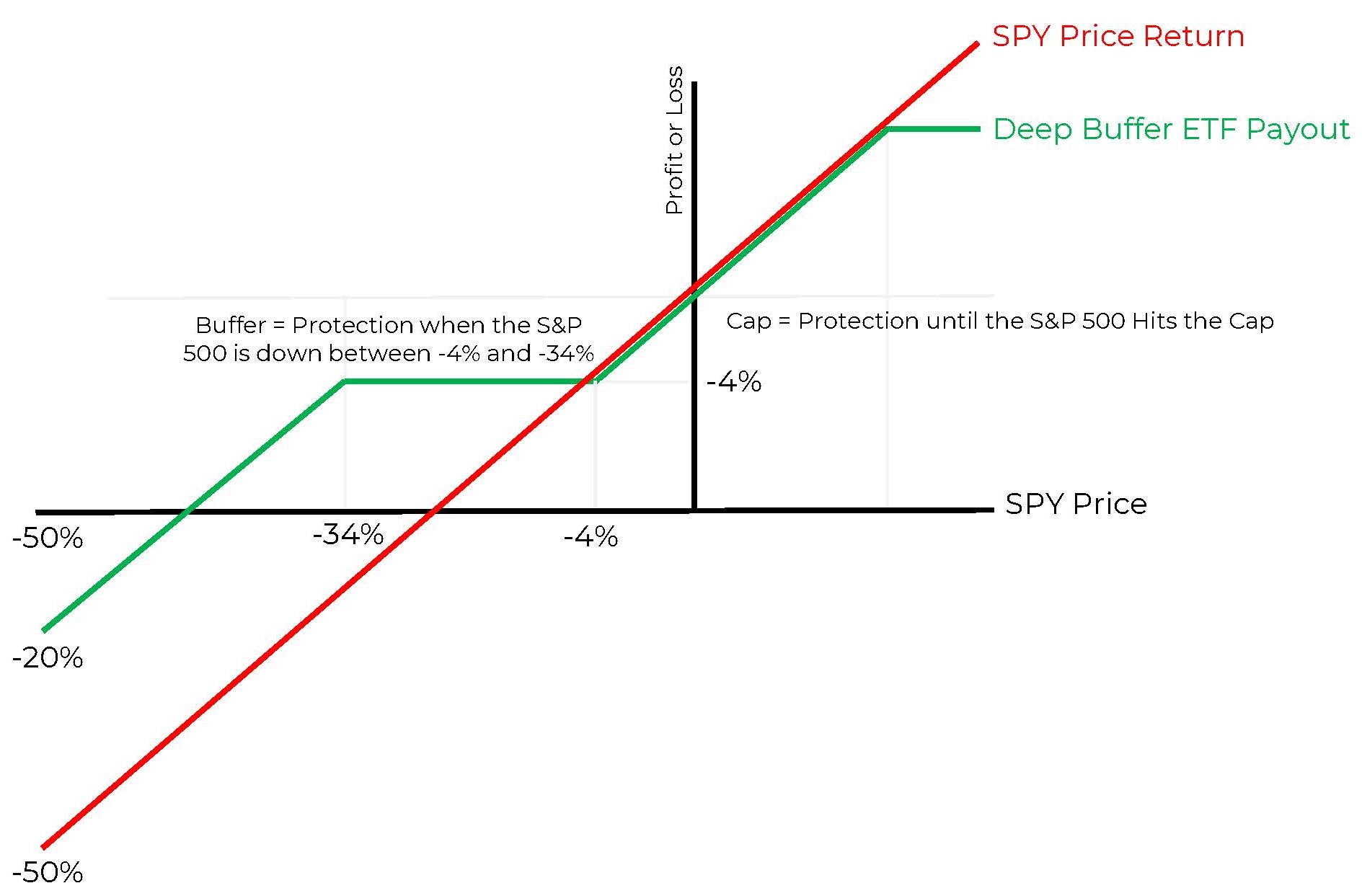
The Fund uses FLEX Options to employ a “structured outcome strategy.” Structured outcome strategies seek to produce pre-determined target investment outcomes based upon the performance of an underlying security or index. The pre-determined outcomes sought by the Fund are intended to reflect the share price performance of the Underlying ETF over an approximate one-year period (the “Investment Period”), subject to a “deep” buffer, i.e., limited downside protection (the “Buffer”) against a certain percentage of Underlying ETF losses, and a cap, i.e., a pre-determined upside return cap percentage (the “Cap”), as set forth in the following table:
Investment Period Start* | Investment Period End* | Buffer (before Fund fees and expenses)** | Buffer (after Fund fees and expenses) | Cap (before Fund fees and expenses)*, *** | Cap (after Fund fees and expenses)**** | ||||||||||||
| December 31 | December 30 | 4% through 34% | 4.25% through 34.25% | 9.51% | 8.85% | ||||||||||||
* The period from the commencement of the Fund’s operations (May 5, 2026) to the business day preceding the start of the Fund’s first full one-year Investment Period (December 30, 2026) is referred to as the “Initial Investment Period.” For purposes of this Prospectus, all references to an Investment Period, other than its length in time, include the Fund’s Initial Investment Period. Each Cap is calculated based on the Fund’s Initial Investment Period, which is less than a full year. Following the Fund’s Initial Investment Period, each subsequent Investment Period will be a twelve-month period from approximately December 31 to December 30 of the following year. If a scheduled Investment Period Start date or Investment Period End date falls on a weekend or holiday, then the Investment Period Start Date or Investment Period End date, as the case may be, will be the next succeeding business day.
** The Fund seeks to provide a “deep” Buffer against Underlying ETF losses between -4% and -34% over the Investment Period. The Fund does not seek to provide a Buffer against (1) the first 4% of Underlying ETF losses, and (2) Underlying ETF losses exceeding 34%.
*** The Fund’s investment strategy is designed to provide upside participation that matches the share price performance of the Underlying ETF up to a Cap, which is determined prior to the start of each Investment Period. The Cap will change from Investment Period to Investment Period. The Fund does not seek to participate in any Underlying ETF gains beyond the Cap.
**** For this purpose, Fund fees and expenses consist of the Fund’s total expense ratio and net options trading costs, if any.
The Underlying ETF’s share price performance does not reflect returns, if any, associated with the Underlying ETF’s dividend payments. As such, the Fund does not seek to provide its shareholders with returns that reflect the inclusion of the Underlying ETF’s dividend payments, if any.
In general, the structured outcomes the Fund seeks for investors that hold Fund shares for an entire Investment Period are as follows, though there can be no guarantee these results will be achieved:
•If the Underlying ETF’s share price appreciates over the Investment Period, the strategy is designed to provide upside participation that matches the share price performance of the Underlying ETF, up to the Cap that is determined at the start of the Investment Period, before fees and expenses of the Fund.
•If the Underlying ETF’s share price declines over the Investment Period by 4% or less, the strategy is designed to provide returns that match the declining share price performance of the Underlying ETF before fees and expenses of the Fund. For example, if the Underlying ETF loses 4% in share price over the Investment Period, the strategy is designed for the Fund to have a -4% return, before fees and expenses of the Fund.
•If the Underlying ETF’s share price declines over the Investment Period by more than 4% but less than or equal to 34%, the strategy is designed to provide a -4% return for the Fund, before fees and expenses of the Fund. For example, if the Underlying ETF loses 25% in share price over the Investment Period, the strategy is designed for the Fund to have a -4% return, before fees and expenses of the Fund.
•If the Underlying ETF’s share price declines over the Investment Period by more than 34%, the strategy is designed to protect the Fund from Underlying ETF losses between -4% and -34%, while experiencing the first 4% of losses and participating in losses greater than 34% on a one-to-one basis with the Underlying ETF, before fees and expenses of the Fund. As a result, in this scenario, the strategy is designed to provide returns that are 30 percentage points less than the percentage loss on the Underlying ETF’s share price over the Investment Period. For example, if the Underlying ETF loses 35% in share price over the Investment Period, the strategy is designed for the Fund to have losses of 5% (35% less the 30% “deep” Buffer that covers losses from 4% through 34%), before Fund fees and expenses. The Buffer is not the equivalent of a floor on investment losses.
The following charts illustrate the hypothetical returns that the FLEX Options seek to provide with respect to the share price performance of the Underlying ETF in certain illustrative scenarios over the course of the Investment Period. These charts do not take into account payment by the Fund of fees and expenses. There is no guarantee that the Fund will be successful in providing these investment outcomes for any Investment Period.
Market Scenarios over 12-Month Term (%)*
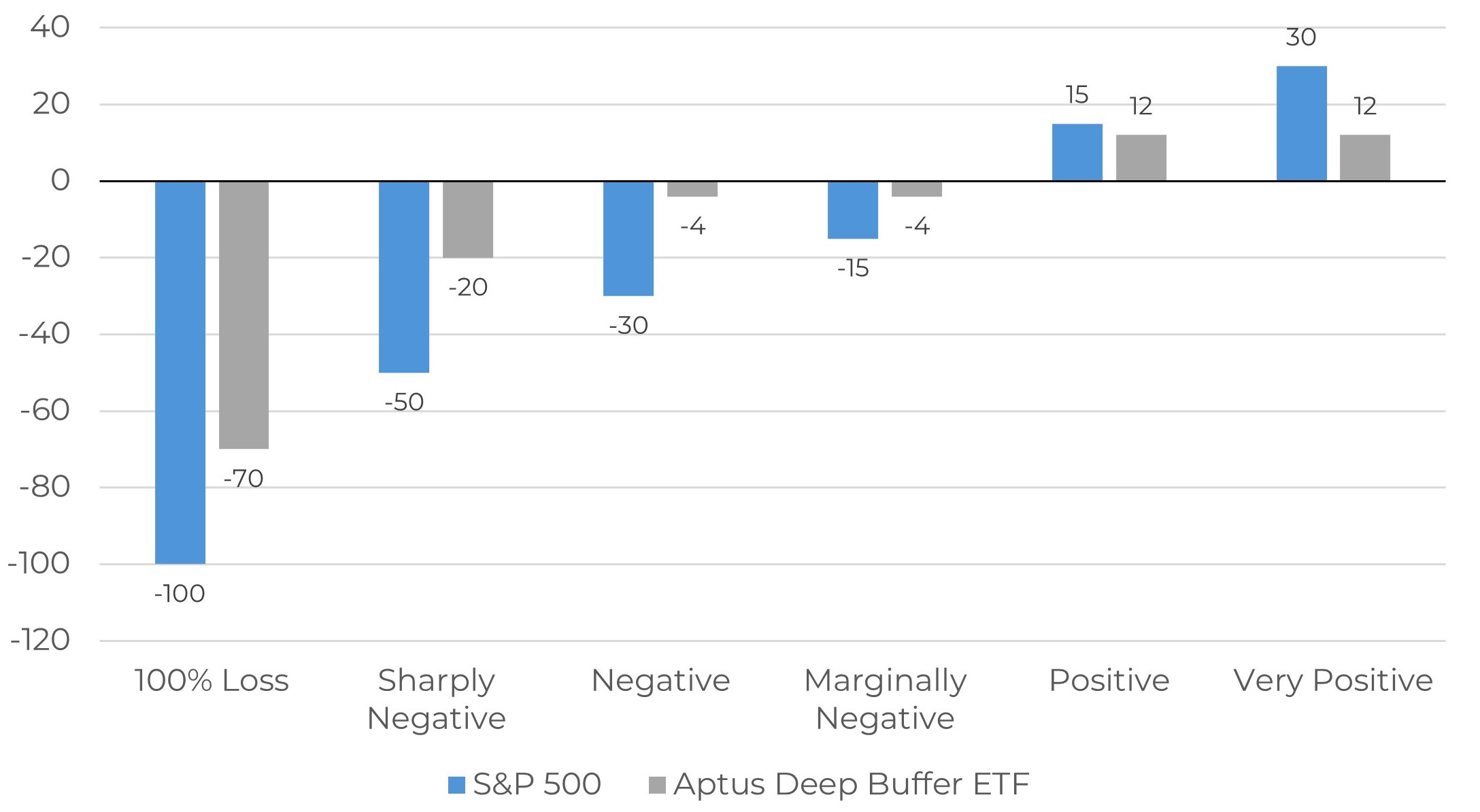
* The hypothetical cap level of 12% set forth in the above bar chart is for illustration purposes only. The Fund’s actual Cap, set forth in the table above, may be different and will change from Investment Period to Investment Period.
Investors purchasing Shares during an Investment Period will experience different results. The Fund’s website, www.aptusetfs.com/JADB, provides information relating to the possible outcomes for an investor of an investment in the Fund on a daily basis, including the Fund’s position relative to the Cap and Buffer. Before purchasing Shares, an investor should visit the Fund’s website to review this information and understand the possible outcomes of an investment in Shares on a particular day.
The Fund is a continuous investment vehicle that will be perpetually offered. It does not terminate and distribute its assets at the conclusion of an Investment Period. Subsequent Investment Periods will begin on the first business day following the end of the prior Investment Period and will end on the approximate one-year anniversary of that new Investment Period. On the final business day of each Investment Period, the Fund resets by investing in a new set of FLEX Options that will provide a new Cap for the new Investment Period. This means that the Cap will change for each Investment Period based upon prevailing market conditions at the beginning of each Investment Period. The Cap and Buffer, and the Fund’s position relative to each, should be considered before investing in the Fund.
Purchases and Sales During an Investment Period
An investor that purchases Shares other than on the first day of an Investment Period and/or sells Shares prior to the end of an Investment Period may experience results that are very different from the outcomes sought by the Fund for that Investment Period.
Both the Cap and Buffer are fixed levels that are calculated in relation to the Underlying ETF’s market price and the Fund’s net asset value (“NAV”) at the start of an Investment Period. While the Cap and Buffer reference the performance of the Underlying ETF over the Investment Period, the Fund expects its NAV to experience the same general price movement, Cap, and Buffer as a percentage gain or loss by the Underlying ETF over the Investment Period, before fees and expenses of the Fund.
Because the Underlying ETF’s market price and the Fund’s NAV change over the Investment Period, an investor acquiring Shares after the start of the Investment Period, or selling Shares before the end of the Investment Period, will likely have a different return potential than an investor who purchased Shares at the start of the Investment Period, or held the Shares at the end of the Investment Period. This is because, while the Cap and Buffer for the Investment Period are fixed levels that remain constant throughout the Investment Period, an investor purchasing Shares at market value during the Investment Period likely purchased Shares at a price that is different from the Fund’s NAV at the start of the Investment Period (i.e., the NAV that the Cap and Buffer reference). In addition, the price of the Underlying ETF during the Investment Period is likely to be different from the price of the Underlying ETF at the start of the Investment Period. Similarly, an investor selling Shares at market value during the Investment Period likely sold Shares at a price that is different from the Fund’s NAV at the conclusion of the Investment Period. In addition, the price of the Underlying ETF during the Investment Period is likely to be different from the price of the Underlying ETF at the conclusion of the Investment Period. To achieve the structured outcomes sought by the Fund for an Investment Period, an investor must hold Shares for that entire Investment Period.
Buffer
The Fund seeks to shield its shareholders from losses between -4% and -34% experienced by the Underlying ETF during the Investment Period, i.e., provide a “deep” Buffer, or limited downside protection, against Underlying ETF losses between -4% and -34% over each Investment Period. The Fund’s shareholders will bear the first 4% of Underlying ETF losses and all Underlying ETF losses exceeding 34% on a one-to-one basis. The Buffer is before taking into account the fees and expenses of the Fund charged to shareholders. Unlike the Cap, the Buffer and the Underlying ETF will remain the same for each Investment Period.
If an investor is considering purchasing Shares during the Investment Period and the Fund has already decreased in share price by an amount equal to or greater than 34% from the Fund’s share price on the first day of the Investment Period (the “Initial Fund Price”), an investor purchasing Shares at that price will have increased gains available prior to reaching the Cap but may not benefit from the Buffer that the Fund seeks to offer for the remainder of the Investment Period. The Cap and Buffer relative to the Initial Fund Price, however, will not change over the Investment Period.
If an investor is considering purchasing Shares during the Investment Period and the Fund has already decreased in share price by an amount greater than 4% but less than 34% from the Initial Fund Price, an investor purchasing Shares at that price will have increased gains available prior to reaching the Cap, but that investor’s Buffer will be reduced by the difference between ‑4% and the NAV of the Fund on the date the investor purchases the Shares.
Conversely, if an investor is considering purchasing Shares during the Investment Period and the Fund has already increased in share price, an investor purchasing Shares at that price may experience losses in excess of 4% prior to gaining the protection offered by the Buffer, which is not guaranteed.
Cap
The returns of the Fund are subject to the Cap set forth in the above table for the Investment Period. Unlike other investment products, the potential returns an investor can receive from the Fund are subject to a pre-determined upside return Cap that represents the maximum percentage return an investor can achieve from an investment in the Fund for an entire Investment Period. In the event the Underlying ETF experiences gains over an Investment Period, the Fund seeks to provide investment returns that match the percentage increase of the Underlying ETF’s share price, but any percentage gains over the amount of the Cap will not be experienced by the Fund. This means that, if the Underlying ETF experiences share price gains for an Investment Period in excess of the Cap for that Investment Period, the Fund will not benefit from those excess gains. Therefore, regardless of the share price performance of the Underlying ETF, the Cap is the maximum return an investor can achieve from an investment in the Fund for that Investment Period.
The Cap is set at market close one business day prior to each Investment Period. The defined Cap applicable to an Investment Period will vary based on prevailing market conditions at the time, including then-current interest rate levels, Underlying ETF volatility, and the relationship of puts and calls on the underlying FLEX Options. Following the close of business on the last day of the Investment Period, the Fund will supplement its prospectus by filing and mailing to shareholders a notice disclosing the Fund’s Cap for the next Investment Period. The information will also be available on the Fund’s website at www.aptusetfs.com/JADB.
The Cap is determined prior to taking into account annual operating expenses of the Fund, which are disclosed above under “Fees and Expenses of the Fund,” as well as brokerage commissions, trading fees, taxes, and any extraordinary expenses incurred by the Fund. Such extraordinary expenses (incurred outside of the ordinary operation of the Fund) may include, for example, unexpected litigation, regulatory, or tax expenses.
The Cap level is a result of the design of the Fund’s principal investment strategy. To provide the Buffer, the Fund purchases and sells (writes) a series of put and call FLEX Options on the first day of an Investment Period. As the purchaser of these FLEX Options, the Fund is obligated to pay a premium to the seller of those FLEX Options. The portfolio managers will calculate the amount of premiums that the Fund will owe on the put options acquired and sold to provide the Buffer and will then go into the market and sell call options with terms that entitle the Fund to receive premiums such that the net amount of premiums paid per unit of the Underlying ETF is approximately equal to the price per unit of shares of the Underlying ETF. The Cap is the strike price of those sold FLEX Options. If determined to be in the best interest of the Fund and its shareholders, the portfolio managers may set the Cap at a higher level by increasing the strike price of the sold FLEX Options, which may cause the Fund to incur additional trading costs.
The Cap, and the Fund’s position relative to it on any given day, should be considered before investing in the Fund. If an investor purchases Shares during an Investment Period, and the Fund has already increased in share price above its Initial Fund Price for that Investment Period to a level near to the Cap, an investor purchasing Shares will have limited to no gain potential for the remainder of the Investment Period. However, the investor will remain vulnerable to significant downside risk because the investor will bear the losses between the price at which it purchased its Shares and the Initial Fund Price for the Investment Period, as well as the first 4% of Underlying ETF losses, before any subsequent losses are protected by the Buffer.
General Information about FLEX Options
FLEX Options are exchange-traded options contracts with uniquely customizable terms like exercise price, style, and expiration date. The Underlying ETF is an exchange-traded unit investment trust that seeks to provide investment results that, before expenses, correspond generally to the price and yield performance of the S&P 500® Index. The Underlying ETF uses a full replication strategy, meaning it invests in all of the component securities of the S&P 500® Index in the same approximate proportions as in the S&P 500® Index.
The FLEX Options that the Fund will hold that reference the Underlying ETF will give the Fund the right to receive or deliver shares of the Underlying ETF on the option expiration date at a strike price, depending on whether the option is a put or call option and whether the Fund purchases or sells the option. The FLEX Options held by the Fund are European-style options, which are exercisable at the strike price only on the FLEX Option expiration date.
The Fund will generally, under normal conditions, hold four kinds of FLEX Options for each Investment Period. The Fund will purchase a call option (giving the Fund the right to receive shares of the Underlying ETF) and a put option (giving the Fund the right to deliver shares of the Underlying ETF), while simultaneously selling (i.e., writing) a call option (giving the Fund the obligation to deliver shares of the Underlying ETF) and a put option (giving the Fund the obligation to receive shares of the Underlying ETF). The Fund intends to structure the FLEX Options so that any amount owed by the Fund on the written FLEX Options will be covered by payouts at expiration from the purchased FLEX Options. As a result, the FLEX
Options will be fully covered and no additional collateral will be necessary during the life of the Fund. The Fund receives premiums in exchange for the written FLEX Options and pays premiums in exchange for the purchased FLEX Options. Each of the FLEX Options purchased and sold throughout the Investment Period will have the same terms, such as strike price and expiration date, as the FLEX Options purchased and sold on the first day of the Investment Period.
Upon conclusion of the Investment Period, the Fund will receive the net cash value of all the FLEX Options it held for the Investment Period. The Fund will use that net cash to invest in a new series of FLEX Options with an expiration date matching the last business day in the new Investment Period.
The Fund is classified as “non-diversified” under the Investment Company Act of 1940, as amended (the “1940 Act”).
As of December 31, 2025, the Underlying ETF had significant investments in the Information Technology sector.
The Fund is an actively managed exchange-traded fund (“ETF”) that, under normal market conditions, invests substantially all of its assets in FLexible EXchange® Options (“FLEX Options”) that reference the market price of the Underlying ETF. Due to the unique mechanics of the Fund’s strategy, the return an investor can expect to receive from an investment in the Fund has characteristics that are distinct from many other investment vehicles. It is important that an investor understand these characteristics before making an investment in the Fund.
The Fund uses FLEX Options to employ a “structured outcome strategy.” Structured outcome strategies seek to produce pre-determined target investment outcomes based upon the performance of an underlying security or index. The pre-determined outcomes sought by the Fund are intended to reflect the share price performance of the Underlying ETF over an approximate one-year period (the “Investment Period”), subject to a “deep” buffer, i.e., limited downside protection (the “Buffer”) against a certain percentage of Underlying ETF losses, and a cap, i.e., a pre-determined upside return cap percentage (the “Cap”), as set forth in the following table:
Investment Period Start* | Investment Period End* | Buffer (before Fund fees and expenses)** | Buffer (after Fund fees and expenses) | Cap (before Fund fees and expenses)*, *** | Cap (after Fund fees and expenses)**** | ||||||||||||
| March 31 | March 30 | 4% through 34% | 4.25% through 34.25% | 12.15% | 11.42% | ||||||||||||
* The period from the commencement of the Fund’s operations (May 5, 2026) to the business day preceding the start of the Fund’s first full one-year Investment Period (March 30, 2027) is referred to as the “Initial Investment Period.” For purposes of this Prospectus, all references to an Investment Period, other than its length in time, include the Fund’s Initial Investment Period. Each Cap is calculated based on the Fund’s Initial Investment Period, which is less than a full year. Following the Fund’s Initial Investment Period, each subsequent Investment Period will be a twelve-month period from approximately March 31 to March 30 of the following year. If a scheduled Investment Period Start date or Investment Period End date falls on a weekend or holiday, then the Investment Period Start Date or Investment Period End date, as the case may be, will be the next succeeding business day.
** The Fund seeks to provide a “deep” Buffer against Underlying ETF losses between -4% and -34% over the Investment Period. The Fund does not seek to provide a Buffer against (1) the first 4% of Underlying ETF losses, and (2) Underlying ETF losses exceeding 34%.
*** The Fund’s investment strategy is designed to provide upside participation that matches the share price performance of the Underlying ETF up to a Cap, which is determined prior to the start of each Investment Period. The Cap will change from Investment Period to Investment Period. The Fund does not seek to participate in any Underlying ETF gains beyond the Cap.
**** For this purpose, Fund fees and expenses consist of the Fund’s total expense ratio and net options trading costs, if any.
The Underlying ETF’s share price performance does not reflect returns, if any, associated with the Underlying ETF’s dividend payments. As such, the Fund does not seek to provide its shareholders with returns that reflect the inclusion of the Underlying ETF’s dividend payments, if any.
In general, the structured outcomes the Fund seeks for investors that hold Fund shares for an entire Investment Period are as follows, though there can be no guarantee these results will be achieved:
•If the Underlying ETF’s share price appreciates over the Investment Period, the strategy is designed to provide upside participation that matches the share price performance of the Underlying ETF, up to the Cap that is determined at the start of the Investment Period, before fees and expenses of the Fund.
•If the Underlying ETF’s share price declines over the Investment Period by 4% or less, the strategy is designed to provide returns that match the declining share price performance of the Underlying ETF before fees and expenses of the Fund. For example, if the Underlying ETF loses 4% in share price over the Investment Period, the strategy is designed for the Fund to have a -4% return, before fees and expenses of the Fund.
•If the Underlying ETF’s share price declines over the Investment Period by more than 4% but less than or equal to 34%, the strategy is designed to provide a -4% return for the Fund, before fees and expenses of the Fund. For example, if the Underlying ETF loses 25% in share price over the Investment Period, the strategy is designed for the Fund to have a -4% return, before fees and expenses of the Fund.
•If the Underlying ETF’s share price declines over the Investment Period by more than 34%, the strategy is designed to protect the Fund from Underlying ETF losses between -4% and -34%, while experiencing the first 4% of losses and participating in losses greater than 34% on a one-to-one basis with the Underlying ETF, before fees and expenses of the Fund. As a result, in this scenario, the strategy is designed to provide returns that are 30 percentage points less than the percentage loss on the Underlying ETF’s share price over the Investment Period. For example, if the Underlying ETF loses 35% in share price over the Investment Period, the strategy is designed for the Fund to have losses of 5% (35% less the 30% “deep” Buffer that covers losses from 4% through 34%), before Fund fees and expenses. The Buffer is not the equivalent of a floor on investment losses.
The following charts illustrate the hypothetical returns that the FLEX Options seek to provide with respect to the share price performance of the Underlying ETF in certain illustrative scenarios over the course of the Investment Period. These charts do not take into account payment by the Fund of fees and expenses. There is no guarantee that the Fund will be successful in providing these investment outcomes for any Investment Period.
Market Scenarios over 12-Month Term (%)*
* The hypothetical cap level of 12% set forth in the above bar chart is for illustration purposes only. The Fund’s actual Cap, set forth in the table above, may be different and will change from Investment Period to Investment Period.
Investors purchasing Shares during an Investment Period will experience different results. The Fund’s website, www.aptusetfs.com/APDB, provides information relating to the possible outcomes for an investor of an investment in the Fund on a daily basis, including the Fund’s position relative to the Cap and Buffer. Before purchasing Shares, an investor should visit the Fund’s website to review this information and understand the possible outcomes of an investment in Shares on a particular day.
The Fund is a continuous investment vehicle that will be perpetually offered. It does not terminate and distribute its assets at the conclusion of an Investment Period. Subsequent Investment Periods will begin on the first business day following the end of the prior Investment Period and will end on the approximate one-year anniversary of that new Investment Period. On the final business day of each Investment Period, the Fund resets by investing in a new set of FLEX Options that will provide a new Cap for the new Investment Period. This means that the Cap will change for each Investment Period based upon prevailing market conditions at the beginning of each Investment Period. The Cap and Buffer, and the Fund’s position relative to each, should be considered before investing in the Fund.
Purchases and Sales During an Investment Period
An investor that purchases Shares other than on the first day of an Investment Period and/or sells Shares prior to the end of an Investment Period may experience results that are very different from the outcomes sought by the Fund for that Investment Period.
Both the Cap and Buffer are fixed levels that are calculated in relation to the Underlying ETF’s market price and the Fund’s net asset value (“NAV”) at the start of an Investment Period. While the Cap and Buffer reference the performance of the Underlying ETF over the Investment Period, the Fund expects its NAV to experience the same general price movement, Cap, and Buffer as a percentage gain or loss by the Underlying ETF over the Investment Period, before fees and expenses of the Fund.
Because the Underlying ETF’s market price and the Fund’s NAV change over the Investment Period, an investor acquiring Shares after the start of the Investment Period, or selling Shares before the end of the Investment Period, will likely have a different return potential than an investor who purchased Shares at the start of the Investment Period, or held the Shares at the end of the Investment Period. This is because, while the Cap and Buffer for the Investment Period are fixed levels that remain constant throughout the Investment Period, an investor purchasing Shares at market value during the Investment Period likely purchased Shares at a price that is different from the Fund’s NAV at the start of the Investment Period (i.e., the NAV that the Cap and Buffer reference). In addition, the price of the Underlying ETF during the Investment Period is likely to be different from the price of the Underlying ETF at the start of the Investment Period. Similarly, when an investor sells Shares at market value during the Investment Period will likely sell Shares at a price that will be different from the Fund’s NAV at the conclusion of the Investment Period. In addition, the price of the Underlying ETF during the Investment Period is likely to be different from the price of the Underlying ETF at the conclusion of the Investment Period. To achieve the structured outcomes sought by the Fund for an Investment Period, an investor must hold Shares for that entire Investment Period.
Buffer
The Fund seeks to shield its shareholders from losses between -4% and -34% experienced by the Underlying ETF during the Investment Period, i.e., provide a “deep” Buffer, or limited downside protection, against Underlying ETF losses between -4% and -34% over each Investment Period. The Fund’s shareholders will bear the first 4% of Underlying ETF losses and all Underlying ETF losses exceeding 34% on a one-to-one basis. The Buffer is before taking into account the fees and expenses of the Fund charged to shareholders. Unlike the Cap, the Buffer and the Underlying ETF will remain the same for each Investment Period.
If an investor is considering purchasing Shares during the Investment Period and the Fund has already decreased in share price by an amount equal to or greater than 34% from the Fund’s share price on the first day of the Investment Period (the “Initial Fund Price”), an investor purchasing Shares at that price will have increased gains available prior to reaching the Cap but may not benefit from the Buffer that the Fund seeks to offer for the remainder of the Investment Period. The Cap and Buffer relative to the Initial Fund Price, however, will not change over the Investment Period.
If an investor is considering purchasing Shares during the Investment Period and the Fund has already decreased in share price by an amount greater than 4% but less than 34% from the Initial Fund Price, an investor purchasing Shares at that price will have increased gains available prior to reaching the Cap, but that investor’s Buffer will be reduced by the difference between ‑4% and the NAV of the Fund on the date the investor purchases the Shares.
Conversely, if an investor is considering purchasing Shares during the Investment Period and the Fund has already increased in share price, an investor purchasing Shares at that price may experience losses in excess of 4% prior to gaining the protection offered by the Buffer, which is not guaranteed.
Cap
The returns of the Fund are subject to the Cap set forth in the above table for the Investment Period. Unlike other investment products, the potential returns an investor can receive from the Fund are subject to a pre-determined upside return Cap that represents the maximum percentage return an investor can achieve from an investment in the Fund for an entire Investment Period. In the event the Underlying ETF experiences gains over an Investment Period, the Fund seeks to provide investment returns that match the percentage increase of the Underlying ETF’s share price, but any percentage gains over the amount of the Cap will not be experienced by the Fund. This means that, if the Underlying ETF experiences share price gains for an Investment Period in excess of the Cap for that Investment Period, the Fund will not benefit from those excess gains. Therefore, regardless of the share price performance of the Underlying ETF, the Cap is the maximum return an investor can achieve from an investment in the Fund for that Investment Period.
The Cap is set at market close one business day prior to each Investment Period. The defined Cap applicable to an Investment Period will vary based on prevailing market conditions at the time, including then-current interest rate levels, Underlying ETF volatility, and the relationship of puts and calls on the underlying FLEX Options. Following the close of business on the last day of the Investment Period, the Fund will supplement its prospectus by filing and mailing to shareholders a notice disclosing the Fund’s Cap for the next Investment Period. The information will also be available on the Fund’s website at www.aptusetfs.com/APDB.
The Cap is determined prior to taking into account annual operating expenses of the Fund, which are disclosed above under “Fees and Expenses of the Fund,” as well as brokerage commissions, trading fees, taxes, and any extraordinary expenses incurred by the Fund. Such extraordinary expenses (incurred outside of the ordinary operation of the Fund) may include, for example, unexpected litigation, regulatory, or tax expenses.
The Cap level is a result of the design of the Fund’s principal investment strategy. To provide the Buffer, the Fund purchases and sells (writes) a series of put and call FLEX Options on the first day of an Investment Period. As the purchaser of these FLEX Options, the Fund is obligated to pay a premium to the seller of those FLEX Options. The portfolio managers will calculate the amount of premiums that the Fund will owe on the put options acquired and sold to provide the Buffer and will then go into the market and sell call options with terms that entitle the Fund to receive premiums such that the net amount of premiums paid per unit of the Underlying ETF is approximately equal to the price per unit of shares of the Underlying ETF. The Cap is the strike price of those sold FLEX Options. If determined to be in the best interest of the Fund and its shareholders, the portfolio managers may set the Cap at a higher level by increasing the strike price of the sold FLEX Options, which may cause the Fund to incur additional trading costs.
The Cap, and the Fund’s position relative to it on any given day, should be considered before investing in the Fund. If an investor purchases Shares during an Investment Period, and the Fund has already increased in share price above its Initial Fund Price for that Investment Period to a level near to the Cap, an investor purchasing Shares will have limited to no gain potential for the remainder of the Investment Period. However, the investor will remain vulnerable to significant downside risk because the investor will bear the losses between the price at which it purchased its Shares and the Initial Fund Price for the Investment Period, as well as the first 4% of Underlying ETF losses, before any subsequent losses are protected by the Buffer.
General Information about FLEX Options
FLEX Options are exchange-traded options contracts with uniquely customizable terms like exercise price, style, and expiration date. The Underlying ETF is an exchange-traded unit investment trust that seeks to provide investment results that, before expenses, correspond generally to the price and yield performance of the S&P 500® Index. The Underlying ETF uses a full replication strategy, meaning it invests in all of the component securities of the S&P 500® Index in the same approximate proportions as in the S&P 500® Index.
The FLEX Options that the Fund will hold that reference the Underlying ETF will give the Fund the right to receive or deliver shares of the Underlying ETF on the option expiration date at a strike price, depending on whether the option is a put or call option and whether the Fund purchases or sells the option. The FLEX Options held by the Fund are European-style options, which are exercisable at the strike price only on the FLEX Option expiration date.
The Fund will generally, under normal conditions, hold four kinds of FLEX Options for each Investment Period. The Fund will purchase a call option (giving the Fund the right to receive shares of the Underlying ETF) and a put option (giving the Fund the right to deliver shares of the Underlying ETF), while simultaneously selling (i.e., writing) a call option (giving the Fund the obligation to deliver shares of the Underlying ETF) and a put option (giving the Fund the obligation to receive shares of the Underlying ETF). The Fund intends to structure the FLEX Options so that any amount owed by the Fund on the written FLEX Options will be covered by payouts at expiration from the purchased FLEX Options. As a result, the FLEX
Options will be fully covered and no additional collateral will be necessary during the life of the Fund. The Fund receives premiums in exchange for the written FLEX Options and pays premiums in exchange for the purchased FLEX Options. Each of the FLEX Options purchased and sold throughout the Investment Period will have the same terms, such as strike price and expiration date, as the FLEX Options purchased and sold on the first day of the Investment Period.
Upon conclusion of the Investment Period, the Fund will receive the net cash value of all the FLEX Options it held for the Investment Period. The Fund will use that net cash to invest in a new series of FLEX Options with an expiration date matching the last business day in the new Investment Period.
The Fund is classified as “non-diversified” under the Investment Company Act of 1940, as amended (the “1940 Act”).
As of December 31, 2025, the Underlying ETF had significant investments in the Information Technology sector.
The Fund is an actively managed exchange-traded fund (“ETF”) that, under normal market conditions, invests substantially all of its assets in FLexible EXchange® Options (“FLEX Options”) that reference the market price of the Underlying ETF. Due to the unique mechanics of the Fund’s strategy, the return an investor can expect to receive from an investment in the Fund has characteristics that are distinct from many other investment vehicles. It is important that an investor understand these characteristics before making an investment in the Fund.
The Fund uses FLEX Options to employ a “structured outcome strategy.” Structured outcome strategies seek to produce pre-determined target investment outcomes based upon the performance of an underlying security or index. The pre-determined outcomes sought by the Fund are intended to reflect the share price performance of the Underlying ETF over an approximate one-year period (the “Investment Period”), subject to a “deep” buffer, i.e., limited downside protection (the “Buffer”) against a certain percentage of Underlying ETF losses, and a cap, i.e., a pre-determined upside return cap percentage (the “Cap”), as set forth in the following table:
Investment Period Start* | Investment Period End* | Buffer (before Fund fees and expenses)** | Buffer (after Fund fees and expenses) | Cap (before Fund fees and expenses)*, *** | Cap (after Fund fees and expenses)**** | ||||||||||||
| June 30 | June 29 | 4% through 34% | 4.25% through 34.25% | 5.51% | 4.97% | ||||||||||||
* The period from the commencement of the Fund’s operations (May 5, 2026) to the business day preceding the start of the Fund’s first full one-year Investment Period (June 29, 2026) is referred to as the “Initial Investment Period.” For purposes of this Prospectus, all references to an Investment Period, other than its length in time, include the Fund’s Initial Investment Period. Each Cap is calculated based on the Fund’s Initial Investment Period, which is less than a full year. Following the Fund’s Initial Investment Period, each subsequent Investment Period will be a twelve-month period from approximately June 30 to June 29 of the following year. If a scheduled Investment Period Start date or Investment Period End date falls on a weekend or holiday, then the Investment Period Start Date or Investment Period End date, as the case may be, will be the next succeeding business day.
** The Fund seeks to provide a “deep” Buffer against Underlying ETF losses between -4% and -34% over the Investment Period. The Fund does not seek to provide a Buffer against (1) the first 4% of Underlying ETF losses, and (2) Underlying ETF losses exceeding 34%.
*** The Fund’s investment strategy is designed to provide upside participation that matches the share price performance of the Underlying ETF up to a Cap, which is determined prior to the start of each Investment Period. The Cap will change from Investment Period to Investment Period. The Fund does not seek to participate in any Underlying ETF gains beyond the Cap.
**** For this purpose, Fund fees and expenses consist of the Fund’s total expense ratio and net options trading costs, if any.
The Underlying ETF’s share price performance does not reflect returns, if any, associated with the Underlying ETF’s dividend payments. As such, the Fund does not seek to provide its shareholders with returns that reflect the inclusion of the Underlying ETF’s dividend payments, if any.
In general, the structured outcomes the Fund seeks for investors that hold Fund shares for an entire Investment Period are as follows, though there can be no guarantee these results will be achieved:
•If the Underlying ETF’s share price appreciates over the Investment Period, the strategy is designed to provide upside participation that matches the share price performance of the Underlying ETF, up to the Cap that is determined at the start of the Investment Period, before fees and expenses of the Fund.
•If the Underlying ETF’s share price declines over the Investment Period by 4% or less, the strategy is designed to provide returns that match the declining share price performance of the Underlying ETF before fees and expenses of the Fund. For example, if the Underlying ETF loses 4% in share price over the Investment Period, the strategy is designed for the Fund to have a -4% return, before fees and expenses of the Fund.
•If the Underlying ETF’s share price declines over the Investment Period by more than 4% but less than or equal to 34%, the strategy is designed to provide a -4% return for the Fund, before fees and expenses of the Fund. For example, if the Underlying ETF loses 25% in share price over the Investment Period, the strategy is designed for the Fund to have a -4% return, before fees and expenses of the Fund.
•If the Underlying ETF’s share price declines over the Investment Period by more than 34%, the strategy is designed to protect the Fund from Underlying ETF losses between -4% and -34%, while experiencing the first 4% of losses and participating in losses greater than 34% on a one-to-one basis with the Underlying ETF, before fees and expenses of the Fund. As a result, in this scenario, the strategy is designed to provide returns that are 30 percentage points less than the percentage loss on the Underlying ETF’s share price over the Investment Period. For example, if the Underlying ETF loses 35% in share price over the Investment Period, the strategy is designed for the Fund to have losses of 5% (35% less the 30% “deep” Buffer that covers losses from 4% through 34%), before Fund fees and expenses. The Buffer is not the equivalent of a floor on investment losses.
The following charts illustrate the hypothetical returns that the FLEX Options seek to provide with respect to the performance of the Underlying ETF in certain illustrative scenarios over the course of the Investment Period. These charts do not take into account payment by the Fund of fees and expenses. There is no guarantee that the Fund will be successful in providing these investment outcomes for any Investment Period.
Market Scenarios over 12-Month Term (%)*
* The hypothetical cap level of 12% set forth in the above bar chart is for illustration purposes only. The Fund’s actual Cap, set forth in the table above, may be different and will change from Investment Period to Investment Period.
Investors purchasing Shares during an Investment Period will experience different results. The Fund’s website, www.aptusetfs.com/JUDB, provides information relating to the possible outcomes for an investor of an investment in the Fund on a daily basis, including the Fund’s position relative to the Cap and Buffer. Before purchasing Shares, an investor should visit the Fund’s website to review this information and understand the possible outcomes of an investment in Shares on a particular day.
The Fund is a continuous investment vehicle that will be perpetually offered. It does not terminate and distribute its assets at the conclusion of an Investment Period. Subsequent Investment Periods will begin on the first business day following the end of the prior Investment Period and will end on the approximate one-year anniversary of that new Investment Period. On the final business day of each Investment Period, the Fund resets by investing in a new set of FLEX Options that will provide a new Cap for the new Investment Period. This means that the Cap will change for each Investment Period based upon prevailing market conditions at the beginning of each Investment Period. The Cap and Buffer, and the Fund’s position relative to each, should be considered before investing in the Fund.
Purchases and Sales During an Investment Period
An investor that purchases Shares other than on the first day of an Investment Period and/or sells Shares prior to the end of an Investment Period may experience results that are very different from the outcomes sought by the Fund for that Investment Period.
Both the Cap and Buffer are fixed levels that are calculated in relation to the Underlying ETF’s market price and the Fund’s net asset value (“NAV”) at the start of an Investment Period. While the Cap and Buffer reference the performance of the Underlying ETF over the Investment Period, the Fund expects its NAV to experience the same general price movement, Cap, and Buffer as a percentage gain or loss by the Underlying ETF over the Investment Period, before fees and expenses of the Fund.
Because the Underlying ETF’s market price and the Fund’s NAV change over the Investment Period, an investor acquiring Shares after the start of the Investment Period, or selling Shares before the end of the Investment Period, will likely have a different return potential than an investor who purchased Shares at the start of the Investment Period, or held the Shares at the end of the Investment Period. This is because, while the Cap and Buffer for the Investment Period are fixed levels that remain constant throughout the Investment Period, an investor purchasing Shares at market value during the Investment Period likely purchased Shares at a price that is different from the Fund’s NAV at the start of the Investment Period (i.e., the NAV that the Cap and Buffer reference). In addition, the price of the Underlying ETF during the Investment Period is likely to be different from the price of the Underlying ETF at the start of the Investment Period. Similarly, when an investor sells Shares at market value during the Investment Period will likely sell Shares at a price that will be different from the Fund’s NAV at the conclusion of the Investment Period. In addition, the price of the Underlying ETF during the Investment Period is likely to be different from the price of the Underlying ETF at the conclusion of the Investment Period. To achieve the structured outcomes sought by the Fund for an Investment Period, an investor must hold Shares for that entire Investment Period.
Buffer
The Fund seeks to shield its shareholders from losses between -4% and -34% experienced by the Underlying ETF during the Investment Period, i.e., provide a “deep” Buffer, or limited downside protection, against Underlying ETF losses between -4% and -34% over each Investment Period. The Fund’s shareholders will bear the first 4% of Underlying ETF losses and all Underlying ETF losses exceeding 34% on a one-to-one basis. The Buffer is before taking into account the fees and expenses of the Fund charged to shareholders. Unlike the Cap, the Buffer and the Underlying ETF will remain the same for each Investment Period.
If an investor is considering purchasing Shares during the Investment Period and the Fund has already decreased in share price by an amount equal to or greater than 34% from the Fund’s share price on the first day of the Investment Period (the “Initial Fund Price”), an investor purchasing Shares at that price will have increased gains available prior to reaching the Cap but may not benefit from the Buffer that the Fund seeks to offer for the remainder of the Investment Period. The Cap and Buffer relative to the Initial Fund Price, however, will not change over the Investment Period.
If an investor is considering purchasing Shares during the Investment Period and the Fund has already decreased in share price by an amount greater than 4% but less than 34% from the Initial Fund Price, an investor purchasing Shares at that price will have increased gains available prior to reaching the Cap, but that investor’s Buffer will be reduced by the difference between ‑4% and the NAV of the Fund on the date the investor purchases the Shares.
Conversely, if an investor is considering purchasing Shares during the Investment Period and the Fund has already increased in share price, an investor purchasing Shares at that price may experience losses in excess of 4% prior to gaining the protection offered by the Buffer, which is not guaranteed.
Cap
The returns of the Fund are subject to the Cap set forth in the above table for the Investment Period. Unlike other investment products, the potential returns an investor can receive from the Fund are subject to a pre-determined upside return Cap that represents the maximum percentage return an investor can achieve from an investment in the Fund for an entire Investment Period. In the event the Underlying ETF experiences gains over an Investment Period, the Fund seeks to provide investment returns that match the percentage increase of the Underlying ETF’s share price, but any percentage gains over the amount of the Cap will not be experienced by the Fund. This means that, if the Underlying ETF experiences share price gains for an Investment Period in excess of the Cap for that Investment Period, the Fund will not benefit from those excess gains. Therefore, regardless of the share price performance of the Underlying ETF, the Cap is the maximum return an investor can achieve from an investment in the Fund for that Investment Period.
The Cap is set at market close one business day prior to each Investment Period. The defined Cap applicable to an Investment Period will vary based on prevailing market conditions at the time, including then-current interest rate levels, Underlying ETF volatility, and the relationship of puts and calls on the underlying FLEX Options. Following the close of business on the last day of the Investment Period, the Fund will supplement its prospectus by filing and mailing to shareholders a notice disclosing the Fund’s Cap for the next Investment Period. The information will also be available on the Fund’s website at www.aptusetfs.com/JUDB.
The Cap is determined prior to taking into account annual operating expenses of the Fund, which are disclosed above under “Fees and Expenses of the Fund,” as well as brokerage commissions, trading fees, taxes, and any extraordinary expenses incurred by the Fund. Such extraordinary expenses (incurred outside of the ordinary operation of the Fund) may include, for example, unexpected litigation, regulatory, or tax expenses.
The Cap level is a result of the design of the Fund’s principal investment strategy. To provide the Buffer, the Fund purchases and sells (writes) a series of put and call FLEX Options on the first day of an Investment Period. As the purchaser of these FLEX Options, the Fund is obligated to pay a premium to the seller of those FLEX Options. The portfolio managers will calculate the amount of premiums that the Fund will owe on the put options acquired and sold to provide the Buffer and will then go into the market and sell call options with terms that entitle the Fund to receive premiums such that the net amount of premiums paid per unit of the Underlying ETF is approximately equal to the price per unit of shares of the Underlying ETF. The Cap is the strike price of those sold FLEX Options. If determined to be in the best interest of the Fund and its shareholders, the portfolio managers may set the Cap at a higher level by increasing the strike price of the sold FLEX Options, which may cause the Fund to incur additional trading costs.
The Cap, and the Fund’s position relative to it on any given day, should be considered before investing in the Fund. If an investor purchases Shares during an Investment Period, and the Fund has already increased in share price above its Initial Fund Price for that Investment Period to a level near to the Cap, an investor purchasing Shares will have limited to no gain potential for the remainder of the Investment Period. However, the investor will remain vulnerable to significant downside risk because the investor will bear the losses between the price at which it purchased its Shares and the Initial Fund Price for the Investment Period, as well as the first 4% of Underlying ETF losses, before any subsequent losses are protected by the Buffer.
General Information about FLEX Options
FLEX Options are exchange-traded options contracts with uniquely customizable terms like exercise price, style, and expiration date. The Underlying ETF is an exchange-traded unit investment trust that seeks to provide investment results that, before expenses, correspond generally to the price and yield performance of the S&P 500® Index. The Underlying ETF uses a full replication strategy, meaning it invests in all of the component securities of the S&P 500® Index in the same approximate proportions as in the S&P 500® Index.
The FLEX Options that the Fund will hold that reference the Underlying ETF will give the Fund the right to receive or deliver shares of the Underlying ETF on the option expiration date at a strike price, depending on whether the option is a put or call option and whether the Fund purchases or sells the option. The FLEX Options held by the Fund are European-style options, which are exercisable at the strike price only on the FLEX Option expiration date.
The Fund will generally, under normal conditions, hold four kinds of FLEX Options for each Investment Period. The Fund will purchase a call option (giving the Fund the right to receive shares of the Underlying ETF) and a put option (giving the Fund the right to deliver shares of the Underlying ETF), while simultaneously selling (i.e., writing) a call option (giving the Fund the obligation to deliver shares of the Underlying ETF) and a put option (giving the Fund the obligation to receive shares of the Underlying ETF). The Fund intends to structure the FLEX Options so that any amount owed by the Fund on the written FLEX Options will be covered by payouts at expiration from the purchased FLEX Options. As a result, the FLEX
Options will be fully covered and no additional collateral will be necessary during the life of the Fund. The Fund receives premiums in exchange for the written FLEX Options and pays premiums in exchange for the purchased FLEX Options. Each of the FLEX Options purchased and sold throughout the Investment Period will have the same terms, such as strike price and expiration date, as the FLEX Options purchased and sold on the first day of the Investment Period.
Upon conclusion of the Investment Period, the Fund will receive the net cash value of all the FLEX Options it held for the Investment Period. The Fund will use that net cash to invest in a new series of FLEX Options with an expiration date matching the last business day in the new Investment Period.
The Fund is classified as “non-diversified” under the Investment Company Act of 1940, as amended (the “1940 Act”).
As of December 31, 2025, the Underlying ETF had significant investments in the Information Technology sector.
The Fund is an actively managed exchange-traded fund (“ETF”) that, under normal market conditions, invests substantially all of its assets in FLexible EXchange® Options (“FLEX Options”) that reference the market price of the Underlying ETF. Due to the unique mechanics of the Fund’s strategy, the return an investor can expect to receive from an investment in the Fund has characteristics that are distinct from many other investment vehicles. It is important that an investor understand these characteristics before making an investment in the Fund.
The Fund uses FLEX Options to employ a “structured outcome strategy.” Structured outcome strategies seek to produce pre-determined target investment outcomes based upon the performance of an underlying security or index. The pre-determined outcomes sought by the Fund are intended to reflect the share price performance of the Underlying ETF over an approximate one-year period (the “Investment Period”), subject to a “deep” buffer, i.e., limited downside protection (the “Buffer”) against a certain percentage of Underlying ETF losses, and a cap, i.e., a pre-determined upside return cap percentage (the “Cap”), as set forth in the following table:
Investment Period Start* | Investment Period End* | Buffer (before Fund fees and expenses)** | Buffer (after Fund fees and expenses) | Cap (before Fund fees and expenses)*, *** | Cap (after Fund fees and expenses)**** | ||||||||||||
| September 30 | September 29 | 4% through 34% | 4.25% through 34.25% | 7.16% | 6.56% | ||||||||||||
*The period from the commencement of the Fund’s operations (May 5, 2026) to the business day preceding the start of the Fund’s first full one-year Investment Period (September 29, 2026) is referred to as the “Initial Investment Period.” For purposes of this Prospectus, all references to an Investment Period, other than its length in time, include the Fund’s Initial Investment Period. Each Cap is calculated based on the Fund’s Initial Investment Period, which is less than a full year. Following the Fund’s Initial Investment Period, each subsequent Investment Period will be a twelve-month period from approximately September 30 to September 29 of the following year. If a scheduled Investment Period Start date or Investment Period End date falls on a weekend or holiday, then the Investment Period Start Date or Investment Period End date, as the case may be, will be the next succeeding business day.
** The Fund seeks to provide a “deep” Buffer against Underlying ETF losses between -4% and -34% over the Investment Period. The Fund does not seek to provide a Buffer against (1) the first 4% of Underlying ETF losses, and (2) Underlying ETF losses exceeding 34%.
*** The Fund’s investment strategy is designed to provide upside participation that matches the share price performance of the Underlying ETF up to a Cap, which is determined prior to the start of each Investment Period. The Cap will change from Investment Period to Investment Period. The Fund does not seek to participate in any Underlying ETF gains beyond the Cap.
**** For this purpose, Fund fees and expenses consist of the Fund’s total expense ratio and net options trading costs, if any.
The Underlying ETF’s share price performance does not reflect returns, if any, associated with the Underlying ETF’s dividend payments. As such, the Fund does not seek to provide its shareholders with returns that reflect the inclusion of the Underlying ETF’s dividend payments, if any.
In general, the structured outcomes the Fund seeks for investors that hold Fund shares for an entire Investment Period are as follows, though there can be no guarantee these results will be achieved:
•If the Underlying ETF’s share price appreciates over the Investment Period, the strategy is designed to provide upside participation that matches the share price performance of the Underlying ETF, up to the Cap that is determined at the start of the Investment Period, before fees and expenses of the Fund.
•If the Underlying ETF’s share price declines over the Investment Period by 4% or less, the strategy is designed to provide returns that match the declining share price performance of the Underlying ETF before fees and expenses of the Fund. For example, if the Underlying ETF loses 4% in share price over the Investment Period, the strategy is designed for the Fund to have a -4% return, before fees and expenses of the Fund.
•If the Underlying ETF’s share price declines over the Investment Period by more than 4% but less than or equal to 34%, the strategy is designed to provide a -4% return for the Fund, before fees and expenses of the Fund. For example, if the Underlying ETF loses 25% in share price over the Investment Period, the strategy is designed for the Fund to have a -4% return, before fees and expenses of the Fund.
•If the Underlying ETF’s share price declines over the Investment Period by more than 34%, the strategy is designed to protect the Fund from Underlying ETF losses between -4% and -34%, while experiencing the first 4% of losses and participating in losses greater than 34% on a one-to-one basis with the Underlying ETF, before fees and expenses of the Fund. As a result, in this scenario, the strategy is designed to provide returns that are 30 percentage points less than the percentage loss on the Underlying ETF’s share price over the Investment Period. For example, if the Underlying ETF loses 35% in share price over the Investment Period, the strategy is designed for the Fund to have losses of 5% (35% less the 30% “deep” Buffer that covers losses from 4% through 34%), before Fund fees and expenses. The Buffer is not the equivalent of a floor on investment losses.
The following charts illustrate the hypothetical returns that the FLEX Options seek to provide with respect to the performance of the Underlying ETF in certain illustrative scenarios over the course of the Investment Period. These charts do not take into account payment by the Fund of fees and expenses. There is no guarantee that the Fund will be successful in providing these investment outcomes for any Investment Period.
Market Scenarios over 12-Month Term (%)*
* The hypothetical cap level of 12% set forth in the above bar chart is for illustration purposes only. The Fund’s actual Cap, set forth in the table above, may be different and will change from Investment Period to Investment Period.
Investors purchasing Shares during an Investment Period will experience different results. The Fund’s website, www.aptusetfs.com/OCDB, provides information relating to the possible outcomes for an investor of an investment in the Fund on a daily basis, including the Fund’s position relative to the Cap and Buffer. Before purchasing Shares, an investor should visit the Fund’s website to review this information and understand the possible outcomes of an investment in Shares on a particular day.
The Fund is a continuous investment vehicle that will be perpetually offered. It does not terminate and distribute its assets at the conclusion of an Investment Period. Subsequent Investment Periods will begin on the first business day following the end of the prior Investment Period and will end on the approximate one-year anniversary of that new Investment Period. On the final business day of each Investment Period, the Fund resets by investing in a new set of FLEX Options that will provide a new Cap for the new Investment Period. This means that the Cap will change for each Investment Period based upon prevailing market conditions at the beginning of each Investment Period. The Cap and Buffer, and the Fund’s position relative to each, should be considered before investing in the Fund.
Purchases and Sales During an Investment Period
An investor that purchases Shares other than on the first day of an Investment Period and/or sells Shares prior to the end of an Investment Period may experience results that are very different from the outcomes sought by the Fund for that Investment Period.
Both the Cap and Buffer are fixed levels that are calculated in relation to the Underlying ETF’s market price and the Fund’s net asset value (“NAV”) at the start of an Investment Period. While the Cap and Buffer reference the performance of the Underlying ETF over the Investment Period, the Fund expects its NAV to experience the same general price movement, Cap, and Buffer as a percentage gain or loss by the Underlying ETF over the Investment Period, before fees and expenses of the Fund.
Because the Underlying ETF’s market price and the Fund’s NAV change over the Investment Period, an investor acquiring Shares after the start of the Investment Period, or selling Shares before the end of the Investment Period, will likely have a different return potential than an investor who purchased Shares at the start of the Investment Period, or held the Shares at the end of the Investment Period. This is because, while the Cap and Buffer for the Investment Period are fixed levels that remain constant throughout the Investment Period, an investor purchasing Shares at market value during the Investment Period likely purchased Shares at a price that is different from the Fund’s NAV at the start of the Investment Period (i.e., the NAV that the Cap and Buffer reference). In addition, the price of the Underlying ETF during the Investment Period is likely to be different from the price of the Underlying ETF at the start of the Investment Period. Similarly, when an investor sells Shares at market value during the Investment Period will likely sell Shares at a price that will be different from the Fund’s NAV at the conclusion of the Investment Period. In addition, the price of the Underlying ETF during the Investment Period is likely to be different from the price of the Underlying ETF at the conclusion of the Investment Period. To achieve the structured outcomes sought by the Fund for an Investment Period, an investor must hold Shares for that entire Investment Period.
Buffer
The Fund seeks to shield its shareholders from losses between -4% and -34% experienced by the Underlying ETF during the Investment Period, i.e., provide a “deep” Buffer, or limited downside protection, against Underlying ETF losses between -4% and -34% over each Investment Period. The Fund’s shareholders will bear the first 4% of Underlying ETF losses and all Underlying ETF losses exceeding 34% on a one-to-one basis. The Buffer is before taking into account the fees and expenses of the Fund charged to shareholders. Unlike the Cap, the Buffer and the Underlying ETF will remain the same for each Investment Period.
If an investor is considering purchasing Shares during the Investment Period and the Fund has already decreased in share price by an amount equal to or greater than 34% from the Fund’s share price on the first day of the Investment Period (the “Initial Fund Price”), an investor purchasing Shares at that price will have increased gains available prior to reaching the Cap but may not benefit from the Buffer that the Fund seeks to offer for the remainder of the Investment Period. The Cap and Buffer relative to the Initial Fund Price, however, will not change over the Investment Period.
If an investor is considering purchasing Shares during the Investment Period and the Fund has already decreased in share price by an amount greater than 4% but less than 34% from the Initial Fund Price, an investor purchasing Shares at that price will have increased gains available prior to reaching the Cap, but that investor’s Buffer will be reduced by the difference between ‑4% and the NAV of the Fund on the date the investor purchases the Shares.
Conversely, if an investor is considering purchasing Shares during the Investment Period and the Fund has already increased in share price, an investor purchasing Shares at that price may experience losses in excess of 4% prior to gaining the protection offered by the Buffer, which is not guaranteed.
Cap
The returns of the Fund are subject to the Cap set forth in the above table for the Investment Period. Unlike other investment products, the potential returns an investor can receive from the Fund are subject to a pre-determined upside return Cap that represents the maximum percentage return an investor can achieve from an investment in the Fund for an entire Investment Period. In the event the Underlying ETF experiences gains over an Investment Period, the Fund seeks to provide investment returns that match the percentage increase of the Underlying ETF’s share price, but any percentage gains over the amount of the Cap will not be experienced by the Fund. This means that, if the Underlying ETF experiences share price gains for an Investment Period in excess of the Cap for that Investment Period, the Fund will not benefit from those excess gains. Therefore, regardless of the share price performance of the Underlying ETF, the Cap is the maximum return an investor can achieve from an investment in the Fund for that Investment Period.
The Cap is set at market close one business day prior to each Investment Period. The defined Cap applicable to an Investment Period will vary based on prevailing market conditions at the time, including then-current interest rate levels, Underlying ETF volatility, and the relationship of puts and calls on the underlying FLEX Options. Following the close of business on the last day of the Investment Period, the Fund will supplement its prospectus by filing and mailing to shareholders a notice disclosing the Fund’s Cap for the next Investment Period. The information will also be available on the Fund’s website at www.aptusetfs.com/OCDB.
The Cap is determined prior to taking into account annual operating expenses of the Fund, which are disclosed above under “Fees and Expenses of the Fund,” as well as brokerage commissions, trading fees, taxes, and any extraordinary expenses incurred by the Fund. Such extraordinary expenses (incurred outside of the ordinary operation of the Fund) may include, for example, unexpected litigation, regulatory, or tax expenses.
The Cap level is a result of the design of the Fund’s principal investment strategy. To provide the Buffer, the Fund purchases and sells (writes) a series of put and call FLEX Options on the first day of an Investment Period. As the purchaser of these FLEX Options, the Fund is obligated to pay a premium to the seller of those FLEX Options. The portfolio managers will calculate the amount of premiums that the Fund will owe on the put options acquired and sold to provide the Buffer and will then go into the market and sell call options with terms that entitle the Fund to receive premiums such that the net amount of premiums paid per unit of the Underlying ETF is approximately equal to the price per unit of shares of the Underlying ETF. The Cap is the strike price of those sold FLEX Options. If determined to be in the best interest of the Fund and its shareholders, the portfolio managers may set the Cap at a higher level by increasing the strike price of the sold FLEX Options, which may cause the Fund to incur, additional trading costs.
The Cap, and the Fund’s position relative to it on any given day, should be considered before investing in the Fund. If an investor purchases Shares during an Investment Period, and the Fund has already increased in share price above its Initial Fund Price for that Investment Period to a level near to the Cap, an investor purchasing Shares will have limited to no gain potential for the remainder of the Investment Period. However, the investor will remain vulnerable to significant downside risk because the investor will bear the losses between the price at which it purchased its Shares and the Initial Fund Price for the Investment Period, as well as the first 4% of Underlying ETF loses, before any subsequent losses are protected by the Buffer.
General Information about FLEX Options
FLEX Options are exchange-traded options contracts with uniquely customizable terms like exercise price, style, and expiration date. The Underlying ETF is an exchange-traded unit investment trust that seeks to provide investment results that, before expenses, correspond generally to the price and yield performance of the S&P 500® Index. The Underlying ETF uses a full replication strategy, meaning it invests in all of the component securities of the S&P 500® Index in the same approximate proportions as in the S&P 500® Index.
The FLEX Options that the Fund will hold that reference the Underlying ETF will give the Fund the right to receive or deliver shares of the Underlying ETF on the option expiration date at a strike price, depending on whether the option is a put or call option and whether the Fund purchases or sells the option. The FLEX Options held by the Fund are European-style options, which are exercisable at the strike price only on the FLEX Option expiration date.
The Fund will generally, under normal conditions, hold four kinds of FLEX Options for each Investment Period. The Fund will purchase a call option (giving the Fund the right to receive shares of the Underlying ETF) and a put option (giving the Fund the right to deliver shares of the Underlying ETF), while simultaneously selling (i.e., writing) a call option (giving the Fund the obligation to deliver shares of the Underlying ETF) and a put option (giving the Fund the obligation to receive shares of the Underlying ETF). The Fund intends to structure the FLEX Options so that any amount owed by the Fund on the written FLEX Options will be covered by payouts at expiration from the purchased FLEX Options. As a result, the FLEX
Options will be fully covered and no additional collateral will be necessary during the life of the Fund. The Fund receives premiums in exchange for the written FLEX Options and pays premiums in exchange for the purchased FLEX Options. Each of the FLEX Options purchased and sold throughout the Investment Period will have the same terms, such as strike price and expiration date, as the FLEX Options purchased and sold on the first day of the Investment Period.
Upon conclusion of the Investment Period, the Fund will receive the net cash value of all the FLEX Options it held for the Investment Period. The Fund will use that net cash to invest in a new series of FLEX Options with an expiration date matching the last business day in the new Investment Period.
The Fund is classified as “non-diversified” under the Investment Company Act of 1940, as amended (the “1940 Act”).
As of December 31, 2025, the Underlying ETF had significant investments in the Information Technology sector.