Q1 2026 Earnings Presentation May 6, 2026 Exhibit 99.2
2 Question & Answer Introduction Redeate (Red) Tilahun Senior Manager, Investor Relations and Financial Reporting Operational Highlights Chris Bradshaw President and CEO Financial Review Jennifer Whalen SVP, Chief Financial Officer Concluding Remarks Chris Bradshaw President and CEO 01 02 03 04 05 Q1 2026 Earnings Call
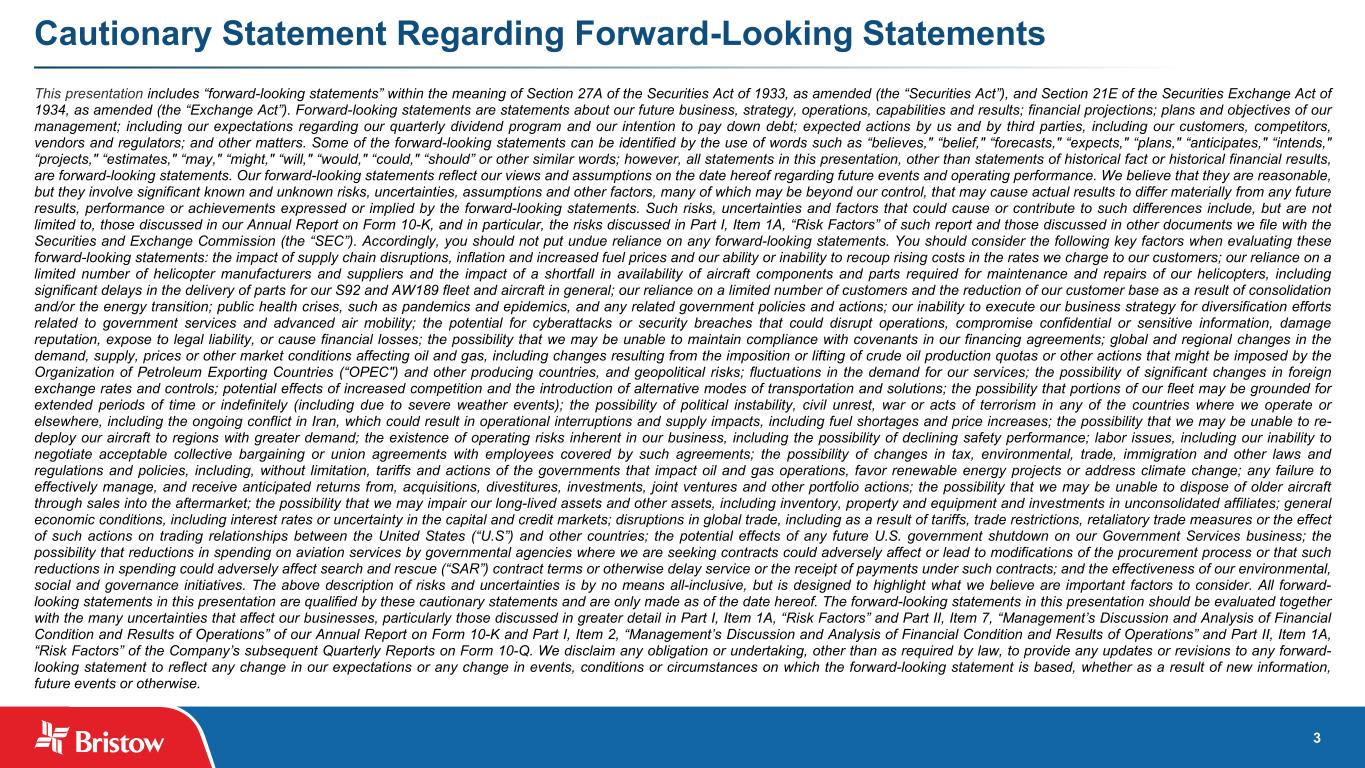
3 Cautionary Statement Regarding Forward-Looking Statements This presentation includes “forward-looking statements” within the meaning of Section 27A of the Securities Act of 1933, as amended (the “Securities Act”), and Section 21E of the Securities Exchange Act of 1934, as amended (the “Exchange Act”). Forward-looking statements are statements about our future business, strategy, operations, capabilities and results; financial projections; plans and objectives of our management; including our expectations regarding our quarterly dividend program and our intention to pay down debt; expected actions by us and by third parties, including our customers, competitors, vendors and regulators; and other matters. Some of the forward-looking statements can be identified by the use of words such as “believes," “belief," “forecasts," “expects," “plans," “anticipates," “intends," “projects," “estimates," “may," “might," “will," “would," “could," “should” or other similar words; however, all statements in this presentation, other than statements of historical fact or historical financial results, are forward-looking statements. Our forward-looking statements reflect our views and assumptions on the date hereof regarding future events and operating performance. We believe that they are reasonable, but they involve significant known and unknown risks, uncertainties, assumptions and other factors, many of which may be beyond our control, that may cause actual results to differ materially from any future results, performance or achievements expressed or implied by the forward-looking statements. Such risks, uncertainties and factors that could cause or contribute to such differences include, but are not limited to, those discussed in our Annual Report on Form 10-K, and in particular, the risks discussed in Part I, Item 1A, “Risk Factors” of such report and those discussed in other documents we file with the Securities and Exchange Commission (the “SEC”). Accordingly, you should not put undue reliance on any forward-looking statements. You should consider the following key factors when evaluating these forward-looking statements: the impact of supply chain disruptions, inflation and increased fuel prices and our ability or inability to recoup rising costs in the rates we charge to our customers; our reliance on a limited number of helicopter manufacturers and suppliers and the impact of a shortfall in availability of aircraft components and parts required for maintenance and repairs of our helicopters, including significant delays in the delivery of parts for our S92 and AW189 fleet and aircraft in general; our reliance on a limited number of customers and the reduction of our customer base as a result of consolidation and/or the energy transition; public health crises, such as pandemics and epidemics, and any related government policies and actions; our inability to execute our business strategy for diversification efforts related to government services and advanced air mobility; the potential for cyberattacks or security breaches that could disrupt operations, compromise confidential or sensitive information, damage reputation, expose to legal liability, or cause financial losses; the possibility that we may be unable to maintain compliance with covenants in our financing agreements; global and regional changes in the demand, supply, prices or other market conditions affecting oil and gas, including changes resulting from the imposition or lifting of crude oil production quotas or other actions that might be imposed by the Organization of Petroleum Exporting Countries (“OPEC") and other producing countries, and geopolitical risks; fluctuations in the demand for our services; the possibility of significant changes in foreign exchange rates and controls; potential effects of increased competition and the introduction of alternative modes of transportation and solutions; the possibility that portions of our fleet may be grounded for extended periods of time or indefinitely (including due to severe weather events); the possibility of political instability, civil unrest, war or acts of terrorism in any of the countries where we operate or elsewhere, including the ongoing conflict in Iran, which could result in operational interruptions and supply impacts, including fuel shortages and price increases; the possibility that we may be unable to re- deploy our aircraft to regions with greater demand; the existence of operating risks inherent in our business, including the possibility of declining safety performance; labor issues, including our inability to negotiate acceptable collective bargaining or union agreements with employees covered by such agreements; the possibility of changes in tax, environmental, trade, immigration and other laws and regulations and policies, including, without limitation, tariffs and actions of the governments that impact oil and gas operations, favor renewable energy projects or address climate change; any failure to effectively manage, and receive anticipated returns from, acquisitions, divestitures, investments, joint ventures and other portfolio actions; the possibility that we may be unable to dispose of older aircraft through sales into the aftermarket; the possibility that we may impair our long-lived assets and other assets, including inventory, property and equipment and investments in unconsolidated affiliates; general economic conditions, including interest rates or uncertainty in the capital and credit markets; disruptions in global trade, including as a result of tariffs, trade restrictions, retaliatory trade measures or the effect of such actions on trading relationships between the United States (“U.S”) and other countries; the potential effects of any future U.S. government shutdown on our Government Services business; the possibility that reductions in spending on aviation services by governmental agencies where we are seeking contracts could adversely affect or lead to modifications of the procurement process or that such reductions in spending could adversely affect search and rescue (“SAR”) contract terms or otherwise delay service or the receipt of payments under such contracts; and the effectiveness of our environmental, social and governance initiatives. The above description of risks and uncertainties is by no means all-inclusive, but is designed to highlight what we believe are important factors to consider. All forward- looking statements in this presentation are qualified by these cautionary statements and are only made as of the date hereof. The forward-looking statements in this presentation should be evaluated together with the many uncertainties that affect our businesses, particularly those discussed in greater detail in Part I, Item 1A, “Risk Factors” and Part II, Item 7, “Management’s Discussion and Analysis of Financial Condition and Results of Operations” of our Annual Report on Form 10-K and Part I, Item 2, “Management’s Discussion and Analysis of Financial Condition and Results of Operations” and Part II, Item 1A, “Risk Factors” of the Company’s subsequent Quarterly Reports on Form 10-Q. We disclaim any obligation or undertaking, other than as required by law, to provide any updates or revisions to any forward- looking statement to reflect any change in our expectations or any change in events, conditions or circumstances on which the forward-looking statement is based, whether as a result of new information, future events or otherwise.
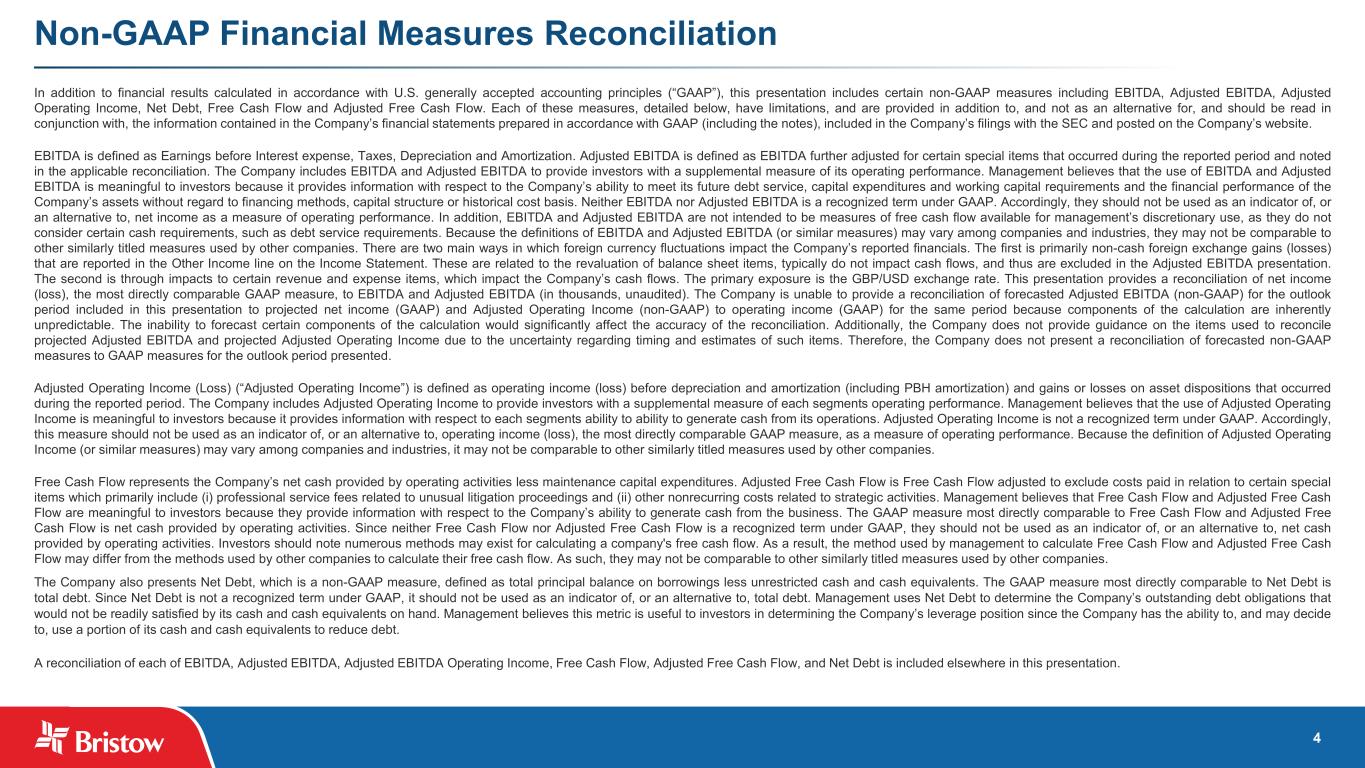
4 Non-GAAP Financial Measures Reconciliation In addition to financial results calculated in accordance with U.S. generally accepted accounting principles (“GAAP”), this presentation includes certain non-GAAP measures including EBITDA, Adjusted EBITDA, Adjusted Operating Income, Net Debt, Free Cash Flow and Adjusted Free Cash Flow. Each of these measures, detailed below, have limitations, and are provided in addition to, and not as an alternative for, and should be read in conjunction with, the information contained in the Company’s financial statements prepared in accordance with GAAP (including the notes), included in the Company’s filings with the SEC and posted on the Company’s website. EBITDA is defined as Earnings before Interest expense, Taxes, Depreciation and Amortization. Adjusted EBITDA is defined as EBITDA further adjusted for certain special items that occurred during the reported period and noted in the applicable reconciliation. The Company includes EBITDA and Adjusted EBITDA to provide investors with a supplemental measure of its operating performance. Management believes that the use of EBITDA and Adjusted EBITDA is meaningful to investors because it provides information with respect to the Company’s ability to meet its future debt service, capital expenditures and working capital requirements and the financial performance of the Company’s assets without regard to financing methods, capital structure or historical cost basis. Neither EBITDA nor Adjusted EBITDA is a recognized term under GAAP. Accordingly, they should not be used as an indicator of, or an alternative to, net income as a measure of operating performance. In addition, EBITDA and Adjusted EBITDA are not intended to be measures of free cash flow available for management’s discretionary use, as they do not consider certain cash requirements, such as debt service requirements. Because the definitions of EBITDA and Adjusted EBITDA (or similar measures) may vary among companies and industries, they may not be comparable to other similarly titled measures used by other companies. There are two main ways in which foreign currency fluctuations impact the Company’s reported financials. The first is primarily non-cash foreign exchange gains (losses) that are reported in the Other Income line on the Income Statement. These are related to the revaluation of balance sheet items, typically do not impact cash flows, and thus are excluded in the Adjusted EBITDA presentation. The second is through impacts to certain revenue and expense items, which impact the Company’s cash flows. The primary exposure is the GBP/USD exchange rate. This presentation provides a reconciliation of net income (loss), the most directly comparable GAAP measure, to EBITDA and Adjusted EBITDA (in thousands, unaudited). The Company is unable to provide a reconciliation of forecasted Adjusted EBITDA (non-GAAP) for the outlook period included in this presentation to projected net income (GAAP) and Adjusted Operating Income (non-GAAP) to operating income (GAAP) for the same period because components of the calculation are inherently unpredictable. The inability to forecast certain components of the calculation would significantly affect the accuracy of the reconciliation. Additionally, the Company does not provide guidance on the items used to reconcile projected Adjusted EBITDA and projected Adjusted Operating Income due to the uncertainty regarding timing and estimates of such items. Therefore, the Company does not present a reconciliation of forecasted non-GAAP measures to GAAP measures for the outlook period presented. Adjusted Operating Income (Loss) (“Adjusted Operating Income”) is defined as operating income (loss) before depreciation and amortization (including PBH amortization) and gains or losses on asset dispositions that occurred during the reported period. The Company includes Adjusted Operating Income to provide investors with a supplemental measure of each segments operating performance. Management believes that the use of Adjusted Operating Income is meaningful to investors because it provides information with respect to each segments ability to ability to generate cash from its operations. Adjusted Operating Income is not a recognized term under GAAP. Accordingly, this measure should not be used as an indicator of, or an alternative to, operating income (loss), the most directly comparable GAAP measure, as a measure of operating performance. Because the definition of Adjusted Operating Income (or similar measures) may vary among companies and industries, it may not be comparable to other similarly titled measures used by other companies. Free Cash Flow represents the Company’s net cash provided by operating activities less maintenance capital expenditures. Adjusted Free Cash Flow is Free Cash Flow adjusted to exclude costs paid in relation to certain special items which primarily include (i) professional service fees related to unusual litigation proceedings and (ii) other nonrecurring costs related to strategic activities. Management believes that Free Cash Flow and Adjusted Free Cash Flow are meaningful to investors because they provide information with respect to the Company’s ability to generate cash from the business. The GAAP measure most directly comparable to Free Cash Flow and Adjusted Free Cash Flow is net cash provided by operating activities. Since neither Free Cash Flow nor Adjusted Free Cash Flow is a recognized term under GAAP, they should not be used as an indicator of, or an alternative to, net cash provided by operating activities. Investors should note numerous methods may exist for calculating a company's free cash flow. As a result, the method used by management to calculate Free Cash Flow and Adjusted Free Cash Flow may differ from the methods used by other companies to calculate their free cash flow. As such, they may not be comparable to other similarly titled measures used by other companies. The Company also presents Net Debt, which is a non-GAAP measure, defined as total principal balance on borrowings less unrestricted cash and cash equivalents. The GAAP measure most directly comparable to Net Debt is total debt. Since Net Debt is not a recognized term under GAAP, it should not be used as an indicator of, or an alternative to, total debt. Management uses Net Debt to determine the Company’s outstanding debt obligations that would not be readily satisfied by its cash and cash equivalents on hand. Management believes this metric is useful to investors in determining the Company’s leverage position since the Company has the ability to, and may decide to, use a portion of its cash and cash equivalents to reduce debt. A reconciliation of each of EBITDA, Adjusted EBITDA, Adjusted EBITDA Operating Income, Free Cash Flow, Adjusted Free Cash Flow, and Net Debt is included elsewhere in this presentation.
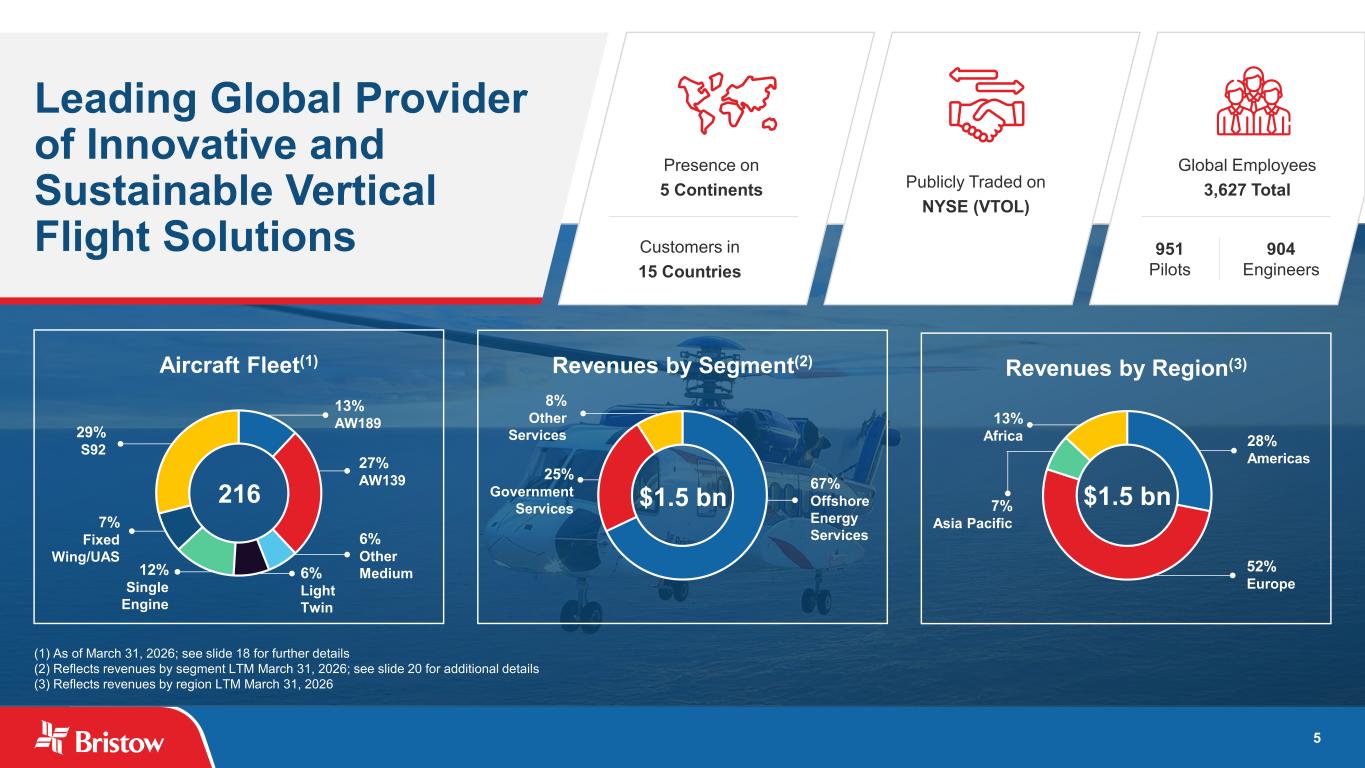
5 Presence on 5 Continents Publicly Traded on NYSE (VTOL) Global Employees 3,627 Total Customers in 15 Countries Revenues by Segment(2)Aircraft Fleet(1) Revenues by Region(3) 67% Offshore Energy Services 8% Other Services 25% Government Services $1.5 bn 28% Americas 52% Europe 7% Asia Pacific 13% Africa $1.5 bn 6% Light Twin 12% Single Engine 7% Fixed Wing/UAS 29% S92 13% AW189 27% AW139 6% Other Medium 951 Pilots 904 Engineers (1) As of March 31, 2026; see slide 18 for further details (2) Reflects revenues by segment LTM March 31, 2026; see slide 20 for additional details (3) Reflects revenues by region LTM March 31, 2026 Leading Global Provider of Innovative and Sustainable Vertical Flight Solutions 216
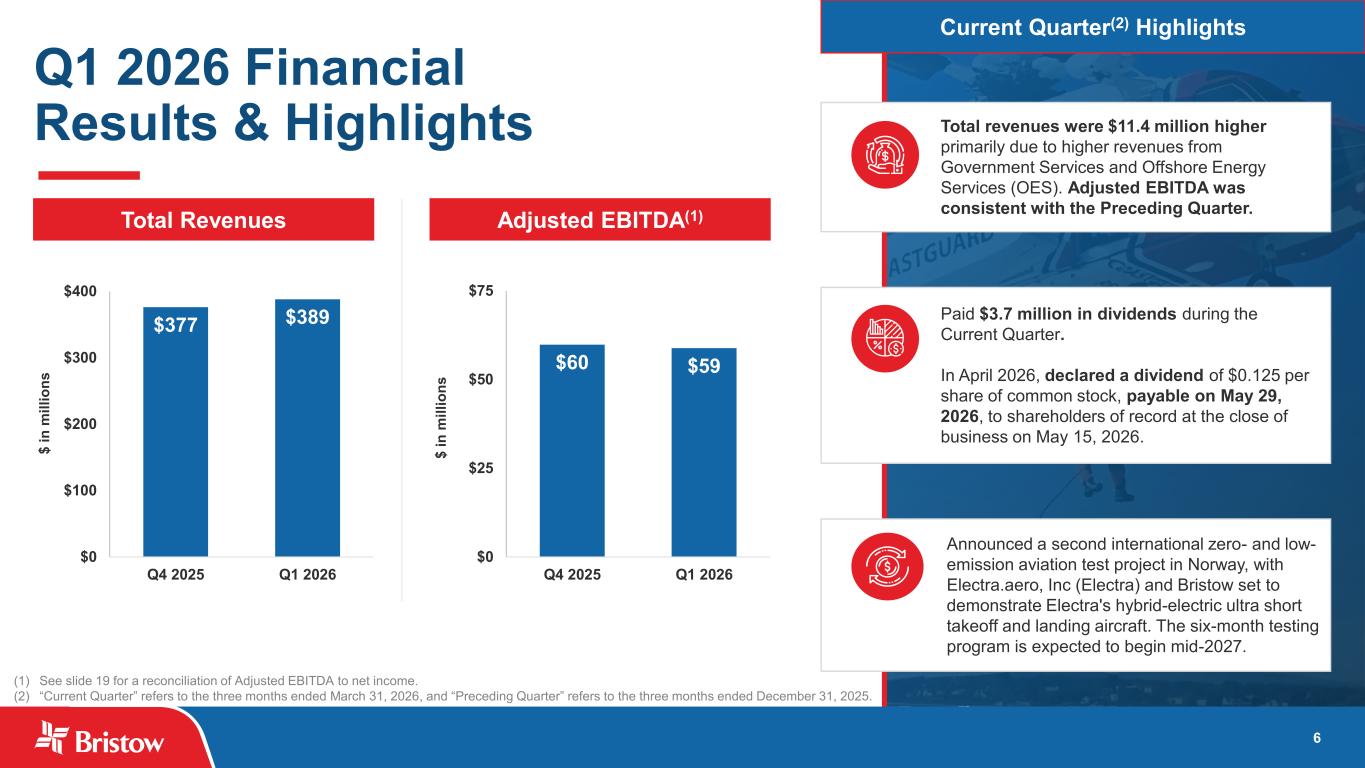
6 Q1 2026 Financial Results & Highlights (1) See slide 19 for a reconciliation of Adjusted EBITDA to net income. (2) “Current Quarter” refers to the three months ended March 31, 2026, and “Preceding Quarter” refers to the three months ended December 31, 2025. Total revenues were $11.4 million higher primarily due to higher revenues from Government Services and Offshore Energy Services (OES). Adjusted EBITDA was consistent with the Preceding Quarter. Paid $3.7 million in dividends during the Current Quarter. In April 2026, declared a dividend of $0.125 per share of common stock, payable on May 29, 2026, to shareholders of record at the close of business on May 15, 2026. Announced a second international zero- and low- emission aviation test project in Norway, with Electra.aero, Inc (Electra) and Bristow set to demonstrate Electra's hybrid-electric ultra short takeoff and landing aircraft. The six-month testing program is expected to begin mid-2027. $377 $389 $0 $100 $200 $300 $400 Q4 2025 Q1 2026 $ i n m il li o n s $60 $59 $0 $25 $50 $75 Q4 2025 Q1 2026 $ i n m il li o n s Total Revenues Adjusted EBITDA(1) Current Quarter(2) Highlights
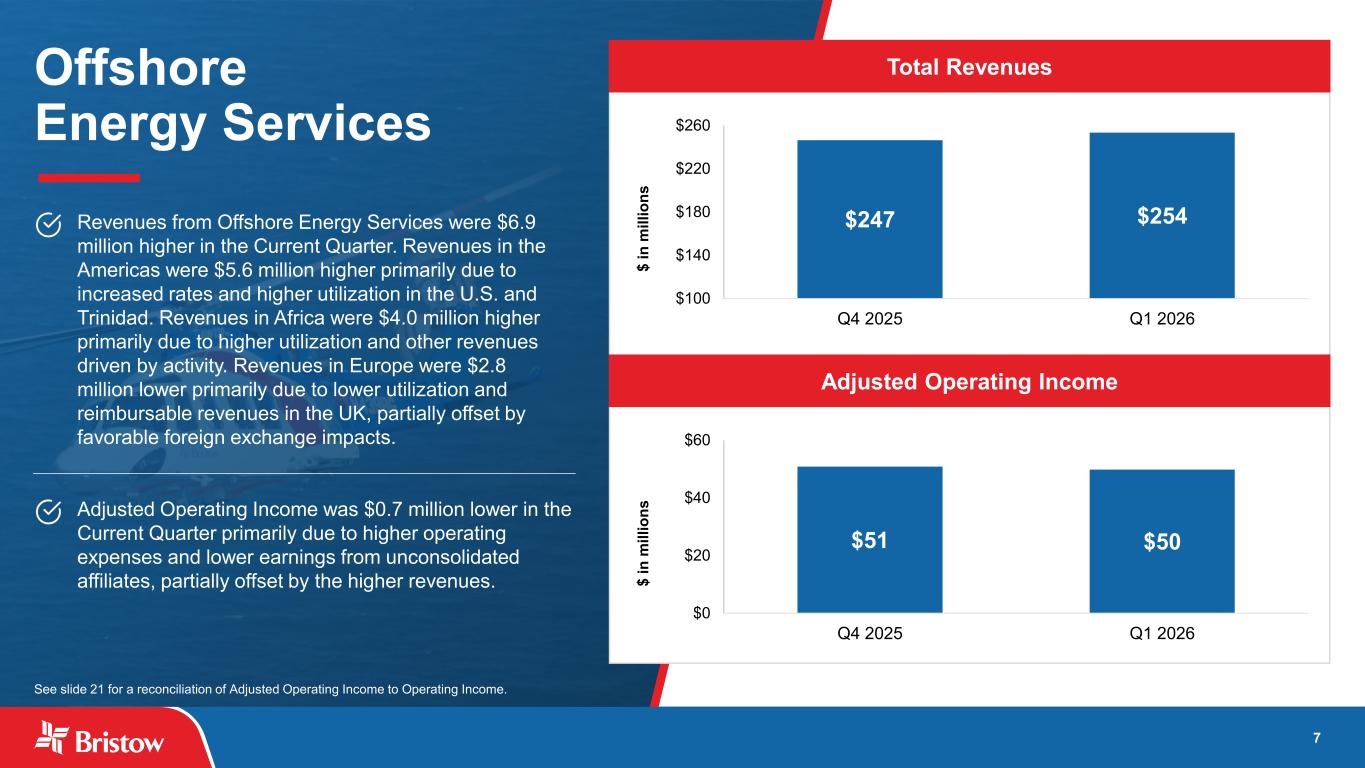
7 Offshore Energy Services Total Revenues Adjusted Operating Income Revenues from Offshore Energy Services were $6.9 million higher in the Current Quarter. Revenues in the Americas were $5.6 million higher primarily due to increased rates and higher utilization in the U.S. and Trinidad. Revenues in Africa were $4.0 million higher primarily due to higher utilization and other revenues driven by activity. Revenues in Europe were $2.8 million lower primarily due to lower utilization and reimbursable revenues in the UK, partially offset by favorable foreign exchange impacts. Adjusted Operating Income was $0.7 million lower in the Current Quarter primarily due to higher operating expenses and lower earnings from unconsolidated affiliates, partially offset by the higher revenues. $51 $50 $0 $20 $40 $60 Q4 2025 Q1 2026 $ i n m il li o n s $247 $254 $100 $140 $180 $220 $260 Q4 2025 Q1 2026 $ i n m il li o n s See slide 21 for a reconciliation of Adjusted Operating Income to Operating Income.
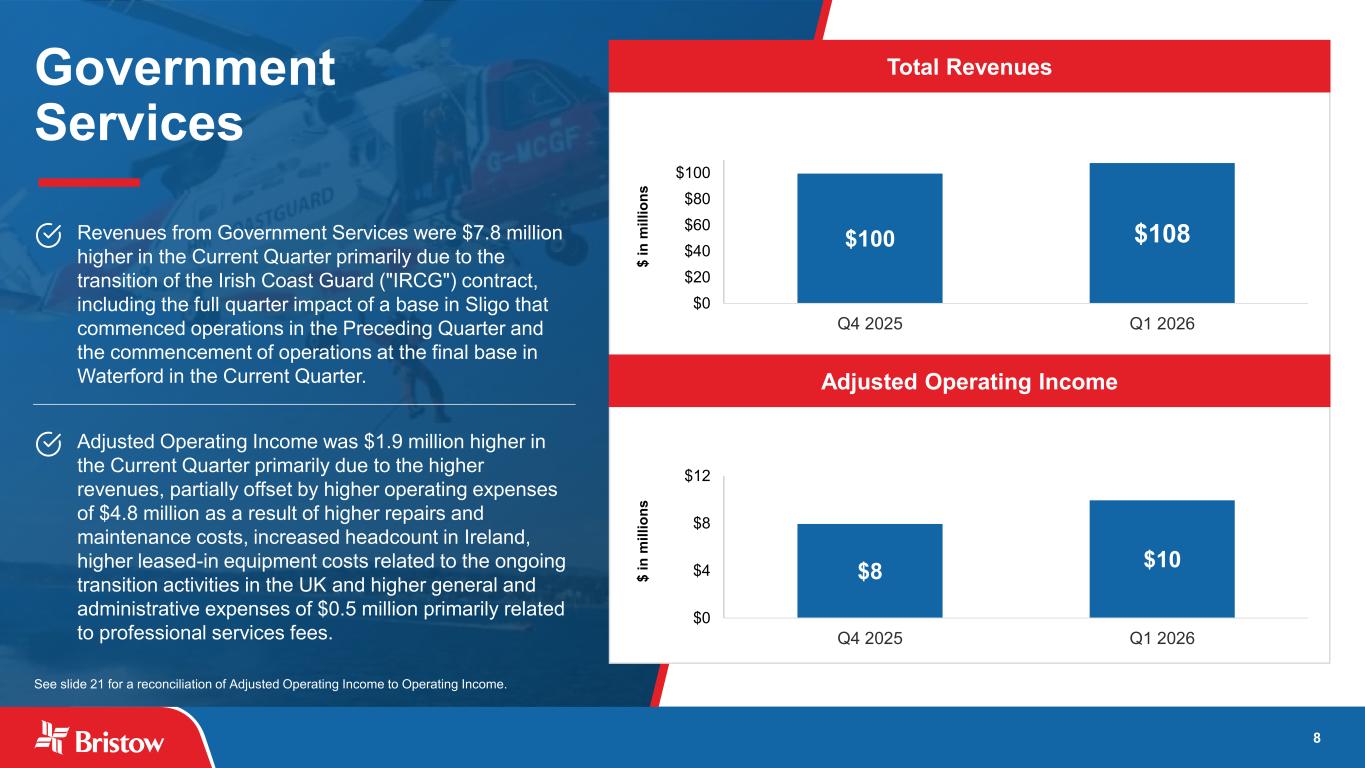
8 Government Services Total Revenues Adjusted Operating Income Revenues from Government Services were $7.8 million higher in the Current Quarter primarily due to the transition of the Irish Coast Guard ("IRCG") contract, including the full quarter impact of a base in Sligo that commenced operations in the Preceding Quarter and the commencement of operations at the final base in Waterford in the Current Quarter. Adjusted Operating Income was $1.9 million higher in the Current Quarter primarily due to the higher revenues, partially offset by higher operating expenses of $4.8 million as a result of higher repairs and maintenance costs, increased headcount in Ireland, higher leased-in equipment costs related to the ongoing transition activities in the UK and higher general and administrative expenses of $0.5 million primarily related to professional services fees. $8 $10 $0 $4 $8 $12 Q4 2025 Q1 2026 $ i n m il li o n s $100 $108 $0 $20 $40 $60 $80 $100 Q4 2025 Q1 2026 $ i n m il li o n s See slide 21 for a reconciliation of Adjusted Operating Income to Operating Income.
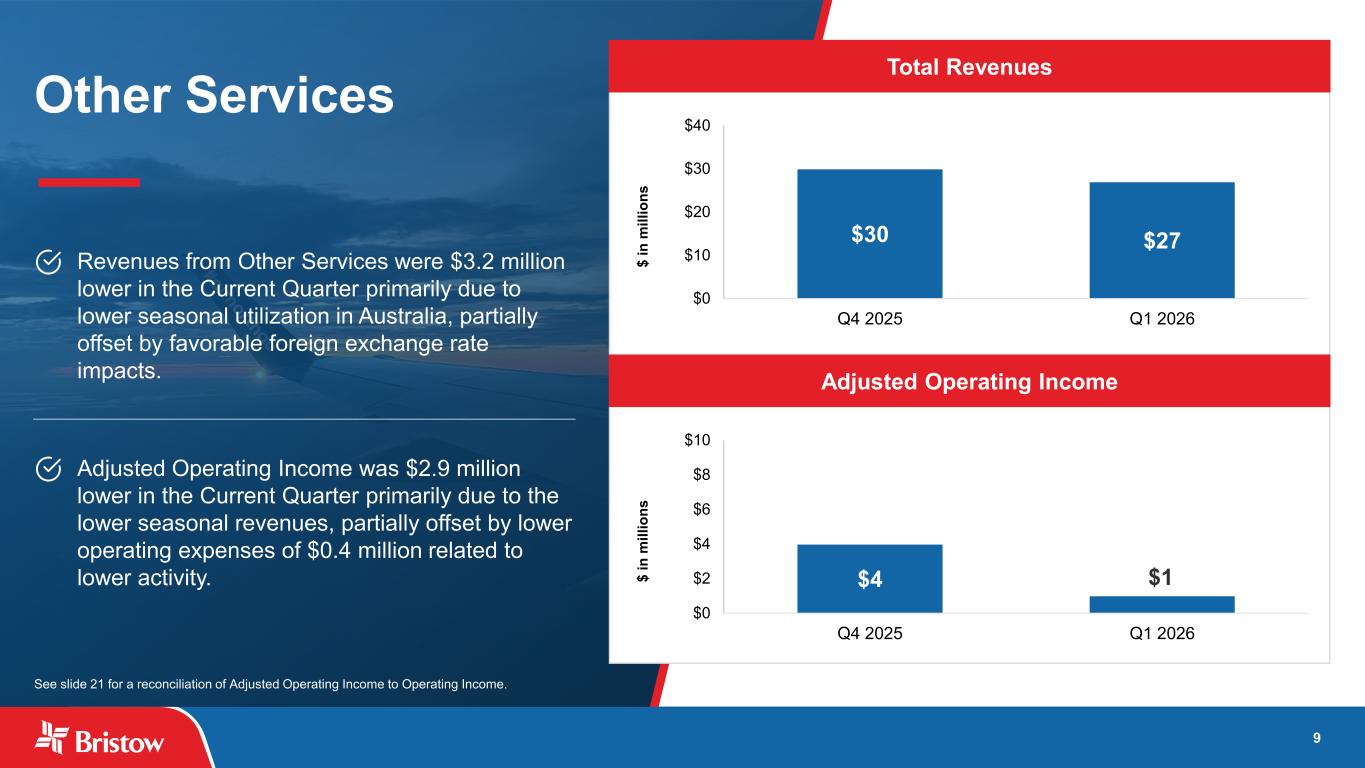
9 Other Services Total Revenues Adjusted Operating Income Adjusted Operating Income was $2.9 million lower in the Current Quarter primarily due to the lower seasonal revenues, partially offset by lower operating expenses of $0.4 million related to lower activity. $4 $1 $0 $2 $4 $6 $8 $10 Q4 2025 Q1 2026 $ i n m il li o n s $30 $27 $0 $10 $20 $30 $40 Q4 2025 Q1 2026 $ i n m il li o n s See slide 21 for a reconciliation of Adjusted Operating Income to Operating Income. Revenues from Other Services were $3.2 million lower in the Current Quarter primarily due to lower seasonal utilization in Australia, partially offset by favorable foreign exchange rate impacts.
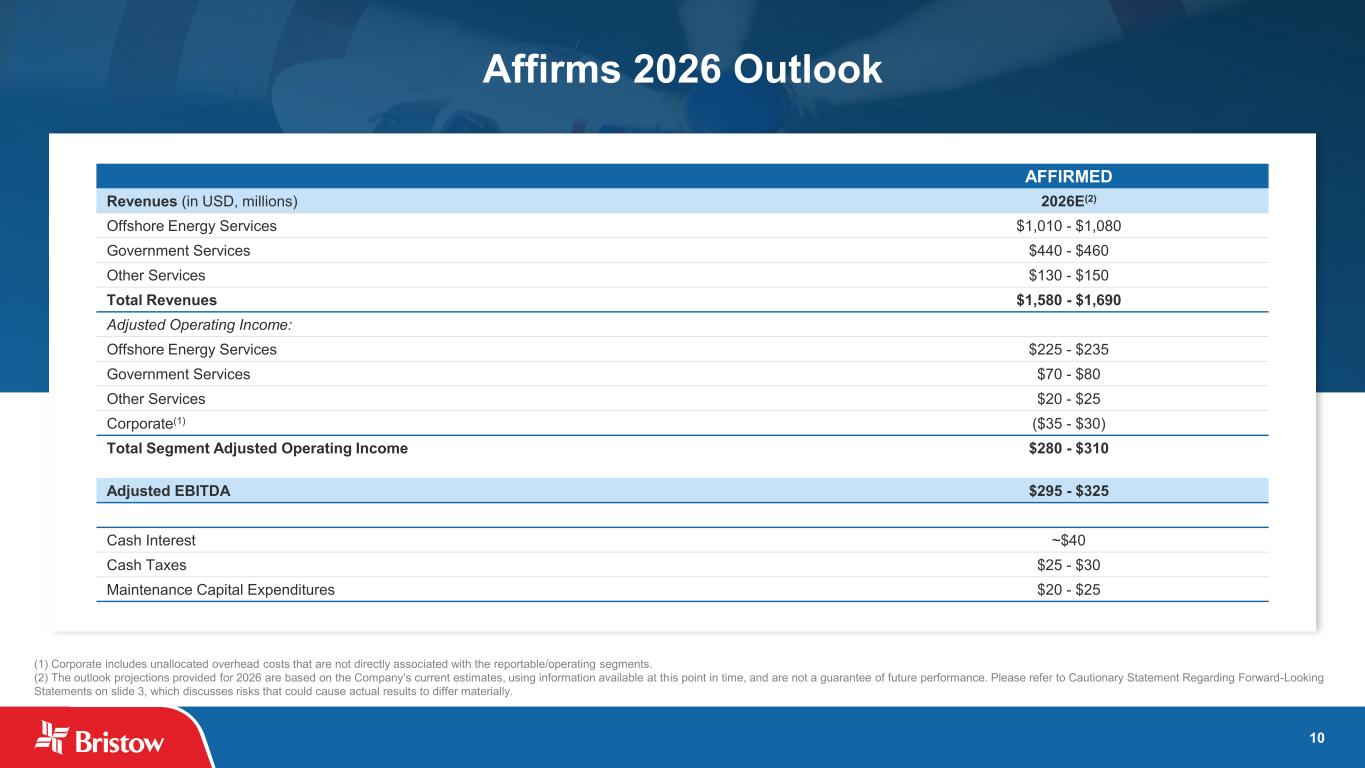
10 (1) Corporate includes unallocated overhead costs that are not directly associated with the reportable/operating segments. (2) The outlook projections provided for 2026 are based on the Company’s current estimates, using information available at this point in time, and are not a guarantee of future performance. Please refer to Cautionary Statement Regarding Forward-Looking Statements on slide 3, which discusses risks that could cause actual results to differ materially. AFFIRMED Revenues (in USD, millions) 2026E(2) Offshore Energy Services $1,010 - $1,080 Government Services $440 - $460 Other Services $130 - $150 Total Revenues $1,580 - $1,690 Adjusted Operating Income: Offshore Energy Services $225 - $235 Government Services $70 - $80 Other Services $20 - $25 Corporate(1) ($35 - $30) Total Segment Adjusted Operating Income $280 - $310 Adjusted EBITDA $295 - $325 Cash Interest ~$40 Cash Taxes $25 - $30 Maintenance Capital Expenditures $20 - $25 Affirms 2026 Outlook
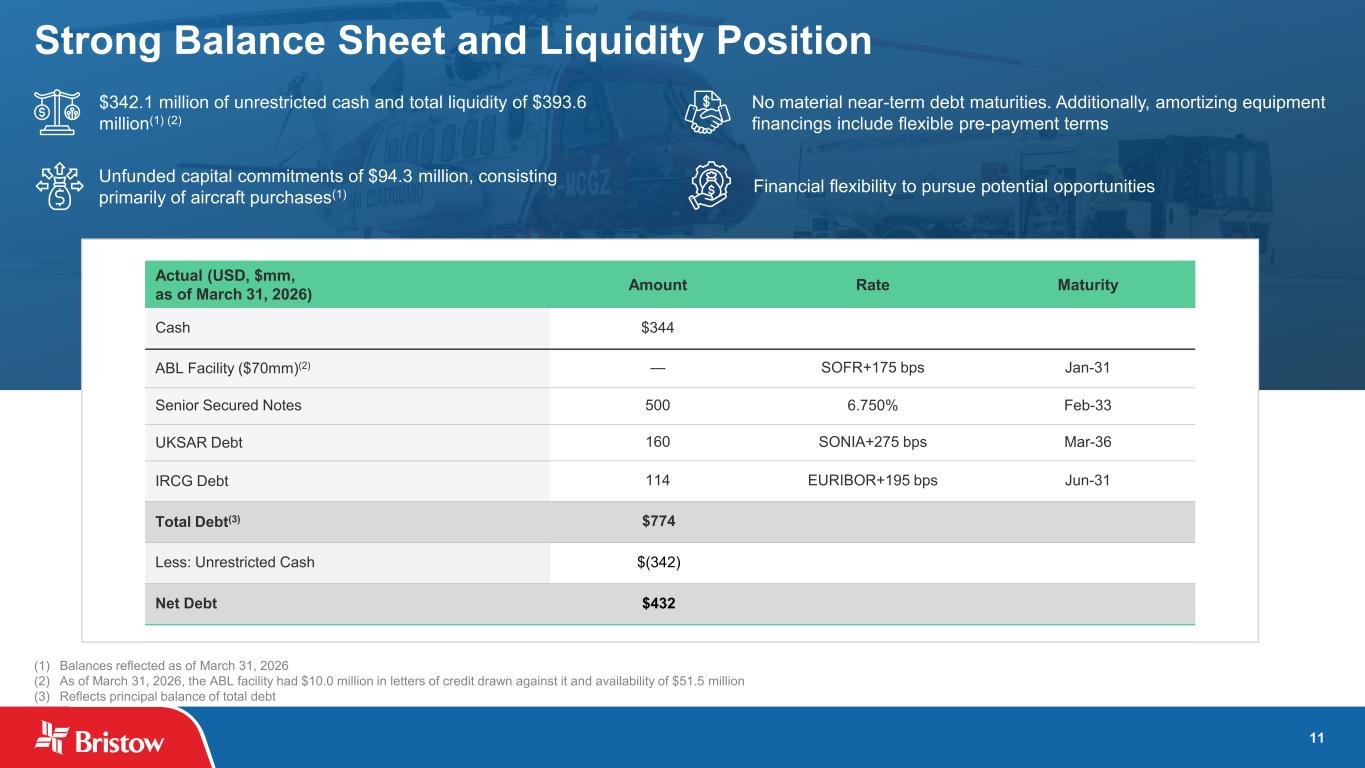
11 Strong Balance Sheet and Liquidity Position Actual (USD, $mm, as of March 31, 2026) Amount Rate Maturity Cash $344 ABL Facility ($70mm)(2) — SOFR+175 bps Jan-31 Senior Secured Notes 500 6.750% Feb-33 UKSAR Debt 160 SONIA+275 bps Mar-36 IRCG Debt 114 EURIBOR+195 bps Jun-31 Total Debt(3) $774 Less: Unrestricted Cash $(342) Net Debt $432 (1) Balances reflected as of March 31, 2026 (2) As of March 31, 2026, the ABL facility had $10.0 million in letters of credit drawn against it and availability of $51.5 million (3) Reflects principal balance of total debt Unfunded capital commitments of $94.3 million, consisting primarily of aircraft purchases(1) Financial flexibility to pursue potential opportunities $342.1 million of unrestricted cash and total liquidity of $393.6 million(1) (2) No material near-term debt maturities. Additionally, amortizing equipment financings include flexible pre-payment terms
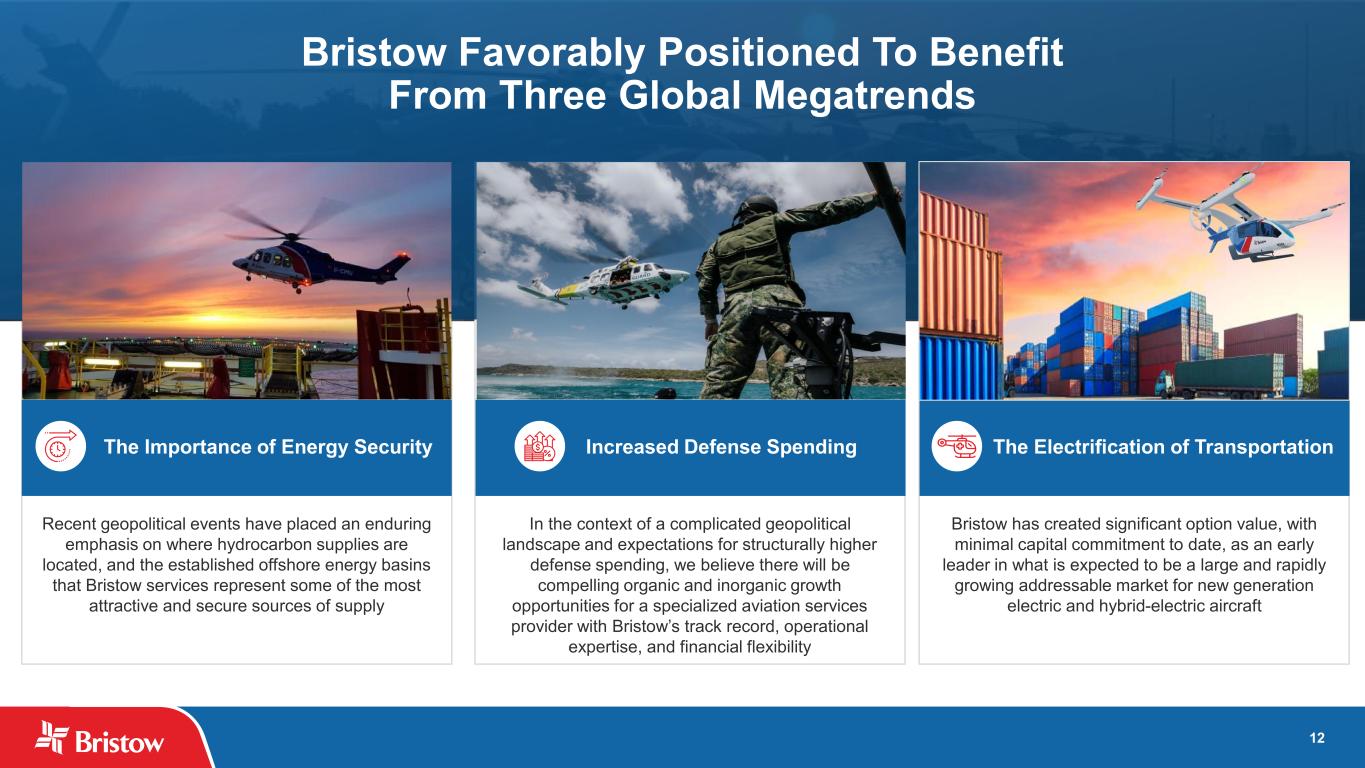
12 Bristow Favorably Positioned To Benefit From Three Global Megatrends The Importance of Energy Security Increased Defense Spending Recent geopolitical events have placed an enduring emphasis on where hydrocarbon supplies are located, and the established offshore energy basins that Bristow services represent some of the most attractive and secure sources of supply In the context of a complicated geopolitical landscape and expectations for structurally higher defense spending, we believe there will be compelling organic and inorganic growth opportunities for a specialized aviation services provider with Bristow’s track record, operational expertise, and financial flexibility Bristow has created significant option value, with minimal capital commitment to date, as an early leader in what is expected to be a large and rapidly growing addressable market for new generation electric and hybrid-electric aircraft The Electrification of Transportation
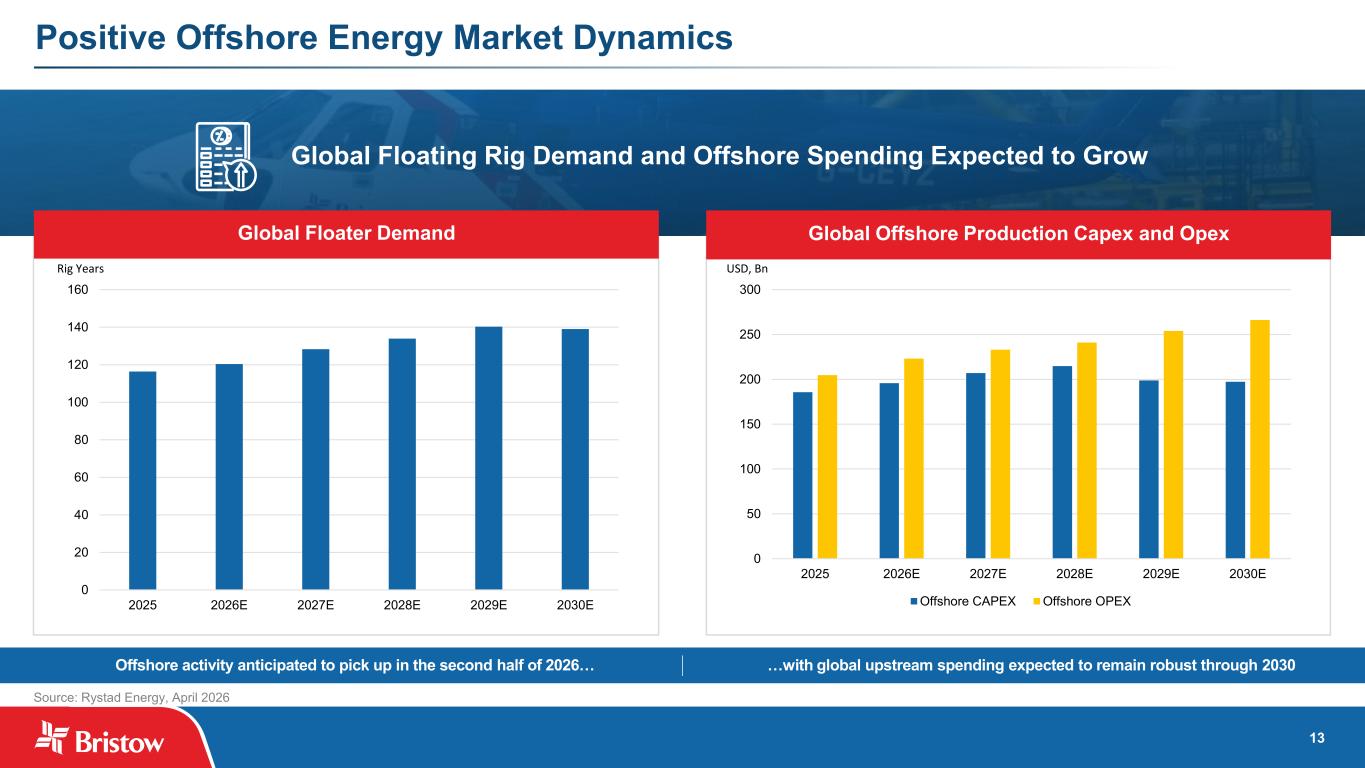
13 Positive Offshore Energy Market Dynamics Source: Rystad Energy, April 2026 Global Floater Demand Global Offshore Production Capex and Opex Global Floating Rig Demand and Offshore Spending Expected to Grow Rig Years Offshore activity anticipated to pick up in the second half of 2026… …with global upstream spending expected to remain robust through 2030 USD, Bn 0 20 40 60 80 100 120 140 160 2025 2026E 2027E 2028E 2029E 2030E 0 50 100 150 200 250 300 2025 2026E 2027E 2028E 2029E 2030E Offshore CAPEX Offshore OPEX
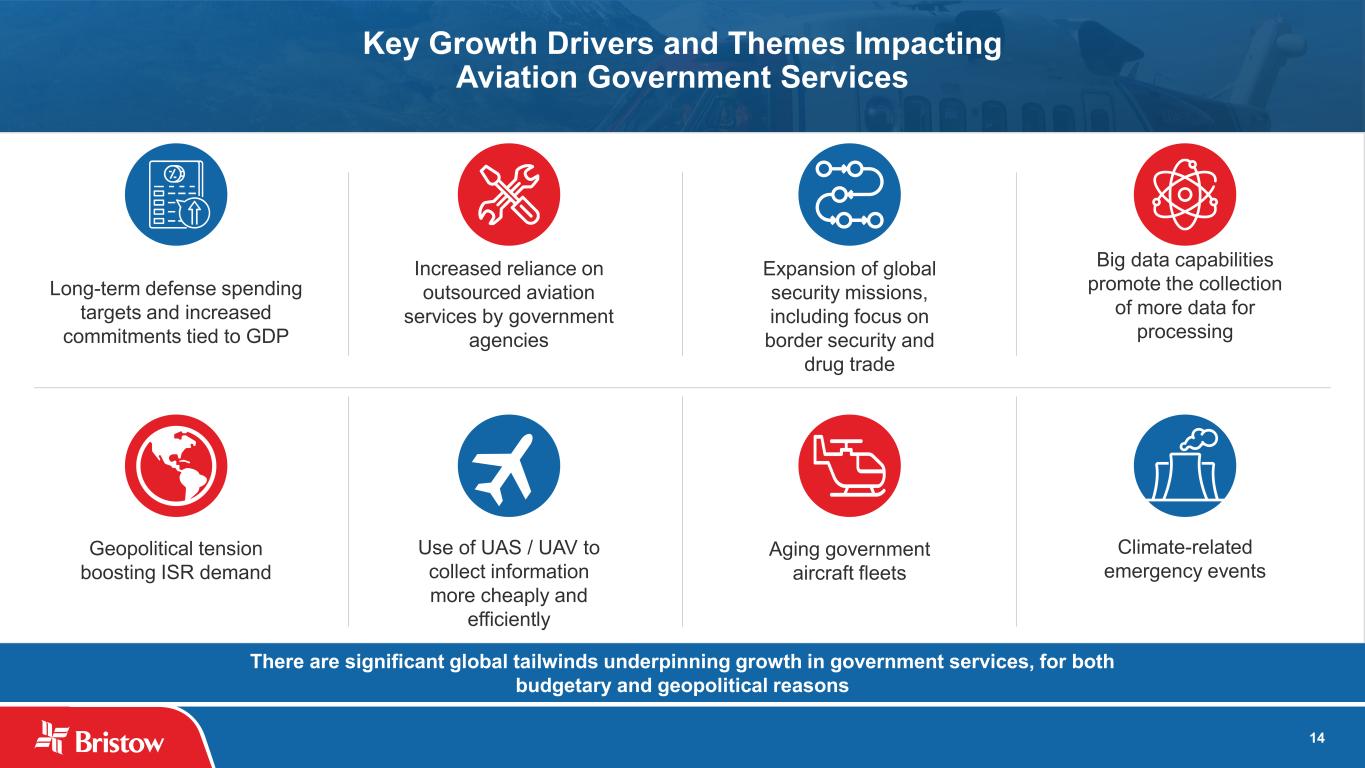
14 Key Growth Drivers and Themes Impacting Aviation Government Services There are significant global tailwinds underpinning growth in government services, for both budgetary and geopolitical reasons Aging government aircraft fleets Increased reliance on outsourced aviation services by government agencies Expansion of global security missions, including focus on border security and drug trade Big data capabilities promote the collection of more data for processing Geopolitical tension boosting ISR demand Climate-related emergency events Use of UAS / UAV to collect information more cheaply and efficiently Long-term defense spending targets and increased commitments tied to GDP
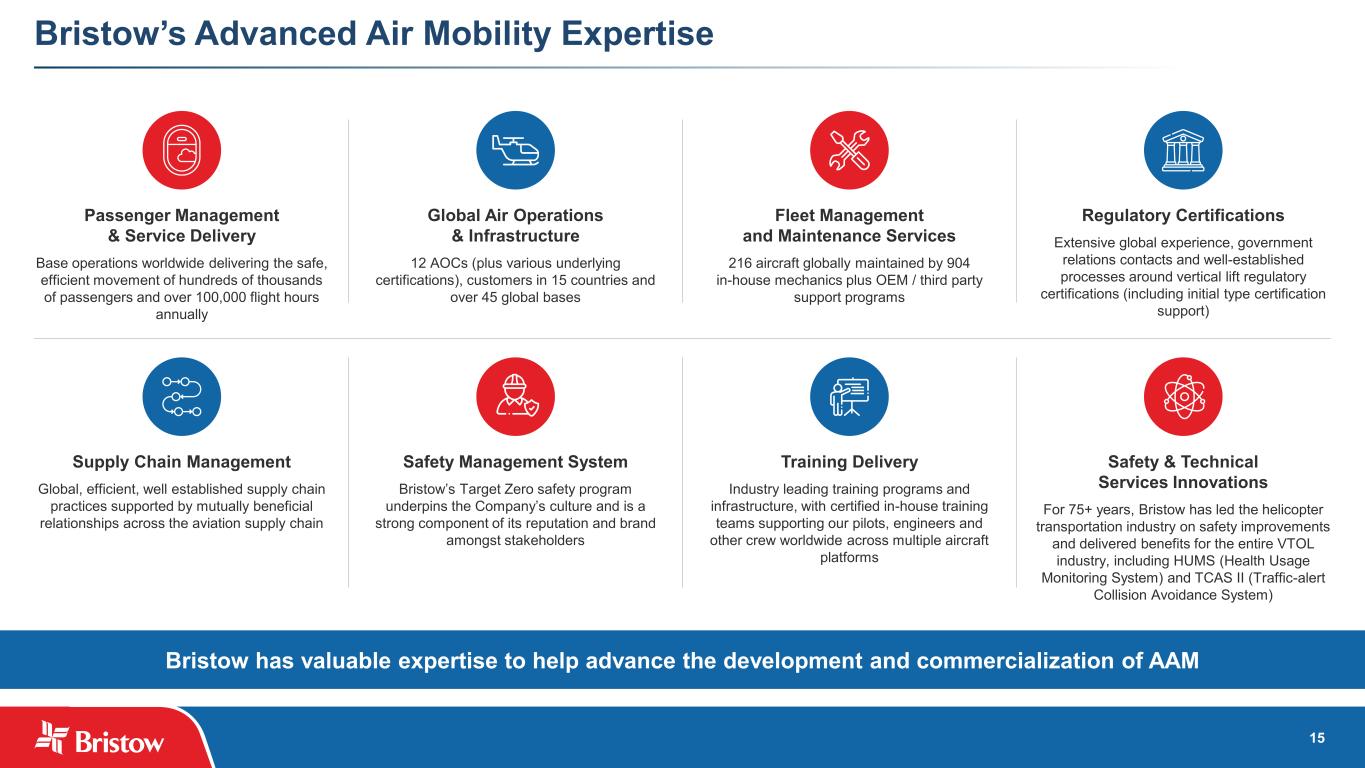
15 Bristow’s Advanced Air Mobility Expertise Bristow has valuable expertise to help advance the development and commercialization of AAM Global Air Operations & Infrastructure 12 AOCs (plus various underlying certifications), customers in 15 countries and over 45 global bases Passenger Management & Service Delivery Base operations worldwide delivering the safe, efficient movement of hundreds of thousands of passengers and over 100,000 flight hours annually Fleet Management and Maintenance Services 216 aircraft globally maintained by 904 in-house mechanics plus OEM / third party support programs Regulatory Certifications Extensive global experience, government relations contacts and well-established processes around vertical lift regulatory certifications (including initial type certification support) Supply Chain Management Global, efficient, well established supply chain practices supported by mutually beneficial relationships across the aviation supply chain Safety Management System Bristow’s Target Zero safety program underpins the Company’s culture and is a strong component of its reputation and brand amongst stakeholders Training Delivery Industry leading training programs and infrastructure, with certified in-house training teams supporting our pilots, engineers and other crew worldwide across multiple aircraft platforms Safety & Technical Services Innovations For 75+ years, Bristow has led the helicopter transportation industry on safety improvements and delivered benefits for the entire VTOL industry, including HUMS (Health Usage Monitoring System) and TCAS II (Traffic-alert Collision Avoidance System)
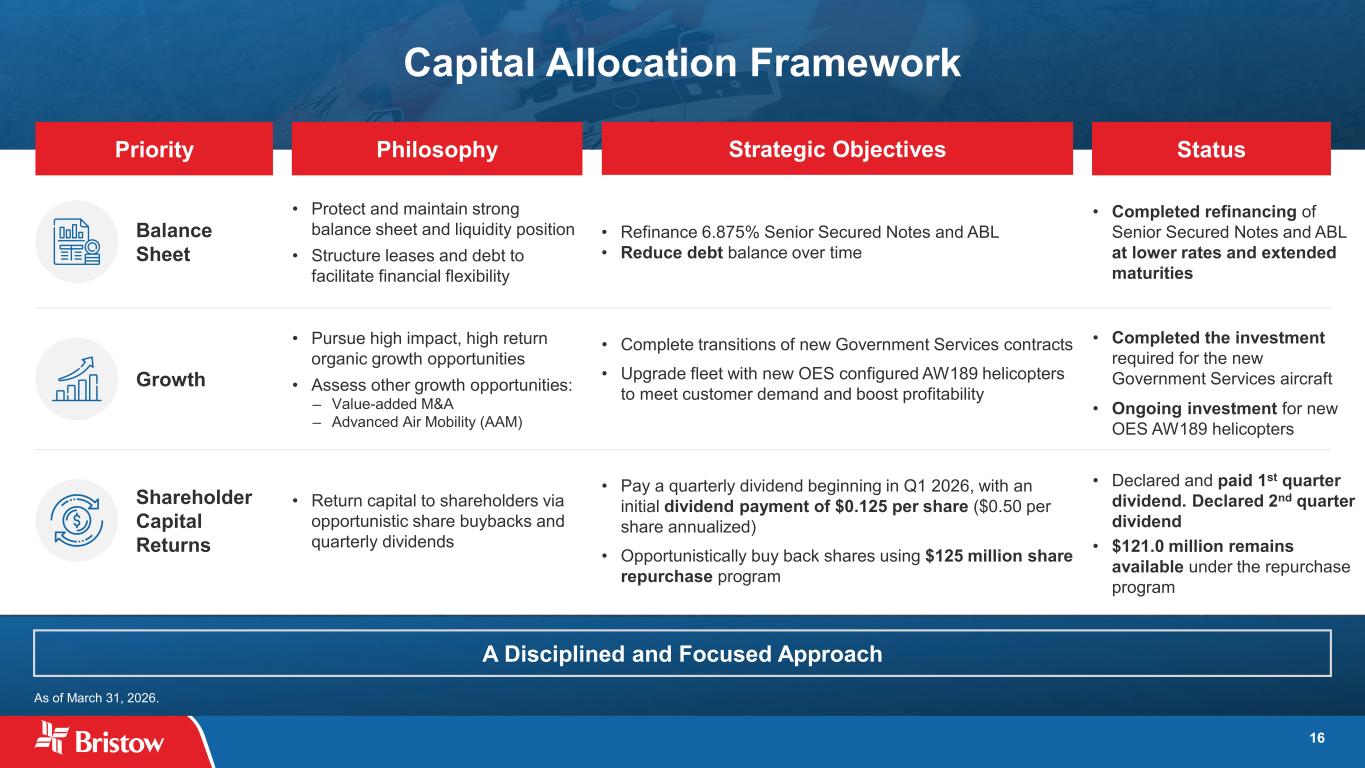
16 Capital Allocation Framework A Disciplined and Focused Approach Priority Philosophy Strategic Objectives Status Balance Sheet • Protect and maintain strong balance sheet and liquidity position • Structure leases and debt to facilitate financial flexibility • Refinance 6.875% Senior Secured Notes and ABL • Reduce debt balance over time • Completed refinancing of Senior Secured Notes and ABL at lower rates and extended maturities Growth • Pursue high impact, high return organic growth opportunities • Assess other growth opportunities: ─ Value-added M&A ─ Advanced Air Mobility (AAM) • Complete transitions of new Government Services contracts • Upgrade fleet with new OES configured AW189 helicopters to meet customer demand and boost profitability • Completed the investment required for the new Government Services aircraft Shareholder Capital Returns • Return capital to shareholders via opportunistic share buybacks and quarterly dividends • Pay a quarterly dividend beginning in Q1 2026, with an initial dividend payment of $0.125 per share ($0.50 per share annualized) • Opportunistically buy back shares using $125 million share repurchase program • Declared and paid 1st quarter dividend. Declared 2nd quarter dividend • $121.0 million remains available under the repurchase program As of March 31, 2026. • Ongoing investment for new OES AW189 helicopters
17 Appendix 1 Fleet Overview 2 3 Adjusted EBITDA 4 Revenues and Flight Hours by Segment 5 Adjusted Operating Income by Segment Adjusted Free Cash Flow
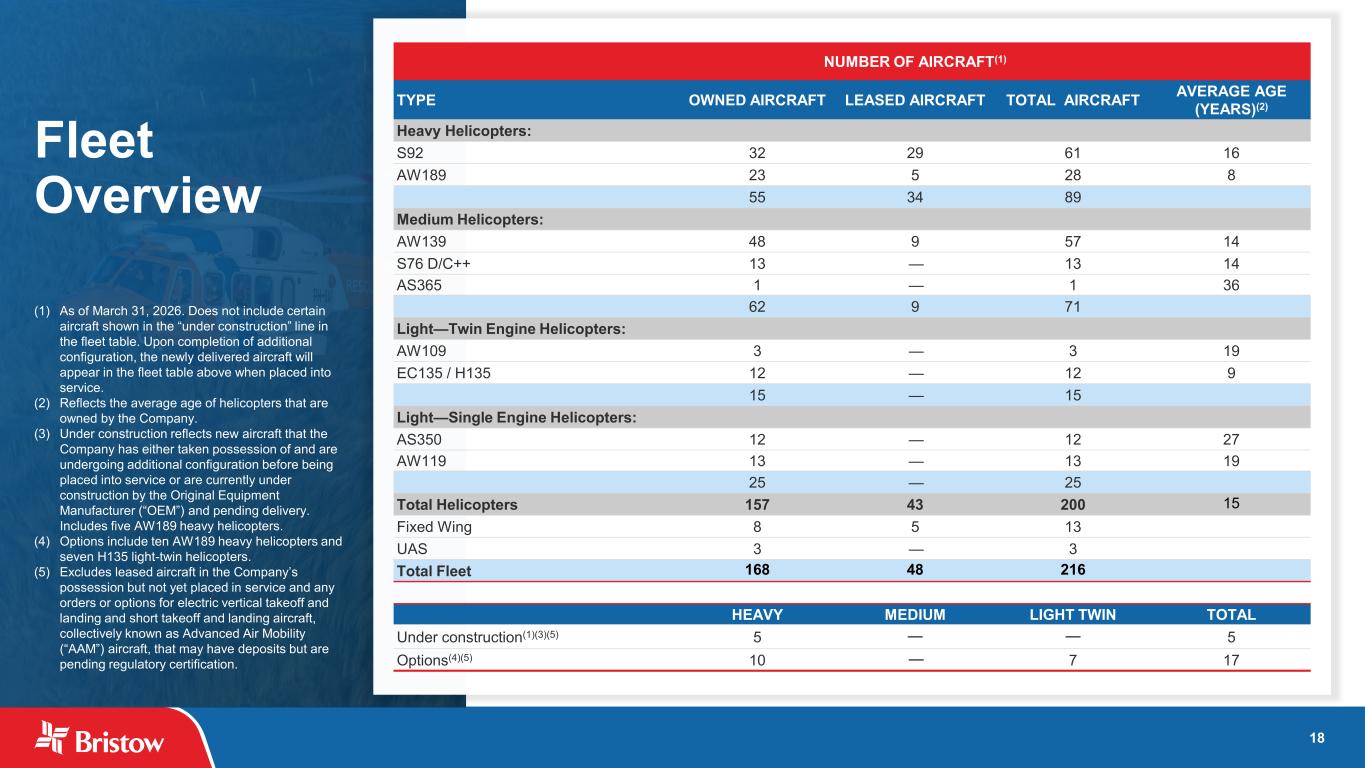
18 Fleet Overview (1) As of March 31, 2026. Does not include certain aircraft shown in the “under construction” line in the fleet table. Upon completion of additional configuration, the newly delivered aircraft will appear in the fleet table above when placed into service. (2) Reflects the average age of helicopters that are owned by the Company. (3) Under construction reflects new aircraft that the Company has either taken possession of and are undergoing additional configuration before being placed into service or are currently under construction by the Original Equipment Manufacturer (“OEM”) and pending delivery. Includes five AW189 heavy helicopters. (4) Options include ten AW189 heavy helicopters and seven H135 light-twin helicopters. (5) Excludes leased aircraft in the Company’s possession but not yet placed in service and any orders or options for electric vertical takeoff and landing and short takeoff and landing aircraft, collectively known as Advanced Air Mobility (“AAM”) aircraft, that may have deposits but are pending regulatory certification. NUMBER OF AIRCRAFT(1) TYPE OWNED AIRCRAFT LEASED AIRCRAFT TOTAL AIRCRAFT AVERAGE AGE (YEARS)(2) Heavy Helicopters: S92 32 29 61 16 AW189 23 5 28 8 55 34 89 Medium Helicopters: AW139 48 9 57 14 S76 D/C++ 13 — 13 14 AS365 1 — 1 36 62 9 71 Light—Twin Engine Helicopters: AW109 3 — 3 19 EC135 / H135 12 — 12 9 15 — 15 Light—Single Engine Helicopters: AS350 12 — 12 27 AW119 13 — 13 19 25 — 25 Total Helicopters 157 43 200 15 Fixed Wing 8 5 13 UAS 3 — 3 Total Fleet 168 48 216 HEAVY MEDIUM LIGHT TWIN TOTAL Under construction(1)(3)(5) 5 — — 5 Options(4)(5) 10 — 7 17
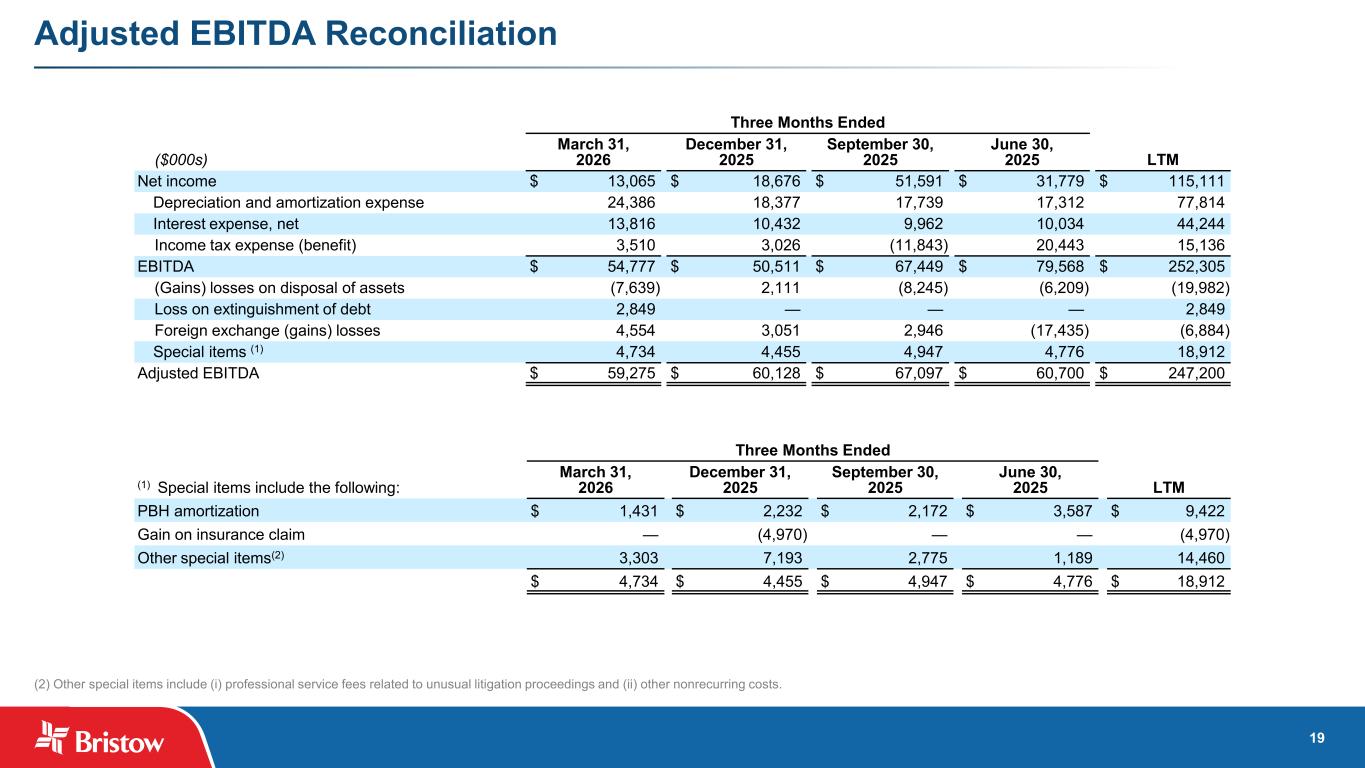
19 Adjusted EBITDA Reconciliation (2) Other special items include (i) professional service fees related to unusual litigation proceedings and (ii) other nonrecurring costs. Three Months Ended (1) Special items include the following: March 31, 2026 December 31, 2025 September 30, 2025 June 30, 2025 LTM PBH amortization $ 1,431 $ 2,232 $ 2,172 $ 3,587 $ 9,422 Gain on insurance claim — (4,970) — — (4,970) Other special items(2) 3,303 7,193 2,775 1,189 14,460 $ 4,734 $ 4,455 $ 4,947 $ 4,776 $ 18,912 Three Months Ended ($000s) March 31, 2026 December 31, 2025 September 30, 2025 June 30, 2025 LTM Net income $ 13,065 $ 18,676 $ 51,591 $ 31,779 $ 115,111 Depreciation and amortization expense 24,386 18,377 17,739 17,312 77,814 Interest expense, net 13,816 10,432 9,962 10,034 44,244 Income tax expense (benefit) 3,510 3,026 (11,843) 20,443 15,136 EBITDA $ 54,777 $ 50,511 $ 67,449 $ 79,568 $ 252,305 (Gains) losses on disposal of assets (7,639) 2,111 (8,245) (6,209) (19,982) Loss on extinguishment of debt 2,849 — — — 2,849 Foreign exchange (gains) losses 4,554 3,051 2,946 (17,435) (6,884) Special items (1) 4,734 4,455 4,947 4,776 18,912 Adjusted EBITDA $ 59,275 $ 60,128 $ 67,097 $ 60,700 $ 247,200
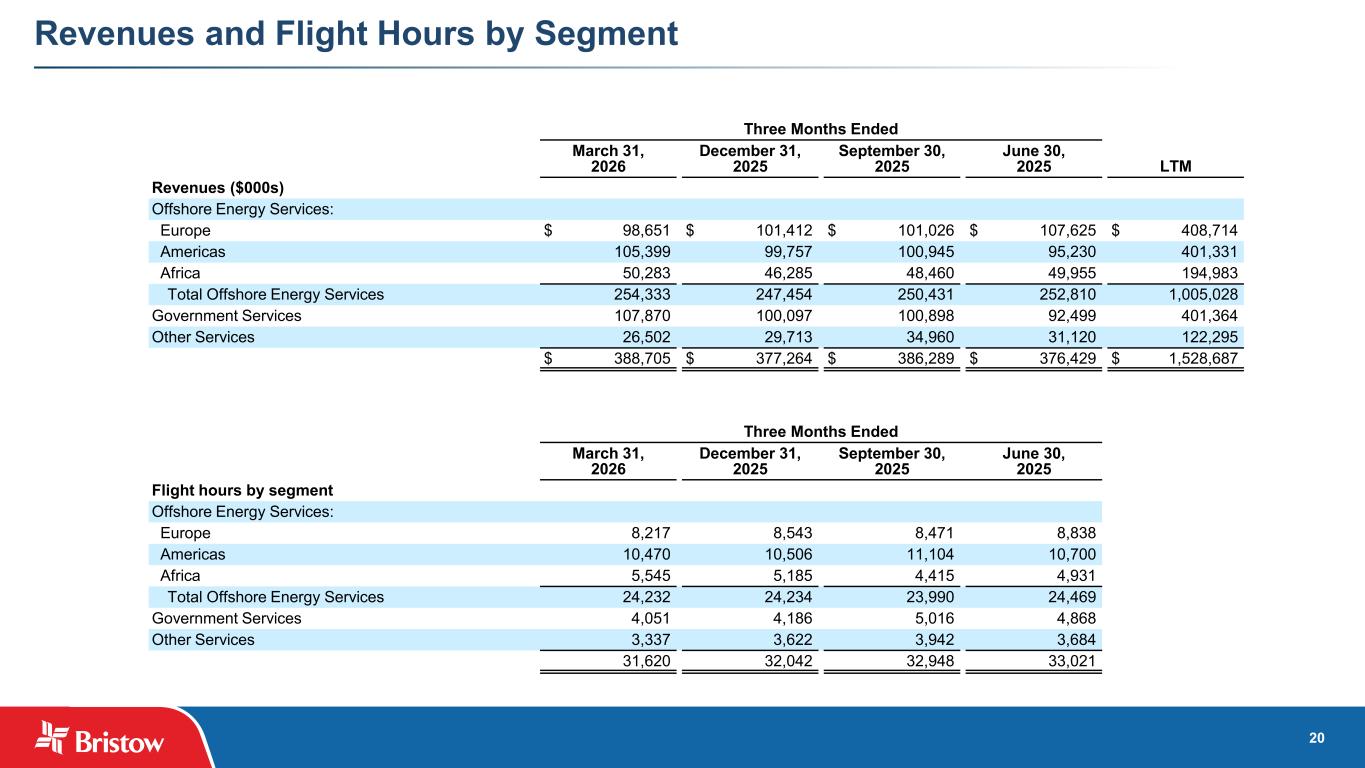
20 Revenues and Flight Hours by Segment Three Months Ended March 31, 2026 December 31, 2025 September 30, 2025 June 30, 2025 LTM Revenues ($000s) Offshore Energy Services: Europe $ 98,651 $ 101,412 $ 101,026 $ 107,625 $ 408,714 Americas 105,399 99,757 100,945 95,230 401,331 Africa 50,283 46,285 48,460 49,955 194,983 Total Offshore Energy Services 254,333 247,454 250,431 252,810 1,005,028 Government Services 107,870 100,097 100,898 92,499 401,364 Other Services 26,502 29,713 34,960 31,120 122,295 $ 388,705 $ 377,264 $ 386,289 $ 376,429 $ 1,528,687 Three Months Ended March 31, 2026 December 31, 2025 September 30, 2025 June 30, 2025 Flight hours by segment Offshore Energy Services: Europe 8,217 8,543 8,471 8,838 Americas 10,470 10,506 11,104 10,700 Africa 5,545 5,185 4,415 4,931 Total Offshore Energy Services 24,232 24,234 23,990 24,469 Government Services 4,051 4,186 5,016 4,868 Other Services 3,337 3,622 3,942 3,684 31,620 32,042 32,948 33,021
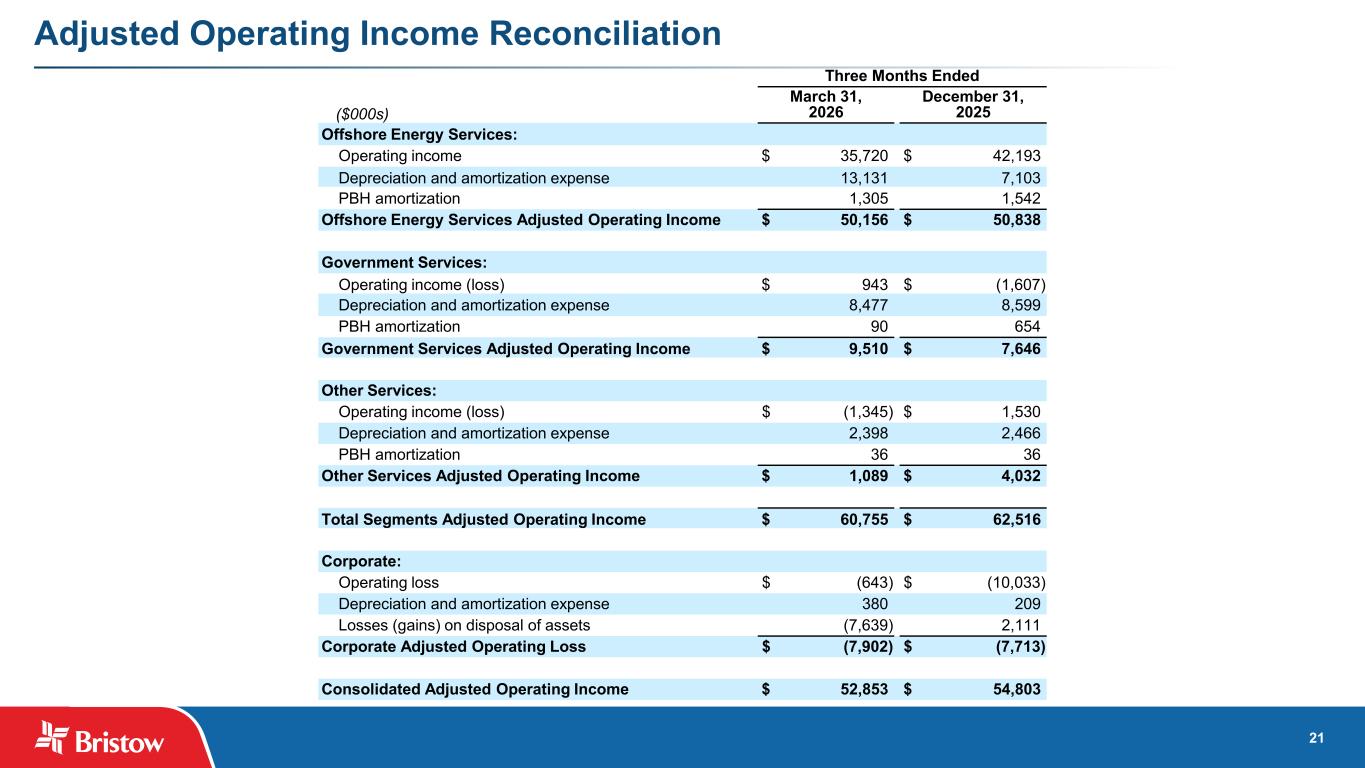
21 Adjusted Operating Income Reconciliation Three Months Ended ($000s) March 31, 2026 December 31, 2025 Offshore Energy Services: Operating income $ 35,720 $ 42,193 Depreciation and amortization expense 13,131 7,103 PBH amortization 1,305 1,542 Offshore Energy Services Adjusted Operating Income $ 50,156 $ 50,838 Government Services: Operating income (loss) $ 943 $ (1,607) Depreciation and amortization expense 8,477 8,599 PBH amortization 90 654 Government Services Adjusted Operating Income $ 9,510 $ 7,646 Other Services: Operating income (loss) $ (1,345) $ 1,530 Depreciation and amortization expense 2,398 2,466 PBH amortization 36 36 Other Services Adjusted Operating Income $ 1,089 $ 4,032 Total Segments Adjusted Operating Income $ 60,755 $ 62,516 Corporate: Operating loss $ (643) $ (10,033) Depreciation and amortization expense 380 209 Losses (gains) on disposal of assets (7,639) 2,111 Corporate Adjusted Operating Loss $ (7,902) $ (7,713) Consolidated Adjusted Operating Income $ 52,853 $ 54,803
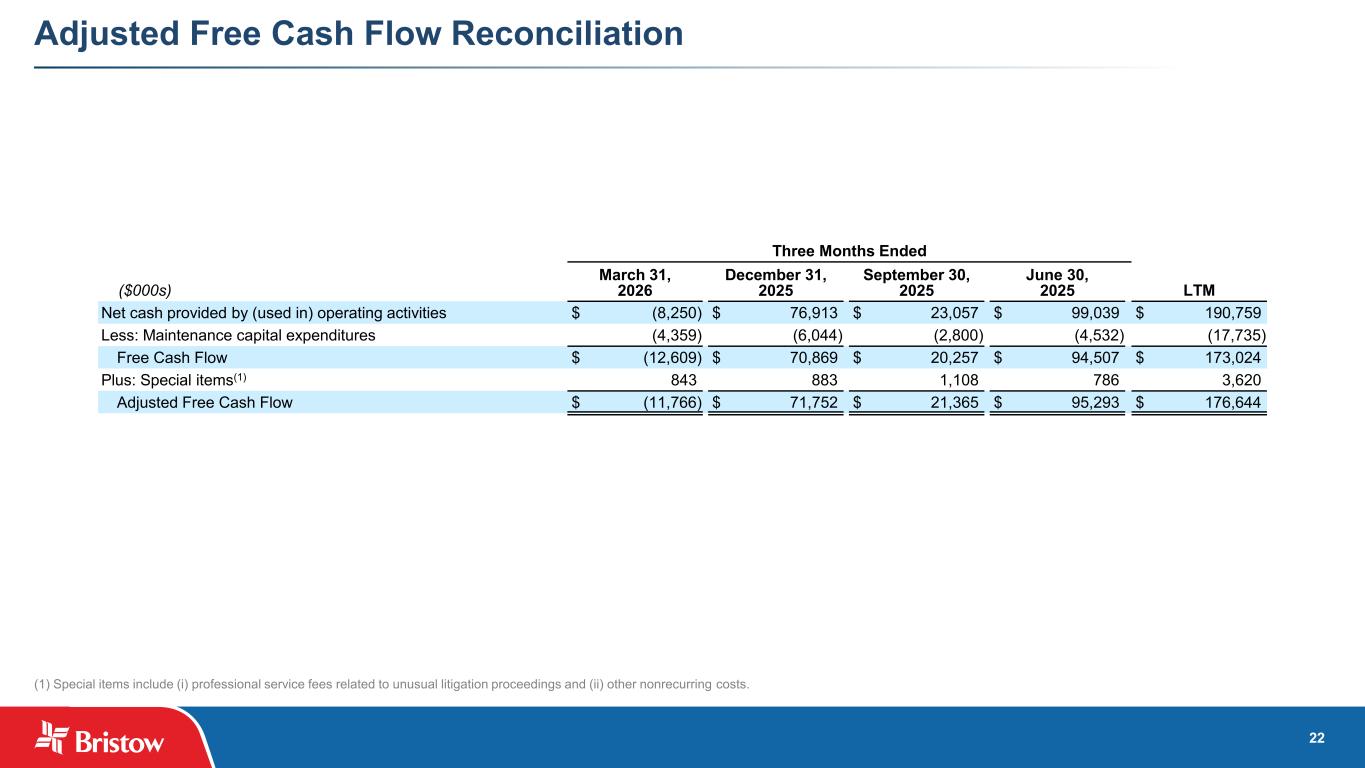
22 Adjusted Free Cash Flow Reconciliation (1) Special items include (i) professional service fees related to unusual litigation proceedings and (ii) other nonrecurring costs. Three Months Ended ($000s) March 31, 2026 December 31, 2025 September 30, 2025 June 30, 2025 LTM Net cash provided by (used in) operating activities $ (8,250) $ 76,913 $ 23,057 $ 99,039 $ 190,759 Less: Maintenance capital expenditures (4,359) (6,044) (2,800) (4,532) (17,735) Free Cash Flow $ (12,609) $ 70,869 $ 20,257 $ 94,507 $ 173,024 Plus: Special items(1) 843 883 1,108 786 3,620 Adjusted Free Cash Flow $ (11,766) $ 71,752 $ 21,365 $ 95,293 $ 176,644