|

| 2025 FINANCIAL REPORT OVERVIEW 1 Since its establishment in 1958, the European Investment Bank (EIB, or the Bank) has supported the policy goals of the European Union (the European Union, or the EU), consistently increasing its activity during periods of crisis. In 2025, the EIB Group2 (EIB Group, or the Group) increased its financing volume and impact as it completed the first phase of its multiannual 2024-2027 Strategic Roadmap, which EU Member States endorsed in 2024. The priorities under the Strategic Roadmap are to strengthen climate action, accelerate digitalisation and technological innovation, support Europe’s security and defence, promote economic and social cohesion, support agriculture and the bioeconomy, reinforce social infrastructure, focus on high-impact projects beyond the European Union and contribute to strong and integrated capital markets in Europe. The year marked a milestone for the Group, which reached a historic EUR 100 billion in new signatures,3 reinforcing its role as a cornerstone of the European project. Backed by the unified vision of its 27 shareholders, the Group increased its relevance and strategic focus, prioritising investments that contribute to competitiveness and security, aiming to promote shared prosperity and EU values, across Europe and around the world. In 2025, the EIB set records in four key areas: energy grids, technological innovation, housing, and security and defence. Nearly 60% of total financing was devoted to green projects, ranging from large energy grids and interconnectors to renewable energy deployment, tech research, and decarbonising heavy industry. These initiatives not only advanced climate action, they also strengthened Europe’s competitiveness and energy security – delivering clean, affordable power, reducing reliance on fossil fuels, and supporting leadership in critical industries. Supporting Europe’s industrial transformation, the EIB is helping the EU seize the opportunities of the energy transition. The EIB increased support across the clean industry supply chain – including wind and grid manufacturing, low-carbon technologies, lithium extraction, geothermal energy, nuclear fuels, electrolysers, heat pumps, storage, and electric vehicle charging infrastructure. A record EUR 11.6 billion supported grids and storage. In total, EUR 33 billion for clean and affordable energy in the European Union mobilised around EUR 100 billion in investment. To further strengthen Europe’s innovation ecosystem, 2025 saw the launch of TechEU, with the ambition to provide the largest innovation financing programme of its kind in the European Union. TechEU aims to provide a coherent framework for EIB Group support for innovative companies, from early-stage development to scale-up, combining lending, equity, guarantees and advisory services. The initiative aims to mobilise up to EUR 250 billion in investment by 2027 in strategic areas such as artificial intelligence, disruptive technologies, digital infrastructure and critical raw materials, including through the expansion of the European Tech Champions Initiative.4 In 2025, the total volume of signatures under the initiative amounted to EUR 22.4 billion, supporting investments of EUR 109 billion. Beyond its commitment to climate and technological innovation, in 2025 the EIB Group also advanced its role in European security and defence. New financing in this sector exceeded targets and already neared 5% of total EU operations, with investments in military infrastructure, industrial production, SME support and dedicated private funds. 1. This section covers the activities and financial information of the EIB. The figures presented should be read together with the Bank’s Statutory Financial Statements, which are prepared in accordance with the EU Accounting Directives (unless stated otherwise). 2. The EIB Group comprises the EIB and the European Investment Fund (EIF). The EIB Group does not have any branches. 3. Includes signatures for financing under the EIB's own resources of EUR 82.8 billion and under third-party resources of EUR 3.2 billion, supplemented by EUR 15.7 billion from the EIF. These signatures include double counting of joint EIB/EIF transactions in the amount of EUR 1.7 billion. 4. Launched in February 2023 by the EIB Group and EU Member States, the European Tech Champions Initiative is a fund of funds managed by the European Investment Fund to support late-stage European technology companies. 2 |
| OVERVIEW Almost half of the EIB’s signatures inside the European Union in 2025 went to transition and less developed EU regions, underscoring the importance of economic, social and territorial cohesion for the continent’s economy. The Group launched a new housing platform to boost innovation, renovation and new construction, helping meet people’s needs and complementing the EIB’s leadership in funding health and education facilities. Supplementing the Bank’s large-scale efforts, the European Investment Fund delivered close to EUR 15.7 billion in guarantees and equity finance for small businesses and startups across Europe.5 Finally, the EIB enhanced its strategic approach outside the European Union, fostering win-win partnerships and maintaining its central role within the multilateral development bank community. With EUR 9.0 billion committed to non-EU projects in 2025, the EIB supported Europe’s global influence as a champion of shared prosperity, human rights and democratic values. As the world order shifts, Europe stands out as a beacon of stability and trust for partners and businesses alike, and the EIB continues to play its role in powering Europe, creating opportunities and building confidence for present and upcoming generations. In 2025, new financing signed by the Bank reached EUR 86.0 billion,6 of which EUR 82.8 billion was under the Bank’s own resources (compared with EUR 76.6 billion signed in 2024, of which EUR 74.7 billion was under the Bank’s own resources). The Bank met the target set in the EIB Group Operational Plan 2025-2027.7 Total disbursements reached EUR 59.3. billion8 in 2025, of which EUR 57.9 billion was under the Bank’s own resources (compared with EUR 58.8 billion in 2024, of which EUR 58.1 billion was under the Bank’s own resources). This was close to the upper end of the target range in the EIB Group Operational Plan 2025-2027. The EIB is a leading issuer in the sovereigns, supranationals and agencies (SSA) segment. In 2025, the Bank raised EUR 63.9 billion of long-term funding on the international capital markets to support lending operations and other funding requirements (compared with EUR 63.4 billion in 2024). Further strengthening its position as a leader in the global green and sustainability bond markets, the EIB issued EUR 27.8 billion in Climate Awareness Bonds (CABs) and Sustainability Awareness Bonds (SABs) in 2025, accounting for 43% of its total funding (compared with EUR 18.3 billion, or 29% of total funding in 2024). This included the inaugural EUR 3.0 billion CAB aligned with the European Green Bond Standard (EUGBS) issued in April 2025, the first such bond issued by a supranational institution and the largest European Green Bond in the market in 2025. Outstanding borrowings and commercial paper amounted to EUR 431.7 billion at the end of 2025 (compared with EUR 442.9 billion at the end of 2024). The EIB follows a prudent liquidity management strategy and prioritises high-quality and highly liquid investments. Treasury assets totalled EUR 65.8 billion at the end of 2025 (compared with EUR 67.5 billion at the end of 2024). The Bank’s total liquidity ratio (TLR) remained well within internal limits at the end of 2025, covering 64.1% of projected 2026 net cash outflows (compared with 60.3% at the end of 2024), while the liquidity coverage ratio (LCR) stood at 658.5% and the net stable funding ratio (NSFR) amounted to 120.9% at the end of 2025 (compared with 724.9% and 122.2%, respectively, at the end of 2024). Importantly, the EIB’s access to the Eurosystem’s refinancing facility provides an additional safeguard in the event of extreme liquidity stress. 5. Total EIB Group signatures include double counting of joint EIB/EIF transactions in the amount of EUR 1.7 billion (for example, EIF operations guaranteed back-to-back by the EIB). 6. Includes exposures under the EIB’s own resources and third-party resources: loans, equities and guarantees. 7. The annual EIB Group Operational Plan includes performance orientations and elaborates on major priorities and activities of the EIB Group for the next three years. 8. Includes exposures under EIB own resources and third-party resources: loans and equities. 3 |
| 2025 FINANCIAL REPORT The EIB’s risk management strategy is based on a robust due diligence process, adequate levels of security and guarantees and standard protective clauses included in its loan agreements. The level of loan impairments was 0.8% at the end of 2025 (compared with 0.6% at the end of 2024), supported by securities, guarantees and portfolio credit enhancements in place. The portion of payments overdue by more than 90 days remained low, totalling EUR 504.2 million at the end of 2025 or 0.11% of the total loan portfolio (compared with EUR 281.3 million or 0.06% at the end of 2024). Individual value adjustments on loans amounted to EUR 780.6 million at the end of 2025 (compared with EUR 687.0 million at the end of 2024). The EIB generated a positive financial result in 2025, with an annual surplus of EUR 2.7 billion (compared with EUR 2.9 billion in 2024). The annual surplus is fully retained and strengthens the Bank’s own funds and long-term financing capacity. In 2025, the EIB Group adopted the amended rules of the EU Capital Requirements Regulation (known as CRR III), which were deemed applicable to the EIB, on an individual and consolidated basis, in line with its best banking practice framework9 (BBP Framework). The adoption of CRR III resulted in an improvement of the Group’s Common Equity Tier 1 (CET 1 ratio) by +12.7% as of 1 January 2025 (of which +7.0% related to EIB-specific adaptations – approved by the Board of Directors – and non-applications, in line with the EIB BBP Guiding Principles). At the end of 2025, the EIB Group CET 1 ratio, calculated in line with the CRR III, as applicable to the EIB and based on the EIB Group’s Consolidated Financial Statements under the EU Accounting Directives, increased to 41.5%, from 30.7% at the end of 2024. At the EIB standalone level, the CET 1 ratio stood at 43.2% compared with 31.7% at the end of 2024. The increase in both the Group’s CET 1 ratio and EIB standalone CET 1 ratio mainly reflects the positive impact of the adoption of the CRR III combined with the growth of own funds, partially offset by the delivery of new equity business at a higher risk and new lending volumes. The EIB Group’s leverage ratio calculated in line with CRR III as applicable to the EIB decreased to 11.3% at the end of 2025, from 12.2% at the end of 2024. At the EIB standalone level, the ratio declined to 11.5% at the end of 2025 from 12.3% at the end of 2024. The reduction in both the Group and the EIB standalone leverage ratio was mainly driven by the adoption of CRR III and its related adaptations, partially offset by the annual net surplus.10 9. The BBP Framework, the purpose of which is to clarify and harmonise the definition and scope of best banking practice applicable to the Bank, consists of the Best Banking Practice (BBP) Guiding Principles, the Best Banking Practice (BBP) Book and related internal policies and procedures. For more details, please refer to section 7 of this overview. 10. For more information on the Common Equity Tier 1 ratio, leverage ratio and the EU Capital Requirements Regulation see the EIB Group Risk Management Disclosure Report, available on the EIB website. 4 |
| OVERVIEW 1. STRONG FINANCIAL PERFORMANCE IN 2025 The EIB generates income mainly by financing large volumes of loans at low margins and has recorded annual surpluses in its statutory11 accounts every year since its foundation. The profit (surplus) for the financial year 2025 amounted to EUR 2 725.4 million (compared with EUR 2 891.5 million in 2024). The main factors that influenced the 2025 financial result were the following: • Net interest income generated12 by the Bank amounted to EUR 3 514.3 million in 2025 (compared with EUR 3 513.4 million in 2024). The marginal increase of EUR 0.9 million indicates a stable net interest result and is consistent with the Bank’s overall interest rate strategy. Further details on the Bank’s interest rate risk strategy are provided in Note U.2 of the Statutory Financial Statements. Additional information on interest income and expense is available under Note N of the Statutory Financial Statements. • Income from securities amounted to EUR 940.1 million in 2025 (compared with EUR 925.2 million in 2024). The increase of EUR 14.9 million was mainly due to higher capital reflows and dividends received during 2025 as compared with 2024. • Net result on financial operations resulted in a charge of EUR 122.6 million (compared with a charge of EUR 9.9 million in 2024). This variation was mainly due to the net result on shares and other variable-yield securities (charge of EUR 160.0 million compared to a charge of EUR 89.7 million), largely explained by higher value adjustments recorded during 2025 as compared to 2024. • General administrative expenses amounted to EUR 1 367.4 million in 2025 (compared with EUR 1 377.3 million in 2024). This decrease of EUR 9.9 million was mainly due to a decrease of the welfare contributions and other social charges of EUR 18.6 million, partially offset by higher salaries and allowances (EUR 22.2 million) and other administrative charges (EUR 13.5 million). For more details, see Note R of the Statutory Financial Statements. • Value adjustments in respect of loans and advances and provisions for contingent liabilities resulted in a charge of EUR 247.6 million in 2025 (compared with a charge of EUR 192.8 million in 2024). This variation of EUR 54.8 million was notably driven by the entire release of the collective value adjustments in 2024. The EIB’s balance sheet13 totalled EUR 550.8 billion at the end of 2025, compared with EUR 556.4 billion at the end of 2024 (representing a decrease of EUR 5.6 billion). 1 712 2 566 2 366 2 274 2 891 2 725 554 291 565 476 544 588 547 331 556 442 550 838 Total assets Results 0 1000 2000 3000 2020 2021 2022 2023 2024 2025 EVOLUTION OF TOTAL ASSETS AND RESULTS (EUR million) 11. Prepared in accordance with the EU Accounting Directives. 12. Interest receivable and similar income less interest payable and similar charges. 13. The EIB’s recognised intangible assets are disclosed in accordance with the applicable accounting framework in the relevant disclosure notes of the EIB and EIB Group Financial Statements. 5 |
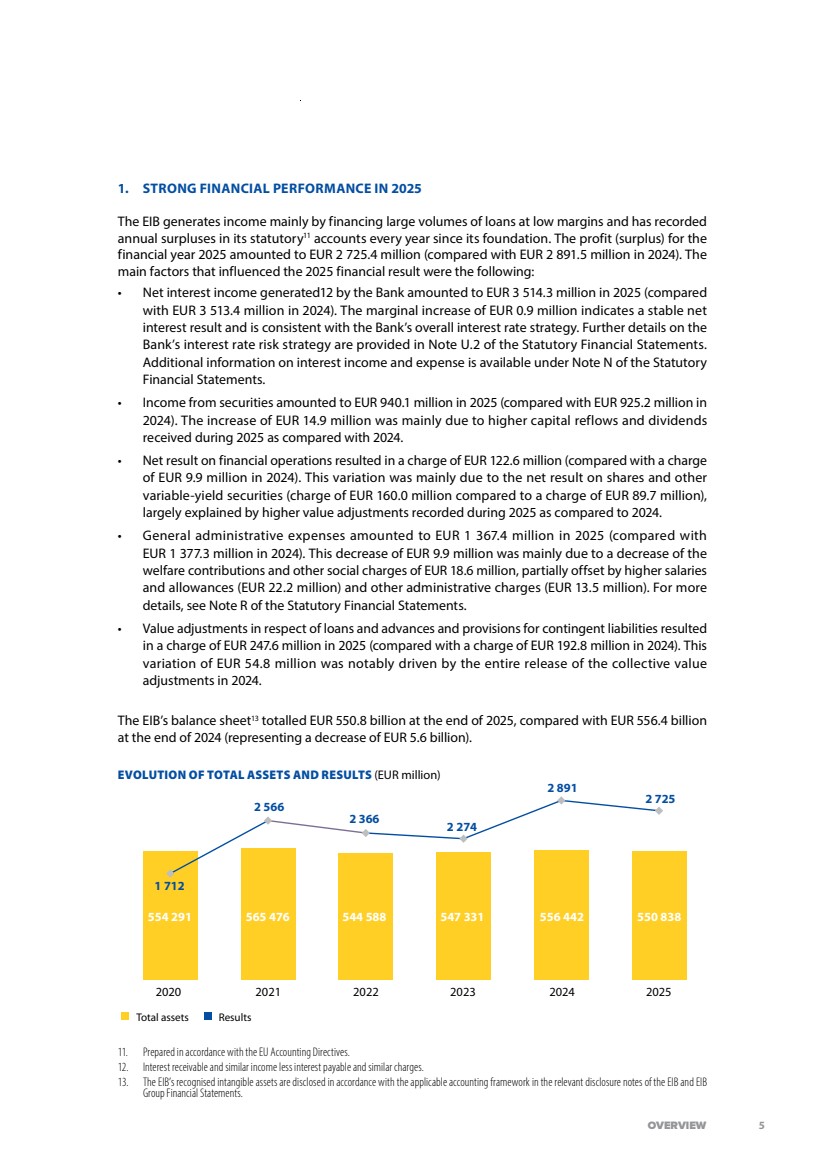
| 2025 FINANCIAL REPORT 1.1. Strong capitalisation Because the EIB retains its profits to support its operations, the Bank’s consistent profitability has led to a substantial build-up of reserves over time. Own funds increased to EUR 86.3 billion at the end of 2025, from EUR 83.6 billion at the end of 2024. Own funds in EUR thousands 31 December 2025 31 December 2024 Capital – Subscribed 248 795 607 248 795 607 – Uncalled - 226 604 892 - 226 604 892 22 190 715 22 190 715 Reserves a) Reserve fund 24 879 561 24 879 561 b) Additional reserves 20 020 604 18 692 683 c) Special activities reserve 14 015 155 12 665 555 d) General loan reserve 2 495 377 2 281 423 61 410 697 58 519 222 Profit for the financial year 2 725 405 2 891 475 Total own funds 86 326 817 83 601 412 OWN FUNDS COMPOSITION AS OF 31 DECEMBER 2025 It is proposed that the surplus for the year be appropriated as follows: i) additional reserves EUR 2 224. 2 million ii) special activities reserve14 EUR 881.9 million iii) general loan reserve15 EUR -380.7 million 1.2. The EIB’s callable capital provides a substantial cushion The EIB is owned by the EU Member States.16 At the end of 2025, the Bank’s called capital amounted to EUR 22.2 billion, and subscribed but unpaid capital (callable capital), amounted to EUR 226.6 billion. The EU Member States have a legal obligation to pay their share of the callable capital, if needed for the Bank to meet its obligations, upon request of the EIB Board of Directors. This legal obligation is set out in the EIB Statute,17 which forms an integral part of the EU Treaties,18 and takes precedence over national laws of the EU Member States and is a special feature of the EIB. Callable capital represents a buffer equal to roughly half of the Bank’s borrowings. 14. Please refer to Note A.2.15.3 of the Statutory Financial Statements. 15. Please refer to Note A.2.15.4 of the Statutory Financial Statements. 16. The EIB and EIB Group do not buy back their own shares. 17. EIB Statute, Article 5(3): “The Board of Directors may require payment of the balance of the subscribed capital, to such extent as may be required for the Bank to meet its obligations.” 18. The Treaty on European Union and the Treaty on the Functioning of the European Union. 6 |
| OVERVIEW 1.3. The EIB group’s financial performance19 The EIB Group consists of the EIB and the EIF (which is a non-wholly owned subsidiary of the EIB).20 A. EIB consolidated financial statements prepared in accordance with the EU Accounting Directives The EIB Group’s consolidated result prepared in accordance with the EU Accounting Directives was EUR 2 880.4 million in 2025, compared with EUR 3 045.8 million in 2024. This represents a decrease of EUR 165.4 million or 5.4%. The consolidated result is closely aligned with the EIB’s surplus reported in the Statutory Financial Statements, as the consolidated EU Accounting Directives result is almost wholly driven by the statutory result of the Bank. As at 31 December 2025, the total EIB Group balance sheet stood at EUR 554.4 billion, a decrease of EUR 5.3 billion, or 0.9%, from EUR 559.7 billion as of 31 December 2024. Additional information on the EU Accounting Directives results is provided under the Notes to the EIB Group Consolidated Financial Statements prepared in accordance with the EU Accounting Directives. B. EIB consolidated financial statements prepared in accordance with International Financial Reporting Standards (IFRS) The EIB Group’s consolidated result prepared in accordance with IFRS amounted to EUR 2 840.0 million in 2025, compared with EUR 3 748.8 million in 2024. This corresponds to a decrease of EUR 908.8 million, or 24.2 %. The main factors influencing the year on year variation are the following: • The result on financial operations resulted in a gain of EUR 221.2 million for the year 2025 compared with a gain of EUR 904.3 million in 2024. The year on year variance of EUR 683.1 million is mainly impacted by the net result from equity portfolios, essentially explained by higher negative fair value adjustments on indirect equity investments recorded during the year 2025 compared to 2024. • The change in impairment on loans and advances and provisions for guarantees, net of reversals, resulted in a charge of EUR 213.0 million in 2025 (compared with a charge of EUR 9.9 million in 2024), impacted in particular by increased expected credit losses on loans and advances to customers and on loan commitments. As at 31 December 2025, the total EIB Group balance sheet stood at EUR 572.3 billion, showing a decrease of EUR 9.8 billion, or 1.7%, from EUR 582.1 billion as of 31 December 2024. Additional information on the IFRS results is provided under the Notes to the EIB Group Consolidated Financial Statements prepared in accordance with IFRS. 1.4. Outlook The EIB Group Operational Plan 2026-202821 was approved by the EIB Board of Directors on 10 December 2025 and was published on 29 January 2026. The financing programme for 2026 to 2028 sets out how the EIB Group intends to advance Europe’s competitiveness, security and cohesion in an increasingly uncertain geopolitical and economic environment. 19. This section covers the Consolidated Financial Statements of the EIB Group prepared in accordance with the EU Accounting Directives and with IFRS. 20. It is noted that the EIB and EIB Group, acting as a financial institution, do not carry out research and development activities. Accordingly, no related costs were incurred during the year. 21. Each annual EIB Group Operational Plan includes performance orientations and elaborates on major priorities and activities of the EIB Group for the coming three years. 7 |
| 2025 FINANCIAL REPORT The Operational Plan 2026-2028 proposes financing targets using the EIB Group’s own and third-party resources. The EIB Group’s signature volume target for 2026 is EUR 100.0 billion22 with a +/- 5% flexibility margin, of which EUR 77.1 billion relates to EIB activity in the European Union, EUR 9.0 billion to operations managed by EIB Global, and EUR 15.3 billion to the EIF. The EIB Group disbursement target range for 2026 is EUR 58.0 billion to EUR 64.0 billion. Within this, EUR 50.7 billion to EUR 55.6 billion is planned for EIB activity in the European Union, EUR 5.9 billion to EUR 6.5 billion for EIB Global, and EUR 1.7 billion to EUR 2.0 billion for the EIF. The Operational Plan 2026-2028 designates 2026 as a year of consolidation and accelerated the delivery of the Strategic Roadmap. Fully aligned with its eight interlinked priorities, it maintains green financing above 50%, expands the TechEU programme to EUR 23.5 billion, and increases financing for security and defence to EUR 4.5 billion, representing 5% of total EIB Group financing inside the European Union. It reinforces cohesion by keeping at least 45% of EIB EU activity in less developed and transition regions and allocates EUR 6.0 billion for affordable and sustainable housing as part of the Group’s wider investment in social infrastructure. The EIB’s financing continues to focus on the Group’s public policy goals, which reflect the European Union’s political priorities: • sustainable cities and regions; • sustainable energy and natural resources; • innovation, digital and human capital; • financing for small and medium-sized enterprises and mid-caps. In addition, the Group pursues three cross-cutting objectives: Group Green Finance,23 EU economic and social cohesion and security and defence. These reflect its role as the climate bank, its statutory mandate to promote economic, social and territorial cohesion, and the increasing importance of security and defence now established as a third transversal public policy goal. The EIB Group Operational Plan 2026-2028 also sets out targets for signatures and disbursements for EIB Global. Its main goal is to increase the impact of operations beyond the European Union. The EIB Group will continue supporting Ukraine and the EU enlargement process, as well as delivering impact-driven interventions in Europe’s neighbourhoods. Globally, the EIB Group focuses on projects promoted by the European Union’s Global Gateway initiative strengthening strategic partnerships with partner countries. Operating in a fragile and fragmented geopolitical context and facing debt-sustainability challenges in several partner countries, EIB Global will continue to rely on a mix of EU mandates and third-party funds to de-risk its portfolio, alongside the prudent deployment of its own funds. The deployment of the EUR 100 billion signature target for 2026 is supported by the increase in the EIB Group’s nominal gearing ratio limit from 250% to 290%, effective from March 2025. The EIB Statute amendment followed a set of recommendations stemming from the G20-commissioned review of multilateral development banks’ (MDB) capital adequacy frameworks (the CAF Review), which outlined reforms intended to increase the lending capacity of MDBs, while maintaining strong credit ratings. The amendment to the EIB Statute implemented one of the recommendations of the CAF Review to remove statutory lending limits from the statutes of MDBs. The funding programme outlined in the EIB Group Operational Plan 2026-2028 reflects the anticipated 22. Total EIB Group signatures include double counting of joint EIB/EIF transactions in the amount of EUR 1.4 billion (for example, EIF operations guaranteed back-to-back by the EIB). As a result, the sum of the individual signatures by the EIB in the European Union, by EIB Global and by the EIF does not equal the EIB Group’s total signature volume target for 2026. 23. During Phase 2 of the Climate Bank Roadmap, the term Group Green Finance is used to replace the term Climate Action and Environmental Sustainability Finance used during Phase 1. 8 |
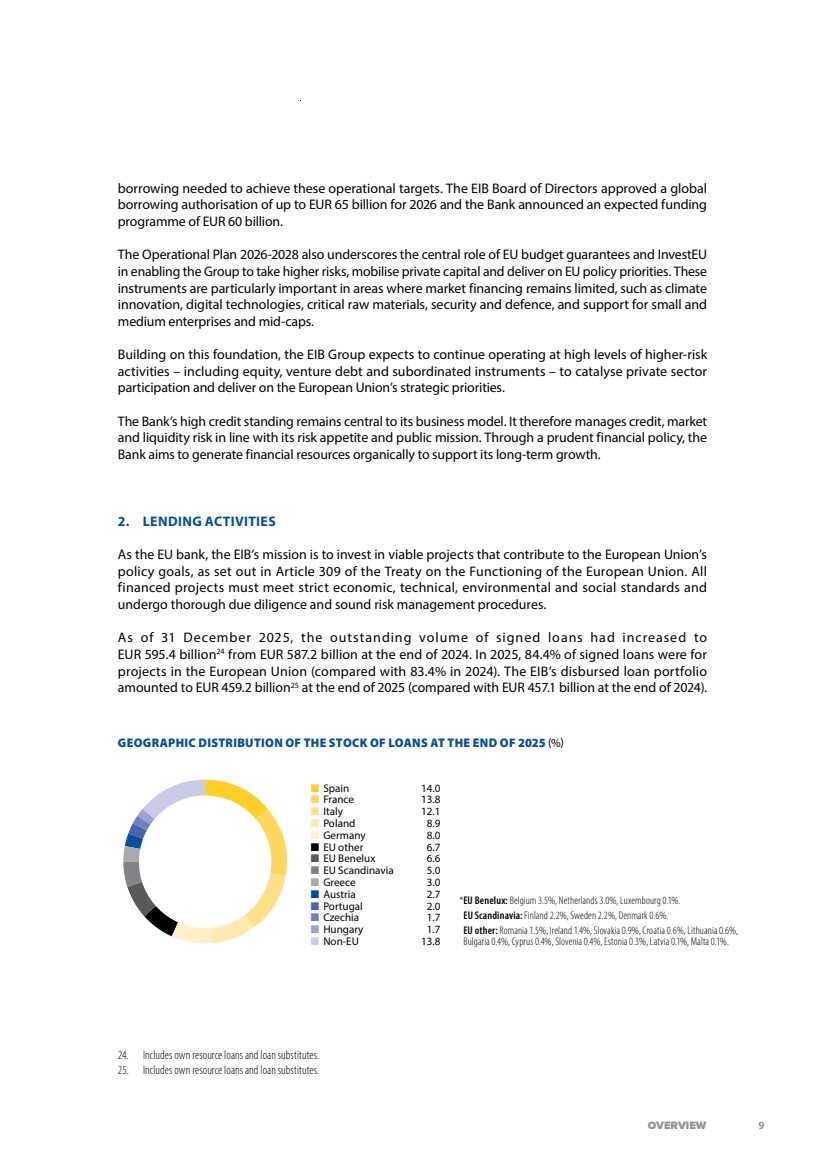
| OVERVIEW borrowing needed to achieve these operational targets. The EIB Board of Directors approved a global borrowing authorisation of up to EUR 65 billion for 2026 and the Bank announced an expected funding programme of EUR 60 billion. The Operational Plan 2026-2028 also underscores the central role of EU budget guarantees and InvestEU in enabling the Group to take higher risks, mobilise private capital and deliver on EU policy priorities. These instruments are particularly important in areas where market financing remains limited, such as climate innovation, digital technologies, critical raw materials, security and defence, and support for small and medium enterprises and mid-caps. Building on this foundation, the EIB Group expects to continue operating at high levels of higher-risk activities – including equity, venture debt and subordinated instruments – to catalyse private sector participation and deliver on the European Union’s strategic priorities. The Bank’s high credit standing remains central to its business model. It therefore manages credit, market and liquidity risk in line with its risk appetite and public mission. Through a prudent financial policy, the Bank aims to generate financial resources organically to support its long-term growth. 2. LENDING ACTIVITIES As the EU bank, the EIB’s mission is to invest in viable projects that contribute to the European Union’s policy goals, as set out in Article 309 of the Treaty on the Functioning of the European Union. All financed projects must meet strict economic, technical, environmental and social standards and undergo thorough due diligence and sound risk management procedures. As of 31 December 2025, the outstanding volume of signed loans had increased to EUR 595.4 billion24 from EUR 587.2 billion at the end of 2024. In 2025, 84.4% of signed loans were for projects in the European Union (compared with 83.4% in 2024). The EIB’s disbursed loan portfolio amounted to EUR 459.2 billion25 at the end of 2025 (compared with EUR 457.1 billion at the end of 2024). GEOGRAPHIC DISTRIBUTION OF THE STOCK OF LOANS AT THE END OF 2025 (%) Spain 14.0 France 13.8 Italy 12.1 Poland 8.9 Germany 8.0 EU other 6.7 EU Benelux 6.6 EU Scandinavia 5.0 Greece 3.0 Austria 2.7 Portugal 2.0 Czechia 1.7 Hungary 1.7 Non-EU 13.8 *EU Benelux: Belgium 3.5%, Netherlands 3.0%, Luxembourg 0.1%. EU Scandinavia: Finland 2.2%, Sweden 2.2%, Denmark 0.6%. EU other: Romania 1.5%, Ireland 1.4%, Slovakia 0.9%, Croatia 0.6%, Lithuania 0.6%, Bulgaria 0.4%, Cyprus 0.4%, Slovenia 0.4%, Estonia 0.3%, Latvia 0.1%, Malta 0.1%. 24. Includes own resource loans and loan substitutes. 25. Includes own resource loans and loan substitutes. 9 |
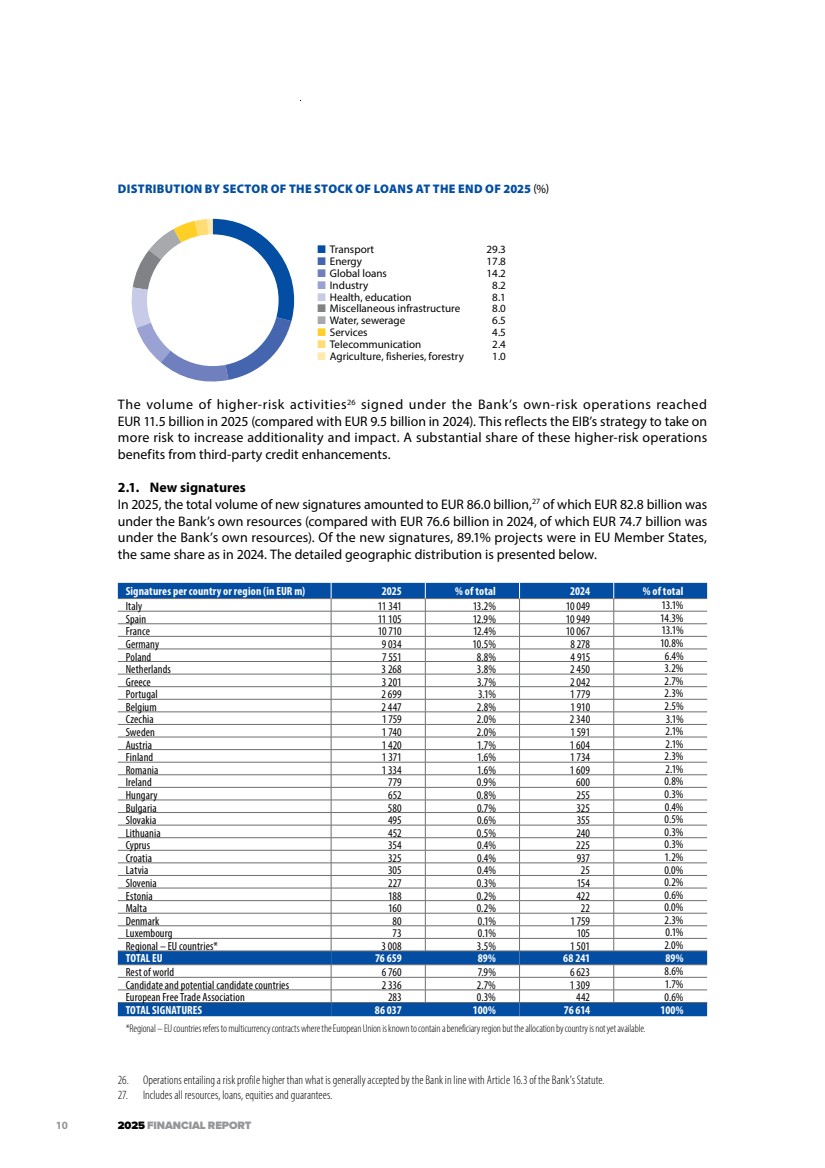
| 2025 FINANCIAL REPORT DISTRIBUTION BY SECTOR OF THE STOCK OF LOANS AT THE END OF 2025 (%) Transport 29.3 Energy 17.8 Global loans 14.2 Industry 8.2 Health, education 8.1 Miscellaneous infrastructure 8.0 Water, sewerage 6.5 Services 4.5 Telecommunication 2.4 Agriculture, fisheries, forestry 1.0 The volume of higher-risk activities26 signed under the Bank’s own-risk operations reached EUR 11.5 billion in 2025 (compared with EUR 9.5 billion in 2024). This reflects the EIB’s strategy to take on more risk to increase additionality and impact. A substantial share of these higher-risk operations benefits from third-party credit enhancements. 2.1. New signatures In 2025, the total volume of new signatures amounted to EUR 86.0 billion,27 of which EUR 82.8 billion was under the Bank’s own resources (compared with EUR 76.6 billion in 2024, of which EUR 74.7 billion was under the Bank’s own resources). Of the new signatures, 89.1% projects were in EU Member States, the same share as in 2024. The detailed geographic distribution is presented below. Signatures per country or region (in EUR m) 2025 % of total 2024 % of total Italy 11 341 13.2% 10 049 13.1% Spain 11 105 12.9% 10 949 14.3% France 10 710 12.4% 10 067 13.1% Germany 9 034 10.5% 8 278 10.8% Poland 7 551 8.8% 4 915 6.4% Netherlands 3 268 3.8% 2 450 3.2% Greece 3 201 3.7% 2 042 2.7% Portugal 2 699 3.1% 1 779 2.3% Belgium 2 447 2.8% 1 910 2.5% Czechia 1 759 2.0% 2 340 3.1% Sweden 1 740 2.0% 1 591 2.1% Austria 1 420 1.7% 1 604 2.1% Finland 1 371 1.6% 1 734 2.3% Romania 1 334 1.6% 1 609 2.1% Ireland 779 0.9% 600 0.8% Hungary 652 0.8% 255 0.3% Bulgaria 580 0.7% 325 0.4% Slovakia 495 0.6% 355 0.5% Lithuania 452 0.5% 240 0.3% Cyprus 354 0.4% 225 0.3% Croatia 325 0.4% 937 1.2% Latvia 305 0.4% 25 0.0% Slovenia 227 0.3% 154 0.2% Estonia 188 0.2% 422 0.6% Malta 160 0.2% 22 0.0% Denmark 80 0.1% 1 759 2.3% Luxembourg 73 0.1% 105 0.1% Regional – EU countries* 3 008 3.5% 1 501 2.0% TOTAL EU 76 659 89% 68 241 89% Rest of world 6 760 7.9% 6 623 8.6% Candidate and potential candidate countries 2 336 2.7% 1 309 1.7% European Free Trade Association 283 0.3% 442 0.6% TOTAL SIGNATURES 86 037 100% 76 614 100% *Regional – EU countries refers to multicurrency contracts where the European Union is known to contain a beneficiary region but the allocation by country is not yet available. 26. Operations entailing a risk profile higher than what is generally accepted by the Bank in line with Article 16.3 of the Bank’s Statute. 27. Includes all resources, loans, equities and guarantees. 10 |
| OVERVIEW 2.2. The EIB as the EU climate bank As the climate bank, the EIB plays a central role in addressing the global challenges of climate change, environmental degradation and biodiversity loss. The Bank is among the world’s leading financiers of climate action and environmental sustainability. EIB financing dedicated to climate action and environmental sustainability again accounted for more than half of the EIB’s annual financing. In 2025, the EIB signed EUR 50.3 billion in support of climate action and environmental sustainability worldwide, representing 61% of the Bank’s total financing (compared with EUR 44.8 billion and 60% in 2024).28 Of this amount, EUR 48.1 billion supported climate action and EUR 24.9 billion supported environmental sustainability (compared with EUR 42.6 billion and EUR 18.5 billion, respectively, in 2024), including EUR 22.6 billion for projects with combined climate and environmental benefits. The Strategic Roadmap cites consolidating the Group’s role as the climate bank as its top strategic priority, reflecting its importance for sustainable and inclusive growth, technological competitiveness, strategic autonomy and security. In 2025, the Group advanced this agenda by presenting the second phase of its Climate Bank Roadmap,29 which will guide its support for climate action and environmental sustainability over 2026-2030. The new phase comes against the backdrop of accelerating climate effects, rising energy and industrial competitiveness pressures, and the growing need for resilience and strategic autonomy. Building on the successful first phase of the Climate Bank Roadmap – during which Group Green Finance increased from under 40% in 2020 to nearly 57% in 2025, and annual support for climate adaptation quadrupled from 2021 to reach EUR 5.0 billion in 2025 – the second phase reaffirms the Group’s core climate commitments. These include ensuring all new operations are aligned with the Paris Agreement, maintaining green finance at no less than 50% each year and supporting EUR 1 trillion of green investment over 2020–2030. Phase 2 also introduces a more impact-driven approach, focusing on competitiveness, inclusive prosperity and security and preparedness. During Phase 2, the Group will reinforce its focus on climate adaptation, resilience and nature-based solutions, building on the 2021 EIB Climate Adaptation Plan. Looking ahead, the EIB Group plans to provide EUR 30 billion for adaptation finance over 2026-2030, with a focus on agriculture, land use, oceans, integrated water management and climate-vulnerable regions. The Climate Bank Roadmap Phase 2 also introduces measures to simplify related implementation frameworks. These include closer alignment with recognised EU benchmarks and international standards and refinements to related tools, such as the Group’s Green Checker, reducing administrative burden for clients, especially small and medium-sized enterprises. These measures strengthen the Group’s role as the climate bank, supporting Europe’s competitiveness, preparedness, prosperity and global leadership in the green transition while continuing to leverage public and private financing at scale. The EIB Group also introduced its new Energy Sector Orientation for 2026-2030, which sets the strategic direction for the energy-related financing activities under the second phase (2026-2030) of the Climate Bank Roadmap. The Energy Sector Orientation for 2026-2030 centres on three priorities: competitiveness and affordability, climate and environmental sustainability, and security and reliability. It specifies the investment priorities under each. The orientation reaffirms the Paris-alignment of all new energy operations and provides a cohesive framework for supporting clean energy generation, energy efficiency, low-carbon technologies and resilient energy networks. 28. The 2025 figures under the Bank’s own resources are preliminary and unaudited. 29. The Climate Bank Roadmap Phase 2 for 2026-2030 was approved by the EIB Board of Directors on 29 September 2025 and took effect on 1 January 2026. 11 |
| 2025 FINANCIAL REPORT The Energy Sector Orientation for 2026-2030 complements REPowerEU+30 by providing a long-term approach to accelerating Europe’s secure and low-carbon energy transition. In 2025, the EIB continued to implement the REPowerEU+ plan, designed to strengthen Europe’s energy security and support the EU goal of net-zero greenhouse gas emissions by 2050 through an accelerated roll-out of renewable energy production and related measures. Under the plan, the EIB Group set a cumulative target of EUR 45.0 billion in additional financing until 2027 to the energy sector above the baseline levels for the period 2023-202731 which is expected to mobilise over EUR 150 billion in new green investment. Two years ahead of the schedule, the EIB has already exceeded its standalone cumulative target of EUR 40.5 billion, with additional financing above the baseline reaching EUR 45.9 billion.32 In 2025, the EIB provided EUR 18.9 billion in additional financing above the baseline (compared with EUR 15.7 billion at the end of 2024). Eligible projects include renewable energy, energy storage, grids, energy efficiency and electric vehicle charging infrastructure. Additionally, in 2025 the EIB increased the envelope of its Wind Power Package from EUR 5.0 billion to EUR 6.5 billion, to address strong demand in the European wind industry. Approved in December 2023 and backed by InvestEU, the initiative provides EIB counter-guarantees to strengthen commercial banks’ capacity to support wind technology manufacturers and project developers. The programme is expected to mobilise up to EUR 80 billion in new investment and enable the addition of around 32 GW of wind-generation capacity, contributing to the 117 GW required for the European Union to reach 45% renewable energy in the mix by 2030. The EIB Water Resilience Programme, launched in July 2025 with the aim of mobilising EUR 40.0 billion over three years, will contribute to this adaptation target, strengthening the resilience of communities worldwide to climate change, improving access to clean and safe water and reinforcing the competitiveness of the EU water sector. The EIB Group continues to promote the transition to environmentally sustainable economies and societies by fostering innovation and structural transformation while ensuring a socially fair and just transition for regions most affected by the shift to a climate-neutral EU economy by 2050. EIB lending to just transition projects in the European Union remained strong in 2025, with 24 financing agreements signed to support the territories most affected by decarbonisation. These included operations under the three pillars of the Just Transition Mechanism and loans without additional EU budget support. Beyond the European Union, EIB Global further advanced its support for a just transition and just resilience, financing projects in regions most exposed to the socioeconomic effects of decarbonisation. To advance just resilience, EIB Global continued to support to countries and communities most affected by climate change through multiple climate adaptation finance agreements. The EIB Group continues to lead by example in reducing the environmental and climate impact of its daily operations. Under the Climate Bank Roadmap, it achieved a 42% reduction of the greenhouse gas emissions resulting from internal operations compared with the 2018 baseline, far surpassing its science-based target of 12.4%. In 2025, all Luxembourg sites were certified under the EU Eco-Management and Audit Scheme, and the Bank’s main building achieved an outstanding BREEAM-in-use certification. In line with its long-standing commitment, the EIB Group plans to offset its remaining internal emissions in 2025 by purchasing certified carbon credits. 30. REPowerEU+ was originally known as REPowerEU. In July 2023, the EIB Group committed to increasing the financing for the plan by EUR 15.0 billion, in addition to the original EUR 30.0 billion. 31. The EIB Group’s baseline financing under REPowerEU+ amounts to EUR 10.1 billion annually. 32. 90% of the additional financing under the EIB Group’s REPowerEU+ package (EUR 45 billion) has been allocated to the EIB (EUR 40.5 billion), with the remaining 10% (EUR 4.5 billion) to be delivered by the EIF. 12 |
| OVERVIEW Reflecting its commitment to social impact, the Bank invested EUR 2.7 billion to advance gender equality and women’s economic empowerment through 54 investments (64 signatures) across sectors and regions in 2025 (compared with EUR 3.4 billion through 43 investments (48 signatures) in 2024. In 2025, 56% of the gender investments also contributed to climate and environmental sustainability goals (compared with 60% in 2024), showing how inclusive prosperity supports the transition to a climate-neutral economy. 2.3. Counter-cyclical support and delivery of EU policy priorities As the European Union’s financial arm, the EIB plays a central counter-cyclical role. It helps sustain investment, protect financial stability and support the real economy across all EU Member States in periods of economic stress. Working closely with the European Commission, EU Member States and other partners, the EIB Group provides financing, guarantees and advisory services to address shocks, support recovery and advance the European Union’s strategic priorities. The EIB Group also works closely with the EU institutions and other partners to deliver EU priorities with the mandates available to the Group under the Multiannual Financial Framework 2021-2027. The EIB Group is the main implementing partner of the InvestEU programme, entrusted with 75% (EUR 20.0 billion) of the EU budgetary guarantee provided under the InvestEU Regulation. The InvestEU programme seeks to streamline the implementation of financial instruments, being the sole successor instrument to the European Fund for Strategic Investments and 13 other EU financial instruments introduced under the Multiannual Financial Framework 2014-2020. The InvestEU programme has three parts: • the InvestEU Fund, which provides the European Union with crucial long-term funding, crowding in private investments in support of a sustainable recovery and helping build a greener, more digital and more resilient European economy; • the InvestEU Advisory Hub, which provides technical advice on investment projects needing financing; • the InvestEU Portal, an easily accessible database matching projects with potential investors worldwide. The operations benefiting from EU budgetary guarantee finance investments are distributed across four policy windows: sustainable infrastructure; research, innovation and digitalisation; small and medium-sized firms and small mid-caps; and social investment and skills. These windows support the European Union’s strategic priorities, including the European Green Deal, the digital transition, and social and public interest projects in education, health and housing. At least 30% of this financing is expected to support climate action or adaptation. The EIB Group acts as the main advisory partner to the European Commission under the InvestEU programme. It supports project promoters through the InvestEU Advisory Hub and provides the European Commission with strategic advice to develop and strengthen advisory initiatives. Advisory services offer targeted support across all four policy windows to public and private promoters. InvestEU also includes an EU Member State compartment, which allows countries to contribute funds to the InvestEU Fund. Since InvestEU began in March 2022, 140 operations, including framework operations,33 had been approved for almost EUR 40.0 billion by the end of 2025. Of this, EUR 24.3 billion had been signed and EUR 8.5 billion disbursed. The sectors that have most benefited from the signed operations are energy, industry and transport. The countries with the highest volumes are Spain, Italy and Germany. 33. Framework operations represent lending envelopes under which an InvestEU implementing partner can add sub-projects. 13 |
| 2025 FINANCIAL REPORT In 2025 alone, the EIB approved 45 operations, including framework operations, under InvestEU for a total of EUR 11.7 billion. During the same year, EUR 10.5 billion was signed and EUR 3.5 billion disbursed. The EIB continues to work with EU Member States that plan to use financial instruments under their Decentralised Financial Instruments (DFI) and Recovery and Resilience Facility (RRF) resources, namely Lithuania, Poland, Greece, Italy, Romania and Spain. The EIB Group’s EUR 24.4 billion European Guarantee Fund, created in 2020 to help businesses weather the economic impact of COVID-19, has now been fully deployed. By 31 December 2025, disbursements and allocations reached EUR 13.6 billion for the EIB Group (EUR 6.1 billion from the Bank). Projects were implemented across all 22 participating EU Member States, with funding by the European Guarantee Fund reaching businesses throughout the European Union, including more than 200 000 small and medium-sized enterprises. Under its Cohesion Orientation for 2021-2027, the Bank committed to dedicate at least 40% of its annual financing in the European Union to projects in cohesion regions in 2022, gradually increasing to at least 45% from 2025 onwards. The EIB Group Operational Plan 2025-2027 set an orientation of more than 45% of total EU lending for cohesion in 2025 (compared with 44% in 2024). For regions with a gross domestic product per capita below 75% of the EU average (a key performance indicator of less developed regions), the target was at least 23% of annual EU lending (compared with 22% in 2024). Actual EIB financing for the European Union’s cohesion priority regions reached EUR 38.0 billion in 2025, equivalent to 50% of the Bank’s total signatures in the European Union (compared with EUR 32.9 billion or 49% in 2024). Lending to less developed regions reached EUR 19.8 billion in 2025 or 26% of total EU lending (compared with EUR 15.4 billion or 23% in 2024). Also in March 2025, the EIB Board of Directors adopted a new critical raw materials (CRM) strategic initiative. This initiative strengthens the EIB Group’s role as major provider of financing and advisory support to projects across the entire value chain, from extraction and processing to recycling, substitution and advanced manufacturing. It applies in the European Union and beyond, contributing to the objectives of the EU’s Critical Raw Materials Act. The Bank applies a selective, risk-based approach that focuses on strong industrial logic, early upstream engagement and rigorous due diligence. It gives priority to circularity, innovation, responsible sourcing and projects that address critical bottlenecks in EU supply chains. Through this enhanced framework, the EIB Group aims to attract investment in a sector characterised by high technical, permitting and market risks, helping to strengthen Europe’s economic resilience and competitiveness. Through EIB Global, the EIB Group cooperates with the European Commission to deliver the European Union’s external objectives. The Group is the main implementing partner in the Neighbourhood, Development and International Cooperation Instrument (NDICI) – Global Europe, the main financial tool of the European Union’s international cooperation for 2021-2027. It includes an integrated financial package supplying financing capacity in the form of grants, budgetary guarantees and financial instruments, known as the European Fund for Sustainable Development Plus (EFSD+). The EIB is entrusted with implementing dedicated investment windows funded by EFSD+ budgetary guarantees and by reflows from EU Member State-funded European development funds (EDFs), with the following agreements already in place: • NDICI EFSD+ Investment Window 1 providing comprehensive risk coverage for operations with sovereign counterparties and non-commercial sub-sovereign counterparties, and NDICI EFSD+ Investment Window 2 providing risk coverage for operations with commercial sub-sovereign counterparties, with a shared guarantee capacity of up to EUR 26.6 billion; 14 |
| OVERVIEW • NDICI EFSD+ Investment Window 4 guarantee agreement enabling the EIB to implement private sector operations in the African, Caribbean and Pacific (ACP) region, supported by Cotonou Investment Facility reflows for up to EUR 3.5 billion; • EUR 500.0 million ACP Trust Fund European Commission Compartment, established and managed by the EIB, focusing on high-risk private sector operations in the ACP region and funded through Cotonou Investment Facility reflows; • EUR 128.3 million ACP Trust Fund Member State Compartment, funded by EU Member States, to provide grants and interest rate subsidies to EIB borrowers under lending operations. The EIB is also involved in delivering the Open Architecture modality of the EFSD+ framework, with a several guarantee agreements already signed with the European Commission. 2.4. Delivering on the EIB Group’s new security and defence public policy goal In 2025, the EIB Group continued to expand its support for security and defence, strengthening Europe’s capabilities in this priority area. Following the call by EU leaders at the Special European Council of 6 March 2025 for the EIB to adapt its lending practices, the EIB Group broadened eligibility and established security and defence as a cross-cutting and permanent public policy goal, complementing the existing public policy goals. The new security and defence public policy goal includes a dedicated annual financing target, set and reviewed by the EIB Group’s Board of Directors as part of the EIB Group Operational Plan. The EIB Group Operational Plan 2026-2028 sets the security and defence target for 2026 at EUR 4.5 billion in financing at Group level, representing 5% of expected total EIB Group financing inside the European Union for 2026. Annual target volumes for later years will continue to be set through the EIB Group Operational Plan approval process. This framework builds on the former Strategic European Security Initiative (SESI), which made up to EUR 8.0 billion of financing available for 2022-2027. Integrating this initiative into a permanent public policy goal removes the predefined ceiling on security and defence financing. Future volumes will be set each year by the EIB Group’s Board of Directors in line with policy priorities and operational capacity. Under the newly established security and defence public policy goal, the Group is developing a strong EU-wide pipeline for projects aimed at strengthening European defence preparedness. Priorities include improved infrastructure and support for the European Defence Technological and Industrial Base (EDTIB). The expanded investment scope inside in the European Union enables the financing of a wide range of technologies, as well as military infrastructure and police equipment and infrastructure. These include drones, satellites, military facilities and mobility solutions. Updated eligibility criteria also strengthen support for small and medium-sized enterprises and startups through tailored financial instruments, such as venture debt, equity investments and dedicated credit lines. Beyond the European Union, the Group will continue to exclude financing for military or police equipment and infrastructure. The defence-related portfolio will cover five strategic areas: critical military infrastructure (such as military campuses); industrial capacity, including advanced optics through venture debt; research and development for radar and electronic defence technologies; financing SMEs in Europe’s supply chains through financial intermediaries; and equity investment to support innovation and strengthen Europe’s defence-technology venture capital landscape. 15 |
| 2025 FINANCIAL REPORT In 2025, financing volumes reached EUR 4.4 billion at Group level, representing around 5% of total EIB Group financing inside the European Union (compared with EUR 1.2 billion and 1.8% in 2024). This reflects strong market demand and the Group’s greater capacity to respond to Europe’s evolving security needs. Defence-related financing spans a broad range of clients, including public authorities, companies, financial institutions, and equity or guarantee providers, ensuring a balanced approach across the defence value chain. For the avoidance of doubt, investments in weapons and ammunition remain excluded from EIB Group financing and there are currently no plans to change this exclusion. Final beneficiaries of EIB Group operations may be involved in these activities, provided that EIB Group financing does not support them. The EIB Group’s list of excluded activities was updated in July 2025 and is available on the EIB website. The EIB Group considers that the current measures will help boost investment to strengthen Europe’s industrial defence capabilities. They also complement the European Commission’s initiative to ensure EU defence readiness by 2030 and support EU Member States in their defence investment plans. 2.5. EIB Global34 Launched in 2022, EIB Global aims to deliver high-impact projects beyond the European Union that support EU policies and priorities. EIB Global is well positioned to do this because of its treaty-based role and its full alignment with the European Union’s external action policy. It can fulfill its role thanks to its close cooperation with the European Commission and EU delegations, and the exclusive presence of EU stakeholders in the Bank’s governance and shareholding structure. Alongside other multilateral development banks, the EIB can play a key role in accelerating the delivery of financing where it is most needed. In response to a rapidly changing geopolitical and geo-economic landscape, in 2025 the EIB’s Board of Directors approved a new EIB Global strategic orientation which sets out how it will strengthen the EU’s role as a reliable and influential partner worldwide. It outlines three key areas of action: 1. focusing on visible, high-impact win-win partnerships between the European Union and partner countries across the world, aligning EIB Global’s projects more closely with EU political, security and economic interests; 2. strengthening the Bank’s value proposition and competitiveness, to make the European Union a more visible, attractive and influential partner in highly contested value chains; and 3. improving capital and operational efficiency through simplified EU mandates, coordinated project origination across the Group, and closer cooperation with the European Commission, the European External Action Service (EEAS), multilateral development banks and national development institutions. In 2025, EIB Global signatures reached EUR 9.0 billion (compared with EUR 7.9 billion in 2024), of which 57% supported climate action and environmental sustainability (compared with 59% in 2024). The outstanding volume of EIB Global signed loans stood at EUR 70.2 billion at the end of 2025 (compared with EUR 71.8 billion at the end of 2024). Most of EIB Global’s outstanding portfolio is covered by guarantees from the European Union or from the EU Member States. These include comprehensive guarantees and political risk guarantees. Under the current EU long-term budget (Multiannual Financial Framework 2021-2027), EIB Global’s business implementation continues to rely on a mix of EU guarantees under the NDICI-Global Europe and third-party funds to reduce the risks on its portfolio. This is complemented by lending from EIB Global’s own risk facilities. 34. Figures presented under this section include total resource loans and loan substitutes unless otherwise stated. 16 |
| 17 |
| 2025 FINANCIAL REPORT In addition, the Bank granted financial guarantees on exposures to counterparties located in Ukraine for a signed exposure of EUR 442.6 million at the end of 2025 (compared with EUR 500.5 million at the end of 2024). This is fully covered by EU comprehensive guarantees. A further EUR 2 507.3 million has been committed in signed operations not yet disbursed at the end of 2025 (2024: EUR 2 615.0 million). Of this amount: • EUR 824.5 million, or 33% (2024: EUR 2 285.2 million, or 87%), is covered by EU comprehensive guarantees; • none in 2025 (2024: EUR 144.9 million, or 6%), is covered by EU political risk guarantees; • EUR 1 459.8 million, or 58%, is under Ukraine Facility (none in 2024); • EUR 190.0 million, or 8% (2024: EUR 150.0 million, or 6%), is under the EU4U Fund; • EUR 33.0 million, or 1% (2024: EUR 33.0 million, or 1%), is under risk-sharing mandates; • none in 2025 (2024: EUR 1.9 million, or 0%), is under own risk. The EIB remains committed to supporting Ukraine’s recovery and reconstruction through the financing of critical economic and social infrastructure. These operations aim to strengthen the country’s resilience while supporting its path towards integration into the European Union. Russia The Bank stopped its lending activities in Russia in 2014 to stay consistent with the overall objectives of the EU common foreign and security policy, including applicable sanctions. The Bank has compliance controls and procedures in place, including a sanctions compliance programme, which aims to ensure that its activities (including those that may involve Russia) comply with all applicable sanctions. The EIB has had no disbursed loan exposure in Russia since December 2023. Belarus The EIB stopped signatures in Belarus following the country’s disputed presidential elections in August 2020 and maintains this stance, in line with EU policy and existing applicable sanctions. Additionally, all four of the signed operations not yet disbursed in 2025 were cancelled. Consequently, the EIB had no remaining loan exposure in Belarus at the end of 2025. The Middle East situation The EIB is continuously assessing its portfolio in view of heightened geopolitical risks, particularly those arising from the recent military escalation in the Gulf region. While it is too early to assess long-term implications for the overall loan portfolio, the evolving market conditions and sector-specific pressures are being closely monitored. Iran In alignment with the EU’s common foreign and security policy, and in the absence of a framework agreement, the Bank refrains from lending to Iran. The Bank has compliance controls and procedures in place, including a sanctions compliance programme, which aims to ensure that its activities (including those that may involve Iran, if any) comply with all applicable sanctions. The EIB had no loan exposure in Iran at the end of 2025 or at the end of 2024. Israel The EIB’s total disbursed exposure in Israel amounted to EUR 1 253.3 million at the end of 2025 (2024: EUR 1 211.1 million at the end of 2024). Of this amount: • EUR 238.2 million, or 19% (2024: EUR 279.5 million, or 23%), is secured by EU political risk guarantees; • EUR 1 010.8 million, or 81% (2024: EUR 927.3 million, or 77%), is at the EIB’s own risk; • EUR 4.3 million, or 0% (2024: EUR 4.3 million, or 0%), is covered under risk-sharing mandates. 18 |
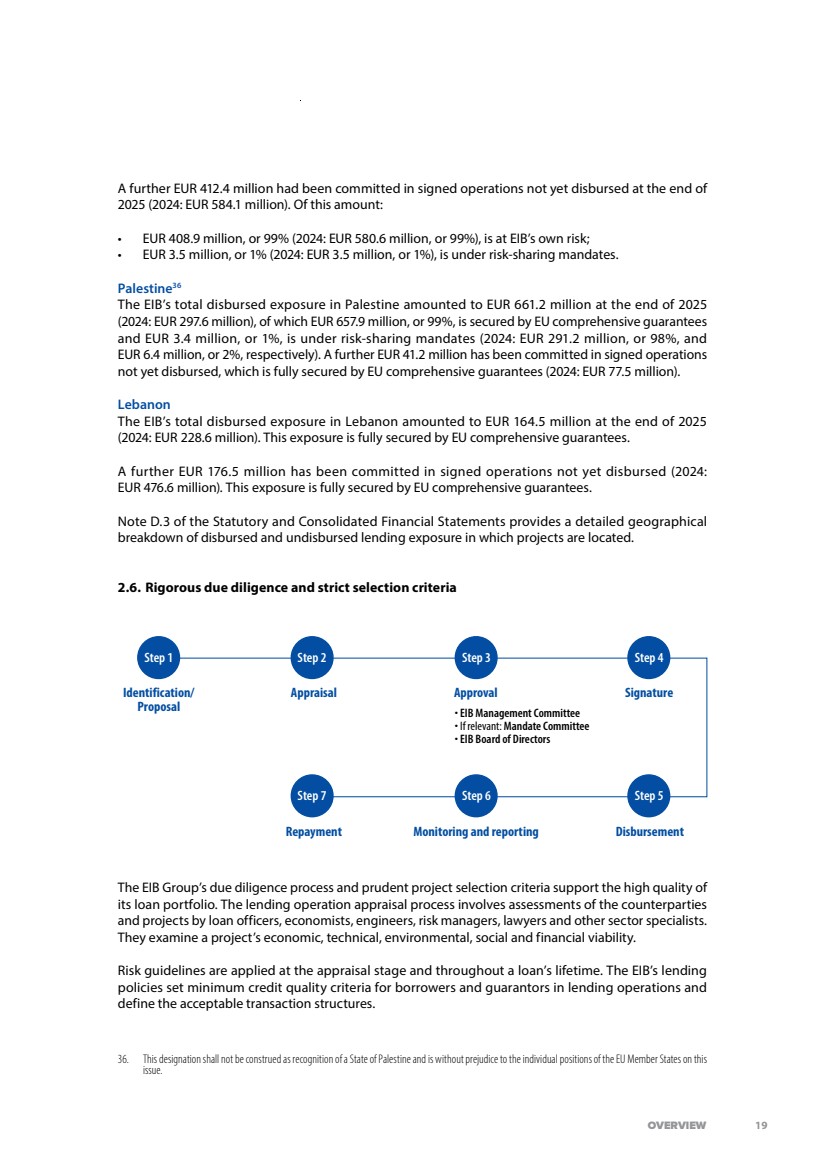
| OVERVIEW A further EUR 412.4 million had been committed in signed operations not yet disbursed at the end of 2025 (2024: EUR 584.1 million). Of this amount: • EUR 408.9 million, or 99% (2024: EUR 580.6 million, or 99%), is at EIB’s own risk; • EUR 3.5 million, or 1% (2024: EUR 3.5 million, or 1%), is under risk-sharing mandates. Palestine36 The EIB’s total disbursed exposure in Palestine amounted to EUR 661.2 million at the end of 2025 (2024: EUR 297.6 million), of which EUR 657.9 million, or 99%, is secured by EU comprehensive guarantees and EUR 3.4 million, or 1%, is under risk-sharing mandates (2024: EUR 291.2 million, or 98%, and EUR 6.4 million, or 2%, respectively). A further EUR 41.2 million has been committed in signed operations not yet disbursed, which is fully secured by EU comprehensive guarantees (2024: EUR 77.5 million). Lebanon The EIB’s total disbursed exposure in Lebanon amounted to EUR 164.5 million at the end of 2025 (2024: EUR 228.6 million). This exposure is fully secured by EU comprehensive guarantees. A further EUR 176.5 million has been committed in signed operations not yet disbursed (2024: EUR 476.6 million). This exposure is fully secured by EU comprehensive guarantees. Note D.3 of the Statutory and Consolidated Financial Statements provides a detailed geographical breakdown of disbursed and undisbursed lending exposure in which projects are located. 2.6. Rigorous due diligence and strict selection criteria Step 1 Identification/ Proposal Appraisal Repayment Approval •EIB Management Committee • If relevant: Mandate Committee •EIB Board of Directors Monitoring and reporting Signature Disbursement Step 2 Step 7 Step 3 Step 6 Step 4 Step 5 The EIB Group’s due diligence process and prudent project selection criteria support the high quality of its loan portfolio. The lending operation appraisal process involves assessments of the counterparties and projects by loan officers, economists, engineers, risk managers, lawyers and other sector specialists. They examine a project’s economic, technical, environmental, social and financial viability. Risk guidelines are applied at the appraisal stage and throughout a loan’s lifetime. The EIB’s lending policies set minimum credit quality criteria for borrowers and guarantors in lending operations and define the acceptable transaction structures. 36. This designation shall not be construed as recognition of a State of Palestine and is without prejudice to the individual positions of the EU Member States on this issue. 19 |
| 2025 FINANCIAL REPORT In analysing risks, the Bank applies an internal loan grading system and assigns internal ratings to counterparties. It monitors the counterparties’ creditworthiness and compliance with contractual obligations throughout the loan’s life to enable early interventions, where necessary. Additionally, the Bank monitors the firms’ adherence to project screening, pre-programme evaluations, and regular post-completion reviews. Through the EIB Group Paris Alignment for Counterparties (PATH) framework, the EIB Group ensures that all projects are aligned with the Paris Agreement. Projects must either contribute to or be consistent with the low-carbon transition and be resilient to future climate-related physical risks. In addition, the EIB is developing tools and methodologies to integrate climate and environmental risk at counterparty level into its risk frameworks, in particular in the fields of credit risk assessment, stress testing and disclosures. Further information can be found in the EIB Group Sustainability Report 2024 and the EIB Group Climate Bank Roadmap Phase 2 for 2026-2030. The EIB Group has applied its PATH framework since January 2022. For direct operations, the policy focuses on corporate counterparties operating in high-emitting sectors and/or in areas vulnerable to physical climate risks. The PATH framework requires these corporates to develop and publish a decarbonisation and/or a resilience plan unless one already exists. These plans must include elements deemed important for their transition. Paragraph 4.24 of the PATH framework lists a number of activities that are incompatible with the goals of the Paris Agreement, such as new investments in high-carbon oil production and coal mining. Companies involved in these activities are generally not eligible for EIB support, with two exceptions: • Projects with exceptional innovation content, such as carbon capture, utilisation and storage (CCUS), renewable hydrogen, advanced biofuels, deep geothermal, or floating offshore wind. • Renewable-energy projects and electric vehicle charging infrastructure, provided the company has no plans for new greenfield investments in coal power plants or mines. This exception was introduced to support the REPowerEU+ initiative and applies until the end of 2027. For intermediated operations, the PATH policy focuses on the largest banks and asset managers. Screened-in financial intermediaries must publish disclosures in line with the recommendations of the Task Force on Climate-related Financial Disclosures (TCFD), or comply with Commission Implementing Regulation (EU) 2022/2453. For counterparties that do not yet meet the PATH requirements, the Bank offers technical assistance to support them in developing a decarbonisation and/or resilience plan, or climate-related disclosures. The implementation of the PATH framework contributes to mitigating the climate-related risks of the EIB Group’s loan portfolio. The Ukraine Energy Rescue Plan, approved by the EIB Board of Directors in October 2024, also contains a number of additional temporary derogations from the PATH framework and the EIB’s Energy Lending Policy. The plan initially envisaged an indicative pipeline of about EUR 600.0 million in financing for emergency energy projects across the public and private sectors by the end of 2025. Actual signatures exceeded this level, with total signatures reaching EUR 964.5 million since implementation of the Ukraine Energy Rescue Plan, of which EUR 854.5 million in 2025, and with disbursements amounting to EUR 497.0 million by the end of 2025, reflecting the scale and urgency of Ukraine’s energy needs. Financing for small natural gas-powered installations (below 50 MW) was exceptionally permitted as part of the plan. This gas-related derogation remains well within the scope and bounds of the EIB’s 20 |
| OVERVIEW Climate Bank Roadmap. It enabled the deployment of less than 1.3 GW equivalent of gas-based capacity, remaining below the overall cap of 3 GW. The plan also allowed the EIB to temporarily support counterparties without a formal transition plan. These temporary derogations applied exclusively to Ukraine and only to operations approved by the EIB up to the end of 2025. The EIB’s Environmental and Social Sustainability Framework (ESSF), consolidated in 2022, comprises the EIB Group Environmental and Social Policy and the EIB Environmental and Social Standards. It promotes an integrated approach to environmental, climate, social and human rights risk management throughout the project cycle and defines promoters’ responsibilities in identifying, assessing and managing impacts and risks associated with EIB-financed operations. In 2025, the EIB introduced new Environmental, Climate and Social Due Diligence Procedures, which operationalise the ESSF by outlining the Bank’s approach to assessing, managing and monitoring environmental, climate and social risks and impacts throughout the project cycle. They also clarify the respective roles and responsibilities of the EIB and project promoters in conducting due diligence, as defined in the Environmental and Social Policy. Together, these procedures form a core part of the EIB’s sustainability framework. 2.7. Quality of the loan portfolio Despite ongoing geopolitical risks and the fact that certain sectors are particularly affected by subdued economic growth, the overall credit quality of the EIB’s loan portfolio remains stable at present. This stability is supported by a risk management strategy based on a thorough due diligence process, appropriate lending structures and security, and standard protective clauses included in loan agreements. In addition to collateral and guarantees, some of the EIB lending exposures also benefit from credit enhancements provided under various mandates. In addition, the Bank has put in place a loan portfolio monitoring framework that supports timely risk management decisions. The Bank’s loan portfolio is covered by several forms of credit enhancements or benefits from EU or Member State guarantees. Most credit enhancements take the form of portfolio guarantees from EU sovereigns, the EU budget, investment-grade banks and corporates, and high-quality financial collateral and assignment of rights or pledges. Unsecured loans37 to banks and corporates – including project finance security – amounted to EUR 208.3 billion,38 representing 37.9% of the risk portfolio at the end of 2025 (compared with EUR 175.5 billion, or 32.7%, at the end of 2024). The asset quality of the EIB’s risk portfolio is high. The share of counterparties or guarantors with internal ratings at investment-grade level39 stood at 86.6% at the end of 2025 (compared with 86.8% at the end of 2024). At the end of 2025, the disbursed sovereign and sovereign-guaranteed exposure40 of the Bank amounted to EUR 48.5 billion (compared with EUR 47.3 billion at the end of 2024). The signed sovereign and sovereign-guaranteed exposure41 totalled EUR 71.2 billion (compared with EUR 71.7 billion at the end of 2024). The Bank has not recorded any impairment on its sovereign or sovereign-guaranteed exposures. This includes EU sovereign exposures, which benefit from the Bank’s preferred creditor status and the protection given by its Statute. 37. Unsecured loans refer to lending operations where the EIB has no genuine recourse to an independent third party. 38. Includes own resource loans and loan substitutes, excluding mandates under comprehensive guarantees. 39. Includes own resource loans and loan substitutes above Baa3 rating, excluding mandates under comprehensive guarantees. 40. Includes own resource loans and loan substitutes, excluding mandates under comprehensive guarantees. 41. Includes own resource loans and loan substitutes, excluding mandates under comprehensive guarantees. 21 |
| 2025 FINANCIAL REPORT The EIB Group adheres to the non-performing exposure (NPE) regulatory requirements recognised as best banking practices (BBP), with adaptations and non-applications as allowed under its BBP Guiding Principles.42 The level of non-performing signed exposure43 in the risk portfolio stood at EUR 5.2 billion at the end of 2025 (compared with EUR 3.3 billion at the end of 2024), while the non-performing disbursed exposure amounted to EUR 4.4 billion (compared with EUR 3.0 billion at the end of 2024). The NPE is assessed based on the counterparty’s situation, disregarding any collateral arrangements or portfolio guarantees. A significant portion of the NPE is covered by risk-sharing mandates, which mitigates the overall impact for the EIB. The NPE included impaired loan exposure subject to individual value adjustments of EUR 3.6 billion (compared with EUR 2.8 billion at the end of 2024). These operations represented 0.8% of the total loan portfolio (compared with 0.6% at the end of 2024), for which the Bank has specific provisions for gross exposure (disbursed exposures, accrued interest and exposures in arrears) of EUR 780.6 million (compared with EUR 687.0 million at the end of 2024). The level of specific provisions is relatively low because of the security, guarantees and portfolio credit enhancements in place. At the end of 2025, arrears44 over 90 days amounted to EUR 504.2 million (compared with EUR 281.3 million at the end of 2024). 3. FUNDING ACTIVITIES The EIB raises long-term funds through bond issuances on international capital markets to meet its lending and other financing needs. Funding operations are designed to reach predefined volumes while maintaining a maturity profile that supports the Bank’s asset-liability management and delivers sustainably optimised funding costs. A diversified mix of funding sources and maturities strengthens the Bank’s flexibility and ensures a steady presence in a wide range of funding markets. In 2025, financial markets were shaped by higher geopolitical uncertainty and a profound reconfiguration of economic policies, including historically high US tariff rates and a paradigm shift in European defence spending. Despite these developments, expectations for US economic growth and ECB policy rates remained broadly stable. Bond markets continued to provide generally supportive conditions for issuance. The EIB issued EUR 63.9 billion in 2025 across 15 currencies (compared with EUR 63.4 billion in 13 currencies in 2024). This exceeded the initially announced funding programme of EUR 60.0 billion and made full use of the flexibility provided by its borrowing authorisation of up to EUR 65.0 billion. Net issuance45 was positive by EUR 2.4 billion in 2025 (compared with a net positive issuance of EUR 1.6 billion in 2024). The Bank’s funding strategy relies on the issuance of large and liquid benchmark transactions in EUR and USD, complemented by targeted issuance in other currencies and formats (plain vanilla and structured), which are often driven by reverse inquiries. Benchmark transactions represented about 83% of funding in 2025 (compared with 85% in 2024), helping to secure volume and manage cost and duration. As in previous years, the Bank frontloaded its funding programme, taking advantage of strong global capital market activity at the start of the year. In January 2025, it opened the US dollar market for sovereigns, supranationals and agencies (SSA) with a USD 6.0 billion 5-year Global Bond issue, followed by a EUR 5.0 billion 10-year Euro Area Reference Note (EARN) in CAB format. 42. Non-performing exposure is defined as material exposures that are more than 90 days past due or unlikely to pay regardless of any past due amount, based on a methodology for identification and management of deterioration in the portfolio during the entire loan cycle. 43. Including loans (including quasi-equity), loan substitutes and guarantees, excluding impact finance operations. 44. For more details on arrears over 90 days on the total loan portfolio, please refer to Note U of the Statutory Financial Statements. 45. Gross issuance minus redemption and repayment during 2025. 22 |
| OVERVIEW In 2025, the Bank issued seven EARN benchmarks in five different maturities (3, 5, 7, 10 and 12 years) and increased two existing lines, for a total of EUR 33.0 billion. It also issued five USD global fixed-rate benchmarks across four different maturities (3, 5, 7 and 10 years) totalling USD 22.0 billion. Diversification was further supported by issuing bonds in 13 additional currencies, with the largest volumes in British pounds, Polish złoty and Norwegian krone. The volume of sustainability funding – via the issuance of Climate Awareness Bonds and Sustainability Awareness Bonds – reached its highest level to date in 2025 at EUR 27.8 billion, or 44% of the funding programme (compared with EUR 18.3 billion, or 29%, in 2024). This includes the inaugural EUR 3.0 billion CAB aligned with the European Green Bond Standard. The EIB also remained actively engaged with public authorities, market participants and infrastructure providers on the evolution of capital market digitalisation. Building on the experience gained from six digital bond issuances completed since 2021, the Bank contributed in 2025 to exploratory work and technical discussions aimed at assessing how emerging technologies could improve current market frameworks and infrastructure. This included contributions to the ECB’s Pontes Contact Group, working on Europe’s distributed ledger-based infrastructure, designed to connect market DLT platforms with TARGET Services, and enable digital settlement in central bank money. Throughout 2025, these contributions included participation in expert-level forums, targeted exchanges with central bank counterparts and preparatory internal work to assess potential uses of digital instruments across different segments of the funding curve. In line with industry expectations, such initiatives focus on monitoring market readiness, assessing regulatory and operational implications and supporting the gradual development of digital solutions across the capital markets value chain, while ensuring alignment with market standards, financial stability needs and the evolving Eurosystem framework. 3.1. Maturity composition of EIB funding The average maturity of the Bank’s issuances in 2025 was 6.7 years (compared with 7.0 years in 2024). Decisions regarding issuance maturities are guided by the assessment of market demand and asset-liability management needs. From a currency perspective, EUR issuance typically provides the longest average maturities among the Bank’s main currencies. In 2025, the average maturity of EUR funding was 7.4 years (compared with 8.4 years in 2024). USD issuance had an average maturity of 6.1 years in 2025 (compared with 5.9 years in 2024). Average maturity (years) Currency 2025 2024 EUR 7.4 8.4 USD 6.1 5.9 Other 5.4 5.7 Total 6.7 7.0 3.2. Investor distribution Overall, the geographic distribution of investors remained broadly stable in 2025. Europe remained the main source of investor demand, accounting for 65% in 2025 (compared with 64% in 2024). Participation from Asia increased to 15% in 2025 (compared to 13% in 2024), offset by a decrease in participation of American accounts, accounting for 18% (compared with 21% in 2024). 23 |
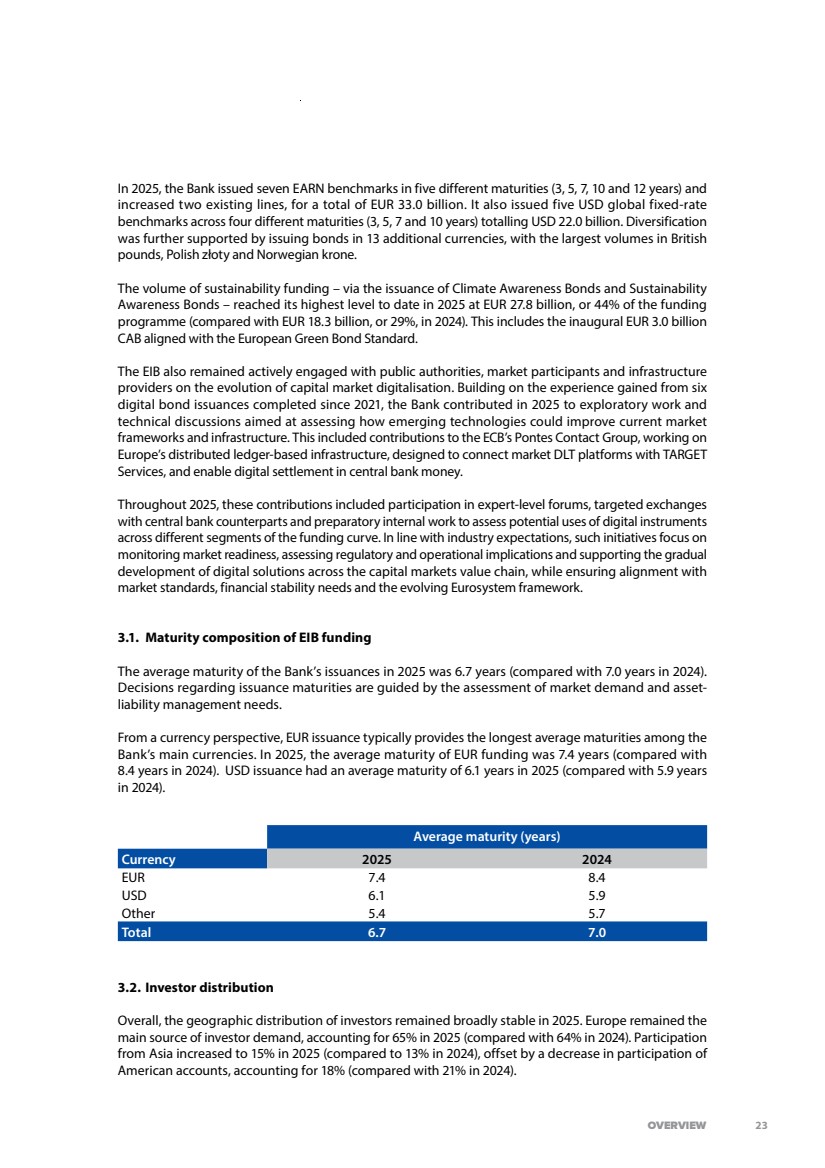
| 2025 FINANCIAL REPORT 3.2.1. Geographic composition The geographic distribution of investors by currency underscores the strategic value of currency diversification in the Bank’s funding activities. Accounting for 52% of total issuance in 2025, EUR-denominated EIB bonds continued to attract the most interest from investors in Europe (78% in 2025, vs. 83% in 2024), with accounts placed with investors in Asia absorbing most of the remainder (12% in 2025, vs. 9% in 2024). Bonds denominated in USD showed a more balanced regional distribution among investors in Europe (37% in 2025, vs. 39% in 2024), the Americas (39% in 2025, vs. 42% in 2024) and Asia (22% in 2025, vs. 17% in 2024). As such, USD funding continued to be the leading source of funding from beyond Europe. Issuance in other currency markets, including GBP, PLN, SEK, AUD and CHF, enabled the Bank to further broaden its global investor base. 66% 64% 15% 16% 3% 21% 13% 2% 65% 18% 15% 2% Europe Asia Americas Middle East and Africa 2023 2024 2025 INVESTOR DISTRIBUTION BY REGION 3.2.2. Composition by investor type The EIB’s investor base remained balanced across three main investor pools: banks (50% in 2025, vs. 55% in 2024), central banks and official institutions (28% in 2025, vs. 25% in 2024) and fund managers, including insurers and pension funds (22% in 2025, vs. 20% in 2024). Banks remained the largest investor group in 2025, accounting for 50% of total allocations. Their participation was solid across both EUR- and USD-denominated issuance, as well as other currencies. Central banks and official institutions increased their share in 2025 and maintained a particularly strong presence in USD-denominated bonds. Fund managers’ demand rose to 22%. 52% 23% 25% 55% 50% 25% 20% 22% 28% Banks Central banks/Official institutions Fund managers 2023 2024 2025 INVESTOR DISTRIBUTION BY SECTOR 24 |
| OVERVIEW 3.3. Funding patterns in benchmark format Issuance in EUR and USD together accounted for 84% of the total funding raised in 2025 (compared with 88% in 2024). This reflects the continued central role of these two currencies in the Bank’s funding strategy. From a product perspective, 83% of the funding programme was issued in benchmark format in 2025 (compared with 85% in 2024). In 2025, issuance in EUR amounted to EUR 33.1 billion through a combination of EARN benchmark transactions, usually in the EUR 3.0 billion to EUR 6.0 billion range, and non-benchmark format. The EUR funding represented 52% of the annual programme (compared with EUR 29.8 billion, or 47%, in 2024). Issuance in USD reached USD 22.7 billion, equivalent to EUR 20.6 billion in 2025 (compared with USD 28.1 billion, equivalent to EUR 25.9 billion in 2024). Overall, the issuance in USD Global Bond benchmark format represented 32% of the funding programme (compared with 41% in 2024). Amount issued in EUR billion equivalent Currency 2025 2024 EUR 33.1 29.8 USD 20.6 25.9 Other 10.2 7.7 Total 63.9 63.4 2025 52% 32% 16% EUR USD Other 2024 47% 41% 12% FUNDING PROGRAMME BY CURRENCY 3.4. Funding patterns in other currencies The EIB’s currency diversification policy strengthens its funding flexibility. It helps secure cost efficiencies, supports lending in local currency, and enables active management of the funding maturity profile. In 2025, the EIB issued bonds in 13 currencies other than EUR and USD, three of which (BRL, GEL and INR) were issued in synthetic format (compared with 11 other currencies in 2024). Total issuance in other currencies reached EUR 10.2 billion in 2025, accounting for 16% of total funding for the year (compared with EUR 7.7 billion, or 12%, in 2024). 25 |
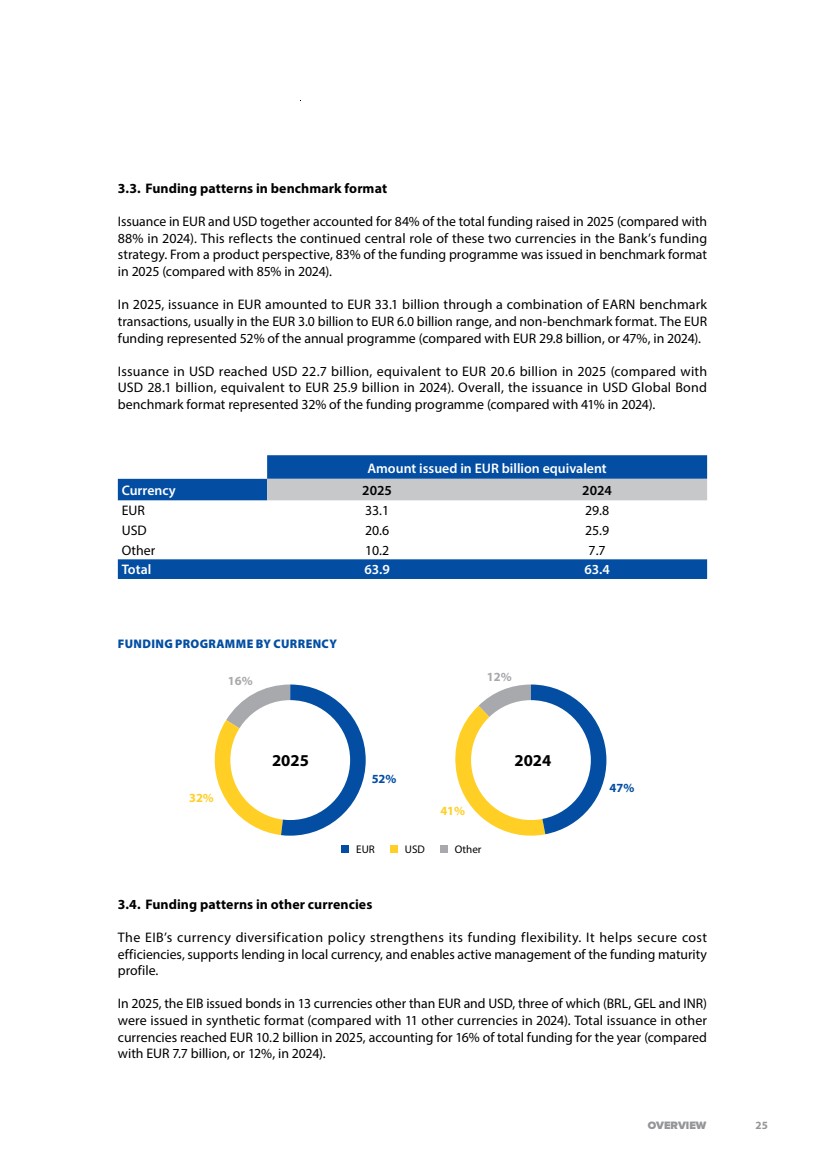
| 2025 FINANCIAL REPORT Issuance in GBP increased to GBP 3.3 billion, equivalent to EUR 3.9 billion, in 2025 (compared with GBP 3.0 billion, equivalent to EUR 3.5 billion, in 2024). The Bank also maintained its position as the largest supranational issuer in PLN, raising PLN 8.3 billion, equivalent to EUR 1.9 billion, to meet its disbursement needs (compared with PLN 8.7 billion, equivalent to EUR 2.0 billion, in 2024). 2025 Currency Amount in EUR billion equivalent Pound sterling (GBP) 3.86 Polish złoty (PLN) 1.94 Norwegian krone (NOK) 1.11 Australian dollar (AUD) 0.90 Indian rupee (INR) 0.64 Canadian dollar (CAD) 0.49 Swedish krona (SEK) 0.46 Swiss franc (CHF) 0.34 Brazilian real (BRL) 0.26 South African rand (ZAR) 0.08 Hong Kong dollar (HKD) 0.06 Georgian Iari (GEL) 0.03 Mexican peso (MXN) 0.01 Total 10.18 2% 3% 2% 46% 26% 16% 5% 2024 GBP PLN NOK AUD INR CAD SEK CHF BRL Others GBP PLN AUD NOK ZAR CHF Others 38% 19% 11% 6% 5% 9% 2% 3% 4% 3% 2025 3.5. EIB sustainability funding The EIB’s sustainability funding instruments are allocated exclusively to lending and other financing activities that contribute substantially to sustainability objectives. Climate Awareness Bonds (CABs) focus on climate change mitigation, Sustainability Awareness Bonds (SABs) focus on other environmental and social objectives, and Climate Awareness Bonds aligned with the European Green Bond Standard (EUGBS) target all EU environmental objectives with a focus on climate change mitigation. As of 31 December 2025, total cumulative CAB/SAB issuance since 2007 reached the equivalent of EUR 130.8 billion across 23 currencies (compared with the equivalent of EUR 103.0 billion across 23 currencies at the end of 2024). 26 |
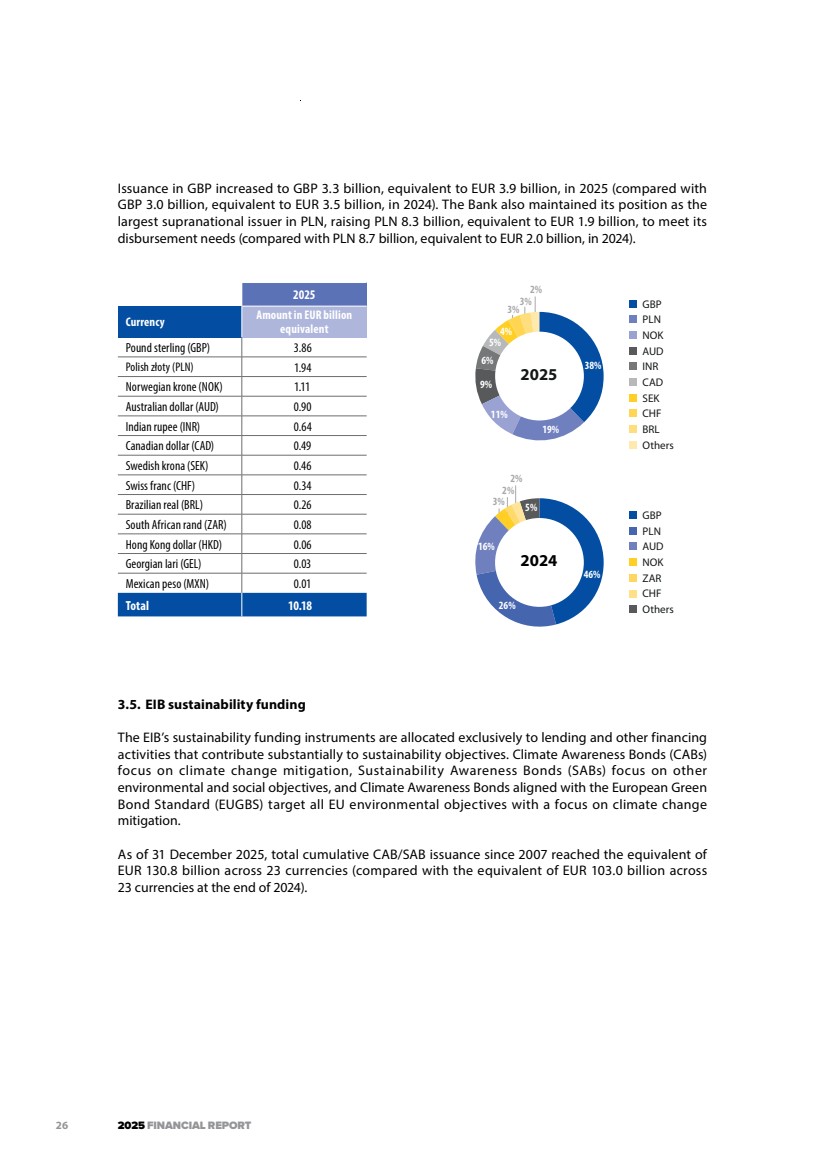
| OVERVIEW Climate Awareness Bonds 46 Sustainability Awareness Bonds 47 EUGBS-aligned CAB issuance: In 2025, the EIB issued EUR 3.00 billion of EUGBS-aligned Climate Awareness Bonds. During the year, EUR 1.87 billion of disbursements were eligible for allocation of proceeds from EUGBS-aligned CAB issuance and EUR 0.18 billion of EUGBS-aligned CAB proceeds were allocated to such disbursements following the EIB’s allocation procedures. The balance of unallocated EUGBS-aligned CAB proceeds in the treasury EUGBS-aligned CAB portfolio amounted to EUR -2.80 billion at the beginning of the year and to EUR -1.69 billion at the end of the year, requiring the retrospective allocation of proceeds from EUGBS-aligned CABs in 2026 to permit full allocation of the eligible disbursements. Other CAB issuance (not EUGBS-aligned): In 2025, the EIB issued EUR 20.35 billion of Climate Awareness Bonds. During the year, EUR 14.60 billion of disbursements were eligible for allocation of proceeds from CAB issuance and EUR 14.60 billion of CAB proceeds were allocated to such disbursements following the EIB’s allocation procedures. The balance of unallocated CAB proceeds in the treasury CAB portfolio amounted to EUR -2.91 billion at the beginning of the year and to EUR 2.84 billion at the end of the year. In 2025, the EIB issued EUR 4.33 billion of Sustainability Awareness Bonds. During the year, EUR 4.38 billion of disbursements were eligible for allocation of proceeds from SAB issuance and EUR 3.82 billion of SAB proceeds were allocated to such disbursements following the EIB’s allocation procedures. The balance of unallocated SAB proceeds in the treasury SAB portfolio amounted to EUR -1.80 billion at the beginning of the year and to EUR -1.85 billion at the end of the year, requiring the retrospective allocation of proceeds from Sustainability Awareness Bonds in 2026 to permit full allocation of the eligible disbursements. 4446 4547 4. TREASURY ACTIVITIES The EIB maintains a robust liquidity position and ensures flexibility in accessing the resources needed to meet its obligations. Its liquidity management follows a prudent approach. 4.1. Strategy and portfolio composition Treasury management has two core functions: ensuring that the Bank has the capacity to meet its financial commitments on an ongoing basis and implementing the Bank’s asset and liability policy. Funds are invested in dedicated portfolios with defined investment criteria, following a low-risk diversification strategy. Portfolio management is conducted in full compliance with the guidelines, prudential limits and indicators laid down by the EIB’s governing bodies. 46. Issuance data are based on net proceeds, which may diverge from nominal issuance volumes. Data on disbursements and allocations are preliminary and unaudited. Final and audited data will be available in the 2025 CAB Framework expected to be published in 2026. 47. Issuance data are based on net proceeds, which may diverge from nominal issuance volumes. Data on disbursements and allocations are preliminary and unaudited. Final and audited data will be available in the 2025 SAB Framework expected to be published in 2026. 27 |
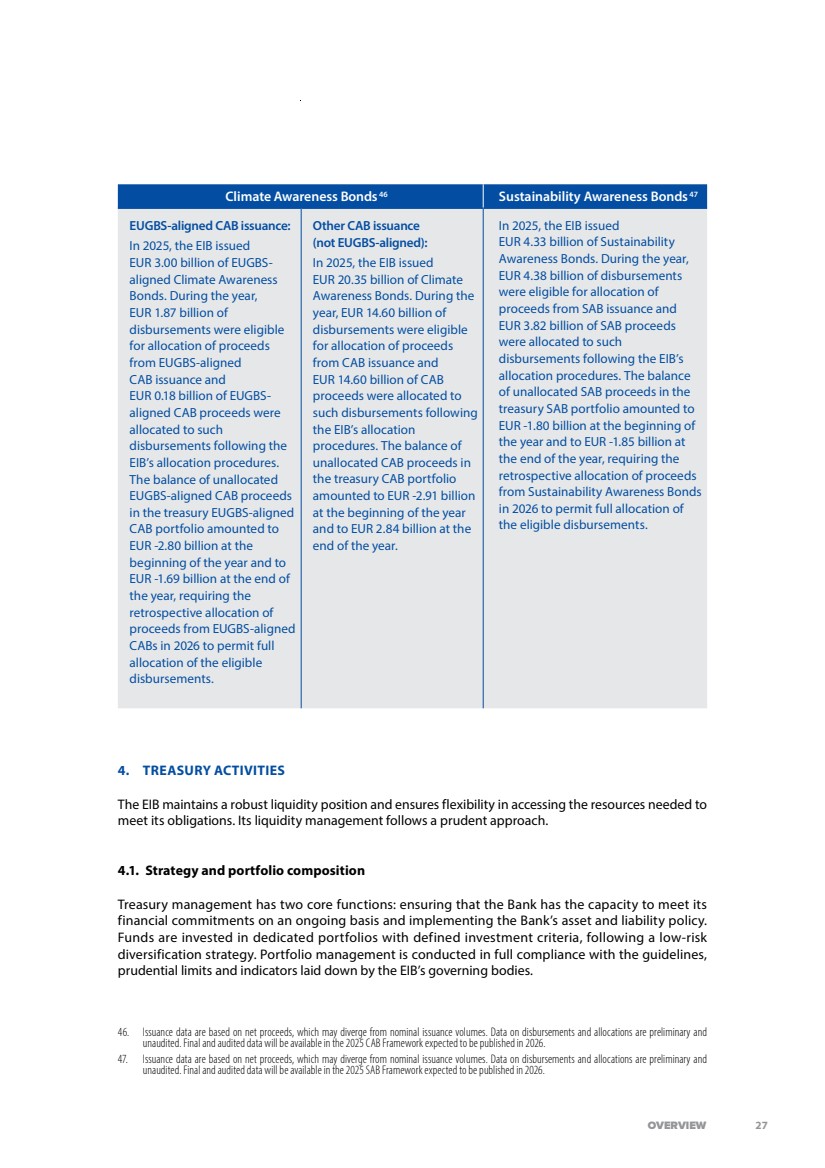
| 2025 FINANCIAL REPORT At the end of 2025, the operational treasury consisted of the following portfolios: • Treasury Monetary Portfolio, designed for daily liquidity management. At the end of the year, most of EIB treasury assets (71.3%) were held in the Treasury Monetary Portfolio and invested in short-term instruments with a maturity of up to one year. • Securities Liquidity Portfolio, which invests in EUR, GBP, USD, AUD, JPY, CHF and NOK, and aims to provide diversification while improving the return on treasury assets. It also serves as an additional line of liquidity. • Long-Term High Quality Liquid Assets Portfolio, which is managed with the objective of constituting a core long-term liquidity reserve for the Bank in EUR, GBP and USD, and is composed of highly rated liquid bonds. The operational treasury is required to maintain at least 30% in ECB-eligible assets for Eurosystem credit operations. A detailed breakdown of the credit exposure of the treasury portfolio is available in Note B of the Statutory Financial Statements. 4.2. Prudent liquidity management Treasury activities are conducted with the primary objective of protecting invested capital and ensuring that all payment obligations are met in full and on time. Liquidity is consistently kept within established prudential limits, reflecting the EIB’s operating environment. Global financial markets remained uncertain and volatile in 2025, driven mainly by geopolitical developments and macroeconomic policy developments. Against this backdrop, the EIB maintained a robust liquidity position, with all liquidity risk indicators remaining above their respective limits throughout the year. At the end of 2025, total treasury assets amounted to EUR 65.8 billion (compared with EUR 67.5 billion at the end of 2024). The Bank’s total liquidity ratio was 64.1% (compared with 60.3% at the end of 2024). The liquidity coverage ratio (LCR) stood at 658.5% at the end of 2025 (compared with 724.9% at the end of 2024), while the net stable funding ratio (NSFR) amounted to 120.9% at the end of the year (compared with 122.2% at the end of 2024). Both ratios remained comfortably above their regulatory limit of 100% during 2025. As an eligible counterparty in the Eurosystem’s monetary policy operations, the EIB has access to the monetary policy operations of the ECB. The Bank has access to the Eurosystem’s open market operations and standing facilities through Banque Centrale du Luxembourg. The ability to reuse ECB-eligible collateral in repurchase transactions strengthens the operational liquidity resilience of the EIB. At the end of 2025, the total value of securities in the EIB’s inventory that were eligible to be reused within the Eurosystem stood at EUR 43.1 billion, composed of proprietary assets (EUR 32.7 billion) and reusable collateral received (EUR 10.5 billion). By comparison, at the end of 2024 the total value of securities held in the EIB’s inventory stood at EUR 41.2 billion, of which EUR 31.0 billion were EIB-owned assets and EUR 10.3 billion were eligible reusable collateral received. The overnight placement with Banque Centrale du Luxembourg amounted to EUR 9.9 billion at the end of 2025 (compared with EUR 16.7 billion at the end of 2024). 28 |
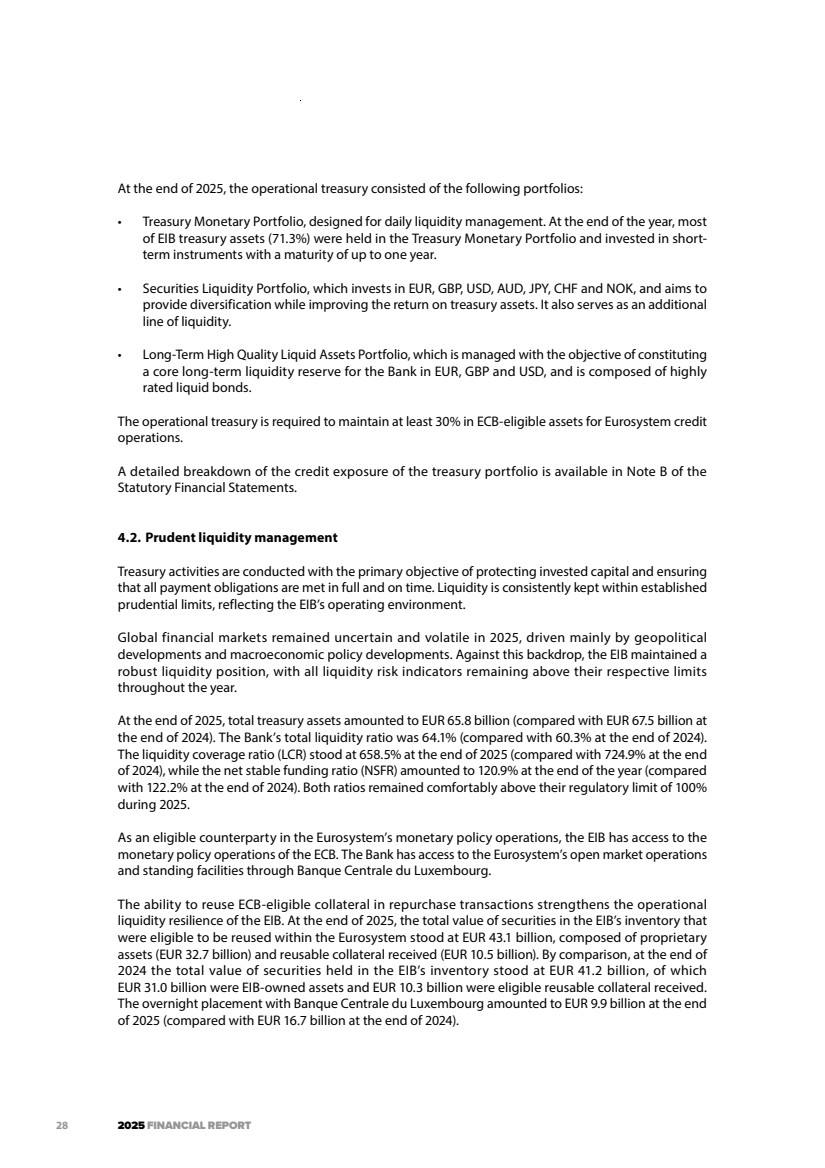
| OVERVIEW 4.3. Treasury financial result in 2025 The average rate of return on the Bank’s treasury activities was 2.7% in 2025 (compared with 3.9% in 2024). The gross financial result from the EIB’s treasury portfolios in 2025 was EUR 1 499.2 million (compared with EUR 1 961.7 million in 2024). This reflects the lower absolute value of EUR interest rates, particularly for short-term rates, in 2025 compared with 2024. 4.4. Asset and liability management The interest rate and foreign exchange risk positions of the Bank’s assets and liabilities are managed within defined limits. Risk exposures are adjusted through the use of standard derivative instruments to achieve target exposures for the relevant risk factors. The Interest Rate Risk Strategy aims to support the self-sustainability of the Bank’s business and the growth of its own funds. As part of its management of liquidity, funding, foreign exchange and interest rate risk, the Bank regularly reviews market conditions. Where appropriate, it may enter into transactions to repurchase outstanding debt, through open market purchases, privately negotiated transactions, tender offers, exchange offers or other means. 5. EIB BEST BANKING PRACTICE PRINCIPLES To clarify and reinforce the EIB’s BBP Framework, the EIB Board of Governors approved the BBP Guiding Principles in 2018. This high-level document sets out the overarching principles and general scope of the banking rules and guidelines applicable to the EIB as best practice. It also defines assessment criteria used to identify the relevant rules and considers specific requirements of the EIB’s business model by way of adaptations or non-application, where appropriate. The document is available on the EIB website. 6. RISK MANAGEMENT FRAMEWORK 6.1. Risk appetite The EIB Group Risk Appetite Framework, approved by the EIB Board of Directors, defines the Group’s risk appetite and its associated management processes and activities. 6.2. Risk profile The risk profile which the Group is willing to assume in carrying out its activities is defined in the Group’s Risk Appetite Statement. This statement communicates the Bank’s risk profile to management, the governing bodies of the EIB and the EIF, staff and other key stakeholders. 6.3. Risk management organisation The EIB Group Risk and Compliance Directorate is responsible for managing financial and non-financial risks across the EIB Group’s business. These include credit, market, liquidity and funding risks, as well as operational, climate, reputational and strategic risks. With the approval of the EIB Group Risk Management Charter in June 2019, and the subsequent adoption of its implementing provisions, risk oversight was extended across all relevant business lines of the EIB Group. This ensures that all risk exposures are captured on an economic basis and support informed decisions on risk-taking. The charter sets out the main principles of the EIB Group Risk Management Framework, which aims to ensure an effective and consistent oversight of risks across the Group. 29 |
| 2025 FINANCIAL REPORT 6.4. Risk measurement The Group has defined a set of indicators, including comprehensive risk appetite metrics, to monitor the financial and non-financial risks. These cover capitalisation, earnings, liquidity, exposure to market and non-financial risks, including operational risks. Risks are assessed and measured under both normal and stressed conditions to determine their potential impact on the Group’s solvency, liquidity, earnings and operations. 6.5. Reporting systems Information on financial and non-financial risks is reported to the Management Committee and the EIB Board of Directors on a regular basis. The Group’s capital position and other prudential elements are also disclosed through the semi-annual EIB Group Risk Management Disclosure Reports. These reports follow the prudential disclosure requirements and related technical standards, as applicable to the EIB as best banking practice, and are relevant and compatible with the EIB’s statutory framework and business model. 6.6. Non-financial risk management The EIB Group manages non-financial risks (NFRs) through a Group NFR Framework based on the Group Risk Management Charter. This covers operational, compliance, conduct, fraud, strategic, reputational, ICT/security, people, business continuity, third-party, data management, model and other non-financial risk categories. Annual Group-wide risk identification is carried out to define the risk taxonomy and determines material and non-material NFRs. Operational risk – one of the principal NFR categories – is governed by the EIB Group Operational Risk Policy, which defines operational risk as the risk of loss arising from inadequate or failed internal processes, people, systems or external events. It outlines the roles, responsibilities and governance arrangements for the Group’s management and is supported by several Group-wide procedures. The Bank monitors and reports non-financial risks through the EIB Group Non-Financial Risk Report, which aggregates information across all NFR risk categories. The report includes operational risk indicators, business continuity information and compliance and financial crime indicators, thereby providing a comprehensive view of the Group’s NFR profile. The reporting process follows the EIB Group Risk Appetite Framework, which establishes early warning triggers and risk appetite thresholds for selected NFR indicators. Escalation, follow-up actions and mitigating measures are managed through the Risk Appetite Framework governance structure. This structured reporting process ensures that emerging trends, breaches and material events are monitored, escalated when required, and addressed in a timely manner. Further information on risk management is available in Note U of the Statutory and Consolidated Financial Statements prepared in accordance with the EU Accounting Directives and the latest annual EIB Group Risk Management Disclosure Report available on the EIB website. 30 |
| OVERVIEW 7. CORPORATE RESPONSIBILITY AND SUSTAINABILITY The mission of the EIB is to foster balanced and steady development within the European Union and beyond. Sustainability is central to this mission and it is integrated into its lending, borrowing and advisory work. Climate and environment form the first of the EIB Group’s eight strategic priorities under the Strategic Roadmap 2024-2027, as endorsed by the 27 EU Member States. The EIB Group is one of the world’s largest public lenders for climate action and environmental sustainability. It issued the world’s first green bond and stopped financing fossil fuels in 2019. In 2025, the EIB Group provided a record EUR 57.0 billion in green finance, or 57%, of total financing (compared with EUR 50.7 billion, also 57%, in 2024). This included record EIB lending for climate mitigation, climate adaptation and other environmental objectives. The Bank is committed to transparency and accountability. It proactively publishes information on its projects and activities and maintains regular dialogue with a wide range of stakeholders. In terms of reporting, the EIB Group has pioneered sustainability disclosures for over a decade, with information disclosed through sustainability reports based on voluntary internationally recognised frameworks (such as the Global Reporting Initiative (GRI), the Task Force on Climate-related Financial Disclosures (TCFD), and the Sustainability Accounting Standards Board (SASB)). In 2025, the EIB Group undertook a comprehensive overhaul of its sustainability disclosures by discontinuing multiple reports and consolidating these disclosures in one single Sustainability Report that progressively aligns with the requirements of the Corporate Sustainability Reporting Directive (CSRD). Ensuring a consistent, meaningful and reliable reporting, the content of the Sustainability Report covers nine out of ten topics considered material under the European Sustainability Reporting Standards (ESRS), providing detailed disclosures across environmental, social, and governance topics. All reports are available on the Bank’s website. The Board of Directors approved the Introductory Sections of the Financial Report 2025, including the Overview, on 25 March 2026. These sections precede the Financial Statements of the EIB and the EIB Group. 31 |
| Corporate Use EIB Statutory Bodies Situation as at 4 May 2026 The composition of the Bank’s statutory bodies, the curricula vitae of their members and additional information on the remuneration arrangements are regularly updated and posted on the EIB’s website: www.eib.org. Board of Governors Chair Alena SCHILLEROVÁ (Czechia) Minister of Finance Belgium Jan JAMBON Deputy Prime Minister and Minister of Finance and Pensions Bulgaria Georgi KLISSURSKI Minister of Finance Denmark Morten BØDSKOV Minister for Industry, Business and Financial Affairs Germany Lars KLINGBEIL Federal Minister of Finance Estonia Jürgen LIGI Minister of Finance Ireland Simon HARRIS Minister for Finance Greece KYRIAKOS PIERRAKAKIS Minister of Economy and Finance Spain Carlos CUERPO Minister for Economy, Trade and Business France Roland LESCURE Minister of Economy, Finance and Industrial Energy and Digital Sovereignty Croatia Tomislav ĆORIĆ Minister of Finance Italy Giancarlo GIORGETTI Minister of Economy and Finance Cyprus Makis KERAVNOS Minister of Finance Latvia Arvils AŠERADENS Minister of Finance Lithuania Kristupas VAITIEKŪNAS Minister of Finance Luxembourg Gilles ROTH Minister of Finance Hungary Márton NAGY Minister for National Economy Malta Clyde CARUANA Minister of Finance and Employment Netherlands Eelco HEINEN Minister of Finance Austria Markus MARTERBAUER Federal Minister of Finance Poland Andrzej DOMAŃSKI Minister of Finance Portugal Joaquim MIRANDA SARMENTO Minister of State and Finance Romania Alexandru NAZARE A Minister of Finance and Deputy Prime Minister Slovenia Klemen BOŠTJANČIČ Minister of Finance Slovakia Ladislav KAMENICKÝ Minister of Finance Finland Riikka PURRA Minister of Finance Sweden Elisabeth SVANTESSON Minister for Finance Audit Committee Chair Members Katja PLUTO Independent Non-Executive Director, Switzerland Eva-Lena NORGREN Chief Judge and Head of Authority, Gothenburg District Court, Sweden Christoph HAAS Former EY Partner, Luxembourg Tereza ROGIĆ LUGARIĆ State Secretary, Ministry of Finance, Croatia Teodora Elena PREOTEASA Director of European Funds Administration and Associate Lecturer João Luís CORREIA DUQUE Full Professor at ISEG and Dean of ISEG – Lisbon School of Economics and Management, University of Lisbon Observers John SUTHERLAND Former Senior Advisor, Prudential Regulation Authority and Financial Conduct Authority, United Kingdom Edouard FERNANDEZ BOLLO Member of the Administrative Board of Review of the European Central Bank Dick KORF Former KPMG Partner, the Netherlands 32 2025 FINANCIAL REPORT |
| Corporate Use Management Committee President Nadia CALVIÑO Vice-Presidents Ambroise FAYOLLE Gelsomina VIGLIOTTI Nicola BEER Robert de GROOT Ioannis TSAKIRIS Karl NEHAMMER Marek MORA Marko PRIMORAC Board of Directors The Board of Directors consists of 28 directors, with one director nominated by each Member State and one by the European Commission. There are 31 alternates. Furthermore, to broaden the Board of Directors’ professional expertise in certain fields, the Board is able to co-opt a maximum of six experts (three directors and three alternates), who participate in the board meetings in an advisory capacity, without voting rights. Directors Hans D’HONDT Member of the Board of Directors of the EIB, Brussels Metodi METODIEV Deputy Minister of Finance, Ministry of Finance, Sofia Petr PAVELEK Director of Debt and Financial Assets Management Department, Ministry of Finance, Prague Julie SONNE Head of Division, Ministry for Industry, Business and Financial Affairs, Copenhagen Judith HERMES Director General, European Policy at International Financial Policy Department, Federal Ministry of Finance, Berlin Martin PÕDER Head of EU and International Affairs Department, Ministry of Finance, Tallinn Des CARVILLE Head of Shareholding and Financial Advisory Division, Department of Finance, Dublin Michael ARGHYROU Head of the Economics Office of the Prime Minister of the Hellenic Republic, Athens Inés CARPIO SAN ROMÁN Director General of International Financing at Ministry of Economy, Trade and Business, Madrid Claire CHEREMETINSKI Deputy Director General at the Directorate-General of the Treasury, Ministry for Economic Affairs, Finance and Industrial and Digital Sovereignty, Paris Stipe ŽUPAN State Secretary, Ministry of Finance, Zagreb Manuela NENNA Director General for International Financial Relations Department of the Treasury, Ministry of the Economy and Finance, Rome Costas CONSTANTINIDES Senior Economic Officer at the Directorate of Financial Services, Ministry of Finance, Nicosia Armands EBERHARDS Deputy State Secretary, Ministry of Finance, Riga Mindaugas PAKŠTYS Adviser to the Minister, Ministry of Finance, Vilnius Nicolas JOST Director Economic and Budgetary Affairs, Ministry of Finance, Luxembourg Sándor LADÁNYI Chief Financial Officer, Deputy CEO at EXIM Hungary, , Budapest Martin SPITERI Director General, Ministry of Finance, Valletta Robin UYTERLINDE Deputy Director of the International Affairs Directorate, Ministry of Finance, The Hague Karin RYSAVY Senior Expert, Austrian Federal Ministry of Finance, Vienna Tomasz SKURZEWSKI Deputy Director, International Cooperation Department, Ministry of Finance, Warsaw Filipe CARTAXO Member of the Board of Directors of the EIB, Lisbon Mihai-Călin PRECUP President of Council for the Application of State Aid Policy, Ministry of Public Finance, Bucharest Aleš ŠKOBERNE CEO, ECM Partners Inc., Ljubljana Martina KOBILICOVÁ Director General, Advisor to the Deputy Minister, Ministry of Finance, Bratislava Kristina SARJO Senior Ministerial Adviser, Financial Affairs, International Financial Affairs Unit, Ministry of Finance, Helsinki Sara TÄGTSTRÖM Senior Adviser at the International and Economics Department, Ministry of Finance, Stockholm Markus SCHULTE Principal Adviser in DG ECFIN, European Commission, Brussels Experts Joes LEOPOLD Managing Partner at Capitium, Amsterdam Esther RECKTENWALD Deputy Director General of IT, Deutsche Bundesbank, Frankfurt am Main Olivier BAILLY Deputy Managing Director and Director for Global Issues, European External Action Service, Brussels EIB STATUTORY BODIES 33 |
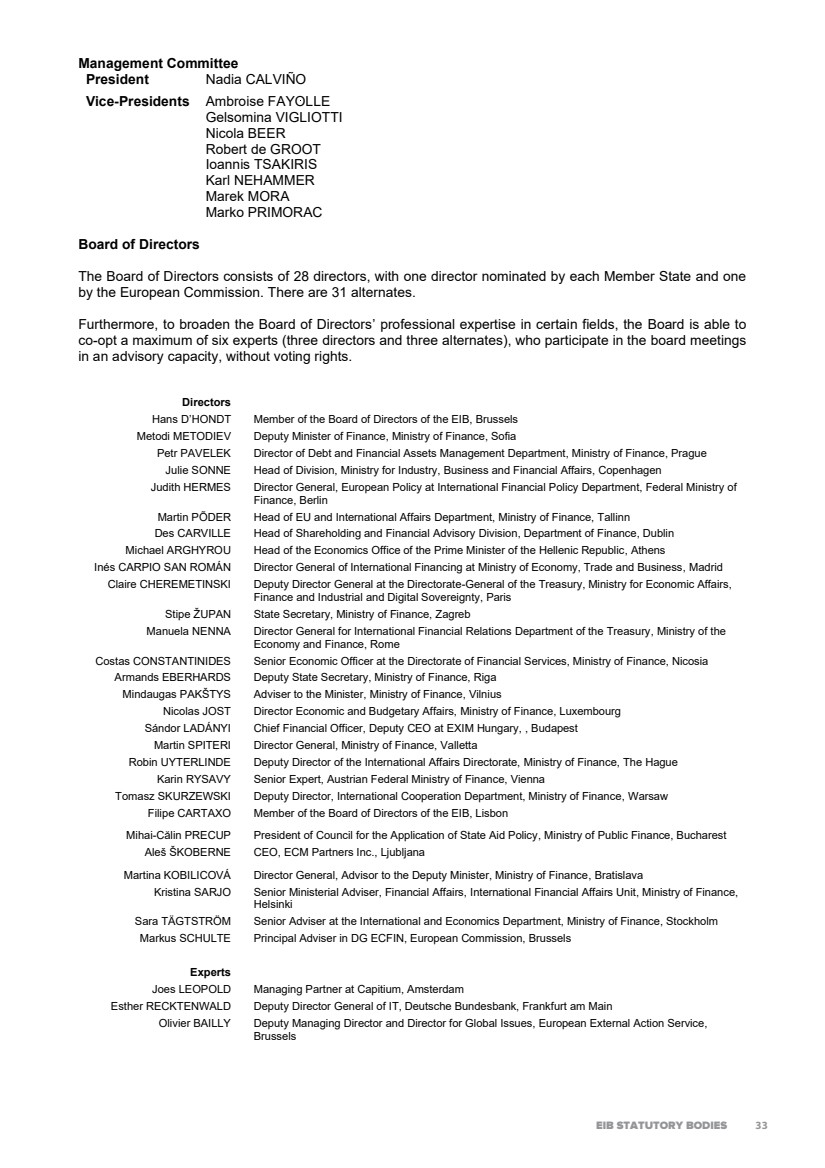
| Corporate Use Alternates Philippe NIZEYIMANA Adviser to the Administration of International and European Financial Matters of the Treasury, General Administration of Treasury, Brussels Gergana BEREMSKA Director, International Financial Institutions, Ministry of Finance, Sofia Radek HŘEBĺK Head of State Financing and Treasury Liquidity Management Division, Ministry of Finance, Prague Morten KLINGE Senior Consultant, Office for Growth Capital, Insurance and Pension, Ministry of Industry, Business and Financial Affairs, Copenhagen Nina WUNDERLICH Deputy Director-General, EU economic policy, internal market, bilateral relations EU Twinning, Federal Ministry for Economic Affairs and Energy, Berlin Susanne BLOMENHOFER Senior Policy Advisor, Directorate General for European Affairs, Federal Ministry of Finance, Berlin Pille PRUUNSILD Advisor of the EU and International Affairs Department, Ministry of Finance, ,, Tallinn Michael TAGGART Principal Officer responsible for European IFIs/Risk and Compliance, Department of Finance, Dublin Charilaos LAMBROPOULOS President, Hellenic Development Bank of Investments, Athens Isabel GARAYO ORBE Alternate Deputy Director General, EU Economic and Financial Affairs Department, Ministry of Economy, Trade and Enterprise, Madrid Pierre-Marie VOEGELI Head of Unit - European bilateral relations and EU financial instruments, Directorate-General of the Treasury, Ministry for Economic Affairs, Finance and Industrial and Digital Sovereignty, Paris Quentin NAVARO AUBURTIN Deputy Head of Unit - European Financial Instruments, Directorate General of the Treasury, Ministry of Economic Affairs, Finance and Industrial and Digital Sovereignty, Paris Ines ŠPIRIĆ Head of SOEs Business Analysis Sector, Ministry of Finance, Zagreb Francesca MERCUSA Director, International Financial Relations Directorate, Department of the Treasury, Ministry of Economy and Finance, Rome Bianca GIANNINI Director, Treasury Department, Ministry of Economy and Finance, Rome Eleni PITTA Economic Officer A, Directorate of International Financial Institutions and General Financial Management, Ministry of Finance, Nicosia Aija ZITCERE Director of Financial Market Policy Department, Ministry of Finance, Riga Darius TRAKELIS Director of EU and International Affairs Department, Ministry of Finance, , Vilnius Sofia TILOTTA Deputy Director - Directorate of Multilateral Affairs, Development Aid and Compliance, Ministry of Finance, Luxembourg Róbert BARTUS Chief Risk Officer, Deputy CEO, EXIM Hungary, , Budapest Joseph LICARI Economic Consultant, Malta Timo BAKRIN EIB Policy Coordinator, Ministry of Finance, The Hague Alexander BRÄU Economic Policy Department Expert, Federal Ministry of Finance of the Republic of Austria, Vienna Maciej TABACZAR Counsellor, International Financial Cooperation Department, Ministry of Finance, Warsaw Rosa CAETANO Deputy Director General of the Office for Economic Policy and International Relations, Ministry of Finance, Lisbon Boni Florinela CUCU General Director, General Directorate for International Financial Relations, Ministry of Public Finance, Bucharest Martin ZDOVC Secretary, Ministry of Finance, Ljubljana Peter FRÖHLICH Chief Executive Officer, Slovak Investment Holding, Bratislava Anne af URSIN Financial Counsellor, Ministry of Finance, Helsinki Kristina ÅKESSON Senior Adviser, Ministry of Finance, Stockholm Witold WILLAK Head of Unit of D.5 Coordination with the EIB Group, EBRD and IFIs, Directorate-General for Economic and Financial Affairs, European Commission, Luxembourg Alternate experts Giorgio GOBBI Head of the Milan Regional branch, Italian Central Bank, Milan Antonio OPORTO Secretary General at Circulo de Empresarios, Madrid Isabel RAMOS DE ALMEIDA Alternate Expert to the EIB Board of Directors 34 2025 FINANCIAL REPORT |
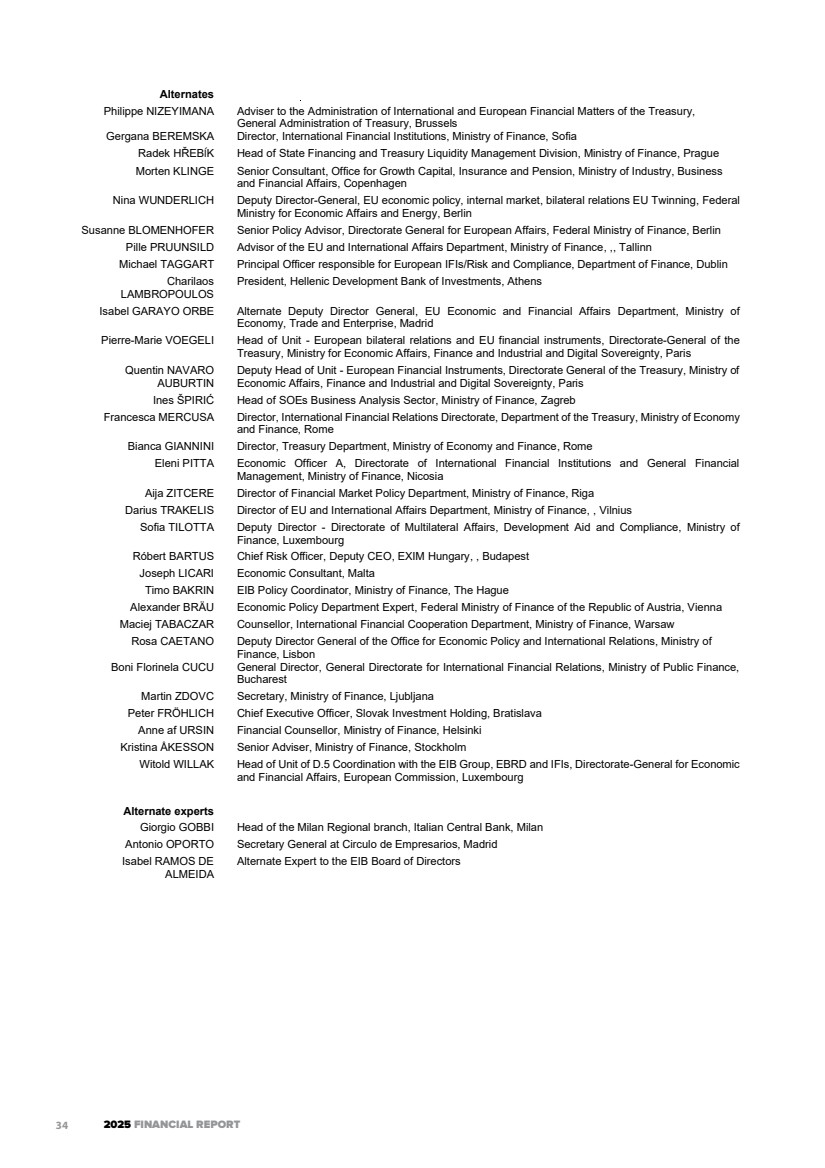
| Aud AUDIT, CONTROL AND ACCOUNTABILITY AUDIT COMMITTEE The Audit Committee is an independent body composed of six members who are appointed by the Board of Governors for a non-renewable term of six years and reports directly to the EIB Board of Governors. The Audit Committee Members are chosen from among people having independence, competence and integrity and who possess financial, auditing or banking supervisory expertise in the private or public sector, and they should cover the whole range of expertise between them. In addition, the Board of Governors, on a joint proposal from the President of the Bank and the Chair of the Audit Committee, may appoint a maximum of three observers for a non-renewable six-year term, on the basis of their particular qualifications. In accordance with Article 12 of the EIB Statute, the Audit Committee is statutorily mandated to verify that the Bank’s operations have been conducted and its books kept in a proper manner and whether the Bank’s activities comply with the best banking practices applicable to it and is responsible for the auditing of the Bank’s and Group’s accounts. The Audit Committee shall confirm that the financial statements give a true and fair view of the financial position and of the results of the operations and cash flows of the Bank and the Group. In accordance with Article 25 (6) of the Rules of Procedure, the Audit Committee is required to give the Board of Governors a detailed report on the results of its work during the preceding financial year, including verification that the activities of the Bank conform to best banking practice applicable to it. To further strengthen the Audit Committee’s supervisory role, the Board of Governors established an internal review and evaluation process (EIB REP) in 2021. In line with the EIB REP Guiding Principles, the Audit Committee developed and adopted a review and evaluation framework and methodology tailored to the EIB Group. This approach is broadly based on the European Banking Authority’s Guidelines on the Supervisory Review and Evaluation Process (EBA SREP Guidelines), while duly reflecting the EIB’s specific nature, policy mandate, tasks and governance structure. EXTERNAL AUDITORS The EIB’s external auditors, KPMG, report directly to the Audit Committee, which is authorised to delegate the day-to-day work of auditing the financial statements to them. The external auditors are not permitted to carry out any work of an advisory nature or act in any other capacity that might compromise their independence when performing their audit tasks. GROUP FINANCIAL CONTROL DIRECTORATE Group Financial Control is a directorate led by the Group Chief Financial Controller and reporting to the EIB Group President. The directorate plays a strategic role in safeguarding the Group’s financial integrity and supporting the institution’s long-term sustainability. 35 |
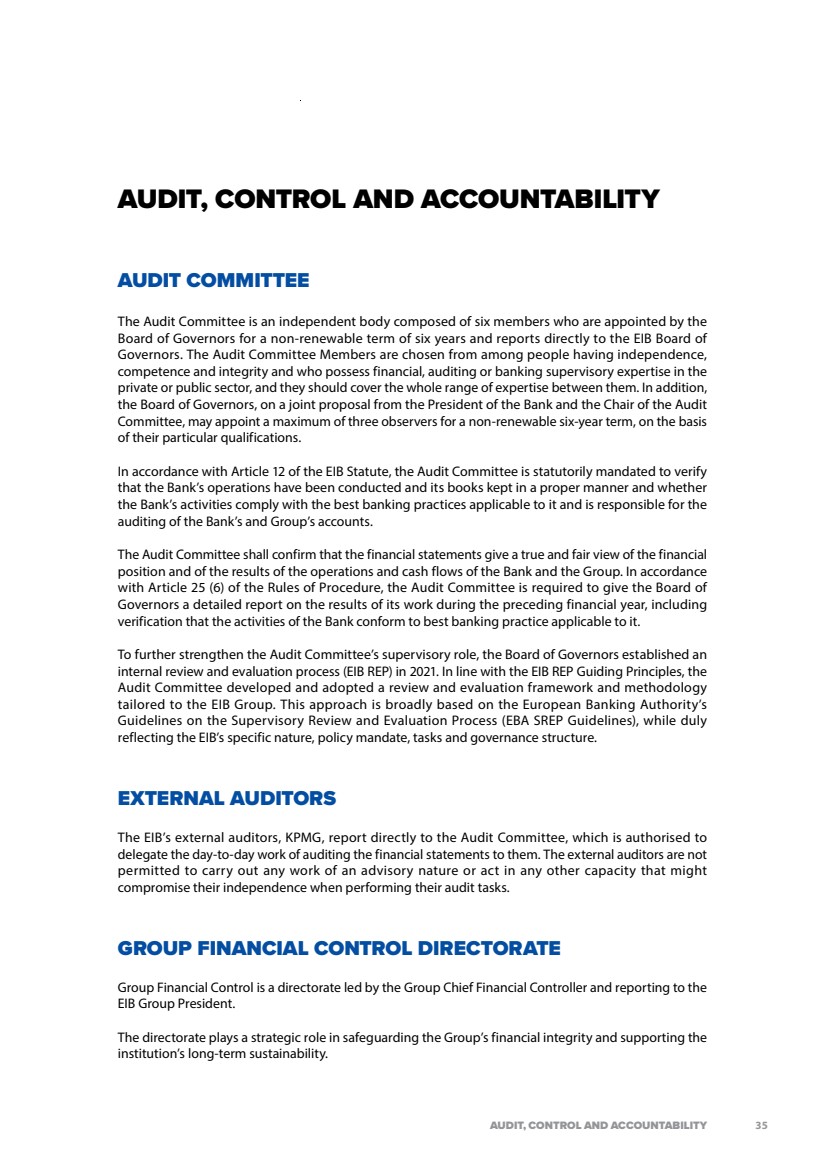
| 2025 FINANCIAL REPORT Its functions collectively ensure robust financial management, management control and accountability across the Group, overseeing financial planning, budgeting, procurement, financial reporting, and statutory accounts, while also managing real estate, workplace operations, security and safety, and assets. The Group Financial Control Directorate, together with the Secretary General, manages the relationship with the external auditors, the Audit Committee and the European Court of Auditors. INTERNAL AUDIT The purpose of Internal Audit is to provide independent, objective assurance and advisory services designed to add value and improve the EIB Group’s operations. The Internal Audit function helps the EIB Group accomplish its objectives by assessing and improving the effectiveness of governance, risk management and internal controls. The head of Internal Audit reports to the EIB President and functionally to the EIB Audit Committee and, for EIF stand-alone activities, to the EIF Audit Board. In support of the mandates of the EIB Audit Committee and the EIF Audit Board on best banking practice and/or best market practice, Internal Audit includes such assessments in all elements of its work. INSPECTORATE GENERAL The Inspectorate General, under the authority of the independent Inspector General, comprises three independent accountability functions: EVALUATIONS The Evaluation Division assesses whether EIB Group activities – policies, strategies, products and projects – are fit for purpose, deliver additionality, and achieve results that contribute to the policy objectives of the Group and the European Union. Evaluations help the EIB Group enhance its impact, thereby contributing to a culture of learning and evidence-based decision-making. The division carries out independent, transparent and credible evidence-based evaluations of ongoing and completed activities. The division operates in line with the EIB Group Evaluation Policy, as well as international principles and standards for evaluation. INVESTIGATIONS The Inspectorate General – through the Investigations Division – is the sole office within the Bank that is mandated to conduct independent investigations into allegations of fraud and misconduct. The division receives, assesses and, if appropriate, investigates: (i) allegations of prohibited conduct under the Anti-Fraud Policy; (ii) allegations of harassment under the EIB Group Dignity at Work Policy; and (iii) allegations of breaches of the Staff Code of Conduct. The division works closely with the European Public Prosecutor’s Office (EPPO), the European Anti-Fraud Office (OLAF), the EU Agency for Law Enforcement Cooperation (Europol) and national criminal authorities. It has a specialised proactive fraud detection unit and contributes to developing and implementing fraud prevention measures for the Group. It is also responsible for the implementation of the Bank’s Exclusion Policy, which sets out the rules and procedures for the exclusion of entities and individuals found to have engaged in prohibited conduct. COMPLAINTS MECHANISM The EIB Group Complaints Mechanism is a public accountability function that enables alternative non-judicial and pre-emptive resolution of disputes between complainants and the EIB Group. One of its key objectives is to ensure the right of EIB Group external stakeholders to be heard and to complain about possible maladministration by the Group. The Complaints Mechanism has four functions: compliance investigation, dispute resolution, advisory and monitoring. The division works in close cooperation with 36 |
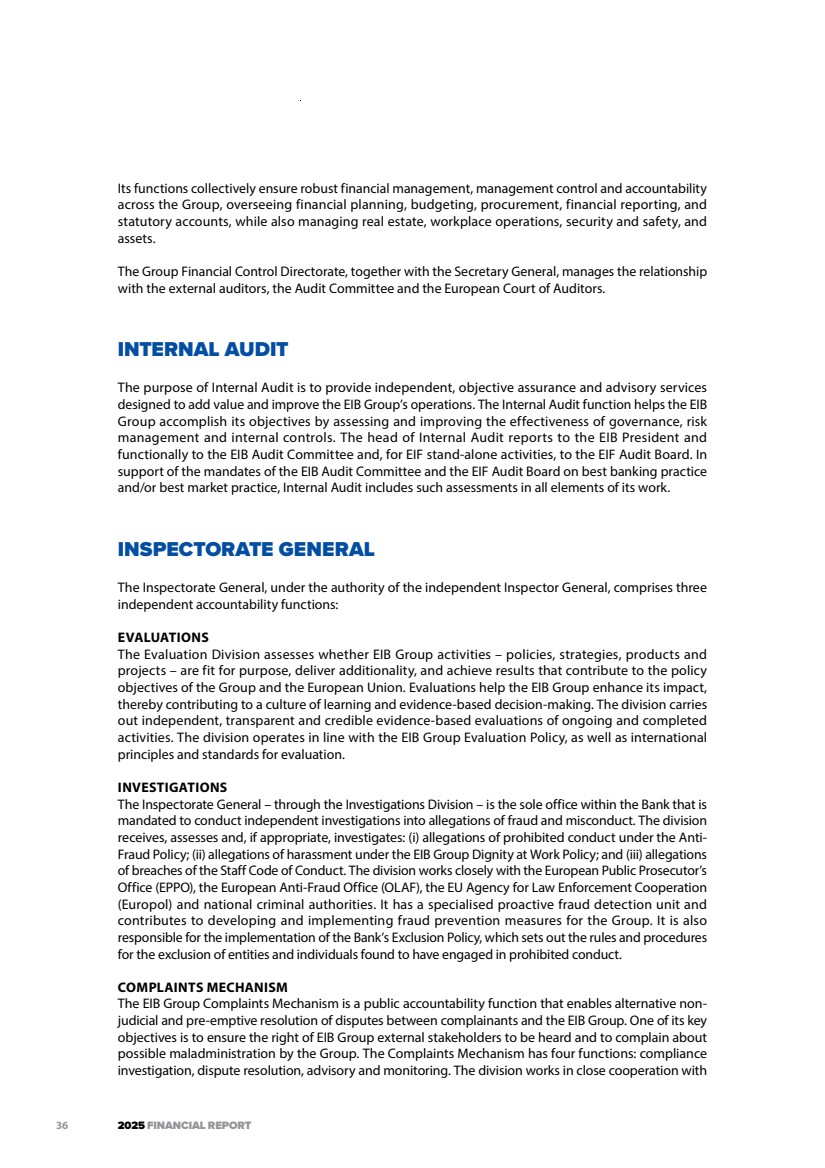
| Aud the European Ombudsman. Any member of the public who is not satisfied with the outcome of the internal mechanism can turn to the European Ombudsman and lodge a complaint against the EIB Group. Procurement complaints involving alleged infringements of the Bank’s Guide to Procurement for projects financed by the EIB are handled by the Procurement Complaints Committee, chaired by the Inspector General. OFFICE OF THE GROUP CHIEF COMPLIANCE OFFICER As part of the second line of defence, the objective of the EIB Group’s Compliance function is to assess, monitor and report on relevant non-financial risks for the EIB Group, including money laundering and terrorism financing, sanctions, market integrity, conduct, and operational, information and cybersecurity risks. To achieve this, the EIB Group’s Compliance function establishes policies, frameworks and tools to support robust compliance risk management, provides advice to the first line of defence and governing bodies and oversees compliance with relevant internal policies. The EIB Group’s Compliance function ensures compliance with legal and regulatory requirements by developing and maintaining the Bank’s relevant compliance framework. It is also consulted on various compliance matters and, when needed, in EIB lending operations throughout their life cycle, providing expert advice and guidance on anti-money laundering and combating financing of terrorism, tax good governance and sanctions risks. The Compliance function also performs oversight activities to ensure that compliance risks and controls are effectively managed, provides training and raises awareness. Operational and information security risks are categorised as non-financial risks in the EIB’s Risk Appetite Framework. The independent Operational Risk Management Unit is responsible for the implementation of a sound Operational Risk Management Framework, whereas the Information Security Risk Unit enforces sound risk management approaches in line with the Bank’s information security framework and industry-specific best practices. The Compliance function also acts as the second line of defence in its advisory and decisional role on ethics and integrity issues, providing independent opinions and recommendations to ensure compliance with the principles and standards of professional ethics at the highest level. The function provides training and raises awareness on compliance matters and enforces the EIB Group Staff Code of Conduct and Whistleblowing Policy to instil a culture of integrity throughout the Group. 37 |
| Aud c B. EIB AND EIB GROUP FINANCIAL STATEMENTS AS AT 31.12.2025 As outlined in Note A of the Financial Statements*, on a proposal from the Management Committee, the Board of Directors adopted the Financial Statements on 25 March 2026 and authorised their submission to the Board of Governors for approval by 24 April 2026, in accordance with Article 7(3) and Article 9(1) of the EIB Statute and Article 2(3) and Article 18(1) of the EIB Rules of Procedure. * EIB Statutory and EIB Group Consolidated Financial Statements prepared in accordance with the general principles of the Directive 86/635/EEC and the EIB Group Consolidated Financial Statements prepared in accordance with International Financial Reporting Standards. 38 |
| estatutory f EIB STATUTORY FINANCIAL STATEMENTS OF THE BANK as at 31 December 2025 Disclaimer: To accommodate scheduling limitations, the financial statements included in this report have not been subject to standard EIB copy-editing or proofreading. 39 |

| 2025 FINANCIAL REPORT 2 Balance sheet as at 31 December 2025 (in EUR ’000) Assets 31.12.2025 31.12.2024 1. Cash in hand, balances with central banks and post office banks (Note B.1) 257,807 104,678 2. Treasury bills and other bills eligible for refinancing with central banks (Note B.2) 39,857,574 36,499,912 3. Loans and advances to credit institutions a) repayable on demand 1,024,594 1,012,332 b) other loans and advances (Note C) 33,561,528 39,456,167 c) loans (Note D.1) 87,587,263 91,091,122 d) value adjustments (Note D.2) 0 -848 122,173,385 131,558,773 4. Loans and advances to customers a) other loans and advances (Note C) 118,171 234,816 b) loans (Note D.1) 352,723,030 346,773,549 c) value adjustments (Note D.2) -701,308 -617,456 352,139,893 346,390,909 5. Debt securities including fixed-income securities (Note B.2) a) issued by public bodies 5,149,311 4,760,707 b) issued by other borrowers 5,654,419 5,682,731 10,803,730 10,443,438 6. Shares and other variable-yield securities (Note E.1) 10,274,031 9,968,276 7. Participating interests (Note E.1) 470,735 476,779 8. Shares in affiliated undertakings (Note E.2) 1,578,581 1,578,169 9. Intangible assets (Note F) 156,057 129,807 10. Tangible assets (Note F) 457,280 349,740 11. Other assets (Note G) 441,386 467,156 12. Subscribed capital and reserves, called but not paid (Note H.3) 0 159,848 13. Prepayments and accrued income (Note I) 12,227,346 18,314,860 Total assets 550,837,805 556,442,345 The accompanying notes form an integral part of these financial statements. 40 |
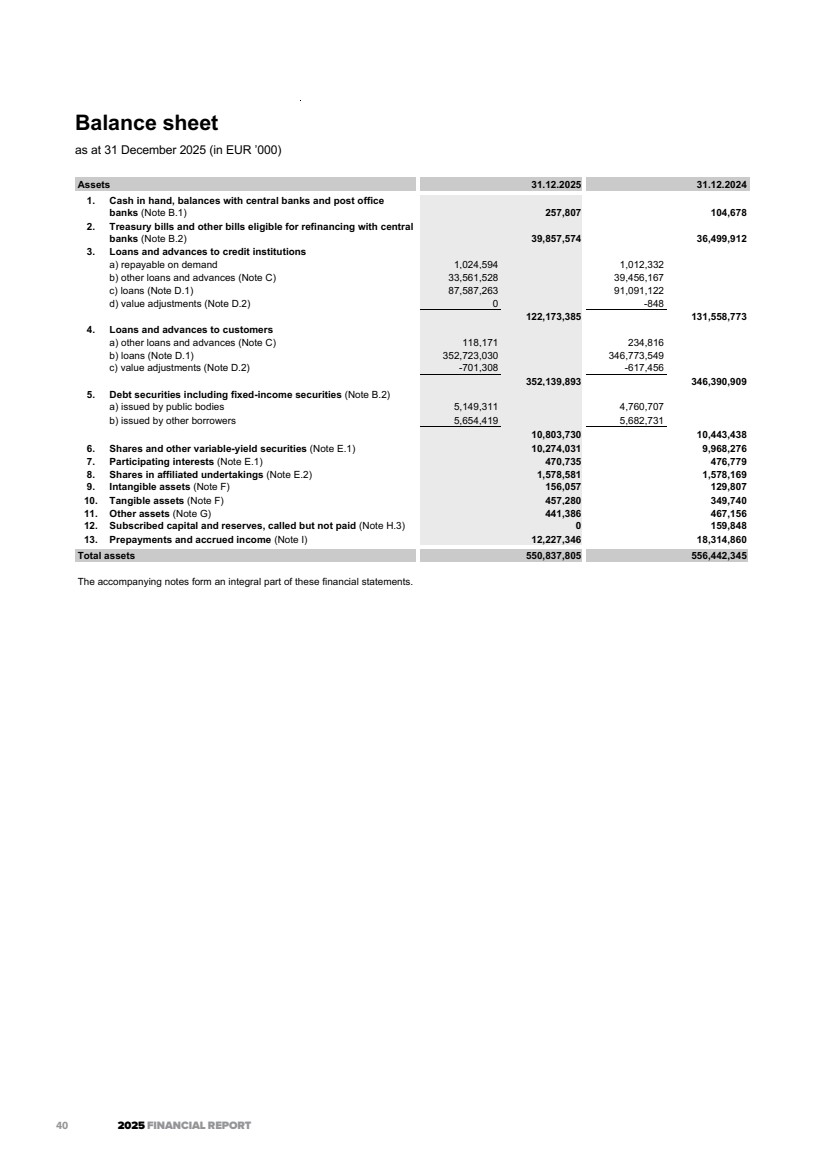
| estatutory f 3 Balance sheet (continued) as at 31 December 2025 (in EUR ’000) Liabilities 31.12.2025 31.12.2024 1. Amounts owed to credit institutions (Note J) a) repayable on demand 446,323 750,387 b) with agreed maturity or periods of notice 984,159 107,186 1,430,482 857,573 2. Amounts owed to customers (Note J) a) repayable on demand 4,178,811 3,096,585 b) with agreed maturity or periods of notice 13,146 120,487 4,191,957 3,217,072 3. Debts evidenced by certificates (Note K) a) debt securities in issue 424,728,413 435,965,421 b) others 6,974,114 6,886,266 431,702,527 442,851,687 4. Other liabilities (Note G) 4,202,977 4,423,900 5. Accruals and deferred income (Note I) 17,555,687 16,365,083 6. Provisions a) pension plans and health insurance scheme (Note L) 5,348,429 5,049,315 b) provisions in respect of guarantee operations (Note D.4) 78,929 76,303 5,427,358 5,125,618 7. Subscribed capital (Note H) a) subscribed 248,795,607 248,795,607 b) uncalled -226,604,892 -226,604,892 22,190,715 22,190,715 8. Reserves (Note H) a) reserve fund 24,879,561 24,879,561 b) additional reserves 20,020,604 18,692,683 c) special activities reserve 14,015,155 12,665,555 d) general loan reserve 2,495,377 2,281,423 61,410,697 58,519,222 9. Profit for the financial year (Note M) 2,725,405 2,891,475 Total liabilities 550,837,805 556,442,345 The accompanying notes form an integral part of these financial statements. 41 |
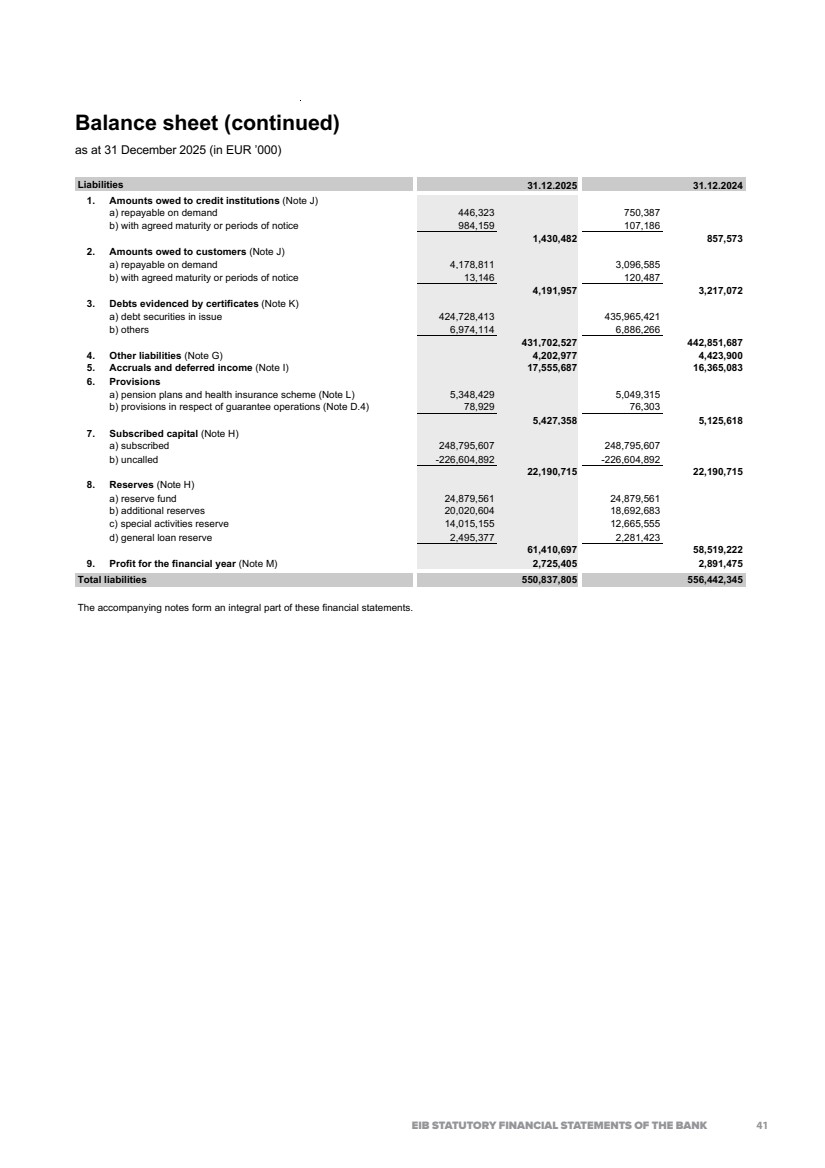
| 2025 FINANCIAL REPORT 4 Off-balance sheet as at 31 December 2025 (in EUR ’000) 31.12.2025 31.12.2024 Contingent liabilities and guarantees: - In respect of loans granted by third parties (Note U.1.3.) 25,704,610 23,518,831 Commitments: - EIF capital uncalled (Notes E.2, X.1) 3,518,400 3,520,800 - Undisbursed loans (Note D.1) - credit institutions 29,064,622 31,082,413 - customers 107,154,243 99,028,309 136,218,865 130,110,722 - Undisbursed shares and other variable-yield securities and participating interests - Undisbursed private equity and venture capital operations (Note E.1) 5,766,636 4,902,793 - Undisbursed equity investments and infrastructure funds (Note E.1) 4,174,972 3,887,979 - EBRD capital uncalled (Note E.1) 712,630 712,630 10,654,238 9,503,402 - Borrowings launched but not yet settled 223,950 223,950 Assets held on behalf of third parties(*) (Note Z): - Innovation Fund 14,102,137 11,393,044 - Modernisation Fund 7,224,104 6,000,001 - Investment Facility Cotonou 3,519,226 3,979,538 - RRF-FI 2,646,427 1,521,135 - EIF treasury 2,337,099 2,256,441 - InnovFin 2,085,519 2,086,963 - InvestEU 1,631,030 1,634,043 - NER300 1,097,186 1,068,868 - CEF 836,775 867,827 - Pan-European Guarantee Fund 814,876 706,679 - Partnership Platform for Funds 790,050 735,178 - EU-Africa Infrastructure Trust Fund 323,905 349,362 - Decentralised Financial Instruments 273,858 260,061 - ACP Trust Fund EC Compartment 201,664 201,751 - EU for Ukraine Fund 122,391 118,068 - HDW POLIO IG 108,356 182,951 - InvestEU Advisory Hub 93,626 43,177 - Special Section 90,108 99,454 - Private Finance for Energy Efficiency Instrument 59,775 58,979 - DCFTA 50,931 52,225 - NDICI IW1, IW2 and IW4 48,218 27,586 - NIF Risk Capital Facility 47,587 50,354 - ENPI 42,892 43,758 - JESSICA Holding Funds 34,480 21,417 - IPA II / IPA III 28,948 38,015 - EFSI-EIAH 28,662 26,951 - FEMIP Trust Fund 24,733 26,812 - GCFF Jordan Private Sector Guarantee Facility 22,756 31,894 - AECID 22,507 25,291 - NIF Trust Fund 20,074 20,050 - EU Support to Boost Africa 18,639 31,061 - EPTA Trust Fund 17,976 18,448 - Natural Capital Financing Facility 9,449 12,473 - DESIREE 6,135 6,103 - EPIC 3,468 1,222 - fi-compass 1,791 3,054 - JASPERS 1,529 6,789 - TARGET 1,269 790 - GEF-UNEP 1,057 1,434 - EFSD Guarantee - SME Access to Finance Initiative 990 1,729 42 |
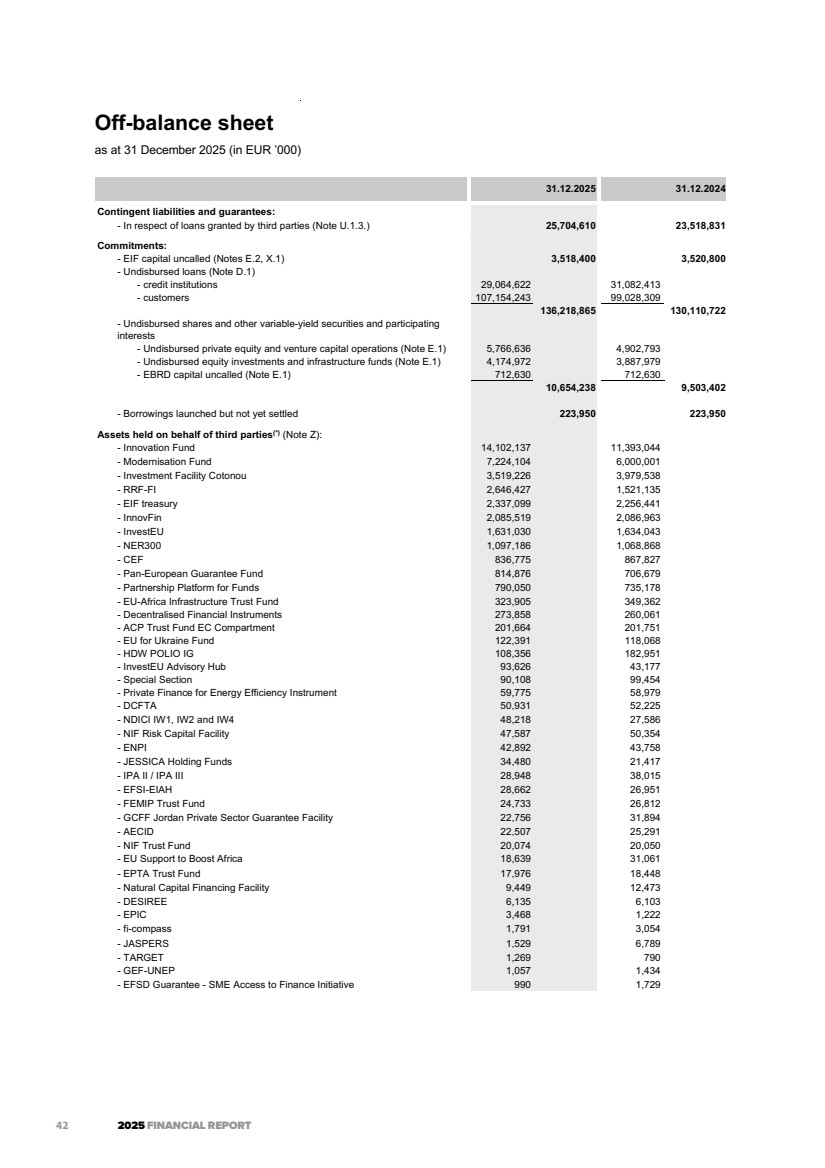
| estatutory f 1 Off-balance sheet (continued) as at 31 December 2025 (in EUR ’000) 31.12.2025 31.12.2024 - EU Trade and Competitiveness Programme 616 704 - EU4Business Guarantee Facility Ukraine 265 0 - AIP Kulima 244 244 - EU4Business Guarantee Facility 238 259 - PFSI 219 0 - AIP Zambia 178 218 - GF Greece 0 45,139 - RSFF (incl. RSI) 0 13,994 38,793,963 34,071,534 Other items: - Notional value of interest rate swaps (Note V.1.2) 631,978,110 655,792,698 - Notional value of currency swap contracts payable 208,844,111 229,644,516 - Notional value of currency swap contracts receivable (Note V.1.1) 205,154,785 232,980,366 - Notional amount of futures contracts (Note V.2) 44,442,868 33,351,527 - Notional value of short-term currency swap contracts payable 23,008,868 19,500,940 - Notional value of short-term currency swap contracts receivable (Note V.2) 22,930,155 19,687,736 - Put option granted to EIF minority shareholders (Note E.2) 513,499 483,283 - Special deposits for servicing borrowings (Note S) 489 535 - Currency swaps launched but not yet settled receivable (Note V.1.1) 0 145,049 - Currency swaps launched but not yet settled payable 0 144,845 (*) Assets under management are disclosed as off-balance sheet items based on the latest available figures. Comparative figures might be restated to reflect the most recent available information. The accompanying notes form an integral part of these financial statements. 43 |
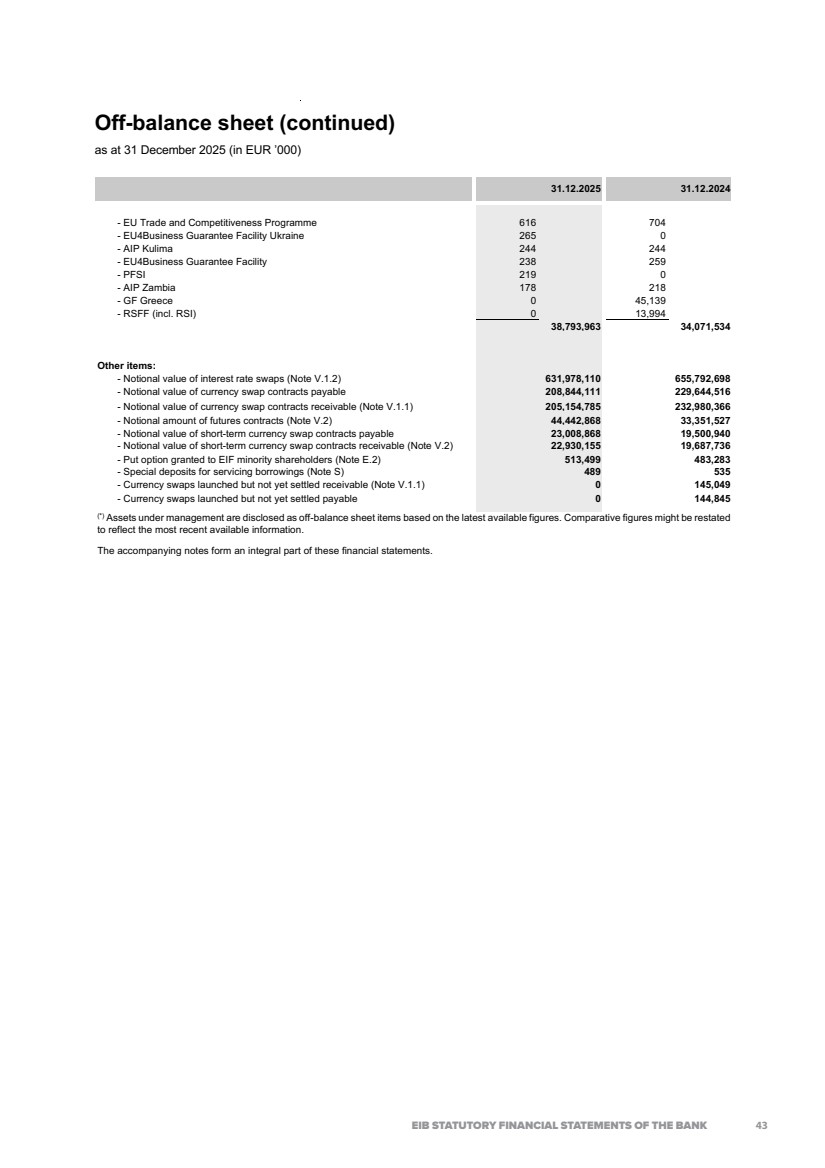
| 2025 FINANCIAL REPORT 6 Profit and loss account for the year ended 31 December 2025 (in EUR ‘000) 2025 2024 1. Interest receivable and similar income (Note N) 24,177,443 27,361,107 2. Interest payable and similar charges (Note N) -20,663,161 -23,847,740 3. Income from securities a) income from shares and other variable-yield securities 924,405 911,537 b) income from shares in affiliated undertakings 15,714 13,690 940,119 925,227 4. Commissions receivable (Note O) 445,382 449,376 5. Commissions payable (Note O) -399,600 -391,729 6. Net result on financial operations (Note P) -122,585 -9,935 7. Net other operating income and expense (Note Q) 67,992 64,373 8. General administrative expenses (Note R) a) staff costs (Note L) -1,005,051 -1,001,444 b) other administrative expenses -362,379 -375,905 -1,367,430 -1,377,349 9. Value adjustments in respect of tangible and intangible assets (Note F) a) tangible assets -33,792 -32,434 b) intangible assets -64,362 -51,940 -98,154 -84,374 10. Value (re-)adjustments in respect of loans and advances and provisions for contingent liabilities -247,609 -192,766 11. Value (re-)adjustments in respect of transferable securities held as financial fixed assets, participating interests and shares in affiliated undertakings -6,992 -4,715 12. Profit for the financial year (Note M) 2,725,405 2,891,475 The accompanying notes form an integral part of these financial statements. 44 |
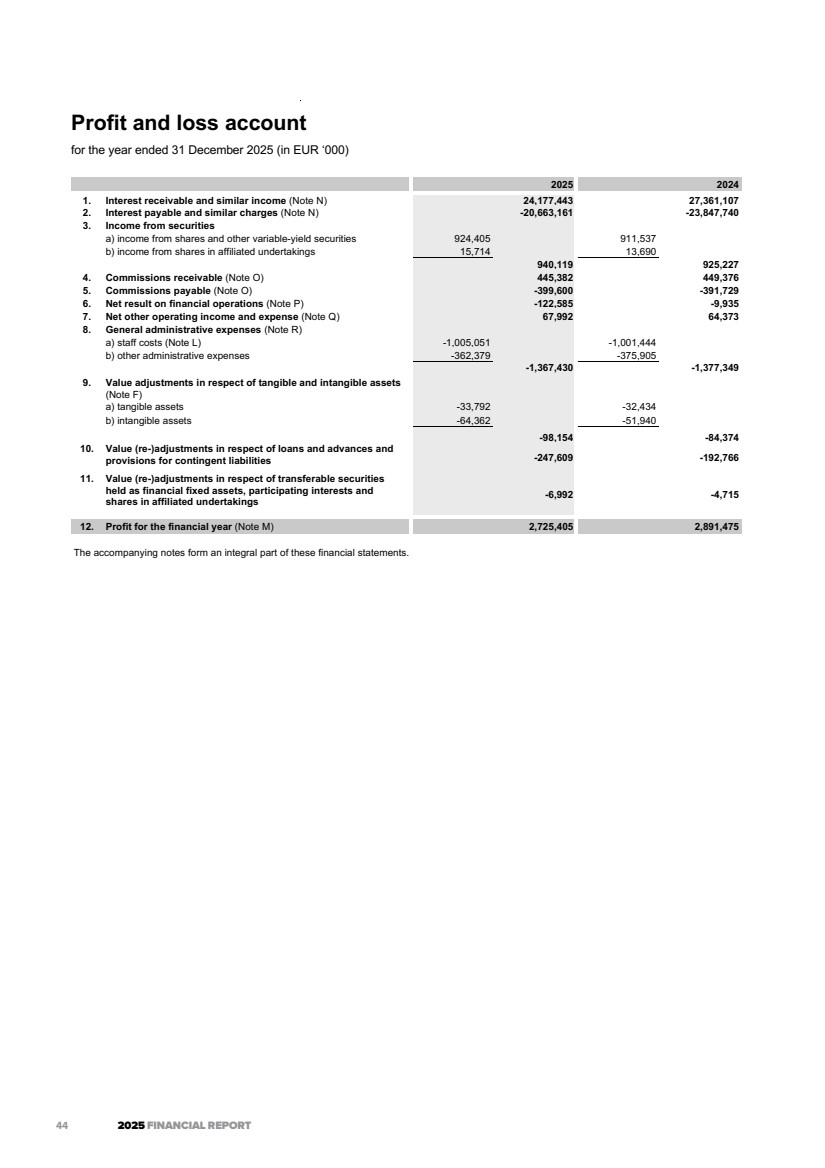
| estatutory f 7 Cash flow statement for the year ended 31 December 2025 (in EUR ‘000) 2025 2024 A. Cash flows from operating activities: Profit for the financial year (Note M) 2,725,405 2,891,475 Adjustments for: Value (re-)adjustments in respect of loans and advances and provisions for contingent liabilities 247,609 192,766 Value adjustments in respect of tangible and intangible assets, and write-off (Note F) 98,171 84,368 Value (re-)adjustments in respect of transferable securities held as financial fixed assets, shares, other variable-yield securities and participating interests (Note E.1) 143,215 89,999 Gain from sale of EIF shares -2,382 -1,190 Change in provisions on pension plans and health insurance scheme (Note L) 247,068 272,965 Net interest income (Note N.1) -3,514,282 -3,513,367 Effect of exchange rate changes -74,512 72,614 Loss/Profit on operating activities -129,708 89,630 Disbursements of loans and advances to credit institutions and customers -53,651,765 -54,338,238 Repayments of loans and advances to credit institutions and customers 47,815,355 45,337,630 Change in other loans and advances (Note C) 803,530 18,347,113 Change in deposit with Central Bank of Luxembourg to cover minimum reserve requirement (Note B.1) -152,382 105,328 Change in treasury operational portfolios -1,377,225 3,077,651 Change in amounts owed to credit institutions and customers (Note J) 1,547,794 -149,021 Payments and annual contributions to pension plans and health insurance scheme during the year (Note L) 52,046 67,894 Change in other assets and other liabilities (Note G) -162,052 -362,181 Change in prepayments and accrued income and in accruals and deferred income -4,731,625 600,533 Interest received 21,551,326 25,766,296 Interest paid -18,058,856 -21,818,202 Net cash (used in)/generated from operating activities -6,493,562 16,724,433 B. Cash flows from investing activities: Purchase of EIF shares -3,283 0 Sale of EIF shares 5,253 2,983 Securities in Long-Term HQLA Portfolio purchased during the year -3,686,986 -2,521,418 Securities from Long-Term HQLA Portfolio matured or sold during the year 161,698 115,000 Purchase of loan substitutes included in the debt securities portfolios -5,110,828 -5,094,322 Redemption of loan substitutes included in the debt securities portfolios 5,332,901 4,282,758 Additions on shares and other variable-yield securities (Note E.1) -1,699,753 -1,804,639 Reflows on shares and other variable-yield securities (Note E.1) 1,257,743 1,380,508 Additions on participating interests (Note E.1) -37,951 -73,055 Reflows on participating interests (Note E.1) 37,003 27,218 Purchase of tangible and intangible assets (Note F) -231,961 -187,363 Net cash used in investing activities -3,976,164 -3,872,330 C. Cash flows from financing activities: Issuance of debts evidenced by certificates (Note K) 113,139,018 106,720,276 Redemption of debts evidenced by certificates (Note K) -107,429,294 -106,488,673 Member States’ contribution 159,848 319,700 Net cash generated from financing activities 5,869,572 551,303 Summary statement of cash flows: Cash and cash equivalents at the beginning of financial year 37,973,836 24,770,124 Net cash from: Operating activities -6,493,562 16,724,433 Investing activities -3,976,164 -3,872,330 Financing activities 5,869,572 551,303 Effect of exchange rate changes on cash held -594,591 -199,694 Cash and cash equivalents at the end of financial year 32,779,091 37,973,836 Cash and cash equivalents are composed of: Cash in hand, balances with central banks and post office banks, excluding deposits with Central Bank of Luxembourg to cover minimum reserve requirement (Note B.1) 758 11 Loans and advances to credit institutions and customers: Repayable on demand 1,024,594 1,012,332 Other loans and advances (Note C) 31,753,739 36,961,493 32,779,091 37,973,836 The accompanying notes form an integral part of these financial statements. 45 |
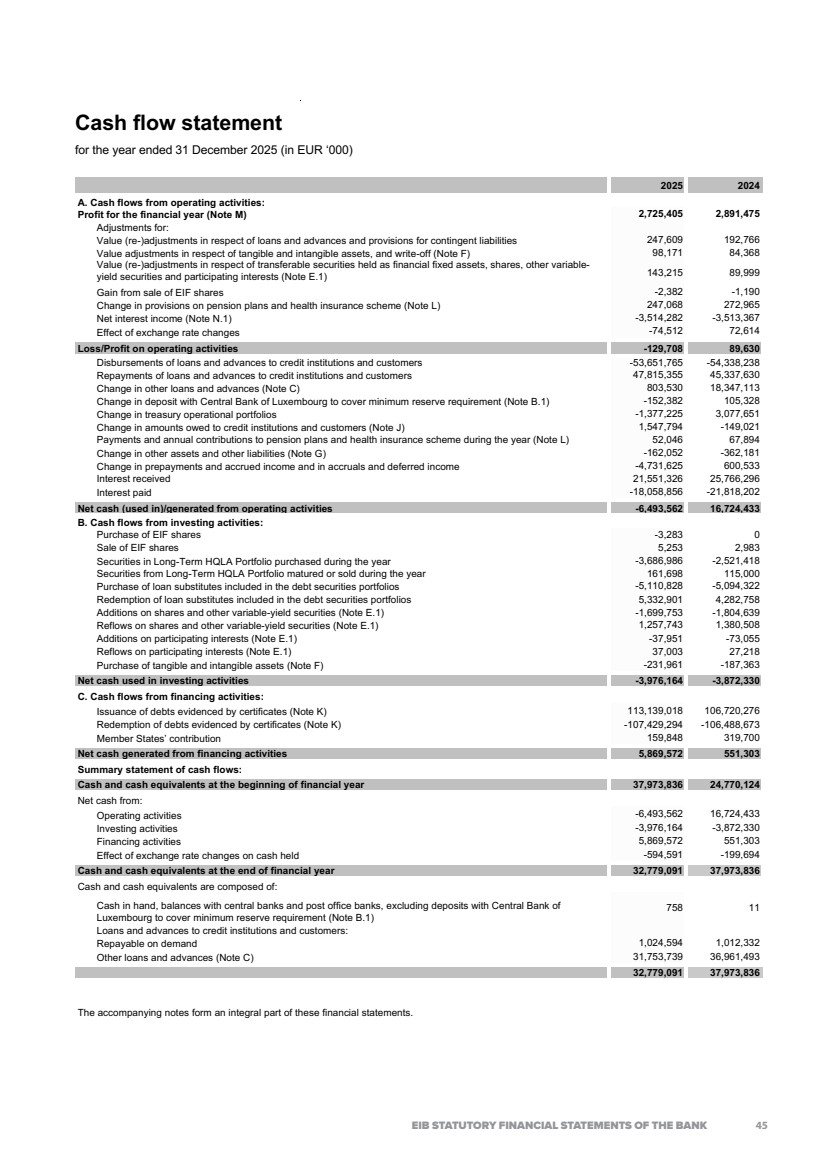
| 2025 FINANCIAL REPORT 8 European Investment Bank Notes to the financial statements as at 31 December 2025 The European Investment Bank (the ‘Bank’ or ‘EIB’) was created by the Treaty of Rome in 1958 as the long-term lending bank of the European Union (‘EU’). The task of the Bank is to contribute towards the integration, balanced development and economic and social cohesion of the EU Member States. The EIB raises substantial volumes of funds on the capital markets and lends these funds on favourable terms to projects furthering EU policy objectives. The EIB continuously adapts its activities to developments in EU policies. The Bank has its registered office at 98-100, boulevard Konrad Adenauer, L-2950 Luxembourg. Note A – Significant accounting policies A.1. Basis of preparation A.1.1. Accounting standards The unconsolidated financial statements (the ‘Financial Statements’) of the European Investment Bank have been prepared on a going concern basis and in accordance with the general principles of Directive 86/635/EEC of the Council of the European Communities dated 8 December 1986 on the annual accounts and consolidated accounts of banks and other financial institutions. These principles have been amended by Directive 2001/65/EC of 27 September 2001, by Directive 2003/51/EC of 18 June 2003 and by Directive 2006/46/EC of 14 June 2006, concerning the annual and consolidated accounts of certain types of companies, banks and other financial institutions (the ‘Directives’). On a proposal from the Management Committee (‘MC’), the Board of Directors (‘BoD’) adopted the Financial Statements on 25 March 2026 and authorised their submission to the Board of Governors for approval by 24 April 2026, in accordance with Article 7(3) and Article 9(1) of the EIB Statute and Article 2(3) and Article 18(1) of the EIB rules of Procedure. The Bank also publishes consolidated financial statements as at the same date as the annual Financial Statements. A.1.2. Significant accounting judgments and estimates In preparing the Financial Statements, the Management Committee is required to make estimates and assumptions that affect the reported amounts of income, expenses, assets, liabilities and the disclosure of contingent assets and liabilities. The use of available information and the application of judgement are inherent in the formation of estimates. Actual results may differ from these estimates, and such differences may be material to the Financial Statements. The most significant use of judgments and estimates is as follows: Value adjustments on loans and advances and loan substitutes The Bank reviews its loans and advances and loan substitutes at each reporting date to assess whether an allowance for value adjustments should be recorded. In particular, judgment by management is required in estimating the amount and timing of future cash flows when determining the level of allowance required. These estimates are based on assumptions about various factors and actual results may differ, resulting in future changes to the allowance. In addition to individual allowances for individually significant loans and advances and loan substitutes, the Bank also conducts a collective provisioning test for exposures that, while not specifically identified as requiring individual allowances, present a higher risk of default compared to when the loans and advances and loan substitutes were originally granted (see Note A.2.6). Value adjustments on shares, other variable-yield securities and participating interests To determine the lower of cost or market value, the Bank reviews its indirect equity investments at each reporting date to assess whether a value adjustment should be recorded. In particular, the Bank determines the attributable EIB share of the net asset value (‘NAV’) of its indirect equity investments either by (i) considering the latest available fund manager report based on applicable industry guidelines and standards, (ii) any NAV derived from any other equivalent guidelines or standard or (iii) internally based on information provided by the fund manager. Fair values for most of the underlying investments have been estimated in the absence of readily ascertainable market values. Due to the inherent uncertainty of valuations, and current market conditions, actual results in the future may differ from the fund managers’ estimates of values and such differences could be material to the Financial Statements. Moreover, any attributable NAV that becomes available only after the balance sheet date are only considered if management determines it materially affects the Financial Statements (see Note A.2.7.1). Provisions in respect of guarantee operations The Bank initially recognises the financial guarantee contract at fair value, corresponding to the net present value (‘NPV’) of expected premium inflows or the initial expected loss. The financial guarantee is subsequently measured as the deficit of the net present value of the expected future premium over the higher of the corresponding loss allowance and the premium received on initial recognition less income recognised. The Bank also conducts a collective provisioning test on exposures that, although not specifically identified as requiring an individual allowance, have a greater risk of default than when the guarantees were originally signed and issued (see Note A.2.13). 46 |
| estatutory f 9 Pension and other post-employment benefits The cost of defined benefit pension plans and other post-employment medical benefits is determined using actuarial valuations. The actuarial valuation involves making assumptions about discount rates, mortality rates and future salary and pension increases. Due to the long-term nature of these plans, such estimates are subject to significant uncertainty (see Note A.2.10). A.1.3. Bank’s exposure to the United Kingdom (‘UK’) On 29 March 2017, the United Kingdom notified the European Council of its decision to withdraw from the EU pursuant to Article 50 of the Treaty on European Union (‘TEU’). As of 1 February 2020, in accordance with Article 50 TEU and the Agreement on the withdrawal of the United Kingdom of Great Britain and Northern Ireland from the European Union and the European Atomic Energy Community (the “Withdrawal Agreement”), the United Kingdom ceased to be an EU Member State. The withdrawal of the United Kingdom from the EU automatically resulted in the termination of its membership of the European Investment Bank (‘EIB’) and its share of the EIB’s subscribed capital. Effective 1 February 2020, the share of the United Kingdom in respect of the EIB’s subscribed capital was fully replaced by a pro rata capital increase of the remaining EU Member States. This capital replacement (Symmetrical Capital Replacement) covered both the called part as well as the uncalled part of the subscribed capital of the United Kingdom in the EIB. The replacement of the called part was financed by converting EIB reserves into called subscribed capital. As a result of the capital increase, each remaining EU Member State increased pro rata its uncalled (but callable) stake in the EIB’s subscribed capital. In addition, the capital subscribed by Poland and Romania in the EIB increased by EUR 5,386,000,000 and EUR 125,452,381, respectively. This capital increase (Asymmetrical Capital Increase) took effect on 1 March 2020, one month after the withdrawal of the United Kingdom from the EU. Poland and Romania paid the called portion of their increase in the EIB’s subscribed capital and contributed to the EIB reserves in ten equal semi-annual instalments. The Withdrawal Agreement contains, among other things, several provisions governing the financial settlement in respect of the EIB as a result of the termination of UK membership of the EIB. In accordance with the provisions laid down in Article 150 of the Withdrawal Agreement, the United Kingdom shall remain liable, under its former share of the subscribed capital in the EIB, for the EIB’s pre-withdrawal exposure. In this respect as at 31 December 2025, the EIB’s pre-withdrawal exposure amounts to EUR 296,291 million, whereas the limit of the United Kingdom’s liability amounts to EUR 39,195 million. The United Kingdom shall also remain liable for other EIB risks as long as such risks are not related to post-withdrawal lending. In addition, in accordance with the provisions laid down in Article 150 of the Withdrawal Agreement, the EIB shall pay to the United Kingdom on behalf of the EU an amount equal to the UK share of the called capital of the EIB in twelve annual instalments. Except for such repayment of the UK called capital, the EIB shall not be obliged to make any other payment, return or remuneration to the United Kingdom in connection with the termination of its membership of the EIB or on account of the retention by the United Kingdom of certain liabilities as described in the relevant provisions of the Withdrawal Agreement. A.2. Summary of significant accounting policies A.2.1. Foreign currency translation The EIB uses the euro (‘EUR’) as the unit of measurement for the capital accounts of Member States and for presenting its Financial Statements. The Bank conducts its operations in euro, in other currencies of the EU Member States and in non-EU currencies. Its resources are derived from its capital, borrowings and accumulated earnings in various currencies. Foreign currency transactions are translated at the exchange rate prevailing on the date of the transaction. The Bank's monetary assets and liabilities denominated in currencies other than euro are translated into euro at the closing exchange rates prevailing at the balance sheet date. The gain or loss arising from such translation is recorded in the profit and loss account under “Net result on financial operations”. A.2.2. Derivatives The Bank uses derivative instruments, mainly currency and interest rate swaps, as part of its asset and liability management (‘ALM’) activities to manage exposures to interest rate and foreign currency risks. All derivatives transactions are recorded at their notional values as off-balance sheet items at the transaction date. The majority of the Bank’s swaps are concluded with a view to hedging bond issues and treasury bonds within the Long-Term High-Quality Liquid Assets (‘HQLA’) Portfolio (‘LTHP’). The Bank enters into currency and interest rate swaps, whereby the proceeds of a borrowing are initially converted into a different currency and at maturity the Bank will obtain the amounts required to service the borrowing in the original currency or to modify the interest rate positions of a borrowing or treasury bond. The Bank also enters into currency, interest rate and overnight index swaps as part of its hedging operations on loans or for the global ALM position. The corresponding interest is accounted for on a pro rata temporis basis. The Bank also uses short-term derivative instruments, primarily foreign exchange (‘FX’) swaps, as part of its treasury operations, as well as derivatives hedging the actively managed Securities Liquidity Portfolio (‘SLP’). 47 |
| 2025 FINANCIAL REPORT 10 A.2.2.1. Derivatives under the Securities Liquidity Portfolio As part of the SLP, derivatives are entered in and recorded at market value in the balance sheet as “Other assets” when their market value is positive or “Other liabilities” when their market value is negative. Changes in the market value are included in “Net result on financial operations”. Market values are obtained from quoted market prices, discounted cash flow models and option pricing models, which consider current market and contractual prices for the underlying instrument, as well as the time value of money, yield curve and volatility of the underlying. Interest on derivative instruments is accrued pro rata temporis under “Prepayments and accrued income” or “Accruals and deferred income”. Interest rate swaps Interest rate swap contracts are entered into in order to modify the interest rate positions. The interest received and paid under interest rate swaps is accrued on a pro rata temporis basis and reported in the profit and loss account under “Interest receivable and similar income” or “Interest payable and similar charges”. The market value is recorded under “Other assets” when their market value is positive or “Other liabilities” when their market value is negative. Changes in the market value are included in the “Net result on financial operations”. Currency swaps Currency swap contracts are entered into in order to adjust currency positions. The interest received and paid under cross-currency interest rate swaps is accrued pro rata temporis and reported in the profit and loss account under “Interest receivable and similar income” or “Interest payable and similar charges”. The market value is recorded under “Other assets” when their market value is positive or “Other liabilities” when their market value is negative. Changes in the market value are included in “Net result on financial operations”. Futures contracts Interest rate and bond futures contracts (futures) are entered to hedge the exposure deriving from investments in government and other bonds. Futures are highly standardised derivative contracts, traded on regulated markets and are subject to daily margin requirements. The market value is recorded under “Other assets” when their market value is positive or “Other liabilities” when their market value is negative. Changes in the market value are included in the “Net result on financial operations”. A.2.2.2. Other derivatives Currency swaps Currency swap contracts are entered into in order to adjust currency positions. The revaluation of the spot leg of a currency swap is presented in “Accruals and deferred income” or “Prepayments and accrued income”. The forward leg of the currency swap is recorded off-balance sheet at the settlement amount and is not revalued. The premium/discount between the spot and forward settlement amounts is amortised pro rata temporis through the profit and loss account in “Interest receivable and similar income” or “Interest payable and similar charges”. Interest rate swaps Interest rate swap contracts are entered into in order to modify the interest rate positions. The hedging interest rate swaps are not revalued and their notional value is recorded off-balance sheet. The interest received and paid under interest rate swaps is accrued pro rata temporis and reported in the profit and loss account under “Interest receivable and similar income” or “Interest payable and similar charges”. Currency forwards Currency forwards are entered into in order to adjust future currency positions. The forward leg is recorded off-balance sheet at the settlement amount and is not revalued. The difference between the spot amounts and the forward settlement amounts is amortised pro rata temporis through the profit and loss account in “Interest receivable and similar income” or “Interest payable and similar charges”. Interest on derivative instruments is accrued pro rata temporis under “Prepayments and accrued income” or “Accruals and deferred income”. A.2.3. Financial assets and liabilities Financial assets and liabilities are accounted for using the settlement date basis. A.2.4. Cash and cash equivalents Cash and cash equivalents are disclosed in the cash flow statement and comprise cash in hand, unrestricted balances held with central banks, on demand amounts due, and highly liquid money market securities or term deposits with an initial maturity of 3 months or less from the date of acquisition. These instruments are subject to an insignificant risk of changes in their value, are readily convertible to cash and are used by the Bank in the management of its short-term commitments. 48 |
| estatutory f 11 A.2.5. Treasury bills and other bills eligible for refinancing with central banks and debt securities including fixed-income securities A.2.5.1. Long-Term High-Quality Liquid Assets (‘HQLA’) Portfolio (‘LTHP’) The main purpose of the portfolio is to serve as a core long-term liquidity reserve for the Bank in EUR, GBP and USD, composed of highly rated liquid bonds. Securities under the portfolio are kept with the intention to hold them to maturity. These securities are initially recorded at the purchase price. Value adjustments are accounted for, if these are other than temporary. The difference between the entry price and redemption value is accounted for pro rata temporis over the life of the securities, as “Interest receivable and similar income” or “Interest payable and similar charges”. A.2.5.2. Operational portfolios Treasury Monetary Portfolio (‘TMP’) In order to maintain an adequate level of liquidity, the Bank purchases money market products with a maximum maturity of 12 months, in particular treasury bills and negotiable debt securities issued by public bodies and credit institutions. The securities in the TMP are held until their final maturity and are initially recorded at purchase price and subsequently presented in the Financial Statements at amortised cost. The difference between purchase price and redemption value is accounted for pro rata temporis over the life of the securities as “Interest receivable and similar income” or “Interest payable and similar charges”. Value adjustments are accounted for under “Value (re-)adjustments in respect of transferable securities held as financial fixed assets, participating interests and shares in affiliated undertakings”, if these are other than temporary. Securities Liquidity Portfolio (‘SLP’) The SLP comprises listed debt securities issued or guaranteed by national governments, supranational institutions, financial institutions and corporations. The portfolio is largely driven by an active management and following the initial recognition at purchase price, subsequently the securities of this portfolio are presented in the Financial Statements at market value. Changes in market value are recorded under “Net result on financial operations” in the profit and loss account. The market value of the SLP is based on published price quotations in an active market as the first source. For instruments without available published price quotations, the market values are determined by obtaining quotes from market participants and/or by using valuation techniques or models, based whenever possible on observable market data prevailing at the balance sheet date. A.2.5.3. Loan substitutes The loan substitutes portfolios mainly consist of obligations in the form of bonds, notes or certificates issued by special purpose vehicles (‘SPVs’), trust vehicles or financial institutions. These securities are kept with the intention to be held to maturity and initially recorded at purchase price and subsequently valued at amortised cost. The difference between purchase price and redemption value is accounted for pro rata temporis over the life of the securities as “Interest receivable and similar income”. Individual value adjustments are accounted for, if these are other than temporary. Collective value adjustments are recorded to capture contracts which are impaired but have not yet been identified as such respectively for losses incurred but not yet reported. Individual and collective value adjustments are recorded in the profit and loss account as “Value (re-)adjustments in respect of transferable securities held as financial fixed assets and participating interests and shares in affiliated undertakings” and are deducted from the appropriate asset items on the balance sheet. Undisbursed parts of loan substitutes are recorded in off-balance sheet at their nominal value. A.2.5.4 Preferred creditor status (‘PCS’) The principle of the supremacy of the EU primary law and the principle that the property of the EIB shall be exempt from all forms of requisition and expropriation, as enshrined in the EIB Statute, are deemed to guarantee a full recovery of the EU Sovereign Exposures at maturity. This financial protection and the benefit of the preferred creditor status result in no credit risk or impairment loss from Member States sovereign exposure or guarantees. However, similarly to other creditors, the EIB is bound by the majority decision based on collective action clauses (‘CAC’) included in debt instruments issued by EU Sovereigns. A.2.6. Loans and advances to credit institutions and customers A.2.6.1. Loans and advances Loans and advances are included in the assets of the Bank at their net disbursed amounts. Individual value adjustments have been recorded for loans outstanding at the end of the period and presenting risks of non-recovery of all or part of their amounts. Collective value adjustments may be recorded to capture loans in the portfolio which are impaired but have not yet been identified as such or for losses which have been incurred but not yet reported. Such value adjustments are held in the same currency as the assets to which they relate. Value adjustments are accounted for in the profit and loss account as “Value (re-)adjustments in respect of loans and advances and provisions for contingent liabilities” and are deducted from the appropriate asset items on the balance sheet. Undisbursed parts of loans and advances are recorded in the off-balance sheet at their nominal value. A.2.6.2. Interests on loans Interests on loans are recorded in the profit and loss account on an accrual basis, i.e. over the life of the loans. On the balance sheet, accrued interest is included in “Prepayments and accrued income” under assets. Value adjustments to interest amounts on these loans are determined on 49 |
| 2025 FINANCIAL REPORT 12 a case-by-case basis by the Bank’s Management, deducted from the appropriate asset item on the balance sheet and accounted for in the profit and loss account as “Value (re-)adjustments in respect of loans and advances and provisions for contingent liabilities”. For non-performing loans, upon value adjustment, the accrual of interest income based on the original terms of the claim may be discontinued. A.2.6.3. Reverse repurchase agreements (‘Reverse repos’) A reverse repurchase agreement is one under which the Bank lends liquid funds to a credit institution which in return provides collateral in the form of securities. The two parties enter into an irrevocable commitment to complete the operation on a date and at a price fixed at the outset. The operation is based on the principle of delivery against payment: the borrower of the liquid funds transfers the securities to the EIB’s custodian in exchange for settlement at the agreed price, which generates a return for the EIB linked to the money market. This type of operation is considered for the purposes of the Bank to be a loan at a guaranteed rate of interest. Generally treated as collateralised financing transactions, they are carried at the amounts of cash advanced or received, plus accrued interest. Reverse repos are entered at their notional amount on the assets side of the statutory balance sheet under “Loans and advances to credit institutions - b) other loans and advances”. Securities received under reverse repurchase agreements are not recognised in the statutory balance sheet, unless control of the contractual rights comprised in these securities is assumed. The Bank monitors the market value of the securities received on a daily basis and requests additional collateral in accordance with the underlying agreements. Interest on reverse repurchase agreements is recognised as “Interest receivable and similar income” or “Interest payable and similar charges” over the life of each agreement. A.2.6.4. Interest subsidies Interest subsidies received in advance (see Note I) are deferred and recognised in the profit and loss account over the period from disbursement to repayment of the subsidised loan. A.2.6.5. Term and on-demand deposits (‘Deposits’) Deposits are operations under which the Bank lends liquid funds to a credit institution or customer for a certain period or on-demand against a return agreed between the parties. Deposits are entered at their nominal amount on the assets side of the statutory balance sheet under “Loans and advances to credit institutions or customers – b) other loans and advances”. Interest on deposits is recognised as “Interest receivable and similar income” or “Interest payable and similar charges” over the term of the deposit. A.2.7. Shares, other variable-yield securities, participating interests and shares in affiliated undertakings A.2.7.1. Shares, other variable-yield securities and participating interests The Bank holds shares, other variable-yield securities and participating interests when it enters into private equity (‘PE’) and venture capital (‘VC’) operations, debt funds, infrastructure funds, investment funds or participations in the form of direct equity. These investments are initially recorded at acquisition cost, reduced by any reflow resulting from repayments. Their carrying value is adjusted to the lower of cost or market value at subsequent measurement at the balance sheet date. In certain co-investments performed by the Bank, the investments are initially recognised at cost and the net-paid-in represents the drawdowns paid net of any capital repayments allocated in accordance with the agreed waterfall. Based on the reports received from fund managers, the portfolios of investments are valued on a line-by-line basis at the lower of cost or attributable NAV, thereby excluding any attributable unrealised gain that may be prevailing in the portfolio. The attributable NAV is determined by applying in order of priority, and subject to availability at the reporting date, either: • the Bank share of NAV at the latest available date, submitted by the respective fund manager, or; • the number of shares or units held by the Bank multiplied by the price per share or unit at the latest available date reported by the fund manager, or; • the Bank’s percentage ownership in the specific compartment multiplied by the specific compartment NAV reflected in the most recent fund manager’s report, or; • the Bank’s percentage of ownership in the fund multiplied by the latest available fund NAV. In certain co-investments performed by the Bank, the attributable NAV may be determined based on the agreed waterfall calculation. The attributable NAV is adjusted for events occurring between the date of the latest available NAV and the balance sheet date to the extent that such adjustment is considered to be material by the Management Committee. Signed but undrawn part of these investments is recorded as off-balance sheet commitments at their nominal value. 50 |
| estatutory f 13 For specific investments where NAVs cannot readily be determined, other guidelines such as the International Private Equity and Venture Capital Valuation (‘IPEV’) Guidelines published by the IPEV Board might be used and more detailed monitoring and review will be required. In accordance with this method, the funds are internally classified into three categories: • Category I – funds that have adopted the fair value requirements of IFRS 13 or the IPEV Guidelines for which a specific review is performed to ensure that the NAV is a reliable estimate of fair value; • Category II – funds that have adopted other valuation guidelines (such as the former 2001 European Private Equity and Venture Capital Association (‘EVCA’) guidelines) or standards that can be considered to be in line with IFRS 13, for which an equivalent NAV can be calculated; • Category III – funds that have not adopted the fair value requirements of IFRS 13 or any other valuation guidelines in line with IFRS 13. Secondary sales Secondary sale transactions on venture capital funds and investment funds lead to derecognition of the underlying assets. Gains or losses from secondary sales are recorded in “Net result on financial operations” and are calculated as the difference between the sales proceeds and the net carrying amount. Participating interests The shares acquired by the EIB for its own account typically represent investments in venture capital operations, debt funds, infrastructure funds and investment funds. According to industry practice, such investments are generally subscribed by a number of investors, none of whom are in a position to individually influence the daily operations or investment activities of the funds. Consequently, any membership by an investor in a governing body of such a fund does not, in principle, entitle said investor to influence the day-to-day operations of the fund. In addition, individual investors in venture capital operations, infrastructure funds or investment funds do not determine policies of a fund such as distribution policies on capital repayments or other distributions. Such decisions are typically taken by the management of a fund on the basis of the shareholders’ agreement governing the rights and obligations of the management and all shareholders of the fund. The shareholders’ agreement also generally prevents individual investors from bilaterally executing material transactions with the fund, interchanging managerial personnel or obtaining privileged access to essential technical information. Such above-mentioned criteria are assessed by the EIB through a comprehensive analysis involving judgement to determine whether it has significant influence or joint control over those entities in which it has acquired shares. If it has significant influence or joint control over the entity, this is disclosed under “Participating interests”. Capital subscribed by the Bank but uncalled from the investment in the European Bank for Reconstruction and Development (‘EBRD’) is recorded off-balance sheet. A.2.7.2. Shares in affiliated undertakings Shares in affiliated undertakings represent medium and long-term investments and are accounted for at cost. Value adjustments are accounted for if these are other than temporary. Commitments provided in the form of a put option in respect of the shares held by any of the minority shareholders, are recorded off-balance in the amount of the exercise price. A.2.8. Tangible assets Tangible assets include land, Bank-occupied properties, other machines and equipment. Land is stated at acquisition cost and buildings are stated at acquisition cost less accumulated depreciation, less accumulated impairment. The costs of the Bank's headquarters buildings in Luxembourg are depreciated on a straight-line basis as set out below. Permanent equipment, fixtures and fittings, furniture, office equipment and vehicles have been recorded in the balance sheet at their acquisition cost, less accumulated depreciation, less accumulated impairment. Subsequent expenditure is capitalised only if it is probable that the future economic benefits associated with the expenditure will flow to the Bank. Ongoing repairs and maintenance are expensed as incurred. Depreciation is calculated on a straight-line basis over the estimated life of each item purchased, as set out below: • Buildings: 30 years; • Permanent equipment, fixtures and fittings: 10 years; • Furniture: 5 years; • Office equipment and vehicles: 3 years. There is no depreciation of the accumulated costs of work-in-progress assets until they are completed and the assets are ready to use for the intended purpose. A.2.9. Intangible assets Intangible assets comprise computer software. Software development costs are capitalised if they meet certain criteria related to identifiability, the probability that future economic benefits will flow to the enterprise and the reliability of cost measurement. Subsequent expenditure on software assets is capitalised only when it increases the future economic benefits embodied in the specific asset to which it relates. All other expenditure is recognised in profit and loss as it is incurred. Internally developed software meeting these criteria is carried at cost less accumulated amortisation, which is calculated on a straight-line basis over three years from completion, less accumulated impairment. 14 There is no amortisation of the accumulated costs of work-in-progress assets until they are completed and the assets are ready to use for the intended purpose. A.2.10. Pension plans and health insurance scheme A.2.10.1. Pension plan for staff The Bank operates defined benefit pension plans to provide retirement benefits to substantially all its staff. The Bank's main pension scheme is a defined benefit pension scheme funded by contributions from staff and from the Bank that covers all employees. All contributions of the Bank and its staff are invested in the assets of the Bank. Commitments for retirement benefits are valued at least every year using the projected unit credit method, in order to ensure that the provision entered in the accounts is adequate. The latest valuation was carried out as at 31 December 2025 based on membership data as at 30 September 2025 and cash flows to 31 December 2025. The main assumptions used by the actuary are set out in Note L. Cumulative current year actuarial gains or losses in excess of 10% of the commitments for retirement benefits are recognised over a period of 7 years on a straight-line basis. Once the provision has reached the amortisable portion of the actuarial value of the retirement and health insurance benefits, no further amortisation is recognised in the profit and loss account. Additionally, if the provision exceeds the actuarial value of the retirement and health insurance benefits, any excess will not be released to the profit and loss account in subsequent periods. A.2.10.2. Health insurance scheme The Bank has set up its own health insurance scheme for the benefit of staff, financed by contributions from the Bank and its employees. The health insurance scheme is managed and accounted for under the same principles as the pension plan for staff described in Note A.2.10.1. The latest valuation was carried out as at 31 December 2025 based on membership data as at 30 September 2025 and cash flows to 31 December 2025. A.2.10.3. The Management Committee pension plan The Management Committee pension plan is a defined benefit pension scheme funded by contributions from the Bank only that covers all Management Committee members. All contributions of the Bank are invested in the assets of the Bank. The Management Committee pension plan is managed and accounted for under the same principles as the pension plan for staff described in Note A.2.10.1. A.2.10.4. Optional Supplementary Provident Scheme The Optional Supplementary Provident Scheme is a defined contribution pension scheme, funded by voluntary staff contributions and employer contributions. The corresponding liability is recorded in “Other liabilities”. A.2.11. Amounts owed to credit institutions and customers Amounts owed to credit institutions and customers are presented in the Financial Statements at their redemption amounts. Interest on amounts owed to credit institutions and customers is recorded in the profit and loss account on an accrual basis as “Interest payable and similar charges” or “Interest receivable and similar income”, if the interest rate is negative. Accrued interest is included in “Accruals and deferred income” under liabilities. A.2.11.1 Repurchase agreements (‘Repos’) A repurchase agreement is one under which the Bank borrows liquid funds from a credit institution and provides collateral in the form of securities. The two parties enter into an irrevocable commitment to complete the operation on a date and at a price fixed at the outset. The operation is based on the principle of delivery against payment, which is mentioned in Note A.2.6.3. This type of operation is considered for the purposes of the Bank to be a borrowing with an agreed rate of interest. Generally treated as collateralised financing transactions, they are carried at the amounts of cash owed, plus accrued interest. Repos are entered at their notional amounts on the liabilities side of the balance sheet under “Amounts owed to credit institutions- b) with agreed maturity or periods of notice”. Interest on repurchase agreements is recognised as “Interest receivable and similar income” or “Interest payable and similar charges” over the life of each agreement. A.2.11.2 Collateral call accounts Under unilateral Collateral Support Annexes, the Bank receives cash as collateral to mitigate counterparty credit exposures on Derivatives, Lending and Treasury portfolios. The cash collateral received is recorded at its nominal value and presented in the statutory Financial Statements under “Amounts owed to credit institutions - a) repayable on demand” - Overnight deposits. A.2.12. Debts evidenced by certificates Debts evidenced by certificates are presented at their redemption amounts, except for zero-coupon bonds and commercial papers which are presented at their amortised cost. Transaction costs and premiums/ discounts are amortised in the profit and loss account on a straight-line basis over the life of the debt through “Accruals and deferred income” or “Prepayments and accrued income”. Interest on debt instruments is included in “Interest payable and similar charges” or “Interest receivable and similar income” in the profit and loss account. 51 |
| 2025 FINANCIAL REPORT 14 There is no amortisation of the accumulated costs of work-in-progress assets until they are completed and the assets are ready to use for the intended purpose. A.2.10. Pension plans and health insurance scheme A.2.10.1. Pension plan for staff The Bank operates defined benefit pension plans to provide retirement benefits to substantially all its staff. The Bank's main pension scheme is a defined benefit pension scheme funded by contributions from staff and from the Bank that covers all employees. All contributions of the Bank and its staff are invested in the assets of the Bank. Commitments for retirement benefits are valued at least every year using the projected unit credit method, in order to ensure that the provision entered in the accounts is adequate. The latest valuation was carried out as at 31 December 2025 based on membership data as at 30 September 2025 and cash flows to 31 December 2025. The main assumptions used by the actuary are set out in Note L. Cumulative current year actuarial gains or losses in excess of 10% of the commitments for retirement benefits are recognised over a period of 7 years on a straight-line basis. Once the provision has reached the amortisable portion of the actuarial value of the retirement and health insurance benefits, no further amortisation is recognised in the profit and loss account. Additionally, if the provision exceeds the actuarial value of the retirement and health insurance benefits, any excess will not be released to the profit and loss account in subsequent periods. A.2.10.2. Health insurance scheme The Bank has set up its own health insurance scheme for the benefit of staff, financed by contributions from the Bank and its employees. The health insurance scheme is managed and accounted for under the same principles as the pension plan for staff described in Note A.2.10.1. The latest valuation was carried out as at 31 December 2025 based on membership data as at 30 September 2025 and cash flows to 31 December 2025. A.2.10.3. The Management Committee pension plan The Management Committee pension plan is a defined benefit pension scheme funded by contributions from the Bank only that covers all Management Committee members. All contributions of the Bank are invested in the assets of the Bank. The Management Committee pension plan is managed and accounted for under the same principles as the pension plan for staff described in Note A.2.10.1. A.2.10.4. Optional Supplementary Provident Scheme The Optional Supplementary Provident Scheme is a defined contribution pension scheme, funded by voluntary staff contributions and employer contributions. The corresponding liability is recorded in “Other liabilities”. A.2.11. Amounts owed to credit institutions and customers Amounts owed to credit institutions and customers are presented in the Financial Statements at their redemption amounts. Interest on amounts owed to credit institutions and customers is recorded in the profit and loss account on an accrual basis as “Interest payable and similar charges” or “Interest receivable and similar income”, if the interest rate is negative. Accrued interest is included in “Accruals and deferred income” under liabilities. A.2.11.1 Repurchase agreements (‘Repos’) A repurchase agreement is one under which the Bank borrows liquid funds from a credit institution and provides collateral in the form of securities. The two parties enter into an irrevocable commitment to complete the operation on a date and at a price fixed at the outset. The operation is based on the principle of delivery against payment, which is mentioned in Note A.2.6.3. This type of operation is considered for the purposes of the Bank to be a borrowing with an agreed rate of interest. Generally treated as collateralised financing transactions, they are carried at the amounts of cash owed, plus accrued interest. Repos are entered at their notional amounts on the liabilities side of the balance sheet under “Amounts owed to credit institutions- b) with agreed maturity or periods of notice”. Interest on repurchase agreements is recognised as “Interest receivable and similar income” or “Interest payable and similar charges” over the life of each agreement. A.2.11.2 Collateral call accounts Under unilateral Collateral Support Annexes, the Bank receives cash as collateral to mitigate counterparty credit exposures on Derivatives, Lending and Treasury portfolios. The cash collateral received is recorded at its nominal value and presented in the statutory Financial Statements under “Amounts owed to credit institutions - a) repayable on demand” - Overnight deposits. A.2.12. Debts evidenced by certificates Debts evidenced by certificates are presented at their redemption amounts, except for zero-coupon bonds and commercial papers which are presented at their amortised cost. Transaction costs and premiums/ discounts are amortised in the profit and loss account on a straight-line basis over the life of the debt through “Accruals and deferred income” or “Prepayments and accrued income”. Interest on debt instruments is included in “Interest payable and similar charges” or “Interest receivable and similar income” in the profit and loss account. 52 |
| estatutory f 15 A.2.13. Financial guarantees Financial guarantee contracts require the issuer to make specified payments to reimburse the holder for a loss it incurs, if a specified debtor fails to make payment when due under the original or modified terms of a debt instrument. Signed financial guarantees are generally accounted for and disclosed as off-balance sheet items. Net liabilities from financial guarantees are presented in the balance sheet under “Provisions b) provisions in respect of guarantee operations”. This provision is intended to cover risks inherent in the Bank’s activity of issuing guarantees in favour of financial intermediaries or issued in respect of loans granted by third parties. Financial guarantees are initially recognised at fair value corresponding to the net present value (‘NPV’) of expected premium inflows or the initial expected loss. Subsequent to initial recognition, financial guarantees are measured as the deficit of the net present value of expected future premium inflows over the higher of: • the amount of the expected credit loss; and • the fair value initially recognised less any cumulative amount of income/amortisation recognised. Unrealised gains representing the excess of the net present value of expected future premium inflows over the amount of the expected payment obligations remain unrecognised. Any increase or decrease in the net liability relating to financial guarantees is recognised in the profit and loss account under “Value (re-)adjustments in respect of loans and advances and provisions for contingent liabilities”. Any premium received is recognised in the profit and loss account under “Commissions receivable”. Upfront fees received are recognised in “Accruals and deferred income” in the balance sheet and amortised in the profit and loss account on a straight-line basis over the life of the financial guarantee. A.2.14. Provision for commitments This provision is intended to cover risks inherent in the Bank’s commitment on loans, infrastructure and investment funds as well as private equity and venture capital operations signed but not yet disbursed. A.2.15. Reserves A.2.15.1. Reserve fund As provided for under Article 22(-1) of the Statute, “a reserve fund of up to 10% of the subscribed capital shall be built up progressively” from the retained profit of the Bank. A.2.15.2. Additional reserves Additional reserves contain the remaining retained earnings of the Bank. A.2.15.3. Special activities reserve As provided for under Article 16(-5) of the Statute, “the special activities of the Bank […] will have a specific allocation of reserve”. The special activities reserve is a dedicated notional reserve for the allocation of own funds covering unexpected losses of those activities, which have a risk profile higher than what is generally accepted by the Bank, including venture capital activities. The reserve is based on the allocation of each operation and is calculated according to the evolution of the underlying assets. A.2.15.4. General loan reserve In 2009, a “general loan reserve” was introduced for the Bank’s loan and guarantee portfolio, representing a notional reserve for the allocation of own funds. It is calculated based on the Bank’s internal loan grading system according to the evolution of the underlying assets. A.2.16. Prepayments and accrued income Expenditure incurred during the financial year but relating to a subsequent financial year, together with any income for which payment is not due until the expiry of the underlying instrument. A.2.17. Accruals and deferred income Income received before the balance sheet date but relating to a subsequent financial year, together with any charges that, although pertaining to the financial year in question, will be paid only in the course of a subsequent financial year. 53 |
| 2025 FINANCIAL REPORT 16 A.2.18. Interest receivable and similar income “Interest receivable and similar income” includes mainly interest on loans and advances to credit institutions and customers, debt and money market instruments and derivatives. A.2.19. Interest payable and similar charges “Interest payable and similar charges” includes mainly interest on amounts owed to credit institutions and customers, interest expense on debt and money market instruments and derivatives. A.2.20. Income from securities “Income from securities” is mainly composed of reflows exceeding the capital. A.2.21. Taxation The Protocol on the Privileges and Immunities of the European Union appended to the Treaty on European Union and the Treaty on the Functioning of the European Union, stipulates that the assets, revenues, and other property of the institutions of the Union are exempt from all direct taxes. A.3 Technical Assistance - Reclassification of comparative figures In order to better reflect the underlying nature of the costs incurred by the Bank in the context of technical assistance activities under mandates, the Bank decided in 2025 to classify the related external costs (i.e. the portion which is fully recharged to mandators) under “Net other operating income and expense” instead of “General administrative expenses – b) other administrative expenses”. Using the same rationale, all related income (i.e. recharges) received from the mandators for technical assistance activities has also been classified under “Net other operating income and expense” instead of “Commissions receivable”. This reclassification has been applied to the 2025 financial information as well as to the 2024 comparative figures. Impact on the following captions: Note O – Commissions receivable and Commissions payable (EUR ‘000 -83,192) Note Q – Net other operating income and expense (EUR ‘000 49,458) Note R – General administrative expenses (EUR ‘000 33,734). 54 |
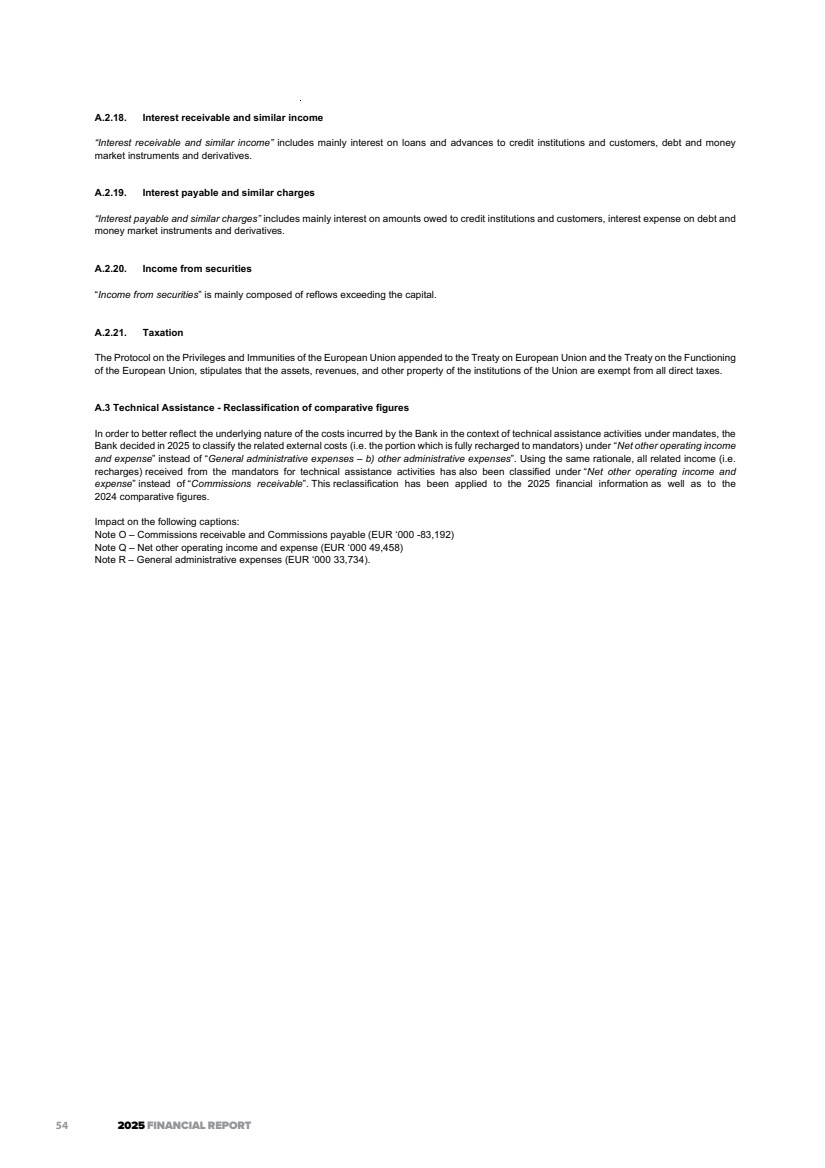
| estatutory f 17 Note B – Cash in hand, balances with central banks and post office banks and debt securities portfolio B.1. Cash in hand, balances with central banks and post office banks Cash in hand and balances with central banks and post office banks amount to EUR ’000 257,807 as at 31 December 2025 (2024: EUR ‘000 104,678). The EIB is an eligible counterparty in the Eurosystem’s monetary policy operations, therefore has been given access to the monetary policy operations of the European Central Bank. The Bank conducts operations via the Central Bank of Luxembourg, where it maintains deposits to cover the minimum reserve requirement. The balance of these deposits amounts to EUR ‘000 257,049 as at 31 December 2025 (2024: EUR ‘000 104,667). B.2. Debt security portfolios (in EUR ‘000) The debt security portfolios are composed of the Long-Term HQLA Portfolio (‘LTHP’), the treasury monetary portfolio (‘TMP’), the securities liquidity portfolio (‘SLP’) and the loan substitutes portfolio. The details of the debt security portfolios as at 31 December 2025 and 2024 are as follows: 31.12.2025 31.12.2024 Treasury bills and other bills eligible for refinancing with central banks 39,857,574 36,499,912 Debt securities including fixed-income securities 10,803,730 10,443,438 Total debt securities(*) 50,661,304 46,943,350 (*) of which EUR ‘000 5,373,643 are unlisted as at 31 December 2025 (2024: EUR ‘000 5,896,446). At 31.12.2025 Purchase price Book value Value adjustments Premiums/ discounts to be amortised Value at final maturity Market value(**) LTHP 10,583,251 10,587,525 0 20,948 10,608,473 10,180,033 TMP 12,177,884 12,311,940 0 116,934 12,428,874 12,313,915 SLP 8,202,524 8,273,468 0 0 8,275,548 8,273,468 Loan substitutes (Note D) 19,488,213 19,488,371 0 6,725 19,495,096 19,397,035 Total debt securities(*) 50,451,872 50,661,304 0 144,607 50,807,991 50,164,451 (*) of which cash and cash equivalents is nil. (**) Market value does not include accrued interest. At 31.12.2024 Purchase price Book value Value adjustments Premiums/ discounts to be amortised Value at final maturity Market value(**) LTHP 7,607,156 7,600,243 0 17,760 7,618,003 7,243,089 TMP 12,608,177 12,843,182 0 213,435 13,056,617 12,881,936 SLP 6,648,321 6,688,981 0 0 6,737,517 6,688,981 Loan substitutes (Note D) 19,807,235 19,810,944 0 709 19,811,653 19,820,469 Total debt securities(*) 46,670,889 46,943,350 0 231,904 47,223,790 46,634,475 (*) of which cash and cash equivalents is nil. (**) Market value does not include accrued interest. All instruments of the LTHP portfolio are compliant with the HQLA criteria and are monitored regularly through internal limits. As at 31 December 2025 and 2024, there is neither significant deterioration of the credit rating of the portfolio nor any indication that the full amount of the book value is not going to be recovered at maturity. The market value of the portfolio is impacted (lower than the book value) due to the current interest rate environment and the corresponding long-term maturity of the instruments. Loan substitutes, which represent acquisitions of interests in pools of loans or receivables related to securitisation transactions, are considered part of the aggregate loans (Note D). Some of these transactions have been structured by adding credit or project-related remedies, providing further recourse. Following a detailed review of the loan substitutes portfolio for any value adjustment, no value adjustment was recorded for 2025 and 2024. 55 |
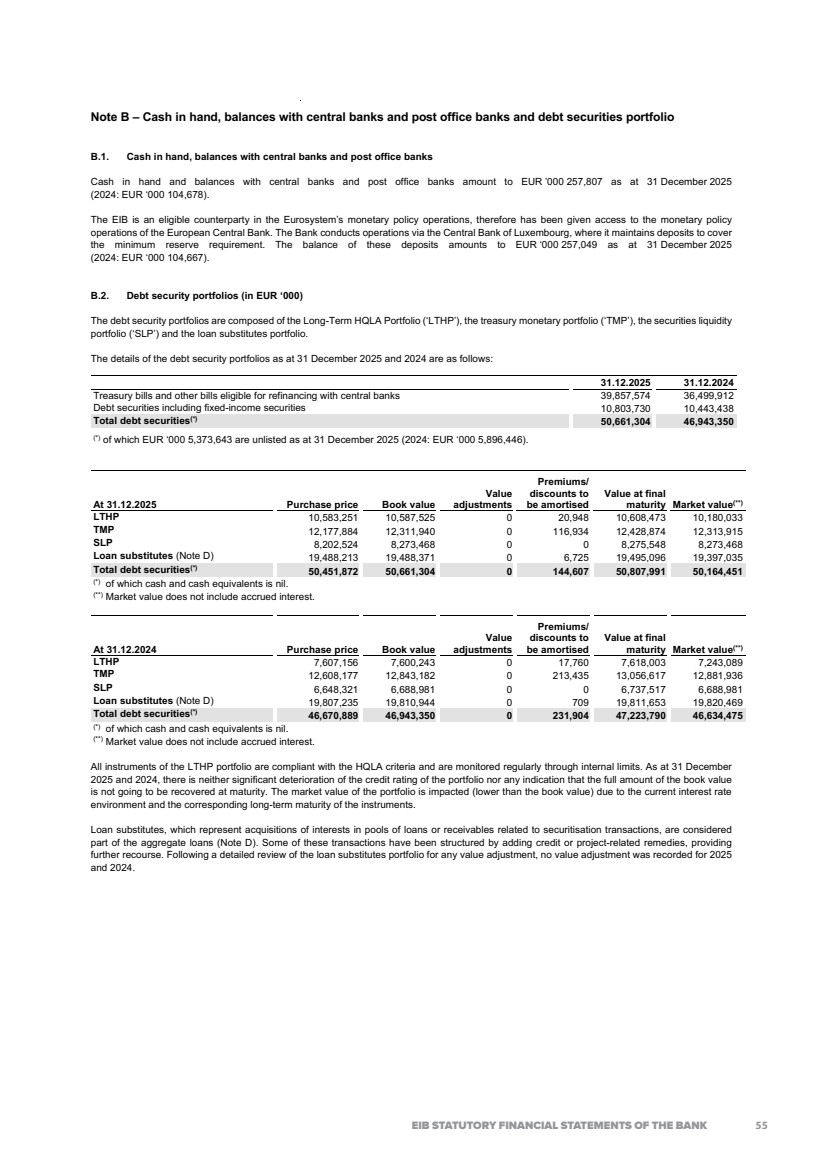
| 2025 FINANCIAL REPORT 18 EU sovereign exposure in bond holdings The Bank did not record value adjustments in 2025 and 2024 in respect of its held to maturity EU sovereign and EU sovereign guaranteed exposure as at year end, in view of the Bank’s preferred creditor status and the protection given by the Bank’s Statute as well as a detailed review of any value adjustment requirements. The following tables show the exposure to debt issued or guaranteed by EU sovereigns in the Bank’s debt securities portfolios (including loan substitutes) as at 31 December 2025 and 2024: At 31.12.2025 Purchase price Book value Value at final maturity Market value EU sovereigns Austria 973,903 978,751 993,445 932,209 Belgium 891,646 890,598 874,553 834,016 Bulgaria 44,269 45,139 45,000 45,139 Denmark 85,061 85,072 85,106 85,474 Estonia 18,087 17,814 18,000 17,814 Finland 881,679 885,260 892,479 846,545 France 4,690,838 4,760,221 4,852,734 4,718,712 Germany 3,179,314 3,184,929 3,188,026 3,183,674 Hungary 26,660 27,397 26,766 27,397 Italy 5,712,195 5,771,832 5,826,319 5,771,733 Latvia 49,254 49,328 49,500 49,328 Lithuania 35,866 35,711 36,000 35,711 Luxembourg 106,117 106,444 107,500 102,851 Netherlands 83,247 80,940 79,000 76,100 Poland 918,661 921,088 919,586 962,886 Portugal 491,488 497,801 500,000 497,865 Romania 3,442 3,528 3,404 3,528 Slovakia 36,498 36,404 36,105 36,404 Slovenia 9,721 9,700 9,778 9,700 Spain 1,488,225 1,510,150 1,522,426 1,510,979 Sweden 155,202 155,152 155,574 154,656 19,881,373 20,053,259 20,221,301 19,902,721 Non-EU sovereign and other bonds 30,570,499 30,608,045 30,586,690 30,261,730 Total 50,451,872 50,661,304 50,807,991 50,164,451 At 31.12.2024 Purchase price Book value Value at final maturity Market value EU sovereigns Austria 803,423 804,600 821,066 773,502 Belgium 417,869 416,387 402,000 386,139 Bulgaria 14,799 15,316 15,000 15,316 Denmark 115,463 115,650 115,507 115,973 Finland 616,720 619,584 627,744 591,088 France 5,890,977 6,011,956 6,159,617 5,996,720 Germany 2,098,603 2,105,840 2,111,072 2,102,092 Italy 5,715,205 5,812,586 5,900,000 5,835,837 Latvia 11,956 12,285 12,000 12,285 Luxembourg 91,162 91,322 92,500 91,866 Netherlands 61,287 59,413 59,000 58,014 Poland 860,181 861,287 860,850 906,749 Romania 13,781 13,580 13,476 13,580 Slovakia 19,950 19,997 20,000 19,997 Spain 1,775,277 1,807,682 1,844,109 1,812,746 Sweden 8,645 8,645 8,663 8,645 18,515,298 18,776,130 19,062,604 18,740,549 Non-EU sovereign and other bonds 28,155,591 28,167,220 28,161,186 27,893,926 Total 46,670,889 46,943,350 47,223,790 46,634,475 56 |
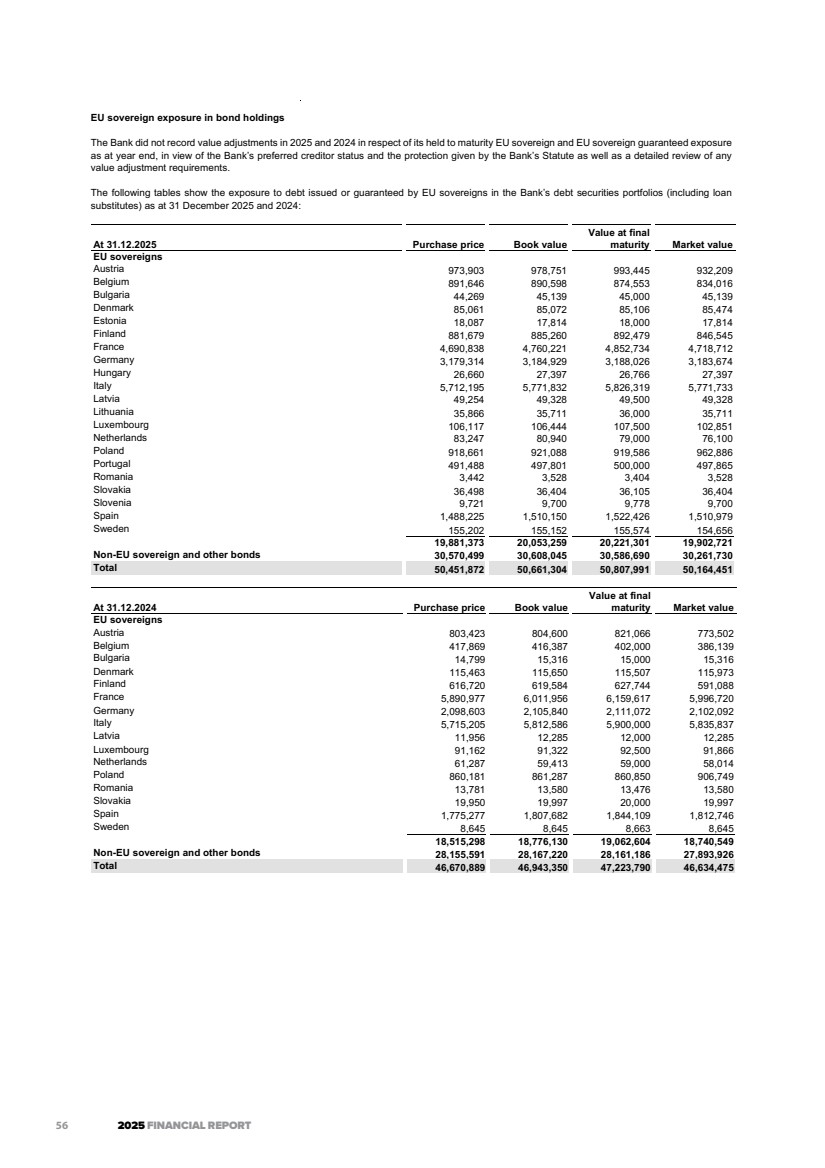
| estatutory f 19 Note C – Loans and advances to credit institutions and to customers – other loans and advances (in EUR ‘000) 31.12.2025 31.12.2024 Term deposits(*) 10,361,700 18,167,400 On-demand deposits 2,308 2,498 Reverse repos 23,197,520 21,286,269 Other loans and advances to credit institutions 33,561,528 39,456,167 Other loans and advances to customers 118,171 234,816 Total other loans and advances 33,679,699 39,690,983 of which cash and cash equivalents 31,753,739 36,961,493 (*) Includes deposits with the Central Bank of Luxembourg of EUR 9.9 billion as at 31 December 2025 (31 December 2024: EUR 16.7 billion). Note D – Summary statement of loans D.1. Aggregate loans granted (in EUR ‘000) Aggregate loans granted comprise both the disbursed and undisbursed portions of loans. The breakdown is as follows: To credit institutions To customers 31.12.2025 31.12.2024 Disbursed portion 87,575,375 352,112,120 439,687,495 437,264,152 Undisbursed loans 29,064,622 107,154,243 136,218,865 130,110,722 Aggregate loans granted 116,639,997 459,266,363 575,906,360 567,374,874 Loan instalments receivable 11,888 610,910 622,798 600,519 Loan substitutes portfolio 19,488,371 19,810,944 Aggregate loans including loan substitutes portfolio (Note D.3) 596,017,529 587,786,337 D.2. Value adjustments for loans (in EUR ‘000) Movements in the value adjustments are detailed below: 2025 2024 As at 1 January 618,304 542,652 Release during the year(1) -32,891 -150,022 Use during the year(2) -130,639 -30,516 Allowance during the year 250,746 251,641 Foreign exchange adjustment -4,212 4,549 As at 31 December(3) 701,308 618,304 (1) During 2024, the Bank released in full the collective provisions on loans (EUR ’000 87,190), which had initially been recognised in 2022 in the context of the war in Ukraine. In 2025, no collective provisions were recorded. (2) In 2025, the Bank: • Wrote off seven loan operations that were specifically provisioned at the beginning of the year: EUR '000 74,525 was used against the existing provision (2024: EUR '000 30,558 on seven loan operations); • Wrote off one loan operation that had been specifically provisioned during the course of 2025: EUR '000 543 was used against the existing provision (2024: EUR '000 376); • Completed three restructurings of loan operations that was specifically provisioned at the beginning of the year: EUR '000 9,117 and was used against the existing provision (2024: none); • Completed one sale transaction of non-performing loan operations: EUR ‘000 46,453 was used against the existing provision (2024: EUR '000 335 on one sale transaction). (3) The value adjustments relate only to disbursed loans, including arrears. The Bank has additionally recorded value adjustments in regard to accrued interest of a total amount of EUR '000 79,262 (2024: EUR '000 68,700), which is recorded under the caption of "Prepayments and accrued income." 57 |
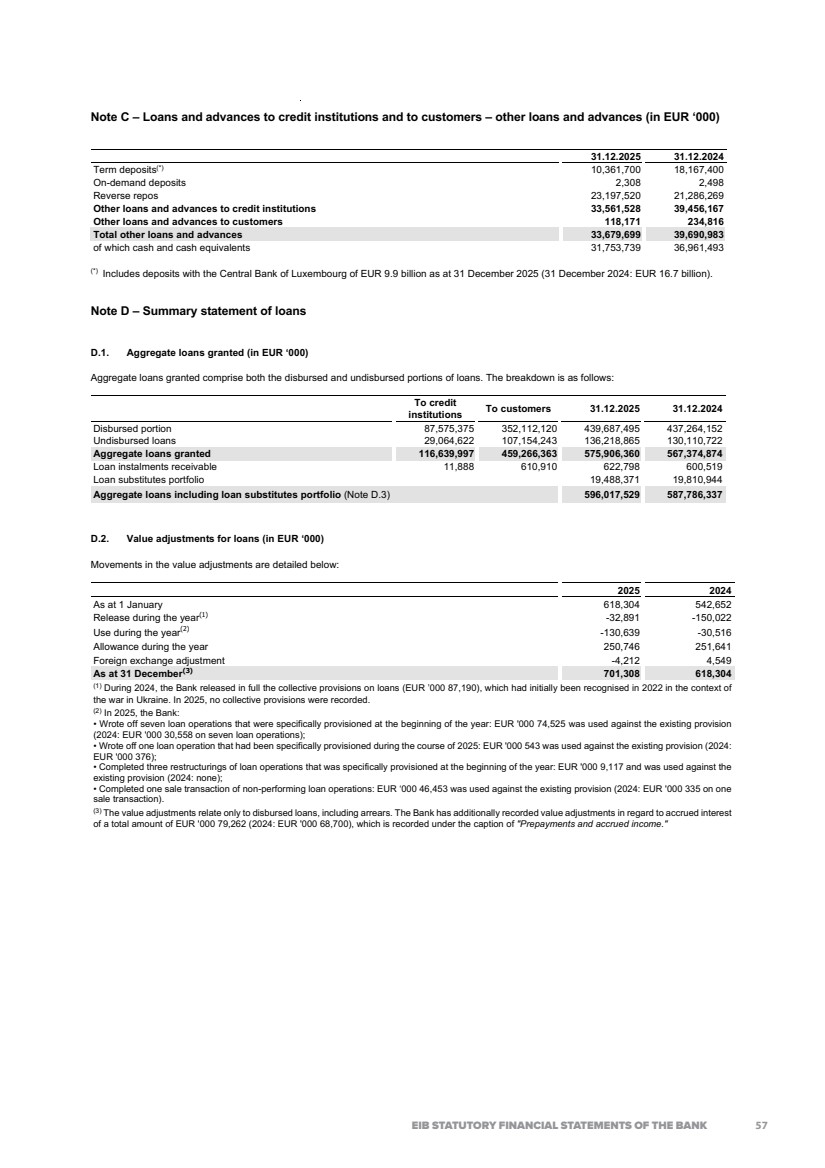
| 2025 FINANCIAL REPORT 20 D.3. Geographical breakdown of lending by country in which projects are located (in EUR ‘000) D.3.1. Loans for projects within the European Union Countries and territories in which projects are located Aggregate loans granted Disbursed portion Undisbursed portion % of total 2025 % of total 2024 France 82,725,210 63,324,016 19,401,194 13.89% 13.24% Spain 74,973,171 64,208,987 10,764,184 12.59% 13.23% Italy 66,798,615 55,600,617 11,197,998 11.22% 11.23% Poland 51,671,093 40,731,643 10,939,450 8.68% 8.37% Germany 51,505,179 36,787,168 14,718,011 8.65% 8.35% Belgium 20,698,187 16,038,852 4,659,335 3.48% 3.32% Greece 18,665,693 13,870,932 4,794,761 3.14% 3.30% Netherlands 17,979,741 13,651,798 4,327,943 3.02% 2.99% Austria 14,345,351 12,286,720 2,058,631 2.41% 2.49% Portugal 13,073,145 9,178,292 3,894,853 2.20% 2.09% Sweden 12,957,943 10,297,821 2,660,122 2.18% 2.04% Finland 11,459,625 10,004,047 1,455,578 1.92% 1.93% Czech Republic 10,767,669 8,031,557 2,736,112 1.81% 1.70% Romania 9,569,133 6,706,444 2,862,689 1.60% 1.48% Hungary 8,962,794 7,733,283 1,229,511 1.51% 1.48% Ireland 8,627,680 6,277,295 2,350,385 1.45% 1.43% Denmark 4,613,571 2,678,410 1,935,161 0.77% 0.87% Slovakia 4,385,648 4,244,951 140,697 0.74% 0.74% Croatia 3,416,005 2,734,604 681,401 0.57% 0.61% Lithuania 3,258,206 2,722,827 535,379 0.54% 0.52% Bulgaria 2,752,285 2,021,660 730,625 0.46% 0.43% Cyprus 2,692,448 1,803,629 888,819 0.45% 0.43% Slovenia 2,198,252 1,843,598 354,654 0.37% 0.39% Estonia 1,999,493 1,364,415 635,078 0.34% 0.35% Latvia 996,681 626,922 369,759 0.17% 0.14% Luxembourg 870,401 560,676 309,725 0.15% 0.14% Malta 456,764 349,237 107,527 0.07% 0.07% Subtotal 502,419,983 395,680,401 106,739,582 84.38% 83.36% D.3.2. Loans for projects outside the European Union1 D.3.2.1. Candidate countries Countries and territories in which projects are located Aggregate loans granted Disbursed portion Undisbursed portion % of total 2025 % of total 2024 Ukraine* 6,065,197 3,557,895 2,507,302 Türkiye 5,617,286 5,148,061 469,225 Serbia 4,007,973 2,479,738 1,528,235 Bosnia and Herzegovina 1,908,130 1,448,929 459,201 Georgia 1,691,419 1,271,009 420,410 Moldova 1,406,108 504,832 901,276 Montenegro 634,493 446,274 188,219 North Macedonia 604,396 301,996 302,400 Albania 383,815 166,315 217,500 Subtotal 22,318,817 15,325,049 6,993,768 3.75% 3.88% * The EIB’s disbursed exposure in Ukraine is predominantly covered by EU comprehensive guarantees and EU political risk guarantees under the EU External Lending Mandate. As of 31 December 2025, total disbursed exposure amounted to EUR 3,557.9 million (compared with EUR 3,227.1 million at the end of 2024). Of this amount, EUR 2,928.8 million, or 83%, is covered by EU comprehensive guarantees; EUR 88.7 million, or 2%, is covered by EU political risk guarantees; EUR 70.0 million, or 2%, under EU4U; EUR 460.3 million, or 13% under Ukraine Facility and EUR 10.1 million, or 0% is covered under risk sharing mandates (compared with EUR 3,068.1 million, or 95% by EU comprehensive guarantees; EUR 146.6 million, or 5% by EU political risk guarantees; EUR 0.0 million, or 0% at own risk; and EUR 12.4 million, or 0%, respectively covered under risk sharing mandates, at the end of 2024). In addition, the Bank granted financial guarantees on exposures to counterparties located in Ukraine for a signed exposure of EUR 442.6 million at the end of 2025 (compared with EUR 500.5 million at the end of 2024). This is fully covered by EU comprehensive guarantees. A further EUR 2,507.3 million has been committed in signed operations not yet disbursed at the end of 2025 (compared with EUR 2,615.0 million at the end of 2024). Of this amount, EUR 824.5 million, or 33%, is covered by EU comprehensive guarantees; EUR 0.0 million, or 0%, by EU political risk guarantees; EUR 190.0 million, or 8%, under EU4U; EUR 1,459.8 million, or 58% under Ukraine Facility and EUR 33 million, or 1%, under risk sharing mandates (compared with EUR 2,285.2 million, or 87% by EU comprehensive guarantees; EUR 144.9 million, or 6% by political risk guarantees; EUR 150.0 million, or 6% under EU4U; and EUR 33.0 million, or 1%, covered under risk sharing mandates respectively, at the end of 2024). None is at the EIB’s own risk (compared with EUR 1.9 million, or 0%, at the end of 2024). 1 The percentages reflect the composition of each country cluster relevant for the year of presentation. 58 |
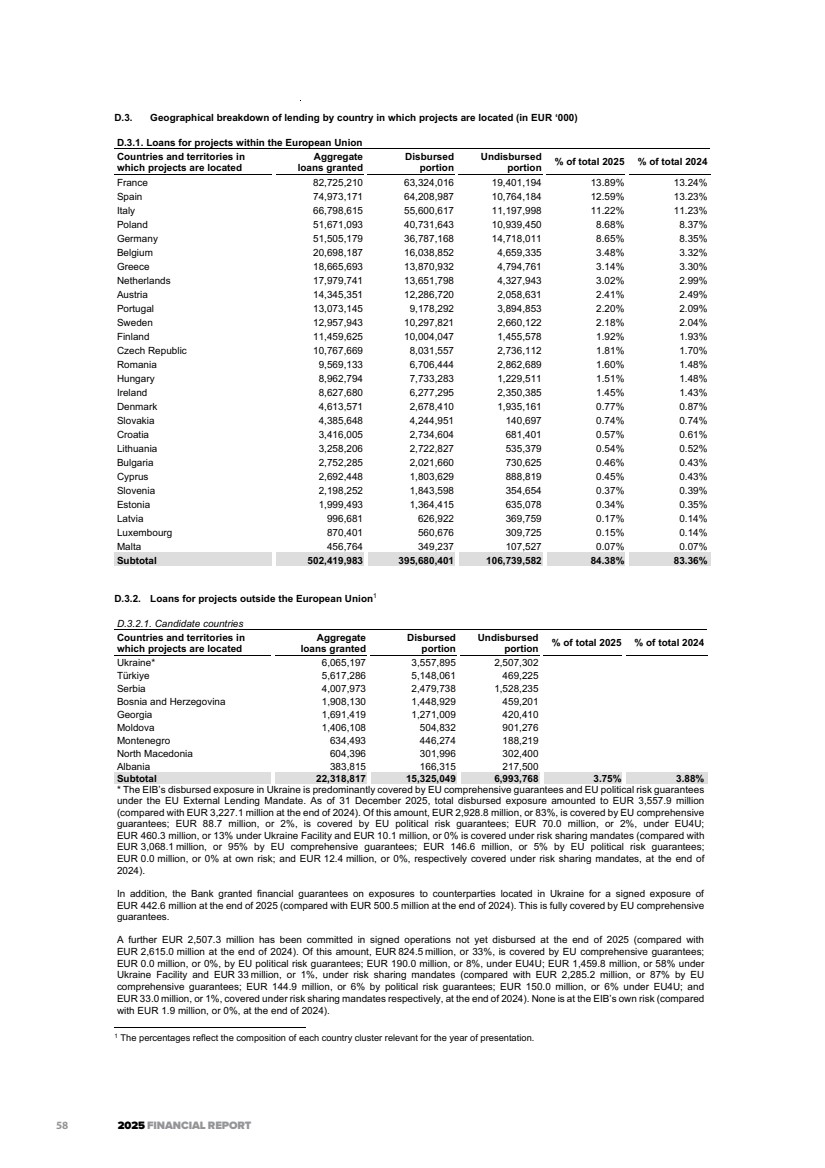
| estatutory f 21 D.3.2.2. African, Caribbean and Pacific (‘ACP’) states Countries and territories in which projects are located Aggregate loans granted Disbursed portion Undisbursed portion % of total 2025 % of total 2024 Regional - Africa 1,771,162 640,409 1,130,753 Nigeria 927,414 61,974 865,440 Senegal 733,890 402,231 331,659 Guinea 661,463 190,610 470,853 Benin 520,655 222,865 297,790 Kenya 465,424 227,628 237,796 Côte d'Ivoire 453,107 234,662 218,445 Zambia 403,677 199,483 204,194 Tanzania 379,295 272,832 106,463 Madagascar 345,294 198,236 147,058 Cabo Verde 344,377 34,317 310,060 Malawi 302,325 195,855 106,470 Rwanda 296,973 67,709 229,264 Mauritania 292,272 69,116 223,156 Regional - West Africa 263,943 120,706 143,237 Ghana 262,572 32,799 229,773 Uganda 245,593 132,107 113,486 Cameroon 183,207 34,207 149,000 Mozambique 176,922 57,114 119,808 Chad 156,200 66,153 90,047 Angola 147,774 48,359 99,415 Lesotho 133,862 56,612 77,250 Regional - ACP 121,250 0 121,250 Guinea-Bissau 105,000 0 105,000 Regional - Caribbean 100,000 0 100,000 Dominican Republic 94,544 30,056 64,488 The Gambia 87,100 59,747 27,353 Burkina Faso 84,336 73,674 10,662 Djibouti 79,200 0 79,200 Barbados 69,453 18,871 50,582 Burundi 66,798 66,798 0 Fiji 61,826 13,761 48,065 Liberia 47,605 27,605 20,000 Papua New Guinea 41,074 41,074 0 Mali 37,460 31,510 5,950 Ethiopia 36,005 36,005 0 São Tomé and Príncipe 32,940 24,500 8,440 Seychelles 32,291 19,791 12,500 Eswatini 31,196 31,196 0 Niger 30,827 30,827 0 Congo 26,000 0 26,000 Saint Lucia 13,500 0 13,500 Togo 12,017 12,017 0 Democratic Republic of the Congo 11,862 11,862 0 Sierra Leone 10,000 0 10,000 Namibia 4,523 4,523 0 Belize 142 142 0 Dominica 95 95 0 Subtotal 10,704,445 4,100,038 6,604,407 1.80% 1.68% 59 |
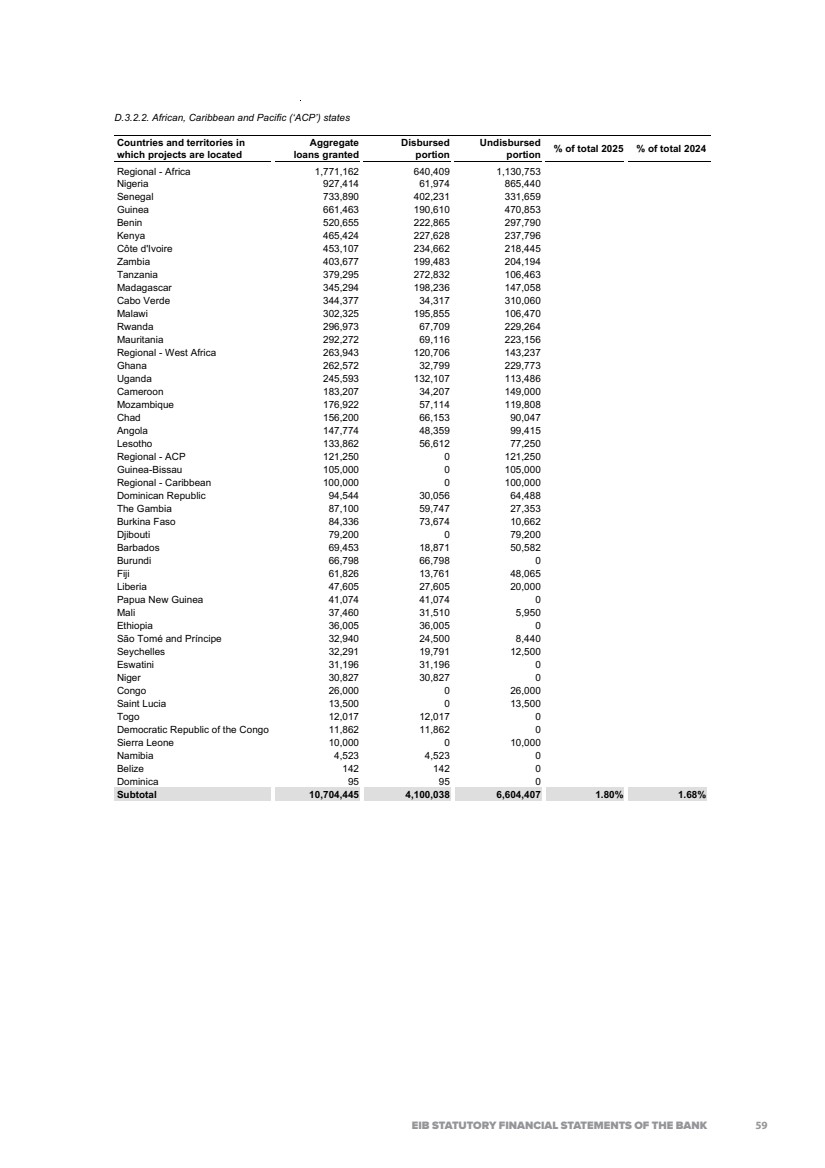
| 2025 FINANCIAL REPORT 22 D.3.2.3. Asia Countries and territories in which projects are located Aggregate loans granted Disbursed portion Undisbursed portion % of total 2025 % of total 2024 India 4,843,914 2,606,861 2,237,053 China 1,668,744 1,156,182 512,562 Bangladesh 942,108 249,108 693,000 Regional - Asia 471,741 207,901 263,840 Viet Nam 332,009 109,009 223,000 Cambodia 289,734 131,474 158,260 Uzbekistan 284,683 177,483 107,200 Nepal 272,158 172,424 99,734 Kazakhstan 242,219 219 242,000 Laos 168,019 111,989 56,030 Bhutan 150,000 0 150,000 Kyrgyzstan 121,000 82,300 38,700 Sri Lanka 114,180 72,207 41,973 Pakistan 110,000 10,000 100,000 Mongolia 108,064 63,154 44,910 Tajikistan 102,035 72,035 30,000 Maldives 99,180 62,910 36,270 Regional - Central Asia 45,450 0 45,450 Subtotal 10,365,238 5,285,256 5,079,982 1.74% 1.75% D.3.2.4. Potential candidate countries Countries and territories in which projects are located Aggregate loans granted Disbursed portion Undisbursed portion % of total 2025 % of total 2024 Kosovo(*) 181,064 79,464 101,600 Subtotal 181,064 79,464 101,600 0.03% 0.03% (*) This designation is without prejudice to positions on status and is in line with UNSCR 1244/1999 and the ICJ Opinion on the Kosovo declaration of independence. D.3.2.5. Latin America Countries and territories in which projects are located Aggregate loans granted Disbursed portion Undisbursed portion % of total 2025 % of total 2024 Brazil 1,808,827 1,708,827 100,000 Regional - Latin America 1,283,687 746,267 537,420 Ecuador 816,851 520,423 296,428 Colombia 735,735 539,990 195,745 Costa Rica 431,907 48,928 382,979 Argentina 423,961 189,338 234,623 Panama 358,187 269,007 89,180 Chile 348,264 161,030 187,234 Mexico 291,502 141,502 150,000 Nicaragua 252,088 191,636 60,452 Paraguay 130,408 102,121 28,287 Bolivia 93,212 92,679 533 Honduras 53,739 53,739 0 El Salvador 31,611 31,611 0 Subtotal 7,059,979 4,797,098 2,262,881 1.19% 1.17% D.3.2.6. European Free Trade Association (‘EFTA’) countries Countries and territories in which projects are located Aggregate loans granted Disbursed portion Undisbursed portion % of total 2025 % of total 2024 Norway 616,569 553,291 63,278 Iceland 572,774 367,774 205,000 Switzerland 77,666 72,500 5,166 Subtotal 1,267,009 993,565 273,444 0.21% 0.23% 60 |
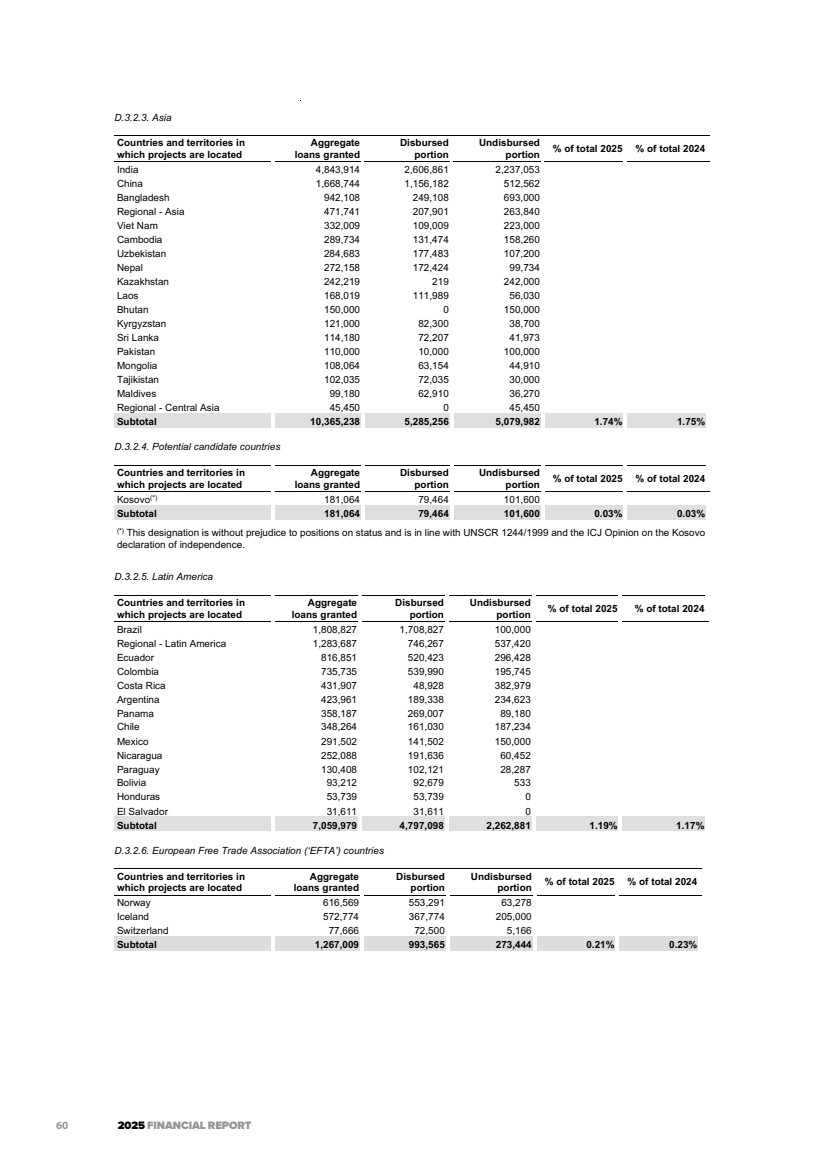
| estatutory f 1 D.3.2.7. Mediterranean countries Countries and territories in which projects are located Aggregate loans granted Disbursed portion Undisbursed portion % of total 2025 % of total 2024 Egypt 5,236,660 3,114,665 2,121,995 Morocco 5,176,059 2,893,707 2,282,352 Tunisia 2,402,754 1,407,655 995,099 Jordan 1,672,328 811,068 861,260 Israel(*) 1,665,644 1,253,263 412,381 Palestine(**) 702,449 661,233 41,216 Lebanon(***) 340,968 164,468 176,500 Algeria 162,950 162,950 0 Regional - Mediterranean 39,590 9,590 30,000 Syria 15,300 15,300 0 Subtotal 17,414,702 10,493,899 6,920,803 2.92% 3.31% (*) The EIB’s total disbursed exposure in Israel amounted to EUR 1,253.3 million at the end of 2025 (compared to EUR 1,211.1 million at the end of 2024), of which EUR 238.2 million, or 19%, is secured by EU Political Risk Guarantees, EUR 1,010.8 million, or 81%, is at the EIB’s own risk and EUR 4.3 million, or 0%, is covered under Risk Sharing Mandates (compared to EUR 279.5 million, or 23%, EUR 927.3 million, or 77% and EUR 4.3 million, or 0% respectively, at the end of 2024). A further EUR 412.4 million has been committed in signed operations not yet disbursed at the end of 2025 (compared to EUR 584.1 million at the end of 2024), of which EUR 408.9 million, or 99%, is at the EIB’s own risk and EUR 3.5 million, or 1%, under Risk Sharing Mandates (compared to EUR 580.6 million, or 99% and EUR 3.5 million, or 1% respectively, at the end of 2024). (**) The EIB’s total disbursed exposure in Palestine (This designation shall not be construed as recognition of a State of Palestine and is without prejudice to the individual positions of the EU Member States on this issue.) amounted to EUR 661.2 million at the end of 2025 (compared to EUR 297.6 million at the end of 2024), of which EUR 657.9 million, or 99%, is secured by EU Comprehensive Guarantees and EUR 3.4 million, or 1%, under Risk Sharing Mandates (compared to EUR 291.2 million, or 98%, secured by EU Comprehensive Guarantees and EUR 6.4 million, or 2%, under Risk sharing Mandates, at the end of 2024). A further EUR 41.2 million has been committed in signed operations not yet disbursed, which is fully secured by EU Comprehensive Guarantees (compared to EUR 77.5 million at the end of 2024, also fully secured by EU Comprehensive Guarantees). (***) The EIB’s total disbursed exposure in Lebanon amounted to EUR 164.5 million at the end of 2025 (compared to EUR 228.6 million at the end of 2024). This exposure is fully secured by EU comprehensive guarantees. A further EUR 176.5 million has been committed in signed operations not yet disbursed (compared to EUR 476.6 million at the end of 2024). This exposure is fully secured by EU comprehensive guarantees. D.3.2.8. Overseas countries and territories (‘OCT’) Countries and territories in which projects are located Aggregate loans granted Disbursed portion Undisbursed portion % of total 2025 % of total 2024 Sint Maarten 42,553 42,553 0 New Caledonia 41,054 41,054 0 Greenland 10,000 0 10,000 French Polynesia 5,875 5,875 0 Subtotal 99,482 89,482 10,000 0.02% 0.02% D.3.2.9. Eastern Europe, Southern Caucasus Countries and territories in which projects are located Aggregate loans granted Disbursed portion Undisbursed portion % of total 2025 % of total 2024 Armenia 1,003,540 576,482 427,058 Azerbaijan 9,458 9,458 0 Subtotal 1,012,998 585,940 427,058 0.17% 0.21% D.3.2.10. United Kingdom Countries and territories in which projects are located Aggregate loans granted Disbursed portion Undisbursed portion % of total 2025 % of total 2024 United Kingdom 21,488,141 21,488,141 0 Subtotal 21,488,141 21,488,141 0 3.61% 4.17% D.3.2.11. South Africa Countries and territories in which projects are located Aggregate loans granted Disbursed portion Undisbursed portion % of total 2025 % of total 2024 South Africa 1,052,873 257,533 795,340 Subtotal 1,052,873 257,533 795,340 0.18% 0.19% 61 |
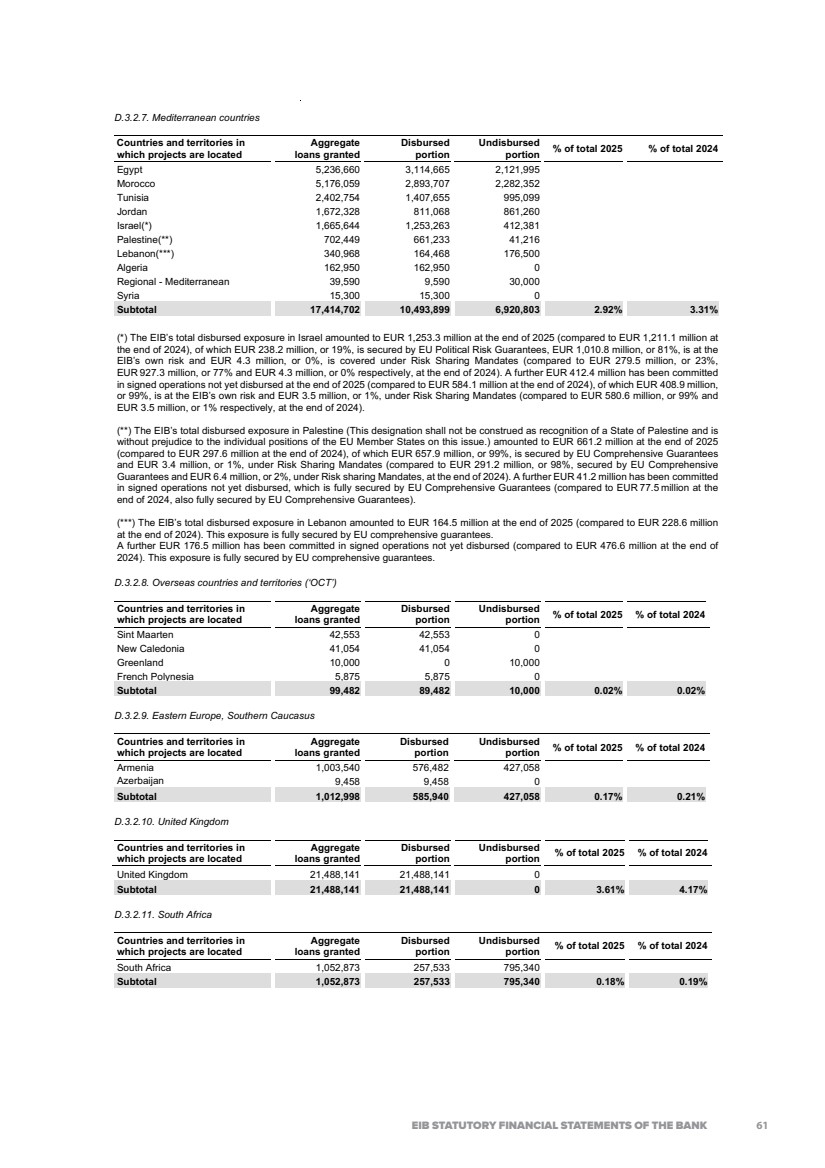
| 2025 FINANCIAL REPORT 24 D.3.2.12. Non-candidate countries Countries and territories in which projects are located Aggregate loans granted Disbursed portion Undisbursed portion % of total 2025 % of total 2024 Faroe Islands 10,000 0 10,000 Subtotal 10,000 0 10,000 0.00% 0.00% Total loans for projects outside the European Union 92,974,748 63,495,465 29,479,283 15.62% 16.64% Total loans 2025(1) 595,394,731 459,175,866 136,218,865 100.00% Total loans 2024(1) 587,185,818 457,075,096 130,110,722 100.00% (1) Including loan substitutes (Notes B.2 and D.1), excluding loan instalments receivables (2025: EUR 623 million, 2024: EUR 601 million). D.4. Provisions in respect of guarantee operations A provision for guarantees issued has been recognised corresponding to the loss for which the Bank is expected to be liable towards the beneficiaries. This provision amounts to EUR ‘000 78,929 as at 31 December 2025 (2024: EUR ‘000 76,303). Note E – Shares and other variable-yield securities, participating interests and shares in affiliated undertakings (EUR ‘000) E.1. Shares and other variable-yield securities and participating interests Participating interests Shares and other variable-yield securities Private Equity and Venture Capital Operations(1) Private Equity and Venture Capital Operations(1) EBRD shares(2) Equity investments and Infrastructure funds(1) Other equity investments Total(3) Cost: At 1 January 2025 507,492 6,178,591 278,520 4,112,310 626 10,570,047 Additions(4) 37,951 1,012,658 0 685,393 1,702 1,699,753 Reflows/Terminations(4) -37,003 -744,632 0 -513,111 -32 -1,257,775 At 31 December 2025 508,440 6,446,617 278,520 4,284,592 2,296 11,012,025 Value adjustments: At 1 January 2025 -30,713 -430,119 0 -171,652 0 -601,771 Additions -7,515 -138,095 0 -103,890 -811 -242,796 Releases 523 64,246 0 42,327 0 106,573 At 31 December 2025 -37,705 -503,968 0 -233,215 -811 -737,994 Net book value: At 31 December 2025 470,735 5,942,649 278,520 4,051,377 1,485 10,274,031 At 31 December 2024 476,779 5,748,472 278,520 3,940,658 626 9,968,276 (1) The amounts signed but not yet disbursed disclosed off-balance sheet: In relation to “Shares and other variable-yield securities” and “Participating interests” are respectively: • for private equity and venture capital operations EUR ‘000 5,766,636 (2024: EUR ‘000 4,902,793); • for equity investments and infrastructure funds EUR ‘000 4,174,972 (2024: EUR ‘000 3,887,979); As at 31 December 2025, of the total Private Equity and Venture Capital Operations 99% (2024: 99%) fall under category I and II, as defined in Note A.2.7.1. (2) The amount of EUR ‘000 278,520 (2024: EUR ‘000 278,520) corresponds to the capital paid in by the Bank as at 31 December 2025 with respect to its subscription of EUR ‘000 1,021,460 (2024: EUR ‘000 1,021,460) in the capital of the European Bank for Reconstruction and Development (‘EBRD’). (3) The total amount includes only “Shares and other variable-yield securities”. (4) The “Additions” and “Reflows/Terminations” amounts include foreign exchange movements. As at 31 December 2025, the Bank holds 3.04% of the subscribed capital of the EBRD (2024: 3.30%). Based on the audited 2024 EBRD financial statements prepared in accordance with International Financial Reporting Standards, the share of underlying net equity of the Bank in EBRD amounts to EUR 770 million. In EUR million % held Total own funds Total net result Total assets EBRD (31.12.2024)* 3.30 25,316 1,744 86,467 * The data are based on the most recent audited financial statements of the EBRD. 62 |
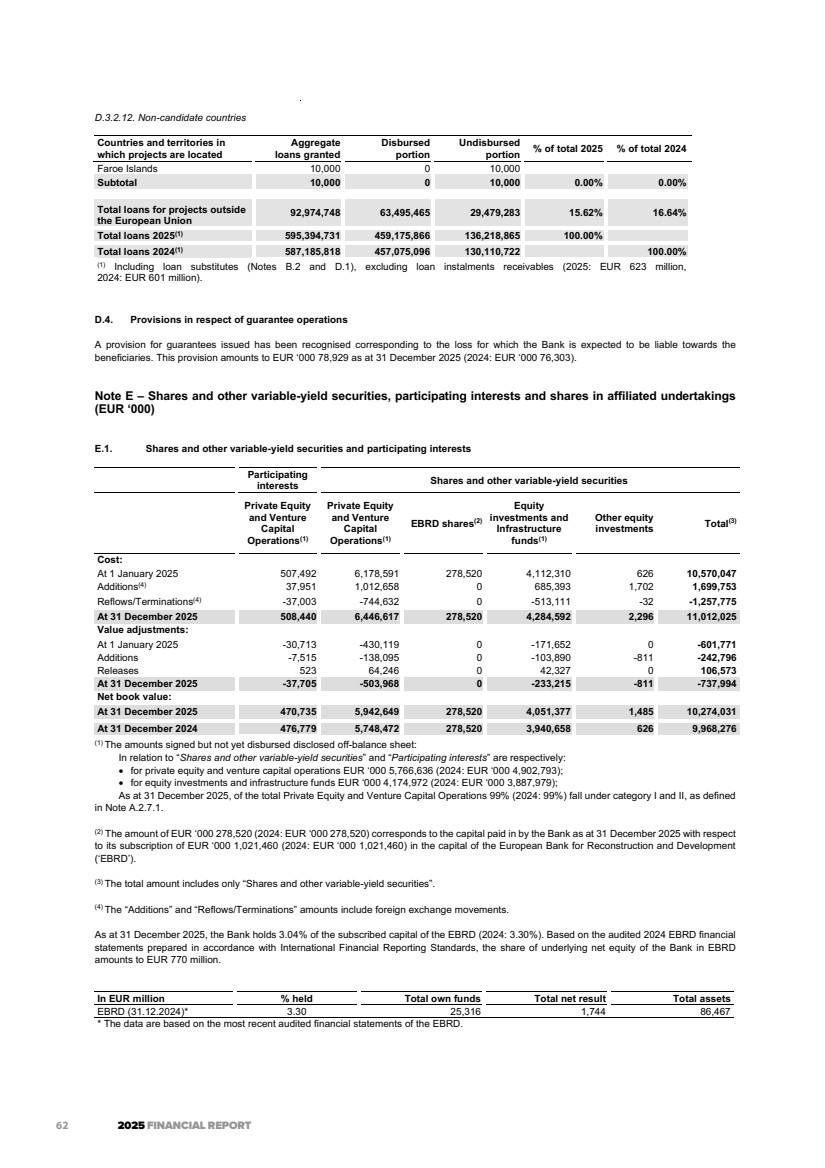
| estatutory f 25 E.2. Shares in affiliated undertakings The European Investment Fund A balance of EUR ‘000 1,578,581 (2024: EUR ‘000 1,578,169) corresponds to the amount paid in by the Bank in respect of its subscription of EUR ‘000 4,398,000 (2024: EUR ‘000 4,401,000) to the capital of the European Investment Fund (‘EIF’ or ‘Fund’), with its registered office in Luxembourg. As at 31 December 2025 the Bank holds 59.67% (2024: 59.72%) of the subscribed capital of the EIF amounting to EUR 7.4 billion (2024: EUR 7.4 billion). In 2025, the Bank purchased 5 shares for a price of EUR 620,389 per share and sold 8 shares for a price of EUR 656,649 per share. As a result, as at 31 December 2025 the Bank holds 4,398 shares in the EIF (2024: 4,401 shares). Under the terms of a replacement share purchase undertaking (“RSPU”) with respect to the 782 EIF shares subscribed by the EIF’s minority shareholders, the EIB is offering to buy these shares at any time under the RSPU at a price per share of currently EUR 656,648.78. This price corresponds to the part of each share in the called capital of the EIF, increased by the share premium account, the statutory reserves, the retained earnings, the fair value reserve and the profit for the year, adjusted by the dividend for the year. The agreed formula is applied to the approved and audited annual accounts of the EIF for the financial year in which the option is exercised. The nominal value of EUR ‘000 513,499 (2024: EUR ‘000 483,283) of the put option granted to this minority shareholder group, shown off-balance sheet, has been calculated on the basis of the 2024 audited EIF statutory accounts prepared according to the International Financial Reporting Standards as adopted by the EU. In EUR ‘000 % held Total own funds Total net result Total assets EIF (31.12.2024)* 59.72 4,865,812 279,773 7,788,711 EIF (31.12.2025)** 59.67 5,127,085 232,767 9,022,626 * The data are based on the most recent audited financial statements of the EIF. ** The data are based on the preliminary unaudited financial statements of the EIF. Note F – Intangible and tangible assets (in EUR ‘000) Land Luxembourg buildings Furniture and equipment Total tangible assets Total intangible assets Cost: At 1 January 2025 20,145 527,201 83,705 631,051 179,492 Additions 0 116,343 24,989 141,332 90,629 Disposals 0 0 -29,783 -29,783 -36,746 At 31 December 2025 20,145 643,544 78,911 742,600 233,375 Accumulated depreciation/amortisation: At 1 January 2025 0 -243,470 -37,841 -281,311 -49,685 Depreciation/amortisation 0 -8,376 -25,416 -33,792 -64,362 Disposals 0 0 29,783 29,783 36,729 At 31 December 2025 0 -251,846 -33,474 -285,320 -77,318 Carrying amount: At 31 December 2025 20,145 391,698 45,437 457,280 156,057 At 31 December 2024 20,145 283,731 45,864 349,740 129,807 The Luxembourg buildings category includes costs relating to the construction of a new building for an amount of EUR ’000 287,099 (2024: EUR ’000 184,312), which is expected to be completed in 2027. The ongoing internally generated projects captured under intangible assets amount to EUR ‘000 77,169 at end of 2025 (2024: EUR ‘000 66,688). 63 |
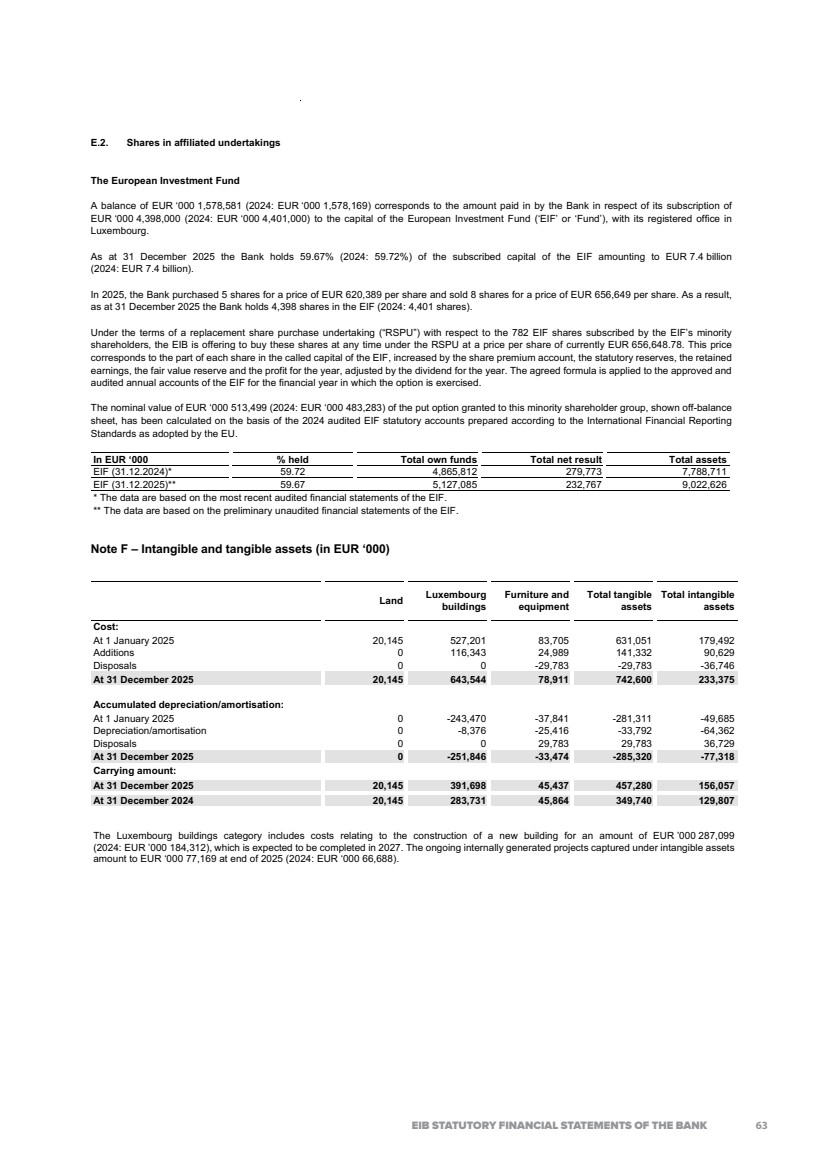
| 2025 FINANCIAL REPORT 1 Note G – Other assets and Other liabilities (in EUR ‘000) Other assets 31.12.2025 31.12.2024 Guarantee call receivable 162,049 95,472 InvestEU receivable 102,849 84,310 Accounts receivable and sundry debtors 143,628 237,371 Fair value of derivatives 26,479 41,496 EGF management fee receivable 2,874 4,862 Advances on salaries and allowances 1,287 1,094 Other 2,220 2,551 Total 441,386 467,156 Other liabilities 31.12.2025 31.12.2024 Capital repayable to the UK(*) 1,695,904 1,995,904 Optional Supplementary Provident Scheme (Note L) 980,263 880,107 First Loss Piece Contribution(***) 544,095 416,248 EIF Pension Plan 445,319 383,298 Accounts payable and sundry creditors 196,928 180,292 Capital increase payable to the EBRD(**) 96,816 121,020 Personnel costs payable 85,898 75,301 Transitory account on loans 85,098 180,258 Fair value of derivatives 21,193 36,179 Payable on HIPC initiative(****) 13,596 13,596 Western Balkans infrastructure fund 97 97 Other 37,770 141,600 Total 4,202,977 4,423,900 (*) In accordance with the Article 150(4) of the Agreement on the withdrawal of the United Kingdom of Great Britain and Northern Ireland from the European Union and the European Atomic Energy Community, and as amended by COUNCIL DECISION (EU) 2020/769 of 10 June 2020, the EIB will repay to the UK EUR 3.5 billion of paid-in capital in twelve annual instalments starting with 15 October 2020 (the first eleven instalments will be EUR 300,000,000 each and the final one will be EUR 195,903,950). The instalments due up to and including 15 October 2025 were settled in full. (**) In September 2024 the Bank subscribed to 12,102 additional paid-in shares in the capital of the EBRD, nominal value of EUR ‘000 10 each, with total value of EUR ’000 121,020, payable in five equal annual instalments starting on 30 April 2025 (Note E.1). Four payments are still outstanding as of the year end. (***) Contribution related to First loss piece ('FLP'). FLP is a form of portfolio-based collateral under which all the losses incurred on a portfolio of exposures are absorbed by the FLP, until it has been fully exhausted. Only after that point the more senior tranches can incur some losses too. (****) Heavily Indebted Poor Countries (‘HIPC’) initiative. 64 |
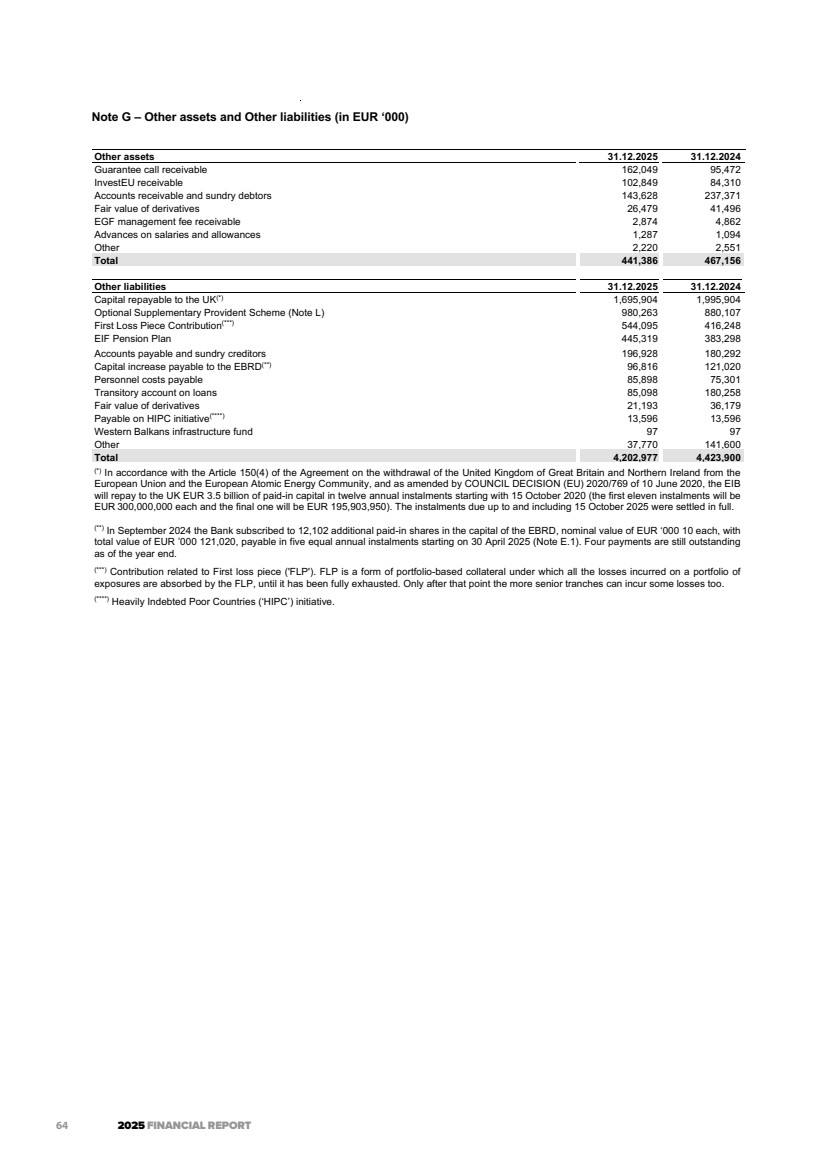
| estatutory f 27 Note H – Subscription to the capital of the Bank, own funds and appropriation of prior year’s profit H.1. Statement of Subscriptions to the Capital of the Bank (in EUR) As at 31 December 2025 and 31 December 2024 Member States Subscribed capital Uncalled capital(*) Called capital Germany 46,722,369,149 42,555,081,742 4,167,287,407 France 46,722,369,149 42,555,081,742 4,167,287,407 Italy 46,722,369,149 42,555,081,742 4,167,287,407 Spain 28,033,421,847 25,533,049,371 2,500,372,476 Belgium 12,951,115,777 11,795,972,691 1,155,143,086 Netherlands 12,951,115,777 11,795,972,691 1,155,143,086 Poland 11,366,679,827 10,352,856,629 1,013,823,198 Sweden 8,591,781,713 7,825,458,763 766,322,950 Denmark 6,557,521,657 5,972,639,556 584,882,101 Austria 6,428,994,386 5,855,575,961 573,418,425 Finland 3,693,702,498 3,364,251,741 329,450,757 Greece 3,512,961,713 3,199,631,688 313,330,025 Portugal 2,263,904,037 2,061,980,655 201,923,382 Czech Republic 2,206,922,328 2,010,081,290 196,841,038 Hungary 2,087,849,195 1,901,628,594 186,220,601 Ireland 1,639,379,073 1,493,158,667 146,220,406 Romania 1,639,379,073 1,493,158,667 146,220,406 Croatia 1,062,312,542 967,562,174 94,750,368 Slovakia 751,236,149 684,231,479 67,004,670 Slovenia 697,455,090 635,247,290 62,207,800 Bulgaria 510,041,217 464,549,338 45,491,879 Lithuania 437,633,208 398,599,585 39,033,623 Luxembourg 327,878,318 298,634,014 29,244,304 Cyprus 321,508,011 292,831,891 28,676,120 Latvia 267,076,094 243,254,895 23,821,199 Estonia 206,248,240 187,852,433 18,395,807 Malta 122,381,664 111,466,131 10,915,533 Total 248,795,606,881 226,604,891,420 22,190,715,461 (*) Can be called by decision of the Board of Directors to such extent as may be required for the Bank to meet its obligations. 65 |
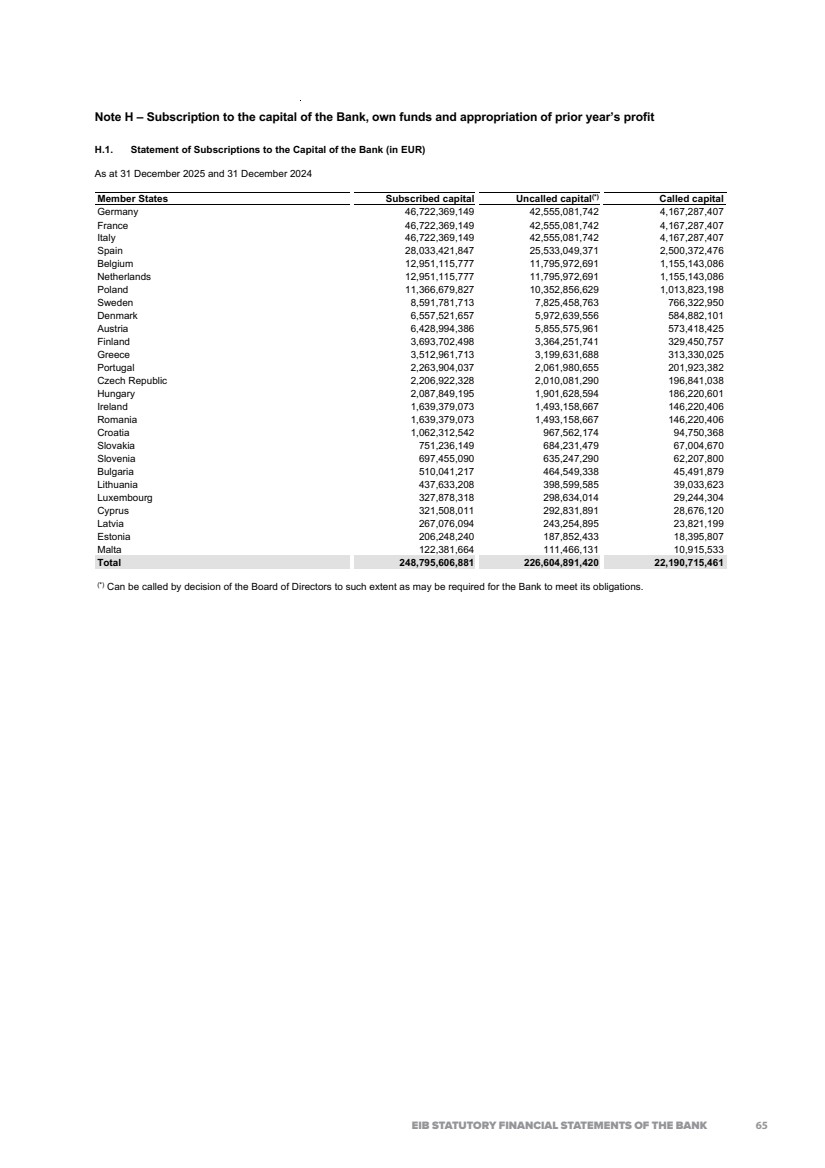
| 2025 FINANCIAL REPORT 28 H.2. Own funds and appropriation of prior year’s profit (in EUR ‘000) Statement of movements in own funds 2025 2024 Share capital: - Subscribed capital(2) 248,795,607 248,795,607 - Uncalled capital(2) -226,604,892 -226,604,892 - Called capital 22,190,715 22,190,715 Reserves and profit for the year: Reserve fund: - Balance at beginning of the year 24,879,561 24,879,561 - Balance at end of the year 24,879,561 24,879,561 Additional reserves: - Balance at beginning of the year 18,692,683 18,287,284 - Appropriation of prior year's profit(1) 1,327,921 405,399 - Balance at end of the year 20,020,604 18,692,683 Special activities reserve: - Balance at beginning of the year 12,665,555 11,194,601 - Appropriation of prior year's profit(1) 1,349,600 1,470,954 - Balance at end of the year 14,015,155 12,665,555 General loan reserve: - Balance at beginning of the year 2,281,423 1,883,372 - Appropriation of prior year's profit(1) 213,954 398,051 - Balance at end of the year 2,495,377 2,281,423 Profit for the financial year 2,725,405 2,891,475 Total own funds 86,326,817 83,601,412 (1) On 25 April 2025 the Board of Governors decided to appropriate the profit of the Bank for the year ended 31 December 2024, which amounted to EUR ‘000 2,891,475, to the additional reserves, the special activities reserve and the general loan reserve. The fact that amounts are being released from/added to the general loan reserve or the special activities reserve is the consequence of the evolution of the risks of the underlying operations. (2) Please refer to Note H.3. H.3. Subscribed capital and reserves, called but not paid (in EUR ‘000) Following the Asymmetrical Capital Increase on 1 March 2020 of the Member States Poland and Romania, the contributions to the subscribed capital called and to the reserves stood at EUR 5,386,000,000 and EUR 125,452,381, respectively. The total amount to be paid by the Member States was equally spread over ten semi-annual instalments due on 31 December 2020, 30 June 2021, 31 December 2021, 30 June 2022, 31 December 2022, 30 June 2023, 31 December 2023, 30 June 2024, 31 December 2024 and 30 June 2025. All instalments were settled in full, therefore the amount in the balance sheet under the caption “Subscribed capital and reserves, called but not paid” for the year ended 31 December 2025 is nil. 31.12.2025 31.12.2024 Subscribed capital called but not paid (Poland and Romania) 0 49,157 Reserves called but not paid (Poland and Romania) 0 110,691 Total 0 159,848 66 |
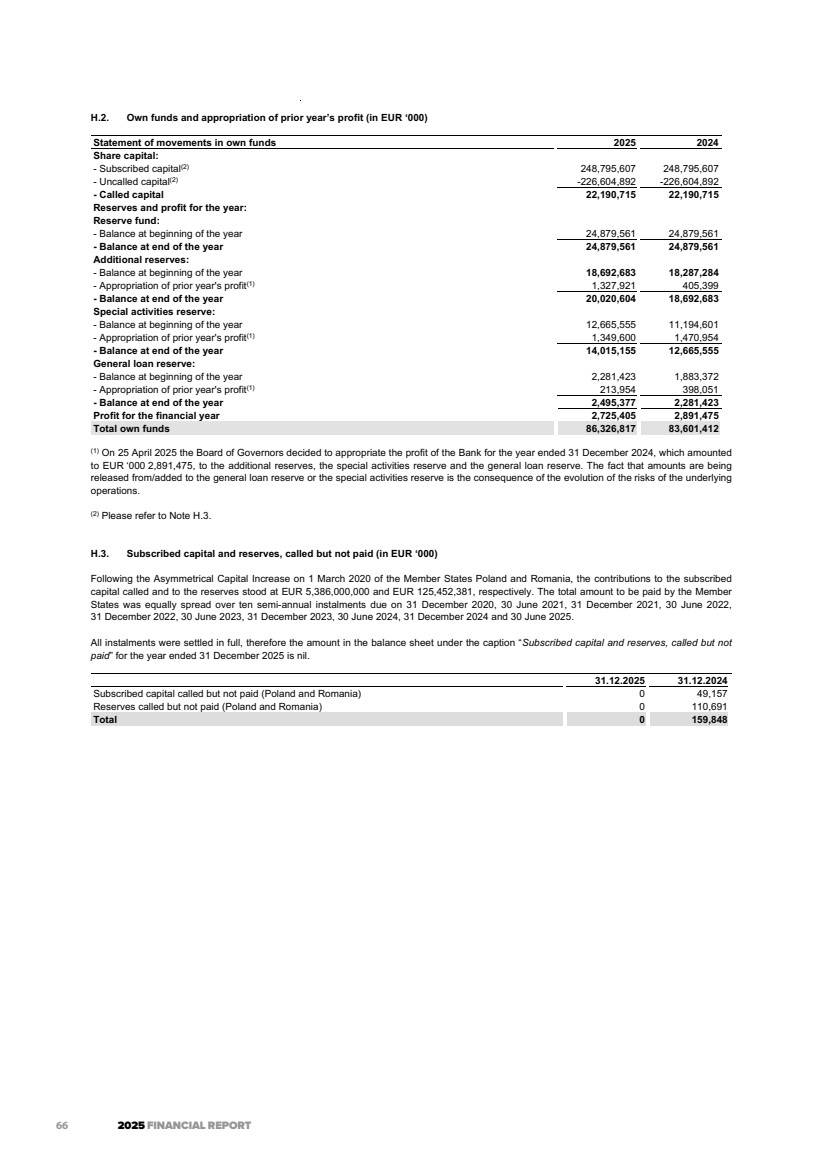
| estatutory f 29 Note I – Prepayments and accrued income and Accruals and deferred income (in EUR ‘000) Prepayments and accrued income 31.12.2025 31.12.2024 Interest and commission receivable 8,538,217 8,222,115 Impact from foreign exchange changes on currency swap contracts 2,514,956 8,850,447 Deferred borrowings and swaps charges 1,081,034 1,152,364 Mandates' commission receivable 92,091 81,690 Redemption premiums on swaps receivable(*) 0 7,173 Other 1,048 1,071 Total 12,227,346 18,314,860 Accruals and deferred income 31.12.2025 31.12.2024 Interest and commission payable 9,468,077 9,152,874 Impact from foreign exchange changes on currency swap contracts 6,311,616 5,353,772 Deferred borrowings and swaps proceeds 745,852 936,733 Deferred income on loans and guarantees 386,008 341,950 Redemption premiums on swaps payable(*) 362,646 360,802 Interest subsidies received in advance 280,558 218,771 Other 930 181 Total 17,555,687 16,365,083 (*) Redemption premiums on swaps receivable and payable represent end payments of the underlying swap agreements for those agreements which include such features. Note J – Amounts owed to credit institutions and customers (in EUR ‘000) J.1. Amounts owed to credit institutions 31.12.2025 31.12.2024 Repayable on demand 446,323 750,387 - Overnight deposits 446,323 750,387 With agreed maturity or periods of notice 984,159 107,186 - Repos with credit institutions 984,159 107,186 Total 1,430,482 857,573 J.2. Amounts owed to customers 31.12.2025 31.12.2024 Repayable on demand 4,178,811 3,096,585 - European Union and Member States' accounts: - For Special Section operations and related unsettled amounts 136,055 246,637 - Deposit accounts 4,042,756 2,849,948 With agreed maturity or periods of notice 13,146 120,487 - Short-term deposits 13,146 120,487 Total 4,191,957 3,217,072 67 |
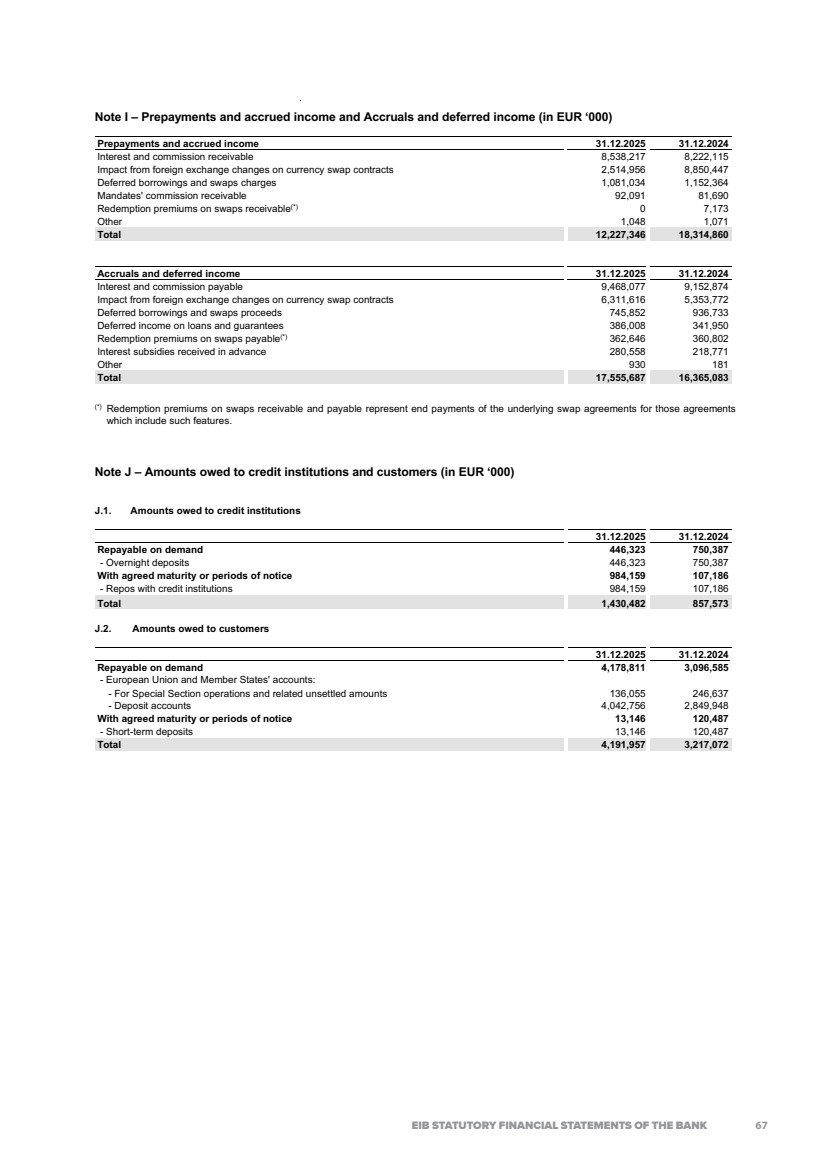
| 2025 FINANCIAL REPORT 30 Note K – Debts evidenced by certificates (in EUR ‘000) In its financing activity, one of the Bank’s objectives is to align its funding strategy with the funds required for the loans granted, notably in terms of currencies. The caption “Debts evidenced by certificates” includes “Debt securities in issue” (securities offered to the general investing public) and “Others” (private placements). The table below discloses the details of debts outstanding as at 31 December 2025 and 31 December 2024 per currency, together with the average rates and due dates (earliest/latest). Currency Carrying amount as at 31.12.2025 Average rate 2025(*) Due dates Carrying amount as at 31.12.2024 Average rate 2024(*) EUR 258,847,100 1.72 2026/2061 253,981,303 1.68 USD 107,372,339 3.41 2026/2058 115,087,825 3.03 GBP 30,910,367 3.85 2026/2054 37,075,272 3.79 PLN 9,254,916 3.34 2026/2043 9,254,971 3.63 AUD 8,372,690 3.18 2026/2040 8,670,109 3.00 SEK 4,064,594 2.21 2026/2040 4,667,510 1.98 CHF 2,550,676 2.01 2026/2037 3,039,264 2.06 NOK 2,338,934 3.52 2027/2037 2,051,717 3.32 CAD 1,985,150 2.91 2028/2045 3,298,087 2.43 ZAR 1,860,182 7.72 2026/2035 1,848,151 7.80 JPY 913,651 2.26 2026/2053 1,036,349 2.24 INR 731,085 6.88 2029/2035 179,910 7.15 DKK 645,899 0.13 2026/2031 700,495 0.53 MXN 487,736 6.86 2027/2033 686,762 7.14 NZD 355,741 3.27 2027/2028 391,215 3.27 BRL 305,843 11.38 2027/2035 54,472 9.25 CNY 291,751 2.65 2026/2026 412,749 2.77 CZK 202,281 3.83 2026/2034 202,690 3.95 HKD 97,306 3.35 2027/2030 85,517 2.47 EGP 35,858 15.75 2026/2027 37,958 15.75 GEL 26,072 8.03 2028/2028 0 0 RUB 20,317 4.25 2026/2026 16,554 4.25 RON 20,209 2.23 2026/2026 20,706 2.23 TRY 11,830 10.65 2026/2027 15,636 10.67 HUF 0 0 N/A 36,465 11.50 Total 431,702,527 442,851,687 (*) Weighted average interest rates as at the balance sheet date. The principal and interest of certain structured borrowings are index linked to stock exchange indexes (historical value: EUR 500 million in 2025; EUR 500 million in 2024). All such borrowings are fully hedged through structured swap operations. The table below provides the movements in 2025 and 2024 for debts evidenced by certificates: (In EUR million) 2025 2024 Balance as at 1 January 442,852 434,819 Issuances during the year 113,139 106,721 Contractual redemptions -107,310 -106,275 Early redemptions and buy-backs -119 -214 Exchange adjustments -16,859 7,801 Balance as at 31 December 431,703 442,852 68 |
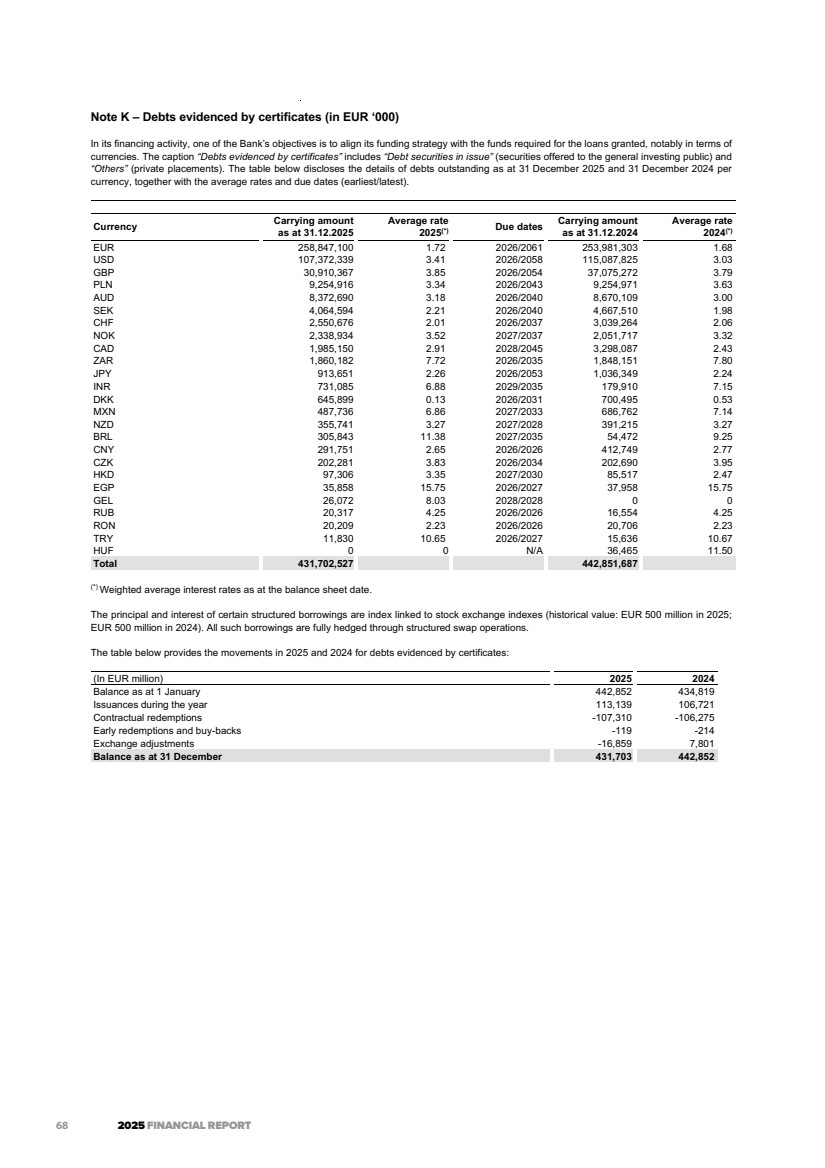
| estatutory f 31 Note L – Provisions – pension plans and health insurance scheme (in EUR ’000) The Bank's main pension scheme is a defined benefit pension scheme funded by contributions from staff and from the Bank that covers all employees. All contributions from the Bank and its staff are invested in the assets of the Bank. The pension plans and health insurance scheme provisions are as follows (in EUR ‘000): 2025 2024 Staff pension plan: Provision as at 1 January 4,421,573 4,122,209 Payments made during the year -119,581 -98,229 Recognition of actuarial losses 0 65,836 Annual contributions and interest 351,608 331,757 Subtotal staff pension plan 4,653,600 4,421,573 Management Committee pension plan Management Committee pension plan 50,435 48,355 Recognition of actuarial losses 937 1,283 Annual contributions 2,000 2,082 Subtotal Management Committee pension plan 53,372 51,720 Health insurance scheme: Provision as at 1 January 576,022 536,918 Payments made during the year -43,075 -41,334 Recognition of actuarial losses 49,134 23,897 Annual contributions and interest 59,376 56,541 Subtotal health insurance scheme 641,457 576,022 Total provisions as at 31 December 5,348,429 5,049,315 The above figures do not include the liability towards members of staff in respect of the Optional Supplementary Provident Scheme (a defined contribution pension scheme). The corresponding amount of EUR 980 million (2024: EUR 880 million) is classified under “Other liabilities” (Note G). Details of the principal assumptions used in the estimate of the defined benefit obligation are detailed below. The provision in respect of future retirement and health insurance benefits was valued as at 31 December 2025 by an independent actuary using the projected unit credit method based on membership data as at 30 September 2025 (adjusted to 31 December 2025 by estimating service accruals in the remaining 3 months of 2025) and cash flows to 31 December 2025. The actuarial valuation was updated as at 31 December 2025, using the prevailing market rates of 31 December 2025 and the following assumptions (for the staff pension and medical plans): • a discount rate of 4.37% (2024: 3.75%) for determining the actuarial present value of benefits accrued in the pension and health insurance scheme, corresponding to 19.88-year duration (2024: 20.54-year duration); • the Bank expects the remuneration of post-employment reserves to be set at a rate of 1.5% (2024: 1.5%) on top of the discount rate of 4.37%; • progressive retirement assumed between the age of 55 and 65 and depending on NRA (normal age of retirement) (2024: same assumption); • a combined average impact of the increase in the cost of living and career progression of 3.3% (2024: 3.3%); • expected annual resignation rates ranging from 27% to 1% (2024: from 27% to 1%), decreasing with age; • a rate of adjustment of pensions of 2.3% per annum (2024: 2.3%); • use of the ICSLT longevity table 2023 projected to 2025 (2024: ICSLT longevity table 2023 projected to 2024); • a medical cost inflation rate of 4.3% per annum (2024: 4.3%). The provisions for these schemes are adjusted when needed according to the actuarial valuation, as per the tables above. The actuarial valuation of the pension plans and the healthcare scheme as at 31 December 2025 revealed an unrecognised loss of EUR ‘000 920,821 (2024: EUR ‘000 1,258,820) of which EUR ‘000 298,903 (2024: EUR ‘000 637,108) was reported in excess of the 10% corridor. As there was no deficit in excess of the 10% corridor between the staff pension plan and actuarial valuation, no recognition of actuarial losses was recorded for the staff pension plan in 2025. The total amortisation recorded in the profit and loss account for 2025 amounted to EUR ‘000 50,071 (2024: EUR ‘000 91,015). Note M – Profit for the financial year The appropriation of the balance of the profit and loss account for the year ended 31 December 2025, amounting to EUR ‘000 2,725,405 will be submitted to the Board of Governors for approval by 24 April 2026. The proposed surplus for the financial year to be appropriated is as follows: • Additional reserves EUR 2,224.2 million; • Special activities reserve EUR 881.9 million; • General loan reserve EUR -380.7 million. 69 |
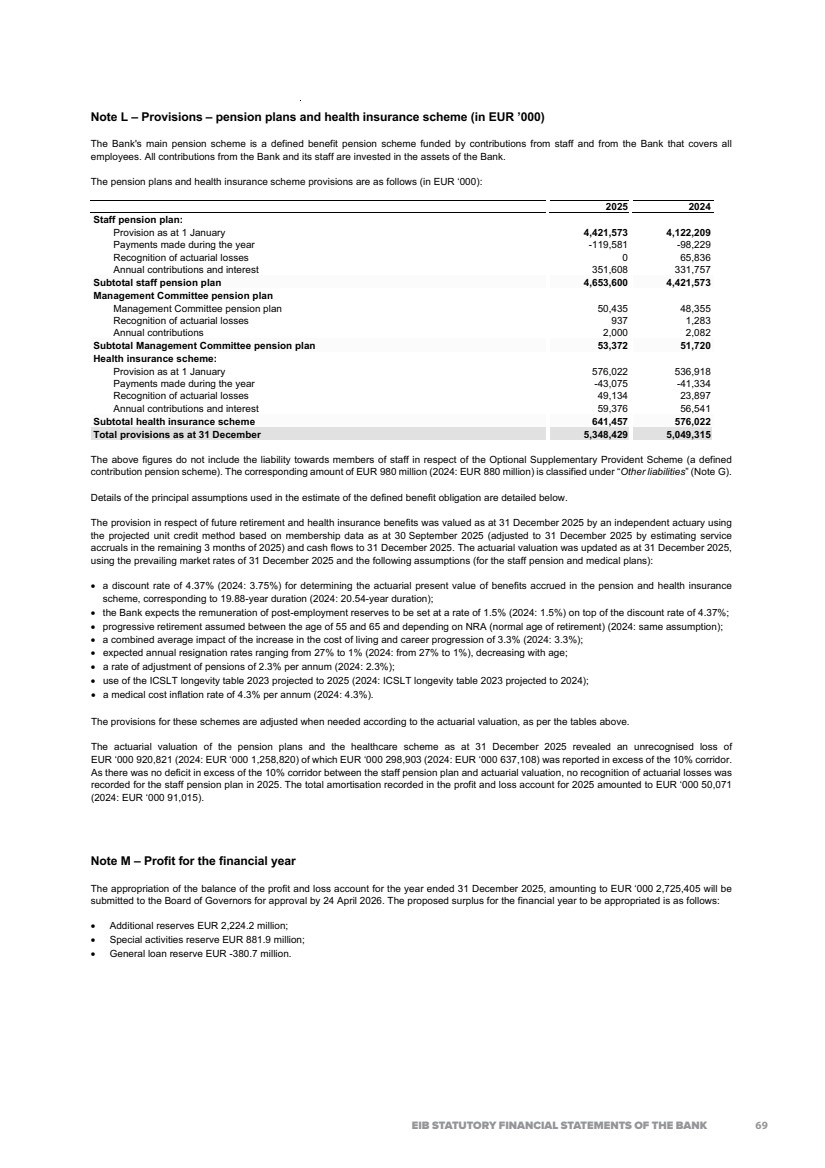
| 2025 FINANCIAL REPORT 32 Note N – Interest receivable and similar income and Interest payable and similar charges N.1. Net interest income (in EUR ‘000) 2025 2024 Interest receivable and similar income: Treasury bills and other bills eligible for refinancing with central banks and debt securities including fixed-income securities 1,642,554 1,652,461 Loans and advances to credit institutions and customers 13,419,821 15,585,871 Derivatives 9,113,867 10,122,640 Other 1,201 135 Total 24,177,443 27,361,107 Interest payable and similar charges: Amounts owed to credit institutions and customers -67,572 -92,851 Debts evidenced by certificates -11,176,052 -10,242,302 Derivatives -9,034,819 -13,149,955 Other -384,718 -362,632 Total -20,663,161 -23,847,740 Net interest income 3,514,282 3,513,367 N.2. Geographical analysis of Interest receivable and similar income (in EUR ‘000) 2025 2024 EU countries Spain 1,464,126 1,660,026 Poland 1,428,799 1,329,108 Italy 1,283,234 1,481,352 France 1,281,940 1,387,366 Germany 847,973 746,910 Belgium 479,804 397,245 Greece 415,127 445,840 Austria 342,164 355,803 Hungary 307,321 338,586 Netherlands 298,369 492,742 Sweden 297,391 431,823 Czech Republic 256,421 201,937 Finland 221,241 287,455 Romania 192,130 148,728 Portugal 191,948 254,937 Ireland 127,642 157,342 Slovakia 93,164 80,893 Denmark 83,700 90,320 Croatia 61,894 56,242 Bulgaria 61,360 41,257 Cyprus 48,777 62,895 Estonia 45,891 58,879 Slovenia 45,180 53,347 Lithuania 32,843 33,897 Latvia 18,801 30,336 Malta 11,350 9,938 Luxembourg 8,294 285,294 Total EU countries 9,946,884 10,920,498 Outside the European Union 2,422,435 2,944,172 Total income analysed per country 12,369,319 13,864,670 Income not analysed per country(1) 11,808,124 13,496,437 Total interest receivable and similar income 24,177,443 27,361,107 (1) Income not analysed per country: · Income from LTHP and loan substitutes portfolio 851,095 890,689 · Income from SLP 225,402 165,984 · Income from money-market securities 566,057 595,788 · Income from short-term investments and other operations 1,051,703 1,721,336 · Income from derivatives 9,113,867 10,122,640 11,808,124 13,496,437 70 |
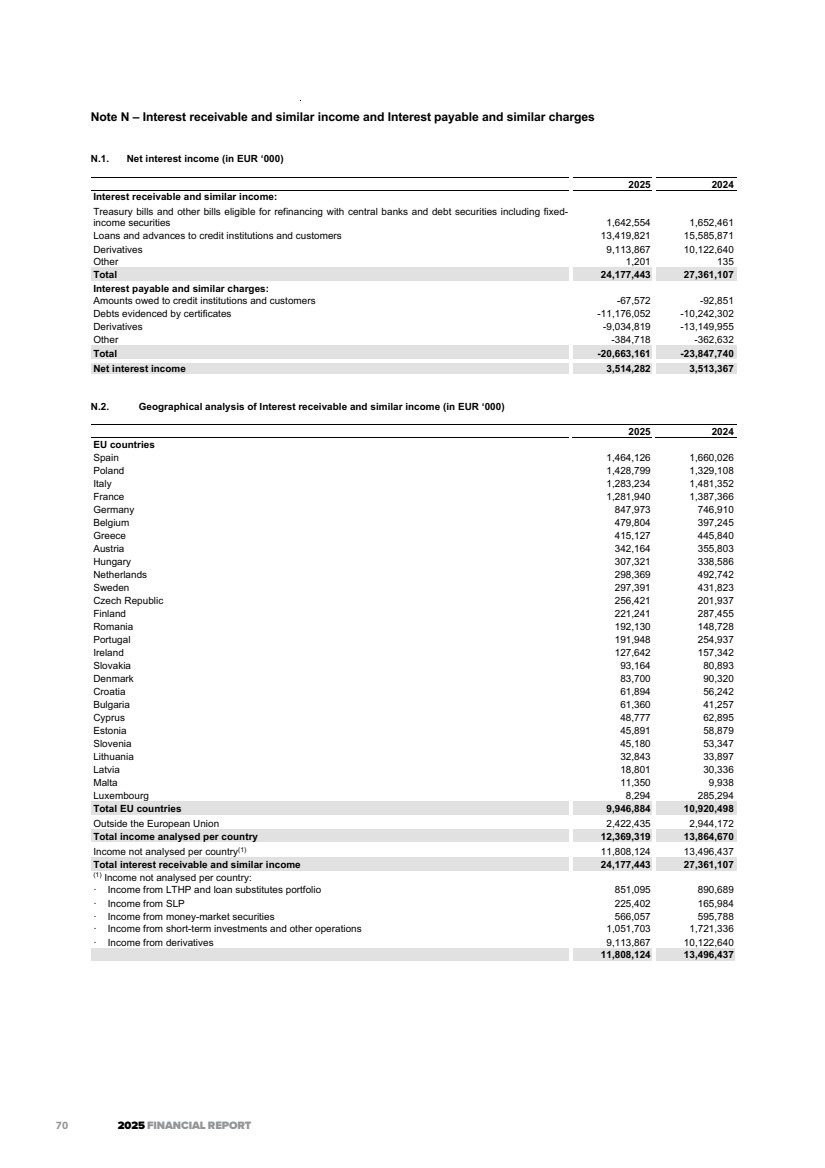
| estatutory f 33 Note O – Commissions receivable and Commissions payable (in EUR ‘000) 2025 2024 Commissions receivable: Commissions on guarantees 188,085 206,134 Commissions receivable from intra-group services 42,931 39,650 Commissions on InvestEU(*) 37,972 28,190 Commissions income on loans 36,851 37,403 Commissions on RRF 26,631 6,884 Commissions on Investment Facility - Cotonou 20,099 25,331 Commissions on DFIs (2014-20, 2021-27) 15,256 19,657 Commissions on EGF 14,821 21,561 Commissions on Modernisation Fund 12,675 13,495 Commissions on Trust Fund Management fees 6,316 3,909 Commissions on EFSI 3,091 4,986 Commissions on Innovation Fund(*) 2,853 2,331 Commissions on JESSICA Holding Funds 2,618 2,762 Commissions on Neighbourhood Investment Facility 2,588 5,142 Commissions on EU for Ukraine Fund 706 5,155 Commissions on EIC Fund 407 2,500 Commissions on other mandates(*) 31,482 24,286 Total commissions receivable 445,382 449,376 2025 2024 Commissions payable Risk remuneration for guarantees received -272,224 -287,436 Commissions payable from intra-group services -92,721 -76,137 Other commissions payable -34,655 -28,156 Total commissions payable -399,600 -391,729 (*) A reclassification was made among the captions in order to improve the readability of the financial statements. See Note A.3. Note P – Net result on financial operations (in EUR ‘000) 2025 2024 Net result on debt securities portfolios 55,235 69,409 Net result on repurchase of debts evidenced by certificates 0 -92 Net result on derivatives -6,425 15,418 Net result on translation of balance sheet positions -11,348 -4,938 Net result on shares and other variable-yield securities -160,047 -89,732 Total net result on financial operations -122,585 -9,935 Note Q – Net other operating income and expense (in EUR ‘000) 2025 2024 Technical Assistance income (*) 102,330 83,192 Technical Assistance expense (*) -61,318 -33,734 Rental income 17,205 13,672 Sale of EIF shares 2,382 1,190 Other 7,393 53 Total net other operating income and expense 67,992 64,373 (*) A reclassification was made in order to improve the readability of the financial statements. See Note A.3. 71 |
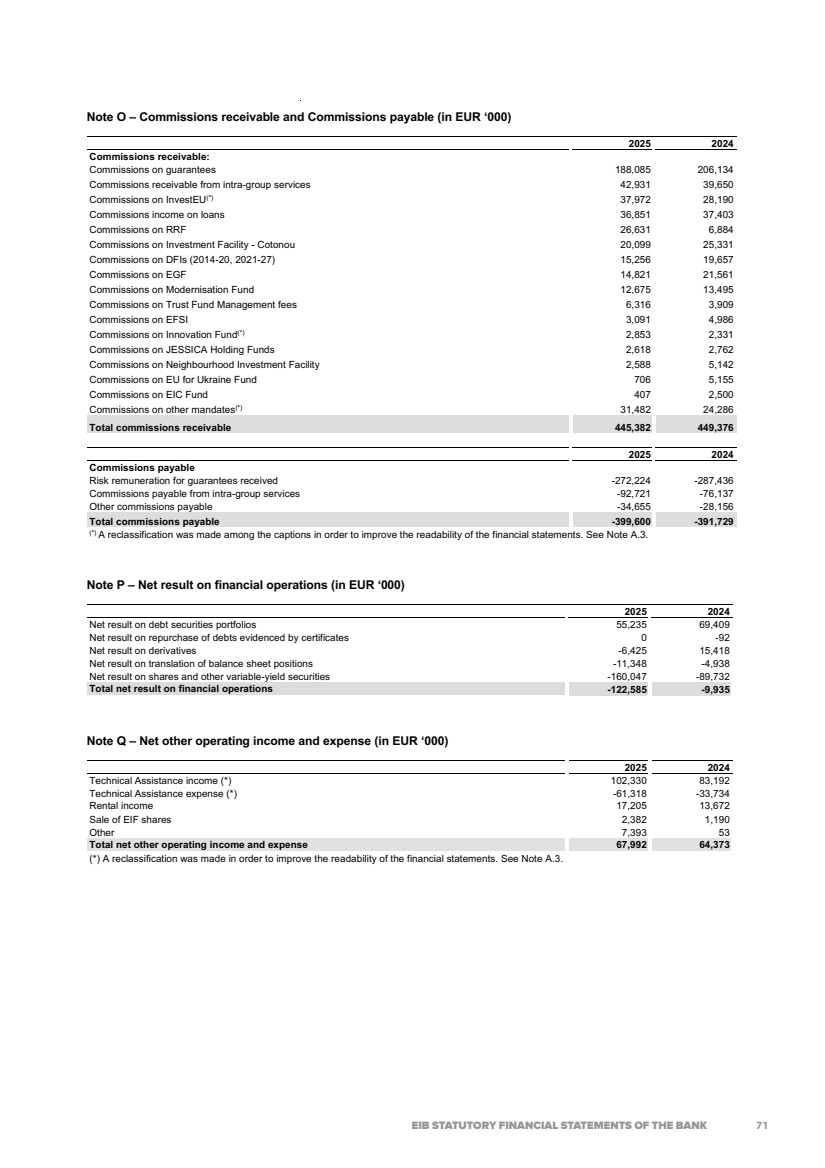
| 2025 FINANCIAL REPORT 34 Note R – General administrative expenses (in EUR ‘000) 2025 2024 Salaries and allowances(*) -639,519 -617,328 Welfare contributions and other staff costs -365,532 -384,116 Staff costs -1,005,051 -1,001,444 Other administrative expenses(**) -362,379 -375,905 Total general administrative expenses -1,367,430 -1,377,349 (*) Of which the amount for the members of the Management Committee is EUR ‘000 4,417 in 2025 (2024: EUR ‘000 3,992). (**) A reclassification was made in order to improve the readability of the financial statements. See Note A.3. The number of persons employed by the Bank was 4,377 as at 31 December 2025 (4,426 as at 31 December 2024). Note S – Off-balance sheet special deposits for servicing borrowings This item represents the amount of coupons and bonds due, paid by the Bank to the paying agents, but not yet presented for payment by the holders of bonds issued by the Bank. Note T – Fair value of financial instruments(*) At the balance sheet date, the Bank records balance sheet financial instruments on the basis of their historical cost in foreign currency (apart from the securities liquidity portfolio) representing the amount received in the event of a liability or the amount paid to acquire an asset. The fair value of the financial instruments (mainly loans, treasury securities and borrowings) entered under assets or liabilities compared with their carrying amount is shown in the table below: As at 31 December 2025 (in EUR million) Carrying amount Fair value(**) Financial assets: Cash in hand, balances with central banks and post office banks 258 258 Loans and advances to credit institutions and customers, excluding loan substitutes 474,313 506,238 Treasury bills and debt securities portfolios including loan substitutes 50,661 50,496 Shares, other variable-yield securities and participating interests 10,745 18,865 Total financial assets 535,977 575,857 Financial liabilities: Amounts owed to credit institutions and customers 5,622 5,622 Debts evidenced by certificates 431,703 423,908 Total financial liabilities 437,325 429,530 (*) Derivatives are not included in the table. Please refer to Note V. (**) Fair value including accrued interest. As at 31 December 2024 (in EUR million) Carrying amount Fair value(**) Financial assets: Cash in hand, balances with central banks and post office banks 105 105 Loans and advances to credit institutions and customers, excluding loan substitutes 477,950 474,647 Treasury bills and debt securities portfolios including loan substitutes 46,943 46,887 Shares, other variable-yield securities and participating interests 10,445 18,793 Total financial assets 535,443 540,432 Financial liabilities: Amounts owed to credit institutions and customers 4,075 4,075 Debts evidenced by certificates 442,852 431,345 Total financial liabilities 446,927 435,420 (*) Derivatives are not included in the table. Please refer to Note V. (**) Fair value including accrued interest. 72 |
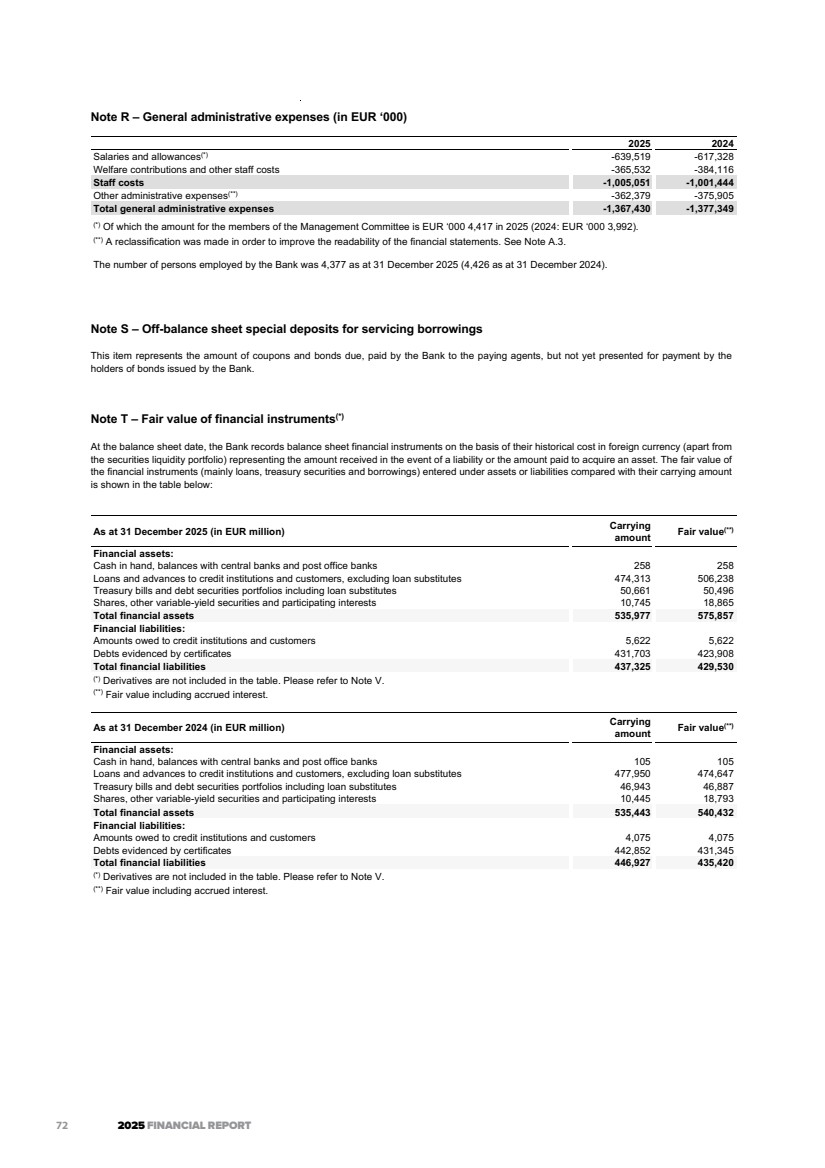
| estatutory f 35 Note U – Risk management This note presents information about the Bank’s exposure to risks and their management and control, in particular the primary risks associated with its use of financial instruments. These are: • Credit risk - the risk of loss resulting from client or counterparty default and arising from credit exposure in all forms, including settlement risk2; • Market risk - the risk of losses on financial investments caused by adverse price movements. Examples of market risk are changes in equity prices or commodity prices, interest rate moves or foreign exchange fluctuations: Ø Interest rate and credit spread risk in the banking book (IRRBB and CSRBB) - the risk to the economic value or to the net interest income arising from adverse movements in interest rates and in market credit spreads that affect interest rates and market credit spread sensitive instruments respectively. IRRBB includes gap risk, basis risk and option risk; Ø Foreign exchange risk - the risk to the economic value or to the income derived from the Bank’s positions due to adverse movements in currency exchange rates; • Liquidity and funding risk - the risk that the Bank is unable to fund assets or meet obligations at a reasonable price or, in extreme situations, at any price; • Operational risk - the risk of loss resulting from inadequate or failed internal processes, people and systems or from external events3 including, but not limited to, legal risk, model risk or information and communication technology (‘ICT’) risk, but excluding strategic and reputational risk. Risk management organisation The Bank’s objective is to analyse and manage risks so as to obtain the strongest possible protection for its assets, its financial result, and consequently its capital. While the Bank is generally not subject to the legislative acts and guidelines applicable to commercial banks issued or adopted by the EU institutions, bodies and agencies (“EU Legislative Acts and Guidelines”), it has voluntarily decided to comply with these EU Legislative Acts and Guidelines to the extent determined by its Best Banking Practice framework, including the Best Banking Practice Guiding Principles, published by the Bank. The Group Risk and Compliance Directorate (‘GR&C’) independently identifies, assesses, monitors and reports credit, market, liquidity and funding and operational risks to which the Bank is exposed. To preserve the segregation of duties and in accordance with the three lines of defence principle, GR&C is independent and provides second opinions on all proposals having risk implications. The Group has established a Group Risk Function under the responsibility of the Group Chief Risk Officer (‘GCRO’). Without prejudice to the statutory responsibilities of the President and the EIB Management Committee, respectively, the GCRO reports on Group Risks to the EIB Management Committee under the oversight of the MC member in charge of risk. The GCRO participates in all meetings of the EIB Management Committee relating to matters within his/her terms of reference and relevant meetings of the other EIB governing bodies. The Bank’s risk appetite The risk appetite is the level of risk that the EIB is willing and, in line with the EIB statutory framework, able to incur in pursuing its activities in the context of its public mission and objectives. Key to this is the EIB’s capacity to provide attractive long-term financing to serve EU objectives across all EU Member States (and beyond in partner countries). A primary pillar of the Group’s business model is the Bank’s high credit standing and its status as prime issuer in the capital markets underpinned by the long-term AAA issuer rating from the major credit rating agencies. The processes and activities performed by the Bank to manage its risk appetite are formalised in the Group Risk Appetite Framework (‘RAF’) approved by the BoD and include RAF metrics at EIB standalone level. The Group RAF covers the major financial risks including credit, liquidity and market risks, and non-financial risks including: operational risks such as people, information security, financial crime, technology, conduct, fraud, compliance and model risks and other risks such as climate change and environmental and reputational risks. It helps to embed a healthy organisational risk culture within the EIB through the implementation and monitoring of measurable risk appetite metrics, which are subject to risk and (where applicable) cascaded further down within the Bank. The EIB’s RAF metrics cover lending operations at its own risk and under risk-sharing agreements, its activities mandated to the EIF as well as its funding and treasury activities. As a public financial institution, the Bank does not focus on making profits from speculative exposures to risks. As a consequence, the Bank does not consider its activities as profit-maximising centres and does not engage in speculative operations. Investment activities are conducted within the primary objective of protection of the capital invested. The following sections disclose the credit, market, liquidity and funding and operational risks to which the Bank is exposed. For additional details, please refer to the latest annual EIB Group Risk Management Disclosure Report available on the EIB website. 2 Settlement risk is defined as the risk of potential losses due to transactions which remain unsettled after their due delivery date and/or due to transactions that are settled later than the applicable market standard. Due to the nature of the Group’s operations, the most relevant instruments affected by settlement risk are those derivatives entered into by the Bank which imply an exchange of foreign currencies. Settlement risk management is covered in the Financial Risk Guidelines. 3 The definition of external events excludes cases of client bankruptcy or unfavourable market movements or similar events, which represent triggers for credit and market risk respectively. 73 |
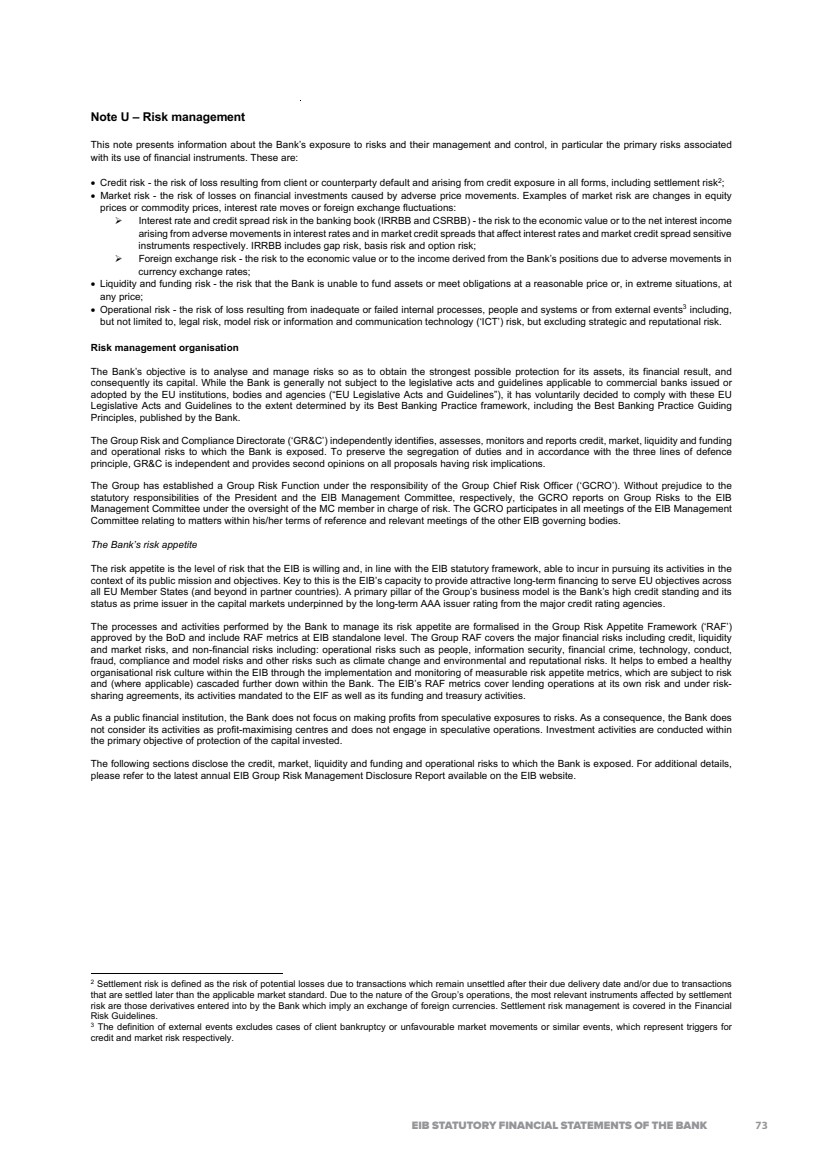
| 2025 FINANCIAL REPORT 36 Risk measurement and reporting system The Bank continuously adapts its risk management systems to changing economic conditions and evolving regulatory standards as market practice develops. Systems are in place to control and report on the main risks inherent in the Bank’s operations, i.e. credit, interest rate, liquidity and funding, foreign exchange and operational risks. To quantify their impact on the Bank’s solvency, liquidity, earnings and operations, risks are assessed and measured both under normal circumstances and under possible stressed conditions. Risk measurements consider the relevant metrics related to capitalisation, earnings, liquidity and exposure to market and non-financial risks. Information on credit, market, liquidity, financial and operational risks is reported to the Management Committee and to the Board of Directors on a monthly basis. Such information is presented and explained to the Management Committee and to the Board of Directors’ Risk Policy Committee on a regular basis. The Bank has a framework in place for managing interest rate (‘IR’) risk, as well as foreign exchange (‘FX’) risk. It monitors and manages on a daily basis its IR (gap and basis) and FX positions within pre-approved limits. All new types of transactions introducing operational or financial risks must be authorised by the Management Committee, after their approval by the New Products Committee (‘NPC’). Sustainability of revenue and self-financing capacity The Bank’s interest rate risk strategy forms an integral part of its overall financial risk management. It reflects the expectations of the main stakeholders of the Bank in terms of stability of earnings, preservation of the economic value of own funds, and the self-financing of the Bank’s growth in the long term. To achieve these aims, the interest rate risk strategy considers a medium to long-term horizon for the investment of the Bank’s own funds, in order to promote stability of revenues and to enhance overall returns. In practice, this is achieved by defining an investment profile producing a target duration for the Bank’s own funds between 4.5 and 5.5 years. In that context, the Asset & Liability Committee (‘ALCO’) performs regular checks on the investment profile related to the interest rate risk strategy framework. U.1. Credit risk Credit risk mainly concerns the Bank's lending activities, treasury instruments such as debt securities, certificates of deposit and interbank term deposits, as well as the derivative and guarantee transactions. The credit risk associated with the use of derivatives is analysed in the ‘Derivatives’ section (Note V). Credit risk within the Bank is managed in line with detailed internal guidelines. The purpose of these guidelines is to ensure the prudent management of credit risk. Whether or not a given entity is acceptable to the Bank as a counterpart in a lending operation is determined through careful analysis and evaluation of the entity using quantitative and qualitative metrics but also relying on experience and expert judgment. These guidelines establish minimum credit quality levels for borrowers and guarantors in lending operations and identify the acceptable transaction structure. They also detail the minimum requirements that loan contracts must meet in terms of key legal clauses and other contractual stipulations to ensure that the Bank's position is adequately safeguarded. Diversification of the loan portfolio is supported by a counterparty limit framework, sector limits for key industries and country thresholds for its exposures outside of the EU. To ensure that the additional risk involved in complex or structured lending transactions is adequately analysed, quantified and mitigated, specific detailed guidelines have been developed in respect of certain types of operations complementing the general guidelines. In analysing risks, the Bank applies an internal loan grading system and assigns internal ratings to counterparts. Credit guidelines undergo periodic revisions to reflect evolving operational circumstances changes in the applicable Best Banking Principles and new mandates that the Bank may receive. Despite ongoing heightened geopolitical risks and some sectors particularly affected by subdued economic development, the overall credit quality of the loan portfolio is deemed stable at present. Preserving the quality of loan portfolio is enabled by a risk management strategy, based on a robust due diligence process, adequate lending structures and security, and standard protective clauses included in the loan agreements. In addition to the collaterals and the guarantees provided for lending exposures, some of the EIB exposures benefit from credit enhancements granted as part of different mandates. In addition, the Bank established a loan portfolio monitoring framework allowing for timely risk management decisions. The aggregate amount outstanding of loans and guarantees granted by the Bank is limited at any time by its Statutory Gearing Ratio (Article 16.5 of the Statute)4. To calculate this ratio the Bank uses data drawn from the EU Accounting Directives (‘AD’) framework. At year-end 2025, the EIB’s Statutory Gearing Ratio under EU Accounting Directive stand-alone accounts stood at 213.4% (2024: 210.3%) and under EU AD consolidated accounts at 220.1% (2024: 215.9%). 4 In June 2024, the EIB Board of Governors unanimously decided to increase the Gearing Ratio of the Bank from 250% to 290%. This decision was subsequently approved by the Council of the European Union in March 2025 to enable the Bank to deliver on the priorities and goals set out in the Strategic Roadmap. The new Gearing Ratio limit entered into force in March 2025. This increase also applies to the consolidated accounts of the Bank. 74 |
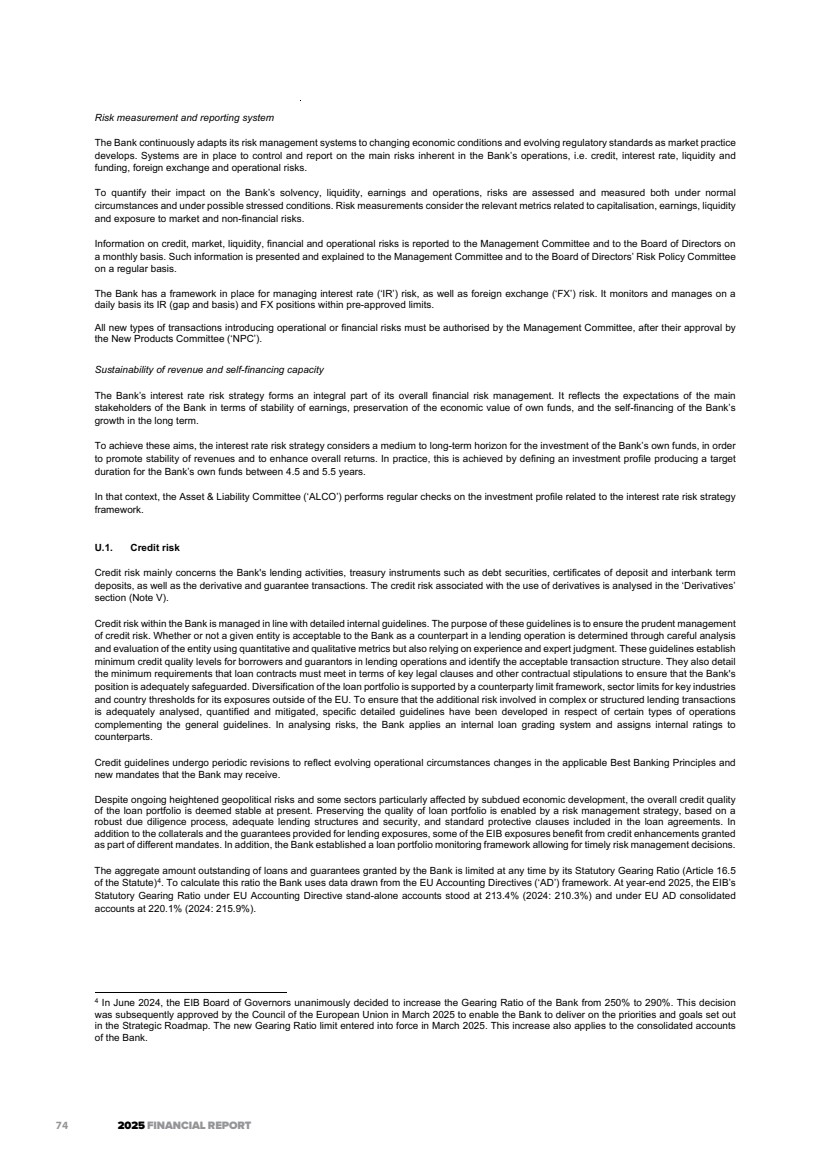
| estatutory f 37 U.1.1. Loans To assess and manage credit risk on loans, the Bank classifies its lending operations according to generally accepted criteria, based on the borrower risk profile and the transaction structure, including, where appropriate, the security and guarantees provided. The loan portfolio breakdown of types of borrowers / guarantors as at 31 December 2025 is presented below, including undisbursed exposures. The table below shows the total signed exposures per counterparty type for loans granted by the EIB, excluding those granted for projects beyond the European Union that are granted under the External Lending Mandate (‘ELM’), the European Fund for Sustainable Development (‘EFSD’), the Neighbourhood, Development and International Cooperation Instrument, the Investment Window 1 (‘NDICI IW 1’)/European Fund for Sustainable Development Plus (‘EFSD+’)5, the Ukraine Facility – Public Sector Guarantee and the Cotonou Agreement where the Bank is, as the last resort, secured by the European Union budget or by the Member States guarantees (loans in the African, Caribbean and Pacific countries and the overseas countries and territories) (*): (*) These guarantees are either comprehensive (covering all risks) or limited to defined political risks (non-transfer of currency, expropriation, war or civil disturbance, denial of justice upon breach of contract). In EUR million States Public institutions Banks Corporates Not guaranteed (1) Total 2025 Total 2024 Guarantor Borrower States 0 0 0 0 60,405 60,405 57,966 Public institutions 30,612 24,682 460 421 100,358 156,533 154,906 Banks 30,637 17,252 12,555 8,986 44,112 113,542 117,255 Corporates 9,996 5,154 5,690 39,028 137,657 197,525 187,419 Total 2025(2)(3)(4)(5) 71,245 47,088 18,705 48,435 342,532 528,005 Total 2024(2)(3)(4)(5) 71,718 47,341 18,378 50,917 329,192 517,546 (1) These amounts include loans that did not require a formal guarantee separate from the borrower and the loan itself, as the borrower’s level of solvency was deemed sufficient security. In specific circumstances, appropriate contractual clauses ensure the Bank’s right to access independent security. (2) The loans in risk-sharing operations (credit enhanced by the Member States guarantee or the EU budget in the form of a political risk guarantee) amount to EUR 995 million as at 31 December 2025 (2024: EUR 1,495 million). (3) This amount does not include signed loan substitutes (2025: EUR 19,488 million; 2024: EUR 19,811 million). (4) These amounts exclude loans to current EU Member States granted before their accession to the European Union and guaranteed by the EU budget or the Member States. (5) The Bank has signed, in the context of EFSI SME window, European Guarantee Fund and InvestEU funding lines for a total commitment not exceeding EUR 17,887 million (2024: EUR 17,871 million). The Bank recognises an undisbursed exposure when a firm commitment is signed with the respective underlying risk counterpart, for which the funding lines are expected to be drawn. 5 One EFSD+ contract is part of the own risk portfolio. 75 |
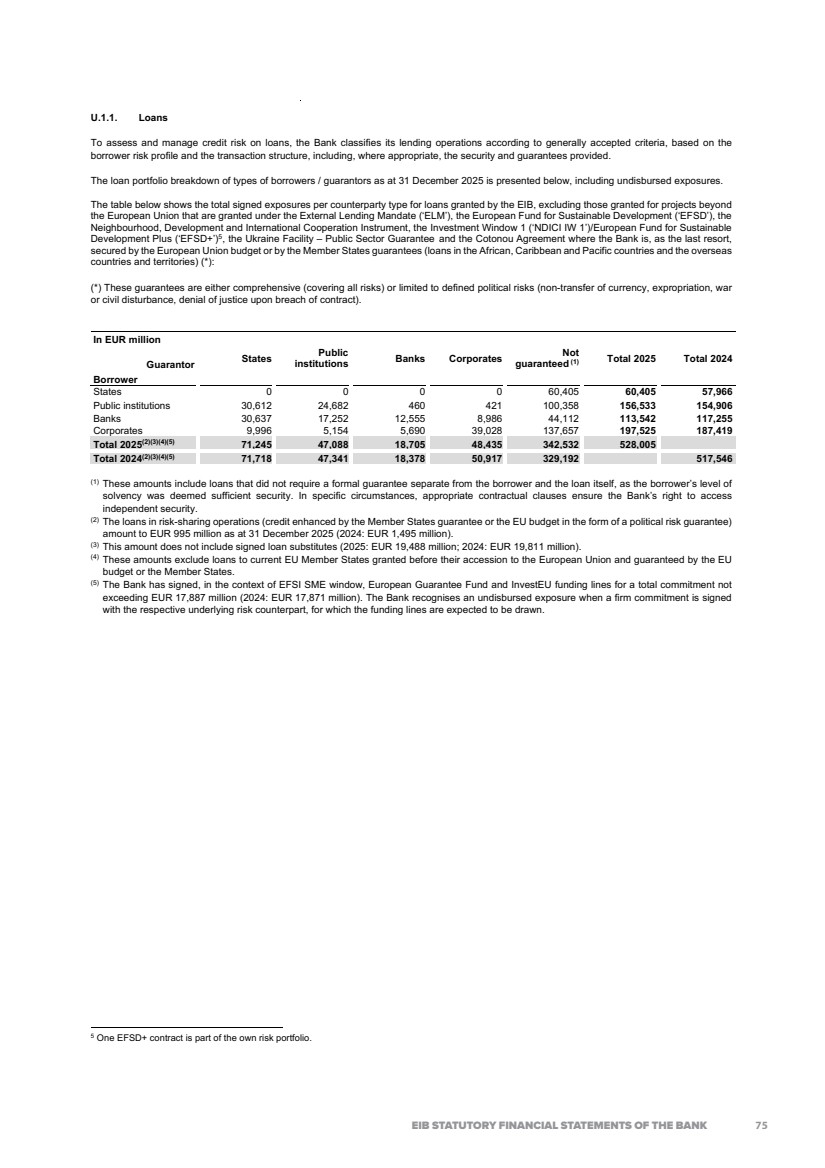
| 2025 FINANCIAL REPORT 38 The Bank did not record value adjustments in 2025 and 2024 in respect of its EU sovereign and EU sovereign guaranteed exposure as at the year-end as the Bank’s preferred creditor status and the protection given by the Bank’s Statute are deemed to guarantee a full recovery of the Bank’s assets upon maturity. The table below discloses information regarding the sovereign credit risk on loans, apart from loans beyond the European Union benefiting from EU budget or Member State guarantees, where the Bank has either full own risk or bears a residual risk due to credit enhancement: (in EUR million) 2025 2024 Acting as borrower Acting as guarantor Acting as borrower Acting as guarantor Country Disbursed Undisbursed Signed Disbursed Undisbursed Signed Austria 0 0 115 0 0 124 Belgium 0 0 242 0 0 255 Bulgaria 1,135 250 297 964 250 298 Croatia 934 157 1,830 837 292 1,992 Cyprus 897 757 874 962 442 968 Czech Republic 2,908 861 0 2,011 913 0 Denmark 0 0 115 0 0 240 Estonia 406 490 62 474 490 69 Finland 0 0 87 0 0 97 France 0 0 4,103 0 0 3,858 Germany 0 0 994 0 0 1,546 Greece 6,260 1,131 7,111 6,652 2,102 7,670 Hungary 5,529 813 898 5,882 327 822 Ireland 1,805 300 1,668 1,905 0 1,731 Italy 6,054 811 5,022 5,344 655 5,401 Latvia 220 0 0 299 0 0 Lithuania 2,056 150 120 2,096 0 148 Luxembourg 9 0 210 0 9 219 Malta 150 52 218 72 0 268 Netherlands 0 0 1,980 0 0 265 Poland 5,886 265 20,814 6,302 210 19,268 Portugal 1,892 1,150 1,792 1,988 100 2,048 Romania 3,781 1,922 0 3,030 1,714 51 Slovakia 2,616 0 44 2,571 240 95 Slovenia 444 0 1,098 468 0 1,220 Spain 2,608 0 17,728 2,977 0 18,896 Sweden 0 0 151 0 0 155 Non-EU countries 2,881 2,825 3,672 2,437 2,951 4,014 Total 48,471 11,934 71,245 47,271 10,695 71,718 The table below shows (in EUR million) the signed loans for projects beyond the European Union benefiting from EU budget or Member State guarantees: Secured by: 31.12.2025 31.12.2024 Member States 3,229 3,413 European Union budget(1) 45,667 47,910 Total(2)(3) 48,896 51,323 (1) Of which EUR 995 million in risk-sharing operations (credit enhanced by the Member States guarantee or the EU budget in the form of a political risk guarantee) as explained above (2024: EUR 1,495 million). (2) Including loans to current European Union Member States granted before their accession to the European Union and guaranteed by the European Union budget or the Member States. (3) Financial guarantees granted by the Bank for a total amount of EUR 442.6 million (2024: EUR 500.5 million) which are secured by Member States or the EU budget. The aforementioned guarantees are not included in the analysis as provided in table above. 76 |
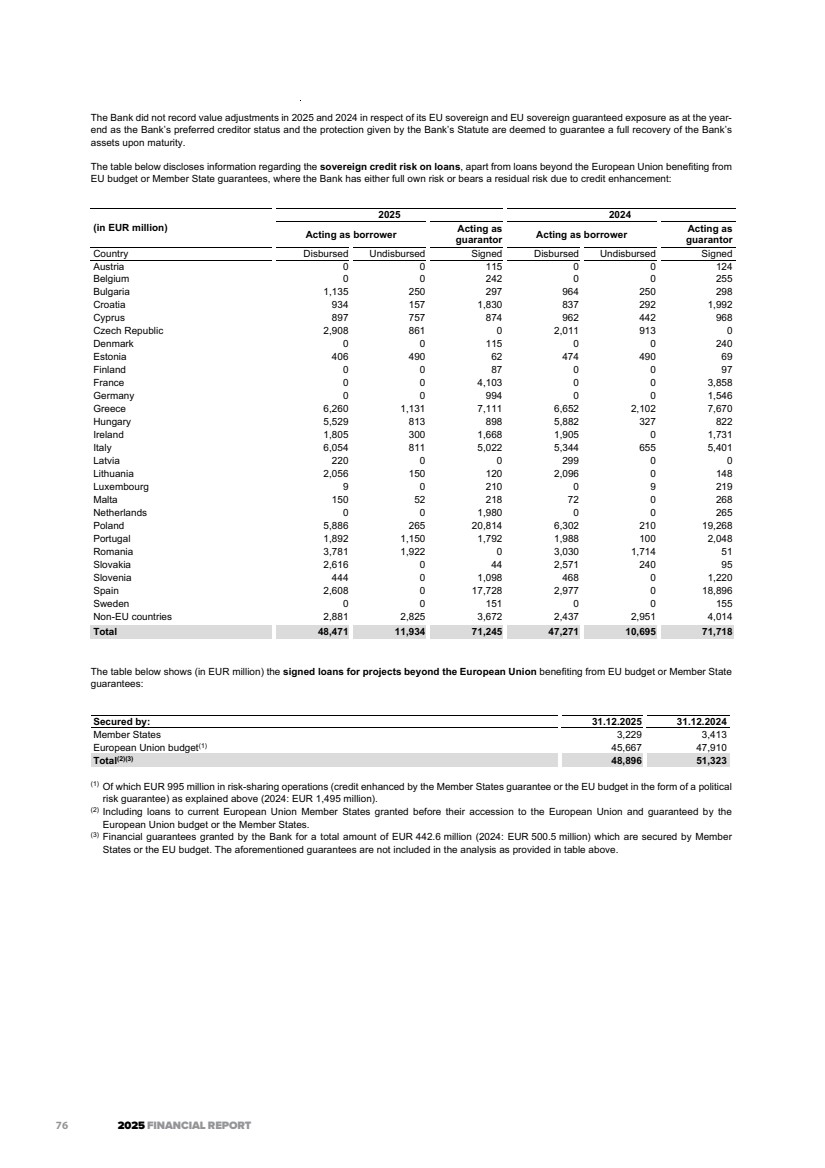
| estatutory f 39 The table below shows (in EUR million) the signed loans for projects beyond the European Union benefiting from EU budget or Member State guarantees, broken down by guarantees: AGREEMENT 31.12.2025 31.12.2024 75% Member States guarantee - Cotonou partnership agreement 39 54 - Cotonou partnership 2nd agreement 862 961 - Cotonou Protocol 3 – OR / ACP 2,244 2,304 - Cotonou Protocol 3 – OR / OCT 84 94 Total 75% Member States guarantee 3,229 3,413 Total Member States guarantee 3,229 3,413 100% European Union budget guarantee - Russia – 500 m – 2004-2007 67 82 - EFSD 0 93 Total 100% European Union budget guarantee 67 175 94% European Union budget guarantee - Ukraine Facility - Public Sector Guarantee 1,920 0 Total 94% European Union budget guarantee 1,920 0 70% European Union budget guarantee - Bosnia–Herzegovina – 100m 99/2001 0 2 Total 70% European Union budget guarantee 0 2 65% European Union budget guarantee - South Africa – 825m – 7/2000-1/2007 6 11 - South Africa – Decision 2/2007-12/2013 68 78 - ALA III – 2 480m –- 2/2000 – 7/2007 36 46 - ALA Decision – 2/2007-12/2013 899 1,058 - Euromed II – 6 520m – 2/2000-1/2007 230 368 - South Eastern Neighbours – 9 185m – 2/2000 – 7/2007 1,540 1,779 - Türkiye special action – 450m – 2001-2006 71 78 - Türkiye TERRA – 600m – 11/1999-11/2002 154 178 - PEV EE/CAS/RUS 1/2/2007 – 31/12/2013 1,307 1,554 - PEV MED 1/2/2007 – 31/12/2013 3,339 3,835 - Pre-Accession – 9 048m – 2007 – 2013 3,472 3,905 - Climate Change Mandate 2011 - 2013 835 895 - ELM Asia 2014-2020 1,220 1,266 - ELM Central Asia 2014-2020 337 351 - ELM East-Russia 2014-2020 4,458 6,498 - ELM Latin America 2014-2020 1,881 2,498 - ELM MED 2014-2020 6,004 7,628 - ELM Pre-Accession 2014-2020 3,274 3,577 - ELM RSA 2014-2020 5 117 - ELM ERI Private Mandate 373 637 - ELM ERI Public Mandate 1,022 1,324 - Global Europe NDICI IW 1 13,149 10,052 Total 65% European Union budget guarantee 43,680 47,733 Total European Union budget guarantee 45,667 47,910 Total(1) 48,896 51,323 (1) Financial guarantees granted by the Bank for a total amount of EUR 442.6 million (2024: EUR 500.5 million) which are secured by Member States or the EU budget. The aforementioned guarantees are not included in the analysis as provided in table above. 77 |
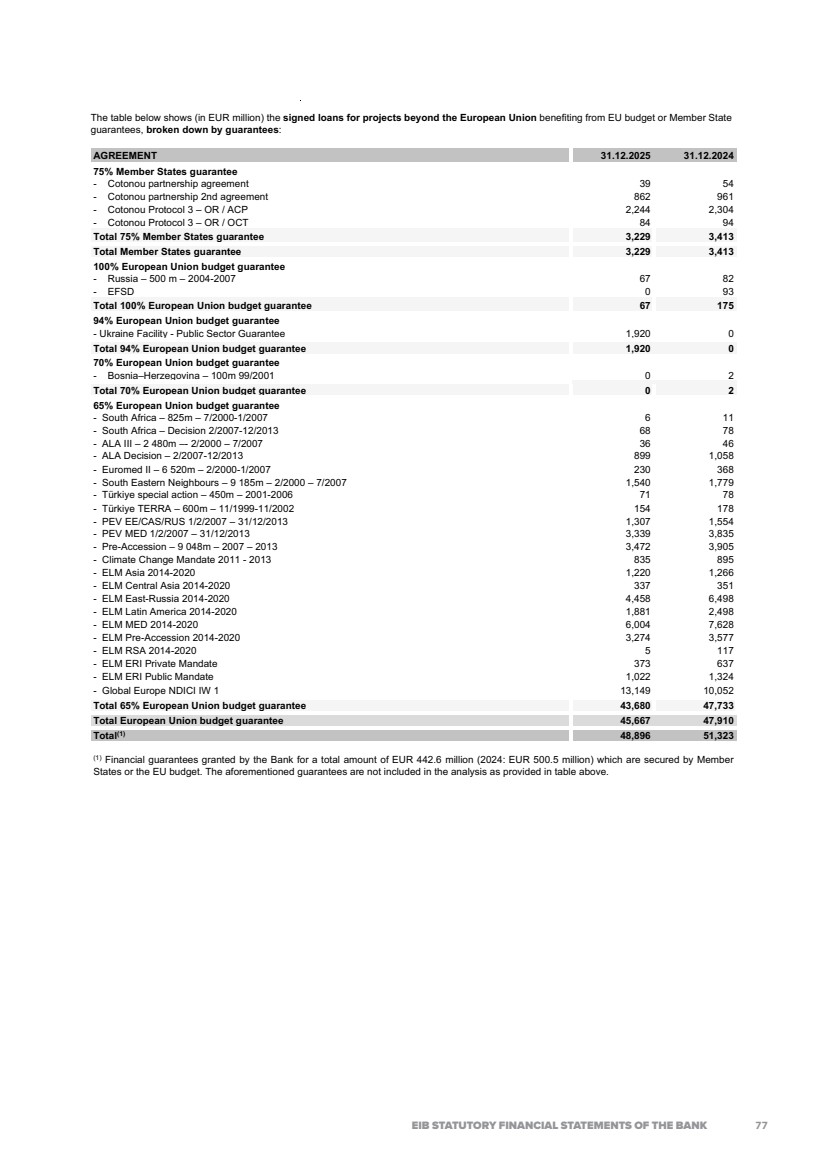
| 2025 FINANCIAL REPORT 40 Collateral on loans (in EUR million) Among other credit mitigant instruments, the Bank uses pledges of financial securities. These pledges are formalised through a Pledge Agreement, enforceable in the relevant jurisdiction. The portfolio of collateral received in pledge contracts amounts to EUR 6,647 million (2024: EUR 7,247 million), with the following composition: As at 31 December 2025 Loan Financial Collateral (in EUR million) Moody's or equivalent rating Bonds Cash Total Government Supranational Agency Secured Bonds (covered bonds) Bank and Corporate Bonds Aaa 38 137 0 142 38 0 355 Aa1 to Aa3 1,072 0 58 168 222 0 1,520 A1 to A3 1,154 10 58 0 351 0 1,573 Baa1 to Baa3 2,980 0 0 0 111 0 3,091 Below Baa3 12 0 0 0 0 0 12 Non-Rated 0 0 0 0 0 96 96 Total 5,256 147 116 310 722 96 6,647 As at 31 December 2024 Loan Financial Collateral (in EUR million) Moody's or equivalent rating Bonds Cash Total Government Supranational Agency Secured Bonds (covered bonds) Bank and Corporate Bonds Aaa 49 233 0 417 54 0 753 Aa1 to Aa3 1,156 9 35 228 174 0 1,602 A1 to A3 923 0 2 0 543 0 1,468 Baa1 to Baa3 3,170 0 0 0 104 0 3,274 Non-Rated 0 0 0 0 0 150 150 Total 5,298 242 37 645 875 150 7,247 The table below presents a breakdown by sector of disbursed loans outstanding (in EUR million) as at 31 December: Sector 2025 2024 Transports 132,326 130,569 Energy 80,411 73,948 Global Loans(1) 53,279 59,728 Health, education 37,372 38,578 Industry 36,980 36,570 Miscellaneous infrastructure 36,228 34,732 Water, sewerage 29,011 29,043 Services 18,296 18,675 Telecommunications 10,992 10,319 Agriculture, fisheries, forestry 4,792 5,103 Total(2) 439,687 437,265 (1) A global loan is a line of credit to an intermediary financing institution or a bank, which subsequently lends the proceeds, at its own risk, to finance small and medium-sized projects being undertaken by private or public sector promoters. (2) This amount does not include disbursed loan substitutes (2025: EUR 19,488 million; 2024: EUR 19,811 million). Arrears on loans Amounts in arrears are identified, monitored and reported according to the procedures defined in the bank-wide “Financial Monitoring Guidelines and Procedures”. These procedures follow best banking practices and are adopted for all loans managed by the EIB. As at 31 December 2025, the arrears above 90 days on loans within the total portfolio amount to EUR 504 million (31 December 2024: EUR 281 million). The outstanding principal amount related to these arrears is EUR 1,147 million as at 31 December 2025 (31 December 2024: EUR 861 million). These are covered by loan value adjustments of EUR 419 million (31 December 2024: EUR 249 million). Of the total amount in arrears above 90 days, only EUR 144 million (31 December 2024: EUR 49 million) relate to loans that do not benefit from a full or partial guarantee provided by the European Union or Member States. During 2025, EUR 260.3 million of arrears have been called under the guarantees of the European Union and EUR 4.5 million under the Member States guarantees. Corresponding amounts in 2024 were EUR 103 million and EUR 3 million, respectively. In addition, during the year, EUR 3.1 million of arrears previously invoked under the guarantees of the European Union or the Member States was refunded (2024: EUR 16 million). 78 |
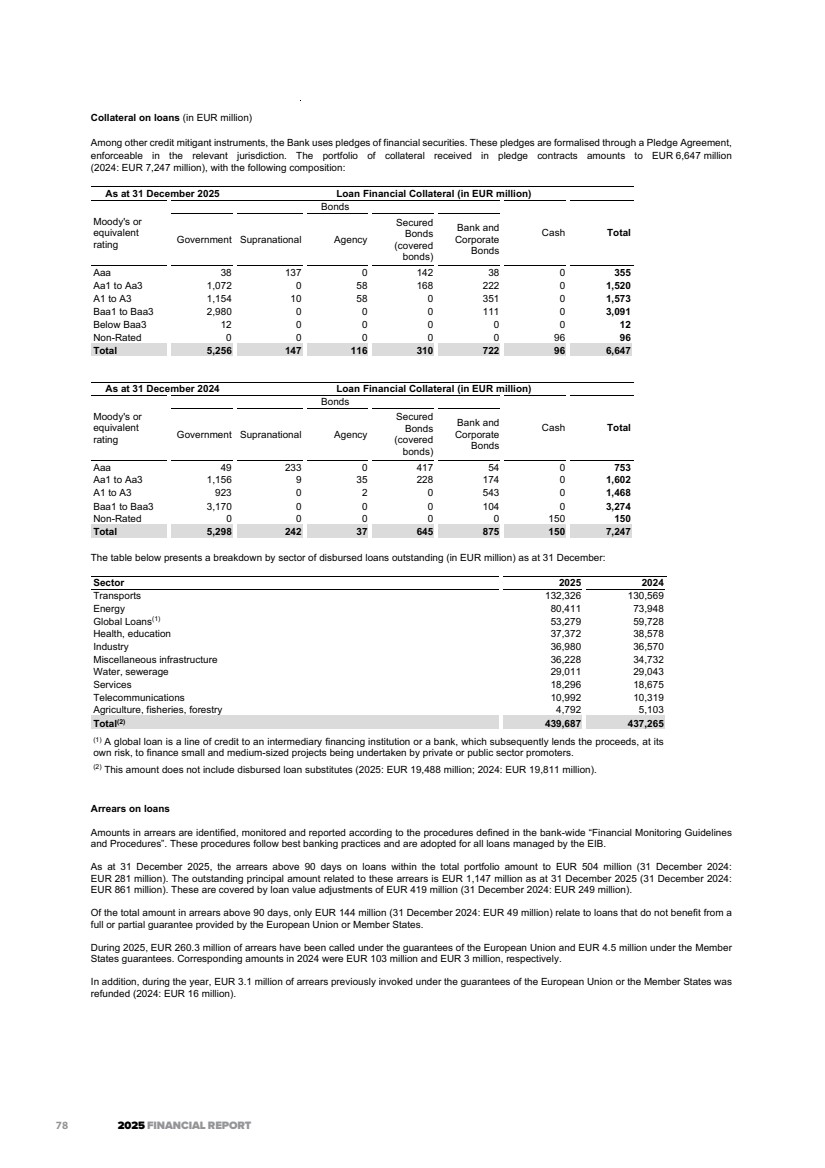
| estatutory f 41 Loan renegotiation and forbearance The EIB classifies loans to be forborne loans (i.e. loans, debt securities and loan commitments) if forbearance measures have been extended. Forbearance measures consist of “concessions” that the EIB decides to make towards an obligor who is considered unable to comply with the contractual debt service terms and conditions due to financial difficulties, to enable the obligor to service the debt or to totally or partially refinance the contract. Exposures shall be treated as forborne if a concession has been granted, regardless of whether any amount is past due, or the exposure is classified as defaulted. Exposures shall not be treated as forborne if the obligor is not in financial difficulties. Once renegotiated, the EIB will continue to closely monitor these loans. If the renegotiated payment terms will not recover the original carrying amount of the asset, the Bank will consider accounting for value adjustments in the profit and loss account. The need for a value adjustment for all loans whose Loan Grading (‘LG’) has deteriorated to level indicating a strong possibility that debt service cannot be maintained on a timely basis is assessed regularly. Forbearance measures and practices undertaken by the Bank’s restructuring team during the reporting period include, but are not limited to, the extension of maturities, the deferral of capital only, the deferral of capital and interest, waivers for breach of material covenants and the capitalisation of arrears. Operations subject to forbearance measures are reported in the tables below. (in EUR million) 31.12.2025 31.12.2024 Performing Non-performing Performing Non-performing Number of contracts subject to forbearance practices 29 117 25 66 Carrying values (incl. interest and amounts in arrears) 1,083 2,921 635 1,567 of which being subject to value adjustments 0 2,384 0 1,093 Value adjustments recognised 0 573 0 381 Interest income in respect of forborne contracts 32 121 23 80 Exposures derecognised (following restructuring, write-off or sale of the operation) 0 8 0 127 Forbearance measures (in EUR million) 31.12.2024 Extension of maturities, deferral of capital and/or interest Breach / waiver of material financial covenants Restructuring due to diminished repayment capacity Emergency funding Enforcement action against the Borrower Other Contractual repayment and termination 31.12.2025 Public 452 0 0 0 0 0 160 -191 421 Bank 182 0 0 0 0 0 0 -34 148 Corporate 1,568 514 1,134 161 306 161 320 -729 3,435 Total 2,202 514 1,134 161 306 161 480 -954 4,004 79 |
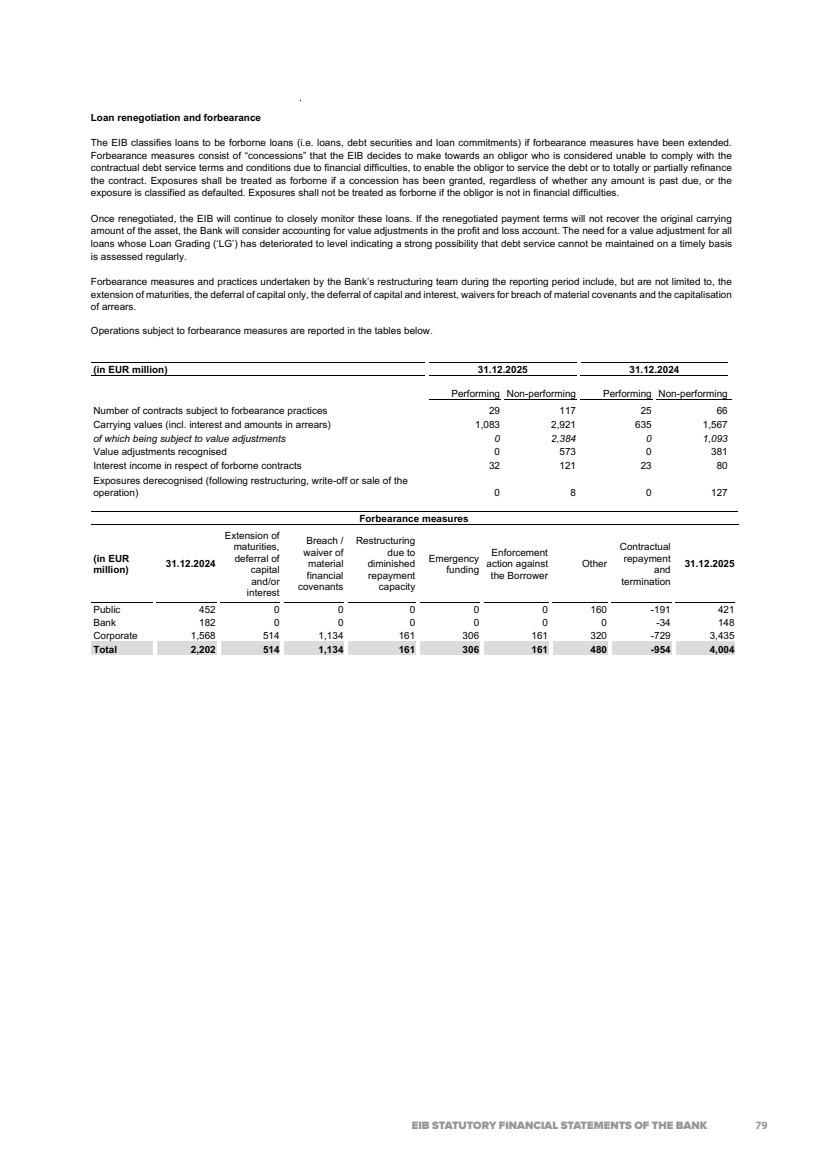
| 2025 FINANCIAL REPORT 42 U.1.2. Treasury The credit risk associated with treasury instruments (securities, commercial papers, term deposits, etc.) is managed by selecting sound counterparties and issuers. The structure of the securities portfolio and the limits governing outstanding treasury instruments have been laid down by the management. These limits are reviewed regularly by the Group Risk and Compliance Directorate. The table below provides a percentage breakdown of the credit risk associated with the securities in the treasury portfolios and the money market products (deposits and reverse repurchase agreements). The breakdown is based on the credit rating of the issuer or ultimate obligor rating, where relevant: Moody’s or equivalent rating Securities portfolio % Money market products % 31.12.2025 31.12.2024 31.12.2025 31.12.2024 Aaa 31 30 30 48 Aa1 to Aa3 20 37 39 27 A1 to A3 30 11 30 24 Below A3 19 22 1 1 Total 100 100 100 100 Collateral on treasury transactions The Bank enters into collateralised repurchase and reverse repurchase agreement transactions that may result in credit exposure if the counterparty to the transaction is unable to fulfil its contractual obligations. The Bank controls credit risk associated with these activities by monitoring counterparty credit exposure and collateral values on a daily basis and requiring additional collateral to be deposited with the Bank when deemed necessary. Tripartite repurchase and reverse repurchase operations are carried out with a third-party custodian who undertakes, on the basis of a framework contract, to guarantee compliance with the contractual terms and conditions, notably with respect to: - delivery against payment; - verification of collateral; - the collateral margin required by the lender which must always be available and adequate, with the market value of the securities being verified daily by the custodian; and - organisation of substitute collateral provided that this meets all the contractual requirements. Collateral received Treasury transactions include EUR 23,198 million in bilateral and tripartite reverse repurchase agreements as at 31 December 2025 (2024: EUR 21,286 million). The Bank received financial collateral for all such transactions. The market value of the financial collateral portfolio as at 31 December 2025 is EUR 23,982 million (2024: EUR 21,971 million), with the following breakdown: Financial collateral for reverse repurchase agreements (in EUR million) As at 31 December 2025 Bonds Moody's or equivalent rating Government Supranational Agency Secured bonds (covered bonds) Bank and corporate Bonds Cash Total Aaa 1,387 1,067 379 8,710 2,011 0 13,554 Aa1 to Aa3 2,396 4 330 104 957 0 3,791 A1 to A3 1,085 55 700 0 3,633 0 5,473 Baa1 to Baa3 853 0 95 0 74 0 1,022 Non-rated 135 0 7 0 0 0 142 Total 5,856 1,126 1,511 8,814 6,675 0 23,982 Financial collateral for reverse repurchase agreements (in EUR million) As at 31 December 2024 Bonds Moody's or equivalent rating Government Supranational Agency Secured bonds (covered bonds) Bank and corporate Bonds Cash Total Aaa 168 302 180 8,542 2,390 0 11,582 Aa1 to Aa3 2,159 1,359 212 338 640 0 4,708 A1 to A3 217 1 246 45 4,550 0 5,059 Baa1 to Baa3 475 0 12 0 28 0 515 Non-rated 94 0 10 0 0 3 107 Total 3,113 1,662 660 8,925 7,608 3 21,971 Securities deposited Bilateral and tripartite repos amount to EUR 984 million as at 31 December 2025 (2024: EUR 107 million). 80 |
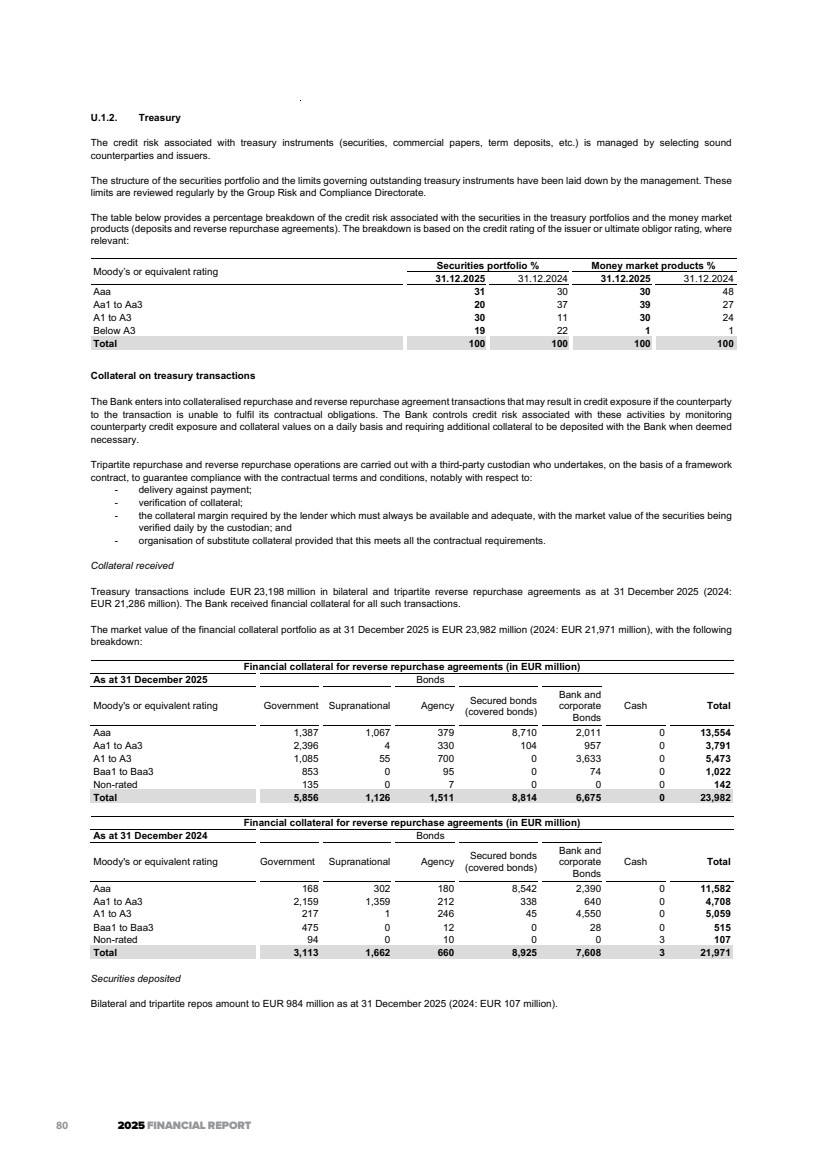
| estatutory f 43 The market value of the collateral deposited under bilateral and tripartite repos amount to EUR 977 million as at 31 December 2025 (2024: EUR 218 million). U.1.3. Guarantees and securitisations entered into by the Bank Credit risk arising from the Bank’s guarantees and securitisations transactions funded by own resources is managed in line with dedicated internal guidelines. At 31 December 2025, the signed exposure guaranteed by the EIB amounted to EUR 25.7 billion (2024: EUR 23.5 billion) and provisions on guarantees amount to EUR 78.9 million (2024: EUR 76.3 million). Part of the EIB’s guarantee type operations derives from risk-sharing operations where the EIB guarantees on a loan-by-loan basis underlying debt exposures originated by a financial intermediary based on established delegation models. The financial intermediary originating the underlying risk exposures on which the EIB takes risk is subject to a detailed due diligence to make sure that the EIB can delegate credit management tasks to the financial intermediary in question. Whereas the remaining EIB guarantee type operations are typically done as synthetic transactions, the EIB usually covers the risk of an existing portfolio to a given financial intermediary. The EIB has established a dedicated framework to limit the concentration risk for this type of underlying exposures in such transactions. Depending on the specific characteristics of each transaction, this may include setting eligibility criteria including but not limited to lowest eligible rating categories, certain sector, obligor and/or obligor group exposure. There is limited counterparty risk on the financial intermediary as the credit risk is on the underlying exposures originated by the financial intermediary i.e. counterparty risk is limited to (1) the payment of the guarantee fees and (2) the potential recoveries due to the EIB in the event of a default of an underlying exposure guaranteed and paid out by the EIB. In any case, the EIB has established a number of mitigating measures, including but not limited to detailed due diligence as well as security rights, step-in rights, trigger events to stop inclusions, consent rights for material amendments of the underlying risk exposures or termination rights. U.2. Market risk U.2.1 Interest rate and credit spread risk in the banking book The interest rate or credit spread risk is the risk to the economic value or to the net interest income arising from adverse movements in interest rates or market credit spreads that affect interest rate and market credit spread sensitive instruments, respectively. Exposure to these risk factors occurs when there are differences in the repricing and maturity characteristics of the different asset, liability and hedge instruments. Interest rate risk management for the Bank In measuring and managing interest rate risk, the Bank refers to the relevant key principles of the Basel Committee on Banking Supervision (‘BCBS’), as implemented in the EU, and to the regulatory guidance issued by the European Banking Authority (‘EBA’). The main sources of interest rate risk are: gap risk, basis risk and option risk. Gap risk is the most relevant interest rate risk for the Bank and is defined as the risk to the economic value or to the net interest income generated by the differences in the term structure of interest rate sensitive instruments on the Bank’s balance sheet. Following regulatory guidance, the Bank has articulated its appetite for interest rate risk in terms of both the maximum risk to economic value and the maximum risk to earnings that the Bank is prepared to take (while, when applicable, adhering to the maximum thresholds defined in the EBA Supervisory Outlier Tests for both perspectives). The Bank’s investment strategy for its own funds – the interest rate risk strategy – complies with such interest rate risk appetite. The Bank is measuring CSRBB by applying stress tests that show the impacts on both the economic value of equity and the net interest income from adverse movements in market credit spreads (in line with the respective EBA guidelines6). CSRBB is not subject to individual operational management limits. However, its exposure is reflected into the Risk Appetite Framework. Interest rate risk on the economic value of the own funds/equity The Bank’s interest rate risk strategy aims at maintaining a balanced and sustainable revenue profile as well as limiting the risk to the economic value of the Bank. A clear preference has been given to the revenue profile in light of the objective of self-financing future growth. This overall objective is achieved by investing the own funds according to a medium to long-term investment profile. Of course, this strategy needs to comply with the limits for the Interest Rate Risk RAF metrics. Apart from the interest rate risk strategy underpinning the investment of the Bank’s own funds, the Bank’s balance sheet should be match-funded with respect to interest rate risk. As it is not operationally practical to perfectly match-fund the Bank’s balance sheet, small deviations to gap and basis risks are allowed. These net residual interest rate risk positions are managed within pre-approved limits, the latter being dimensioned to ensure that the individual risks remain within the risk appetite boundaries. In addition to its interest rate risk limits framework, the Bank performs regular stress testing, based on EBA standardised shock scenarios7 and internally defined ones, to its projected earnings and to its economic value. The exercise serves to identify potential adverse consequences arising from severe changes in the interest rates environment. 6 EBA/GL/2022/14. 7 EBA/RTS/2022/10. 81 |
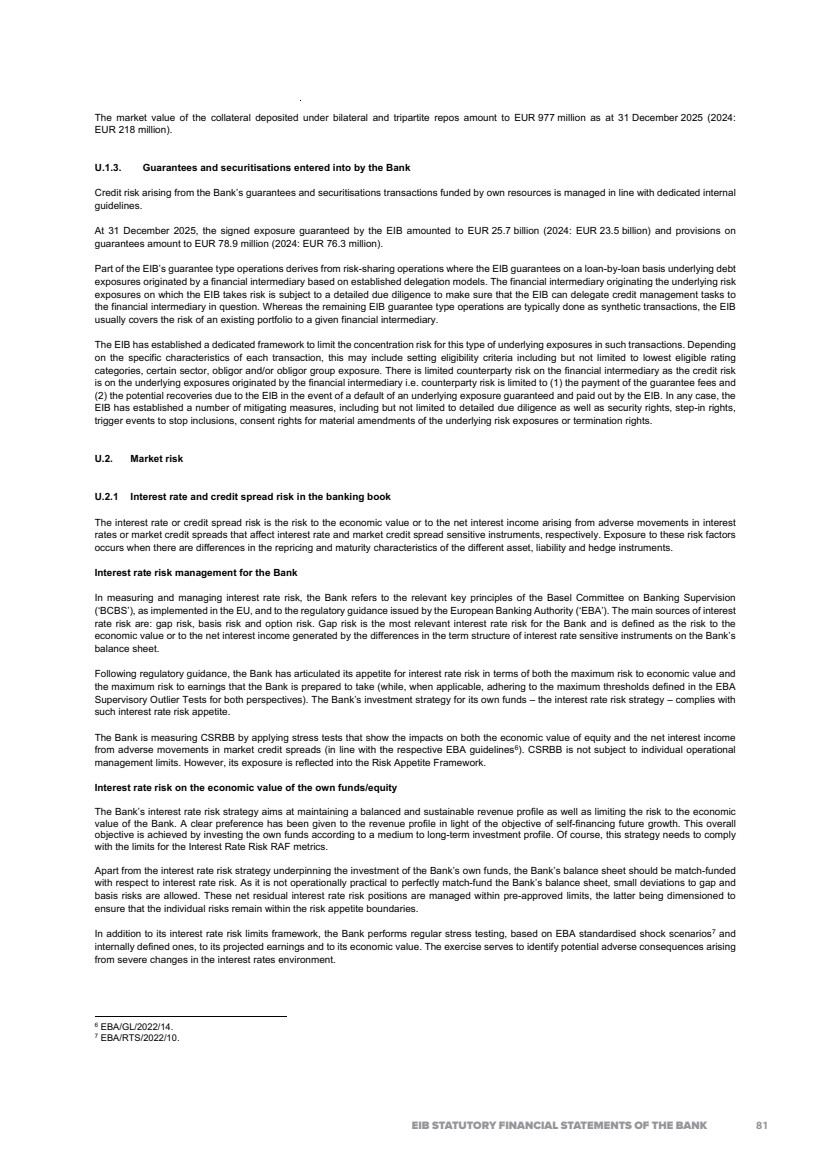
| 2025 FINANCIAL REPORT 44 As at 31 December 2025, the worst impact of the EBA supervisory outlier test scenarios would reduce the economic value of own funds of the Bank by EUR 6.86 billion (2024: EUR 6.19 billion)8. Among the financial instruments in the Bank’s portfolio, some operations (borrowings and associated swaps) present callability options and may be redeemed early, hence introducing uncertainty as to their final maturity. However, as these packages (borrowings and associated swaps) are fully back-to-back (up to the cashflow level), they can be considered at the end as simple synthetic floating rate notes indexed to the relevant interest rate benchmarks and bearing limited interest rate risk. The table hereafter summarises the features of the Bank’s callable borrowings portfolio as at 31 December 2025 and 31 December 2024, where the total nominal amount, the average natural maturity and the average expected maturity (both weighted by the nominal amount of the relevant transactions) are shown per funding currency and per main risk factor involved: By funding currency (after swaps): 31.12.2025 (in EUR million) EUR USD Total EUR Pay Notional -3,167 -732 -3,899 Average maturity date 26.09.2044 14.02.2042 30.03.2044 Average expected maturity 25.12.2039 28.06.2040 29.01.2040 31.12.2024 (in EUR million) EUR USD Total EUR Pay Notional -2,402 -1,107 -3,509 Average maturity date 12.12.2046 29.12.2037 14.02.2044 Average expected maturity 14.12.2037 25.02.2036 20.05.2037 By risk factor involved: 31.12.2025 Risk factor (in EUR million) FX level IR curve level Total EUR Pay Notional -773 -3,126 -3,899 Average maturity date 12.11.2036 26.01.2046 30.03.2044 Average expected maturity 21.07.2033 09.09.2041 29.01.2040 31.12.2024 Risk factor (in EUR million) FX level IR curve level Total EUR Pay Notional -259 -3,250 -3,509 Average maturity date 15.02.2037 04.09.2044 14.02.2044 Average expected maturity 10.12.2033 29.08.2037 20.05.2037 Interest rate risk on the earnings The risk to earnings9 quantifies the amount of net interest income that would change during the forthcoming 36 months if all interest rate curves would decrease by two percentage points. Such exposure stems primarily from the mismatch between the interest rate repricing periods of assets and liabilities, and has to stay within the limit defined in the Risk Appetite Framework. With the positions in place as at 31 December 2025, the net interest income of the Bank would decrease by EUR 986.5 million (2024: EUR 1,108.4 million) if interest rates were to decrease by 200 basis points. For enriching the analysis of the net interest income’s sensitivity, the net interest income of the Bank would increase by EUR 1,041.5 million (2024: EUR 1,168.5 million) if interest rates were to increase by 200 basis points. The Bank uses a dedicated software that allows to simulate the sensitivity of earnings on a deal by deal basis. The sensitivity of earnings is measured on an accruals basis and is calculated under the ‘’ongoing’’ assumption that, over the time horizon analysed, the Bank realises (at market rates defined in the underlying scenario) the new business forecast in the Operational Plan, maintains exposures within the approved limits and executes monetary trades to refinance funding shortages or invest cash excesses. In line with the Bank’s current practice, the model uses the hypothesis that simulated earnings are not distributed to the shareholders, but are used to refinance the Bank’s business. The administrative costs are projected according to the forecasts of the Operational Plan. 8 The stress test is performed on all risk-sensitive banking book instruments, including the pension and health insurance liabilities (defined benefit obligations, DBO) as calculated by an actuarial provider. 9 To note that the Bank also manages the risk to its net interest income (NII) via the Supervisory Outlier Test for NII, namely the so called “NII Large Decline”. 82 |
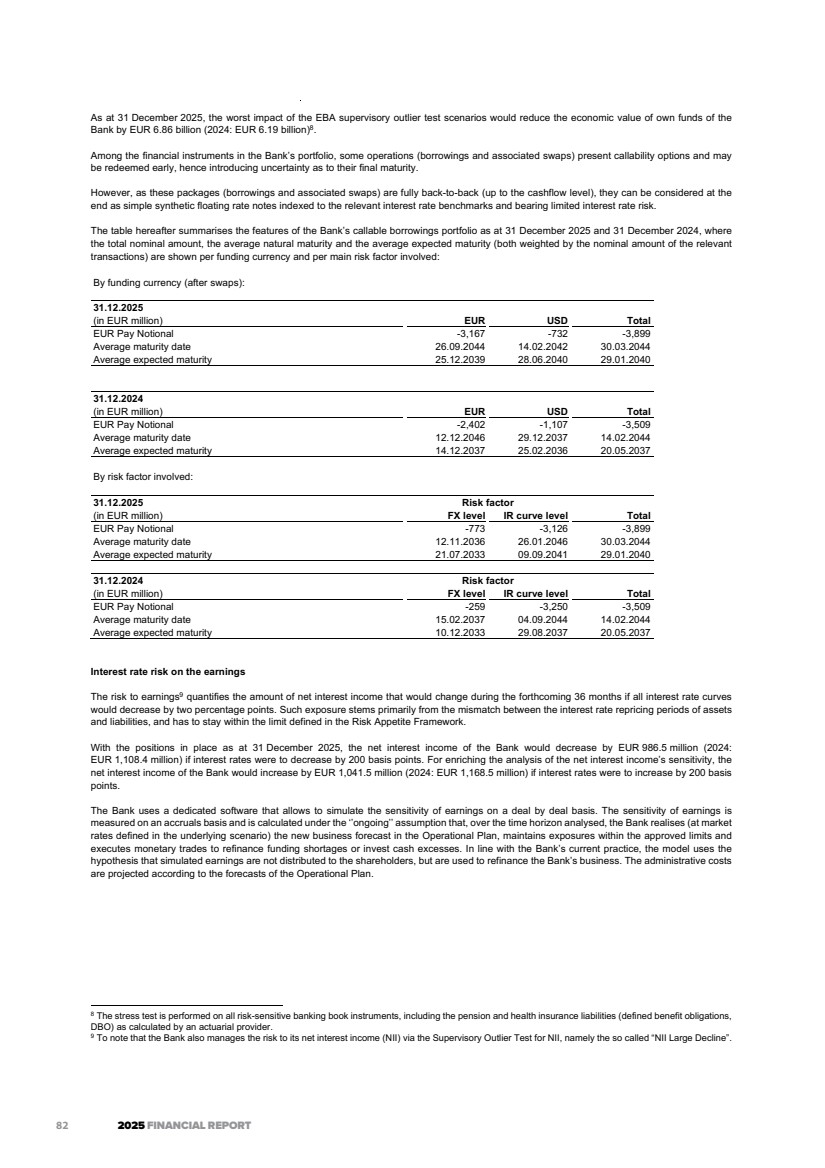
| estatutory f 45 U.2.2 Foreign exchange risk The foreign exchange (‘FX’) risk is the risk to the economic value or to the income derived from, the Bank’s positions due to adverse movements of foreign exchange rates. The Bank is exposed to a foreign exchange risk whenever there is a currency mismatch between its assets, liabilities and hedging instruments. In compliance with its Statute, the Bank does not engage in currency operations not directly required to carry out its lending operations or fulfil commitments arising from loans or guarantees that it has granted. Mismatches of currencies in the asset-liability structure of the Bank are kept within tight pre-approved limits. Foreign exchange position (in EUR million) Currency as at 31 December 2025 Euro Pound Sterling US Dollar Other currencies Subtotal except Euro Total 2025 Assets: Cash in hand, balances with central banks and post office banks 258 0 0 0 0 258 Treasury bills and other bills eligible for refinancing with central banks 35,480 1,562 2,816 0 4,378 39,858 Other loans and advances: - Repayable on demand 916 47 35 27 109 1,025 - Credit institutions 22,274 0 2,975 8,313 11,288 33,562 - Customers 118 0 0 0 0 118 23,308 47 3,010 8,340 11,397 34,705 Loans: - Credit institutions 68,328 216 10,606 8,437 19,259 87,587 - Customers 293,916 21,430 12,106 24,570 58,106 352,022 362,244 21,646 22,712 33,007 77,365 439,609 Debt securities including fixed-income securities 6,286 355 3,190 973 4,518 10,804 Shares, other variable-yield securities and participating interests 9,045 310 909 481 1,700 10,745 Shares in affiliated undertakings 1,579 0 0 0 0 1,579 Other 9,092 1,424 2,058 706 4,188 13,280 Total assets 447,292 25,344 34,695 43,507 103,546 550,838 Liabilities: Amounts owed to credit institutions 1,300 0 131 0 131 1,431 Amounts owed to customers 4,029 1 103 59 163 4,192 Debts evidenced by certificates: - Debt securities in issue 253,919 30,910 106,658 33,242 170,810 424,729 - Others 4,928 0 714 1,332 2,046 6,974 258,847 30,910 107,372 34,574 172,856 431,703 Subscribed capital, reserves and profit 86,326 0 0 0 0 86,326 Other 22,662 1,479 2,105 940 4,524 27,186 Total liabilities 373,164 32,390 109,711 35,573 177,674 550,838 Off-balance sheet currency swaps -74,144 7,098 74,969 -7,923 74,144 Net position -16 52 -47 11 16 83 |
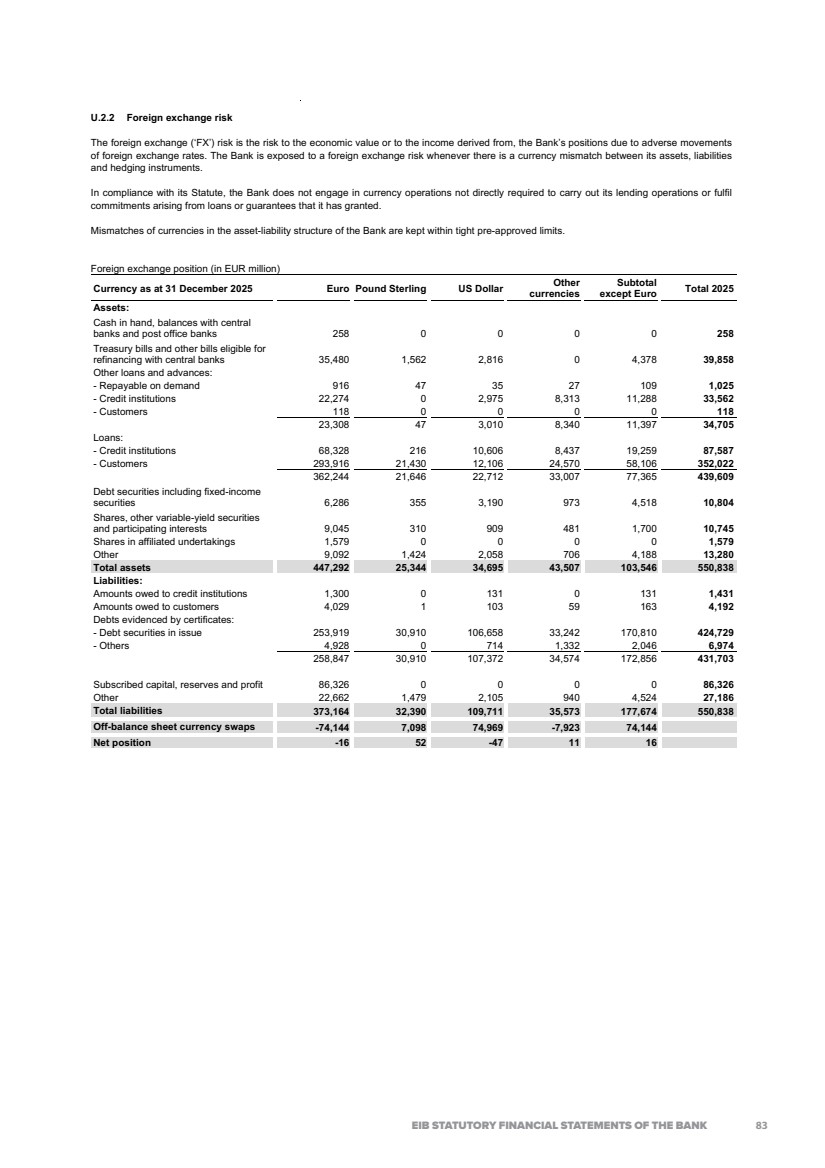
| 2025 FINANCIAL REPORT 46 Foreign exchange position (in EUR million) Currency as at 31 December 2024 Euro Pound Sterling US Dollar Other currencies Subtotal except Euro Total 2024 Assets: Cash in hand, balances with central banks and post office banks 105 0 0 0 0 105 Treasury bills and other bills eligible for refinancing with central banks 30,902 1,020 4,578 0 5,598 36,500 Other loans and advances: - Repayable on demand 908 55 30 19 104 1,012 - Credit institutions 33,576 289 484 5,107 5,880 39,456 - Customers 235 0 0 0 0 235 34,719 344 514 5,126 5,984 40,703 Loans: - Credit institutions 68,216 519 13,131 9,224 22,874 91,090 - Customers 286,425 24,117 12,206 23,408 59,731 346,156 354,641 24,636 25,337 32,632 82,605 437,246 Debt securities including fixed-income securities 6,055 208 3,222 958 4,388 10,443 Shares, other variable-yield securities and participating interests 8,637 419 978 411 1,808 10,445 Shares in affiliated undertakings 1,578 0 0 0 0 1,578 Other 14,795 1,603 2,191 833 4,627 19,422 Total assets 451,432 28,230 36,820 39,960 105,010 556,442 Liabilities: Amounts owed to credit institutions 827 0 31 0 31 858 Amounts owed to customers 2,977 1 137 102 240 3,217 Debts evidenced by certificates: - Debt securities in issue 248,848 37,075 114,738 35,305 187,118 435,966 - Others 5,132 0 350 1,404 1,754 6,886 253,980 37,075 115,088 36,709 188,872 442,852 Subscribed capital, reserves and profit 83,601 0 0 0 0 83,601 Other 21,070 1,629 2,299 916 4,844 25,914 Total liabilities 362,455 38,705 117,555 37,727 193,987 556,442 Off-balance sheet currency swaps -88,880 10,490 80,632 -2,242 88,880 Net position 97 15 -103 -9 -97 84 |
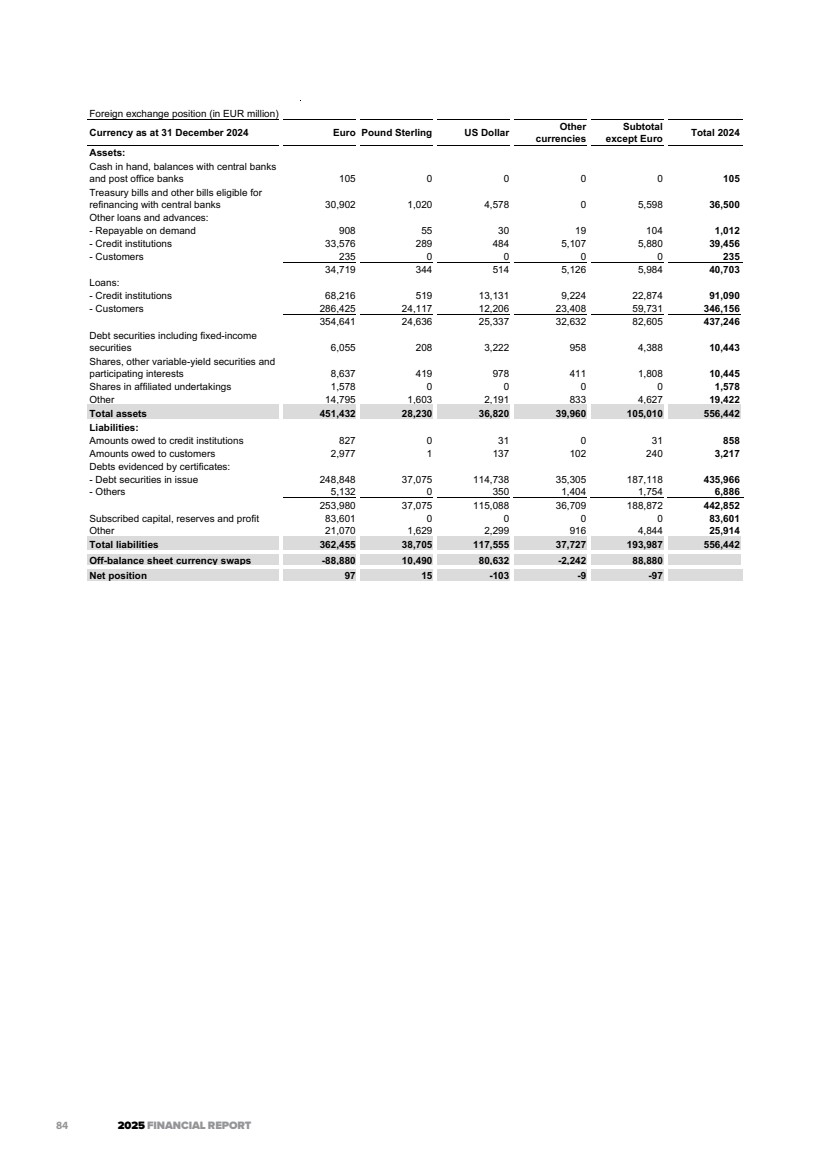
| estatutory f 47 U.3. Liquidity and funding risk Liquidity risk refers to the ability of the Bank to fund increases in assets and meet obligations as they come due, without incurring unacceptable losses. It can be further split into funding liquidity risk and market liquidity risk. Funding liquidity risk is connected to the risk for the Bank of being unable to refinance the asset side of its balance sheet and meet payment obligations punctually and in full out of readily available liquid resources. Funding liquidity risk may have an impact on the volatility in the economic value of, or in the income derived from the Bank’s positions, due to potentially increasing immediate risks to meet payment obligations and the consequent need to borrow at unattractive conditions. Market liquidity risk is the volatility in the economic value of, or in the income derived from, the Bank’s positions due to the potential inability to execute a transaction to offset, eliminate or reduce outstanding positions at reasonable market prices. Such an inability may force the early liquidation of assets at unattractive prices when it would be better to avoid such liquidation. This risk is tied to the size of the position compared to the liquidity of the instrument being transacted, as well as to potential deterioration of market availability and efficiency. The liquidity risk of the Bank is managed to ensure the regular functioning of its core activities at reasonable cost. The main objective of liquidity policy is to ensure that the Bank can always meet its payment obligations punctually and in full. In contrast to commercial banks, the EIB does not have retail deposits but relies on its access to capital markets to raise the funds it on-lends to its clients. The Bank manages the calendar of its new issues so as to maintain a prudential liquidity buffer. Liquidity planning takes into account the Bank’s needs to service its debt, make disbursements on loans and the cash inflows from the loan portfolio. It also takes into account the sizeable amount of signed but undisbursed loans, whose disbursements typically take place at the borrowers’ request. The Bank further seeks to assure management of liquidity risk by maintaining what it considers a sufficient level of short-term liquid assets and by spreading the maturity dates of its placements based on the projected liquidity needs. The liquidity risk policy also incorporates a floor on treasury levels: The Bank's total liquidity ratio (liquidity as a percentage of the next 12 months projected net cash outflows) must at all times exceed 25%. The Bank has a Group Contingency Funding Plan (‘Group CFP’) in place, which specifies decision-making procedures and corresponding responsibilities. The Group CFP is regularly tested and benchmarked against applicable best banking practices, including relevant guidelines issued by the European Banking Authority in this respect. The Group CFP is approved annually by the Board of Directors of the Bank. Regular stress testing analyses are executed as part of liquidity risk monitoring and determine the size of the Bank’s liquidity buffer. On 8 July 2009, the Bank became an eligible counterparty in the Eurosystem’s monetary policy operations and has therefore been given access to the monetary policy operations of the European Central Bank. The Bank conducts operations via the Central Bank of Luxembourg, where it maintains deposits to cover the minimum reserve requirement and for other operational needs. The Liquidity Coverage Ratio (‘LCR’) is calculated on a daily basis in line with the EU Capital Requirements Regulation (‘CRR’) both in its functional currency (EUR) as well as in the other significant currencies. Consistency of the currency denomination of its liquid assets with its net liquidity outflows is ensured by the Bank on an ongoing basis, to prevent an excessive currency mismatch. As at 31 December 2025, the LCR stood at 658.5% (end 2024: 724.9%). In addition, the Net Stable Funding Ratio (‘NSFR’) is also computed, in line with the EU CRR, both in the functional currency of the Bank (EUR) as well as in the other significant currencies. As at 31 December 2025, the NSFR stood at 120.9% (end 2024: 122.2%). The Bank continues to maintain what it regards as a robust liquidity position and flexibility to access the necessary liquidity resources mainly as a result of its prudent approach to liquidity management. As a result, the continued geopolitical and financial turbulences experienced in 2025 had a minimal impact on liquidity and funding. The table below shows the assets and liabilities of the Bank by maturity on the basis of the period remaining between the balance sheet date and the contractual maturity date. Assets and liabilities for which there is no contractual maturity date are classified under "Maturity undefined." 85 |

| 2025 FINANCIAL REPORT 48 Liquidity risk (in EUR million) Maturity as at 31 December 2025 3 months or less More than 3 months to 1 year More than 1 year to 5 years More than 5 years Maturity undefined Total 2025 Assets: Cash in hand, balances with central banks and post office banks 258 0 0 0 0 258 Treasury bills and other bills eligible for refinancing with central banks 1,516 11,974 14,588 11,780 0 39,858 Other loans and advances: - Repayable on demand 1,025 0 0 0 0 1,025 - Credit institutions 33,562 0 0 0 0 33,562 - Customers 118 0 0 0 0 118 34,705 0 0 0 0 34,705 Loans: - Credit institutions 2,258 7,851 34,053 43,413 12 87,587 - Customers 6,030 20,763 123,013 201,803 413 352,022 8,288 28,614 157,066 245,216 425 439,609 Debt securities including fixed-income securities 387 812 4,917 4,688 0 10,804 Shares, other variable-yield securities and participating interests 0 0 0 0 10,745 10,745 Shares in affiliated undertakings 0 0 0 0 1,579 1,579 Other 273 335 996 1,173 10,503 13,280 Total assets 45,427 41,735 177,567 262,857 23,252 550,838 Liabilities: Amounts owed to credit institutions 1,431 0 0 0 0 1,431 Amounts owed to customers 4,192 0 0 0 0 4,192 Debts evidenced by certificates 16,533 48,534 193,844 172,792 0 431,703 Subscribed capital, reserves and profit 0 0 0 0 86,326 86,326 Other 477 757 5,053 2,181 18,718 27,186 Total liabilities 22,633 49,291 198,897 174,973 105,044 550,838 Some of the borrowings and associated swaps include early termination triggers or call options granted to the hedging swap counterparties. The Bank also has the right to call the related bonds before maturity. If the Bank were to exercise all the call options on its bonds at their next contractual exercise date, cumulated early redemptions for the period 2026-2028 would amount to EUR 2.1 billion. Maturity as at 31 December 2024 3 months or less More than 3 months to 1 year More than 1 year to 5 years More than 5 years Maturity undefined Total 2024 Assets: Cash in hand, balances with central banks and post office banks 105 0 0 0 0 105 Treasury bills and other bills eligible for refinancing with central banks 738 14,665 12,197 8,900 0 36,500 Other loans and advances: - Repayable on demand 1,012 0 0 0 0 1,012 - Credit institutions 39,456 0 0 0 0 39,456 - Customers 235 0 0 0 0 235 40,703 0 0 0 0 40,703 Loans: - Credit institutions 4,241 10,177 34,280 42,322 70 91,090 - Customers 6,408 23,146 118,190 197,959 453 346,156 10,649 33,323 152,470 240,281 523 437,246 Debt securities including fixed-income securities 84 765 4,998 4,596 0 10,443 Shares, other variable-yield securities and participating interests 0 0 0 0 10,445 10,445 Shares in affiliated undertakings 0 0 0 0 1,578 1,578 Other 1,019 1,304 4,311 2,659 10,129 19,422 Total assets 53,298 50,057 173,976 256,436 22,675 556,442 Liabilities: Amounts owed to credit institutions 858 0 0 0 0 858 Amounts owed to customers 3,217 0 0 0 0 3,217 Debts evidenced by certificates 26,336 60,770 178,514 177,232 0 442,852 Subscribed capital, reserves and profit 0 0 0 0 83,601 83,601 Other 411 980 3,829 2,613 18,081 25,914 Total liabilities 30,822 61,750 182,343 179,845 101,682 556,442 86 |
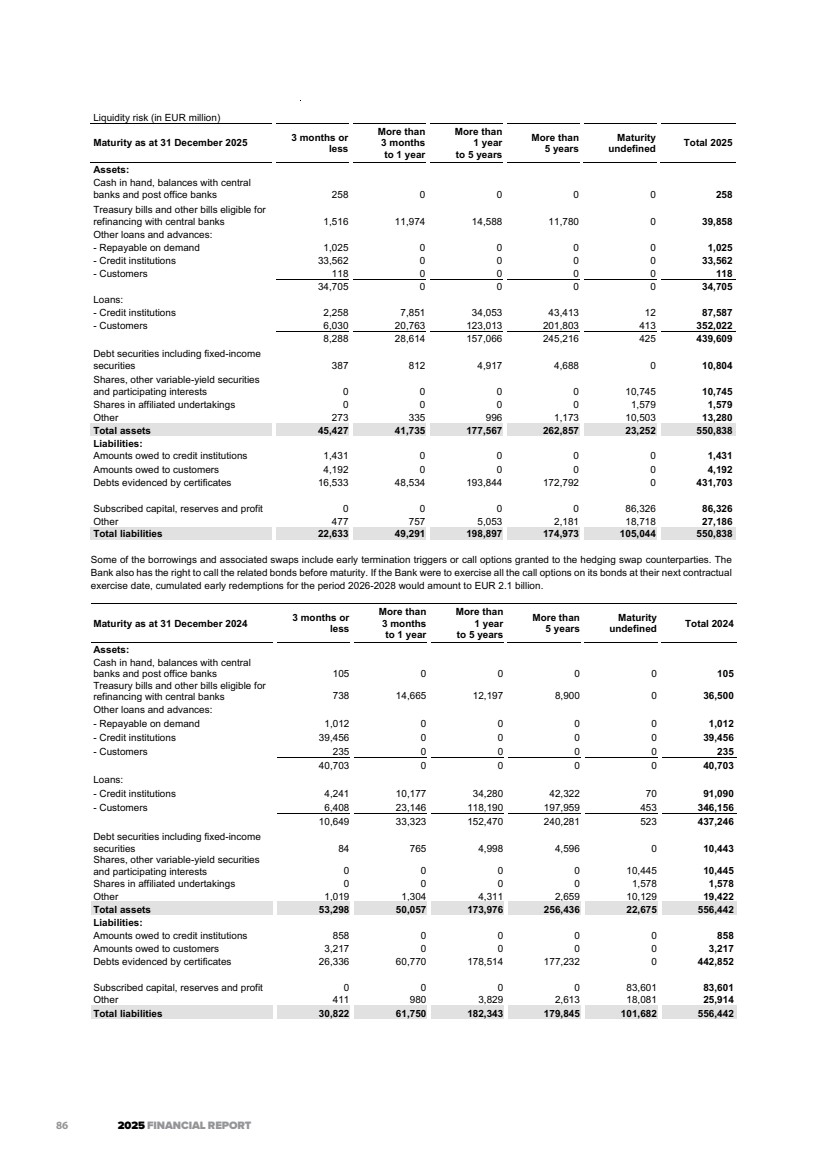
| estatutory f 49 U.4. Operational risk As defined in the EIB Group Operational Risk Policy, operational risk means the risk of loss resulting from inadequate or failed internal processes, people and systems or from external events10 including, but not limited to, legal risk, model risk or information and communication technology (‘ICT’) risk, but excluding strategic and reputational risk. All EIB’s activities may be affected by operational risk and therefore the Bank aims to systematically identify, assess, monitor, and report operational risks on a regular basis, and to ensure that sufficient controls and risk mitigants are in place to limit the exposure to operational risk. The Operational Risk Unit and the Internal Controls and Assertion Division in the Group Risk & Compliance Directorate are responsible for defining the Operational Risk Framework and related policies and procedures while the responsibility for implementing the Framework lies with all the Departments of the Bank. The EIB organises its operational risk management activities in compliance with the applicable Best Banking Practice (‘BBP’). In terms of reporting, exposure to operational risk is included in the EIB Group Non-Financial Risk Report which is approved by the Group Chief Risk Officer (‘GCRO’) responsible for the overall aspects of managing and monitoring operational risk at the Bank and then submitted to the Management Committee (‘MC’), the Audit Committee (‘AC’) and the Board of Directors (‘BoD’). In addition, operational risk losses/gains above EUR 0.25 million are immediately escalated to the President. The Group Risk Appetite Framework (‘RAF’) is formalised in the Group RAF Policy setting the overall guiding principles, processes, roles and responsibilities. The Group RAF takes into account non-financial risks and non-financial risk metrics associated with the various risk categories reported quarterly to the MC, the AC and the BoD. The Bank has robust compliance controls, including a dedicated Sanctions Compliance Programme, ensuring that its activities comply with all sanctions applicable to the EIB Group. With specific reference to sanctions targeting the Russian invasion of Ukraine, no material impact has been identified on the Bank’s business activities. The Bank is a crucial institution of the European Union, and as such, it is a likely target for cyber-attacks. With the ongoing crisis in Ukraine, the risk of direct and spill-over attacks has increased, and the Bank is closely monitoring this risk in collaboration with the Computer Emergency Response Team for the EU institutions, bodies and agencies (‘CERT-EU’). To ensure the security and integrity of its operations, the Bank has implemented robust security measures to protect against cyber-attacks. Note V – Derivatives The Bank uses derivative instruments as part of its market risk management of its exposures to interest rate and foreign currency risks, including exposures arising from committed transactions settling in the future, and as part of its liquidity management. Derivatives are financial instruments, the payoff of which depends on the prices of the underlying assets, interest rates, exchange rates or indices. The Bank’s long-term swaps are concluded to hedge the interest rate and foreign currency risks arising from borrowings, loans and bond holdings in the form of micro-hedges or in the context of global Asset and Liability Management (‘ALM’) positions (see Note V.1.). As part of the Asset and Liability Management, the Bank uses natural hedges (offsets between loans and borrowings), when deemed appropriate and possible. Remaining exposures are managed through derivatives executed at the portfolio level on a net basis (‘hedging swaps for ALM purposes’). The Bank also enters into short-term currency swap contracts to adjust currency positions in its operational treasury portfolios in relation to its benchmark currency, the euro, and to cater for demand for currencies in connection with loan disbursements (see Note V.2.). Future contracts (futures) can be used in the context of treasury activities, to hedge the exposure deriving from some investments in government bonds. Futures are standardised derivatives traded on regulated markets. They do not fall within the general policy for counterparty risk measurement and control. V.1. Hedging and asset and liability management (‘ALM’) derivatives The derivatives used in the context of hedging and ALM hedging activities are: • Currency swaps; • Interest rate swaps; and • Structured swaps. V.1.1. Currency swaps Currency swaps are contracts under which it is agreed to exchange principal and interest payments in one currency against another currency. The Bank enters into currency swaps mainly to hedge its borrowings and loans. 10 The definition of external events excludes cases of client bankruptcy or unfavourable market movements or similar events, which represent triggers for Credit and respectively Market Risk. 87 |
| 2025 FINANCIAL REPORT 50 The following table shows the maturities of currency swaps (including structured swaps – see Note V.1.3 and excluding short-term currency swaps – see Note V.2.), broken down according to their notional amount and fair value. The notional amounts are disclosed off-balance sheet. Currency swaps as at 31 December 2025 (in EUR million) 1 year or less More than 1 year and up to 5 years More than 5 years and up to 10 years More than 10 years Total 2025 Notional amount (receivable) 28,078 111,315 43,179 22,583 205,155 Fair value (i.e. net discounted value including CVA, DVA and CollVA)(*) 380 -2,501 -624 217 -2,528 Currency swaps as at 31 December 2024 (in EUR million) 1 year or less More than 1 year and up to 5 years More than 5 years and up to 10 years More than 10 years Total 2024 Notional amount (receivable) 48,402 114,886 45,760 24,077 233,125 Fair value (i.e. net discounted value including CVA, DVA and CollVA)(*) 1,015 2,648 936 157 4,756 (*) Including the fair value of hedging swaps for ALM purposes which stood at EUR -2,218 million as at 31 December 2025 (2024: EUR 5,678 million). V.1.2. Interest rate swaps Interest rate swaps are contracts under which, generally, it is agreed to exchange floating-rate interest for fixed-rate interest payments, or floating-rate interest payments linked to different rates (basis swaps), in the same currency. Interest rate swaps enable the Bank to hedge the interest rate risk of its borrowings, loans and bond holdings, and modify the interest rate structure of the balance sheet. The following table shows the maturities of interest rate swaps (including structured swaps – see Note V.1.3 and including synthetic swaps, whereby interest computed in a foreign currency is synthetically converted to EUR), sub-divided according to their notional amount and fair value. The notional amounts are disclosed off-balance sheet. Interest rate swaps as at 31 December 2025 (in EUR million) 1 year or less More than 1 year and up to 5 years More than 5 years and up to 10 years More than 10 years Total 2025 Notional amount 68,479 255,676 158,466 149,357 631,978 Fair value (i.e. net discounted value including CVA, DVA and CollVA)(*) 306 514 -2,407 1,391 -196 Interest rate swaps as at 31 December 2024 (in EUR million) 1 year or less More than 1 year and up to 5 years More than 5 years and up to 10 years More than 10 years Total 2024 Notional amount 113,801 229,664 164,221 148,107 655,793 Fair value (i.e. net discounted value including CVA, DVA and CollVA)(*) 81 -1,274 -2,889 189 -3,893 (*) Including the fair value of hedging swaps for ALM purposes which stood at EUR -59 million as at 31 December 2025 (2024: EUR -59 million). V.1.3. Structured swaps The Bank enters into borrowing contracts and loans encompassing options on interest rates, exchange rates, inflation rates and stock indices. Such structured borrowings and loans are entirely covered by swap contracts to hedge the corresponding market risk. The table below further details the number, fair value and notional amounts of structured swaps: Structured swaps as at 31 December Early termination embedded Structured coupon 2025 2024 2025 2024 Number of transactions 107 102 127 128 Notional amount (in EUR million) 4,416 4,813 6,531 7,350 Fair value (i.e. net discounted value including CVA, DVA and CollVA) (in EUR million) -617 -499 -1,647 -1,911 88 |
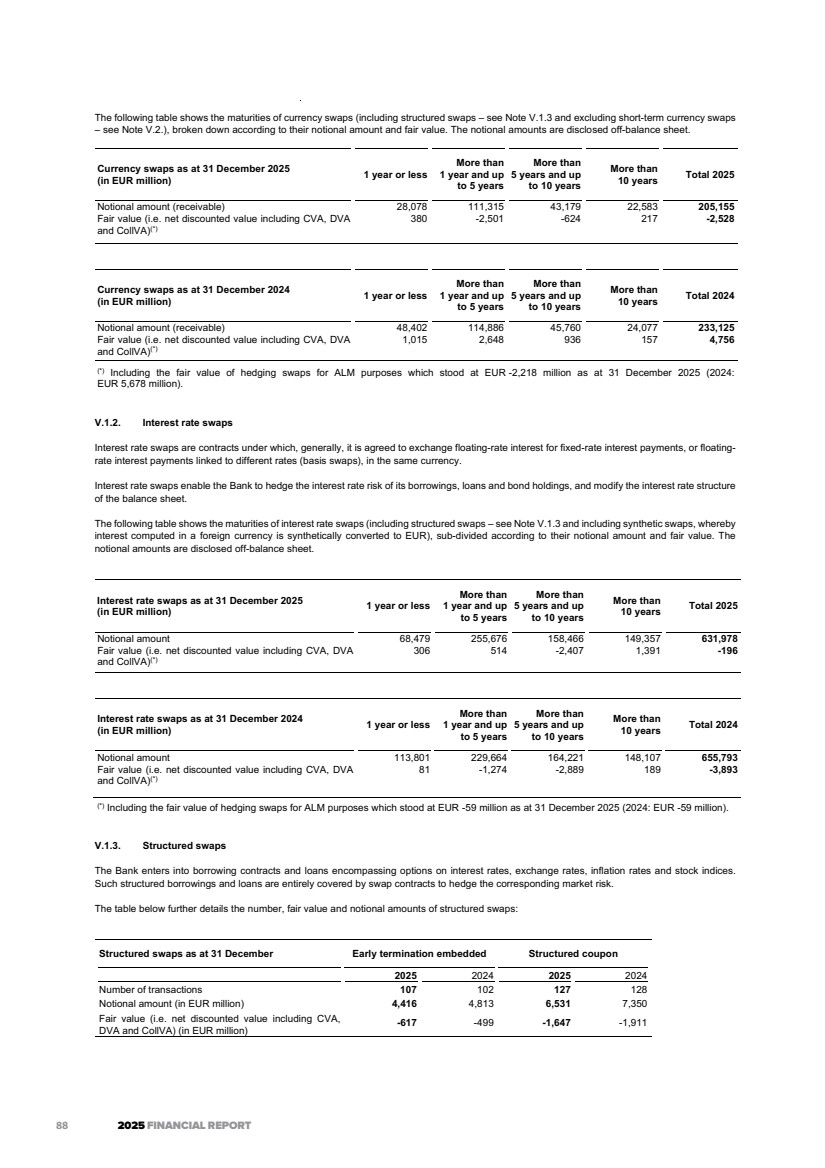
| estatutory f 51 The fair value of structured swap transactions is computed using option pricing models, calibrated to available market prices of options. For a portion of derivative transactions, internal estimates and assumptions might be used in the valuation techniques when the market inputs are not directly available. All option contracts embedded in, or linked with, borrowings are negotiated over the counter. V.1.4. Derivatives credit risk mitigation policy The credit risk policy for derivative transactions is based on the definition of eligibility conditions and rating-related limits for swap counterparts. To reduce credit exposures, the Bank has signed Credit Support Annexes with most of its active swap counterparts and receives collaterals when the exposure exceeds certain contractually defined thresholds. The credit risk with respect to derivatives lies in the loss that the Bank would incur if a counterparty is unable to honour its contractual obligations. In view of the special nature and complexity of derivative transactions, a series of procedures has been put in place to safeguard the Bank against losses arising from the use of such instruments. • Contractual framework: All of the Bank’s derivative transactions are concluded under the contractual framework of ISDA Swap Agreements and where applicable Credit Support Annexes, which specify the conditions of exposure collateralisation. These are generally accepted and practised contract types. Minimum conditions for new agreements are specified in the risk guidelines. • Counterparty selection: The minimum rating at the outset is set in the risk guidelines at A3. The EIB has in most cases a right of early termination if the counterparty rating drops below a certain level. • Collateralisation: - Exposures (in some cases subject to thresholds) are collateralised by cash and bonds. - Certain transactions are collateralised above the current market value. - Both the derivatives portfolio with individual counterparties and the collateral received are regularly monitored and valued, with a subsequent call for additional collateral or collateral release. As part of the ISDA agreements, the Bank has received securities and cash that it is allowed to sell or repledge. The fair value of the securities accepted under these terms amounts to EUR 3,996 million as at 31 December 2025 (2024: EUR 5,548 million), with the following composition, detailed based on the nature of the collateral and based on Moody’s equivalent rating: Swap collateral (in EUR million) Moody's equivalent rating Bonds Cash Total 2025 Government Agency, supranational, covered bonds Aaa 434 465 0 899 Aa1 to Aa3 489 0 0 489 A1 to A3 395 0 0 395 Baa1 to Baa3 1,802 0 0 1,802 Non-rated 0 0 411 411 Total 2025 3,120 465 411 3,996 Swap collateral (in EUR million) Moody's equivalent rating Bonds Cash Total 2024 Government Agency, supranational, covered bonds Aaa 162 462 0 624 Aa1 to Aa3 2,238 0 0 2,238 A1 to A3 5 0 0 5 Baa1 to Baa3 1,965 0 0 1,965 Non-rated 0 0 716 716 Total 2024 4,370 462 716 5,548 The Bank has implemented the usage of an IT system, the Collateral management system (‘CMS’). The key objective of the CMS is to ensure that the Bank is capable to utilise for repos a real-time inventory of assets and collateral accepted in secured markets. Securities received as collateral for loans, derivatives and reverse repos, repos are valued in CMS on a daily basis, by using prices quoted in active markets, supplied by a Market Price Service Provider (i.e. Bloomberg) or, if quoted prices are not available, by using market-based valuations. 89 |
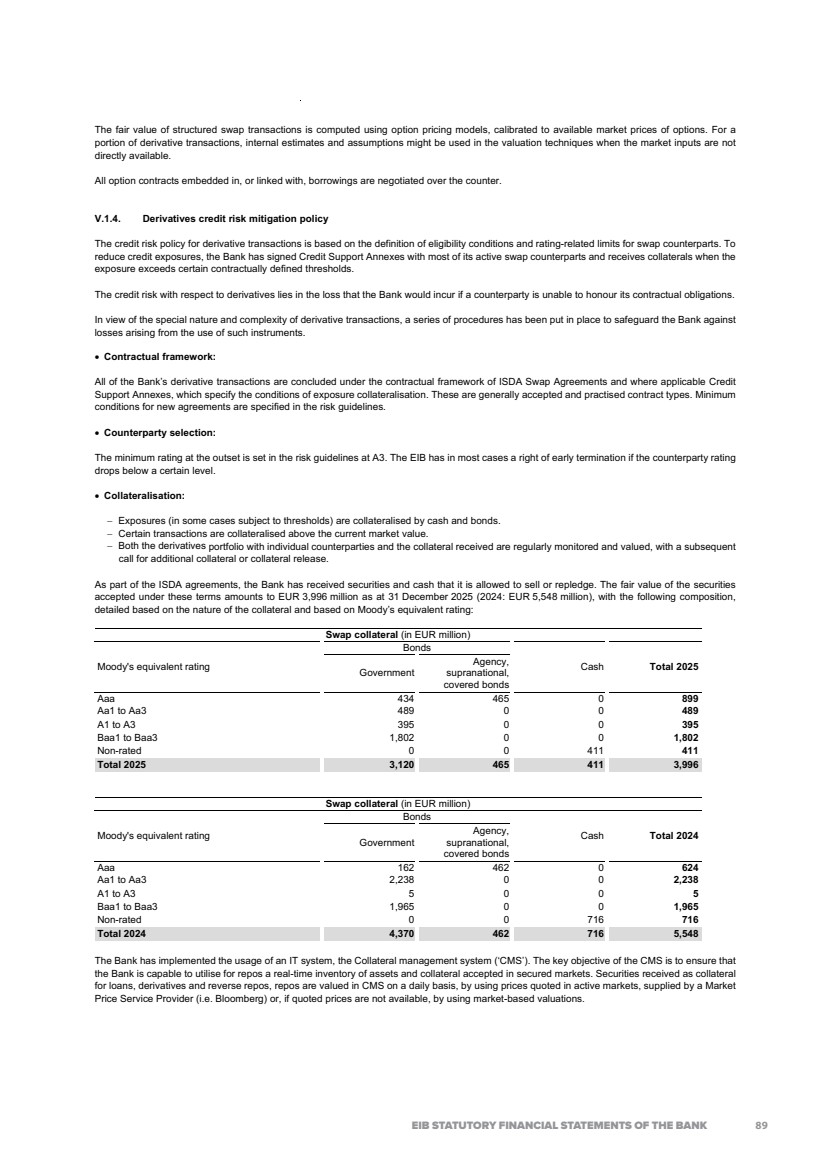
| 2025 FINANCIAL REPORT 52 • Credit risk measurement for derivatives: The credit risk associated with derivatives varies according to a number of factors (such as interest and exchange rates) and generally corresponds to only a small portion of their notional value. For internal purposes, the Bank measures the credit risk exposure related to swaps and derivatives transactions using the Current Unsecured Exposure and the Potential Future Exposure for reporting and limit monitoring. It uses the Standardised Approach for Counterparty Credit Risk (‘SA-CCR’) for regulatory capital allocation in accordance with the EU Capital Requirements Regulation (‘CRR’). The Bank computes the Current Unsecured Exposure, which is the larger of zero and the market value of the portfolio of transactions within the netting set with a counterparty, less the value of collateral received. It is the amount that would be lost upon the default of the counterparty, using the received collateral and assuming no recovery on the value of those transactions in the event of bankruptcy as well as immediate replacement of the swap counterparty for all the transactions. As at 31 December 2025, the current unsecured exposure stood at EUR 176 million (EUR 255 million as at 31 December 2024). Additionally, the Bank computes the Potential Future Exposure, which takes into account the possible increase in the netting set’s exposure over the margin period of risk of 20 business days. The EIB computes the Potential Future Exposure at 90% confidence level using stressed market parameters to arrive at conservative estimates. This is in line with the recommendations issued by regulators to take into consideration the conditions that will prevail in the event of default of an important market participant. • Limits: The limit system for banks covers the Potential Future Exposure in 3 time buckets (under 1 year, between 1 and 5 years and over 5 years) and in 2 rating scenarios (current and downgrade below A3). The derivatives portfolio is valued and compared against limits on a daily basis. The following table provides a breakdown of counterparties by internal rating. Grouped ratings Percentage of nominal Current Unsecured Exposure (in EUR million) Moody’s equivalent rating 2025 2024 2025 2024 Aaa 0.40% 0.42% 0 0 Aa1 to Aa3 52.90% 38.13% 119 172 A1 to A3 46.63% 60.74% 57 80 Below A3 0.07% 0.71% 0 3 Total 100.00% 100.00% 176 255 V.2. As part of treasury management Long-term futures are also used by the Bank to adjust the interest rate exposure of its SLP bond portfolios. The notional amount of long-term futures stood at EUR 44,443 million as at 31 December 2025 (2024: EUR 33,352 million), with a EUR -13 million fair value (2024: EUR -14 million). The Bank also enters into short-term currency swap contracts to adjust currency positions in its operational treasury portfolios relative to its benchmark currency, the euro, and to cater for demand for currencies in connection with loan disbursements. The notional amount of short-term currency swaps receivable stood at EUR 22,930 million as at 31 December 2025 (2024: EUR 19,688 million). The fair value of these contracts was EUR -92 million as at 31 December 2025 (2024: EUR 184 million). 90 |
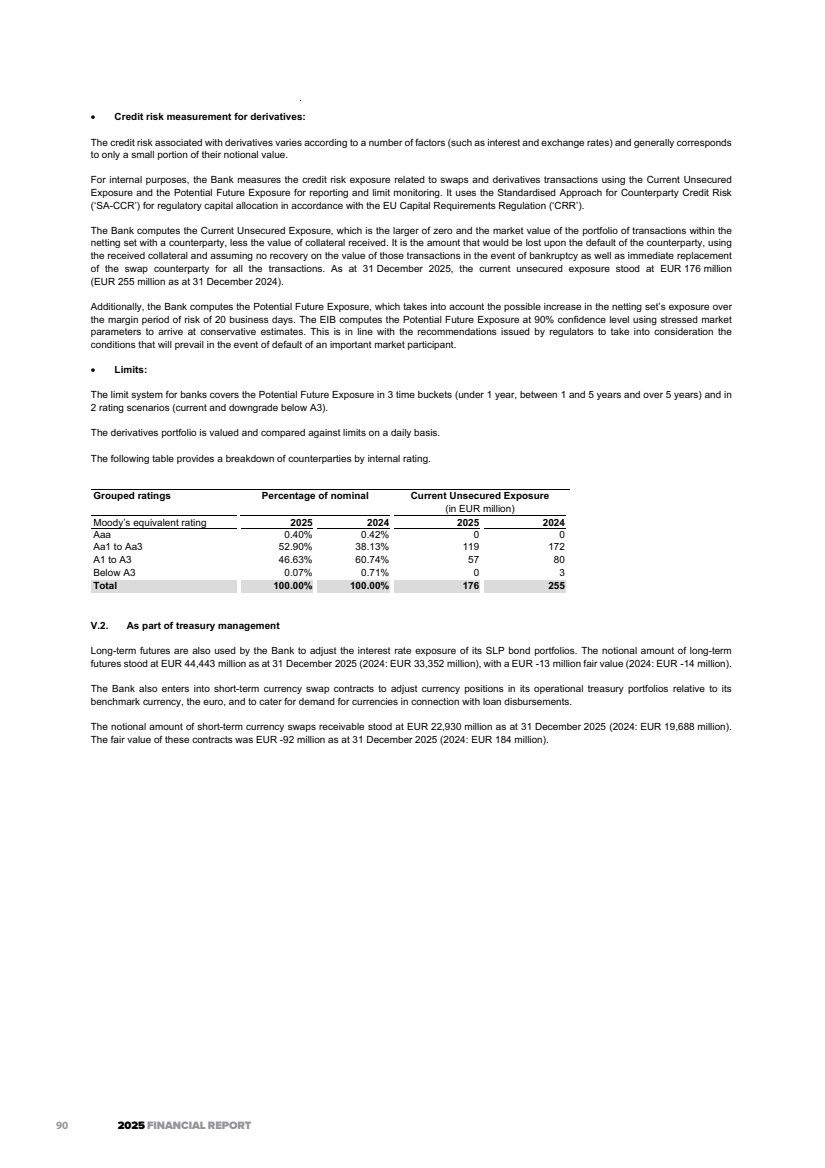
| estatutory f 53 Note W – Conversion rates The following conversion rates were used for drawing up the balance sheets as at 31 December 2025 and 2024: 31.12.2025 31.12.2024 Non-euro currencies of EU Member States Bulgarian Lev (BGN) 1.9558 1.9558 Czech Koruna (CZK) 24.2370 25.1850 Danish Krone (DKK) 7.4689 7.4578 Hungarian Forint (HUF) 385.1500 411.3500 Polish Zloty (PLN) 4.2210 4.2750 Romanian Leu (RON) 5.0968 4.9743 Swedish Krona (SEK) 10.8215 11.4590 Non-EU currencies Armenian Dram (AMD) 446.1600 410.4300 Australian Dollar (AUD) 1.7581 1.6772 Azerbaijani Manat (AZN) 1.9882 1.7587 Brazilian Real (BRL) 6.4364 6.4253 Canadian Dollar (CAD) 1.6088 1.4948 Swiss Franc (CHF) 0.9314 0.9412 Chinese Renminbi (CNY) 8.2262 7.5833 Colombian Peso (COP) 4,426.4600 4,567.4700 Dominican Peso (DOP) 73.7817 63.0861 Egyptian Pound (EGP) 55.7762 52.6893 Ethiopian Birr (ETB) 181.6840 130.4620 Pound Sterling (GBP) 0.8726 0.8292 Georgian Lari (GEL) 3.1260 2.8845 Hong Kong Dollar (HKD) 9.1464 8.0686 Indian Rupee (INR) 105.5965 88.9335 Jordanian Dinar (JOD) 0.8305 0.7355 Japanese Yen (JPY) 184.0900 163.0600 Kenyan Shilling (KES) 151.2000 133.6900 Kazakhstani Tenge (KZT) 594.5800 544.3200 Moroccan Dirham (MAD) 10.7012 10.4987 Moldovan Leu (MDL) 19.5800 18.9700 Mexican Peso (MXN) 21.1180 21.5504 Norwegian Krone (NOK) 11.8430 11.7950 New Zealand Dollar (NZD) 2.0380 1.8532 Serbian Dinar (RSD) 117.1900 116.8300 Russian Ruble (RUB) 92.7790 113.8719 Tunisian Dinar (TND) 3.3906 3.3039 Turkish Lira (TRY) 50.4838 36.7372 Tanzanian Shilling (TZS) 2,862.1200 2,490.2400 Ukrainian Hryvnia (UAH) 49.3255 43.5377 Ugandan Shilling (UGX) 4,240.0000 3,812.0000 United States Dollar (USD) 1.1750 1.0389 Central African CFA Franc (XAF) 655.9570 655.9570 West African CFA Franc (XOF) 655.9570 655.9570 South African Rand (ZAR) 19.4439 19.6188 91 |
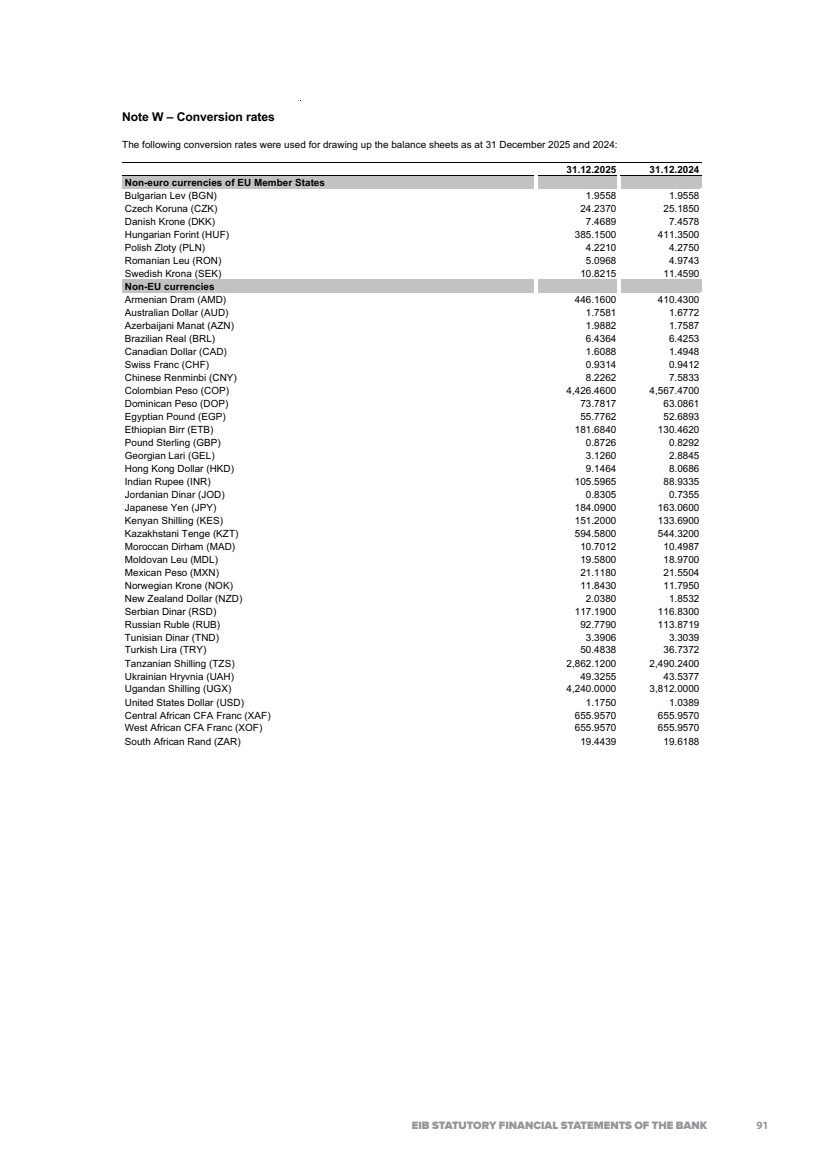
| 2025 FINANCIAL REPORT 54 Note X – Related party transactions X.1. Shares in affiliated undertakings and participating interest (in EUR ‘000) Related party transactions with the European Investment Fund (‘EIF’) are mainly associated with the EIB’s shareholding in the EIF and the Bank’s management of the EIF’s treasury, IT, pension fund and other services provided on behalf of the EIF. In addition, the EIF manages the private equity/venture capital and infrastructure fund activities of the Bank (including participating interests) and provides fronting and monitoring services for part of the Bank’s guarantee and securitisation portfolio. The amounts included in the Financial Statements concerning the related party transactions with the Bank are disclosed as follows: 31.12.2025 31.12.2024 Assets: Shares in affiliated undertakings 1,578,581 1,578,169 Participating interests 470,735 476,779 Loans and advances to credit institutions c) loans 2,497,509 1,653,327 Prepayments and accrued income 4,946 20,236 Other assets 44,120 123,101 Total assets 4,595,891 3,851,612 Liabilities: Amounts owed to customers a) repayable on demand -7,001 -6,322 Other liabilities -506,974 -458,043 Total liabilities -513,975 -464,365 Profit and loss account: Interest receivable and similar income 56,694 49,822 Interest payable and similar charges -4,469 -3,504 Income from securities b) Income from shares in affiliated undertakings 15,714 13,690 Commissions receivable 42,933 39,260 Commissions payable -93,329 -76,255 Net other operating income and expense 17,071 13,559 General administrative expenses -9,424 -14,238 Value (re-)adjustments in respect of transferable securities held as financial fixed assets, participating interests and shares in affiliated undertakings -6,992 -9,004 Total profit and loss account 18,198 13,330 Off-balance sheet: EIF capital – uncalled 3,518,400 3,520,800 EIF treasury 2,337,099 2,256,441 Put option granted to EIF minority shareholders 513,499 483,283 Undisbursed participating interests 534,368 565,018 Guarantees issued to EIF 13,423,264 13,359,167 Total off-balance sheet 20,326,630 20,184,709 92 |
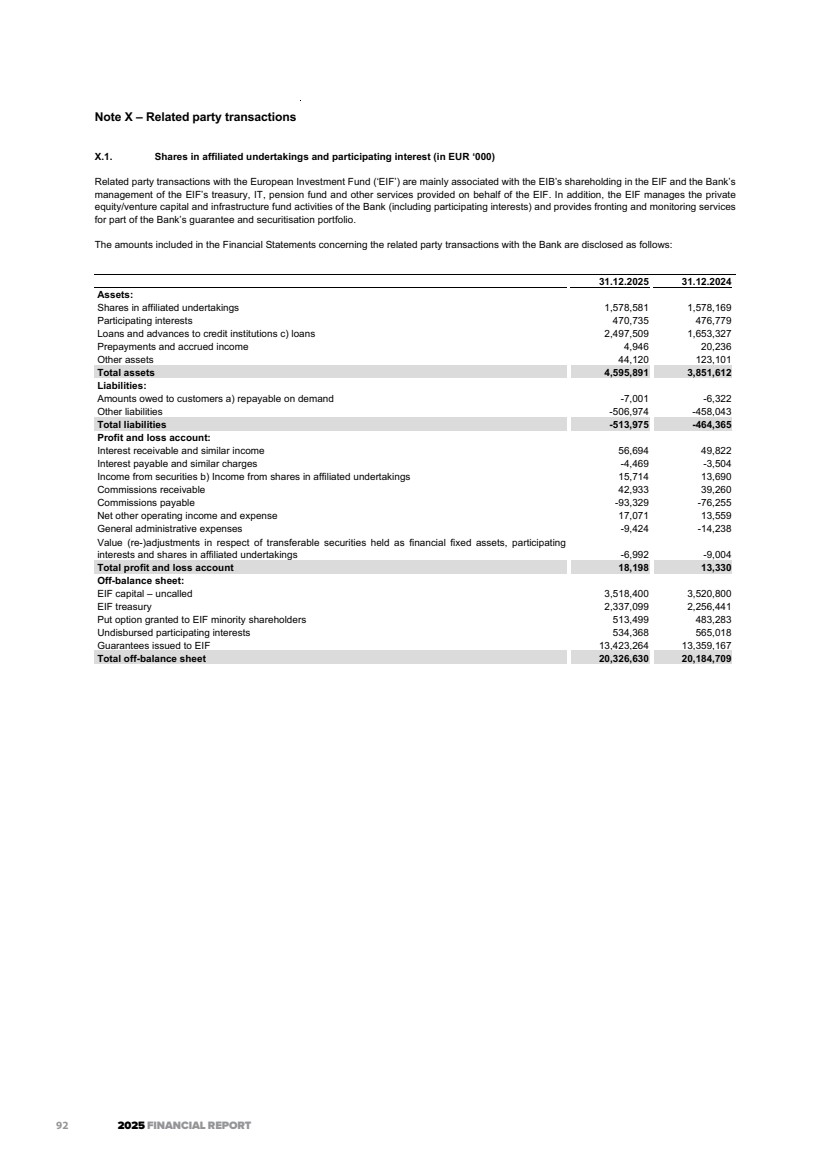
| eistatutory f X.2. Key management personnel (in EUR ‘000) The Bank has identified members of the Board of Directors, the Audit Committee, the Management Committee, the GCRO and the Directors General heading the different EIB organisational directorates, as well as the head of Internal Audit independent department, as key management personnel. Key management personnel compensation for the relevant reporting periods, included within “General administrative expenses” (Note R), is disclosed in the following table: 2025 2024 Short-term benefits(1) 11,818 12,104 Post-employment benefits(2) 920 1,028 Termination benefits 664 398 Total 13,402 13,530 (1) Short-term employee benefits comprise salaries and allowances, bonuses and social security contributions of the Management Committee, the GCRO, Directors General and other Directors, and benefits paid to the members of the Board of Directors and the Audit Committee. (2) Post-employment benefits comprise pensions and expenses for post-employment health insurance paid to members of the Management Committee, the GCRO, the Directors General and other Directors. There were neither advances nor credit granted to key management personnel, nor commitments entered into on their behalf by way of guarantee of any kind. Open balances with key management personnel as at 31 December 2025 comprise the compulsory and optional supplementary pension plan and health insurance scheme liabilities, and payments outstanding as at the year end: 31.12.2025 31.12.2024 Pension plans and health insurance (Note L) 93,671 92,979 Other liabilities (Note G) 13,436 18,609 Note Y – Post balance sheet events EIB is continuously assessing its portfolio in view of heightened geopolitical risks, particularly those arising from the recent military escalation in the Gulf region. While it is too early to assess long-term implications for the overall loan portfolio, the evolving market conditions and sector-specific pressures are being closely monitored. Note D.3 provides a detailed geographical breakdown of the disbursed and undisbursed lending exposure by country in which projects are located. There have been no other material events after the balance sheet date that would require adjustment of, or disclosure in, the Financial Statements as at 31 December 2025. 93 |
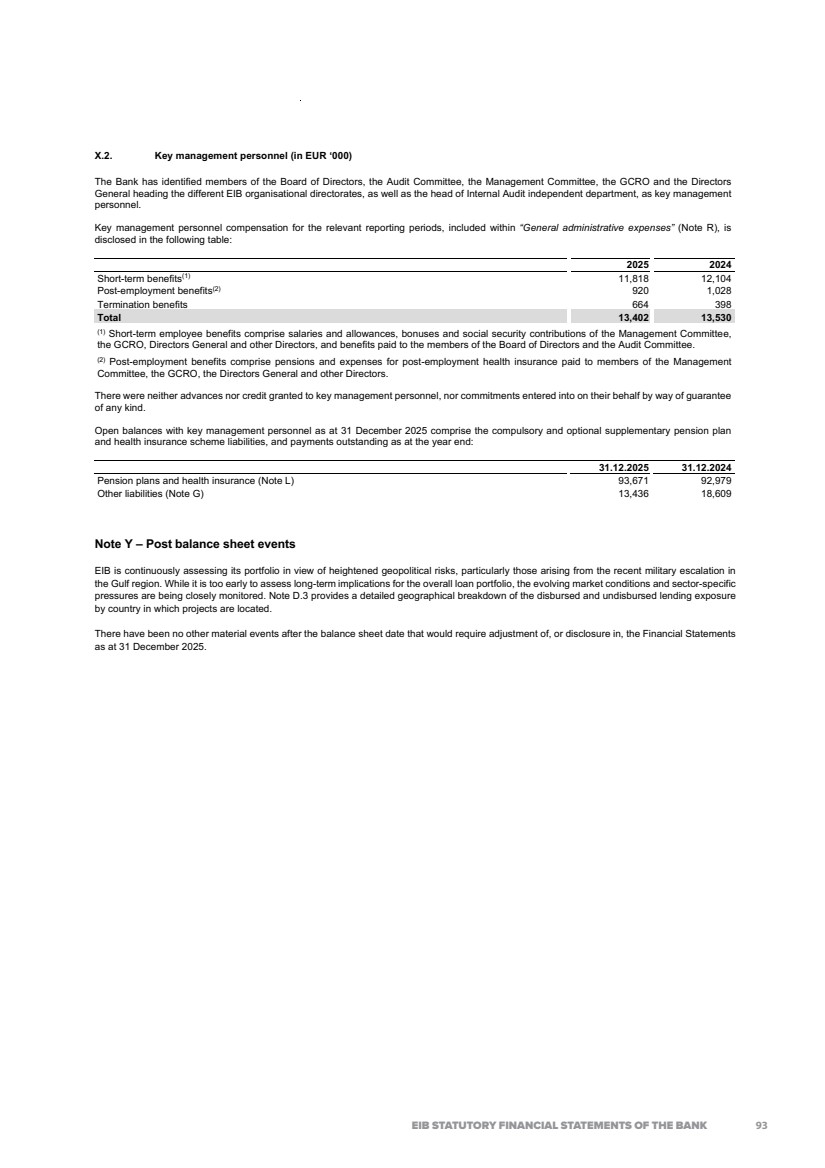
| 2025 FINANCIAL REPORT 56 Note Z – Management of third-party funds Z.1. Innovation Fund The Innovation Fund established under Article 10a(8) of Directive 2003/87/EC supports innovation in low-carbon technologies and processes across all Member States. This includes environmentally safe carbon capture and utilisation which contributes substantially to mitigating climate change, and products to replace carbon intensive alternatives. The Fund also aims to promote the construction and operation of projects focused on environmentally safe capture and geological storage of CO2, alongside innovative renewable energy and energy storage technologies. The EIB prepares separate financial statements for the Innovation Fund. Z.2. Modernisation Fund The Modernisation Fund, established under Article 10d of the revised EU Emissions Trading System (‘ETS’) Directive, aims to modernise the energy systems and improve the energy efficiency of 13 EU beneficiary Member States: Bulgaria, Czech Republic, Croatia, Estonia, Greece, Hungary, Latvia, Lithuania, Poland, Portugal, Romania, Slovakia and Slovenia. The Modernisation Fund supports investments in the generation and use of energy from renewable sources, energy efficiency, energy storage, the modernisation of energy networks, including district heating, pipelines and grids, redeployment, the re-skilling and upskilling of workers, education, job-seeking initiatives and start-ups. The EIB prepares separate financial statements for the Modernisation Fund. Z.3. Investment Facility – Cotonou The Investment Facility, which is managed by the EIB, was established under the Cotonou Agreement on cooperation and development between the African, Caribbean and Pacific Group of States and the European Union and its Member States on 23 June 2000 and subsequently revised. The EIB prepares separate financial statements for the Investment Facility. Z.4. Recovery and Resilience Facility Financial Instruments (‘RRF-FI’) The EIB manages and invests RRF resources on behalf of the respective EU Member States according to an investment strategy and business plan agreed in a funding agreement between the EIB and the mandator. Furthermore, the EIB performs fund administration tasks (including monitoring, reporting, treasury management). If requested by the EU Member States, the mandate can also embed the Bank’s advisory support. RRF-FI can be implemented in three ways: (i) direct implementation, where the EIB directly selects and appraises underlying operations, (ii) indirect implementation through a financial intermediary, and (iii) blending. Z.5. EIF treasury The EIF treasury is managed by the Bank in accordance with the treasury management agreement signed between the two parties in December 2000. Z.6. InnovFin - EU Finance for Innovators (‘InnovFin’) InnovFin is a joint initiative between the EIB, the EIF and the European Commission under the new EU research programme for 2014-2020 (‘Horizon 2020’). On 11 December 2013, Regulation (EU) No. 1291/2013 of the European Parliament and the Council establishing Horizon 2020 – the Framework Programme for Research and Innovation (2014-2020) and repealing Decision No. 1982/2006/EC (‘Horizon 2020 Regulation’) was adopted. On 12 June 2014, the European Commission, the EIB and the EIF signed a Delegation Agreement establishing the financial instrument InnovFin. InnovFin consists of a series of integrated and complementary financing tools and advisory services offered by the EIB Group to support investments across the entire research and innovation value chain, catering to enterprises of all sizes, from the smallest to the largest. The EIB prepares separate financial statements for InnovFin. Z.7. InvestEU On 7 March 2022, the EU, the EIB and the EIF signed a Guarantee Agreement establishing the EU guarantee under InvestEU. The InvestEU programme aims to give an additional boost to sustainable investment, innovation, social inclusion and job creation in Europe. InvestEU is expected to stimulate public and private investments by using a EUR 26.2 billion EU budgetary guarantee, 75% of this is granted separately to the EIB and the EIF. On 1 April 2022, all operations in the EFSI Debt Standard Portfolio and in the EFSI Hybrid Portfolio were transferred to InvestEU. These operations originally guaranteed under the EFSI Agreement, are defined as the ‘Pre-2021 Operations’. The EIB prepares separate financial statements for InvestEU. Z.8. NER300 The EIB supports the European Commission as an agent in the implementation of the NER 300 initiative a funding programme for carbon capture and storage demonstration projects and innovative renewable energy technologies. The facility covers two activities i) the monetisation of EU allowance units (‘EUAs’) and ii) the management and disbursement of cash received through such monetisation activities. The EIB prepares separate financial statements for NER300. 94 |
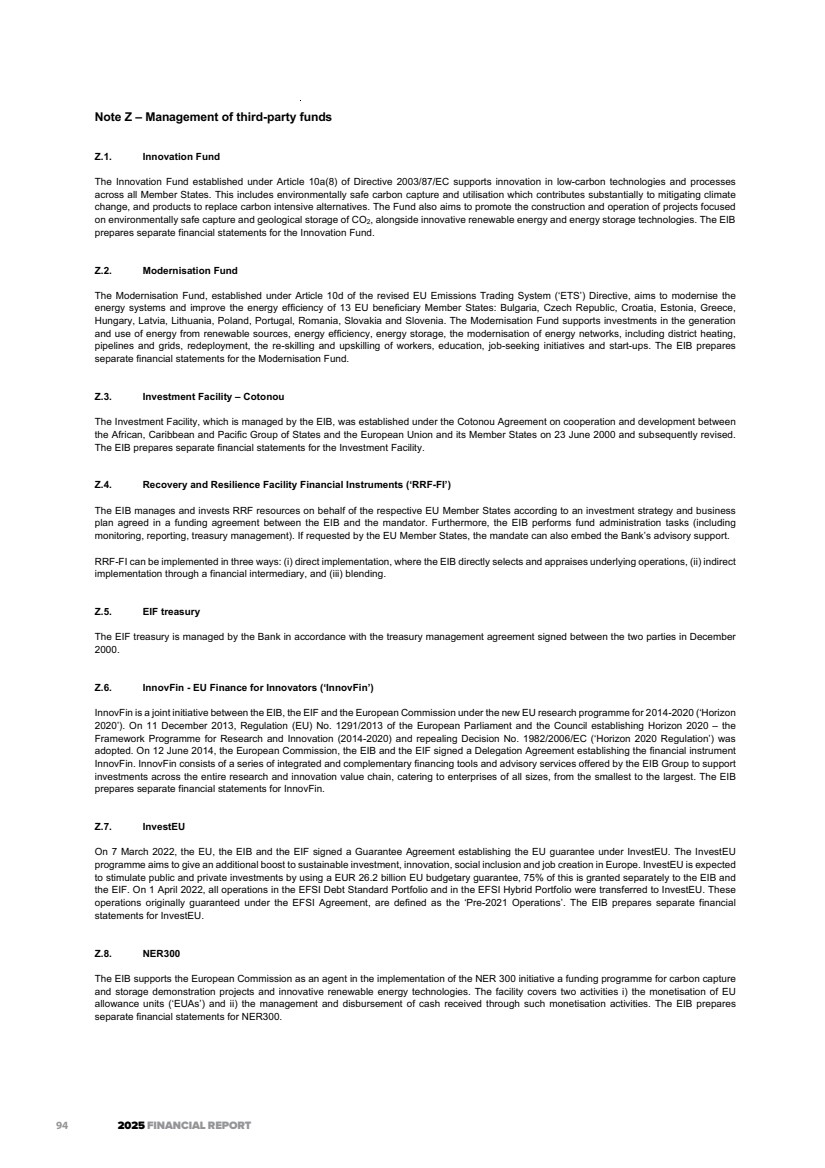
| estatutory f 57 Z.9. Connecting Europe Facility (‘CEF’) The CEF is a joint agreement between the EIB and the European Commission that aims to provide union financial assistance to trans-European networks to support projects of common interest in the transport, telecommunications and energy infrastructures sectors. The Commission entrusted EIB with the implementation and management of the debt instrument under the CEF, which ensures continuity of the Loan Guarantee Instrument for TEN-T Projects (‘LGTT’) and the Pilot phase of Project Bond Initiative (‘PBI’), which were merged under the CEF on 1 January 2016. The CEF Delegation Agreement includes an updated and harmonised risk sharing arrangement. The EIB prepares separate financial statements for the CEF. Z.10. Pan-European Guarantee Fund (‘EGF’) The EGF was endorsed by the European Council on 23 April 2020 as part of the overall EU’s COVID-19 response package. 22 Member States confirmed their participation with an overall guarantee of EUR 24.4 billion euro, available exclusively to entities in participating countries. The EGF is designed to finance high-risk operations and final beneficiaries that would meet financial intermediaries’ requirements for commercial financing but are struggling due to the economic impact of the COVID-19 pandemic. At least 65% of EGF supported financing is therefore allocated to small and medium-sized enterprises (‘SMEs’). The EGF is jointly implemented by the EIB and the EIF, each responsible for approximately half of the amount but with a distinct product offering. The EIF focuses on capped and uncapped portfolio guarantees and indirect equity-type investments (funds), while the EIB deploys products such as linked risk sharing, venture debt and synthetic Asset Based Securities. The EIB prepares separate financial statements for the EGF. Z.11. Partnership Platform for Funds (‘PPF’) The PPF is an EIB-managed platform that brings together multiple funds across regions, contributors and sectors. It was established to address the need for increased financial flows supporting sustainable development, building on the European Investment Bank’s proven track record. The funds under the platform are implemented in accordance with the platform rules. The EIB prepares a separate combined financial report for the PPF. Z.12. EU-Africa Infrastructure (‘EUAI’) Trust Fund The EUAI Trust Fund was created under trust fund agreement between the European Commission on behalf of the European Union as the founding donor and the EIB as manager. It is also open to EU Member States that subsequently accede the agreement as donors. On 9 February 2006, the European Commission and the EIB signed a memorandum of understanding to jointly promote the EU-Africa Infrastructure Partnership and, in particular, to establish a supporting EU-Africa Infrastructure Trust Fund. The EIB prepares separate financial statements for the EUAI Trust Fund. Z.13. Decentralised Financial Instruments (‘DFIs’) The Decentralised Financial Instruments (‘DFIs’) consists of Fund of Funds (‘FoF’) and Holding Funds (‘HF’) financed by the European Structural and Investment Funds (‘ESIF’) from the Member States’ Operational Programmes during 2014-2020 and 2021-2027, respectively. The DFIs facilitate access to finance for final recipients through loans, equity and guarantees, in cooperation with selected financial intermediaries. As a fund manager, EIB gathers the funding (contributions) from the Managing Authorities and invests it via financial intermediaries based on investment strategies agreed with the donors. Z.14. ACP Trust Fund - EC Compartment The African, Caribbean and Pacific (‘ACP’) Trust Fund is an initiative entrusted to the EIB for private sector operations and financed from the general budget of the European Union under the Neighbourhood, Development and International Cooperation Instrument (‘NDICI’) drawing on reflows from the Investment Facility - Cotonou. The Fund supports the general objectives of NDICI-Global Europe, with a focus on private sector operations in eligible countries that are characterised by high risk, but are expected to deliver high impact. These operations include as equity and quasi equity investments, local currency lending, lending to fragile countries and co-financing with European Fund for Sustainable Development Plus (‘EFSD+’) guarantees. The Fund comprises both Financial Instruments and Technical Assistance services. The EIB prepares separate financial statements for the ACP Trust Fund Financial Instruments Window. Z.15. EU for Ukraine Fund (‘EU4U’) The fund aims to strengthen the European Union’s project based support for Ukraine’s reconstruction and recovery, complementing macro-financial assistance. It seeks to foster economic and social resilience and support the development of sustainable infrastructure to revitalise the country’s economy and advance its progress towards EU accession. The fund is designed to be a temporary high-risk, high-impact initiative. The EIB prepares separate financial statements for the EU4U. Z.16. HDW POLIO IG The polio investment grant is one of two components of the Human Development Acceleration (HDX) Programme to eradicate polio. The Gates Foundation is expected to contribute additional investments and grants, while the EIB provides performance-based financing through a limited 95 |
| 2025 FINANCIAL REPORT 58 recourse loan facility. Funds are channelled to the United Nations Children’s Fund (UNICEF) and the World Health Organization (WHO) to develop and execute this programme to eradicate polio. The EIB prepares separate financial statements for the programme. Z.17. InvestEU Advisory Hub The InvestEU Regulation established the InvestEU Programme to advance the EU’s policy objectives by means of supporting financing and investment operations that contribute to the sustainable development and competitiveness of the EU economy. The InvestEU Advisory Hub provides project advisory services, capacity building and market development support to project promoters and intermediaries to help, create and strengthen the InvestEU pipeline of projects. The European Commission and the EIB signed an advisory agreement covering 11 thematic advisory support initiatives. These initiatives address policy and investment priorities under the Sustainable Infrastructure Window, the Research, Innovation and Digitisation Window and the SME Window, the Social Investment and Skills Window and the Cross-Sectoral Window of the InvestEU Advisory Hub. The EIB prepares separate financial statements for the InvestEU Advisory Hub. Z.18. Special Section The Special Section was set up by the Board of Governors on 27 May 1963. On 4 August 1977, its purpose was redefined to serve as a record of financing operations carried out by the EIB for the account of, and under mandate from, third parties. It includes the FED, MED/FEMIP and the guarantee component of the European Development Finance Institutions Private Sector Development Facility. Z.19. Private Finance for Energy Efficiency (‘PF4EE’) instrument The PF4EE instrument is a joint initiative between the EIB and the European Commission that aims to address the limited access to adequate and affordable commercial financing for energy efficiency investments. The instrument targets projects that support the implementation of national energy efficiency action plans established by EU Member States. In December 2014 the European Commission and the EIB signed a delegation agreement establishing the PF4EE financial Instrument. The EIB prepares separate financial statements for the PF4EE. Z.20. DCFTA Initiative East On 19 December 2016, the European Commission and the EIB signed the delegation agreement for the Deep and Comprehensive Free Trade Area (‘DCFTA’). The DCFTA Initiative East aims to strengthen economic development in the countries that have signed an association agreement with the EU namely Georgia, Moldova and Ukraine by providing targeted financial and technical support to SMEs in these three countries. As part of the DCFTA, the EIF implements and manages the Guarantee Facility Window. The EIB prepares separate consolidated financial statements for the DCFTA including the Guarantee Facility Window. Z.21. Neighbourhood, Development and International Cooperation Instrument (‘NDICI’) Investment Windows (‘IW1, IW2 and IW4’) The NDICI – Global Europe Regulation entered into force on 14 June 2021. It replaces and consolidates most of the EU’s existing external financing instruments under a single comprehensive framework. The financing operations undertaken in the past under the External Lending Mandate (‘ELM’), the Cotonou Mandate (including the ACP Investment Facility and EIB own resources lending in the ACP countries supported by the EU Member States comprehensive guarantee), and the External Investment Plan / EFSD are to be fully integrated into EFSD+. This regulation establishes the overarching framework for EIB operations outside the EU under the 2021-2027 MFF, with a particular focus on supporting the EU policies in the EU Neighbourhood, sub-Saharan Africa, Asia and the Pacific, the Americas and the Caribbean. NDICI IW1, IW2 and IW4 are dedicated investment windows formalised in separate guarantee agreements under which, the EU provides risk coverage for guaranteed EIB loan operations in Africa, the Caribbean, and the Pacific. The EIB prepares separate financial statements for NDICI IW1, IW2 and IW4. Z.22. Neighbourhood Investment Facility (‘NIF’) Risk Capital Facility The NIF Risk Capital Facility is financed by the general budget of the European Union. Its main purpose is to provide access to equity and debt finance for SMEs in the Southern Neighbourhood region to support private sector development, inclusive growth and private sector job creation. The facility comprises a Financial Instrument Window which consists of equity and debt finance instruments and an Additional Tasks Window which consists of technical assistance services. The EIB prepares separate financial statements for the Financial Instrument Window. Z.23. European Neighbourhood and Partnership Instrument (‘ENPI’) The Framework Agreement between the EU and the EIB on the implementation of operations financed by the general budget of the European Union in the countries covered by the European Neighbourhood Policy is channelled through ENPI. The EIB prepares separate financial statements for ENPI. Z.24. Joint European Support for Sustainable Investment in City Areas (‘JESSICA’) Holding Funds JESSICA is an initiative developed by the European Commission and the EIB, in collaboration with the Council of Europe Development Bank. 96 |
| estatutory f 59 JESSICA Holding Funds are used within the framework of the JESSICA initiative. Under new procedures, Managing Authorities now have the option to use a portion of their EU grant funding to make repayable investments in projects that are part of an integrated plan for sustainable urban development. As manager, the EIB collects the funding received from the Managing Authorities and invests it in Urban Development Funds, according to investment guidelines agreed with the donors. Z.25. Instrument for Pre-accession Assistance II / III (‘IPA II / IPA III’) The Instrument for Pre-accession Assistance (‘IPA’) is the EU’s primary tool for supporting reforms in the 'enlargement countries' providing both financial and technical assistance. These pre-accession funds are a sound investment in the future of the enlargement region and the EU itself, advancing EU priorities such as sustainable economic recovery, energy supply, transport, the environment, climate change, etc. The successors of IPA I, IPA II, and IPA III are implemented by the EIB, allocating resources from the Directorate General European Neighbourhood and Enlargement Negotiations via the signature of various “specific grant agreements”. While the IPA II Regulation formally applied until 31 December 2020, its implementation is still ongoing. The EIB prepares financial statements for specific grant agreements. Z.26. European Fund for Strategic Investments (‘EFSI’) Based on the applicable EFSI Regulations, the European Commission and the EIB concluded agreements on the management of the EFSI, the granting of the EU guarantee (‘EFSI Agreement’) and the implementation of the European Investment Advisory Hub (‘EIAH’). Under the EFSI Agreement, the European Commission provides an EU guarantee to the EIB for projects supported by the EFSI. The assets covering this EU guarantee are directly managed by the European Commission. Projects supported by EFSI follow the normal EIB project cycle and governance. In addition, EFSI has its own governance structure designed to ensure that investments remain focused on the specific objective of addressing the market failures in risk-taking that hinder investment in Europe. The EIAH aims to enhance non-financial support for projects and investments. It comprises three complementary components: i) a single point of entry to a wide range of advisory and technical assistance programmes and initiatives for public and private beneficiaries, ii) a cooperation platform to leverage, exchange and share expertise among partner institutions and iii) the reinforcement or extension of existing advisory services or the creation of new ones to address unmet needs. The EIB prepares separate financial statements for EIAH. Z.27. Facility for Euro-Mediterranean Investment and Partnership (‘FEMIP’) Trust Fund The FEMIP Trust Fund, managed by the EIB, was set up to enhance the existing activities of the EIB in the Mediterranean partner countries. Supported by a number of donor countries, the fund aims to direct resources to operations in certain priority sectors by providing technical assistance and risk capital. The EIB prepares separate financial statements for the FEMIP Trust Fund. Z.28. Global Concessional Finance Facility (‘GCFF’) The objective of the GCFF is to support middle-income countries in the Middle East and North Africa (‘MENA’) region impacted by the influx of refugees. This is achieved by providing concessional financing to multilateral development banks (‘MDB’) financing and improving coordination efforts. The EIB has implemented the GCFF Jordan Private Sector Guarantee Facility which offers partial portfolio guarantees to local financial intermediaries, such as banks or microfinance institutions. The facility provides partial risk protection to financial intermediaries in the form of guarantees on underlying debt-financing granted to MSMEs on a portfolio basis. Z.29. AECID This partnership agreement signed between the Kingdom of Spain (the Spanish Agency for International Development Cooperation (‘AECID’)) and the EIB was set up to invest in operations in the countries covered by the FEMIP together with Mauritania (the “Southern Mediterranean region”). The primary focus is on risk capital activities involving micro-SMEs, as well as supporting broader development of the private sector in the region. The EIB prepares separate financial statements for AECID. Z.30. Neighbourhood Investment Facility (‘NIF’) Trust Fund The NIF Trust Fund, managed by the EIB was set up to achieve the strategic objective of the European Neighbourhood Policy (‘ENP’). It provides targeted funding to establish better and more sustainable energy and transport interconnections, improve energy efficiency and promote the use of renewable energy sources, address climate change and broader threats to the environment and promote smart, sustainable and inclusive growth. This is achieved through support to SMEs, to the social sector including human capital development and municipal infrastructure development. The EIB prepares separate financial statements for the NIF Trust Fund. Z.31. EU support to Boost Africa The EU Support to Boost Africa is a joint initiative between the EIB and the African Development Bank. Its core objectives are to enable and enhance entrepreneurship and innovation across Africa in a commercially viable way and to address a current gap in the Sub-Saharan market, by providing early-stage venture capital alongside skills development. The Facility comprises a Financial Instrument Window, which consists of equity and quasi-equity instruments, and an Additional Tasks Window, which consists of technical assistance services. The EIB prepares separate financial statements for the Financial Instrument Window. 97 |
| 2025 FINANCIAL REPORT 60 Z.32. Eastern Partnership Technical Assistance (‘EPTA’) Trust Fund The EPTA Trust Fund is focused on increasing the quality and development impact of EIB Eastern Partnership operations by offering a multi-purpose, multi-sector funding facility for technical assistance. It complements the Neighbourhood Investment Facility. The EIB prepares separate financial statements for the EPTA Trust Fund. Z.33. Natural Capital Finance Facility (‘NCFF’) The Natural Capital Finance Facility (‘NCFF’) is a joint initiative between the EIB and the European Commission that aims to address market gaps and barriers by supporting revenue generating or cost saving projects that preserve natural capital, including those focused on climate change adaptation. The Facility contributes to the achievement of biodiversity and climate change adaptation objectives set by the EU and its Member States. The EIB prepares separate financial statements for the NCFF. Z.34. Demand side management, Social Infrastructures, Renewables and Energy Efficiency (‘DESIREE’) DESIREE is a programme that was approved under the Thematic Blending Facility and will support greater investment in energy efficiency and electrification of social infrastructure such as schools and hospitals. The programme includes grants for technical assistance and programme management as well as investment grants and financial instruments. The EIB prepares separate financial statements for DESIREE. Z.35. Technical Assistance for Eastern Partnership Investment in Connectivity (‘EPIC’) EPIC is a technical assistance facility under the Neighbourhood Investment Platform (‘NIP’) that helps to improve connectivity both within the Eastern Partnership region and between the Eastern Partnership countries and the EU. The EIB prepares separate financial statements for EPIC. Z.36. fi-compass “fi-compass” is a platform for advisory services under Cohesion Funds, also known as shared management funds, provided by the European Commission in partnership with the EIB. It provides technical assistance to stakeholders, helping them build the knowledge base and administrative capacity required for the effective implementation of financial instruments and disseminating good practices among Member States. Z.37. Joint Assistance to Support Projects in European Regions (‘JASPERS’) JASPERS is a technical assistance partnership between the EIB and the European Commission. Its strategic objective is to support the quality and timely delivery of projects funded under the Cohesion Policy, the Connecting Europe Facility, the Instrument for Pre-Accession Assistance and the Just Transition Fund by providing targeted advisory support to the relevant counterparts through the entire project life cycle - from pipeline identification, selection and prioritisation through project development and approval to financial closing implementation and completion. The EIB prepares separate financial statements for JASPERS. Z.38. Technical Assistance for Regions Undergoing a Green Energy Transition (‘TARGET’) TARGET is a technical assistance facility designed to support coal, peat and oil shale regions in identifying and developing clean energy projects and energy efficiency projects. It also supports the investments and the creation of sustainable jobs on the ground, facilitating a transition away from coal, peat and oil shale-based activities. The EIB prepares separate financial statements for TARGET. Z.39. GEF-UNEP This is a Global Environment Facility (‘GEF’) in cooperation with the United Nations Environment Programme (‘UNEP’) that provides technical assistance for identifying, selecting and designing future investments. These consist primarily of capital investment projects with outcomes leading to nutrient reduction, which will indirectly contribute to the long-term outcome of depollution of the Mediterranean Sea. Z.40. EFSD Guarantee - SME Access to Finance Initiative The EFSD Guarantee “SME Access to Finance Initiative” is a guarantee facility targeting SMEs and underserved entrepreneurs with a particular focus on young entrepreneurs, female entrepreneurs, start-ups and certain other groups in specific target countries and with the overriding objective of addressing some of the root causes of migration. The programme provides first loss credit protection to local banks and financial institutions selected by EIB with covering portfolios of loans, bank guarantees and letters of credit issued to, SMEs or micro-SMEs. These individuals typically have limited access to finance than other entrepreneurs due to being perceived as higher risk by local financial institutions. The target countries are located in the Eastern and Southern European Neighbourhood. The EIB prepares separate financial statements for the programme. 98 |
| estatutory f 61 Z.41. EU Trade and Competitiveness Programme (‘EUTCP’) The EUTCP, developed by the European Commission and the EIB, aims to address market failure and support SME competitiveness in Morocco, Tunisia, Egypt and Jordan. In line with the EU policy priorities – economic growth, private-sector development, regional integration, and climate action – the programme fosters investments along key value chains through new guarantee instruments. The Financial Instrument Window includes a Risk Sharing Facility that provides first-loss credit-risk protection to financial intermediaries. The EIB prepares separate financial statements for the programme. Z.42. EU4Business Guarantee Facility Ukraine EU4Business Guarantee Facility Ukraine, financed under the Ukraine Facility, supports Ukraine's recovery and private-sector growth by mobilising financing for the economy. The Facility is designed to facilitate access to finance to SMEs and Labour-Intensive SMEs in Ukraine, by offering portfolio guarantees to local banks and other financial intermediaries, enabling them to enhance transaction terms and conditions. The EIB mandated the EIF to implement and manage the Guarantee Facility. Z.43. AIP Kulima The “Support for Kulima Access to Finance Programme” developed under the Africa Investment Platform (‘AIP’) comprises an intermediated facility for on-lending to eligible private agri-food sector investments in Malawi. It aims to promote sustainable agricultural growth to increase incomes, employment and food security in the context of a changing climate. The EIB prepares separate financial statements for the programme. Z.44. EU4Business Guarantee Facility EU4Business Guarantee Facility financed by the general budget of the European Union under NIP, represents a Phase II of the DCFTA Initiative, supporting the economic development of the Eastern Partnership countries (Ukraine, Georgia and Moldova). The facility focuses on SMEs operating in exporting sectors such as agriculture, manufacturing or information technologies. It is designed to address market failures in these countries, by providing SME portfolio guarantees to local banks and other financial intermediaries, enabling them to enhance transaction terms and conditions and thus improve access to finance for these businesses. The EIB mandated EIF to implement and manage the Guarantee Facility. Z.45. Palestine Financial Sustainability Initiative Part I (‘PFSI’) The "Palestine Financial Sustainability Initiative Part I" developed under the NIP, comprises the Guarantee Facility which provides credit risk protection on a portfolio basis for the debt instruments granted by Financial Intermediaries to support eligible investments and working capital in East Jerusalem, Area C and Gaza. The PFSI aims at enhancing access to finance for MSMEs operating in Palestine, to improve competitiveness, promote business expansion and enable MSMEs to modernise their businesses. The EIB prepares separate financial statements for the initiative. Z.46. AIP Zambia The “Zambia Agriculture Value Chain Facility Programme” developed under the Africa Investment Platform (‘AIP’) aims to support the government of Zambia's policy objectives to reduce rural poverty and malnutrition and improve rural livelihoods. The EIB initiative aims to address market failures in agricultural value chains by facilitating access to finance for private agriculture value chain actors through financial intermediaries, and by strengthening the lending capacity of these financial intermediaries. The EIB prepares separate financial statements for the programme. Z.47. Guarantee Fund for Greek SMEs (‘GF Greece’) The fund is a joint initiative between the Hellenic Republic, the European Commission and the EIB to support lending to SMEs in Greece. Established by using unabsorbed Structural Funds for Greece, the fund guarantee EIB loans for SMEs via partner banks in Greece. The EIB prepares separate financial statements for the GF Greece. The mandate was terminated in July 2025. Z.48. Risk-Sharing Finance Facility (‘RSFF’) The RSFF was established under the Cooperation Agreement between the European Commission on behalf of the European Union and the EIB that entered into force on 5 June 2007. The RSFF aims to foster investment in research, technological development and demonstration, and innovation. As part of the RSFF, the EIF set up the Risk Sharing Instrument (‘RSI’) for innovative and research-oriented SMEs and small mid-caps. The RSI provides guarantees to banks and leasing companies for loans and financial leases to research-based SMEs and small mid-caps. The EIB prepares separate consolidated financial statements for the RSFF including the RSI. The mandate was terminated in December 2025. 99 |
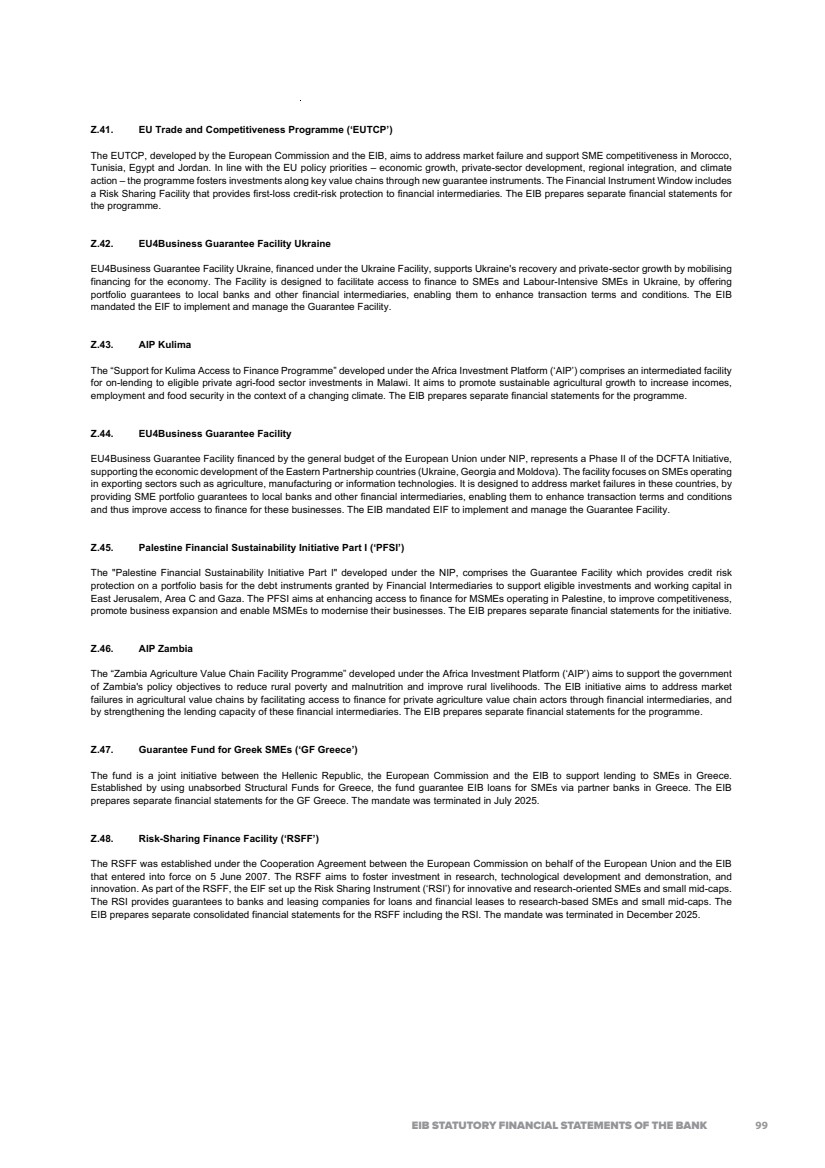
| 2025 FINANCIAL REPORT 62 Statement of Special Section(1) as at 31 December 2025 and 31 December 2024 (in EUR ‘000) ASSETS 31.12.2025 31.12.2024 Mediterranean countries From resources of the European Union Disbursed loans outstanding 1,608 2,407 Risk capital operations - amounts to be disbursed 19,630 19,656 - amounts disbursed 21,627 24,254 41,257 43,910 Total(2) 42,865 46,317 · Lomé Conventions Operations from risk capital resources - amounts disbursed 47,243 53,137 Total(3) 47,243 53,137 Total 90,108 99,454 LIABILITIES 31.12.2025 31.12.2024 Funds under trust management Under mandate from the European Union - Financial protocols with the Mediterranean countries 23,235 26,661 - Lomé Conventions 47,243 53,137 Total funds under trust management 70,478 79,798 Funds to be disbursed On loans and risk capital operations in the Mediterranean countries 19,630 19,656 Total funds to be disbursed 19,630 19,656 Total 90,108 99,454 For information: Total amounts disbursed and not yet repaid on loans on special conditions made available by the European Commission in respect of which the Bank has accepted an EU mandate for recovering principal and interest: a) under the First, Second and Third Lomé Conventions as at 31 December 2025 EUR ‘000 136,780 (2024: EUR ‘000 152,968). b) under financial protocols signed with the Mediterranean countries as at 31 December 2025 EUR ‘000 14,222 (2024: EUR ‘000 16,939). In the context of the European Union – European Development Finance Institutions Private Sector Development Facility, the implementation agreement for the guarantee component was signed on 20 August 2014. The total amount of the EU guarantee to be issued is EUR ‘000 38,522 as at 31 December 2025 (2024: EUR ‘000 38,920). Note (1): The Special Section was set up by the Board of Governors on 27 May 1963. On 4 August 1977, its purpose was redefined to serve as a record of financing operations carried out by the European Investment Bank for the account of and under mandate from third parties. However, for the Investment Facility under the Cotonou Agreement, the EU-Africa Infrastructure Trust Fund, the Neighbourhood Investment Facility (‘NIF’) Trust Fund and the FEMIP Trust Fund, separate financial statements are presented. Since 2005, the EIB has also been preparing financial statements of different types for other mandates. The Statement of Special Section reflects amounts disbursed or to be disbursed, less cancellations and repayments, under mandate from the European Union and the Member States. Amounts disbursed and to be disbursed and funds received and to be received are carried at nominal value. No account is taken in the Statement of Special Section of provisions or value adjustments, which may be required to cover risks associated with such operations except for definite write-offs. Amounts in foreign currency are translated at the exchange rates prevailing on 31 December. 100 |
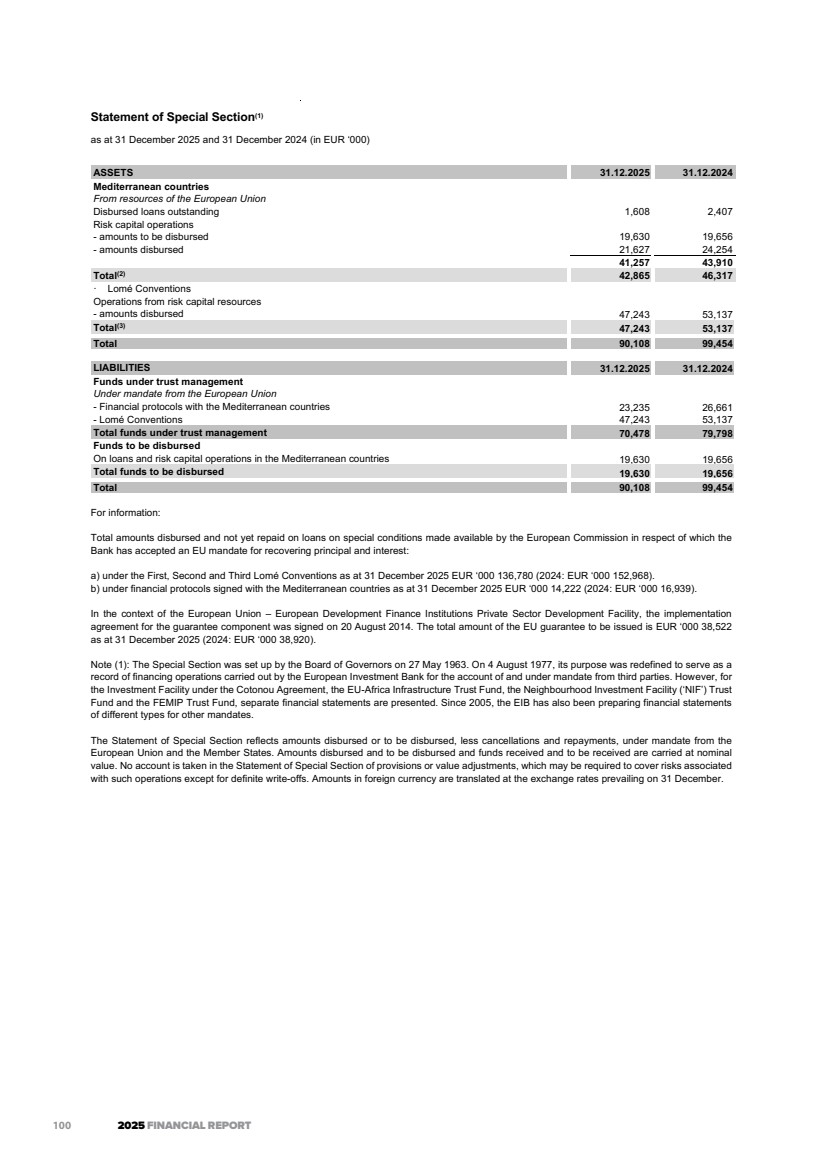
| 63estatutory f Note (2): Initial amount of contracts signed for financing projects in the Maghreb and Mashreq countries, Malta, Cyprus, Türkiye and Greece (EUR 10 million lent prior to accession to the European Community on 1 January 1981) under mandate, for the account and at the risk of the European Union. Initial amount: 840,457 less: exchange adjustments 58,475 cancellations 181,095 repayments 558,022 -797,592 42,865 Note (3): Initial amount of contracts signed for financing projects in the African, Caribbean and Pacific States and the Overseas Countries and Territories (‘ACP-OCT’) under mandate, for the account and at the risk of the European Union: Loans from risk capital resources: Conditional and subordinated loans 3,116,097 Equity participations 121,003 Initial amount: 3,237,100 add: capitalised interests 9,548 less: exchange adjustments 55,865 cancellations 762,667 repayments 2,380,873 -3,199,405 47,243 101 |
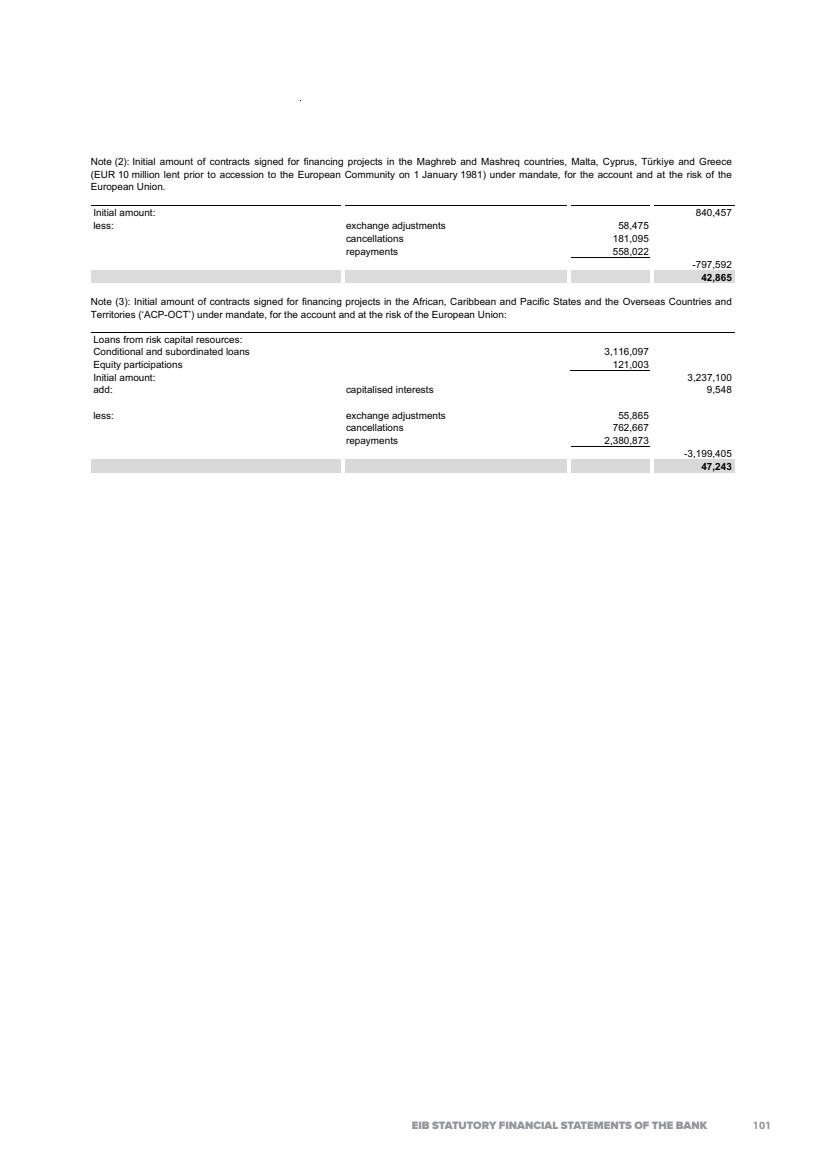
| 2025 FINANCIAL REPORT INDEPENDENT AUDITORʹS REPORT KPMG Audit S.à r.l. 39, Avenue John F. Kennedy L-1855 Luxembourg Tel.: +352 22 51 51 1 Fax: +352 22 51 71 E-mail: info@kpmg.lu Internet: www.kpmg.lu © 2026 KPMG Audit S.à r.l., a Luxembourg entity and a member firm of the KPMG global organization of independent member firms affiliated with KPMG International Limited, a private English company limited by guarantee. All rights reserved. R.C.S Luxembourg B 149133 To the Chairman of the Audit Committee of EUROPEAN INVESTMENT BANK 98-100, boulevard Konrad Adenauer L-2950 Luxembourg REPORT OF THE REVISEUR D’ENTREPRISES AGREE Report on the audit of the financial statements Opinion We have audited the financial statements of EUROPEAN INVESTMENT BANK (“the Bank”), which comprise the balance sheet as at 31 December 2025, and the profit and loss account and the cash flow statement for the year then ended, and notes to the financial statements, including a summary of significant accounting policies and other explanatory information. In our opinion, the accompanying financial statements give a true and fair view of the financial position of the EUROPEAN INVESTMENT BANK as at 31 December 2025, and the results of its operations and its cash flows for the year then ended in accordance with the general principles of the Directive 86/635/EEC of the Council of the European Communities of 8 December 1986 on the annual accounts and consolidated accounts of banks and other financial institutions, as amended by Directive 2001/65/EC of 27 September 2001, by Directive 2003/51/EC of 18 June 2003 and by Directive 2006/46/EC of 14 June 2006 (the “Directives”). Basis for opinion We conducted our audit in accordance with the Law of 23 July 2016 on the audit profession (“Law of 23 July 2016”) and with International Standards on Auditing (“ISAs”) as adopted for Luxembourg by the “Commission de Surveillance du Secteur Financier” (“CSSF”) and the Institut des Réviseurs d’Entreprises (“IRE”). Our responsibilities under the Law of 23 July 2016 and ISAs as adopted for Luxembourg by the CSSF and the IRE are further described in the « Responsibilities of “réviseur d’entreprises agréé” for the audit of the financial statements » section of our report. We are also independent of the EUROPEAN INVESTMENT BANK in accordance with the International Code of Ethics for Professional Accountants, including International Independence Standards, issued by the International Ethics Standards Board for Accountants (“IESBA Code”) as adopted for Luxembourg by the CSSF and the IRE together with the ethical requirements that are relevant to our audit of the financial statements, and have fulfilled our other ethical responsibilities under those ethical requirements. We believe that the audit evidence we have obtained is sufficient and appropriate to provide a basis for our opinion. Key audit matters Key audit matters are those matters that, in our professional judgment, were of most significance in our audit of the financial statements of the current period. These matters were addressed in the context of the audit of the financial statements as a whole, and in forming our opinion thereon, and we do not provide a separate opinion on these matters. KPMG Audit S.à r.l. 39, Avenue John F. Kennedy L-1855 Luxembourg Tel.: +352 22 51 51 1 Fax: +352 22 51 71 E-mail: info@kpmg.lu Internet: www.kpmg.lu © 2026 KPMG Audit S.à r.l., a Luxembourg entity and a member firm of the KPMG global organization of independent member firms affiliated with KPMG International Limited, a private English company limited by guarantee. All rights reserved. R.C.S Luxembourg B 149133 To the Chairman of the Audit Committee of EUROPEAN INVESTMENT BANK 98-100, boulevard Konrad Adenauer L-2950 Luxembourg REPORT OF THE REVISEUR D’ENTREPRISES AGREE Report on the audit of the financial statements Opinion We have audited the financial statements of EUROPEAN INVESTMENT BANK (“the Bank”), which comprise the balance sheet as at 31 December 2025, and the profit and loss account and the cash flow statement for the year then ended, and notes to the financial statements, including a summary of significant accounting policies and other explanatory information. In our opinion, the accompanying financial statements give a true and fair view of the financial position of the EUROPEAN INVESTMENT BANK as at 31 December 2025, and the results of its operations and its cash flows for the year then ended in accordance with the general principles of the Directive 86/635/EEC of the Council of the European Communities of 8 December 1986 on the annual accounts and consolidated accounts of banks and other financial institutions, as amended by Directive 2001/65/EC of 27 September 2001, by Directive 2003/51/EC of 18 June 2003 and by Directive 2006/46/EC of 14 June 2006 (the “Directives”). Basis for opinion We conducted our audit in accordance with the Law of 23 July 2016 on the audit profession (“Law of 23 July 2016”) and with International Standards on Auditing (“ISAs”) as adopted for Luxembourg by the “Commission de Surveillance du Secteur Financier” (“CSSF”) and the Institut des Réviseurs d’Entreprises (“IRE”). Our responsibilities under the Law of 23 July 2016 and ISAs as adopted for Luxembourg by the CSSF and the IRE are further described in the « Responsibilities of “réviseur d’entreprises agréé” for the audit of the financial statements » section of our report. We are also independent of the EUROPEAN INVESTMENT BANK in accordance with the International Code of Ethics for Professional Accountants, including International Independence Standards, issued by the International Ethics Standards Board for Accountants (“IESBA Code”) as adopted for Luxembourg by the CSSF and the IRE together with the ethical requirements that are relevant to our audit of the financial statements, and have fulfilled our other ethical responsibilities under those ethical requirements. We believe that the audit evidence we have obtained is sufficient and appropriate to provide a basis for our opinion. Key audit matters Key audit matters are those matters that, in our professional judgment, were of most significance in our audit of the financial statements of the current period. These matters were addressed in the context of the audit of the financial statements as a whole, and in forming our opinion thereon, and we do not provide a separate opinion on these matters. 102 |
| Inde 1 Value adjustments of loans to customers and credit institutions Why the matter was considered to be one of most significance in our audit As at 31 December 2025, the Bank reports loans accounted for a cost of EUR 440,310 million (31 December 2024: EUR 437,865 million), representing 80% of total assets (31 December 2024: 79%) and recognised individually assessed value adjustments on loans amounting to EUR 701 million (31 December 2024: EUR 618 million). The Bank reviews its loans at each reporting date to assess whether an allowance for value adjustments should be recorded. These loans are not traded in an active market, therefore significant judgments and estimates are applied by Management in its assessment of their recoverable amount. Inappropriate judgments made in relation to the methodology and inputs used or the assumptions taken may have a material impact on the amount of value adjustment recorded. These critical judgments include matters such as the identification and assessment of potential indicators of value adjustments, as well as discounted cash flows forecast techniques, estimation of guarantees obtained, valuation of collaterals received and forbearance measures applied. The current environment of enhanced geopolitical uncertainty introduces increased volatility and unpredictability in key economic factors. This uncertainty increased the level of judgement involved in the determination and calculation of value adjustments on loans. The key inputs and assumptions used by Management in its assessment of loans value adjustments are detailed in Note A.1.2 to the financial statements as well as the accounting policy for the value adjustment in Note A.2.6.1 and the details of specific value adjustments in Note D.2. The loans accounted for at cost are disclosed in Note D.1 to the financial statements as well as the accounting policy for the loans in Note A.2.6.1. How the matter was addressed in our audit Our procedures included the testing of key controls over the approval, recording, monitoring and restructuring of loans to customers and credit institutions, the loan grading process and the measurement of allowance for value adjustment for individually assessed loans. For a sample of loans with specific allowances for value adjustment, we evaluated the Bank's individual assessment of each loan by specifically challenging the Bank's assumptions used as well as underlying data, including the value of realisable collateral and the estimated recoverability. Based on a retrospective review, we further critically assessed whether the Bank revised its estimates and assumptions for specific allowances established in prior years. The impact of the difficult market conditions driven by geopolitical uncertainties was followed-up both by assessing the value adjustment of the evaluated exposure and by determining our sample of exposures where we drew a particular attention to the sectors most vulnerable to the geopolitical risk. Such effect on the Bank’s lending portfolio was assessed as part of our audit procedures. We also tested a sample of individually significant exposures potentially impaired for which no value adjustment had been recorded as well as a sample of exposures which had not been identified by the Bank as being potentially impaired. For both types, we assessed whether appropriate consideration had been given to the collectability of future cash flows and the valuation of the underlying collaterals. We assessed the disclosures in the financial statements in relation to allowance for value adjustment of loans with reference to the requirements of the prevailing accounting standards. 103 |
| 2025 FINANCIAL REPORT Other information The Management is responsible for the other information. The other information comprises the information stated in the introductory sections called “Highlights, Overview, EIB Statutory Bodies and Audit, control and accountability”, which are mainly based on statutory EU Directives information, but does not include the financial statements and our report of the “réviseur d’entreprises agréé” thereon. Our opinion on the financial statements does not cover the other information and we do not express any form of assurance conclusion thereon. In connection with our audit of the financial statements, our responsibility is to read the other information and, in doing so, consider whether the other information is materially inconsistent with the financial statements or our knowledge obtained in the audit or otherwise appears to be materially misstated. If, based on the work we have performed, we conclude that there is a material misstatement of this other information we are required to report this fact. We have nothing to report in this regard. Responsibilities of the Management and Those Charged with Governance for the financial statements The Management is responsible for the preparation and fair presentation of the financial statements in accordance with the general principles of the Directives, and for such internal control as the Management determines is necessary to enable the preparation of financial statements that are free from material misstatement, whether due to fraud or error. In preparing the financial statements, the Management is responsible for assessing the Bank’s ability to continue as a going concern, disclosing, as applicable, matters related to going concern and using the going concern basis of accounting unless the Management either intends to liquidate the Bank or to cease operations, or has no realistic alternative but to do so. Those charged with governance are responsible for overseeing the Bank’s financial reporting process. Responsibilities of the réviseur d’entreprises agréé for the audit of the financial statements The objectives of our audit are to obtain reasonable assurance about whether the financial statements as a whole are free from material misstatement, whether due to fraud or error, and to issue a report of the “réviseur d’entreprises agréé” that includes our opinion. Reasonable assurance is a high level of assurance, but is not a guarantee that an audit conducted in accordance with the Law of 23 July 2016 and with ISAs as adopted for Luxembourg by the CSSF and the IRE will always detect a material misstatement when it exists. Misstatements can arise from fraud or error and are considered material if, individually or in the aggregate, they could reasonably be expected to influence the economic decisions of users taken on the basis of these financial statements. As part of an audit in accordance with the Law of 23 July 2016 and with ISAs as adopted for Luxembourg by the CSSF and the IRE, we exercise professional judgment and maintain professional skepticism throughout the audit. We also: • Identify and assess the risks of material misstatement of the financial statements, whether due to fraud or error, design and perform audit procedures responsive to those risks, and obtain audit evidence that is sufficient and appropriate to provide a basis for our opinion. The risk of not detecting a material misstatement resulting from fraud is higher than for one resulting from error, as fraud may involve collusion, forgery, intentional omissions, misrepresentations, or the override of internal control. 104 |
| Inde • Obtain an understanding of internal control relevant to the audit in order to design audit procedures that are appropriate in the circumstances, but not for the purpose of expressing an opinion on the effectiveness of the Bank’s internal control. • Evaluate the appropriateness of accounting policies used and the reasonableness of accounting estimates and related disclosures made by the Management. • Conclude on the appropriateness of Management’s use of the going concern basis of accounting and, based on the audit evidence obtained, whether a material uncertainty exists related to events or conditions that may cast significant doubt on the Bank’s ability to continue as a going concern. If we conclude that a material uncertainty exists, we are required to draw attention in our report of the “réviseur d’entreprises agréé” to the related disclosures in the financial statements or, if such disclosures are inadequate, to modify our opinion. Our conclusions are based on the audit evidence obtained up to the date of our report of the “réviseur d’entreprises agréé”. However, future events or conditions may cause the Bank to cease to continue as a going concern. • Evaluate the overall presentation, structure and content of the financial statements, including the disclosures, and whether the financial statements represent the underlying transactions and events in a manner that achieves fair presentation. We communicate with those charged with governance regarding, among other matters, the planned scope and timing of the audit and significant audit findings, including any significant deficiencies in internal control that we identify during our audit. We also provide those charged with governance with a statement that we have complied with relevant ethical requirements regarding independence, and to communicate with them all relationships and other matters that may reasonably be thought to bear on our independence, and where applicable, related safeguards. From the matters communicated with those charged with governance, we determine those matters that were of most significance in the audit of the financial statements of the current period and are therefore the key audit matters. We describe these matters in our report unless law or regulation precludes public disclosure about the matter or when, in extremely rare circumstances, we determine that a matter should not be communicated in our report because the adverse consequences of doing so would reasonably be expected to outweigh the public interest benefits of such communication. Report on other requirements In accordance with the Framework Agreement (“the Agreement”) dated 19 February 2009, renewed on 3 March 2017, as extended for the period 2022-2024 on 14 December 2020 and subsequently prolonged up to 31 December 2026 by the Addendum No. 2 to the Agreement on 23 November 2023, signed between European Investment Bank and KPMG Audit S.à r.l., we have been appointed to carry the audit services defined in the Agreement. The duration of our uninterrupted engagement, including previous renewals and reappointments, is 17 years. We confirm that the audit opinion is consistent with the communication to the Audit Committee or equivalent. 105 |
| 2025 FINANCIAL REPORT We confirm that the prohibited non-audit services referred to in IESBA Code of Ethics were not provided and that we remained independent of the Bank in conducting the audit. Luxembourg, 25 March 2026 KPMG Audit S.à r.l. Cabinet de révision agréé M. Weber Partner 106 |

| STATEMENT BY THE AUDIT COMMITTEE STATEMENT BY THE AUDIT COMMITTEE 107 |
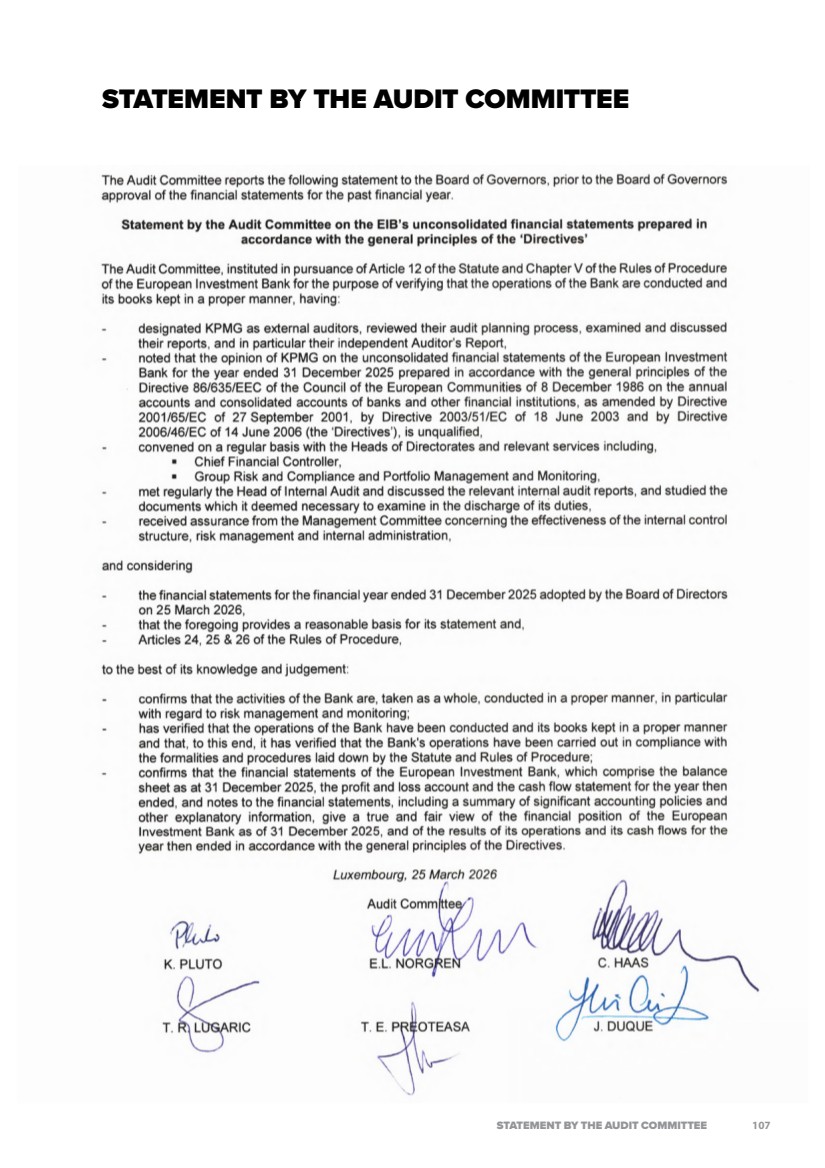
| EIB GROUP CONSOLIDATED FINANCIAL STATEMENTS UNDER EU DIRECTIVES EIB GROUP CONSOLIDATED FINANCIAL STATEMENTS UNDER EU DIRECTIVES as at 31 December 2025 Disclaimer: To accommodate scheduling limitations, the financial statements included in this report have not been subject to standard EIB copy-editing or proofreading. 108 |

| 2025 FINANCIAL REPORT 2 Consolidated balance sheet as at 31 December 2025 (in EUR ’000) Assets 31.12.2025 31.12.2024 1. Cash in hand, balances with central banks and post office banks (Note B.1) 257,807 104,678 2. Treasury bills and other bills eligible for refinancing with central banks (Note B.2) 41,669,631 38,114,661 3. Loans and advances to credit institutions a) repayable on demand 1,952,053 1,659,548 b) other loans and advances (Note C) 34,194,986 40,118,741 c) loans (Note D.1) 85,154,793 89,491,989 d) value adjustments (Note D.2) 0 -848 121,301,832 131,269,430 4. Loans and advances to customers a) other loans and advances (Note C) 118,171 234,816 b) loans (Note D.1) 352,723,030 346,773,549 c) value adjustments (Note D.2) -701,308 -617,456 352,139,893 346,390,909 5. Debt securities including fixed-income securities (Note B.2) a) issued by public bodies 5,218,548 4,810,187 b) issued by other borrowers 6,490,133 6,764,523 11,708,681 11,574,710 6. Shares and other variable-yield securities (Note E.2) 13,288,286 12,161,034 7. Participating interests (Note E.2) 542,863 540,637 8. Intangible assets (Note F) 156,057 130,651 9. Tangible assets (Note F) 457,280 349,844 10. Other assets (Note G) 406,414 353,259 11. Subscribed capital and reserves, called but not paid (Note H.2) 0 159,848 12. Prepayments and accrued income (Note I) 12,510,099 18,560,040 Total assets 554,438,843 559,709,701 The accompanying notes form an integral part of these consolidated financial statements. 109 |
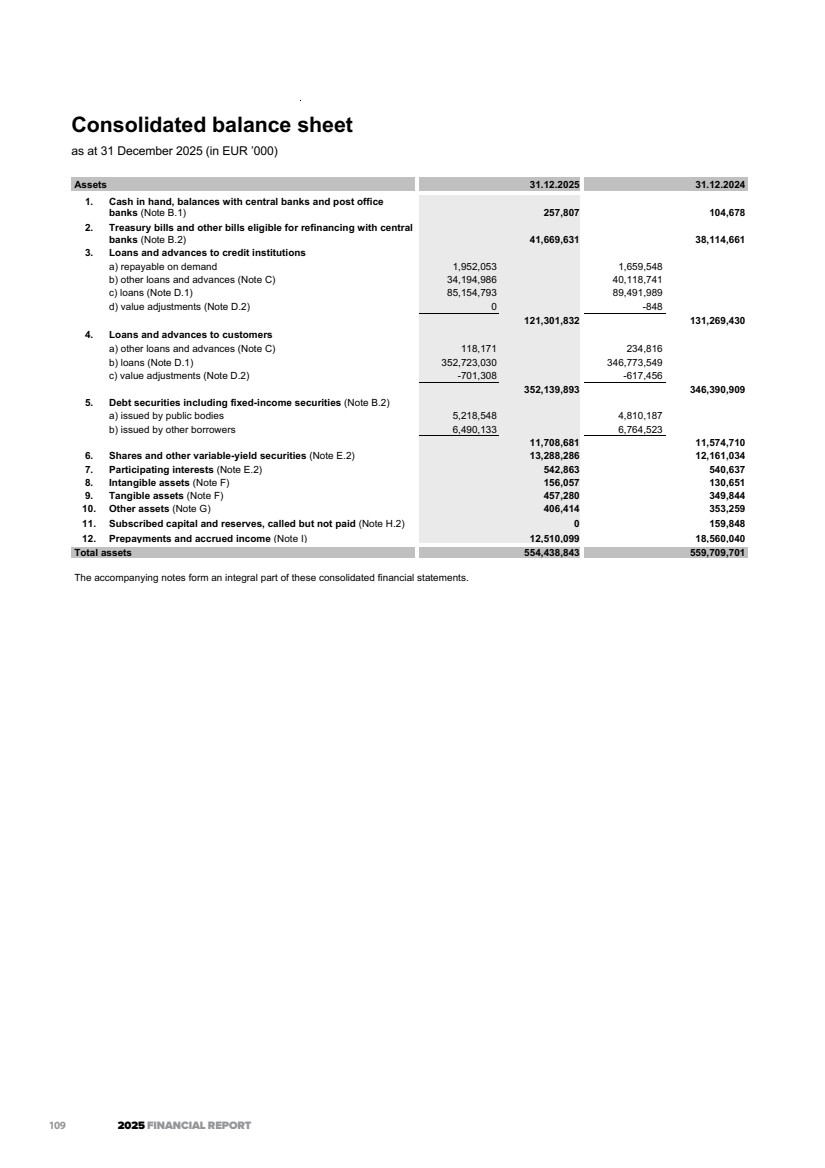
| EIB GROUP CONSOLIDATED FINANCIAL STATEMENTS UNDER EU DIRECTIVES 3 Consolidated balance sheet (continued) as at 31 December 2025 (in EUR ’000) Liabilities 31.12.2025 31.12.2024 1. Amounts owed to credit institutions (Note J) a) repayable on demand 446,323 750,387 b) with agreed maturity or periods of notice 984,159 107,186 1,430,482 857,573 2. Amounts owed to customers (Note J) a) repayable on demand 4,171,810 3,090,263 b) with agreed maturity or periods of notice 13,146 120,487 4,184,956 3,210,750 3. Debts evidenced by certificates (Note K) a) debt securities in issue 424,728,413 435,965,421 b) others 6,974,114 6,886,266 431,702,527 442,851,687 4. Other liabilities (Note G) 4,007,830 4,259,526 5. Accruals and deferred income (Note I) 17,957,588 16,689,029 6. Provisions a) pension plans and health insurance scheme (Note L) 5,857,640 5,509,226 b) provisions in respect of guarantee operations (Note D.4) 88,835 86,764 5,946,475 5,595,990 7. Subscribed capital (Note H) a) subscribed 248,795,607 248,795,607 b) uncalled -226,604,892 -226,604,892 22,190,715 22,190,715 8. Reserves (Note H) a) reserve fund 24,879,561 24,879,561 b) additional reserves 20,946,164 19,478,165 c) special activities reserve 14,015,155 12,665,555 d) general loan reserve 2,495,377 2,281,423 62,336,257 59,304,704 9. Profit for the financial year 2,880,389 3,045,751 10. Equity attributable to minority interest (Note H) 1,801,624 1,703,976 Total liabilities 554,438,843 559,709,701 The accompanying notes form an integral part of these consolidated financial statements. 110 |
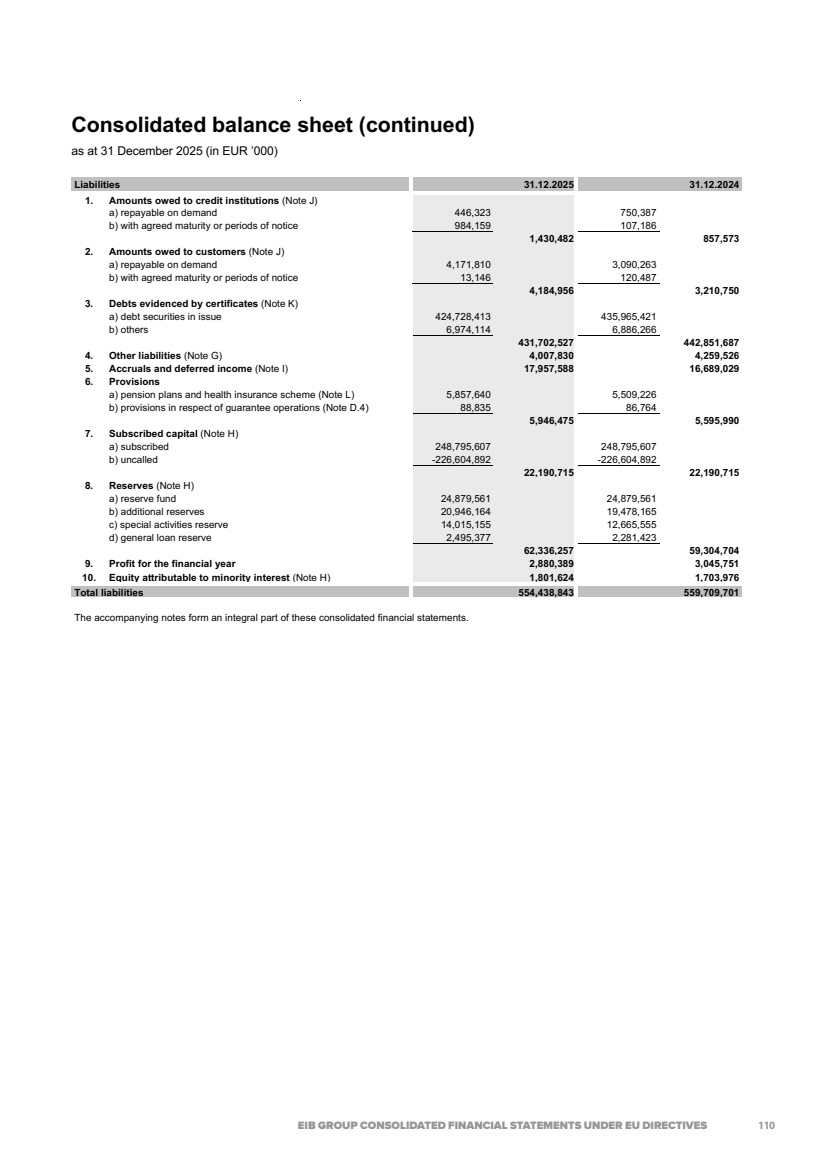
| 2025 FINANCIAL REPORT 4 Consolidated off-balance sheet as at 31 December 2025 (in EUR ’000) 31.12.2025 31.12.2024 Contingent liabilities and guarantees: - In respect of loans granted by third parties (Note U.2.3) 36,233,232 32,210,054 Commitments: - Undisbursed loans (Note D.1) - credit institutions 26,408,564 28,991,439 - customers 107,154,243 99,028,309 133,562,807 128,019,748 - Undisbursed shares and other variable-yield securities and participating interests - Undisbursed private equity and venture capital operations (Note E.2) 7,126,335 6,192,669 - Undisbursed equity investments and infrastructure funds (Note E.2) 4,174,972 3,887,979 - EBRD capital uncalled (Note E.2) 712,630 712,630 - Undisbursed other investments (Note E.2) 2,700,559 2,314,416 14,714,496 13,107,694 - Borrowings launched but not yet settled 223,950 223,950 Assets held on behalf of third parties(*) (Note Z): - Innovation Fund 14,102,137 11,393,044 - Modernisation Fund 7,224,104 6,000,001 - RRF-FI 3,892,094 1,900,524 - Investment Facility Cotonou 3,519,226 3,979,538 - InnovFin 2,085,519 2,086,963 - InvestEU 1,638,036 1,634,043 - NER300 1,097,186 1,068,868 - CEF 836,775 867,827 - Pan-European Guarantee Fund 814,876 706,679 - ESIF 804,956 704,920 - Partnership Platform for Funds 790,050 735,178 - REG 337,298 331,869 - EU-Africa Infrastructure Trust Fund 323,905 349,362 - COSME LGF & EFG 283,536 419,431 - Decentralised Financial Instruments 273,858 260,061 - Trust accounts with ETCI 249,360 532,824 - JEREMIE 228,139 294,386 - SME initiative Italy 204,044 369,229 - ACP Trust Fund EC Compartment 201,664 201,751 - SME initiative Romania 192,617 260,904 - European Fund for Strategic Investments (‘EFSI EIF’) 164,849 147,883 - EU for Ukraine Fund 122,391 118,068 - HDW POLIO IG 108,356 182,951 - InvestEU Advisory Hub 93,626 43,177 - Special Section 90,108 99,454 - NPI 69,952 73,434 - EaSI 68,745 72,693 - Private Finance for Energy Efficiency Instrument 59,775 58,979 - GIF 2007 58,898 63,918 - SMEG 2007 55,868 56,076 - InnovFin SME Guarantee 53,672 66,619 - Bundesministerium für Wirtschaft und Technologie 52,243 57,474 - DCFTA 50,931 52,225 - SME initiative Finland 48,849 53,482 - NDICI IW1, IW2 and IW4 48,218 27,586 - NIF Risk Capital Facility 47,587 50,354 - WB EDIF 43,849 38,282 - ENPI 42,892 43,758 - InnovFin Equity 38,801 45,142 - SME initiative Bulgaria 38,603 57,380 - JESSICA Holding Funds 34,480 21,417 - Cultural and Creative Sectors Guarantee Facility 31,997 51,096 - IPA II / IPA III 28,948 38,015 - EFSI-EIAH 28,662 26,951 - TTA Türkiye 27,972 13,513 111 |
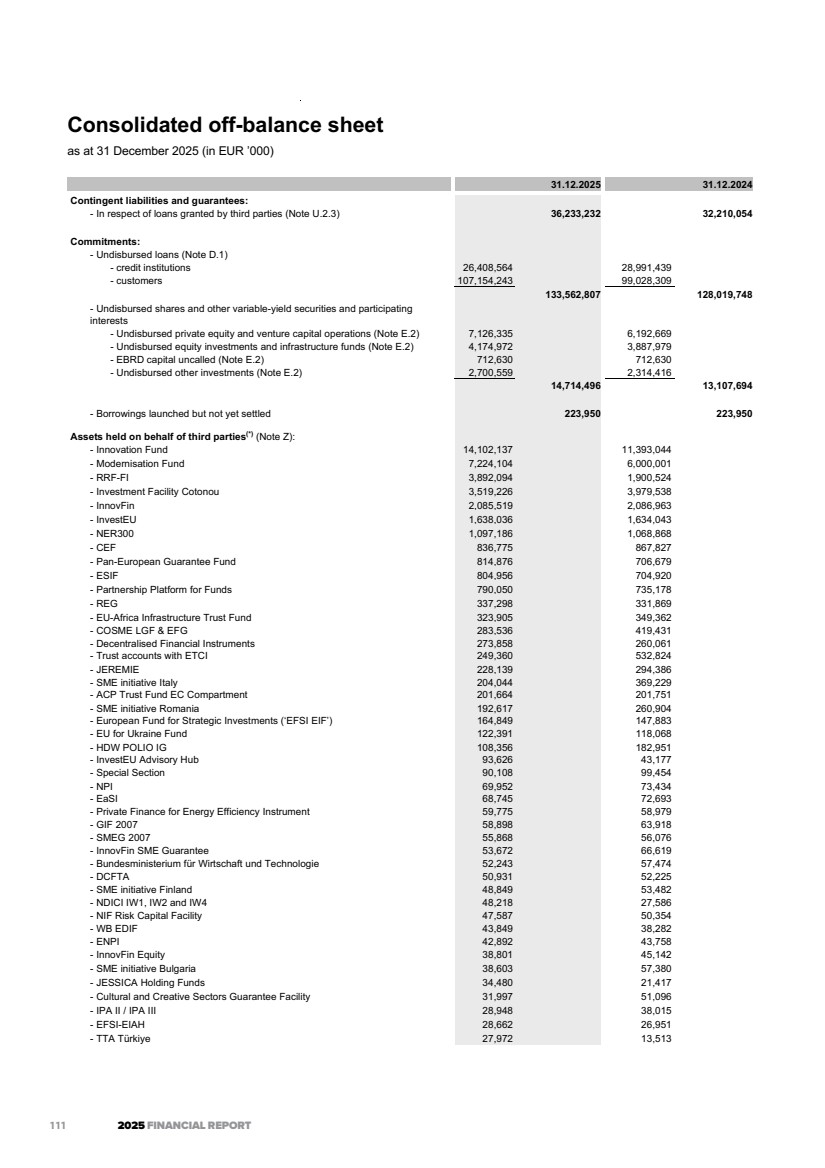
| EIB GROUP CONSOLIDATED FINANCIAL STATEMENTS UNDER EU DIRECTIVES 1 Consolidated off-balance sheet (continued) as at 31 December 2025 (in EUR ’000) 31.12.2025 31.12.2024 - SME initiative Malta 27,837 27,265 - FEMIP Trust Fund 24,733 26,812 - German Future Fund Growth Facility 24,681 28,101 - GCFF Jordan Private Sector Guarantee Facility 22,756 31,894 - AECID 22,507 25,291 - NIF Trust Fund 20,074 20,050 - EU Support to Boost Africa 18,639 31,061 - EPTA Trust Fund 17,976 18,448 - SME initiative Spain 12,265 12,688 - BIF 11,603 13,969 - MAP guarantee 11,040 15,876 - Natural Capital Financing Facility 9,449 12,473 - DESIREE 6,135 6,103 - AGRI 4,025 4,908 - EPIC 3,468 1,222 - GEEREF 3,431 3,373 - KBC Climate & Infrastructure Private Investors Partnership 3,077 1,511 - Alp GIP 2,754 2,408 - 3SIIF 2,667 0 - FoF mandates (virtual) 2,262 902 - Central Europe FoF 1,851 2,586 - fi-compass 1,791 3,054 - Student Loan Guarantee Facility 1,696 2,730 - MAP Equity 1,668 5,855 - LfA-EIF Facility 1,542 195 - JASPERS 1,529 6,789 - TARGET 1,269 790 - PGFF 1,061 6,104 - GEF-UNEP 1,057 1,434 - EFSD Guarantee - SME Access to Finance Initiative 990 1,729 - German Corona Matching Facility (CMF) 854 1,009 - MDD 755 847 - EU Trade and Competitiveness Programme 616 704 - G43 Trust Fund 288 287 - EU4Business Guarantee Facility Ukraine 265 0 - AIP Kulima 244 244 - EU4Business Guarantee Facility 238 259 - PFSI 219 0 - TTP 197 203 - AIP Zambia 178 218 - European Technology Facility 44 1,048 - GGF 7 7 - GAGF 5 29,232 - GF Greece 0 45,139 - RSFF (incl. RSI) 0 13,994 40,879,395 36,066,141 Other items: - Notional value of interest rate swaps (Note V.1.2) 631,978,110 655,792,698 - Notional value of currency swap contracts payable 208,844,111 229,644,516 - Notional value of currency swap contracts receivable (Note V.1.1) 205,154,785 232,980,366 - Notional amount of futures contracts (Note V.2) 44,442,868 33,351,527 - Notional value of short-term currency swap contracts payable 23,008,868 19,500,940 - Notional value of short-term currency swap contracts receivable (Note V.2) 22,930,155 19,687,736 - Put option granted to EIF minority shareholders (Note E.2) 513,499 483,283 - Special deposits for servicing borrowings (Note S) 489 535 - Currency swaps launched but not yet settled receivable (Note V.1.1) 0 145,049 - Currency swaps launched but not yet settled payable 0 144,845 (*) Assets under management are disclosed as off-balance sheet items based on the latest available figures. Comparative figures might be restated to reflect the most recent available information. The accompanying notes form an integral part of these consolidated financial statements. 112 |
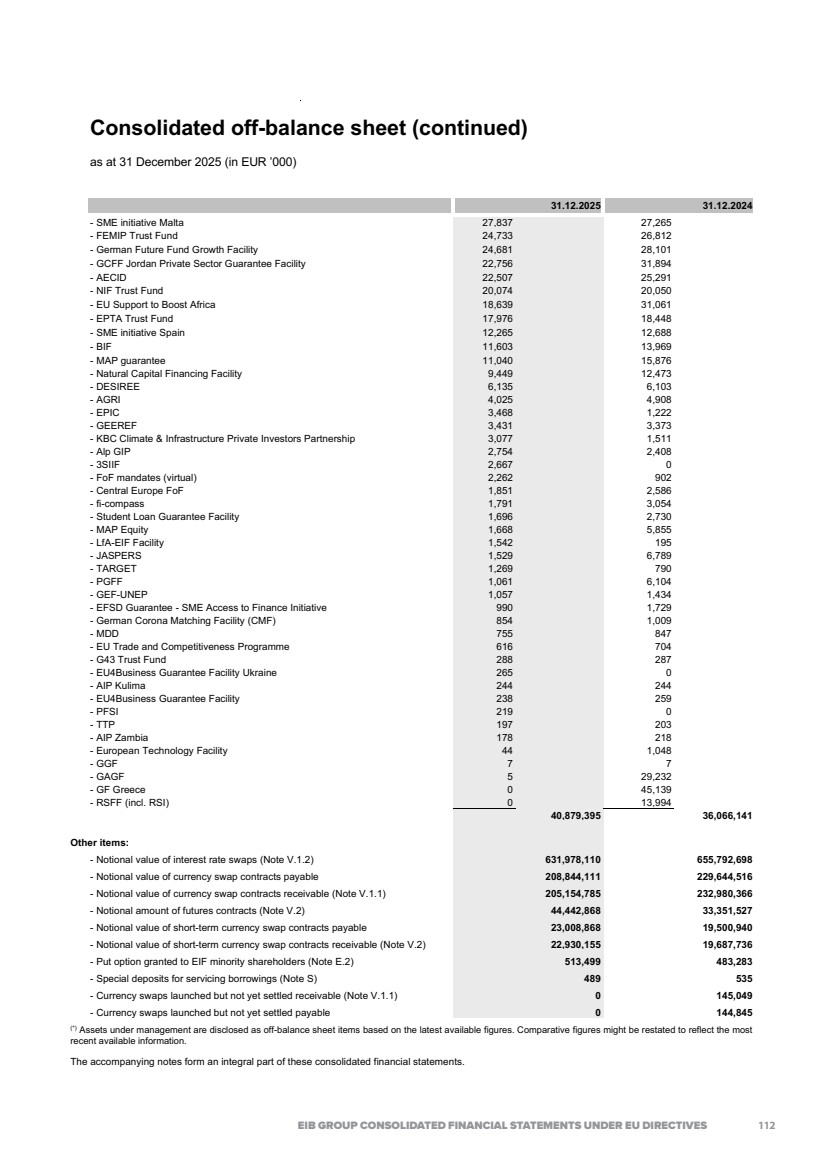
| 2025 FINANCIAL REPORT 6 Consolidated profit and loss account for the year ended 31 December 2025 (in EUR ‘000) 2025 2024 1. Interest receivable and similar income (Note N) 24,256,160 27,447,170 2. Interest payable and similar charges (Note N) -20,683,727 -23,874,576 3. Income from securities 1,025,694 998,419 4. Commissions receivable (Note O) 679,856 670,490 5. Commissions payable (Note O) -306,271 -315,508 6. Net result on financial operations (Note P) -139,720 -12,998 7. Net other operating income and expense (Note Q) 50,108 49,628 8. General administrative expenses (Note R) a) staff costs (Note L) -1,148,923 -1,135,127 b) other administrative expenses -394,531 -402,242 -1,543,454 -1,537,369 9. Value adjustments in respect of tangible and intangible assets (Note F) a) tangible assets -33,799 -32,480 b) intangible assets -64,364 -51,967 -98,163 -84,447 10. Value (re-)adjustments in respect of loans and advances and provisions for contingent liabilities -245,892 -190,903 11. Value (re-)adjustments in respect of transferable securities held as financial fixed assets and participating interests -7,666 -6,125 12. Profit for the financial year 2,986,925 3,143,781 13. Profit attributable to minority interest 106,536 98,030 14. Profit attributable to equity holders of the Bank 2,880,389 3,045,751 The accompanying notes form an integral part of these consolidated financial statements. (*) A reclas sificati on was made amon g the captio ns in order to impro ve the reada bility of financi al state ments . See Note A.3. 113 |
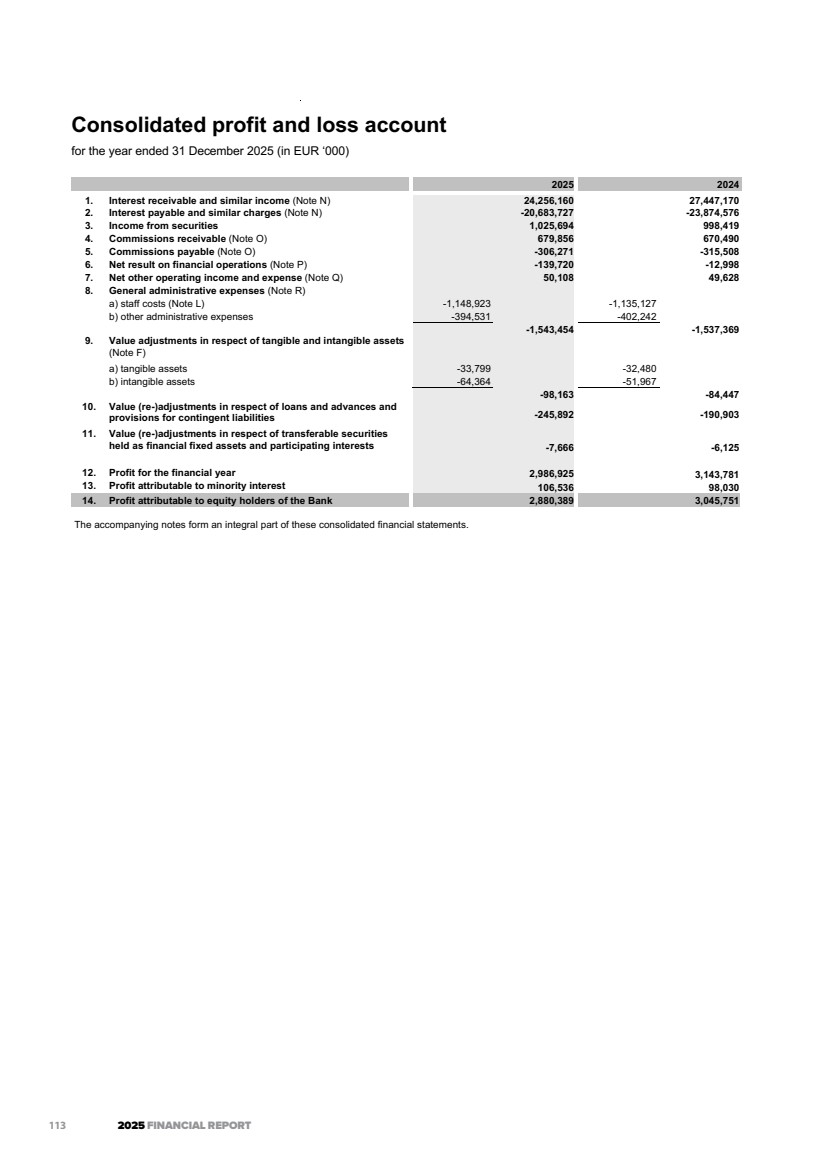
| EIB GROUP CONSOLIDATED FINANCIAL STATEMENTS UNDER EU DIRECTIVES 7 Consolidated cash flow statement for the year ended 31 December 2025 (in EUR ‘000) 2025 2024 A. Cash flows from operating activities: Profit for the financial year 2,986,925 3,143,781 Adjustments for: Value (re-)adjustments in respect of loans and advances and provisions for contingent liabilities 245,892 190,903 Value (re-)adjustments in respect of transferable securities held as financial fixed assets and participating interests 7,666 6,125 Value adjustments in respect of tangible and intangible assets, and write-off (Note F) 99,119 84,709 Value (re-)adjustments in respect of shares and other variable-yield securities (Note E.2) 141,954 85,799 Change in provisions on pension plans and health insurance scheme (Note L) 264,020 278,441 Net interest income (Note N.1) -3,572,433 -3,572,594 Effect of exchange rate changes -84,189 72,772 88,954 289,936 Disbursements of loans and advances to credit institutions and customers -52,819,374 -53,584,105 Repayments of loans and advances to credit institutions and customers 47,816,442 45,339,242 Change in other loans and advances (Note C) 968,114 18,227,061 Change in deposit with Central Bank of Luxembourg to cover minimum reserve requirement (Note B.1) -152,382 105,328 Change in treasury operational portfolios -1,447,763 3,073,067 Change in amounts owed to credit institutions and customers (Note J) 1,547,115 -150,020 Payments and annual contributions to pension plans and health insurance scheme during the year (Note L) 84,394 99,301 Change in other assets and other liabilities (Note G) -216,821 -306,065 Change in prepayments and accrued income and in accruals and deferred income -4,731,625 600,533 Interest received 21,608,397 25,824,029 Interest paid -18,069,122 -21,835,414 Net cash (used in)/generated from operating activities -5,323,671 17,682,893 B. Cash flows from investing activities: Securities in Long-Term HQLA Portfolio purchased during the year -3,686,986 -2,521,418 Securities from Long-Term HQLA Portfolio matured or sold during the year 161,697 115,000 Purchase of loan substitutes and ABS portfolio EIF included in the debt securities portfolios -5,220,418 -5,245,308 Redemption of loan substitutes and ABS portfolio EIF included in the debt securities portfolios 5,542,043 4,451,563 Additions on shares and other variable-yield securities (Note E.2) -2,794,498 -2,769,673 Reflows on shares and other variable-yield securities (Note E.2) 1,515,788 1,649,072 Additions on participating interests (Note E.2) -50,356 -86,783 Reflows on participating interests (Note E.2) 40,464 29,443 Purchase of tangible and intangible assets (Note F) -231,961 -187,363 Proceeds from sale of non-current assets held for sale 2,508 0 Net cash used in investing activities -4,721,719 -4,565,467 C. Cash flows from financing activities: Issuance of debts evidenced by certificates (Note K) 113,139,018 106,720,276 Redemption of debts evidenced by certificates (Note K) -107,429,294 -106,488,673 Member States’ contribution 159,848 319,700 Purchase of EIF shares -3,283 0 Sale of EIF shares 5,253 2,983 Dividend paid to EIF minority shareholders -10,596 -9,247 Net cash generated from financing activities 5,860,946 545,039 Summary statement of cash flows: Cash and cash equivalents at the beginning of financial year 39,036,093 25,573,322 Net cash from: Operating activities -5,323,671 17,682,893 Investing activities -4,721,719 -4,565,467 Financing activities 5,860,946 545,039 Effect of exchange rate changes on cash held -594,591 -199,694 Cash and cash equivalents at the end of financial year 34,257,058 39,036,093 Cash and cash equivalents are composed of: Cash in hand, balances with central banks and post office banks, excluding deposits with Central Bank of Luxembourg to cover minimum reserve requirement (Note B.1) 758 11 Loans and advances to credit institutions and customers: Repayable on demand 1,952,053 1,659,548 Other loans and advances (Note C) 32,304,247 37,376,534 34,257,058 39,036,093 The accompanying notes form an integral part of these consolidated financial statements. 114 |
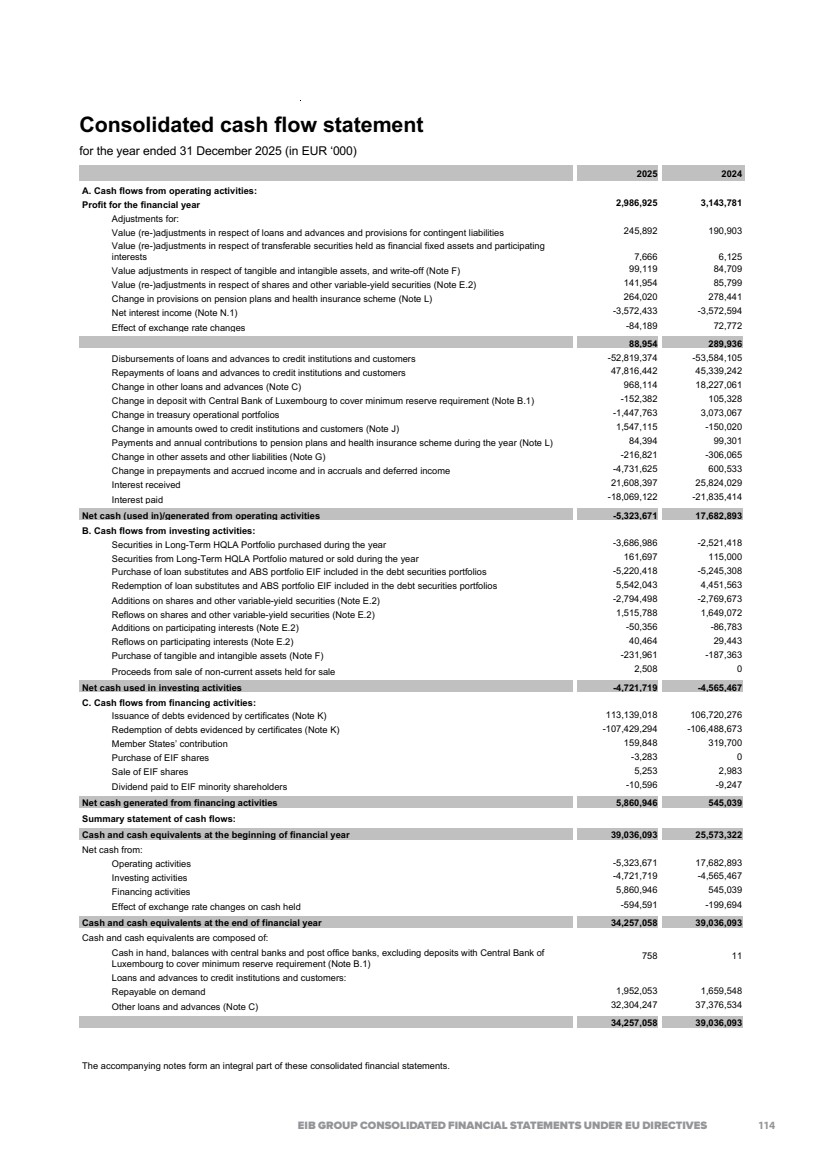
| 2025 FINANCIAL REPORT 8 European Investment Bank Group Notes to the consolidated financial statements as at 31 December 2025 The European Investment Bank (the ‘Bank’ or ‘EIB’) was created by the Treaty of Rome in 1958 as the long-term lending bank of the European Union (‘EU’). The task of the Bank is to contribute towards the integration, balanced development and economic and social cohesion of the EU Member States. The EIB raises substantial volumes of funds on the capital markets and lends these funds on favourable terms to projects furthering EU policy objectives. The EIB continuously adapts its activities to developments in EU policies. The Bank has its registered office at 98-100, boulevard Konrad Adenauer, L-2950 Luxembourg. The Bank and its subsidiary are defined as the ‘Group’ or ‘EIB Group’. The subsidiary held by the Bank is disclosed in note E.1. Note A – Significant accounting policies A.1. Basis of preparation A.1.1. Accounting standards The consolidated financial statements (the ‘Financial Statements’) of the European Investment Bank have been prepared on a going concern basis and in accordance with the general principles of Directive 86/635/EEC of the Council of the European Communities dated 8 December 1986 on the annual accounts and consolidated accounts of banks and other financial institutions. These principles have been amended by Directive 2001/65/EC of 27 September 2001, by Directive 2003/51/EC of 18 June 2003 and by Directive 2006/46/EC of 14 June 2006, concerning the annual and consolidated accounts of certain types of companies, banks and other financial institutions (the ‘Directives’). On a proposal from the Management Committee (‘MC’), the Board of Directors (‘BoD’) adopted the Financial Statements on 25 March 2026 and authorised their submission to the Board of Governors for approval by 24 April 2026, in accordance with Article 7(3) and Article 9(1) of the EIB Statute and Article 2(3) and Article 18(1) of the EIB Rules of Procedure. The Group also publishes consolidated financial statements, which have been prepared in accordance with International Financial Reporting Standards (‘IFRS’), as endorsed by the European Union. A.1.2. Significant accounting judgments and estimates In preparing the Financial Statements, the Management Committee is required to make estimates and assumptions that affect the reported amounts of income, expenses, assets, liabilities and the disclosure of contingent assets and liabilities. The use of available information and the application of judgement are inherent in the formation of estimates. Actual results may differ from these estimates, and such differences may be material to the Financial Statements. The most significant use of judgments and estimates is as follows: Value adjustments on loans and advances and loan substitutes The Group reviews its loans and advances and loan substitutes at each reporting date to assess whether an allowance for value adjustments should be recorded. In particular, judgment by management is required in estimating the amount and timing of future cash flows when determining the level of allowance required. These estimates are based on assumptions about various factors and actual results may differ, resulting in future changes to the allowance. In addition to individual allowances for individually significant loans and advances and loan substitutes, the Bank also conducts a collective provisioning test for exposures that, while not specifically identified as requiring individual allowances, present a higher risk of default compared to when the loans and advances and loan substitutes were originally granted (see Note A.2.7). Value adjustments on shares, other variable-yield securities and participating interests To determine the lower of cost or market value, the Bank reviews its indirect equity investments at each reporting date to assess whether a value adjustment should be recorded. In particular, the Bank determines the attributable EIB share of the net asset value (‘NAV’) of its indirect equity investments either by (i) considering the latest available fund manager report based on applicable industry guidelines and standards, (ii) any NAV derived from any other equivalent guidelines or standard or (iii) internally based on information provided by the fund manager. Fair values for most of the underlying investments have been estimated in the absence of readily ascertainable market values. Due to the inherent uncertainty of valuations, and current market conditions, actual results in the future may differ from the fund managers’ estimates of values and such differences could be material to the Financial Statements. Moreover, any attributable NAV that becomes available only after the balance sheet date are only considered if management determines it materially affects the Financial Statements (see Note A.2.8). Provisions in respect of guarantee operations The Group initially recognises the financial guarantee contract at fair value, corresponding to the net present value (‘NPV’) of expected premium inflows or the initial expected loss. The financial guarantee is subsequently measured as the deficit of the net present value of the expected future premium over the higher of the corresponding loss allowance and the premium received on initial recognition less income recognised. The Bank also 115 |
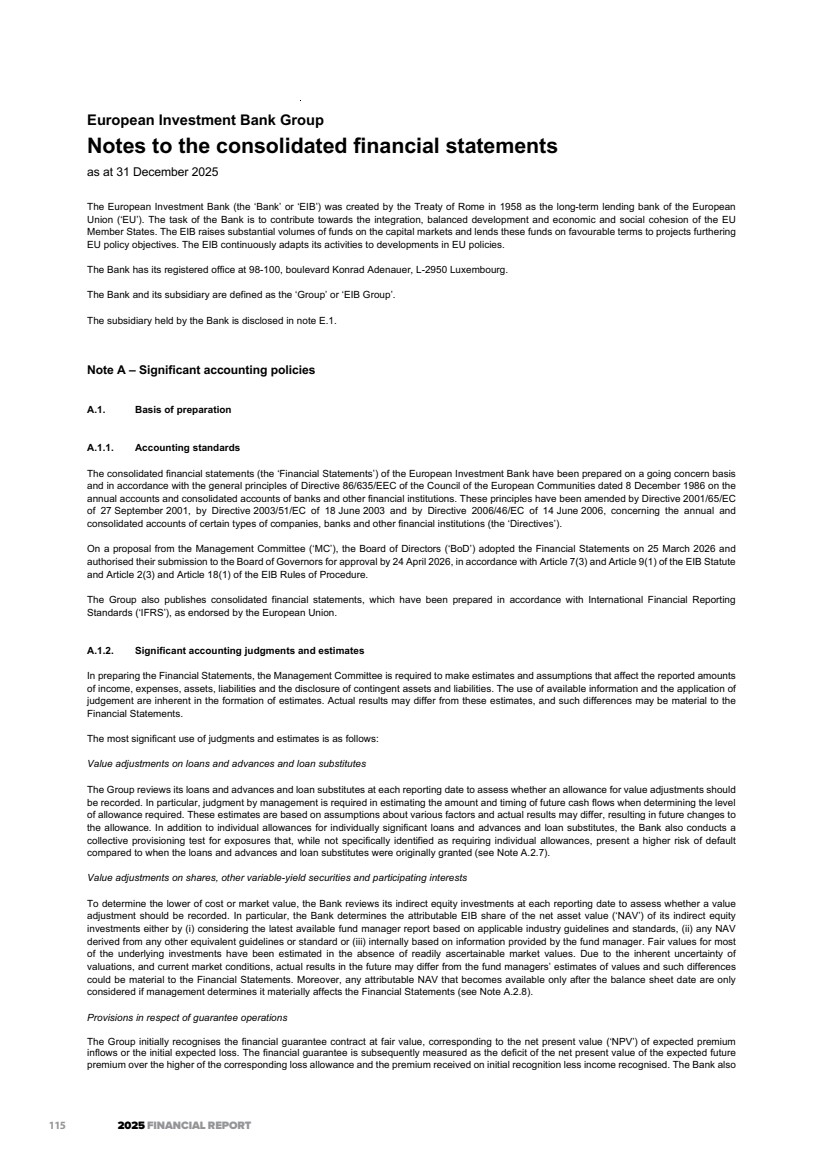
| EIB GROUP CONSOLIDATED FINANCIAL STATEMENTS UNDER EU DIRECTIVES 9 conducts a collective provisioning test on exposures that, although not specifically identified as requiring an individual allowance, have a greater risk of default than when the guarantees were originally signed and issued (see Note A.2.14). Pension and other post-employment benefits The cost of defined benefit pension plans and other post-employment medical benefits is determined using actuarial valuations. The actuarial valuation involves making assumptions about discount rates, mortality rates and future salary and pension increases. Due to the long-term nature of these plans, such estimates are subject to significant uncertainty (see Note A.2.11). A.1.3. Bank’s exposure to the United Kingdom (‘UK’) On 29 March 2017, the United Kingdom notified the European Council of its decision to withdraw from the EU pursuant to Article 50 of the Treaty on European Union (‘TEU’). As of 1 February 2020, in accordance with Article 50 TEU and the Agreement on the withdrawal of the United Kingdom of Great Britain and Northern Ireland from the European Union and the European Atomic Energy Community (the “Withdrawal Agreement”), the United Kingdom ceased to be an EU Member State. The withdrawal of the United Kingdom from the EU automatically resulted in the termination of its membership of the European Investment Bank (‘EIB’) and its share of the EIB’s subscribed capital. Effective 1 February 2020, the share of the United Kingdom in respect of the EIB’s subscribed capital was fully replaced by a pro rata capital increase of the remaining EU Member States. This capital replacement (Symmetrical Capital Replacement) covered both the called part as well as the uncalled part of the subscribed capital of the United Kingdom in the EIB. The replacement of the called part was financed by converting EIB reserves into called subscribed capital. As a result of the capital increase, each remaining EU Member State increased pro rata its uncalled (but callable) stake in the EIB’s subscribed capital. In addition, the capital subscribed by Poland and Romania in the EIB increased by EUR 5,386,000,000 and EUR 125,452,381, respectively. This capital increase (Asymmetrical Capital Increase) took effect on 1 March 2020, one month after the withdrawal of the United Kingdom from the EU. Poland and Romania paid the called portion of their increase in the EIB’s subscribed capital and contributed to the EIB reserves in ten equal semi-annual instalments. The Withdrawal Agreement contains, among other things, several provisions governing the financial settlement in respect of the EIB as a result of the termination of UK membership of the EIB. In accordance with the provisions laid down in Article 150 of the Withdrawal Agreement, the United Kingdom shall remain liable, under its former share of the subscribed capital in the EIB, for the EIB’s pre-withdrawal exposure. In this respect as at 31 December 2025, the EIB’s pre-withdrawal exposure amounts to EUR 296,291 million, whereas the limit of the United Kingdom’s liability amounts to EUR 39,195 million. The United Kingdom shall also remain liable for other EIB risks as long as such risks are not related to post-withdrawal lending. In addition, in accordance with the provisions laid down in Article 150 of the Withdrawal Agreement, the EIB shall pay to the United Kingdom on behalf of the EU an amount equal to the UK share of the called capital of the EIB in twelve annual instalments. Except for such repayment of the UK called capital, the EIB shall not be obliged to make any other payment, return or remuneration to the United Kingdom in connection with the termination of its membership of the EIB or on account of the retention by the United Kingdom of certain liabilities as described in the relevant provisions of the Withdrawal Agreement. A.2. Summary of significant accounting policies A.2.1. Foreign currency translation The Group uses the euro (‘EUR’) as the unit of measurement for the capital accounts of Member States and for presenting its Financial Statements. The Group conducts its operations in euro, in other currencies of the EU Member States and in non-EU currencies. Its resources are derived from its capital, borrowings and accumulated earnings in various currencies. Foreign currency transactions are translated at the exchange rate prevailing on the date of the transaction. The Group's monetary assets and liabilities denominated in currencies other than euro are translated into euro at the closing exchange rates prevailing at the balance sheet date. The gain or loss arising from such translation is recorded in the profit and loss account under “Net result on financial operations”. A.2.2. Basis of consolidation Subsidiaries Subsidiaries are all entities directly or indirectly controlled by the Group. The EIB Group is required to consolidate entities under its control when it is exposed to, or has rights to, variable returns from its involvement and has the ability to affect those returns through its power over the entities. All significant subsidiaries are included in these consolidated Financial Statements, while entities immaterial to the Group are excluded from the scope of consolidation. The Financial Statements of any subsidiary are included in the consolidated Financial Statements from the date on which control commences until the date on which control ceases. The Financial Statements of the EIB Group comprise those of the European Investment Bank (the ‘Bank’ or ‘EIB’) and those of its subsidiary, the European Investment Fund (the ‘Fund’ or ‘EIF’). The Financial Statements of its subsidiary are prepared for the same reporting year as the Bank, using consistent accounting policies. 116 |
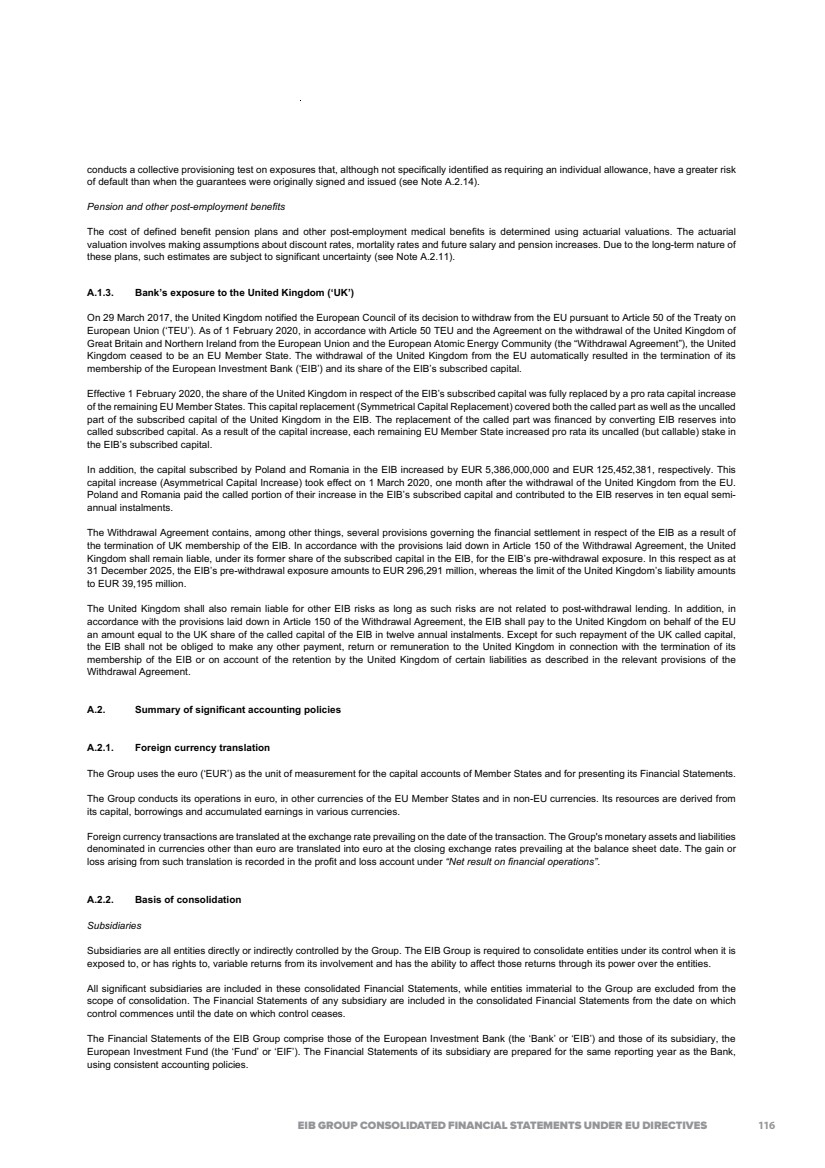
| 2025 FINANCIAL REPORT 10 Minority interest The minority interest in the EIB’s subsidiary represents the portion of profit or loss and net assets not owned directly or indirectly, by the Group. It is presented separately in the consolidated balance sheet under “Equity attributable to minority interest” (for net assets) and in the consolidated profit and loss account under “Profit attributable to minority interest” (for profit or loss). The commitment provided in the form of a put option in respect of the shares held by the EIF’s minority shareholders other than the European Commission, is recorded off-balance in the amount of the applicable exercise price. Transactions eliminated on consolidation After aggregation of the balance sheet and the profit and loss accounts, all intra-group balances and transactions, income and expenses resulting from intra-group transactions are eliminated. Assets held in an agency or fiduciary capacity are not assets of the Group and are reported in Note Z. A.2.3. Derivatives The Group uses derivative instruments, mainly currency and interest rate swaps, as part of its asset and liability management (‘ALM’) activities to manage exposures to interest rate and foreign currency risks. All derivatives transactions are recorded at their notional values as off-balance sheet items at the transaction date. The majority of the Group’s swaps are concluded with a view to hedging bond issues and treasury bonds within the Long-Term High-Quality Liquid Assets (‘HQLA’) Portfolio (‘LTHP’). The Group enters into currency and interest rate swaps, whereby the proceeds of a borrowing are initially converted into a different currency and at maturity the Group will obtain the amounts required to service the borrowing in the original currency or to modify the interest rate positions of a borrowing or treasury bond. The Group also enters into currency, interest rate and overnight index swaps as part of its hedging operations on loans or for the global ALM position. The corresponding interest is accounted for on a pro rata temporis basis. The Group also uses short-term derivative instruments, primarily foreign exchange (‘FX’) swaps, as part of its treasury operations, as well as derivatives hedging the actively managed Securities Liquidity Portfolio (‘SLP’). A.2.3.1. Derivatives under the Securities Liquidity Portfolio As part of the SLP, derivatives are entered in and recorded at market value in the balance sheet as “Other assets” when their market value is positive or “Other liabilities” when their market value is negative. Changes in the market value are included in “Net result on financial operations”. Market values are obtained from quoted market prices, discounted cash flow models and option pricing models, which consider current market and contractual prices for the underlying instrument, as well as the time value of money, yield curve and volatility of the underlying. Interest on derivative instruments is accrued pro rata temporis under “Prepayments and accrued income” or “Accruals and deferred income”. Interest rate swaps Interest rate swap contracts are entered into in order to modify the interest rate positions. The interest received and paid under interest rate swaps is accrued on a pro rata temporis basis and reported in the profit and loss account under “Interest receivable and similar income” or “Interest payable and similar charges”. The market value is recorded under “Other assets” when their market value is positive or “Other liabilities” when their market value is negative. Changes in the market value are included in the “Net result on financial operations”. Currency swaps Currency swap contracts are entered into in order to adjust currency positions. The interest received and paid under cross-currency interest rate swaps is accrued pro rata temporis and reported in the profit and loss account under “Interest receivable and similar income” or “Interest payable and similar charges”. The market value is recorded under “Other assets” when their market value is positive or “Other liabilities” when their market value is negative. Changes in the market value are included in “Net result on financial operations”. Futures contracts Interest rate and bond futures contracts (futures) are entered to hedge the exposure deriving from investments in government and other bonds. Futures are highly standardised derivative contracts, traded on regulated markets and are subject to daily margin requirements. The market value is recorded under “Other assets” when their market value is positive or “Other liabilities” when their market value is negative. Changes in the market value are included in the “Net result on financial operations”. A.2.3.2. Other derivatives Currency swaps Currency swap contracts are entered into in order to adjust currency positions. The revaluation of the spot leg of a currency swap is presented in “Accruals and deferred income” or “Prepayments and accrued income”. The forward leg of the currency swap is recorded off-balance sheet at the settlement amount and is not revalued. The premium/discount between the spot and forward settlement amounts is amortised pro rata temporis through the profit and loss account in “Interest receivable and similar income” or “Interest payable and similar charges”. 117 |
| EIB GROUP CONSOLIDATED FINANCIAL STATEMENTS UNDER EU DIRECTIVES 11 Interest rate swaps Interest rate swap contracts are entered into in order to modify the interest rate positions. The hedging interest rate swaps are not revalued and their notional value is recorded off-balance sheet. The interest received and paid under interest rate swaps is accrued pro rata temporis and reported in the profit and loss account under “Interest receivable and similar income” or “Interest payable and similar charges”. Currency forwards Currency forwards are entered into in order to adjust future currency positions. The forward leg is recorded off-balance sheet at the settlement amount and is not revalued. The difference between the spot amounts and the forward settlement amounts is amortised pro rata temporis through the profit and loss account in “Interest receivable and similar income” or “Interest payable and similar charges”. Interest on derivative instruments is accrued pro rata temporis under “Prepayments and accrued income” or “Accruals and deferred income”. A.2.4. Financial assets and liabilities Financial assets and liabilities are accounted for using the settlement date basis. A.2.5. Cash and cash equivalents Cash and cash equivalents are disclosed in the consolidated cash flow statement and comprise cash in hand, unrestricted balances held with central banks, on demand amounts due, and highly liquid money market securities or term deposits with an initial maturity of 3 months or less from the date of acquisition. These instruments are subject to an insignificant risk of changes in their value, are readily convertible to cash and are used by the Group in the management of its short-term commitments. A.2.6. Treasury bills and other bills eligible for refinancing with central banks and debt securities including fixed-income securities A.2.6.1. Long-Term High-Quality Liquid Assets (‘HQLA’) Portfolio (‘LTHP’) The main purpose of the portfolio is to serve as a core long-term liquidity reserve for the Bank in EUR, GBP and USD, composed of highly rated liquid bonds. Securities under the portfolio are kept with the intention to hold them to maturity. These securities are initially recorded at the purchase price. Value adjustments are accounted for, if these are other than temporary. The difference between the entry price and redemption value is accounted for pro rata temporis over the life of the securities, as “Interest receivable and similar income” or “Interest payable and similar charges”. A.2.6.2. Operational portfolios Treasury Monetary Portfolio (‘TMP’) In order to maintain an adequate level of liquidity, the Bank purchases money market products with a maximum maturity of 12 months, in particular treasury bills and negotiable debt securities issued by public bodies and credit institutions. The securities in the TMP are held until their final maturity and are initially recorded at purchase price and subsequently presented in the Financial Statements at amortised cost. The difference between purchase price and redemption value is accounted for pro rata temporis over the life of the securities as “Interest receivable and similar income” or “Interest payable and similar charges”. Value adjustments are accounted for under “Value (re-)adjustments in respect of transferable securities held as financial fixed assets and participating interests”, if these are other than temporary. Securities Liquidity Portfolio (‘SLP’) The SLP comprises listed debt securities issued or guaranteed by national governments, supranational institutions, financial institutions and corporations. The portfolio is largely driven by an active management and following the initial recognition at purchase price, subsequently the securities of this portfolio are presented in the Financial Statements at market value. Changes in market value are recorded under “Net result on financial operations” in the profit and loss account. The market value of the SLP is based on published price quotations in an active market as the first source. For instruments without available published price quotations, the market values are determined by obtaining quotes from market participants and/or by using valuation techniques or models, based whenever possible on observable market data prevailing at the balance sheet date. Long-term Treasury Portfolio EIF The Long-term Treasury Portfolio EIF comprises cash and bank deposits with a maximum residual maturity of 370 days. These securities are measured at amortised cost. Operational portfolio EIF The Operational portfolio EIF comprises cash and bank deposits with a maximum residual maturity of 370 days. These securities are measured at amortised cost. A.2.6.3. Loan substitutes portfolio (EIB) and ABS portfolio (EIF) The loan substitutes portfolio (EIB) and ABS portfolio (EIF) mainly consist of obligations in the form of bonds, notes or certificates issued by special purpose vehicles (‘SPVs’), trust vehicles or financial institutions. These securities are kept with the intention to be held to maturity and initially recorded at purchase price and subsequently valued at amortised cost. The difference between purchase price and redemption value is accounted 118 |
| 2025 FINANCIAL REPORT 12 for pro rata temporis over the life of the securities as “Interest receivable and similar income”. Individual value adjustments are accounted for, if these are other than temporary. Collective value adjustments are recorded to capture contracts which are impaired but have not yet been identified as such respectively for losses incurred but not yet reported. Individual and collective value adjustments are recorded in the profit and loss account as “Value (re-) adjustments in respect of transferable securities held as financial fixed assets and participating interests” and are deducted from the appropriate asset items on the balance sheet. Undisbursed parts of loan substitutes are recorded in the consolidated off-balance sheet at their nominal value. A.2.6.4. Preferred creditor status (‘PCS’) The principle of the supremacy of EU primary law and the principle that the property of the EIB shall be exempt from all forms of requisition and expropriation, as enshrined in the EIB Statute, are deemed to guarantee a full recovery of the EU Sovereign Exposures at maturity. This financial protection and the benefit of the preferred creditor status result in no credit risk or impairment loss from Member States sovereign exposure or guarantees. However, similarly to other creditors, the EIB is bound by the majority decision based on collective action clauses (‘CAC’) included in debt instruments issued by EU Sovereigns. A.2.7. Loans and advances to credit institutions and customers A.2.7.1. Loans and advances Loans and advances are included in the assets of the Group at their net disbursed amounts. Individual value adjustments have been recorded for loans outstanding at the end of the period and presenting risks of non-recovery of all or part of their amounts. Collective value adjustments may be recorded to capture loans in the portfolio which are impaired but have not yet been identified as such or for losses which have been incurred but not yet reported. Such value adjustments are held in the same currency as the assets to which they relate. Value adjustments are accounted for in the profit and loss account as “Value (re-) adjustments in respect of loans and advances and provisions for contingent liabilities” and are deducted from the appropriate asset items on the balance sheet. Undisbursed parts of loans and advances are recorded in off-balance sheet at their nominal value. A.2.7.2. Interests on loans Interests on loans are recorded in the profit and loss account on an accrual basis, i.e. over the life of the loans. On the balance sheet, accrued interest is included in “Prepayments and accrued income” under assets. Value adjustments to interest amounts on these loans are determined on a case-by-case basis by the Group’s Management, deducted from the appropriate asset item on the balance sheet and accounted for in the profit and loss account as “Value (re-)adjustments in respect of loans and advances and provisions for contingent liabilities”. For non-performing loans, upon value adjustment, the accrual of interest income based on the original terms of the claim may be discontinued. A.2.7.3. Reverse repurchase agreements (‘Reverse repos’) A reverse repurchase agreement is one under which the Group lends liquid funds to a credit institution which in return provides collateral in the form of securities. The two parties enter into an irrevocable commitment to complete the operation on a date and at a price fixed at the outset. The operation is based on the principle of delivery against payment: the borrower of the liquid funds transfers the securities to the Group’s custodian in exchange for settlement at the agreed price, which generates a return for the Group linked to the money market. This type of operation is considered for the purposes of the Group to be a loan at a guaranteed rate of interest. Generally treated as collateralised financing transactions, they are carried at the amounts of cash advanced or received, plus accrued interest. Reverse repos are entered at their notional amount on the assets side of the consolidated balance sheet under “Loans and advances to credit institutions - b) other loans and advances”. Securities received under reverse repurchase agreements are not recognised in the consolidated balance sheet, unless control of the contractual rights comprised in these securities is assumed. The Group monitors the market value of the securities received on a daily basis and requests additional collateral in accordance with the underlying agreements. Interest on reverse repurchase agreements is recognised as “Interest receivable and similar income” or “Interest payable and similar charges” over the life of each agreement. A.2.7.4. Interest subsidies Interest subsidies received in advance (see Note I) are deferred and recognised in the profit and loss account over the period from disbursement to repayment of the subsidised loan. A.2.7.5. Term and on-demand deposits (‘Deposits’) Deposits are operations under which the Group lends liquid funds to a credit institution or customer for a certain period or on-demand against a return agreed between the parties. Deposits are entered at their nominal amount on the assets side of the consolidated balance sheet under “Loans and advances to credit institutions or customers – b) other loans and advances”. Interest on deposits is recognised as “Interest receivable and similar income” or “Interest payable and similar charges” over the term of the deposit. A.2.8. Shares, other variable-yield securities and participating interests The Group holds shares, other variable-yield securities and participating interests when it enters into private equity (‘PE’) and venture capital (‘VC’) operations, debt funds, infrastructure funds, investment funds or participations in the form of direct equity. These investments are initially recorded 119 |
| EIB GROUP CONSOLIDATED FINANCIAL STATEMENTS UNDER EU DIRECTIVES 13 at acquisition cost, reduced by any reflow resulting from repayments. Their carrying value is adjusted to the lower of cost or market value at subsequent measurement at the balance sheet date. In certain co-investments performed by the Group, the investments are initially recognised at cost and the net paid in represents the drawdowns paid net of any capital repayments allocated in accordance with the agreed waterfall. Based on the reports received from fund managers, the portfolios of investments are valued on a line-by-line basis at the lower of cost or attributable NAV, thereby excluding any attributable unrealised gain that may be prevailing in the portfolio. The attributable NAV is determined by applying in order of priority, and subject to availability at the reporting date, either: • the Group share of NAV at the latest available date, submitted by the respective fund manager, or; • the number of shares or units held by the Group multiplied by the price per share or unit at the latest available date reported by the fund manager, or; • the Group’s percentage ownership in the specific compartment multiplied by the specific compartment NAV reflected in the most recent fund manager’s report, or; • the Group’s percentage of ownership in the fund multiplied by the latest available fund NAV. In certain co-investments performed by the Group, the attributable NAV may be determined based on the agreed waterfall calculation. The attributable NAV is adjusted for events occurring between the date of the latest available NAV and the balance sheet date to the extent that such adjustment is considered to be material by the Management Committee. Signed but undrawn part of these investments is recorded as consolidated off-balance sheet commitments at their nominal value. For specific investments where NAVs cannot readily be determined, other guidelines such as the International Private Equity and Venture Capital Valuation (‘IPEV’) Guidelines published by the IPEV Board might be used and more detailed monitoring and review will be required. In accordance with this method, the funds are internally classified into three categories: • Category I – funds that have adopted the fair value requirements of IFRS 13 or the IPEV Guidelines for which a specific review is performed to ensure that the NAV is a reliable estimate of fair value; • Category II – funds that have adopted other valuation guidelines (such as the former 2001 European Private Equity and Venture Capital Association (‘EVCA’) guidelines) or standards that can be considered to be in line with IFRS 13, for which an equivalent NAV can be calculated; • Category III – funds that have not adopted the fair value requirements of IFRS 13 or any other valuation guidelines in line with IFRS 13. Secondary sales Secondary sale transactions on venture capital funds and investment funds lead to derecognition of the underlying assets. Gains or losses from secondary sales are recorded in “Net result on financial operations” and are calculated as the difference between the sales proceeds and the net carrying amount. Participating interests The shares acquired by the Group for its own account typically represent investments in venture capital operations, debt funds, infrastructure funds and investment funds. According to industry practice, such investments are generally subscribed by a number of investors, none of whom are in a position to individually influence the daily operations or investment activities of the funds. Consequently, any membership by an investor in a governing body of such a fund does not, in principle, entitle said investor to influence the day-to-day operations of the fund. In addition, individual investors in venture capital operations, infrastructure funds or investment funds do not determine policies of a fund such as distribution policies on capital repayments or other distributions. Such decisions are typically taken by the management of a fund on the basis of the shareholders’ agreement governing the rights and obligations of the management and all shareholders of the fund. The shareholders’ agreement also generally prevents individual investors from bilaterally executing material transactions with the fund, interchanging managerial personnel or obtaining privileged access to essential technical information. Such above-mentioned criteria are assessed by the EIB through a comprehensive analysis involving judgement to determine whether it has significant influence or joint control over those entities in which it has acquired shares. If it has significant influence or joint control over the entity, this is disclosed under “Participating interests”. Capital subscribed by the Group but uncalled from the investment in the European Bank for Reconstruction and Development (‘EBRD’) is recorded off-balance sheet. A.2.9. Tangible assets Tangible assets include land, Group-occupied properties, other machines and equipment. Land is stated at acquisition cost and buildings are stated at acquisition cost less accumulated depreciation, less accumulated impairment. The costs of the Group's headquarters buildings in Luxembourg are depreciated on a straight-line basis as set out below. Permanent equipment, fixtures and fittings, furniture, office equipment and vehicles have been recorded in the consolidated balance sheet at their acquisition cost, less accumulated depreciation, less accumulated impairment. Subsequent expenditure is capitalised only if it is probable that the future economic benefits associated with the expenditure will flow to the Group. Ongoing repairs and maintenance are expensed as incurred. 120 |
| 2025 FINANCIAL REPORT 14 Depreciation is calculated on a straight-line basis over the estimated life of each item purchased, as set out below: • Buildings: 30 years; • Permanent equipment, fixtures and fittings: 10 years; • Furniture: 5 years; • Office equipment and vehicles: 3 years. There is no depreciation of the accumulated costs of work-in-progress assets until they are completed and the assets are ready to use for the intended purpose. A.2.10. Intangible assets Intangible assets comprise computer software. Software development costs are capitalised if they meet certain criteria related to identifiability, the probability that future economic benefits will flow to the enterprise and the reliability of cost measurement. Subsequent expenditure on software assets is capitalised only when it increases the future economic benefits embodied in the specific asset to which it relates. All other expenditure is recognised in profit and loss as it is incurred. Internally developed software meeting these criteria is carried at cost less accumulated amortisation, which is calculated on a straight-line basis over three years from completion, less accumulated impairment. There is no amortisation of the accumulated costs of work-in-progress assets until they are completed and the assets are ready to use for the intended purpose. A.2.11. Pension plans and health insurance scheme A.2.11.1. Pension plan for staff The Group operates defined benefit pension plans to provide retirement benefits to substantially all its staff. The Bank’s main pension scheme is a defined benefit pension scheme funded by contributions from staff and from the Bank that covers all employees. All contributions of the Bank and its staff are invested in the assets of the Bank. The main pension scheme of the EIF is a defined benefit scheme funded by contributions from staff and from the EIF which covers all employees. The scheme entered into force in March 2003, replacing the previous defined contribution scheme. Commitments for retirement benefits are valued at least every year using the projected unit credit method, in order to ensure that the provision entered in the accounts is adequate. The latest valuation was carried out as at 31 December 2025 based on membership data as at 30 September 2025 and cash flows to 31 December 2025. The main assumptions used by the actuary are set out in Note L. Cumulative current year actuarial gains or losses in excess of 10% of the commitments for retirement benefits are recognised over a period of 7 years on a straight-line basis. Once the provision has reached the amortisable portion of the actuarial value of the retirement and health insurance benefits, no further amortisation is recognised in the profit and loss account. Additionally, if the provision exceeds the actuarial value of the retirement and health insurance benefits, any excess will not be released to the profit and loss account in subsequent periods. A.2.11.2. Health insurance scheme The Group has set up its own health insurance scheme for the benefit of staff, financed by contributions from the Group and its employees. The health insurance scheme is managed and accounted for under the same principles as the pension plan for staff described in Note A.2.11.1. The latest valuation was carried out as at 31 December 2025 based on membership data as at 30 September 2025 and cash flows to 31 December 2025. A.2.11.3. The Management Committee pension plan The Management Committee pension plan is a defined benefit pension scheme funded by contributions from the Group only that covers all Management Committee members. All contributions of the Group are invested in the assets of the Group. The Management Committee pension plan is managed and accounted for under the same principles as the pension plan for staff described in Note A.2.11.1. A.2.11.4. Optional Supplementary Provident Scheme The Optional Supplementary Provident Scheme is a defined contribution pension scheme, funded by voluntary staff contributions and employer contributions. The corresponding liability is recorded in “Other liabilities”. 121 |
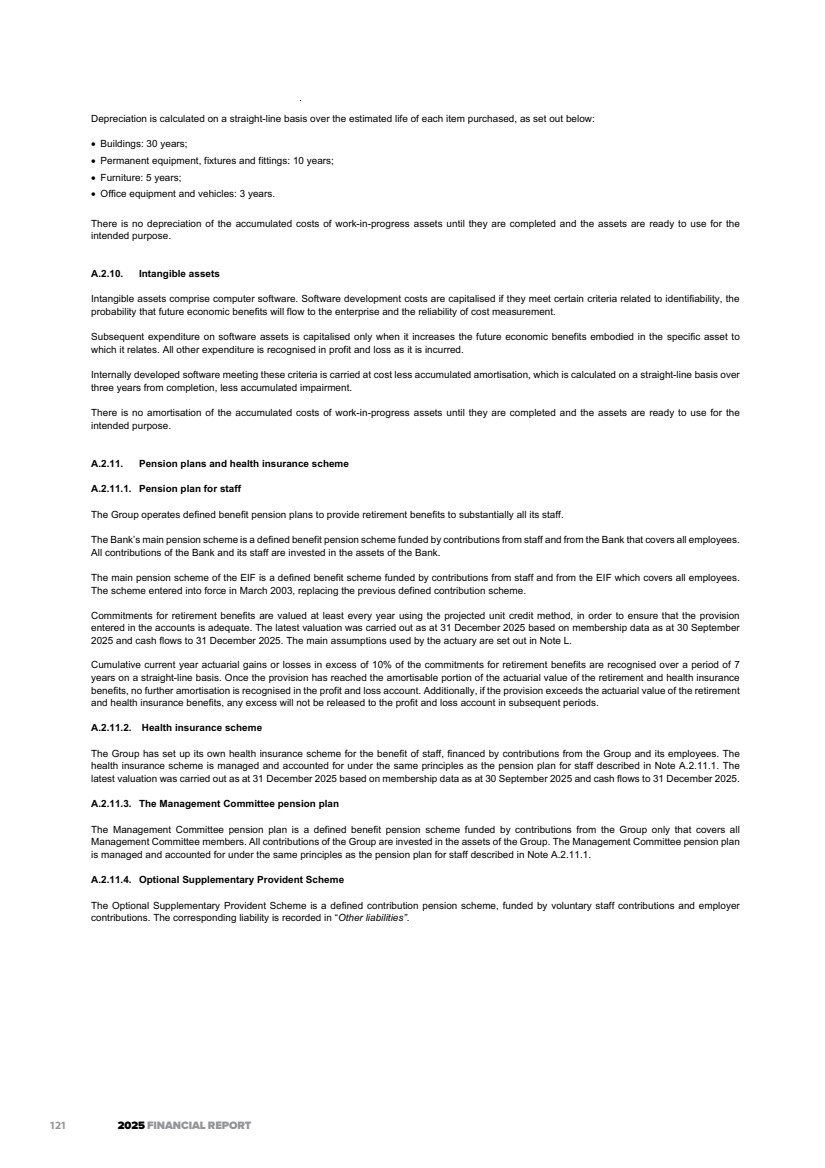
| EIB GROUP CONSOLIDATED FINANCIAL STATEMENTS UNDER EU DIRECTIVES 15 A.2.12. Amounts owed to credit institutions and customers Amounts owed to credit institutions and customers are presented in the Financial Statements at their redemption amounts. Interest on amounts owed to credit institutions and customers is recorded in the profit and loss account on an accrual basis as “Interest payable and similar charges” or “Interest receivable and similar income”, if the interest rate is negative. Accrued interest is included in “Accruals and deferred income” under liabilities. A.2.12.1. Repurchase agreements (‘Repos’) A repurchase agreement is one under which the Group borrows liquid funds from a credit institution and provides collateral in the form of securities. The two parties enter into an irrevocable commitment to complete the operation on a date and at a price fixed at the outset. The operation is based on the principle of delivery against payment, which is mentioned in Note A.2.7.3. This type of operation is considered for the purposes of the Group to be a borrowing with an agreed rate of interest. Generally treated as collateralised financing transactions, they are carried at the amounts of cash owed, plus accrued interest. Repos are entered at their notional amounts on the liabilities side of the consolidated balance sheet under “Amounts owed to credit institutions- b) with agreed maturity or periods of notice”. Interest on repurchase agreements is recognised as “Interest receivable and similar income” or “Interest payable and similar charges” over the life of each agreement. A.2.12.2. Collateral call accounts Under unilateral Collateral Support Annexes, the Group receives cash as collateral to mitigate counterparty credit exposures on Derivatives, Lending and Treasury portfolios. The cash collateral received is recorded at its nominal value and presented in the consolidated Financial Statements under “Amounts owed to credit institutions - a) repayable on demand” - Overnight deposits. A.2.13. Debts evidenced by certificates Debts evidenced by certificates are presented at their redemption amounts, except for zero-coupon bonds and commercial papers which are presented at their amortised cost. Transaction costs and premiums/discounts are amortised in the profit and loss account on a straight-line basis over the life of the debt through “Accruals and deferred income” or “Prepayments and accrued income”. Interest on debt instruments is included in “Interest payable and similar charges” or “Interest receivable and similar income” in the consolidated profit and loss account. A.2.14. Financial guarantees Financial guarantee contracts require the issuer to make specified payments to reimburse the holder for a loss it incurs, if a specified debtor fails to make payment when due under the original or modified terms of a debt instrument. Signed financial guarantees are generally accounted for and disclosed as off-balance sheet items. Net liabilities from financial guarantees are presented in the balance sheet under “Provisions b) provisions in respect of guarantee operations”. This provision is intended to cover risks inherent in the Group’s activity of issuing guarantees in favour of financial intermediaries or issued in respect of loans granted by third parties. Financial guarantees are initially recognised at fair value corresponding to the net present value (‘NPV’) of expected premium inflows or the initial expected loss. Subsequent to initial recognition, financial guarantees are measured as the deficit of the net present value of expected future premium inflows over the higher of: • the amount of the expected credit loss; and • the fair value initially recognised less any cumulative amount of income/amortisation recognised. Unrealised gains representing the excess of the net present value of expected future premium inflows over the amount of the expected payment obligations remain unrecognised. Any increase or decrease in the net liability relating to financial guarantees is recognised in the profit and loss account under “Value (re-)adjustments in respect of loans and advances and provisions for contingent liabilities”. Any premium received is recognised in the profit and loss account under “Commissions receivable”. Upfront fees received are recognised in “Accruals and deferred income” in the balance sheet and amortised in the profit and loss account on a straight-line basis over the life of the financial guarantee. A.2.15. Provision for commitments This provision is intended to cover risks inherent in the Group’s commitment on loans, infrastructure and investment funds as well as private equity and venture capital operations signed but not yet disbursed. A.2.16. Reserves A.2.16.1. Reserve fund As provided for under Article 22(-1) of the Statute, “a reserve fund of up to 10% of the subscribed capital shall be built up progressively” from the retained profit of the Bank. 122 |
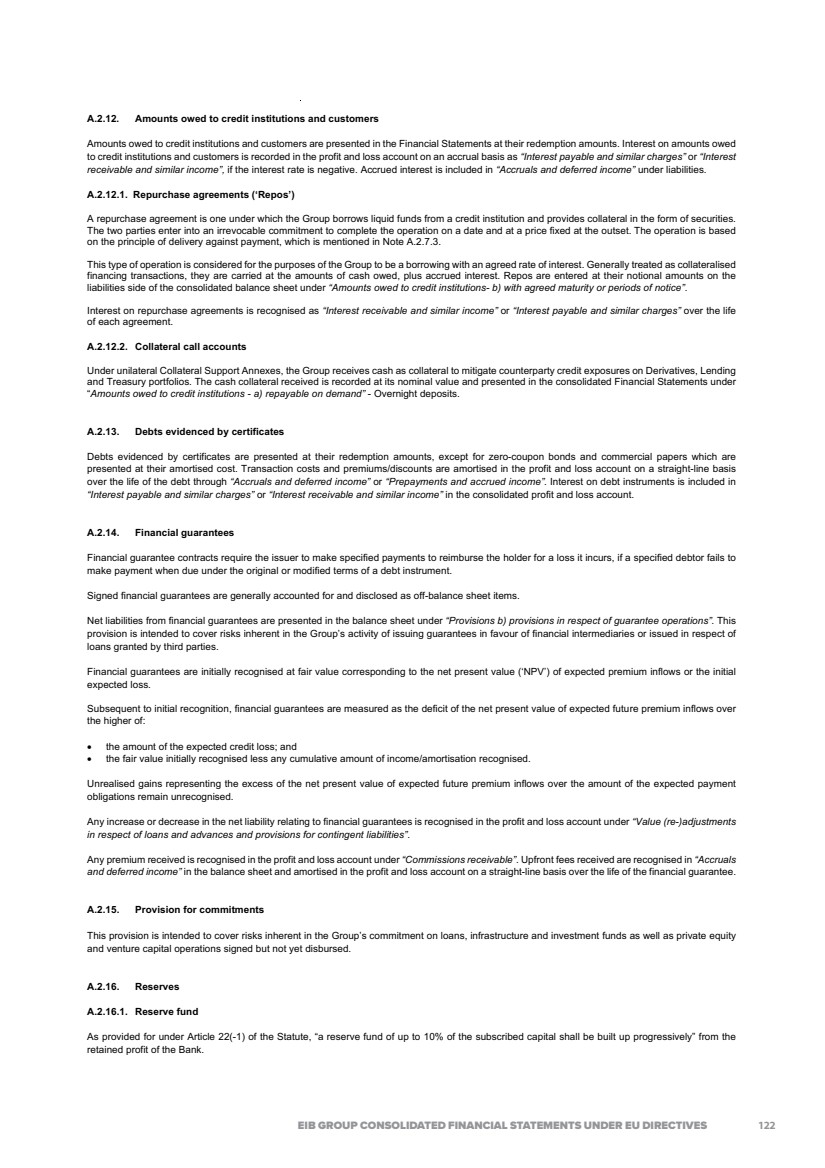
| 2025 FINANCIAL REPORT 16 A.2.16.2. Additional reserves Additional reserves contain the remaining retained earnings of the Group. A.2.16.3. Special activities reserve As provided for under Article 16(-5) of the Statute, “the special activities of the Bank […] will have a specific allocation of reserve”. The special activities reserve is a dedicated notional reserve for the allocation of own funds covering unexpected losses of those activities, which have a risk profile higher than what is generally accepted by the Bank, including venture capital activities. The reserve is based on the allocation of each operation and is calculated according to the evolution of the underlying assets. A.2.16.4. General loan reserve In 2009, a “general loan reserve” was introduced for the Bank’s loan and guarantee portfolio, representing a notional reserve for the allocation of own funds. It is calculated based on the Bank’s internal loan grading system according to the evolution of the underlying assets. A.2.17. Prepayments and accrued income Expenditure incurred during the financial year but relating to a subsequent financial year, together with any income for which payment is not due until the expiry of the underlying instrument. A.2.18. Accruals and deferred income Income received before the balance sheet date but relating to a subsequent financial year, together with any charges that, although pertaining to the financial year in question, will be paid only in the course of a subsequent financial year. A.2.19. Interest receivable and similar income “Interest receivable and similar income” includes mainly interest on loans and advances to credit institutions and customers, debt and money market instruments and derivatives. A.2.20. Interest payable and similar charges “Interest payable and similar charges” includes mainly interest on amounts owed to credit institutions and customers, interest expense on debt and money market instruments and derivatives. A.2.21. Income from securities “Income from securities” is mainly composed of reflows exceeding the capital. A.2.22. Taxation The Protocol on the Privileges and Immunities of the European Union appended to the Treaty on European Union and the Treaty on the Functioning of the European Union, stipulates that the assets, revenues, and other property of the institutions of the Union are exempt from all direct taxes. A.3. Technical Assistance - Reclassification of comparative figures In order to better reflect the underlying nature of the costs incurred by the Bank in the context of technical assistance activities under mandates, the Bank decided in 2025 to classify the related external costs (i.e. the portion which is fully recharged to mandators) under “Net other operating income and expense” instead of “General administrative expenses – b) other administrative expenses”. Using the same rationale, all related income (i.e. recharges) received from the mandators for technical assistance activities has also been classified under “Net other operating income and expense” instead of “Commissions receivable”. This reclassification has been applied to the 2025 financial information as well as to the 2024 comparative figures. Impact on the following captions: Note O – Commissions receivable and Commissions payable (EUR ‘000 -83,192) Note Q – Net other operating income and expense (EUR ‘000 49,458) Note R – General administrative expenses (EUR ‘000 33,734). 123 |
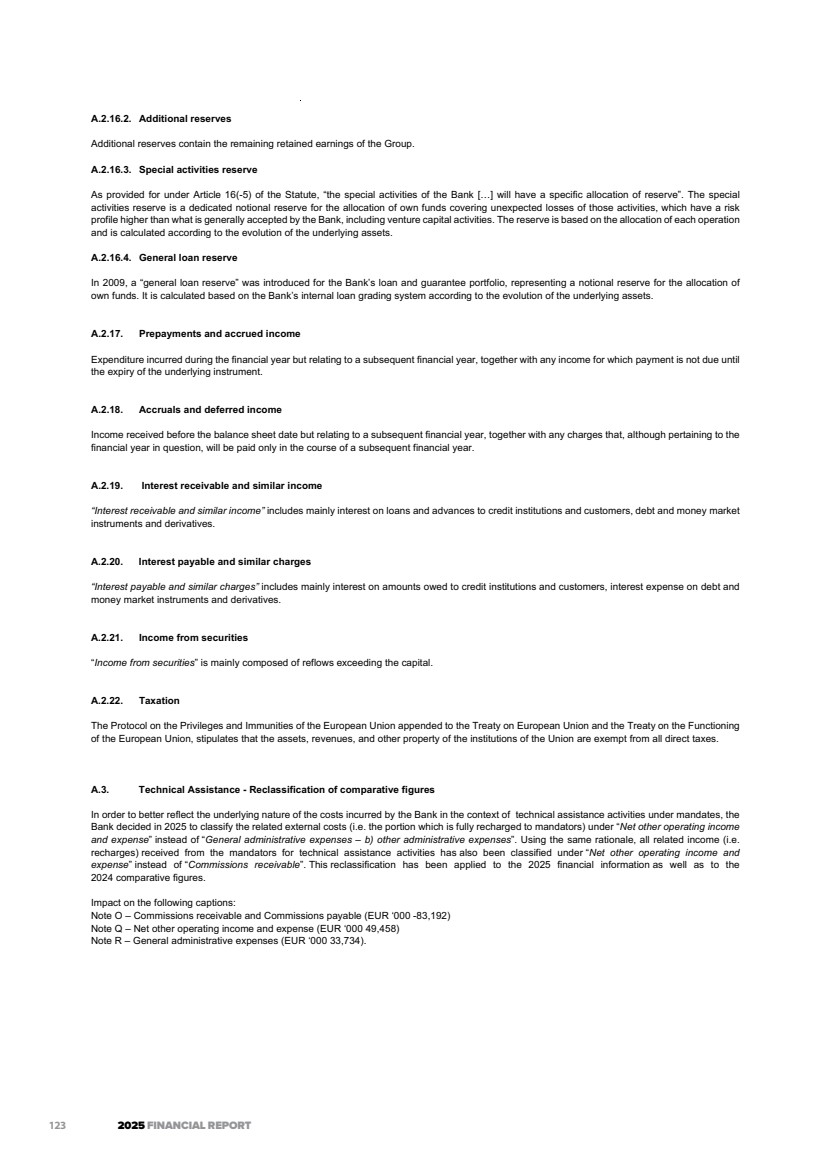
| EIB GROUP CONSOLIDATED FINANCIAL STATEMENTS UNDER EU DIRECTIVES 17 Note B – Cash in hand, balances with central banks and post office banks and debt securities portfolio B.1. Cash in hand, balances with central banks and post office banks Cash in hand and balances with central banks and post office banks amount to EUR ’000 257,807 as at 31 December 2025 (2024: EUR ‘000 104,678). The EIB is an eligible counterparty in the Eurosystem’s monetary policy operations, therefore has been given access to the monetary policy operations of the European Central Bank. The Bank conducts operations via the Central Bank of Luxembourg, where it maintains deposits to cover the minimum reserve requirement. The balance of these deposits amounts to EUR ‘000 257,049 as at 31 December 2025 (2024: EUR ‘000 104,667). B.2. Debt security portfolios (in EUR ’000) The debt security portfolios are composed of the Long-Term HQLA Portfolio (‘LTHP’), the treasury monetary portfolio (‘TMP’), the securities liquidity portfolio (‘SLP’), the loan substitutes portfolio and of the ABS and Operational portfolios of the EIF. The details of the debt security portfolios as at 31 December 2025 and 2024 are as follows: 31.12.2025 31.12.2024 Treasury bills and other bills eligible for refinancing with central banks 41,669,631 38,114,661 Debt securities including fixed-income securities 11,708,681 11,574,710 Total debt securities(*) 53,378,312 49,689,371 (*) of which EUR ‘000 5,373,643 are unlisted as at 31 December 2025 (2024: EUR ‘000 5,896,446). At 31.12.2025 Purchase price Book value Value adjustments Premiums/ discounts to be amortised Value at final maturity Market value(**) LTHP 10,583,251 10,587,525 0 20,948 10,608,473 10,180,033 TMP 12,177,884 12,311,940 0 116,934 12,428,874 12,313,915 SLP 8,202,524 8,273,468 0 0 8,275,548 8,273,468 Operational portfolio - EIF 2,326,576 2,297,019 0 -8,668 2,288,351 2,234,604 ABS portfolio - EIF 758,630 419,989 0 0 419,988 410,572 Loan substitutes (Note D) 19,488,213 19,488,371 0 6,725 19,495,096 19,397,035 Total debt securities(*) 53,537,078 53,378,312 0 135,939 53,516,330 52,809,627 (*) of which cash and cash equivalents is nil. (**) Market value does not include accrued interest. At 31.12.2024 Purchase price Book value Value adjustments Premiums/ discounts to be amortised Value at final maturity Market value(**) LTHP 7,607,156 7,600,243 0 17,760 7,618,003 7,243,089 TMP 12,608,177 12,843,182 0 213,435 13,056,617 12,881,936 SLP 6,648,321 6,688,981 0 0 6,737,517 6,688,981 Operational portfolio - EIF 2,258,029 2,226,480 0 -17,634 2,208,847 2,130,875 ABS portfolio - EIF 761,236 519,541 0 0 519,541 512,536 Loan substitutes (Note D) 19,807,235 19,810,944 0 709 19,811,653 19,820,469 Total debt securities(*) 49,690,154 49,689,371 0 214,270 49,952,178 49,277,886 (*) of which cash and cash equivalents is nil. (**) Market value does not include accrued interest. All instruments of the LTHP portfolio are compliant with the HQLA criteria and are monitored regularly through internal limits. As at 31 December 2025 and 2024, there is neither significant deterioration of the credit rating of the portfolio nor any indication that the full amount of the book value is not going to be recovered at maturity. The market value of the portfolio is impacted (lower than the book value) due to the current interest rate environment and the corresponding long-term maturity of the instruments. Loan substitutes, which represent acquisitions of interests in pools of loans or receivables related to securitisation transactions, are considered part of the aggregate loans (Note D). Some of these transactions have been structured by adding credit or project-related remedies, providing further recourse. Following a detailed review of the loan substitutes portfolio for any value adjustment, no value adjustment was recorded for 2025 and 2024. 124 |
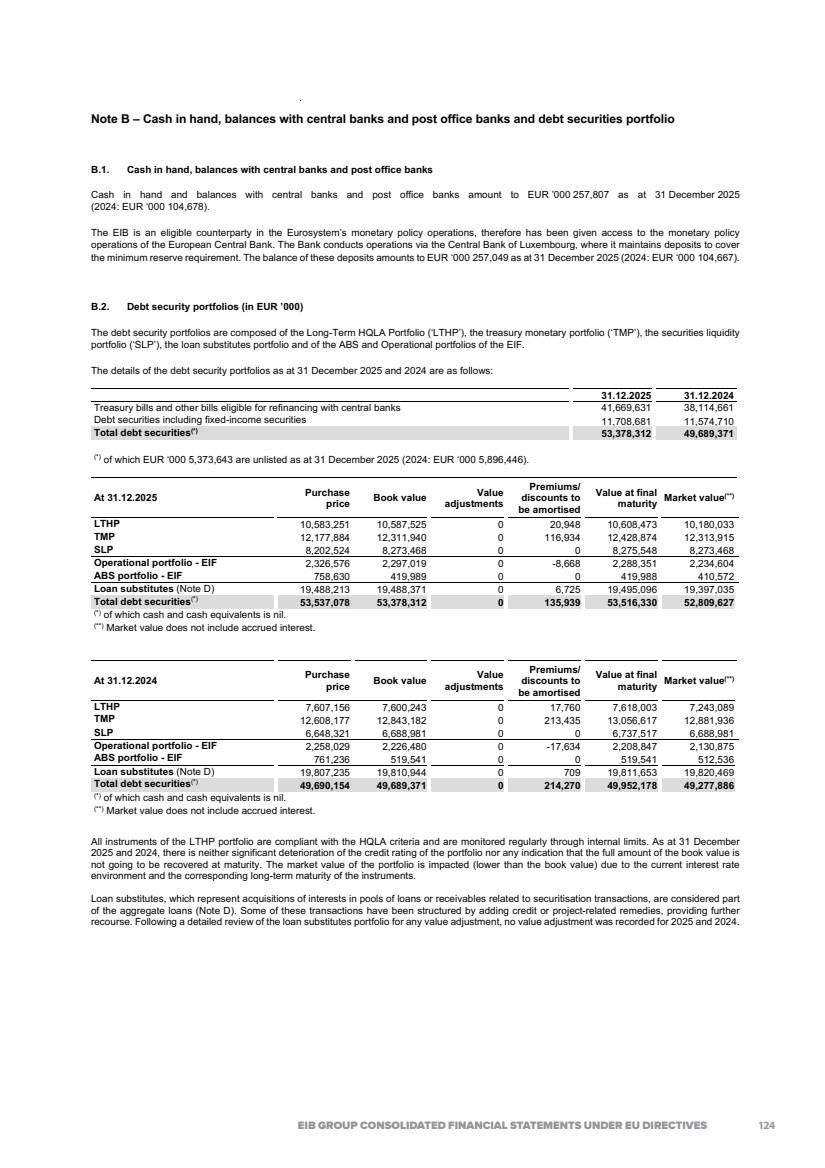
| 2025 FINANCIAL REPORT 18 EU sovereign exposure in bond holdings The Group did not record value adjustments in 2025 and 2024 in respect of its held to maturity EU sovereign and EU sovereign guaranteed exposure as at year end, in view of the Bank’s as well as the EIF’s preferred creditor status and the protection given by the Bank’s Statute as well as a detailed review of any value adjustment requirements. The following tables show the exposure to debt issued or guaranteed by EU sovereigns in the Group’s debt securities portfolios (including loan substitutes and the EIF ABS portfolio) as at 31 December 2025 and 2024: At 31.12.2025 Purchase price Book value Value at final maturity Market value EU sovereigns Austria 980,872 985,720 1,000,445 939,063 Belgium 891,646 890,598 874,553 834,016 Bulgaria 95,243 93,467 92,515 90,725 Denmark 85,061 85,072 85,106 85,474 Estonia 25,030 24,768 25,000 24,742 Finland 881,679 885,260 892,479 846,545 France 4,736,284 4,805,629 4,898,234 4,761,863 Germany 3,179,314 3,184,929 3,188,026 3,183,674 Hungary 43,487 43,447 42,766 43,322 Italy 5,726,878 5,786,791 5,841,319 5,786,560 Latvia 63,628 63,784 64,000 64,137 Lithuania 77,983 77,566 77,950 76,914 Luxembourg 116,092 116,424 117,500 112,700 Netherlands 83,247 80,940 79,000 76,100 Poland 1,027,413 1,026,720 1,024,364 1,067,659 Portugal 538,672 544,641 546,500 540,192 Romania 3,442 3,528 3,404 3,528 Slovakia 46,473 46,384 46,105 46,653 Slovenia 64,154 63,730 63,778 60,135 Spain 1,503,425 1,524,620 1,536,576 1,524,820 Sweden 155,202 155,152 155,574 154,656 20,325,225 20,489,170 20,655,194 20,323,478 Non-EU sovereign and other bonds 33,211,853 32,889,142 32,861,136 32,486,149 Total 53,537,078 53,378,312 53,516,330 52,809,627 At 31.12.2024 Purchase price Book value Value at final maturity Market value EU sovereigns Austria 803,423 804,600 821,066 773,502 Belgium 417,869 416,387 402,000 386,139 Bulgaria 55,990 54,409 52,515 50,342 Denmark 115,463 115,650 115,507 115,973 Estonia 6,943 6,948 7,000 7,055 Finland 616,720 619,584 627,744 591,088 France 5,924,089 6,045,034 6,192,617 6,026,907 Germany 2,098,603 2,105,840 2,111,072 2,102,092 Hungary 16,827 16,203 16,000 15,530 Italy 5,729,888 5,827,476 5,915,000 5,850,314 Latvia 26,330 26,714 26,500 27,208 Lithuania 38,119 37,905 37,950 37,227 Luxembourg 101,137 101,299 102,500 101,896 Netherlands 61,287 59,413 59,000 58,014 Poland 955,724 953,571 951,628 996,377 Portugal 47,184 46,911 46,500 41,820 Romania 13,781 13,580 13,476 13,580 Slovakia 37,886 37,972 38,000 38,197 Slovenia 54,433 54,089 54,000 49,552 Spain 1,785,547 1,817,335 1,853,259 1,821,511 Sweden 8,645 8,645 8,663 8,645 18,915,888 19,169,565 19,451,997 19,112,969 Non-EU sovereign and other bonds 30,774,266 30,519,806 30,500,181 30,164,917 Total 49,690,154 49,689,371 49,952,178 49,277,886 125 |
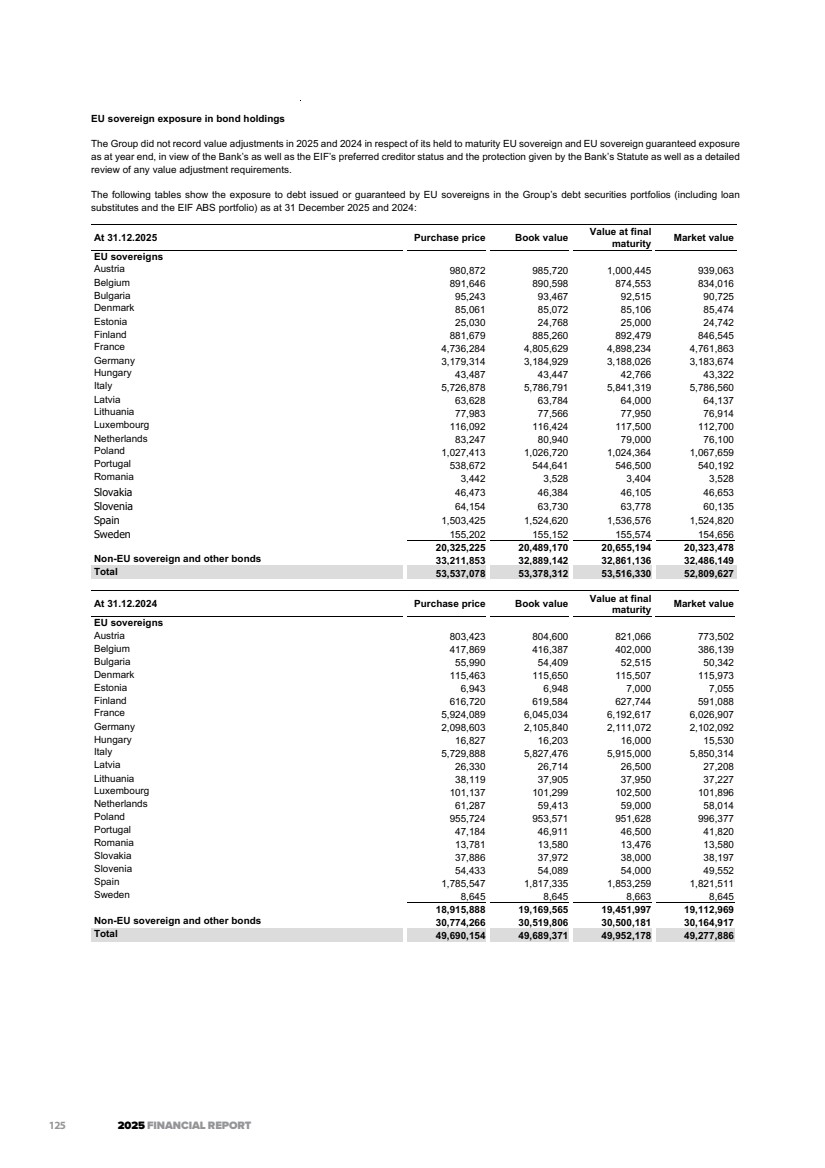
| EIB GROUP CONSOLIDATED FINANCIAL STATEMENTS UNDER EU DIRECTIVES 19 Note C – Loans and advances to credit institutions and to customers – other loans and advances (in EUR ‘000) 31.12.2025 31.12.2024 Term deposits(*) 10,995,158 18,829,974 On-demand deposits 2,308 2,498 Reverse repos 23,197,520 21,286,269 Other loans and advances to credit institutions 34,194,986 40,118,741 Other loans and advances to customers 118,171 234,816 Total other loans and advances 34,313,157 40,353,557 of which cash and cash equivalents 32,304,247 37,376,534 (*) Includes deposits with the Central Bank of Luxembourg of EUR 9.9 billion as at 31 December 2025 (31 December 2024: EUR 16.7 billion). Note D – Summary statement of loans D.1. Aggregate loans granted (in EUR ‘000) Aggregate loans granted comprise both the disbursed and undisbursed portions of loans. The analysis is as follows: To credit institutions To customers 31.12.2025 31.12.2024 Disbursed portion 85,142,810 352,112,120 437,254,930 435,664,981 Undisbursed loans 26,408,564 107,154,243 133,562,807 128,019,748 Aggregate loans granted 111,551,374 459,266,363 570,817,737 563,684,729 Loan instalments receivable 11,983 610,910 622,893 600,557 Loan substitutes portfolio 19,488,371 19,810,944 Aggregate loans including loan substitutes portfolio (Note D.3) 590,929,001 584,096,230 D.2. Value adjustments for loans (in EUR ‘000) Movements in the value adjustments are detailed below: 2025 2024 As at 1 January 618,304 542,652 Release during the year (1) -32,891 -150,022 Use during the year(2) -130,639 -30,516 Allowance during the year 250,746 251,641 Foreign exchange adjustment -4,212 4,549 As at 31 December(3) 701,308 618,304 (1) During 2024, the Bank released in full the collective provisions on loans (EUR ’000 87,190), which had initially been recognised in 2022 in the context of the war in Ukraine. In 2025, no collective provisions were recorded. (2) In 2025, the Bank: • Wrote-off seven loan operations that were specifically provisioned at the beginning of the year: EUR '000 74,525 was used against the existing provision (2024: EUR '000 30,558 on seven loan operations); • Wrote-off one loan operation that had been specifically provisioned during the course of 2025: EUR '000 543 was used against the existing provision (2024: EUR '000 376); • Completed three restructurings of loan operations that was specifically provisioned at the beginning of the year: EUR '000 9,117 and was used against the existing provision (2024: none); • Completed one sale transaction of non-performing loan operations: EUR ‘000 46,453 was used against the existing provision (2024: EUR '000 335 on one sale transaction). (3) The value adjustments relate only to disbursed loans, including arrears. The Bank has additionally recorded value adjustments in regard to accrued interest of a total amount of EUR '000 79,262 (2024: EUR '000 68,700), which is recorded under the caption of "Prepayments and accrued income." 126 |
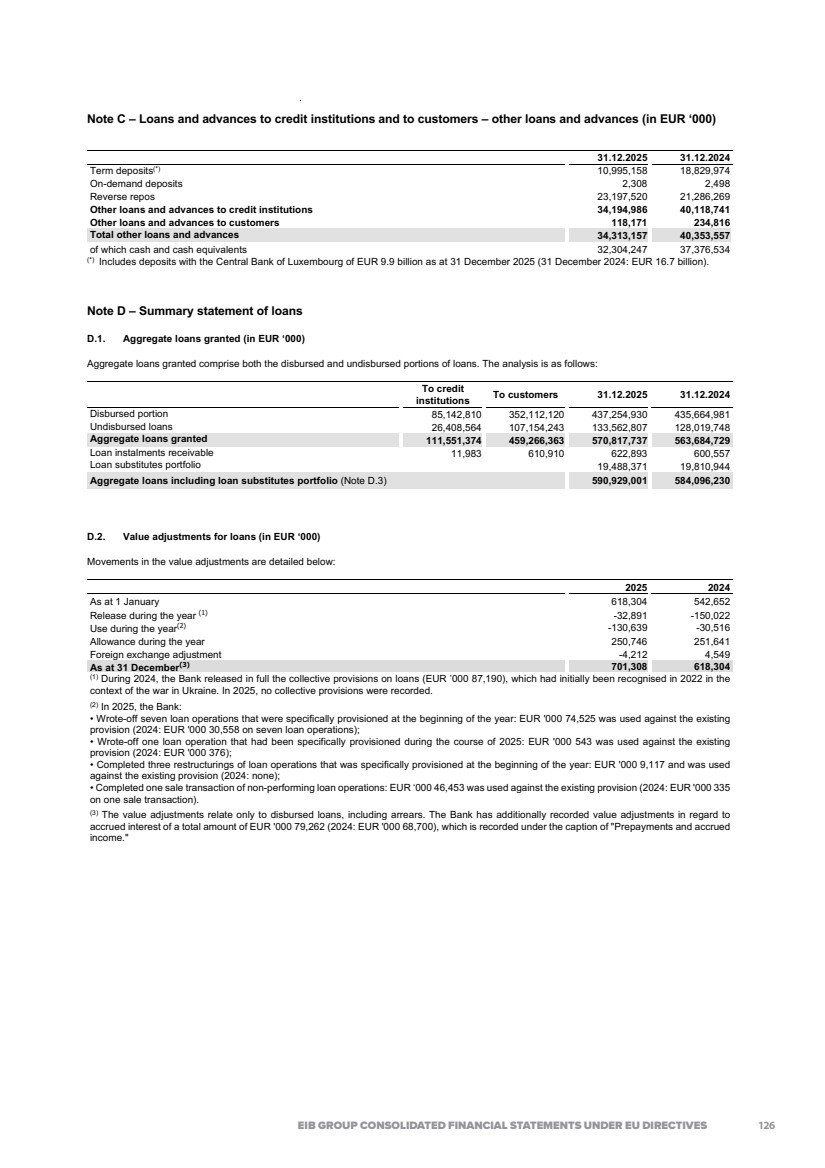
| 2025 FINANCIAL REPORT 20 D.3. Geographical breakdown of lending by country in which projects are located (in EUR ‘000) D.3.1. Loans for projects within the European Union Countries and territories in which projects are located Aggregate loans granted Disbursed portion Undisbursed portion % of total 2025 % of total 2024 France 81,868,868 62,910,250 18,958,618 13.87% 13.22% Spain 74,254,027 63,860,546 10,393,481 12.58% 13.22% Italy 66,138,468 55,283,799 10,854,669 11.20% 11.22% Poland 51,149,983 40,479,854 10,670,129 8.66% 8.36% Germany 50,959,430 36,523,474 14,435,956 8.63% 8.33% Belgium 20,488,645 15,936,774 4,551,871 3.47% 3.30% Greece 18,465,896 13,774,653 4,691,243 3.13% 3.32% Netherlands 17,792,591 13,560,846 4,231,745 3.01% 2.99% Austria 14,192,285 12,212,838 1,979,447 2.40% 2.48% Portugal 12,946,248 9,116,978 3,829,270 2.19% 2.09% Sweden 12,825,059 10,236,341 2,588,718 2.17% 2.04% Finland 11,337,349 9,944,966 1,392,383 1.92% 1.93% Czech Republic 10,651,527 7,975,440 2,676,087 1.80% 1.69% Romania 9,477,479 6,667,857 2,809,622 1.61% 1.48% Hungary 8,866,120 7,686,572 1,179,548 1.50% 1.48% Ireland 8,536,427 6,233,979 2,302,448 1.45% 1.42% Denmark 4,570,034 2,659,958 1,910,076 0.77% 0.87% Slovakia 4,338,484 4,222,162 116,322 0.73% 0.73% Croatia 3,379,358 2,716,897 662,461 0.57% 0.61% Lithuania 3,230,621 2,712,863 517,758 0.55% 0.52% Bulgaria 2,723,694 2,008,362 715,332 0.46% 0.42% Cyprus 2,663,467 1,789,626 873,841 0.45% 0.43% Slovenia 2,174,672 1,832,205 342,467 0.37% 0.38% Estonia 1,978,020 1,354,088 623,932 0.34% 0.35% Latvia 986,931 622,728 364,203 0.17% 0.14% Luxembourg 883,740 576,835 306,905 0.15% 0.15% Malta 451,938 346,945 104,993 0.10% 0.09% Subtotal 497,331,361 393,247,836 104,083,525 84.25% 83.26% 127 |
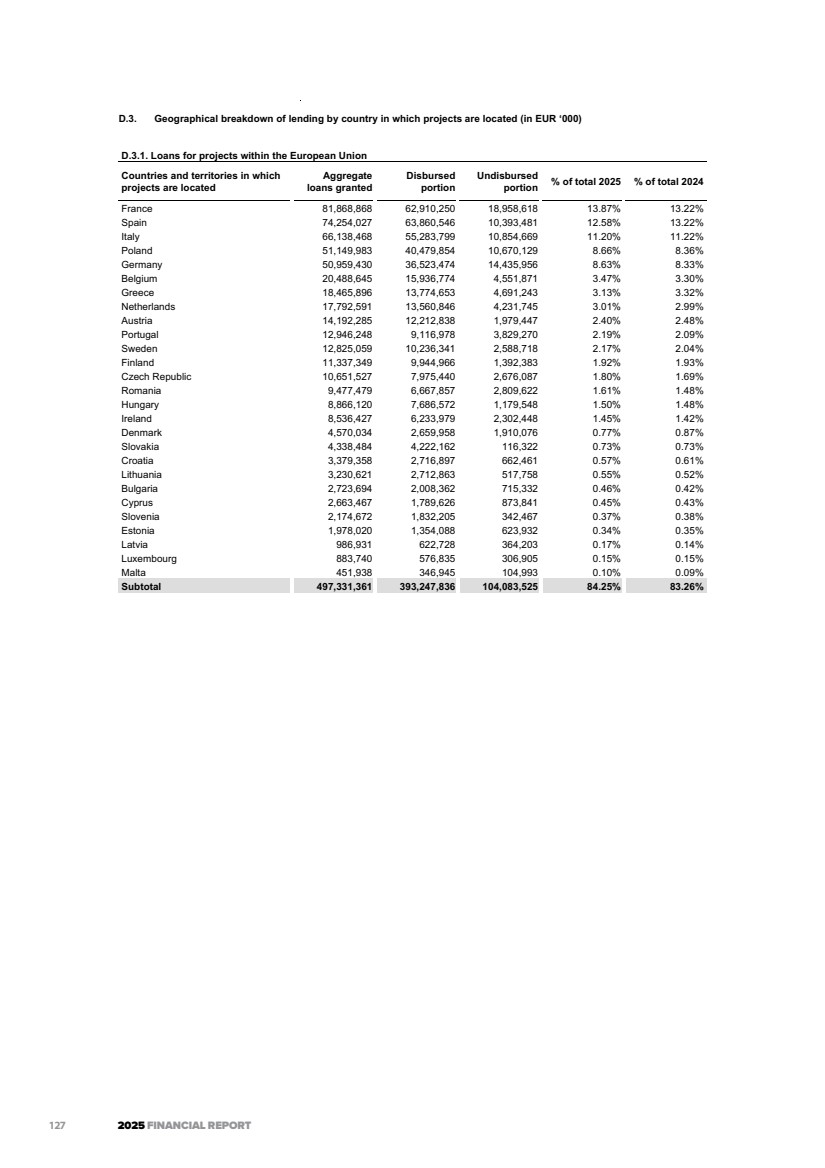
| EIB GROUP CONSOLIDATED FINANCIAL STATEMENTS UNDER EU DIRECTIVES 21 D.3.2. Loans for projects outside the European Union1 D.3.2.1. Candidate countries Countries and territories in which projects are located Aggregate loans granted Disbursed portion Undisbursed portion % of total 2025 % of total 2024 Ukraine* 6,065,197 3,557,895 2,507,302 Türkiye 5,617,286 5,148,061 469,225 Serbia 4,007,973 2,479,738 1,528,235 Bosnia and Herzegovina 1,908,130 1,448,929 459,201 Georgia 1,691,419 1,271,009 420,410 Moldova 1,406,108 504,832 901,276 Montenegro 634,493 446,274 188,219 North Macedonia 604,396 301,996 302,400 Albania 383,815 166,315 217,500 Subtotal 22,318,817 15,325,049 6,993,768 3.78% 3.91% * The EIB’s disbursed exposure in Ukraine is predominantly covered by EU comprehensive guarantees and EU political risk guarantees under the EU External Lending Mandate. As of 31 December 2025, total disbursed exposure amounted to EUR 3,557.9 million (compared with EUR 3,227.1 million at the end of 2024). Of this amount, EUR 2,928.8 million, or 83%, is covered by EU comprehensive guarantees; EUR 88.7 million, or 2%, is covered by EU political risk guarantees; EUR 70.0 million, or 2%, under EU4U; EUR 460.3 million, or 13% under Ukraine Facility and EUR 10.1 million, or 0% is covered under risk sharing mandates (compared with EUR 3,068.1 million, or 95% by EU comprehensive guarantees; EUR 146.6 million, or 5% by EU political risk guarantees; EUR 0.0 million, or 0% at own risk; and EUR 12.4 million, or 0%, respectively covered under risk sharing mandates, at the end of 2024). In addition, the Bank granted financial guarantees on exposures to counterparties located in Ukraine for a signed exposure of EUR 442.6 million at the end of 2025 (compared with EUR 500.5 million at the end of 2024). This is fully covered by EU comprehensive guarantees. A further EUR 2,507.3 million has been committed in signed operations not yet disbursed at the end of 2025 (compared with EUR 2,615.0 million at the end of 2024). Of this amount, EUR 824.5 million, or 33%, is covered by EU comprehensive guarantees; EUR 0.0 million, or 0%, by EU political risk guarantees; EUR 190.0 million, or 8%, under EU4U; EUR 1,459.8 million, or 58% under Ukraine Facility and EUR 33 million, or 1%, under risk sharing mandates (compared with EUR 2,285.2 million, or 87% covered by EU comprehensive guarantees; EUR 144.9 million, or 6% by political risk guarantees; EUR 150.0 million, or 6% under EU4U; and EUR 33.0 million, or 1%, covered under risk sharing mandates respectively, at the end of 2024). None is at the EIB’s own risk (compared with EUR 1.9 million, or 0%, at the end of 2024). 1 The percentages reflect the composition of each country cluster relevant for the year of presentation. 128 |
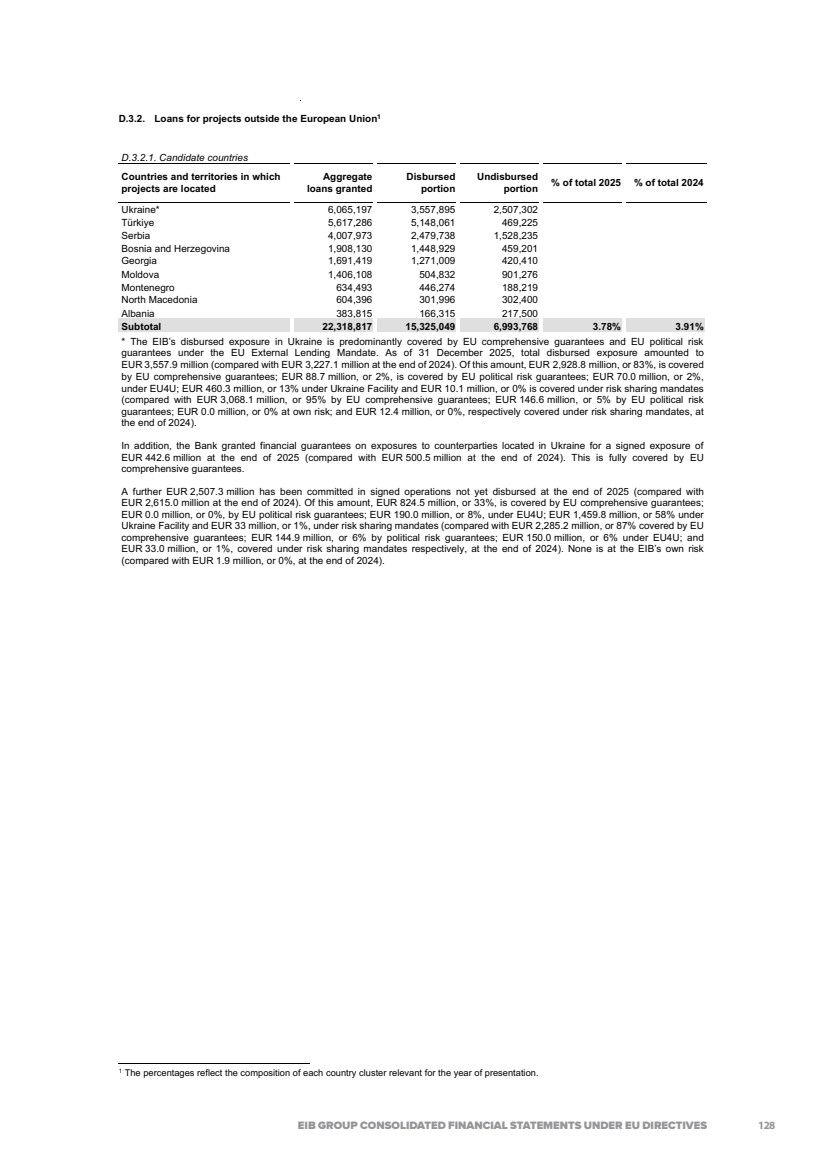
| 2025 FINANCIAL REPORT 22 D.3.2.2. African, Caribbean and Pacific (‘ACP’) states Countries and territories in which projects are located Aggregate loans granted Disbursed portion Undisbursed portion % of total 2025 % of total 2024 Regional - Africa 1,771,162 640,409 1,130,753 Nigeria 927,414 61,974 865,440 Senegal 733,890 402,231 331,659 Guinea 661,463 190,610 470,853 Benin 520,655 222,865 297,790 Kenya 465,424 227,628 237,796 Côte d'Ivoire 453,107 234,662 218,445 Zambia 403,677 199,483 204,194 Tanzania 379,295 272,832 106,463 Madagascar 345,294 198,236 147,058 Cabo Verde 344,377 34,317 310,060 Malawi 302,325 195,855 106,470 Rwanda 296,973 67,709 229,264 Mauritania 292,272 69,116 223,156 Regional - West Africa 263,943 120,706 143,237 Ghana 262,572 32,799 229,773 Uganda 245,593 132,107 113,486 Cameroon 183,207 34,207 149,000 Mozambique 176,922 57,114 119,808 Chad 156,200 66,153 90,047 Angola 147,774 48,359 99,415 Lesotho 133,862 56,612 77,250 Regional - ACP 121,250 0 121,250 Guinea-Bissau 105,000 0 105,000 Regional - Caribbean 100,000 0 100,000 Dominican Republic 94,544 30,056 64,488 The Gambia 87,100 59,747 27,353 Burkina Faso 84,336 73,674 10,662 Djibouti 79,200 0 79,200 Barbados 69,453 18,871 50,582 Burundi 66,798 66,798 0 Fiji 61,826 13,761 48,065 Liberia 47,605 27,605 20,000 Papua New Guinea 41,074 41,074 0 Mali 37,460 31,510 5,950 Ethiopia 36,005 36,005 0 São Tomé and Príncipe 32,940 24,500 8,440 Seychelles 32,291 19,791 12,500 Eswatini 31,196 31,196 0 Niger 30,827 30,827 0 Congo 26,000 0 26,000 Saint Lucia 13,500 0 13,500 Togo 12,017 12,017 0 Democratic Republic of the Congo 11,862 11,862 0 Sierra Leone 10,000 0 10,000 Namibia 4,523 4,523 0 Belize 142 142 0 Dominica 95 95 0 Subtotal 10,704,445 4,100,038 6,604,407 1.81% 1.69% 129 |
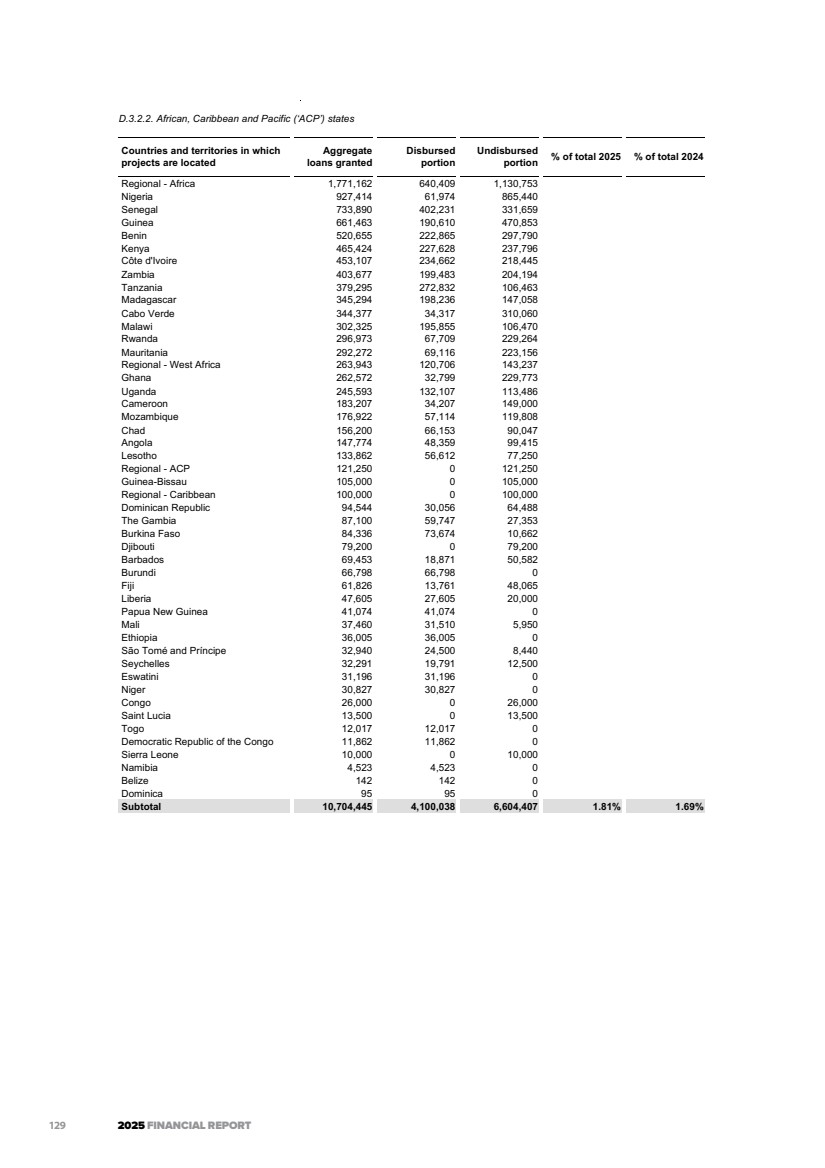
| EIB GROUP CONSOLIDATED FINANCIAL STATEMENTS UNDER EU DIRECTIVES 23 D.3.2.3. Asia Countries and territories in which projects are located Aggregate loans granted Disbursed portion Undisbursed portion % of total 2025 % of total 2024 India 4,843,914 2,606,861 2,237,053 China 1,668,744 1,156,182 512,562 Bangladesh 942,108 249,108 693,000 Regional - Asia 471,741 207,901 263,840 Viet Nam 332,009 109,009 223,000 Cambodia 289,734 131,474 158,260 Uzbekistan 284,683 177,483 107,200 Nepal 272,158 172,424 99,734 Kazakhstan 242,219 219 242,000 Laos 168,019 111,989 56,030 Bhutan 150,000 0 150,000 Kyrgyzstan 121,000 82,300 38,700 Sri Lanka 114,180 72,207 41,973 Pakistan 110,000 10,000 100,000 Mongolia 108,064 63,154 44,910 Tajikistan 102,035 72,035 30,000 Maldives 99,180 62,910 36,270 Regional - Central Asia 45,450 0 45,450 Subtotal 10,365,238 5,285,256 5,079,982 1.76% 1.76% D.3.2.4. Potential candidate countries Countries and territories in which projects are located Aggregate loans granted Disbursed portion Undisbursed portion % of total 2025 % of total 2024 Kosovo(*) 181,064 79,464 101,600 Subtotal 181,064 79,464 101,600 0.03% 0.03% (*) This designation is without prejudice to positions on status and is in line with UNSCR 1244/1999 and the ICJ Opinion on the Kosovo declaration of independence. D.3.2.5. Latin America Countries and territories in which projects are located Aggregate loans granted Disbursed portion Undisbursed portion % of total 2025 % of total 2024 Brazil 1,808,827 1,708,827 100,000 Regional - Latin America 1,283,687 746,267 537,420 Ecuador 816,851 520,423 296,428 Colombia 735,735 539,990 195,745 Costa Rica 431,907 48,928 382,979 Argentina 423,961 189,338 234,623 Panama 358,187 269,007 89,180 Chile 348,264 161,030 187,234 Mexico 291,502 141,502 150,000 Nicaragua 252,088 191,636 60,452 Paraguay 130,408 102,121 28,287 Bolivia 93,212 92,679 533 Honduras 53,739 53,739 0 El Salvador 31,611 31,611 0 Subtotal 7,059,979 4,797,098 2,262,881 1.20% 1.18% D.3.2.6. European Free Trade Association (‘EFTA’) countries Countries and territories in which projects are located Aggregate loans granted Disbursed portion Undisbursed portion % of total 2025 % of total 2024 Norway 616,569 553,291 63,278 Iceland 572,774 367,774 205,000 Switzerland 77,666 72,500 5,166 Subtotal 1,267,009 993,565 273,444 0.21% 0.23% 130 |
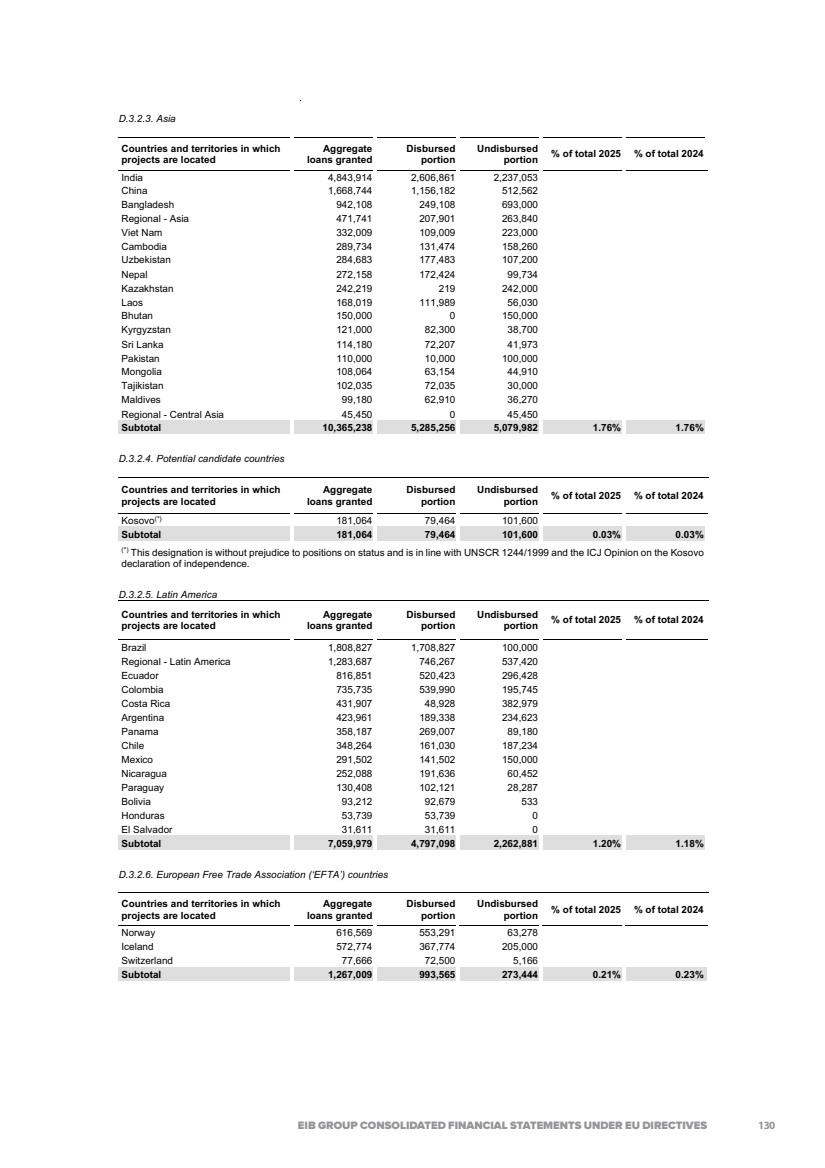
| 2025 FINANCIAL REPORT 1 D.3.2.7. Mediterranean countries Countries and territories in which projects are located Aggregate loans granted Disbursed portion Undisbursed portion % of total 2025 % of total 2024 Egypt 5,236,660 3,114,665 2,121,995 Morocco 5,176,059 2,893,707 2,282,352 Tunisia 2,402,754 1,407,655 995,099 Jordan 1,672,328 811,068 861,260 Israel* 1,665,644 1,253,263 412,381 Palestine** 702,449 661,233 41,216 Lebanon*** 340,968 164,468 176,500 Algeria 162,950 162,950 0 Regional - Mediterranean 39,590 9,590 30,000 Syria 15,300 15,300 0 Subtotal 17,414,702 10,493,899 6,920,803 2.95% 3.33% * The EIB’s total disbursed exposure in Israel amounted to EUR 1,253.3 million at the end of 2025 (compared to EUR 1,211.1 million at the end of 2024), of which EUR 238.2 million, or 19%, is secured by EU Political Risk Guarantees, EUR 1,010.8 million, or 81%, is at the EIB’s own risk and EUR 4.3 million, or 0%, is covered under Risk Sharing Mandates (compared to EUR 279.5 million, or 23%, EUR 927.3 million, or 77% and EUR 4.3 million, or 0% respectively, at the end of 2024). A further EUR 412.4 million has been committed in signed operations not yet disbursed at the end of 2025 (compared to EUR 584.1 million at the end of 2024), of which EUR 408.9 million, or 99%, is at the EIB’s own risk and EUR 3.5 million, or 1%, under Risk Sharing Mandates (compared to EUR 580.6 million, or 99% and EUR 3.5 million, or 1% respectively, at the end of 2024). **The EIB’s total disbursed exposure in Palestine (This designation shall not be construed as recognition of a State of Palestine and is without prejudice to the individual positions of the EU Member States on this issue.) amounted to EUR 661.2 million at the end of 2025 (compared to EUR 297.6 million at the end of 2024), of which EUR 657.9 million, or 99%, is secured by EU Comprehensive Guarantees and EUR 3.4 million, or 1%, under Risk Sharing Mandates (compared to EUR 291.2 million, or 98%, secured by EU Comprehensive Guarantees and EUR 6.4 million, or 2%, under Risk sharing Mandates, at the end of 2024). A further EUR 41.2 million has been committed in signed operations not yet disbursed, which is fully secured by EU Comprehensive Guarantees (compared to EUR 77.5 million at the end of 2024, also fully secured by EU Comprehensive Guarantees). *** The EIB’s total disbursed exposure in Lebanon amounted to EUR 164.5 million at the end of 2025 (compared to EUR 228.6 million at the end of 2024). This exposure is fully secured by EU comprehensive guarantees. A further EUR 176.5 million has been committed in signed operations not yet disbursed (compared to EUR 476.6 million at the end of 2024). This exposure is fully secured by EU comprehensive guarantees. D.3.2.8. Overseas countries and territories (OCT) Countries and territories in which projects are located Aggregate loans granted Disbursed portion Undisbursed portion % of total 2025 % of total 2024 Sint Maarten 42,553 42,553 0 New Caledonia 41,054 41,054 0 Greenland 10,000 0 10,000 French Polynesia 5,875 5,875 0 Subtotal 99,482 89,482 10,000 0.02% 0.02% D.3.2.9. Eastern Europe, Southern Caucasus Countries and territories in which projects are located Aggregate loans granted Disbursed portion Undisbursed portion % of total 2025 % of total 2024 Armenia 1,003,540 576,482 427,058 Azerbaijan 9,458 9,458 0 Subtotal 1,012,998 585,940 427,058 0.17% 0.21% D.3.2.10. United Kingdom Countries and territories in which projects are located Aggregate loans granted Disbursed portion Undisbursed portion % of total 2025 % of total 2024 United Kingdom 21,488,141 21,488,141 0 Subtotal 21,488,141 21,488,141 0 3.64% 4.19% D.3.2.11. South Africa Countries and territories in which projects are located Aggregate loans granted Disbursed portion Undisbursed portion % of total 2025 % of total 2024 South Africa 1,052,872 257,533 795,339 Subtotal 1,052,872 257,533 795,339 0.18% 0.19% 131 |
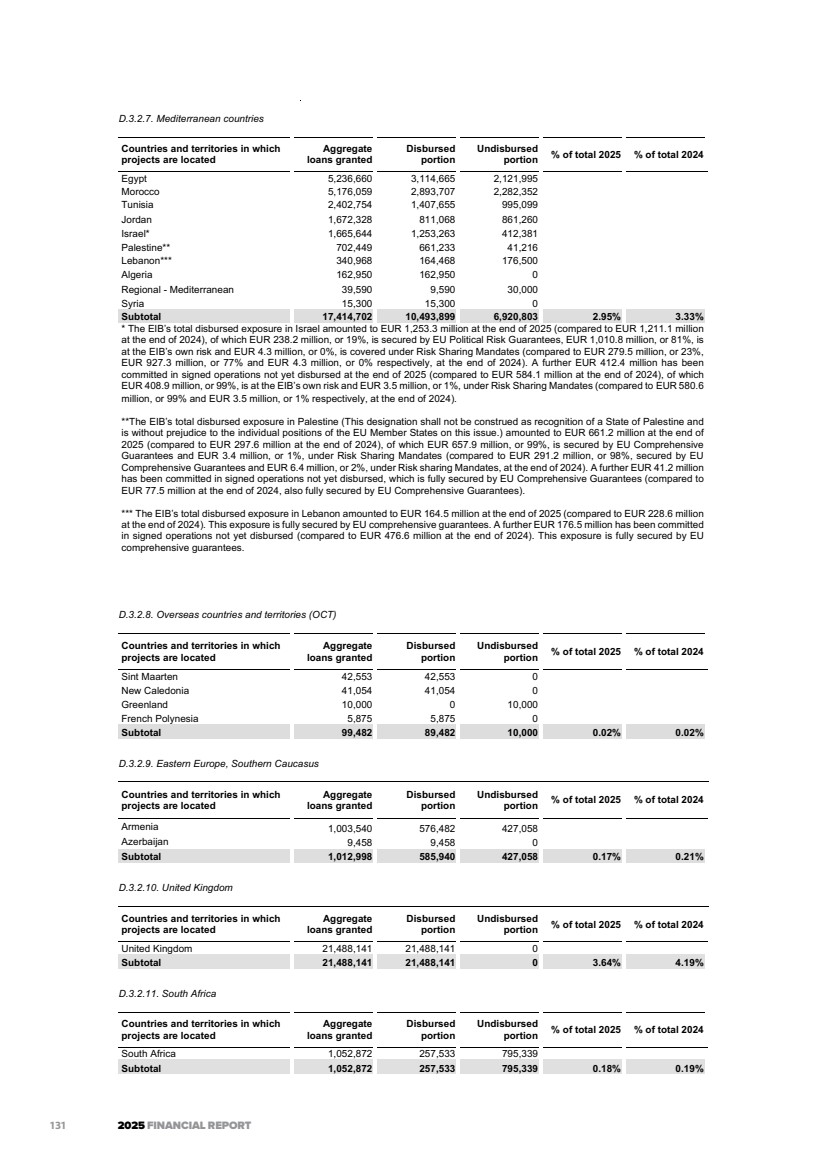
| EIB GROUP CONSOLIDATED FINANCIAL STATEMENTS UNDER EU DIRECTIVES 25 D.3.2.12. Non-candidate countries Countries and territories in which projects are located Aggregate loans granted Disbursed portion Undisbursed portion % of total 2025 % of total 2024 Faroe Islands 10,000 0 10,000 Subtotal 10,000 0 10,000 0.00% 0.00% Total loans for projects outside the European Union 92,974,747 63,495,465 29,479,282 15.75% 16.74% Total loans 2025(1) 590,306,108 456,743,301 133,562,807 100.00% Total loans 2024(1) 583,495,673 455,475,925 128,019,748 100.00% (1) Including loan substitutes (Notes B.2 and D.1), excluding loan instalments receivables (2025: EUR 623 million, 2024: EUR 601 million). D.4. Provisions in respect of guarantee operations A provision for guarantees issued has been recognised corresponding to the loss for which the Group is expected to be liable towards the beneficiary. This provision amounts to EUR ‘000 88,835 as at 31 December 2025 (2024: EUR ‘000 86,764). Note E – Composition of the Group, Shares, other variable-yield securities and participating interests E.1 Composition of the Group The European Investment Fund The European Investment Fund (the ‘Fund’ or ‘EIF’) was incorporated on 14 June 1994, in Luxembourg, as an international financial institution. The address of its registered office is 37B, avenue J.F. Kennedy, L-2968 Luxembourg. The primary task of the Fund, while providing adequate return on equity, is to contribute to the pursuit of EU objectives through: • the provision of guarantees to financial institutions that cover credits to small and medium sized enterprises (SME); • the acquisition, holding, management and disposal of equity participations; • the administration of special resources entrusted by third parties; and • related activities. The EIF has share capital consisting solely of ordinary shares, which are held directly by the Bank. The proportion of ownership interests held is equal to the voting rights held by the Bank. The country of incorporation or registration is also its principal place of business. As at 31 December 2025 the Bank holds 59.67% (2024: 59.72%) of the subscribed capital of the EIF amounting to EUR 7.4 billion (2024: EUR 7.4 billion). In 2025 the Bank purchased 5 shares for a price of EUR 620,389 per share and sold 8 shares for a price of EUR 656,649 per share. As a result, as at 31 December 2025 the Bank holds 4,398 shares in the EIF (2024: 4,401 shares). Under the terms of a replacement share purchase undertaking (“RSPU”) with respect to the 782 EIF shares subscribed by the EIF’s minority shareholders, the EIB is offering to buy these shares at any time under the RSPU at a price per share of currently EUR 656,648.78. This price corresponds to the part of each share in the called capital of the EIF, increased by the share premium account, the statutory reserves, the retained earnings, the fair value reserve and the profit for the year, adjusted by the dividend for the year. The agreed formula is being applied to the approved and audited annual accounts of the EIF for the financial year in which the option is exercised. As at 31 December 2025, the nominal value of EUR ‘000 513,499 (2024: EUR ‘000 483,283) of the put option granted to this minority shareholder group, shown off-balance sheet, has been calculated on the basis of the 2024 audited EIF statutory accounts prepared according to the International Financial Reporting Standards. 132 |
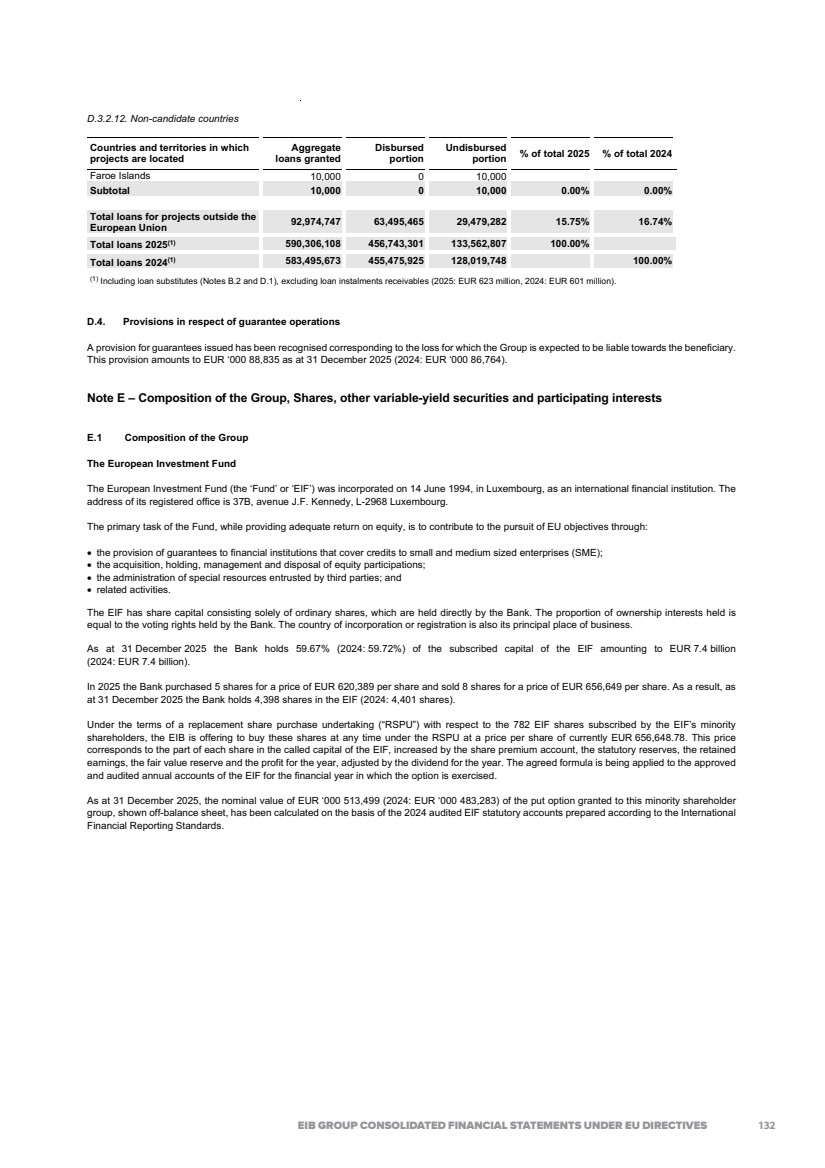
| 2025 FINANCIAL REPORT 26 E.2 Shares and other variable-yield securities and participating interests (EUR ‘000): Participating interests Shares and other variable-yield securities Private Equity and Venture Capital Operations(1) Private Equity and Venture Capital Operations(1) EBRD shares(2) Equity investments and Infrastructure funds(1) Other equity investments Other investments(3) Total(4) Cost: At 1 January 2025 573,941 7,453,553 278,520 4,112,310 626 960,141 12,805,150 Additions(5) 50,356 1,362,345 0 685,393 1,702 745,058 2,794,498 Reflows / Terminations(5) -40,464 -986,160 0 -513,111 -32 -25,989 -1,525,292 At 31 December 2025 583,833 7,829,738 278,520 4,284,592 2,296 1,679,210 14,074,356 Value adjustments: At 1 January 2025 -33,304 -472,464 0 -171,652 0 0 -644,116 Additions -8,248 -148,079 0 -103,890 -811 0 -252,780 Releases 582 68,499 0 42,327 0 0 110,826 At 31 December 2025 -40,970 -552,044 0 -233,215 -811 0 -786,070 Net book value: At 31 December 2025 542,863 7,277,694 278,520 4,051,377 1,485 1,679,210 13,288,286 At 31 December 2024 540,637 6,981,089 278,520 3,940,658 626 960,141 12,161,034 (1) The amounts signed but not yet disbursed disclosed off-balance sheet: In relation to “Shares and other variable-yield securities” and “Participating interests” are respectively: • for private equity and venture capital operations EUR ‘000 7,126,335 (2024: EUR ‘000 6,192,669); • for equity investments and infrastructure funds EUR ‘000 4,174,972 (2024: EUR ‘000 3,887,979); As at 31 December 2025, of the total private equity and venture capital operations 99% (2024: 99%) fall under category I and II, as defined in Note A.2.8. (2) The amount of EUR ‘000 278,520 (2024: EUR ‘000 278,520) corresponds to the capital paid in by the Bank as at 31 December 2025 with respect to its subscription of EUR ‘000 1,021,460 (2024: EUR ‘000 1,021,460) to the capital of the European Bank for Reconstruction and Development (‘EBRD’). (3) The amount of EUR ‘000 1,679,210 (2024: EUR ‘000 960,141) corresponds to the net paid in, in respect of private equity operations deployed by the EIF in the context of the InvestEU programme. These operations are fully guaranteed by the European Union represented by the European Commission. The Commission is exposed to the upside and downside arising from these equity operations whereas the Group ultimately retains only an interest component to cover its cost of funding. Therefore, from an economic and risk perspective, the Group, as beneficiary of the EU guarantee, is ultimately exposed to the credit risk of the European Commission and not the equity risk stemming from the underlying investments. The fair value of such operations, disregarding the Commission guarantee, amounts to EUR ‘000 1,797,011 (2024: EUR ‘000 944,460). The amounts signed but not yet disbursed disclosed off-balance sheet in relation to “Other investments” amounts to EUR’000 2,700,559 (2024: EUR’000 2,314,416). (4) The total amount includes only “Shares and other variable-yield securities.” (5) The “Additions” and “Reflows/Terminations” amounts include foreign exchange movements. As at 31 December 2025, the Group holds 3.04% of the subscribed capital of the EBRD (2024: 3.30%). Based on the audited 2024 EBRD financial statements prepared in accordance with International Financial Reporting Standards, the share of underlying net equity of the Bank in EBRD amounts to EUR 770 million. In EUR million % held Total own funds Total net result Total assets EBRD (31.12.2024)* 3.30 25,316 1,744 86,467 * The data are based on the most recent audited financial statements of the EBRD. 133 |
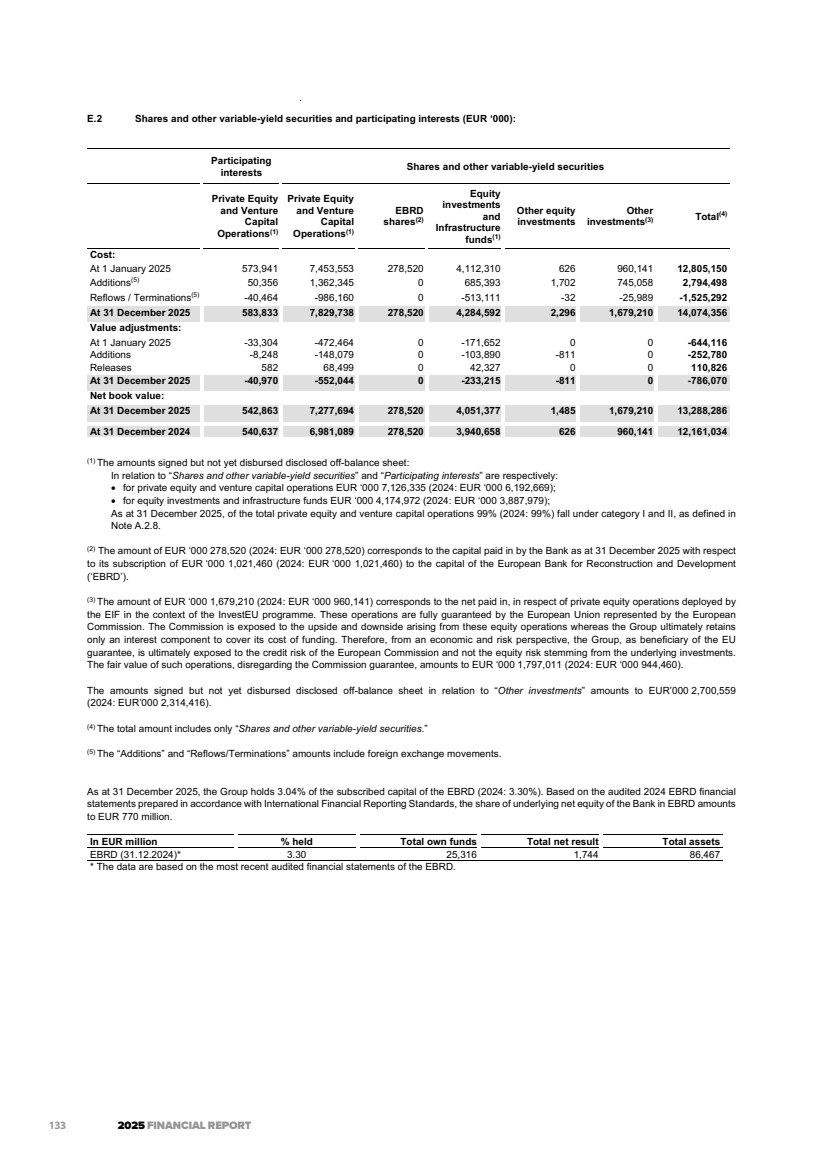
| EIB GROUP CONSOLIDATED FINANCIAL STATEMENTS UNDER EU DIRECTIVES 1 Note F – Intangible and tangible assets (in EUR ‘000) Land Luxembourg buildings Furniture and equipment Total tangible assets Total intangible assets Cost: At 1 January 2025 20,145 527,201 91,160 638,506 180,460 Additions 0 116,343 24,989 141,332 90,629 Disposals 0 0 -29,880 -29,880 -37,588 At 31 December 2025 20,145 643,544 86,269 749,958 233,501 Accumulated depreciation/amortisation: At 1 January 2025 0 -243,470 -45,192 -288,662 -49,809 Depreciation/amortisation 0 -8,376 -25,423 -33,799 -64,364 Disposals 0 0 29,783 29,783 36,729 At 31 December 2025 0 -251,846 -40,832 -292,678 -77,444 Carrying amount: At 31 December 2025 20,145 391,698 45,437 457,280 156,057 At 31 December 2024 20,145 283,731 45,968 349,844 130,651 The Luxembourg buildings category includes costs relating to the construction of a new building for an amount of EUR ’000 287,099 (2024: EUR ’000 184,312), which is expected to be completed in 2027. The ongoing internally generated projects captured under intangible assets amount to EUR ‘000 77,169 at the end of 2025 (2024: EUR ‘000 66,688). Note G – Other assets and Other liabilities (in EUR ‘000) Other assets 31.12.2025 31.12.2024 Guarantee call receivable 162,049 95,472 Accounts receivable and sundry debtors 106,372 121,257 InvestEU receivable 102,849 84,310 Fair value of derivatives 26,479 41,496 Advances on salaries and allowances 3,569 2,860 EGF management fee receivable 2,874 5,311 Other 2,222 2,553 Total 406,414 353,259 Other liabilities 31.12.2025 31.12.2024 Capital repayable to the UK(*) 1,695,904 1,995,904 Optional Supplementary Provident Scheme (Note L) 1,115,052 1,004,392 First Loss Piece Contribution(**) 544,095 416,248 Accounts payable and sundry creditors 172,546 155,837 Personnel costs payable 126,412 104,129 Capital increase payable to the EBRD(***) 96,816 121,020 Transitory account on loans 85,098 180,258 Payable amounts under mandates 31,329 58,213 Fair value of derivatives 21,193 36,178 InvestEU payable 23,227 6,185 Payable on HIPC initiative (****) 13,596 13,596 Western Balkans infrastructure fund 97 97 Other 82,465 167,469 Total 4,007,830 4,259,526 (*) In accordance with the Article 150(4) of the Agreement on the withdrawal of the United Kingdom of Great Britain and Northern Ireland from the European Union and the European Atomic Energy Community, and as amended by COUNCIL DECISION (EU) 2020/769 of 10 June 2020, the EIB will repay to the UK EUR 3.5 billion of paid-in capital in twelve annual instalments starting with 15 October 2020 (the first eleven instalments will be EUR 300,000,000 each and the final one will be EUR 195,903,950). The instalments due up to and including 15 October 2025 were settled in full. (**) Contribution related to First loss piece ('FLP'). FLP is a form of portfolio-based collateral under which all the losses incurred on a portfolio of exposures are absorbed by the FLP, until it has been fully exhausted. Only after that point the more senior tranches can incur some losses too. (***) In September 2024 the Bank subscribed to 12,102 additional paid-in shares in the capital of the EBRD, with a nominal value of EUR ‘000 10 each and a total value of EUR ’000 121,020, payable in five equal annual instalments starting on 30 April 2025 (Note E.1). Four payments are still outstanding as of the year end. (****) Heavily Indebted Poor Countries (‘HIPC’) initiative. 134 |
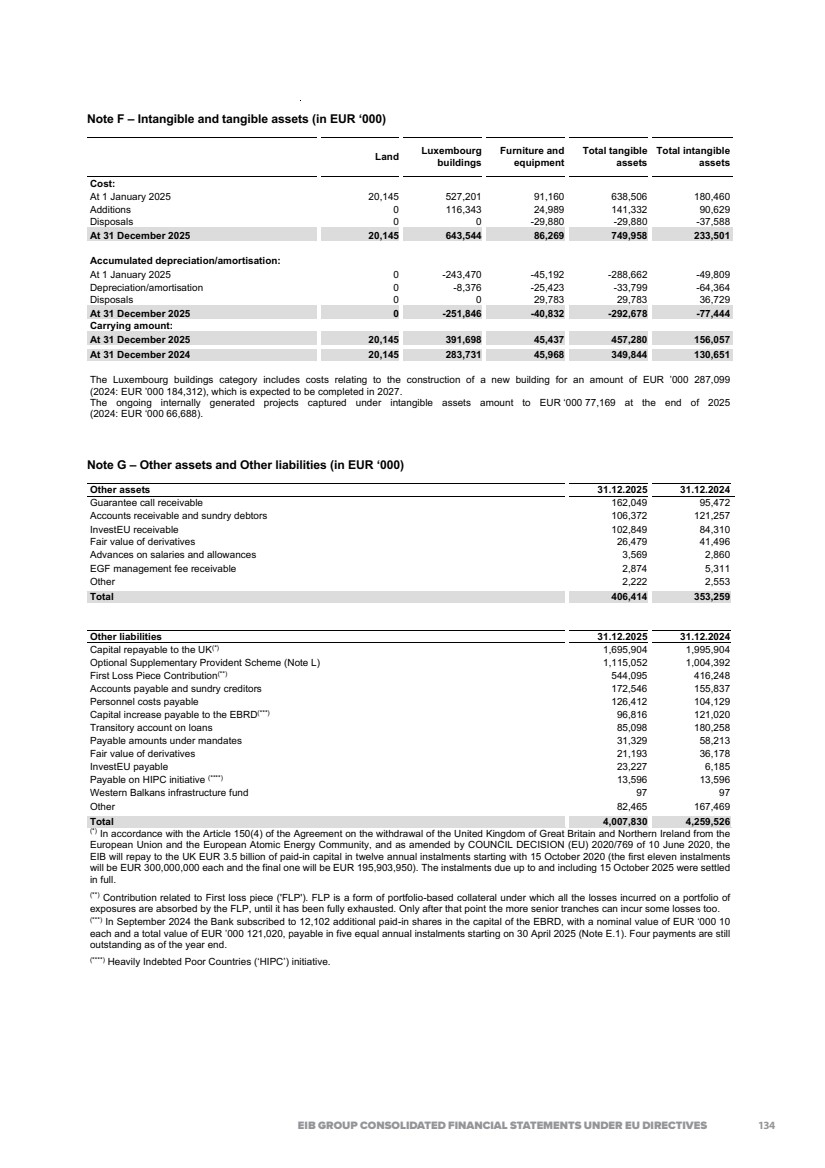
| 2025 FINANCIAL REPORT 28 Note H – Subscribed capital, Group own funds and appropriation of prior year’s profit (in EUR ‘000) H.1. Consolidated own funds and appropriation of prior year’s profit Statement of movements in consolidated own funds 2025 2024 Share capital: - Subscribed capital(2) 248,795,607 248,795,607 - Uncalled capital(2) -226,604,892 -226,604,892 - Called capital 22,190,715 22,190,715 Reserves and profit for the year: Reserve fund: - Balance at beginning of the year 24,879,561 24,879,561 - Balance at end of the year 24,879,561 24,879,561 Additional reserves: - Balance at beginning of the year 19,478,165 18,973,074 - Appropriation of prior year's profit(1) (3) 1,482,197 538,054 - Changes in ownership interests (4) -14,198 -32,963 - Balance at end of the year 20,946,164 19,478,165 Special activities reserve: - Balance at beginning of the year 12,665,555 11,194,601 - Appropriation of prior year's profit(1) 1,349,600 1,470,954 - Balance at end of the year 14,015,155 12,665,555 General loan reserve: - Balance at beginning of the year 2,281,423 1,883,372 - Appropriation of prior year's profit(1) 213,954 398,051 - Balance at end of the year 2,495,377 2,281,423 Profit for the financial year attributable to equity holders of the Bank 2,880,389 3,045,751 Total consolidated own funds attributable to equity holders of the Bank 87,407,361 84,541,170 Equity attributable to minority interest 2025 2024 - Balance at 1 January 1,703,976 1,612,467 - Movement on reserves 1,708 2,726 - Dividend paid to minority interest -10,596 -9,247 - Appropriation of the result of the financial year 106,536 98,030 Total equity attributable to minority interest at 31 December 1,801,624 1,703,976 (1) On 25 April 2025, the Board of Governors decided to appropriate the profit of the Bank for the year ended 31 December 2024, which amounted to EUR ‘000 2,891,475 to the additional reserves, the special activities reserve and the general loan reserve. The fact that amounts are being released from/added to the general loan reserve or the special activities reserve is the consequence of the evolution of the risks of the underlying operations. (2) Please refer to Note H.2. (3) The difference between the statutory profit of the Bank and the consolidated profit of the Group amounting to EUR ‘000 154,276 was allocated to the “Reserves – b) additional reserves”. (4) This balance is related to consolidation of EIF and subscriptions of EIF shares. H.2. Subscribed capital and reserves, called but not paid (in EUR ‘000) Following the Asymmetrical Capital Increase on 1 March 2020 of the Member States Poland and Romania, the contributions to the subscribed capital called and to the reserves stood at EUR 5,386,000,000 and EUR 125,452,381, respectively. The total amount to be paid by the Member States was equally spread over ten semi-annual instalments due on 31 December 2020, 30 June 2021, 31 December 2021, 30 June 2022, 31 December 2022, 30 June 2023, 31 December 2023, 30 June 2024, 31 December 2024 and 30 June 2025. All instalments were settled in full, therefore the amount in the balance sheet under the caption “Subscribed capital and reserves, called but not paid” for the year ended 31 December 2025 is nil. 31.12.2025 31.12.2024 Subscribed capital called but not paid (Poland and Romania) 0 49,157 Reserves called but not paid (Poland and Romania) 0 110,691 Total 0 159,848 135 |
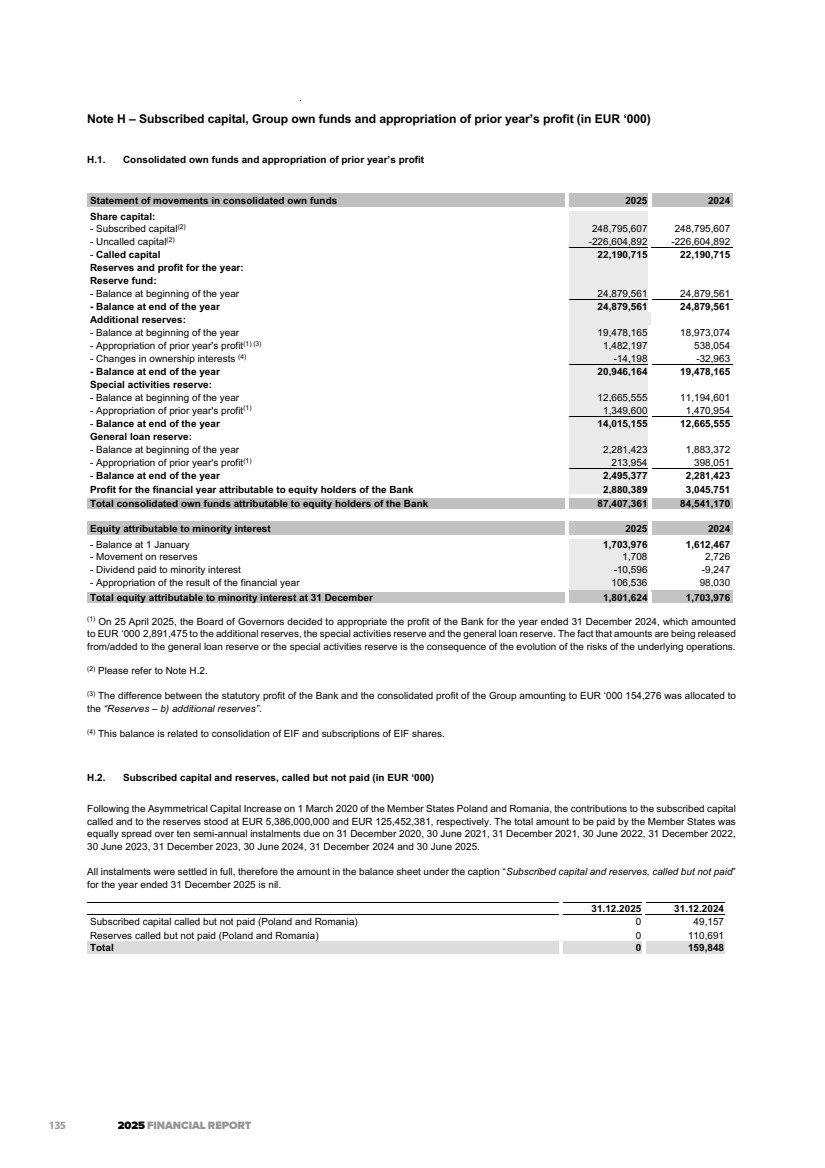
| EIB GROUP CONSOLIDATED FINANCIAL STATEMENTS UNDER EU DIRECTIVES 29 Note I – Prepayments and accrued income and Accruals and deferred income (in EUR ‘000) Prepayments and accrued income: 31.12.2025 31.12.2024 Interest and commission receivable 8,609,301 8,274,499 Impact from foreign exchange changes on currency swap contracts 2,514,956 8,850,447 Deferred borrowings and swaps charges 1,081,034 1,152,364 Mandates' commission receivable 303,760 274,486 Redemption premiums on swaps receivable(*) 0 7,173 Other 1,048 1,071 Total 12,510,099 18,560,040 Accruals and deferred income: 31.12.2025 31.12.2024 Interest and commission payable 9,468,077 9,152,874 Impact from foreign exchange changes on currency swap contracts 6,311,616 5,353,772 Deferred borrowings and swaps proceeds 745,852 936,733 Deferred management fees 401,901 323,946 Deferred income on loans and guarantees 386,008 341,950 Redemption premiums on swaps payable(*) 362,646 360,802 Interest subsidies received in advance 280,558 218,771 Other 930 181 Total 17,957,588 16,689,029 (*) Redemption premiums on swaps receivable and payable represent end payments of the underlying swap agreements for those agreements which include such features. Note J – Amounts owed to credit institutions and customers (in EUR ‘000) J.1. Amounts owed to credit institutions 31.12.2025 31.12.2024 Repayable on demand 446,323 750,387 - Overnight deposits 446,323 750,387 With agreed maturity or periods of notice 984,159 107,186 - Repos with credit institutions 984,159 107,186 Total 1,430,482 857,573 J.2. Amounts owed to customers 31.12.2025 31.12.2024 Repayable on demand 4,171,810 3,090,263 - European Union and Member States' accounts: - For Special Section operations and related unsettled amounts 136,055 246,637 - Deposit accounts 4,035,755 2,843,626 With agreed maturity or periods of notice 13,146 120,487 - Short-term deposits 13,146 120,487 Total 4,184,956 3,210,750 136 |
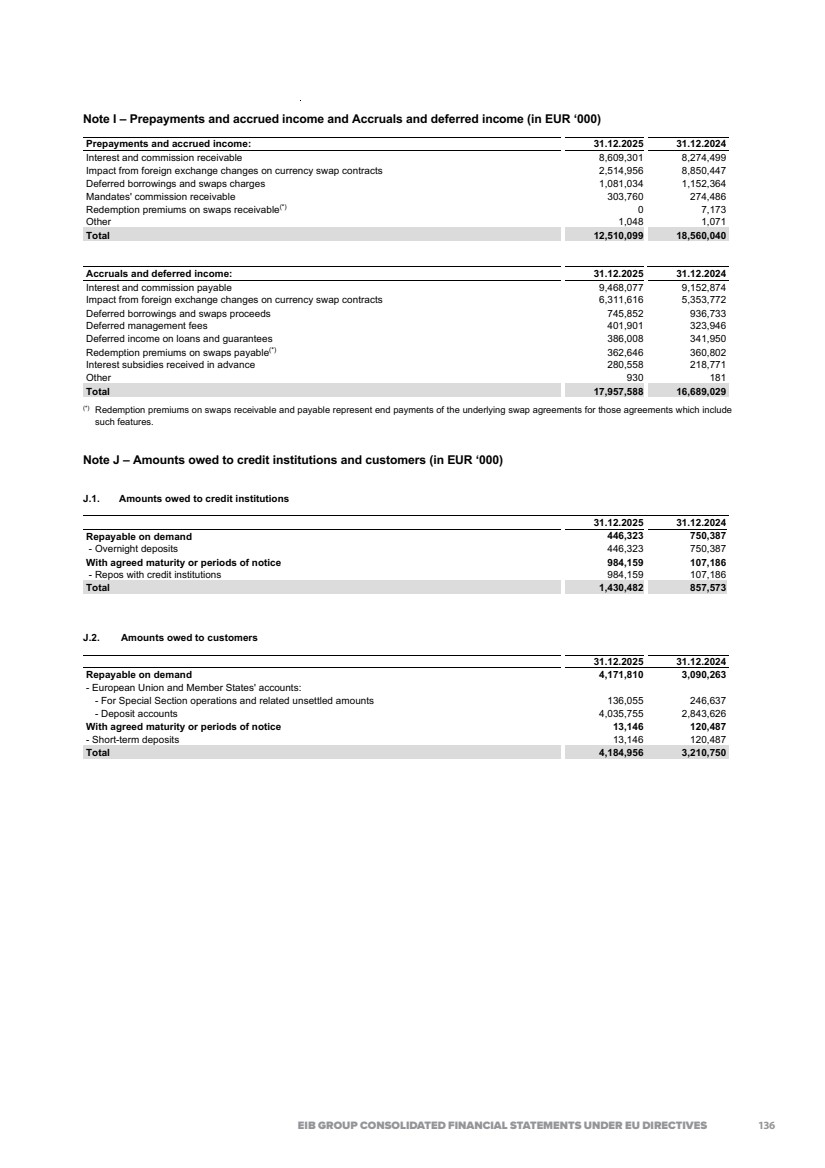
| 2025 FINANCIAL REPORT 30 Note K – Debts evidenced by certificates (in EUR ‘000) In its financing activity, one of the Group’s objectives is to align its funding strategy with the funds required for the loans granted, notably in terms of currencies. The caption “Debts evidenced by certificates” includes “Debt securities in issue” (securities offered to the general investing public) and “Others” (private placements). The table below discloses the details of debts outstanding as at 31 December 2025 and 31 December 2024 per currency, together with the average rates and due dates (earliest/latest). Currency Carrying amount as at 31.12.2025 Average rate 2025(*) Due dates Carrying amount as at 31.12.2024 Average rate 2024(*) EUR 258,847,100 1.72 2026/2061 253,981,303 1.68 USD 107,372,339 3.41 2026/2058 115,087,825 3.03 GBP 30,910,367 3.85 2026/2054 37,075,272 3.79 PLN 9,254,916 3.34 2026/2043 9,254,971 3.63 AUD 8,372,690 3.18 2026/2040 8,670,109 3.00 SEK 4,064,594 2.21 2026/2040 4,667,510 1.98 CHF 2,550,676 2.01 2026/2037 3,039,264 2.06 NOK 2,338,934 3.52 2027/2037 2,051,717 3.32 CAD 1,985,150 2.91 2028/2045 3,298,087 2.43 ZAR 1,860,182 7.72 2026/2035 1,848,151 7.80 JPY 913,651 2.26 2026/2053 1,036,349 2.24 INR 731,085 6.88 2029/2035 179,910 7.15 DKK 645,899 0.13 2026/2031 700,495 0.53 MXN 487,736 6.86 2027/2033 686,762 7.14 NZD 355,741 3.27 2027/2028 391,215 3.27 BRL 305,843 11.38 2027/2035 54,472 9.25 CNY 291,751 2.65 2026/2026 412,749 2.77 CZK 202,281 3.83 2026/2034 202,690 3.95 HKD 97,306 3.35 2027/2030 85,517 2.47 EGP 35,858 15.75 2026/2027 37,958 15.75 GEL 26,072 8.03 2028/2028 0 0 RUB 20,317 4.25 2026/2026 16,554 4.25 RON 20,209 2.23 2026/2026 20,706 2.23 TRY 11,830 10.65 2026/2027 15,636 10.67 HUF 0 0 N/A 36,465 11.50 Total 431,702,527 442,851,687 (*) Weighted average interest rates as at the balance sheet date. The principal and interest of certain structured borrowings are index linked to stock exchange indexes (historical value: EUR 500 million in 2025; EUR 500 million in 2024). All such borrowings are fully hedged through structured swap operations. The table below provides the movements in 2025 and 2024 for debts evidenced by certificates: (In EUR million) 2025 2024 Balance as at 1 January 442,852 434,819 Issuances during the year 113,139 106,721 Contractual redemptions -107,310 -106,275 Early redemptions and buy-backs -119 -214 Exchange adjustments -16,859 7,801 Balance as at 31 December 431,703 442,852 137 |
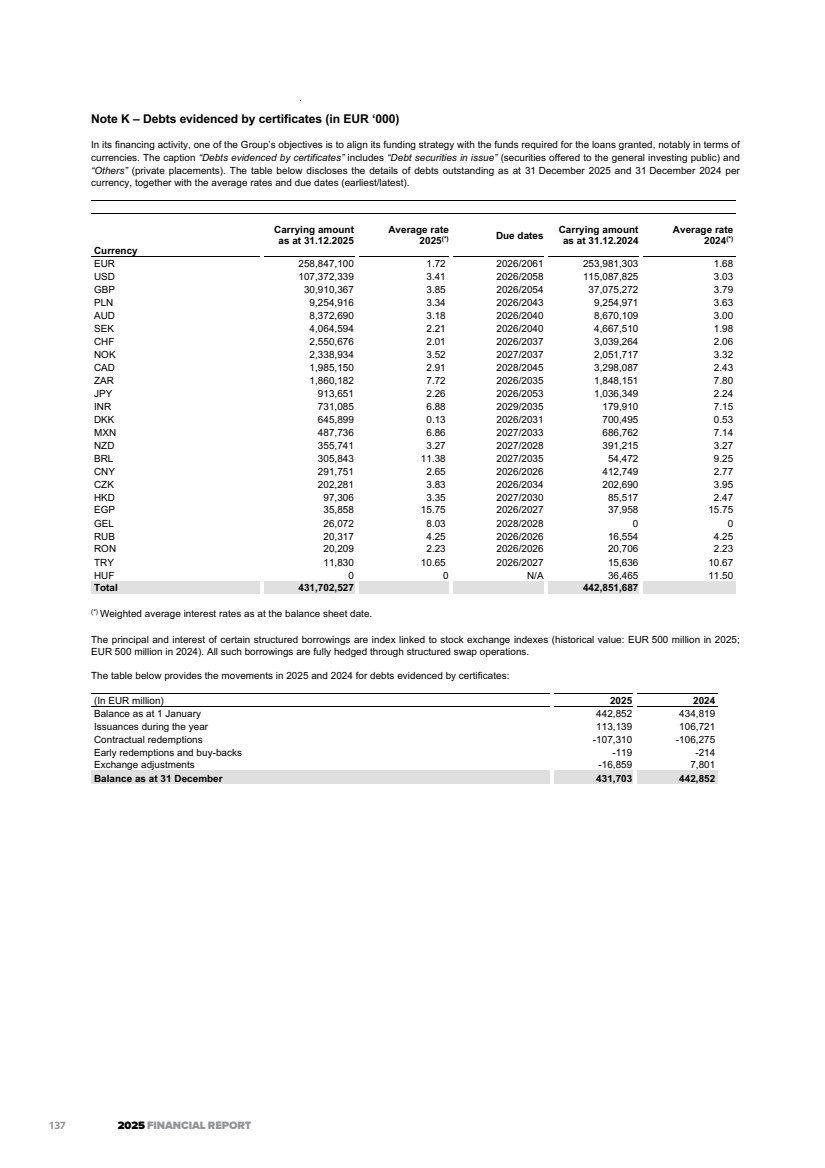
| EIB GROUP CONSOLIDATED FINANCIAL STATEMENTS UNDER EU DIRECTIVES 31 Note L – Provisions – pension plans and health insurance scheme (in EUR ’000) The Group’s main pension scheme is a defined benefit pension scheme funded by contributions from staff and from the Group that covers all employees. All contributions from the Group and its staff are invested in the assets of the Group. The pension plans and health insurance scheme provisions are as follows (in EUR ‘000): 2025 2024 Staff pension plan: Provision as at 1 January 4,789,314 4,458,598 Payments made during the year -121,049 -97,410 Recognition of actuarial losses 0 68,575 Annual contributions and interest 395,391 359,551 Subtotal staff pension plan 5,063,656 4,789,314 Management Committee pension plan: Management Committee pension plan 50,435 48,355 Recognition of actuarial losses 937 1,283 Annual contributions 2,000 2,082 Subtotal Management Committee pension plan 53,372 51,720 Health insurance scheme: Provision as at 1 January 668,192 623,557 Payments made during the year -43,209 -41,434 Recognition of actuarial losses 49,134 23,897 Annual contributions and interest 66,495 62,172 Subtotal health insurance scheme 740,612 668,192 Total provisions as at 31 December 5,857,640 5,509,226 The above figures do not include the liability towards members of staff in respect of the Optional Supplementary Provident Scheme (a defined contribution pension scheme). The corresponding amount of EUR 1,115 million (2024: EUR 1,004 million) is classified under “Other liabilities” (Note G). Details of the principal assumptions used in the estimate of the defined benefit obligation are detailed below. The provision in respect of future retirement and health insurance benefits was valued as at 31 December 2025 by an independent actuary using the projected unit credit method based on membership data as at 30 September 2025 (adjusted to 31 December 2025 by estimating service accruals in the remaining 3 months of 2025) and cash flows to 31 December 2025. The actuarial valuation was updated as at 31 December 2025, using the prevailing market rates of 31 December 2025 and the following assumptions (for the staff pension and medical plans): • a discount rate of 4.37% (2024: 3.75%) for determining the actuarial present value of benefits accrued in the pension and health insurance scheme, corresponding to 19.88-year duration (2024: 20.54-year duration); • the Group expects the remuneration of post-employment reserves to be set at a rate of 1.5% (2024: 1.5%) on top of the discount rate of 4.37%; • progressive retirement assumed between the age of 55 and 65 and depending on NRA (normal age of retirement) (2024: same assumption); • a combined average impact of the increase in the cost of living and career progression of 3.3% (2024: 3.3%); • expected annual resignation rates ranging from 27% to 1% (2024: from 27% to 1%), decreasing with age; • a rate of adjustment of pensions of 2.3% per annum (2024: 2.3%); • use of the ICSLT longevity table 2023 projected to 2025 (2024: ICSLT longevity table 2023 projected to 2024); • a medical cost inflation rate of 4.3% per annum (2024: 4.3%). The provisions for these schemes are adjusted when needed according to the actuarial valuation, as per the tables above. The actuarial valuation of the pension plans and the healthcare scheme as at 31 December 2025 revealed an unrecognised loss of EUR ‘000 933,443 (2024: EUR ‘000 1,320,684) of which EUR ‘000 298,903 (2024: EUR ‘000 656,286) was reported in excess of the 10% corridor. As there was no deficit in excess of the 10% corridor between the staff pension plan and actuarial valuation, no recognition of actuarial losses was recorded for the staff pension plan in 2025. The total amortisation recorded in the consolidated profit and loss account for 2025 amounted to EUR ‘000 50,071 (2024: EUR ‘000 93,755). 138 |
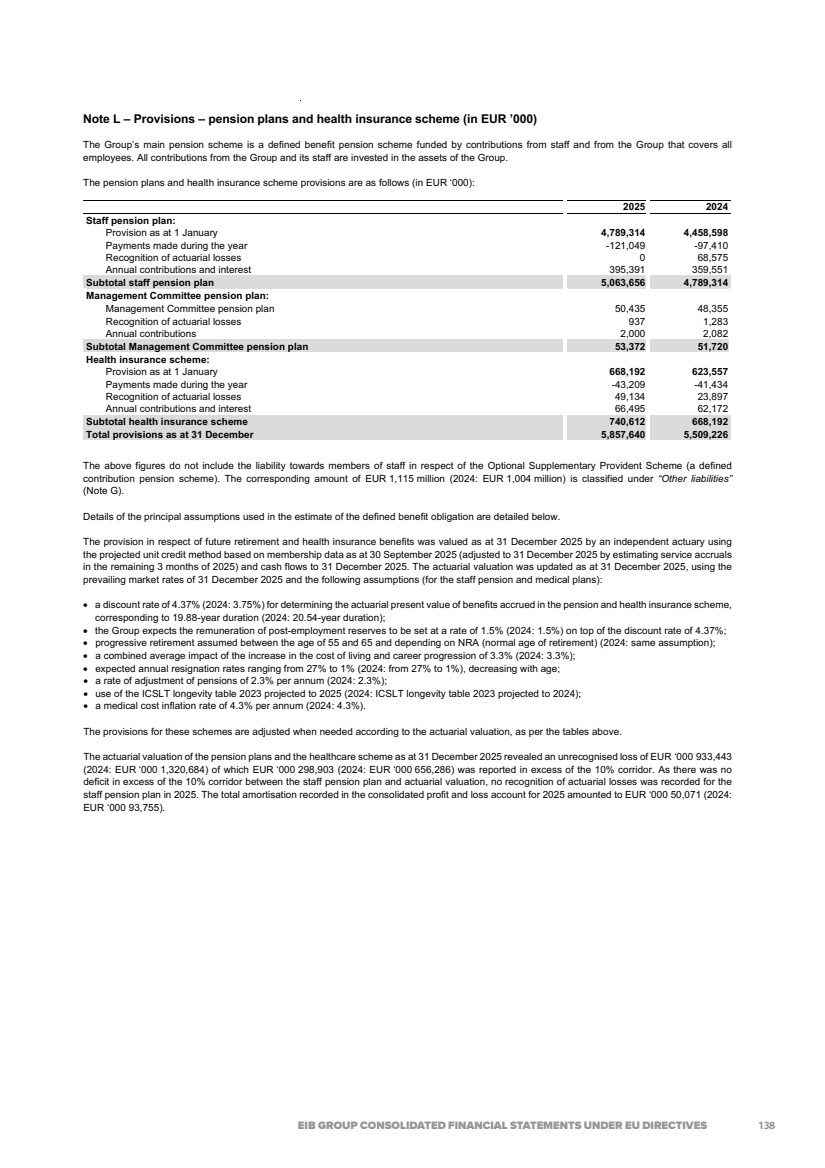
| 2025 FINANCIAL REPORT 32 Note M – Profit for the financial year The appropriation of the balance of the statutory profit and loss account for the year ended 31 December 2025, amounting to EUR ‘000 2,725,405 will be submitted to the Board of Governors for approval by 24 April 2026. Please refer to the Overview to the Bank’s Financial Statements for further details on the proposed Bank surplus for the financial year appropriation. Note N – Interest receivable and similar income and Interest payable and similar charges N.1. Net interest income (in EUR ‘000) 2025 2024 Interest receivable and similar income: Treasury bills and other bills eligible for refinancing with central banks and debt securities including fixed-income securities 1,690,265 1,706,471 Loans and advances to credit institutions and customers 13,433,344 15,599,715 Derivatives 9,113,867 10,122,640 Other 18,684 18,344 Total 24,256,160 27,447,170 Interest payable and similar charges: Amounts owed to credit institutions and customers -67,572 -92,852 Debts evidenced by certificates -11,176,052 -10,242,302 Derivatives -9,034,819 -13,149,955 Other -405,284 -389,467 Total -20,683,727 -23,874,576 Net interest income 3,572,433 3,572,594 139 |
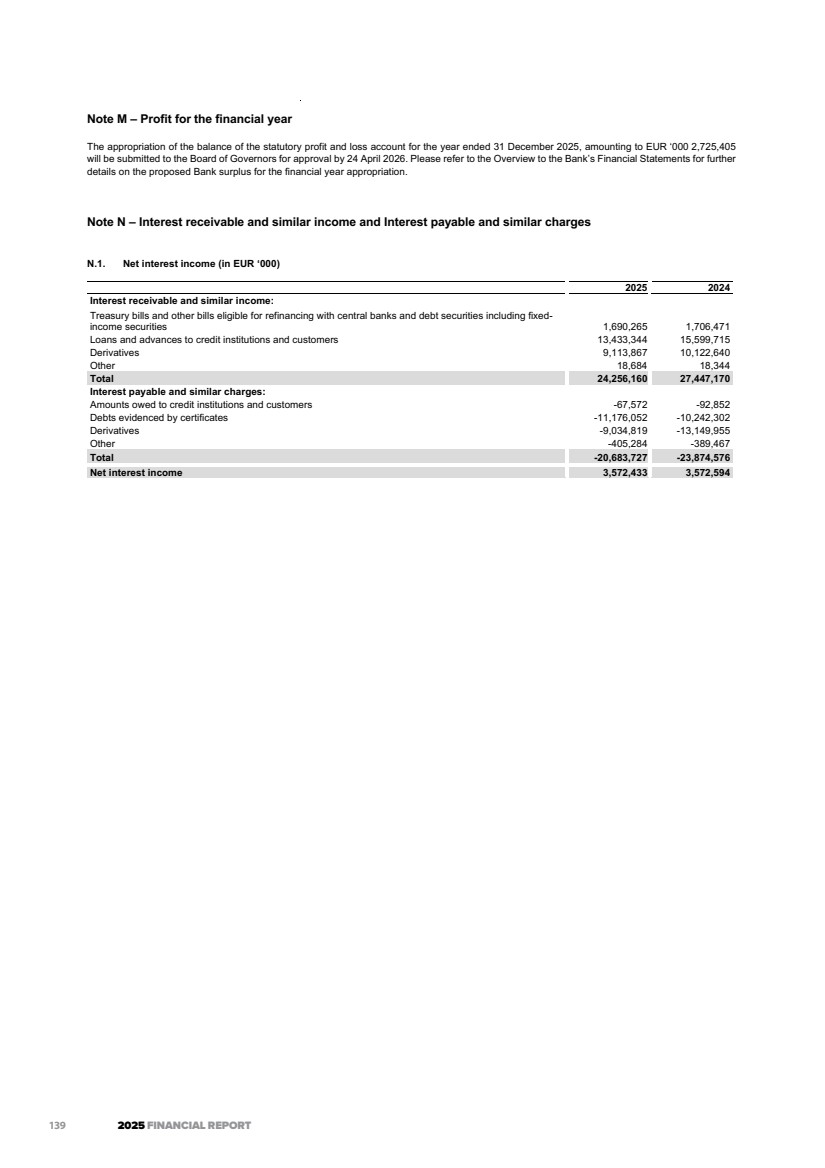
| EIB GROUP CONSOLIDATED FINANCIAL STATEMENTS UNDER EU DIRECTIVES 33 N.2. Geographical analysis of Interest receivable and similar income (in EUR ‘000) 2025 2024 EU countries Spain 1,464,126 1,660,027 Poland 1,428,799 1,329,109 Italy 1,283,240 1,481,375 France 1,281,940 1,387,367 Germany 847,973 746,911 Belgium 479,804 397,245 Greece 415,127 445,841 Austria 342,168 355,815 Hungary 307,321 338,586 Netherlands 298,369 492,743 Sweden 297,395 431,836 Czech Republic 256,421 201,937 Finland 221,241 287,455 Romania 192,139 148,750 Portugal 191,948 254,937 Ireland 127,642 157,342 Slovakia 93,164 80,893 Denmark 83,700 90,320 Croatia 61,894 56,242 Bulgaria 61,360 41,257 Cyprus 48,777 62,895 Estonia 45,893 58,887 Slovenia 45,180 53,347 Lithuania 32,845 33,906 Latvia 18,801 30,336 Malta 11,352 9,948 Luxembourg 9,288 286,402 Total EU countries 9,947,907 10,921,709 Outside the European Union 2,422,435 2,944,172 Total income analysed per country 12,370,342 13,865,881 Income not analysed per country(1) 11,885,818 13,581,289 Total interest receivable and similar income 24,256,160 27,447,170 (1) Income not analysed per country: · Income from LTHP, loan substitutes and EIF ABS portfolio 867,094 914,847 · Income from SLP 225,402 165,984 · Income from money-market securities 566,057 595,788 · Income from EIF Operational portfolio and other securities 31,712 29,852 · Income from short-term investments and other operations 1,064,203 1,733,969 · Income from derivatives 9,113,867 10,122,640 · Other 17,483 18,209 11,885,818 13,581,289 140 |
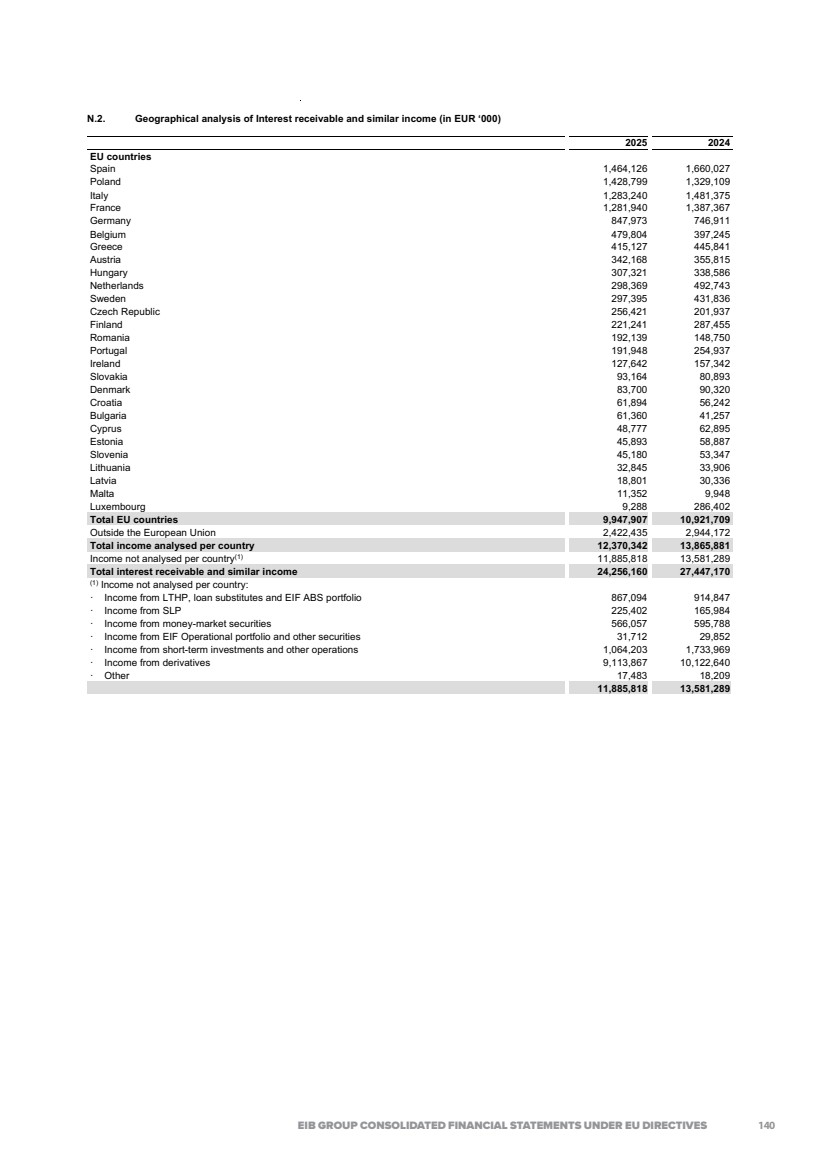
| 2025 FINANCIAL REPORT 34 Note O – Commissions receivable and Commissions payable (in EUR ‘000) 2025 2024 Commissions receivable: Commissions on guarantees 232,506 256,819 Commissions on InvestEU(**) 107,757 89,805 Commissions on EGF 43,554 49,533 Commission income on loans 36,851 37,403 Commissions on RRF 26,631 6,884 Commissions on EFSI 22,256 24,331 Commissions on Investment Facility - Cotonou 20,099 25,331 Commissions on Jeremie/ESIF 16,667 16,197 Commissions on DFIs (2014-20, 2021-27)(*) 15,256 19,657 Commissions on Modernisation Fund 12,675 13,495 Commissions on InnovFin 7,614 6,312 Commissions on NDICI EFSD+ ACP Trust Fund 6,433 1,857 Commissions on Trust Fund Management fees 6,316 3,909 Commissions on Innovation Fund(**) 2,853 2,331 Commissions on JESSICA Holding Funds 2,618 2,762 Commissions on Neighbourhood Investment Facility 2,588 5,142 Commissions on Yaoundé/Lomé Conventions 781 946 Commissions on EU for Ukraine Fund 706 5,155 Commissions on Connecting Europe Facility 462 470 Commissions on EIC Fund 407 2,500 Commissions on other mandates(**) (***) 114,826 99,651 Total commissions receivable 679,856 670,490 2025 2024 Commissions payable: Risk remuneration for guarantees received -272,224 -287,436 Other commissions payable -34,047 -28,072 Total commissions payable -306,271 -315,508 (*) For certain mandates, a deferred income mechanism is established by the Group, affecting revenue recognition of commission income by EUR '000 -4,594 (2024: EUR '000 -5,820). (**) A reclassification was made among the captions in order to improve the readability of the financial statements. See Note A.3. (***) This line includes the realised carried interest obtained by the EIF in its role as fund manager for certain mandates. For 2025 carried interest amounts to EUR '000 6,147 (2024: EUR '000 9,190). The cumulative unrealised carried interest for 2025 (which is an off-balance sheet item) amounts to EUR '000 102,177 (2024: EUR '000 90,479). Note P – Net result on financial operations (in EUR ‘000) 2025 2024 Net result on debt securities portfolios 53,159 67,314 Net result on repurchase of debts evidenced by certificates 0 -92 Net result on derivatives -6,425 15,418 Net result on translation of balance sheet positions -28,273 5,829 Net result on shares and other variable-yield securities -158,181 -101,467 Total net result on financial operations -139,720 -12,998 Note Q – Net other operating income and expense (in EUR ‘000) 2025 2024 Technical Assistance income (*) 102,330 83,192 Technical Assistance expense (*) -61,318 -33,734 Rental income 134 112 Other 8,962 58 Total net other operating income and expense 50,108 49,628 (*) A reclassification was made in order to improve the readability of the financial statements. See Note A.3. 141 |
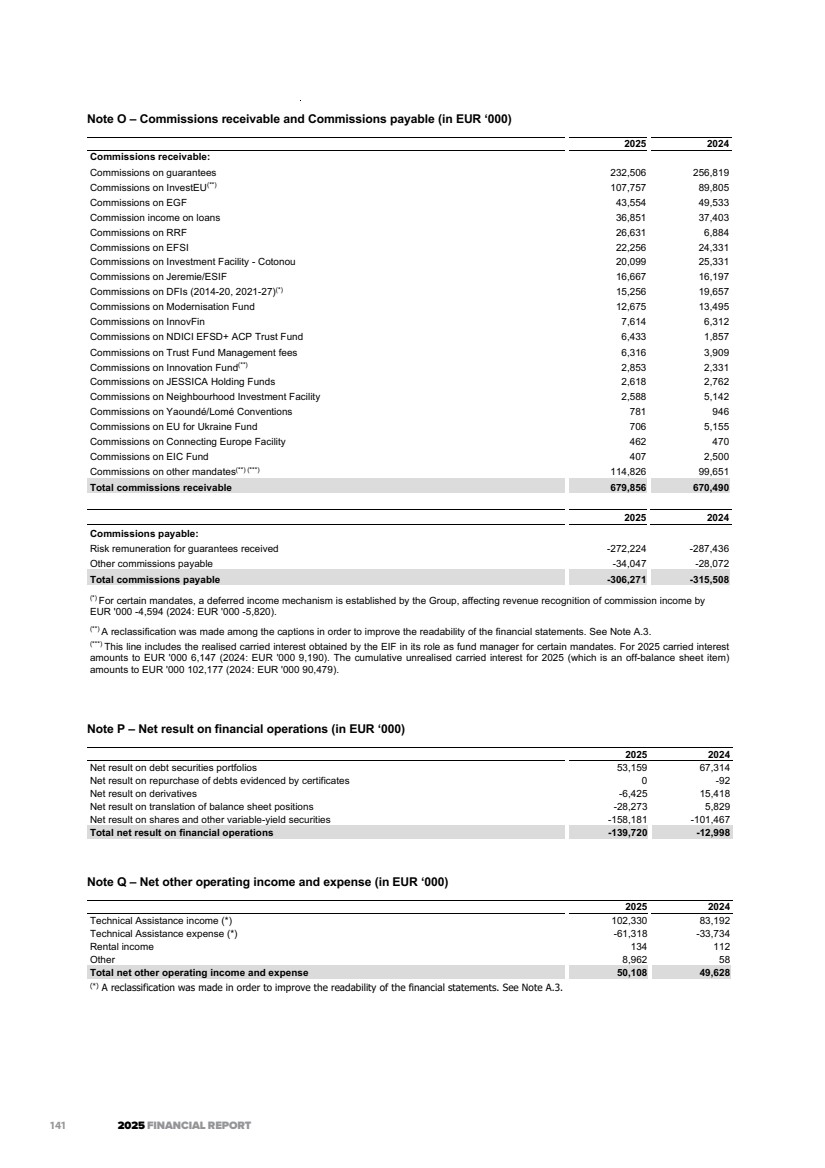
| EIB GROUP CONSOLIDATED FINANCIAL STATEMENTS UNDER EU DIRECTIVES 35 Note R – General administrative expenses (in EUR ‘000) 2025 2024 Salaries and allowances(*) -724,257 -694,917 Welfare contributions and other staff costs -424,666 -440,210 Staff costs -1,148,923 -1,135,127 Other administrative expenses(**) -394,531 -402,242 Total general administrative expenses -1,543,454 -1,537,369 (*) Of which the amount for the members of the Management Committee is EUR ‘000 4,417 in 2025 (2024: EUR ‘000 3,992). (**)A reclassification was made in order to improve the readability of the financial statements. See Note A.3. The number of persons employed by the Group was 5,110 as at 31 December 2025 (5,151 as at 31 December 2024). Note S – Off-balance sheet special deposits for servicing borrowings This item represents the amount of coupons and bonds due, paid by the Group to the paying agents, but not yet presented for payment by the holders of bonds issued by the Group. Note T – Fair value of financial instruments(*) At the balance sheet date, the Group records balance sheet financial instruments on the basis of their historical cost in foreign currency (apart from the securities liquidity portfolio) representing the amount received in the event of a liability or the amount paid to acquire an asset. The fair value of the financial instruments (mainly loans, treasury, securities and borrowings) entered under assets or liabilities compared with their carrying amount is shown in the table below: As at 31 December 2025 (in EUR million) Carrying amount Fair value(**) Financial assets: Cash in hand, balances with central banks and post office banks 258 258 Loans and advances to credit institutions and customers, excluding loan substitutes 473,442 505,366 Treasury bills and debt securities portfolios including loan substitutes 53,378 53,166 Shares, other variable yield securities and participating interests 13,831 22,609 Total financial assets 540,909 581,399 Financial liabilities: Amounts owed to credit institutions and customers 5,615 5,616 Debts evidenced by certificates 431,703 423,908 Total financial liabilities 437,318 429,524 (*) Derivatives are not included in the table. Please refer to Note V. (**) Fair value including accrued interest. As at 31 December 2024 (in EUR million) Carrying amount Fair value(**) Financial assets: Cash in hand, balances with central banks and post office banks 105 105 Loans and advances to credit institutions and customers, excluding loan substitutes 477,660 474,358 Treasury bills and debt securities portfolios including loan substitutes 49,690 49,548 Shares, other variable yield securities and participating interests 12,702 21,733 Total financial assets 540,157 545,744 Financial liabilities: Amounts owed to credit institutions and customers 4,069 4,069 Debts evidenced by certificates 442,852 431,345 Total financial liabilities 446,921 435,414 (*) Derivatives are not included in the table. Please refer to Note V. (**) Fair value including accrued interest. 142 |
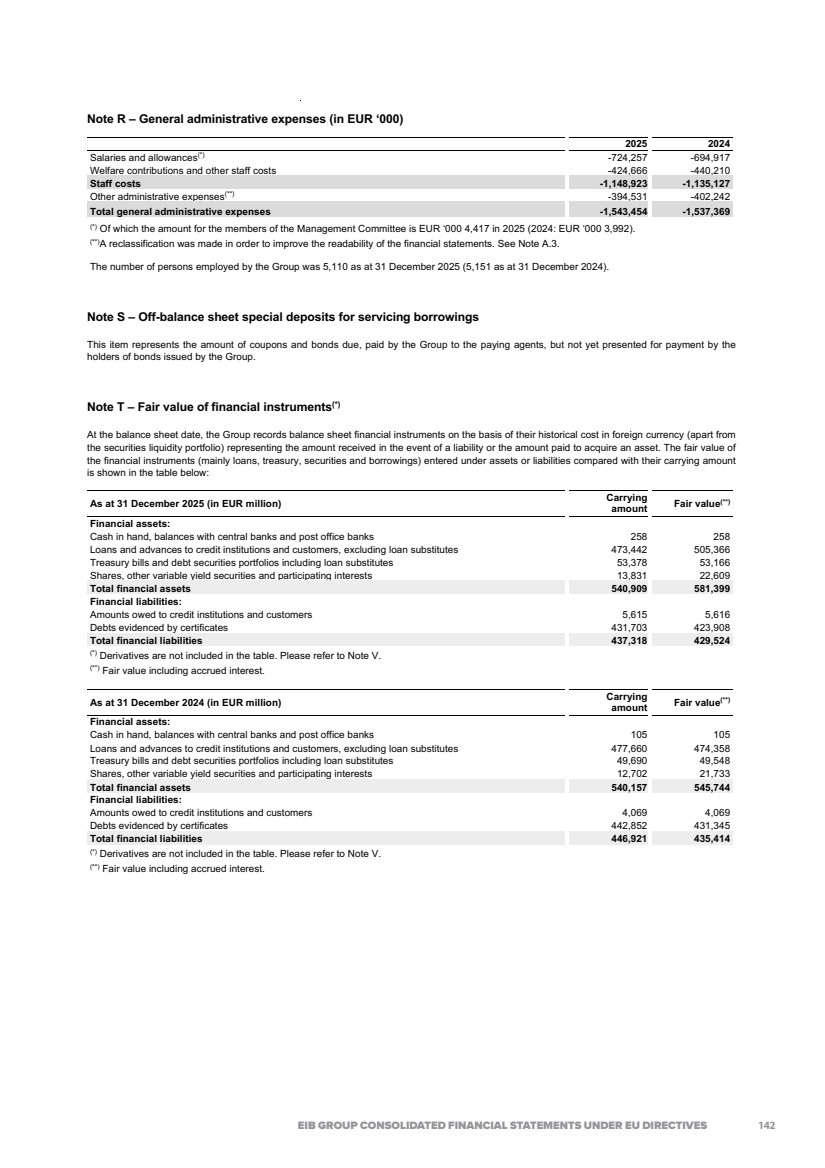
| 2025 FINANCIAL REPORT 36 Note U – Risk management This note presents information about the Group’s exposure to risks and their management and control, in particular the primary risks associated with its use of financial instruments. These are: • Credit risk - the risk of loss resulting from client or counterparty default and arising from credit exposure in all forms, including settlement risk2; • Market risk - the risk of losses on financial investments caused by adverse price movements. Examples of market risk are: changes in equity prices or commodity prices, interest rate moves or foreign exchange fluctuations; Ø Interest rate and credit spread risk in the banking book (IRRBB and CSRBB) - the risk to the economic value or to the net interest income arising from adverse movements in interest rates and in market credit spreads that affect interest rates and market credit spread sensitive instruments respectively. IRRBB includes gap risk, basis risk and option risk; Ø Foreign exchange risk - the risk to the economic value or to the income derived from the Group’s positions due to adverse movements in currency exchange rates; • Liquidity and funding risk - the risk that the Group is unable to fund assets or meet obligations at a reasonable price or, in extreme situations, at any price; • Operational risk - the risk of loss resulting from inadequate or failed internal processes, people and systems or from external events3 including, but not limited to, legal risk, model risk or information and communication technology (ICT) risk, but excluding strategic and reputational risk. U.1. Risk management organisation Each entity within the Group carries out its own management and control of risks. Risk management information presented in this note will distinguish between the Bank and the Fund. The high-level principles of the Group’s risk management are set out in the EIB Group Risk Management Charter, which provides a Group-wide view of the Group’s risks and an integrated approach to risk management. The Group has established a Group Risk Function under the responsibility of the Group Chief Risk Officer (‘GCRO’). Without prejudice to the statutory responsibilities of the President and the EIB Management Committee, respectively, the GCRO reports on Group Risks to the EIB Management Committee under the oversight of the MC member in charge of risk. The GCRO participates in all meetings of the EIB Management Committee within their terms of reference and relevant meetings of the other EIB governing bodies, and is invited to relevant meetings of the EIF Board of Directors and to discussions with the EIF Management. The EIF reports on Group Risk matters to the EIB through the GCRO. Group risk appetite The risk appetite is the level of risk that the Group is willing and able to incur in pursuing its activities in the context of its public mission and objectives. Key to this is the Group’s capacity to provide attractive long-term financing to serve EU objectives across all EU Member States (and beyond in partner countries). A primary pillar of the Group’s business model is the Group’s high credit standing and its status as prime issuer in the capital markets underpinned by the long-term AAA issuer rating from the major credit rating agencies. The processes and activities performed by the Group to manage its risk appetite are formalised in the Group Risk Appetite Framework (‘RAF’) approved by the EIB BoD. The Group RAF covers the major financial risks including credit, liquidity and market risks, and non-financial risks including operational risks such as people, information security, financial crime, technology, fraud, compliance and model risks and other risks such as climate change and environmental and reputational risks. It helps to embed a healthy organisational risk culture within the Group through the implementation and monitoring of measurable risk appetite metrics, which are subject to limits and (where applicable) are cascaded further down within the organisation. As a public financial institution, the Group does not focus on making profits from speculative exposures to risks. As a consequence, the Group does not consider its activities as profit maximising centres and does not engage in speculative operations. Investment activities are conducted within the primary objective of protection of the capital invested. U.1.1. Risk management organisation of the Bank Extending from the principles set out in the Group Risk Appetite Framework, the Bank’s objective is also to analyse and manage risks so as to obtain the strongest possible protection for its assets, its financial result, and consequently its capital. While the Bank is generally not subject to the legislative acts and guidelines applicable to commercial banks issued or adopted by the EU institutions, bodies and agencies (“EU Legislative Acts and Guidelines”), it has voluntarily decided to comply with these EU Legislative Acts and Guidelines to the extent determined by its Best Banking Practice framework including the Best Banking Practice Guiding Principles published by the Bank. Within the Bank, the Group Risk and Compliance Directorate (‘GR&C’) independently identifies, assesses, monitors and reports credit, market, liquidity and funding and operational risks to which the Bank is exposed. To preserve the segregation of duties and in accordance with the three lines of defence principle, GR&C is independent and provides second opinions on all proposals made having risk implications. U.1.1.1. Risk measurement and reporting system The Bank continuously adapts its risk management systems to changing economic conditions and evolving regulatory standards as market practice develops. Systems are in place to control and report on the main risks inherent in the Bank’s operations, i.e. credit, interest rate, liquidity and funding, foreign exchange and operational risks. 2 Settlement risk is defined as the risk of potential losses due to transactions which remain unsettled after their due delivery date and/or due to transactions that are settled later than the applicable market standard. Due to the nature of the Group’s operations, the most relevant instruments affected by settlement risk are those derivatives entered into by the Bank which imply an exchange of foreign currencies. Settlement risk management is covered in the Financial Risk Guidelines. 3 The definition of external events excludes cases of client bankruptcy or unfavourable market movements or similar events, which represent triggers for credit and market risk, respectively. 143 |
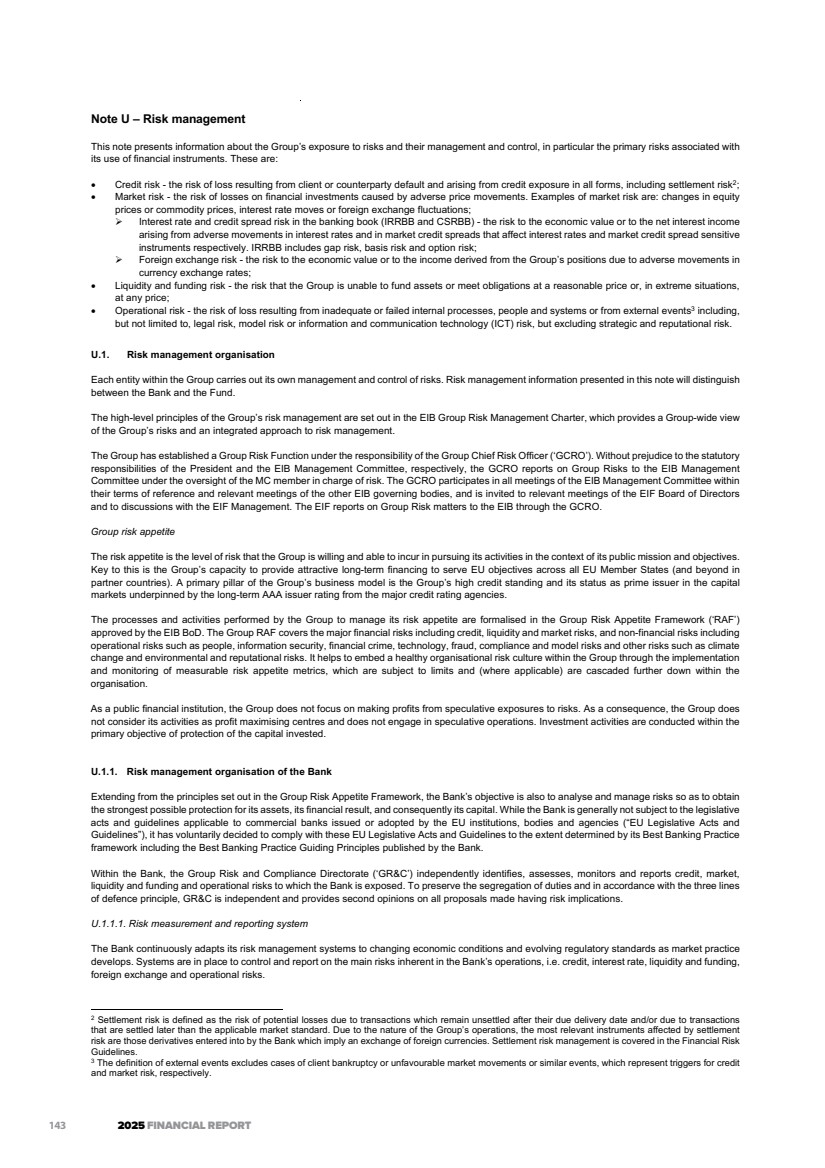
| EIB GROUP CONSOLIDATED FINANCIAL STATEMENTS UNDER EU DIRECTIVES 37 To quantify their impact on the Bank’s solvency, liquidity, earnings and operations, risks are assessed and measured both under normal circumstances and under possible stressed conditions. Risk measurements consider the relevant metrics related to capitalisation, earnings, liquidity, and exposure to market and non-financial risks. Information on credit, market, liquidity, financial and operational risks is reported to the Management Committee and to the Board of Directors on a monthly basis. Such information is presented and explained to the Management Committee and to the Board of Directors’ Risk Policy Committee on a regular basis. The Bank has a framework in place for managing interest rate (‘IR’) risk, as well as foreign exchange (‘FX’) risk. It monitors and manages on a daily basis its IR (gap and basis) & FX positions within the pre-approved limits. All new types of transactions introducing operational or financial risks must be authorised by the Management Committee(‘MC’), after their approval by the New Products Committee (‘NPC’). U.1.1.2. Sustainability of revenue and self-financing capacity The Bank’s interest rate risk strategy forms an integral part of its overall financial risk management. It reflects the expectations of the main stakeholders of the Bank in terms of stability of earnings, preservation of the economic value of own funds, and the self-financing of the Bank’s growth in the long-term. To achieve these aims, the interest rate risk strategy considers a medium-to-long term horizon for the investment of the Bank’s own funds, in order to promote stability of revenues and to enhance overall returns. In practice, this is achieved by defining an investment profile producing a target duration for the Bank’s own funds between 4.5 and 5.5 years. In that context, the Asset & Liability Committee (‘ALCO’) performs regular checks on the investment profile related to the interest rate risk strategy framework. U.1.2. Risk management organisation of the Fund The mandate of the Fund is to support small and medium-sized enterprises (‘SMEs’) by financing start-up, growth and development in line with the EU objectives for SMEs. Most of the Private Equity (‘PE’), Venture Capital and Portfolio Guarantees, Securitisation & Microfinance (‘GSM’) operations for both entities of the Group are managed by the Fund. The Fund continuously adapts its risk management systems to changing economic conditions. Credit, market, liquidity and operational risk systems are in place to control and report on the main risks inherent in its operations. The Fund maintains robust risk policies and methodologies to ensure its risk profile remains within the parameters set out in its risk appetite framework. Risk management is embedded in the corporate culture of the EIF, based on a three lines of defence model permeating all areas of the EIF’s business functions and processes: (i) front office, (ii) independent risk functions and (iii) internal and external audit. Transactions Investment and Risk Committee (‘T-IRC’) chaired by the Chief Investment Officer advises the Chief Executive and the Deputy Chief Executive on each and every new transaction. Portfolio Investment and Risk Committee (‘P-IRC’) is a regular meeting, chaired by the Chief Risk Officer, which oversees risk and investment-related aspects of the EIF portfolio, inter alia: reviewing transaction rating and grading changes, impairment and provisioning actions and relevant market risk events. Risk and portfolio management actions form part of the assurance process presided by the EIF Audit Board. Moreover, within the EIB Group context, the Fund’s Risk Office operates in regular contact with the Group Risk and Compliance Directorate, particularly with regard to general EIF policy matters, the Group Risk Management Charter and the Group risk exposure relating to Guarantee, Securitisation and Private Equity operations under, inter alia, the Bank’s Risk Capital Resources mandate (‘RCR’), the different windows under the EIB Group Risk Enhancement Mandate (‘EREM’) and other guarantee, securitisation and equity mandates. The Fund’s long-term treasury management has been outsourced to the Bank under a treasury management agreement signed by both parties and mandating the responsible EIB services to perform selection, execution, settlement and monitoring of transactions. Management follows the treasury guidelines annexed to the agreement. Operational short-term liquidity management is conducted by the EIF. U.1.2.1. Risk assessment of private equity For its private equity operations, the Fund adopts a fund-of-funds approach, primarily taking minority equity participations in business angels, venture capital, private equity, infrastructure funds and mezzanine funds managed by mostly independent teams. This strategy aims to leverage additional commitments from a wide range of investors. The Fund’s PE operations include investments in venture capital funds across all investment stages (seed, early stages, late stages, growth, etc.) as well as investments in mid-market funds or mezzanine funds, which generally have a lower risk profile. Over the last years, the Fund has developed a toolset to design, manage and monitor portfolios of PE funds tailored to the dynamics of this marketplace. This toolset is based on an internal model, the Grading-based Economic Model (‘GEM’), allowing the Fund to better assess and verify each fund’s but also each portfolio of funds’ valuations, risks and expected future cash flows and performances. Before committing to a PE fund, the EIF assigns an equity score, which is based on the outcome of an extensive due diligence performed by its transaction team and reviewed by its risk management team. The funds are monitored by the Fund’s transaction team with a frequency and intensity depending on the underlying level of risk and equity scores are annually reviewed by its risk management team. These efforts, supported by the development of a proprietary IT system and integrated software (front to back), improve the investment decision-making process and the management of the portfolio’s financial risks and of liquidity, in particular enabling forward-looking and stress test-based decision-making. 144 |
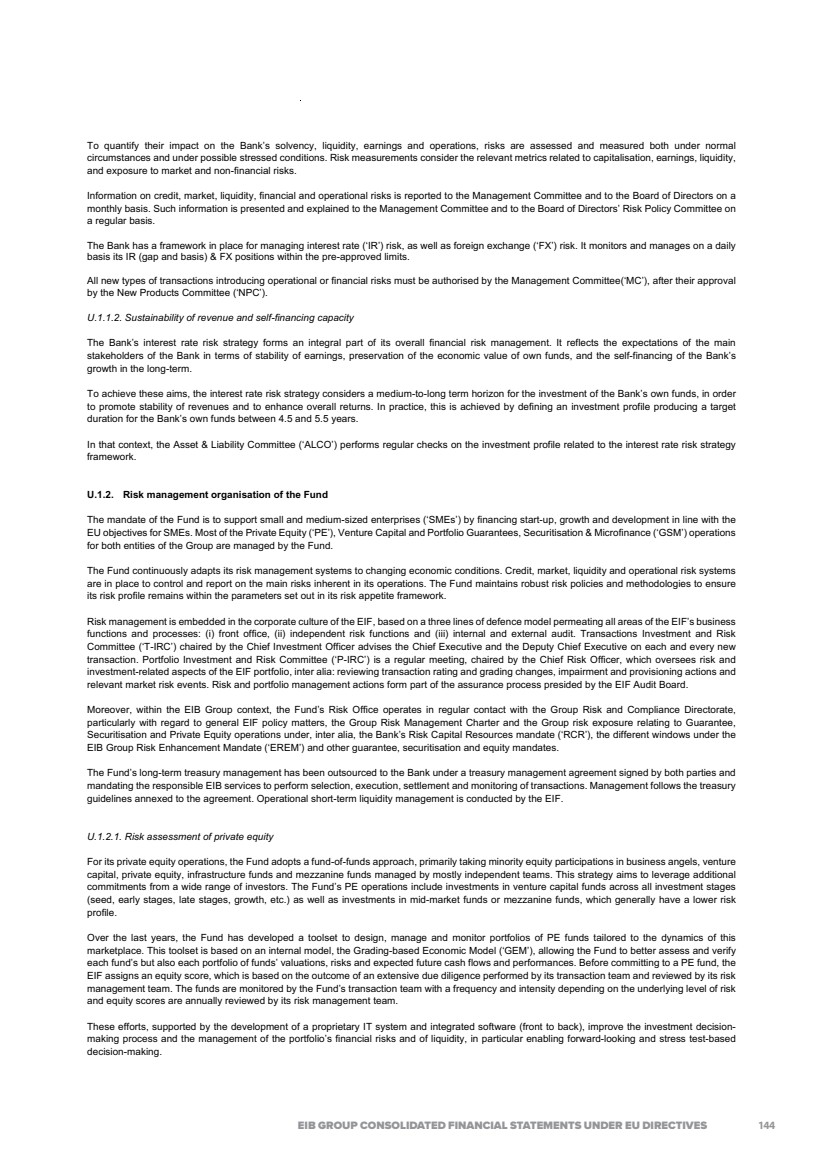
| 2025 FINANCIAL REPORT 38 U.1.2.2. Risk assessment of guarantees and securitisations The EIF extends portfolio guarantees to financial intermediaries involved in SME financing and participates in SME securitisation transactions. By taking on these risks, it facilitates access to funding and/or reduces the cost of capital for originators, and, in turn, it improves the conditions and facilitates access to finance to SMEs. For its guarantee and securitisation business, over the last years, the Fund has developed internal methodologies and models to analyse portfolio guarantees and structured finance transactions in line with best market practices. Before the Fund legally enters into a guarantee transaction, an internal rating is assigned to each new own risk guarantee transaction in accordance with its internal methodology. The rating is based on internal models, which analyse and summarise the transaction’s credit quality (expected loss concept), incorporating both quantitative parameters and qualitative aspects. A four-eyes principle applies throughout the process, with actions initiated by the front office and reviewed by Risk Management. Guarantee transactions are monitored regularly, at least quarterly; their statuses are regularly reviewed by EIF P-IRC. Depending on their performances, this may lead to a review of their internal ratings. This process of reassessing the ratings is done by the first line of defence and reviewed by the second line in line with the 3 lines of defence model of the EIF. The EIF’s monitoring follows potential negative or positive rating migrations and provides the basis for appropriate management of transactions. The following sections disclose the credit, market, liquidity and funding and operational risks to which the Group is exposed. For additional details, please refer to the latest annual EIB Group Risk Management Disclosure Report available on the EIB website. U.2. Credit risk Credit risk mainly concerns the Group’s lending activities, treasury instruments such as debt securities, certificates of deposit and interbank term deposits and the derivative and guarantee transactions of the Group. The credit risk associated with the use of derivatives is analysed in the ‘Derivatives’ section (Note V). Credit risk within the Bank is managed in line with detailed internal guidelines. The purpose of these guidelines is to ensure the prudent management of credit risk. Whether or not a given entity is acceptable to the Bank as a counterpart in a lending operation is determined through careful analysis and evaluation of the entity using quantitative and qualitative metrics but also relying on experience and expert judgment. These guidelines establish minimum credit quality levels for borrowers and guarantors in lending operations and identify the acceptable transaction structure. They also detail the minimum requirements that loan contracts must meet in terms of key legal clauses and other contractual stipulations to ensure that the Bank's position is adequately safeguarded. Diversification of the loan portfolio is supported by a counterparty limit framework, sector limits for key industries and country thresholds for its exposures outside of the EU. To ensure that the additional risk involved in complex or structured lending transactions is adequately analysed, quantified and mitigated, specific detailed guidelines have been developed in respect of certain types of operations complementing the general guidelines. In analysing risks, the Bank applies an internal loan grading system and assigns internal ratings to counterparts. The Fund manages exposures and risks in accordance with conservative policies deriving from statutory provisions and credit risk operational guidelines approved by the Fund’s Board of Directors or guidelines established under mandates. Credit guidelines undergo periodic revisions to reflect evolving operational circumstances, changes in the applicable Best Banking Principles and new mandates that the Group may receive. Despite ongoing heightened geopolitical risks and some sectors particularly affected by subdued economic development, the overall credit quality of the loan portfolio is deemed stable at present. Preserving the quality of loan portfolio is enabled by a risk management strategy, based on a comprehensive due diligence process, adequate lending structures and security, and standard protective clauses included in the loan agreements. In addition to the collaterals and the guarantees provided for lending exposures, some of the EIB exposures benefit from credit enhancements granted as part of different mandates. Moreover, the Bank established a loan portfolio monitoring framework allowing for timely risk management decisions. The aggregate amount of outstanding loans and guarantees granted by the Bank is limited at any time by its Statutory Gearing Ratio (Article 16.5 of the Statute)4. To calculate this ratio the Bank uses data drawn from the EU Accounting Directives (‘AD’) framework. At year-end 2025, the EIB’s Statutory Gearing Ratio under EU Accounting Directive standalone accounts stood at 213.4% (2024: 210.3%) and under EU AD consolidated accounts at 220.1% (2024: 215.9%). Credit risk related to the EIF guarantees portfolio is presented in Note U.1.2.2. 4 In June 2024, the EIB Board of Governors unanimously decided to increase the Gearing Ratio of the Bank from 250% to 290%. This decision was subsequently approved by the Council of the European Union in March 2025 to enable the Bank to deliver on the priorities and goals set out in the Strategic Roadmap. The new Gearing Ratio limit entered into force in March 2025. This increase also applies to the consolidated accounts of the Bank. 145 |
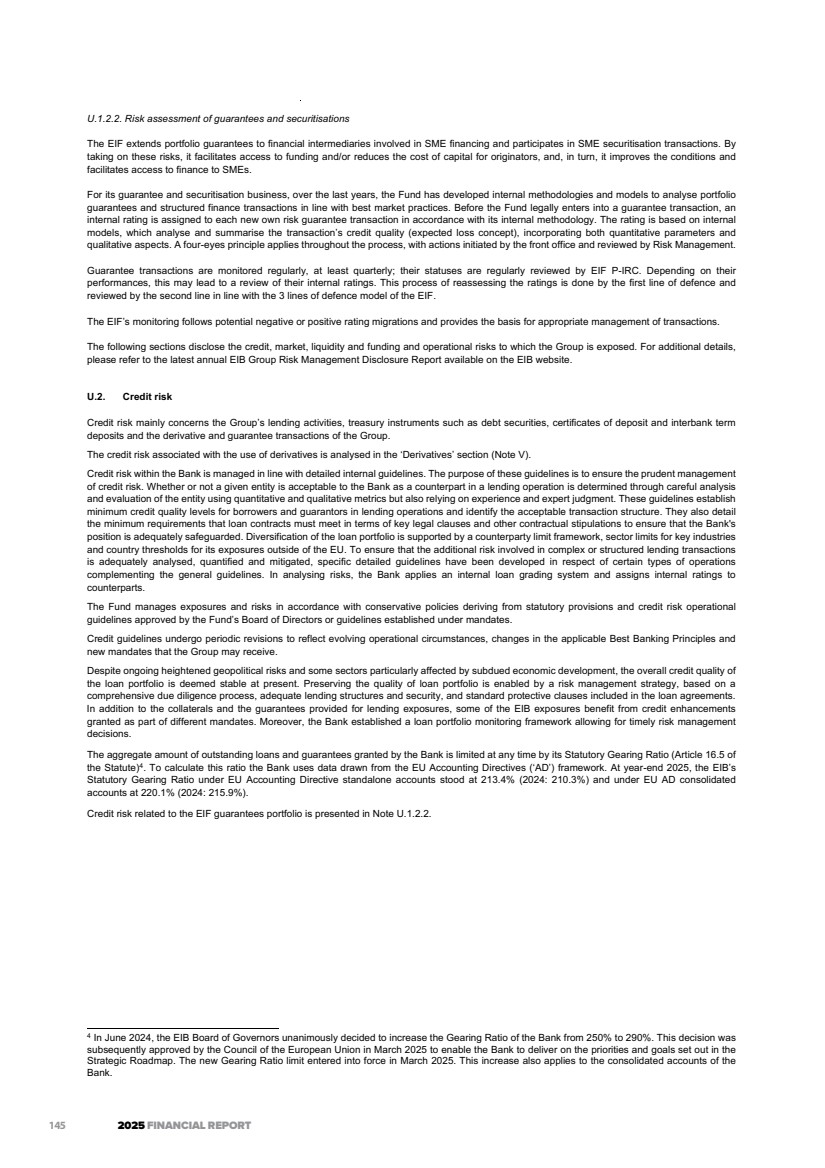
| EIB GROUP CONSOLIDATED FINANCIAL STATEMENTS UNDER EU DIRECTIVES 39 U.2.1. Loans To assess and manage credit risk on loans, the Group classifies its lending operations according to generally accepted criteria, based on the borrower risk profile and the transaction structure, including security and guarantees where appropriate. The loan portfolio breakdown of types of borrowers / guarantors as at 31 December 2025 is presented below, including undisbursed exposures. The table below shows the total signed exposures per counterparty type for loans granted by the Group, excluding those granted for projects beyond the European Union which are granted under the External Lending Mandate (ELM), the European Fund for Sustainable Development (EFSD), the Neighbourhood, Development and International Cooperation Instrument Investment Window 1 (NDICI IW 1)/the European Fund for Sustainable Development Plus (EFSD+)5, the Ukraine Facility – Public Sector Guarantee and the Cotonou Agreement where the Group is, as the last resort, secured by the EU budget or by the Member States guarantees (loans in the African, Caribbean and Pacific countries and the overseas countries and territories)(*). (*) These guarantees are either Comprehensive (covering all risks) or limited to defined Political Risks (non-transfer of currency, expropriation, war or civil disturbance, denial of justice upon breach of contract). In EUR million States Public institutions Banks Corporates Not guaranteed Guarantor (1) Total 2025 Total 2024 Borrower States 0 0 0 0 60,405 60,405 57,966 Public institutions 30,612 24,682 460 421 100,358 156,533 154,906 Banks 30,637 17,252 12,555 8,986 39,024 108,454 113,565 Corporates 9,996 5,154 5,690 39,028 137,657 197,525 187,419 Total 2025(2)(3)(4)(5) 71,245 47,088 18,705 48,435 337,444 522,917 Total 2024(2)(3)(4)(5) 71,718 47,341 18,378 50,917 325,502 513,856 (1) These amounts include loans, for which no formal guarantee independent of the borrower and the loan itself was required, the borrower’s level of solvency itself represents adequate security. In the event of certain occurrences, appropriate contractual clauses ensure the Group’s right to access independent security. (2) The loans in risk-sharing operations (credit enhanced by the Member States guarantee or the EU budget in the form of a political risk guarantee) amount to EUR 995 million as at 31 December 2025 (2024: EUR 1,495 million). (3) This amount does not include signed loan substitutes (2025: EUR 19,488 million; 2024: EUR 19,811 million). (4) These amounts exclude loans to current European Union Member States granted before their accession to the European Union and guaranteed by the European Union budget or the Member States. (5) The Group has signed, in the context of EFSI SME window, European Guarantee Fund and InvestEU, funding lines for a total commitment not exceeding EUR 17,887 million (2024: EUR 17,871 million). The Group recognises an undisbursed exposure when a firm commitment is signed with the respective underlying risk counterpart, for which the funding lines are expected to be drawn. 5 One EFSD+ contract is part of the own risk portfolio. 146 |
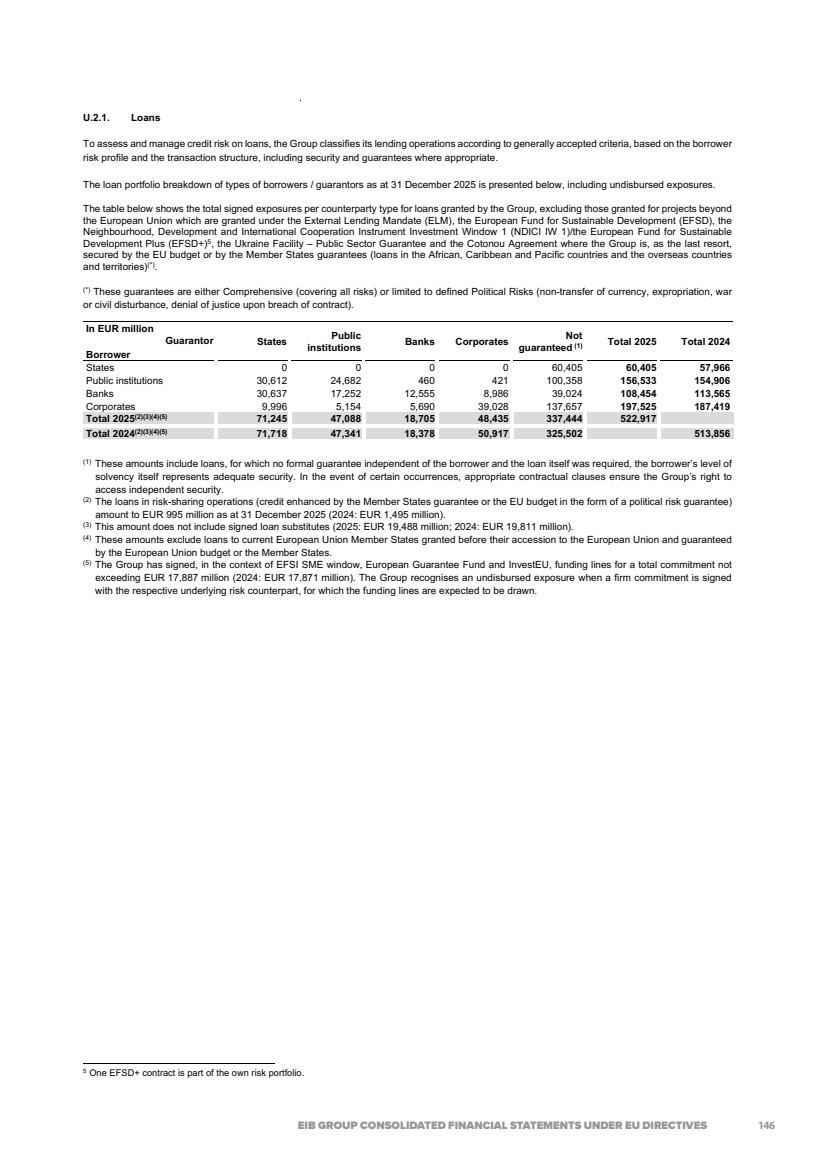
| 2025 FINANCIAL REPORT 40 The Group did not record value adjustments in 2025 and 2024 in respect of its EU sovereign and EU sovereign guaranteed exposure as at the year end as the preferred creditor status of the Bank as well as of the EIF and the protection given by the Bank’s Statute are deemed to guarantee a full recovery of the Group’s assets upon maturity. The table below discloses information regarding the sovereign credit risk on loans, apart from loans beyond the European Union benefiting from EU budget or Member State guarantees, where the Bank has either full own risk or bears a residual risk due to credit enhancement: (in EUR million) 2025 2024 Acting as borrower Acting as guarantor Acting as borrower Acting as guarantor Country Disbursed Undisbursed Signed Disbursed Undisbursed Signed Austria 0 0 115 0 0 124 Belgium 0 0 242 0 0 255 Bulgaria 1,135 250 297 964 250 298 Croatia 934 157 1,830 837 292 1,992 Cyprus 897 757 874 962 442 968 Czech Republic 2,908 861 0 2,011 913 0 Denmark 0 0 115 0 0 240 Estonia 406 490 62 474 490 69 Finland 0 0 87 0 0 97 France 0 0 4,103 0 0 3,858 Germany 0 0 994 0 0 1,546 Greece 6,260 1,131 7,111 6,652 2,102 7,670 Hungary 5,529 813 898 5,882 327 822 Ireland 1,805 300 1,668 1,905 0 1,731 Italy 6,054 811 5,022 5,344 655 5,401 Latvia 220 0 0 299 0 0 Lithuania 2,056 150 120 2,096 0 148 Luxembourg 9 0 210 0 9 219 Malta 150 52 218 72 0 268 Netherlands 0 0 1,980 0 0 265 Poland 5,886 265 20,814 6,302 210 19,268 Portugal 1,892 1,150 1,792 1,988 100 2,048 Romania 3,781 1,922 0 3,030 1,714 51 Slovakia 2,616 0 44 2,571 240 95 Slovenia 444 0 1,098 468 0 1,220 Spain 2,608 0 17,728 2,977 0 18,896 Sweden 0 0 151 0 0 155 Non-EU Countries 2,881 2,825 3,672 2,437 2,951 4,014 Total 48,471 11,934 71,245 47,271 10,695 71,718 The table below shows (in EUR million) the signed loans for projects beyond the European Union benefiting from EU budget or Member State guarantees: Secured by: 31.12.2025 31.12.2024 Member States 3,229 3,413 European Union budget(1) 45,667 47,910 Total(2)(3) 48,896 51,323 (1) Of which EUR 995 million in risk-sharing operations (credit enhanced by the Member States guarantee or the EU budget in the form of a political risk guarantee) as explained above (2024: EUR 1,495 million). (2) Including loans to current European Union Member States granted before their accession to the European Union and guaranteed by the European Union budget or the Member States. (3) Financial guarantees granted by the Group for a total amount of EUR 442.6 million (2024: EUR 500.5 million) which are secured by Member States or the EU budget. The aforementioned guarantees are not included in the analysis as provided in table above. 147 |
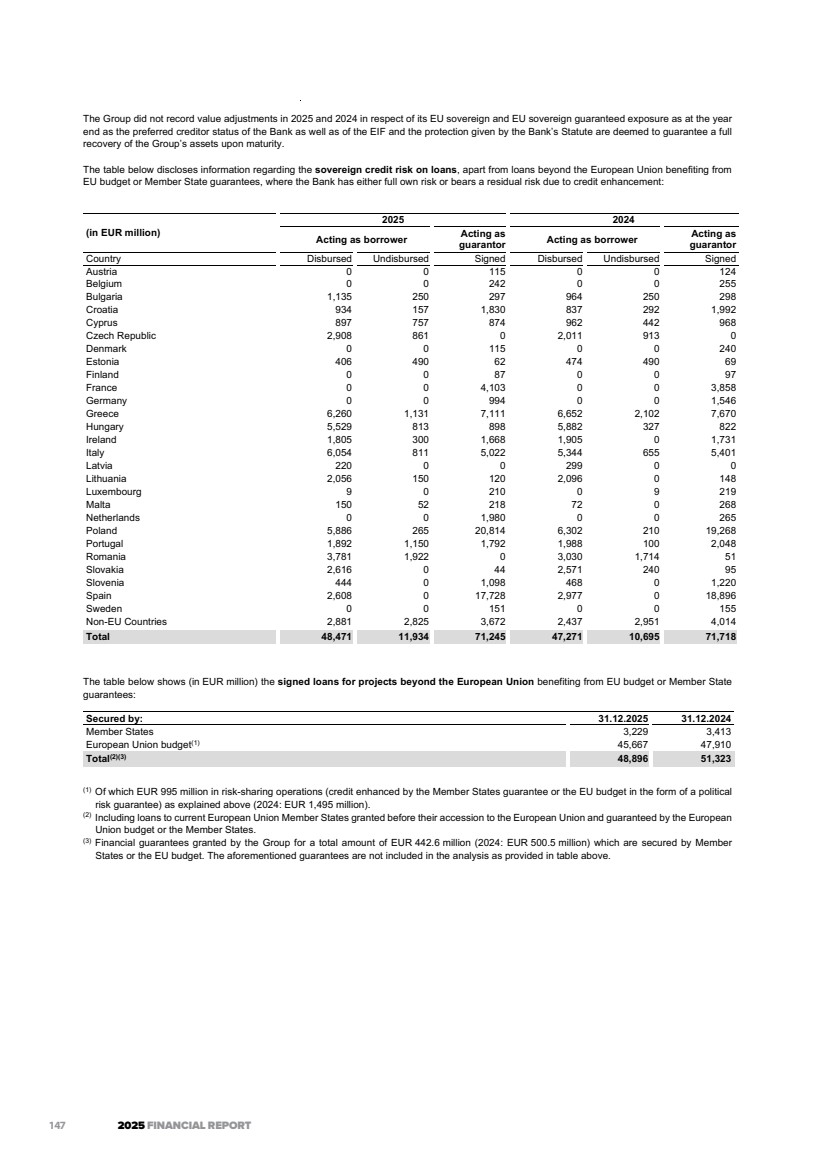
| EIB GROUP CONSOLIDATED FINANCIAL STATEMENTS UNDER EU DIRECTIVES 41 The table below shows (in EUR million) the signed loans for projects beyond the European Union benefiting from EU budget or Member State guarantees, broken down by guarantees: AGREEMENT 31.12.2025 31.12.2024 75% Member States guarantee - Cotonou partnership agreement 39 54 - Cotonou partnership 2nd agreement 862 961 - Cotonou Protocol 3 – OR / ACP 2,244 2,304 - Cotonou Protocol 3 – OR / OCT 84 94 Total 75% Member States guarantee 3,229 3,413 Total Member States guarantee 3,229 3,413 100% European Union budget guarantee - Russia – 500 m – 2004-2007 67 82 - EFSD 0 93 Total 100% European Union budget guarantee 67 175 94% European Union budget guarantee - Ukraine Facility - Public Sector Guarantee 1,920 0 Total 94% European Union budget guarantee 1,920 0 70% European Union budget guarantee - Bosnia–Herzegovina – 100m 99/2001 0 2 Total 70% European Union budget guarantee 0 2 65% European Union budget guarantee - South Africa – 825m – 7/2000-1/2007 6 11 - South Africa – Decision 2/2007-12/2013 68 78 - ALA III – 2 480m –- 2/2000 – 7/2007 36 46 - ALA Decision – 2/2007-12/2013 899 1,058 - Euromed II – 6 520m – 2/2000-1/2007 230 368 - South Eastern Neighbours – 9 185m – 2/2000 – 7/2007 1,540 1,779 - Türkiye special action – 450m – 2001-2006 71 78 - Türkiye TERRA – 600m – 11/1999-11/2002 154 178 - PEV EE/CAS/RUS 1/2/2007 – 31/12/2013 1,307 1,554 - PEV MED 1/2/2007 – 31/12/2013 3,339 3,835 - Pre-Accession – 9 048m – 2007 – 2013 3,472 3,905 - Climate Change Mandate 2011 - 2013 835 895 - ELM Asia 2014-2020 1,220 1,266 - ELM Central Asia 2014-2020 337 351 - ELM East-Russia 2014-2020 4,458 6,498 - ELM Latin America 2014-2020 1,881 2,498 - ELM MED 2014-2020 6,004 7,628 - ELM Pre-Accession 2014-2020 3,274 3,577 - ELM RSA 2014-2020 5 117 - ELM ERI Private Mandate 373 637 - ELM ERI Public Mandate 1,022 1,324 - Global Europe NDICI IW 1 13,149 10,052 Total 65% European Union budget guarantee 43,680 47,733 Total European Union budget guarantee 45,667 47,910 Total(1) 48,896 51,323 (1) Financial guarantees granted by the Group for a total amount of EUR 442.6 million (2024: EUR 500.5 million) which are secured by Member States or the EU budget. The aforementioned guarantees are not included in the analysis as provided in table above. 148 |
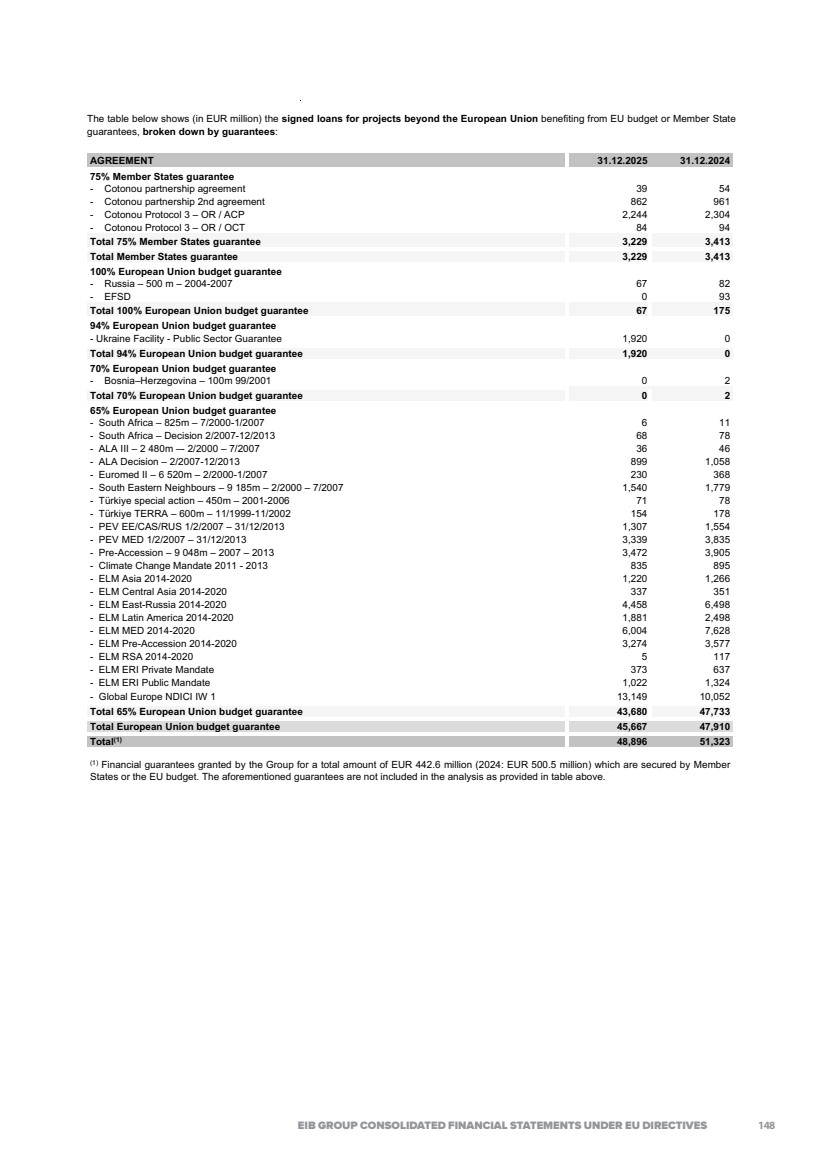
| 2025 FINANCIAL REPORT 42 Collateral on loans (in EUR million) Among other credit mitigant instruments, the Group uses pledges of financial securities. These pledges are formalised through a Pledge Agreement, enforceable in the relevant jurisdiction. The portfolio of collateral received in pledge contracts amounts to EUR 6,647 million (2024: EUR 7,247 million), with the following composition: As at 31 December 2025 Loan Financial Collateral (in EUR million) Moody's or equivalent rating Bonds Cash Total Government Supranational Agency Secured Bonds (covered bonds) Bank and Corporate Bonds Aaa 38 137 0 142 38 0 355 Aa1 to Aa3 1,072 0 58 168 222 0 1,520 A1 to A3 1,154 10 58 0 351 0 1,573 Baa1 to Baa3 2,980 0 0 0 111 0 3,091 Below Baa3 12 0 0 0 0 0 12 Non-Rated 0 0 0 0 0 96 96 Total 5,256 147 116 310 722 96 6,647 As at 31 December 2024 Loan Financial Collateral (in EUR million) Moody's or equivalent rating Bonds Cash Total Government Supranational Agency Secured Bonds (covered bonds) Bank and Corporate Bonds Aaa 49 233 0 417 54 0 753 Aa1 to Aa3 1,156 9 35 228 174 0 1,602 A1 to A3 923 0 2 0 543 0 1,468 Baa1 to Baa3 3,170 0 0 0 104 0 3,274 Non-Rated 0 0 0 0 0 150 150 Total 5,298 242 37 645 875 150 7,247 A breakdown of disbursed loans outstanding (in EUR million) at 31 December, according to the sectors of the contract is set out below: Sector 2025 2024 Transport 132,326 130,569 Energy 80,411 73,948 Global Loans(1)(2) 50,784 58,075 Health, education 37,372 38,577 Industry 36,980 36,570 Miscellaneous infrastructure 36,228 34,732 Water, sewerage 29,011 29,043 Services 18,358 18,729 Telecommunications 10,992 10,319 Agriculture, fisheries, forestry 4,792 5,103 Total 437,255 435,665 (1) A global loan is a line of credit to an intermediary financing institution or a bank which subsequently lends the proceeds, at its own risk, to finance small and medium-sized projects being undertaken by private or public sector promoters. (2) This amount does not include disbursed loan substitutes (2025: EUR 19,488 million, 2024: EUR 19,811 million). Arrears on loans Amounts in arrears are identified, monitored and reported according to the procedures defined in the bank-wide “Financial Monitoring Guidelines and Procedures”. These procedures follow best banking practices and are adopted for all loans managed by the EIB. As at 31 December 2025, the arrears above 90 days on loans within the total portfolio amount to EUR 504 million (31 December 2024: EUR 281 million). The outstanding principal amount related to these arrears is EUR 1,147 million as at 31 December 2025 (31 December 2024: EUR 861 million). These are covered by loan value adjustments of EUR 419 million (31 December 2024: EUR 249 million). Of the total amount in arrears above 90 days, only EUR 144 million (31 December 2024: EUR 49 million) relate to loans that do not benefit from a full or partial guarantee provided by the European Union or Member States. During 2025, EUR 260.3 million of arrears have been called under the guarantees of the European Union and EUR 4.5 million under the Member States guarantees. Corresponding amounts in 2024 were EUR 103 million and EUR 3 million, respectively. In addition, during the year, EUR 3.1 million of arrears previously invoked under the guarantees of the European Union or the Member States was refunded (2024: EUR 16 million). 149 |
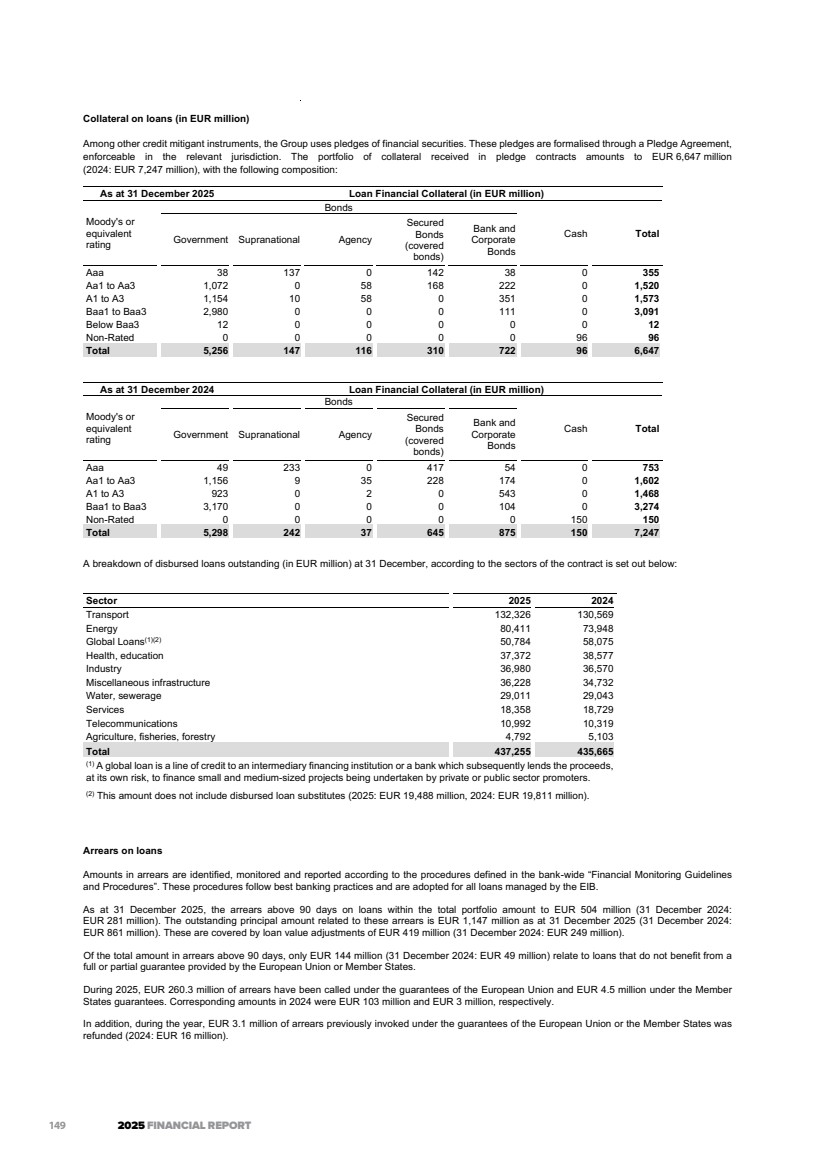
| EIB GROUP CONSOLIDATED FINANCIAL STATEMENTS UNDER EU DIRECTIVES 43 Loan renegotiation and forbearance The Group classifies loans as forborne loans (that is loans, debt securities and loan commitments) in respect of which forbearance measures have been extended. Forbearance measures consist of “concessions” that the Group decides to make towards an obligor who is considered unable to comply with the contractual debt service terms and conditions due to its financial difficulties, in order to enable the obligor to service the debt or to refinance, totally or partially, the contract. Exposures shall be treated as forborne if a concession has been granted, regardless of whether any amount is past-due, or the exposure is classified as defaulted. Exposures shall not be treated as forborne when the obligor is not in financial difficulties. Once renegotiated, the Group will continue to closely monitor these loans. If the renegotiated payment terms will not recover the original carrying amount of the asset, the Group will consider accounting for value adjustments in the profit and loss account. The need for a value adjustment for all loans whose Loan Grading (‘LG’) deteriorated to a level indicating a strong possibility that debt service cannot be maintained on a timely basis is assessed regularly. Forbearance measures and practices undertaken by the Group’s restructuring activities during the reporting period include, but are not limited to, extension of maturities, deferral of capital only, deferral of capital and interest, waivers for breach of material covenants and capitalisation of arrears. Operations subject to forbearance measures are reported in the tables below. (in EUR million) 31.12.2025 31.12.2024 Performing Non-performing Performing Non-performing Number of contracts subject to forbearance practices 29 117 25 66 Carrying values (incl. interest and amounts in arrears) 1,083 2,921 635 1,567 of which being subject to value adjustments 0 2,384 0 1,093 Value adjustments recognised 0 573 0 381 Interest income in respect of forborne contracts 32 121 23 80 Exposures derecognised (following restructuring, write-off or sale of the operation) 0 8 0 127 Forbearance measures (in EUR million) 31.12.2024 Extension of maturities, deferral of capital and/or interest Breach / waiver of material financial covenants Restructuring due to diminished repayment capacity Emergency funding Enforcement action against the Borrower Other Contractual repayment and termination 31.12.2025 Public 452 0 0 0 0 0 160 -191 421 Bank 182 0 0 0 0 0 0 -34 148 Corporate 1,568 514 1,134 161 306 161 320 -729 3,435 Total 2,202 514 1,134 161 306 161 480 -954 4,004 150 |
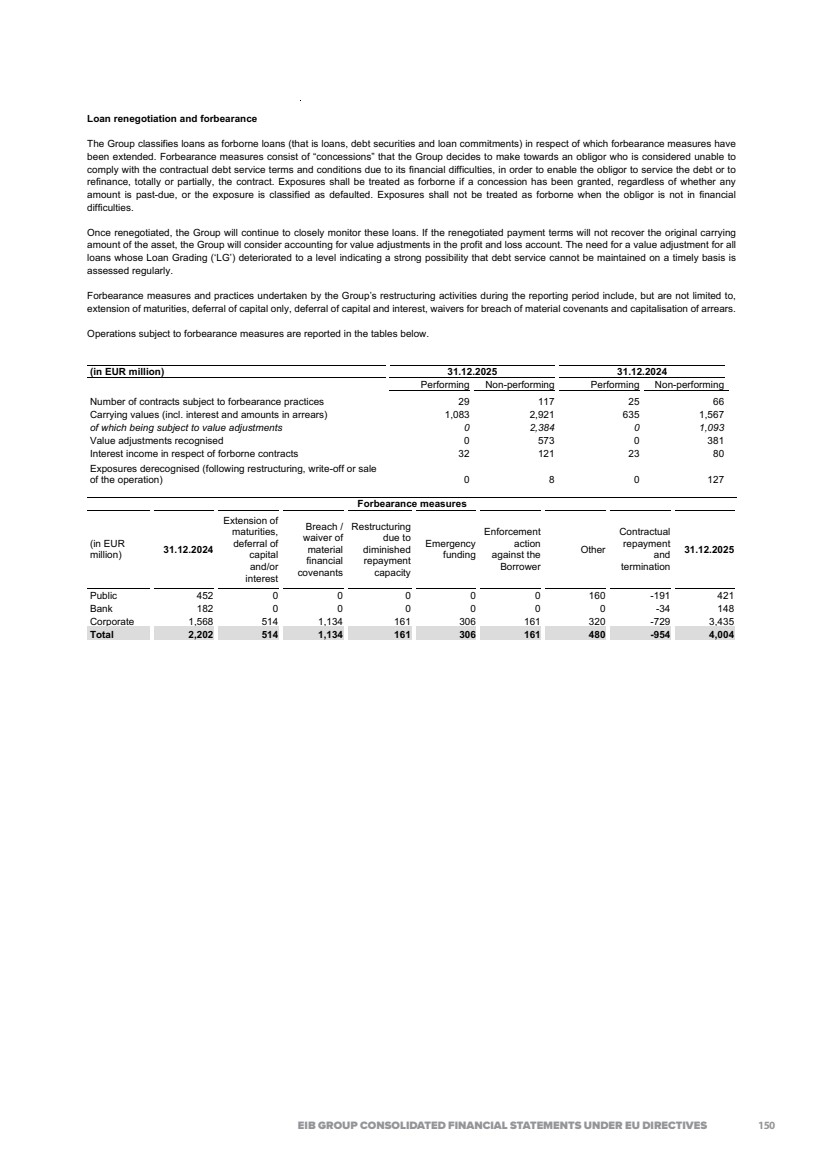
| 2025 FINANCIAL REPORT 44 U.2.2. Treasury The credit risk associated with treasury instruments (securities, commercial papers, term deposits, etc.) is managed by selecting sound counterparties and issuers. The structure of the securities portfolio and the limits governing outstanding treasury instruments have been laid down by the management. These limits are reviewed regularly by the Group Risk and Compliance Directorate. The table below provides a percentage breakdown of the credit risk associated with the securities in the treasury portfolios and the money market products (deposits and reverse repurchase agreements). The breakdown is based on the credit rating of the issuer or ultimate obligor rating, where relevant: Moody’s or equivalent rating Securities portfolio % Money market products % 31.12.2025 31.12.2024 31.12.2025 31.12.2024 Aaa 30 29 30 48 Aa1 to Aa3 20 37 39 27 A1 to A3 31 13 30 24 Below A3 19 21 1 1 Total 100 100 100 100 Collateral on treasury transactions The Group enters into collateralised repurchase and reverse repurchase agreement transactions that may result in credit exposure if the counterparty to the transaction is unable to fulfil its contractual obligations. The Group controls credit risk associated with these activities by monitoring counterparty credit exposure and collateral values on a daily basis and requiring additional collateral to be deposited with the Group when deemed necessary. Tripartite repurchase and reverse repurchase operations are carried out with a third-party custodian who undertakes, on the basis of a framework contract, to guarantee compliance with the contractual terms and conditions, notably with respect to: - delivery against payment; - verification of collateral; - the collateral margin required by the lender which must always be available and adequate, with the market value of the securities being verified daily by the custodian; and - organisation of substitute collateral provided that this meets all the contractual requirements. Collateral received Treasury transactions include EUR 23,198 million in bilateral and tripartite reverse repurchase agreements as at 31 December 2025 (2024: EUR 21,286 million). The Group received financial collateral for all such transactions. The market value of the financial collateral portfolio as at 31 December 2025 is EUR 23,982 million (2024: EUR 21,971 million), with the following breakdown: Financial collateral for reverse repurchase agreements (in EUR million) As at 31 December 2025 Bonds Moody's or equivalent rating Government Supranational Agency Secured bonds (covered bonds) Bank and corporate Bonds Cash Total Aaa 1,387 1,067 379 8,710 2,011 0 13,554 Aa1 to Aa3 2,396 4 330 104 957 0 3,791 A1 to A3 1,085 55 700 0 3,633 0 5,473 Baa1 to Baa3 853 0 95 0 74 0 1,022 Non-rated 135 0 7 0 0 0 142 Total 5,856 1,126 1,511 8,814 6,675 0 23,982 Financial collateral for reverse repurchase agreements (in EUR million) As at 31 December 2024 Bonds Moody's or equivalent rating Government Supranational Agency Secured bonds (covered bonds) Bank and corporate Bonds Cash Total Aaa 168 302 180 8,542 2,390 0 11,582 Aa1 to Aa3 2,159 1,359 212 338 640 0 4,708 A1 to A3 217 1 246 45 4,550 0 5,059 Baa1 to Baa3 475 0 12 0 28 0 515 Non-rated 94 0 10 0 0 3 107 Total 3,113 1,662 660 8,925 7,608 3 21,971 Securities deposited Bilateral and tripartite repos amount to EUR 984 million as at 31 December 2025 (2024: EUR 107 million). The market value of the collateral deposited under bilateral and tripartite repos amount to EUR 977 million as at 31 December 2025 (2024: EUR 218 million). 151 |
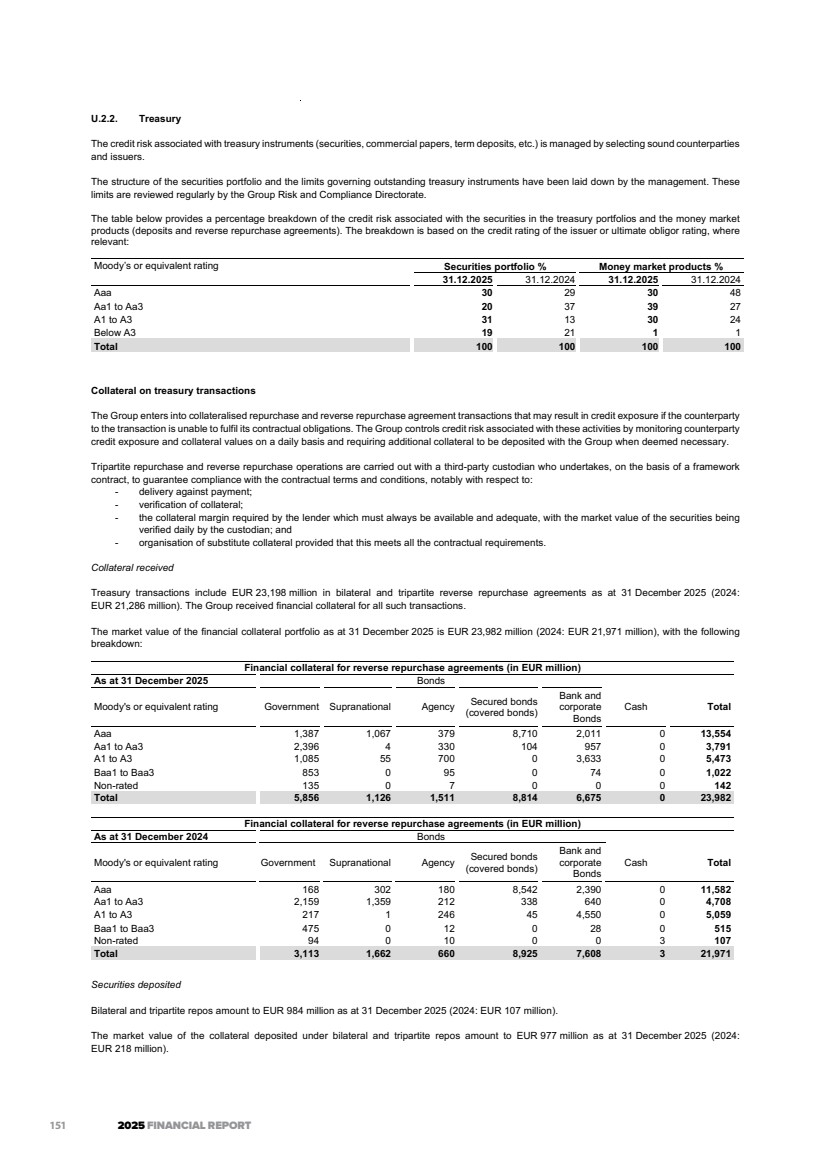
| EIB GROUP CONSOLIDATED FINANCIAL STATEMENTS UNDER EU DIRECTIVES 45 U.2.3. Guarantees and securitisations entered into by the Group Credit risk arising from the Group’s guarantees and securitisations transactions funded by own resources is managed in line with dedicated internal guidelines. As at 31 December 2025, the signed exposure guaranteed by the Group amounted to EUR 36.2 billion (2024: EUR 32.2 billion) and provisions on guarantees amount to EUR 88.8 million (2024: EUR 86.7 million). Part of the Group’s guarantee type operations derives from risk-sharing operations where the Group guarantees either (i) on a loan-by-loan or (ii) on a portfolio basis underlying debt exposures originated by a financial intermediary based on established delegation models. The financial intermediary originating the underlying risk exposures on which the Group takes risk is subject to a detailed due diligence to make sure that the Group can delegate credit management tasks to the financial intermediary in question. In these types of transactions, the Group might be exposed on a pro rata basis or via a structure with a certain degree of subordination. In addition to this, the Group can also enter into securitisations transactions. The EIB has established a dedicated framework to limit the concentration risk for this type of underlying exposures in such transactions. Depending on the specific characteristics of the transaction, this may include setting eligibility criteria including but not limited to lowest eligible rating categories, certain sector, obligor and/or obligor group exposure. There is limited counterparty risk on the financial intermediary as the credit risk is on the underlying exposures originated by the financial intermediary i.e. counterparty risk is limited to (1) the payment of the guarantee fees and (2) the potential recoveries due to the EIB in the event of a default of an underlying exposure guaranteed and paid out by the EIB. In any case, the Group has established a number of mitigating measures, including but not limited to detailed due diligence as well as security rights, step-in rights, trigger events to stop inclusions, consent rights for material amendments of the underlying risk exposures or termination rights. U.3. Market risk U.3.1. Interest rate and credit spread risk in the banking book for the Group The interest rate or credit spread risk is the risk to the economic value or to the net interest income arising from adverse movements in interest rates or market credit spreads that affect interest rate and market credit spread sensitive instruments, respectively. Exposure to these risk factors occurs when there are differences in repricing and maturity characteristics of the different asset, liability and hedge instruments. The Group Risk Appetite Framework contains three interest rate risk indicators managed within pre-approved limits: The “Risk to Economic Value”, the “NII Large Decline” and the “Risk to Earnings”, which are, however defined on an EIB stand-alone level. The EIF’s Risk Appetite Framework does not currently include such interest rate risk indicators, but EIF instead allocates economic capital to cover its interest rate risk and credit spread risk exposures. In doing so, the EIF is following the Group capital measurement methodology for interest rate risk in the banking book (‘IRRBB’) and credit spread risk in the banking book (‘CSRBB’). The Group is measuring CSRBB by applying stress tests that show the impacts on both the economic value of equity and the net interest income from adverse movements in market credit spreads (in line with the respective EBA guidelines6). CSRBB is not subject to individual operational management limits. However, its exposure is reflected into the Group Risk Appetite Framework. The following sections detail the operational implementation of the interest rate risk management framework of each entity. Interest rate risk management for the Bank In measuring and managing interest rate risk, the Bank refers to the relevant key principles of the Basel Committee on Banking Supervision (‘BCBS’) as implemented in the EU, and to the regulatory guidance issued by the European Banking Authority (‘EBA’). The main sources of interest rate risk are gap risk, basis risk and option risk. Gap risk is the most relevant interest rate risk for the Bank and is defined as the risk to the economic value or to the net interest income generated by the differences in the term structure of interest rate sensitive instruments on the Bank’s balance sheet. Following regulatory guidance, the Bank has articulated its appetite for interest rate risk in terms of both the maximum risk to economic value and the maximum risk to earnings that the Bank is prepared to take (while, when applicable, adhering to the maximum thresholds defined in the EBA Supervisory Outlier Tests for both perspectives). The Bank’s investment strategy for its own funds – the interest rate risk strategy – complies with such interest rate risk appetite. Interest rate risk on the economic value of the own funds/equity of the Bank The Bank’s interest rate risk strategy aims at maintaining a balanced and sustainable revenue profile as well as limiting the risk of the economic value of the Group. A clear preference has been given to the revenue profile in light of the objective of self-financing future growth. This overall objective is achieved by investing the own funds according to a medium to long-term investment profile. Of course, this strategy needs to comply with the limits for the Interest Rate Risk RAF metrics. Apart from the interest rate risk strategy underpinning the investment of the Bank’s own funds, the Bank’s balance sheet should be match-funded with respect to interest rate risk. As it is not operationally practical to perfectly match-fund the Bank’s balance sheet, small deviations to gap and basis risks are allowed. These net residual interest rate risk positions are managed within pre-approved limits, the latter being dimensioned to ensure that the individual risks remain within the risk appetite boundaries. In addition to its interest rate risk limits framework, the Bank performs regular stress testing, based on EBA standardised shock scenarios7 and internally defined ones, to its projected earnings and to its economic value. The exercise serves to identify potential adverse consequences arising from severe changes in the interest rates environment. 6 EBA/GL/2022/14. 7 EBA/RTS/2022/10. 152 |
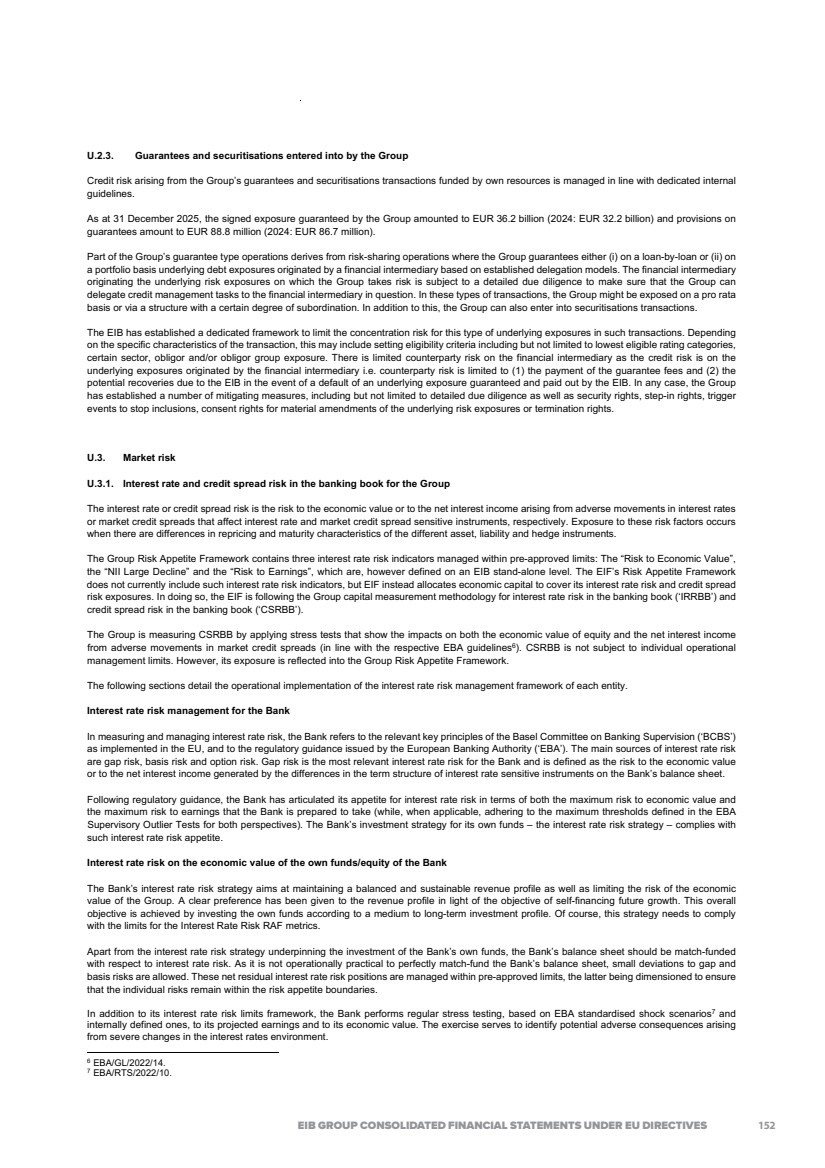
| 2025 FINANCIAL REPORT 46 The stress test on the economic value is performed at Bank and Group level. As at 31 December 2025, the worst impact of the EBA supervisory outlier test scenarios would reduce the economic value of own funds of the Bank by EUR 6.86 billion (2024: EUR 6.19 billion) and of the EIB Group by EUR 6.93 billion (2024: EUR 6.23 billion)8. Among the financial instruments in the Bank’s portfolio, some operations (borrowings and associated swaps) present callability options and may be redeemed early, hence introducing uncertainty as to their final maturity. However, as these packages (borrowings and associated swaps) are fully back-to-back (up to the cashflow level), they can be considered at the end as simple synthetic floating-rate notes indexed to the relevant interest rate benchmark rates and bearing limited interest rate risk. The table hereafter summarises the features of the Group’s callable borrowings portfolio as at 31 December 2025 and 31 December 2024, where the total nominal amount, the average natural maturity and the average expected maturity (both weighted by the nominal amount of the relevant transactions) are shown per funding currency and per main risk factor involved: By funding currency (after swaps): 31.12.2025 (in EUR million) EUR USD Total EUR Pay Notional -3,167 -732 -3,899 Average maturity date 26.09.2044 14.02.2042 30.03.2044 Average expected maturity 25.12.2039 28.06.2040 29.01.2040 31.12.2024 (in EUR million) EUR USD Total EUR Pay Notional -2,402 -1,107 -3,509 Average maturity date 12.12.2046 29.12.2037 14.02.2044 Average expected maturity 14.12.2037 25.02.2036 20.05.2037 By risk factor involved: 31.12.2025 Risk factor (in EUR million) FX level IR curve level Total EUR Pay Notional -773 -3,126 -3,899 Average maturity date 12.11.2036 26.01.2046 30.03.2044 Average expected maturity 21.07.2033 09.09.2041 29.01.2040 31.12.2024 Risk factor (in EUR million) FX level IR curve level Total EUR Pay Notional -259 -3,250 -3,509 Average maturity date 15.02.2037 04.09.2044 14.02.2044 Average expected maturity 10.12.2033 29.08.2037 20.05.2037 8 The stress test is performed on all risk-sensitive banking book instruments, including the pension and health insurance liabilities (defined benefit obligations, DBO) as calculated by an actuarial provider. 153 |
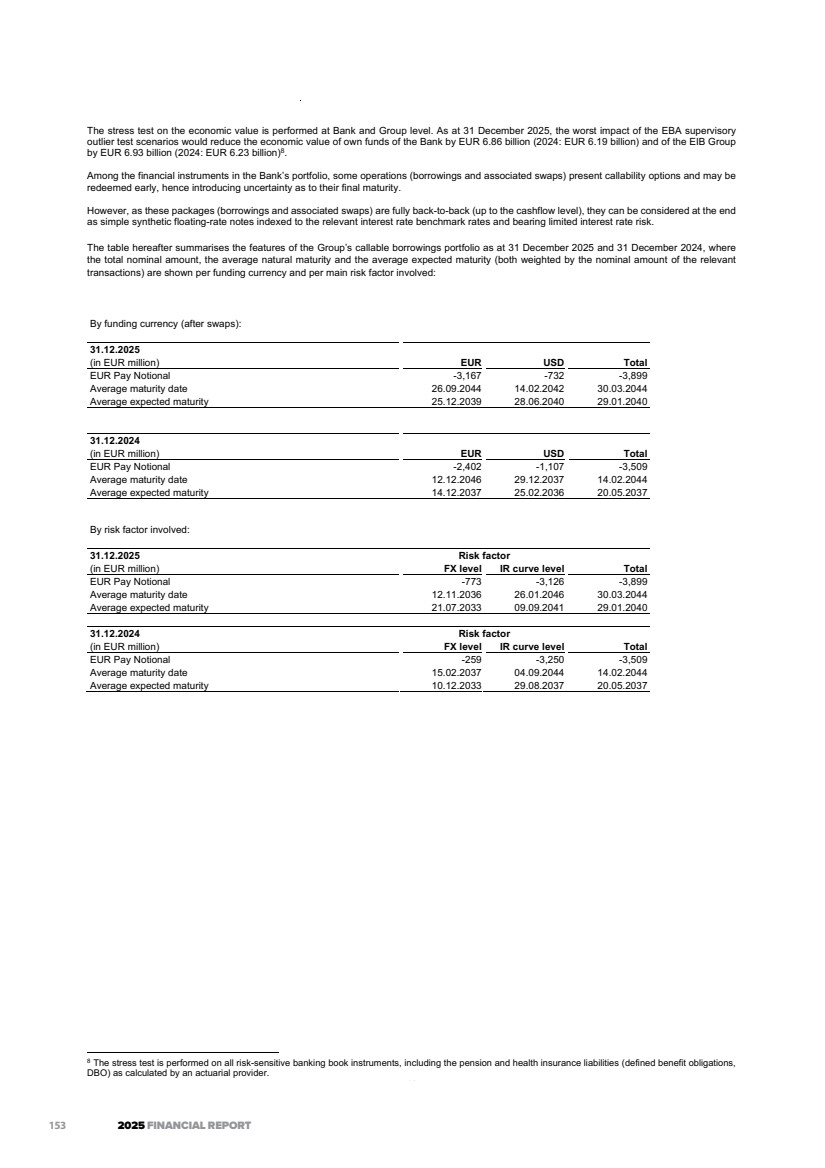
| EIB GROUP CONSOLIDATED FINANCIAL STATEMENTS UNDER EU DIRECTIVES 47 Interest rate risk on the earnings of the Bank The risk to earnings9 quantifies the amount of net interest income that would change during the forthcoming 36 months if all interest rate curves would decrease by two percentage points. Such exposure stems primarily from the mismatch between the interest rate repricing periods of assets and liabilities, and has to stay within the limit defined in the Risk Appetite Framework. With the positions in place as at 31 December 2025, the net interest income of the Bank would decrease by EUR 986.5 million (2024: EUR 1,108.4 million) and of the EIB Group by EUR 1,096.5 million (2024: EUR 1,219.0 million) if interest rates were to decrease by 200 basis points. For enriching the analysis of the net interest income sensitivity, the net interest income of the Bank would increase by EUR 1,041.5 million (2024: EUR 1,168.5 million) and of the Group by EUR 1,151.5 million (2024: EUR 1,279.1 million) if interest rates were to increase by 200 basis points. The Bank uses a dedicated software that allows it to simulate the sensitivity of earnings on a deal by deal basis. The sensitivity of earnings is measured on an accruals basis and is calculated under the ‘’ongoing’’ assumption that, over the time horizon analysed, the Bank realises (at market rates defined in the underlying scenario) the new loan business forecast in the Operational Plan, maintains exposures within the approved limits and executes monetary trades to refinance funding shortages or invest cash excesses. In line with the Bank’s current practice, the model uses the hypothesis that simulated earnings are not distributed to the shareholders, but are used to refinance the Bank’s business. The administrative costs are projected according to the forecasts of the Operational Plan. Interest rate and credit spread risk management for the Fund Even though EIF does not fund itself on capital/money markets, EIF is exposed to interest rate risk (primarily to the gap risk) and credit spread risk. The major interest rate and credit spread sensitive exposures at EIF are its pension defined benefit obligations (DBO) on the liabilities side and its fixed income treasury book on the assets side. Although EIF’s risk appetite statement does not currently include interest rate or credit spread risk indicators and does not have an articulated interest rate risk strategy, EIF allocates economic capital to cover its interest rate and credit spread risk exposures. EIF is following the Group capital measurement methodology for interest rate risk in the banking book (‘IRRBB’) and for credit spread risk in the banking book (‘CSRBB’), i.e. EIF interest rate risk is assessed from both the normative and from the economic perspectives, with the worse of the two being considered under the Economic Capital (‘ECap’) ratio. 9 To note that the Bank manages also the risk to its net interest income (NII) via the Supervisory Outlier Test for NII, namely the so called “NII Large Decline”. 154 |
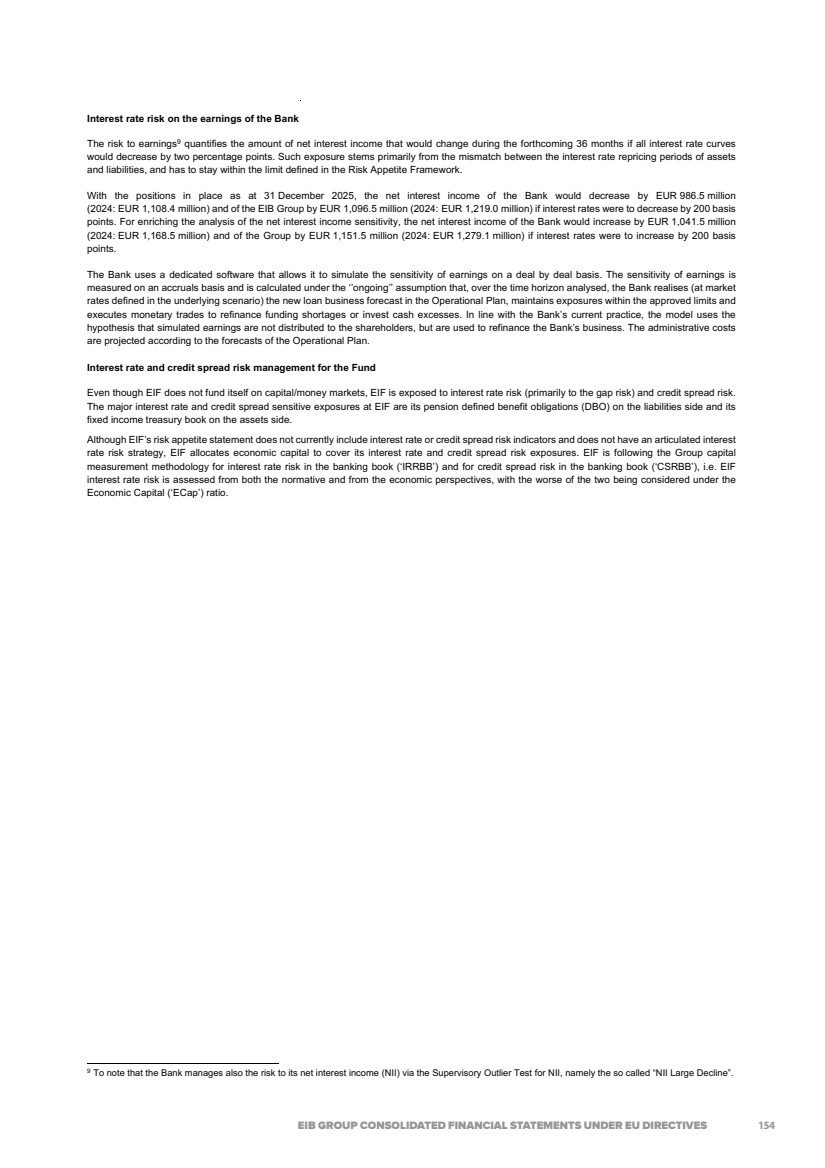
| 2025 FINANCIAL REPORT 48 U.3.2. Foreign exchange risk The foreign exchange (‘FX’) risk is the risk to the economic value or to the income derived from, the Group’s positions due to adverse movements of foreign exchange rates. The Group is exposed to a foreign exchange risk whenever there is a currency mismatch between its assets, liabilities and hedging instruments. In compliance with the Bank’s Statute and with the EIF Risk Appetite Framework, the Group does not engage in currency operations not directly required to carry out its core activities. This means that, for the Bank, mismatches of currencies in the asset-liability structure are kept within tight pre-approved limits while, for the EIF, open foreign exchange positions may arise from its equity and guarantee investments, in line with its Statutes and Risk Appetite Framework). Foreign exchange position (in EUR million) Currency as at 31 December 2025 Euro Pound Sterling US Dollar Other currencies Sub-total except Euro Total 2025 Assets: Cash in hand, balances with central banks and post office banks 258 0 0 0 0 258 Treasury bills and other bills eligible for refinancing with central banks 37,292 1,562 2,816 0 4,378 41,670 Other loans and advances: - Repayable on demand 1,742 65 43 102 210 1,952 - Credit institutions 22,289 0 2,975 8,931 11,906 34,195 - Customers 118 0 0 0 0 118 24,149 65 3,018 9,033 12,116 36,265 Loans: - Credit institutions 65,885 216 10,606 8,448 19,270 85,155 - Customers 293,916 21,430 12,106 24,570 58,106 352,022 359,801 21,646 22,712 33,018 77,376 437,177 Debt securities including fixed-income securities 7,188 356 3,191 974 4,521 11,709 Shares, other variable-yield securities and participating interests 11,938 326 954 613 1,893 13,831 Other 9,346 1,421 2,055 707 4,183 13,529 Total assets 449,972 25,376 34,746 44,345 104,467 554,439 Liabilities: Amounts owed to credit institutions 1,300 0 131 0 131 1,431 Amounts owed to customers 4,022 1 103 59 163 4,185 Debts evidenced by certificates: - Debt securities in issue 253,919 30,910 106,658 33,242 170,810 424,729 - Others 4,928 0 714 1,332 2,046 6,974 258,847 30,910 107,372 34,574 172,856 431,703 Subscribed capital, reserves, profit and minority interest 89,209 0 0 0 0 89,209 Other 23,349 1,481 2,106 975 4,562 27,911 Total liabilities 376,727 32,392 109,712 35,608 177,712 554,439 Off-balance sheet currency swaps -74,144 7,098 74,969 -7,923 74,144 Net position -899 82 3 814 899 155 |
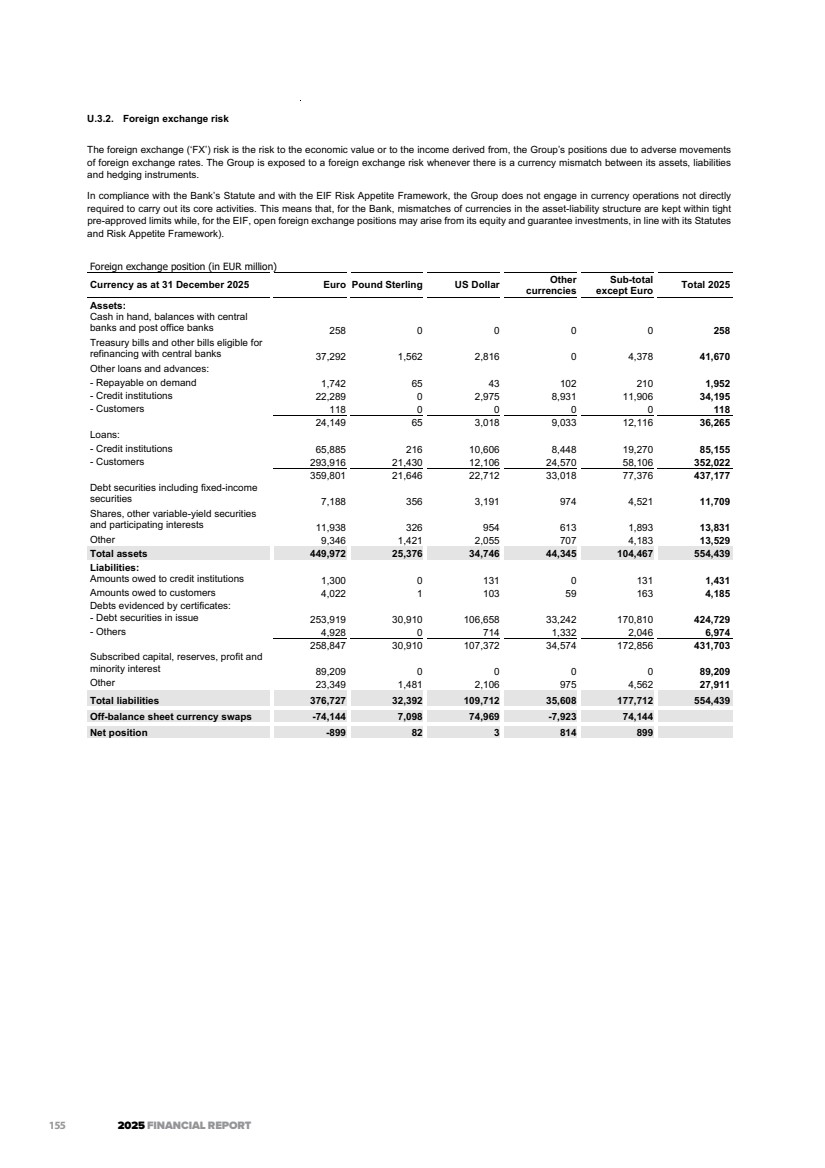
| EIB GROUP CONSOLIDATED FINANCIAL STATEMENTS UNDER EU DIRECTIVES 49 Foreign exchange position (in EUR million) Currency as at 31 December 2024 Euro Pound Sterling US Dollar Other currencies Sub-total except Euro Total 2024 Assets: Cash in hand, balances with central banks and post office banks 105 0 0 0 0 105 Treasury bills and other bills eligible for refinancing with central banks 32,517 1,020 4,578 0 5,598 38,115 Other loans and advances: - Repayable on demand 1,521 65 36 38 139 1,660 - Credit institutions 33,672 289 484 5,674 6,447 40,119 - Customers 235 0 0 0 0 235 35,428 354 520 5,712 6,586 42,014 Loans: - Credit institutions 66,606 519 13,131 9,235 22,885 89,491 - Customers 286,425 24,117 12,206 23,408 59,731 346,156 353,031 24,636 25,337 32,643 82,616 435,647 Debt securities including fixed-income securities 7,187 208 3,222 958 4,388 11,575 Shares, other variable-yield securities and participating interests 10,756 439 1,039 468 1,946 12,702 Other 14,920 1,603 2,191 838 4,632 19,552 Total assets 453,944 28,260 36,887 40,619 105,766 559,710 Liabilities: Amounts owed to credit institutions 827 0 31 0 31 858 Amounts owed to customers 2,971 1 137 102 240 3,211 Debts evidenced by certificates: - Debt securities in issue 248,848 37,075 114,738 35,305 187,118 435,966 - Others 5,132 0 350 1,404 1,754 6,886 253,980 37,075 115,088 36,709 188,872 442,852 Subscribed capital, reserves, profit and minority interest 86,245 0 0 0 0 86,245 Other 21,694 1,629 2,299 922 4,850 26,544 Total liabilities 365,717 38,705 117,555 37,733 193,993 559,710 Off-balance sheet currency swaps -88,880 10,490 80,632 -2,242 88,880 Net position -653 45 -36 644 653 U.4. Liquidity and funding risk Liquidity risk refers to the ability of the Group to fund increases in assets and meet obligations as they come due, without incurring unacceptable losses. It can be further split into funding liquidity risk and market liquidity risk. Funding liquidity risk is connected to the risk for the Group to be unable to refinance the asset side of its consolidated balance sheet and to meet payment obligations punctually and in full out of readily available liquid resources. Funding liquidity risk may have an impact on the volatility in the economic value of, or in the income derived from Group’s positions, due to potentially increasing immediate risks to meet payment obligations and the consequent need to borrow at unattractive conditions. Market liquidity risk is the volatility in the economic value of, or in the income derived from, the Group’s positions due to the potential inability to execute a transaction to offset, eliminate or reduce outstanding positions at reasonable market prices. Such an inability may force the early liquidation of assets at unattractive prices when it would be better to avoid such liquidation. This risk is tied to the size of the position compared to the liquidity of the instrument being transacted, as well as to potential deterioration of market availability and efficiency. Liquidity risk management of the Bank Liquidity risk is managed to ensure the regular functioning of the Bank’s core activities at reasonable cost. The main objective of liquidity policy is to ensure that the Bank can always meet its payment obligations punctually and in full. In contrast to commercial banks, the EIB does not have retail deposits but relies on its access to capital markets to raise the funds it on-lends to its clients. The Bank manages the calendar of its new issues so as to maintain a prudential liquidity buffer. Liquidity planning takes into account the Bank’s needs to service its debt, make disbursements on loans and the cash inflows from the loan portfolio. It also takes into account the sizeable amount of signed but undisbursed loans, whose disbursements typically take place at the borrowers’ request. The Bank further seeks to assure management of liquidity risk by maintaining what it considers a sufficient level of short-term liquid assets and by spreading the maturity dates of its placements based on the projected liquidity needs. The liquidity risk policy also incorporates a floor on treasury levels: The Bank's total liquidity ratio (liquidity as a percentage of the next 12 months projected net cash outflows) must at all times exceed 25%. The Group has a Group Contingency Funding Plan (‘Group CFP’) in place, which specifies decision-making procedures and corresponding responsibilities. The Group CFP is regularly tested and benchmarked against applicable best banking practices, including relevant Guidelines issued by the European Banking Authority in this respect. The Group CFP is approved annually by the Board of Directors of the Bank. Regular stress-testing analyses are executed as part of liquidity risk monitoring and determine the size of the liquidity buffers of the EIB and EIF. 156 |
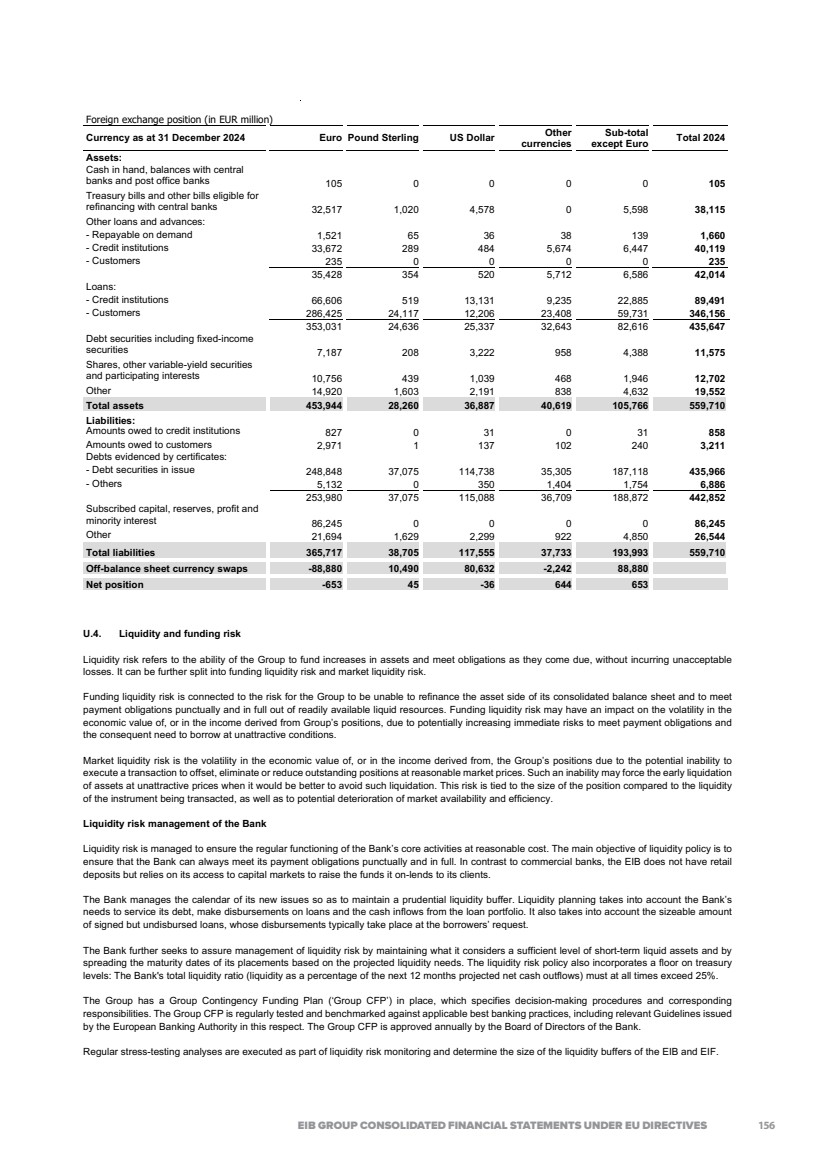
| 2025 FINANCIAL REPORT 50 On 8 July 2009, the Bank became an eligible counterparty in the Eurosystem’s monetary policy operations and has therefore been given access to the monetary policy operations of the European Central Bank. The Bank conducts operations via the Central Bank of Luxembourg, where it maintains deposits to cover the minimum reserve requirement and for other operational needs. The Liquidity Coverage Ratio (‘LCR’) is computed on a daily basis in line with the EU Capital Requirements Regulation (‘CRR’) both in the functional currency (EUR) as well as in the other significant currencies. Consistency of the currency denomination of its liquid assets with its net liquidity outflows is ensured on an ongoing basis, to prevent an excessive currency mismatch. As at 31 December 2025, the Bank’s LCR stood at 658.5% (2024: 724.9%) and the Group LCR stood at 662.8% (2024: 725.8%). In addition, also the Net Stable Funding Ratio (‘NSFR’) is also computed, in line with the EU CRR, both in the functional currency (EUR) as well as in the other significant currencies. As at 31 December 2025, the Bank’s NSFR stood at 120.9% (2024: 122.2%) and the Group NSFR stood at 121.2% (2024: 122.4%). The Group continues to maintain what it regards as a robust liquidity position and flexibility to access the necessary liquidity resources mainly as a result of its prudent approach to liquidity management. As a result, the continued geopolitical and financial turbulences experienced in 2025 had a minimal impact on liquidity and funding. Liquidity risk management of the Fund The Fund defines, in line with the Group as when applicable, liquidity risk as the risk that the Fund may be unable to meet its obligations as they come due, without occurring unacceptable losses. The Fund does not have natural sources of liquidity such as long-term customers’ deposits, access to capital markets or interbank borrowing. It relies mainly on its paid-in capital reserves, retained profits and the cash inflows from its business activities. Therefore, liquidity risk is managed prudently to ensure the regular functioning of the Fund’s core activities at reasonable cost. The Fund short-term liquidity buffer is composed of cash to provide the liquidity needed to meet its short-term commitments under stress conditions. This cushion is calibrated to withstand periods of liquidity stress. EIF long-term liquidity buffer is composed of the cash and the liquidation value of the EIF long-term treasury portfolio (i.e. the stock of Liquid Assets). The EIF long-term treasury portfolio is managed in such a way as to ensure an adequate level of liquidity to meet foreseeable disbursements, protect the value of the funds and earn a reasonable return. Liquidity risk measurement The table below shows the assets and liabilities of the Group by maturity on the basis of the period remaining between the balance sheet date and the contractual maturity date. Assets and liabilities for which there is no contractual maturity date are classified under "Maturity undefined." 157 |
| EIB GROUP CONSOLIDATED FINANCIAL STATEMENTS UNDER EU DIRECTIVES 51 Liquidity risk (in EUR million) Maturity as at 31 December 2025 3 months or less More than 3 months to 1 year More than 1 year to 5 years More than 5 years Maturity undefined Total 2025 Assets: Cash in hand, balances with central banks and post office banks 258 0 0 0 0 258 Treasury bills and other bills eligible for refinancing with central banks 1,571 12,155 15,327 12,617 0 41,670 Other loans and advances: - Repayable on demand 1,952 0 0 0 0 1,952 - Credit institutions 34,195 0 0 0 0 34,195 - Customers 118 0 0 0 0 118 36,265 0 0 0 0 36,265 Loans: - Credit institutions 2,258 7,852 34,053 40,980 12 85,155 - Customers 6,030 20,763 123,013 201,803 413 352,022 8,288 28,615 157,066 242,783 425 437,177 Debt securities including fixed-income securities 403 859 5,354 5,093 0 11,709 Shares, other variable-yield securities and participating interests 0 0 0 0 13,831 13,831 Other 273 335 996 1,173 10,752 13,529 Total assets 47,058 41,964 178,743 261,666 25,008 554,439 Liabilities: Amounts owed to credit institutions 1,431 0 0 0 0 1,431 Amounts owed to customers 4,185 0 0 0 0 4,185 Debts evidenced by certificates 16,533 48,534 193,844 172,792 0 431,703 Subscribed capital, reserves, profit and minority interest 0 0 0 0 89,209 89,209 Other 477 757 5,053 2,181 19,443 27,911 Total liabilities 22,626 49,291 198,897 174,973 108,652 554,439 Some of the borrowings and associated swaps include early termination triggers or call options granted to the hedging swap counterparties. The Bank also has the right to call the related bonds before maturity. If the Bank were to exercise all the call options on its bonds at their next contractual exercise date, cumulated early redemptions for the period 2026-2028 would amount to EUR 2.1 billion. Liquidity risk (in EUR million) Maturity as at 31 December 2024 3 months or less More than 3 months to 1 year More than 1 year to 5 years More than 5 years Maturity undefined Total 2024 Assets: Cash in hand, balances with central banks and post office banks 105 0 0 0 0 105 Treasury bills and other bills eligible for refinancing with central banks 778 14,738 13,052 9,546 0 38,114 Other loans and advances: - Repayable on demand 1,660 0 0 0 0 1,660 - Credit institutions 40,119 0 0 0 0 40,119 - Customers 235 0 0 0 0 235 42,014 0 0 0 0 42,014 Loans: - Credit institutions 4,241 10,178 34,281 40,721 70 89,491 - Customers 6,408 23,146 118,190 197,959 453 346,156 10,649 33,324 152,471 238,680 523 435,647 Debt securities including fixed-income securities 122 903 5,502 5,049 0 11,576 Shares, other variable-yield securities and participating interests 0 0 0 0 12,702 12,702 Other 1,019 1,304 4,311 2,659 10,259 19,552 Total assets 54,687 50,269 175,336 255,934 23,484 559,710 Liabilities: Amounts owed to credit institutions 858 0 0 0 0 858 Amounts owed to customers 3,211 0 0 0 0 3,211 Debts evidenced by certificates 26,336 60,770 178,514 177,232 0 442,852 Subscribed capital, reserves, profit and minority interest 0 0 0 0 86,245 86,245 Other 411 980 3,829 2,613 18,711 26,544 Total liabilities 30,816 61,750 182,343 179,845 104,956 559,710 158 |
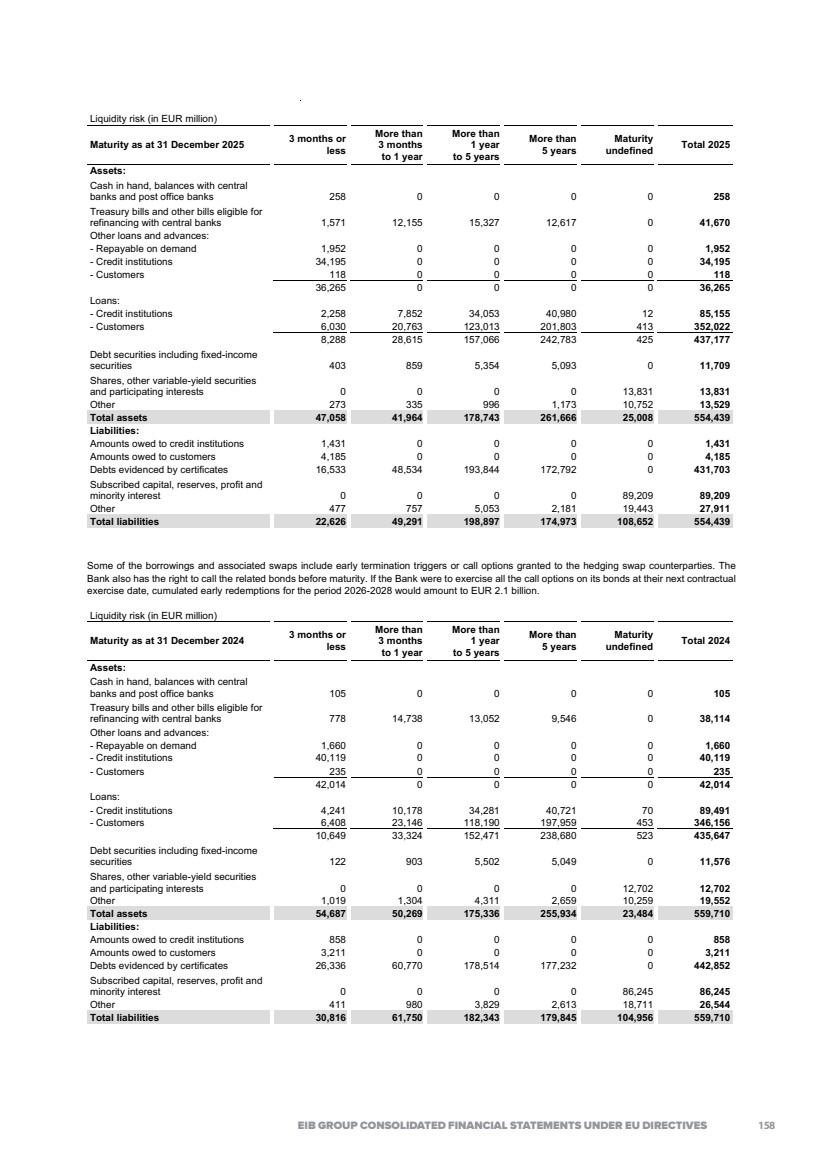
| 2025 FINANCIAL REPORT 52 U.5. Operational risk As defined in the EIB Group Operational Risk Policy, operational risk means the risk of loss resulting from inadequate or failed internal processes, people and systems or from external events10, including, but not limited to, legal risk, model risk or information and communication technology (‘ICT’) risk, but excluding strategic and reputational risk. All Group’s activities may be affected by operational risk and therefore the Group aims to systematically identify, assess, monitor and report operational risks on a regular basis, and ensure that sufficient controls and risk mitigants are in place to limit the exposure to operational risk. The Operational Risk Unit, the Internal Controls and Assertion Division in the EIB Group Risk & Compliance Directorate and the Operational Risk Unit in the EIF Risk Office are responsible for defining the Group Operational Risk Framework and related policies while the responsibility for implementing the Framework lies with all the Departments of the Group. The Group organises its operational risk management activities in compliance with the applicable Best Banking Practice (‘BBP’). In terms of reporting, exposure to operational risk is included in the EIB Group Non-Financial Risk Report which is approved by the Group Chief Risk Officer (‘GCRO’) responsible for overall aspects of managing and monitoring operational risk, and then submitted to the Management Committee (‘MC’), the Audit Committee (‘AC’) and the Board of Directors (‘BoD’). In addition, operational risk losses/gains above EUR 0.25 million are immediately escalated to the President. The Group Risk Appetite Framework (‘RAF’) is formalised in the Group RAF Policy setting the overall guiding principles, processes, roles and responsibilities. The Group RAF takes into account non-financial risks and non-financial risk metrics associated with the various risk categories are reported quarterly to the MC, AC and the BoD. At the EIF, the Operational Risk Unit within Compliance & Non-financial Risk provides regular reporting to the EIF Audit Board (‘AB’) and the Senior Management. The Group has robust compliance controls, including a dedicated Sanctions Compliance Programme, ensuring that its activities comply with all sanctions applicable to EIB Group. With specific reference to sanctions targeting the Russian invasion of Ukraine, no material impact has been identified on Group’s business activities. The Group is a crucial institution of the European Union, and as such, it is a likely target for cyber-attacks. With the ongoing crisis in Ukraine, the risk of direct and spill-over attacks has increased, and the Group is closely monitoring this risk in collaboration with the Computer Emergency Response Team for the EU institutions, bodies and agencies (‘CERT-EU’). To ensure the security and integrity of its operations, the Group has implemented robust security measures to protect against cyber-attacks. Note V – Derivatives The Bank uses derivative instruments as part of its market risk management of its exposures to interest rate and foreign currency risks, including exposures arising from committed transactions settling in the future, and as part of its liquidity management. Derivatives are financial instruments, the payoff of which depends on the prices of the underlying assets, interest rates, exchange rates or indices. The Fund does not use derivatives instruments. The Bank’s long-term swaps are concluded to hedge the interest rate and foreign currency risks arising from borrowings, loans and bond holdings in the form of micro-hedges or in the context of global Asset and Liability Management (‘ALM’) positions (see Note V.1.). As part of the Asset and Liability Management, the Bank uses natural hedges (offsets between loans and borrowings), when deemed appropriate and possible. Remaining exposures are managed through derivatives executed at the portfolio level on a net basis (‘hedging swaps for ALM purposes’). The Bank also enters into short-term currency swap contracts to adjust currency positions in its operational treasury portfolios in relation to its benchmark currency, the euro, and to cater for demand for currencies in connection with loan disbursements (see Note V.2.). Future contracts (futures) can be used in the context of treasury activities, to hedge the exposure deriving from some investments in government bonds. Futures are standardised derivatives traded on regulated markets. They do not fall within the general policy for counterparty risk measurement and control. V.1. Hedging and asset and liability management (‘ALM’) derivatives The derivatives used in the context of hedging and ALM hedging activities are: • Currency swaps; • Interest rate swaps; and • Structured swaps. V.1.1. Currency swaps Currency swaps are contracts under which it is agreed to exchange principal and interest payments in one currency against another currency. The Bank enters into currency swaps mainly to hedge its borrowings and loans. 10 The definition of external events excludes cases of client bankruptcy or unfavourable market movements or similar events, which represent triggers for Credit and respectively Market Risk. 159 |
| EIB GROUP CONSOLIDATED FINANCIAL STATEMENTS UNDER EU DIRECTIVES 53 The following table shows the maturities of currency swaps (including structured swaps – see Note V.1.3 and excluding short-term currency swaps – see Note V.2.), broken down according to their notional amount and fair value. The notional amounts are disclosed off-balance sheet. Currency swaps as at 31 December 2025 (in EUR million) 1 year or less More than 1 year and up to 5 years More than 5 years and up to 10 years More than 10 years Total 2025 Notional amount (receivable) 28,078 111,315 43,179 22,583 205,155 Fair value (i.e. net discounted value including CVA, DVA and CollVA)(*) 380 -2,501 -624 217 -2,528 Currency swaps as at 31 December 2024 (in EUR million) 1 year or less More than 1 year and up to 5 years More than 5 years and up to 10 years More than 10 years Total 2024 Notional amount (receivable) 48,402 114,886 45,760 24,077 233,125 Fair value (i.e. net discounted value including CVA, DVA and CollVA)(*) 1,015 2,648 936 157 4,756 (*) Including the fair value of hedging swaps for ALM purposes which stood at EUR -2,218 million as at 31 December 2025 (2024: EUR 5,678 million). V.1.2. Interest rate swaps Interest rate swaps are contracts under which, generally, it is agreed to exchange floating-rate interest for fixed-rate interest payments, or floating-rate interest payments linked to different rates (basis swaps), in the same currency. Interest rate swaps enable the Bank to hedge the interest rate risk of its borrowings, loans and bond holdings, and modify the interest rate structure of the balance sheet. The following table shows the maturities of interest rate swaps (including structured swaps – see Note V.1.3 and including synthetic swaps, whereby interest computed in a foreign currency is synthetically converted to EUR), sub-divided according to their notional amount and fair value. The notional amounts are disclosed off-balance sheet. Interest rate swaps as at 31 December 2025 (in EUR million) 1 year or less More than 1 year and up to 5 years More than 5 years and up to 10 years More than 10 years Total 2025 Notional amount 68,479 255,676 158,466 149,357 631,978 Fair value (i.e. net discounted value including CVA, DVA and CollVA)(*) 306 514 -2,407 1,391 -196 Interest rate swaps as at 31 December 2024 (in EUR million) 1 year or less More than 1 year and up to 5 years More than 5 years and up to 10 years More than 10 years Total 2024 Notional amount 113,801 229,664 164,221 148,107 655,793 Fair value (i.e. net discounted value including CVA, DVA and CollVA)(*) 81 -1,274 -2,889 189 -3,893 (*) Including the fair value of hedging swaps for ALM purposes which stood at EUR -59 million as at 31 December 2025 (2024: EUR -59 million). V.1.3. Structured swaps The Bank enters into borrowing contracts and loans encompassing options on interest rates, exchange rates, inflation rates and stock indices. Such structured borrowings and loans are entirely covered by swap contracts to hedge the corresponding market risk. The table below further details the number, fair value and notional amounts of structured swaps: Structured swaps as at 31 December Early termination embedded Structured coupon 2025 2024 2025 2024 Number of transactions 107 102 127 128 Notional amount (in EUR million) 4,416 4,813 6,531 7,350 Fair value (i.e. net discounted value including CVA, DVA and CollVA) (in EUR million) -617 -499 -1,647 -1,911 160 |
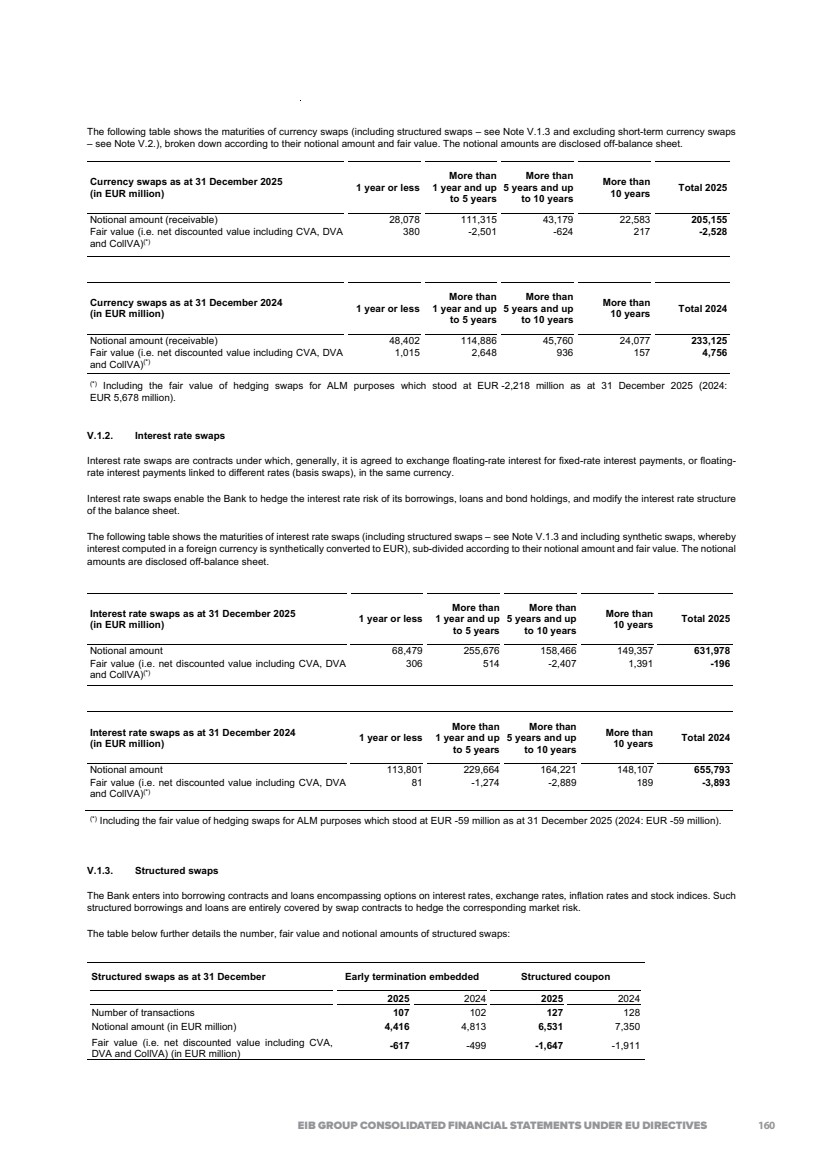
| 2025 FINANCIAL REPORT 54 The fair value of structured swap transactions is computed using option pricing models, calibrated to available market prices of options. For a portion of derivative transactions, internal estimates and assumptions might be used in the valuation techniques when the market inputs are not directly available. All option contracts embedded in, or linked with, borrowings are negotiated over the counter. V.1.4. Derivatives credit risk mitigation policy The credit risk policy for derivative transactions is based on the definition of eligibility conditions and rating-related limits for swap counterparts. To reduce credit exposures, the Bank has signed Credit Support Annexes with most of its active swap counterparts and receives collaterals when the exposure exceeds certain contractually defined thresholds. The credit risk with respect to derivatives lies in the loss that the Bank would incur if a counterparty is unable to honour its contractual obligations. In view of the special nature and complexity of derivative transactions, a series of procedures has been put in place to safeguard the Bank against losses arising from the use of such instruments. • Contractual framework: All of the Bank’s derivative transactions are concluded under the contractual framework of ISDA Swap Agreements and where applicable Credit Support Annexes, which specify the conditions of exposure collateralisation. These are generally accepted and practised contract types. Minimum conditions for new agreements are specified in the risk guidelines. • Counterparty selection: The minimum rating at the outset is set in the risk guidelines at A3. The EIB has in most cases a right of early termination if the counterparty rating drops below a certain level. • Collateralisation: - Exposures (in some cases subject to thresholds) are collateralised by cash and bonds. - Certain transactions are collateralised above the current market value. - Both the derivatives portfolio with individual counterparties and the collateral received are regularly monitored and valued, with a subsequent call for additional collateral or collateral release. As part of the ISDA agreements, the Bank has received securities and cash that it is allowed to sell or repledge. The fair value of the securities accepted under these terms amounts to EUR 3,996 million as at 31 December 2025 (2024: EUR 5,548 million), with the following composition, detailed based on the nature of the collateral and based on Moody’s equivalent rating: Swap collateral (in EUR million) Moody's equivalent rating Bonds Cash Total 2025 Government Agency, supranational, covered bonds Aaa 434 465 0 899 Aa1 to Aa3 489 0 0 489 A1 to A3 395 0 0 395 Baa1 to Baa3 1,802 0 0 1,802 Non-rated 0 0 411 411 Total 2025 3,120 465 411 3,996 Swap collateral (in EUR million) Moody's equivalent rating Bonds Cash Total 2024 Government Agency, supranational, covered bonds Aaa 162 462 0 624 Aa1 to Aa3 2,238 0 0 2,238 A1 to A3 5 0 0 5 Baa1 to Baa3 1,965 0 0 1,965 Non-rated 0 0 716 716 Total 2024 4,370 462 716 5,548 The Bank has implemented the usage of an IT system, the Collateral management system (‘CMS’). The key objective of the CMS is to ensure that the Bank is capable to utilise for repos a real-time inventory of assets and collateral accepted in secured markets. Securities received as collateral for loans, derivatives and reverse repos, repos are valued in CMS on a daily basis, by using prices quoted in active markets, supplied by a Market Price Service Provider (i.e. Bloomberg) or, if quoted prices are not available, by using market-based valuations. 161 |
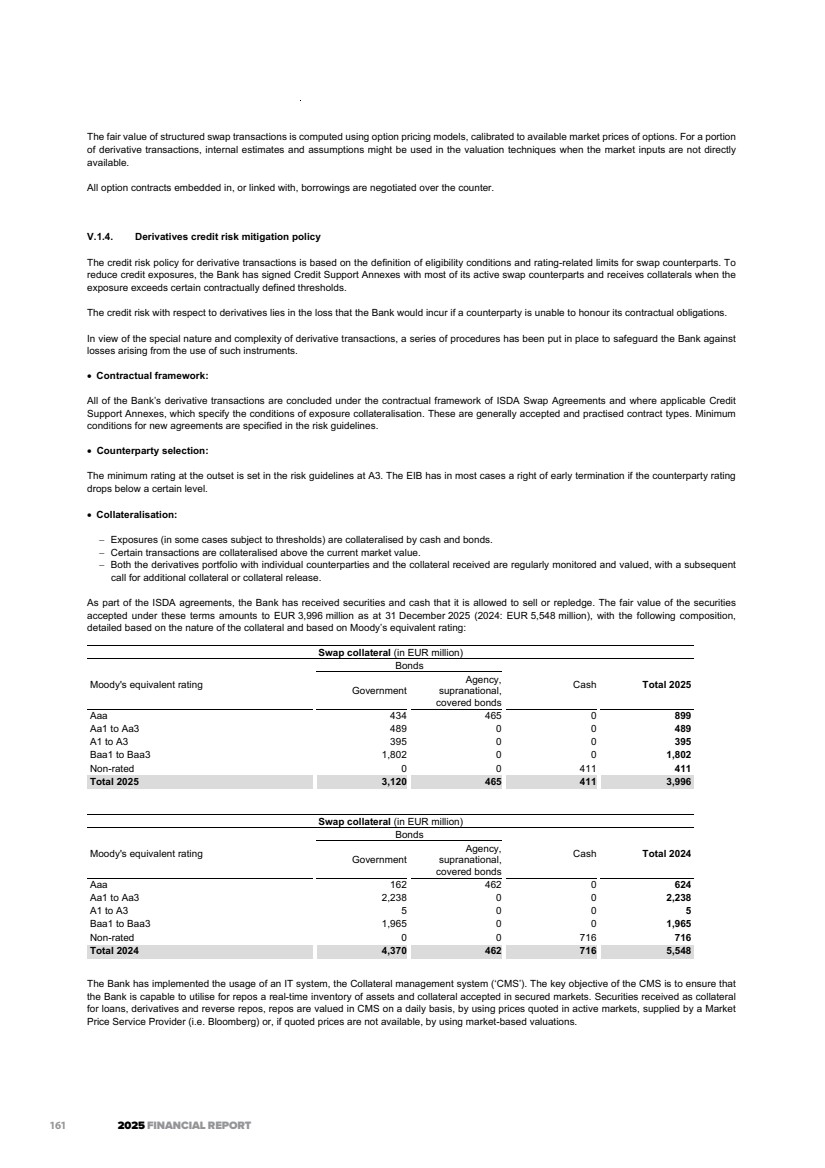
| EIB GROUP CONSOLIDATED FINANCIAL STATEMENTS UNDER EU DIRECTIVES 55 • Credit risk measurement for derivatives: The credit risk associated with derivatives varies according to a number of factors (such as interest and exchange rates) and generally corresponds to only a small portion of their notional value. For internal purposes, the Bank measures the credit risk exposure related to swaps and derivatives transactions using the Current Unsecured Exposure and the Potential Future Exposure for reporting and limit monitoring. It uses the Standardised Approach for Counterparty Credit Risk (‘SA-CCR’) for regulatory capital allocation in accordance with the EU Capital Requirements Regulation (‘CRR’). The Bank computes the Current Unsecured Exposure, which is the larger of zero and the market value of the portfolio of transactions within the netting set with a counterparty, less the value of collateral received. It is the amount that would be lost upon the default of the counterparty, using the received collateral and assuming no recovery on the value of those transactions in the event of bankruptcy as well as immediate replacement of the swap counterparty for all the transactions. As at 31 December 2025, the current unsecured exposure stood at EUR 176 million (EUR 255 million as at 31 December 2024). Additionally, the Bank computes the Potential Future Exposure, which takes into account the possible increase in the netting set’s exposure over the margin period of risk of 20 business days. The EIB computes the Potential Future Exposure at 90% confidence level using stressed market parameters to arrive at conservative estimates. This is in line with the recommendations issued by regulators to take into consideration the conditions that will prevail in the event of default of an important market participant. • Limits: The limit system for banks covers the Potential Future Exposure in 3 time buckets (under 1 year, between 1 and 5 years and over 5 years) and in 2 rating scenarios (current and downgrade below A3). The derivatives portfolio is valued and compared against limits on a daily basis. The following table provides a breakdown of counterparties by internal rating. Grouped ratings Percentage of nominal Current Unsecured Exposure (in EUR million) Moody’s equivalent rating 2025 2024 2025 2024 Aaa 0.40% 0.42% 0 0 Aa1 to Aa3 52.90% 38.13% 119 172 A1 to A3 46.63% 60.74% 57 80 Below A3 0.07% 0.71% 0 3 Total 100.00% 100.00% 176 255 V.2. As part of treasury management Long-term futures are also used by the Bank to adjust the interest rate exposure of its SLP bond portfolios. The notional amount of long-term futures stood at EUR 44,443 million as at 31 December 2025 (2024: EUR 33,352 million), with a EUR -13 million fair value (2024: EUR -14 million). The Bank also enters into short-term currency swap contracts to adjust currency positions in its operational treasury portfolios relative to its benchmark currency, the euro, and to cater for demand for currencies in connection with loan disbursements. The notional amount of short-term currency swaps receivable stood at EUR 22,930 million as at 31 December 2025 (2024: EUR 19,688 million). The fair value of these contracts was EUR -92 million as at 31 December 2025 (2024: EUR 184 million). The EIF does not use derivatives as part of treasury management activities. 162 |
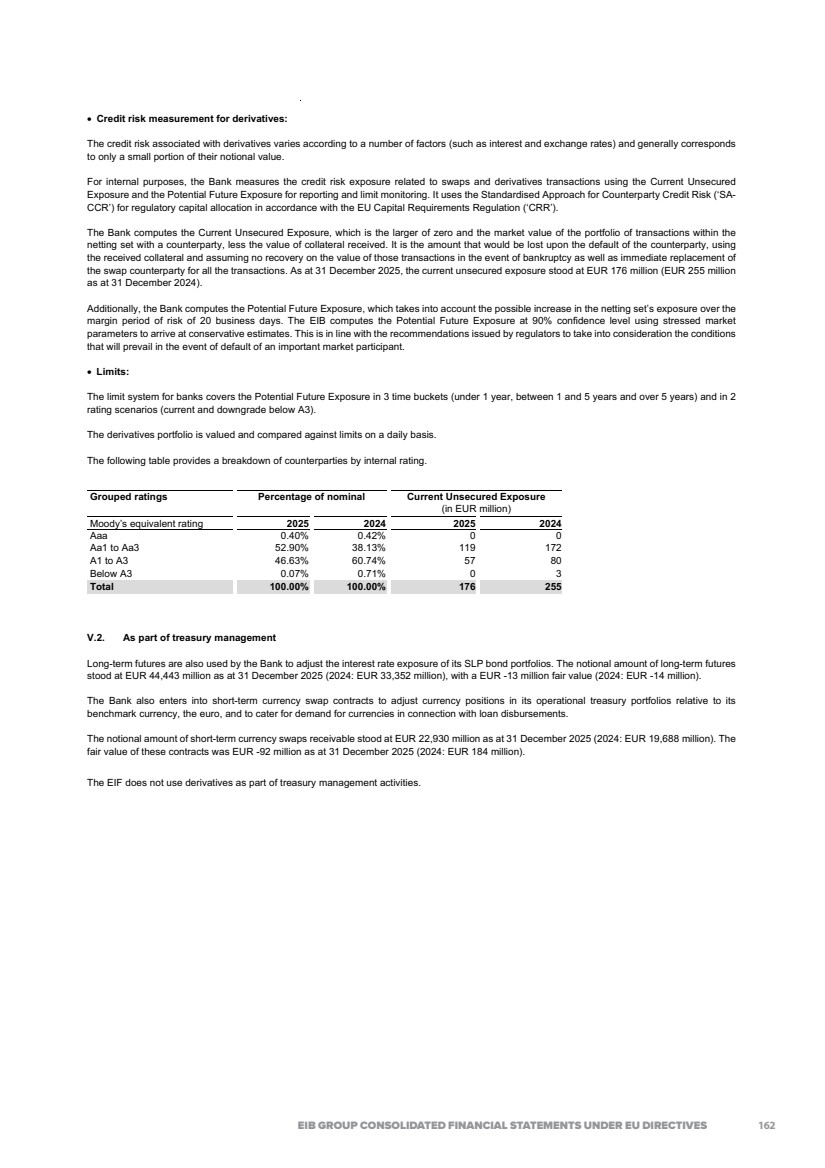
| 2025 FINANCIAL REPORT 56 Note W – Conversion rates The following conversion rates were used for drawing up the balance sheets as at 31 December 2025 and 2024: 31.12.2025 31.12.2024 Non-euro currencies of EU Member States Bulgarian Lev (BGN) 1.9558 1.9558 Czech Koruna (CZK) 24.2370 25.1850 Danish Krone (DKK) 7.4689 7.4578 Hungarian Forint (HUF) 385.1500 411.3500 Polish Zloty (PLN) 4.2210 4.2750 Romanian Leu (RON) 5.0968 4.9743 Swedish Krona (SEK) 10.8215 11.4590 Non-EU currencies Armenian Dram (AMD) 446.1600 410.4300 Australian Dollar (AUD) 1.7581 1.6772 Azerbaijani Manat (AZN) 1.9882 1.7587 Brazilian Real (BRL) 6.4364 6.4253 Canadian Dollar (CAD) 1.6088 1.4948 Swiss Franc (CHF) 0.9314 0.9412 Chinese Renminbi (CNY) 8.2262 7.5833 Colombian Peso (COP) 4,426.4600 4,567.4700 Dominican Peso (DOP) 73.7817 63.0861 Egyptian Pound (EGP) 55.7762 52.6893 Ethiopian Birr (ETB) 181.6840 130.4620 Pound Sterling (GBP) 0.8726 0.8292 Georgian Lari (GEL) 3.1260 2.8845 Hong Kong Dollar (HKD) 9.1464 8.0686 Indian Rupee (INR) 105.5965 88.9335 Jordanian Dinar (JOD) 0.8305 0.7355 Japanese Yen (JPY) 184.0900 163.0600 Kenyan Shilling (KES) 151.2000 133.6900 Kazakhstani Tenge (KZT) 594.5800 544.3200 Moroccan Dirham (MAD) 10.7012 10.4987 Moldovan Leu (MDL) 19.5800 18.9700 Mexican Peso (MXN) 21.1180 21.5504 Norwegian Krone (NOK) 11.8430 11.7950 New Zealand Dollar (NZD) 2.0380 1.8532 Serbian Dinar (RSD) 117.1900 116.8300 Russian Ruble (RUB) 92.7790 113.8719 Tunisian Dinar (TND) 3.3906 3.3039 Turkish Lira (TRY) 50.4838 36.7372 Tanzanian Shilling (TZS) 2,862.1200 2,490.2400 Ukrainian Hryvnia (UAH) 49.3255 43.5377 Ugandan Shilling (UGX) 4,240.0000 3,812.0000 United States Dollar (USD) 1.1750 1.0389 Central African CFA Franc (XAF) 655.9570 655.9570 West African CFA Franc (XOF) 655.9570 655.9570 South African Rand (ZAR) 19.4439 19.6188 163 |
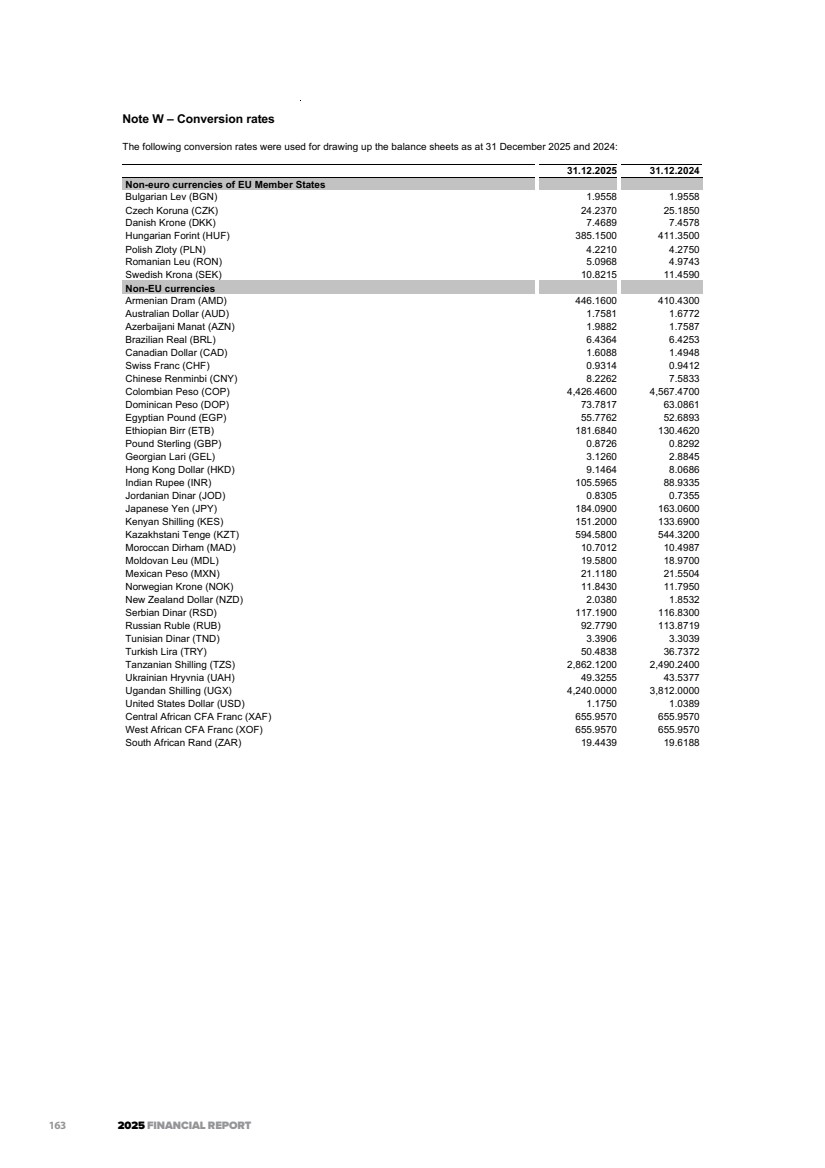
| EIB GROUP CONSOLIDATED FINANCIAL STATEMENTS UNDER EU DIRECTIVES 1 Note X – Related party transactions (in EUR ’000) X.1. Participating interests The amounts included in the consolidated financial statements concerning participating interests are disclosed as follows: 31.12.2025 31.12.2024 Participating interests 542,863 540,637 Value (re-)adjustments in respect of transferable securities held as financial fixed assets and participating interests -7,666 -10,412 Participating interests - uncalled 660,362 694,924 X.2. Key management personnel (in EUR ‘000) The Group has identified members of the Board of Directors, the Audit Committee, the Management Committee, the GCRO and the Directors General heading the different EIB organisational directorates, as well as the head of Internal Audit independent department, as key management personnel. Key management personnel compensation for the relevant reporting periods, included within “General administrative expenses” (Note R), is disclosed in the following table: 2025 2024 Short-term benefits(1) 11,818 12,104 Post-employment benefits(2) 920 1,028 Termination benefits 664 398 Total 13,402 13,530 (1) Short-term employee benefits comprise salaries and allowances, bonuses and social security contributions of the Management Committee, the GCRO, Directors General and other Directors, and benefits paid to the members of the Board of Directors and the Audit Committee. (2) Post-employment benefits comprise pensions and expenses for post-employment health insurance paid to members of the Management Committee, the GCRO, the Directors General and other Directors. There were neither advances nor credit granted to key management personnel, nor commitments entered into on their behalf by way of guarantee of any kind. Open balances with key management personnel as at 31 December 2025 comprise the compulsory and optional supplementary pension plan and health insurance scheme liabilities, and payments outstanding as at the year end: 31.12.2025 31.12.2024 Pension plans and health insurance (Note L) 93,671 92,979 Other liabilities (Note G) 13,436 18,609 Note Y – Post balance sheet events EIB is continuously assessing its portfolio in view of heightened geopolitical risks, particularly those arising from the recent military escalation in the Gulf region. While it is too early to assess long-term implications for the overall loan portfolio, the evolving market conditions and sector-specific pressures are being closely monitored. Note D.3 provides a detailed geographical breakdown of the disbursed and undisbursed lending exposure by country in which projects are located. There have been no other material events after the balance sheet date that would require adjustment of, or disclosure in, the consolidated Financial Statements as at 31 December 2025. 164 |
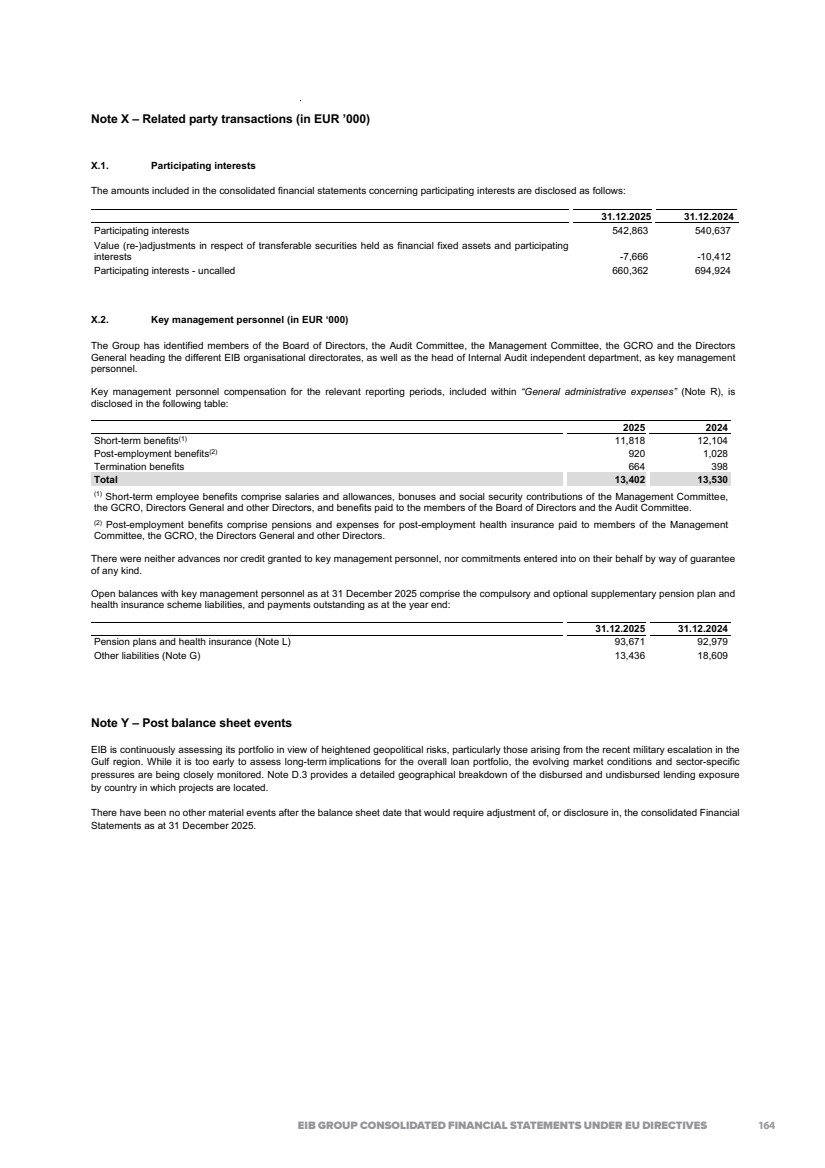
| 2025 FINANCIAL REPORT 1 Note Z – Management of third-party funds Z.1. Innovation Fund The Innovation Fund established under Article 10a(8) of Directive 2003/87/EC supports innovation in low-carbon technologies and processes across all Member States. This includes environmentally safe carbon capture and utilisation which contributes substantially to mitigating climate change, and products to replace carbon intensive alternatives. The Fund also aims to promote the construction and operation of projects focused on environmentally safe capture and geological storage of CO2, alongside innovative renewable energy and energy storage technologies. The EIB prepares separate financial statements for the Innovation Fund. Z.2. Modernisation Fund The Modernisation Fund, established under Article 10d of the revised EU Emissions Trading System (‘ETS’) Directive, aims to modernise the energy systems and improve the energy efficiency of 13 EU beneficiary Member States: Bulgaria, Czech Republic, Croatia, Estonia, Greece, Hungary, Latvia, Lithuania, Poland, Portugal, Romania, Slovakia and Slovenia. The Modernisation Fund supports investments in the generation and use of energy from renewable sources, energy efficiency, energy storage, the modernisation of energy networks, including district heating, pipelines and grids, redeployment, the re-skilling and upskilling of workers, education, job-seeking initiatives and start-ups. The EIB prepares separate financial statements for the Modernisation Fund. Z.3. Recovery and Resilience Facility Financial Instruments (‘RRF-FI’) The EIB manages and invests RRF resources on behalf of the respective EU Member States according to an investment strategy and business plan agreed in a funding agreement between the EIB and the mandator. Furthermore, the EIB performs fund administration tasks (including monitoring, reporting, treasury management). If requested by the EU Member States, the mandate can also embed the Bank’s advisory support. RRF-FI can be implemented in three ways: (i) direct implementation, where the EIB directly selects and appraises underlying operations, (ii) indirect implementation through a financial intermediary, and (iii) blending. RRF Equity Cyprus RRF Equity Cyprus is the first equity mandate signed between the EIF and the Republic of Cyprus. The mandate is structured as a direct award of EUR 30 million to the EIF, financed by the National Recovery and Resilience Plan of Cyprus (EUR 20 million) and reflows from the JEREMIE programme of the 2007-2013 PP. The mandate foresees the deployment of a generalist VC fund targeting innovative enterprises and start-ups in their (pre-) seed and early stages of development. This will be the first VC fund deployed in the country with the support of public resources. RRF Equity Bulgaria The RRF Equity Bulgaria mandate is structured as a direct award of EUR 180 million to the EIF under the National Recovery and Resilience Plan of Bulgarian, in connection with the country's Recovery and Resilience Facility established by Regulation (EU) 2021/241. Equity financing will be provided to support investments under three windows, namely: - Equity instruments for Growth (initial budget allocation of up to EUR 75 million) - Equity instruments for Innovation (initial budget allocation of up to EUR 75 million) - Equity instruments for climate neutrality and digital transformation investments (initial budget allocation of up to EUR 30 million) The mandate will help alleviate the negative impacts of the pandemic on the Bulgarian market in general and more risky undertakings, in particular, by providing equity financing to TT projects, SMEs and mid-caps that will be used to foster innovation and help the transition to the knowledge economy; it will also finance equity investments (e.g. infrastructure projects) supporting climate neutrality and digital transformation. Recovery and Resilience Facility - Czech Republic Also called the RRF Czech Republic Fund of Funds (RRFCZ FoF), the mandate represents an RRF-funded programme with an initial funding of EUR 55 million to be deployed in three specialised venture capital funds focused on investments in mainly Czech start-ups developing strategic digital technologies – a pre-seed co-investment fund, a fintech/blockchain fund and a university AI TT fund. The available funding has been increased by additional EUR 80 million in 2024 for commitments to additional funds with broader strategies, aiming to support additional sectors considered to be of strategic importance to the Czech Republic. RRF Bulgaria debt The Bulgarian Government has earmarked in the Recovery and Resilience Plan (“RRP”) a total amount of EUR 150 million for the deployment by the EIF of two portfolio guarantee instruments, both based on the eligibility criteria of the relevant InvestEU EU-Compartment (“EU-C”) instruments, namely: (i) EUR 75 million of RRP resources for the Sustainability Guarantee; and (ii) EUR 75 million of RRP resources for the SME Competitiveness Guarantee. The Contribution Agreement was signed in November 2022, and the InvestEU Guarantee Agreement Amendment including the and MS-C Schedule for Bulgaria was signed on 10 August 2023. The mandate, via the SME Competitiveness Guarantee, would ultimately contribute to strengthening the resilience, increase productivity and support the sustainable growth of Bulgarian companies. In addition, for 50% of the mandate resources, the Sustainability Guarantee aims to address Bulgaria’s current challenges in supporting investments in the energy efficiency and renewable energy sectors, contributing to the green and sustainable transformation of the local economy and to the achievement of the climate targets. RRF Romania debt The EIF was approached by the Romanian Government in February 2021 for the implementation of financial instruments under the RRF. After the Mandate AA approval at PMC, based on the feedback received from the EC, it was decided to approach the debt component as an InvestEU MS-C contribution and the equity component as a direct award. The InvestEU Guarantee Agreement Amendment including the MS-C applicable framework 165 |
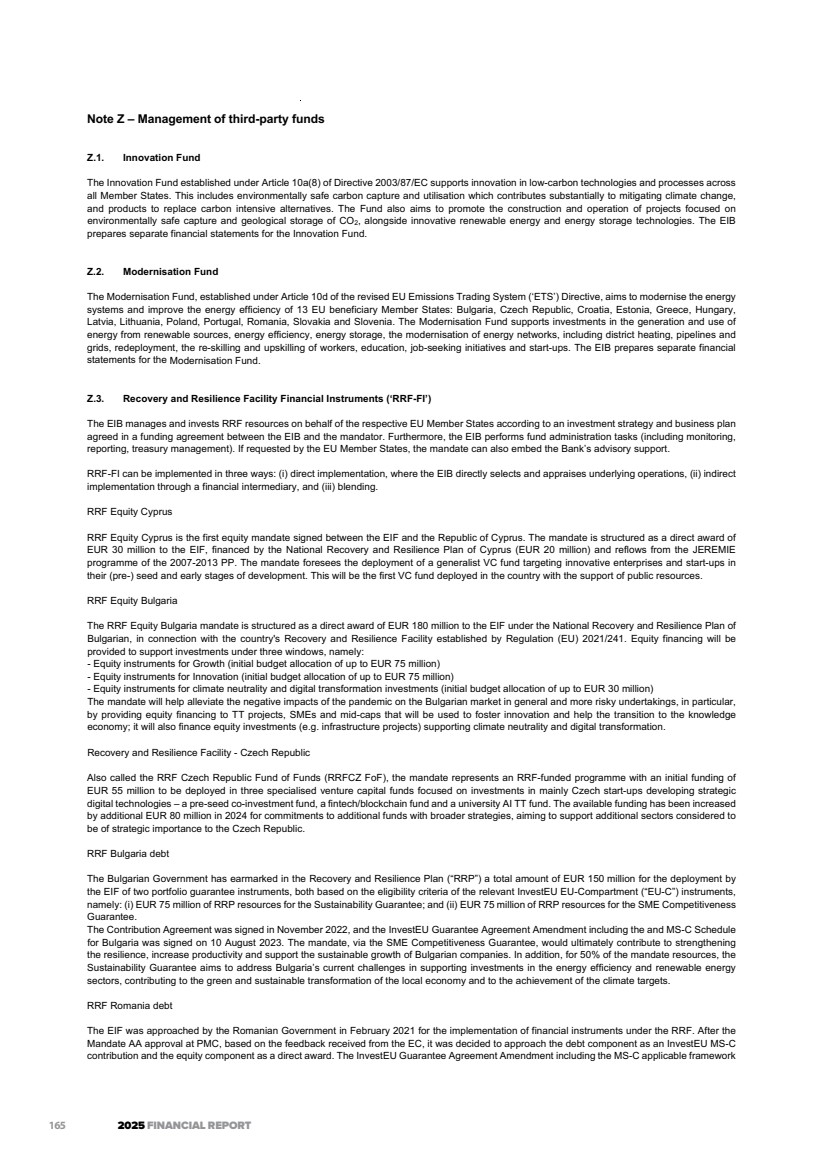
| EIB GROUP CONSOLIDATED FINANCIAL STATEMENTS UNDER EU DIRECTIVES 2 and MS-C Schedule for Romania was signed on 23 May 2023. The mandate, via the Competitiveness Guarantee, would ultimately contribute to strengthening the resilience, increase productivity and competitiveness of the Romanian companies. In addition, for 40% of the mandate RRF resources, the Sustainability Guarantee aims to address Romania’s current challenges in supporting investments in the energy efficiency and renewable energy sectors, contributing to the green and sustainable transformation of the local economy and to the achievement of the climate targets. RRF Greece The Greek Government contributed EUR 400 million with the EIF as Implementing Partner in the context of an overall contribution of EUR 500 million to the MS Compartment of InvestEU. The EIF and EIB had liaised with the Ministry of Finance and proposed standard guarantees employed under the EU compartment of InvestEU. The MS has selected the Sustainability, SME Competitiveness and Innovation / Digitalisation. Spain RRF - Climate & Infra This new instrument agreement falls within the Implementing Agreement signed between the EIF, the EIB and Spain with regards to the use of the RRF. It is a EUR 500 million mandate focused on investing into climate and infrastructure funds that will provide equity investments with a primary focus on climate action and environmental sustainability, as well as digital infrastructure. Spain RRF – ALSD An additional EUR 200 million made available for a total of up to EUR 400 million to be invested based on the intermediation of Private Credit funds as alternative lenders. Z.4. Investment Facility – Cotonou The Investment Facility, which is managed by the EIB, was established under the Cotonou Agreement on cooperation and development between the African, Caribbean and Pacific Group of States and the European Union and its Member States on 23 June 2000 and subsequently revised. The EIB prepares separate financial statements for the Investment Facility. Z.5. InnovFin - EU Finance for Innovators (‘InnovFin’) InnovFin is a joint initiative between the EIB, the EIF and the European Commission under the new EU research programme for 2014-2020 (‘Horizon 2020’). On 11 December 2013, Regulation (EU) No. 1291/2013 of the European Parliament and the Council establishing Horizon 2020 – the Framework Programme for Research and Innovation (2014-2020) and repealing Decision No. 1982/2006/EC (‘Horizon 2020 Regulation’) was adopted. On 12 June 2014, the European Commission, the EIB and the EIF signed a Delegation Agreement establishing the financial instrument InnovFin. InnovFin consists of a series of integrated and complementary financing tools and advisory services offered by the EIB Group to support investments across the entire research and innovation value chain, catering to enterprises of all sizes, from the smallest to the largest. The EIB prepares separate financial statements for InnovFin. Z.6. InvestEU On 7 March 2022, the EU, the EIB and the EIF signed a Guarantee Agreement establishing the EU guarantee under InvestEU. The InvestEU programme aims to give an additional boost to sustainable investment, innovation, social inclusion and job creation in Europe. InvestEU is expected to stimulate public and private investments by using a EUR 26.2 billion EU budgetary guarantee, 75% of this is granted separately to the EIB and the EIF. On 1 April 2022, all operations in the EFSI Debt Standard Portfolio and in the EFSI Hybrid Portfolio were transferred to InvestEU. These operations originally guaranteed under the EFSI Agreement, are defined as the ‘Pre-2021 Operations’. The EIB prepares separate financial statements for InvestEU. Finland Climate Action Guarantee The EIF was approached by the Finnish Government in March 2021 to implement a financial instrument focused on green transitioning. The contribution from Finland is made via InvestEU. The Contribution Agreement was signed in September 2022, while the InvestEU Guarantee Amendment including the MS-C Schedule for Finland was signed on 10 August 2023. The Finland Climate Action Guarantee aims to address Finland’s current challenges in supporting investments in the energy efficiency and renewable energy sectors. The Finland Climate Action Guarantee will facilitate access to finance for clean and efficient production and use of energy, sustainable and efficient infrastructure as well as research and innovation of low-carbon solutions, ultimately contributing to the green and sustainable transformation of the local economy and to the achievement of the climate targets. EDF Top-Up (European Defence Fund) A top-up to the InvestEU Mandate supporting the Target Area of Defence under the Enabling Sectors sub-product. EUR 100 million received in tranches from the European Defence Fund, which – when combined with EIF own resources – results in c. EUR 175 million of investment capacity. Operations to support funds with strategies that include solutions and technologies with dual-use potential that will accelerate the evolution of Europe’s technological and industrial base in the area of defence. InvestEU Climate Mitigation Following the signature of the 3rd IEU amendment, a new uncapped portfolio is envisaged with top-up commitments from an existing (SIW) window, designed to deploy a specific component of the sustainability guarantee product of InvestEU. 166 |
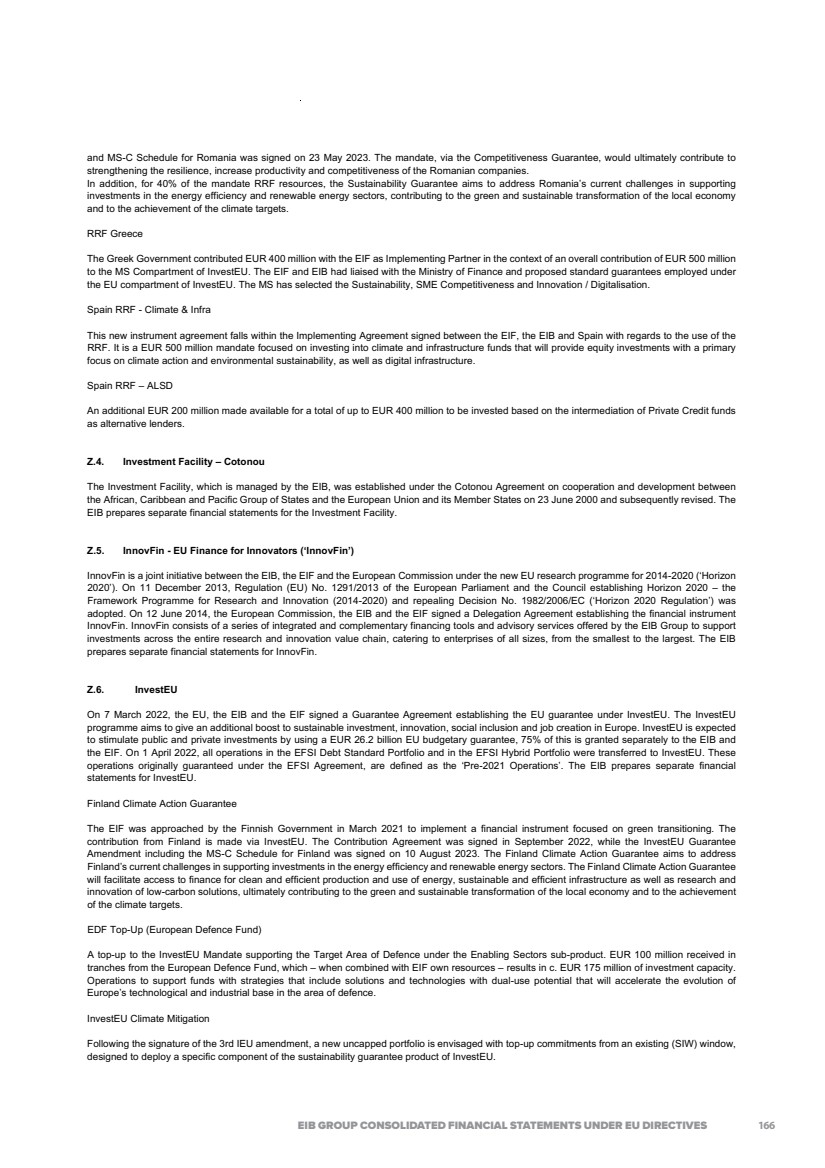
| 2025 FINANCIAL REPORT 3 Spain Recovery and Resilience Facility - Alternative Lending for Sustainable Development. The mandate envisages up to EUR 400 million to be invested via Private Credit funds. Such alternative lenders are typically not eligible to work with other implementing partners under the Spanish Recovery and Resilience Programme. Spain Recovery and Resilience Facility - Member State Compartment. EIF’s intervention is sought for the support of Spanish businesses through i) up to EUR 600 million (EUR 500 million Recovery and Resilience Facility resources and up to EUR 100 million national resources) for: 1) contribution to the InvestEU MS-C to cover existing EIF thematic portfolio guarantee products; and 2) a EUR 400 million contribution to a Senior Private Credit Instrument (the “SPC Instrument”) to support loan funds. InvestEU The Transaction Cost Support pilot will be available for funds operating in the impact space, specifically targeting first-time teams, emerging teams and women-led teams. The Transaction Cost Support is a scheme in the form of a non-repayable lump sum payment to be combined with commitment undertaken by EIF for the Social Impact Equity Product under InvestEU Social Investment and Skills Window. The full mandate size is EUR 10 million. Z.7. NER300 The EIB supports the European Commission as an agent in the implementation of the NER 300 initiative a funding programme for carbon capture and storage demonstration projects and innovative renewable energy technologies. The facility covers two activities i) the monetisation of EU allowance units (‘EUAs’) and ii) the management and disbursement of cash received through such monetisation activities. The EIB prepares separate financial statements for NER300. Z.8. Connecting Europe Facility (‘CEF’) The CEF is a joint agreement between the EIB and the European Commission that aims to provide union financial assistance to trans-European networks to support projects of common interest in the transport, telecommunications and energy infrastructures sectors. The European Commission entrusted EIB with the implementation and management of the debt instrument under the CEF, which ensures continuity of the Loan Guarantee Instrument for TEN-T Projects (‘LGTT’) and the Pilot phase of Project Bond Initiative (‘PBI’), which were merged under the CEF on 1 January 2016. The CEF Delegation Agreement includes an updated and harmonised risk sharing arrangement. The EIB prepares separate financial statements for the CEF. Z.9. Pan-European Guarantee Fund (‘EGF’) The EGF was endorsed by the European Council on 23 April 2020 as part of the overall EU’s COVID-19 response package. 22 Member States confirmed their participation with an overall guarantee of EUR 24.4 billion euro, available exclusively to entities in participating countries. The EGF is designed to finance high-risk operations and final beneficiaries that would meet financial intermediaries’ requirements for commercial financing but are struggling due to the economic impact of the COVID-19 pandemic. At least 65% of EGF supported financing is therefore allocated to small and medium-sized enterprises (‘SMEs’). The EGF is jointly implemented by the EIB and the EIF, each responsible for approximately half of the amount but with a distinct product offering. The EIF focuses on capped and uncapped portfolio guarantees and indirect equity-type investments (funds), while the EIB deploys products such as linked risk sharing, venture debt and synthetic Asset Based Securities. The EIB prepares separate financial statements for the EGF. Z.10. European Structural Investment Fund (‘ESIF’) Under the European Structural Investment Fund (‘ESIF’), Member States appointed the EIF to manage ESIF funds as Holding Fund manager since November 2015. The ESIF initiative is aimed at promoting SME access to finance and financial engineering products, such as private equity funds, guarantee funds and loan funds. The EIF is currently managing 19 ESIF Funding Agreements signed with Member States and regions: Basse-Normandie and Languedoc-Roussillon. The EIF prepares separate financial statements for ESIF. European Structural and Investment Funds – Croatia 2 Also called the Croatian Venture Capital Initiative 2 (CVCi 2), the mandate represents a successor equity programme to the CVCi (ESIF Croatia, signed in 2018), for the new 2021-2027 programming period. Continuing the strategy of the original programme, under the larger CVCi 2 the EIF will deploy up to EUR 80 million (more than double the funding available under the CVCi) in venture capital and acceleration funds investing in Croatian start-ups, and will also additionally encourage the fund managers to consider allocations towards investments aligned with the EIF’s climate action and environmental sustainability criteria. EAFRD - FOSTER II – Occitanie Région Occitanie has approached the EIF to establish a 3rd generation of decentralised financial instruments using structural funds (ex ante done by EIB). The EIF will manage a holding fund of EUR 33.3 million, composed of one scalable underlying type of products: (1) capped portfolio guarantees (targeting the agricultural sector). ERDF - FOSTER II – Occitanie Région Occitanie has approached the EIF to establish a 3rd generation of decentralised financial instruments using structural funds (ex ante done by the EIB). The EIF will manage a holding fund of EUR 70 million composed of two scalable underlying type of products: (1) capped portfolio guarantees (SMEs); and (2) funded risk-sharing products (innovation and social enterprises). 167 |
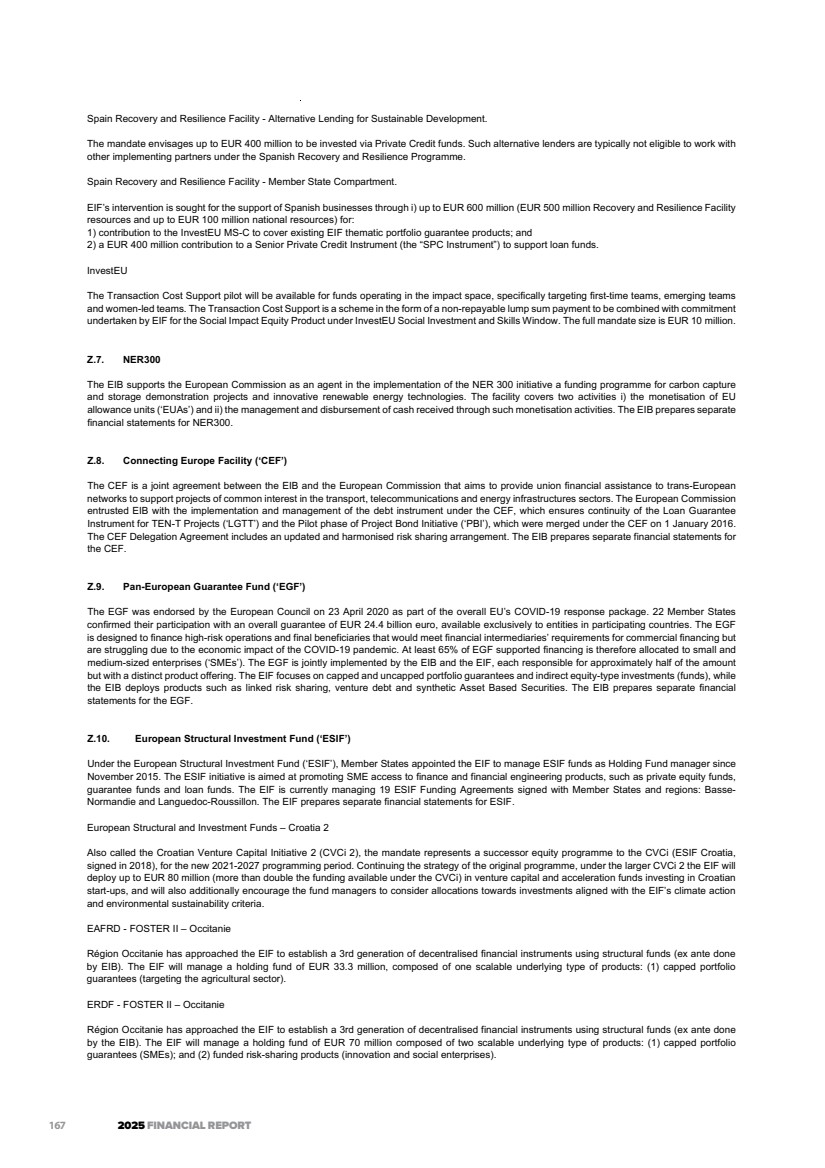
| EIB GROUP CONSOLIDATED FINANCIAL STATEMENTS UNDER EU DIRECTIVES 4 European Structural and Investment Fund - Normandie – EAFRD Région Normandie approached the EIF to replicate its regional Financial Instruments targeting the agri-sector and implemented in France since 2016. The EIF will manage a holding fund of EUR 35 million made up of an underlying financial instrument in the form of a capped portfolio guarantee with an agri focus. European Structural Investment Fund - Auvergne Rhône-Alpes – EAFRD Région Auvergne Rhône-Alpes approached the EIF to replicate its regional Financial Instruments targeting the agri-sector and implemented in France since 2016. The EIF will manage a holding fund of EUR 40 million made up of an underlying financial instrument in the form of a capped portfolio guarantee with an agri focus. FAIRE - FRR II – ERDF Région Réunion has approached the EIF to establish a second generation of decentralised financial instruments using structural funds. Ex ante assessment carried out by EIB. EIF will manage a holding fund of EUR 50 million, composed of scalable underlying type of products: (1) funded risk-sharing product and (2) equity co-investment. Structural Funds equity (sectoral) - Greece The Greek Ministry of Development and Investments has confirmed its intention to entrust via a direct award to the EIF a mandate financed by the Structural Funds of the new Programming Period (2021 – 2027) for the deployment of an equity, sector-specific, platform in Greece. The mandate budget foreseen is up to EUR 200 million and will target two currently underserved sectors of the economy, namely Life Sciences (up to EUR 180 million subject to market interest) and Impact investing (EUR 20 million as a pilot). Innovation Romania Holding Fund Romania allocated to EIF resources from its Competitiveness and Innovation Operational Programme 2021-2027 (POCIDIF), additionally co-financed from ERDF, for a mandate focused on equity instruments for innovation. Previous name: ESIF Innovation Romania. Z.11. Partnership Platform for Funds (‘PPF’) The PPF is an EIB-managed platform that brings together multiple funds across regions, contributors and sectors. It was established to address the need for increased financial flows supporting sustainable development, building on the European Investment Bank’s proven track record. The funds under the platform are implemented in accordance with the platform rules. The EIB prepares a separate combined financial report for the PPF. Z.12. REG This corresponds to three regional mandates. Irish Economic Robustness Investment Platform (‘Irish SMEs’). Irish SMEs is a mandate signed by the Irish Government with the EIF to set up an uncapped counter-guarantee with the Irish National Promotional Bank dedicated mainly to medium-term loans and to all SMEs supported by a structure similar to the SME Initiative, with national funds covering the First Loss Piece, the EIB Group covering mezzanine (EIB through EFSI) and senior risk (EIB and potentially EIF). Under the French “Investment Plan 2018-2022” (known as the Macron Investment Plan), a window dedicated to agriculture has been set up in order to mobilise EUR 5 billion of investments in the sector. In this context, the French Ministry of Agriculture has requested the EIF to design a guarantee instrument with the aim of triggering between EUR 750 million and EUR 1.1 billion of new debt financing to French farmers. In light of this, the French Ministry of Agriculture has decided to allocate EUR 60 million for this instrument and has requested the EIF to combine the FMA contribution with an EFSI contribution for an amount up to EUR 45 million. Prêt Participatif Grand Est is a new financial instrument launched in France as a result of the close collaboration between the Région Grand Est and the EIF. It is an important component of the region’s ambitious recovery programme known as “Business Act Region Grand Est” and it aims to mobilise over EUR 250 million of subordinated loans (prêts participatifs) for local entrepreneurs. This financial instrument is funded by Région Grand Est’s own resources and builds on the EIF’s standard model of First Loss Portfolio Guarantee (FLPG) deployed through financial intermediaries. It is expected to: • generate a significant leverage on the regional resources committed to this initiative; • create substantial impact on the market by supporting SMEs, including those impacted by the crisis but still intending to pursue viable projects for their growth; • offer preferential credit conditions for Grand Est based entrepreneurs. Irish Households The Irish Department for the Environment, Climate and Communications signed an agreement on 30 November 2023, entrusting EUR 48 million of National Budget to the EIF to cover the first loss piece of a new guarantee scheme (Home Energy Upgrade Loan Scheme), an 80% uncapped counter-guarantee by the EIB group to the Irish NPI, the Strategic Banking Cooperation of Ireland (SBCI). The objective of the Home Energy Upgrade Loan Scheme is to support the delivery of low-cost finance in the form of reduced interest rates on loans to eligible individuals to fund retrofitting of their properties for energy efficiency and decarbonisation purposes. 168 |
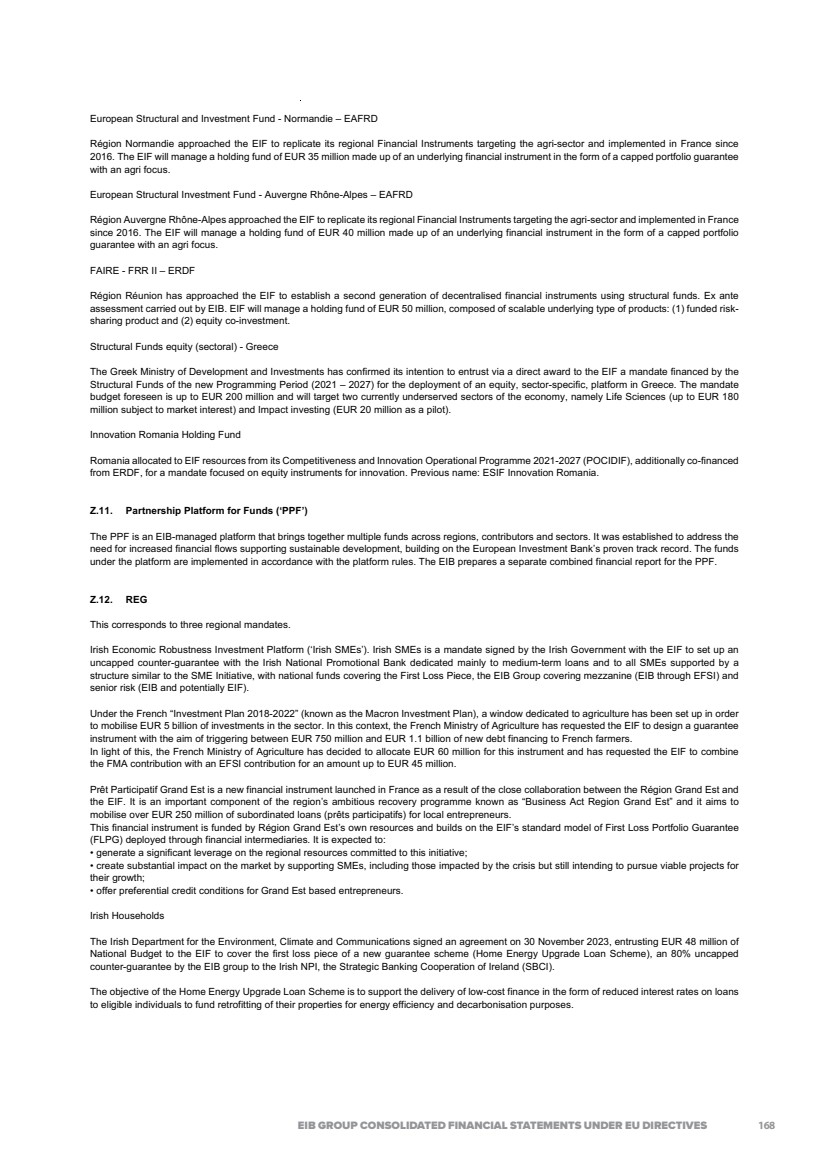
| 2025 FINANCIAL REPORT 5 Initiative Nationale pour l'Agriculture Française (INAF) Under the French “Investment Plan 2018-2022”, a window dedicated to agriculture has been set up in order to mobilise EUR 5 billion of investments in the sector. In this context, the French Ministry of Agriculture has requested EIF to design a guarantee instrument with the aim of triggering between EUR 750 million and EUR 1.1 billion of new debt financing for French farmers. Z.13. EU-Africa Infrastructure (‘EUAI’) Trust Fund The EUAI Trust Fund was created under trust fund agreement between the European Commission on behalf of the European Union as the founding donor and the EIB as manager. It is also open to EU Member States that subsequently accede the agreement as donors. On 9 February 2006, the European Commission and the EIB signed a memorandum of understanding to jointly promote the EU-Africa Infrastructure Partnership and, in particular, to establish a supporting EU-Africa Infrastructure Trust Fund. The EIB prepares separate financial statements for the EUAI Trust Fund. Z.14. COSME LGF & EFG To address the difficulties in access to finance for SMEs, COSME establishes the Loan Guarantee Facility (‘LGF’) and the Equity For Growth (‘EFG’). The LGF and the EFG aim to improve access to finance for SMEs in the form of debt and equity respectively. The Financial Instruments also include the mechanism of the EU Contribution under the SME Initiative. The EFG has been structured in the form of an equity financial instrument supporting Union enterprises growth and Research Innovation. The LGF has been structured in the form of a direct and indirect guarantee financial instrument. The objective of the LGF is to contribute to the reduction of the structural shortcoming of the SME financing market and to support the creation of a more diversified SME finance market. Through direct and indirect guarantees, the LGF aims to guarantee debt financing which addresses the particular difficulties that viable SMEs face in accessing finance. Furthermore, by guaranteeing the mezzanine tranche of eligible and transparent securitisation transactions, the LGF aims to provide new avenues of financing for SMEs. The EIF prepares separate financial statements for COSME LGF & EFG. Z.15. Decentralised Financial Instruments (‘DFIs’) The Decentralised Financial Instruments (‘DFIs’) consists of Fund of Funds (‘FoF’) and Holding Funds (‘HF’) financed by the European Structural and Investment Funds (‘ESIF’) from the Member States’ Operational Programmes during 2014-2020 and 2021-2027, respectively. The DFIs facilitate access to finance for final recipients through loans, equity and guarantees, in cooperation with selected financial intermediaries. As a fund manager, EIB gathers the funding (contributions) from the Managing Authorities and invests it via financial intermediaries based on investment strategies agreed with the donors. Z.16. Trust accounts with ETCI The ETCI initiative was launched on 13 February 2023 with EIB Group resources (EUR 400 million from EIB and EUR 100 million from EIF) alongside contributions from Germany, France, Spain, Italy, Belgium and the Netherlands. With EUR 3.25 billion in capital committed, it seeks to tackle the scale-up gap in Europe, by investing in large-scale venture capital funds, which will in turn provide growth financing to European tech champions in their late-stage growth phase. ETCI therefore plays a key role in securing Europe’s strategic autonomy, ensuring the most promising technology companies, that were born in Europe, can find in Europe the capital they need for their upscaling development. Z.17. JEREMIE JEREMIE (The Joint European Resources for Micro to Medium Enterprises) is an initiative of the European Commission’s Directorate General for Regional Policy (DG Regio) and the EIB Group. The EIF prepares separate financial statements for JEREMIE. Z.18. SME Initiative Italy During 2016, in the context of the SME Initiative, the EIF and the Managing Authorities of Finland, Bulgaria, Romania and Italy entered into four separate Funding Agreements in respect of the implementation and management of a dedicated window, which shall be implemented in connection with a specific allocation under Horizon 2020 Financial Instruments dedicated to Finland, Bulgaria, Romania and accordingly in connection with COSME LGF for Italy. These SME Initiatives aim at providing uncapped guarantees in connection with Horizon 2020 for new portfolios of debt finance to eligible SMEs in the respective countries. The EIF prepares separate financial statements for the SME Initiative Italy. Z.19. ACP Trust Fund - EC Compartment The African, Caribbean and Pacific (‘ACP’) Trust Fund is an initiative entrusted to the EIB for private sector operations and financed from the general budget of the European Union under the Neighbourhood, Development and International Cooperation Instrument (‘NDICI’) drawing on reflows from the Investment Facility - Cotonou. The Fund supports the general objectives of NDICI-Global Europe, with a focus on private sector operations in eligible countries that are characterised by high risk, but are expected to deliver high impact. These operations include as equity and quasi equity investments, local currency lending, lending to fragile countries and co-financing with European Fund for Sustainable Development Plus (‘EFSD+’) guarantees. The Fund comprises both Financial Instruments and Technical Assistance services. The EIB prepares separate financial statements for the ACP Trust Fund Financial Instruments Window. 169 |
| EIB GROUP CONSOLIDATED FINANCIAL STATEMENTS UNDER EU DIRECTIVES 6 Z.20. SME Initiative Romania During 2016, in the context of the SME Initiative, the EIF and the Managing Authorities of Finland, Bulgaria, Romania and Italy entered into four separate Funding Agreements in respect of the implementation and management of a dedicated window, which shall be implemented in connection with a specific allocation under Horizon 2020 Financial Instruments dedicated to Finland, Bulgaria, Romania and accordingly in connection with COSME LGF for Italy. These SME Initiatives aim at providing uncapped guarantees in connection with Horizon 2020 for new portfolios of debt finance to eligible SMEs in the respective countries. The EIF prepares separate financial statements for SME Initiative Romania. Z.21. European Fund for Strategic Investments (‘EFSI’) Based on the applicable EFSI Regulations, the European Commission and the EIB concluded agreements on the management of the EFSI, the granting of the EU guarantee (‘EFSI Agreement’) and the implementation of the European Investment Advisory Hub (‘EIAH’). Under the EFSI Agreement, the European Commission provides an EU guarantee to the EIB for projects supported by the EFSI. The assets covering this EU guarantee are directly managed by the European Commission. Projects supported by EFSI follow the normal EIB project cycle and governance. In addition, EFSI has its own governance structure designed to ensure that investments remain focused on the specific objective of addressing the market failures in risk-taking that hinder investment in Europe. The EIAH aims to enhance non-financial support for projects and investments. It comprises three complementary components: 1) a single point of entry to a wide range of advisory and technical assistance programmes and initiatives for public and private beneficiaries, 2) a cooperation platform to leverage, exchange and share expertise among partner institutions and c) the reinforcement or extension of existing advisory services or the creation of new ones to address unmet needs. The EIB prepares separate financial statements for EIAH. EFSI – European Fund Strategic Investments EFSI is an initiative launched jointly by the EIB Group and the European Commission to help overcome the current investment gap in the EU by mobilising private financing for strategic investments. EFSI is a EUR 16 billion guarantee from the EU budget, complemented by an allocation of EUR 5 billion of EIB’s own capital. EFSI comprises both the Innovation and Infrastructure Window ("IIW") and the SME Window ("SMEW"), to be respectively implemented by the EIB and the EIF. A total amount of EUR 5 billion is initially allocated to the SMEW under EFSI, as follows: (i) up to EUR 2.5 billion to be indirectly backed by the EU Guarantee; and (ii) EUR 2.5 billion to be contributed by the EIB at its own risk to increase the currently existing RCR Mandate. The EFSI Steering Board is entitled to increase the allocation of the EU Guarantee to the SMEW by an additional EUR 0.5 billion (i.e., up to a maximum amount of EUR 3 billion from time to time). EFSI - Private Credit The Programme will comprise two complimentary products, the Cash Investment Product and Investor Guarantee Product. The Cash Investment Product will enable EIF’s direct investment into eligible DDFs, prioritising first closings. These fund investments will support fund creation and give EIF the opportunity to provide input on fund governance and investment strategy. EIF’s direct investment aims at catalysing other fund investors, who take considerable comfort from EIF’s participation and due diligence. The Investor Guarantee Product will enable EIF to further support fundraising by partially guaranteeing (up to 50%) the investment made by institutional investors into DDFs where EIF has already committed to invest. The guarantee product is expected to crowd in investors who are new to this nascent asset class but also encourage larger investments from investors already considering an investment. The Investor Guarantee Product can contribute to scaling up the asset class. EFSI - Combination Product Framework product for combining EFSI resources together with EAFRD national resources to create new financial instruments. Aims to address financing gaps and support specific high priority investment objectives where Member State and EU policy objectives align. Agriculture has initially been prioritised as a sector where SMEs experience a significant financing gap. EFSI - Skills & Education The Skills and Education Guarantee Pilot aims to enhance access to finance in the field of education, training and skills in the form of a capped (counter-) guarantee instrument, and it is one of the products to pilot under EFSI 2 in preparation of the next MFF. It will have a broad eligibility covering a wide spectrum of education/training programmes both for students and adult learners (may also cover SMEs) and be implemented through various intermediaries. • Category A: Students and Learners; • Category B: Enterprises investing in skills and skills utilisation of their workforce; and • Category C: Organisations supplying education, training, skills and related services (including kindergartens, nursery schools, early childhood services, etc.). EFSI-ESCALAR ESCALAR is a EUR 300 million pilot mandate targeting the financing gap experienced by high growth European companies (scale-ups). ESCALAR invests in funds with an investment focus on scale-ups. ESCALAR will make equity investments in funds, and side vehicles of funds, through a different share class or fund unit to other investors. ESCALAR investments will have different terms to the investments made by other investors, namely a (1) Preference on fund distributions in certain predefined downside scenarios, and (2) Subordination, and reduced claim, on investment returns. 170 |
| 2025 FINANCIAL REPORT 7 Z.22. EU for Ukraine Fund (‘EU4U’) The fund aims to strengthen the European Union’s project based support for Ukraine’s reconstruction and recovery, complementing macro-financial assistance. It seeks to foster economic and social resilience and support the development of sustainable infrastructure to revitalise the country’s economy and advance its progress towards EU accession. The fund is designed to be a temporary high-risk, high-impact initiative. The EIB prepares separate financial statements for the EU4U. Z.23. HDW POLIO IG The polio investment grant is one of two components of the Human Development Acceleration (HDX) Programme to eradicate polio. The Gates Foundation is expected to contribute additional investments and grants, while the EIB provides performance-based financing through a limited recourse loan facility. Funds are channelled to the United Nations Children’s Fund (UNICEF) and the World Health Organization (WHO) to develop and execute this programme to eradicate polio. The EIB prepares separate financial statements for the programme. Z.24. InvestEU Advisory Hub The InvestEU Regulation established the InvestEU Programme to advance the EU’s policy objectives by means of supporting financing and investment operations that contribute to the sustainable development and competitiveness of the EU economy. The InvestEU Advisory Hub provides project advisory services, capacity building and market development support to project promoters and intermediaries to help, create and strengthen the InvestEU pipeline of projects. The European Commission and the EIB signed an advisory agreement covering 11 thematic advisory support initiatives. These initiatives address policy and investment priorities under the Sustainable Infrastructure Window, the Research, Innovation and Digitisation Window and the SME Window, the Social Investment and Skills Window and the Cross-Sectoral Window of the InvestEU Advisory Hub. The EIB prepares separate financial statements for the InvestEU Advisory Hub. Z.25. Special Section The Special Section was set up by the Board of Governors on 27 May 1963. On 4 August 1977, its purpose was redefined to serve as a record of financing operations carried out by the EIB for the account of, and under mandate from, third parties. It includes the FED, MED/FEMIP and the guarantee component of the European Development Finance Institutions Private Sector Development Facility. Z.26. National Promotional Institutions (‘NPI’) NPI securitisation initiative (‘ENSI’) The EIF and several National Promotional Institutions (‘NPIs’) including KfW, bpifrance, CDP, Malta Development Bank Working Group, IFD, ICO and BBB have launched the EIF-NPI Securitisation Initiative (‘ENSI’), a cooperation and risk-sharing platform that aims to provide more funding to small and medium-sized enterprises (‘SMEs’) via the capital markets. The objective of this joint cooperation in SME securitisation transactions is to stimulate the availability of finance to SMEs in Europe by revitalising the SME securitisation market while catalysing resources from the private sector. This reflects the spirit of the European Fund for Strategic Investments aiming to achieve a much wider outreach in support of SMEs. Under this mandate, the EIF is enabled to manage up to EUR 100 million of resources from Cassa Depositi e Prestiti (''CDP''). CDP resources under the Mandate will be deployed through investments in technology transfer funds/platforms alongside 1:1 match funding from the EIF in the form of co-investment, resulting in total resources managed by the EIF under this programme of up to EUR 200 million. NPI equity platform The EIF-NPI Equity Platform is a collaborative initiative launched by the EIF in 2016, which promotes knowledge sharing and best practices between the EIF and national promotional institutions (NPIs) or banks (NPBs) across EU Member States. Its goal is to enhance access to funding for SMEs and mid-caps, support the defragmentation of equity markets, and match national, EU and private sources of funding. NPI ICF TT Investment partnership between the EIF and Institut Català de Finances (''ICF'') to commit EUR 30 million of ICF resources into a technology transfer fund focused on investments in technology transfer projects and/or companies linked to Spain’s Catalonia region. Resources from ICF will be matched by at least EUR 15 million of EIF-managed resources. Under this partnership, both the EIF and ICF will invest in the selected technology transfer fund, each acting as Limited Partner investor in its own right. NPI SM – CDP Equity Social Infra Under this partial delegation mandate, the EIF advises and co-invests alongside CDP Real Asset up to EUR 150 million of other EIF-managed resources, mostly InvestEU SIW and SISW. Resources under the Mandate will be deployed through investments in real estate funds focusing on student, senior and social housing. The matching ratio will be 1:1 at portfolio level, resulting in total resources under this programme of up to EUR 300 million. Standardised NPI Mandate – Croatian Bank for Reconstruction and Development II Under this Standardised NPI Mandate, up to EUR 28.3 million RRF resources will be deployed via the Croatian Bank for Reconstruction and Development (''HBOR'') into (a) fund(s) in Croatia with a focus on Climate and Innovation. The deployment of resources will take place alongside match funding from the EIF based on the Partial Delegation approach, resulting in total resources under this programme of up to EUR 56.6 million. 171 |
| EIB GROUP CONSOLIDATED FINANCIAL STATEMENTS UNDER EU DIRECTIVES 8 Standardised NPI Mandate - Invest NL II The second generation of the Dutch Future Fund (DFF II) will be operated under a different standardised NPI equity umbrella product, through partial delegation. Invest NL is willing to commit EUR 100 million to the further development of the Dutch VC ecosystem, in particular in Deeptech, CA&ES and Social Impact. It is expected that at least 50% of the number of supported teams will be aligned with our GESIP programme. Furthermore, a contribution of EUR 20 million from DFF-2 into GIP is explored. Three Sees Initiative Innovation Fund The mandate is a larger successor to the Central European Fund of Funds (CEFoF). It encompasses multi-country fund-of-funds with contributions from CEE NPIs and governments targeting commitments to VC, PE and PC funds managed by investment teams in these same countries focusing on later stage (Series A+) and growth investments in SMEs and small mid-caps. UAB ILTE (NPI Invega). The Mandate’s objective is to develop a senior private credit market as an alternative source of financing for SMEs in Lithuania. The Mandate aims to support investments into senior private credit funds. ERP-EIF Facility Through the ERP-EIF Facility, Germany's government is broadening the supply of equity capital for technology-oriented SMEs. The long-term aim of the instrument is to strengthen the equity capital market and provide incentives to raise additional funds from private or public sector investors. Z.27. Employment and Social Innovation (‘EaSI’) The EaSI Guarantee financial Instrument consists, inter alia, of the EaSI Microfinance Guarantee, which is the successor to the micro-credit guarantees under the European Progress Microfinance facility (“Progress Microfinance”). It will extend the support given to microcredit providers under Progress Microfinance. In addition, the EaSI Guarantee financial Instrument consists of the EaSI Social Entrepreneurship Guarantee, which is a new product, which will facilitate access to finance for social enterprises and support the development of the social investment market. The EIF prepares separate financial statements for EaSI. The Employment and Social Innovation funded instrument ("EaSI Funded Instrument") has been set up as a new sub-fund of the EU Microfinance FCP-FIS. This mandate is the successor of the European Progress Microfinance sub-fund which was launched in 2010 and has a target size of EUR 200 million, blending resources from the European Commission, the EIB and the EIF. EaSI Funded Instrument contributes to the development of the new social entrepreneurship ecosystem whilst at the same time consolidates the EIF's role in the microfinance market. The loan products provided by the EaSI Funded Instrument will address in particular the funding gap for small intermediaries, such as non-banks and small/niche banks (ethical banks for instance), which usually have limited access to deposit funding, as opposed to larger banks which, having access to secured funding for their lending activity, may seek additional risk coverage through guarantee instruments. Z.28. Private Finance for Energy Efficiency (‘PF4EE’) Instrument The PF4EE instrument is a joint initiative between the EIB and the European Commission that aims to address the limited access to adequate and affordable commercial financing for energy efficiency investments. The instrument targets projects that support the implementation of national energy efficiency action plans established by EU Member States. In December 2014 the European Commission and the EIB signed a delegation agreement establishing the PF4EE financial Instrument. The EIB prepares separate financial statements for the PF4EE. Z.29. GIF 2007 In the GIF 2007 under the Competitiveness and Innovation Framework Programme and the Technology Transfer Pilot Project (CIP/GIF 2007), the EIF is empowered to acquire, manage and dispose of investments, in its own name but on behalf and at the risk of the European Commission. The EIF prepares separate financial statements for GIF 2007. Z.30. SMEG 2007 In the SMEG 2007 under the Competitiveness and Innovation Framework Programme (CIP/SMEG 2007), the EIF is empowered to issue guarantees in its own name but on behalf and at the risk of the European Commission. The EIF prepares separate financial statements for SMEG 2007. Z.31. InnovFin SME Guarantee In the context of the “Access to Risk Finance Programme” of Horizon 2020, the specific programme provides for the establishment of a financial instrument for debt and a financial instrument for equity. A Risk-Sharing facility called InnovFin SME Guarantee has been structured in the form of a guarantee, using the EU’s contribution for first defaulted amount taking and the risk-taking capacity of the EIF for second-Defaulted Amount taking. The objective of the Facility is to incentivise Intermediaries to extend loans or financial leases to small and medium-sized enterprises and small mid-caps with significant activities in Research, Development and Innovation. The EIF prepares separate financial statements for the InnovFin SME Guarantee. 172 |
| 2025 FINANCIAL REPORT 9 Z.32. Bundesministerium für Wirtschaft und Technologie The EIF manages funds on behalf of the German Bundesministerium für Wirtschaft und Technologie (Federal Ministry of Economics and Technology) and the European Recovery Programme. Z.33. DCFTA Initiative East On 19 December 2016, the European Commission and the EIB signed the delegation agreement for the Deep and Comprehensive Free Trade Area (‘DCFTA’). The DCFTA Initiative East aims to strengthen economic development in the countries that have signed an association agreement with the EU – namely Georgia, Moldova and Ukraine – by providing targeted financial and technical support to SMEs in these three countries. As part of the DCFTA, the EIF implements and manages the Guarantee Facility Window. The EIB prepares separate consolidated financial statements for the DCFTA including the Guarantee Facility Window. EU4Business Team Europe Initially designed as the DCFTA East GF Phase 2, following the COVID-19 crisis and additional allocation, the facility is revised and re-named. The mandate is structured through a CA between the EC and the EIB, followed with a back-to-back agreement between the EIB and the EIF. The EIF will provide capped guarantees (80% guarantee rate, portfolio cap up to 25%) in Armenia, Azerbaijan, Georgia, Moldova and Ukraine. EU4Business Ukraine – Capped The mandate is structured through a Contribution Agreement between the EC and the EIB, followed with a back-to-back agreement between the EIB and the EIF. The EIF will provide capped guarantees exclusively in Ukraine through resources from the Ukraine Facility. it is a replication of the EU4 Business Guarantee facility signed in 2023 to support access to finance in in Armenia, Azerbaijan, Georgia, Moldova and Ukraine. Z.34. SME Initiative Finland During 2016, in the context of the SME Initiative, the EIF and the Managing Authorities of Finland, Bulgaria, Romania and Italy entered into four separate Funding Agreements in respect of the implementation and management of a dedicated window, which shall be implemented in connection with a specific allocation under Horizon 2020 Financial Instruments dedicated to Finland, Bulgaria, Romania and accordingly in connection with COSME LGF for Italy. These SME Initiatives aim at providing uncapped guarantees in connection with Horizon 2020 for new portfolios of debt finance to eligible SMEs in the respective countries. The EIF prepares separate financial statements for SME Initiative Finland. Z.35. Neighbourhood, Development and International Cooperation Instrument (‘NDICI’) IW1, IW2 and IW4 The NDICI – Global Europe Regulation entered into force on 14 June 2021. It replaces and consolidates most of the EU’s existing external financing instruments under a single comprehensive framework. The financing operations undertaken in the past under the External Lending Mandate (‘ELM’), the Cotonou Mandate (including the ACP Investment Facility and EIB own resources lending in the ACP countries supported by the EU Member States comprehensive guarantee), and the External Investment Plan / EFSD are to be fully integrated into EFSD+. This regulation establishes the overarching framework for EIB operations outside the EU under the 2021-2027 MFF, with a particular focus on supporting the EU policies in the EU Neighbourhood, sub-Saharan Africa, Asia and the Pacific, the Americas and the Caribbean. NDICI IW1, IW2 and IW4 are dedicated investment windows formalised in separate guarantee agreements under which, the EU provides risk coverage for guaranteed EIB loan operations in Africa, the Caribbean, and the Pacific. The EIB prepares separate financial statements for NDICI IW1, IW2 and IW4. Z.36. Neighbourhood Investment Facility (‘NIF’) Risk Capital Facility The NIF Risk Capital Facility is financed by the general budget of the European Union. Its main purpose is to provide access to equity and debt finance for SMEs in the Southern Neighbourhood region to support private sector development, inclusive growth and private sector job creation. The facility comprises a Financial Instrument Window which consists of equity and debt finance instruments and an Additional Tasks Window which consists of technical assistance services. The EIB prepares separate financial statements for the Financial Instrument Window. Z.37. WB EDIF The Western Balkan Enterprise Development & Innovation Facility (‘WB EDIF’) is a joint initiative signed in December 2012 by the EC (‘DG ELARG’), the EIB Group and the European Bank for Reconstruction and Development (‘EBRD’). It aims to improve access to finance for SMEs in the Western Balkans and to foster economic development in the region through the deployment of the Instrument for Pre-Accession Assistance (‘IPA’) funds. Within the WB EDIF, the EIF acts as platform coordinator, Trustee on behalf of the EC for the Enterprise Expansion Fund (‘ENEF’), Trustee on behalf of the EC for the Enterprise Innovation Fund (‘ENIF’), and manager of the Guarantee Facility. The EIF prepares separate financial statements for the WB EDIF. As a response to the COVID crisis and the successive energy crisis in the Western Balkans region, the European Commission allocated EUR 60 million to the EIF for a guarantee facility to be deployed in the WB6 economies. Such guarantee facility would follow the model of the existing WB EDIF GF II, with the changes in the product necessary to make it fit for the different purpose. The facility will be labelled and deployed under the 173 |
| EIB GROUP CONSOLIDATED FINANCIAL STATEMENTS UNDER EU DIRECTIVES 10 Western Balkan Investment Framework (“WBIF”), a multi-IFI and multi-product platform regulated by the NDICI framework and serving as the main gateway for private sector development measures in the Western Balkans. The ultimate objective of the WB GF4SME resilience is to facilitate and increase access to, and availability of, finance for SMEs in the Western Balkans. The guarantees and counter-guarantees issued by the EIF under this facility shall cover portfolios of newly granted debt instruments provided for the ultimate benefit of SMEs which qualify as Final Beneficiaries under this agreement. The guarantees are financed by the EU and are issued by the EIF in its own name but on account and risk of the EU. Z.38. European Neighbourhood and Partnership Instrument (‘ENPI’) The Framework Agreement between the EU and the EIB on the implementation of operations financed by the general budget of the European Union in the countries covered by the European Neighbourhood Policy is channelled through ENPI. The EIB prepares separate financial statements for ENPI. Z.39. InnovFin Equity The Horizon 2020 Financial Instruments aim to ease the access to risk financing for Final Recipients in order to support eligible Research and Innovation. This covers loans, guarantees, equity and other forms of risk finance. The Horizon 2020 Financial Instruments also aim to promote early-stage investment and the development of existing and new venture capital funds; improve knowledge transfer and the market for intellectual property; attracts funds for the venture capital market; and overall help to catalyse the transition from the conception, development and demonstration of new products and services to their commercialisation. The Horizon 2020 debt financial instrument also includes the implementation mechanism of the EU Contribution under the SME Initiative. The InnovFin Equity facility aims to promote early-stage investment and the development of existing and new venture capital funds providing equity finance for innovative enterprises, in particular in the form of venture or mezzanine capital in their early stage. The EIF prepares separate financial statements for InnovFin Equity. Z.40. SME Initiative Bulgaria During 2016, in the context of the SME Initiative, the EIF and the Managing Authorities of Finland, Bulgaria, Romania and Italy entered into four separate Funding Agreements in respect of the implementation and management of a dedicated window, which shall be implemented in connection with a specific allocation under Horizon 2020 Financial Instruments dedicated to Finland, Bulgaria, Romania and accordingly in connection with COSME LGF for Italy. These SME Initiatives aim at providing uncapped guarantees in connection with Horizon 2020 for new portfolios of debt finance to eligible SMEs in the respective countries. The EIF prepares separate financial statements for the SME Initiative Bulgaria. Z.41. Joint European Support for Sustainable Investment in City Areas (‘JESSICA’) Holding Funds JESSICA is an initiative developed by the European Commission and the EIB, in collaboration with the Council of Europe Development Bank. JESSICA Holding Funds are used within the framework of the JESSICA initiative. Under new procedures, Managing Authorities now have the option to use a portion of their EU grant funding to make repayable investments in projects that are part of an integrated plan for sustainable urban development. As manager, the EIB collects the funding received from the Managing Authorities and invests it in Urban Development Funds, according to investment guidelines agreed with the donors. Z.42. Cultural and Creative Sectors Guarantee Facility The financial instrument, set up under Creative Europe – the main EU programme dedicated to the cultural and creative sectors – will be managed by the EIF on behalf of the European Commission. The initiative will allow the EIF to provide guarantees and counter-guarantees to selected financial intermediaries to enable them to provide more debt finance to entrepreneurs in the cultural and creative arena. Loans generated are expected to support more than ten thousand SMEs in a wide range of sectors such as audio-visual (including film, television, animation, video games and multimedia), festivals, music, literature, architecture, archives, libraries and museums, artistic crafts, cultural heritage, design, performing arts, publishing, radio and the visual arts. The EIF prepares separate financial statements for Cultural and Creative Sectors Guarantee Facility. Z.43. Instrument for Pre-accession Assistance II / III (‘IPA II / IPA III’) The Instrument for Pre-accession Assistance (‘IPA’) is the EU’s primary tool for supporting reforms in the 'enlargement countries' providing both financial and technical assistance. These pre-accession funds are a sound investment in the future of the enlargement region and the EU itself, advancing EU priorities such as sustainable economic recovery, energy supply, transport, the environment, climate change, etc. The successors of IPA I, IPA II, and IPA III are implemented by the EIB, allocating resources from the Directorate General European Neighbourhood and Enlargement Negotiations via the signature of various “specific grant agreements”. While the IPA II Regulation formally applied until 31 December 2020, its implementation is still ongoing. The EIB prepares financial statements for specific grant agreements. 174 |
| 2025 FINANCIAL REPORT 11 Z.44. EFSI-EIAH Please refer to paragraph Z.21. above. Z.45. TTA Türkiye TTA Türkiye is an initiative designed by the EIF in cooperation with the Ministry of Science, Industry and Technology (‘MoSIT’), the Scientific and Research Council of Türkiye (‘TÜBITAK’), the Delegation of the European Union to Türkiye and the DG Regional Policy of the European Commission. TTA Türkiye is co-financed by the EU and the Republic of Türkiye under the Regional Development Component of the Instrument for Pre-Accession Assistance (‘IPA’) funds and managed by EIF. TTA Türkiye aims to achieve two objectives: setting up a financially sustainable fund by facilitating the commercialisation of scientific research and development (‘R&D’) confined in universities and research centres and catalysing the development of the technology transfer market in Türkiye, with a particular emphasis on spill-overs to the less developed/developing regions of Türkiye. Z.46. SME Initiative Malta On 19 January 2015, the European Commission, the EIB and the ElF signed an amendment to the Horizon 2020 delegation agreement setting out the terms and conditions applicable to certain terms of the dedicated window corresponding to the SME Initiative and the contribution of the EU to such dedicated windows of the Horizon 2020 Financial Instruments. SME Initiatives in Spain and Malta were launched in the previous year. The EIF prepares separate financial statements for SME Initiative Malta. Z.47. Facility for Euro-Mediterranean Investment and Partnership (‘FEMIP’) Trust Fund The FEMIP Trust Fund, managed by the EIB, was set up to enhance the existing activities of the EIB in the Mediterranean partner countries. Supported by a number of donor countries, the fund aims to direct resources to operations in certain priority sectors by providing technical assistance and risk capital. The EIB prepares separate financial statements for the FEMIP Trust Fund. Z.48. German Future Fund Growth Facility (‘GFFGF’) A German coalition government programme for the development of equity instruments with a particular focus on digitalisation and cleantech (overall targeted volume EUR 10 billion) called the German Future Fund. A potential amount of up to EUR 3 billion could be allocated to the EIF for investments into German growth funds and co-investments in companies in a delegated way, or via blind-pool co-investment vehicles. The mandate will have an investment period for initial commitments in funds over 10 years. Z.49. Global Concessional Finance Facility (‘GCFF’) The objective of the GCFF is to support middle-income countries in the Middle East and North Africa (‘MENA’) region impacted by the influx of refugees. This is achieved by providing concessional financing to multilateral development banks (‘MDB’) financing and improving coordination efforts. The EIB has implemented the GCFF Jordan Private Sector Guarantee Facility which offers partial portfolio guarantees to local financial intermediaries, such as banks or microfinance institutions. The facility provides partial risk protection to financial intermediaries in the form of guarantees on underlying debt-financing granted to MSMEs on a portfolio basis. Z.50. AECID This partnership agreement signed between the Kingdom of Spain (the Spanish Agency for International Development Cooperation (‘AECID’)) and the EIB was set up to invest in operations in the countries covered by the FEMIP together with Mauritania (the “Southern Mediterranean region”). The primary focus is on risk capital activities involving micro-SMEs, as well as supporting broader development of the private sector in the region. The EIB prepares separate financial statements for AECID. Z.51. Neighbourhood Investment Facility (‘NIF’) Trust Fund The NIF Trust Fund, managed by the EIB was set up to achieve the strategic objective of the European Neighbourhood Policy (‘ENP’). It provides targeted funding to establish better and more sustainable energy and transport interconnections, improve energy efficiency and promote the use of renewable energy sources, address climate change and broader threats to the environment and promote smart, sustainable and inclusive growth. This is achieved through support to SMEs, to the social sector – including human capital development – and municipal infrastructure development. The EIB prepares separate financial statements for the NIF Trust Fund. Z.52. EU support to Boost Africa The EU Support to Boost Africa is a joint initiative between the EIB and the African Development Bank. Its core objectives are to enable and enhance entrepreneurship and innovation across Africa in a commercially viable way and to address a current gap in the Sub-Saharan market, by providing early-stage venture capital alongside skills development. The Facility comprises a Financial Instrument Window, which consists of equity and quasi-175 |
| EIB GROUP CONSOLIDATED FINANCIAL STATEMENTS UNDER EU DIRECTIVES 12 equity instruments, and an Additional Tasks Window, which consists of technical assistance services. The EIB prepares separate financial statements for the Financial Instrument Window. Z.53. Eastern Partnership Technical Assistance (‘EPTA’) Trust Fund The EPTA Trust Fund is focused on increasing the quality and development impact of EIB Eastern Partnership operations by offering a multi-purpose, multi-sector funding facility for technical assistance. It complements the Neighbourhood Investment Facility. The EIB prepares separate financial statements for the EPTA Trust Fund. Z.54. SME Initiative for Spain On 26 January 2015, the Delegation Agreement between the Kingdom of Spain and European Investment Fund was signed. The EIF will provide uncapped guarantees for new portfolios of debt finance to eligible SMEs and securitisation of existing debt finance to SMEs and other enterprises with less than 500 employees and/or new portfolios of debt finance to SMEs. The EU contribution to the SME Initiative for Spain, received by the EIF, is subject to the treasury asset management to be carried out by the EIB, which is governed by the signed Asset Management Side Letter between the European Investment Fund and the European Investment Bank. The EIF prepares separate financial statements for the SME Initiative for Spain. Z.55. Baltic Innovation Fund (‘BIF’) The Baltic Innovation Fund (‘BIF’), signed in September 2012, is a fund-of-funds, structured as a partnership, which invests in venture capital and private equity funds and focused on the Baltic region. It is funded jointly by the EIB Group and the following Baltic national agencies: Fund KredEx in Estonia, Latvijas Garantiju Agentiira in Latvia and lnvesticiju ir verslo garantijos in Lithuania. The EIF prepares separate financial statements for BIF. The Baltic Innovation Fund 2 (“BIF 2”) is a successor fund-of-funds to the EIF-managed Baltic Innovation Fund (“BIF”). The BIF 2 is envisaged to have an identical structure to BIF (virtual FoF that minimises costs and enables synergies with similar initiatives), with a slightly increased size of EUR 156 million (BIF size is EUR 130 million). The three Baltic States would commit in aggregate EUR 78 million (EUR 26 million each) alongside EUR 78 million from EIF-managed RCR resources. EIF will act as a manager of the facility. BIF 2 would be more focused towards the growth capital to complement the local initiatives for early-stage investments. The target level of contributions by the three Baltic NPIs is as follows: • KredEx (Estonia): EUR 26 million, • Altum (Latvia): EUR 26 million, • INVEGA (Lithuania): EUR 26 million. Z.56. MAP Guarantee This resource is split equally between private equity and guarantee products. The equity segment known as ESU 1998 (‘G&E’) and ESU 2001 (‘MAP’) covers the ETF start-up investments. The guarantees segment known as SMEG 1998 G&E and SMEG 2001 MAP, provides guarantees against the beneficiary’s undertaking. The EIF prepares separate financial statements for the MAP Guarantee. Z.57. Natural Capital Finance Facility (‘NCFF’) The Natural Capital Finance Facility (‘NCFF’) is a joint initiative between the EIB and the European Commission that aims to address market gaps and barriers by supporting revenue generating or cost saving projects that preserve natural capital, including those focused on climate change adaptation. The Facility contributes to the achievement of biodiversity and climate change adaptation objectives set by the EU and its Member States. The EIB prepares separate financial statements for the NCFF. Z.58. Demand side management, Social Infrastructures, Renewables and Energy Efficiency (‘DESIREE’) DESIREE is a programme that was approved under the Thematic Blending Facility and will support greater investment in energy efficiency and electrification of social infrastructure such as schools and hospitals. The programme includes grants for technical assistance and programme management as well as investment grants and financial instruments. The EIB prepares separate financial statements for DESIREE. Z.59. Multi-Regional Guarantee Platform for Italy (‘AGRI’) The Italian Agri Platform was formally launched with the signing of the Funding Agreement between the EIF and 6 Italian Regions (Veneto, Emilia Romagna, Umbria, Campania, Calabria, Puglia). Two additional Italian Regions (Piemonte and Toscana) joined in 2018. The Agriculture Platform in Italy is using Structural funds from European Agricultural Fund for Rural Development (‘EAFRD’) to deploy the financial instrument using each participating Rural Development Programme (‘RDP’) resources to cover the first losses. The aim of the Platform is to steer the Regional Managing Authorities towards standard products, to foster new business at regional level while supporting new lending to farmers and agri-businesses. 176 |
| 2025 FINANCIAL REPORT 13 Z.60. Technical Assistance for Eastern Partnership Investment in Connectivity (‘EPIC’) EPIC is a technical assistance facility under the Neighbourhood Investment Platform (‘NIP’) that helps to improve connectivity both within the Eastern Partnership region and between the Eastern Partnership countries and the EU. The EIB prepares separate financial statements for EPIC. Z.61. GEEREF Under the Global Energy Efficiency and Renewable Energy Fund (‘GEEREF’), EIF has been acting since December 2007 as investment advisor. GEEREF is supported by the EC, the Federal Government of Germany and the Kingdom of Norway and its objective is to invest primarily in regional funds with assets in projects and companies involved in energy efficiency and renewable energy enhancing access to clean energy in developing countries and economies in transition. The GEEREF business development is formally delegated to the EIB under a sub-advisory agreement. Z.62. KBC Climate & Infrastructure Private Investors Partnership A EUR 200 million mandate signed between KBC Insurance and the EIF to top-up investment in funds of the Infrastructure and Climate Funds mandate, investing in renewable energy (production, storage and distribution), energy efficiency, smart green cities, digital and sustainable transport infrastructure. The mandate is expected to contribute to the climate focus of the EIF portfolio and the objectives of the EIB Climate Bank Roadmap, while meeting the financial targets set by the Parties. Z.63. Alpine Growth Investment Platform (‘AlpGIP’) In September 2017, the EIF launched an innovative regional equity platform (non-corporate structure) targeting the late venture capital and growth segment in the EU Alpine Macroregion. The Italian regions Lombardia, Piemonte, Val d’Aosta and Alto Adige (Bolzano region) have already invested in the Platform other regions are expected to join at a later stage. Z.64. Three Sees Initiative Innovation Fund (‘3SIIF’) The mandate is a larger successor to the Central European Fund of Funds (CEFoF). It encompasses multi-country fund-of-funds with contributions from CEE NPIs and governments targeting commitments to VC, PE and PC funds managed by investment teams in these same countries focusing on later stage (Series A+) and growth investments in SMEs and small mid-caps. Z.65. FoF mandates (virtual) A successor Luxembourg Future Fund 2 (‘LFF’) mandate focusing on early stage, growth, mezzanine and co-investments with a pre-defined Luxembourg angle (Luxembourg Economic Substance Criteria). LFF 2 investments operations will take place in the form of primary fund commitments as well as co-investments (via SPVs). The LFF 2 investment strategy has been widened (compared to LFF 1), to also encompass private equity and hybrid debt-equity strategies in addition to VC. Investments will focus on innovative companies across green technologies, general ICT, new space technologies, medical technologies as well as financial technologies (list being non-exhaustive). LFF 2 is a virtual structure with a mandate bank account. Z.66. Central Europe Fund of Funds (‘CEFoF’) The Central Europe Fund of Funds (‘CEFoF’) is a fund-of-funds initiative created by the European Investment Fund (‘EIF’) in close cooperation with the governments and national agencies of Austria, Czech Republic, Slovakia, Hungary and Slovenia (the CE countries) to boost equity investments into small and medium-sized enterprises (‘SMEs’) and small mid-caps across the region, establishing a sound market-based risk financing infrastructure, implementing the best market standards for equity investments in businesses and attracting institutional investors and investment managers to Central Europe. Z.67. fi-compass “fi-compass” is a platform for advisory services under Cohesion Funds, also known as shared management funds, provided by the European Commission in partnership with the EIB. It provides technical assistance to stakeholders, helping them build the knowledge base and administrative capacity required for the effective implementation of financial instruments and disseminating good practices among Member States. Z.68. Student Loan Guarantee Facility (‘Erasmus’) Under the European Structural Investment Fund (‘ESIF’), Member States appointed EIF to manage ESIF funds as Holding Fund manager since November 2015. The ESIF initiative is aimed at promoting SME access to finance and financial engineering products, such as private equity funds, guarantee funds and loan funds. EIF is currently managing 2 ESIF Funding Agreements signed with Member States and regions: Basse-Normandie and Languedoc-Roussillon. The EIF prepares separate financial statements for Student Loan Guarantee. Z.69. MAP Equity Under the Multi-Annual Programme (MAP) for enterprises and entrepreneurship, the EIF manages resources on behalf and at the risk of the EC. The EIF prepares separate financial statements for MAP Equity. 177 |
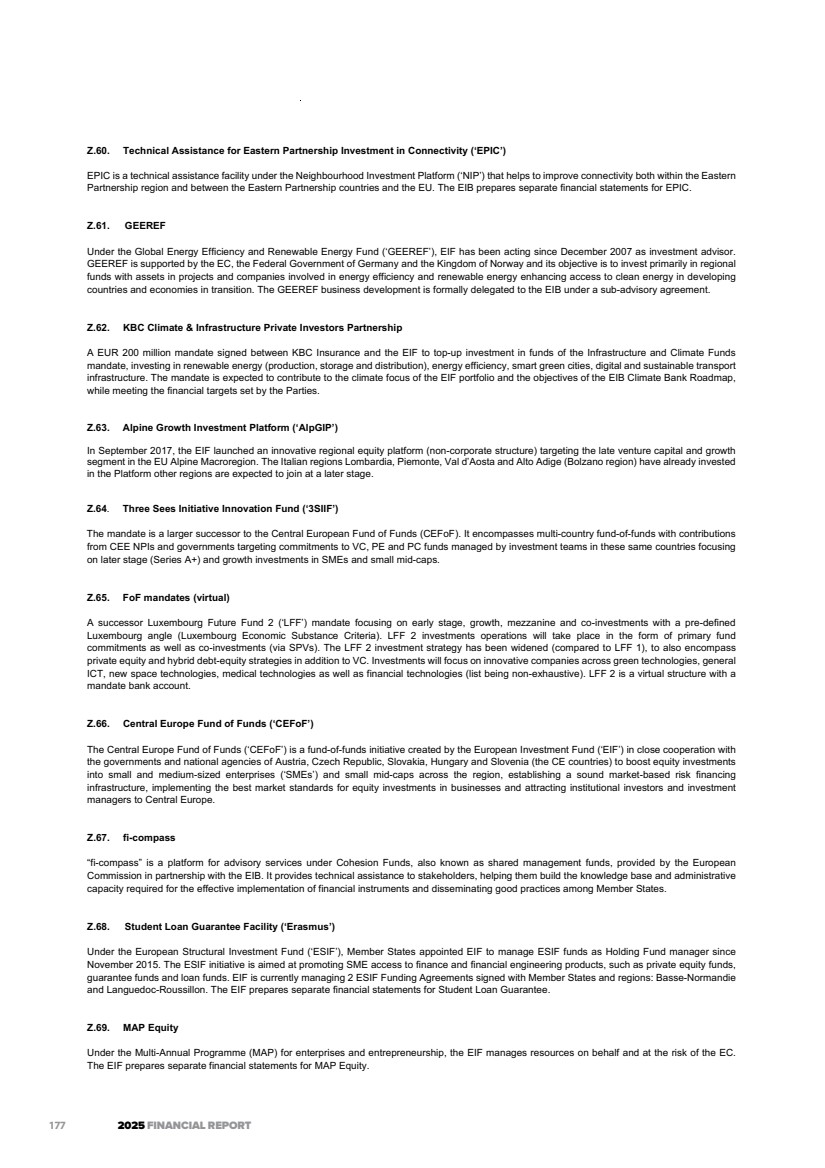
| EIB GROUP CONSOLIDATED FINANCIAL STATEMENTS UNDER EU DIRECTIVES 14 Z.70. LfA-EIF Facility LfA-EIF Facility, signed in 2009, is a joint EIF and LfA Förderbank Bayern venture providing investments to support technology-oriented early and expansion stage companies in the region of Bavaria, Germany. Z.71. Joint Assistance to Support Projects in European Regions (‘JASPERS’) JASPERS is a technical assistance partnership between the EIB and the European Commission. Its strategic objective is to support the quality and timely delivery of projects funded under the Cohesion Policy, the Connecting Europe Facility, the Instrument for Pre-Accession Assistance and the Just Transition Fund by providing targeted advisory support to the relevant counterparts through the entire project life cycle - from pipeline identification, selection and prioritisation through project development and approval to financial closing implementation and completion. The EIB prepares separate financial statements for JASPERS. Z.72. Technical Assistance for Regions Undergoing a Green Energy Transition (‘TARGET’) TARGET is a technical assistance facility designed to support coal, peat and oil shale regions in identifying and developing clean energy projects and energy efficiency projects. It also supports the investments and the creation of sustainable jobs on the ground, facilitating a transition away from coal, peat and oil shale based activities. The EIB prepares separate financial statements for TARGET. Z.73. Polish Growth Fund-of-Funds (‘PGFF’) The Polish Growth Fund-of-Funds (‘PGFF’), signed in April 2013, is a fund-of-funds, structured as a partnership, which invests in venture capital and private equity funds and focused on Poland. It is funded jointly by the EIB Group and the Bank Gospodarstwa Krajowego. The EIF prepares separate financial statements for PGFF. Z.74. GEF-UNEP This is a Global Environment Facility (‘GEF’) in cooperation with the United Nations Environment Programme (‘UNEP’) that provides technical assistance for identifying, selecting and designing future investments. These consist primarily of capital investment projects with outcomes leading to nutrient reduction, which will indirectly contribute to the long-term outcome of depollution of the Mediterranean Sea. Z.75. EFSD Guarantee - SME Access to Finance Initiative The EFSD Guarantee “SME Access to Finance Initiative” is a guarantee facility targeting SMEs and underserved entrepreneurs with a particular focus on young entrepreneurs, female entrepreneurs, start-ups and certain other groups in specific target countries and with the overriding objective of addressing some of the root causes of migration. The programme provides first loss credit protection to local banks and financial institutions selected by EIB with covering portfolios of loans, bank guarantees and letters of credit issued to, SMEs or micro-SMEs. These individuals typically have limited access to finance than other entrepreneurs due to being perceived as higher risk by local financial institutions. The target countries are located in the Eastern and Southern European Neighbourhood. The EIB prepares separate financial statements for the programme. Z.76. German Corona Matching Facility (CMF) The German Government, as part of its COVID-19 crisis measures for the German economy, aims to provide automatic and standardised pari-passu co-investments to VC funds for all German portfolio companies in all financing rounds until 30 June 2021. Z.77. Mezzanine Dachfonds für Deutschland (‘MDD’) The MDD is an investment programme signed in June 2013 and funded by the German Federal Ministry of Economics and Technology (‘BMWi’) and various institutions of the Federal states to subscribe into hybrid debt and equity funds investing in German mid-caps. Z.78. EU Trade and Competitiveness Programme (‘EUTCP’) The EUTCP, developed by the European Commission and the EIB, aims to address market failure and support SME competitiveness in Morocco, Tunisia, Egypt and Jordan. In line with the EU policy priorities – economic growth, private-sector development, regional integration, and climate action – the programme fosters investments along key value chains through new guarantee instruments. The Financial Instrument Window includes a Risk Sharing Facility that provides first-loss credit-risk protection to financial intermediaries. The EIB prepares separate financial statements for the programme. Z.79. G43 Trust Fund Under G43 Anatolian Venture Capital Fund, signed in August 2012, the EIF is entrusted with a mandate by Central Finance and Contracts Unit of Türkiye (‘CFCU’). It is dedicated to make investments in SMEs in South-Eastern Anatolia region of Türkiye. The EIF prepares separate financial statements for the G43. 178 |
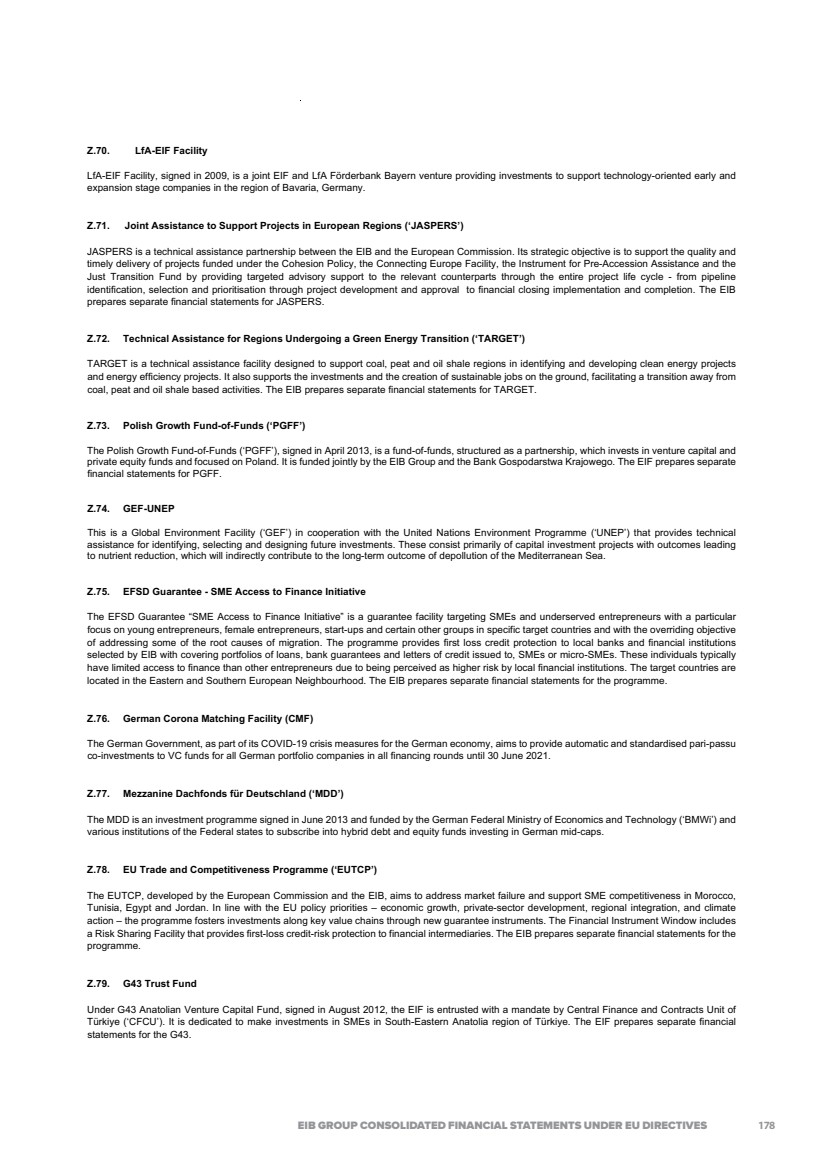
| 2025 FINANCIAL REPORT 15 Z.80. EU4Business Guarantee Facility Ukraine EU4Business Guarantee Facility Ukraine, financed under the Ukraine Facility, supports Ukraine's recovery and private-sector growth by mobilising financing for the economy. The Facility is designed to facilitate access to finance to SMEs and Labour-Intensive SMEs in Ukraine, by offering portfolio guarantees to local banks and other financial intermediaries, enabling them to enhance transaction terms and conditions. The EIB mandated the EIF to implement and manage the Guarantee Facility. Z.81. AIP Kulima The “Support for Kulima Access to Finance Programme” developed under the Africa Investment Platform (‘AIP’) comprises an intermediated facility for on-lending to eligible private agri-food sector investments in Malawi. It aims to promote sustainable agricultural growth to increase incomes, employment and food security in the context of a changing climate. The EIB prepares separate financial statements for the programme. Z.82. EU4Business Guarantee Facility EU4Business Guarantee Facility financed by the general budget of the European Union under NIP, represents a Phase II of the DCFTA Initiative, supporting the economic development of the Eastern Partnership countries (Ukraine, Georgia and Moldova). The facility focuses on SMEs operating in exporting sectors such as agriculture, manufacturing or information technologies. It is designed to address market failures in these countries, by providing SME portfolio guarantees to local banks and other financial intermediaries, enabling them to enhance transaction terms and conditions and thus improve access to finance for these businesses. The EIB mandated EIF to implement and manage the Guarantee Facility. Z.83. Palestine Financial Sustainability Initiative Part I (‘PFSI’) The "Palestine Financial Sustainability Initiative Part I" developed under the NIP, comprises the Guarantee Facility which provides credit risk protection on a portfolio basis for the debt instruments granted by Financial Intermediaries to support eligible investments and working capital in East Jerusalem, Area C and Gaza. The PFSI aims at enhancing access to finance for MSMEs operating in Palestine, to improve competitiveness, promote business expansion and enable MSMEs to modernise their businesses. The EIB prepares separate financial statements for the initiative. Z.84. Technology Transfer Pilot Project (‘TTP’) Under the TTP, financed by the EC and signed in November 2008, the EIF has supported a technology transfer structure through pre-seed funding and seed funding. The EIF prepares separate financial statements for the TTP. Z.85. AIP Zambia The “Zambia Agriculture Value Chain Facility Programme” developed under the Africa Investment Platform (‘AIP’) aims to support the government of Zambia's policy objectives to reduce rural poverty and malnutrition and improve rural livelihoods. The EIB initiative aims to address market failures in agricultural value chains by facilitating access to finance for private agriculture value chain actors through financial intermediaries, and by strengthening the lending capacity of these financial intermediaries. The EIB prepares separate financial statements for the programme. Z.86. European Technology Facility (‘ETF’) Under the ETF Start-Up Facility, the EIF is empowered to acquire, manage and dispose of ETF start-up investments, in its own name but on behalf of and at the risk of the EC. Z.87. Green for Growth Fund (‘GGF’) The Green for Growth Fund was set up by the EIF in December 2009 and focuses on energy efficiency financings in South East Europe including Türkiye. Z.88. Greater Anatolia Guarantee Facility (‘GAGF’) Under the GAGF signed in May 2010, the EIF manages the Instrument for Pre-Accession Assistance (IPA) funds allocated for the Regional Competitiveness Operational Programme by the European Union and Türkiye. The facility provides tailor-made financial help to SMEs and micro-enterprises in Türkiye’s least developed provinces in partnership with major Turkish banks. The EIF prepares separate financial statements for GAGF. Z.89. Guarantee Fund for Greek SMEs (‘GF Greece’) The fund is a joint initiative between the Hellenic Republic, the European Commission and the EIB to support lending to SMEs in Greece. Established by using unabsorbed Structural Funds for Greece, the fund guarantee EIB loans for SMEs via partner banks in Greece. The EIB prepares separate financial statements for the GF Greece. The mandate was terminated in July 2025. 16 Z.90. Risk-Sharing Finance Facility (‘RSFF’) The RSFF was established under the Cooperation Agreement between the European Commission on behalf of the European Union and the EIB that entered into force on 5 June 2007. The RSFF aims to foster investment in research, technological development and demonstration, and innovation. As part of the RSFF, the EIF set up the Risk-Sharing Instrument (‘RSI’) for innovative and research-oriented SMEs and small mid-caps. The RSI provides guarantees to banks and leasing companies for loans and financial leases to research-based SMEs and small mid-caps. The EIB prepares separate consolidated financial statements for the RSFF including the RSI. The mandate was terminated in December 2025. 179 |
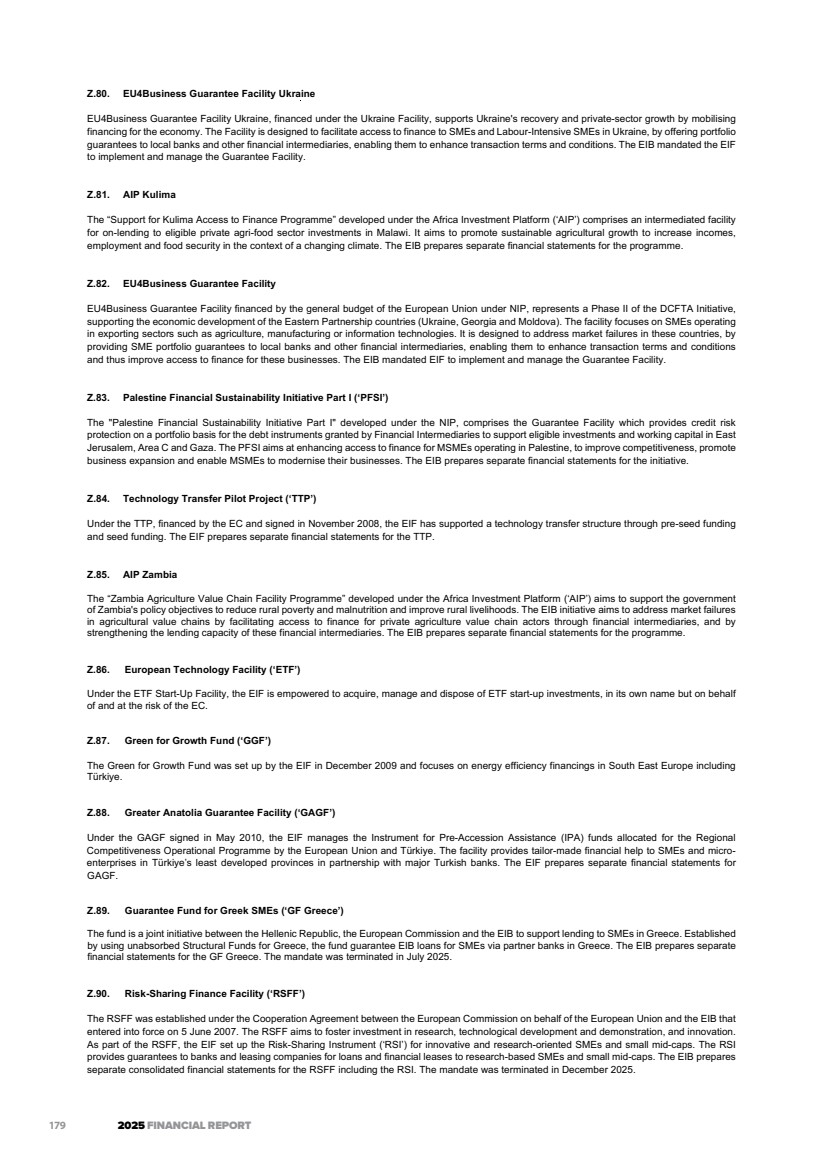
| EIB GROUP CONSOLIDATED FINANCIAL STATEMENTS UNDER EU DIRECTIVES 73 Statement of Special Section(1) as at 31 December 2025 and 31 December 2024 (in EUR ‘000) ASSETS 31.12.2025 31.12.2024 Mediterranean countries From resources of the European Union Disbursed loans outstanding 1,608 2,407 Risk capital operations - amounts to be disbursed 19,630 19,656 - amounts disbursed 21,627 24,254 41,257 43,910 Total(2) 42,865 46,317 · Lomé Conventions Operations from risk capital resources - amounts disbursed 47,243 53,137 Total(3) 47,243 53,137 Total 90,108 99,454 LIABILITIES 31.12.2025 31.12.2024 Funds under trust management Under mandate from the European Union - Financial protocols with the Mediterranean countries 23,235 26,661 - Lomé Conventions 47,243 53,137 Total funds under trust management 70,478 79,798 Funds to be disbursed On loans and risk capital operations in the Mediterranean countries 19,630 19,656 Total funds to be disbursed 19,630 19,656 Total 90,108 99,454 For information: Total amounts disbursed and not yet repaid on loans on special conditions made available by the European Commission in respect of which the Bank has accepted an EU mandate for recovering principal and interest: a) under the First, Second and Third Lomé Conventions as at 31 December 2025 EUR ‘000 136,780 (2024: EUR ‘000 152,968). b) under financial protocols signed with the Mediterranean countries as at 31 December 2025 EUR ‘000 14,222 (2024: EUR ‘000 16,939). In the context of the European Union – European Development Finance Institutions Private Sector Development Facility, the implementation agreement for the guarantee component was signed on 20 August 2014. The total amount of the EU guarantee to be issued is EUR ‘000 38,522 as at 31 December 2025 (2024: EUR ‘000 38,920). Note (1): The Special Section was set up by the Board of Governors on 27 May 1963. On 4 August 1977, its purpose was redefined to serve as a record of financing operations carried out by the European Investment Bank for the account of and under mandate from third parties. However, for the Investment Facility under the Cotonou Agreement, the EU-Africa Infrastructure Trust Fund, the Neighbourhood Investment Facility (‘NIF’) Trust Fund and the FEMIP Trust Fund, separate financial statements are presented. Since 2005, the EIB has also been preparing financial statements of different types for other mandates. The Statement of Special Section reflects amounts disbursed or to be disbursed, less cancellations and repayments, under mandate from the European Union and the Member States. Amounts disbursed and to be disbursed and funds received and to be received are carried at nominal value. No account is taken in the Statement of Special Section of provisions or value adjustments, which may be required to cover risks associated with such operations except for definite write-offs. Amounts in foreign currency are translated at the exchange rates prevailing on 31 December. 180 |
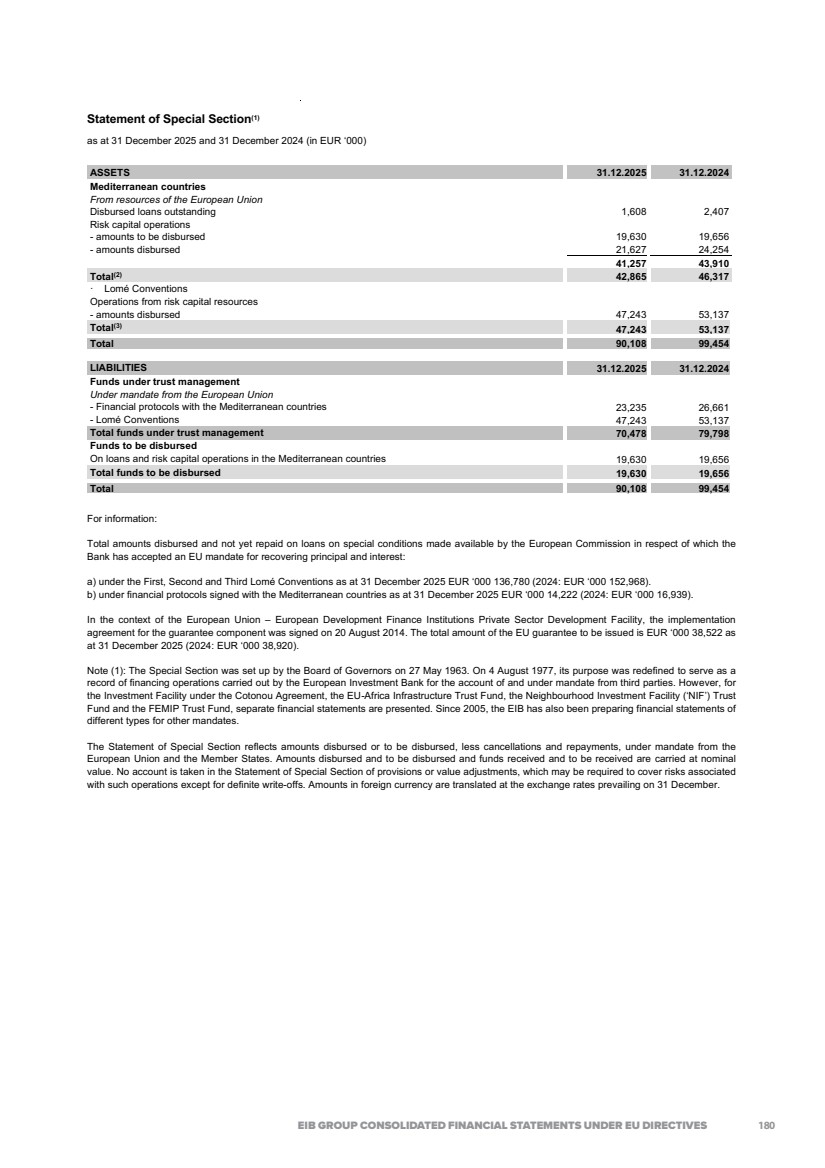
| 2025 FINANCIAL REPORT 74 Note (2): Initial amount of contracts signed for financing projects in the Maghreb and Mashreq countries, Malta, Cyprus, Türkiye and Greece (EUR 10 million lent prior to accession to the European Community on 1 January 1981) under mandate, for the account and at the risk of the European Union. Initial amount: 840,457 less: exchange adjustments 58,475 cancellations 181,095 repayments 558,022 -797,592 42,865 Note (3): Initial amount of contracts signed for financing projects in the African, Caribbean and Pacific States and the Overseas Countries and Territories (‘ACP-OCT’) under mandate, for the account and at the risk of the European Union: Loans from risk capital resources: Conditional and subordinated loans 3,116,097 Equity participations 121,003 Initial amount: 3,237,100 add: capitalised interests 9,548 less: exchange adjustments 55,865 cancellations 762,667 repayments 2,380,873 -3,199,405 47,243 181 |
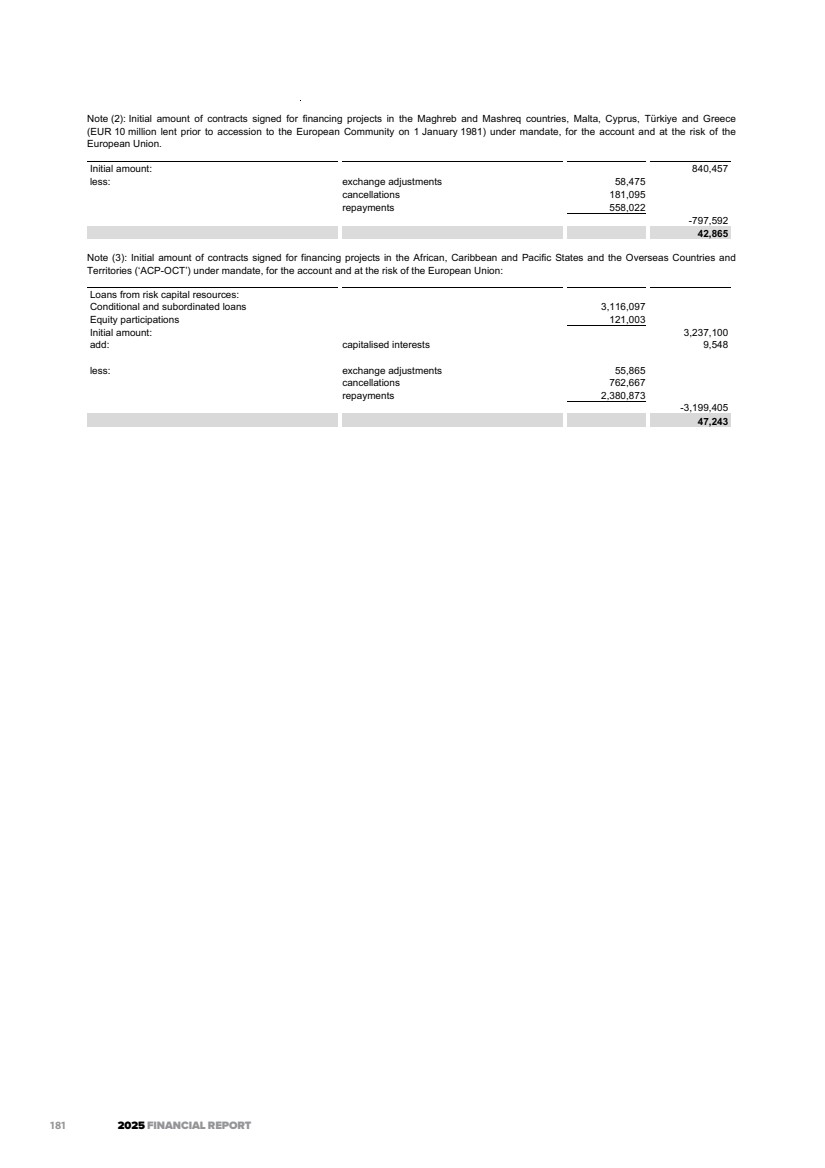
| Inde INDEPENDENT AUDITORʹS REPORT KPMG Audit S.à r.l. 39, Avenue John F. Kennedy L-1855 Luxembourg Tel.: +352 22 51 51 1 Fax: +352 22 51 71 E-mail: info@kpmg.lu Internet: www.kpmg.lu © 2026 KPMG Audit S.à r.l., a Luxembourg entity and a member firm of the KPMG global organization of independent member firms affiliated with KPMG International Limited, a private English company limited by guarantee. All rights reserved. R.C.S Luxembourg B 149133 To the Chairman of the Audit Committee of EUROPEAN INVESTMENT BANK 98-100, boulevard Konrad Adenauer L-2950 Luxembourg REPORT OF THE REVISEUR D’ENTREPRISES AGREE Report on the audit of the consolidated financial statements Opinion We have audited the consolidated financial statements of EUROPEAN INVESTMENT BANK and its subsidiary (the “Group”), which comprise the consolidated balance sheet as at 31 December 2025, and the consolidated profit and loss account and the consolidated cash flow statement for the year then ended, and notes to the consolidated financial statements, including a summary of significant accounting policies and other explanatory information. In our opinion, the accompanying consolidated financial statements give a true and fair view of the consolidated financial position of the Group as at 31 December 2025, and the consolidated results of its operations and its consolidated cash flows for the year then ended in accordance with the general principles of the Directive 86/635/EEC of the Council of the European Communities of 8 December 1986 on the annual accounts and consolidated accounts of banks and other financial institutions, as amended by Directive 2001/65/EC of 27 September 2001, by Directive 2003/51/EC of 18 June 2003 and by Directive 2006/46/EC of 14 June 2006 (the “Directives”). Basis for opinion We conducted our audit in accordance with the Law of 23 July 2016 on the audit profession (“Law of 23 July 2016”) and with International Standards on Auditing (“ISAs”) as adopted for Luxembourg by the “Commission de Surveillance du Secteur Financier” (“CSSF”) and the Institut des Réviseurs d’Entreprises (“IRE”). Our responsibilities under the Law of 23 July 2016 and ISAs as adopted for Luxembourg by the CSSF and the IRE are further described in the « Responsibilities of “réviseur d’entreprises agréé” for the audit of the consolidated financial statements » section of our report. We are also independent of the Group in accordance with the International Code of Ethics for Professional Accountants, including International Independence Standards, issued by the International Ethics Standards Board for Accountants (“IESBA Code”) as adopted for Luxembourg by the CSSF and the IRE together with the ethical requirements that are relevant to our audit of the consolidated financial statements, and have fulfilled our other ethical responsibilities under those ethical requirements. We believe that the audit evidence we have obtained is sufficient and appropriate to provide a basis for our opinion. Key audit matters Key audit matters are those matters that, in our professional judgment, were of most significance in our audit of the consolidated financial statements of the current period. These matters were addressed in the context of the audit of the consolidated financial statements as a whole, and in forming our opinion thereon, and we do not provide a separate opinion on these matters. KPMG Audit S.à r.l. 39, Avenue John F. Kennedy L-1855 Luxembourg Tel.: +352 22 51 51 1 Fax: +352 22 51 71 E-mail: info@kpmg.lu Internet: www.kpmg.lu © 2026 KPMG Audit S.à r.l., a Luxembourg entity and a member firm of the KPMG global organization of independent member firms affiliated with KPMG International Limited, a private English company limited by guarantee. All rights reserved. R.C.S Luxembourg B 149133 To the Chairman of the Audit Committee of EUROPEAN INVESTMENT BANK 98-100, boulevard Konrad Adenauer L-2950 Luxembourg REPORT OF THE REVISEUR D’ENTREPRISES AGREE Report on the audit of the consolidated financial statements Opinion We have audited the consolidated financial statements of EUROPEAN INVESTMENT BANK and its subsidiary (the “Group”), which comprise the consolidated balance sheet as at 31 December 2025, and the consolidated profit and loss account and the consolidated cash flow statement for the year then ended, and notes to the consolidated financial statements, including a summary of significant accounting policies and other explanatory information. In our opinion, the accompanying consolidated financial statements give a true and fair view of the consolidated financial position of the Group as at 31 December 2025, and the consolidated results of its operations and its consolidated cash flows for the year then ended in accordance with the general principles of the Directive 86/635/EEC of the Council of the European Communities of 8 December 1986 on the annual accounts and consolidated accounts of banks and other financial institutions, as amended by Directive 2001/65/EC of 27 September 2001, by Directive 2003/51/EC of 18 June 2003 and by Directive 2006/46/EC of 14 June 2006 (the “Directives”). Basis for opinion We conducted our audit in accordance with the Law of 23 July 2016 on the audit profession (“Law of 23 July 2016”) and with International Standards on Auditing (“ISAs”) as adopted for Luxembourg by the “Commission de Surveillance du Secteur Financier” (“CSSF”) and the Institut des Réviseurs d’Entreprises (“IRE”). Our responsibilities under the Law of 23 July 2016 and ISAs as adopted for Luxembourg by the CSSF and the IRE are further described in the « Responsibilities of “réviseur d’entreprises agréé” for the audit of the consolidated financial statements » section of our report. We are also independent of the Group in accordance with the International Code of Ethics for Professional Accountants, including International Independence Standards, issued by the International Ethics Standards Board for Accountants (“IESBA Code”) as adopted for Luxembourg by the CSSF and the IRE together with the ethical requirements that are relevant to our audit of the consolidated financial statements, and have fulfilled our other ethical responsibilities under those ethical requirements. We believe that the audit evidence we have obtained is sufficient and appropriate to provide a basis for our opinion. Key audit matters Key audit matters are those matters that, in our professional judgment, were of most significance in our audit of the consolidated financial statements of the current period. These matters were addressed in the context of the audit of the consolidated financial statements as a whole, and in forming our opinion thereon, and we do not provide a separate opinion on these matters. KPMG Audit S.à r.l. 39, Avenue John F. Kennedy L-1855 Luxembourg Tel.: +352 22 51 51 1 Fax: +352 22 51 71 E-mail: info@kpmg.lu Internet: www.kpmg.lu © 2026 KPMG Audit S.à r.l., a Luxembourg entity and a member firm of the KPMG global organization of independent member firms affiliated with KPMG International Limited, a private English company limited by guarantee. All rights reserved. R.C.S Luxembourg B 149133 To the Chairman of the Audit Committee of EUROPEAN INVESTMENT BANK 98-100, boulevard Konrad Adenauer L-2950 Luxembourg REPORT OF THE REVISEUR D’ENTREPRISES AGREE Report on the audit of the consolidated financial statements Opinion We have audited the consolidated financial statements of EUROPEAN INVESTMENT BANK and its subsidiary (the “Group”), which comprise the consolidated balance sheet as at 31 December 2025, and the consolidated profit and loss account and the consolidated cash flow statement for the year then ended, and notes to the consolidated financial statements, including a summary of significant accounting policies and other explanatory information. In our opinion, the accompanying consolidated financial statements give a true and fair view of the consolidated financial position of the Group as at 31 December 2025, and the consolidated results of its operations and its consolidated cash flows for the year then ended in accordance with the general principles of the Directive 86/635/EEC of the Council of the European Communities of 8 December 1986 on the annual accounts and consolidated accounts of banks and other financial institutions, as amended by Directive 2001/65/EC of 27 September 2001, by Directive 2003/51/EC of 18 June 2003 and by Directive 2006/46/EC of 14 June 2006 (the “Directives”). Basis for opinion We conducted our audit in accordance with the Law of 23 July 2016 on the audit profession (“Law of 23 July 2016”) and with International Standards on Auditing (“ISAs”) as adopted for Luxembourg by the “Commission de Surveillance du Secteur Financier” (“CSSF”) and the Institut des Réviseurs d’Entreprises (“IRE”). Our responsibilities under the Law of 23 July 2016 and ISAs as adopted for Luxembourg by the CSSF and the IRE are further described in the « Responsibilities of “réviseur d’entreprises agréé” for the audit of the consolidated financial statements » section of our report. We are also independent of the Group in accordance with the International Code of Ethics for Professional Accountants, including International Independence Standards, issued by the International Ethics Standards Board for Accountants (“IESBA Code”) as adopted for Luxembourg by the CSSF and the IRE together with the ethical requirements that are relevant to our audit of the consolidated financial statements, and have fulfilled our other ethical responsibilities under those ethical requirements. We believe that the audit evidence we have obtained is sufficient and appropriate to provide a basis for our opinion. Key audit matters Key audit matters are those matters that, in our professional judgment, were of most significance in our audit of the consolidated financial statements of the current period. These matters were addressed in the context of the audit of the consolidated financial statements as a whole, and in forming our opinion thereon, and we do not provide a separate opinion on these matters. 182 |
| 2025 FINANCIAL REPORT 1 Value adjustments of loans to customers and credit institutions Why the matter was considered to be one of most significance in our audit As at 31 December 2025, the Group reports loans accounted for at cost of EUR 437,878 million (31 December 2024: EUR 436,266 million) representing 79% of total assets (31 December 2024: 78%) and recognised individually assessed value adjustments on loans amounting to EUR 701 million (31 December 2024: EUR 618 million). The Group reviews its loans at each reporting date to assess whether an allowance for value adjustments should be recorded. These loans are not traded in an active market, therefore significant judgments and estimates are applied by Management in its assessment of their recoverable amount. Inappropriate judgments made in relation to the methodology and inputs used or the assumptions taken may have a material impact on the amount of value adjustment recorded. These critical judgments include matters such as the identification and assessment of potential indicators of value adjustments, as well as discounted cash flows forecast techniques, estimation of guarantees obtained, valuation of collaterals received and forbearance measures applied. The current environment of enhanced geopolitical uncertainty introduces increased volatility and unpredictability in key economic factors. This uncertainty increased the level of judgement involved in the determination and calculation of value adjustments on loans. The key inputs and assumptions used by Management in its assessment of loans value adjustments are detailed in Note A.1.2 to the consolidated financial statements as well as the accounting policy for the value adjustment in Note A.2.7.1 and the details of specific value adjustments in Note D.2. The loans accounted for at cost are disclosed in Note D.1 to the consolidated financial statements as well as the accounting policy for the loans in Note A.2.7.1. How the matter was addressed in our audit Our procedures included the testing of key controls over the approval, recording, monitoring and restructuring of loans to customers and credit institutions, the loan grading process and the measurement of allowance for value adjustment for individually assessed loans. For a sample of loans with specific allowances for value adjustment, we evaluated the Group's individual assessment of each loan by specifically challenging the Group 's assumptions used as well as underlying data, including the value of realisable collateral and the estimated recoverability. Based on a retrospective review, we further critically assessed whether the Group revised its estimates and assumptions for specific allowances established in prior years. The impact of the difficult market conditions, driven by geopolitical uncertainties, was followed-up both by assessing the value adjustment of the evaluated exposure and by determining our sample of exposures where we drew a particular attention to the sectors most vulnerable to the geopolitical risk. Such effect on the Bank’s lending portfolio was assessed as part of our audit procedures. 183 |
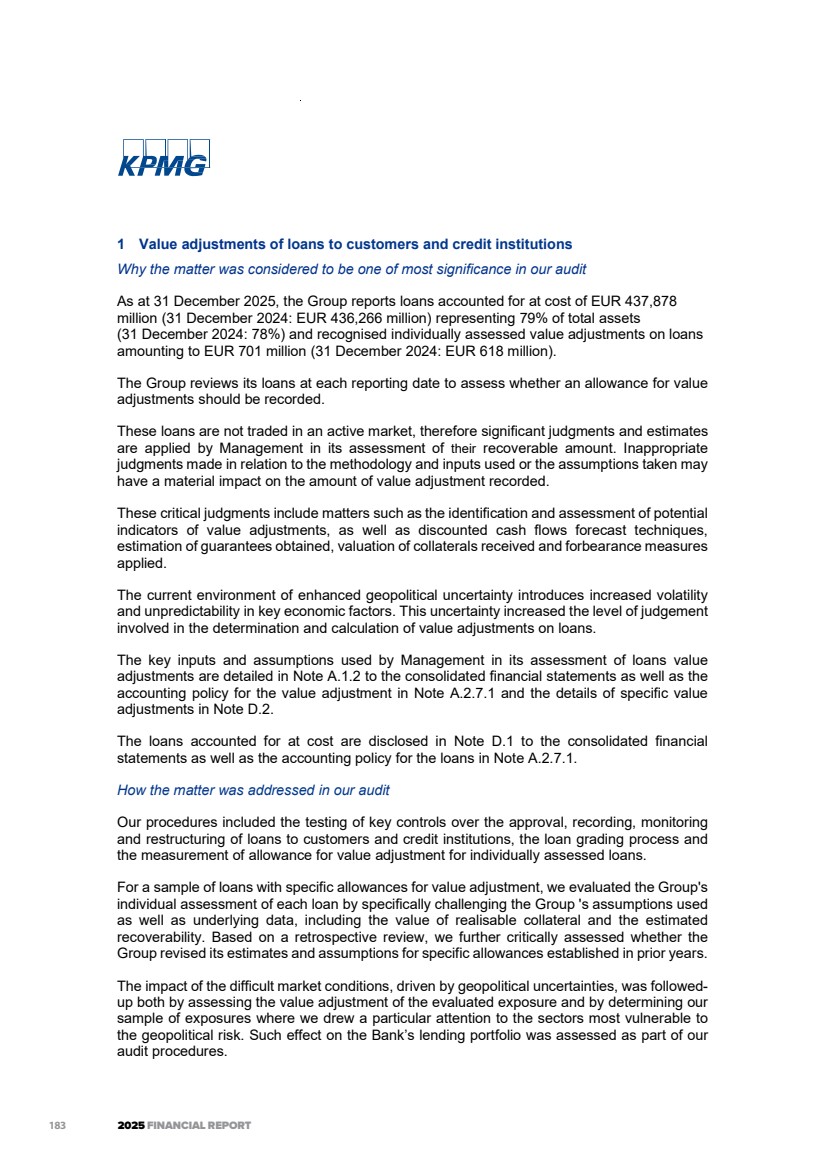
| Inde We also tested a sample of individually significant exposures potentially impaired for which no value adjustment had been recorded as well as a sample of exposures which had not been identified by the Group as being potentially impaired. For both types, we assessed whether appropriate consideration had been given to the collectability of future cash flows and the valuation of the underlying collaterals. We assessed the disclosures in the consolidated financial statements in relation to allowance for value adjustment of loans with reference to the requirements of the prevailing accounting standards. Other information The Management is responsible for the other information. The other information comprises the information stated in the introductory sections called “Highlights, Overview, EIB Statutory Bodies and Audit, control and accountability”, which are mainly based on statutory EU Directives information, but does not include the consolidated financial statements and our report of the “réviseur d’entreprises agréé” thereon. Our opinion on the consolidated financial statements does not cover the other information and we do not express any form of assurance conclusion thereon. In connection with our audit of the consolidated financial statements, our responsibility is to read the other information and, in doing so, consider whether the other information is materially inconsistent with the consolidated financial statements or our knowledge obtained in the audit or otherwise appears to be materially misstated. If, based on the work we have performed, we conclude that there is a material misstatement of this other information, we are required to report this fact. We have nothing to report in this regard. Responsibilities of the Management and Those Charged with Governance for the consolidated financial statements The Management is responsible for the preparation and fair presentation of these consolidated financial statements in accordance with the general principles of the Directives, and for such internal control as the Management determines is necessary to enable the preparation of consolidated financial statements that are free from material misstatement, whether due to fraud or error. In preparing the consolidated financial statements, the Management is responsible for assessing the Group’s ability to continue as a going concern, disclosing, as applicable, matters related to going concern and using the going concern basis of accounting unless the Management either intends to liquidate the Group or to cease operations, or has no realistic alternative but to do so. Those charged with governance are responsible for overseeing the Group’s financial reporting process. Responsibilities of the réviseur d’entreprises agréé for the audit of the consolidated financial statements The objectives of our audit are to obtain reasonable assurance about whether the consolidated financial statements as a whole are free from material misstatement, whether due to fraud or error, and to issue a report of the “réviseur d’entreprises agréé” that includes our opinion. 184 |
| 2025 FINANCIAL REPORT Reasonable assurance is a high level of assurance, but is not a guarantee that an audit conducted in accordance with the Law of 23 July 2016 and with ISAs as adopted for Luxembourg by the CSSF and the IRE will always detect a material misstatement when it exists. Misstatements can arise from fraud or error and are considered material if, individually or in the aggregate, they could reasonably be expected to influence the economic decisions of users taken on the basis of these consolidated financial statements. As part of an audit in accordance with the Law of 23 July 2016 and with ISAs as adopted for Luxembourg by the CSSF and the IRE, we exercise professional judgment and maintain professional skepticism throughout the audit. We also: • Identify and assess the risks of material misstatement of the consolidated financial statements, whether due to fraud or error, design and perform audit procedures responsive to those risks, and obtain audit evidence that is sufficient and appropriate to provide a basis for our opinion. The risk of not detecting a material misstatement resulting from fraud is higher than for one resulting from error, as fraud may involve collusion, forgery, intentional omissions, misrepresentations, or the override of internal control. • Obtain an understanding of internal control relevant to the audit in order to design audit procedures that are appropriate in the circumstances, but not for the purpose of expressing an opinion on the effectiveness of the Group’s internal control. • Evaluate the appropriateness of accounting policies used and the reasonableness of accounting estimates and related disclosures made by the Management. • Conclude on the appropriateness of Management’s use of the going concern basis of accounting and, based on the audit evidence obtained, whether a material uncertainty exists related to events or conditions that may cast significant doubt on the Group’s ability to continue as a going concern. If we conclude that a material uncertainty exists, we are required to draw attention in our report of the “réviseur d’entreprises agréé” to the related disclosures in the consolidated financial statements or, if such disclosures are inadequate, to modify our opinion. Our conclusions are based on the audit evidence obtained up to the date of our report of the “réviseur d’entreprises agréé”. However, future events or conditions may cause the Group to cease to continue as a going concern. • Evaluate the overall presentation, structure and content of the consolidated financial statements, including the disclosures, and whether the consolidated financial statements represent the underlying transactions and events in a manner that achieves fair presentation. • Obtain sufficient appropriate audit evidence regarding the financial information of the entities and business activities within the Group to express an opinion on the consolidated financial statements. We are responsible for the direction, supervision and performance of the Group audit. We remain solely responsible for our audit opinion. We communicate with those charged with governance regarding, among other matters, the planned scope and timing of the audit and significant audit findings, including any significant deficiencies in internal control that we identify during our audit. 185 |
| Inde We also provide those charged with governance with a statement that we have complied with relevant ethical requirements regarding independence, and to communicate with them all relationships and other matters that may reasonably be thought to bear on our independence, and where applicable, related safeguards. From the matters communicated with those charged with governance, we determine those matters that were of most significance in the audit of the consolidated financial statements of the current period and are therefore the key audit matters. We describe these matters in our report unless law or regulation precludes public disclosure about the matter or when, in extremely rare circumstances, we determine that a matter should not be communicated in our report because the adverse consequences of doing so would reasonably be expected to outweigh the public interest benefits of such communication. Report on other requirements In accordance with the Framework Agreement (“the Agreement”) dated 19 February 2009, renewed on 3 March 2017 , as extended for the period 2022-2024 on 14 December 2020 and subsequently prolonged up to 31 December 2026 by the Addendum No. 2 to the Agreement on 23 November 2023, signed between European Investment Bank and KPMG Audit S.à r.l., we have been appointed to carry the audit services defined in the Agreement. The duration of our uninterrupted engagement, including previous renewals and reappointments, is 17 years. We confirm that the audit opinion is consistent with the communication to the Audit Committee or equivalent. We confirm that the prohibited non-audit services referred to in IESBA Code of Ethics were not provided and that we remained independent of the Group in conducting the audit. Luxembourg, 25 March 2026 KPMG Audit S.à r.l. Cabinet de révision agréé M. Weber Partner 186 |
| 2025 FINANCIAL REPORT STATEMENT BY THE AUDIT COMMITTEE 187 |
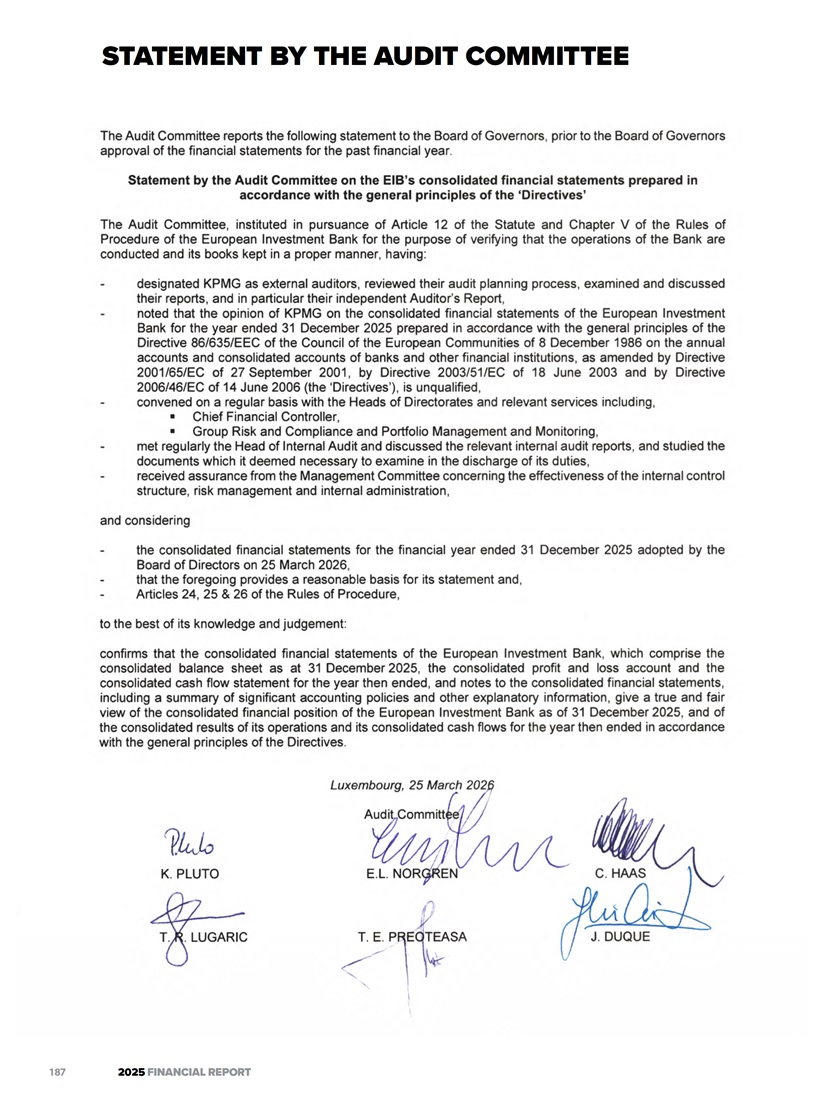
| EIB GROUP CONSOLIDATED FINANCIAL STATEMENTS UNDER IFRS EIB GROUP CONSOLIDATED FINANCIAL STATEMENTS UNDER IFRS 31 December 2025 Disclaimer: To accommodate scheduling limitations, the financial statements included in this report have not been subject to standard EIB copy-editing or proofreading. 188 |

| 2025 FINANCIAL REPORT 2 Consolidated balance sheet as at 31 December 2025 (in EUR ’000) Assets 31.12.2025 31.12.2024 1. Cash in hand, balances with central banks and post office banks (Note B.1) 257,807 104,678 2. Treasury bills and other bills eligible for refinancing with central banks (Note B.2) 41,775,040 38,210,037 3. Loans and advances to credit institutions a) repayable on demand 1,952,053 1,659,548 b) other loans and advances (Note C) 34,257,129 40,203,431 c) loans (Note D.1) 85,036,511 89,573,990 d) impairment on loans and advances, net of reversals (Note D.2) -22,664 -30,013 121,223,029 131,406,956 4. Loans and advances to customers a) other loans and advances (Note C) 118,282 235,061 b) loans (Note D.1) 351,233,550 347,280,539 c) impairment on loans and advances, net of reversals (Note D.2) -649,539 -537,622 350,702,293 346,977,978 5. Debt securities including fixed-income securities (Note B.2) a) issued by public bodies 5,180,688 4,799,445 b) issued by other borrowers 6,501,992 6,789,306 11,682,680 11,588,751 6. Shares and other variable-yield securities (Note B.3) 22,608,556 21,732,963 7. Derivative assets (Note Q) 22,447,103 30,456,775 8. Property, furniture and equipment (Note E) 567,388 493,953 9. Intangible assets (Note E) 156,057 130,651 10. Other assets (Note G.1) 511,649 458,920 11. Subscribed capital and reserves, called but not paid (Note W.1) 0 162,774 12. Prepayments 338,140 306,436 13. Assets held for sale 0 115,859 Total assets 572,269,742 582,146,731 The accompanying notes form an integral part of these consolidated financial statements. 189 |
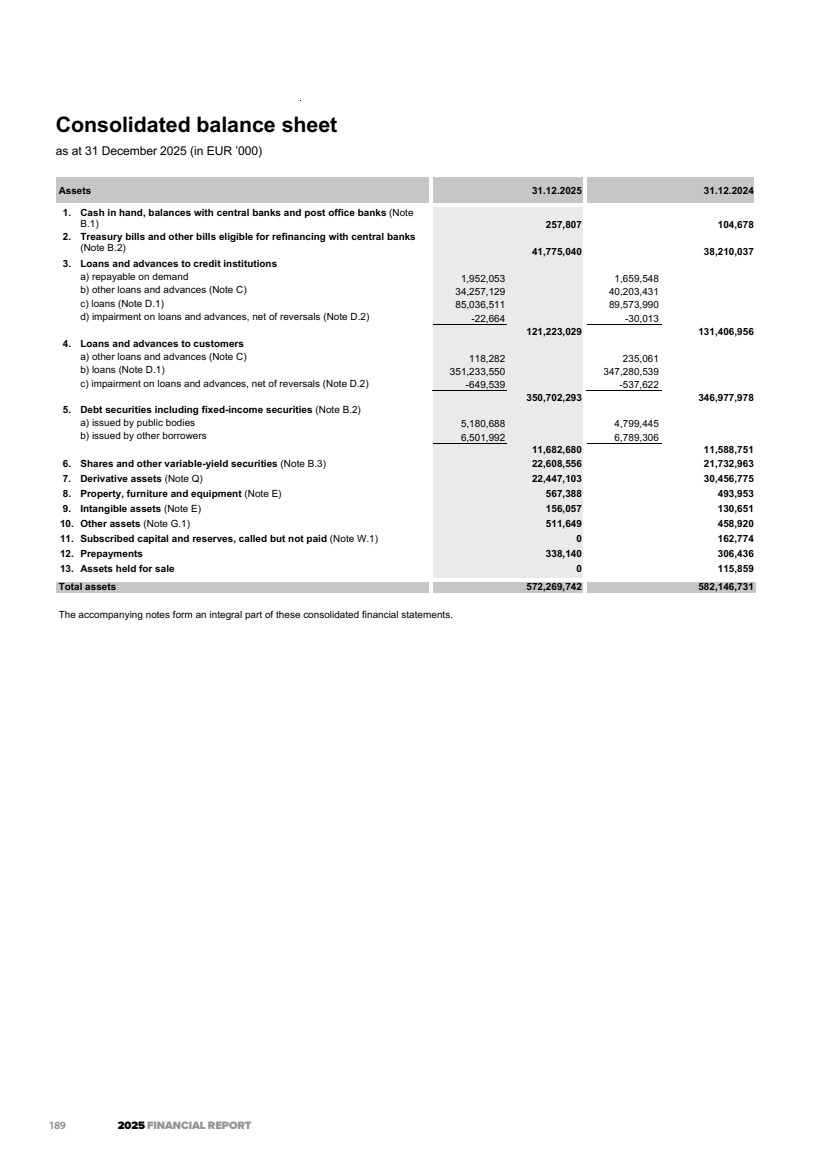
| EIB GROUP CONSOLIDATED FINANCIAL STATEMENTS UNDER IFRS 3 Consolidated balance sheet (continued) as at 31 December 2025 (in EUR ’000) Liabilities and equity 31.12.2025 31.12.2024 Liabilities 1. Amounts owed to credit institutions (Note H.1) a) repayable on demand 446,323 750,387 b) with agreed maturity or periods of notice 984,650 107,298 1,430,973 857,685 2. Amounts owed to customers (Note H.2) a) repayable on demand 4,171,810 3,090,263 b) with agreed maturity or periods of notice 13,170 120,508 4,184,980 3,210,771 3. Debts evidenced by certificates (Note I) a) debt securities in issue 423,546,857 433,990,524 b) others 8,017,835 8,070,213 431,564,692 442,060,737 4. Derivative liabilities (Note Q) 26,122,185 30,173,347 5. Other liabilities (Note G.2) 4,834,273 5,004,934 6. Deferred income (Note F) 914,048 752,055 7. Provisions a) pension plans and health insurance scheme (Note J) 6,703,866 6,702,429 b) provisions for guarantees issued and commitments (Note D) 112,950 74,391 6,816,816 6,776,820 Total liabilities 475,867,967 488,836,349 Equity 8. Capital (Note W) a) subscribed 248,795,607 248,795,607 b) uncalled -226,604,892 -226,604,892 22,190,715 22,190,715 9. Reserves a) reserve fund 24,879,561 24,879,561 b) additional reserves 27,406,037 24,820,946 c) fair value reserve 1,051,401 1,277,500 d) special activities reserve 14,015,155 12,665,555 e) general loan reserve 2,495,377 2,281,423 69,847,531 65,924,985 10. Profit for the financial year (Note K) 2,840,013 3,748,803 Total equity attributable to the equity holders of the Bank 94,878,259 91,864,503 11. Non-controlling interests 1,523,516 1,445,879 Total equity 96,401,775 93,310,382 Total liabilities and equity 572,269,742 582,146,731 The accompanying notes form an integral part of these consolidated financial statements. 190 |
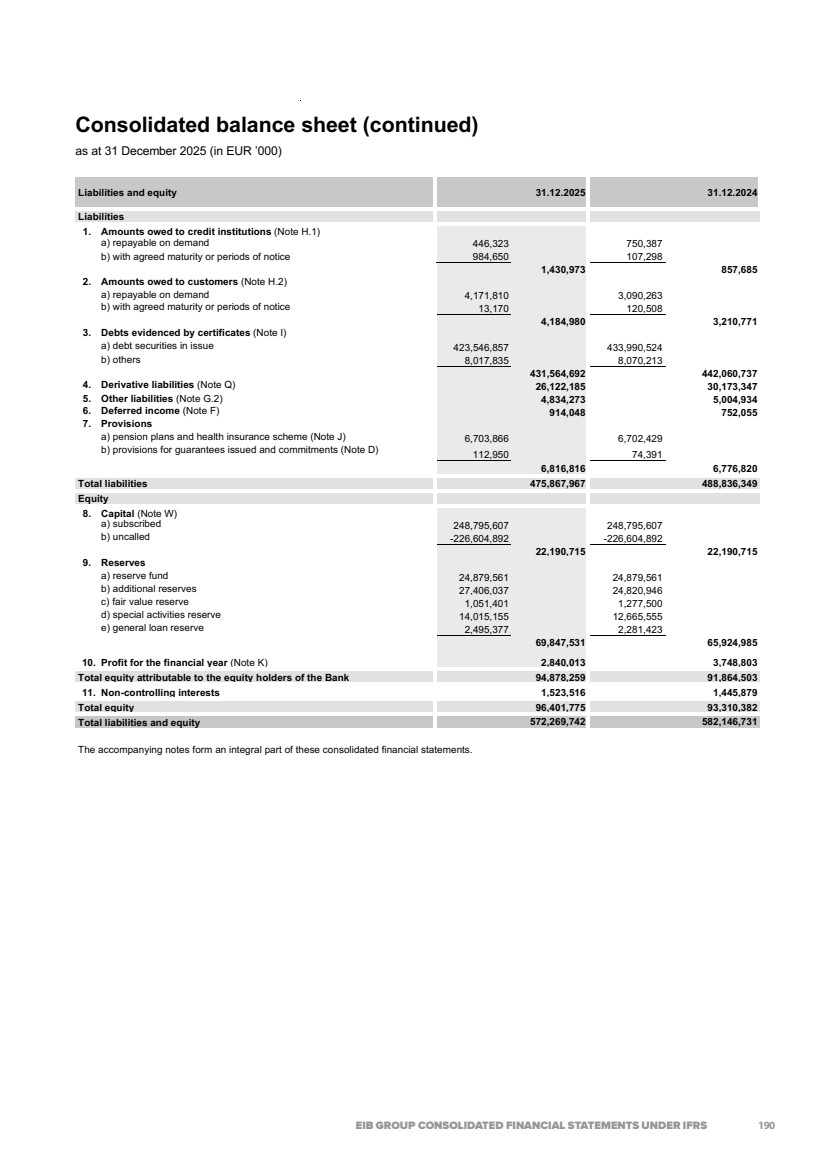
| 2025 FINANCIAL REPORT 1 Consolidated income statement for the year ended 31 December 2025 (in EUR ‘000) 2025 2024 1. Interest and similar income (Note L) (1) 23,310,131 26,717,813 2. Interest expense and similar charges (Note L) -20,184,833 -23,572,724 Net interest income 3,125,298 3,145,089 3. Fee and commission income (Note O) 684,450 676,310 4. Fee and commission expense (Note O) -306,271 -315,508 Net fee and commission income 378,179 360,802 5. Income from shares and other variable-yield securities 1,025,694 998,419 6. Result on financial operations (Note M) 221,153 904,291 7. Net other operating income and expense (Note N) 50,108 49,628 8. Change in impairment on loans and advances and provisions for guarantees, net of reversals (Notes D.2, D.4) -212,976 -9,931 9. Change in impairment on transferable securities held as financial fixed assets, shares and other variable-yield securities, net of reversals -7,302 -1,898 10. General administrative expenses (Note P) a) staff costs -1,188,730 -1,135,268 b) other administrative expenses -352,549 -355,483 -1,541,279 -1,490,751 11. Depreciation and amortisation: property, furniture and equipment and intangible assets (Note E) a) property, furniture and equipment -65,331 -71,744 b) intangible assets -64,364 -51,967 -129,695 -123,711 12. Profit for the financial year 2,909,180 3,831,938 Attributable to: Non-controlling interests 69,167 83,135 Equity holders of the Bank 2,840,013 3,748,803 (1) For the year ended 31 December 2025, "Interest and similar income" included EUR '000 14,086,270 (2024: EUR '000 16,045,179) calculated on assets held at amortised cost based on effective interest method. The accompanying notes form an integral part of these consolidated financial statements. (2) A reclassification was made among the captions in order to improve the readability of financial statements. See Note A.5. 191 |
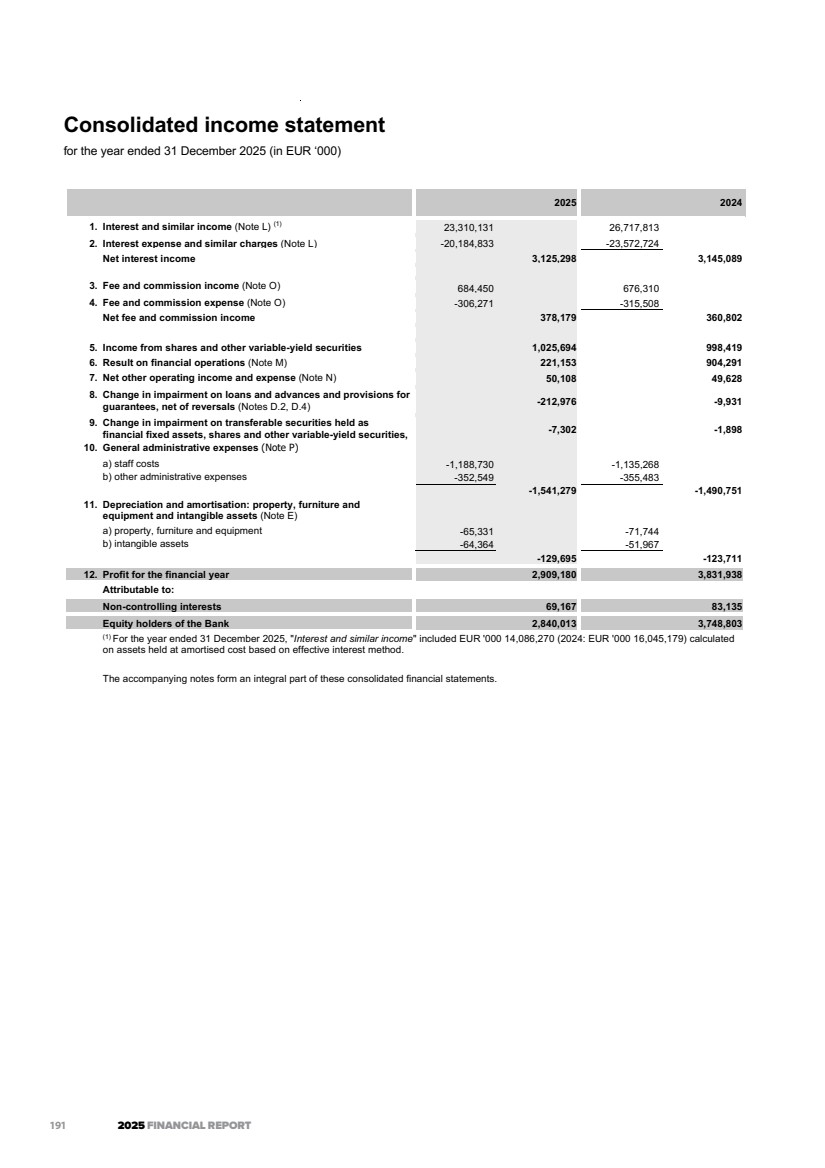
| EIB GROUP CONSOLIDATED FINANCIAL STATEMENTS UNDER IFRS 5 Consolidated statement of profit or loss and other comprehensive income for the year ended 31 December 2025 (in EUR ’000) 2025 2024 Profit for the financial year 2,909,180 3,831,938 Other comprehensive income Items that will not be reclassified to profit or loss: Remeasurements of defined benefit liability (Note J) 421,627 186,430 Changes in fair value attributable to change in the own credit risk of financial liabilities designated at fair value through profit or loss - fair value reserve (Note R) -239,761 319,196 Net gains on investment in equity instruments designated at fair value through other comprehensive income (Note B.3) 64,819 13,326 Items that are or may be reclassified to profit or loss: Changes in fair value attributable to the currency basis spread of hedging derivatives - fair value reserve (Note Q) -32,386 -25,075 Changes in fair value attributable to the cash flow hedging derivatives - fair value reserve (Note Q) -3,482 -518 Total other comprehensive income 210,817 493,359 Total comprehensive income 3,119,997 4,325,297 Attributable to: Non-controlling interests 91,272 88,682 Equity holders of the Bank 3,028,725 4,236,615 The accompanying notes form an integral part of these consolidated financial statements. 192 |
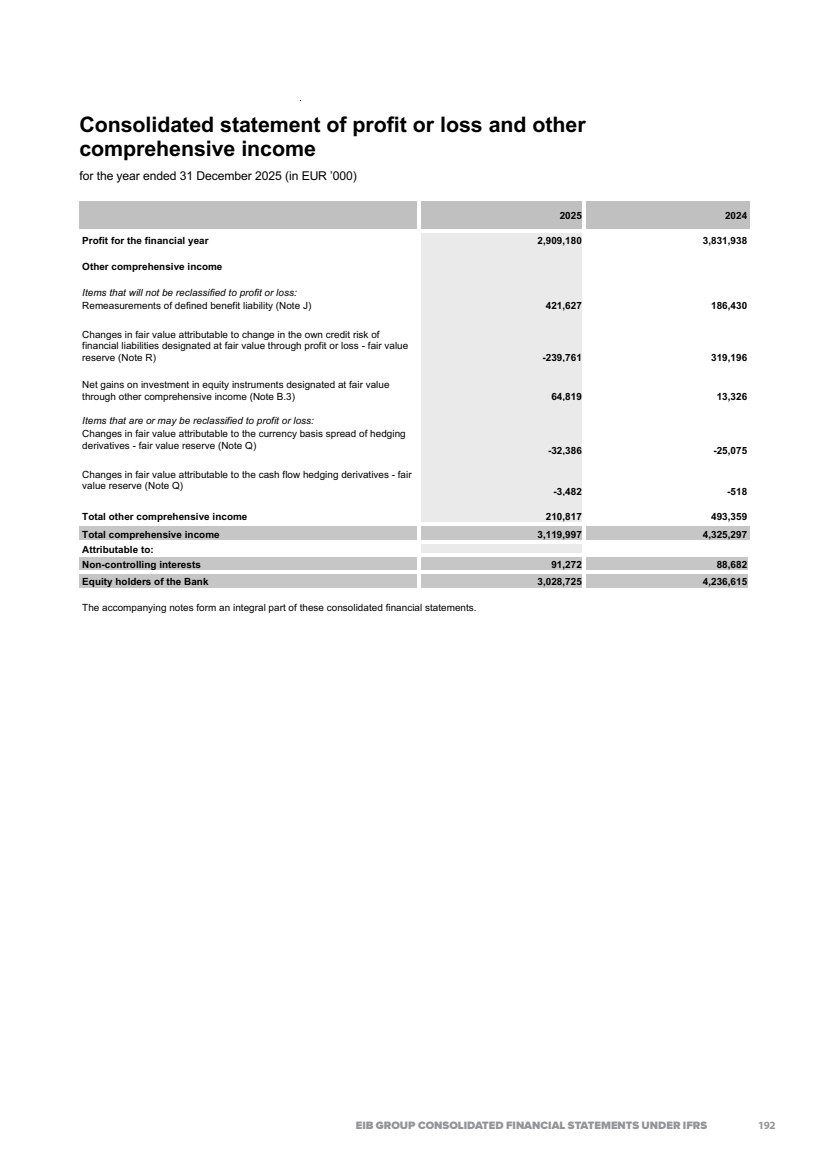
| 2025 FINANCIAL REPORT Subscribed capital Uncalled capital Reserve Fund Consolidated statement of changes in equity for the year ended 31 December 2025 (in EUR ’000) Additional reserves Fair value reserve Special activities reserve General loan reserve Result of the year before appropriation Total Non-controlling interests Total consolidated equity Balance at 1 January 2024 248,795,607 -226,604,892 24,879,561 24,257,413 973,274 11,194,601 1,883,372 2,272,050 87,650,986 1,365,468 89,016,454 0 0 0 0 0 0 0 3,748,803 3,748,803 83,135 3,831,938 0 0 0 180,884 306,928 0 0 0 487,812 5,547 493,359 0 0 0 180,884 306,928 0 0 3,748,803 4,236,615 88,682 4,325,297 0 0 0 403,045 0 1,470,954 398,051 -2,272,050 0 0 0 0 0 0 -20,396 -2,702 0 0 0 -23,098 0 -23,098 0 0 0 0 0 0 0 0 0 -8,271 -8,271 0 0 0 0 0 0 0 0 0 -8,271 -8,271 Balance at 31 December 2024 248,795,607 -226,604,892 24,879,561 24,820,946 1,277,500 12,665,555 2,281,423 3,748,803 91,864,503 1,445,879 93,310,382 Comprehensive income Profit for the financial year Other comprehensive income Total comprehensive income Appropriation of prior year’s result Other Transactions with owners of the Group Movement of non-controlling interest subsidiary Total transactions with owners of the Group 0 0 0 0 0 0 0 2,840,013 2,840,013 69,167 2,909,180 0 0 0 399,522 -210,810 0 0 0 188,712 22,105 210,817 0 0 0 399,522 -210,810 0 0 2,840,013 3,028,725 91,272 3,119,997 0 0 0 2,185,249 0 1,349,600 213,954 -3,748,803 0 0 0 0 0 0 320 -15,289 0 0 0 -14,969 0 -14,969 0 0 0 0 0 0 0 0 0 -13,635 -13,635 0 0 0 0 0 0 0 0 0 -13,635 -13,635 Balance at 31 December 2025 248,795,607 -226,604,892 24,879,561 27,406,037 1,051,401 14,015,155 2,495,377 2,840,013 94,878,259 1,523,516 96,401,775 Comprehensive income Profit for the financial year Other comprehensive income Total comprehensive income Appropriation of prior year’s result Other Transactions with owners of the Group Movement of non-controlling interest subsidiary Total transactions with owners of the Group The accompanying notes form an integral part of these consolidated financial statements. 193 |
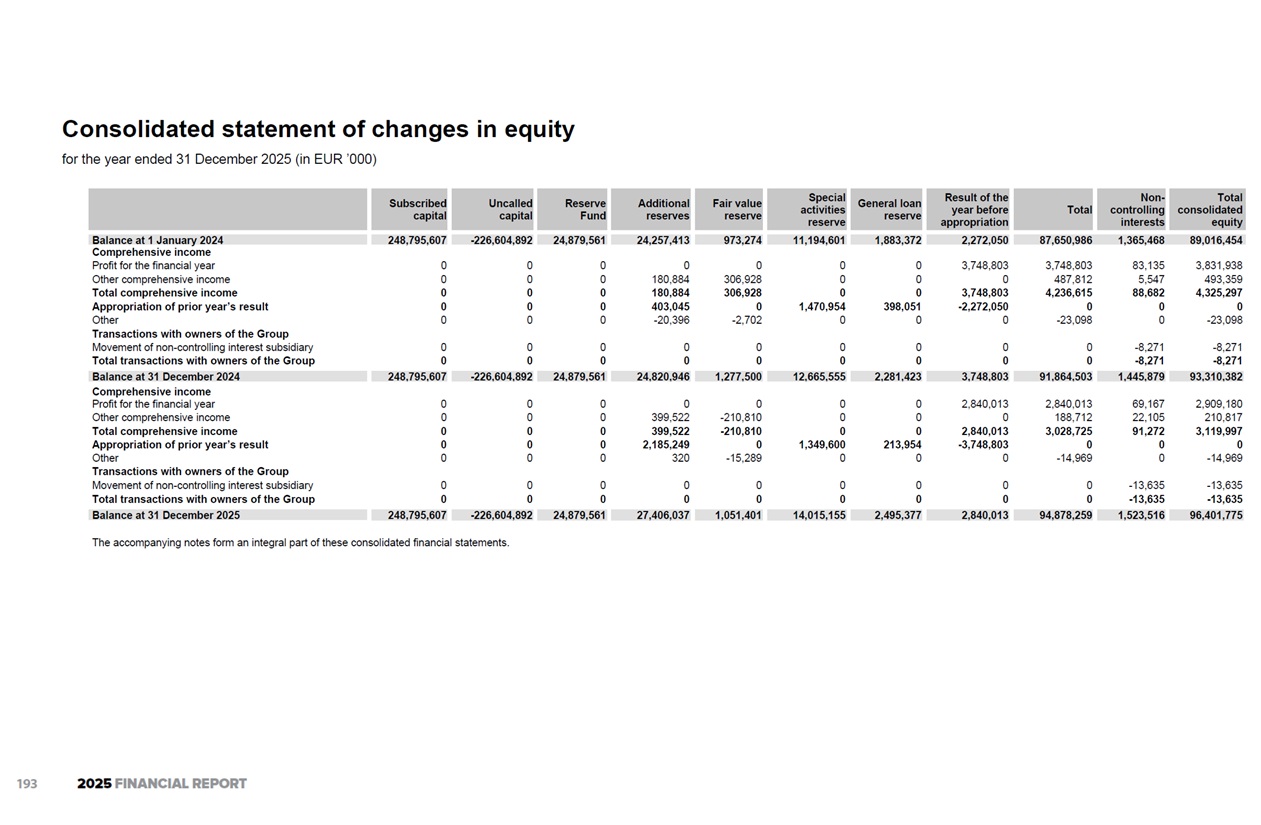
| EIB GROUP CONSOLIDATED FINANCIAL STATEMENTS UNDER IFRS 7 Consolidated cash flow statement for the year ended 31 December 2025 (in EUR ‘000) 2025 2024 A. Cash flows from operating activities: Profit for the financial year 2,909,180 3,831,938 Adjustments for: Change in impairment on loans and advances and provisions for guarantees (Notes D.2, D.4) 212,976 9,931 Depreciation and amortisation on property, furniture and equipment and intangible assets, and write-off (Note E) 130,651 123,973 Change in impairment on transferable securities held as financial fixed assets, shares and other variable-yield securities 7,302 1,898 Change in fair value of debt securities 15,056 -66,039 Change in provisions on pension plans and health insurance scheme (Note J) 264,020 278,441 Unrealised result on loans and associated swaps (Note M.1) -291,708 35,362 Unrealised result on borrowings and associated swaps (Note M.1) -368,640 83,168 Unrealised result on other derivatives (Note M.1) 420,346 -995,429 Net interest income (Note L.1) -3,125,298 -3,145,089 Effect of exchange rate changes -84,189 72,772 89,696 230,926 Disbursements of loans and advances to credit institutions and customers -52,819,374 -53,584,105 Repayments of loans and advances to credit institutions and customers 47,816,442 45,339,242 Change in other loans and advances (Note C) 968,114 18,227,061 Change in deposit with Central Bank of Luxembourg to cover minimum reserve requirement (Note B.1) -152,382 105,328 Change in treasury operational portfolios -1,462,819 3,139,106 Change in amounts owed to credit institutions and customers (Note H) 1,547,115 -150,020 Payments and annual contributions to pension plans and health insurance scheme during the year (Note J) 84,394 99,301 Change in interest accrued on cash and cash equivalents 12,861 454,395 Change in other assets and other liabilities and change in prepayments and accruals -4,905,011 -120,197 Interest received 21,608,397 25,824,029 Interest paid -18,069,122 -21,835,414 Net cash generated (used in)/from operating activities -5,281,689 17,729,652 B. Cash flows from investing activities: Securities in Long-Term HQLA Portfolio purchased during the year -3,686,986 -2,521,418 Securities from Long-Term HQLA Portfolio matured or sold during the year 161,697 115,000 Purchase of loan substitutes and ABS portfolio EIF included in the debt securities portfolios -5,220,418 -5,245,308 Redemption of loan substitutes and ABS portfolio EIF included in the debt securities portfolios 5,542,043 4,451,563 Additions on shares and other variable-yield securities (Note B.3) -2,844,854 -2,856,456 Reflows on shares and other variable-yield securities (Note B.3) 1,556,252 1,678,515 Purchase of property, furniture and equipment and intangible assets (Note E) -231,961 -187,363 Proceeds from sale of non-current assets held for sale 2,508 0 Net cash used in investing activities -4,721,719 -4,565,467 C. Cash flows from financing activities: Issuance of debts evidenced by certificates 113,139,018 106,720,276 Redemption of debts evidenced by certificates -107,429,294 -106,488,673 Member States' contribution 159,848 319,700 Purchase of EIF shares -3,283 0 Sale of EIF shares 5,253 2,983 Dividend paid to non-controlling interests -10,596 -9,247 Payment of lease liabilities -41,982 -46,759 Net cash generated from financing activities 5,818,964 498,280 Summary statement of cash flows: Cash and cash equivalents at beginning of financial year 39,036,093 25,573,322 Net cash from: Operating activities -5,281,689 17,729,652 Investing activities -4,721,719 -4,565,467 Financing activities 5,818,964 498,280 Effect of exchange rate changes on cash held -594,591 -199,694 Cash and cash equivalents at end of financial year 34,257,058 39,036,093 Cash and cash equivalents are composed of: Cash in hand, balances with central banks and post office banks, excluding deposits with Central Bank of Luxembourg to cover minimum reserve requirement (Note B.1) 758 11 Loans and advances to credit institutions and customers: Repayable on demand 1,952,053 1,659,548 Other loans and advances (Note C) 32,304,247 37,376,534 34,257,058 39,036,093 194 |
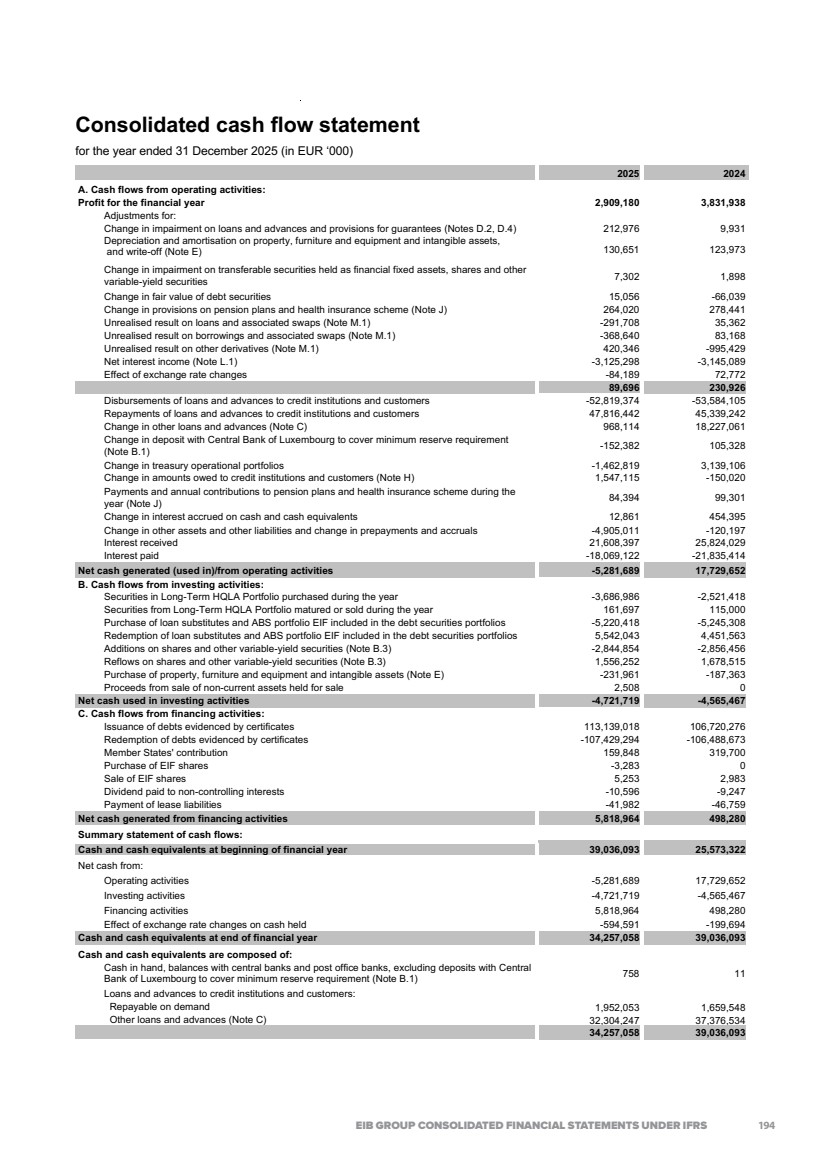
| 2025 FINANCIAL REPORT 8 Consolidated cash flow statement (continued) for the year ended 31 December 2025 (in EUR ‘000) Non-cash changes (In EUR '000) 31.12.2024 Cash flows Exchange adjustments Change in fair value Other changes 31.12.2025 Long-term borrowings(*) 417,935,761 2,559,097 -14,637,352 652,620 0 406,510,126 Lease liability 136,011 -41,982 40 6,203 -2,468 97,804 Short-term borrowings(*) 24,124,976 3,150,627 -2,221,532 495 0 25,054,566 Changes in liabilities arising from financing activities 442,196,748 5,667,742 -16,858,844 659,318 -2,468 431,662,496 (*) Long-term borrowings and short-term borrowings represent the total of "Debts evidenced by certificates" (Note I). Non-cash changes (In EUR '000) 31.12.2023 Cash flows Exchange adjustments Change in fair value Other changes 31.12.2024 Long-term borrowings(*) 406,974,453 1,591,893 7,084,377 2,285,038 0 417,935,761 Lease liability 126,341 -46,759 -20,880 5,002 72,307 136,011 Short-term borrowings(*) 24,770,582 -1,360,291 716,211 -1,526 0 24,124,976 Changes in liabilities arising from financing activities 431,871,376 184,843 7,779,708 2,288,514 72,307 442,196,748 (*) Long-term borrowings and short-term borrowings represent the total of "Debts evidenced by certificates" (Note I). The accompanying notes form an integral part of these consolidated financial statements. 195 |
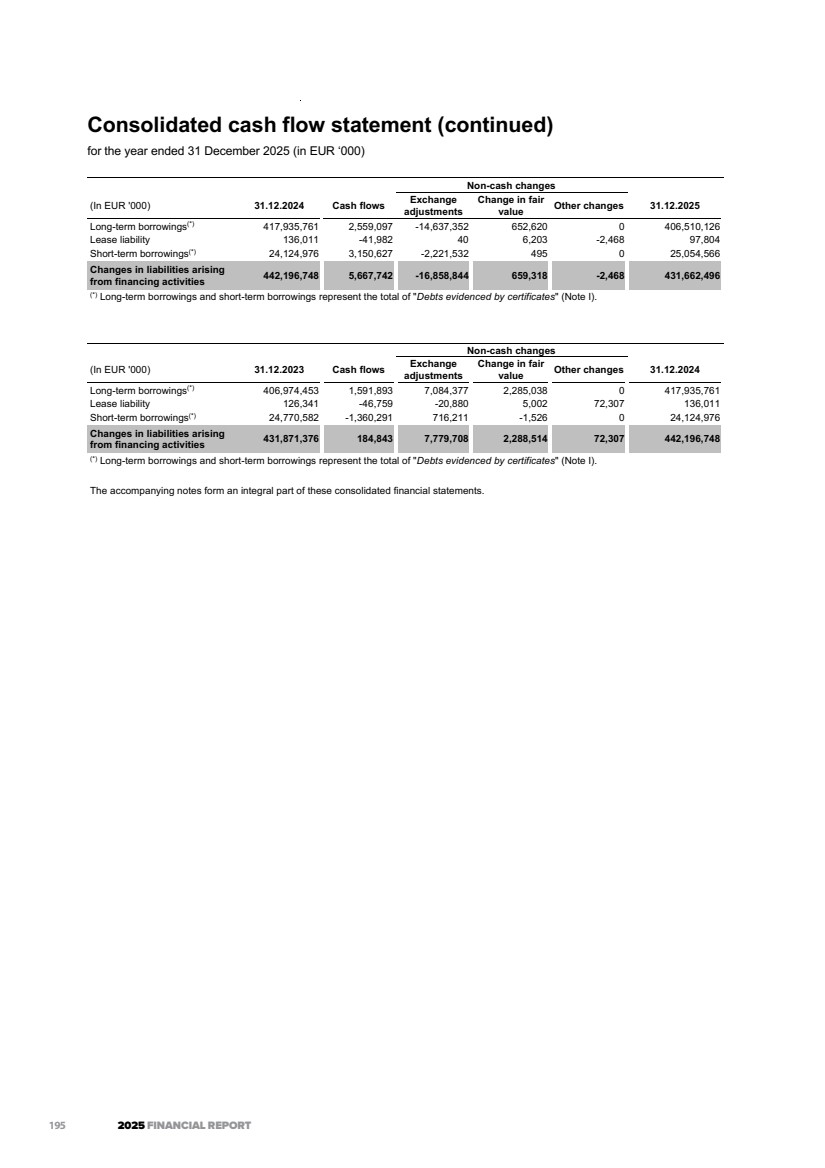
| EIB GROUP CONSOLIDATED FINANCIAL STATEMENTS UNDER IFRS 9 European Investment Bank Group Notes to the consolidated financial statements as at 31 December 2025 The European Investment Bank (the ‘Bank’ or ‘EIB’) was created by the Treaty of Rome in 1958 as the long-term lending bank of the European Union (‘EU’). The task of the Bank is to contribute towards the integration, balanced development and economic and social cohesion of the EU Member States. The EIB raises substantial volumes of funds on the capital markets and lends these funds on favourable terms to projects furthering EU policy objectives. The EIB continuously adapts its activities to developments in EU policies. The Bank has its registered office at 98-100, boulevard Konrad Adenauer, L-2950 Luxembourg. The Bank and its subsidiary are defined as the ‘Group’ or ‘EIB Group’ as per Note A.4.1. The subsidiary held by the Bank is disclosed in Note B.4.1. Note A – Material accounting policies A.1. Basis of preparation A.1.1. Statement of compliance The European Investment Bank Group’s consolidated financial statements (the ‘Financial Statements’) have been prepared on a going concern basis and in accordance with the International Financial Reporting Standards as issued by the International Accounting Standards Board (‘IASB’) and adopted by the European Union (hereafter referred to as ‘IFRS’ Accounting Standards). The Financial Statements as at 31 December 2025 include the consolidated balance sheet, the consolidated income statement, the consolidated statement of profit or loss and other comprehensive income, the consolidated statement of changes in equity, the consolidated cash flow statement and the notes to the consolidated financial statements. Segment reporting is contained in the notes. On a proposal from the Management Committee, the Board of Directors adopted the Financial Statements on 25 March 2026 and authorised their submission to the Board of Governors for approval by 24 April 2026, in accordance with Article 7(3) and Article 9(1) of the EIB Statute and Article 2(3) and Article 18(1) of the EIB rules of Procedure. A.1.2. Basis of measurement The consolidated financial statements have been prepared on an amortised cost basis, except for derivative financial instruments, financial assets at fair value through other comprehensive income, financial assets and liabilities designated at fair value through profit or loss, financial instruments mandatorily measured at fair value through profit or loss and financial guarantees, which have been measured at the higher of the amount initially recognised less amortisation (when appropriate) under IFRS 15 and the loss allowance determined in accordance with IFRS 9. The receiver leg of financial guarantees is measured at fair value through profit or loss by discounting the future cash flows according to IFRS 9. The amortised cost (‘AC’) of financial assets and financial liabilities, designated as hedged items in qualifying fair value hedging relationships, are adjusted for hedging gains or losses. The liability for the defined-benefit obligation is recognised as the present value of the defined-benefit obligation, plus any unrecognised actuarial gains, less any unrecognised past service cost or unrecognised actuarial losses. The Financial Statements are presented in euro (‘EUR’) rounded to the nearest thousand, unless otherwise indicated. A.1.3. Bank’s exposure to the United Kingdom (‘UK’) On 29 March 2017, the United Kingdom notified the European Council of its decision to withdraw from the EU pursuant to Article 50 of the Treaty on European Union (‘TEU’). As of 1 February 2020, in accordance with Article 50 TEU and the Agreement on the withdrawal of the United Kingdom of Great Britain and Northern Ireland from the European Union and the European Atomic Energy Community (the “Withdrawal Agreement”), the United Kingdom ceased to be an EU Member State. The withdrawal of the United Kingdom from the EU automatically resulted in the termination of its membership of the European Investment Bank (‘EIB’) and its share of the EIB’s subscribed capital. Effective 1 February 2020, the share of the United Kingdom in respect of the EIB’s subscribed capital was fully replaced by a pro rata capital increase of the remaining EU Member States. This capital replacement (Symmetrical Capital Replacement) covered both the called part as well as the uncalled part of the subscribed capital of the United Kingdom in the EIB. The replacement of the called part was financed by converting EIB reserves into called subscribed capital. As a result of the capital increase, each remaining EU Member State increased pro rata its uncalled (but callable) stake in the EIB’s subscribed capital. In addition, the capital subscribed by Poland and Romania in the EIB increased by EUR 5,386,000,000 and EUR 125,452,381, respectively. This capital increase (Asymmetrical Capital Increase) took effect on 1 March 2020, one month after the withdrawal of the United Kingdom from the EU. Poland and Romania paid the called portion of their increase in the EIB’s subscribed capital and contributed to the EIB reserves in ten equal semi-annual instalments. 196 |
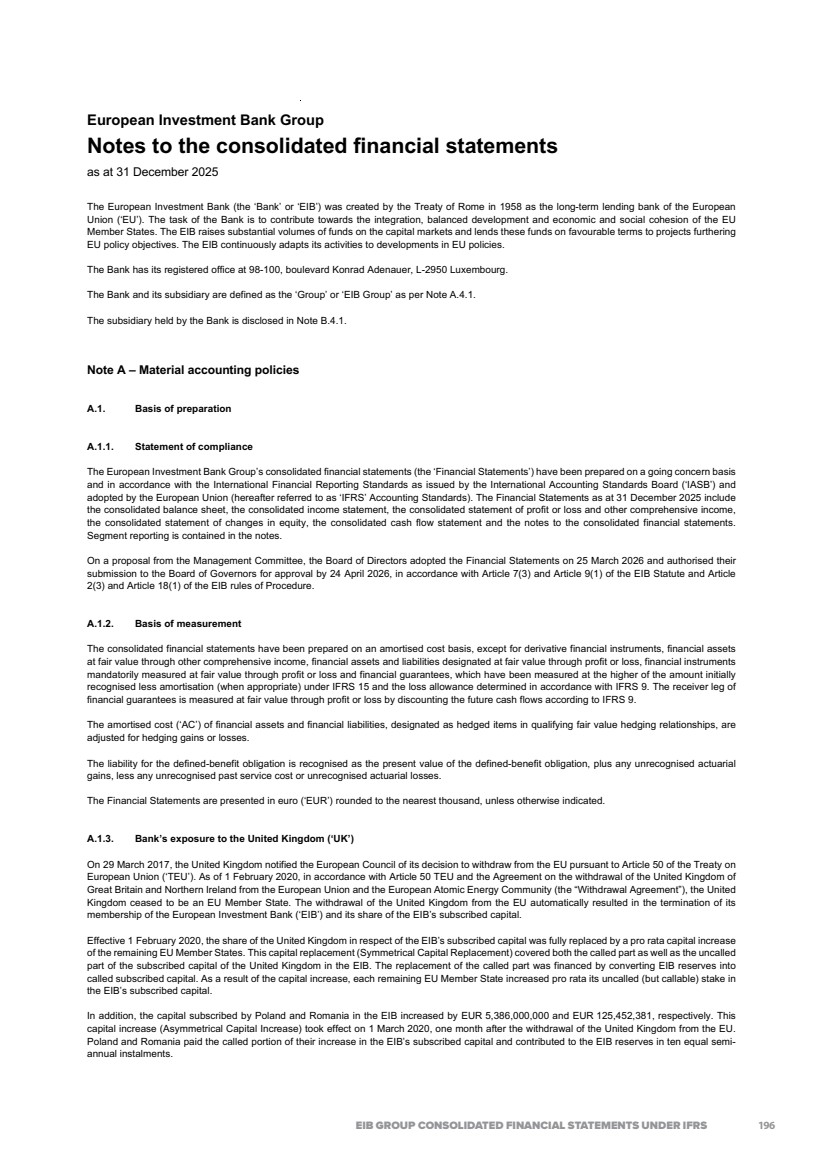
| 2025 FINANCIAL REPORT 10 The Withdrawal Agreement contains, among other things, several provisions governing the financial settlement in respect of the EIB as a result of the termination of UK membership of the EIB. In accordance with the provisions laid down in Article 150 of the Withdrawal Agreement, the United Kingdom shall remain liable, under its former share of the subscribed capital in the EIB, for the EIB’s pre-withdrawal exposure. In this respect as at 31 December 2025, the EIB’s pre-withdrawal exposure amounts to EUR 296,291 million, whereas the limit of the United Kingdom’s liability amounts to EUR 39,195 million. The United Kingdom shall also remain liable for other EIB risks as long as such risks are not related to post-withdrawal lending. In addition, in accordance with the provisions laid down in Article 150 of the Withdrawal Agreement, the EIB is paying to the United Kingdom on behalf of the EU an amount equal to the UK share of the called capital of the EIB in twelve annual instalments. Except for such repayment of the UK called capital, the EIB shall not be obliged to make any other payment, return or remuneration to the United Kingdom in connection with the termination of its membership of the EIB or on account of the retention by the United Kingdom of certain liabilities as described in the relevant provisions of the Withdrawal Agreement. A.2. Significant accounting judgments, assumptions and estimates In preparing the consolidated Financial Statements, the Management Committee is required to make estimates and assumptions that affect reported income, expenses, assets, liabilities and disclosure of contingent assets and liabilities. Use of available information and application of judgment are inherent in the formation of estimates. Actual results in the future could differ from such estimates and the differences may be material to the Financial Statements. Estimates and underlying assumptions are reviewed on an ongoing basis. Changes in accounting estimates are accounted for prospectively. The most significant use of judgments and estimates is as follows: Fair value of financial instruments Where the fair values of financial instruments recorded on the consolidated balance sheet cannot be derived from active markets, they are determined using a variety of valuation techniques that include the use of mathematical models. The input to these models is taken from observable markets where possible, but where this is not feasible, a degree of judgment is required in establishing fair values. The judgments include model choice and considerations of liquidity and model inputs such as correlation and volatility for longer dated derivatives (Note A.4.6). Impairment losses on financial instruments The expected credit loss (‘ECL’) measurement requires management to apply significant judgments, in particular, the assessment of a significant increase in credit risk since initial recognition, the incorporation of forward-looking information and further the estimation of the amount and timing of future cash flows and collateral values when determining impairment losses. These estimates are driven by a number of factors, which can result in significant changes in the timing and amount of allowance for credit loss to be recognised (Note A.4.4); relevant assumptions on the effects on impairment resulting from the general context of uncertainty and various risks resulting from the current geopolitical and economic environment are detailed in Note A.4.4 and Note S. Valuation of unquoted equity investments The valuation of unquoted equity investments is normally based on one of the following: • recent arm’s length market transactions; • current fair value of another instrument that is substantially the same; • the expected cash flows discounted at current rates applicable for items with similar terms and risk characteristics; or • other valuation models. Determining the cash flows and discount factors for unquoted equity investments requires significant estimation. The Group calibrates the valuation techniques periodically and tests them for validity using either prices from observable current market transactions in the same instrument or from other available observable market data (Note A.4.6). Pension and other post-employment benefits The cost of defined-benefit pension plans and other post-employment medical benefits is determined using actuarial valuations. The actuarial valuation involves making assumptions about discount rates, mortality rates and future salary and pension increases. Due to the long-term nature of these plans, such estimates are subject to significant uncertainty (Note A.4.14). Consolidation of entities in which the Group holds an interest When assessing whether the Group has control over an investee entity, except the percentage of voting rights held, the Group also considers whether it has power over the investee’s returns as well as the ability to exercise such power over the investee to affect those returns. Consideration is given to whether there is ability to direct the relevant activities and make decisions through representation on the board of directors or equivalent executive, non-executive or governing bodies of the investee or whether the Group holds substantive rights to remove the investee’s decision-making bodies. At year end, the Group concluded that none of the entities in which it holds an interest, except for the European Investment Fund (‘EIF’), are controlled by it. This judgement was based on its aggregate economic interests in the individual entities (comprising any carried interests and expected management fees) and its rights to remove decision-making bodies. In all cases, based on the assessment of the aforementioned factors, the Group determined that it is not able to individually control either the General Partner or the Fund Manager or the Management Board which have sole responsibility for managing and controlling the investees’ activities and affairs and which have the power and authority to do whatever necessary to pursue the investees’ purpose and objectives (Note B.4). 197 |
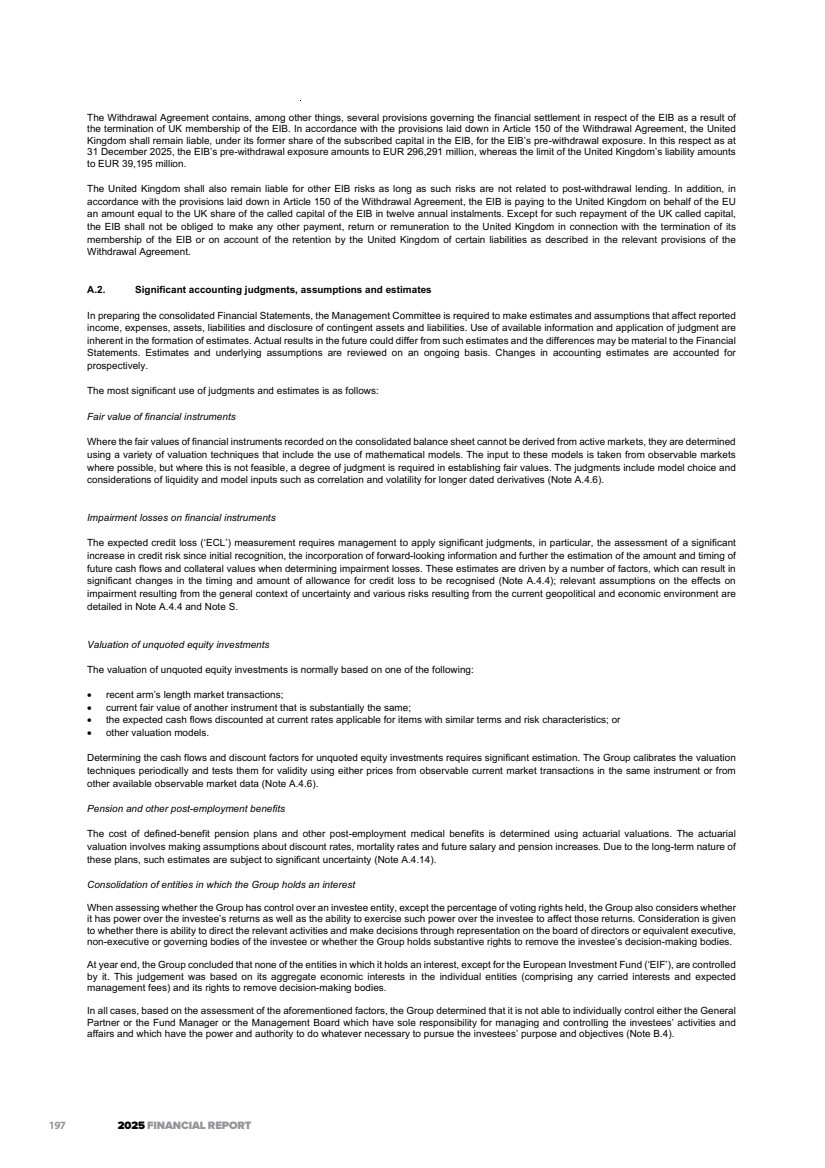
| EIB GROUP CONSOLIDATED FINANCIAL STATEMENTS UNDER IFRS 11 A.3. Changes in accounting standards Except for the changes below, the Group has consistently applied the accounting policies set out in Note A.4. to all periods presented in these consolidated financial statements. New and amended standards adopted by the Group The following amendments to existing standards became effective for the Group’s consolidated financial statements as of 1 January 2025: • Amendments to IAS 21 The Effects of Changes in Foreign Exchange Rates: Lack of Exchangeability. The amendments listed above did not have any material impact on the Group’s financial statements. New standards, amendments, and interpretations not yet adopted by the Group As at 31 December 2025, the following amendments to existing standards had been issued but were not mandatory for annual reporting periods ending on 31 December 2025: Amendments to existing standards endorsed by the EU, and which are effective for annual periods beginning on or after 1 January 2026: • Amendments to the Classification and Measurement of Financial Instruments (IFRS 9 and IFRS 7) • Annual Improvements Volume 11 (amendments to IFRS 9, IFRS 7, IFRS 1, IFRS 10 and IAS 7) • Contracts Referencing Nature-dependent Electricity (amendments to IFRS 9 and IFRS 7). New standards and amendments to existing standards not yet endorsed by the EU: • IFRS 18 Presentation and Disclosure in Financial Statements • IFRS 19 Subsidiaries without Public Accountability: Disclosures At the date of authorisation of these consolidated financial statements none of the above listed standards or amendments to existing standards have been adopted early by the Group and no interpretations have been issued that are applicable and need to be considered by the Group at either reporting date. Management anticipates that all relevant pronouncements will be adopted for the first period beginning on or after the effective date of the pronouncement, and that the impact on the Group’s financial statements will be assessed at a later date. A.4. Summary of material accounting policies A.4.1. Basis of consolidation Subsidiaries Subsidiaries are all entities directly or indirectly controlled by the Group. The Group controls an entity when it is exposed to, or has rights to, variable returns from its involvement with the entity and has the ability to affect those returns through its power over the entity. All significant subsidiaries are included in the consolidated financial statements under IFRS, while entities immaterial to the Group are excluded from the scope of consolidation. The financial statements of any subsidiary are included in the consolidated financial statements from the date on which control commences until the date on which control ceases. The Financial Statements of the EIB Group comprise those of the European Investment Bank (the ‘Bank’ or ‘EIB’) and those of its subsidiary, the European Investment Fund (the ‘Fund’ or ‘EIF’). The financial statements of its subsidiary are prepared for the same reporting year as the Bank, using consistent accounting policies. The Bank exercises control over the EIF and has therefore applied the principles provided for under IFRS 10 in preparing consolidated financial statements. As a result, the Group consolidates the financial statements of the EIB and the EIF line by line by adding together like items of assets, liabilities, equity, income and expenses. Non-controlling interests Under IFRS, non-controlling interests are measured at their proportionate share of the subsidiaries net identifiable assets. They represent the portion of profit or loss and net assets not owned, directly or indirectly, by the Bank. The non-controlling interest attributable to the European Commission (‘EC’) as one of the minority shareholders of the EIF is presented separately in the consolidated balance sheet under “Equity attributable to non-controlling interests” and the consolidated income statement under “Profit attributable to non-controlling interests”. Commitment on EIF shares held by third-party investors Under the terms of a replacement share purchase undertaking (‘RSPU’) in respect of the shares held by the EIF’s non-controlling shareholders other than the EC, the EIB is offering to buy these on an annual basis. The exercise price is determined on the basis of the audited annual accounts of the EIF and corresponds to the part of each share in the called capital of the EIF, increased by the share premium account, the statutory reserves, the retained earnings, the fair value reserve and the profit for the year, net of the dividend decided by the EIF’s General Meeting (see also Note G). Under IFRS, the RSPU is considered as a written put option over the above non-controlling interest, reflecting a contractual obligation to pay cash in the future to purchase the EIF shares from this minority shareholder group. As per IAS 32, such an arrangement gives rise to a financial liability in the amount of the present value of the redemption amount even if the payment of that cash is conditional on the option being exercised by the holder. Accordingly, under IFRS, the commitment is reclassified from “Non-controlling interests” and a corresponding financial liability in the amount of the fair value of the option’s exercise price (equivalent to the yearly established agreed price) is recognised under “Other liabilities” and attributed to owners of the parent. Subsequently, this financial liability is measured in accordance with IFRS 9, i.e. any changes in the fair value of the financial liability subsequent to the acquisition date are recognised in the consolidated income statement under “Interest expense and similar charges”. Any excess or deficit of non-controlling interest over the agreed price is reclassified to “consolidated reserves”. 198 |
| 2025 FINANCIAL REPORT 12 Interests in associates and joint ventures The Group’s interests in investees comprise interests in associates and joint ventures. Associates are those entities in which the Group has significant influence, but not control or joint control, over the financial and operating policies. A joint venture is an arrangement in which the Group has joint control, whereby the Group has rights to the net assets of the arrangement, rather than the rights to its assets and obligations for its liabilities. The accounting treatment for associates and joint ventures is further explained in Note A.4.8.6. Transactions eliminated on consolidation After aggregation of the balance sheet and the income statement accounts, all intra-group balances and transactions, income and expenses resulting from intra-group transactions are eliminated. A.4.2. Foreign currency translation The consolidated Financial Statements are presented in euro (‘EUR’), as the functional currency of the Group and unit of measurement for the capital accounts of the Member States. The Group conducts its operations in euro, in other currencies of the Member States and in non-EU currencies. Its resources are derived from its capital, borrowings and accumulated earnings in various currencies. Foreign currency transactions are translated at the exchange rate prevailing on the date of the transaction. Monetary assets and liabilities denominated in currencies other than euro are translated into euro at the exchange rate prevailing at the balance sheet date. The gain or loss arising from such translation is recorded in the consolidated income statement under “Result on financial operations”. Non-monetary items that are measured in terms of historical cost in a foreign currency are translated using the exchange rates at the date of the initial transaction. Non-monetary items measured at fair value in a foreign currency are translated using the exchange rates at the date when the fair value was determined. Exchange differences on non-monetary financial assets are a component of the change in their fair value. Depending on the classification of a non-monetary financial asset, exchange differences are either recognised in the consolidated income statement or within the equity reserves. Exchange differences arising on the settlement of transactions at rates different from those at the date of the transaction and unrealised foreign exchange differences on unsettled foreign currency monetary assets and liabilities are recognised in the consolidated income statement under “Result on financial operations”. A.4.3. Financial assets and financial liabilities Classification and measurement At initial measurement, the Group measures a financial asset or a financial liability at fair value plus or minus, for an item that is not at fair value through profit or loss (‘FVTPL’), transaction costs that are directly attributable to its acquisition or issue. The fair value at initial recognition is generally its cost. On initial recognition, a financial asset is classified as measured at amortised cost (‘AC’), fair value through other comprehensive income (‘FVOCI’) or FVTPL and a financial liability is classified as measured at AC or FVTPL. Under IFRS 9, classification starts with determining whether the financial asset shall be considered as a debt or equity instrument. IFRS 9 refers to the definitions in IAS 32 Financial Instruments: Presentation. Debt instruments are those instruments that meet the definition of a financial liability from the issuer’s perspective according to IAS 32, such as loans, government and corporate bonds. A debt instrument is classified at amortised cost if it meets both of the following conditions and is not designated as at fair value through profit or loss: • the asset is held within a business model whose objective is to hold assets to collect contractual cash flows; and • the contractual terms of the financial asset give rise on specified dates to cash flows that are solely payments of principal and interest on the principal amount outstanding (‘SPPI criteria’). A debt instrument is classified at fair value through other comprehensive income only if it meets both of the following conditions and is not designated as at fair value through profit or loss: • the asset is held within a business model whose objective is achieved by both collecting contractual cash flows and selling financial assets, and • the contractual terms of the financial asset give rise on specified dates to cash flows that are solely payments of principal and interest on the principal amount outstanding. The above requirements should be applied to an entire financial asset, even if it contains an embedded derivative. Equity instruments are instruments that meet the definition of equity from the issuer’s perspective according to IAS 32, that is, instruments that do not contain a contractual obligation to pay and that evidence a residual interest in the issuer’s net assets. On initial recognition of an equity investment that is not held for trading, the Group may irrevocably elect to present subsequent changes in other comprehensive income. This election is made on an investment-by-investment basis. All other financial assets are classified as measured at fair value through profit or loss. A financial liability is measured at amortised cost except for financial liabilities: • that are mandatorily measured at fair value through profit or loss (for example, derivative liabilities); and • that are designated as measured at fair value through profit or loss. 199 |
| EIB GROUP CONSOLIDATED FINANCIAL STATEMENTS UNDER IFRS 13 On initial recognition the Group may irrevocably designate a financial asset or liability that otherwise meets the requirements to be measured at amortised cost as at fair value through profit or loss (so called “fair value option” (‘FVO’) when elected or FVTPL) if doing so eliminates or significantly reduces an accounting mismatch that would otherwise arise or if the financial assets and financial liabilities are managed and its performance is evaluated on a fair value basis. The main financial instruments designated at the FVO are hedged loans and debts evidenced by certificates that are not eligible for hedge accounting. For the purpose of disclosure requirements, the Group has defined the classes of financial instruments based on similarity of characteristics. Business model assessment The EIB Group makes an assessment of the objective of a business model in which a debt instrument is held at a portfolio level because this best reflects the way the business is managed and information is provided to management. The information considered includes: • the stated policies and objectives for the portfolio and the operation of those policies in practice. In particular, whether management´s strategy focuses on earning contractual interest revenue, maintaining a particular interest rate profile, matching the duration of the financial assets to the duration of the liabilities that are funding those assets or realising cash flows through the sale of the assets; • how the performance of the portfolio is evaluated and reported to the Group’s management; • the risks that affect the performance of the business model (and the financial assets held within that business model) and how those risks are managed; and • the frequency, volume and timing of sales in prior periods, the reasons for such sales and its expectation about future sales activity. However, information about sales activity is not considered in isolation, but as part of an overall assessment of how the Group’s stated objective for managing the financial assets is achieved and how cash flows are realised. Solely payments of principal and interest (‘SPPI’) criteria For the purpose of this assessment, ‘principal’ is defined as the fair value of the debt instrument on initial recognition. ‘Interest’ is defined as consideration for the time value of money and for the credit risk associated with the principal amount outstanding during a particular period of time and for other basic lending risks and costs (such as liquidity risk and administrative costs), as well as profit margin. In assessing whether the contractual cash flows are solely payments of principal and interest, the EIB Group considers the contractual terms of the instrument. This includes assessing whether the financial asset contains a contractual term that could change the timing or amount of contractual cash flows such that it would not meet this condition. Derecognition The Group derecognises a financial asset when the contractual rights to the cash flows from the financial asset expire or it transfers the rights to receive the contractual cash flows in a transaction in which substantially all of the risks and rewards of ownership of the financial asset are transferred or which the Group neither transfers nor retains substantially all of the risks and rewards of ownership and it does not retain control of the financial asset. The Group derecognises a financial liability when its contractual obligations are discharged, cancelled or expired. On derecognition of a financial asset or financial liability, the difference between the carrying amount of the asset or liability (or the carrying amount allocated to the portion of the asset or liability derecognised) and the sum of (i) the consideration received or paid and (ii) any cumulative gain or loss that had been recognised in other comprehensive income is recognised in profit or loss except for the cumulative gains or losses recognised in other comprehensive income for equity investments measured at fair value through other comprehensive income which are transferred to the additional reserves rather than to the income statement on disposal. Reclassification Financial assets are not reclassified subsequent to their initial recognition, except in the period after the Group changes its business model for managing financial assets. Modification A financial asset measured at amortised cost is considered modified when its contractual cash flows are renegotiated or otherwise modified. Renegotiation or modification may or may not lead to derecognition of the old and recognition of the new financial instrument. A substantial contractual modification on the cash flows of a financial asset measured at amortised cost which results in the derecognition of the financial asset, leads to the recognition of the new financial asset at its fair value, and the recording of the modification gain or loss impact in the consolidated income statement under “Result on financial operations”. A contractual modification is deemed substantial if the discounted present value of the cash flows under the revised terms (discounted using the original effective interest rate) is at least 10% different from the discounted present value of the remaining cash flows of the original financial asset. Qualitative factors such as a change in the currency in which the financial asset is denominated and conversion features are also considered. Offsetting The Group offsets financial assets and liabilities in the Group's consolidated balance sheet if the corresponding criteria under IAS 32 are met. Furthermore, the financial assets and liabilities might be subject to a legally enforceable master netting arrangement or similar agreement that covers similar financial instruments, irrespective of whether they are offset in the consolidated balance sheet. The similar agreements include global master repurchase agreements. Similar financial instruments include repurchase agreements and reverse repurchase agreements. 200 |
| 2025 FINANCIAL REPORT 14 A.4.4. Impairment IFRS 9 is based on a forward-looking model. This requires judgment as to how changes in economic factors affect expected credit losses, which are determined on a probability-weighted basis. Within the Group, the IFRS 9 impairment model applies to financial assets measured at amortised cost as well as to off-balance sheet commitments and financial guarantees. Under IFRS 9, loss allowances are measured on either of the following bases: • 12-month ECL’s: these are the ECLs that result from possible default events within the 12 months after the reporting date; and • Lifetime ECL’s: these are the ECLs that result from all possible default events over the expected life of a financial instrument. The IFRS 9 standard sets out a “three-stage” model for impairment based on changes in credit quality since initial recognition. Financial instruments are classified in Stage 1 except for those instruments for which significant increase in credit risk (‘SICR’) since initial recognition is identified. This includes both quantitative and qualitative information and analysis, based on the Group’s expertise, including forward-looking information. Further details on credit risk policies are detailed under Note S.2. The Group’s assessment of the SICR is based on a sequential approach that uses counterparty or instrument-specific information consistent with the policies laid out in the Credit Risk Guidelines (‘CRG’) and the Financial Monitoring Guidelines and Procedures (‘FMGPs’), notably covering early warning trigger, internal rating (a decrease of 3 notches or more when compared to the historical internal rating for counterparties whose current internal rating is below investment grade) and arrears (more than 30 days past due). The Group considers that any general context of uncertainty and various risks resulting from the current geopolitical and economic environment are reflected within the existing forward-looking ECL model which is deemed sufficiently robust to factor in such extreme events. Notably, respective impacts, if any, have been directly captured into parametric estimates (Point-in-Time PDs/LGDs) via downgrade rates and macroeconomic scenarios. If significant increase in credit risk has occurred, the financial instrument is moved to Stage 2 but is not yet deemed to be credit-impaired. If the financial instrument is credit-impaired, the financial instrument is then moved to Stage 3. To identify Stage 3 exposures, the Bank determines whether or not there is objective evidence of a non-performing exposure. For that, the Group considers a financial asset to be in default when the borrower is unlikely to pay its credit obligations to the Group in full, without recourse by the Group or the borrower is past due more than 90 days on any material credit obligation to the Group. In this respect, a financial asset is considered credit-impaired when it is determined that it is probable that the Group will not be able to collect all amounts due according to the original contractual terms or an equivalent value. Individual credit exposures are evaluated based upon the borrower’s characteristics, overall financial condition, resources and payment record, the prospects for support from any financially responsible guarantors and, where applicable, the realisable value of any collateral. All impaired claims are reviewed and analysed at least semi-annually. Any subsequent changes to the amounts and timing of the expected future cash flows compared to the prior estimates will result in a change in the allowances for expected credit losses and be recorded in the consolidated income statement. An allowance for impairment is reversed only when the credit quality has improved such that there is reasonable assurance of timely collection of principal and interest in accordance with the original contractual terms of the claim agreement. A write-off is made when all or part of a claim is deemed uncollectible or forgiven. Write-offs are charged against previously established impairments or directly to the consolidated income statement and reduce the principal amount of a claim. Recoveries in part or in full of amounts previously written off are credited to the consolidated income statement. Financial assets that are written off could still be subject to enforcement activities in order to comply with the Group's procedures for recovery of amounts due. Measuring ECL – Inputs, assumptions and techniques Lifetime ECL measurement applies to Stage 2 and Stage 3 assets, while 12-month ECL measurement applies to Stage 1 assets. The measurement of the expected credit losses was performed based on the following credit risk parameters: • Probability of default (‘PD’); • Loss Given default (‘LGD’); and • Exposure at default (‘EAD’). The probability of default represents the likelihood of a counterpart defaulting on its financial obligation, either over the next 12 months, or over the remaining lifetime of the obligation. PD is an estimate at a certain date, which is calculated based on statistical rating models, and assessed using rating tools tailored to the various categories of counterparties and exposures. Ratings are primary input into the determination of the term structure of probability of default for exposures. The Group collects performance and default information about its credit risk exposures. The collected data are segmented by industry and region. Different industries and regions reacting in a homogenous manner to changes in the credit conditions and macroeconomic environment are analysed together. The Group employs statistical models to estimate the multi-period probability of default incorporating macroeconomic projections. The loss given default represents the expectation of the ratio of the loss on an exposure due to the default of a counterparty to the amount outstanding at default. Loss given default can also be defined as “1 - Recovery Rate”. LGD estimates are determined mainly by geography and by type of counterparty, with five main exposure classes: Sovereigns, Public Institutions, Financial Institutions, Corporate and Project Finance. LGD values can be further adjusted based on the product and contract specific features of the exposure. The Group incorporates forward-looking information into both its assessment of whether the credit risk of an instrument has increased significantly since its initial recognition and its measurement of expected credit losses. For the measurement of ECL, the Group has developed a conditional modelling approach for calculating PD term structures involving: • the definition of an economically reasonable link function between the credit cycle and macroeconomic variables, and • a set of three macroeconomic scenarios (one baseline and two scenarios reflecting a downturn and an upturn in the economy) with multi-year potential realisation for the GDP and their associated likelihoods. 201 |
| EIB GROUP CONSOLIDATED FINANCIAL STATEMENTS UNDER IFRS 15 To generate macroeconomic scenarios, the Bank uses a macro semi-structural multi-country and multi-equation model of the global economy with country specific blocks. The central / baseline scenario is designed to be consistent with the most recent European Commission (‘EC’) forecasts. The positive and negative scenarios are designed around the central scenario by the deployment of the multi-country/multi-equation model. The scenarios are derived shocking GDP, which is the key measure of economic activity. The shocks to real GDP are calibrated to replicate the observed volatility of the variable. In addition, expert judgment is applied, when appropriate, to refine the size and persistency of GDP shocks. As a result, shocks are determined together with a decay function to determine the impact of the shocks over time. Probabilities attached to each scenario are defined reflecting market (volatility) indicators and internally developed indicators/trackers deployed in a consistent manner over time to capture uncertainty. The EAD represents the expected exposure in the event of a default and is based on the current exposure to the counterparty and potential changes to the current amount allowed under the contract including amortisation. The EAD of a financial asset is its gross carrying amount. For lending commitments and financial guarantees, the EAD includes the amount drawn, as well as potential future amounts that may be drawn under the contract. Preferred creditor status (‘PCS’) The principle of the supremacy of EU primary law and the principle that the property of the EIB shall be exempt from all forms of requisition and expropriation, as enshrined in the EIB Statute, are deemed to guarantee a full recovery of the EU Sovereign Exposures on maturity. This financial protection and the benefit of the preferred creditor status result in no credit risk or impairment loss from Member States sovereign exposure or guarantees. However, similarly to other creditors, the EIB is bound by the majority decision based on collective action clauses (‘CAC’) included in debt instruments issued by EU Sovereigns. A.4.5. Derivatives and hedging activities The Group uses derivative instruments mainly for hedging market exposure on borrowings, treasury, and lending transactions, and also as part of its asset and liability management activities to manage exposures to interest rate and foreign exchange risk, including exposures arising from forecast transactions. All derivative instruments of the Group are measured at fair value through profit or loss and are reported as derivative assets or liabilities. Accrued interest on derivatives is part of the fair value recorded. Fair values are obtained from market inputs, discounted cashflow models and option pricing models, which consider current market and contractual prices for the underlying instrument, as well as the time value of money, yield curve and volatility of the underlying. Changes in the fair value of derivatives are included in “Result on financial operations”. The Group’s hedging activities are designed to mitigate interest rate and currency risk by using swaps either to convert the interest rate risk profile, on assets and liabilities, into standard floating-rate risk or to protect against volatility of future cash flows such as future interest receipts on floating-rate loans. Where the Group enters into a micro-hedge, each hedge relationship includes one or multiple hedged items, hedged fully or partially. Dependent on the hedging instrument, the hedged risk of the hedged item is determined as follows: • If using interest rate swap, only the interest rate risk with respect to the benchmark interest rate curve of the hedged item is hedged; and • If using a currency interest rate swap, the interest rate risk with respect to the benchmark interest rate curve and the currency risk with respect to the benchmark currency of the hedged item are hedged. From the three types of hedging relationships recognised by IFRS 9, the Group currently applies fair value and cash flow hedge accounting. A fair value hedge is a hedge arrangement to mitigate risk related to changes in fair value of a recognised asset or liability or an unrecognised firm commitment, or a component of any such item, that is attributable to a particular risk and could affect profit or loss. The objective of hedge accounting is to represent, in the financial statements, the effect of the Group’s risk management activities that use financial instruments, on a micro-basis, to manage exposures arising from particular risks that could affect profit or loss. A cash flow hedge is an arrangement to mitigate risk related to the exposure to variability in cash flows that is attributable to a particular risk associated with a recognised asset or liability, an unrecognised firm commitment (currency risk only) or a highly probable forecast transaction and could affect profit or loss. The Group also hedges interest rate risk and basis risk on a macro basis as part of asset-liability management (‘ALM’) without application of hedge accounting. To qualify for hedge accounting, a hedge relationship has to consist of eligible hedging instruments and eligible hedged items. A derivative measured at fair value through profit or loss may be designated as a hedging instrument. The Group uses the following eligible hedging instruments and combinations of them: • Interest rate swaps; and • Currency swaps. A qualifying hedging instrument is designated in its entirety as a hedging instrument, with the exception that the foreign currency basis spread (‘CBS’) in the case of currency swaps is separated and excluded from the designation. A hedged item can be a recognised asset or liability or an unrecognised firm commitment. The hedged item can be a single item or a group of items and can also be a component of such an item or group of items, but it must be reliably measurable. The following eligible hedged items are designated by the Group: • Borrowings; • Loan substitutes; • Loans; and • Treasury debt securities. The Group may also designate as hedged item or hedging instrument components of nominal amount of the aforementioned eligible financial assets and liabilities. 202 |
| 2025 FINANCIAL REPORT 16 In applying hedge of interest rate risk, the Group designates as hedged risk the contractually or non-contractually specified benchmark interest component that is separately identifiable and reliably measurable. On initial designation of the hedging relationship, the Group documents the relationship between hedging instruments and hedged items, including the risk management objective and strategy in undertaking the hedge, together with the method that will be used to assess the effectiveness of the hedging relationship on a continuous basis. A hedging relationship qualifies for hedge accounting if it meets all the following effectiveness requirements: • there is an economic relationship between the hedged item and the hedging instrument; • the effect of credit risk does not dominate the value changes that result from that economic relationship; and • the hedge ratio of the hedging relationship is the same as that resulting from the quantity of hedged item that the Group actually hedges and the quantity of the hedging instrument that the Group actually uses to hedge that quantity of hedged item. For fair value hedges the Group assesses the economic relationship between the hedged item and the hedging instrument with a qualitative analysis under which the critical terms of the hedging instrument and the hedged item match or are closely aligned, in which case the hedging relationship can be assumed as highly effective. In certain circumstances, under which the critical terms of the hedged item do not match exactly with the critical terms of the hedging instrument, the hedge effectiveness is quantitatively assessed with the dollar offset method. For cash flow hedges the Group assesses whether the derivative designated in each hedging relationship is expected to be and has been effective in offsetting changes in cash flows of the hedged item under the hypothetical derivative method. To show that the effect of credit risk does not dominate the value changes that result from the economic relationship between hedged items and hedging instruments, the Group assesses the creditworthiness holistically considering all circumstances for hedged items and hedging instruments. Hedge ineffectiveness is defined as the difference between the hedging gains or losses of the hedging instrument and the hedged item. Possible sources of ineffectiveness are as follows: • the credit valuation adjustment (‘CVA’), debit valuation adjustment (‘DVA’) and collateral valuation adjustment (‘CollVA’) of the swap, which are not reflected in the fair value of the hedged item attributable to the change in interest rate; • the different discount and forward curves used for the valuation of the hedging instruments and the hedged items; • minor deviations (within accepted thresholds) of the critical terms. In case an economic hedge relation does not qualify for a hedge relation according to IFRS 9, the Group designates the hedged item irrevocably at the fair value option (‘FVO’) at deal inception to reduce a potential accounting mismatch, that is, the hedged items are measured subsequently at fair value through profit or loss (‘FVTPL’). When the Group designates a financial liability as the fair value option (‘FVO’), the amount of change in the fair value attributable to changes in its credit risk (so called “own credit adjustment”, ‘OCA’) is presented in other comprehensive income in the “fair value reserve” (Note R). Accounting for fair value hedges If a fair value hedge meets the qualifying criteria mentioned above, the hedging relationship shall be accounted for as follows: • the fair value gain or loss on the hedging instrument shall be recognised on the consolidated balance sheet and in the consolidated income statement; and • the fair value hedge gain or loss on the hedged item shall adjust the carrying amount of the hedged item (if applicable) and be recognised in the consolidated income statement (so called “basis adjustment”). When a hedged item is an unrecognised firm commitment, the cumulative change in the fair value of the hedged item subsequent to its designation is recognised as an asset or a liability (recognised under respective consolidated balance sheet line, for example, loans and advances to customers) with a corresponding gain or loss recognised in the consolidated income statement. The designation of the hedge relationship and the calculation of the fair value of the hedged item start at trade date. In case of a late designation, the fair value gain or loss on the hedged item at the designation day is calculated and amortised in accordance with the effective interest method over the period of the hedge relationship. Subsequently, the accounting treatment follows the normal course of the hedging relationship described above. As allowed by IFRS 9, the Group separates the fair value of the foreign currency basis spread (‘CBS’) from the hedging instrument (‘CCIRS’) and applies a special treatment known as the cost of hedging approach, to the extent that it interrelates to the hedged item. The initial CBS of the hedging instrument, measured and stored at the date of designation, is amortised linearly over the residual lifetime of the hedge. Subsequent changes in the fair value of the CBS are recognised directly in a separate account within other comprehensive income. The fair value of the CBS converges at maturity to zero and therefore no amount recorded in other comprehensive income will have to be reclassified to the consolidated income statement. Typical reasons for a (partial) de-designation of a hedge relation are amendments of the contractual terms of the hedged items and/or hedging instruments, which lead to a violation of the hedge effectiveness criteria, partial prepayments/buy-backs/early expirations and an increase of credit risk, which lead to dominance of credit component of hedged item or hedging instrument. Termination may occur in case of full prepayment/full buy-back of the hedged item or any other event that will cause the hedged item to disappear from the consolidated balance sheet. The profit or loss result of fair value hedge accounting, which is recognised within “Result on financial operations” in the consolidated income statement, is also affected by the amortisation of initial CBS, due to the cost of hedging approach. Also included within this caption of the consolidated income statement are the gains and losses attributable to derivatives that the Group uses for hedging interest rate risk on a macro basis, but for which the Group does not apply hedge accounting. Accounting for cash flow hedges If the cash flow hedge meets the qualifying criteria the hedging relationship shall be accounted for as follows: • The hedging instrument is re-measured at fair value and the gains or losses on the effective portion of the hedging instrument are recognised in other comprehensive income. These amounts will be taken to the fair value reserve as a separate component of equity. The amount recognised in the fair value reserve shall be the lower of the cumulative gain or loss on the hedging instrument from the inception of the hedge, and the cumulative change in the fair value of the expected cash flows on the hedged item from the inception of the hedge. • If the cumulative change in the hedging instrument exceeds the change in the hedged item, ineffectiveness will be recognised in the consolidated income statement for the excess, which is included under “Result on financial operations”. • When cash flows relating to the hedged items (for example, interest income) are reported in the consolidated income statement, amounts in other comprehensive income are reclassified (‘recycled’) to the consolidated income statement under “Result on financial operations”. 203 |
| EIB GROUP CONSOLIDATED FINANCIAL STATEMENTS UNDER IFRS 17 Typical reasons for a de-designation of a cash flow hedge relation are prepayments which may lead to a violation of the hedge effectiveness criteria, or an increase of credit risk, which lead to dominance of credit component of hedged item or hedging instrument. The accounting treatment where cash flow hedges are discontinued is as follows: • If the hedged cash flows are no longer expected to occur, then the amount in the fair value reserve is immediately reclassified from other comprehensive income to the consolidated income statement. • If the hedged cash flows are still expected to occur, then the amount accumulated in the fair value reserve is not reclassified until the hedged cash flows affect the consolidated income statement. If the hedged cash flows are expected to affect the consolidated income statement in multiple reporting periods, then the amount in the fair value reserve is reclassified from other comprehensive income to the consolidated income statement on a linear basis. A.4.6. Fair value of financial instruments Derivative financial instruments are initially recognised using the trade date basis. Fair value of financial instruments Fair value is the price that would be received on selling an asset or paid on transferring a liability in an orderly transaction between market participants at the measurement date in the principal market, or in its absence, the most advantageous market to which the Group has access at that date. The fair value of a liability reflects its non-performance risk. When applicable, the Group measures the fair value of an instrument using the quoted price in an active market for that instrument. A market is regarded as active if transactions for the asset or liability take place with sufficient frequency and volume to provide pricing information on an ongoing basis. Where the fair values of financial assets and financial liabilities recorded on the consolidated balance sheet cannot be derived from active markets, they are determined using valuation techniques that include the use of mathematical models. The input to these models is taken from observable markets where possible, but where this is not feasible, a degree of judgment is required in establishing fair values. The chosen valuation technique incorporates all the factors that market participants would take into account in pricing a transaction. Portfolios of financial assets or financial liabilities that are exposed to market or credit risk that are managed by the Group on the basis of the net exposure to either market or credit risk are measured on the basis of a price that would be received on selling a net long position or paid on transferring a net short position for a particular risk exposure. These portfolio level adjustments are allocated to the individual assets and liabilities on the basis of the relative risk adjustment of each of the individual instruments in the portfolio. The Group measures fair values using the following fair value hierarchy that reflects the significance of the inputs used in making the measurements: • Level 1: inputs that are unadjusted quoted market prices in active markets for identical instruments to which the Group has access; • Level 2: inputs other than quoted prices included within Level 1 that are observable either directly (that is, as prices) or indirectly (that is, derived from prices). This category includes instruments valued using quoted market prices in active markets for similar instruments, quoted prices for identical or similar instruments in markets that are considered less than active or other valuation techniques where all significant inputs are directly or indirectly observable from market data; and • Level 3: inputs that are not observable. This category includes all instruments where the valuation technique includes inputs not based on observable data and the unobservable inputs have a significant effect on the instrument’s valuation. This category includes instruments that are valued based on quoted prices for similar instruments where significant unobservable adjustments or assumptions are required to reflect differences between the instruments. The Group recognises transfers between levels of the fair value hierarchy as of the end of the reporting period during which the change has occurred. A.4.7. Fee and commission income The Group earns fee and commission income from a diverse range of services it provides to its customers, which are accounted for in accordance with IFRS 15. The Group recognises the revenue when performance obligations are satisfied by transferring control of the promised service to the customer. As a general rule, customer obtains control when it has the ability of direct use or ability of obtaining substantially all the benefits from this service. In some circumstances, judgment might be needed to determine when control transfers. Fee and commission income can be divided into two broad categories based on the following: • Over time: the Group satisfies the performance obligation and, therefore, transfers control over time; and • Point in time: the Group satisfies the performance obligation and transfers control to the customer at a point in time. Main sources of commission income are guarantees, loans and services provided for third party mandates. The amount of commission income received is fixed or variable, based on certain criteria depending on different variable components such as percentage (%) of the EU contribution committed or linked to this single performance obligation. If the consideration includes a variable amount, the Group estimates the amount of consideration to which it will be entitled to in exchange for transferring the services to the customer. The variable consideration is estimated at contract inception and constrained to an extent that is highly probable that a significant revenue reversal in the amount of cumulative revenue recognised will not occur when the associated uncertainty with the variable consideration is subsequently resolved. Fee and commission income from revenues that are satisfied over time is recognised on an accruals basis over the service period. Fee and commission income earned from providing or fulfilling point-in-time services is recognised when the service has been completed. Regarding the performance obligations satisfied over time, the Group uses the “Input Method” to recognise income on the basis of its efforts or inputs in satisfying these performance obligations, and to recognise such fees over time. Regarding the performance obligations, maximum amounts, or “caps” on management fees are applicable to certain mandates. Where this applies, management fees will likely cease to be received before the end of the mandate, which is typically in 15 to 25 years, and will be paid over a limited timeframe such as in the first few years of the mandate, and which is therefore not correlated with the services performed and costs incurred by the Group. 204 |
| 2025 FINANCIAL REPORT 18 To address this issue, the Group uses a deferred income policy (further referred to as “contract liabilities mechanism”). The contract liabilities mechanism is based on the total costs to be incurred by the Group in relation to the mandate using ex-ante financial models for all new mandates as part of their approval process. This deferral policy ensures sustainable operations and revenue recognition based on percentage of completion of the contract. Respective adjustments are recorded in the consolidated balance sheet under “Deferred income”. A.4.8. Treasury bills and other bills eligible for refinancing with central banks and debt securities including fixed-income securities and shares and other variable-yield securities The consolidated balance sheet captions “Treasury bills and other bills eligible for refinancing with central banks” and “Debt securities including fixed-income securities” include: • debt securities measured at amortised cost; • debt securities mandatorily measured at fair value through profit or loss; and • debt securities designated to be measured at fair value through profit or loss. A.4.8.1. Treasury Monetary Portfolio (‘TMP’) The TMP of the Group is held for the purpose of: • being the primary liquidity buffer for the Bank by providing, in a timely manner, the cash needed in any currency for which the Bank has implemented a treasury activity; • covering the relevant transfer price, compatibly with the conditions of the financial markets and the respect of the previous - overarching – objective of maintaining an adequate level of liquidity in the Group; and • comprising money market products with a maximum maturity of twelve months, including treasury bills and negotiable debt securities issued by public bodies or credit institutions. These securities are initially recorded at fair value plus any directly attributable transaction costs. The difference between entry price and redemption value is amortised in accordance with the effective interest method over the remaining life of the securities. The securities in this portfolio are held with the intention to collect contractual cash flows and classified at amortised cost. As part of this business model, sales are considered to be infrequent or insignificant in volume. A.4.8.2. Securities Liquidity Portfolio (‘SLP’) The SLP comprises listed debt securities issued or guaranteed by national governments, supranational institutions, financial institutions and corporations. As the business model of the portfolio is largely driven by an active management of the Group making use of derivatives and sales of long-term asset to allow for a rapid readjustment of the duration and the mitigation of credit risks by moving the asset class allocation, the securities in this portfolio are mandatorily measured at fair value through profit or loss. Gains and losses realised on disposal or redemption and unrealised gains and losses from changes in the fair value are reported in the account “Result on financial operations”. Interest income from the SLP assets is included in “Interest and similar income”. The market value of SLPs is based on published price quotations in an active market as the first source. For instruments without available published price quotations, the market values are determined by obtaining quotes from market participants and/or by using valuation techniques or models, based whenever possible on observable market data prevailing at the balance sheet date. A.4.8.3. Long-Term High-Quality Liquid Assets (HQLA) Portfolio (‘LTHP’) The main purpose of the LTHP is to serve as a core long-term liquidity reserve for the Bank in EUR, USD and GBP, composed of highly rated liquid bonds. Securities under this portfolio are to be purchased with the intention of holding them to maturity and to collect the contractual cash flows and are consequently classified at amortised cost. As part of this business model, sales are considered to be infrequent or insignificant in volume. Where an LTHP security meets the eligibility criteria of hedge accounting (Note A.4.5), the amortised cost is adjusted for the fair value attributable to the risks being hedged and is recognised in the consolidated income statement in “Result on financial operations”. The hedge fair value measurement is based on the discounted cashflow technique. A.4.8.4. EIF Operational Portfolio The EIF Operational Portfolio has the following two objectives: • to provide returns commensurate with the long-term nature of the investments; and • serve as a 2nd line of liquidity. It consists of investments in long-term debt instruments (for example, bonds, notes and other obligations). The securities in this portfolio are held with the intention of holding them to maturity and to collect the contractual cash flows and are consequently classified at amortised cost. As part of this business model, sales are considered to be infrequent or insignificant in volume. 205 |
| EIB GROUP CONSOLIDATED FINANCIAL STATEMENTS UNDER IFRS 19 A.4.8.5. Loan substitutes portfolio and ABS portfolio EIF The loan substitutes portfolio and ABS portfolio EIF mainly consist of obligations in the form of bonds, notes or certificates issued by special purpose vehicles (‘SPVs’) or trust vehicles with the intention of holding them to maturity and to collect the contractual cash flows. A loan substitute can take the form of a contractually linked multiple or single tranche instrument. Where an investment in this portfolio meets the SPPI criterion, it is classified at amortised cost unless it has the nature of a fixed rate loan substitute and qualifies for hedge accounting (Note A.4.5) in which case it is designated in a hedge relation and the amortised cost is adjusted for the fair value attributable to the risks being hedged. The hedge fair value measurement is based on the discounted cashflow technique. Economically hedged loan substitutes that cannot be included in hedge accounting are designated irrevocably to the fair value option to reduce the accounting mismatch due to the classification of the hedging instrument at fair value through profit or loss. Contractually linked multiple or single tranche instruments included in the loan substitutes portfolio not fulfilling the SPPI criterion are mandatorily measured at fair value through profit or loss. Front-end fees, on loan substitutes classified at amortised cost, are deferred and are recognised as an adjustment to the effective yield, being recorded in the consolidated income statement over the period from disbursement to repayment of the related loan substitute. The front-end fees are deferred and recognised under “Interest and similar income” in the income statement over the life of the underlying loan substitute. Undisbursed parts of loan substitutes are recorded in the consolidated off-balance sheet at their nominal value. Impairment on debt securities The Group assumes that the credit risk on treasury portfolios has not increased significantly since initial recognition due to inherent low credit risk. The credit risk associated with treasury debt securities (bonds, discount papers, etc.) is managed by selecting sound counterparties and issuers with a minimum rating at the outset set above investment grade per internal policies. Further, a regular assessment is performed to ensure that at each financial reporting date, the treasury assets meet the low credit risk criteria (see Note S.2.4). Consequently, the loss allowances relating to treasury assets measured at amortised cost are determined at an amount equal to 12-month ECL. As regards the loan substitutes, the ECL impairment model applied on loans and advances equally applies to instruments within the loan substitutes portfolio measured at amortised cost as well as to related undisbursed commitments. Respective loss allowances under IFRS 9 are calculated on either 12-month ECLs or Lifetime ECLs as per the impairment model explained in Note A.4.4. A.4.8.6. Shares and other variable-yield securities This caption in the consolidated balance sheet includes: • instruments mandatorily measured at fair value through profit or loss; • instruments designated as at fair value through other comprehensive income; and • instruments designated at fair value through profit or loss. The Group’s equity portfolio is mainly composed of private equity (‘PE’) and venture capital operations, debt funds, infrastructure funds, investment funds and the participation in the European Bank for Reconstruction and Development (‘EBRD’) and is carried at fair value. Private equity, venture capital, debt funds, infrastructure funds and investment funds Private equity and Venture capital (‘VC’) operations, debt, infrastructure and investment funds are measured mandatorily at fair value through profit or loss with changes in the fair value recorded in “Result on financial operations”. In certain co-investments performed by the Bank, the investments are initially recognised at cost and the net paid in represents the drawdowns paid net of any capital repayments allocated in accordance with the agreed waterfall. Signed but undrawn part of these investments is recorded as consolidated off-balance sheet commitments at their nominal value. The fair value (before application of a waterfall if applicable) is determined by applying the aggregated net asset value (‘NAV’) method (thereby assuming that, despite the absence of readily ascertainable market value, NAV is the best estimate of the fair value). This valuation method implicitly assumes that if the NAVs of underlying funds (as derived from the latest available before year-end fund managers’ reports) can be considered to be the best estimate of the fair value as determined under IFRS 13, then the aggregation of the NAVs of all funds will itself be equivalent to the fair value as determined under IFRS 13. The fair value is determined by applying where available, and in order of priority, either: • the Group share value at the latest available date, submitted by the respective fund manager, or; • the number of shares or units held by the Group multiplied by the price per share or unit at the latest available date reported by the fund manager, or; • the Group’s percentage ownership in the specific compartment multiplied by the specific compartment’s net asset value reflected in the most recent fund manager’s report, or; • the Group’s percentage of ownership in the fund multiplied by the latest available fund NAV. In certain co-investments performed by the Bank, the fair value may be determined based on the agreed waterfall calculation. The attributable NAV is adjusted for events occurring between the date of the latest available NAV and the balance sheet date to the extent that such adjustment is considered to be material by the Management Committee. 206 |
| 2025 FINANCIAL REPORT 20 In that respect, following the general context of uncertainty and the various risks resulting from the current geopolitical and economic environment and the volatility observed in terms of performance, the Group enhanced its valuation techniques to estimate any adjustment on the fair value of the VC investments for the NAVs not reported by the fund managers at the reporting date of the Group financial statements. In particular, the Group considers the below elements to determine the fair value of these investments: • Insight information collected from the markets; • Comparison of the performance of relevant benchmarks with the performance of the portfolio by reviewing the correlation between the portfolios; • Observable trends from the most recent quarterly NAVs available at the reporting date. Based on the three elements considered all together, the Group is able to determine an adjustment rate, if any, to be applied on the portfolio to derive a best estimate. For specific investments where NAVs cannot readily be determined, other guidelines such as the International Private Equity and Venture Capital Valuation (‘IPEV’) Guidelines published by the IPEV Board might be used and more detailed monitoring and review will be required. In accordance with this method, the funds are internally classified into three categories: • Category I – funds that have adopted the fair value requirements of IFRS 13 or the IPEV Guidelines for which a specific review is performed to ensure that the NAV is a reliable estimate of fair value; • Category II – funds that have adopted other valuation guidelines (such as the former 2001 European Private Equity and Venture Capital Association (‘EVCA’) guidelines) or standards that can be considered to be in line with IFRS 13, for which an equivalent NAV can be calculated; • Category III – funds that have not adopted the fair value requirements of IFRS 13 or any other valuation guidelines in line with IFRS 13. Secondary sales Secondary sale transactions on venture capital funds and investment funds lead to derecognition of the underlying assets. Gains or losses from secondary sales are recorded in “Result on financial operations” and are calculated as the difference between the sales proceeds and the net carrying amount. Interests in joint ventures and associates The Group complies with the conditions necessary to use the venture capital organisations and similar entities measurement exemption included in IFRS 11 and IAS 28 and consequently decides not to use equity accounting on, or proportionately consolidate investments in respect of such investments. Upon initial recognition, holdings in joint ventures or associates are designated at fair value through profit or loss and measured subsequently at fair value in accordance with IFRS 9, with changes in fair value recognised in the consolidated income statement during the year of the change. Joint ventures are contractual agreements whereby the Group and other parties undertake an economic activity that is subject to joint control. A joint control is the contractually agreed sharing of control over an economic activity and exists only when the strategic financial and operating decisions relating to the activity require the unanimous consent of the parties sharing the control (the venturers). The participations acquired by the Group for its own account or on behalf of its mandate providers typically represent investments in private equity or venture capital funds. According to industry practice, such investments are generally investments jointly subscribed by a number of investors, none of whom is in a position to individually influence the daily operations and the investment activity of such a fund. As a consequence, any membership by an investor in a governing body of such a fund does not in principle entitle such investor to influence the day-to-day operations of the fund. In addition, individual investors in a private equity or venture capital fund do not determine the policies of a fund such as distribution policies on dividends or other distributions. Such decisions are typically taken by the management of a fund on the basis of the shareholders agreement governing the rights and obligations of the management and all shareholders of the fund. The shareholders’ agreement also generally prevents individual investors from bilaterally executing material transactions with the fund, interchanging managerial personnel, or obtaining privileged access to essential technical information. The Group’s investments, made for its own account or on behalf of its mandate providers, are executed in line with the above stated industry practice. In addition, the Group is exposed to variability of returns from these investments. Therefore, in assessing whether it has control, the Group not only takes into account the percentage of voting rights held, but also whether it manages key decisions that most significantly affect these investments’ returns, whether there is a joint arrangement or partnership with other shareholders and if a contractual arrangement gives control to all parties collectively or if decision-making requires the unanimous consent of all parties that collectively control the arrangement. As a result, and according to IFRS 10, the Group has concluded that it does not control those vehicles. Associates are entities in which the Group has significant influence, but not control or joint control, over the financial and operating policies. When assessing whether the Group has significant influence over an investee entity, except the percentage of voting rights held, it also considers whether it is represented in the governing bodies of the investee, whether it participates in the policymaking process and whether there are material transactions or interchange of managerial personnel between the Group and the investee. Participation in EBRD The Group also holds a participation in the EBRD for which the Group’s management has elected to irrevocably designate it at fair value through other comprehensive income as this investment was made for long-term strategic purposes. At initial recognition, the Group measures this participation at its fair value plus transaction costs. Subsequently, changes in fair value gains and losses, including foreign currency translation gains and losses, are recognised in other comprehensive income, and are never reclassified to profit or loss, even on disposal. Capital subscribed by the Group but uncalled from the investment in the EBRD is recorded as consolidated off-balance sheet commitments. A.4.9. Loans and advances to credit institutions and customers Loans and advances to credit institutions and customers mainly include loans where money is provided directly to the borrower. Loans and advances are recognised when cash is advanced to borrowers. They are initially recorded at cost (their net disbursed amounts), which is the fair value of the cash given to originate the loan, including any transaction costs, and are subsequently measured at amortised cost using the effective interest rate method. Undisbursed parts of loans are recorded as consolidated off-balance sheet commitments at their nominal value. Where loans meet the eligibility criteria of fair value hedge accounting (Note A.4.5), the fair value hedge gain or loss on the loans shall adjust their carrying amount and be recognised in the consolidated income statement in “Result on financial operations”. 207 |
| EIB GROUP CONSOLIDATED FINANCIAL STATEMENTS UNDER IFRS 21 Where loans meet the eligibility criteria of the fair value option or do not meet the criteria for being classified at amortised cost or fair value through other comprehensive income (Note A.4.3), they are designated on initial recognition as at fair value through the consolidated income statement and are measured at their fair value. The fair value measurement technique used is based on a discounted cash flow technique. Loans designated at fair value are recorded at fair value in the consolidated balance sheet. Changes in fair value are recorded in “Result on financial operations”. A.4.9.1. Interest on loans Interest on loans originated by the Group is recorded in the consolidated income statement under “Interest and similar income” using the effective interest rate method and on the consolidated balance sheet under “Loans and advances”. A.4.9.2. Reverse repurchase agreements (‘Reverse repos’) A reverse repurchase agreement is one under which the Group lends liquid funds to a credit institution which provides collateral in the form of securities. The two parties enter into an irrevocable commitment to complete the operation on a date and at a price fixed at the outset. The operation is based on the principle of delivery against payment: the borrower of the liquid funds transfers the securities to the Group’s custodian in exchange for settlement at the agreed price, which generates a return for the Group linked to the money market. This type of operation is considered for the purposes of the Group to be a loan at a guaranteed rate of interest. Generally treated as collateralised financing transactions, they are carried at the amounts of cash advanced or received, plus accrued interest. Reverse repos are entered at their notional amounts and classified as measured at amortised cost on the assets side of the consolidated balance sheet under “Loans and advances to credit institutions - b) other loans and advances”. Securities received under reverse repurchase agreements are not recognised in the consolidated balance sheet, unless control of the contractual rights comprised in these securities is assumed. The Group monitors the market value of the securities received on a daily basis and requests additional collateral in accordance with the underlying agreements. A.4.9.3. Term and on-demand deposits (‘Deposits’) Deposits are operations under which the Group lends liquid funds to a credit institution or customer for a certain period or on-demand against a return agreed between the parties. Deposits are entered at their nominal amount on the assets side of the consolidated balance sheet under “Loans and advances to credit institutions or customers - other loans and advances”. A.4.9.3.1. Interest on deposits and reverse repurchase agreements Interest on deposits and reverse repurchase agreements are recognised as interest income or expense over the life of each agreement. Interest on deposits and reverse repurchase agreements is recognised as “Interest and similar income” or “Interest expense and similar charges” over the life of each agreement. A.4.9.4. Fees on loans Front-end fees on loans are deferred, together with the related direct costs of originating and maintaining the commitment, and are recognised as an adjustment to the effective yield, being recorded in the consolidated income statement over the period from disbursement to repayment of the related loan. If the commitment expires without the loan being drawn down, the fee is recognised as income on expiry. The front-end fees are deferred and recognised under “Interest and similar income” in the income statement over the life of the underlying loan. A.4.9.5. Interest subsidies Interest subsidies received in advance (Note F) are deferred and are recognised as an adjustment to the effective yield, being recorded under “Interest and similar income” in the consolidated income statement over the period from disbursement to repayment of the subsidised loan. A.4.10. Impairments on loans and advances Within the Group, the expected credit loss impairment model applies to loans and advances measured at amortised cost as well as to consolidated off-balance sheet commitments. Loss allowances, under IFRS 9, are measured on either 12-month ECL or Lifetime ECL as per the impairment model, which is analysed in Note A.4.4. A.4.11. Financial guarantees Financial guarantee contracts require the Group to make specified payments to reimburse the holder for a loss it incurs if a specified debtor fails to make payments when due in accordance with the terms of a debt instrument. Signed financial guarantees are generally accounted and disclosed as off-balance sheet items. Financial guarantees are initially accounted for using the gross approach with offsetting of the receiver and the payer leg and recognised in the consolidated balance sheet at fair value. As at EIB Group’s financial guarantee contracts are issued to unrelated parties in a stand-alone arm's length transaction, their fair value at inception is deemed to equal the premium received. At initial recognition, the obligation to pay corresponds to the net present value ('NPV') of expected premium inflows or the initial expected loss. Subsequently, financial guarantees are accounted for using the gross approach with future premiums to be received recorded separately as a financial asset and measured at fair value while the financial liability is measured at the higher of: • the amount of the loss allowance as determined under IFRS 9; and • the amount initially recognised i.e. NPV less, where appropriate, cumulative amortisation recognised in accordance with the principles of IFRS 15. Where eligible, the NPV of expected premium inflows and the amount of the expected payment obligations are offset. 208 |
| 2025 FINANCIAL REPORT 22 As per IAS 32, a financial asset and a financial liability shall be offset (net presentation) and the net amount presented in the consolidated balance sheet when, and only when, an entity: • currently has a legally enforceable right to set off the recognised amounts; and • intends either to settle on a net basis, or to realise the asset and settle the liability simultaneously. In case the measurement of a financial guarantee contract results in a net asset position, the respective guarantee is presented in the consolidated balance sheet under “Other assets”. In case the measurement of a financial guarantee results in a net liability position, the respective operations are presented in the consolidated balance sheet: • Under “Other liabilities” for contracts for which the amortised initial NPV is higher than the 12-months ECL or lifetime ECL; • Under “Provision for guarantees issued and commitments” for contracts that are credit-impaired and hence a loss allowance based on lifetime ECL is recognised. When a financial guarantee is not eligible for net presentation the asset side and liability side are presented separately on the Group’s balance sheet. Any increase or decrease in the “Other assets” or “Other liabilities” relating to financial guarantees is recognised in the consolidated income statement under “Result on financial operations”. Any increase or decrease in the “Provision for guarantees issued and commitments” relating to financial guarantees other than the settlement of guarantee calls is recognised in the consolidated income statement under "Change in impairment on loans and advances and provisions for guarantees, net of reversals". Any premiums received are recognised in the consolidated income statement in "Fee and commission income". Any upfront fees received are recognised in "Deferred income" in the consolidated balance sheet and amortised in the consolidated income statement on a straight-line basis over the life of the financial guarantee. A.4.12. Property, furniture and equipment Property, furniture and equipment include land, Group-occupied properties and other machines and equipment. Property, furniture and equipment are reviewed periodically for impairment. Land is stated at acquisition cost and buildings are stated at acquisition cost less accumulated depreciation, less accumulated impairment. The costs of the Group's headquarters buildings in Luxembourg are depreciated on a straight-line basis, as set out below. Permanent equipment, fixtures and fittings, furniture, office equipment and vehicles are recorded in the consolidated balance sheet at their acquisition cost, less accumulated depreciation, less accumulated impairment. Subsequent expenditure is capitalised only if it is probable that the future economic benefits associated with the expenditure will flow to the Group. Ongoing repairs and maintenance are expensed as incurred. Depreciation is calculated on a straight-line basis over the estimated life of each item purchased, as set out below: • Buildings: 30 years; • Permanent equipment, fixtures and fittings: 10 years; • Furniture: 5 years; • Office equipment and vehicles: 3 years. There is no depreciation of the accumulated costs of work-in-progress assets until they are completed and the assets are ready to use for the intended purpose. A.4.13. Intangible assets Intangible assets comprise computer software. Software development costs are capitalised if they meet certain criteria related to identifiability, to the probability that future economic benefits will flow to the enterprise, and to the reliability of cost measurement. Subsequent expenditure on software assets is capitalised only when it increases the future economic benefits embodied in the specific asset to which it relates. All other expenditure is recognised in profit or loss as it is incurred. Intangible assets are recognised as assets and are amortised on a straight-line basis over their estimated useful economic lives. At each consolidated balance sheet date, intangible assets are reviewed for indications of impairment or changes in estimated future benefits. If such indications exist, an analysis is performed to assess whether the carrying amounts are fully recoverable. A write-down is made if the carrying amount exceeds the recoverable amount. Internally developed software meeting these criteria is carried at cost less accumulated amortisation, less accumulated impairment calculated on a straight-line basis over three years from completion. There is no amortisation of the accumulated costs of work-in-progress assets until they are completed and the assets are ready to use for the intended purpose. A.4.14. Pension plans and health insurance scheme The Group operates defined benefit pension plans to provide retirement benefits to substantially all its staff. The Group also provides certain additional post-employment healthcare benefits to former employees of the EIB. These benefits are unfunded, as defined by IAS 19. The cost of providing benefits under the plans is determined separately for each plan using the projected unit credit actuarial valuation method. The charge to the consolidated income statement in respect of the defined benefit pension plan is based on the current service cost and interest cost as determined by qualified external actuaries. 209 |
| EIB GROUP CONSOLIDATED FINANCIAL STATEMENTS UNDER IFRS 23 A.4.14.1. Pension plans for staff The Bank’s main pension scheme is a defined benefit pension scheme funded by contributions from staff and from the Bank that covers all Bank employees. All contributions of the Bank and its staff are invested in the assets of the Bank. The main pension plan of the EIF is a defined benefit plan funded by contributions from staff and from the EIF that covers all EIF employees. The scheme entered into force in March 2003, replacing the previous defined contribution scheme. Commitments for retirement benefits are valued at least every year using the projected unit credit method, in order to ensure that the provision entered in the accounts is adequate. The latest valuation was carried out as at 31 December 2025 based on membership data as at 30 September 2025 and cash flows to 31 December 2025. The main assumptions used by the actuary are set out in Note J. Cumulative actuarial surpluses and deficits are recognised in full in “Other comprehensive income”. Net interest cost is recognised in the consolidated income statement under “Interest expense and similar charges”. A.4.14.2. Health insurance plan The Bank has set up its own health insurance plan for the benefit of staff, financed by contributions from the Bank and its employees. The plan is an unfunded plan treated as a defined benefit plan. A specific provision is set aside on the liability side of the consolidated balance sheet for staff at retirement age. The Fund has subscribed to a health insurance scheme with an insurance company for the benefit of staff at retirement age, financed by a contribution from the Fund and its employees. Entitlement to these benefits is based on the employees remaining in service up to retirement age and the completion of a minimum service period. The expected costs of these benefits are accrued over the period of employment, using a methodology similar to that for defined benefit pension plans. The health insurance liabilities are determined based on actuarial calculations at the same dates as the pension plans. A.4.14.3. Pension plan for members of the Management Committee The related provision shown on the liability side of the Group’s consolidated balance sheet is determined, as for all plans, in conformity with IAS 19. Benefits are based on years of service and a percentage of final gross base salary as defined under the plan. The pension plan for members of the Management Committee is managed and accounted for under the same principles as the pension plan for staff (Note A.4.14.1). A.4.14.4. Optional supplementary provident scheme The optional supplementary provident scheme is a defined contribution pension scheme, funded by voluntary staff and employer contributions. It is accounted for on the basis of the contributions from staff and the employer and the corresponding liability is recorded in “Other liabilities”. A.4.15. Amounts owed to credit institutions and customers Amounts owed to credit institutions and customers are initially recorded at cost and are presented in the consolidated balance sheet at amortised cost. Interest on amounts owed to credit institutions and customers is recorded in the consolidated income statement as “Interest expense and similar charges” or “Interest and similar income” if the interest rate is negative using the effective interest method. A.4.15.1. Repurchase agreements (‘Repos’) A repurchase agreement is one under which the Group borrows liquid funds from a credit institution and provides collateral in the form of securities. The two parties enter into an irrevocable commitment to complete the operation on a date and at a price fixed at the outset. The operation is based on the principle of delivery against payment, which is mentioned in note A.4.9.2. This type of operation is considered for the purposes of the Group to be a borrowing with an agreed type of interest. Generally treated as collateralised financing transactions, they are carried at the amounts of cash owed, plus accrued interest. Repos are entered at their notional amounts and classified as measured at amortised cost on the liabilities side of the consolidated balance sheet under “Amounts owed to credit institutions- b) with agreed maturity or periods of notice”. A.4.15.1.1. Interest on repurchase agreements Interest on repurchase agreements is recognised as interest expense or income over the life of each agreement. A.4.15.2. Collateral call accounts Under unilateral Collateral Support Annexes, the Group receives cash as collateral to mitigate counterparty credit exposures on Derivatives, Lending and Treasury portfolios. The cash collateral received is recorded at its nominal value and presented in the consolidated balance sheet under “Amounts owed to credit institutions - a) repayable on demand” - Overnight deposits. A.4.16. Debts evidenced by certificates Debts evidenced by certificates are initially measured at cost, which is the fair value of the consideration received. Transaction costs and net premiums (discounts) are included in the initial measurement. Subsequent measurement is at amortised cost, and any difference between net proceeds and the redemption value is amortised over the lifetime of the borrowings using the effective interest method. Borrowings are designated in a hedge relation if they are eligible for hedge accounting under IFRS 9 (Note A.4.5) and their amortised cost is subsequently adjusted for the fair value attributable to the risks being hedged. Firm commitments in borrowings with a settlement date in the future may be hedged and designated to hedge accounting as well. The hedge fair value of borrowings is calculated based on a discounted cash flow method. Where borrowings are not included in hedge accounting and meet the eligibility criteria of the fair value option and have been designated on initial recognition as such, they are measured at fair value through profit or loss. The fair value measurement technique employed, in the event of absence of liquid market prices, is a discounted cash flow technique, using current yield curves. 210 |
| 2025 FINANCIAL REPORT 24 When the Group designates a borrowing as at fair value through profit or loss, the amount of change in the fair value attributable to changes in its ‘OCA’ is presented in other comprehensive income. On initial recognition of the financial liability, the Group assesses whether presenting the amount of change in own credit adjustment in other comprehensive income would create or enlarge an accounting mismatch in profit or loss. This assessment is made by comparing: • The expected changes in the fair value of the borrowing related to changes in own credit adjustment; with • The impact of profit or loss of expected changes in the fair value of the related instruments. Amounts presented in other comprehensive income are not subsequently transferred to profit or loss. When these instruments are derecognised, the related cumulative amount in the other comprehensive income is transferred to the Group’s additional reserves. For structured debt instruments that are related to foreign exchange rates and indices, including an embedded derivative, the Group has concluded swap agreements to fully hedge the exposure. Accrued interest on debt instruments is included under the liabilities caption including the underlying debt instruments in the consolidated balance sheet. A.4.17. Prepayments – Deferred income These accounts comprise: • Prepayments: expenditure incurred during the financial year but relating to a subsequent financial year; • Deferred income: income received before the balance sheet date but relating to a subsequent financial year. A.4.18. Leases At inception of a contract, the Group assesses whether a contract is a lease, if the contract conveys the right to control the use of an identified asset for a period of time in exchange for consideration. After the commencement date, the Group recognises a right-of-use asset and a lease liability. The lease liability is initially measured at the present value of the lease payments, which comprise the contractual future fixed and variable lease payments, payments to be made under residual value guarantees, the exercise price of a purchase option and penalties for termination. The lease liability is discounted using the Group’s incremental borrowing rate. Subsequently, the lease liability is measured at amortised cost using the effective interest method and is adjusted to reflect the lease payments made and interest from the unwind of the lease liability, with further remeasurements to reflect any reassessment or lease modifications. The right-of-use assets is initially measured at the amount of the lease liability, plus any initial direct costs incurred by the lessee and any lease payments made at or before the commencement date, less any lease incentives received and any dismantling costs (at termination date, if any). The EIB Group elected by class of underlying asset, not to separate non-lease components from lease components, and consequently account for each lease component and any associated non-lease components as a single lease component. Subsequently, the Group carries the right-of-use asset applying a cost model, depreciating the right-of-use asset from the commencement date to the end of the lease agreements and assessing for any impairment, on an annual basis in accordance with IAS 36. As a lessee, the Group has grouped its leased assets in scope for IFRS 16 accounting, into two class of assets: real estate (both commercial buildings and residential houses) and cars. The grouping was done based on underlying assets, which are of similar characteristics, nature and use in EIB Group operations. The Group presents right-of-use assets under “Property, furniture and equipment” and the corresponding lease liability in “Other liabilities” in the consolidated balance sheet. Short-term leases and leases of low-value assets The Group has elected not to recognise right-of-use assets and lease liabilities for leases of low-value assets and short-term leases (e.g. IT and office equipment). The Group recognises the lease payments associated with these leases as an expense on a straight-line basis over the lease term. A.4.19. Reserves A.4.19.1. Reserve fund As provided for under Article 22(-1) of the Statute, “a reserve fund of up to 10% of the subscribed capital shall be built up progressively” from the retained profit of the Bank. A.4.19.2. Additional reserves Additional reserves contain the remaining retained earnings of the Group. A.4.19.3. Fair value reserve The fair value reserve includes the fair value attributable to changes in own credit risk for financial liabilities designated at fair value option, the fair value of the currency basis spread, the cash flow hedge reserve and the fair value changes attributable to equity investments designated at fair value through other comprehensive income. A.4.19.4. Special activities reserve As provided for under Article 16(-5) of the Statute, “the special activities of the Bank […] will have a specific allocation of reserve”. The special activities reserve is a dedicated notional reserve for the allocation of own funds covering unexpected losses of those activities which have a risk 211 |
| EIB GROUP CONSOLIDATED FINANCIAL STATEMENTS UNDER IFRS 25 profile higher than what is generally accepted by the Bank, including venture capital activities. The reserve is based on the allocation of each operation and is calculated according to the evolution of the underlying assets. A.4.19.5. General loan reserve In 2009, a “general loan reserve” was introduced for the Bank’s loan and guarantee portfolio, representing a notional reserve for the allocation of own funds. It is calculated based on the Bank’s internal loan grading system according to the evolution of the underlying assets. It is also noted that, with the introduction of IFRS 9, allowances for expected credit losses are accounted for on the Group financial assets measured at amortised cost as well as on the Group consolidated off-balance sheet commitments. The latter affects the consolidated income statement and should not be confused with the general loan reserve, which represents a notional allocation within the own funds and concerns the loan and guarantee operations granted by the Bank. A.4.20. Taxation The Protocol on the Privileges and Immunities of the European Union appended to the Treaty on European Union and the Treaty on the Functioning of the European Union, stipulates that the assets, revenues, and other property of the institutions of the Union are exempt from all direct taxes. A.4.21. Interest income and expense Interest income and interest expense are recognised in the consolidated income statement for all interest-bearing instruments on an accruals basis using the effective interest method based on the actual purchase price, including direct transaction costs. This is a method of calculating the amortised cost of a financial instrument and allocating the interest income over the relevant period. The effective interest rate is the rate that exactly discounts estimated future cash receipts through the expected life of the financial instrument to the net carrying amount of the financial instrument. In case of negative interest calculation, the corresponding interest is reclassified from interest income to interest expense and vice versa. On Stage 3 financial assets (financial assets that have objective evidence of impairment at the reporting date and for which a lifetime ECL is recognised) the interest income is calculated based on their net carrying amount (i.e. net of credit allowance). In addition to interest and commission on loans, deposits and other revenue from the securities portfolio, this heading includes the indemnities received by the Group in respect of early loan reimbursement payments made by its borrowers. The Group records the indemnities received for early repayment of loans immediately in the consolidated income statement at the time of derecognition of the related loans. In accordance with IAS 32 – Financial Instruments: Presentation, as a result of the replacement share purchase undertaking (Note A.4.1), fair value movements on the EIF put option are presented under “Interest expense and similar charges”. A.4.22. Income from shares and other variable-yield securities “Income from shares and other variable-yield securities” is mainly composed of any reflows exceeding the capital. A.4.23. Cash and cash equivalents Cash and cash equivalents are disclosed in the consolidated cash flow statement and comprise cash in hand, unrestricted balances held with central banks, on demand amounts due, and highly liquid money market securities or term deposits with an initial maturity of 3 months or less from the date of acquisition. These instruments are subject to an insignificant risk of changes in their value, are readily convertible to cash and are used by the Group in the management of its short-term commitments. Items under cash and cash equivalents are carried at amortised cost in the consolidated balance sheet. A.4.24. Assets held for sale Non-current assets held for sale as defined by IFRS 5 are only composed of financial instruments subject to secondary sales, if any. These financial assets continue to be measured in accordance with IFRS 9 and the Group’s accounting policies. They are classified as held for sale if their carrying amount will be recovered principally through a sale transaction rather than through continuing use. This condition is regarded as met when: • the sale is highly probable, and • the assets are available for immediate sale in its present condition, • management has committed to the sale through an MC decision, and • the sale is expected to have been completed within one year from the date of classification. A.5. Technical Assistance - Reclassification of comparative figures In order to better reflect the underlying nature of the costs incurred by the Bank in the context of technical assistance activities under mandates, the Bank decided in 2025 to classify the related external costs (i.e. the portion which is fully recharged to mandators) under “Net other operating income and expense” instead of “General administrative expenses – b) other administrative expenses”. Using the same rationale, all related income (i.e. recharges) received from the mandators for technical assistance activities has also been classified under “Net other operating income and expense” instead of “Fee and commission income”. This reclassification has been applied to the 2025 financial information as well as to the 2024 comparative figures. Impact on the following captions: Note N – Net other operating income and expense (EUR ‘000 49,458) Note O – Fee and commission income and expense (EUR ‘000 -83,192) Note P – General administrative expenses (EUR ‘000 33,734) Note U – Segment reporting. 212 |
| 2025 FINANCIAL REPORT 26 Note B – Cash in hand, balances with central banks and post office banks, debt securities portfolio, shares and other variable-yield securities and interest in other entities B.1. Cash in hand, balances with central banks and post office banks Cash in hand and balances with central banks and post office banks amount to EUR ’000 257,807 as at 31 December 2025 (2024: EUR ‘000 104,678). The EIB is an eligible counterparty in the Eurosystem’s monetary policy operations and has therefore been given access to the monetary policy operations of the European Central Bank. The Bank conducts operations via the Central Bank of Luxembourg, where it maintains deposits to cover the minimum reserve requirement. The balance of these deposits amounts to EUR ‘000 257,049 as at 31 December 2025 (2024: EUR ‘000 104,667). B.2. Debt securities portfolio The details of each portfolio as at 31 December 2025 and 31 December 2024 are as follows: 31.12.2025 31.12.2024 Treasury bills and other bills eligible for refinancing with central banks 41,775,040 38,210,037 Debt securities including fixed-income securities 11,682,680 11,588,751 Total debt securities(*) 53,457,720 49,798,788 (*) Of which EUR ‘000 5,393,786 are unlisted as at 31 December 2025 (2024: EUR ‘000 5,931,089). At 31.12.2025 Classification Carrying amount Fair value LTHP AC 10,491,792 10,308,816 TMP AC 12,322,685 12,324,563 SLP Mandatorily at FVTPL 8,372,370 8,372,370 Operational portfolio – EIF AC 2,320,353 2,258,461 ABS Portfolio EIF Mandatorily at FVTPL 412,155 412,155 Loan substitutes portfolio (Note D) AC 19,315,424 19,267,104 Loan substitutes portfolio (Note D) Mandatorily at FVTPL 222,941 222,941 Total debt securities 53,457,720(1) 53,166,410 (1) Of which cash and cash equivalents is nil. At 31.12.2024 Classification Carrying amount Fair value LTHP AC 7,474,303 7,325,779 TMP AC 12,844,107 12,883,409 SLP Mandatorily at FVTPL 6,762,298 6,762,298 Operational portfolio – EIF AC 2,243,872 2,148,891 ABS portfolio EIF Mandatorily at FVTPL 513,935 513,935 Loan substitutes portfolio (Note D) AC 19,702,358 19,655,694 Loan substitutes portfolio (Note D) Mandatorily at FVTPL 257,915 257,915 Total debt securities 49,798,788(1) 49,547,921 (1) Of which cash and cash equivalents is nil. Loan substitutes, which represent acquisitions of interests in pools of loans or receivables in connection with securitisation transactions, are considered to be part of the aggregate loans (Note D). Some of these transactions have been structured by adding credit or project related remedies, thus offering additional recourse. 213 |
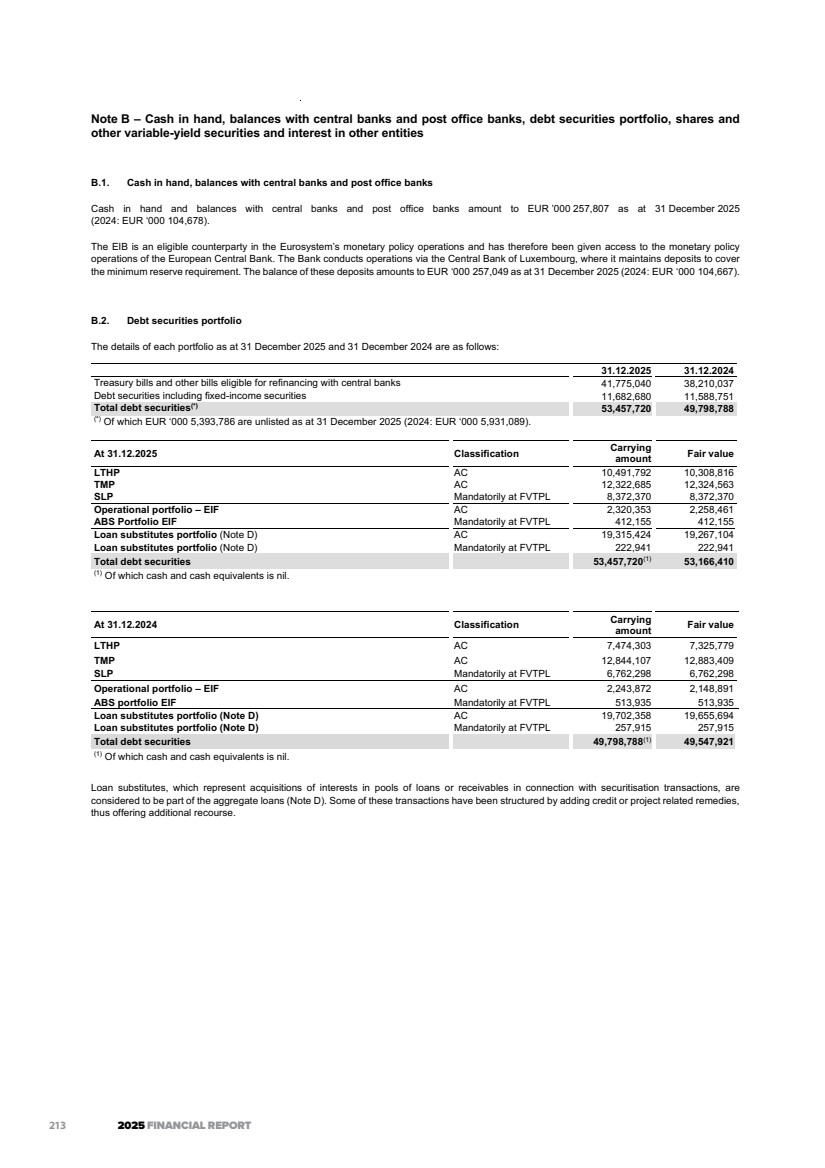
| EIB GROUP CONSOLIDATED FINANCIAL STATEMENTS UNDER IFRS 27 EU sovereign exposure The Group did not record impairment in 2025 and 2024 in respect of its held to maturity EU sovereign and EU sovereign guaranteed exposure as at year end, in view of the Bank’s as well as EIF’s preferred creditor status and the protection given by the Bank’s Statute as well as on a detailed review of any fair value adjustment requirements. The following tables show the exposure to debt issued or guaranteed by EU sovereigns in the Group’s debt securities portfolios as at 31 December 2025 and 31 December 2024: At 31.12.2025 Book value Fair value EU sovereigns Austria 967,559 952,682 Belgium 896,048 844,499 Bulgaria 94,836 92,094 Denmark 86,712 87,114 Estonia 25,543 25,517 Finland 877,285 854,335 France 4,760,835 4,781,587 Germany 3,233,355 3,231,312 Hungary 44,288 44,164 Italy 5,788,466 5,788,074 Latvia 65,054 65,406 Lithuania 78,762 78,111 Luxembourg 118,367 114,675 Netherlands 83,556 78,732 Poland 1,056,204 1,084,231 Portugal 544,728 540,236 Romania 3,611 3,611 Slovakia 46,940 47,209 Slovenia 64,229 60,634 Spain 1,525,202 1,525,405 Sweden 156,030 155,996 20,517,610 20,455,624 Non-EU sovereign and other bonds 32,940,110 32,710,786 Total 53,457,720 53,166,410 At 31.12.2024 Book value Fair value EU sovereigns Austria 791,686 784,658 Belgium 417,750 390,917 Bulgaria 55,052 50,986 Denmark 116,919 116,727 Estonia 7,165 7,272 Finland 612,074 595,386 France 5,998,599 6,038,739 Germany 2,138,320 2,132,529 Hungary 16,325 15,652 Italy 5,827,774 5,850,569 Latvia 27,378 27,872 Lithuania 38,354 37,675 Luxembourg 103,130 103,747 Netherlands 61,259 59,880 Poland 1,012,693 1,011,167 Portugal 46,956 41,865 Romania 13,910 13,910 Slovakia 38,383 38,609 Slovenia 54,639 50,102 Spain 1,817,161 1,821,600 Sweden 8,803 8,803 19,204,330 19,198,665 Non-EU sovereign and other bonds 30,594,458 30,349,256 Total 49,798,788 49,547,921 214 |
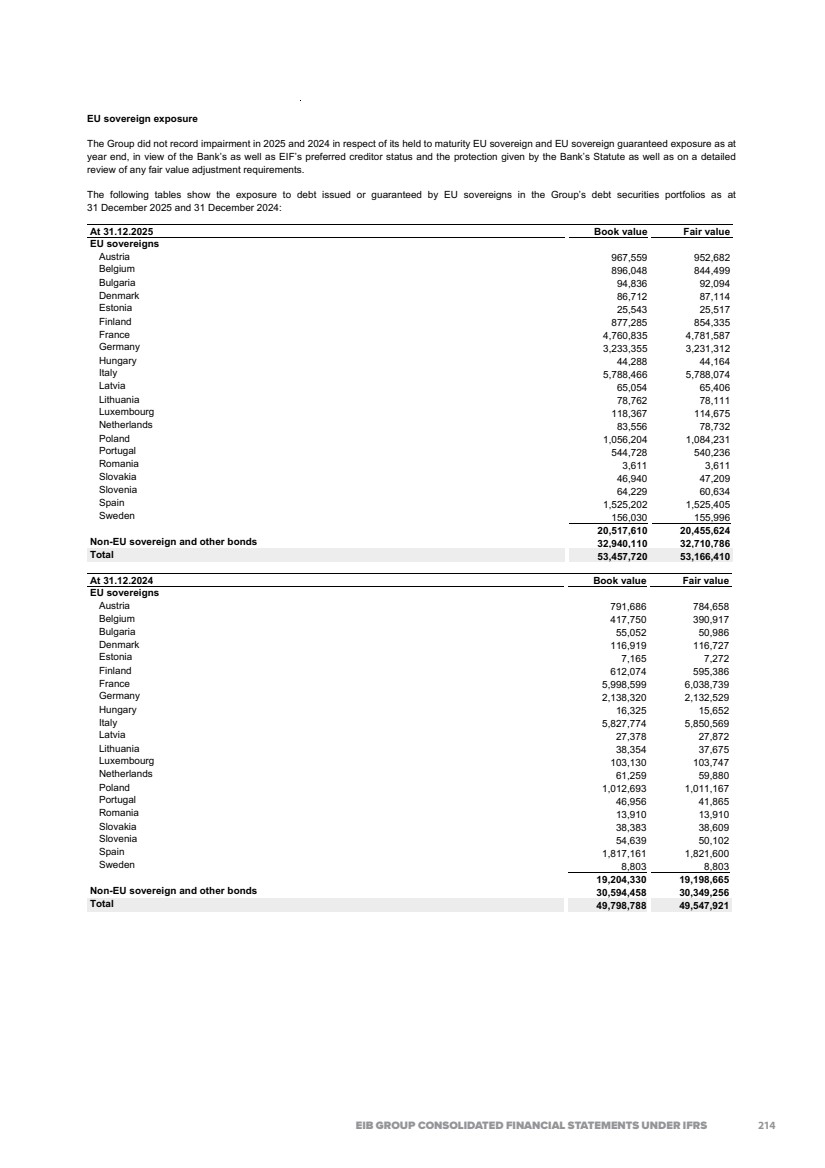
| 2025 FINANCIAL REPORT 28 Debt securities portfolio – Loss allowances The following table shows the reconciliation from the opening to the closing balance of the loss allowance for the debt securities portfolio under the ECL IFRS 9 model. 2025 (in EUR '000) 12-month ECL Lifetime ECL not credit-impaired Lifetime ECL credit-impaired Total Debt securities measured at AC Balance as at 1 January 5,743 1,929 0 7,672 Transfer to 12-month ECL 1,438 -1,438 0 0 Transfer to lifetime ECL not credit-impaired -50 50 0 0 Transfer to lifetime ECL credit-impaired 0 0 0 0 Net remeasurement of loss allowance -4,117 10,366 0 6,249 New financial assets originated or purchased 751 639 0 1,390 Financial assets that have been derecognised -287 -50 0 -337 Balance as at 31 December 3,478 11,496 0 14,974 2024 (in EUR '000) 12-month ECL Lifetime ECL not credit-impaired Lifetime ECL credit-impaired Total Debt securities measured at AC Balance as at 1 January 4,567 1,203 0 5,770 Transfer to 12-month ECL 0 0 0 0 Transfer to lifetime ECL not credit-impaired 0 0 0 0 Transfer to lifetime ECL credit-impaired 0 0 0 0 Net remeasurement of loss allowance 926 -655 0 271 New financial assets originated or purchased 474 1,385 0 1,859 Financial assets that have been derecognised -224 -4 0 -228 Balance as at 31 December 5,743 1,929 0 7,672 215 |
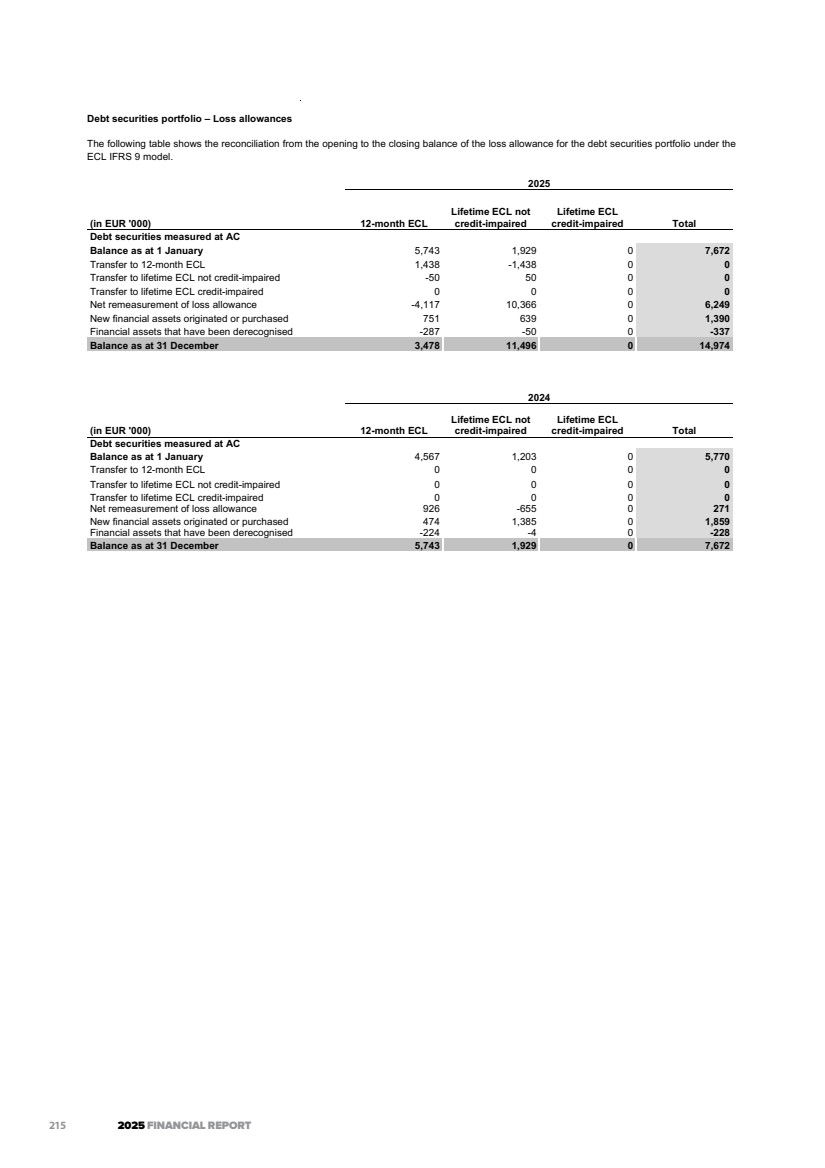
| EIB GROUP CONSOLIDATED FINANCIAL STATEMENTS UNDER IFRS 29 B.3. Shares and other variable-yield securities The balance comprises: 2025 Shares and other variable-yield securities Private Equity and Venture Capital Operations EBRD shares Equity investments and Infrastructure funds Other equity investments Other investments(3) Total Cost: As at 1 January 2025 8,027,494 278,520 4,112,310 626 960,141 13,379,091 Additions (2) 1,412,701 0 685,393 1,702 745,058 2,844,854 Reflows/Terminations (2) -1,026,624 0 -513,111 -32 -25,989 -1,565,756 As at 31 December 2025 8,413,571 278,520(1) 4,284,592 2,296 1,679,210 14,658,189 Unrealised gains/(losses): As at 1 January 2025 6,274,897 502,697 1,562,818 13,460 0 8,353,872 Unrealised gains 939,670 64,819 57,714 0 117,801 1,180,004 Unrealised losses -1,394,165 0 -67,696 -3,847 -117,801 -1,583,509 As at 31 December 2025 5,820,402 567,516 1,552,836 9,613 0 7,950,367 Net book value: As at 31 December 2025 14,233,973 846,036 5,837,428 11,909 1,679,210 22,608,556 As at 31 December 2024 14,302,391 781,217 5,675,128 14,086 960,141 21,732,963 2024 Shares and other variable-yield securities Private Equity and Venture Capital Operations EBRD shares Equity investments and Infrastructure funds Other equity investments Other investments(3) Total Cost: As at 1 January 2024 7,687,098 157,500 3,832,462 1,248 401,806 12,080,114 Additions (2) 1,545,003 121,020 728,389 339 582,725 2,977,476 Reflows/Terminations (2) -1,204,607 0 -448,541 -961 -24,390 -1,678,499 As at 31 December 2024 8,027,494 278,520(1) 4,112,310 626 960,141 13,379,091 Unrealised gains/(losses): As at 1 January 2024 6,253,275 489,371 1,463,631 2,942 0 8,209,219 Unrealised gains 1,148,924 13,326 154,094 10,518 15,681 1,342,543 Unrealised losses -1,127,302 0 -54,907 0 -15,681 -1,197,890 As at 31 December 2024 6,274,897 502,697 1,562,818 13,460 0 8,353,872 Net book value: As at 31 December 2024 14,302,391 781,217 5,675,128 14,086 960,141 21,732,963 As at 31 December 2023 13,940,373 646,871 5,296,093 4,190 401,806 20,289,333 (1) The amount of EUR ‘000 278,520 (2024: EUR ‘000 278,520) corresponds to the capital paid in by the Group as at 31 December 2025 with respect to its subscription of EUR ‘000 1,021,406 (2024: EUR ‘000 1,021,460) to the capital of the European Bank for Reconstruction and Development (‘EBRD’). As at 31 December 2025, the Group holds 3.04% of the subscribed capital of the EBRD (2024: 3.30%). (2) The “Additions” and “Reflows/Terminations” amounts include foreign exchange movements. (3) The amount of EUR ‘000 1,679,210 (2024: EUR ‘000 960,141) corresponds to the net paid in in respect of private equity operations deployed by the EIF in the context of the InvestEU programme. These operations are fully guaranteed by the EU represented by the European Commission. The European Commission is exposed to the upside and downside arising from these equity operations whereas the Group ultimately retains only an interest component to cover its cost of funding. Therefore, from an economic and risk perspective, the Group, as beneficiary of the EU guarantee, is ultimately exposed to the credit risk of the European Commission and not the equity risk stemming from the underlying investments. The fair value of such operations, disregarding the European Commission guarantee, amounts to EUR ‘000 1,797,011 (2024: EUR ‘000 944,460) while the valuation of the guarantee provided by the EC is valued at EUR ‘000 -117,801 (2024: EUR ‘000 15,681). 216 |
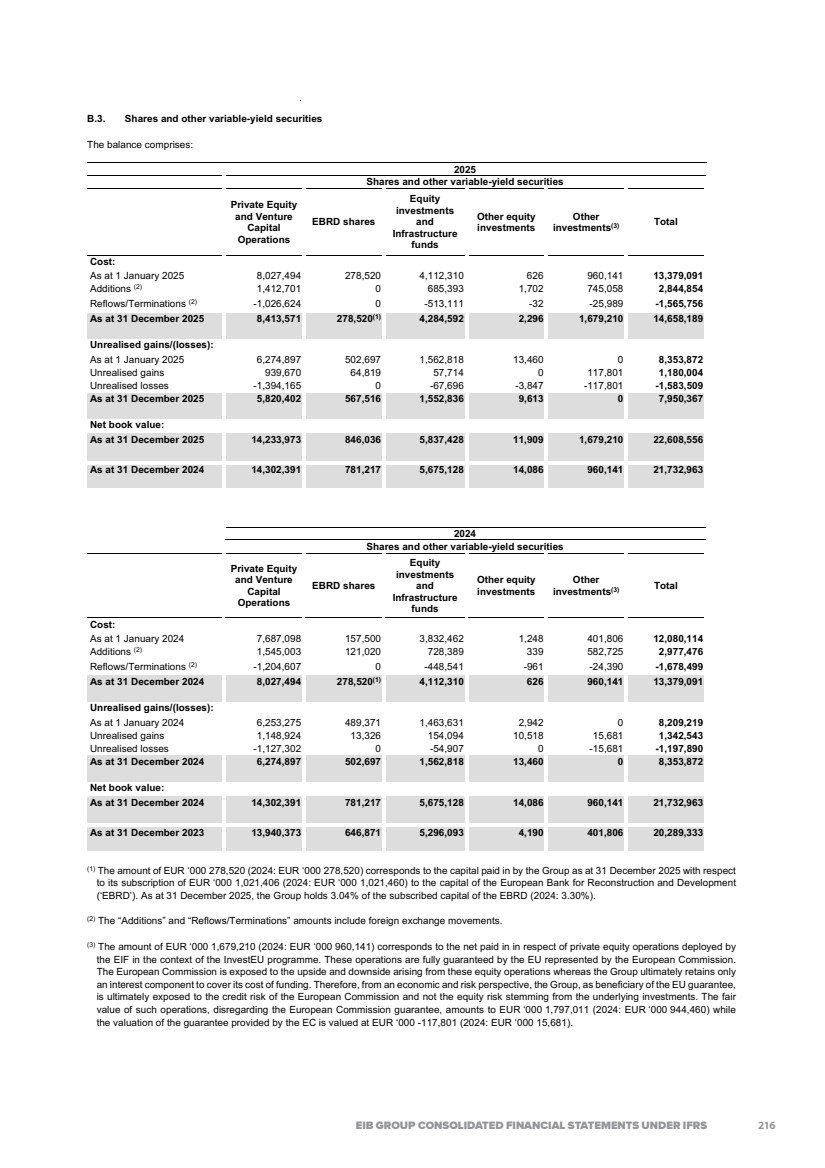
| 2025 FINANCIAL REPORT 30 The Group designated the investment in the EBRD as at fair value through other comprehensive income because the investment is expected to be held for the long-term for strategic purposes with no plans to dispose of it in the short or medium term. No dividends or transfers of any cumulative gains or losses within equity relating to this investment were recognised in 2025. The fair value movements from the private equity and venture capital operations observed and reported in the above table are primarily based on the individual valuations of the invested funds provided by the relevant fund managers. As at 31 December 2025, of the total private equity and venture capital operations valuations received 99% (2024: 99%) come under Category I or Category II pursuant to the classification included in Note A.4.8.6. B.4. Interest in other entities B.4.1 Composition of the Group The European Investment Fund (the ‘Fund’ or ‘EIF’) was incorporated on 14 June 1994, in Luxembourg, as an international financial institution. The address of its registered office is 37B, avenue J.F. Kennedy, L-2968 Luxembourg. The primary task of the Fund, while providing adequate return on equity, is to contribute to the pursuit of European Union objectives through: • the provision of guarantees to financial institutions that cover credits to small and medium-sized enterprises (‘SMEs’); • the acquisition, holding, management and disposal of equity participations; • the administration of special resources entrusted by third parties; and • related activities. The EIF has share capital consisting solely of ordinary shares, which are held directly by the Bank. The proportion of ownership interests held is equal to the voting rights held by the Bank. The country of incorporation or registration is also its principal place of business. As at 31 December 2025, the Bank holds 59.67% (2024: 59.72%) of the subscribed capital of the EIF amounting to EUR 7.4 billion (2024: EUR 7.4 billion). In 2025, the Bank purchased 5 shares for a price of EUR 620,389 per share and sold 8 shares for a price of EUR 656,649 per share. As a result, as at 31 December 2025 the Bank holds 4,398 shares in the EIF (2024: 4,401 shares). B.4.2 Involvement with unconsolidated structured entities Definition of a structured entity A structured entity is one that has been designed so that voting or similar rights are not the dominant factor in deciding who controls the entity. IFRS 12 observes that a structured entity often has some or all of the following features: • restricted activities; • a narrow and well-defined objective, such as to effect a tax-efficient lease, carry out research and development activities, provide a source of capital or funding to an entity or provide investment opportunities for investors by passing on risks and rewards associated with the assets of the structured entity to investors; • insufficient equity to permit the structured entity to finance its activities without subordinated financial support; • financing in the form of multiple contractually linked instruments to investors that create concentrations of credit or other risks (tranches). Unconsolidated structured entities The term 'unconsolidated structured entities' refers to all structured entities that are not controlled by the Group and includes interests in structured entities that are not consolidated. Definition of Interests in structured entities: IFRS 12 defines "interests" broadly to include any contractual or non-contractual involvement that exposes the reporting entity to variability in returns from the performance of the entity. Examples of such interests include the holding of equity interests and other forms of involvement such as the provision of funding, liquidity support, credit enhancements, commitments and guarantees to the other entity. IFRS 12 states that a reporting entity does not necessarily have an interest in another entity solely because of a typical customer supplier relationship. 217 |
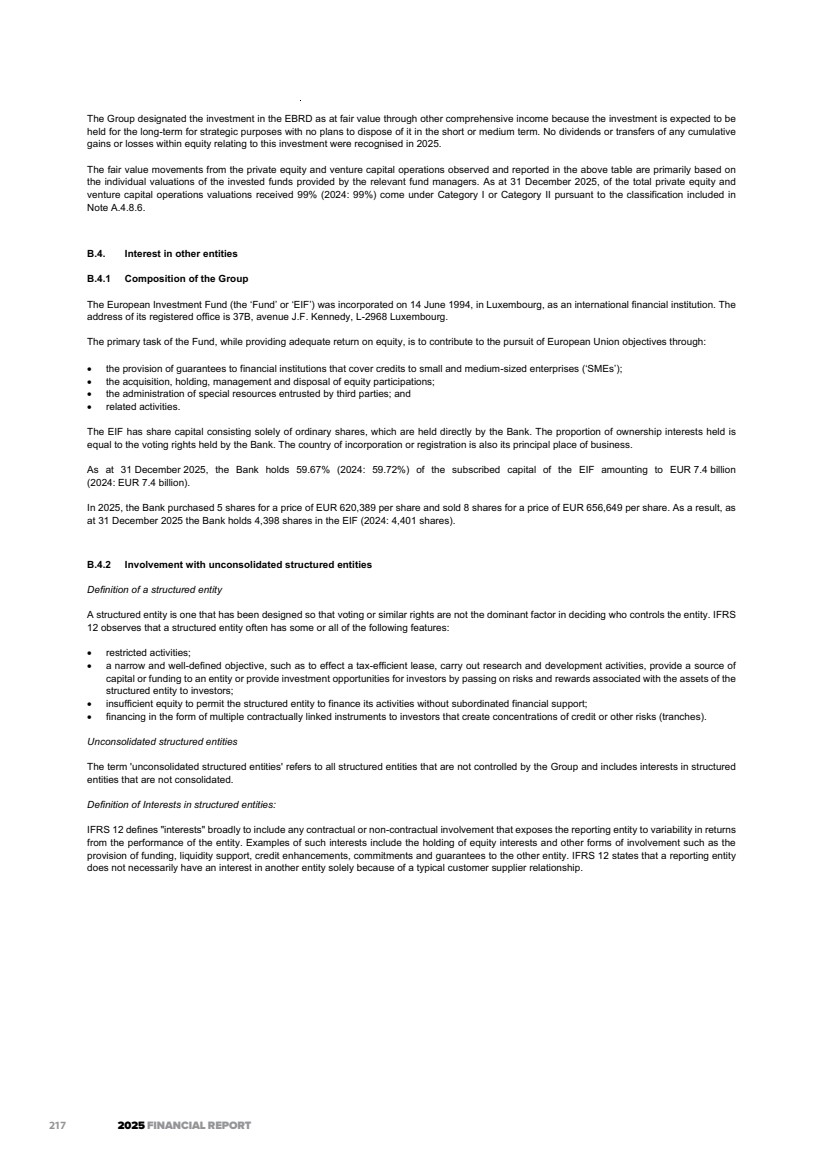
| EIB GROUP CONSOLIDATED FINANCIAL STATEMENTS UNDER IFRS 31 Type of structured entity Nature and purpose Interest held by the Group Project Finance - lending to Special Purposes Vehicles ('SPVs') Project Finance Transactions ('PF Operations') are transactions where the Group relies for the servicing of its debt on a borrower whose sole or main source of revenue is generated by a single or limited number of assets being financed by such debt or other pre-existing assets contractually linked to the project. PF operations are often financed through SPVs. Net disbursed amounts Interest income Private equity and venture capital, equity investments and infrastructure funds and other investments The Group finances venture capital and investment funds. Venture capital and investment funds pool and manage money from investors seeking private equity stakes in small and medium-size enterprises with strong growth potential as well as financing infrastructure projects. Investments in units/shares issued by venture capital and investment funds Dividends received as dividend income Assets Backed Securities issued by SPVs Investing in notes issued by SPVs is a Group’s alternative mean of providing funds to a project promoter or intermediary. Asset Backed Securities are issued by a segregated SPV and are backed by a pool of assets originated by a financial or another institution. It should be noted that the Group does not act as sponsor/promoter of such SPVs. Investments in notes issued by the SPVs Interest income Guarantees granted in respect of loans granted by third-party SPVs The Group enters into guarantees and unfunded securities transactions that can be granted to financial institutions, public entities or SPVs. Guaranteed exposures Guarantee fees Mandate management The Group manages mandates on behalf of third parties and is entrusted with the management of external funds and provides related back-office and accounting services. Management fees for services The table below shows the carrying amounts of unconsolidated structured entities in which the Group has an interest at the reporting date, as well as the Group’s maximum exposure to credit risk in relation to those entities or maximum exposure to loss for private equity and venture capital, equity investments and infrastructure funds and other investments. The maximum exposure to credit risk or maximum exposure to loss (for private equity and venture capital, equity investments and infrastructure funds and other investments) includes the carrying amounts and the related undisbursed commitments. 31.12.2025 31.12.2024 (in EUR million) Caption Carrying amount Maximum Exposure to Credit Risk or loss* Carrying amount Maximum Exposure to Credit Risk or loss* Project finance - lending to SPVs Loans and advances to customers 8,811 9,559 7,404 8,149 Private equity and venture capital, equity investments and infrastructure funds and other investments (refer to Note B.3) Shares and other variable-yield securities 21,751 35,752 20,938 33,333 Loan substitutes – Investments in Asset Backed Securities issued by SPVs and other structured entities Debt securities including fixed-income securities 7,600 7,600 7,722 7,722 Guarantees granted in respect of loans granted by third party SPV (Notes S.2.5.3) Provisions for guarantees issued and commitments** 89 17,728 87 16,162 Total 38,251 70,639 36,151 65,366 * Maximum exposure to credit risk is not applicable for private equity and venture capital, equity investment and infrastructure funds and other investments, as they carry no credit risk. ** Comparative amounts were changed based on updated information about additional third party SPV's that were identified after a retroactive review. No support is provided to structured entities by the EIB Group beyond the above disclosed carrying amounts. Note C – Loans and advances to credit institutions and to customers – other loans and advances (in EUR ‘000) 31.12.2025 31.12.2024 Term deposits 10,998,799 18,836,491 On-demand deposits 2,308 2,498 Reverse repos 23,256,022 21,364,442 Other loans and advances to credit institutions 34,257,129 40,203,431 Other loans and advances to customers 118,282 235,061 Total other loans and advances 34,375,411 40,438,492 Of which cash and cash equivalents (excluding accrued interest) 32,304,247 37,376,534 218 |
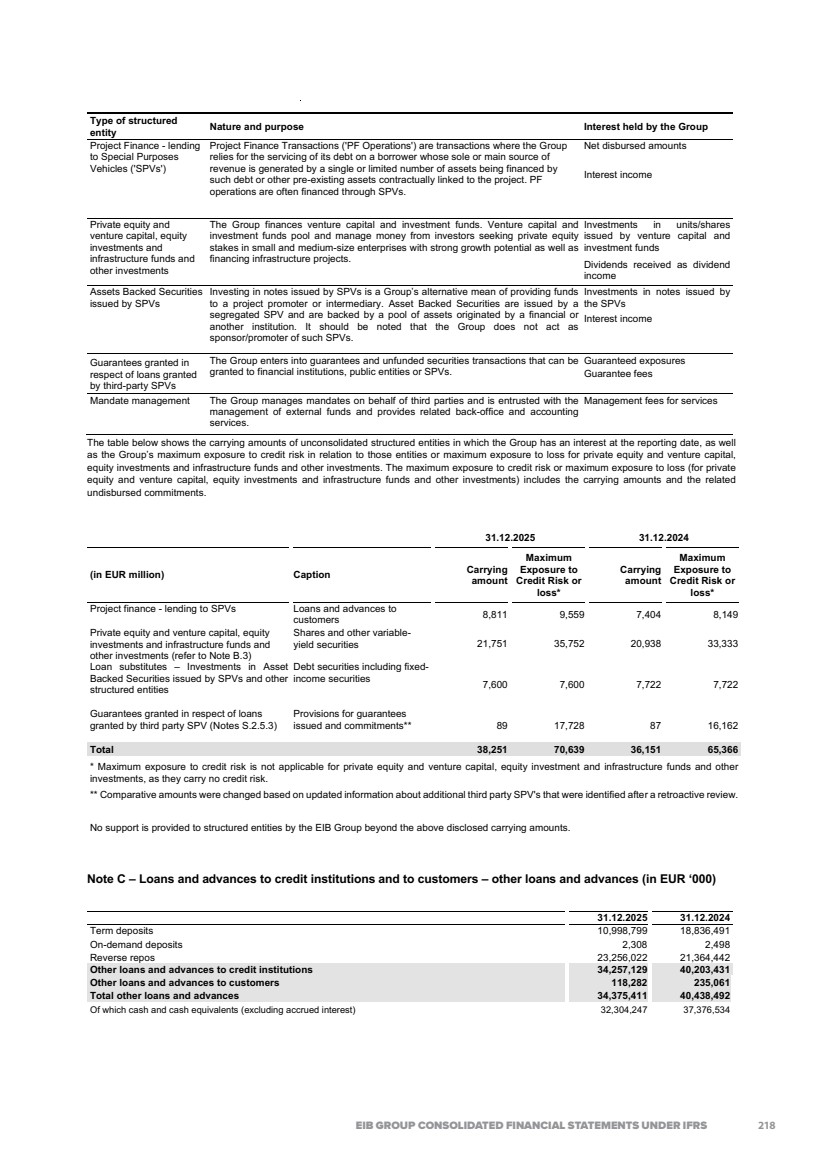
| 2025 FINANCIAL REPORT 32 Note D – Summary statement of loans (in EUR ‘000) D.1. Aggregate loans granted Aggregate loans granted comprise both the disbursed and undisbursed portions of loans. The analysis is as follows: To credit institutions To customers 31.12.2025 31.12.2024 Disbursed portion 85,024,528 350,622,640 435,647,168 436,253,973 Undisbursed loans 26,408,565 107,154,243 133,562,808 128,019,747 Aggregate loans granted 111,433,093 457,776,883 569,209,976 564,273,720 Loan instalments receivable 11,983 610,910 622,893 600,556 Loan substitutes portfolio 19,538,365 19,960,273 Aggregate loans including loan substitutes portfolio 589,371,234 584,834,549 D.2. Impairment on loans and advances – Loss allowances The following tables show the reconciliation from the opening to the closing balance of the loss allowance for disbursed loans and advances and undisbursed loans (loan commitments) under the ECL IFRS 9 model. 2025 12-month ECL Lifetime ECL not credit-impaired Lifetime ECL credit-impaired Total Loans and advances to credit institutions measured at AC Balance as at 1 January 2025 13,897 16,116 0 30,013 Transfer to 12-month ECL 2,581 -9,035 0 -6,454 Transfer to lifetime ECL not credit-impaired -76 1,136 0 1,060 Transfer to lifetime ECL credit-impaired 0 0 0 0 Net measurement of loss allowance -1,700 -3,480 0 -5,180 New financial assets originated or purchased 3,876 278 0 4,154 Financial assets that have been derecognised -542 -380 0 -922 Write-offs 0 0 0 0 Balance as at 31 December 2025 18,036 4,635 0 22,671 The evolution of the loss allowance on Loans and advances to credit institutions is mainly explained by the following: • Decrease due to the net movement between 12-month ECL, Lifetime ECL not credit-impaired and Lifetime ECL credit-impaired by an amount of EUR ‘000 5,394. • Increase due to new financial assets originated or purchased by an amount of EUR ‘000 4,154. • Decrease due to the net measurement of loss allowance of existing operations within the same staging level by an amount of EUR ‘000 5,180. • Decrease due to the full derecognition of financial assets by an amount of EUR ‘000 922. 2024 12-month ECL Lifetime ECL not credit-impaired Lifetime ECL credit-impaired Total Loans and advances to credit institutions measured at AC Balance as at 1 January 2024 18,234 49,699 0 67,933 Transfer to 12-month ECL 327 -2,793 0 -2,466 Transfer to lifetime ECL not credit-impaired -12 17 0 5 Transfer to lifetime ECL credit-impaired 0 -67 0 -67 Net measurement of loss allowance -6,686 -28,421 0 -35,107 New financial assets originated or purchased 2,634 110 0 2,744 Financial assets that have been derecognised -600 -2,429 0 -3,029 Write-offs 0 0 0 0 Balance as at 31 December 2024 13,897 16,116 0 30,013 219 |
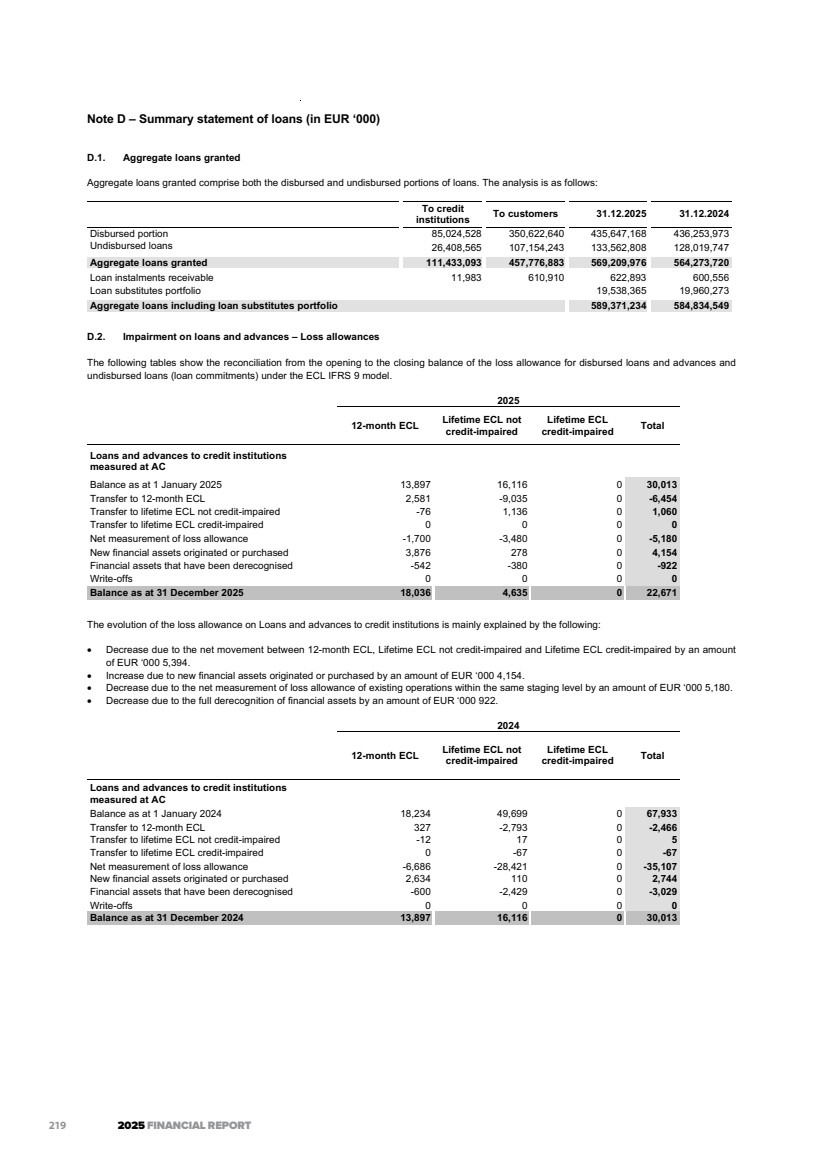
| EIB GROUP CONSOLIDATED FINANCIAL STATEMENTS UNDER IFRS 33 2025 12-month ECL Lifetime ECL not credit-impaired Lifetime ECL credit-impaired Total Loans and advances to customers measured at AC Balance as at 1 January 2025 64,068 120,919 352,635 537,622 Transfer to 12-month ECL 618 -7,620 0 -7,002 Transfer to lifetime ECL not credit-impaired -2,001 41,584 -3,065 36,518 Transfer to lifetime ECL credit-impaired -186 -12,476 65,564 52,902 Net measurement of loss allowance -2,430 -16,488 109,733(1) 90,815 New financial assets originated or purchased 12,478 700 776 13,954 Financial assets that have been derecognised -3,912 -179 -72 -4,163 Write-offs 0 0 -71,107 -71,107 Balance as at 31 December 2025 68,635 126,440 454,464 649,539 (1) No assets were derecognised and subsequently reinstated in 2025. The evolution of the loss allowance on loans and advances to customers is mainly explained by the following: • Increase due to the net movement between 12-month ECL, Lifetime ECL not credit-impaired and Lifetime ECL credit-impaired by an amount of EUR ‘000 82,418. • Increase due to new financial assets originated or purchased by an amount of EUR ‘000 13,954. • Increase due to the net measurement of loss allowance of existing operations within the same staging level by an amount of EUR ‘000 90,815. • Decrease due to the full derecognition of financial assets by an amount of EUR ‘000 4,163. • Decrease due to the write-off of financial assets by an amount of EUR ‘000 71,107. 2024 12-month ECL Lifetime ECL not credit-impaired Lifetime ECL credit-impaired Total Loans and advances to customers measured at AC Balance as at 1 January 2024 55,215 182,630 241,171 479,016 Transfer to 12-month ECL 8,630 -103,561 0 -94,931 Transfer to lifetime ECL not credit-impaired -1,019 20,164 -21 19,124 Transfer to lifetime ECL credit-impaired -722 -17 142,120 141,381 Net measurement of loss allowance -5,702 -10,187 -14,663(1) -30,552 New financial assets originated or purchased 10,614 34,824 0 45,438 Financial assets that have been derecognised -2,948 -2,934 -15,972 -21,854 Write-offs 0 0 0 0 Balance as at 31 December 2024 64,068 120,919 352,635 537,622 (1) No assets were derecognised and subsequently reinstated in 2024. 2025 12-month ECL Lifetime ECL not credit-impaired Lifetime ECL credit-impaired Total Loan commitments measured at AC Balance as at 1 January 2025 26,310 25,552 13,045 64,907 Transfer to 12-month ECL 50 -7,254 0 -7,204 Transfer to lifetime ECL not credit-impaired -1,695 76,722 0 75,027 Transfer to lifetime ECL credit-impaired -8 -22 0 -30 Net measurement of loss allowance -5,314 -4,488 -13,045 -22,847 New financial assets originated or purchased 7,045 4,460 0 11,505 Financial assets that have been derecognised -10,903 -9,232 0 -20,135 Write-offs 0 0 0 0 Balance as at 31 December 2025 15,485 85,738 0 101,223 The evolution of the loss allowance on Loan commitments is mainly explained by the following: • Increase due to the net movement between 12-month ECL, Lifetime ECL not credit-impaired and Lifetime ECL credit-impaired by an amount of EUR ‘000 67,793. • Increase due to new financial assets originated or purchased by an amount of EUR ‘000 11,505. • Decrease due to the full derecognition of financial assets by an amount of EUR ‘000 20,135. • Decrease due to the net measurement of loss allowance of existing operations within the same staging level by an amount of EUR ‘000 22,847. 220 |
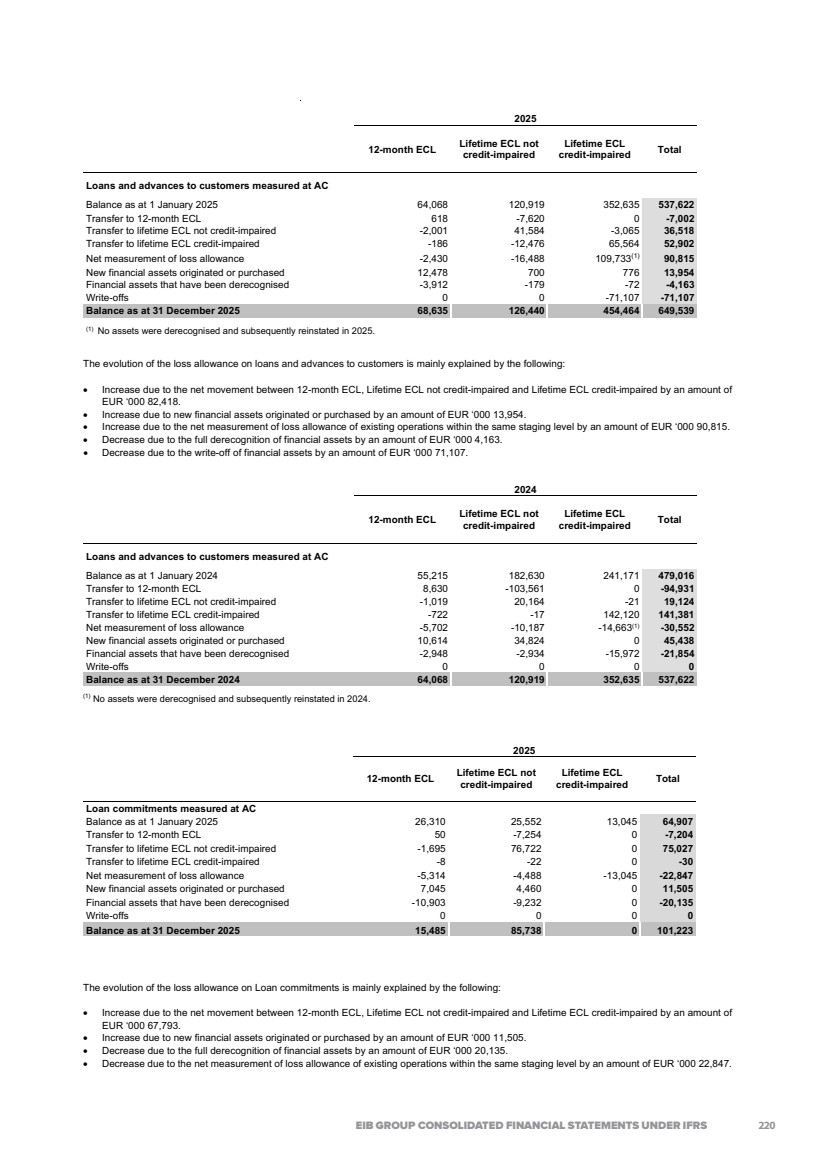
| 2025 FINANCIAL REPORT 34 2024 12-month ECL Lifetime ECL not credit-impaired Lifetime ECL credit-impaired Total Loan commitments measured at AC Balance as at 1 January 2024 20,461 31,993 250 52,704 Transfer to 12-month ECL 564 -10,488 0 -9,924 Transfer to lifetime ECL not credit-impaired -626 18,632 0 18,006 Transfer to lifetime ECL credit-impaired -64 0 12,795 12,731 Net measurement of loss allowance 1,194 -593 0 601 New financial assets originated or purchased 13,821 509 0 14,330 Financial assets that have been derecognised -9,040 -14,501 0 -23,541 Write-offs 0 0 0 0 Balance as at 31 December 2024 26,310 25,552 13,045 64,907 D.3. Geographical breakdown of lending by country in which projects are located Loans for projects within the European Union: Countries and territories in which projects are located Aggregate loans granted Disbursed portion Undisbursed portion % of total 2025 % of total 2024 France 81,106,036 62,149,548 18,956,488 13.78% 13.27% Spain 74,250,956 63,859,473 10,391,483 12.61% 13.12% Italy 65,541,590 54,687,508 10,854,082 11.13% 11.19% Poland 51,380,791 40,710,663 10,670,128 8.73% 8.39% Germany 50,499,655 36,060,976 14,438,679 8.58% 8.32% Belgium 20,279,212 15,727,341 4,551,871 3.44% 3.29% Greece 18,247,787 13,556,544 4,691,243 3.10% 3.32% Netherlands 17,815,704 13,583,959 4,231,745 3.03% 2.98% Austria 14,134,438 12,154,991 1,979,447 2.40% 2.49% Portugal 12,897,763 9,068,493 3,829,270 2.19% 2.03% Sweden 12,780,138 10,191,420 2,588,718 2.17% 2.08% Finland 11,320,053 9,927,670 1,392,383 1.92% 1.93% Czech Republic 10,662,586 7,986,499 2,676,087 1.81% 1.69% Romania 9,464,507 6,654,885 2,809,622 1.61% 1.49% Hungary 8,841,997 7,662,449 1,179,548 1.50% 1.48% Ireland 8,273,058 5,970,610 2,302,448 1.41% 1.39% Denmark 4,554,136 2,644,060 1,910,076 0.77% 0.87% Slovakia 4,254,326 4,138,004 116,322 0.72% 0.73% Croatia 3,387,733 2,725,272 662,461 0.58% 0.61% Lithuania 3,102,278 2,584,520 517,758 0.53% 0.50% Bulgaria 2,726,287 2,010,956 715,331 0.46% 0.43% Cyprus 2,674,825 1,800,984 873,841 0.45% 0.43% Slovenia 2,153,464 1,810,997 342,467 0.37% 0.38% Estonia 1,985,328 1,361,396 623,932 0.34% 0.35% Latvia 994,589 630,386 364,203 0.17% 0.15% Luxembourg 886,061 579,157 306,904 0.15% 0.15% Malta 458,302 351,310 106,992 0.08% 0.08% Subtotal 494,673,600 390,590,071 104,083,529 84.03% 83.14% 221 |
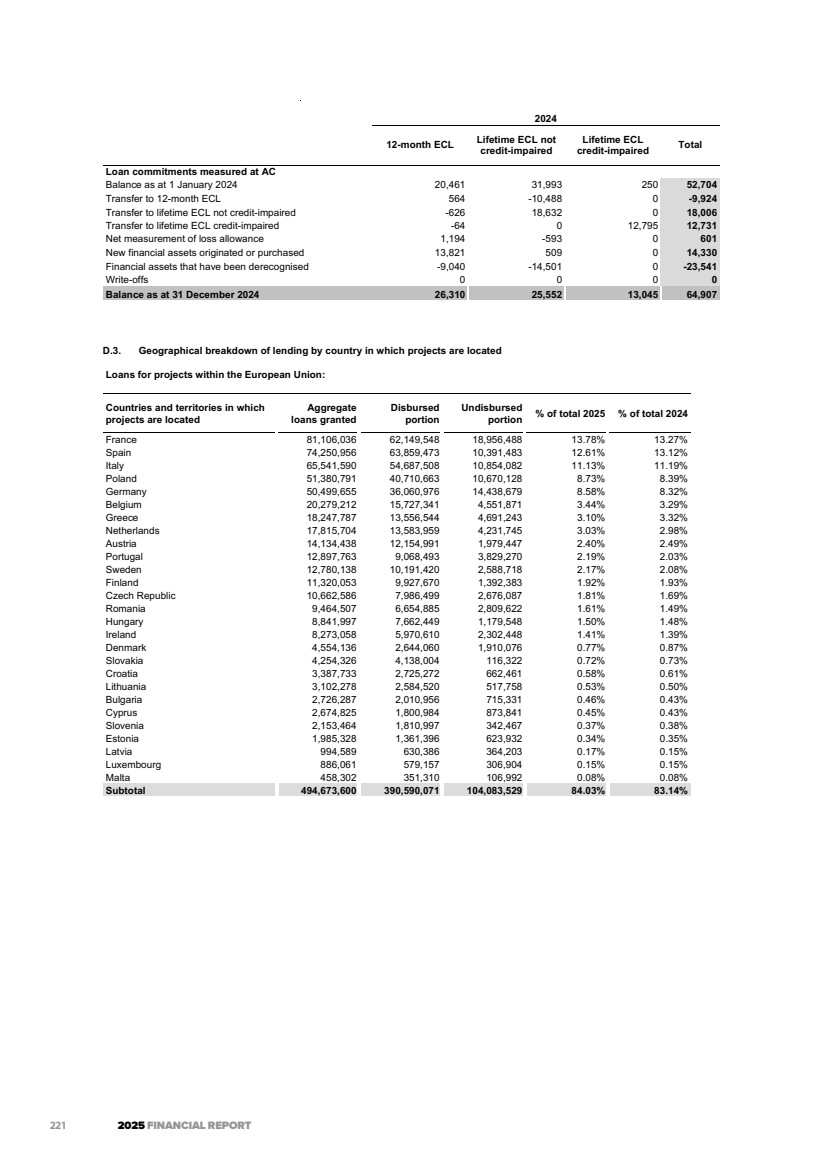
| EIB GROUP CONSOLIDATED FINANCIAL STATEMENTS UNDER IFRS 1 Loans for projects outside the European Union: Countries and territories in which projects are located Aggregate loans granted Disbursed portion Undisbursed portion % of total 2025 % of total 2024 Former Member States 22,478,702 22,478,702 0 3.81% 4.32% Candidate countries(2) 22,355,076 15,361,309 6,993,767 3.80% 3.91% Mediterranean countries(3) (4) (5) 17,413,574 10,492,770 6,920,804 2.96% 3.33% ACP States(6) 10,724,243 4,119,839 6,604,404 1.82% 1.76% Asia 10,387,803 5,307,822 5,079,981 1.76% 1.69% Latin America 7,091,361 4,828,480 2,262,881 1.20% 1.17% EFTA 1,266,830 993,386 273,444 0.22% 0.23% South Africa 1,050,403 255,063 795,340 0.18% 0.21% Eastern Europe, Southern Caucasus(4) 1,015,578 588,520 427,058 0.17% 0.19% Potential candidate countries(8) 181,161 79,561 101,600 0.03% 0.03% OCT(7) 100,010 90,010 10,000 0.02% 0.02% Non-candidate countries 10,000 0 10,000 0.00% 0.00% Subtotal 94,074,741 64,595,462 29,479,279 15.97% 16.86% Total 2025(1) 588,748,341 455,185,533 133,562,808 100.00% Total 2024(1) 584,233,993 456,214,246 128,019,747 100.00% (1) Aggregate loans including loan substitutes and excluding loan instalments receivables (2025: EUR 623 million, 2024: EUR 601 million). (2) The EIB’s disbursed exposure in Ukraine is predominantly covered by EU Comprehensive Guarantees under the EU External Lending Mandate and under the Risk Sharing Mandates. As of 31 December 2025, total disbursed exposure amounted to EUR 3,572.8 million (compared to EUR 3,250.2 million at the end of 2024). Of this amount, EUR 2,943.5 million, or 83%, is covered by EU Comprehensive Guarantees, EUR 70.4, or 2% million under EU4U; EUR 461.6 million, or 13% under Ukraine Facility and EUR 10.1 million, or 0%, is covered under Risk Sharing Mandates and EUR 87.3 million, or 2%, is covered by EU Political Risk Guarantees (compared to EUR 3,092.5 million, or 95% by EU Comprehensive Guarantees, no exposure under EU4U or Ukraine Facility; EUR 12.4 million, or 0% covered by risk sharing mandates and EUR 145.3 million, or 5% respectively covered by political risk guarantees, at the end of 2024). In addition, the Bank also granted financial guarantees on exposures to counterparties located in Ukraine for a signed amount of EUR 442.6 million at the end of 2025 (compared to EUR 500.5 million at the end of 2024). This is fully covered by EU Comprehensive Guarantees. A further EUR 2,507.3 million has been committed in signed operations not yet disbursed at the end of 2025 (compared to EUR 2,615.5 million at the end of 2024). Of this amount, EUR 824.5 million, or 33% is covered by EU Comprehensive Guarantees, no exposure covered by EU Political Risk Guarantees, EUR 190.0, or 8% under EU4U; EUR 1,459.8, or 58% under Ukraine Facility and EUR 33.0 million or 1% under Risk Sharing Mandates (compared to EUR 2,285.2 million, or 87% covered by Comprehensive guarantees, EUR 144.9 million, or 6% by political risk guarantees, EUR 150.0 million, or 6% under EU4U and EUR 33.0 million, or 1% respectively covered by risk sharing mandates, at the end of 2024). There is no remaining amount at the EIB’s own risk (compared to EUR 1.9 million, or 0%, at the end of 2024). (3) This designation shall not be construed as recognition of a State of Palestine and is without prejudice to the individual positions of the EU Member States on this issue. The EIB’s total disbursed exposure in Palestine amounted to EUR 665.3 million at the end of 2025 (compared to EUR 302.5 million at the end of 2024), of which EUR 661.9 million, or 99%, is secured by EU Comprehensive Guarantees and EUR 3.4 million, or 1%, under Risk Sharing Mandates (compared to EUR 296 million, or 98% and EUR 6.5 million, or 2% respectively, at the end of 2024). A further EUR 41.2 million has been committed in signed operations not yet disbursed, which is fully secured by EU Comprehensive Guarantees (compared to EUR 77.5 million at the end of 2024, also fully secured by EU Comprehensive Guarantees). (4) The EIB’s total disbursed exposure in Israel amounted to EUR 1,251.4 million at the end of 2025 (compared to EUR 1,209 million at the end of 2024), of which EUR 237.8 million, or 19%, is secured by EU Political Risk Guarantees, EUR 1,009.3 million, or 81%, is at the EIB’s own risk and EUR 4.3 million, or 0%, is covered under Risk Sharing Mandates (compared to EUR 279.6 million, or 23%, EUR 925.4 million, or 77% and EUR 4 million, or 0% respectively, at the end of 2024). A further EUR 412.4 million has been committed in signed operations not yet disbursed at the end of 2025 (compared to EUR 584.1 million at the end of 2024), of which EUR 408.9 million, or 99%, is at the EIB’s own risk and EUR 3.5 million, or 1%, under Risk Sharing Mandates (compared to EUR 580.6 million, or 99% and EUR 3.5 million, or 1% respectively, at the end of 2024). (5) The EIB’s total disbursed exposure in Lebanon amounted to EUR 164.5 million at the end of 2025 (compared to EUR 228.6 million at the end of 2024). This exposure is fully secured by EU comprehensive guarantees. A further EUR 176.5 million has been committed in signed operations not yet disbursed (compared to EUR 476.6 million at the end of 2024). This exposure is fully secured by EU comprehensive guarantees. (6) African, Caribbean and Pacific. (7) Overseas Countries and Territories. (8) The designation of Kosovo under Potential candidate countries is without prejudice to positions on status and is in line with UNSCR 1244/1999 and the ICJ Opinion on the Kosovo declaration of independence. 222 |
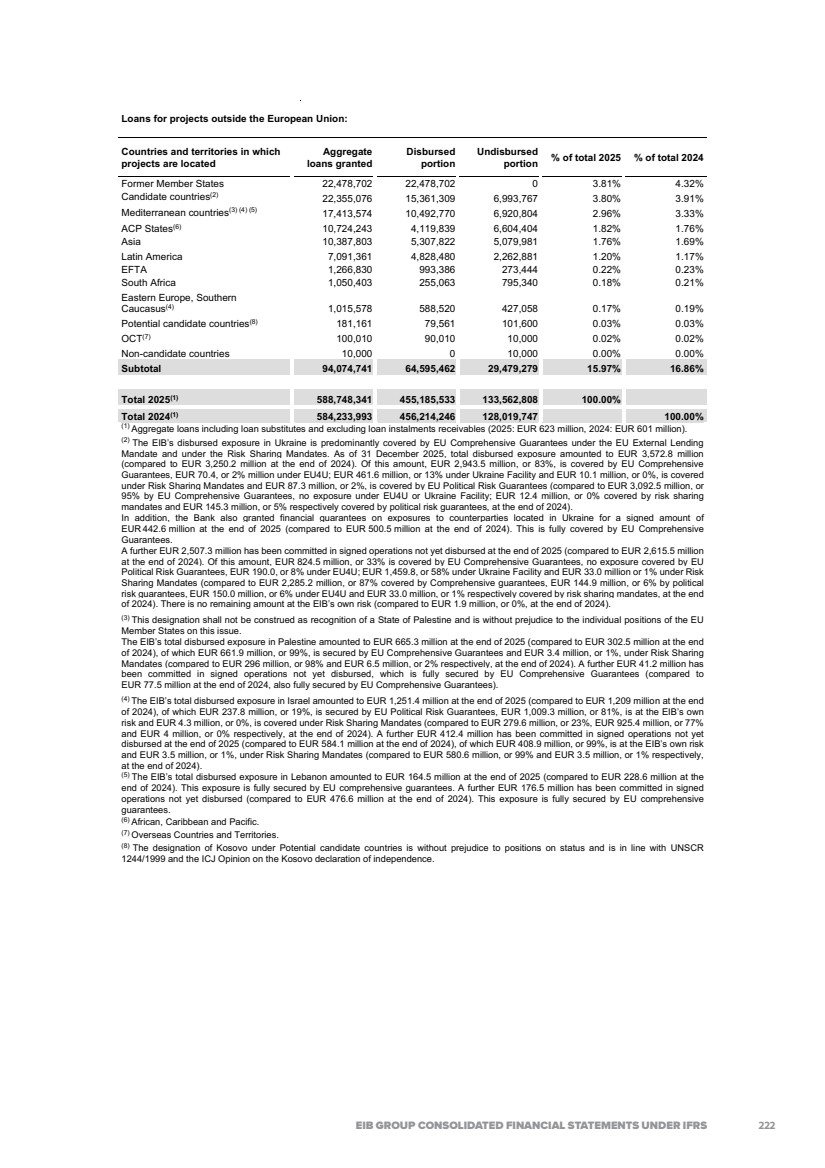
| 2025 FINANCIAL REPORT 36 D.4. Movement in guarantee operations The following table shows the reconciliation from the opening to the closing balance of the financial guarantees. Comparative amounts for 2024 are disclosed below. 2025 Other liabilities Provisions 12-month ECL Lifetime ECL not credit-impaired Lifetime ECL credit-impaired Total Financial Guarantees Balance as at 1 January 77,136 146 9,482 86,764 Transfer to 12-month ECL 0 0 0 0 Transfer to lifetime ECL not credit-impaired 0 0 0 0 Transfer to lifetime ECL credit-impaired 0 0 0 0 Net remeasurement 852 -23 2,245 3,074 Use of provision 0 0 0 0 New guarantees originated or purchased 26,082 0 0 26,082 Guarantees that have been derecognised -27,084 0 0 -27,084 Balance as at 31 December 76,986 123 11,727 88,836 2024 Other liabilities Provisions 12-month ECL Lifetime ECL not credit-impaired Lifetime ECL credit-impaired Total Financial Guarantees Balance as at 1 January 77,438 40 9,408 86,886 Transfer to 12-month ECL 0 0 0 0 Transfer to lifetime ECL not credit-impaired 0 0 0 0 Transfer to lifetime ECL credit-impaired -1 0 1 0 Net remeasurement -5,616 -15 73 -5,558 Use of provision 0 0 0 0 New guarantees originated or purchased 33,008 145 0 33,153 Guarantees that have been derecognised -27,693 -24 0 -27,717 Balance as at 31 December 77,136 146 9,482 86,764 223 |
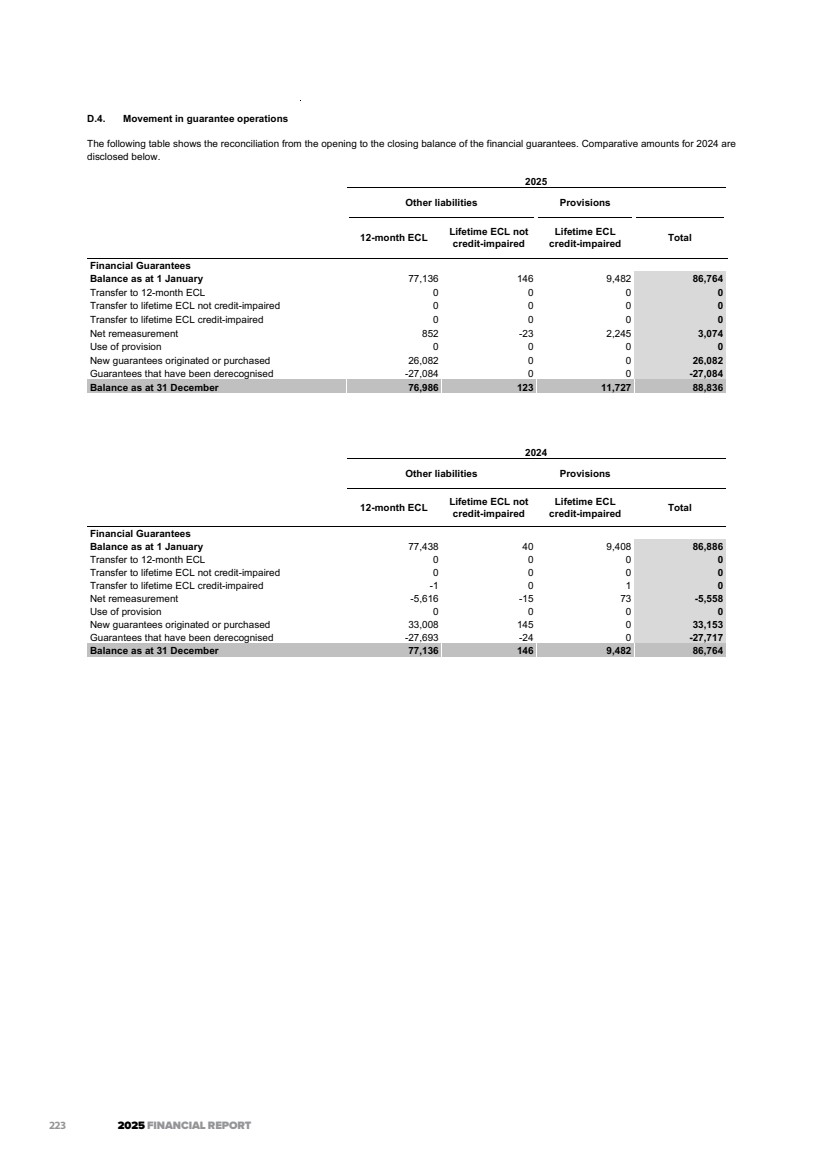
| EIB GROUP CONSOLIDATED FINANCIAL STATEMENTS UNDER IFRS 37 Note E – Property, furniture, equipment and intangible assets (in EUR ‘000) Land Luxembourg buildings(1) Furniture and equipment Right-of-use assets(2)(3) Total property, furniture and equipment Total intangible assets Cost as at 1 January 2025 20,145 527,201 91,160 328,352 966,858 180,460 Additions 0 116,343 24,989 -2,469 138,863 90,629 Disposals 0 0 -29,880 -4,958 -34,838 -37,588 As at 31 December 2025 20,145 643,544 86,269 320,925 1,070,883 233,501 Accumulated depreciation/amortisation: As at 1 January 2025 0 -243,470 -45,192 -184,243 -472,905 -49,809 Depreciation/amortisation 0 -8,376 -25,423 -31,532 -65,331 -64,364 Disposals 0 0 29,783 4,958 34,741 36,729 As at 31 December 2025 0 -251,846 -40,832 -210,817 -503,495 -77,444 Carrying amount: As at 31 December 2025 20,145 391,698 45,437 110,108 567,388 156,057 As at 31 December 2024 20,145 283,731 45,968 144,109 493,953 130,651 (1) All land and buildings are used by the Group for its own activities. For subsequent measurement purposes the Group uses the “cost model” under IAS 16. The Luxembourg buildings category includes costs relating to the construction of a new building for an amount of EUR ’000 287,099 (2024: EUR ’000 184,312), which is expected to be completed in 2027. (2) Right-of-use assets are composed of the following classes of assets: real estate (commercial and residential properties) and cars. The depreciation charge during 2025 was EUR ’000 31,299 (2024: EUR ’000 39,118) for real estate and EUR ’000 233 (2024: EUR ’000 146) for cars. The carrying amount as at 31 December 2025 was EUR ’000 109,788 (2024: EUR ’000 143,700) for real estate and EUR ’000 320 (2024: EUR ’000 409) for cars. (3) Additions to Right-of-Use assets also include lease modifications, which may result either in an increase or a decrease in the cost value. Note F – Deferred income (in EUR ‘000) 31.12.2025 31.12.2024 Deferred management fees 433,054 359,693 Interest subsidies received in advance 280,558 218,771 Deferred income on loans and guarantees 59,086 44,394 Other(*) 141,350 129,197 Total 914,048 752,055 (*) Other deferred income mainly includes fees in relation to the recovery, restructuring and administration of thematic financial products, which are linked to certain third-party mandates and are the main driver for the variation. 224 |
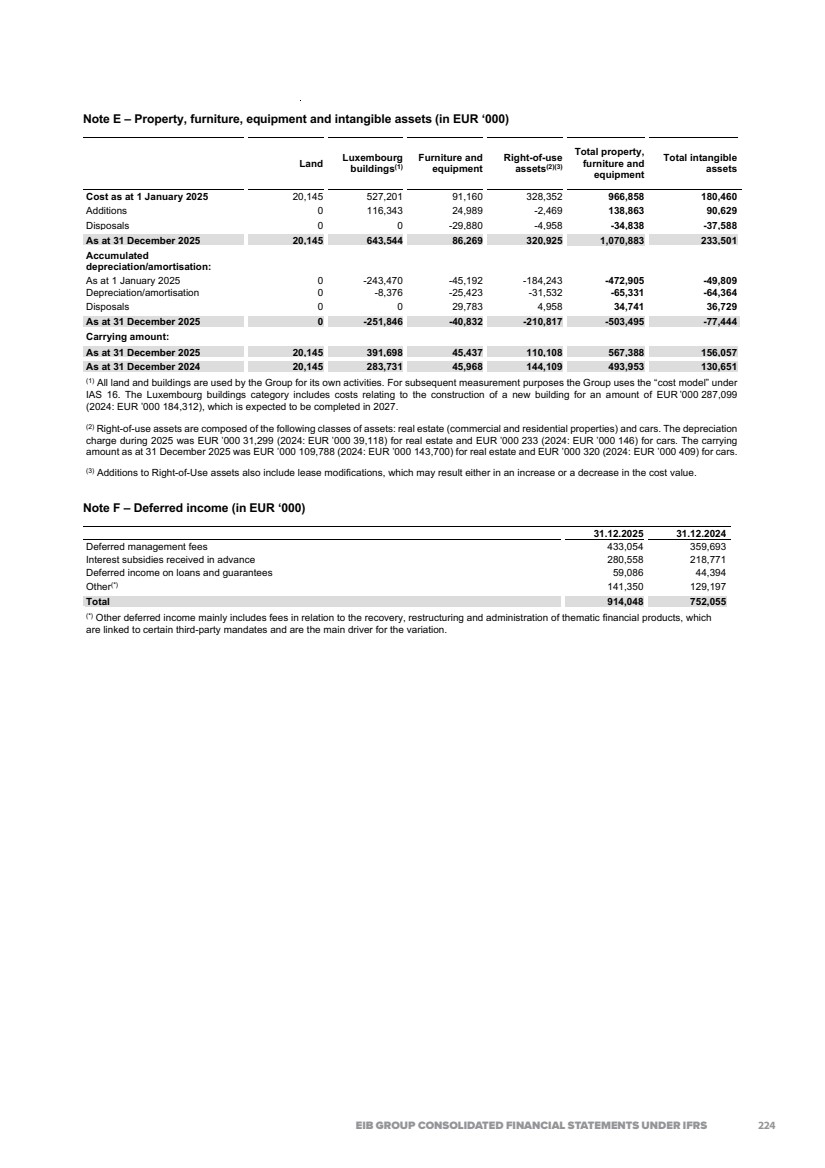
| 2025 FINANCIAL REPORT 1 Note G – Other assets and Other liabilities (in EUR ‘000) G.1. Other assets 31.12.2025 31.12.2024 Guarantee call receivable 162,049 95,472 Accounts receivable and sundry debtors 144,106 158,406 InvestEU receivable 102,849 84,310 Net assets from financial guarantee contracts 93,981 110,008 Advances on salaries and allowances 3,569 2,860 EGF management fee receivable 2,874 5,311 Other 2,221 2,553 Total 511,649 458,920 G.2. Other liabilities 31.12.2025 31.12.2024 Capital repayable to the UK(*) 1,695,904 1,995,904 Optional Supplementary Provident Scheme 1,115,053 1,004,392 First Loss Piece Contribution(***) 544,095 416,248 Commitment to purchase EIF non-controlling interest(**) 513,499 483,283 Accounts payable and sundry creditors 172,452 155,837 Personnel costs payable 126,412 104,129 Lease Liability 97,804 136,011 Capital increase payable to the EBRD(****) 96,816 121,020 Net liabilities from financial guarantee contracts (Note D.4.) 77,109 77,283 Payable amounts under mandates 31,329 58,213 InvestEU payable 23,227 6,185 Payable on HIPC initiative(*****) 13,596 13,596 Western Balkans infrastructure fund 97 97 Other 326,880 432,736 Total 4,834,273 5,004,934 (*) In accordance with the Article 150(4) of the Agreement on the withdrawal of the United Kingdom of Great Britain and Northern Ireland from the European Union and the European Atomic Energy Community, and as amended by COUNCIL DECISION (EU) 2020/769 of 10 June 2020, the EIB will repay to the UK EUR 3.5bn of called capital in twelve annual instalments starting with 15 October 2020 (the first eleven instalments will be EUR 300,000,000 each and the final one will be EUR 195,903,950). The instalments due up to and including 15 October 2025 were settled in full. (**) As at 31 December 2025, the portion of EIF non-controlling interest on the consolidated other liabilities amounts to EUR 513 million (2024: EUR 483 million) and on the consolidated result (Note L) amounts to EUR -25 million (2024: EUR -30 million). (***) Contribution related to First Loss Piece (FLP). FLP is a form of portfolio-based collateral under which all the losses incurred on a portfolio of exposures are absorbed by the FLP, until it has been fully exhausted. Only after that point the more senior tranches can incur some losses too. (****) In September 2024 the Bank subscribed to 12,102 additional paid-in shares in the capital of the EBRD, nominal value of EUR ‘000 10 each, with total value of EUR ’000 121,020, payable in five equal annual instalments on 30 April 2025, 30 April 2026, 30 April 2027, 30 April 2028 and 30 April 2029. Four payments are still outstanding as of the year end. (*****) Heavily Indebted Poor Countries (‘HIPC’) initiative. 225 |
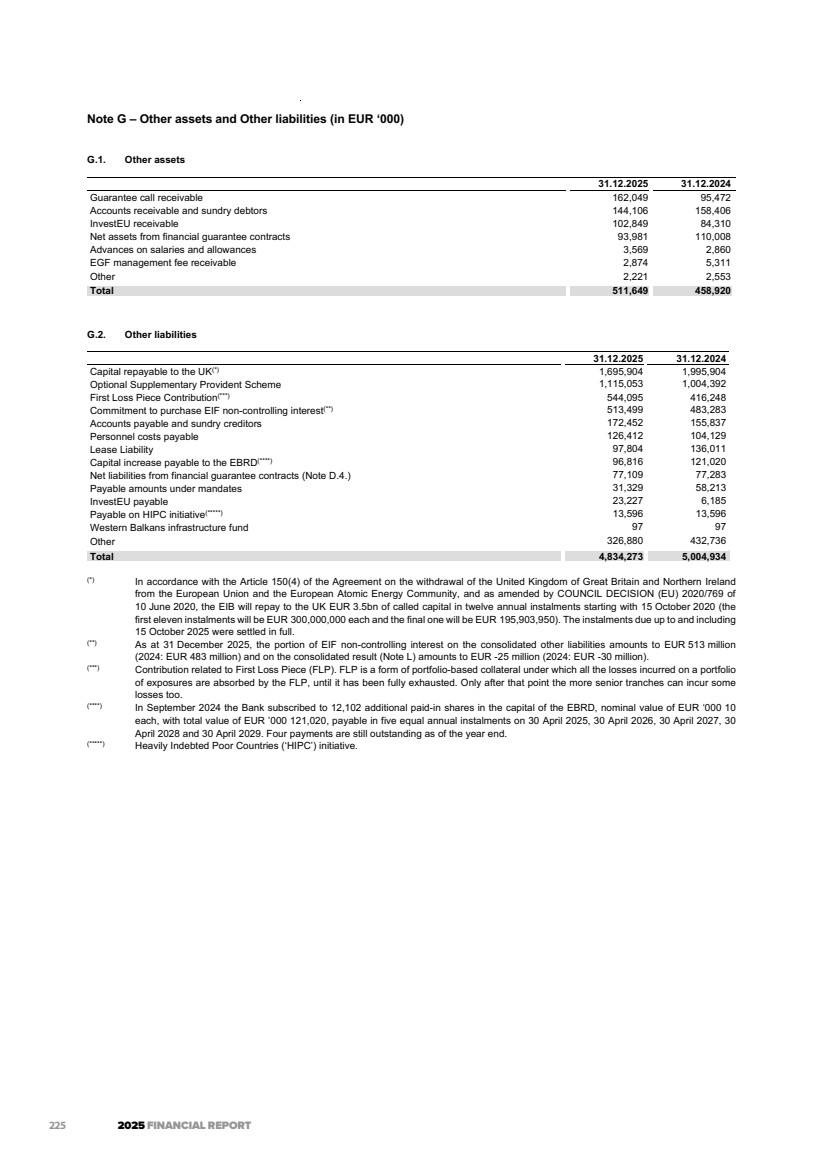
| EIB GROUP CONSOLIDATED FINANCIAL STATEMENTS UNDER IFRS 39 Note H – Amounts owed to credit institutions and customers (in EUR ‘000) H.1. Amounts owed to credit institutions 31.12.2025 31.12.2024 Repayable on demand 446,323 750,387 - Overnight deposits 446,323 750,387 With agreed maturity or periods of notice 984,650 107,298 - Repos with credit institutions 984,650 107,298 Total 1,430,973 857,685 H.2. Amounts owed to customers 31.12.2025 31.12.2024 Repayable on demand 4,171,810 3,090,263 - European Union and Member States' accounts: - For Special Section operations and related unsettled amounts 136,055 246,637 - Deposit accounts 4,035,755 2,843,626 With agreed maturity or periods of notice 13,170 120,508 - Short-term deposits 13,170 120,508 Total 4,184,980 3,210,771 Note I – Debts evidenced by certificates (in EUR ‘000) In its financing activity, one of the Group’s objectives is to align its funding strategy with the funds required for the loans granted. The caption “Debts evidenced by certificates” includes “Debt securities in issue” (securities offered to the general investing public) and “Others” (private placements). The table below discloses the details of debts outstanding as at 31 December 2025 and 31 December 2024 per currency, together with the average rates and due dates (earliest/latest). Debts evidenced by certificates (in EUR '000) Currency Carrying amount as at 31.12.2025 Average rate 2025(*) Due dates Carrying amount as at 31.12.2024 Average rate 2024(*) EUR 255,754,576 1.72 2026/2061 253,738,643 1.68 USD 107,940,536 3.41 2026/2058 112,729,531 3.03 GBP 32,913,915 3.85 2026/2054 38,830,676 3.79 PLN 9,213,341 3.34 2026/2043 8,967,469 3.63 AUD 8,258,158 3.18 2026/2040 8,520,550 3.00 SEK 4,201,597 2.21 2026/2040 4,797,508 1.98 CHF 2,806,469 2.01 2026/2037 3,380,993 2.06 NOK 2,348,881 3.52 2027/2037 2,031,666 3.32 CAD 2,046,115 2.91 2028/2045 3,385,901 2.43 ZAR 1,917,772 7.72 2026/2035 1,826,242 7.80 JPY 909,537 2.26 2026/2053 1,062,226 2.24 INR 762,342 6.88 2029/2035 188,064 7.15 DKK 557,923 0.13 2026/2031 610,841 0.53 MXN 495,562 6.86 2027/2033 676,203 7.14 NZD 360,111 3.27 2027/2028 392,257 3.27 BRL 331,570 11.38 2027/2035 55,236 9.25 CNY 297,874 2.65 2026/2026 425,424 2.77 CZK 231,373 3.83 2026/2034 229,508 3.95 HKD 99,236 3.35 2027/2030 86,150 2.47 EGP 40,245 15.75 2026/2027 40,426 15.75 GEL 25,727 8.03 2028/2028 0 0 RUB 20,676 4.25 2026/2026 14,699 4.25 RON 20,028 2.23 2026/2026 19,823 2.23 TRY 11,128 10.65 2026/2027 11,931 10.67 HUF 0 0 N/A 38,770 11.50 Total 431,564,692 442,060,737 (*) Weighted average interest rates at the balance sheet date. 226 |
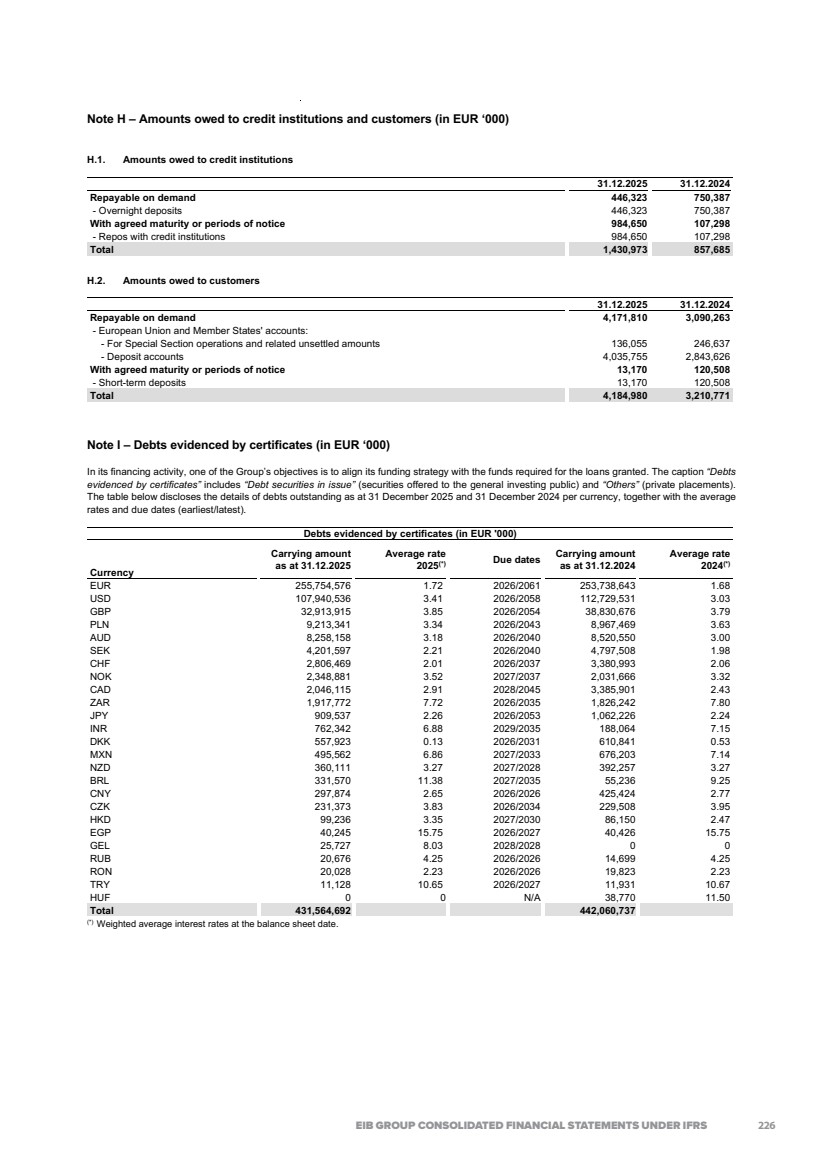
| 2025 FINANCIAL REPORT 40 Note J – Pension plans and health insurance scheme (in EUR ’000) The Group operates three defined benefit pension plans. The Group also provides certain post-employment healthcare benefits to former employees of the EIB. These benefits are unfunded as defined by IAS19 and the plan is not regulated. The cost of providing benefits under the plans is determined separately for each plan using the projected unit credit actuarial valuation method. Actuarial valuation took place at 31 December 2025. The plans typically expose the Group to actuarial risks such as interest rate risk, longevity risk, inflation risk and salary risk. An additional risk is associated with the payment to the dependants of plan members (widow and orphan benefits). Interest rate risk The present value of the defined benefit liability is calculated using a discount rate determined by reference to high-quality corporate bond yields. A decrease in the bond interest rate will increase the pension liability. Longevity risk The present value of the defined benefit plan liability is calculated by reference to the best estimate of the mortality of the plan participants both during and after their employment. An increase in the life expectancy of the plan participants will increase the plan’s liability. Inflation risk The present value of the defined benefit plan liability is calculated by reference to the future pension increases, which are linked to Luxembourg inflation. An increase in Luxembourg inflation will increase the plan’s liability. Salary risk The present value of the defined benefit plan liability is calculated by reference to the future salaries of plan participants. An increase in the salary of the plan participants will increase the plan’s liability. The figures below do not include the Optional Supplementary Provident Scheme which is a defined contribution pension plan. The corresponding amount of EUR 1,115 million (2024: EUR 1004 million) is classified under “Other liabilities” (Note G). The principal assumptions used in determining pension and post-employment benefit obligations for the Group’s plans are shown below: in % 2025 2024 Discount rate for pension plans 4.37 3.75 Discount rate for health insurance plan 4.37 3.75 Future salary increase (including inflation)(*) 3.30 3.30 Future pension increases 2.30 2.30 Healthcare cost increase rate 4.30 4.30 Dependency cost increase rate 2.30 2.30 Average longevity at 60 of a male member (years) 26.70 26.60 Average longevity at 60 of a female member (years) 29.00 28.90 Actuarial tables ICSLT 2023 - Static 2025 ICSLT 2023 - Static 2024 (*) Representative nominal rate reflecting average career progression assumption. Sensitivity analysis: Significant actuarial assumptions for the determination of the defined benefit obligation are discount rate, expected salary increase and mortality. The sensitivity analyses below have been determined based on reasonably possible changes of the respective assumptions occurring at the end of the reporting period, while keeping all other assumptions constant. EIB Pension: • If the discount rate is 0.5% higher (lower), the defined benefit obligation would decrease by 8.3% (increase by 9.4%). • If the expected salary growth increases (decreases) by 1%, the defined benefit obligation would increase by 4.2% (decrease by 3.6%). • If the life expectancy increases (decreases) by 1 year for men and women, the defined benefit obligation would increase by 2.9% (decrease by 2.9%). • If the expected future pension increases (decreases) by 1% due to inflation, the defined benefit obligation would increase by 13.4% (decrease by 11.2%). EIF Pension: • If the discount rate is 0.5% higher (lower), the defined benefit obligation would decrease by 11.1% (increase by 13.0%). • If the expected salary growth increases (decreases) by 1%, the defined benefit obligation would increase by 6.6% (decrease by 5.9%). • If the life expectancy increases (decreases) by 1 year for men and women, the defined benefit obligation would increase by 2.6% (decrease by 2.6%). • If the expected future pension increases (decreases) by 1% due to inflation, the defined benefit obligation would increase by 13.9% (decrease by 11.6%). 227 |
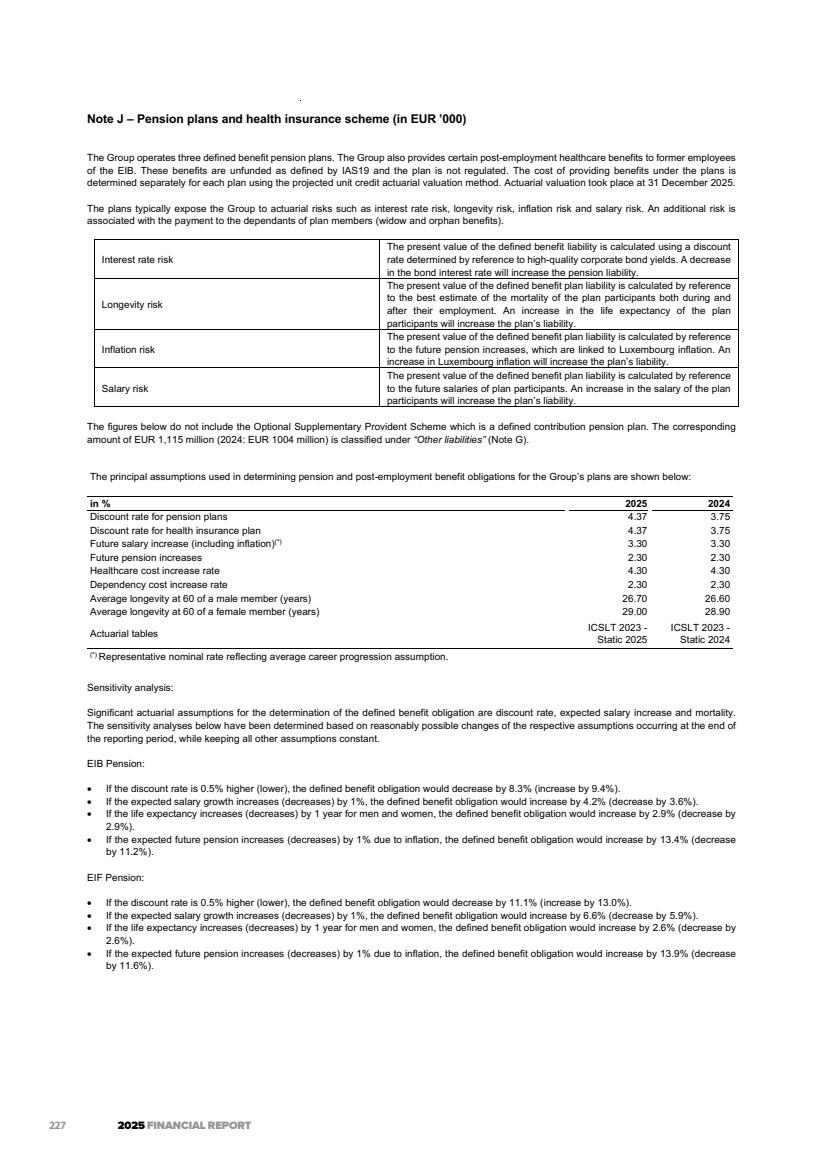
| EIB GROUP CONSOLIDATED FINANCIAL STATEMENTS UNDER IFRS 41 Management Committee Pension: • If the discount rate is 0.5% higher (lower), the defined benefit obligation would decrease by 5.7% (increase by 6.3%). • If the expected salary growth increases (decreases) by 1%, the defined benefit obligation would increase by 0.6% (decrease by 0.6%). • If the life expectancy increases (decreases) by 1 year for men and women, the defined benefit obligation would increase by 3.6% (decrease by 3.6%). • If the expected future pension increases (decreases) by 1% due to inflation, the defined benefit obligation would increase by 11.3% (decrease by 9.7%). Health Insurance for the EIB: • If the discount rate is 0.5% higher (lower), the defined benefit obligation would decrease by 10.8% (increase by 12.6%). • If the life expectancy increases (decreases) by 1 year for men and women, the defined benefit obligation would increase by 4.3% (decrease by 4.3%). • If the expected future healthcare cost increases (decreases) by 1% due to inflation, the defined benefit obligation would increase by 25.5% (decrease by 19.1%). • If the expected future dependency care cost (with other healthcare costs unchanged) increases (decreases) by 1% due to inflation, the defined benefit obligation would increase by 4.0% (decrease by 3.0%). Health Insurance for the EIF: • If the discount rate is 0.5% higher (lower), the defined benefit obligation would decrease by 13.4% (increase by 16.0%). • If the life expectancy increases (decreases) by 1 year for men and women, the defined benefit obligation would increase by 4.1% (decrease by 4.1%). • If the expected future healthcare cost increases (decreases) by 1% due to inflation, the defined benefit obligation would increase by 33.8% (decrease by 24.4%). • If the expected future dependency care cost (with other healthcare costs unchanged) increases (decreases) by 1% due to inflation, the defined benefit obligation would increase by 4.8% (decrease by 3.4%). The sensitivity analysis presented above may not be representative of the actual change in the defined benefit obligation as it is unlikely that the change in assumptions would occur in isolation. In practice, some of the assumptions may be correlated, and simultaneous changes could have a different impact. Furthermore, in presenting the above sensitivity analysis, the present value of the defined benefit obligation has been calculated using the projected unit credit method at the end of the reporting period, which is the same as that applied in calculating the defined benefit obligation liability recognised in the consolidated balance sheet. There was no change in the method and assumptions used in preparing the sensitivity analysis from prior years. The table below shows the actuarial experience (gain)/loss for the different plans and the total defined benefit obligation: EIB Pension Management Committee Pension EIF Pension Health Insurance Total Total defined benefit obligation 2025 50,863 2,859 16,477 26,247 96,446 6,703,866 2024 88,806 1,127 10,051 21,691 121,675 6,702,429 2023 280,157 1,755 20,304 12,567 314,783 6,473,001 2022 209,645 675 16,885 82,842 310,047 5,722,781 228 |
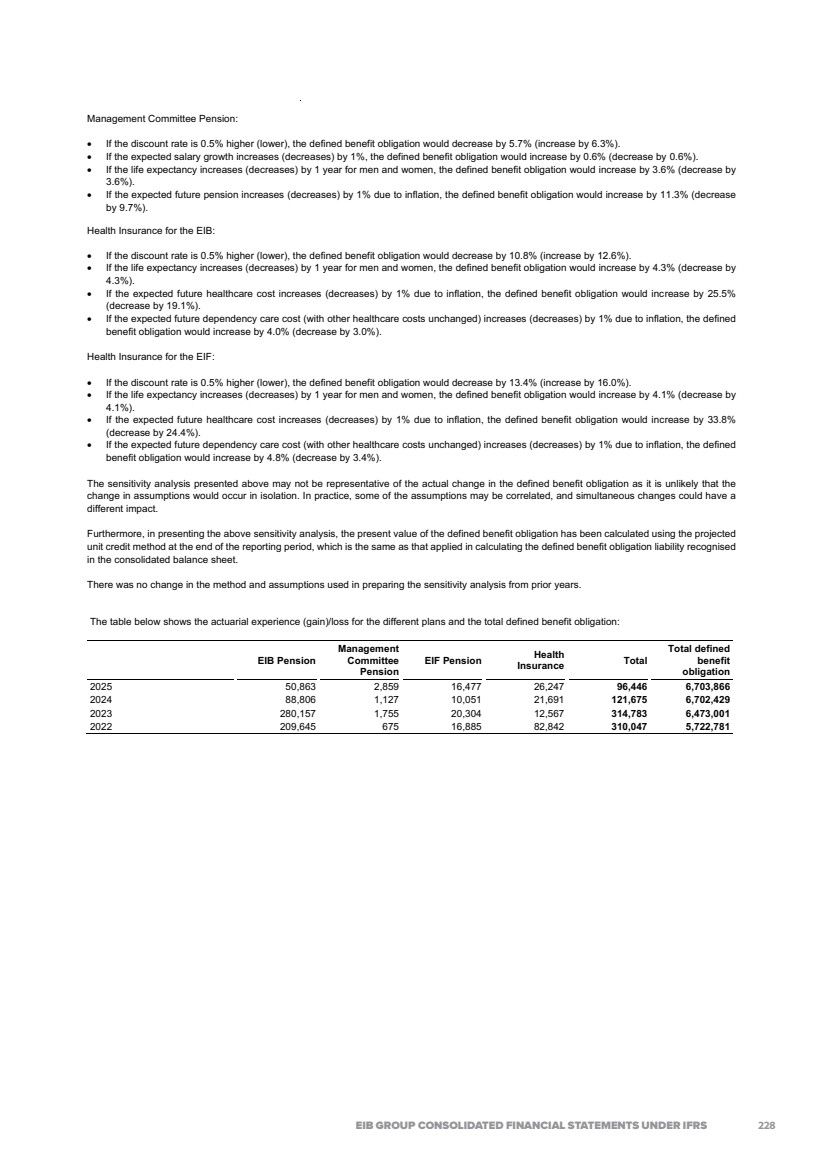
| 2025 FINANCIAL REPORT 42 The tables below show the evolution of the defined benefit obligation in 2025 and 2024 (in EUR ‘000): EIB Pension Management Committee Pension EIF Pension Health Insurance Total 2025 Obligation at the beginning of the year 5,351,764 66,019 426,868 857,778 6,702,429 a) Current service cost 158,217 2,402 20,703 49,013 230,335 b) Interest cost 198,449 2,415 16,042 31,948 248,854 c) Past service cost 3,348 0 0 0 3,348 Total profit or loss 360,014 4,817 36,745 80,961 482,537 a) Experience (gain)/loss 50,863 2,859 16,477 26,247 96,446 c) Change in demographic assumptions 19,604 274 1,594 278,326 299,798 d) Change in financial assumptions -607,886 -5,208 -69,432 -135,345 -817,871 Total OCI(*) -537,419 -2,075 -51,361 169,228 -421,627 a) Employee contributions 58,560 0 8,581 6,003 73,144 b) Benefit payments -119,581 -3,212 1,848 -11,672 -132,617 Total Other -61,021 -3,212 10,429 -5,669 -59,473 Benefit obligation as at 31 December 2025 5,113,338 65,549 422,681 1,102,298 6,703,866 (*) Attributable to the equity holders of the Bank (EUR '000 399,522) and to non-controlling interests (EUR '000 22,105). EIB Pension Management Committee Pension EIF Pension Health Insurance Total 2024 Obligation at the beginning of the year 5,190,630 66,251 400,923 815,197 6,473,001 a) Current service cost 154,705 2,093 21,695 47,775 226,268 b) Interest cost 188,179 2,373 14,508 29,680 234,740 c) Past service cost 2,977 0 281 0 3,258 Total profit or loss 345,861 4,466 36,484 77,455 464,266 a) Experience (gain)/loss 88,806 1,127 10,051 21,691 121,675 c) Change in demographic assumptions -140,947 -2,229 -9,494 -34,260 -186,930 d) Change in financial assumptions -90,913 -769 -9,853 -19,640 -121,175 Total OCI(**) -143,054 -1,871 -9,296 -32,209 -186,430 a) Employee contributions 56,556 0 7,803 5,826 70,185 b) Benefit payments -98,229 -2,827 -9,046 -8,491 -118,593 Total Other -41,673 -2,827 -1,243 -2,665 -48,408 Benefit obligation as at 31 December 2024 5,351,764 66,019 426,868 857,778 6,702,429 (**) Attributable to the equity holders of the Bank (EUR '000 180,884) and to non-controlling interests (EUR '000 5,547). 229 |
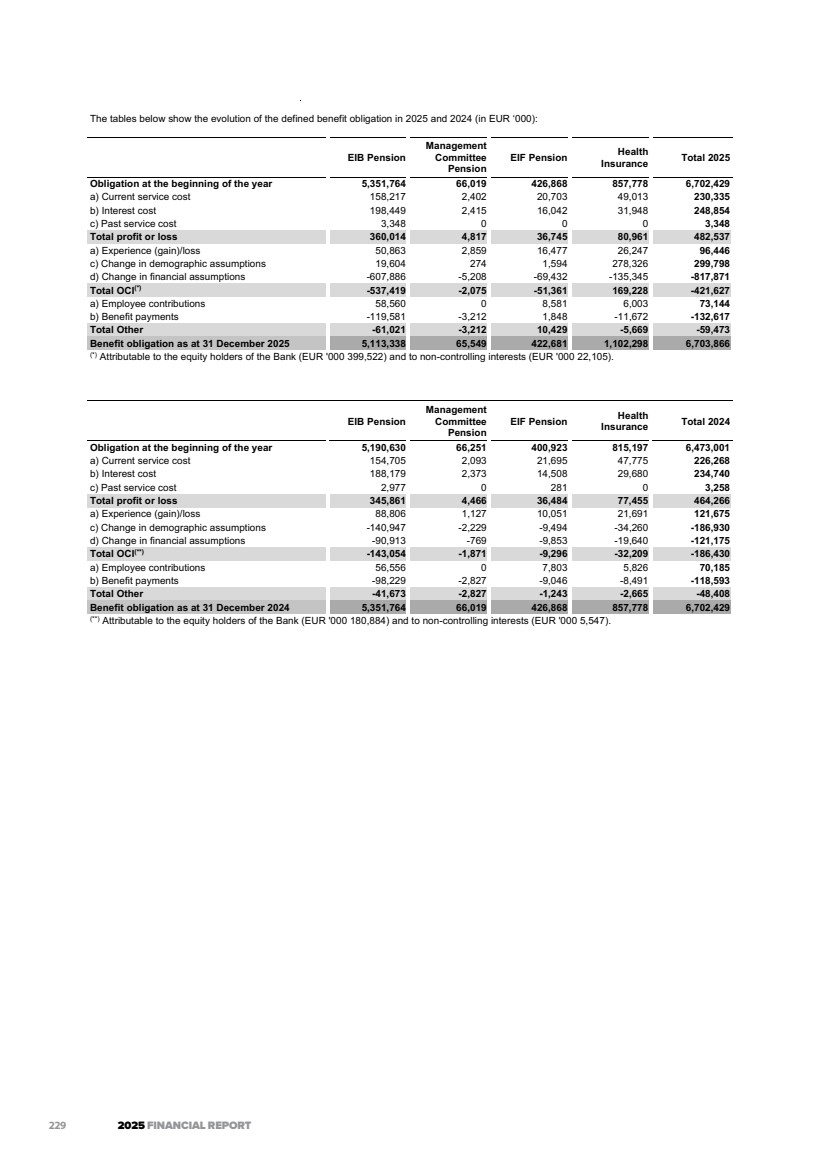
| EIB GROUP CONSOLIDATED FINANCIAL STATEMENTS UNDER IFRS 43 EIB employees pay a fixed contribution reviewed every five years. Following the last actuarial review in 2023, the employee’s contribution rate has been updated to 11.2% of their pensionable salary for the period from 1 January 2024 to 31 December 2028. The residual contribution (including back service payments) is paid by the Group. All contributions of the Group and its staff are invested in the assets of the Group. The funding requirements are based on the local actuarial measurement framework. In this framework the discount rate is set on a risk-free rate. Furthermore, premiums are determined on a current salary base. The Group is liable for all pension payments stemming from the defined benefit plan. In 2025, as part of the Bank’s regular actuarial review, the Group updated the medical cost utilisation profiles based on past experience. The actuarial valuation reflects these profiles, and the Group incorporated this update into the measurement of the defined benefit obligation at 31 December 2025 which is reflected under OCI. The average duration of the defined benefit obligation as at 31 December 2025 is split as follows: EIB Pension: • Active members: 23.74 years (2024: 24.55 years) • Deferred members (*): 24.57 years (2024: 25.84 years) • Retired members: 11.28 years (2024: 11.76 years) EIF Pension: • Active members: 27.01 years (2024: 27.87 years) • Deferred members (*): 26.03 years (2024: 27.02 years) • Retired members: 13.12 years (2024: 13.76 years) Management Committee Pension: • Active members: 17.05 years (2024: 18.19 years) • Deferred members (*): 19.42 years (2024: 20.62 years) • Retired members: 9.38 years (2024: 9.95 years) Health Insurance for EIB • Active members: 29.52 years (2024: 30.03 years) • Deferred members (*): 23.23 years (2024: 23.34 years) • Retired members: 14.66 years (2024: 15.13 years) Health Insurance for EIF • Active members: 31.01 years (2024: 32.63 years) • Deferred members (*): 30.01 years (2024: 32.33 years) • Retired members: 17.06 years (2024: 17.68 years) The amount that the Group expects to recognise in the profit or loss relating to the defined benefit plans during the next financial year is EUR ‘000 493,561 (2024: EUR 000 483,393). (*) Staff members who left the Group before the normal retirement age and have a right to a deferred pension. Note K – Result for the financial year The appropriation of the profit of the stand-alone financial statements of the Bank for the year ended 31 December 2025, prepared under EU Accounting Directives, which amounts to EUR ’000 2,725,405 will be submitted to the Board of Governors for approval by 24 April 2026. Please refer to the Overview to the Bank’s Financial Statements for further details on the proposed Bank surplus for the financial year appropriation. 230 |
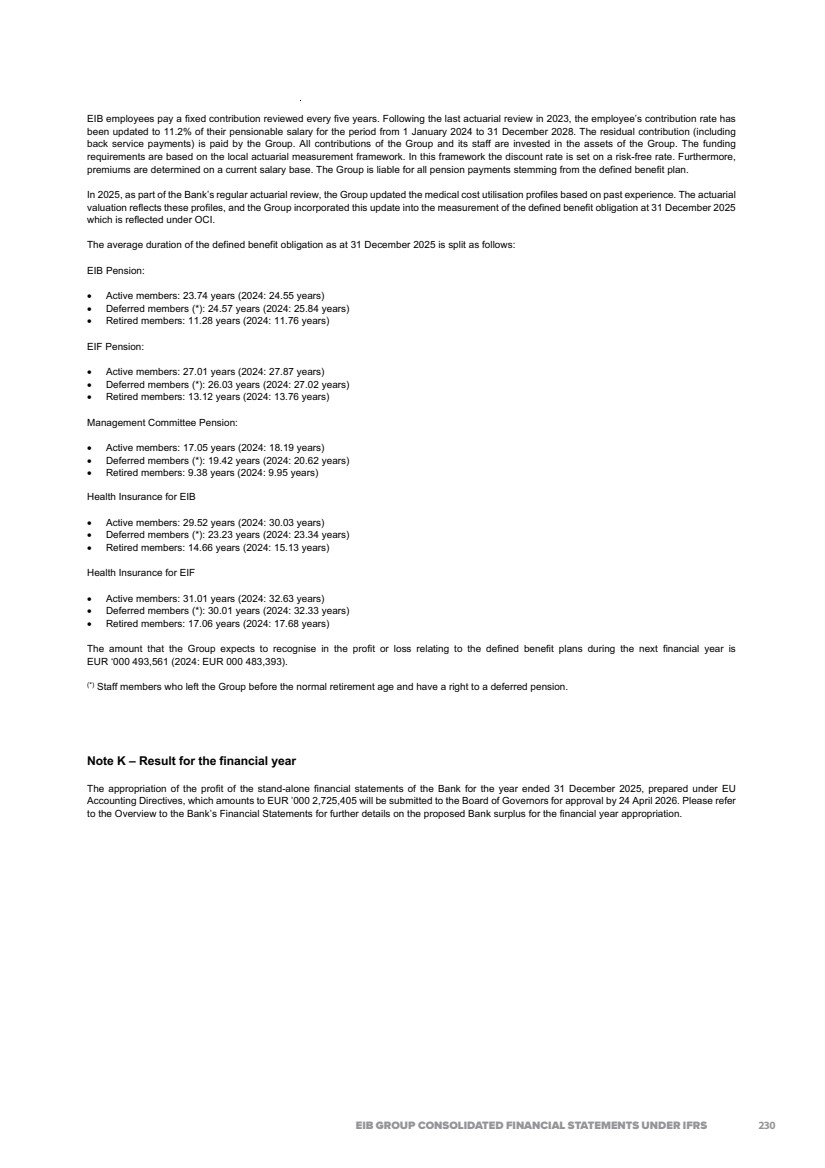
| 2025 FINANCIAL REPORT 44 Note L – Interest and similar income and Interest expense and similar charges (in EUR ‘000) L.1. Net interest income 2025 2024 Interest and similar income: Loans and advances to credit institutions and customers 13,391,248 15,561,223 Derivatives 8,171,549 9,398,526 Treasury bills and other bills eligible for refinancing with central banks and debt securities including fixed-income securities 1,690,225 1,704,117 Interest subsidy from the EU 38,425 35,604 Other 18,684 18,343 Total 23,310,131 26,717,813 Interest expense and similar charges: Debts evidenced by certificates (1) -11,195,691 -10,284,069 Derivatives -8,447,616 -12,730,196 Interest cost on benefit obligation (Note J) -248,854 -234,740 Interest on third-party mandates -126,329 -128,837 Amounts owed to credit institutions and customers -67,572 -92,852 Commitment to purchase EIF non-controlling interest (Note G.2) -24,698 -29,571 Other (2) -74,073 -72,459 Total -20,184,833 -23,572,724 Net interest income 3,125,298 3,145,089 (1) During 2025, EUR ‘000 14 (2024: EUR '000 2,159) was reclassified from OCI to the consolidated income statement due to cash flow hedge accounting. (2) Includes the interest expense on the lease liability, which amounted to EUR '000 6,203 (2024: EUR '000 5,002). The table below sets out the net interest income relating to each class of financial assets and liabilities: 2025 2024 Interest and similar income: Financial assets measured at AC 14,086,270 16,045,179 Derivatives held for risk management 8,171,549 9,398,526 Financial instruments designated at FVTPL (FVO) 584,345 808,515 Financial instruments mandatorily measured at FVTPL 449,283 447,248 Other 18,684 18,345 Total 23,310,131 26,717,813 Interest expense and similar charges: Financial liabilities measured at AC -10,752,217 -9,737,396 Derivatives held for risk management -8,447,616 -12,730,196 Financial instruments designated at FVTPL (FVO) -586,417 -719,567 Non-financial liabilities -291,083 -263,466 Other -107,500 -122,099 Total -20,184,833 -23,572,724 Net interest income 3,125,298 3,145,089 231 |
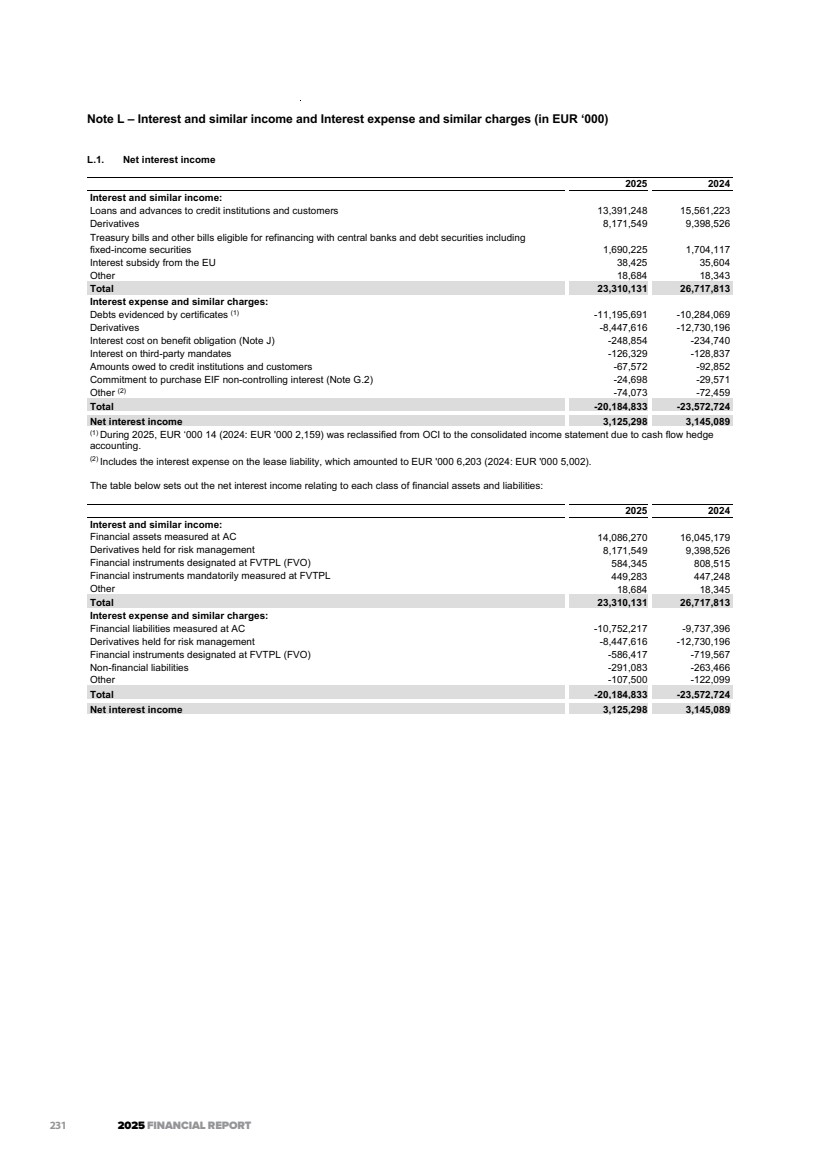
| EIB GROUP CONSOLIDATED FINANCIAL STATEMENTS UNDER IFRS 45 L.2. Geographical analysis of Interest and similar income 2025 2024 EU countries: Spain 1,464,096 1,660,029 Poland 1,429,032 1,328,999 Italy 1,283,202 1,481,337 France 1,281,743 1,387,359 Germany 847,338 746,845 Belgium 479,777 397,245 Greece 415,129 445,841 Austria 342,150 355,815 Hungary 307,323 338,586 Netherlands 298,350 492,743 Sweden 297,441 431,838 Czech Republic 256,421 201,937 Finland 221,241 287,455 Romania 192,114 148,736 Portugal 191,502 254,937 Ireland 127,605 157,351 Slovakia 93,035 80,893 Denmark 83,681 90,320 Croatia 61,894 56,242 Bulgaria 61,360 41,257 Cyprus 48,777 62,895 Estonia 45,893 58,887 Slovenia 45,180 53,347 Lithuania 32,845 33,906 Latvia 18,801 30,336 Malta 11,352 9,948 Luxembourg 9,238 286,402 Total EU countries 9,946,520 10,921,486 Outside the European Union 2,420,151 2,941,506 Total income analysed per country 12,366,671 13,862,992 Income not analysed per country(1) 10,943,460 12,854,821 Total interest and similar income 23,310,131 26,717,813 (1) Income not analysed per country: · Income from LTHP and loan substitutes portfolio 866,442 913,038 · Income from SLP 225,398 165,984 · Income from money-market securities 566,673 595,243 · Income from EIF Operational portfolio and other securities 31,712 29,852 · Income from money-market operations 1,064,203 1,733,969 · Income from derivatives 8,171,549 9,398,526 · Other 17,483 18,209 10,943,460 12,854,821 232 |
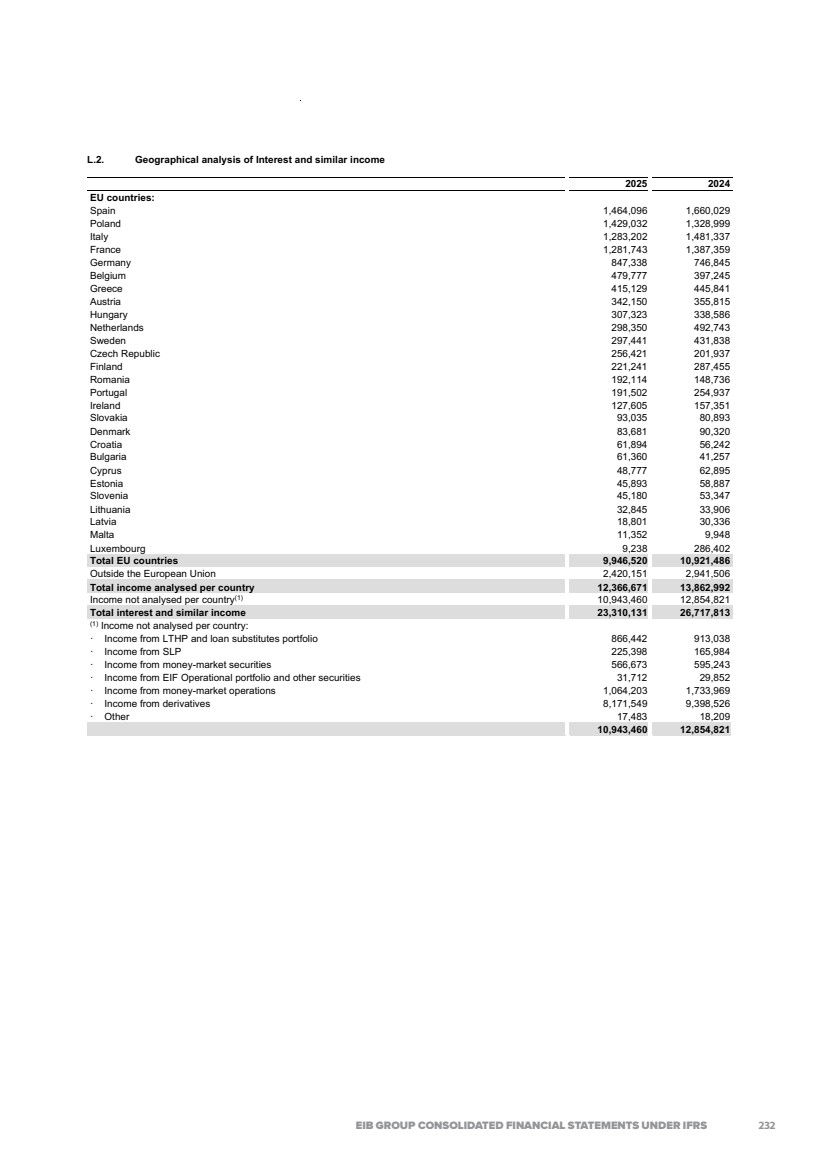
| 2025 FINANCIAL REPORT 46 Note M – Result on financial operations (in EUR ‘000) M.1. By nature of result 2025 2024 Net result on derivatives(1) 22,344 744,119 Net result on loans under the FVO and associated swaps(2) 147,165 -101,502 Net result on borrowings under the FVO and associated swaps(3) -33,937 -45,262 Net result from hedge accounting on loans and associated swaps(4)(9) 109,481 229,801 Net result from hedge accounting on borrowings and associated swaps(5) 371,424 -87,110 Net result from hedge accounting on treasury bonds and associated swaps(6) 16,564 2,313 633,041 742,359 Foreign exchange gain and loss -18,849 27,392 Gain and loss on unwind of swaps 953 4,510 Net result on shares and other variable-yield securities(7) -484,552 115,655 Net result on debt securities portfolios 39,874 74,217 Net result on financial guarantees -14,576 59,125 Net result on loans and loan substitutes under FVTPL(8) 38,018 -161,855 Net result on loans and loan substitutes under AC -2,956 -1,806 Amortization of initial CBS 30,200 44,694 Result on financial operations 221,153 904,291 (1) The net result on derivatives includes for the majority the fair value adjustment on hedging swaps for ALM purposes (please refer to the Note Q.1) and Treasury derivative instruments. On 31 December 2025, these derivatives evidence a positive impact of EUR ‘000 22,344 compared to a positive impact of EUR ‘000 744,119 in 2024. (2) The fair value option is applied on loans and loan substitutes hedged by derivatives, which do not qualify for hedge accounting. As at 31 December 2025, the carrying value of loans and loan substitutes designated at fair value amounts to EUR 12 billion (2024: EUR 12 billion). The combined effect from applying the fair value option on loans and loan substitutes results in a positive impact of EUR '000 147,165 on the consolidated income statement at 31 December 2025 (2024: negative impact of EUR ’000 101,502). (3) The fair value option is applied on borrowings hedged by derivatives, which do not qualify for fair value hedge accounting. As at 31 December 2025, the carrying value of borrowings designated at fair value amounts to EUR 15 billion (2024: EUR 17 billion). The combined effect from applying the fair value option on borrowings results in a negative impact of EUR '000 33,937 on the consolidated income statement at 31 December 2025 (2024: negative impact of EUR ’000 45,262). (4) Fair value hedge accounting is applied on eligible loans and loan substitutes, which are qualifying the hedge accounting criteria under IFRS 9. As at 31 December 2025, the carrying value of loans and loan substitutes designated under hedge accounting amounts to EUR 138 billion (2024: EUR 141 billion). The combined effect from applying hedge accounting on loans and loan substitutes and associated swaps results in a positive impact of EUR '000 109,481 on the consolidated income statement at 31 December 2025 (2024: positive impact of EUR '000 299,801). (5) Fair value hedge accounting is applied on eligible borrowings, which are qualifying the hedge accounting criteria under IFRS 9. As at 31 December 2025, the carrying value of borrowings under fair value hedge accounting amounts to EUR 309 billion (2024: EUR 312 billion). The combined effect from applying hedge accounting on borrowings and associated swaps results in a positive impact of EUR '000 371,424 on the consolidated income statement at 31 December 2025 (2024: negative impact of EUR '000 87,110). (6) As at 31 December 2025, the carrying value of LTHP bonds under fair value hedge accounting amounts to EUR 1.7 billion (2024: EUR 1.6 billion). The combined effect from applying hedge accounting on LTHP bonds and associated swaps results in a positive impact of EUR '000 16,564 on the consolidated income statement at 31 December 2025 (2024: positive impact of EUR '000 2,313). (7) The item is mainly composed of unrealised and realised gains and losses on indirect equity instruments. The negative impact of EUR ‘000 484,552 in 2025 and the positive impact of EUR '000 115,655 in 2024 were primarily driven by the valuation effects observed in private equity and venture capital markets during those periods. The fair value movements observed and reported in the EIB Group Consolidated Financial Statements under IFRS are primarily based on the individual valuations of the invested funds received from the relevant fund managers. Substantially, all of these invested funds have provided valuations in line with IFRS 13 and are, therefore, considered Category I or Category II pursuant to the classification included in Note A.4.8.6 (Shares and other variable-yield securities) to the EIB Group Consolidated Financial Statements under IFRS. Fair value dynamics in venture capital and private equity markets stabilised in 2024, supported by easing inflation and key ECB interest rates decrease. In 2025, despite some late-year improvement, overall fair value performance was negative versus 2024, as Global policy changes (e.g., tariffs) and elevated uncertainty weighed on valuations for most of the year. By year-end 2025, sentiment was nonetheless cautiously improving, with indications of higher valuations toward the end of the year, even as fundraising and exit conditions remained challenging. The EIB Group’s entire portfolio of private equity and venture capital investments contains various geographical locations in Europe, vintages and sectors invested. The sectors that have primarily driven the variations referred to above are the ones in which the EIB Group has the highest volume of investments —primarily Generalist funds, followed by sector-specific funds, such as Information and Communication Technologies (ICT) and the Life Science sector. These effects should be assessed on an aggregated basis, as no single private equity investment valuation change had a material impact on the EIB Group’s consolidated IFRS results. (8) This item is mainly composed of the unrealised and realised gains and losses on loan operations measured at FVTPL. The positive impact on the consolidated income statement of EUR ‘000 38,018 is primarily driven by valuation effects during 2025 (2024: negative impact of EUR '000 161,855). (9) The effect of cash flow hedge ineffectiveness is nil on the consolidated income statement as at 31 December 2025 (2024: nil). 233 |
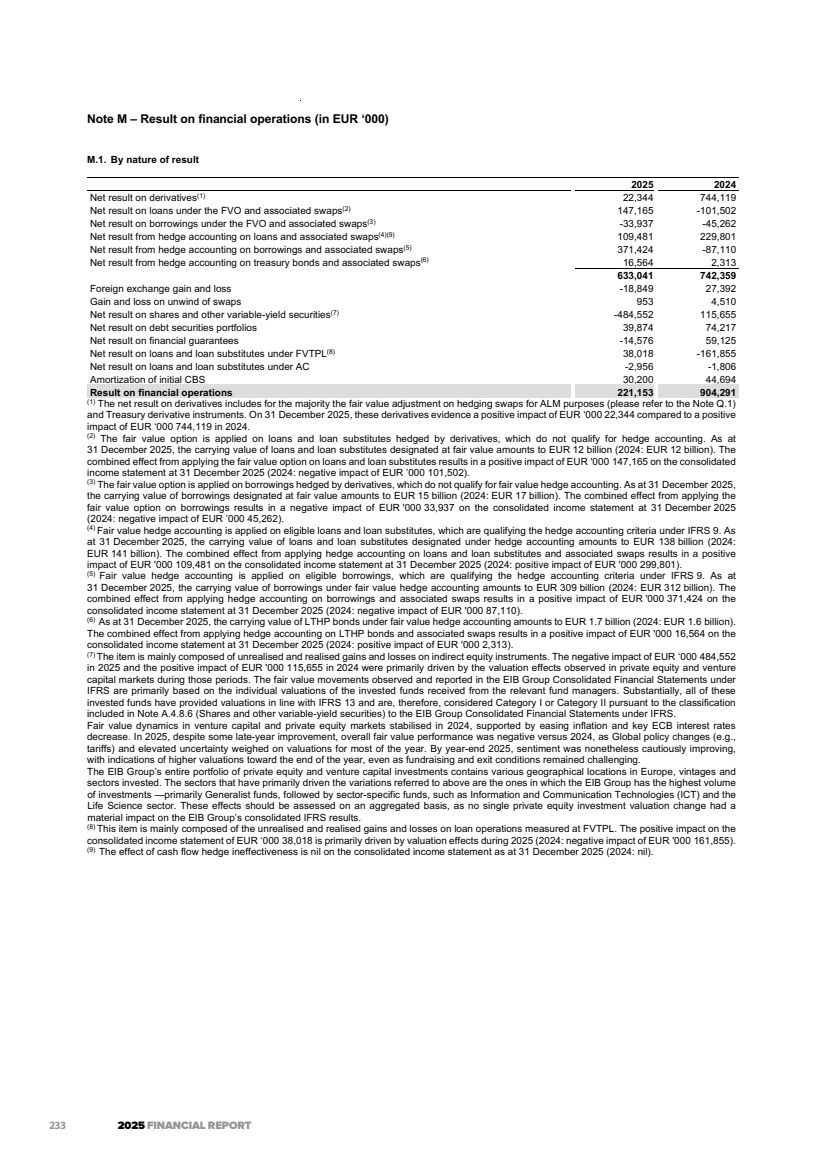
| EIB GROUP CONSOLIDATED FINANCIAL STATEMENTS UNDER IFRS 47 M.2. By category of assets and liabilities 2025 2024 Financial assets mandatorily measured at FVTPL (excluding derivative assets) -368,813 15,363 Financial assets designated at FVTPL (FVO) -231,368 -504,152 Financial liabilities designated at FVTPL (FVO) 132,455 105,234 Financial assets measured at AC -2,242,411 1,859,965 Financial liabilities measured at AC -158,053 -2,717,999 Derivatives designated as hedging instruments 2,892,795 1,000,673 Derivatives held for risk management purposes, other than HA 199,772 1,013,995 Other (*) -3,224 131,212 Result on financial operations 221,153 904,291 (*) Includes amortization of initial CBS Note N – Net other operating income and expense (in EUR ‘000) 2025 2024 Technical Assistance income (*) 102,330 83,192 Technical Assistance expense (*) -61,318 -33,734 Rental income 134 112 Other 8,962 58 Total net other operating income and expense 50,108 49,628 (*) A reclassification was made in order to improve the readability of the financial statements. See Note A.5. Note O – Fee and commission income and expense (in EUR ‘000) 2025 2024 Fee and commission income: Commissions on guarantees 232,506 256,819 Commissions on InvestEU(*) 107,757 89,805 Commissions on EGF 43,554 49,533 Commission income on loans 36,851 37,403 Commissions on RRF 26,631 6,884 Commissions on EFSI 22,256 24,331 Commissions on Investment Facility - Cotonou 20,099 25,331 Commissions on Jeremie/ESIF 16,691 16,221 Commissions on DFIs (2014-20, 2021-27) 15,256 19,657 Commissions on Modernisation Fund 12,675 13,495 Commissions on InnovFin 8,741 7,419 Commissions on NDICI EFSD+ ACP Trust Fund 6,433 1,857 Commissions on Trust Fund Management fees 6,316 3,909 Commissions on Innovation Fund(*) 2,853 2,331 Commissions on JESSICA Holding Funds 2,618 2,762 Commissions on Neighbourhood Investment Facility 2,588 5,142 Commissions on Yaoundé/Lomé Conventions 781 946 Commissions on EU for Ukraine Fund 706 5,155 Connecting Europe Facility 462 740 Commissions on EIC Fund 407 2,500 Commissions on other mandates(*) (**) 118,269 104,070 Total fee and commission income 684,450 676,310 2025 2024 Fee and commission expense: Risk remuneration for guarantees received -272,224 -287,436 Other commissions payable -34,047 -28,072 Total fee and commission expense -306,271 -315,508 (*) A reclassification was made among the captions in order to improve the readability of the financial statements. See Note A.5. (**) This line includes the realised carried interest obtained by EIF in its role as fund manager for certain mandates. For 2025 carried interest amounts to EUR '000 6,147 (2024: EUR '000 9,190). The cumulative unrealised carried interest for 2025 (which is an off-balance sheet item) amounts to EUR '000 102,177 (2024: EUR '000 90,479). 234 |
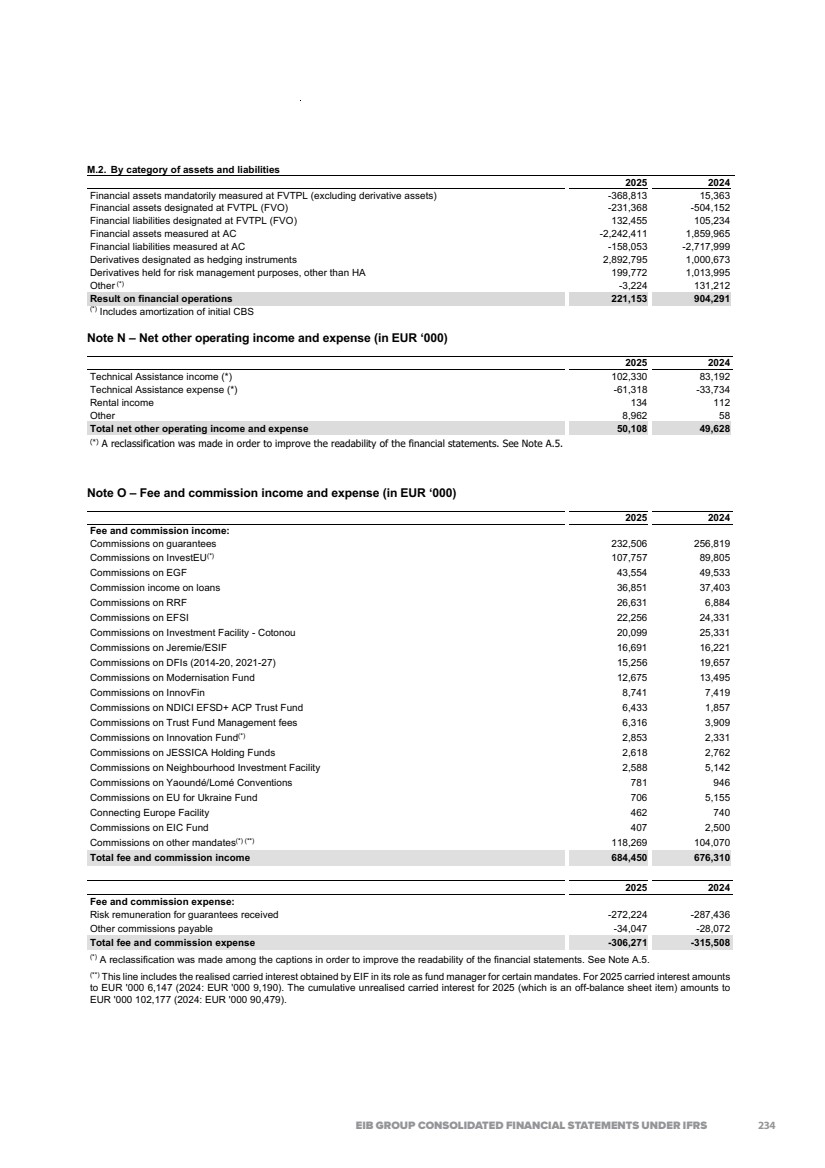
| 2025 FINANCIAL REPORT 48 Note P – General administrative expenses (in EUR ‘000) 2025 2024 Salaries and allowances(*) -724,259 -694,917 Welfare contributions and other staff costs -464,471 -440,351 Staff costs -1,188,730 -1,135,268 Other administrative expenses(**) -352,549 -355,483 Total general administrative expenses -1,541,279 -1,490,751 (*) Of which the amount for the members of the Management Committee is EUR ‘000 4,417 in 2025 (2024: EUR ‘000 3,992). (**) A reclassification was made in order to improve the readability of the financial statements. See Note A.5. The number of persons employed by the Group was 5,110 as at 31 December 2025 (5,151 as at 31 December 2024). Note Q – Derivatives and hedging activities Q.1. Use of derivative financial instruments In the hedging activities of the Group The Bank uses long-term derivative instruments to hedge the interest rate and foreign currency risks arising from borrowings, loans and bond holdings in the form of micro-hedges or in the context of global Asset and Liability Management (‘ALM’) positions. The Fund does not use derivative instruments. The derivatives most commonly used are: Currency swaps Currency swaps are contracts under which it is agreed to exchange principal and interest payments in one currency against another currency. Interest rate swaps Interest rate swaps are contracts under which, generally, it is agreed to exchange floating-rate interest for fixed-rate interest payments, or floating-rate interest payments linked to different rates (basis swaps), in the same currency. In the treasury management of the Group The Bank enters into short-term currency swap contracts and currency forwards to adjust currency positions in its operational treasury portfolios in relation to its benchmark currency, the euro, and to cater for demand for currencies in connection with loan disbursements (see Note Q.3 for the disclosure of notional amounts and fair values of short-term currency foreign exchange contracts). Future contracts (futures) can be used in the context of treasury activities, to hedge the exposure deriving from some bond investments in the SLP. In the Asset and Liability Management of the Group As part of the Asset and Liability Management, the Bank uses natural hedges (offsets between loans and borrowings), when deemed appropriate and possible. Remaining exposures are managed through derivatives executed at the portfolio level on a net basis (‘hedging swaps for ALM purposes’). These instruments are not designated in hedge accounting relationships under IFRS, as endorsed by the EU, and are measured at fair value through profit or loss in accordance with IFRS 9. For further information regarding risk management, please refer to Note S. 235 |
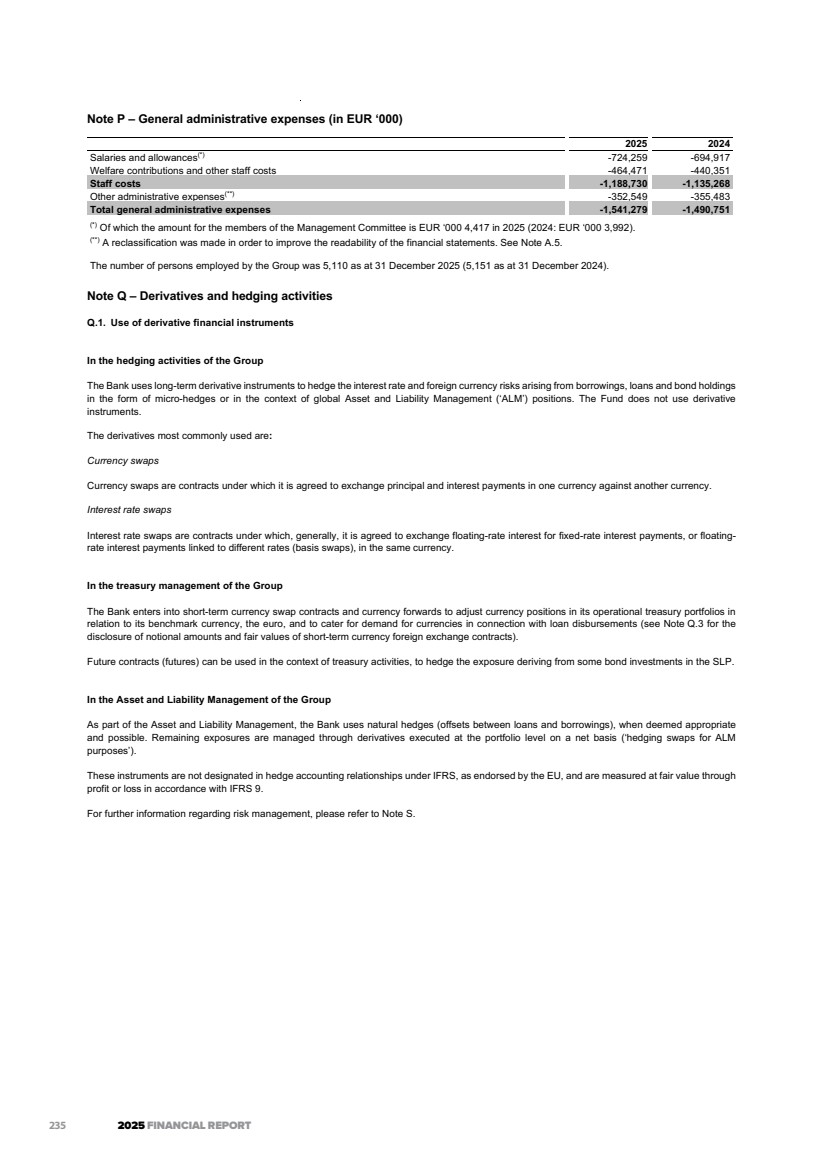
| EIB GROUP CONSOLIDATED FINANCIAL STATEMENTS UNDER IFRS 49 Q.2. Hedging activities Fair value hedge of interest rate risk The amounts relating to items designated as hedging instruments are as follows (in EUR million): 2025 Notional amount Carrying amount Change in fair value used for calculating hedge ineffectiveness Assets Liabilities Interest Rate Swaps 433,449 14,217 -12,336 2,882 Currency Swaps(*) 22,011 1,028 -1,604 11 Total 455,460 15,245 -13,940 2,893 (*) The main currencies covered are AUD, CAD and CHF. The Group used the notional amount of the receive leg of the currency swaps. Interest rate swaps and currency swaps mentioned in the table above are presented in the consolidated balance sheet under “Derivative assets” and “Derivative liabilities”. 2024 Notional amount Carrying amount Change in fair value used for calculating hedge ineffectiveness Assets Liabilities Interest Rate Swaps 440,854 14,445 -16,078 786 Currency Swaps(*) 26,914 1,285 -2,623 213 Total 467,768 15,730 -18,701 999 (*) The main currencies covered are USD, AUD and CAD. The Group used the notional amount of the receive leg of the currency swaps. Interest rate swaps and currency swaps mentioned in the table above are presented in the consolidated balance sheet under “Derivative assets” and “Derivative liabilities”. The amounts relating to items designated as hedged items are as follows (in EUR million): 2025 Carrying amount Accumulated amount of fair value hedge adjustments Line item in the consolidated balance sheet Change in value used for calculating hedge ineffectiveness Accumulated amount of fair value hedge adjustments remaining in the consolidated balance sheet for hedged items that have ceased to be adjusted for hedging gains and losses Assets Liabilities Loans and advances 16,880 0 -467 Loans and advances to credit institutions -146 3 115,889 0 -5,094 Loans and advances to customers -1,996 8 Loan substitutes 2,173 0 -33 Treasury bills and other bills eligible for refinancing with central banks -39 0 2,276 0 13 Debt securities - a) issued by public bodies -42 0 448 0 -2 Debt securities - b) issued by other borrowers 0 0 Treasury bonds 1,233 0 -123 Treasury bills and other bills eligible for refinancing with central banks -25 0 486 0 -99 Debt securities - a) issued by public bodies 10 0 Debts evidenced by certificates 0 304,798 6,435 Debts evidenced by certificates - a) debt securities in issue -325 -25 0 4,395 -142 Debts evidenced by certificates - b) other 167 0 Total 139,385 309,193 488 -2,396 -14 236 |
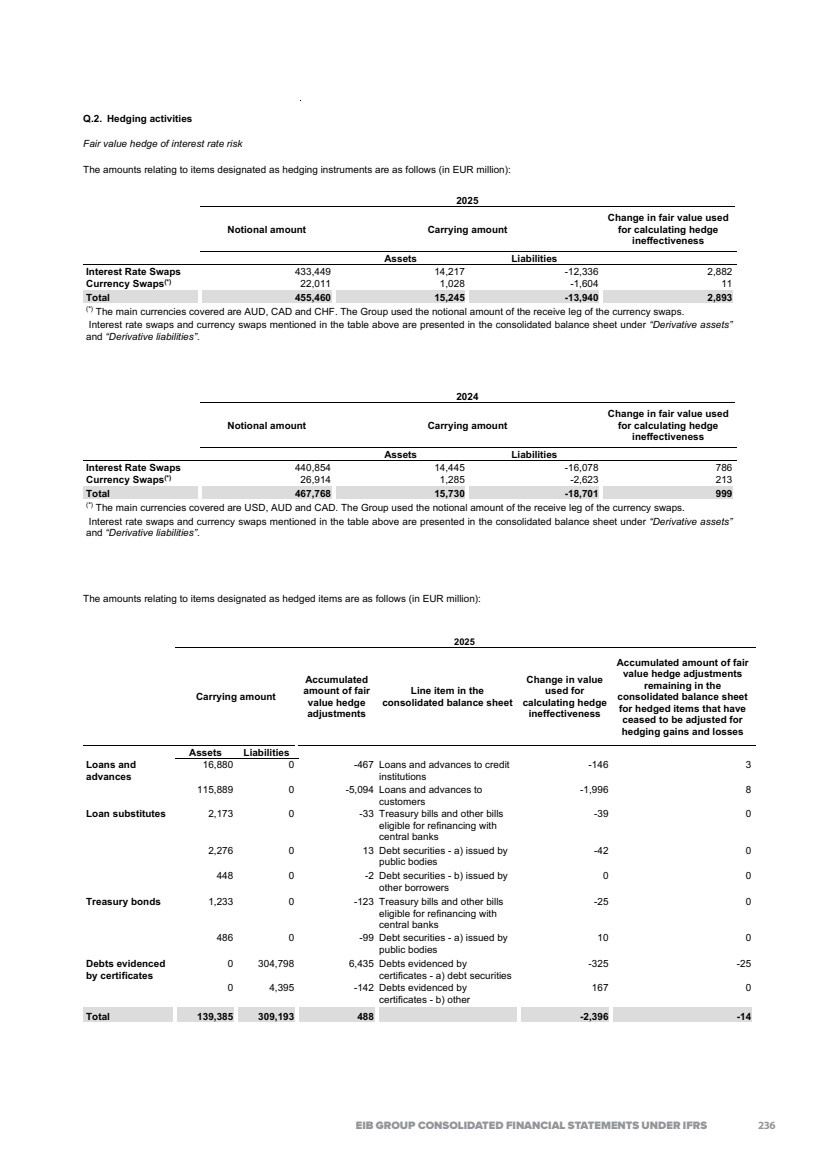
| 2025 FINANCIAL REPORT 50 2024 Carrying amount Accumulated amount of fair value hedge adjustments Line item in the consolidated balance sheet Change in value used for calculating hedge ineffectiveness Accumulated amount of fair value hedge adjustments remaining in the consolidated balance sheet for hedged items that have ceased to be adjusted for hedging gains and losses Assets Liabilities Loans and advances 20,087 0 -321 Loans and advances to credit institutions 420 4 115,755 0 -3,098 Loans and advances to customers 1,362 27 Loan substitutes 2,616 0 5 Treasury bills and other bills eligible for refinancing with central banks 75 0 2,315 0 55 Debt securities - a) issued by public bodies 25 0 620 0 -2 Debt securities - b) issued by other borrowers 14 0 Treasury bonds 1,031 0 -98 Treasury bills and other bills eligible for refinancing with central banks 11 0 555 0 -109 Debt securities - a) issued by public bodies -43 0 Debts evidenced by certificates 0 306,822 6,760 Debts evidenced by certificates - a) debt securities in issue -2,717 -27 0 4,837 -309 Debts evidenced by certificates - b) other -1 0 Total 142,979 311,659 2,883 -854 4 The hedge ineffectiveness – that is, the difference between the hedging gains or losses of the hedging instrument and the hedged item - recognised in the consolidated income statement is EUR 497 million for 2025 (2024: EUR 145 million) and is included in line "Result on financial operations" (Note M.1). The following table shows a reconciliation of each component of equity and an analysis of other comprehensive income in relation to hedge accounting (in EUR million): Fair value reserve - Hedge accounting 2025 2024 Balance as at 1 January -115 -142 Fair value hedge Amortisation and revaluation of cross-currency basis spread 32 25 Amount reclassified to profit or loss 0 0 Cash flow hedge Change in fair value (effective portion) 3 -1 Amount reclassified to profit or loss 0 2 Balance as at 31 December -80 -115 The Group applies cash flow hedging on a limited basis, with two active hedge relationships in 2025, compared to one in 2024. The carrying amount of the hedged items is EUR 1,916 million, which is presented in the consolidated balance sheet under “Loans and advances to credit institutions/customers” (2024: EUR 588 million) and the carrying amount of the hedging instrument is EUR -3.3 million, which is presented in the consolidated balance sheet under “Derivative liabilities” (2024: EUR 0.3 million under “Derivative assets”). The hedging relationships are fully effective in 2025 and 2024 and therefore changes in the fair value of the hedging instruments are recognised in the fair value reserve through other comprehensive income. Q.3. Fair value of derivative financial instruments Financial instruments measured at fair value require disclosure of fair value measurements according to the following hierarchy: • Level 1 – Quoted (unadjusted) prices in active markets for identical assets or liabilities. • Level 2 – Valuation techniques that use inputs other than quoted prices included within Level 1 that are observable for the asset or liability, either directly (that is, as prices) or indirectly (that is, derived from prices). • Level 3 – Valuation techniques that use inputs for the asset or liability that are not based on observable market data (unobservable inputs). Internal valuation models are used to determine the fair values of these instruments. 237 |
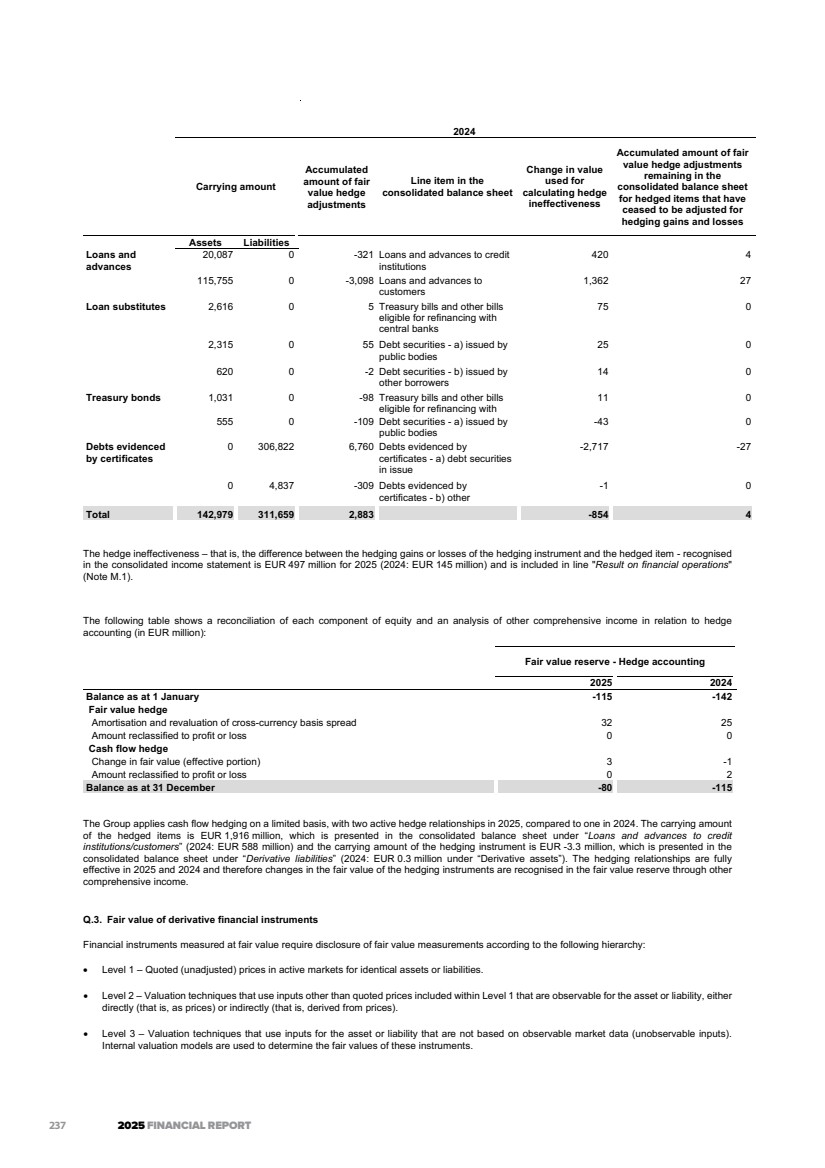
| EIB GROUP CONSOLIDATED FINANCIAL STATEMENTS UNDER IFRS 51 Valuation techniques include discounted cash flow, the Hull-White Model and the LIBOR Market Model (LMM) as interest rate models, the Local Volatility (Dupire) Model and the Black-Scholes Model for FX rates and the Black-Scholes option model for equity. Assumptions and inputs used in valuation techniques include risk-free interest rates, basis swap spreads and currency basis swaps spreads, foreign currency exchange rates and forward exchange rates, equity index prices and expected price volatilities and correlations, consumer price indices values and expected volatilities and correlations. The objective of valuation techniques is to arrive at a fair value determination that reflects the price of the financial instrument at the reporting date that would have been determined by market participants acting at arm’s length. The valuation models applied are consistent with accepted economic methodologies for pricing financial instruments and incorporate the factors that market participants consider when setting a price. For a portion of derivative transactions, internal estimates and assumptions might be used in the valuation techniques when the market inputs are not directly available, typically in the estimation of correlations in some interest rate and cross-currency models and in the estimation of volatilities for some long-dated equity, interest rate or inflation-linked transactions. The table below shows the fair value of derivative financial instruments, recorded as assets or liabilities (between those whose fair value is based on quoted market prices, those whose valuation technique is where all the model inputs are observable in the market and those where the valuation techniques involve the use of non-market observable inputs) together with their notional amounts. The notional amounts indicate the volume of transactions outstanding at year end and are indicative of neither the market risk nor the credit risk. Derivatives by valuation method as at 31 December 2025 (in EUR million) Derivatives assets Level 1 Level 2 Level 3 Total 2025 Quoted market price Valuation techniques – market observable inputs Valuation techniques – non market observable inputs Notional amount Fair value Notional amount Fair value Notional amount Fair value Notional amount Fair value Interest Rate Swaps(*) 0 0 289,348 18,578 1,703 126 291,051 18,704 Currency Swaps 0 0 75,610 3,711 219 10 75,829 3,721 Short-term foreign exchange contracts 0 0 5,431 17 0 0 5,431 17 Futures contracts 14,316 5 0 0 0 0 14,316 5 Total 14,316 5 370,389 22,306 1,922 136 386,627 22,447 Derivatives liabilities Level 1 Level 2 Level 3 Total 2025 Quoted market price Valuation techniques – market observable inputs Valuation techniques – non market observable inputs Notional amount Fair value Notional amount Fair value Notional amount Fair value Notional amount Fair value Interest Rate Swaps(*) 0 0 337,630 18,265 3,297 635 340,927 18,900 Currency Swaps 0 0 128,549 6,141 777 108 129,326 6,249 Short-term foreign exchange contracts 0 0 17,499 109 0 0 17,499 109 Futures contracts 30,127 18 0 0 0 0 30,127 18 Other(**) 0 0 0 0 0 846 0 846 Total 30,127 18 483,678 24,515 4,074 1,589 517,879 26,122 (*) The Equity Swaps with a notional of EUR 500 million (2024: EUR 500 million) and fair value of EUR -19 million (2024: EUR -38 million) are included in the Interest Rate Swaps category. (**) The caption "Other" amounting to EUR 846 million (2024: EUR 749 million) includes Level 3 derivatives liabilities as follows: i) Derivative liabilities on debt instruments mandatorily at FVTPL amounting to EUR 171 million (2024: EUR 127 million). These derivatives are valued as “sum of the parts” of the various features of the underlying instruments. The value of the liability is typically estimated with an adjusted Discounted Cash Flow ("DCF") with a risk-commensurate discount rate (main unobservable inputs: Equity features embedded in the contractual framework of the underlying operations are the significant drivers in the fair valuation). As at 31 December 2025, the range of estimates for unobservable inputs varies between +/- 3% (total impact on the fair value EUR -/+ 5.1 million). As at 31 December 2024, the range of estimates for unobservable inputs varies between +/- 3% (total impact on the fair value EUR -/+ 3.8 million). ii) Derivative liabilities on equity instruments mandatorily at FVTPL amounting to EUR 675 million (2024: EUR 622 million). These derivatives are valued based on the external valuation of the underlying equity instruments as derived from the latest available before year-end external reports (main unobservable inputs: external report of underlying instruments – NAV fund reports – as derived from the latest available before year-end equity instrument managers’ reports). As at 31 December 2025, the range of estimates for unobservable inputs varies between +/- 10% of the change in the underlying equity price with an effect on own funds and profit of EUR -/+ 67.5 million). As at 31 December 2024, the range of estimates for unobservable inputs varies between +/- 10% of the change in the underlying equity price with an effect on own funds and profit of EUR -/+ 62.2 million). 238 |
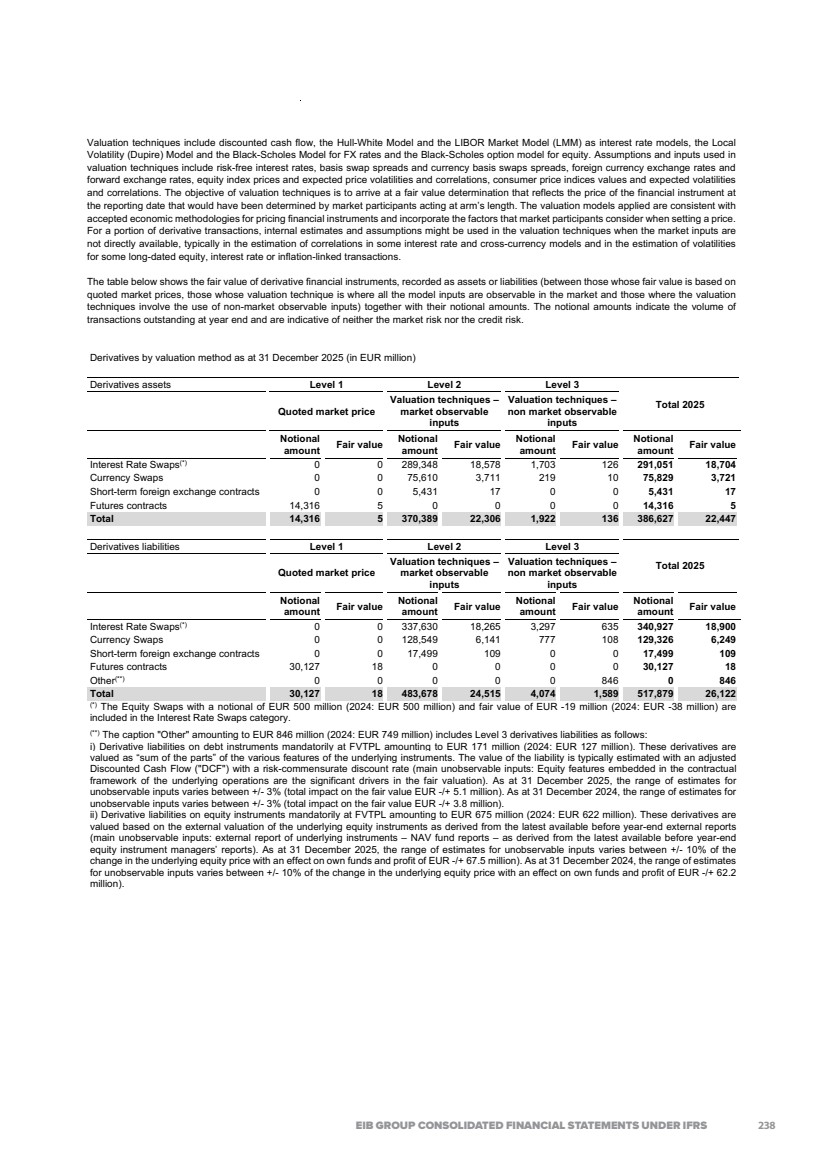
| 2025 FINANCIAL REPORT 52 Derivatives by valuation method as at 31 December 2024 (in EUR million) Derivatives assets Level 1 Level 2 Level 3 Total 2024 Quoted market price Valuation techniques – market observable inputs Valuation techniques – non market observable inputs Notional amount Fair value Notional amount Fair value Notional amount Fair value Notional amount Fair value Interest Rate Swaps(*) 0 0 312,132 18,824 1,776 151 313,908 18,975 Currency Swaps 0 0 156,158 11,208 274 15 156,432 11,223 Short-term foreign exchange contracts 0 0 15,074 239 0 0 15,074 239 Futures contracts 1,711 20 0 0 0 0 1,711 20 Total 1,711 20 483,364 30,271 2,050 166 487,125 30,457 Derivatives liabilities Level 1 Level 2 Level 3 Total 2024 Quoted market price Valuation techniques – market observable inputs Valuation techniques – non market observable inputs Notional amount Fair value Notional amount Fair value Notional amount Fair value Notional amount Fair value Interest Rate Swaps(*) 0 0 338,224 22,227 3,661 641 341,885 22,868 Currency Swaps 0 0 76,456 6,392 237 75 76,693 6,467 Short-term foreign exchange contracts 0 0 4,614 55 0 0 4,614 55 Futures contracts 31,641 34 0 0 0 0 31,641 34 Other 0 0 0 0 0 749 0 749 Total 31,641 34 419,294 28,674 3,898 1,465 454,833 30,173 (*) The Equity Swaps are included in the Interest Rate Swaps category. Quoted prices for the majority of the Bank’s derivative transactions are not available in the market. For such instruments the fair values are estimated using valuation techniques or models, based wherever possible on observable market data prevailing at the balance sheet date. The fair value of swap transactions is computed using option pricing models, calibrated to available market prices of options. The valuation models applied are consistent with accepted economic methodologies for pricing financial instruments and incorporate the factors that market participants consider when setting a price. For a portion of derivative transactions, internal estimates and assumptions might be used in the valuation techniques when the market inputs are not directly available. 239 |
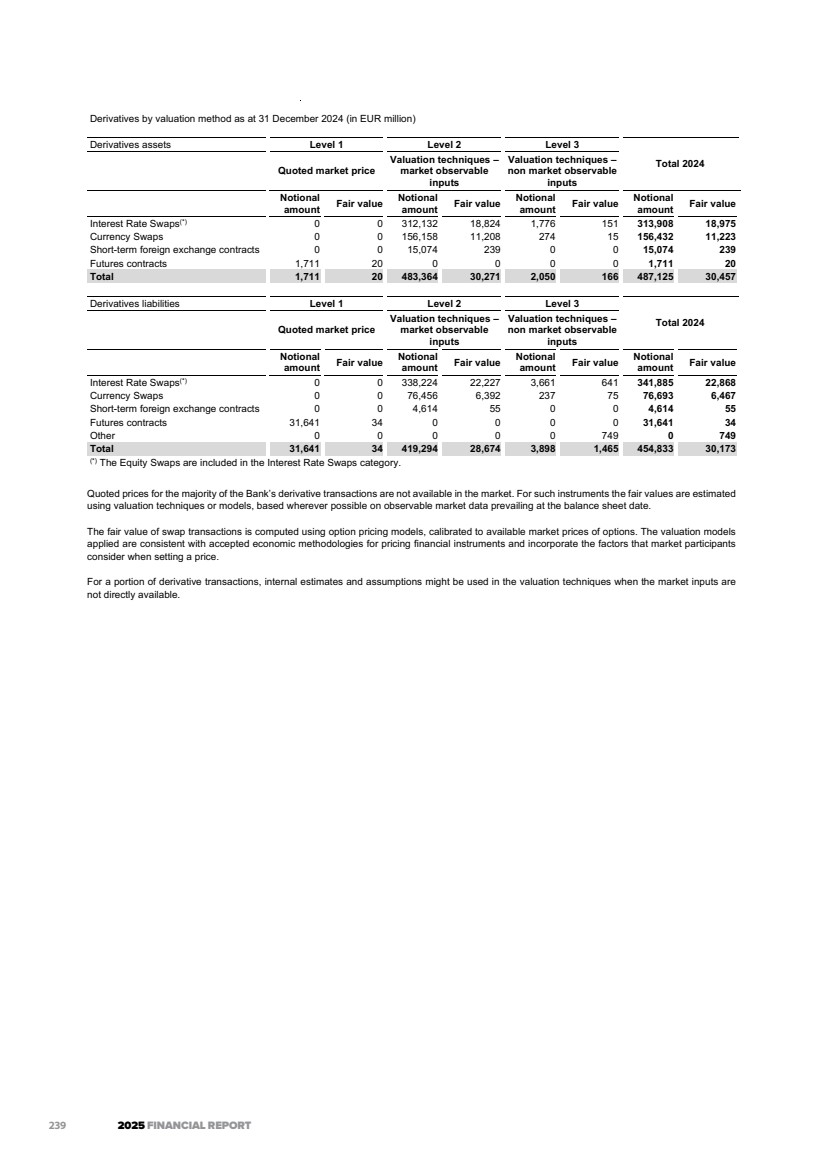
| EIB GROUP CONSOLIDATED FINANCIAL STATEMENTS UNDER IFRS 53 The table below provides details on the significant unobservable inputs used at year end in measuring derivatives financial instruments categorised as Level 3 in the fair value hierarchy (EUR million): Type of financial instrument Fair value as at 31 December 2025 Fair values of Level 3 swaps as at 31 December 2025 Valuation technique Significant unobservable input Range of estimates for unobservable inputs Interest Rate Swaps -177 -490 Stochastic IR models Stochastic volatility parameters, such as mean reversion or volatility of volatility for LMM. Mean reversion level for HW1F. Volatility of volatility or mean reversion speed moving by 20% up and down. Changing the mean reversion by +-0.2%. Currency Swaps -2,528 -98 Stochastic CC models Correlations between yield curves and FX rates. Stochasticity of interest rates with local volatility Reducing by half the observation window for correlations estimates. Using stochastic rates together with local volatility model for FX rates. Equity Swaps -19 -19 Stochastic Equity models Dividend yields and volatility Using a different dividend yield and volatility (+-20% relative). Type of financial instrument Fair value as at 31 December 2024 Fair values of Level 3 swaps as at 31 December 2024 Valuation technique Significant unobservable input Range of estimates for unobservable inputs Interest Rate Swaps -3,855 -452 Stochastic IR models Stochastic volatility parameters, such as mean reversion or volatility of volatility for LMM. Mean reversion level for HW1F. Volatility of volatility or mean reversion speed moving by 20% up and down. Changing the mean reversion by +-0.2%. Currency Swaps 4,756 -60 Stochastic CC models Correlations between yield curves and FX rates using volatility smile Reducing by half the observation window for correlations estimates. Using local volatility model where FX rate volatility is a deterministic function of the strikes and time. Equity Swaps -38 -38 Stochastic Equity models Dividend yields and volatility Using a different dividend yield and volatility (+-20% relative). Significant unobservable inputs are developed as follows: • Correlations and volatilities are derived through extrapolation of observable volatilities, recent transaction prices, quotes from other market participants and historical data adjusted for current conditions. • Risk adjusted spreads are derived from the CDS market. With the application of IFRS 13, valuation adjustments are included in the fair valuations of derivatives as at 31 December 2025, namely: • Credit valuation adjustments (CVAs), reflecting counterparty credit risk on derivative transactions, amounting to EUR -25.2 million (2024: EUR -36.9 million) recorded in: o swaps hedging loans and loan substitutes of EUR -6.0 million (2024: EUR -6.4 million) o swaps hedging borrowings of EUR -6.0 million (2024: EUR -8.0 million) o ALM swaps of EUR -13.1 million (2024: EUR -22.4 million) o long-term treasury swaps of EUR -0.1 million (2024: EUR -0.1 million) o short-term treasury swaps (FX swaps and FX forwards) nil (2024: nil). • Debit valuation adjustments (DVAs), reflecting own credit risk on derivative transactions, amounting to EUR 105.7 million (2024: EUR 103.6 million) recorded in: o swaps hedging loans and loan substitutes of EUR 29.0 million (2024: EUR 31.7 million) o swaps hedging borrowings of EUR 29.7 million (2024: EUR 32.7 million) o ALM swaps of EUR 46.6 million (2024: EUR 38.9 million) o long-term treasury swaps of EUR 0.3 million (2024: EUR 0.2 million) o short-term treasury swaps (FX swaps and FX forwards) of EUR 0.1 million (2024: EUR 0.1 million). • Collateral valuation adjustments (CollVAs), reflecting specific marginal adjustments linked to collateral posted by EIB counterparties on derivative transactions as at 31 December 2025, amounting to EUR -11.0 million (2024: EUR -16.1 million). The credit risk mitigating aspect of collateral posted by the EIB counterparties is already reflected in the CVA value. However, the collateral remuneration effects are separated out in a specific CollVA value. 240 |
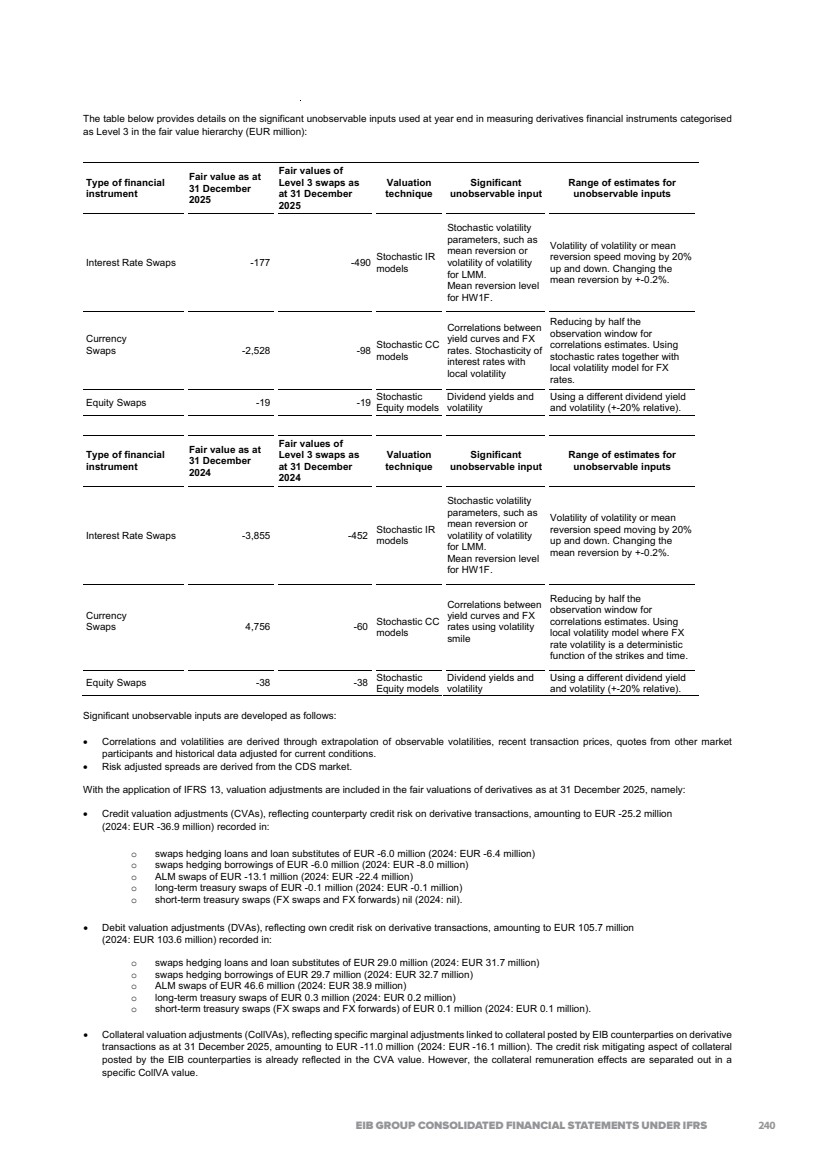
| 2025 FINANCIAL REPORT 54 Q.4. Sensitivity of fair value for Level 3 instruments Although the Group believes that its estimates of fair value are appropriate, the use of different methodologies or assumptions could lead to different measurements of fair value. The unobservable inputs may add a degree of uncertainty and variation into the valuation of Level 3 instruments. To assess and quantify it, the Group performs alternative valuations using reasonably possible range of assumptions for the unobservable inputs. Alternative assumptions are specific to valuation models and can be applied separately. Level 3 derivatives can be grouped into three swap types according to the underlying asset and valuation model: a. Structured interest rate swaps b. Cross-currency and FX-linked swaps c. Equity-linked swaps a. Structured interest rate swaps are modelled with the dynamics of a Hull-White Model with an exogenous mean reversion level, or a multi-factor LIBOR Market Model (LMM), calibrated using swaptions and spread options, where a volatility of volatility (‘vol-of-vol’) parameter is exogenously specified for a subset of models. The LMM also incorporates an exogenously set speed of volatility mean reversion. For this category, (a), alternative valuations are obtained by moving the ‘vol-of-vol’ up and down by 20% and the mean reversion up and down by 20% (floored at 1%) for LMM with stochastic volatility, for Hull-White, the mean reversion level was changed by plus and minus 0.2%. For this category, (a), the first scenario yielded an increase of EUR 1.2 million when moving down the ‘vol-of-vol’, increasing mean reversion speed and decreasing the HW mean reversion; and the second scenario a decrease of EUR 2.0 million. b. Cross-currency and FX-linked swaps are valued either according to a Hybrid model (HW-BS for short) where interest rates are modelled by a 1 factor Hull-White Model and FX rates are modelled according to the Black-Scholes model, or according to a Local Volatility model for FX rates with deterministic interest rates (LV for short). The HW-BS model is calibrated to interest rates, swaptions volatilities, FX rates, FX option volatilities and correlations between interest and FX rates. Correlations between interest and FX rates are estimated from the time series. The LV model is calibrated to interest rates, FX rates, FX option volatilities and correlation between FX rates. For these categories, alternative valuations are obtained by calculating correlation from a shorter time window (half the size) in the first scenario and considering stochastic interest rates in the second scenario. For this category, (b), both scenarios turned out to have an unfavourable impact ranging from a decrease of EUR 0.02 million (first scenario) to a decrease of EUR 0.2 million (second scenario). c. Equity-linked swaps are modelled using the Black Scholes model capturing the volatilities from the market. Interest rates and dividends are also taken from market quotes. For long-term swaps the volatilities and dividends are extrapolated for long maturities. The scenarios consisted of a relative change of 20%, up and down, in the volatility and dividends assumptions. The favourable scenario led to an increase of EUR 5.1 million and the unfavourable scenario to a decrease of EUR 5.4 million. The following table summarises Level 3 derivatives by type of financial instrument for which alternative assumptions would change fair value (in EUR million): 31 December 2025 Favourable Impact Unfavourable Impact Valuation technique Significant unobservable input Structured interest rate swaps 1.2 -2.0 Stochastic IR models Mean reversion and volatility of volatility parameters Mean reversion in Hull-White Models Cross-currency and FX-linked swaps 0 -0.2 Stochastic CC models Correlations between Interest rates and FX rates Inclusion of stochastic rates with volatility smile Equity-linked swaps 5.1 -5.4 Stochastic Equity models Volatility and dividends 31 December 2024 Favourable Impact Unfavourable Impact Valuation technique Significant unobservable input Structured interest rate swaps 2.3 -3.8 Stochastic IR models Mean reversion and volatility of volatility parameters Mean reversion in Hull-White Models Cross-currency and FX-linked swaps 0.6 0 Stochastic CC models Correlations between Interest rates and FX rates and volatility smile Equity-linked swaps 4.4 -3.3 Stochastic Equity models Volatility and dividends 241 |
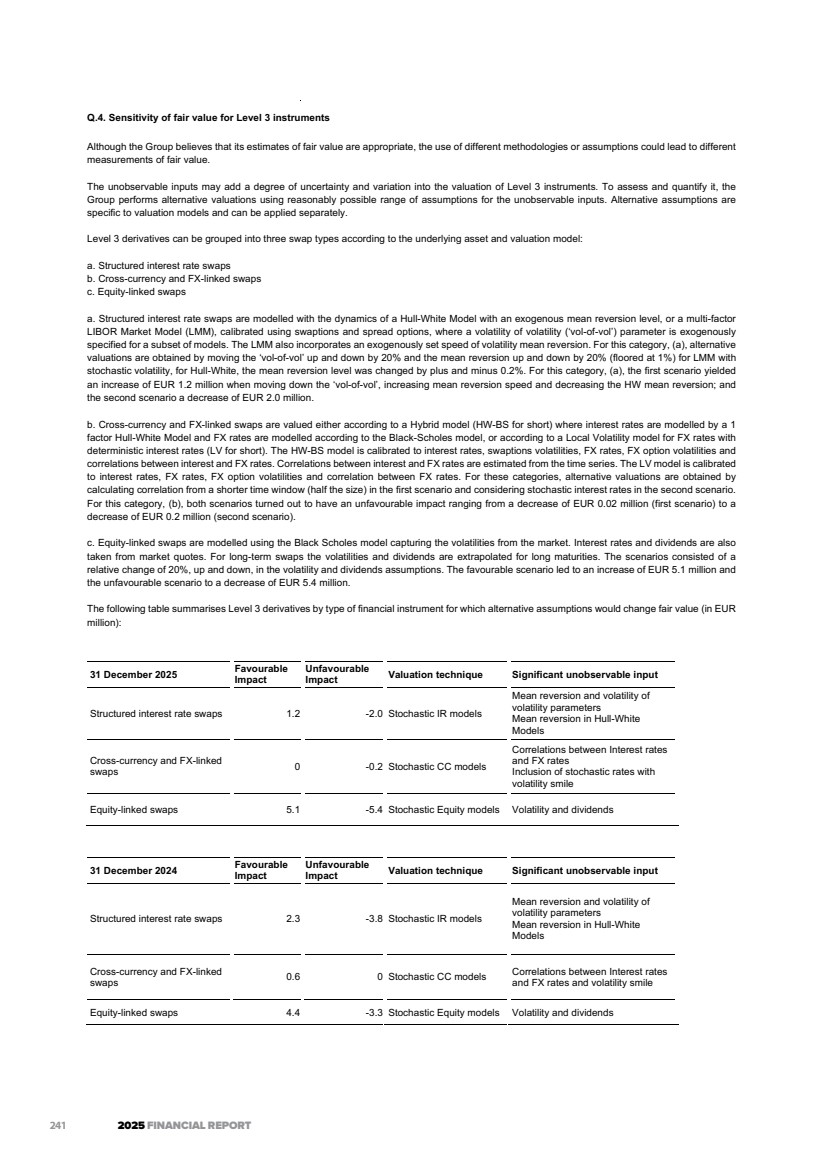
| EIB GROUP CONSOLIDATED FINANCIAL STATEMENTS UNDER IFRS 55 Note R – Fair value of financial assets and liabilities (in EUR million)* The tables below set out a comparison of the fair values, classified by the level within the fair value hierarchy, and the carrying amounts of the Group’s financial assets and financial liabilities that are recorded in the consolidated financial statements. The tables do not include the fair values of non-financial assets and non-financial liabilities. 31 December 2025 Fair value Carrying amount Level 1 Level 2 Level 3 Total Assets carried at fair value: Financial assets designated at FVTPL 0 5,331 7,487 12,818 12,818 Loans and advances to credit institutions and to customers 0 5,331 6,615 11,946 11,946 Shares and other variable-yield securities 0 0 872 872 872 Financial assets mandatorily measured at FVTPL 8,280 22,624 24,284 55,188 55,188 Derivative assets(1) 5 22,306 136 22,447 22,447 SLP 8,275 97 0 8,372 8,372 Shares and other variable-yield securities 0 0 20,891 20,891 20,891 Loans and advances to credit institutions and to customers 0 0 2,843 2,843 2,843 Loan substitutes portfolio 0 221 2 223 223 ABS Portfolio EIF 0 0 412 412 412 Financial assets measured at FVOCI (no recycling) 0 0 846 846 846 Shares and other variable-yield securities 0 0 846 846 846 Total 8,280 27,955 32,617 68,852 68,852 Assets carried at AC: Held-to-collect 25,675 466,324 42,995 534,994 501,845 LTHP 10,258 51 0 10,309 10,492 TMP 10,704 1,621 0 12,325 12,323 Operational portfolio - EIF 2,230 28 0 2,258 2,320 Loan substitutes portfolio(2) 2,483 16,073 711 19,267 19,315 Loans and advances to credit institutions and to customers(2) 0 448,293 42,284 490,577 457,137 Cash in hand, balances with central banks and post office banks 0 258 0 258 258 Total 25,675 466,324 42,995 534,994 501,845 Total financial assets 33,955 494,279 75,612 603,846 570,697 Liabilities carried at fair value: Financial liabilities mandatorily measured at FVTPL 18 25,028 1,589 26,635 26,635 Derivative liabilities(1) 18 24,515 1,589 26,122 26,122 Other liabilities 0 513 0 513 513 Financial liabilities designated at FVTPL 6,556 3,026 5,113 14,695 14,695 Debts evidenced by certificates 6,556 3,026 5,113 14,695 14,695 Total 6,574 28,054 6,702 41,330 41,330 Liabilities carried at AC Liabilities measured at AC 376,038 41,125 0 417,163 424,820 Amounts owed to credit institutions and customers 0 5,616 0 5,616 5,616 Debts evidenced by certificates(2) 376,038 33,175 0 409,213 416,870 Other payables and lease liabilities 0 2,334 0 2,334 2,334 Total 376,038 41,125 0 417,163 424,820 Total financial liabilities 382,612 69,179 6,702 458,493 466,150 (1) For “Derivative assets” and “Derivative liabilities” carried at fair value, please refer to Note Q.3 for the methodologies and inputs used for determining the Level 2 and Level 3 fair values. (2) For assets and liabilities carried at amortised cost the corresponding Level 3 fair value is determined using the adjusted discounted cash flow method which takes into account the specific features of the instruments such as the timing and risk of future cashflows. The Level 2 fair value is determined using the adjusted discounted cash flow method, applying market-derived discount rates. * For the methodologies used to determine the levels of the fair values refer as well to Note A.4.6. 242 |
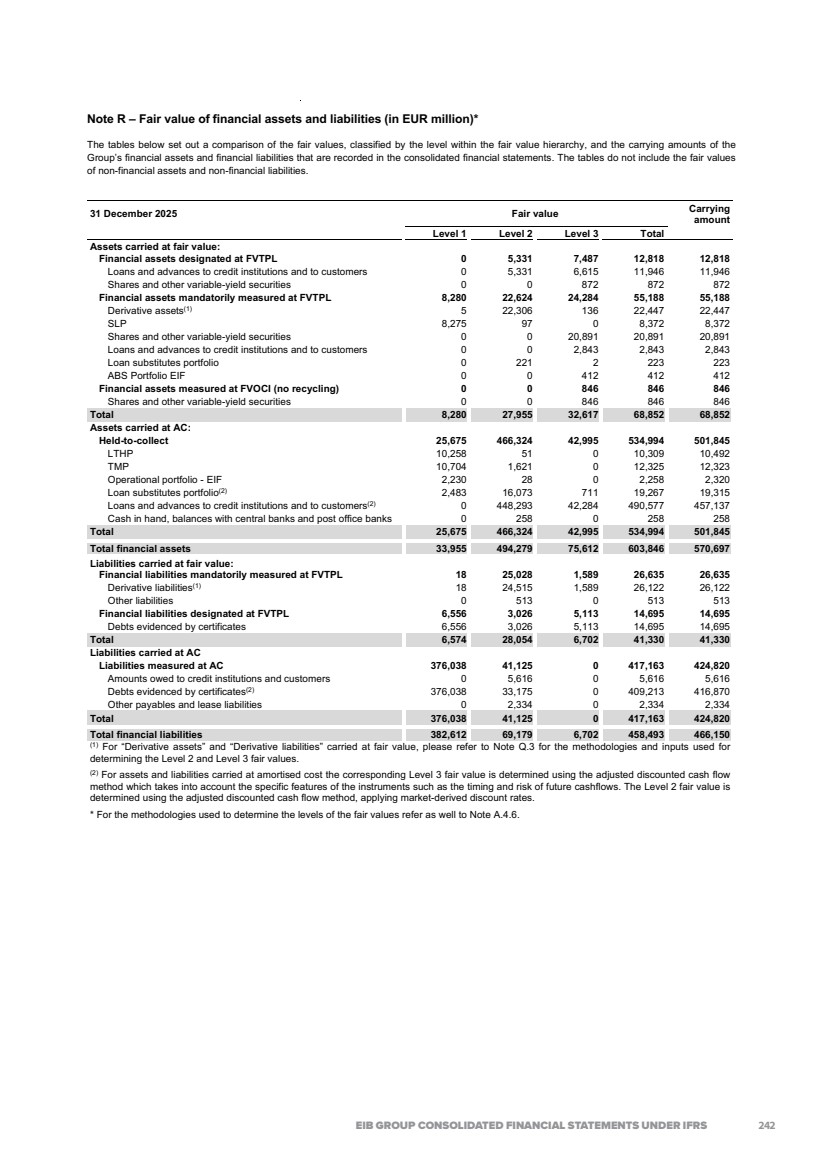
| 2025 FINANCIAL REPORT 56 31 December 2024 Fair value Carrying Level 1 Level 2 Level 3 Total amount Assets carried at fair value: Financial assets designated at FVTPL 0 5,189 7,726 12,915 12,915 Loans and advances to credit institutions and to customers 0 5,189 6,825 12,014 12,014 Shares and other variable-yield securities 0 0 901 901 901 Financial assets mandatorily measured at FVTPL 6,732 30,651 23,443 60,826 60,826 Derivative assets(1) 20 30,271 166 30,457 30,457 SLP 6,712 50 0 6,762 6,762 Shares and other variable-yield securities 0 0 20,051 20,051 20,051 Loans and advances to credit institutions and to customers 0 0 2,668 2,668 2,668 Loan substitutes portfolio 0 214 44 258 258 ABS Portfolio EIF 0 0 514 514 514 Assets held for sale 0 116 0 116 116 Financial assets measured at FVOCI (no recycling) 0 0 781 781 781 Shares and other variable-yield securities 0 0 781 781 781 Total 6,732 35,840 31,950 74,522 74,522 Assets carried at AC: Held-to-collect 20,744 434,330 46,884 501,958 506,235 LTHP 7,252 74 0 7,326 7,475 TMP 10,454 2,429 0 12,883 12,844 Operational portfolio - EIF 2,113 36 0 2,149 2,244 Loan substitutes portfolio(2) 925 14,394 4,337 19,656 19,702 Loans and advances to credit institutions and to customers(2) 0 417,129 42,547 459,676 463,702 Cash in hand, balances with central banks and post office banks 0 105 0 105 105 Subscribed capital and reserves, called but not paid 0 163 0 163 163 Total 20,744 434,330 46,884 501,958 506,235 Total financial assets 27,476 470,170 78,834 576,480 580,757 Liabilities carried at fair value: Financial liabilities mandatorily measured at FVTPL 34 29,157 1,465 30,656 30,656 Derivative liabilities(1) 34 28,674 1,465 30,173 30,173 Other liabilities 0 483 0 483 483 Financial liabilities designated at FVTPL 8,723 3,843 4,887 17,453 17,453 Debts evidenced by certificates 8,723 3,843 4,887 17,453 17,453 Total 8,757 33,000 6,352 48,109 48,109 Liabilities carried at AC Liabilities measured at AC 378,800 41,921 0 420,721 431,437 Amounts owed to credit institutions and customers 0 4,069 0 4,069 4,069 Debts evidenced by certificates(2) 378,800 35,092 0 413,892 424,608 Other payables and lease liabilities 0 2,760 0 2,760 2,760 Total 378,800 41,921 0 420,721 431,437 Total financial liabilities 387,557 74,921 6,352 468,830 479,546 (1) For “Derivative assets” and “Derivative liabilities” carried at fair value, please refer to Note Q 3 for the methodologies and inputs used for determining the Level 2 and Level 3 fair values. (2) For assets and liabilities carried at amortised cost the corresponding Level 3 fair value is determined using the adjusted discounted cash flow method which takes into account the specific features of the instruments such as the timing and risk of future cashflows. The Level 2 fair value is determined using the adjusted discounted cash flow method, applying market-derived discount rates. The following describes the methodologies and assumptions used to determine the fair value of the financial assets and financial liabilities. Assets and liabilities for which carrying amount approximates to fair value For financial assets and financial liabilities that are liquid or have a short-term maturity (less than three months), it is assumed that the carrying amounts approximate to their fair value. Assets and liabilities recorded at fair value Published price quotations in an active market are the first source for determining the fair value of a financial instrument. For instruments without an available market price, fair values are estimated using valuation techniques or models based wherever possible on observable market data prevailing at the balance sheet date. The fair value of such instruments is determined by using valuation techniques to convert future amounts to a single discounted present amount. The estimate of fair value is based on the value indicated by marketplace expectations about those future amounts. Valuation techniques can range from simple discounted known cash flows to complex option models. The valuation models applied are consistent with accepted economic methodologies for pricing financial instruments and incorporate the factors that market participants consider when setting a price. Internal estimates and assumptions might be used in the valuation techniques when the market inputs are not directly available. With the application of IFRS 13, OCA, reflecting own credit risk on financial liabilities designated at fair value through profit or loss, amounts to EUR 403.9 million as at 31 December 2025 (2024: EUR 659.0 million). 243 |
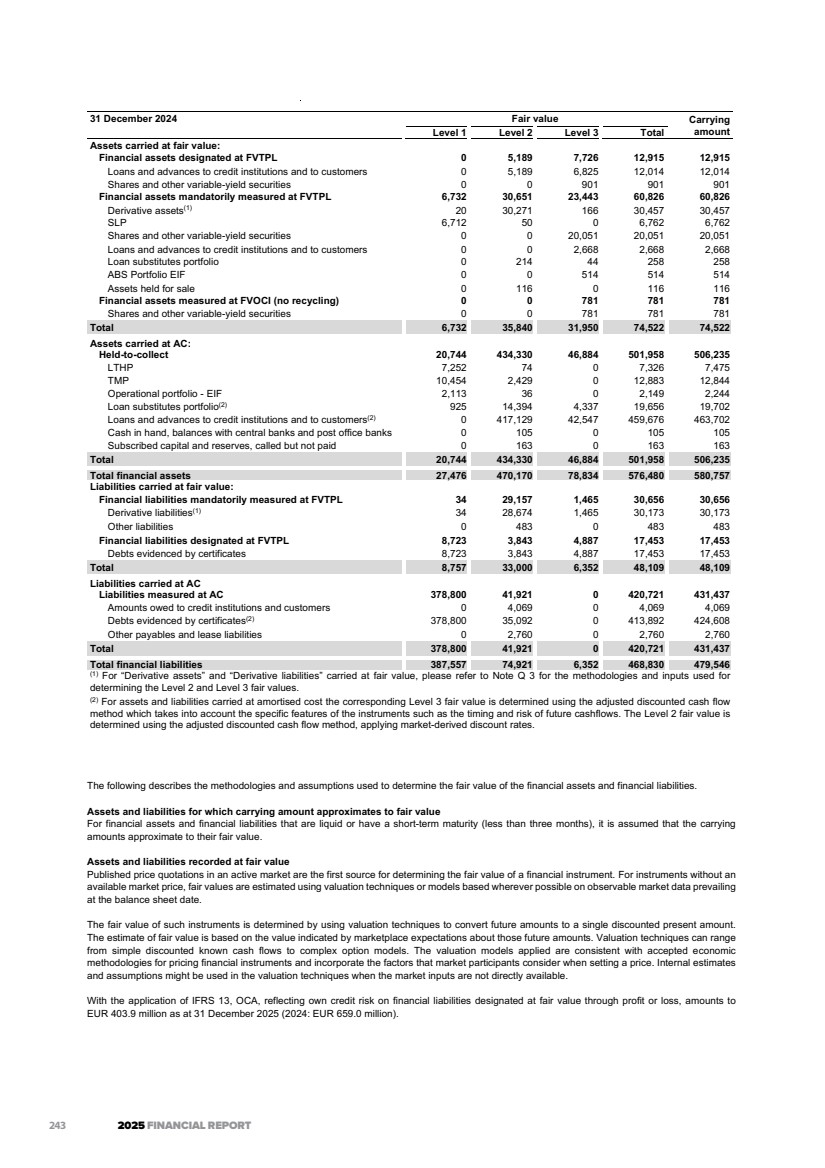
| EIB GROUP CONSOLIDATED FINANCIAL STATEMENTS UNDER IFRS 57 In 2025, the Group made transfers from Level 1 to 2 of the fair value hierarchy: • Financial assets mandatorily measured at FVTPL is nil (2024: nil); • Financial liabilities designated at FVTPL is nil (2024: EUR 358.1 million). During the current and prior year, quoted prices in active markets were not available for these securities, hence the transfers from Level 1 to 2. The Group also made the following transfer from Level 2 to 1 of the fair value hierarchy: • Financial assets mandatorily measured at FVTPL is EUR 8.6 million (2024: nil); • Financial liabilities designated at FVTPL of EUR 19.9 million (2024: nil). During the current and prior year, quoted prices in active markets were available for these securities, hence the transfers from Level 2 to 1. The following table presents the changes in Level 3 instruments for the year ended 31 December 2025 (in EUR million): Financial assets mandatorily measured at FVTPL Financial assets designated at FVTPL Financial assets measured at FVOCI Financial liabilities mandatorily measured at FVTPL Financial liabilities designated at FVTPL Balance at 1 January 2025 23,443 7,726 781 1,465 4,887 Total gains or losses: - in profit or loss -181 -937 65 126 -201 - in other comprehensive income 0 0 0 0 174 Purchases 2,802 50 0 15 0 Sales -1,243 -37 0 0 0 Issues 0 907 0 0 615 Settlements -537 -222 0 0 -66 Aggregate transfers into Level 3 0 0 0 0 0 Aggregate transfers out of Level 3 0 0 0 -17 -296 Balance at 31 December 2025 24,284 7,487 846 1,589 5,113 The following table presents the changes in Level 3 instruments for the year ended 31 December 2024 (in EUR million): Financial assets mandatorily measured at FVTPL Financial assets designated at FVTPL Financial assets measured at FVOCI Financial liabilities mandatorily measured at FVTPL Financial liabilities designated at FVTPL Balance at 1 January 2024 22,266 8,316 647 1,386 5,039 Total gains or losses: - in profit or loss 221 -591 0 104 125 - in other comprehensive income 0 0 13 0 -218 Purchases 3,377 87 121 0 0 Sales -1,361 -27 0 0 0 Issues 0 518 0 0 128 Settlements -1,060 -577 0 -20 -75 Aggregate transfers into Level 3 0 0 0 0 0 Aggregate transfers out of Level 3 0 0 0 -5 -112 Balance at 31 December 2024 23,443 7,726 781 1,465 4,887 During the years ended 31 December 2025 and 31 December 2024, certain financial assets and financial liabilities were transferred into or out of Level 3 of the fair value hierarchy. The reason for such transfers is the availability of quoted prices in active markets and the change in the inputs and assumptions used in the fair value measurement compared to the previous year. 244 |
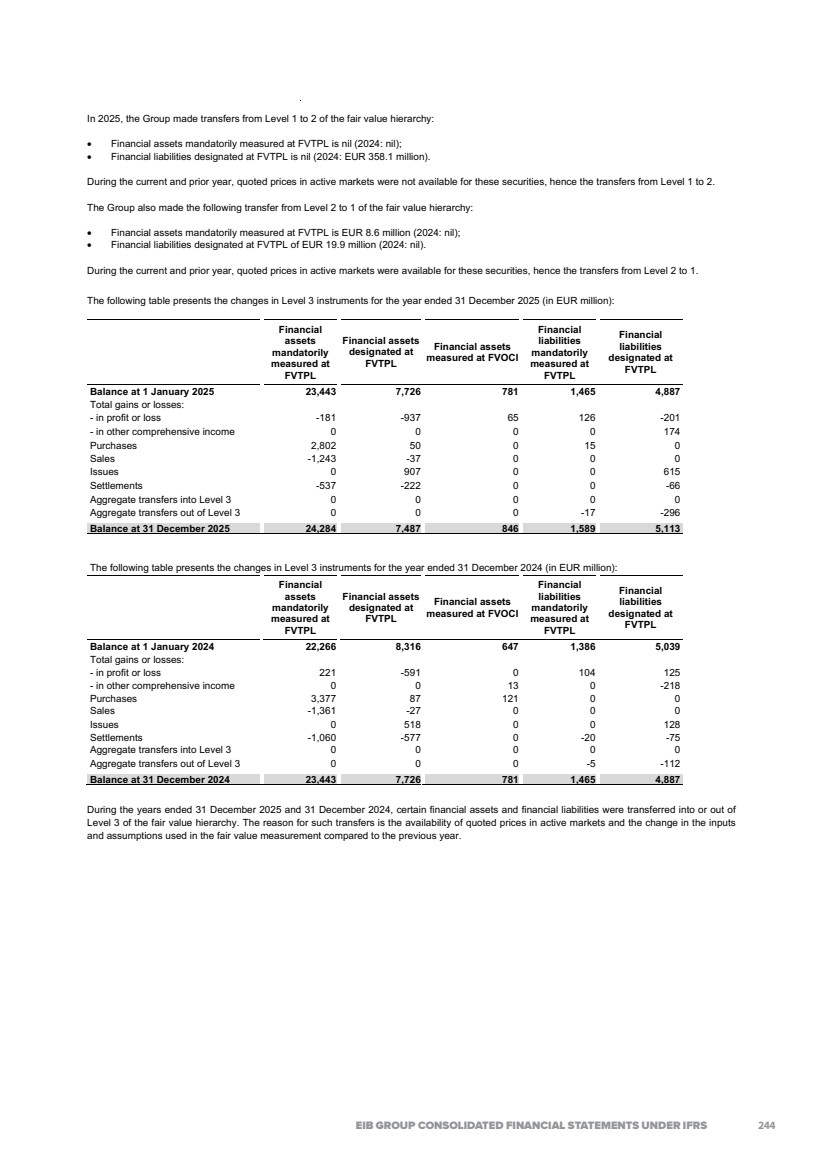
| 2025 FINANCIAL REPORT 58 Total gains or losses on Level 3 instruments in the table below are presented in the consolidated statement of profit or loss and other comprehensive income for the year ended 31 December 2025 as follows (in EUR million): Financial assets mandatorily measured at FVTPL Financial assets designated at FVTPL Financial assets measured at FVOCI Financial liabilities mandatorily measured at FVTPL Financial liabilities designated at FVTPL Total gains or losses included in profit or loss for the year: - Result on financial operations -181 -937 65 126 -201 Total gains or losses recognised in other comprehensive income: - Financial assets at FVOCI and OCA 0 0 0 0 174 Total gains or losses for the year included in profit or loss attributable to changes in unrealised gains and losses on assets and liabilities held as at 31 December 2025: - Result on financial operations -181 -937 65 126 -201 Total gains or losses on Level 3 instruments in the table below are presented in the consolidated statement of profit or loss and other comprehensive income for the year ended 31 December 2024 as follows (in EUR million): Financial assets mandatorily measured at FVTPL Financial assets designated at FVTPL Financial assets measured at FVOCI Financial liabilities mandatorily measured at FVTPL Financial liabilities designated at FVTPL Total gains or losses included in profit or loss for the year: - Result on financial operations 221 -591 0 104 125 Total gains or losses recognised in other comprehensive income: - Financial assets at FVOCI and OCA 0 0 13 0 -218 Total gains or losses for the year included in profit or loss attributable to changes in unrealised gains and losses on assets and liabilities held as at 31 December 2024: - Result on financial operations 221 -591 0 104 125 Valuation techniques, unobservable inputs and sensitivity for Level 3 non-derivative financial assets carried at fair value The valuation techniques used for the measurement of the fair value of Level 3 financial assets are as follows: Financial assets designated at FVTPL (Level 3): (i) an adjusted discounted cash flow method for “Loans and advances to credit institutions and to customers” (DCF model where the discount rate constitutes the main unobservable input and is adjusted to reflect specificities of the nature of the assets) and (ii) the NAVs of underlying funds as derived from the latest available before year-end fund managers’ reports (main unobservable inputs: NAVs of underlying funds as derived from the latest available before year-end fund managers’ reports) for “Shares and other variable-yield securities”. Financial assets mandatorily measured at FVTPL: (i) “sum of the parts” of the various features (loan, warrants and / or royalties) for “Loans and advances to credit institutions and to customers”. The value of the loan which forms the majority of the value is typically estimated with DCF with a risk-commensurate discount rate to capture borrower credit risk and market conditions (main unobservable inputs: equity features embedded in the contractual framework of the underlying operations), (ii) an adjusted discounted cash flow method for the loan substitutes portfolio and ABS portfolio EIF (main unobservable inputs: discount rate adjusted based on particular features of the instruments such as the timing and risk of future cash flows); and (iii) the NAVs of underlying funds as derived from the latest available before year-end fund managers’ reports (main unobservable inputs: NAVs of underlying funds as derived from the latest available before year-end fund managers’ reports) for “Shares and other variable-yield securities”. Financial assets measured at FVOCI (no recycling): the latest available net equity of EBRD before year-end (main unobservable input: net equity of the EBRD). 245 |
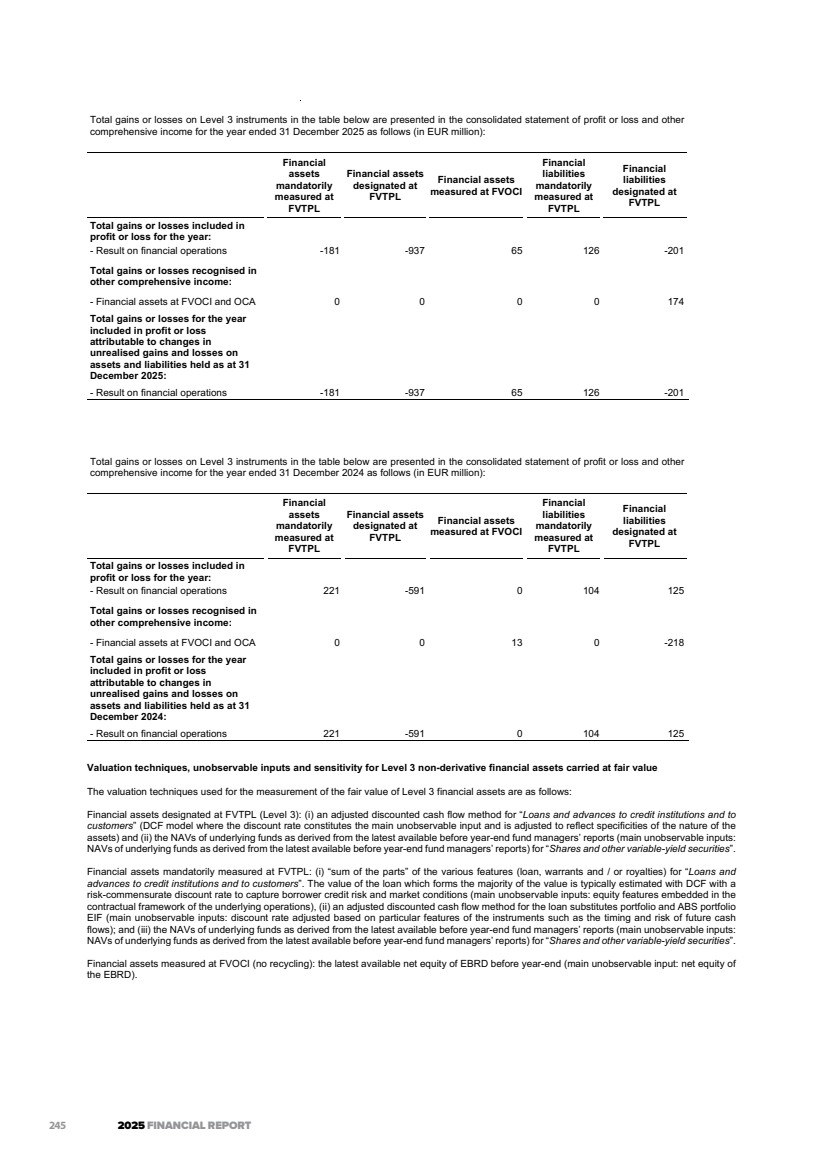
| EIB GROUP CONSOLIDATED FINANCIAL STATEMENTS UNDER IFRS 59 Non-derivative financial assets measured at FVTPL and FVOCI (Level 3) Level 3 Fair values at 31 December 2025 Range of estimates for unobservable inputs Sensitivity estimates for unobservable inputs (in EUR million) (in EUR million) Financial asset designated at FVTPL Loans and advances to credit institutions and to customers 6,615 -/+ 5 bps -5 bps: +6.8 +5 bps: -6.8 Shares and other variable-yield securities 872 Please refer to Note S.3.3 Please refer to Note S.3.3 Financial asset mandatorily measured at FVTPL Loans and advances to credit institutions and to customers 2,843 +/- 3% +/-85.3 Shares and other variable-yield securities 20,891 Please refer to Note S.3.3 Please refer to Note S.3.3 Loan substitutes portfolio 221 -/+ 10 bps -10 bps: +0.8 +10 bps: -0.9 ABS portfolio EIF 412 -/+ 10 bps -10 bps: +1.2 +10 bps: -1.2 Financial assets measured at FVOCI (no recycling) Shares and other variable-yield securities 846 Please refer to Note S.3.3 Please refer to Note S.3.3 246 |
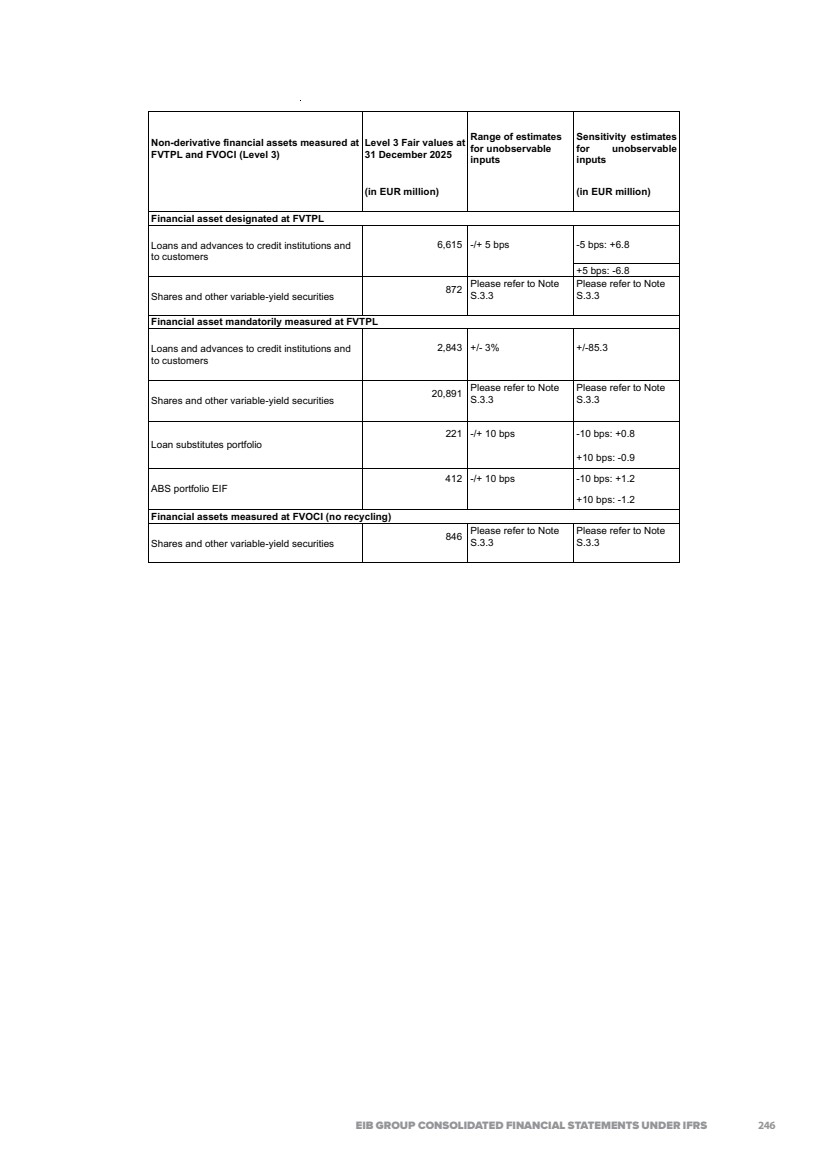
| 2025 FINANCIAL REPORT 60 Non-derivative financial assets measured at FVTPL and FVOCI (Level 3) Level 3 Fair values at 31 December 2024 Range of estimates for unobservable inputs Sensitivity estimates for unobservable inputs (in EUR million) (in EUR million) Financial asset designated at FVTPL Loans and advances to credit institutions and to customers 6,825 -/+ 5 bps -5 bps: +8.3 +5 bps: -8.4 Shares and other variable-yield securities 901 Please refer to Note S.3.3 Please refer to Note S.3.3 Financial asset mandatorily measured at FVTPL Loans and advances to credit institutions and to customers 2,668 +/- 3% +/-80.0 Shares and other variable-yield securities 20,051 Please refer to Note S.3.3 Please refer to Note S.3.3 Loan substitutes portfolio 44 -/+ 10 bps -10 bps: -2.2 +10 bps: -2.5 ABS portfolio EIF 514 -/+ 10 bps -10 bps: +1.6 +10 bps: -0.9 Financial assets measured at FVOCI (no recycling) Shares and other variable-yield securities 781 Please refer to Note S.3.3 Please refer to Note S.3.3 Valuation techniques, unobservable inputs and sensitivity for Level 3 non-derivative financial liabilities carried at fair value The fair value of borrowings included in “Debts evidenced by certificates” in Level 3 is based on an adjusted DCF method which takes into consideration any existing embedded structure. The fair value of these structures is derived from the value of the derivatives which hedge these borrowings. As a result, the alternative assumptions are first applied to the valuation of Level 3 derivatives and then the impact is applied to Level 3 borrowings. The Level 3 borrowings are grouped into three different categories according to the embedded structures and/or valuation model used to price them and their mirroring hedging derivatives: a. With embedded interest rate structures (hedged by structured interest rate swaps); b. With embedded cross currency and FX-linked structures (hedged by cross currency and FX-linked swaps); c. With embedded equity-linked structures (hedged by equity-linked swaps). The valuation techniques and unobservable inputs used in the valuation of these embedded structures and mirroring hedging derivatives are disclosed under Note Q.3 and Note Q.4. The following table summarises Level 3 borrowings by their embedded structure, where ‘favourable’ impact indicates a decrease in the fair value of the liability and ‘unfavourable’ indicates an increase: 247 |
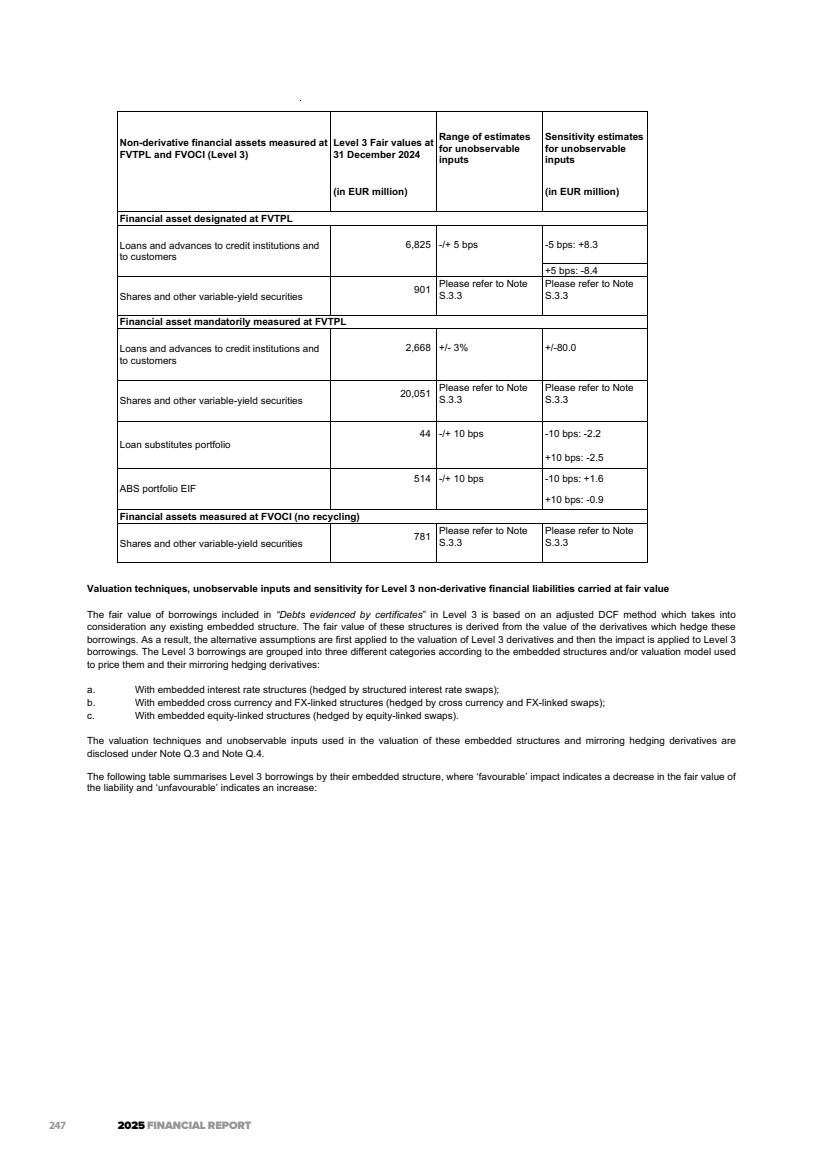
| EIB GROUP CONSOLIDATED FINANCIAL STATEMENTS UNDER IFRS 61 Non-derivative financial liabilities measured at FVTPL (Level 3) Fair values as at 31 December 2025 Favourable/ Unfavourable impact Valuation technique/ Significant unobservable inputs Range of estimates for unobservable inputs Debts evidenced by certificates 5,113 With embedded interest rate structures 3,756 -2.0 DCF and stochastic IR models / Mean reversion and volatility of volatility parameters / Mean reversion in Hull-White models Volatility of volatility or mean reversion speed moving by 20% up and down. Changing the mean reversion by +-0.2%. 1.2 With embedded cross-currency and FX-linked structures 878 -0.2 DCF and stochastic CC models / Correlations between FX rates and volatility smile Reducing by half the observation window for correlations estimates. Adding stochastic rates to local volatility. 0 With embedded equity-linked structures 479 -5.4 DCF and stochastic Equity models / Volatility and dividends Using a different dividend yield and volatility (+-20% relative). 5.1 248 |
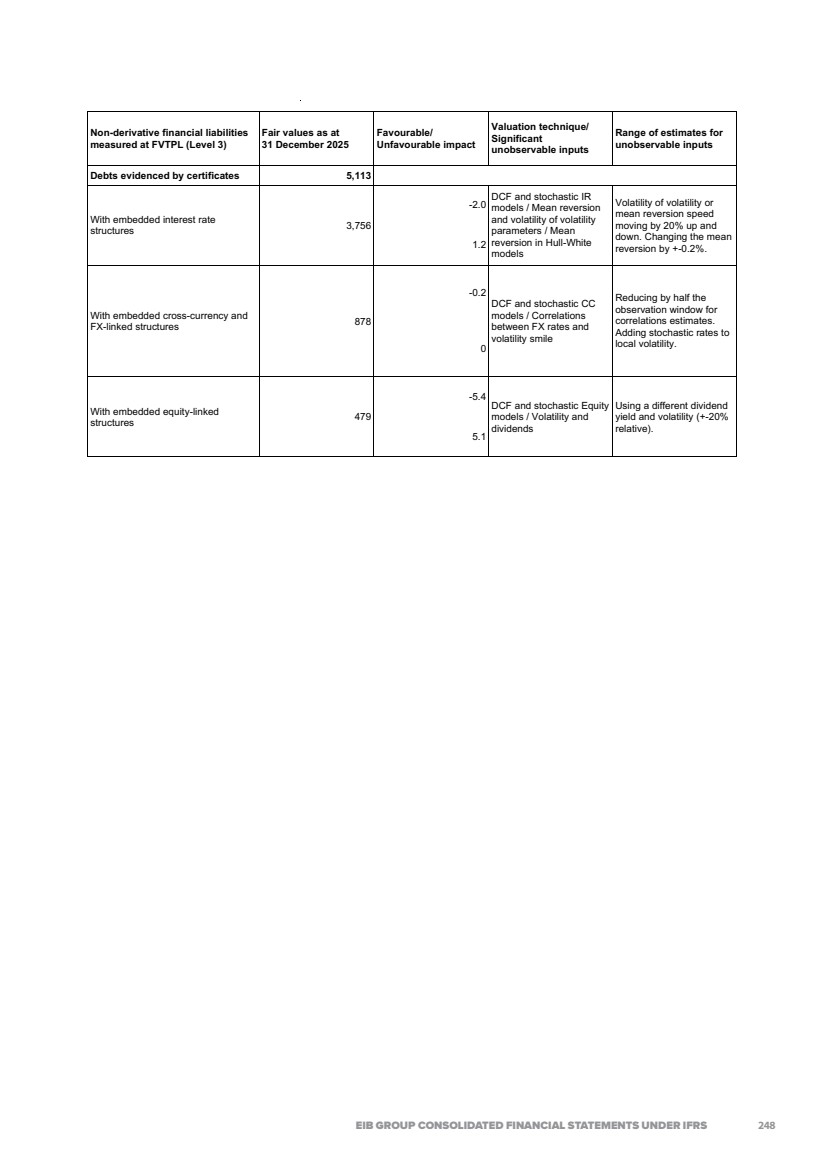
| 2025 FINANCIAL REPORT 62 Non-derivative financial liabilities measured at FVTPL (Level 3) Fair values as at 31 December 2024 Favourable/ Unfavourable impact Valuation technique/ Significant unobservable inputs Range of estimates for unobservable inputs Debts evidenced by certificates 4,887 With embedded interest rate structures 4,042 -3.8 DCF and stochastic IR models / Mean reversion and volatility of volatility parameters / Mean reversion in Hull-White models Volatility of volatility or mean reversion speed moving by 20% up and down. Changing the mean reversion by +-0.2%. 2.3 With embedded cross-currency and FX-linked structures 387 0.6 DCF and stochastic CC models / Correlations between FX rates and volatility smile Reducing by half the observation window for correlations estimates. Adding stochastic rates to local volatility. 0 With embedded equity-linked structures 458 -3.3 DCF and stochastic Equity models / Volatility and dividends Using a different dividend yield and volatility (+-20% relative). 4.4 Financial assets designated at fair value through profit or loss The financial assets designated at FVTPL include the portfolio of loans and loan substitutes hedged by interest rate swaps and currency swaps that are not eligible for fair value hedge accounting. The exposure of the disbursed loans and advances to credit institutions and customers (including loan substitutes) designated at FVTPL amounts to EUR 9,951 million (2024: EUR 9,825 million). The cumulative change in the fair value of the loans and loan substitutes attributable to change in credit risk of the Group’s counterparts amounts to a loss of EUR 86.6 million (2024: loss of EUR 204.0 million). The changes in fair value of financial assets designated at FVTPL attributable to changes in credit risk have been calculated by determining the change in the ECL on these loans and loan substitutes. No credit derivatives have been concluded to hedge the credit risk of the financial assets designated at FVTPL. Financial liabilities designated at fair value through profit or loss The financial liabilities designated at fair value through profit or loss comprise debts evidenced by certificates issued by the Group and hedged by Interest Rate Swaps and Currency Swaps. For the financial liabilities designated at FVTPL, the Group presents the effects of changes in that liability's credit risk in other comprehensive income. The following table presents the required information for these financial liabilities for the financial year ended 31 December 2025: Cumulative change in fair value attributable to changes in credit risk Transfer within equity during the year Realised amount due to derecognition during the year Difference between carrying amount and contractually required to pay at maturity Financial liabilities designated at FVTPL 404 -15 -15 316 During the period, a cumulative gain of EUR 15 million (2024: EUR 3 million) related to the OCA has been transferred from "Fair value reserve" to the "Additional reserves" as a result of the early derecognition of the underlying "Debts evidenced by certificates". As a result, the corresponding impact in the OCI for the period ended 31 December 2025 was EUR -240 million (2024: EUR 319 million). The following table sets out the required information for these financial liabilities for the financial year ended 31 December 2024: Cumulative change in fair value attributable to changes in credit risk Transfer within equity during the year Realised amount due to derecognition during the year Difference between carrying amount and contractually required to pay at maturity Financial liabilities designated at FVTPL 659 -3 -3 430 The Group concluded that presenting the amount of change in own credit risk in OCI would reduce an accounting mismatch in profit or loss as there is no direct economic relationship between the credit risk characteristics of its borrowings designated at FVTPL and the hedging instruments. 249 |
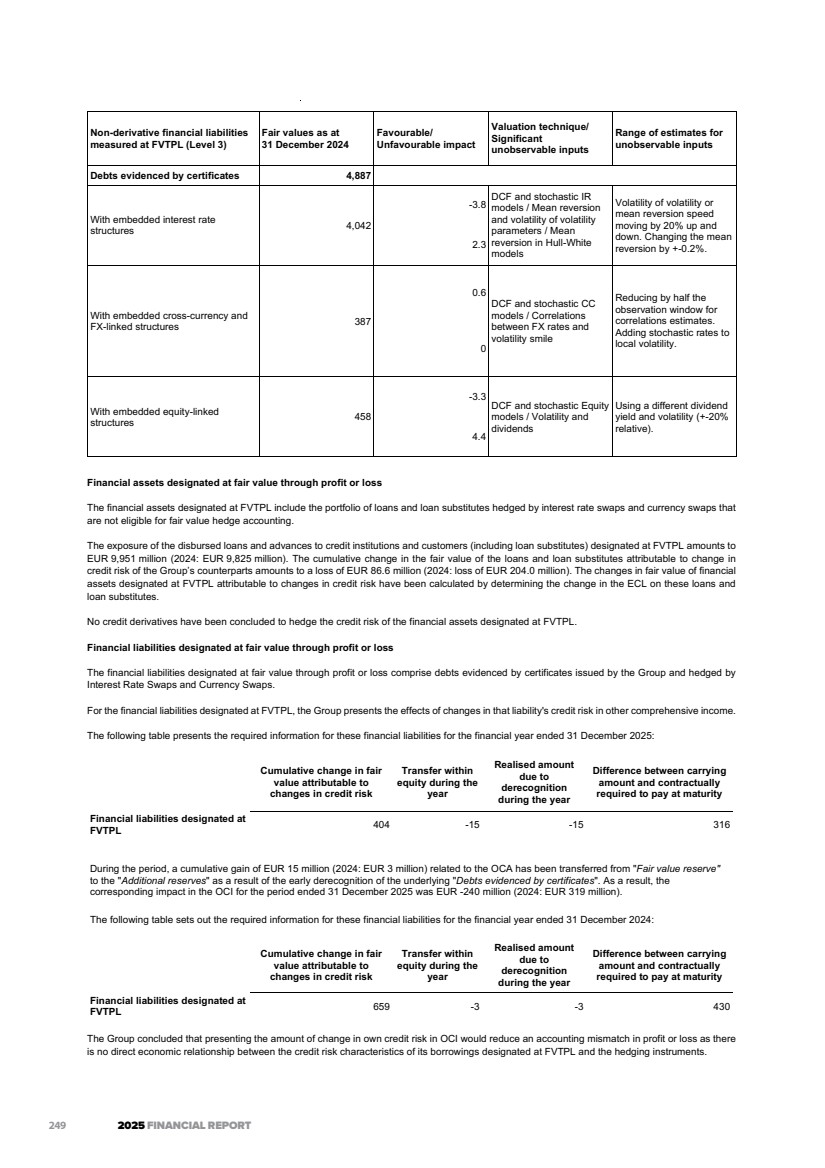
| EIB GROUP CONSOLIDATED FINANCIAL STATEMENTS UNDER IFRS 63 Offsetting financial assets and financial liabilities The disclosures set out in the tables below include financial assets and financial liabilities that are: • offset in the Group's consolidated balance sheet as per the EIB Group accounting policy; or • subject to a currently legally enforceable master netting arrangement or similar agreement that covers similar financial instruments, irrespective of whether they are offset in the consolidated balance sheet. The similar agreements include global master repurchase agreements. Similar financial instruments include repurchase agreements and reverse repurchase agreements. Financial instruments such as loans and deposits are not disclosed in the tables below unless they are offset in the consolidated balance sheet. The Group's derivative transactions that are not transacted on an exchange are entered into under International Swaps and Derivatives Association (ISDA) Master Agreements. In general, under such agreements the amounts payable by each party on any day for the same transaction and in the same currency are aggregated into a single net amount being payable by one party to the other. In certain circumstances, for example when an event of default occurs, all outstanding transactions under the agreement are terminated, the termination value is assessed and only a single net amount is payable in settlement of all transactions. The Group's repurchase and reverse repurchase transactions are covered by master agreements with netting terms similar to those of ISDA Master Agreements. The above ISDA and similar master netting arrangements do not meet the criteria for offsetting in the consolidated balance sheet. This is because they create a right of set-off for recognised amounts that is enforceable only after termination of outstanding transactions following an event of default, including insolvency or bankruptcy, of either party. The Group receives and deposits collateral in the form of cash and marketable securities in respect of the following transactions: • derivatives; • repurchase and reverse repurchase agreements. Collateral received for OTC derivatives is subject to 1-way ISDA Credit Support Annexes. This means that securities received as collateral can be pledged or sold during the term of the transaction but must be returned on request of the counterparty, if the exposure to that counterparty decreases. The terms also give the Group the right to terminate the related transactions upon the counterparty’s failure to post collateral. Financial assets subject to offsetting, legally enforceable master netting arrangements and similar agreements (in EUR million) Related amounts not offset in the balance sheet 31 December 2025 Gross amounts of recognised financial assets Gross amounts of recognised financial liabilities offset in the balance sheet Net amounts of financial assets presented in the balance sheet Bonds Cash collateral received Net amount Financial assets: Derivative assets held for risk management 22,924 -482 22,442 3,585 411 18,446 Reverse repos 23,256 0 23,256 23,982 0 -726 Financial Guarantees 664 -570 94 0 0 94 Total 46,844 -1,052 45,792 27,567 411 17,814 Related amounts not offset in the balance sheet 31 December 2024 Gross amounts of recognised financial assets Gross amounts of recognised financial liabilities offset in the balance sheet Net amounts of financial assets presented in the balance sheet Bonds Cash collateral received Net amount Financial assets: Derivative assets held for risk management 30,909 -472 30,437 4,832 716 24,889 Reverse repos 21,364 0 21,364 21,968 3 -607 Financial Guarantees 696 -586 110 0 0 110 Total 52,969 -1,058 51,911 26,800 719 24,392 250 |
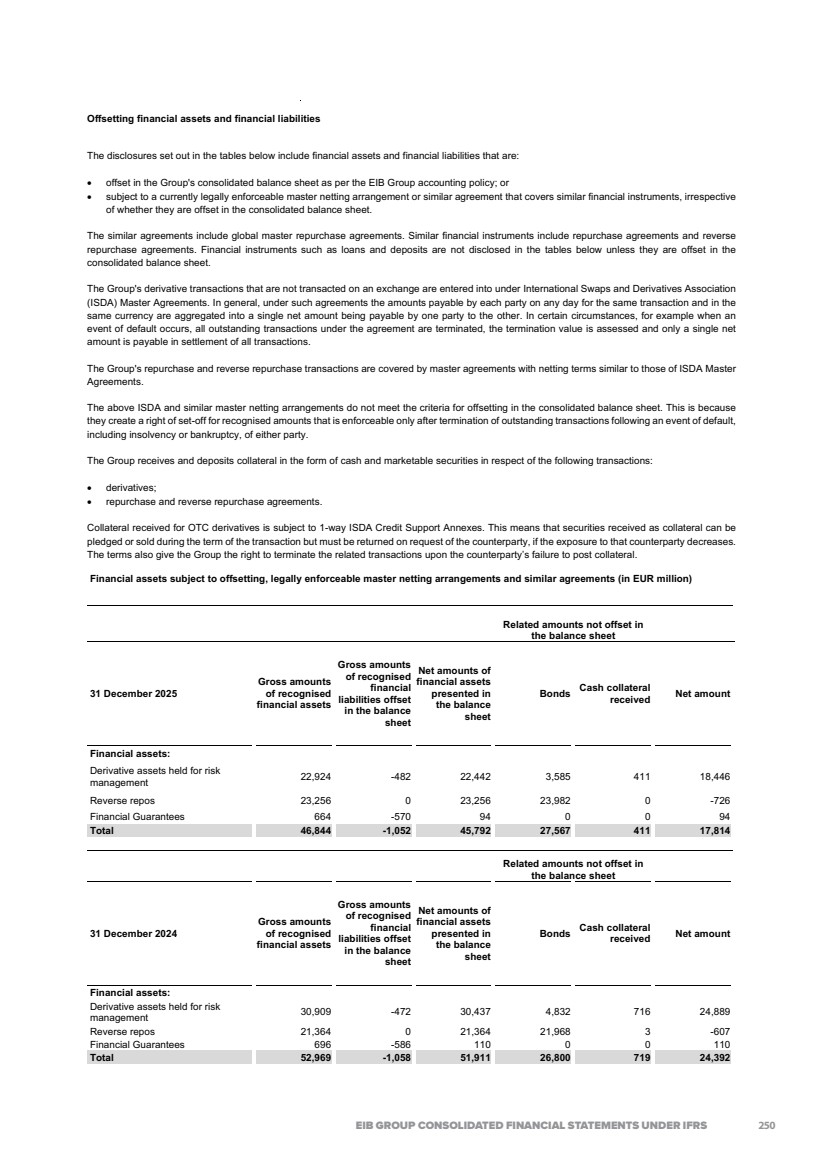
| 2025 FINANCIAL REPORT 64 Financial liabilities subject to offsetting, legally enforceable master netting arrangements and similar agreements (in EUR million) Related amounts not offset in the balance sheet 31 December 2025 Gross amounts of recognised financial liabilities Gross amounts of recognised financial assets offset in the balance sheet Net amounts of financial liabilities presented in the balance sheet Financial instruments Cash collateral pledged Net amount Financial liabilities: Derivative liabilities held for risk management 25,279 -21 25,258 0 0 25,258 Repos 985 0 985 977 0 8 Debts evidenced by certificates 460 -460 0 0 0 0 Financial Guarantees 334 -246 88 0 0 88 Total 27,058 -727 26,331 977 0 25,354 Related amounts not offset in the balance sheet 31 December 2024 Gross amounts of recognised financial liabilities Gross amounts of recognised financial assets offset in the balance sheet Net amounts of financial liabilities presented in the balance sheet Financial collateral Cash collateral pledged Net amount Financial liabilities: Derivative liabilities held for risk management 29,410 -20 29,390 0 0 29,390 Repos 107 0 107 218 0 -111 Debts evidenced by certificates 446 -446 0 0 0 0 Financial Guarantees 309 -222 87 0 0 87 Total 30,272 -688 29,584 218 0 29,366 The gross amounts of financial assets and financial liabilities and their net amounts as presented in the balance sheet that are disclosed in the above tables are measured in the balance sheet on the following bases: • derivative assets and liabilities - fair value; • assets and liabilities resulting from sale and repurchase agreements, reverse sale and repurchase agreements and securities lending and borrowing - amortised cost or fair value; • loans and advances to customers - amortised cost or fair value; • amounts owed to customers - amortised cost; • financial guarantee contracts (see Note A.4.11.). 251 |
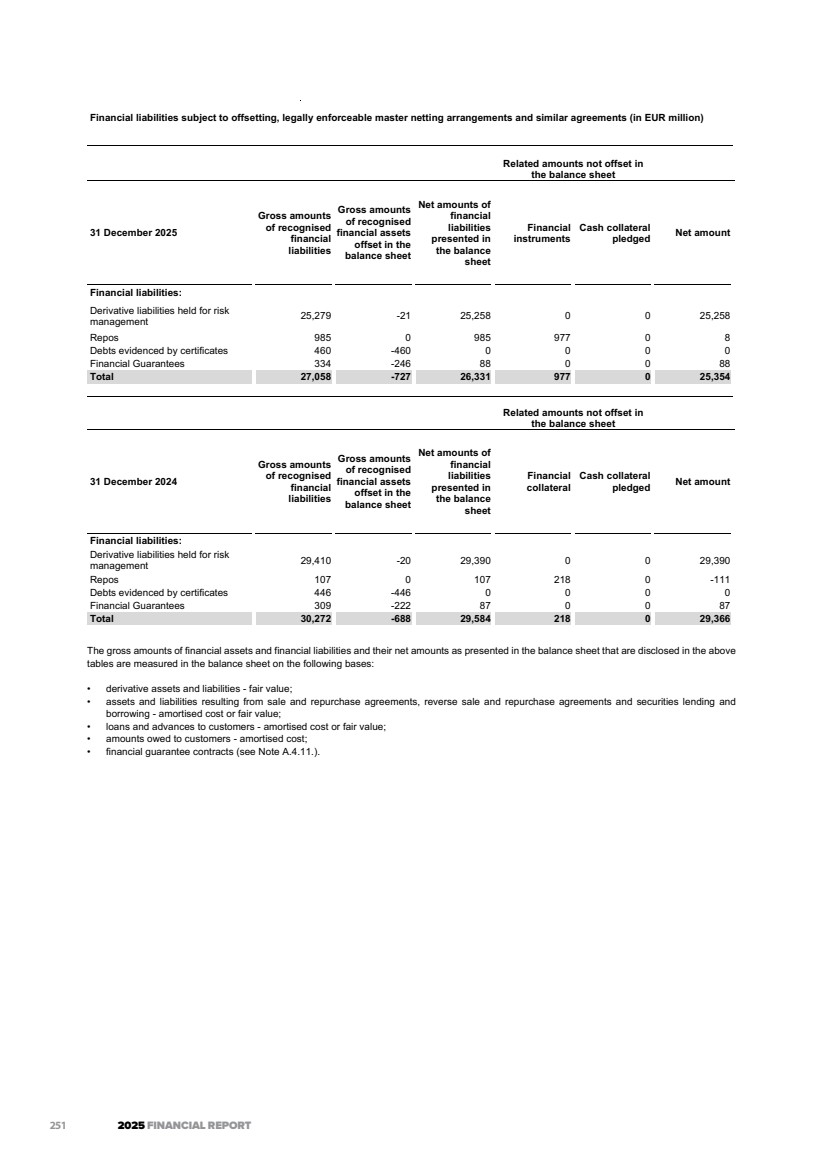
| EIB GROUP CONSOLIDATED FINANCIAL STATEMENTS UNDER IFRS 65 The amounts in the above tables that are offset in the balance sheet are measured on the same basis with the exemption of financial guarantee contracts (Note A.4.11.). The tables below reconcile the net amounts of financial assets and financial liabilities presented in the balance sheet, as set out above, with the line items presented in the balance sheet or the respective captions in Note G (in EUR million). 31 December 2025 Net amounts Line item in consolidated balance sheet Carrying amount on consolidated balance sheet Financial assets not in scope of offsetting disclosures Financial assets: Derivative assets held for risk management 22,442 Derivative assets 22,447 5 Reverse repos 23,256 Loans and advances to credit institutions 121,223 97,967 Financial Guarantees 94 Other assets (Note G) 94 0 31 December 2025 Net amounts Line item in consolidated balance sheet Carrying amount on consolidated balance sheet Financial liabilities not in scope of offsetting disclosures Financial liabilities: Derivative liabilities held for risk management 25,258 Derivative liabilities 26,122 864 Repos 985 Amounts owed to credit institutions 1,431 446 Debts evidenced by certificates 0 Debts evidenced by certificates 431,565 431,565 Financial Guarantees 88 Provisions for guarantees and commitments / Other Liabilities (Note D.4) 88 0 31 December 2024 Net amounts Line item in consolidated balance sheet Carrying amount on consolidated balance sheet Financial assets not in scope of offsetting disclosures Financial assets: Derivative assets held for risk management 30,437 Derivative assets 30,457 20 Reverse repos 21,364 Loans and advances to credit institutions 131,407 110,043 Financial Guarantees 110 Other assets (Note G) 110 0 31 December 2024 Net amounts Line item in consolidated balance sheet Carrying amount on consolidated balance sheet Financial liabilities not in scope of offsetting disclosures Financial liabilities: Derivative liabilities held for risk management 29,390 Derivative liabilities 30,173 783 Repos 107 Amounts owed to credit institutions 858 751 Debts evidenced by certificates 0 Debts evidenced by certificates 442,061 442,061 Financial Guarantees 87 Provisions for guarantees and commitments / Other Liabilities (Note D.4) 87 0 252 |
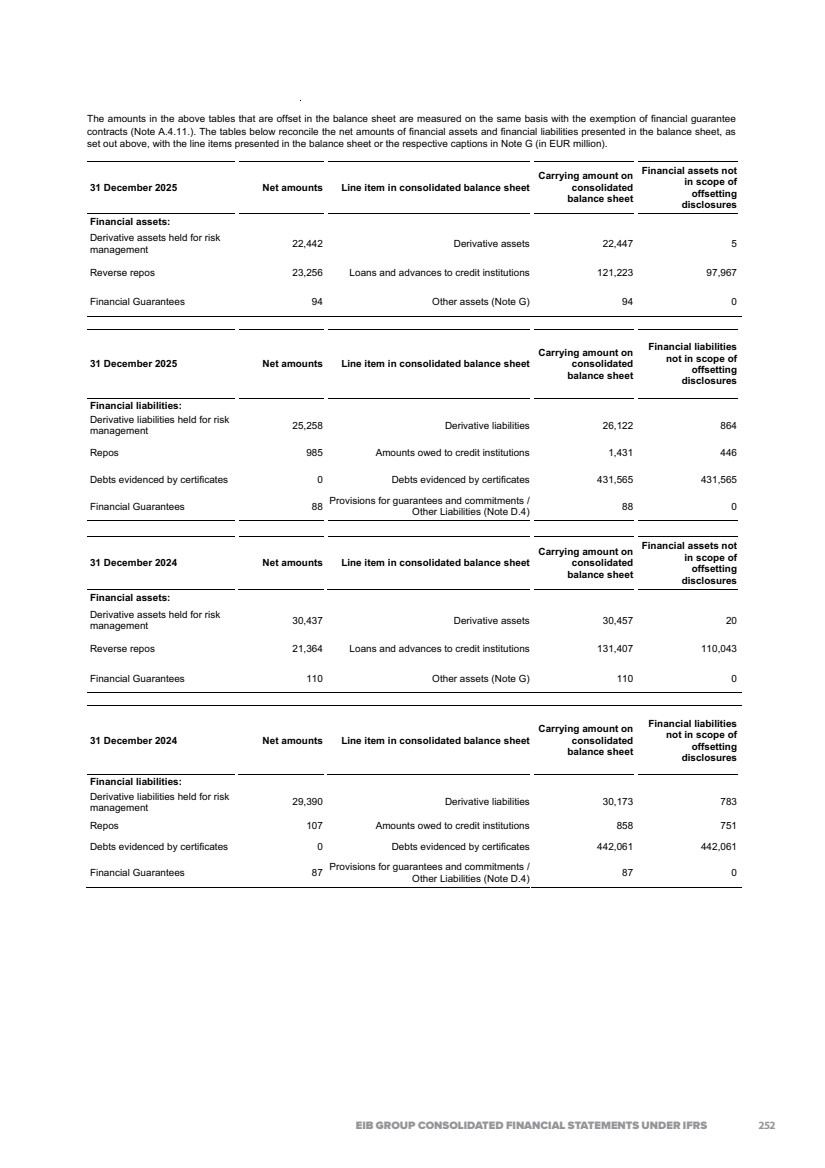
| 2025 FINANCIAL REPORT 66 Note S – Risk management This note presents information about the Group’s exposure to risks and their management and control, in particular the primary risks associated with its use of financial instruments. These are: • Credit risk - the risk of loss resulting from client or counterparty default and arising from credit exposure in all forms, including settlement risk1; • Market risk - the risk of losses on financial investments caused by adverse price movements. Examples of market risk are: changes in equity prices or commodity prices, interest rate moves or foreign exchange fluctuations • Interest rate and credit spread risk in the banking book (IRRBB and CSRBB) - the risk to the economic value or to the net interest income arising from adverse movements in interest rates and market credit spreads that affect interest rates and market credit spread sensitive instruments, respectively. IRRBB includes gap risk, basis risk and option risk; • Foreign exchange risk - the risk to the economic value or to the income derived from the Group’s positions due to adverse movements in currency exchange rates; and • Equity price risk - the risk that the fair values of equities decrease as the result of changes in the levels of equity indices and the value of individual equity investments. • Liquidity and funding risk - the risk that the Group is unable to fund assets or meet obligations at a reasonable price or, in extreme situations, at any price; • Operational risk - the risk of loss resulting from inadequate or failed internal processes, people and systems or from external events2 including, but not limited to, legal risk, model risk or information and communication technology (ICT) risk, but excluding strategic and reputational risk. S.1. Risk management organisation Each entity within the Group carries out its own management and control of risks. Risk management information presented in this note will distinguish between the Bank and the Fund. The high-level principles of the Group’s risk management are set out in the EIB Group Risk Management Charter, which provides a Group-wide view of the Group’s risks and an integrated approach to risk management. The Group has established a Group Risk Function under the responsibility of the Group Chief Risk Officer (‘GCRO’). Without prejudice to the statutory responsibilities of the President and the EIB Management Committee, respectively, the GCRO reports on Group Risks to the EIB Management Committee under the oversight of the MC member in charge of risk. The GCRO participates in all meetings of the EIB Management Committee within their term of reference and relevant meetings of the other EIB governing bodies and is invited to relevant meetings of the EIF Board of Directors and to discussions with the EIF Management. The EIF reports on Group Risk matters to the EIB through the GCRO. Group risk appetite The risk appetite is the level of risk that the Group is willing and able to incur in pursuing its activities in the context of its public mission and objectives. Key to this is the Group’s capacity to provide attractive long-term financing to serve EU objectives across all EU Member States (and beyond in partner countries). A primary pillar of the Group’s business model is the Group’s high credit standing and its status as prime issuer in the capital markets underpinned by the long-term AAA issuer rating from the major credit rating agencies. The processes and activities performed by the Group to manage its risk appetite are formalised in the Group Risk Appetite Framework (‘RAF’) approved by the EIB BoD. The Group RAF covers the major financial risks including credit, liquidity and market risks and non-financial risks including operational risks such as people, information security, financial crime, technology, fraud, compliance and model risks and other risks such as climate change and environmental and reputational risks. It is designed to help embed a healthy organisational risk culture within the Group through implementation and monitoring of measurable risk appetite metrics, which are subject to limits and (where applicable) are cascaded further down within the organisation. As a public financial institution, the Group does not focus on making profits from speculative exposures to risks. As a consequence, the Group does not consider its activities as profit-maximising centres and does not engage in speculative operations. Investment activities are conducted within the primary objective of protection of the capital invested. S.1.1. Risk management organisation of the Bank Extending from the principles set out in the Group Risk Appetite Framework, the Bank’s objective is also to analyse and manage risks so as to obtain the strongest possible protection for its assets, its financial result, and consequently its capital. While the Bank is generally not subject to the legislative acts and guidelines applicable to commercial banks issued or adopted by the EU institutions, bodies and agencies, (“EU Legislative Acts and Guidelines”), it has voluntarily decided to comply with these EU Legislative Acts and Guidelines to the extent determined by its Best Banking Practice framework including the Best Banking Practice Guiding Principles published by the Bank. Within the Bank, the Group Risk and Compliance Directorate (‘GR&C’) independently identifies, assesses, monitors and reports credit, market, liquidity and funding and operational risks to which the Bank is exposed. To preserve the segregation of duties and in accordance with the three lines of defence principle, GR&C is independent and provides second opinions on all proposals made having risk implications. 1 Settlement risk is defined as the risk of potential losses due to transactions which remain unsettled after their due delivery date and/or due to transactions that are settled later than the applicable market standard. Due to the nature of the Group’s operations, the most relevant instruments affected by settlement risk are those derivatives entered into by the Bank which imply an exchange of foreign currencies. Settlement risk management is covered in the Financial Risk Guidelines. 2 The definition of external events excludes cases of client bankruptcy or unfavourable market movements or similar events, which represent triggers for credit and market risk respectively. 253 |
| EIB GROUP CONSOLIDATED FINANCIAL STATEMENTS UNDER IFRS 67 S.1.1.1 Risk measurement and reporting system The Bank continuously adapts its risk management systems to changing economic conditions and evolving regulatory standards as market practice develops. Systems are in place to control and report on the main risks inherent in the Bank’s operations, i.e. credit, interest rate, liquidity and funding, foreign exchange and operational risks. To quantify their impact on the Bank’s solvency, liquidity, earnings and operations, risks are assessed and measured both under normal circumstances and under possible stressed conditions. Risk measurements consider the relevant metrics related to capitalisation, earnings, liquidity and exposure to market and non-financial risks. Information on credit, market, liquidity, financial and operational risks is reported to the Management Committee and to the Board of Directors on a monthly basis. Such information is presented and explained to the Management Committee and to the Board of Directors’ Risk Policy Committee on a regular basis. The Bank has a framework in place for managing interest rate (‘IR’) risk, as well as foreign exchange (FX) risk. It monitors and manages on a daily basis its IR (gap and basis) & FX positions within the pre-approved limits. All new types of transactions introducing operational or financial risks must be authorised by the Management Committee (‘MC’), after their approval by the New Products Committee (‘NPC’). S.1.1.2. Sustainability of revenue and self-financing capacity The Bank’s interest rate risk strategy forms an integral part of its overall financial risk management. It reflects the expectations of the main stakeholders of the Bank in terms of stability of earnings, preservation of the economic value of own funds, and the self-financing of the Bank’s growth in the long term. To achieve these aims, the interest rate risk strategy considers a medium to long-term horizon for the investment of the Bank’s own funds, in order to promote stability of revenues and to enhance overall returns. In practice, this is achieved by defining an investment profile producing a target duration for the Bank’s own funds between 4.5 and 5.5 years. In that context, the Asset & Liability Committee (‘ALCO’) performs regular checks on the investment profile related to the interest rate risk strategy framework. S.1.2. Risk management organisation of the Fund The mandate of the Fund is to support small and medium sized enterprises (‘SMEs’) by financing start-up, growth and development in line with the EU objectives for SMEs. Most of the Private Equity (‘PE’), Venture Capital and Portfolio Guarantees, Securitisation & Microfinance (‘GSM’) operations for both entities of the Group are managed by the Fund. The Fund continuously adapts its risk management systems to changing economic conditions. Credit, market, liquidity and operational risk systems are in place to control and report on the main risks inherent in its operations. The Fund maintains robust risk policies and methodologies to ensure its risk profile remains within the parameters set out in its risk appetite framework. Risk management is embedded in the corporate culture of the EIF, based on a three lines of defence model permeating all areas of the EIF’s business functions and processes: (i) front office, (ii) independent risk functions and (iii) internal and external audit. Transactions Investment and Risk Committee (‘T-IRC’) chaired by Chief Investment Officer advises the Chief Executive and the Deputy Chief Executive on each and every new transaction. Portfolio Investment and Risk Committee (P-IRC) is a regular meeting, chaired by the Chief Risk Officer, which oversees risk and investment-related aspects of the EIF portfolio, inter alia: reviewing transaction rating and grading changes, impairment and provisioning actions and relevant market risk events. Risk and portfolio management actions form part of the assurance process presided by the EIF Audit Board. Moreover, within the EIB Group context, the Fund’s Risk Office operates in regular contact with the Group Risk and Compliance Directorate, particularly with regard to general EIF policy matters, the Group Risk Management Charter and the Group risk exposure relating to Guarantee, securitisation and Private Equity operations under, inter alia, the Bank’s Risk Capital Resources mandate (‘RCR’), the different windows under the EIB Group Risk Enhancement Mandate (‘EREM’) and other guarantee, securitisation and equity mandates. The Fund’s long-term treasury management has been outsourced to the Bank under a treasury management agreement signed by both parties and mandating the responsible EIB services to perform selection, execution, settlement and monitoring of transactions. Management follows the treasury guidelines annexed to the agreement. Operational short-term liquidity management is conducted by the EIF. S.1.2.1. Risk assessment of private equity For its private equity operations, the Fund adopts a fund-of-funds approach, primarily taking minority equity participations in business angels, venture capital, private equity, infrastructure funds and mezzanine funds managed by mostly independent teams. This strategy aims to leverage additional commitments from a wide range of investors. The Fund’s PE operations include investments in venture capital funds across all investment stages (seed, early-stages, late stages, growth, etc.) as well as investments in mid-market funds or mezzanine funds, which, generally, have a lower risk profile. The Fund has developed a toolset to design, manage and monitor portfolios of PE funds tailored to the dynamics of this marketplace. Before committing to a PE fund, the EIF assigns an equity score which is based on the outcome of an extensive due diligence performed by its transaction team and reviewed by its risk management team. The funds are monitored by the Fund’s transaction team with a frequency and intensity depending on the underlying level of risk and equity scores are annually reviewed by its risk management team. These efforts, supported by the development of a proprietary IT system and integrated software (front to back), improve the investment decision-making process and the management of the portfolio’s financial risks. 254 |
| 2025 FINANCIAL REPORT 68 S.1.2.2. Risk assessment of guarantees and securitisations The EIF extends portfolio guarantees to financial intermediaries involved in SME financing and participates in SME securitisation transactions. By taking on these risks, it facilitates access to funding and/or reduces the cost of capital for originators, and, in turn, it improves the conditions and facilitates access to finance to SMEs. For its guarantee and securitisation business, over the last years, the Fund has developed internal methodologies and models to analyse portfolio guarantees and structured finance transactions in line with best market practices. Before the Fund legally enters into a guarantee transaction, an internal rating is assigned to each new own risk guarantee transaction in accordance with its internal methodology. The rating is based on internal models, which analyse and summarise the transaction’s credit quality (expected loss concept), incorporating both quantitative parameters and qualitative aspects. A four-eyes principle applies throughout the process, with actions initiated by the front office and reviewed by Risk Management. Guarantee transactions are monitored regularly, at least quarterly; their statuses are regularly reviewed by EIF P-IRC. Depending on their performances, this may lead to a review of their internal ratings. This process of reassessing the ratings is done by the first line of defence and reviewed by the second line in line with the 3 lines of defence model of the EIF. The EIF’s monitoring follows potential negative or positive rating migrations and provides the basis for appropriate management of transactions. The Fund’s stress testing methodology for guarantees and securitisations is applied at the outset of a transaction and throughout the life of the portfolio and is integrated in the EIB Group Stress Testing activities. The following sections disclose the credit, market, liquidity and funding and operational risks to which the Bank is exposed. For additional details, please refer to the latest annual EIB Group Risk Management Disclosure Report available on the EIB website. S.2. Credit risk S.2.1. Credit risk policies Credit risk mainly concerns the Group’s lending activities, treasury instruments such as debt securities, certificates of deposit and interbank term deposits and the derivative and guarantee transactions of the Group. Credit risk within the Bank is managed in line with detailed internal guidelines. The purpose of these guidelines is to ensure the prudent management of credit risk. Whether or not a given entity is acceptable to the Bank as a counterpart in a lending operation is determined through a careful analysis and evaluation of the entity using quantitative and qualitative metrics but also relying on experience and expert judgment. These guidelines set out minimum credit quality levels for both borrowers and guarantors in lending operations and identify the acceptable transaction structure. They also detail the minimum requirements that loan contracts must meet in terms of key legal clauses and other contractual stipulations to ensure that the Bank's position is adequately safeguarded. Diversification of the loan portfolio is supported by a counterparty limit framework, sector limits for key industries and country thresholds for its exposures outside of the EU. To ensure that the additional risk involved in complex or structured lending transactions is adequately analysed, quantified and mitigated, specific detailed guidelines have been developed in respect of certain types of operations complementing the general guidelines. In analysing risks, the Bank applies an internal loan grading system and assigns internal ratings to counterparts. The Fund manages exposures and risks in accordance with conservative policies deriving from statutory provisions and credit risk operational guidelines approved by the Fund’s Board of Directors or guidelines established under mandates. Credit guidelines undergo periodic revisions to reflect evolving operational circumstances, changes in the applicable Best Banking Principles and new mandates that the Group may receive. 255 |
| EIB GROUP CONSOLIDATED FINANCIAL STATEMENTS UNDER IFRS 69 S.2.2. Credit risk exposure and allowances to credit risk S.2.2.1. Maximum exposure to credit risk without taking into account any collateral and other credit enhancements The table below shows the maximum exposure to credit risk for the components of the consolidated balance sheet, including derivatives. The maximum exposure is shown gross, before the effect of mitigation through the use of collateral agreements. Maximum exposure (in EUR million) 31.12.2025 31.12.2024 Financial assets: Financial assets measured at AC 501,845 506,235 Financial assets mandatorily measured at FVTPL 11,850 10,318 Derivative assets 22,447 30,457 Financial assets designated at FVTPL 11,946 12,014 Total 548,088 559,024 Off-balance-sheet: Contingent liabilities and guarantees 36,233 32,210 Commitments - Undisbursed loans 133,563 128,020 Total 169,796 160,230 Total credit risk exposure(*) 717,884 719,254 (*) Exposures on equity investments have been excluded as they carry no credit risk. S.2.2.2 Summary of credit risk allowances The following tables show the breakdown of the credit risk allowances in accordance with the ECL IFRS 9 model for financial assets measured at amortised cost and the off-balance sheet commitments (in EUR ‘000). 2025 12-month ECL Lifetime ECL not credit - impaired Lifetime ECL impaired Total Financial assets measured at amortised cost Loans and advances to credit institutions and customers (D.2.) 86,671 131,075 454,464 672,210 Treasury bills and debt securities portfolios (B.2.) 3,478 11,496 0 14,974 Off-Balance sheet commitments Financial Guarantees (D.4.) 76,986 123 11,727 88,836 Loan commitments measured at amortised cost (D.2.) 15,485 85,738 0 101,223 Loss allowance / Provision 182,620 228,432 466,191 877,243 2024 12-month ECL Lifetime ECL not credit - impaired Lifetime ECL impaired Total Financial assets measured at amortised cost Loans and advances to credit institutions and customers (D.2.) 77,965 137,035 352,635 567,635 Treasury bills and debt securities portfolios (B.2.) 5,743 1,929 0 7,672 Off-Balance sheet commitments Financial Guarantees (D.4.) 77,136 146 9,482 86,764 Loan commitments measured at amortised cost (D.2.) 26,310 25,552 13,045 64,907 Loss allowance / Provision 187,154 164,662 375,162 726,978 256 |
| 2025 FINANCIAL REPORT 70 S.2.3. Credit risk on loans S.2.3.1. Credit risk measurement for loans and advances to credit institutions and customers An internal loan grading system (based on the expected loss methodology) is implemented for lending operations. This is an important part of the loan appraisal process and of credit risk monitoring, and provides a reference point for pricing credit risk when appropriate. The loan grading (‘LG’) system comprises the methodologies, processes, databases and IT systems supporting the assessment of credit risk in lending operations and the quantification of expected loss estimates. It summarises a large amount of information with the purpose of offering a relative ranking of loans’ credit risks. LG reflects the present value of the estimated level of the lifetime “expected loss”, this being the net present value of the product of the probability of default, the loan exposure at risk and the loss given default. LG is used for the following purposes: • as an aid to a finer and more quantitative assessment of lending risks; • as indicator of credit risk variations for the purposes of prioritising monitoring efforts; • as a description of the loan’s portfolio quality at a given date; • as a benchmark for calculating the annual additions to the General loan reserve and Special Activities Reserve; and • as an input in risk-pricing decisions. The following factors are used to determine a LG: i) The borrower’s creditworthiness: GR&C independently reviews borrowers and assesses their creditworthiness based on internal methodologies and external data. In line with the regulatory Internal Ratings Based approach adopted, the Bank has developed an internal rating methodology to determine the internal ratings of borrowers and guarantors. This is based on a set of scoring sheets specific to defined counterparty types. ii) The default correlation: it quantifies the chances of simultaneous financial difficulties arising for both the borrower and the guarantor. The higher the correlation between the borrower and the guarantor’s default, the lower the value of the guarantee and therefore the lower (worse) the LG. iii) The value of guarantee instruments and securities: this value is assessed on the basis of the combination of the issuer’s creditworthiness and the type of instrument used. iv) The applicable recovery rate: the amount assumed to be recovered following a default by the relevant counterpart expressed as a percentage of the relevant loan exposure. v) The contractual framework: a sound contractual framework will add to the loan’s quality and enhance its LG. vi) The duration of the loan or, more generally, the cash-flows of the loan: all else being equal, the longer the loan, the higher the risk of incurring difficulties in the servicing of the loan. A loan's expected loss is calculated by combining the six elements above and determines the fair value of loans which meet the eligibility criteria of the amended fair value option and which have been designated on initial recognition at fair value through profit or loss. Depending on the level of this expected loss, a loan is assigned to one of the following LG classes listed below. “A0” comprising loans with EU sovereign "risks” that is loans granted to, or fully, explicitly and unconditionally guaranteed by, Member States where no repayment difficulties are expected, i.e. expected loss of 0% (based on the Bank’s preferred creditor status and statutory protection which are deemed to assure a full recovery of the Bank’s assets upon maturity) as well as loans with a comprehensive EU or Member States guarantee. “A” comprising loans granted to (or guaranteed by) entities other than EU Member States in respect of which there is no or only limited expectation of deterioration in quality over their term. “B” High quality loans: are an asset class with which the Group feels comfortable, although a minor deterioration is not ruled out in the future. B+ and B- are used to denote the relative likelihood of the possibility of such deterioration occurring. “C” Good quality loans include, for example, "single signature" (unsecured) loans to solid corporates (e.g. equivalent internal rating of Baa1/BBB+), with a reasonable maturity and adequate protective clauses. “D” This grading class represents (aside from loans initially approved at this level) the borderline exposure that have a risk profile generally accepted by the Bank. This watershed in loan grading is more precisely determined by the sub-classifications D+ and D-. “E” includes loans that (aside from Special Activity operations initially approved at these levels), in the course of their lives, have experienced severe problems and their sliding into a situation of loss cannot be excluded. The sub-classes E+ and E- further differentiate the risk profile of the loans, with those operations graded E- being in a position where there is a strong possibility that debt service cannot be maintained on a timely basis and therefore some form of debt restructuring is required, possibly leading to an impairment loss. “F” (fail) denotes loans representing unacceptable risks. In general, F-graded loans can only arise out of outstanding transactions that have experienced unforeseen, exceptional and dramatic adverse circumstances after signature. Operations where there is a loss of principle to the Group will be graded F and specific provisions is applied. The Group’s assessment of the IFRS9 staging is based on a sequential approach that uses counterparty or instrument specific information consistent with internal guidelines and procedures. In addition to the deal-by-deal analysis of each loan, the Group, also developed a portfolio view of credit exposures via its Economic Capital framework, integrating the concentration and correlation effects created by the dependence of various obligors on common risk factors. By adding a portfolio dimension of credit risks and by focusing on unexpected losses (i.e. losses which may occur on top of the expected ones up to a certain level of confidence), it is possible to complement the LG’s deal-by-deal approach and thus provide a finer and more comprehensive risk assessment of the credit risks in the Group’s loan book. 257 |
| EIB GROUP CONSOLIDATED FINANCIAL STATEMENTS UNDER IFRS 71 The aggregate amount of outstanding loans and guarantees granted by the Group is limited at any time by its Statutory Gearing Ratio (Article 16.5 of the Statute)3. To calculate this ratio, the Bank uses data drawn from the EU Accounting Directives (‘AD’) framework. At year-end 2025 the EIB’s Statutory Gearing Ratio under EU Accounting Directive standalone accounts stood at 213.4% (2024: 210.3%) and under EUAD consolidated accounts at 220.1% (2024: 215.9%). S.2.3.2. Loans secured by guarantees of the European Union or the Member States under the External Lending Mandate (‘ELM’), the European Fund for Sustainable Development (‘EFSD’), the Neighbourhood, Development and International Cooperation Instrument - Investment Window 1 (‘NDICI IW1’) and Investment Window 4 (‘NDICI IW4’), the European Fund for Sustainable Development Plus (‘EFSD+’), the Ukraine Facility - Public Sector Guarantee, and the Cotonou Agreement These guarantees are either to cover all risks or limited to defined political risks (non-transfer of currency, expropriation, war or civil disturbance, denial of justice upon breach of contract). In accordance with the terms of the guarantees, the European Union and the Member States provide credit enhancements up to 65% and more of the pool of signed4 operations in each portfolio. Under the comprehensive guarantees, the Group deems the credit risk associated with each individual loan as fully covered for the purpose of the specific risks described above and therefore excludes them from section S.2.3 (Credit risk on loans)5. The carrying value of the disbursed part of loans secured by guarantees of the European Union or the Member States amounts to EUR 29,211 million as at 31 December 2025 (2024: EUR 30,920 million) and the undisbursed part amounts to EUR 19,699 million as at 31 December 2025 (2024: EUR 20,486 million). These amounts also include loans granted to current EU Member States before their accession to the European Union and are guaranteed by the European Union or Member States. 3 In June 2024, the EIB Board of Governors unanimously decided to increase the Gearing Ratio of the Bank from 250% to 290%. This decision was subsequently approved by the Council of the European Union in March 2025 to enable the Bank to deliver on the priorities and goals set out in the Strategic Roadmap. The new Gearing Ratio limit entered into force in March 2025. This increase also applies to the consolidated accounts of the Bank. 4 Under the guarantee agreement with the Commission signed on 1 and 29 August 2007, all European Union guaranteed operations signed on and after 17 April 2007 shall be covered up to 65% of "the aggregate amount of credits disbursed". Credit enhancements are provided in the form of first-loss protection. The residual risk borne by the Group in connection with the portfolio of operations covered by such guarantee is managed in accordance with the EIB’s internal credit risk guidelines and procedures. 5 The exposures signed under the guarantees of the European Union or the Member States for which the credit risk is deemed as fully covered amounts to EUR 47,958 million (2024: EUR 49,959 million). 258 |
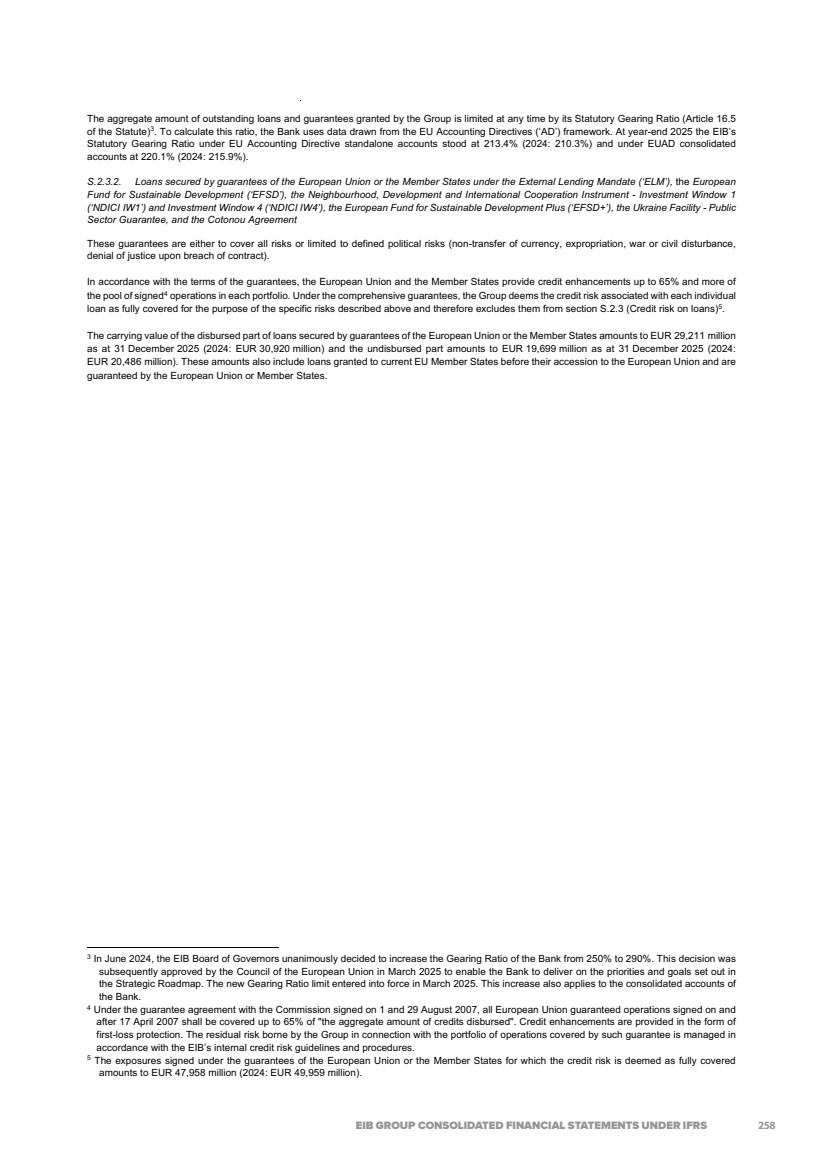
| 2025 FINANCIAL REPORT 72 S.2.3.3. Analysis of lending credit risk exposure The tables below show the maximum exposure to credit risk on loans signed and disbursed (the repayable on demand and other loans and advances to credit institutions and to customers are not included) as well as the part of the exposure that has been signed but not disbursed yet for all exposure where the Group is at risk. Therefore, loans beyond the European Union secured by the comprehensive guarantee of the EU budget or the Member States are not included (Note S.2.3.2). 2025 Guarantor Not guaran-teed(1) Total disbursed Signed not (in EUR million) Corporates Banks disbursed Public institutions States Borrower Corporates 32,761 5,727 3,779 6,994 105,967 155,228 43,578 Banks 6,576 9,476 15,420 24,092 26,777 82,341 25,979 Public institutions 291 174 19,864 26,774 75,173 122,276 32,374 States 0 0 0 0 47,543 47,543 11,934 Total disbursed(2)(3)(4)(5) 39,628 15,377 39,063 57,860 255,460 407,388 Signed not disbursed(2)(4)(5) 9,324 3,756 7,882 12,725 80,178 113,865 2024 Guarantor Not guaran-teed(1) Total disbursed Signed not (in EUR million) Corporates Banks disbursed Public institutions States Borrower Corporates 34,520 5,430 4,144 6,220 102,757 153,071 35,783 Banks 7,412 9,794 15,732 26,621 25,501 85,060 28,570 Public institutions 134 192 19,748 28,273 73,222 121,569 32,631 States 0 0 0 0 46,936 46,936 10,695 Total disbursed(2)(3)(4)(5) 42,066 15,416 39,624 61,114 248,416 406,636 Signed not disbursed(2)(4)(5) 9,198 3,411 7,945 10,729 76,396 107,679 (1) These amounts include loans for which no formal guarantee independent from the borrower or the loan itself was required, as the borrower’s level of solvency itself represents adequate security. In specific circumstances, appropriate contractual clauses ensure the Group’s right to access independent security. (2) The loans in risk-sharing operations (credit enhanced by the Member States or the EU budget in the form of a political risk guarantee) amount to EUR 952 million as at 31 December 2025 (2024: EUR 1,444 million). (3) These amounts do not include loan substitutes (2025: EUR 19,538 million; 2024: EUR 19,960 million). (4) These amounts exclude loans to current EU Member States granted before their accession to the European Union and guaranteed by the European Union budget or the Member States. (5) The Group has signed, in the context of the EFSI SME window agreement, the European Guarantee Fund and Invest EU, funding lines for a total commitment not exceeding EUR 17,887 million (2024: EUR 17,871 million). The Group recognises an undisbursed exposure when a firm commitment is signed with the respective underlying risk counterpart, for which the funding line is expected to be drawn. Regarding its lending activities, the Group’s total direct exposure6 to the banking sector amounts to EUR 108,320 million at the end of December 2025 (2024: EUR 113,630 million), which is equal to 20.78% (2024: 22.09%) of the total of EUR 521,253 million in loans disbursed and undisbursed as at 31 December 2025 (2024: EUR 514,315 million). Unsecured loans to corporates as at the end of December 2025 amounted to EUR 137,932 million, (2024: EUR 128,247 million). Unsecured exposure to corporate clients is managed in accordance with a specific framework. S.2.3.3.1. Credit quality on loans Loans internally graded7 A to D+ represent 97.7% of the loan portfolio as at 31 December 2025, compared with 96.9% at 31 December 2024. The share of loans internally graded D- and below was 2.3% (2024: 3.2%) of the loan portfolio, corresponding to EUR 12.1 billion (2024: EUR 16.2 billion). Despite ongoing heightened geopolitical risks and some sectors particularly affected by subdued economic development, the overall credit quality of the loan portfolio is deemed stable at present. Preserving the quality of loan portfolio is enabled by a risk management strategy, based on a comprehensive due diligence process, adequate lending structures and security, and standard protective clauses included in the loan agreements. In addition to the collaterals and the guarantees provided for lending exposures, some of the EIB exposures benefit from credit enhancements granted as part of different mandates. Moreover, the Bank established a loan portfolio monitoring framework allowing for timely risk management decisions. To mitigate credit risk, the Group uses, among others: • Guarantees issued by third parties of acceptable credit quality; • Financial collaterals; • Claims on revenues; • Contractual clauses etc. 6 Including exposure signed but not disbursed yet. 7 Loan grading reflects the credit enhancement provided by external guarantors on a portfolio basis. 259 |
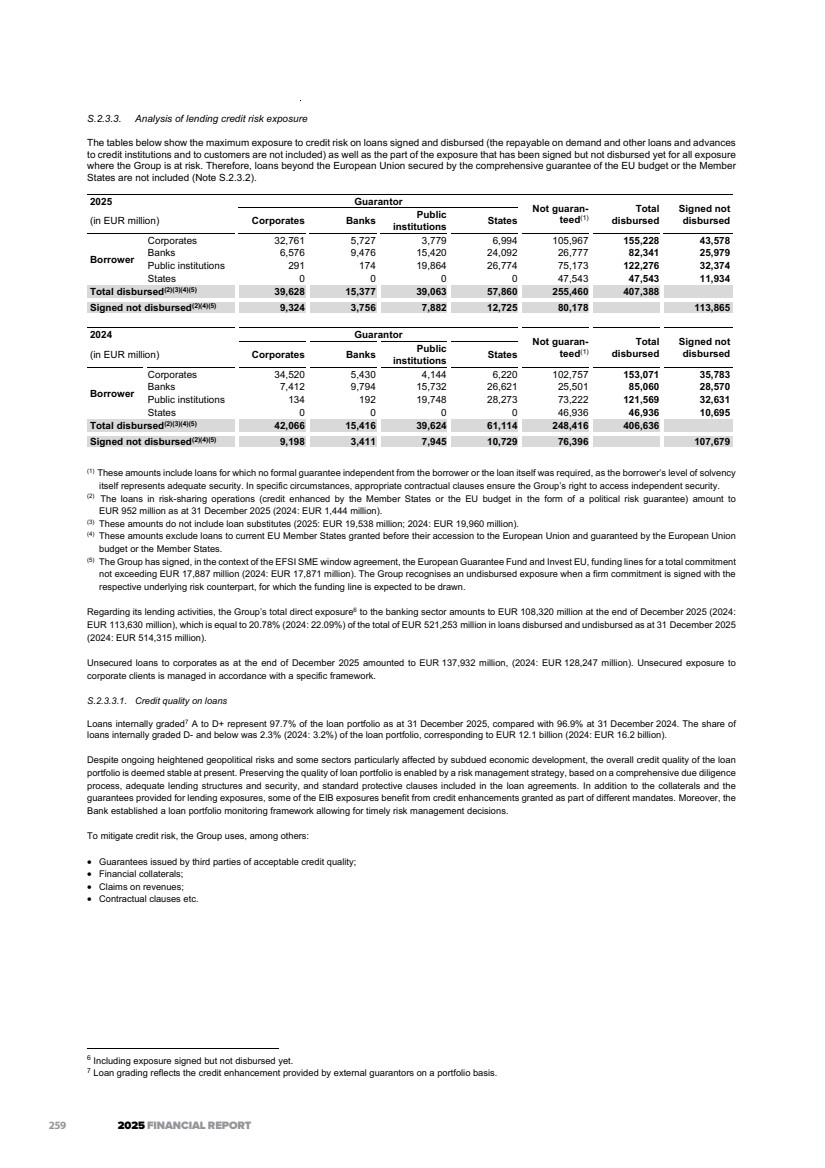
| EIB GROUP CONSOLIDATED FINANCIAL STATEMENTS UNDER IFRS 73 Credit quality analysis per type of borrower The tables below show the credit quality analysis of the Group’s loan portfolio as at 31 December 2025 and 31 December 2024 by the Loan Grading application, based on the exposures signed (disbursed and undisbursed). 2025 Sovereign High Grade Standard Grade Min. Accept. Risk High Risk Equity type risk Total ECL (in EUR million) A0 A to B- C D+ D- and below Disbursed loans Stage 1 94,762 241,907 25,538 9,998 3,072 0 375,277 87 Stage 2 1,668 8,717 590 1,079 2,103 0 14,157 131 Stage 3 0 2,342 0 0 1,090 0 3,432 454 Against FVTPL 1,464 8,451 1,192 335 571 2,509 14,522 n/a TOTAL 2025 97,894 261,417 27,320 11,412 6,836 2,509 407,388 672 2025 Sovereign High Grade Standard Grade Min. Accept. Risk High Risk Equity type risk Total ECL (in EUR million) A0 A to B- C D+ D- and below Undisbursed loans Stage 1 19,463 62,607 16,194 6,091 3,679 0 108,034 15 Stage 2 290 1,036 38 11 1,343 0 2,718 86 Stage 3 0 430 0 0 216 0 646 0 Against FVTPL 0 0 0 0 0 2,467 2,467 n/a TOTAL 2025 19,753 64,073 16,232 6,102 5,238 2,467 113,865 101 2024 Sovereign High Grade Standard Grade Min. Accept. Risk High Risk Equity type risk Total ECL (in EUR million) A0 A to B- C D+ D- and below Disbursed loans Stage 1 97,735 232,345 31,957 10,333 3,504 n/a 375,874 78 Stage 2 1,970 7,832 855 1,127 2,430 n/a 14,214 137 Stage 3 1 1,211 6 0 1,017 n/a 2,235 353 Against FVTPL 940 8,563 1,402 445 716 2,247 14,313 n/a TOTAL 2024 100,646 249,951 34,220 11,905 7,667 2,247 406,636 568 2024 Sovereign High Grade Standard Grade Min. Accept. Risk High Risk Equity type risk Total ECL (in EUR million) A0 A to B- C D+ D- and below Undisbursed loans Stage 1 17,287 49,660 18,652 10,193 7,903 n/a 103,695 26 Stage 2 0 651 330 11 440 n/a 1,432 26 Stage 3 0 33 116 0 108 n/a 257 13 Against FVTPL 0 0 0 0 0 2,295 2,295 n/a TOTAL 2024 17,287 50,344 19,098 10,204 8,451 2,295 107,679 65 Credit risk exposure for each internal risk rating The Group uses an internal rating methodology in line with the Internal Ratings Based approach as per the European prudential regulatory framework. The majority of the Group’s counterparties have been assigned an internal rating according to this methodology. The table below shows a breakdown of the Group’s loan portfolio by the better of the borrower’s or guarantor’s internal ratings, where available. In cases where an internal rating is not available, the external rating has been used for this analysis. The table shows the exposures signed (disbursed and undisbursed), based on an internal methodology that the Group uses for limit management. 260 |
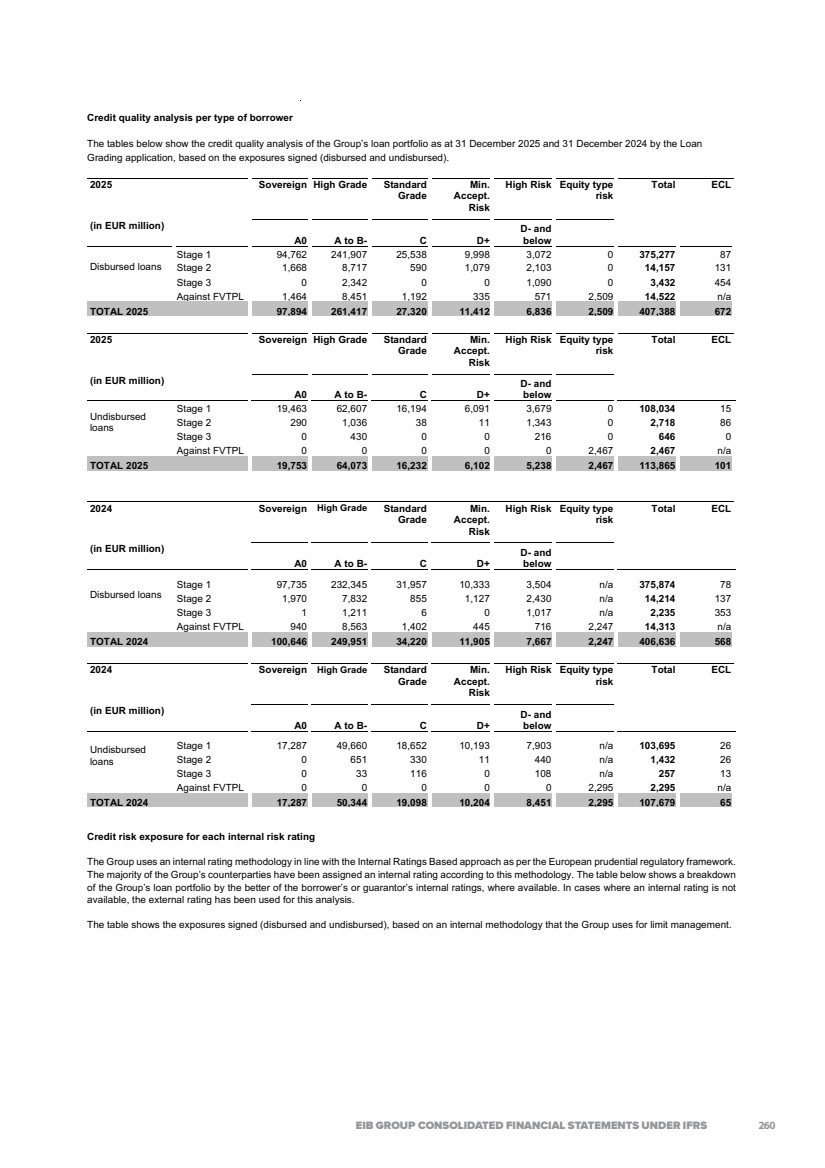
| 2025 FINANCIAL REPORT 74 2025 (in EUR million) 12-month ECL measured at AC Lifetime ECL not credit-impaired measured at AC Lifetime ECL credit-impaired measured at AC FVTPL Total Loans and advances to credit institutions and customers Internal Rating 1 - minimal credit risk 7,882 0 80 0 7,962 Internal Rating 2 - very low credit risk 35,991 89 181 1,922 38,183 Internal Rating 3 - low credit risk 154,451 1,803 16 2,203 158,473 Internal Rating 4 - moderate credit risk 149,774 2,377 0 6,192 158,343 Internal Rating 5 - financially weak counterpart 24,997 7,355 0 1,140 33,492 Internal Rating 6 - high credit risk 2,131 2,151 2 457 4,740 Internal Rating 7 - very high credit risk 50 382 10 15 457 Internal Rating 8 - counterpart in default 0 0 3,143 86 3,229 Loans and advances to credit institutions and customers measured at FVTPL n/a n/a n/a 2,509 2,509 Carrying amount 375,277 14,157 3,432 14,522 407,388 Loss allowance -87 -131 -454 n/a -672 Loan commitments Internal Rating 1 - minimal credit risk 2,189 0 0 0 2,189 Internal Rating 2 - very low credit risk 9,912 0 0 0 9,912 Internal Rating 3 - low credit risk 42,216 158 0 0 42,374 Internal Rating 4 - moderate credit risk 37,977 415 28 0 38,420 Internal Rating 5 - financially weak counterpart 13,141 993 0 0 14,133 Internal Rating 6 - high credit risk 2,456 887 0 0 3,343 Internal Rating 7 - very high credit risk 144 264 5 0 413 Internal Rating 8 - counterpart in default 0 0 613 0 613 FVTPL n/a n/a n/a 2,467 2,467 Carrying amount 108,034 2,718 646 2,467 113,865 Loss allowance -15 -86 0 n/a -101 2024 (in EUR million) 12-month ECL measured at AC Lifetime ECL not credit-impaired measured at AC Lifetime ECL credit-impaired measured at AC FVTPL Total Loans and advances to credit institutions and customers Internal Rating 1 - minimal credit risk 7,193 1 95 0 7,289 Internal Rating 2 - very low credit risk 50,883 234 60 1,751 52,928 Internal Rating 3 - low credit risk 140,053 1,796 16 1,856 143,721 Internal Rating 4 - moderate credit risk 150,089 1,894 5 6,405 158,393 Internal Rating 5 - financially weak counterpart 25,244 7,192 0 1,217 33,653 Internal Rating 6 - high credit risk 2,379 3,011 7 565 5,962 Internal Rating 7 - very high credit risk 33 78 71 20 202 Internal Rating 8 - counterpart in default 0 8 1,981 252 2,241 Loans and advances to credit institutions and customers measured at FVTPL n/a n/a n/a 2,247 2,247 Carrying amount 375,874 14,214 2,235 14,313 406,636 Loss allowance -78 -137 -353 n/a -568 Loan commitments Internal Rating 1 - minimal credit risk 2,056 0 0 0 2,056 Internal Rating 2 - very low credit risk 16,160 0 0 0 16,160 Internal Rating 3 - low credit risk 33,478 274 0 0 33,752 Internal Rating 4 - moderate credit risk 34,616 31 28 0 34,675 Internal Rating 5 - financially weak counterpart 13,113 634 0 0 13,747 Internal Rating 6 - high credit risk 4,133 333 0 0 4,466 Internal Rating 7 - very high credit risk 139 160 5 0 304 Internal Rating 8 - counterpart in default 0 0 224 0 224 FVTPL n/a n/a n/a 2,295 2,295 Carrying amount 103,695 1,432 257 2,295 107,679 Loss allowance -26 -26 -13 n/a -65 261 |
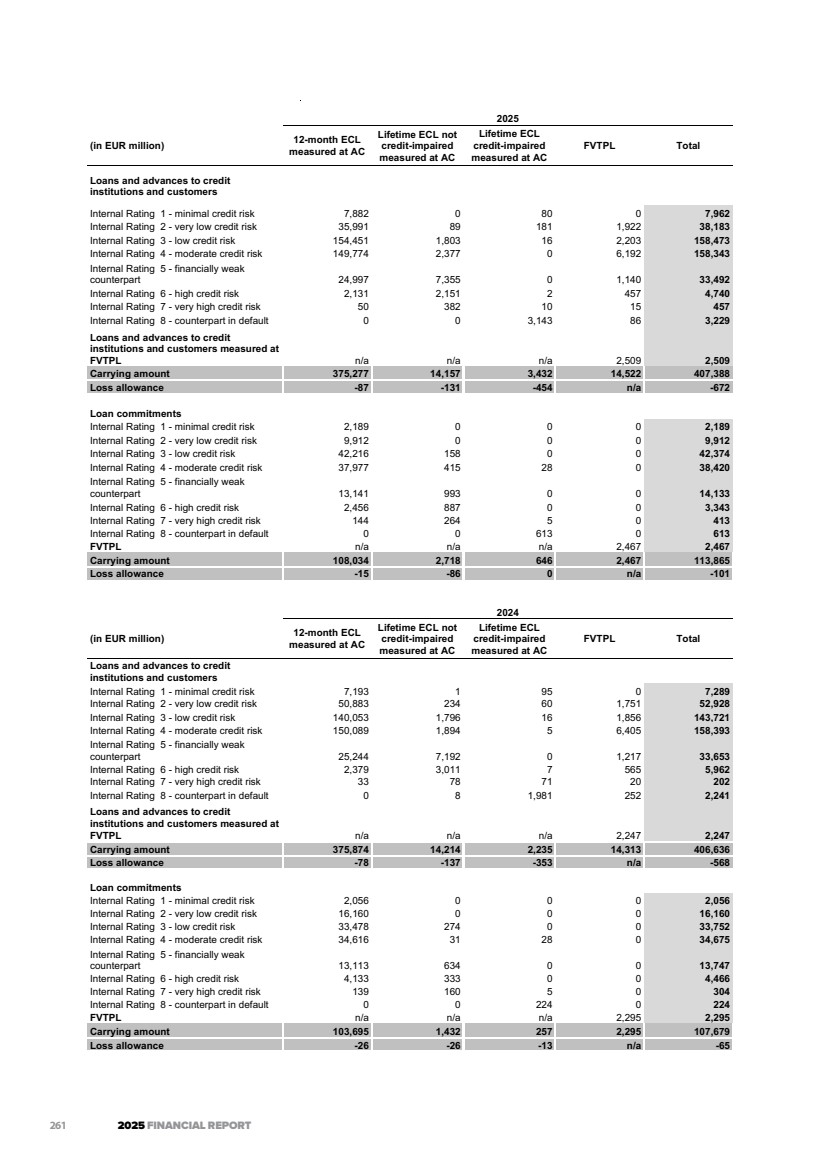
| EIB GROUP CONSOLIDATED FINANCIAL STATEMENTS UNDER IFRS 75 The Group continually monitors events affecting its borrowers and guarantors. In particular, the Group assesses on a case-by-case basis its contractual rights in the event of a rating deterioration seeks mitigating measures. It also closely monitors the renewals of bank guarantees received for its loans to ensure that these are replaced or action is taken in a timely manner when necessary. The Group did not record impairments in respect of its EU sovereign and EU sovereign guaranteed exposure at year-end as the preferred creditor status of the Bank and of the EIF and the protection given by the Bank’s Statute are deemed to guarantee a full recovery of the Group’s assets on maturity. The table below discloses information regarding the sovereign credit risk on loans, apart from loans beyond the European Union benefiting from EU budget or MS guarantees, where the Bank has either full own risk or bears a residual risk due to credit enhancement: (in EUR million) 2025 2024 Acting as borrower Acting as guarantor Acting as borrower Acting as guarantor Country Disbursed Undisbursed Signed Disbursed Undisbursed Signed Austria 0 0 116 0 0 125 Belgium 0 0 244 0 0 257 Bulgaria 1,136 250 297 968 250 298 Croatia 938 157 1,833 866 292 1,996 Cyprus 898 757 876 966 442 975 Czech Republic 2,914 861 0 1,998 913 0 Denmark 0 0 116 0 0 242 Estonia 407 490 62 476 490 70 Finland 0 0 87 0 0 97 France 0 0 3,527 0 0 3,432 Germany 0 0 998 0 0 1,553 Greece 6,083 1,131 7,083 6,577 2,102 7,778 Hungary 5,495 813 903 5,880 328 824 Ireland 1,729 300 1,671 1,861 0 1,742 Italy 5,730 811 4,845 5,290 654 5,283 Latvia 228 0 0 324 0 0 Lithuania 1,928 150 120 1,981 0 148 Luxembourg 9 0 211 0 9 221 Malta 152 52 220 73 0 271 Netherlands 0 0 1,897 0 0 266 Poland 5,826 265 20,990 6,240 210 19,518 Portugal 1,872 1,150 1,798 1,987 100 2,059 Romania 3,739 1,922 0 3,067 1,714 51 Slovakia 2,588 0 44 2,565 240 95 Slovenia 421 0 1,099 450 0 1,226 Spain 2,560 0 17,532 2,916 0 18,966 Sweden 0 0 151 0 0 156 Non-EU Countries 2,890 2,825 3,865 2,451 2,951 4,195 Total 47,543 11,934 70,585 46,936 10,695 71,844 In addition, as stated in Note S.2.3.2, there are loans beyond the European Union benefiting from guarantees of the European Union or the Member States (loans in the African, Caribbean and Pacific Group of States and the Overseas Countries Territories). The signed exposure of loans falling under this category as at 31 December 2025 amounts to EUR 48,910 million (2024: EUR 51,406 million8). Out of this EUR 43,756 million (2024: EUR 47,985 million) were guaranteed by the European Union and EUR 5,153 million by the Member States (2024: EUR 3,421 million). 8 Of which EUR 952 million (2024: EUR 1,444 million) in risk-sharing operations (credit enhanced by the Member States guarantee or the EU budget in the form of a political risk guarantee). 262 |
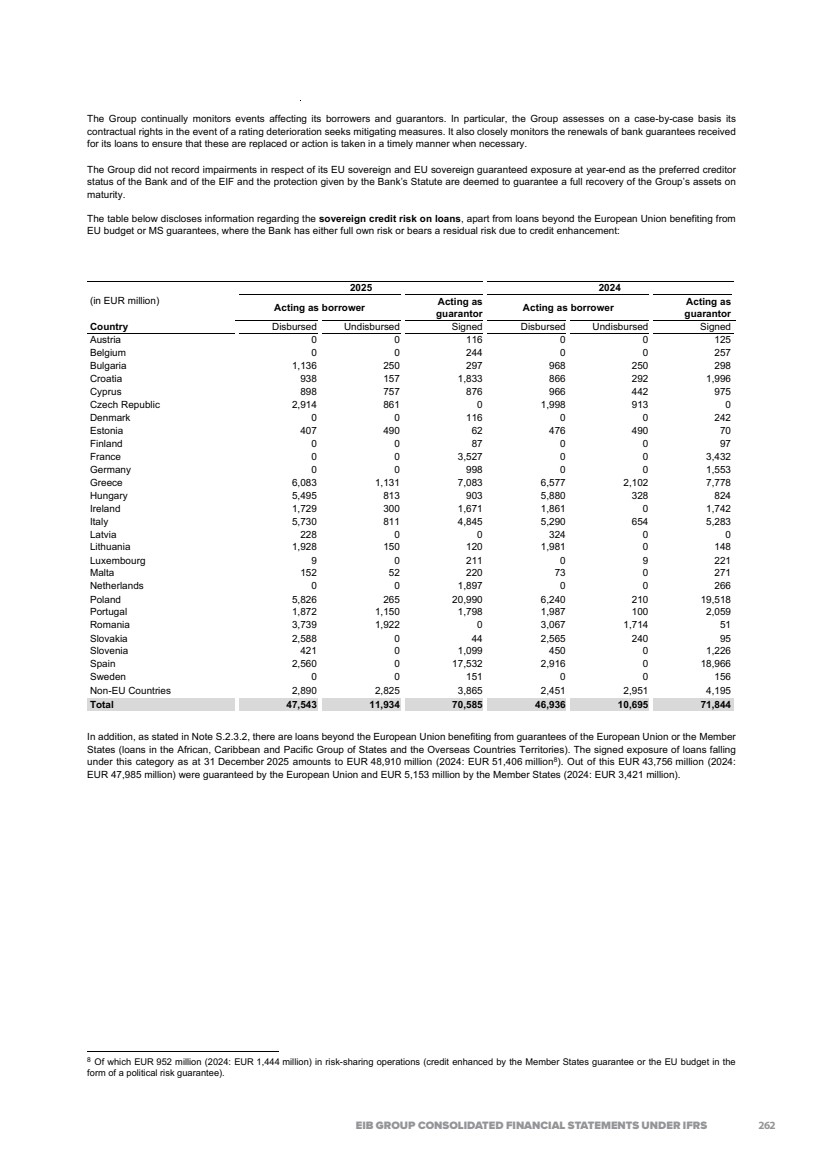
| 2025 FINANCIAL REPORT 76 S.2.3.3.2. Risk concentrations of maximum exposure to credit risk on loans The Group’s loans portfolio can be analysed by the following geographical regions (based on the country of the borrower): (in EUR million) 2025 2024 Exposures signed Exposures signed EU(1) 501,006 494,504 Thereof: – France 76,424 72,712 – Spain 67,202 69,831 – Italy 58,250 57,147 – Germany 47,338 45,221 – United Kingdom 22,710 25,444 Enlargement countries(2) 2,296 2,906 Partner countries 17,944 16,904 Total 521,246 514,314 (1) Including loans outside the EU, approved by the Board of Governors according to Article 16 (previously Article 18) of the Bank’s Statute, as well as loans in EFTA countries and the United Kingdom. (2) Enlargement countries as per the end of 2025 include Albania, Bosnia and Herzegovina, Georgia, Moldova, Montenegro, North Macedonia, Serbia, Türkiye and Ukraine. The diversification of credit exposures is supported by limits on the maximum amount that can be lent to a single borrower, group of debtors, key industries and countries outside the EU. An industry sector analysis of the Group’s loan portfolio (based on the industry sector of the borrower) is as follows: (in EUR million) 2025 2024 Exposures signed Exposures signed Services(1) 317,530 318,413 Transport 63,155 64,092 Energy 60,262 54,614 Industry 36,880 33,965 Water and sewerage 18,043 17,347 Health and education 13,197 12,749 Telecommunications 7,771 8,515 Miscellaneous Infrastructure 4,136 4,324 Agriculture, fisheries, forestry 272 295 Total 521,246 514,314 (1) The “Services” category includes the credit exposure of the banking sector. As at the end of 2025, the total amount of loans directly exposed to counterparts of the banking sector amounted to EUR 108,033 million (EUR 113,630 million at the end of 2024). Exposure to bank counterparts is subject to a dedicated thresholds/limit framework. The table below shows the concentration indexes the Group follows as at 31 December 2025 and 31 December 2024: Largest nominal Group exposures(1) 31.12.2025 31.12.2024 Nominal exposures (% of Group loan operations): – Top 3 3.9% 3.7% – Top 5 6.2% 6.0% – Top 10 10.5% 10.2% Nr. of exposures(2) (% of Group Own Funds): – over 10% 0 0 – over 15% 0 0 – over 20% 0 0 Nr. of SSSR exposures over 5% of Group Own Funds(3) 3 3 (1) This definition of exposures applies to borrowers/guarantors excluding sovereigns and subsovereigns and deducting loans fully covered by an explicit sovereign guarantee. (2) Including also the net market exposure of treasury operations. (3) The term "single signature and single risk” (or for brevity, ‘unsecured’ or ‘SSSR’) is used to indicate those lending operations where the Group, irrespective of the number of signatures provided, has no genuine recourse to an independent third party, or to other forms of autonomous security. 263 |
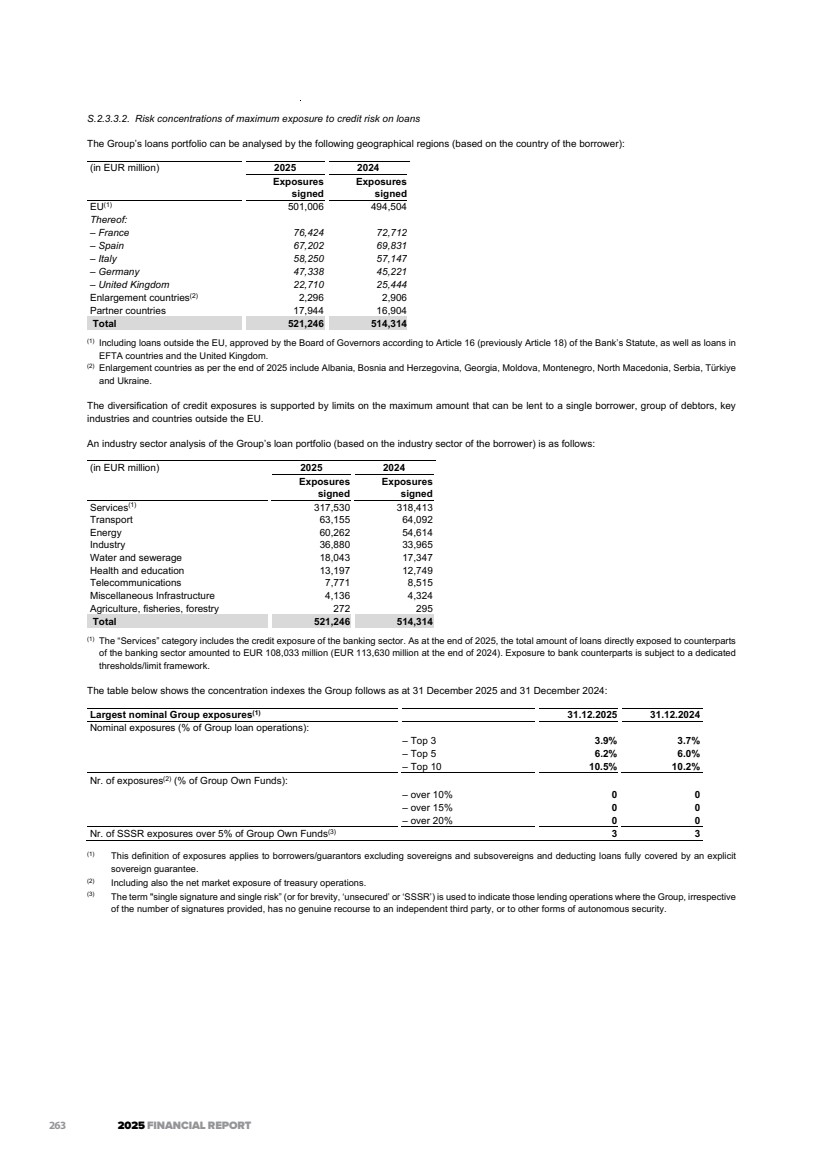
| EIB GROUP CONSOLIDATED FINANCIAL STATEMENTS UNDER IFRS 77 S.2.3.3.3 Arrears on loans Amounts in arrears are identified, monitored and reported according to the procedures defined in the bank-wide “Financial Monitoring Guidelines and Procedures”. These procedures follow best banking practices and are adopted for all loans managed by the EIB. As of 31 December 2025, the arrears above 90 days on loans from total portfolio amount to EUR 504 million (31 December 2024: EUR 281 million). The outstanding principal amount related to these arrears is EUR 1,147 million as of 31 December 2025 (31 December 2024: EUR 861 million). Of the total amount in arrears above 90 days, only EUR 144 million (31 December 2024: EUR 49 million) relate to loans that do not benefit from a full or partial guarantee provided by the European Union or Member States. During 2025, EUR 260.3 million of arrears have been called under the guarantees of the European Union and EUR 4.5 million under the Member States guarantees. Corresponding amounts in 2024 were EUR 103 million and EUR 3 million respectively. Also, during the course of the year, EUR 3.1 million of arrears previously invoked under the guarantees of the European Union or the Member States have been refunded (2024: EUR 16 million). The nominal amount of credit enhancement9 received by the European Union or the Member States amounted to a total of EUR 29,255 million as at 31 December 2025 (31 December 2024: EUR 29,322 million). Loan renegotiation and forbearance The Group considers loans to be forborne loans (i.e. loans, debt securities and loan commitments) in respect of which forbearance measures have been extended. Forbearance measures consist of “concessions” that the Group decides to make towards an obligor who is considered unable to comply with the contractual debt service terms and conditions due to its financial difficulties, in order to enable the obligor to service the debt or to refinance, totally or partially, the contract. Exposures shall be treated as forborne if a concession has been made, irrespective of whether any amount is past-due, or the exposure is classified as defaulted. Exposures shall not be treated as forborne when the obligor is not in financial difficulties. Once renegotiated, the Group will continue to closely monitor these loans. If the renegotiated payment terms will not recover the original carrying amount of the asset, the Group will consider accounting for value adjustments in the consolidated income statement. The need for a value adjustment for all loans whose Loan Grading (‘LG’) has deteriorated to a level indicating a strong possibility that debt service cannot be maintained on a timely basis is assessed regularly. Forbearance measures and practices undertaken by the Group’s restructuring activities during the reporting period include, but are not limited to, extension of maturities, deferral of capital only, deferral of capital and interest, waivers for breach of material covenants and capitalisation of arrears. 9 Excluding loans outside the European Union which are, as a last resort, secured by guarantees of the EU budget or Member States. 264 |
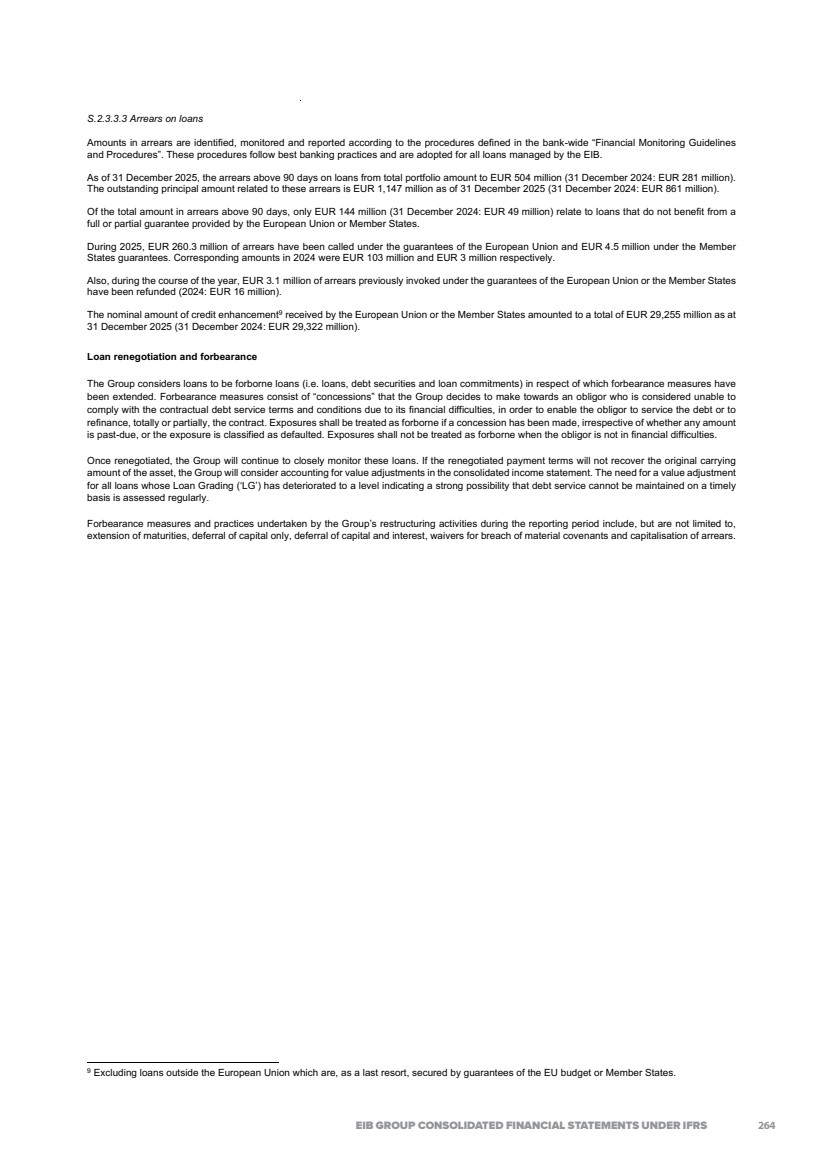
| 2025 FINANCIAL REPORT 78 Operations subject to forbearance measures are reported in the tables below. (in EUR million) 31.12.2025 31.12.2024 Performing Non-Performing Performing Non-Performing Number of contracts subject to forbearance practices 29 117 25 66 Carrying values (incl. interest and amounts in arrears) 1,083 2,891 634 1,383 ECL allowance recognised 7 323 1 231 Interest income in respect of forborne contracts 32 121 23 80 Exposures derecognised (following the write-off/sale of the operation) 0 8 0 127 Forbearance measures (in EUR million) 31.12.2024 Extension of maturities, deferral of capital and/or interest Breach / waiver of material financial covenants Restructuring due to diminished repayment capacity Emergency funding Enforcement action against the Borrower Other Contractual repayment and termination 31.12.2025 Public 451 0 0 0 0 0 160 -187 424 Bank 181 0 0 0 0 0 0 -33 148 Corporate 1,385 513 1,134 229 306 161 320 -646 3,402 Total 2,017 513 1,134 229 306 161 480 -866 3,974 S.2.3.4. Collateral on loans In addition to the guarantees received on its lending exposures as disclosed in note S.2.3.3, the Group also uses pledges of financial securities. These pledges are formalised through a pledge agreement, enforceable in the relevant jurisdiction. The portfolio of collateral received in pledge contracts amounts to EUR 6,550 million at the end of 2025 (2024: EUR 6,499 million). The fair value of the portfolio of collateral received by the Group under pledge contracts that the Group is allowed to sell or repledge amounts to EUR 3,532 million (2024: EUR 3,545 million). None of this collateral has been sold or re-pledged to third parties. 265 |
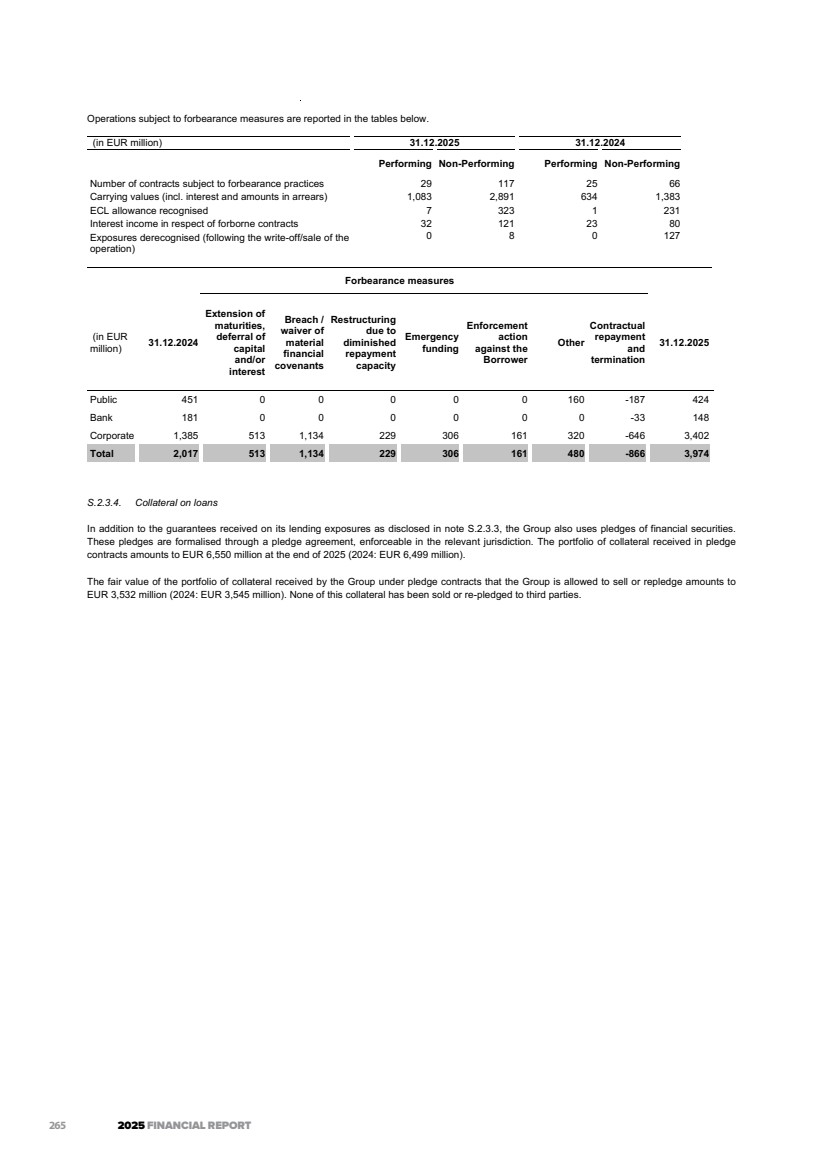
| EIB GROUP CONSOLIDATED FINANCIAL STATEMENTS UNDER IFRS 79 The fair value of collateral held against disbursed loans is shown below: 2025 (in EUR million) Gross exposure Collateral held Net exposure ECL Bonds Cash Total Stage 1 391,143 5,078 29 5,107 386,036 87 Stage 2 25,710 176 66 242 25,468 131 Stage 3 4,227 0 0 0 4,227 454 Stage 3 POCI 0 0 0 0 0 0 Against FVTPL 14,567 0 0 0 14,567 0 Total 2025(*) 435,647 5,254 95 5,349 430,298 672 (*) In 2025, the Group did not take possession of any of the above-mentioned collateral. 2024 (in EUR million) Gross exposure Collateral held Net exposure ECL Bonds Cash Total Stage 1 391,867 6,035 48 6,083 385,784 78 Stage 2 27,036 388 102 490 26,546 137 Stage 3 2,887 0 0 0 2,887 353 Stage 3 POCI 0 0 0 0 0 0 Against FVTPL 14,464 256 0 256 14,208 0 Total 2024(*) 436,254 6,679 150 6,829 429,425 568 (*) In 2024, the Group did not take possession of any of the above-mentioned collateral. S.2.3.5. Sensitivity on ECL to future economic conditions The ECL is sensitive to the judgments and assumptions made in formulating forward-looking scenarios. The Group performs a sensitivity analysis on the ECL recognised in material asset classes. Forecasts of future economic conditions (via macroeconomic scenarios) serve as inputs to forecasting models that produce conditional risk parameters, which are in turn used to calculate loss allowances. The scenarios are derived by shocking GDP, which is the key measure of economic activity. The shocks to real GDP are calibrated to replicate the past volatility of the variable. In addition, expert judgment is applied, when appropriate, to refine the size and persistency of GDP shocks. Long-term and short-term interest rates are also modelled and included as part of the macroeconomic scenarios. Probabilities attached to each scenario are defined reflecting market (volatility) indicators and internally developed indicators consistently deployed over time to capture uncertainty. The weighting of positive and negative shocks depends on the balance of risks in the economy. Negative and positive shocks, with a probability of 40% and 5% respectively, were applied on quarterly projections in the last exercise. The table below shows the loss allowance on loans and advances to credit institutions and customers. Each forward-looking scenario (e.g. baseline, positive and negative) was weighted 100% instead of applying scenario probability weights across the three scenarios. (in EUR million) as at 31.12.2025 Positive Baseline Negative Gross exposure Credit Institutions 84,258 84,258 84,258 Customers 336,873 336,873 336,873 Loss allowance Credit Institutions 16 20 25 Customers 613 639 669 (in EUR million) as at 31.12.2024 Positive Baseline Negative Gross exposure Credit Institutions 89,044 89,044 89,044 Customers 337,147 337,147 337,147 Loss allowance Credit Institutions 22 28 34 Customers 535 560 591 266 |
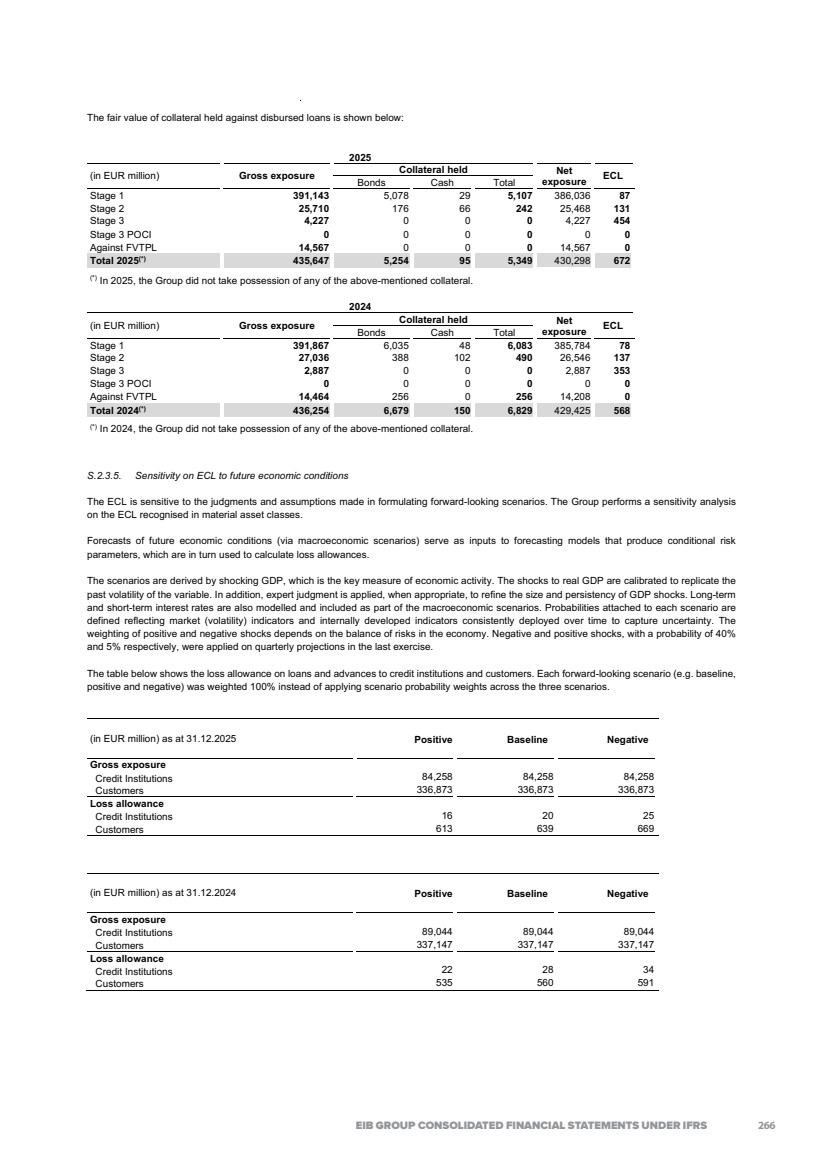
| 2025 FINANCIAL REPORT 80 S.2.4. Credit risk on treasury transactions and loan substitutes S.2.4.1. Credit risk measurement on treasury transactions and loan substitutes The treasury investments of the Bank are divided into three categories: (i) the Treasury Monetary Portfolio, with the primary objective of maintaining liquidity, (ii) the Securities Liquidity Portfolio, as a second liquidity line, and (iii) the Long Term HQLA Portfolio. The loan substitutes portfolio comprises covered bonds and asset backed securities (‘ABS’). Covered bonds offer full recourse to the issuer, while ABS are issued by special purpose vehicles backing the underlying issues. While covered bonds are mostly backed by residential mortgage pools, the majority of ABS structures are securitised by SME loans or leases. Some of these transactions have been structured by adding a credit or project related remedies, thus offering additional recourse. The Fund’s long term treasury management has been fully outsourced to the Bank under a treasury management agreement signed by both parties which mandates the responsible EIB services to perform selection, execution, settlement and monitoring of transactions. Management follows the treasury guidelines annexed to the agreement. Operational short term liquidity management is conducted by the EIF. Credit risk on treasury transactions is monitored through the attribution of credit limits to counterparts. The weighted exposure for each counterpart must not exceed the authorised limits. For loan substitutes, embedded credit mitigants and requirements imposed by the regulation and rating agencies are the initial remedies triggered in case of a credit event on the issuer. The credit risk associated with treasury instruments (securities, commercial papers, term deposits, etc.) is managed by selecting sound counterparties and issuers. The structure of the securities portfolios and the limits governing outstanding treasury instruments have been laid down by the management. These limits are reviewed regularly by the Group Risk and Compliance Directorate. Credit Risk Exposures by Moody's equivalent rating (based on gross carrying amount) 2025 (in EUR million) 12-month ECL Lifetime ECL not credit-impaired Lifetime ECL credit-impaired Total Treasury assets and loan substitutes at AC Aaa 21,222 0 0 21,222 Aa1 to Aa3 23,101 250 0 23,351 A1 to A3 22,834 15 0 22,849 Baa1 to Baa3 7,837 49 0 7,886 Below Baa3 712 117 3 832 Non-Rated 2,522 0 0 2,522 Gross carrying amount at AC 78,228 431 3 78,662 Loss allowance -3 -11 0 -14 Net carrying amount at AC 78,225 420 3 78,648 2024 (in EUR million) 12-month ECL Lifetime ECL not credit-impaired Lifetime ECL credit-impaired Total Treasury assets and loan substitutes at AC Aaa 24,471 0 0 24,471 Aa1 to Aa3 35,703 0 0 35,703 A1 to A3 16,994 0 0 16,994 Baa1 to Baa3 8,726 0 0 8,726 Below Baa3 724 221 4 949 Non-Rated 4,214 0 0 4,214 Gross carrying amount at AC 90,832 221 4 91,057 Loss allowance -6 -2 0 -8 Net carrying amount at AC 90,826 219 4 91,049 (in EUR million) 2025 2024 Treasury assets and loan substitutes at FVTPL Aaa 4,185 3,591 Aa1 to Aa3 1,946 2,185 A1 to A3 2,383 1,327 Baa1 to Baa3 327 291 Below Baa3 165 141 Non-Rated 2 0 Carrying amount at FVTPL 9,008 7,535 267 |
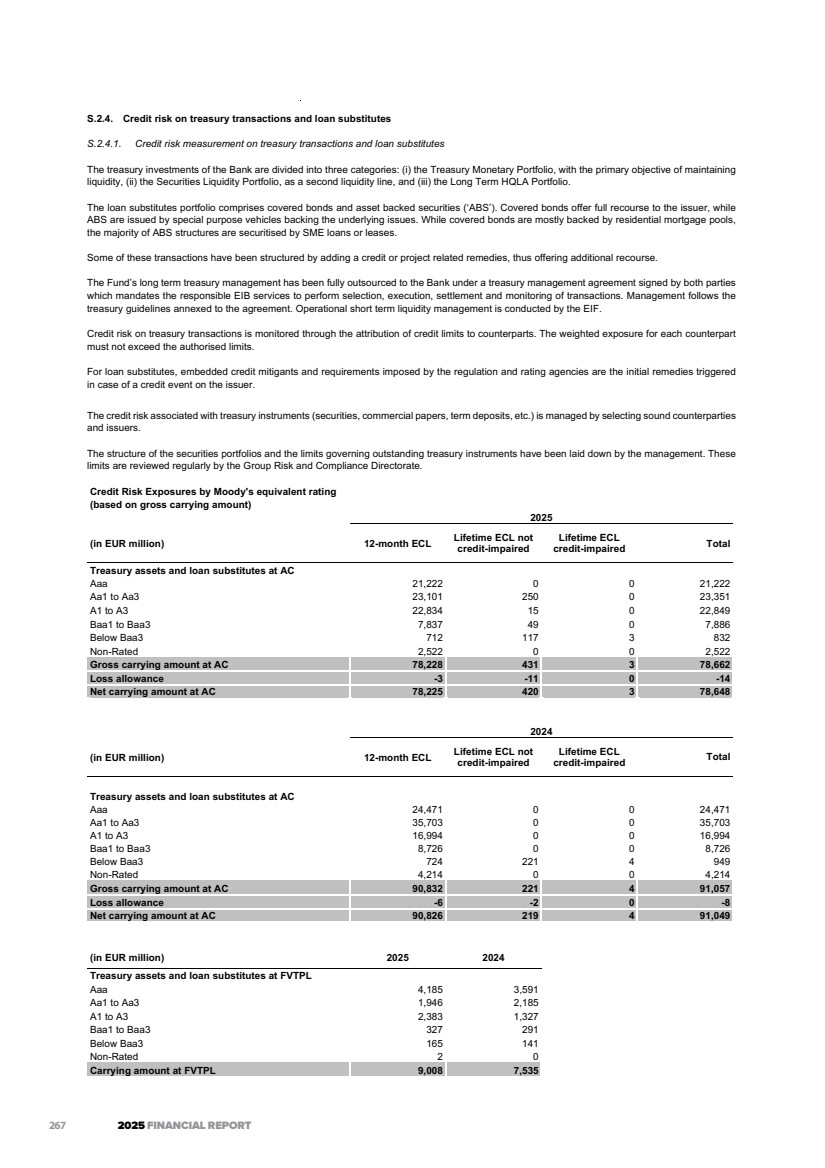
| EIB GROUP CONSOLIDATED FINANCIAL STATEMENTS UNDER IFRS 81 S.2.4.2. Collateral on treasury transactions The Group enters into collateralised repurchase and reverse repurchase agreement transactions that may result in credit exposure if the counterparty to the transaction is unable to fulfil its contractual obligations. The Group controls credit risk associated with these activities by monitoring counterparty credit exposure and collateral values on a daily basis and requiring additional collateral to be deposited with the Group when deemed necessary. Tripartite repurchase and reverse repurchase operations are carried out with a third-party custodian who undertakes, on the basis of a framework contract, to guarantee compliance with the contractual terms and conditions, notably with respect to: • delivery against payment; • verification of collateral; • the collateral margin required by the lender which must always be available and adequate, with the market value of the securities being verified daily by the custodian; • the organisation of substitute collateral provided that this meets all the contractual requirements. Collateral received Treasury transactions involving the receipt of collateral consist of bilateral and tripartite reverse repurchase agreements with a notional balance as at 31 December 2025 of EUR 23,198 million (2024: EUR 21,286 million). The Group received financial collateral for all such transactions. The market value of the collateral portfolio is monitored and additional collateral, in accordance with the underlying agreements, is requested when needed. The market value of the financial collateral portfolio as at 31 December 2025 amounts to EUR 23,982 million (2024: EUR 21,971 million). At year-end 2025 and 2024, the Group did not take possession of any of the above-mentioned collateral received. The collateral received by the Group was reused during the year for funding operations. Securities deposited Treasury transactions involving the receipt of collateral consist of bilateral and tripartite repurchase agreements, with a notional balance of EUR 984 million as at 31 December 2025 (2024: EUR 107 million). The market value of the collateral deposited under bilateral and tripartite repurchase agreements amounts to EUR 977 million as at 31 December 2025 (2024: EUR 218 million). S.2.4.3. Transferred assets that are not derecognised at the balance sheet date No assets of the Group were transferred at the balance sheet date. S.2.5. Credit risk on derivatives S.2.5.1. Credit risk policies for derivatives The credit risk policy for derivative transactions is based on the definition of eligibility conditions and rating-related limits for swap counterparts. To reduce credit exposures, the Bank has signed Credit Support Annexes with most of its active swap counterparts and receives collaterals when the exposure exceeds certain contractually defined thresholds. The Fund does not use derivatives instruments. The credit risk with respect to derivatives lies in the loss that the Bank would incur if a counterparty is unable to honour its contractual obligations. In view of the special nature and complexity of derivatives transactions, a series of procedures has been put in place to safeguard the Bank against losses arising out of the use of such instruments. Contractual framework: All of the Bank’s derivative transactions are concluded in the contractual framework of ISDA Swap Agreements and where applicable Credit Support Annexes, which specify the conditions of exposure collateralisation. These are generally accepted and practised contract types. Minimum conditions for new agreements are specified in the risk guidelines. Counterparty selection: The minimum rating at the outset is set in the risk guidelines at A3. The EIB has in most cases a right of early termination if the counterparty rating drops below a certain level. Collateralisation: • Exposures (in some cases subject to thresholds) are collateralised by cash and bonds. • Certain transactions are collateralised above the current market value. • Both the derivatives portfolio with individual counterparties and the collateral received are regularly monitored and valued, with a subsequent call for additional collateral or collateral release. 268 |
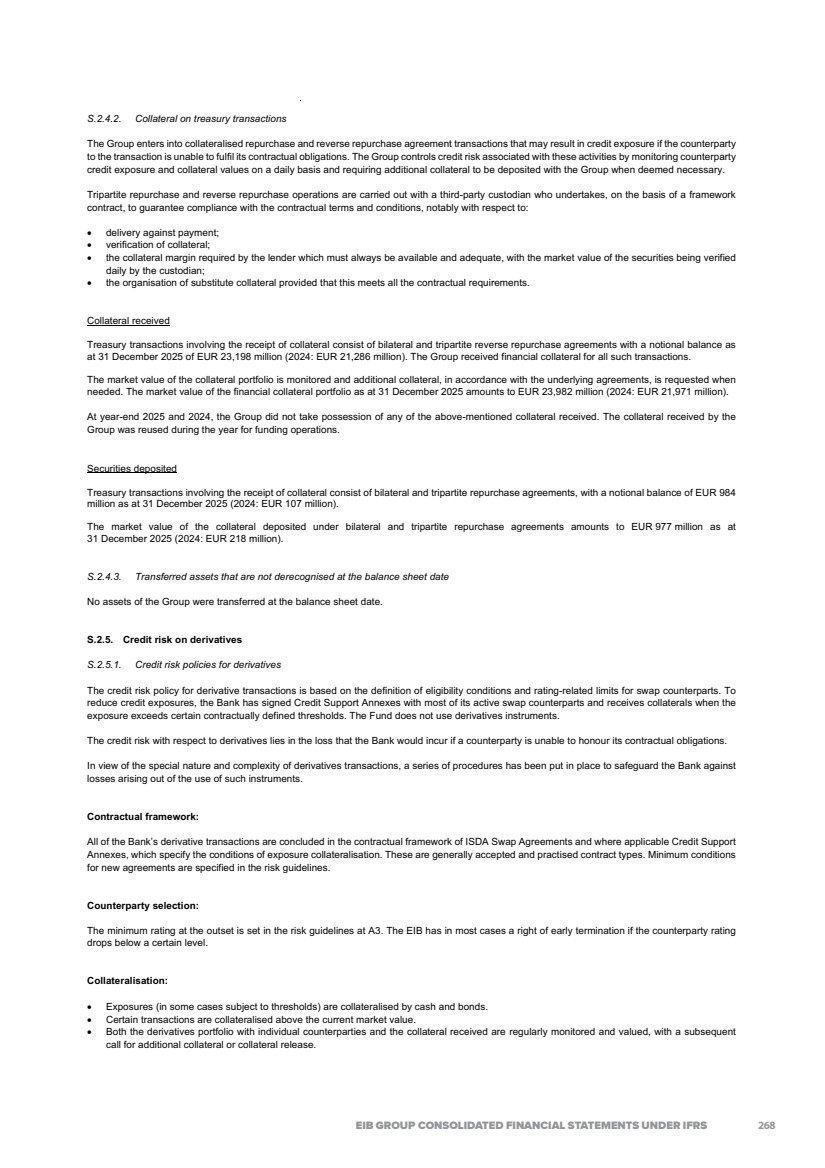
| 2025 FINANCIAL REPORT 82 The amount of collateral required depends on an assessment of the credit risk of the counterparty. Guidelines are implemented regarding the acceptability of collateral and valuation parameters. As part of the ISDA agreements, the Bank has received securities and cash that it is allowed to sell or repledge. The fair value of the securities accepted under these terms amounts to EUR 3,996 million as at 31 December 2025 (2024: EUR 5,548 million), with the following composition detailed based on the nature of the collateral and on Moody’s equivalent rating: Swap collateral (in EUR million) Moody's equivalent rating Bonds Cash Total 2025 Government Agency, supranational, covered bonds Aaa 434 465 0 899 Aa1 to Aa3 489 0 0 489 A1 to A3 395 0 0 395 Baa1 to Baa3 1,802 0 0 1,802 Non-Rated 0 0 411 411 Total 2025 3,120 465 411 3,996 Swap collateral (in EUR million) Moody's equivalent rating Bonds Cash Total 2024 Government Agency, supranational, covered bonds Aaa 162 462 0 624 Aa1 to Aa3 2,238 0 0 2,238 A1 to A3 5 0 0 5 Baa1 to Baa3 1,965 0 0 1,965 Non-Rated 0 0 716 716 Total 2024 4,370 462 716 5,548 The Bank has implemented the usage of an IT system, the collateral management system (‘CMS’). The key objective of the CMS is to ensure that the Bank is capable to utilise for repos a real-time inventory of assets and collateral accepted in secured markets. Securities received as collateral for loans, derivatives and reverse repos, repos are valued in CMS on a daily basis, by using prices quoted in active markets, supplied by a Market Price Service Provider (i.e. Bloomberg) or, if quoted prices are not available, by using market-based valuations. S.2.5.2. Credit risk measurement for derivatives The credit risk associated with derivatives varies according to a number of factors (such as interest and exchange rates) and generally corresponds to only a small portion of their notional value. For internal purposes, the Bank measures the credit risk exposure related to swaps and derivatives transactions using the Current Unsecured Exposure and the Potential Future Exposure for reporting and limit monitoring. It uses the Standardised Approach for Counterparty Credit Risk (‘SA-CCR’) for regulatory capital allocation in accordance with the EU Capital Requirements Regulation (‘CRR’). The Bank computes the Current Unsecured Exposure, which is the larger of zero and the market value of the portfolio of transactions within the netting set with a counterparty less the value of collateral received. It is the amount that would be lost upon the default of the counterparty, using the received collateral and assuming no recovery on the value of those transactions in the event of bankruptcy as well as immediate replacement of the swap counterparty for all the transactions. As at 31 December 2025, the Current Unsecured Exposure stood at EUR 176 million (EUR 255 million as at 31 December 2024). Additionally, the Bank computes the Potential Future Exposure, that takes into account the possible increase in the netting set’s exposure over the margin period of risk of 20 business days. The EIB computes the Potential Future Exposure at 90% confidence level using stressed market parameters to arrive at conservative estimates. This is in line with the recommendations issued by regulators to take into consideration the conditions that will prevail in the event of default of an important market participant. Limits: The limit system for banks covers the Potential Future Exposure in 3 time-buckets (under 1 year, between 1 and 5 years and over 5 years) and in 2 rating scenarios (current and downgrade below A3). The derivatives portfolio is valued and compared against limits on a daily basis. The following table provides a breakdown of counterparties by internal rating. 269 |
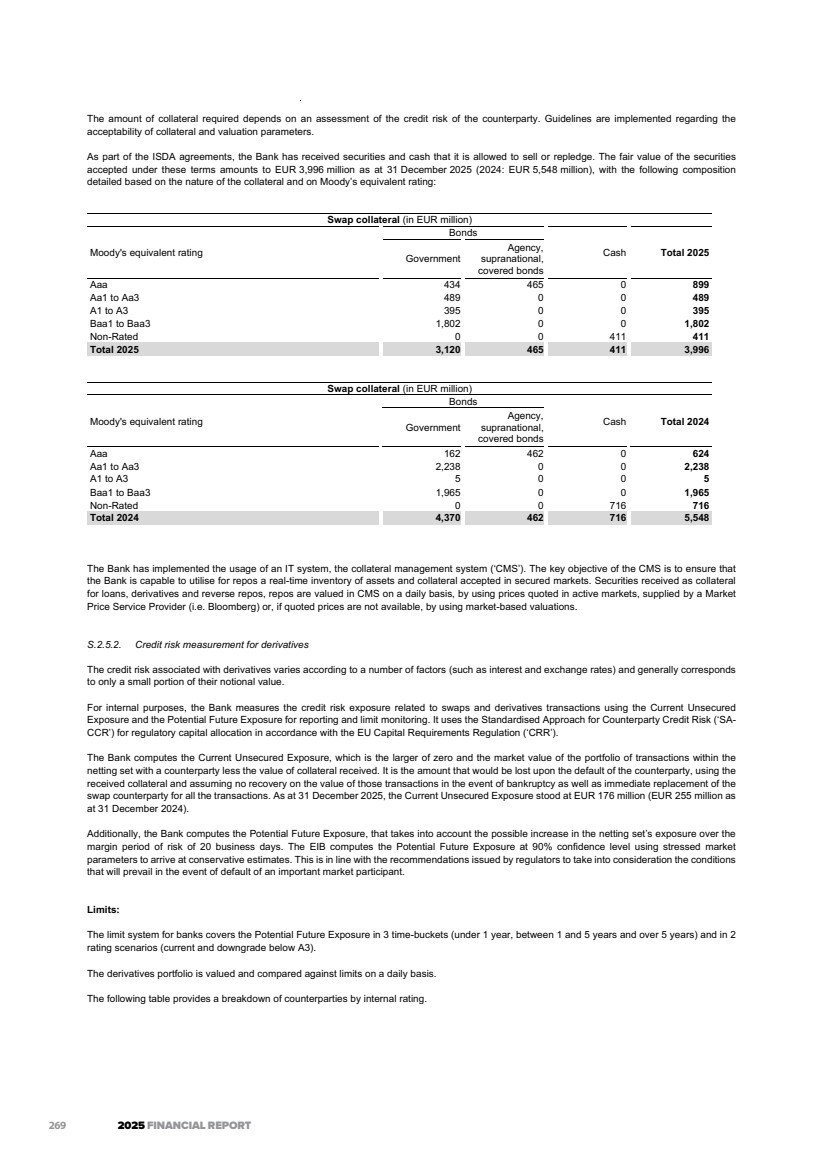
| EIB GROUP CONSOLIDATED FINANCIAL STATEMENTS UNDER IFRS 83 Grouped ratings Percentage of nominal Current Unsecured Exposure (in EUR million) Moody’s equivalent rating 2025 2024 2025 2024 Aaa 0.40% 0.42% 0 0 Aa1 to Aa3 52.90% 38.13% 119 172 A1 to A3 46.63% 60.74% 57 80 Below A3 0.07% 0.71% 0 3 Total 100.00% 100.00% 176 255 The table below shows the concentration on main derivative counterparts as at 31 December 2025 and 2024: 2025 2024 Nominal Exposure (% of Bank derivative portfolio): – Top 3 33.4% 31.2% – Top 10 71.2% 71.7% – Top 25 98.5% 98.2% Current Unsecured Exposure: – Top 3 75.1% 63.2% – Top 10 100.0% 98.5% – Top 25 100.0% 100.0% The following table shows the maturities of currency swaps (including structured swaps and excluding short-term currency swaps), broken down according to their notional amount and fair value: Currency swaps as at 31 December 2025 (in EUR million) 1 year or less More than 1 year and up to 5 years More than 5 years and up to 10 years More than 10 years Total 2025 Notional amount (receivable) 28,078 111,315 43,179 22,583 205,155 Fair value (i.e. net discounted value including CVA, DVA and CollVA)(*) 380 -2,501 -624 217 -2,528 Currency swaps as at 31 December 2024 (in EUR million) 1 year or less More than 1 year and up to 5 years More than 5 years and up to 10 years More than 10 years Total 2024 Notional amount (receivable) 48,402 114,886 45,760 24,077 233,125 Fair value (i.e. net discounted value including CVA, DVA and CollVA)(*) 1,015 2,648 936 157 4,756 (*) Including the fair value of hedging swaps for ALM purposes which stood at EUR -2,218 million as at 31 December 2025 (2024: EUR 5,678 million). The following table shows the maturities of interest rate swaps (including structured swaps) broken down according to their notional amount and fair value: Interest rate swaps as at 31 December 2025 (in EUR million) 1 year or less More than 1 year and up to 5 years More than 5 years and up to 10 years More than 10 years Total 2025 Notional amount 68,479 255,676 158,466 149,357 631,978 Fair value (i.e. net discounted value including CVA, DVA and CollVA)(*) 306 514 -2,407 1,391 -196 Interest rate swaps as at 31 December 2024 (in EUR million) 1 year or less More than 1 year and up to 5 years More than 5 years and up to 10 years More than 10 years Total 2024 Notional amount 113,801 229,664 164,221 148,107 655,793 Fair value (i.e. net discounted value including CVA, DVA and CollVA)(*) 81 -1,274 -2,889 189 -3,893 (*) Including the fair value of hedging swaps for ALM purposes which stood at EUR -59 million as at 31 December 2025 (2024: EUR -59 million). 270 |
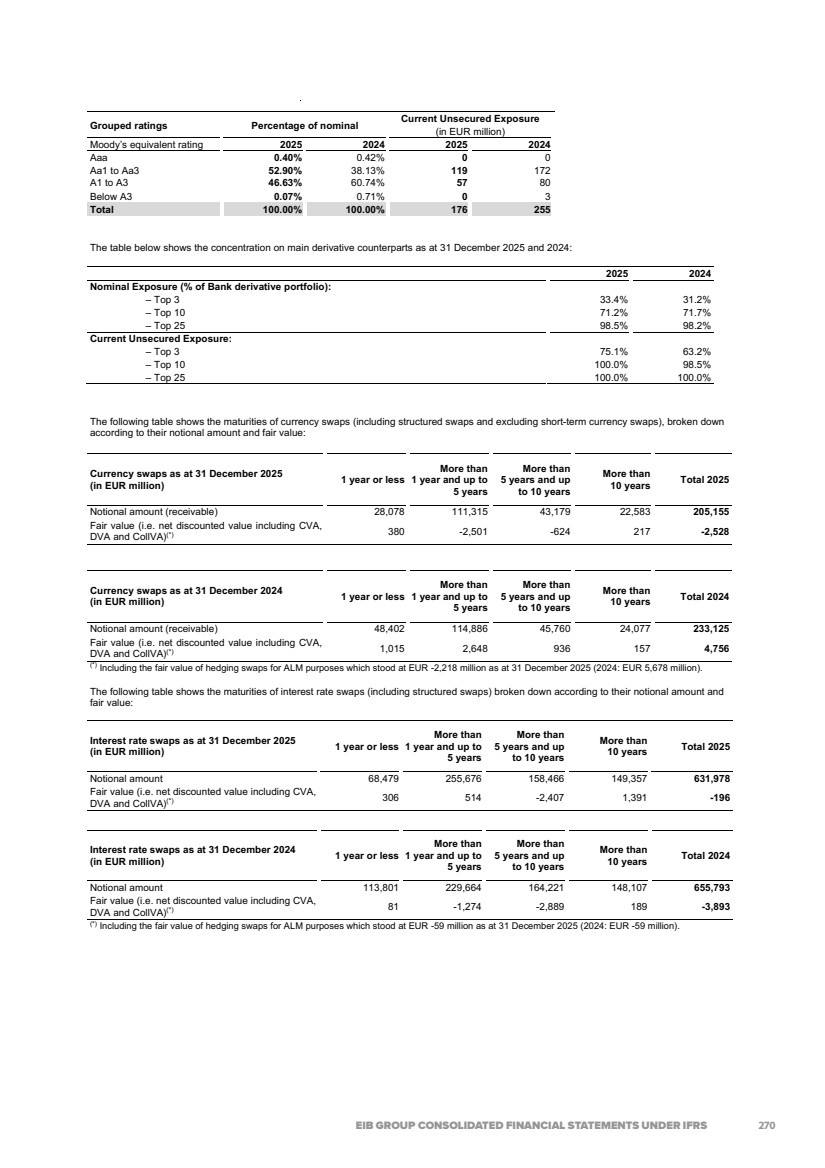
| 2025 FINANCIAL REPORT 84 The Bank enters into borrowing contracts and loans encompassing options on interest rates, exchange rates, inflation rates and stock indices. Such structured borrowings and loans are entirely covered by swap contracts to hedge the corresponding market risk. The notional amount and fair value of structured swaps is included in the tables above, depending on whether they incorporate a cross-currency element. The table below provides a detailed breakdown of the number, fair value and notional amounts of structured swaps: Structured swaps as at 31 December Early termination embedded Structured coupon 2025 2024 2025 2024 Number of transactions 107 102 127 128 Notional amount (in EUR million) 4,416 4,813 6,531 7,350 Fair value (i.e. net discounted value including CVA, DVA and CollVA) (in EUR million) -617 -499 -1,647 -1,911 The fair value of structured swap transactions is calculated using option pricing models, calibrated to available market prices of options. For a portion of derivative transactions, internal estimates and assumptions might be used in the valuation techniques when the market inputs are not directly available. All option contracts embedded in or linked with borrowings are negotiated over the counter. As at 31 December 2025, there are no forward rate agreements outstanding (same as at 31 December 2024). S.2.5.3. Credit risk on guarantees Credit risk arising from the Group’s guarantee transactions funded by own resources is managed in line with dedicated internal guidelines. As at 31 December 2025, the signed exposures amount to EUR 36.2 billion (2024: EUR 32.2 billion). The related liabilities and provisions recorded for guarantees amount to EUR 88.8 million (2024: EUR 86.8 million) (Note D.4). Part of the Group’s guarantee type operations derives from risk sharing operations where the Group guarantees either (i) on a loan-by-loan or (ii) on a portfolio basis underlying debt exposures originated by a financial intermediary based on established delegation models. The financial intermediary originating the underlying risk exposures on which the EIB takes risk is subject to a detailed due diligence to make sure that the Group can delegate credit management tasks to the financial intermediary in question. In these types of transactions, the Group might be exposed on a pro-rata basis or via a structure with a certain degree of subordination. In addition to this, the Group can also enter into securitisation transactions. The EIB has established a dedicated framework to limit the concentration risk for this type of underlying exposures in such transactions. Depending on the specific characteristics of each transaction, this may include setting eligibility criteria including but not limited to lowest eligible rating categories, certain sector, obligor and/or obligor group exposure. There is limited counterparty risk on the financial intermediary as the credit risk is on the underlying exposures originated by the financial intermediary i.e. counterparty risk is limited to (1) the payment of the guarantee fees and (2) the potential recoveries due to the EIB in the event of a default of an underlying exposure guaranteed and paid out by the EIB. In any case, the Group has established a number of mitigating measures, including but not limited to detailed due diligence as well as security rights, step-in rights, trigger events to stop inclusions, consent rights for material amendments of the underlying risk exposures or termination rights. 271 |
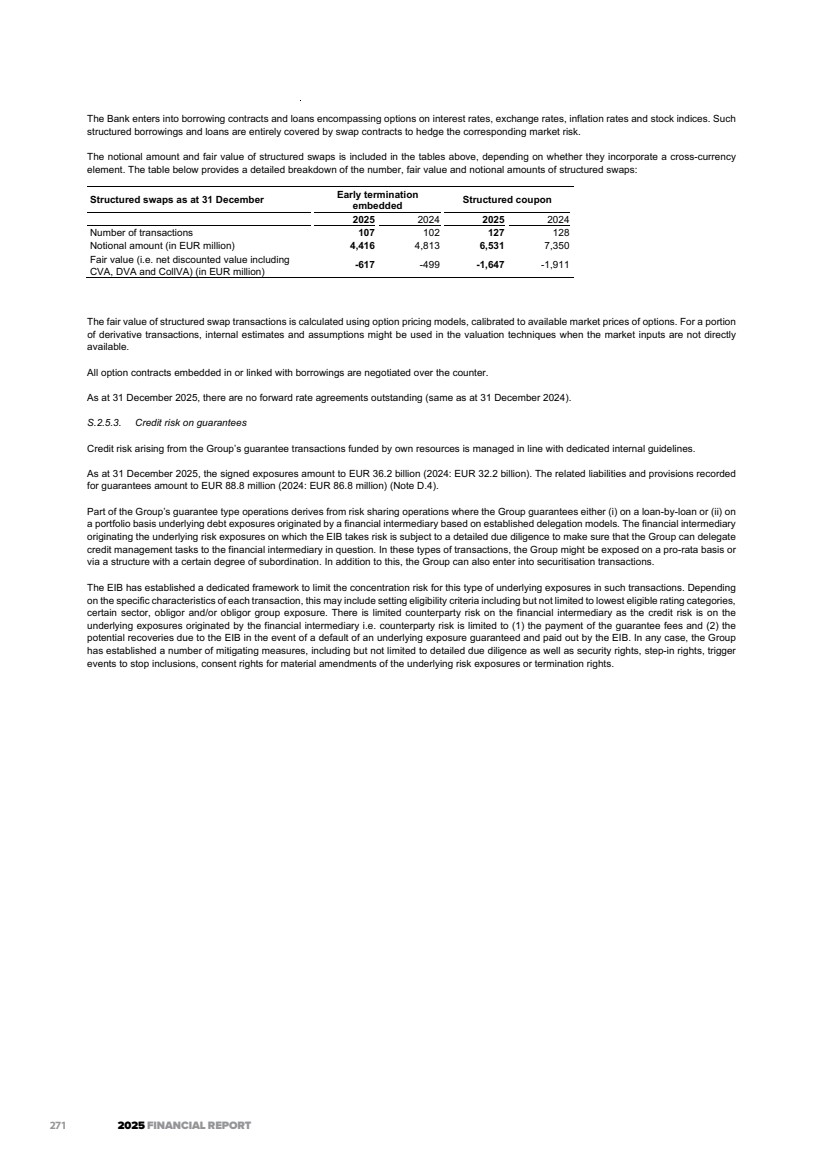
| EIB GROUP CONSOLIDATED FINANCIAL STATEMENTS UNDER IFRS 1 Credit risk exposure for each internal rating (in EUR million) 2025 12-month ECL Lifetime ECL not credit-impaired Lifetime ECL credit-impaired Total Financial Guarantees Internal Rating 1 - minimal credit risk 455 0 0 455 Internal Rating 2 - very low credit risk 4,270 0 0 4,270 Internal Rating 3 - low credit risk 10,250 0 0 10,250 Internal Rating 4 - moderate credit risk 6,731 0 0 6,731 Internal Rating 5 - financially weak counterpart 12,001 183 0 12,184 Internal Rating 6 - high credit risk 1,713 116 0 1,829 Internal Rating 7 - very high credit risk 0 446 0 446 Internal Rating 8 - counterpart in default 0 0 68 68 Total Credit Risk Exposure 35,420 745 68 36,233 Carrying amount 77 0 12 89 2024 12-month ECL Lifetime ECL not credit-impaired Lifetime ECL credit-impaired Total Financial Guarantees Internal Rating 1 - minimal credit risk 40 0 0 40 Internal Rating 2 - very low credit risk 3,715 0 0 3,715 Internal Rating 3 - low credit risk 11,231 0 0 11,231 Internal Rating 4 - moderate credit risk 4,205 0 0 4,205 Internal Rating 5 - financially weak counterpart 11,344 151 0 11,495 Internal Rating 6 - high credit risk 796 79 0 875 Internal Rating 7 - very high credit risk 0 502 0 502 Internal Rating 8 - counterpart in default 0 0 147 147 Total Credit Risk Exposure 31,331 732 147 32,210 Carrying amount 78 0 9 87 S.3. Market risk S.3.1 Interest rate and credit spread risk in the banking book for the Group The interest rate or credit spread risk is the risk to the economic value or to the net interest income arising from adverse movements in interest rates or market credit spreads that affect interest rate and market credit spread sensitive instruments, respectively. Exposure to these risk factors occurs when there are differences in repricing and maturity characteristics of the different asset, liability and hedge instruments. The Group Risk Appetite Framework contains three interest rate risk indicators managed within pre-approved limits: The “Risk to Economic Value”, the “NII Large Decline” and the “Risk to Earnings”, which are, however defined on EIB standalone level. The EIF’s Risk Appetite Framework does not currently include such interest rate risk indicators, but EIF instead allocates economic capital to cover its interest rate and credit spread risk exposures. In doing so, the EIF is following the Group capital measurement methodology for interest rate risk in the banking book (‘IRRBB’) and for credit spread risk in the banking book (’CSRBB’). The Group is measuring CSRBB by applying stress tests that show the impacts on both the economic value of equity and the net interest income from adverse movements in market credit spreads (in line with the respective EBA guidelines1). CSRBB is not subject to individual operational management limits. However, its exposure is reflected into the Group Risk Appetite Framework. The following sections detail the operational implementation of the interest rate risk management framework of each entity. Interest rate risk management for the Bank In measuring and managing interest rate risk, the Bank refers to the relevant key principles of the Basel Committee on Banking Supervision (‘BCBS’) as implemented in the EU, and to the regulatory guidance issued by the European Banking Authority (‘EBA’). The main sources of interest rate risk are: gap risk, basis risk and option risk. Gap risk is the most relevant interest rate risk for the Bank and is defined as the risk to the economic value or to the net interest income generated by the differences in the term structure of interest rate sensitive instruments on the Bank’s balance sheet. Following regulatory guidance, the Bank has articulated its appetite for interest rate risk in terms of both the maximum risk to economic value and the maximum risk to earnings that the Bank is prepared to take (while, when applicable, adhering to the maximum thresholds defined in the EBA Supervisory Outlier Tests for both perspectives). The Bank’s investment strategy for its own funds – the interest rate risk strategy – complies with such interest rate risk appetite. 1 EBA/GL/2022/14. 272 |
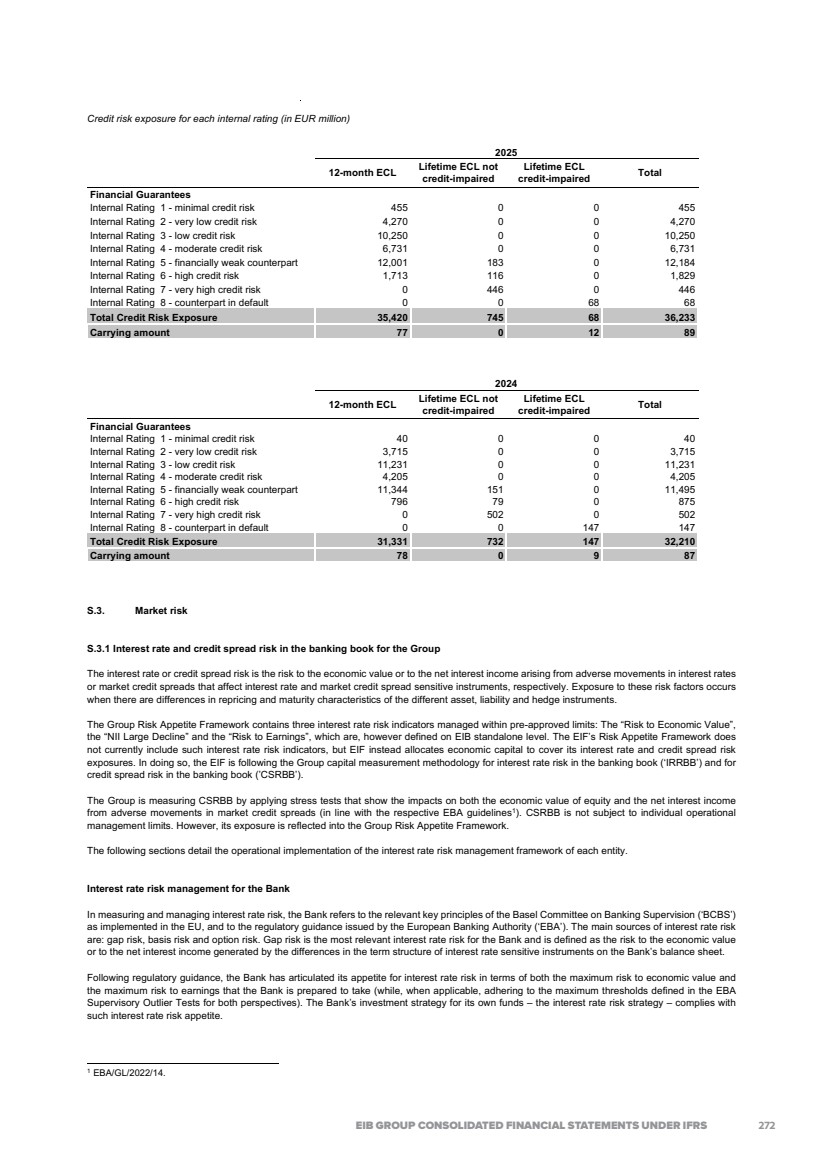
| 2025 FINANCIAL REPORT 86 Interest rate risk on the economic value of the own funds/equity of the Bank The Bank’s interest rate risk strategy aims at maintaining a balanced and sustainable revenue profile as well as limiting the risk to the economic value of the Group. A clear preference has been given to the revenue profile in light of the objective of self-financing future growth. This overall objective is achieved by investing the own funds according to a medium to long term investment profile. Of course, this strategy needs to comply with the limits for the Interest Rate Risk RAF metrics. Apart from the interest rate strategy underpinning the investment of the Bank’s own funds, the Bank’s balance sheet should be match-funded with respect to interest rate risk. As it is not operationally practical to perfectly match-fund the Bank’s balance sheet, small deviations to gap and basis risks are allowed. Those net residual interest rate risk positions are managed within pre-approved limits, the latter being dimensioned to ensure that the individual risks remain within the risk appetite boundaries. In addition to its interest rate risk limits framework, the Bank performs regular stress testing, based on EBA standardised shock scenarios1, and internally defined ones, to its projected earnings and to its economic value. The exercise serves to identify potential adverse consequences arising from severe changes in the interest rates environment. The stress test on the economic value is performed at the Bank and on Group level. As at 31 December 2025, the worst impact of the EBA supervisory outlier test scenarios would reduce the economic value of own funds of the Bank by EUR 6.86 billion (2024: EUR 6.19 billion) and of the EIB Group by EUR 6.93 billion (2024: EUR 6.23 billion) 2. Among the financial instruments in the Bank’s portfolio, some operations (borrowings and associated swaps) present callability options and may be redeemed early, hence introducing uncertainty as to their final maturity. However, as these packages (borrowings and associated swaps) are fully back-to-back (up to the cashflow level), they can be considered at the end as simple synthetic floating rate notes indexed to relevant interest rate benchmarks and bearing limited interest rate risk. 1 EBA/RTS/2022/10. 2 The stress test is performed on all risk-sensitive banking book instruments, including the pension and health insurance liabilities (defined benefit obligations, DBO) as calculated by an actuarial provider. 273 |

| EIB GROUP CONSOLIDATED FINANCIAL STATEMENTS UNDER IFRS 87 The table hereafter summarises the features of the Group’s callable borrowings portfolio as at 31 December 2025 and 31 December 2024, where the total nominal amount, the average natural maturity and the average expected maturity (both weighted by the nominal amount of the relevant transactions) are shown per funding currency and per main risk factor involved: By funding currency (after swaps): 31.12.2025 Pay currency Total (in EUR million) EUR USD EUR pay notional -3,167 -732 -3,899 Average maturity date 26.09.2044 14.02.2042 30.03.2044 Average expected maturity 25.12.2039 28.06.2040 29.01.2040 31.12.2024 Pay currency Total (in EUR million) EUR USD EUR pay notional -2,402 -1,107 -3,509 Average maturity date 12.12.2046 29.12.2037 14.02.2044 Average expected maturity 14.12.2037 25.02.2036 20.05.2037 By risk factor involved: 31.12.2025 Risk factor Total (in EUR million) FX level IR curve level EUR pay notional -773 -3,126 -3,899 Average maturity date 12.11.2036 26.01.2046 30.03.2044 Average expected maturity 21.07.2033 09.09.2041 29.01.2040 31.12.2024 Risk factor Total (in EUR million) FX level IR curve level EUR pay notional -259 -3,250 -3,509 Average maturity date 15.02.2037 04.09.2044 14.02.2044 Average expected maturity 10.12.2033 29.08.2037 20.05.2037 Interest rate risk on the earnings of the Bank The risk to earnings3 quantifies the amount of net interest income that would change during the forthcoming 36 months if all interest rate curves would decrease by two percentage points. Such exposure stems primarily from the mismatch between the interest rate repricing periods of assets and liabilities, and has to stay within the limit defined in the Risk Appetite Framework. With the positions in place as at 31 December 2025, the net interest income of the Bank would decrease by EUR 986.5 million (2024: EUR 1,108.4 million) and of the EIB Group by EUR 1,096.5 million (2024: EUR 1,219.0 million) if interest rates were to decrease by 200 basis points. For enriching the analysis of the net interest income sensitivity, the net interest income of the Bank would increase by EUR 1,041.5 million (2024: EUR 1,168.5 million) and of the EIB Group by EUR 1,151.5 million (2024: EUR 1,279.1 million) if interest rates were to increase by 200 basis points. The Bank uses a dedicated software that allows to simulate the sensitivity of earnings on a deal by deal basis. The sensitivity of earnings is measured on an accruals basis and is calculated under the ‘’ongoing’’ assumption that, over the time horizon analysed, the Bank realises (at market rates defined in the underlying scenario) the new loan business forecast in the Operational Plan, maintains exposures within the approved limits and executes monetary trades to refinance funding shortages or invest cash excesses. In line with the Bank’s current practice, the model uses the hypothesis that simulated earnings are not distributed to the shareholders, but are used to refinance the Bank’s business. The administrative costs are projected according to the forecasts of the Operational Plan. Interest rate and credit spread risk management for the Fund Even though EIF does not fund itself on capital/money markets, EIF is exposed to interest rate risk (primarily to the gap risk) and credit spread risk. The major interest rate and credit spread sensitive exposures at EIF are its pension Defined Benefit Obligations (‘DBO’) on the liabilities side and its fixed income treasury book on the assets side. Although EIF’s risk appetite statement does not currently include interest rate or credit spread risk indicators and does not have an articulated interest rate risk strategy, EIF allocates economic capital to cover its interest rate and credit spread risk exposures. EIF is following the Group capital measurement methodology for interest rate risk in the banking book (‘IRRBB’) and for credit spread risk in the banking book (‘CSRBB’), i.e. EIF interest rate risk and credit spread are assessed from both the normative and from the economic perspectives, with the worse of the two being considered under the Economic Capital (‘ECap’) ratio. 3 To note that the Bank manages also the risk to its net interest income (NII) via the Supervisory Outlier Test for NII, namely the so called NII Large Decline. 274 |
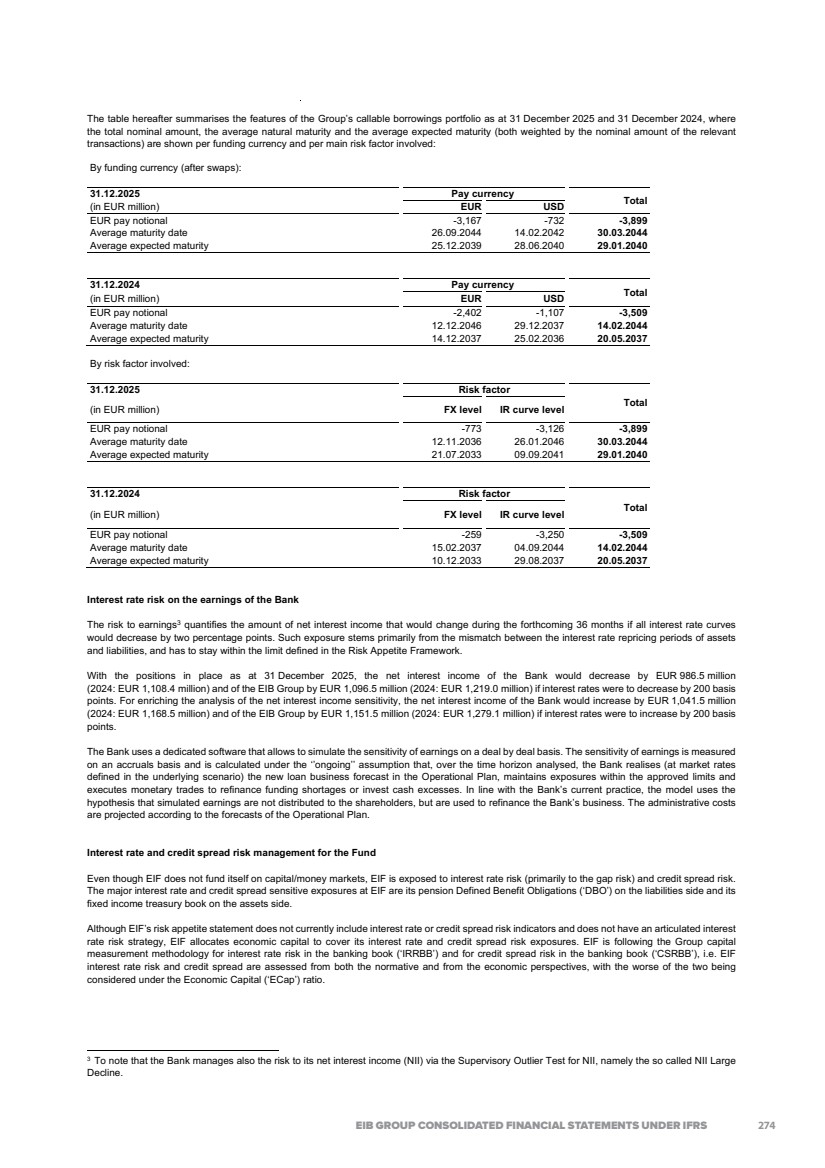
| 2025 FINANCIAL REPORT 88 S.3.2. Foreign exchange risk The foreign exchange (‘FX’) risk is the risk to the economic value or to the income derived from, the Group’s positions due to adverse movements of foreign exchange rates. The Group is exposed to a foreign exchange risk whenever there is a currency mismatch between its assets, liabilities and hedging instruments. In compliance with the Bank’s Statute and with the EIF Risk Appetite Framework, the Group does not engage in currency operations not directly required to carry out its core activities. This means that, for the Bank, mismatches of currencies in the asset-liability structure are kept within tight pre-approved limits while, for the EIF, open foreign exchange positions may arise from its Equity or Guarantee investments, in line with its Statutes and Risk Appetite Framework. As at 31 December 2025 a 10 percent depreciation of EUR versus all non-EUR currencies would result in an increase of the Group’s own funds amounting to EUR 18.4 million (31 December 2024: EUR 3.9 million). A 10 percent appreciation of the EUR versus all non-EUR currencies would result in a decrease of the Group’s own funds amounting to EUR 15.0 million (31 December 2024: EUR 3.2 million). Foreign exchange position Net position (in million) 2025 2024 Euro (EUR) -899 -653 Pound Sterling (GBP) 82 45 US Dollar (USD) 3 -36 Other currencies 814 644 Subtotal except Euro 899 653 S.3.3. Equity price risk Equity price risk is the risk that the fair values of equities decrease as the result of changes in the levels of equity indices and the value of individual equity investments. As at 31 December 2025, equity price risk was primarily limited to strategic activities approved by the Board of Directors (private equity, venture capital and infrastructure fund investments made by the Fund on behalf of the Bank and on its own resources; investment funds; equity-like investments such as Special Activities and the participation in the EBRD). These activities are subject to special forms of monitoring and the resulting exposures are supported by sound capitalisation. The value of privately held equity positions is not readily available for the purposes of monitoring and control on a continuous basis. For such positions, the best indications available include prices for similar assets and the results of any relevant valuation techniques. The effect on own funds for the Group (as a result of a change in the fair value of equity investments at 31 December 2025 and 31 December 2024) due to a reasonable possible change in equity indices, with all other variables held constant is as follows: 2025 2024 Change in equity price Effect on Own Funds(1) Change in equity price Effect on Own Funds(1) % EUR ’000 % EUR ’000 Private Equity / Venture Capital Operations / Infrastructure Funds(2) -10 -1,312,817 -11 -1,472,557 EBRD shares -10 -84,604 -10 -78,122 Investment funds -10 -519,644 -10 -524,541 (1)The same impact arises on the income statement as well. (2) The sensitivity of private equity / venture capital operations and infrastructure funds is calculated by the EIF based on the market risk of the positions on the public market. 275 |
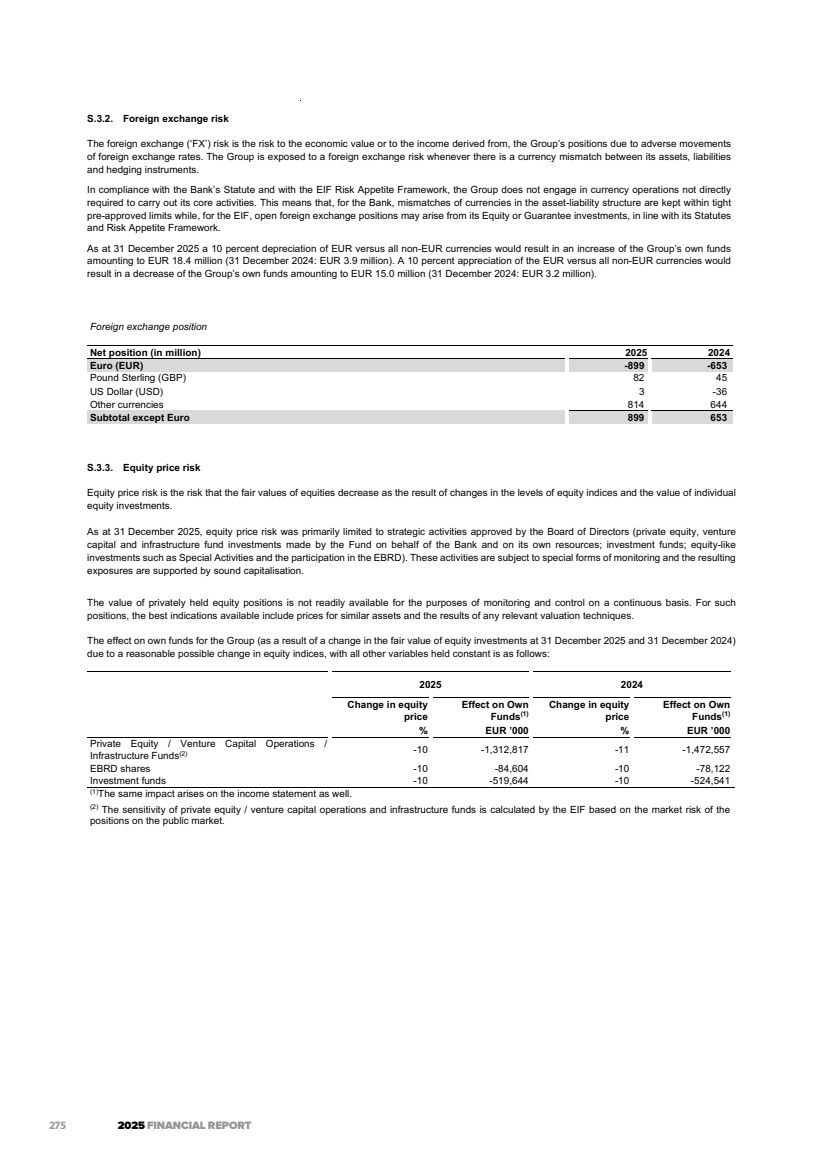
| EIB GROUP CONSOLIDATED FINANCIAL STATEMENTS UNDER IFRS 89 S.4. Liquidity and Funding risk Liquidity risk refers to the ability of the Group to fund increases in assets and meet obligations as they become due, without incurring unacceptable losses. It can be further split into funding liquidity risk and market liquidity risk. Funding liquidity risk is connected to the risk for the Group to be unable to refinance the asset side of its consolidated balance sheet and to meet payment obligations punctually and in full out of readily available liquidity resources. Funding liquidity risk may have an impact on the volatility in the economic value of, or in the income derived from Group’s positions, due to potentially increasing immediate risks to meet payment obligations and the consequent need to borrow at unattractive conditions. Market liquidity risk is the volatility in the economic value of, or in the income derived from, the Group’s positions due to potential inability to execute a transaction to offset, eliminate or reduce outstanding positions at reasonable market prices. Such an inability may force early liquidation of assets at unattractive prices when it would be better to avoid such liquidation. This risk is tied to the size of the position compared to the liquidity of the instrument being transacted, as well as to potential deterioration of market availability and efficiency. S.4.1. Liquidity risk management Liquidity risk management of the Bank Liquidity risk is managed to ensure the regular functioning of the Bank’s core activities at reasonable cost. The main objective of liquidity policy is to ensure that the Bank can always meet its payment obligations punctually and in full. In contrast to commercial banks, the EIB does not have retail deposits but relies on its access to capital markets to raise the funds it on-lends to its clients. The Bank manages the calendar of its new issues so as to maintain a prudential liquidity buffer. Liquidity planning takes into account the Bank’s needs to service its debt, make disbursements on loans and the cash inflows from the loan portfolio. It also takes into account the sizeable amount of signed but undisbursed loans, whose disbursements typically take place at the borrowers’ request. The Bank further seeks to assure management of liquidity risk by maintaining what it regards as a sufficient level of short-term liquid assets, and by spreading the maturity dates of its placements based on the projected liquidity needs. The liquidity risk policy also incorporates a floor on treasury levels: the Bank's total liquidity ratio (liquidity as a percentage of the next 12 months projected net cash outflows) must at all times exceed 25%. The Group has in place a Group Contingency Funding Plan (‘Group CFP’), which specifies decision-making procedures and corresponding responsibilities. The Group CFP is regularly tested and benchmarked against applicable best banking practices, including relevant Guidelines issued by the European Banking Authority in this respect. The Group CFP is approved annually by the Board of Directors of the Bank. Regular stress-testing analyses are executed as a part of the liquidity risk monitoring and drive the size of the liquidity buffers of EIB and EIF. On 8 July 2009, the Bank became an eligible counterparty in the Eurosystem’s monetary policy operations and has therefore been given access to the monetary policy operations of the European Central Bank. The Bank conducts the operations via the Central Bank of Luxembourg, where the Bank maintains deposits to cover the minimum reserve requirement and for other operational needs. The Liquidity Coverage Ratio (‘LCR’) is computed on a daily basis in line with the EU CRR both in the functional currency (EUR) as well as in the other significant currencies. Consistency of the currency denomination of its liquid assets with its net liquidity outflows is ensured on an ongoing basis, in order to prevent an excessive currency mismatch. As of end 2025 the Bank’s LCR stood at 658.5% (end 2024: 724.9%) and the Group LCR, which stood at 662.8% (2024: 725.8%). In addition, the Net Stable Funding Ratio (‘NSFR’) is also computed, in line with the EU CRR, both in the functional currency (EUR) as well as in the other significant currencies. As of end 2025, the Bank’s NSFR stood at 120.9% (2024: 122.3%) and the Group NSFR stood at 121.2% (2024: 122.4%). The Group continues to maintain what it regards as a robust liquidity position and flexibility to access the necessary liquidity resources mainly as a result of its prudent approach to liquidity management. As a consequence, the geopolitical and financial turbulences carried on in 2025 had very limited impact on liquidity and funding. Liquidity risk management of the Fund The Fund defines, in line with the Group as when applicable, liquidity risk as the risk that the Fund may be unable to meet its obligations as they come due, without occurring unacceptable losses. The Fund does not have natural sources of liquidity such as long-term customers’ deposits, access to capital markets or interbank borrowing. It relies mainly on its paid-in capital reserves, retained profits and the cash inflows from its business activities. Therefore, liquidity risk is managed prudently in order to ensure the regular functioning of the Fund’s core activities at reasonable cost. The Fund short-term liquidity buffer is composed of cash in order to provide the liquidity needed to meet its short-term commitments under stress conditions. This cushion is calibrated to withstand periods of liquidity stress. EIF long-term liquidity buffer is composed of the cash and the liquidation value of the EIF long-term treasury portfolio (i.e. the stock of Liquid Assets). The EIF long-term treasury portfolio is managed in such a way as to ensure an adequate level of liquidity to meet foreseeable disbursements, protect the value of the funds and earn a reasonable return. S.4.2. Liquidity risk measurement The table hereafter analyses the financial liabilities of the Group by maturity, based on the period remaining between the consolidated balance sheet date and the contractual maturity date (based on contractual undiscounted cash flows). Liabilities for which there is no contractual maturity date are classified under "Maturity undefined". The numbers represent undiscounted cash flows inclusive of interest coupons and therefore do not generally reconcile with the consolidated balance sheet figures. 276 |
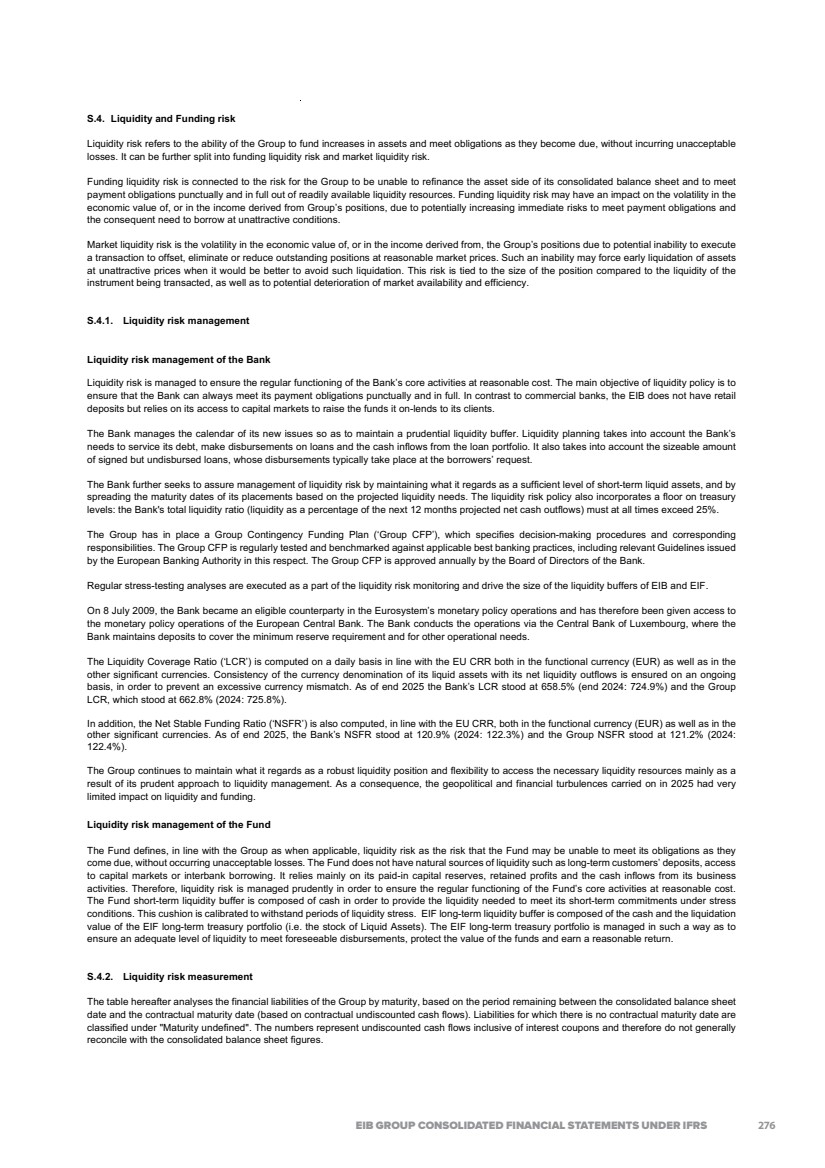
| 2025 FINANCIAL REPORT 90 Principal cash flows and interests are slotted in the bucket corresponding to their first potential contractual payment date. This therefore does not represent an expected scenario, but rather a theoretical scenario. Some of the borrowings and associated swaps include early termination triggers or call options granted to the hedging swap counterparties, and the Group also has the right to call the related bonds before maturity. In these cases, the cash flow is represented in the bucket corresponding to the first possible termination date. However, this is a conservative measure, as the Group is contractually not obliged to redeem early the related callable bonds and under realistic scenarios there would be no reason to call all such bonds at first possible occasions. Outflows for committed but undisbursed loans are represented in line with the internal methodology for liquidity stress-testing. In particular, the maximum amount of loans that under severe conditions of stress could possibly be subject to early disbursement is represented in the first maturity bucket. Net cash flows are represented for interest rate swaps and forward rate agreements. Gross cash flows are represented in the maturity analysis for interest rate derivatives where settlement is gross (essentially Cross Currency Interest Rate Swaps) and foreign exchange derivatives such as FX-forwards and FX-swaps. 277 |

| EIB GROUP CONSOLIDATED FINANCIAL STATEMENTS UNDER IFRS 91 Maturity profile of non-derivative financial liabilities (in EUR million as at 31.12.2025) 3 months or less More than 3 months to 1 year More than 1 year to 5 years More than 5 years Maturity undefined Gross nominal outflow Carrying amount Amounts owed to credit institutions and customers 5,615 0 0 0 0 5,615 5,616 Commercial papers 6,503 18,804 0 0 0 25,307 25,055 Debts evidenced by certificates – first call date scenario 13,073 39,799 226,904 191,073 0 470,849 406,510 Other liabilities 9 863 1,354 200 443 2,869 2,847 Issued guarantees and other Off-balance sheet items 0 385 2,150 33,698 10,540 46,773 Outflows for committed but undisbursed loans, investment funds and loan substitutes 18,505 682 4,358 318 113,875 137,738 Total 43,705 60,533 234,766 225,289 124,858 689,151 440,028 Maturity profile of non-derivative financial liabilities (in EUR million as at 31.12.2024) 3 months or less More than 3 months to 1 year More than 1 year to 5 years More than 5 years Maturity undefined Gross nominal outflow Carrying amount Amounts owed to credit institutions and customers 4,069 0 0 0 0 4,069 4,069 Commercial paper 6,531 18,009 0 0 0 24,540 24,125 Debts evidenced by certificates – first call date scenario 22,689 51,383 208,744 197,341 0 480,157 417,936 Other liabilities 11 839 1,404 512 507 3,273 3,243 Issued guarantees and other Off-balance sheet items (*) 0 644 1,878 29,688 9,220 41,430 Outflows for committed but undisbursed loans, investment funds and loan substitutes 15,485 886 2,198 474 112,865 131,908 Total 48,785 71,761 214,224 228,015 122,592 685,377 449,373 (*) A reclassification was made between the maturity profile buckets to reflect better the contractual maturity and to improve the readability of the financial statements. Maturity profile of derivative financial liabilities (in EUR million as at 31.12.2025) 3 months or less More than 3 months to 1 year More than 1 year to 5 years More than 5 years Gross nominal inflow/ outflow Net settling interest rate derivatives -393 -2,177 -8,283 -10,261 -21,114 Gross settling interest rate derivatives – inflows 6,695 11,484 88,044 47,205 153,428 Gross settling interest rate derivatives – outflows -7,341 -11,678 -90,654 -49,891 -159,564 Foreign exchange derivatives – inflows 15,953 1,528 0 0 17,481 Foreign exchange derivatives – outflows -16,038 -1,542 0 0 -17,580 Total -1,124 -2,385 -10,893 -12,947 -27,349 Maturity profile of derivative financial liabilities (in EUR million as at 31.12.2024) 3 months or less More than 3 months to 1 year More than 1 year to 5 years More than 5 years Gross nominal inflow/ outflow Net settling interest rate derivatives -1,105 -3,662 -10,311 -9,469 -24,547 Gross settling interest rate derivatives – inflows 5,353 14,662 41,780 30,015 91,810 Gross settling interest rate derivatives – outflows -6,555 -15,816 -46,424 -36,028 -104,823 Foreign exchange derivatives – inflows 2,807 1,808 0 0 4,615 Foreign exchange derivatives – outflows -2,827 -1,864 0 0 -4,691 Total -2,327 -4,872 -14,955 -15,482 -37,636 278 |
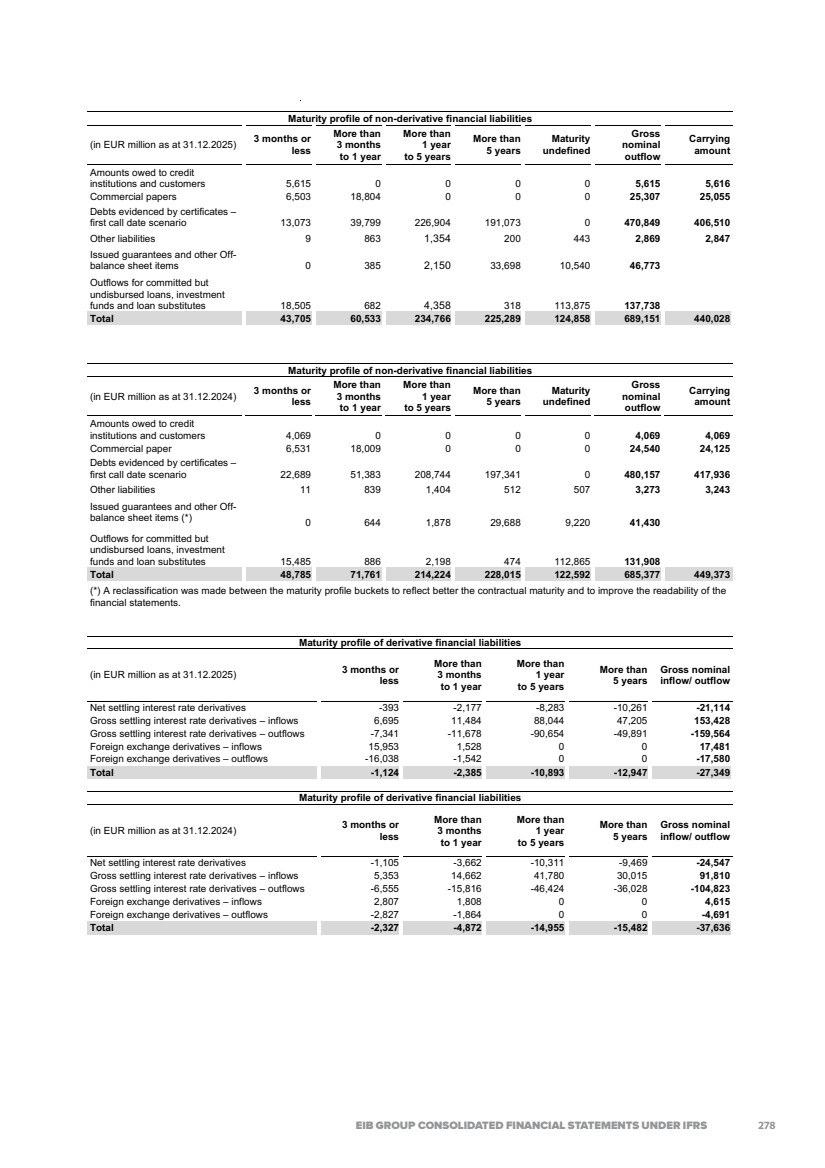
| 2025 FINANCIAL REPORT 92 S.5. Operational risk As defined in the EIB Group Operational Risk Policy, operational risk means the risk of loss resulting from inadequate or failed internal processes, people and systems or from external events4, including, but not limited to, legal risk, model risk or information and communication technology (‘ICT’) risk, but excluding strategic and reputational risk. All Group’s activities may be affected by operational risk and therefore the Group aims to systematically identify, assess, monitor and report operational risks on a regular basis, and ensure that sufficient controls and risk mitigants are in place to limit the exposure to operational risk. The Operational Risk Unit and the Internal Controls and Assertion Division in the EIB Group Risk & Compliance Directorate and the Operational Risk Unit in the EIF Risk Office are responsible for defining the Group Operational Risk Framework and related policies while the responsibility for implementing the Framework lies with all the Departments of the Group. The Group organises its operational risk management activities in compliance with the applicable Best Banking Practice (‘BBP’). In terms of reporting, exposure to operational risk is included in the EIB Group Non-Financial Risk Report which is approved by the Group Chief Risk Officer (‘GCRO’) responsible for overall aspects of managing and monitoring operational risk and then submitted to the Management Committee (‘MC’), the Audit Committee (‘AC’) and the Board of Directors (‘BoD’). In addition, operational risk losses/gains above EUR 0.25 million are immediately escalated to the President. The Group Risk Appetite Framework (‘RAF’) is formalised in the Group RAF Policy setting the overall guiding principles, processes, roles and responsibilities. The Group RAF takes into account non-financial risks and non-financial risk metrics associated with the various risk categories are reported quarterly to the MC, the AC and the BoD. At the EIF, the Operational Risk Unit within Compliance & Non-financial Risk provides regular reporting to the EIF Audit Board (‘AB’) and the Senior Management. The Group has robust compliance controls, including a dedicated Sanctions Compliance Programme, ensuring that its activities comply with all sanctions applicable to the EIB Group. With specific reference to sanctions targeting the Russian invasion of Ukraine, no material impact has been identified on Group’s business activities. The Group is a crucial institution of the European Union, and as such, it is a likely target for cyber-attacks. With the war in Ukraine, the risk of direct and spill-over attacks has increased, and the Group is closely monitoring this risk in collaboration with the Computer Emergency Response Team for the EU institutions, bodies and agencies (‘CERT-EU’). To ensure the security and integrity of its operations, the Group has implemented robust security measures to protect against cyber-attacks. S.6. Climate change and environmental risks As a provider of long-term financing, the EIB Group is exposed to potential financial impacts related to climate change and environmental risks. As a AAA-rated entity and in its capacity as the climate bank, the Group is fully committed to establishing a comprehensive and prudent climate risk management framework following the prevailing regulatory requirements and best banking and market practices. Climate change and environmental risks have a pervasive impact on the various risk categories to which the EIB Group is exposed, including credit, interest rate, liquidity and funding, foreign exchange, equity price, operational and reputational risks. As a result, these risks have been identified and are actively managed by the EIB Group. The Group defines climate change and environmental risks as the risks of a negative impact on its primary risks, by distinguishing between: • Transition risks arising from the transition to a low-carbon, climate-resilient and more environmentally sustainable economy; • Physical risks arising from the physical effect of climate change (which lead to more frequent extreme events such as floodings, droughts or storms) as well as of the environmental degradation of water, air, land and biodiversity, among others. From a short-term perspective (up to one year) climate change and environmental risks are not deemed material for EIB Group IFRS financial statements. Nevertheless, due to their long-term impact horizon (beyond ten years) and potential for exponentially growing negative effects, the Group is committed to keep continually enhancing and pro-actively managing those risks. From a credit risk and equity price risk angle, in the short to medium term (up to ten years), the Group’s lending and equity portfolios will be more sensitive to transition risk and this risk may become material, if the Group’s counterparties fail to accomplish their climate transition. For more information about climate change-related risk management at the EIB Group, please refer to section “Managing climate risks and Paris alignment” of the EIB Group’s 2024 Sustainability report, and section 13.3 “Environmental, social and governance risks” of the December 2024 European Investment Bank Group Risk Management Disclosure Report. 4 The definition of external events excludes cases of client bankruptcy or unfavourable market movements or similar events, which represent triggers for credit and market risk respectively. 279 |
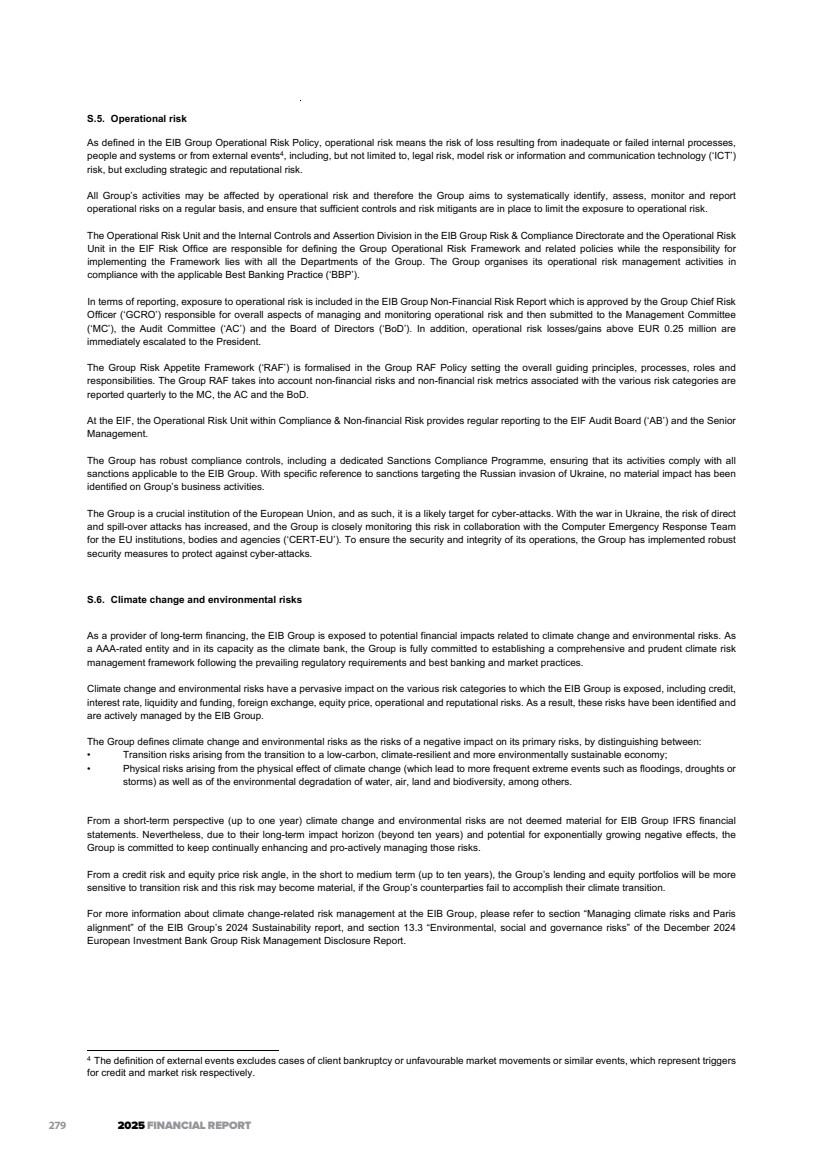
| EIB GROUP CONSOLIDATED FINANCIAL STATEMENTS UNDER IFRS 93 Note T – Accounting classifications and fair values of assets and liabilities (in EUR million) The table below sets out the Group’s classification of each class and category of assets and liabilities: 31 December 2025 Note AC Designated at FVTPL (FVO) Mandatorily at FVTPL FVOCI - equity instruments Non-financial assets/ liabilities Total carrying amount Cash in hand, balances with central banks and post office banks B.1 258 0 0 0 0 258 Treasury bills and debt securities portfolios B.2 44,451 0 9,007 0 0 53,458 Loans and advances to credit institutions and to customers C/D 457,136 11,946 2,843 0 0 471,925 Shares and other variable-yield securities B.3 0 872 20,891 846 0 22,609 Derivative assets Q 0 0 22,447 0 0 22,447 Property, furniture and equipment E 0 0 0 0 567 567 Intangible assets E 0 0 0 0 156 156 Other assets G.1 0 0 0 0 512 512 Prepayments 0 0 0 0 338 338 Total 501,845 12,818 55,188 846 1,573 572,270 Amounts owed to credit institutions and customers H 5,616 0 0 0 0 5,616 Debts evidenced by certificates I 416,870 14,695 0 0 0 431,565 Derivative liabilities Q 0 0 26,122 0 0 26,122 Other liabilities G.2 2,334 0 513 0 1,987 4,834 Deferred income F 0 0 0 0 914 914 Provisions J/D.4 0 0 0 0 6,817 6,817 Total 424,820 14,695 26,635 0 9,718 475,868 280 |
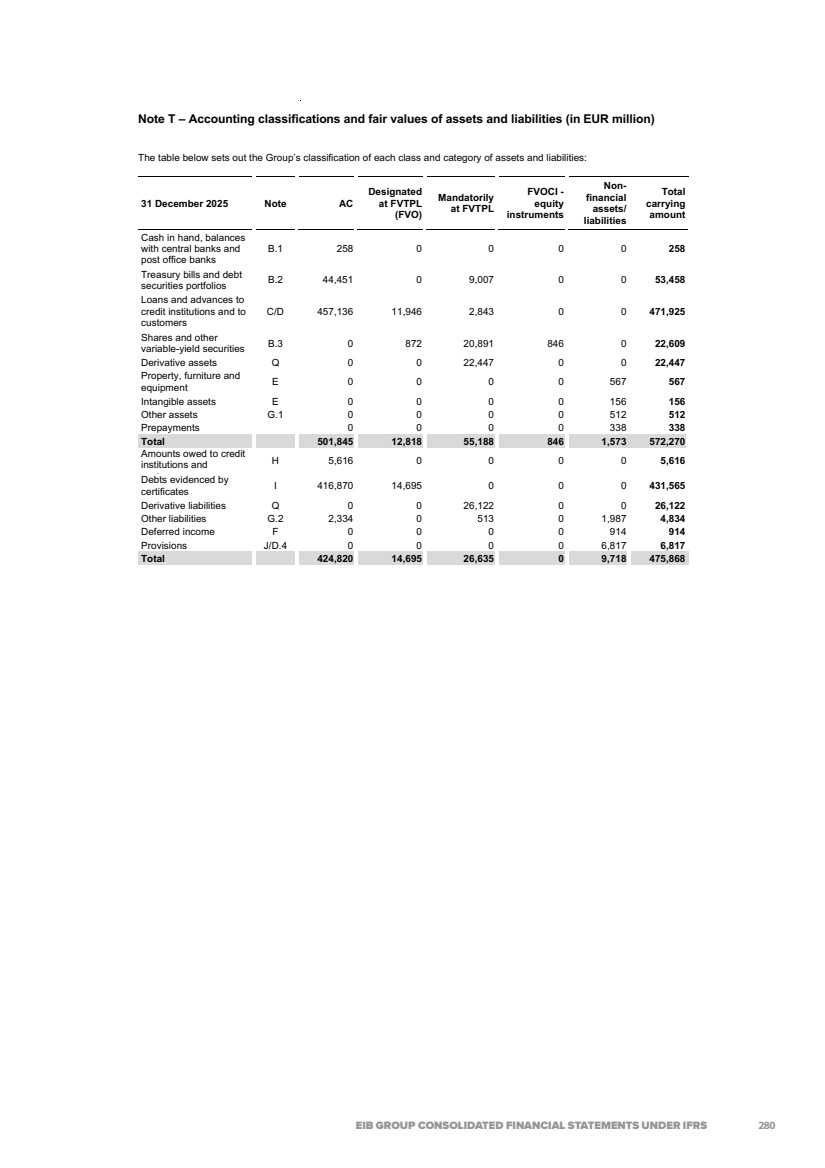
| 2025 FINANCIAL REPORT 94 31 December 2024 Note AC Designated at FVTPL (FVO) Mandatorily at FVTPL FVOCI - equity investments Non-financial assets/ liabilities Total carrying amount Cash in hand, balances with central banks and post office banks B.1 105 0 0 0 0 105 Treasury bills and debt securities portfolios B.2 42,265 0 7,534 0 0 49,799 Loans and advances to credit institutions and to customers C/D 463,702 12,014 2,668 0 0 478,384 Shares and other variable-yield securities B.3 0 901 20,051 781 0 21,733 Derivative assets Q 0 0 30,457 0 0 30,457 Property, furniture and equipment E 0 0 0 0 494 494 Intangible assets E 0 0 0 0 131 131 Other assets / Subscribed capital and reserves, called but not paid G.1/W.1 163 0 0 0 459 622 Prepayments 0 0 0 0 306 306 Assets held for sale 0 0 116 0 0 116 Total 506,235 12,915 60,826 781 1,390 582,147 Amounts owed to credit institutions and customers H 4,069 0 0 0 0 4,069 Debts evidenced by certificates I 424,608 17,453 0 0 0 442,061 Derivative liabilities Q 0 0 30,173 0 0 30,173 Other liabilities G.2 2,760 0 483 0 1,762 5,005 Deferred income F 0 0 0 0 752 752 Provisions J / D.4 0 0 0 0 6,776 6,776 Total 431,437 17,453 30,656 0 9,290 488,836 281 |
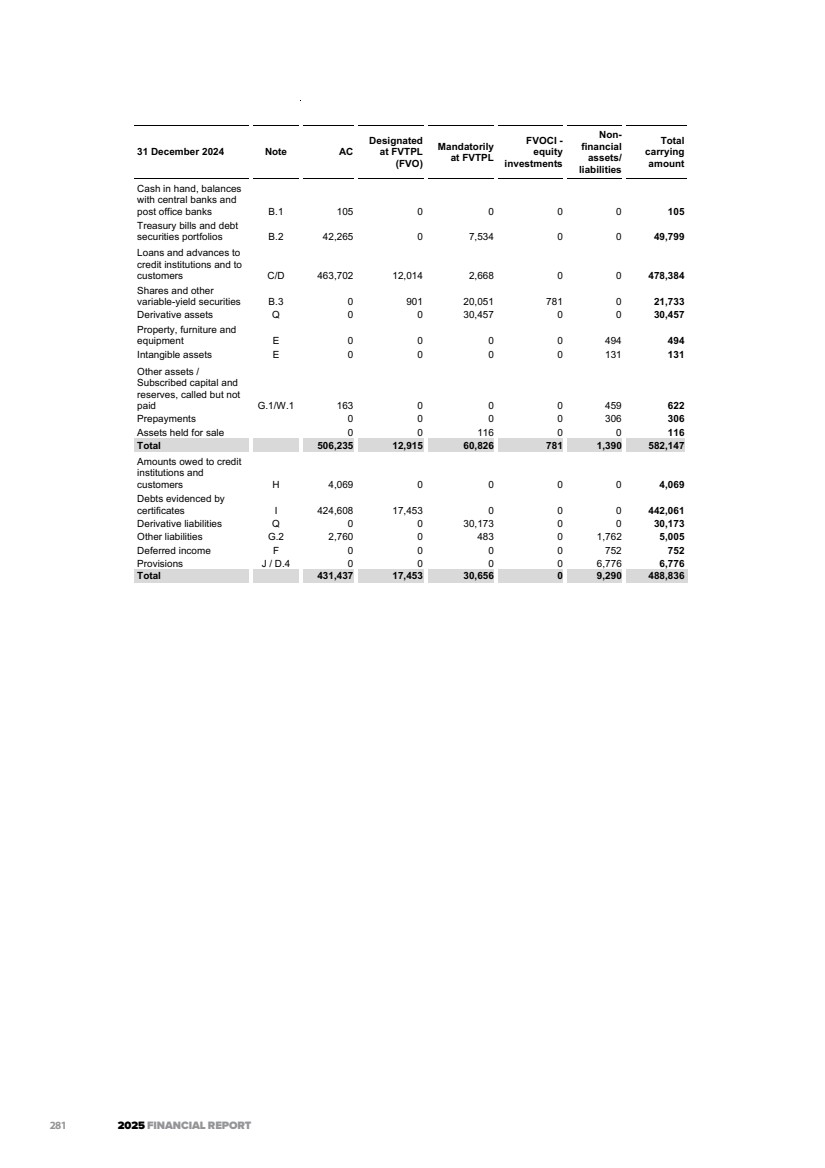
| EIB GROUP CONSOLIDATED FINANCIAL STATEMENTS UNDER IFRS 95 The table below sets out the fair value of each of the Group’s classes and categories of assets and liabilities. Fair value is set to book value for non-financial assets and non-financial liabilities. 31 December 2025 AC Designated at FVTPL (FVO) Mandatorily at FVTPL FVOCI - equity instruments Non-financial assets/ liabilities Total fair value Cash in hand, balances with central banks and post office banks 258 0 0 0 0 258 Treasury bills and debt securities portfolios 44,159 0 9,007 0 0 53,166 Loans and advances to credit institutions and to customers 490,577 11,946 2,843 0 0 505,366 Shares and other variable-yield securities 0 872 20,891 846 0 22,609 Derivative assets 0 0 22,447 0 0 22,447 Property, furniture and equipment 0 0 0 0 567 567 Intangible assets 0 0 0 0 156 156 Other assets 0 0 0 0 512 512 Prepayments 0 0 0 0 338 338 Total 534,994 12,818 55,188 846 1,573 605,419 Amounts owed to credit institutions and customers 5,616 0 0 0 0 5,616 Debts evidenced by certificates 409,213 14,695 0 0 0 423,908 Derivative liabilities 0 0 26,122 0 0 26,122 Other liabilities 2,334 0 513 0 1,987 4,834 Deferred income 0 0 0 0 914 914 Provisions 0 0 0 0 6,817 6,817 Total 417,163 14,695 26,635 0 9,718 468,211 31 December 2024 AC Designated at FVTPL (FVO) Mandatorily at FVTPL FVOCI - equity investments Non-financial assets/ liabilities Total fair value Cash in hand, balances with central banks and post office banks 105 0 0 0 0 105 Treasury bills and debt securities portfolios 42,014 0 7,534 0 0 49,548 Loans and advances to credit institutions and to customers 459,676 12,014 2,668 0 0 474,358 Shares and other variable-yield securities 0 901 20,051 781 0 21,733 Derivative assets 0 0 30,457 0 0 30,457 Property, furniture and equipment 0 0 0 0 494 494 Intangible assets 0 0 0 0 131 131 Other assets 163 0 0 0 459 622 Prepayments 0 0 0 0 306 306 Assets held for sale 0 0 116 0 0 116 Total 501,958 12,915 60,826 781 1,390 577,870 Amounts owed to credit institutions and customers 4,069 0 0 0 0 4,069 Debts evidenced by certificates 413,892 17,453 0 0 0 431,345 Derivative liabilities 0 0 30,173 0 0 30,173 Other liabilities 2,760 0 483 0 1,762 5,005 Deferred income 0 0 0 0 752 752 Provisions 0 0 0 0 6,777 6,777 Total 420,721 17,453 30,656 0 9,291 478,121 282 |
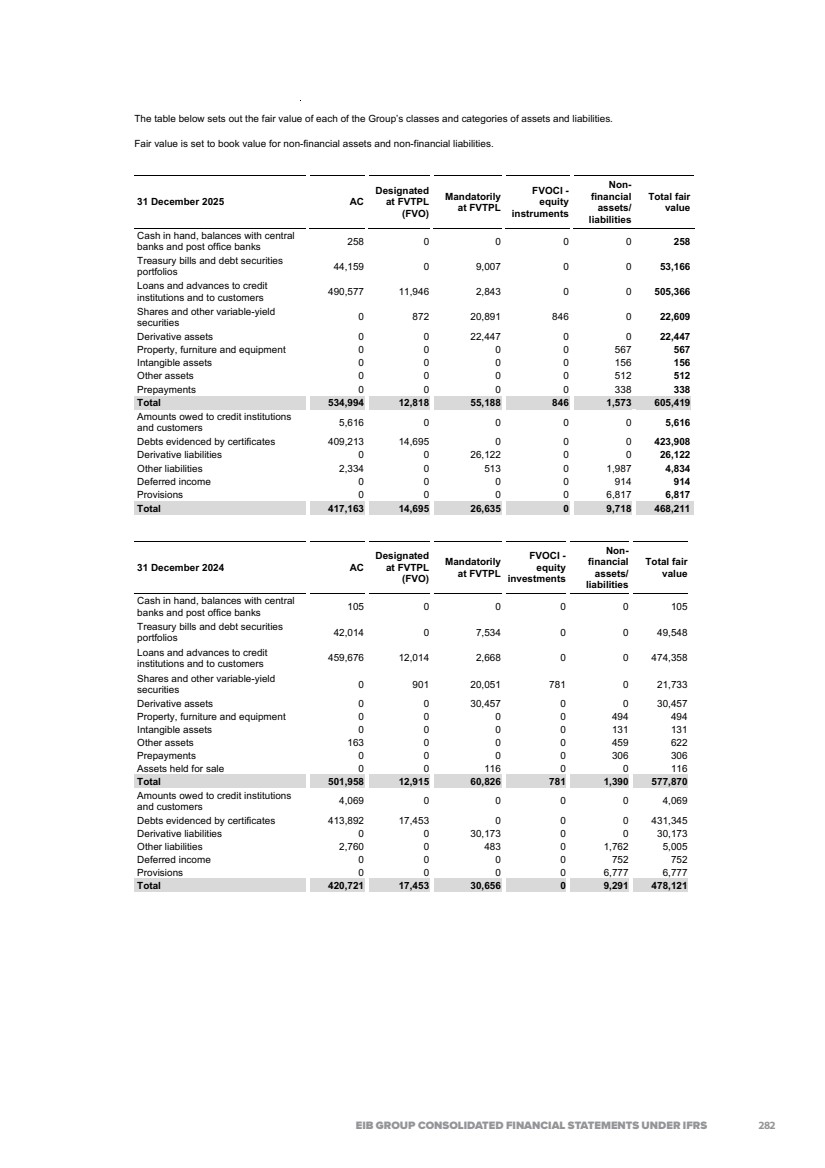
| 2025 FINANCIAL REPORT 96 Note U – Segment reporting (in EUR million) The segment information disclosed in this note has been prepared in accordance with the "management approach" applied by IFRS 8 meaning that the definition of segments as well as the preparation of information used for segment reporting are both based on information prepared for internal management decisions. The EIB Group has one single reportable segment, which is the EIB long-term finance activity comprising EIB lending operations inside and outside Europe, borrowing and treasury operations. The EIB has venture capital investments as well that alone do not meet any of the quantitative thresholds for determining a reportable segment in 2025 and as such are reported together with the EIB long-term finance activity. The Management Committee as the Group’s chief operating decision maker reviews internal management reports on the performance of the Bank’s long-term finance activity on at least a quarterly basis. The financial support of SME’s carried out by the European Investment Fund through private equity / venture capital and infrastructure investments, as well as the provision of guarantees do not meet any of the quantitative thresholds for determining a reportable segment in 2025 or 2024 and are disclosed as “other” in the reconciliation of reportable segment revenues, profit or loss and assets and liabilities. Information about reportable segment Long term lending finance activity 2025 2024 External revenues: Net interest income 3,041 3,071 Net income from shares 924 912 Net fee and commission income (*) 96 95 Result on financial operations 268 872 Net other operating income and expense (*) 48 50 Total segment revenue 4,377 5,000 Other material non-cash items: Impairment losses on loans and shares -220 -12 -220 -12 Reportable segment profit 2,676 3,549 Reportable segment assets 563,877 574,807 Reportable segment liabilities 474,628 487,687 Reconciliation of reportable segment revenues, profit and assets and liabilities 2025 2024 Revenues: Total revenues for reportable segment (*) 4,377 5,000 Other revenues 423 459 Consolidated revenue 4,800 5,459 Profit: Total profit for reportable segment 2,676 3,549 Other profit 233 283 Consolidated profit 2,909 3,832 Assets: Total assets for reportable segment 563,877 574,807 Other assets 8,393 7,340 Consolidated total assets 572,270 582,147 Liabilities: Total liabilities for reportable segment 474,628 487,687 Other liabilities 1,240 1,149 Consolidated total liabilities 475,868 488,836 (*) A reclassification was made among the captions in order to improve the readability of the financial statements. See Note A.5. 283 |
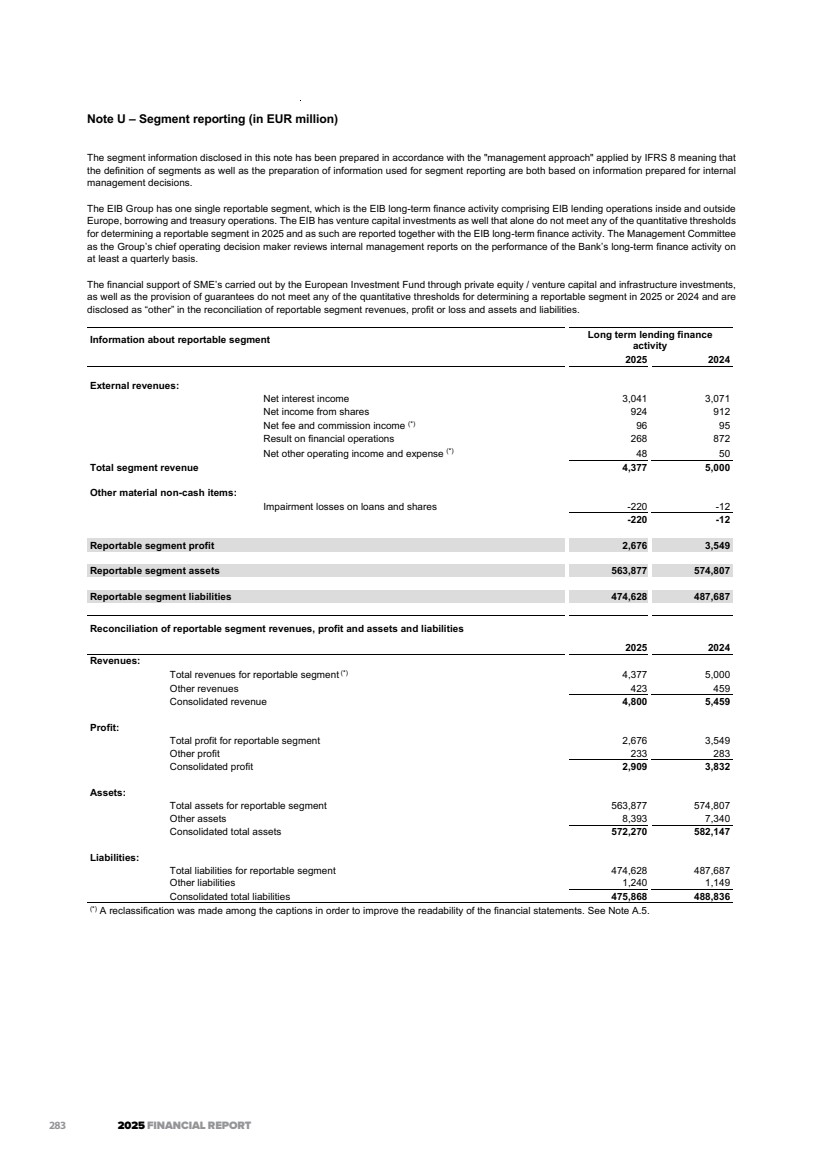
| EIB GROUP CONSOLIDATED FINANCIAL STATEMENTS UNDER IFRS 97 Note V – Commitments, contingent liabilities, pledged assets and other memorandum items (in EUR ’000) The EIB Group uses various lending-related financial instruments to meet the financial needs of its customers. It issues commitments to extend credit, standby and other letters of credit, guarantees, commitments to enter into repurchase agreements, note issuance facilities and revolving underwriting facilities. Guarantees represent irrevocable assurances, subject to the satisfaction of certain conditions, that the Group will make a payment in the event that the customer fails to fulfil its obligation to third parties. The contractual amount of these instruments is the maximum amount at risk for the Group if the customer fails to meet its obligations. The risk is similar to the risk involved in extending loan facilities and is monitored with the same risk control processes and specific credit risk policies. As at 31 December 2025 and 31 December 2024, commitments, contingent liabilities and other memorandum items were as follows (in nominal amounts and in EUR ‘000): 31.12.2025 31.12.2024 Contingent liabilities and guarantees: - In respect of loans granted by third parties(*) 36,233,232 32,210,054 Commitments: - EBRD capital uncalled 712,630 712,630 - Undisbursed loans (Note D.1) credit institutions 26,408,564 28,991,439 customers 107,154,243 99,028,309 133,562,807 128,019,748 - Undisbursed private equity and venture capital operations 7,126,335 6,192,669 - Undisbursed investment and infrastructure funds 4,174,972 3,887,979 - Undisbursed other investments 2,700,559 2,314,416 - Borrowings launched but not yet settled 223,950 223,950 Assets held on behalf of third parties(*): - Innovation Fund 14,102,137 11,393,044 - Modernisation fund 7,224,104 6,000,001 - RRF-FI 3,892,094 1,900,524 - Investment Facility Cotonou 3,519,226 3,979,538 - InnovFin 2,085,519 2,086,963 - InvestEU 1,638,036 1,634,043 - NER300 1,097,186 1,068,868 - CEF 836,775 867,827 - Pan-European Guarantee Fund 814,876 706,679 - ESIF 804,956 704,920 - Partnership Platform for Funds 790,050 735,178 - REG 337,298 331,869 - EU-Africa Infrastructure Trust Fund 323,905 349,362 - COSME LGF & EFG 283,536 419,431 - Decentralised Financial Instruments 273,858 260,061 - Trust accounts with ETCI 249,360 532,824 - JEREMIE 228,139 294,386 - SME initiative Italy 204,044 369,229 - ACP Trust Fund EC Compartment 201,664 201,751 - SME initiative Romania 192,617 260,904 - European Fund for Strategic Investments (‘EFSI EIF’) 164,849 147,883 - EU for Ukraine Fund 122,391 118,068 - HDW POLIO IG 108,356 182,951 - InvestEU Advisory Hub 93,626 43,177 - Special Section 90,108 99,454 - NPI 69,952 73,434 - EaSI 68,745 72,693 - Private Finance for Energy Efficiency Instrument 59,775 58,979 - GIF 2007 58,898 63,918 - SMEG 2007 55,868 56,076 - InnovFin SME Guarantee 53,672 66,619 - Bundesministerium für Wirtschaft und Technologie 52,243 57,474 - DCFTA 50,931 52,225 - SME initiative Finland 48,849 53,482 - NDICI IW1, IW2 and IW4 48,218 27,586 - NIF Risk Capital Facility 47,587 50,354 - WB EDIF 43,849 38,282 - ENPI 42,892 43,758 - InnovFin Equity 38,801 45,142 - SME initiative Bulgaria 38,603 57,380 - JESSICA Holding Funds 34,480 21,417 - Cultural and Creative Sectors Guarantee Facility 31,997 51,096 284 |
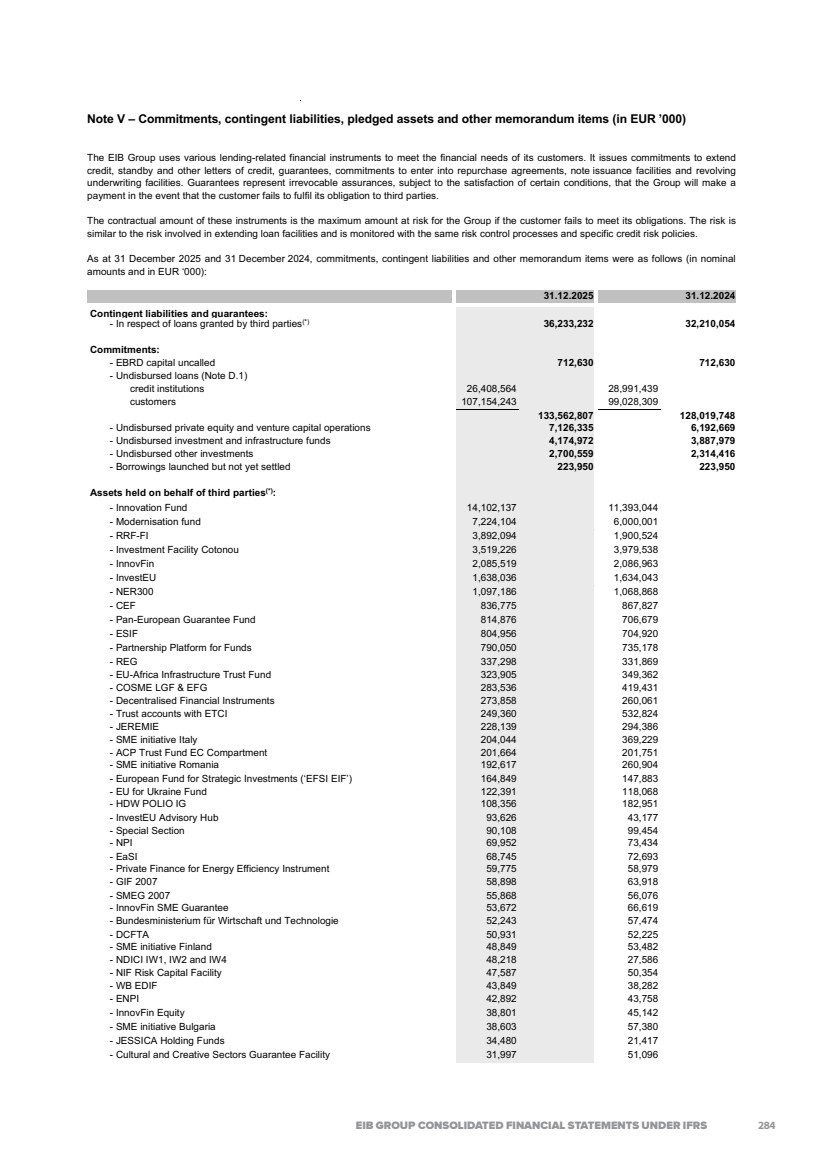
| 2025 FINANCIAL REPORT 1 31.12.2025 31.12.2024 - IPA II / IPA III 28,948 38,015 - EFSI-EIAH 28,662 26,951 - TTA Türkiye 27,972 13,513 - SME initiative Malta 27,837 27,265 - FEMIP Trust Fund 24,733 26,812 - German Future Fund Growth Facility 24,681 28,101 - GCFF Jordan Private Sector Guarantee Facility 22,756 31,894 - AECID 22,507 25,291 - NIF Trust Fund 20,074 20,050 - EU Support to Boost Africa 18,639 31,061 - EPTA Trust Fund 17,976 18,448 - SME initiative Spain 12,265 12,688 - BIF 11,603 13,969 - MAP guarantee 11,040 15,876 - Natural Capital Financing Facility 9,449 12,473 - DESIREE 6,135 6,103 - AGRI 4,025 4,908 - EPIC 3,468 1,222 - GEEREF 3,431 3,373 - KBC Climate & Infrastructure Private Investors Partnership 3,077 1,511 - Alp GIP 2,754 2,408 - 3SIIF 2,667 0 - FoF mandates (virtual) 2,262 902 - Central Europe FoF 1,851 2,586 - fi-compass 1,791 3,054 - Student Loan Guarantee Facility 1,696 2,730 - MAP Equity 1,668 5,855 - LfA-EIF Facility 1,542 195 - JASPERS 1,529 6,789 - TARGET 1,269 790 - PGFF 1,061 6,104 - GEF-UNEP 1,057 1,434 - EFSD Guarantee - SME Access to Finance Initiative 990 1,729 - German Corona Matching Facility (CMF) 854 1,009 - MDD 755 847 - EU Trade and Competitiveness Program 616 704 - G43 Trust Fund 288 287 - EU4Business Guarantee Facility Ukraine 265 0 - AIP Kulima 244 244 - EU4Business Guarantee Facility 238 259 - PFSI 219 0 - TTP 197 203 - AIP Zambia 178 218 - European Technology Facility 44 1,048 - GGF 7 7 - GAGF 5 29,232 - GF Greece 0 45,139 - RSFF (incl. RSI) 0 13,994 40,879,395 36,066,141 Other items: - Notional value of interest rate swaps (Note S.2.5.2) 631,978,110 655,792,698 - Notional value of currency swap contracts payable 208,844,111 229,644,516 - Notional value of currency swap contracts receivable (Note S.2.5.2) 205,154,785 232,980,366 - Notional amount of futures contracts (Note Q3) 44,442,868 33,351,527 - Notional value of short-term currency swap contracts payable 23,008,868 19,500,940 - Notional value of short-term currency swap contracts receivable (Note Q.3) 22,930,155 19,687,736 - Special deposits for servicing borrowings(**) 489 535 - Currency swaps launched but not yet settled receivable (Note S.2.5.2) 0 145,049 - Currency swaps launched but not yet settled payable 0 144,845 (*) Assets under management are disclosed as off-balance sheet item based on the latest available figures. Comparative figures might be restated to reflect most recent available information. (**) This item represents the amount of coupons and bonds due, paid by the Group to the paying agents, but not yet presented for payment by the holders of bonds issued by the Group. 285 |
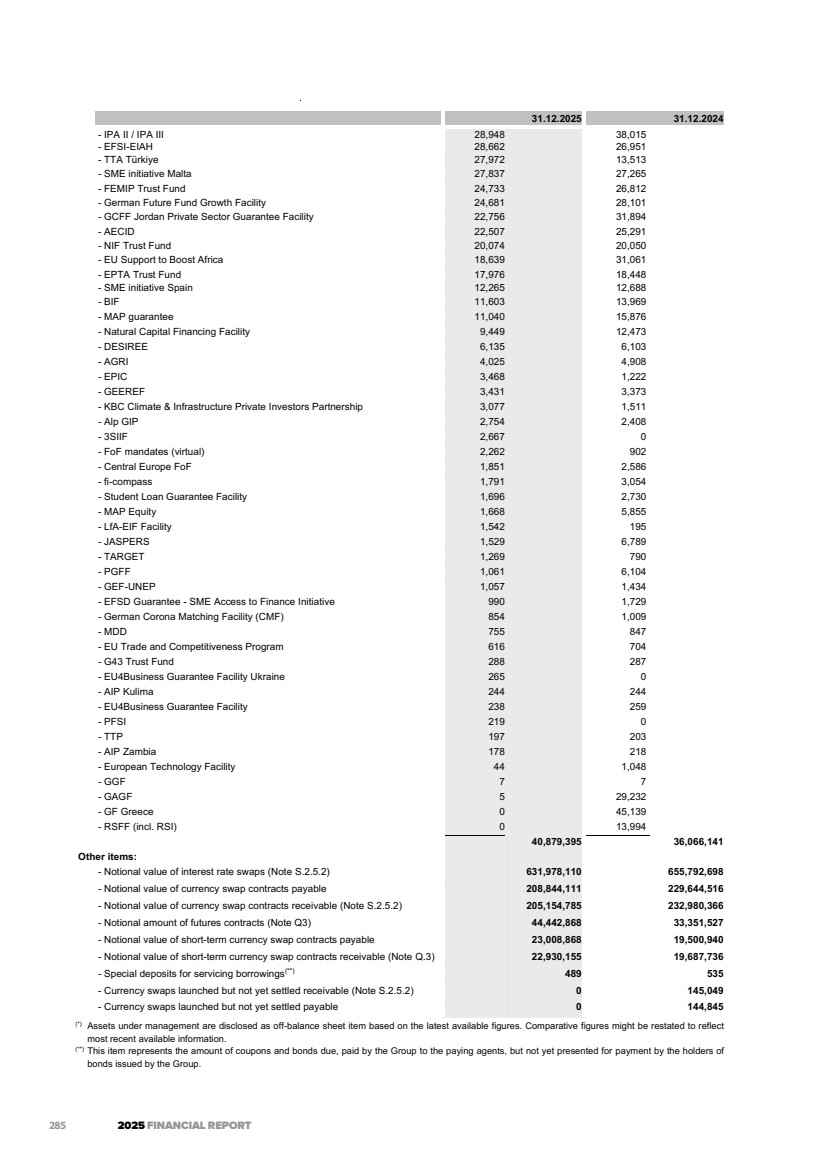
| EIB GROUP CONSOLIDATED FINANCIAL STATEMENTS UNDER IFRS 2 V.1. Innovation Fund The Innovation Fund established under Article 10a(8) of Directive 2003/87/EC supports innovation in low-carbon technologies and processes across all Member States. This includes environmentally safe carbon capture and utilisation which contributes substantially to mitigating climate change, and products to replace carbon intensive alternatives. The Fund also aims to promote the construction and operation of projects focused on environmentally safe capture and geological storage of CO2, alongside innovative renewable energy and energy storage technologies. The EIB prepares separate financial statements for the Innovation Fund. V.2. Modernisation Fund The Modernisation Fund, established under Article 10d of the revised EU Emissions Trading System (‘ETS’) Directive, aims to modernise the energy systems and improve the energy efficiency of 13 EU beneficiary Member States: Bulgaria, Czech Republic, Croatia, Estonia, Greece, Hungary, Latvia, Lithuania, Poland, Portugal, Romania, Slovakia and Slovenia. The Modernisation Fund supports investments in the generation and use of energy from renewable sources, energy efficiency, energy storage, the modernisation of energy networks, including district heating, pipelines and grids, redeployment, the re-skilling and upskilling of workers, education, job-seeking initiatives and start-ups. The EIB prepares separate financial statements for the Modernisation Fund. V.3. Recovery and Resilience Facility Financial Instruments (‘RRF-FI’) The EIB manages and invests RRF resources on behalf of the respective EU Member States according to an investment strategy and business plan agreed in a funding agreement between the EIB and the mandator. Furthermore, the EIB performs fund administration tasks (including monitoring, reporting, treasury management). If requested by the EU Member States, the mandate can also embed the Bank’s advisory support. RRF-FI can be implemented in three ways: (i) direct implementation, where the EIB directly selects and appraises underlying operations, (ii) indirect implementation through a financial intermediary, and (iii) blending. RRF Equity Cyprus RRF Equity Cyprus is the first equity mandate signed between the EIF and the Republic of Cyprus. The mandate is structured as a direct award of EUR 30 million to the EIF, financed by the National Recovery and Resilience Plan of Cyprus (EUR 20 million) and reflows from the JEREMIE programme of the 2007-2013 PP. The mandate foresees the deployment of a generalist VC fund targeting innovative enterprises and start-ups in their (pre-) seed and early stages of development. This will be the first VC fund deployed in the country with the support of public resources. RRF Equity Bulgaria The RRF Equity Bulgaria mandate is structured as a direct award of EUR 180 million to the EIF under the National Recovery and Resilience Plan of Bulgarian, in connection with the country's Recovery and Resilience Facility established by Regulation (EU) 2021/241. Equity financing will be provided to support investments under three windows, namely: - Equity instruments for Growth (initial budget allocation of up to EUR 75 million) - Equity instruments for Innovation (initial budget allocation of up to EUR 75 million) - Equity instruments for climate neutrality and digital transformation investments (initial budget allocation of up to EUR 30 million) The mandate will help alleviate the negative impacts of the pandemic on the Bulgarian market in general and more risky undertakings, in particular, by providing equity financing to TT projects, SMEs and mid-caps that will be used to foster innovation and help the transition to the knowledge economy; it will also finance equity investments (e.g. infrastructure projects) supporting climate neutrality and digital transformation. Recovery and Resilience Facility - Czech Republic Also called the RRF Czech Republic Fund of Funds (RRFCZ FoF), the mandate represents an RRF-funded programme with an initial funding of EUR 55 million to be deployed in three specialised venture capital funds focused on investments in mainly Czech start-ups developing strategic digital technologies – a pre-seed co-investment fund, a fintech/blockchain fund and a university AI TT fund. The available funding has been increased by additional EUR 80 million in 2024 for commitments to additional funds with broader strategies, aiming to support additional sectors considered to be of strategic importance to the Czech Republic. RRF Bulgaria debt The Bulgarian Government has earmarked in the Recovery and Resilience Plan (“RRP”) a total amount of EUR 150 million for the deployment by the EIF of two portfolio guarantee instruments, both based on the eligibility criteria of the relevant InvestEU EU-Compartment (“EU-C”) instruments, namely: (i) EUR 75 million of RRP resources for the Sustainability Guarantee; and (ii) EUR 75 million of RRP resources for the SME Competitiveness Guarantee. The Contribution Agreement was signed in November 2022, and the InvestEU Guarantee Agreement Amendment including the and MS-C Schedule for Bulgaria was signed on 10 August 2023. The mandate, via the SME Competitiveness Guarantee, would ultimately contribute to strengthening the resilience, increase productivity and support the sustainable growth of Bulgarian companies. In addition, for 50% of the mandate resources, the Sustainability Guarantee aims to address Bulgaria’s current challenges in supporting investments in the energy efficiency and renewable energy sectors, contributing to the green and sustainable transformation of the local economy and to the achievement of the climate targets. RRF Romania debt The EIF was approached by the Romanian Government in February 2021 for the implementation of financial instruments under the RRF. After the Mandate AA approval at PMC, based on the feedback received from the EC, it was decided to approach the debt component as an InvestEU MS-C contribution and the equity component as a direct award. The InvestEU Guarantee Agreement Amendment including the MS-C applicable framework and MS-C Schedule for Romania was signed on 23 May 2023. The mandate, via the Competitiveness Guarantee, would ultimately contribute to strengthening the resilience, increase productivity and competitiveness of the Romanian companies. 286 |
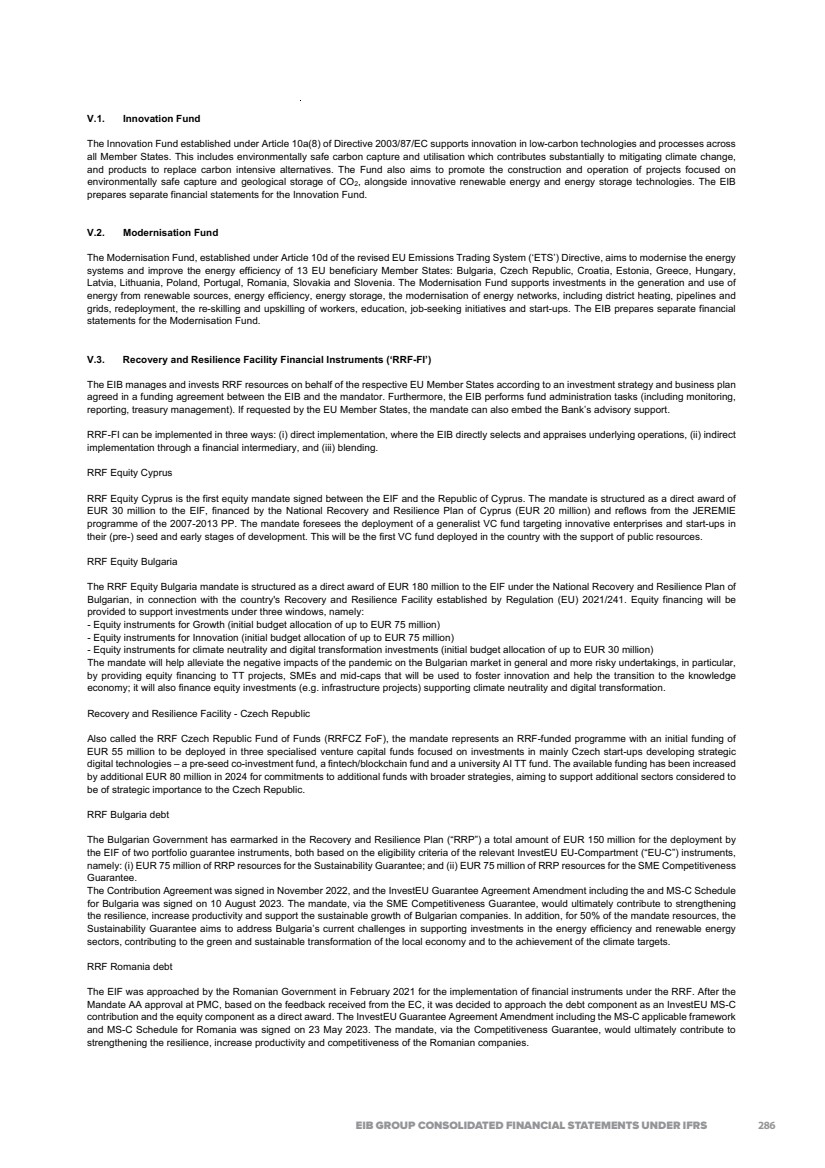
| 2025 FINANCIAL REPORT 3 In addition, for 40% of the mandate RRF resources, the Sustainability Guarantee aims to address Romania’s current challenges in supporting investments in the energy efficiency and renewable energy sectors, contributing to the green and sustainable transformation of the local economy and to the achievement of the climate targets. RRF Greece The Greek Government contributed EUR 400 million with the EIF as Implementing Partner in the context of an overall contribution of EUR 500 million to the MS Compartment of InvestEU. The EIF and EIB had liaised with the Ministry of Finance and proposed standard guarantees employed under the EU compartment of InvestEU. The MS has selected the Sustainability, SME Competitiveness and Innovation / Digitalisation. Spain RRF - Climate & Infra This new instrument agreement falls within the Implementing Agreement signed between the EIF, the EIB and Spain with regards to the use of the RRF. It is a EUR 500 million mandate focused on investing into climate and infrastructure funds that will provide equity investments with a primary focus on climate action and environmental sustainability, as well as digital infrastructure. Spain RRF – ALSD An additional EUR 200 million made available for a total of up to EUR 400 million to be invested based on the intermediation of Private Credit funds as alternative lenders. V.4. Investment Facility – Cotonou The Investment Facility, which is managed by the EIB, was established under the Cotonou Agreement on cooperation and development between the African, Caribbean and Pacific Group of States and the European Union and its Member States on 23 June 2000 and subsequently revised. The EIB prepares separate financial statements for the Investment Facility. V.5. InnovFin - EU Finance for Innovators (‘InnovFin’) InnovFin is a joint initiative between the EIB, the EIF and the European Commission under the new EU research programme for 2014-2020 (‘Horizon 2020’). On 11 December 2013, Regulation (EU) No. 1291/2013 of the European Parliament and the Council establishing Horizon 2020 – the Framework Programme for Research and Innovation (2014-2020) and repealing Decision No. 1982/2006/EC (‘Horizon 2020 Regulation’) was adopted. On 12 June 2014, the European Commission, the EIB and the EIF signed a Delegation Agreement establishing the financial instrument InnovFin. InnovFin consists of a series of integrated and complementary financing tools and advisory services offered by the EIB Group to support investments across the entire research and innovation value chain, catering to enterprises of all sizes, from the smallest to the largest. The EIB prepares separate financial statements for InnovFin. V.6. InvestEU On 7 March 2022, the EU, the EIB and the EIF signed a Guarantee Agreement establishing the EU guarantee under InvestEU. The InvestEU programme aims to give an additional boost to sustainable investment, innovation, social inclusion and job creation in Europe. InvestEU is expected to stimulate public and private investments by using a EUR 26.2 billion EU budgetary guarantee, 75% of this is granted separately to the EIB and the EIF. On 1 April 2022, all operations in the EFSI Debt Standard Portfolio and in the EFSI Hybrid Portfolio were transferred to InvestEU. These operations originally guaranteed under the EFSI Agreement, are defined as the ‘Pre-2021 Operations’. The EIB prepares separate financial statements for InvestEU. Finland Climate Action Guarantee The EIF was approached by the Finnish Government in March 2021 to implement a financial instrument focused on green transitioning. The contribution from Finland is made via InvestEU. The Contribution Agreement was signed in September 2022, while the InvestEU Guarantee Amendment including the MS-C Schedule for Finland was signed on 10 August 2023. The Finland Climate Action Guarantee aims to address Finland’s current challenges in supporting investments in the energy efficiency and renewable energy sectors. The Finland Climate Action Guarantee will facilitate access to finance for clean and efficient production and use of energy, sustainable and efficient infrastructure as well as research and innovation of low-carbon solutions, ultimately contributing to the green and sustainable transformation of the local economy and to the achievement of the climate targets. EDF Top-Up (European Defence Fund) A top-up to the InvestEU Mandate supporting the Target Area of Defence under the Enabling Sectors sub-product. EUR 100 million received in tranches from the European Defence Fund, which – when combined with EIF own resources – results in c. EUR 175 million of investment capacity. Operations to support funds with strategies that include solutions and technologies with dual-use potential that will accelerate the evolution of Europe’s technological and industrial base in the area of defence. InvestEU Climate Mitigation Following the signature of the 3rd IEU amendment, a new uncapped portfolio is envisaged with top-up commitments from an existing (SIW) window, designed to deploy a specific component of the sustainability guarantee product of InvestEU. 287 |
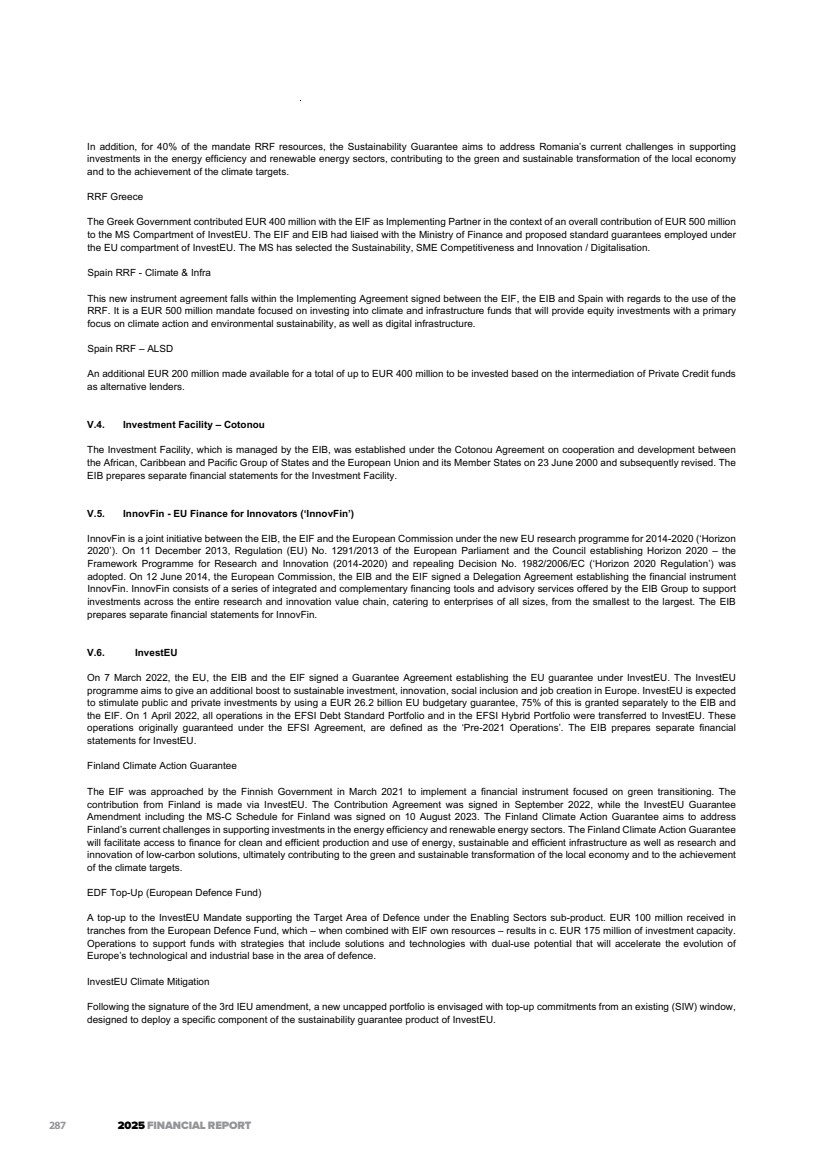
| EIB GROUP CONSOLIDATED FINANCIAL STATEMENTS UNDER IFRS 4 Spain Recovery and Resilience Facility - Alternative Lending for Sustainable Development. The mandate envisages up to EUR 400 million to be invested via Private Credit funds. Such alternative lenders are typically not eligible to work with other implementing partners under the Spanish Recovery and Resilience Programme. Spain Recovery and Resilience Facility - Member State Compartment. EIF’s intervention is sought for the support of Spanish businesses through i) up to EUR 600 million (EUR 500 million Recovery and Resilience Facility resources and up to EUR 100 million national resources) for: 1) contribution to the InvestEU MS-C to cover existing EIF thematic portfolio guarantee products; and 2) a EUR 400 million contribution to a Senior Private Credit Instrument (the “SPC Instrument”) to support loan funds. InvestEU The Transaction Cost Support pilot will be available for funds operating in the impact space, specifically targeting first-time teams, emerging teams and women-led teams. The Transaction Cost Support is a scheme in the form of a non-repayable lump sum payment to be combined with commitment undertaken by EIF for the Social Impact Equity Product under InvestEU Social Investment and Skills Window. The full mandate size is EUR 10 million. V.7. NER300 The EIB supports the European Commission as an agent in the implementation of the NER 300 initiative a funding programme for carbon capture and storage demonstration projects and innovative renewable energy technologies. The facility covers two activities i) the monetisation of EU allowance units (‘EUAs’) and ii) the management and disbursement of cash received through such monetisation activities. The EIB prepares separate financial statements for NER300. V.8. Connecting Europe Facility (‘CEF’) The CEF is a joint agreement between the EIB and the European Commission that aims to provide union financial assistance to trans-European networks to support projects of common interest in the transport, telecommunications and energy infrastructures sectors. The European Commission entrusted EIB with the implementation and management of the debt instrument under the CEF, which ensures continuity of the Loan Guarantee Instrument for TEN-T Projects (‘LGTT’) and the Pilot phase of Project Bond Initiative (‘PBI’), which were merged under the CEF on 1 January 2016. The CEF Delegation Agreement includes an updated and harmonised risk sharing arrangement. The EIB prepares separate financial statements for the CEF. V.9. Pan-European Guarantee Fund (‘EGF’) The EGF was endorsed by the European Council on 23 April 2020 as part of the overall EU’s COVID-19 response package. 22 Member States confirmed their participation with an overall guarantee of EUR 24.4 billion euro, available exclusively to entities in participating countries. The EGF is designed to finance high-risk operations and final beneficiaries that would meet financial intermediaries’ requirements for commercial financing but are struggling due to the economic impact of the COVID-19 pandemic. At least 65% of EGF supported financing is therefore allocated to small and medium-sized enterprises (‘SMEs’). The EGF is jointly implemented by the EIB and the EIF, each responsible for approximately half of the amount but with a distinct product offering. The EIF focuses on capped and uncapped portfolio guarantees and indirect equity-type investments (funds), while the EIB deploys products such as linked risk sharing, venture debt and synthetic Asset Based Securities. The EIB prepares separate financial statements for the EGF. V.10. European Structural Investment Fund (‘ESIF’) Under the European Structural Investment Fund (‘ESIF’), Member States appointed the EIF to manage ESIF funds as Holding Fund manager since November 2015. The ESIF initiative is aimed at promoting SME access to finance and financial engineering products, such as private equity funds, guarantee funds and loan funds. The EIF is currently managing 19 ESIF Funding Agreements signed with Member States and regions: Basse-Normandie and Languedoc-Roussillon. The EIF prepares separate financial statements for ESIF. European Structural and Investment Funds – Croatia 2 Also called the Croatian Venture Capital Initiative 2 (CVCi 2), the mandate represents a successor equity programme to the CVCi (ESIF Croatia, signed in 2018), for the new 2021-2027 programming period. Continuing the strategy of the original programme, under the larger CVCi 2 the EIF will deploy up to EUR 80 million (more than double the funding available under the CVCi) in venture capital and acceleration funds investing in Croatian start-ups, and will also additionally encourage the fund managers to consider allocations towards investments aligned with the EIF’s climate action and environmental sustainability criteria. EAFRD - FOSTER II – Occitanie Région Occitanie has approached the EIF to establish a 3rd generation of decentralised financial instruments using structural funds (ex ante done by EIB). The EIF will manage a holding fund of EUR 33.3 million, composed of one scalable underlying type of products: (1) capped portfolio guarantees (targeting the agricultural sector). ERDF - FOSTER II – Occitanie Région Occitanie has approached the EIF to establish a 3rd generation of decentralised financial instruments using structural funds (ex ante done by the EIB). The EIF will manage a holding fund of EUR 70 million composed of two scalable underlying type of products: (1) capped portfolio guarantees (SMEs); and (2) funded risk-sharing products (innovation and social enterprises). 288 |
| 2025 FINANCIAL REPORT 5 European Structural and Investment Fund - Normandie – EAFRD Région Normandie approached the EIF to replicate its regional Financial Instruments targeting the agri-sector and implemented in France since 2016. The EIF will manage a holding fund of EUR 35 million made up of an underlying financial instrument in the form of a capped portfolio guarantee with an agri focus. European Structural Investment Fund - Auvergne Rhône-Alpes – EAFRD Région Auvergne Rhône-Alpes approached the EIF to replicate its regional Financial Instruments targeting the agri-sector and implemented in France since 2016. The EIF will manage a holding fund of EUR 40 million made up of an underlying financial instrument in the form of a capped portfolio guarantee with an agri focus. FAIRE - FRR II – ERDF Région Réunion has approached the EIF to establish a second generation of decentralised financial instruments using structural funds. Ex ante assessment carried out by EIB. EIF will manage a holding fund of EUR 50 million, composed of scalable underlying type of products: (1) funded risk-sharing product and (2) equity co-investment. Structural Funds equity (sectoral) - Greece The Greek Ministry of Development and Investments has confirmed its intention to entrust via a direct award to the EIF a mandate financed by the Structural Funds of the new Programming Period (2021 – 2027) for the deployment of an equity, sector-specific, platform in Greece. The mandate budget foreseen is up to EUR 200 million and will target two currently underserved sectors of the economy, namely Life Sciences (up to EUR 180 million subject to market interest) and Impact investing (EUR 20 million as a pilot). Innovation Romania Holding Fund Romania allocated to EIF resources from its Competitiveness and Innovation Operational Programme 2021-2027 (POCIDIF), additionally co-financed from ERDF, for a mandate focused on equity instruments for innovation. Previous name: ESIF Innovation Romania. V.11. Partnership Platform for Funds (‘PPF’) The PPF is an EIB-managed platform that brings together multiple funds across regions, contributors and sectors. It was established to address the need for increased financial flows supporting sustainable development, building on the European Investment Bank’s proven track record. The funds under the platform are implemented in accordance with the platform rules. The EIB prepares a separate combined financial report for the PPF. V.12. REG This corresponds to three regional mandates. Irish Economic Robustness Investment Platform (‘Irish SMEs’). Irish SMEs is a mandate signed by the Irish Government with the EIF to set up an uncapped counter-guarantee with the Irish National Promotional Bank dedicated mainly to medium-term loans and to all SMEs supported by a structure similar to the SME Initiative, with national funds covering the First Loss Piece, the EIB Group covering mezzanine (EIB through EFSI) and senior risk (EIB and potentially EIF). Under the French “Investment Plan 2018-2022” (known as the Macron Investment Plan), a window dedicated to agriculture has been set up in order to mobilise EUR 5 billion of investments in the sector. In this context, the French Ministry of Agriculture has requested the EIF to design a guarantee instrument with the aim of triggering between EUR 750 million and EUR 1.1 billion of new debt financing to French farmers. In light of this, the French Ministry of Agriculture has decided to allocate EUR 60 million for this instrument and has requested the EIF to combine the FMA contribution with an EFSI contribution for an amount up to EUR 45 million. Prêt Participatif Grand Est is a new financial instrument launched in France as a result of the close collaboration between the Région Grand Est and the EIF. It is an important component of the region’s ambitious recovery programme known as “Business Act Region Grand Est” and it aims to mobilise over EUR 250 million of subordinated loans (prêts participatifs) for local entrepreneurs. This financial instrument is funded by Région Grand Est’s own resources and builds on the EIF’s standard model of First Loss Portfolio Guarantee (FLPG) deployed through financial intermediaries. It is expected to: • generate a significant leverage on the regional resources committed to this initiative; • create substantial impact on the market by supporting SMEs, including those impacted by the crisis but still intending to pursue viable projects for their growth; • offer preferential credit conditions for Grand Est based entrepreneurs. Irish Households The Irish Department for the Environment, Climate and Communications signed an agreement on 30 November 2023, entrusting EUR 48 million of National Budget to the EIF to cover the first loss piece of a new guarantee scheme (Home Energy Upgrade Loan Scheme), an 80% uncapped counter-guarantee by the EIB group to the Irish NPI, the Strategic Banking Cooperation of Ireland (SBCI). The objective of the Home Energy Upgrade Loan Scheme is to support the delivery of low-cost finance in the form of reduced interest rates on loans to eligible individuals to fund retrofitting of their properties for energy efficiency and decarbonisation purposes. 289 |
| EIB GROUP CONSOLIDATED FINANCIAL STATEMENTS UNDER IFRS 6 Initiative Nationale pour l'Agriculture Française (INAF) Under the French “Investment Plan 2018-2022”, a window dedicated to agriculture has been set up in order to mobilise EUR 5 billion of investments in the sector. In this context, the French Ministry of Agriculture has requested EIF to design a guarantee instrument with the aim of triggering between EUR 750 million and EUR 1.1 billion of new debt financing for French farmers. V.13. EU-Africa Infrastructure (‘EUAI’) Trust Fund The EUAI Trust Fund was created under trust fund agreement between the European Commission on behalf of the European Union as the founding donor and the EIB as manager. It is also open to EU Member States that subsequently accede the agreement as donors. On 9 February 2006, the European Commission and the EIB signed a memorandum of understanding to jointly promote the EU-Africa Infrastructure Partnership and, in particular, to establish a supporting EU-Africa Infrastructure Trust Fund. The EIB prepares separate financial statements for the EUAI Trust Fund. V.14. COSME LGF & EFG To address the difficulties in access to finance for SMEs, COSME establishes the Loan Guarantee Facility (‘LGF’) and the Equity For Growth (‘EFG’). The LGF and the EFG aim to improve access to finance for SMEs in the form of debt and equity respectively. The Financial Instruments also include the mechanism of the EU Contribution under the SME Initiative. The EFG has been structured in the form of an equity financial instrument supporting Union enterprises growth and Research Innovation. The LGF has been structured in the form of a direct and indirect guarantee financial instrument. The objective of the LGF is to contribute to the reduction of the structural shortcoming of the SME financing market and to support the creation of a more diversified SME finance market. Through direct and indirect guarantees, the LGF aims to guarantee debt financing which addresses the particular difficulties that viable SMEs face in accessing finance. Furthermore, by guaranteeing the mezzanine tranche of eligible and transparent securitisation transactions, the LGF aims to provide new avenues of financing for SMEs. The EIF prepares separate financial statements for COSME LGF & EFG. V.15. Decentralised Financial Instruments (‘DFIs’) The Decentralised Financial Instruments (‘DFIs’) consists of Fund of Funds (‘FoF’) and Holding Funds (‘HF’) financed by the European Structural and Investment Funds (‘ESIF’) from the Member States’ Operational Programmes during 2014-2020 and 2021-2027, respectively. The DFIs facilitate access to finance for final recipients through loans, equity and guarantees, in cooperation with selected financial intermediaries. As a fund manager, EIB gathers the funding (contributions) from the Managing Authorities and invests it via financial intermediaries based on investment strategies agreed with the donors. V.16. Trust accounts with ETCI The ETCI initiative was launched on 13 February 2023 with EIB Group resources (EUR 400 million from EIB and EUR 100 million from EIF) alongside contributions from Germany, France, Spain, Italy, Belgium and the Netherlands. With EUR 3.25 billion in capital committed, it seeks to tackle the scale-up gap in Europe, by investing in large-scale venture capital funds, which will in turn provide growth financing to European tech champions in their late-stage growth phase. ETCI therefore plays a key role in securing Europe’s strategic autonomy, ensuring the most promising technology companies, that were born in Europe, can find in Europe the capital they need for their upscaling development. V.17. JEREMIE JEREMIE (The Joint European Resources for Micro to Medium Enterprises) is an initiative of the European Commission’s Directorate General for Regional Policy (DG Regio) and the EIB Group. The EIF prepares separate financial statements for JEREMIE. V.18. SME Initiative Italy During 2016, in the context of the SME Initiative, the EIF and the Managing Authorities of Finland, Bulgaria, Romania and Italy entered into four separate Funding Agreements in respect of the implementation and management of a dedicated window, which shall be implemented in connection with a specific allocation under Horizon 2020 Financial Instruments dedicated to Finland, Bulgaria, Romania and accordingly in connection with COSME LGF for Italy. These SME Initiatives aim at providing uncapped guarantees in connection with Horizon 2020 for new portfolios of debt finance to eligible SMEs in the respective countries. The EIF prepares separate financial statements for the SME Initiative Italy. V.19. ACP Trust Fund - EC Compartment The African, Caribbean and Pacific (‘ACP’) Trust Fund is an initiative entrusted to the EIB for private sector operations and financed from the general budget of the European Union under the Neighbourhood, Development and International Cooperation Instrument (‘NDICI’) drawing on reflows from the Investment Facility - Cotonou. The Fund supports the general objectives of NDICI-Global Europe, with a focus on private sector operations in eligible countries that are characterised by high risk, but are expected to deliver high impact. These operations include as equity and quasi equity investments, local currency lending, lending to fragile countries and co-financing with European Fund for Sustainable Development Plus (‘EFSD+’) guarantees. The Fund comprises both Financial Instruments and Technical Assistance services. The EIB prepares separate financial statements for the ACP Trust Fund Financial Instruments Window. 290 |
| 2025 FINANCIAL REPORT 7 V.20. SME Initiative Romania During 2016, in the context of the SME Initiative, the EIF and the Managing Authorities of Finland, Bulgaria, Romania and Italy entered into four separate Funding Agreements in respect of the implementation and management of a dedicated window, which shall be implemented in connection with a specific allocation under Horizon 2020 Financial Instruments dedicated to Finland, Bulgaria, Romania and accordingly in connection with COSME LGF for Italy. These SME Initiatives aim at providing uncapped guarantees in connection with Horizon 2020 for new portfolios of debt finance to eligible SMEs in the respective countries. The EIF prepares separate financial statements for SME Initiative Romania. V.21. European Fund for Strategic Investments (‘EFSI’) Based on the applicable EFSI Regulations, the European Commission and the EIB concluded agreements on the management of the EFSI, the granting of the EU guarantee (‘EFSI Agreement’) and the implementation of the European Investment Advisory Hub (‘EIAH’). Under the EFSI Agreement, the European Commission provides an EU guarantee to the EIB for projects supported by the EFSI. The assets covering this EU guarantee are directly managed by the European Commission. Projects supported by EFSI follow the normal EIB project cycle and governance. In addition, EFSI has its own governance structure designed to ensure that investments remain focused on the specific objective of addressing the market failures in risk-taking that hinder investment in Europe. The EIAH aims to enhance non-financial support for projects and investments. It comprises three complementary components: 1) a single point of entry to a wide range of advisory and technical assistance programmes and initiatives for public and private beneficiaries, 2) a cooperation platform to leverage, exchange and share expertise among partner institutions and c) the reinforcement or extension of existing advisory services or the creation of new ones to address unmet needs. The EIB prepares separate financial statements for EIAH. EFSI – European Fund Strategic Investments EFSI is an initiative launched jointly by the EIB Group and the European Commission to help overcome the current investment gap in the EU by mobilising private financing for strategic investments. EFSI is a EUR 16 billion guarantee from the EU budget, complemented by an allocation of EUR 5 billion of EIB’s own capital. EFSI comprises both the Innovation and Infrastructure Window ("IIW") and the SME Window ("SMEW"), to be respectively implemented by the EIB and the EIF. A total amount of EUR 5 billion is initially allocated to the SMEW under EFSI, as follows: (i) up to EUR 2.5 billion to be indirectly backed by the EU Guarantee; and (ii) EUR 2.5 billion to be contributed by the EIB at its own risk to increase the currently existing RCR Mandate. The EFSI Steering Board is entitled to increase the allocation of the EU Guarantee to the SMEW by an additional EUR 0.5 billion (i.e., up to a maximum amount of EUR 3 billion from time to time). EFSI - Private Credit The Programme will comprise two complimentary products, the Cash Investment Product and Investor Guarantee Product. The Cash Investment Product will enable EIF’s direct investment into eligible DDFs, prioritising first closings. These fund investments will support fund creation and give EIF the opportunity to provide input on fund governance and investment strategy. EIF’s direct investment aims at catalysing other fund investors, who take considerable comfort from EIF’s participation and due diligence. The Investor Guarantee Product will enable EIF to further support fundraising by partially guaranteeing (up to 50%) the investment made by institutional investors into DDFs where EIF has already committed to invest. The guarantee product is expected to crowd in investors who are new to this nascent asset class but also encourage larger investments from investors already considering an investment. The Investor Guarantee Product can contribute to scaling up the asset class. EFSI - Combination Product Framework product for combining EFSI resources together with EAFRD national resources to create new financial instruments. Aims to address financing gaps and support specific high priority investment objectives where Member State and EU policy objectives align. Agriculture has initially been prioritised as a sector where SMEs experience a significant financing gap. EFSI - Skills & Education The Skills and Education Guarantee Pilot aims to enhance access to finance in the field of education, training and skills in the form of a capped (counter-) guarantee instrument, and it is one of the products to pilot under EFSI 2 in preparation of the next MFF. It will have a broad eligibility covering a wide spectrum of education/training programmes both for students and adult learners (may also cover SMEs) and be implemented through various intermediaries. • Category A: Students and Learners; • Category B: Enterprises investing in skills and skills utilisation of their workforce; and • Category C: Organisations supplying education, training, skills and related services (including kindergartens, nursery schools, early childhood services, etc.). EFSI-ESCALAR ESCALAR is a EUR 300 million pilot mandate targeting the financing gap experienced by high growth European companies (scale-ups). ESCALAR invests in funds with an investment focus on scale-ups. ESCALAR will make equity investments in funds, and side vehicles of funds, through a different share class or fund unit to other investors. ESCALAR investments will have different terms to the investments made by other investors, namely a (1) Preference on fund distributions in certain predefined downside scenarios, and (2) Subordination, and reduced claim, on investment returns. 291 |
| EIB GROUP CONSOLIDATED FINANCIAL STATEMENTS UNDER IFRS 8 V.22. EU for Ukraine Fund (‘EU4U’) The fund aims to strengthen the European Union’s project based support for Ukraine’s reconstruction and recovery, complementing macro-financial assistance. It seeks to foster economic and social resilience and support the development of sustainable infrastructure to revitalise the country’s economy and advance its progress towards EU accession. The fund is designed to be a temporary high-risk, high-impact initiative. The EIB prepares separate financial statements for the EU4U. V.23. HDW POLIO IG The polio investment grant is one of two components of the Human Development Acceleration (HDX) Programme to eradicate polio. The Gates Foundation is expected to contribute additional investments and grants, while the EIB provides performance-based financing through a limited recourse loan facility. Funds are channelled to the United Nations Children’s Fund (UNICEF) and the World Health Organization (WHO) to develop and execute this programme to eradicate polio. The EIB prepares separate financial statements for the programme. V.24. InvestEU Advisory Hub The InvestEU Regulation established the InvestEU Programme to advance the EU’s policy objectives by means of supporting financing and investment operations that contribute to the sustainable development and competitiveness of the EU economy. The InvestEU Advisory Hub provides project advisory services, capacity building and market development support to project promoters and intermediaries to help, create and strengthen the InvestEU pipeline of projects. The European Commission and the EIB signed an advisory agreement covering 11 thematic advisory support initiatives. These initiatives address policy and investment priorities under the Sustainable Infrastructure Window, the Research, Innovation and Digitisation Window and the SME Window, the Social Investment and Skills Window and the Cross-Sectoral Window of the InvestEU Advisory Hub. The EIB prepares separate financial statements for the InvestEU Advisory Hub. V.25. Special Section The Special Section was set up by the Board of Governors on 27 May 1963. On 4 August 1977, its purpose was redefined to serve as a record of financing operations carried out by the EIB for the account of, and under mandate from, third parties. It includes the FED, MED/FEMIP and the guarantee component of the European Development Finance Institutions Private Sector Development Facility. V.26. National Promotional Institutions (‘NPI’) NPI securitisation initiative (‘ENSI’) The EIF and several National Promotional Institutions (‘NPIs’) including KfW, bpifrance, CDP, Malta Development Bank Working Group, IFD, ICO and BBB have launched the EIF-NPI Securitisation Initiative (‘ENSI’), a cooperation and risk-sharing platform that aims to provide more funding to small and medium-sized enterprises (‘SMEs’) via the capital markets. The objective of this joint cooperation in SME securitisation transactions is to stimulate the availability of finance to SMEs in Europe by revitalising the SME securitisation market while catalysing resources from the private sector. This reflects the spirit of the European Fund for Strategic Investments aiming to achieve a much wider outreach in support of SMEs. Under this mandate, the EIF is enabled to manage up to EUR 100 million of resources from Cassa Depositi e Prestiti (''CDP''). CDP resources under the Mandate will be deployed through investments in technology transfer funds/platforms alongside 1:1 match funding from the EIF in the form of co-investment, resulting in total resources managed by the EIF under this programme of up to EUR 200 million. NPI equity platform The EIF-NPI Equity Platform is a collaborative initiative launched by the EIF in 2016, which promotes knowledge sharing and best practices between the EIF and national promotional institutions (NPIs) or banks (NPBs) across EU Member States. Its goal is to enhance access to funding for SMEs and mid-caps, support the defragmentation of equity markets, and match national, EU and private sources of funding. NPI ICF TT Investment partnership between the EIF and Institut Català de Finances (''ICF'') to commit EUR 30 million of ICF resources into a technology transfer fund focused on investments in technology transfer projects and/or companies linked to Spain’s Catalonia region. Resources from ICF will be matched by at least EUR 15 million of EIF-managed resources. Under this partnership, both the EIF and ICF will invest in the selected technology transfer fund, each acting as Limited Partner investor in its own right. NPI SM – CDP Equity Social Infra Under this partial delegation mandate, the EIF advises and co-invests alongside CDP Real Asset up to EUR 150 million of other EIF-managed resources, mostly InvestEU SIW and SISW. Resources under the Mandate will be deployed through investments in real estate funds focusing on student, senior and social housing. The matching ratio will be 1:1 at portfolio level, resulting in total resources under this programme of up to EUR 300 million. Standardised NPI Mandate – Croatian Bank for Reconstruction and Development II Under this Standardised NPI Mandate, up to EUR 28.3 million RRF resources will be deployed via the Croatian Bank for Reconstruction and Development (''HBOR'') into (a) fund(s) in Croatia with a focus on Climate and Innovation. The deployment of resources will take place alongside match funding from the EIF based on the Partial Delegation approach, resulting in total resources under this programme of up to EUR 56.6 million. 292 |
| 2025 FINANCIAL REPORT 9 Standardised NPI Mandate - Invest NL II The second generation of the Dutch Future Fund (DFF II) will be operated under a different standardised NPI equity umbrella product, through partial delegation. Invest NL is willing to commit EUR 100 million to the further development of the Dutch VC ecosystem, in particular in Deeptech, CA&ES and Social Impact. It is expected that at least 50% of the number of supported teams will be aligned with our GESIP programme. Furthermore, a contribution of EUR 20 million from DFF-2 into GIP is explored. Three Sees Initiative Innovation Fund The mandate is a larger successor to the Central European Fund of Funds (CEFoF). It encompasses multi-country fund-of-funds with contributions from CEE NPIs and governments targeting commitments to VC, PE and PC funds managed by investment teams in these same countries focusing on later stage (Series A+) and growth investments in SMEs and small mid-caps. UAB ILTE (NPI Invega). The Mandate’s objective is to develop a senior private credit market as an alternative source of financing for SMEs in Lithuania. The Mandate aims to support investments into senior private credit funds. ERP-EIF Facility Through the ERP-EIF Facility, Germany's government is broadening the supply of equity capital for technology-oriented SMEs. The long-term aim of the instrument is to strengthen the equity capital market and provide incentives to raise additional funds from private or public sector investors. V.27. Employment and Social Innovation (‘EaSI’) The EaSI Guarantee financial Instrument consists, inter alia, of the EaSI Microfinance Guarantee, which is the successor to the micro-credit guarantees under the European Progress Microfinance facility (“Progress Microfinance”). It will extend the support given to microcredit providers under Progress Microfinance. In addition, the EaSI Guarantee financial Instrument consists of the EaSI Social Entrepreneurship Guarantee, which is a new product, which will facilitate access to finance for social enterprises and support the development of the social investment market. The EIF prepares separate financial statements for EaSI. The Employment and Social Innovation funded instrument ("EaSI Funded Instrument") has been set up as a new sub-fund of the EU Microfinance FCP-FIS. This mandate is the successor of the European Progress Microfinance sub-fund which was launched in 2010 and has a target size of EUR 200 million, blending resources from the European Commission, the EIB and the EIF. EaSI Funded Instrument contributes to the development of the new social entrepreneurship ecosystem whilst at the same time consolidates the EIF's role in the microfinance market. The loan products provided by the EaSI Funded Instrument will address in particular the funding gap for small intermediaries, such as non-banks and small/niche banks (ethical banks for instance), which usually have limited access to deposit funding, as opposed to larger banks which, having access to secured funding for their lending activity, may seek additional risk coverage through guarantee instruments. V.28. Private Finance for Energy Efficiency (‘PF4EE’) Instrument The PF4EE instrument is a joint initiative between the EIB and the European Commission that aims to address the limited access to adequate and affordable commercial financing for energy efficiency investments. The instrument targets projects that support the implementation of national energy efficiency action plans established by EU Member States. In December 2014 the European Commission and the EIB signed a delegation agreement establishing the PF4EE financial Instrument. The EIB prepares separate financial statements for the PF4EE. V.29. GIF 2007 In the GIF 2007 under the Competitiveness and Innovation Framework Programme and the Technology Transfer Pilot Project (CIP/GIF 2007), the EIF is empowered to acquire, manage and dispose of investments, in its own name but on behalf and at the risk of the European Commission. The EIF prepares separate financial statements for GIF 2007. V.30. SMEG 2007 In the SMEG 2007 under the Competitiveness and Innovation Framework Programme (CIP/SMEG 2007), the EIF is empowered to issue guarantees in its own name but on behalf and at the risk of the European Commission. The EIF prepares separate financial statements for SMEG 2007. V.31. InnovFin SME Guarantee In the context of the “Access to Risk Finance Programme” of Horizon 2020, the specific programme provides for the establishment of a financial instrument for debt and a financial instrument for equity. A Risk-Sharing facility called InnovFin SME Guarantee has been structured in the form of a guarantee, using the EU’s contribution for first defaulted amount taking and the risk-taking capacity of the EIF for second-Defaulted Amount taking. The objective of the Facility is to incentivise Intermediaries to extend loans or financial leases to small and medium-sized enterprises and small mid-caps with significant activities in Research, Development and Innovation. The EIF prepares separate financial statements for the InnovFin SME Guarantee. 293 |
| EIB GROUP CONSOLIDATED FINANCIAL STATEMENTS UNDER IFRS 10 V.32. Bundesministerium für Wirtschaft und Technologie The EIF manages funds on behalf of the German Bundesministerium für Wirtschaft und Technologie (Federal Ministry of Economics and Technology) and the European Recovery Programme. V.33. DCFTA Initiative East On 19 December 2016, the European Commission and the EIB signed the delegation agreement for the Deep and Comprehensive Free Trade Area (‘DCFTA’). The DCFTA Initiative East aims to strengthen economic development in the countries that have signed an association agreement with the EU – namely Georgia, Moldova and Ukraine – by providing targeted financial and technical support to SMEs in these three countries. As part of the DCFTA, the EIF implements and manages the Guarantee Facility Window. The EIB prepares separate consolidated financial statements for the DCFTA including the Guarantee Facility Window. EU4Business Team Europe Initially designed as the DCFTA East GF Phase 2, following the COVID-19 crisis and additional allocation, the facility is revised and re-named. The mandate is structured through a CA between the EC and the EIB, followed with a back-to-back agreement between the EIB and the EIF. The EIF will provide capped guarantees (80% guarantee rate, portfolio cap up to 25%) in Armenia, Azerbaijan, Georgia, Moldova and Ukraine. EU4Business Ukraine – Capped The mandate is structured through a Contribution Agreement between the EC and the EIB, followed with a back-to-back agreement between the EIB and the EIF. The EIF will provide capped guarantees exclusively in Ukraine through resources from the Ukraine Facility. it is a replication of the EU4 Business Guarantee facility signed in 2023 to support access to finance in in Armenia, Azerbaijan, Georgia, Moldova and Ukraine. V.34. SME Initiative Finland During 2016, in the context of the SME Initiative, the EIF and the Managing Authorities of Finland, Bulgaria, Romania and Italy entered into four separate Funding Agreements in respect of the implementation and management of a dedicated window, which shall be implemented in connection with a specific allocation under Horizon 2020 Financial Instruments dedicated to Finland, Bulgaria, Romania and accordingly in connection with COSME LGF for Italy. These SME Initiatives aim at providing uncapped guarantees in connection with Horizon 2020 for new portfolios of debt finance to eligible SMEs in the respective countries. The EIF prepares separate financial statements for SME Initiative Finland. V.35. Neighbourhood, Development and International Cooperation Instrument (‘NDICI’) IW1, IW2 and IW4 The NDICI – Global Europe Regulation entered into force on 14 June 2021. It replaces and consolidates most of the EU’s existing external financing instruments under a single comprehensive framework. The financing operations undertaken in the past under the External Lending Mandate (‘ELM’), the Cotonou Mandate (including the ACP Investment Facility and EIB own resources lending in the ACP countries supported by the EU Member States comprehensive guarantee), and the External Investment Plan / EFSD are to be fully integrated into EFSD+. This regulation establishes the overarching framework for EIB operations outside the EU under the 2021-2027 MFF, with a particular focus on supporting the EU policies in the EU Neighbourhood, sub-Saharan Africa, Asia and the Pacific, the Americas and the Caribbean. NDICI IW1, IW2 and IW4 are dedicated investment windows formalised in separate guarantee agreements under which, the EU provides risk coverage for guaranteed EIB loan operations in Africa, the Caribbean, and the Pacific. The EIB prepares separate financial statements for NDICI IW1, IW2 and IW4. V.36. Neighbourhood Investment Facility (‘NIF’) Risk Capital Facility The NIF Risk Capital Facility is financed by the general budget of the European Union. Its main purpose is to provide access to equity and debt finance for SMEs in the Southern Neighbourhood region to support private sector development, inclusive growth and private sector job creation. The facility comprises a Financial Instrument Window which consists of equity and debt finance instruments and an Additional Tasks Window which consists of technical assistance services. The EIB prepares separate financial statements for the Financial Instrument Window. V.37. WB EDIF The Western Balkan Enterprise Development & Innovation Facility (‘WB EDIF’) is a joint initiative signed in December 2012 by the EC (‘DG ELARG’), the EIB Group and the European Bank for Reconstruction and Development (‘EBRD’). It aims to improve access to finance for SMEs in the Western Balkans and to foster economic development in the region through the deployment of the Instrument for Pre-Accession Assistance (‘IPA’) funds. Within the WB EDIF, the EIF acts as platform coordinator, Trustee on behalf of the EC for the Enterprise Expansion Fund (‘ENEF’), Trustee on behalf of the EC for the Enterprise Innovation Fund (‘ENIF’), and manager of the Guarantee Facility. The EIF prepares separate financial statements for the WB EDIF. As a response to the COVID crisis and the successive energy crisis in the Western Balkans region, the European Commission allocated EUR 60 million to the EIF for a guarantee facility to be deployed in the WB6 economies. Such guarantee facility would follow the model of the existing WB EDIF GF II, with the changes in the product necessary to make it fit for the different purpose. The facility will be labelled and deployed under the 294 |
| 2025 FINANCIAL REPORT 11 Western Balkan Investment Framework (“WBIF”), a multi-IFI and multi-product platform regulated by the NDICI framework and serving as the main gateway for private sector development measures in the Western Balkans. The ultimate objective of the WB GF4SME resilience is to facilitate and increase access to, and availability of, finance for SMEs in the Western Balkans. The guarantees and counter-guarantees issued by the EIF under this facility shall cover portfolios of newly granted debt instruments provided for the ultimate benefit of SMEs which qualify as Final Beneficiaries under this agreement. The guarantees are financed by the EU and are issued by the EIF in its own name but on account and risk of the EU. V.38. European Neighbourhood and Partnership Instrument (‘ENPI’) The Framework Agreement between the EU and the EIB on the implementation of operations financed by the general budget of the European Union in the countries covered by the European Neighbourhood Policy is channelled through ENPI. The EIB prepares separate financial statements for ENPI. V.39. InnovFin Equity The Horizon 2020 Financial Instruments aim to ease the access to risk financing for Final Recipients in order to support eligible Research and Innovation. This covers loans, guarantees, equity and other forms of risk finance. The Horizon 2020 Financial Instruments also aim to promote early-stage investment and the development of existing and new venture capital funds; improve knowledge transfer and the market for intellectual property; attracts funds for the venture capital market; and overall help to catalyse the transition from the conception, development and demonstration of new products and services to their commercialisation. The Horizon 2020 debt financial instrument also includes the implementation mechanism of the EU Contribution under the SME Initiative. The InnovFin Equity facility aims to promote early-stage investment and the development of existing and new venture capital funds providing equity finance for innovative enterprises, in particular in the form of venture or mezzanine capital in their early stage. The EIF prepares separate financial statements for InnovFin Equity. V.40. SME Initiative Bulgaria During 2016, in the context of the SME Initiative, the EIF and the Managing Authorities of Finland, Bulgaria, Romania and Italy entered into four separate Funding Agreements in respect of the implementation and management of a dedicated window, which shall be implemented in connection with a specific allocation under Horizon 2020 Financial Instruments dedicated to Finland, Bulgaria, Romania and accordingly in connection with COSME LGF for Italy. These SME Initiatives aim at providing uncapped guarantees in connection with Horizon 2020 for new portfolios of debt finance to eligible SMEs in the respective countries. The EIF prepares separate financial statements for the SME Initiative Bulgaria. V.41. Joint European Support for Sustainable Investment in City Areas (‘JESSICA’) Holding Funds JESSICA is an initiative developed by the European Commission and the EIB, in collaboration with the Council of Europe Development Bank. JESSICA Holding Funds are used within the framework of the JESSICA initiative. Under new procedures, Managing Authorities now have the option to use a portion of their EU grant funding to make repayable investments in projects that are part of an integrated plan for sustainable urban development. As manager, the EIB collects the funding received from the Managing Authorities and invests it in Urban Development Funds, according to investment guidelines agreed with the donors. V.42. Cultural and Creative Sectors Guarantee Facility The financial instrument, set up under Creative Europe – the main EU programme dedicated to the cultural and creative sectors – will be managed by the EIF on behalf of the European Commission. The initiative will allow the EIF to provide guarantees and counter-guarantees to selected financial intermediaries to enable them to provide more debt finance to entrepreneurs in the cultural and creative arena. Loans generated are expected to support more than ten thousand SMEs in a wide range of sectors such as audio-visual (including film, television, animation, video games and multimedia), festivals, music, literature, architecture, archives, libraries and museums, artistic crafts, cultural heritage, design, performing arts, publishing, radio and the visual arts. The EIF prepares separate financial statements for Cultural and Creative Sectors Guarantee Facility. V.43. Instrument for Pre-accession Assistance II / III (‘IPA II / IPA III’) The Instrument for Pre-accession Assistance (‘IPA’) is the EU’s primary tool for supporting reforms in the 'enlargement countries' providing both financial and technical assistance. These pre-accession funds are a sound investment in the future of the enlargement region and the EU itself, advancing EU priorities such as sustainable economic recovery, energy supply, transport, the environment, climate change, etc. The successors of IPA I, IPA II, and IPA III are implemented by the EIB, allocating resources from the Directorate General European Neighbourhood and Enlargement Negotiations via the signature of various “specific grant agreements”. While the IPA II Regulation formally applied until 31 December 2020, its implementation is still ongoing. The EIB prepares financial statements for specific grant agreements. 295 |
| EIB GROUP CONSOLIDATED FINANCIAL STATEMENTS UNDER IFRS 12 V.44. EFSI-EIAH Please refer to paragraph V.21. above. V.45. TTA Türkiye TTA Türkiye is an initiative designed by the EIF in cooperation with the Ministry of Science, Industry and Technology (‘MoSIT’), the Scientific and Research Council of Türkiye (‘TÜBITAK’), the Delegation of the European Union to Türkiye and the DG Regional Policy of the European Commission. TTA Türkiye is co-financed by the EU and the Republic of Türkiye under the Regional Development Component of the Instrument for Pre-Accession Assistance (‘IPA’) funds and managed by EIF. TTA Türkiye aims to achieve two objectives: setting up a financially sustainable fund by facilitating the commercialisation of scientific research and development (‘R&D’) confined in universities and research centres and catalysing the development of the technology transfer market in Türkiye, with a particular emphasis on spill-overs to the less developed/developing regions of Türkiye. V.46. SME Initiative Malta On 19 January 2015, the European Commission, the EIB and the ElF signed an amendment to the Horizon 2020 delegation agreement setting out the terms and conditions applicable to certain terms of the dedicated window corresponding to the SME Initiative and the contribution of the EU to such dedicated windows of the Horizon 2020 Financial Instruments. SME Initiatives in Spain and Malta were launched in the previous year. The EIF prepares separate financial statements for SME Initiative Malta. V.47. Facility for Euro-Mediterranean Investment and Partnership (‘FEMIP’) Trust Fund The FEMIP Trust Fund, managed by the EIB, was set up to enhance the existing activities of the EIB in the Mediterranean partner countries. Supported by a number of donor countries, the fund aims to direct resources to operations in certain priority sectors by providing technical assistance and risk capital. The EIB prepares separate financial statements for the FEMIP Trust Fund. V.48. German Future Fund Growth Facility (‘GFFGF’) A German coalition government programme for the development of equity instruments with a particular focus on digitalisation and cleantech (overall targeted volume EUR 10 billion) called the German Future Fund. A potential amount of up to EUR 3 billion could be allocated to the EIF for investments into German growth funds and co-investments in companies in a delegated way, or via blind-pool co-investment vehicles. The mandate will have an investment period for initial commitments in funds over 10 years. V.49. Global Concessional Finance Facility (‘GCFF’) The objective of the GCFF is to support middle-income countries in the Middle East and North Africa (‘MENA’) region impacted by the influx of refugees. This is achieved by providing concessional financing to multilateral development banks (‘MDB’) financing and improving coordination efforts. The EIB has implemented the GCFF Jordan Private Sector Guarantee Facility which offers partial portfolio guarantees to local financial intermediaries, such as banks or microfinance institutions. The facility provides partial risk protection to financial intermediaries in the form of guarantees on underlying debt-financing granted to MSMEs on a portfolio basis. V.50. AECID This partnership agreement signed between the Kingdom of Spain (the Spanish Agency for International Development Cooperation (‘AECID’)) and the EIB was set up to invest in operations in the countries covered by the FEMIP together with Mauritania (the “Southern Mediterranean region”). The primary focus is on risk capital activities involving micro-SMEs, as well as supporting broader development of the private sector in the region. The EIB prepares separate financial statements for AECID. V.51. Neighbourhood Investment Facility (‘NIF’) Trust Fund The NIF Trust Fund, managed by the EIB was set up to achieve the strategic objective of the European Neighbourhood Policy (‘ENP’). It provides targeted funding to establish better and more sustainable energy and transport interconnections, improve energy efficiency and promote the use of renewable energy sources, address climate change and broader threats to the environment and promote smart, sustainable and inclusive growth. This is achieved through support to SMEs, to the social sector – including human capital development – and municipal infrastructure development. The EIB prepares separate financial statements for the NIF Trust Fund. V.52. EU support to Boost Africa The EU Support to Boost Africa is a joint initiative between the EIB and the African Development Bank. Its core objectives are to enable and enhance entrepreneurship and innovation across Africa in a commercially viable way and to address a current gap in the Sub-Saharan market, by providing early-stage venture capital alongside skills development. The Facility comprises a Financial Instrument Window, which consists of equity and quasi-296 |
| 2025 FINANCIAL REPORT 13 equity instruments, and an Additional Tasks Window, which consists of technical assistance services. The EIB prepares separate financial statements for the Financial Instrument Window. V.53. Eastern Partnership Technical Assistance (‘EPTA’) Trust Fund The EPTA Trust Fund is focused on increasing the quality and development impact of EIB Eastern Partnership operations by offering a multi-purpose, multi-sector funding facility for technical assistance. It complements the Neighbourhood Investment Facility. The EIB prepares separate financial statements for the EPTA Trust Fund. V.54. SME Initiative for Spain On 26 January 2015, the Delegation Agreement between the Kingdom of Spain and European Investment Fund was signed. The EIF will provide uncapped guarantees for new portfolios of debt finance to eligible SMEs and securitisation of existing debt finance to SMEs and other enterprises with less than 500 employees and/or new portfolios of debt finance to SMEs. The EU contribution to the SME Initiative for Spain, received by the EIF, is subject to the treasury asset management to be carried out by the EIB, which is governed by the signed Asset Management Side Letter between the European Investment Fund and the European Investment Bank. The EIF prepares separate financial statements for the SME Initiative for Spain. V.55. Baltic Innovation Fund (‘BIF’) The Baltic Innovation Fund (‘BIF’), signed in September 2012, is a fund-of-funds, structured as a partnership, which invests in venture capital and private equity funds and focused on the Baltic region. It is funded jointly by the EIB Group and the following Baltic national agencies: Fund KredEx in Estonia, Latvijas Garantiju Agentiira in Latvia and lnvesticiju ir verslo garantijos in Lithuania. The EIF prepares separate financial statements for BIF. The Baltic Innovation Fund 2 (“BIF 2”) is a successor fund-of-funds to the EIF-managed Baltic Innovation Fund (“BIF”). The BIF 2 is envisaged to have an identical structure to BIF (virtual FoF that minimises costs and enables synergies with similar initiatives), with a slightly increased size of EUR 156 million (BIF size is EUR 130 million). The three Baltic States would commit in aggregate EUR 78 million (EUR 26 million each) alongside EUR 78 million from EIF-managed RCR resources. EIF will act as a manager of the facility. BIF 2 would be more focused towards the growth capital to complement the local initiatives for early-stage investments. The target level of contributions by the three Baltic NPIs is as follows: • KredEx (Estonia): EUR 26 million, • Altum (Latvia): EUR 26 million, • INVEGA (Lithuania): EUR 26 million. V.56. MAP Guarantee This resource is split equally between private equity and guarantee products. The equity segment known as ESU 1998 (‘G&E’) and ESU 2001 (‘MAP’) covers the ETF start-up investments. The guarantees segment known as SMEG 1998 G&E and SMEG 2001 MAP, provides guarantees against the beneficiary’s undertaking. The EIF prepares separate financial statements for the MAP Guarantee. V.57. Natural Capital Finance Facility (‘NCFF’) The Natural Capital Finance Facility (‘NCFF’) is a joint initiative between the EIB and the European Commission that aims to address market gaps and barriers by supporting revenue generating or cost saving projects that preserve natural capital, including those focused on climate change adaptation. The Facility contributes to the achievement of biodiversity and climate change adaptation objectives set by the EU and its Member States. The EIB prepares separate financial statements for the NCFF. V.58. Demand side management, Social Infrastructures, Renewables and Energy Efficiency (‘DESIREE’) DESIREE is a programme that was approved under the Thematic Blending Facility and will support greater investment in energy efficiency and electrification of social infrastructure such as schools and hospitals. The programme includes grants for technical assistance and programme management as well as investment grants and financial instruments. The EIB prepares separate financial statements for DESIREE. V.59. Multi-Regional Guarantee Platform for Italy (‘AGRI’) The Italian Agri Platform was formally launched with the signing of the Funding Agreement between the EIF and 6 Italian Regions (Veneto, Emilia Romagna, Umbria, Campania, Calabria, Puglia). Two additional Italian Regions (Piemonte and Toscana) joined in 2018. The Agriculture Platform in Italy is using Structural funds from European Agricultural Fund for Rural Development (‘EAFRD’) to deploy the financial instrument using each participating Rural Development Programme (‘RDP’) resources to cover the first losses. The aim of the Platform is to steer the Regional Managing Authorities towards standard products, to foster new business at regional level while supporting new lending to farmers and agri-businesses. 297 |
| EIB GROUP CONSOLIDATED FINANCIAL STATEMENTS UNDER IFRS 14 V.60. Technical Assistance for Eastern Partnership Investment in Connectivity (‘EPIC’) EPIC is a technical assistance facility under the Neighbourhood Investment Platform (‘NIP’) that helps to improve connectivity both within the Eastern Partnership region and between the Eastern Partnership countries and the EU. The EIB prepares separate financial statements for EPIC. V.61. GEEREF Under the Global Energy Efficiency and Renewable Energy Fund (‘GEEREF’), EIF has been acting since December 2007 as investment advisor. GEEREF is supported by the EC, the Federal Government of Germany and the Kingdom of Norway and its objective is to invest primarily in regional funds with assets in projects and companies involved in energy efficiency and renewable energy enhancing access to clean energy in developing countries and economies in transition. The GEEREF business development is formally delegated to the EIB under a sub-advisory agreement. V.62. KBC Climate & Infrastructure Private Investors Partnership A EUR 200 million mandate signed between KBC Insurance and the EIF to top-up investment in funds of the Infrastructure and Climate Funds mandate, investing in renewable energy (production, storage and distribution), energy efficiency, smart green cities, digital and sustainable transport infrastructure. The mandate is expected to contribute to the climate focus of the EIF portfolio and the objectives of the EIB Climate Bank Roadmap, while meeting the financial targets set by the Parties. V.63. Alpine Growth Investment Platform (‘AlpGIP’) In September 2017, the EIF launched an innovative regional equity platform (non-corporate structure) targeting the late venture capital and growth segment in the EU Alpine Macroregion. The Italian regions Lombardia, Piemonte, Val d’Aosta and Alto Adige (Bolzano region) have already invested in the Platform other regions are expected to join at a later stage. V.64. Three Sees Initiative Innovation Fund (‘3SIIF’) The mandate is a larger successor to the Central European Fund of Funds (CEFoF). It encompasses multi-country fund-of-funds with contributions from CEE NPIs and governments targeting commitments to VC, PE and PC funds managed by investment teams in these same countries focusing on later stage (Series A+) and growth investments in SMEs and small mid-caps. V.65. FoF mandates (virtual) A successor Luxembourg Future Fund 2 (‘LFF’) mandate focusing on early stage, growth, mezzanine and co-investments with a pre-defined Luxembourg angle (Luxembourg Economic Substance Criteria). LFF 2 investments operations will take place in the form of primary fund commitments as well as co-investments (via SPVs). The LFF 2 investment strategy has been widened (compared to LFF 1), to also encompass private equity and hybrid debt-equity strategies in addition to VC. Investments will focus on innovative companies across green technologies, general ICT, new space technologies, medical technologies as well as financial technologies (list being non-exhaustive). LFF 2 is a virtual structure with a mandate bank account. V.66. Central Europe Fund of Funds (‘CEFoF’) The Central Europe Fund of Funds (‘CEFoF’) is a fund-of-funds initiative created by the European Investment Fund (‘EIF’) in close cooperation with the governments and national agencies of Austria, Czech Republic, Slovakia, Hungary and Slovenia (the CE countries) to boost equity investments into small and medium-sized enterprises (‘SMEs’) and small mid-caps across the region, establishing a sound market-based risk financing infrastructure, implementing the best market standards for equity investments in businesses and attracting institutional investors and investment managers to Central Europe. V.67. fi-compass “fi-compass” is a platform for advisory services under Cohesion Funds, also known as shared management funds, provided by the European Commission in partnership with the EIB. It provides technical assistance to stakeholders, helping them build the knowledge base and administrative capacity required for the effective implementation of financial instruments and disseminating good practices among Member States. V.68. Student Loan Guarantee Facility (‘Erasmus’) Under the European Structural Investment Fund (‘ESIF’), Member States appointed EIF to manage ESIF funds as Holding Fund manager since November 2015. The ESIF initiative is aimed at promoting SME access to finance and financial engineering products, such as private equity funds, guarantee funds and loan funds. EIF is currently managing 2 ESIF Funding Agreements signed with Member States and regions: Basse-Normandie and Languedoc-Roussillon. The EIF prepares separate financial statements for Student Loan Guarantee. V.69. MAP Equity Under the Multi-Annual Programme (MAP) for enterprises and entrepreneurship, the EIF manages resources on behalf and at the risk of the EC. The EIF prepares separate financial statements for MAP Equity. 298 |
| 2025 FINANCIAL REPORT 15 V.70. LfA-EIF Facility LfA-EIF Facility, signed in 2009, is a joint EIF and LfA Förderbank Bayern venture providing investments to support technology-oriented early and expansion stage companies in the region of Bavaria, Germany. V.71. Joint Assistance to Support Projects in European Regions (‘JASPERS’) JASPERS is a technical assistance partnership between the EIB and the European Commission. Its strategic objective is to support the quality and timely delivery of projects funded under the Cohesion Policy, the Connecting Europe Facility, the Instrument for Pre-Accession Assistance and the Just Transition Fund by providing targeted advisory support to the relevant counterparts through the entire project life cycle - from pipeline identification, selection and prioritisation through project development and approval to financial closing implementation and completion. The EIB prepares separate financial statements for JASPERS. V.72. Technical Assistance for Regions Undergoing a Green Energy Transition (‘TARGET’) TARGET is a technical assistance facility designed to support coal, peat and oil shale regions in identifying and developing clean energy projects and energy efficiency projects. It also supports the investments and the creation of sustainable jobs on the ground, facilitating a transition away from coal, peat and oil shale based activities. The EIB prepares separate financial statements for TARGET. V.73. Polish Growth Fund-of-Funds (‘PGFF’) The Polish Growth Fund-of-Funds (‘PGFF’), signed in April 2013, is a fund-of-funds, structured as a partnership, which invests in venture capital and private equity funds and focused on Poland. It is funded jointly by the EIB Group and the Bank Gospodarstwa Krajowego. The EIF prepares separate financial statements for PGFF. V.74. GEF-UNEP This is a Global Environment Facility (‘GEF’) in cooperation with the United Nations Environment Programme (‘UNEP’) that provides technical assistance for identifying, selecting and designing future investments. These consist primarily of capital investment projects with outcomes leading to nutrient reduction, which will indirectly contribute to the long-term outcome of depollution of the Mediterranean Sea. V.75. EFSD Guarantee - SME Access to Finance Initiative The EFSD Guarantee “SME Access to Finance Initiative” is a guarantee facility targeting SMEs and underserved entrepreneurs with a particular focus on young entrepreneurs, female entrepreneurs, start-ups and certain other groups in specific target countries and with the overriding objective of addressing some of the root causes of migration. The programme provides first loss credit protection to local banks and financial institutions selected by EIB with covering portfolios of loans, bank guarantees and letters of credit issued to, SMEs or micro-SMEs. These individuals typically have limited access to finance than other entrepreneurs due to being perceived as higher risk by local financial institutions. The target countries are located in the Eastern and Southern European Neighbourhood. The EIB prepares separate financial statements for the programme. V.76. German Corona Matching Facility (CMF) The German Government, as part of its COVID-19 crisis measures for the German economy, aims to provide automatic and standardised pari-passu co-investments to VC funds for all German portfolio companies in all financing rounds until 30 June 2021. V.77. Mezzanine Dachfonds für Deutschland (‘MDD’) The MDD is an investment programme signed in June 2013 and funded by the German Federal Ministry of Economics and Technology (‘BMWi’) and various institutions of the Federal states to subscribe into hybrid debt and equity funds investing in German mid-caps. V.78. EU Trade and Competitiveness Programme (‘EUTCP’) The EUTCP, developed by the European Commission and the EIB, aims to address market failure and support SME competitiveness in Morocco, Tunisia, Egypt and Jordan. In line with the EU policy priorities – economic growth, private-sector development, regional integration, and climate action – the programme fosters investments along key value chains through new guarantee instruments. The Financial Instrument Window includes a Risk Sharing Facility that provides first-loss credit-risk protection to financial intermediaries. The EIB prepares separate financial statements for the programme. V.79. G43 Trust Fund Under G43 Anatolian Venture Capital Fund, signed in August 2012, the EIF is entrusted with a mandate by Central Finance and Contracts Unit of Türkiye (‘CFCU’). It is dedicated to make investments in SMEs in South-Eastern Anatolia region of Türkiye. The EIF prepares separate financial statements for the G43. 299 |
| EIB GROUP CONSOLIDATED FINANCIAL STATEMENTS UNDER IFRS 16 V.80. EU4Business Guarantee Facility Ukraine EU4Business Guarantee Facility Ukraine, financed under the Ukraine Facility, supports Ukraine's recovery and private-sector growth by mobilising financing for the economy. The Facility is designed to facilitate access to finance to SMEs and Labour-Intensive SMEs in Ukraine, by offering portfolio guarantees to local banks and other financial intermediaries, enabling them to enhance transaction terms and conditions. The EIB mandated the EIF to implement and manage the Guarantee Facility. V.81. AIP Kulima The “Support for Kulima Access to Finance Programme” developed under the Africa Investment Platform (‘AIP’) comprises an intermediated facility for on-lending to eligible private agri-food sector investments in Malawi. It aims to promote sustainable agricultural growth to increase incomes, employment and food security in the context of a changing climate. The EIB prepares separate financial statements for the programme. V.82. EU4Business Guarantee Facility EU4Business Guarantee Facility financed by the general budget of the European Union under NIP, represents a Phase II of the DCFTA Initiative, supporting the economic development of the Eastern Partnership countries (Ukraine, Georgia and Moldova). The facility focuses on SMEs operating in exporting sectors such as agriculture, manufacturing or information technologies. It is designed to address market failures in these countries, by providing SME portfolio guarantees to local banks and other financial intermediaries, enabling them to enhance transaction terms and conditions and thus improve access to finance for these businesses. The EIB mandated EIF to implement and manage the Guarantee Facility. V.83. Palestine Financial Sustainability Initiative Part I (‘PFSI’) The "Palestine Financial Sustainability Initiative Part I" developed under the NIP, comprises the Guarantee Facility which provides credit risk protection on a portfolio basis for the debt instruments granted by Financial Intermediaries to support eligible investments and working capital in East Jerusalem, Area C and Gaza. The PFSI aims at enhancing access to finance for MSMEs operating in Palestine, to improve competitiveness, promote business expansion and enable MSMEs to modernise their businesses. The EIB prepares separate financial statements for the initiative. V.84. Technology Transfer Pilot Project (‘TTP’) Under the TTP, financed by the EC and signed in November 2008, the EIF has supported a technology transfer structure through pre-seed funding and seed funding. The EIF prepares separate financial statements for the TTP. V.85. AIP Zambia The “Zambia Agriculture Value Chain Facility Programme” developed under the Africa Investment Platform (‘AIP’) aims to support the government of Zambia's policy objectives to reduce rural poverty and malnutrition and improve rural livelihoods. The EIB initiative aims to address market failures in agricultural value chains by facilitating access to finance for private agriculture value chain actors through financial intermediaries, and by strengthening the lending capacity of these financial intermediaries. The EIB prepares separate financial statements for the programme. V.86. European Technology Facility (‘ETF’) Under the ETF Start-Up Facility, the EIF is empowered to acquire, manage and dispose of ETF start-up investments, in its own name but on behalf of and at the risk of the EC. V.87. Green for Growth Fund (‘GGF’) The Green for Growth Fund was set up by the EIF in December 2009 and focuses on energy efficiency financings in South East Europe including Türkiye. V.88. Greater Anatolia Guarantee Facility (‘GAGF’) Under the GAGF signed in May 2010, the EIF manages the Instrument for Pre-Accession Assistance (IPA) funds allocated for the Regional Competitiveness Operational Programme by the European Union and Türkiye. The facility provides tailor-made financial help to SMEs and micro-enterprises in Türkiye’s least developed provinces in partnership with major Turkish banks. The EIF prepares separate financial statements for GAGF. V.89. Guarantee Fund for Greek SMEs (‘GF Greece’) The fund is a joint initiative between the Hellenic Republic, the European Commission and the EIB to support lending to SMEs in Greece. Established by using unabsorbed Structural Funds for Greece, the fund guarantee EIB loans for SMEs via partner banks in Greece. The EIB prepares separate financial statements for the GF Greece. The mandate was terminated in July 2025. 17 V.90. Risk-Sharing Finance Facility (‘RSFF’) The RSFF was established under the Cooperation Agreement between the European Commission on behalf of the European Union and the EIB that entered into force on 5 June 2007. The RSFF aims to foster investment in research, technological development and demonstration, and innovation. As part of the RSFF, the EIF set up the Risk-Sharing Instrument (‘RSI’) for innovative and research-oriented SMEs and small mid-caps. The RSI provides guarantees to banks and leasing companies for loans and financial leases to research-based SMEs and small mid-caps. The EIB prepares separate consolidated financial statements for the RSFF including the RSI. The mandate was terminated in December 2025. 300 |
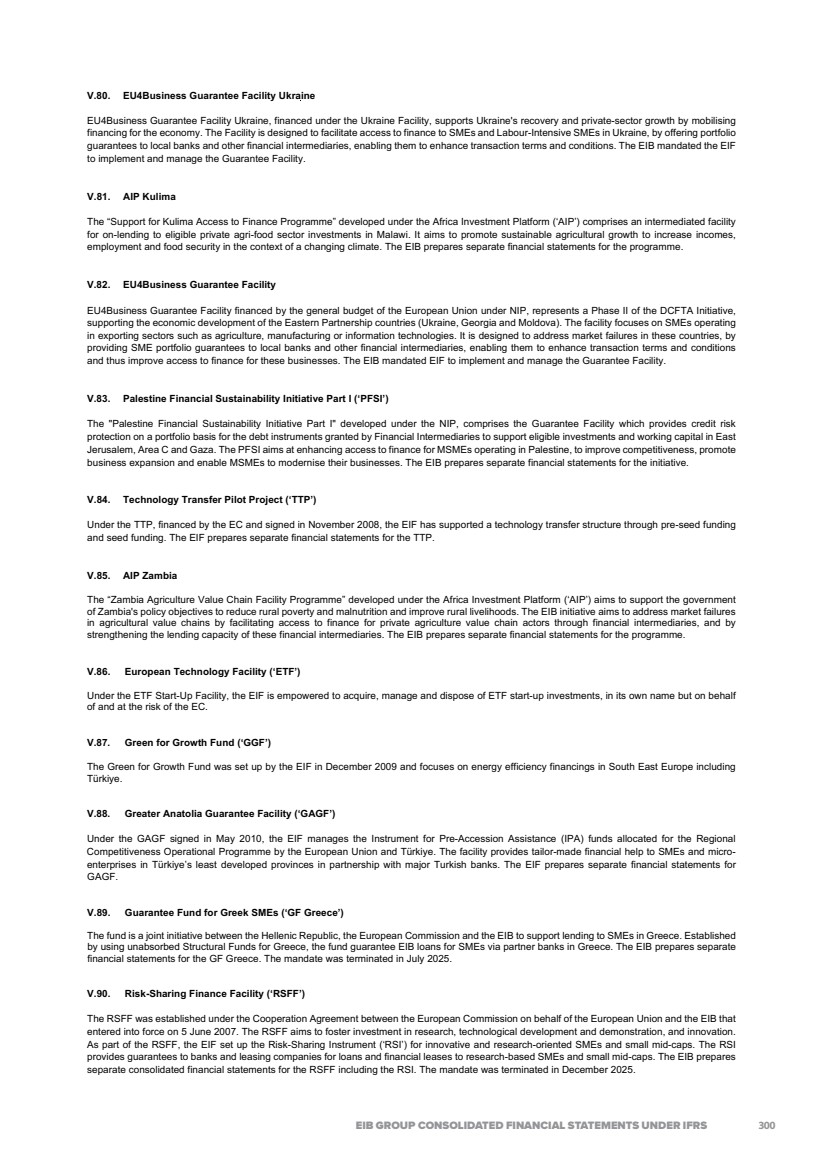
| 2025 FINANCIAL REPORT 114 Statement of Special Section(1) as at 31 December 2025 and 31 December 2024 (in EUR ‘000) ASSETS 31.12.2025 31.12.2024 Mediterranean Countries From resources of the European Union Disbursed loans outstanding 1,608 2,407 Risk capital operations - amounts to be disbursed 19,630 19,656 - amounts disbursed 21,627 24,254 41,257 43,910 Total(2) 42,865 46,317 · Lomé Conventions Operations from risk capital resources - amounts disbursed 47,243 53,137 Total(3) 47,243 53,137 Total 90,108 99,454 LIABILITIES 31.12.2025 31.12.2024 Funds under trust management Under mandate from the European Union - Financial Protocols with the Mediterranean Countries 23,235 26,661 - Lomé Conventions 47,243 53,137 Total funds under trust management 70,478 79,798 Funds to be disbursed On loans and risk capital operations in the Mediterranean countries 19,630 19,656 Total funds to be disbursed 19,630 19,656 Total 90,108 99,454 For information: Total amounts disbursed and not yet repaid on loans on special conditions made available by the European Commission in respect of which the Bank has accepted an EU mandate for recovering principal and interest: a) under the First, Second and Third Lomé Conventions as at 31 December 2025 EUR ‘000 136,780 (2024: EUR ‘000 152,968). b) under financial protocols signed with the Mediterranean countries as at 31 December 2025 EUR ‘000 14,222 (2024: EUR ‘000 16,939). In the context of the European Union – European Development Finance Institutions Private Sector Development Facility, the implementation agreement for the guarantee component was signed on 20 August 2014. The total amount of the EU guarantee to be issued is EUR ‘000 38,522 as at 31 December 2025 (2024: EUR ‘000 38,920). Note (1): The Special Section was set up by the Board of Governors on 27 May 1963. On 4 August 1977, its purpose was redefined to serve as a record of financing operations carried out by the European Investment Bank for the account of and under mandate from third parties. However, for the Investment Facility under the Cotonou Agreement, the EU-Africa Infrastructure Trust Fund, the Neighbourhood Investment Facility (‘NIF’) Trust Fund and the FEMIP Trust Fund, separate financial statements are presented. Since 2005, the EIB has also been preparing financial statements of different types for other mandates. The Statement of Special Section reflects amounts disbursed or to be disbursed, less cancellations and repayments, under mandate from the European Union and the Member States. Amounts disbursed and to be disbursed and funds received and to be received are carried at nominal value. No account is taken in the Statement of Special Section of provisions or value adjustments, which may be required to cover risks associated with such operations except for definite write-offs. Amounts in foreign currency are translated at the exchange rates prevailing on 31 December. 301 |
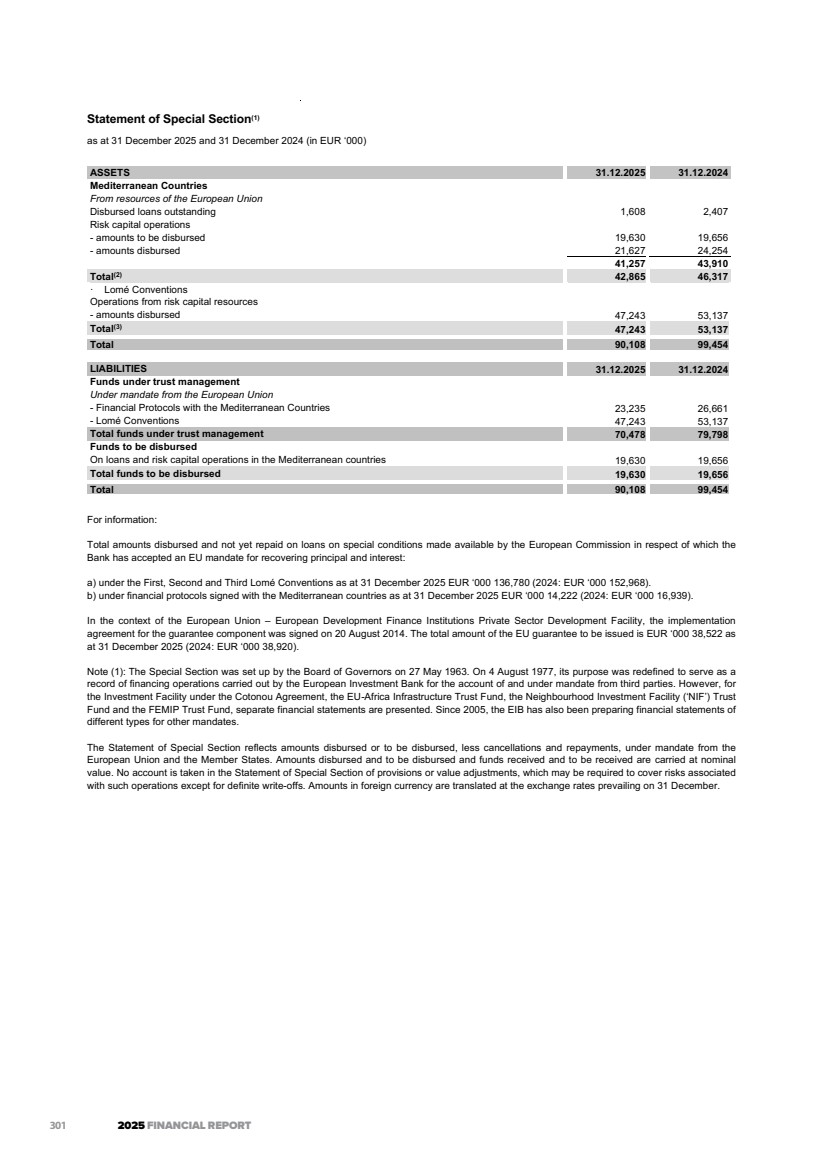
| EIB GROUP CONSOLIDATED FINANCIAL STATEMENTS UNDER IFRS 115 Note (2): Initial amount of contracts signed for financing projects in the Maghreb and Mashreq countries, Malta, Cyprus, Türkiye and Greece (EUR 10 million lent prior to accession to the European Community on 1 January 1981) under mandate, for the account and at the risk of the European Union. Initial amount: 840,457 less: exchange adjustments 58,475 cancellations 181,095 repayments 558,022 -797,592 42,865 Note (3): Initial amount of contracts signed for financing projects in the African, Caribbean and Pacific States and the Overseas Countries and Territories (‘ACP-OCT’) under mandate, for the account and at the risk of the European Union: Loans from risk capital resources: Conditional and subordinated loans 3,116,097 Equity participations 121,003 Initial amount: 3,237,100 add: capitalised interests 9,548 less: exchange adjustments 55,865 cancellations 762,667 repayments 2,380,873 -3,199,405 47,243 Note W – Capital and Reserves W.1. Share capital and reserves The European Investment Bank (EIB), the financing institution of the European Union, was created by the Treaty of Rome of 25 March 1957. The members of the EIB are the Member States of the European Union, who have all subscribed to the Group's capital, as outlined in Articles 4 and 5 of the Bank’s Statutes. The subscribed capital of the Bank amounts to EUR 248,795,606,881 (31 December 2024: EUR 248,795,606,881) and the uncalled capital to EUR 226,604,891,420 as at 31 December 2025 (31 December 2024: EUR 226,604,891,420). New Member States or Member States that increase their share in the Bank's subscribed capital pay their part of the called capital plus their part of the reserves, provisions equivalent to reserves and similar amounts, normally in several equal instalments over the course of several years. The Accession Treaties and/or the Board of Governors decisions to increase the Bank's capital establish the specific modalities of such payments, including the calculation of the share of the new Member States in the Bank's capital, which is normally based on the national GDP figures officially published by Eurostat. On 29 March 2017, the United Kingdom notified the European Council of its decision to withdraw from the European Union (“EU”) pursuant to Article 50 of the Treaty on European Union (“TEU”). As of 1 February 2020, in accordance with Article 50 TEU and the Agreement on the withdrawal of the United Kingdom of Great Britain and Northern Ireland from the European Union and the European Atomic Energy Community (the “Withdrawal Agreement”), the United Kingdom ceased to be an EU Member State. The withdrawal of the United Kingdom from the EU automatically resulted in the termination of its membership of the European Investment Bank (“EIB”) and its share of the EIB’s subscribed capital. Effective 1 February 2020, the share of the United Kingdom in respect of the EIB’s subscribed capital was fully replaced by a pro rata capital increase of the remaining EU Member States. This capital replacement (Symmetrical Capital Replacement) covered both the called part as well as the uncalled part of the subscribed capital of the United Kingdom in the EIB. The replacement of the called part was financed by converting EIB reserves into subscribed capital. As a result of the capital increase, each remaining EU Member State increased pro rata its uncalled (but callable) stake in the EIB’s subscribed capital. On 1 March 2020, the subscribed capital increased (Asymmetrical Capital Increase) from EUR 243,284,154,500 to EUR 248,795,606,881 by virtue of the contributions of Member States Poland and Romania (by EUR 5,386,000,000 and EUR 125,452,381, respectively). The contributions to the subscribed capital called and to the reserves stood at EUR 0.5 million and EUR 1.1 million respectively. The total amount to be paid by the Member States was equally spread over ten semi-annual instalments due on 31 December 2020, 30 June 2021, 31 December 2021, 30 June 2022, 31 December 2022, 30 June 2023, 31 December 2023, 30 June 2024, 31 December 2024 and 30 June 2025. All instalments were settled in full, therefore the amount in the balance sheet under the caption “Subscribed capital and reserves, called but not paid” for the year ended 31 December 2025 is nil. Voting powers in the Bank's Board of Governors and Board of Directors are established partly on the basis of the share of capital subscribed by each Member State, and partly on the basis of other criteria set forth in Articles 8 and 10 of the Bank's Statute, applied jointly or exclusively depending on the specific voting procedure. W.2. Capital management Maintaining a strong capital position is one of the major objectives of the Group. The Group’s own funds for capital adequacy purposes comprise called capital plus reserves. The Group’s capital is entirely composed of Common Equity Tier 1 instruments. In addition, the Group benefits from uncalled subscribed capital, which can be called by the Bank if the need arises. The Group plans its capital on a forward-looking basis in accordance with its operational plan and risk tolerance. 302 |
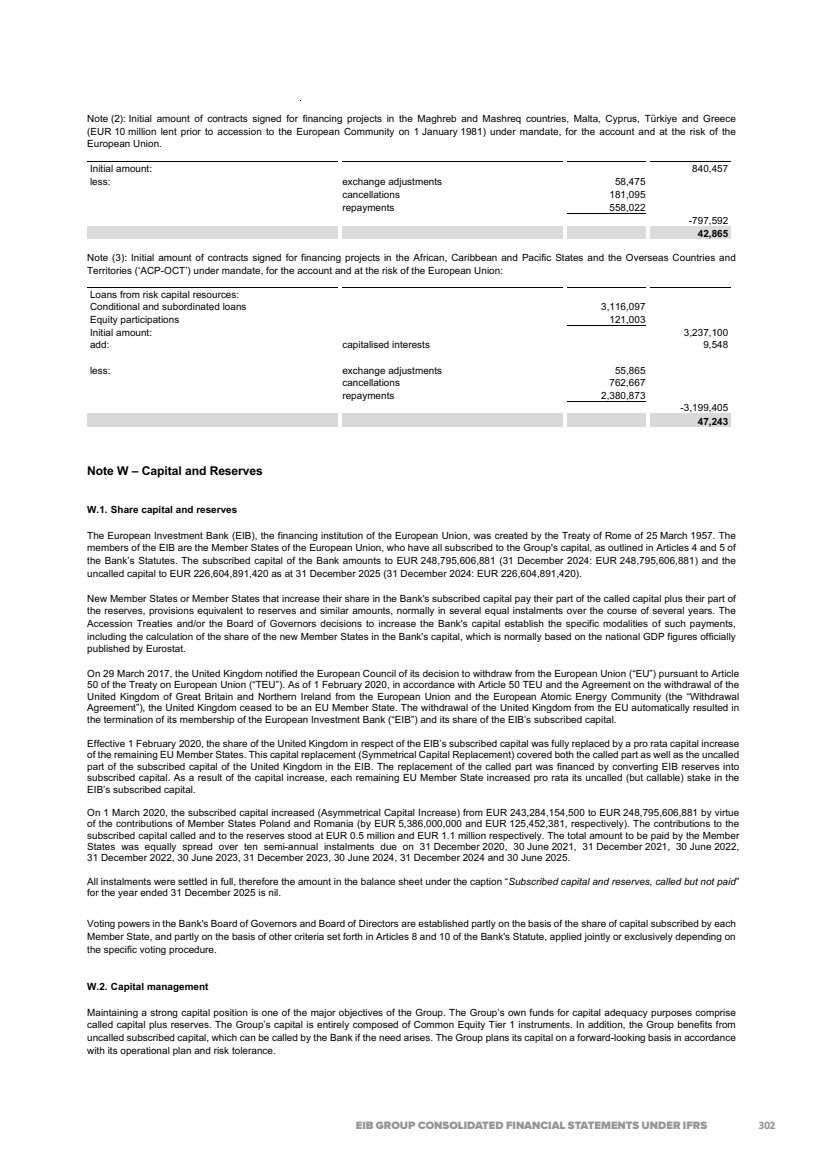
| 2025 FINANCIAL REPORT 1 The Group is not subject to prudential supervision and does not fall within the scope of application of the European Union’s legislation applicable to credit institutions. However, reflecting its statutory duty to conform with best banking practice (‘BBP’), the EIB aims to comply both at individual and consolidated level with relevant EU banking legislative acts and guidelines, to the extent determined by the competent governing bodies and in line with the EIB BBP Guiding Principles. This includes, among others, the Capital Requirements Directive (Directive 2013/36/EU) and the Capital Requirements Regulation (Regulation 575/2013), as amended from time to time, which translates the Basel Committee on Banking Supervision (‘BCBS’) standards (such as Basel III principles) into EU legal framework. The Group proactively monitors and implements current and upcoming EU prudential banking regulatory requirements as part of its BBP framework5. During 2025, the Group adopted the amended rules of the Capital Requirements Regulation (‘CRR III’) which were deemed applicable to the EIB, on an individual and consolidated basis in line with the BBP Framework. The adoption of CRR III resulted in an improvement of the Group’s Common Equity Tier 1 ratio at 1 January 2025 by +12.7% (of which +7.0% related to EIB-specific, approved by BoD, adaptations and non-applications in line with the EIB BBP Guiding Principles). The Group’s Common Equity Tier 1 ratio, calculated in accordance with the Capital Requirements Regulation, as applicable to the EIB and based on the EIB Group consolidated financial statements under EU Accounting Directives increased from 30.7% at the end of 2024 to 41.5% at the end of 2025. The increase in the Group’s CET1 ratio is due to the positive impact of the adoption of the CRR III together with the growth of own funds, partially offset by the delivery of new equity business at a higher risk and new lending volumes. Based on the statutory financial statements, the Bank’s Common Equity Tier 1 ratio stood as at 43.2% as at 31 December 2025 (31.7% at the end of 2024). 5 Please refer to the Best Banking Practice Guiding Principles of the European Investment Bank, publicly available on its website. 303 |

| EIB GROUP CONSOLIDATED FINANCIAL STATEMENTS UNDER IFRS 117 Note X – Conversion rates The following conversion rates were used for establishing the consolidated balance sheet at 31 December 2025 and 2024: 31.12.2025 31.12.2024 Non-euro currencies of EU Member States Bulgarian Lev (BGN) 1.9558 1.9558 Czech Koruna (CZK) 24.2370 25.1850 Danish Krone (DKK) 7.4689 7.4578 Hungarian Forint (HUF) 385.1500 411.3500 Polish Zloty (PLN) 4.2210 4.2750 Romanian Leu (RON) 5.0968 4.9743 Swedish Krona (SEK) 10.8215 11.4590 Non-EU currencies Armenian Dram (AMD) 446.1600 410.4300 Australian Dollar (AUD) 1.7581 1.6772 Azerbaijani Manat (AZN) 1.9882 1.7587 Brazilian Real (BRL) 6.4364 6.4253 Canadian Dollar (CAD) 1.6088 1.4948 Swiss Franc (CHF) 0.9314 0.9412 Chinese Renminbi (CNY) 8.2262 7.5833 Colombian Peso (COP) 4,426.4600 4,567.4700 Dominican Peso (DOP) 73.7817 63.0861 Egyptian Pound (EGP) 55.7762 52.6893 Ethiopian Birr (ETB) 181.6840 130.4620 Pound Sterling (GBP) 0.8726 0.8292 Georgian Lari (GEL) 3.1260 2.8845 Hong Kong Dollar (HKD) 9.1464 8.0686 Indian Rupee (INR) 105.5965 88.9335 Jordanian Dinar (JOD) 0.8305 0.7355 Japanese Yen (JPY) 184.0900 163.0600 Kenyan Shilling (KES) 151.2000 133.6900 Kazakhstani Tenge (KZT) 594.5800 544.3200 Moroccan Dirham (MAD) 10.7012 10.4987 Moldovan Leu (MDL) 19.5800 18.9700 Mexican Peso (MXN) 21.1180 21.5504 Norwegian Krone (NOK) 11.8430 11.7950 New Zealand Dollar (NZD) 2.0380 1.8532 Serbian Dinar (RSD) 117.1900 116.8300 Russian Ruble (RUB) 92.7790 113.8719 Tunisian Dinar (TND) 3.3906 3.3039 Turkish Lira (TRY) 50.4838 36.7372 Tanzanian Shilling (TZS) 2,862.1200 2,490.2400 Ukrainian Hryvnia (UAH) 49.3255 43.5377 Ugandan Shilling (UGX) 4,240.0000 3,812.0000 United States Dollar (USD) 1.1750 1.0389 Central African CFA Franc (XAF) 655.9570 655.9570 West African CFA Franc (XOF) 655.9570 655.9570 South African Rand (ZAR) 19.4439 19.6188 304 |
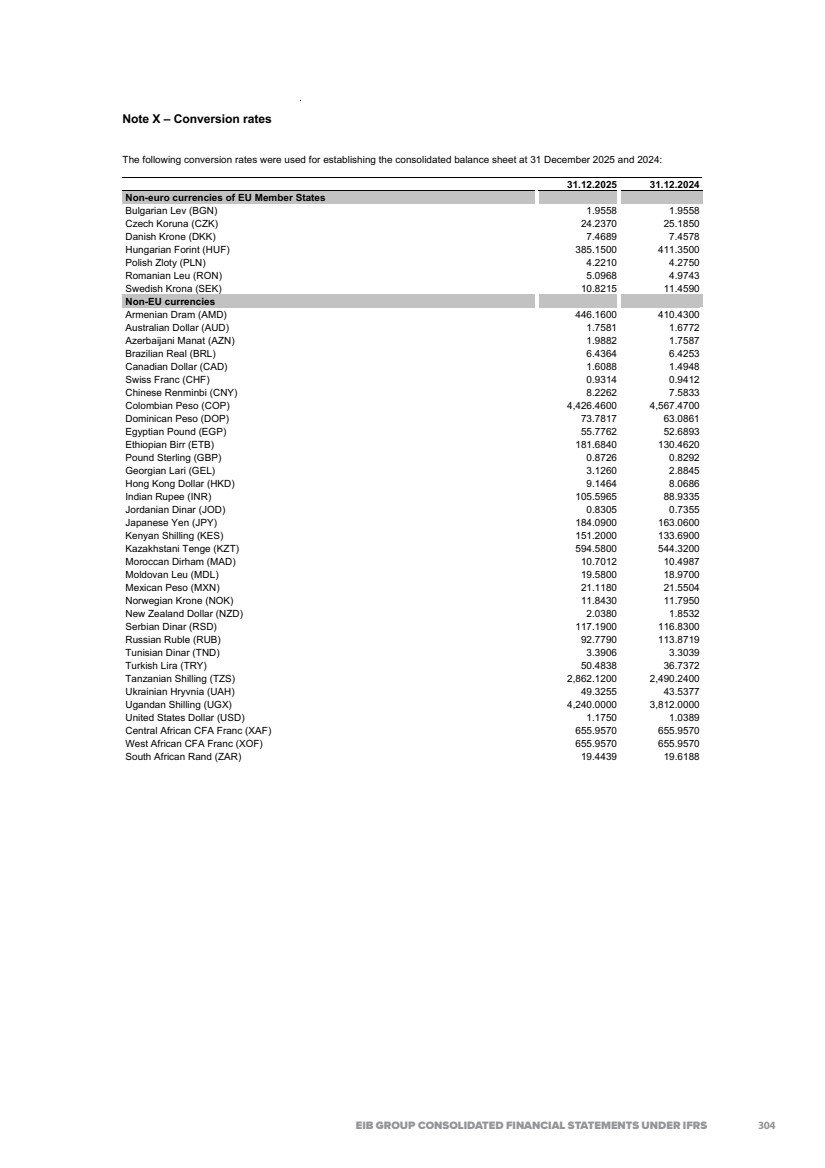
| 2025 FINANCIAL REPORT 1 Note Y – Related party transactions Y.1 Associates (in EUR ’000) The amounts included in the consolidated financial statements concerning associates are disclosed as follows: 31.12.2025 31.12.2024 Shares and other variable-yield securities 872,036 901,147 Result on financial operations -39,003 24,498 Undisbursed private equity / venture capital operations 660,362 694,924 Y.2 Key management personnel (in EUR ’000) The Group has identified members of the Board of Directors, the Audit Committee, the Management Committee and the Directors General heading the different EIB organisational directorates, as well as the head of Internal Audit independent department, as key management personnel. Key management personnel compensation for the relevant reporting periods, included within General administrative expenses (Note P), is disclosed in the following table: 2025 2024 Short-term benefits(1) 11,818 12,104 Post-employment benefits(2) 920 1,028 Termination benefits 664 398 Total 13,402 13,530 (1) Short-term employee benefits comprise salaries and allowances, bonuses and social security contributions of the Management Committee, the GCRO, Directors General and other Directors, and benefits paid to the members of the Board of Directors and the Audit Committee. (2) Post-employment benefits comprise pensions and expenses for post-employment health insurance paid to members of the Management Committee, the GCRO, the Directors General and other Directors. There were neither advances nor credit granted to key management personnel, nor commitments entered into on their behalf by way of guarantee of any kind. Open balances with key management personnel as at 31 December 2025 comprise the compulsory and optional supplementary pension plan and health insurance scheme liabilities, and payments outstanding as at the year end: 31.12.2025 31.12.2024 Pension plans and health insurance (Note J) 70,431 77,711 Other liabilities (Note G) 13,436 18,609 Note Z – Post balance sheet events EIB is continuously assessing its portfolio in view of heightened geopolitical risks, particularly those arising from the recent military escalation in the Gulf region. While it is too early to assess long-term implications for the overall loan portfolio, the evolving market conditions and sector-specific pressures are being closely monitored. Note D.3 provides further information of the disbursed and undisbursed lending exposure by country and territory in which projects are located. There have been no other material events after the balance sheet date that would require adjustment of, or disclosure in, the consolidated financial statements as at 31 December 2025. 305 |
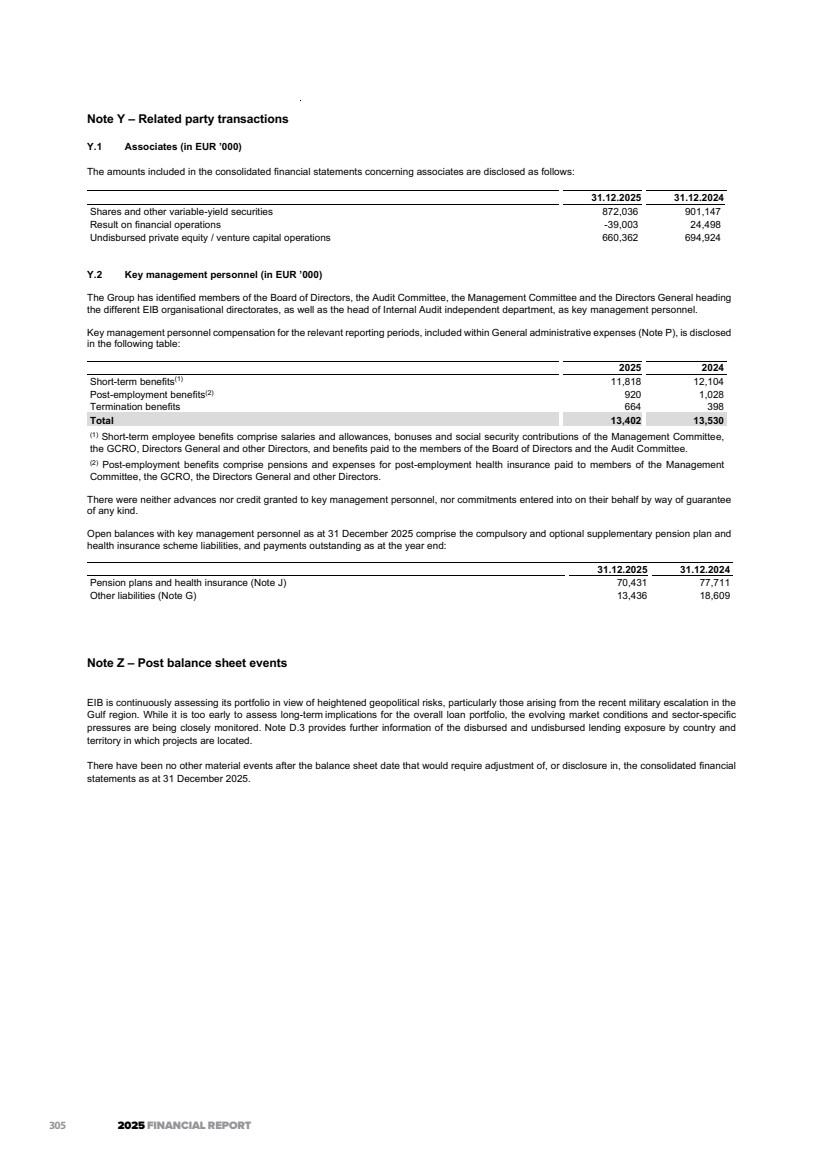
| Inde INDEPENDENT AUDITORʹS REPORT KPMG Audit S.à r.l. 39, Avenue John F. Kennedy L-1855 Luxembourg Tel.: +352 22 51 51 1 Fax: +352 22 51 71 E-mail: info@kpmg.lu Internet: www.kpmg.lu © 2026 KPMG Audit S.à r.l., a Luxembourg entity and a member firm of the KPMG global organization of independent member firms affiliated with KPMG International Limited, a private English company limited by guarantee. All rights reserved. R.C.S Luxembourg B 149133 To the Chairman of the Audit Committee of EUROPEAN INVESTMENT BANK 98-100, boulevard Konrad Adenauer L-2950 Luxembourg REPORT OF THE REVISEUR D’ENTREPRISES AGREE Report on the audit of the consolidated financial statements Opinion We have audited the consolidated financial statements of EUROPEAN INVESTMENT BANK and its subsidiary (the “Group”), which comprise the consolidated balance sheet as at 31 December 2025, and the consolidated income statement, consolidated statement of profit or loss and other comprehensive income, consolidated statement of changes in equity and consolidated cash flow statement for the year then ended, and notes to the consolidated financial statements, including material accounting policy information and other explanatory information. In our opinion, the accompanying consolidated financial statements give a true and fair view of the consolidated financial position of the Group as at 31 December 2025, and of its consolidated financial performance and its consolidated cash flows for the year then ended in accordance with IFRS Accounting Standards as adopted by the European Union. Basis for opinion We conducted our audit in accordance with the Law of 23 July 2016 on the audit profession (“Law of 23 July 2016”) and with International Standards on Auditing (“ISAs”) as adopted for Luxembourg by the “Commission de Surveillance du Secteur Financier” (“CSSF”) and the Institut des Réviseurs d’Entreprises (“IRE”). Our responsibilities under the Law of 23 July 2016 and ISAs as adopted for Luxembourg by the CSSF and the IRE are further described in the « Responsibilities of “réviseur d’entreprises agréé” for the audit of the consolidated financial statements » section of our report. We are also independent of the Group in accordance with the International Code of Ethics for Professional Accountants, including International Independence Standards, issued by the International Ethics Standards Board for Accountants (“IESBA Code”) as adopted for Luxembourg by the CSSF and the IRE together with the ethical requirements that are relevant to our audit of the consolidated financial statements, and have fulfilled our other ethical responsibilities under those ethical requirements. We believe that the audit evidence we have obtained is sufficient and appropriate to provide a basis for our opinion. Key audit matters Key audit matters are those matters that, in our professional judgment, were of most significance in our audit of the consolidated financial statements of the current period. These matters were addressed in the context of the audit of the consolidated financial statements as a whole, and in forming our opinion thereon, and we do not provide a separate opinion on these matters. KPMG Audit S.à r.l. 39, Avenue John F. Kennedy L-1855 Luxembourg Tel.: +352 22 51 51 1 Fax: +352 22 51 71 E-mail: info@kpmg.lu Internet: www.kpmg.lu © 2026 KPMG Audit S.à r.l., a Luxembourg entity and a member firm of the KPMG global organization of independent member firms affiliated with KPMG International Limited, a private English company limited by guarantee. All rights reserved. R.C.S Luxembourg B 149133 To the Chairman of the Audit Committee of EUROPEAN INVESTMENT BANK 98-100, boulevard Konrad Adenauer L-2950 Luxembourg REPORT OF THE REVISEUR D’ENTREPRISES AGREE Report on the audit of the consolidated financial statements Opinion We have audited the consolidated financial statements of EUROPEAN INVESTMENT BANK and its subsidiary (the “Group”), which comprise the consolidated balance sheet as at 31 December 2025, and the consolidated income statement, consolidated statement of profit or loss and other comprehensive income, consolidated statement of changes in equity and consolidated cash flow statement for the year then ended, and notes to the consolidated financial statements, including material accounting policy information and other explanatory information. In our opinion, the accompanying consolidated financial statements give a true and fair view of the consolidated financial position of the Group as at 31 December 2025, and of its consolidated financial performance and its consolidated cash flows for the year then ended in accordance with IFRS Accounting Standards as adopted by the European Union. Basis for opinion We conducted our audit in accordance with the Law of 23 July 2016 on the audit profession (“Law of 23 July 2016”) and with International Standards on Auditing (“ISAs”) as adopted for Luxembourg by the “Commission de Surveillance du Secteur Financier” (“CSSF”) and the Institut des Réviseurs d’Entreprises (“IRE”). Our responsibilities under the Law of 23 July 2016 and ISAs as adopted for Luxembourg by the CSSF and the IRE are further described in the « Responsibilities of “réviseur d’entreprises agréé” for the audit of the consolidated financial statements » section of our report. We are also independent of the Group in accordance with the International Code of Ethics for Professional Accountants, including International Independence Standards, issued by the International Ethics Standards Board for Accountants (“IESBA Code”) as adopted for Luxembourg by the CSSF and the IRE together with the ethical requirements that are relevant to our audit of the consolidated financial statements, and have fulfilled our other ethical responsibilities under those ethical requirements. We believe that the audit evidence we have obtained is sufficient and appropriate to provide a basis for our opinion. Key audit matters Key audit matters are those matters that, in our professional judgment, were of most significance in our audit of the consolidated financial statements of the current period. These matters were addressed in the context of the audit of the consolidated financial statements as a whole, and in forming our opinion thereon, and we do not provide a separate opinion on these matters. 306 |
| 2025 FINANCIAL REPORT 1 Impairment of loans to customers and credit institutions Why the matter was considered to be one of most significance in our audit As at 31 December 2025, the Group reports loans accounted for at amortised cost of EUR 420,858 million (31 December 2024: EUR 421 572 million) representing 74% of total assets (31 December 2024: 72%) and recognised impairments on loans amounting to EUR 672 million (31 December 2024: EUR 568 million). The impairment amount for loans consists out of three different components being: • Management’s estimate of expected credit loss (“ECL”) for loans considered credit-impaired (Stage 3), amounting to EUR 454 million as at 31 December 2025 (31 December 2024: 353 million); • The lifetime expected credit loss determined by model for loans where there has been a significant increase in credit risk since initial recognition (stage 2), amounting to EUR 131 million as at 31 December 2025 (31 December 2024: 137 million); and • The 12-month expected credit loss determined by model for the remaining population (stage 1), amounting to EUR 87 million as at 31 December 2025 (31 December 2024: 78 million). These loans are not traded in an active market, therefore significant judgments and estimates are applied by Management in its assessment of their recoverable amount, irrespective of the stage allocation. Inappropriate judgments made in relation to the methodology and inputs used or the assumptions taken may have a material impact on the impairment amount recorded. These critical judgments include matters such as the definition of criteria to identify significant increase in credit risk or default, as well as estimation of input parameter for determining ECL, namely probability of default and loss given default which are derived from statistical models and should include forward-looking-information. For credit-impaired assets where impairment is based on management’s best estimate, the critical judgments include estimation of recoverable cash flow, the effect of guarantees received, as well as valuation of collaterals. The current environment of enhanced geopolitical uncertainty introduces increased volatility and unpredictability in key economic factors. This uncertainty increased the level of judgement involved in the determination and calculation of expected credit losses on loans accounted for at amortised cost. The key inputs and assumptions used by Management in its assessment of loan impairment are detailed in Note A.2 to the consolidated financial statements as well as the accounting policy for the impairment in Note A.4.4 and the detail of the impairment in Note D.2. The loans accounted for at amortised cost are disclosed in Note T to the consolidated financial statements as well as the accounting policy for the loans in Note A.4.9. How the matter was addressed in our audit Our procedures included the testing of key controls over the approval, recording, monitoring and restructuring of loans to customers and credit institutions, the loan grading process and the measurement of impairment amounts. We assessed the methodology to determine ECL based on the policies and procedures in place by comparing it against IFRS 9 requirements, as well as the key input data used and model application as at 31 December 2025. 307 |
| Inde We also assessed the appropriateness of modelling methodologies, giving specific consideration to the current economic uncertainty and whether management judgemental adjustments were needed. For the allocation of loans to the different stages in the impairment model as at 31 December 2025, we assessed whether it has been performed in line with criteria defined by reperforming the allocation for a sample of loans. For ECL determined based on the implemented statistical model (stage 1 and 2), we tested the calculations performed at year-end as well as the underlying data used in this on a sample basis. For a sample of loans in stage 3, where provisions are based on management’s best estimate, we evaluated the Group's individual assessment of each loan by specifically challenging the Group's assumptions used as well as underlying data, including the value of realisable collateral and the estimated recoverability. Based on a retrospective review, we further critically assessed whether the Group revised its estimates and assumptions for specific impairment established in prior years. The impact of the difficult market conditions, driven by geopolitical uncertainties, was followed-up both by assessing the provision of the evaluated exposure and by determining our sample of exposures where we drew a particular attention to the sectors most vulnerable to it. Such effect on the Bank’s lending portfolio was assessed as part of our audit procedures. We also tested a sample of individually significant exposures potentially impaired for which no specific impairment had been recorded as well as a sample of exposures which had not been identified by the Group as being potentially impaired. For both types, we assessed whether appropriate consideration had been given to the collectability of future cash flows and the valuation of the underlying collaterals. We assessed the disclosures in the consolidated financial statements in relation to impairment of loans with reference to the requirements of the prevailing accounting standards. 2 Hedge Accounting Why the matter was considered to be one of most significance in our audit As at 31 December 2025, the Group applied fair value hedge accounting to loans and advances as well as to loan substitutes and treasury debt securities with a reported hedge fair value of EUR 139,385 million (31 December 2024: EUR 142,979 million) representing 24% of total assets (31 December 2024: 25%) and to borrowings with a reported hedge fair value of EUR 309,193 million (31 December 2024: EUR 311,659 million) representing 65% of total liabilities (31 December 2024: 64%). The Group enters into derivative contracts in order to manage and hedge risks such as interest rate risk and FX risk through interest rate swaps or cross-currency swaps. Application of hedge accounting and ensuring hedge effectiveness are processes requiring reliance on several interconnected systems and subsequent potential manual updates, which makes the process susceptible to errors and therefore requires close monitoring from management. The key inputs and assumptions used by Management in its application of fair value hedge accounting and accounting policies are detailed in Note A.4.5 to the consolidated financial statements as well as detail of the hedging activities in Note Q.2. How the matter was addressed in our audit We tested key controls on the eligibility of the hedging instruments and hedged items for fair value hedge accounting as well as the underlying data used in this on a sample basis. 308 |
| 2025 FINANCIAL REPORT We determined whether the methodology applied to assess the economic relationship between hedged item and hedging instrument as well as non-dominance of credit risk on hedged item and hedging instrument is compliant with IFRS 9. We tested key controls over designation and compliance monitoring of the hedge accounting relationship with those requirements, both at inception and during its life as well as the underlying data used in this on a sample basis. We assessed the valuation methodology of the Group for the calculation of its hedged fair value and its cost of hedging based on the policies and procedures in place, by comparing to the applicable IFRS 9 requirements. We performed with the assistance of our valuation specialists independent valuations on a sample basis and compared these with the Group’s valuations, including separate identification of the cost of hedging determination. We assessed the appropriateness of the key input data used for determining hedge fair values as at 31 December 2025. We assessed the disclosures in the consolidated financial statements in relation to fair value hedge accounting with reference to the requirements of the prevailing accounting standards. 3 Valuation of complex financial instruments (derivative assets and liabilities) Why the matter was considered to be one of most significance in our audit As at 31 December 2025, the Group holds derivative assets (complex and non complex) of EUR 22,447 million (31 December 2024: EUR 30,457 million) and derivative liabilities (complex and non complex) of EUR 26,122 million (31 December 2024: EUR 30,173) representing respectively 4% of total assets and 5% of total liabilities (31 December 2024: respectively 5% and 6%). The valuation of such financial instruments, measured at fair value, is based on a combination of market data and valuation models which often require a considerable number of inputs. Most of these inputs are obtained from readily available data such as quoted market prices as well as observable inputs. However, the valuation of the derivatives might be derived from complex models that require a sound knowledge of complex financial instruments valuation techniques and a sophisticated valuation process which can therefore be subject to error especially for instruments that are not priced using a plain vanilla model. The key inputs and assumptions used by Management in its assessment of derivative financial instruments are detailed in Notes A.2 and A.4.6 to the consolidated financial statements, as well as the accounting policies in Note A.4.5, the detail of derivative financial instruments in Note Q.3 and the fair value of financial assets and liabilities in Note R. How the matter was addressed in our audit Our audit procedures to assess the fair value of derivatives included the testing of the design, implementation and operating effectiveness of key internal controls over the valuation, price verification and front office and back office reconciliations for derivative financial instruments. We engaged our valuation specialists to assist us in performing independent valuations on a sample basis and compared these with the Group’s valuations. Our specialist also assessed the appropriate application of Credit Value and Debit Value Adjustments (“CVA/DVA”) that form an integral part of fair values, inquiring of Management about any changes in the CVA/DVA methodology and assessing the appropriateness of the inputs applied. We also reviewed the appropriateness of the Group methodology used in order to classify its derivatives either as level 2 or level 3. 309 |
| Inde Finally, we assessed whether the disclosures in the consolidated financial statements, including fair value hierarchy information and sensitivity to key inputs for level 3 instruments, appropriately reflected the Group’s exposure to financial instrument valuation risk with reference to the requirements of the prevailing accounting standards. Other information The Management is responsible for the other information. The other information comprises the information stated in the introductory sections called “Highlights, Overview, EIB Statutory Bodies and Audit,control and accountability”, which are mainly based on statutory EU Directives information, but does not include the consolidated financial statements and our report of the “réviseur d’entreprises agréé” thereon. Our opinion on the consolidated financial statements does not cover the other information and we do not express any form of assurance conclusion thereon. In connection with our audit of the consolidated financial statements, our responsibility is to read the other information and, in doing so, consider whether the other information is materially inconsistent with the consolidated financial statements or our knowledge obtained in the audit or otherwise appears to be materially misstated. If, based on the work we have performed, we conclude that there is a material misstatement of this other information we are required to report this fact. We have nothing to report in this regard. Responsibilities of Management and Those Charged with Governance for the consolidated financial statements The Management is responsible for the preparation and fair presentation of the consolidated financial statements in accordance with IFRS Accounting Standards as adopted by the European Union, and for such internal control as the Management determines is necessary to enable the preparation of consolidated financial statements that are free from material misstatement, whether due to fraud or error. In preparing the consolidated financial statements, the Management is responsible for assessing the Group’s ability to continue as a going concern, disclosing, as applicable, matters related to going concern and using the going concern basis of accounting unless the Management either intends to liquidate the Group or to cease operations, or has no realistic alternative but to do so. Those charged with governance are responsible for overseeing the Group’s financial reporting process. Responsibilities of the réviseur d’entreprises agréé for the audit of the consolidated financial statements The objectives of our audit are to obtain reasonable assurance about whether the consolidated financial statements as a whole are free from material misstatement, whether due to fraud or error, and to issue a report of the “réviseur d’entreprises agréé” that includes our opinion. Reasonable assurance is a high level of assurance, but is not a guarantee that an audit conducted in accordance with the Law of 23 July 2016 and with ISAs as adopted for Luxembourg by the CSSF and the IRE will always detect a material misstatement when it exists. Misstatements can arise from fraud or error and are considered material if, individually or in the aggregate, they could reasonably be expected to influence the economic decisions of users taken on the basis of these consolidated financial statements. As part of an audit in accordance with the Law of 23 July 2016 and with ISAs as adopted for Luxembourg by the CSSF and the IRE, we exercise professional judgment and maintain professional skepticism throughout the audit. We also: 310 |
| 2025 FINANCIAL REPORT • Identify and assess the risks of material misstatement of the consolidated financial statements, whether due to fraud or error, design and perform audit procedures responsive to those risks, and obtain audit evidence that is sufficient and appropriate to provide a basis for our opinion. The risk of not detecting a material misstatement resulting from fraud is higher than for one resulting from error, as fraud may involve collusion, forgery, intentional omissions, misrepresentations, or the override of internal control. • Obtain an understanding of internal control relevant to the audit in order to design audit procedures that are appropriate in the circumstances, but not for the purpose of expressing an opinion on the effectiveness of the Group’s internal control. • Evaluate the appropriateness of accounting policies used and the reasonableness of accounting estimates and related disclosures made by the Management. • Conclude on the appropriateness of Management’s use of the going concern basis of accounting and, based on the audit evidence obtained, whether a material uncertainty exists related to events or conditions that may cast significant doubt on the Group’s ability to continue as a going concern. If we conclude that a material uncertainty exists, we are required to draw attention in our report of the “réviseur d’entreprises agréé” to the related disclosures in the consolidated financial statements or, if such disclosures are inadequate, to modify our opinion. Our conclusions are based on the audit evidence obtained up to the date of our report of the “réviseur d’entreprises agréé”. However, future events or conditions may cause the Group to cease to continue as a going concern. • Evaluate the overall presentation, structure and content of the consolidated financial statements, including the disclosures, and whether the consolidated financial statements represent the underlying transactions and events in a manner that achieves fair presentation. • Obtain sufficient appropriate audit evidence regarding the financial information of the entities and business activities within the Group to express an opinion on the consolidated financial statements. We are responsible for the direction, supervision and performance of the Group audit. We remain solely responsible for our audit opinion. We communicate with those charged with governance regarding, among other matters, the planned scope and timing of the audit and significant audit findings, including any significant deficiencies in internal control that we identify during our audit. We also provide those charged with governance with a statement that we have complied with relevant ethical requirements regarding independence, and to communicate with them all relationships and other matters that may reasonably be thought to bear on our independence, and where applicable, related safeguards. From the matters communicated with those charged with governance, we determine those matters that were of most significance in the audit of the consolidated financial statements of the current period and are therefore the key audit matters. We describe these matters in our report unless law or regulation precludes public disclosure about the matter or when, in extremely rare circumstances, we determine that a matter should not be communicated in our report because the adverse consequences of doing so would reasonably be expected to outweigh the public interest benefits of such communication. 311 |
| Inde Report on other requirements In accordance with the Framework Agreement (“the Agreement”) dated 19 February 2009, renewed on 3 March 2017, as extended for the period 2022-2024 on 14 December 2020 and subsequently prolonged up to 31 December 2026 by the Addendum No. 2 to the Agreement on 23 November 2023, signed between European Investment Bank and KPMG Audit S.à r.l., we have been appointed to carry the audit services defined in the Agreement. The duration of our uninterrupted engagement, including previous renewals and reappointments, is 17 years. We confirm that the audit opinion is consistent with the communication to the Audit Committee or equivalent. We confirm that the prohibited non-audit services referred to in IESBA Code of Ethics were not provided and that we remained independent of the Group in conducting the audit. Luxembourg, 25 March 2026 KPMG Audit S.à r.l. Cabinet de révision agréé M. Weber Partner 312 |
| 2025 FINANCIAL REPORT STATEMENT BY THE AUDIT COMMITTEE 313 |