First quarter 2026 results May 5, 2026 © GXO Logistics, Inc.
© GXO Logistics, Inc. Disclaimer 2 Non-GAAP Financial Measures: As required by the rules of the Securities and Exchange Commission (“SEC”), we provide reconciliations of the non-GAAP financial measures contained in this presentation to the most directly comparable measure under GAAP, which are set forth in the financial tables included in the attached appendix. GXO’s non-GAAP financial measures in this presentation include: adjusted earnings before interest, taxes, depreciation and amortization (“adjusted EBITDA”), adjusted EBITDA margin, adjusted earnings before interest, taxes and amortization (“adjusted EBITA”), adjusted EBITA margin, adjusted EBITA, net of income taxes paid/received, adjusted net income attributable to GXO, adjusted earnings per share (basic and diluted) (“adjusted EPS”), free cash flow, free cash flow conversion, organic revenue, organic revenue growth, net leverage ratio, net debt, operating return on invested capital (“ROIC”) and net capital expenditures (“net capex”). We believe that the above adjusted financial measures facilitate analysis of our ongoing business operations because they exclude items that may not be reflective of, or are unrelated to, GXO’s core operating performance, and may assist investors with comparisons to prior periods and assessing trends in our underlying businesses. Other companies may calculate these non-GAAP financial measures differently, and therefore our measures may not be comparable to similarly titled measures used by other companies. GXO’s non-GAAP financial measures should only be used as supplemental measures of our operating performance. Adjusted EBITDA, adjusted EBITA, adjusted net income attributable to GXO and adjusted EPS include adjustments for transaction and integration costs, restructuring costs and unrealized gain/loss on FX contracts, a regulatory matter as well as net loss on divestiture of business, as set forth in the financial tables included in the attached appendix. Transaction and integration adjustments are generally incremental costs that result from an actual or planned acquisition and may include consulting fees, retention awards, internal salaries and wages (to the extent the individuals are assigned full-time to integration and transformation activities), and certain costs related to integrating and separating IT systems. Restructuring costs and other primarily consisted of severance paid to existing members of the Company’s leadership team and to individuals as part of an initiative to optimize corporate expenses. The regulatory matter relates to a regulatory settlement. And net loss on divestiture of business primarily relates to the write-down loss resulting from the held-for-sale classification. We believe that free cash flow and free cash flow conversion are important measures of our ability to repay maturing debt or fund other uses of capital that we believe will enhance stockholder value. We calculate free cash flow as cash flows from operations less net capex; we calculate net capex as capital expenditures plus proceeds from sale of property and equipment. We calculate free cash flow conversion as free cash flow divided by adjusted EBITDA, expressed as a percentage. We believe that adjusted EBITDA, adjusted EBITDA margin, adjusted EBITA, adjusted EBITA margin, and adjusted EBITA, net of income taxes paid/received improve comparability from period to period by removing the impact of our capital structure (interest expense), asset base (depreciation and amortization), tax impacts and other adjustments as set forth in the financial tables included in the attached appendix, which management has determined are not reflective of core operating activities and thereby assist investors with assessing trends in our underlying businesses. We believe that adjusted net income attributable to GXO and adjusted EPS improve the comparability of our operating results from period to period by removing the impact of certain costs and gains as set forth in the financial tables included in the attached appendix, which management has determined are not reflective of our core operating activities, including amortization of intangible assets acquired. We believe that organic revenue and organic revenue growth are important measures because they exclude the impact of foreign currency exchange rate fluctuations. We believe that net leverage ratio and net debt are important measures of our overall liquidity position and are calculated by removing cash and cash equivalents (excluding restricted cash) from our total debt and net debt as a ratio of our trailing twelve months adjusted EBITDA. We calculate ROIC as our trailing twelve months adjusted EBITA, net of income taxes paid/received, divided by the average invested capital. We believe ROIC provides investors with an important perspective on how effectively GXO deploys capital and use this metric internally as a high-level target to assess overall performance throughout the business cycle. Management uses these non-GAAP financial measures in making financial, operating and planning decisions and evaluating GXO’s ongoing performance. With respect to our financial targets for full-year 2026 organic revenue growth, adjusted EBITDA, adjusted diluted EPS, and free cash flow conversion, a reconciliation of these non-GAAP measures to the corresponding GAAP measures is not available without unreasonable effort due to the variability and complexity of the reconciling items described above that we exclude from these non-GAAP target measures. The variability of these items may have a significant impact on our future GAAP financial results and, as a result, we are unable to prepare the forward- looking statements of income and cash flows in accordance with GAAP, that would be required to produce such a reconciliation. Forward-Looking Statements: This presentation includes forward-looking statements within the meaning of Section 27A of the Securities Act of 1933, as amended, and Section 21E of the Securities Exchange Act of 1934, as amended. All statements other than statements of historical fact are, or may be deemed to be, forward-looking statements, including our full year 2026 financial guidance of organic revenue growth, adjusted EBITDA, adjusted diluted EPS and free cash flow conversion. In some cases, forward-looking statements can be identified by the use of forward-looking terms such as “anticipate,” “estimate,” “believe,” “continue,” “could,” “intend,” “may,” “plan,” “potential,” “predict,” “should,” “will,” “expect,” “objective,” “projection,” “forecast,” “goal,” “guidance,” “outlook,” “effort,” “target,” “trajectory” or the negative of these terms or other comparable terms. However, the absence of these words does not mean that the statements are not forward-looking. These forward-looking statements are based on certain assumptions and analyses made by the company in light of its experience and its perception of historical trends, current conditions and expected future developments, as well as other factors the company believes are appropriate in the circumstances. These forward-looking statements are subject to known and unknown risks, uncertainties and assumptions that may cause actual results, levels of activity, performance or achievements to be materially different from any future results, levels of activity, performance or achievements expressed or implied by such forward-looking statements. Factors that might cause or contribute to a material difference include, but are not limited to, the risks discussed in our filings with the SEC and the following: economic conditions generally; supply chain challenges, including labor shortages; competition and pricing pressures; our ability to align our investments in capital assets, including equipment, service centers and warehouses, to our respective customers’ demands; our ability to successfully integrate and realize anticipated benefits, synergies, cost savings and profit improvement opportunities with respect to acquired companies, including the acquisition of Wincanton; acquisitions may be unsuccessful or result in other risks or developments that adversely affect our financial condition and results; our ability to develop and implement suitable information technology systems and prevent failures in or breaches of such systems; our indebtedness; our ability to raise debt and equity capital; litigation; labor matters, including our ability to manage our subcontractors, and risks associated with labor disputes at our customers’ facilities and efforts by labor organizations to organize our employees; risks associated with defined benefit plans for our current and former employees; our ability to attract or retain necessary talent; the increased costs associated with labor; fluctuations in currency exchange rates; fluctuations in fixed and floating interest rates; fluctuations in customer confidence and spending; issues related to our intellectual property rights; governmental regulation, including environmental laws, trade compliance laws, as well as changes in international trade policies and tax regimes; governmental or political actions, including the United Kingdom’s exit from the European Union; natural disasters, terrorist attacks or similar incidents; damage to our reputation; a material disruption of our operations; the inability to achieve the level of revenue growth, cash generation, cost savings, improvement in profitability and margins, fiscal discipline, or strengthening of competitiveness and operations anticipated or targeted; failure in properly handling the inventory of our customers; failure to successfully incorporate artificial intelligence and humanoids in connection with our growth strategy; the impact of potential cyber-attacks and information technology or data security breaches; and the inability to implement technology initiatives or business systems successfully; our ability to achieve Environmental, Social and Governance goals; and a determination by the IRS that the distribution or certain related spin-off transactions should be treated as taxable transactions. Other unknown or unpredictable factors could cause actual results to differ materially from those in the forward-looking statements. Such forward-looking statements should therefore be construed in the light of such factors. All forward-looking statements set forth in this presentation are qualified by these cautionary statements and there can be no assurance that the actual results or developments anticipated by us will be realized or, even if substantially realized, that they will have the expected consequences to or effects on us or our business or operations. Forward-looking statements set forth in this presentation speak only as of the date hereof, and we do not undertake any obligation to update forward-looking statements to reflect subsequent events or circumstances, changes in expectations or the occurrence of unanticipated events, except to the extent required by law.
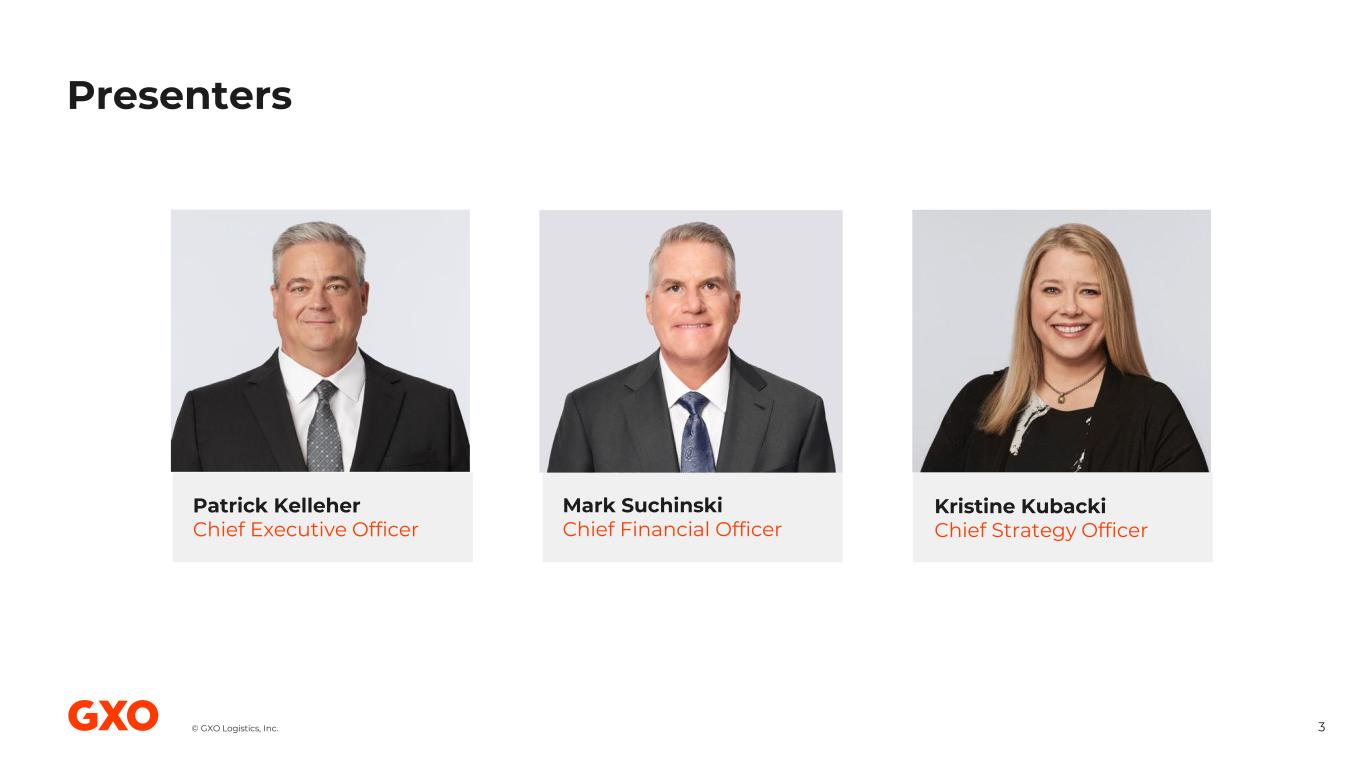
© GXO Logistics, Inc. Patrick Kelleher Chief Executive Officer Mark Suchinski Chief Financial Officer Kristine Kubacki Chief Strategy Officer Presenters 3
© GXO Logistics, Inc.© GXO Logistics, Inc. GXO is building the supply chain of the future. We design and operate the most technologically advanced logistics solutions in the world. 4
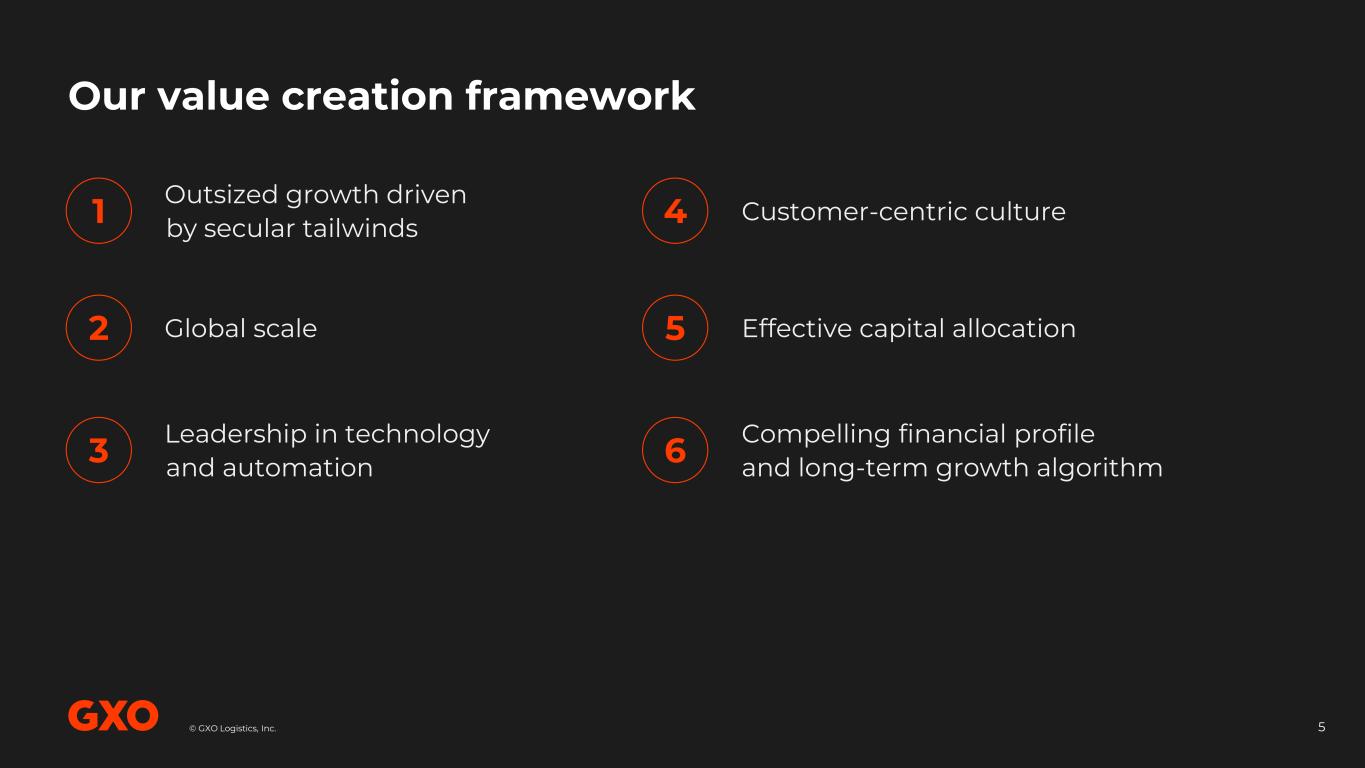
© GXO Logistics, Inc.© GXO Logistics, Inc. Our value creation framework Outsized growth driven by secular tailwinds Global scale Leadership in technology and automation Customer-centric culture Effective capital allocation Compelling financial profile and long-term growth algorithm 5 1 2 3 4 5 6
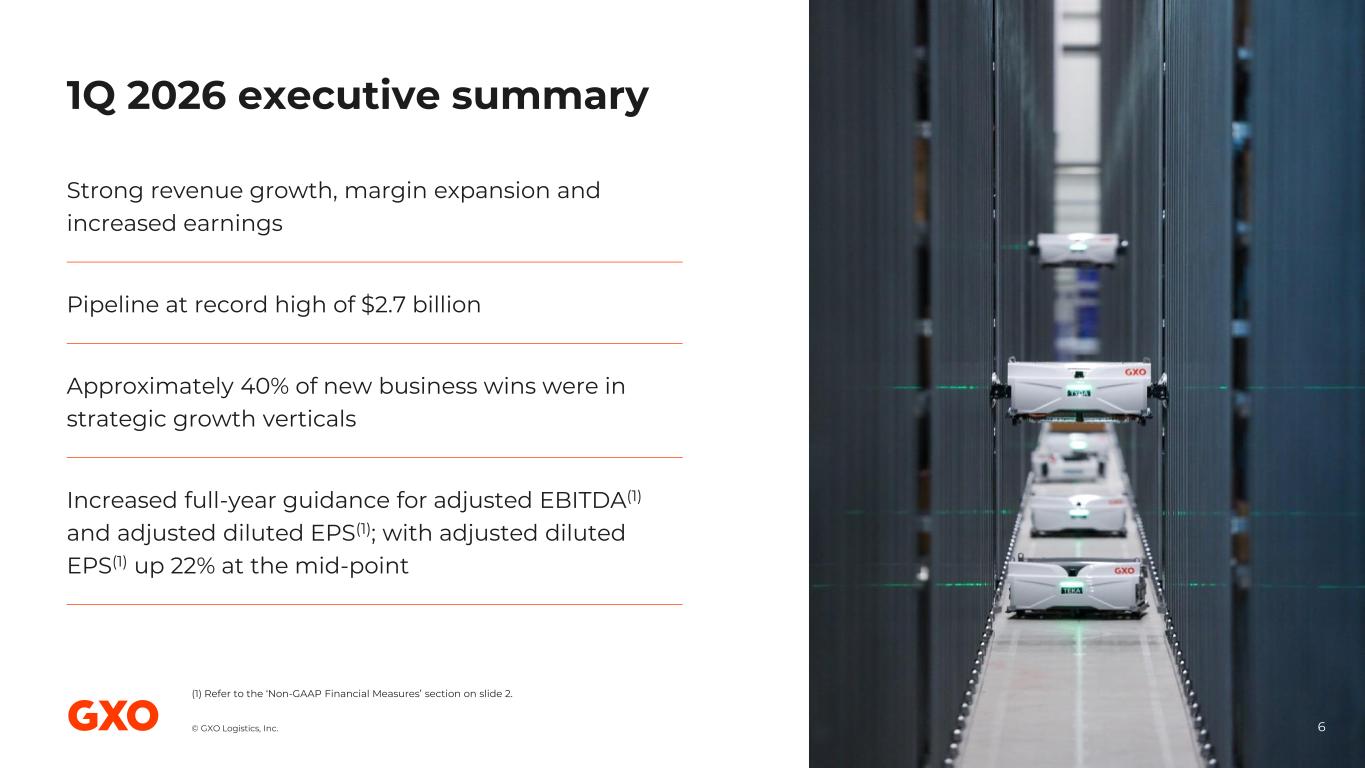
© GXO Logistics, Inc. 1Q 2026 executive summary 6 Strong revenue growth, margin expansion and increased earnings Pipeline at record high of $2.7 billion Approximately 40% of new business wins were in strategic growth verticals Increased full-year guidance for adjusted EBITDA(1) and adjusted diluted EPS(1); with adjusted diluted EPS(1) up 22% at the mid-point (1) Refer to the ‘Non-GAAP Financial Measures’ section on slide 2.
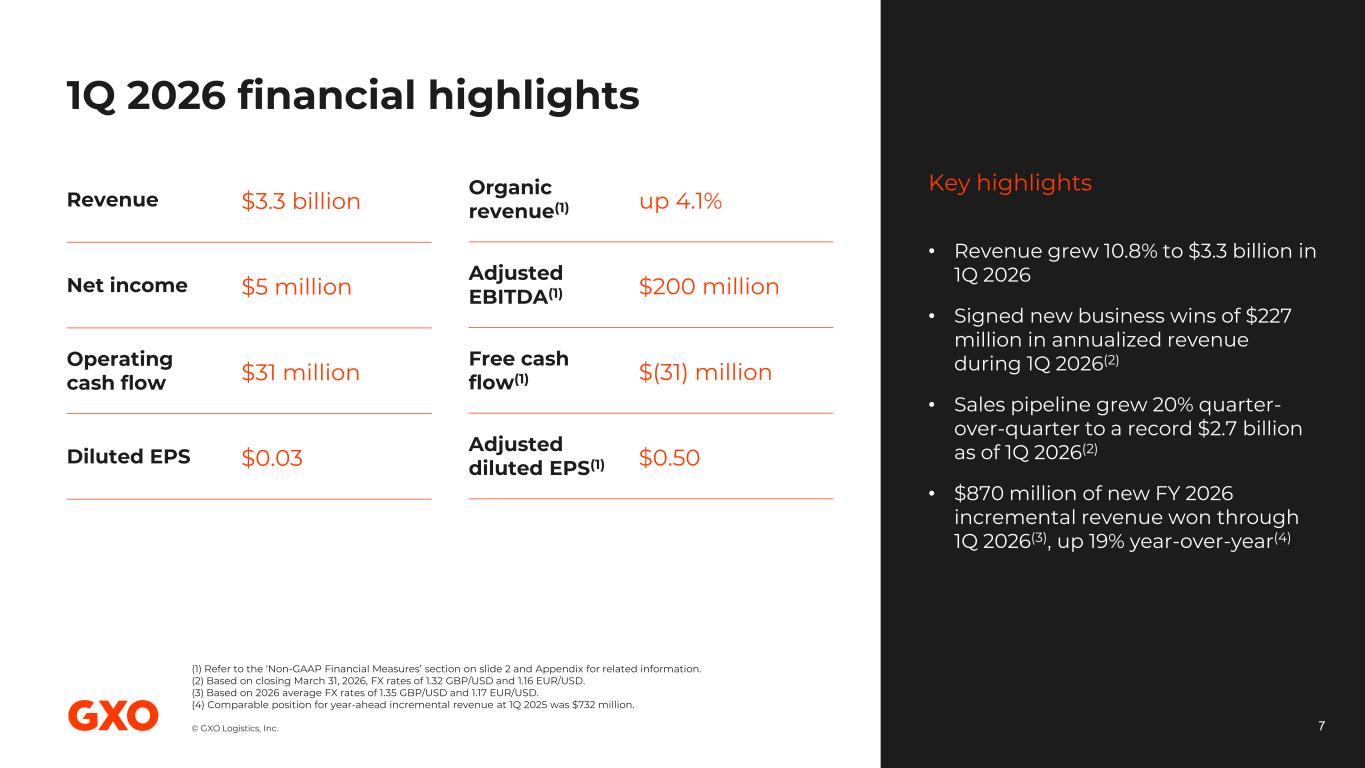
© GXO Logistics, Inc. 1Q 2026 financial highlights 7 (1) Refer to the ‘Non-GAAP Financial Measures’ section on slide 2 and Appendix for related information. (2) Based on closing March 31, 2026, FX rates of 1.32 GBP/USD and 1.16 EUR/USD. (3) Based on 2026 average FX rates of 1.35 GBP/USD and 1.17 EUR/USD. (4) Comparable position for year-ahead incremental revenue at 1Q 2025 was $732 million. Key highlights • Revenue grew 10.8% to $3.3 billion in 1Q 2026 • Signed new business wins of $227 million in annualized revenue during 1Q 2026(2) • Sales pipeline grew 20% quarter- over-quarter to a record $2.7 billion as of 1Q 2026(2) • $870 million of new FY 2026 incremental revenue won through 1Q 2026(3), up 19% year-over-year(4) $3.3 billionRevenue $5 millionNet income $31 million Operating cash flow $0.03Diluted EPS up 4.1% Organic revenue(1) $200 million Adjusted EBITDA(1) $(31) million Free cash flow(1) $0.50 Adjusted diluted EPS(1)
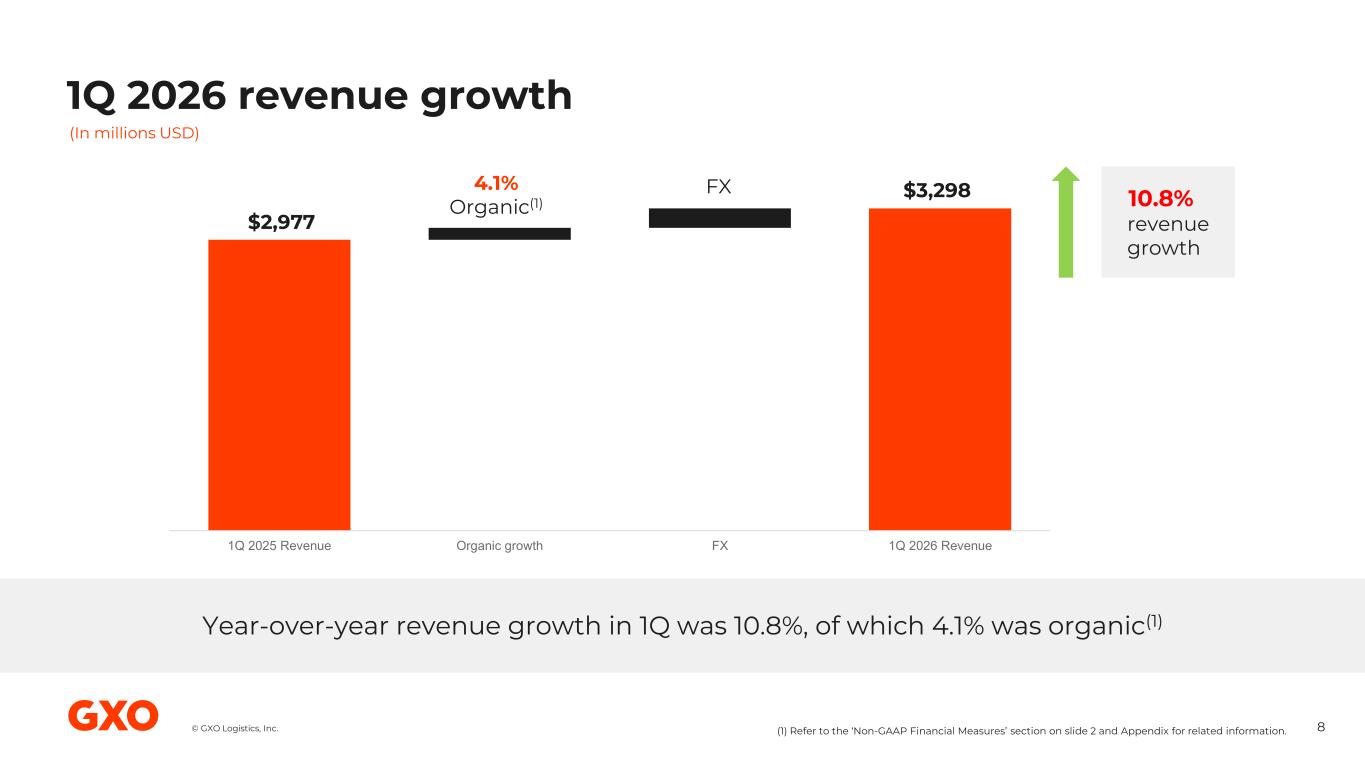
© GXO Logistics, Inc. 1Q 2025 Revenue Organic growth FX 1Q 2026 Revenue Year-over-year revenue growth in 1Q was 10.8%, of which 4.1% was organic(1) (1) Refer to the ‘Non-GAAP Financial Measures’ section on slide 2 and Appendix for related information. 1Q 2026 revenue growth 8 4.1% Organic(1) FX $2,977 $3,298 (In millions USD) 10.8% revenue growth
© GXO Logistics, Inc. 1Q 2026 wins and expansions 9
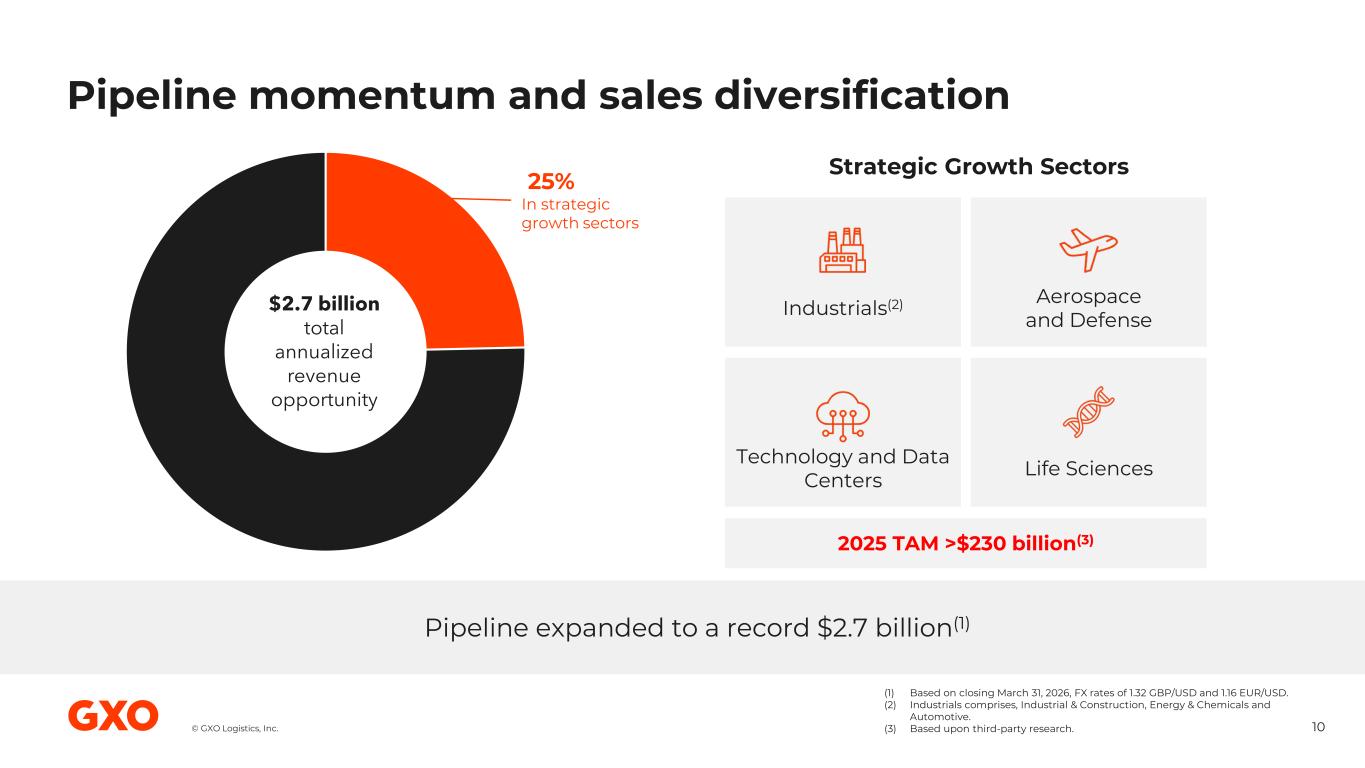
© GXO Logistics, Inc. Pipeline momentum and sales diversification 10 (1) Based on closing March 31, 2026, FX rates of 1.32 GBP/USD and 1.16 EUR/USD. (2) Industrials comprises, Industrial & Construction, Energy & Chemicals and Automotive. (3) Based upon third-party research. Pipeline expanded to a record $2.7 billion(1) $2.7 billion total annualized revenue opportunity 25% In strategic growth sectors Strategic Growth Sectors Technology and Data Centers Life Sciences Aerospace and DefenseIndustrials(2) 2025 TAM >$230 billion(3)
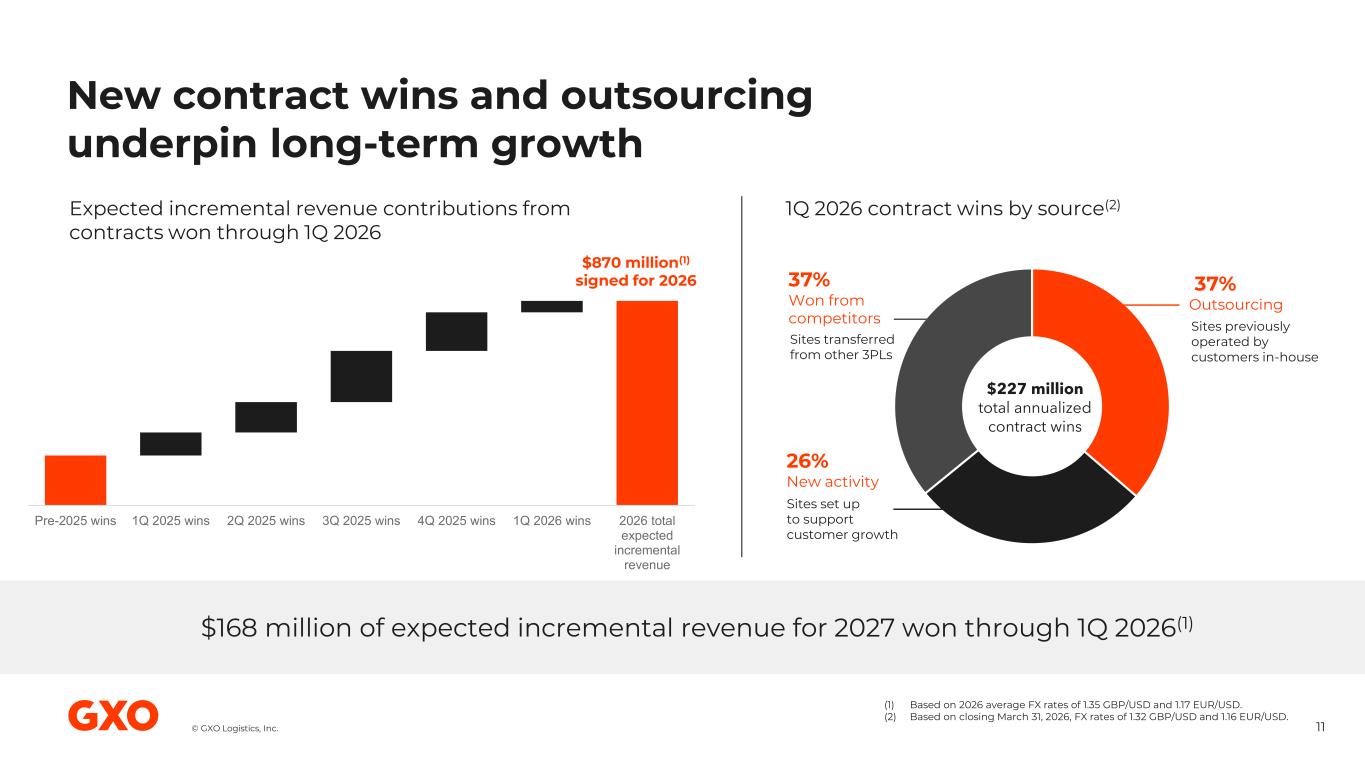
© GXO Logistics, Inc. New contract wins and outsourcing underpin long-term growth 11 Expected incremental revenue contributions from contracts won through 1Q 2026 1Q 2026 contract wins by source(2) Sites set up to support customer growth Sites previously operated by customers in-house 26% New activity 37% Outsourcing $870 million(1) signed for 2026 (1) Based on 2026 average FX rates of 1.35 GBP/USD and 1.17 EUR/USD. (2) Based on closing March 31, 2026, FX rates of 1.32 GBP/USD and 1.16 EUR/USD. $168 million of expected incremental revenue for 2027 won through 1Q 2026(1) Sites transferred from other 3PLs 37% Won from competitors $227 million total annualized contract wins Pre-2025 wins 1Q 2025 wins 2Q 2025 wins 3Q 2025 wins 4Q 2025 wins 1Q 2026 wins 2026 total expected incremental revenue
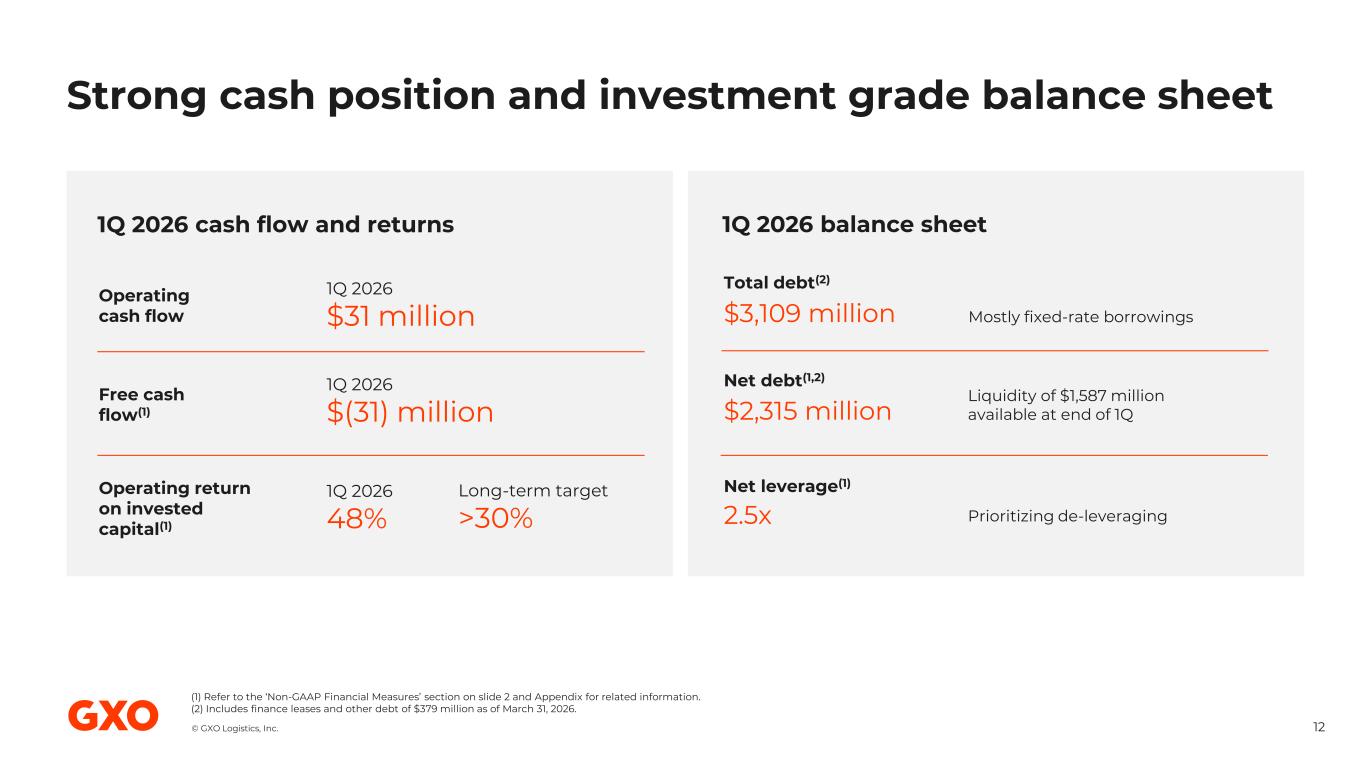
© GXO Logistics, Inc. Strong cash position and investment grade balance sheet 12 (1) Refer to the ‘Non-GAAP Financial Measures’ section on slide 2 and Appendix for related information. (2) Includes finance leases and other debt of $379 million as of March 31, 2026. 1Q 2026 balance sheet Total debt(2) $3,109 million Mostly fixed-rate borrowings Prioritizing de-leveraging Net debt(1,2) $2,315 million Net leverage(1) 2.5x Liquidity of $1,587 million available at end of 1Q Free cash flow(1) 1Q 2026 cash flow and returns Operating return on invested capital(1) 1Q 2026 $31 million 1Q 2026 $(31) million Operating cash flow 1Q 2026 48% Long-term target >30%
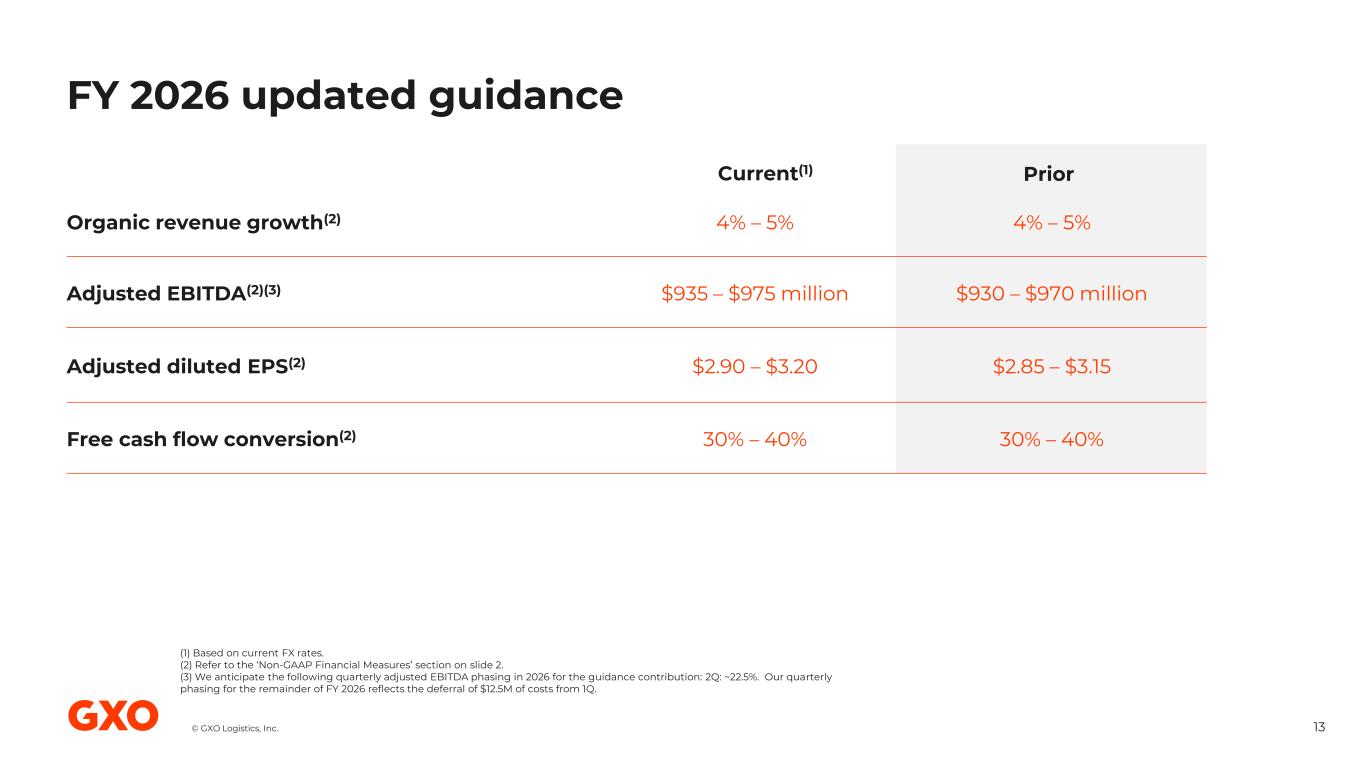
© GXO Logistics, Inc. FY 2026 updated guidance 13 4% – 5%4% – 5%Organic revenue growth(2) $930 – $970 million$935 – $975 millionAdjusted EBITDA(2)(3) $2.85 – $3.15$2.90 – $3.20Adjusted diluted EPS(2) 30% – 40% 30% – 40% Free cash flow conversion(2) (1) Based on current FX rates. (2) Refer to the ‘Non-GAAP Financial Measures’ section on slide 2. (3) We anticipate the following quarterly adjusted EBITDA phasing in 2026 for the guidance contribution: 2Q: ~22.5%. Our quarterly phasing for the remainder of FY 2026 reflects the deferral of $12.5M of costs from 1Q. Current(1) Prior

Appendix
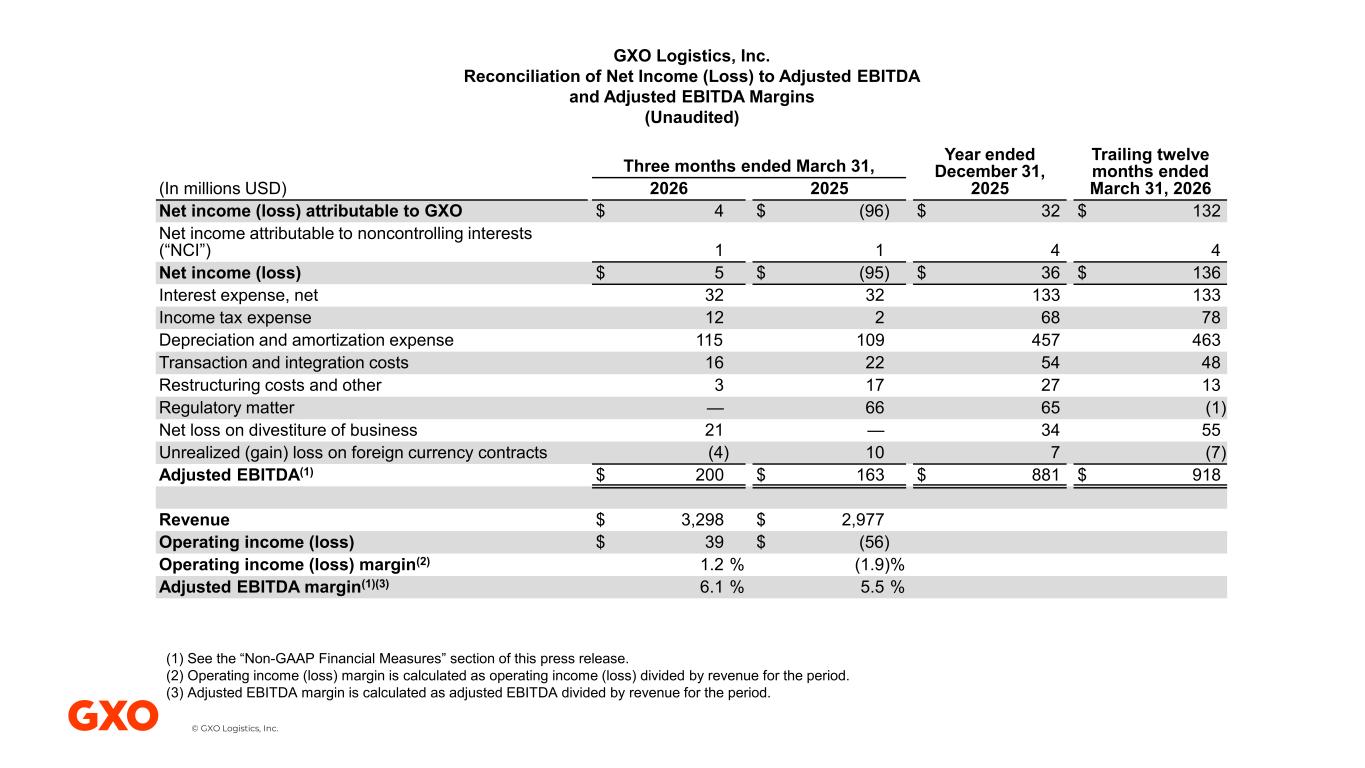
© GXO Logistics, Inc. Trailing twelve months ended March 31, 2026 Year ended December 31, 2025 Three months ended March 31, 20252026(In millions USD) $ 132$ 32$ (96)$ 4Net income (loss) attributable to GXO 4411 Net income attributable to noncontrolling interests (“NCI”) $ 136$ 36$ (95)$ 5Net income (loss) 1331333232Interest expense, net 7868212Income tax expense 463457109115Depreciation and amortization expense 48542216Transaction and integration costs 1327173Restructuring costs and other (1)6566—Regulatory matter 5534—21Net loss on divestiture of business (7)710(4)Unrealized (gain) loss on foreign currency contracts $ 918$ 881$ 163$ 200Adjusted EBITDA(1) $ 2,977$ 3,298Revenue $ (56)$ 39Operating income (loss) (1.9)%1.2 %Operating income (loss) margin(2) 5.5 %6.1 %Adjusted EBITDA margin(1)(3) GXO Logistics, Inc. Reconciliation of Net Income (Loss) to Adjusted EBITDA and Adjusted EBITDA Margins (Unaudited) (1) See the “Non-GAAP Financial Measures” section of this press release. (2) Operating income (loss) margin is calculated as operating income (loss) divided by revenue for the period. (3) Adjusted EBITDA margin is calculated as adjusted EBITDA divided by revenue for the period.
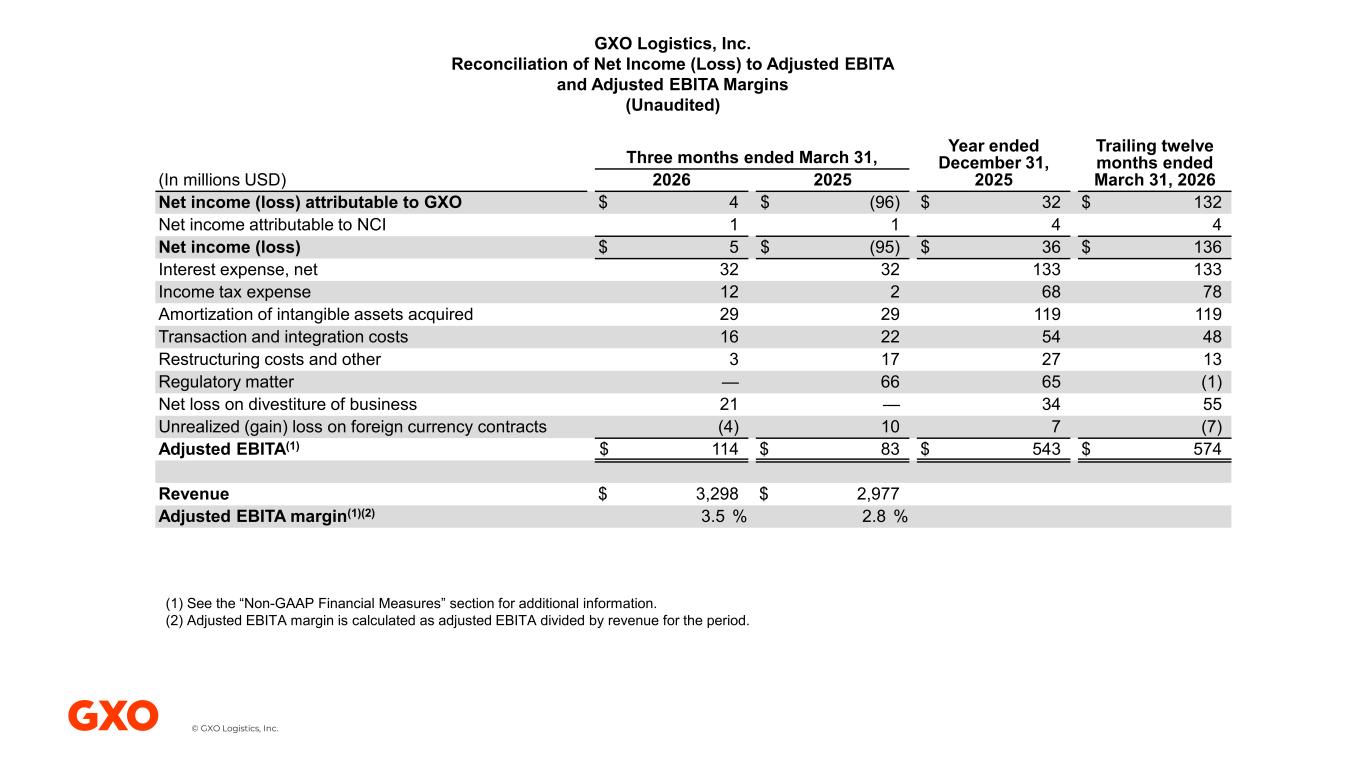
© GXO Logistics, Inc. GXO Logistics, Inc. Reconciliation of Net Income (Loss) to Adjusted EBITA and Adjusted EBITA Margins (Unaudited) Trailing twelve months ended March 31, 2026 Year ended December 31, 2025 Three months ended March 31, 20252026(In millions USD) $ 132$ 32$ (96)$ 4Net income (loss) attributable to GXO 4411Net income attributable to NCI $ 136$ 36$ (95)$ 5Net income (loss) 1331333232Interest expense, net 7868212Income tax expense 1191192929Amortization of intangible assets acquired 48542216Transaction and integration costs 1327173Restructuring costs and other (1)6566—Regulatory matter 5534—21Net loss on divestiture of business (7)710(4)Unrealized (gain) loss on foreign currency contracts $ 574$ 543$ 83$ 114Adjusted EBITA(1) $ 2,977$ 3,298Revenue 2.8 %3.5 %Adjusted EBITA margin(1)(2) (1) See the “Non-GAAP Financial Measures” section for additional information. (2) Adjusted EBITA margin is calculated as adjusted EBITA divided by revenue for the period.
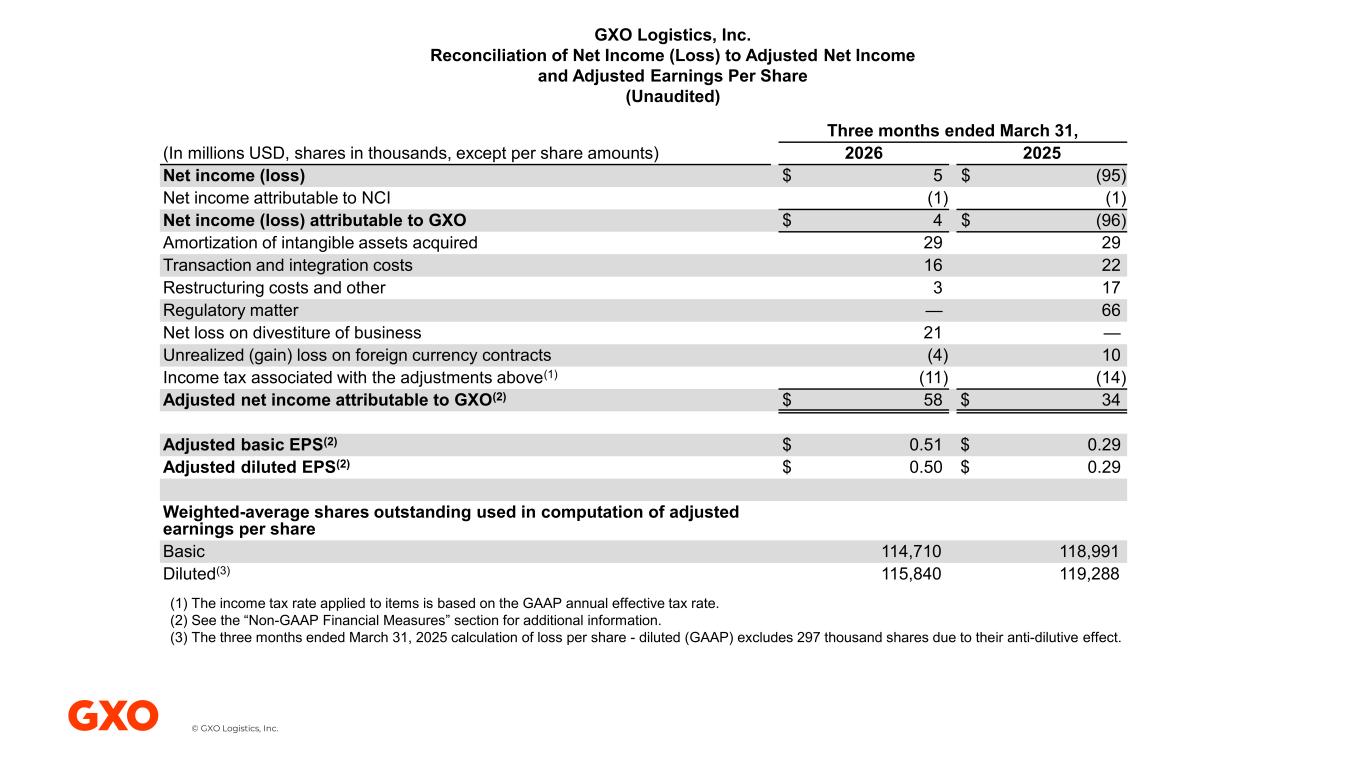
© GXO Logistics, Inc. GXO Logistics, Inc. Reconciliation of Net Income (Loss) to Adjusted Net Income and Adjusted Earnings Per Share (Unaudited) Three months ended March 31, 20252026(In millions USD, shares in thousands, except per share amounts) $ (95)$ 5Net income (loss) (1)(1)Net income attributable to NCI $ (96)$ 4Net income (loss) attributable to GXO 2929Amortization of intangible assets acquired 2216Transaction and integration costs 173Restructuring costs and other 66—Regulatory matter —21Net loss on divestiture of business 10(4)Unrealized (gain) loss on foreign currency contracts (14)(11)Income tax associated with the adjustments above(1) $ 34$ 58Adjusted net income attributable to GXO(2) $ 0.29$ 0.51Adjusted basic EPS(2) $ 0.29$ 0.50Adjusted diluted EPS(2) Weighted-average shares outstanding used in computation of adjusted earnings per share 118,991114,710Basic 119,288115,840Diluted(3) (1) The income tax rate applied to items is based on the GAAP annual effective tax rate. (2) See the “Non-GAAP Financial Measures” section for additional information. (3) The three months ended March 31, 2025 calculation of loss per share - diluted (GAAP) excludes 297 thousand shares due to their anti-dilutive effect.
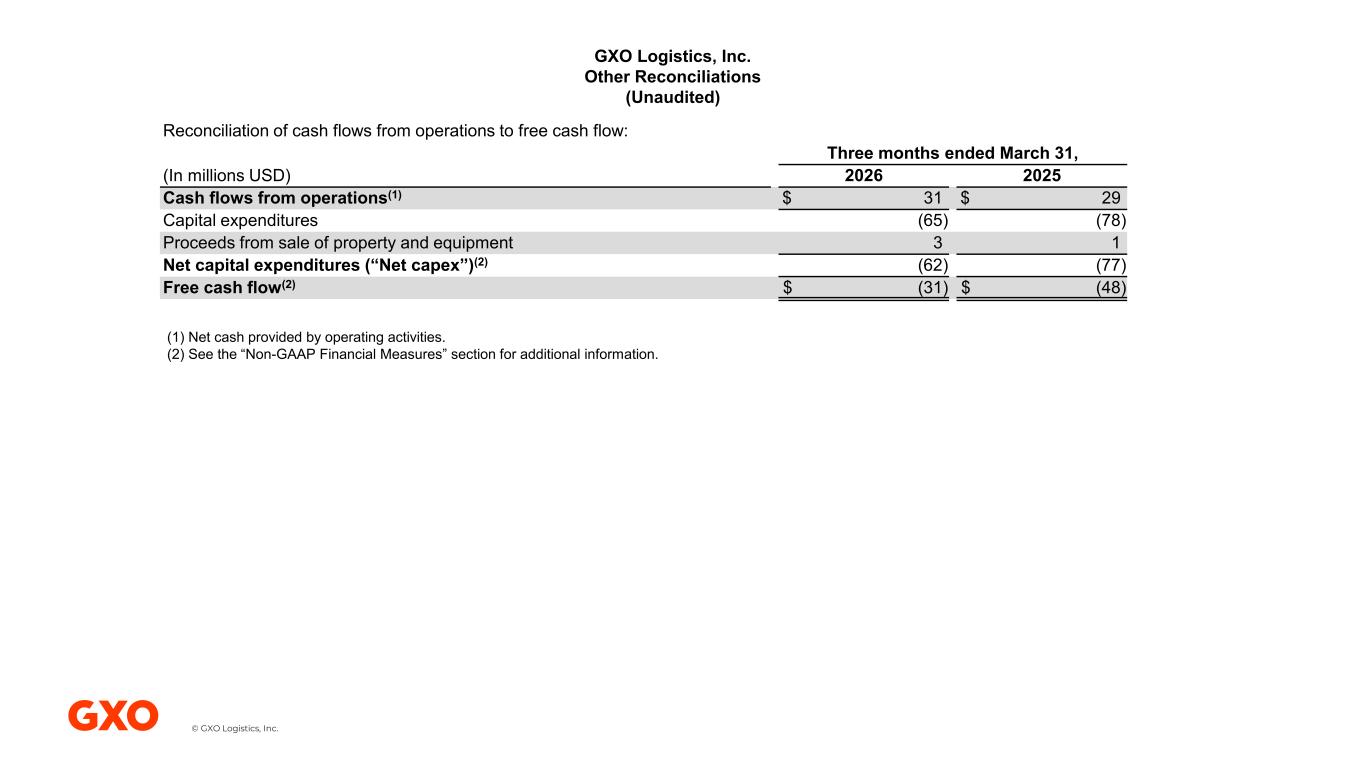
© GXO Logistics, Inc. GXO Logistics, Inc. Other Reconciliations (Unaudited) Reconciliation of cash flows from operations to free cash flow: Three months ended March 31, 20252026(In millions USD) $ 29$ 31Cash flows from operations(1) (78)(65)Capital expenditures 13Proceeds from sale of property and equipment (77)(62)Net capital expenditures (“Net capex”)(2) $ (48)$ (31)Free cash flow(2) (1) Net cash provided by operating activities. (2) See the “Non-GAAP Financial Measures” section for additional information.
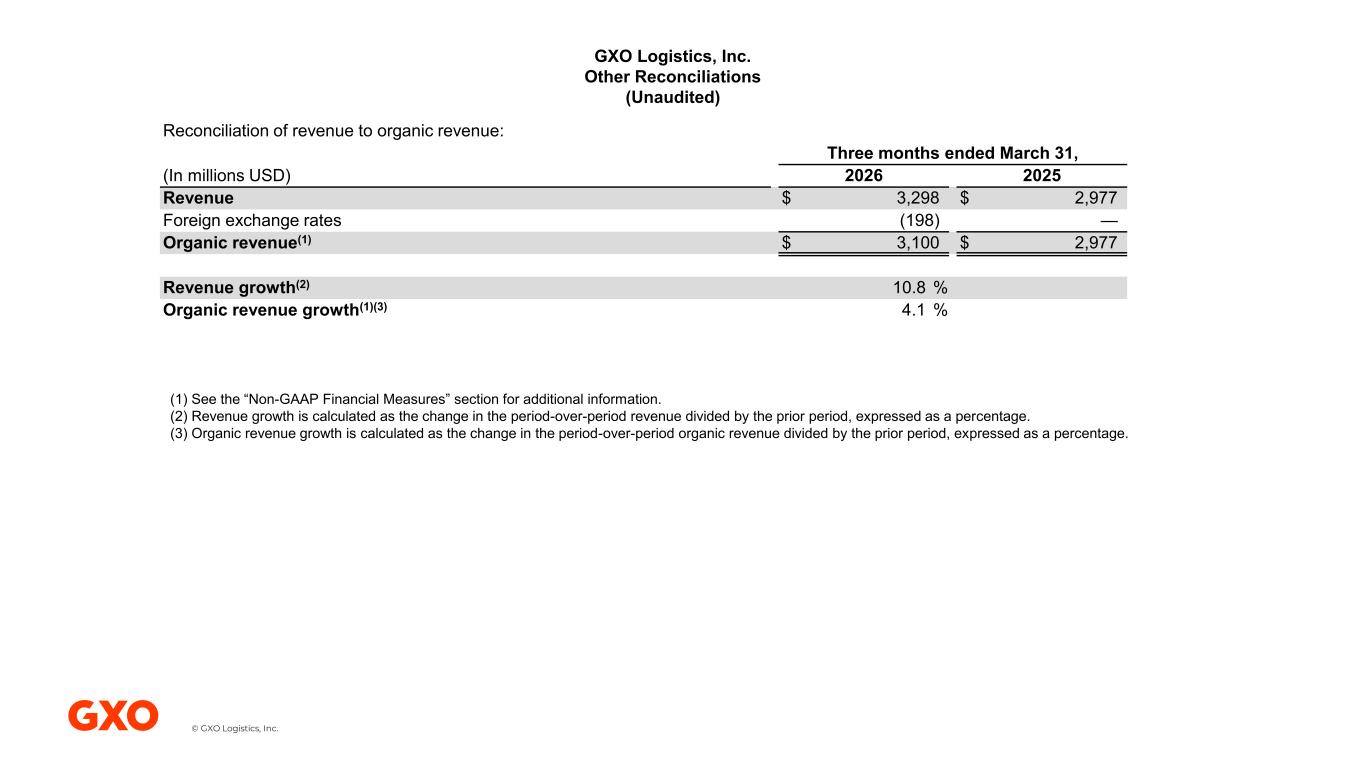
© GXO Logistics, Inc. GXO Logistics, Inc. Other Reconciliations (Unaudited) Reconciliation of revenue to organic revenue: Three months ended March 31, 20252026(In millions USD) $ 2,977$ 3,298Revenue —(198)Foreign exchange rates $ 2,977$ 3,100Organic revenue(1) 10.8 %Revenue growth(2) 4.1 %Organic revenue growth(1)(3) (1) See the “Non-GAAP Financial Measures” section for additional information. (2) Revenue growth is calculated as the change in the period-over-period revenue divided by the prior period, expressed as a percentage. (3) Organic revenue growth is calculated as the change in the period-over-period organic revenue divided by the prior period, expressed as a percentage.
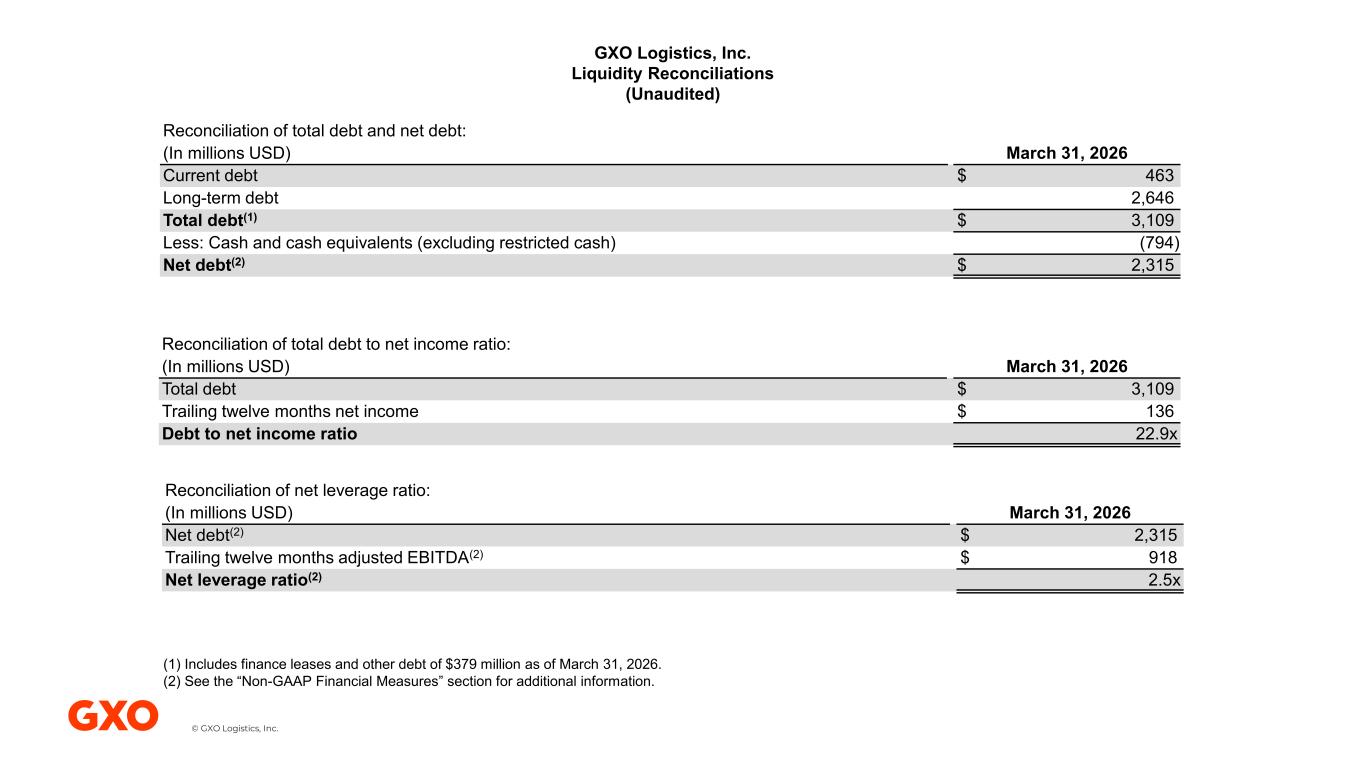
© GXO Logistics, Inc. GXO Logistics, Inc. Liquidity Reconciliations (Unaudited) Reconciliation of total debt and net debt: March 31, 2026(In millions USD) $ 463Current debt 2,646Long-term debt $ 3,109Total debt(1) (794)Less: Cash and cash equivalents (excluding restricted cash) $ 2,315Net debt(2) Reconciliation of total debt to net income ratio: March 31, 2026(In millions USD) $ 3,109Total debt $ 136Trailing twelve months net income 22.9xDebt to net income ratio Reconciliation of net leverage ratio: March 31, 2026(In millions USD) $ 2,315Net debt(2) $ 918Trailing twelve months adjusted EBITDA(2) 2.5xNet leverage ratio(2) (1) Includes finance leases and other debt of $379 million as of March 31, 2026. (2) See the “Non-GAAP Financial Measures” section for additional information.
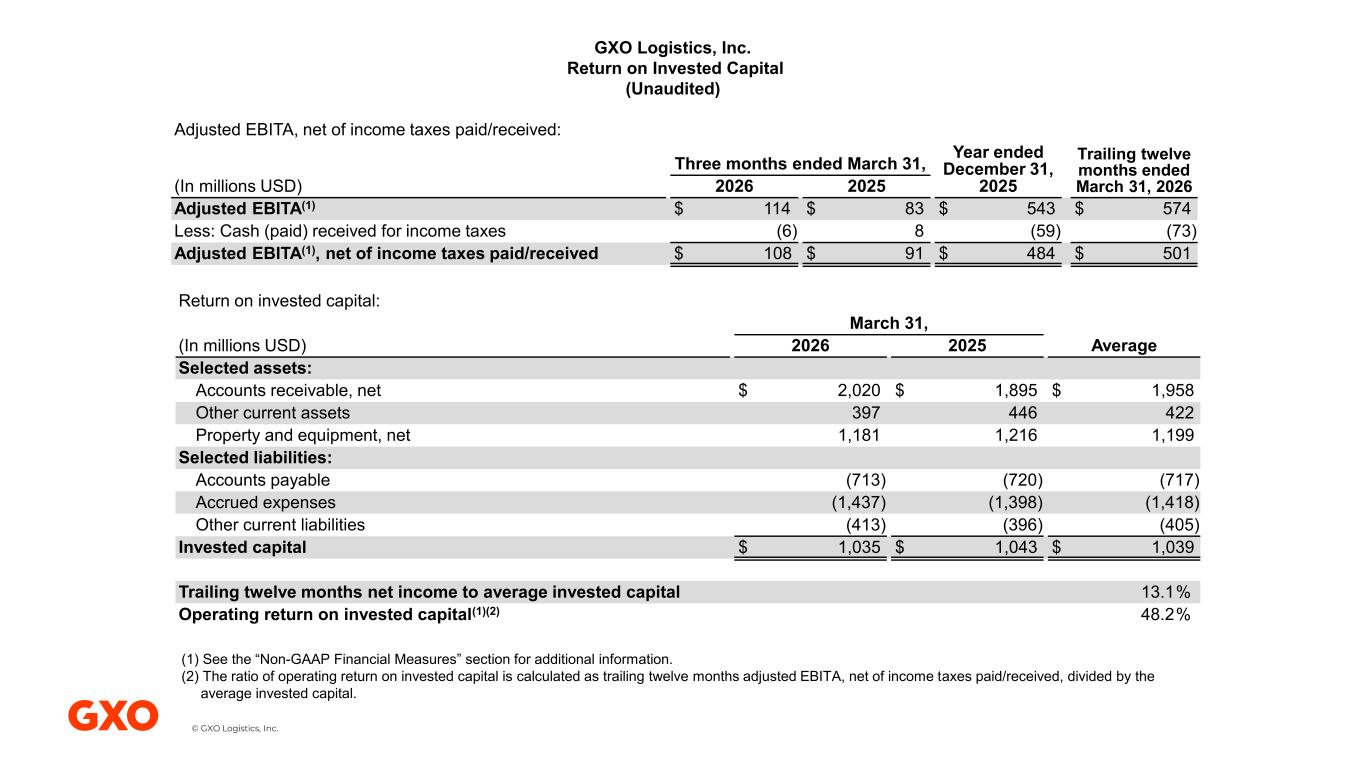
© GXO Logistics, Inc. Adjusted EBITA, net of income taxes paid/received: Trailing twelve months ended March 31, 2026 Year ended December 31, 2025 Three months ended March 31, 20252026(In millions USD) $ 574$ 543$ 83$ 114Adjusted EBITA(1) (73)(59)8(6)Less: Cash (paid) received for income taxes $ 501$ 484$ 91$ 108Adjusted EBITA(1), net of income taxes paid/received Return on invested capital: March 31, Average20252026(In millions USD) Selected assets: $ 1,958$ 1,895$ 2,020Accounts receivable, net 422446397Other current assets 1,1991,2161,181Property and equipment, net Selected liabilities: (717)(720)(713)Accounts payable (1,418)(1,398)(1,437)Accrued expenses (405)(396)(413)Other current liabilities $ 1,039$ 1,043$ 1,035Invested capital 13.1%Trailing twelve months net income to average invested capital 48.2%Operating return on invested capital(1)(2) GXO Logistics, Inc. Return on Invested Capital (Unaudited) (1) See the “Non-GAAP Financial Measures” section for additional information. (2) The ratio of operating return on invested capital is calculated as trailing twelve months adjusted EBITA, net of income taxes paid/received, divided by the average invested capital.