N-4 - USD ($)
May 05, 2026
Apr. 27, 2026
Dec. 31, 2025
Dec. 31, 2024
Dec. 31, 2023
Dec. 31, 2022
Dec. 31, 2021
Dec. 31, 2020
Dec. 31, 2019
Dec. 31, 2018
Dec. 31, 2017
Dec. 31, 2016
We limit the amount of negative Index Change used in calculating Index Credit for an Index Account Option at the end of its Crediting Period. Each Index Account Option provides a level of protection against a negative Index Change based on the applicable Downside Protection Type and associated rate. The only Downside Protection Type that we currently offer is Buffer, and each Index Account Option’s Buffer has an associated Buffer Rate. A Buffer provides only limited protection from a negative Index Change. A negative Index Change in excess of the Buffer Rate will result in loss, which could be significant. For example, if the Index Change is -25% and the Buffer Rate is 10%, we will apply a -15% Index Credit (the amount of negative Index Change that exceeds the Buffer Rate) at the end of the Crediting Period, meaning you will experience a 15% loss.
- An Index Account Option with a 10% Buffer Rate will always be available under the Policy.
- In the future, if we offer a new Index Account Option that includes a Buffer, there is no pre-specified minimum Buffer Rate. While we will not offer any Index Account Options that provide for no downside protection, we may offer Index Account Options that provide only minimal limits on Index losses.
We may limit the positive Index Change used in calculating Index Credit for an Index Account Option at the end of its Crediting Period. Each Index Account Option has a Growth Opportunity Type that may limit your positive Index returns. The only Growth Opportunity Types that we currently offer are (i) Cap, with an associated Cap Rate; (ii) Participation, with an associated Participation Rate; and (iii) Edge and Edge+, with an associated Edge Rate and Edge+ Rate. These Growth Opportunity Types may limit positive Index returns in the following manner:
- Cap – If you select an Index Account Option with Cap, you will participate in a positive Index Change up to the Cap Rate, but no positive Index Change beyond the Cap Rate. For instance, if you select an Index Account Option with a Cap Rate of 5%, and at the end of the Crediting Period the Index Change is 15%, your Index Credit Rate would be +5%, meaning you will experience a 5% gain.
For new Crediting Periods, the lowest Cap Rate that may be established under the Policy is 2%.
-
Participation – If you select an Index Account Option with Participation, you will participate in a percentage of a positive Index Change, and that percentage will be the Participation Rate. For instance, if you select an Index Account Option with a Participation Rate of 80%, and at the end of the Crediting Period the Index Change is 10%, your Index Credit Rate would be +8%, meaning you will experience an 8% gain (i.e., 10% x 80% = 8%). Please note:
- A Participation Rate equal to 100% means that you will fully participate in a positive Index Change.
- A Participation Rate less than 100% means that you will not fully participate in a positive Index Change.
- We may declare Participation Rates greater than 100%, which would have the effect of increasing your Index Credit Rate beyond the Index Change.
- Cap – If you select an Index Account Option with Cap, you will participate in a positive Index Change up to the Cap Rate, but no positive Index Change beyond the Cap Rate. For instance, if you select an Index Account Option with a Cap Rate of 5%, and at the end of the Crediting Period the Index Change is 15%, your Index Credit Rate would be +5%, meaning you will experience a 5% gain.
| | FEES, EXPENSES, AND ADJUSTMENTS | Location in Prospectus | ||
| Are There Ongoing Fees and Expenses? | Yes. There is an implicit ongoing fee on the Index Account Options to the extent that your participation in Index gains is limited by either a Cap Rate, Participation Rate, or an Edge Rate or Edge+ Rate. This means that your returns may be lower than the Index’s returns. In exchange for accepting a limit on Index gains, you will receive some protection from Index losses. This implicit ongoing fee is not reflected in the tables below. The table below describes the fees and expenses that you may pay each year, depending on the Allocation Accounts and optional benefits you choose. Please refer to your Policy specification page for information about the specific fees you will pay each year based on the options you have elected. | |||
| Annual Fee | Minimum | Maximum | ||
| Base Contract | 0.00%1 | 3.25%2,3 | ||
| Optional benefits available for an additional charge (for a single optional benefit, elected) | 0.50%4 | 1.45%5 | ||
| 1) Reflects the base GLWB (no optional step-up benefit). Also reflects the current annual service charge ($0 or 0%). 2) Reflects the annualized fee percentage if you invest in an Index Account Option with a Growth Opportunity Type designated as “Credit Advantage.” The annualized fee is 1.25% (as a percentage of Policy Value allocated to that Index Account Option on the first day of either (i) a new Crediting Period or (ii) the remaining Crediting Period after exercise of Early-Re-Entry). The Credit Advantage Fee is assessed at the end of the Crediting Period after the Index Credit. However, a portion of the Credit Advantage Fee will be due if taking a partial withdrawal of the Index Account Value before the end of the Crediting Period. Furthermore, if taking a full withdrawal of the Index Account Value before the end of the Crediting Period or exercising Performance Lock, the entire Credit Advantage Fee becomes due. (For example, if you select a 6-year Crediting Period, the total Credit Advantage Fee for that Crediting Period would be 7.50% (i.e., 1.25% x 6). If you were to take a full withdrawal of the Index Account Option Value or exercise Performance Lock after 1 year, you would still pay the full 7.50%.) 3) Reflects a 2.00% service charge. The maximum annual service charge is the lesser of $50 or 2.00% (as a percentage of your Policy Value as of your Policy Anniversary, before the deduction of any fees or charges). 4) The fee for the optional GMDB rider (as a percentage of the GMDB Benefit Base), applicable to Issue Ages 71-80. There is no charge for the GMDB rider for Issue Ages 0-70. 5) Reflects the Guaranteed Lifetime Withdrawal Rider Fee Percentage that we are currently charging for the GLWB’s optional step-up benefit (as a percentage of the Withdrawal Base or Policy Value, whichever is greater). Because your Policy is customizable, the choices you make affect how much you will pay. To help you understand the cost of owning your Policy, the following table shows the lowest and highest cost you could pay each year based on current charges. This estimate assumes that you do not take withdrawals from the Policy, which could add surrender charges and negative Interim Value adjustments that substantially increase costs. | ||||
| Lowest Annual Cost | Highest Annual Cost | ||
| $0 | $4,038 | ||
| Assumes: ●Investment of $100,000 in an Index Account Option ●5% annual appreciation ●No Credit Advantage ●No Step-up benefit for GLWB ●No optional benefits ●GMDB rider (Issue Age 0-70) ●No sales charges ●No additional premium payments, transfers, or withdrawals ●0% Interim Value adjustments for interim fee deductions | Assumes: ●Investment of $100,000 in an Index Account Option ●5% annual appreciation ●Credit Advantage ●Step-up benefit for GLWB ●Additional Death Benefit ●GMDB rider (Issue Age 71-80) ●No sales charges ●No additional premium payments, transfers, or withdrawals ● 0% Interim Value adjustments for interim fee deductions |
IMPORTANT INFORMATION YOU SHOULD CONSIDER ABOUT THE POLICY
| FEES, EXPENSES, AND ADJUSTMENTS | Location in Prospectus | |
| Are There Charges or Adjustments for Early Withdrawals? | Yes. Surrender Charges. If you Surrender or withdraw money from the Policy during the first six years after your purchase the Policy or make an additional premium payment, you may be assessed a surrender charge of up to 8% (as a percentage of premium payments Surrendered or withdrawn). For example, if you were to make an early withdrawal, you could pay a surrender charge of up to $8,000 on a $100,000 investment. This loss will be greater if there are negative Interim Value adjustments, taxes, or tax penalties. Interim Value Adjustments. If all or a portion of your Policy Value is removed from an Index Account Option before the end of its Crediting Period, an Interim Value adjustment will apply, which may be negative. In extreme circumstances, it is possible to lose up to 100% of your investment in an Index Account Option due to the application of a negative Interim Value adjustment (i.e., a complete loss of your principal and any prior earnings). For example, if you allocated $100,000 to an Index Account Option with 2-year Crediting Period and make a withdrawal before the 2 years have ended, you could lose up to $100,000 due to a negative Interim Value adjustment. This loss will be greater if you also have to pay surrender charges, taxes, or tax penalties. An Interim Value adjustment will apply if any of the following transactions occur prior to the end of a Crediting Period for an Index Account Option: (i) a fee or charge is deducted; (ii) you take a Surrender or any withdrawal; (iii) the Policy is annuitized; (iv) the death benefit is calculated; or (v) you exercise the Performance Lock feature. | |
| Are There Transaction Charges? | Yes. In addition to surrender charges and Interim Value adjustments, you may also be assessed a fee for requesting special services (e.g., overnight delivery). | |
| Are There Ongoing Fees and Expenses? | Yes. There is an implicit ongoing fee on the Index Account Options to the extent that your participation in Index gains is limited by either a Cap Rate, Participation Rate, or an Edge Rate or Edge+ Rate. This means that your returns may be lower than the Index’s returns. In exchange for accepting a limit on Index gains, you will receive some protection from Index losses. This implicit ongoing fee is not reflected in the tables below. The table below describes the fees and expenses that you may pay each year, depending on the Allocation Accounts and optional benefits you choose. Please refer to your Policy specification page for information about the specific fees you will pay each year based on the options you have elected. |
| Annual Fee | Minimum | Maximum | ||
| Base Contract | 0.00%1 | See Rate Sheet Supplement2,3 | ||
| Optional benefits available for an additional charge (for a single optional benefit, elected) | 0.50%4 | |||
| 1) Reflects the base GLWB (no optional step-up benefit). Also reflects the current annual service charge ($0 or 0%). 2) Will reflect the annualized fee percentage if you invest in an Index Account Option with a Growth Opportunity Type designated as “Credit Advantage.” The annualized fee is 1.25% (as a percentage of Policy Value allocated to that Index Account Option on the first day of either (i) a new Crediting Period or (ii) the remaining Crediting Period after exercise of Early-Re-Entry). The Credit Advantage Fee is assessed at the end of the Crediting Period after the Index Credit. However, a portion of the Credit Advantage Fee will be due if taking a partial withdrawal of the Index Account Value before the end of the Crediting Period. Furthermore, if taking a full withdrawal of the Index Account Value before the end of the Crediting Period or exercising Performance Lock, the entire Credit Advantage Fee becomes due. (For example, if you select a 6-year Crediting Period, the total Credit Advantage Fee for that Crediting Period would be 7.50% (i.e., 1.25% x 6). If you were to take a full withdrawal of the Index Account Option Value or exercise Performance Lock after 1 year, you would still pay the full 7.50%.) 3) Will reflect a 2.00% service charge. The maximum annual service charge is the lesser of $50 or 2.00% (as a percentage of your Policy Value as of your Policy Anniversary, before the deduction of any fees or charges). 4) The fee for the optional GMDB rider (as a percentage of the GMDB Benefit Base), applicable to Issue Ages 71-80. There is no charge for the GMDB rider for Issue Ages 0-70. 5) Will reflect the Guaranteed Lifetime Withdrawal Rider Fee Percentage that we are currently charging for the GLWB’s optional step-up benefit (as a percentage of the Withdrawal Base or Policy Value, whichever is greater). Because your Policy is customizable, the choices you make affect how much you will pay. To help you understand the cost of owning your Policy, the following table shows the lowest and highest cost you could pay each year based on current charges. This estimate assumes that you do not take withdrawals from the Policy, which could add surrender charges and negative Interim Value adjustments that substantially increase costs | ||||
Lowest Annual Cost
Highest Annual Cost
Assumes:
•Investment of $100,000 in an Index Account Option
• 5% annual appreciation
• No Credit Advantage• No Step-up benefit for GLWB
• No optional benefits
• GMD rider (Issue Age 0-70)
• GMD rider (Issue Age 0-70)
• No sales charges
• No additional premium payments, transfers, or withdrawals
Assumes:
• Investment of $100,000 in an Index Account Option
• 5% annual appreciation
• Credit Advantage
• Step-up benefit for GLWB
• Additional Death Benefit
• GMDB rider (Issue Age 71-80)
• No sales charges
• No additional premium payments, transfers, or withdrawals
• 0% Interim Value adjustments
Yes.
Surrender Charges. If you Surrender or withdraw money from the Policy during the first six years after your purchase the Policy or make an additional premium payment, you may be assessed a surrender charge of up to 8% (as a percentage of premium payments Surrendered or withdrawn). For example, if you were to make an early withdrawal, you could pay a surrender charge of up to $8,000 on a $100,000 investment. This loss will be greater if there are negative Interim Value adjustments, taxes, or tax penalties.
Interim Value Adjustments. If all or a portion of your Policy Value is removed from an Index Account Option before the end of its Crediting Period, an Interim Value adjustment will apply, which may be negative. In extreme circumstances, it is possible to lose up to 100% of your investment in an Index Account Option due to the application of a negative Interim Value adjustment (i.e., a complete loss of your principal and any prior earnings). For example, if you allocated $100,000 to an Index Account Option with 2-year Crediting Period and make a withdrawal before the 2 years have ended, you could lose up to $100,000 due to a negative Interim Value adjustment. This loss will be greater if you also have to pay surrender charges, taxes, or tax penalties.
An Interim Value adjustment will apply if any of the following transactions occur prior to the end of a Crediting Period for an Index Account Option: (i) a fee or charge is deducted; (ii) you take a Surrender or any withdrawal; (iii) the Policy is annuitized; (iv) the death benefit is calculated; or (v) you exercise the Performance Lock feature.
Yes.
Surrender Charges. If you Surrender or withdraw money from the Policy during the first six years after your purchase the Policy or make an additional premium payment, you may be assessed a surrender charge of up to 8% (as a percentage of premium payments Surrendered or withdrawn). For example, if you were to make an early withdrawal, you could pay a surrender charge of up to $8,000 on a $100,000 investment. This loss will be greater if there are negative Interim Value adjustments, taxes, or tax penalties.
Interim Value Adjustments. If all or a portion of your Policy Value is removed from an Index Account Option before the end of its Crediting Period, an Interim Value adjustment will apply, which may be negative. In extreme circumstances, it is possible to lose up to 100% of your investment in an Index Account Option due to the application of a negative Interim Value adjustment (i.e., a complete loss of your principal and any prior earnings). For example, if you allocated $100,000 to an Index Account Option with 2-year Crediting Period and make a withdrawal before the 2 years have ended, you could lose up to $100,000 due to a negative Interim Value adjustment. This loss will be greater if you also have to pay surrender charges, taxes, or tax penalties.
An Interim Value adjustment will apply if any of the following transactions occur prior to the end of a Crediting Period for an Index Account Option: (i) a fee or charge is deducted; (ii) you take a Surrender or any withdrawal; (iii) the Policy is annuitized; (iv) the death benefit is calculated; or (v) you exercise the Performance Lock feature.
Are There Transaction Charges?
Yes.
In addition to surrender charges and Interim Value adjustments, you may also be assessed a fee for requesting special services (e.g., overnight delivery).
Yes.
There is an implicit ongoing fee on the Index Account Options to the extent that your participation in Index gains is limited by either a Cap Rate, Participation Rate, or an Edge Rate or Edge+ Rate. This means that your returns may be lower than the Index’s returns. In exchange for accepting a limit on Index gains, you will receive some protection from Index losses. This implicit ongoing fee is not reflected in the tables below.
The table below describes the fees and expenses that you may pay each year, depending on the Allocation Accounts and optional benefits you choose. Please refer to your Policy specification page for information about the specific fees you will pay each year based on the options you have elected.
Annual Fee
Minimum
Maximum
Base Contract
0.00%1
3.25%2,3
Optional benefits available for an additional charge
(for a single optional benefit, elected)
0.50%4
1.45%5
1) Reflects the base GLWB (no optional step-up benefit). Also reflects the current annual service charge ($0 or 0%).
2) Reflects the annualized fee percentage if you invest in an Index Account Option with a Growth Opportunity Type designated as “Credit Advantage.” The annualized fee is 1.25% (as a percentage of Policy Value allocated to that Index Account Option on the first day of either (i) a new Crediting Period or (ii) the remaining Crediting Period after exercise of Early-Re-Entry). The Credit Advantage Fee is assessed at the end of the Crediting Period after the Index Credit. However, a portion of the Credit Advantage Fee will be due if taking a partial withdrawal of the Index Account Value before the end of the Crediting Period. Furthermore, if taking a full withdrawal of the Index Account Value before the end of the Crediting Period or exercising Performance Lock, the entire Credit Advantage Fee becomes due. (For example, if you select a 6-year Crediting Period, the total Credit Advantage Fee for that Crediting Period would be 7.50% (i.e., 1.25% x 6). If you were to take a full withdrawal of the Index Account Option Value or exercise Performance Lock after 1 year, you would still pay the full 7.50%.)
3) Reflects a 2.00% service charge. The maximum annual service charge is the lesser of $50 or 2.00% (as a percentage of your Policy Value as of your Policy Anniversary, before the deduction of any fees or charges).
4) The fee for the optional GMDB rider (as a percentage of the GMDB Benefit Base), applicable to Issue Ages 71-80. There is no charge for the GMDB rider for Issue Ages 0-70.
5) Reflects the Guaranteed Lifetime Withdrawal Rider Fee Percentage that we are currently charging for the GLWB’s optional step-up benefit (as a percentage of the Withdrawal Base or Policy Value, whichever is greater).
Because your Policy is customizable, the choices you make affect how much you will pay. To help you understand the cost of owning your Policy, the following table shows the lowest and highest cost you could pay each year based on current charges. This estimate assumes that you do not take withdrawals from the Policy, which could add surrender charges and negative Interim Value adjustments that substantially increase costs.
| Lowest Annual Cost | Highest Annual Cost | ||
| $0 | $4,038 | ||
| Assumes: ●Investment of $100,000 in an Index Account Option ●5% annual appreciation ●No Credit Advantage ●No Step-up benefit for GLWB ●No optional benefits ●GMDB rider (Issue Age 0-70) ●No sales charges ●No additional premium payments, transfers, or withdrawals ●0% Interim Value adjustments for interim fee deductions | Assumes: ●Investment of $100,000 in an Index Account Option ●5% annual appreciation ●Credit Advantage ●Step-up benefit for GLWB ●Additional Death Benefit ●GMDB rider (Issue Age 71-80) ●No sales charges ●No additional premium payments, transfers, or withdrawals ● 0% Interim Value adjustments for interim fee deductions |
1) Reflects the base GLWB (no optional step-up benefit). Also reflects the current annual service charge ($0 or 0%).
2) Will reflect the annualized fee percentage if you invest in an Index Account Option with a Growth Opportunity Type designated as “Credit Advantage.” The annualized fee is 1.25% (as a percentage of Policy Value allocated to that Index Account Option on the first day of either (i) a new Crediting Period or (ii) the remaining Crediting Period after exercise of Early-Re-Entry). The Credit Advantage Fee is assessed at the end of the Crediting Period after the Index Credit. However, a portion of the Credit Advantage Fee will be due if taking a partial withdrawal of the Index Account Value before the end of the Crediting Period. Furthermore, if taking a full withdrawal of the Index Account Value before the end of the Crediting Period or exercising Performance Lock, the entire Credit Advantage Fee becomes due. (For example, if you select a 6-year Crediting Period, the total Credit Advantage Fee for that Crediting Period would be 7.50% (i.e., 1.25% x 6). If you were to take a full withdrawal of the Index Account Option Value or exercise Performance Lock after 1 year, you would still pay the full 7.50%.)
3) Will reflect a 2.00% service charge. The maximum annual service charge is the lesser of $50 or 2.00% (as a percentage of your Policy Value as of your Policy Anniversary, before the deduction of any fees or charges).
4) The fee for the optional GMDB rider (as a percentage of the GMDB Benefit Base), applicable to Issue Ages 71-80. There is no charge for the GMDB rider for Issue Ages 0-70.
5) Will reflect the Guaranteed Lifetime Withdrawal Rider Fee Percentage that we are currently charging for the GLWB’s optional step-up benefit (as a percentage of the Withdrawal Base or Policy Value, whichever is greater).
| Lowest Annual Cost | Highest Annual Cost | ||
| $0 | $4,038 | ||
| Assumes: ●Investment of $100,000 in an Index Account Option ●5% annual appreciation ●No Credit Advantage ●No Step-up benefit for GLWB ●No optional benefits ●GMDB rider (Issue Age 0-70) ●No sales charges ●No additional premium payments, transfers, or withdrawals ●0% Interim Value adjustments for interim fee deductions | Assumes: ●Investment of $100,000 in an Index Account Option ●5% annual appreciation ●Credit Advantage ●Step-up benefit for GLWB ●Additional Death Benefit ●GMDB rider (Issue Age 71-80) ●No sales charges ●No additional premium payments, transfers, or withdrawals ● 0% Interim Value adjustments for interim fee deductions |
RISKS
Location in Prospectus
Is There a Risk of Loss From Poor Performance?
Yes.
• You can lose money by investing in this Policy, including the loss of principal.
• Each available Index Account Option has a Buffer downside feature that provides only limited protection against any negative Index rate of return that may be charged to your investment at the end of a Crediting Period.
• At the end of a Crediting Period, the maximum amount of loss that you could experience from negative Index performance, after taking into account the current limits on Index loss provided under the Policy, is 90% for an Index Account Option with a 10% Buffer Rate, 85% for an Index Account Option with a 15% Buffer Rate, or 80% for an Index Account Option with a 20% Buffer Rate.
• We will always offer an Index Account Option with a 10% Buffer Rate.
| Is this a Short-Term Investment? | No. • This Policy is not a short-term investment and is not appropriate for an investor who needs ready access to cash. • The Policy’s tax deferral and long-term income features are generally more beneficial to investors with a long time horizon. • Amounts withdrawn from the Policy may result in surrender charges, taxes, and tax penalties. Withdrawals could result in significant reductions to Policy Value, the GLWB, the death benefit, and other Policy benefits. In addition, withdrawing or otherwise removing amounts from an Index Account Option before the end of its Crediting Period may result in a negative Interim Value adjustment and loss of positive Index performance. • Partial withdrawals taken, and fees and charges deducted, from an Index Account Option before the end of its Crediting Period will result in a proportionate reduction to your Index Base. The reduction to your Index Base may be greater than the amount withdrawn or the fee or charge deducted. Reductions to your Index Base will result in lower Interim Values for the remainder of the Crediting Period and less Index Credit (if any) at the end of the Crediting Period. The negative impact to your Policy Value and Policy benefits may be significant. • At the end of a Crediting Period, Policy Value in the matured Allocation Account will be reinvested, transferred, withdrawn, or annuitized per your instructions. In the absence of such instructions, Policy Value in the matured Allocation Account will be automatically reinvested in the same Allocation Account for another Crediting Period (with the Cap Rate, Participation Rate, Edge Rate and Edge+ Rate, or annual interest rate applicable to a new Crediting Period). If the matured Allocation Account is no longer available for investment, Policy Value in the matured Allocation Account will be automatically transferred to the Fixed Account Option with a 1-year Crediting Period by default. |
| What are the Risks Associated with the Investment Options? | • An investment in this Policy is subject to the risk of poor investment performance and can vary depending on the performance of the Allocation Accounts available under the Policy. • Each Allocation Account, including each Index Account Option and the Fixed Account Option, has its own unique risks. You should review the available Allocation Accounts before making an investment decision. • The Cap Rate, Participation Rate, or Edge Rate and Edge+ Rate for an Index Account Option, as applicable, may limit positive Index returns (e.g., limited upside). This limit may result in you earning less than the Index’s return. For example: o If the Index Change is 12% and the Cap Rate is 4%, we will apply an Index Credit equal to +4% at the end of the Crediting Period. o If the Index Change is 12% and the Participation Rate is 50%, we will apply an Index Credit equal to +6% (i.e., 12% x 50% = 6%) at the end of the Crediting Period. o If the Index Change is 12% and the Edge+ Rate is 5%, we will apply an Index Credit equal to +5% at the end of the Crediting Period. • While the Edge and Edge+ Growth Opportunity Type may provide for a positive Index Credit in the event of negative Index performance, there is no guarantee of investment gain. Like any other Index Account Option, a negative Index Change in excess of the Buffer Rate will result in loss, which could be significant. • The Buffer Rate for an Index Account Option will limit negative Index returns (e.g., limited protection in the case of market decline). For example, if the Index Change is -25% and the Buffer Rate is 10%, we will apply an Index Credit equal to -15% (the amount of negative Index Change that exceeds the Buffer Rate) at the end of the Crediting Period, meaning your investment will decrease in value by 15%. You bear all loss that exceeds the Buffer. • Each “Best Entry” Enhanced Index Account Option has an Initial Index Value reset feature that may help to increase Index gains or decrease Index losses, but it is not guaranteed to do so. Furthermore, these Index Account Options are subject to the same risks associated with Cap (i.e., limited upside) and Buffer (i.e., limited protection). • For each Index, Index performance is on a “price return” basis, not a “total return” basis, and therefore does not reflect dividends paid on the securities composing the Index. Certain Indexes also deduct fees and costs that will reduce Index performance. These factors will reduce the Index return and cause the Index to underperform a direct investment in the securities composing the Index or a direct investment in an ETF serving as an Index. | |
| What are the Risks Related to the Insurance Company? | An investment in the Policy is subject to risks related to the Company. Any obligations (including under the Fixed Account and the Index Accounts), guarantees, or benefits under the Policy are subject to our claims-paying ability. If we experience financial distress, we may not be able to meet our obligations to you. More information about Transamerica Life Insurance Company, including our financial strength ratings, is available by visiting transamerica.com or by calling toll-free (800) 525-6205. |
Yes. There may be restrictions that limit the Allocation Accounts you may choose, and there are limitations on the transfer of Policy Value among Allocation Accounts.
• Transfers from an Allocation Account are permitted only at the end of the Allocation Account’s Crediting Period (or on the next Allocation Anniversary if you exercised Performance Lock but not Early Re-Entry).
• The Fixed Account Option may not always be available for investment.
• We reserve the right to add or remove Index Account Options. We guarantee that the following Index Account Option will always be available for investment (subject to our right of Index substitution): S&P 500® Index, 1-Year Crediting Period, Buffer (Buffer Rate: 10%), Cap (Cap Rate: no lower than 2.00% for new Crediting Periods), no Credit Advantage Fee. This may be the only Index Account Option that we offer in the future.
• Each Index Account Option’s limit on Index losses (i.e., Buffer Rate) will not change for so long as that Index Account Option remains available. However, because we reserve the right to add and remove Index Account Options, the limits on Index loss offered under the Policy may change from one Crediting Period to the next.
• We may change the features of an Index Account Option from one Crediting Period to the next, including the Index and the current limit on Index gain (i.e., the Cap Rate, Participation Rate, or Edge Rate and Edge+ Rate, subject to minimum guarantees).
• We reserve the right to substitute the Index for an Index Account Option during its Crediting Period.
• We reserve the right to limit or refuse additional premium payments.
• The availability of Allocation Accounts may vary depending on your state or the financial intermediary through which the Policy is sold.
Yes. There are restrictions and limitations relating to the benefits offered under the Policy (e.g., GLWB, death benefits, Performance Lock).
• Except as otherwise provided, Policy benefits may not be modified or terminated by the Company.
• For the GLWB:
•You cannot terminate the GLWB without Surrendering or annuitizing the Policy.
• Withdrawals under the GLWB (including withdrawals of the Rider Withdrawal Amount) may be subject to surrender charges, negative Interim Value adjustments, taxes and tax penalties, as well as other negative consequences (e.g., reductions to the death benefit and proportionate reductions to the Index Bases for your Index Account Options).
• Excess Withdrawals may affect the availability of the GLWB by reducing the guarantee by an amount greater than the value withdrawn, and could terminate the benefit and the Policy.
• For Performance Lock+:
• Exercising Performance Lock for an Index Account Option will result in an Interim Value adjustment, which may be negative and result in significant loss.
• Exercising Early Re-Entry will re-expose your investment to the possibility of Index losses, negative Interim Value adjustments, and reductions to your Index Base.
•Early Re-Entry is not available for all Index Account Options.
• Withdrawals may significantly reduce the death benefit (as well as the optional Additional Death Benefit, if elected). If your Policy has the GMDB rider, any withdrawal will reduce the guaranteed minimum death benefit. Withdrawals may result in reductions to the benefit that are greater than the amount withdrawn.
•If you own the GMDB rider, a withdrawal will reduce the death benefit. The reduction could be greater than the amount withdrawn.
The availability of Policy benefits may vary depending on your state or the financial intermediary through which the Policy is sold.
•You should consult with a tax professional to determine the tax implications of an investment in and payments received under the Policy.
•If you purchase the Policy as an individual retirement account (IRA) or through a tax qualified plan, you do not get any additional tax benefit.
•You will generally not be taxed on increases in the value of your Policy until they are withdrawn. Earnings on your Policy are taxed at ordinary income tax rates when withdrawn, and you may have to pay a penalty if you take a withdrawal before age 59½.
FEE TABLE
The following tables describe the fees, expenses, and adjustments that you will pay when buying, owning, and Surrendering or making withdrawals from an Allocation Account or from the Policy. Please refer to your Policy specification page for information about the specific fees you will pay each year based on the options you have elected.
The first table describes the fees and expenses that you will pay at the time that you buy the Policy, Surrender or make withdrawals from an Allocation Account or from the Policy, or transfer Policy Value between Allocation Accounts. State premium taxes may also be deducted.
Transaction Expenses
| Sales Load Imposed on Purchases | None | |
| Surrender Charge1 (as a percentage of premium payments Surrendered or withdrawn) | 8.00% | |
| Special Service Fee2 | $50 | |
| Transfer Fee | None |
1. The surrender charge, if any, applies to each premium payment Surrendered or withdrawn regardless of how Policy Value is allocated among the Allocation Accounts. The surrender charge decreases based on the number of years since a premium payment was made according to the following schedule:
|
Number of Years Since Premium Payment Date
|
Surrender Charge
|
|
Year 0-1
|
8.00%
|
|
Year 1-2
|
8.00%
|
|
Year 2-3
|
7.00%
|
|
Year 3-4
|
6.00%
|
|
Year 4-5
|
5.00%
|
|
Year 5-6
|
4.00%
|
|
Year 6 or more
|
0.00%
|
Under the Policy’s “surrender charge-free amount,” you can withdraw a portion of your Policy Value each Policy Year free of surrender charges. The surrender charge-free amount each Policy Year is equal to the greater of (1) 10.00% of your total premium payments, less any withdrawals taken during the current Policy Year; and (2) earnings, plus premiums no longer subject to surrender charges. Withdrawals under the GLWB (including withdrawals of the Rider Withdrawal Amount) in excess of the surrender charge-free amount may be subject to surrender charges. Surrender charges may be waived in certain situations. See ACCESS TO YOUR MONEY – SURRENDER CHARGE WAIVERS for more information.
2. We currently assess the charge only for overnight delivery and duplicate policies. We reserve the right to assess the charge for other special services in the future, including non-sufficient checks on new business, duplicate Form 1099 and Form 5498 tax forms, check copies, printing and mailing previously submitted forms, and asset verification requests from mortgage companies. We may charge a fee for each service performed and fees may vary based on the type of service but will not exceed the maximum Special Service Fee shown.
The next table describes the adjustments, in addition to any transaction expenses, that apply if all or a portion of the Policy Value is removed from an Index Account Option before the expiration of its Crediting Period.
Adjustments
| Interim Value Adjustment Maximum Potential Loss1 (as a percentage of your Policy Value in an Index Account Option) | 100.00% |
- An Interim Value adjustment will apply if any of the following transactions occur prior to the end of a Crediting Period for an Index Account Option: (i) a fee or charge is deducted; (ii) you take a Surrender or any withdrawal; (iii) the Policy is annuitized; (iv) the death benefit is calculated; or (v) you exercise the Performance Lock feature.
The next table describes the fees and expenses that you will pay each year during the time that you own the Policy. If you choose to purchase an optional benefit, you will pay additional charges, as shown below.
Annual Contract Expenses
| Service Charge1 | Lesser of 2.00% or $50 |
| Base Contract Charges | 1.25% |
| Credit Advantage Fee2 | |
| (as an annualized percentage of Policy Value allocated to an Index Account Option with Credit Advantage as of the first day of either (i) a new Crediting Period or (ii) the remaining Crediting Period after exercise of Early-Re-Entry) | |
| Optional Benefit Expenses | |
| Guaranteed Minimum Death Benefit Rider Fee (for optional GMDB rider Issue Ages 71-80)3 | 0.50% |
| (as a percentage of the Guaranteed Minimum Death Benefit Base) | |
| Guaranteed Lifetime Withdrawal Rider Fee (for optional step-up benefit)4 | |
| (as a percentage of the Withdrawal Base or Policy Value, whichever is greater) | |
| Single Life | 2.50% |
| Joint Life | 2.50% |
| Additional Death Benefit Fees (for optional Additional Death Benefit)5 | 1.00% |
| (as a percentage of Policy Value) |
- The service charge is deducted on each Policy Anniversary prior to the Annuity Commencement Date and when you Surrender the Policy. Each time we deduct this charge, it will not exceed 2.00% (as a percentage of your Policy Value, before the deduction of any fees or charges on that date) or a maximum of $50, whichever is less, and we will waive the charge if your Policy Value, or if your total premium payments minus prior withdrawals, on that date is at least equal to the minimum amount specified in your Policy. The current annual service charge is $0.
- This fee is applicable only if you invest in an Index Account Option with a Growth Opportunity Type designated as “Credit Advantage.” See APPENDIX A - INVESTMENT OPTIONS AVAILABLE UNDER THE POLICY. The annualized fee percentage for an Index Account Option with Credit Advantage will not change for the life of the Policy. The dollar amount of the Credit Advantage Fee is calculated at the beginning of either (i) a new Crediting Period or (ii) the remaining Crediting Period after exercise of Early-Re-Entry. The Credit Advantage Fee is assessed at the end of the Crediting Period after the Index Credit. However, a portion of the Credit Advantage Fee will be due if taking a partial withdrawal of the Index Account Value before the end of the Crediting Period. Furthermore, if taking a full withdrawal of the Index Account Value before the end of the Crediting Period or exercising Performance Lock, the entire Credit Advantage Fee becomes due. For a new Crediting Period, the fee amount will equal the dollar amount allocated to the Index Account Option on the first day of the Crediting Period, multiplied by the Credit Advantage Fee percentage, multiplied by the length of the Crediting Period (in whole years). For the remaining Crediting Period after exercise of Early-Re-Entry, the fee amount will equal the dollar amount allocated from the Performance Lock Account to the previously locked Index Account Option, multiplied by the Credit Advantage Fee percentage, multiplied by the length of the Crediting Period (in whole and partial years). The Credit Advantage Fees paid prior to and upon the last exercise of Performance Lock will not be credited toward the Credit Advantage Fees owed for the remaining Crediting Period.
- The GMDB rider may be a standard or optional benefit depending on the Annuitant’s age as of the date that the Policy application is signed. If the Annuitant is younger than age 71, the GMDB rider is a standard benefit that is automatically added to your Policy for no additional charge. If the Annuitant is age 71 to 80, the GMDB rider is an optional benefit that may be elected for an additional charge, as follows:
|
Age of Annuitant
|
Fee Percentage
|
|
0-70
|
0.00% (No Charge)
|
|
71-80
|
0.50%
|
The applicable fee percentage will not change for the life of the rider. The fee will be calculated and deducted quarterly, on the same day of the month as the rider effective date.
- There is no additional charge for the GLWB unless you elect the optional step-up benefit. This is the maximum Guaranteed Lifetime Withdrawal Rider Fee Percentage for the step-up benefit (based on a single life or joint life payment election). The fee is calculated and deducted at the end of each Rider Quarter, on the same day of the month as the Rider Date. The Guaranteed Lifetime Withdrawal Rider Fee Percentage for a new Income Advantage Rider is provided in a Rate Sheet Supplement. The applicable Guaranteed Lifetime Withdrawal Rider Fee Percentage will not change unless (a) a step-up occurs after the third (3rd) Rider Year or (b) you exercise a Rider Reset. If you elect the optional step-up benefit, but Surrender the Policy prior to the Income Declaration Date, you may qualify to have some or all of your Guaranteed Lifetime Withdrawal Rider Fees returned to you.
- These are the maximum Additional Death Benefit Percentages for the optional Additional Death Benefit. The fees for the Additional Death Benefit are calculated and deducted at the end of each Rider Quarter, on the same day of the month as the Rider Date. The Additional Death Benefit Percentages applicable to a new Income Advantage Rider with the Additional Death Benefit are provided in a Rate Sheet Supplement. The applicable Additional Death Benefit Percentage will not change unless you exercise a Rider Reset.
In addition to the fees described above, we limit the amount you can earn on the Index Account Options. This means your returns may be lower than the Index’s returns. In exchange for accepting this limit on Index gains, you will receive some protection from Index losses.
Transaction Expenses
| Sales Load Imposed on Purchases | None | |
| Surrender Charge1 (as a percentage of premium payments Surrendered or withdrawn) | 8.00% | |
| Special Service Fee2 | $50 | |
| Transfer Fee | None |
1. The surrender charge, if any, applies to each premium payment Surrendered or withdrawn regardless of how Policy Value is allocated among the Allocation Accounts. The surrender charge decreases based on the number of years since a premium payment was made according to the following schedule:
|
Number of Years Since Premium Payment Date
|
Surrender Charge
|
|
Year 0-1
|
8.00%
|
|
Year 1-2
|
8.00%
|
|
Year 2-3
|
7.00%
|
|
Year 3-4
|
6.00%
|
|
Year 4-5
|
5.00%
|
|
Year 5-6
|
4.00%
|
|
Year 6 or more
|
0.00%
|
Under the Policy’s “surrender charge-free amount,” you can withdraw a portion of your Policy Value each Policy Year free of surrender charges. The surrender charge-free amount each Policy Year is equal to the greater of (1) 10.00% of your total premium payments, less any withdrawals taken during the current Policy Year; and (2) earnings, plus premiums no longer subject to surrender charges. Withdrawals under the GLWB (including withdrawals of the Rider Withdrawal Amount) in excess of the surrender charge-free amount may be subject to surrender charges. Surrender charges may be waived in certain situations. See ACCESS TO YOUR MONEY – SURRENDER CHARGE WAIVERS for more information.
2. We currently assess the charge only for overnight delivery and duplicate policies. We reserve the right to assess the charge for other special services in the future, including non-sufficient checks on new business, duplicate Form 1099 and Form 5498 tax forms, check copies, printing and mailing previously submitted forms, and asset verification requests from mortgage companies. We may charge a fee for each service performed and fees may vary based on the type of service but will not exceed the maximum Special Service Fee shown.
|
Number of Years Since Premium Payment Date
|
Surrender Charge
|
|
Year 0-1
|
8.00%
|
|
Year 1-2
|
8.00%
|
|
Year 2-3
|
7.00%
|
|
Year 3-4
|
6.00%
|
|
Year 4-5
|
5.00%
|
|
Year 5-6
|
4.00%
|
|
Year 6 or more
|
0.00%
|
Under the Policy’s “surrender charge-free amount,” you can withdraw a portion of your Policy Value each Policy Year free of surrender charges. The surrender charge-free amount each Policy Year is equal to the greater of (1) 10.00% of your total premium payments, less any withdrawals taken during the current Policy Year; and (2) earnings, plus premiums no longer subject to surrender charges. Withdrawals under the GLWB (including withdrawals of the Rider Withdrawal Amount) in excess of the surrender charge-free amount may be subject to surrender charges. Surrender charges may be waived in certain situations. See ACCESS TO YOUR MONEY – SURRENDER CHARGE WAIVERS for more information.
The next table describes the adjustments, in addition to any transaction expenses, that apply if all or a portion of the Policy Value is removed from an Index Account Option before the expiration of its Crediting Period.
Adjustments
| Interim Value Adjustment Maximum Potential Loss1 (as a percentage of your Policy Value in an Index Account Option) | 100.00% |
- An Interim Value adjustment will apply if any of the following transactions occur prior to the end of a Crediting Period for an Index Account Option: (i) a fee or charge is deducted; (ii) you take a Surrender or any withdrawal; (iii) the Policy is annuitized; (iv) the death benefit is calculated; or (v) you exercise the Performance Lock feature.
The next table describes the fees and expenses that you will pay each year during the time that you own the Policy. If you choose to purchase an optional benefit, you will pay additional charges, as shown below.
Annual Contract Expenses
| Service Charge1 | Lesser of 2.00% or $50 |
| Base Contract Charges | 1.25% |
| Credit Advantage Fee2 | |
| (as an annualized percentage of Policy Value allocated to an Index Account Option with Credit Advantage as of the first day of either (i) a new Crediting Period or (ii) the remaining Crediting Period after exercise of Early-Re-Entry) | |
| Optional Benefit Expenses | |
| Guaranteed Minimum Death Benefit Rider Fee (for optional GMDB rider Issue Ages 71-80)3 | 0.50% |
| (as a percentage of the Guaranteed Minimum Death Benefit Base) | |
| Guaranteed Lifetime Withdrawal Rider Fee (for optional step-up benefit)4 | |
| (as a percentage of the Withdrawal Base or Policy Value, whichever is greater) | |
| Single Life | 2.50% |
| Joint Life | 2.50% |
| Additional Death Benefit Fees (for optional Additional Death Benefit)5 | 1.00% |
| (as a percentage of Policy Value) |
- The service charge is deducted on each Policy Anniversary prior to the Annuity Commencement Date and when you Surrender the Policy. Each time we deduct this charge, it will not exceed 2.00% (as a percentage of your Policy Value, before the deduction of any fees or charges on that date) or a maximum of $50, whichever is less, and we will waive the charge if your Policy Value, or if your total premium payments minus prior withdrawals, on that date is at least equal to the minimum amount specified in your Policy. The current annual service charge is $0.
- This fee is applicable only if you invest in an Index Account Option with a Growth Opportunity Type designated as “Credit Advantage.” See APPENDIX A - INVESTMENT OPTIONS AVAILABLE UNDER THE POLICY. The annualized fee percentage for an Index Account Option with Credit Advantage will not change for the life of the Policy. The dollar amount of the Credit Advantage Fee is calculated at the beginning of either (i) a new Crediting Period or (ii) the remaining Crediting Period after exercise of Early-Re-Entry. The Credit Advantage Fee is assessed at the end of the Crediting Period after the Index Credit. However, a portion of the Credit Advantage Fee will be due if taking a partial withdrawal of the Index Account Value before the end of the Crediting Period. Furthermore, if taking a full withdrawal of the Index Account Value before the end of the Crediting Period or exercising Performance Lock, the entire Credit Advantage Fee becomes due. For a new Crediting Period, the fee amount will equal the dollar amount allocated to the Index Account Option on the first day of the Crediting Period, multiplied by the Credit Advantage Fee percentage, multiplied by the length of the Crediting Period (in whole years). For the remaining Crediting Period after exercise of Early-Re-Entry, the fee amount will equal the dollar amount allocated from the Performance Lock Account to the previously locked Index Account Option, multiplied by the Credit Advantage Fee percentage, multiplied by the length of the Crediting Period (in whole and partial years). The Credit Advantage Fees paid prior to and upon the last exercise of Performance Lock will not be credited toward the Credit Advantage Fees owed for the remaining Crediting Period.
- The GMDB rider may be a standard or optional benefit depending on the Annuitant’s age as of the date that the Policy application is signed. If the Annuitant is younger than age 71, the GMDB rider is a standard benefit that is automatically added to your Policy for no additional charge. If the Annuitant is age 71 to 80, the GMDB rider is an optional benefit that may be elected for an additional charge, as follows:
|
Age of Annuitant
|
Fee Percentage
|
|
0-70
|
0.00% (No Charge)
|
|
71-80
|
0.50%
|
The applicable fee percentage will not change for the life of the rider. The fee will be calculated and deducted quarterly, on the same day of the month as the rider effective date.
- There is no additional charge for the GLWB unless you elect the optional step-up benefit. This is the maximum Guaranteed Lifetime Withdrawal Rider Fee Percentage for the step-up benefit (based on a single life or joint life payment election). The fee is calculated and deducted at the end of each Rider Quarter, on the same day of the month as the Rider Date. The Guaranteed Lifetime Withdrawal Rider Fee Percentage for a new Income Advantage Rider is provided in a Rate Sheet Supplement. The applicable Guaranteed Lifetime Withdrawal Rider Fee Percentage will not change unless (a) a step-up occurs after the third (3rd) Rider Year or (b) you exercise a Rider Reset. If you elect the optional step-up benefit, but Surrender the Policy prior to the Income Declaration Date, you may qualify to have some or all of your Guaranteed Lifetime Withdrawal Rider Fees returned to you.
- These are the maximum Additional Death Benefit Percentages for the optional Additional Death Benefit. The fees for the Additional Death Benefit are calculated and deducted at the end of each Rider Quarter, on the same day of the month as the Rider Date. The Additional Death Benefit Percentages applicable to a new Income Advantage Rider with the Additional Death Benefit are provided in a Rate Sheet Supplement. The applicable Additional Death Benefit Percentage will not change unless you exercise a Rider Reset.
PRINCIPAL RISKS OF INVESTING IN THE POLICY
RISK OF LOSS
An investment in this Policy is subject to the risk of loss. You may lose money, including your principal investment and previously credited earnings. Your losses may be significant.
ALLOCATION ACCOUNT AVAILABILITY RISK
We reserve the right to add and remove Allocation Accounts as available investment options. Allocation Accounts will only be added or removed through an amendment to this prospectus. We also reserve the right to make different Allocation Accounts available for investment in connection with only new premium payments (i.e., initial or additional premium payments) as opposed to at the end of a Crediting Period. There is no guarantee that an Allocation Account that you select for investment will always be available to you in the future or available with the same current limits on Index gains. Policy fees will reduce the amount of interest credited and the reallocation of Policy Value at the end of the Crediting Period.
Our only guarantee regarding the availability of Allocation Accounts is that we will always offer at least the following Basic Index Account Option for investment: S&P 500® Index, 1-Year Crediting Period, Buffer (Buffer Rate: 10%), Cap (Cap Rate: No lower than 2.00% for a new Crediting Period), and no Credit Advantage Fee. Please note the Index for that Index Account Option remains subject to our right of substitution. See INDEX SUBSTITUTION RISK below.
If we remove an Allocation Account, it will be closed such that no new premiums, reinvestments, or transfers will be allowed into that Allocation Account. If you are currently invested in an Allocation Account and it is removed, you may remain in that Allocation Account until the end of the Crediting Period.
With respect to Index Account Options that we may offer in the future:
- If we offer a new Index Account Option that includes a Buffer, there is no pre-specified minimum Buffer Rate.
- If we offer a new Index Account Option that includes a Cap, Participation Rate, or Edge Rate and Edge+ Rate, for new Crediting Periods, the minimum Cap Rate will be at least 2%, the minimum Participation Rate will be no lower than 10%, and the minimum Edge Rate and Edge+ Rate will be at least 2%, respectively.
- Within any guaranteed limits to which we are subject, the guaranteed minimum rate(s) associated with an Index Account Option’s upside feature and, in turn, the potential for investment gain could be minimal. Further, while we will not offer any Index Account Options that provide for no downside protection, we may offer Index Account Options that provide only minimal limits on Index losses, which would mean risk of loss of nearly the entire amount invested.
We may change the features of an Index Account Option from one Crediting Period to the next, including the Index and the current limit on Index gain (i.e., the Cap Rate, Participation Rate, or Edge Rate and Edge+ Rate, subject to minimum guarantees). Each Index Account Option’s limit on Index losses (i.e., Buffer Rate) will not change for so long as that Index Account Option remains available. However, because we reserve the right to add and remove Index Account Options, the limits on Index loss offered under the Policy may change from one Crediting Period to the next.
An Index Account Option with a 10% Buffer Rate will always be available under the Policy.
If you are not comfortable with the risk that the only Index Account Option that we may offer in the future is the S&P 500® Index, 1-Year Crediting Period, Buffer (Buffer Rate: 10%), Cap (Cap Rate: no lower than 2.00% for new Crediting Periods), no Credit Advantage Fee (subject to our right of Index substitution), or the risk that we may not offer other Allocation Accounts in the future that are acceptable to you based on your personal preferences, risk tolerances, or time horizon, this Policy is not appropriate for you. You may Surrender your Policy (i.e., take a full withdrawal) if there are no Allocations Accounts that you wish to select, but the Surrender may be subject to surrender charges, will be subject to an Interim Value adjustment if taken before the end of a Crediting Period for an Index Account Option, may be subject to taxes (including a 10% federal penalty tax if taken before age 591⁄2), and your Policy and all of its benefits will terminate (including the GLWB if the full withdrawal of your cash value results in an Excess Withdrawal). You may also choose to annuitize the Policy after your third Policy Anniversary, but the annuitization will be subject to an Interim Value adjustment if taken before the end of a Crediting Period for an Index Account Option, and all benefits from the accumulation phase will terminate, including the GLWB and the death benefit.
LIQUIDITY RISK
The Policy is unsuitable as a short-term savings vehicle. We designed the Policy to be a long-term investment. If you are not a long-term investor, this Policy may not be appropriate for you.
- Transfer Limitations. The Policy restricts transfers between investment options, which will limit your ability to reallocate your Policy Value in response to changes in market conditions or your personal circumstances. You may transfer Policy Value invested in an Allocation Account only at the end of that Allocation Account’s Crediting Period (or on the next Allocation Anniversary if you exercised Performance Lock but not Early Re-Entry).
- Withdrawal and Surrender Consequences. You may take a withdrawal or a Surrender at any time during the accumulation phase; however, there may be significant risks and negative consequences associated with any such withdrawal or Surrender, including potential surrender charges, negative Interim Value adjustments, taxes and tax penalties, and other negative impacts to the value of your Policy and its benefits. See WITHDRAWAL AND SURRENDER RISK.
- Interim Values. There may be long periods of time when you cannot perform a transaction under the Policy that is not based on one or more Interim Values. For as long as you have multiple ongoing Crediting Periods for Index Account Options, there may be no time that any such transaction can be performed without the application of at least one Interim Value adjustment. See INTERIM VALUE RISK.
- Taxes. Income taxes and certain tax restrictions may apply to any withdrawal or Surrender. If taken before age 591⁄2, a withdrawal or Surrender may also be subject to a 10% federal penalty tax.
- Maturity. At the end of a Crediting Period, Policy Value in the matured Allocation Account will be reinvested, transferred, withdrawn, or annuitized per your instructions. In the absence of such instructions, Policy Value in the matured Allocation Account will be automatically reinvested in the same Allocation Account for another Crediting Period (with the Cap Rate, Participation Rate, Edge Rate and Edge+ Rate, or annual interest rate applicable to a new Crediting Period). If the matured Allocation Account is no longer available for investment, Policy Value in the matured Allocation Account will be automatically transferred to the Fixed Account Option by default. You will be unable to reallocate the automatically transferred Policy Value until the end of the 1-year Crediting Period for the Fixed Account Option.
- Delays in Payment. We generally make payment of any amount due from the Policy within seven days from the date we receive in good order all required information. When permitted by law, however, we may defer payment of any withdrawal or Surrender proceeds for up to six months from the date we receive your request.
INDEX PERFORMANCE RISK
The following risks related to Index performance apply when you invest in an Index Account Option:
- Negative Index Performance Could Result in Loss. The performance of any Index may fluctuate, sometimes rapidly and unpredictably. Both short-term and sustained negative Index performance, over one or multiple Crediting Periods, may cause you to lose principal or previous earnings. The historical performance of an Index does not guarantee future results. It is impossible to predict whether an Index will perform positively or negatively over the course of a Crediting Period or multiple Crediting Periods. You could lose a significant amount of money if an Index declines in value.
- Exposure to Investment Risks. When you invest in an Index Account Option, you are indirectly exposed to the investment risks associated with the linked Index. When the Index is a market index, you are indirectly exposed to the investment risks that could cause the stocks or other assets that make-up the Index to decrease in value. When the Index is an ETF, you are indirectly exposed to the investment risks associated with the ETF’s investment objective and strategies, as well as its market trading risks, all of which could cause the market price for the ETF’s shares to decrease in value. The Indexes are subject to a variety of investment risks, many of which are complicated and interrelated and all of which may adversely affect the performance of the Index. If you invest in an Index Account Option with an Index that exposes you to higher investment risks, your risk of loss may be higher depending on the Index Account Option’s downside protection.
The specific investment risks associated with the market indexes and ETFs serving as Indexes are discussed under “Additional Investment Risks for the Market Indexes” and “Additional Investments Risks for the Exchange Traded Funds (ETFs)” respectively below.
- Point-to-Point Index Change Calculations. We calculate Index Changes by comparing the value of the Index between two specific points in time, which means the performance of the Index may be negative or flat even if the Index performed positively for certain time periods between those two specific points in time. This is true even for Index Account Options with Crediting Periods that are multiple years in length.
- Exclusion of Dividends from Index Values. For each Index, Index performance is measured on a “price return” basis, not a “total return” basis. Therefore, Index Values do not include income from any dividends paid on the securities composing the Index, or any dividends or distributions paid by an ETF serving as an Index. The exclusion of dividends will reduce the Index return and may cause the Index to underperform a direct investment in the securities composing the Index or a direct investment in an ETF serving as an Index.
- No Rights in the Index. An investment in an Index Account Option is not an investment in the Index. Nor is it an investment in the securities that an Index seeks to track. When the Index is a market index, you are not investing in the Index (which is impossible) and you have no rights with respect to the index, the index provider, or any aspect of the index or any companies whose securities compose the index. When the Index is an ETF, you are not a shareholder in the ETF and you have no voting, dividend, liquidation, or other rights that belong to shareholders in the ETF.
- Unavailability of Index Values. The Company relies on third parties to provide Index Values. In general, Index Values are provided to the Company each Business Day. However, there may be short or extended periods of time when the Company is not provided Index Values for an Index. This may occur for a variety of reasons that are not within the Company’s control, including severe market or operational disruptions. If the Company is not provided with an Index Value on a Business Day, the Index Value for that Business Day will be the most recently provided Index Value. If the Company is later provided an Index Value for a prior Business Day for which the Company was not originally provided an Index Value, the Company will take reasonable steps to recalculate impacted Policy values and transactions.
- Evolving and Uncertain Economic Environment. In recent years, the financial markets have experienced periods of significant volatility and negative returns, contributing to an uncertain and evolving economic environment. The performance of the markets has been impacted by several interrelating factors such as, but not limited to, the COVID-19 pandemic, geopolitical turmoil, rising inflation, changes in interest rates, and actions by governmental authorities. It is not possible to predict future performance of the markets. Depending on your individual circumstances, you may experience (perhaps significant) negative returns under the Policy. You should consult with a financial professional about how market conditions may impact your investment decisions under the Policy.
Additional Investment Risks for the Market Indexes
The following Indexes are market indexes: S&P 500® Index, Fidelity World Factor Leaders IndexSM 0.5% AR, and First Trust Equity Edge IndexTM. Each market index that may serve as an Index is subject to the following risks:
- Market Risk. Each market index could decrease in value over short periods due to short-term market movements and over longer periods during more prolonged market downturns. Negative fluctuations in the value of a market index may be significant and unpredictable.
- Equity Risk. Each market index is comprised of equity securities. Equity securities are subject to changes in value, and their values may be more volatile than those of other asset classes. Equity securities may underperform in comparison to the general financial markets, a particular financial market, or other asset classes.
- Issuer Risk. The performance of each market index depends on the performance of individual securities that make-up the index. Changes in the financial condition or credit rating of an issuer of those securities may cause the value of the securities to decline.
- Large-Cap Risk. Large-capitalization companies may be less able than smaller capitalization companies to adapt to changing market conditions. Large-capitalization companies may be more mature and subject to more limited growth potential compared with smaller capitalization companies. During different market cycles, the performance of large-capitalization companies has trailed the overall performance of the broader securities markets.
Additional Investment Risks Related to the Fidelity World Factor Leaders IndexSM 0.5% AR. In addition to the risks identified above that apply to each of the market indexes that may serve as an Index, the Fidelity World Factor Leaders IndexSM 0.5% AR is associated with additional investment risks, such as the following:
- Performance Reduction Risk. The daily performance of this Index is reduced by 0.5% annually. Without this reduction to the return, the performance of this Index over any one year period would be approximately 0.5% higher. While this performance reduction is not a charge under the Policy, it reduces the performance of this Index and therefore may negatively impact the performance of your Policy if you select an Index Account Option that is linked to this Index. It may also cause the Index to underperform a direct investment in the securities composing the Index.
- Smaller-Cap Risk. Compared to large-capitalization companies, mid- and small-capitalization companies may be less stable and more susceptible to adverse developments. In addition, the securities of mid- and small-capitalization companies may be more volatile and less liquid than those of large-capitalization companies. These risks are generally greater for small-capitalization companies.
- Foreign Securities Risk. Investments in the securities of non-U.S. issuers are subject to the risks associated with investing in those non-U.S. markets, such as heightened risks of inflation or nationalization. Investments in non-U.S. companies may lose money due to political, economic, and geographic events affecting issuers of non-U.S. securities or non-U.S. markets, including geopolitical turmoil. In addition, non-U.S. securities markets may trade a small number of securities and may be unable to respond effectively to changes in trading volume, potentially making prompt liquidation of holdings difficult or impossible at times.
- Currency Risk. The value of the Index could decline if the currency of a non-U.S. market depreciates against the U.S. dollar. Currency exchange rates can be very volatile and can change quickly and unpredictably.
- Factor-Based Methodology Risk. The Index is designed to offer exposure to companies that are deemed to have certain characteristics (or factors), including: attractive valuations, high quality profiles, lower volatility than the broader market, and positive momentum signals. Also, the non-U.S. component of the Index is designed to offer exposure to non-U.S. companies with low correlation to the U.S. equity market. There is no guarantee that a factor-based selection methodology will enhance performance or reduce risk.
- New/Exclusive Index Risk. The Index is exclusively licensed to Transamerica for use with this Policy. If the exclusive licensing agreement is not renewed, the Index may become available through other investment vehicles or may be discontinued. The Index does not have an extensive performance history, and there may be less public information about this Index compared other market indexes like the S&P 500® Index. Inquiries regarding this Index, including requests for daily Index Values, should be directed to our Administrative Office.
Additional Investment Risks Related to the First Trust Equity Edge IndexTM. In addition to the risks identified above that apply to each of the market indexes that may serve as an Index, the First Trust Equity Edge IndexTM is associated with additional investment risks, such as the following:
- Performance Reduction Risk. The daily performance of this Index is reduced by 0.55% annually. Without this reduction to the return, the performance of this Index over any one year period would be approximately 0.55% higher. While this performance reduction is not a charge under the Policy, it reduces the performance of this Index and therefore may negatively impact the performance of your Policy if you select an Index Account Option that is linked to this Index. It may also cause the Index to underperform a direct investment in the securities composing the Index.
- Smaller-Cap Risk. Compared to large-capitalization companies, mid- and small-capitalization companies may be less stable and more susceptible to adverse developments. In addition, the securities of mid- and small-capitalization companies may be more volatile and less liquid than those of large-capitalization companies. These risks are generally greater for small-capitalization companies.
- Financial Companies Risk. The Index may have significant exposure to securities issued by financial companies. Financial companies, such as retail and commercial banks, insurance companies and financial services companies, are especially subject to the adverse effects of economic recession, currency exchange rates, extensive government regulation, decreases in the availability of capital, volatile interest rates, portfolio concentrations in geographic markets, industries or products (such as commercial and residential real estate loans), competition from new entrants and blurred distinctions in their fields of business.
- Underlying Index Methodology Risk. There can be no assurance that the stock selection criteria used by the Index’s underlying indexes, which are generally intended to identify companies with strong dividend characteristics and lower risk characteristics, will enhance performance or reduce risk. Even though the underlying indexes’ selection methodologies seek to identify companies with strong dividend characteristics, neither the Index performance nor any underlying index performance reflects any dividends or distributions paid by the component companies.
- Dividends Risk. The Index’s exposure to dividend-paying securities could cause the Index to underperform similar indexes that do not consider an issuer’s track record of paying dividends. Companies that issue dividend-paying securities are not required to continue to pay dividends on such securities. Therefore, there is the possibility that such companies could reduce or eliminate the payment of dividends in the future, which could negatively affect the Index’s performance. Even though this Index includes dividend-paying securities, you will not receive any dividends paid on those securities, and any dividends paid on those securities will not be reflected in Index Values.
- New/Exclusive Index Risk. The Index is exclusively licensed to Transamerica for use with this Policy. If the exclusive licensing agreement is not renewed, the Index may become available through other investment vehicles or may be discontinued. The Index does not have an extensive performance history, and there may be less public information about this Index compared other market indexes like the S&P 500® Index. Inquiries regarding this Index, including requests for daily Index Values, should be directed to our Administrative Office.
Additional Investments Risks for the Exchange Traded Funds (ETFs)
The following Indexes are ETFs: iShares® Russell 2000 ETF and iShares® U.S. Technology ETF. Each ETF that may serve as an Index is subject to the following risks:
- Market Risk. Each ETF could lose money over short periods due to short-term market movements and over longer periods during more prolonged market downturns. Negative fluctuations in the value of an ETF may be significant and unpredictable.
- Equity Risk. Each ETF primarily invests in equity securities. Equity securities are subject to changes in value, and their values may be more volatile than those of other asset classes. Equity securities may underperform in comparison to the general financial markets, a particular financial market, or other asset classes.
- Issuer Risk. The performance of each ETF depends on the performance of individual securities in which the ETF invests. Changes in the financial condition or credit rating of an issuer of those securities may cause the value of the securities to decline.
- Fees and Expenses. Each ETF is subject to fees and expenses, including management fees and transaction costs, that reduce the performance of the ETF. These fees and expenses may cause the Index to underperform a direct investment in the securities in which the ETF invests.
- Tracking Error Risk. Each ETF seeks to track the investment results of a specific market index. There is no guarantee that an ETF’s investment results will have a high degree of correlation to the index it seeks to track or that an ETF will achieve its investment objective. Each ETF may be subject to tracking error, which is the divergence of an ETF’s performance from that of the index it seeks to track. This risk may be heightened during times of increased market volatility or other unusual market conditions. Among other reasons, tracking error may result because an ETF incurs fees and expenses while the index does not.
- Market Trading Risk. Each ETF faces numerous market trading risks, including the potential lack of an active market for fund shares, losses from trading in secondary markets, periods of high volatility, and disruptions in the creation/redemption process. Any of these factors, among others, may lead to an ETF’s shares trading at a premium or discount to net asset value.
Additional Investment Risks Related to the iShares® Russell 2000 ETF. In addition to the risks identified above that apply to each of the ETFs that may serve as an Index, this ETF is subject to additional investment risks, such as the following:
Small-Cap Risk. Compared to mid- and large-capitalization companies, small-capitalization companies may be less stable and more susceptible to adverse developments. In addition, the securities of small-capitalization companies may be more volatile and less liquid than those of mid- and large-capitalization companies.
Additional Investment Risks Related to the iShares® U.S. Technology ETF. In addition to the risks identified above that apply to each of the ETFs that may serve as an Index, this ETF is subject to additional investment risks, such as the following:
Technology Company Risk. Technology companies may have limited product lines, markets, financial resources, or personnel. Technology companies typically face intense competition and potentially rapid product obsolescence. They are also heavily dependent on intellectual property rights and may be adversely affected by the loss or impairment of those rights. Companies in the technology sector are facing increased government and regulatory scrutiny and may be subject to adverse government or regulatory action.
Large-Cap Risk. Large-capitalization companies may be less able than smaller capitalization companies to adapt to changing market conditions. Large-capitalization companies may be more mature and subject to more limited growth potential compared with smaller capitalization companies. During different market cycles, the performance of large-capitalization companies has trailed the overall performance of the broader securities markets.
Mid-Cap Risk. Compared to large-capitalization companies, mid-capitalization companies may be less stable and more susceptible to adverse developments. In addition, the securities of mid-capitalization companies may be more volatile and less liquid than those of large- capitalization companies.
WITHDRAWAL AND SURRENDER RISK
You should fully understand the risks associated with any withdrawal or Surrender before you purchase the Policy and before you decide to take a withdrawal or Surrender. You should consult with your financial and tax professionals before you purchase the Policy or take a withdrawal or Surrender.
- The Policy may not be appropriate for you if you plan to take withdrawals from an Index Account Option before the end of the Crediting Period, especially if you plan to take ongoing withdrawals, such as regular withdrawals of the Rider Withdrawal Amount, automatic withdrawals, or minimum required distributions. This Policy is not a short-term investment and is not appropriate for an investor who needs ready access to cash. You should consult with a financial professional.
- A Surrender will terminate the Policy and all its benefits (including the GLWB if the full withdrawal of your cash value results in an Excess Withdrawal). See ACCESS TO YOUR MONEY.
- Charges may be deducted when you take a withdrawal or Surrender, including surrender charges. These charges may be significant. See EXPENSES AND ADJUSTMENTS.
- Index Credits will not be applied to amounts withdrawn from an Index Account Option prior to the end of a Crediting Period.
- Under the Policy’s “surrender charge-free amount” feature, you can withdraw a portion of your Policy Value each Policy Year free of surrender charges, subject to any reduction in your surrender charge-free amount for previous withdrawals during the Policy Year. The surrender charge-free amount each Policy Year is equal to the greater of (1) 10% of your total premium payments, less any withdrawals taken during the current Policy Year; and (2) earnings, plus premiums no longer subject to surrender charges. The surrender charge-free amount is determined at the time of withdrawal or Surrender. This amount is not cumulative, so any surrender charge-free amount not used in one year does not increase the surrender charge-free amount in subsequent years. If the withdrawal or Surrender is in excess of the surrender charge-free amount, you will have to pay any applicable surrender charge on the excess amount. Although surrender charges will not apply, withdrawal of the surrender charge-free amount may be subject to negative Interim Value adjustments, taxes, and tax penalties, and may result in reductions to the death benefit and proportionate reductions to your Index Base(s). Withdrawals under the GLWB (including withdrawals of the Rider Withdrawal Amount) in excess of the surrender charge-free amount may be subject to surrender charges.
- Any type of withdrawal or a Surrender taken before the end of a Crediting Period for an Index Account Option will be subject to an Interim Value adjustment, which may be negative. An Interim Value adjustment may reflect less gain or more loss (perhaps significantly less gain or more loss) than would be applied at the end of the Crediting Period. In extreme circumstances, it is possible to lose 100% of your investment in any Index Account Option due to the application of a negative Interim Value adjustment (i.e., a complete loss of your principal and any prior earnings). There could be significantly less money available to you for a withdrawal or Surrender that is processed based on an Interim Value. The application of an Interim Value may result in a loss to an Owner even if the reference Index at the time of withdrawal or Surrender is higher than at the beginning of the Crediting Period. See INTERIM VALUE RISK.
- Any type of withdrawal taken before the end of a Crediting Period for an Index Account Option will result in a proportionate reduction to your Index Base for that Index Account Option, which may reduce your gains or contribute to losses at the end of the Crediting Period and will reduce Interim Values for the remainder of the Crediting Period. A reduction to your Index Base may be greater than the amount withdrawn. See REDUCTION TO INDEX BASE RISK.
- Income taxes, federal tax penalties, and certain tax restrictions may apply to a withdrawal or Surrender. A withdrawal or Surrender may be taxable, and if taken before age 591⁄2, may be subject to a 10% federal penalty tax. See TAX INFORMATION – Taxation of Surrenders and Withdrawals.
- Any withdrawal you take will reduce the Policy Value (because you are taking money out of your Policy) and the amount of the death benefit, including the guaranteed minimum death benefit (perhaps significantly) if the GMDB rider is in effect. The guaranteed minimum death benefit reduction may be more than the dollar amount withdrawn. See POLICY VALUE AND CASH VALUE and DEATH BENEFIT.
- Regular withdrawals under the GLWB, automatic withdrawals under the systematic payout option, and minimum required distributions will repeatedly expose you to the risks and consequences of withdrawals, including applicable surrender charges, negative Interim Value adjustments, income taxes and tax penalties, proportionate reductions to Index Bases, and reductions to the death benefit. See ACCESS TO YOUR MONEY.
- Surrender charges do not apply to payment of the death benefit payable upon the death of the Annuitant (where the death benefit is equal to either Policy Value or, if the GMDB rider is in effect, the guaranteed minimum death benefit). Surrender charges do apply to payment of the death benefit payable upon the death of an Owner who is not also the Annuitant (where the death benefit is equal to the Policy’s cash value). See DEATH BENEFIT.
GUARANTEED LIFETIME WITHDRAWAL BENEFIT RISK
You should not purchase the Policy if the Guaranteed Lifetime Withdrawal Benefit is not appropriate for you. The GLWB is designed to help protect against the risk of poor investment performance and the risk of outliving your Policy Value. However, there is no guarantee that the GLWB will be sufficient to meet your future income needs, and there is no guarantee that you will realize any financial benefit from the GLWB. You should carefully weigh the benefits of the GLWB (and the additional ongoing charge for the optional step-up benefit) in light of the market downside protections that are already provided by the Index Account Options.
The GLWB guarantees the ability to take withdrawals up to at least a certain percentage of your Withdrawal Base each Rider Year beginning on the Income Declaration Date, regardless of investment performance, so long as you do not take Excess Withdrawals and other conditions are met. You decide when the Income Declaration Date will be by providing us notice in Good Order; however, the Income Declaration Date cannot be earlier than the Rider Anniversary after the Annuitant (or younger of the Annuitant or Annuitant’s spouse, for the joint life option) attains the Minimum Benefit Age. It could be several years before you can begin taking withdrawals of the Rider Withdrawal Amount.
All withdrawals under the GLWB – i.e., withdrawals of the Rider Withdrawal Amount and Excess Withdrawals – may result in surrender charges, negative Interim Value adjustments, taxes and tax penalties, as well as other negative consequences (e.g., reductions to your death benefit and proportionate reductions to the Index Bases for your Index Account Options). In addition, Excess Withdrawals will reduce the guarantee of your GLWB, perhaps significantly. The reduction to the guarantee will be greater than the amount withdrawn whenever your Withdrawal Base is subject to a proportionate reduction. If an Excess Withdrawal reduces your Policy Value to zero, the GLWB and the Policy will immediately terminate. Excess Withdrawals include (i) all gross withdrawals prior to the Income Declaration Date, and (ii) after the Income Declaration Date, gross withdrawals during a Rider Year in excess of the Rider Withdrawal Amount for that Rider Year. Surrender charges deducted from Policy Value upon withdrawal, if any, will count against your remaining Rider Withdrawal Amount for a Rider Year and may be deemed Excess Withdrawals.
After the Income Declaration Date, we guarantee that the Rider Withdrawal Amount for a Rider Year will never be less than the Withdrawal Base multiplied by the Withdrawal Percentage. Under the base GLWB (i.e., without the optional step-up benefit), the Rider Withdrawal Amount will never decrease from one Rider Year to the next, provided that you do not take any Excess Withdrawals. However, if you elect the optional step-up benefit, the Rider Withdrawal Amount may decrease, even if you never take an Excess Withdrawal. Under a GLWB with the optional step-up benefit, the Rider Withdrawal Amount will be calculated based on the greater of your Withdrawal Base and Policy Value. If your Policy Value is higher than your Withdrawal Base at the start of a Rider Year, withdrawals of the Rider Withdrawal Amount, fees and charges, negative Interim Value adjustments, and negative Index Credits may cause your Rider Withdrawal Amount for future Rider Years to be lower, even if you do not take an Excess Withdrawal. The optional step-up benefit is not appropriate for you if you want a guaranteed lifetime withdrawal benefit where the annual withdrawal amount is guaranteed not to decrease in the absence of excess withdrawals.
If the Policy is annuitized, all benefits from the accumulation phase terminate, including the GLWB. You do not get to keep any remaining Policy Value on the Annuity Commencement Date, as your remaining Policy Value will be applied to a fixed income option upon annuitization. If you elect to annuitize prior to the latest Annuity Commencement Date, there will be no fixed income option that allows you to continue the income stream provided by the GLWB. The income stream during the income phase will differ based on the fixed income option you select. Generally, you should not elect to annuitize the Policy before the latest Annuity Commencement Date unless the annual amount of your annuity payments would be greater than your annual Rider Withdrawal Amount. If the Policy reaches the latest Annuity Commencement Date, your Policy will automatically enter the income phase. Your GLWB will be terminated; however, in that situation, you may choose to continue the income stream provided by the GLWB by applying your remaining Policy Value to a fixed income option that provides for annual payments at least equal to your Rider Withdrawal Amount until the death of the Annuitant (single life) or later of the Annuitant and Annuitant’s spouse (joint life). Before annuitizing or selecting a fixed income option, you should consult with a financial professional and contact us for a comparison of the different payout options based on your Policy.
If you elect the optional step-up benefit, which is available for an additional ongoing charge, you will begin accruing Guaranteed Lifetime Withdrawal Rider Fees immediately. You could end up paying these fees for many years before you can take withdrawals of the Rider Withdrawal Amount. You should consider that each time the fee is deducted from an Index Account Option before the end of the Crediting Period – and the fee is deducted quarterly – the deduction will result in an Interim Value adjustment, which may be negative, and a proportionate reduction to your Index Base. As such, the deduction could result in loss, perhaps significant and perhaps greater than the amount of the fee. You cannot terminate the step-up benefit (and stop paying the additional ongoing charge) without Surrendering or annuitizing the Policy (which will also terminate your GLWB).
The optional step-up benefit provides for the possibility of a step-up to the Withdrawal Base on the Income Declaration Date. A step-up will occur only if your Policy Value on the Income Declaration Date is greater than your Withdrawal Base. There is no guarantee that a step-up will occur on the Income Declaration Date, or that the benefit of a step-up will be more valuable than the Guaranteed Lifetime Withdrawal Rider Fees you incur. Withdrawals, negative Interim Value adjustments, proportionate reductions to your Index Bases, fees and charges, Index losses, and limits on Index gains may significantly reduce the possibility of a step-up. If your Income Declaration Date is before the end of any ongoing Crediting Period for an Index Account Option, a step-up may be significantly less likely, as your Policy Value as of the Income Declaration Date will be based on one or more Interim Values. You will continue paying rider fees after the Income Declaration Date, even if a step-up did not occur. If a step-up occurs after the third (3rd Rider Year, your Guaranteed Lifetime Withdrawal Rider Fees may be increased up to the maximum charge of 2.50%. You can reject any charge increase within 30 days following the Income Declaration Date, but you will forfeit the step-up and will continue to pay rider fees based on the original Guaranteed Lifetime Withdrawal Rider Fee Percentage.
BUFFER RISK
Buffers do not provide complete protection from loss related to negative Index performance. You assume the risk that you will incur losses to the extent that an Index Account Option’s Buffer does not protect you from negative Index performance. The following table shows the maximum potential loss due to negative Index performance at the end of a Crediting Period for each Buffer Rate that we currently offer. Please note the maximum loss at the end of a Crediting Period could be greater due to fees and charges.
|
Buffer Risk
|
Maximum Potential Loss Due to Negative Index Performance at End of Crediting Period
(before fees and charges)
|
|
|
10.00%
|
|
90.00%
|
|
15.00%
|
|
85.00%
|
|
20.00%
|
|
80.00%
|
We may change index options in the future, but an Index Account Option with a 10% Buffer Rate will always be available under the Policy.
The limits on loss are for the duration of a single Crediting Period. If you invest in the same Index Account Option for multiple Crediting Periods, losses over multiple Crediting Periods may be larger than the stated limit for a single Crediting Period.
The maximum potential loss due to the application of a negative Interim Value adjustment is greater than the maximum potential loss at the end of a Crediting Period. In extreme circumstances, it is possible to lose 100% of your investment in any Index Account Option due to the application of a negative Interim Value adjustment (i.e., a complete loss of your principal and any prior earnings). Our Interim Value calculation methodology may result in values that are higher or lower than those obtained from using other methodologies or models. Our Interim Value calculation may be higher or lower than actual market prices of similar or identical derivatives. As a result, the Interim Value you receive may be higher or lower than what other methodologies or models would produce.
In general, depending on applicable rates, an Index Account Option with relatively more downside protection based on its Buffer Rate is likely to have relatively less upside potential based on its Cap Rate, Participation Rate, or Edge Rate and Edge+ Rate. Conversely, depending on applicable rates, an Index Account Option with relatively less downside protection based on its Buffer Rate is likely to have more upside potential based on its Cap Rate, Participation Rate, or Edge Rate and Edge+ Rate.
For any new Index Account Option that we offer in the future, we will set the rate(s) for its Downside Protection Type in our discretion, subject to any guaranteed limits to which we are subject as described in the prospectus.
Some Index Account Options are subject to a Credit Advantage Fee. If you select one for investment, you will pay an additional annualized fee of 1.25%. The additional fee will increase any losses or decrease any gains.
GROWTH OPPORTUNITY TYPE RISK
When you invest in an Index Account Option, the upside potential of your investment may be limited by its Growth Opportunity Type. For Cap, the Cap Rate may limit the upside potential of your investment by capping your participation in positive Index performance. For Participation, a Participation Rate of less than 100% will limit the upside potential of your investment by limiting your participation in positive Index performance. For Edge and Edge+, the Edge Rate and Edge+ Rate are fixed rates of potential return (in no event will a positive Index Credit Rate, if any, differ from the Edge Rate or Edge+ Rate, as applicable). In either case, the Index Credit Rate used to calculate gains may be lower than the Index Change. The risk of investment loss could be significantly greater than the potential for investment gain.
Although Index Account Options with Edge and Edge+ may provide for a positive Index Credit in the event of negative Index performance, like every other Index Account Option, they do not guarantee a positive Index Credit, and they are subject to risk of loss as described under “Buffer Risk.”
In general, depending on applicable rates, an Index Account Option with relatively more upside potential based on its Cap Rate or Participation Rate is likely to have relatively less downside protection based on its Buffer Rate. Conversely, depending on applicable rates, an Index Account Option with relatively less upside potential based on its Cap Rate or Participation Rate is likely to have more downside protection based on its Buffer Rate. Currently, all Index Account Options with Edge and Edge+ have the same Buffer Rate.
We may declare new Cap Rates, Participation Rates, or Edge Rates and Edge+ Rates for the available Index Account Options for new Crediting Periods. We set these rates in our discretion, within any guaranteed limits to which we are subject as described in this prospectus. You bear the risk that the rate(s) we declare for a new Crediting Period will not be any more or less favorable to you than any guaranteed limits to which we are subject.
Some Index Account Options are subject to a Credit Advantage Fee. If you select one for investment, you will pay an additional annualized fee of 1.25%. The additional fee will increase any losses or decrease any gains.
INTERIM VALUE RISK
We calculate the Interim Value of your investment in an Index Account Option each Business Day between the first and last day of the Crediting Period. The Interim Value on any such Business Day determines the value of that Index Account Option for withdrawals, Surrender, annuitization, the death benefit, and Performance Lock, and to pay fees and charges.
On any Business Day between the first and last day of a Crediting Period, the Interim Value for an Index Account Option will not impact your Policy unless one of the following transactions occurs on that Business Day:
- A fee or charge is deducted from the Index Account Option;
- An amount is deducted from the Index Account Option as a result of a Surrender or withdrawal (including an automatic withdrawal, minimum required distribution, surrender charge-free withdrawal, a withdrawal of the Rider Withdrawal Amount, an Excess Withdrawal, or any other withdrawal);
- The Policy is annuitized;
- The death benefit is calculated; or
- You exercise the Performance Lock feature (that Business Day being the Performance Lock Date).
In any of those circumstances—including the deduction of a periodic fee or charge—the transaction will be processed based on the Interim Value for that Index Account Option on that Business Day, and an Interim Value adjustment will apply. An Interim Value adjustment (i.e., the interim rate of return) may be positive, negative, or equal to zero. The application of a negative Interim Value adjustment will result in loss, which may be significant.
In extreme circumstances, it is possible to lose 100% of your investment in any Index Account Option due to the application of a negative Interim Value adjustment (i.e., a complete loss of your principal and any prior earnings).
If you have multiple ongoing Crediting Periods for Index Account Options that end at different times, any of the transactions listed above will be based on an Interim Value for some or all of your Index Account Options. For as long as you have multiple ongoing Crediting Periods for Index Account Options, there may be no time that any such transaction can be performed without the application of at least one Interim Value.
The Interim Value for an Index Account Option will generally change each Business Day, and the change may be positive or negative compared to the last Business Day, even when the Index has increased in value. Interim Values are not calculated based on Index performance, and an Index Account Option’s limit on Index gains and losses for the end of the Crediting Period does not apply to the calculation of Interim Value. As such, when a transaction is processed based on an Interim Value, the Interim Value could reflect less gain or more loss (perhaps significantly less gain or more loss) than would be applied at the end of the Crediting Period. This means that there could be significantly less money available under your Policy for fees and charges, withdrawals, a Surrender, annuitization, and the death benefit. If you use the Performance Lock feature to lock-in an Interim Value (less any Remaining Credit Advantage Fees and any other applicable charges) that is lower than the amount you invested in that Index Account Option on the Crediting Period start date, you may be locking-in a loss.
REDUCTION TO INDEX BASE RISK
On the first day of the Crediting Period, your Index Base equals the dollar amount that you allocated to that Index Account Option. Your Index Base for that Index Account Option will not change unless a fee or charge is deducted from that Index Account Option, or if you take any type of withdrawal from that Index Account Option (including an automatic withdrawal, minimum required distribution, surrender charge-free withdrawal, a withdrawal of the Rider Withdrawal Amount, an Excess Withdrawal, or any other withdrawal), before the end of the Crediting Period, in which case your Index Base will be subject to a reduction at that time. The reduction is proportionate. It is derived by reducing your Index Base by the same percentage as the percentage reduction to your Interim Value due to the amount of the withdrawal or the fee or charge deducted (which is deducted from the Interim Value on a dollar for dollar basis).
A reduction to your Index Base could result in less gain (if any) or more loss at the end of a Crediting Period, perhaps significantly less gain or more loss, because the Index Credit Rate will be applied to a lower Index Base. All withdrawals taken, and fees and charges deducted, from an Index Account Option before the end of a Crediting Period will trigger a reduction to your Index Base, even fees and charges that are periodically deducted from your Policy. A reduction to your Index Base may be greater than the amount withdrawn or the fee or charge deducted. A reduction will also result in lower Interim Values for the remainder of the Crediting Period (because the interim rate of return will be applied to a smaller Index Base).
Once your Index Base for an Index Account Option has been reduced, there is no way to increase your Index Base for the remainder of the Crediting Period, and therefore no way to reverse or offset the negative impact of a reduction to your Index Base.
Reductions to your Index Base may have long-term, adverse impacts on your Policy. By reducing the potential gains under your Policy, and potentially resulting in more loss under your Policy, such reductions will ultimately reduce the amount available for withdrawal or Surrender throughout the accumulation phase, the amount payable as a death benefit during the accumulation phase, the likelihood of a step-up to your Withdrawal Base (if you select the optional step-up benefit for the GLWB) and the amount paid out during the income phase after annuitization.
PERFORMANCE LOCK RISK
On any Business Day between the first and last day of the Crediting Period for an Index Account Option, you may exercise the Performance Lock feature. If you exercise Performance Lock, your Interim Value for that Index Account Option (less any Remaining Credit Advantage Fees and any other applicable charges) on the Performance Lock Date is “locked-in” and transferred to the Performance Lock Account, where it will remain until the next Allocation Anniversary unless (a) earlier withdrawn or annuitized or (b) Early Re-Entry is exercised. The amount held in the Performance Lock Account will be credited compound interest daily based on the annual interest rate in effect on that day and will be reduced on a dollar for dollar basis for any fees, charges, or withdrawals deducted from the Performance Lock Account. You should consult with a financial professional prior to exercising Performance Lock.
The Performance Lock feature is subject to the following risks:
If you exercise Performance Lock, you will be locking-in an Interim Value (and that Interim Value will be reduced dollar for dollar by any Remaining Credit Advantage Fees and any other applicable charges). The Interim Value adjustment reflected in your locked-in Interim Value may be negative. A negative Interim Value adjustment may result in significant loss. It is possible that you would have realized less loss or no loss if you exercised the Performance Lock feature at a different time or not at all. See INTERIM VALUE RISK.
Amounts held in the Performance Lock Account will not participate in any Index performance (positive or negative). No Index Credit will be applied to amounts held in the Performance Lock Account. The sooner after the Crediting Period start date or an Allocation Anniversary that you exercise Performance Lock, the longer you may forego participating in Index performance. Depending on when you exercise Performance Lock and whether you exercise Early Re-Entry, your investment might not participate in Index performance for up to one year.
If you exercise Performance Lock manually, we will lock-in the next calculated Interim Value (less any Remaining Credit Advantage Fees and any other applicable charges) after we receive your request in good order. You won’t know the locked-in Interim Value in advance. The locked-in Interim Value may be lower or higher than the Interim Value that was last calculated before you submitted your request. When you exercise Performance Lock automatically, you will not know the locked-in Interim Value in advance, but the locked-in Interim Value (less any Remaining Credit Advantage Fees and any other applicable charges) will be triggered by the target gain that you set in advance.
Withdrawals from the Performance Lock Account are not subject to Interim Values or proportionate reductions to an Index Base, but are subject to the other risks associated with withdrawals or a Surrender, including applicable surrender charges, taxes and a 10% federal penalty tax if made before age 591⁄2, and significant reductions to Policy benefits.
We will not provide advice or notify you regarding whether you should exercise the Performance Lock feature or the optimal time for doing so. We will not warn you if you exercise the Performance Lock feature at a sub-optimal time. We are not responsible for any losses related to your decision whether or not to exercise the Performance Lock feature. There may not be an optimal time to exercise the Performance Lock feature during a Crediting Period. It may be better for you if you do not exercise Performance Lock during a Crediting Period. It is impossible to know with certainty whether or not Performance Lock should be exercised.
Performance Lock, once exercised for a Crediting Period, is irrevocable.
EARLY RE-ENTRY RISK
Early Re-Entry (currently not available with "Best Entry" Enhanced Index Account Options) allows you to reallocate into a previously locked Index Account Option for the remaining Crediting Period. By exercising Early Re-Entry, you will be re-exposing your investment to the possibility of Index losses, negative Interim Value adjustments, and reductions to your Index Base, as well any applicable Credit Advantage Fees. Given the abbreviated length of a remaining Crediting Period upon re-entry, the value of your investment could be more susceptible to loss from short-term negative Index performance. Early Re-Entry, once exercised, is irrevocable. You should consult with a financial professional before exercising Early Re-Entry, including consideration of your individual circumstances, as well as market conditions, index performance, time remaining in the crediting period, and all applicable rates. See EARLY RE-ENTRY for more information.
The original Buffer Rate will apply to the remaining Crediting Period; however, the Cap Rate, Participation Rate, or Edge and Edge+ Rate will be reset. The reset rate(s) for Early Re-Entry will be declared by us prior to each Allocation Monthiversary. The reset rate(s) will be lower than the original rate(s) for the Crediting Period. We expect that the reset rate(s) that we declare for Early Re-Entry will typically represent a proration of the original rate(s) for a Crediting Period based on the time remaining in the Crediting Period upon re-entry. However, you should understand that we reserve the right to declare reset Cap Rates, Participation Rates, and Edge and Edge+ Rates in our discretion, subject to the guaranteed minimum of 0.10%. You may obtain the current Re-Entry rates online at https://www.transamerica.com/rila-rate-center or upon request by contacting our Administrative Office or your financial intermediary. Depending on the reset rate(s), the opportunity for Index gains for the remaining Crediting Period could be minimal. If the remaining Crediting Period is for an Index Account Option designated as Credit Advantage, you will be charged Credit Advantage Fees for that remaining Crediting Period. Exercising Early Re-Entry for an Index Account Option designated as Credit Advantage may cause you to incur substantial Credit Advantage Fees, in addition to the Credit Advantage Fees that you paid in full when you exercised Performance Lock. The Credit Advantage Fees paid prior to and upon the last exercise of Performance Lock will not be credited toward the Credit Advantage Fees owed for the remaining Crediting Period. The risk of incurring substantial Credit Advantage Fees is further magnified if you exercise Early Re-Entry multiple times during a single Crediting Period or over the life of the Policy.
We will not provide advice or notify you regarding whether you should exercise Early Re-Entry or the optimal time for doing so. We will not warn you if you exercise Early Re-Entry at a sub-optimal time. We are not responsible for any losses or additional fees incurred in relation to your decision to exercise Early Re-Entry. It may be better for you if you do not exercise Early Re-Entry.
CREDIT ADVANTAGE RISK
Among the available Index Account Options, we currently offer certain Index Account Options with Growth Opportunity Types that are designated as “Credit Advantage.” You will pay an additional fee if you select one of these Index Account Options for investment. In exchange for the additional fee, these Index Account Options provide more upside potential, based on the rates we declare for their Growth Opportunity Types, than would be provided if their Growth Opportunity Types were not designated as “Credit Advantage.” There is no guarantee that the increased upside potential of a Credit Advantage Growth Opportunity Type will result in gains at least equal to the additional fee or any gains at all, or that an Index Account Option with a Credit Advantage Growth Opportunity Type will outperform an Index Account Option without a Credit Advantage Growth Opportunity Type. The additional fee will increase your losses or decrease your gains. Exercising Early Re-Entry for an Index Account Option designated as Credit Advantage may cause you to incur substantial Credit Advantage Fees, in addition to the Credit Advantage Fees that you paid in full when you exercised Performance Lock, especially if you exercise Early Re-Entry multiple times during a single Crediting Period or over the life of the Policy.
BEST ENTRY INITIAL INDEX VALUE RESET FEATURE RISK
Each Best Entry option includes an Initial Index Value reset feature that may increase your gains or decrease your losses, but there is no guarantee that it will actually increase your gains or decrease your losses. It is possible that the Initial Index Value will not reset because the contingencies upon which the reset depends may not occur. Under such circumstances, the reset feature will ultimately have no impact on your gains or losses. Even if a reset occurs, the Best Entry option is still subject to the same risks associated with the Cap and the Buffer.
DEATH BENEFIT SELECTION RISK
When purchasing the Policy, you may have to decide whether to elect the GMDB rider for an additional charge. The GMDB rider may be added to your Policy at the time of purchase, provided that the Annuitant is younger than age 81 as of the date that the Policy application is signed.
The GMDB rider may be a standard or optional benefit depending on the Annuitant’s age as of the date that the Policy application is signed. If the Annuitant is younger than age 71, the GMDB rider is a standard benefit that is automatically added to your Policy for no additional charge. If the Annuitant is age 71 to 80, the GMDB rider is an optional benefit, which if elected, is subject to an additional ongoing charge. If the GMDB rider is optional and you choose not to elect it, the Policy Value / cash value death benefit will apply to your Policy for no additional charge.
If you are considering whether to elect the GMDB rider for an additional charge, the rider will not be appropriate for you if both (i) the Annuitant and Owner under your Policy will not be the same person and (ii) death benefit coverage on the Owner’s life is more important to you than death benefit coverage on the Annuitant’s life. The Policy’s death benefit is primarily designed to provide death benefit coverage upon the death of the Annuitant. Upon death during the accumulation phase of an Owner who is not also the Annuitant, there is only one possible death benefit amount: the Policy’s cash value (i.e., the Policy Value less any applicable surrender charges). The rider’s guaranteed minimum death benefit would not be payable because it only becomes payable upon the death of the Annuitant. If you elected the GMDB rider for an additional charge, you will have paid an additional fee for an optional feature that provided no financial benefit.
Before electing the GMDB rider, you should consider that each time the GMDB fee is deducted from an Index Account Option before the end of the Crediting Period – and the GMDB fee is deducted quarterly – the deduction will result in an Interim Value adjustment, which may be negative, and there will be a proportionate reduction to your Index Base. As such, the deduction could result in loss, perhaps significant and perhaps greater than the amount of the fee.
The GMDB rider is designed to provide a minimum death benefit, not necessarily an enhanced death benefit. The guaranteed minimum death benefit equals total premium payments reduced for withdrawals (including automatic withdrawals, minimum required distributions, withdrawals under the GLWB, and any other withdrawal). Even if you elected the GMDB rider, upon death during the accumulation phase of the Annuitant, if the Policy Value (i.e., the total value of your investment in the Accounts, with no deduction for any surrender charges) is greater than the guaranteed minimum death benefit under the GMDB rider, the death benefit will be the Policy Value, same as the alternative Policy Value / cash value death benefit. If you elected the GMDB rider for an additional charge, you will have paid an additional fee for an optional feature that provided no financial benefit.
See DEATH BENEFIT for additional information.
ADDITIONAL DEATH BENEFIT RISK
The optional Additional Death Benefit makes an additional amount payable as an additional death benefit only if the Annuitant dies during the accumulation phase. There is no guarantee that the additional death benefit will become payable. If the additional death benefit does not become payable, you will have paid additional fees for an optional feature that provided no financial benefit. Withdrawals will reduce the additional death benefit, perhaps significantly.
If you elect the optional Additional Death Benefit, you will be subject to additional ongoing charges. Before electing the Additional Death Benefit, you should consider that each time the additional fees are deducted from an Index Account Option before the end of the Crediting Period – and their fees are deducted quarterly – the deduction will result in an Interim Value adjustment, which may be negative, and there will be a proportionate reduction to your Index Base. As such, the fee deductions could result in loss, perhaps significant and perhaps greater than the amount of the fee.
RIDER RESET RISK
Following the sixth (6th) Rider Anniversary and every Rider Anniversary thereafter during the accumulation phase, you may be eligible to reset the terms of your Income Advantage Rider by performing a Rider Reset. Upon performing a Rider Reset, your existing Income Advantage Rider will be terminated, and a new Income Advantage Rider will be immediately added to your Policy. If you choose to perform a Rider Reset, your new Income Advantage Rider will be subject to the terms that we are offering on the date that we receive your Rider Reset request in good order, as disclosed in the Rate Sheet Supplement then in effect. Your Income Advantage Rider benefits (and fees, if any) will be subject to recalculation based on the terms of your new Income Advantage Rider.
Your Income Advantage Rider elections cannot be changed in connection with a Rider Reset. You will not be eligible for a Rider Reset unless all applicable Issue Age restrictions are satisfied. There is no guarantee that electing a Rider Reset will be financially advantageous. A Rider Reset could ultimately result in higher fees or lower benefits. No fees paid for the prior Income Advantage Rider, if any, will be returned. You should elect a Rider Reset only if you determine, based on a comparison of terms applicable to your existing benefit(s) and the new benefit(s), that it is better for you to perform a Rider Reset. You should consult with a financial professional prior to exercising a Rider Reset.
See RIDER RESET for additional information, including factors you should consider when deciding whether to perform a Rider Reset.
INDEX SUBSTITUTION RISK
During a Crediting Period, if a market index serving as an Index is discontinued or if the calculation of the index is substantially changed by the index provider, or if Index Values should become unavailable for any reason, or if an ETF that is serving as an Index is liquidated or otherwise no longer exists or if its investment objectives, strategies, or risks substantially change, we may substitute the Index with a new Index, once we obtain all necessary regulatory approvals. We will notify you of any such substitution in writing.
If we substitute an Index, we will select a new Index that we determine in our judgment is comparable to the old Index. We may look at factors that include, but are not limited to, asset class, index composition, strategy, and index liquidity. You will have no right to reject the substitution of an Index. The performance of the new Index may differ significantly from the performance of the old Index. If we substitute the Index for an Index Account Option in which you are invested, your investment in the Policy is subject to the same terms and conditions as any other investment in an Allocation Account under the Policy. For example, you will not be permitted to transfer Policy Value prior to the end of a Crediting Period if a substitution occurs.
If we substitute an Index during a Crediting Period, we will calculate the Index Change using the original Index up until the substitution date. After the substitution date, we will calculate the Index Change using the replacement Index, but with a revised Initial Index Value for the replacement Index. The revised Initial Index Value for the replacement Index will reflect the Index Change for the original Index from the start of the Crediting Period to the substitution date. We will use a similar process if multiple substitutions occur during a Crediting Period. The substitution of an Index will have no impact on the Index Account Option’s Crediting Period, Growth Opportunity Type, Downside Protection Type, or any other features or rates for that Index Account Option other than the Index to which the Index Account Option is linked.
RISK OF LOSS DURING CANCELLATION PERIOD
You may cancel your Policy after you purchase it, but only if you cancel it within the prescribed period, which is generally 10 days after you receive the Policy (or 30 days for replacement Policies) but could vary by state. Upon cancellation, the amount refunded will generally be the return of premium payments less prior withdrawals unless a different amount is required by law. If you invest in an Index Account Option when you purchase the Policy, you will be subject to risk of loss during the right to cancel period because the amount refunded upon cancellation (Policy Value) will be subject to an Interim Value adjustment, which may be negative, if your Policy Value is allocated to an Index Account Option. See INTERIM VALUE RISK above. State variations may apply to your right to cancel period. See APPENDIX D - STATE VARIATIONS.
ADDITIONAL PREMIUM PAYMENT RISK
We reserve the right to limit or refuse additional premium payments. If we exercise this right, you may not be permitted to make additional premium payments, in which case you will be unable to increase the value of your Policy or its benefits (e.g., the death benefit or guaranteed lifetime withdrawal benefit) through additional premium payments. We will not allow additional premium payments under a Policy after the Owner (or oldest joint Owner) attains the age of 90. Each additional premium payment must be at least $5,000, with a minimum allocation for each Allocation Account of $1,000 unless a different minimum is stated in your Policy.
FINANCIAL STRENGTH AND CLAIMS-PAYING ABILITY
An investment in the Policy is subject to the risks related to us, Transamerica Life Insurance Company. Any obligations, guarantees, and benefits under the Policy (including under the Index Account Options, the Fixed Account Option, the Fixed Holding Account, and the Performance Lock Account, as well as the Guaranteed Lifetime Withdrawal Benefit, standard and optional death benefits, and annuity payments) are subject to our financial strength and claims-paying ability. If we experience financial distress, we may be permitted by law to delay payments to you for up to six months, and we ultimately may not be able to meet our obligations to you.
The following risks relate to the Separate Account: (i) amounts under the Policy are not held in a separate account registered under Investment Company Act of 1940; (ii) Owners do not share in the investment performance of assets held in the Separate Account; and (iii) the obligations under this Policy are independent of the investment performance of the Separate Account and are the obligations of the Company.
More information about Transamerica Life Insurance Company, including our financial strength ratings, is available by visiting transamerica.com or calling toll-free (800) 525-6205. We encourage you to read the information about Transamerica Life Insurance Company, including our financial statements, included in the Statement of Additional Information. Instructions on how to obtain the Statement of Additional Information appear on the back cover of this prospectus.
CYBER SECURITY AND BUSINESS CONTINUITY RISKS
Our operations support complex transactions and are highly dependent on the proper functioning of information technology and communication systems. Any failure of or gap in the systems and processes necessary to support complex transactions and avoid systems failure, fraud, information security failures, processing errors, cyber intrusion, loss of data, and breaches of regulation may lead to a materially adverse effect on our administration of the Policy. We cannot assure you that interruptions, failures, or breaches in security of these processes and systems will not occur, or if they do occur, that they can be timely detected and remediated. Also, our business operations may be adversely affected by volatile natural and man-made disasters, including (but not limited to) hurricanes, earthquakes, terrorism, civil unrest, geopolitical disputes, military action, fires and explosions, pandemic diseases, and other catastrophes. Such events may impact the availability and capacity of our key personnel and may have a materially adverse effect on our administration of the Policy. See the Statement of Additional Information for more information about our cybersecurity and operational risks.
INDEX ACCOUNT OPTIONS
Each Index Account Option tracks the performance of an Index for a Crediting Period. We will credit gain or loss (i.e., positive or negative interest, or Index Credit) at the end of a Crediting Period to amounts allocated to an Index Account Option based, in part, on the performance of the applicable Index. An investment in an Index Account Option is not an investment in the applicable Index or in any index fund.
You could lose a significant amount of money if an Index declines in value. You could also lose a significant amount of money due to a negative Interim Value adjustment if amounts are removed from an Index Account Option prior to the end of its Crediting Period.
We can add and remove Index Account Options as available investment options and change the features of an Index Account Option from one Crediting Period to the next, including the Index and the current limits on Index gains (subject to any minimum guarantees).
If we remove an Index Account Option, it will be closed such that no reinvestments or transfers will be allowed into that Index Account Option. If you are currently invested in an Index Account Option that is being closed, you may remain in that Index Account Option until the end of the Crediting Period.
Information regarding the features of each currently offered Index Account Option, including (i) its name, (ii) a brief statement describing the assets that the Index seeks to track (e.g., U.S. large-cap equities), (iii) its Crediting Period, (iv) its current limit on Index loss and (v) its minimum limit on Index gain, is available in an appendix to this prospectus. See APPENDIX A - INVESTMENT OPTIONS AVAILABLE UNDER THE POLICY.
The Policy is “index-linked” because the value of each Index Account Option is linked to the performance of an Index. If you invest in one or more Index Account Options, the amount of money you are able to accumulate under your Policy depends (at least in part) upon the performance of your Index Account Options. You could lose a significant amount of money that you allocate to the Index Account Options.
Information regarding the features of each currently offered Index Account Option, including (i) its name, (ii) a brief statement describing the assets that the Index seeks to track (e.g., U.S. large-cap equities), (iii) its Crediting Period, (iv) its current limit on Index loss and (v) its minimum limit on Index gain, is available in an appendix to this prospectus. See APPENDIX A - INVESTMENT OPTIONS AVAILABLE UNDER THE POLICY.
CREDITING PERIOD
Each Index Account Option has a defined Crediting Period. The Crediting Period is the length of time from the Crediting Period’s start date to its end date, expressed in years. It is also the number of years that the Index Account Option is linked to the Index’s performance.
The Policy currently offers Index Account Options with 1-year, 2-year, and 6-year Crediting Periods. Not all Crediting Period lengths are available with all Index Account Options.
Before selecting an Index Account Option for investment, you should consider, in consultation with your financial professional, which Crediting Period lengths may be appropriate for you based on your liquidity needs, investment horizon, and financial goals. Investing in Index Account Options with shorter Crediting Periods will provide more opportunities for Index Credits and transferring Policy Value; however, assuming the same Index and limit on Index loss, Index Account Options with shorter Crediting Periods generally tend to have less potential for gain over a single Crediting Period. Conversely, investing in Index Account Options with longer Crediting Periods will provide fewer opportunities for Index Credits and transferring Policy Value; however, assuming the same Index and limit on Index loss, Index Account Options with longer Crediting Periods will generally tend to have more potential for gain over a single Crediting Period.
Amounts must remain in an Index Account Option until the end of its Crediting Period to be credited with Index Credits and to avoid a possible negative Interim Value adjustment, in addition to potential surrender charges, tax consequences, or other negative impacts to your Policy (e.g., proportionate reduction to your Index Base and reductions to the death benefit).
An Interim Value adjustment will apply if any of the following transactions occur prior to the end of a Crediting Period for an Index Account Option: (i) a fee or charge is deducted; (ii) you take a Surrender or any withdrawal; (iii) the Policy is annuitized; (iv) the death benefit is calculated; or (v) you exercise the Performance Lock feature. See INTERIM VALUE below, as well as EXPENSES AND ADJUSTMENTS – INTERIM VALUE ADJUSTMENT later in this prospectus, for additional information.
Before selecting an Index Account Option for investment, you should consider, in consultation with your financial professional, which Crediting Period lengths may be appropriate for you based on your liquidity needs, investment horizon, and financial goals. Investing in Index Account Options with shorter Crediting Periods will provide more opportunities for Index Credits and transferring Policy Value; however, assuming the same Index and limit on Index loss, Index Account Options with shorter Crediting Periods generally tend to have less potential for gain over a single Crediting Period. Conversely, investing in Index Account Options with longer Crediting Periods will provide fewer opportunities for Index Credits and transferring Policy Value; however, assuming the same Index and limit on Index loss, Index Account Options with longer Crediting Periods will generally tend to have more potential for gain over a single Crediting Period.
Amounts must remain in an Index Account Option until the end of its Crediting Period to be credited with Index Credits and to avoid a possible negative Interim Value adjustment, in addition to potential surrender charges, tax consequences, or other negative impacts to your Policy (e.g., proportionate reduction to your Index Base and reductions to the death benefit).
An Interim Value adjustment will apply if any of the following transactions occur prior to the end of a Crediting Period for an Index Account Option: (i) a fee or charge is deducted; (ii) you take a Surrender or any withdrawal; (iii) the Policy is annuitized; (iv) the death benefit is calculated; or (v) you exercise the Performance Lock feature. See INTERIM VALUE below, as well as EXPENSES AND ADJUSTMENTS – INTERIM VALUE ADJUSTMENT later in this prospectus, for additional information.
EXAMPLES OF CREDITING METHODOLOGY
The following examples illustrate how we calculate and credit Index Credit assuming hypothetical Index returns and hypothetical limits on Index gains and losses. The examples assume no withdrawals or Surrender. They assume no exercise of Performance Lock or Early Re-Entry. They also assume no Guaranteed Lifetime Withdrawal Rider Fees or GMDB rider fees. If these examples assumed Guaranteed Lifetime Withdrawal Rider Fees or GMDB rider fees, the ending Index Bases, Index Credits, and Index Account Option Values would be lower. For more examples including the impact of other fees, please see the Statement of Additional Information.
The Index Changes in the examples below are wide ranging so that you can compare and contrast different return scenarios; they are not historical Index returns. See THE INDEXES – Historical Index Returns later in this section for information about historical Index returns.
Examples with No Credit Advantage Fee
For each scenario below, assume an Index Account Option with a 1-year Crediting Period, Buffer (Buffer Rate 10%), Cap (Cap Rate 10%), no Credit Advantage Fee.
|
Scenario
|
Starting Index Base
|
Initial Index Value
|
Final Index Value
|
Index Change
|
Index Credit Rate
|
Ending Index Base
|
Index Credit
|
Index Account Option Value
|
|
1
|
1000
|
100
|
120
|
+20%
|
+10%
|
1000
|
+$100
|
$1,100
|
|
2
|
1000
|
100
|
105
|
+5%
|
+5%
|
1000
|
+$50
|
$1,050
|
|
3
|
1000
|
100
|
100
|
0%
|
0%
|
1000
|
$0
|
$1,000
|
|
4
|
1000
|
100
|
95
|
-5%
|
0%
|
1000
|
$0
|
$1,000
|
|
5
|
1000
|
100
|
80
|
-20%
|
-10%
|
1000
|
-$100
|
$900
|
For each scenario below, assume an Index Account Option with a 2-year Crediting Period, Buffer (Buffer Rate 15%), Cap (Cap Rate 20%), no Credit Advantage Fee.
|
Scenario
|
Starting Index Base
|
Initial Index Value
|
Final Index Value
|
Index Change
|
Index Credit Rate
|
Ending Index Base
|
Index Credit
|
Index Account Option Value
|
|
1
|
1000
|
100
|
135
|
+35%
|
+20%
|
1000
|
+$200
|
$1,200
|
|
2
|
1000
|
100
|
112
|
+12%
|
+12%
|
1000
|
+$120
|
$1,120
|
|
3
|
1000
|
100
|
100
|
0%
|
0%
|
1000
|
$0
|
$1,000
|
|
4
|
1000
|
100
|
88
|
-12%
|
0%
|
1000
|
$0
|
$1,000
|
|
5
|
1000
|
100
|
65
|
-35%
|
-20%
|
1000
|
-$200
|
$800
|
For each scenario below, assume an Index Account Option with a 6-year Crediting Period, Buffer (Buffer Rate 20%), Cap (Cap Rate 30%), no Credit Advantage Fee.
|
Scenario
|
Starting Index Base
|
Initial Index Value
|
Final Index Value
|
Index Change
|
Index Credit Rate
|
Ending Index Base
|
Index Credit
|
Index Account Option Value
|
|
1
|
1000
|
100
|
150
|
+50%
|
+30%
|
1000
|
+$300
|
$1,300
|
|
2
|
1000
|
100
|
115
|
+15%
|
+15%
|
1000
|
+$150
|
$1,150
|
|
3
|
1000
|
100
|
100
|
0%
|
0%
|
1000
|
$0
|
$1,000
|
|
4
|
1000
|
100
|
85
|
-15%
|
0%
|
1000
|
$0
|
$1,000
|
|
5
|
1000
|
100
|
50
|
-50%
|
-30%
|
1000
|
-$300
|
$700
|
For each scenario below, assume an Index Account Option with a 1-year Crediting Period, Buffer (Buffer Rate 10%), and Edge and Edge+ (Edge Rate 5% and Edge+ Rate 10%).
|
Scenario
|
Starting Index Base
|
Initial Index Value
|
Final Index Value
|
Index Change
|
Index Credit Rate
|
Ending Index Base
|
Index Credit
|
Index Account Option Value
|
|
1
|
1000
|
100
|
120
|
+20%
|
+10%
|
1000
|
+$100
|
$1,100
|
|
2
|
1000
|
100
|
105
|
+5%
|
+10%
|
1000
|
+$100
|
$1,100
|
|
3
|
1000
|
100
|
100
|
0%
|
+10%
|
1000
|
+$100
|
$1,100
|
|
4
|
1000
|
100
|
95
|
-5%
|
+5%
|
1000
|
+$50
|
$1,050
|
|
5
|
1000
|
100
|
80
|
-20%
|
-10%
|
1000
|
-$100
|
$900
|
Examples with Credit Advantage Fee
Each of the examples below assumes an Index Account Option with a Growth Opportunity Type designated as “Credit Advantage.” If you select an Index Account Option with Credit Advantage, you will be subject to an additional annualized fee of 1.25%. The dollar amount of the Credit Advantage Fee is calculated at the beginning of the Crediting Period. The fee will equal the dollar amount allocated to the Index Account Option on the first day of the Crediting Period (i.e., your starting Index Base), multiplied by the Credit Advantage Fee percentage (1.25%), multiplied by the length of the Crediting Period (in years). See FEE TABLE and EXPENSES AND ADJUSTMENTS – CREDIT ADVANTAGE FEE for additional information.
For each scenario below, assume an Index Account Option with a 2-year Crediting Period, Buffer (Buffer Rate 15%), Cap with Credit Advantage (Cap Rate 30%).
|
Scenario
|
Starting Index Base
|
Initial Index Value
|
Final Index Value
|
Index Change
|
Index Credit Rate
|
Ending Index Base
|
Index Credit
|
Credit Advantage
Fee
|
Index Account Option Value (after Index Credit and Fee)
|
|
1
|
1000
|
100
|
135
|
+35%
|
+30%
|
1000
|
+$300
|
-$25
|
$1,275
|
|
2
|
1000
|
100
|
110
|
+10%
|
+10%
|
1000
|
+$100
|
-$25
|
$1,075
|
|
3
|
1000
|
100
|
101
|
+1%
|
+1%
|
1000
|
+$10
|
-$25
|
$985
|
|
4
|
1000
|
100
|
100
|
0%
|
0%
|
1000
|
$0
|
-$25
|
$975
|
|
5
|
1000
|
100
|
90
|
-10%
|
0%
|
1000
|
$0
|
-$25
|
$975
|
|
6
|
1000
|
100
|
65
|
-35%
|
-20%
|
1000
|
-$200
|
-$25
|
$775
|
For each scenario below, assume an Index Account Option with a 6-year Crediting Period, Buffer (Buffer Rate 15%), Participation with Credit Advantage (Participation Rate 80%).
|
Scenario
|
Starting Index Base
|
Initial Index Value
|
Final Index Value
|
Index Change
|
Index Credit Rate
|
Ending Index Base
|
Index Credit
|
Credit Advantage
Fee
|
Index Account Option Value (after Index Credit and Fee)
|
|
1
|
1000
|
100
|
150
|
+50%
|
+40%
|
1000
|
+$400
|
-$75
|
$1,325
|
|
2
|
1000
|
100
|
110
|
+10%
|
+8%
|
1000
|
+$80
|
-$75
|
$1,005
|
|
3
|
1000
|
100
|
105
|
+5%
|
+4%
|
1000
|
+$40
|
-$75
|
$965
|
|
4
|
1000
|
100
|
100
|
0%
|
0%
|
1000
|
$0
|
-$75
|
$925
|
|
5
|
1000
|
100
|
90
|
-10%
|
0%
|
1000
|
$0
|
-$75
|
$925
|
|
6
|
1000
|
100
|
50
|
-50%
|
-35%
|
1000
|
-$350
|
-$75
|
$575
|
For each scenario below, assume an Index Account Option with a 6-year Crediting Period, Buffer (Buffer Rate 15%), Participation with Credit Advantage (Participation Rate 110%).
|
Scenario
|
Starting Index Base
|
Initial Index Value
|
Final Index Value
|
Index Change
|
Index Credit Rate
|
Ending Index Base
|
Index Credit
|
Credit Advantage
Fee
|
Index Account Option Value (after Index Credit and Fee)
|
|
1
|
1000
|
100
|
150
|
+50%
|
+55%
|
1000
|
+$550
|
-$75
|
$1,475
|
|
2
|
1000
|
100
|
110
|
+10%
|
+11%
|
1000
|
+$110
|
-$75
|
$1,035
|
|
3
|
1000
|
100
|
105
|
+5%
|
+5.5%
|
1000
|
+$55
|
-$75
|
$980
|
|
4
|
1000
|
100
|
100
|
0%
|
0%
|
1000
|
$0
|
-$75
|
$925
|
|
5
|
1000
|
100
|
90
|
-10%
|
0%
|
1000
|
$0
|
-$75
|
$925
|
|
6
|
1000
|
100
|
50
|
-50%
|
-35%
|
1000
|
-$350
|
-$75
|
$575
|
Historical Index Returns
The bar charts shown below provide each Index’s annual returns for the last 10 calendar years (or for the life of the Index if less than 10 years), as well as the Index returns after applying a hypothetical 5% cap and a hypothetical -10% buffer. The chart illustrates the variability of the returns from year to year and shows how hypothetical limits on Index gains and losses may affect these returns. Past performance is not necessarily an indication of future performance.
The performance below is NOT the performance of any Index Account Option. Your performance under the Policy will differ, perhaps significantly. The performance below may reflect a different return calculation, time period, and limit on Index gains and losses than the Index Account Options, and does not reflect Policy fees and charges, including surrender charges or negative Interim Value adjustments, which reduce performance.
Examples with No Credit Advantage Fee
For each scenario below, assume an Index Account Option with a 1-year Crediting Period, Buffer (Buffer Rate 10%), Cap (Cap Rate 10%), no Credit Advantage Fee.
|
Scenario
|
Starting Index Base
|
Initial Index Value
|
Final Index Value
|
Index Change
|
Index Credit Rate
|
Ending Index Base
|
Index Credit
|
Index Account Option Value
|
|
1
|
1000
|
100
|
120
|
+20%
|
+10%
|
1000
|
+$100
|
$1,100
|
|
2
|
1000
|
100
|
105
|
+5%
|
+5%
|
1000
|
+$50
|
$1,050
|
|
3
|
1000
|
100
|
100
|
0%
|
0%
|
1000
|
$0
|
$1,000
|
|
4
|
1000
|
100
|
95
|
-5%
|
0%
|
1000
|
$0
|
$1,000
|
|
5
|
1000
|
100
|
80
|
-20%
|
-10%
|
1000
|
-$100
|
$900
|
For each scenario below, assume an Index Account Option with a 2-year Crediting Period, Buffer (Buffer Rate 15%), Cap (Cap Rate 20%), no Credit Advantage Fee.
|
Scenario
|
Starting Index Base
|
Initial Index Value
|
Final Index Value
|
Index Change
|
Index Credit Rate
|
Ending Index Base
|
Index Credit
|
Index Account Option Value
|
|
1
|
1000
|
100
|
135
|
+35%
|
+20%
|
1000
|
+$200
|
$1,200
|
|
2
|
1000
|
100
|
112
|
+12%
|
+12%
|
1000
|
+$120
|
$1,120
|
|
3
|
1000
|
100
|
100
|
0%
|
0%
|
1000
|
$0
|
$1,000
|
|
4
|
1000
|
100
|
88
|
-12%
|
0%
|
1000
|
$0
|
$1,000
|
|
5
|
1000
|
100
|
65
|
-35%
|
-20%
|
1000
|
-$200
|
$800
|
For each scenario below, assume an Index Account Option with a 6-year Crediting Period, Buffer (Buffer Rate 20%), Cap (Cap Rate 30%), no Credit Advantage Fee.
|
Scenario
|
Starting Index Base
|
Initial Index Value
|
Final Index Value
|
Index Change
|
Index Credit Rate
|
Ending Index Base
|
Index Credit
|
Index Account Option Value
|
|
1
|
1000
|
100
|
150
|
+50%
|
+30%
|
1000
|
+$300
|
$1,300
|
|
2
|
1000
|
100
|
115
|
+15%
|
+15%
|
1000
|
+$150
|
$1,150
|
|
3
|
1000
|
100
|
100
|
0%
|
0%
|
1000
|
$0
|
$1,000
|
|
4
|
1000
|
100
|
85
|
-15%
|
0%
|
1000
|
$0
|
$1,000
|
|
5
|
1000
|
100
|
50
|
-50%
|
-30%
|
1000
|
-$300
|
$700
|
For each scenario below, assume an Index Account Option with a 1-year Crediting Period, Buffer (Buffer Rate 10%), and Edge and Edge+ (Edge Rate 5% and Edge+ Rate 10%).
|
Scenario
|
Starting Index Base
|
Initial Index Value
|
Final Index Value
|
Index Change
|
Index Credit Rate
|
Ending Index Base
|
Index Credit
|
Index Account Option Value
|
|
1
|
1000
|
100
|
120
|
+20%
|
+10%
|
1000
|
+$100
|
$1,100
|
|
2
|
1000
|
100
|
105
|
+5%
|
+10%
|
1000
|
+$100
|
$1,100
|
|
3
|
1000
|
100
|
100
|
0%
|
+10%
|
1000
|
+$100
|
$1,100
|
|
4
|
1000
|
100
|
95
|
-5%
|
+5%
|
1000
|
+$50
|
$1,050
|
|
5
|
1000
|
100
|
80
|
-20%
|
-10%
|
1000
|
-$100
|
$900
|
Examples with Credit Advantage Fee
Each of the examples below assumes an Index Account Option with a Growth Opportunity Type designated as “Credit Advantage.” If you select an Index Account Option with Credit Advantage, you will be subject to an additional annualized fee of 1.25%. The dollar amount of the Credit Advantage Fee is calculated at the beginning of the Crediting Period. The fee will equal the dollar amount allocated to the Index Account Option on the first day of the Crediting Period (i.e., your starting Index Base), multiplied by the Credit Advantage Fee percentage (1.25%), multiplied by the length of the Crediting Period (in years). See FEE TABLE and EXPENSES AND ADJUSTMENTS – CREDIT ADVANTAGE FEE for additional information.
For each scenario below, assume an Index Account Option with a 2-year Crediting Period, Buffer (Buffer Rate 15%), Cap with Credit Advantage (Cap Rate 30%).
|
Scenario
|
Starting Index Base
|
Initial Index Value
|
Final Index Value
|
Index Change
|
Index Credit Rate
|
Ending Index Base
|
Index Credit
|
Credit Advantage
Fee
|
Index Account Option Value (after Index Credit and Fee)
|
|
1
|
1000
|
100
|
135
|
+35%
|
+30%
|
1000
|
+$300
|
-$25
|
$1,275
|
|
2
|
1000
|
100
|
110
|
+10%
|
+10%
|
1000
|
+$100
|
-$25
|
$1,075
|
|
3
|
1000
|
100
|
101
|
+1%
|
+1%
|
1000
|
+$10
|
-$25
|
$985
|
|
4
|
1000
|
100
|
100
|
0%
|
0%
|
1000
|
$0
|
-$25
|
$975
|
|
5
|
1000
|
100
|
90
|
-10%
|
0%
|
1000
|
$0
|
-$25
|
$975
|
|
6
|
1000
|
100
|
65
|
-35%
|
-20%
|
1000
|
-$200
|
-$25
|
$775
|
For each scenario below, assume an Index Account Option with a 6-year Crediting Period, Buffer (Buffer Rate 15%), Participation with Credit Advantage (Participation Rate 80%).
|
Scenario
|
Starting Index Base
|
Initial Index Value
|
Final Index Value
|
Index Change
|
Index Credit Rate
|
Ending Index Base
|
Index Credit
|
Credit Advantage
Fee
|
Index Account Option Value (after Index Credit and Fee)
|
|
1
|
1000
|
100
|
150
|
+50%
|
+40%
|
1000
|
+$400
|
-$75
|
$1,325
|
|
2
|
1000
|
100
|
110
|
+10%
|
+8%
|
1000
|
+$80
|
-$75
|
$1,005
|
|
3
|
1000
|
100
|
105
|
+5%
|
+4%
|
1000
|
+$40
|
-$75
|
$965
|
|
4
|
1000
|
100
|
100
|
0%
|
0%
|
1000
|
$0
|
-$75
|
$925
|
|
5
|
1000
|
100
|
90
|
-10%
|
0%
|
1000
|
$0
|
-$75
|
$925
|
|
6
|
1000
|
100
|
50
|
-50%
|
-35%
|
1000
|
-$350
|
-$75
|
$575
|
For each scenario below, assume an Index Account Option with a 6-year Crediting Period, Buffer (Buffer Rate 15%), Participation with Credit Advantage (Participation Rate 110%).
|
Scenario
|
Starting Index Base
|
Initial Index Value
|
Final Index Value
|
Index Change
|
Index Credit Rate
|
Ending Index Base
|
Index Credit
|
Credit Advantage
Fee
|
Index Account Option Value (after Index Credit and Fee)
|
|
1
|
1000
|
100
|
150
|
+50%
|
+55%
|
1000
|
+$550
|
-$75
|
$1,475
|
|
2
|
1000
|
100
|
110
|
+10%
|
+11%
|
1000
|
+$110
|
-$75
|
$1,035
|
|
3
|
1000
|
100
|
105
|
+5%
|
+5.5%
|
1000
|
+$55
|
-$75
|
$980
|
|
4
|
1000
|
100
|
100
|
0%
|
0%
|
1000
|
$0
|
-$75
|
$925
|
|
5
|
1000
|
100
|
90
|
-10%
|
0%
|
1000
|
$0
|
-$75
|
$925
|
|
6
|
1000
|
100
|
50
|
-50%
|
-35%
|
1000
|
-$350
|
-$75
|
$575
|
The following examples illustrate how we calculate and credit Index Credit assuming hypothetical Index returns and hypothetical limits on Index gains and losses. The examples assume no withdrawals or Surrender. They assume no exercise of Performance Lock or Early Re-Entry. They also assume no Guaranteed Lifetime Withdrawal Rider Fees or GMDB rider fees. If these examples assumed Guaranteed Lifetime Withdrawal Rider Fees or GMDB rider fees, the ending Index Bases, Index Credits, and Index Account Option Values would be lower. For more examples including the impact of other fees, please see the Statement of Additional Information.
The Index Changes in the examples below are wide ranging so that you can compare and contrast different return scenarios; they are not historical Index returns. See THE INDEXES – Historical Index Returns later in this section for information about historical Index returns.
Index Substitution
We reserve the right to substitute an Index prior to the end of a Crediting Period. During a Crediting Period, if a market index serving as an Index is discontinued, or if the calculation of the Index is substantially changed by the index provider, or if Index Values should become unavailable for any reason, or if an ETF that is serving as an Index is liquidated or otherwise no longer exists, or if its investment objectives, strategies, or risks substantially change, we may substitute the Index with a new Index once we obtain all necessary regulatory approvals.
We will notify you of any such substitution in writing. We will seek to notify you at least 30 days prior to substituting an Index for any Index Account Option in which you are invested. However, in the event that it is necessary to substitute on less than 30 days’ notice due to circumstances outside of our control, we will provide notice of the substitution as soon as practicable.
If we substitute an Index, we will select a new Index that we determine in our judgment is comparable to the old Index. We may look at factors which include, but are not limited to, asset class, index composition, strategy, and index liquidity. In the event that a comparable Index is not found, we will substitute the original Index with a broad-based securities market index. An Index Account Option will not be ended prior to the end of the Crediting Period due to our inability to find a comparable Index.
If we substitute an Index during a Crediting Period, we will calculate the Index Change using the original Index up until the substitution date. After the substitution date, we will calculate the Index Change using the replacement Index, but with a revised Initial Index Value for the replacement Index. The revised Initial Index Value for the replacement Index will reflect the Index Change for the original Index from the start of the Crediting Period to the substitution date. We will use a similar process if multiple substitutions occur during a Crediting Period. The substitution of an Index will have no impact on the Index Account Option’s Crediting Period, Growth Opportunity Type, Downside Protection Type, or any other features or rates for that Index Account Option other than the Index to which the Index Account Option is linked.
This example is intended to show how we would calculate the Index Change during a Crediting Period in which an Index was substituted.
Index Change on substitution date for original Index
|
Initial Index Value for original Index
|
1,000
|
|
Index Value for original Index on substitution date
|
1,050
|
|
Index Change for original Index on substitution date
|
(1,050 / 1,000) - 1 = 5%
|
This 5% Index Change on the substitution date is then used to calculate the revised Initial Index Value for the replacement Index.
Revised Initial Index Value for replacement Index
|
Index Change for original Index on substitution date
|
5%
|
|
Index Value for replacement Index on substitution date
|
1,000
|
|
Revised Initial Index Value for replacement Index
|
1,000 / (100% + 5) = 952.38
|
The Index Change calculation for that Crediting Period is then based on the change between the revised Initial Index Value for the replacement Index, and the Final Index Value for the replacement Index.
We reserve the right to substitute an Index prior to the end of a Crediting Period. During a Crediting Period, if a market index serving as an Index is discontinued, or if the calculation of the Index is substantially changed by the index provider, or if Index Values should become unavailable for any reason, or if an ETF that is serving as an Index is liquidated or otherwise no longer exists, or if its investment objectives, strategies, or risks substantially change, we may substitute the Index with a new Index once we obtain all necessary regulatory approvals.
If we substitute an Index, we will select a new Index that we determine in our judgment is comparable to the old Index. We may look at factors which include, but are not limited to, asset class, index composition, strategy, and index liquidity. In the event that a comparable Index is not found, we will substitute the original Index with a broad-based securities market index. An Index Account Option will not be ended prior to the end of the Crediting Period due to our inability to find a comparable Index.
We will notify you of any such substitution in writing. We will seek to notify you at least 30 days prior to substituting an Index for any Index Account Option in which you are invested. However, in the event that it is necessary to substitute on less than 30 days’ notice due to circumstances outside of our control, we will provide notice of the substitution as soon as practicable.
The Index Change calculation for that Crediting Period is then based on the change between the revised Initial Index Value for the replacement Index, and the Final Index Value for the replacement Index.
FIXED ACCOUNT OPTION
There is currently only one Fixed Account Option available. The available Fixed Account Option has a 1-year Crediting Period. We do not guarantee that a Fixed Account Option will always be available in the future.
Information regarding the features of the available Fixed Account Option, including (i) its name, (ii) its term, and (iii) its minimum guaranteed interest rate, is available in an appendix to this prospectus. See APPENDIX A - INVESTMENT OPTIONS AVAILABLE UNDER THE POLICY.
If you invest in the Fixed Account Option, we guarantee your principal and a fixed annual interest rate for a 1-year Crediting Period. We will credit compound interest daily throughout the Crediting Period based on the annual interest rate we declared for that Crediting Period. The current annual interest rate being offered for new Crediting Periods is available online at transamerica.com/individual/annuities/registered-index-linked-annuities or upon request by contacting our Administrative Office or your financial intermediary.
We will send existing Owners a personalized letter at least 21 days before the end of each Crediting Period. Among other information, your Renewal Letter will remind you: (i) of your opportunity to decide how your Policy Value should be re-invested; (ii) of the Allocation Account(s) that will be available for investment, as set forth in the prospectus for the Policy at that time; (iii) how to obtain the current annual interest rate and current limits on Index gains, as applicable, for the available Allocation Account(s); and (iv) to submit instructions to us at least one Business Day before the end of the Crediting Period (or the next Allocation Anniversary, if you exercised Performance Lock but not Early Re-Entry for an Index Account Option).
See SELECTING ALLOCATION ACCOUNTS FOR INVESTMENT for information on how you may provide instructions on reallocating Policy Value at the end of a Crediting Period, as well as the default reallocation in the absence of such instructions.
We may declare a new annual interest rate for new Crediting Periods. We determine the annual interest rates for new Crediting Periods at our discretion, subject to a guaranteed minimum effective annual interest rate of 0.25%. State variations may apply to your guaranteed minimum effective annual interest rate. See APPENDIX D - STATE VARIATIONS. You bear the risk that we will not credit interest for a new Crediting Period at a rate greater than the guaranteed minimum effective annual interest rate.
The annual interest rate declared for an ongoing Crediting Period will not change. However, the annual interest rate we declare may differ from Crediting Period to Crediting Period. For example, assume you have Policy Value invested in the Fixed Account Option with an ongoing 1-year Crediting Period. If the Fixed Account Option is still available for investment and you invest additional amounts in the Fixed Account Option, you will have two separate ongoing 1-year Crediting Periods for the Fixed Account Option, and the interest rates for those Crediting Periods may differ.
See SELECTING ALLOCATION ACCOUNTS FOR INVESTMENT for information on how you may provide instructions on reallocating Policy Value at the end of a Crediting Period, as well as the default reallocation in the absence of such instructions.
INTERIM VALUE ADJUSTMENT
As previously discussed under INDEX ACCOUNT OPTIONS – INTERIM VALUE, we calculate the Interim Value of your investment in an Index Account Option each Business Day between the first and last day of the Crediting Period. Interim Values reflect an interim rate of return, also referred to as the “Interim Value adjustment” or “Interim Value Index Credit Rate.” An Interim Value adjustment may be positive, negative, or equal to zero.
The application of a negative Interim Value adjustment will result in loss. A negative Interim Value adjustment will reduce the Policy Value, Policy cash value, and the death benefit, perhaps significantly. The negative impacts to your Policy could be greater than the amount withdrawn or otherwise removed from an Index Account Option. Any losses you incur will be greater if you also incur a surrender charge, taxes, or tax penalties. There are no circumstances under with an Interim Value adjustment will be waived.
In extreme circumstances, you could lose up to 100% of your investment in an Index Account Option due to a negative Interim Value adjustment.
On any Business Day between the first and last day of a Crediting Period, the Interim Value for an Index Account Option will not impact your Policy unless one of the following transactions occurs on that Business Day: (i) a fee or charge is deducted from that Index Account Option; (ii) you take a Surrender or any withdrawal from that Index Account Option; (iii) the Policy is annuitized; (iv) the death benefit is calculated; or (v) you exercise the Performance Lock feature for that Index Account Option (that Business Day being the Performance Lock Date). However, if such a transaction is performed, it will be processed based on the Interim Value for that Index Account Option on that Business Day, and an Interim Value adjustment will apply.
An Interim Value adjustment – or the Interim Value Index Credit Rate – is calculated differently than the Index Credit Rate at the end of a Crediting Period. Interim Value adjustments are not directly tied to the performance of the Index for an Index Account Option, and an Index Account Option’s limit on Index gains and losses for the end of the Crediting Period does not apply to Interim Value. As such, when a transaction is processed based on an Interim Value, the Interim Value could reflect less gain or more loss (perhaps significantly less gain or more loss) than would be applied at the end of the Crediting Period.
Any fees or charges applicable to an Interim Value transaction will be applied after the Interim Value adjustment. Any applicable surrender charge, special service fee, Guaranteed Lifetime Withdrawal Rider Fee, Additional Death Benefit fees, or GMDB rider fee will not be reflected in the Interim Value(s). They will be deducted from the Interim Value(s) on a dollar-for-dollar basis. Any Accrued Credit Advantage Fees for an Index Account Option will already be reflected in the Interim Value as a dollar-for-dollar reduction. Your Policy cash value will reflect your Interim Values and all applicable fees and charges.
In addition to an Interim Value adjustment and applicable fees and charges, all withdrawals taken, and fees and charges deducted, from Interim Value will trigger an immediate proportionate reduction to your Index Base. A reduction to your Index Base may be greater than the amount withdrawn or the fee or charge deducted. A reduction to your Index Base could result in less gain (if any) or more loss at the end of a Crediting Period, perhaps significantly less gain or more loss, because the Index Credit Rate will be applied to a lower Index Base. A reduction to your Index Base will also result in lower Interim Values for the remainder of the Crediting Period (because the interim rate of return will be applied to a smaller Index Base). See INDEX ACCOUNT OPTIONS – REDUCTION TO INDEX BASE.
An Interim Value adjustment is not a fee or charge that is provided in consideration for any specific Policy feature. Interim Value adjustments are related to the value of the derivative and fixed income instruments that we may hold in support of our financial obligations under the Policy. Interim Value adjustments shift risk from us to Owners, protecting us from losses when amounts are withdrawn or otherwise removed from an Index Account Option prior to end of a Crediting Period.
Interim Value adjustments are calculated pursuant to a formula and may be affected by numerous factors such as Index performance; market volatility (based on availability of calculation data); interest rates; the likelihood, and magnitude of, a positive or negative Index Credit Rate at the end of the Crediting Period; the length of time remaining in the Crediting Period; and the risk of loss and the possibility of gain at the end of the Crediting Period. In addition, if a premium payment allocated to an Index Account Option is still within its six-year surrender charge period, then in addition to applicable surrender charges, the Interim Value adjustment also reflects a market value adjustment based on changes in interest rates. The impact of this additional adjustment on Interim Value is at its greatest on the first day of the surrender charge period.
You may obtain information about your current Interim Values, including the current value of an Interim Value adjustment, by contacting the Company at our Administrative Office. Please note that Interim Values and Interim Value adjustments fluctuate daily. The current values quoted to you may differ from the actual values that apply when an Interim Value transaction is performed.
Interim Value adjustments are calculated pursuant to a formula and may be affected by numerous factors such as Index performance; market volatility (based on availability of calculation data); interest rates; the likelihood, and magnitude of, a positive or negative Index Credit Rate at the end of the Crediting Period; the length of time remaining in the Crediting Period; and the risk of loss and the possibility of gain at the end of the Crediting Period. In addition, if a premium payment allocated to an Index Account Option is still within its six-year surrender charge period, then in addition to applicable surrender charges, the Interim Value adjustment also reflects a market value adjustment based on changes in interest rates. The impact of this additional adjustment on Interim Value is at its greatest on the first day of the surrender charge period.
Any fees or charges applicable to an Interim Value transaction will be applied after the Interim Value adjustment. Any applicable surrender charge, special service fee, Guaranteed Lifetime Withdrawal Rider Fee, Additional Death Benefit fees, or GMDB rider fee will not be reflected in the Interim Value(s). They will be deducted from the Interim Value(s) on a dollar-for-dollar basis. Any Accrued Credit Advantage Fees for an Index Account Option will already be reflected in the Interim Value as a dollar-for-dollar reduction. Your Policy cash value will reflect your Interim Values and all applicable fees and charges.
BENEFITS AVAILABLE UNDER THE POLICY
The following table summarizes information about the benefits available under the Policy.
The availability of Policy benefits may vary depending on the financial intermediary through which the Policy is sold. See APPENDIX H – FINANCIAL INTERMEDIARY VARIATIONS.
| Name of Benefit | Purpose | Standard or Optional | Maximum Fee | Brief Description of Restrictions/Limitations |
| Guaranteed Lifetime Withdrawal Benefit (GLWB) | Guaranteed lifetime withdrawal benefit that conditionally guarantees the ability to take withdrawals up to the Rider Withdrawal Amount each Rider Year beginning on the Income Declaration Date. | Standard | No Charge |
|
| Step-Up Benefit for GLWB | For the GLWB, provides for the possibility of a step-up to the Withdrawal Base on the Income Declaration Date. | Optional | 2.50% (Single Life) 2.50% (Joint Life) (as a percentage of Withdrawal Base or Policy Value, whichever is greater) |
|
| Credit Advantage | Provides increased upside potential based on the current limit on Index gains we declare for a designated Index Account Option. | Standard | 1.25% (as an annualized percentage of Policy Value allocated to the Index Account Option on first day of a new Crediting Period or the remaining Crediting Period upon exercise of Early Re-Entry) |
|
| Performance Lock (Performance Lock+) | Allows you to lock-in an Interim Value for an Index Account Option prior to the end of a Crediting Period. | Standard | No Charge |
|
| Early Re-Entry (Performance Lock+) | Allows you to reallocate into a previously locked Index Account Option for the remainder of the Crediting Period. | Standard | No Charge Credit Advantage Fees May Apply Upon Exercise |
|
| Policy Value / Cash Value Death Benefit | Upon the death of the Annuitant, pays a death benefit equal to Policy Value. Upon the death of the Owner (who is not also the Annuitant), pays a death benefit equal to Policy cash value. | Standard | No Charge |
|
| Guaranteed Minimum Death Benefit Rider | Provides for a guaranteed minimum death benefit equal to total premium payments, reduced for withdrawals, payable upon death of the Annuitant. Upon the death of the Owner (who is not also the Annuitant), pays a death benefit equal to Policy cash value. | Standard or Optional | If Standard: No Charge If Optional: 0.50% (as an annualized percentage of the GMDB Benefit Base) |
|
| Additional Death Benefit | Provides for an additional death benefit, subject to conditions. | Optional | Additional Death Benefit Fee: 1.00% (as a percentage of Policy Value) |
|
| Rider Reset (Income Advantage Rider) | Allows you to reset the terms of your Income Advantage Rider benefits by terminating your existing Income Advantage Rider and adding a new Income Advantage Rider to your Policy. | Standard | No Charge May Result in Increased Additional Charges for Optional Benefits |
|
| Surrender Charge-Free Amount | An amount that may be withdrawn each Policy Year without incurring surrender charges. | Standard | No Charge |
|
| RMD Surrender Charge Waiver | Waives surrender charges on withdrawals taken to satisfy required minimum distributions. | Standard | No Charge |
|
| Nursing Care and Terminal Condition Waiver | Waives surrender charges if you or your spouse are confined to a nursing home or have terminal illness. | Standard | No Charge |
|
| Unemployment Waiver | Waives surrender charges if you or your spouse become unemployed due to involuntary job termination or lay-off. | Standard | No Charge |
|
| Systematic Payout Option | Allows you to take regular automatic withdrawals from the Policy. | Standard | No Charge |
|
INCOME ADVANTAGE RIDER
The Policy is issued with an Income Advantage Rider. The Income Advantage Rider for your Policy will include the terms of your Guaranteed Lifetime Withdrawal Benefit (including the optional step-up benefit, if elected). It will also include the terms of the optional Additional Death Benefit, if elected. The optional step-up benefit and Additional Death Benefit may be elected for additional ongoing charges. This section describes the Income Advantage Rider – including its standard and optional benefits – in more detail.
RATE SHEET SUPPLEMENTS
When delivered in connection with the offer or sale of a new Policy, or to existing Owners who are eligible for a Rider Reset, this prospectus must be accompanied by the current Rate Sheet Supplement. The Rate Sheet Supplement specifies terms we are offering for new Income Advantage Riders, including:
- For the Guaranteed Lifetime Withdrawal Benefit (or GLWB): Issue Age restrictions, Minimum Benefit Age, Guaranteed Lifetime Withdrawal Rider Fee Percentage (for the optional step-up benefit), and Withdrawal Percentages. Available terms may differ depending on whether you choose a single or joint life payment option, and whether you select the optional step-up benefit. See GUARANTEED LIFETIME WITHDRAWAL BENEFIT later in this section for additional information about these terms and the GLWB.
- For the optional Additional Death Benefit: Issue Age restrictions, Additional Death Benefit Factor, and Additional Death Benefit Fee Percentages. See ADDITIONAL DEATH BENEFIT later in this section for additional information about these terms and the GLWB.
You should not purchase the Policy or exercise a Rider Reset without first obtaining the Rate Sheet Supplement that will apply to you.
We periodically issue new Rate Sheet Supplements that may reflect different terms than previous Rate Sheet Supplements. A Rate Sheet Supplement will remain in effect until it is superseded upon the effective date of a new Rate Sheet Supplement. A new Rate Sheet Supplement will be made available at least 10 Business Days prior to its effective date.
If you would like another copy of a Rate Sheet Supplement, please call us at (800) 525-6205 or visit our website at www.transamerica.com. Rate Sheet Supplements are also available on the Securities and Exchange Commission’s EDGAR system at www.sec.gov (SEC File No. 333-291187). Historical terms from previous Rate Sheet Supplements can be found in APPENDIX G – HISTORICAL RATES FROM RATE SHEET SUPPLEMENTS.
In order to receive the terms disclosed in a Rate Sheet Supplement, please note the following:
- For new Policies, the Rate Sheet Supplement must be in effect on the date that your Policy application is signed (the “application date”). In addition, we must receive your completed application no later than 7 calendar days after the application date, and the Policy must be fully funded no later than 60 calendar days after the application date. If these conditions are not met, your application will be considered not in good order and additional paperwork may be required to issue the Policy with the applicable terms in effect at that time.
- For existing Policies that are eligible for a Rider Reset, we must receive your Rider Reset request in good order while the Rate Sheet Supplement is in effect. If your Rider Reset request is received in good order after the Rate Sheet Supplement is no longer in effect, you will receive the terms reflected in the Rate Sheet Supplement in effect at that time.
The terms applicable to your Income Advantage Rider will not change for the life of your rider, except as follows:
- If you elect the optional step-up benefit for the GLWB, your Guaranteed Lifetime Withdrawal Rider Fee Percentage will be subject to change if a step-up occurs after the third (3rd ) Rider Year. In such circumstances, your Guaranteed Lifetime Withdrawal Rider Fee Percentage may be increased up to the maximum charge of 2.50%. You may reject a charge increase by providing notice to us in good order within 30 days following the Income Declaration Date, but you will forfeit the step-up and you will continue to pay fees based on the original Guaranteed Lifetime Withdrawal Rider Fee Percentage.
See EXPENSES AND ADJUSTMENTS – GUARANTEED LIFETIME WITHDRAWAL RIDER FEES (STEP-UP VERSION ONLY) for additional information.
-
If you choose to exercise a Rider Reset, which is available following the sixth (6th) Rider Anniversary and every Rider Anniversary thereafter subject to Issue Age restrictions, your new Income Advantage Rider will be subject to the terms that we are offering on the date that we receive your Rider Reset request in good order. Please note:
- Your Income Advantage Rider elections cannot be changed as part of a Rider Reset.
- Upon exercising a Rider Reset, the terms of the Guaranteed Lifetime Withdrawal Benefit, the optional step-up benefit (if originally elected), and the Additional Death Benefit (if originally elected) will be reset.
- You will not be eligible for a Rider Reset unless all applicable Issue Age restrictions are satisfied.
- We must receive your Rider Reset request in good order within thirty (30) days following a Rider Anniversary on which are you are eligible for a Rider Reset.
See RIDER RESET below for additional information.
GUARANTEED LIFETIME WITHDRAWAL BENEFIT
Summary
The Policy is issued with a Guaranteed Lifetime Withdrawal Benefit (or GLWB). The Income Advantage Rider for your Policy will include the terms of your GLWB. When making your elections for the Income Advantage Rider, you will be required to select either a single life or joint life payment option for the GLWB, subject to eligibility requirements. You must also decide whether to elect the optional step-up benefit for the GLWB. There is no additional charge for the GLWB unless you elect the optional step-up benefit. (In addition, as part of your Income Advantage Rider elections, you must decide whether to elect the optional Additional Death Benefit. See ADDITIONAL DEATH BENEFIT later in this section.)
The purpose of the GLWB is to provide a lifetime stream of income. The GLWB guarantees the ability to take withdrawals up to at least a certain percentage of your Withdrawal Base each Rider Year beginning on the Income Declaration Date, regardless of investment performance, so long as you do not take Excess Withdrawals and other conditions are met, until the Annuitant’s death (or if the joint life option is elected, the later of the Annuitant’s or Annuitant’s spouse’s death). Upon receiving due proof of death of the Annuitant (or the death of the surviving spouse if the joint option is selected), the Income Advantage Rider terminates, and all benefits thereunder cease.
The amount that may be withdrawn during a given Rider Year after the Income Declaration Date without causing an Excess Withdrawal is referred to as the “Rider Withdrawal Amount.” Withdrawals of the Rider Withdrawal Amount cannot begin until the Income Declaration Date. You decide when the Income Declaration Date will be by providing us notice in good order; however, the Income Declaration Date cannot be earlier than the Rider Anniversary after the Annuitant (or younger of the Annuitant or Annuitant’s spouse, for the joint life option) attains the Minimum Benefit Age.
Withdrawals under the GLWB will first be made from your own Policy Value. If your Policy Value is reduced to zero during the accumulation phase for any reason other than an Excess Withdrawal, we will pay the Rider Withdrawal Amount each Rider Year pursuant to your lifetime payment election (single life or joint life).
Excess Withdrawals will reduce the guarantee of your GLWB due to reductions in your Withdrawal Base. The reduction to your benefit could be greater than the amount withdrawn. If an Excess Withdrawal reduces your Policy Value to zero, the GLWB and the Policy will immediately terminate.
If you elect the optional step-up benefit for the GLWB, the terms and conditions of your GLWB will primarily differ from the base GLWB in three ways. First, you will pay Guaranteed Lifetime Withdrawal Rider Fees. Second, on the Income Declaration Date, if your Policy Value is higher than your Withdrawal Base, your Withdrawal Base will be reset to equal your Policy Value (i.e., a step-up). Third, your Rider Withdrawal Amount will be calculated using the greater of your Withdrawal Base or Policy Value (whereas, without the step-up benefit, the Rider Withdrawal Amount is always calculated using the Withdrawal Base).
In our sole discretion, we may offer higher limits on Index gains and/or higher Withdrawal Percentages to Owners who have elected the optional step-up benefit.
Following the sixth (6th) Rider Anniversary and every Rider Anniversary thereafter during the accumulation phase, you may be eligible for a Rider Reset. If you choose to exercise a Rider Reset, your existing Income Advantage Rider will be terminated and a new Income Advantage Rider (with the same elections) will be immediately added to your Policy. Your new Income Advantage Rider will be subject to the terms that we are offering on the date that we receive your Rider Reset request in good order. See RIDER RESET later in this section.
The Income Advantage Rider may vary for Policies issued in some states or purchased through some financial intermediaries.
The tax rules for qualified Policies may limit the value of the GLWB. Withdrawals from qualified Policies may be subject to additional restrictions or limitations. See TAX INFORMATION – Qualified Policies.
To help you better understand the operation of the GLWB, and to demonstrate how withdrawals of the Rider Withdrawal Amount and Excess Withdrawals affect the rider’s values and benefits, we have provided detailed examples in APPENDIX E – GUARANTEED LIFETIME WITHDRAWAL BENEFIT EXAMPLES.
Important Considerations Related to the Guaranteed Lifetime Withdrawal Benefit
The GLWB is subject to numerous risks, as described further below. You should consult a financial professional and tax professional before purchasing the Policy.
No Guarantee of Financial Benefit –
- Withdrawals under the GLWB are taken from your own Policy Value until your Policy Value is exhausted, if ever. If your Policy Value is never reduced to zero for a reason other than an Excess Withdrawal, you will never enter the phase of the GLWB where you begin receiving lifetime payments from us. There may be minimal chance of outliving your Policy Value and receiving lifetime payments.
- You cannot terminate the GLWB (including fees for the optional step-up benefit) without Surrendering or annuitizing your Policy.
Managing Your Withdrawal Activity –
- We have designed the GLWB for investors who intend to take, after the Income Declaration Date, regular withdrawals of the Rider Withdrawal Amount. The Policy may not be appropriate for you if you do not intend to take regular withdrawals of the Rider Withdrawal Amount.
-
However, withdrawals under the GLWB are subject to significant risk. All withdrawals under the GLWB – i.e., withdrawals of the Rider Withdrawal Amount and Excess Withdrawals – may result in surrender charges, negative Interim Value adjustments, taxes and tax penalties, as well as other negative consequences (e.g., reductions to your death benefit and proportionate reductions to the Index Bases for your Index Account Options). Please note:
- All withdrawals reduce your Policy Value.
- During the surrender charge period, surrender charges may apply if a withdrawal under the GLWB is in excess of the surrender-charge free amount.
- An Interim Value adjustment (which may be negative) and proportionate reduction to your Index Base will apply if a withdrawal under the GLWB is taken before the end of a Crediting Period for an Index Account Option.
- Withdrawals may be subject to taxes, including a 10% tax penalty if taken prior to age 59½.
- Withdrawals may significantly reduce the death benefit.
- If you elect the optional step-up benefit, because your Rider Withdrawal Amount will be calculated based on the greater of your Withdrawal Base and Policy Value, if your Policy Value is higher than your Withdrawal Base at the start of a Rider Year, withdrawals of the Rider Withdrawal Amount, fees and charges, negative Interim Value adjustments, and negative Index Credits may cause your Rider Withdrawal Amount for future Rider Years to be lower, even if you do not take an Excess Withdrawal.
- An Excess Withdrawal will reduce the guarantee of your GLWB, perhaps significantly. The reduction to the guarantee will be greater than the amount withdrawn if your Withdrawal Base is subject to a proportionate reduction. If an Excess Withdrawal reduces your Policy Value to zero, the GLWB and the Policy will immediately terminate. Excess Withdrawals include (i) all gross withdrawals prior to the Income Declaration Date, and (ii) after the Income Declaration Date, any gross withdrawals during a Rider Year in excess of the Rider Withdrawal Amount for that Rider Year. You should not purchase the Policy if you plan to take Excess Withdrawals.
- Surrender charges deducted from Policy Value upon withdrawal, if any, will count against your remaining Rider Withdrawal Amount for a Rider Year and may be deemed Excess Withdrawals.
- You retain all responsibility for managing your withdrawal activity. If you take regular or systematic withdrawals of your Rider Withdrawal Amount, you should be particularly careful about taking additional one-time withdrawals, because such one-time withdrawals could be, or could cause your future regular and scheduled withdrawals to become, Excess Withdrawals.
Timing of the Income Declaration Date –
- Because the Income Declaration Date cannot be earlier than the Rider Anniversary after the Annuitant (or younger of the Annuitant or Annuitant’s spouse, for joint life) attains the Minimum Benefit Age, it could be several years before you can begin taking withdrawals of the Rider Withdrawal Amount.
- You should carefully consider when your Income Declaration Date should be. The Withdrawal Percentage used to calculate your Rider Withdrawal Amounts will be determined on the Income Declaration Date. Generally, the longer you defer the Income Declaration Date, the higher your Withdrawal Percentage will be (and, in turn, the higher your annual benefit will be higher). However, the longer you defer the Income Declaration Date, the less time you will have to benefit from the Guaranteed Lifetime Withdrawal Benefit because as time passes, your life expectancy is reduced. There is no way to know the best possible timing of the Income Declaration Date.
Electing the Optional Step-Up Benefit –
- If you elect the optional step-up benefit, you will pay Guaranteed Lifetime Withdrawal Rider Fees. Because the fees are calculated based on the greater of your Policy Value and your Withdrawal Base, the dollar amount of your Guaranteed Lifetime Withdrawal Rider Fees could be relatively high even if your Policy Value or Withdrawal Base is relatively low.
- Guaranteed Lifetime Withdrawal Rider Fees are in exchange for the possibility of a step-up to the Withdrawal Base on the Income Declaration Date. However, a step-up will occur only if your Policy Value on the Income Declaration Date is greater than your Withdrawal Base. There is no guarantee that a step-up will occur, or that the benefit of a step-up will be more valuable than the total Guaranteed Lifetime Withdrawal Rider Fees you incur. Withdrawals, negative Interim Value Adjustments, fees and charges, Index losses, and limits on Index gains may significantly reduce the possibility of a step-up due to reductions in your Policy Value and/or limiting the potential growth of your Policy Value. If your Income Declaration Date is before the end of any ongoing Crediting Period for an Index Account Option, a step-up may be significantly less likely, as your Policy Value as of the Income Declaration Date will be based on one or more Interim Values. You will continue to pay Guaranteed Lifetime Withdrawal Rider Fees after the Income Declaration Date, even if a step-up does not occur.
- Each time a Guaranteed Lifetime Withdrawal Rider Fee is deducted from an Index Account Option before the end of a Crediting Period – and the fee is deducted quarterly – the deduction will result in an Interim Value adjustment, which may be negative, and there will be a proportionate reduction to your Index Base.
- If a step-up occurs after the third (3rd ) Rider Year, your Guaranteed Lifetime Withdrawal Rider Fee Percentage will be subject to change. In such circumstances, your Guaranteed Lifetime Withdrawal Rider Fee Percentage may be increased up to the maximum charge of 2.50%. You may reject a charge increase by providing notice to us in good order within 30 days following the Income Declaration Date, but you will forfeit the step-up and you will continue to pay rider fees based on the original Guaranteed Lifetime Withdrawal Rider Fee Percentage.
- In the event that you Surrender the Policy prior to the Income Declaration Date, you may qualify to have some or all of your Guaranteed Lifetime Withdrawal Rider Fees returned to you. No portion of your Guaranteed Lifetime Withdrawal Rider Fees will be returned (i) if you Surrender the Policy on or after the Income Declaration Date; (ii) if you Surrender the Policy during a Rider Year for which the Return Percentage is 0%; or (iii) if the Income Advantage Rider is terminated for any reason other than Surrender (e.g., annuitization, death). If you elect a Rider Reset, no prior Guaranteed Lifetime Withdrawal Rider Fees will be returned. See EXPENSES AND ADJUSTMENTS –GUARANTEED LIFETIME WITHDRAWAL RIDER FEE FOR OPTIONAL STEP-UP BENEFIT.
Impacts of Annuitization –
- Annuitizing the Policy terminates the GLWB. You do not get to keep any remaining Policy Value as of the Annuity Commencement Date. Your remaining Policy Value will be applied to the selected fixed income option.
- If you elect to annuitize prior to the latest Annuity Commencement Date, you will lose the stream of income provided by the GLWB. Your stream of income during the income phase will be based on the fixed income option you select. There will be no option to continue the income stream provided by the GLWB. Generally, you should not elect to annuitize the Policy before the latest Annuity Commencement Date unless the annual amount of your annuity payments would be greater than your annual Rider Withdrawal Amount under the GLWB.
- If your Policy reaches the latest Annuity Commencement Date, your Policy will automatically enter the income phase. However, in this circumstance, you may choose to continue the income stream provided by the GLWB by applying your entire remaining Policy Value to a fixed income option that provides for annual payments at least equal to your Rider Withdrawal Amount each Policy Year until the death of the Annuitant (single life) or later of the Annuitant and Annuitant’s spouse (joint life). Alternatively, you may choose another fixed income option that we make available.
- Before annuitizing or selecting a fixed income option, you should consult with a financial professional and contact us for a comparison of the different payout options based on your Policy.
See PRINCIPAL RISKS OF INVESTING IN THE POLICY – GUARANTEED LIFETIME WITHDRAWAL BENEFIT RISK for additional risk information.
Rider Withdrawal Amount
Generally
Before the Income Declaration Date, there is no Rider Withdrawal Amount (the Rider Withdrawal Amount equals zero), which means that upon taking any withdrawal prior to the Income Declaration Date, the entire gross withdrawal amount will be an Excess Withdrawal. Beginning on the Income Declaration Date, you may take gross withdrawals up to the Rider Withdrawal Amount each Rider Year without causing an Excess Withdrawal.
On the Income Declaration Date and on each Rider Anniversary thereafter during the accumulation phase, the Rider Withdrawal Amount for that Rider Year (i.e., the next 12 month period) will be calculated. The method of calculation differs depending on whether you elected the optional step-up benefit.
- Base GLWB (No Step-Up Benefit). If you did not elect the optional step-up benefit, the Rider Withdrawal Amount for a Rider Year will equal the Withdrawal Base (as of the Rider Anniversary at the start of the Rider Year) multiplied by the applicable Withdrawal Percentage. Cumulative gross withdrawals during that Rider Year up to the Rider Withdrawal Amount will not reduce the guarantee of you GLWB, as there will be no reduction in your Withdrawal Base. Your Rider Withdrawal Amount from Rider Year to Rider Year is guaranteed not to decrease, provided that you do not take any Excess Withdrawals.
For example, assume that on the Income Declaration Date or a subsequent Rider Anniversary during the accumulation phase, your Withdrawal Base is $100,000 and the Withdrawal Percentage is 5.00%. For that Rider Year, the Rider Withdrawal Amount would be $5,000 ($100,000 x 5.00%). During that Rider Year, you could take up to $5,000 in gross withdrawals without causing an Excess Withdrawal. Assuming that you do not take any Excess Withdrawals, your Rider Withdrawal Amount for the next Rider Year would be no less than $5,000 (it could be higher as a result of additional premiums).
- GLWB with Step-Up Benefit. If you did elect the optional step-up benefit, the Rider Withdrawal Amount for a Rider Year will equal the greater of the Withdrawal Base or Policy Value (as of the Rider Anniversary at the start of the Rider Year) multiplied by the applicable Withdrawal Percentage. Cumulative gross withdrawals during that Rider Year up to the Rider Withdrawal Amount will not reduce the guarantee, as there will be no reduction in your Withdrawal Base, although they could reduce your Rider Withdrawal Amount for future Rider Years due to reductions in your Policy Value.
For example, assume that on the Income Declaration Date or a subsequent Rider Anniversary during the accumulation phase, your Withdrawal Base is $100,000, your Policy Value is $90,000, and the Withdrawal Percentage is 5.00%. For that Rider Year, the Rider Withdrawal Amount would be $5,000 ($100,000 x 5.00%). During that Rider Year, you could take up to $5,000 in gross withdrawals without causing an Excess Withdrawal. Assuming that you do not take any Excess Withdrawals, and that your Withdrawal Base is still higher than or equal to your Policy Value on the next Rider Anniversary, your Rider Withdrawal Amount for the next Rider Year would be no less than $5,000 (it could be higher as a result of additional premiums or a possible step-up).
In the previous example, the Withdrawal Base was higher than the Policy Value. Revisiting the example, if instead your Withdrawal Base is $100,000, your Policy Value is $105,000, and the Withdrawal Percentage is 5.00%, the Rider Withdrawal Amount would be $5,250 ($105,000 x 5.00%), and you could take up to $5,250 in gross withdrawals during that Rider Year without causing an Excess Withdrawal. Assuming that you do not take any Excess Withdrawals, and that your Policy Value on the next Rider Anniversary is $99,750 (or otherwise lower than the Withdrawal Base), your Rider Withdrawal Amount for the next Rider Year would be no less than $5,000 (it could be higher as a result of additional premiums or a possible step-up).
Any cumulative gross withdrawals during a Rider Year in excess of the Rider Withdrawal Amount will be an Excess Withdrawal. Excess Withdrawals will reduce the guarantee of your GLWB, perhaps significantly. The impact to your future Rider Withdrawal Amount (due to reductions in your Withdrawal Base) could be greater than the amount of the Excess Withdrawal. In addition, if an Excess Withdrawal reduces your Policy Value to zero, the GLWB and the Policy will immediately terminate. See Excess Withdrawals later in this section for more information.
You should also understand all withdrawals under the GLWB – including withdrawals of the Rider Withdrawal Amount – may result in surrender charges, negative Interim Value adjustments, taxes and tax penalties, as well as other negative consequences (e.g., reductions to your death benefit and proportionate reductions to the Index Bases for your Index Account Options).
Special RMD Rules for Qualified Policies
Beginning on the Income Declaration Date, and on each Rider Anniversary thereafter, if a plan participant (generally the Annuitant) has reached their Required Beginning Date, special rules will apply to the calculation of the Rider Withdrawal Amount, as follows:
- Base GLWB (No Step-Up Benefit). If you did not elect the optional step-up benefit, the Rider Withdrawal Amount for a Rider Year will equal the greater of (a) Withdrawal Base multiplied by the applicable Withdrawal Percentage as described above, or (b) an amount equal to the minimum required distribution amount, if any.
- GLWB with Step-Up Benefit. If you did not elect the optional step-up benefit, the Rider Withdrawal Amount for a Rider Year will equal the greater of (a) the Withdrawal Percentage multiplied by the greater of the Withdrawal Base or Policy Value, as described above; or (b) an amount equal to the minimum required distribution amount, if any.
For Income Advantages Riders that were added on the Policy Date, the minimum required distribution during the first Rider Year is based on the initial premium (initial premium could include premium from transfers received after the Policy effective date, but must be deemed initial premium). For Income Advantages Riders added after the Policy Date the minimum required distribution for the first rider year is calculated using the Policy Value as of December 31st of the previous year plus any actuarial present value from the previous year.
The minimum required distribution is calculated based on the rules established by the IRS. The minimum required distribution may only be used if all of the following are true:
- the Policy to which this rider is attached is a tax-qualified Policy for which the IRS minimum required distributions are required,
- the minimum required distributions do not start prior to the Annuitant’s Required Beginning Date,
- the minimum required distributions are based on either the Uniform Lifetime table or the Joint Life and Last Survivor Expectancy table,
- the minimum required distributions are based on the age of the Annuitant (or the Annuitant’s Spouse if the Annuitant is deceased). The minimum required distributions cannot be based on the age of someone who is deceased,
- the minimum required distributions are based only on the Policy to which this rider is attached,
- the minimum required distributions are only for the current rider year. Amounts carried over from past rider years are not considered, and
- no Excess Withdrawals were taken in the previous Rider Year.
If any of the above are not true, then the minimum required distribution is equal to zero and it is not available as a Rider Withdrawal Amount. Only amounts calculated as set forth above can be used as the Rider Withdrawal Amount.
Additional Information About the Rider Withdrawal Amount
- You cannot carry over any portion of your Rider Withdrawal Amount not withdrawn during a Rider Year to a future Rider Year. This means that if you do not take the entire Rider Withdrawal Amount during a Rider Year, you cannot take more than the Rider Withdrawal Amount in the next Rider Year without causing an Excess Withdrawal.
- Any amount withdrawn in a Rider Year (including any surrender charge deducted from Policy Value upon withdrawal, if applicable) in excess of the Rider Withdrawal Amount is an excess withdrawal.
Withdrawal Percentage
The Withdrawal Percentage is used to calculate the Rider Withdrawal Amount. At the start of each Rider Year beginning on the Income Declaration Date, we calculate the Rider Withdrawal Amount as follows (subject to special RMD rules for qualified Policies):
- If you did not elect the optional step-up benefit, we multiply the Withdrawal Percentage by the Withdrawal Base.
- If you did elect the optional step-up benefit, we multiply the Withdrawal Percentage by the Withdrawal Base or Policy Value, whichever is greater.
In general, a higher Withdrawal Percentage will result in a relatively higher Rider Withdrawal Amount compared to a lower Withdrawal Percentage. For example, assume that you did not elect the optional step-up benefit, that your Withdrawal Base equals $100,000, and that on the Income Declaration Date, your Withdrawal Percentage is set at 5%. In that case, your initial Rider Withdrawal Amount would be $5,000 ($100,000 x 5%). If instead your Withdrawal Percentage is set at 4%, your initial Rider Withdrawal Amount would be only $4,000 ($100,000 x 4%).
The Withdrawal Percentages applicable to a new Income Advantage Rider are provided in a Rate Sheet Supplement. See RATE SHEET SUPPLEMENTS earlier in this section. The Rate Sheet Supplement will contain a table of possible Withdrawal Percentages for your GLWB. The possible Withdrawal Percentages will be higher for single life than joint life. They may also differ depending on whether you elect the optional step-up benefit. The applicable Withdrawal Percentage will be determined on the Income Declaration Date based on the Rider Year and the Attained Age of the Annuitant (or younger of the Annuitant or Annuitant’s spouse, for joint life). The possible Withdrawal Percentages before the Income Declaration Date, and the applicable Withdrawal Percentage on and after the Income Declaration Date, will not change for the life of your GLWB unless you elect a Rider Reset. See RIDER RESET later in this section.
Withdrawal Base
We use the Withdrawal Base to calculate the Rider Withdrawal Amount. We also use the Withdrawal Base to calculate Guaranteed Lifetime Withdrawal Rider Fees if you select the optional step-up benefit.
The Withdrawal Base on the Rider Date will equal the Policy Value. The Withdrawal Base will not change except as follows:
- If you make an additional premium payment, the Withdrawal Base will be immediately increased on a dollar-for-dollar basis.
- If you elected the optional step-up benefit, on the Income Declaration Date, if the Policy Value is greater than the Withdrawal Base, the Withdrawal Base will be reset to equal the Policy Value (i.e., a step-up).
For example, assume on the Income Declaration Date, your Policy Value is $75,000 and your Withdrawal Base is $60,000. In that case, we will automatically reset your Withdrawal Base to $75,000. Assuming no additional premium payments or Excess Withdrawals, the Withdrawal Base of $75,000 would be used to calculate your Rider Withdrawal Amounts for each subsequent Rider Year. Please note that a step-up may result in an increase to your Guaranteed Lifetime Withdrawal Rider Fee Percentage, potentially up to the maximum charge of 2.50%. You may reject the charge increase, but you will have to forfeit the step-up and you will continue to pay Guaranteed Lifetime Withdrawal Rider Fees.
If you did not elect the optional step-up benefit, there is no opportunity for a step-up to the Withdrawal Base.
- If you take an Excess Withdrawal, the Withdrawal Base will be immediately reduced, as described in the Excess Withdrawals section below.
Excess Withdrawals
Cumulative gross withdrawals up to the Rider Withdrawal Amount in any Rider Year will not reduce the GLWB’s guarantee, as there will be no reduction in your Withdrawal Base. However, any gross withdrawals in excess of the Rider Withdrawal Amount in any Rider Year (i.e., Excess Withdrawals) will result in an immediate reduction to your Withdrawal Base, which in turn will reduce the guarantee, perhaps significantly.
If only a portion of a gross withdrawal exceeds the remaining Rider Withdrawal Amount for a Rider Year, only the excess portion will be treated as an Excess Withdrawal.
An Excess Withdrawal will immediately reduce the Withdrawal Base by the greater of (a) or (b), where:
- is the dollar amount of the Excess Withdrawal; and
- is the result of ((A) multiplied by (B)), divided by (C), where:
- is the Excess Withdrawal amount;
- is the Withdrawal Base prior to the Excess Withdrawal; and
- is the Policy Value after the Rider Withdrawal Amount has been withdrawn, if applicable, but prior to the withdrawal of the Excess Withdrawal amount.
Using the formula above, if your Policy Value is greater than or equal to the Withdrawal Base immediately before an Excess Withdrawal, the Excess Withdrawal will cause your Withdrawal Base to be reduced by the dollar amount of the Excess Withdrawal. However, if your Policy Value is less than your Withdrawal Base immediately before an Excess Withdrawal, the Excess Withdrawal will cause your Withdrawal Base to be proportionately reduced. The proportionate reduction to your Withdrawal Base will be more (perhaps significantly more) than the dollar amount of the Excess Withdrawal.
Excess Withdrawals will reduce the guarantee of your GLWB, perhaps significantly. The impact to your future Rider Withdrawal Amount (due to reductions in your Withdrawal Base) could be greater than the amount of the Excess Withdrawal. In addition, if an Excess Withdrawal reduces your Policy Value to zero, the GLWB and the Policy will immediately terminate.
The following example reflects how your Withdrawal Base can be reduced by more than the Excess Withdrawal amount. Assume that you take a $10,000 gross withdrawal, and immediately prior to the withdrawal: (i) your Policy Value is $50,000; (ii) the Withdrawal Base is $60,000; and (iii) the remaining Rider Withdrawal Amount for that Rider Year is $6,000. Based on these assumptions the following would occur:
- Your Policy Value would be reduced to $40,000 (i.e., $50,000 - $10,000).
- The first $6,000 withdrawn would be a withdrawal of the Rider Withdrawal Amount. The remaining $4,000 withdrawn would be an Excess Withdrawal.
- The Withdrawal Base would be reduced to $55,556, representing a reduction of $4,444 (whereas the Excess Withdrawal amount was $4,000). Using the formula above, the reduction to the Withdrawal Base of $4,444 is calculated as the greater of (a) or (b) as follows:
- = $4,000, which the amount of the Excess Withdrawal
- = $4,444, which is the result of ((A) multiplied by (B)), divided by (C), where:
- = $4,000, which is the amount of the Excess Withdrawal
- = $60,000, which is the Withdrawal Base prior to the Excess Withdrawal; and
- = $54,000, which is the Policy Value after the Rider Withdrawal Amount has been withdrawn but prior to the withdrawal of the Excess Withdrawal amount ($60,000 - $6,000).
As noted above, if an Excess Withdrawal reduces your Policy Value to zero, the GLWB and the Policy will immediately terminate. The following example reflects how an Excess Withdrawal can result in the termination of the GLWB and the Policy. Assume that you take a $10,000 gross withdrawal and immediately prior to the withdrawal: (i) your Policy Value is $10,000; (ii) the Withdrawal Base is $35,000; and (iii) the remaining Rider Withdrawal Amount for that Rider Year is $2,000. Based on these assumptions the following would occur:
- Your Policy Value would be reduced to $0 (i.e., $10,000 - $10,000).
- The first $2,000 withdrawn would be a withdrawal of the Rider Withdrawal Amount. The remaining $8,000 withdrawn would be an Excess Withdrawal.
- Because the Policy Value was reduced to zero as a result of an Excess Withdrawal (even though only part of the withdrawal was an Excess Withdrawal), the GLWB and Policy will immediately terminate.
See APPENDIX E – GUARANTEED LIFETIME WITHDRAWAL BENEFIT EXAMPLES for additional examples of Excess Withdrawals.
Guaranteed Lifetime Withdrawal Rider Fees (Optional Step-Up Benefit Only)
If you elect the optional step-up benefit for the GLWB, you will pay Guaranteed Lifetime Withdrawal Rider Fees, an additional ongoing charge, based on the applicable Guaranteed Lifetime Withdrawal Rider Fee Percentage. See EXPENSES AND ADJUSTMENTS – GUARANTEED LIFETIME WITHDRAWAL RIDER FEES FOR THE OPTIONAL STEP-UP BENEFIT for more information.
Single Life / Joint Life Option
When making your elections for the Income Advantage Rider, you will be required to select either a single life or joint life payment option for the GLWB, subject to eligibility requirements. You may only select one.
- By selecting the single life payment option, once your Policy Value is reduced to zero during the accumulation phase for any reason other than Excess Withdrawal (if ever), we will pay the Rider Withdrawal Amount each Rider Year until the Annuitant’s death.
- By selecting the joint life payment option, once your Policy Value is reduced to zero during the accumulation phase for any reason other than Excess Withdrawal (if ever), we will pay the Rider Withdrawal Amount until the later of the Annuitant’s or Annuitant’s spouse’s death.
Electing joint life will generally result in lower Rider Withdrawal Amounts than if single life were elected, as joint life has generally lower Withdrawal Percentages compared to single life.
Single life may be appropriate for you if you do not qualify for joint life coverage, or if a higher Rider Withdrawal Amount is important to you. The ability to take higher Rider Withdrawal Amounts may increase the likelihood of reducing your Policy Value to zero and receiving lifetime payments from us.
Joint life may be appropriate for you if you are comfortable with lower Rider Withdrawal Amounts in return for coverage for both you and your spouse. Because electing joint life will generally result in lower Rider Withdrawal Amounts compared to single life, under joint life, it may take longer to reduce your Policy Value to zero, and it may be less likely that you or your spouse will ever receive lifetime payments from us.
If you elect the optional step-up benefit, you could pay higher fees for the joint life payment option, as the Guaranteed Lifetime Withdrawal Rider Fee Percentage for the joint life payment option may be greater than for the single life payment option.
In order to select the single life payment option, the Owner and Annuitant must be the same person, unless the Owner is a non-natural person. Please note:
- Upon receiving due proof of death of the Annuitant, the Income Advantage Rider terminates, and all benefits thereunder cease. Under limited circumstances, the Income Advantage Rider may be re-elected after termination of the rider, following the death of the Annuitant, provided that we are still offering the Income Advantage rider and subject to any age eligibility requirements that we are imposing on new Income Advantage Rider elections. The re-elected rider will be subject to the terms of the Rate Sheet Supplement in effect at the time of re-election.
- In the case of spousal joint Owners where one spouse is the Annuitant, if the spouse who is not the Annuitant dies and the surviving spouse is the sole beneficiary, the Income Advantage Rider will continue with the same rider values. In the case of spousal joint Owners where one spouse is the Annuitant, if the spouse who is the Annuitant dies, the Income Advantage Rider will terminate.
- In the case of non-spousal joint Owners where one Owner who is not the Annuitant dies, the surviving Owner (who is also the sole designated beneficiary) may elect to continue the Income Advantage Rider with the same rider values or receive lifetime income payments under the rider instead of receiving any benefits applicable to the policy. The lifetime income payments must begin no later than 1 year after the Owner's death and will be equal to the Rider Withdrawal Amount divided by the number of payments made per year. Once the payments begin, no additional Premium Payments will be accepted, and no additional withdrawals will be paid. In the case of non-spousal joint Owners where one Owner who is the Annuitant dies; the Income Advantage Rider will terminate.
In order to select the joint life payment option, the Annuitant’s spouse (or in certain instances a non-natural person acting for the benefit of the Annuitant’s spouse) must be either a joint Owner along with the Annuitant or the sole Beneficiary. Please note:
- After purchasing the Policy, the Annuitant’s spouse for purposes of the Income Advantage Rider cannot be changed to a new spouse or otherwise replaced.
- The Annuitant’s spouse for purposes of the GLWB cannot continue to keep the Policy in force if no longer married to the Annuitant at the time of the Annuitant's death. In that event, the Income Advantage Rider will terminate and no additional withdrawals under the rider will be permitted under the GLWB.
- Upon divorce, if the Income Advantage Rider does not have the optional Additional Death Benefit, and the Annuitant changes as a result of the divorce proceeding, the Income Advantage Rider will continue without interruption. However, upon divorce, if the Income Advantage Rider does have the optional Additional Death Benefit, and the Annuitant changes as a result of the divorce proceeding, the GLWB portion of the Income Advantage Rider will continue without interruption but the Additional Death Benefit portion will be terminated without value.
- Upon receiving due proof of death of the surviving spouse, the Income Advantage Rider terminates, and all benefits thereunder cease.
- In the case of spousal joint Owners (or single spousal Owner who is the sole designated beneficiary) where one spouse is the Annuitant, if the spouse who is not the Annuitant dies and the surviving spouse is the sole beneficiary, the surviving spouse may elect to continue the policy and the Income Advantage Rider. In the case of spousal joint Owners (or single spousal Owner who is the sole designated beneficiary) where one spouse is the Annuitant, if the spouse who is the Annuitant dies and the surviving spouse is the sole beneficiary, the surviving spouse may elect to continue the policy and the Income Advantage Rider with no further Additional Death Benefit, if previously elected.
The joint life option is not available for most types of Policies owned by retirement plans or other non-natural persons.
Issue Age restrictions may differ for the single life and joint life payment options.
Lifetime Payments Upon Policy Value Reaching Zero
Once your Policy Value is reduced to zero during the accumulation phase for any reason other than an Excess Withdrawal, if ever, we will then pay the Rider Withdrawal Amount each Rider Year for the remainder of the Annuitant’s life (for single life) or the remainder of both the Annuitant’s and the Annuitant’s spouse’s lives (for joint life).
The accumulation phase ends once our lifetime payment obligations under the GLWB are triggered, if ever. The death benefit will terminate. You will be unable to exercise the annuitization provisions of the Policy.
You may elect the frequency of your payments (e.g., annually, monthly), but the total amount per Rider Year will equal the Rider Withdrawal Amount. Unless otherwise instructed, we will make monthly payments. If you have systematic withdrawal instructions on file with us when your Policy Value is reduced to zero, in the absence of instructions otherwise, we will make payments at the same frequency as your systematic withdrawals.
For the Rider Year during which your Policy Value is reduced to zero for any reason other than an Excess Withdrawal, the payments we make for that Rider Year will be reduced for any portion of the Rider Withdrawal Amount that was withdrawn for that Rider Year.
For example, assume for a given Rider Year after the Income Declaration Date, your Policy Value is $2,000, the Rider Withdrawal Amount for that Rider Year is $20,000, and your remaining Rider Withdrawal Amount is $3,000. Also assume that you withdraw your remaining $2,000 in Policy Value. At this point, your Policy Value would be reduced to zero as a result of withdrawal of the Rider Withdrawal Amount (with $1,000 remaining after the withdrawal). For the remainder of that Rider Year, we would pay you the remaining Rider Withdrawal Amount of $1,000. For each Rider Year thereafter, we would pay the Rider Withdrawal Amount of $20,000 for the life of the Annuitant (and the Annuitant’s spouse, for joint life).
Please note, in the event that the Income Declaration Date has not yet occurred:
- If the Annuitant (and Annuitant’s spouse, for joint life) has attained the Minimum Benefit Age when the Policy Value is reduced to zero for any reason other than an Excess Withdrawal, the Income Declaration Date will be automatically declared on the next Rider Anniversary, and lifetime payments of the Rider Withdrawal Amount will begin at that time.
- If the Annuitant (and Annuitant’s spouse, for joint life) have not attained the Minimum Benefit Age when the Policy Value is reduced to zero for any reason other than an Excess Withdrawal, the Income Declaration Date will be automatically declared on the next Rider Anniversary after the Annuitant (and Annuitant’s Spouse, for joint life) have attained the Minimum Benefit Age, and lifetime payments of the Rider Withdrawal Amount will begin at that time.
Once the payment amount and frequency are established, they cannot be changed.
No amounts in excess of the Rider Withdrawal Amount will paid after our lifetime payment obligations are triggered.
ADDITIONAL DEATH BENEFIT
When making your Income Advantage Rider elections, you may elect the optional Additional Death Benefit, subject to Issue Age restrictions. The Additional Death Benefit makes an additional amount payable as an additional death benefit, provided that certain conditions are satisfied. The additional amount is intended to help alleviate the burden of taxes on the death benefit.
If you elect the Additional Death Benefit, you will be subject to an additional ongoing charge: the Additional Death Benefit Fee. See EXPENSES AND ADJUSTMENTS – FEES FOR THE OPTIONAL ADDITIONAL DEATH BENEFIT for more information.
If the Additional Death Benefit is elected, upon the death of the Annuitant during the accumulation phase, we will pay the additional death benefit. This amount will be in addition to the GMDB rider or Policy Value/Cash Value death benefit, as applicable. The additional amount will equal the Additional Death Benefit Factor multiplied by the “Additional Death Benefit earnings” on the date used to calculate the death proceeds.
For purposes of calculating the additional amount, Additional Death Benefit earnings represent the Policy gains accrued and not previously withdrawn since the Rider Date. When calculating the additional death benefit, Additional Death Benefit earnings will equal (a) minus (b) minus (c) plus (d), where:
- is the Policy Value on the date the death benefit is determined;
- the Policy Value on the Rider Date;
- the sum of all premium payments made after the Rider Date; and
- the sum of all gross withdrawals from the Policy Value after the Rider Date that exceed the Additional Death Benefit earnings on the date of the withdrawal.
In no event will Additional Death Benefit earnings be calculated as lower than zero.
The following table reflects when the Additional Death Benefit, if elected, will become payable:
|
Owner and Annuitant are same person
|
Owner and Annuitant are different people
|
|
|
Owner dies during accumulation phase
|
Yes: Additional Death Benefit payable
|
No: Additional Death Benefit not payable
|
|
Annuitant dies during accumulation phase
|
Yes: Additional Death Benefit payable
|
Yes: Additional Death Benefit payable
|
|
Owner or Annuitant dies after accumulation phase ends
|
No: Additional Death Benefit not payable
|
No: Additional Death Benefit not payable
|
After the Additional Death Benefit amount has been paid upon the Annuitant’s Death, if the single life option was selected the Income Advantage Rider will terminate. If the joint life option was selected, the Additional Death Benefit portion of the Income Advantage Rider will be terminated and fees for the Additional Death Benefit will no longer be assessed.
The following example illustrates how the Additional Death Benefit is calculated.
Assumptions:
Policy Value on the date the death benefit is determined = $150,000
Policy Value on the Rider Date = $100,000
Premium payments made after the Rider Date = $25,000
Gross withdrawals after the Rider Date that exceeded Additional Death Benefit earnings = $30,000
Additional Death Benefit Factor = 40%
|
Additional Death Benefit earnings
(Policy Value on the date the death benefit is determined - Policy Value on the Rider Date - premium payments made after the Rider Date + gross withdrawals since the Rider Date that exceeded Additional Death Benefit earnings) ($150,000 - $100,000 - $25,000 + $30,000)
|
$55,000
|
|
Policy’s death benefit (assumed), i.e., before additional death benefit amount
|
$150,000
|
|
Additional death benefit amount
(Additional Death Benefit Factor x Additional Death Benefit earnings)
(40% x $55,000)
|
$22,000
|
|
Total death benefit paid
(Policy death benefit + additional death benefit amount) |
$172,000
|
RIDER RESET
You may choose to exercise a Rider Reset following the sixth (6th) Rider Anniversary and every Rider Anniversary thereafter during the accumulation phase, subject to Issue Age restrictions. Upon exercising a Rider Reset, your existing Income Advantage Rider will be terminated and a new Income Advantage Rider will be immediately added to your Policy. The new Income Advantage Rider will have all the same elections as the old Income Advantage Rider except that certain terms will be reset based on what we are offering at the time of Rider Reset.
The Rate Sheet Supplement in effect at the time we receive your Rider Reset request in good order will specify terms that will be reset for a new Income Advantage Rider, including:
- For the Guaranteed Lifetime Withdrawal Benefit: Minimum Benefit Age, Guaranteed Lifetime Withdrawal Rider Fee Percentage (step-up benefit only), and Withdrawal Percentages.
- For the optional Additional Death Benefit, if applicable: Additional Death Benefit Factor and Additional Death Benefit Fee Percentages.
To elect a Rider Reset, we must receive your Rider Reset request in good order within thirty (30) days following a Rider Anniversary on which you are eligible for a Rider Reset. In order to receive the terms in a Rate Sheet Supplement, we must receive your Rider Reset request in good order while that supplement is in effect. If your Rider Reset request is received in good order after that supplement is no longer in effect, you will receive the terms reflected in the Rate Sheet Supplement in effect at that time. See RATE SHEET SUPPLEMENTS earlier in this section for additional information about Rate Sheet Supplements.
Please note:
- Your Income Advantage Rider elections cannot be changed as part of a Rider Reset.
- Upon exercising a Rider Reset, the terms of the GLWB, the optional step-up benefit (if originally elected), and the Additional Death Benefit (if originally elected) will be reset. You cannot elect to reset one benefit but not the other(s).
- You will not be eligible for a Rider Reset unless all applicable Issue Age restrictions are satisfied.
- A Rider Reset is irrevocable.
- No fees will be deducted upon termination of the existing Income Advantage Rider (no pro-rated Guaranteed Lifetime Withdrawal Rider Fees or Additional Death Benefit fees).
- The Rider Date for your new Income Advantage Rider will be the most recent Rider Anniversary. Your future Rider Years, Rider Anniversaries, and Rider Quarters will be based on the new Rider Date.
There is no guarantee that electing a Rider Reset will be financially advantageous. A Rider Reset could ultimately result in higher fees or lower benefits. You should elect a Rider Reset only if you determine, based on a comparison of terms applicable to your existing benefit(s) and the new benefit(s), that it is better for you to perform a Rider Reset. You should consult with a financial professional prior to exercising a Rider Reset.
The following tables list factors you should consider when deciding whether to exercise a Rider Reset. This table should be read in conjunction with the sections PRINCIPAL RISKS OF INVESTING IN THE POLICY – GUARANTEED LIFETIME WITHDRAWAL BENEFIT RISK and ADDITIONAL DEATH BENEFIT RISK, as well as the information in this INCOME ADVANTAGE RIDER section.
|
Considerations Related to the GLWB
|
|
|
Withdrawal Base
|
Your Withdrawal Base will be immediately recalculated under the new Income Advantage Rider. Your initial Withdrawal Base under the new Income Advantage Rider will be your Policy Value as of the reset date.
If your Policy Value is lower than the Withdrawal Base under your existing Income Advantage Rider, a Rider Reset could significantly reduce your guaranteed lifetime withdrawal benefit.
|
|
Income Declaration Date
|
An Income Declaration Date will need to be established under the new Income Advantage Rider, regardless of whether the Rider Reset occurs before or after the Income Declaration Date under the old Income Advantage Rider. The Income Declaration Date under the new Income Advantage Rider cannot be until after the Annuitant (or younger of the Annuitant or Annuitant’s spouse, for joint life) attains the new Minimum Benefit Age. The new Minimum Benefit Age may be higher than the old Minimum Benefit Age.
We will not automatically declare the Income Declaration Date under the new Income Advantage Rider for you. You must select the Income Declaration Date by providing us notice in good order.
If the new Minimum Benefit Age is higher than the old Minimum Benefit Age, a Rider Reset could significantly delay your ability to begin taking withdrawals of the Rider Withdrawal Amount.
If a Rider Reset occurs after the Income Declaration Date under your existing Income Advantage Rider, and you do not or cannot immediately re-declare the Income Declaration Date under the new Income Advantage Rider, you would need to stop taking withdrawals (including one-time or automatic withdrawals) until the new Income Declaration Date in order to avoid Excess Withdrawals.
|
|
Withdrawal Percentage
|
The Withdrawal Percentage under the new Income Advantage Rider will be determined on the Income Declaration Date for the new Income Advantage Rider, and will be based on the possible Withdrawal Percentages included in the new Income Advantage Rider.
If the new Withdrawal Percentages are lower than the old Withdrawal Percentages, a Rider Reset could significantly reduce your guaranteed lifetime withdrawal benefit.
|
|
Rider Withdrawal Amount
|
Your initial Rider Withdrawal Amount under the new Income Advantage Rider will be calculated on the Income Declaration Date for the new Income Advantage Rider.
A lower Rider Withdrawal Amount will result in a lower amount that may be withdrawn each Rider Year without causing an Excess Withdrawal. This may significantly reduce the likelihood of your Policy Value being reduced to zero for any reason other than an Excess Withdrawal.
|
|
Guaranteed Lifetime Withdrawal Rider Fees (Optional Step-Up Benefit Only)
|
Your Guaranteed Lifetime Withdrawal Rider Fees will be calculated based on the Guaranteed Lifetime Withdrawal Rider Fee Percentage under the new Income Advantage Rider.
A higher Guaranteed Lifetime Withdrawal Rider Fee Percentage could significantly increase the dollar amount of your Guaranteed Lifetime Withdrawal Rider Fees.
After a Rider Reset, no Guaranteed Lifetime Withdrawal Rider Fees under the old Income Advantage Rider will be returned under any circumstances.
|
|
Considerations Related to the Additional Death Benefit
|
|
|
Additional Death Benefit Fee Percentages
|
Your Additional Death Benefit Fees will be calculated based on the Additional Death Benefit Fee Percentages under the new Income Advantage Rider.
A higher Additional Death Benefit Fee Percentage could significantly increase the dollar amount of your Additional Death Benefit Fees.
|
|
Additional Death Benefit Factor
|
The additional death benefit will be calculated based on the Additional Death Benefit Factor under the new Income Advantage Rider.
A lower Additional Death Benefit Factor could significantly reduce your additional death benefit, as it will result in a lower percentage of Additional Death Benefit earnings becoming payable (if ever).
|
|
Additional Death Benefit Earnings
|
For purposes of calculating the additional death benefit, Additional Death Benefit earnings represent the Policy’s investment gains accrued and not previously withdrawn since the Rider Date. After a Rider Reset, Additional Death Benefit earnings will be based on investment gains accrued and withdrawals since the new Rider Date, not the old Rider Date. All investment gains prior to the new Rider Date will not be treated as investment gains under the new Income Advantage Rider.
If your Policy has accrued investment gains, a Rider Reset may significantly reduce the additional death benefit.
|
TERMINATION
The Income Advantage Rider (including the GLWB, the optional step-up benefit (if elected), and the Additional Death Benefit (if elected) will terminate upon the earliest of the following:
- The date the Policy to which this rider is attached terminates;
- Prior to the Policy Value reaching zero, the date on which we receive in good order required information to process a death claim upon the Annuitant’s death (or if the joint life option is elected, the later of the Annuitant’s or Annuitant’s spouse’s death);
- On or after the Policy Value equals zero, upon the Annuitant’s death (or if the joint life option is elected, the later of the Annuitant’s or Annuitant’s spouse’s death);
-
The Annuity Commencement Date;
Please note: If you have reached the latest Annuity Commencement Date, we will allow you to elect to receive lifetime annuity payments which are at least equal to your Rider Withdrawal Amount. Please contact us for more information concerning your options. In the event that the Rider Date is not the same as the Annuity Commencement Date, an adjustment will be made for any unused Rider Withdrawal Amount for the remainder of the current year. See ANNUITY PAYMENTS (THE INCOME PHASE) for additional information.
- The date an Excess Withdrawal reduces the Policy Value to zero;
- The date you elect a Rider Reset (in which case a new Income Advantage Rider will be added to your Policy);
- In the event of divorce, if the single life payment option has been elected, the date the Annuitant changes.
If you Surrender the Policy, your Policy and all of its benefits will terminate, including the Income Advantage Rider. However, in the event that the full withdrawal of your cash value does not result in an Excess Withdrawal under the GLWB, we will then pay the Rider Withdrawal Amount each Rider Year pursuant to your payment elections.
After termination of the Income Advantage Rider, no fees for the optional step-up benefit or the optional Additional Death Benefit will be assessed.
DEATH BENEFIT
The Policy includes a death benefit that will become payable to the named beneficiary or beneficiaries under certain circumstances as described in this section. The death benefit may become payable only during the accumulation phase of the Policy.
In addition to the death benefit payable upon death of the Annuitant during the accumulation phase as described in this section, an additional amount will be payable under the optional Additional Death Benefit, if elected. See INCOME ADVANTAGE RIDER – ADDITIONAL DEATH BENEFIT for more information.
GENERAL
The Policy has either (a) a guaranteed minimum death benefit under the GMDB rider or (b) a Policy Value / cash value death benefit. If your Policy does not include the GMDB rider, the Policy Value / cash value death benefit will apply to your Policy. Once your Policy is issued, your death benefit cannot be changed.
The GMDB rider may be added to your Policy at the time of purchase, provided that the Annuitant is younger than age 81 as of the date that the Policy application is signed.
The following summarizes the death benefit that may be
payable under the Policy:
● Guaranteed Minimum Death Benefit (GMDB
Rider). The GMDB rider provides for a guaranteed minimum death benefit. The
guaranteed minimum death benefit under the GMDB rider is payable only upon the
death of the Annuitant during the accumulation phase. This means:
o
If the Annuitant and the Owner under the Policy
are the same person, then upon the death of such person during the accumulation
phase, the death benefit will be the greater of the guaranteed minimum death
benefit and the Policy Value.
o
If the Annuitant and Owner under the Policy are
not the same person:
● Upon the death of the Annuitant during the
accumulation phase, the death benefit will equal the greater of the guaranteed
minimum death benefit and the Policy Value.
● If the Owner pre-deceases the Annuitant during
the accumulation phase, the death benefit will equal the Policy’s cash value
(i.e., the Policy Value less any applicable surrender charges). The guaranteed
minimum death benefit would not be payable.
● Policy Value / Cash Value Death Benefit.
If the Policy Value / cash value death benefit applies to your Policy, the
amount payable differs depending on whether the Annuitant and Owner under the
Policy are the same person.
o
If the Annuitant and the Owner are the same
person, then upon the death of such person during the accumulation phase, the
death benefit will equal the Policy Value (i.e., the total value of your
investment in the Accounts, with no deduction for any surrender charges).
o
If the Annuitant and the Owner are not the same
person, the amount payable under the death benefit will depend on whether the
deceased is the Annuitant or the Owner. Upon the death of the Annuitant, the
death benefit will equal the Policy Value. Upon the death of the Owner, the
death benefit will equal the Policy’s cash value (i.e., the Policy Value less
any applicable surrender charges).
The following table reflects the death benefit that may be payable under the Policy as described above.
|
|
GMDB Rider Death Benefit – Owner & Annuitant are Same Person
|
GMDB Rider Death Benefit – Owner & Annuitant are Different People
|
Policy Value / Cash Value Death Benefit – Owner & Annuitant are Same Person
|
Policy Value / Cash Value Death Benefit – Owner & Annuitant are Different People
|
|
Owner Dies During Accumulation Phase
|
Greater of Policy Value and guaranteed minimum death benefit
|
Cash Value (no guaranteed minimum death benefit)
|
Policy Value
|
Cash Value
|
|
Annuitant Dies During Accumulation Phase
|
Greater of Policy Value and guaranteed minimum death benefit
|
Greater of Policy Value and guaranteed minimum death benefit
|
Policy Value
|
Policy Value
|
Upon death during the accumulation phase of an Owner who is not also the Annuitant, there is only one possible death benefit amount: the Policy’s cash value. If the GMDB rider is in effect, the rider’s guaranteed minimum death benefit would not apply. In such circumstances, if your GMDB rider was subject to an additional fee, you would have paid an additional fee for an optional feature that provided no financial benefit.
The GMDB rider is designed to provide a minimum death benefit, not necessarily an enhanced death benefit. If the GMDB rider is in effect, and the Policy Value is greater than the guaranteed minimum death benefit at the time that the death benefit becomes payable, the death benefit will be the Policy Value. In such circumstances, if your GMDB rider was subject to an additional fee, you would have paid an additional fee for an optional feature that provided no financial benefit.
In all cases, if the death benefit amount is lower than the minimum we are required to pay under applicable law, we will pay the greater amount required by applicable law.
See below THE DEATH BENEFIT AMOUNT for more information about how the death benefit is calculated, and GUARANTEED MINIMUM DEATH BENEFIT (GMDB) RIDER for more information about the GMDB rider, including how the rider’s guaranteed minimum death benefit is calculated. See also FEE TABLE and EXPENSES AND ADJUSTMENTS – GUARANTEED MINIMUM DEATH BENEFIT (GMDB) RIDER FEE earlier in this prospectus for information about the additional fee that may be associated with the GMDB rider.
All death benefit guarantees are subject to our financial strength and claims-paying ability.
State variations may apply to the death benefit under your Policy. See APPENDIX D - STATE VARIATIONS.
No death benefit will be payable on or after the Annuity Commencement Date. Please note that the Annuity Commencement Date is the date that the Policy enters the income phase. The Annuity Commencement Date will never be later than the Policy Anniversary on or following the Annuitant’s 99th birthday (or earlier if required by state law). In the event of a death on or after the Annuity Commencement Date, the amount payable will depend on the fixed income option selected for the income phase.
We will determine the amount of (if any) and process the death benefit proceeds payable on a Policy, upon receipt at our Administrative Office of satisfactory proof of death, written directions regarding how to process the death benefit, and any other documents, forms, and information that we need (collectively referred to as “due proof of death”). For Policies with multiple beneficiaries, we will process the death benefit when the first beneficiary provides us with due proof of their share of the death benefit. We will not pay any remaining beneficiary their share until we receive due proof of death from that beneficiary. Such beneficiaries continue to bear the investment risk of the Policy until they submit due proof of death. The death benefit proceeds remain invested in accordance with the allocations made by the Owner, and otherwise in accordance with the terms of the Policy and as described in this prospectus, until the beneficiary has provided us with due proof of death and all death benefit proceeds have been paid. Due proof of death must be received in good order to avoid a delay in processing the death benefit claim. See OTHER INFORMATION – Sending Forms and Transaction Requests in Good Order.
Please note, we may be required to remit the death benefit proceeds to a state prior to receiving due proof of death. See OTHER INFORMATION – Abandoned or Unclaimed Property. We reserve the right to independently verify the status of any life relevant to the Policy, including verifying when or if an Owner or the Annuitant has died.
Payment of death benefit proceeds will generally occur within seven days from the date we receive due proof of death. See OTHER INFORMATION – Timing of Payments for information about when payments may be deferred.
BENEFICIARIES
You may designate a beneficiary or beneficiaries to receive amounts payable upon your death. The beneficiary designation will remain in effect until changed. You may change the designated beneficiary by sending us Written Notice. The beneficiary designation (or beneficiary change) will take effect upon the date you sign it. The beneficiary’s consent to such change is not required unless the beneficiary was irrevocably designated, or law requires consent. If an irrevocable beneficiary dies, the Owner may then designate a new beneficiary. We will not be liable for any payment made before the Written Notice is received at our Administrative Office.
If there is more than one beneficiary at any level (primary or contingent), and you failed to specify their interest, they will share equally.
GUARANTEED MINIMUM DEATH BENEFIT (GMDB) RIDER
The GMDB rider may be added to your Policy at the time of purchase, provided that the Annuitant is younger than age 81 as of the date that the Policy application is signed.
The GMDB rider may be a standard or optional benefit depending on the Annuitant’s age as of the date that the Policy application is signed. If the Annuitant is younger than age 71, the GMDB rider is a standard benefit that is automatically added to your Policy for no additional charge. If the Annuitant is age 71 to 80, the GMDB rider is an optional benefit, which if elected, is subject to an additional charge.
See EXPENSES AND ADJUSTMENTS – GUARANTEED MINIMUM DEATH BENEFIT (GMDB) RIDER FEE. After the Policy is issued, you cannot elect this rider (in certain circumstances, you can re-elect the rider after the Policy is issued, after termination of the rider, following the death of the Owner or Annuitant).
This benefit is not available if the Annuitant is age 81 or older on the date you sign the application. The rider may vary for certain Policies and may not be available for all Policies, in all states, at all times or through all financial intermediaries. See APPENDIX D - STATE VARIATIONS. Once you elect a death benefit and your Policy is issued, your death benefit cannot be changed, and you will not be impacted if we decide to stop offering the rider.
The GMDB rider, if in effect, provides for a guaranteed minimum death benefit upon the death of the Annuitant during the accumulation phase. The guaranteed minimum death benefit will equal 100% of the Policy Value as of the rider effective date. Thereafter, over the life of the rider, the guaranteed minimum death benefit will increase dollar for dollar for subsequent premium payments and will be reduced by any adjusted withdrawals (as described further below).
Upon the death during the accumulation phase of the Annuitant, if the GMDB rider is in effect, the death benefit will equal either (a) the guaranteed minimum death benefit under the rider or (b) the Policy Value, whichever is greater. Because the GMDB rider includes a guaranteed minimum death benefit that could be greater than Policy Value, the GMDB rider may increase the amount payable compared to the Policy Value / cash value death benefit. However, if the Policy Value is greater than the guaranteed minimum death benefit at the time that the death benefit becomes payable, the death benefit under the GMDB rider will be the Policy Value, same as the Policy Value / cash value death benefit. In such circumstances, if your GMDB rider was subject to an additional fee, you would have paid an additional fee for an optional feature that provided no financial benefit.
When you take any type of withdrawal (including an automatic withdrawal, minimum required distribution, surrender charge- free withdrawal, withdrawal under the GLWB, or any other withdrawal), your guaranteed minimum death benefit will be reduced by an amount called the “adjusted withdrawal.”
The adjusted withdrawal may be more than the dollar amount of your withdrawal request. This will be the case if the guaranteed minimum death benefit exceeds the Policy Value at the time of withdrawal. If you have a qualified Policy, minimum required distributions rules may require you to request a withdrawal.
The formula used to calculate the adjusted withdrawal amount is AW = DP x (GW/PV) where:
AW = Adjusted withdrawal
DP = Greater of PV or GMDB
GW = Gross withdrawal
PV = Policy Value prior to the withdrawal
GMDB = Guaranteed minimum death benefit prior to the withdrawal
We have included a detailed explanation of this adjustment with examples in APPENDIX B – REDUCTION TO GUARANTEED MINIMUM DEATH BENEFIT FOR WITHDRAWALS UNDER GMDB RIDER.
The GMDB rider (and any GMDB rider fee) will terminate upon the earliest of:
- The Annuity Commencement Date;
- Upon the death of the Annuitant;
- Upon the death of the Owner;
- Surrender of the Policy; or
- Other termination of the Policy.
Under limited circumstances, the GMDB rider may be re-elected after termination of the rider, following the death of the Owner or Annuitant. See BENEFICIARY CONTINUATION – Re-Election of GMDB Rider Upon Continuation.
You cannot choose to terminate the GMDB rider unless you Surrender the Policy.
THE DEATH BENEFIT AMOUNT
Death of Person who is both the Annuitant and an Owner Before the Annuity Commencement Date
The death benefit becomes payable if:
- You are both the Annuitant and the Owner (or joint Owner) of the Policy; and
- You die before the Annuity Commencement Date.
Under these circumstances, the death benefit will equal the greatest of:
-
Policy Value. The Policy Value (which will already reflect any applicable fluctuations of the Interim Value) on the date we receive due proof of death and an election of method of settlement.
or
- Guaranteed Minimum Death Benefit. If the Guaranteed Minimum Death Benefit (GMDB) rider is in effect, the guaranteed minimum death benefit on the date of death (plus any additional premium payments received, less any gross withdrawals, after the date of death to the date of payment of death proceeds on a dollar-for-dollar basis). See GUARANTEED MINIMUM DEATH BENEFIT (GMDB) RIDER above for information about how the guaranteed minimum death benefit is calculated.
In all cases, if the death benefit is lower than the Minimum Required Cash Value, the death benefit will be the Minimum Required Cash Value.
If an Owner is not also the Annuitant, in the event of simultaneous deaths of the Owner and the Annuitant, the death proceeds equal the amount described in this subsection.
Death of Person who is an Owner but not the Annuitant
The death benefit becomes payable if:
- You are the Owner (or joint Owner) of the Policy but not also the Annuitant; and
- You die before the Annuity Commencement Date.
Under these circumstances, the death benefit will equal the Policy’s cash value.
For purposes of this section, if the Owner is not an individual, then the death of the Annuitant will be treated as the death of the Owner who is also the Annuitant, as described under “Death of Person who is both the Annuitant and an Owner” above.
Death of Annuitant Who is Not an Owner Before the Annuity Commencement Date
If the Annuitant dies before the Annuity Commencement Date, the Annuitant is not the Owner, and the Owner is a natural person:
- The Owner shall become the Annuitant or, in the case of joint Owners where neither is the deceased Annuitant, the younger Owner shall become the Annuitant; and
- The Policy Value will be adjusted to equal the greatest of:
- The Policy Value on the date we receive due proof of death and an election of method of settlement; or
- If the Guaranteed Minimum Death Benefit (GMDB) rider is in effect, the guaranteed minimum death benefit on the date of death (plus any additional premium payments received, less any gross withdrawals, after the date of death on a dollar-for-dollar basis). See GUARANTEED MINIMUM DEATH BENEFIT (GMDB) RIDER above for information about how the guaranteed minimum death benefit is calculated.
In addition to the applicable amount above, we will increase the adjustment by any additional amount necessary to satisfy Minimum Required Cash Value requirements.
This is a one-time only Policy Value adjustment applied at the time the Owner becomes the Annuitant.
If the GMDB rider is in effect, the rider will terminate at the time of due proof of death. The GMDB rider may be re-elected by the Owner within 30 days of our receipt of due proof of death provided that the rider’s age eligibility requirements are satisfied, and we are still offering the rider. The GMDB rider fee percentages in effect at the time we receive your re-election request in good order would apply upon re-election. See EXPENSES AND ADJUSTMENTS – GUARANTEED MINIMUM DEATH BENEFIT (GMDB) RIDER FEE. If the GMDB rider may be re-elected under an eligible Policy for no additional charge, the rider will be automatically re-elected. Otherwise, the re-election under an eligible Policy will be optional.
If the GMDB rider is re-elected, the Policy Value used to determine the initial guaranteed minimum death benefit under the re-elected rider will be the Policy Value at time of re-election. If re-elected at time of continuation, this would be the Policy Value immediately following the one-time adjustment described above.
At the time of the one-time adjustment described above, the Policy Value invested in any Allocation Account will remain invested in that Allocation Account in accordance with the general terms of the Policy as described in this prospectus. Any Policy Value added to the Policy as a result of the adjustment will be held in the Fixed Holding Account pending our receipt of new allocation instructions. If we receive allocation instructions within 30 days of continuation, this portion of the Policy Value will be allocated in accordance with those instructions on the next upcoming 1st, 8th, 15th, or 22nd calendar day of any month, whichever occurs first, and the Crediting Period(s) will begin on that day. If we do not receive allocation instructions within 30 days of continuation, this portion of the Policy Value will be automatically allocated to the Default Option.
After the adjustment, the Policy’s death benefit may then become payable at a later date prior to the Annuity Commencement Date as set forth under Death of Owner Before the Annuity Commencement Date above.
Interim Value
If the Policy is invested in an Index Account Option, and the Policy Value or cash value death benefit becomes payable before the end of the Crediting Period, the amount payable from that Index Account Option will be calculated based on the Interim Value of that Index Account Option. Interim Values are not calculated based on Index performance, and an Index Account Option’s limit on Index gains and losses for the end of the Crediting Period does not apply to the calculation of Interim Value. As such, the Interim Value could reflect less gain or more loss (perhaps significantly less gain or more loss) than would be applied at the end of the Crediting Period. This means that there could be significantly less money available under your Policy for the death benefit.
Distribution Rules
When a death benefit becomes payable upon the death of an Owner, the death benefit will be paid in accordance with the following rules:
- If an individual Owner is alive at the time of the decedent’s death, payment will be made to that surviving Owner; otherwise
- If a primary beneficiary is alive at the time of the decedent’s death, payment will be made to the primary beneficiary; otherwise
- If a primary beneficiary dies before the decedent and there are additional living primary beneficiaries, the deceased primary beneficiary’s interest will be shared proportionately with all living primary beneficiaries; otherwise
- If all primary beneficiaries die before the decedent’s death, payment will be made to the living contingent beneficiary(ies), if any; otherwise
- If a contingent beneficiary dies before the decedent and there are additional living contingent beneficiaries, the deceased contingent beneficiary’s interest will be shared proportionately with all living contingent beneficiaries; otherwise
- In the event no primary or contingent beneficiaries have been named and/or all have died before the decedent, payment will be made to the decedent’s estate.
If a primary or contingent beneficiary dies after the decedent’s death, but prior to death proceeds being payable to the beneficiary, payment will be made to the beneficiary’s estate.
Please note, in accordance with the rules above, if there is a surviving Owner when a death benefit becomes payable, the surviving Owner will receive the death benefit (i.e., the surviving Owner takes the place of any beneficiary designation).
The person receiving the death benefit may choose to receive the death benefit as a lump sum, as annuity payments, or as otherwise permitted by the Company in accordance with applicable law. The beneficiary may be able to continue the Policy in his or her own name if the beneficiary is the Owner’s surviving spouse, as described below. Distribution requirements may apply upon the death of any Owner. See TAX INFORMATION for a more detailed discussion of the distribution requirements that apply under the Policy in accordance with the Internal Revenue Code.
DEATH AFTER THE ANNUITY COMMENCEMENT DATE
The amount payable, if any, on or after the Annuity Commencement Date depends on the fixed income option selected. However, in all cases if an Owner dies on or after the Annuity Commencement Date, any remaining interest in the Policy will continue to be distributed at least as rapidly as under the method of distribution being used as of the date of the Owner’s death. In addition, please carefully note the following:
IF:
- You are not the Annuitant; and
- You die on or after the Annuity Commencement Date; and
- The entire guaranteed amount in the Policy has not been paid;
THEN:
- The remaining portion of such guaranteed amount in the Policy will continue to be distributed at least as rapidly as under the method of distribution being used as of the date of your death.
IF:
- You are the Owner and Annuitant; and
- You die after the Annuity Commencement Date; and
- The fixed income option you selected did not have or no longer has a guaranteed period;
THEN:
- No additional payments will be made.
BENEFICIARY CONTINUATION
Spousal Continuation
Spousal continuation provisions may be exercised upon the death of the Owner/Annuitant (when the same person) or death of the Owner (when the Owner and Annuitant are not the same person) during the accumulation phase. In such circumstances, the spousal beneficiary may elect to continue the Policy in his or her own name as the new Owner and Annuitant. The Policy Value will be adjusted to an amount equal to the death benefit amount payable to the spousal beneficiary determined upon such election and receipt of due proof of death. The terms and conditions of the Policy that applied prior to the decedent’s death will continue to apply, with certain exceptions described in the Policy. For purposes of the death benefit on the continued Policy, the death benefit is calculated in the same manner as it was prior to continuation on the date the spouse continues the Policy. However, see Re-Election of GMDB Rider Upon Continuation below.
See TAX INFORMATION – Same Sex Relationships for more information concerning spousal continuation involving same sex spouses.
For these purposes, if the sole primary beneficiary of the Policy is a revocable grantor trust, and the spouse of the decedent is the sole grantor, trustee, and beneficiary of the trust, and the trust is using the spouse of the decedent’s social security number at the time of claim, she or he shall be treated as the decedent’s spouse. In those circumstances, the decedent spouse will be treated as the beneficiary of the Policy for purposes of applying the spousal continuation provisions of the Policy.
For these purposes, if the Owner is an individual retirement account within the meaning of IRC sections 408 or 408A and if the Annuitant’s spouse is the sole primary beneficiary of the Annuitant’s interest in such account, the Annuitant’s spouse will be treated as the beneficiary of the Policy for purposes of applying the spousal continuation provisions of the Policy.
If the Policy is continued, all current surrender charges at the time of continuation will be waived. Any premium payments received after the time of continuation will be subject to any applicable surrender charges.
Non-Spouse Beneficiary Continuation
Non-spouse beneficiary continuation provisions may be exercised upon the death of the Annuitant when the Owner and Annuitant are the same person. For a beneficiary who elects to receive the death benefit in a form other than a lump sum (for example, a 5-year delay or a non-qualified stretch), the Policy Value will be adjusted to equal the death benefit payable to that beneficiary determined upon such election and receipt of due proof of death. See TAX INFORMATION for a more detailed discussion of the distribution options and requirements that apply under the Policy in accordance with the Internal Revenue Code.
The terms and conditions of the Policy that applied prior to the Owner’s death will continue to apply, with certain exceptions described in the Policy. For purposes of the death benefit on the continued Policy, the death benefit is calculated in the same manner as it was prior to continuation on the date the beneficiary continues the Policy. However, see Re-Election of GMDB Rider Upon Continuation below.
Current surrender charges will be waived. However, any premium payments received after the beneficiary elects their form of distribution (for example a 5-year delay or non-qualified stretch) will be subject to any applicable surrender charges.
Investments in Allocation Accounts Upon Continuation
At the time that the Policy is continued, the Policy Value invested in any Allocation Account will remain invested in that Allocation Account in accordance with the general terms of the Policy as described in this prospectus. Any death benefit in excess of the Policy Value will be held in the Fixed Holding Account pending our receipt of new allocation instructions. If we receive allocation instructions within 30 days of continuation, this portion of the Policy Value will be allocated in accordance with those instructions on the next upcoming 1st, 8th, 15th, or 22nd calendar day of any month, whichever occurs first, and the Crediting Period(s) will begin on that day. If we do not receive allocation instructions within 30 days of continuation, this portion of the Policy Value will be automatically allocated to the Default Option.
If a Crediting Period for an Allocation Account ends while the death claim is pending, Policy Value invested in that Allocation Account will be automatically reinvested in the same Allocation Account based on the applicable rates for the new Crediting Period, provided that the same Allocation Account is available for investment. If the same Allocation Account is not available for investment, the Policy Value will be automatically transferred to the Fixed Holding Account until the death claim can be processed. Once the death claim is processed, we must receive new allocation instructions for that Policy Value within 30 days of continuation or it will be automatically allocated to the Default Option, as described above.
Re-Election of GMDB Rider Upon Continuation
If a Policy has a GMDB rider when the death benefit becomes payable or a one-time adjustment to the Policy Value as described in this section occurs, the rider will terminate upon our receipt of due proof of death of the decedent.
When the Policy is continued by a surviving spouse upon payment of a death benefit, the surviving spouse may re-elect the GMDB rider under the Policy, if the rider is available at that time. The initial guaranteed minimum death benefit under the re-elected rider will be the Policy Value at time of re-election. If re-elected at time of continuation, this would be the Policy Value immediately following the one-time adjustment described above. A non-spouse beneficiary who continues the Policy upon payment of the death benefit cannot re-elect the GMDB rider.
Upon the death of an Annuitant who is not an Owner, the surviving Owner may re-elect the GMDB rider under the Policy following the one-time adjustment to Policy Value, if the rider is available at that time. The initial guaranteed minimum death benefit under the re-elected rider will be the Policy Value at time of re-election. If re-elected at time of continuation, this would be the Policy Value immediately following the one-time adjustment described above.
Re-election is available only if the Annuitant has not reached the age of 81 at the time of the re-election.
If you re-elect the optional GMDB rider, you will be subject to an additional fee. The fee (if any) depends on the Annuitant’s age at the time your re-election request is received in good order. See EXPENSES AND ADJUSTMENTS – GUARANTEED MINIMUM DEATH BENEFIT (GMDB) RIDER FEE. If the GMDB rider can be re-elected under an eligible Policy for no additional charge, the rider will be automatically re-elected. Otherwise, re-election under an eligible Policy will be optional.
ANNUITY PAYMENTS (THE INCOME PHASE)
Upon the Annuity Commencement Date, your annuity switches from the accumulation phase to the income phase. You may use the Policy Value, or the Minimum Required Cash Value, if greater, on the Annuity Commencement Date to purchase one or more fixed income options. The annuity payments will be made to the Payee(s).
You can generally change the Annuity Commencement Date by giving us 30 days’ Written Notice. Unless required by state law this date cannot be earlier than the third Policy Anniversary. The latest Annuity Commencement Date generally cannot be later than the Policy Anniversary on or following the Annuitant’s 99th birthday (or earlier if required by state law).
Before the Annuity Commencement Date, if the Annuitant is alive, you may choose a fixed income option or change your election. Once proceeds become payable and a fixed income option has been selected, we will issue a supplementary contract to reflect the terms of the selected option. The contract will name the Payee(s) and will describe the payment schedule.
Your Policy may not be “partially” annuitized. For example, you may not apply a portion of your Policy Value to a fixed income option while keeping the remainder of your Policy Value in the accumulation phase.
Risk of Annuitizing Prior to the End of a Crediting Period
The Policy allows annuitization at times that may not correspond to the end of a Crediting Period. If the Policy is annuitized before the end of a Crediting Period for an Index Account Option, the amount from that Index Account Option being annuitized will be calculated based on an Interim Value. An Interim Value could reflect significantly less gain or more loss than would be applied at the end of the Crediting Period. As such, there could be significantly less money available to you for annuitization, potentially reducing the value of your income stream during the income phase.
If your Policy is annuitized when you have multiple ongoing Crediting Periods for Index Account Options that end at different times, the amount annuitized will be based on an Interim Value for some or all of your Index Account Options. As such, for as long as you have multiple ongoing Crediting Periods for Index Account Options, there may be no date that you can select for annuitizing that will not result in the application of at least one Interim Value.
Termination of Guaranteed Lifetime Withdrawal Benefit
If the Policy is annuitized, all benefits from the accumulation phase terminate, including the GLWB. You do not get to keep any remaining Policy Value on the Annuity Commencement Date, as your remaining Policy Value will be applied to a fixed income option upon annuitization.
If you elect to annuitize prior to the latest Annuity Commencement Date, there will be no fixed income option that allows you to continue the income stream provided by the GLWB. The income stream during the income phase will differ based on the fixed income option you select. Generally, you should not elect to annuitize the Policy before the latest Annuity Commencement Date unless the annual amount of your annuity payments would be greater than your annual Rider Withdrawal Amount.
If the Policy reaches the latest Annuity Commencement Date, your Policy will automatically enter the income phase. Your Income Advantage Rider will be terminated; however, in that situation, you may choose to continue the income stream provided by the GLWB by applying your remaining Policy Value to a fixed income option that provides for annual payments at least equal to your Rider Withdrawal Amount until the death of the Annuitant (single life) or later of the Annuitant and Annuitant’s spouse (joint life). If you do not make a selection, the fixed income option “Life with 10 Years Certain” will be selected for you unless we agree to another method of payment.
Before annuitizing or selecting a fixed income option, you should consult with a financial professional and contact us for a comparison of the different payout options based on your Policy.
Fixed Income Options
The Policy provides several fixed income options that are described below. Each fixed income option provides for fixed annuity payments, meaning that the amount of each payment will be set on the Annuity Commencement Date and will not change.
The amount payable under a fixed income option is determined based on the amount applied to a fixed income option and the minimum guaranteed interest rate tables and mortality tables included in your Policy. Payments at the time of their commencement will not be less than those that would be provided by the application of the Policy proceeds to purchase a single premium immediate annuity policy at purchase rates offered by the Company at the time to the same class of Annuitants.
You must decide if you want your annuity payments to be guaranteed for the Annuitant’s lifetime, a period certain, or a combination thereof. Generally, annuity payments will be lower if you combine a period certain or guaranteed amount with a lifetime guarantee (e.g., Life with 10 Years Period Certain, or Guaranteed Return of Policy Proceeds). Likewise, annuity payments will also generally be lower the longer the period certain (because you are guaranteed payments for a longer time).
Payments will be made at 1-, 3-, 6-, or 12-month intervals. We reserve the right to avoid making payments of less than $20.00. Certain income options may not be available or may be limited for qualified plans and qualified policies in order to ensure compliance with the Internal Revenue Code. If the proceeds are less than $2,000, we reserve the right to pay them out as a lump sum instead of applying them to a fixed income option. We may require proof of age before making annuity payments.
A charge for premium taxes may be made when annuity payments begin.
The fixed income options currently available are explained below. You may choose any combination of these fixed income options. Certain fixed income options may not be available or may be limited for qualified plans and qualified policies in order to ensure compliance with the Internal Revenue Code.
Income for a Specified Period. We will make level annuity payments only for a fixed period that you choose. Payments must not be for less than 120 months and should not exceed the Annuitant’s life expectancy. In the event of the death of the person receiving payments prior to the end of the fixed period elected, payments will be continued to that person’s beneficiary. No funds will remain at the end of the period.
If your Policy is a qualified Policy, this annuity payment option may not satisfy minimum required distribution rules. Consult a financial professional before electing this option.
Income of a Specified Amount. Payments are made for any specified amount until the amount applied to this option, with interest, is exhausted. Payments must not be for less than 120 months and should not exceed the Annuitant’s life expectancy. This will be a series of level annuity payments followed by a smaller final annuity payment. In the event of the death of the person receiving payments prior to the time Policy proceeds with interest are exhausted, payments will be continued to that person’s beneficiary.
If your Policy is a qualified Policy, this annuity payment option may not satisfy minimum required distribution rules. Consult a financial professional before electing this option.
Life Income. You may choose between:
- Life Only – Payments will be made only during the Annuitant’s lifetime. The last annuity payment will be the payment immediately before the Annuitant’s death. If you choose this option and the Annuitant dies before the due date of the first annuity payment, no payments will be made.
This option is not available if the Annuitant has an adjusted age greater than 85 as of the Annuity Commencement Date.
- Life with 10 Years Period Certain – Payments will be made for the longer of the Annuitant’s lifetime or ten years.
- Guaranteed Return of Policy Proceeds – Payments will be made for the longer of the Annuitant’s lifetime or until the total dollar amount of payments made to you equals the amount applied to this option.
Joint and Survivor Annuity. You may choose:
- Life Only – Payments are made during the joint lifetime of the Annuitant and a joint Annuitant of your selection. Annuity payments will be made as long as either person is living. If you choose this option and both joint Annuitants die before the due date of the first annuity payment, no payments will be made.
This option is not available if an Annuitant has an adjusted age greater than 85 as of the Annuity Commencement Date.
- Life with 10 Years Period Certain – Payments will be made for the longer of the lifetime of the Annuitant and joint Annuitant or ten years.
Other fixed income options may be arranged by agreement with us. Some fixed income options may not be available for all Policies or all ages, or we may limit certain fixed income options to ensure they comply with the applicable tax law provisions.
NOTE CAREFULLY IF:
- You choose Life Income with No Period Certain or a Joint and Survivor Annuity with No Period Certain; and
- The Annuitant dies (or both joint Annuitants die) before the due date of the second (third, fourth, etc.) annuity;
THEN:
- We may make only one (two, three, etc.) annuity payments.
IF:
- You choose Income for a Specified Period, Life Income – Life with 10 Years Certain, Life Income – Guaranteed Return of Policy Proceeds, or Income of a Specified Amount; and
- The person receiving annuity payments dies prior to the end of the guaranteed period;
THEN:
- The remaining guaranteed annuity payments will be continued to a new Payee, or their present value may be paid in a single sum.
We will not pay interest on amounts represented by uncashed annuity payment checks if the postal or other delivery service is unable to deliver checks to the Payee’s address of record. The person receiving annuity payments is responsible for keeping us informed of his/her current address.
You must annuitize your Policy no later than the latest Annuity Commencement Date. If you do not elect a fixed income option by the latest Annuity Commencement Date, the default fixed income option will be Life with 10 Years Certain unless we agree to another method of payment.
All benefits (including the GLWB and guaranteed minimum death benefits) terminate upon annuitization. The only benefits that remain include the guarantees provided under the terms of the applicable fixed income option.
| Name of Benefit | Purpose | Standard or Optional | Maximum Fee | Brief Description of Restrictions/Limitations |
| Guaranteed Lifetime Withdrawal Benefit (GLWB) | Guaranteed lifetime withdrawal benefit that conditionally guarantees the ability to take withdrawals up to the Rider Withdrawal Amount each Rider Year beginning on the Income Declaration Date. | Standard | No Charge |
|
| Step-Up Benefit for GLWB | For the GLWB, provides for the possibility of a step-up to the Withdrawal Base on the Income Declaration Date. | Optional | 2.50% (Single Life) 2.50% (Joint Life) (as a percentage of Withdrawal Base or Policy Value, whichever is greater) |
|
| Credit Advantage | Provides increased upside potential based on the current limit on Index gains we declare for a designated Index Account Option. | Standard | 1.25% (as an annualized percentage of Policy Value allocated to the Index Account Option on first day of a new Crediting Period or the remaining Crediting Period upon exercise of Early Re-Entry) |
|
| Performance Lock (Performance Lock+) | Allows you to lock-in an Interim Value for an Index Account Option prior to the end of a Crediting Period. | Standard | No Charge |
|
| Early Re-Entry (Performance Lock+) | Allows you to reallocate into a previously locked Index Account Option for the remainder of the Crediting Period. | Standard | No Charge Credit Advantage Fees May Apply Upon Exercise |
|
| Policy Value / Cash Value Death Benefit | Upon the death of the Annuitant, pays a death benefit equal to Policy Value. Upon the death of the Owner (who is not also the Annuitant), pays a death benefit equal to Policy cash value. | Standard | No Charge |
|
| Guaranteed Minimum Death Benefit Rider | Provides for a guaranteed minimum death benefit equal to total premium payments, reduced for withdrawals, payable upon death of the Annuitant. Upon the death of the Owner (who is not also the Annuitant), pays a death benefit equal to Policy cash value. | Standard or Optional | If Standard: No Charge If Optional: 0.50% (as an annualized percentage of the GMDB Benefit Base) |
|
| Additional Death Benefit | Provides for an additional death benefit, subject to conditions. | Optional | Additional Death Benefit Fee: 1.00% (as a percentage of Policy Value) |
|
| Rider Reset (Income Advantage Rider) | Allows you to reset the terms of your Income Advantage Rider benefits by terminating your existing Income Advantage Rider and adding a new Income Advantage Rider to your Policy. | Standard | No Charge May Result in Increased Additional Charges for Optional Benefits |
|
| Surrender Charge-Free Amount | An amount that may be withdrawn each Policy Year without incurring surrender charges. | Standard | No Charge |
|
| RMD Surrender Charge Waiver | Waives surrender charges on withdrawals taken to satisfy required minimum distributions. | Standard | No Charge |
|
| Nursing Care and Terminal Condition Waiver | Waives surrender charges if you or your spouse are confined to a nursing home or have terminal illness. | Standard | No Charge |
|
| Unemployment Waiver | Waives surrender charges if you or your spouse become unemployed due to involuntary job termination or lay-off. | Standard | No Charge |
|
| Systematic Payout Option | Allows you to take regular automatic withdrawals from the Policy. | Standard | No Charge |
|
APPENDIX A
INVESTMENT OPTIONS AVAILABLE UNDER THE POLICY
INDEX ACCOUNT OPTIONS
The following is a list of Index Account Options currently available under the Policy. We may change the features of the Index Account Options listed below (including the Index and the current limits on Index gains), offer new Index Account Options, and terminate existing Index Account Options. We will provide you with Written Notice before making any changes other than changes to current limits on Index gains. Information about current limits on Index gains is available at transamerica.com/individual/annuities/registered-index-linked-annuities.
Note: If amounts are removed from an Index Account Option before the end of its Crediting Period, we will apply an Interim Value adjustment. This may result in a significant reduction in your Policy value that could exceed any protection from Index loss that would be in place if you waited until the end of the Crediting Period.
See INDEX ACCOUNT OPTIONS in the prospectus for a description of the Index Account Options’ features. See EXPENSES AND ADJUSTMENTS – INTERIM VALUE ADJUSTMENTS for more information about Interim Value Adjustments.
The availability of Index Account Options may vary depending on the financial intermediary through which the Policy is sold. In some cases, an option not available through a financial intermediary may be obtained by contacting us directly. For more information on the options available, please contact Your financial intermediary or our Administrative Office. See APPENDIX H – FINANCIAL INTERMEDIARY VARIATIONS.
| BASIC INDEX ACCOUNT OPTIONS | ||||||
| Index | Type of Index | Crediting Period | Current Limit on Index Loss (if held until end of Crediting Period) | Minimum Limit on Index Gain for New Crediting Periods | Early Re-Entry (Performance Lock+): Minimum Limit on Index Gain for Remaining Crediting Period | Credit Advantage Fee (annualized) |
| S&P 500® Index1 | U.S. Large-Cap Equities | 1-Year | Buffer Buffer Rate: 10% | Cap Cap Rate: No lower than 2.00% | Cap Cap Rate: No lower than 0.10% | N/A |
| Fidelity World Factor Leaders IndexSM 0.5% AR1,2 | U.S. and Non-U.S. Equities | 1-Year | Buffer Buffer Rate: 10% | Cap Cap Rate: No lower than 2.00% | Cap Cap Rate: No lower than 0.10% | N/A |
| iShares® Russell 2000 ETF3 | U.S. Small-Cap Equities | 1-Year | Buffer Buffer Rate: 10% | Cap Cap Rate: No lower than 2.00% | Cap Cap Rate: No lower than 0.10% | N/A |
| iShares® U.S. Technology ETF3 | Technology Sector U.S. Equities | 1-Year | Buffer Buffer Rate: 10% | Cap Cap Rate: No lower than 2.00% | Cap Cap Rate: No lower than 0.10% | N/A |
| First Trust Equity Edge IndexTM 1,2, 4 | Dividend-Paying Equities | 1-Year | Buffer Buffer Rate: 10% | Cap Cap Rate: No lower than 2.00% | Cap Cap Rate: No lower than 0.10% | N/A |
| S&P 500® Index1 | U.S. Large-Cap Equities | 1-Year | Buffer Buffer Rate: 15% | Cap Cap Rate: No lower than 2.00% | Cap Cap Rate: No lower than 0.10% | N/A |
| Fidelity World Factor Leaders IndexSM 0.5% AR1,2 | U.S. and Non-U.S. Equities | 1-Year | Buffer Buffer Rate: 15% | Cap Cap Rate: No lower than 2.00% | Cap Cap Rate: No lower than 0.10% | N/A |
| iShares® Russell 2000 ETF3 | U.S. Small-Cap Equities | 1-Year | Buffer Buffer Rate: 15% | Cap Cap Rate: No lower than 2.00% | Cap Cap Rate: No lower than 0.10% | N/A |
| iShares® U.S. Technology ETF3 | Technology Sector U.S. Equities | 1-Year | Buffer Buffer Rate: 15% | Cap Cap Rate: No lower than 2.00% | Cap Cap Rate: No lower than 0.10% | N/A |
| First Trust Equity Edge IndexTM 1,2, 4 | Dividend-Paying Equities | 1-Year | Buffer Buffer Rate: 15% | Cap Cap Rate: No lower than 2.00% | Cap Cap Rate: No lower than 0.10% | N/A |
| S&P 500® Index1 | U.S. Large-Cap Equities | 2-Year | Buffer Buffer Rate: 10% | Cap Cap Rate: No lower than 4.00% | Cap Cap Rate: No lower than 0.10% | N/A |
| Fidelity World Factor Leaders IndexSM 0.5% AR1,2 | U.S. and Non-U.S. Equities | 2-Year | Buffer Buffer Rate: 10% | Cap Cap Rate: No lower than 4.00% | Cap Cap Rate: No lower than 0.10% | N/A |
| iShares® Russell 2000 ETF3 | U.S. Small-Cap Equities | 2-Year | Buffer Buffer Rate: 10% | Cap Cap Rate: No lower than 4.00% | Cap Cap Rate: No lower than 0.10% | N/A |
| iShares® U.S. Technology ETF3 | Technology Sector U.S. Equities | 2-Year | Buffer Buffer Rate: 10% | Cap Cap Rate: No lower than 4.00% | Cap Cap Rate: No lower than 0.10% | N/A |
| First Trust Equity Edge IndexTM 1,2, 4 | Dividend-Paying Equities | 2-Year | Buffer Buffer Rate: 10% | Cap Cap Rate: No lower than 4.00% | Cap Cap Rate: No lower than 0.10% | N/A |
| S&P 500® Index1 | U.S. Large-Cap Equities | 2-Year | Buffer Buffer Rate: 15% | Cap Cap Rate: No lower than 3.00% | Cap Cap Rate: No lower than 0.10% | N/A |
| Fidelity World Factor Leaders IndexSM 0.5% AR1,2 | U.S. and Non-U.S. Equities | 2-Year | Buffer Buffer Rate: 15% | Cap Cap Rate: No lower than 3.00% | Cap Cap Rate: No lower than 0.10% | N/A |
| iShares® Russell 2000 ETF3 | U.S. Small-Cap Equities | 2-Year | Buffer Buffer Rate: 15% | Cap Cap Rate: No lower than 3.00% | Cap Cap Rate: No lower than 0.10% | N/A |
| iShares® U.S. Technology ETF3 | Technology Sector U.S. Equities | 2-Year | Buffer Buffer Rate: 15% | Cap Cap Rate: No lower than 3.00% | Cap Cap Rate: No lower than 0.10% | N/A |
| First Trust Equity Edge IndexTM 1,2, 4 | Dividend-Paying Equities | 2-Year | Buffer Buffer Rate: 15% | Cap Cap Rate: No lower than 3.00% | Cap Cap Rate: No lower than 0.10% | N/A |
| S&P 500® Index1 | U.S. Large-Cap Equities | 2-Year | Buffer Buffer Rate: 15% | Cap (Credit Advantage) Cap Rate: No lower than 5.00% | Cap (Credit Advantage) Cap Rate: No lower than 0.10% | 1.25% |
| Fidelity World Factor Leaders IndexSM 0.5% AR1,2 | U.S. and Non-U.S. Equities | 2-Year | Buffer Buffer Rate: 15% | Cap (Credit Advantage) Cap Rate: No lower than 5.00% | Cap (Credit Advantage) Cap Rate: No lower than 0.10% | 1.25% |
| iShares® Russell 2000 ETF3 | U.S. Small-Cap Equities | 2-Year | Buffer Buffer Rate: 15% | Cap (Credit Advantage) Cap Rate: No lower than 5.00% | Cap (Credit Advantage) Cap Rate: No lower than 0.10% | 1.25% |
| iShares® U.S. Technology ETF3 | Technology Sector U.S. Equities | 2-Year | Buffer Buffer Rate: 15% | Cap (Credit Advantage) Cap Rate: No lower than 5.00% | Cap (Credit Advantage) Cap Rate: No lower than 0.10% | 1.25% |
| First Trust Equity Edge IndexTM 1,2, 4 | Dividend-Paying Equities | 2-Year | Buffer Buffer Rate: 15% | Cap (Credit Advantage) Cap Rate: No lower than 5.00% | Cap (Credit Advantage) Cap Rate: No lower than 0.10% | 1.25% |
| S&P 500® Index1 | U.S. Large-Cap Equities | 6-Year | Buffer Buffer Rate: 10% | Cap Cap Rate: No lower than 10.00% | Cap Cap Rate: No lower than 0.10% | N/A |
| Fidelity World Factor Leaders IndexSM 0.5% AR1,2 | U.S. and Non-U.S. Equities | 6-Year | Buffer Buffer Rate: 10% | Cap Cap Rate: No lower than 10.00% | Cap Cap Rate: No lower than 0.10% | N/A |
| iShares® Russell 2000 ETF3 | U.S. Small-Cap Equities | 6-Year | Buffer Buffer Rate: 10% | Cap Cap Rate: No lower than 10.00% | Cap Cap Rate: No lower than 0.10% | N/A |
| iShares® U.S. Technology ETF3 | Technology Sector U.S. Equities | 6-Year | Buffer Buffer Rate: 10% | Cap Cap Rate: No lower than 10.00% | Cap Cap Rate: No lower than 0.10% | N/A |
| First Trust Equity Edge IndexTM 1,2, 4 | Dividend-Paying Equities | 6-Year | Buffer Buffer Rate: 10% | Cap Cap Rate: No lower than 10.00% | Cap Cap Rate: No lower than 0.10% | N/A |
| S&P 500® Index1 | U.S. Large-Cap Equities | 6-Year | Buffer Buffer Rate: 15% | Participation (Credit Advantage) Participation Rate: No lower than 50.00% | Participation (Credit Advantage) Participation Rate: No lower than 0.10% | 1.25% |
| Fidelity World Factor Leaders IndexSM 0.5% AR1,2 | U.S. and Non-U.S. Equities | 6-Year | Buffer Buffer Rate: 15% | Participation (Credit Advantage) Participation Rate: No lower than 50.00% | Participation (Credit Advantage) Participation Rate: No lower than 0.10% | 1.25% |
| iShares® Russell 2000 ETF3 | U.S. Small-Cap Equities | 6-Year | Buffer Buffer Rate: 15% | Participation (Credit Advantage) Participation Rate: No lower than 50.00% | Participation (Credit Advantage) Participation Rate: No lower than 0.10% | 1.25% |
| iShares® U.S. Technology ETF3 | Technology Sector U.S. Equities | 6-Year | Buffer Buffer Rate: 15% | Participation (Credit Advantage) Participation Rate: No lower than 50.00% | Participation (Credit Advantage) Participation Rate: No lower than 0.10% | 1.25% |
| First Trust Equity Edge IndexTM 1,2, 4 | Dividend-Paying Equities | 6-Year | Buffer Buffer Rate: 15% | Participation (Credit Advantage) Participation Rate: No lower than 50.00% | Participation (Credit Advantage) Participation Rate: No lower than 0.10% | 1.25% |
| S&P 500® Index1 | U.S. Large-Cap Equities | 6-Year | Buffer Buffer Rate: 20% | Cap Cap Rate: No lower than 8.00% | Cap Cap Rate: No lower than 0.10% | N/A |
| Fidelity World Factor Leaders IndexSM 0.5% AR1,2 | U.S. and Non-U.S. Equities | 6-Year | Buffer Buffer Rate: 20% | Cap Cap Rate: No lower than 8.00% | Cap Cap Rate: No lower than 0.10% | N/A |
| iShares® Russell 2000 ETF3 | U.S. Small-Cap Equities | 6-Year | Buffer Buffer Rate: 20% | Cap Cap Rate: No lower than 8.00% | Cap Cap Rate: No lower than 0.10% | N/A |
| iShares® U.S. Technology ETF3 | Technology Sector U.S. Equities | 6-Year | Buffer Buffer Rate: 20% | Cap Cap Rate: No lower than 8.00% | Cap Cap Rate: No lower than 0.10% | N/A |
| First Trust Equity Edge IndexTM1, 2, 4 | Dividend-Paying Equities | 6-Year | Buffer Buffer Rate: 20% | Cap Cap Rate: No lower than 8.00% | Cap Cap Rate: No lower than 0.10% | N/A |
| S&P 500® Index1 | U.S. Large-Cap Equities | 1-Year | Buffer Buffer Rate: 10% | Edge and Edge+ Rates: No lower than 2.00% | Edge and Edge+ Rates: No lower than 0.10% | N/A |
| Fidelity World Factor Leaders IndexSM 0.5% AR1,2 | U.S. and Non-U.S. Equities | 1-Year | Buffer Buffer Rate: 10% | Edge and Edge+ Rates No lower than 2.00% | Edge and Edge+ Rates: No lower than 0.10% | N/A |
| iShares® Russell 2000 ETF3 | U.S. Small-Cap Equities | 1-Year | Buffer Buffer Rate: 10% | Edge and Edge+ Rates: No lower than 2.00% | Edge and Edge+ Rates: No lower than 0.10% | N/A |
| iShares® U.S. Technology ETF3 | U.S. Large-Cap Equities | 1-Year | Buffer Buffer Rate: 10% | Edge and Edge+ Rates: No lower than 2.00% | Edge and Edge+ Rates: No lower than 0.10% | N/A |
| First Trust Equity Edge IndexTM 1, 2, 4 | Dividend-Paying Equities | 1-Year | Buffer Buffer Rate: 10% | Edge and Edge+ Rates: No lower than 2.00% | Edge and Edge+ Rates: No lower than 0.10% | N/A |
| S&P 500® Index1 | U.S. Large-Cap Equities | 2-Year | Buffer Buffer Rate: 10% | Edge and Edge+ Rates: No lower than 3.00% | Edge and Edge+ Rates: No lower than 0.10% | N/A |
| Fidelity World Factor Leaders IndexSM 0.5% AR1,2 | U.S. and Non-U.S. Equities | 2-Year | Buffer Buffer Rate: 10% | Edge and Edge+ Rates: No lower than 3.00% | Edge and Edge+ Rates: No lower than 0.10% | N/A |
| iShares® Russell 2000 ETF3 | U.S. Small-Cap Equities | 2-Year | Buffer Buffer Rate: 10% | Edge and Edge+ Rates: No lower than 3.00% | Edge and Edge+ Rates: No lower than 0.10% | N/A |
| iShares® U.S. Technology ETF3 | Technology Sector U.S. Equities | 2-Year | Buffer Buffer Rate: 10% | Edge and Edge+ Rates: No lower than 3.00% | Edge and Edge+ Rates: No lower than 0.10% | N/A |
| First Trust Equity Edge IndexTM 1, 2, 4 | Dividend-Paying Equities | 2-Year | Buffer Buffer Rate: 10% | Edge and Edge+ Rates: No lower than 3.00% | Edge and Edge+ Rates: No lower than 0.10% | N/A |
| S&P 500® Index1 | U.S. Large-Cap Equities | 6-Year | Buffer Buffer Rate: 10% | Edge and Edge+ Rates: No lower than 8.00% | Edge and Edge+ Rates: No lower than 0.10% | N/A |
| Fidelity World Factor Leaders IndexSM 0.5% AR1,2 | U.S. and Non-U.S. Equities | 6-Year | Buffer Buffer Rate: 10% | Edge and Edge+ Rates: No lower than 8.00% | Edge and Edge+ Rates: No lower than 0.10% | N/A |
| iShares® Russell 2000 ETF3 | U.S. Small-Cap Equities | 6-Year | Buffer Buffer Rate: 10% | Edge and Edge+ Rates: No lower than 8.00% | Edge and Edge+ Rates: No lower than 0.10% | N/A |
| iShares® U.S. Technology ETF3 | Technology Sector U.S. Equities | 6-Year | Buffer Buffer Rate: 10% | Edge and Edge+ Rates: No lower than 8.00% | Edge and Edge+ Rates: No lower than 0.10% | N/A |
| First Trust Equity Edge IndexTM 1, 2, 4 | Dividend-Paying Equities | 6-Year | Buffer Buffer Rate: 10% | Edge and Edge+ Rates: No lower than 8.00% | Edge and Edge+ Rates: No lower than 0.10% | N/A |
- This Index is a “price return” index, not a “total return” index, and therefore does not reflect the dividends paid on the securities composing the Index, which will reduce the Index return and may cause the Index to underperform a direct investment in the securities composing the Index.
- The Index provider applies a reduction when calculating Index performance, which will reduce the Index return and may cause the Index to underperform a direct investment in the securities composing the Index.
- This Index is an ETF. Index Values are based on the ETF’s closing prices. The Index Values reflect a “price return,” not a “total return,” and therefore do not reflect the dividends or other distributions paid by the ETF. In addition, fees and costs are deducted from the ETF, which reduces the ETF’s performance. These factors will reduce the Index return and may cause the Index to underperform a direct investment in the ETF or the securities in which the ETF invests.
- Even though this Index is composed of dividend-paying securities, you will not receive any dividends paid on those securities, and any dividends paid on those securities will not be reflected in Index Values.
| ENHANCED INDEX ACCOUNT OPTIONS | ||||||
| Index | Type of Index | Crediting Period | Current Limit on Index Loss (if held until end of Crediting Period) | Minimum Limit on Index Gain (for the life of the Index Account Option) | Credit Advantage Fee (annualized) | Best Entry Initial Index Value Reset Feature |
| S&P 500® Index1 | U.S. Large-Cap Equities | 6-Year | Buffer Buffer Rate: 10% | Cap Cap Rate: No lower than 8.00% | N/A | Observation Frequency: Monthly Observation Days: 3 Best Entry Reset Threshold: -5% Best Entry Reset Maximum: -5% |
| Fidelity World Factor Leaders IndexSM 0.5% AR1,2 | U.S. and Non-U.S. Equities | 6-Year | Buffer Buffer Rate: 10% | Cap Cap Rate: No lower than 8.00% | N/A | Observation Frequency: Monthly Observation Days: 3 Best Entry Reset Threshold: -5% Best Entry Reset Maximum: -5% |
| S&P 500® Index1 | U.S. Large-Cap Equities | 6-Year | Buffer Buffer Rate: 10% | Cap (Credit Advantage) Cap Rate: No lower than 12.00% | 1.25% | Observation Frequency: Monthly Observation Days: 6 Best Entry Reset Threshold: -5% Best Entry Reset Maximum: -20% |
| Fidelity World Factor Leaders IndexSM 0.5% AR1,2 | U.S. and Non-U.S. Equities | 6-Year | Buffer Buffer Rate: 10% | Cap (Credit Advantage) Cap Rate: No lower than 12.00% | 1.25% | Observation Frequency: Monthly Observation Days: 6 Best Entry Reset Threshold: -5% Best Entry Reset Maximum: -20% |
- This Index is a “price return” index, not a “total return” index, and therefore does not reflect the dividends paid on the securities composing the Index, which will reduce the Index return and may cause the Index to underperform a direct investment in the securities composing the Index.
- The Index provider applies a reduction when calculating Index performance, which will reduce the Index return and may cause the Index to underperform a direct investment in the securities composing the Index.
We expect to add and remove investment options from time to time. We will always offer the following Index Account Option: S&P 500® Index, 1-Year Crediting Period, Buffer (Buffer Rate: 10%), Cap (Cap Rate: no lower than 2.00% for new Crediting Periods), no Credit Advantage Fee (subject to our right of Index substitution).
An Index Account Option with a 10% Buffer Rate will always be available under the Policy. In the future, if we offer a new Index Account Option that includes a Buffer, there is no pre-specified minimum Buffer Rate. While we will not offer any Index Account Options that provide for no downside protection, we may offer Index Account Options that provide only minimal limits on Index losses, which would mean risk of loss of nearly the entire amount invested.
In the future, if we offer a new Index Account Option and:
- the Growth Opportunity Type is Cap, the guaranteed minimum Cap Rate for a new Crediting Period will be no lower than 2%.
- the Growth Opportunity Type is Participation, the guaranteed minimum Participation Rate for a new Crediting Period will be no lower than 10%.
- the Growth Opportunity Type is Edge and Edge+, the guaranteed minimum Edge Rate and Edge+ Rate for a new Crediting Period will be no lower than 2%.
In each case, for the remaining Crediting Period upon exercise of Early Re-Entry (a feature associated with Performance Lock+), if available, the reset Cap Rate, Participation Rate, or Edge Rate and Edge+ Rate will be no less than 0.10%.
We reserve the right to offer new Index Account Options with different Downside Protection Types or Growth Opportunity Types in the future.
FIXED ACCOUNT OPTION
The following is the Fixed Account Option currently available under the Policy. We may change the features of the Fixed Account Option listed below, offer new Fixed Account Options, and terminate existing Fixed Account Options. We will provide you with Written Notice before doing so. See FIXED ACCOUNT OPTION in the prospectus for a description of the Fixed Account Option’s features. If amounts are withdrawn from the Fixed Account Option before the end of the Surrender Charge period in excess of the surrender charge-free amount, we will apply a Surrender Charge, this will result in a reduction in your Policy value which may be significant.
| Name | Crediting Period | Minimum Guaranteed Interest Rate |
| Fixed Account Option | 1-Year | 0.25% |
State variations may apply to your guaranteed minimum effective annual interest rate. See APPENDIX D – STATE VARIATIONS.
The availability of the Fixed Account Option may vary depending on the financial intermediary through which the Policy is sold. See APPENDIX H – FINANCIAL INTERMEDIARY VARIATIONS.
INDEX ACCOUNT OPTIONS
The following is a list of Index Account Options currently available under the Policy. We may change the features of the Index Account Options listed below (including the Index and the current limits on Index gains), offer new Index Account Options, and terminate existing Index Account Options. We will provide you with Written Notice before making any changes other than changes to current limits on Index gains. Information about current limits on Index gains is available at transamerica.com/individual/annuities/registered-index-linked-annuities.
Note: If amounts are removed from an Index Account Option before the end of its Crediting Period, we will apply an Interim Value adjustment. This may result in a significant reduction in your Policy value that could exceed any protection from Index loss that would be in place if you waited until the end of the Crediting Period.
See INDEX ACCOUNT OPTIONS in the prospectus for a description of the Index Account Options’ features. See EXPENSES AND ADJUSTMENTS – INTERIM VALUE ADJUSTMENTS for more information about Interim Value Adjustments.
The availability of Index Account Options may vary depending on the financial intermediary through which the Policy is sold. In some cases, an option not available through a financial intermediary may be obtained by contacting us directly. For more information on the options available, please contact Your financial intermediary or our Administrative Office. See APPENDIX H – FINANCIAL INTERMEDIARY VARIATIONS.
| BASIC INDEX ACCOUNT OPTIONS | ||||||
| Index | Type of Index | Crediting Period | Current Limit on Index Loss (if held until end of Crediting Period) | Minimum Limit on Index Gain for New Crediting Periods | Early Re-Entry (Performance Lock+): Minimum Limit on Index Gain for Remaining Crediting Period | Credit Advantage Fee (annualized) |
| S&P 500® Index1 | U.S. Large-Cap Equities | 1-Year | Buffer Buffer Rate: 10% | Cap Cap Rate: No lower than 2.00% | Cap Cap Rate: No lower than 0.10% | N/A |
| Fidelity World Factor Leaders IndexSM 0.5% AR1,2 | U.S. and Non-U.S. Equities | 1-Year | Buffer Buffer Rate: 10% | Cap Cap Rate: No lower than 2.00% | Cap Cap Rate: No lower than 0.10% | N/A |
| iShares® Russell 2000 ETF3 | U.S. Small-Cap Equities | 1-Year | Buffer Buffer Rate: 10% | Cap Cap Rate: No lower than 2.00% | Cap Cap Rate: No lower than 0.10% | N/A |
| iShares® U.S. Technology ETF3 | Technology Sector U.S. Equities | 1-Year | Buffer Buffer Rate: 10% | Cap Cap Rate: No lower than 2.00% | Cap Cap Rate: No lower than 0.10% | N/A |
| First Trust Equity Edge IndexTM 1,2, 4 | Dividend-Paying Equities | 1-Year | Buffer Buffer Rate: 10% | Cap Cap Rate: No lower than 2.00% | Cap Cap Rate: No lower than 0.10% | N/A |
| S&P 500® Index1 | U.S. Large-Cap Equities | 1-Year | Buffer Buffer Rate: 15% | Cap Cap Rate: No lower than 2.00% | Cap Cap Rate: No lower than 0.10% | N/A |
| Fidelity World Factor Leaders IndexSM 0.5% AR1,2 | U.S. and Non-U.S. Equities | 1-Year | Buffer Buffer Rate: 15% | Cap Cap Rate: No lower than 2.00% | Cap Cap Rate: No lower than 0.10% | N/A |
| iShares® Russell 2000 ETF3 | U.S. Small-Cap Equities | 1-Year | Buffer Buffer Rate: 15% | Cap Cap Rate: No lower than 2.00% | Cap Cap Rate: No lower than 0.10% | N/A |
| iShares® U.S. Technology ETF3 | Technology Sector U.S. Equities | 1-Year | Buffer Buffer Rate: 15% | Cap Cap Rate: No lower than 2.00% | Cap Cap Rate: No lower than 0.10% | N/A |
| First Trust Equity Edge IndexTM 1,2, 4 | Dividend-Paying Equities | 1-Year | Buffer Buffer Rate: 15% | Cap Cap Rate: No lower than 2.00% | Cap Cap Rate: No lower than 0.10% | N/A |
| S&P 500® Index1 | U.S. Large-Cap Equities | 2-Year | Buffer Buffer Rate: 10% | Cap Cap Rate: No lower than 4.00% | Cap Cap Rate: No lower than 0.10% | N/A |
| Fidelity World Factor Leaders IndexSM 0.5% AR1,2 | U.S. and Non-U.S. Equities | 2-Year | Buffer Buffer Rate: 10% | Cap Cap Rate: No lower than 4.00% | Cap Cap Rate: No lower than 0.10% | N/A |
| iShares® Russell 2000 ETF3 | U.S. Small-Cap Equities | 2-Year | Buffer Buffer Rate: 10% | Cap Cap Rate: No lower than 4.00% | Cap Cap Rate: No lower than 0.10% | N/A |
| iShares® U.S. Technology ETF3 | Technology Sector U.S. Equities | 2-Year | Buffer Buffer Rate: 10% | Cap Cap Rate: No lower than 4.00% | Cap Cap Rate: No lower than 0.10% | N/A |
| First Trust Equity Edge IndexTM 1,2, 4 | Dividend-Paying Equities | 2-Year | Buffer Buffer Rate: 10% | Cap Cap Rate: No lower than 4.00% | Cap Cap Rate: No lower than 0.10% | N/A |
| S&P 500® Index1 | U.S. Large-Cap Equities | 2-Year | Buffer Buffer Rate: 15% | Cap Cap Rate: No lower than 3.00% | Cap Cap Rate: No lower than 0.10% | N/A |
| Fidelity World Factor Leaders IndexSM 0.5% AR1,2 | U.S. and Non-U.S. Equities | 2-Year | Buffer Buffer Rate: 15% | Cap Cap Rate: No lower than 3.00% | Cap Cap Rate: No lower than 0.10% | N/A |
| iShares® Russell 2000 ETF3 | U.S. Small-Cap Equities | 2-Year | Buffer Buffer Rate: 15% | Cap Cap Rate: No lower than 3.00% | Cap Cap Rate: No lower than 0.10% | N/A |
| iShares® U.S. Technology ETF3 | Technology Sector U.S. Equities | 2-Year | Buffer Buffer Rate: 15% | Cap Cap Rate: No lower than 3.00% | Cap Cap Rate: No lower than 0.10% | N/A |
| First Trust Equity Edge IndexTM 1,2, 4 | Dividend-Paying Equities | 2-Year | Buffer Buffer Rate: 15% | Cap Cap Rate: No lower than 3.00% | Cap Cap Rate: No lower than 0.10% | N/A |
| S&P 500® Index1 | U.S. Large-Cap Equities | 2-Year | Buffer Buffer Rate: 15% | Cap (Credit Advantage) Cap Rate: No lower than 5.00% | Cap (Credit Advantage) Cap Rate: No lower than 0.10% | 1.25% |
| Fidelity World Factor Leaders IndexSM 0.5% AR1,2 | U.S. and Non-U.S. Equities | 2-Year | Buffer Buffer Rate: 15% | Cap (Credit Advantage) Cap Rate: No lower than 5.00% | Cap (Credit Advantage) Cap Rate: No lower than 0.10% | 1.25% |
| iShares® Russell 2000 ETF3 | U.S. Small-Cap Equities | 2-Year | Buffer Buffer Rate: 15% | Cap (Credit Advantage) Cap Rate: No lower than 5.00% | Cap (Credit Advantage) Cap Rate: No lower than 0.10% | 1.25% |
| iShares® U.S. Technology ETF3 | Technology Sector U.S. Equities | 2-Year | Buffer Buffer Rate: 15% | Cap (Credit Advantage) Cap Rate: No lower than 5.00% | Cap (Credit Advantage) Cap Rate: No lower than 0.10% | 1.25% |
| First Trust Equity Edge IndexTM 1,2, 4 | Dividend-Paying Equities | 2-Year | Buffer Buffer Rate: 15% | Cap (Credit Advantage) Cap Rate: No lower than 5.00% | Cap (Credit Advantage) Cap Rate: No lower than 0.10% | 1.25% |
| S&P 500® Index1 | U.S. Large-Cap Equities | 6-Year | Buffer Buffer Rate: 10% | Cap Cap Rate: No lower than 10.00% | Cap Cap Rate: No lower than 0.10% | N/A |
| Fidelity World Factor Leaders IndexSM 0.5% AR1,2 | U.S. and Non-U.S. Equities | 6-Year | Buffer Buffer Rate: 10% | Cap Cap Rate: No lower than 10.00% | Cap Cap Rate: No lower than 0.10% | N/A |
| iShares® Russell 2000 ETF3 | U.S. Small-Cap Equities | 6-Year | Buffer Buffer Rate: 10% | Cap Cap Rate: No lower than 10.00% | Cap Cap Rate: No lower than 0.10% | N/A |
| iShares® U.S. Technology ETF3 | Technology Sector U.S. Equities | 6-Year | Buffer Buffer Rate: 10% | Cap Cap Rate: No lower than 10.00% | Cap Cap Rate: No lower than 0.10% | N/A |
| First Trust Equity Edge IndexTM 1,2, 4 | Dividend-Paying Equities | 6-Year | Buffer Buffer Rate: 10% | Cap Cap Rate: No lower than 10.00% | Cap Cap Rate: No lower than 0.10% | N/A |
| S&P 500® Index1 | U.S. Large-Cap Equities | 6-Year | Buffer Buffer Rate: 15% | Participation (Credit Advantage) Participation Rate: No lower than 50.00% | Participation (Credit Advantage) Participation Rate: No lower than 0.10% | 1.25% |
| Fidelity World Factor Leaders IndexSM 0.5% AR1,2 | U.S. and Non-U.S. Equities | 6-Year | Buffer Buffer Rate: 15% | Participation (Credit Advantage) Participation Rate: No lower than 50.00% | Participation (Credit Advantage) Participation Rate: No lower than 0.10% | 1.25% |
| iShares® Russell 2000 ETF3 | U.S. Small-Cap Equities | 6-Year | Buffer Buffer Rate: 15% | Participation (Credit Advantage) Participation Rate: No lower than 50.00% | Participation (Credit Advantage) Participation Rate: No lower than 0.10% | 1.25% |
| iShares® U.S. Technology ETF3 | Technology Sector U.S. Equities | 6-Year | Buffer Buffer Rate: 15% | Participation (Credit Advantage) Participation Rate: No lower than 50.00% | Participation (Credit Advantage) Participation Rate: No lower than 0.10% | 1.25% |
| First Trust Equity Edge IndexTM 1,2, 4 | Dividend-Paying Equities | 6-Year | Buffer Buffer Rate: 15% | Participation (Credit Advantage) Participation Rate: No lower than 50.00% | Participation (Credit Advantage) Participation Rate: No lower than 0.10% | 1.25% |
| S&P 500® Index1 | U.S. Large-Cap Equities | 6-Year | Buffer Buffer Rate: 20% | Cap Cap Rate: No lower than 8.00% | Cap Cap Rate: No lower than 0.10% | N/A |
| Fidelity World Factor Leaders IndexSM 0.5% AR1,2 | U.S. and Non-U.S. Equities | 6-Year | Buffer Buffer Rate: 20% | Cap Cap Rate: No lower than 8.00% | Cap Cap Rate: No lower than 0.10% | N/A |
| iShares® Russell 2000 ETF3 | U.S. Small-Cap Equities | 6-Year | Buffer Buffer Rate: 20% | Cap Cap Rate: No lower than 8.00% | Cap Cap Rate: No lower than 0.10% | N/A |
| iShares® U.S. Technology ETF3 | Technology Sector U.S. Equities | 6-Year | Buffer Buffer Rate: 20% | Cap Cap Rate: No lower than 8.00% | Cap Cap Rate: No lower than 0.10% | N/A |
| First Trust Equity Edge IndexTM1, 2, 4 | Dividend-Paying Equities | 6-Year | Buffer Buffer Rate: 20% | Cap Cap Rate: No lower than 8.00% | Cap Cap Rate: No lower than 0.10% | N/A |
| S&P 500® Index1 | U.S. Large-Cap Equities | 1-Year | Buffer Buffer Rate: 10% | Edge and Edge+ Rates: No lower than 2.00% | Edge and Edge+ Rates: No lower than 0.10% | N/A |
| Fidelity World Factor Leaders IndexSM 0.5% AR1,2 | U.S. and Non-U.S. Equities | 1-Year | Buffer Buffer Rate: 10% | Edge and Edge+ Rates No lower than 2.00% | Edge and Edge+ Rates: No lower than 0.10% | N/A |
| iShares® Russell 2000 ETF3 | U.S. Small-Cap Equities | 1-Year | Buffer Buffer Rate: 10% | Edge and Edge+ Rates: No lower than 2.00% | Edge and Edge+ Rates: No lower than 0.10% | N/A |
| iShares® U.S. Technology ETF3 | U.S. Large-Cap Equities | 1-Year | Buffer Buffer Rate: 10% | Edge and Edge+ Rates: No lower than 2.00% | Edge and Edge+ Rates: No lower than 0.10% | N/A |
| First Trust Equity Edge IndexTM 1, 2, 4 | Dividend-Paying Equities | 1-Year | Buffer Buffer Rate: 10% | Edge and Edge+ Rates: No lower than 2.00% | Edge and Edge+ Rates: No lower than 0.10% | N/A |
| S&P 500® Index1 | U.S. Large-Cap Equities | 2-Year | Buffer Buffer Rate: 10% | Edge and Edge+ Rates: No lower than 3.00% | Edge and Edge+ Rates: No lower than 0.10% | N/A |
| Fidelity World Factor Leaders IndexSM 0.5% AR1,2 | U.S. and Non-U.S. Equities | 2-Year | Buffer Buffer Rate: 10% | Edge and Edge+ Rates: No lower than 3.00% | Edge and Edge+ Rates: No lower than 0.10% | N/A |
| iShares® Russell 2000 ETF3 | U.S. Small-Cap Equities | 2-Year | Buffer Buffer Rate: 10% | Edge and Edge+ Rates: No lower than 3.00% | Edge and Edge+ Rates: No lower than 0.10% | N/A |
| iShares® U.S. Technology ETF3 | Technology Sector U.S. Equities | 2-Year | Buffer Buffer Rate: 10% | Edge and Edge+ Rates: No lower than 3.00% | Edge and Edge+ Rates: No lower than 0.10% | N/A |
| First Trust Equity Edge IndexTM 1, 2, 4 | Dividend-Paying Equities | 2-Year | Buffer Buffer Rate: 10% | Edge and Edge+ Rates: No lower than 3.00% | Edge and Edge+ Rates: No lower than 0.10% | N/A |
| S&P 500® Index1 | U.S. Large-Cap Equities | 6-Year | Buffer Buffer Rate: 10% | Edge and Edge+ Rates: No lower than 8.00% | Edge and Edge+ Rates: No lower than 0.10% | N/A |
| Fidelity World Factor Leaders IndexSM 0.5% AR1,2 | U.S. and Non-U.S. Equities | 6-Year | Buffer Buffer Rate: 10% | Edge and Edge+ Rates: No lower than 8.00% | Edge and Edge+ Rates: No lower than 0.10% | N/A |
| iShares® Russell 2000 ETF3 | U.S. Small-Cap Equities | 6-Year | Buffer Buffer Rate: 10% | Edge and Edge+ Rates: No lower than 8.00% | Edge and Edge+ Rates: No lower than 0.10% | N/A |
| iShares® U.S. Technology ETF3 | Technology Sector U.S. Equities | 6-Year | Buffer Buffer Rate: 10% | Edge and Edge+ Rates: No lower than 8.00% | Edge and Edge+ Rates: No lower than 0.10% | N/A |
| First Trust Equity Edge IndexTM 1, 2, 4 | Dividend-Paying Equities | 6-Year | Buffer Buffer Rate: 10% | Edge and Edge+ Rates: No lower than 8.00% | Edge and Edge+ Rates: No lower than 0.10% | N/A |
- This Index is a “price return” index, not a “total return” index, and therefore does not reflect the dividends paid on the securities composing the Index, which will reduce the Index return and may cause the Index to underperform a direct investment in the securities composing the Index.
- The Index provider applies a reduction when calculating Index performance, which will reduce the Index return and may cause the Index to underperform a direct investment in the securities composing the Index.
- This Index is an ETF. Index Values are based on the ETF’s closing prices. The Index Values reflect a “price return,” not a “total return,” and therefore do not reflect the dividends or other distributions paid by the ETF. In addition, fees and costs are deducted from the ETF, which reduces the ETF’s performance. These factors will reduce the Index return and may cause the Index to underperform a direct investment in the ETF or the securities in which the ETF invests.
- Even though this Index is composed of dividend-paying securities, you will not receive any dividends paid on those securities, and any dividends paid on those securities will not be reflected in Index Values.
| ENHANCED INDEX ACCOUNT OPTIONS | ||||||
| Index | Type of Index | Crediting Period | Current Limit on Index Loss (if held until end of Crediting Period) | Minimum Limit on Index Gain (for the life of the Index Account Option) | Credit Advantage Fee (annualized) | Best Entry Initial Index Value Reset Feature |
| S&P 500® Index1 | U.S. Large-Cap Equities | 6-Year | Buffer Buffer Rate: 10% | Cap Cap Rate: No lower than 8.00% | N/A | Observation Frequency: Monthly Observation Days: 3 Best Entry Reset Threshold: -5% Best Entry Reset Maximum: -5% |
| Fidelity World Factor Leaders IndexSM 0.5% AR1,2 | U.S. and Non-U.S. Equities | 6-Year | Buffer Buffer Rate: 10% | Cap Cap Rate: No lower than 8.00% | N/A | Observation Frequency: Monthly Observation Days: 3 Best Entry Reset Threshold: -5% Best Entry Reset Maximum: -5% |
| S&P 500® Index1 | U.S. Large-Cap Equities | 6-Year | Buffer Buffer Rate: 10% | Cap (Credit Advantage) Cap Rate: No lower than 12.00% | 1.25% | Observation Frequency: Monthly Observation Days: 6 Best Entry Reset Threshold: -5% Best Entry Reset Maximum: -20% |
| Fidelity World Factor Leaders IndexSM 0.5% AR1,2 | U.S. and Non-U.S. Equities | 6-Year | Buffer Buffer Rate: 10% | Cap (Credit Advantage) Cap Rate: No lower than 12.00% | 1.25% | Observation Frequency: Monthly Observation Days: 6 Best Entry Reset Threshold: -5% Best Entry Reset Maximum: -20% |
- This Index is a “price return” index, not a “total return” index, and therefore does not reflect the dividends paid on the securities composing the Index, which will reduce the Index return and may cause the Index to underperform a direct investment in the securities composing the Index.
- The Index provider applies a reduction when calculating Index performance, which will reduce the Index return and may cause the Index to underperform a direct investment in the securities composing the Index.
We expect to add and remove investment options from time to time. We will always offer the following Index Account Option: S&P 500® Index, 1-Year Crediting Period, Buffer (Buffer Rate: 10%), Cap (Cap Rate: no lower than 2.00% for new Crediting Periods), no Credit Advantage Fee (subject to our right of Index substitution).
An Index Account Option with a 10% Buffer Rate will always be available under the Policy. In the future, if we offer a new Index Account Option that includes a Buffer, there is no pre-specified minimum Buffer Rate. While we will not offer any Index Account Options that provide for no downside protection, we may offer Index Account Options that provide only minimal limits on Index losses, which would mean risk of loss of nearly the entire amount invested.
In the future, if we offer a new Index Account Option and:
- the Growth Opportunity Type is Cap, the guaranteed minimum Cap Rate for a new Crediting Period will be no lower than 2%.
- the Growth Opportunity Type is Participation, the guaranteed minimum Participation Rate for a new Crediting Period will be no lower than 10%.
- the Growth Opportunity Type is Edge and Edge+, the guaranteed minimum Edge Rate and Edge+ Rate for a new Crediting Period will be no lower than 2%.
In each case, for the remaining Crediting Period upon exercise of Early Re-Entry (a feature associated with Performance Lock+), if available, the reset Cap Rate, Participation Rate, or Edge Rate and Edge+ Rate will be no less than 0.10%.
We reserve the right to offer new Index Account Options with different Downside Protection Types or Growth Opportunity Types in the future.
The following is the Fixed Account Option currently available under the Policy. We may change the features of the Fixed Account Option listed below, offer new Fixed Account Options, and terminate existing Fixed Account Options. We will provide you with Written Notice before doing so. See FIXED ACCOUNT OPTION in the prospectus for a description of the Fixed Account Option’s features. If amounts are withdrawn from the Fixed Account Option before the end of the Surrender Charge period in excess of the surrender charge-free amount, we will apply a Surrender Charge, this will result in a reduction in your Policy value which may be significant.
| Name | Crediting Period | Minimum Guaranteed Interest Rate |
| Fixed Account Option | 1-Year | 0.25% |
- See Rate Sheet Supplement for terms applicable to new Income Advantage Riders.
- May be elected only when making initial Income Advantage Rider elections (and, under limited circumstances, may be re-elected after death)
- Payable only if Annuitant dies during the accumulation phase.
- Interim fee deductions will result in Interim Value adjustments and proportionate reductions to Index Bases.
- Benefit may be significantly reduced by withdrawals.
- You cannot terminate without Surrendering or annuitizing the Policy.
- Rider Reset available following the 6th Rider Anniversary and every Rider Anniversary thereafter, subject to eligibility requirements.
- Only available with select Index Account Options.
- Additional fee applies only if you select an Index Account Option with a Growth Opportunity Type designated as Credit Advantage.
- Additional fee will increase losses or decrease gains.
- No guarantee that the increased upside potential will result in gains at least equal to the additional fee or any gains at all.
- No guarantee that the Index Account Option will outperform an Index Account Option without Credit Advantage.
- Fee applies for each new Crediting Period and upon each exercise of Early Re-Entry, if the Index Account Option is designated as Credit Advantage.
DEATH BENEFIT
The Policy includes a death benefit that will become payable to the named beneficiary or beneficiaries under certain circumstances as described in this section. The death benefit may become payable only during the accumulation phase of the Policy.
In addition to the death benefit payable upon death of the Annuitant during the accumulation phase as described in this section, an additional amount will be payable under the optional Additional Death Benefit, if elected. See INCOME ADVANTAGE RIDER – ADDITIONAL DEATH BENEFIT for more information.
GENERAL
The Policy has either (a) a guaranteed minimum death benefit under the GMDB rider or (b) a Policy Value / cash value death benefit. If your Policy does not include the GMDB rider, the Policy Value / cash value death benefit will apply to your Policy. Once your Policy is issued, your death benefit cannot be changed.
The GMDB rider may be added to your Policy at the time of purchase, provided that the Annuitant is younger than age 81 as of the date that the Policy application is signed.
The following summarizes the death benefit that may be
payable under the Policy:
● Guaranteed Minimum Death Benefit (GMDB
Rider). The GMDB rider provides for a guaranteed minimum death benefit. The
guaranteed minimum death benefit under the GMDB rider is payable only upon the
death of the Annuitant during the accumulation phase. This means:
o
If the Annuitant and the Owner under the Policy
are the same person, then upon the death of such person during the accumulation
phase, the death benefit will be the greater of the guaranteed minimum death
benefit and the Policy Value.
o
If the Annuitant and Owner under the Policy are
not the same person:
● Upon the death of the Annuitant during the
accumulation phase, the death benefit will equal the greater of the guaranteed
minimum death benefit and the Policy Value.
● If the Owner pre-deceases the Annuitant during
the accumulation phase, the death benefit will equal the Policy’s cash value
(i.e., the Policy Value less any applicable surrender charges). The guaranteed
minimum death benefit would not be payable.
● Policy Value / Cash Value Death Benefit.
If the Policy Value / cash value death benefit applies to your Policy, the
amount payable differs depending on whether the Annuitant and Owner under the
Policy are the same person.
o
If the Annuitant and the Owner are the same
person, then upon the death of such person during the accumulation phase, the
death benefit will equal the Policy Value (i.e., the total value of your
investment in the Accounts, with no deduction for any surrender charges).
o
If the Annuitant and the Owner are not the same
person, the amount payable under the death benefit will depend on whether the
deceased is the Annuitant or the Owner. Upon the death of the Annuitant, the
death benefit will equal the Policy Value. Upon the death of the Owner, the
death benefit will equal the Policy’s cash value (i.e., the Policy Value less
any applicable surrender charges).
The following table reflects the death benefit that may be payable under the Policy as described above.
|
|
GMDB Rider Death Benefit – Owner & Annuitant are Same Person
|
GMDB Rider Death Benefit – Owner & Annuitant are Different People
|
Policy Value / Cash Value Death Benefit – Owner & Annuitant are Same Person
|
Policy Value / Cash Value Death Benefit – Owner & Annuitant are Different People
|
|
Owner Dies During Accumulation Phase
|
Greater of Policy Value and guaranteed minimum death benefit
|
Cash Value (no guaranteed minimum death benefit)
|
Policy Value
|
Cash Value
|
|
Annuitant Dies During Accumulation Phase
|
Greater of Policy Value and guaranteed minimum death benefit
|
Greater of Policy Value and guaranteed minimum death benefit
|
Policy Value
|
Policy Value
|
Upon death during the accumulation phase of an Owner who is not also the Annuitant, there is only one possible death benefit amount: the Policy’s cash value. If the GMDB rider is in effect, the rider’s guaranteed minimum death benefit would not apply. In such circumstances, if your GMDB rider was subject to an additional fee, you would have paid an additional fee for an optional feature that provided no financial benefit.
The GMDB rider is designed to provide a minimum death benefit, not necessarily an enhanced death benefit. If the GMDB rider is in effect, and the Policy Value is greater than the guaranteed minimum death benefit at the time that the death benefit becomes payable, the death benefit will be the Policy Value. In such circumstances, if your GMDB rider was subject to an additional fee, you would have paid an additional fee for an optional feature that provided no financial benefit.
In all cases, if the death benefit amount is lower than the minimum we are required to pay under applicable law, we will pay the greater amount required by applicable law.
See below THE DEATH BENEFIT AMOUNT for more information about how the death benefit is calculated, and GUARANTEED MINIMUM DEATH BENEFIT (GMDB) RIDER for more information about the GMDB rider, including how the rider’s guaranteed minimum death benefit is calculated. See also FEE TABLE and EXPENSES AND ADJUSTMENTS – GUARANTEED MINIMUM DEATH BENEFIT (GMDB) RIDER FEE earlier in this prospectus for information about the additional fee that may be associated with the GMDB rider.
All death benefit guarantees are subject to our financial strength and claims-paying ability.
State variations may apply to the death benefit under your Policy. See APPENDIX D - STATE VARIATIONS.
No death benefit will be payable on or after the Annuity Commencement Date. Please note that the Annuity Commencement Date is the date that the Policy enters the income phase. The Annuity Commencement Date will never be later than the Policy Anniversary on or following the Annuitant’s 99th birthday (or earlier if required by state law). In the event of a death on or after the Annuity Commencement Date, the amount payable will depend on the fixed income option selected for the income phase.
We will determine the amount of (if any) and process the death benefit proceeds payable on a Policy, upon receipt at our Administrative Office of satisfactory proof of death, written directions regarding how to process the death benefit, and any other documents, forms, and information that we need (collectively referred to as “due proof of death”). For Policies with multiple beneficiaries, we will process the death benefit when the first beneficiary provides us with due proof of their share of the death benefit. We will not pay any remaining beneficiary their share until we receive due proof of death from that beneficiary. Such beneficiaries continue to bear the investment risk of the Policy until they submit due proof of death. The death benefit proceeds remain invested in accordance with the allocations made by the Owner, and otherwise in accordance with the terms of the Policy and as described in this prospectus, until the beneficiary has provided us with due proof of death and all death benefit proceeds have been paid. Due proof of death must be received in good order to avoid a delay in processing the death benefit claim. See OTHER INFORMATION – Sending Forms and Transaction Requests in Good Order.
Please note, we may be required to remit the death benefit proceeds to a state prior to receiving due proof of death. See OTHER INFORMATION – Abandoned or Unclaimed Property. We reserve the right to independently verify the status of any life relevant to the Policy, including verifying when or if an Owner or the Annuitant has died.
Payment of death benefit proceeds will generally occur within seven days from the date we receive due proof of death. See OTHER INFORMATION – Timing of Payments for information about when payments may be deferred.
BENEFICIARIES
You may designate a beneficiary or beneficiaries to receive amounts payable upon your death. The beneficiary designation will remain in effect until changed. You may change the designated beneficiary by sending us Written Notice. The beneficiary designation (or beneficiary change) will take effect upon the date you sign it. The beneficiary’s consent to such change is not required unless the beneficiary was irrevocably designated, or law requires consent. If an irrevocable beneficiary dies, the Owner may then designate a new beneficiary. We will not be liable for any payment made before the Written Notice is received at our Administrative Office.
If there is more than one beneficiary at any level (primary or contingent), and you failed to specify their interest, they will share equally.
GUARANTEED MINIMUM DEATH BENEFIT (GMDB) RIDER
The GMDB rider may be added to your Policy at the time of purchase, provided that the Annuitant is younger than age 81 as of the date that the Policy application is signed.
The GMDB rider may be a standard or optional benefit depending on the Annuitant’s age as of the date that the Policy application is signed. If the Annuitant is younger than age 71, the GMDB rider is a standard benefit that is automatically added to your Policy for no additional charge. If the Annuitant is age 71 to 80, the GMDB rider is an optional benefit, which if elected, is subject to an additional charge.
See EXPENSES AND ADJUSTMENTS – GUARANTEED MINIMUM DEATH BENEFIT (GMDB) RIDER FEE. After the Policy is issued, you cannot elect this rider (in certain circumstances, you can re-elect the rider after the Policy is issued, after termination of the rider, following the death of the Owner or Annuitant).
This benefit is not available if the Annuitant is age 81 or older on the date you sign the application. The rider may vary for certain Policies and may not be available for all Policies, in all states, at all times or through all financial intermediaries. See APPENDIX D - STATE VARIATIONS. Once you elect a death benefit and your Policy is issued, your death benefit cannot be changed, and you will not be impacted if we decide to stop offering the rider.
The GMDB rider, if in effect, provides for a guaranteed minimum death benefit upon the death of the Annuitant during the accumulation phase. The guaranteed minimum death benefit will equal 100% of the Policy Value as of the rider effective date. Thereafter, over the life of the rider, the guaranteed minimum death benefit will increase dollar for dollar for subsequent premium payments and will be reduced by any adjusted withdrawals (as described further below).
Upon the death during the accumulation phase of the Annuitant, if the GMDB rider is in effect, the death benefit will equal either (a) the guaranteed minimum death benefit under the rider or (b) the Policy Value, whichever is greater. Because the GMDB rider includes a guaranteed minimum death benefit that could be greater than Policy Value, the GMDB rider may increase the amount payable compared to the Policy Value / cash value death benefit. However, if the Policy Value is greater than the guaranteed minimum death benefit at the time that the death benefit becomes payable, the death benefit under the GMDB rider will be the Policy Value, same as the Policy Value / cash value death benefit. In such circumstances, if your GMDB rider was subject to an additional fee, you would have paid an additional fee for an optional feature that provided no financial benefit.
When you take any type of withdrawal (including an automatic withdrawal, minimum required distribution, surrender charge- free withdrawal, withdrawal under the GLWB, or any other withdrawal), your guaranteed minimum death benefit will be reduced by an amount called the “adjusted withdrawal.”
The adjusted withdrawal may be more than the dollar amount of your withdrawal request. This will be the case if the guaranteed minimum death benefit exceeds the Policy Value at the time of withdrawal. If you have a qualified Policy, minimum required distributions rules may require you to request a withdrawal.
The formula used to calculate the adjusted withdrawal amount is AW = DP x (GW/PV) where:
AW = Adjusted withdrawal
DP = Greater of PV or GMDB
GW = Gross withdrawal
PV = Policy Value prior to the withdrawal
GMDB = Guaranteed minimum death benefit prior to the withdrawal
We have included a detailed explanation of this adjustment with examples in APPENDIX B – REDUCTION TO GUARANTEED MINIMUM DEATH BENEFIT FOR WITHDRAWALS UNDER GMDB RIDER.
The GMDB rider (and any GMDB rider fee) will terminate upon the earliest of:
- The Annuity Commencement Date;
- Upon the death of the Annuitant;
- Upon the death of the Owner;
- Surrender of the Policy; or
- Other termination of the Policy.
Under limited circumstances, the GMDB rider may be re-elected after termination of the rider, following the death of the Owner or Annuitant. See BENEFICIARY CONTINUATION – Re-Election of GMDB Rider Upon Continuation.
You cannot choose to terminate the GMDB rider unless you Surrender the Policy.
THE DEATH BENEFIT AMOUNT
Death of Person who is both the Annuitant and an Owner Before the Annuity Commencement Date
The death benefit becomes payable if:
- You are both the Annuitant and the Owner (or joint Owner) of the Policy; and
- You die before the Annuity Commencement Date.
Under these circumstances, the death benefit will equal the greatest of:
-
Policy Value. The Policy Value (which will already reflect any applicable fluctuations of the Interim Value) on the date we receive due proof of death and an election of method of settlement.
or
- Guaranteed Minimum Death Benefit. If the Guaranteed Minimum Death Benefit (GMDB) rider is in effect, the guaranteed minimum death benefit on the date of death (plus any additional premium payments received, less any gross withdrawals, after the date of death to the date of payment of death proceeds on a dollar-for-dollar basis). See GUARANTEED MINIMUM DEATH BENEFIT (GMDB) RIDER above for information about how the guaranteed minimum death benefit is calculated.
In all cases, if the death benefit is lower than the Minimum Required Cash Value, the death benefit will be the Minimum Required Cash Value.
If an Owner is not also the Annuitant, in the event of simultaneous deaths of the Owner and the Annuitant, the death proceeds equal the amount described in this subsection.
Death of Person who is an Owner but not the Annuitant
The death benefit becomes payable if:
- You are the Owner (or joint Owner) of the Policy but not also the Annuitant; and
- You die before the Annuity Commencement Date.
Under these circumstances, the death benefit will equal the Policy’s cash value.
For purposes of this section, if the Owner is not an individual, then the death of the Annuitant will be treated as the death of the Owner who is also the Annuitant, as described under “Death of Person who is both the Annuitant and an Owner” above.
Death of Annuitant Who is Not an Owner Before the Annuity Commencement Date
If the Annuitant dies before the Annuity Commencement Date, the Annuitant is not the Owner, and the Owner is a natural person:
- The Owner shall become the Annuitant or, in the case of joint Owners where neither is the deceased Annuitant, the younger Owner shall become the Annuitant; and
- The Policy Value will be adjusted to equal the greatest of:
- The Policy Value on the date we receive due proof of death and an election of method of settlement; or
- If the Guaranteed Minimum Death Benefit (GMDB) rider is in effect, the guaranteed minimum death benefit on the date of death (plus any additional premium payments received, less any gross withdrawals, after the date of death on a dollar-for-dollar basis). See GUARANTEED MINIMUM DEATH BENEFIT (GMDB) RIDER above for information about how the guaranteed minimum death benefit is calculated.
In addition to the applicable amount above, we will increase the adjustment by any additional amount necessary to satisfy Minimum Required Cash Value requirements.
This is a one-time only Policy Value adjustment applied at the time the Owner becomes the Annuitant.
If the GMDB rider is in effect, the rider will terminate at the time of due proof of death. The GMDB rider may be re-elected by the Owner within 30 days of our receipt of due proof of death provided that the rider’s age eligibility requirements are satisfied, and we are still offering the rider. The GMDB rider fee percentages in effect at the time we receive your re-election request in good order would apply upon re-election. See EXPENSES AND ADJUSTMENTS – GUARANTEED MINIMUM DEATH BENEFIT (GMDB) RIDER FEE. If the GMDB rider may be re-elected under an eligible Policy for no additional charge, the rider will be automatically re-elected. Otherwise, the re-election under an eligible Policy will be optional.
If the GMDB rider is re-elected, the Policy Value used to determine the initial guaranteed minimum death benefit under the re-elected rider will be the Policy Value at time of re-election. If re-elected at time of continuation, this would be the Policy Value immediately following the one-time adjustment described above.
At the time of the one-time adjustment described above, the Policy Value invested in any Allocation Account will remain invested in that Allocation Account in accordance with the general terms of the Policy as described in this prospectus. Any Policy Value added to the Policy as a result of the adjustment will be held in the Fixed Holding Account pending our receipt of new allocation instructions. If we receive allocation instructions within 30 days of continuation, this portion of the Policy Value will be allocated in accordance with those instructions on the next upcoming 1st, 8th, 15th, or 22nd calendar day of any month, whichever occurs first, and the Crediting Period(s) will begin on that day. If we do not receive allocation instructions within 30 days of continuation, this portion of the Policy Value will be automatically allocated to the Default Option.
After the adjustment, the Policy’s death benefit may then become payable at a later date prior to the Annuity Commencement Date as set forth under Death of Owner Before the Annuity Commencement Date above.
Interim Value
If the Policy is invested in an Index Account Option, and the Policy Value or cash value death benefit becomes payable before the end of the Crediting Period, the amount payable from that Index Account Option will be calculated based on the Interim Value of that Index Account Option. Interim Values are not calculated based on Index performance, and an Index Account Option’s limit on Index gains and losses for the end of the Crediting Period does not apply to the calculation of Interim Value. As such, the Interim Value could reflect less gain or more loss (perhaps significantly less gain or more loss) than would be applied at the end of the Crediting Period. This means that there could be significantly less money available under your Policy for the death benefit.
Distribution Rules
When a death benefit becomes payable upon the death of an Owner, the death benefit will be paid in accordance with the following rules:
- If an individual Owner is alive at the time of the decedent’s death, payment will be made to that surviving Owner; otherwise
- If a primary beneficiary is alive at the time of the decedent’s death, payment will be made to the primary beneficiary; otherwise
- If a primary beneficiary dies before the decedent and there are additional living primary beneficiaries, the deceased primary beneficiary’s interest will be shared proportionately with all living primary beneficiaries; otherwise
- If all primary beneficiaries die before the decedent’s death, payment will be made to the living contingent beneficiary(ies), if any; otherwise
- If a contingent beneficiary dies before the decedent and there are additional living contingent beneficiaries, the deceased contingent beneficiary’s interest will be shared proportionately with all living contingent beneficiaries; otherwise
- In the event no primary or contingent beneficiaries have been named and/or all have died before the decedent, payment will be made to the decedent’s estate.
If a primary or contingent beneficiary dies after the decedent’s death, but prior to death proceeds being payable to the beneficiary, payment will be made to the beneficiary’s estate.
Please note, in accordance with the rules above, if there is a surviving Owner when a death benefit becomes payable, the surviving Owner will receive the death benefit (i.e., the surviving Owner takes the place of any beneficiary designation).
The person receiving the death benefit may choose to receive the death benefit as a lump sum, as annuity payments, or as otherwise permitted by the Company in accordance with applicable law. The beneficiary may be able to continue the Policy in his or her own name if the beneficiary is the Owner’s surviving spouse, as described below. Distribution requirements may apply upon the death of any Owner. See TAX INFORMATION for a more detailed discussion of the distribution requirements that apply under the Policy in accordance with the Internal Revenue Code.
DEATH AFTER THE ANNUITY COMMENCEMENT DATE
The amount payable, if any, on or after the Annuity Commencement Date depends on the fixed income option selected. However, in all cases if an Owner dies on or after the Annuity Commencement Date, any remaining interest in the Policy will continue to be distributed at least as rapidly as under the method of distribution being used as of the date of the Owner’s death. In addition, please carefully note the following:
IF:
- You are not the Annuitant; and
- You die on or after the Annuity Commencement Date; and
- The entire guaranteed amount in the Policy has not been paid;
THEN:
- The remaining portion of such guaranteed amount in the Policy will continue to be distributed at least as rapidly as under the method of distribution being used as of the date of your death.
IF:
- You are the Owner and Annuitant; and
- You die after the Annuity Commencement Date; and
- The fixed income option you selected did not have or no longer has a guaranteed period;
THEN:
- No additional payments will be made.
BENEFICIARY CONTINUATION
Spousal Continuation
Spousal continuation provisions may be exercised upon the death of the Owner/Annuitant (when the same person) or death of the Owner (when the Owner and Annuitant are not the same person) during the accumulation phase. In such circumstances, the spousal beneficiary may elect to continue the Policy in his or her own name as the new Owner and Annuitant. The Policy Value will be adjusted to an amount equal to the death benefit amount payable to the spousal beneficiary determined upon such election and receipt of due proof of death. The terms and conditions of the Policy that applied prior to the decedent’s death will continue to apply, with certain exceptions described in the Policy. For purposes of the death benefit on the continued Policy, the death benefit is calculated in the same manner as it was prior to continuation on the date the spouse continues the Policy. However, see Re-Election of GMDB Rider Upon Continuation below.
See TAX INFORMATION – Same Sex Relationships for more information concerning spousal continuation involving same sex spouses.
For these purposes, if the sole primary beneficiary of the Policy is a revocable grantor trust, and the spouse of the decedent is the sole grantor, trustee, and beneficiary of the trust, and the trust is using the spouse of the decedent’s social security number at the time of claim, she or he shall be treated as the decedent’s spouse. In those circumstances, the decedent spouse will be treated as the beneficiary of the Policy for purposes of applying the spousal continuation provisions of the Policy.
For these purposes, if the Owner is an individual retirement account within the meaning of IRC sections 408 or 408A and if the Annuitant’s spouse is the sole primary beneficiary of the Annuitant’s interest in such account, the Annuitant’s spouse will be treated as the beneficiary of the Policy for purposes of applying the spousal continuation provisions of the Policy.
If the Policy is continued, all current surrender charges at the time of continuation will be waived. Any premium payments received after the time of continuation will be subject to any applicable surrender charges.
Non-Spouse Beneficiary Continuation
Non-spouse beneficiary continuation provisions may be exercised upon the death of the Annuitant when the Owner and Annuitant are the same person. For a beneficiary who elects to receive the death benefit in a form other than a lump sum (for example, a 5-year delay or a non-qualified stretch), the Policy Value will be adjusted to equal the death benefit payable to that beneficiary determined upon such election and receipt of due proof of death. See TAX INFORMATION for a more detailed discussion of the distribution options and requirements that apply under the Policy in accordance with the Internal Revenue Code.
The terms and conditions of the Policy that applied prior to the Owner’s death will continue to apply, with certain exceptions described in the Policy. For purposes of the death benefit on the continued Policy, the death benefit is calculated in the same manner as it was prior to continuation on the date the beneficiary continues the Policy. However, see Re-Election of GMDB Rider Upon Continuation below.
Current surrender charges will be waived. However, any premium payments received after the beneficiary elects their form of distribution (for example a 5-year delay or non-qualified stretch) will be subject to any applicable surrender charges.
Investments in Allocation Accounts Upon Continuation
At the time that the Policy is continued, the Policy Value invested in any Allocation Account will remain invested in that Allocation Account in accordance with the general terms of the Policy as described in this prospectus. Any death benefit in excess of the Policy Value will be held in the Fixed Holding Account pending our receipt of new allocation instructions. If we receive allocation instructions within 30 days of continuation, this portion of the Policy Value will be allocated in accordance with those instructions on the next upcoming 1st, 8th, 15th, or 22nd calendar day of any month, whichever occurs first, and the Crediting Period(s) will begin on that day. If we do not receive allocation instructions within 30 days of continuation, this portion of the Policy Value will be automatically allocated to the Default Option.
If a Crediting Period for an Allocation Account ends while the death claim is pending, Policy Value invested in that Allocation Account will be automatically reinvested in the same Allocation Account based on the applicable rates for the new Crediting Period, provided that the same Allocation Account is available for investment. If the same Allocation Account is not available for investment, the Policy Value will be automatically transferred to the Fixed Holding Account until the death claim can be processed. Once the death claim is processed, we must receive new allocation instructions for that Policy Value within 30 days of continuation or it will be automatically allocated to the Default Option, as described above.
Re-Election of GMDB Rider Upon Continuation
If a Policy has a GMDB rider when the death benefit becomes payable or a one-time adjustment to the Policy Value as described in this section occurs, the rider will terminate upon our receipt of due proof of death of the decedent.
When the Policy is continued by a surviving spouse upon payment of a death benefit, the surviving spouse may re-elect the GMDB rider under the Policy, if the rider is available at that time. The initial guaranteed minimum death benefit under the re-elected rider will be the Policy Value at time of re-election. If re-elected at time of continuation, this would be the Policy Value immediately following the one-time adjustment described above. A non-spouse beneficiary who continues the Policy upon payment of the death benefit cannot re-elect the GMDB rider.
Upon the death of an Annuitant who is not an Owner, the surviving Owner may re-elect the GMDB rider under the Policy following the one-time adjustment to Policy Value, if the rider is available at that time. The initial guaranteed minimum death benefit under the re-elected rider will be the Policy Value at time of re-election. If re-elected at time of continuation, this would be the Policy Value immediately following the one-time adjustment described above.
Re-election is available only if the Annuitant has not reached the age of 81 at the time of the re-election.
If you re-elect the optional GMDB rider, you will be subject to an additional fee. The fee (if any) depends on the Annuitant’s age at the time your re-election request is received in good order. See EXPENSES AND ADJUSTMENTS – GUARANTEED MINIMUM DEATH BENEFIT (GMDB) RIDER FEE. If the GMDB rider can be re-elected under an eligible Policy for no additional charge, the rider will be automatically re-elected. Otherwise, re-election under an eligible Policy will be optional.
ANNUITY PAYMENTS (THE INCOME PHASE)
Upon the Annuity Commencement Date, your annuity switches from the accumulation phase to the income phase. You may use the Policy Value, or the Minimum Required Cash Value, if greater, on the Annuity Commencement Date to purchase one or more fixed income options. The annuity payments will be made to the Payee(s).
You can generally change the Annuity Commencement Date by giving us 30 days’ Written Notice. Unless required by state law this date cannot be earlier than the third Policy Anniversary. The latest Annuity Commencement Date generally cannot be later than the Policy Anniversary on or following the Annuitant’s 99th birthday (or earlier if required by state law).
Before the Annuity Commencement Date, if the Annuitant is alive, you may choose a fixed income option or change your election. Once proceeds become payable and a fixed income option has been selected, we will issue a supplementary contract to reflect the terms of the selected option. The contract will name the Payee(s) and will describe the payment schedule.
Your Policy may not be “partially” annuitized. For example, you may not apply a portion of your Policy Value to a fixed income option while keeping the remainder of your Policy Value in the accumulation phase.
Risk of Annuitizing Prior to the End of a Crediting Period
The Policy allows annuitization at times that may not correspond to the end of a Crediting Period. If the Policy is annuitized before the end of a Crediting Period for an Index Account Option, the amount from that Index Account Option being annuitized will be calculated based on an Interim Value. An Interim Value could reflect significantly less gain or more loss than would be applied at the end of the Crediting Period. As such, there could be significantly less money available to you for annuitization, potentially reducing the value of your income stream during the income phase.
If your Policy is annuitized when you have multiple ongoing Crediting Periods for Index Account Options that end at different times, the amount annuitized will be based on an Interim Value for some or all of your Index Account Options. As such, for as long as you have multiple ongoing Crediting Periods for Index Account Options, there may be no date that you can select for annuitizing that will not result in the application of at least one Interim Value.
Termination of Guaranteed Lifetime Withdrawal Benefit
If the Policy is annuitized, all benefits from the accumulation phase terminate, including the GLWB. You do not get to keep any remaining Policy Value on the Annuity Commencement Date, as your remaining Policy Value will be applied to a fixed income option upon annuitization.
If you elect to annuitize prior to the latest Annuity Commencement Date, there will be no fixed income option that allows you to continue the income stream provided by the GLWB. The income stream during the income phase will differ based on the fixed income option you select. Generally, you should not elect to annuitize the Policy before the latest Annuity Commencement Date unless the annual amount of your annuity payments would be greater than your annual Rider Withdrawal Amount.
If the Policy reaches the latest Annuity Commencement Date, your Policy will automatically enter the income phase. Your Income Advantage Rider will be terminated; however, in that situation, you may choose to continue the income stream provided by the GLWB by applying your remaining Policy Value to a fixed income option that provides for annual payments at least equal to your Rider Withdrawal Amount until the death of the Annuitant (single life) or later of the Annuitant and Annuitant’s spouse (joint life). If you do not make a selection, the fixed income option “Life with 10 Years Certain” will be selected for you unless we agree to another method of payment.
Before annuitizing or selecting a fixed income option, you should consult with a financial professional and contact us for a comparison of the different payout options based on your Policy.
Fixed Income Options
The Policy provides several fixed income options that are described below. Each fixed income option provides for fixed annuity payments, meaning that the amount of each payment will be set on the Annuity Commencement Date and will not change.
The amount payable under a fixed income option is determined based on the amount applied to a fixed income option and the minimum guaranteed interest rate tables and mortality tables included in your Policy. Payments at the time of their commencement will not be less than those that would be provided by the application of the Policy proceeds to purchase a single premium immediate annuity policy at purchase rates offered by the Company at the time to the same class of Annuitants.
You must decide if you want your annuity payments to be guaranteed for the Annuitant’s lifetime, a period certain, or a combination thereof. Generally, annuity payments will be lower if you combine a period certain or guaranteed amount with a lifetime guarantee (e.g., Life with 10 Years Period Certain, or Guaranteed Return of Policy Proceeds). Likewise, annuity payments will also generally be lower the longer the period certain (because you are guaranteed payments for a longer time).
Payments will be made at 1-, 3-, 6-, or 12-month intervals. We reserve the right to avoid making payments of less than $20.00. Certain income options may not be available or may be limited for qualified plans and qualified policies in order to ensure compliance with the Internal Revenue Code. If the proceeds are less than $2,000, we reserve the right to pay them out as a lump sum instead of applying them to a fixed income option. We may require proof of age before making annuity payments.
A charge for premium taxes may be made when annuity payments begin.
The fixed income options currently available are explained below. You may choose any combination of these fixed income options. Certain fixed income options may not be available or may be limited for qualified plans and qualified policies in order to ensure compliance with the Internal Revenue Code.
Income for a Specified Period. We will make level annuity payments only for a fixed period that you choose. Payments must not be for less than 120 months and should not exceed the Annuitant’s life expectancy. In the event of the death of the person receiving payments prior to the end of the fixed period elected, payments will be continued to that person’s beneficiary. No funds will remain at the end of the period.
If your Policy is a qualified Policy, this annuity payment option may not satisfy minimum required distribution rules. Consult a financial professional before electing this option.
Income of a Specified Amount. Payments are made for any specified amount until the amount applied to this option, with interest, is exhausted. Payments must not be for less than 120 months and should not exceed the Annuitant’s life expectancy. This will be a series of level annuity payments followed by a smaller final annuity payment. In the event of the death of the person receiving payments prior to the time Policy proceeds with interest are exhausted, payments will be continued to that person’s beneficiary.
If your Policy is a qualified Policy, this annuity payment option may not satisfy minimum required distribution rules. Consult a financial professional before electing this option.
Life Income. You may choose between:
- Life Only – Payments will be made only during the Annuitant’s lifetime. The last annuity payment will be the payment immediately before the Annuitant’s death. If you choose this option and the Annuitant dies before the due date of the first annuity payment, no payments will be made.
This option is not available if the Annuitant has an adjusted age greater than 85 as of the Annuity Commencement Date.
- Life with 10 Years Period Certain – Payments will be made for the longer of the Annuitant’s lifetime or ten years.
- Guaranteed Return of Policy Proceeds – Payments will be made for the longer of the Annuitant’s lifetime or until the total dollar amount of payments made to you equals the amount applied to this option.
Joint and Survivor Annuity. You may choose:
- Life Only – Payments are made during the joint lifetime of the Annuitant and a joint Annuitant of your selection. Annuity payments will be made as long as either person is living. If you choose this option and both joint Annuitants die before the due date of the first annuity payment, no payments will be made.
This option is not available if an Annuitant has an adjusted age greater than 85 as of the Annuity Commencement Date.
- Life with 10 Years Period Certain – Payments will be made for the longer of the lifetime of the Annuitant and joint Annuitant or ten years.
Other fixed income options may be arranged by agreement with us. Some fixed income options may not be available for all Policies or all ages, or we may limit certain fixed income options to ensure they comply with the applicable tax law provisions.
NOTE CAREFULLY IF:
- You choose Life Income with No Period Certain or a Joint and Survivor Annuity with No Period Certain; and
- The Annuitant dies (or both joint Annuitants die) before the due date of the second (third, fourth, etc.) annuity;
THEN:
- We may make only one (two, three, etc.) annuity payments.
IF:
- You choose Income for a Specified Period, Life Income – Life with 10 Years Certain, Life Income – Guaranteed Return of Policy Proceeds, or Income of a Specified Amount; and
- The person receiving annuity payments dies prior to the end of the guaranteed period;
THEN:
- The remaining guaranteed annuity payments will be continued to a new Payee, or their present value may be paid in a single sum.
We will not pay interest on amounts represented by uncashed annuity payment checks if the postal or other delivery service is unable to deliver checks to the Payee’s address of record. The person receiving annuity payments is responsible for keeping us informed of his/her current address.
You must annuitize your Policy no later than the latest Annuity Commencement Date. If you do not elect a fixed income option by the latest Annuity Commencement Date, the default fixed income option will be Life with 10 Years Certain unless we agree to another method of payment.
All benefits (including the GLWB and guaranteed minimum death benefits) terminate upon annuitization. The only benefits that remain include the guarantees provided under the terms of the applicable fixed income option.
- Re-exposes investment to Index losses, negative Interim Value adjustments, and proportional reductions to Index Base.
- Original Buffer Rate will apply.
- Cap Rate, Participation Rate, or Edge and Edge+ Rate will be reset and will be lower than original rate(s) for the Crediting Period.
- Exercising Early Re-Entry for an Index Account Option designated as Credit Advantage will cause you to incur additional Credit Advantage Fees.
- Exercise is irrevocable.
- We will not provide advice, notification, or warning regarding exercise.
- Not available for Best Entry Index Account Options.
- See Rate Sheet Supplement for terms applicable to new Income Advantage Riders.
- Must select either single life or joint life.
- Rider Withdrawal Amount not available until Income Declaration Date.
- Income Declaration Date cannot be earlier than the Rider Anniversary after the Annuitant (or younger of the Annuitant or Annuitant’s spouse, for the joint life option) attains Minimum Benefit Age.
- All withdrawals may be subject to surrender charges, negative Interim Value adjustments, taxes and tax penalties, as well as other negative consequences (e.g., reductions to death benefit and proportionate reduction to Index Bases).
- Excess Withdrawals may reduce the benefit by an amount greater than the value withdrawn, and could terminate the benefit and the Policy.
- You cannot terminate without Surrendering or annuitizing the Policy.
- Terminates upon annuitization, but may continue benefit’s stream of income if annuitized on the latest Annuitization Date.
- Other termination provisions apply.
- Rider Reset available following the 6th Rider Anniversary and every Rider Anniversary thereafter, subject to eligibility requirements.
|
Age of Annuitant
|
Fee Percentage
|
|
0-70
|
0.00% (No Charge)
|
|
71-80
|
0.50%
|
|
Age of Annuitant
|
Fee Percentage
|
|
0-70
|
0.00% (No Charge)
|
|
71-80
|
0.50%
|
- Available only at Policy purchase and, under limited circumstances, may be re-elected after death.
- Annuitant must be younger than age 81 to elect.
- If the Annuitant is younger than age 71, rider is a standard benefit automatically added for no additional charge.
- If the Annuitant is age 71 to 80, rider is an optional benefit subject to an additional charge.
- Terminates upon Annuitization.
- Withdrawals may reduce the benefit by more than the value withdrawn.
- Benefit may be subject to an Interim Value adjustment, which may be negative.
- Interim fee deductions (if applicable) will result in Interim Value adjustments and proportionate reductions to Index Bases.
INCOME ADVANTAGE RIDER
The Policy is issued with an Income Advantage Rider. The Income Advantage Rider for your Policy will include the terms of your Guaranteed Lifetime Withdrawal Benefit (including the optional step-up benefit, if elected). It will also include the terms of the optional Additional Death Benefit, if elected. The optional step-up benefit and Additional Death Benefit may be elected for additional ongoing charges. This section describes the Income Advantage Rider – including its standard and optional benefits – in more detail.
RATE SHEET SUPPLEMENTS
When delivered in connection with the offer or sale of a new Policy, or to existing Owners who are eligible for a Rider Reset, this prospectus must be accompanied by the current Rate Sheet Supplement. The Rate Sheet Supplement specifies terms we are offering for new Income Advantage Riders, including:
- For the Guaranteed Lifetime Withdrawal Benefit (or GLWB): Issue Age restrictions, Minimum Benefit Age, Guaranteed Lifetime Withdrawal Rider Fee Percentage (for the optional step-up benefit), and Withdrawal Percentages. Available terms may differ depending on whether you choose a single or joint life payment option, and whether you select the optional step-up benefit. See GUARANTEED LIFETIME WITHDRAWAL BENEFIT later in this section for additional information about these terms and the GLWB.
- For the optional Additional Death Benefit: Issue Age restrictions, Additional Death Benefit Factor, and Additional Death Benefit Fee Percentages. See ADDITIONAL DEATH BENEFIT later in this section for additional information about these terms and the GLWB.
You should not purchase the Policy or exercise a Rider Reset without first obtaining the Rate Sheet Supplement that will apply to you.
We periodically issue new Rate Sheet Supplements that may reflect different terms than previous Rate Sheet Supplements. A Rate Sheet Supplement will remain in effect until it is superseded upon the effective date of a new Rate Sheet Supplement. A new Rate Sheet Supplement will be made available at least 10 Business Days prior to its effective date.
If you would like another copy of a Rate Sheet Supplement, please call us at (800) 525-6205 or visit our website at www.transamerica.com. Rate Sheet Supplements are also available on the Securities and Exchange Commission’s EDGAR system at www.sec.gov (SEC File No. 333-291187). Historical terms from previous Rate Sheet Supplements can be found in APPENDIX G – HISTORICAL RATES FROM RATE SHEET SUPPLEMENTS.
In order to receive the terms disclosed in a Rate Sheet Supplement, please note the following:
- For new Policies, the Rate Sheet Supplement must be in effect on the date that your Policy application is signed (the “application date”). In addition, we must receive your completed application no later than 7 calendar days after the application date, and the Policy must be fully funded no later than 60 calendar days after the application date. If these conditions are not met, your application will be considered not in good order and additional paperwork may be required to issue the Policy with the applicable terms in effect at that time.
- For existing Policies that are eligible for a Rider Reset, we must receive your Rider Reset request in good order while the Rate Sheet Supplement is in effect. If your Rider Reset request is received in good order after the Rate Sheet Supplement is no longer in effect, you will receive the terms reflected in the Rate Sheet Supplement in effect at that time.
The terms applicable to your Income Advantage Rider will not change for the life of your rider, except as follows:
- If you elect the optional step-up benefit for the GLWB, your Guaranteed Lifetime Withdrawal Rider Fee Percentage will be subject to change if a step-up occurs after the third (3rd ) Rider Year. In such circumstances, your Guaranteed Lifetime Withdrawal Rider Fee Percentage may be increased up to the maximum charge of 2.50%. You may reject a charge increase by providing notice to us in good order within 30 days following the Income Declaration Date, but you will forfeit the step-up and you will continue to pay fees based on the original Guaranteed Lifetime Withdrawal Rider Fee Percentage.
See EXPENSES AND ADJUSTMENTS – GUARANTEED LIFETIME WITHDRAWAL RIDER FEES (STEP-UP VERSION ONLY) for additional information.
-
If you choose to exercise a Rider Reset, which is available following the sixth (6th) Rider Anniversary and every Rider Anniversary thereafter subject to Issue Age restrictions, your new Income Advantage Rider will be subject to the terms that we are offering on the date that we receive your Rider Reset request in good order. Please note:
- Your Income Advantage Rider elections cannot be changed as part of a Rider Reset.
- Upon exercising a Rider Reset, the terms of the Guaranteed Lifetime Withdrawal Benefit, the optional step-up benefit (if originally elected), and the Additional Death Benefit (if originally elected) will be reset.
- You will not be eligible for a Rider Reset unless all applicable Issue Age restrictions are satisfied.
- We must receive your Rider Reset request in good order within thirty (30) days following a Rider Anniversary on which are you are eligible for a Rider Reset.
See RIDER RESET below for additional information.
GUARANTEED LIFETIME WITHDRAWAL BENEFIT
Summary
The Policy is issued with a Guaranteed Lifetime Withdrawal Benefit (or GLWB). The Income Advantage Rider for your Policy will include the terms of your GLWB. When making your elections for the Income Advantage Rider, you will be required to select either a single life or joint life payment option for the GLWB, subject to eligibility requirements. You must also decide whether to elect the optional step-up benefit for the GLWB. There is no additional charge for the GLWB unless you elect the optional step-up benefit. (In addition, as part of your Income Advantage Rider elections, you must decide whether to elect the optional Additional Death Benefit. See ADDITIONAL DEATH BENEFIT later in this section.)
The purpose of the GLWB is to provide a lifetime stream of income. The GLWB guarantees the ability to take withdrawals up to at least a certain percentage of your Withdrawal Base each Rider Year beginning on the Income Declaration Date, regardless of investment performance, so long as you do not take Excess Withdrawals and other conditions are met, until the Annuitant’s death (or if the joint life option is elected, the later of the Annuitant’s or Annuitant’s spouse’s death). Upon receiving due proof of death of the Annuitant (or the death of the surviving spouse if the joint option is selected), the Income Advantage Rider terminates, and all benefits thereunder cease.
The amount that may be withdrawn during a given Rider Year after the Income Declaration Date without causing an Excess Withdrawal is referred to as the “Rider Withdrawal Amount.” Withdrawals of the Rider Withdrawal Amount cannot begin until the Income Declaration Date. You decide when the Income Declaration Date will be by providing us notice in good order; however, the Income Declaration Date cannot be earlier than the Rider Anniversary after the Annuitant (or younger of the Annuitant or Annuitant’s spouse, for the joint life option) attains the Minimum Benefit Age.
Withdrawals under the GLWB will first be made from your own Policy Value. If your Policy Value is reduced to zero during the accumulation phase for any reason other than an Excess Withdrawal, we will pay the Rider Withdrawal Amount each Rider Year pursuant to your lifetime payment election (single life or joint life).
Excess Withdrawals will reduce the guarantee of your GLWB due to reductions in your Withdrawal Base. The reduction to your benefit could be greater than the amount withdrawn. If an Excess Withdrawal reduces your Policy Value to zero, the GLWB and the Policy will immediately terminate.
If you elect the optional step-up benefit for the GLWB, the terms and conditions of your GLWB will primarily differ from the base GLWB in three ways. First, you will pay Guaranteed Lifetime Withdrawal Rider Fees. Second, on the Income Declaration Date, if your Policy Value is higher than your Withdrawal Base, your Withdrawal Base will be reset to equal your Policy Value (i.e., a step-up). Third, your Rider Withdrawal Amount will be calculated using the greater of your Withdrawal Base or Policy Value (whereas, without the step-up benefit, the Rider Withdrawal Amount is always calculated using the Withdrawal Base).
In our sole discretion, we may offer higher limits on Index gains and/or higher Withdrawal Percentages to Owners who have elected the optional step-up benefit.
Following the sixth (6th) Rider Anniversary and every Rider Anniversary thereafter during the accumulation phase, you may be eligible for a Rider Reset. If you choose to exercise a Rider Reset, your existing Income Advantage Rider will be terminated and a new Income Advantage Rider (with the same elections) will be immediately added to your Policy. Your new Income Advantage Rider will be subject to the terms that we are offering on the date that we receive your Rider Reset request in good order. See RIDER RESET later in this section.
The Income Advantage Rider may vary for Policies issued in some states or purchased through some financial intermediaries.
The tax rules for qualified Policies may limit the value of the GLWB. Withdrawals from qualified Policies may be subject to additional restrictions or limitations. See TAX INFORMATION – Qualified Policies.
To help you better understand the operation of the GLWB, and to demonstrate how withdrawals of the Rider Withdrawal Amount and Excess Withdrawals affect the rider’s values and benefits, we have provided detailed examples in APPENDIX E – GUARANTEED LIFETIME WITHDRAWAL BENEFIT EXAMPLES.
Important Considerations Related to the Guaranteed Lifetime Withdrawal Benefit
The GLWB is subject to numerous risks, as described further below. You should consult a financial professional and tax professional before purchasing the Policy.
No Guarantee of Financial Benefit –
- Withdrawals under the GLWB are taken from your own Policy Value until your Policy Value is exhausted, if ever. If your Policy Value is never reduced to zero for a reason other than an Excess Withdrawal, you will never enter the phase of the GLWB where you begin receiving lifetime payments from us. There may be minimal chance of outliving your Policy Value and receiving lifetime payments.
- You cannot terminate the GLWB (including fees for the optional step-up benefit) without Surrendering or annuitizing your Policy.
Managing Your Withdrawal Activity –
- We have designed the GLWB for investors who intend to take, after the Income Declaration Date, regular withdrawals of the Rider Withdrawal Amount. The Policy may not be appropriate for you if you do not intend to take regular withdrawals of the Rider Withdrawal Amount.
-
However, withdrawals under the GLWB are subject to significant risk. All withdrawals under the GLWB – i.e., withdrawals of the Rider Withdrawal Amount and Excess Withdrawals – may result in surrender charges, negative Interim Value adjustments, taxes and tax penalties, as well as other negative consequences (e.g., reductions to your death benefit and proportionate reductions to the Index Bases for your Index Account Options). Please note:
- All withdrawals reduce your Policy Value.
- During the surrender charge period, surrender charges may apply if a withdrawal under the GLWB is in excess of the surrender-charge free amount.
- An Interim Value adjustment (which may be negative) and proportionate reduction to your Index Base will apply if a withdrawal under the GLWB is taken before the end of a Crediting Period for an Index Account Option.
- Withdrawals may be subject to taxes, including a 10% tax penalty if taken prior to age 59½.
- Withdrawals may significantly reduce the death benefit.
- If you elect the optional step-up benefit, because your Rider Withdrawal Amount will be calculated based on the greater of your Withdrawal Base and Policy Value, if your Policy Value is higher than your Withdrawal Base at the start of a Rider Year, withdrawals of the Rider Withdrawal Amount, fees and charges, negative Interim Value adjustments, and negative Index Credits may cause your Rider Withdrawal Amount for future Rider Years to be lower, even if you do not take an Excess Withdrawal.
- An Excess Withdrawal will reduce the guarantee of your GLWB, perhaps significantly. The reduction to the guarantee will be greater than the amount withdrawn if your Withdrawal Base is subject to a proportionate reduction. If an Excess Withdrawal reduces your Policy Value to zero, the GLWB and the Policy will immediately terminate. Excess Withdrawals include (i) all gross withdrawals prior to the Income Declaration Date, and (ii) after the Income Declaration Date, any gross withdrawals during a Rider Year in excess of the Rider Withdrawal Amount for that Rider Year. You should not purchase the Policy if you plan to take Excess Withdrawals.
- Surrender charges deducted from Policy Value upon withdrawal, if any, will count against your remaining Rider Withdrawal Amount for a Rider Year and may be deemed Excess Withdrawals.
- You retain all responsibility for managing your withdrawal activity. If you take regular or systematic withdrawals of your Rider Withdrawal Amount, you should be particularly careful about taking additional one-time withdrawals, because such one-time withdrawals could be, or could cause your future regular and scheduled withdrawals to become, Excess Withdrawals.
Timing of the Income Declaration Date –
- Because the Income Declaration Date cannot be earlier than the Rider Anniversary after the Annuitant (or younger of the Annuitant or Annuitant’s spouse, for joint life) attains the Minimum Benefit Age, it could be several years before you can begin taking withdrawals of the Rider Withdrawal Amount.
- You should carefully consider when your Income Declaration Date should be. The Withdrawal Percentage used to calculate your Rider Withdrawal Amounts will be determined on the Income Declaration Date. Generally, the longer you defer the Income Declaration Date, the higher your Withdrawal Percentage will be (and, in turn, the higher your annual benefit will be higher). However, the longer you defer the Income Declaration Date, the less time you will have to benefit from the Guaranteed Lifetime Withdrawal Benefit because as time passes, your life expectancy is reduced. There is no way to know the best possible timing of the Income Declaration Date.
Electing the Optional Step-Up Benefit –
- If you elect the optional step-up benefit, you will pay Guaranteed Lifetime Withdrawal Rider Fees. Because the fees are calculated based on the greater of your Policy Value and your Withdrawal Base, the dollar amount of your Guaranteed Lifetime Withdrawal Rider Fees could be relatively high even if your Policy Value or Withdrawal Base is relatively low.
- Guaranteed Lifetime Withdrawal Rider Fees are in exchange for the possibility of a step-up to the Withdrawal Base on the Income Declaration Date. However, a step-up will occur only if your Policy Value on the Income Declaration Date is greater than your Withdrawal Base. There is no guarantee that a step-up will occur, or that the benefit of a step-up will be more valuable than the total Guaranteed Lifetime Withdrawal Rider Fees you incur. Withdrawals, negative Interim Value Adjustments, fees and charges, Index losses, and limits on Index gains may significantly reduce the possibility of a step-up due to reductions in your Policy Value and/or limiting the potential growth of your Policy Value. If your Income Declaration Date is before the end of any ongoing Crediting Period for an Index Account Option, a step-up may be significantly less likely, as your Policy Value as of the Income Declaration Date will be based on one or more Interim Values. You will continue to pay Guaranteed Lifetime Withdrawal Rider Fees after the Income Declaration Date, even if a step-up does not occur.
- Each time a Guaranteed Lifetime Withdrawal Rider Fee is deducted from an Index Account Option before the end of a Crediting Period – and the fee is deducted quarterly – the deduction will result in an Interim Value adjustment, which may be negative, and there will be a proportionate reduction to your Index Base.
- If a step-up occurs after the third (3rd ) Rider Year, your Guaranteed Lifetime Withdrawal Rider Fee Percentage will be subject to change. In such circumstances, your Guaranteed Lifetime Withdrawal Rider Fee Percentage may be increased up to the maximum charge of 2.50%. You may reject a charge increase by providing notice to us in good order within 30 days following the Income Declaration Date, but you will forfeit the step-up and you will continue to pay rider fees based on the original Guaranteed Lifetime Withdrawal Rider Fee Percentage.
- In the event that you Surrender the Policy prior to the Income Declaration Date, you may qualify to have some or all of your Guaranteed Lifetime Withdrawal Rider Fees returned to you. No portion of your Guaranteed Lifetime Withdrawal Rider Fees will be returned (i) if you Surrender the Policy on or after the Income Declaration Date; (ii) if you Surrender the Policy during a Rider Year for which the Return Percentage is 0%; or (iii) if the Income Advantage Rider is terminated for any reason other than Surrender (e.g., annuitization, death). If you elect a Rider Reset, no prior Guaranteed Lifetime Withdrawal Rider Fees will be returned. See EXPENSES AND ADJUSTMENTS –GUARANTEED LIFETIME WITHDRAWAL RIDER FEE FOR OPTIONAL STEP-UP BENEFIT.
Impacts of Annuitization –
- Annuitizing the Policy terminates the GLWB. You do not get to keep any remaining Policy Value as of the Annuity Commencement Date. Your remaining Policy Value will be applied to the selected fixed income option.
- If you elect to annuitize prior to the latest Annuity Commencement Date, you will lose the stream of income provided by the GLWB. Your stream of income during the income phase will be based on the fixed income option you select. There will be no option to continue the income stream provided by the GLWB. Generally, you should not elect to annuitize the Policy before the latest Annuity Commencement Date unless the annual amount of your annuity payments would be greater than your annual Rider Withdrawal Amount under the GLWB.
- If your Policy reaches the latest Annuity Commencement Date, your Policy will automatically enter the income phase. However, in this circumstance, you may choose to continue the income stream provided by the GLWB by applying your entire remaining Policy Value to a fixed income option that provides for annual payments at least equal to your Rider Withdrawal Amount each Policy Year until the death of the Annuitant (single life) or later of the Annuitant and Annuitant’s spouse (joint life). Alternatively, you may choose another fixed income option that we make available.
- Before annuitizing or selecting a fixed income option, you should consult with a financial professional and contact us for a comparison of the different payout options based on your Policy.
See PRINCIPAL RISKS OF INVESTING IN THE POLICY – GUARANTEED LIFETIME WITHDRAWAL BENEFIT RISK for additional risk information.
Rider Withdrawal Amount
Generally
Before the Income Declaration Date, there is no Rider Withdrawal Amount (the Rider Withdrawal Amount equals zero), which means that upon taking any withdrawal prior to the Income Declaration Date, the entire gross withdrawal amount will be an Excess Withdrawal. Beginning on the Income Declaration Date, you may take gross withdrawals up to the Rider Withdrawal Amount each Rider Year without causing an Excess Withdrawal.
On the Income Declaration Date and on each Rider Anniversary thereafter during the accumulation phase, the Rider Withdrawal Amount for that Rider Year (i.e., the next 12 month period) will be calculated. The method of calculation differs depending on whether you elected the optional step-up benefit.
- Base GLWB (No Step-Up Benefit). If you did not elect the optional step-up benefit, the Rider Withdrawal Amount for a Rider Year will equal the Withdrawal Base (as of the Rider Anniversary at the start of the Rider Year) multiplied by the applicable Withdrawal Percentage. Cumulative gross withdrawals during that Rider Year up to the Rider Withdrawal Amount will not reduce the guarantee of you GLWB, as there will be no reduction in your Withdrawal Base. Your Rider Withdrawal Amount from Rider Year to Rider Year is guaranteed not to decrease, provided that you do not take any Excess Withdrawals.
For example, assume that on the Income Declaration Date or a subsequent Rider Anniversary during the accumulation phase, your Withdrawal Base is $100,000 and the Withdrawal Percentage is 5.00%. For that Rider Year, the Rider Withdrawal Amount would be $5,000 ($100,000 x 5.00%). During that Rider Year, you could take up to $5,000 in gross withdrawals without causing an Excess Withdrawal. Assuming that you do not take any Excess Withdrawals, your Rider Withdrawal Amount for the next Rider Year would be no less than $5,000 (it could be higher as a result of additional premiums).
- GLWB with Step-Up Benefit. If you did elect the optional step-up benefit, the Rider Withdrawal Amount for a Rider Year will equal the greater of the Withdrawal Base or Policy Value (as of the Rider Anniversary at the start of the Rider Year) multiplied by the applicable Withdrawal Percentage. Cumulative gross withdrawals during that Rider Year up to the Rider Withdrawal Amount will not reduce the guarantee, as there will be no reduction in your Withdrawal Base, although they could reduce your Rider Withdrawal Amount for future Rider Years due to reductions in your Policy Value.
For example, assume that on the Income Declaration Date or a subsequent Rider Anniversary during the accumulation phase, your Withdrawal Base is $100,000, your Policy Value is $90,000, and the Withdrawal Percentage is 5.00%. For that Rider Year, the Rider Withdrawal Amount would be $5,000 ($100,000 x 5.00%). During that Rider Year, you could take up to $5,000 in gross withdrawals without causing an Excess Withdrawal. Assuming that you do not take any Excess Withdrawals, and that your Withdrawal Base is still higher than or equal to your Policy Value on the next Rider Anniversary, your Rider Withdrawal Amount for the next Rider Year would be no less than $5,000 (it could be higher as a result of additional premiums or a possible step-up).
In the previous example, the Withdrawal Base was higher than the Policy Value. Revisiting the example, if instead your Withdrawal Base is $100,000, your Policy Value is $105,000, and the Withdrawal Percentage is 5.00%, the Rider Withdrawal Amount would be $5,250 ($105,000 x 5.00%), and you could take up to $5,250 in gross withdrawals during that Rider Year without causing an Excess Withdrawal. Assuming that you do not take any Excess Withdrawals, and that your Policy Value on the next Rider Anniversary is $99,750 (or otherwise lower than the Withdrawal Base), your Rider Withdrawal Amount for the next Rider Year would be no less than $5,000 (it could be higher as a result of additional premiums or a possible step-up).
Any cumulative gross withdrawals during a Rider Year in excess of the Rider Withdrawal Amount will be an Excess Withdrawal. Excess Withdrawals will reduce the guarantee of your GLWB, perhaps significantly. The impact to your future Rider Withdrawal Amount (due to reductions in your Withdrawal Base) could be greater than the amount of the Excess Withdrawal. In addition, if an Excess Withdrawal reduces your Policy Value to zero, the GLWB and the Policy will immediately terminate. See Excess Withdrawals later in this section for more information.
You should also understand all withdrawals under the GLWB – including withdrawals of the Rider Withdrawal Amount – may result in surrender charges, negative Interim Value adjustments, taxes and tax penalties, as well as other negative consequences (e.g., reductions to your death benefit and proportionate reductions to the Index Bases for your Index Account Options).
Special RMD Rules for Qualified Policies
Beginning on the Income Declaration Date, and on each Rider Anniversary thereafter, if a plan participant (generally the Annuitant) has reached their Required Beginning Date, special rules will apply to the calculation of the Rider Withdrawal Amount, as follows:
- Base GLWB (No Step-Up Benefit). If you did not elect the optional step-up benefit, the Rider Withdrawal Amount for a Rider Year will equal the greater of (a) Withdrawal Base multiplied by the applicable Withdrawal Percentage as described above, or (b) an amount equal to the minimum required distribution amount, if any.
- GLWB with Step-Up Benefit. If you did not elect the optional step-up benefit, the Rider Withdrawal Amount for a Rider Year will equal the greater of (a) the Withdrawal Percentage multiplied by the greater of the Withdrawal Base or Policy Value, as described above; or (b) an amount equal to the minimum required distribution amount, if any.
For Income Advantages Riders that were added on the Policy Date, the minimum required distribution during the first Rider Year is based on the initial premium (initial premium could include premium from transfers received after the Policy effective date, but must be deemed initial premium). For Income Advantages Riders added after the Policy Date the minimum required distribution for the first rider year is calculated using the Policy Value as of December 31st of the previous year plus any actuarial present value from the previous year.
The minimum required distribution is calculated based on the rules established by the IRS. The minimum required distribution may only be used if all of the following are true:
- the Policy to which this rider is attached is a tax-qualified Policy for which the IRS minimum required distributions are required,
- the minimum required distributions do not start prior to the Annuitant’s Required Beginning Date,
- the minimum required distributions are based on either the Uniform Lifetime table or the Joint Life and Last Survivor Expectancy table,
- the minimum required distributions are based on the age of the Annuitant (or the Annuitant’s Spouse if the Annuitant is deceased). The minimum required distributions cannot be based on the age of someone who is deceased,
- the minimum required distributions are based only on the Policy to which this rider is attached,
- the minimum required distributions are only for the current rider year. Amounts carried over from past rider years are not considered, and
- no Excess Withdrawals were taken in the previous Rider Year.
If any of the above are not true, then the minimum required distribution is equal to zero and it is not available as a Rider Withdrawal Amount. Only amounts calculated as set forth above can be used as the Rider Withdrawal Amount.
Additional Information About the Rider Withdrawal Amount
- You cannot carry over any portion of your Rider Withdrawal Amount not withdrawn during a Rider Year to a future Rider Year. This means that if you do not take the entire Rider Withdrawal Amount during a Rider Year, you cannot take more than the Rider Withdrawal Amount in the next Rider Year without causing an Excess Withdrawal.
- Any amount withdrawn in a Rider Year (including any surrender charge deducted from Policy Value upon withdrawal, if applicable) in excess of the Rider Withdrawal Amount is an excess withdrawal.
Withdrawal Percentage
The Withdrawal Percentage is used to calculate the Rider Withdrawal Amount. At the start of each Rider Year beginning on the Income Declaration Date, we calculate the Rider Withdrawal Amount as follows (subject to special RMD rules for qualified Policies):
- If you did not elect the optional step-up benefit, we multiply the Withdrawal Percentage by the Withdrawal Base.
- If you did elect the optional step-up benefit, we multiply the Withdrawal Percentage by the Withdrawal Base or Policy Value, whichever is greater.
In general, a higher Withdrawal Percentage will result in a relatively higher Rider Withdrawal Amount compared to a lower Withdrawal Percentage. For example, assume that you did not elect the optional step-up benefit, that your Withdrawal Base equals $100,000, and that on the Income Declaration Date, your Withdrawal Percentage is set at 5%. In that case, your initial Rider Withdrawal Amount would be $5,000 ($100,000 x 5%). If instead your Withdrawal Percentage is set at 4%, your initial Rider Withdrawal Amount would be only $4,000 ($100,000 x 4%).
The Withdrawal Percentages applicable to a new Income Advantage Rider are provided in a Rate Sheet Supplement. See RATE SHEET SUPPLEMENTS earlier in this section. The Rate Sheet Supplement will contain a table of possible Withdrawal Percentages for your GLWB. The possible Withdrawal Percentages will be higher for single life than joint life. They may also differ depending on whether you elect the optional step-up benefit. The applicable Withdrawal Percentage will be determined on the Income Declaration Date based on the Rider Year and the Attained Age of the Annuitant (or younger of the Annuitant or Annuitant’s spouse, for joint life). The possible Withdrawal Percentages before the Income Declaration Date, and the applicable Withdrawal Percentage on and after the Income Declaration Date, will not change for the life of your GLWB unless you elect a Rider Reset. See RIDER RESET later in this section.
Withdrawal Base
We use the Withdrawal Base to calculate the Rider Withdrawal Amount. We also use the Withdrawal Base to calculate Guaranteed Lifetime Withdrawal Rider Fees if you select the optional step-up benefit.
The Withdrawal Base on the Rider Date will equal the Policy Value. The Withdrawal Base will not change except as follows:
- If you make an additional premium payment, the Withdrawal Base will be immediately increased on a dollar-for-dollar basis.
- If you elected the optional step-up benefit, on the Income Declaration Date, if the Policy Value is greater than the Withdrawal Base, the Withdrawal Base will be reset to equal the Policy Value (i.e., a step-up).
For example, assume on the Income Declaration Date, your Policy Value is $75,000 and your Withdrawal Base is $60,000. In that case, we will automatically reset your Withdrawal Base to $75,000. Assuming no additional premium payments or Excess Withdrawals, the Withdrawal Base of $75,000 would be used to calculate your Rider Withdrawal Amounts for each subsequent Rider Year. Please note that a step-up may result in an increase to your Guaranteed Lifetime Withdrawal Rider Fee Percentage, potentially up to the maximum charge of 2.50%. You may reject the charge increase, but you will have to forfeit the step-up and you will continue to pay Guaranteed Lifetime Withdrawal Rider Fees.
If you did not elect the optional step-up benefit, there is no opportunity for a step-up to the Withdrawal Base.
- If you take an Excess Withdrawal, the Withdrawal Base will be immediately reduced, as described in the Excess Withdrawals section below.
Excess Withdrawals
Cumulative gross withdrawals up to the Rider Withdrawal Amount in any Rider Year will not reduce the GLWB’s guarantee, as there will be no reduction in your Withdrawal Base. However, any gross withdrawals in excess of the Rider Withdrawal Amount in any Rider Year (i.e., Excess Withdrawals) will result in an immediate reduction to your Withdrawal Base, which in turn will reduce the guarantee, perhaps significantly.
If only a portion of a gross withdrawal exceeds the remaining Rider Withdrawal Amount for a Rider Year, only the excess portion will be treated as an Excess Withdrawal.
An Excess Withdrawal will immediately reduce the Withdrawal Base by the greater of (a) or (b), where:
- is the dollar amount of the Excess Withdrawal; and
- is the result of ((A) multiplied by (B)), divided by (C), where:
- is the Excess Withdrawal amount;
- is the Withdrawal Base prior to the Excess Withdrawal; and
- is the Policy Value after the Rider Withdrawal Amount has been withdrawn, if applicable, but prior to the withdrawal of the Excess Withdrawal amount.
Using the formula above, if your Policy Value is greater than or equal to the Withdrawal Base immediately before an Excess Withdrawal, the Excess Withdrawal will cause your Withdrawal Base to be reduced by the dollar amount of the Excess Withdrawal. However, if your Policy Value is less than your Withdrawal Base immediately before an Excess Withdrawal, the Excess Withdrawal will cause your Withdrawal Base to be proportionately reduced. The proportionate reduction to your Withdrawal Base will be more (perhaps significantly more) than the dollar amount of the Excess Withdrawal.
Excess Withdrawals will reduce the guarantee of your GLWB, perhaps significantly. The impact to your future Rider Withdrawal Amount (due to reductions in your Withdrawal Base) could be greater than the amount of the Excess Withdrawal. In addition, if an Excess Withdrawal reduces your Policy Value to zero, the GLWB and the Policy will immediately terminate.
The following example reflects how your Withdrawal Base can be reduced by more than the Excess Withdrawal amount. Assume that you take a $10,000 gross withdrawal, and immediately prior to the withdrawal: (i) your Policy Value is $50,000; (ii) the Withdrawal Base is $60,000; and (iii) the remaining Rider Withdrawal Amount for that Rider Year is $6,000. Based on these assumptions the following would occur:
- Your Policy Value would be reduced to $40,000 (i.e., $50,000 - $10,000).
- The first $6,000 withdrawn would be a withdrawal of the Rider Withdrawal Amount. The remaining $4,000 withdrawn would be an Excess Withdrawal.
- The Withdrawal Base would be reduced to $55,556, representing a reduction of $4,444 (whereas the Excess Withdrawal amount was $4,000). Using the formula above, the reduction to the Withdrawal Base of $4,444 is calculated as the greater of (a) or (b) as follows:
- = $4,000, which the amount of the Excess Withdrawal
- = $4,444, which is the result of ((A) multiplied by (B)), divided by (C), where:
- = $4,000, which is the amount of the Excess Withdrawal
- = $60,000, which is the Withdrawal Base prior to the Excess Withdrawal; and
- = $54,000, which is the Policy Value after the Rider Withdrawal Amount has been withdrawn but prior to the withdrawal of the Excess Withdrawal amount ($60,000 - $6,000).
As noted above, if an Excess Withdrawal reduces your Policy Value to zero, the GLWB and the Policy will immediately terminate. The following example reflects how an Excess Withdrawal can result in the termination of the GLWB and the Policy. Assume that you take a $10,000 gross withdrawal and immediately prior to the withdrawal: (i) your Policy Value is $10,000; (ii) the Withdrawal Base is $35,000; and (iii) the remaining Rider Withdrawal Amount for that Rider Year is $2,000. Based on these assumptions the following would occur:
- Your Policy Value would be reduced to $0 (i.e., $10,000 - $10,000).
- The first $2,000 withdrawn would be a withdrawal of the Rider Withdrawal Amount. The remaining $8,000 withdrawn would be an Excess Withdrawal.
- Because the Policy Value was reduced to zero as a result of an Excess Withdrawal (even though only part of the withdrawal was an Excess Withdrawal), the GLWB and Policy will immediately terminate.
See APPENDIX E – GUARANTEED LIFETIME WITHDRAWAL BENEFIT EXAMPLES for additional examples of Excess Withdrawals.
Guaranteed Lifetime Withdrawal Rider Fees (Optional Step-Up Benefit Only)
If you elect the optional step-up benefit for the GLWB, you will pay Guaranteed Lifetime Withdrawal Rider Fees, an additional ongoing charge, based on the applicable Guaranteed Lifetime Withdrawal Rider Fee Percentage. See EXPENSES AND ADJUSTMENTS – GUARANTEED LIFETIME WITHDRAWAL RIDER FEES FOR THE OPTIONAL STEP-UP BENEFIT for more information.
Single Life / Joint Life Option
When making your elections for the Income Advantage Rider, you will be required to select either a single life or joint life payment option for the GLWB, subject to eligibility requirements. You may only select one.
- By selecting the single life payment option, once your Policy Value is reduced to zero during the accumulation phase for any reason other than Excess Withdrawal (if ever), we will pay the Rider Withdrawal Amount each Rider Year until the Annuitant’s death.
- By selecting the joint life payment option, once your Policy Value is reduced to zero during the accumulation phase for any reason other than Excess Withdrawal (if ever), we will pay the Rider Withdrawal Amount until the later of the Annuitant’s or Annuitant’s spouse’s death.
Electing joint life will generally result in lower Rider Withdrawal Amounts than if single life were elected, as joint life has generally lower Withdrawal Percentages compared to single life.
Single life may be appropriate for you if you do not qualify for joint life coverage, or if a higher Rider Withdrawal Amount is important to you. The ability to take higher Rider Withdrawal Amounts may increase the likelihood of reducing your Policy Value to zero and receiving lifetime payments from us.
Joint life may be appropriate for you if you are comfortable with lower Rider Withdrawal Amounts in return for coverage for both you and your spouse. Because electing joint life will generally result in lower Rider Withdrawal Amounts compared to single life, under joint life, it may take longer to reduce your Policy Value to zero, and it may be less likely that you or your spouse will ever receive lifetime payments from us.
If you elect the optional step-up benefit, you could pay higher fees for the joint life payment option, as the Guaranteed Lifetime Withdrawal Rider Fee Percentage for the joint life payment option may be greater than for the single life payment option.
In order to select the single life payment option, the Owner and Annuitant must be the same person, unless the Owner is a non-natural person. Please note:
- Upon receiving due proof of death of the Annuitant, the Income Advantage Rider terminates, and all benefits thereunder cease. Under limited circumstances, the Income Advantage Rider may be re-elected after termination of the rider, following the death of the Annuitant, provided that we are still offering the Income Advantage rider and subject to any age eligibility requirements that we are imposing on new Income Advantage Rider elections. The re-elected rider will be subject to the terms of the Rate Sheet Supplement in effect at the time of re-election.
- In the case of spousal joint Owners where one spouse is the Annuitant, if the spouse who is not the Annuitant dies and the surviving spouse is the sole beneficiary, the Income Advantage Rider will continue with the same rider values. In the case of spousal joint Owners where one spouse is the Annuitant, if the spouse who is the Annuitant dies, the Income Advantage Rider will terminate.
- In the case of non-spousal joint Owners where one Owner who is not the Annuitant dies, the surviving Owner (who is also the sole designated beneficiary) may elect to continue the Income Advantage Rider with the same rider values or receive lifetime income payments under the rider instead of receiving any benefits applicable to the policy. The lifetime income payments must begin no later than 1 year after the Owner's death and will be equal to the Rider Withdrawal Amount divided by the number of payments made per year. Once the payments begin, no additional Premium Payments will be accepted, and no additional withdrawals will be paid. In the case of non-spousal joint Owners where one Owner who is the Annuitant dies; the Income Advantage Rider will terminate.
In order to select the joint life payment option, the Annuitant’s spouse (or in certain instances a non-natural person acting for the benefit of the Annuitant’s spouse) must be either a joint Owner along with the Annuitant or the sole Beneficiary. Please note:
- After purchasing the Policy, the Annuitant’s spouse for purposes of the Income Advantage Rider cannot be changed to a new spouse or otherwise replaced.
- The Annuitant’s spouse for purposes of the GLWB cannot continue to keep the Policy in force if no longer married to the Annuitant at the time of the Annuitant's death. In that event, the Income Advantage Rider will terminate and no additional withdrawals under the rider will be permitted under the GLWB.
- Upon divorce, if the Income Advantage Rider does not have the optional Additional Death Benefit, and the Annuitant changes as a result of the divorce proceeding, the Income Advantage Rider will continue without interruption. However, upon divorce, if the Income Advantage Rider does have the optional Additional Death Benefit, and the Annuitant changes as a result of the divorce proceeding, the GLWB portion of the Income Advantage Rider will continue without interruption but the Additional Death Benefit portion will be terminated without value.
- Upon receiving due proof of death of the surviving spouse, the Income Advantage Rider terminates, and all benefits thereunder cease.
- In the case of spousal joint Owners (or single spousal Owner who is the sole designated beneficiary) where one spouse is the Annuitant, if the spouse who is not the Annuitant dies and the surviving spouse is the sole beneficiary, the surviving spouse may elect to continue the policy and the Income Advantage Rider. In the case of spousal joint Owners (or single spousal Owner who is the sole designated beneficiary) where one spouse is the Annuitant, if the spouse who is the Annuitant dies and the surviving spouse is the sole beneficiary, the surviving spouse may elect to continue the policy and the Income Advantage Rider with no further Additional Death Benefit, if previously elected.
The joint life option is not available for most types of Policies owned by retirement plans or other non-natural persons.
Issue Age restrictions may differ for the single life and joint life payment options.
Lifetime Payments Upon Policy Value Reaching Zero
Once your Policy Value is reduced to zero during the accumulation phase for any reason other than an Excess Withdrawal, if ever, we will then pay the Rider Withdrawal Amount each Rider Year for the remainder of the Annuitant’s life (for single life) or the remainder of both the Annuitant’s and the Annuitant’s spouse’s lives (for joint life).
The accumulation phase ends once our lifetime payment obligations under the GLWB are triggered, if ever. The death benefit will terminate. You will be unable to exercise the annuitization provisions of the Policy.
You may elect the frequency of your payments (e.g., annually, monthly), but the total amount per Rider Year will equal the Rider Withdrawal Amount. Unless otherwise instructed, we will make monthly payments. If you have systematic withdrawal instructions on file with us when your Policy Value is reduced to zero, in the absence of instructions otherwise, we will make payments at the same frequency as your systematic withdrawals.
For the Rider Year during which your Policy Value is reduced to zero for any reason other than an Excess Withdrawal, the payments we make for that Rider Year will be reduced for any portion of the Rider Withdrawal Amount that was withdrawn for that Rider Year.
For example, assume for a given Rider Year after the Income Declaration Date, your Policy Value is $2,000, the Rider Withdrawal Amount for that Rider Year is $20,000, and your remaining Rider Withdrawal Amount is $3,000. Also assume that you withdraw your remaining $2,000 in Policy Value. At this point, your Policy Value would be reduced to zero as a result of withdrawal of the Rider Withdrawal Amount (with $1,000 remaining after the withdrawal). For the remainder of that Rider Year, we would pay you the remaining Rider Withdrawal Amount of $1,000. For each Rider Year thereafter, we would pay the Rider Withdrawal Amount of $20,000 for the life of the Annuitant (and the Annuitant’s spouse, for joint life).
Please note, in the event that the Income Declaration Date has not yet occurred:
- If the Annuitant (and Annuitant’s spouse, for joint life) has attained the Minimum Benefit Age when the Policy Value is reduced to zero for any reason other than an Excess Withdrawal, the Income Declaration Date will be automatically declared on the next Rider Anniversary, and lifetime payments of the Rider Withdrawal Amount will begin at that time.
- If the Annuitant (and Annuitant’s spouse, for joint life) have not attained the Minimum Benefit Age when the Policy Value is reduced to zero for any reason other than an Excess Withdrawal, the Income Declaration Date will be automatically declared on the next Rider Anniversary after the Annuitant (and Annuitant’s Spouse, for joint life) have attained the Minimum Benefit Age, and lifetime payments of the Rider Withdrawal Amount will begin at that time.
Once the payment amount and frequency are established, they cannot be changed.
No amounts in excess of the Rider Withdrawal Amount will paid after our lifetime payment obligations are triggered.
ADDITIONAL DEATH BENEFIT
When making your Income Advantage Rider elections, you may elect the optional Additional Death Benefit, subject to Issue Age restrictions. The Additional Death Benefit makes an additional amount payable as an additional death benefit, provided that certain conditions are satisfied. The additional amount is intended to help alleviate the burden of taxes on the death benefit.
If you elect the Additional Death Benefit, you will be subject to an additional ongoing charge: the Additional Death Benefit Fee. See EXPENSES AND ADJUSTMENTS – FEES FOR THE OPTIONAL ADDITIONAL DEATH BENEFIT for more information.
If the Additional Death Benefit is elected, upon the death of the Annuitant during the accumulation phase, we will pay the additional death benefit. This amount will be in addition to the GMDB rider or Policy Value/Cash Value death benefit, as applicable. The additional amount will equal the Additional Death Benefit Factor multiplied by the “Additional Death Benefit earnings” on the date used to calculate the death proceeds.
For purposes of calculating the additional amount, Additional Death Benefit earnings represent the Policy gains accrued and not previously withdrawn since the Rider Date. When calculating the additional death benefit, Additional Death Benefit earnings will equal (a) minus (b) minus (c) plus (d), where:
- is the Policy Value on the date the death benefit is determined;
- the Policy Value on the Rider Date;
- the sum of all premium payments made after the Rider Date; and
- the sum of all gross withdrawals from the Policy Value after the Rider Date that exceed the Additional Death Benefit earnings on the date of the withdrawal.
In no event will Additional Death Benefit earnings be calculated as lower than zero.
The following table reflects when the Additional Death Benefit, if elected, will become payable:
|
Owner and Annuitant are same person
|
Owner and Annuitant are different people
|
|
|
Owner dies during accumulation phase
|
Yes: Additional Death Benefit payable
|
No: Additional Death Benefit not payable
|
|
Annuitant dies during accumulation phase
|
Yes: Additional Death Benefit payable
|
Yes: Additional Death Benefit payable
|
|
Owner or Annuitant dies after accumulation phase ends
|
No: Additional Death Benefit not payable
|
No: Additional Death Benefit not payable
|
After the Additional Death Benefit amount has been paid upon the Annuitant’s Death, if the single life option was selected the Income Advantage Rider will terminate. If the joint life option was selected, the Additional Death Benefit portion of the Income Advantage Rider will be terminated and fees for the Additional Death Benefit will no longer be assessed.
The following example illustrates how the Additional Death Benefit is calculated.
Assumptions:
Policy Value on the date the death benefit is determined = $150,000
Policy Value on the Rider Date = $100,000
Premium payments made after the Rider Date = $25,000
Gross withdrawals after the Rider Date that exceeded Additional Death Benefit earnings = $30,000
Additional Death Benefit Factor = 40%
|
Additional Death Benefit earnings
(Policy Value on the date the death benefit is determined - Policy Value on the Rider Date - premium payments made after the Rider Date + gross withdrawals since the Rider Date that exceeded Additional Death Benefit earnings) ($150,000 - $100,000 - $25,000 + $30,000)
|
$55,000
|
|
Policy’s death benefit (assumed), i.e., before additional death benefit amount
|
$150,000
|
|
Additional death benefit amount
(Additional Death Benefit Factor x Additional Death Benefit earnings)
(40% x $55,000)
|
$22,000
|
|
Total death benefit paid
(Policy death benefit + additional death benefit amount) |
$172,000
|
RIDER RESET
You may choose to exercise a Rider Reset following the sixth (6th) Rider Anniversary and every Rider Anniversary thereafter during the accumulation phase, subject to Issue Age restrictions. Upon exercising a Rider Reset, your existing Income Advantage Rider will be terminated and a new Income Advantage Rider will be immediately added to your Policy. The new Income Advantage Rider will have all the same elections as the old Income Advantage Rider except that certain terms will be reset based on what we are offering at the time of Rider Reset.
The Rate Sheet Supplement in effect at the time we receive your Rider Reset request in good order will specify terms that will be reset for a new Income Advantage Rider, including:
- For the Guaranteed Lifetime Withdrawal Benefit: Minimum Benefit Age, Guaranteed Lifetime Withdrawal Rider Fee Percentage (step-up benefit only), and Withdrawal Percentages.
- For the optional Additional Death Benefit, if applicable: Additional Death Benefit Factor and Additional Death Benefit Fee Percentages.
To elect a Rider Reset, we must receive your Rider Reset request in good order within thirty (30) days following a Rider Anniversary on which you are eligible for a Rider Reset. In order to receive the terms in a Rate Sheet Supplement, we must receive your Rider Reset request in good order while that supplement is in effect. If your Rider Reset request is received in good order after that supplement is no longer in effect, you will receive the terms reflected in the Rate Sheet Supplement in effect at that time. See RATE SHEET SUPPLEMENTS earlier in this section for additional information about Rate Sheet Supplements.
Please note:
- Your Income Advantage Rider elections cannot be changed as part of a Rider Reset.
- Upon exercising a Rider Reset, the terms of the GLWB, the optional step-up benefit (if originally elected), and the Additional Death Benefit (if originally elected) will be reset. You cannot elect to reset one benefit but not the other(s).
- You will not be eligible for a Rider Reset unless all applicable Issue Age restrictions are satisfied.
- A Rider Reset is irrevocable.
- No fees will be deducted upon termination of the existing Income Advantage Rider (no pro-rated Guaranteed Lifetime Withdrawal Rider Fees or Additional Death Benefit fees).
- The Rider Date for your new Income Advantage Rider will be the most recent Rider Anniversary. Your future Rider Years, Rider Anniversaries, and Rider Quarters will be based on the new Rider Date.
There is no guarantee that electing a Rider Reset will be financially advantageous. A Rider Reset could ultimately result in higher fees or lower benefits. You should elect a Rider Reset only if you determine, based on a comparison of terms applicable to your existing benefit(s) and the new benefit(s), that it is better for you to perform a Rider Reset. You should consult with a financial professional prior to exercising a Rider Reset.
The following tables list factors you should consider when deciding whether to exercise a Rider Reset. This table should be read in conjunction with the sections PRINCIPAL RISKS OF INVESTING IN THE POLICY – GUARANTEED LIFETIME WITHDRAWAL BENEFIT RISK and ADDITIONAL DEATH BENEFIT RISK, as well as the information in this INCOME ADVANTAGE RIDER section.
|
Considerations Related to the GLWB
|
|
|
Withdrawal Base
|
Your Withdrawal Base will be immediately recalculated under the new Income Advantage Rider. Your initial Withdrawal Base under the new Income Advantage Rider will be your Policy Value as of the reset date.
If your Policy Value is lower than the Withdrawal Base under your existing Income Advantage Rider, a Rider Reset could significantly reduce your guaranteed lifetime withdrawal benefit.
|
|
Income Declaration Date
|
An Income Declaration Date will need to be established under the new Income Advantage Rider, regardless of whether the Rider Reset occurs before or after the Income Declaration Date under the old Income Advantage Rider. The Income Declaration Date under the new Income Advantage Rider cannot be until after the Annuitant (or younger of the Annuitant or Annuitant’s spouse, for joint life) attains the new Minimum Benefit Age. The new Minimum Benefit Age may be higher than the old Minimum Benefit Age.
We will not automatically declare the Income Declaration Date under the new Income Advantage Rider for you. You must select the Income Declaration Date by providing us notice in good order.
If the new Minimum Benefit Age is higher than the old Minimum Benefit Age, a Rider Reset could significantly delay your ability to begin taking withdrawals of the Rider Withdrawal Amount.
If a Rider Reset occurs after the Income Declaration Date under your existing Income Advantage Rider, and you do not or cannot immediately re-declare the Income Declaration Date under the new Income Advantage Rider, you would need to stop taking withdrawals (including one-time or automatic withdrawals) until the new Income Declaration Date in order to avoid Excess Withdrawals.
|
|
Withdrawal Percentage
|
The Withdrawal Percentage under the new Income Advantage Rider will be determined on the Income Declaration Date for the new Income Advantage Rider, and will be based on the possible Withdrawal Percentages included in the new Income Advantage Rider.
If the new Withdrawal Percentages are lower than the old Withdrawal Percentages, a Rider Reset could significantly reduce your guaranteed lifetime withdrawal benefit.
|
|
Rider Withdrawal Amount
|
Your initial Rider Withdrawal Amount under the new Income Advantage Rider will be calculated on the Income Declaration Date for the new Income Advantage Rider.
A lower Rider Withdrawal Amount will result in a lower amount that may be withdrawn each Rider Year without causing an Excess Withdrawal. This may significantly reduce the likelihood of your Policy Value being reduced to zero for any reason other than an Excess Withdrawal.
|
|
Guaranteed Lifetime Withdrawal Rider Fees (Optional Step-Up Benefit Only)
|
Your Guaranteed Lifetime Withdrawal Rider Fees will be calculated based on the Guaranteed Lifetime Withdrawal Rider Fee Percentage under the new Income Advantage Rider.
A higher Guaranteed Lifetime Withdrawal Rider Fee Percentage could significantly increase the dollar amount of your Guaranteed Lifetime Withdrawal Rider Fees.
After a Rider Reset, no Guaranteed Lifetime Withdrawal Rider Fees under the old Income Advantage Rider will be returned under any circumstances.
|
|
Considerations Related to the Additional Death Benefit
|
|
|
Additional Death Benefit Fee Percentages
|
Your Additional Death Benefit Fees will be calculated based on the Additional Death Benefit Fee Percentages under the new Income Advantage Rider.
A higher Additional Death Benefit Fee Percentage could significantly increase the dollar amount of your Additional Death Benefit Fees.
|
|
Additional Death Benefit Factor
|
The additional death benefit will be calculated based on the Additional Death Benefit Factor under the new Income Advantage Rider.
A lower Additional Death Benefit Factor could significantly reduce your additional death benefit, as it will result in a lower percentage of Additional Death Benefit earnings becoming payable (if ever).
|
|
Additional Death Benefit Earnings
|
For purposes of calculating the additional death benefit, Additional Death Benefit earnings represent the Policy’s investment gains accrued and not previously withdrawn since the Rider Date. After a Rider Reset, Additional Death Benefit earnings will be based on investment gains accrued and withdrawals since the new Rider Date, not the old Rider Date. All investment gains prior to the new Rider Date will not be treated as investment gains under the new Income Advantage Rider.
If your Policy has accrued investment gains, a Rider Reset may significantly reduce the additional death benefit.
|
TERMINATION
The Income Advantage Rider (including the GLWB, the optional step-up benefit (if elected), and the Additional Death Benefit (if elected) will terminate upon the earliest of the following:
- The date the Policy to which this rider is attached terminates;
- Prior to the Policy Value reaching zero, the date on which we receive in good order required information to process a death claim upon the Annuitant’s death (or if the joint life option is elected, the later of the Annuitant’s or Annuitant’s spouse’s death);
- On or after the Policy Value equals zero, upon the Annuitant’s death (or if the joint life option is elected, the later of the Annuitant’s or Annuitant’s spouse’s death);
-
The Annuity Commencement Date;
Please note: If you have reached the latest Annuity Commencement Date, we will allow you to elect to receive lifetime annuity payments which are at least equal to your Rider Withdrawal Amount. Please contact us for more information concerning your options. In the event that the Rider Date is not the same as the Annuity Commencement Date, an adjustment will be made for any unused Rider Withdrawal Amount for the remainder of the current year. See ANNUITY PAYMENTS (THE INCOME PHASE) for additional information.
- The date an Excess Withdrawal reduces the Policy Value to zero;
- The date you elect a Rider Reset (in which case a new Income Advantage Rider will be added to your Policy);
- In the event of divorce, if the single life payment option has been elected, the date the Annuitant changes.
If you Surrender the Policy, your Policy and all of its benefits will terminate, including the Income Advantage Rider. However, in the event that the full withdrawal of your cash value does not result in an Excess Withdrawal under the GLWB, we will then pay the Rider Withdrawal Amount each Rider Year pursuant to your payment elections.
After termination of the Income Advantage Rider, no fees for the optional step-up benefit or the optional Additional Death Benefit will be assessed.
- Withdrawals under waiver are subject to a $1,000 minimum.
- Qualifying conditions related to nursing home stay and terminal illness apply.
- Withdrawals may be subject to negative Interim Value adjustments, taxes, tax penalties, and reductions to the death benefit and Index Bases.
- May not be available in all states.
- Not an Excess Withdrawal waiver under the GLWB.
- An Interim Value adjustment will apply, which may be negative.
- The Downside Protection Type will not apply. Losses could be significant.
- You will not know the locked-in Interim Value in advance.
- Exercise is irrevocable.
- We will not provide advice, notification, or warning regarding exercise.
- Locked-in amount is transferred to the Performance Lock Account, where it remains until the next Allocation Anniversary unless (a) earlier withdrawn or annuitized or (b) Early Re-Entry is exercised.
- Amounts in the Performance Lock Account do not participate in Index performance.
- Terminates upon Annuitization.
- Benefit may be significantly reduced by withdrawals.
- Benefit may be subject to an Interim Value adjustment, which may be negative.
- RMD amount based solely on the Policy.
- Withdrawals may be subject to negative Interim Value adjustments, taxes, and reductions to the death benefit and Index Bases.
- Not an Excess Withdrawal waiver under the GLWB.
- Available following the sixth (6th) Rider Anniversary and every Rider Anniversary thereafter during the accumulation phase, subject to Issue Age restrictions.
- See Rate Sheet Supplement for terms applicable to new Income Advantage Riders.
- Rider Reset could result in higher fees or lower benefits.
- Benefit elections cannot be changed.
- Terms of the GLWB, the optional step-up benefit (if originally elected), and the Additional Death Benefit (if originally elected) will be reset.
- We must receive Rider Reset request in good order within thirty (30) days following an eligible Rider Anniversary in order to exercise.
- Rider Reset is irrevocable.
- See Rate Sheet Supplement for terms applicable to new Income Advantage Riders.
- May be elected only when making Income Advantage Rider elections at purchase (and, under limited circumstances, may be re-elected after death).
- No guarantee that a step-up will occur.
- Withdrawals, negative Interim Value adjustments, fees and charges, Index losses, and limits on Index gains may significantly reduce possibility of a step-up.
- Rider Withdrawal Amount for GLWB with the step-up benefit calculated differently than the base GLWB. Rider Withdrawal Amount may be lower for future Rider Years even if no Excess Withdrawals are taken.
- Interim fee deductions will result in Interim Value adjustments and proportionate reductions to Index Bases.
- Step-up may increase charge up to the maximum. May reject increase, but will forfeit step-up and continue to pay additional fees.
- You cannot terminate without Surrendering or annuitizing the Policy (and terminating the GLWB).
- Rider Reset available following the 6th Rider Anniversary and every Rider Anniversary thereafter, subject to eligibility requirements.
- See Rate Sheet Supplement for terms applicable to new Income Advantage Riders.
- May be elected only when making Income Advantage Rider elections at purchase (and, under limited circumstances, may be re-elected after death).
- No guarantee that a step-up will occur.
- Withdrawals, negative Interim Value adjustments, fees and charges, Index losses, and limits on Index gains may significantly reduce possibility of a step-up.
- Rider Withdrawal Amount for GLWB with the step-up benefit calculated differently than the base GLWB. Rider Withdrawal Amount may be lower for future Rider Years even if no Excess Withdrawals are taken.
- Interim fee deductions will result in Interim Value adjustments and proportionate reductions to Index Bases.
- Step-up may increase charge up to the maximum. May reject increase, but will forfeit step-up and continue to pay additional fees.
- You cannot terminate without Surrendering or annuitizing the Policy (and terminating the GLWB).
- Rider Reset available following the 6th Rider Anniversary and every Rider Anniversary thereafter, subject to eligibility requirements.
- Withdrawals may be subject to negative Interim Value adjustments, taxes, tax penalties, and reductions to the death benefit and Index Bases.
- Unused surrender charge-free amounts not available in future Policy Years.
- Withdrawals under the GLWB (including withdrawals of the Rider Withdrawal Amount) in excess of the surrender charge-free amount may be subject to surrender charges.
- Not an Excess Withdrawal waiver under the GLWB.
- Available only during the accumulation phase.
- Withdrawals may be taken monthly, quarterly, semi-annually, or annually.
- Withdrawals subject to a $50 minimum.
- Withdrawals may be subject to surrender charges, negative Interim Value adjustments, taxes, tax penalties, and reductions to the death benefit and Index Bases.
- Systematic withdrawals may be Excess Withdrawals under the GLWB.
- Withdrawals under waiver are subject to a $1,000 minimum.
- Qualifying conditions related to job termination and job history apply.
- Must be unemployed for a certain period of time prior to taking withdrawal, be receiving unemployment benefits, and have $5,000 minimum in Cash Value.
- Withdrawals may be subject to negative Interim Value adjustments, taxes, tax penalties, and reductions to the death benefit and Index Bases.
- May not be available in all states.
- Not an Excess Withdrawal waiver under the GLWB.
Yes.
• You can lose money by investing in this Policy, including the loss of principal.
• Each available Index Account Option has a Buffer downside feature that provides only limited protection against any negative Index rate of return that may be charged to your investment at the end of a Crediting Period.
• At the end of a Crediting Period, the maximum amount of loss that you could experience from negative Index performance, after taking into account the current limits on Index loss provided under the Policy, is 90% for an Index Account Option with a 10% Buffer Rate, 85% for an Index Account Option with a 15% Buffer Rate, or 80% for an Index Account Option with a 20% Buffer Rate.
• We will always offer an Index Account Option with a 10% Buffer Rate.
RISK OF LOSS
An investment in this Policy is subject to the risk of loss. You may lose money, including your principal investment and previously credited earnings. Your losses may be significant.
No.
• This Policy is not a short-term investment and is not appropriate for an investor who needs ready access to cash.
• The Policy’s tax deferral and long-term income features are generally more beneficial to investors with a long time horizon.
• Amounts withdrawn from the Policy may result in surrender charges, taxes, and tax penalties. Withdrawals could result in significant reductions to Policy Value, the GLWB, the death benefit, and other Policy benefits. In addition, withdrawing or otherwise removing amounts from an Index Account Option before the end of its Crediting Period may result in a negative Interim Value adjustment and loss of positive Index performance.
• Partial withdrawals taken, and fees and charges deducted, from an Index Account Option before the end of its Crediting Period will result in a proportionate reduction to your Index Base. The reduction to your Index Base may be greater than the amount withdrawn or the fee or charge deducted. Reductions to your Index Base will result in lower Interim Values for the remainder of the Crediting Period and less Index Credit (if any) at the end of the Crediting Period. The negative impact to your Policy Value and Policy benefits may be significant.
• At the end of a Crediting Period, Policy Value in the matured Allocation Account will be reinvested, transferred, withdrawn, or annuitized per your instructions. In the absence of such instructions, Policy Value in the matured Allocation Account will be automatically reinvested in the same Allocation Account for another Crediting Period (with the Cap Rate, Participation Rate, Edge Rate and Edge+ Rate, or annual interest rate applicable to a new Crediting Period). If the matured Allocation Account is no longer available for investment, Policy Value in the matured Allocation Account will be automatically transferred to the Fixed Account Option with a 1-year Crediting Period by default.
• An investment in this Policy is subject to the risk of poor investment performance and can vary depending on the performance of the Allocation Accounts available under the Policy.
• Each Allocation Account, including each Index Account Option and the Fixed Account Option, has its own unique risks. You should review the available Allocation Accounts before making an investment decision.
• The Cap Rate, Participation Rate, or Edge Rate and Edge+ Rate for an Index Account Option, as applicable, may limit positive Index returns (e.g., limited upside). This limit may result in you earning less than the Index’s return. For example:
o If the Index Change is 12% and the Cap Rate is 4%, we will apply an Index Credit equal to +4% at the end of the Crediting Period.
o If the Index Change is 12% and the Participation Rate is 50%, we will apply an Index Credit equal to +6% (i.e., 12% x 50% = 6%) at the end of the Crediting Period.
o If the Index Change is 12% and the Edge+ Rate is 5%, we will apply an Index Credit equal to +5% at the end of the Crediting Period.
• While the Edge and Edge+ Growth Opportunity Type may provide for a positive Index Credit in the event of negative Index performance, there is no guarantee of investment gain. Like any other Index Account Option, a negative Index Change in excess of the Buffer Rate will result in loss, which could be significant.
• The Buffer Rate for an Index Account Option will limit negative Index returns (e.g., limited protection in the case of market decline). For example, if the Index Change is -25% and the Buffer Rate is 10%, we will apply an Index Credit equal to -15% (the amount of negative Index Change that exceeds the Buffer Rate) at the end of the Crediting Period, meaning your investment will decrease in value by 15%. You bear all loss that exceeds the Buffer.
• Each “Best Entry” Enhanced Index Account Option has an Initial Index Value reset feature that may help to increase Index gains or decrease Index losses, but it is not guaranteed to do so. Furthermore, these Index Account Options are subject to the same risks associated with Cap (i.e., limited upside) and Buffer (i.e., limited protection).
• For each Index, Index performance is on a “price return” basis, not a “total return” basis, and therefore does not reflect dividends paid on the securities composing the Index. Certain Indexes also deduct fees and costs that will reduce Index performance. These factors will reduce the Index return and cause the Index to underperform a direct investment in the securities composing the Index or a direct investment in an ETF serving as an Index.
ADDITIONAL DEATH BENEFIT RISK
The optional Additional Death Benefit makes an additional amount payable as an additional death benefit only if the Annuitant dies during the accumulation phase. There is no guarantee that the additional death benefit will become payable. If the additional death benefit does not become payable, you will have paid additional fees for an optional feature that provided no financial benefit. Withdrawals will reduce the additional death benefit, perhaps significantly.
If you elect the optional Additional Death Benefit, you will be subject to additional ongoing charges. Before electing the Additional Death Benefit, you should consider that each time the additional fees are deducted from an Index Account Option before the end of the Crediting Period – and their fees are deducted quarterly – the deduction will result in an Interim Value adjustment, which may be negative, and there will be a proportionate reduction to your Index Base. As such, the fee deductions could result in loss, perhaps significant and perhaps greater than the amount of the fee.
ADDITIONAL PREMIUM PAYMENT RISK
We reserve the right to limit or refuse additional premium payments. If we exercise this right, you may not be permitted to make additional premium payments, in which case you will be unable to increase the value of your Policy or its benefits (e.g., the death benefit or guaranteed lifetime withdrawal benefit) through additional premium payments. We will not allow additional premium payments under a Policy after the Owner (or oldest joint Owner) attains the age of 90. Each additional premium payment must be at least $5,000, with a minimum allocation for each Allocation Account of $1,000 unless a different minimum is stated in your Policy.
ALLOCATION ACCOUNT AVAILABILITY RISK
We reserve the right to add and remove Allocation Accounts as available investment options. Allocation Accounts will only be added or removed through an amendment to this prospectus. We also reserve the right to make different Allocation Accounts available for investment in connection with only new premium payments (i.e., initial or additional premium payments) as opposed to at the end of a Crediting Period. There is no guarantee that an Allocation Account that you select for investment will always be available to you in the future or available with the same current limits on Index gains. Policy fees will reduce the amount of interest credited and the reallocation of Policy Value at the end of the Crediting Period.
Our only guarantee regarding the availability of Allocation Accounts is that we will always offer at least the following Basic Index Account Option for investment: S&P 500® Index, 1-Year Crediting Period, Buffer (Buffer Rate: 10%), Cap (Cap Rate: No lower than 2.00% for a new Crediting Period), and no Credit Advantage Fee. Please note the Index for that Index Account Option remains subject to our right of substitution. See INDEX SUBSTITUTION RISK below.
If we remove an Allocation Account, it will be closed such that no new premiums, reinvestments, or transfers will be allowed into that Allocation Account. If you are currently invested in an Allocation Account and it is removed, you may remain in that Allocation Account until the end of the Crediting Period.
With respect to Index Account Options that we may offer in the future:
- If we offer a new Index Account Option that includes a Buffer, there is no pre-specified minimum Buffer Rate.
- If we offer a new Index Account Option that includes a Cap, Participation Rate, or Edge Rate and Edge+ Rate, for new Crediting Periods, the minimum Cap Rate will be at least 2%, the minimum Participation Rate will be no lower than 10%, and the minimum Edge Rate and Edge+ Rate will be at least 2%, respectively.
- Within any guaranteed limits to which we are subject, the guaranteed minimum rate(s) associated with an Index Account Option’s upside feature and, in turn, the potential for investment gain could be minimal. Further, while we will not offer any Index Account Options that provide for no downside protection, we may offer Index Account Options that provide only minimal limits on Index losses, which would mean risk of loss of nearly the entire amount invested.
We may change the features of an Index Account Option from one Crediting Period to the next, including the Index and the current limit on Index gain (i.e., the Cap Rate, Participation Rate, or Edge Rate and Edge+ Rate, subject to minimum guarantees). Each Index Account Option’s limit on Index losses (i.e., Buffer Rate) will not change for so long as that Index Account Option remains available. However, because we reserve the right to add and remove Index Account Options, the limits on Index loss offered under the Policy may change from one Crediting Period to the next.
An Index Account Option with a 10% Buffer Rate will always be available under the Policy.
If you are not comfortable with the risk that the only Index Account Option that we may offer in the future is the S&P 500® Index, 1-Year Crediting Period, Buffer (Buffer Rate: 10%), Cap (Cap Rate: no lower than 2.00% for new Crediting Periods), no Credit Advantage Fee (subject to our right of Index substitution), or the risk that we may not offer other Allocation Accounts in the future that are acceptable to you based on your personal preferences, risk tolerances, or time horizon, this Policy is not appropriate for you. You may Surrender your Policy (i.e., take a full withdrawal) if there are no Allocations Accounts that you wish to select, but the Surrender may be subject to surrender charges, will be subject to an Interim Value adjustment if taken before the end of a Crediting Period for an Index Account Option, may be subject to taxes (including a 10% federal penalty tax if taken before age 591⁄2), and your Policy and all of its benefits will terminate (including the GLWB if the full withdrawal of your cash value results in an Excess Withdrawal). You may also choose to annuitize the Policy after your third Policy Anniversary, but the annuitization will be subject to an Interim Value adjustment if taken before the end of a Crediting Period for an Index Account Option, and all benefits from the accumulation phase will terminate, including the GLWB and the death benefit.
BEST ENTRY INITIAL INDEX VALUE RESET FEATURE RISK
Each Best Entry option includes an Initial Index Value reset feature that may increase your gains or decrease your losses, but there is no guarantee that it will actually increase your gains or decrease your losses. It is possible that the Initial Index Value will not reset because the contingencies upon which the reset depends may not occur. Under such circumstances, the reset feature will ultimately have no impact on your gains or losses. Even if a reset occurs, the Best Entry option is still subject to the same risks associated with the Cap and the Buffer.
BUFFER RISK
Buffers do not provide complete protection from loss related to negative Index performance. You assume the risk that you will incur losses to the extent that an Index Account Option’s Buffer does not protect you from negative Index performance. The following table shows the maximum potential loss due to negative Index performance at the end of a Crediting Period for each Buffer Rate that we currently offer. Please note the maximum loss at the end of a Crediting Period could be greater due to fees and charges.
|
Buffer Risk
|
Maximum Potential Loss Due to Negative Index Performance at End of Crediting Period
(before fees and charges)
|
|
|
10.00%
|
|
90.00%
|
|
15.00%
|
|
85.00%
|
|
20.00%
|
|
80.00%
|
We may change index options in the future, but an Index Account Option with a 10% Buffer Rate will always be available under the Policy.
The limits on loss are for the duration of a single Crediting Period. If you invest in the same Index Account Option for multiple Crediting Periods, losses over multiple Crediting Periods may be larger than the stated limit for a single Crediting Period.
The maximum potential loss due to the application of a negative Interim Value adjustment is greater than the maximum potential loss at the end of a Crediting Period. In extreme circumstances, it is possible to lose 100% of your investment in any Index Account Option due to the application of a negative Interim Value adjustment (i.e., a complete loss of your principal and any prior earnings). Our Interim Value calculation methodology may result in values that are higher or lower than those obtained from using other methodologies or models. Our Interim Value calculation may be higher or lower than actual market prices of similar or identical derivatives. As a result, the Interim Value you receive may be higher or lower than what other methodologies or models would produce.
In general, depending on applicable rates, an Index Account Option with relatively more downside protection based on its Buffer Rate is likely to have relatively less upside potential based on its Cap Rate, Participation Rate, or Edge Rate and Edge+ Rate. Conversely, depending on applicable rates, an Index Account Option with relatively less downside protection based on its Buffer Rate is likely to have more upside potential based on its Cap Rate, Participation Rate, or Edge Rate and Edge+ Rate.
For any new Index Account Option that we offer in the future, we will set the rate(s) for its Downside Protection Type in our discretion, subject to any guaranteed limits to which we are subject as described in the prospectus.
Some Index Account Options are subject to a Credit Advantage Fee. If you select one for investment, you will pay an additional annualized fee of 1.25%. The additional fee will increase any losses or decrease any gains.
CREDIT ADVANTAGE RISK
Among the available Index Account Options, we currently offer certain Index Account Options with Growth Opportunity Types that are designated as “Credit Advantage.” You will pay an additional fee if you select one of these Index Account Options for investment. In exchange for the additional fee, these Index Account Options provide more upside potential, based on the rates we declare for their Growth Opportunity Types, than would be provided if their Growth Opportunity Types were not designated as “Credit Advantage.” There is no guarantee that the increased upside potential of a Credit Advantage Growth Opportunity Type will result in gains at least equal to the additional fee or any gains at all, or that an Index Account Option with a Credit Advantage Growth Opportunity Type will outperform an Index Account Option without a Credit Advantage Growth Opportunity Type. The additional fee will increase your losses or decrease your gains. Exercising Early Re-Entry for an Index Account Option designated as Credit Advantage may cause you to incur substantial Credit Advantage Fees, in addition to the Credit Advantage Fees that you paid in full when you exercised Performance Lock, especially if you exercise Early Re-Entry multiple times during a single Crediting Period or over the life of the Policy.
CYBER SECURITY AND BUSINESS CONTINUITY RISKS
Our operations support complex transactions and are highly dependent on the proper functioning of information technology and communication systems. Any failure of or gap in the systems and processes necessary to support complex transactions and avoid systems failure, fraud, information security failures, processing errors, cyber intrusion, loss of data, and breaches of regulation may lead to a materially adverse effect on our administration of the Policy. We cannot assure you that interruptions, failures, or breaches in security of these processes and systems will not occur, or if they do occur, that they can be timely detected and remediated. Also, our business operations may be adversely affected by volatile natural and man-made disasters, including (but not limited to) hurricanes, earthquakes, terrorism, civil unrest, geopolitical disputes, military action, fires and explosions, pandemic diseases, and other catastrophes. Such events may impact the availability and capacity of our key personnel and may have a materially adverse effect on our administration of the Policy. See the Statement of Additional Information for more information about our cybersecurity and operational risks.
DEATH BENEFIT SELECTION RISK
When purchasing the Policy, you may have to decide whether to elect the GMDB rider for an additional charge. The GMDB rider may be added to your Policy at the time of purchase, provided that the Annuitant is younger than age 81 as of the date that the Policy application is signed.
The GMDB rider may be a standard or optional benefit depending on the Annuitant’s age as of the date that the Policy application is signed. If the Annuitant is younger than age 71, the GMDB rider is a standard benefit that is automatically added to your Policy for no additional charge. If the Annuitant is age 71 to 80, the GMDB rider is an optional benefit, which if elected, is subject to an additional ongoing charge. If the GMDB rider is optional and you choose not to elect it, the Policy Value / cash value death benefit will apply to your Policy for no additional charge.
If you are considering whether to elect the GMDB rider for an additional charge, the rider will not be appropriate for you if both (i) the Annuitant and Owner under your Policy will not be the same person and (ii) death benefit coverage on the Owner’s life is more important to you than death benefit coverage on the Annuitant’s life. The Policy’s death benefit is primarily designed to provide death benefit coverage upon the death of the Annuitant. Upon death during the accumulation phase of an Owner who is not also the Annuitant, there is only one possible death benefit amount: the Policy’s cash value (i.e., the Policy Value less any applicable surrender charges). The rider’s guaranteed minimum death benefit would not be payable because it only becomes payable upon the death of the Annuitant. If you elected the GMDB rider for an additional charge, you will have paid an additional fee for an optional feature that provided no financial benefit.
Before electing the GMDB rider, you should consider that each time the GMDB fee is deducted from an Index Account Option before the end of the Crediting Period – and the GMDB fee is deducted quarterly – the deduction will result in an Interim Value adjustment, which may be negative, and there will be a proportionate reduction to your Index Base. As such, the deduction could result in loss, perhaps significant and perhaps greater than the amount of the fee.
The GMDB rider is designed to provide a minimum death benefit, not necessarily an enhanced death benefit. The guaranteed minimum death benefit equals total premium payments reduced for withdrawals (including automatic withdrawals, minimum required distributions, withdrawals under the GLWB, and any other withdrawal). Even if you elected the GMDB rider, upon death during the accumulation phase of the Annuitant, if the Policy Value (i.e., the total value of your investment in the Accounts, with no deduction for any surrender charges) is greater than the guaranteed minimum death benefit under the GMDB rider, the death benefit will be the Policy Value, same as the alternative Policy Value / cash value death benefit. If you elected the GMDB rider for an additional charge, you will have paid an additional fee for an optional feature that provided no financial benefit.
See DEATH BENEFIT for additional information.
EARLY RE-ENTRY RISK
Early Re-Entry (currently not available with "Best Entry" Enhanced Index Account Options) allows you to reallocate into a previously locked Index Account Option for the remaining Crediting Period. By exercising Early Re-Entry, you will be re-exposing your investment to the possibility of Index losses, negative Interim Value adjustments, and reductions to your Index Base, as well any applicable Credit Advantage Fees. Given the abbreviated length of a remaining Crediting Period upon re-entry, the value of your investment could be more susceptible to loss from short-term negative Index performance. Early Re-Entry, once exercised, is irrevocable. You should consult with a financial professional before exercising Early Re-Entry, including consideration of your individual circumstances, as well as market conditions, index performance, time remaining in the crediting period, and all applicable rates. See EARLY RE-ENTRY for more information.
The original Buffer Rate will apply to the remaining Crediting Period; however, the Cap Rate, Participation Rate, or Edge and Edge+ Rate will be reset. The reset rate(s) for Early Re-Entry will be declared by us prior to each Allocation Monthiversary. The reset rate(s) will be lower than the original rate(s) for the Crediting Period. We expect that the reset rate(s) that we declare for Early Re-Entry will typically represent a proration of the original rate(s) for a Crediting Period based on the time remaining in the Crediting Period upon re-entry. However, you should understand that we reserve the right to declare reset Cap Rates, Participation Rates, and Edge and Edge+ Rates in our discretion, subject to the guaranteed minimum of 0.10%. You may obtain the current Re-Entry rates online at https://www.transamerica.com/rila-rate-center or upon request by contacting our Administrative Office or your financial intermediary. Depending on the reset rate(s), the opportunity for Index gains for the remaining Crediting Period could be minimal. If the remaining Crediting Period is for an Index Account Option designated as Credit Advantage, you will be charged Credit Advantage Fees for that remaining Crediting Period. Exercising Early Re-Entry for an Index Account Option designated as Credit Advantage may cause you to incur substantial Credit Advantage Fees, in addition to the Credit Advantage Fees that you paid in full when you exercised Performance Lock. The Credit Advantage Fees paid prior to and upon the last exercise of Performance Lock will not be credited toward the Credit Advantage Fees owed for the remaining Crediting Period. The risk of incurring substantial Credit Advantage Fees is further magnified if you exercise Early Re-Entry multiple times during a single Crediting Period or over the life of the Policy.
We will not provide advice or notify you regarding whether you should exercise Early Re-Entry or the optimal time for doing so. We will not warn you if you exercise Early Re-Entry at a sub-optimal time. We are not responsible for any losses or additional fees incurred in relation to your decision to exercise Early Re-Entry. It may be better for you if you do not exercise Early Re-Entry.
FINANCIAL STRENGTH AND CLAIMS-PAYING ABILITY
An investment in the Policy is subject to the risks related to us, Transamerica Life Insurance Company. Any obligations, guarantees, and benefits under the Policy (including under the Index Account Options, the Fixed Account Option, the Fixed Holding Account, and the Performance Lock Account, as well as the Guaranteed Lifetime Withdrawal Benefit, standard and optional death benefits, and annuity payments) are subject to our financial strength and claims-paying ability. If we experience financial distress, we may be permitted by law to delay payments to you for up to six months, and we ultimately may not be able to meet our obligations to you.
The following risks relate to the Separate Account: (i) amounts under the Policy are not held in a separate account registered under Investment Company Act of 1940; (ii) Owners do not share in the investment performance of assets held in the Separate Account; and (iii) the obligations under this Policy are independent of the investment performance of the Separate Account and are the obligations of the Company.
More information about Transamerica Life Insurance Company, including our financial strength ratings, is available by visiting transamerica.com or calling toll-free (800) 525-6205. We encourage you to read the information about Transamerica Life Insurance Company, including our financial statements, included in the Statement of Additional Information. Instructions on how to obtain the Statement of Additional Information appear on the back cover of this prospectus.
GROWTH OPPORTUNITY TYPE RISK
When you invest in an Index Account Option, the upside potential of your investment may be limited by its Growth Opportunity Type. For Cap, the Cap Rate may limit the upside potential of your investment by capping your participation in positive Index performance. For Participation, a Participation Rate of less than 100% will limit the upside potential of your investment by limiting your participation in positive Index performance. For Edge and Edge+, the Edge Rate and Edge+ Rate are fixed rates of potential return (in no event will a positive Index Credit Rate, if any, differ from the Edge Rate or Edge+ Rate, as applicable). In either case, the Index Credit Rate used to calculate gains may be lower than the Index Change. The risk of investment loss could be significantly greater than the potential for investment gain.
Although Index Account Options with Edge and Edge+ may provide for a positive Index Credit in the event of negative Index performance, like every other Index Account Option, they do not guarantee a positive Index Credit, and they are subject to risk of loss as described under “Buffer Risk.”
In general, depending on applicable rates, an Index Account Option with relatively more upside potential based on its Cap Rate or Participation Rate is likely to have relatively less downside protection based on its Buffer Rate. Conversely, depending on applicable rates, an Index Account Option with relatively less upside potential based on its Cap Rate or Participation Rate is likely to have more downside protection based on its Buffer Rate. Currently, all Index Account Options with Edge and Edge+ have the same Buffer Rate.
We may declare new Cap Rates, Participation Rates, or Edge Rates and Edge+ Rates for the available Index Account Options for new Crediting Periods. We set these rates in our discretion, within any guaranteed limits to which we are subject as described in this prospectus. You bear the risk that the rate(s) we declare for a new Crediting Period will not be any more or less favorable to you than any guaranteed limits to which we are subject.
Some Index Account Options are subject to a Credit Advantage Fee. If you select one for investment, you will pay an additional annualized fee of 1.25%. The additional fee will increase any losses or decrease any gains.
GUARANTEED LIFETIME WITHDRAWAL BENEFIT RISK
You should not purchase the Policy if the Guaranteed Lifetime Withdrawal Benefit is not appropriate for you. The GLWB is designed to help protect against the risk of poor investment performance and the risk of outliving your Policy Value. However, there is no guarantee that the GLWB will be sufficient to meet your future income needs, and there is no guarantee that you will realize any financial benefit from the GLWB. You should carefully weigh the benefits of the GLWB (and the additional ongoing charge for the optional step-up benefit) in light of the market downside protections that are already provided by the Index Account Options.
The GLWB guarantees the ability to take withdrawals up to at least a certain percentage of your Withdrawal Base each Rider Year beginning on the Income Declaration Date, regardless of investment performance, so long as you do not take Excess Withdrawals and other conditions are met. You decide when the Income Declaration Date will be by providing us notice in Good Order; however, the Income Declaration Date cannot be earlier than the Rider Anniversary after the Annuitant (or younger of the Annuitant or Annuitant’s spouse, for the joint life option) attains the Minimum Benefit Age. It could be several years before you can begin taking withdrawals of the Rider Withdrawal Amount.
All withdrawals under the GLWB – i.e., withdrawals of the Rider Withdrawal Amount and Excess Withdrawals – may result in surrender charges, negative Interim Value adjustments, taxes and tax penalties, as well as other negative consequences (e.g., reductions to your death benefit and proportionate reductions to the Index Bases for your Index Account Options). In addition, Excess Withdrawals will reduce the guarantee of your GLWB, perhaps significantly. The reduction to the guarantee will be greater than the amount withdrawn whenever your Withdrawal Base is subject to a proportionate reduction. If an Excess Withdrawal reduces your Policy Value to zero, the GLWB and the Policy will immediately terminate. Excess Withdrawals include (i) all gross withdrawals prior to the Income Declaration Date, and (ii) after the Income Declaration Date, gross withdrawals during a Rider Year in excess of the Rider Withdrawal Amount for that Rider Year. Surrender charges deducted from Policy Value upon withdrawal, if any, will count against your remaining Rider Withdrawal Amount for a Rider Year and may be deemed Excess Withdrawals.
After the Income Declaration Date, we guarantee that the Rider Withdrawal Amount for a Rider Year will never be less than the Withdrawal Base multiplied by the Withdrawal Percentage. Under the base GLWB (i.e., without the optional step-up benefit), the Rider Withdrawal Amount will never decrease from one Rider Year to the next, provided that you do not take any Excess Withdrawals. However, if you elect the optional step-up benefit, the Rider Withdrawal Amount may decrease, even if you never take an Excess Withdrawal. Under a GLWB with the optional step-up benefit, the Rider Withdrawal Amount will be calculated based on the greater of your Withdrawal Base and Policy Value. If your Policy Value is higher than your Withdrawal Base at the start of a Rider Year, withdrawals of the Rider Withdrawal Amount, fees and charges, negative Interim Value adjustments, and negative Index Credits may cause your Rider Withdrawal Amount for future Rider Years to be lower, even if you do not take an Excess Withdrawal. The optional step-up benefit is not appropriate for you if you want a guaranteed lifetime withdrawal benefit where the annual withdrawal amount is guaranteed not to decrease in the absence of excess withdrawals.
If the Policy is annuitized, all benefits from the accumulation phase terminate, including the GLWB. You do not get to keep any remaining Policy Value on the Annuity Commencement Date, as your remaining Policy Value will be applied to a fixed income option upon annuitization. If you elect to annuitize prior to the latest Annuity Commencement Date, there will be no fixed income option that allows you to continue the income stream provided by the GLWB. The income stream during the income phase will differ based on the fixed income option you select. Generally, you should not elect to annuitize the Policy before the latest Annuity Commencement Date unless the annual amount of your annuity payments would be greater than your annual Rider Withdrawal Amount. If the Policy reaches the latest Annuity Commencement Date, your Policy will automatically enter the income phase. Your GLWB will be terminated; however, in that situation, you may choose to continue the income stream provided by the GLWB by applying your remaining Policy Value to a fixed income option that provides for annual payments at least equal to your Rider Withdrawal Amount until the death of the Annuitant (single life) or later of the Annuitant and Annuitant’s spouse (joint life). Before annuitizing or selecting a fixed income option, you should consult with a financial professional and contact us for a comparison of the different payout options based on your Policy.
If you elect the optional step-up benefit, which is available for an additional ongoing charge, you will begin accruing Guaranteed Lifetime Withdrawal Rider Fees immediately. You could end up paying these fees for many years before you can take withdrawals of the Rider Withdrawal Amount. You should consider that each time the fee is deducted from an Index Account Option before the end of the Crediting Period – and the fee is deducted quarterly – the deduction will result in an Interim Value adjustment, which may be negative, and a proportionate reduction to your Index Base. As such, the deduction could result in loss, perhaps significant and perhaps greater than the amount of the fee. You cannot terminate the step-up benefit (and stop paying the additional ongoing charge) without Surrendering or annuitizing the Policy (which will also terminate your GLWB).
The optional step-up benefit provides for the possibility of a step-up to the Withdrawal Base on the Income Declaration Date. A step-up will occur only if your Policy Value on the Income Declaration Date is greater than your Withdrawal Base. There is no guarantee that a step-up will occur on the Income Declaration Date, or that the benefit of a step-up will be more valuable than the Guaranteed Lifetime Withdrawal Rider Fees you incur. Withdrawals, negative Interim Value adjustments, proportionate reductions to your Index Bases, fees and charges, Index losses, and limits on Index gains may significantly reduce the possibility of a step-up. If your Income Declaration Date is before the end of any ongoing Crediting Period for an Index Account Option, a step-up may be significantly less likely, as your Policy Value as of the Income Declaration Date will be based on one or more Interim Values. You will continue paying rider fees after the Income Declaration Date, even if a step-up did not occur. If a step-up occurs after the third (3rd Rider Year, your Guaranteed Lifetime Withdrawal Rider Fees may be increased up to the maximum charge of 2.50%. You can reject any charge increase within 30 days following the Income Declaration Date, but you will forfeit the step-up and will continue to pay rider fees based on the original Guaranteed Lifetime Withdrawal Rider Fee Percentage.
INDEX PERFORMANCE RISK
The following risks related to Index performance apply when you invest in an Index Account Option:
- Negative Index Performance Could Result in Loss. The performance of any Index may fluctuate, sometimes rapidly and unpredictably. Both short-term and sustained negative Index performance, over one or multiple Crediting Periods, may cause you to lose principal or previous earnings. The historical performance of an Index does not guarantee future results. It is impossible to predict whether an Index will perform positively or negatively over the course of a Crediting Period or multiple Crediting Periods. You could lose a significant amount of money if an Index declines in value.
- Exposure to Investment Risks. When you invest in an Index Account Option, you are indirectly exposed to the investment risks associated with the linked Index. When the Index is a market index, you are indirectly exposed to the investment risks that could cause the stocks or other assets that make-up the Index to decrease in value. When the Index is an ETF, you are indirectly exposed to the investment risks associated with the ETF’s investment objective and strategies, as well as its market trading risks, all of which could cause the market price for the ETF’s shares to decrease in value. The Indexes are subject to a variety of investment risks, many of which are complicated and interrelated and all of which may adversely affect the performance of the Index. If you invest in an Index Account Option with an Index that exposes you to higher investment risks, your risk of loss may be higher depending on the Index Account Option’s downside protection.
The specific investment risks associated with the market indexes and ETFs serving as Indexes are discussed under “Additional Investment Risks for the Market Indexes” and “Additional Investments Risks for the Exchange Traded Funds (ETFs)” respectively below.
- Point-to-Point Index Change Calculations. We calculate Index Changes by comparing the value of the Index between two specific points in time, which means the performance of the Index may be negative or flat even if the Index performed positively for certain time periods between those two specific points in time. This is true even for Index Account Options with Crediting Periods that are multiple years in length.
- Exclusion of Dividends from Index Values. For each Index, Index performance is measured on a “price return” basis, not a “total return” basis. Therefore, Index Values do not include income from any dividends paid on the securities composing the Index, or any dividends or distributions paid by an ETF serving as an Index. The exclusion of dividends will reduce the Index return and may cause the Index to underperform a direct investment in the securities composing the Index or a direct investment in an ETF serving as an Index.
- No Rights in the Index. An investment in an Index Account Option is not an investment in the Index. Nor is it an investment in the securities that an Index seeks to track. When the Index is a market index, you are not investing in the Index (which is impossible) and you have no rights with respect to the index, the index provider, or any aspect of the index or any companies whose securities compose the index. When the Index is an ETF, you are not a shareholder in the ETF and you have no voting, dividend, liquidation, or other rights that belong to shareholders in the ETF.
- Unavailability of Index Values. The Company relies on third parties to provide Index Values. In general, Index Values are provided to the Company each Business Day. However, there may be short or extended periods of time when the Company is not provided Index Values for an Index. This may occur for a variety of reasons that are not within the Company’s control, including severe market or operational disruptions. If the Company is not provided with an Index Value on a Business Day, the Index Value for that Business Day will be the most recently provided Index Value. If the Company is later provided an Index Value for a prior Business Day for which the Company was not originally provided an Index Value, the Company will take reasonable steps to recalculate impacted Policy values and transactions.
- Evolving and Uncertain Economic Environment. In recent years, the financial markets have experienced periods of significant volatility and negative returns, contributing to an uncertain and evolving economic environment. The performance of the markets has been impacted by several interrelating factors such as, but not limited to, the COVID-19 pandemic, geopolitical turmoil, rising inflation, changes in interest rates, and actions by governmental authorities. It is not possible to predict future performance of the markets. Depending on your individual circumstances, you may experience (perhaps significant) negative returns under the Policy. You should consult with a financial professional about how market conditions may impact your investment decisions under the Policy.
Additional Investment Risks for the Market Indexes
The following Indexes are market indexes: S&P 500® Index, Fidelity World Factor Leaders IndexSM 0.5% AR, and First Trust Equity Edge IndexTM. Each market index that may serve as an Index is subject to the following risks:
- Market Risk. Each market index could decrease in value over short periods due to short-term market movements and over longer periods during more prolonged market downturns. Negative fluctuations in the value of a market index may be significant and unpredictable.
- Equity Risk. Each market index is comprised of equity securities. Equity securities are subject to changes in value, and their values may be more volatile than those of other asset classes. Equity securities may underperform in comparison to the general financial markets, a particular financial market, or other asset classes.
- Issuer Risk. The performance of each market index depends on the performance of individual securities that make-up the index. Changes in the financial condition or credit rating of an issuer of those securities may cause the value of the securities to decline.
- Large-Cap Risk. Large-capitalization companies may be less able than smaller capitalization companies to adapt to changing market conditions. Large-capitalization companies may be more mature and subject to more limited growth potential compared with smaller capitalization companies. During different market cycles, the performance of large-capitalization companies has trailed the overall performance of the broader securities markets.
Additional Investment Risks Related to the Fidelity World Factor Leaders IndexSM 0.5% AR. In addition to the risks identified above that apply to each of the market indexes that may serve as an Index, the Fidelity World Factor Leaders IndexSM 0.5% AR is associated with additional investment risks, such as the following:
- Performance Reduction Risk. The daily performance of this Index is reduced by 0.5% annually. Without this reduction to the return, the performance of this Index over any one year period would be approximately 0.5% higher. While this performance reduction is not a charge under the Policy, it reduces the performance of this Index and therefore may negatively impact the performance of your Policy if you select an Index Account Option that is linked to this Index. It may also cause the Index to underperform a direct investment in the securities composing the Index.
- Smaller-Cap Risk. Compared to large-capitalization companies, mid- and small-capitalization companies may be less stable and more susceptible to adverse developments. In addition, the securities of mid- and small-capitalization companies may be more volatile and less liquid than those of large-capitalization companies. These risks are generally greater for small-capitalization companies.
- Foreign Securities Risk. Investments in the securities of non-U.S. issuers are subject to the risks associated with investing in those non-U.S. markets, such as heightened risks of inflation or nationalization. Investments in non-U.S. companies may lose money due to political, economic, and geographic events affecting issuers of non-U.S. securities or non-U.S. markets, including geopolitical turmoil. In addition, non-U.S. securities markets may trade a small number of securities and may be unable to respond effectively to changes in trading volume, potentially making prompt liquidation of holdings difficult or impossible at times.
- Currency Risk. The value of the Index could decline if the currency of a non-U.S. market depreciates against the U.S. dollar. Currency exchange rates can be very volatile and can change quickly and unpredictably.
- Factor-Based Methodology Risk. The Index is designed to offer exposure to companies that are deemed to have certain characteristics (or factors), including: attractive valuations, high quality profiles, lower volatility than the broader market, and positive momentum signals. Also, the non-U.S. component of the Index is designed to offer exposure to non-U.S. companies with low correlation to the U.S. equity market. There is no guarantee that a factor-based selection methodology will enhance performance or reduce risk.
- New/Exclusive Index Risk. The Index is exclusively licensed to Transamerica for use with this Policy. If the exclusive licensing agreement is not renewed, the Index may become available through other investment vehicles or may be discontinued. The Index does not have an extensive performance history, and there may be less public information about this Index compared other market indexes like the S&P 500® Index. Inquiries regarding this Index, including requests for daily Index Values, should be directed to our Administrative Office.
Additional Investment Risks Related to the First Trust Equity Edge IndexTM. In addition to the risks identified above that apply to each of the market indexes that may serve as an Index, the First Trust Equity Edge IndexTM is associated with additional investment risks, such as the following:
- Performance Reduction Risk. The daily performance of this Index is reduced by 0.55% annually. Without this reduction to the return, the performance of this Index over any one year period would be approximately 0.55% higher. While this performance reduction is not a charge under the Policy, it reduces the performance of this Index and therefore may negatively impact the performance of your Policy if you select an Index Account Option that is linked to this Index. It may also cause the Index to underperform a direct investment in the securities composing the Index.
- Smaller-Cap Risk. Compared to large-capitalization companies, mid- and small-capitalization companies may be less stable and more susceptible to adverse developments. In addition, the securities of mid- and small-capitalization companies may be more volatile and less liquid than those of large-capitalization companies. These risks are generally greater for small-capitalization companies.
- Financial Companies Risk. The Index may have significant exposure to securities issued by financial companies. Financial companies, such as retail and commercial banks, insurance companies and financial services companies, are especially subject to the adverse effects of economic recession, currency exchange rates, extensive government regulation, decreases in the availability of capital, volatile interest rates, portfolio concentrations in geographic markets, industries or products (such as commercial and residential real estate loans), competition from new entrants and blurred distinctions in their fields of business.
- Underlying Index Methodology Risk. There can be no assurance that the stock selection criteria used by the Index’s underlying indexes, which are generally intended to identify companies with strong dividend characteristics and lower risk characteristics, will enhance performance or reduce risk. Even though the underlying indexes’ selection methodologies seek to identify companies with strong dividend characteristics, neither the Index performance nor any underlying index performance reflects any dividends or distributions paid by the component companies.
- Dividends Risk. The Index’s exposure to dividend-paying securities could cause the Index to underperform similar indexes that do not consider an issuer’s track record of paying dividends. Companies that issue dividend-paying securities are not required to continue to pay dividends on such securities. Therefore, there is the possibility that such companies could reduce or eliminate the payment of dividends in the future, which could negatively affect the Index’s performance. Even though this Index includes dividend-paying securities, you will not receive any dividends paid on those securities, and any dividends paid on those securities will not be reflected in Index Values.
- New/Exclusive Index Risk. The Index is exclusively licensed to Transamerica for use with this Policy. If the exclusive licensing agreement is not renewed, the Index may become available through other investment vehicles or may be discontinued. The Index does not have an extensive performance history, and there may be less public information about this Index compared other market indexes like the S&P 500® Index. Inquiries regarding this Index, including requests for daily Index Values, should be directed to our Administrative Office.
Additional Investments Risks for the Exchange Traded Funds (ETFs)
The following Indexes are ETFs: iShares® Russell 2000 ETF and iShares® U.S. Technology ETF. Each ETF that may serve as an Index is subject to the following risks:
- Market Risk. Each ETF could lose money over short periods due to short-term market movements and over longer periods during more prolonged market downturns. Negative fluctuations in the value of an ETF may be significant and unpredictable.
- Equity Risk. Each ETF primarily invests in equity securities. Equity securities are subject to changes in value, and their values may be more volatile than those of other asset classes. Equity securities may underperform in comparison to the general financial markets, a particular financial market, or other asset classes.
- Issuer Risk. The performance of each ETF depends on the performance of individual securities in which the ETF invests. Changes in the financial condition or credit rating of an issuer of those securities may cause the value of the securities to decline.
- Fees and Expenses. Each ETF is subject to fees and expenses, including management fees and transaction costs, that reduce the performance of the ETF. These fees and expenses may cause the Index to underperform a direct investment in the securities in which the ETF invests.
- Tracking Error Risk. Each ETF seeks to track the investment results of a specific market index. There is no guarantee that an ETF’s investment results will have a high degree of correlation to the index it seeks to track or that an ETF will achieve its investment objective. Each ETF may be subject to tracking error, which is the divergence of an ETF’s performance from that of the index it seeks to track. This risk may be heightened during times of increased market volatility or other unusual market conditions. Among other reasons, tracking error may result because an ETF incurs fees and expenses while the index does not.
- Market Trading Risk. Each ETF faces numerous market trading risks, including the potential lack of an active market for fund shares, losses from trading in secondary markets, periods of high volatility, and disruptions in the creation/redemption process. Any of these factors, among others, may lead to an ETF’s shares trading at a premium or discount to net asset value.
Additional Investment Risks Related to the iShares® Russell 2000 ETF. In addition to the risks identified above that apply to each of the ETFs that may serve as an Index, this ETF is subject to additional investment risks, such as the following:
Small-Cap Risk. Compared to mid- and large-capitalization companies, small-capitalization companies may be less stable and more susceptible to adverse developments. In addition, the securities of small-capitalization companies may be more volatile and less liquid than those of mid- and large-capitalization companies.
Additional Investment Risks Related to the iShares® U.S. Technology ETF. In addition to the risks identified above that apply to each of the ETFs that may serve as an Index, this ETF is subject to additional investment risks, such as the following:
Technology Company Risk. Technology companies may have limited product lines, markets, financial resources, or personnel. Technology companies typically face intense competition and potentially rapid product obsolescence. They are also heavily dependent on intellectual property rights and may be adversely affected by the loss or impairment of those rights. Companies in the technology sector are facing increased government and regulatory scrutiny and may be subject to adverse government or regulatory action.
Large-Cap Risk. Large-capitalization companies may be less able than smaller capitalization companies to adapt to changing market conditions. Large-capitalization companies may be more mature and subject to more limited growth potential compared with smaller capitalization companies. During different market cycles, the performance of large-capitalization companies has trailed the overall performance of the broader securities markets.
Mid-Cap Risk. Compared to large-capitalization companies, mid-capitalization companies may be less stable and more susceptible to adverse developments. In addition, the securities of mid-capitalization companies may be more volatile and less liquid than those of large- capitalization companies.
INDEX SUBSTITUTION RISK
During a Crediting Period, if a market index serving as an Index is discontinued or if the calculation of the index is substantially changed by the index provider, or if Index Values should become unavailable for any reason, or if an ETF that is serving as an Index is liquidated or otherwise no longer exists or if its investment objectives, strategies, or risks substantially change, we may substitute the Index with a new Index, once we obtain all necessary regulatory approvals. We will notify you of any such substitution in writing.
If we substitute an Index, we will select a new Index that we determine in our judgment is comparable to the old Index. We may look at factors that include, but are not limited to, asset class, index composition, strategy, and index liquidity. You will have no right to reject the substitution of an Index. The performance of the new Index may differ significantly from the performance of the old Index. If we substitute the Index for an Index Account Option in which you are invested, your investment in the Policy is subject to the same terms and conditions as any other investment in an Allocation Account under the Policy. For example, you will not be permitted to transfer Policy Value prior to the end of a Crediting Period if a substitution occurs.
If we substitute an Index during a Crediting Period, we will calculate the Index Change using the original Index up until the substitution date. After the substitution date, we will calculate the Index Change using the replacement Index, but with a revised Initial Index Value for the replacement Index. The revised Initial Index Value for the replacement Index will reflect the Index Change for the original Index from the start of the Crediting Period to the substitution date. We will use a similar process if multiple substitutions occur during a Crediting Period. The substitution of an Index will have no impact on the Index Account Option’s Crediting Period, Growth Opportunity Type, Downside Protection Type, or any other features or rates for that Index Account Option other than the Index to which the Index Account Option is linked.
INTERIM VALUE RISK
We calculate the Interim Value of your investment in an Index Account Option each Business Day between the first and last day of the Crediting Period. The Interim Value on any such Business Day determines the value of that Index Account Option for withdrawals, Surrender, annuitization, the death benefit, and Performance Lock, and to pay fees and charges.
On any Business Day between the first and last day of a Crediting Period, the Interim Value for an Index Account Option will not impact your Policy unless one of the following transactions occurs on that Business Day:
- A fee or charge is deducted from the Index Account Option;
- An amount is deducted from the Index Account Option as a result of a Surrender or withdrawal (including an automatic withdrawal, minimum required distribution, surrender charge-free withdrawal, a withdrawal of the Rider Withdrawal Amount, an Excess Withdrawal, or any other withdrawal);
- The Policy is annuitized;
- The death benefit is calculated; or
- You exercise the Performance Lock feature (that Business Day being the Performance Lock Date).
In any of those circumstances—including the deduction of a periodic fee or charge—the transaction will be processed based on the Interim Value for that Index Account Option on that Business Day, and an Interim Value adjustment will apply. An Interim Value adjustment (i.e., the interim rate of return) may be positive, negative, or equal to zero. The application of a negative Interim Value adjustment will result in loss, which may be significant.
In extreme circumstances, it is possible to lose 100% of your investment in any Index Account Option due to the application of a negative Interim Value adjustment (i.e., a complete loss of your principal and any prior earnings).
If you have multiple ongoing Crediting Periods for Index Account Options that end at different times, any of the transactions listed above will be based on an Interim Value for some or all of your Index Account Options. For as long as you have multiple ongoing Crediting Periods for Index Account Options, there may be no time that any such transaction can be performed without the application of at least one Interim Value.
The Interim Value for an Index Account Option will generally change each Business Day, and the change may be positive or negative compared to the last Business Day, even when the Index has increased in value. Interim Values are not calculated based on Index performance, and an Index Account Option’s limit on Index gains and losses for the end of the Crediting Period does not apply to the calculation of Interim Value. As such, when a transaction is processed based on an Interim Value, the Interim Value could reflect less gain or more loss (perhaps significantly less gain or more loss) than would be applied at the end of the Crediting Period. This means that there could be significantly less money available under your Policy for fees and charges, withdrawals, a Surrender, annuitization, and the death benefit. If you use the Performance Lock feature to lock-in an Interim Value (less any Remaining Credit Advantage Fees and any other applicable charges) that is lower than the amount you invested in that Index Account Option on the Crediting Period start date, you may be locking-in a loss.
LIQUIDITY RISK
The Policy is unsuitable as a short-term savings vehicle. We designed the Policy to be a long-term investment. If you are not a long-term investor, this Policy may not be appropriate for you.
- Transfer Limitations. The Policy restricts transfers between investment options, which will limit your ability to reallocate your Policy Value in response to changes in market conditions or your personal circumstances. You may transfer Policy Value invested in an Allocation Account only at the end of that Allocation Account’s Crediting Period (or on the next Allocation Anniversary if you exercised Performance Lock but not Early Re-Entry).
- Withdrawal and Surrender Consequences. You may take a withdrawal or a Surrender at any time during the accumulation phase; however, there may be significant risks and negative consequences associated with any such withdrawal or Surrender, including potential surrender charges, negative Interim Value adjustments, taxes and tax penalties, and other negative impacts to the value of your Policy and its benefits. See WITHDRAWAL AND SURRENDER RISK.
- Interim Values. There may be long periods of time when you cannot perform a transaction under the Policy that is not based on one or more Interim Values. For as long as you have multiple ongoing Crediting Periods for Index Account Options, there may be no time that any such transaction can be performed without the application of at least one Interim Value adjustment. See INTERIM VALUE RISK.
- Taxes. Income taxes and certain tax restrictions may apply to any withdrawal or Surrender. If taken before age 591⁄2, a withdrawal or Surrender may also be subject to a 10% federal penalty tax.
- Maturity. At the end of a Crediting Period, Policy Value in the matured Allocation Account will be reinvested, transferred, withdrawn, or annuitized per your instructions. In the absence of such instructions, Policy Value in the matured Allocation Account will be automatically reinvested in the same Allocation Account for another Crediting Period (with the Cap Rate, Participation Rate, Edge Rate and Edge+ Rate, or annual interest rate applicable to a new Crediting Period). If the matured Allocation Account is no longer available for investment, Policy Value in the matured Allocation Account will be automatically transferred to the Fixed Account Option by default. You will be unable to reallocate the automatically transferred Policy Value until the end of the 1-year Crediting Period for the Fixed Account Option.
- Delays in Payment. We generally make payment of any amount due from the Policy within seven days from the date we receive in good order all required information. When permitted by law, however, we may defer payment of any withdrawal or Surrender proceeds for up to six months from the date we receive your request.
PERFORMANCE LOCK RISK
On any Business Day between the first and last day of the Crediting Period for an Index Account Option, you may exercise the Performance Lock feature. If you exercise Performance Lock, your Interim Value for that Index Account Option (less any Remaining Credit Advantage Fees and any other applicable charges) on the Performance Lock Date is “locked-in” and transferred to the Performance Lock Account, where it will remain until the next Allocation Anniversary unless (a) earlier withdrawn or annuitized or (b) Early Re-Entry is exercised. The amount held in the Performance Lock Account will be credited compound interest daily based on the annual interest rate in effect on that day and will be reduced on a dollar for dollar basis for any fees, charges, or withdrawals deducted from the Performance Lock Account. You should consult with a financial professional prior to exercising Performance Lock.
The Performance Lock feature is subject to the following risks:
If you exercise Performance Lock, you will be locking-in an Interim Value (and that Interim Value will be reduced dollar for dollar by any Remaining Credit Advantage Fees and any other applicable charges). The Interim Value adjustment reflected in your locked-in Interim Value may be negative. A negative Interim Value adjustment may result in significant loss. It is possible that you would have realized less loss or no loss if you exercised the Performance Lock feature at a different time or not at all. See INTERIM VALUE RISK.
Amounts held in the Performance Lock Account will not participate in any Index performance (positive or negative). No Index Credit will be applied to amounts held in the Performance Lock Account. The sooner after the Crediting Period start date or an Allocation Anniversary that you exercise Performance Lock, the longer you may forego participating in Index performance. Depending on when you exercise Performance Lock and whether you exercise Early Re-Entry, your investment might not participate in Index performance for up to one year.
If you exercise Performance Lock manually, we will lock-in the next calculated Interim Value (less any Remaining Credit Advantage Fees and any other applicable charges) after we receive your request in good order. You won’t know the locked-in Interim Value in advance. The locked-in Interim Value may be lower or higher than the Interim Value that was last calculated before you submitted your request. When you exercise Performance Lock automatically, you will not know the locked-in Interim Value in advance, but the locked-in Interim Value (less any Remaining Credit Advantage Fees and any other applicable charges) will be triggered by the target gain that you set in advance.
Withdrawals from the Performance Lock Account are not subject to Interim Values or proportionate reductions to an Index Base, but are subject to the other risks associated with withdrawals or a Surrender, including applicable surrender charges, taxes and a 10% federal penalty tax if made before age 591⁄2, and significant reductions to Policy benefits.
We will not provide advice or notify you regarding whether you should exercise the Performance Lock feature or the optimal time for doing so. We will not warn you if you exercise the Performance Lock feature at a sub-optimal time. We are not responsible for any losses related to your decision whether or not to exercise the Performance Lock feature. There may not be an optimal time to exercise the Performance Lock feature during a Crediting Period. It may be better for you if you do not exercise Performance Lock during a Crediting Period. It is impossible to know with certainty whether or not Performance Lock should be exercised.
Performance Lock, once exercised for a Crediting Period, is irrevocable.
REDUCTION TO INDEX BASE RISK
On the first day of the Crediting Period, your Index Base equals the dollar amount that you allocated to that Index Account Option. Your Index Base for that Index Account Option will not change unless a fee or charge is deducted from that Index Account Option, or if you take any type of withdrawal from that Index Account Option (including an automatic withdrawal, minimum required distribution, surrender charge-free withdrawal, a withdrawal of the Rider Withdrawal Amount, an Excess Withdrawal, or any other withdrawal), before the end of the Crediting Period, in which case your Index Base will be subject to a reduction at that time. The reduction is proportionate. It is derived by reducing your Index Base by the same percentage as the percentage reduction to your Interim Value due to the amount of the withdrawal or the fee or charge deducted (which is deducted from the Interim Value on a dollar for dollar basis).
A reduction to your Index Base could result in less gain (if any) or more loss at the end of a Crediting Period, perhaps significantly less gain or more loss, because the Index Credit Rate will be applied to a lower Index Base. All withdrawals taken, and fees and charges deducted, from an Index Account Option before the end of a Crediting Period will trigger a reduction to your Index Base, even fees and charges that are periodically deducted from your Policy. A reduction to your Index Base may be greater than the amount withdrawn or the fee or charge deducted. A reduction will also result in lower Interim Values for the remainder of the Crediting Period (because the interim rate of return will be applied to a smaller Index Base).
Once your Index Base for an Index Account Option has been reduced, there is no way to increase your Index Base for the remainder of the Crediting Period, and therefore no way to reverse or offset the negative impact of a reduction to your Index Base.
Reductions to your Index Base may have long-term, adverse impacts on your Policy. By reducing the potential gains under your Policy, and potentially resulting in more loss under your Policy, such reductions will ultimately reduce the amount available for withdrawal or Surrender throughout the accumulation phase, the amount payable as a death benefit during the accumulation phase, the likelihood of a step-up to your Withdrawal Base (if you select the optional step-up benefit for the GLWB) and the amount paid out during the income phase after annuitization.
RIDER RESET RISK
Following the sixth (6th) Rider Anniversary and every Rider Anniversary thereafter during the accumulation phase, you may be eligible to reset the terms of your Income Advantage Rider by performing a Rider Reset. Upon performing a Rider Reset, your existing Income Advantage Rider will be terminated, and a new Income Advantage Rider will be immediately added to your Policy. If you choose to perform a Rider Reset, your new Income Advantage Rider will be subject to the terms that we are offering on the date that we receive your Rider Reset request in good order, as disclosed in the Rate Sheet Supplement then in effect. Your Income Advantage Rider benefits (and fees, if any) will be subject to recalculation based on the terms of your new Income Advantage Rider.
Your Income Advantage Rider elections cannot be changed in connection with a Rider Reset. You will not be eligible for a Rider Reset unless all applicable Issue Age restrictions are satisfied. There is no guarantee that electing a Rider Reset will be financially advantageous. A Rider Reset could ultimately result in higher fees or lower benefits. No fees paid for the prior Income Advantage Rider, if any, will be returned. You should elect a Rider Reset only if you determine, based on a comparison of terms applicable to your existing benefit(s) and the new benefit(s), that it is better for you to perform a Rider Reset. You should consult with a financial professional prior to exercising a Rider Reset.
See RIDER RESET for additional information, including factors you should consider when deciding whether to perform a Rider Reset.
RISK OF LOSS DURING CANCELLATION PERIOD
You may cancel your Policy after you purchase it, but only if you cancel it within the prescribed period, which is generally 10 days after you receive the Policy (or 30 days for replacement Policies) but could vary by state. Upon cancellation, the amount refunded will generally be the return of premium payments less prior withdrawals unless a different amount is required by law. If you invest in an Index Account Option when you purchase the Policy, you will be subject to risk of loss during the right to cancel period because the amount refunded upon cancellation (Policy Value) will be subject to an Interim Value adjustment, which may be negative, if your Policy Value is allocated to an Index Account Option. See INTERIM VALUE RISK above. State variations may apply to your right to cancel period. See APPENDIX D - STATE VARIATIONS.
WITHDRAWAL AND SURRENDER RISK
You should fully understand the risks associated with any withdrawal or Surrender before you purchase the Policy and before you decide to take a withdrawal or Surrender. You should consult with your financial and tax professionals before you purchase the Policy or take a withdrawal or Surrender.
- The Policy may not be appropriate for you if you plan to take withdrawals from an Index Account Option before the end of the Crediting Period, especially if you plan to take ongoing withdrawals, such as regular withdrawals of the Rider Withdrawal Amount, automatic withdrawals, or minimum required distributions. This Policy is not a short-term investment and is not appropriate for an investor who needs ready access to cash. You should consult with a financial professional.
- A Surrender will terminate the Policy and all its benefits (including the GLWB if the full withdrawal of your cash value results in an Excess Withdrawal). See ACCESS TO YOUR MONEY.
- Charges may be deducted when you take a withdrawal or Surrender, including surrender charges. These charges may be significant. See EXPENSES AND ADJUSTMENTS.
- Index Credits will not be applied to amounts withdrawn from an Index Account Option prior to the end of a Crediting Period.
- Under the Policy’s “surrender charge-free amount” feature, you can withdraw a portion of your Policy Value each Policy Year free of surrender charges, subject to any reduction in your surrender charge-free amount for previous withdrawals during the Policy Year. The surrender charge-free amount each Policy Year is equal to the greater of (1) 10% of your total premium payments, less any withdrawals taken during the current Policy Year; and (2) earnings, plus premiums no longer subject to surrender charges. The surrender charge-free amount is determined at the time of withdrawal or Surrender. This amount is not cumulative, so any surrender charge-free amount not used in one year does not increase the surrender charge-free amount in subsequent years. If the withdrawal or Surrender is in excess of the surrender charge-free amount, you will have to pay any applicable surrender charge on the excess amount. Although surrender charges will not apply, withdrawal of the surrender charge-free amount may be subject to negative Interim Value adjustments, taxes, and tax penalties, and may result in reductions to the death benefit and proportionate reductions to your Index Base(s). Withdrawals under the GLWB (including withdrawals of the Rider Withdrawal Amount) in excess of the surrender charge-free amount may be subject to surrender charges.
- Any type of withdrawal or a Surrender taken before the end of a Crediting Period for an Index Account Option will be subject to an Interim Value adjustment, which may be negative. An Interim Value adjustment may reflect less gain or more loss (perhaps significantly less gain or more loss) than would be applied at the end of the Crediting Period. In extreme circumstances, it is possible to lose 100% of your investment in any Index Account Option due to the application of a negative Interim Value adjustment (i.e., a complete loss of your principal and any prior earnings). There could be significantly less money available to you for a withdrawal or Surrender that is processed based on an Interim Value. The application of an Interim Value may result in a loss to an Owner even if the reference Index at the time of withdrawal or Surrender is higher than at the beginning of the Crediting Period. See INTERIM VALUE RISK.
- Any type of withdrawal taken before the end of a Crediting Period for an Index Account Option will result in a proportionate reduction to your Index Base for that Index Account Option, which may reduce your gains or contribute to losses at the end of the Crediting Period and will reduce Interim Values for the remainder of the Crediting Period. A reduction to your Index Base may be greater than the amount withdrawn. See REDUCTION TO INDEX BASE RISK.
- Income taxes, federal tax penalties, and certain tax restrictions may apply to a withdrawal or Surrender. A withdrawal or Surrender may be taxable, and if taken before age 591⁄2, may be subject to a 10% federal penalty tax. See TAX INFORMATION – Taxation of Surrenders and Withdrawals.
- Any withdrawal you take will reduce the Policy Value (because you are taking money out of your Policy) and the amount of the death benefit, including the guaranteed minimum death benefit (perhaps significantly) if the GMDB rider is in effect. The guaranteed minimum death benefit reduction may be more than the dollar amount withdrawn. See POLICY VALUE AND CASH VALUE and DEATH BENEFIT.
- Regular withdrawals under the GLWB, automatic withdrawals under the systematic payout option, and minimum required distributions will repeatedly expose you to the risks and consequences of withdrawals, including applicable surrender charges, negative Interim Value adjustments, income taxes and tax penalties, proportionate reductions to Index Bases, and reductions to the death benefit. See ACCESS TO YOUR MONEY.
- Surrender charges do not apply to payment of the death benefit payable upon the death of the Annuitant (where the death benefit is equal to either Policy Value or, if the GMDB rider is in effect, the guaranteed minimum death benefit). Surrender charges do apply to payment of the death benefit payable upon the death of an Owner who is not also the Annuitant (where the death benefit is equal to the Policy’s cash value). See DEATH BENEFIT.
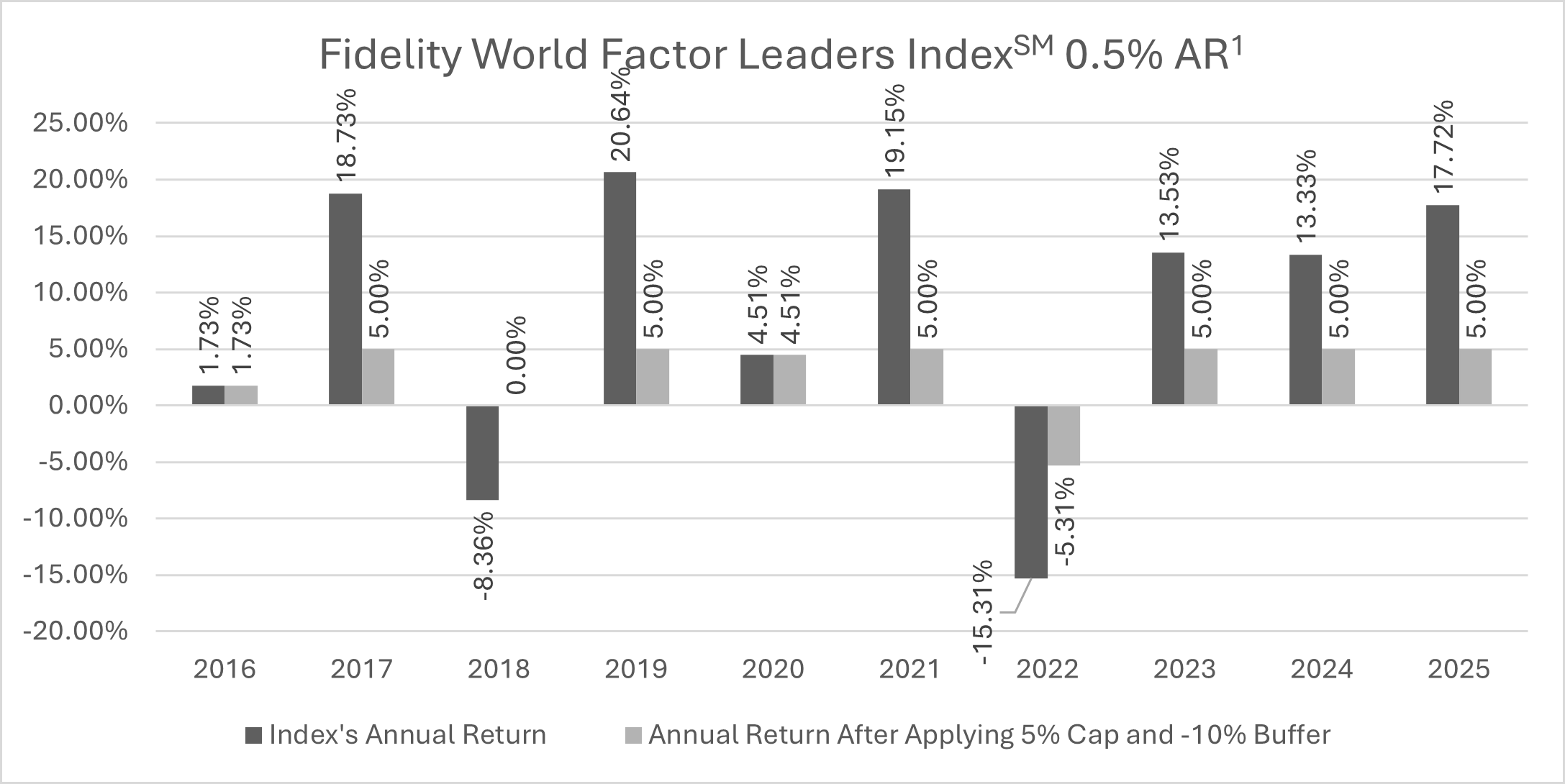
The Fidelity World Factor Leaders IndexSM 0.5% AR (Ticker: FIDWFLEN) is an adjusted return equity index offering exposure to U.S. and developed market non-U.S. companies. The index provider of the Index and the underlying indexes is Fidelity Product Services LLC (FPS).
The First Trust Equity Edge IndexTM (price return) (Ticker: FTEQEDGE) (the “Index”) is an adjusted return equity index offering exposure to dividend-paying companies. The index provider of the Index is FT Indexing Solutions LLC.
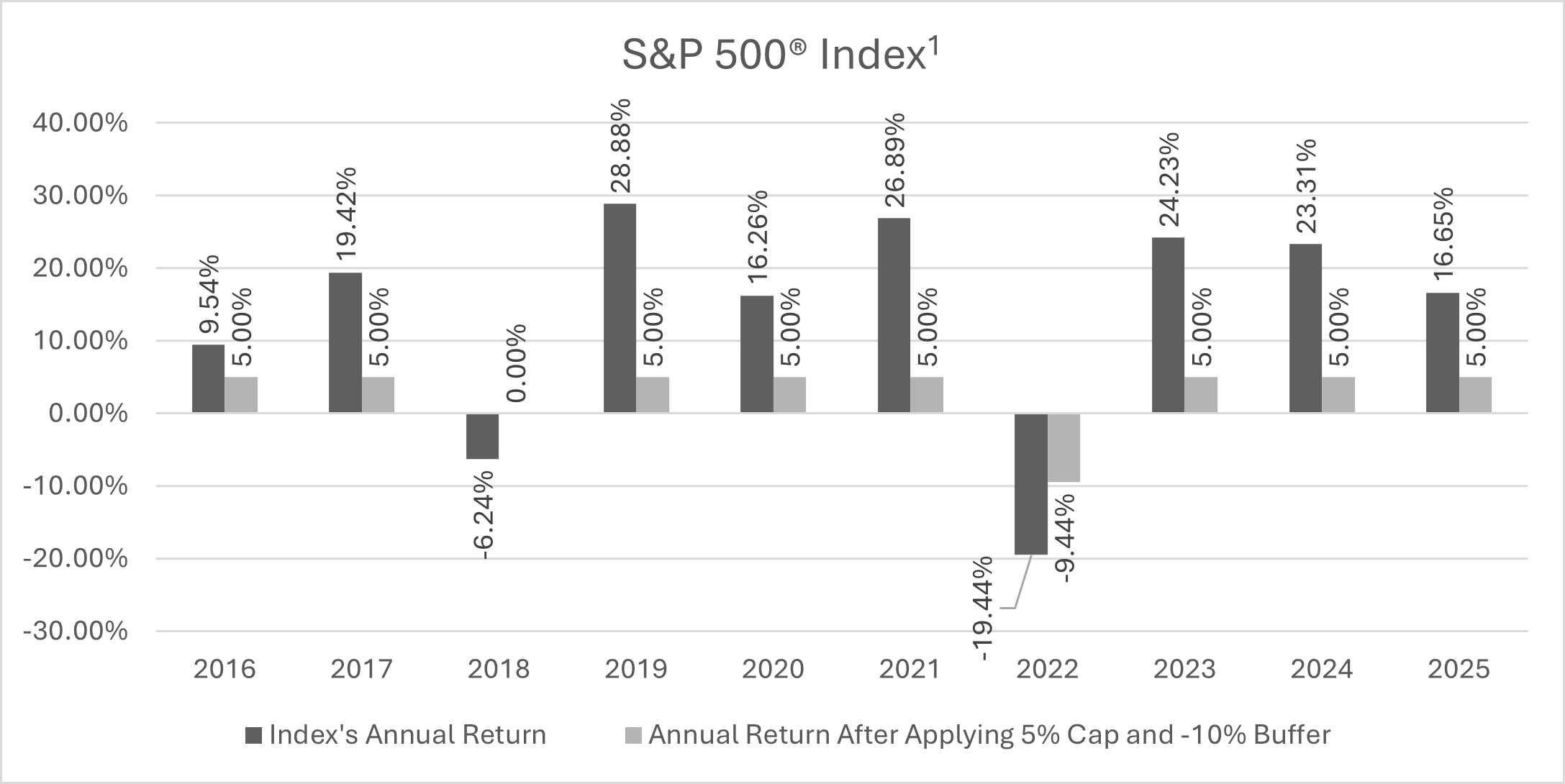
The S&P 500® Index (Ticker: SPX) is widely regarded as the best single gauge of large-cap U.S. equities. This market index includes 500 leading companies and captures approximately 80% coverage of available market capitalization.
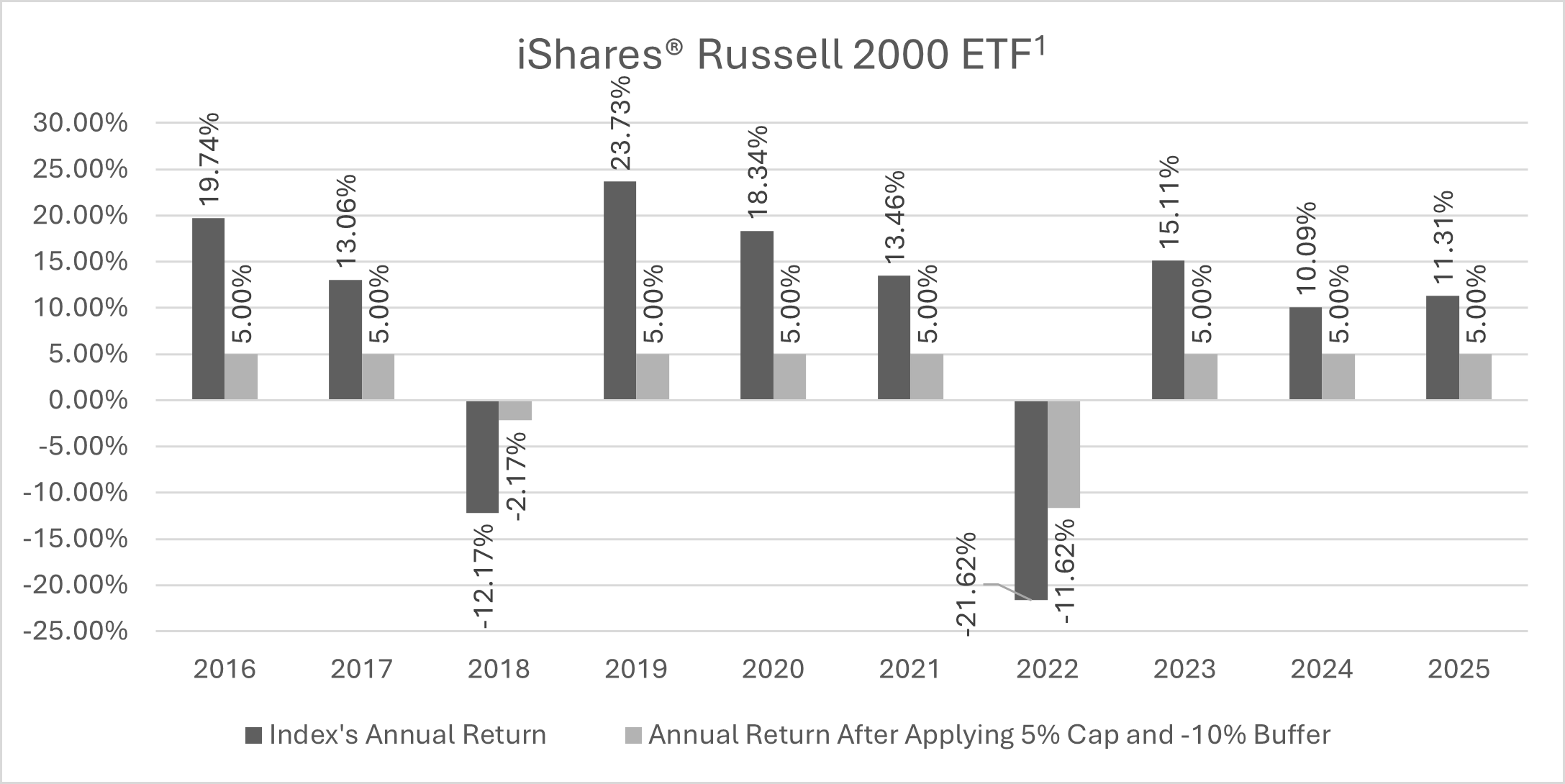
The iShares® Russell 2000 ETF (NYSE Arca: IWM) (SEC file number 333-92935) seeks to track the investment results of the Russell 2000® Index, an index composed of small-capitalization U.S. equities. The Russell 2000® Index measures the performance of the small capitalization sector of the U.S. equity market, as defined by FTSE Russell.
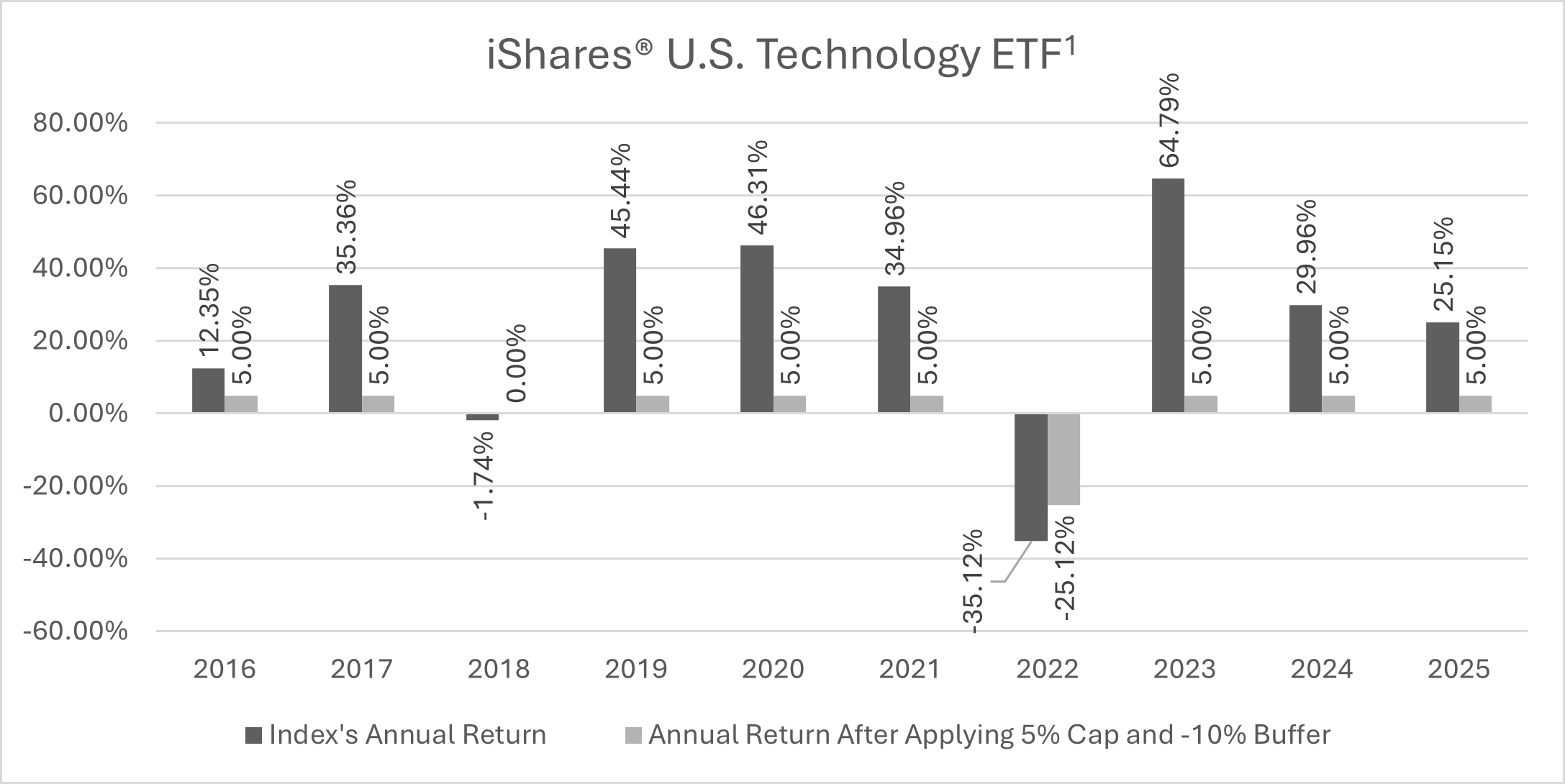
The iShares® U.S. Technology ETF (NYSE Arca: IYW) (SEC file number 333-92935) seeks to track the investment results of the Russell 1000 Technology RIC 22.5/45 Capped Index, which is composed large-, and mid -capitalization U.S. companies. The Russell 1000 Technology RIC22.5/45 Capped Index is designed to measure the performance of U.S. companies in the technology sector, as defined by FTSE Russell.
| [1] | 1) Reflects the base GLWB (no optional step-up benefit). Also reflects the current annual service charge ($0 or 0%). | ||||||||||||||||
| [2] | 3) Will reflect a 2.00% service charge. The maximum annual service charge is the lesser of $50 or 2.00% (as a percentage of your Policy Value as of your Policy Anniversary, before the deduction of any fees or charges). | ||||||||||||||||
| [3] | Reflects the annualized fee percentage if you invest in an Index Account Option with a Growth Opportunity Type designated as “Credit Advantage.” The annualized fee is 1.25% (as a percentage of Policy Value allocated to that Index Account Option on the first day of either (i) a new Crediting Period or (ii) the remaining Crediting Period after exercise of Early-Re-Entry). The Credit Advantage Fee is assessed at the end of the Crediting Period after the Index Credit. However, a portion of the Credit Advantage Fee will be due if taking a partial withdrawal of the Index Account Value before the end of the Crediting Period. Furthermore, if taking a full withdrawal of the Index Account Value before the end of the Crediting Period or exercising Performance Lock, the entire Credit Advantage Fee becomes due. (For example, if you select a 6-year Crediting Period, the total Credit Advantage Fee for that Crediting Period would be 7.50% (i.e., 1.25% x 6). If you were to take a full withdrawal of the Index Account Option Value or exercise Performance Lock after 1 year, you would still pay the full 7.50%.) | ||||||||||||||||
| [4] | 4) The fee for the optional GMDB rider (as a percentage of the GMDB Benefit Base), applicable to Issue Ages 71-80. There is no charge for the GMDB rider for Issue Ages 0-70. | ||||||||||||||||
| [5] | 5) Will reflect the Guaranteed Lifetime Withdrawal Rider Fee Percentage that we are currently charging for the GLWB’s optional step-up benefit (as a percentage of the Withdrawal Base or Policy Value, whichever is greater). | ||||||||||||||||
| [6] | The surrender charge, if any, applies to each premium payment Surrendered or withdrawn regardless of how Policy Value is allocated among the Allocation Accounts. The surrender charge decreases based on the number of years since a premium payment was made according to the following schedule:
Under the Policy’s “surrender charge-free amount,” you can withdraw a portion of your Policy Value each Policy Year free of surrender charges. The surrender charge-free amount each Policy Year is equal to the greater of (1) 10.00% of your total premium payments, less any withdrawals taken during the current Policy Year; and (2) earnings, plus premiums no longer subject to surrender charges. Withdrawals under the GLWB (including withdrawals of the Rider Withdrawal Amount) in excess of the surrender charge-free amount may be subject to surrender charges. Surrender charges may be waived in certain situations. See ACCESS TO YOUR MONEY – SURRENDER CHARGE WAIVERS for more information.
|
||||||||||||||||
| [7] | We currently assess the charge only for overnight delivery and duplicate policies. We reserve the right to assess the charge for other special services in the future, including non-sufficient checks on new business, duplicate Form 1099 and Form 5498 tax forms, check copies, printing and mailing previously submitted forms, and asset verification requests from mortgage companies. We may charge a fee for each service performed and fees may vary based on the type of service but will not exceed the maximum Special Service Fee shown. | ||||||||||||||||
| [8] |
|
||||||||||||||||
| [9] | This fee is applicable only if you invest in an Index Account Option with a Growth Opportunity Type designated as “Credit Advantage.” See APPENDIX A - INVESTMENT OPTIONS AVAILABLE UNDER THE POLICY. The annualized fee percentage for an Index Account Option with Credit Advantage will not change for the life of the Policy. The dollar amount of the Credit Advantage Fee is calculated at the beginning of either (i) a new Crediting Period or (ii) the remaining Crediting Period after exercise of Early-Re-Entry. The Credit Advantage Fee is assessed at the end of the Crediting Period after the Index Credit. However, a portion of the Credit Advantage Fee will be due if taking a partial withdrawal of the Index Account Value before the end of the Crediting Period. Furthermore, if taking a full withdrawal of the Index Account Value before the end of the Crediting Period or exercising Performance Lock, the entire Credit Advantage Fee becomes due. For a new Crediting Period, the fee amount will equal the dollar amount allocated to the Index Account Option on the first day of the Crediting Period, multiplied by the Credit Advantage Fee percentage, multiplied by the length of the Crediting Period (in whole years). For the remaining Crediting Period after exercise of Early-Re-Entry, the fee amount will equal the dollar amount allocated from the Performance Lock Account to the previously locked Index Account Option, multiplied by the Credit Advantage Fee percentage, multiplied by the length of the Crediting Period (in whole and partial years). The Credit Advantage Fees paid prior to and upon the last exercise of Performance Lock will not be credited toward the Credit Advantage Fees owed for the remaining Crediting Period. | ||||||||||||||||
| [10] | The service charge is deducted on each Policy Anniversary prior to the Annuity Commencement Date and when you Surrender the Policy. Each time we deduct this charge, it will not exceed 2.00% (as a percentage of your Policy Value, before the deduction of any fees or charges on that date) or a maximum of $50, whichever is less, and we will waive the charge if your Policy Value, or if your total premium payments minus prior withdrawals, on that date is at least equal to the minimum amount specified in your Policy. The current annual service charge is $0. | ||||||||||||||||
| [11] | These are the maximum Additional Death Benefit Percentages for the optional Additional Death Benefit. The fees for the Additional Death Benefit are calculated and deducted at the end of each Rider Quarter, on the same day of the month as the Rider Date. The Additional Death Benefit Percentages applicable to a new Income Advantage Rider with the Additional Death Benefit are provided in a Rate Sheet Supplement. The applicable Additional Death Benefit Percentage will not change unless you exercise a Rider Reset. | ||||||||||||||||
| [12] | There is no additional charge for the GLWB unless you elect the optional step-up benefit. This is the maximum Guaranteed Lifetime Withdrawal Rider Fee Percentage for the step-up benefit (based on a single life or joint life payment election). The fee is calculated and deducted at the end of each Rider Quarter, on the same day of the month as the Rider Date. The Guaranteed Lifetime Withdrawal Rider Fee Percentage for a new Income Advantage Rider is provided in a Rate Sheet Supplement. The applicable Guaranteed Lifetime Withdrawal Rider Fee Percentage will not change unless (a) a step-up occurs after the third (3rd) Rider Year or (b) you exercise a Rider Reset. If you elect the optional step-up benefit, but Surrender the Policy prior to the Income Declaration Date, you may qualify to have some or all of your Guaranteed Lifetime Withdrawal Rider Fees returned to you. | ||||||||||||||||
| [13] | The GMDB rider may be a standard or optional benefit depending on the Annuitant’s age as of the date that the Policy application is signed. If the Annuitant is younger than age 71, the GMDB rider is a standard benefit that is automatically added to your Policy for no additional charge. If the Annuitant is age 71 to 80, the GMDB rider is an optional benefit that may be elected for an additional charge, as follows:
|
||||||||||||||||
| [14] | The Index provider applies a reduction when calculating Index performance, which will reduce the Index return and may cause the Index to underperform a direct investment in the securities composing the Index. | ||||||||||||||||
| [15] | This Index is a “price return” index, not a “total return” index, and therefore does not reflect the dividends paid on the securities composing the Index, which will reduce the Index return and may cause the Index to underperform a direct investment in the securities composing the Index. | ||||||||||||||||
| [16] | This Index is a “price return” index, not a “total return” index, and therefore does not reflect the dividends paid on the securities composing the Index. In addition, the Index provider applies a reduction when calculating Index performance. These factors will reduce the Index return and may cause the Index to underperform a direct investment in the securities composing the Index. | ||||||||||||||||
| [17] | Even though this Index is composed of dividend-paying securities, you will not receive any dividends paid on those securities, and any dividends paid on those securities will not be reflected in Index Values. | ||||||||||||||||
| [18] | This Index is a “price return” index, not a “total return” index, and therefore does not reflect the dividends paid on the securities composing the Index, which will reduce the Index return and may cause the Index to underperform a direct investment in the securities composing the Index. | ||||||||||||||||
| [19] | This Index is an ETF. Index Values are based on the ETF’s closing prices. The Index Values reflect a “price return,” not a “total return,” and therefore do not reflect the dividends or other distributions paid by the ETF. In addition, fees and costs are deducted from the ETF, which reduces the ETF’s performance. These factors will reduce the Index return and may cause the Index to underperform a direct investment in the ETF or the securities in which the ETF invests. | ||||||||||||||||
| [20] | This Index is an ETF. Index Values are based on the ETF’s closing prices. The Index Values reflect a “price return,” not a “total return,” and therefore do not reflect the dividends or other distributions paid by the ETF. In addition, fees and costs are deducted from the ETF, which reduces the ETF’s performance. These factors will reduce the Index return and may cause the Index to underperform a direct investment in the ETF or the securities in which the ETF invests. | ||||||||||||||||
| [21] | This Index is an ETF. Index Values are based on the ETF’s closing prices. The Index Values reflect a “price return,” not a “total return,” and therefore do not reflect the dividends or other distributions paid by the ETF. In addition, fees and costs are deducted from the ETF, which reduces the ETF’s performance. These factors will reduce the Index return and may cause the Index to underperform a direct investment in the ETF or the securities in which the ETF invests. |