LOGO

MFS® Code of Ethics Policy January 1, 2026 Personal Investing Applies to All MFS full-time, part-time and The inherent nature of MFS’ services in selecting and trading securities has temporary employees globally the potential to create a real or apparent conflict of interest with your personal All MFS contractors, interns and investing activities. As a result, every individual subject to this policy has a co-ops who have been notified by Compliance that they are subject fiduciary duty to avoid taking personal advantage of any knowledge of our to this policy clients’ investment activities. All MFS entities Following the letter and spirit of the rules in this policy is central to meeting Questions? client expectations and ensuring that we remain a trusted and respected firm. iComply@mfs.com Compliance Helpline, x54290 Ryan Erickson, x54430 Elysa Aswad, x54535 Carrie Arnott, x55971 Joe Peterson, x57574 For more information on administration such as regulatory authority, supervision, interpretation and escalation, monitoring, related policies, amendment or recordkeeping please click this link.


LOGO

Rules That Apply to Everyone Your fiduciary duty Always place client interests ahead of your own. You must never: Take advantage of your position at MFS to misappropriate investment opportunities from MFS clients. The concept of beneficial ownership is broader than that of outright Seek to defraud an MFS client or do anything that could have the from, or who controls, an account or investment is considered to have effect of creating fraud or manipulation. beneficial ownership. This means that this policy applies not only to you, but to others that share beneficial ownership in these accounts or Mislead a client. Account reporting obligations topic can be found here. Make sure you understand which accounts are reportable accounts. To determine whether an account is reportable, ask the Ensure that MFS receives account statements for all your following questions: reportable accounts. Depending on the type of account or your location, you may need to provide them to Compliance directly. 1 Is the account one of the following? Promptly report any newly opened reportable account or any A brokerage account. existing account that has become reportable (including those at Any other type of account (such as employee stock option or an approved broker). This includes accounts that become reportable stock purchase plans or UK Stocks and Shares ISA accounts) in accounts through life events, such as marriage, divorce, power of which you have the ability to hold or trade reportable securities attorney or inheritance. (see the list of reportable securities on page 8). Any account, including MFS-sponsored retirement or benefit plans, that holds a reportable fund (see definition of reportable ADDITIONAL REQUIREMENT FOR US EMPLOYEES Does not include interns, contractors, co-ops, or temporary employees fund on page 9 and a list of these funds on iComply). 2 Is any of the following true? Maintain your reportable accounts at an approved broker. When you join MFS, if you have accounts at non- approved brokers you You beneficially own the account. must close them or move them to an approved broker (list available on The account is beneficially owned by your spouse or iComply). domestic partner. The account is beneficially owned by another member of your In rare cases, if you file a request that includes valid reasons for an household such as a parent, sibling or child for whom you exception, we may permit you to maintain a reportable account at provide financial support, such as sharing of household a broker not on the approved broker list (for instance, if you have a fully expenses. discretionary account). The account is beneficially owned by anyone who you claim as a tax deduction. The account is controlled (such as via trading authority or power of attorney) by you or another member of your household (other than to fulfill duties of employment) for whom you provide financial support, such as sharing of household expenses. If you answered “yes” to both questions, the account is reportable. about the applicability of this policy when using such apps.


LOGO

ADDITIONAL REQUIREMENTS FOR APPOINTED REPRESENTATIVES IN SINGAPORE Provide a copy of the contract note for any trade of any security, including reportable securities and non- reportable securities, to Singapore Compliance, within 7 days of the trade. Check with Singapore Compliance on the information you must provide. (though you must still provide account statements). Ethical Personal Investing Never trade securities based on the improper use of information, and never help anyone else to do so. This includes any trade based on: Information about the investments of any MFS client, including iComply. front-running and tailgating (trading just before or just after a similar trade for a client account). Securities reporting obligations Confidential information or inside information (information about the issuer of a security, or the security itself, that is both material Make sure you understand which securities are reportable and non-public). securities. This includes most stocks, bonds, MFS funds, exchange- Do not buy or sell options on Reportable Securities. This includes traded funds (ETFs), futures, options, structured products, private placements and other unregistered securities even if they are not held options on equities (but not employee stock options), ETFs and indexes. This rule does not apply to those securities listed in the Exempt in a reportable account. See the table on page 8. Securities box below. Report all applicable accounts, transactions and holdings timely. Use the iComply system and submit all reports by these deadlines: Do not sell securities short. This rule does not apply to those securities listed in the Exempt Securities box below. Initial Accounts & Holdings reports: Submit within 10 calendar days of hire or upon an access level change. Information about these IMPORTANT TO KNOW holdings must be no more than 45 days old when submitted. Quarterly Personal Transaction Report: Submit within 30 days of the end of each calendar quarter. Annual Holdings Report: Submit within 30 days of the end of each calendar year. Note that you must submit each report even if no transactions or other currencies, US Treasuries) changes occurred during the time period. The Quarterly Personal Transaction Reports do not need to include: a current list on iComply. Transactions or holdings in non-reportable securities. Transactions or holdings in discretionary accounts for which there is an approval on file with Compliance. Involuntary transactions, such as automatic investment plans, dividend reinvestments, etc. The Annual Holdings Report, however, must reflect these transactions.


LOGO

Do not trade excessively. At MFS, personal trading is a privilege, not a Never use a derivative, or any other instrument or technique, to right. It should never interfere with your job performance. MFS may get around a rule. If an investment transaction is prohibited, then you limit the number of trades you are allowed during a given period, or are also prohibited from effectively accomplishing the same thing by may discipline you for trading excessively. In addition, frequent trading using futures, options, ETFs or any other type of financial instrument. in MFS funds may trigger other penalties, as described in the relevant Do not invest in Contracts for Difference or engage in spread fund prospectuses. on betting financial markets. This includes any wagering on market Do not accept investment discretion over accounts that are not spreads or behaviors and any off-exchange trading. yours. In limited circumstances, and with advance approval from Do not invest in exchange traded funds based on exposure to a Compliance, you may be allowed to assume power of attorney relating to financial or investment matters for another person or entity. single security or issuer (“single-stock ETFs”). These products offer leveraged, inverse, or other complex exposure and are often designed If you become an executor or trustee of an estate and it involves control to provide returns over short periods of time. over a securities account, you must notify Compliance upon assuming Do not trade on margin and do not use good ‘til canceled limit the role, and you must meet any reporting or pre-clearance obligations that apply. orders. This rule does not apply to securities that are not subject to pre-clearance or to accounts where a registered investment adviser has Do not participate in any investment contest or club. This applies investment discretion. whether or not any compensation or prize is awarded. Do not trade securities that MFS has restricted. Follow MFS’ instructions when you are notified of a restriction in designated securities. Only make investments in MFS open-end funds or funds sub- advised by MFS through these methods: Directly through MFS Service Center (for US open-end funds) or State Street (Lux) (for Meridian Funds) must complete any outstanding obligations. Through an MFS Approved Broker (US employees) Non-US employees may invest through a financial institution of Compliance when uncertain. their choice Through an MFS-sponsored benefit plan account Accounts for which you have received an exception from Compliance, such as a fully discretionary account Note that investments in non-MFS accounts are publicly available share classes only. You must also follow all rules of the relevant prospectus and all rules in this policy, such as reporting and statements. require pre-clearance nor reporting Do not participate in initial public offerings (IPOs) or other limited offerings of securities except with advance approval from MFS. This rule includes initial, secondary and follow-on offerings of equity reporting securities and closed-end funds and new issues of corporate debt securities. compliance pre-approval and reporting To request approval for an IPO or secondary offering, enter an Initial Public Offering Request using the form found on iComply. Note that approval is not typically granted, and when granted often involves strict limits.


LOGO

Pre-clearing personal trades Limits to personal investment practices Do not buy and then sell (or sell and then buy) at a profit the same WHICH ACCESS LEVEL ARE YOU? or equivalent reportable security within 60 calendar days. MFS may interpret this rule very broadly. For example, it may look at transactions across all of your reportable accounts and may match trades that are not of the same size, security type or tax lot. Any gains are not. realized in connection with these transactions must be surrendered. Note that this rule does not apply to securities that are not subject to pre-clearance, to accounts where a registered investment adviser has investment discretion, or to involuntary transactions. Japan-based Compliance may designate other personnel as Access Persons. This may include consultants, contractors or interns who provide services to MFS, and personnel: See rule with higher standard below. employees of Sun Life Financial Inc. ADDITIONAL REQUIREMENTS FOR JAPAN-BASED PERSONNEL Make sure you understand which securities require pre-clearance. Do not buy and then sell (or sell and then buy) the same or Note that there are some differences between which securities require equivalent reportable security within six months. pre-clearance and which must be reported. See the table on page 8 of this policy. Never trade personally in any security you have researched in the prior 30 days or are scheduled to research in the future. Pre-clear all personal trades in applicable securities. Request pre-clearance on the day you want to execute the trade by entering your request in the iComply system. Remember that you must pre-clear trades for all of your reportable accounts (such as those of a spouse or domestic partner) as well as for securities not held in an account. Once you have requested pre-clearance, wait for a response. Do NOT place any trade order until you have received notice of approval for that trade. Note that pre-clearance requests can be denied at any time and for any reason. Pre-clearance approvals expire at the end of the trading day on which they are issued, trades must be executed on the same day pre-clearance approval is granted. Obtain advance approval for any private investments or other unregistered securities. This includes private placements (investments in private companies), private investment in public equity securities (PIPES), hedge funds or other private funds, “crowdfunding” or “crowdsourcing” investments, peer-to-peer lending, pooled vehicles (such as partnerships), Initial Coin Offerings (ICO’s), Security Tokens and other similar investments. Before investing, enter a Private Placement/Unregistered Securities Approval Request found on iComply, and do not act until you have received approval.


LOGO

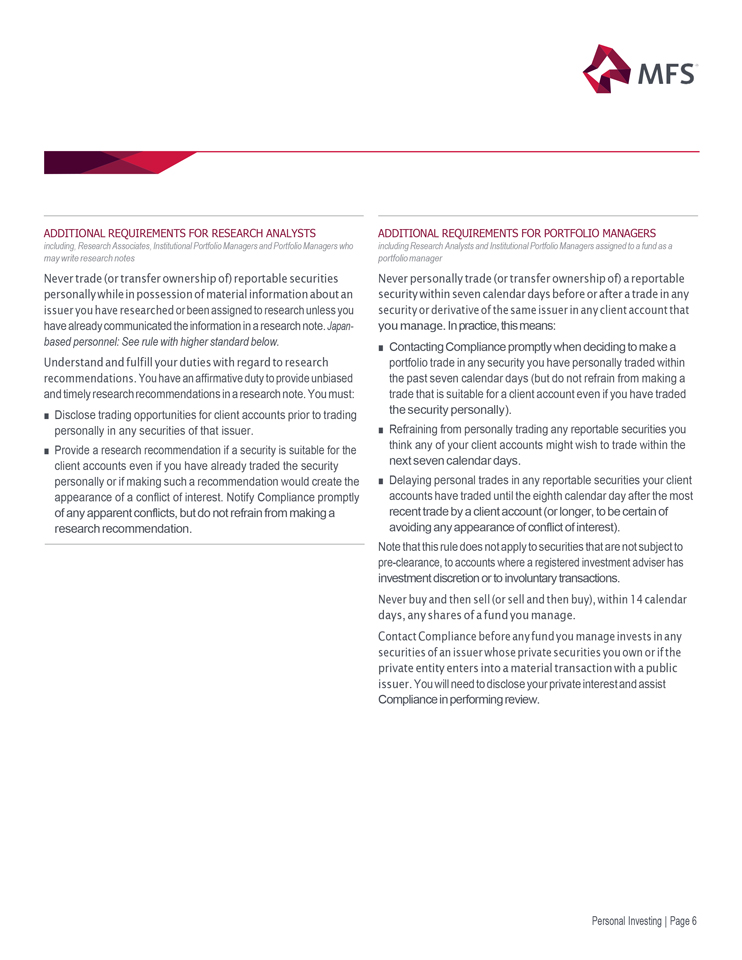
ADDITIONAL REQUIREMENTS FOR RESEARCH ANALYSTS ADDITIONAL REQUIREMENTS FOR PORTFOLIO MANAGERS including, Research Associates, Institutional Portfolio Managers and Portfolio Managers who including Research Analysts and Institutional Portfolio Managers assigned to a fund as a may write research notes portfolio manager Never trade (or transfer ownership of) reportable securities Never personally trade (or transfer ownership of) a reportable personally while in possession of material information about an security within seven calendar days before or after a trade in any issuer you have researched or been assigned to research unless you security or derivative of the same issuer in any client account that have already communicated the information in a research note. Japan- you manage. In practice, this means: based personnel: See rule with higher standard below. Contacting Compliance promptly when deciding to make a Understand and fulfill your duties with regard to research portfolio trade in any security you have personally traded within recommendations. You have an affirmative duty to provide unbiased the past seven calendar days (but do not refrain from making a and timely research recommendations in a research note. You must: trade that is suitable for a client account even if you have traded Disclose trading opportunities for client accounts prior to trading the security personally). personally in any securities of that issuer. Refraining from personally trading any reportable securities you Provide a research recommendation if a security is suitable for the think any of your client accounts might wish to trade within the client accounts even if you have already traded the security next seven calendar days. personally or if making such a recommendation would create the Delaying personal trades in any reportable securities your client appearance of a conflict of interest. Notify Compliance promptly accounts have traded until the eighth calendar day after the most of any apparent conflicts, but do not refrain from making a recent trade by a client account (or longer, to be certain of research recommendation. avoiding any appearance of conflict of interest). Note that this rule does not apply to securities that are not subject to pre-clearance, to accounts where a registered investment adviser has investment discretion or to involuntary transactions. Never buy and then sell (or sell and then buy), within 14 calendar days, any shares of a fund you manage. Contact Compliance before any fund you manage invests in any securities of an issuer whose private securities you own or if the private entity enters into a material transaction with a public issuer. You will need to disclose your private interest and assist Compliance in performing review.


LOGO

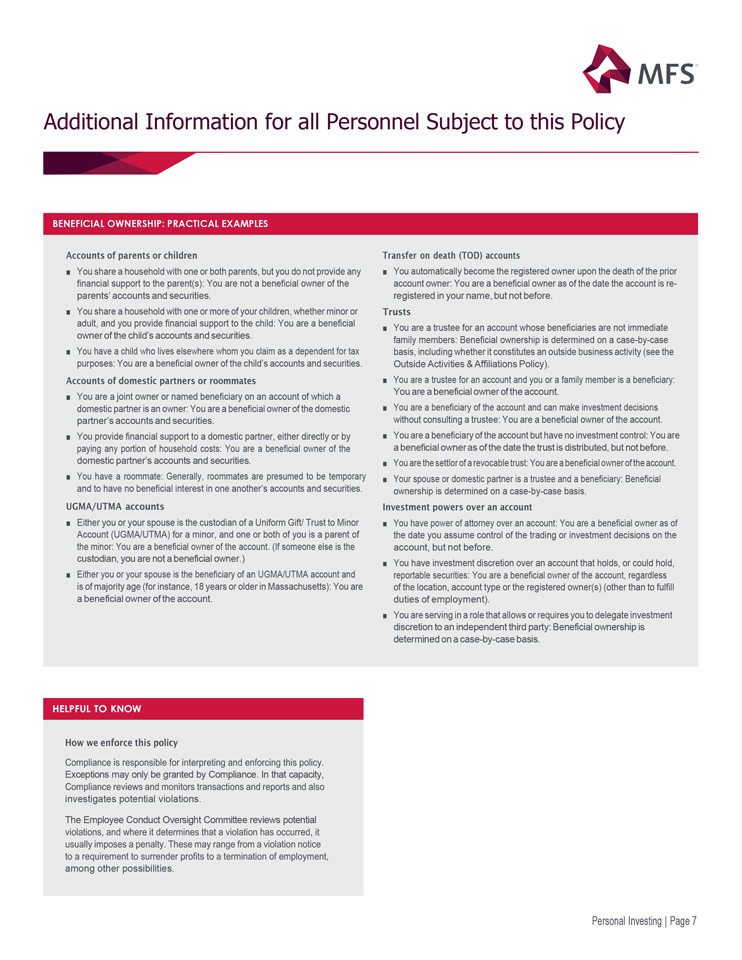
BENEFICIAL OWNERSHIP: PRACTICAL EXAMPLES Accounts of parents or children Transfer on death (TOD) accounts You share a household with one or both parents, but you do not provide any You automatically become the registered owner upon the death of the prior financial support to the parent(s): You are not a beneficial owner of the account owner: You are a beneficial owner as of the date the account is reparents’ accounts and securities. registered in your name, but not before. You share a household with one or more of your children, whether minor or Trusts adult, and you provide financial support to the child: You are a beneficial You are a trustee for an account whose beneficiaries are not immediate owner of the child’s accounts and securities. family members: Beneficial ownership is determined on a case-by-case You have a child who lives elsewhere whom you claim as a dependent for tax basis, including whether it constitutes an outside business activity (see the purposes: You are a beneficial owner of the child’s accounts and securities. Outside Activities & Affiliations Policy). Accounts of domestic partners or roommates You are a trustee for an account and you or a family member is a beneficiary: You are a beneficial owner of the account. You are a joint owner or named beneficiary on an account of which a domestic partner is an owner: You are a beneficial owner of the domestic You are a beneficiary of the account and can make investment decisions partner’s accounts and securities. without consulting a trustee: You are a beneficial owner of the account. You provide financial support to a domestic partner, either directly or by You are a beneficiary of the account but have no investment control: You are paying any portion of household costs: You are a beneficial owner of the a beneficial owner as of the date the trust is distributed, but not before. domestic partner’s accounts and securities. You are the settlor of a revocable trust: You are a beneficial owner of the account. You have a roommate: Generally, roommates are presumed to be temporary Your spouse or domestic partner is a trustee and a beneficiary: Beneficial and to have no beneficial interest in one another’s accounts and securities. ownership is determined on a case-by-case basis. UGMA/UTMA accounts Investment powers over an account Either you or your spouse is the custodian of a Uniform Gift/ Trust to Minor You have power of attorney over an account: You are a beneficial owner as of Account (UGMA/UTMA) for a minor, and one or both of you is a parent of the date you assume control of the trading or investment decisions on the the minor: You are a beneficial owner of the account. (If someone else is the account, but not before. custodian, you are not a beneficial owner.) You have investment discretion over an account that holds, or could hold, Either you or your spouse is the beneficiary of an UGMA/UTMA account and reportable securities: You are a beneficial owner of the account, regardless is of majority age (for instance, 18 years or older in Massachusetts): You are of the location, account type or the registered owner(s) (other than to fulfill a beneficial owner of the account. duties of employment). You are serving in a role that allows or requires you to delegate investment discretion to an independent third party: Beneficial ownership is determined on a case-by-case basis. Exceptions may only be granted by Compliance. In that capacity, investigates potential violations. The Employee Conduct Oversight Committee reviews potential among other possibilities.


LOGO

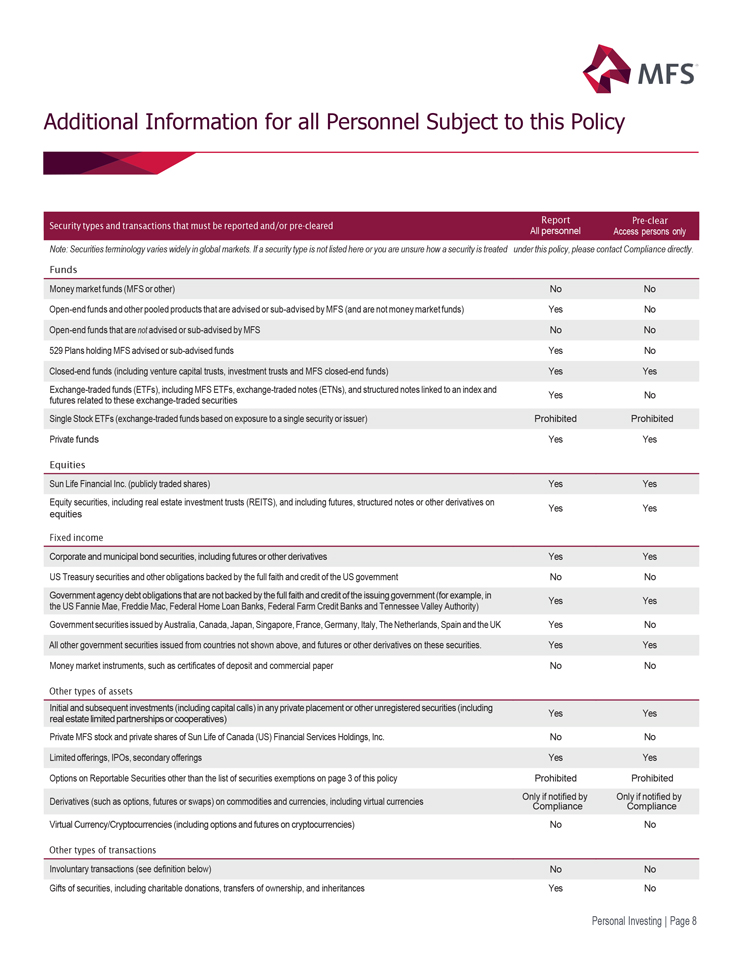
Report Pre-clear Security types and transactions that must be reported and/or pre-cleared All personnel Access persons only Note: Securities terminology varies widely in global markets. If a security type is not listed here or you are unsure how a security is treated under this policy, please contact Compliance directly. Funds Money market funds (MFS or other) No No Open-end funds and other pooled products that are advised or sub-advised by MFS (and are not money market funds) Yes No Open-end funds that are not advised or sub-advised by MFS No No 529 Plans holding MFS advised or sub-advised funds Yes No Closed-end funds (including venture capital trusts, investment trusts and MFS closed-end funds) Yes Yes Exchange-traded funds (ETFs), including MFS ETFs, exchange-traded notes (ETNs), and structured notes linked to an index and Yes No futures related to these exchange-traded securities Single Stock ETFs (exchange-traded funds based on exposure to a single security or issuer) Prohibited Prohibited Private funds Yes Yes Equities Sun Life Financial Inc. (publicly traded shares) Yes Yes Equity securities, including real estate investment trusts (REITS), and including futures, structured notes or other derivatives on Yes Yes equities Fixed income Corporate and municipal bond securities, including futures or other derivatives Yes Yes US Treasury securities and other obligations backed by the full faith and credit of the US government No No Government agency debt obligations that are not backed by the full faith and credit of the issuing government (for example, in Yes Yes the US Fannie Mae, Freddie Mac, Federal Home Loan Banks, Federal Farm Credit Banks and Tennessee Valley Authority) Government securities issued by Australia, Canada, Japan, Singapore, France, Germany, Italy, The Netherlands, Spain and the UK Yes No All other government securities issued from countries not shown above, and futures or other derivatives on these securities. Yes Yes Money market instruments, such as certificates of deposit and commercial paper No No Other types of assets Initial and subsequent investments (including capital calls) in any private placement or other unregistered securities (including Yes Yes real estate limited partnerships or cooperatives) Private MFS stock and private shares of Sun Life of Canada (US) Financial Services Holdings, Inc. No No Limited offerings, IPOs, secondary offerings Yes Yes Options on Reportable Securities other than the list of securities exemptions on page 3 of this policy Prohibited Prohibited Only if notified by Only if notified by Derivatives (such as options, futures or swaps) on commodities and currencies, including virtual currencies Compliance Compliance Virtual Currency/Cryptocurrencies (including options and futures on cryptocurrencies) No No Other types of transactions Involuntary transactions (see definition below) No No Gifts of securities, including charitable donations, transfers of ownership, and inheritances Yes No


LOGO

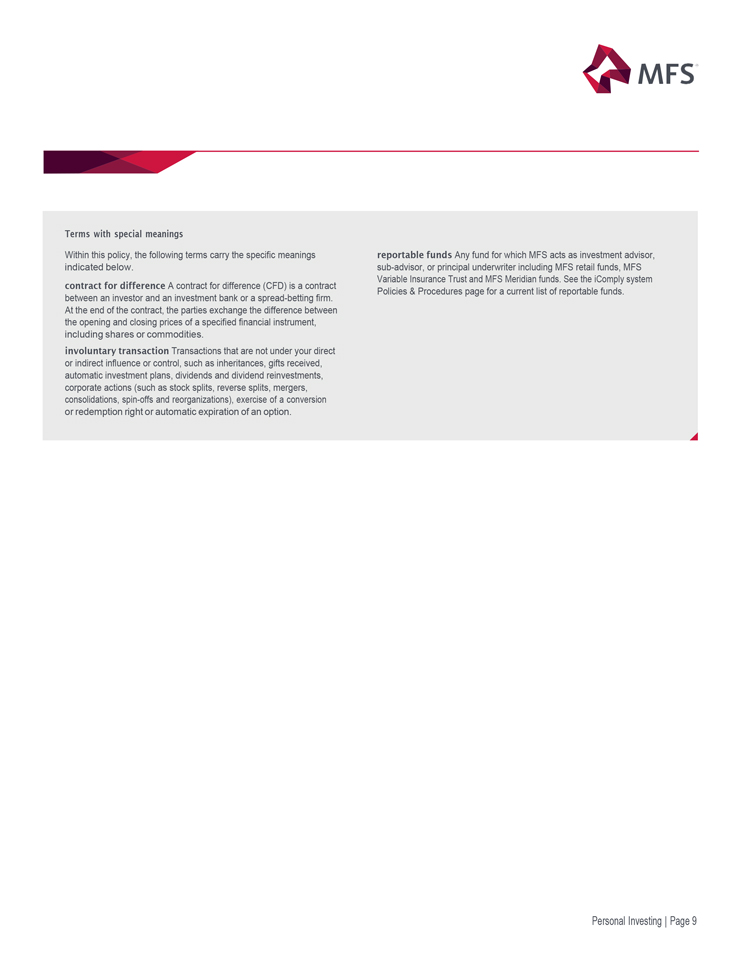
Terms with special meanings Within this policy, the following terms carry the specific meanings reportable funds Any fund for which MFS acts as investment advisor, indicated below. sub-advisor, or principal underwriter including MFS retail funds, MFS Variable Insurance Trust and MFS Meridian funds. See the iComply system contract for difference A contract for difference (CFD) is a contract Policies & Procedures page for a current list of reportable funds. between an investor and an investment bank or a spread-betting firm. At the end of the contract, the parties exchange the difference between the opening and closing prices of a specified financial instrument, including shares or commodities. involuntary transaction Transactions that are not under your direct or indirect influence or control, such as inheritances, gifts received, automatic investment plans, dividends and dividend reinvestments, corporate actions (such as stock splits, reverse splits, mergers, consolidations, spin-offs and reorganizations), exercise of a conversion or redemption right or automatic expiration of an option.