
Exhibit 96.2 TECHNICAL REPORT SUMMARY ON THE MARIKANA OPERATION Situated near Brits, North West, South Africa 31 December 2025 Prepared by: Qualified Persons from Sibanye-Stillwater, PGM Operations i Important Notices Mineral Resources and Mineral Reserves are declared as attributable to Sibanye-Stillwater Ltd (registrant). For transparency and because it is not possible to accurately separate the non- attributable interests in these models, the Life-of-Mine plan and associated financial analyses are provided for the full Mineral Reserve. Wherever mention is made of the “Marikana operation,” for the purposes of this Technical Report Summary, it encompasses mining activities under Western Platinum Proprietary Limited and Eastern Platinum Limited in the North West Province, South Africa. Marikana operation also Includes the Precious Metals Refining facilities in Brakpan, Gauteng Province. In this document, a point is used as the decimal marker and the comma is used for the thousands separator (for numbers larger than 999) in the text. In other words, 10,148.32 denotes ten thousand one hundred and forty-eight point three two. The word ‘tonnes’ denotes a metric tonne (1,000 kg). The abbreviation “lb” denotes the weight in pounds in the sense understood in the USA. All precious metals prices are quoted in US dollars per troy ounce (US$/oz.) or South African Rand per kilogram (R/oz). All base metals prices are quoted in US$/tonne or US$/lb as per the prevailing market conventions. 4E denotes a basket of PGM’s platinum, palladium, rhodium, gold. 6E denotes a basket of PGM’s platinum, palladium, rhodium, gold, iridium and ruthenium. Base metals denotes nickel and copper. Chrome is a generic term that refers to various chromium containing materials. Chromite refers to the mineral with composition (Fe,Mg)Cr2O4. Chromium Oxide Cr2O3 is derived from chromite. The paylimit (cm.g/t or g/t) of an operation is described as the average value or grade for that operation, at the planned volume, at which all direct and indirect costs are covered, i.e. the value at which it is estimated that the planned ore volume can be mined without profit or loss. The mining cut-off grade (cm.g/t or g/t) of an operation is described as the minimum value or grade at which a mining unit can be mined to cover all costs associated with the extraction and processing thereof Trademarks. Certain software and methodologies may be proprietary. Where proprietary names are mentioned, TM or © are omitted for readability. ii Date and Signature Page Qualified Persons Position Signature Signature Date Hermanus Jacobus Keyser Vice President Mining Technical Services /s/ Manie Keyser 24 April 2026 Leonard Changara Unit Manager Geology - Operations /s/ Leonard Changara 24 April 2026 Nicole Wansbury Unit Manager Geology Mineral Resources /s/ Nicole Wansbury 24 April 2026 Brian Smith Unit Manager Survey /s/ Brian Smith 24 April 2026 Stephan Botes Unit Manager – Mineral Rights /s/ Stephan Botes 24 April 2026 Phillip Ramphisa Environmental Manager (SA PGM) /s/ Phillip Ramphisa 24 April 2026 Peter Motlana Senior Vice President Processing /s/ Peter Motlana 24 April 2026 Roderick Mugovhani Senior Vice President Finance /s/ Roderick Mugovhani 24 April 2026 iii Table of Contents 1 EXECUTIVE SUMMARY 1 1.1 INTRODUCTION 1 1.2 PROPERTY DESCRIPTION, MINERAL RIGHTS AND OWNERSHIP 1 1.3 GEOLOGY AND MINERALISATION 2 1.4 EXPLORATION STATUS, DEVELOPMENT, OPERATIONS AND MINERAL RESOURCE ESTIMATES 2 1.5 MINING METHODS, ORE PROCESSING, INFRASTRUCTURE AND MINERAL RESERVES 5 1.6 CAPITAL AND OPERATING COST ESTIMATES AND ECONOMIC ANALYSIS 8 1.7 PERMITTING REQUIREMENTS 10 1.8 QP’S CONCLUSIONS AND RECOMMENDATIONS 11 2 INTRODUCTION 11 2.1 REGISTRANT 11 2.2 COMPLIANCE 13 2.3 TERMS OF REFERENCE AND PURPOSE OF THE TECHNICAL REPORT 13 2.4 SOURCES OF INFORMATION 15 2.5 SITE INSPECTION BY QUALIFIED PERSONS 15 2.6 UNITS, CURRENCIES AND SURVEY COORDINATE SYSTEM 15 2.7 RELIANCE ON INFORMATION PROVIDED BY OTHER EXPERTS 17 3 PROPERTY DESCRIPTION 18 3.1 LOCATION AND OPERATION OVERVIEW 18 3.2 MINERAL TITLE 19 3.2.1 Mining and Surface Rights 19 3.2.2 Key Standard Permit Conditions 27 3.3 ROYALTIES 29 3.4 LEGAL PROCEEDINGS AND SIGNIFICANT ENCUMBRANCES TO THE PROPERTY 30 4 ACCESSIBILITY, CLIMATE, LOCAL RESOURCES, INFRASTRUCTURE AND PHYSIOGRAPHY 30 4.1 TOPOGRAPHY, ELEVATION AND VEGETATION 30 4.2 ACCESS, TOWNS AND REGIONAL INFRASTRUCTURE 30 4.3 CLIMATE 31 4.4 INFRASTRUCTURE AND BULK SERVICE SUPPLIES 31 4.5 PERSONNEL SOURCES 31 5 HISTORY 33 5.1 OWNERSHIP HISTORY 33 5.2 PREVIOUS EXPLORATION AND MINE DEVELOPMENT 34 5.2.1 Previous Exploration 34 5.2.2 Previous Development 37 6 GEOLOGICAL SETTING, MINERALISATION AND DEPOSIT 38 6.1 REGIONAL GEOLOGY 38 6.2 DEPOSIT TYPES 41

iv 6.3 LOCAL AND PROPERTY GEOLOGY 42 6.3.1 Stratigraphy 42 6.3.2 The Mineralised Horizons 43 6.3.3 Structure 47 6.3.4 Mineralogy 52 7 EXPLORATION 54 7.1 EXPLORATION DATA 54 7.2 GEOPHYSICAL SURVEYS 54 7.3 TOPOGRAPHIC SURVEYS 54 7.4 EXPLORATION AND MINERAL RESOURCE EVALUATION DRILLING 54 7.4.1 Overview 54 7.4.2 Planned Drilling for 2026 56 7.4.3 Drilling Methods 57 7.4.4 Core Logging and Reef Delineation 59 7.5 SURVEY DATA 60 7.6 DENSITY DETERMINATION 61 7.6.1 Underground Drillholes and Channel Samples 61 7.6.2 Surface Drillholes 61 7.6.3 Tailings Facility 62 7.7 UNDERGROUND MAPPING 62 7.8 HYDROLOGICAL DRILLING AND TESTWORK 63 7.8.1 Geohydrological Analysis and Pumping 63 7.8.2 Groundwater 64 7.9 GEOTECHNICAL DATA, TESTING AND ANALYSIS 64 7.9.1 Data Collection 64 7.9.2 Testing Methods 65 7.9.3 Geotechnical Rockmass Characterisation 66 7.9.4 Geotechnical Results and Interpretation 67 8 SAMPLE PREPARATION, ANALYSES AND SECURITY 69 8.1 SAMPLING GOVERNANCE AND QUALITY ASSURANCE 69 8.2 REEF SAMPLING – SURFACE EXPLORATION DRILLING 70 8.3 REEF SAMPLING – UNDERGROUND 70 8.3.1 Core Samples 70 8.3.2 Channel Sampling 71 8.4 SAMPLE PREPARATION AND ANALYSIS 71 8.4.1 Laboratory 71 8.4.2 Sample Preparation and Analysis 72 8.4.3 QP Opinion 73 8.5 ANALYTICAL QUALITY CONTROL 73 8.5.1 Nature and Extent of the Quality Control Procedures 73 8.5.2 Quality Control Results 74 8.5.3 QP Opinion 76 v 9 DATA VERIFICATION 76 9.1 DATA STORAGE AND DATABASE MANAGEMENT 76 9.2 DATABASE VERIFICATION 76 9.2.1 Mapping 77 9.2.2 Drillholes 77 9.2.3 Channel Sampling 77 9.3 QP OPINION 77 10 MINERAL PROCESSING AND METALLURGICAL TESTING 78 11 MINERAL RESOURCE ESTIMATES 78 11.1 ESTIMATION DOMAINS 78 11.1.1 Compositing 79 11.1.2 Estimation Domains 81 11.2 ESTIMATION TECHNIQUES 84 11.2.1 Grade and Tonnage Estimation 84 11.2.2 Grade Control and Reconciliation 96 11.3 MINERAL RESOURCE CLASSIFICATION 99 11.3.1 Classification Criteria 99 11.3.2 Mineral Resource Technical and Economic Factors 102 11.4 MINERAL RESOURCE STATEMENTS 106 11.4.1 Mineral Resources 106 11.4.2 Mineral Resources per Mining Area (Inclusive of Mineral Reserves) 109 11.4.3 Changes in the Mineral Resources from Previous Estimates (Inclusive of Mineral Reserves) 111 11.4.4 Metal Equivalents 111 11.5 QP OPINION 112 12 MINERAL RESERVE ESTIMATES 112 12.1 MINERAL RESERVE METHODOLOGY 112 12.2 MINE PLANNING PROCESS 113 12.3 HISTORICAL MINING PARAMETERS 113 12.4 SHAFT MODIFYING FACTORS 115 12.4.1 Paylimits and Cut-off Grades 115 12.4.2 Other Modifying Factors 115 12.5 LOM PROJECT 122 12.6 MINERAL RESERVE ESTIMATION 122 12.7 SURFACE SOURCES 125 12.8 MINERAL RESERVES STATEMENT 125 12.9 MINERAL RESERVE SENSITIVITY 131 12.10 QP OPINION 131 13 MINING METHODS 132 13.1 INTRODUCTION 132 13.2 SHAFT INFRASTRUCTURE, HOISTING AND MINING METHODS 135 13.2.1 Shaft Infrastructure 135 vi 13.2.2 Hoisting 138 13.2.3 Mining Methods 138 13.3 GEOTECHNICAL ANALYSIS 140 13.3.1 Geotechnical Conditions 140 13.3.2 Stress and Seismological setting 140 13.3.3 Regional and Local Support 141 13.4 MINE VENTILATION 142 13.5 REFRIGERATION AND COOLING 142 13.6 FLAMMABLE GAS MANAGEMENT 142 13.7 MINE EQUIPMENT 142 13.8 PERSONNEL REQUIREMENTS 143 13.9 FINAL LAYOUT MAP 143 14 PROCESSING AND RECOVERY METHODS 143 14.1 PROCESSING FACILITIES 144 14.2 CONCENTRATORS 145 14.2.1 K3 Mix Concentrator 148 14.2.2 K3 UG2 Concentrator 151 14.2.3 EPL Concentrator 155 14.2.4 K4 Concentrator 160 14.2.5 EPC Concentrator 164 14.2.6 BTT Concentrator 166 14.2.7 ETTP Concentrator 170 14.3 SMELTING AND REFINING 173 14.3.1 Smelter 173 14.3.2 Base Metal Refinery (BMR) 177 14.3.3 Precious Metal Refinery (PMR) 180 14.4 SAMPLING, ANALYSIS, METAL ACCOUNTING AND SECURITY 183 14.4.1 Concentrator Sampling and Metal Accounting 183 14.4.2 Smelter - Sampling and Metal Accounting 184 14.4.3 Base Metal Refinery – Sampling and Metal Accounting 185 14.4.4 Precious Metal Refinery – Sampling and Metal Accounting 186 14.5 FINAL PRODUCT 187 14.6 PERSONNEL, ENERGY AND WATER REQUIREMENTS 187 14.7 QP OPINION 187 15 INFRASTRUCTURE 188 15.1 OVERVIEW OF INFRASTRUCTURE 188 15.2 TAILINGS STORAGE FACILITIES 191 15.2.1 Tailings Overview 191 15.2.2 Karee TSF Complex 192 15.2.3 Western Plats TSF Complex 192 15.2.4 Eastern Plats TSF Complex 192 15.2.5 Marikana Pit TSF 192 15.3 POWER SUPPLY 193 vii 15.4 BULK WATER AND PUMPING 193 15.4.1 Bulk Potable Water Supply Marikana 194 15.4.2 Secondary Water Supply Marikana 194 15.5 ROADS AND TRANSPORT INFRASTRUCTURE 195 15.6 EQUIPMENT MAINTENANCE 195 15.6.1 Surface Workshops 195 15.6.2 Underground Workshops 195 15.7 OFFICES, HOUSING, TRAINING FACILITIES, HEALTH SERVICES ETC. 195 15.8 QP OPINION 196 16 MARKET STUDIES 196 16.1 METALS MARKETING AGREEMENTS 196 16.2 MARKETS AND SALES 197 16.2.1 Introduction 197 16.2.2 Platinum, Palladium and Rhodium Demand and Supply 197 16.3 METALS PRICE OUTLOOK AND DETERMINATION 200 17 ENVIRONMENTAL STUDIES, PERMITTING, PLANS, NEGOTIATIONS/ AGREEMENTS WITH LOCAL INDIVIDUALS OR GROUPS 202 17.1 SOCIAL AND COMMUNITY AGREEMENTS 202 17.1.1 Overview- Mine Community Development 202 17.1.2 Legislation 202 17.1.3 Communities Priorities 203 17.2 HUMAN RESOURCES 204 17.2.1 Introduction 204 17.2.2 Legislation 204 17.2.3 Human Resource Development (Training) 207 17.2.4 Remuneration Policies 207 17.2.5 Industrial Relations 207 17.2.6 Employment Equity and Women in Mining (WIM) 208 17.3 HEALTH AND SAFETY 208 17.3.1 Policies and Procedures 208 17.3.2 Statistics 208 17.3.3 Occupational Health and Safety Management 209 17.3.4 HIV/AIDS 209 17.4 ENVIRONMENTAL STUDIES 209 17.4.1 Introduction 209 17.4.2 Baseline Studies 2012 211 17.4.3 Zone of Influence 214 17.4.4 Climate Change and Greenhouse Gas Emissions, Air Quality 216 17.4.5 Biodiversity Management 218 17.4.6 Water Use Strategy 218 17.4.7 Waste Management 223 17.4.8 Environmental Reporting 224 17.4.9 Closure Planning and Costs 224

viii 17.5 QP OPINION 227 18 CAPITAL AND OPERATING COSTS 227 18.1 OVERVIEW 227 18.2 CAPITAL COSTS 227 18.3 OPERATING COSTS 230 18.3.1 Operating Costs by Activity 230 18.3.2 Operating Costs 230 18.3.3 Surface Sources Costs 230 18.3.4 Processing Costs 230 18.3.5 Allocated Costs 230 19 ECONOMIC ANALYSIS 235 19.1 INTRODUCTION 235 19.2 ECONOMIC ANALYSIS APPROACH 235 19.3 ECONOMIC ANALYSIS BASIS 235 19.4 TEM PARAMETERS 236 19.5 TECHNICAL ECONOMIC MODEL 236 19.6 DCF ANALYSIS 253 19.7 SUMMARY ECONOMIC ANALYSIS 255 19.8 QP OPINION 256 20 ADJACENT PROPERTIES 256 21 OTHER RELEVANT DATA AND INFORMATION 257 21.1 RISK ANALYSIS 257 21.1.1 Financial Accuracy 257 21.1.2 Risk to the Mineral Resources and Mineral Reserves 258 22 INTERPRETATION AND CONCLUSIONS 259 23 RECOMMENDATIONS 259 24 REFERENCES 259 24.1 LIST OF REPORTS AND SOURCES OF INFORMATION 259 24.1.1 Publications and Reports 259 24.2 GLOSSARY OF TERMS 261 25 RELIANCE ON INFORMATION PROVIDED BY THE REGISTRANT 262 26 QUALIFIED PERSON’S DISCLOSURE 262 ix List of Figures Figure 1: Ownership and Company Structure for Marikana .................................................... 12 Figure 2: General Location of the Marikana operation as at 31 December 2025 ................ 18 Figure 3: Plan Showing Combined Mining Rights and Prospecting Rights ............................. 20 Figure 4: Plan Showing Individual Mineral Rights Held by Marikana ....................................... 21 Figure 5: Aeromagnetic Image Over Marikana operation ..................................................... 35 Figure 6: Areas Covered by 3D Seismic Surveys (shown in green polygons) Relative to the Marikana-Schaapkraal-areas ............................................................................ 36 Figure 7: Geology of the Bushveld Complex ............................................................................ 39 Figure 8: Geology of the Western Limb of the Bushveld Complex, South Africa ................... 40 Figure 9: General Stratigraphic Column of the Rustenburg Layered Suite ............................ 41 Figure 10: General Stratigraphic Column of the Local Geological Succession..................... 43 Figure 11: Typical PGM Grade Distribution of Different Merensky Reef Facies Types at Marikana .................................................................................................................... 44 Figure 12: Typical PGM Grade Distribution of Different UG2 Facies Types ............................. 46 Figure 13: Structure Map of Marikana ....................................................................................... 48 Figure 14: Section of Marikana S-N ............................................................................................ 49 Figure 15: Example of a Shallow Dipping Pothole Associated with the UG2 ......................... 51 Figure 16: Example of Deep Potholing Associated with the UG2 ........................................... 51 Figure 17: IRUP (red) Unconformably Cut Across the Layered Lithological Sequence ......... 52 Figure 18: Overview of Surface Exploration Planned for Marikana 2026 ................................ 57 Figure 19: Schematic Vertical Section of a Typical Surface Drillhole ...................................... 58 Figure 20: Example of CRM Result Monitoring .......................................................................... 75 Figure 21: Example of Blank Result Monitoring .......................................................................... 75 Figure 22: Example of a Merensky Reef Composite Histogram ............................................... 80 Figure 23: Merensky Reef Geozones .......................................................................................... 82 Figure 24: UG2 Reef Geozones .................................................................................................. 83 Figure 25: Capping Analysis in Snowden Supervisor ................................................................ 85 Figure 26: Example of a Variogram Map .................................................................................. 87 Figure 27: Example of Variogram for 4E Grade and Thickness ................................................ 88 Figure 28: Kriging Neighbourhood Analysis for Block Sizes ....................................................... 90 Figure 29: Kriging Neighbourhood Analysis for Discretisation .................................................. 90 x Figure 30: Kriging Neighbourhood Analysis Number of Samples 50x50 Block Size ................. 90 Figure 31: Kriging Neighbourhood Analysis Number of Samples 500x500 Block Size ............. 91 Figure 32: Swath Plot Showing Block Model vs Data ................................................................ 93 Figure 33: Value Difference Plot for the UG2 Reef Showing Percentage Difference 4E Grade 2021 versus 2025 ............................................................................................. 94 Figure 34: UG2 Reef 4E Grade Block Model.............................................................................. 95 Figure 35: Merensky Reef 4E Grade Block Model ..................................................................... 96 Figure 36: Reconciliation of the Merensky Reef Models per Shaft 2025/2026 ........................ 98 Figure 37: Reconciliation of the UG2 Reef Models per Shaft 2025/2026 ................................ 98 Figure 38 : Mineral Resource Classification for the Marikana Merensky Reef ...................... 101 Figure 39: Mineral Resource Classification for the Marikana UG2 Reef ................................ 102 Figure 40: Mineral Resource Geological Loss Factors for the Merensky Reef ...................... 103 Figure 41: Mineral Resource Geological Loss Factors for the UG2 Reef ............................... 104 Figure 42: Marikana operation Mineral Resource Reconciliation ......................................... 111 Figure 43: Mineral Reserves Classification as at 31 December 2025- Merensky Reef .......... 123 Figure 44: Mineral Reserves Classification as at 31 December 2025- UG2 Reef .................. 124 Figure 45: The Marikana operation Mineral Reserve Reconciliation as at 31 December 2025 ........................................................................................................................... 131 Figure 46: Merensky Reef Mine Layout ................................................................................... 133 Figure 47: UG2 Reef Mine Layout ............................................................................................ 134 Figure 48: K3 & K3A Shaft Layout Section ................................................................................ 135 Figure 49: Rowland Shaft Layout Section ................................................................................ 136 Figure 50: Saffy Shaft Layout Section ....................................................................................... 136 Figure 51: E3 Shaft Layout Section ........................................................................................... 137 Figure 52: K4 Shaft Layout Section ........................................................................................... 137 Figure 53: E4 Proposed Shaft Layout Section .......................................................................... 138 Figure 54: Schematic Diagram of the Underground Mining Layout ..................................... 139 Figure 55: East 4 Proposed Bord and Pillar Layout .................................................................. 140 Figure 56: Schematic Diagram of the Overall Process Flowsheet ......................................... 144 Figure 57: A Simplified Block Flow Diagram of K3 Mix Concentrator .................................... 148 Figure 58: K3 Mix Concentrator Throughput Forecast ............................................................ 150 Figure 59: K3 Mix Concentrator Production and Recovery Forecast ................................... 150 Figure 60: A Simplified Block Flow Diagram of K3 UG2 Concentrator................................... 152 xi Figure 61: K3 UG2 Concentrator Throughput Forecast .......................................................... 153 Figure 62: K3 UG2 Concentrator Production and Recovery Forecast .................................. 154 Figure 63: A Simplified Block Flow Diagram of EPL Concentrator ......................................... 156 Figure 64: EPL Concentrator Throughput Forecast ................................................................. 158 Figure 65: EPL Concentrator Production and Recovery Forecast ........................................ 159 Figure 66: A Simplified Block Flow Diagram of K4 Concentrator ........................................... 160 Figure 67: K4 Concentrator Throughput Forecast .................................................................. 162 Figure 68: K4 Concentrator Production and Recovery Forecast .......................................... 163 Figure 69: A Simplified Block Flow Diagram of EPC Concentrator ........................................ 165 Figure 70: A Simplified Block Flow Diagram of BTT Concentrator .......................................... 167 Figure 71: BTT Concentrator Throughput Forecast ................................................................. 168 Figure 72: BTT Concentrator Production and Recovery Forecast ......................................... 169 Figure 73: A Simplified Block Flow Diagram of ETTP Concentrator ........................................ 170 Figure 74: ETTP Concentrator Throughput Forecast ............................................................... 172 Figure 75: ETTP Concentrator Production and Recovery ....................................................... 172 Figure 76: A Simplified Block Flow Diagram of the Smelter .................................................... 174 Figure 77: Smelter Throughput Forecast .................................................................................. 176 Figure 78: Smelter PGM Production and Recovery Forecast ................................................ 176 Figure 79: A Simplified Block Flow Diagram of the Base Metal Refinery ............................... 177 Figure 80: BMR Throughput Forecast ....................................................................................... 179 Figure 81: BMR PGM & Base Metal Production and Recovery Forecast .............................. 179 Figure 82: A Simplified Block Flow Diagram of the Precious Metals Refinery ....................... 180 Figure 83: PMR Throughput Forecast ....................................................................................... 182 Figure 84: PMR PGM Production and Recovery Forecast...................................................... 182 Figure 85: Locations of Major Surface Infrastructure at Marikana ........................................ 190 Figure 86: Main Potable Water Reticulation Layout Marikana operation ............................ 194 Figure 87: Main Secondary Water Reticulation Layout Marikana operation ....................... 195 Figure 88: Marikana Surface Water Zone of Influence (Light Blue markers)......................... 216 Figure 89: Marikana Water Use Summary ............................................................................... 219 Figure 90: Quaternary Catchment Area ................................................................................. 220 Figure 91: Potential Sources of Surface and Groundwater Contamination Located on Site and Current Operational Status ...................................................................... 221 Figure 92: Groundwater Monitoring Network Supporting the Marikana operation ............ 223

xii List of Tables Table 1: 4E Prill Split of the Mineral Resource as at 31 December 2025 .................................... 4 Table 2: Attributable Mineral Resource Exclusive of Mineral Reserves as at 31 December 2025 ........................................................................................................... 4 Table 3: 4E Prill Split and Metallurgical Recovery for Mineral Reserves as at 31 December 2025 ........................................................................................................... 7 Table 4: Attributable Mineral Reserves as at 31 December 2025 .............................................. 7 Table 5: NPV (Post-tax) Sensitivity Relative to the Long-Term R/4Eoz PGM .............................. 8 Table 6: Twin Parameter NPV (Post-tax) Sensitivity at a 15.74% Discount Rate (Capital Costs) - Current operations ......................................................................................... 9 Table 7: Twin Parameter NPV (Post-tax) Sensitivity at a 15.74% Discount Rate (Revenue, Operating Costs) Current operations ...................................................................... 10 Table 8: Details of QPs Appointed by Sibanye-Stillwater ......................................................... 14 Table 9: Units Definitions .............................................................................................................. 16 Table 10: Technical Experts/Specialists Supporting the QPs .................................................... 17 Table 11: Summary of Mining Rights and Prospecting Rights held in respect of the Marikana operation ................................................................................................... 22 Table 12: Surface Rights of the Marikana operation ................................................................ 29 Table 13: Number of Employees ................................................................................................ 32 Table 14: Origin of Employees .................................................................................................... 32 Table 15: Historical Development .............................................................................................. 33 Table 16: Marikana Surface Drilling Campaigns ....................................................................... 34 Table 17: Historical Production and Financial Parameters ...................................................... 37 Table 18: Marikana Evaluation Drilling Quantities and Costs .................................................. 56 Table 19: Average Hydraulic Conductivity Levels .................................................................... 64 Table 20: Summary of the Material Properties of the Dominant Hangingwall and Footwall Rock Types .................................................................................................. 68 Table 21: Rockmass Classes Determined from RMR Total Ratings and Meaning .................. 69 Table 22: Capping Values Applied to the Final Estimation Dataset ....................................... 85 Table 23: Capping Applied to the Merensky Variogram Data ............................................... 86 Table 24: Capping applied to UG2 Reef Variogram Data ...................................................... 86 Table 25: Examples of Variogram Model Parameters .............................................................. 88 Table 26: Kriging Parameters ...................................................................................................... 91 Table 27: Confidence Levels for Key Criteria for Mineral Resource Classification ............... 100 xiii Table 28: Commodity Price and Exchange Rate Assumptions for Cut-off Calculations .... 105 Table 29: 6E Prill Split Percentages Applied per Reef (proportional) .................................... 105 Table 30: Parameters Used in the Cut-off Calculation for the MR and UG2 Reef ............... 106 Table 31: Cut-off Grades Calculated for the MER, UG2 Reef and Surface Operations ..... 106 Table 32: 4E Prill Split Mineral Resources (Inclusive of Mineral Reserves) .............................. 106 Table 33: Mineral Resources Exclusive of Mineral Reserves as at 31 December 2025 at 100% .......................................................................................................................... 108 Table 34: Attributable Mineral Resource Exclusive of Mineral Reserves as at 31 December 2025 ....................................................................................................... 108 Table 35: Mineral Resources Inclusive of Mineral Reserves as at 31 December 2025 at 100% .......................................................................................................................... 109 Table 36: Attributable Mineral Resource Inclusive of Mineral Reserves as at 31 December 2025 ....................................................................................................... 109 Table 37: Mineral Resource Exclusive of Mineral Reserves per Mining Area as at 31 December 2025 at 100% ......................................................................................... 110 Table 38: Mineral Resource Inclusive of Mineral Reserves per Mining Area as at 31 December 2025 at 100% ......................................................................................... 110 Table 39: Historical Mining Statistics by Section ...................................................................... 114 Table 40: Mineral Reserve Modifying Factors 2026 ................................................................. 116 Table 41: LoM Plans – Current Operations 2026-2035 ............................................................. 117 Table 42: LoM Plans – Current Operations 2036-2045 ............................................................. 118 Table 43: LoM Plans – Current Operations 2046-2070 ............................................................. 119 Table 44: LoM Plans – E4 UG2 Mechanised Project 2026-2045 .............................................. 120 Table 45: LoM Plans – E4 UG2 Mechanised Project 2046-2059 .............................................. 121 Table 46: 4E Prill Split and Recovery for Mineral Reserves ...................................................... 126 Table 47: Mineral Reserve as at 31 December 2025 at 100% ................................................ 127 Table 48: Attributable Mineral Reserve as at 31 December 2025 at 80.64% ........................ 128 Table 49: Mineral Reserve per Mining Area as at 31 December 2025 at 100% .................... 129 Table 50: Attributable Mineral Reserve per Mining Area as at 31 December 2025 at 80.64% ....................................................................................................................... 130 Table 51: Hoisting Capacities of the Marikana Shafts ............................................................ 138 Table 52: Major Mine Equipment ............................................................................................. 143 Table 53: Plant Capacities at the Marikana operation ......................................................... 146 Table 54: Major Process Equipment Utilised at Concentrators .............................................. 146 xiv Table 55: K3 Mix Concentrator Production Forecast and Operational Data (2021-2070) ................................................................................................................................... 149 Table 56: K3 UG2 Concentrator Production Forecast and Operational Data (2021-2036) ................................................................................................................................... 153 Table 57: EPL Concentrator Production Forecast and Operational Data (2021-2045) ....... 157 Table 58: K4 Concentrator Production Forecast and Operational Data (2021-2069) ......... 161 Table 59: BTT Concentrator Production Forecast and Operational Data (2021-2036) ........ 168 Table 60: ETTP Concentrator Production Forecast and Operational Data (2021-2045) ...... 171 Table 61: Smelter Production Forecast and Operational Data (2021-2073) ........................ 175 Table 62: Base Metals Refinery Production Forecast and Operational Data (2022-2032) ................................................................................................................................... 178 Table 63: Precious Metals Refinery Production Forecast and Operational Data (2022- 2032) ......................................................................................................................... 181 Table 64: Primary Mass Measurements - Concentrators ........................................................ 183 Table 65: Primary Metal Accounting (Analytical Measurements) - Concentrators ............. 183 Table 66: Analytical Methods - Concentrators ....................................................................... 184 Table 67: Primary Mass Measurements - Smelter .................................................................... 184 Table 68: Primary Metal Accounting Streams - Smelter ......................................................... 184 Table 69: Analytical Methods - Smelter ................................................................................... 185 Table 70: Primary Mass Measurements - BMR ......................................................................... 185 Table 71: Primary Metal Accounting Streams - BMR .............................................................. 185 Table 72: Analytical Methods - BMR ........................................................................................ 186 Table 73: Primary Mass Measurements - PMR ......................................................................... 186 Table 74: Primary Metal Accounting Streams - PMR .............................................................. 186 Table 75: Analytical Methods - PMR ........................................................................................ 187 Table 76: Actual 2023 Usage Electricity, Water, Stores and Employee count ..................... 187 Table 77: Summary for Active Tailings Dams ........................................................................... 191 Table 78: LoM Assessment of Tailings Facilities ........................................................................ 192 Table 79: Eskom Points of Delivery for Marikana operation ................................................... 193 Table 80: PGM Deck Price Mineral Resources and Mineral Reserves ................................... 201 Table 81: Comparison of Mineral Reserve Prices as at 31 December 2025 to 31 December 2021 ....................................................................................................... 201 Table 82: Marikana SLP Projects WPL ....................................................................................... 203 Table 83: Marikana SLP Projects EPL ........................................................................................ 204 xv Table 84: Marikana Total Employees – Report for the Month of December 2025 ............... 206 Table 85: Marikana Total Contractors (excluding Ad-Hoc Contractors) - Report for the Month of December 2025 ....................................................................................... 206 Table 86: Safety Statistics .......................................................................................................... 208 Table 87: Summary of Anticipated Environmental Impacts (revised EMP,2012) ................. 213 Table 88: Marikana tCO2e Emissions Inventory 2021, 2024, 2025 .......................................... 217 Table 89: Raw Water Supply Sources Used for Mining Purposes ........................................... 222 Table 90: Agricultural Water Supply Sources not used for mining purposes ......................... 222 Table 91: Closure Components ................................................................................................ 225 Table 92: Historical and Forecast Capital Expenditure – Current Operations 2021-2035 .... 228 Table 93: Historical and Forecast Capital Expenditure – Current Operations 2036-2070 .... 229 Table 94: Historical and Forecast Operating Costs -Current Operations 2021-2035 ............ 232 Table 95: Forecast Operating Costs -Current Operations 2036-2072 .................................... 233 Table 96: TEM Parameters ......................................................................................................... 236 Table 97: TEM – Mining, Processing, PGM’s Sold and Revenue, Cash Costs, Taxation, Capital Expenditure and Free Cash – 2026-2035 .................................................. 238 Table 98: TEM – Mining, Processing, PGM’s Sold and Revenue, Cash Costs, Taxation, Capital Expenditure and Free Cash – 2036-2045 .................................................. 240 Table 99: TEM – Mining, Processing, PGM’s Sold and Revenue, Cash Costs, Taxation, Capital Expenditure and Free Cash – 2046-2071 .................................................. 242 Table 100: TEM –Unit Analysis (R/4Eoz) – 2026-2035 ................................................................ 244 Table 101: TEM –Unit Analysis (R/4Eoz) – 2036-2045 ................................................................ 245 Table 102: TEM –Unit Analysis (R/4Eoz) – 2046-2070 ................................................................ 246 Table 103: TEM E4 – Mining, Processing, PGM’s Sold and Revenue, Cash Costs, Taxation, Capital Expenditure and Free Cash – 2026-2035 .................................................. 247 Table 104: TEM – Mining, Processing, PGM’s Sold and Revenue, Cash Costs, Taxation, Capital Expenditure and Free Cash – 2036-2045 .................................................. 249 Table 105: TEM – Mining, Processing, PGM’s Sold and Revenue, Cash Costs, Taxation, Capital Expenditure and Free Cash – 2046-2071 .................................................. 251 Table 106: NPV (Post-tax) at Various Discount Factors .......................................................... 254 Table 107: Twin Parameter NPV (Post-tax) Sensitivity at a 15.74% Discount Rate (Revenue, Operating Costs) - Current Operations including E4 .......................... 254 Table 108: Twin Parameter NPV (Post-tax) Sensitivity at a 15.74% Discount Rate (Revenue, Capital Expenditure) – Current Operations including E4 ................... 255

xvi Table 109: NPV (Post-tax) Relative to R/4Eoz PGM Basket Prices at 15.74 % Discount Rate - Current Operations including E4 ................................................................. 256 Table 110: Adjacent Mines, Bushveld Complex, Western Limb ............................................. 257 Table 111: Financial Risks .......................................................................................................... 257 Table 112: Qualified Person’s Details ....................................................................................... 263 1 1 Executive Summary 1.1 Introduction Sibanye-Stillwater Limited (Sibanye-Stillwater or Registrant) is a multinational mining and metals processing Group with a diverse portfolio of mining and processing operations, projects, and investments across six continents. Sibanye-Stillwater is domiciled in South Africa with a primary listing on the Johannesburg Stock Exchange (JSE or JSE Limited) and a secondary listing on New York Stock Exchange (NYSE), as American Depositary Receipts (ADRs). This report is the first update of the Technical Report Summary (TRS) filed by Sibanye-Stillwater on the Marikana operation on 22 April 2022, named Exhibit 96.2 Technical Report Summary of Marikana operation, which was effective 31 December 2021. This TRS for the Marikana operation has been prepared in accordance with the disclosure requirements set out under Subpart 1300 of Regulation S-K (S-K 1300). The material change since the last filing is the addition of the E4 Mechanised UG2 project (E4) on the eastern boundary of the property, for which a pre-feasibility study (PFS) has been completed, leading to a maiden Mineral Reserve inclusion. The Mineral Resources and Mineral Reserves of the combined Western Platinum Proprietary Limited (WPL) and Eastern Platinum Proprietary Limited (EPL) and Incwala Resources, companies wholly or partially owned by the registrant, are reported on an 80.64% attributable legal interest. There has been no material change to the information between the effective date and the signature date of the report. The effective date of the Mineral Resource and Mineral Reserve is 31 December 2025, and the report signature date is 24 April 2026. 1.2 Property Description, Mineral Rights and Ownership The Marikana operation is an ongoing, established mine and ore processing plants extracting the Merensky Reef and UG2 Chromitite Layer (commonly referred as the UG2 Reef) to produce PGMs and base metals. It is located in the North West Province, southwest of the town of Brits, at latitude 25° 40' S and longitude 27° 34' E. The operation is situated in a well-developed area and is easily accessible by major roads 90km west of Pretoria and 110km northwest of Johannesburg. The most direct routes to Rustenburg Operation include the N4 (dual carriage tarred road) from Pretoria or the R512 (regional dual carriage tarred road) from Johannesburg, which intersects with the N4. Mining operations are not affected by climatic extremes. The Marikana operation encompass several mining rights (Marikana MR’s) held by WPL and EPL. Sibanye-Stillwater Limited has 76.4% shareholding in WPL and EPL directly through Rustenburg Eastern Operations Proprietary Limited (REO), a wholly owned subsidiary of Sibanye Platinum Proprietary Limited, itself a wholly owned subsidiary of the Registrant. REO has a further 4.24% shareholding through it). WPL is the holder of four mining rights in respect of the Marikana operation under The Department of Mineral 2 and Petroleum Resources (DMPR) reference numbers: NW30/5/1/2/2/106 MR, NW30/5/1/2/2/107 MR, NW30/5/1/2/2/161 MR and NW30/5/1/2/2/190 MR. The first two expire on 3 September 2037. NW30/5/1/2/2/161 MR and NW30/5/1/2/2/190 MR expire on 20 December 2036. EPL is the holder of five mining rights under DMPR reference numbers: NW30/5/1/2/2/109 MR, NW30/5/1/2/2/110 MR and NW30/5/1/2/2/111 MR (which expire on 3 September 2037), and NW30/5/1/2/2/292 MR and NW30/5/1/2/2/433 MR (which expire on 22 January 2044). The Eastern Tailings Storage Facility 2 (ETD2) is located within the area covered by the Mining Right held under DMPR reference number: NW30/5/1/2/2/109 MR on the farm of Turffontein 462JQ and is currently being mined and re-processed. WPL is also the holder of a Prospecting Right under DMPR reference number: NW30/5/1/1/2/13438 PR (Schaapkraal PR) which covers the western down-dip extension at Marikana. The Schaapkraal PR expires on 27 November 2026. The current Life of Mine (LoM) plan used to support the Mineral Reserve continues to 2070. Renewal of the Mining Rights for an additional 30 years will be allowed closer to the date of expiry. The mining rights cover an area of 22,198ha and the prospecting right covers an area of 4,174ha. There are no material legal proceedings in relation to the Marikana operation. The mining and prospecting rights referred to in this document are issued in terms of the Mineral and Petroleum Resources Development Act 28 of 2002 in South Africa. Apart from the condition relating to section 2(d) and section 2(f) of the Act, the terms and conditions for the mining rights are standard conditions of the Act. There are no other special conditions attached to the Mining Rights. 1.3 Geology and Mineralisation The majority of global PGM Mineral Resources are located in Southern Africa, which accounts for over 80%. Most of these are contained in the Bushveld Igneous Complex (BC). The BC is approximately 2,060 million years old and is a mafic to ultramafic rock sequence. The Rustenburg Layered Suite (RLS) within the BC is the world’s largest known mafic layered intrusion. In addition to PGMs, extensive deposits of iron, tin, chromium, titanium, vanadium, copper, nickel, and cobalt also occur within the BC. The BC extends approximately 450km east to west and approximately 250km north to south. It underlies an area of some 67,000km2, spanning parts of Limpopo, North West, Gauteng, and Mpumalanga Provinces. Interlayered in the Upper Critical Zone of the BC’s RLS, the Merensky and Upper Group No. 2 (UG2) Reefs are preserved as narrow tabular orebodies. The Marikana operation is situated on the western limb of the BC and produce the PGMs and associated Base Metals from the mining and processing of the Merensky and UG2 Reefs. 1.4 Exploration Status, Development, Operations and Mineral Resource Estimates The discovery and development of the reefs in the area can be traced back to 1925. After intense exploration in the Rustenburg area, the first vertical shaft (West vertical) was commissioned in 1928 to 3 exploit the Merensky Reef. The Klipfontein Plant (Phase 1) was constructed in 1928. Exploitation of the UG2 Reef began in the 1970’s. Exploration began in the area which today comprises the Marikana operation in the mid-1960s During the past 51 years, several companies have conducted exploration campaigns across the operation. Underground development to exploit the Merensky Reef commenced in 1970 and mining of the UG2 Reef at WPL commenced in 1982. The Marikana operation have been extensively evaluated by surface and underground exploration drilling, geophysical surveys (airborne magnetic), trenching and geological mapping over a period of approximately 60 years. Infill drilling is on-going continuously to improve confidence and replenish the Measured and Indicated Mineral Resources. Geological Models and Mineral Resources at Marikana are based on surface and underground diamond drillholes as well as underground channel samples. Mineral Resources for the remined tailings storage facilities (TSF) are estimated from surface drilling on the TSFs and historical production records. The most fundamental control of PGM mineralisation is rock chemistry. PGMs are associated with thin (1-5m) chromitite layers and base metals sulphides. These layers are distinct and laterally consistent over large distances. The Merensky Reef is the layer with the highest concentration of base metal sulphides and the highest concentration of PGM’s followed by the UG2 Reef. The UG2 Reef horizon is the preferred mining horizon as it has a higher in-situ revenue/value per m² mined due to the prill split and the chromitite content. Future expansion on the eastern part of the operation is therefore focused on the UG2 Reef horizon. The Mineral Resources declared (Table 1 and Table 2) are estimated based on homogenous structural and geological facies, constrained by appropriate geostatistical techniques, using Ordinary Kriging (OK). Due to variation in data density, areas close to current workings will have smaller block sizes ranging from 50m to 100m. Areas further away will have block sizes ranging from 100m to 500m. The declared Mineral Resources are contained inside the various structural blocks and outside the mined- out areas. Mining grade control and reconciliation processes are employed through-out the operation. All Mineral Resources reported are considered to have reasonable prospects for economic extraction (RPEE) based on an assessment conducted. The Mineral Resources are in-situ estimates of tonnage and grades reported at a minimum mining width of 110cm, using dip and breast mining methods as employed at the operation.

4 Table 1: 4E Prill Split of the Mineral Resource as at 31 December 2025 Reef Pt (%) Pd (%) Rh (%) Au (%) Merensky 61.6 27.9 3.3 7.1 UG2 59.3 29.0 11.1 0.6 TSF 60.9 28.2 9.9 1.1 Table 2: Attributable Mineral Resource Exclusive of Mineral Reserves as at 31 December 2025 Classification – 4E 31 Dec 2025 31 Dec 2021 Tonnes Grade 4E Tonnes Grade 4E (Mt) (g/t) (Moz) (Mt) (g/t) (Moz) Underground Measured 50.4 4.1 6.6 47.4 3.8 5.8 Indicated 388.3 4.2 52.2 392.6 4.1 51.1 Measured + Indicated 438.7 4.2 58.8 440.3 4.0 57.0 Inferred 200.4 4.5 28.9 178.6 4.4 25.1 Total Underground 639.0 4.2 87.7 618.9 4.1 82.1 Surface (TSF) Indicated 2.5 1.2 0.1 0.0 0.0 0.0 Inferred 12.4 1.0 0.4 0.0 0.0 0.0 Total Surface 14.9 1.0 0.5 0.0 0.0 0.0 Total Mineral Resources 653.9 4.2 88.2 618.9 4.1 82.1 1. Mineral Resources are not Mineral Reserves 2. Mineral Resources have been reported in accordance with the classification criteria of S-K 1300 3. Attributable Mineral Resource is 80.64% of the total Mineral Resource 4. Due to non-selective mining, no cut-off grade is applied as presented in Item 11.3.2.2 5. Mineral Resources are reported exclusive of geological losses 6. Quantities and grades have been rounded to one decimal place 5 1.5 Mining Methods, Ore Processing, Infrastructure and Mineral Reserves The Marikana operation is a large, established shallow to moderate depth (457m to 1,332m) PGM mine that is accessed from surface through numerous decline and vertical shaft systems. There are four working vertical shafts (Rowland, Saffy, K3 and K4), one working decline section (E3) and one project area (E4). There are also four (4B, Hossy, Newman, E1) shafts currently on care and maintenance. The operation also includes eight concentrator plants processing underground ore and surface mine tailings, a smelter, base metals refinery and precious metals refinery. All facilities are in good condition. All the permanent infrastructure required to access and mine the LoM plan is already established and in use, with the exception of the E4 mining infrastructure which is still in the planning phase. Detailed LoM plans for every shaft or decline complex at Marikana support the Mineral Reserve presented in Table 3 and Table 4. E4 leverages existing concentrator, smelter, and refining infrastructure at Marikana, avoiding duplication of major processing infrastructure and significantly improving capital efficiency. This integrated approach supports a commercially sound solution to UG2 extraction, reducing risk and accelerating time to cashflow. Furthermore, the selection of a mechanised mining method and aerial conveyor system contributes to long-term cost control and operational reliability. The predominant mining method applied at the Marikana operation is conventional breast mining. The conventional method incorporates in-stope pillars and regional pillars to maintain the stability of the workings. At K3 Shaft where conventional down-dip method is applied. E4 incorporates a six-barrel decline shaft system, positioned on a 9º apparent dip, extending from the rehabilitated U17 Open Pit to access the UG2 orebody. These declines enable a bord and pillar mining layout, reaching a depth of 650 metres. The LoM production plans Marikana operation are derived through a Mineral Resource to Mineral Reserve conversion process that utilises modifying factors and mining (stoping and development) design and productivity parameters, informed by historical results and performance. The use of modifying factors that are aligned to historical performance enhances the likelihood of achieving the mine plans. LoM extends to 2070. E4 ramp-up is proposed to begin in 2027 with full production in 2029/2030 The LoM is currently planned to 2059. Ore is processed through eight concentrators, of which six are currently producing PGM concentrate or chromitite (chrome), namely; • K3 Mix, treating underground ore • K3 UG2, treating underground ore • K4, treating underground ore • EPL, treating underground ore • BTT, treating historic tailings • ETTP, treating current tailings • Rowland, on care and maintenance • EPC, on care and maintenance 6 Ore from E4 is planned to be processed at the EPL concentrator with overflow production being diverted to the EPC concentrator between 2030 and 2039. Marikana has one smelter treating concentrate and recycled material from Marikana and limited amounts for third parties. Marikana’s base metal refinery extracts Ni and Cu from granulated converter matte produced by the smelter. The precious metals refinery extracts PGMs from the concentrate produced at the base metals refinery. Marikana produces saleable products of refined platinum, palladium, rhodium and gold as primary products with co-products iridium and ruthenium, copper cathode, nickel sulphate hexahydrate crystals and chromium oxide concentrate. The Marikana TSFs have a remaining capacity of 61.5Mt. The LoM requires 102Mt TSF capacity, resulting in a shortfall of 40.3Mt. The current capacity constraints will be mitigated through the integrated consolidated surface operations strategy, which addresses tailings deposition across all the SA PGM operations. Due to the synergistic nature of the operations, the short- to medium-term approach will therefore be to divert tailings to other existing Group facilities within the SA PGM operations, which allows for enough deposition capacity, fulfilling the LoM requirements including the requirements of E4. 7 Table 3: 4E Prill Split and Metallurgical Recovery for Mineral Reserves as at 31 December 2025 Prill Split Pt (%) Pd (%) Rh (%) Au (%) Recovery (%) Merensky 61.6 27.9 3.3 7.1 88% UG2* 59.3 29.0 11.1 0.6 83% Combined* 60.2 28.6 8.2 3.1 85% TSF* 60.2 28.6 8.2 3.1 25% *Prill split for E4 is the same as for the current operating shafts **The proportions for Combined and TSF are the same this is not a typing error Table 4: Attributable Mineral Reserves as at 31 December 2025 Classification – 4E Tonnes (Mt) 4E Grade (g/t) 4E (Moz) 31 Dec 25 31 Dec 21 31 Dec 25 31 Dec 21 31 Dec 25 31 Dec 21 Underground Operating Shafts Proven 27.6 22.6 3.8 3.9 3.4 2.9 Probable 86.3 113.2 4.0 4.1 11.2 14.9 Total Underground _Operating 113.9 135.8 4.0 4.1 14.6 17.8 Underground E4 UG2 Mechanised Project Proven 2.4 0.0 2.1 0.0 0.2 0.0 Probable 38.0 0.0 2.2 0.0 2.7 0.0 Total Underground _E4 40.5 0.0 2.2 0.0 2.9 0.0 Total Underground Proven 30.1 22.6 3.7 3.9 3.5 2.9 Probable 124.3 113.2 3.5 4.1 13.9 14.9 Total Underground 154.4 135.8 3.5 4.1 17.5 17.8 Surface (TSF) Proven 0.0 0.0 0.0 0.0 0.0 0.0 Probable 43.6 8.4 0.9 0.9 1.3 0.2 Total Surface 43.6 8.4 0.9 0.9 1.3 0.2 Total Proven 30.1 22.6 3.7 3.9 3.5 2.9 Total Probable 167.9 121.6 2.8 3.9 15.2 15.1 Total Mineral Reserve 198.0 144.2 2.9 3.9 18.8 18.0 1. Mineral Reserve was reported in accordance with the classification criteria of S-K 1300 2. Mineral Reserve was estimated on all available blocks and no cut-off grade was applied 3. Attributable Mineral Reserves 80.64% of the total Mineral Reserve 4. Mineral Reserves are estimated using the prices in Section 16.4 5. Average recovery factors for Merensky Reef and UG2 Reef are 88% and 84%, respectively. Total average recovery is 86% for underground and 25% for TSF

8 1.6 Capital and Operating Cost Estimates and Economic Analysis Capital expenditure for Marikana operation includes both project and sustaining capital. Project capital includes: • R3,010m for current operations • R13,927m for E4 of which R5,975m is for mining development between 2027 and 2031 • R1,031m for KTD1 of which R895m is for development in 2026 Sustaining capital estimates are based on a provision of approximately 7% of total operating costs, based on historical spend and the current business plan. This caters for expenditures of a capital nature and are considered prudent provisions (contingencies) to maintain the operations infrastructure, given that limited detail is available beyond a three-year horizon. The forecasted operating costs are largely based on current and recent expenditure at the operation, taking into consideration inflation and PPI. E4 operating conditions are expected to be the same as other mechanised shafts in the SA PGM region and have been estimated on a similar basis as the current operations. Processing costs for the E4 are based on current operating costs at the EPC concentrator. All capital expenditure and operating cost estimates have been estimated to an accuracy of +/-20% or better (a Pre-Feasibility level of accuracy). No contingency is explicitly estimated as this is catered for in the sustaining capital estimates. The results of the post-tax derived discounted cash-flow (DCF) analysis is presented in Table 5. The discount rate has been adjusted from 5.0% (2021) to 15.74% (2025) to reflect a change from a legacy rate to an asset-specific weighted average cost of capital methodology. The historical 5.0% rate was established in a South African, gold focussed, largely debt-free context and did not adequately reflect the Group’s current international portfolio, financing environment, jurisdictional risk, or asset phase. The revised rate therefore incorporates the Group’s current cost of capital together with relevant jurisdictional and project-stage risk premiums and is considered more appropriate for valuation and capital allocation purposes. NPV is calculated at 100% of the Mineral Reserves not the attributable portion. Table 5: NPV (Post-tax) Sensitivity Relative to the Long-Term R/4Eoz PGM Long Term Price (R/4Eoz) (Rm) Current operations including E4 Sensitivity Range -20% -10% -5% 0% 5% 10% 20% NPV @ 15.74% Discount Rate (Rm) -25,560 -8,770 -375 8,020 16,415 24,809 41,599 Long Term Price (R/4Eoz) (Rm) E4 Only Sensitivity Range -20% -10% -5% 0% 5% 10% 20% NPV @ 15.74% Discount Rate (Rm) -2,973 -1,314 -485 344 1,174 2,003 3,662 9 Table 6 shows two-variable sensitivity analysis of the post-tax NPV to a variance in capital costs. Table 7 shows two-variable sensitivity analysis of the post-tax NPV to a variance in revenue and in operating cost. Table 6: Twin Parameter NPV (Post-tax) Sensitivity at a 15.74% Discount Rate (Capital Costs) - Current operations Post-Tax NPV @15.74% Current operations including E4 Revenue Sensitivity Range (Rm) -20% -10% -5% 0% 5% 10% 20% Total Capital Cost Sensitivity Range -20% -22,378 -5,588 2,807 11,202 19,597 27,991 44,781 -10% -23,969 -7,179 1,216 9,611 18,006 26,400 43,190 -5% -24,764 -7,974 420 8,815 17,210 25,605 42,395 0% -25,560 -8,770 -375 8,020 16,415 24,809 41,599 5% -26,355 -9,566 -1,171 7,224 15,619 24,014 40,803 10% -27,151 -10,361 -1,966 6,429 14,823 23,218 40,008 20% -28,742 -11,952 -3,557 4,838 13,232 21,627 38,417 Post-Tax NPV @15.74% E4 Only Revenue Sensitivity Range (Rm) -20% -10% -5% 0% 5% 10% 20% Total Capital Cost Sensitivity Range -20% -2,013 -354 475 1,304 2,134 2,963 4,622 -10% -2,493 -834 -5 824 1,654 2,483 4,142 -5% -2,733 -1,074 -245 584 1,414 2,243 3,902 0% -2,973 -1,314 -485 344 1,174 2,003 3,662 5% -3,213 -1,554 -725 104 934 1,763 3,422 10% -3,453 -1,794 -965 -136 694 1,523 3,182 20% -3,933 -2,275 -1,445 -616 213 1,043 2,701 10 Table 7: Twin Parameter NPV (Post-tax) Sensitivity at a 15.74% Discount Rate (Revenue, Operating Costs) Current operations Post-Tax NPV @ 15.74% Current operations including E4 Revenue Sensitivity Range (Rm) -20% -10% -5% 0% 5% 10% 20% Total Operating Cost Sensitivity Range -20% 2,495 19,285 27,679 36,074 44,469 52,864 69,654 -10% -11,532 5,257 13,652 22,047 30,442 38,837 55,626 -5% -18,546 -1,756 6,639 15,033 23,428 31,823 48,613 0% -25,560 -8,770 -375 8,020 16,415 24,809 41,599 5% -32,573 -15,784 -7,389 1,006 9,401 17,796 34,585 10% -39,587 -22,797 -14,402 -6,008 2,387 10,782 27,572 20% -53,614 -36,825 -28,430 -20,035 -11,640 -3,245 13,544 Post-Tax NPV @ 15.74% E4 Only Revenue Sensitivity Range (Rm) -20% -10% -5% 0% 5% 10% 20% Total Operating Cost Sensitivity Range -20% -841 818 1,647 2,477 3,306 4,135 5,794 -10% -1,907 -248 581 1,410 2,240 3,069 4,728 -5% -2,440 -781 48 877 1,707 2,536 4,195 0% -2,973 -1,314 -485 344 1,174 2,003 3,662 5% -3,506 -1,847 -1,018 -189 641 1,470 3,129 10% -4,039 -2,381 -1,551 -722 107 937 2,596 20% -5,105 -3,447 -2,617 -1,788 -959 -129 1,529 While the profitability of the entire, integrated operation is tested, the point at which an individual shaft’s LoM and Mineral Reserves are truncated is determined after considering only direct operational cost and allocated costs which can be directly traced back to the shaft. As soon as a shaft or decline system cannot cover its own mining and allocated operational cost, any further contribution to Mineral Reserve disclosure is stopped. The direct costs include the overheads specific to the operation. Indirect allocated costs, which refer to those items which belong to the entire Group, and which are pro-rata allocated back to each operation and shaft, is excluded in this determination. 1.7 Permitting Requirements The Marikana operation has all the necessary rights and approvals in place to operate. Any permit and license infringements or expiries are addressed as they occur, and environmental impacts are managed in close consultation with the appropriate departments. The operator’s tenure to operate on these premises is secure for the foreseeable future, unless terminated by regulatory authorities for legally justified reasons. Furthermore, based on an assessment of the current permits, technical submittals, regulatory requirements and compliance history, continued acquisition of permit approvals should be possible and there is a low risk of rejection of permit applications by regulatory agencies for the foreseeable future. 11 1.8 QP’s Conclusions and Recommendations The Qualified Persons have summarised all material information and issues likely to influence the future activities of the Marikana operation based on information available up to 31 December 2025. Economic viability testing (via financial modelling) of the LoM plans demonstrated that extraction of the scheduled Measured and Indicated Mineral Resources is justified, and the declaration of Mineral Reserves is appropriate. There is a comprehensive risk register that is reviewed quarterly by the operation’s management. All the risks have detailed mitigation plans designed to reduce the risk to a manageable level. The Qualified Persons could not identify any unmanaged material risks that would affect the Mineral Resources and Mineral Reserves reported for Marikana operation. The views expressed in this report have been based on the fundamental assumption that the required management resources and proactive management skills will be focused on meeting the LoM plans and production targets. There are no recommendations for additional work or changes. 2 Introduction 2.1 Registrant Sibanye-Stillwater Limited is an independent international precious metals mining company with a diverse mineral asset portfolio comprising platinum group metal (PGM) operations in the United States and Southern Africa, gold operations and projects in South Africa, and copper, gold and PGM exploration properties in North and South America. The Group has also diversified into battery metals mining and processing and has increased its presence in the circular economy by growing its recycling and tailings reprocessing exposure globally. It is domiciled in South Africa and listed on both the Johannesburg Stock Exchange (JSE or JSE Limited) and a secondary listing on New York Stock Exchange (NYSE), as American Depositary Receipts (ADRs). This Technical Report Summary covers the Sibanye-Stillwater’s Marikana operation. The Marikana operation is managed by Rustenburg Eastern Operations Proprietary Limited, a wholly owned subsidiary of Sibanye Platinum Proprietary Limited, itself a wholly owned subsidiary of the Registrant (Figure 1). Rustenburg Eastern Operations Proprietary Limited has a 76.4% shareholding in Western Platinum Proprietary Limited (WPL) and Eastern Platinum Proprietary Limited (EPL). WPL and EPL are the mining rights holders. Rustenburg Eastern Operations Proprietary Limited has an additional 4.24% share in the operation through its 23.56% holding in Incwala Resources Proprietary Limited which holds an effective 18% share in the operation. Marikana operation includes shafts, processing facilities and associated infrastructure (the Material Assets) located in the North West and Gauteng Provinces, South Africa.

12 Western Platinum Proprietary Limited, Eastern Platinum Proprietary Limited, and Incwala Resources Mineral Resources and Mineral Reserves report 80.64% attributable to the registrant (Figure 1). Figure 1: Ownership and Company Structure for Marikana 13 2.2 Compliance Mineral Resources and Mineral Reserves contained in this Technical Report Summary were compiled and reported following the United States Securities and Exchange Commission's (SEC's) Subpart 1300 of Regulation S-K. 2.3 Terms of Reference and Purpose of the Technical Report This Technical Report Summary for the Sibanye-Stillwater Marikana operation reports the Mineral Resources and Mineral Reserves estimates as at 31 December 2025. This report is the first update of the Technical Report Summary (TRS) filed by Sibanye-Stillwater on the Marikana operation on 22 April 2022, named Exhibit 96.2 Technical Report Summary of Marikana operation, which was effective 31 December 2021. The material change since the last filing is the addition of the Mineral Reserves of a new project (the E4 Mechanised UG2 project) on the eastern boundary of the property. This Technical Report Summary was compiled by in-house QPs for Mineral Resources and Mineral Reserves appointed by Sibanye-Stillwater. The QPs are registered with professional/regulatory bodies that have enforceable codes of conduct. The list of the QPs, their roles, qualifications, and sections which they have prepared is given in Table 8. 14 Table 8: Details of QPs Appointed by Sibanye-Stillwater Name Position Area of Responsibility Academic and Professional Qualifications Section Sign-off Hermanus Jacobus Keyser Vice President Mining Technical Services Qualified Person, Mineral Resources and Mineral Reserves – SA PGM Operations MEng Mining Engineering, GDE, NHD MRM, ND Survey SACNASP 400284/06 1-5, 7.8, 7.9,13,15, 16.1-16.3, 17.1- 17.3, 20-25 Leonard Changara Unit Manager Geology -Operations Qualified Person, Geology - SA PGM Operations MSc Geology; MBA SACNASP 400089/08 GSSA No 967490 5.2.1,6,7.1 to 7.7 Nicole Wansbury Unit Manager Geology Mineral Resources Qualified Person Mineral Resources – SA PGM Operations MSc Geology SACNASP 400060/11 FGSSA No 965108 1.4,8-11 Brian Smith Unit Manager Survey Qualified Person Mineral Reserves – SA PGM Operations MEng MRM SAGC GPr MS 0218 1.5, 12 Stephan Botes Unit Manager – Mineral Rights Mineral Title LLB, LLM, Postgraduate Certificate in Prospecting and Mining Law, Postgraduate Certificate in Company Law I, Postgraduate Certificate in Environmental Law and Sustainability II, Admitted Attorney of the High Court of RSA 1.7, 3.2,3.4 Phillip Ramphisa Environmental Manager (SA PGM) Natural Environment MSc, MBA SACNASP 400333/11 17.4 Peter Motlana Senior Vice President Processing Mineral Processing BSc Eng (Mineral Processing), MEng (Industrial) SAIMM, MMMA 14 Roderick Mugovhani Senior Vice President Finance Financial Evaluation B.Com Accounting, Post Graduate Diploma in Acc Education, MBA, Executive Management Programme, Certified Professional Accountant (SA) Management Development Programme (MDP) 1.6, 18, 19 SAIMM - Southern African Institute of Mining and Metallurgy SACNASP – South African Council for Natural Scientific Professions SAGC – South African Geomatics Council GSSA – Geological Society of South Africa SAATCA – South African Auditor and Training Certification Authority MMMA – Mine Metallurgical Managers Association 15 2.4 Sources of Information Sibanye-Stillwater (the Registrant) provided the majority of the technical information utilised for the preparation of this report. This information is contained in internal documents recording various technical studies undertaken in support of the current and planned operations, historical geological work, and production records from the Marikana operation and forecast economic parameters and assumptions documentation. Other supplementary information was sourced from the public domain, and these sources are acknowledged in the body of the report and listed in the References, Section 24. 2.5 Site Inspection by Qualified Persons The QPs for Mineral Resources and Mineral Reserves who authored this Technical Report Summary and the supporting Technical Experts/Specialists are all employees of Sibanye-Stillwater working at the Marikana operation or corporate offices. By virtue of their employment, the QPs, except Mr Botes visit the Marikana operation while carrying out their normal duties. Mr Botes does not visit the operations directly but visited the shared services office in Rustenburg during 2025. 2.6 Units, Currencies and Survey Coordinate System In the Republic of South Africa (RSA) metric units are used for all measurements and, therefore, the reporting of quantities is in metric units, unless otherwise stated. All the metal prices and costs are quoted in US Dollars (US$) or South Africa Rand (R). An exchange rate of 18.24R/US$ has been used in this document. The coordinate system employed for most of the surface and underground surveys and maps shown in this Technical Report Summary is based on the Gauss Conform Projection (UTM), Cape Datum, Transverse Mercator projection, Central Meridian 27 degrees (Y+ 0, X+ 3,100,000). This is the coordinate system used by the previous owners, Lonmin and data has not yet been converted to WGS84. Some regional-scale maps in this report may be referenced WGS84, Sibanye-Stillwater standard, or with Latitude and Longitude coordinates for ease of reading. Maps in WGS84 are annotated as such. Units of measurement used in this report are described in Table 9.

16 Table 9: Units Definitions Units Description 4Eoz Troy ounces of platinum, palladium, rhodium, and gold combined. cm Centimetre(s) g Gram(s), measure of mass g/cm3 Density - grammes per cubic centimetre g/t Grams per tonne ha Hectares = 100m x 100m kg Kilograms = 1,000grams, measure of mass km Kilometre(s) = 1,000 metres km2 Square kilometres, measure of area Koz Kilo ounces= 1,000 ounces (troy) kt Kilotonnes ktpm Kilotonnes per month lb Pound USA = measure of weight litre Metric unit of volume = 1,000cm3 m Metre(s) m2 Square metres m3/a Cubic metres per annum mamsl Elevation metres above mean seal level metre Metric unit of distance mm Millimetre(s) = metre/1,000 Moz Million ounces (troy), measure of weight Mt Million metric tonnes Mtpa Million tonnes per annum MVA Million volt-amps(watts) MW Megawatts oz Troy ounces = 31.1034768 grams ppb Parts per billion ppm Parts per million (grams/metric tonne) R South African rand sec Second t Metric tonne = 1,000 kilograms = 1.10231131 short tons tonnes Metric tonnes = 1,000 kilograms = 1.10231131 short tons US$ United states dollars wt% Weight percent Rm Million rand 17 2.7 Reliance on Information Provided by Other Experts The QPs for Mineral Resources and Mineral Reserves have sought input from in-house technical specialists on aspects of the modifying factors for the disciplines outside their expertise. Marikana is a large operation, and it is not possible for any one person to have the required expertise or knowledge to comment on all aspects of the operation. Marikana and Sibanye-Stillwater employ a large team of technical experts and specialist service providers. The QPs consider it reasonable to rely upon the information provided by these experts by virtue of their role in the company. The QP’s take responsibility for the information in their respective sections listed in Table 8. A list of the in-house technical specialists and their areas of competency are summarised in Table 10. Table 10: Technical Experts/Specialists Supporting the QPs Name Position Area of Competency Academic Qualifications A Benson Manager: Human Resources Human Resources Management NDP Human Resources Management B Burger Manager Finance Financial Evaluation B.Com (Accounting and Information Science) R Craill Vice President: Engineering Infrastructure B. Eng Mechanical, Pr Eng R Cooper Vice President Tailings Engineering Tailings BSc Civil Engineering, GDE (Civil), Pr Eng S Durapraj Manager: Rock Engineering Rock Engineering B.A, MSc Mining Engineering, MSANIRE, AREC, COMRMC D Oosthuizen Unit Manager Survey Survey, Reporting and Historical Mining Factors Government Certificate of Competency Mine Survey (1926) - 2009 T Naude Unit Manager: Environment Rehabilitation and closure costs BA Geography and Environmental Studies J van Wyk Senior Manager: Health and Safety Safety Blasting certificate, Mine Overseers certificate, Advance Safety Management diploma Wits school of Mining H Olivier Manager: Asset Management Equipment B. Eng. Mechanical (Hons), GCC: Mines & Works (5999) K Pillay Executive Vice President: Sales and Marketing Metal sales and Marketing BSc Eng (Chem), MSc Eng (Chem), MBA T Phumo Executive Vice President (EVP): Stakeholder Relations (SA) Social and Labour BA Hons (Corp Comm), APR Diploma Project Management S Swanepoel Manager: Occupational Hygiene and Ventilation Occupational Hygiene, Ventilation BSc. (Hons), MSc, MEC, NDSM, SAIOH (0309) B Chaponda Manager Technical (Metallurgy) Concentrators MSc Chem Eng, BMin Sc, Pr Eng G Henry Senior Manager Technical (Smelting and Refining) Smelter and Refineries BSc Chem Eng 18 Name Position Area of Competency Academic Qualifications S Gouws Fluor- Project Manager- Mining and Metals E4 UG2 Mechanised Project NHD Metalliferous Mining, GCC: Mine Managers Certificate of Competency, PMP 3 Property Description 3.1 Location and Operation Overview The Marikana operation is located in the North West Province, southwest of the town of Brits, at latitude 25° 40' S and longitude 27° 34' E. The Marikana operation is approximately 110km northwest of Johannesburg (Figure 2). The total area of the property is 26,365 hectares. Figure 2: General Location of the Marikana operation as at 31 December 2025 19 The Marikana operation is surrounded by various mines, agricultural land, and towns. Sibanye-Stillwater owns the Rustenburg operation, which borders Marikana to the west and Impala Platinum Holding Ltd’s, Afplats Leeuwkop Platinum mine project to the northeast. The Marikana operation currently has five operating shafts: K3, K4, Rowland,
Saffy, and E3 which mine Merensky and UG2 reefs simultaneously via infrastructure consisting of shallow incline and deeper vertical shafts.
The K3, K4, and Rowland vertical shafts target both the Merensky Reef and UG2
Reef horizons, while the E3 shallow decline and the Saffy vertical shaft target only the UG2 Reef. The vertical shaft complexes account for the largest portion of the Mineral Reserves. The PFS into the E4 project was completed, leading to the declaration of a maiden Mineral Reserve for the shallow, mechanised decline. Planned mining production is for 1.9Mtpa, yielding approximately 118Koz 4E PGMs per annum. The Mineral Reserves are mined using predominantly conventional, underground
mining methods. The E3 shallow incline shaft extends to a depth of approximately 400m below surface; the K3, Rowland and Saffy vertical shafts extend to approximately 900m below surface, and the K4 vertical shaft to 1,130m. 42% (46.4Moz) of the total Mineral Resources are above shaft bottom infrastructure (AI), and 58% (64.0Moz) are below shaft bottom infrastructure (BI). The ore mined is processed through four of eight concentrators on site (two of which are on care and maintenance, and two are treating tailings material), with a combined ore milling capacity of approximately 600,000t per month. The concentrate is dispatched to the smelter where a sulphide-rich matte is
produced for further processing at the base metal refinery (BMR). At the BMR, base metals (nickel and copper) are extracted and the resulting PGM-rich
product is sent to the precious metal refinery (PMR) in Brakpan for final
treatment. The PMR produces the final refined precious metal products. In addition to the underground operations, there are also two tailings
retreatment operations: • Eastern tailings dam 2 (ETD2) is being mined with high-pressure water guns. The tailings are retreated at the bulk tailings treatment
(BTT) plant • Tailings from the EPL concentrator, post the chromite
recovery unit, are pumped to the ETTP plant, where a portion of the remaining PGMs are recovered 3.2 Mineral Title 3.2.1 Mining and Surface Rights The Mining and Prospecting rights referred to in this document are issued in terms of the Mineral and Petroleum Resources Development Act 28 of 2002 (MPRDA) in South Africa. Apart from the condition relating to section 2(d) and section 2(f) of the Act, the terms and conditions for the mining rights are standard conditions of the Act (see Key Standard Permit Conditions below for a partial list of conditions). There are no other special conditions attached to the Mining Rights. Mining and Prospecting Rights for the Marikana operation are held by Western Platinum Proprietary Limited (WPL) and Eastern Platinum Proprietary Limited (EPL), Table 11 and Figure 4.
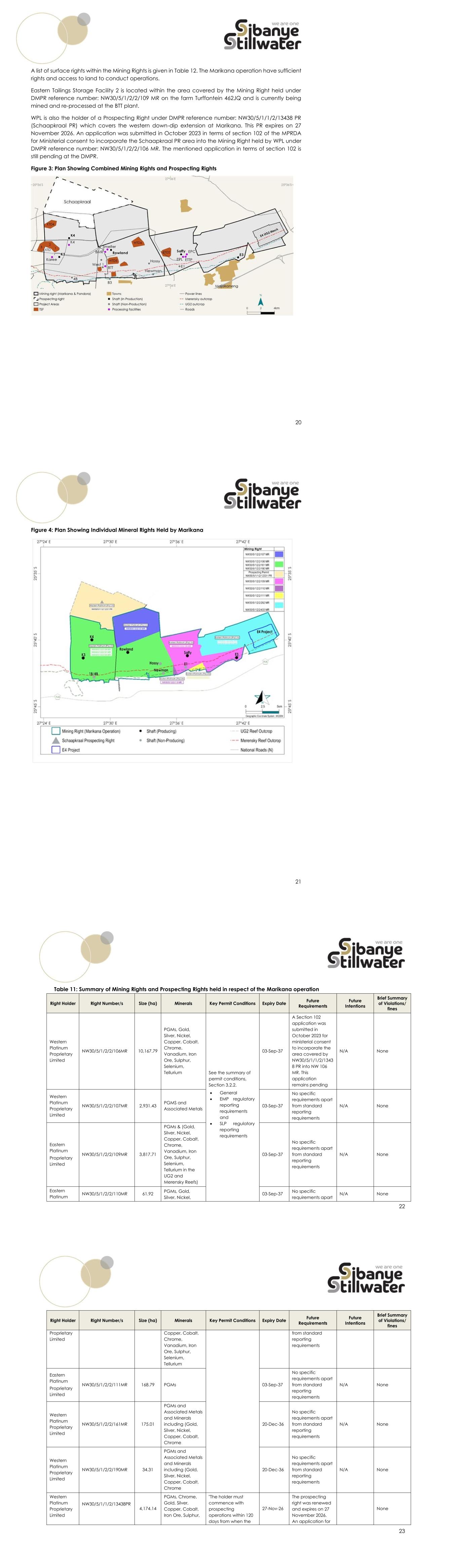
20 A list of surface rights within the Mining Rights is given in Table 12. The Marikana operation have sufficient rights and access to land to conduct operations. Eastern Tailings Storage Facility 2 is located within the area covered by the Mining Right held under DMPR reference number: NW30/5/1/2/2/109 MR on the farm Turffontein 462JQ and is currently being mined and re-processed at the BTT plant. WPL is also the holder of a Prospecting Right under DMPR reference number: NW30/5/1/1/2/13438 PR (Schaapkraal PR) which covers the western down-dip extension at Marikana. This PR expires on 27 November 2026. An application was submitted in October 2023 in terms of section 102 of the MPRDA for Ministerial consent to incorporate the Schaapkraal PR area into the Mining Right held by WPL under DMPR reference number: NW30/5/1/2/2/106 MR. The mentioned application in terms of section 102 is still pending at the DMPR. Figure 3: Plan Showing Combined Mining Rights and Prospecting Rights 21 Figure 4: Plan Showing Individual Mineral Rights Held by Marikana 22 Table 11: Summary of Mining Rights and Prospecting Rights held in respect of the Marikana operation Right Holder Right Number/s Size (ha) Minerals Key Permit Conditions Expiry Date Future Requirements Future Intentions Brief Summary of Violations/ fines Western Platinum Proprietary Limited NW30/5/1/2/2/106MR 10,167.79 PGMs, Gold, Silver, Nickel, Copper, Cobalt, Chrome, Vanadium, Iron Ore, Sulphur, Selenium, Tellurium See the summary of permit conditions, Section 3.2.2. • General • EMP regulatory reporting requirements and • SLP regulatory reporting requirements 03-Sep-37 A Section 102 application was submitted in October 2023 for ministerial consent to incorporate the area covered by NW30/5/1/1/2/1343 8 PR into NW 106 MR. This application remains pending N/A None Western Platinum Proprietary Limited NW30/5/1/2/2/107MR 2,931.43 PGMS and Associated Metals 03-Sep-37 No specific requirements apart from standard reporting requirements N/A None Eastern Platinum Proprietary Limited NW30/5/1/2/2/109MR 3,817.71 PGMs & (Gold, Silver, Nickel, Copper, Cobalt, Chrome, Vanadium, Iron Ore, Sulphur, Selenium, Tellurium in the UG2 and Merensky Reefs) 03-Sep-37 No specific requirements apart from standard reporting requirements N/A None Eastern Platinum NW30/5/1/2/2/110MR 61.92 PGMs, Gold, Silver, Nickel, 03-Sep-37 No specific requirements apart N/A None 23 Right Holder Right Number/s Size (ha) Minerals Key Permit Conditions Expiry Date Future Requirements Future Intentions Brief Summary of Violations/ fines Proprietary Limited Copper, Cobalt, Chrome, Vanadium, Iron Ore, Sulphur, Selenium, Tellurium from standard reporting requirements Eastern Platinum Proprietary Limited NW30/5/1/2/2/111MR 168.79 PGMs 03-Sep-37 No specific requirements apart from standard reporting requirements N/A None Western Platinum Proprietary Limited NW30/5/1/2/2/161MR 175.01 PGMs and Associated Metals and Minerals including (Gold, Silver, Nickel, Copper, Cobalt, Chrome 20-Dec-36 No specific requirements apart from standard reporting requirements N/A None Western Platinum Proprietary Limited NW30/5/1/2/2/190MR 34.31 PGMs and Associated Metals and Minerals including (Gold, Silver, Nickel, Copper, Cobalt, Chrome 20-Dec-36 No specific requirements apart from standard reporting requirements N/A None Western Platinum Proprietary Limited NW30/5/1/1/2/13438PR 4,174.14 PGMs, Chrome, Gold, Silver, Copper, Cobalt, Iron Ore, Sulphur, "The holder must commence with prospecting operations within 120 days from when the 27-Nov-26 The prospecting right was renewed and expires on 27 November 2026. An application for None
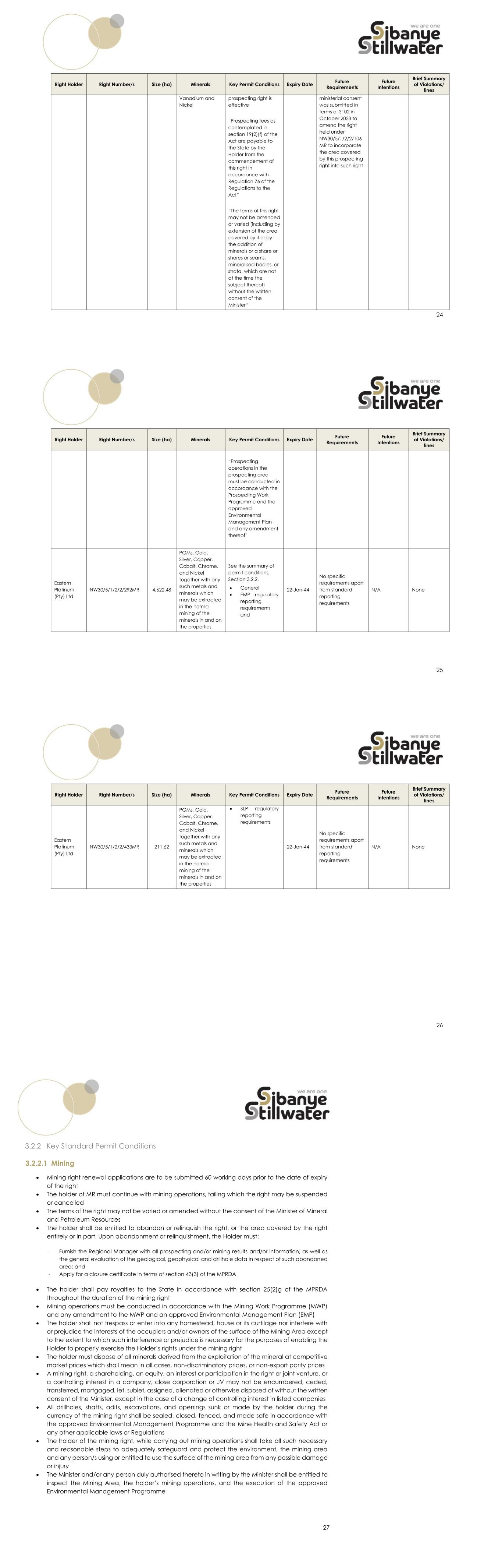
24 Right Holder Right Number/s Size (ha) Minerals Key Permit Conditions Expiry Date Future Requirements Future Intentions Brief Summary of Violations/ fines Vanadium and Nickel prospecting right is effective “Prospecting fees as contemplated in section 19(2)(f) of the Act are payable to the State by the Holder from the commencement of this right in accordance with Regulation 76 of the Regulations to the Act” “The terms of this right may not be amended or varied (including by extension of the area covered by it or by the addition of minerals or a share or shares or seams, mineralised bodies, or strata, which are not at the time the subject thereof) without the written consent of the Minister“ ministerial consent was submitted in terms of S102 in October 2023 to amend the right held under NW30/5/1/2/2/106 MR to incorporate the area covered by this prospecting right into such right 25 Right Holder Right Number/s Size (ha) Minerals Key Permit Conditions Expiry Date Future Requirements Future Intentions Brief Summary of Violations/ fines “Prospecting operations in the prospecting area must be conducted in accordance with the Prospecting Work Programme and the approved Environmental Management Plan and any amendment thereof” Eastern Platinum (Pty) Ltd NW30/5/1/2/2/292MR 4,622.48 PGMs, Gold, Silver, Copper, Cobalt, Chrome, and Nickel together with any such metals and minerals which may be extracted in the normal mining of the minerals in and on the properties See the summary of permit conditions, Section 3.2.2. • General • EMP regulatory reporting requirements and 22-Jan-44 No specific requirements apart from standard reporting requirements N/A None 26 Right Holder Right Number/s Size (ha) Minerals Key Permit Conditions Expiry Date Future Requirements Future Intentions Brief Summary of Violations/ fines Eastern Platinum (Pty) Ltd NW30/5/1/2/2/433MR 211.62 PGMs, Gold, Silver, Copper, Cobalt, Chrome, and Nickel together with any such metals and minerals which may be extracted in the normal mining of the minerals in and on the properties • SLP regulatory reporting requirements 22-Jan-44 No specific requirements apart from standard reporting requirements N/A None 27 3.2.2 Key Standard Permit Conditions 3.2.2.1 Mining • Mining right renewal applications are to be submitted 60 working days prior to the date of expiry of the right • The holder of MR must continue with mining operations, failing which the right may be suspended or cancelled • The terms of the right may not be varied or amended without the consent of the Minister of Mineral and Petroleum Resources • The holder shall be entitled to abandon or relinquish the right, or the area covered by the right entirely or in part. Upon abandonment or relinquishment, the Holder must: - Furnish the Regional Manager with all prospecting and/or mining results and/or information, as well as the general evaluation of the geological, geophysical and drillhole data in respect of such abandoned area; and - Apply for a closure certificate in terms of section 43(3) of the MPRDA • The holder shall pay royalties to the State in accordance with section 25(2)g of the MPRDA throughout the duration of the mining right • Mining operations must be conducted in accordance with the Mining Work Programme (MWP) and any amendment to the MWP and an approved Environmental Management Plan (EMP) • The holder shall not trespass or enter into any homestead, house or its curtilage nor interfere with or prejudice the interests of the occupiers and/or owners of the surface of the Mining Area except to the extent to which such interference or prejudice is necessary for the purposes of enabling the Holder to properly exercise the Holder’s rights under the mining right • The holder must dispose of all minerals derived from the exploitation of the mineral at competitive market prices which shall mean in all cases, non-discriminatory prices, or non-export parity prices • A mining right, a shareholding, an equity, an interest or participation in the right or joint venture, or a controlling interest in a company, close corporation or JV may not be encumbered, ceded, transferred, mortgaged, let, sublet, assigned, alienated or otherwise disposed of without the written consent of the Minister, except in the case of a change of controlling interest in listed companies • All drillholes, shafts, adits, excavations, and openings sunk or made by the holder during the currency of the mining right shall be sealed, closed, fenced, and made safe in accordance with the approved Environmental Management Programme and the Mine Health and Safety Act or any other applicable laws or Regulations • The holder of the mining right, while carrying out mining operations shall take all such necessary and reasonable steps to adequately safeguard and protect the environment, the mining area and any person/s using or entitled to use the surface of the mining area from any possible damage or injury • The Minister and/or any person duly authorised thereto in writing by the Minister shall be entitled to inspect the Mining Area, the holder’s mining operations, and the execution of the approved Environmental Management Programme

28 • A mining right may be cancelled or suspended subject to S47 of the MPRDA if the holder: - Submits inaccurate, incorrect and/or misleading information in connection with any matter required to be submitted under this Act - fails to honour or carry out any agreement, arrangement or undertaking, including the undertaking made by the Holder in terms of the Broad-Based Socio-Economic Empowerment Charter and Social and Labour Plan - Breaches any material term and condition of the mining right - Conducts mining in contravention of the MPRDA - Contravenes the requirements of the approved Environmental Management Programme - Contravenes any provisions of this Act in any other manner • The holder shall submit monthly returns contemplated in S 28(2) of the MPRDA no later than the 15th of every month and maintain all such books, plans and records in regard to mining on the mining area as may be required by the Act • The holder shall, at the end of each year, following the commencement of this mining right, inform the Regional Manager in writing of any new developments and of the future mining activities planned in connection with the exploitation/mining of the minerals in the mining area • Provisions relating to section 2(d) and section 2(f) of the MPRDA, relating to the Broad-Based Socio- Economic Empowerment Charter, differ in each mining right • The Mining right does not exempt the holder from complying with the MHSA or any Act in South Africa • The holder must, annually, no later than three months before the financial year end, submit a detailed implementation plan to give effect to Regulation 46(e)(i), (ii) and (iii) in line with the Social and Labour Plan • The Holder must, annually, no later than three months after the finalisation of its audited annual report, submit a detailed report on the implementation of the previous year’s SLP 3.2.2.2 Social And Labour Plans Compliance Requirements • New Social and Labour Plan to be submitted and reviewed every five years • Social and Labour Plan Implementation Plans are to be submitted annually • Social and Labour Plan Annual Report to be submitted annually 3.2.2.3 Environmental Management Compliance Requirements • Performance assessment relating to the Environmental Management Programme is to be conducted bi-annually • Performance assessment relating to Water Use License to be conducted annually • Performance assessment relating to Atmospheric Emission License to be conducted annually 29 Table 12: Surface Rights of the Marikana operation FARMS REGISTERED IN THE NAME OF WESTERN PLATINUM LIMITED Farm Name Portion Magisterial District No 342 JQ 17, 32, 43, 151, 209, 211, 253, 254, 255, 260, 261, 307 Rustenburg Elandsdrift 467 JQ RE*2, RE*20, RE*21, 37, 38, RE*39, 44, E*51, 52, 53, 56, 57, 58, 59, 70, 71, 99, 100, RE*137, RE*222 Madibeng Hoedspruit 298 JQ 12, 13, 14, 16 Rustenburg Lonmin Tailings 943 JQ RE Rustenburg Middelkraal 466 JQ RE*1, RE*2, RE*3, RE*4, RE*5, 7, 8, RE*9, 10-20, RE*21, RE*22, RE*23, RE*24, 25, -36, RE*37, 38, RE*39, RE*40, RE*41, 43, 44, RE*45, 46-50, RE*51, 52, 53, 55, 56, RE*58, 60, 62, 63, 68, 69, 70 Madibeng Rooikoppies 297 JQ RE*1, RE*2, RE*5, 6, RE*8, RE*10, RE*16, 22, RE*24, RE*28, 35, RE*36, 37, 38, RE*39, RE*40, 41, 42, RE*43, RE*44, 48, RE*54, RE*55, RE*57, RE*58, 76, 77, 78, 97, 98, 99, 101, 102, 103, 104, 105, RE*114, RE*116, 118, RE*121, 122, RE*123, 124, 125, 134, 135, RE*136, 138, 139, 141, 142, 143, 146, 147, Rustenburg Rooikoppies 297 JQ RE*150, RE*151, 152, 153, 154 - 171, RE*173, 189, 194, 195, 198, 199, 200, 201, 202, RE*203, RE*204, RE*205, RE*206, RE*207, RE*213, RE*216, RE *217, RE*218, RE*219, RE*220, 221, 222, RE*223, 224, 225 - 228, RE*229, 231, 232, Rustenburg Rooikoppies 297 JQ RE*233, 243, 244, 247-252, RE*276, 277-283, RE*297, RE*307, RE*308, RE*314, RE*316, RE*318, RE*320, RE*322, RE*328, RE*329, RE*332, RE*333, 399, RE*415 Rustenburg Zwartkoppies 296 JQ 1, 4, 9, 10, 13-18, RE*19, 20, 24-27, RE*32, 33, 34, 39, 40, 45, RE*47, 49, 55, 58, 62, 64, 68, 69, 73, 81, 90, 91, 92, 102, RE*106, 114, 115, RE*116 Rustenburg Schaapkraal 292 JQ 21 Rustenburg FARMS REGISTERED IN THE NAME OF EASTERN PLATINUM LIMITED Farm Name Portion Magisterial District Hartebeespoort B 410 JQ 916, 920, 921, 1061, 1062, 1066, 1072, 1073, 1074, 1075, 1076, 1077 Madibeng Uitvalgrond 416 JQ RE*17, RE*18, 19, 20, 21, 22, 23, 24, 25, 26, 27, 28 Madibeng FARMS AND PORTIONS ON LEASE FROM BAPO BA MOGALE TRADITIONAL COMMUNITY Farm Name Portion Magisterial District Turffontein 462 JQ 3, RE Madibeng 460 JQ 1 Madibeng Karee Poort 407 JQ 6 Madibeng Modderspruit 461JQ 2 Madibeng Boschfontein 458 JQ 5 Madibeng Wonderkop 400 JQ 1, 2 Madibeng 3.3 Royalties Marikana operation is not a royalty company nor receives royalties from any other operation. Royalties paid by Marikana are discussed in Sections 18-19. 30 3.4 Legal Proceedings and Significant Encumbrances to the Property The QPs have been advised by Sibanye-Stillwater that there are no material legal proceedings in relation to the Marikana operation. It should, however, be noted that Sibanye-Stillwater may be involved in various non-material legal matters such as employment claims, third-party subpoenas, and collection matters on an ongoing basis, which are not material to the Mineral Resources and Mineral Reserves reported in this TRS. From the documentation reviewed and input by the relevant technical specialists and experts, the QPs could not identify any significant encumbrances or any other significant factors or risks with regard to the mineral title, permitting, access, surface ownership, environmental and community factors that would prevent the mining or the ability to perform work on the Marikana operation, and the declaration and disclosure of the Mineral Resources and Mineral Reserves. All mineral titles in relation to the Marikana operation are in good standing. 4 Accessibility, Climate, Local Resources, Infrastructure and Physiography 4.1 Topography, Elevation and Vegetation The Madibeng Local Municipality, within which the Marikana operation are situated, is characterised by undulating terrain, varying between 1,050 metres above mean sea level (mamsl) and 1,180 mamsl. The topography to the north, west and east of Marikana operation is dominated by well-established non-perennial watercourses. The mine area is relatively flat with sporadic hillocks and rocky outcrops. Situated to the south is the Magaliesburg mountain range and to the east are several small hills. The general topography and land use can is shown in Section 15 and 17.4. The important drainage channels in the Marikana operation area include the Sterkstroom River bisecting the western section of the operation and the Maretlwana River on the eastern portion of the operation. The natural vegetation present in the area is relatively heterogeneous, consisting of a mosaic of open grassland, old fallow lands, scrub-thornveld, mesophyllous woodland and drainage-line thickets and small hills. The majority of the area, occurring on black clay soils, is open grassland with occasional small trees and denser treed zones where surface rock is present and more frost- and fire cover is provided to seedlings. The areas located on the sandier red soils are made up of mixed savanna, with both microphyllous (fine-leaved) and mesophyllous (broad-leaved) vegetation present. Most of the area surrounding Marikana has been and is to a certain extent still used for agriculture purposes, in particular the growing of sunflowers and tobacco crops. With the growth in the mining sector due to extensive platinum and chromium deposits in the region, agriculture is on the decline. Urban development has taken place mainly in the town of Rustenburg, but informal settlements also exist, including on the Marikana operation. 4.2 Access, Towns and Regional Infrastructure The Marikana operation is situated between the city of Rustenburg and the town of Brits. The site is accessed via multiple networks of asphalt tarred roads. The operation is accessed via the N4 highway 31 into Rustenburg and Brits from Pretoria. A railway line runs through the town of Marikana. Major international airports, including OR Tambo and Lanseria international airports, are located in the Gauteng Province, a few hours' drive from the operation. Most services needed are found in the surrounding towns and cities. 4.3 Climate Rainfall occurs throughout the year, but predominantly between November and March, mainly as thunderstorms. Annual rainfall averages approximately 650mm. The wettest month is January, with an average monthly total rainfall of 132mm. The driest month is July, with an average monthly total rainfall of approximately 2mm. Mean monthly air temperatures range from 11.8°C in June/July to 23.8°C in January. Average daily maxima range from 20.4°C(July) to 30.3°C (January), and minima from 2.8°C (July) to 17.2°C (December). Winds are mainly light to moderate and blow from the north-easterly sector, except for short periods during thunderstorms or weather changes when they have a southerly component. The lightning ground flash density in the area is a moderate risk to surface infrastructure with between 5 to 7 strikes/km2/year (on a scale of 0 to 19). No severe climatic effects influence mining activities and the mining and ore processing operations at the Marikana operation proceed year-round. 4.4 Infrastructure and Bulk Service Supplies The Marikana has been operating since 1987 and some of the surrounding mines have been operational since the 1950’s. The regional and onsite infrastructure for mining and ore processing is well established. There is a good supply chain for all required consumables and equipment in or near the mine site. The Marikana operation, through Sibanye-Stillwater, is well connected to the international supply markets for any materials and equipment not available locally. The Marikana operation are supplied with bulk electricity from the regional grid, which is owned and operated by the state-owned company, Eskom. Details for power are supplied in Section 15.3 and for water supplies see Section 17.4.6. 4.5 Personnel Sources Marikana operation has specific policies, procedures, and practices in place, which address, on an integrated basis, its human resource requirements (Table 13). Recruitment requirements are predominantly informed by the operational requirements for specific skills, by the extent of labour turnover levels and by relevant legislation. Additional information on Personal The economic climate, cost infrastructure and the Mineral Reserves profile also influence the organisational structures and required labour complement. Requirements are given in Section 17.2 and 17.3.

32 Table 13: Number of Employees 2021 2022 2023* 2024 2025 No. of Employees 17,963 18,783 18,514 16,312 16,515 *Permanent employees only Many of the Marikana operation’s employees live in Rustenburg and neighbouring towns but labour is sourced from different areas of South Africa and beyond. Although preference is given to manpower from local communities within the Northwest Province in support of local economic development, the majority (68%) originates from outside the North West province. Table 14 provides a breakdown of the origin of employees as per province, including beyond the borders of South Africa. Table 14: Origin of Employees Province Number of Permanent Employees Number of Contractors Percentage Eastern Cape 5,733 533 32% Free State 654 97 4% Gauteng 1,074 289 7% Kwazulu-Natal 476 50 3% Limpopo 810 233 5% Mpumalanga 529 153 3% North West 4,913 1,396 32% Northern Cape 169 16 1% Western Cape 16 5 0% Non-South Africans 2,141 313 13% Total 16,515 3,085 100% 33 5 History 5.1 Ownership History Marikana operation was started in 1987 by Lonrho Plc/Lonmin Plc until the acquisition of Lonmin by Sibanye-Stillwater in 2019. The historical development of the Marikana operation is summarised in Table 15. Table 15: Historical Development Company/Ownership/ Operator Date Activity Lonrho Plc 1909 London and Rhodesian Mining and Land Company founded Lonrho Plc 1987 The sinking of the Rowland Shaft commences Lonrho Plc 1989 Karee Mine Shafts operational Lonrho Plc 1991 The first production delivered by Rowland and steady-state achieved in 1999 Lonrho Plc 1998 Lonrho Plc splits and Lonrho Africa plc is formed Lonmin Plc 1999 Lonrho Plc is renamed Lonmin Plc. The focus is on mining Lonmin Plc 2000 Lonmin Plc sells off all non-PGM assets and becomes a primary PGM producer Lonmin Plc 2001 Eastern declines are sunk and the Saffy shaft is commissioned. Lonmin enters into a JV with Anglo American Platinum for the Pandora property Lonmin Plc 2003 Hossy Shaft is commissioned Lonmin Plc 2005 Lonmin acquires the Limpopo Mine (formerly Messina) from Southern Platinum Lonmin Plc 2006 K4 Shaft is commissioned Lonmin Plc 2007 Lonmin acquires 94% of Afriore for a stake in the Akanani PGM project on the Northern Limb of the Bushveld Complex Lonmin Plc 2009 Lonmin’s Limpopo Mine is put on Care and Maintenance Lonmin Plc 2011 K3 Shaft decline is sunk Lonmin Plc 2012 K4 Shaft is placed on Care and Maintenance. Major labour strike affected mine and reduced production Lonmin Plc 2016 Saffy shaft produces at full capacity Lonmin Plc 2017 Newman and E2 Shafts are put on Care and Maintenance Lonmin Plc 2018 Lonmin acquires 100% of the Pandora project from Anglo American Platinum Lonmin Plc 2019 Hossy, E1 and W1 Shafts are put on Care and Maintenance. UG2 open pit operations are ceased Sibanye-Stillwater 2019 Acquisition of Lonmin Plc by Sibanye-Stillwater in June 2019 Sibanye-Stillwater 2020 The Covid-19 Pandemic and the associated national lockdown affected all production from April to the middle May at which point a gradual build-up in production was initiated with a slow return of employees continuing right up to December 2020 Sibanye-Stillwater 2021 K4 shaft reopened and development begins Sibanye-Stillwater 2022 Mining operation is progressing at K4. E3 Deepening study being advanced Sibanye-Stillwater 2023 Mining operations progressing at K4, K3, 4B, Rowland, Saffy & E3 34 Company/Ownership/ Operator Date Activity Sibanye-Stillwater 2024 Mining operations progressing at K4, K3, Rowland, Saffy & E3. 4B Shaft is put on Care and Maintenance Sibanye-Stillwater 2025 Mining operations progressing at K4, K3, Rowland, Saffy & E3 5.2 Previous Exploration and Mine Development 5.2.1 Previous Exploration The discovery and development of the Merensky Reef in Rustenburg can be traced back to 1925. Exploration by Lonrho Plc began at the Marikana operation in the mid-1960s and during the past 51 years, several companies have conducted exploration campaigns across the lease area. Extensive mining, trenching, surface diamond drilling, underground diamond drilling, 3D seismic surveys, and complete airborne magnetic surveys have aided in establishing the geological characteristics of the UG2 and Merensky Reefs at the Marikana operation. Over 2,000 surface diamond drillholes (Table 16) have been collared and drilled in prior years and annual surface exploration diamond drilling campaigns are on-going to improve confidence and extend the area of the Mineral Resource. Drilling history is shown in Table 16. Drilling is for surface holes only. Numbers of intersections is approximate for historical holes as the database may not be complete. Table 16: Marikana Surface Drilling Campaigns Year Total No. of Holes Total Metres Merensky Intersections UG2 Intersections(approx.) <2000 567 206,990 773 676 2000-2005 767 158,700 342 997 2005-2010 341 111,764 463 391 2010-2015 341 175,443 860 801 2015-2020 101 34,598 792 938 2020-2021 0 0 0 0 2021-2022 11 4,308 5 5 2022-2023 19 11,033 39 34 2024-2025 31 12,744 41 75 Totals 2,172 715,580 3,245 2,932 5.2.1.1 Aeromagnetic Surveys Several aeromagnetic surveys have been conducted over the Marikana operation. In 1994, an aeromagnetic survey was conducted by “Geodass” over the greater part of the Marikana operation. The flight line spacing and flight line trend used for this survey was 50m at 000º respectively, whereas the 35 tie line spacing was 250m and the tie line trend was 090º. Horizontal magnetic gradient, radiometric and positional data were recorded. The detail of this survey has been used to define the location of near- surface Iron-rich replacement pegmatoids (IRUP) occurrences in the 4B, K3 and Rowland Shaft blocks, and similarly used to infer the absence of this alteration replacement type material in other areas. It has also assisted with delineating other magnetic stratigraphic units (such as the Main Mottled Anorthosite) above the Merensky Reef which shows the approximate strike over the area). The aeromagnetic survey images (Figure 5) have also proved valuable in identifying and projecting intrusive dykes, as well as defining the well-known major fault structures such as the Marikana and Elandsdrift Faults. In 2011, the area towards the north covering the Schaapkraal prospecting permit was surveyed. Figure 5: Aeromagnetic Image Over Marikana operation 5.2.1.2 3D Seismics Seismic surveys covering 1,850ha have been conducted over parts of the K4 and K3 Sub-incline shaft blocks; 5,846ha over the MK2-Saffy Shaft blocks and 5,765ha over K4 and deeper areas to the north (Figure 6). These surveys were carried out in 2000, 2009 and 2011, respectively. Post-processing of the data included impulse reflector picking and preparation of time-bar-coded and depth contour plans. These contours formed the basis for the structural interpretation. The processed information was further used to interpret the location and size of potholes for both reefs in the K4 Shaft block. No verification of the pothole accuracy has been reported. However, the resolution of the vertical depth can be expected to be within 10m. The delineation of the major fault and dykes structures interpreted from the seismic survey has been partially utilised. At MK2-MK3-Saffy-K5 (K5 is a potential future deep shaft position), seismic information has been used in delineating structural domains.

36 Reprocessing of the K4 seismic data and integration with the K5 seismic data was completed in 2013 and is available for future structure updates. Figure 6: Areas Covered by 3D Seismic Surveys (shown in green polygons) Relative to the Marikana- Schaapkraal-areas 37 5.2.2 Previous Development Production commenced at Marikana in 1989, following the completion of the shaft sinking. The history of other shafts is listed in Table 15. Table 17 contains the details of the historical production and financial parameters in calendar years 2021 to 2025. Table 17: Historical Production and Financial Parameters Item Location Unit Years 2021 2022 2023 2024 2025 Main development Advanced (km) 79.7 77.7 83.2 64.4 67.0 Area mined (’000m2) 1,187 1,072 1,045 895 1,032 Tonnes milled Underground (’000t) 6,802 6,135 6,253 5,417 6,101 Surface (’000t) 3,869 6,196 6,109 6,522 5,607 Total (’000t) 10,671 12,331 12,362 11,940 11,708 Grade-Yield (RoM Grade*Rec) Underground (g/t) 3.9 3.7 3.6 3.8 3.7 Surface (g/t) 0.9 0.9 0.9 0.9 1.0 Combined (g/t) 2.4 2.3 2.3 2.2 2.4 4E produced @100% Underground (Moz) 0.7 0.6 0.6 0.5 0.6 Surface (Moz) 0.03 0.03 0.05 0.06 0.05 Total (Moz) 0.8 0.6 0.7 0.6 0.6 Operating Costs Underground (R/t) 2,464 2,604 2,941 3,108 3,262 Surface Marikana does not track this cost Total (R/t) 1,571 1,642 1,862 1,857 2,114 Operating Costs (US$/4/2Eoz) 1,372 1,364 1,320 1,343 1,533 (R/4/2Eoz) 20,289 22,332 24,313 24,596 27,417 All in cost(7) (US$/4Eoz) 1,347 1,349 1,309 1,307 1,434 (R/4Eoz) 19,925 22,076 24,096 23,937 25,641 Capital Expenditure (Rm) 2,254 3,432 3,872 3,571 3,568 1. Tonnes are from operations, reported at the shaft head 2. Ounces and kilograms are based on 4E PGM 3. Yield is in 4E PGM 4. The reason for the all-in-costs being lower than the operating cost is that for the all-in-cost the by-product credits (Revenue for Ir, Ru, Ni, Cu, Co, and chromite) are used as an All-in-cost off-set, and these credits are normally higher than the ongoing capital and allocated sundries added on top of the operating cost to calculate ASIC 38 6 Geological Setting, Mineralisation and Deposit This section contains descriptions of the regional geology of the BC, descriptions of similar deposits in other locations and a brief outline of the major components of the property geology. 6.1 Regional Geology The majority of the world’s PGM resources are located in Southern Africa, which accounts for over 80% of global PGM resources. Most of these are contained in the Bushveld Complex (BC). The BC (Figure 7) is approximately 2,060 million years old. Its mafic to ultramafic rock sequence, the Rustenburg Layered Suite (RLS), is the world’s largest known mafic layered intrusion. In addition to PGMs, extensive deposits of iron, tin, chromium, titanium, vanadium, copper, nickel, and cobalt also occur within different layers of the RLS/BC. The BC extends approximately 450km east to west and approximately 250km north to south. It underlies an area of some 67,000km2, spanning parts of Limpopo, North West, Gauteng, and Mpumalanga Provinces in South Africa. The RLS, which was derived from the differential crystallisation of multiple magma injections, occurs geographically as five discrete compartments termed “limbs,” three of which are being exploited for PGMs. These are the Western, Eastern, and Northern Limbs. The Marikana operation is located on the Western Limb (Figure 8). The RLS comprises rocks ranging from dunite and pyroxenite through norite, gabbro and anorthosite to magnetite- and apatite-rich diorite. The RLS is subdivided in terms of a mineralogically based zonal stratigraphy into five principal zones. 39 Figure 7: Geology of the Bushveld Complex

40 Figure 8: Geology of the Western Limb of the Bushveld Complex, South Africa From the bottom of the sequence to the top (Figure 9), these zones are the 1) Marginal Zone, 2) ultramafic-rich Lower Zone, 3) mafic-rich Critical Zone which hosts multiple chromitite and PGM layers, 4) a mafic-rich Main Zone consisting mostly of gabbro-norites and norites, 5) and the final Upper Zone derived from the crystallisation of iron-rich residual fluids. The RLS varies in vertical thickness, reaching up to 8km in places with some individual layers traceable for over 150km. However, the PGM-bearing reefs varies between 0.3m to 15m thick, although much greater thicknesses are recorded in the Platreef of the Northern Limb. In the Eastern and Western Limbs, the Critical Zone contains the two principal PGM-bearing reefs: the Merensky Reef and the UG2 Reef. Mineral Resources and Mineral Reserves are reported for both the Merensky and UG2 Reefs which are the primary PGM and base metal sources mined at the operations. 41 Figure 9: General Stratigraphic Column of the Rustenburg Layered Suite 6.2 Deposit Types PGM reef-type deposits are predominantly magmatic Ni-Cu-PGM systems hosted by large layered mafic-ultramafic intrusions. In these deposits, platinum group metals are the principal economic products, while nickel, copper, cobalt and chromium are commonly by-products. They generally contain low sulphide contents and occur as laterally persistent stratiform horizons or “reefs” that can be traced once intersected. Their formation is linked to mantle-derived magma that intrudes the crust, undergoes contamination and cooling, and reaches sulphur saturation, allowing immiscible sulphide liquids to concentrate Ni, Cu and PGMs within mafic to ultramafic host rocks. The Bushveld Complex, the Stillwater Complex, the Great Dyke are classic examples of layered intrusion- hosted PGM mineralisation. The Bushveld Complex remains the most significant global example, with the Merensky and UG2 Reefs in the Critical Zone hosting the world’s largest platinum and chromite resources. At Stillwater, the economically important J-M Reef occurs in the Lower Banded Series as a relatively continuous olivine-rich horizon that extends for about 36km and averages roughly 2m in thickness. In Zimbabwe’s Great Dyke, economic mineralisation is concentrated mainly in the Main Sulphide Zone, with the Lower Sulphide Zone representing a thicker but lower-grade unit. 42 Norilsk and Sudbury illustrate important variations on the broader Ni-Cu-PGM theme. In the Norilsk Province, mineralisation is associated with layered ultramafic intrusions emplaced within a large volcanic sequence, but the ores are more variable than the reef-style deposits, ranging from massive to disseminated sulphides. The massive sulphide bodies are the most economic and are notable for high nickel content and strong palladium enrichment. Sudbury is distinct because it is impact-related rather than a conventional layered intrusion; mineralisation occurs in contact zones, footwall breccias and radial dykes around the impact structure, and mining is directed primarily at nickel and copper with PGMs recovered as by-products. Taken together, these deposits demonstrate that Ni-Cu-PGM mineralisation is overwhelmingly associated with mafic-ultramafic magmatism, although the geometry, continuity, grade distribution and economic drivers differ between districts. The Bushveld, Stillwater, and the Great Dyke are dominated by stratiform reef-style mineralisation with relatively predictable continuity, whereas Norilsk and Sudbury contain more variable ore morphologies and stronger base-metal characteristics. This comparison provides a concise framework for understanding the principal geological controls on the world’s major Ni-Cu-PGM deposit types. 6.3 Local and Property Geology 6.3.1 Stratigraphy The recognised stratigraphy underlying the Marikana operation comprises the Main and Critical Zones of the RLS. The stratigraphy of the RLS as formalised by the South African Committee for Stratigraphy (SACS, 1980) is used in this report. The Main Zone predominantly comprises gabbro–norite and norite rock types, whereas, in the Upper Critical Zone, pyroxenite, norite, anorthosite, and chromitite lithologies are found. The Upper Critical Zone stratigraphy of the RLS, which contains the units of economic interest, the Merensky and UG2 Reefs, comprises well-developed cyclic units divided into six sub-units as follows (Figure 10): • Bastard Pyroxenite • Merensky Reef • Merensky Footwall • UG2 Hangingwall • UG2 Chromitite Layer/Reef • UG1 Chromitite Layer Section 6.3.3, Figure 14 shows the dip cross-section through the reefs. In the Marikana operation, there are local variations in the thicknesses of individual stratigraphic units. The Giant Poikilitic Anorthosite (GPA) generally defines the start of the Critical Zone, which normally occurs 5m to 10m above Bastard Pyroxenite and approximately 20m to 25m above Merensky Reef. The GPA is normally about 7m to 10m in thickness. 43 Figure 10: General Stratigraphic Column of the Local Geological Succession After Smith et al. 2004 6.3.2 The Mineralised Horizons 6.3.2.1 Merensky Reef The Merensky Reef varies in thickness and PGM mineralisation along dip and along strike across the Marikana operation. The pyroxenite thickens from ±0.3m in the west to greater than 15m in the east of the operation. The bottom contact of the Merensky Pyroxenite is defined by a laterally consistent and well-developed 5mm to 10mm thick chromitite layer (Lower Chromitite), which is almost always underlain by a 1cm to 3cm thick anorthosite layer. The lower contact of the Merensky Pyroxenite with the underlying anorthosite is sharp and dimpled (Farquhar, 1981) and cross-cutting the layering in the footwall where present. The top contact of the Merensky Pyroxenite may be sharp but is most often gradational over 10cm to 20cm into the overlying spotted anorthosite. A 1mm to 2mm thick chromitite layer (Upper Chromitite) is often developed 50cm to 100cm below the top contact and often has a few centimetres of pegmatoidal development immediately above and below it. In some areas, up to three chromitite layers can be present in this pegmatoidal zone.

44 A coarse-grained feldspathic pegmatoidal pyroxenite (Merensky Pegmatite) underlies the Merensky Pyroxenite towards the west of the operations. The bottom contact of this unit is also defined by a 1mm to 10mm thick chromitite layer (Basal Chromitite). Different facies of the Merensky Reef at the Marikana operation are locally distinguished, based on the lithology and morphology of the reef as well as the number and position of the chromitite layers associated with the pyroxenite (Figure 11). A map of the spatial distribution is found in Section 11.1.2, Figure 23. Figure 11: Typical PGM Grade Distribution of Different Merensky Reef Facies Types at Marikana Brakspruit Facies The Brakspruit facies is characterised by a ~80cm thick medium- to coarse-grained pyroxenite overlying a very coarse-grained pegmatoidal pyroxenite which varies in thickness. Two chromitite layers can be distinguished. One occurs at the bottom of the pyroxenite (Lower Chromitite) and the second at the bottom of the pegmatoidal pyroxenite (Basal Chromitite). Basic stoping parameters include the pyroxenite and pegmatoidal pyroxenite +10cm of the footwall. The Rustenburg Facies The Rustenburg facies is characterised by the presence of three chromitite layers, with a Merensky pegmatoidal pyroxenite occurring between the bottom two chromitite layers. The required stoping parameter for this facie is >1m. Basic stoping parameters include 20cm above the top chromitite and 10cm below the basal pegmatite chromitite layer. 45 Thin Reef Facies The pyroxenite of the thin facies is generally less than 80cm thick, with a chromitite layer at the bottom contact of the pyroxenite. The economically mineable zone is concentrated around the lower contact of the pyroxenite but can extend to the underlying anorthosite. Basic stoping parameters include the pyroxenite, the lower chromitite layer and additional footwall material to make up the minimum mining width. The Marikana Facies The Marikana facies is defined by the presence of two chromitite layers normally less than 2m apart. The pyroxenite varies between 1m to 2m thick and the upper chromitite layer occurs 20cm to 50cm below the top contact. Basic stoping parameters include 20cm above the upper chromitite layer to 10cm below the lower chromitite layer. The Westplats Facies In the Westplats facies the pyroxenite varies between 2m to 10m. The economically mineable zone consists of the upper 0.8m to 1.2m. Pegmatoidal pyroxenite can be present below the pyroxenite. There are two chromitites layers visible. Basic stoping parameters include 30cm above the upper chromitite layer to 80cm below the upper chromitite layer. The Eastplats Facies The Eastplats facies occurs to the east of the Elandsdrift fault zone and is characterised by a 10m to 16m thick pyroxenite layer with a chromitite layer at the bottom contact and no upper chromitite layer. Disseminated chromitite or small, discontinuous chromitite layers might be present near the top contact but are not well developed. There is no pegmatoidal pyroxenite present at the base of the pyroxenite, but a thin pegmatoidal pyroxenite is often preserved near the gradational top contact. Mineralisation occurs mainly in the upper 1m to 2m of the Merensky Pyroxenite. A lesser peak may occur at the Merensky Reef basal contact, associated with the lower chromitite layer, and some sporadic mineralisation may be found in various positions in the Merensky Pyroxenite away from either the more consistent top or bottom mineralised zones. The Eastplats facies is not mined underground, but the top 1.2m to 1.4m was previously extracted by open pit-cast mining. 6.3.2.2 UG2 Reef The UG2 Reef is a chromitite seam, which varies in thickness from 0.7m to 1.3m across the Marikana operation (Figure 12). The top contact is sharp, planar, and laterally very consistent, while the bottom contact is undulating. The basic mining parameter of the UG2 chromitite seam is to select the composite between the top and bottom contact of the main chromitite seam, with 10cm of footwall material. 46 Figure 12: Typical PGM Grade Distribution of Different UG2 Facies Types At the Marikana eastern shafts, Saffy and E3, thin pyroxenite lenses are often present in the upper part of the UG2 chromitite seam. The lenses can be laterally consistent for tens of metres. Occasional anorthosite or mottled anorthosite partings are less common, are normally thicker than the pyroxenite lenses and often associated with potholes. On the western shafts at Marikana, a continuous layer of pyroxenite separates the UG2 into two layers. This is referred to as “Split Reef.” The internal pyroxenite is 30cm to 70cm thick on the Western side of the K3 Shaft but thickens to the west and north and will have a significant influence on mining in the K4 Shaft area. The grade of the UG2 Split Reef is negatively affected due to dilution caused by the internal pyroxenite. The immediate hanging wall to the UG2, hangingwall 1B(HW1B), is a pyroxenite package varying in thickness from 0m in the west to 18m at EPL. The grain size of the HW1B pyroxenite is generally finer than that of the overlying HW1A pyroxenite. Large oikocrysts of pyroxene are typical and characteristic of the HW1B unit. The pyroxenite unit contains several chromitite layers locally known as the UG2A Chromitite Markers. Geologically, these chromitite layers are considered to be analogous to the “Triplets” described in other areas. The UG2A unit consists mostly of two prominent chromitite layers (a few centimetres thick) which, together with the pyroxenite in-between have a thickness ranging from 10cm to 30cm. HW1B may also contain several thin chromitite layers or disseminated chromite. 47 The contacts of the chromitite layers are planes of low cohesion and hence natural parting planes can occur where they are exposed in or close to mine workings which pose a safety risk. This is briefly addressed in the geotechnical Section 7.9 and Section 13.3. The UG2A and HW1B layers combined (top of UG2 to top of UG2A) are referred to as the UG2 beam. The thickness of the beam increases from west to east (as the thickness of HW1B increases) and is important because the Rock Engineering support standards are designed to accommodate the beam thickness at the specific shaft or shaft area. (Additional information is provided in Section 13.3). Based on sampling (underground and surface exploration) and assay data, two main UG2 Reef facies occur at the Marikana operation. They are referred to as the Normal and Split Reef facies. Split Reef Facies The Split Reef facies occurs on the western border of the Marikana operation and make up a much smaller area as opposed to the Normal Reef facies which occur over a much larger footprint of the Marikana operation. The Split Reef facies is characterised by the massive chromitite, which is separated by a feldspathic pyroxenite parting into a lower (UG2 Main Seam) and Upper chromitite unit (Leader Seam). The internal waste parting has an average thickness of 30cm. Grades, thicknesses, and densities of each of the three stratigraphic units of the Split Reef have been estimated separately into the resource block models. A nominal 4E grade of 0.01 g/t was assigned to the internal waste parting. Thickness (length) and density- weighted 4E grades as well as density-weighted thicknesses are applied to the units to make-up the in- situ Mineral Resource cut at a block model level. A sub-geozone of the Split Reef facies has been demarcated where the internal waste parting is more than 25cm thick. It is referred to as the Undercut Reef geozone. In this area the pyroxenite parting and Leader Seam of the hangingwall stratigraphy will be undercut and only the Main Seam chromitite will be mined. Normal Reef Geozone Stratigraphically, the Normal Reef geozone can be described where the Leader and the Main Seam. Merge. As a result, no internal waste parting exists for the Normal Reef geozone. For Mineral Resource estimation purposes, the Normal Reef geozone is divided into sub-geozones which related to grade and thicknesses of the chromitite and further based on either combining of underground sampling and surface exploration sampling during the estimation process or not due to data support differences. 6.3.3 Structure The UG2 Reef underlies the Merensky Reef by 130m to 230m with the middling increasing from west to east. Both reefs outcrop for a distance of 27km along strike within the Marikana operation area. The regional dip varies between 10 and 13 degrees with a general dip direction of north-northeast (Figure 13 and Figure 14) which also show the main linear geological structures in this area. Localised geological discontinuities associated with the Merensky and UG2 Reefs include potholes, faults, joints, shears zones, dykes, and IRUP. The Merensky Reef is also disrupted by the occurrence of a

48 very fine-grained pyroxenite, locally referred to as “Brown Sugar Norite.” Geotechnical risks associated with these features are described in Section 13.3. Figure 13: Structure Map of Marikana 49 Figure 14: Section of Marikana S-N 6.3.3.1 Faults Marikana operation is transected by major faults and dykes trending in NW-SE and NE-SW directions which have a strong influence in compartmentalising the mining area into districts. At least nine major fault zones have been identified at the Marikana operation. These have been defined as fault zones that have measured displacements ranging from 20m to 120 m. It is expected that no mining will be possible in these fault zones and they are characterised as geological loss zones. The large fault zones from west to east include the Spruitfontein, Marikana, Elandsdrift, and Harties West faults (Figure 41). The Spruitfontein fault is related to an anticlinal fold structure present in the Transvaal basement rocks. The regional strike change on the western side of Marikana is related to this basement high. Other faults include Saffy East, Turffontein West and Turffontein East faults. The Spruitfontein fault strikes north-northwest and is situated close to the western boundary of Marikana, where it is exposed in mine workings at the K3 and 4Belt Shafts. The displacement of the Reefs along the fault is 4m but has an inconsistent direction. The Marikana fault acts as a natural shaft block boundary between the K3 shaft and the Rowland shaft. This north-northwest striking, sub-vertical dipping fault has an estimated displacement of approximately 10m to 20m to the east. The north-northwest striking, sub-vertical to vertical dipping Elandsdrift fault divides the Marikana operation into east and west compartments. It has an estimated displacement of approximately 100m to 120m to the east in the shallower part of the operations, but displacements decrease down dip. The Elandsdrift fault is interpreted to split into an east and west fault where each of these splays was found to exist as small graben-type faults as revealed from the 3D seismic information. 50 Towards the eastern part of Marikana operation, there are a series of faults including Saffy East, Saffy West, and Turffontein faults, which have reef displacements of 10m to 20m, whereas the Harties West fault has a large displacement of 60m. To the extreme east, the Roodekopjes fault forms the western limit of the Brits Graben and has a displacement greater than 500m. This fault forms the practical mining limit towards the east of the E4 project area. 6.3.3.2 Dykes Dykes have been interpreted across the Marikana operation from the airborne aeromagnetic survey information and underground intersections. Faulting and water accumulations associated with these dykes can be problematic to mining development and extraction. Often dykes can be bounded by major weathering zones resulting in poor ground conditions in general. In the K4 shaft project area to the west of the operations, a regional west-northwest trending dyke interpreted from the aeromagnetic survey intersects the area to the north-east (K4D1). The dip of this dyke is assumed to be sub-vertical to vertical. The K4D1 dyke extends into the Hossy, Newman and MK2 shaft blocks and has been interpreted from the aeromagnetic and 3D seismic surveys and is referred to as the HD1. The dip of this west-northwest trending dyke is sub-vertical to vertical, between 70 to 80 degrees with a dip direction towards the north-east. The occurrence of a dyke swarm (ED1 to ED10) to the east of the operations has been interpreted from the aeromagnetic and 3D seismic surveys. These north-northwest trending dykes dip between 70 to 80 degrees to the west. 6.3.3.3 Potholes The term Pothole is applied to features that affect the Merensky and the UG2 Reef and refers to the downward transgression of the reef through single or multiple underlying footwall layers, only to stabilise (unless catastrophic, which occurs sporadically) on a specific footwall layer, lower than the original or normal stratigraphic position. The hypotheses for pothole formation involve several mechanisms, including downward erosion, upward fluid movement, or syn-magmatic deformation (Watson et al., 2021). At Marikana operation, there is a high percentage of pothole loss at the western half of the operations with a marked decrease to the east of the Elandsdrift Fault on the remaining half of the operations. At the K3 Shaft and 4B Incline Shaft, the pothole loss percentage on the UG2 Reef averages 14% whereas the Saffy and E3 Shafts have less than 5% loss. Pothole losses on the Merensky Reef at K3 are approximately 10%. Schematic sections in Figure 15 and Figure 16 below describe the type of potholing of the UG2 Reef. Similar structures are found on the Merensky Reef. 51 Figure 15: Example of a Shallow Dipping Pothole Associated with the UG2 Figure 16: Example of Deep Potholing Associated with the UG2 6.3.3.4 Iron-rich replacement pegmatites (IRUP) Iron-rich replacement pegmatoids (IRUP) comprise a suite of coarse crystalline and unconformable replacement bodies, which occur throughout the Marikana operation. They range from small, irregular, and vein-like features to large sheet-like bodies up to hundreds of metres across and pipe-like plugs up to 1.5km wide (Figure 17). Within the operations, different levels of IRUP replacement occur, but it is only the total replacement of the Merensky Reef that causes large difficulties, as lithological units become unrecognisable. IRUP

52 replacement is typically pegmatoidal, often containing high levels of titanium-rich magnetite (Reid and Basson, 2002). The UG2 Reef is not replaced; IRUP only generally affects the hanging wall or footwall stratigraphy. However, the mineralogy of the reefs is changed due to the high temperature, high pressure, and volatiles associated with the replacement process, which reduces plant recoveries of the PGM assemblage. Local changes in the strike are observed at Marikana operation, most noticeably to the west associated with the Spruitfontein fault zone and IRUP bodies and to the east within the Middelkraal depression area. Figure 17: IRUP (red) Unconformably Cut Across the Layered Lithological Sequence 6.3.4 Mineralogy 6.3.4.1 Merensky Reef The Merensky Reef mineralogy comprises major silicate minerals: pyroxene, plagioclase, and biotite. These minerals form secondary minerals such as talc and chlorite in structurally disturbed and weathered areas. PGM mineralisation is closely related to thin chromite layers (1mm to 5cm thick). PGM and sulphide mineralisation can also occur in the immediate footwall rocks. The dominant platinum group minerals are ~30% Pt-Pd sulphides (braggite-cooperite), ~11% PGM tellurides and arsenides, ~6% sperrylite and minor PGM alloys. Platinum group mineral grain sizes have two size ranges in the Merensky Reef: 10µm to 30µm and 50µm to 350µm. The platinum-group minerals of the Merensky Reef occur in three textural associations: • Enclosed in or attached to base metal sulphides (38% to 97%). This is a common occurrence on the western limb 53 • Enclosed in silicate (3% to 62%) and further north along the western limb past the regional Swartklip facies (62%) • Enclosed in/or attached to chromite or Fe-oxide 6.3.4.2 UG2 Reef The UG2 Reef is composed of 60% to 90% (by volume) chromite, 5% to 25% orthopyroxene, 5% to 15% plagioclase and accessory amounts of other minerals, including clinopyroxene, base metal and other sulphides, platinum-group minerals, ilmenite, and magnetite. The UG2 Reef often has a mottled appearance due to the presence of large poikilitic bronzite crystals. The UG2 Reef contains much less sulphide minerals compared to the Merensky Reef. The base metal sulphides are predominantly pentlandite, pyrrhotite, pyrite and chalcopyrite. PGM minerals identified in the UG2 are Cooperite, Laurite, Braggite, Sperrylite and Pt alloys (Pt-Fe & PT-As). Platinum group mineral grains in UG2 Reef can be classified into one of the following categories according to their textural setting: • Locked in base-metal sulphide • Locked in chromite • Locked in silicate • At grain boundaries of base metal-sulphides, silicates, and chromite 54 7 Exploration This section contains descriptions of data used for the reported Mineral Resource estimate. 7.1 Exploration Data The Marikana operation is an established mining operation in a mature mining district. There are no greenfields exploration programs associated with this operation. However, underground (brownfield) evaluation drilling and ad hoc surface definition drilling continue. New geophysical surveys and non-drilling exploration are not relevant to the property at this stage of development, but all the historic surface drilling and geophysical surveys, as described under Section 7.4. is still used to help interpret structure and resource extent. 7.2 Geophysical Surveys No geophysical surveys have been flown over the property recently. No gravity surveys had been conducted over the property recently. A brief description of historical aeromagnetic and 3D seismic surveys is given in Sections 5.2.1.1 and 5.2.1.2. 7.3 Topographic Surveys The topography in the lease areas is well mapped from historical surveys. A new topographic survey was flown in 2021 to map the surface features, including tailings dams. Any recent changes to the surface topography will not affect the geological interpretation or infrastructure. Drone surveys are flown regularly over the property for monitoring and updating surface information. 7.4 Exploration and Mineral Resource Evaluation Drilling Results of the infill and underground drilling are incorporated into the current geological models to refine the mining plans, and there are no separate results or interpretations to report. 7.4.1 Overview The geostatistical evaluation models are based on surface and underground drillhole data together with underground channel sample data. Surface diamond drillholes, drilled to depths of up to 2,000m, generally intersect the reef horizons at near-vertical angles and were historically completed on irregular grid spacings of approximately 50m to 2,000m (Figure 18), depending on exploration strategy, depth, and geological uncertainty. Extensive drilling by previous owners resulted in most areas being classified as Measured Mineral Resources, and subsequent surface infill drilling has therefore been undertaken only on an ad hoc basis to refine geological, grade, structural, and facies models where underground drilling is unsuitable. Underground infill drilling, once access is available, is typically completed from haulages and crosscuts at 30m to 100m spacing for geological and structural definition, particularly pothole delineation, but is not used directly for Mineral Resource estimation at Marikana. 55 Historical surface drill samples up to 2015 were analysed by SGS Laboratories, while channel samples and current operational samples are analysed by Marikana Laboratory Services, a SANAS-accredited laboratory. Sample sections are captured in the SABLE database, where spatial validity is checked, supported by planned and unplanned QA/QC observations and formal approval steps before final acceptance. Marikana Operation Drillhole Inventory: 2,171 drillholes are included in the surface drillhole dataset. These can be divided as follows: • 2,171 mother drillholes with 6,543 deflections are derived from surface drilling campaigns between the 1960s and 2025. These drillholes include data for both UG2 and Merensky Reefs • 106 drillholes are derived from underground drilling intersections that were sampled and assayed • 550 drillholes were drilled in open pits and were not assayed or used for Mineral Resource estimation. They were only used for guidance during mining • 89 drillholes were drilled on the tailings dams and used for a separate Mineral Resource estimation • 5,819 deflections had assay information available. The deflections that had no assay information were not used for Mineral Resource estimation, however if validated and not geologically disturbed, these drillholes were used for geological models (681 deflections with no useable data for estimation, missing fields and values or non-representative intersections) • 5,138 deflections had the correct data formats and information for estimation. After further validation and removal of deflections due to specific validation errors detailed in the data processing macros and due to geological disturbances, i.e., potholes, faults, IRUP etc. • 3,272 drillhole deflections from the SABLE database are authorised and validated for Mineral Resource estimation, 1,325 are used for the Merensky Reef estimate and 1,947 are used in the UG2 Reef estimate

56 7.4.2 Planned Drilling for 2026 Table 18 represents the planned surface and underground drilling that will be performed at Marikana in 2026. Drilling metres and costs shown represent the actual underground and surface drilling quantities for all Marikana shafts for 2024 and 2025. Table 18: Marikana Evaluation Drilling Quantities and Costs Shaft 2026 Planned 2025 Drilled 2024 Drilled Metres Planned R Million Metres Drilled R Million Metres Drilled R Million K3 UG 6,876 5.6 3,094 2.5 3,786 3.1 K3 Surface 2,320 9.7 0 0 2,222 5.0 K4 UG 5,488 4.5 3,209 2.5 1,048 0.9 K4 Surface 4,973 20.8 0 -0 9,425 21.4 Rowlands UG 2,660 2.5 1,689 1.5 1,460 1.2 Saffy UG 6,300 9.1 5,464 4.8 913 0.8 Saffy Surface 1,981 8.1 2,791 6.3 1,432 3.3 E3 UG 1,400 2.3 1,312 1.0 449 0.4 E3 Surface 0 0 0 0 601 1.4 Total 31,998 62.6 17,559 18.6 21,336 37.5 The surface diamond drilling target areas (Figure 18) and activities identified at K3 Shaft include: • Drilling to refine geological understanding in and around major faults (Spruitfontein) and infill in areas with historical sparse drilling • Drilling to refine the Mineral Resource model into the Marikana operation - Siphumelele shaft area The surface diamond drilling target areas (Figure 18) and activities identified at K4 Shaft include: • Drilling to refine the Mineral Resource model and to upgrade and refine the Merensky Reef facies and enhance structural understanding and infill in areas with sparse historical drilling spacing The surface diamond drilling target areas (Figure 18) and activities identified at Saffy include: • Drilling to refine the Mineral Resource model • Drilling to identify or delineate significant structures ahead of mining 57 Figure 18: Overview of Surface Exploration Planned for Marikana 2026 7.4.3 Drilling Methods 7.4.3.1 Surface Surface drilling is currently taking place as outlined above. The drilling pattern in a typical hole is shown in Figure 19. It consisted of a motherhole, and short deflections to acquire three to four acceptable intersections per reef. Horizontal distance between the 58 mother hole and deflection reef intersections were generally 10cm to 20cm. In cases of adverse drilling conditions, more than four deflections may be drilled. The typical steps would start with a drillhole start note prepared showing the hole identification, collar position, planned depth, and any potential underground intersections. The collar is set out by the responsible geologist using GPS, the site is established and demarcated in accordance with approved procedures, and the collar is surveyed to determine accurate X, Y, and Z coordinates. Drilling starts with a large-diameter open hole through overburden and weathered material to bedrock, after which the hole is reduced to core size and advanced until the target reef is intersected or the hole is abandoned if unsuccessful. Once the reef is intersected, drilling generally continues for a further 50m to complete the mother hole, after which downhole and any required geophysical surveys are undertaken. Additional reef intersections are commonly obtained by wedging, whereby successive deflections are drilled from the mother hole and identified as D1 to Dn; under normal conditions, four deflections are typically planned. All reef runs are drilled at TBW core size. On completion, the rods are removed, the upper hole is plugged or cemented, recoverable casing is removed, and the site is rehabilitated and capped or marked to the landowner’s requirements. Figure 19: Schematic Vertical Section of a Typical Surface Drillhole 59 7.4.3.2 Underground Drilling Underground diamond drilling is undertaken for three main purposes: cover drilling, short exploration holes, and mining support holes such as drain holes and geophone holes. Cover drilling comprises flat to slightly inclined holes drilled ahead of mining to detect water and flammable gas that could pose safety or operational risks. An annual digital plan of all development ends is prepared for each shaft and submitted to the DMPR, with shafts divided into hydrological or risk areas based on geology and historical water intersections. The required cover standard for each area is defined on the water plan and may comprise single or double staggered cover-hole patterns, while certain excavations close to haulages are deemed to be already in cover. Short exploration holes are drilled from underground workings to intersect the target reef or, where required, to investigate geological structures such as dykes and faults. These holes are typically limited to about 120m for air-powered drilling and 250m for hydraulic drilling, usually provide only one reef intersection per hole, and are generally spaced to give intercepts near raiseline tip positions at approximately 30m to 50m intervals, often from an excavated bay alongside the haulage serving the reef. These holes are normally not surveyed downhole, although collars may be surveyed where necessary. Where significant water or gas is intersected, the flow is either controlled under managed conditions or sealed at source by a specialist contractor appointed on behalf of Sibanye-Stillwater. 7.4.4 Core Logging and Reef Delineation For both drillhole and underground diamond saw-cut channel samples, Marikana operation has a comprehensive standard defining the specific methodology for sampling, which is designed to ensure unbiased and representative samples, as well as to ensure the consistency of the sampling. 7.4.4.1 Surface (Historical 1960’s to 2000’s) Historical drilling procedures were largely as follows: At the time of drilling, all drillhole core, whether recovered from surface or underground drilling was logged and sampled. After each drill run, the core was removed from the core barrel and placed in an appropriately sized tray for transport to the operation’s core yard, where it was cleaned and marked with run depths, drillhole identification, metre marks, and any recorded core loss; this initial mark-up was undertaken by the drilling contractor before the core was transferred to permanent trays. The geologist then checked the core for cleanliness, fit, orientation, continuity, and stratigraphic correctness, confirmed core loss or gain and the start of BQ core, investigated any unexplained lithological changes, and resolved discrepancies with the diamond drill foreman where necessary. Major stratigraphic units, including the hanging wall and footwall contacts of the UG2 and Merensky reefs, were identified before detailed geological logging was completed manually on the prescribed log sheets using the required SABLE codes, with dip measurements recorded as alpha angles and all work carried out in accordance with applicable safety procedures. Logging and sampling are captured directly into the SABLETM Database. All quality control analysis on logging is carried out via standard routines in SABLETM and assays via Excel templates and once authorised, drillhole data is exported to an Excel spreadsheet.

60 7.4.4.2 Underground Channel Sampling Within underground workings, reef exposures are sampled by channel sampling across development faces using a rotary saw fitted with diamond-tipped blades. A representative section of each reef intersection is recorded in the field book, with sample numbers shown sequentially from footwall to hanging wall. Sampling intervals vary by shaft, reef facies, and mining method: for the UG2 Reef, samples are generally taken at 30m intervals on dip, while for the Merensky Reef they are taken at5 m intervals on dip at the western shafts and 10m at the eastern shafts. Channels are cut perpendicular to the reef plane and positioned relative to survey pegs, with the reef subdivided according to a defined sampling pattern so that individual samples, typically 10cm to 20cm in length and not less than 10cm at the contacts, reflect the internal reef geometry; sample masses are generally in the order of 500g to 1,000g. Sampling data is captured in linked databases, with field data entered into MRM, validated spatially and geologically in MineRP, transferred to MES for assay management and QC, populated with assay results from LIMS, and, once accepted, extracted from MRM as authorised location and assay data in standard CSV format. 7.4.4.3 Quality Control in Drilling. Drilling quality control has been an established part of both historical and current drilling practice for many decades. Typical controls are aimed at preventing errors such as mixed or misplaced core, unrecognised core loss, poor recovery in friable or voided ground, and incorrect depth marking. These risks are mitigated through careful checking that core pieces fit together and that lithological and stratigraphic continuity is maintained, close control during transfer from core barrel to tray and from tray to sample bag, recording and reconciling core loss, cementing and redrilling where ground conditions require it, verifying measuring tools, and conducting regular reviews and increased supervision to ensure that recorded depths and drilling intervals are accurate. The QPs are satisfied with the core logging, and reef delineation carried out at Marikana operation. These activities are performed by trained geologists who are supervised by experienced geologists. The use of a common procedure for core logging and reef delineation and marking ensures consistent core logging and sampling at Marikana, which facilitates the integration of the datasets during interpretation. 7.5 Survey Data Typically, two survey types are required for each drillhole; these are: • Collar survey • Downhole survey Collar surveys for surface holes are usually carried out by a qualified land surveyor, either using trigonometric beacons and triangulation (historical practice) or lately by using a differential GPS System. Accuracy is within the 10cm range. Collar positions for underground holes are usually determined via off-sets taken from the nearest survey underground peg, using tapes and a clinorule. Accuracy is probably of the order of 20cm. 61 Downhole survey methods have changed over the lifetime of the mine. Generally, the most up to date methods available at the time were used. This has included acid bottle, photographic downhole, and gyroscope surveys. The QPs are satisfied with the surveying methodology at the Marikana operation. These activities are performed by trained surveyors who have sufficient experience with this type of orebody and mining method. The surveys are deemed to be of sufficient quality for use in Mineral Resource estimation. 7.6 Density Determination 7.6.1 Underground Drillholes and Channel Samples The Marikana operation has a programme in place for the testing of the Relative Density (RD) of the main reef horizons. Density measurements are performed on every section cut underground using the Archimedes method. It is assumed that the water is pure and has a density of 1g/cm3. Both the dry and wet weight of each sample is taken and recorded. After each reading, the scale is set to zero before taking the next measurement. The following formula is used to calculate the final density per sample: • (Dry weight/ (Dry weight - Wet weight) The average measured densities are: • UG2 Hanging wall Pyroxenite – 3.24t/m3 • UG2 Reef – 3.87t/m3 • UG2 Footwall – 3.20t/m3 • Merensky Hanging wall Anorthosite – 2.98t/m3 • Merensky Pyroxenite (Reef) - 3.18t/m3 • Merensky Norite Footwall – 2.82t/m3 7.6.2 Surface Drillholes Marikana operation have a program in place for the testing of the Relative Density (RD) of the main reef horizons for the surface drilling sampling programs. Density measurements are performed on every sample to be sent for assay using the Archimedes method. Historically, sample densities were read using a gas pycnometer, but samples with Archimedes' results are favoured and used in Mineral Resource estimation where both sets of data exist. It is assumed that the water is pure and has a density of 1g/cm3. Both the dry and wet weight of each sample is taken and recorded. After each reading, the scale is set to zero before taking the next measurement. The following formula is used to calculate the final density per sample: • (Dry weight)/(Dry weight - Wet weight) The average measured densities for the UG2 and Merensky Reef are 3.87t/m3 and 3.18t/m3, respectively. Because the rock at Marikana is not considered a porous rock, the Relative Density is considered to be equivalent to a bulk density for the purposes of Mineral Resource estimation and provides accurate tonnage estimates. 62 7.6.3 Tailings Facility The Eastern Tailings Dam 2 TSF (ETD2) is a dam where the tailings deposited are from the UG2 Reef only. The density values were the outcome of a calculation based on the dry recovered sample weight from each sample run divided by the auger casing volume. The mean value of 1.06t/m3 was much lower than the expected mean value and the range of values wide. It was considered that the calculated values were not reliable and therefore the calculated density data was not used. The average dry in- situ density was applied to the Mineral Resource, which was derived from reliable measurements taken from the adjacent ETD1 tailings that were from a similar source as those in ETD2. The ETD1 density values were determined in two ways, a “fixed volume” method and a bulk density test. The “Fixed Volume” Method was determined as follows: • A container of known volume (four litres) and mass was filled directly from the auger holes • The container and its contents were weighed, and the weight of the container was subtracted to obtain the mass of the sample • The mass of the sample was divided by the volume of the container (and, therefore, the sample) to obtain the wet in-situ density • The sample was dried and weighed again to obtain the dry in-situ density This was conducted for 37 samples over several locations and depths on the dam. The results indicated an average dry in-situ bulk density of 1.85t/m3. To determine in-situ bulk density, the volume of the auger hole and the weight of the samples were used. The outside diameter of the auger shell was 48.01mm as determined using a Vernier. The results of this test showed a very similar mean to that of the fixed density method 1.80t/m3 versus 1.85t/m3. Given the close similarity between the methods (3% difference), it was decided to use the same principle in the block model estimation, whereby in-situ bulk densities determined from the mass per metre and auger hole volume would be determined by kriging and incorporated into the block model. The Karee Tailings Dam 1 (KTD1) is a surface deposit built by the deposition of concentrator tailings from the Marikana Karee UG2 and Merensky mining operations between 1989 and 2008. For KTD1, two sets of density data exist. One being a calculation based on the dry recovered sample weight from each sample run divided by the auger casing volume. The second is a density derived from the dry weight of the tailings divided by the corresponding known volume of the wet tailings (container method). The auger volume method density data included values that were outside expected ranges and high variability compared to the known volume measurements. Although the mean of the two sets of data is the same, the container method density data were accepted as dry in-situ density measurements. 7.7 Underground Mapping Underground mapping is undertaken on a routine basis and covers all major development tunnels as well as those that have intersected reef or are designed to expose reef. This mapping is plotted at 1:200 scale on a mapping report and later digitised onto Microstation. 63 The principal objectives of underground mapping are to: • Identify and record the positions of faults, dykes, and any other disturbances in a working place, so that projections can be made ahead of the face and/or up to the reef plane • Record the thickness and nature of the reef so that facies trends can be delineated and later reconciled with sampling data • Record and bring to the attention of the Mining Department any areas where reef remains in the hanging or footwall of the stope and/or new geological structures identified Mapping is carried out continuously, using a set of documented procedures, and plans updated as data is collected. 7.8 Hydrological Drilling and Testwork 7.8.1 Geohydrological Analysis and Pumping Two main aquifer types exist in the area: • A shallow aquifer, which lies within the weathered and fractured zone and • A deep aquifer, which has developed in through secondary fracture and fault zones These two are discussed separately and in more detail in the following sections. Most of the studies were conducted more than 15 years ago, and information on laboratories, testing and analyses were not reported and the information is not available to the QPs. There is sufficient information from ongoing mining to adequately characterise the hydrological environment. Shallow Aquifer The water level of this aquifer is often shallow and may daylight as springs occasionally when intersected by barriers such as topography, dykes and basement highs in valleys and topographic lows/depressions. This aquifer is important as it often acts as a pathway for contaminants migrating from surface (anthropological) activities to surface water bodies such as rivers/dams/streams. Deep Aquifer The groundwater flow occurrence within the area of the site is contained in intergranular interstices and fractures within the rock mass. The aquifer associated with these geological units is classified as a minor aquifer system with a low vulnerability of groundwater contamination, variable groundwater quality, and a negligible permeability for groundwater flow. Dolerite and/or granite intrusions usually act as an aquitard and compartmentalise the groundwater regime. Highly conductive groundwater flow paths are expected at intersections of fracture zones or in transition/contact zones between the host rock and the intrusions. The faulted and fractured contact zones interconnect the strata, both vertically and horizontally into a highly heterogeneous and anisotropic unit. Hydraulic Properties The groundwater levels follow topography.

64 Average hydraulic conductivity values for the area are presented in Table 19. Table 19: Average Hydraulic Conductivity Levels Aquifer Average hydraulic conductivity ranges [metres/day] [metres/sec] Weathered listed in 1.3 1.5E-05 Alluvial 3 3.5E-05 Bushveld Complex 0.003 – 0.05 3E-08 – 6E-07 Transvaal rocks 0.015 – 0.03 2E-07 – 4E-07 Regional faults 0.05 – 0.1 6E-07 – 2E-06 Groundwater direct recharge from rainfall, with an estimated regional recharge rate of 2.5% of a mean annual precipitation of 635mm or 16mm/annum. A higher rate of 22mm/annum was assigned to the backfilled pits (to account for the higher porosity and infiltration capacity of the backfill material). 7.8.2 Groundwater A comprehensive update of the Marikana groundwater specialist studies will be undertaken and will be completed by August 2026. The current groundwater data indicates that the zone of influence from a water quality perspective is largely limited to the source (boreholes located at the TSFs, dirty water dams, and waste rock dumps) and plume boreholes (boreholes located within the expected plumes of the TSFs, dirty water dams, and waste rock dumps). No dewatering impacts are expected or are highly localised to the shaft areas. Impacts from groundwater contamination may however occur on the adjacent Maretlwana, Sterkstroom and Kareespruit, due to the location of the contamination sources within the buffer area, and in some case historical area of the wetland. These impacts occur as a result of ground-surface water interactions. Refer to the Surface Water discussion for further information. 7.9 Geotechnical Data, Testing and Analysis All surface and underground exploration diamond drilling core is geotechnically logged. 7.9.1 Data Collection Rock engineering and support designs have been developed using a combination of geotechnical drillcore logging and underground mapping data. Geotechnical drillcore logging is the primary method of gathering rock strength and quality parameters. Geotechnical core logging entails the collection of structural information from the cores. There are many parameters that are recorded during geotechnical core logging, but the following are the main ones; • Depth defining the start of each geotechnical unit • Depth representing the end of each geotechnical unit • Unique identification of each geotechnical unit 65 • Detailed description of the geotechnical feature (type, of plane, number of discontinuities, angle of discontinuity, infill type and integrity, thickness of infill, small scale and large-scale roughness, alteration type) Underground mapping includes scanline mapping techniques, rock mass classification (RMC) data collection techniques and data collected using borehole cameras, Ground Penetrating Radars (GPRs) and Sub-Surface Profilers (SSPs). RMC data is collected regularly during routine inspections. Scanline mapping and geotechnical core logs by rock engineering personnel are done on an ad-hoc basis. Various tests are then commissioned based on the data obtained from drill core runs and the information derived therefrom. Samples from drillcores are sent to the laboratory to determine the properties of intact rock and joint walls. Data is collected from laboratories approved by the International Society for Rock Mechanics (ISRM), South African National Bureau of Standards (SANBS) using ISRM testing techniques. It is expected that the laboratories perform all the preparation and testing according to the ISRM standards and procedures. At these laboratories, preparation tools and testing machines are calibrated annually. Samples are typically tested at these laboratories over a number of weeks. Therefore, ad hoc visits to these laboratories are conducted by Sibanye-Stillwater geotechnical staff to visually verify the preparation, calibration, and testing of the samples. In addition, data is also collected and reviewed from various other sources, including academic research institutions, as well as various internal and external research projects. 7.9.2 Testing Methods There are various methods available to test the material strength of rocks. Two of the most valid, reliable, cost effective and easy to use methods are rock quality designation (RQD) and point load index (PLI). The former provides an estimation of rockmass properties, and the latter is designed to give specific rock properties. These are typically conducted as routine tests on site and are performed by site rock engineering and/or geotechnical staff. Where required, International Society for Rock Mechanics and Rock Engineering (ISRM) testing methods are used to assess rock properties at accredited rock testing laboratories in South Africa. These are significantly more expensive than the tests conducted on-site and are performed on an ad hoc basis. Typically, during a feasibility study, and/or where the rock engineer is unsure of specific rock strength or stress data for mine design purposes, tests are commissioned. Intact core samples are usually required for such tests and are handled as per the ISRM sample collection and preparation methods. As the rockmass is not homogeneous, several samples are usually submitted for testing, and these generate a range of values. The laboratory data is then downgraded (according to specific criteria) for underground in-situ representation for mine design purposes. The information is used to calibrate numerical models for the mine design. As the mine design is being executed, monitoring of the excavations is conducted and the data is used to provide a back analysis of the numerical models. Further optimisation can then be done based on the outcomes of these numerical models. 66 7.9.2.1 Rock Quality Designation RQD is a standard technique in the mining and engineering industries for the qualitative and quantitative assessment of rock quality using the degree of jointing, fracturing, and shearing in a rock mass. RQD is defined as the percentage of intact drill core pieces recovered that are >10cm for a single core run. Therefore, it is indicative of a measure of the strength of the rockmass and is used for preliminary macro designs. Therefore, low RQDs will indicate low-quality rockmasses which will require additional geotechnical work to understand the rockmass further before any design work continues. Contrary to popular belief, high RQD rockmasses will also generate similar needs for design work as the geophysical and geomechanical properties of rocks and rockmasses are not uniform. The general equation for RQD is expressed as: RQD index (%) = 100 × Σ (Length of core pieces ≥ 0.10m)/(Total length of core run) 7.9.2.2 Point Load Index Summary Point Load (PL) is a test that aims at characterising intact rock strengths. It is an index test, meaning that it can be performed relatively quickly and without the necessity of sophisticated equipment to provide important data on the mechanical properties of rocks. Many more tests can be conducted in this way, as it does not need a laboratory or perfect rock specimens to perform the tests. The test apparatus consists of a rigid loading frame, a loading measuring system, and a simple system of measuring the distance between the two platens. Rock samples are compressed between the platens, which are usually about 1,5cm to 10cm apart, so that various sizes of similar rock materials can be tested. The point load index (I s) is the force needed to fracture a sample of rock between conical points: I s = P/D2, where P is force and D is the distance between the points, both at failure. It is related to uniaxial compressive strength (approximately equal to I s × 24). As such, this test can be used crudely to infer the rock UCS strength value. It is not used widely. 7.9.3 Geotechnical Rockmass Characterisation The main aim of geotechnical characterisation is to employ the best possible mine design and support rationale to cater for the varying rockmass conditions. Therefore, the appropriate characterisation of the rockmass is imperative. The Marikana operation’s Mandatory Code Of Practice (MCOP) to combat rockfall and rockburst accidents adopts a geotechnical ground control district (GCD) methodology to classify areas of the mine with different geotechnical parameters. There are four MCOPs at SA PGM operations that typically consider depth, type of reef, thickness of the seams and the relative position thereof, hanging wall types, distances to unstable and less cohesive partings, driving forces from joints, major fault zones and shear zones, minor shears and faults, domes, dykes, IRUP, water, pegmatite intrusions, variations in middling between chromitite layers as a result of rolling reefs and potholes, etc. These aspects feed into the geotechnical design of the surface and underground workings. 67 In the deeper mining areas (>1,000m below the surface), some mines undergo strain release from facebursts, rockbursting and seismicity. Geotechnical design and support strategies need to consider these elements in conjunction with the factors mentioned above. In the conventional tabular operations, the UG2 chromitite Main Seam and the overlying chromitite Leader seam, together with the intervening waste parting, form the mineable reef horizon. The thickness of the Main Seam, the waste parting and the Leader Seam varies across the entire property and in most instances the Leader seam is mined simultaneously with the Main seam. However, if the width of the feldspathic pyroxenite parting becomes excessive only the Main seam is mined, in which case, mining is done along the LT Geotech chromitite parting. The thicknesses of the individual seams that make up the triplets are highly variable Where the triplets are situated less than 0.4m above the top of the Leader seam, it is mined out, to avoid falls-of-ground. Instability within both reef horizons is driven by joints, major fault zones and shear zones, minor shears and faults, domes, dykes, IRUP, water, pegmatite intrusions, variations in middling between chromitite layers as a result of rolling reefs and potholes, and seismicity. The majority of the joints are steep dipping. Contributors to major collapses are shallow dipping structures, parting planes, and major fault zones. Water generally acts as an accelerator for deterioration in jointed rock mass. The operations mine through dykes and fault zones that outcrop, with some operations in close proximity to the Hex River and other water features/canals, characterised by blocky rock masses. Methods employed to monitor the middling between the various chromitite partings include borehole inspections using borehole cameras, ground penetrating radars (GPRs), and sub- surface profilers (SSPs). Current mining depths range from 75m to 1,300m, which is technically considered shallow to intermediate depth. However, from underground support performance observations, conditions mimic deep level (+3,000m) gold mining operations. At such depth, strategies are aimed at controlling the tensile zone on a regional basis to prevent large scale rock failure, and the immediate stope hangingwall to prevent local falls of ground in the working area. Stress conditions range from low to moderately high. Stope closure rates vary widely. The Marikana operation make use of the Institute of Mine Seismology (IMS) system for seismic monitoring. Seismic events in these mines relate to current mining activities traversing geological features, and most notably in the back areas of the stopes and in the deeper mining areas. 7.9.4 Geotechnical Results and Interpretation The Marikana operation employs widely used empirical techniques (Bieniawski’s RMR and Barton’s Q rating), rockmasses are classified and included into the GCDs. Both scanline mapping and RMC data are conducted using industry best practices. In the deeper sections of the mine, rock condition factor (RCF) is used to determine the theoretical susceptibility of a particular excavation to damage. This forms part of a suite of geotechnical numerical modelling packages that are used to quantify the susceptibility of excavations to damage and to determine the support strategy to mitigate such hazard. The appointed rock engineer is responsible for overseeing the collection and capturing of the data, as well as the data and back analyses required to run the numerical models. In addition, geotechnical instrumentation data is collected and used as input parameters to the numerical modelling. The

68 modelling assesses the mine design using established, approved and recognised numerical modelling techniques. These are various outputs, including stress states (e.g. sigma 1), Energy Release Rates (ERR) and Excess Shear Stress (ESS) that can be used to pin-point elevated levels of susceptibility and optimise layouts to reduce the susceptibility to damage. The visual evidence of hand samples, observations made underground, the results of selective laboratory testing and data from geotechnical instrumentation, show that the dominant hanging wall and footwall rocks are typical of the Critical Zone rocks found across the western Bushveld. Table 20 summarises their average material properties and ranges of the same. The UCS values summarised in Table 20 show that the rocks are of moderate to high strength as per ISRM grading. Norite and anorthosite are of higher strength compared to pyroxenite and hence they tend to be brittle in nature. As we have established, general rockmass conditions are catered for with the use of GCDs. However, in some cases, variations in the middling between the chromitite layers may exist, and data is then collected from surface and underground additional core drilling. This is confirmed using geotechnical instrumentation specific to the investigation required. In the instance of variable stable beam thickness, data from instrumentation is used to refine the original geology isopachs that were historically constructed using surface and underground core drilling. In addition, using underground observations and drill core results, RMR and Q are calculated. Marikana RMR values range between 50 and 70 (fair to good rockmasses)for the majority of the mining areas. Anomalies exist closer to major geological intersections where RMR values may be <35. These areas are treated as Special Areas as per the requirements contained in the MCOP. In general, joint properties are generally dry, planar, smooth/rough and with little to no infill for higher RMR values, and for lower RMR values, discontinuities are damp, smooth, planar/undulating and with thick infill as shown in Table 21. Table 20: Summary of the Material Properties of the Dominant Hangingwall and Footwall Rock Types UCS Young’s Brazilian Disc Poisson’s (MPa) Modulus (GPa) Strength (MPa) Ratio Density (kg/m3) Rock Type Av. Range Av. Range Av. Range Av. Range Ave Range Anorthosites Spotted 210 170 - 240 80 75 - 90 14 11-16 0.22 0.20 - 0.25 2,750 2,700 - 2,800 Mottled 215 170 - 240 85 75 - 90 13.5 11-15 0.22 0.18 - 0.25 2,750 2,700 - 2,800 Norites Leuconorite 215 150 - 240 80 75 - 90 15.5 12-17 0.22 0.18 - 0.24 2,750 2,700 - 2,800 Norite 220 150 - 240 85 75 - 90 15.5 13-17 0.2 0.18 - 0.22 2,800 2,750 - 2,850 Melanorite 220 160 – 240 90 80 - 90 16 13-17 0.2 0.18 - 0.22 2,850 2,750 - 2,900 Pyroxenite Pyroxenite (Hanging wall and Footwall) 150 135 - 165 115 100 - 125 12.5 11-13 0.23 0.20 - 0.26 3,200 3,150 - 3,300 69 Table 21: Rockmass Classes Determined from RMR Total Ratings and Meaning RMR Ratings 81-100 61-80 41-60 21-40 <20 Rockmass Class A B C D E Description very good rock good rock fair rock poor rock very poor rock 8 Sample Preparation, Analyses and Security This Section addresses sampling related to geological samples only. For sampling related to plant operations, please refer to Section 14.4 geotechnical sampling is discussed in Sections 7.9 and 13.3. Hydrology and environmental studies monitoring and sampling is discussed in Section 17.4. Marikana operation uses a third-party laboratory for sample preparation and analyses of geological samples. Marikana operation has set protocols for sampling, recording, and storing results. The service provider has its own set of audited and certified protocols for assaying. Marikana has a full industry standard quality control programme to ensure the security of the samples and the accuracy of the results. 8.1 Sampling Governance and Quality Assurance The governance system at the Marikana operation relies on directive control measures and makes use of internal manuals (standard procedures) to govern and standardise data collection, validation, and storage. Furthermore, the standard procedures are mandatory instructions that prescribe acceptable methods and steps for executing various tasks relating to the ongoing gathering, validation, processing, approval, and storage of geological data, which is utilised for Mineral Resource estimation. In addition to internal standard procedures, Sibanye-Stillwater implements an analytical quality control protocol that assesses the extent of contamination and analytical precision at the laboratory. Batches of samples sent to the laboratory include routine “blank” samples (Magaliesburg quartzite) and certified reference material (CRM). The results of the analytical quality control are discussed in Section 8.5.2. The governance system also emphasises training to achieve the level of competence required to perform specific functions in data gathering, validation, and storage. Extensive on the job training of new geologists, who will eventually be responsible for logging and sampling, is performed. Lithological data is acquired through the logging of drill core recovered from underground drilling. The logging is undertaken by trained geologists, who are familiar with the various reefs, footwall and hangingwall stratigraphy and rock types. The core logging is also guided by existing drillhole information from previous core logging. Routine validations are undertaken by experienced Geologists at various stage gate points in the data collection process flows, with the ultimate validation performed by the QPs. The QPs note that the internal peer review of the data facilitates the early detection of material errors in the data capture before the collection is finalised. 70 Another aspect of the governance system is the documentation of the geological data gathering process flow (i.e., data collection, processing, and validation). The QPs acknowledge that this documentation facilitates the auditability of the process flow activities and outcomes, as well as the measures undertaken to rectify anomalous or spurious data. The historic surface core is stored at a core yard facility located at the Marikana operation. Storage facilities are fenced off to prevent unauthorised entry, with limited access. 8.2 Reef Sampling – Surface Exploration Drilling The bulk of the estimates are informed by historical drillholes across Marikana operation. Sampling practices have evolved over the duration of the data acquisition campaigns and diligent systems or protocols with respect to the data acquisition have been applied. The three most typical reef deflections, exhibiting the best core recovery and condition, were selected for sampling, whereas the fourth deflection was not sampled but has been kept for future mineralogical or metallurgical testing. UG2 sampling follows a standard procedure of continuous sampling with 10cm lengths of core from the contacts, where 2cm overlap into the non-reef is taken and continues inwards to the centre of the chromitite intersection at 20cm lengths. A variable sample length is placed towards the middle of the intersection. This differed with the earlier sampling (pre-1990) where either greater lengths or entire intersections were composited into a single sample. Merensky sampling follows a standard procedure of continuous sampling 10cm lengths of core. Where chromitite layers occur within the pyroxenite, a 10cm sample with 5cm overlap above and below is taken, whereas on contacts, 2cm overlap is taken. The geologist responsible verifies the sample markings before any core cutting commences. Only half size core is sampled, the remaining half core is stored for reference or re-sampling if necessary. The samples are assigned unique sample identification numbers and tags before the geologist transports them to the chosen external laboratory. In addition, the samples for each drillhole and the associated quality control samples (CRM and blanks) are submitted to the laboratory. The geologists prepare sample submission sheets that accompany the samples. Records of the sample data are captured in the SABLE database. 8.3 Reef Sampling – Underground 8.3.1 Core Samples At the Marikana operation, currently, no underground drillholes are sampled. Underground drilling is only sampled in special cases or areas where surface drilling information is sparse. An underground drillhole sampling project was executed at the Saffy Shaft between 2015 and 2019 to test the viability of sampling fewer underground channels and supplementing the underground data with drillhole assays. These assayed sections are validated and used in the Mineral Resource estimate. Samples include bottom and top contacts together with 2cm of footwall and minimum of 2cm of hanging wall with the contact samples being no less than 10cm. In addition, at least one sample of unmineralised footwall and hanging wall is included. Samples are broken into individual pieces no less 71 than 20cm for BQ core size to ensure enough material is available for analysis. The entire drillcore sample is submitted to the analytical laboratory and no core splitting is performed. The samples are assigned unique sample identification numbers and tags before the Evaluation Team Leader transports them to the laboratory. In addition, the samples for each drillhole and the associated quality control samples (CRM and blanks) are submitted to the laboratory. The geologists prepare sample submission sheets that accompany the samples. Records of the sample data are captured in the SABLE database. 8.3.2 Channel Sampling Individual channels are cut from the underground development-working faces using a rotary saw with a diamond tipped blade. A representative section of the target reef intersection is recorded in the field book and the respective sample numbers, relative to their sequential position, are reflected relative to the profile, from footwall to hanging wall. The Marikana operation development channel sampling interval standards vary per shaft and facies. For the UG2 Reef at all shafts, samples are taken at 30m intervals on dip and the strike component varies by mining method. For the Merensky Reef, samples are taken at 5m intervals on dip at the western shafts and 10m at the eastern shafts. Channels are defined perpendicular to the reef plane and each section’s position is fixed by offsetting from survey pegs. The reef is segregated according to a sampling pattern and is correlated between sample sections, and individual samples of 10cm to 15cm in length are taken to reflect the internal geometry of the reef, with not less than a 10cm sample being taken on top and bottom contacts. The sample mass taken is in the order of 300g to 500g. The data is stored in one database but linked to the assay laboratory automatically via a second system. The sampling data are captured in the MRM System linked to the Metallurgical Execution System (MES). Samples are submitted to the in-house laboratory via an automated barcoding process. The laboratory uses a Laboratory Information Management System (LIMS) which then reports the results automatically back into MES where QAQC is done. Assay data are accepted or rejected in MES and either linked directly to MRM or sent back to the laboratory for re-assay. At the operations, the MRM data is authorised before they are used for evaluation. 8.4 Sample Preparation and Analysis 8.4.1 Laboratory The Marikana operation analytical laboratory is a secure facility as it is situated at the Marikana operation which is fenced off to prevent unauthorised entry by the public and where access is restricted to authorised personnel of Sibanye-Stillwater. The laboratory has facilities for sample preparation, chemical analysis (via fire assay and instrumental techniques) and is equipped with the Laboratory Information System (LIMS) software, which facilitates effective and efficient management of samples and associated data. It handles mainly grade control samples in the form of belt sampling and underground channel sampling, as well as samples from the concentrators, smelter, and base metal refinery and occasionally drillhole samples.

72 The laboratory has in place quality assurance and control procedures for the analysis and handling of the samples. Scales are calibrated at the start of every shift. An overall high level of cleanliness is maintained to minimise contamination. Furthermore, the laboratory also included standards and blanks in each sample batch and any anomaly identified in the quality control samples is addressed as required. The QA/QC procedures include regular audits, round-robin benchmarking, as well as the submission of blanks and standards to the laboratory. In addition to external audits, the Marikana Mineral Technical Services Management (MTS) department conducts ad hoc audits of the laboratory. The laboratory received accreditation from the South African National Accreditation System (SANAS) in August 2021 (T0930). Various externally accredited laboratories have been used for the analysis of the historical drillcore data set (Setpoint, Mintek, SGS-Lakefield, and Genalysis). The samples were analysed for 3PGE+Au (4E) and in some instances Cu, Ni and Cr were also analysed. However, current assay practice includes the analysis of Pt, Pd, Rh, Au, Ru, and Ir precious metals by nickel sulphide (NiS) collection; and Cu and Ni by Atomic Absorption Spectrometry after partial acid digestion of the sampled material. Currently, all surface exploration drillhole samples are analysed at Quality Laboratory Services, an independent South African National Accreditation System (SANAS) accredited laboratory (SANAS17025) for geochemical analysis (4E, 6E and Ni and Cu). 8.4.2 Sample Preparation and Analysis The fire assay method described below is used specifically in the analysis of gold, platinum, palladium, and rhodium. This technique involves the reduction of lead oxide, forming elemental lead, which collects the precious metals. The lead button formed is cupelled in a muffle furnace to oxidise the lead to a lead oxide and a prill composed of the precious metals is obtained. Samples are dried, crushed, and pulverised and analysed using fire assay techniques. Initial crushing is done to 2mm partial size using a Terminator crusher. The samples are then pulverised in a vertical spindle pulveriser to 80% <150µm. Blank quartzite is used to flush between samples at the crusher and pulveriser. The pulveriser is compressed air cleaned between samples. One sub-sample is taken and the remainder of the sample is kept for RD and possible repeat assay should the batches’ blank fail QA/QC or a re- assay be requested. The fire assay method employed for sample analysis comprises two consecutive pyrochemical separations. The pulverised product (50g sample aliquot) is fused with 400g of pre-mixed assay flux under reducing conditions, which promotes the separation of the precious metals from the gangue, with simultaneous collection as a lead alloy. One millilitre of 0.01% silver nitrate is also added as a co- collector. The sample/flux mix is fused at 1,2000C in a fusion furnace before pouring into conical iron moulds. The lead button is separated from the slag before cupellation at 1,0000C to oxidise the lead. After checking 73 for complete cupellation, the cooled prill is transferred to a differently moulded cupel namely a block cupel and placed into the high temperature cupellation furnace at 1,3000C. This is to ensure that all the silver has been volatilised and the prill only contains platinum, palladium, rhodium, and gold known as 4E. This prill is digested in aqua regia before being analysed for Au, Pd, Pt and Rh by gravimetric finish where the weight of the final prill is measured. The technique is considered total. Laboratory reporting of underground sampling results was not split into separate prill split assays. A combined 4E PGM grade was reported. As from June 2022, samples are assayed for 6E (Pt, Pd, Rh, Au, Ru & Ir). PGMs and Au contained in concentrate samples are collected in a single fusion step, using NiS. The resulting NiS buttons are subjected to leaching and filtration processes to separate the PGMs and Au. The PGMs and Au are dissolved using aqua regia. The resulting solutions are analysed by Inductively Coupled Plasma (ICP) to determine the concentrations of Pt, Pd, Rh, Ir, Ru and Au contained in a sample. 8.4.3 QP Opinion The QPs are satisfied with the sample preparation, analytical methods, accuracy and precision and the level of cleanliness at the analytical laboratory. The security methods employed are appropriate for the level of risk to the samples. The analytical methods employed are suited to the mineralisation style and grades. Accordingly, the analytical data from the laboratory is a suitable input for grade estimation. Note on historical assays: Assay procedures used at Marikana are well-established procedures and have been used in South African mines for many decades. While Marikana changes it procedures in 2022 it does not significantly affect the accuracy and comparability over the life of the mine. 8.5 Analytical Quality Control 8.5.1 Nature and Extent of the Quality Control Procedures Marikana operation implements an analytical quality control protocol requiring ongoing monitoring of the laboratory performance. No formal, laboratory independent, QA/QC has been performed on the historical drillhole data set. During the various earlier drilling campaigns, the samples have been consigned to external laboratories where their internal controls were accepted to be adequate. It has been assumed that the grade values derived from the earlier assays were reliable and suitable for estimation. In 2005, more stringent checks were introduced and only from 2009 onwards, has the QA/QC been actively managed independently of the laboratory. The reliability of the channel sample assays is considered in terms of (i) the laboratory’s own internal controls and (ii) the external controls introduced in 2013 to assess the assurances that the assays meet an acceptable standard. Additional confidence in the application of historical channel sample data for estimation was achieved through Q–Q plot analysis. Comparisons with surface borehole data were undertaken where sufficient data density allowed for meaningful evaluation. The results showed no material differences, with both datasets demonstrating similar distribution patterns. 74 8.5.2 Quality Control Results Analytical results for the blanks and standards are analysed graphically on control charts to facilitate the identification of anomalous data points (Figure 20 and Figure 21). Any standard result exceeding three standard deviations from the certified value triggers re-assay of the batch and a laboratory investigation. The blank material utilised at Marikana operation has no certified value, and the blank sample data is analysed visually on plots to identify anomalous values that may suggest contamination or sample swapping. Blank samples are accepted to 0.25 g/t 4E after which investigation and re-assay is requested. 75 Figure 20: Example of CRM Result Monitoring Figure 21: Example of Blank Result Monitoring

76 8.5.3 QP Opinion The QP is satisfied that the laboratory’s analytical data shows overall acceptable precision and accuracy, and no evidence of overwhelming contamination by the laboratory that would materially affect the integrity of the data. Security methods employed are appropriate to the level of risk to the samples. As a result, the analytical data from the in-house laboratory is of acceptable integrity and can be relied upon for Mineral Resource estimation. 9 Data Verification This Section contains information about data verification of geological data for Mineral Resources estimation. For Information on data sources and validation for Mineral Reserve modifying factors or other types of data, please see the relevant sections. For Mineral Reserves see Section 12, for geotechnical data see section 7.9, for hydrology see Sections 15.4 and 17.4. Short Descriptions are given for database management, data validation, and the procedures for capturing face-mapping, drillholes and underground channel sampling. 9.1 Data Storage and Database Management Procedures are in place to ensure the accuracy and security of the databases. All drillhole data (i.e., collar and downhole survey, lithological, geotechnical, structural, analytical, and mineralisation data) and TSF data is stored in the SABLE database, which is a Datamine product database designed to standardise information gathering during drilling. The drillhole data is captured directly into the database or imported electronically via Excel spreadsheets. Library tables, key fields, and codes are the validation tools available in the SABLE database utilised for ensuring correct entries. The SABLE database is stored on the central IT server, where it is backed up and has rigorous controls (e.g. password protection and access restrictions) to ensure security and integrity of the data. Channel sample data starting from 2006 is saved in the MRM sample database, which is a MineRP product database. The pre-2006 channel data is stored in a company network folder in spreadsheet format. The QPs are satisfied with data storage and validation as well as database management practices, which are all aligned with industry best practices. There are sufficient provisions to ensure the security and integrity of the data stored in the SABLE database. 9.2 Database Verification Underground channel samples, underground definition drillhole, surface drillhole and mapping data are the primary data utilised for geological interpretation and Mineral Resource estimation. All data has been through multiple rounds of verification by the operators of the mine at the time the data was collected and periodically over the life of the mine. Due to the large volume of information collected, it is not possible for the QPs to directly validate all information. Marikana has quality control systems in 77 place to ensure the integrity of the data and identify deficiencies. The QPs rely on these systems to identify and remove any material errors in the data before authorising the data for use in Mineral Resource and Reserve estimations or other decision-making tools. Any error remaining are not material to the outcome of the Mineral Resource estimation results. Any limitations in the data are considered to be confined to the historical data, which may not have been subjected to the current standards but are considered acceptable due to Industry standard practices which are similar to those used today and good reconciliation with past production. 9.2.1 Mapping Mapping is checked underground by the responsible geologist when conducting start up assessments. The responsible geologist will print a plan when proceeding underground and will ensure that the geological mapping is correct and that all features are recorded. 9.2.2 Drillholes The validation of drillhole data is a continuous process completed at various stages during data collection, before and after import into the SABLE database and during geological interpretation and Mineral Resource estimation. As the QPs are fulltime employees of Sibanye-Stillwater working at the Marikana operation, they either performed or supervised the validation of the drillhole data after which they approved and signed-off the validated data used for Mineral Resource estimation. The logging is guided by procedures which standardise data gathering, and the type of detail required for each drillhole log. Any deviations or anomalous entries are flagged by the inbuilt validation tools available in the SABLE database. Geologists validate the survey data by comparing it against planned coordinates and through visual checks in the MineRP CAD environment. 9.2.3 Channel Sampling The validation of development samples is a continuous process completed at various stages during data collection. Unique barcoded sample numbers are generated and printed by an external service provider, preventing duplicate ticket numbers. Samples are captured into the MineRP database with controls in place, which includes drawing of sections and validation of location and geology by experienced fulltime employees. Plots using the final authorised assays and location data, along with the workings, are printed to ensure that the spatial distribution is correct. Planned Task Observations are conducted quarterly to ensure sampling procedures are followed correctly. 9.3 QP Opinion The QPs acknowledge the rigorous validation of the extensive database utilised for Mineral Resource estimation at the Marikana operation. The QP for Mineral Resources was employed by the previous 78 owner of the Marikana operation and participated in the collection and verification of the data. The data was validated continuously at critical points during collection, in the SABLE database and during geological interpretation and Mineral Resource estimation. Similar practices which were inherited by Sibanye-Stillwater were in use by the previous owners for the collection historical data. The QPs have accessed and assessed the historical and recent data with no limitations placed on this access by the Registrant and concluded that it is suitable for Mineral Resource estimation. In general, the data validations are consistent with industry practice and the quantity and type of data are appropriate for the nature and style of the mineralisation and the evaluations reported in this TRS. 10 Mineral Processing and Metallurgical Testing There is no metallurgical testing that is material to operations at this stage. The plants are well established, have a long and successful operating history, and no changes are planned. Accordingly, there has not been any recent testwork completed for the purposes of process design and metallurgical amenability assessment as these are unnecessary for operating plants. The type of ore material is consistent with historical processing, and any metallurgical testwork conducted is to support short term operational issues. The plant recovery factors are benchmarked to actual recoveries achieved by the plant. The newly planned material from the E4 is mineralogically similar to that currently being processed from the adjacent E3 decline and will be processed the EPL concentrator. For mineral processing and for ongoing production related sampling and analysis see Section 14.4. QP Opinion The QP is satisfied that the historical mineral processing testwork and data to the extent still relevant is adequate for the purposes of this TRS. The mineral processing is appropriate to the deposit and there is no material risk to the planned plant recovery factors. 11 Mineral Resource Estimates This Section describes the evaluation of the Mineral Resources key assumptions, parameters, and methods. 11.1 Estimation Domains Geological interpretations based on structural, thickness and grade data are used to construct the estimation domains (geozones) (Section 11.1.2.1). 79 11.1.1 Compositing Selection criteria for composites are based on a minimum mining width of 110cm, a well-defined marker horizon(s) in the economic zones and geotechnical requirements of the hangingwall. There is no maximum mining width. No cut-off grade is used. The areas with variable width are composited to include as much of the mineralised material as possible within the geotechnical constraints. Where the chromitites are less than the minimum mining width the additional thickness is taken in the footwall. For an explanation of why no cut-off grade is used see Section11.3.2. 11.1.1.1 Merensky Reef In the Merensky Reef the highest PGM concentrations are associated with narrow chromitite layers (Upper-, Lower- and Basal-chromitite). The PGM mineralisation generally diminishes into the enclosing pyroxenites, but reduces rapidly when approaching the hangingwall norite and footwall anorthosite. See Section 6.3.2.1 and Figure 11. Analysis of the grade distribution for the composite boundary selection was done using histograms produced from the Datamine system. The distributions of 4E grade referenced on different lithological markers were visually inspected in the histograms (Figure 22) to determine the limits of the best average composite for each intersection based on the minimum mining width. The composites were defined either as fixed (110cm) or variable thickness(>=110cm) for which the following five have been identified: • Fixed thickness referenced on hangingwall contact e.g., Eastplats • Fixed thickness referenced on Upper Chromitite e.g., Westplats at Rowland Shaft, and 4 Belt Shaft(4B) • Fixed thickness referenced on Lower Chromitite e.g. Brakspruit at K3 Shaft, RPM at K3 and K4 shafts (within 50m blocks within the first pass of the search) and Thin at K3 Shaft and 4B • Variable thickness between Upper and Lower Chromitite e.g. Marikana at K3 and K4 Shaft and RPM at K4 Shaft (within 500m blocks outside of the 50m blocks) This assessment was done concurrently with a review of the facies and estimation geozones using the sampled geological and assay data.

80 Figure 22: Example of a Merensky Reef Composite Histogram 11.1.1.2 UG2 Reef Split Reef For the Marikana operation, composites per lithological unit (i.e., drillhole and channel sample data composted by lithology) are used to inform the Mineral Resource model. Composite boundaries are determined by geological contacts and grade distribution for the following three primary components. • Leader Seam • Parting Width Component (internal Waste) • Main Seam A minimum thickness of 110cm is modelled. The composites include Main seam, Leader seam and parting width between the Main seam and Leader (see Figure 12). Where the total composite width is less than 110cm, the additional thickness is made up of the direct footwall unit. Where the Leader Seam is developed it creates a point of weakness in the hanging wall and must be removed during mining. For the undercut geozone, the composite includes the Main seam and where the width is less than 110cm, the additional thickness is made up from the direct footwall unit. 81 Normal Reef Composites per lithological unit are used to inform the Mineral Resource model. Within the normal reef facies, where the massive chromitite unit is less than 90cm thick, additional material is added to the cut from the footwall at an assumed grade of zero g/t until the minimum width of 110cm is achieved. TSF Compositing Data were composited into 6m lengths which is typically the mining bench height. Where the auger hole sampled length was not a full 6m, it was allowed to exist as a composite of 4.5m, 3.0m or 1.5m so that no data were rejected during the compositing process. This situation occurred at the base of many of the holes. As the estimated variable is an accumulation of grade and dry mass per metre the disproportionate impact of the smaller and often higher-grade composite lengths at the base of the holes on the estimate is lessened, as they tend to have high moisture and hence low dry mass per metre. 11.1.2 Estimation Domains 11.1.2.1 Merensky Reef The Merensky Reef has predominantly hard (constrained) boundaries, particularly where mineralisation is controlled by different geological layers (Figure 23). This means that only the composites within a geozone boundary will inform estimates in the applicable geozone. The facies classification is based on a combination of lithology, the thickness of the Merensky Pyroxenite and the PGM value distribution. For the Merensky Reef, the estimation domains are defined by facies and resource composites Sections 6.3.2.1 and 11.1.1.1). 82 Figure 23: Merensky Reef Geozones 11.1.2.2 UG2 Reef Geozones The UG2 Reef has partially constrained boundaries between geozones (Figure 24). For the estimation of the 500m by 500m size blocks, a selection of data using an expanded polygon for a further 500m into the adjacent geozones was selected. The size of the expanded polygon was based on the size of one block so as to avoid extensive extrapolation across fault boundaries. The same approach was applied to the 100m and 50m size blocks. A hard boundary was applied to Geozone 8, where Split Facies exists, and which was ring-fenced for the chromitite units. In the extraction of data to estimate the thickness of the internal waste pyroxenite parting in Geozone 8, surface drillholes in the immediately adjacent (within 500m) Geozone 7 were used and assigned a zero (pseudo) thickness for the internal waste. This allows for a more gradual transition in the reef thickness between the two geozones. All other geozones 83 are normal reef facies with no internal waste pyroxenite parting present. The E4 project area is predominantly in geozone 5, a normal reef geozone. Figure 24: UG2 Reef Geozones

84 11.1.2.3 Tailings Storage Facility For the TSF estimate, the distribution of values follows a spatial trend rather than abrupt boundaries. There is only one geological or statistical domain. 11.2 Estimation Techniques 11.2.1 Grade and Tonnage Estimation 11.2.1.1 Statistics and Capping The primary software used is Datamine Studio RM for estimation and Snowden Supervisor for statistics and variogram modelling. Based on the structural and geological facies, the Mineral Resource footprint was divided into various geostatistical domains – geozones (Section 11.1.2). The constraints of the geological facies differ between reefs. Detailed exploratory data analysis included sample verification, histogram, cumulative frequency plots, outlier checks, mean vs. covariance and trend analysis. The drillhole data and underground channel sample data were composited on the minimum mining width. The underground channel data informing the 500m blocks were declustered into a 500m by 500m grid in order to reduce the weighting on the channel data and increase the weighting and dependency on the surface drillhole deflections within the deeper, longer-term areas. After detailed exploratory analysis, it was determined that capping was necessary, and several capping ranges were applied to the composite variables based on an assessment of the histogram distribution and likelihood of occurrence. Capping was generally applied at the 99th percentile per geozone where applicable, to reduce the effects of extremely high grades on each estimated panel (Table 22). Figure 25 shows an example of the capping analyses in Snowden Supervisor and shows the effect of capping on the general statistics. Standard variograms were generated and capping was applied where required to enhance or reduce the smoothing of the variance. The capping applied to the variograms is given in Table 23 and Table 24. 85 Table 22: Capping Values Applied to the Final Estimation Dataset Reef Parameter Lower Upper UG2 TTHICK - 1.8 UG2 4E - 15.0 UG2 NIACCUM - 950 UG2 CUACCUM - 350 UG2 PTACCUM - 7,000 UG2 PDACCUM - 4,500 UG2 RHACCUM - 1,400 UG2 AUACCUM - 150 UG2 IRACCUM - 1,000 MER TTHICK - - MER 4E - 15.0 Figure 25: Capping Analysis in Snowden Supervisor 86 Table 23: Capping Applied to the Merensky Variogram Data Variable Accumulation Thickness 4E Composite Facies Geozone Lower Upper Lower Upper Lower Upper CUT 30 110 WP-A 1 - - - - - - CUT 20 110 WP-B 2 - - - - 1 12 30VAR160-80 MAR-A 3 - 15 - 2.5 - 16 30VAR160-80 MAR-C 32 - - - 2.2 - 15 FWC 40 110 BRAK-1 4 - - - - - 14 FWC 30 110 BRAK-2 41 - - - - - 16.5 FWC 50 110 BRAK-3 42 - - - - - - FWC90 120 RPM-S 5 - - - - - 12 40VAR16080F30 RPM-N 51 1.5 - - 1.5 1.8 - 30VAR18080F10 RPM-N 52 1 8.5 - 1.5 1.5 8 FWCT 7040 THIN-4B 6 - - - - - 14 FWCT 6050 THIN-K3 61 - - - - 0.3 10 CUT 00 140 EPF-N 7 - - - - 1 - CUT 00 120 EPF-S 8 - - - - - 6 CUT 40 110 WP-C 9 - - - - - 10 CUT 00 110 PAND 10 - - - - - - Table 24: Capping applied to UG2 Reef Variogram Data Variable Accumulation Thickness 4E Geozones Lower Upper Lower Upper Lower Upper 1 - 12 0.8 1.5 - 10 2 - 10 0.9 1.8 2.5 8 3 - 12 0.4 1.9 2.0 13 4 - 12 0.8 2 2.0 8 5 - 13 0.6 2 2.0 12 7 2 14 0.4 1.7 2.0 14 8upper 0.1 2.2 - 0.65 - 10 8lower 1.0 7.5 0.45 1.2 - 11 9 - 17 0.6 1.8 - 11 10 - - - - - - 11 - 10 - 1.4 - 10 12 - - - - - 10 87 11.2.1.2 Variogram Modelling and Estimation Parameter Selection The variography analyses for the Merensky and UG2 Reefs individual geozones was conducted using the validated composites for the combined underground channel and surface drillhole data. No transformation of the data was applied to the variograms as the data distribution approaches a normal distribution for thickness, grade, and accumulation where there are sufficient composites. The variograms were treated as isotropic as there are no trends and no convincing anisotropy effect was noticed (Figure 26 and Figure 27). This is a common phenomenon of the PGM Reefs within the Bushveld Complex. Variogram parameters used for kriging are available in Table 25. Snowden Supervisor is used for variogram maps (Figure 26), and variography as per examples in Figure 27. Figure 26: Example of a Variogram Map

88 Figure 27: Example of Variogram for 4E Grade and Thickness Table 25: Examples of Variogram Model Parameters Block Size Parameter Geozone NUGGET ST1PAR1 ST1PAR4 ST2PAR1 ST2PAR4 ST3PAR1 ST3PAR4 50x50, 100x100, 500x500 cm.g/t 1 0.52 10 0.30 32 0.15 140 0.03 cm.g/t 4 0.52 39 0.10 41 0.08 450 0.30 cm.g/t 7 0.52 10 0.25 51 0.14 540 0.09 cm.g/t 8 0.43 49 0.43 268 0.02 2,000 0.12 50x50, 100x100, 500x500 tthick 1 0.17 10 0.70 124 0.07 2,240 0.06 tthick 4 0.13 7 0.13 45 0.10 1,180 0.60 tthick 7 0.17 13 0.55 170 0.18 2,685 0.10 tthick 8 0.39 66 0.40 271 0.09 850 0.12 50x50, 100x100, 500x500 4egrade 1 0.45 14 0.35 40 0.17 255 0.03 4egrade 4 0.45 25 0.43 100 0.12 - - 4egrade 7 0.45 8 0.36 50 0.12 450 0.07 4egrade 8 0.53 21 0.34 418 0.03 1,936 0.10 500x500 BM & PGM PTACCU M 0.34 61 0.43 200 0.23 - - BM & PGM PDACCU M 0.34 109 0.28 290 0.38 - - BM & PGM RHACCU M 0.35 70 0.34 270 0.31 - - BM & PGM AUACCU M 0.33 26 0.43 210 0.24 - - The Mineral Resource block widths were estimated using variography results from channel width (thickness) analysis. Channel width was interpolated using Ordinary Kriging. 89 Kriging Neighbourhood Analysis is a tool which assists in determining the appropriate estimation parameters as per the examples below. Kriging Neighbourhood Analysis determines appropriate block sizes of 50m x 50m, 100m x 100m and 500m x 500m (Figure 28). These have positive kriging efficiencies and slope of regression. The discretisation shows a stable Kriging Efficiencies for the different matrices. The value used in the estimation was 5x5x1 (Figure 29). There is no more improvement in the Kriging Efficiencies with finer discretisation. The Kriging Neighbourhood Analysis for the number of samples for the 50m x 50m blocks provides the Kriging Efficiencies vs Slope of Regression relationship (Figure 30). The results for 500m x 500m blocks are shown in Figure 31. There is no more improvement in the Kriging Efficiencies with more samples. Kriging Neighbourhood Analysis is run in Datamine Studio RM using a proprietary script “Macro.” The results for the Kriging Neighbourhood Analysis are summarised in Table 26. 90 Figure 28: Kriging Neighbourhood Analysis for Block Sizes Figure 29: Kriging Neighbourhood Analysis for Discretisation Figure 30: Kriging Neighbourhood Analysis Number of Samples 50x50 Block Size 91 Figure 31: Kriging Neighbourhood Analysis Number of Samples 500x500 Block Size Table 26: Kriging Parameters Data Block Size Minimum number of samples Maximum number of samples Search Volume No. 2 Minimum number of samples Maximum number of samples Search Volume No. 3 Minimum number of samples Maximum number of samples Point Data 50m x 50m 12 64 - - - - - - Point Data 100m x 100m 12 32 - - - - - - 500x500 Regularised Channel Sample data All surface drillhole data 500m x 500m 12 32 2 12 32 10 12 32 11.2.1.3 Interpolation Methods The two-dimensional block model is informed by: (i) validated composite data (ii) parameters extracted from the variography and kriging neighbourhood studies, and (iii) results of geological studies including geological facies domains, dip, geological loss, and alteration The model is constructed at zero elevation (which is a 2D modelling approach); has 4E grade, thickness, accumulation, and density interpolated into three sets of blocks (cells) 50mN by 50mE, 100mN by 100mE and 500mN by 500mE by interpolation method ordinary kriging. In addition, base metals (Cu and Ni), Cr and 6E prill splits (Pt, Pd, Rh, Ir, Ru and Au) were also interpolated into 500mN by 500mE blocks by ordinary kriging. Due to sparse base metal and 6E prill split data, only 500m blocks are filled that satisfy the minimum samples per block, the smaller block sizes do not fulfil the selection criteria. All these block models are combined to generate the final Mineral Resource Block Model.

92 The Merensky Reef, a probability approach was applied to the estimation Geozone 9 (Westplats C facies) at the 4B Shaft in order to more accurately represent the proportion of thin facies. The two main facies types mined at the shaft are the Westplats-C and Thin facies. Previously the Thin facies was domained using available channel sample information, but due to the breast mining layout and wide sample spacing, the facies variability was potentially being underestimated. The Thin facies domains were subsequently removed at 4B Shaft. The probability model uses stope observation points as well as underground channel information to predict percentage probability of encountering Westplats or Thin facies per estimation block. Using stope observation points allows the facies variability to be better represented between underground channel samples which are spaced far apart. The grade assigned to each block is calculated using the probability percentage and applying this proportionally to the Westplats-C and Thin facies composites per block. For the UG2 Main and Leader seams as well as the Parting unit of the Split Reef facies, the thicknesses were estimated separately for each using Ordinary Kriging. These were then joined to form a single model layer for the Split Reef geozone. The grade for the Main and Leader Seams were estimated using Ordinary Kriging. Due to a lack of sampling data, a nominal grade of 0.01g/t was applied to Parting unit. No consideration of geotechnical cuts was applied to the Mineral Resource selection. Local areas where the triplets in the hangingwall rest close to the UG2 Reef result in dilution, which is accounted for in the dilution models in the Mineral Reserve modelling. Validation Block models are validated on several levels including visual checks comparing block grades to sample grades, swath plots comparing actual recovered grades to predicted grades and sampling grades, as well as reconciliations comparing previous estimations to the current estimation. An example of a swath plot used for validation is shown in Figure 32, a value distribution plot showing year-on-year comparison is shown in Figure 33. Block Models for the reefs are shown in Figure 34 and Figure 35. 93 Figure 32: Swath Plot Showing Block Model vs Data 94 Figure 33: Value Difference Plot for the UG2 Reef Showing Percentage Difference 4E Grade 2021 versus 2025 95 Figure 34: UG2 Reef 4E Grade Block Model * Planned mechanisation at E4 necessitates a minimum mining width of 205cm, including dilution from the footwall, which results in lower grades than those modelled for conventional mines.
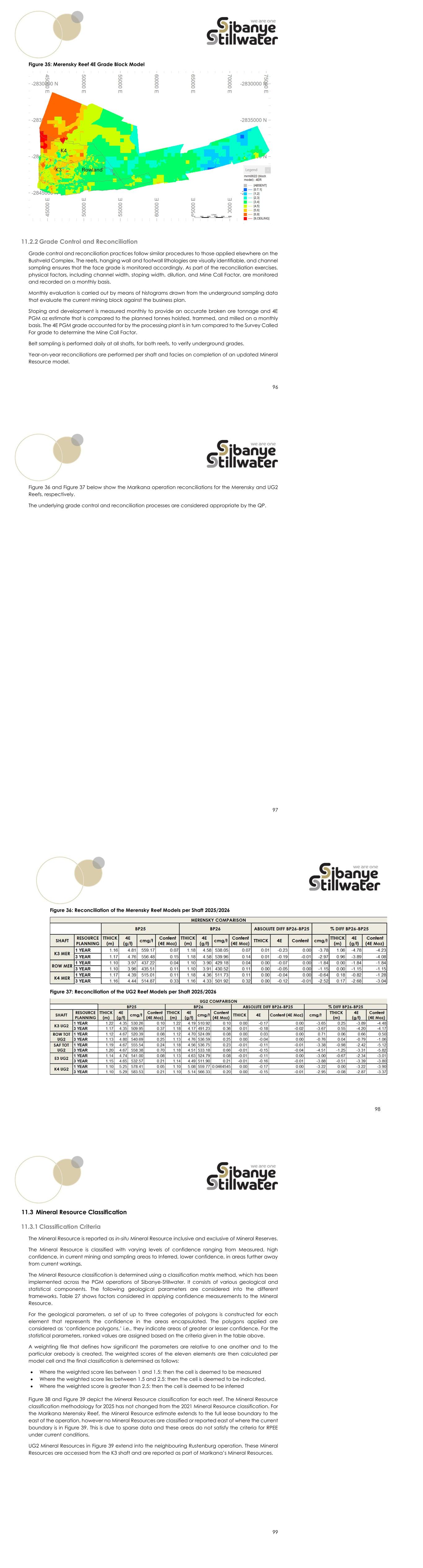
96 Figure 35: Merensky Reef 4E Grade Block Model 11.2.2 Grade Control and Reconciliation Grade control and reconciliation practices follow similar procedures to those applied elsewhere on the Bushveld Complex. The reefs, hanging wall and footwall lithologies are visually identifiable, and channel sampling ensures that the face grade is monitored accordingly. As part of the reconciliation exercises, physical factors, including channel width, stoping width, dilution, and Mine Call Factor, are monitored and recorded on a monthly basis. Monthly evaluation is carried out by means of histograms drawn from the underground sampling data that evaluate the current mining block against the business plan. Stoping and development is measured monthly to provide an accurate broken ore tonnage and 4E PGM oz estimate that is compared to the planned tonnes hoisted, trammed, and milled on a monthly basis. The 4E PGM grade accounted for by the processing plant is in turn compared to the Survey Called For grade to determine the Mine Call Factor. Belt sampling is performed daily at all shafts, for both reefs, to verify underground grades. Year-on-year reconciliations are performed per shaft and facies on completion of an updated Mineral Resource model. 97 Figure 36 and Figure 37 below show the Marikana operation reconciliations for the Merensky and UG2 Reefs, respectively. The underlying grade control and reconciliation processes are considered appropriate by the QP. 98 Figure 36: Reconciliation of the Merensky Reef Models per Shaft 2025/2026 Figure 37: Reconciliation of the UG2 Reef Models per Shaft 2025/2026 99 11.3 Mineral Resource Classification 11.3.1 Classification Criteria The Mineral Resource is reported as in-situ Mineral Resource inclusive and exclusive of Mineral Reserves. The Mineral Resource is classified with varying levels of confidence ranging from Measured, high confidence, in current mining and sampling areas to Inferred, lower confidence, in areas further away from current workings. The Mineral Resource classification is determined using a classification matrix method, which has been implemented across the PGM operations of Sibanye-Stillwater. It consists of various geological and statistical components. The following geological parameters are considered into the different frameworks. Table 27 shows factors considered in applying confidence measurements to the Mineral Resource. For the geological parameters, a set of up to three categories of polygons is constructed for each element that represents the confidence in the areas encapsulated. The polygons applied are considered as ‘confidence polygons,’ i.e., they indicate areas of greater or lesser confidence. For the statistical parameters, ranked values are assigned based on the criteria given in the table above. A weighting file that defines how significant the parameters are relative to one another and to the particular orebody is created. The weighted scores of the eleven elements are then calculated per model cell and the final classification is determined as follows: • Where the weighted score lies between 1 and 1.5: then the cell is deemed to be measured • Where the weighted score lies between 1.5 and 2.5: then the cell is deemed to be indicated, • Where the weighted score is greater than 2.5: then the cell is deemed to be inferred Figure 38 and Figure 39 depict the Mineral Resource classification for each reef. The Mineral Resource classification methodology for 2025 has not changed from the 2021 Mineral Resource classification. For the Marikana Merensky Reef, the Mineral Resource estimate extends to the full lease boundary to the east of the operation, however no Mineral Resources are classified or reported east of where the current boundary is in Figure 39. This is due to sparse data and these areas do not satisfy the criteria for RPEE under current conditions. UG2 Mineral Resources in Figure 39 extend into the neighbouring Rustenburg operation. These Mineral Resources are accessed from the K3 shaft and are reported as part of Marikana’s Mineral Resources.

100 Table 27: Confidence Levels for Key Criteria for Mineral Resource Classification Items Discussion Confidence Aeromagnetic survey Aeromagnetic data is available, and data appears of reasonable quality and has been derived from internationally recognised and procedures and techniques High Seismic interpretation Seismic data is available, and data appears of reasonable quality and has been derived from internationally recognised and procedures and techniques High Structural model Stratigraphic definition and delineation are considered of reasonable quality. Major structures identified High Geozones (Facies) interpretation Facies definition and delineation are considered of reasonable quality. Major changes to facies model were identified High Geological Loss estimates Geological loss estimates are considered of reasonable quality and have been derived from internationally recognised procedures and techniques. Major structures are accounted for, and historical actuals form the basis of calculations High Historical data Available data appears of reasonable quality and has been derived from internationally recognised and procedures and techniques High Assay - QAQC QA/QC programme employed. QA/QC monitoring in place and regular follow ups occur with the mine laboratory Moderate Kriging variance Parameter is based on the standardised kriging variances (KV). Ranked values assigned are: where KV<0. 2, the ranked value is given a value of 1 (high confidence); where 0.2≤KV<0.4, a value of 2 is assigned; and where KV≥0.4, a value of 3 is applied (low confidence) Moderate Kriging efficiency Ranked values for kriging efficiency assigned are: where KE≥0.5, the ranked value is given a value of 1 (high confidence); where 0.3<KE<0.5, a value of 2 is assigned; and where KE≤ 0.3, a value of 3 is applied (low confidence) Moderate Search volume Ranked values assignment are: first search radii = 1 (high confidence); second search radii = 2; third search radii = 3 High Number of samples The range between the minimum and maximum number of samples is divided into three and assigned values of 1, 2 and 3 where 1 would represent the maximum number of samples interval High Regression slope Ranked values assigned are: where RS≥0.6 the ranked value is given a value of 1 (high confidence); where 0.2<RS<0.6, a value of 2 is assigned; and where RS≤0.2 a value of 3 is applied (low confidence) Moderate 101 Figure 38 : Mineral Resource Classification for the Marikana Merensky Reef 102 Figure 39: Mineral Resource Classification for the Marikana UG2 Reef 11.3.2 Mineral Resource Technical and Economic Factors 11.3.2.1 Mining Width and Geological Losses The minimum mining width, which represents the minimum practical selection unit, is dependent largely on the mining method and other mining constraints, including rock engineering. For conventional mining methods, the typical minimum mining width used is 110cm in the operating shafts and 205cm for mechanised mining methods at E4. The Mineral Resources are discounted for geological losses. Geological losses can be separated into known and unknown losses. Typically, faults and dykes, which have been positioned through various exploration/exposure methods, can be reasonably quantified as known losses and with high or medium degrees of confidence. Where the measurements become 103 conjectural, low confidence is assigned to these losses and would then form part of the unknown loss quantification. Geological losses for the Marikana operation Merensky and UG2 Reefs (Figure 40 and Figure 41) were estimated and signed off by the QP per geological loss domain for each shaft. Losses are estimated in the underground mining operations and are then projected into the future mining areas. Additional data sources that include aeromagnetic survey, seismic interpretation and drillhole information are also used for the projected loss estimated and are shown in Figure 41 for the UG2 Reef. In summary the total weighted average geological loss at Marikana operation is 10.66% and represents a 0.87% decrease from the previous year’s geological losses. Figure 40: Mineral Resource Geological Loss Factors for the Merensky Reef

104 Figure 41: Mineral Resource Geological Loss Factors for the UG2 Reef 11.3.2.2 Pay limits and Cut-off Grade Historically, the Marikana operation have not applied cut-off grades in their Mineral Resource estimation due to there being no opportunity for mining selectivity, given the relatively flat grade profile of the various orebodies. The ore bodies are laterally continuous and have persistent metal distribution profiles which have been used as the basis for reef identification, modelling, and exploitation. Mining volumes and costs, as opposed to grade, therefore is the main factors impacting economics. To illustrate the reasonable prospects for economic extraction (RPEE), cut-off grade calculations were made based on economic, mining and processing assumptions. The metal prices assumed in the calculation are the long-term prices (as at 2025) in Table 28. See Section 16.3 for a discussion on price determination. 105 Table 28: Commodity Price and Exchange Rate Assumptions for Cut-off Calculations 6E Metals Units Long Term Prices 2025 Platinum US$/oz 1,350 Palladium US$/oz 1,350 Rhodium US$/oz 5,000 Gold US$/oz 2,650 Iridium US$/oz 5,500 Ruthenium US$/oz 450 R/US$ 18.24 A basket price for the 6E metals was calculated by weighting each price by the metal’s contribution to the 6E value for each reef package per individual operation. The contribution of base metals was not considered (resulting in conservative outcomes) but will be considered in future. The prill splits used per operation are shown in Table 29. Table 29: 6E Prill Split Percentages Applied per Reef (proportional) Metal Merensky UG2 Surface (TSF) Platinum 0.57 0.48 0.47 Palladium 0.26 0.23 0.21 Rhodium 0.03 0.09 0.09 Gold 0.07 0.005 0.00 Iridium 0.01 0.04 0.04 Ruthenium 0.06 0.16 0.18 Selected cost parameters were used in the cut-off calculations and include mining assumptions below and in Section 12.4.2. The first factor used is the Resource to Reserve factor and is calculated by factoring in the percentage of grade lost in the conversion from Mineral Resource to Mineral Reserve grade. Typically, this would be due to dilution, Mine Call Factor and other modifying factors applied to the Mineral Resource. Concentrator recoveries used were based on 2025 actual figures per reef type, per operation and represent the average concentrator recovery for the total operation. Net smelter returns are assumed to be the same across the operations, although the material is processed at different facilities. Costs were assumed to be the same for both reef types. The parameters assumed for the cut-off calculation for the Merensky and UG2 packages are detailed in Table 30. 106 Table 30: Parameters Used in the Cut-off Calculation for the MR and UG2 Reef Operation Parameters Unit MER UG2 Surface Marikana Total Mining Cost R/t 1.241 1,241 432 Mining Recovery grade adjustment % 81 76 71 Plant Recovery % 87 87 27 Net smelter return % 99 99 99 MCF % 99 97 100 Based on the parameters assumed above the following cut-off grades were calculated for the Marikana operation (Table 31). The 6E PGM revenues were used in the cut-off grade calculation and a conversion factor of 1.23 for the UG2, 1.08 for the MR and 1.29 for the surface were used to derive at the 4E cut-off grade. Table 31: Cut-off Grades Calculated for the MER, UG2 Reef and Surface Operations Marikana MER UG2 Surface Cut-off grade (4E – g/t) 1.88 1.85 0.49 The Mineral Resource tonnes and metals available at the cut-off grades calculated are no different from what is obtained using no cut-off grade. The Merensky and UG2 Mineral Resources at Marikana have no tonnes or metals below the cut-off. Due to this, all available blocks are reported to have RPEE. 11.4 Mineral Resource Statements 11.4.1 Mineral Resources Mineral Resources are stated as Exclusive (Table 33 and Table 34) and Inclusive of Mineral Reserves (Table 35 and Table 36). Mineral Resources are for in-situ mineralisation (reference point) assessed to have reasonable prospects for economic extraction by the QP. The Mineral Resource as stated is not sensitive to changes in the PGM prices, nor the R/US$ exchange rates. Therefore, no sensitivity analysis has been completed for Mineral Resources. The 4E Prill Split for the Mineral Resources is given in Table 32. Table 32: 4E Prill Split Mineral Resources (Inclusive of Mineral Reserves) Prill Split Pt (%) Pd (%) Rh (%) Au (%) 31 Dec 2025 31 Dec 2021 31 Dec 2025 31 Dec 2021 31 Dec 2025 31 Dec 2021 31 Dec 2025 31 Dec 2021 Merensky 61.6 61.6 27.9 28.1 3.3 3.2 7.1 7.1 UG2 59.3 59.3 29.0 28.9 11.1 11.2 0.6 0.6 Combined (weighted average) 60.0 60.0 29.0 29.0 8.0 9.0 3.0 3.0 Surface 60.9 60.9 28.2 27.2 9.9 11.9 1.1 0.0 107 Notes on the Mineral Resource Tabulations: • Mineral Resources are not Mineral Reserves • Mineral Resources have been reported in accordance with the classification criteria of Subpart 1300 of Regulation S-K • Information on metal prices is found in Section 16.4 • Attributable Mineral Resource for 2025 is stated at an 80.64% legal interest • Due to non-selective mining, no cut-off grade is applied • Mineral Resources are reported after the removal of known and anticipated geological losses • Quantities and grades have been rounded to one decimal place • Technical and economic factors are discussed in Section 11.3.2 • Risks are discussed in Section 21 The QP is aware that there is a small, non-material discrepancy in the Mineral Resources exclusive of Mineral Reserves between the tonnage extracted from digital models and calculated by subtracting the Mineral Reserves. This is due to the methods of extracting information from the digital models. Marikana’s methodologies have not been set up to routinely do this calculation as historically Mineral Resources exclusive of Mineral Reserves were not required to be reported. The “missing” tonnes are pillars and other areas within the Mineral Reserve boundaries not converted to Mineral Reserves. Marikana has considered other methods for the reporting to give a more accurate estimate of Mineral Resources exclusive of Mineral Reserves however the current method gives the most stable results year- on-year and has been retained.

108 Table 33: Mineral Resources Exclusive of Mineral Reserves as at 31 December 2025 at 100% Classification – 4E 31-Dec-2025 31-Dec-2021 Tonnes Grade 4E Tonnes Grade 4E (Mt) (g/t) (Moz) (Mt) (g/t) (Moz) Underground Measured 62.4 4.1 8.2 59.2 3.9 7.5 Indicated 481.5 4.2 64.8 486.9 3.9 61.5 Measured + Indicated 544.0 4.2 73.0 546.1 3.9 69.0 Inferred 248.5 4.5 35.8 221.5 4.4 31.2 Total Underground 792.4 4.3 108.8 767.6 4.1 100.2 Surface TSF Indicated 3.1 1.2 0.1 0.0 0.0 0.0 Inferred 15.4 1.0 0.5 0.0 0.0 0.0 Total Surface 18.5 1.0 0.6 0.0 0.0 0.0 Total Mineral Resources 810.9 4.2 109.4 767.6 4.1 100.2 Table 34: Attributable Mineral Resource Exclusive of Mineral Reserves as at 31 December 2025 Classification – 4E 31-Dec-2025 31-Dec-2021 Tonnes Grade 4E Tonnes Grade 4E (Mt) (g/t) (Moz) (Mt) (g/t) (Moz) Underground Measured 50.4 4.1 6.6 47.4 3.8 5.8 Indicated 388.3 4.2 52.2 392.6 4.1 51.1 Measured + Indicated 438.7 4.2 58.8 440.3 4.0 57.0 Inferred 200.4 4.5 28.9 178.6 4.4 25.1 Total Underground 639.0 4.3 87.7 618.9 4.1 82.1 Surface TSF Indicated 2.5 1.2 0.1 0.0 0.0 0.0 Inferred 12.4 1.0 0.4 0.0 0.0 0.0 Total Surface 14.9 1.2 0.5 0.0 0.0 0.0 Total Mineral Resources 653.9 4.2 88.2 618.9 4.1 82.1 109 Table 35: Mineral Resources Inclusive of Mineral Reserves as at 31 December 2025 at 100% Classification – 4E 31-Dec-2025 31-Dec-2021 Tonnes Grade 4E Tonnes Grade 4E (Mt) (g/t) (Moz) (Mt) (g/t) (Moz) Underground Measured 93.9 4.2 12.6 90.8 4.2 12.3 Indicated 642.8 4.2 86.2 313.1 4.2 84.1 Measured + Indicated 736.7 4.2 98.8 717.0 4.2 96.4 Inferred 248.5 4.5 35.8 221.8 4.4 31.2 Total Underground 985.1 4.3 134.7 938.8 4.2 127.6 Surface TSF Indicated 57.2 0.9 1.7 10.5 1.2 0.4 Inferred 15.4 1.0 0.5 0.0 0.0 0.0 Total Surface 72.6 1.0 2.2 10.5 1.2 0.4 Total Mineral Resource 1,057.7 4.0 136.9 949.3 4.2 128.0 Table 36: Attributable Mineral Resource Inclusive of Mineral Reserves as at 31 December 2025 Classification – 4E 31-Dec-2025 31-Dec-2021 Tonnes Grade 4E Tonnes Grade 4E (Mt) (g/t) (Moz) (Mt) (g/t) (Moz) Underground Measured 75.7 4.2 10.2 73.3 4.2 35.8 Indicated 518.3 4.2 69.5 252.5 4.2 67.8 Measured + Indicated 594.0 4.2 79.7 578.2 4.2 77.7 Inferred 200.4 4.5 28.9 178.8 4.4 25.1 Total Underground 794.4 4.3 108.6 757.0 4.2 102.9 Surface TSF Indicated 46.1 0.9 1.4 8.4 1.2 0.3 Inferred 12.4 1.0 0.4 0.0 0.0 0.0 Total Surface 58.5 1.0 1.8 8.4 1.2 0.3 Total Resource 852.9 4.0 110.4 765.5 4.2 103.2 11.4.2 Mineral Resources per Mining Area (Inclusive of Mineral Reserves) Mineral Resource statements per mining area, inclusive and exclusive of Mineral Reserves at 31 December 2025 are given in Table 37 and Table 38. 4B shaft is currently on Care and Maintenance (C&M). The remaining Mineral Resources will be transferred to K3 in the future. 4B Shaft Mineral Reserves have been depleted as per the LoM scheduling and timing. Projects include all other areas outside of operations, and C&M. 110 Table 37: Mineral Resource Exclusive of Mineral Reserves per Mining Area as at 31 December 2025 at 100% Mining Area Measured Indicated Inferred Tonnes (Mt) 4E Grade (g/t) 4E PGM (Moz) Tonnes (Mt) 4E Grade (g/t) 4E PGM (Moz) Tonnes (Mt) 4E Grade (g/t) 4E PGM (Moz) K3 11.9 4.5 1.7 7.3 3.9 0.9 0.1 5.3 0.0 Rowland 8.6 4.4 1.2 37.1 5.0 5.9 10.9 4.4 1.5 Saffy 2.0 4.6 0.3 4.5 4.7 0.7 0.0 0.0 0.0 E3 1.8 4.5 0.3 0.3 4.4 0.0 0.0 0.0 0.0 K4 2.2 4.7 0.3 26.3 5.2 4.4 1.4 9.2 0.4 E4 17.6 2.9 1.7 0.0 2.9 0.5 0.3 2.9 0.0 C&M Shafts 9.9 4.5 1.4 9.3 4.9 1.4 2.4 4.1 0.3 Projects 8.4 3.4 1.3 396.8 4.0 50.8 233.4 4.5 33.5 Total Underground 62.4 4.1 8.2 481.5 4.2 64.8 248.5 4.5 35.8 Total: Surface TSF 0.0 0.0 0.0 3.1 1.2 0.1 15.4 1.0 0.5 Grand Total (Underground and Surface) 62.4 4.1 8.2 484.6 4.2 64.9 263.9 4.3 36.3 Table 38: Mineral Resource Inclusive of Mineral Reserves per Mining Area as at 31 December 2025 at 100% Mining Area Measured Indicated Inferred Tonnes (Mt) 4E Grade (g/t) 4E PGM (Moz) Tonnes (Mt) 4E Grade (g/t) 4E PGM (Moz) Tonnes (Mt) 4E Grade (g/t) 4E PGM (Moz) K3 14.6 4.5 2.1 19.0 3.9 2.4 0.1 5.2 0.0 Rowland 15.4 4.5 2.2 41.5 5.0 6.6 10.9 4.3 1.5 Saffy 7.2 4.5 1.0 60.4 3.9 7.5 0.0 0.0 0.0 E3 6.6 4.5 1.0 0.3 4.4 0.0 0.0 0.0 0.0 K4 12.8 4.9 2.0 105.9 5.1 17.5 1.4 9.2 0.4 E4 20.6 2.9 2.0 41.9 2.9 3.9 0.3 2.9 0.0 C&M Shafts 9.9 4.5 1.4 9.3 4.9 1.4 2.4 4.1 0.3 Projects 6.8 4.2 0.9 364.5 4.0 46.7 233.4 4.5 33.5 Total Underground 93.9 4.2 12.6 642.8 4.2 86.2 248.4 4.5 35.8 Total: Surface TSF 0.0 0.0 0.0 57.2 0.9 1.7 15.4 1.0 0.5 Grand Total (Underground and Surface) 93.9 4.2 12.6 699.9 3.9 87.9 263.8 4.3 36.3 111 11.4.3 Changes in the Mineral Resources from Previous Estimates (Inclusive of Mineral Reserves) The 2025 estimation varies from the 2021 as shown in the waterfall graph (Figure 42) Mineral Resource depletion due to mining is 3.9Moz. The 14.2Moz in area inclusions is due to the addition of areas within the Schaapkraal Prospecting Right in 2023 (11.1Moz) and two TSF Resources in 2024 (2.2Moz). Changes due to geological losses, interpretation of geology, and changes to the estimation and classification parameters resulted in a decrease of 1.0Moz.It is not possible to fully separate changes only to the exclusive Mineral Resources as geology, methodology, rock engineering, pillars and economic parameters are global estimates and cannot be localised to only exclusive Mineral Resources. The Mineral Resource classification considers relevant sources of uncertainty see Section 11.3 for a more detailed discussion. The portion attributable to other stakeholders (third party) is 26.5Moz in 2025. Figure 42: Marikana operation Mineral Resource Reconciliation 11.4.4 Metal Equivalents All estimates are presented as 4E comprising various proportions of platinum, palladium, rhodium, and gold. This is discussed in detail in Section 11.3.2 and the proportions are presented in Table 32, Section 11.4.1. All estimates are for individual metals and not metal equivalents.

112 11.5 QP Opinion The Mineral Resources declared are estimated based on the geological facies and structure, and constrained by appropriate geostatistical techniques, using Ordinary Kriging. The Mineral Resource classification follows sound and reasonable geostatistical and geological guidelines. The Mineral Resources are declared inside the structurally defined blocks and outside of the mined-out areas. No cut-off grade is applied. The underlying grade control and reconciliation processes are considered appropriate. It is the QP’s opinion that all uncertainties relating to any technical or economic factors that could likely influence the condition of RPEE have been addressed or can be resolved with further work. 12 Mineral Reserve Estimates This section includes discussion and comments on the conversion of Mineral Resources to Mineral Reserves. Specifically, comments are given on the mine planning process, historical production from the last five years, cut-off grades and modifying factors, Life-of Mine- plan (LoM) and specific inclusions and exclusions. The Mineral Reserves statement includes the global Mineral Reserves and Mineral Reserves per shaft, as well as comments on the sensitivity of the Mineral Reserves to cut-off grades, pay-limits, and input costs. Mining methods and Infrastructure are discussed in Sections 13 and 15. A map of the LoM layout is found in Section 13.9. Commodity pricing and financial information are found in Sections 16, 18 and 19. Section 12.4.2 and Table 41 and Table 43. provides details of the LoM plan from 2026 to 2070. Table 44 and Table 45 present the E4 portion of the LoM plan contained within the full plan. Final mine layouts for each reef are given in Figure 46 and Figure 47 in Section 12.7. 12.1 Mineral Reserve Methodology The mining unit is the shaft and its Mineral Resources. Mine planning is done on 100m block sizes. There is no block selection using a cut-off grade in the Mineral Reserve classification. The following factors are considered in aggregate for mine planning and Mineral Reserve • Mining • Metallurgical • Processing • Infrastructural • Economic • Marketing • Legal and • Environmental, social, and governmental factors Mineral Reserve classification follows from the Mineral Resource classification i.e., Proven Mineral Reserves are derived from Measured Mineral Resources, Probable Mineral Reserves are derived from 113 Indicated Mineral Resources and no Inferred Mineral Resources are included in the LoM plan or converted to Mineral Reserves. 12.2 Mine Planning Process The reported Mineral Resources and Mineral Reserves are derived through a comprehensive annual operational planning process. The annual planning process is cyclical, starting in January and running through to December. It begins with a review of the previous LoM plans and the development of strategic plans based on that portion of the Mineral Resource for which technical and economic studies have demonstrated justified extraction at the time of disclosure, to a minimum pre-feasibility study (PFS) level. Strategic plan directives, parameters, and factors are issued to guide the operations. An analysis of the historical performance is done to assist with the development of realistic productivity and cost parameters and modifying factors. All mine design and planning is based on the latest available geological and Mineral Resource models. Mineral Resource classification categories guide and constrain the mining layouts. Measured and Indicated Mineral Resources typically get converted to Proven and Probable Mineral Reserves respectively, but additional mining risk can be factored in and used to downgrade Mineral Reserve confidence. The annual operational plan is based on detailed monthly scheduling and zero-based costing. All underground mine design, sequencing, scheduling and evaluation is done using appropriate 3D software applications. Once detailed 12-month production profiles, operating and capital cost estimates, and the required stay-in-business capital estimates to sustain the business have been prepared, these are extended to five-year and LoM production schedules. Multi-disciplinary review processes are conducted at stage-gate intervals during the planning process. During these reviews, mining, support and technical departments are involved in the verification of the inputs and the modifying factors that are incorporated into the business plan. Ultimately, all business and LoM plans are approved by both the relevant regional management team, as well as the Group executives. Technical economic modelling is undertaken using a discounted cash-flow approach. The detailed one-year operating budget is used to determine cost drivers, down to shaft level, which are then applied to the remainder of the LoM plan. Sensitivities are calculated based on a range of commodity prices and operating and capital costs to assess the robustness of the plan. The financial and technical assumptions underlying the Mineral Resources and Mineral Reserves estimations contained in this report are current as at 31 December 2025. Such assumptions rely on various factors that may change after the reporting period, including as a result of operational reviews which Sibanye-Stillwater undertakes from time to time and when necessary. 12.3 Historical Mining Parameters The planning parameters applied are primarily based on historical achievements. Table 17 provides the historical mining performance for Marikana, where mining expenditures are stated in nominal terms. Historical mining statistics for the shafts from 2021 to 2025, as well as historical averages are provided in Table 39: 114 Table 39: Historical Mining Statistics by Section Shaft Units 2021 2022 2023 2024 2025 K3 Primary Reef Development (m) 23,167 24,233 26,296 30,107 27,160 Primary Waste Development (m) 7,574 8,208 7,703 7,045 6,648 Stoping Square metres (m2) 357,850 307,446 282,577 301,242 311,202 Tonnes Milled (kt) 2,075 1,862 1,857 1,999 2,014 4E ounces Metal in Concentrate (oz) 223,724 183,494 179,264 191,564 190,088 Rowland Primary Reef Development (m) 19,253 11,624 9,519 5,169 2,119 Primary Waste Development (m) 5,715 6,183 7,287 6,039 3,657 Stoping Square metres (m2) 238,535 202,817 193,483 155,149 156,431 Tonnes Milled (kt) 1,298 1,111 1,019 791 790 4E ounces Metal in Concentrate (oz) 137,571 112,861 102,234 79,157 76,132 Saffy Primary Reef Development (m) 10,271 8,686 7,216 5,777 4,954 Primary Waste Development (m) 5,348 6,022 5,975 6,066 5,831 Stoping Square metres (m2) 301,314 307,124 324,033 314,278 263,289 Tonnes Milled (kt) 1,852 1,896 1,967 1,915 1,689 4E ounces Metal in Concentrate (oz) 10,271 8,686 204,923 207,382 176,342 E3 Primary Reef Development (m) 2,377 1,581 2,681 2,601 2,575 Primary Waste Development (m) 1,383 1,485 1,564 1,367 1,059 Stoping Square metres (m2) 108,281 106,179 93,671 104,989 106,956 Tonnes Milled (kt) 622 603 567 614 628 4E ounces Metal in Concentrate (oz) 67,762 61,039 55,930 64,000 64,621 K4 Primary Reef Development (m) K4 is a new section there is no previous mining 3,718 3,046 3,780 Primary Waste Development (m) 8,465 9,192 9,179 Stoping Square metres (m2) 58,552 142,627 194,251 Tonnes Milled (kt) 308 718 979 4E ounces Metal in Concentrate (oz) 24,960 70,661 99,605 115 Shaft Units 2021 2022 2023 2024 2025 Total Underground Marikana operation Primary Reef Development (m) 58,169 50,461 51,370 46,853 40,588 Primary Waste Development (m) 21,553 27,284 31,884 29,794 26,374 Stoping Square metres (m2) 1,187,440 1,072,330 1,045,392 1,037,564 1,032,129 Tonnes Milled (kt) 6,801 6,315 6,253 6,135 6,101 4Eoz Metal in Concentrate (oz) 718,030 626,632 611,293 620,502 606,790 12.4 Shaft Modifying Factors 12.4.1 Paylimits and Cut-off Grades • No pay limits or mining cut-off grades are applied to the Mineral Reserves. There is no mining selectivity based on the grades applied at any of the shafts at Marikana operation • Costs for the LoM plan were derived from the actual 2025 costs, the current year’s operational business plan and projected forward using the required production profile. Costs used in the operational plan have been benchmarked against current costs with adjustments made for inflation and labour costs • Long term prices used in the Mineral Reserves are given in Section 16.3 • With the Merensky and UG2 Reefs having low grade variability, all available blocks are reported to be mined, and essentially a blanket mining approach is applied • Refer to Section 11.3.2.2 for more information on paylimits and cut-off grades 12.4.2 Other Modifying Factors Table 40 provides details of the historical and projected mining modifying factors. Table 41 and Table 43 present the LoM plan which includes the newly planned E4 decline and the ETD2 tailings dam. Table 44 and Table 45 show the LoM contribution of the newly planned E4 decline. The ETD2 tailings dam contributes approximately half of the total tonnage for the surface operations. Mining dilution is catered for in the Mineral Resources compositing (Section 11.1.1) and provision in the Modifying factors (Table 40). Recovery factors are given in Section 14.
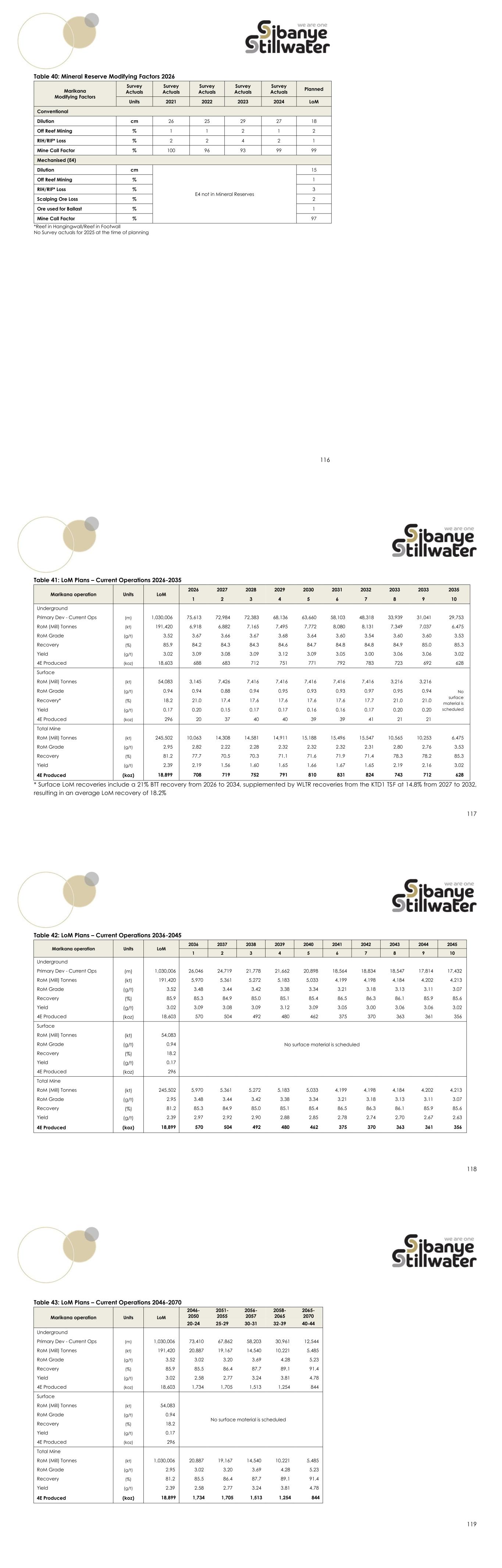
116 Table 40: Mineral Reserve Modifying Factors 2026 Marikana Modifying Factors Survey Actuals Survey Actuals Survey Actuals Survey Actuals Survey Actuals Planned Units 2021 2022 2023 2024 LoM Conventional Dilution cm 26 25 29 27 18 Off Reef Mining % 1 1 2 1 2 RIH/RIF* Loss % 2 2 4 2 1 Mine Call Factor % 100 96 93 99 99 Mechanised (E4) Dilution cm E4 not in Mineral Reserves 15 Off Reef Mining % 1 RIH/RIF* Loss % 3 Scalping Ore Loss % 2 Ore used for Ballast % 1 Mine Call Factor % 97 *Reef in Hangingwall/Reef in Footwall No Survey actuals for 2025 at the time of planning 117 Table 41: LoM Plans – Current Operations 2026-2035 Marikana operation Units LoM 2026 2027 2028 2029 2030 2031 2032 2033 2033 2035 1 2 3 4 5 6 7 8 9 10 Underground Primary Dev - Current Ops (m) 1,030,006 75,613 72,984 72,383 68,136 63,660 58,103 48,318 33,939 31,041 29,753 RoM (Mill) Tonnes (kt) 191,420 6,918 6,882 7,165 7,495 7,772 8,080 8,131 7,349 7,037 6,475 RoM Grade (g/t) 3.52 3.67 3.66 3.67 3.68 3.64 3.60 3.54 3.60 3.60 3.53 Recovery (%) 85.9 84.2 84.3 84.3 84.6 84.7 84.8 84.8 84.9 85.0 85.3 Yield (g/t) 3.02 3.09 3.08 3.09 3.12 3.09 3.05 3.00 3.06 3.06 3.02 4E Produced (koz) 18,603 688 683 712 751 771 792 783 723 692 628 Surface RoM (Mill) Tonnes (kt) 54,083 3,145 7,426 7,416 7,416 7,416 7,416 7,416 3,216 3,216 No surface material is scheduled RoM Grade (g/t) 0.94 0.94 0.88 0.94 0.95 0.93 0.93 0.97 0.95 0.94 Recovery* (%) 18.2 21.0 17.4 17.6 17.6 17.6 17.6 17.7 21.0 21.0 Yield (g/t) 0.17 0.20 0.15 0.17 0.17 0.16 0.16 0.17 0.20 0.20 4E Produced (koz) 296 20 37 40 40 39 39 41 21 21 Total Mine RoM (Mill) Tonnes (kt) 245,502 10,063 14,308 14,581 14,911 15,188 15,496 15,547 10,565 10,253 6,475 RoM Grade (g/t) 2.95 2.82 2.22 2.28 2.32 2.32 2.32 2.31 2.80 2.76 3.53 Recovery (%) 81.2 77.7 70.5 70.3 71.1 71.6 71.9 71.4 78.3 78.2 85.3 Yield (g/t) 2.39 2.19 1.56 1.60 1.65 1.66 1.67 1.65 2.19 2.16 3.02 4E Produced (koz) 18,899 708 719 752 791 810 831 824 743 712 628 * Surface LoM recoveries include a 21% BTT recovery from 2026 to 2034, supplemented by WLTR recoveries from the KTD1 TSF at 14.8% from 2027 to 2032, resulting in an average LoM recovery of 18.2% 118 Table 42: LoM Plans – Current Operations 2036-2045 Marikana operation Units LoM 2036 2037 2038 2039 2040 2041 2042 2043 2044 2045 1 2 3 4 5 6 7 8 9 10 Underground Primary Dev - Current Ops (m) 1,030,006 26,046 24,719 21,778 21,662 20,898 18,564 18,834 18,547 17,814 17,432 RoM (Mill) Tonnes (kt) 191,420 5,970 5,361 5,272 5,183 5,033 4,199 4,198 4,184 4,202 4,213 RoM Grade (g/t) 3.52 3.48 3.44 3.42 3.38 3.34 3.21 3.18 3.13 3.11 3.07 Recovery (%) 85.9 85.3 84.9 85.0 85.1 85.4 86.5 86.3 86.1 85.9 85.6 Yield (g/t) 3.02 3.09 3.08 3.09 3.12 3.09 3.05 3.00 3.06 3.06 3.02 4E Produced (koz) 18,603 570 504 492 480 462 375 370 363 361 356 Surface No surface material is scheduled RoM (Mill) Tonnes (kt) 54,083 RoM Grade (g/t) 0.94 Recovery (%) 18.2 Yield (g/t) 0.17 4E Produced (koz) 296 Total Mine RoM (Mill) Tonnes (kt) 245,502 5,970 5,361 5,272 5,183 5,033 4,199 4,198 4,184 4,202 4,213 RoM Grade (g/t) 2.95 3.48 3.44 3.42 3.38 3.34 3.21 3.18 3.13 3.11 3.07 Recovery (%) 81.2 85.3 84.9 85.0 85.1 85.4 86.5 86.3 86.1 85.9 85.6 Yield (g/t) 2.39 2.97 2.92 2.90 2.88 2.85 2.78 2.74 2.70 2.67 2.63 4E Produced (koz) 18,899 570 504 492 480 462 375 370 363 361 356 119 Table 43: LoM Plans – Current Operations 2046-2070 Marikana operation Units LoM 2046- 2050 2051- 2055 2056- 2057 2058- 2065 2065- 2070 20-24 25-29 30-31 32-39 40-44 Underground Primary Dev - Current Ops (m) 1,030,006 73,410 67,862 58,203 30,961 12,544 RoM (Mill) Tonnes (kt) 191,420 20,887 19,167 14,540 10,221 5,485 RoM Grade (g/t) 3.52 3.02 3.20 3.69 4.28 5.23 Recovery (%) 85.9 85.5 86.4 87.7 89.1 91.4 Yield (g/t) 3.02 2.58 2.77 3.24 3.81 4.78 4E Produced (koz) 18,603 1,734 1,705 1,513 1,254 844 Surface No surface material is scheduled RoM (Mill) Tonnes (kt) 54,083 RoM Grade (g/t) 0.94 Recovery (%) 18.2 Yield (g/t) 0.17 4E Produced (koz) 296 Total Mine RoM (Mill) Tonnes (kt) 1,030,006 20,887 19,167 14,540 10,221 5,485 RoM Grade (g/t) 2.95 3.02 3.20 3.69 4.28 5.23 Recovery (%) 81.2 85.5 86.4 87.7 89.1 91.4 Yield (g/t) 2.39 2.58 2.77 3.24 3.81 4.78 4E Produced (koz) 18,899 1,734 1,705 1,513 1,254 844
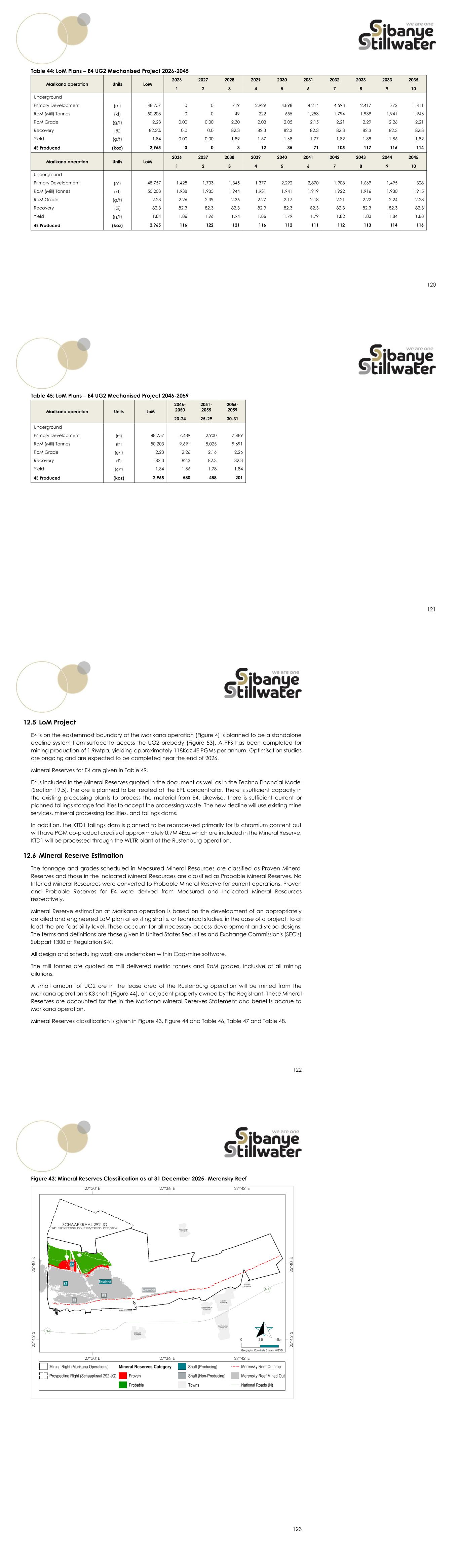
120 Table 44: LoM Plans – E4 UG2 Mechanised Project 2026-2045 Marikana operation Units LoM 2026 2027 2028 2029 2030 2031 2032 2033 2033 2035 1 2 3 4 5 6 7 8 9 10 Underground Primary Development (m) 48,757 0 0 719 2,929 4,898 4,214 4,593 2,417 772 1,411 RoM (Mill) Tonnes (kt) 50,203 0 0 49 222 655 1,253 1,794 1,939 1,941 1,946 RoM Grade (g/t) 2.23 0.00 0.00 2.30 2.03 2.05 2.15 2.21 2.29 2.26 2.21 Recovery (%) 82.3% 0.0 0.0 82.3 82.3 82.3 82.3 82.3 82.3 82.3 82.3 Yield (g/t) 1.84 0.00 0.00 1.89 1.67 1.68 1.77 1.82 1.88 1.86 1.82 4E Produced (koz) 2,965 0 0 3 12 35 71 105 117 116 114 Marikana operation Units LoM 2036 2037 2038 2039 2040 2041 2042 2043 2044 2045 1 2 3 4 5 6 7 8 9 10 Underground Primary Development (m) 48,757 1,428 1,703 1,345 1,377 2,292 2,870 1,908 1,669 1,495 328 RoM (Mill) Tonnes (kt) 50,203 1,938 1,935 1,944 1,931 1,941 1,919 1,922 1,916 1,930 1,915 RoM Grade (g/t) 2.23 2.26 2.39 2.36 2.27 2.17 2.18 2.21 2.22 2.24 2.28 Recovery (%) 82.3 82.3 82.3 82.3 82.3 82.3 82.3 82.3 82.3 82.3 82.3 Yield (g/t) 1.84 1.86 1.96 1.94 1.86 1.79 1.79 1.82 1.83 1.84 1.88 4E Produced (koz) 2,965 116 122 121 116 112 111 112 113 114 116 121 Table 45: LoM Plans – E4 UG2 Mechanised Project 2046-2059 Marikana operation Units LoM 2046- 2050 2051- 2055 2056- 2059 20-24 25-29 30-31 Underground Primary Development (m) 48,757 7,489 2,900 7,489 RoM (Mill) Tonnes (kt) 50,203 9,691 8,025 9,691 RoM Grade (g/t) 2.23 2.26 2.16 2.26 Recovery (%) 82.3 82.3 82.3 82.3 Yield (g/t) 1.84 1.86 1.78 1.84 4E Produced (koz) 2,965 580 458 201 122 12.5 LoM Project E4 is on the easternmost boundary of the Marikana operation (Figure 4) is planned to be a standalone decline system from surface to access the UG2 orebody (Figure 53). A PFS has been completed for mining production of 1.9Mtpa, yielding approximately 118Koz 4E PGMs per annum. Optimisation studies are ongoing and are expected to be completed near the end of 2026. Mineral Reserves for E4 are given in Table 49. E4 is included in the Mineral Reserves quoted in the document as well as in the Techno Financial Model (Section 19.5). The ore is planned to be treated at the EPL concentrator. There is sufficient capacity in the existing processing plants to process the material from E4. Likewise, there is sufficient current or planned tailings storage facilities to accept the processing waste. The new decline will use existing mine services, mineral processing facilities, and tailings dams. In addition, the KTD1 tailings dam is planned to be reprocessed primarily for its chromium content but will have PGM co-product credits of approximately 0.7M 4Eoz which are included in the Mineral Reserve. KTD1 will be processed through the WLTR plant at the Rustenburg operation. 12.6 Mineral Reserve Estimation The tonnage and grades scheduled in Measured Mineral Resources are classified as Proven Mineral Reserves and those in the Indicated Mineral Resources are classified as Probable Mineral Reserves. No Inferred Mineral Resources were converted to Probable Mineral Reserve for current operations. Proven and Probable Reserves for E4 were derived from Measured and Indicated Mineral Resources respectively. Mineral Reserve estimation at Marikana operation is based on the development of an appropriately detailed and engineered LoM plan at existing shafts, or technical studies, in the case of a project, to at least the pre-feasibility level. These account for all necessary access development and stope designs. The terms and definitions are those given in United States Securities and Exchange Commission's (SEC's) Subpart 1300 of Regulation S-K. All design and scheduling work are undertaken within Cadsmine software. The mill tonnes are quoted as mill delivered metric tonnes and RoM grades, inclusive of all mining dilutions. A small amount of UG2 ore in the lease area of the Rustenburg operation will be mined from the Marikana operation’s K3 shaft (Figure 44), an adjacent property owned by the Registrant. These Mineral Reserves are accounted for the in the Marikana Mineral Reserves Statement and benefits accrue to Marikana operation. Mineral Reserves classification is given in Figure 43, Figure 44 and Table 46, Table 47 and Table 48. 123 Figure 43: Mineral Reserves Classification as at 31 December 2025- Merensky Reef

124 Figure 44: Mineral Reserves Classification as at 31 December 2025- UG2 Reef 125 12.7 Surface Sources Surface sources refer to low-grade, processed materials, from a Tailings Storage Facility (TSF) at the Marikana operation. The surface source being ETD2. 12.8 Mineral Reserves Statement The Mineral Reserve is declared separately for underground and surface sources. The 4E Prill Split for the Mineral Reserves is given in Table 46. The Mineral Reserves are provided in Table 47 and Table 48. Mineral Reserves per shaft are given in Table 49 and Table 50. Figure 45 shows the main changes year on year are due to various factors. Notes on the Mineral Reserves; • All Mineral Reserves are quoted as of 31 December 2025 • Mineral Reserves are attributable at 80.64% • Mineral Reserve was reported in accordance with the classification criteria of Regulation S-K 1300 • All Mineral Reserves are quoted in terms of the expected RoM grades and tonnage as delivered to the metallurgical processing facilities, and therefore the quantities reported account for dilution and mineral loss • Mineral Reserve statements are based on only Measured and Indicated Mineral Resources, modified to produce Mineral Reserves • All Mineral Reserves are evaluated to at least a Pre-Feasibility level of accuracy with cost estimates given in Sections 18 and 19 • Mineral Reserve was estimated on all blocks accessible from the infrastructure and no cut-off grade was applied as explained in Section 12.4.1 • Recoveries are dependent on the material type and processing stream. Recoveries are discussed in Section 14 • Where Au grade is less than 0.05g/t the value will reflect as zero (0) in the table • Where Au is less than 0.05Moz the value will reflect as zero (0) in the table • Mineral Reserves are estimated using the prices in in Section 16.4 • Risks are discussed in Section 21.1.2 126 Table 46: 4E Prill Split and Recovery for Mineral Reserves Prill Split Pt (%) Pd (%) Rh (%) Au (%) Recovery (%) 31 Dec 2025 31 Dec 2021 31 Dec 2025 31 Dec 2021 31 Dec 2025 31 Dec 2021 31 Dec 2025 31 Dec 2021 31 Dec 2025 31 Dec 2021 Merensky 61.6 61.6 27.9 28.1 3.3 3.2 7.1 7.1 88% 88% UG2* 59.3 59.3 29.0 28.9 11.1 11.2 0.6 0.6 83% 84% Combined** (weighted average) 60.2 60.3 28.6 28.6 8.2 8.2 3.1 3.2 85% 86% Surface** 60.2 60.2 28.6 28.6 8.2 8.2 3.1 3.1 25% 25% *Prill split for E4 is the same as for the current operating shafts **The combined average for Merensky and UG2 Reefs and the tailings dam prill split are the same, this is not a typing error 127 Table 47: Mineral Reserve as at 31 December 2025 at 100% Classification – 4E Tonnes (Mt) 4E Grade (g/t) 4E (Moz) 31 Dec 25 31 Dec 21 31 Dec 25 31 Dec 21 31 Dec 25 31 Dec 21 Underground Operating Shafts Proven 34.2 28.0 3.8 3.9 4.2 3.6 Probable 107.0 140.3 4.0 4.1 13.9 18.5 Total Underground 141.2 168.3 4.0 4.1 18.0 22.0 Underground E4 UG2 Mechanised Project Proven 3.0 0.0 2.1 0.0 0.2 0.0 Probable 47.2 0.0 2.2 0.0 3.4 0.0 Total Underground - E4 50.2 0.0 2.2 0.0 3.6 0.0 Total Underground Proven 37.3 28.0 3.7 3.9 4.4 3.6 Probable 154.2 140.3 3.5 4.1 17.3 18.5 Total Underground 191.4 168.3 3.5 4.1 21.6 22.0 Surface TSF Proven TSF 0.0 0.0 0.0 0.0 0.0 0.0 Probable TSF 54.1 10.5 0.9 0.9 1.6 0.3 Total Surface 54.1 10.5 0.9 0.9 1.6 0.3 Total Proven 37.3 28.0 3.7 3.9 4.4 3.6 Total Probable 208.2 150.8 2.8 3.9 18.9 18.8 Total Mineral Reserve 245.5 178.8 2.9 3.9 23.3 22.3
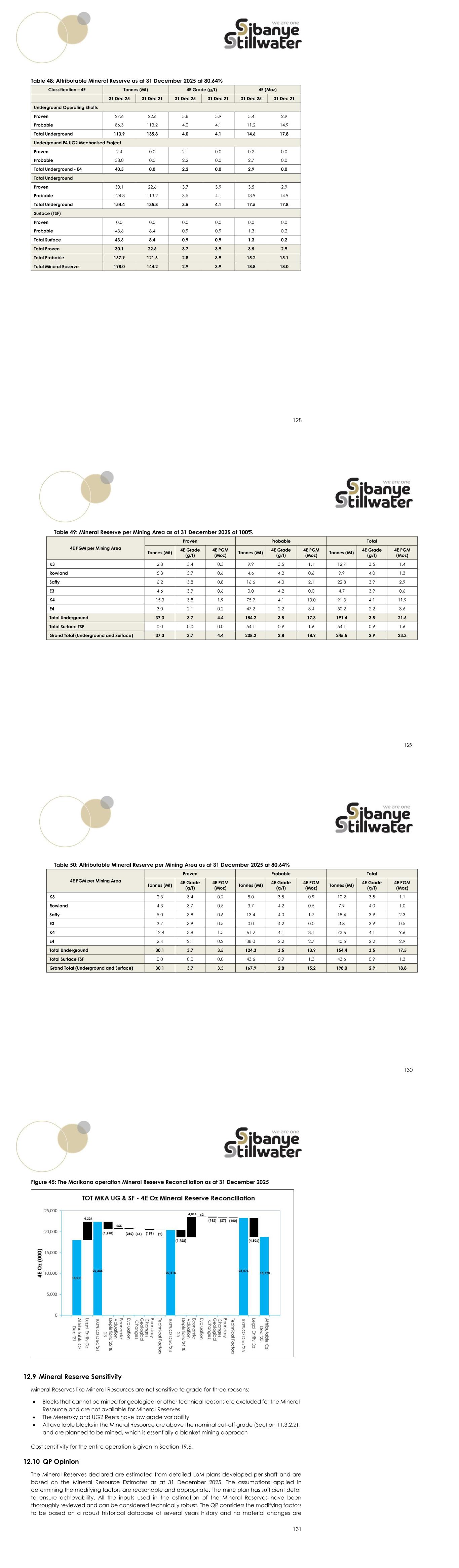
128 Table 48: Attributable Mineral Reserve as at 31 December 2025 at 80.64% Classification – 4E Tonnes (Mt) 4E Grade (g/t) 4E (Moz) 31 Dec 25 31 Dec 21 31 Dec 25 31 Dec 21 31 Dec 25 31 Dec 21 Underground Operating Shafts Proven 27.6 22.6 3.8 3.9 3.4 2.9 Probable 86.3 113.2 4.0 4.1 11.2 14.9 Total Underground 113.9 135.8 4.0 4.1 14.6 17.8 Underground E4 UG2 Mechanised Project Proven 2.4 0.0 2.1 0.0 0.2 0.0 Probable 38.0 0.0 2.2 0.0 2.7 0.0 Total Underground - E4 40.5 0.0 2.2 0.0 2.9 0.0 Total Underground Proven 30.1 22.6 3.7 3.9 3.5 2.9 Probable 124.3 113.2 3.5 4.1 13.9 14.9 Total Underground 154.4 135.8 3.5 4.1 17.5 17.8 Surface (TSF) Proven 0.0 0.0 0.0 0.0 0.0 0.0 Probable 43.6 8.4 0.9 0.9 1.3 0.2 Total Surface 43.6 8.4 0.9 0.9 1.3 0.2 Total Proven 30.1 22.6 3.7 3.9 3.5 2.9 Total Probable 167.9 121.6 2.8 3.9 15.2 15.1 Total Mineral Reserve 198.0 144.2 2.9 3.9 18.8 18.0 129 Table 49: Mineral Reserve per Mining Area as at 31 December 2025 at 100% 4E PGM per Mining Area Proven Probable Total Tonnes (Mt) 4E Grade (g/t) 4E PGM (Moz) Tonnes (Mt) 4E Grade (g/t) 4E PGM (Moz) Tonnes (Mt) 4E Grade (g/t) 4E PGM (Moz) K3 2.8 3.4 0.3 9.9 3.5 1.1 12.7 3.5 1.4 Rowland 5.3 3.7 0.6 4.6 4.2 0.6 9.9 4.0 1.3 Saffy 6.2 3.8 0.8 16.6 4.0 2.1 22.8 3.9 2.9 E3 4.6 3.9 0.6 0.0 4.2 0.0 4.7 3.9 0.6 K4 15.3 3.8 1.9 75.9 4.1 10.0 91.3 4.1 11.9 E4 3.0 2.1 0.2 47.2 2.2 3.4 50.2 2.2 3.6 Total Underground 37.3 3.7 4.4 154.2 3.5 17.3 191.4 3.5 21.6 Total Surface TSF 0.0 0.0 0.0 54.1 0.9 1.6 54.1 0.9 1.6 Grand Total (Underground and Surface) 37.3 3.7 4.4 208.2 2.8 18.9 245.5 2.9 23.3 130 Table 50: Attributable Mineral Reserve per Mining Area as at 31 December 2025 at 80.64% 4E PGM per Mining Area Proven Probable Total Tonnes (Mt) 4E Grade (g/t) 4E PGM (Moz) Tonnes (Mt) 4E Grade (g/t) 4E PGM (Moz) Tonnes (Mt) 4E Grade (g/t) 4E PGM (Moz) K3 2.3 3.4 0.2 8.0 3.5 0.9 10.2 3.5 1.1 Rowland 4.3 3.7 0.5 3.7 4.2 0.5 7.9 4.0 1.0 Saffy 5.0 3.8 0.6 13.4 4.0 1.7 18.4 3.9 2.3 E3 3.7 3.9 0.5 0.0 4.2 0.0 3.8 3.9 0.5 K4 12.4 3.8 1.5 61.2 4.1 8.1 73.6 4.1 9.6 E4 2.4 2.1 0.2 38.0 2.2 2.7 40.5 2.2 2.9 Total Underground 30.1 3.7 3.5 124.3 3.5 13.9 154.4 3.5 17.5 Total Surface TSF 0.0 0.0 0.0 43.6 0.9 1.3 43.6 0.9 1.3 Grand Total (Underground and Surface) 30.1 3.7 3.5 167.9 2.8 15.2 198.0 2.9 18.8 131 Figure 45: The Marikana operation Mineral Reserve Reconciliation as at 31 December 2025 12.9 Mineral Reserve Sensitivity Mineral Reserves like Mineral Resources are not sensitive to grade for three reasons: • Blocks that cannot be mined for geological or other technical reasons are excluded for the Mineral Resource and are not available for Mineral Reserves • The Merensky and UG2 Reefs have low grade variability • All available blocks in the Mineral Resource are above the nominal cut-off grade (Section 11.3.2.2), and are planned to be mined, which is essentially a blanket mining approach Cost sensitivity for the entire operation is given in Section 19.6. 12.10 QP Opinion The Mineral Reserves declared are estimated from detailed LoM plans developed per shaft and are based on the Mineral Resource Estimates as at 31 December 2025. The assumptions applied in determining the modifying factors are reasonable and appropriate. The mine plan has sufficient detail to ensure achievability. All the inputs used in the estimation of the Mineral Reserves have been thoroughly reviewed and can be considered technically robust. The QP considers the modifying factors to be based on a robust historical database of several years history and no material changes are
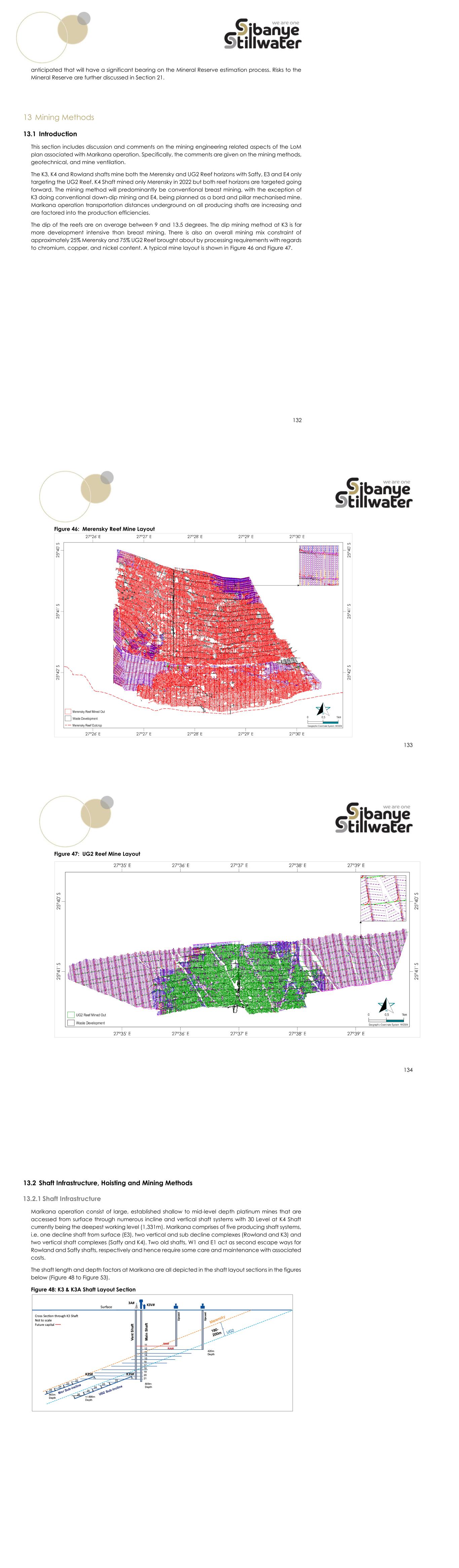
132 anticipated that will have a significant bearing on the Mineral Reserve estimation process. Risks to the Mineral Reserve are further discussed in Section 21. 13 Mining Methods 13.1 Introduction This section includes discussion and comments on the mining engineering related aspects of the LoM plan associated with Marikana operation. Specifically, the comments are given on the mining methods, geotechnical, and mine ventilation. The K3, K4 and Rowland shafts mine both the Merensky and UG2 Reef horizons with Saffy, E3 and E4 only targeting the UG2 Reef. K4 Shaft mined only Merensky in 2022 but both reef horizons are targeted going forward. The mining method will predominantly be conventional breast mining, with the exception of K3 doing conventional down-dip mining and E4, being planned as a bord and pillar mechanised mine. Marikana operation transportation distances underground on all producing shafts are increasing and are factored into the production efficiencies. The dip of the reefs are on average between 9 and 13.5 degrees. The dip mining method at K3 is far more development intensive than breast mining. There is also an overall mining mix constraint of approximately 25% Merensky and 75% UG2 Reef brought about by processing requirements with regards to chromium, copper, and nickel content. A typical mine layout is shown in Figure 46 and Figure 47. 133 Figure 46: Merensky Reef Mine Layout 134 Figure 47: UG2 Reef Mine Layout 13.2 Shaft Infrastructure, Hoisting and Mining Methods 13.2.1 Shaft Infrastructure Marikana operation consist of large, established shallow to mid-level depth platinum mines that are accessed from surface through numerous incline and vertical shaft systems with 30 Level at K4 Shaft currently being the deepest working level (1,331m). Marikana comprises of five producing shaft systems, i.e. one decline shaft from surface (E3), two vertical and sub decline complexes (Rowland and K3) and two vertical shaft complexes (Saffy and K4). Two old shafts, W1 and E1 act as second escape ways for Rowland and Saffy shafts, respectively and hence require some care and maintenance with associated costs. The shaft length and depth factors at Marikana are all depicted in the shaft layout sections in the figures below (Figure 48 to Figure 53). Figure 48: K3 & K3A Shaft Layout Section

136 Figure 49: Rowland Shaft Layout Section Figure 50: Saffy Shaft Layout Section 137 Figure 51: E3 Shaft Layout Section Figure 52: K4 Shaft Layout Section 138 Figure 53: E4 Proposed Shaft Layout Section 13.2.2 Hoisting The hoisting capacities of the shafts are given in Table 51. Unconstrained capacity is the maximum capacity of the shaft. The constrained capacity is the reduced capacity due to load shifting. Load shifting reduces the available capacity by reducing the operating hours. This is done to reduce power costs by not operating during peak power grid hours. Table 51: Hoisting Capacities of the Marikana Shafts Shaft Operating Capacity (ktpm) 5-year Avg. Planned Production (tpm) K3 Shaft 200 174 Rowland Shaft 200 78 Saffy Shaft 200 153 E3 Shaft 80 48 K4 Shaft 225 135 E4* 160/200* Ramp up to 160 *Pre-feasibility Study values. Option to increase throughput to 200ktpm 13.2.3 Mining Methods The mining method to be used is dependent on the ground conditions and structural complexity within each shaft block area. No backfilling is used on underground operations. There are no open pit operations. For dip mining the primary waste footwall haulages are developed on strike approximately 20m to 25m below the reef with crosscuts 70m apart. The reef is accessed from a short cross-cut through an inclined travelling way. The stope preparation drives (SPDs) connect the raises which are developed on the reef along dip to connect to the level above. The raises are the main access to the stopes and are used for removing broken ore to the tip at the bottom of each mining block. On the dip layout each raise has an ore-pass in the footwall haulage. On a dip layout ore is extracted from two 14m wide half panels on 139 either side of the raise allowing throw blasting for optimised cleaning. Mining blocks are separated by dip pillars with pillar width increasing with depth below surface. For breast mining, footwall haulages are placed deeper in the footwall in order to accommodate a cross-cut and short travelling way to reef, per raise line. In this layout the ore-passes are placed in the cross-cut. Raises are placed 200m apart. Breast stoping panels are generally 28m in length and are advanced on strike away from the raises in either one or both directions. Ore is removed with winch driven scrapers via advanced strike gullies which connect the panels to the raise. Panels are separated by strike pillars which have designed ventilation holings. Stope width for conventional mining averages around 1.4m and handheld pneumatic rock drills with air legs are used for stope face drilling and ore is cleaned to the tips with conventional winch driven scrapers and transported to the main tips on each mining level with rail bound equipment. Figure 54: Schematic Diagram of the Underground Mining Layout For bord and pillar mining (typically either mechanised or hybrid), decline shaft barrels are developed on-reef, from the identified access points/reef outcrops on surface (Figure 55). The barrels are developed on the dip or apparent dip of the reef, until strike mining sections have been exposed for stoping operations. Once the required infrastructure is installed to support strike mining, ledging and stoping operations commence. E4 is designed as a six-barrel decline shaft system, positioned on a 9º apparent dip, there is a disused open-pit at the planned access location which can be used to access the orebody. Mining is planned to a depth of 650m, with stoping operations planned at 160kt per month. Stoping width on bord and pillar ranges between 2.0m and 2.4m, allowing sufficient access space for mechanised machinery. Mechanised drill-rigs and bolters are planned to be used at E4. Ore will be removed from the faces using mechanised LHD machines. It will then be moved to surface via a conveyor belt system. Ore will be trucked to the EPL concentrator.

140 Figure 55: East 4 Proposed Bord and Pillar Layout 13.3 Geotechnical Analysis The TRS has been compiled with input from qualified rock engineers. Strategic planning and major design issues were completed with the relevant input from the responsible rock engineers. The primary aspects making up the geotechnical analysis are geotechnical conditions, stress and seismological setting, and regional and local support. 13.3.1 Geotechnical Conditions Major structures/fault zones intersect the orebody at most of the shafts. Structures of note are: • Saffy and E3 – There is a major parting plane above the reef which forms a critical beam that ranges from 3.0m to 20.0m in thickness. This plane determines the support design of limited panel spans as well as the use of grout packs as primary in-stope support on these shafts • Marikana fault – West boundary of Rowland Shaft and east of K3 and 4B shafts • Spruitfontein fault – Situated towards the west of the K3 block and east of 4B. This structure affects both reef horizons • Elandsdrift fault – On the east boundary of Rowland shaft • Hossy Dyke – North of Rowland shaft Mitigation strategies are in place for these structures; these include lower mining rates, bracket pillars, secondary and tertiary support, increasing support density as well as decreasing panel spans near these structures. 13.3.2 Stress and Seismological setting Major seismicity from fault/dyke slip or pillar failure/punching at any of the shafts has not occurred. The pillar system employed at current mining depths is such that seismicity from this source is highly unlikely. 141 However, as mining ventures deeper, there is a necessity to install appropriate seismic monitoring systems that are capable of locating seismic events. These have been installed for Saffy, Rowland, K3 and K4 shafts. 13.3.3 Regional and Local Support The MCOP details and guides the rock engineering discipline in the production of detailed designs based on the parameters contained in the previous sections. The purpose of regional support systems is to reduce volumetric closure, compartmentalise stopes by limiting excessive spans, and reduce the Energy Release Rate (ERR). Stabilising pillars are required to provide efficient regional support. The stabilising pillars can take the form of either geological losses or reef pillars, which will influence the extraction ratio. Limited research has been done into the design of stabilising regional pillars for the platinum industry, and the design principles applied in the South African gold mining industry are therefore applied and adapted and is considered to be as appropriate as possible. The Marikana operation employs a “stable” rigid pillar system up to a mining depth of approximately 700mbs. These in-stope pillars support both the local hanging wall beams and act as regional support in that they carry the overburden rock mass to the surface. The pillar sizes are span dependent and increase/decrease in width proportionally to an increase/decrease in the designed inter-pillar span. At approximately 700m depth and below, pillars become inefficient in that the behaviour thereof can no longer be accurately predicted. The pillars therefore become very large, posing a seismic risk and entrapping large volumes of ore resulting in sub economic mining. Mining with rigid pillars is only considered to the depth where crush pillar mining can safely be employed. Inter-pillar spans are determined by means of beam analysis. The beam theories applied are: • Voussoir beam theory • Tensile height Cognisance is taken of dead weight layers and where applicable, cantilever effects. Inter-pillar spans are designed to be self-supporting as far as possible before introducing in-stope support (MCOP). At Saffy and E3 shafts the mining layout is based on breast and updip panels with 27m inter pillar spans and strike or dip-oriented pillars planned at 14m lengths and 5m to 7m widths, with 2m wide holings for ventilation purposes. At K3 shaft the mining layout is based on breast and dip panels consisting of 30m long panels with 16m x 20m pillars with 2m x 3m holings in the Merensky section; and 30m panels with 14m x 20m pillars with 2m x 3m holings in the UG2 section within a rigid pillar environment from 11 level to 23 level. From 24 level to 27 level the mining layout is based on breast and dip panels consisting of 30m long panels with crush pillars and regularly spaced regional dip pillars up to 28m wide and spaced 240m apart on strike. At Rowland shaft the mining layout is based on breast and down-dip panels with 30m inter pillar spans on the UG2 and 32m inter-pillar spans on the Merensky reef with crush pillars and regularly spaced regional dip pillars up to 18m in width and spaced 200m apart on strike. 142 At E4 the mining layout is based on a bord and pillar design, with strike bords planned at 8m and dip bords planned at 8m widths. Bord widths for all sinking and primary development sections are planned at 7.3m. The pillar dimensions of the bord and pillar design ranges from 7.5m x 6.5m on the upper sections of the mine, to 11.5m x 8.5m for the deeper sections. 13.4 Mine Ventilation All projects and new infrastructure designs incorporate detailed ventilation modelling and associated recommendations as part of the standard feasibility and planning processes. All underground mines are subdivided into defined ventilation districts to ensure effective control of airflow distribution. For conventional mining operations, the ventilation design is based on achieving a minimum airflow velocity of 0.25m/s, in line with legal requirements. E4 has been designed as a trackless mining operation, incorporates a higher design velocity of 1.0m/s. This measure adequately dilute diesel particulate matter and exhaust gases while maintaining safe working conditions. 13.5 Refrigeration and Cooling Due to the high geothermal gradient of the BC, the resulting elevated virgin rock temperatures necessitate the use of ventilation, refrigeration, and cooling systems. Ventilation modelling is applied to determine the required ventilation, refrigeration, and cooling capacities to ensure compliance with legal standards and to maintain safe, healthy, and environmentally acceptable underground working conditions. Within the Marikana complex, K4 is the only mine equipped with an operational refrigeration and bulk air‑cooling plant. Based on current ventilation modelling and thermal conditions, no refrigeration or cooling systems are required for the other mines in the complex. 13.6 Flammable Gas Management Sporadic flammable gas intersections are encountered across the shafts. These occurrences are effectively managed through the procedures outlined in the Flammable Gas Mandatory Code of Practice. Continuous gas measuring instruments are utilised to detect both flammable and noxious gases. In addition, an extensive telemetry system, equipped with fixed Carbon Monoxide (CO) sensors installed at strategic locations throughout the operations, provides early detection of CO. 13.7 Mine Equipment The following major mine equipment (Table 52) is installed and utilised at the Marikana conventional operations. A detailed equipment list is not currently available as the planning is still at the pre-feasibility stage. E4 will be similar to E3 and the declines at the neighbouring Rustenburg operation. 143 Table 52: Major Mine Equipment Major Equipment Quantity Locos 208 Chairlifts 6 Winches 2,280 Rock Winder 4 Emergency Generators 19 Trackless Mobile Machinery 45 Decline Winders 4 Loaders 217 Main Pumps 37 Man Winders 5 Surface Conveyors 23 Surface Vent Fans 19 Transformers 164 U/G Conveyors 19 Surface & U/G Sub Stations 89 Service Winder 5 Mini Subs 218 Koepe Winder 3 Headgear Lift 4 Decline Conveyors 9 Ventilation Fans 18 13.8 Personnel Requirements Personnel requirements and related information are available in Sections 4.5 and 17.2. 13.9 Final Layout Map See Section 12.6 and Figure 43 and Figure 44 for the distribution of Mineral Reserves and mined out areas. 14 Processing and Recovery Methods This section covers the metallurgical and mineral processing aspects associated with Marikana. Specifically, details and comment are provided on the process metallurgy and process engineering

144 aspects relating to plant capacity, metallurgical performance and metal accounting practices as incorporated in the LoM plan. 14.1 Processing Facilities All metallurgical processes and technology in place at the ore processing, smelting and refining facilities (Figure 56). E4 is designed to use existing processing facilities. The EPL and EPC concentrator are planned to receive the RoM Processing facilities are appropriate, well-proven and aligned to norms and practices in the SA PGM sector. The processing methods were selected on the basis of test work carried out as part of feasibility studies at the time. However, the results of the test work have been superseded by actual operational data and experience accumulated over several years of continuous successful operation of these facilities. Ore is processed at four out of eight concentrators, two concentrators are on C&M and a further two are treating tailings material. The concentrate is delivered as a slurry to the smelter. The smelter filters, dries, and melts the concentrate in order to extract PGMs and base metals from the gangue material. The smelter produces a converter matte that contains the extracted PGMs and base metals. The converter matte is processed at the Base Metal Refinery (BMR)to separate the base metals (Ni and Cu) from the PGMs. The PGM concentrate from the Base Metal Refinery is processed at the Precious Metals Refinery (PMR) where it is refined into the individual PGM metals (Pt, Pd, Au, Rh, Ru & Ir). Chromite is separated from the PGM and base metals concentrate at the concentrators and sent to a different processing stream. Marikana has all necessary processes in place to source for material locally and internationally if required. Thus there is no shortage of process material anticipated. Figure 56: Schematic Diagram of the Overall Process Flowsheet 145 14.2 Concentrators The Marikana operation has eight concentrators. Four of the concentrators treat underground material and two of the concentrators treat surface or tailings material. A further two are on C&M. The concentrators are identified as follows: • K3 Mix (underground ore) • K3 UG2 (underground ore) • K4 (underground ore) • EPL (underground ore) • BTT (tailings treatment) • ETTP (tailings treatment) • Rowland (C&M) • EPC (care and maintenance C&M) The K3 mixed and K3 UG2 reef concentrators are situated within the same geographical area. They are considered a single entity from a management, reporting and costing perspective, but they are regarded as two different concentrators from a metallurgical perspective. The concentrators typically treat Merensky, UG2 or a blend (mix) of Merensky and UG2 Reef. The blend of material fed to the concentrators can be adjusted to meet operational requirements. The concentrators all employ a similar flowsheet. A primary mill-float with a secondary mill-float configuration is followed by multi-stage cleaning of the primary and secondary rougher concentrates. Each plant produces a high-grade concentrate from the primary flotation circuit and a low-grade concentrate from the secondary flotation circuit. The concentrates are mixed together prior to dispatch to the smelter. The valuable constituents of these concentrates are the PGMs and associated base metals. Some of the concentrating plants have a crushing circuit where the ore is broken down to –20mm. This crushed ore is fed into a primary mill where it is ground into fine slurry. Other concentrating plants feed RoM ore directly into the primary milling stage. The resulting slurry is fed through a series of flotation and milling stages. The tailings from all of the UG2 concentrators are fed into chrome recovery plants where chromite concentrate is extracted using spiral gravity separation as well as magnetic separation technology. The resulting concentrate is sold under contract to our customers for further beneficiation. Tailings are thickened prior to disposal to the TSF where the solid material is settled, and the clear water is decanted and returned to the concentrator plant. Plant Capacities are listed in Table 53. The major process equipment installed and utilised at the Marikana Concentrators. Is listed in Table 54. 146 Table 53: Plant Capacities at the Marikana operation Concentrators Plant Design Capacity (ktpm) Current Operation Capacity(ktpm) Average Recovery Factor (%) Material Treated K3 Mixed (Karee A) 140 140 87.9 Merensky K3 UG2 120 125 86.0 UG2 EPL 180 194 80.0 UG2 K4 125 117 86.9 Merensky and UG2 EPC Care and Maintenance BTT 300 300 21.0 Historic Tailings ETTP 274 192 32.0 Current arising tailings Smelting and Refining Planned feed capacity (t/m) Achieved operational capacity (t/m) Average three-year recovery factor (%) Material Treated Smelter 13,133 11,689 104 Concentrate and filter cake from various internal and external plants BMR 416 370 99 Smelter Converter Matte PMR 4 3 100 BMR PGM Concentrate Table 54: Major Process Equipment Utilised at Concentrators Major Equipment Quantity 11 kv 1 20 MVA Transformers 4 35 Ton Cranes 3 Air blowers 4 Air compressors 2 Auto claves horizontal 3 Auto claves vertical 2 Ball Mills 19 Boilers 4 Compressors 17 Cone crusher 5 Convertors 3 Conveyors 11 Flotation cells 300 Furnaces 5 Generators 4 Hot Gas Generator 1 147 Major Equipment Quantity Induction Furnace 2 ISA mill 1 Jaw crushers 3 Linear screens 2 Main Fans 2 Main Generator 1 Mill gearboxes 2 Mill motors 2 Mud guns 4 Plc 7 Pressure Vessels 40 Samco Pumps 100 Scrubbers 3 Silos 4 Strapping Band Machine 1 Tanks Stainless 30 Thickeners 28 Transformers 33 Vacuum Pumps 4 Vent & Extraction Fans 7 Vibrating feeders 8 Vibrating screens 2 Weighbridge 2 Wet Gas Fans 2

148 14.2.1 K3 Mix Concentrator 14.2.1.1 Process Description The K3 Mix concentrator (Figure 57) mainly processes material from the K3, Rowland and K4 Shafts. RoM material is milled in the primary mill in order to reduce the particle size and liberate the PGMs. The primary mill discharge slurry is pumped to the primary roughers where some of the PGMs are recovered in the flotation concentrate. The tails from the primary roughers are milled in a secondary milling step to further liberate the PGMs. The secondary mill discharge slurry is pumped to a secondary rougher flotation circuit. The tails from the secondary rougher are thickened and transferred to the Karee TSF. Concentrates from the primary and secondary roughers are pumped to the primary cleaners for further upgrading. The tails from the primary cleaners are pumped to the secondary cleaners for additional PGM recovery. The secondary cleaner tails report to the TSF. The primary and secondary cleaner concentrates are thickened, before being pumped into slurry tankers and transferred to the smelter. Figure 57: A Simplified Block Flow Diagram of K3 Mix Concentrator 14.2.1.2 Plant Capacity The K3 Mix concentrator capacity is shown in Table 53. 14.2.1.3 Production Plan The recent production history and operational parameters for the K3 Mix concentrator are presented in Table 55, Figure 58 and Figure 59. The 2021 to 2025 data presented reflect the actual annual performance whilst the 2026 to 2070 data represent current LoM planning. The current operational 149 methods and capacities are adequate. Metallurgical efficiencies projected have also been sustainably obtained historically and are thus reasonable targets. Table 55: K3 Mix Concentrator Production Forecast and Operational Data (2021-2070) Parameter Actual LoM 2021 2022 2023 2024 2025 2026 2027 2028 2029 2030 2031 2032 2033 Total Feed (kt) 1,726 1,552 1,310 1,037 13,38 1,825 1,782 1,685 1,729 16,41 1,474 1,414 1,37 6 Head Grade (g/t) 3.42 3.10 3.05 3.08 3.16 3.51 3.48 3.49 3.57 3.64 3.75 3.79 3.95 Concentrate Produced (kt) 38 19 33 25 32 42 41 39 40 38 34 33 32 4E Recovery (%) 89 88 87 87 86 88 88 88 88 88 89 89 89 4E Metal Produced (koz) 167 136 111 89 117 181 175 166 174 169 157 153 156 Parameter LoM 2034 2035 2036 2037 2038 2039 2040 2041 2042 2043 2044 2045 2046 Total Feed (kt) 1,348 1,366 1,355 1,335 1,307 1,267 1,277 1,249 1,203 1,195 1,185 1,188 1,19 2 Head Grade (g/t) 4.12 4.13 4.16 4.18 4.16 4.26 4.28 4.26 4.13 3.95 3.81 3.66 3.62 Concentrate Produced (kt) 31 31 31 31 30 29 29 29 28 27 27 27 27 4E Recovery (%) 90 90 90 90 90 90 90 90 90 89 89 88 88 4E Metal Produced (koz) 160 163 163 161 157 156 158 154 143 135 129 123 122 Parameter LoM 2047 2048 2049 2050 2051 2052 2053 2054 2055 2056 2057 2058 2059 Total Feed (kt) 1,179 1,166 1,161 1,158 1,158 1,154 1,150 1,155 1,152 1,155 1,154 1,158 1,15 6 Head Grade (g/t) 3.57 3.51 3.50 3.55 3.78 3.90 3.97 4.18 4.34 4.30 4.44 4.47 4.44 Concentrate Produced (kt) 27 27 27 27 27 27 26 27 26 27 27 27 27 4E Recovery (%) 88 88 88 88 89 89 89 90 90 90 90 90 90 4E Metal Produced (koz) 119 115 115 116 125 129 131 139 145 143 149 150 149 Parameter LoM 2060 2061 2062 2063 2064 2065 2066 2067 2068 2069 2070 Total Feed (kt) 1,168 1,154 1,138 1,131 1,123 11,18 1,026 998 819 711 601 Head Grade (g/t) 4.58 4.66 4.55 4.58 4.66 4.73 4.77 5.14 5.71 6.32 6.40 Concentrate Produced (kt) 27 27 26 26 26 26 24 23 19 16 14 4E Recovery (%) 91 91 91 91 91 91 91 92 92 92 92 4E Metal Produced (koz) 156 157 151 151 153 155 143 151 139 135 115 150 Figure 58: K3 Mix Concentrator Throughput Forecast Figure 59: K3 Mix Concentrator Production and Recovery Forecast 151 14.2.1.4 Personnel Requirements The K3 Mix and K3 UG2 concentrators are situated within the same geographical area. They are considered a single entity from a management, reporting, and costing perspective. The K3 Mix and K3 UG2 concentrators have a combined work force complement of 98 employees. The concentrator utilises four teams on rotating shifts. Employees consist of processors, responsible for operating the plant, as well as artisans and maintenance staff who maintain all plant equipment. 14.2.1.5 Energy Requirements The K3 Mix concentrator receives electricity from the 33kV Karee substation. 14.2.1.6 Water Requirements The K3 Mix concentrator has a water positive balance. The K3 Mix concentrator water balance consists of tailings return water, Buffelspoort water, water from old UG2 open pits, as well as the use of Rand Water Board for potable water and reagents. 14.2.2 K3 UG2 Concentrator 14.2.2.1 Process Description The K3 UG2 concentrator (Figure 60) mainly processes material from the K3 Shaft. RoM material is milled in the primary mill in order to reduce the particle size and liberate the PGMs. The primary mill discharge slurry is pumped to the primary roughers where some of the PGMs are recovered in the flotation concentrate. The tails from the primary roughers is milled in a secondary milling step to further liberate the PGMs. The secondary mill discharge slurry is pumped to a secondary rougher flotation circuit. The tails from the secondary rougher is thickened and transferred to a chrome recovery plant, which is operated by an independent company. The associated chrome recovery plant utilises a spiral gravity concentration circuit to produce a chromite concentrate. The remaining tailings is transferred to the Karee TSF. Concentrate from the primary and secondary roughers are pumped to the primary cleaners for further upgrading. The tails from the primary cleaners is pumped to the secondary cleaners for additional PGM recovery. The secondary cleaner tails report to the TSF. The primary and secondary cleaner concentrate is thickened, before being pumped into slurry tankers and transferred to the smelter.

152 Figure 60: A Simplified Block Flow Diagram of K3 UG2 Concentrator 14.2.2.2 Plant Capacity The K3 UG2 concentrator capacity is shown in Table 53. 14.2.2.3 Production Plan The recent history and operational parameters for the K3 UG2 concentrator are presented in Table 56, Figure 61 and Figure 62. The presented 2021 to 2025 data reflect the actual annual performance while the 2026 to 2036 data represent current LoM planning. The current operational methods and capacities are adequate. The projected metallurgical efficiencies have also been sustainably obtained historically and are thus reasonable targets. 153 Table 56: K3 UG2 Concentrator Production Forecast and Operational Data (2021-2036) Parameter Actual LoM 2021 2022 2023 2024 2025 2026 2027 2028 2029 2030 2031 2032 2033 Total Feed (kt) 1,513 1,381 1,252 1,264 1,244 1,495 1,528 1,553 1,575 1,508 1,396 1,077 893 Head Grade (g/t) 3.94 3.67 3.60 3.62 3.56 3.42 3.42 3.47 3.49 3.49 3.51 3.53 3.62 Concentrate Produced (kt) 18 18 16 17 16 19 19 19 20 19 17 13 11 4E Recovery (%) 87 87 86 86 86 86 86 86 86 86 86 86 87 4E Metal Produced (koz) 159 141 125 127 122 141 144 149 152 146 136 105 90 Parameter LoM 2034 2035 2036 Total Feed (kt) 758 516 384 Head Grade (g/t) 3 3.44 3.45 Concentrate Produced (kt) 9 6 5 4E Recovery (%) 86 86 86 4E Metal Produced (koz) 73 49 37 Figure 61: K3 UG2 Concentrator Throughput Forecast 154 Figure 62: K3 UG2 Concentrator Production and Recovery Forecast 14.2.2.4 Personnel Requirements The K3 Mix and K3 UG2 concentrators are situated within the same geographical area. They are considered a single entity from a management, reporting and costing perspective. The K3 Mix and K3 UG2 concentrators have a combined workforce complement of 98 employees. The concentrator utilises four teams on rotating shifts. Employees consist of processors, responsible for operating the plant, as well as artisans and maintenance staff who maintain all plant equipment. 14.2.2.5 Energy Requirements The K3 UG2 concentrator receives electricity from the 33kV Karee substation. 14.2.2.6 Water Requirements The K3 UG2 concentrator has a water positive balance. The K3 concentrator water balance consists of tailings return water, Buffelspoort water, water from UG2 pits, as well as the use of Rand Water Board for potable water and reagents. 155 14.2.3 EPL Concentrator 14.2.3.1 Process Description The EPL concentrator (Figure 63) mainly processes material from the Saffy, E3 and Rowland Shafts. Ore for E4 is planned to be processed at EPL from 2028/2029. The EPL concentrator utilises a number of crushing steps to reduce the ore size to less than 20mm. The crushed product is transferred to the primary mill in order to reduce the particle size further and liberate the PGMs. The primary mill discharge slurry is pumped to the primary roughers where some of the PGMs are recovered in the flotation concentrate. The tails from the primary roughers is milled in a secondary milling step. The secondary mill discharge slurry is pumped to a secondary rougher flotation circuit. The tails from the secondary rougher is transferred to a chrome recovery plant, which is operated by an independent company. The chrome recovery plant utilises a spiral gravity concentration circuit to produce a chromite concentrate. The tailings from this process is pumped to the ETTP concentrator where some of the remaining PGMs are recovered. Concentrate from the primary and secondary roughers are pumped to the primary cleaners for further upgrading. The tails from the primary cleaners is pumped to a stirred media detritor (SMD), which further grinds the tails and allows for additional PGMs to be recovered. The product from the SMD is pumped to the secondary cleaner circuit where additional PGMs are recovered. The secondary cleaner tails runs in closed circuit and is circulated to the rougher circuit for further recovery of PGMs. The primary and secondary cleaner concentrates are thickened, before being pumped into slurry tankers and transferred to the smelter.

156 Figure 63: A Simplified Block Flow Diagram of EPL Concentrator 14.2.3.2 Plant Capacity The EPL concentrator capacity is shown in Table 53. 14.2.3.3 Production Plan The recent history and operational parameters for the EPL concentrator are presented in Table 57, Figure 64 and Figure 65. The 2021to 2025 data presented reflects the actual annual performance whilst the 2026 to 2045 data represent current LoM planning. The current operational methods and capacities are adequate. Metallurgical efficiencies projected have also been sustainably obtained historically and are thus reasonable targets. 157 Table 57: EPL Concentrator Production Forecast and Operational Data (2021-2045) Parameter Actual LoM 2021 2022 2023 2024 2025 2026 2027 2028 2029 2030 2031 2032 2033 Total Feed (kt) 2,209 2,481 2,511 2,515 2,317 2,494 2,338 2,422 2,385 2,412 2,318 2,201 2,180 Head Grade (g/t) 4.22 4.01 3.97 4.13 4.03 3.88 3.82 3.81 3.85 3.90 3.94 3.98 4.04 Concentrate Produced (kt) 22 26 28 28 26 27 26 27 26 27 25 24 24 4E Recovery (%) 80 80 81 81 80 80 80 80 80 80 80 81 81 4E Metal Produced (koz) 240 257 259 270 241 249 229 237 236 242 236 227 229 Parameter LoM 2034 2035 2036 2037 2038 2039 2040 2041 2042 2043 2044 2045 Total Feed (kt) 1,956 1,678 1,362 1,210 1,070 989 806 656 581 439 248 56 Head Grade (g/t) 4.05 4.06 4.04 4.02 4.00 4.01 4.04 4.08 4.14 4.18 4.25 4.05 Concentrate Produced (kt) 22 18 15 13 12 11 9 7 6 5 3 0.6 4E Recovery (%) 81 81 81 81 81 81 81 81 81 81 81 81 4E Metal Produced (koz) 206 177 143 126 111 103 85 70 63 48 28 6 158 Figure 64: EPL Concentrator Throughput Forecast 159 Figure 65: EPL Concentrator Production and Recovery Forecast 14.2.3.4 Personnel Requirements The EPL concentrator has a workforce complement of 121 employees. The concentrator utilises four teams on rotating shifts. Employees consist of processors, responsible for operating the plant, as well as artisans and maintenance staff who maintain all plant equipment. 14.2.3.5 Energy Requirements The EPL concentrator has a ring feed supply from the 11kV Eastern Central substation. 14.2.3.6 Water Requirements The EPL concentrator has a water positive balance. The EPL concentrator water balance consists of tailings return water, borehole water, return water from the nearby shafts (Saffy/E3) and Hartbeespoort canal water, as well as the use of Rand Water Board for potable water and reagents.

160 14.2.4 K4 Concentrator 14.2.4.1 Process Description The K4 concentrator (Figure 66) typically receives material from the Rowland, 4B and K4 Shafts. RoM material is milled in the primary mill in order to reduce the particle size and liberate the PGMs. The primary mill discharge slurry is pumped to the primary roughers where some of the PGMs are recovered in the flotation concentrate. The tails from the primary roughers is milled in a secondary milling step. The secondary mill discharge slurry is pumped to a secondary rougher flotation circuit. The tails from the secondary rougher is thickened and transferred to the Karee TSF. Concentrate from the primary and secondary roughers are pumped to the primary cleaners for further upgrading. The tails from the primary cleaners is pumped to the secondary cleaners for additional PGM recovery. The secondary cleaner tails reports to the TSF. The primary and secondary cleaner concentrate is thickened, before being pumped into slurry tankers and transferred to the smelter. Figure 66: A Simplified Block Flow Diagram of K4 Concentrator 14.2.4.2 Plant Capacity The K4 concentrator capacity is shown in Table 53. 161 14.2.4.3 Production Plan The recent history and operational parameters for the K4 concentrator are presented in Table 58, Figure 67 and Figure 68. The 2021 to 2025 data presented reflects the actual annual performance whilst the 2024 to 2069 data represents current LoM planning. Production from K4 shaft started in 2022 and is being treated at K4 concentrator, once production of the K4 shaft ramps up – some of the Rowland UG2 ore, which is currently processed at K4 concentrator, will then be processed at EPC. This will necessitate the restart and ramp-up of the EPC concentrator. The current operational methods and capacities are adequate. Metallurgical efficiencies projected have also been sustainably obtained historically and are thus reasonable targets. Table 58: K4 Concentrator Production Forecast and Operational Data (2021-2069) Parameter Actual LoM 2021 2022 2023 2024 2025 2026 2027 2028 2029 2030 2031 2032 2033 Total Feed (kt) 1,310 895 1,181 1,322 1,203 1,104 1,234 1,455 1,583 1,556 1,639 1,644 1,639 Head Grade (g/t) 3.73 3.70 3.60 3.71 3.77 3.82 3.91 3.89 4.00 4.08 4.14 4.18 4.18 Concentrate Produced (kt) 17 14 18 22 20 15 17 20 21 21 22 22 22 4E Recovery (%) 88 86 85 87 87 86 87 87 87 87 88 88 88 4E Metal Produced (koz) 137 92 116 137 127 117 135 158 177 178 191 194 193 Parameter LoM 2034 2035 2036 2037 2038 2039 2040 2041 2042 2043 2044 2045 Total Feed (kt) 1,639 1,639 1,440 1,238 1,187 1,088 1,094 1,093 1,084 1,072 1,088 1,110 Head Grade (g/t) 4.12 4.10 4.01 3.86 3.85 3.75 3.77 3.81 3.82 3.86 3.88 3.79 Concentrate Produced (kt) 22 22 19 17 16 15 15 15 15 14 15 15 4E Recovery (%) 87 87 87 87 87 86 86 86 87 87 87 86 4E Metal Produced (koz) 190 189 162 133 127 113 114 116 115 115 118 117 Parameter LoM 2046 - 2050 2051 - 2055 2056 - 2060 2061 - 2065 2066 - 2069 Total Feed (kt) 5,340 5,374 5,353 4,558 1,327 Head Grade (g/t) 3.81 3.86 3.80 3.84 4.27 Concentrate Produced (kt) 72 73 72 62 18 4E Recovery (%) 87 87 86 87 88 4E Metal Produced (koz) 566 579 565 488 160 162 Figure 67: K4 Concentrator Throughput Forecast 163 Figure 68: K4 Concentrator Production and Recovery Forecast 14.2.4.4 Personnel Requirements The K4 concentrator has a workforce complement of 70 employees. The concentrator utilises four teams on rotating shifts. Employees consist of processors, responsible for operating the plant, as well as artisans and other maintenance staff who maintain all plant equipment. 14.2.4.5 Energy Requirements The K4 concentrator has a ring feed supply from the 33kV Karee substation. 14.2.4.6 Water Requirements The K4 concentrator has a positive water balance. The K4 concentrator water balance consists of tailings return water, water from the UG2 pits, as well as the use of Rand Water Board for potable water and reagents.

164 14.2.5 EPC Concentrator 14.2.5.1 Process Description The EPC concentrator (Figure 69) was put on C&M in 2020 as part of a process to restructure costs and maximise throughput at the remaining concentrators. It is anticipated that the EPC concentrator will be restarted when additional material from the K4 shaft becomes available. EPC will then treat material from the E3 and Rowland Shafts. RoM material is milled in the primary mill in order to reduce the particle size and liberate the PGMs. The primary mill discharge slurry is pumped to the primary roughers where some of the PGMs are recovered in the flotation concentrate. The tails from the primary roughers is milled in a secondary milling step to further liberate the PGMs. The secondary mill discharge slurry is pumped to a secondary rougher flotation circuit. The tails from the secondary rougher is thickened and transferred to the chrome recovery plant, which is operated by an independent company. The chrome recovery plant utilises a spiral gravity concentration circuit to produce a chromite concentrate. The tailings from this process is pumped to the ETTP concentrator where some of the remaining PGMs are recovered. Concentrate from the primary and secondary roughers are pumped to the primary and secondary cleaners for further upgrading. The tails from the primary cleaners is pumped to the secondary cleaner circuit where additional PGMs are recovered. The secondary cleaner tails is pumped to an Isamill, which further grinds the tails and allows additional PGMs to be recovered in the tertiary cleaner flotation circuit. The primary, secondary and tertiary cleaner concentrates are thickened, before being pumped into slurry tankers and transferred to the smelter. 165 Figure 69: A Simplified Block Flow Diagram of EPC Concentrator 14.2.5.2 Plant Capacity The EPC concentrator capacity is shown in Table 53. 14.2.5.3 Production Plan Plant modifications and other maintenance activities were performed on EPL concentrator in 2020. The EPC concentrator operated for approximately 3 months to offset the lower throughput at EPL during this period. It is anticipated that the EPC concentrator will be restarted when additional material from the K4 Shaft becomes available. EPC will then treat material from the E3 and Rowland Shafts. The EPC plant may also receive ore from E4 from 2030. LoM plan indicates no ore processed at EPC. 14.2.5.4 Personnel Requirements The EPC concentrator was put on C&M in 2020 as part of a process to restructure costs and maximise throughput at the remaining concentrators. The plant was operated for a three month period in 2021, during which time it was staffed by employees from the EPL concentrator and external contractors. (The EPL concentrator is situated in close proximity to the EPC concentrator.) The EPC concentrator will be adequately staffed once K4 Shaft mining ramps-up. 166 14.2.5.5 Energy Requirements The EPC concentrator has a ring feed supply from the 11kV Eastern Central substation. 14.2.5.6 Water Requirements EPC concentrator has positive water balance. The EPC concentrator water balance consists of tailings return water, borehole water, water supply from the EPL Concentrator, as well as the use of Rand Water Board for potable water and reagents. 14.2.6 BTT Concentrator 14.2.6.1 Process Description Re-mined tailings are processed in a Chrome Recovery plant where chromite is separated from the PGMs using a spiral gravity concentration circuit (Figure 70). The coarse tail stream from the chrome recovery plant is pumped to the BTT concentrator primary mill in order to reduce the particle size and liberate the PGMs. The primary mill discharge slurry is pumped to the primary roughers where some of the PGMs are recovered in the flotation concentrate. The tails from the primary roughers is milled in a secondary milling step to further liberate the PGMs. The secondary mill discharge slurry is pumped to a secondary rougher flotation circuit. The tails from the secondary rougher is thickened and transferred to the TSF. Concentrate from the Primary and Secondary Roughers are pumped to the primary and secondary cleaners for further upgrading. The tails from the primary cleaners is pumped to the secondary cleaner circuit where additional PGMs are recovered. The secondary cleaner tails is pumped to the TSF. The primary and secondary cleaner concentrate is thickened, before being pumped into slurry tankers and transferred to the smelter. 167 Figure 70: A Simplified Block Flow Diagram of BTT Concentrator 14.2.6.2 Plant Capacity The BTT concentrator capacity is shown in Table 53. 14.2.6.3 Personnel Requirements The BTT concentrator has a workforce complement of 99 employees. The concentrator utilises four teams on rotating shifts. Employees consist of processors, responsible for operating the plant, as well as artisans and other maintenance staff who maintain all plant equipment. 14.2.6.4 Production Plan The recent history and operational parameters for the BTT concentrator are presented in Table 59, Figure 71 and Figure 72. The 2021 to 2025 data presented reflects the actual annual performance whilst the 2026 to 2036 data represents current LoM planning. The current operational methods and capacities are adequate. Metallurgical efficiencies projected have also been sustainably obtained historically and are thus reasonable targets.

168 Table 59: BTT Concentrator Production Forecast and Operational Data (2021-2036) Parameter Actual LoM 2021 2022 2023 2024 2025 2026 2027 2028 2029 2030 2031 2032 2033 Total Feed (kt) 3,870 3,698 3,626 4,036 3,315 3,145 3,226 3,216 3,216 3,216 3,216 3,216 3,216 Head Grade (g/t) 0.87 0.86 0.92 1.01 1.19 0.94 0.86 0.99 1.00 0.96 0.97 1.05 0.95 Concentrate Produced (kt) 12 13 12 14 11 10 10 10 10 10 10 10 10 4E Recovery (%) 26 25 26 27 19 21 21 21 21 21 21 21 21 4E Metal Produced (koz) 31 26 28 35 24 20 19 21 22 21 21 23 21 Parameter LoM 2034 2035 2036 Total Feed (kt) 3,216 3,216 3,216 Head Grade (g/t) 0.94 0.94 0.94 Concentrate Produced (kt) 9.99 10 10 4E Recovery (%) 21.0 21 21 4E Metal Produced (koz) 20.52 21 21 Figure 71: BTT Concentrator Throughput Forecast 169 Figure 72: BTT Concentrator Production and Recovery Forecast 14.2.6.5 Personnel Requirements The BTT concentrator has a workforce complement of 97 employees. The concentrator utilises four teams on rotating shifts. Employees consist of processors, responsible for operating the plant, as well as artisans and other maintenance staff who maintain all plant equipment. 14.2.6.6 Energy Requirements The BTT concentrator has a ring feed to the main plant from the 6.6kV Middelkraal substation. 14.2.6.7 Water Requirements BTT concentrator has a positive water balance. The BTT concentrator water balance consists of tailings return water, water from the Pandora infrastructure, as well as the use of Rand Water Board for potable water and reagents. 170 14.2.7 ETTP Concentrator 14.2.7.1 Process Description The ETTP concentrator (Figure 73) receives feed material from the chrome recovery plant. The coarse fraction in the feed is pumped to a primary mill in order to reduce the particle size and liberate the PGMs. The coarse fraction from the primary mill discharge is pumped to the Isamill for further grinding and liberation of PGMs. The Isamill slurry is pumped to the primary roughers where some of the PGMs are recovered in the flotation concentrate. The tails from the primary roughers is thickened and transferred to the TSF. The primary rougher concentrate is pumped to the primary cleaners for further upgrading of the PGM concentrate. The tails from the primary cleaners is pumped to the TSF. The primary cleaner concentrate is pumped to the final cleaners and the concentrate from the final cleaners is thickened, before being pumped into slurry tankers and transferred to the smelter. Figure 73: A Simplified Block Flow Diagram of ETTP Concentrator 14.2.7.2 Plant Capacity The ETTP concentrator capacity is shown in Table 53. 14.2.7.3 Production Plan The recent history and operational parameters for the ETTP concentrator are presented in Table 60, Figure 74 and Figure 75. The 2021 to 2925 data presented reflects the actual annual performance whilst the 2024 to 2045 data represent current LoM planning 171 The current operational methods and capacities are adequate. The planned throughput is above the stated plant capacity, but historical data suggest that higher than nameplate capacity has been achieved and can be sustained in future. Metallurgical efficiencies projected have also been sustainably obtained historically and are thus reasonable targets. Table 60: ETTP Concentrator Production Forecast and Operational Data (2021-2045) Parameter Actual LoM 2021 2022 2023 2024 2025 2026 2027 2028 2029 2030 2031 2032 2033 Total Feed (kt) 2,484 2,479 2,483 2,487 2,291 2,467 2,312 2,396 2,359 2,385 2,292 2,177 2,156 Head Grade (g/t) 0.84 0.83 0.77 0.81 0.81 0.77 0.77 0.77 0.77 0.77 0.77 0.77 0.77 Concentrate Produced (kt) 5 6 6 6 6 6 5 5 5 5 5 5 5 4E Recovery (%) 29 30 34 34 35 32 32 32 32 32 32 32 32 4E Metal Produced (koz) 19 20 21 22 21 20 18 19 19 19 18 17 17 Parameter LoM 2034 2035 2036 2037 2038 2039 2040 2041 2042 2043 2044 2045 Total Feed (kt) 1,935 1,660 1,347 1,197 1,058 978 798 649 575 434 246 55 Head Grade (g/t) 0.77 0.77 0.77 0.77 0.77 0.77 0.77 0.77 0.77 0.77 0.77 0.77 Concentrate Produced (kt) 4 4 3 3 2 2 2 1 1 1 1 0.1 4E Recovery (%) 32 32 32 32 32 32 32 32 32 32 32 32 4E Metal Produced (koz) 15 13 11 10 8 8 6 5 5 3 2 0

172 Figure 74: ETTP Concentrator Throughput Forecast Figure 75: ETTP Concentrator Production and Recovery 173 14.2.7.4 Personnel Requirements The ETTP concentrator has a workforce complement of 29 employees. The concentrator utilises four teams on rotating shifts. Employees consist of processors, responsible for operating the plant, as well as artisans and other maintenance staff who maintain all plant equipment. 14.2.7.5 Energy Requirements The ETTP concentrator has a ring feed/ parallel supply from the 11kV Eastern Central substation. 14.2.7.6 Water Requirements The ETTP concentrator has a positive water balance. The concentrator water supply consists of tailings return water, borehole water, water supplied from EPL Concentrator, as well as the use of Rand Water Board for potable water and reagents. 14.3 Smelting and Refining 14.3.1 Smelter 14.3.1.1 Process Description Apart from our own concentrates, the smelter also receives and treats concentrate from third parties as slurry of filter cake. The concentrate and recycled material are blended in several blending tanks to stabilise and homogenise the feed to the furnaces. The concentrate slurry is filtered and dried in a flash dryer to a moisture content of approximately 0.5%. The smelter has five furnaces. The two larger furnaces (Furnace 1 and 2) are usually in operation, with the three smaller pyromet furnaces being utilised as back-up or spare capacity. All furnaces are of round design with three electrodes operating on alternating current. The furnaces use electrical energy to melt the concentrate into two molten phases: a less dense slag phase which contains gangue metals and a denser matte phase which contains PGMs and base metals. Furnace matte and slag are tapped from the furnaces at regular intervals. Furnace slag is granulated in water and sent to the slag recovery circuit, while furnace matte is tapped in ladles and poured into the Pierce-Smith converters. The Pierce-Smith converters oxidise FeS to FeO, which reports to the slag phase. The slag is granulated in water and transferred to the slag recovery plant to recover any entrained PGMs. The converter matte is granulated and transferred to the Base Metal Refinery Off-gasses from the smelter contain SO2 that needs to be fixated due to safety, health, and environmental reasons. Fixation is done with lime to produce a CaSOx waste product. 174 The slag recovery plant utilises a milling and flotation circuit to recover entrained PGMs from the slag. The slag plant concentrate is recycled to the furnaces. The tails from the slag plant is transferred to the TSF. Figure 76: A Simplified Block Flow Diagram of the Smelter 14.3.1.2 Plant Capacity The smelter capacity is shown in Table 53. 14.3.1.3 Personnel Requirements The smelter has a workforce complement of 320 employees. The smelter utilises four teams on rotating shifts. Employees consist of processors, responsible for operating the plant, as well as artisans and other maintenance staff who maintain all plant equipment. 14.3.1.4 Production Plan The recent history and operational parameters for the smelter are presented in Table 61, Figure 77 and Figure 78. The 2021 to 2025 data presented reflects the actual annual performance whilst the 2026 to 2073 data represent current LoM planning. 175 Table 61: Smelter Production Forecast and Operational Data (2021-2073) Parameter Actual LoM 2021 2022 2023 2024 2025 2026 2027 2028 2029 2030 2031 2032 2033 Total Feed (kt) 155 134 112 112 111 119 118 120 122 119 114 107 104 Concentrate Produced (kt) 7.9 4.8 4.5 4.3 4.3 4.5 4.4 4.3 4.4 4.3 4.0 3.8 3.7 4E Recovery (%) 100.0 102.0 99.7 101.5 101.0 99.0 99.0 99.0 99.0 99.0 99.0 99.0 99.0 4E Metal Produced (koz) 1,039 768 823 823 823 823 823 823 823 823 823 823 823 Parameter LoM 2034 2035 2036 2037 2038 2039 2040 2041 2042 2043 2044 2045 Total Feed (kt) 98 82 73 67 62 59 57 53 50 48 45 43 Concentrate Produced (kt) 3.5 3.4 3.2 3.0 2.9 2.8 2.8 2.7 2.5 2.5 2.4 2.4 4E Recovery (%) 99.0 99.0 99.0 99.0 99.0 99.0 99.0 99.0 99.0 99.0 99.0 99.0 4E Metal Produced (koz) 823 823 823 823 823 823 823 823 823 823 823 823 Parameter LoM 2046 - 2050 2051 - 2055 2056 - 2060 2061 - 2065 2066 - 2070 2070 - 2073 Total Feed (kt) 207 205 205 192 114 15 Concentrate Produced (kt) 12 12 12 11 8 1 4E Recovery (%) 99.0 99.0 99.0 99.0 99.0 99.0 4E Metal Produced (koz) 2,326 1,234 1,299 1,241 835 118

176 Figure 77: Smelter Throughput Forecast Figure 78: Smelter PGM Production and Recovery Forecast 177 14.3.1.5 Energy Requirements The Smelter receives electricity from the Wonderkop MV Substation, which has 4 x 20MVA, 11kV Transformers. 14.3.1.6 Water Requirements The Smelter recovers water from the concentrate slurry (water is filtered during the drying process and used as process water), as well as water from the Rowland Shaft and storm water dams. 14.3.2 Base Metal Refinery (BMR) 14.3.2.1 Process Description The Base Metal Refinery (BMR) (Figure 79) receives granulated converter matte from the smelter. The matte is milled in a ball mill. A number of leaching processes are used to separate the base metals from the PGMs. Nickel is leached in the first stage leach with sulphuric acid and oxygen. The leach solution from the first stage leach is pumped to the crystalliser plant where the nickel is recovered as nickel sulphate hexahydrate crystals. The residue from the first stage leach is treated in a two stage pressure leach (the second and third stage leaches) to remove the remainder of the nickel and copper from the PGM fraction. The PGM residue from the third stage leach is upgraded in a number of batch processes to remove minor elements. The final leach residue is vacuum dried, sampled and dispatched to the Precious Metals Refinery. Selenium and tellurium are removed from the copper rich pressure leach solution. The copper solution is pumped to the copper electrowinning plant where copper is produced as copper cathodes. Figure 79: A Simplified Block Flow Diagram of the Base Metal Refinery 178 14.3.2.2 Plant Capacity The BMR capacity is shown in Table 53. 14.3.2.3 Production Plan The recent history and LoM planning parameters for the BMR are presented in Table 62, Figure 80 and Figure 81. The 2021 to 2025 data presented reflects the actual annual performance whilst the 2026 to 2073 data represents current LoM planning. Table 62: Base Metals Refinery Production Forecast and Operational Data (2022-2032) Parameter Actual LoM 2021 2022 2023 2024 2025 2026 2027 2028 2029 2030 2031 2032 2033 Total Converter Matte Feed (kt) 7.5 5.3 4.5 4.3 4.3 4.5 4.4 4.3 4.4 4.3 4.0 3.8 3.7 Ni Produced (kt) 3.3 2.6 2.0 2.7 2.3 1.8 1.7 1.7 1.8 1.7 1.6 1.5 1.4 Cu Produced (kt) 2.1 1.5 1.2 1.2 1.1 1.1 1.1 1.0 1.1 1.0 1.0 0.9 0.9 6E Recovery (%) 98.0 97.0 98.0 96.0 96.3 98.5 98.5 98.5 98.5 98.5 98.5 98.5 98.5 4E Metal Produced (koz) 948 778 796 821 732 714 701 730 756 753 739 695 686 Parameter LoM 2034 2035 2036 2037 2038 2039 2040 2041 2042 2043 2044 2045 Total Converter Matte Feed (kt) 3.5 3.4 3.2 3.0 2.9 2.8 2.8 2.7 2.5 2.5 2.4 2.4 Ni Produced (kt 1.4 1.3 1.2 1.2 1.1 1.1 1.1 1.0 1.0 1.0 0.9 0.9 Cu Produced (kt) 0.9 0.8 0.8 0.7 0.7 0.7 0.7 0.7 0.6 0.6 0.6 0.6 6E Recovery (%) 98.5 98.5 98.5 98.5 98.5 98.5 98.5 98.5 98.5 98.5 98.5 98.5 4E Metal Produced (koz) 647 575 500 444 405 387 370 344 321 294 269 240 Parameter LoM 2046 - 2050 2051 - 2055 2056 - 2060 2061 - 2065 2066 - 2070 2070 - 2073 Total Converter Matte Feed (kt) 6.9 12 12 11 8 1 Ni Produced (kt) 2.7 4 5 4 3 0.4 Cu Produced (kt) 1.7 3 3 3 2 0.3 6E Recovery (%) 99 99 99 99 99 99 4E Metal Produced (koz) 1,126 1,215 1,279 1,222 822 116 179 Figure 80: BMR Throughput Forecast Figure 81: BMR PGM & Base Metal Production and Recovery Forecast

180 14.3.2.4 Personnel Requirements The BMR has a work force complement of 154 employees. The BMR utilises four teams on rotating shifts. Employees consist of processors, responsible for operating the plant, as well as artisans and other maintenance staff who maintain all plant equipment. 14.3.2.5 Energy Requirements The BMR receives electricity from the Wonderkop MV Substation, which has 4 x 20MVA, 11kV Transformers. 14.3.2.6 Water Requirements The BMR utilises water recovered during the nickel sulphate crystallisation process. Water from Rand Water Board is used in the boilers. 14.3.3 Precious Metal Refinery (PMR) 14.3.3.1 Process Description The Precious Metals Refinery (PMR)( Figure 82) receives a PGM concentrate from the Base Metal Refinery (BMR). Hydrochloric acid and chlorine gas is used to dissolve all the PGMs. The PGMs are initially recovered as crude intermediate products and then further refined into pure saleable metals. Figure 82: A Simplified Block Flow Diagram of the Precious Metals Refinery 181 14.3.3.2 Plant Capacity The PMR capacity is shown in Table 53. 14.3.3.3 Production Plan The recent history and operational parameters for the PMR are presented in Table 63, Figure 83 The 2021 to 2025 data presented reflects the actual annual performance whilst the 2024 to 2072 data represents current LoM planning. Table 63: Precious Metals Refinery Production Forecast and Operational Data (2022-2032) Parameter Actual LoM 2021 2022 2023 2024 2025 2026 2027 2028 2029 2030 2031 2032 2033 4E Recovery (%) 100 99 99 99 99 99 99 99 99 99 99 99 99 4E Metal Produced (koz) 871 871 727 786 735 706 694 722 747 745 731 688 678 Parameter LoM 2034 2035 2036 2037 2038 2039 2040 2041 2042 2043 2044 2045 4E Recovery (%) 99 99 99 99 99 99 99 99 99 99 99 99 4E Metal Produced (koz) 640 568 495 439 401 383 366 340 317 291 266 238 Parameter LoM 2046 - 2050 2051 - 2055 2056 - 2060 2061 - 2065 2066 - 2070 2070 - 2073 4E Recovery (%) 99 99 99 99 99 99 4E Metal Produced (koz) 1,11 4 1,202 1,26 5 1,208 813 114 182 Figure 83: PMR Throughput Forecast Figure 84: PMR PGM Production and Recovery Forecast 183 14.3.3.4 Personnel Requirements The PMR has a workforce complement of 210 employees. The PMR utilises two teams on two rotating shifts. The PMR is only in operation for five days a week and for 16 hours a day. Employees consist of processors, responsible for operating the plant, as well as artisans and other maintenance staff who maintain all plant equipment. 14.3.3.5 Energy Requirements The PMR is fed from an onsite 11kV substation, which is supplied on a ring feed from the Van Eck substation in Brakpan. 14.3.3.6 Water Requirements The PMR receives water from the Ekurhuleni municipality as well as return water from the storm water dams. 14.4 Sampling, Analysis, Metal Accounting and Security Sibanye-Stillwater’s Marikana operation use the Manufacturing Execution System (MES) for the management of metal accounting data. The goal of the MES system is to create data files from data obtained from various plant sources in such a way as to prevent systematic and spurious errors. Production (e.g., mass measurement) and laboratory data (e.g., analyses) are integrated into a single user interface to facilitate metal accounting. 14.4.1 Concentrator Sampling and Metal Accounting All the concentrators use a similar approach in terms of mass measurements, sampling, and analysis of samples. The feed and concentrate mass measurements (Table 64) are used as primary metal accounting inputs. Table 64: Primary Mass Measurements - Concentrators Sample stream Instrument type Ore feed Weightometers Concentrate Weighbridge The primary metal accounting points for analytical analyses are summarised in Table 65. Table 65: Primary Metal Accounting (Analytical Measurements) - Concentrators Sample stream Location of sampling points Type of sampler Flotation concentrate and Tails (Slurry) Sampled at source Cross-cut samplers, rotary samplers & Vezin samplers

184 All analyses are conducted at the Marikana Assay Laboratory using accredited methods. Analytical procedures are validated using certified reference materials (CRMs) of similar composition to the sample. Analytical results are reported on LIMS and MES. A list of analytical methods is shown in Table 66. Table 66: Analytical Methods - Concentrators Sample Stream Element of Analysis Method of Analysis Flotation concentrate PGMs + Au Nickel sulphide Cu, Ni, Cr2O3 Na2O2 fusion followed by ICP Tails PGMs + Au Fire assay Cu, Ni, Cr2O3 Na2O2 fusion followed by ICP 14.4.2 Smelter - Sampling and Metal Accounting The instruments and equipment used at the smelter for metal accounting mass measurements are summarised in Table 67. Table 67: Primary Mass Measurements - Smelter Sample Stream Instrument Type Flotation concentrate BMR/Smelter weighbridge Converter matte to BMR Platform scale The weighbridge and platform scales are calibrated bi-annually. The primary metal accounting sample points and samplers are summarised in Table 68. Table 68: Primary Metal Accounting Streams - Smelter Sample Stream Location of Sampling Points Type of Sampler Flotation concentrate (Slurry) Sampled at source Vezin sampler Flotation concentrate (filter cake) Sampled at source Auger sampler Returns material (High grade) Sampled at source Rotary splitter/divider Returns material (Low grade) Sampled at source Rotary splitter/divider Slag plant tailings Smelter Vezin sampler Converter matte Smelter Belt –end cross cut sampler All analyses are conducted at the Marikana Assay Laboratory using accredited methods. Analytical procedures (Table 69) are validated using CRMs of similar composition to the sample. Analytical results are reported on LIMS and MES. For Laboratory accreditation see Section 8.4.1. A list of analytical methods are shown in the table below. 185 Table 69: Analytical Methods - Smelter Sample Stream Element of Analysis Method of Analysis Flotation concentrate PGMs + Au Nickel sulphide Cu, Ni, Cr2O3 Na2O2 fusion followed by ICP Third party material (e.g. PGMs Alloy) PGMs + Au Nickel sulphide Cu, Ni, Cr2O3 Na2O2 fusion followed by ICP Returns material (High grade) PGMs + Au Nickel sulphide Returns material (Low grade) PGMs + Au Nickel sulphide Slag plant tailings PGMs + Au Fire Assay (daily) & Nickel sulphide (Weekly composite) Cu, Ni, Cr2O3 Na2O2 fusion followed by ICP Converter matte PGMs +Au Nickel sulphide Cu, Ni Na2O2 fusion followed by ICP 14.4.3 Base Metal Refinery – Sampling and Metal Accounting The instruments and equipment used at the BMR for metal accounting mass measurements are summarised in Table 70. Table 70: Primary Mass Measurements - BMR Sample Stream Instrument Type Converter matte to BMR Platform scale Nickel sulphate crystals platform scale Platform scale Copper cathodes platform scales Platform scale PGM Concentrate Receiving Platform Scale Toll Products BMR/Smelter weighbridge Commercial products Nickel and Copper Platform scale/Smelter Weighbridge The weighbridge and platform scales are calibrated bi-annually. The primary metal accounting sample points and samplers are summarised in Table 71. Table 71: Primary Metal Accounting Streams - BMR Sample Stream Location of Sampling Points Type of Sampler Converter matte Smelter Belt –end cross cut sampler Nickel sulphate crystals BMR Crystalliser section Grab Sample Copper cathodes BMR Electrowinning Mechanical Punching machine PGM Concentrate PMR MHD Rotary Splitter 186 All analysis are conducted at the Marikana Assay Laboratory using accredited methods. Analytical procedures are validated using CRMs of similar composition to the sample. Analytical results are reported on LIMS and MES. A list of analytical methods is shown in the Table 72. Table 72: Analytical Methods - BMR Sample Stream Major Element of Analysis Current Method of Analysis Converter matte PGMs +Au Nickel sulphide Cu, Ni Na2O2 fusion followed by ICP Nickel sulphate crystals Ni Acid dissolution then ICP Copper cathodes Cu Melt Cu into disc, Spark Analysis for trace elements PGM Concentrate PGMs + Au Na2O2 Fusion then ICP 14.4.4 Precious Metal Refinery – Sampling and Metal Accounting The instruments and equipment used at the PMR for metal accounting mass measurements are summarised in Table 73. Table 73: Primary Mass Measurements - PMR Sample Stream Instrument Type Refinery Feed Platform Scale Toll material Platform scale Residue Scale Platform Scale Final Product Platform scale Final Effluent Weighbridge The weighbridge and platform scales are calibrated bi-annually. The primary metal accounting sample points and samplers are summarised in Table 74. Table 74: Primary Metal Accounting Streams - PMR Sample Stream Location of Sampling Points Type of Sampler Refinery Feed PMR Rotary Splitter Finished Metals PMR Ingot drillings/Grab sampling of sponge Residues PMR Rotary Splitter Final Effluents PMR Honey cutter All analyses are conducted at the PMR Assay Laboratory using accredited methods. Analytical procedures are validated using certified reference materials (CRMs) of similar composition to the sample. Analytical results are reported on LIMS and MES. A list of analytical methods are shown in Table 75. 187 Table 75: Analytical Methods - PMR Sample Stream Element of Analysis Current Method of Analysis Refinery Feed PGMs + Au Dissolution using Na2O2 followed by ICP Finished Metals Trace Impurities SAFT Analyser Residues PGMs + Au Dissolution using Na2O2 followed by ICP Final Effluents PGMs + Au ICP 14.5 Final Product The precious metals refinery produces pure metal, platinum, palladium, rhodium, ruthenium, and Iridium. It also produces gold which is further refined by Rand Refinery. The base metals refinery produces nickel sulphate hexahydrate crystals and cathode copper. Marikana operation also produces a chromium oxide (Cr2O3) concentrate. 14.6 Personnel, Energy and Water Requirements Details of personnel, energy and water requirements for the concentrators, smelter and refineries are given under their respective sub sections of Section 14.2 and 14.3. A summary of the requirements for the concentrators is given in Table 76. Table 76: Actual 2023 Usage Electricity, Water, Stores and Employee count Plant Electricity Usage (kWh) Electricity Cost (R) Water Usage (Kl) Water Cost (R) Stores Cost (R) Total Employees (No.) Labour Costs (R) K3 122,680,059 187,034,828 449,584 8,341,765 246,229,615 98 63,834,108 K4 59,459,835 89,607,565 345,004 6,401,353 124,800,250 70 33,064,361 EPL 83,016,287 125,635,589 241,207 4,475,455 221,338,129 121 41,379,656 BTT 83,815,977 137,335,287 109,584 2,033,247 157,718,270 97 95,592,203 ETTP 47,832,704 71,085,429 114,614 2,126,607 74,894,637 29 23,980,991 Smelter 211,541,965 405,948,876 149,640 3,843,319 340,312,330 320 288,508,916 BMR 17,279,758 32,388,267 113,180 2,558,757 88,171,907 154 143,575,362 PMR 14,502,576 38,537,606 32,548 1,562,477 143,712,068 210 215,645,633 Services - - - - 7,271,985 33 128,833,391 Marikana Conc Total 396,804,862 610,698,697 1,259,993 23,378,427 824,980,901 1,132 257,851,320 14.7 QP Opinion The QP considers the plants to be in good condition both mechanically and structurally and, subject to adequate ongoing maintenance, should meet the LoM requirements. The concentrators are adequately staffed to ensure a safe and efficient operation. The power supply is sufficient for the processing circuit and this includes milling, crushing, screening and floatation. Water supply is sufficient
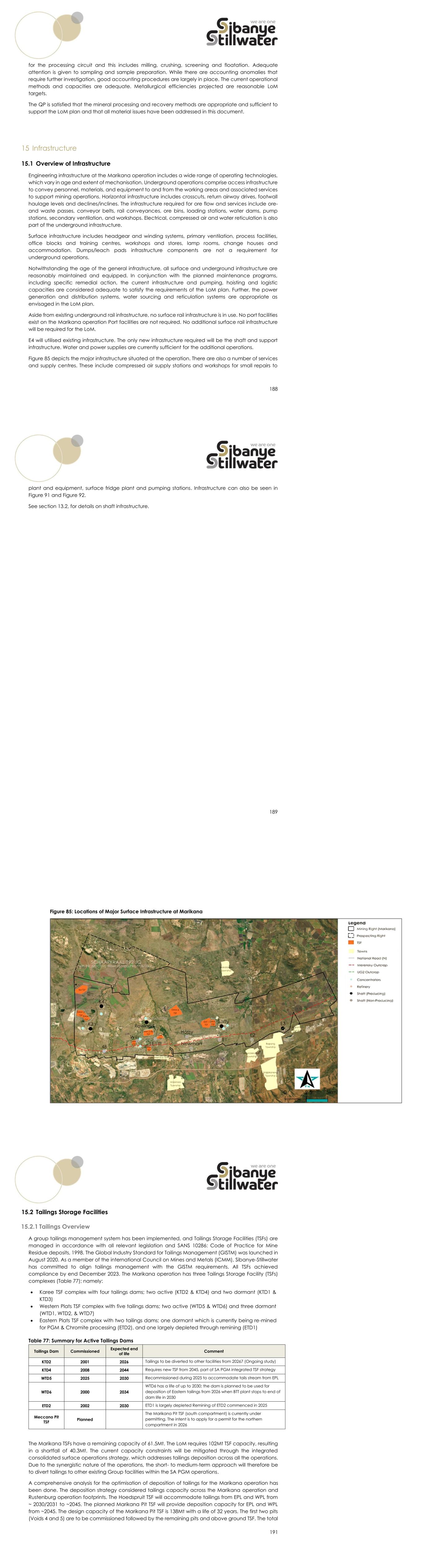
188 for the processing circuit and this includes milling, crushing, screening and floatation. Adequate attention is given to sampling and sample preparation. While there are accounting anomalies that require further investigation, good accounting procedures are largely in place. The current operational methods and capacities are adequate. Metallurgical efficiencies projected are reasonable LoM targets. The QP is satisfied that the mineral processing and recovery methods are appropriate and sufficient to support the LoM plan and that all material issues have been addressed in this document. 15 Infrastructure 15.1 Overview of Infrastructure Engineering infrastructure at the Marikana operation includes a wide range of operating technologies, which vary in age and extent of mechanisation. Underground operations comprise access infrastructure to convey personnel, materials, and equipment to and from the working areas and associated services to support mining operations. Horizontal infrastructure includes crosscuts, return airway drives, footwall haulage levels and declines/inclines. The infrastructure required for ore flow and services include ore- and waste passes, conveyor belts, rail conveyances, ore bins, loading stations, water dams, pump stations, secondary ventilation, and workshops. Electrical, compressed air and water reticulation is also part of the underground infrastructure. Surface infrastructure includes headgear and winding systems, primary ventilation, process facilities, office blocks and training centres, workshops and stores, lamp rooms, change houses and accommodation. Dumps/leach pads infrastructure components are not a requirement for underground operations. Notwithstanding the age of the general infrastructure, all surface and underground infrastructure are reasonably maintained and equipped. In conjunction with the planned maintenance programs, including specific remedial action, the current infrastructure and pumping, hoisting and logistic capacities are considered adequate to satisfy the requirements of the LoM plan. Further, the power generation and distribution systems, water sourcing and reticulation systems are appropriate as envisaged in the LoM plan. Aside from existing underground rail infrastructure, no surface rail infrastructure is in use. No port facilities exist on the Marikana operation Port facilities are not required. No additional surface rail infrastructure will be required for the LoM. E4 will utilised existing infrastructure. The only new infrastructure required will be the shaft and support infrastructure. Water and power supplies are currently sufficient for the additional operations. Figure 85 depicts the major infrastructure situated at the operation. There are also a number of services and supply centres. These include compressed air supply stations and workshops for small repairs to 189 plant and equipment, surface fridge plant and pumping stations. Infrastructure can also be seen in Figure 91 and Figure 92. See section 13.2, for details on shaft infrastructure. Figure 85: Locations of Major Surface Infrastructure at Marikana 191 15.2 Tailings Storage Facilities 15.2.1 Tailings Overview A group tailings management system has been implemented, and Tailings Storage Facilities (TSFs) are managed in accordance with all relevant legislation and SANS 10286: Code of Practice for Mine Residue deposits, 1998. The Global Industry Standard for Tailings Management (GISTM) was launched in August 2020. As a member of the international Council on Mines and Metals (ICMM), Sibanye-Stillwater has committed to align tailings management with the GISTM requirements. All TSFs achieved compliance by end December 2023. The Marikana operation has three Tailings Storage Facility (TSFs) complexes (Table 77); namely: • Karee TSF complex with four tailings dams; two active (KTD2 & KTD4) and two dormant (KTD1 & KTD3) • Western Plats TSF complex with five tailings dams; two active (WTD5 & WTD6) and three dormant (WTD1, WTD2, & WTD7) • Eastern Plats TSF complex with two tailings dams; one dormant which is currently being re-mined for PGM & Chromite processing (ETD2), and one largely depleted through remining (ETD1) Table 77: Summary for Active Tailings Dams Tailings Dam Commissioned Expected end of life Comment KTD2 2001 2026 Tailings to be diverted to other facilities from 20267 (Ongoing study) KTD4 2008 2044 Requires new TSF from 2045, part of SA PGM integrated TSF strategy WTD5 2025 2030 Recommissioned during 2025 to accommodate tails stream from EPL WTD6 2000 2034 WTD6 has a life of up to 2030; the dam is planned to be used for deposition of Eastern tailings from 2026 when BTT plant stops to end of dam life in 2030 ETD2 2002 2030 ETD1 is largely depleted Remining of ETD2 commenced in 2025 Meccano Pit TSF Planned The Marikana Pit TSF (south compartment) is currently under permitting. The intent is to apply for a permit for the northern compartment in 2026 The Marikana TSFs have a remaining capacity of 61.5Mt. The LoM requires 102Mt TSF capacity, resulting in a shortfall of 40.3Mt. The current capacity constraints will be mitigated through the integrated consolidated surface operations strategy, which addresses tailings deposition across all the operations. Due to the synergistic nature of the operations, the short- to medium-term approach will therefore be to divert tailings to other existing Group facilities within the SA PGM operations. A comprehensive analysis for the optimisation of deposition of tailings for the Marikana operation has been done. The deposition strategy considered tailings capacity across the Marikana operation and Rustenburg operation footprints. The Hoedspruit TSF will accommodate tailings from EPL and WPL from ~ 2030/2031 to ~2045. The planned Marikana Pit TSF will provide deposition capacity for EPL and WPL from ~2045. The design capacity of the Marikana Pit TSF is 138Mt with a life of 32 years. The first two pits (Voids 4 and 5) are to be commissioned followed by the remaining pits and above ground TSF. The total

192 capital is estimated at R1.8b. (The overall Marikana TSF facility will allow for ~290Mt of deposition capacity). Specialist studies for permitting of the Marikana Pit TSF are ongoing. The initial Water Use Licence was declined however DWS has agreed in principle to the revised design and it is expected that the licence will be approved Q2/Q3 2026. The Water Use License for the Northern Compartment will be submitted in 2026. Table 78: LoM Assessment of Tailings Facilities Tailings Facility LoM Deposition (Mt) Available Capacity (Mt) Surplus / (Shortfall) (%) Capital Requirement (Rm) Karee TSF Complex 105.4 21.9 (79.2) 43.4 Western Plats TSF Complex 62.8 40.3 (48.5) 2.4 Eastern Plats TSF Complex N/A (undergoing re- mining) N/A 0.0 2.5 Marikana Mine Total 168.2 62.2 (63.1) 48.3 15.2.2 Karee TSF Complex KTD1 has been dormant for some time and is scheduled to be reclaimed for chromite and PGM elements (WLTR Concentrator). This forms part of an ongoing mine-wide surface strategy. KTD2’s remaining deposition life has been extended due to lower than planned deposition rates. Once KTD2 reaches maximum capacity, K3B tailings will be reprocessed at the WLTR concentrator with deposition initially on Hoedspruit TSF and then in the planned Marikana Pit TSF. KTD3 has reached end of it’s design life. Deposition from K3A concentrator has been diverted to KTD4. KTD4 has sufficient capacity to accommodate production from K4 and K3A. 15.2.3 Western Plats TSF Complex WTD6 currently accommodates tailings from the BTT plant which reprocesses tailings from ETD2. Waterval West TSF has been depleted. WTD5 was re-commissioned in mid 2025 to accommodate tailings from EPC concentrator for the re-processing of ETD2. 15.2.4 Eastern Plats TSF Complex ETD1 has been depleted. ETD2 is being remined with tailings deposited on WTD6. 15.2.5 Marikana Pit TSF The Marikana Pit TSF comprises backfilling five disused open pits and constructing an above ground TSF over and between the pits. The TSF serves to increase tailings deposition capacity for the operations as well as rehabilitation of the pit area. The pits and surface TSF area are to be lined in accordance with legislative requirements. The TSF is to be developed as an impoundment with a centre-line embankment. Total deposition capacity is approximately 138Mt with a 32yr life. 193 15.3 Power Supply The Marikana operation are directly supplied with bulk electrical power from the national grid which is operated by Eskom, a power utility company that is owned by the state. Power is delivered through Eskom substations which are dedicated to the various production business units at Marikana. The Eskom substations are commonly referred to as Points of Delivery (PODs), and Table 1 enlist the Rustenburg PODs together with the production units that are supplied from the particular POD. The power demand and annual energy supplied from each POD is also indicated in Table 79. The Marikana Eskom power network is supplied at 88kV, which is then transformed at the POD to medium voltages (6.6kV, 11kV, 33kV). Associated with each POD would be a medium voltage intake substation which is owned by Sibanye, which then distributes power to the internal power network, via cables and overhead power lines. Electrical power is also distributed to non-production areas which include facilities that are under C&M, central services areas, and pump stations. Table 79: Eskom Points of Delivery for Marikana operation Eskom POD Production Units Demand (MW) Energy (MWh)/pa Karee K3 (Concentrator) K4 (Concentrator) K3 (Mine) K4 (Mine) 4B (Mine) 80.7 475,036 Wonderkop 88kV Smelter, Base Metal Refinery Wonderkop 60.0 217,914 Wonderkop 11kV Rowland (Mine) Rowland compressors BTT sub and pumpstation 39.8 210,382 Middelkraal UG2 BTT (Concentrator) 13.7 84,191 Eastern Platinum EPL (Concentrator) EPC (Concentrator) ETTP (Concentrator) EBTT (Remining) Saffy (Mine) E3 (Mine) 59.0 344,447 Total 253.2 1,331,970 15.4 Bulk Water and Pumping Pipelines are discussed in this section and Section 17.4.6. 194 15.4.1 Bulk Potable Water Supply Marikana Marikana operation are fed through three main supply lines with potable water from Rand Water through the Barnardsvlei system. The lines are not inter-connected. Layout of the main water reticulation infrastructure depicted below. • Total daily potable water supplied into the system amounts to 25Ml/day • Third parties consume a total of 8.5Ml/day • Emergency water is stored in eight reservoirs with a combined capacity of 39Ml strategically placed throughout the operations Figure 86: Main Potable Water Reticulation Layout Marikana operation 15.4.2 Secondary Water Supply Marikana Secondary water is fed into the concentrator systems via the Pandora supply which consists of boreholes, pits, Buffelspoort and Hartebeespoort canal water. A combined total of 9Ml/day of secondary water is fed into the system. Secondary water is stored for distribution in pits and tanks with a total storage capacity of 1,400Ml. Treated effluent from all Marikana operation wastewater treatment plants is fed back into the respective concentrator systems. 195 Figure 87: Main Secondary Water Reticulation Layout Marikana operation 15.5 Roads and Transport Infrastructure The road network on the Marikana operation site consists of paved and unpaved roads which are primarily used for the transport of personnel and for access to the offices, shafts, plants, and infrastructure positioned around the mine site. The product is transported by road to the local smelter and refineries and by road or commercial airlines to the end consumer. 15.6 Equipment Maintenance 15.6.1 Surface Workshops Surface workshops for major repairs were converted to off-site repair facilities operated by third party suppliers or vendors in the neighbouring towns. Only minor repairs are done on the shaft site. 15.6.2 Underground Workshops Underground workshops are used for routine maintenance of equipment. All areas are well equipped. Facility configuration depends on the equipment that is being serviced to ensure compliance with the requirements of the planned maintenance schedules. Areas are well-ventilated and illuminated, floor areas are concreted. 15.7 Offices, Housing, Training Facilities, Health Services Etc. Marikana operation has central offices for shared services and offices for mine services. Mine Personnel live in the surrounding cities and townships. Support services for personnel are either provided at the central offices or in the surrounding cities and townships.

196 15.8 QP Opinion The infrastructure is appropriate and sufficient to support current operations. New infrastructure will need to be built in the E4 project area to support mining and connect E4 to the rest of the operations. This is being optimised and will be added to the operation in the future. The QP is satisfied that all material issues have been addressed in this document. 16 Market Studies 16.1 Metals Marketing Agreements Marikana operation Refined metals are produced and sold into the market. Approximately 70% of 6E production from Marikana operation is contractually committed to global customers on long-term contracts up to one year in duration. The remainder of the production is sold into the market on a spot basis to a network of customers around the world. Marikana also produces a chromium oxide (Cr2O3) concentrate. Contract volumes and prices are agreed with each customer and will depend on various market and customer conditions at the time. No customers are affiliates of Sibanye-Stillwater. Glencore Agreement Sibanye-Stillwater signed a strategic, mutually beneficial enhancement to the historical Marikana Contract (Marikana Contract) and a new Chrome Management Agreement (CMA) with the Glencore Merafe Venture (GM Venture), which is expected to optimise value from future chrome production for all parties. The transaction became effective on 1 November 2025. The enhanced Marikana Contract provides for the accelerated completion of delivery of the required chrome volumes which will expedite the close out of the legacy agreement previously concluded between Lonmin and the GM Venture The majority of the Chrome Recovery Plants (CRPs) at Sibanye- Stillwater’s SA PGM operations, will be operated by the GM Venture, enabling both parties to leverage synergies and increase chrome output. Franco-Nevada Stream Agreement - Key terms of the agreement Sibanye-Stillwater has received a US$500 million upfront payment (Advance Amount) in exchange for: • Gold Stream: gold ounces (oz) equal to 1.1% of 4E PGM oz contained in concentrate until delivery of 87,500oz of gold, then 0.75% of 4E PGM oz contained in concentrate until total delivery of 237,000oz of gold, then 80% of gold contained in concentrate for the remaining life of mine (LoM) - Sibanye-Stillwater will receive a production payment price equal to 5% per ounce of the spot gold price on the date of delivery until total delivery of 237,000oz of gold, which will increase to 10% of the spot gold price thereafter 197 • Platinum Stream: platinum oz equal to 1.0% of platinum contained in concentrate until delivery of 48,000oz of platinum, then 2.1% of platinum contained in concentrate until total delivery of 294,000oz of platinum, then no further deliveries - Sibanye-Stillwater will receive a production payment price equal to 5% of the spot platinum price on the date of delivery The Stream Agreement will apply to any production that may arise from the Marikana and Rustenburg operations, including the development of underground growth or replacement projects within the Stream Area. 16.2 Markets and Sales 16.2.1 Introduction Information on PGM markets is widely available in the public domain. Major refiner and manufacturer of products using PGM, Johnson Matthey, regularly publishes market reports. In addition, Sibanye- Stillwater receives regular PGM market studies from its independent research company, SFA (Oxford) and short-term market insights from various fabricators and traders. Information from these sources along with negotiated contracts, inform Sibanye-Stillwater’s price and sales forecasts. Given that palladium, platinum, and rhodium account for approximately 90% of the revenue generated at Sibanye-Stillwaters Southern African PGM segment, this market review focuses on these three metals. 16.2.2 Platinum, Palladium and Rhodium Demand and Supply The main uses of platinum are as a catalyst for automotive emissions control, in a wide range of jewellery pieces and in industrial catalytic and fabrication applications. Palladium is primarily used as a catalyst in the automotive sector, mainly in gasoline-powered on-road vehicles, but alongside platinum in parts of the light-duty diesel engine after-treatment too. The second main use of palladium is in electrical components, specifically in multi-layer ceramic capacitors (MLCCs), as conductive pastes and in electrical plating. Platinum The platinum price was rangebound in the first few months of 2025, moving between $900/oz and $1,000/oz. The price began to rally in late May and climbed sharply over the following months to reach a then record price of $2,459/oz on 26 December 2025 before pulling back in the last few trading days of the year. That left the price up 125% for the year. The price continued to rally in January 2026 with platinum rising to an intraday record of $2,923/oz. In 2025, global primary platinum supply is estimated to have contracted by 8% (year-on-year) to 5.01Moz mostly owing to lower production from South Africa following adverse weather, which caused some mine flooding, and processing plant maintenance. In Zimbabwe, platinum production rose modestly whereas Russian yield was slightly lower year-on-year. North American production fell by 19% as a result of reduced output at primary mines and lower by-product production at nickel mines. Secondary platinum supply rose 6% to 1.46Moz owing to the higher metal prices incentivising the recycling of greater volumes of spent auto catalysts and also an increase in jewellery recycling. 198 A further dip in primary platinum output is anticipated for 2026. Although South African output has recovered from the disruptions seen in 2025, Russian production is expected to drop owing to lower grade material being processed. Global platinum demand shrank by 2% in 2025 to 7.13Moz, owing to a decline in automotive and industrial requirements, which more than offset a rebound in jewellery demand. Platinum demand for automotive applications fell by 4% in 2025. Battery electric vehicles continue to take market share from combustion engine vehicles reducing the demand for PGMs in autocatalysts, a trend that is predicted to continue in the future. Industrial demand for platinum declined by 9% as the scale of expansion in glass fibre capacity was reduced following robust growth in previous years in China which had resulted in overcapacity. Other areas of industrial demand had moderate growth. Jewellery demand was 1.55Moz, boosted by fabricator restocking in China in the first half of the year. However, consumer sales did not grow as anticipated despite platinum's significant price discount to gold and lower jewellery demand is anticipated in 2026. Platinum is required across the entire hydrogen value chain, including the upstream, mid-stream and downstream segments. While numerous green hydrogen projects have been announced the economic environment has become more challenging and not all projects are being advanced. Platinum demand from hydrogen related applications is expected to rise in the long-term from 95koz in 2025 The platinum market is estimated to have ended 2025 with a deficit of 665koz. The deficit is projected to shrink to 365koz in 2026. Palladium The palladium price traded in a range in the first few months of 2025 before following platinum higher and ending the year at $1,611/oz, a rise of 76% over the year. The price peaked at $1,942/oz in December 2025, its highest price for more than three years. Global primary palladium supply fell by 6% year-on-year to 6.05Moz in 2025, with production declining in South Africa, Russia and North America, although Zimbabwean output did rise modestly. Low palladium prices have resulted in the reassessment of mine plans and reduced output from North American operations. Primary palladium supply is forecast to fall by 6% to 5.77Moz in 2026. South African production is expected to recover from the disruptions suffered in 2025, but yield will remain below the level seen from 2022-2024. Output from Russia is anticipated to drop by around 10% owing to lower grade material being processed. Secondary palladium supply from autocatalyst recycling expanded by 10% in 2025 and is predicted to continue to climb as greater numbers of old vehicles are scrapped, particularly in China which has seen a dramatic increase in car sales over the last 20 years. Automotive palladium demand has been on a declining trend. Over the last few years, a combination of price-driven substitution for platinum and reduced combustion engine vehicle sales as battery electric vehicles have gained market share has reduced demand. With platinum now trading at a premium to palladium, a reversal of the substitution is anticipated which will support palladium demand. However, the ongoing rise in BEV sales is expected to result in a continued gradual decline in automotive demand from 7.34Moz in 2025. 199 Industrial demand for palladium was 1.39Moz in 2025 and is expected to remain steady. The high gold price has resulted in some additional electrical demand for palladium, although dental use remains in long-term decline owing to the relatively high palladium price and cosmetically more appealing alternative materials. Chemical demand is stable. Palladium demand related to the hydrogen economy is restricted to the mid-stream and downstream segments including catalysts for methanol synthesis, and for sustainable aviation fuel and diesel manufacture. Demand is current modest and any additional demand for palladium over the next decade will depend on the pace of development of these hydrogen economy segments. The palladium market is estimated to have had a 65koz supply deficit in 2025 and the market is predicted to have a similar sized deficit in 2026. Rhodium Rhodium has been a significant revenue enhancer in the South African PGM mines. Rhodium prices recovered to over US$10,000/oz in 2025. The demand outlook for rhodium is largely dependent on the use of autocatalysts which represents almost 90% of demand. Autocatalyst demand has fallen to 890koz in 2025 from over 1Moz in 2019. Demand is expected to decline in the future as electric vehicles continue to take market share from combustion engine vehicles. Further tightening of emissions standards is slated for China which could lift demand when implemented in 2027-2028 but other major markets do not have further tightening scheduled that would notably impact rhodium demand. Industrial uses see some growth in the long term but remain a small part of overall demand. Total demand is expected to decline by 30% up to 2040. Rhodium Supply is expected to decline in the long term mostly due to a 40% decline in production from the South African mines by 2040. Supply from recycled autocatalysis is expected to rise by 50% by 2030. Despite reserve depletion South Africa will still be expected to account for 70% of the world supply in 2040. With the rhodium market expected to move into surplus as automotive demand declines, the price outlook for rhodium does not see any significant increases in the near to long term.

200 16.3 Metals Price Outlook and Determination For business planning and Mineral Reserve estimation, Sibanye-Stillwater uses forward looking, “through the cycle”, prices that it considers will stay stable for at least three to five years, and will only significantly change if there is a fundamental, perceived long-term shift in the market, as opposed to basing it only on short term analyst consensus forecasts. Sibanye-Stillwater also considers its general view of the market, the relative position of its operations on the cost curve, as well as its operational and company strategy in its forecasting of forward-looking prices. On a monthly basis, Sibanye-Stillwater also receives an independent report from UBS Bank (Commodity Consensus Forecasts Report) which contains consensus outlooks from the various banks on a broad range of commodities. It benchmarks its forward-looking prices to the market consensus forecast. Mineral Resources price assumptions, which focus on longer timeframes, are based on moderately higher prices than for Mineral Reserves to reflect the ore-body flexibility. In this regard, rather than basing our assumption and referencing it to any one specific market study or report, it is derived via a management consensus view, taking into consideration market research. For this reason, and also taking into consideration that capital decisions on operating entities requires price stability over long periods, for the PGM mineral properties, the US$ based, forward looking commodity prices for Platinum and Palladium used for the 2026 LoM and Mineral Reserve estimates are similar to those used in the 2021/2023 except for rhodium, iridium and gold prices. Rhodium has been adjusted downwards to US$6,000/oz from US$8,000/oz, iridium and gold been adjust upwards. The longer-term outlook of US$1,250/oz for platinum has been maintained and palladium reduced by 8% to US$1,150/oz on our evaluation of sustainable, through the cycle, price assumptions. A conservative view has been taken on the gold price to reflect long term outlook rather than short term volatility. The following are the commodities produced at Marikana, the scenarios considered, and the final parameters chosen. Additional comment on Risk is provided in Section 21.1.2. The price deck for the Mineral Resources and Mineral Reserves is shown in Table 80. A comparison of the current Mineral Reserve price to the previous years is given in Table 81. 201 Table 80: PGM Deck Price Mineral Resources and Mineral Reserves Unit Mineral Resource Price Mineral Reserve Price Gold US$/oz 2,650 2,421 Platinum US$/oz 1,350 1,250 Palladium US$/oz 1,350 1,150 Rhodium US$/oz 5,000 4,500 Iridium US$/oz 5,500 4,015 Ruthenium US$/oz 450 400 Nickel US$/tonne 18,739 17,637 Copper US$/tonne 10,009 9,259 Cobalt US$/lb 19 20 Chromium oxide (Cr2O3), (40.5% concentrate) US$/tonne 250 230 Exchange rate R/US$ 18.24 18.24 Table 81: Comparison of Mineral Reserve Prices as at 31 December 2025 to 31 December 2021 31 Dec 25 31 Dec 21 Precious metals US$/oz R/oz US$/oz R/oz Gold 2,421 44,159 1,657 24,855 Platinum 1,250 22,800 1,250 18,750 Palladium 1,150 20,976 1,250 18,750 Rhodium 4,500 82,080 8,000 120,000 Iridium 4,015 73,23 2,500 37,500 Ruthenium 400 7,296 300 4,500 Base metals US$/lb US$/tonne US$/lb US$/tonne Nickel 8.00 17,637 7.35 16,200 Copper 4.20 9,259 4.06 8,950 Cobalt 20.00 44,092 22.00 33,069 Chromium oxide (Cr2O3), (40.5% concentrate) 0.104 230 0.07 150 The R/US$ exchange rate was 15.00 in 2021 202 17 Environmental Studies, Permitting, Plans, Negotiations/ Agreements with Local Individuals or Groups 17.1 Social and Community Agreements 17.1.1 Overview- Mine Community Development The social performance is guided by the Group’s socio-economic development agenda, which is aimed at ensuring that Marikana operation contributes to the upliftment of the communities during and beyond mining activities. Sibanye-Stillwater’s performance is supported by authentic stakeholder engagement, fit for purpose systems, credible data and capability that aligns with international standards and locally negotiated commitments. Sibanye-Stillwater’s primary objective is to avoid harm to people and the environment, ensuring a stable operating environment in which all our stakeholders within the Group’s footprint can derive value during the LoM. Sibanye-Stillwater endeavours to create equitable engagement capability in host communities to ensure constructive dialogue with our neighbours. The key to responsible mining is protecting the Group’s reputation as work continues building the Sibanye-Stillwater brand globally. As part of international leading practice, the Group has implemented an accessible complaints and grievance mechanism procedure, enabling communities to raise issues and concerns through multiple platforms. The findings support the feedback the Group regularly receives from its engagement partners and therefore, engagement and communication have been strengthened to ensure that stakeholders are informed and where applicable engaged and consulted on issues of mutual interest. 17.1.2 Legislation The legislative framework is detailed in Section 17.5.1. As pertains to the social and community agreements, The Mining Charter includes Social and Labour Plan guidelines. Regulation 42 to the Minerals and Petroleum Resources Development Act requires mining companies to submit to the Department of Mineral and Petroleum Resources a Social and Labour Plan (SLP) as a pre-requisite for the granting of a mining right. These pans are required to be revised and resubmitted every five years during the life of a mining right. Pillars within the Mining Charter III, endorsed through the SLP & Targets: • Ownership • Mine community development • Housing and living conditions • Employment equity • Human resource development • Inclusive procurement, supplier and enterprise development 203 17.1.3 Communities Priorities The Marikana community priorities are as follows: • Supporting communities to deliver local social economic benefits through economic empowerment and the delivery on the Mining Charter and Social and Labour Plan commitments • Strengthening institutional capacity and unlocking and mobilising partnerships and resources to resolve collective challenges • Deliver on programs that retain sustainable community benefits and its social impacts that are well understood by all stakeholders • Create shared value beyond compliance • Facilitate integrated spatial development by improving the living conditions and surrounding amenities for our workers Marikana has separate SLPs for the Mining Rights of WPL and EPL, all of which are at various stages of execution. These SLPs are predominantly in the North West province, benefiting the communities in Madibeng and Rustenburg local municipalities. There are projects in progress for a previous round of SLP and to backlog projects in progress. The SLP projects for Marikana operation are listed in Table 82 and Table 83. Table 82: Marikana SLP Projects WPL No Project Name Partners Status Budget WPL 5-year SLP Cycle: (2024-2028) Sibanye-Stillwater is still engaging with the regulator for endorsement of the proposed SLP. A list of projects will be published once the programme is approved. WPL SLP Cycle: (2019-2023 -approved in April 2022) 1 Leokeng Secondary School Phase 2 Madibeng LM Completed R14,000,000 2 Support to small scale Sheep farmers Nyandeni LM Completed R2,000,000 3 Marikana CHC Phase 2 Rustenburg LM In Progress R24,000,000 4 Marikana High Mast Lights Rustenburg LM In Progress R2,000,000 5 Storm Water Management Madibeng LM In Progress R14,000,000 6 Refurbishment of Road Infrastructure Rustenburg LM In Progress R5,000,000 7 Agri Business Madibeng & Rustenburg LM Planning R5,000,000 8 Brits Water Project Madibeng LM Partnership in DDM R20,000,000

204 Table 83: Marikana SLP Projects EPL No Project Name Partners Status Budget Marikana 5-year SLP Cycle: (2024-2028) Sibanye-Stillwater is still engaging with the regulator for endorsement of the proposed SLP. A list of projects will be published once the programme is approved. EPL SLP Cycle: (2019-2023 -approved in April 2022)) 1 Shearing Sheds Nyandeni LM Completed R800,000 2 Rhode School Upgrade Alfred Nzo DM Completed R3,000,000 3 Upgrading of Sewage System IN Bapong and Wonderkop CHC Madibeng LM Completed R3,800,000 4 New Sonop Secondary School Madibeng LM Engagement R18,000,000 5 Installation of solar streetlights in wards 7,25,27,28,31 and 40 Madibeng LM In Progress R6,000,000 17.2 Human Resources 17.2.1 Introduction This section includes discussion and comment on the human resources, health and safety related aspects associated with Marikana. Specifically, information is included on the current organisational structures and operational management, recruitment, training, productivity initiatives and remuneration policies, industrial relations, safety statistics and performance. Marikana follows the Sibanye-Stillwater Code of Ethics, which is fully compliant with the Sarbanes-Oxley Act of the United States of America. This policy was adopted and communicated to all employees. A Human Rights Policy has also been adopted, which confirms full compliance with all applicable International Labour Organisation Conventions. 17.2.2 Legislation Marikana is committed to promoting Historically Disadvantaged South African’s (HDSA) in its management structure by instituting a framework geared toward local recruitment, and human resources development. Vacancies are primarily filled by candidates from local communities. Where specialist skills are not available locally, they are sourced from outside local communities. Marikana’s long term objective is to have these skills shortages addressed via skills development programmes. The Mine’s long-term objective is to have these skills shortages addressed via skills development programs. Labour distribution is shown in Table 84 and Table 85. Employee turnover is less than 6% annually. Labour unavailability is approximately 14% at with the primary reasons for absenteeism being annual leave, sick leave and training. Various regulatory authorities, in addition to mining and labour codes, govern labour legislation in South Africa. In general, these are well established in conjunction with current operating policies and form the cornerstone of human resource management. The following are key acts and associated regulations governing Labour: 205 • Constitution of the RSA (Act 108 of 1996) (Constitution) • Mine Health and Safety Act, (Act 29 of 1996) and amendments (MHSA) • The Occupational Health and Safety Act (85 of 1993) (OHSA) • LRA, 1995 as amended • Employment Equity Act, 1998 with specific reference to medical testing and HIV/AIDS • Compensation for Occupational Injuries and Diseases Act, 1993 • Basic Conditions of Employment Act, 1997 • Employment Equity, 1998 and • Promotion of Equality and Prevention of Unfair Discrimination Act, 2000. • Protection of Personal Information Act, 2013 206 Table 84: Marikana Total Employees – Report for the Month of December 2025 Occupational Level Male Female Foreign Nationals Total A C I W A C I W Male Female Senior management 15 0 2 15 2 1 0 3 2 0 40 Professionally qualified and experienced specialists and mid- management 80 6 3 73 57 1 1 23 4 0 248 Skilled technical and academically qualified workers, junior management, supervisors, foremen, and superintendents 1,468 12 3 321 504 9 2 89 124 4 2,536 Semi-skilled and discretionary decision making 4,218 6 0 15 409 3 0 8 1,177 0 5,836 Unskilled and defined decision making 5,067 0 0 3 1,665 2 0 1 817 13 7,568 Total Permanent 10,848 24 8 427 2,637 16 3 124 2,124 17 16,228 Employee-Temporary 145 0 0 7 132 1 0 2 0 0 287 Grand Total 10,993 24 8 434 2,769 17 3 126 2,124 17 16,515 Table 85: Marikana Total Contractors (excluding Ad-Hoc Contractors) - Report for the Month of December 2025 Occupational Level Male Female Foreign Nationals Total A C I W A C I W Male Female Senior management 19 0 0 13 15 1 0 3 2 0 53 Professionally qualified and experienced specialists and mid- management 19 0 0 17 2 0 0 0 0 0 38 Skilled technical and academically qualified workers, junior management, supervisors, foremen, and superintendents 150 2 0 82 40 0 0 19 15 0 308 Semi-skilled and discretionary decision making 742 2 0 20 122 0 0 7 168 2 1,063 Unskilled And Defined Decision Making 1,243 2 0 16 234 1 0 1 124 2 1,623 Total Permanent 2,173 6 0 148 413 2 0 30 309 4 3,085 207 17.2.3 Human Resource Development (Training) Marikana has instituted a comprehensive program to train and develop its employees to the extent that they are able to function competently in their specific jobs, with particular reference to compliance with legislative requirements and to providing the capacity for individuals and teams to work safely and productively. These cover both technical/ vocational training and supervisory and managerial skills development. Marikana typically spends a total of 5% of payroll on employee training and development programs. Specific areas of focus in the training and development programmes include: • Safe working practice training by means of programmes aligned with the requirements of the National Qualifications Framework • Functional literacy and numeracy • Interventions aimed at improving the business awareness and teamwork of employees at the lower levels of the organisation in particular • Improved middle management skills through the implementation of an internal leadership programme to help fulfil the human resources requirement of the Mining Charter • Systems to track and manage, on an integrated basis, employee development and performance • Portable skills training • “New way of communication” training and • Tswelopele training 17.2.4 Remuneration Policies Marikana operation operates remuneration and employee benefit policies that recognise labour market conditions, collective bargaining processes, equity, and legislation. 17.2.5 Industrial Relations Industrial relations are managed at a number of levels and in a number of formalised structures, encompassing the corporate and mining asset domains in accordance with a number of key driving factors. These include the prevailing legislative requirements, regulatory bodies, labour representation, collective bargaining arrangements, sectoral and operation specific employer-employee agreements, and the quality of labour relations management philosophies and practices. An Employee Relations/Engagement framework also governs all engagements with organised labour and other stakeholders. The principal strategy elements are to entrench an improved understanding of the business imperatives on the part of labour, appropriate and timely intervention to pre-empt industrial relations issues and timely delivery by management on its undertakings to labour and to maintain labour harmony continuously. Approximately 83% of the permanent employees of Marikana operation are paid up members of a registered trade union. The substantial majority of these unionised employees are from the lower skilled level and are represented by the Association of Mineworkers and Construction Union (AMCU). Historically, a trade union with such a constitution have exercised a strong influence over social and political reform. The labour legislative framework reflects this by strongly empowering trade unions in the

208 collective bargaining processes. The clear implication is that industrial relations are an area of focus for Marikana operation. 17.2.6 Employment Equity and Women in Mining (WIM) The purpose of the Employment Equity Plan is to ensure that a demographically appropriate profile is achieved through the participation of HDSAs in all decision-making positions and core occupational categories at the operation. In striving to achieve 60% - 70% HDSA representation in the management structure and 25% - 30% participation of women in core mining occupations by 2030, Marikana seeks to redress the existing gender and racial disparities. The plan reflects Sibanye-Stillwater’s annual progressive targets and embrace the challenge to transform the composition of the Company’s workforce and management. This is a business imperative to ensure that the Group tap into the entire skill base of the South African population. All efforts in this regard have been aligned with the National Development Plan and the UN Global Goals for Sustainable Development. Where appropriate, Employment Equity is implemented in consultation with employee representative bodies. As a key business imperative for Marikana, Employment Equity is critical in assisting the operation to place competent employees in the correct jobs aligned with the operation’s objectives. 17.3 Health and Safety 17.3.1 Policies and Procedures Since Sibanye-Stillwater’s inception, Marikana operation has formed part of the Health and Safety Strategy and Policy development process, as well as the adoption and implementation thereof. The Safe Production Strategy that was developed as part of an ongoing safety improvement journey, takes into account “fit for purpose systems” such as ISO 45001 that was published during 2018. The Sibanye- Stillwater Health and Safety Strategy and Policy is further aligned with the Mine Health and Safety Act, the International Council on Mining & Metals, the World Bank Policies and Guidelines, International Finance Corporation Operational Policies, and International Labour Organisation Conventions. 17.3.2 Statistics Table 86 presents safety statistics for Marikana operation and includes the total number of fatalities, fatality rate and the lost day injury frequency rate (LDIFR) from 2021 to 2025. Table 86: Safety Statistics Units 2021 2022 2023 2024 2025 Fatalities (No) 1 2 1 3 1 Fatality Rate (per mmhrs) 0.03 0.04 0.02 0.062 0.020 LDIFR (per mmhrs) 7.56 5.09 4.94 3.67 3.29 MHSA Section 54’s (No.) 17 30 22 17 10 mmhrs = million man hours worked 209 17.3.3 Occupational Health and Safety Management As part of the rollout of the Safe Production Strategy, the management of Critical Controls, Rules of Life, Risk Management as well as management of A Hazards were a key focus area at the operations. The challenges in terms due to COVID-19 are ongoing and are dealt with commendably at all the shafts. 17.3.4 HIV/AIDS Marikana applies HIV education and preventative measures, including the Highly Active Anti-Retroviral Therapy programme to manage the risk of HIV. 17.4 Environmental Studies 17.4.1 Introduction As part of the Sibanye-Stillwater Integrated, Compliance, Governance and Risk (ICGR) framework, the Group has embedded a process for improved regulatory risk profile and action plans to address any gaps in the identification of risk, level of adequacy and effectiveness of control measures. This has provided the environmental and other departments e.g. the ESG department, with a much clearer picture of all the legal requirements, its risk exposure and what mitigatory actions (compliance risk management plans) need to be put in place to improve and ensure compliance. The following generic environmental risks have been identified and are applicable to the Marikana operation: • Third party liability claims because of uncontrolled grazing on mine-owned properties • Ongoing operational compliance to current and new environmental legislation • Uncertainty on the quantum of closure liability for SRPM Operations, pending the proposed amended 2015 Financial Provisioning (FP) Regulations. / The quantification of as-yet unknown latent and residual liabilities and the resultant impact on the final quantum of the closure liability and/or our closure strategies • Ageing infrastructure and its contribution towards legal non-compliances (environmental) • Increase in illegal activity, sabotage and theft of environmental infrastructure, by zama-zamas (illegal miners), leading to increased frequency and severity of associated environmental non- compliances • Poor hazardous waste and hydrocarbon management • Lack of a coherent regional closure strategy, and not being able to clarify SRPM’s role and obligation towards this • Failure to obtain applicable environmental approvals, timeously as a result of slow responses from Regulators in respect of approving licences and amendments • Undue reliance on water board/municipal water (with a resultant increase in water costs)/The sustained provision of potable water to our platinum operations in the Rustenburg area • Impacts of water constraints on the production profile of SRPM • Climate change and global warming • The carbon tax implementation • The inclusion of VAT to the existing closure provisions 210 In addition, and from an Environmental, Social and Governance (ESG) perspective, the following key environmental legislation, and its associated subsequent amendments, was identified to be applicable, wholly, or partially, to the Marikana operation: • Constitution of the RSA, 1996 • The Companies Act, Act 71 of 2008 • King IV Report on Corporate Governance for South Africa 2016 (Institute of Directors in Southern Africa NPC) • Promotion of Administrative Justice Act, Act 3 of 2000 • Protection of Personal Information Act, Act 4 of 2013 • Minerals & Petroleum Resources Development Act (MPRDA), Act No 28 of 2002 and all its Regulations and subsequent Amendments • National Environmental Management Act (1998) • National Environmental Management: Biodiversity Act, Act No 10 of 2004 • National Environmental Management: Waste Act, 2008 • National Nuclear Regulatory Act, 1999 • National Environmental Management: Air Quality Act (NEM:AQA), Act No 39 of 2005 • National Water Act (NWA), Act No 36 of 1998 • Water Services Act (NWS), Act 108 of 1997 • Labor Relations Act, Act 66 of 1995 • Mineral and Petroleum Resources Royalty Act 28 of 2008 • Hazardous Substances Act, Act No 15 of 1973 • National Heritage Resources Act (NHRA), Act No 25 of 1999 • National Forest Act, Act No 84 of 1998 • National Road Traffic Act, Act 93 of 1996 • Road Transportation Act, Act 74 of 1977 • Fertilisers, Farm Feeds, Agricultural Remedies and Stock Remedies Act, Act No 36 of 1947 • Conservation of Agricultural Resources Act (CARA), Act No 43 of 1983 • National Veld and Forest Fire Act, Act No 101 of 1998 • National Environmental Management: Protected Areas Act, Act 57 of 2003 • Promotion of Access to Information Act, 2000 • Agricultural Pest Act, Act No 36 of 1983 An important change in the regulation of mining-related environmental activities was that on 8th December 2014, with the launch of the so-called “One Environmental System” (OES), the Minister and thus the newly-renamed DMPR became the Competent Authority for environmental issues within the mining industry. The Minister of the Department of Minerals, Resources and Energy (DMPR) became the appeal authority for mine environmental issues. Since its inception in 2014, the OES has not as yet fully taken off as not all of the relevant Government Departments/Regulators seem to be on-board with the new, stricter approvals timeframes and/or other OES requirements which has led to the implementation of OES being, at best, mediocre and at worst, not meeting applicants’ expectations. In November 2015, new Regulations regarding Financial Provision (FP) were gazetted, with onerous legal obligations around financial provisioning on a number of closure-related issues. The mining industry has 211 and is in the process of challenging these proposed FP Regulations, with a view to have the most onerous Regulations excluded from any revised FP Regulations. Stakeholder engagement and consultation on the revised FP Regulations is ongoing, and while the compliance date for the 2015 FP Regulations had initially been set as 20 February 2020, this compliance date was subsequently revised to 19 June 2021. The compliance date has been postponed and no new date has been set. 17.4.2 Baseline Studies 2012 17.4.2.1 History The first Environmental Management Programme (EMPr) was approved in 1996. The EMPr was modified via various amendment applications. A new EMPr for WPL and EPL was constructed in 2005 to combine the 1996 EMPr and all modifications into a single document and to align the with MPRDA of 2002 and Mineral and Petroleum Development Regulation- Government Gazette No 26275 (23 April 2004). A revised and consolidated EIA and EMPr for WPL and EPL respectively was completed in November 2012. This was submitted to the North West Department of Mineral and Petroleum Resources, in November 2012 and approved in 2017. WPL and EPL are separate Mining Rights and require separate submissions for permitting and are recorded as separate documents, however the EMPr’s are aligned. The purpose of the amendments of the baseline EIA and EMPr intended to achieve the following: • The consolidation of the existing approved EMPrs, and the amendments thereof into one • EMP for the Mining Rights Areas comprising WPL and EPL • The update of the EMPrs according to information from a number of technical studies and environmental projects and programmes relating to air quality management, water management as well as land and waste management • The integration of the outcomes of the Closure Strategy for the Marikana operation, including the end land use framework for Marikana within the updated EMPrs • The alignment of the EMPrs with new environmental legislation • The amendment of EMPrs in order to obtain approval for the new proposed service and maintenance infrastructure developments • Amendments to these EMPrs have been undertaken for specific projects triggering environmental authorisations since the submission and approvals of the EMP’s. Specific studies are listed in the References Section As at 31 December 2025, the EMPr’s are still relevant and remain in practice with minor adjustments or additions where a need is identified.

212 17.4.2.2 Impact Assessment 2012 The assessment of the impacts for the 2012 EMPRs were conducted according to a synthesis of criteria required by the integrated environmental management procedure. This methodology was constructed by SEF, the consultants who compiled the studies, The methodology used was not the Lonmin methodology at the time and Sibanye has a more intense risk-based assessment procedure that it is now applying. SEF methodology was acceptable for the purposes of the study. • Extent - The physical and spatial scale of the impact is classified as • Duration - The lifetime of the impact, that is measured in relation to the lifetime of the proposed operations • Intensity - The intensity of the impact is considered by examining whether the impact is destructive or benign, whether it destroys the impacted environment, alters its functioning, or slightly alters the environment itself • Probability - This describes the likelihood of the impacts actually occurring at some point during the mining cycle • Mitigation - The impacts that are generated by the development can be minimised if measures are implemented in order to reduce the impacts. The mitigation measures ensure that the operation considers the environment and the predicted impacts in order to minimise impacts and achieve sustainable development • Determination of significance – without Mitigation • Determination of significance – with Mitigation • Ranking, Weighting and Scaling - Identifying the Potential Impacts without Mitigation (WOM) - Following the assignment of the necessary weights to the respective aspects, criteria are summed and multiplied by their assigned weightings, resulting in a value for each impact (prior to the implementation of mitigation measures) Equation 1: Significance Rating (WOM) = (Extent + Intensity + Duration + Probability) x Weighting Factor - Identifying the Potential Impacts with Measures (WM) - In order to gain a comprehensive understanding of the overall significance of the impact, after implementation of the mitigation measures, it was necessary to re-evaluate the impact - Mitigation Efficiency (ME) - The most effective means of deriving a quantitative value of mitigated impacts is to assign each significance rating value (WOM) a mitigation effectiveness (ME) rating. The allocation of such a rating is a measure of the efficiency and effectiveness, as identified through professional experience and empirical evidence of how effectively the proposed mitigation measures will manage the impact. Thus, the lower the assigned value the greater the effectiveness of the proposed mitigation measures and subsequently, the lower the impacts with mitigation Equation 2: Significance Rating (WM) = Significance Rating (WOM) x Mitigation Efficiency Or WM = WOM x ME 213 - Significance Following Mitigation (SFM) - The significance of the impact after the mitigation measures are taken into consideration. The efficiency of the mitigation measure determines the significance of the impact. The level of impact is therefore seen in its entirety with all considerations taken into account A summary of environmental Impacts is given in Table 87. Table 87: Summary of Anticipated Environmental Impacts (revised EMP,2012) Key Issue* Positive/ Negative Impact Applicable Project Phase Significance Rating before Mitigation Significance after Mitigation Operational Mine Closure Water Resources (Section 17.4.6) Negative Yes Yes Medium-High Medium Soil Contamination. Land Use and Land Capability (Section 17.4.9) Negative Yes Yes Medium-High Medium Damage to Biodiversity (Section 17.4.5) Negative Yes Yes Medium-High Medium Air Quality Impacts (Section 17.4.4) Negative Yes No Medium Low-Medium Noise. Shock and Vibration Negative Yes No Medium-High Low-Medium Increased Waste Generation Negative Yes Yes Medium-High Medium Social and Cultural Impacts: Heritage Resources Negative Yes No Medium-High Low-Medium Social and Cultural Impacts: Employment Opportunities (Section 17.1 and 17.2) Positive Yes No Medium-High N/A Utilisation of available land (Section0) Positive Yes No Medium-High N/A *Additional Information from The EIA or more recent data on some key issues can be found in the sections listed Results from the Emissions Inventory and Impact Assessment studies (Lonmin, 2010) • The predicted metal ground level concentrations (due to wind-blown dust from the tailings dams), at the closest sensitive receptors were all well within the most stringent health effect screening levels for all averaging periods • The predicted cancer risk due to metal emissions from tailings wind-blown dust was predicted to be “low” and “very low” (as characterised by the New York Department of Health) Results for Atmospheric Impact Report (2013) Operating Mine. • For mining activities, the predicted maximum 24-hour and annual average ambient concentrations of particulates (PM10 and PM2.5, SO2, NOX) exceeded the respective current and future national ambient air quality standards in the vicinity of the mining operations at WPL and EPL as well as over the central parts of the Northwest Operation site. Sibanye-Stillwater Smelter operations subsequently implemented measures to reduce SO2 emissions 214 • Predicted dust deposition was well below the national limit value for light commercial areas • For emissions from the three process units and mining combined the predicted ambient concentrations of Pb, HCl, NH3 and Cl2 were low and well below the respective national ambient air quality standards and ambient guidelines Noise Survey Report (Lonmin-Airshed, 2015). • Sampled noise levels were, for reference purposes, compared to both residential and industrial noise level guidelines • Given the reported survey results it is concluded that noise levels with the Marikana operational area generally in exceedance of noise levels guidelines for residential areas but not for industrial areas. Elevated noise levels are as a result of a combination of traffic (road and rail), community and industrial activity • To specifically determine the Marikana operation’ contribution to noise levels in the study area, detailed source characterisation and noise propagation simulations is required. Given high noise levels within communities and public road traffic as well as separation distances between communities and Marikana activities, its impact is likely to be less noticeable Tailings Dam 8 Environmental Impact Assessment (2014) • EIA for a new tailings dam to be built • No fatal flaws • Authorisation has been obtained 17.4.2.3 Methodologies for Impact and Risk assessment since 2012 The assessment results and criteria in the studies presented above are as submitted by the companies undertaking the assessments. Sibanye uses consultants for the specialists' studies. Each company has its own methodologies that it applies. Where there are no material conflicts with Sibanye-Stillwater’s criteria, other studies, or regulatory requirements the methodologies are accepted as valid. 17.4.3 Zone of Influence 17.4.3.1 Studies and Methodologies The Zone of Influence of a project (Marikana as a whole) is defined as the area within which it has or can have material impacts or can influence impacts due to the establishment and continuation of the project’s activities, products or services. The Zone of Influence is unique to each project and each aspect thereof, is larger than the actual project footprint and can either be positive or negative. The Zone of Influence is determined by evaluating and mapping the following environmental and social components of the project. 17.4.3.2 Surface Water The surface water Zone of Influence is made up of areas influenced by secondary, induced and cumulative impacts. However, the assessment of cumulative and induced impacts still requires further 215 investigation as these impacts may be far-reaching and they become less apparent due the activities of others in the catchment. Alternatively, they may only become apparent in the future dependent on the environmental context, such as the climatic conditions. The Zone of Influence’s represented below consider the secondary impacts that have been evaluated as associated with the current operational area of the mine. Secondary Zone of Influence The water courses within this section of the Zone of Influence represent activities within the wetlands, drainage lines, rivers and the recommended buffer areas that have the potential or have already caused a change to the ecological function and service provision of the wetlands. An updated and detailed wetland delineation is being undertaken to ascertain an improved zone of influence. Induced and Cumulative Impacts Zone of Influence The Zone of Influence for the induced and cumulative impacts has been determined based on the compliance of the water quality of the surface water bodies. The end of the impact is considered to be the point at which 95% compliance to the Resource Water Quality Objectives (“RWQO”) has been achieved for the year to date. The use of water quality as a means of determining compliance implies that all potential impacts whether from direct discharges, diffuse seepage and/or groundwater interflows would be assessed against the current applicable standards. The Marikana operation sprawl across two main catchments, namely the Sterkstroom and the Kareespruit. The Maretlwana a tributary of the Sterkstroom is also influenced by the Marikana operation. After the Maretlwana and Sterkstroom form a confluence, the stream is known as the Gwathle, but no mining activities occur within this reach. The Sterkstroom has been assigned RWQOs, but the Kareespruit has note, hence the Crocodile West RWQOs are used instead for this reach. The criteria to meet the zone of influence set-point have not been satisfied by the end-points currently identified in Figure 88. However no further downstream data is available to assess the use of points further downstream, it is also not advised to move the zone of influence to a downstream point but rather encourage, as is planned, that mitigation and management measures be implemented to achieve improved compliance at the set end-points. It is also noted that the basis for several stringent RWQO limits is not understood in the context of the historic and current water and land-use activities within the catchment as well as the relation with the downstream water user requirements. Sibanye-Stillwater continuously engage the Department of Water and Sanitation in to arrive at realistic, science-and-risk based limits both in the water use licences and the RWQOs. The Sterkstroom end-point, WP S 21 shows 75% compliance with risks of eutrophication but no toxic impacts are expected as all parameters are below critical environmental limits. The Kareespruit end- point, EP S 03 shows 55% compliance, also showing likely eutrophication, however no toxic impacts are expected. Integrated catchment management, implementation of mitigation, restoration and improved control measures are planned to improve compliance to the RWQOs.

216 Figure 88: Marikana Surface Water Zone of Influence (Light Blue markers) 17.4.3.3 Visual Zone of Influence A Visual Zone of Influence for the Marikana operation has not as yet been developed. 17.4.3.4 Noise Zone of Influence An environmental noise survey was completed in 2020 (Gruenewaldt,2020). The main objective of the noise survey was to determine, through measurement, ambient noise levels around the Marikana operation in comparison with noise level guidelines. The study found that the local acoustic environment is influenced by a combination of industrial, community, transport and natural noise sources. 17.4.4 Climate Change and Greenhouse Gas Emissions, Air Quality Climate change, greenhouse gas emissions and air quality management programs are governed by Sibanye- Stillwater’s group policies. The Group monitors and reports greenhouse gas emissions in accordance with the South African Department of Forestry, Fisheries and the Environment’s Technical Guidelines for monitoring, reporting and verification, together with the World Resources Institute Greenhouse Gas Protocol. The Group’s main emission sources comprise direct fuel use (Scope 1), purchased electricity (Scope 2) and indirect value-chain emissions (Scope 3). The 2025 review shows a significant increase in reported Scope 3 emissions following a more comprehensive reassessment of emission sources, factors and inventory completeness. The most material contributors to this increase were newly quantified purchased goods and services, revised fuel- and energy-related emission factors, 217 updated transport emissions, and the inclusion of downstream processing emissions by third parties, particularly from carbon-intensive chrome ore processing. To mitigate climate-related impacts, the Group is implementing its Energy and Decarbonisation Strategy, targeting carbon neutrality by 2040 and pursuing absolute Scope 1, 2 and 3 reductions aligned with science-based targets to support limiting global temperature increase to below 2°C. Management actions include improving the understanding of operational carbon hotspots, evaluating the role of carbon offsets, strengthening resilience to climate risk, and maintaining compliance with Group ESG policies, standards and procedures. Sibanye-Stillwater’s approach is also framed within South Africa’s national peak-plateau-decline emissions pathway, and the Group continues to align its emissions management, disclosure and target-setting with regulatory expectations and broader government climate policy. Table 88: Marikana tCO2e Emissions Inventory 2021, 2024, 2025 Scope of emissions Emissions (tonnes carbon dioxide equivalent – tCO2e) Marikana WPL Marikana EPL 2021 2024 2025 2021 2024 2025 Scope 1: Emissions from direct fuel sources such as petrol and diesel 20,060 27,267 14,713 30,004 55,260 48,429 Scope 2: Emissions from purchased electricity 1,082,539 308,169 327,998 327,326 1,053,313 1,064,652 Scope 3: Emissions from other indirect sources such as purchased goods and services 304,734 139,723 1,395,857 149,187 389,712 7,167,671 Marikana operation influence the ambient environment primarily through emissions of particulate matter (TSP, PM₁₀, PM₂.₅) and sulphur dioxide (SO₂). Key contributing sources include: • Mining activities and materials handling • Vehicle entrainment on paved and unpaved roads • Wind erosion from tailings deposition facilities (TDFs) • Metallurgical processing activities SO₂ Emissions The latest Air Quality Scoping Study (Gruenewaldt, 2017) concluded that Marikana’s SO₂ emissions remained below the National Ambient Air Quality Standards, and monitoring up to 2021/2025 continues to show compliance. (Marikana accounts for all SO₂ emissions within the SA PGM segment) Dust Management and Monitoring Marikana maintains a comprehensive dust management programme in accordance with the National Dust Control Regulations (2013) and the historical Lonmin Dust Management Plan (2011). Monitoring 218 includes an extensive dust fallout bucket network consistent with the Sibanye‑Stillwater SA PGM Operations monitoring framework. • In 2025, the SA PGM operations achieved 96% compliance, measured as the proportion of dust buckets that remained within regulatory limits for both residential and industrial zones • Dust suppression remains active through: - Water carts - Canon spray systems - Application of chemical dust suppressants - Tailings and road‑surface management measures The Afrigle System, designed to monitor and optimise diesel combustion efficiency and thereby reduce carbon emissions, has been successfully implemented across the adjacent Rustenburg operation. Marikana has not deployed the system, as its mining method is largely conventional underground with minimal reliance on underground trackless mobile machinery (TMM), making the system less applicable. 17.4.5 Biodiversity Management Since Sibanye-Stillwater took ownership of the Marikana operation, there have been no major infrastructure expansions that would have resulted in the loss of key biodiversity areas. Current initiatives to manage biodiversity are implemented in line with the approved EMPs. Sibanye-Stillwater developed its first Biological Diversity Procedure that embeds the mitigation hierarchy into all decision-making processes from feasibility to post-mining. It ensures the use of the best practice local science-based methods for monitoring and assessment, the outcomes thereof are then incorporated into option analyses along with consideration of health, safety, engineering, social and economic considerations to arrive at the best practicable and sustainable way forward. Ultimately it aims to enhance avoidance of impacts on sensitive ecosystems and thereafter integrate mitigation, restoration, and off-setting to achieve our net gain and no net loss targets as applicable to the sites. Managed by the EWT, the BDP will build the capacity of businesses to manage their biodiversity risks and opportunities and enable them to disclose their biodiversity performance in a standardised and comparable manner. 17.4.6 Water Use Strategy Sibanye-Stillwater recognises water as a critical resource. The Group further considers its integrated approach to the management of our water footprint and our water systems infrastructure as a key component of its business strategy. The context summary of water use at Marikana for 2025 is presented in Figure 89. Marikana abstracted on average 29.3Ml/day to process 32.716 tonne per day. 76% of this was purchased of Rand Water Board, supplied from the Vaal River System (VRS). 0.81Ml/day was discharged at the Mooinooi Wastewater Treatment Works (WWTW), and 1.07Ml/day was on-supplied to Kroondal. See also Section 15.4 for bulk water and reticulation systems. 219 Figure 89: Marikana Water Use Summary 17.4.6.1 Licensing The Marikana operation has the following approved Water Use Licences (WUL) • Marikana operation (WPL & EPL) Water Use Licence dated 22 February 2019, Licence No 01/A21K/ABCEFGIHJ/4620 with an amendment dated 8 June 2021 • Precious Metal Refinery Water Use Licence dated 12 May 2018, Licence No 07/A21C/G/7516 with amendment dated 19 June 2023 • Pandora Water Use Licence dated 8 September 2021, Licence No 01/A21K/ACFGI/4913 with amendment dated 11 December 2024 • Pandora Dam Water Use Licence dated 13 December 2023, Licence No 01/A21J/B/13304 • K4 Shaft GN704 Water Use Licence dated 8 October 2024, Licence No 01/A21K/ABCEFGIHJ/4620 • EPL/ETTP Pollution Control Dam Water Use Licence dated 15 October 2024, Licence No 01/A21K/ABCEFGIHJ/4620 • EPL TD2 Re-mining Water Use Licence dated 16 January 2025, Licence No 06/A21J/CI/15549 • E4 Shaft Water Use Licence dated 3 November 2025, Licence No 06/A21J/ABCFGIJ/16851 Terms of the licenses are standard conditions in South Africa. 17.4.6.2 Surface Water Resources Sources and Wetlands Catchment Area Marikana is located within the Limpopo Catchment Management Area (WMA), within the A21K and A21J quaternary catchment areas. In the west, two perennial rivers/streams, namely Sterkstroom and Maretlwane form tributaries of the Gwatlhe, also a tributary of the Crocodile River, which is located 26km north of the site area.

220 In the east, the perennial Kareespruit forms a direct tributary of the Crocodile River. All of the tributaries flow in a northerly direction (toward the Crocodile River). The drainage is controlled entirely by the presence of the Kareepoortberg, which forms a local watershed divide between the Sterkstroom and Crocodile Rivers that feed into the Rooikoppies Dam. Refer to Figure 90 for the locality of the Quaternary Catchment Area. Figure 90: Quaternary Catchment Area The general flow direction is towards the major drainages. The groundwater flow from the western and central areas (Karee and WPL TSFs) is towards the north-east and the groundwater flow on the western side towards the west or north west. The main potential sources that may contribute to both surface and groundwater contamination are presented in Figure 91. 221 Figure 91: Potential Sources of Surface and Groundwater Contamination Located on Site and Current Operational Status 17.4.6.3 Discharge The quality of all the discharged water, surface and ground water at monitoring points are measured on predetermined frequencies and the results are submitted to the DWS as required in the WUL. Monitoring points are given in Section 17.4.6.5, Figure 92. With the exception of Mooinooi treated water effluent being discharged, all water on the mining operations is kept in a closed water reticulation and therefore, no other discharges are experienced on a continuous basis. However, from time to time, the operations may experience a dam overflow due to heavy rainfall in the summer periods. Our strategy is to minimise or eliminate any uncontrolled discharges through our storm water management systems and optimising dam capacity management. 17.4.6.4 Water Conservation, Usage and Storage Water in the Marikana Operations is mainly sourced from Randwater supply. This water is used in various operational areas for processing and mining. As part of the water strategy the company is implementing efforts to improve water security and reduce the use of potable water. Several projects have been 222 identified to retreat water from the mine and re-use it within the system. The identified projects will improve water demand and conservation. Mine and process water gets stored in existing approved storage facilities including portable water tanks, return water dams as well as stormwater dams. Marikana receives raw water from various sources water sources listed in Table 89. The mine is licenced to abstract and use this water as per the approved Water Use Licence (Ref: 01/A21K/ABCEFGIHJ/4620). Table 89: Raw Water Supply Sources Used for Mining Purposes Raw Water Supply Sources Licensed Volume (01/A21K/ABCDEFGIJ/4620 – 22 Feb 2019) Buffelspoort Dam (via irrigation canal) 927,500 m3/a Hartbeespoort Dam (via irrigation canal) 255,440 m3/a Crocodile River 3,650,000 m3/a Total 4,832,940 m3/a The raw water sources listed in Table 90 are licenced to the operations but are still agricultural volumes and have not been converted for mining purposes: Table 90: Agricultural Water Supply Sources not used for mining purposes Raw Water Supply Sources Licensed Volume (01/A21K/ABCDEFGIJ/4620 – 22 February 2019) Buffelspoort Dam (Rooikoppies) 755,250 m3/a Buffelspoort Dam (Zwartkoppies) 321,710 m3/a Buffelspoort Dam (Middelkraal) 497,240 m3/a Buffelspoort Dam (Kaffirskraal) 98,580 m3/a Total 1,672,780 m3/a Potable water in the order of 23 million litres per day is purchased from the Rand Water Board network which draws water from the Vaal River System. Other sources of water that supplement the water balance include: • Fissure water that collects in the underground and is removed for safety purposes • On site anthropogenic aquifers (backfilled areas) Water security is increased on site through the backfilling of previously mined open pit areas and using these as anthropogenic aquifers and the storage of water in-pit i.e., UG2 Pit. 17.4.6.5 Water Monitoring There is a total of 235 actively monitored boreholes on site which are sampled and analysed by an external services provider. A total of 220 boreholes are monitored on a quarterly basis, whilst five boreholes are included in the monthly monitoring programme and 10 bi-annually. 223 The groundwater monitoring network supporting the operations are indicated Figure 92. Figure 92: Groundwater Monitoring Network Supporting the Marikana operation 17.4.7 Waste Management Marikana generates waste resulting from the direct mining operations (i.e., waste rock dumps, tailings, slag – MRD) as well as a secondary waste stream which relates to wastewater treatment plants, business waste, domestic waste, and health care waste (medical waste). The waste stream at Marikana ranges from general to hazardous wastes, for which management measures/plans/procedures are in place. The waste currently generated includes domestic waste (paper, glass, metals, plastic, and food waste), hazardous waste such as contaminated oil waste such as rags, soil, filters, etc., and health care waste. In 2020, the creation of an internal waste data capturing system to all the SA operations was pursued, to ensure uniformity of waste data collection across the operations and to record waste information on type and quantity of waste recovery, its reuse, recycling, treatment, and disposal at each operation. This has coincided with the development and update of waste inventories. This information will be used as a basis to understand the life cycle of our waste streams and will be used to inform the development of waste disposal to landfill diversion target.

224 Approval was obtained from the Department of Water and Sanitation (DWS) and the North West Department of Economic Development, Environment, Conservation and Tourism (DEDECT) on the extension constructed at the Mooinooi Landfill site located at the Marikana operation. Over R20 million was spent on the first phase of the extension, ensuring an additional 15 years of airspace for the operations and the surrounding communities. To meet the zero-waste-to landfill goal, Sibanye-Stillwater generally has commenced with the implementation of a number of waste minimisation initiatives: • A pilot project at our smelter operations (Marikana) to convert the calcium sulphite waste stream into gypsum via a treatment oxidation process • With the introduction of technology advancements towards the end of 2019, reduction of between 10% to 15% of quantity and the lowering of salt levels of this waste to landfill was achieved • Complete diversion of the acidic and alkaline liquid waste streams at the Precious Metals Refinery (PMR- Marikana) through recovery and treatment technologies. Diversion is currently, on average, 2,200t/month of hazardous waste from landfill • To segregate, recycle and reuse large quantities of our industrial and hazardous waste streams at our operations, as well as smaller portions of our general domestic waste stream. At the moment approximately 44% of general waste is recycled or reused at the SA operations • The tyres we purchase contain 15% reused fill material, which increases the demand for reusable fill material 17.4.8 Environmental Reporting In order to ensure continued compliance to the various licences in place for the Marikana operation numerous audits are performed on varying timelines, based on the regulatory, as well as practical management requirements associated with the relevant authorisations. The auditing process enables environmental performance through the identification of potential non compliances and areas of improvement. Non compliances are record in the environmental system Pivot and actioned to ensure rectification of findings. Audits are conducted both internally and external by independent external consultants to ensure transparency and independence. 17.4.9 Closure Planning and Costs The Marikana operation is committed to on-going closure planning. Scheduled and unscheduled mine closure costs are reviewed and updated annually for financial reporting and regulatory compliance. The National Environmental Management Act (NEMA), pertains to the financial provision for prospecting, exploration and mining and requires that a final rehabilitation, decommission and mine closure plan is developed which includes the determination of financial provision to guarantee the availability of sufficient funds to undertake rehabilitation and remediation of the adverse environmental impacts of mining. An amendment to GNR 1147 (Regulations for Financial Provision for Prospecting, Exploration, Mining and Production Operations,2015) in October 2016, extended the Transitional Arrangements to February 2019 (which was subsequently further extended to February 2020 and again to June 2022). Implementation of the Regulation has been postponed and there is no indication of a 225 new compliance date. Marikana operation is aligned to the requirements to be ready should the regulations be promulgated. Closure components to be considered during the quantum assessment are given in Table 91. In addition, long term care and maintenance plans as well as future monitoring programmes will be established as part of the closure plans. Table 91: Closure Components Component No. Description 1 Infrastructural Areas 1.1 Dismantling of processing plant and related structures (including overland conveyers and powerlines) 1.2 Demolition of steel buildings and structures 1.3 Demolition of other buildings and structures 1.4 Rehabilitation of roads and paved surfaces 1.5 Demolition and rehabilitation of railway lines 1.6 Other linear infrastructure 1.7 Disposal of demolition waste 1.8 Making good of infrastructure 2 Mining Areas 2.1 Open pit rehabilitation, including final voids and ramps 2.2. Sealing of shafts, adits and inclines 2.3 Rehabilitation of stockpiles and processing residues 2.4 Rehabilitation of clean water impoundments 2.5 Rehabilitation of dirty water impoundments 3 General surface rehabilitation 3.1 Infrastructural areas 3.2 Other surface disturbances 4 Runoff Management 4.1 River diversions and watercourse reinstatement 4.2 Reinstatement of drainage lines 5 P&Gs, Contingencies and additional allowances 6 Pre-site relinquishment monitoring and aftercare 226 17.4.9.1 Life of Mine Planning and Closure The current LoM indicates that the Marikana operation will be operational for at least another 50 years. A footprint reduction programme has been initiated in an effort to reduce Marikana’s closure liability. All rehabilitated open cast areas are currently under C&M and assessed annually to determine any remediation work that needs to be conducted. The East 1 Shaft (E1), East 2 Shaft(E2) and associated ventilation shafts as well as the Wonderkop hostel kitchen and bar, East 1 Lift Shaft and Karee old industrial change house are in various stages of being demolished or rehabilitated. The envisaged final land uses at the cessation of mining include environmental and economic positive projects such as river protection, agriculture and biofuels. The land use mix consists of industrial areas (including small- and large-scale mining and other industries), residential areas, wilderness, subsistence agriculture, intensive agriculture, as well as corridors for ecological goods and services (biodiversity, open spaces, and green corridors). 17.4.9.2 Unscheduled Closure Cost Estimate Marikana total closure liability and associated financial provision is based on unplanned closure, with specific costs allocated to the demolition of mining and associated infrastructure, the rehabilitation of mine-impacted land and post-closure monitoring and maintenance. The mechanisms and methods of the demolition, remediation and rehabilitation processes are described in rehabilitation and final closure plans. A closure cost estimate for an unscheduled closure at the Marikana operation is updated annually, in line with the International Financial Reporting Standards (“IFRS”) of the International Accounting Standards Board and South African Statements of Generally Accepted Accounting Practice as well as applicable environmental legislation (MPRDA and NEMA) and in accordance with the Draft GN1147. The closure cost assessment included an update and escalation of the unit rates applied in the 2025 update, and the inclusion of additional construction and removal of existing infrastructure since the previous closure cost update. The base rates applied in the closure cost assessment were determined for the 2025 period. The updated closure cost estimates for unscheduled closure as at 31 December 2025 amount to R2.8 billion for the Marikana operation. No financial discounting has been applied. The 2025 closure liability are funded through financial guarantees. The detailed breakdown of the 2025 unscheduled closure estimate is as follow: • Infrastructural aspects - R675,875,027 (24%) • Mining aspects – R1,251,551,574 (45%) • General surface rehabilitation – R127,846,595 (4,5%) • Surface water reinstatement – R11,685,397 (0,4%) • Pre-site Relinquishment Monitoring & Aftercare – R231,778,204 (8,2%) (8%) • Combined Preliminary & General and Contingencies – R331,550,556 (12%) • Additional studies & allowances – R183,558,350 (6%) 227 17.5 QP Opinion The QP is satisfied that all material issues relating to Environmental, Social and Governance have been considered in Marikana’s planning. All relevant issues are being addressed, have plans in place to remedy any deficiencies or have been identified for further consideration. The QP is satisfied that all material issues relating to Environmental, Social and Governance have been addressed in this document. 18 Capital and Operating Costs 18.1 Overview The following sections contain summaries of the capital and operating cost projections. Projections are compared to the last three years actual figures. Accuracy limits for metal pricing and costs is given in Table 111 in Section 21.1.1. Risks are discussed in Section 21.1.2 18.2 Capital Costs Capital expenditure for Marikana operation includes project capital, capitalised development and sustaining capital (stay-in-business) for the operations (Refer to Table 92 and Table 93). Ongoing capital expenditure (stay-in-business) estimates are based on a provision of an approximate 7% of total operating cost expenditures. These amounts cater for unforeseen expenditures and are considered prudent provisions(contingencies), given that limited detail is available beyond the three- year horizon. The total capital expenditure requirement over the LoM of Marikana amounts to R44,042 million (real) planned to be spent through to 2070. Financial Accuracy for Capital Costs is given in Section 22.1.1.
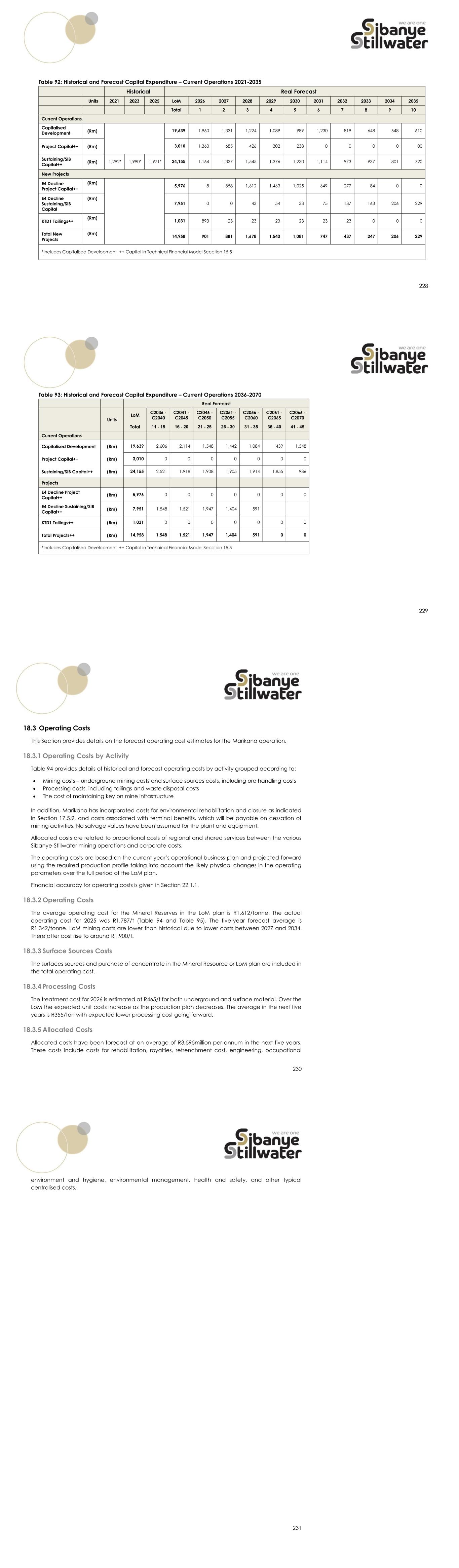
228 Table 92: Historical and Forecast Capital Expenditure – Current Operations 2021-2035 Historical Real Forecast Units 2021 2023 2025 LoM 2026 2027 2028 2029 2030 2031 2032 2033 2034 2035 Total 1 2 3 4 5 6 7 8 9 10 Current Operations Capitalised Development (Rm) 19,639 1,960 1,331 1,224 1,089 989 1,230 819 648 648 610 Project Capital++ (Rm) 3,010 1,360 685 426 302 238 0 0 0 0 00 Sustaining/SIB Capital++ (Rm) 1,292* 1,990* 1,971* 24,155 1,164 1,337 1,545 1,376 1,230 1,114 973 937 801 720 New Projects E4 Decline Project Capital++ (Rm) 5,976 8 858 1,612 1,463 1,025 649 277 84 0 0 E4 Decline Sustaining/SIB Capital (Rm) 7,951 0 0 43 54 33 75 137 163 206 229 KTD1 Tailings++ (Rm) 1,031 893 23 23 23 23 23 23 0 0 0 Total New Projects (Rm) 14,958 901 881 1,678 1,540 1,081 747 437 247 206 229 *Includes Capitalised Development ++ Capital in Technical Financial Model Secction 15.5 229 Table 93: Historical and Forecast Capital Expenditure – Current Operations 2036-2070 Real Forecast Units LoM C2036 - C2040 C2041 - C2045 C2046 - C2050 C2051 - C2055 C2056 - C2060 C2061 - C2065 C2066 - C2070 Total 11 - 15 16 - 20 21 - 25 26 - 30 31 - 35 36 - 40 41 - 45 Current Operations Capitalised Development (Rm) 19,639 2,606 2,114 1,548 1,442 1,084 439 1,548 Project Capital++ (Rm) 3,010 0 0 0 0 0 0 0 Sustaining/SIB Capital++ (Rm) 24,155 2,521 1,918 1,908 1,905 1,914 1,855 936 Projects E4 Decline Project Capital++ (Rm) 5,976 0 0 0 0 0 0 0 E4 Decline Sustaining/SIB Capital++ (Rm) 7,951 1,548 1,521 1,947 1,404 591 KTD1 Tailings++ (Rm) 1,031 0 0 0 0 0 0 0 Total Projects++ (Rm) 14,958 1,548 1,521 1,947 1,404 591 0 0 *Includes Capitalised Development ++ Capital in Technical Financial Model Secction 15.5 230 18.3 Operating Costs This Section provides details on the forecast operating cost estimates for the Marikana operation. 18.3.1 Operating Costs by Activity Table 94 provides details of historical and forecast operating costs by activity grouped according to: • Mining costs – underground mining costs and surface sources costs, including ore handling costs • Processing costs, including tailings and waste disposal costs • The cost of maintaining key on mine infrastructure In addition, Marikana has incorporated costs for environmental rehabilitation and closure as indicated in Section 17.5.9, and costs associated with terminal benefits, which will be payable on cessation of mining activities. No salvage values have been assumed for the plant and equipment. Allocated costs are related to proportional costs of regional and shared services between the various Sibanye-Stillwater mining operations and corporate costs. The operating costs are based on the current year’s operational business plan and projected forward using the required production profile taking into account the likely physical changes in the operating parameters over the full period of the LoM plan. Financial accuracy for operating costs is given in Section 22.1.1. 18.3.2 Operating Costs The average operating cost for the Mineral Reserves in the LoM plan is R1,612/tonne. The actual operating cost for 2025 was R1,787/t (Table 94 and Table 95). The five-year forecast average is R1,342/tonne. LoM mining costs are lower than historical due to lower costs between 2027 and 2034. There after cost rise to around R1,900/t. 18.3.3 Surface Sources Costs The surfaces sources and purchase of concentrate in the Mineral Resource or LoM plan are included in the total operating cost. 18.3.4 Processing Costs The treatment cost for 2026 is estimated at R465/t for both underground and surface material. Over the LoM the expected unit costs increase as the production plan decreases. The average in the next five years is R355/ton with expected lower processing cost going forward. 18.3.5 Allocated Costs Allocated costs have been forecast at an average of R3,595million per annum in the next five years. These costs include costs for rehabilitation, royalties, retrenchment cost, engineering, occupational 231 environment and hygiene, environmental management, health and safety, and other typical centralised costs.
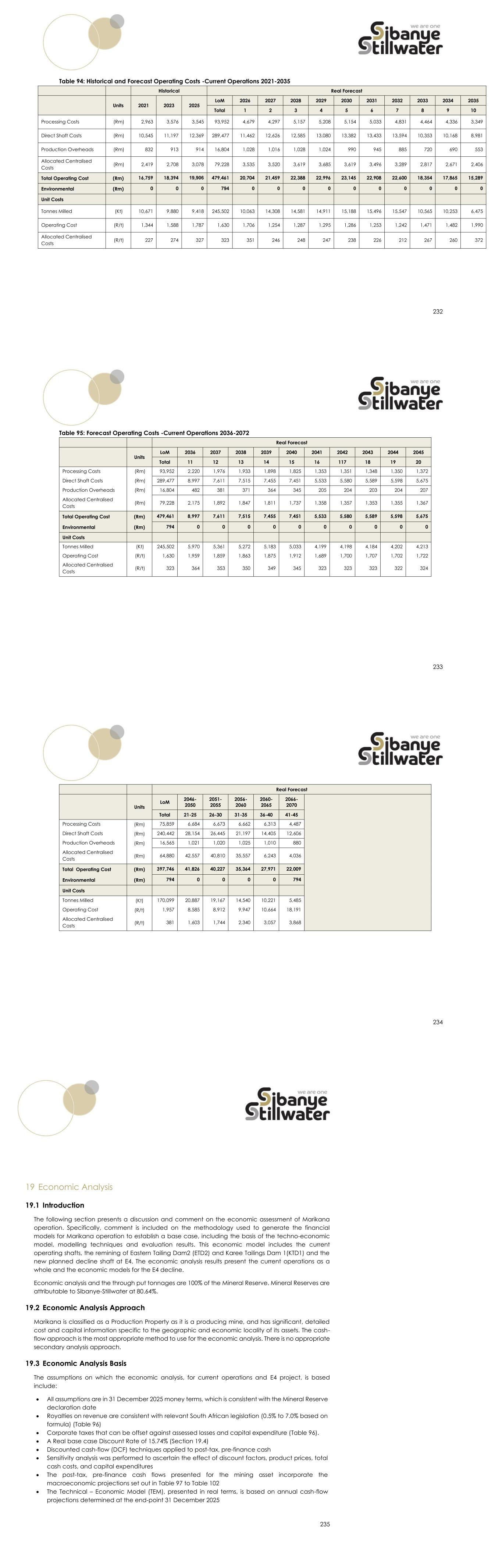
232 Table 94: Historical and Forecast Operating Costs -Current Operations 2021-2035 Historical Real Forecast Units 2021 2023 2025 LoM 2026 2027 2028 2029 2030 2031 2032 2033 2034 2035 Total 1 2 3 4 5 6 7 8 9 10 Processing Costs (Rm) 2,963 3,576 3,545 93,952 4,679 4,297 5,157 5,208 5,154 5,033 4,831 4,464 4,336 3,349 Direct Shaft Costs (Rm) 10,545 11,197 12,369 289,477 11,462 12,626 12,585 13,080 13,382 13,433 13,594 10,353 10,168 8,981 Production Overheads (Rm) 832 913 914 16,804 1,028 1,016 1,028 1,024 990 945 885 720 690 553 Allocated Centralised Costs (Rm) 2,419 2,708 3,078 79,228 3,535 3,520 3,619 3,685 3,619 3,496 3,289 2,817 2,671 2,406 Total Operating Cost (Rm) 16,759 18,394 19,906 479,461 20,704 21,459 22,388 22,996 23,145 22,908 22,600 18,354 17,865 15,289 Environmental (Rm) 0 0 0 794 0 0 0 0 0 0 0 0 0 0 Unit Costs Tonnes Milled (Kt) 10,671 9,880 9,418 245,502 10,063 14,308 14,581 14,911 15,188 15,496 15,547 10,565 10,253 6,475 Operating Cost (R/t) 1,344 1,588 1,787 1,630 1,706 1,254 1,287 1,295 1,286 1,253 1,242 1,471 1,482 1,990 Allocated Centralised Costs (R/t) 227 274 327 323 351 246 248 247 238 226 212 267 260 372 233 Table 95: Forecast Operating Costs -Current Operations 2036-2072 Real Forecast Units LoM 2036 2037 2038 2039 2040 2041 2042 2043 2044 2045 Total 11 12 13 14 15 16 117 18 19 20 Processing Costs (Rm) 93,952 2,220 1,976 1,933 1,898 1,825 1,353 1,351 1,348 1,350 1,372 Direct Shaft Costs (Rm) 289,477 8,997 7,611 7,515 7,455 7,451 5,533 5,580 5,589 5,598 5,675 Production Overheads (Rm) 16,804 482 381 371 364 345 205 204 203 204 207 Allocated Centralised Costs (Rm) 79,228 2,175 1,892 1,847 1,811 1,737 1,358 1,357 1,353 1,355 1,367 Total Operating Cost (Rm) 479,461 8,997 7,611 7,515 7,455 7,451 5,533 5,580 5,589 5,598 5,675 Environmental (Rm) 794 0 0 0 0 0 0 0 0 0 0 Unit Costs Tonnes Milled (Kt) 245,502 5,970 5,361 5,272 5,183 5,033 4,199 4,198 4,184 4,202 4,213 Operating Cost (R/t) 1,630 1,959 1,859 1,863 1,875 1,912 1,689 1,700 1,707 1,702 1,722 Allocated Centralised Costs (R/t) 323 364 353 350 349 345 323 323 323 322 324 234 Real Forecast Units LoM 2046- 2050 2051- 2055 2056- 2060 2060- 2065 2066- 2070 Total 21-25 26-30 31-35 36-40 41-45 Processing Costs (Rm) 75,859 6,684 6,673 6,662 6,313 4,487 Direct Shaft Costs (Rm) 240,442 28,154 26,445 21,197 14,405 12,606 Production Overheads (Rm) 16,565 1,021 1,020 1,025 1,010 880 Allocated Centralised Costs (Rm) 64,880 42,557 40,810 35,557 6,243 4,036 Total Operating Cost (Rm) 397,746 41,826 40,227 35,364 27,971 22,009 Environmental (Rm) 794 0 0 0 0 794 Unit Costs Tonnes Milled (Kt) 170,099 20,887 19,167 14,540 10,221 5,485 Operating Cost (R/t) 1,957 8,585 8,912 9,947 10,664 18,191 Allocated Centralised Costs (R/t) 381 1,603 1,744 2,340 3,057 3,868 235 19 Economic Analysis 19.1 Introduction The following section presents a discussion and comment on the economic assessment of Marikana operation. Specifically, comment is included on the methodology used to generate the financial models for Marikana operation to establish a base case, including the basis of the techno-economic model, modelling techniques and evaluation results. This economic model includes the current operating shafts, the remining of Eastern Tailing Dam2 (ETD2) and Karee Tailings Dam 1(KTD1) and the new planned decline shaft at E4. The economic analysis results present the current operations as a whole and the economic models for the E4 decline. Economic analysis and the through put tonnages are 100% of the Mineral Reserve. Mineral Reserves are attributable to Sibanye-Stillwater at 80.64%. 19.2 Economic Analysis Approach Marikana is classified as a Production Property as it is a producing mine, and has significant, detailed cost and capital information specific to the geographic and economic locality of its assets. The cash- flow approach is the most appropriate method to use for the economic analysis. There is no appropriate secondary analysis approach. 19.3 Economic Analysis Basis The assumptions on which the economic analysis, for current operations and E4 project, is based include: • All assumptions are in 31 December 2025 money terms, which is consistent with the Mineral Reserve declaration date • Royalties on revenue are consistent with relevant South African legislation (0.5% to 7.0% based on formula) (Table 96) • Corporate taxes that can be offset against assessed losses and capital expenditure (Table 96). • A Real base case Discount Rate of 15.74% (Section 19.4) • Discounted cash-flow (DCF) techniques applied to post-tax, pre-finance cash • Sensitivity analysis was performed to ascertain the effect of discount factors, product prices, total cash costs, and capital expenditures • The post-tax, pre-finance cash flows presented for the mining asset incorporate the macroeconomic projections set out in Table 97 to Table 102 • The Technical – Economic Model (TEM), presented in real terms, is based on annual cash-flow projections determined at the end-point 31 December 2025
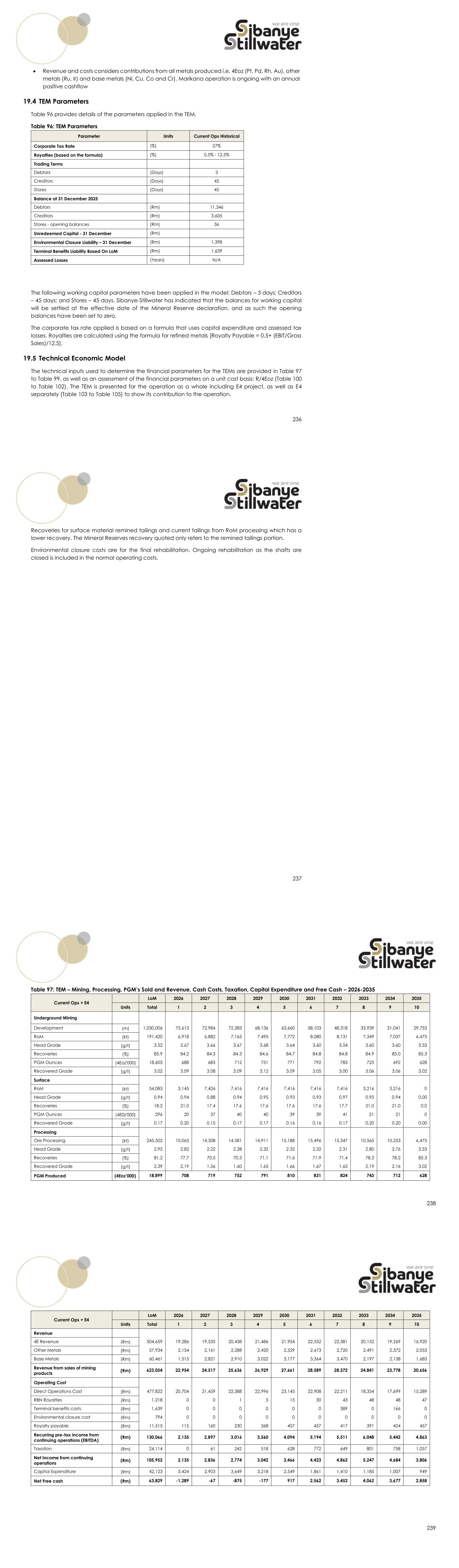
236 • Revenue and costs considers contributions from all metals produced i.e. 4Eoz (Pt, Pd, Rh, Au), other metals (Ru, Ir) and base metals (Ni, Cu, Co and Cr). Marikana operation is ongoing with an annual positive cashflow 19.4 TEM Parameters Table 96 provides details of the parameters applied in the TEM. Table 96: TEM Parameters Parameter Units Current Ops Historical Corporate Tax Rate (%) 27% Royalties (based on the formula) (%) 0.5% - 12.5% Trading Terms Debtors (Days) 3 Creditors (Days) 45 Stores (Days) 45 Balance at 31 December 2025 Debtors (Rm) 11,346 Creditors (Rm) 3,605 Stores - opening balances (Rm) 36 Unredeemed Capital - 31 December (Rm) Environmental Closure Liability – 31 December (Rm) 1,398 Terminal Benefits Liability Based On LoM (Rm) 1,639 Assessed Losses (Years) N/A The following working capital parameters have been applied in the model: Debtors – 3 days; Creditors – 45 days; and Stores – 45 days. Sibanye-Stillwater has indicated that the balances for working capital will be settled at the effective date of the Mineral Reserve declaration, and as such the opening balances have been set to zero. The corporate tax rate applied is based on a formula that uses capital expenditure and assessed tax losses. Royalties are calculated using the formula for refined metals [Royalty Payable = 0.5+ (EBIT/Gross Sales)/12.5]. 19.5 Technical Economic Model The technical inputs used to determine the financial parameters for the TEMs are provided in Table 97 to Table 99, as well as an assessment of the financial parameters on a unit cost basis: R/4Eoz (Table 100 to Table 102). The TEM is presented for the operation as a whole including E4 project, as well as E4 separately (Table 103 to Table 105) to show its contribution to the operation. 237 Recoveries for surface material remined tailings and current tailings from RoM processing which has a lower recovery. The Mineral Reserves recovery quoted only refers to the remined tailings portion. Environmental closure costs are for the final rehabilitation. Ongoing rehabilitation as the shafts are closed is included in the normal operating costs. 238 Table 97: TEM – Mining, Processing, PGM’s Sold and Revenue, Cash Costs, Taxation, Capital Expenditure and Free Cash – 2026-2035 Current Ops + E4 LoM 2026 2027 2028 2029 2030 2031 2032 2033 2034 2035 Units Total 1 2 3 4 5 6 7 8 9 10 Underground Mining Development (m) 1,030,006 75,613 72,984 72,383 68,136 63,660 58,103 48,318 33,939 31,041 29,753 RoM (kt) 191,420 6,918 6,882 7,165 7,495 7,772 8,080 8,131 7,349 7,037 6,475 Head Grade (g/t) 3.52 3.67 3.66 3.67 3.68 3.64 3.60 3.54 3.60 3.60 3.53 Recoveries (%) 85.9 84.2 84.3 84.3 84.6 84.7 84.8 84.8 84.9 85.0 85.3 PGM Ounces (4Eoz'000) 18,603 688 683 712 751 771 792 783 723 692 628 Recovered Grade (g/t) 3.02 3.09 3.08 3.09 3.12 3.09 3.05 3.00 3.06 3.06 3.02 Surface RoM (kt) 54,083 3,145 7,426 7,416 7,416 7,416 7,416 7,416 3,216 3,216 0 Head Grade (g/t) 0.94 0.94 0.88 0.94 0.95 0.93 0.93 0.97 0.95 0.94 0.00 Recoveries (%) 18.2 21.0 17.4 17.6 17.6 17.6 17.6 17.7 21.0 21.0 0.0 PGM Ounces (4E0z'000) 296 20 37 40 40 39 39 41 21 21 0 Recovered Grade (g/t) 0.17 0.20 0.15 0.17 0.17 0.16 0.16 0.17 0.20 0.20 0.00 Processing Ore Processing (kt) 245,502 10,063 14,308 14,581 14,911 15,188 15,496 15,547 10,565 10,253 6,475 Head Grade (g/t) 2.95 2.82 2.22 2.28 2.32 2.32 2.32 2.31 2.80 2.76 3.53 Recoveries (%) 81.2 77.7 70.5 70.3 71.1 71.6 71.9 71.4 78.3 78.2 85.3 Recovered Grade (g/t) 2.39 2.19 1.56 1.60 1.65 1.66 1.67 1.65 2.19 2.16 3.02 PGM Produced (4Eoz’000) 18,899 708 719 752 791 810 831 824 743 712 628 239 Current Ops + E4 LoM 2026 2027 2028 2029 2030 2031 2032 2033 2034 2035 Units Total 1 2 3 4 5 6 7 8 9 10 Revenue 4E Revenue (Rm) 504,659 19,286 19,535 20,438 21,486 21,954 22,552 22,381 20,152 19,269 16,920 Other Metals (Rm) 57,934 2,154 2,161 2,288 2,420 2,529 2,673 2,720 2,491 2,372 2,053 Base Metals (Rm) 60,461 1,515 2,821 2,910 3,022 3,177 3,364 3,470 2,197 2,138 1,683 Revenue from sales of mining products (Rm) 623,054 22,954 24,517 25,636 26,929 27,661 28,589 28,572 24,841 23,778 20,656 Operating Cost Direct Operations Cost (Rm) 477,822 20,704 21,459 22,388 22,996 23,145 22,908 22,211 18,354 17,699 15,289 RBN Royalties (Rm) 1,218 0 0 1 5 15 30 43 48 48 47 Terminal benefits costs (Rm) 1,639 0 0 0 0 0 0 389 0 166 0 Environmental closure cost (Rm) 794 0 0 0 0 0 0 0 0 0 0 Royalty payable (Rm) 11,515 115 160 230 368 407 457 417 391 424 457 Recurring pre-tax income from continuing operations (EBITDA) (Rm) 130,066 2,135 2,897 3,016 3,560 4,094 5,194 5,511 6,048 5,442 4,863 Taxation (Rm) 24,114 0 61 242 518 628 772 649 801 758 1,057 Net Income from continuing operations (Rm) 105,952 2,135 2,836 2,774 3,042 3,466 4,423 4,862 5,247 4,684 3,806 Capital Expenditure (Rm) 42,123 3,424 2,903 3,649 3,218 2,549 1,861 1,410 1,185 1,007 949 Net Free cash (Rm) 63,829 -1,289 -67 -875 -177 917 2,562 3,452 4,062 3,677 2,858
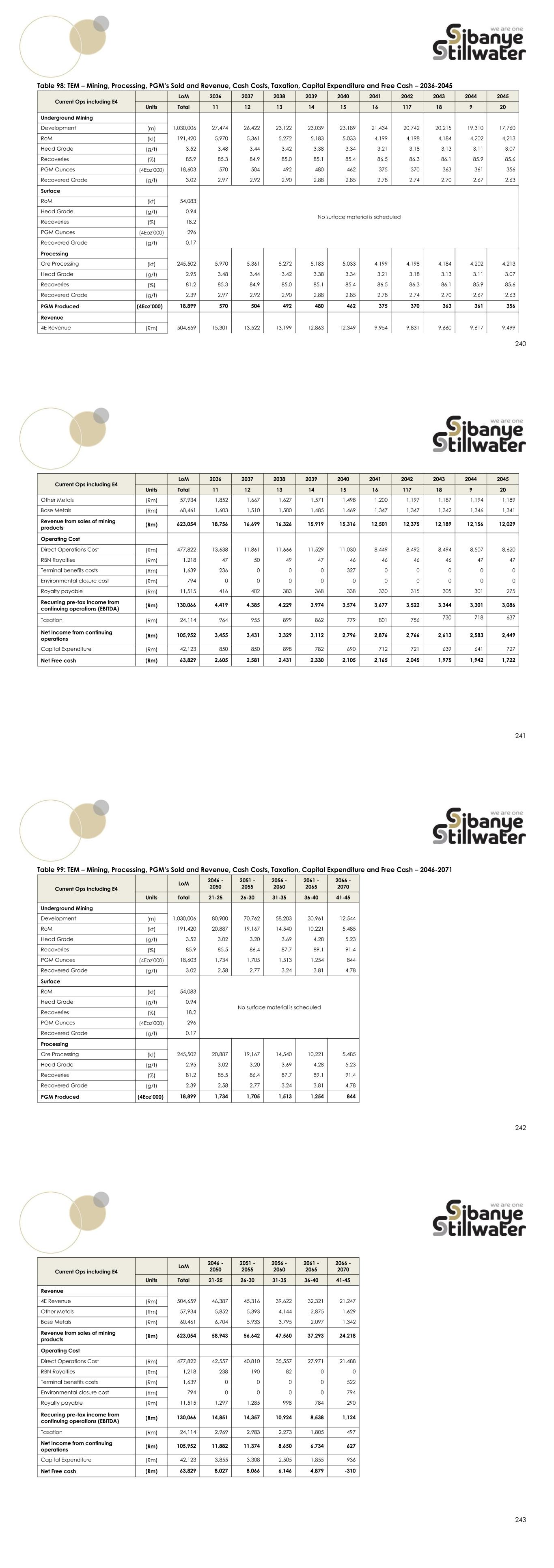
240 Table 98: TEM – Mining, Processing, PGM’s Sold and Revenue, Cash Costs, Taxation, Capital Expenditure and Free Cash – 2036-2045 Current Ops including E4 LoM 2036 2037 2038 2039 2040 2041 2042 2043 2044 2045 Units Total 11 12 13 14 15 16 117 18 9 20 Underground Mining Development (m) 1,030,006 27,474 26,422 23,122 23,039 23,189 21,434 20,742 20,215 19,310 17,760 RoM (kt) 191,420 5,970 5,361 5,272 5,183 5,033 4,199 4,198 4,184 4,202 4,213 Head Grade (g/t) 3.52 3.48 3.44 3.42 3.38 3.34 3.21 3.18 3.13 3.11 3.07 Recoveries (%) 85.9 85.3 84.9 85.0 85.1 85.4 86.5 86.3 86.1 85.9 85.6 PGM Ounces (4Eoz'000) 18,603 570 504 492 480 462 375 370 363 361 356 Recovered Grade (g/t) 3.02 2.97 2.92 2.90 2.88 2.85 2.78 2.74 2.70 2.67 2.63 Surface No surface material is scheduled RoM (kt) 54,083 Head Grade (g/t) 0.94 Recoveries (%) 18.2 PGM Ounces (4Eoz'000) 296 Recovered Grade (g/t) 0.17 Processing Ore Processing (kt) 245,502 5,970 5,361 5,272 5,183 5,033 4,199 4,198 4,184 4,202 4,213 Head Grade (g/t) 2.95 3.48 3.44 3.42 3.38 3.34 3.21 3.18 3.13 3.11 3.07 Recoveries (%) 81.2 85.3 84.9 85.0 85.1 85.4 86.5 86.3 86.1 85.9 85.6 Recovered Grade (g/t) 2.39 2.97 2.92 2.90 2.88 2.85 2.78 2.74 2.70 2.67 2.63 PGM Produced (4Eoz’000) 18,899 570 504 492 480 462 375 370 363 361 356 Revenue 4E Revenue (Rm) 504,659 15,301 13,522 13,199 12,863 12,349 9,954 9,831 9,660 9,617 9,499 241 Current Ops including E4 LoM 2036 2037 2038 2039 2040 2041 2042 2043 2044 2045 Units Total 11 12 13 14 15 16 117 18 9 20 Other Metals (Rm) 57,934 1,852 1,667 1,627 1,571 1,498 1,200 1,197 1,187 1,194 1,189 Base Metals (Rm) 60,461 1,603 1,510 1,500 1,485 1,469 1,347 1,347 1,342 1,346 1,341 Revenue from sales of mining products (Rm) 623,054 18,756 16,699 16,326 15,919 15,316 12,501 12,375 12,189 12,156 12,029 Operating Cost Direct Operations Cost (Rm) 477,822 13,638 11,861 11,666 11,529 11,030 8,449 8,492 8,494 8,507 8,620 RBN Royalties (Rm) 1,218 47 50 49 47 46 46 46 46 47 47 Terminal benefits costs (Rm) 1,639 236 0 0 0 327 0 0 0 0 0 Environmental closure cost (Rm) 794 0 0 0 0 0 0 0 0 0 0 Royalty payable (Rm) 11,515 416 402 383 368 338 330 315 305 301 275 Recurring pre-tax income from continuing operations (EBITDA) (Rm) 130,066 4,419 4,385 4,229 3,974 3,574 3,677 3,522 3,344 3,301 3,086 Taxation (Rm) 24,114 964 955 899 862 779 801 756 730 718 637 Net Income from continuing operations (Rm) 105,952 3,455 3,431 3,329 3,112 2,796 2,876 2,766 2,613 2,583 2,449 Capital Expenditure (Rm) 42,123 850 850 898 782 690 712 721 639 641 727 Net Free cash (Rm) 63,829 2,605 2,581 2,431 2,330 2,105 2,165 2,045 1,975 1,942 1,722 242 Table 99: TEM – Mining, Processing, PGM’s Sold and Revenue, Cash Costs, Taxation, Capital Expenditure and Free Cash – 2046-2071 Current Ops including E4 LoM 2046 - 2050 2051 - 2055 2056 - 2060 2061 - 2065 2066 - 2070 Units Total 21-25 26-30 31-35 36-40 41-45 Underground Mining Development (m) 1,030,006 80,900 70,762 58,203 30,961 12,544 RoM (kt) 191,420 20,887 19,167 14,540 10,221 5,485 Head Grade (g/t) 3.52 3.02 3.20 3.69 4.28 5.23 Recoveries (%) 85.9 85.5 86.4 87.7 89.1 91.4 PGM Ounces (4Eoz'000) 18,603 1,734 1,705 1,513 1,254 844 Recovered Grade (g/t) 3.02 2.58 2.77 3.24 3.81 4.78 Surface No surface material is scheduled RoM (kt) 54,083 Head Grade (g/t) 0.94 Recoveries (%) 18.2 PGM Ounces (4Eoz'000) 296 Recovered Grade (g/t) 0.17 Processing Ore Processing (kt) 245,502 20,887 19,167 14,540 10,221 5,485 Head Grade (g/t) 2.95 3.02 3.20 3.69 4.28 5.23 Recoveries (%) 81.2 85.5 86.4 87.7 89.1 91.4 Recovered Grade (g/t) 2.39 2.58 2.77 3.24 3.81 4.78 PGM Produced (4Eoz’000) 18,899 1,734 1,705 1,513 1,254 844 243 Current Ops including E4 LoM 2046 - 2050 2051 - 2055 2056 - 2060 2061 - 2065 2066 - 2070 Units Total 21-25 26-30 31-35 36-40 41-45 Revenue 4E Revenue (Rm) 504,659 46,387 45,316 39,622 32,321 21,247 Other Metals (Rm) 57,934 5,852 5,393 4,144 2,875 1,629 Base Metals (Rm) 60,461 6,704 5,933 3,795 2,097 1,342 Revenue from sales of mining products (Rm) 623,054 58,943 56,642 47,560 37,293 24,218 Operating Cost Direct Operations Cost (Rm) 477,822 42,557 40,810 35,557 27,971 21,488 RBN Royalties (Rm) 1,218 238 190 82 0 0 Terminal benefits costs (Rm) 1,639 0 0 0 0 522 Environmental closure cost (Rm) 794 0 0 0 0 794 Royalty payable (Rm) 11,515 1,297 1,285 998 784 290 Recurring pre-tax income from continuing operations (EBITDA) (Rm) 130,066 14,851 14,357 10,924 8,538 1,124 Taxation (Rm) 24,114 2,969 2,983 2,273 1,805 497 Net Income from continuing operations (Rm) 105,952 11,882 11,374 8,650 6,734 627 Capital Expenditure (Rm) 42,123 3,855 3,308 2,505 1,855 936 Net Free cash (Rm) 63,829 8,027 8,066 6,146 4,879 -310
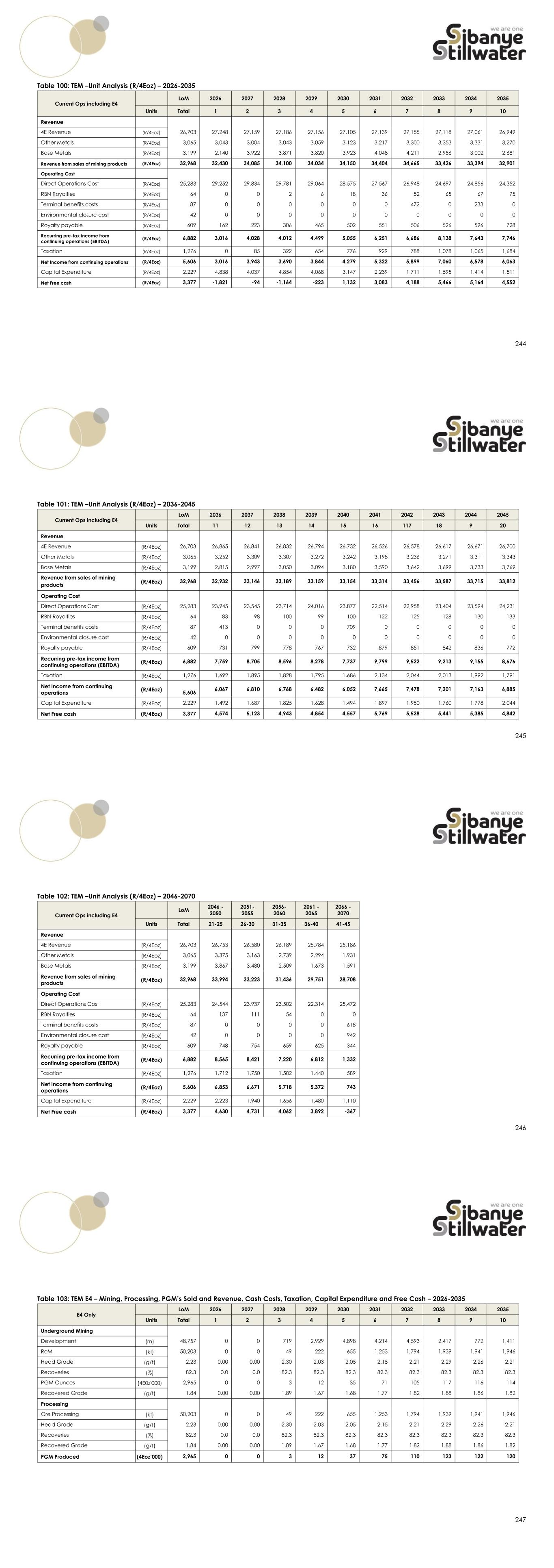
244 Table 100: TEM –Unit Analysis (R/4Eoz) – 2026-2035 Current Ops including E4 LoM 2026 2027 2028 2029 2030 2031 2032 2033 2034 2035 Units Total 1 2 3 4 5 6 7 8 9 10 Revenue 4E Revenue (R/4Eoz) 26,703 27,248 27,159 27,186 27,156 27,105 27,139 27,155 27,118 27,061 26,949 Other Metals (R/4Eoz) 3,065 3,043 3,004 3,043 3,059 3,123 3,217 3,300 3,353 3,331 3,270 Base Metals (R/4Eoz) 3,199 2,140 3,922 3,871 3,820 3,923 4,048 4,211 2,956 3,002 2,681 Revenue from sales of mining products (R/4Eoz) 32,968 32,430 34,085 34,100 34,034 34,150 34,404 34,665 33,426 33,394 32,901 Operating Cost Direct Operations Cost (R/4Eoz) 25,283 29,252 29,834 29,781 29,064 28,575 27,567 26,948 24,697 24,856 24,352 RBN Royalties (R/4Eoz) 64 0 0 2 6 18 36 52 65 67 75 Terminal benefits costs (R/4Eoz) 87 0 0 0 0 0 0 472 0 233 0 Environmental closure cost (R/4Eoz) 42 0 0 0 0 0 0 0 0 0 0 Royalty payable (R/4Eoz) 609 162 223 306 465 502 551 506 526 596 728 Recurring pre-tax income from continuing operations (EBITDA) (R/4Eoz) 6,882 3,016 4,028 4,012 4,499 5,055 6,251 6,686 8,138 7,643 7,746 Taxation (R/4Eoz) 1,276 0 85 322 654 776 929 788 1,078 1,065 1,684 Net Income from continuing operations (R/4Eoz) 5,606 3,016 3,943 3,690 3,844 4,279 5,322 5,899 7,060 6,578 6,063 Capital Expenditure (R/4Eoz) 2,229 4,838 4,037 4,854 4,068 3,147 2,239 1,711 1,595 1,414 1,511 Net Free cash (R/4Eoz) 3,377 -1,821 -94 -1,164 -223 1,132 3,083 4,188 5,466 5,164 4,552 245 Table 101: TEM –Unit Analysis (R/4Eoz) – 2036-2045 Current Ops including E4 LoM 2036 2037 2038 2039 2040 2041 2042 2043 2044 2045 Units Total 11 12 13 14 15 16 117 18 9 20 Revenue 4E Revenue (R/4Eoz) 26,703 26,865 26,841 26,832 26,794 26,732 26,526 26,578 26,617 26,671 26,700 Other Metals (R/4Eoz) 3,065 3,252 3,309 3,307 3,272 3,242 3,198 3,236 3,271 3,311 3,343 Base Metals (R/4Eoz) 3,199 2,815 2,997 3,050 3,094 3,180 3,590 3,642 3,699 3,733 3,769 Revenue from sales of mining products (R/4Eoz) 32,968 32,932 33,146 33,189 33,159 33,154 33,314 33,456 33,587 33,715 33,812 Operating Cost Direct Operations Cost (R/4Eoz) 25,283 23,945 23,545 23,714 24,016 23,877 22,514 22,958 23,404 23,594 24,231 RBN Royalties (R/4Eoz) 64 83 98 100 99 100 122 125 128 130 133 Terminal benefits costs (R/4Eoz) 87 413 0 0 0 709 0 0 0 0 0 Environmental closure cost (R/4Eoz) 42 0 0 0 0 0 0 0 0 0 0 Royalty payable (R/4Eoz) 609 731 799 778 767 732 879 851 842 836 772 Recurring pre-tax income from continuing operations (EBITDA) (R/4Eoz) 6,882 7,759 8,705 8,596 8,278 7,737 9,799 9,522 9,213 9,155 8,676 Taxation (R/4Eoz) 1,276 1,692 1,895 1,828 1,795 1,686 2,134 2,044 2,013 1,992 1,791 Net Income from continuing operations (R/4Eoz) 5,606 6,067 6,810 6,768 6,482 6,052 7,665 7,478 7,201 7,163 6,885 Capital Expenditure (R/4Eoz) 2,229 1,492 1,687 1,825 1,628 1,494 1,897 1,950 1,760 1,778 2,044 Net Free cash (R/4Eoz) 3,377 4,574 5,123 4,943 4,854 4,557 5,769 5,528 5,441 5,385 4,842 246 Table 102: TEM –Unit Analysis (R/4Eoz) – 2046-2070 Current Ops including E4 LoM 2046 - 2050 2051- 2055 2056- 2060 2061 - 2065 2066 - 2070 Units Total 21-25 26-30 31-35 36-40 41-45 Revenue 4E Revenue (R/4Eoz) 26,703 26,753 26,580 26,189 25,784 25,186 Other Metals (R/4Eoz) 3,065 3,375 3,163 2,739 2,294 1,931 Base Metals (R/4Eoz) 3,199 3,867 3,480 2,509 1,673 1,591 Revenue from sales of mining products (R/4Eoz) 32,968 33,994 33,223 31,436 29,751 28,708 Operating Cost Direct Operations Cost (R/4Eoz) 25,283 24,544 23,937 23,502 22,314 25,472 RBN Royalties (R/4Eoz) 64 137 111 54 0 0 Terminal benefits costs (R/4Eoz) 87 0 0 0 0 618 Environmental closure cost (R/4Eoz) 42 0 0 0 0 942 Royalty payable (R/4Eoz) 609 748 754 659 625 344 Recurring pre-tax income from continuing operations (EBITDA) (R/4Eoz) 6,882 8,565 8,421 7,220 6,812 1,332 Taxation (R/4Eoz) 1,276 1,712 1,750 1,502 1,440 589 Net Income from continuing operations (R/4Eoz) 5,606 6,853 6,671 5,718 5,372 743 Capital Expenditure (R/4Eoz) 2,229 2,223 1,940 1,656 1,480 1,110 Net Free cash (R/4Eoz) 3,377 4,630 4,731 4,062 3,892 -367 247 Table 103: TEM E4 – Mining, Processing, PGM’s Sold and Revenue, Cash Costs, Taxation, Capital Expenditure and Free Cash – 2026-2035 E4 Only LoM 2026 2027 2028 2029 2030 2031 2032 2033 2034 2035 Units Total 1 2 3 4 5 6 7 8 9 10 Underground Mining Development (m) 48,757 0 0 719 2,929 4,898 4,214 4,593 2,417 772 1,411 RoM (kt) 50,203 0 0 49 222 655 1,253 1,794 1,939 1,941 1,946 Head Grade (g/t) 2.23 0.00 0.00 2.30 2.03 2.05 2.15 2.21 2.29 2.26 2.21 Recoveries (%) 82.3 0.0 0.0 82.3 82.3 82.3 82.3 82.3 82.3 82.3 82.3 PGM Ounces (4E0z'000) 2,965 0 0 3 12 35 71 105 117 116 114 Recovered Grade (g/t) 1.84 0.00 0.00 1.89 1.67 1.68 1.77 1.82 1.88 1.86 1.82 Processing Ore Processing (kt) 50,203 0 0 49 222 655 1,253 1,794 1,939 1,941 1,946 Head Grade (g/t) 2.23 0.00 0.00 2.30 2.03 2.05 2.15 2.21 2.29 2.26 2.21 Recoveries (%) 82.3 0.0 0.0 82.3 82.3 82.3 82.3 82.3 82.3 82.3 82.3 Recovered Grade (g/t) 1.84 0.00 0.00 1.89 1.67 1.68 1.77 1.82 1.88 1.86 1.82 PGM Produced (4Eoz’000) 2,965 0 0 3 12 37 75 110 123 122 120
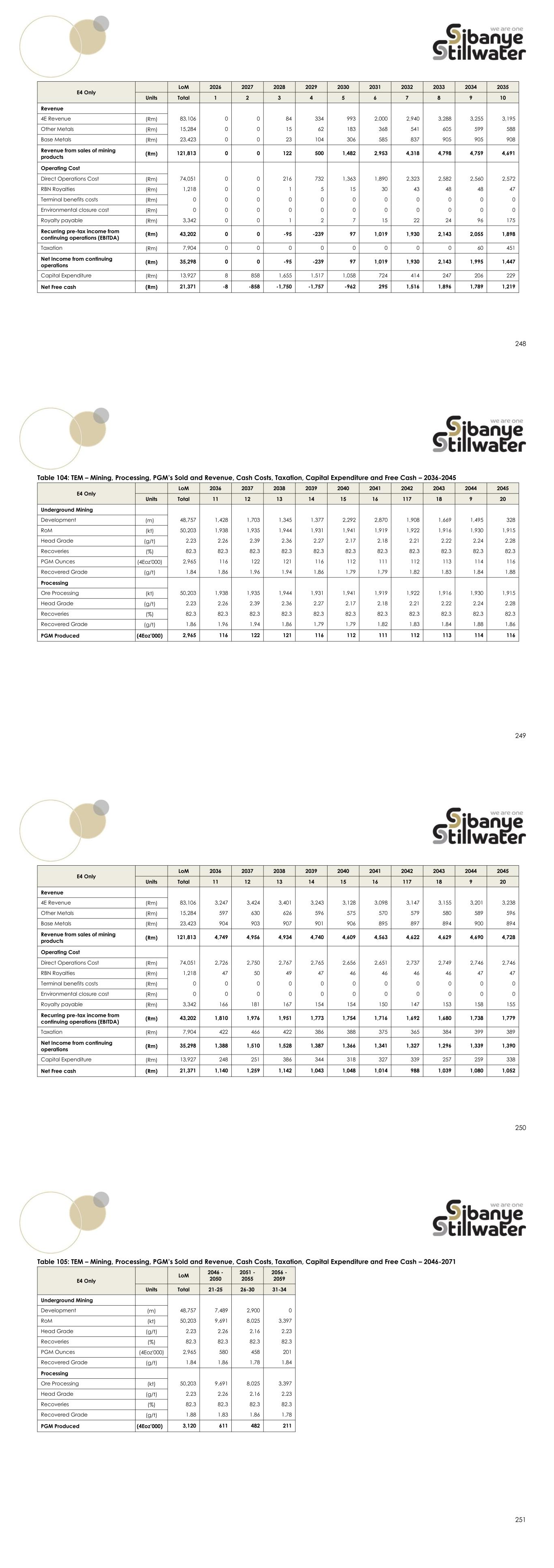
248 E4 Only LoM 2026 2027 2028 2029 2030 2031 2032 2033 2034 2035 Units Total 1 2 3 4 5 6 7 8 9 10 Revenue 4E Revenue (Rm) 83,106 0 0 84 334 993 2,000 2,940 3,288 3,255 3,195 Other Metals (Rm) 15,284 0 0 15 62 183 368 541 605 599 588 Base Metals (Rm) 23,423 0 0 23 104 306 585 837 905 905 908 Revenue from sales of mining products (Rm) 121,813 0 0 122 500 1,482 2,953 4,318 4,798 4,759 4,691 Operating Cost Direct Operations Cost (Rm) 74,051 0 0 216 732 1,363 1,890 2,323 2,582 2,560 2,572 RBN Royalties (Rm) 1,218 0 0 1 5 15 30 43 48 48 47 Terminal benefits costs (Rm) 0 0 0 0 0 0 0 0 0 0 0 Environmental closure cost (Rm) 0 0 0 0 0 0 0 0 0 0 0 Royalty payable (Rm) 3,342 0 0 1 2 7 15 22 24 96 175 Recurring pre-tax income from continuing operations (EBITDA) (Rm) 43,202 0 0 -95 -239 97 1,019 1,930 2,143 2,055 1,898 Taxation (Rm) 7,904 0 0 0 0 0 0 0 0 60 451 Net Income from continuing operations (Rm) 35,298 0 0 -95 -239 97 1,019 1,930 2,143 1,995 1,447 Capital Expenditure (Rm) 13,927 8 858 1,655 1,517 1,058 724 414 247 206 229 Net Free cash (Rm) 21,371 -8 -858 -1,750 -1,757 -962 295 1,516 1,896 1,789 1,219 249 Table 104: TEM – Mining, Processing, PGM’s Sold and Revenue, Cash Costs, Taxation, Capital Expenditure and Free Cash – 2036-2045 E4 Only LoM 2036 2037 2038 2039 2040 2041 2042 2043 2044 2045 Units Total 11 12 13 14 15 16 117 18 9 20 Underground Mining Development (m) 48,757 1,428 1,703 1,345 1,377 2,292 2,870 1,908 1,669 1,495 328 RoM (kt) 50,203 1,938 1,935 1,944 1,931 1,941 1,919 1,922 1,916 1,930 1,915 Head Grade (g/t) 2.23 2.26 2.39 2.36 2.27 2.17 2.18 2.21 2.22 2.24 2.28 Recoveries (%) 82.3 82.3 82.3 82.3 82.3 82.3 82.3 82.3 82.3 82.3 82.3 PGM Ounces (4Eoz'000) 2,965 116 122 121 116 112 111 112 113 114 116 Recovered Grade (g/t) 1.84 1.86 1.96 1.94 1.86 1.79 1.79 1.82 1.83 1.84 1.88 Processing Ore Processing (kt) 50,203 1,938 1,935 1,944 1,931 1,941 1,919 1,922 1,916 1,930 1,915 Head Grade (g/t) 2.23 2.26 2.39 2.36 2.27 2.17 2.18 2.21 2.22 2.24 2.28 Recoveries (%) 82.3 82.3 82.3 82.3 82.3 82.3 82.3 82.3 82.3 82.3 82.3 Recovered Grade (g/t) 1.86 1.96 1.94 1.86 1.79 1.79 1.82 1.83 1.84 1.88 1.86 PGM Produced (4Eoz’000) 2,965 116 122 121 116 112 111 112 113 114 116 250 E4 Only LoM 2036 2037 2038 2039 2040 2041 2042 2043 2044 2045 Units Total 11 12 13 14 15 16 117 18 9 20 Revenue 4E Revenue (Rm) 83,106 3,247 3,424 3,401 3,243 3,128 3,098 3,147 3,155 3,201 3,238 Other Metals (Rm) 15,284 597 630 626 596 575 570 579 580 589 596 Base Metals (Rm) 23,423 904 903 907 901 906 895 897 894 900 894 Revenue from sales of mining products (Rm) 121,813 4,749 4,956 4,934 4,740 4,609 4,563 4,622 4,629 4,690 4,728 Operating Cost Direct Operations Cost (Rm) 74,051 2,726 2,750 2,767 2,765 2,656 2,651 2,737 2,749 2,746 2,746 RBN Royalties (Rm) 1,218 47 50 49 47 46 46 46 46 47 47 Terminal benefits costs (Rm) 0 0 0 0 0 0 0 0 0 0 0 Environmental closure cost (Rm) 0 0 0 0 0 0 0 0 0 0 0 Royalty payable (Rm) 3,342 166 181 167 154 154 150 147 153 158 155 Recurring pre-tax income from continuing operations (EBITDA) (Rm) 43,202 1,810 1,976 1,951 1,773 1,754 1,716 1,692 1,680 1,738 1,779 Taxation (Rm) 7,904 422 466 422 386 388 375 365 384 399 389 Net Income from continuing operations (Rm) 35,298 1,388 1,510 1,528 1,387 1,366 1,341 1,327 1,296 1,339 1,390 Capital Expenditure (Rm) 13,927 248 251 386 344 318 327 339 257 259 338 Net Free cash (Rm) 21,371 1,140 1,259 1,142 1,043 1,048 1,014 988 1,039 1,080 1,052 251 Table 105: TEM – Mining, Processing, PGM’s Sold and Revenue, Cash Costs, Taxation, Capital Expenditure and Free Cash – 2046-2071 E4 Only LoM 2046 - 2050 2051 - 2055 2056 - 2059 Units Total 21-25 26-30 31-34 Underground Mining Development (m) 48,757 7,489 2,900 0 RoM (kt) 50,203 9,691 8,025 3,397 Head Grade (g/t) 2.23 2.26 2.16 2.23 Recoveries (%) 82.3 82.3 82.3 82.3 PGM Ounces (4Eoz'000) 2,965 580 458 201 Recovered Grade (g/t) 1.84 1.86 1.78 1.84 Processing Ore Processing (kt) 50,203 9,691 8,025 3,397 Head Grade (g/t) 2.23 2.26 2.16 2.23 Recoveries (%) 82.3 82.3 82.3 82.3 Recovered Grade (g/t) 1.88 1.83 1.86 1.78 PGM Produced (4Eoz’000) 3,120 611 482 211
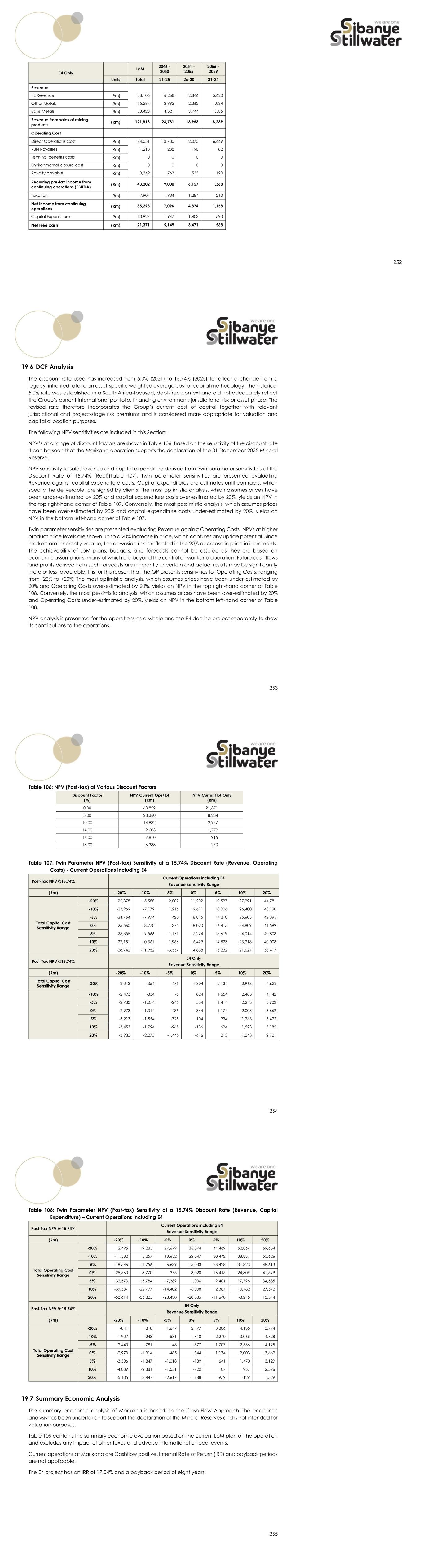
252 E4 Only LoM 2046 - 2050 2051 - 2055 2056 - 2059 Units Total 21-25 26-30 31-34 Revenue 4E Revenue (Rm) 83,106 16,268 12,846 5,620 Other Metals (Rm) 15,284 2,992 2,362 1,034 Base Metals (Rm) 23,423 4,521 3,744 1,585 Revenue from sales of mining products (Rm) 121,813 23,781 18,953 8,239 Operating Cost Direct Operations Cost (Rm) 74,051 13,780 12,073 6,669 RBN Royalties (Rm) 1,218 238 190 82 Terminal benefits costs (Rm) 0 0 0 0 Environmental closure cost (Rm) 0 0 0 0 Royalty payable (Rm) 3,342 763 533 120 Recurring pre-tax income from continuing operations (EBITDA) (Rm) 43,202 9,000 6,157 1,368 Taxation (Rm) 7,904 1,904 1,284 210 Net Income from continuing operations (Rm) 35,298 7,096 4,874 1,158 Capital Expenditure (Rm) 13,927 1,947 1,403 590 Net Free cash (Rm) 21,371 5,149 3,471 568 253 19.6 DCF Analysis The discount rate used has increased from 5.0% (2021) to 15.74% (2025) to reflect a change from a legacy, inherited rate to an asset-specific weighted average cost of capital methodology. The historical 5.0% rate was established in a South Africa-focused, debt-free context and did not adequately reflect the Group’s current international portfolio, financing environment, jurisdictional risk or asset phase. The revised rate therefore incorporates the Group’s current cost of capital together with relevant jurisdictional and project-stage risk premiums and is considered more appropriate for valuation and capital allocation purposes. The following NPV sensitivities are included in this Section: NPV’s at a range of discount factors are shown in Table 106. Based on the sensitivity of the discount rate it can be seen that the Marikana operation supports the declaration of the 31 December 2025 Mineral Reserve. NPV sensitivity to sales revenue and capital expenditure derived from twin parameter sensitivities at the Discount Rate of 15.74% (Real)(Table 107). Twin parameter sensitivities are presented evaluating Revenue against capital expenditure costs. Capital expenditures are estimates until contracts, which specify the deliverable, are signed by clients. The most optimistic analysis, which assumes prices have been under-estimated by 20% and capital expenditure costs over-estimated by 20%, yields an NPV in the top right-hand corner of Table 107. Conversely, the most pessimistic analysis, which assumes prices have been over-estimated by 20% and capital expenditure costs under-estimated by 20%, yields an NPV in the bottom left-hand corner of Table 107. Twin parameter sensitivities are presented evaluating Revenue against Operating Costs. NPVs at higher product price levels are shown up to a 20% increase in price, which captures any upside potential. Since markets are inherently volatile, the downside risk is reflected in the 20% decrease in price in increments. The achievability of LoM plans, budgets, and forecasts cannot be assured as they are based on economic assumptions, many of which are beyond the control of Marikana operation. Future cash flows and profits derived from such forecasts are inherently uncertain and actual results may be significantly more or less favourable. It is for this reason that the QP presents sensitivities for Operating Costs, ranging from -20% to +20%. The most optimistic analysis, which assumes prices have been under-estimated by 20% and Operating Costs over-estimated by 20%, yields an NPV in the top right-hand corner of Table 108. Conversely, the most pessimistic analysis, which assumes prices have been over-estimated by 20% and Operating Costs under-estimated by 20%, yields an NPV in the bottom left-hand corner of Table 108. NPV analysis is presented for the operations as a whole and the E4 decline project separately to show its contributions to the operations. 254 Table 106: NPV (Post-tax) at Various Discount Factors Discount Factor (%) NPV Current Ops+E4 (Rm) NPV Current E4 Only (Rm) 0.00 63,829 21,371 5.00 28,360 8,234 10.00 14,932 2,947 14.00 9,603 1,779 16.00 7,810 915 18.00 6,388 270 Table 107: Twin Parameter NPV (Post-tax) Sensitivity at a 15.74% Discount Rate (Revenue, Operating Costs) - Current Operations including E4 Post-Tax NPV @15.74% Current Operations including E4 Revenue Sensitivity Range (Rm) -20% -10% -5% 0% 5% 10% 20% Total Capital Cost Sensitivity Range -20% -22,378 -5,588 2,807 11,202 19,597 27,991 44,781 -10% -23,969 -7,179 1,216 9,611 18,006 26,400 43,190 -5% -24,764 -7,974 420 8,815 17,210 25,605 42,395 0% -25,560 -8,770 -375 8,020 16,415 24,809 41,599 5% -26,355 -9,566 -1,171 7,224 15,619 24,014 40,803 10% -27,151 -10,361 -1,966 6,429 14,823 23,218 40,008 20% -28,742 -11,952 -3,557 4,838 13,232 21,627 38,417 Post-Tax NPV @15.74% E4 Only Revenue Sensitivity Range (Rm) -20% -10% -5% 0% 5% 10% 20% Total Capital Cost Sensitivity Range -20% -2,013 -354 475 1,304 2,134 2,963 4,622 -10% -2,493 -834 -5 824 1,654 2,483 4,142 -5% -2,733 -1,074 -245 584 1,414 2,243 3,902 0% -2,973 -1,314 -485 344 1,174 2,003 3,662 5% -3,213 -1,554 -725 104 934 1,763 3,422 10% -3,453 -1,794 -965 -136 694 1,523 3,182 20% -3,933 -2,275 -1,445 -616 213 1,043 2,701 255 Table 108: Twin Parameter NPV (Post-tax) Sensitivity at a 15.74% Discount Rate (Revenue, Capital Expenditure) – Current Operations including E4 Post-Tax NPV @ 15.74% Current Operations including E4 Revenue Sensitivity Range (Rm) -20% -10% -5% 0% 5% 10% 20% Total Operating Cost Sensitivity Range -20% 2,495 19,285 27,679 36,074 44,469 52,864 69,654 -10% -11,532 5,257 13,652 22,047 30,442 38,837 55,626 -5% -18,546 -1,756 6,639 15,033 23,428 31,823 48,613 0% -25,560 -8,770 -375 8,020 16,415 24,809 41,599 5% -32,573 -15,784 -7,389 1,006 9,401 17,796 34,585 10% -39,587 -22,797 -14,402 -6,008 2,387 10,782 27,572 20% -53,614 -36,825 -28,430 -20,035 -11,640 -3,245 13,544 Post-Tax NPV @ 15.74% E4 Only Revenue Sensitivity Range (Rm) -20% -10% -5% 0% 5% 10% 20% Total Operating Cost Sensitivity Range -20% -841 818 1,647 2,477 3,306 4,135 5,794 -10% -1,907 -248 581 1,410 2,240 3,069 4,728 -5% -2,440 -781 48 877 1,707 2,536 4,195 0% -2,973 -1,314 -485 344 1,174 2,003 3,662 5% -3,506 -1,847 -1,018 -189 641 1,470 3,129 10% -4,039 -2,381 -1,551 -722 107 937 2,596 20% -5,105 -3,447 -2,617 -1,788 -959 -129 1,529 19.7 Summary Economic Analysis The summary economic analysis of Marikana is based on the Cash-Flow Approach. The economic analysis has been undertaken to support the declaration of the Mineral Reserves and is not intended for valuation purposes. Table 109 contains the summary economic evaluation based on the current LoM plan of the operation and excludes any impact of other taxes and adverse international or local events. Current operations at Marikana are Cashflow positive. Internal Rate of Return (IRR) and payback periods are not applicable. The E4 project has an IRR of 17.04% and a payback period of eight years.

256 Table 109: NPV (Post-tax) Relative to R/4Eoz PGM Basket Prices at 15.74 % Discount Rate - Current Operations including E4 Long Term Price (R/4Eoz) (Rm) Current Operations including E4 Sensitivity Range -20% -10% -5% 0 5% 10% 20% NPV@the base case Discount Rate (Rm) -25,560 -8,770 -375 8,020 16,415 24,809 41,599 Long Term Price (R/4Eoz) (Rm) E4 Only Sensitivity Range -20% -10% -5% 0 5% 10% 20% NPV@the base case Discount Rate (Rm) -2,973 -1,314 -485 344 1,174 2,003 3,662 19.8 QP Opinion The QP is satisfied that the economic analysis fairly represents the financial status of the operation as at 31 December 2025. New projects are evaluated against the same criteria as current operations. 20 Adjacent Properties Marikana is part of the Western Limb of the Bushveld Complex. Table 110 is a list of adjacent mines. The table gives the mine, owner, commodities mined and link to the Company websites. For current information on these properties, the reader should refer to the official websites. No data from these mines has been used in the estimation of Mineral Resources. As Rustenburg operation is owned by the Registrant, some operational information may have been shared in the estimation of the Mineral Reserves. Mineralisation on the adjacent properties is continuous across all properties however, variations across the deposit occur and the quantum and grade of the mineralisation at Rustenburg may not be indicative of the same at Marikana. The neighbouring property, Rustenburg operation, is owned and operated by the Registrant. There are shared services between these operations. The QPs for the Mineral Resources and Mineral Reserves of the Rustenburg operation are the same as for the Marikana operation. The QPs have verified the information in the public sources. The other mines are owned by third parties, and the QPs have not verified the information in public sources. 257 Table 110: Adjacent Mines, Bushveld Complex, Western Limb Mine name Owners Commodities Source of info *Rustenburg Operations (including Kroondal) Sibanye-Stillwater PGM www.sibanyestillwater.com Tharisa Mine Tharisa Minerals Chromite/PGM www.tharisa.com Leeuwkop Mine Aflplats (Impala Platinum) PGM https://www.implats.co.za Western Chrome Mines SAMANCOR Chromite (samancorcr.com) Rietvly (Rietvlei) Glencore Silica https://www.glencore.com/what-we- do/metals-and-minerals/ferroalloys 21 Other Relevant Data and Information 21.1 Risk Analysis 21.1.1 Financial Accuracy Table 111 provides details of accuracy limits in the major financial categories. Marikana does not directly report contingencies for Operating costs but rather provides for this as part of sustaining capital at 4% of Operating cost. Capital Projects are assessed to at least Pre-feasibility Level. The E4 Mechanised Project capital and operating costs have been assessed using the same criteria and to the same to the same level of accuracy as the current operations. Table 111: Financial Risks Risks Mitigation Measures Price Risk (Mineral Reserve Risk) - Revenue assessed the prices using various sensitivities (-10% to +10%) the forecast price considered multiple scenarios Economic Viability Risk (Mineral Reserve Risk) - Operating Costs assessed the operating costs using various sensitivities (-20% to +20%) Economic Viability Risk (Mineral Reserve Risk) - Capital Expenditure Sustaining and Project Capital based on 7% of operating costs for sustaining capital and technical studies for new projects (-20% to +20%) 258 21.1.2 Risk to the Mineral Resources and Mineral Reserves As part of the annual operational planning process, the Marikana operation’s management team assessed all the major risks that impact the execution of the plan. Sibanye-Stillwater maintains a risk register at the corporate level detailing all significant risks that may impact the operations. The Risk register is updated quarterly. Risks are listed by the source of the risk, the type of operational risk. Risks are assessed for likelihood of occurrence and severity for inherent risks to assess the unmitigated impact on the operations. The risk is reassessed once reasonable mitigation plans have been applied to give a residual risk using the same scale as for inherent risk. The following major risks have been identified. 21.1.2.1 Mineral Resources There are no deemed material risks to the Mineral Resource estimate. 21.1.2.2 Mineral Reserves There are no deemed material risks to the Mineral Resource estimation. The key operational risks that could impact the Mineral Reserves are listed below. Commodity prices and exchange rate assumptions Sibanye-Stillwater has assumed forward-looking price assumptions. Any material deviations from these assumptions could impact the Mineral Reserves, especially at marginal operations. Eskom electricity supply Loadshedding and load curtailment due to unreliable and erratic electricity supply from the national service provider has started to impact productivity at the operations. Even though Sibanye-Stillwater is actively working towards becoming less reliant on Eskom, with various renewable energy projects in operational and execution phase, this risk persists in the short to medium term. Cost escalation: Above average cost inflation could impact operating margins, and hence Mineral Reserves. Although cost increases have been well maintained and cost escalation assumptions relating to factors such as wages, utilities (including electricity) and other operational consumables are guided by PPI forecasts, continuous improvement initiatives are adopted to contain cost escalation to mitigate this risk. Operational performance Operational underperformance and slower-than-planned production build-up at projects may result in variations between planned and achieved production rates. Short interval controls are in place to enable the implementation of timeous interventions and, therefore, correction of deviations to plans. Environmental and social factors From an environmental perspective, the operations experience significant pressure on potable and fresh water supply. A new water strategy (2025) is being implemented with the objective of becoming 259 independent from third party water supply. The SA PGM operations are situated in close proximity to large communities with high unemployment rates. As such, they are exposed to potential social unrest. From a social and governance perspective, Sibanye-Stillwater has implemented appropriate actions to address this risk. 22 Interpretation and Conclusions The Qualified Persons have conducted a comprehensive review and assessment of all material issues likely to influence the future activities of Marikana operation based on information available up to 31 December 2025. Critical factors are the assumptions regarding the future metal prices and the South African Rand exchange rate against the US$. The assumptions about the Mineral Resources, operating conditions and modifying factors in converting Mineral Resources to Mineral Reserves are considered reasonable given the recent past and expected future operating conditions. There are no deemed material risks to the Mineral Resource Estimate. There are no unmanaged Risks to the Mineral Reserve. The operations have all the necessary infrastructure on Marikana to continue operations for the full LoM. Marikana has access to the necessary materials and labour locally. The views expressed in this Technical Report Summary have been based on the fundamental assumption that the required management resources and proactive management skills will be available and focused on meeting the LoM plans, and production targets provided by Marikana operation. 23 Recommendations There are no recommendations for additional work or changes. 24 References 24.1 List of Reports and Sources of Information 24.1.1 Publications and Reports Keays, R.R. and Lightfoot, P.C. (2004) ‘Formation of Ni-Cu-platinum-group-element sulfide mineralisation in the Sudbury Impact Melt Sheet’, Mineralogy and Petrology, 82(3), pp. 217–258. doi:10.1007/s00710- 004-0050-8.

260 Krivolutskaya, N.A. (2014) Evolution of trap magmatism and Pt-Cu-Ni mineralisation in the Noril'sk region. Moscow: Publishing Association of Scientific Publications KMK. [In Russian]. McCallum, I.S. (1996) ‘The Stillwater Complex’, in Developments in Petrology. Elsevier, pp. 441–483. doi:10.1016/S0167-2894(96)80015-7. Reczko, B.F.F., Oberholzer, J.D., Res, M., Eriksson, P.G. and Schreiber, U.M. (1995) ‘A re-evaluation of the volcanism of the Palaeoproterozoic Pretoria Group (Kaapvaal Craton) and hypothesis on basin development’, Journal of African Earth Sciences, 21, pp. 505–519. Reid, D.L. and Basson, I.J. (2002) ‘Iron-rich ultramafic pegmatite replacement bodies within the Upper Critical Zone, Rustenburg Layered Suite, Northam Platinum Mine, South Africa’, Mineralogical Magazine, 66(6). Scoon, R.A. and Mitchell, A.A. (2011) ‘The principal geological features of the Mooihoek platiniferous dunite pipe, eastern limb of the Bushveld Complex, and similarities with replaced Merensky Reef at the Amandelbult Mine, South Africa’, South African Journal of Geology, 114(1), pp. 15–40. Smith, D.S., Basson, I.J. and Reid, D.L. (2004) ‘Normal Reef subfacies of the Merensky Reef at Northam Platinum Mine, Zwartklip Facies, Western Bushveld Complex, South Africa’, The Canadian Mineralogist, 42(2), pp. 243–260. doi:10.2113/gscanmin.42.2.243. Tetteh, M. and Cawood, F. (2014) ‘Variable components of the mine call factor from a surface mine perspective using AngloGold Ashanti Iduapriem Mine as a case study’, in AfricaGEO 2014 Conference Proceedings, Cape Town, South Africa, 1–3 July 2014. Watson, B.P., Hoffmann, D. and Roberts, D.P. (2021) ‘Investigation of stress in a pothole in the Bushveld Complex: A case study’, Journal of the Southern African Institute of Mining and Metallurgy, 121(1). 261 24.2 Glossary of Terms South African Mining terms Mine Call Factor(MCF) - compares the sum of metal produced in recovery plus residue to the metal called for by the mines evaluation methods expressed as a percentage. For explanation, see Tetteh and Cawood(2014). Reef – South African Mining term for a Seam. Derived from Afrikaans/Dutch rif- ridge for the Witwatersrand goldfields where the seam formed ridges in outcrop. 262 25 Reliance on information provided by the Registrant The QPs have relied on information provided by Sibanye-Stillwater Marikana operation and Sibanye- Stillwater (the Registrant) in preparing the findings and conclusions regarding the following aspects of the Modifying Factors outside of the QPs’ expertise: • Macroeconomic trends, data and assumptions (Section 16) The QPs believe that it is reasonable to rely on the Registrant for such information because Sibanye- Stillwater assess the factors above at a corporate level and has the necessary skills to make this assessment. 26 Qualified Person’s Disclosure We, the signees, in our capacity as Qualified Persons in connection with the Technical Report Summary of Marikana operation effective 31 December 2025 (the Marikana operation Technical Report Summary) as required by Subpart 1300 of Regulation S-K (S-K1 300) and filed as an exhibit to Sibanye- Stillwater Limited’s annual report on Form 20-F for the year ended 31 December 2025 and any amendments or supplements and/or exhibits thereto (collectively, the Form 20-F), each hereby consent to: • the public filing and use by Sibanye-Stillwater of the Marikana operation Technical Report Summary for which I am responsible • the use and reference to my name, including my status as an expert or “Qualified Person” (as defined by SK-1300) in connection with the Form 20-F and Technical Report Summary for which I am responsible • the use of any extracts from, information derived from or summary of the Marikana operation Technical Report Summary in the Form 20-F • the incorporation by reference of the above items as included in the Form 20-F into any registration statement filed by Sibanye-Stillwater I am responsible for authoring, and this consent pertains to, the Marikana operation Technical Report Summary for which my name appears in Table 112 and certify that I have read the 20-F and that it fairly and accurately represents the information in the Marikana operation Technical Report Summary for which I am responsible. 263 Table 112: Qualified Person’s Details Property Name Date QP Name Affiliation to Registrant Field or Area of Responsibility Signature Marikana operation of Rustenburg Eastern Operations Proprietary Limited, (a subsidiary of Sibanye-Stillwater Limited) 24 April 2026 Mr Hermanus Jacobus Keyser Vice President Mining Technical Services 1-5, 7.8, 7.9,13,15, 16.1-16.3, 17.1- 17.4, 20-25 /s/ Hermanus Keyser Marikana operation of Rustenburg Eastern Operations Proprietary Limited, (a subsidiary of Sibanye-Stillwater Limited) 24 April 2026 Mr Leonard Changara Unit Manager Geology - Operations 5.2.1,6,7.1 to 7.7 /s/ Leonard Changara Marikana operation of Rustenburg Eastern Operations Proprietary Limited, (a subsidiary of Sibanye-Stillwater Limited) 24 April 2026 Ms Nicole Wansbury Unit Manager Geology Mineral Resources 1.4,8-11 /s/ Nicole Wansbury Marikana operation of Rustenburg Eastern Operations Proprietary Limited, (a subsidiary of Sibanye-Stillwater Limited) 24 April 2026 Mr Brian Smith Unit Manager Survey 1.5, 12 /s/ Brian Smith Kroondal PSA1 and Marikana operation of Rustenburg Eastern Operations Proprietary Limited, (a subsidiary of Sibanye-Stillwater Limited) 24 April 2026 Mr Stephan Botes Unit Manager – Surface and Mineral Rights 1.7, 3.2,3.4 /s/ Stephan Botes Marikana operation of Rustenburg Eastern Operations Proprietary Limited, (a subsidiary of Sibanye-Stillwater Limited) 24 April 2026 Mr Phillip Ramphisa Environmental Manager (SA PGM) 17.5 /s/ Phillip Ramphisa Kroondal Operations Marikana operation of Rustenburg Eastern Operations Proprietary Limited, (a subsidiary of Sibanye-Stillwater Limited) 24 April 2026 Mr Dewald Cloete SVP Processing 14 /s/ Dewald Cloete Marikana operation of Rustenburg Eastern Operations Proprietary Limited, (a subsidiary of Sibanye-Stillwater Limited) 24 April 2026 Mr Roderick Mugovhani SVP Finance 1.6, 18, 19 /s/ Roderick Mugovhani