Exhibit 99.1
UNITED STATES BANKRUPTCY COURT
SOUTHERN DISTRICT OF TEXAS
HOUSTON DIVISION
| ) | ||
| In re: | ) | Chapter 11 |
| ) | ||
| QVC Group, INC., et al.,1 | ) | Case No. 26-[____] ([·]) |
| ) | ||
| Debtors. | ) | (Joint Administration Requested) |
| ) |
DISCLOSURE STATEMENT FOR THE JOINT PREPACKAGED
PLAN OF REORGANIZATION OF QVC GROUP, INC. AND ITS DEBTOR
AFFILIATES PURSUANT TO CHAPTER 11 OF THE BANKRUPTCY CODE
| GRAY REED | KIRKLAND & ELLIS LLP | |||
| Jason S. Brookner (TX Bar No. 24033684) | KIRKLAND & ELLIS INTERNATIONAL LLP | |||
| Lydia R. Webb (TX Bar No. 24083758) | Joshua A. Sussberg, P.C. (pro hac vice pending) | |||
| Emily F. Shanks (TX Bar No. 24110350) | Aparna Yenamandra, P.C. (pro hac vice pending) | |||
| 1300 Post Oak Blvd. | 601 Lexington Avenue | |||
| Suite 2000 | New York, New York 10022 | |||
| Houston, Texas 77056 | Telephone: | (212) 446-4800 | ||
| Telephone: | (713) 986-7000 | Facsimile: | (212) 446-4900 | |
| Facsimile: | (713) 986-7100 | Email: | joshua.sussberg@kirkland.com | |
| Email: | jbrookner@grayreed.com | aparna.yenamandra@kirkland.com | ||
| lwebb@grayreed.com | ||||
| -and- | ||||
| Chad J. Husnick, P.C. (pro hac vice pending) | ||||
| Gabriela Z. Hensley (pro hac vice pending) | ||||
| 333 West Wolf Point Plaza | ||||
| Chicago, Illinois 60654 | ||||
| Telephone: | (312) 862-2000 | |||
| Facsimile: | (312) 862-2200 | |||
| Email: | chad.husnick@kirkland.com | |||
| gabriela.hensley@kirkland.com | ||||
| Proposed Co-Counsel for the Debtors and Debtors in Possession | Proposed Co-Counsel for the Debtors and Debtors in Possession | |||
| 1 | A complete list of each of the Debtors in these chapter 11 cases may be obtained on the website of the Debtors’ proposed solicitation agent at https://restructuring.ra.kroll.com/QVC. The location of Debtor QVC Group, Inc.’s corporate headquarters and the Debtors’ service address in these chapter 11 cases is 1200 Wilson Drive, West Chester, Pennsylvania 19380. |
THIS IS A SOLICITATION OF VOTES TO ACCEPT OR REJECT THE PLAN IN ACCORDANCE WITH BANKRUPTCY CODE SECTION 1125 AND WITHIN THE MEANING OF BANKRUPTCY CODE SECTION 1126, 11 U.S.C. §§ 1125, 1126. THIS DISCLOSURE STATEMENT HAS NOT YET BEEN APPROVED BY THE BANKRUPTCY COURT. THE DEBTORS INTEND TO SUBMIT THIS DISCLOSURE STATEMENT TO THE BANKRUPTCY COURT FOR APPROVAL FOLLOWING COMMENCEMENT OF SOLICITATION AND THE DEBTORS’ FILING FOR RELIEF UNDER CHAPTER 11 OF THE BANKRUPTCY CODE. THE INFORMATION IN THIS DISCLOSURE STATEMENT IS SUBJECT TO CHANGE. THIS DISCLOSURE STATEMENT IS NOT AN OFFER TO SELL ANY SECURITIES AND IS NOT SOLICITING AN OFFER TO BUY ANY SECURITIES.
Important information about this Disclosure Statement
SOLICITATION OF VOTES ON THE JOINT PREPACKAGED PLAN OF REORGANIZATION OF QVC GROUP, INC. AND ITS DEBTOR AFFILIATES PURSUANT TO CHAPTER 11 OF THE BANKRUPTCY CODE FROM THE HOLDERS OF OUTSTANDING:
| VOTING CLASS | NAME OF CLASS UNDER THE PLAN |
| B3 | RCF Claims |
| B4 | QVC Notes Claims |
| C3 | LINTA Notes Claims |
IF YOU ARE IN CLASS B3, Class B4, or CLASS c3 YOU ARE RECEIVING THIS DOCUMENT AND THE ACCOMPANYING MATERIALS BECAUSE YOU ARE ENTITLED TO VOTE ON THE PLAN.
ii
DELIVERY
OF BALLOTS (as Defined herein) BY HOLDERS OF RCF Claims,
BALLOTS
of the aforementioned PARTIES MAY BE Returned in |
If you have any questions regarding the procedures for voting on the PlaN:
You
can contact the Solicitation Agent by email at: qvcBALLOTS@RA.KROLL.com
you
can also contact the Solicitation Agent by phone toll-free at |
iii
Important information about this disclosure statement
THE DEBTORS ARE PROVIDING THIS DISCLOSURE STATEMENT TO HOLDERS OF CLAIMS FOR PURPOSES OF SOLICITING VOTES TO ACCEPT OR REJECT THE JOINT pREPACKAGED PLAN OF REORGANIZATION OF QVC GROUP, INC. AND ITS DEBTOR AFFILIATES PURSUANT TO CHAPTER 11 OF THE BANKRUPTCY CODE (AS MAY BE AMENDED, MODIFIED, OR SUPPLEMENTED FROM TIME TO TIME, AND INCLUDING ALL EXHIBITS AND SUPPLEMENTS THERETO, THE “PLAN”).2 THIS DISCLOSURE STATEMENT HAS NOT YET BEEN APPROVED BY THE BANKRUPTCY COURT. FUTURE APPROVAL OF THIS DISCLOSURE STATEMENT DOES NOT CONSTITUTE A GUARANTEE BY THE BANKRUPTCY COURT OF THE ACCURACY OR COMPLETENESS OF THE INFORMATION CONTAINED HEREIN OR AN ENDORSEMENT BY THE BANKRUPTCY COURT OF THE MERITS OF THE PLAN. THE INFORMATION CONTAINED IN THIS DISCLOSURE STATEMENT IS INCLUDED FOR PURPOSES OF SOLICITING VOTES FOR AND CONFIRMATION OF THE PLAN AND MAY NOT BE RELIED UPON OR USED BY ANY ENTITY FOR ANY OTHER PURPOSE.
BEFORE DECIDING WHETHER TO VOTE TO ACCEPT OR REJECT THE PLAN, EACH HOLDER OF A CLAIM ENTITLED TO VOTE ON THE PLAN SHOULD CAREFULLY CONSIDER ALL OF THE INFORMATION IN THIS DISCLOSURE STATEMENT, INCLUDING THE RISK FACTORS DESCRIBED IN ARTICLE IX HEREIN.
the debtors and certain holders of claims support the plan, including over 75% of the RCF Claims, over 55% of the QVC Notes Claims, and over 45% of the LINTA Notes Claims. The debtors believe that the compromises contemplated under the plan are fair and equitable, maximize the value of the debtors’ estates, and provide the best possible recovery to stakeholders. at this time, the debtors believe the plan represents the best available option for ACCOMPLISHING THE DEBTORS’ OVERALL RESTRUCTURING OBJECTIVES. the debtors strongly recommend that you vote to accept the plan.
HOLDERS OF CLAIMS SHOULD NOT CONSTRUE THE CONTENTS OF THIS DISCLOSURE STATEMENT AS PROVIDING ANY LEGAL, BUSINESS, FINANCIAL, OR TAX ADVICE. THE DEBTORS URGE EACH HOLDER OF A CLAIM entitled to vote on the plan TO CONSULT WITH ITS OWN ADVISORS WITH RESPECT TO ANY LEGAL, FINANCIAL, SECURITIES, TAX, OR BUSINESS ADVICE IN REVIEWING THIS DISCLOSURE STATEMENT, THE PLAN, AND THE RESTRUCTURING TRANSACTIONS CONTEMPLATED THEREBY. FURTHERMORE, THE BANKRUPTCY COURT’S APPROVAL OF THE ADEQUACY OF THE INFORMATION CONTAINED IN THIS DISCLOSURE STATEMENT (when and if approved) DOES NOT CONSTITUTE THE BANKRUPTCY COURT’S APPROVAL OF THE PLAN.
| 2 | Capitalized terms used but not otherwise defined in this Disclosure Statement have the meanings ascribed to such terms in the Plan or the RSA, as applicable. The summary of the Plan provided herein is qualified in its entirety by reference to the Plan. In the case of any inconsistency between this Disclosure Statement and the Plan, the Plan shall govern. |
iv
THIS DISCLOSURE STATEMENT CONTAINS, AMONG OTHER THINGS, SUMMARIES OF THE PLAN, CERTAIN STATUTORY PROVISIONS, AND CERTAIN ANTICIPATED EVENTS IN THE debtors’ forthcoming CHAPTER 11 CASES. ALTHOUGH THE DEBTORS BELIEVE THAT THESE SUMMARIES ARE FAIR AND ACCURATE, THESE SUMMARIES ARE QUALIFIED IN THEIR ENTIRETY TO THE EXTENT THAT THEY DO NOT SET FORTH THE ENTIRE TEXT OF SUCH DOCUMENTS OR STATUTORY PROVISIONS OR EVERY DETAIL OF SUCH ANTICIPATED EVENTS. IN THE EVENT OF ANY INCONSISTENCY OR DISCREPANCY BETWEEN A DESCRIPTION IN THIS DISCLOSURE STATEMENT AND THE TERMS AND PROVISIONS OF THE PLAN, the rsa, OR ANY OTHER DOCUMENTS INCORPORATED HEREIN BY REFERENCE, THE PLAN, the rsa, OR SUCH OTHER DOCUMENTS WILL GOVERN FOR ALL PURPOSES. FACTUAL INFORMATION CONTAINED IN THIS DISCLOSURE STATEMENT HAS BEEN PROVIDED BY THE DEBTORS’ MANAGEMENT EXCEPT WHERE OTHERWISE SPECIFICALLY NOTED. THE DEBTORS DO NOT REPRESENT OR WARRANT THAT THE INFORMATION CONTAINED HEREIN OR ATTACHED HERETO IS WITHOUT ANY MATERIAL INACCURACY OR OMISSION. EXCEPT AS OTHERWISE PROVIDED IN THE PLAN OR IN ACCORDANCE WITH APPLICABLE LAW, THE DEBTORS ARE UNDER NO DUTY TO UPDATE OR SUPpLeMENT THIS DISCLOSURE STATEMENT.
IN PREPARING THIS DISCLOSURE STATEMENT, THE DEBTORS RELIED ON FINANCIAL DATA DERIVED FROM THE DEBTORS’ BOOKS AND RECORDS AND ON VARIOUS ASSUMPTIONS REGARDING THE DEBTORS’ BUSINESS. WHILE THE DEBTORS BELIEVE THAT SUCH FINANCIAL INFORMATION FAIRLY REFLECTS THE FINANCIAL CONDITION OF THE DEBTORS AS OF THE DATE HEREOF AND THAT THE ASSUMPTIONS REGARDING FUTURE EVENTS REFLECT REASONABLE BUSINESS JUDGMENTS, NO REPRESENTATIONS OR WARRANTIES ARE MADE AS TO THE ACCURACY OF THE FINANCIAL INFORMATION CONTAINED HEREIN OR ASSUMPTIONS REGARDING THE DEBTORS’ BUSINESS AND THEIR FUTURE RESULTS AND OPERATIONS. THE DEBTORS EXPRESSLY CAUTION READERS NOT TO PLACE UNDUE RELIANCE ON ANY FORWARD-LOOKING STATEMENTS CONTAINED HEREIN.
THIS DISCLOSURE STATEMENT DOES NOT CONSTITUTE, AND MAY NOT BE CONSTRUED AS, AN ADMISSION OF FACT, LIABILITY, STIPULATION, OR WAIVER, NOR SHALL IT BE ADMISSIBLE IN ANY NONBANKRUPTCY PROCEEDING INVOLVING THE DEBTORS OR ANY OTHER PARTY, NOR SHALL IT BE CONSTRUED TO BE CONCLUSIVE ADVICE ON THE TAX, SECURITIES, OR OTHER LEGAL EFFECTS OF THE PLAN ON HOLDERS OF CLAIMS AGAINST, OR INTERESTS IN, THE DEBTORS. THE DEBTORS or any other Authorized Party MAY SEEK TO INVESTIGATE, FILE, AND PROSECUTE CLAIMS AND MAY OBJECT TO CLAIMS AFTER THE CONFIRMATION OR EFFECTIVE DATE OF THE PLAN IRRESPECTIVE OF WHETHER THIS DISCLOSURE STATEMENT IDENTIFIES ANY SUCH CLAIMS OR OBJECTIONS TO CLAIMS.
THE DEBTORS ARE MAKING THE STATEMENTS AND PROVIDING THE FINANCIAL INFORMATION CONTAINED IN THIS DISCLOSURE STATEMENT AS OF THE DATE HEREOF, UNLESS OTHERWISE SPECIFICALLY NOTED. there is no assurance that the statements contained herein will be correct at any time after such date. ALTHOUGH THE DEBTORS MAY SUBSEQUENTLY UPDATE THE INFORMATION IN THIS DISCLOSURE STATEMENT, THE DEBTORS HAVE NO AFFIRMATIVE DUTY TO DO SO, AND EXPRESSLY DISCLAIM ANY DUTY TO PUBLICLY UPDATE ANY FORWARD-LOOKING STATEMENTS, WHETHER AS A RESULT OF NEW INFORMATION, FUTURE EVENTS, OR OTHERWISE. HOLDERS OF CLAIMS OR INTERESTS REVIEWING THIS DISCLOSURE STATEMENT SHOULD NOT INFER THAT, AT THE TIME OF THEIR REVIEW, THE FACTS SET FORTH HEREIN HAVE NOT CHANGED SINCE THIS DISCLOSURE STATEMENT WAS FILED. INFORMATION CONTAINED HEREIN IS SUBJECT TO COMPLETION, MODIFICATION, OR AMENDMENT. THE DEBTORS RESERVE THE RIGHT TO FILE or distribute AN AMENDED OR MODIFIED PLAN AND RELATED DISCLOSURE STATEMENT, FROM TIME TO TIME, SUBJECT TO THE TERMS OF THE PLAN and the RSA.
v
THE DEBTORS HAVE NOT AUTHORIZED ANY ENTITY TO GIVE ANY INFORMATION ABOUT OR CONCERNING THE PLAN or the rsa OTHER THAN THAT WHICH IS CONTAINED IN THIS DISCLOSURE STATEMENT. THE DEBTORS HAVE NOT AUTHORIZED ANY DISCLOSURE or representations CONCERNING THE DEBTORS OR THE VALUE OF THEIR PROPERTY OTHER THAN AS SET FORTH IN THIS DISCLOSURE STATEMENT.
IF THE PLAN IS CONFIRMED BY THE BANKRUPTCY COURT AND THE EFFECTIVE DATE OCCURS, ALL HOLDERS OF CLAIMS OR INTERESTS (INCLUDING THOSE HOLDERS OF CLAIMS OR INTERESTS WHO DO NOT SUBMIT BALLOTS TO ACCEPT OR REJECT THE PLAN, who vote to reject the Plan, or WHO ARE NOT ENTITLED TO VOTE ON THE PLAN) WILL BE BOUND BY THE TERMS OF THE PLAN AND THE RESTRUCTURING TRANSACTIONS CONTEMPLATED THEREBY.
The confirmation and effectiveness of the Plan are subject to certain material conditions precedent described herein and set forth in Article IX of the Plan. There is no assurance that the Plan will be confirmed, or if confirmed, that the conditions required to be satisfied for the Plan to go effective will be satisfied (or waived).
You are encouraged to read the Plan, the RSA, and this Disclosure Statement in their entirety, including Article IX herein, entitled “RISK FACTORS” before submitting your ballot TO vote on the Plan.
THIS DISCLOSURE STATEMENT HAS BEEN PREPARED IN ACCORDANCE WITH SECTION 1125 OF THE BANKRUPTCY CODE AND BANKRUPTCY RULE 3016(b) AND IS NOT NECESSARILY PREPARED IN ACCORDANCE WITH FEDERAL OR STATE SECURITIES LAWS OR OTHER SIMILAR LAWS. This Disclosure Statement has not been approved or disapproved by the United States Securities and Exchange Commission (THE “sec”) or any similar federal, state, local, or foreign regulatory agency, nor has the SEC or any other agency passed upon the accuracy or adequacy of the statements contained in this Disclosure Statement. ANY REPRESENTATION TO THE CONTRARY IS A CRIMINAL OFFENSE.
The Debtors have sought to ensure the accuracy of the financial information provided in this Disclosure Statement; however, the financial information contained in this Disclosure Statement or incorporated herein by reference has not been, and will not be, audited or reviewed by the Debtors’ independent auditors unless explicitly provided otherwise HEREIN.
vi
Upon Confirmation of the Plan, certain of the securities described or otherwise contemplated in this Disclosure Statement will be issued without registration under the Securities Act of 1933, AS AMENDED (together with the rules and regulations promulgated thereunder, the “Securities Act”), or similar federal, state, local, or foreign laws in reliance on the exemption set forth in section 1145 of the Bankruptcy Code to the extent permitted under applicable law, section 4(a)(2) of the securities act, regulation d promulgated thereunder, regulation s under the securities act, and/or other available exemptions from registration. Other Securities may be issued pursuant to other applicable exemptions under the federal securities laws. If exemptions from registration under section 1145 of the Bankruptcy Code, section 4(a)(2) of the securities act, regulation d promulgated thereunder, regulation s under the securities act, or applicable federal securities law do not apply, the Securities described or otherwise contemplated in this disclosure statement may not be offered or sold except UNDER a valid exemption or upon registration under the Securities Act. The Debtors recommend that potential recipients of Securities issued under the Plan consult their own COUNSEL concerning their ability to freely trade such Securities in compliance with the federal securities laws and any applicable “Blue Sky” laws. The Debtors make no representation concerning the ability of a person to dispose of such Securities.
THIS DISCLOSURE STATEMENT CONTAINS FORWARD-LOOKING STATEMENTS WITHIN THE MEANING OF THE “SAFE HARBOR” PROVISIONS OF THE PRIVATE SECURITIES LITIGATION REFORM ACT OF 1995, AS AMENDED. The Debtors make statements in this Disclosure Statement that are considered forward-looking statements under federal securities laws. When used in this Disclosure Statement, the words “believe,” “expect,” “anticipate,” “estimate,” “intend,” “project,” “plan,” “likely,” “may,” “will,” “should,” “shall,” or other words or phrases of similar import generally identify forward-looking statements. The Debtors consider all statements regarding anticipated or future matters, including the following, to be forward-looking statements. Although the debtors believe the expectations reflected in such FORWARD-LOOKING statements are based on reasonable assumptions, the debtors can give no assurance that their expectations will be attained, and it is possible that actual results may differ materially from those indicated by these FORWARD-LOOKING statements due to a variety of risks and uncertainties. All forward-looking statements attributable to the Debtors or Entities acting on their behalf are expressly qualified in their entirety by the cautionary statements set forth in this Disclosure Statement. Forward-looking statements speak only as of the date on which they are made. Except as required by law, the Debtors expressly disclaim any obligation to update or revise any forward-looking statement, whether as a result of new information, subsequent events, anticipated or unanticipated circumstances, or otherwise. See Articles VIII–XII of this Disclosure Statement for a discussion of certain considerations and risk factors that Holders entitled to vote on the Plan should consider. forward-looking statements may include, but are not limited to, statements about:
| · | THE DEBTORS’ PLANS, OBJECTIVES, INTENTIONS, AND EXPECTATIONS; |
vii
| · | THE DEBTORS’ BUSINESS STRATEGY; |
| · | THE DEBTORS’ FINANCIAL STRATEGY, BUDGET, AND PROJECTIONS; |
| · | THE DEBTORS’ FINANCIAL CONDITION, REVENUES, CASH FLOWS, AND EXPENSES; |
| · | THE DEBTORS’ LEVELS OF INDEBTEDNESS, LIQUIDITY, AND COMPLIANCE WITH DEBT COVENANTS; |
| · | THE SUCCESS AND COSTS OF THE DEBTORS’ OPERATIONS; |
| · | UNCERTAINTY REGARDING THE DEBTORS’ FUTURE OPERATING RESULTS; |
| · | CUSTOMER AND VENDOR RESPONSES TO THE CHAPTER 11 CASES; |
| · | THE AMOUNT, NATURE, AND TIMING OF THE DEBTORS’ CAPITAL EXPENDITURES; |
| · | THE AVAILABILITY AND TERMS OF CAPITAL; |
| · | GENERAL ECONOMIC AND BUSINESS CONDITIONS (INCLUDING WITH RESPECT TO NON-U.S. CURRENCY FLUCTUATIONS, TARIFFS, AND/OR TRADE NEGOTIATIONS, PARTICULARLY WITH RESPECT TO ANY NON-U.S. MARKETS WHERE THE DEBTORS CONDUCT BUSINESS); |
| · | THE EFFECTIVENESS OF THE DEBTORS’ RISK MANAGEMENT ACTIVITIES; |
| · | THE DEBTORS’ COUNTERPARTIES CREDIT RISK; |
| · | THE OUTCOME OF PENDING AND FUTURE LITIGATION CLAIMS OR ANY REGULATORY PROCEEDINGS; |
| · | THE GOVERNMENTAL REGULATIONS AND TAXATION APPLICABLE TO THE DEBTORS, INCLUDING ANY CHANGES THERETO; |
| · | THE POTENTIAL ADOPTION OF NEW GOVERNMENTAL REGULATIONS; |
| · | OTHER GENERAL ECONOMIC AND POLITICAL CONDITIONS IN THE UNITED STATES AND INTERNATIONALLY, INCLUDING THOSE RESULTING FROM RECESSIONS, POLITICAL EVENTS, ACTS OR THREATS OF TERRORISM, AND MILITARY CONFLICTS; |
| · | PLANS, OBJECTIVES, AND EXPECTATIONS; |
| · | THE DEBTORS’ ABILITY TO SATISFY FUTURE CASH OBLIGATIONS. |
viii
| · | THE DEBTORS’ ABILITY TO LIST THE QVC NEW EQUITY INTERESTS ON A NATIONAL SECURITIES EXCHANGE AND TO COMPLY WITH THE INITIAL LISTING STANDARDS AND ONGOING REQUIREMENTS OF SUCH EXCHANGE; |
| · | THE DEBTORS’ ABILITY TO REGISTER THE QVC NEW EQUITY INTERESTS UNDER SECTION 12(b) OF THE SECURITIES EXCHANGE ACT OF 1934, AS AMENDED (together with the rules and regulations promulgated thereunder), THE “EXCHANGE ACT”), AND TO SATISFY THE PERIODIC REPORTING AND OTHER OBLIGATIONS OF A PUBLIC REPORTING COMPANY UNDER THE EXCHANGE ACT; AND |
| · | THE AVAILABILITY OF EXEMPTIONS FROM REGISTRATION UNDER THE SECURITIES ACT AND APPLICABLE BLUE SKY LAWS FOR THE ISSUANCE AND RESALE OF SECURITIES UNDER THE PLAN. |
Statements concerning these and other matters are not guarantees of the Reorganized Debtors’ future performance. There are risks, uncertainties, and other important factors that could cause the Reorganized Debtors’ or company’s actual performance or achievements to be different from those they may project, and the Debtors undertake no obligation to update the projections made herein. These risks, uncertainties, and factors may include the following: the Debtors’ ability to confirm and consummate the Plan; the potential that THE DEBTORS MAY NEED TO PURSUE AN ALTERNATIVE TRANSACTION IF THE PLAN IS NOT CONFIRMED; the Debtors’ ability to reduce their overall financial leverage; the potential adverse impact of the Chapter 11 Cases on the Debtors’ operations, management, and employees; the risks associated with operating the Debtors’ business during the Chapter 11 Cases; THE DEBTORS’ INABILITY TO MAINTAIN RELATIONSHIPS WITH SUPPLIERS, EMPLOYEES, AND other third parties as a result of this chapter 11 filing or those parties’ failure to comply with their contractual obligations; customer AND VENDOR responses to the Chapter 11 Cases; the Debtors’ inability to discharge or settle Claims during the Chapter 11 Cases; general economic, business, and market conditions; currency fluctuations; interest rate fluctuations; price increases; exposure to litigation; a decline in the Debtors’ market share due to competition; the Debtors’ ability to implement cost reduction initiatives in a timely manner; financial conditions of the Debtors’ customers; adverse tax changes; limited access to capital resources; changes in domestic and foreign laws and regulations; the possibility that foreign courts will not enforce the confirmation order; trade balance; natural disasters; PANDEMICS; geopolitical instability; government shutdowns; the effects of governmental regulation on the Debtors’ business; the Debtors’ ability to list the QVC New Equity Interests on a national securities exchange and to satisfy the initial listing standards thereof; the Debtors’ ability to comply with the periodic reporting and other requirements of the Exchange Act and the rules and regulations of the SEC; the availability of exemptions from registration under the Securities Act for the issuance and resale of securities under the Plan; and the Debtors’ ability to maintain effective internal controls over financial reporting and disclosure controls and procedures as a public reporting company following emergence.
ix
You are cautioned that all forward-looking statements are necessarily speculative, and there are certain risks and uncertainties that could cause actual events or results to differ materially from those referred to in such forward-looking statements. The projections and forward-looking information contained or incorporated by reference herein and attached hereto are only estimates, and the timing and amount of actual distributions to Holders of Allowed Claims and Allowed Interests, among other things, may be affected by many factors that cannot be predicted. Any analyses, estimates, or recovery projections may or may not turn out to be accurate.
Recommendation by the Debtors
each debtor’s board of managers, board of directors, sole shareholder, sole member, majority member, sole general partner, director, managing director, or manager, as applicable, has approved the restructuring transactions contemplated by the plan and described in this disclosure statement. each Debtor believes that the compromises contemplated by the restructuring transactions are fair and equitable, maximize the value of each Debtor’s ASSETS, and provide the best recovery to the DEBTORS’ STAKEholders. At this time, each Debtor believes that the restructuring transactions represent the best alternative for accomplishing the Debtors’ overall restructuring objectives.
EACH OF THE DEBTORS THEREFORE STRONGLY RECOMMENDS THAT ALL HOLDERS OF CLAIMS WHOSE VOTES ON THE PLAN ARE BEING SOLICITED ACCEPT THE PLAN by returning their ballot so as to be actually received by the Solicitation Agent no later than THE VOTING DEADLINE (MAY 19, 2026, at 11:59 P.m. (prevailing central Time) pursuant to the instructions set forth herein and In the SOLICITATION MATERIALS, INCLUDING IN YOUR BALLOT. |
x
Special Notice Regarding Federal and State Securities Laws
The Bankruptcy Court has not reviewed this Disclosure Statement or the Plan, and the securities to be issued pursuant to the Plan on or after the Effective Date will not have been the subject of a registration statement filed with the SEC under the Securities Act, any securities regulatory authority of any state under any state securities law (“Blue Sky Laws”), or the securities laws of any other jurisdiction. The Plan has not been approved or disapproved by the SEC, any state regulatory authority, or the regulatory authority of any jurisdiction and neither the SEC, any state regulatory authority, nor any other regulatory authority in any jurisdiction has passed upon the accuracy or adequacy of the information contained in this Disclosure Statement or the Plan. Any representation to the contrary is a criminal offense. The Reorganized Debtors intend to register the QVC New Equity Interests under section 12(b) of the Exchange Act and to list the QVC New Equity Interests for public trading on a national securities exchange on or as soon as reasonably practicable after the Effective Date; however, neither the Exchange Act registration nor the exchange listing has been approved, and there can be no assurance that such registration or listing will be obtained or maintained. The securities may not be offered or sold within the United States or to, or for the account or benefit of, United States persons (as defined in Regulation S under the Securities Act), except pursuant to an exemption from, or in a transaction not subject to, the registration requirements of the Securities Act and applicable laws of other jurisdictions.
After the Petition Date, the Debtors will rely on section 1145(a) of the Bankruptcy Code to exempt from registration under the Securities Act and Blue Sky Laws the offer, issuance, and distribution, if applicable, of securities under the Plan, and to the extent such exemption is not available, then such securities will be offered, issued, and distributed under the Plan pursuant to section 4(a)(2) of the Securities Act, Regulation D promulgated thereunder, Regulation S under the Securities Act, and/or other applicable exemptions from registration under the Securities Act and any other applicable securities laws. Neither the Solicitation nor this Disclosure Statement constitutes an offer to sell or the solicitation of an offer to buy securities in any state or jurisdiction in which such offer or solicitation is not authorized.
Securities issued pursuant to the exemption from registration set forth in section 4(a)(2) of the Securities Act, Regulation D promulgated thereunder, Regulation S under the Securities Act, and/or other available exemptions from registration will be considered “restricted securities,” will bear customary legends and transfer restrictions, and may not be transferred except pursuant to an effective registration statement or under an available exemption from the registration requirements of the Securities Act (including, to the extent applicable, Rule 144 under the Securities Act) and may be subject to any additional restrictions on the transferability of such securities pursuant to the applicable underlying documentation.
Certain securities issued under the plan may constitute “restricted securities” or “control securities” as defined under Rule 144 of the Securities Act and may be subject to legends and transfer restrictions. In addition, QVC New Equity Interests issued pursuant to section 1145(a) of the Bankruptcy Code to persons who are deemed to be “underwriters” under section 1145(b) of the Bankruptcy Code (including, in certain circumstances, “affiliates” as defined in Rule 144(a)(1) under the Securities Act) will also be subject to resale restrictions. Reference is made to Article XII (“Certain Securities Law Matters”) of this Disclosure Statement for important information regarding resales, including limitations applicable to “affiliates” under Rule 144 and “underwriters” under section 1145(b) of the Bankruptcy Code.
xi
EXCEPT TO THE EXTENT PUBLICLY AVAILABLE, THIS DISCLOSURE STATEMENT, THE DOCUMENTS ATTACHED TO THIS DISCLOSURE STATEMENT, THE PLAN, AND THE INFORMATION SET FORTH HEREIN AND THEREIN ARE CONFIDENTIAL. THIS DISCLOSURE STATEMENT, THE DOCUMENTS ATTACHED TO THIS DISCLOSURE STATEMENT, AND THE PLAN MAY CONTAIN MATERIAL NON-PUBLIC INFORMATION CONCERNING THE DEBTORS, THEIR SUBSIDIARIES, AND THEIR RESPECTIVE DEBT AND SECURITIES. FOLLOWING EMERGENCE, THE REORGANIZED DEBTORS INTEND TO BE A PUBLIC REPORTING COMPANY WITH SECURITIES REGISTERED UNDER THE EXCHANGE ACT AND LISTED ON A NATIONAL SECURITIES EXCHANGE, AND APPLICABLE SECURITIES LAWS, INCLUDING THE PROHIBITIONS ON INSIDER TRADING UNDER THE EXCHANGE ACT, WILL APPLY TO TRADING IN THE QVC NEW EQUITY INTERESTS AND ANY OTHER SECURITIES. EACH RECIPIENT HEREBY ACKNOWLEDGES THAT IT (A) IS AWARE THAT THE FEDERAL SECURITIES LAWS OF THE UNITED STATES PROHIBIT ANY PERSON (AS DEFINED IN SECTION 101(41) OF THE BANKRUPTCY CODE, A “PERSON”) WHO HAS MATERIAL NON-PUBLIC INFORMATION ABOUT A COMPANY, WHICH IS OBTAINED FROM THE COMPANY OR ITS REPRESENTATIVES, FROM PURCHASING OR SELLING SECURITIES OF SUCH COMPANY OR FROM COMMUNICATING THE INFORMATION TO ANY OTHER PERSON UNDER CIRCUMSTANCES IN WHICH IT IS REASONABLY FORESEEABLE THAT SUCH PERSON IS LIKELY TO PURCHASE OR SELL SUCH SECURITIES AND (B) IS FAMILIAR WITH THE SECURITIES EXCHANGE ACT OF 1934, AS AMENDED (THE “EXCHANGE ACT”), AND THE RULES AND REGULATIONS PROMULGATED THEREUNDER, AND AGREES THAT IT WILL NOT USE OR COMMUNICATE TO ANY PERSON OR ENTITY, UNDER CIRCUMSTANCES WHERE IT IS REASONABLY LIKELY THAT SUCH PERSON OR ENTITY IS LIKELY TO USE OR CAUSE ANY PERSON OR ENTITY TO USE, ANY CONFIDENTIAL INFORMATION IN CONTRAVENTION OF THE EXCHANGE ACT OR ANY OF ITS RULES AND REGULATIONS, INCLUDING RULE 10B-5 PROMULGATED THEREUNDER.
[Remainder of page intentionally left blank.]
xii
TABLE OF CONTENTS
| Page | |||
| I. | INTRODUCTION | 1 | |
| II. | PRELIMINARY STATEMENT | 1 | |
| III. | QUESTIONS AND ANSWERS REGARDING THIS DISCLOSURE STATEMENT AND THE PLAN | 4 | |
| A. | What is Chapter 11? | 4 | |
| B. | Why Are the Debtors Sending Me this Disclosure Statement? | 4 | |
| C. | Why Are Votes Being Solicited Prior to Bankruptcy Court Approval of this Disclosure Statement? | 4 | |
| D. | What Are the Restructuring Transactions Under the Plan? | 4 | |
| E. | Am I Entitled to Vote on the Plan? | 5 | |
| F. | What If There Is a Controversy Concerning Impairment? | 6 | |
| G. | Are There Any Special Provisions Governing Unimpaired Claims? | 6 | |
| H. | What Is the Deadline to Vote on the Plan? | 6 | |
| I. | How Do I Vote for or Against the Plan? | 7 | |
| J. | Why Is the Bankruptcy Court Holding a Combined Hearing? | 7 | |
| K. | What Is the Purpose of the Combined Hearing? | 7 | |
| L. | Who Do I Contact If I Have Additional Questions with Respect to this Disclosure Statement or the Plan? | 7 | |
| M. | What Will I Receive from the Debtors If the Plan Is Consummated? | 8 | |
| N. | What Will I Receive from the Debtors If I Hold an Allowed Administrative Claim, Priority Tax Claim, Professional Fee Claim, or a DIP LC Claim? | 15 | |
| O. | Are Any Regulatory Approvals Required to Consummate the Plan? | 19 | |
| P. | What Happens to My Recovery If the Plan Is Not Confirmed or Does Not Go Effective? | 19 | |
| Q. | If the Plan Provides That I Get a Distribution, Do I Get it upon Confirmation or When the Plan Goes Effective, and What Is Meant by “Confirmation,” “Effective Date,” and “Consummation?” | 20 | |
| R. | What Are the Sources of Cash and Other Consideration Required to Fund the Plan? | 20 | |
| S. | Are There Risks to Owning the QVC New Equity Interests upon the Debtors’ Emergence from Chapter 11? | 20 | |
| T. | Is There Potential Litigation Related to the Plan? | 20 | |
| U. | What Is the Management Incentive Plan and How Will it Affect the Distribution I Receive Under the Plan? | 21 | |
| V. | Does the Plan Preserve Causes of Action? | 21 | |
| W. | Will the Debtors Release Preference Actions Against Holders of General Unsecured Claims? | 22 | |
| X. | Will There Be Releases, Exculpation, and Injunction Granted to Parties in Interest as Part of the Plan? | 22 | |
| Y. | What Are the Consequences of Opting out of the Releases Provided by the Plan? | 29 | |
| Z. | What Are the Consequences of Not Opting in to the Releases Provided by the Plan? | 30 | |
| AA. | What Are the Consequences of Opting in to the Releases Provided by the Plan? | 30 | |
| BB. | Does the Bankruptcy Code Protect Against Discriminatory Treatment? | 30 | |
| CC. | Will the Company Retain Documents After Any Effective Date? | 30 | |
| DD. | What Is the Effect of Reimbursement or Contribution? | 31 | |
| EE. | What Is the Effect of the Plan on the Debtors’ Capital Structure? | 31 | |
| FF. | What Is the Effect of the Plan on the Debtors’ Ongoing Business? | 31 | |
| GG. | Will Any Party Have Significant Influence over the Corporate Governance and Operations of the Reorganized Debtors? | 31 | |
| HH. | Do the Debtors Recommend Voting in Favor of the Plan? | 32 | |
| II. | Who Supports the Plan? | 32 | |
i
| IV. | CORPORATE HISTORY AND BUSINESS OPERATIONS. | 32 | |
| A. | QVC: “Quality, Value, and Convenience.” | 32 | |
| B. | Origins and Early Success | 33 | |
| C. | The Company’s Business and Operations Today | 34 | |
| D. | Prepetition Corporate Structure, Capital Structure, and Liquidity Profile | 36 | |
| V. | EVENTS LEADING TO THESE CHAPTER 11 CASES | 41 | |
| A. | Prepetition Challenges | 41 | |
| B. | Historical Liquidity-Enhancing Initiatives | 42 | |
| C. | Key Operational Initiatives | 44 | |
| D. | Prepetition Initiatives | 46 | |
| VI. | MATERIAL DEVELOPMENTS AND ANTICIPATED EVENTS OF THE CHAPTER 11 CASES | 49 | |
| A. | First Day Relief | 49 | |
| B. | Proposed Confirmation Schedule | 49 | |
| VII. | THE DEBTORS’ PLAN | 50 | |
| A. | General Settlement of Claims and Interests | 50 | |
| B. | Intercompany Settlement. | 50 | |
| C. | Restructuring Transactions | 58 | |
| D. | The Reorganized Debtors | 59 | |
| E. | Sources of Consideration for Plan Distributions | 59 | |
| F. | Corporate Existence | 63 | |
| G. | Vesting of Assets in the Reorganized Debtors | 63 | |
| H. | Cancellation of Existing Securities, Agreements, and Interests | 64 | |
| I. | Corporate Action | 65 | |
| J. | New Organizational Documents | 65 | |
| K. | Directors and Officers of the Reorganized Debtors | 65 | |
| L. | Effectuating Documents; Further Transactions | 66 | |
| M. | Certain Securities Law Matters. | 66 | |
| N. | Section 1146 Exemption | 67 | |
| O. | Employee Compensation and Benefits. | 68 | |
| P. | Director and Officer Liability Insurance | 69 | |
| Q. | Management Incentive Plan. | 69 | |
| R. | Preservation of Causes of Action. | 70 | |
| S. | Release of Avoidance Actions. | 71 | |
| T. | Cashless Transactions. | 71 | |
ii
| VIII. | OTHER KEY ASPECTS OF THE PLAN | 71 | |
| A. | Treatment of Executory Contracts and Unexpired Leases | 71 | |
| B. | Provisions Governing Distributions. | 75 | |
| C. | Procedures for Resolving Contingent, Unliquidated, and Disputed Claims | 82 | |
| D. | Conditions Precedent to Confirmation and Consummation of the Plan | 85 | |
| E. | Modification, Revocation, or Withdrawal of the Plan | 87 | |
| F. | Other Claims and Interest Classification and Treatment Features. | 87 | |
| IX. | RISK FACTORS | 89 | |
| A. | Bankruptcy Law Considerations | 89 | |
| B. | Risks Related to Recoveries Under the Plan | 96 | |
| C. | Risks Related to the Debtors’ and the Reorganized Debtors’ Business | 99 | |
| D. | Risks Related to the Offer and Issuance of Securities Under the Plan | 106 | |
| X. | SOLICITATION AND VOTING PROCEDURES | 109 | |
| A. | Holders of Claims Entitled to Vote on the Plan | 109 | |
| B. | Voting Record Date | 109 | |
| C. | Voting on the Plan. | 110 | |
| D. | Ballots Not Counted. | 110 | |
| E. | Votes Required for Acceptance by a Class. | 110 | |
| F. | Solicitation Procedures. | 111 | |
| G. | How to Opt Out of the Releases. | 111 | |
| XI. | CONFIRMATION OF THE PLAN | 112 | |
| A. | The Combined Hearing | 112 | |
| B. | Requirements for Confirmation of the Plan | 112 | |
| C. | Best Interests of Creditors/Liquidation Analysis | 112 | |
| D. | Valuation Analysis. | 113 | |
| E. | Feasibility | 113 | |
| F. | Acceptance by Impaired Classes | 113 | |
| G. | Confirmation Without Acceptance by All Impaired Classes | 114 | |
| XII. | CERTAIN SECURITIES LAW MATTERS | 115 | |
| A. | QVC New Equity Interests | 115 | |
| B. | Exemption from Registration Requirements; Issuance of QVC New Equity Interests and Other Securities Under the Plan | 115 | |
| C. | Resales of QVC New Equity Interests and Other Securities; Definition of “Underwriter” Under Section 1145(b) of the Bankruptcy Code | 116 | |
| XIII. | Certain united states Federal Income Tax Consequences of the Plan | 120 | |
| A. | Introduction | 120 | |
| B. | Certain U.S. Federal Income Tax Consequences of the Plan to the Debtors and Reorganized Debtors. | 121 | |
| C. | Certain U.S. Federal Income Tax Consequences to U.S. Holders of Allowed Class B3 Claims, Class B4 Claims, and Class C3 Claims. | 125 | |
| D. | Certain U.S. Federal Income Tax Consequences of the Plan to Non-U.S. Holders. | 131 | |
| E. | FATCA. | 136 | |
| F. | U.S. Information Reporting and Back-Up Withholding. | 136 | |
iii
| XIV. | RECOMMENDATION | 137 | |
EXHIBITS3
| EXHIBIT A | Plan of Reorganization |
| EXHIBIT B | RSA |
| EXHIBIT C | Financial Projections |
| EXHIBIT D | Liquidation Analysis |
| EXHIBIT E | Valuation Analysis |
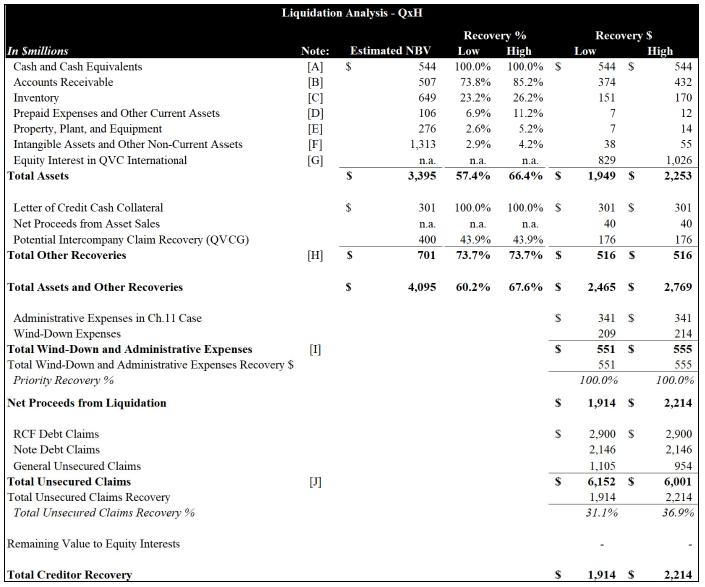
| EXHIBIT F | Simplified Organizational Chart |
| EXHIBIT G | Corporate Structure Chart |
| 3 | Each Exhibit is incorporated herein by reference. |
iv
| I. | INTRODUCTION. |
QVC Group, Inc. (“QVCG”) and its affiliated debtors and debtors in possession in the above-captioned cases (collectively, the “Debtors” and, together with their non-Debtor affiliates, the “Company”), are pursuing proposed restructuring and recapitalization transactions (the “Restructuring Transactions”) pursuant to the terms and conditions set forth in that certain Restructuring Support Agreement by and among the Company and the Consenting Stakeholders (as may be amended, supplemented, or otherwise modified from time to time, and including all schedules, exhibits, and annexes thereto, the “RSA”), attached hereto as Exhibit B. The Plan constitutes a separate chapter 11 plan for each of the Debtors. The rules of interpretation set forth in Article I.B of the Plan govern the interpretation of this Disclosure Statement.
Pursuant to the RSA, the Debtors have launched a solicitation of votes to accept or reject the Plan (the “Solicitation”)1 to Holders of RCF Claims, QVC Notes Claims, and LINTA Notes Claims. The Debtors intend to submit this disclosure statement (this “Disclosure Statement”) pursuant to section 1125 of the Bankruptcy Code, to Holders of RCF Claims, QVC Notes Claims, and LINTA Notes Claims in connection with the Solicitation. A copy of the Plan is attached hereto as Exhibit A and incorporated herein by reference.
In connection with the RSA, and to seek Confirmation and Consummation of the Plan, the Debtors intend to promptly commence voluntary cases (the “Chapter 11 Cases”) under chapter 11 of the Bankruptcy Code in the United States Bankruptcy Court for the Southern District of Texas (the “Bankruptcy Court”).
THE DEBTORS BELIEVE THAT THE COMPROMISES CONTEMPLATED UNDER THE PLAN ARE FAIR AND EQUITABLE, MAXIMIZE THE VALUE OF THE DEBTORS’ ESTATES, AND PROVIDE THE BEST AVAILABLE RECOVERY TO STAKEHOLDERS. AT THIS TIME, THE DEBTORS BELIEVE THE PLAN REPRESENTS THE BEST AVAILABLE OPTION FOR COMPLETING THE CHAPTER 11 CASES. THE DEBTORS STRONGLY RECOMMEND THAT YOU VOTE TO ACCEPT THE PLAN.
| II. | PRELIMINARY STATEMENT. |
QVCG revolutionized the way we shop and interact with products. QVCG brought commerce into our living rooms and then to our front doors. For more than 40 years, QVCG has been a steady, credible provider for American consumers. As QVCG transforms itself to better fit the mobile e-commerce world, this chapter 11 process will ensure that it remains an American icon for the next 40 years.
The world has changed, and the Company is changing with it. Linear TV subscriptions continue to decline, customer attention has fragmented, and consumers increasingly shop using digital channels. Embracing those changes, the Company has invested billions to evolve with consumers’ changing preferences.
That transformation is ongoing, and the Company has shown tremendous progress. For example, the Company launched the first ever 24/7 livestream programming on TikTok last April, quickly becoming a top seller on TikTok Shop in the United States, adding 1 million in 2025 alone. The Company’s streaming services have approximately 1.3 million monthly average users, and television broadcast continues to have an engaged customer base, with approximately 91% of worldwide shipped sales coming from repeat customers.
| 1 | Capitalized terms used but not otherwise defined in this Disclosure Statement shall have the meaning ascribed to such terms in the Plan. The summary of the Plan provided herein is qualified in its entirety by reference to the Plan. In the case of any inconsistency between this Disclosure Statement and the Plan, the Plan will govern. |
While the business is making great progress, more time and money is needed to complete the transformation. This restructuring process is a necessary step in that process. In recent years, the Company’s balance sheet has impaired its ability to invest at the level necessary to fully transition to the digital age. Through this Chapter 11, the Company will right-size its balance sheet and free up the capital necessary for the Company to complete its transformation. And it will ensure the Company is a go-to for the next generation of shoppers.
The opportunities for the Company to fully grow into digital shopping are immense. Social shopping is experiencing exponential growth. To succeed in the new landscape, firms need product that is ready to sell, capacity to get products to customers, and an excellent end-to-end user experience. Investment is required across the full value chain—from sourcing to fulfillment to customer service. The Company has all the tools to provide that full end-to-end value: decades of experience with content creation and production expertise; deep vendor relationships; a mature distribution network; and the goodwill earned from a loyal, millions-strong customer base. So, although the means of delivery are changing, the core value proposition of the Company remains strong. The Company will continue to deliver that value during this chapter 11 process and beyond as it completes its transformation into the digital shopping age.
As part of its ongoing story, the Company intends to file prepackaged chapter 11 cases to implement a comprehensive restructuring transaction outlined in the RSA that has been agreed to by the Debtors and the Consenting Stakeholders. The key terms of the RSA include:
| · | QVC, Inc. (“QVC”) or any successor or assign thereto, by merger, consolidation, or otherwise (such entity, “Reorganized QVC”) shall issue takeback debt (the “Takeback Debt”) on the terms and conditions set forth in the Takeback Debt Documents; |
| · | Reorganized QVC shall issue new common stock (the “QVC New Equity Interests”); |
| · | (1) each Holder of an Allowed RCF Claim shall receive, in full and final satisfaction, settlement, release, and discharge of (a) such portion of its RCF Claim comprising RCF Loan Claims, its Pro Rata share (taking into account Claims in Class B4) of the QVC Funded Debt Plan Consideration and (b) such portion of its RCF Claim comprising RCF Letter of Credit Claims, Cash equal to the full amount of its RCF Letter of Credit Claim; provided that any RCF Letter of Credit that remains undrawn and outstanding as of the Effective Date shall be either (x) rolled into the Exit ABL Facility and granted liens pursuant to the Exit ABL Facility on terms acceptable to the Required Consenting RCF Lenders and the applicable issuing bank, (y) cancelled or returned undrawn to the applicable issuing bank, or (z) cash collateralized or otherwise backstopped in a manner reasonably satisfactory to the applicable issuing bank, in each case, on or prior to the Effective Date and (2) the QVC Debtors or the Reorganized QVC Debtors, as applicable, shall pay in full in Cash all RCF Agent Fees; |
| · | (1) each Holder of an Allowed QVC Notes Claim shall receive, in full and final satisfaction, settlement, release, and discharge of such QVC Notes Claim, its Pro Rata share (taking into account Claims in Class B3) of the QVC Funded Debt Plan Consideration and (2) the QVC Debtors or the Reorganized QVC Debtors, as applicable, shall pay in full in Cash all QVC Notes Trustee Fees; |
2
| · | each Holder of an Allowed LINTA Notes Claim shall receive, in full and final satisfaction, settlement, release, and discharge of such LINTA Notes Claim, its Pro Rata share of the LINTA Distributable Cash. |
| · | Third-party General Unsecured Claims will be unimpaired; and |
| · | QVCG Preferred Equity Interests and QVCG Common Equity Interests will be cancelled. |
The RSA and Plan are structured to support the Company’s ongoing commitment to its customers, business partners, and stakeholders while strengthening the business as a going-concern. With the support of their lenders and other key stakeholders, the Debtors seek authority to move through the chapter 11 process efficiently. The Debtors seek to proceed through these Chapter 11 Cases on an approximately 40-day timeline, subject to Court approval, to minimize disruption to the business and accrual of administrative expenses.
Each of the Governing Bodies of Disinterested Directors (as defined herein), with the assistance of their individual counsel, conducted an independent investigation to assess the merits and potential value of any potential claims and Causes of Action held by the Company against any Related Party or otherwise related to any conflicts matter, as further explained in Article VII.B of this Disclosure Statement. Subject to the completion of that investigation by each of the Governing Bodies of Disinterested Directors, and as contemplated by the Intercompany Settlement, the Plan includes customary debtor releases (and, separately, customary third-party releases). The releases, exculpation, and injunction are an integral component of the Plan, which provides significant distributions of value to administrative, priority, secured, and unsecured creditors. Unless otherwise explicitly released under the Plan or separate order of the Bankruptcy Court, all other unencumbered assets, including the Estates’ claims and Causes of Action, are being preserved by the Plan.
The Debtors strongly believe that the deleveraging and liquidity-enhancing Restructuring Transactions contemplated by the RSA and the Plan are in the best interest of the Debtors’ Estates and represent the best available alternative to the Company at this time. Given the Debtors’ core strengths and strong customer relationships, the Debtors are confident that they can implement the Restructuring Transactions contemplated by the Plan and the RSA to ensure the Debtors’ long-term viability. Ultimately, confirmation of the Plan will enable the Company to eliminate approximately $6 billion in funded debt and equity obligations and emerge from chapter 11 in a better position than ever to remain a global retail leader.
| FOR THESE REASONS, THE DEBTORS STRONGLY RECOMMEND THAT HOLDERS OF CLAIMS ENTITLED TO VOTE ON THE PLAN VOTE TO ACCEPT THE PLAN. |
3
| III. | QUESTIONS AND ANSWERS REGARDING THIS DISCLOSURE STATEMENT AND THE PLAN. |
| A. | What is Chapter 11? |
Chapter 11 is the principal business reorganization chapter of the Bankruptcy Code. In addition to permitting debtor rehabilitation, chapter 11 promotes equal treatment for similarly situated creditors and equity holders, subject to the priority of distributions prescribed by the Bankruptcy Code.
The commencement of a chapter 11 case creates an estate that comprises all of the legal and equitable interests of the debtor as of the date the chapter 11 case is commenced. The Bankruptcy Code provides that a debtor may continue to operate its business and remain in possession of its property as a “debtor in possession.”
Consummating a chapter 11 plan is the principal objective of a chapter 11 case. A bankruptcy court’s confirmation of a plan binds the debtor, any person acquiring property under the plan, any creditor or equity holder of the debtor (whether or not such creditor or equity holder voted to accept the plan), and any other entity as may be ordered by the bankruptcy court. Subject to certain limited exceptions, the order issued by a bankruptcy court confirming a plan provides for the treatment of the debtor’s liabilities in accordance with the terms of the confirmed plan.
| B. | Why Are the Debtors Sending Me this Disclosure Statement? |
The Debtors are seeking to obtain Bankruptcy Court approval of the Plan. Before soliciting acceptances of the Plan, section 1125 of the Bankruptcy Code requires that the Debtors prepare a disclosure statement containing adequate information sufficient to enable a hypothetical reasonable investor to make an informed decision regarding acceptance of the Plan and to share such Disclosure Statement with all Holders of Claims whose votes on the Plan are being solicited. This Disclosure Statement is being submitted in accordance with these requirements.
| C. | Why Are Votes Being Solicited Prior to Bankruptcy Court Approval of this Disclosure Statement? |
By sending this Disclosure Statement and soliciting votes for the Plan prior to approval by the Bankruptcy Court, the Debtors are preparing to seek Confirmation of the Plan shortly after commencing the Chapter 11 Cases. The Debtors will ask the Bankruptcy Court to approve this Disclosure Statement on a final basis together with Confirmation of the Plan at the same hearing, which may be scheduled as shortly as forty (40) days after commencing the Chapter 11 Cases, all subject to the Bankruptcy Court’s approval and availability.
| D. | What Are the Restructuring Transactions Under the Plan? |
The RSA and the Plan contemplate a recapitalization of the Debtors, through which certain of the Debtors will issue and distribute the QVC New Equity Interests, enter into the Exit ABL Facility, and issue the Takeback Debt. In addition, the Plan contemplates that CBI will continue to operate as a going-concern on and following the Effective Date.
4
| E. | Am I Entitled to Vote on the Plan? |
Your ability to vote on, and your distribution under, the Plan, if any, depends on what type of Claim or Interest you hold and whether you held that Claim or Interest as of the Voting Record Date (i.e., as of April 13, 2026). Each category of Holders of Claims or Interests, as set forth in Article III of the Plan pursuant to sections 1122(a) and 1123(a)(1) of the Bankruptcy Code is referred to as a “Class.” Each Class’s respective voting status is set forth below:
| Class | Claims and Interests | Status | Voting Rights |
| Class A1 | Other
Secured Claims against QVCG |
Unimpaired | Not Entitled to Vote (Presumed to Accept) |
| Class A2 | Other
Priority Claims against QVCG |
Unimpaired | Not Entitled to Vote (Presumed to Accept) |
| Class A3 | General
Unsecured Claims against QVCG |
Unimpaired | Not Entitled to Vote (Presumed to Accept) |
| Class A4 | QVC-QVCG Settlement Claim | Unimpaired | Not Entitled to Vote (Presumed to Accept) |
| Class A5 | Other
Intercompany Claims against QVCG |
Unimpaired / Impaired | Not
Entitled to Vote (Presumed to Accept / Deemed to Reject) |
| Class A6 | QVCG Preferred Equity Interests | Impaired | Not Entitled to Vote (Deemed to Reject) |
| Class A7 | QVCG Common Equity Interests | Impaired | Not Entitled to Vote (Deemed to Reject) |
| Class A8 | Section 510(b) Claims
against QVCG |
Impaired | Not Entitled to Vote (Deemed to Reject) |
| Class B1 | Other
Secured Claims against the QVC Debtors |
Unimpaired | Not Entitled to Vote (Presumed to Accept) |
| Class B2 | Other
Priority Claims against the QVC Debtors |
Unimpaired | Not Entitled to Vote (Presumed to Accept) |
| Class B3 | RCF
Claims against the QVC Debtors |
Impaired | Entitled to Vote |
| Class B4 | QVC
Notes Claims against the QVC Debtors |
Impaired | Entitled to Vote |
| Class B5 | General
Unsecured Claims against the QVC Debtors |
Unimpaired | Not Entitled to Vote (Presumed to Accept) |
| Class B6 | Intercompany
Claims against the QVC Debtors |
Unimpaired / Impaired | Not Entitled to Vote (Presumed to Accept / Deemed to Reject) |
| Class B7 | Intercompany
Interests in the QVC Debtors |
Unimpaired / Impaired | Not Entitled to Vote (Presumed to Accept / Deemed to Reject) |
| Class B8 | Section 510(b) Claims
against the QVC Debtors |
Impaired | Not Entitled to Vote (Deemed to Reject) |
| Class C1 | Other
Secured Claims against the LINTA Debtors |
Unimpaired | Not Entitled to Vote (Presumed to Accept) |
| Class C2 | Other
Priority Claims against the LINTA Debtors |
Unimpaired | Not Entitled to Vote (Presumed to Accept) |
| Class C3 | LINTA
Notes Claims against the LINTA Debtors |
Impaired | Entitled to Vote |
| Class C4 | General
Unsecured Claims against the LINTA Debtors |
Unimpaired | Not Entitled to Vote (Presumed to Accept) |
| Class C5 | Other
Intercompany Claims against the LINTA Debtors |
Unimpaired / Impaired | Not
Entitled to Vote (Presumed to Accept / Deemed to Reject) |
| Class C6 | Intercompany
Interests in the LINTA Debtors |
Unimpaired / Impaired | Not
Entitled to Vote (Presumed to Accept / Deemed to Reject) |
| Class C7 | Section 510(b) Claims
against the LINTA Debtors |
Impaired | Not Entitled to Vote (Deemed to Reject) |
| Class D1 | Other
Secured Claims against the CBI Debtors |
Unimpaired | Not Entitled to Vote (Presumed to Accept) |
5
| Class | Claims and Interests | Status | Voting Rights |
| Class D2 | Other
Priority Claims against the CBI Debtors |
Unimpaired | Not Entitled to Vote (Presumed to Accept) |
| Class D3 | General
Unsecured Claims against the CBI Debtors |
Unimpaired | Not Entitled to Vote (Presumed to Accept) |
| Class D4 | Intercompany Claims against the CBI Debtors | Unimpaired / Impaired | Not
Entitled to Vote (Presumed to Accept / Deemed to Reject) |
| Class D5 | Intercompany Interests in the CBI Debtors | Unimpaired / Impaired | Not
Entitled to Vote (Presumed to Accept / Deemed to Reject) |
| Class D6 | Section 510(b) Claims
against the CBI Debtors |
Impaired | Not Entitled to Vote (Deemed to Reject) |
Except for the Claims addressed in Article II of the Plan, all Claims and Interests are classified in the Classes set forth above in accordance with sections 1122 and 1123(a)(1) of the Bankruptcy Code. A Claim or an Interest, or any portion thereof, is classified in a particular Class only to the extent that any portion of such Claim or Interest qualifies within the description of that Class and is classified in other Classes to the extent that any portion of such Claim or Interest qualifies within the description of such other Classes. A Claim or an Interest also is classified in a particular Class for the purpose of receiving distributions under the Plan only to the extent that such Claim or Interest is an Allowed Claim or Allowed Interest in that Class and has not been paid, released, or otherwise satisfied prior to the Effective Date.
The Plan constitutes a separate Plan for each of the Debtors, and the classification of Claims and Interests set forth therein shall apply separately to each of the Debtors. All of the potential Classes for the Debtors are set forth in the Plan. Such groupings shall not affect any Debtor’s status as a separate legal Entity, change the organizational structure of the Debtors’ business enterprise, constitute a change of control of any Debtor for any purpose, cause a merger or consolidation of any legal Entities, or cause the transfer of any assets, and, except as otherwise provided by or permitted under the Plan, all Debtors shall continue to exist as separate legal Entities after the Effective Date.
Except as otherwise provided in the Plan, nothing under the Plan shall affect the Debtors’ or the Reorganized Debtors’ rights regarding any Unimpaired Claims, including all rights regarding legal and equitable defenses to, or setoffs or recoupments against, any such Unimpaired Claims.
| F. | What If There Is a Controversy Concerning Impairment? |
If a controversy arises as to whether any Claims or Interests, or any Class of Claims or Interests, are Impaired, the Bankruptcy Court shall, after notice and a hearing, determine such controversy on or before the Confirmation Date or such other date as fixed by the Bankruptcy Court.
| G. | Are There Any Special Provisions Governing Unimpaired Claims? |
Except as otherwise provided in the Plan, nothing under the Plan or the Plan Supplement shall affect the rights of the Debtors or the Reorganized Debtors, as applicable, regarding any Unimpaired Claims, including all rights regarding legal and equitable defenses to, or setoffs or recoupments against, any such Unimpaired Claims.
| H. | What Is the Deadline to Vote on the Plan? |
The voting deadline with respect to the Plan (the “Voting Deadline”) is May 19, 2026, at 11:59 p.m. (prevailing Central Time).
6
| I. | How Do I Vote for or Against the Plan? |
Detailed instructions regarding how to vote on the Plan are contained on the ballots distributed to Holder of Claims that are entitled to vote on the Plan (the “Ballots”). For your vote to be counted, your Ballot (or your Nominee’s Master Ballot containing your vote if you are a beneficial holder of the QVC Notes or LINTA Notes) must be properly completed, executed, and delivered as directed, so that the Ballot containing your vote is actually received by the Solicitation Agent on or before the Voting Deadline, i.e., May 19, 2026 at 11:59 p.m., prevailing Central Time.
| J. | Why Is the Bankruptcy Court Holding a Combined Hearing? |
Section 1128(a) of the Bankruptcy Code requires the Bankruptcy Court to hold a hearing on Confirmation of the Plan and recognizes that any party in interest may object to Confirmation of the Plan. Shortly after the commencement of the Chapter 11 Cases, the Debtors will request that the Bankruptcy Court schedule the Combined Hearing, at which time the Debtors will seek, among other things, Confirmation of the Plan. At the Combined Hearing, the Debtors will also seek Bankruptcy Court approval of this Disclosure Statement pursuant to section 1125 of the Bankruptcy Code as containing adequate information of a kind, and in sufficient detail, to enable a hypothetical reasonable investor to make an informed judgment regarding acceptance of the Plan and that the Debtors shared this Disclosure Statement with all Holders of Claims whose votes on the Plan are being solicited. All parties in interest will be served notice of the time, date, and location of the Combined Hearing once scheduled. The Combined Hearing may be adjourned from time to time without further notice.
| K. | What Is the Purpose of the Combined Hearing? |
The purpose of the Combined Hearing is to seek approval of this Disclosure Statement and confirmation of the Plan. If so approved, the Bankruptcy Court will have held that this Disclosure Statement has provided the Voting Classes with adequate information to make an informed decision as to whether to vote to accept or reject the Plan in accordance with section 1125(a)(1) of the Bankruptcy Code.
The confirmation of a plan of reorganization by a bankruptcy court binds the debtor, any issuer of securities under a plan of reorganization, any person acquiring property under a plan of reorganization, any creditor or interest holder of a debtor, and any other person or entity as may be ordered by the bankruptcy court in accordance with the applicable provisions of the Bankruptcy Code. Subject to certain limited exceptions, the order issued by the bankruptcy court confirming a plan of reorganization discharges a debtor from any debt that arose before the confirmation of such plan of reorganization and provides for the treatment of such debt in accordance with the terms of the confirmed plan of reorganization.
| L. | Who Do I Contact If I Have Additional Questions with Respect to this Disclosure Statement or the Plan? |
If you have any questions regarding this Disclosure Statement or the Plan, please contact the Solicitation Agent, Kroll, by calling (888) 575-5337 (Toll free from US / Canada) OR +1 (347) 292-4386 (International, toll), or emailing QVCBallots@ra.kroll.com with “In re: QVC – Solicitation Inquiry” in the subject line. Copies of the Plan, this Disclosure Statement, and any other publicly filed documents in the Chapter 11 Cases are available free of charge, as applicable, by: (a) visiting the Debtors’ restructuring website at https://restructuring.ra.kroll.com/QVC after the Petition Date; (b) emailing using QVCBallots@ra.kroll.com (with “In re: QVC – Solicitation Inquiry” in the subject line); or (c) calling the Solicitation Agent at the number(s) listed above. You may also obtain copies of any pleadings filed in the Chapter 11 Cases via PACER at https://www.pacer.gov (for a fee).
7
| M. | What Will I Receive from the Debtors If the Plan Is Consummated? |
The following chart provides a summary of the anticipated distributions to Holders of Claims or Interests under the Plan. Your ability to receive distributions under the Plan depends upon the ability of the Debtors to obtain Confirmation and meet the conditions necessary to consummate the Plan.
Pursuant to the Plan, each Holder of an Allowed Claim or Allowed Interest, as applicable, shall receive the treatment described below in full and final satisfaction, settlement, release, and discharge of and in exchange for such Holder’s Allowed Claim or Allowed Interest, except to the extent different treatment is agreed to by the Debtors or the Reorganized Debtors, as applicable, with the consent of the Required Consenting QVC Noteholders and the Required Consenting RCF Lenders, and the Holder of such Allowed Claim or Allowed Interest, as applicable, or unless such Allowed Claim or Allowed Interest has been paid, released, or otherwise satisfied prior to the Effective Date. Unless otherwise indicated, the Holder of an Allowed Claim or Allowed Interest, as applicable, shall receive such treatment on the Effective Date (or, if payment is not then due, in accordance with such Claim’s terms in the ordinary course of business) or as soon as reasonably practicable thereafter.
The allowance, classification, and treatment of all Allowed Claims and Allowed Interests and the respective distributions and treatments under the Plan take into account and conform to the relative priority and rights of the Claims and Interests in each Class in connection with any contractual, legal, and equitable subordination rights relating thereto, whether arising under general principles of equitable subordination, section 510(b) of the Bankruptcy Code, or otherwise. Pursuant to section 510 of the Bankruptcy Code, and subject to any applicable consent or approval rights under the RSA, the Debtors, or the Reorganized Debtors, as applicable, reserve the right to re-classify any Allowed Claim or Allowed Interest in accordance with any contractual, legal, or equitable subordination rights relating thereto.
| Summary of Projected Distributions | ||||
| Class | Claim/Interest | Treatment of Claim / Interest | Projected Allowed Amount of Claims |
Estimated Recovery (%) |
| Class A1 | Other Secured Claims against QVCG | Each Holder of an Allowed Other Secured Claim against QVCG shall receive, in full and final satisfaction, settlement, release, and discharge of such Other Secured Claim, as determined by the applicable Debtors: (i) payment in full in Cash; or (ii) such other treatment rendering such Allowed Other Secured Claim Unimpaired. |
N/A | 100% |
| Class A2 | Other Priority Claims against QVCG | Each Holder of an Allowed Other Priority Claim against QVCG shall receive, in full and final satisfaction, settlement, release, and discharge of such Other Priority Claim, treatment in a manner consistent with section 1129(a) of the Bankruptcy Code. | N/A | 100% |
8
| Summary of Projected Distributions | ||||
| Class | Claim/Interest | Treatment of Claim / Interest | Projected Allowed Amount of Claims |
Estimated Recovery (%) |
| Class A3 | General Unsecured Claims against QVCG | Each Holder of an Allowed General Unsecured Claim against QVCG shall receive, in full and final satisfaction, settlement, release, and discharge of such General Unsecured Claim, as determined by the applicable Debtors: (i) payment in full in Cash on the later of (A) the Effective Date or (B) the date due in the ordinary course of business in accordance with the terms and conditions of the particular transaction giving rise to, or the agreement governing, such Allowed General Unsecured Claim against QVCG; or (ii) such other treatment rendering such Allowed General Unsecured Claims Unimpaired. |
N/A | 100% |
| Class A4 | QVC-QVCG Settlement Claim | QVC shall receive, in full and final satisfaction, settlement, release, and discharge of the QVC-QVCG Settlement Claim: (i) all QVCG Distributable Cash; or (ii) such other treatment otherwise addressed at the option of the Debtors, and acceptable to such Holders of QVC-QVCG Settlement Claims, the Required Consenting QVC Noteholders, and the Required Consenting RCF Lenders rendering such QVC-QVCG Settlement Claims Unimpaired, and in each case as set forth in the Restructuring Steps Plan. |
$400,000,000 | N/A |
| Class A5 | Other Intercompany Claims against QVCG | Each Other Intercompany Claim against QVCG shall be, in full and final satisfaction, settlement, release, and discharge of such Other Intercompany Claim, as determined by the applicable Debtors, with the consent of the Required Consenting QVC Noteholders and the Required Consenting RCF Lenders: (i) Reinstated; (ii) set off, settled, discharged, contributed, cancelled, converted to equity; (iii) released without any distribution on account of such Allowed Other Intercompany Claim; or (iv) otherwise addressed at the option of the Debtors, in each case as set forth in the Restructuring Steps Plan. |
N/A | N/A |
| Class A6 | QVCG Preferred Equity Interests | The QVCG Preferred Equity Interests shall be cancelled, released, discharged, extinguished, and of no further force or effect, and such Holders shall not receive any distribution, property, or other value under the Plan on account of such QVCG Preferred Equity Interests. | N/A | 0% |
| Class A7 | QVCG Common Equity Interests | The QVCG Common Equity Interests shall be cancelled, released, discharged, extinguished, and of no further force or effect, and such Holders shall not receive any distribution, property, or other value under the Plan on account of such QVCG Common Equity Interests. | N/A | 0% |
9
| Summary of Projected Distributions | ||||
| Class | Claim/Interest | Treatment of Claim / Interest | Projected Allowed Amount of Claims |
Estimated Recovery (%) |
| Class A8 | Section 510(b) Claims against QVCG | On the Effective Date, each Section 510(b) Claim against QVCG shall be cancelled, released, discharged, and extinguished and will be of no further force or effect, and such Holders will not receive any distribution on account of such Section 510(b) Claim. | N/A2 | N/A |
| Class B1 | Other Secured Claims against the QVC Debtors | Each Holder of an Allowed Other Secured Claim against a QVC Debtor shall receive, in full and final satisfaction, settlement, release, and discharge of such Other Secured Claim, as determined by the applicable Debtors: (i) payment in full in Cash; (ii) the collateral securing its Allowed Other Secured Claim; (iii) Reinstatement of its Allowed Other Secured Claim; or (iv) such other treatment acceptable to the Required Consenting QVC Noteholders and the Required Consenting RCF Lenders rendering such Allowed Other Secured Claim Unimpaired. |
N/A | 100% |
| Class B2 | Other Priority Claims against the QVC Debtors | Each Holder of an Allowed Other Priority Claim against a QVC Debtor shall receive, in full and final satisfaction, settlement, release, and discharge of such Other Priority Claim, treatment in a manner consistent with section 1129(a) of the Bankruptcy Code. | N/A | 100% |
| Class B3 | RCF Claims against the QVC Debtors | (1) Each Holder of an Allowed RCF Claim shall receive, in full and final satisfaction, settlement, release, and discharge of (a) such portion of its RCF Claim comprising RCF Loan Claims, its Pro Rata share (taking into account Claims in Class B4) of the QVC Funded Debt Plan Consideration, and (b) such portion of its RCF Claim comprising RCF Letter of Credit Claims, Cash equal to the full amount of its RCF Letter of Credit Claim provided that, any RCF Letter of Credit that remains undrawn and outstanding as of the Effective Date shall be either (x) rolled into the Exit ABL Facility and granted liens pursuant to the Exit ABL Facility on terms acceptable to the Required Consenting RCF Lenders and the applicable issuing bank, (y) cancelled or returned undrawn to the applicable issuing bank, or (z) cash collateralized or otherwise backstopped in a manner reasonably satisfactory to the applicable issuing bank, in each case, on or prior to the Effective Date and (2) the QVC Debtors or the Reorganized QVC Debtors, as applicable, shall pay in full in Cash all RCF Agent Fees. | Approximately $2,900,000,000.00 | N/A |
| 2 | Notwithstanding anything to the contrary in the Plan, a Section 510(b) Claim, if any such Claim exists, may only become Allowed by Final Order of the Bankruptcy Court. |
10
| Summary of Projected Distributions | ||||
| Class | Claim/Interest | Treatment of Claim / Interest | Projected Allowed Amount of Claims |
Estimated Recovery (%) |
| Class B4 | QVC Notes Claims against the QVC Debtors | (1) Each Holder of an Allowed QVC Notes Claim shall receive, in full and final satisfaction, settlement, release, and discharge of such QVC Notes Claim, its Pro Rata share (taking into account Claims in Class B3) of the QVC Funded Debt Plan Consideration3 and (2) the QVC Debtors or the Reorganized QVC Debtors, as applicable, shall pay in full in Cash all QVC Notes Trustee Fees. | Approximately $2,146,000,000.00 | N/A |
| Class B5 | General Unsecured Claims against the QVC Debtors | Each Holder of an Allowed General Unsecured Claim against a QVC Debtor shall, in full and final satisfaction, settlement, release, and discharge of such General Unsecured Claim, as determined by the applicable Debtors: (i) payment in full in Cash on the later of (A) the Effective Date or (B) the date due in the ordinary course of business in accordance with the terms and conditions of the particular transaction giving rise to, or the agreement governing, such Allowed General Unsecured Claim against the QVC Debtors; (ii) Reinstated; or (iii) receive such other treatment acceptable to the Required Consenting QVC Noteholders and the Required Consenting RCF Lenders rendering such Allowed General Unsecured Claims Unimpaired. |
N/A | 100% |
| Class B6 | Intercompany Claims against the QVC Debtors | After giving effect to the Intercompany Settlement set forth in the Plan, each other Intercompany Claim against a QVC Debtor shall be, in full and final satisfaction, settlement, release, and discharge of such Intercompany Claim, as determined by the applicable Debtors with the consent of the Required Consenting QVC Noteholders and the Required Consenting RCF Lenders: (i) Reinstated; (ii) set off, settled, discharged, contributed, cancelled, converted to equity; (iii) released without any distribution on account of such Allowed Intercompany Claim; or (iv) otherwise addressed at the option of the Debtors, in each case as set forth in the Restructuring Steps Plan. |
N/A | N/A |
| 3 | QVC Funded Debt Plan Consideration is defined in the Plan and includes QVC Distributable Cash. Assuming an Effective Date of August 2026, the QVC Debtors estimate that QVC Distributable Cash will be approximately $882 million. The actual amount of QVC Distributable Cash may be higher or lower based on a variety of factors. None of the Debtors provide any assurances or warranty the amount of the QVC Distributable Cash as of the Effective Date. |
11
| Summary of Projected Distributions | ||||
| Class | Claim/Interest | Treatment of Claim / Interest | Projected Allowed Amount of Claims |
Estimated Recovery (%) |
| Class B7 | Intercompany Interests in the QVC Debtors | Each Allowed Intercompany Interest in a QVC Debtor shall be, in full and final satisfaction, settlement, release, and discharge of such Intercompany Interest, as determined by the applicable Debtors: (i) Reinstated; (ii) set off, settled, discharged, contributed, cancelled; (iii) released without any distribution on account of such Allowed Intercompany Interest; or (iv) otherwise addressed at the option of the Debtors, in each case as set forth in the Restructuring Steps Plan; provided, that, for the avoidance of doubt, any direct or indirect Interests held by any LINTA Debtor in any QVC Debtor shall be cancelled, released, discharged, and extinguished and will be of no further force or effect. |
N/A | N/A |
| Class B8 | Section 510(b) Claims against the QVC Debtors | On the Effective Date, each Section 510(b) Claim against a QVC Debtor shall be cancelled, released, discharged, and extinguished and will be of no further force or effect, and such Holders will not receive any distribution on account of such Section 510(b) Claim. | N/A4 | N/A |
| Class C1 | Other Secured Claims against the LINTA Debtors | Each Holder of an Allowed Other Secured Claim against a LINTA Debtor shall receive, in full and final satisfaction, settlement, release, and discharge of such Other Secured Claim, as determined by the applicable Debtors, with the consent of the LINTA Noteholder Group: (i) payment in full in Cash; or (ii) such other treatment acceptable to the Required Consenting Stakeholders rendering its Allowed Other Secured Claim Unimpaired. |
N/A | 100% |
| Class C2 | Other Priority Claims against the LINTA Debtors | Each Holder of an Allowed Other Priority Claim against a LINTA Debtor shall receive, in full and final satisfaction, settlement, release, and discharge of such Other Priority Claim, treatment in a manner consistent with section 1129(a) of the Bankruptcy Code, with the consent of the LINTA Noteholder Group. | N/A | 100% |
| Class C3 | LINTA Notes Claims against the LINTA Debtors | Each Holder of an Allowed LINTA Notes Claim shall receive, in full and final satisfaction, settlement, release, and discharge of such LINTA Notes Claim, its Pro Rata share (taking into account Claims in Class C5) of the LINTA Debtors’ Distributable Cash. | Approx. $1,485,000,000 |
Up to Approx. 7.5% |
| 4 | Notwithstanding anything to the contrary in the Plan, a Section 510(b) Claim, if any such Claim exists, may only become Allowed by Final Order of the Bankruptcy Court. |
12
| Summary of Projected Distributions | ||||
| Class | Claim/Interest | Treatment of Claim / Interest | Projected Allowed Amount of Claims |
Estimated Recovery (%) |
| Class C4 | General Unsecured Claims against the LINTA Debtors | Each Holder of an Allowed General Unsecured Claim against a LINTA Debtor shall receive, in full and final satisfaction, settlement, release, and discharge of such General Unsecured Claim, as determined by the applicable Debtors: (i) payment in full in Cash on the later of (A) the Effective Date or (B) the date due in the ordinary course of business in accordance with the terms and conditions of the particular transaction giving rise to, or the agreement governing, such Allowed General Unsecured Claim against the LINTA Debtors; or (ii) such other treatment acceptable to the Required Consenting Stakeholders rendering such Allowed General Unsecured Claims Unimpaired. |
N/A | 100% |
| Class C5 | Other Intercompany Claims against the LINTA Debtors | After giving effect to the Intercompany Settlement set forth in the Plan, each Other Intercompany Claim against a LINTA Debtor shall be, in full and final satisfaction, settlement, release, and discharge of such Other Intercompany Claim, as determined by the applicable Debtors, with the consent of the Required Consenting Stakeholders: (i) Reinstated; (ii) set off, settled, discharged, contributed, cancelled, converted to equity; (iii) released without any distribution on account of such Allowed Other Intercompany Claim; or (iv) otherwise addressed at the option of the Debtors, in each case as set forth in the Restructuring Steps Plan; provided that in no event shall Class C5 receive any Cash from the LINTA Debtors. |
N/A | N/A |
| Class C6 | Intercompany Interests in the LINTA Debtors | Each Allowed Intercompany Interest in a LINTA Debtor shall be, in full and final satisfaction, settlement, release, and discharge of such Intercompany Interests, as determined by the applicable Debtors: (i) Reinstated; (ii) set off, settled, discharged, contributed, cancelled; (iii) released without any distribution on account of such Allowed Intercompany Interest; or (iv) otherwise addressed at the option of the Debtors, in each case as set forth in the Restructuring Steps Plan. |
N/A | N/A |
| Class C7 | Section 510(b) Claims against the LINTA Debtors | On the Effective Date, each Section 510(b) Claim against a LINTA Debtor shall be cancelled, released, discharged, and extinguished and will be of no further force or effect, and such Holders will not receive any distribution on account of such Section 510(b) Claim. | N/A5 | N/A |
| 5 | Notwithstanding anything to the contrary in the Plan, a Section 510(b) Claim, if any such Claim exists, may only become Allowed by Final Order of the Bankruptcy Court. |
13
| Summary of Projected Distributions | ||||
| Class | Claim/Interest | Treatment of Claim / Interest | Projected Allowed Amount of Claims |
Estimated Recovery (%) |
| Class D1 | Other Secured Claims against the CBI Debtors | Each Holder of an Allowed Other Secured Claim against the CBI Debtors shall receive, in full and final satisfaction, settlement, release, and discharge of such Other Secured Claim, as determined by the applicable Debtors: (i) payment in full in Cash; (ii) the collateral securing its Allowed Other Secured Claim; (iii) Reinstatement of its Allowed Other Secured Claim; or (iv) such other treatment acceptable to the Required Consenting QVC Noteholders and the Required Consenting RCF Lenders rendering its Allowed Other Secured Claim Unimpaired. |
N/A | 100% |
| Class D2 | Other Priority Claims against the CBI Debtors | Each Holder of an Allowed Other Priority Claim against the CBI Debtors shall receive, in full and final satisfaction, settlement, release, and discharge of such Other Priority Claim, treatment in a manner consistent with section 1129(a) of the Bankruptcy Code. | N/A | 100% |
| Class D3 | General Unsecured Claims against the CBI Debtors | Each Holder of an Allowed General Unsecured Claim against the CBI Debtors shall, in full and final satisfaction, settlement, release, and discharge of such General Unsecured Claim, as determined by the applicable Debtors: (i) payment in full in Cash on the later of (A) the Effective Date or (B) the date due in the ordinary course of business in accordance with the terms and conditions of the particular transaction giving rise to, or the agreement governing, such Allowed General Unsecured Claim against the CBI Debtors; or (ii) receive such other treatment acceptable to the Required Consenting QVC Noteholders and the Required Consenting RCF Lenders rendering such Allowed General Unsecured Claims Unimpaired. |
N/A | 100% |
| Class D4 | Intercompany Claims against the CBI Debtors | After giving effect to the Intercompany Settlement set forth in the Plan, each Intercompany Claim against the CBI Debtors shall be, in full and final satisfaction, settlement, release, and discharge of such Intercompany Claims, as determined by the applicable Debtors with the consent of the Required Consenting QVC Noteholders and the Required Consenting RCF Lenders: (i) Reinstated; (ii) set off, settled, discharged, contributed, cancelled, converted to equity; (iii) released without any distribution on account of such Allowed Intercompany Claim; or (iv) otherwise addressed at the option of the Debtors, in each case as set forth in the Restructuring Steps Plan. |
N/A | N/A |
14
| Summary of Projected Distributions | ||||
| Class | Claim/Interest | Treatment of Claim / Interest | Projected Allowed Amount of Claims |
Estimated Recovery (%) |
| Class D5 | Intercompany Interests in the CBI Debtors | Each Allowed Intercompany Interest in the CBI Debtors shall be, in full and final satisfaction, settlement, release, and discharge of such Intercompany Interests, as determined by the applicable Debtors (i) Reinstated; (ii) set off, settled, discharged, contributed, cancelled; (iii) released without any distribution on account of such Allowed Intercompany Interest; or (iv) otherwise addressed at the option of the Debtors, with the consent of the Required Consenting QVC Noteholders and the Required Consenting RCF Lenders in each case as set forth in the Restructuring Steps Plan. |
N/A | N/A |
| Class D6 | Section 510(b) Claims against the CBI Debtors | On the Effective Date, each Section 510(b) Claim against the CBI Debtors shall be cancelled, released, discharged, and extinguished and will be of no further force or effect, and such Holders will not receive any distribution on account of such Section 510(b) Claim. | N/A6 | 0% |
| N. | What Will I Receive from the Debtors If I Hold an Allowed Administrative Claim, Priority Tax Claim, Professional Fee Claim, or a DIP LC Claim? |
In accordance with section 1123(a)(1) of the Bankruptcy Code, Administrative Claims, Priority Tax Claims, DIP LC Claims, and Professional Fee Claims have not been classified and, thus, are excluded from the Classes of Claims and Interests set forth in Article III of the Plan.
| 1. | Administrative Claims. |
Except with respect to the Professional Fee Claims, QVC Restructuring Expenses, LINTA Restructuring Expenses, and except to the extent that a Holder of an Allowed Administrative Claim and the Debtors against which such Allowed Administrative Claim is asserted (and in the case of any Allowed Administrative Claim against the LINTA Debtors, with the prior consent of the LINTA Noteholder Group) agree to less favorable treatment for such Holder, or such Holder has been paid by any Debtors on account of such Allowed Administrative Claim prior to the Effective Date or otherwise in accordance with the terms of the Plan, each Holder of an Allowed Administrative Claim will receive in full and final satisfaction of its Allowed Administrative Claim an amount of Cash equal to the amount of such Allowed Administrative Claim in accordance with the following: (1) if an Administrative Claim is Allowed on or prior to the Effective Date, on the Effective Date or as soon as reasonably practicable thereafter (or, if not then due, when such Allowed Administrative Claim is due or as soon as reasonably practicable thereafter); (2) if such Administrative Claim is not Allowed as of the Effective Date, no later than thirty (30) days after the date on which an order allowing such Administrative Claim becomes a Final Order, or as soon as reasonably practicable thereafter; (3) if such Allowed Administrative Claim is based on liabilities incurred by the Debtors in the ordinary course of their business after the Petition Date in accordance with the terms and conditions of the particular transaction giving rise to such Allowed Administrative Claim without any further action by the Holder of such Allowed Administrative Claim; (4) at such time and upon such terms as may be agreed upon by such Holder and the Debtors or the applicable Reorganized Debtors, as applicable (and in the case of any Allowed Administrative Claim against the LINTA Debtors, with the prior consent of the LINTA Noteholder Group, such consent not to be unreasonably withheld, conditioned, or delayed); or (5) at such time and upon such terms as set forth in an order of the Bankruptcy Court.
| 6 | Notwithstanding anything to the contrary in the Plan, a Section 510(b) Claim, if any such Claim exists, may only become Allowed by Final Order of the Bankruptcy Court. |
15
Except as otherwise provided in Article II.A of the Plan or by a Final Order entered by the Bankruptcy Court, unless previously Filed, requests for payment of Administrative Claims against QVCG or the LINTA Debtors, as applicable, must be Filed and served on the applicable Debtor, Reorganized QVCG, or the Reorganized LINTA Debtors (and in the case of any Administrative Claim against the LINTA Debtors, on the LINTA Noteholder Group), as applicable, pursuant to the procedures specified in the Confirmation Order and the notice of entry of the Confirmation Order no later than the Administrative Claims Bar Date. Holders of Administrative Claims against QVCG and the LINTA Debtors that are required to, but do not, File and serve a request for payment of such Administrative Claims by such date shall be forever barred, estopped, and enjoined from asserting such Administrative Claims against any Debtor, any Reorganized Debtor, or their respective property and such Administrative Claims shall be deemed discharged as of the Effective Date. Notwithstanding the foregoing, no Filing is required on account of QVC Restructuring Expenses, LINTA Restructuring Expenses, or Disinterested Director Fee Claims.
| 2. | Priority Tax Claims. |
Except to the extent that a Holder of an Allowed Priority Tax Claim agrees to less favorable treatment, in full and final satisfaction, settlement, release, and discharge of, and in exchange for, such Allowed Priority Tax Claim, each Holder of an Allowed Priority Tax Claim shall receive Cash equal to the full amount of its Claim or such other treatment in accordance with the terms set forth in section 1129(a)(9)(C) of the Bankruptcy Code.
| 3. | Professional Fee Claims. |
| (a) | Final Fee Applications and Payment of Professional Fee Claims. |
All requests for payment of Professional Fee Claims for services rendered and reimbursement of expenses incurred prior to the Confirmation Date must be Filed no later than forty-five (45) days after the Effective Date. The Bankruptcy Court shall determine the Allowed amounts of such Professional Fee Claims after notice and a hearing in accordance with the procedures established by the Bankruptcy Court, and all such Allowed amounts shall be paid promptly, first from the Professional Fee Escrow Account and second by the Reorganized Debtors. All Allowed amounts shall not be subject to disallowance, setoff, recoupment, subordination, recharacterization, or reduction of any kind, including pursuant to section 502(d) of the Bankruptcy Code. To the extent that funds held in the Professional Fee Escrow Account are insufficient to satisfy the amount of Allowed Professional Fee Claims owing to the Professionals, such Professionals shall have an Allowed Administrative Claim against the Debtors for any such deficiency, which shall be satisfied in accordance with Article II.A of the Plan.
| (b) | Professional Fee Escrow Accounts. |
On or prior to the Effective Date, QVCG, the LINTA Debtors, the QVC Debtors, and the CBI Debtors shall, in accordance with the Professional Fee and Restructuring Expense Allocation, establish and fund with Cash the Professional Fee Escrow Account in an amount equal to the Professional Fee Reserve Amount.
The Professional Fee Escrow Account shall be maintained in trust solely for the Professionals. Such funds shall not be considered property of the Estates of the Debtors or the Reorganized Debtors. The amount of Allowed Professional Fee Claims owing to the Professionals shall be paid in Cash to such Professionals from the Professional Fee Escrow Account in accordance with the Professional Fee and Restructuring Expense Allocation when such Professional Fee Claims are Allowed by a Final Order.
16
When (i) all applicable Allowed Professional Fee Claims have been irrevocably paid in full to the applicable Professionals and (ii) the remainder of the Professional Fee Reserve Amount (if any) has been distributed in accordance with the escrow agreement governing the Professional Fee Escrow Account, any remaining funds in the Professional Fee Escrow Account shall promptly be transferred, without any further notice to or action, order, or approval of the Bankruptcy Court, to the applicable Reorganized Debtors, giving effect to the Professional Fee and Restructuring Expense Allocation, and shall constitute QVC Distributable Cash, QVCG Distributable Cash, or LINTA Distributable Cash, as applicable.
| (c) | Professional Fee Reserve Amount. |
Professionals shall estimate their unpaid Professional Fee Claims and other unpaid fees and expenses incurred in rendering services to the Debtors before and as of the Effective Date and shall deliver such estimate to the Debtors no later than three (3) days before the Effective Date; provided, however, that such estimate shall not be deemed to limit the amount of the fees and expenses that are the subject of the Professional’s final request for payment of Filed Professional Fee Claims. If a Professional does not provide an estimate, the Debtors may estimate the unpaid and unbilled fees and expenses of such Professional; provided, however, that such estimate shall not be binding or considered an admission with respect to the fees and expenses of such Professional.
The total amount estimated pursuant to this Article III.N.3(c) shall: (a) as estimated to be incurred by the Shared Professionals in accordance with clause (c) of the Professional Fee and Restructuring Expense Allocation, comprise the Shared Professional Fee Reserve Amount; (b) as estimated to be incurred and allocated exclusively to the CBI Debtors in accordance with clause (a) of the Professional Fee and Restructuring Expense Allocation, comprise the CBI Professional Fee Reserve Amount; (c) as estimated to be incurred and allocated exclusively to the LINTA Debtors in accordance with clause (a) of the Professional Fee and Restructuring Expense Allocation, comprise the LINTA Professional Fee Reserve Amount; (d) as estimated to be incurred and allocated exclusively to the QVC Debtors in accordance with clause (a) of the Professional Fee and Restructuring Expense Allocation, comprise the QVC Professional Fee Reserve Amount; and (e) as estimated to be allocated exclusively to QVCG in accordance with clause (a) of the Professional Fee and Restructuring Expense Allocation, comprise the QVCG Professional Fee Reserve Amount. The total amount so estimated in the foregoing clauses (a) through (e) shall comprise the Professional Fee Reserve Amount.
| (d) | Professional Fee Allocation |
Allowed Professional Fee Claims shall be allocated to, and paid from, the Professional Fee Escrow Account in accordance with such allocation. Consistent with the Intercompany Settlement as described in Article IV.B of the Plan, each Debtor shall exclusively bear (a)(i) the fees and expenses of such Debtor’s Disinterested Directors and (ii) the fees (including any Professional Fee Claims) of any advisors retained by the applicable special committee comprised of such Disinterested Directors and (b) the Restructuring Expenses for which such Debtor is contractually obligated.
For the avoidance of doubt, the allocation set forth in the Plan shall apply to any Professional Fee Claims and Restructuring Expenses incurred during the Chapter 11 Cases through the Effective Date of the Plan for QVCG and the LINTA Debtors, after which time the fees of the Shared Professionals shall be paid by Reorganized QVC. Notwithstanding anything to the contrary herein, the payment of fees and expenses of (i) the Disinterested Directors and (ii) any advisors retained by such Disinterested Directors (or special committee of Disinterested Directors, as applicable) shall cease on the Effective Date. To the extent the aggregate Professional Fee Claims or Restructuring Expenses paid during the Chapter 11 Cases do not comply with the foregoing allocation, then, on or prior to the Effective Date, there shall be a proportional rebalancing of Cash on hand between the applicable Debtors, without any further notice to or action, order, or approval of the Bankruptcy Court, such that the aggregate Professional Fee Claims and Restructuring Expenses paid during the Chapter 11 Cases satisfy the foregoing allocation.
17
Allowed Professional Fee Claims shall be allocated to, and paid from, the Professional Fee Escrow Account in accordance with the foregoing allocation.
Following the Effective Date, LINTA Restructuring Expenses shall be paid from the LINTA Debtors’ reserves established pursuant to Article VI.P of the Plan.
| (e) | Post-Confirmation Fees and Expenses. |
Except as otherwise specifically provided in the Plan, from and after the Confirmation Date, the applicable Debtors or Reorganized Debtors, as applicable, shall, in the ordinary course of business and without any further notice to or action, order, or approval of the Bankruptcy Court, pay in Cash (in a manner consistent with the Professional Fee and Restructuring Expense Allocation and the Intercompany Settlement described in Article IV.B of the Plan) the reasonable and documented legal, professional, or other fees and expenses related to implementation of the Plan and Consummation incurred by the Debtors. Upon the Confirmation Date, any requirement that Professionals comply with sections 327 through 331, 363, and 1103 of the Bankruptcy Code in seeking retention or compensation for services rendered after such date shall terminate, and the Debtors or the Reorganized Debtors, as applicable, may employ and pay any Professional (in a manner consistent with the Professional Fee and Restructuring Expense Allocation and the Intercompany Settlement described in Article IV.B of the Plan) without any further notice to or action, order, or approval of the Bankruptcy Court.
| 4. | Payment of QVC Restructuring Expenses and LINTA Restructuring Expenses. |
The QVC Debtors/Reorganized QVC Debtors and the LINTA Debtors/Reorganized LINTA Debtors, as applicable, shall pay in Cash all QVC Restructuring Expenses and LINTA Restructuring Expenses, respectively, in accordance with the RSA (in a manner consistent with the Professional Fee and Restructuring Expense Allocation and the Intercompany Settlement described in Article IV.B of the Plan), and if any such QVC Restructuring Expenses or LINTA Restructuring Expenses are unpaid as of the Effective Date, such QVC Restructuring Expenses and LINTA Restructuring Expenses shall be paid on the Effective Date or as soon as reasonably practicable thereafter, in each case, without any requirement to File a fee application with the Bankruptcy Court and without any requirement for notice or Bankruptcy Court review or approval. All QVC Restructuring Expenses and LINTA Restructuring Expenses estimated to be paid on the Effective Date shall be estimated prior to and as of the Effective Date, and such estimates shall be delivered to the Debtors at least three (3) Business Days before the Effective Date; provided, that such estimates shall not be considered an admission or limitation with respect to such QVC Restructuring Expenses or LINTA Restructuring Expenses, as applicable. In addition, following the Effective Date, the applicable Debtors and the Reorganized Debtors, as applicable, shall continue to pay in Cash (in a manner consistent with the Professional Fee and Restructuring Expense Allocation and the Intercompany Settlement described in Article IV.B and in accordance with the terms of any applicable engagement letters or other contractual arrangements) the QVC Restructuring Expenses, whether incurred before, on, or after the Effective Date without any requirement for notice or Bankruptcy Court review or approval.
18
For the avoidance of doubt, the QVC Restructuring Expenses and LINTA Restructuring Expenses shall not be included in any Professional Fee Reserve Amount and shall not be funded into the Professional Fee Escrow Account.
On the Effective Date, the QVC Debtors or the Reorganized QVC Debtors, as applicable, shall pay in full in Cash all QVC Notes Trustee Fees, DIP LC Agent Fees, and RCF Agent Fees without application by any party to the Bankruptcy Court and without notice and a hearing pursuant to section 1129(a)(4) of the Bankruptcy Code or otherwise. All QVC Notes Trustee Fees, DIP LC Agent Fees, and RCF Agent Fees estimated to be paid on the Effective Date shall be estimated prior to and as of the Effective Date, and such estimates shall be delivered to the Debtors at least three (3) Business Days before the Effective Date. The payment of the QVC Notes Trustee Fees, DIP LC Agent Fees, and RCF Agent Fees is part of the economic bargain between the beneficial Holders of QVC Notes, the beneficial Holders of RCF Claims, and the Debtors, and the payment of the QVC Notes Trustee Fees, DIP LC Agent Fees, and RCF Agent Fees under the QVC Notes Indentures, the DIP LC Credit Agreement, and the RCF Credit Agreement, as applicable, shall be part of the distribution on account of the QVC Notes Claims, the DIP LC Claims, and the RCF Claims, as applicable.
| 5. | DIP LC Claims. |
All DIP LC Claims shall be deemed Allowed in the full amount outstanding under the DIP LC Credit Agreement as of the Effective Date (including any unpaid accrued interest, fees, expenses, and other obligations under the DIP LC Credit Agreement as of the Effective Date). Except to the extent that a Holder of a DIP LC Claim agrees to less favorable treatment, on or prior to the Effective Date, in full satisfaction, settlement, discharge, and release of, and in exchange for, the DIP LC Claims, each Holder of an Allowed DIP LC Claim shall receive the following treatment: (a) Cash equal to the full amount of its Allowed DIP LC Claims in full and final satisfaction of such Claims; (b) each outstanding DIP LC Letter of Credit shall be (i) cancelled or returned undrawn to the applicable DIP LC Issuing Bank, (ii) cash collateralized or otherwise backstopped in a manner reasonably satisfactory to the applicable DIP LC Issuing Bank, or (iii) rolled into the Exit ABL Facility and granted liens pursuant to the Exit ABL Facility on terms reasonably acceptable to the DIP LC Issuing Banks in respect of such DIP Letter of Credit; and (c) any indemnification and other obligations of the Debtors that are contingent as of the Effective Date shall survive the Effective Date and be paid by the Reorganized Debtors in Cash as of when due under the DIP LC Credit Agreement.
| O. | Are Any Regulatory Approvals Required to Consummate the Plan? |
At this time, the Debtors are evaluating which, if any, regulatory approvals are required to consummate the Plan. To the extent any such regulatory approvals or other authorizations, consents, rulings, or documents are necessary to implement and effectuate the Plan, however, it is a condition precedent to the Effective Date that they be obtained.
| P. | What Happens to My Recovery If the Plan Is Not Confirmed or Does Not Go Effective? |
In the event that the Plan is not confirmed or does not go effective, there is no assurance that the Debtors will be able to reorganize their business. It is possible that any alternative may provide Holders of Claims with less than they would have received pursuant to the Plan. For a more detailed description of the consequences of an extended Chapter 11 Case, or of a liquidation scenario, see Article IX.B of this Disclosure Statement, and the Liquidation Analysis attached hereto as Exhibit D.
19
| Q. | If the Plan Provides That I Get a Distribution, Do I Get it upon Confirmation or When the Plan Goes Effective, and What Is Meant by “Confirmation,” “Effective Date,” and “Consummation?” |
“Confirmation” of the Plan refers to approval of the Plan by the Bankruptcy Court. Confirmation of the Plan does not guarantee that you will receive the distribution indicated under the Plan. After Confirmation of the Plan by the Bankruptcy Court, there are conditions that must be satisfied or waived before the Plan can go effective. Initial distributions to Holders of Allowed Claims will only be made on the date the Plan becomes effective—the “Effective Date”—or as soon as reasonably practicable thereafter, as specified in the Plan. “Consummation” of the Plan refers to the occurrence of the Effective Date. See Article VIII.D of this Disclosure Statement, entitled “Conditions Precedent to Confirmation and Consummation of the Plan,” for a discussion of conditions precedent to Confirmation and Consummation of the Plan.
| R. | What Are the Sources of Cash and Other Consideration Required to Fund the Plan? |
The Debtors and the Reorganized Debtors, as applicable, shall fund distributions under the Plan and the Restructuring Transactions contemplated thereby with: (1) the Debtors’ Cash on hand as of the Effective Date; (2) the QVC New Equity Interests; (3) the loans or notes under the Exit ABL Facility; (4) the loans or notes under the Takeback Debt; and (5) the Syndicated Exit Financing. Each distribution and issuance referred to in Article VI of the Plan shall be governed by the terms and conditions set forth in the Plan applicable to such distribution or issuance and by the terms and conditions of the instruments or other documents evidencing or relating to such distribution or issuance, which terms and conditions shall bind each Entity receiving such distribution or issuance. The issuance, distribution, or authorization, as applicable, of certain Securities in connection with the Plan, including the New Equity Interests, will be exempt from registration under the Securities Act, as described more fully in Article IV.N of the Plan. On the Effective Date, the Debtors will reserve the QVC Emergence Minimum Cash Reserve (in an amount calculated under the Plan) to fund post-emergence operations, consistent with the Plan.
| S. | Are There Risks to Owning the QVC New Equity Interests upon the Debtors’ Emergence from Chapter 11? |
Yes. See Article IX of this Disclosure Statement, entitled “Risk Factors,” for a discussion of such risks.
| T. | Is There Potential Litigation Related to the Plan? |
Parties in interest may object to the approval of this Disclosure Statement and may object to Confirmation of the Plan, which objections potentially could give rise to litigation. See Article IX.C.7 of this Disclosure Statement, entitled “The Reorganized Debtors May Be Adversely Affected by Potential Litigation, Including Litigation Arising Out of the Chapter 11 Cases.”
In the event that it becomes necessary to confirm the Plan over the rejection of certain Classes, the Debtors may seek Confirmation of the Plan notwithstanding the dissent of such rejecting Classes. The Bankruptcy Court may confirm the Plan pursuant to the “cramdown” provisions of the Bankruptcy Code, which allow the Bankruptcy Court to confirm a plan that has been rejected by an Impaired Class if it determines that the Plan satisfies section 1129(b) of the Bankruptcy Code. See Article XI.G of this Disclosure Statement, entitled “Confirmation Without Acceptance by All Impaired Classes.”
20
| U. | What Is the Management Incentive Plan and How Will it Affect the Distribution I Receive Under the Plan? |
Following the Effective Date, the New Board shall adopt the Management Incentive Plan, which will provide for the grants of equity and equity-based awards to employees, directors, consultants, and/or other service providers of the Reorganized Debtors with respect to MIP Shares, as determined at the discretion of the compensation committee of the New Board. All grants of MIP Shares will ratably dilute all QVC New Equity Interests issued pursuant to the Plan.
The terms and conditions, including with respect to participants, allocation, timing, and the form and structure of the equity or equity-based awards, shall be determined at the discretion of the compensation committee of the New Board on or around the Effective Date. Notwithstanding anything to the contrary in any employment agreement between any Debtor and any of its employees, or in any Compensation and Benefits Program, (x) the compensation committee of the New Board shall have the sole and absolute discretion to determine which participants will receive equity and/or equity-based awards of MIP Shares and their respective allocations, and (y) no current or former employee of any Debtor shall have any vested, contingent or other right to receive any equity and/or equity-based awards of MIP Shares except as and to the extent expressly determined by the compensation committee of the New Board. Without limiting the foregoing, the failure to grant any long-term incentive compensation target opportunity set forth in any employment agreement or Compensation and Benefits Program shall not constitute, give rise to, or be deemed to constitute “Good Reason” (or a term of like import) under any such agreement or program.
| V. | Does the Plan Preserve Causes of Action? |
In accordance with section 1123(b) of the Bankruptcy Code, the Reorganized Debtors shall retain and may enforce all rights to commence and pursue, as appropriate, any and all Causes of Action of the Debtors, whether arising before or after the Petition Date, including any actions specifically enumerated in the Schedule of Retained Causes of Action, and the Reorganized Debtors’ rights to commence, prosecute, or settle such retained Causes of Action shall be preserved notwithstanding the occurrence of the Effective Date or any other provision of the Plan to the contrary, other than the Causes of Action released by the Debtors pursuant to the releases and exculpations contained in the Plan, including in Article VIII thereof.
The Reorganized Debtors may pursue such retained Causes of Action, as appropriate, in accordance with the best interests of the Reorganized Debtors. No Entity may rely on the absence of a specific reference in the RSA, the Plan (including the Plan Supplement), or this Disclosure Statement to any Cause of Action against it as any indication that the Debtors or the Reorganized Debtors, as applicable, will not pursue any and all available retained Causes of Action against it. The Debtors and the Reorganized Debtors expressly reserve all rights to prosecute any and all retained Causes of Action against any Entity, except as otherwise expressly provided in the Plan. The Reorganized Debtors may settle any such retained Cause of Action without further notice to or action, order, or approval of the Bankruptcy Court. Unless any retained Causes of Action against an Entity are expressly waived, relinquished, exculpated, released, compromised, or settled in the Plan or a Bankruptcy Court order, the Reorganized Debtors expressly reserve all retained Causes of Action, for later adjudication, and, therefore, no preclusion doctrine, including the doctrines of res judicata, collateral estoppel, issue preclusion, claim preclusion, estoppel (judicial, equitable, or otherwise), or laches, shall apply to such retained Causes of Action upon, after, or as a consequence of the Confirmation or Consummation.
The Reorganized Debtors reserve and shall retain such Causes of Action notwithstanding the rejection or repudiation of any Executory Contract or Unexpired Lease during the Chapter 11 Cases or pursuant to the Plan. In accordance with section 1123(b)(3) of the Bankruptcy Code, any retained Causes of Action that a Debtor may hold against any Entity shall vest in the corresponding Reorganized Debtor, except as otherwise expressly provided in the Plan, including Article VIII thereof, or pursuant to Bankruptcy Court order. The Reorganized Debtors, through their authorized agents or representatives, shall retain and may exclusively enforce any and all such retained Causes of Action. The Reorganized Debtors shall have the exclusive right, authority, and discretion to determine and to initiate, file, prosecute, enforce, abandon, settle, compromise, release, withdraw, or litigate to judgment any such retained Causes of Action and to decline to do any of the foregoing without the consent or approval of any third party or further notice to or action, order, or approval of the Bankruptcy Court.
21
| W. | Will the Debtors Release Preference Actions Against Holders of General Unsecured Claims? |
On the Effective Date, the Debtors, on behalf of themselves and their Estates, shall release any and all Avoidance Actions against any Released Party, and the Debtors, the Reorganized Debtors, and any of their successors or assigns, and any Entity acting on behalf of the Debtors or the Reorganized Debtors shall be deemed to have waived the right to pursue any and all Avoidance Actions against any Released Party, except for Avoidance Actions brought as counterclaims or defenses to Claims asserted against the Debtors.
| X. | Will There Be Releases, Exculpation, and Injunction Granted to Parties in Interest as Part of the Plan? |
Yes, the Plan proposes to release the Released Parties and to exculpate the Exculpated Parties, subject to the completion of the investigation by the respective Special Committees as to the Debtor Releases. The Debtor Release, Third-Party Release, exculpation, and injunction provisions included in the Plan are an integral part of the Debtors’ overall restructuring efforts and were an essential element of the negotiations among the Debtors and the Parties to the RSA in obtaining their support for the Restructuring Transactions.
The Released Parties and the Exculpated Parties have made or are expected to make substantial and valuable contributions to the Debtors’ restructuring through efforts to negotiate and implement the Plan, which will maximize and preserve the going-concern value of the Debtors for the benefit of all parties in interest. Accordingly, each of the Released Parties and the Exculpated Parties warrants the benefit of the release and exculpation provisions.
The Releasing Parties are, collectively, and in each case in their capacity as such: (a) the Debtors; (b) the Reorganized Debtors; (c) the RCF Agent; (d) the QVC Notes Trustee; (e) the LINTA Notes Trustee; (f) the Consenting Stakeholders; (g) the Exit ABL Facility Agent and Exit ABL Facility Lenders; (h) the Syndicated Exit Financing Agent and Syndicated Exit Financing Lenders; (i) the Takeback Debt Agents; (j) the DIP LC Agent and other DIP LC Secured Parties; (k) Holders of Claims or Interests who vote to accept the Plan and do not affirmatively opt out of the releases set forth herein; (l) Holders of Claims or Interests who are presumed to accept the Plan and do not affirmatively opt out of the releases set forth herein; (m) Holders of Claims or Interests who abstain from voting on the Plan and who do not affirmatively opt out of the releases set forth herein; (n) Holders of Claims or Interests who vote to reject the Plan but do not affirmatively opt out of the releases set forth herein; (o) Holders of Claims or Interests who are deemed to reject the Plan and affirmatively opt into the releases provided by the Plan; (p) each current and former Affiliate of each Entity in clause (a) through the following clause (q); and (q) each Related Party of each Entity in clause (a) through clause (p) for which such Entity is legally entitled to bind such Related Party to the releases contained in the Plan; provided that, in each case, an Entity shall not be a Releasing Party if it: (i) affirmatively opts out of the releases in the Plan; or (ii) timely objects to the releases in the Plan and such objection is not resolved before the Combined Hearing.
22
The Released Parties are, collectively, and in each case, solely in their respective capacities as such: (a) the Debtors; (b) the Reorganized Debtors; (c) the Disinterested Directors; (d) the RCF Agent; (e) the QVC Notes Trustee; (f) the LINTA Notes Trustee; (g) the Consenting Stakeholders; (h) the Exit ABL Facility Agent and Exit ABL Facility Lenders; (i) the Syndicated Exit Financing Agent and Syndicated Exit Financing Lenders; (j) the Takeback Debt Agents; (k) the DIP LC Agent and other DIP LC Secured Parties; (l) the other Releasing Parties; and (m) each Related Party of each Entity in clause (a) through clause (l); provided that, in each case, an Entity shall not be a Released Party if it: (i) affirmatively opts out of the releases in the Plan; or (ii) timely objects to the releases in the Plan and such objection is not resolved before the Combined Hearing.
The Debtor Release is a release of the Debtors’ claims against third parties. By contrast, the Third-Party Release is a release of direct claims a Holder of a Claim or Interest has against the Debtors and third parties unless a Holder of such Claim or Interest affirmatively elects to opt out of the Third-Party Release. You may choose to opt out of the Third-Party Release. If you opt out of the Third-Party Release, you will not receive a release pursuant to the Plan.
Based on the foregoing, and subject to the completion of the investigation by the respective Special Committees as to the Debtor Releases, the Debtors believe that the releases, exculpation, and injunction provisions in the Plan are necessary and appropriate and meet the requisite legal standard promulgated by the United States Court of Appeals for the Fifth Circuit. Moreover, the Debtors will present evidence at the Combined Hearing to demonstrate the basis for and propriety of the release and exculpation provisions. The release, exculpation, and injunction provisions that are contained in the Plan are copied in pertinent part below.
| 1. | Discharge of Claims and Termination of Interests. |
Pursuant to section 1141(d) of the Bankruptcy Code and except as otherwise specifically provided in the Plan, the Confirmation Order, or in any contract, instrument, or other agreement or document created or entered into pursuant to the Plan, the distributions, rights, and treatment that are provided in the Plan shall be in complete satisfaction, discharge, and release, effective as of the Effective Date, of Claims (including any Intercompany Claims that the Reorganized Debtors resolve or compromise after the Effective Date), Interests, and Causes of Action of any nature whatsoever, including any interest accrued on Claims or Interests from and after the Petition Date, whether known or unknown, against, liabilities of, Liens on, obligations of, rights against, and Interests in the Debtors or any of their assets or properties, regardless of whether any property shall have been distributed or retained pursuant to the Plan on account of such Claims or Interests, including demands, liabilities, and Causes of Action that arose before the Effective Date, any liability (including withdrawal liability) to the extent such Claims or Interests relate to services that employees of the Debtors performed prior to the Effective Date, and that arise from a termination of employment, any contingent or non-contingent liability on account of representations or warranties issued on or before the Effective Date, and all debts of the kind specified in sections 502(g), 502(h), or 502(i) of the Bankruptcy Code, in each case whether or not (a) a Proof of Claim based upon such debt or right is filed or deemed filed pursuant to section 501 of the Bankruptcy Code; (b) a Claim or Interest based upon such debt, right, or Interest is Allowed pursuant to section 502 of the Bankruptcy Code; or (c) the Holder of such a Claim or Interest has accepted the Plan. Any default or “event of default” by the Debtors with respect to any Claim or Interest that existed immediately prior to or on account of the filing of the Chapter 11 Cases shall be deemed cured and no longer continuing as of the Effective Date. Without prejudice to the distributions, rights, and treatment that are provided by the Plan, the Confirmation Order shall be a judicial determination of the discharge of all Claims (other than any Reinstated Claims) and Interests subject to the occurrence of the Effective Date, and, upon the Effective Date, all Holders of such Claims and Interests shall be forever precluded and enjoined, pursuant to section 524 of the Bankruptcy Code, from prosecuting or asserting any such Claim or Interest against the Debtors, Reorganized Debtors, or any of their assets or property.
23
| 2. | Release of Liens. |
Except as otherwise provided in the New Debt Documents, the Plan, the Confirmation Order, or any contract, instrument, release, or other agreement or document created pursuant to the Plan, on the Effective Date and concurrently with the applicable distributions made pursuant to the Plan and, in the case of a Secured Claim, satisfaction in full of the portion of the Secured Claim that is Allowed as of the Effective Date, except for Other Secured Claims that the Debtors elect to Reinstate in accordance with the Plan, all mortgages, deeds of trust, Liens, pledges, or other security interests against any property of the Estates shall be fully released and discharged, and all of the right, benefit, title, and interest of any Holder (and the applicable Agents of such Holder, including the Agents/Trustees) of such mortgages, deeds of trust, Liens, pledges, or other security interests shall revert and, as applicable, be reassigned, surrendered, reconveyed, or retransferred to the Reorganized Debtors and their successors and assigns. Any Holder of such Secured Claim (and the applicable agents for such Holder, including the Agents/Trustees) shall be authorized and directed, as soon as practicable on or after the Effective Date, at the sole cost and expense of the Reorganized Debtors, to release any collateral or other property of any Debtor (including any possessory collateral) held by such Holder (and the applicable agents for such Holder, including the Agents/Trustees) and to take any and all steps as may be reasonably requested by the Reorganized Debtors to evidence the release of such Lien, including the execution, delivery, and filing or recording of such releases, and the Reorganized Debtors shall be entitled to make any such filings or recordings on such Holder’s behalf. The presentation or filing of the Confirmation Order to or with any federal, state, provincial, or local agency or department shall constitute good and sufficient evidence of, but shall not be required to effect, the termination of such Liens. All fees and costs incurred by any Holder of any Claim, the RCF Agent, the QVC Notes Trustee, or the DIP LC Agent in connection with the release of liens pursuant to the Plan, shall be reimbursed by the applicable QVC Debtors or Reorganized QVC Debtors, as applicable, in full in Cash on or following the Effective Date as applicable.
| 3. | Releases by the Debtors. |
Except as otherwise provided in the Plan or the Confirmation Order to the contrary, and subject to the completion of each of those certain investigations commenced by, and under the direction and authority of, each of the Disinterested Directors of QVCG, LINTA, QVC, and CBI, pursuant to section 1123(b) of the Bankruptcy Code, in exchange for good and valuable consideration, including the obligations of the Debtors under the Plan and the contributions and services of the Released Parties in facilitating the implementation of the restructuring contemplated by the Plan, the adequacy of which is hereby confirmed, on and after the Effective Date, each Released Party is, and is deemed to be, hereby conclusively, absolutely, unconditionally, irrevocably, and forever released and discharged by the Debtors, their Estates, the Reorganized Debtors, and any Person seeking to exercise the rights of the Debtors or their Estates, including any successors to the Debtors or any Estates or any Estate representatives appointed or selected pursuant to section 1123(b)(3) of the Bankruptcy Code, in each case on behalf of themselves and their respective successors, assigns, and representatives, and any and all other Entities who may purport to assert any claims or Cause of Action, directly or derivatively, by, through, for, or because of the foregoing Entities, from any and all claims and Causes of Action whatsoever, including any Avoidance Actions and any derivative claims, asserted or assertable on behalf of any of the Debtors, the Reorganized Debtors, and their Estates, whether liquidated or unliquidated, known or unknown, foreseen or unforeseen, matured or unmatured, asserted or unasserted, accrued or unaccrued, existing or hereafter arising, contingent or noncontingent, in Law, equity, contract, tort or otherwise, under federal or state statutory or common Law, or any other applicable international, foreign, or domestic Law, rule, statute, regulation, treaty, right, duty, requirement or otherwise that the Debtors, their Estates, or the Reorganized Debtors, including any successors to the Debtors or any Estate representatives appointed or selected, would have been legally entitled to assert in their own right (whether individually or collectively) or on behalf of the Holder of any Claim against, or Interest in, a Debtor, the Reorganized Debtors, their Estates, or other Entity, or that any Holder of any Claim against, or Interest in, a Debtor or other Entity could have asserted on behalf of the Debtors or other Entity, based on or relating to, or in any manner arising from, in whole or in part, the Debtors, the Reorganized Debtors, and their Estates (including the Debtors’ capital structure, management, ownership, or operation thereof), the Chapter 11 Cases, the purchase, sale, or rescission of any Security of the Debtors or the Reorganized Debtors, the subject matter of, or the transactions or events giving rise to, any Claim or Interest that is treated in the Plan, the business or contractual arrangements or interaction between or among any Debtor and any Released Party, the RCF Credit Agreement, the QVC Notes Indentures, the LINTA Notes Indenture, the DIP LC Credit Agreement, the ownership and/or operation of the Debtors by any Released Party or the distribution of any Cash or other property of the Debtors to any Released Party, the assertion or enforcement of rights and remedies against the Debtors, the Debtors’ in- or out-of-court restructuring efforts, any Avoidance Actions, any related adversary proceedings, intercompany transactions between or among a Debtor and another Debtor or Affiliate of a Debtor, the decision to file the Chapter 11 Cases, the formulation, documentation, preparation, dissemination, solicitation, negotiation, entry into, or filing of the RSA, the Intercompany Settlement, the QVC New Equity Interests, the New Organizational Documents, the Exit Financing, the DIP LC Documents, the New Debt Documents, the Management Incentive Plans, the Disclosure Statement, the Plan (including, for the avoidance of doubt, the Plan Supplement), before or during the Chapter 11 Cases, any other Definitive Document or any Restructuring Transaction, contract, instrument, release, or other agreement or document (including providing any legal opinion requested by any Entity regarding any transaction, contract, instrument, document, or other agreement contemplated by the Plan or the reliance by any Released Party on the Plan or the Confirmation Order in lieu of such legal opinion) related to, created, or entered into in connection with any of the foregoing or any Restructuring Transactions, before or during the Chapter 11 Cases, the filing of the Chapter 11 Cases, the Disclosure Statement, or the Plan, the solicitation of votes with respect to the Plan, the pursuit of Confirmation, the pursuit of Consummation of the Restructuring Transactions, the administration and implementation of the Plan and the Restructuring Transactions, or the distribution of property under the Plan or any other related agreement, including the issuance or distribution of Securities pursuant to the Plan, or upon any other act or omission, transaction, agreement, event, or other occurrence, in each case, taking place on or before the Effective Date relating to any of the foregoing.
24
Notwithstanding anything to the contrary in the foregoing, the releases set forth above do not release (a) any Causes of Action identified in the Schedule of Retained Causes of Action; (b) any post-Effective Date obligations of any party or Entity under the Plan, the Confirmation Order, any Restructuring Transaction, or any document, instrument, or agreement (including any Definitive Document, the New Debt Documents, the New Organizational Documents, and other documents set forth in the Plan Supplement) executed to implement the Plan or any claim or obligation arising under the Plan or (c) Claims or Causes of Action related to any act or omission that is determined in a Final Order by a court of competent jurisdiction to have constituted actual fraud or willful misconduct.
Entry of the Confirmation Order shall constitute the Bankruptcy Court’s approval, pursuant to Bankruptcy Rule 9019, of the Debtor Release, which includes by reference each of the related provisions and definitions contained herein, and further, shall constitute the Bankruptcy Court’s finding that the Debtor Release is: (a) in exchange for the good and valuable consideration provided by each of the Released Parties, including, without limitation, the Released Parties’ substantial contributions to facilitating the Restructuring Transactions and implementing the Plan; (b) a good faith settlement and compromise of the Claims and Causes of Action released by the Debtor Release; (c) in the best interests of the Debtors and all Holders of Claims and Interests; (d) fair, equitable, and reasonable; (e) given and made after due notice and opportunity for hearing; and (f) a bar to any of the Debtors, the Reorganized Debtors, or the Debtors’ Estates asserting any Claim or Cause of Action released pursuant to the Debtor Release, other than as specified above.
25
| 4. | Releases by the Releasing Parties. |
Except as otherwise provided in the Plan or the Confirmation Order to the contrary, pursuant to section 1123(b) of the Bankruptcy Code, in exchange for good and valuable consideration, including the obligations of the Debtors under the Plan and the contributions and services of the Released Parties in facilitating the implementation of the restructuring contemplated by the Plan, the adequacy of which is hereby confirmed, in each case except for claims arising under, or preserved by, the Plan, to the fullest extent permitted under applicable law, on and after the Effective Date, each Released Party is, and is deemed to be, hereby conclusively, absolutely, unconditionally, irrevocably, and forever released and discharged by each and every Releasing Party, in each case on behalf of themselves and their respective successors, assigns, and representatives, and any and all other Entities who may purport to assert any claims or Cause of Action, directly or derivatively, by, through, for, or because of the foregoing Entities, from any and all Claims and Causes of Action whatsoever, including any Avoidance Actions and any derivative claims, asserted or assertable on behalf of any of the Debtors, the Reorganized Debtors, and their Estates, whether liquidated or unliquidated, known or unknown, foreseen or unforeseen, matured or unmatured, asserted or unasserted, accrued or unaccrued, existing or hereafter arising, contingent or noncontingent, in Law, equity, contract, tort or otherwise, under federal or state statutory or common Law, or any other applicable international, foreign, or domestic Law, rule, statute, regulation, treaty, right, duty, requirement or otherwise, that such Entities would have been legally entitled to assert in their own right (whether individually or collectively) or on behalf of the Holder of any Claim against, or Interest in, a Debtor, the Reorganized Debtors, or their Estates or other Entity, based on or relating to, or in any manner arising from, in whole or in part, the Debtors, the Reorganized Debtors, and their Estates (including the Debtors’ capital structure, management, ownership, or operation thereof), the Chapter 11 Cases, the purchase, sale, or rescission of any Security of the Debtors or the Reorganized Debtors, the subject matter of, or the transactions or events giving rise to, any Claim or Interest that is treated in the Plan, the business or contractual arrangements or interaction between or among any Debtor and any Released Party, the RCF Credit Agreement, the QVC Notes Indentures, the LINTA Notes Indenture, the DIP LC Credit Agreement, the ownership and/or operation of the Debtors by any Released Party or the distribution of any Cash or other property of the Debtors to any Released Party, the assertion or enforcement of rights and remedies against the Debtors, the Debtors’ in- or out-of-court restructuring efforts, any Avoidance Actions, any related adversary proceedings, intercompany transactions between or among a Debtor and another Debtor or Affiliate of a Debtor, the decision to file the Chapter 11 Cases, the formulation, documentation, preparation, dissemination, solicitation, negotiation, entry into, or filing of the RSA, the Intercompany Settlement, the QVC New Equity Interests, the New Organizational Documents, the Exit Financing, the DIP LC Documents, the New Debt Documents, the Management Incentive Plans, the Disclosure Statement, the Plan (including, for the avoidance of doubt, the Plan Supplement), before or during the Chapter 11 Cases, any other Definitive Document or any Restructuring Transaction, contract, instrument, release, or other agreement or document (including providing any legal opinion requested by any Entity regarding any transaction, contract, instrument, document, or other agreement contemplated by the Plan or the reliance by any Released Party on the Plan or the Confirmation Order in lieu of such legal opinion) related to, created, or entered into in connection with any of the foregoing or any Restructuring Transactions, before or during the Chapter 11 Cases, the filing of the Chapter 11 Cases, the Disclosure Statement, or the Plan, the solicitation of votes with respect to the Plan, the pursuit of Confirmation, the pursuit of Consummation of the Restructuring Transactions, the administration and implementation of the Plan and the Restructuring Transactions, or the distribution of property under the Plan or any other related agreement, including the issuance or distribution of Securities pursuant to the Plan, or upon any other act or omission, transaction, agreement, event, or other occurrence, in each case, taking place on or before the Effective Date relating to any of the foregoing.
26
Notwithstanding anything to the contrary in the foregoing, the releases set forth above do not release (a) the rights of any Holder of an Allowed Claim or Allowed Interest (as applicable) to receive distributions under the Plan; (b) any post-Effective Date obligations of any party or Entity under the Plan, the Confirmation Order, any Restructuring Transaction, or any document, instrument, or agreement (including any Definitive Document, the New Debt Documents, the New Organizational Documents, and other documents set forth in the Plan Supplement) executed to implement the Plan or any claim or obligation arising under the Plan; or (c) Claims or Causes of Action related to any act or omission that is determined in a Final Order by a court of competent jurisdiction to have constituted actual fraud or willful misconduct.
Entry of the Confirmation Order shall constitute the Bankruptcy Court’s approval, pursuant to Bankruptcy Rule 9019, of the Third-Party Release, which includes by reference each of the related provisions and definitions contained herein, and, further, shall constitute the Bankruptcy Court’s finding that the Third-Party Release is: (a) consensual; (b) essential to the Confirmation of the Plan; (c) given in exchange for the good and valuable consideration provided by each of the Released Parties, including, without limitation, the Released Parties’ substantial contributions to facilitating the Restructuring Transactions and implementing the Plan; (d) a good faith settlement and compromise of the Claims and Causes of Action released by the Third-Party Release; (e) in the best interests of the Debtors and their Estates; (f) fair, equitable, and reasonable; (g) given and made after due notice and opportunity for hearing; and (h) a bar to any of the Releasing Parties asserting any Claim or Cause of Action released pursuant to the Third-Party Release, other than as specified above.
| 5. | Exculpation. |
Notwithstanding anything contained in the Plan to the contrary, to the fullest extent permissible under applicable law and without affecting or limiting either the Debtor Release or Third-Party Release, effective as of the Effective Date, no Exculpated Party shall have or incur liability or obligation for, and each Exculpated Party is hereby released and exculpated from, any Cause of Action and any claim arising from or related to any act or omission occurring from the Petition Date through the Effective Date in connection with, relating to, or arising out of, the Chapter 11 Cases, the formulation, preparation, dissemination, negotiation, filing, or termination of the RSA and related prepetition transactions, the Definitive Documents, the QVC New Equity Interests, the Exit Financing, the DIP LC Documents, the New Debt Documents, the Management Incentive Plans, the Disclosure Statement, the Plan, the Plan Supplement, the Restructuring Transactions, or any wind-down transaction, contract, instrument, release, or other agreement or document (including providing any legal opinion requested by any Entity regarding any transaction, contract, instrument, document, or other agreement contemplated by the Plan or the reliance by any Released Party on the Plan or the Confirmation Order in lieu of such legal opinion) related to, created, or entered into in connection with the foregoing, any Avoidance Actions, the pursuit of Confirmation, the pursuit of consummation of the Restructuring Transactions, the administration and implementation of the Plan, including the issuance or distribution of Securities pursuant to the Plan, or the distribution of property under the Plan or any other related agreement, or upon any other related act or omission, transaction, agreement, event, or other occurrence, in each case, taking place on or before the Effective Date, except for claims or Causes of Action arising out of or related to any act or omission that is determined in a Final Order by a court of competent jurisdiction to have constituted actual fraud, willful misconduct, or gross negligence, but in all respects such Entities shall be entitled to reasonably rely upon the advice of counsel with respect to their duties and responsibilities pursuant to the Plan.
27
The Exculpated Parties have acted in compliance with the applicable provisions of the Bankruptcy Code with regard to the solicitation and distribution of securities pursuant to the Plan and, therefore, are not, and on account of such distributions will not be, liable at any time for the violation of any applicable law, rule, or regulation governing the solicitation of acceptances or rejections of the Plan or such distributions made pursuant to the Plan, including the issuance of securities thereunder. The exculpation will be in addition to, and not in limitation of, all other releases, indemnities, exculpations, and other applicable Laws, regulations, or rules protecting such Exculpated Parties from liability. In addition, notwithstanding the foregoing, the exculpation shall not release any obligation or liability of any Entity for any post-Effective Date obligation under the Plan or any document, instrument or agreement (including those set forth in the Plan Supplement) executed to implement the Plan.
Solely with respect to the exculpation provisions, notwithstanding anything to the contrary in the Plan, each of the 1125(e) Exculpation Parties shall not incur liability for any Cause of Action or Claim related to any act or omission in connection with, relating to, or arising out of, in whole or in part, (a) the solicitation of acceptance or rejection of the Plan in good faith and in compliance with the applicable provisions of the Bankruptcy Code or (b) the participation, in good faith and in compliance with the applicable provisions of the Bankruptcy Code, in the offer, issuance, sale, or purchase of a security, offered or sold under the Plan.
| 6. | Injunction. |
Except as otherwise expressly provided in the Plan or in the Confirmation Order, or for obligations or distributions issued or required to be paid pursuant to the Plan or the Confirmation Order, all Entities who have held, hold, or may hold Claims, Interests, liabilities, or Causes of Action that have been extinguished, released, discharged, or are subject to exculpation, are permanently enjoined, from and after the Effective Date, from taking any of the following actions against, as applicable, the Debtors, the Reorganized Debtors, the Exculpated Parties, or the Released Parties: (a) commencing or continuing in any manner any action, suit, or other proceeding of any kind on account of or in connection with or with respect to any such released Claims, Interests, liabilities, or Causes of Action; (b) enforcing, attaching, collecting, or recovering by any manner or means any judgment, award, decree, or order against such Entities on account of or in connection with or with respect to any such Claims, Interests, liabilities, or Causes of Action; (c) creating, perfecting, or enforcing any Lien or encumbrance of any kind against such Entities or the property or the Estates of such Entities on account of or in connection with or with respect to any such Claims, Interests, liabilities, or Causes of Action; (d) asserting any right of setoff, subrogation, or recoupment of any kind against any obligation due from such Entities or against the property or the Estates of such Entities on account of or in connection with or with respect to any such Claims, Interests, liabilities, or Causes of Action unless such Holder has timely Filed a motion expressly requesting the right to perform such setoff, subrogation or recoupment on or before the Effective Date, and notwithstanding an indication of a Claim, Interest, or Cause of Action or otherwise that such Holder asserts, has, or intends to preserve any right of setoff pursuant to applicable Law or otherwise; and (e) commencing or continuing in any manner any action or other proceeding of any kind on account of or in connection with or with respect to any such Claims, Interests, liabilities, or Causes of Action released or settled pursuant to the Plan.
28
Upon entry of the Confirmation Order, all Holders of Claims and Interests and their respective current and former employees, agents, officers, directors, managers, principals, and direct and indirect Affiliates, in their capacities as such, shall be enjoined from taking any actions to interfere with the implementation or Consummation of the Plan. Each Holder of an Allowed Claim or Allowed Interest, as applicable, by accepting, or being eligible to accept, distributions under or Reinstatement of such Claim or Interest, as applicable, pursuant to the Plan (as may be amended, restated, supplemented, or otherwise modified from time to time), shall be deemed to have consented to the injunction provisions set forth in the Plan.
No Person or Entity may commence or pursue a Claim or Cause of Action of any kind against the Exculpated Parties, or the 1125(e) Exculpation Parties, as applicable, that relates to or is reasonably likely to relate to any act or omission in connection with, relating to, or arising out of, in whole or in part, a claim or Cause of Action, as applicable, subject to the release and exculpation provisions of Article VIII of the Plan, without the Bankruptcy Court (a) first determining, after notice and a hearing, that such Claim or Cause of Action represents a colorable claim not released or subject to exculpation under the Plan, and (b) specifically authorizing such Entity to bring such claim or Cause of Action, as applicable, against any such Exculpated Party, or 1125(e) Exculpation Party. The Bankruptcy Court will have sole and exclusive jurisdiction to adjudicate the underlying colorable Claim or Causes of Action.
Notwithstanding anything to the contrary in the foregoing, the injunctions set forth above do not enjoin Claims or Causes of Action against the Exculpated Parties or the Released Parties, as applicable, that relate to (a) the rights of any Holder of an Allowed Claim or Allowed Interest (as applicable) to receive distributions under the Plan; (b) any post-Plan Effective Date obligations of any party or Entity under the Plan, the Confirmation Order, any Restructuring Transaction, or any document, instrument, or agreement (including any Definitive Document, the New Debt Documents, the New Organizational Documents, and other documents set forth in the Plan Supplement), executed to implement the Plan or any claim or obligation arising under the Plan; or (c) Claims or Causes of Action related to any act or omission that is determined in a Final Order by a court of competent jurisdiction to have constituted actual fraud or willful misconduct.
For more detail, see Article VIII of the Plan, entitled “Settlement, Release, Injunction, and Related Provisions,” which is incorporated herein by reference.
| Y. | What Are the Consequences of Opting out of the Releases Provided by the Plan? |
If a Holder of a Claim or Interest who is eligible to opt out of and opts out of the Third-Party Releases, such Holder will not be a “Releasing Party” and will preserve any direct Causes of Action that it may have against the Released Parties. Such Holder will also not be a “Released Party,” and the Reorganized Debtors and any third party that is a Releasing Party will preserve all Causes of Action against such Holder.
Upon the Effective Date, the Reorganized Debtors will be vested with authority to commence, litigate, and settle any and all retained Causes of Action. By opting out of providing the Third-Party Releases under the Plan, a Holder also forgoes the opportunity to receive the Debtor Release under the Plan. As a result, after the Effective Date, the Reorganized Debtors may pursue any Causes of Action held by the Debtors that are preserved under the Plan against a Holder that opts out of the Third-Party Releases.
29
| Z. | What Are the Consequences of Not Opting in to the Releases Provided by the Plan? |
If a Holder of a Claim or Interest is eligible to and does not opt in to the Third-Party Releases, such Holder will preserve any direct Causes of Action that it may have against the Released Parties other than any direct Causes of Action against the Debtors and/or the Reorganized Debtors that are discharged under Article VIII of the Plan. Additionally, any third party that is a Releasing Party will preserve all Causes of Action against such Holder.
Upon the Effective Date, the Reorganized Debtors will also be vested with the authority to commence, litigate, and settle any and all retained Causes of Action. If you are contemplated to be a Released Party and have the opportunity to opt in to the Third-Party Release, by not opting in to providing the Third-Party Release under the Plan, such Holder will no longer be considered a Released Party and will forgo the opportunity to receive the Debtor Release under the Plan. As a result, after the Effective Date, the Reorganized Debtors may pursue any Causes of Action held by the Debtors that are preserved under the Plan against a party that is contemplated to be a Released Party but does not opt in to the Third-Party Releases.
| AA. | What Are the Consequences of Opting in to the Releases Provided by the Plan? |
Each Holder of a Claim that is eligible to and elects to opt in to the releases will become a Releasing Party under the Plan and will also be a Released Party. For the Holders of Claims that become Released Parties under the Plan by electing to opt in to the Third-Party Release, such Holder will receive, subject to the terms and conditions of Article VIII.C of the Plan, a conclusive, absolute, unconditional, irrevocable, and permanent release from the Debtors of any claims and Causes of Action the Debtors may have against such Holder and will in turn grant each Released Party, subject to the terms and conditions of Article VIII.D of the Plan, a conclusive, absolute, unconditional, irrevocable, and permanent release of any claims and causes of action it may have against such Released Party. Notwithstanding the Debtor Release, the Third-Party Release, or anything else contained in the Plan to the contrary, such Holder shall not be released from (a) any post-Effective Date obligations of any party or Entity under the Plan, any Restructuring Transaction, or any document, instrument, or agreement (including those set forth in the Plan Supplement) executed to implement the Plan or (b) any Causes of Action specifically retained by the Debtors pursuant to a schedule of retained Causes of Action to be attached as an exhibit to the Plan Supplement.
| BB. | Does the Bankruptcy Code Protect Against Discriminatory Treatment? |
Consistent with section 525 of the Bankruptcy Code and the Supremacy Clause of the United States Constitution, all Entities, including Governmental Units, shall not discriminate against the Reorganized Debtors or deny, revoke, suspend, or refuse to renew a license, permit, charter, franchise, or other similar grant to, condition such a grant to, discriminate with respect to such a grant against, the Reorganized Debtors, or another Entity with whom the Reorganized Debtors have been associated, solely because each Debtor has been a debtor under chapter 11 of the Bankruptcy Code, has been insolvent before the commencement of the Chapter 11 Cases (or during the Chapter 11 Cases but before the Debtors are granted or denied a discharge), or has not paid a debt that is dischargeable in the Chapter 11 Cases.
| CC. | Will the Company Retain Documents After Any Effective Date? |
On and after the Effective Date, the Reorganized Debtors may maintain documents in accordance with their standard document retention policy, as may be altered, amended, modified, or supplemented by the Reorganized Debtors.
30
| DD. | What Is the Effect of Reimbursement or Contribution? |
If the Bankruptcy Court disallows a Claim for reimbursement or contribution of an Entity pursuant to section 502(e)(1)(B) of the Bankruptcy Code, then to the extent that such Claim is contingent as of the time of allowance or disallowance, such Claim shall be forever disallowed and expunged notwithstanding section 502(j) of the Bankruptcy Code, unless prior to the Confirmation Date: (1) such Claim has been adjudicated as non-contingent or (2) the relevant Holder of a Claim has Filed a non-contingent Proof of Claim on account of such Claim and a Final Order has been entered prior to the Confirmation Date determining such Claim as no longer contingent.
| EE. | What Is the Effect of the Plan on the Debtors’ Capital Structure? |
Assuming that the Effective Date occurs and the Restructuring Transactions are successfully implemented, when the Debtors emerge from chapter 11 the Debtors’ capital structure will include between $1.275 - $1.325 billion in Takeback Debt maturing in six years.7
| FF. | What Is the Effect of the Plan on the Debtors’ Ongoing Business? |
The Debtors are reorganizing under chapter 11 of the Bankruptcy Code. As a result, the occurrence of the Effective Date of the Plan means that the Debtors will not be liquidated or forced to go out of business. Following Confirmation, the Plan will be consummated on the Effective Date, which is the date that is the first Business Day after the Confirmation Date on which (a) no stay of the Confirmation Order is in effect, (b) all conditions precedent to the occurrence of the Effective Date set forth in Article IX.A of the Plan have been satisfied or waived in accordance with Article IX.B of the Plan, and (c) the Plan is declared effective by the Debtors. On or after the Effective Date, and unless otherwise provided in the Plan, the Reorganized Debtors may operate their business and, except as otherwise provided by the Plan, may use, acquire, or dispose of property, effectuate any wind down transaction, contract, instrument, release, or other agreement or document, and compromise or settle any Claims, Interests, or Causes of Action without supervision or approval by the Bankruptcy Court and free of any restrictions of the Bankruptcy Code or Bankruptcy Rules. Additionally, upon the Effective Date, all actions contemplated by the Plan will be deemed authorized and approved.
| GG. | Will Any Party Have Significant Influence over the Corporate Governance and Operations of the Reorganized Debtors? |
As of the Effective Date, the term of the current members of the board of directors or other Governing Body of each of the Debtors shall expire, such current directors shall be deemed to have resigned, and all of the directors for the initial term of the New Board and the other Governing Bodies shall be appointed in accordance with the Governance Term Sheet and the applicable New Organizational Documents of such Reorganized Debtor, and in each case in consultation with management. The initial members of the New Board will be identified in the Plan Supplement, to the extent known and determined at the time of filing and shall be consistent with the New Organizational Documents. Each such member and officer of the Reorganized Debtors shall serve from and after the Effective Date pursuant to the terms of the New Organizational Documents and other constituent documents of the Reorganized Debtors.
Assuming that the Effective Date occurs, Holders of Allowed Claims that receive distributions representing a substantial percentage of outstanding shares of the QVC New Equity Interests may be in a position to influence matters requiring approval by the holders of shares of QVC New Equity Interests, including, among other things, the election of directors and the approval of a change of control of the Reorganized Debtors.
| 7 | The Debtors’ prepetition capital structure is included in Article IV.D.2. |
31
| HH. | Do the Debtors Recommend Voting in Favor of the Plan? |
Yes. The Debtors believe that the Restructuring Transactions provide for a larger distribution to the Debtors’ stakeholders than would otherwise result from any other available alternative. The Debtors believe that the Plan, which contemplates a significant deleveraging of the Debtors’ balance sheet and will allow them to emerge from chapter 11 expeditiously, is in the best interest of all Holders of Claims or Interests, and that any other alternatives (to the extent they exist) fail to realize or recognize the value inherent under and pursuant to the Plan.
| II. | Who Supports the Plan? |
The Plan is supported by the Debtors and the Consenting Stakeholders that have executed the RSA, including the Consenting RCF Lenders, the Consenting QVC Noteholders, and the Consenting LINTA Noteholders.
| IV. | CORPORATE HISTORY AND BUSINESS OPERATIONS. |
| A. | QVC: “Quality, Value, and Convenience.” |
The Company is a global leader in video retailing, e-commerce, and social commerce for its thousands of brand partners, providing customers with curated collections of unique products, made personal and relevant through the power of storytelling. The Company’s primary business is to sell a wide variety of consumer products via highly engaging, video-rich, interactive shopping experiences—distributed to over 200 million households each day via fifteen television channels. The Company also reaches over 12 million customers via its QVC+ and HSN+ streaming experiences, Facebook, Instagram, TikTok, YouTube, and mobile apps. Separately, the Company’s Cornerstone division (as defined below) is comprised of four home and apparel lifestyle brands: Ballard Designs, Frontgate, Garnet Hill, and Grandin Road (collectively, the “Cornerstone Brands”). Each of the Cornerstone Brands operates an ecommerce site, and, collectively, the Cornerstone Brands mailed over 90 million catalogs in 2025, and manage 34 retail and outlet stores.
The Company has a storied history of growth and success. After rolling out a profitable radio broadcast in 1977, HSN began broadcasting televised home shopping programming in 1981 and by 1985, the Company was broadcasting nationally on cable and local television stations 24/7. In 1986, the Company broke the record for how fast a new American public company could reach $100 million in sales. Within months of launching the QVC channel (HSN’s cousin), demand was so great that the Company extended the QVC channel’s live programming to 7 days per week, 24 hours per day, 364 per year (Christmas Day was the only day of the year without QVC programming).
The scale of the business today is massive. The Company shipped more than 190 million units to customers in fiscal year 2025. The Company sells about 400,000 products in its retail ecosystem from thousands of brand partners like Nike, Tempur-Pedic, and Whirlpool. The Company creates more than 40,000 hours of content on 20-plus soundstages.
32
| B. | Origins and Early Success. |
In 1977, Lowell Paxson, a media executive and entrepreneur, realized consumers’ demand to shop from the convenience of their homes or cars when he began selling merchandise directly to consumers over the air with from an AM radio station in Clearwater, Florida. Early success spurred Paxson to turn to the new frontier—television. In July 1982, Paxson partnered with Roy Speer to launch a local TV program called the Home Shopping Club. Within three months, the program was turning a profit. After another three months, Home Shopping Club had become the world’s first network to broadcast live 24 hours per day. Home Shopping Club continued to grow into what has become the Company’s beloved brand HSN or the “Home Shopping Network.”
Around the same time, in June 1986, Joseph Segel, a Pennsylvania-based entrepreneur, launched “QVC,” a televised home shopping network to sell products to a growing cable audience in search of things to watch from home. The QVC network’s first live broadcast on November 24, 1986 was an instant success, reaching 7.6 million homes.
The QVC network’s programming hosts described and demonstrated a wide range of products from jewelry to houseware, apparel, electronics, toys, and cosmetics. Viewers then placed orders directly with the Company by calling a toll-free “800” telephone number. This retail model allowed the Company to adapt to customer preferences and source products from a mix of private, non-branded labels and national brands.
Initially, the Company broadcast live from 7:30 p.m. until midnight ET each weekday and 24 hours a day each weekend. That proved insufficient for the overwhelming consumer response. In January 1987, just two months after its first show, the channel extended its live programming to run 7 days per week, 24 hours per day, 364 days per year. Combining two of America’s favorite pastimes—watching television and shopping—the Company broke the record for how fast a new American public company could reach $100 million in sales.
The Company then grew steadily with the rise of cable television. One of the Company’s early investors was Ralph Roberts, the founder and chairman of Comcast. Roberts was able to arrange deals in which cable companies received investment stakes in the Company in exchange for carrying the channel. By 1993, the Company reached approximately 50 million U.S. households. In 1993, the Company recorded $1 billion in revenue—primarily driven by the rise of cable television, which created a pipeline to new customers, and repeat sales to existing customers and began international operations, launching home shopping channels in the United Kingdom and Mexico. The Company later added channels in Germany, Japan, Italy, China, and France. The Company’s success continued into the 2000s, when it set a daily sales record of $80 million in 2001 and a weekend sales record of $105 million in December 2007.
The Company has grown organically and through strategic acquisitions. For example, in December 2017, QVCG married the success of the QVC network with HSN when it acquired HSN, Inc. (“HSN”) and its subsidiaries, including Cornerstone Brands, Inc. (“Cornerstone”). This acquisition expanded QVCG’s core business with HSN’s home shopping television network programming, and complimentary components like HSN’s limited-distribution brand Kitchen HQ and Cornerstone’s catalog brands.
The Company has been owned by some of the biggest firms in television. In 1995, QVCG was acquired by Comcast Corporation and Tele-Communications, Inc., a spin-off of Liberty Media. In 2003, Comcast sold its majority shareholding to Liberty Media Corporation (“LMC”), Liberty Media although Comcast continued to carry QVCG for its 21 million cable subscribers. Following a 2011 split-off transaction, QVCG and LMC became separate publicly traded companies. In connection with that 2011 transaction, QVCG entered into agreements with LMC, including a services agreement and facilities sharing agreement, among others. Under the LMC Services Agreement (as defined herein), LMC has long provided QVCG with certain general and administrative services.8 In recent years, as a part of QVCG’s go forward strategy, various general and administrative services formerly provided by LMC have been transitioned to QVCG management, including legal, tax, accounting, treasury, information technology, cybersecurity, and investor relations support.
| 8 | As of December 31, 2024, 84 LMC corporate employees provide certain management services to QVC for a determined fee. LMC is not a Debtor. |
33
| C. | The Company’s Business and Operations Today. |
Headquartered in West Chester, Pennsylvania, the Company has operations in the U.S., Japan, Germany, the U.K., and Italy. Today, the Company reaches millions of customers through two reportable segments—QxH and QVC International—as well as through its subsidiary, Cornerstone.
| 1. | QxH. |
The acronym QxH stands for QVC and HSN and references the combined U.S. operations of the QVC and HSN shopping networks. HSN or “Home Shopping Network” is a leading interactive entertainment and lifestyle retailer—a natural fit with the Company’s networks. HSN offers curated products and top brand names in health and beauty, jewelry, home/lifestyle, fashion/accessories, and electronics and incorporates entertainment, personalities and industry experts. HSN engages millions of customers across two TV channels, widely distributed on cable/satellite TV, free over-the-air TV, and other digital livestreaming TV. This combination was created in 2019 to improve long-term growth, streamline operations, and accelerate QVC and HSN’s digital transformation while maintaining the individual identities of the QVC and HSN brands.
QxH combines shopping and entertainment to curate products, experiences, conversations and communities for millions of shoppers. QxH offers thousands of products from exclusive and proprietary brands, leading national and international brands, and limited distribution brands offering unique items. Many of the Company’s products are endorsed by celebrities, designers, and other well-known personalities who often join its presenters during live programming and provide lead-in publicity on their own social media pages, websites, and other customer touchpoints. The Company’s ability to demonstrate product features and present “faces and places” defines the QVC shopping experience and is one of its key differentiators.
QxH reaches approximately 88 million homes via five television channels. QxH provides live programming 20 hours per day, 364 days per year, supplemented by prerecorded content. QxH also reaches millions of customers through various digital platforms: the QVC.com and HSN.com web sites; virtual multichannel video programming distributors (including Hulu + Live TV, DirecTV Stream and YouTube TV); streaming video; and other digital platforms like Facebook Live, Apple TV, and Amazon Fire. QxH’s websites and digital platforms are natural extensions of its business model—allowing customers to engage in its shopping experience wherever they are, with live or on-demand content customized to the device they are using. These digital platforms show great promise: for the year ended December 31, 2024, approximately 89% of new QxH customers made their first purchase through QxH’s digital platforms.
QxH is the Company’s biggest segment. QxH contributed $5.9 billion, or 64%, of consolidated net revenue and $529 million of Adjusted OIBDA for the year ended December 31, 2025. To adapt to an increasing number of consumers canceling their TV and cable services (a trend known as “cord cutting”), QxH is rapidly undergoing digital transformation. QxH is well positioned for the future, given its significant market share, brand awareness, outstanding customer service, repeat customer base, flexible payment options, international reach and scalable infrastructure.
34
| 2. | QVC International. |
QVC International brings The Company’s shopping experience to millions of people in Germany, Austria, Japan, the United Kingdom, Ireland, and Italy.9 QVC International reaches 124 million homes via 10 television networks and reaches millions via multiple websites, mobile apps, smart TV apps, and social pages. Similar to QxH, QVC International engages customers via multiple platforms, including broadcast networks, websites, mobile applications and social media pages. QVC International curates products and experiences tailored to the specific interests of each local market.
For the year ended December 31, 2025, QVC International operations generated $2.4 billion, or 26%, of consolidated QVC net revenue and $292 million of Adjusted OIBDA. The international businesses are net cash flow positive as a whole. No foreign insolvency proceedings have been or are expected to be filed.
Linear TV continues to provide a strong baseline of support to the global enterprise because cord-cutting trends are weaker in international markets. The Company also has material growth opportunities abroad. For example, The Company’s domestic e-commerce penetration as percentage of sales is 67% compared to QVC International’s current 54%—showing room for further international e-commerce penetration in line with domestic performance.
| 3. | Cornerstone. |
QRI Cornerstone, Inc.’s (“CBI”) direct subsidiary, Cornerstone, generates about 10% of the Company’s net revenue. Under current market and macroeconomic conditions, the Debtors expect Cornerstone will continue to fund its own operations and satisfy claims against the CBI estate, using Cornerstone cash on hand.
Cornerstone is comprised of four brands dedicated to apparel, home, and lifestyle items:
| · | Frontgate – Provides a selection of premium, high-quality indoor (including bed, bath, kitchen, dining, and living room) and outdoor (including patio, garden, and pool) furnishings and accessories available to customers across multiple channels, including catalog, online, and in-person at one of its seven stores in the South and Midwest, where consumers can also utilize the brand’s in-store design services. |
| · | Ballard Designs – Features European-inspired bed, bath, dining, outdoor, and office furnishings and home accents available by catalog, online store, or in-person at one of its twenty-five retail locations. |
| · | Garnet Hill – Offers clothing for women and children, specializing in sweaters, accessories, sleepwear, and activewear, as well as bedding and various home decor items available online through its website or digital catalog, or one of its two retail locations in the Northeast. |
| 9 | The Japanese operations are conducted through a successful and long-standing joint venture with Mitsui & Co. LTD. QVC Japan is owned 60% by QVC and 40% by Mitsui. |
35
| · | Grandin Road – Offers an affordable assortment of products from furniture to holiday décor, which can be purchased online through its website or digital catalog, or at one of its four outlet locations in the South and Midwest. |
Cornerstone brands differentiate themselves by offering customers an assortment of proprietary and branded apparel and home products, oftentimes with exclusive distribution rights. Cornerstone employs in-house designers that provide complimentary design services in Cornerstone’s showrooms, which also host in-store events to drive customer engagement and sales. Cornerstone also partners with leading manufacturers and designers to source and develop exclusive product assortments.
| 4. | The Company’s Talent Base. |
The Company employs approximately 15,800 people, most on a full-time basis. By operating segment, the workforce includes approximately: 8,341 employees at QxH, 5,952 employees at QVC International, and 1,527 employees at Cornerstone. Employment levels fluctuate due to seasonal factors affecting the Company’s business.
In 2025, the Company’ employees handled approximately 70 million customer calls, shipped approximately 182 million units globally and served approximately 10.3 million unique customers. Today, the Company operates 9 distribution centers and four contact centers worldwide. In addition to its 35 retail locations, Cornerstone also operates four fulfillment centers.
| D. | Prepetition Corporate Structure, Capital Structure, and Liquidity Profile. |
| 1. | Corporate Structure. |
QVCG is the ultimate parent of each of the other Debtors. It conducts business through its subsidiaries. A simplified corporate structure chart is attached as Exhibit F. A more complete corporate structure chart is attached as Exhibit G. The Company maintains its corporate headquarters in West Chester, Pennsylvania; Cornerstone has a separate headquarters in West Chester, Ohio.
| 2. | Capital Structure. |
As of the Petition Date, the Debtors had about $6.53 billion in total outstanding funded debt obligations, plus an additional $1.272 billion in preferred equity interests. The following table summarizes the Debtors’ funded debt obligations; those obligations are described in detail in Exhibit G hereto. The obligations of the Debtors under the Revolving Credit Facility (the “Revolving Credit Facility” or “RCF”) and the QVC Notes are secured by the stock of QVC (as described in more detail in Exhibit G). The obligations of the Debtors under the LINTA Notes are unsecured. Notably, no obligations of the Debtors are secured by any assets other than the QVC stock noted above.
36
| Debt Instrument | Maturity | Outstanding
Principal Amount (Approx.) |
| Revolving Credit Facility | October 27, 2026 | $2.90 billion |
| Outstanding Letters of Credit | $235 million10 | |
| QVC Notes | $2.15 billion | |
| QVC 2027 Notes | February 15, 2027 | $44 million |
| QVC 2028 Notes | September 1, 2028 | $72 million |
| QVC 2029 Notes | April 15, 2029 | $605 million |
| QVC 2034 Notes | August 15, 2034 | $400 million |
| QVC 2043 Notes | March 15, 2043 | $300 million |
| QVC 2067 Notes | September 13, 2067 | $225 million |
| QVC 2068 Notes | November 26, 2068 | $500 million |
| LINTA Notes | $1.48 billion | |
| 8.500% LINTA Notes | 2029 | $287 million |
| 4.000%
LINTA Exchangeables |
2029 | $280 million |
| 8.250% LINTA Notes | 2030 | $504 million |
| 3.750%
LINTA Exchangeables |
2030 | $413 million |
| Total Funded Debt: | $6.53 billion | |
| (a) | The Revolving Credit Facility. |
The obligations of the Debtors under the RCF are secured by the pledged stock of QVC, defined as all the issued and outstanding shares of all classes of the equity interests of QVC (the “RCF Collateral”). The RCF Collateral is pledged pursuant to that certain Pledge Agreement dated as of June 16, 2009 (as amended, restated, amended and restated, supplemented, or otherwise modified from time to time prior to the date hereof, the “Pledge Agreement”), among QRGI, as a parent of QVC, serving the applicable pledgor under the Pledge Agreement, and JPMorgan, acting in its capacity as the Collateral Agent. As discussed further below, the RCF Collateral, in the form of equity in QVC, is also pledged equally and ratably to secure the QVC Notes. QVC has not pledged the equity of any subsidiary or granted a security interest in any of its assets under the RCF or the QVC Notes.
The RCF provides for aggregate revolving credit commitments of $3.25 billion and a letter of credit subfacility providing for commitments from certain Issuing Banks (as defined in the Credit Agreement) to issue up to $450 million of letters of credit for the account of each Borrower under the Credit Agreement or its Restricted Subsidiaries (as defined in the Credit Agreement). As of the date hereof, the Borrowers have drawn $2.9 billion on the RCF. The Borrowers have obtained letters of credit from Issuing Banks (as defined in the Credit Agreement) in the aggregate amount of approximately $235 million as of the Petition Date. As such, the Debtors have remaining availability of approximately $115 million under the RCF.
| 10 | $235 million is issued but undrawn in connection with the Outstanding Letters of Credit. Note this amount is not included in the Total Funded Debt. |
37
As of the date hereof, borrowings outstanding under the RCF accrue interest at a per annum rate equal to Adjusted Term SOFR (as defined in the Credit Agreement) plus 1.625% per annum and such rate is subject to change depending on an increase or a decrease in the consolidated net leverage ratio of the Borrowers. The RCF matures on October 27, 2026.
| (b) | QVC Notes. |
QVC has issued an aggregate of approximately $2.146 billion of QVC Notes pursuant to the QVC Notes Indentures (described below):
| · | QVC issued certain 5.950% senior secured notes due 2043 (the “QVC 2043 Notes”) pursuant to that certain Indenture dated as of March 18, 2013 (as amended, restated, amended and restated, supplemented, waived, or otherwise modified from time to time, the “2013 Notes Indenture”), among QVC, certain of its subsidiaries party thereto, and U.S. Bank National Association (the “QVC Notes Trustee”); |
| · | QVC issued certain 5.450% senior secured notes due 2034 (the “QVC 2034 Notes”) pursuant to that certain Indenture dated as of August 21, 2014 (as amended, restated, amended and restated, supplemented, waived, or otherwise modified from time to time, the “2014 Notes Indenture”) among QVC, certain of its subsidiaries party thereto, and the QVC Notes Trustee; |
| · | QVC issued certain 4.750% senior secured notes due 2027 (the “QVC 2027 Notes”), 4.375% senior secured notes due 2028 (the “QVC 2028 Notes”), 6.375% senior secured notes due 2067 (the “QVC 2067 Notes”), and 6.250% senior secured notes due 2068 (the “QVC 2068 Notes”) pursuant to that certain Indenture dated as of September 13, 2018 (as amended, restated, amended and restated, supplemented, waived, or otherwise modified from time to time, the “2018 Notes Indenture”) among QVC, certain of its subsidiaries party thereto, and the QVC Notes Trustee; and |
| · | QVC issued certain 6.875% senior secured notes due 2029 (the “QVC 2029 Notes,” and collectively, with the QVC 2043 Notes, the QVC 2034 Notes, the QVC 2027 Notes, the QVC 2028 Notes, the QVC 2067 Notes, and the QVC 2068 Notes, the “QVC Notes”) pursuant to that certain Indenture dated as of September 25, 2024 (as amended, restated, amended and restated, supplemented, waived, or otherwise modified from time to time, the “2024 Notes Indenture,” and collectively, with the 2013 Notes Indenture, the 2014 Notes Indenture, and the 2018 Notes Indenture, the “QVC Notes Indentures”) among QVC, certain of its subsidiaries party thereto, and the QVC Notes Trustee. |
The QVC Notes are secured equally and ratably by the same collateral—the equity of QVC—as the RCF, pursuant to the Pledge Agreement. The QVC Notes are subject to a staggered interest payment schedule, whereby certain of the noteholders are entitled to a fixed interest payment every three (3) or six (6) months, depending on the applicable interest payment schedule. The table below depicts the fixed interest payment schedule for each issuance of the QVC Notes.
38
| QVC
Debt Service |
Annual Amount (in $MM) |
Jan. | Feb. | Mar. | Apr. | May | June | July | Aug. | Sept. | Oct. | Nov. | Dec. |
| QVC 2027 Notes | 2 | 1 | 1 | ||||||||||
| QVC 2028 Notes | 4 | 2 | 2 | ||||||||||
| QVC 2029 Notes | 42 | 21 | 21 | ||||||||||
| QVC 2034 Notes | 22 | 11 | 11 | ||||||||||
| QVC 2043 Notes | 18 | 9 | 9 | ||||||||||
| QVC 2067 Notes | 16 | 4 | 4 | 4 | 4 | ||||||||
| QVC 2068 Notes | 32 | 8 | 8 | 8 | 8 | ||||||||
| QVC Total (in $MM) | 136 | 0 | 12 | 23 | 21 | 0 | 12 | 0 | 12 | 23 | 21 | 0 | 12 |
| (c) | Guarantors of the RCF and QVC Notes. |
The obligations of the Borrowers under the RCF are guaranteed by the seventeen QVC subsidiaries listed on Exhibit G (together with the Borrowers under the RCF, the “RCF Credit Group”) pursuant to that certain Amended and Restated Subsidiary Guarantee Agreement made by certain subsidiaries of QVC in favor of JPMorgan, as RCF Agent, dated as of September 2, 2010, as amended and restated as of March 1, 2013, March 9, 2015, June 23, 2016, December 31, 2018, and October 27, 2021 (the “Amended and Restated Subsidiary Guarantee Agreement”). Pursuant to the Amended and Restated Subsidiary Guarantee Agreement, each Credit Agreement Guarantor guarantees to the RCF Agent the prompt and complete payment and performance when due (whether at the stated maturity, by acceleration or otherwise) of the Borrower obligations under the Credit Agreement.
The obligations of QVC as “Issuer” under the QVC Notes are guaranteed by the eighteen QVC subsidiaries listed on Exhibit G (together with QVC, the “QVC Notes Indentures Credit Group”), pursuant to the QVC Notes Indentures.
| (d) | The LINTA Notes. |
The outstanding funded indebtedness at LINTA is approximately $1.485 billion. Liberty Media Corporation (now doing business as LINTA) issued the following notes, pursuant to that certain Indenture dated as of July 7, 1999 (as amended, restated, amended and restated, supplemented, waived, or otherwise modified from time to time, the “LINTA Notes Indenture”), which remain in place as of the Petition Date:
| · | An approximate principal amount of $500 million 8.500% unsecured notes due 2029 (the “8.500% LINTA Notes”); |
39
| · | An approximate principal amount of $869 million 4.000% unsecured exchangeable notes due 2029 (the “4.000% LINTA Exchangeables”); |
| · | An approximate principal amount of $1 billion 8.250% unsecured notes due 2030 (the “8.250% LINTA Notes”); and |
| · | An approximate principal amount of $1 billion 3.750% unsecured exchangeable notes due 2030 (the “3.750% LINTA Exchangeables,” together, with the 4.000% LINTA Exchangeable Notes, the “LINTA Exchangeable Notes,” and collectively, with the 8.500% LINTA Notes and the 8.250% LINTA Notes, the “LINTA Notes”). |
The LINTA Exchangeable Notes are a convertible instrument customarily described with the acronym “PHONES” (participating hybrid option note exchangeable securities). PHONES are designed to monetize the issuer’s interest in the appreciated stock of an unrelated corporation. For instance, each $1,000 debenture of the 4.000% LINTA Exchangeable Notes due 2029 and 3.750% LINTA Exchangeable Notes due 2030 is exchangeable at the holder’s option for the value of a certain number of shares of Sprint Corporation (or, as the case may be, its successor T-Mobile following an acquisition in 2020) and Lumen Technologies common stock. Pursuant to the indentures, holders of the LINTA Exchangeable Notes can demand an “exchange” of the notes held for the subject securities. LINTA may, at its option, pay in cash, with the reference shares, or a combination of cash and the reference shares. Failure to deliver payment to holders demanding an exchange within a specified time period following the date of determination of the exchange market value triggers an event of default under the LINTA Notes Indenture. For exchange requests up to $1 million, such exchange requests must be completed within ten (10) trading days after the determination of the Exchange Market Value (as defined in the respective indentures). For exchange requests over $1 million, the Exchange Market Value is to be determined using the five (5) trading days average closing price following the Exchange Date, meaning there is a total fifteen (15) trading day deadline for larger exchange requests.
The LINTA Notes are not guaranteed by QVC or any other party and are unsecured. The LINTA Notes are subject to an interest payment schedule, pursuant to the LINTA Notes Indenture, that contemplates payments being made on a staggered basis throughout the year (as shown below).
| LINTA
Notes Debt Service |
Annual Amount (in $MM) |
Jan. | Feb. | Mar. | Apr. | May | June | July | Aug. | Sept. | Oct. | Nov. | Dec. |
| 8.500% LINTA Notes Due 2029 | 24 | 12 | 12 | ||||||||||
| 8.250% LINTA Notes Due 2030 | 42 | 21 | 21 | ||||||||||
| 4.000% LINTA Exchangeables Due 2029 | 16 | 8 | 8 | ||||||||||
| 3.750% LINTA Exchangeables Due 2030 | 18 | 9 | 9 | ||||||||||
| LINTA Total (in $MM) | 100 | 33 | 9 | 0 | 0 | 8 | 0 | 33 | 9 | 0 | 0 | 8 | 0 |
40
| (e) | Preferred Equity. |
QVCG began issuing preferred equity in 2020 (the “QVCG Preferred Equity”) and has issued approximately $1.272 billion in face amount of QVCG Preferred Equity to holders as of the Petition Date. The QVCG Preferred Equity is publicly traded and listed on the Nasdaq Capital Market under the ticker “QVCGP.” The QVCG Preferred Equity is subject to a mandatory redemption on March 15, 2031. Holders of QVCG Preferred Equity are entitled to receive quarterly cash dividends at a fixed rate of 8.000% of face amount per year. During the years ended December 31, 2024, 2023 and 2022, QVCG declared and paid quarterly cash dividends, each for $2.00 per share, to holders of the QVCG Preferred Equity. For any dividend not paid in cash, the fixed dividend rate jumps from 8.000% to 9.500% per year until the failure to pay cash dividends is cured. In June 2025, QVC suspended paying cash dividends and as of the Petition Date, QVC has not paid dividends to QVCG Preferred Equity holders since.
| (f) | Common Equity. |
QVCG is publicly traded, and as of the Petition Date, QVCG has issued approximately 7,911,869 outstanding shares of Series A voting common stock, listed on the New York Stock Exchange under the ticker “QVCGA,” and approximately 182,233 outstanding shares of Series B voting common stock, listed on OTC Markets (OTCQB) under the ticker “QVCGB.”
| 3. | Liquidity. |
The Company has three primary sources of liquidity: (i) cash provided by operating activities, (ii) historical notes issuances, and (iii) borrowings under its RCF (defined herein). As of April 10, 2026, QVCG, LINTA, QVC, and CBI (collectively, the “Key Entities”) had the following liquidity:
| Key Entity | Approx. Available Liquidity |
| QVCG | $195 million |
| LINTA | $86 million |
| QVC and its subsidiaries | $1.35 billion, of which $335 million is held at QVC International |
| CBI and its subsidiaries | $74 million |
The latest allocations of liquidity have been shaped by a series of intercompany cash and liability management transactions since 2022, including the 2022 Cash Management Plan (as defined below) and the 2024 Capital Contribution and Exchange (as defined below).
| V. | EVENTS LEADING TO THESE CHAPTER 11 CASES. |
| A. | Prepetition Challenges. |
Despite its engaged customer base, Group has faced a confluence of headwinds in recent years that have stressed its financial performance.
Cord Cutting. The Company was founded on traditional linear TV, which is now in decline. Consumer attention is fragmenting and shifting to digital, streaming, and social platforms. The average time spent watching TV has decreased by an hour from 2017 to today, while the average time spent on social video has quadrupled over the same period. Streaming continues to take share from linear TV. Social viewership now exceeds linear viewership overall, and the average Gen Z consumer spends more time on TikTok than linear TV. The movement away from linear TV viewership has put pressure on revenue and profitability in the Company’s core QxH business. As cord-cutting deepens, the Company’s central focus—and long-term strategic outlook—has been to build a scalable social and streaming business to be a leader in the new world of social shopping.
41
Tariffs. The U.S. is the Company’s largest market by far. But due to the Company’s international operations and global product-sourcing practices, export and import restrictions and trade policies meaningfully impact the Company and its finances. The Company had never seen the level of change and disruption in international trade that it experienced in 2025. The widespread tariffs announced by the U.S. on its major trading partners last year, higher tariffs on imported goods and materials, and actions taken in response (such as retaliatory tariffs or other trade protectionist measures or the renegotiation of free trade agreements), have increased inflationary cost pressures and recessionary fears.
Competitive Pressures. The Company operates in a rapidly evolving and highly competitive retail business environment. The Company has numerous and varied competitors at the national and local levels, ranging from large department stores to specialty shops, e-commerce retailers, direct marketing retailers, wholesale clubs, discount retailers, infomercial retailers, and mail-order and catalog companies. Some of the Company’s competitors, such as Amazon and Walmart, have a significantly greater web-presence, although the Company has made significant investments—and strides—to catch up to them.
External Debt Obligations. Debt-service obligations have constrained the Company’s ability to execute on its turnaround initiatives and limited the Company’s flexibility in meeting the evolving preferences of its customers. With more than $6 billion in net debt and preferred equity, the Company is unable to sustain a capital structure built for a past era of TV and a low tariff environment. In addition, the Company’s debt instruments contain various covenants that limit its ability to incur additional debt; prepay, redeem, or repurchase debt; and make loans, investments, and capital expenditures, among other limitations.
| B. | Historical Liquidity-Enhancing Initiatives. |
Despite the challenges described above, QVC was proactive in addressing them through the following initiatives.
| 1. | Liability Management Transactions and Debt Paydowns. |
Over the course of several years, the Company executed numerous transactions and debt pay downs to reduce funded debt, borrowing costs, administrative costs, and tax burdens, and to supply entities across the structure with the necessary resources to satisfy their obligations. These transactions extended the Company’s runway to explore additional turnaround opportunities and bought the Company time to make its digital transformation.
| (a) | The 2020 Restructuring. |
In December 2020, the Company executed a multi-jurisdiction, 15-step restructuring to increase tax efficiency, optimize capital deployment, and reduce administrative costs (the “2020 Restructuring”). The 2020 Restructuring achieved several objectives that each reduced cost and risk throughout the Company’s structure. The Company retired certain intercompany notes, reducing currency exchange and tax risk. The Company eliminated defunct subsidiaries, reducing governance and compliance costs. The new structure mitigated tax risk from legislation coming into effect in the E.U. as well as tax initiatives in the U.K., Germany, Italy, and Australia. The 2020 Restructuring also facilitated future tax savings for the taxpayer group on the retirement of certain 3.5% participating hybrid option note securities due in 2031 issued by LINTA (the “MSI Exchangeables”), which had accrued a deferred tax liability.
42
The Company reduced the impending expense of retiring the MSI Exchangeables significantly with the 2020 Restructuring. The Tax Cuts and Jobs Act (“TCJA”), enacted in 2017, offered a favorable tax rate for repatriating income from international operations, and the Company had foreign tax credits. To leverage these circumstances, as part of the 2020 Restructuring, the Company created a new subsidiary, QVC Global Corporate Holdings, LLC (“QVC Global”) to retire the MSI Exchangeables using cash from the Company’s foreign operations.
To accomplish this tax efficiency for the taxpayer group, LINTA and QVC Global entered into a series of agreements, including (a) the Nineteenth Supplemental Indenture, which made QVC Global co-obligor on the MSI Exchangeables, (b) a payment reimbursement agreement, whereby QVC Global agreed to reimburse LINTA for any payments LINTA made on the MSI Exchangeables, and (c) a promissory note from LINTA to QVC Global, reflecting a face amount of $1.825 billion (the “LINTA Promissory Note”), which face amount approximately matched the tax basis of the MSI Exchangeables. At the time of the 2020 Restructuring, the MSI Exchangeables had a market value of $317 million.
In December 2021, QVC Global retired the MSI Exchangeables, realizing tax savings compared to the tax cost that would have been incurred if the MSI Exchangeables had been retired at the same time but without the 2020 Restructuring occurring. In addition to the tax savings, the Company also expected to save $10 million of annual interest following the retirement.
As discussed below, in connection with the negotiation of the Plan, certain parties, including the Consenting LINTA Noteholders, disputed certain issues arising from the 2020 Restructuring, including among other things, the creation and ultimate treatment of the LINTA Promissory Note. These disputes are proposed to be resolved through the Intercompany Settlement incorporated into the Plan, and subject to the terms and conditions thereof. Nothing herein constitutes a waiver of any rights, claims, causes of action or defenses in the event the Plan is not confirmed and the Intercompany Settlement is not consummated.
| (b) | The 2021 Refinancing. |
In 2021, certain of the Debtors entered into the currently operative Fifth Amendment and Restatement Agreement (as further amended, restated, supplemented, or otherwise modified from time to time, the “Credit Agreement”), by and among QVC and QVC Global (together with QVC, the “Borrowers”), the lenders from time to time party thereto (the “RCF Lender Group”), and JPMorgan Chase Bank, N.A., (“JPMorgan”) as administrative and collateral agent (the “RCF Agent”) and related ancillary documents, which collectively provide revolving commitments and the extensions of credit (the “RCF”), thereby refinancing the RCF (the “2021 Refinancing”). The 2021 Refinancing extended the RCF’s maturity by three years and locked in lower pricing, improving the Company’s liquidity to manage near-term maturities. In exchange, the RCF Lender Group received pledges of security interests in the equity and proceeds from the equity (other than distributions made in compliance with the RCF restricted payments covenants) of Cornerstone in addition to the security interests they already held in the equity and proceeds from equity for QVC and Zulily, LLC (“Zulily”) under the prior agreement.
| (c) | The 2022 Cash Management Plan. |
At the end of 2022, the Company executed a series of transactions to optimize cash allocation across its structure and increase its balance sheet flexibility (the “2022 Cash Management Plan”).
43
First, the Company prepared Zulily—an increasingly non-core business acquired in 2015—for sale. To facilitate the sale of Zulily, the Company removed Zulily as a Borrower under the RCF, which required Zulily to have zero borrowings. On December 14, 2022, the Company accomplished this in several steps: (a) Cornerstone, another Borrower at that time, drew $300 million under the RCF; (b) Cornerstone distributed that amount to QVCG in exchange for a promissory note for the same amount; and (c) QVCG contributed the $300 million to Zulily, which paid off its borrowings. QVC then drew $300 million from the RCF and distributed it to QVCG, which in turn used that amount to pay off the Cornerstone promissory note. Thereafter, Cornerstone repaid its RCF borrowings. The net result was functionally neutral to QVC, Inc: although QVC borrowed $300 million on the RCF, it was jointly and severally liable under the RCF for Zulily’s borrowings, and in recent years, had been recording Zulily’s borrowings on its books.
Second, the Company executed a series of transactions from December 21 through December 29, 2022 to allocate cash across the structure where it could be needed ahead of potentially approaching restrictions under QVC’s credit documents. Although the covenants under such credit documents contained carve-outs for distributions for debt service and tax payments, QVCG and LINTA had ongoing cash needs beyond what the carve outs allowed. As a result of these transactions, on December 21, 2022, QVC distributed $800 million to QVCG, which ultimately resulted in $499 million distributed to QVCG and $301 million distributed to LINTA (as of December 29, 2022) (collectively, the “December 21 Transfers”).
| (d) | Notes Retirements. |
Since 2022, QVC has extended approaching maturities and reduced its debt load through retiring outstanding notes through various transactions (collectively, the “Notes Retirements”).
| · | In June 2022, QVC used cash on hand and RCF funds to retire more than 70% of its 2023 Senior Notes ahead of their March 2023 maturity. By funding the redemption, in part, with funds from the RCF, QVC took advantage of the dislocation in the bond market at that time to reduce debt expenses through arbitrage. |
| · | In the spring of 2023, QVC retired $177 million and $15 million of outstanding 2024 and 2025 Notes, respectively. In March 2024, QVC drew on the RCF again to redeem all outstanding QVC 2024 Notes ahead of maturity extending QVC’s runway. |
| · | In September 2024, QVC exchanged 89% of its 2027 and 2028 Notes for newly issued 2029 Notes and $352 million of cash (the “2024 Capital Contribution and Exchange”). The $352 million was comprised of $75 million cash on hand at QVC and $277 million from a LINTA capital contribution. |
| · | In February 2025, QVC used $585 million to satisfy the remaining QVC 2025 Notes ahead of maturity. QVC funded the 2025 redemption with cash on hand and borrowings under the RCF. |
Collectively, these liability management exercises provided the Company with flexibility and runway to implement parallel operational turnaround initiatives, described below.
| C. | Key Operational Initiatives. |
| 1. | Project Athens. |
In June 2022, the Company announced the beginning of a multi-year turnaround plan. Phase 1 of that plan was Project Athens, a now-complete, five-pillar effort designed to stabilize and differentiate the Company’s core businesses and expand the Company’s leadership in video streaming commerce. The five-point plan included actions intended to strengthen customer relationships, improve execution, reduce costs, optimize the Company’s brand portfolio, and enhance the Company’s growth pace in streaming. Project Athens helped combat cord cutting and other business headwinds and (temporarily) overcome profit headwinds. Project Athens not only enhanced operational efficiency and financial margins but it also developed a culture of proactive employee-driven improvements to process and products, laying the foundation for sustained growth.
44
Project Athens delivered over $500 million of annual adjusted OIBDA impact through initiatives like optimizing digital traffic and conversion; renegotiating key freight contracts; reducing marketing budgets; and improving cost efficiency of distribution broadcast contracts.
In addition to Project Athens, the Company executed on several other cost-saving initiatives by consolidating its QVC and HSN operations at West Chester, PA; closing the St. Petersburg, FL campus; outsourcing the majority of its IT activities; and executing on a series of reductions in force.
| 2. | Sale Leaseback Transactions. |
The Company also took advantage of favorable real estate markets to sell properties and enter into long-term leases with the purchasers. In July 2022, the Company sold five owned and operated properties located in the U.S. to an independent third party for net cash proceeds of $443 million. Concurrently with these sales, the Company entered into long-term agreements to lease each of the properties back from the purchaser. The Company recognized a $277 million gain related to these sale leasebacks.
In November 2022, QVC International entered into agreements to sell two properties located in Germany and the U.K. to an independent third party for net cash proceeds of $182 million. Concurrently with these sales, the Company entered into long-term agreements to lease each of the properties back from the purchaser. The Company recognized a $113 million gain related to the successful sale leasebacks.11
| 3. | Project WIN. |
In November 2024, the Company announced the second phase of its turnaround plan: the WIN Strategy, which remains ongoing. The WIN Strategy is designed to build on the foundations of Project Athens and target top-line growth through three central priorities:
| · | “Wherever She Shops,” which aims to enhance customer interactions across diverse platforms by driving content to where consumers spend their time. This priority emphasizes the extension of the Company’s sales, content, and celebrity expertise to social-first formats, including TikTok Shop, YouTube TV, Sling, Roku, Hulu, Netflix, and the Company’s own QVC+ and HSN+ streaming platforms. |
| · | “Inspiring People & Products,” which fosters rich, engaging content experiences and aims to create the world’s leading live social shopping content engine. The Company has a long, successful history of pairing a personality that customers find interesting with a product that in some great or small way makes the customer’s life a little bit better and engages their imagination. The Company is focusing on enhancing its leading studio spaces and production capabilities, from concept development to filming, editing, and multi-platform distribution capabilities. |
| 11 | In December 2023, the Company also sold a property in Germany for net cash proceeds of $6 million. |
45
| · | “New Ways of Working,” which emphasizes leveraging technology and process enhancements to foster a culture of transparency, rigor, pace, and continuous improvement at the Company. |
The WIN initiatives show promise: social media channels are delivering rapid and sustainable growth; the Company’s streaming platform is expected to grow both profitably and quickly, at 5.5% YOY; and both revenue and OIBDA are expected to stabilize in 2027 as the Company’s scaled social platform revenue growth offsets declines in the linear business.
| D. | Prepetition Initiatives. |
| 1. | Advisor Engagement. |
The Company has been in dialogue with Evercore Group L.L.C. (“Evercore”) regarding capital structure considerations since the second quarter of 2023. The Company engaged Kirkland & Ellis LLP (“Kirkland”) in April 2025, and AlixPartners LLP (“AlixPartners”) in May 2025, to assist in analyzing capital structure options.
| 2. | Corporate Governance Efforts. |
The Company’s boards and senior management have proactively managed the Company’s circumstances and maintained strong governance processes throughout its structure.
First, QVCG’s board determined in March 2025 to transition corporate officers who also held positions at LMC to the executive team that had been managing QVC. Since QVCG split off from LMC in 2011, it had received back-office management services from LMC pursuant to that certain Services Agreement, dated September 23, 2011, by and between Liberty Media Corporation and QVCG (f/k/a Liberty Interactive Corporation) (the “LMC Services Agreement”). Under the LMC Services Agreement, members of the LMC management team provided QVCG’s public company functions: tax, accounting, investor relations, and reporting. In connection with this arrangement, LMC executives served in QVCG officer roles at certain entities in the QVCG structure, including QVCG, LINTA, and CBI. QVCG reimbursed LMC for these services based on the time LMC executives allocated to QVCG’s needs. QVCG had been able to conserve resources by contracting for these services rather than hiring its own public company management team. But, as the Company came under strain from its debt load, the QVCG board and management determined that having the same team of executives in charge of both the public functions and the operations would afford the Company greater speed, flexibility, and efficiency. Beginning in March 2025, executives from QVC took over the public company functions and officer roles from individuals who also held positions at LMC. The executive teams continue to work together to ensure a smooth transition, with the goal of winding down the LMC Services Agreement as soon as practicable.
Second, the QVCG board proactively evaluated the Company’s corporate governance structure. Ultimately, QVCG recognized that the Key Entities had discrete capital structures and had been party to historical intercompany transactions, all of which could give rise to potential intercompany claims. To ensure that each of the Key Entities had independent and qualified fiduciaries that could advocate for each of their respective interests, minimize disputes, and ensure rigorous governance, the Key Entities undertook a two-step process: first, LINTA and QVC amended certain governance documents to allow for independent fiduciaries to be appointed and, second, following such amendments, each Key Entity appointed independent fiduciaries and separate counsel to advise on Conflicts Matters (as defined below).
| · | Corporate Amendments to Facilitate Appointment of Independent Fiduciaries. Until September 23, 2025, QVC had been governed as a Delaware close corporation by its sole stockholder—Qurate Retail Group, Inc. (“QRGI”). This meant that QRGI’s board and officers were tasked with governance decisions for QVC. Importantly, however, LINTA indirectly owns QRGI through its interests in Liberty QVC Holding, LLC. Under this old structure, QRGI, the entity, could owe fiduciary duties to QVC while the directors and officers of QRGI could simultaneously owe duties to LINTA. To address this potential conflict, QRGI approved an Amended and Restated Certificate of Incorporation (“A&R Charter”) and Amended and Restated Bylaws (“A&R Bylaws”) for QVC as its sole stockholder. On September 22, 2025, QVC filed its A&R Charter and its A&R Bylaws became effective. QVC’s A&R Charter created a QVC board of directors and appointed Paul Keglevic and Jill Frizzley as the initial members. Under the A&R Charter, QRGI retained a protective approval right over issuance or disposition of QVC stock; amendment or repeal of the A&R Charter; mergers, consolidations, and similar transactions; and any corporate action that could have an adverse effect on QRGI or its affiliates. Notwithstanding QRGI’s rights, the A&R Charter also provided that the QVC board would not need QRGI approval to commence bankruptcy, reorganization arrangements, or similar proceedings, or take corporate action to identify, evaluate pursue, compromise or settle intercompany claims on behalf of QVC. This new structure effectively balanced the interests of LINTA and QVC stakeholders, empowering the entities to make impartial decisions and avoid potential conflicts as the Debtors evaluated a potential chapter 11. In addition, LINTA was historically a member-managed limited liability company with QVCG as its sole member. On October 1, 2025, QVCG approved LINTA’s Amended and Restated Limited Liability Operating Agreement as its sole member, which created a board of managers at LINTA and appointed Eugene Davis and Thomas Walper as its initial managers. |
46
| · | Appointment of Disinterested Directors at the Key Entities and Creation of Special Committees. In connection with the changes described above, LINTA and QVC each appointed boards comprised solely of disinterested board members and each of QVCG, QRGI, and CBI appointed disinterested board members (collectively, the “Disinterested Directors”) at their respective entities, and formed special committees (each such special committee, a “Special Committee”). Each Special Committee was granted authority consisting of: (a) the exclusive authority to investigate, review, discuss, consider, negotiate, approve, authorize, reject, and act upon any matter in which a conflict exists or is reasonably likely to exist between such entity and any of its stakeholders, including its affiliates and subsidiaries, (each such matter, a “Conflicts Matter”) and (b) the authority to evaluate, review, consider, negotiate, and authorize entry into a transaction, subject to further board approval to the extent such transaction did not constitute a Conflicts Matter. Additionally, the LINTA and QVC boards, each comprised solely of Disinterested Directors, and the QVCG and CBI Special Committees (each governing body, a “Governing Body”) each engaged counsel with respect to Conflicts Matters, ultimately leading to the following: |
| Key Entity | Governing
Body Disinterested Directors |
Counsel
on Conflicts Matters to Governing Body |
| QVCG | Carol Flaton, Roger Meltzer |
Kobre & Kim LLP |
| LINTA | Eugene Davis, Thomas Walper |
Milbank LLP12 |
| QVC | Jill Frizzley, Paul Keglevic |
Katten Muchin Rosenman LLP |
| CBI | Jonathan Foster, Michael Zendan |
Seward & Kissel LLP |
| 12 | Milbank LLP also represents the QRGI Special Committee. |
47
The Disinterested Directors have substantial experience:
| · | Eugene Davis. Mr. Davis built his career guiding businesses through high-stakes negotiations. Mr. Davis is a trained attorney, including as an international negotiator for Exxon Corporation and Standard Oil Company. In 1997, he founded PIRINATE Consulting Group, LLC, which specializes in turnaround management. In the 29 years since, Mr. Davis has served as CEO, CRO, Chairman, and Committee Chairman of businesses in diverse sectors. Mr. Davis has served as a director of over 24 public and formerly public companies and numerous private companies, including consumer product companies. |
| · | Carol Flaton. Ms. Flaton has over 30 years of experience in banking and finance, restructuring, and governance and risk management. Ms. Flaton began her career advising companies on refinancings, capital raises, and restructuring as a banker at Citigroup and Credit Suisse First Boston. She served as a Managing Director for 11 years at AlixPartners and Lazard Freres. In the past six years, Ms. Flaton has served as a financial advisor and independent director for numerous public and private companies. Today, Ms. Flaton serves as Chief Restructuring Officer of Doral Financial Corp and Zolfo Cooper, LLC, and board member of Cumulus Media. |
| · | Jonathan Foster. Mr. Foster brings a wealth of experience. He has been on more than 50 boards, including Fortune 500 companies, private companies, and companies engaged in restructurings. Mr. Foster has served as an independent director in 27 complex restructurings, including for Macy’s Retail Holdings LLC. He has been chair of two Fortune 500 audit committees. Mr. Foster also served as a Managing director at Lazard Freres for 10 years. Mr. Foster is the Founder and a Managing Director of Current Capital Partners LLC, a mergers and acquisitions advisory, corporate management services and private equity investing firm as well as a board member at Amcor. |
| · | Jill Frizzley. Ms. Frizzley is a seasoned professional with more than two decades of experience in corporate governance, strategic transactions, and business transformations. Ms. Frizzley has served on the boards of public and private companies, including Avaya Holdings. Ms. Frizzley spent 20 years advising across diverse industries on finance, restructuring, and bankruptcy matters at Weil, Gotshal & Manges LLP and Shearman & Sterling LLP. |
| · | Paul Keglevic. Mr. Keglevic is an experienced independent director, with prior senior executive and Big 5 accounting experience. Mr. Keglevic’s experience includes leading the restructuring of the largest LBO in U.S. history. Mr. Keglevic currently sits on the boards of utility company Evergy and the Dental Care Alliance, in addition to having served as an independent board member across a wide range of other companies and sectors. |
| · | Roger Meltzer. With over 35 years of experience in law firm leadership, including nearly 15 years managing DLA Piper, including two terms as Chairman, Mr. Meltzer brings deep experience in managing large organizations through major financial headwinds, expansion, and growth. Mr. Meltzer has served as a director to several non-profit and for-profit organizations, where he has brought to bear decades of leadership experience and practice in corporate and securities law. |
48
| · | Thomas Walper. Mr. Walper has 45 years of relevant career experience. He practiced bankruptcy at each of Strook & Strook & Lavan and Munger, Tolles & Olsson LLP. He is a fellow of the American College of Bankruptcy and an affiliate of the American Bankruptcy Institute. He has also served as the Head of Corporate Restructuring at Plainfield Asset Management LLC. Mr. Walper served as an independent director and a non-employee member of the Special Committee for 23andMe Holding Co during its chapter 11 bankruptcy. |
| · | Michael Zendan. Mr. Zendan has deep operations and risk management experience at large business enterprises, including in distressed situations. Mr. Zendan is the Vice President of Legal, Risk and Compliance and Senior Deputy General Counsel at AvidXchange, Inc., a publicly traded company. He served as Executive Vice President, Chief Administrative Officer, and General Counsel to Mood Media, a media company, through its chapter 11 reorganization. Mr. Zendan has also advised on six complex restructurings for companies with billions of dollars in debt. |
Over the course of the last several months, and as further detailed herein, the Special Committees and their counsel worked to understand potential intercompany claims and potential claims and defenses related to historical intercompany transactions, through extended fact-gathering, legal analysis, and, where applicable, input from their respective constituencies.
| VI. | MATERIAL DEVELOPMENTS AND ANTICIPATED EVENTS OF THE CHAPTER 11 CASES. |
| A. | First Day Relief. |
On the Petition Date, along with their voluntary petitions for relief under chapter 11 of the Bankruptcy Code (the “Petitions”), the Debtors will file several motions (the “First Day Motions”) designed to facilitate the administration of the Chapter 11 Cases and minimize disruption to the Debtors’ operations, by, among other things, easing the strain on the Debtors’ relationships with employees, vendors, and customers following the commencement of the Chapter 11 Cases.
The First Day Motions, and all orders for relief entered in the Chapter 11 Cases, will be available free of charge upon written or other request to the Solicitation Agent by: (a) emailing the Solicitation Agent at QVCBallots@ra.kroll.com with a reference to “In re: QVC – Creditor Inquiry” in the subject line; (b) visiting the Debtors’ restructuring website at https://restructuring.ra.kroll.com/QVC; or (c) calling the Solicitation Agent at (888) 575-5337 (U.S./Canada, toll-free) or +1 (347) 292-4386 (international, toll). You may also obtain copies of any pleadings filed in the Chapter 11 Cases via PACER at https://www.pacer.gov (for a fee) upon filing.
| B. | Proposed Confirmation Schedule. |
It is imperative that the Debtors proceed swiftly to Confirmation of the Plan and emergence from these Chapter 11 Cases to mitigate uncertainty among employees, customers, and vendors, minimize disruptions to the Company’s business, and curtail professional fees and administrative costs. Expeditious Confirmation of the Plan and Consummation of the Restructuring Transactions is in the best interests of the Debtors, their Estates, and their stakeholders. The Debtors have proposed the following key case dates, subject to Court approval and availability:
49
| Event | Date/Timing |
| Voting Record Date | April 13, 2026 |
| Solicitation Launch Date | April 16, 2026 |
| Petition Date | April 16, 2026 |
| Plan, Disclosure Statement, and Solicitation Materials to be filed with the Bankruptcy Court | April 16, 2026 |
| First Day Hearing | April 17,
2026 or such other date as the Court may direct |
| Deadline to Serve Combined Notice | April 20, 2026 |
| Initial Plan Supplement Deadline | May 11, 2026 |
Voting Deadline Objection Deadline Opt-Out / Opt-In Deadline |
May 19, 2026 |
| Deadline to File Voting Report, Confirmation Brief, and Reply | 4
days before the Combined Hearing or such other date as the Court may direct |
| Combined Hearing | May 26, 2026 |
| Emergence / Effective Date | June 8, 2026 |
| VII. | THE DEBTORS’ PLAN. |
The Plan contemplates the following key terms, among others described herein and therein:
| A. | General Settlement of Claims and Interests. |
As discussed in detail herein and as otherwise provided in the Plan, pursuant to section 1123 of the Bankruptcy Code and Bankruptcy Rule 9019, and in consideration for the classification, distributions, releases, and other benefits provided under the Plan, upon the Effective Date, the provisions of the Plan shall constitute a good faith compromise and settlement of all Claims, Interests, and controversies released, settled, compromised, discharged, satisfied, or otherwise resolved pursuant to the Plan. The Plan shall be deemed a motion to approve the good faith compromise and settlement of all such Claims, Interests, and controversies by and among the Debtors, the Consenting Stakeholders, and each of the Agents/Trustees pursuant to Bankruptcy Rule 9019, and the entry of the Confirmation Order shall constitute the Bankruptcy Court’s approval of such compromise and settlement under section 1123 of the Bankruptcy Code and Bankruptcy Rule 9019, as well as a finding by the Bankruptcy Court that such settlement and compromise is fair, equitable, reasonable, and in the best interests of the Debtors, their Estates, and Holders of Claims against and Interests in the Debtors. Subject to Article VI of the Plan, all distributions made to Holders of Allowed Claims in any Class are intended to be, and shall be, final.
| B. | Intercompany Settlement. |
As part of the general settlement described in Article IV.A of the Plan, pursuant to section 1123 of the Bankruptcy Code and Bankruptcy Rule 9019, and in consideration for the mutual compromises described in Article IV.B therein and in this Disclosure Statement, the Plan sets forth the terms of the Intercompany Settlement.
The Intercompany Settlement reflects an agreement between the respective Disinterested Directors at QVCG, LINTA, and QVC, and a settlement to resolve intercompany claims by and against LINTA, supported by the Consenting Stakeholders (as defined in the RSA) and the respective Disinterested Directors.
50
After taking into account the foregoing, the Intercompany Settlement provides that:
| · | The Professional Fee and Restructuring Expense Allocation shall be implemented as set forth in the Plan, including Article II.C.5 of the Plan. |
| · | The QVC-LINTA Claim shall not receive any distributions from the LINTA Debtors or from the LINTA Distributable Cash. The LINTA Debtors shall waive any and all Intercompany Claims against the other Debtors. |
| · | Debtors that are not LINTA Debtors shall fund the LINTA Settlement Cash Pool, and Holders of Allowed LINTA Notes Claims shall receive their Pro Rata share of the LINTA Distributable Cash. See Article III.B.19 of the Plan. |
| · | The QVC-QVCG Settlement Claim shall be Allowed in the aggregate amount of $400 million and separately classified in its own class (Class A4), receiving QVCG Distributable Cash in full and final satisfaction of the QVC-QVCG Settlement Claim. See Article III.B.4 of the Plan. |
| · | QVCG, the LINTA Debtors, the CBI Debtors, and the QVC Debtors shall all grant and receive the Debtor Release contained in Article VIII.C of the Plan such that the Intercompany Settlement resolves fully and finally all Intercompany Claims between QVCG, the LINTA Debtors, and the QVC Debtors, and all other remaining Claims among the Debtors are treated as Intercompany Claims, including as may be set forth in the Restructuring Steps Plan; provided, however, for the avoidance of doubt, the CBI Debtors inclusion in the foregoing is subject to the occurrence of the Effective Date on the terms set forth in the Plan, including the treatment of Class D3 set forth in the Plan. See Article III.B.5; Article III.B.14; Article III.B.21; and Article III.B.27 of the Plan. |
| · | For the avoidance of doubt and notwithstanding anything in the Plan to the contrary, except as otherwise provided in the Restructuring Steps Plan, other than the QVC-QVCG Settlement Claim, there shall be no recovery, Reinstatement or distribution of any kind on account of any Intercompany Claim or Interest from one Debtor grouping (i.e., any of QVCG, the LINTA Debtors, the QVC Debtors, and CBI Debtors, as applicable, on the one hand), to another Debtor grouping (i.e., any of QVCG, the LINTA Debtors, the QVC Debtors, and CBI Debtors, as applicable, on the other hand). |
The CBI Debtors’ grant and receipt of the Debtor Release contained in Article VIII.C of the Plan is subject to the occurrence of the Effective Date on the terms set forth in the Plan, including the treatment of Class D3 set forth therein.
| 1. | The Governing Bodies of Disinterested Directors’ Investigations: Overview |
The Disinterested Directors at each respective entity, with the assistance of independent counsel, conducted parallel independent investigations by the respective Disinterested Directors (the “Independent Investigations”) into potential claims and related defenses (each, a “Potential Claim” and collectively, the “Potential Claims”) that might be asserted with respect to historical intercompany transactions by and between the Debtor entities, on the one hand, and any related party. The Independent Investigations were designed to—and ultimately did—accomplish the following goals:
| · | review and understand the factual and legal bases for Potential Claims (see “Summary of Material Potential Claims Subject to Proposed Settlement” below); |
51
| · | assess the strengths and weaknesses of each claim to determine the proper treatment of claims in a chapter 11 plan; and |
| · | evaluate any proposed release, settlement, retention, or prosecution of claims or causes of action. |
After fact gathering and analysis, the Governing Bodies of Disinterested Directors reached a proposed settlement of Potential Claims, as set forth in the Plan in Article IV.B (and as described herein, the “Proposed Settlement”). The Proposed Settlement is the result of extensive negotiations after an investigation that spanned five months, including collection and review of thousands of documents, interviews with Company executives across key functions, and discussions with Company advisors.
| 2. | The Governing Bodies of Disinterested Directors’ Investigations: Process |
The scope of the Independent Investigations and assessment of Potential Claims during the prepetition period was broad and detailed. As advisors to the Debtors, Kirkland, AlixPartners, and Evercore supported the investigation by serving as intermediaries between the four sets of Governing Bodies of Disinterested Directors and management and providing facts to all groups to aid efficiency, but did not influence or limit the Independent Investigations.
| (a) | Document and Information Sharing. |
In furtherance of the Independent Investigations, the Governing Bodies of Disinterested Directors issued numerous formal document and information requests to the Debtor entities, seeking, among many other things, copies of board materials and minutes, corporate governance documents, relevant transaction documents, financial and accounting information, and related correspondence. The Governing Bodies of Disinterested Directors also delivered ad hoc document and information requests on various dates.
Kirkland facilitated document gathering and diligence responses from management to the Governing Bodies of Disinterested Directors. Early in the process, on November 11, 2025, Kirkland provided each Governing Body of Disinterested Directors and their counsel with a presentation on key historical intercompany transactions that took place between 2019 and 2025. The presentation summarized the facts of certain intercompany transactions but did not provide analysis of Potential Claims nor did it limit the scope of the Independent Investigations. Kirkland provided the Governing Bodies of Disinterested Directors with all source material for this presentation. Kirkland facilitated document gathering and diligence responses from management to the Governing Bodies of Disinterested Directors’ respective counsel. Each Governing Body of Disinterested Directors performed its own analysis of historical intercompany transactions and Potential Claims and related defenses for their respective silos.
After management provided initial responses to diligence requests from the Governing Bodies of Disinterested Directors, QVC determined that direct collection of documents would ensure the information the Governing Bodies of Disinterested Directors received was as comprehensive as possible. To facilitate each Governing Body of Disinterested Directors’ investigation, the Company retained AlixPartners to serve as its e-discovery vendor. Each Governing Body of Disinterested Directors, each of their counsel, and Kirkland used AlixPartners to facilitate information flow.
In December 2025 and January 2026, Kirkland conducted custodial interviews and collected certain share drive and email documents. The Governing Bodies of Disinterested Directors and their counsel received access to, and the ability to search, these collected documents. In aggregate, the Governing Bodies of Disinterested Directors received thousands of corporate documents, emails, and other electronic material from several Debtor custodians in response to diligence requests. The Governing Bodies of Disinterested Directors also received thousands of documents from LMC in response to diligence requests related to specific Independent Investigations.
52
| (b) | Access to Senior Management. |
Each of the Governing Bodies of Disinterested Directors’ counsel conducted their own interviews of seven current or former executives of the Debtors with first-hand knowledge of the historical intercompany transactions subject to the Independent Investigations. Each interview was scheduled for ninety minutes, during which each Governing Body of Disinterested Directors’ counsel posed questions to and discussed the historical intercompany transactions with executives who had first-hand knowledge. The interviews gave the Governing Bodies of Disinterested Directors further insight into the goals and execution processes of these transactions.
| (c) | Forensic Assessment. |
To respond to key diligence requests related to flows of funds between Key Entities, the Company retained an AlixPartners forensic accounting team to analyze QVCG and LINTA bank records and general ledgers for the years 2019 through 2025. The Governing Bodies of Disinterested Directors’ counsel met with the AlixPartners forensic team on January 22, 2026, on February 6, 2026, and again on March 6, 2026. During these sessions, AlixPartners walked through their findings and answered questions from counsel. The Governing Bodies of Disinterested Directors received detailed excels showing AlixPartners’ work. On February 11, 2026, AlixPartners also provided a granular analysis on the cash costs to retire the MSI Exchangeables in 2021 to the Governing Bodies of Disinterested Directors of LINTA and QVC (the parties with Potential Claims arising from the 2020 Restructuring).
To support the Governing Bodies of Disinterested Directors’ assessments of Potential Claims, Evercore provided a summary of indicia of solvency with data from 2020 through 2025. This summary included graphs showing the Company’s sales, OIBDA, liquidity and the trading value of the QVCG Preferred Equity shares and common shares during the period; graphs showing the trading value and yields on QVC and LINTA notes; and a table showing the trading value and yield of QVC notes alongside the dates and amounts of historic distributions from QVC and the amounts of historic distributions from QVCG, which included about $2 billion paid to QVCG common shareholders and Preferred Equity shareholders.
| (d) | Meetings Between Governing Bodies of Disinterested Directors. |
The Governing Bodies of Disinterested Directors engaged directly to negotiate the Proposed Settlement. On February 22, 2026, the Governing Body of Disinterested Directors of QVC proposed a settlement framework to the Governing Bodies of Disinterested Directors of QVCG and LINTA to resolve intercompany claims. The Governing Bodies of Disinterested Directors of QVC, QVCG, and LINTA then collectively met virtually on February 23, 2026 and in-person on February 24, 2026, to discuss resolution of the Potential Claims, and continued to engage through counsel until reaching the Proposed Settlement.
| 3. | Summary of Potential Claims Subject to Proposed Settlement. |
Based on the foregoing efforts and the evidence reviewed through the Independent Investigations, the Governing Bodies of Disinterested Directors identified certain Potential Claims arising from historical intercompany transactions. The Potential Claims and related transactions subject to the Proposed Settlement are described below.
These Potential Claims are proposed to be resolved through the Intercompany Settlement incorporated into the Plan, and subject to the terms and conditions thereof. Nothing herein constitutes a waiver of any rights, claims, causes of action or defenses of any party, including the Consenting Stakeholders, in the event the Plan is not confirmed and the Intercompany Settlement is not consummated.
53
| (a) | 2020 Restructuring & LINTA Promissory Note. |
In December 2020, the Company executed the 2020 Restructuring. The reasoning behind the 2020 Restructuring is discussed in detail above in Article V.B.1(a).
As a result of the 2020 Restructuring, a QVC Debtor holds the LINTA Promissory Note, in an alleged amount of a $1.74 billion unsecured claim against LINTA. On December 31, 2021, LINTA repaid $85 million of the initial $1.825 billion face amount of the LINTA Promissory Note. The LINTA Promissory Note accrues interest at 0.48% annually and LINTA has made the following approximate interest payments: $8.8 million on December 29, 2021; $8.5 million on December 29, 2022; $8.5 million on December 29, 2023, $8.5 million on December 29, 2024, and $8.4 million on January 8, 2026. In connection with the 2020 Restructuring, QVC subsidiary QVC Global became the co-obligor and primary co-obligor on the MSI Exchangeables under the Nineteenth Supplemental Indenture and payment reimbursement agreement. When LINTA issued the LINTA Promissory Note in 2020, there was $218 million in principal amount outstanding of the MSI Exchangeables. The market value of the MSI Exchangeables was subject to ongoing fluctuations in Motorola, Inc. common stock—the underlying reference security, which impacted the potential obligation due in connection with the MSI Exchangeables if holders elected to exchange their notes for the underlying Motorola, Inc. reference shares. To reduce the variance of the obligations under the MSI Exchangeables, LINTA contributed certain Total Return Swaps to QVC Global, which hedged against fluctuations in Motorola, Inc. common stock. In December 2021, QVC Global retired the MSI Exchangeables, which then had a market value of $573 million. According to the Company, the net cash cost for QVC Global to retire the MSI Exchangeables was approximately $310 million, as well as an additional $105 million in tax liability.
The Governing Bodies of Disinterested Directors considered Potential Claims arising from the 2020 Restructuring, including, but not limited to, actual and constructive fraudulent transfer, preference, recharacterization, equitable subordination, and fiduciary duty claims, and application of the section 546(e) safe harbor. The Governing Bodies of Disinterested Directors considered a number of arguments and factors in connection with this analysis, including arguments whether the Company as a whole enjoyed the benefits of the 2020 Restructuring described above in Article V.B.1(a), although LINTA is a disregarded entity for federal tax purposes and did not benefit from the tax savings generated by the 2020 Restructuring. The Governing Bodies of Disinterested Directors also considered arguments relating to statutory limitation periods and the solvency of the Company at the relevant times. The strengths and weaknesses of such claims and defenses were considered by the Governing Bodies of Disinterested Directors in determining that the compromises comprising the Intercompany Settlement were fair and reasonable, and in the best interests of the respective Debtor estates.
| (b) | 2021 Refinancing. |
In October 2021, QVC, Cornerstone, Zulily, and QVC Global executed the 2021 Refinancing, which is discussed above in Article V.B.1(b). The Governing Bodies of Disinterested Directors considered Potential Claims arising from the 2021 Refinancing, including, but not limited to, actual and constructive fraudulent transfer, illegal dividend, preference, and fiduciary duty claims, the applicable statutory limitation periods, and application of the section 546(e) safe harbor. The Governing Bodies of Disinterested Directors also considered that claimants would likely need to litigate the solvency of borrower entities at the time of the 2021 Refinancing, which would require a fact-intensive analysis and would be contested. Recoveries on account of such Potential Claims would be uncertain.
54
| (c) | 2022 Cash Management Plan. |
In December 2022, the Company executed the 2022 Cash Management Plan, in which QVC distributed $800 million to QVCG, which ultimately resulted in $499 million distributed to QVCG and $301 million distributed to LINTA, as described in detail above in Article V.B.1(c). The Governing Bodies of Disinterested Directors considered Potential Claims arising from the 2022 Cash Management Plan, including, but not limited to, actual or constructive fraudulent transfer, illegal dividend, preference, and fiduciary duty claims, and application of the section 546(e) safe harbor. The Governing Bodies of Disinterested Directors also considered that claimants would need to litigate the solvency of QVC or LINTA at the time of the transfers made in connection with the 2022 Cash Management Plan, which would require a fact-intensive analysis of QVC and LINTA’s financial conditions at the time, and would be contested. Recoveries on account of such Potential Claims would be uncertain.
| (d) | Other Dividends & Transfers. |
Since the 2022 Cash Management Plan, QVC has issued an aggregate of approximately $586 million in dividends (the “Post-2022 QVC Dividends”) comprised of approximately $343 million transferred to QVCG and approximately $245 million transferred to LINTA. QVC has issued these dividends on an approximately bi-weekly basis. The Post-2022 QVC Dividends have ranged in amount from $12,000 to $77 million. Post-2022 QVC Dividends were all allocated to debt or taxes in compliance with the covenants in the QVC Notes Indentures (as defined in the Plan) and the RCF.
The Governing Bodies of Disinterested Directors considered Potential Claims arising from the Post-2022 QVC Dividends, including, but not limited to, actual and constructive fraudulent transfer, illegal dividend, preference, and fiduciary duty claims, and application of the section 546(e) safe harbor. The Governing Bodies of Disinterested Directors also considered that claimants would likely need to contest solvency at the time of any given transfer, which would require a fact-intensive analysis and would be contested. Recoveries on account of such Potential Claims would be uncertain.
| (e) | Intercompany Tax Sharing Agreements. |
Certain Debtors are party to two primary intercompany tax sharing agreements (“TSAs”). One agreement is between QVCG and QVC (the “QVC TSA”), and the other is between QVCG and Cornerstone (the “Cornerstone TSA”). QVC is also party to tax sharing arrangements with certain of its subsidiaries (“QVC Sub Arrangements”). The QVC TSA, dated April 26, 2004, by and between QVCG (as assignee of LINTA) and QVC, generally addresses the allocation of consolidated, combined, and unitary taxes and tax benefits among members by the consolidated group, the parent of which is QVCG. On June 8, 2023, LINTA assigned, and QVCG assumed, all of LINTA’s rights, interests, duties, liabilities and obligations under the QVC TSA in the Assignment and Assumption Agreement, dated June 8, 2023 (such agreement, the “Assignment Agreement”).
Key terms in the QVC TSA include the following: First, sections 2 and 3 provide that QVC must pay QVCG an amount equal to QVC and its subsidiaries’ (the “QVC TSA Group”) hypothetical separate consolidated income tax liability, as “reasonably determined” by QVCG assuming the highest corporate tax rate in effect for the applicable tax period. Second, section 4 provides that if the QVC TSA Group is entitled to tax credits, net operating loss or capital loss deductions under a hypothetical separate consolidated tax group calculation, the amount owed to QVCG is reduced in an amount equal to the net tax benefit obtained by the joint consolidated QVCG tax return, which QVCG, in its “reasonable judgment,” may determine. However, there is no benefit available to the QVC TSA Group unless it also would have a standalone tax liability. Third, the QVC TSA includes reciprocal indemnification obligations for the “Liberty Group” and the “QVC Group” (defined to include LINTA/QVC and their respective subsidiaries, in the case of the Liberty Group, excluding the QVC Group). In sum, QVC has paid QVCG $251.4 million, $168.9 million, $226.48 million, $299.5 million, $200.0 million, $105.5 million, and $85,967,360 on account of federal and state taxes in 2018, 2019, 2020, 2021, 2022, 2023, and 2024 respectively, under the QVC TSA.
55
The Cornerstone TSA, dated June 12, 2023, has substantially the same terms as the QVC TSA. Key terms in the Cornerstone TSA include the following: (a) sections 2 and 3 provide that Cornerstone must pay QVCG an amount equal to Cornerstone and its subsidiaries’ (the “Cornerstone TSA Group”) hypothetical separate consolidated tax liability as “reasonably determined” by QVCG assuming the highest corporate tax rate in effect for the applicable tax period; (b) section 4 provides that if Cornerstone TSA Group is entitled to tax credits, net operating loss, or capital loss deductions under a hypothetical separate consolidated tax group calculation, the amount due to QVCG is reduced in an amount equal to the net tax benefit obtained by the joint consolidated QVCG tax return, which QVCG, in its “reasonable judgment,” may determine. The credit amount is first applied to the tax liability owed to QVCG for the current taxable year in which the benefit is determined, and is then available as a credit against Cornerstone’s tax liability to QVCG for future tax periods. Therefore, there is no benefit available to the Cornerstone TSA Group unless it also would have a standalone tax liability. In sum, Cornerstone has paid $11.2 million, $37.3 million, $10.6 million, $9.5 million, and $12.1 million in cash to QVCG in 2020, 2021, 2022, and 2024 respectively, for federal and state tax liability under the Cornerstone TSA. In 2022 and 2023, Cornerstone received tax sharing reimbursements in the amounts of $4.1 million and $8.4 million.
The Governing Bodies of Disinterested Directors considered Potential Claims arising from transfers pursuant to the TSAs, including, but not limited to, actual and constructive fraudulent transfer, preference, illegal dividend, and fiduciary duty claims, and application of the section 546(e) safe harbor. The Governing Bodies of Disinterested Directors also considered the same Potential Claims with respect to Cornerstone and QVCG’s entrance into the Cornerstone TSA and LINTA, QVCG, and QVC’s entrance into the Assignment Agreement. Similar to the Post-2022 QVC Dividends, claimants would likely need to challenge QVC or Cornerstone’s respective solvencies at the relevant point in time such transfer occurred. Defendants would argue that transfers were made for reasonably equivalent value because they were made pursuant to the TSAs. Recoveries on account of such Potential Claims would be uncertain.
| (f) | Intercompany Shared Services Agreement. |
In November 2018, QVC, HSN, Inc. (“HSN”) and Zulily entered into the Affiliate Company Shared Services Agreement, dated November 14, 2018 (as amended by the Joinder and Amendment, dated October 8, 2019, the “Intercompany SSA”). At the time, HSN was a QVCG subsidiary and parent to Cornerstone. On December 31, 2018, QVCG transferred its ownership interest in HSN, excluding HSN-subsidiary Cornerstone, to QVC through a transaction among entities under common control. As a result, HSN became a subsidiary of QVC while Cornerstone remained a subsidiary of QVCG. In October 2019, Cornerstone was joined as a party to the Intercompany SSA with QVC, HSN, and Zulily. On May 24, 2023, the Intercompany SSA terminated as to Zulily upon its divestiture from the Company. Current parties to the Intercompany SSA include QVC, HSN, and Cornerstone, and the agreement is set to automatically renew on November 14, 2026.
The Intercompany SSA provides that parties may provide as a service provider or receive as a service recipient certain business operations and administrative services described in the Intercompany SSA and any other services mutually agreed upon with three exceptions. Shared services may not include control over day-to-day operational decisions concerning the operations of a service recipient; control over service recipient’s marketing and strategic decision-making; and any other services that a service provider has been instructed in writing by the relevant service provider not to provide under the Intercompany SSA. Where a service provider is a party to the agreement, or a subsidiary thereof, the cost of services is calculated as the proportionate part of the compensation and benefits paid to the service provider personnel plus an allocation of related overhead costs, and is paid on a monthly basis. Otherwise, third party service providers are paid fees and expenses at cost, without markup, which are due within 45 days of the service recipient’s receipt of a monthly detailed and itemized invoice from the service provider.
56
All parties to the Intercompany SSA pay costs incurred in-full on a monthly basis. Among other services, QVC invoices Cornerstone, and has invoiced Zulily, for monthly management services relating to operations, global procurement, human resources, technology, finance and strategy, and executives. Cornerstone and Zulily pay, and have paid, monthly management fees at a fixed monthly rate variable per year. See Table 1.
Table 1. Monthly Management Fee Rates as Paid to QVC (2019 – 2025)
| 2019 | 2020 | 2021 | 2022 | 2023 | 2024 | 2025 | |
| Zulily | $180k | $224k | $216k | $247k | -- | -- | -- |
| Cornerstone | $141k | $125k | $108k | $258k | $282k | $294k | $175k |
In sum, Zulily has paid QVC $2.16M, $2.69M, $2.59M, and $2.97M for management-related expenses incurred in 2019, 2020, 2021, and 2022, respectively. Cornerstone has paid QVC $1.69M, $1.5M, $1.29M, $3.1M, $3.39M, $3.53M, and $2.1M for management-related expenses incurred in 2019, 2020, 2021, 2022, 2023, 2024, and 2025, respectively.
The Governing Bodies of Disinterested Directors considered Potential Claims arising from transfers pursuant to the Intercompany SSA and the Intercompany SSA itself, including, but not limited to, actual and constructive fraudulent transfer, preference, and fiduciary duty claims, and application of the section 546(e) safe harbor. Recoveries on account of such Potential Claims would be uncertain.
| (g) | Notes Retirements. |
As discussed above in Article VII.B.3(g), from June 2022 through February 2025, QVC reduced its debt through the Notes Retirements. The Governing Bodies of Disinterested Directors considered Potential Claims and defenses on account of the Notes Retirements, including actual and constructive fraudulent transfer, preference, fiduciary duty claims, and application of the section 546(e) safe harbor. Recoveries on account of such Potential Claims would be uncertain.
| (h) | Capital Contributions. |
In 2019, QVCG contributed $50 million to QVC, which QVC used to pay down borrowings under the Revolving Credit Facility.
In September 2024, QVC exchanged 89% of its 2027 and 2028 Notes for $605 million of newly issued 2029 Notes and $352 million of cash (the “2024 Capital Contribution & Exchange”) in order to make room for an RCF extension. The $352 million of cash was comprised of $75 million of cash on hand at QVC and $277 million from a LINTA capital contribution to QVC. The injection of cash from LINTA helped persuade noteholders to agree to the exchange and sent a positive signal to the capital markets. The 2024 Capital Contribution & Exchange also positioned the Company to engage with Revolving Credit Facility lenders to discuss amendment and extension of the Revolving Credit Facility, maturing in 2026.
The Governing Bodies of Disinterested Directors considered Potential Claims arising from historic capital contributions, including, but not limited to, actual and constructive fraudulent transfer, preference, and fiduciary duty claims, the applicable statute of limitations, and application of the section 546(e) safe harbor. Claimants would likely need to challenge the solvency of the transferor and transferee at the time of the relevant capital contribution, which would require a fact-intensive analysis and would be contested. Recoveries on account of such Potential Claims would be uncertain.
57
| (i) | Cornerstone Removal as a Borrower under the RCF |
On April 1, 2025, QVC notified the RCF Lender Group of its election to remove Cornerstone as a borrower under the RCF. Pursuant to section 9.19(a) of the RCF, QVC elected to remove a Cornerstone as a borrower under the RCF (the “Cornerstone Removal”). For QVC to elect Cornerstone’s removal, Cornerstone was required to pay off all of its outstanding RCF Loans and terminate, or cash collateralize all outstanding letters of credit issued on its account.
The Governing Bodies of Disinterested Directors considered Potential Claims arising from the Cornerstone Removal, including but not limited to, actual and constructive fraudulent transfer, preference, and fiduciary duty claims, and application of the section 546(e) safe harbor. Recoveries on account of such Potential Claims would be uncertain.
| (j) | Zulily Sale and Removal as a Borrower Under the RCF |
On May 24, 2023, QVCG sold Zulily to Regent, an investment firm. Regent paid $25 million to QVCG at closing and committed to pay contingent consideration of up to $375 million, structured as a $25 million seller note maturing December 31, 2026 accruing interest at the prime rate and an earn-out payable during the seven-year period following the closing equal to 100% of “Annual Adjusted EBITDA,” paid until the seller note was fully repaid at which point the earn-out would equal 20% of “Annual Adjusted EBITDA” through the period. In connection with the sale, QVCG contributed approximately $80 million to Zulily to pay down its Revolving Credit Facility borrowings and QVC notified the RCF Lender Group of its election to remove Zulily from the RCF Credit Group.
The Governing Bodies of Disinterested Directors considered Potential Claims arising from Zulily’s sale and removal as a borrower under the RCF, including but not limited to, actual and constructive fraudulent transfer, preference, and fiduciary duty claims, and application of the section 546(e) safe harbor. Due to Zulily’s performance at the time of the sale and thereafter, recoveries on account of such claims would be uncertain.
| C. | Restructuring Transactions. |
On or before the Effective Date, or as soon as reasonably practicable thereafter, the Debtors or Reorganized Debtors, as applicable, shall consummate the Restructuring Transactions and are authorized in all respects to take all actions as may be necessary or appropriate to effect any transaction described in, approved by, contemplated by, or necessary to effectuate the Plan that are consistent with and pursuant to the terms and conditions of the Plan and the Restructuring Steps Plan, including: (1) the execution and delivery of any appropriate agreements or other documents of merger, amalgamation, consolidation, restructuring, conversion, disposition, transfer, arrangement, continuance, formation, organization, dissolution, sale, purchase, or liquidation containing terms that are consistent with the terms of the Plan; (2) the execution and delivery of appropriate instruments of transfer, assignment, assumption, or delegation of any asset, property, right, liability, debt, or obligation on terms consistent with the terms of the Plan and having other terms to which the applicable Entities may agree; (3) the execution, delivery, and filing, if applicable, of appropriate certificates or articles of incorporation, formation, reincorporation, merger, consolidation, conversion, amalgamation, arrangement, continuance, or dissolution pursuant to applicable state Law, including any applicable New Organizational Documents; (4) the issuance and distribution of the QVC New Equity Interests; (5) the consummation of the Exit ABL Facility, including the execution, delivery, and filing of all Exit ABL Facility Documents; (6) the issuance of the Takeback Debt, including the execution, delivery, and filing of all Takeback Debt Documents; (7) the syndication and consummation of the Syndicated Exit Financing, including the execution, delivery, and filing of all Syndicated Exit Financing Documents (8) reservation of the MIP Shares; (9) such other transactions that are required to effectuate the Restructuring Transactions, including any transactions set forth in the Restructuring Steps Plan; and (10) all other actions that the applicable Entities determine to be necessary or appropriate, including making filings or recordings that may be required by applicable Law in connection with the Plan.
58
The Confirmation Order shall, and shall be deemed to, pursuant to both sections 363 and 1123 of the Bankruptcy Code, authorize, among other things, all actions as may be necessary or appropriate to effect any transaction described in, approved by, contemplated by, or necessary to effectuate the Plan. The Confirmation Order shall authorize the Debtors, the Reorganized Debtors, and the Consenting Stakeholders, as applicable, to undertake the Restructuring Transactions contemplated by the Plan, the RSA, and the other Definitive Documents.
| D. | The Reorganized Debtors. |
On the Effective Date, the New Board shall be established (in accordance with the terms of the Governance Term Sheet) and each Reorganized Debtor shall adopt its New Organizational Documents, as applicable. The Reorganized Debtors shall be authorized to adopt any other agreements, documents, and instruments and to take any other actions contemplated under the Plan as necessary to consummate the Plan. Cash payments to be made pursuant to the Plan will be made by the Debtors or the Reorganized Debtors, as applicable. The Debtors and Reorganized Debtors will be entitled to transfer funds between and among themselves as they determine to be necessary or appropriate to enable the Debtors or the Reorganized Debtors, as applicable, to satisfy their obligations under the Plan. Except as set forth in the Plan or as otherwise provided for in the Restructuring Steps Plan, any changes in intercompany account balances resulting from such transfers will be accounted for and settled in accordance with the Debtors’ historical intercompany account settlement practices and will not violate the terms of the Plan.
| E. | Sources of Consideration for Plan Distributions. |
The Debtors and the Reorganized Debtors, as applicable, shall fund distributions under the Plan and the Restructuring Transactions contemplated thereby with: (1) the Debtors’ Cash on hand as of the Effective Date; (2) the QVC New Equity Interests; (3) the loans under the Exit ABL Facility; (4) the Takeback Debt; (5) the Syndicated Exit Financing; and (6) the LINTA Settlement Cash Pool. Each distribution and issuance referred to in Article VI of the Plan shall be governed by the terms and conditions set forth in the Plan applicable to such distribution or issuance and by the terms and conditions of the instruments or other documents evidencing or relating to such distribution or issuance, which terms and conditions shall bind each Entity receiving such distribution or issuance. The issuance, distribution, or authorization, as applicable, of certain Securities in connection with the Plan, including the QVC New Equity Interests, will be exempt from registration under the Securities Act, as described more fully in Article IV.N of the Plan.
| 1. | Use of Cash. |
The Debtors or Reorganized Debtors, as applicable, shall use Cash on hand to fund distributions to Holders of Allowed Claims, including the LINTA Distributable Cash, consistent with the terms of the Plan.
59
| 2. | QVC New Equity Interests. |
Reorganized QVC shall be authorized to issue the QVC New Equity Interests pursuant to its New Organizational Documents. The issuance of the QVC New Equity Interests, including equity awards reserved for the Management Incentive Plan, shall be authorized without the need for any further corporate action or without any further action by the Debtors or Reorganized Debtors (or action of any other party, including, without limitation, securityholder, members, limited or general partners, managers, directors, or officers of the Debtors or reorganized Debtors, as applicable). On the Effective Date, the QVC New Equity Interests shall be issued and distributed as provided for in the Restructuring Steps Plan pursuant to, and in accordance with, the Plan.
All of the shares of QVC New Equity Interests issued or distributed pursuant to the Plan shall be duly authorized, validly issued, fully paid, and non-assessable. Each distribution and issuance of QVC New Equity Interests shall be governed by the terms and conditions set forth in the Plan applicable to such distribution or issuance and by the terms and conditions of the instruments evidencing or relating to such distribution or issuance, including Reorganized QVC’s New Organizational Documents, which terms and conditions shall bind each Entity receiving such distribution or issuance without the need for execution by any party thereto other than the applicable Reorganized Debtor(s). Any Entity’s acceptance of QVC New Equity Interests shall be deemed as its agreement to Reorganized QVC’s New Organizational Documents, as the same may be amended or modified from time to time following the Effective Date in accordance with their terms.
During the pendency of the Chapter 11 Cases, either QVCG or the QVC Debtors, as agreed by the Required Consenting QVC Noteholders and Required Consenting RCF Lenders, shall use commercially reasonable efforts to continue to be reporting companies under the Exchange Act, 15 U.S.C. §§ 78(a)–78(pp) throughout the Chapter 11 Cases and use commercially reasonable efforts to comply with all public and periodic reporting requirements under section 13 and section 15(d) of the Securities Act. Upon the Effective Date, Reorganized QVC shall use commercially reasonable efforts to be a reporting company under the Exchange Act.
During the pendency of the Chapter 11 Cases, the Debtors and from and after the Effective Date, the Reorganized Debtors shall use commercially reasonable efforts to (i) upon the Effective Date (or, in order to meet applicable listing requirements, as soon as commercially practicable following the Effective Date), have the QVC New Equity Interests listed for public trading on the NYSE Main Board or NYSE American Exchange of the New York Stock Exchange LLC or on the Nasdaq Global Select Market, the Nasdaq Global Market, or the Nasdaq Capital Market of the Nasdaq Stock Market LLC (or any successors to any of the foregoing) (each, a “National Exchange”), with such National Exchange, as determined by the Debtors or Reorganized Debtors with the consent of the Required Consenting QVC Noteholders and the Required Consenting RCF Lenders (such consent not to be unreasonably withheld, conditioned, or delayed), (ii) upon the Effective Date (or as soon as commercially practicable following the Effective Date), to the extent the QVC New Equity Interests are not listed for public trading on a National Exchange, have the QVC New Equity Interests listed or qualified for trading on the OTCID Basic Market with OTC Markets Group (the “OTC Markets”), or on the Pink Limited Market, if Reorganized QVC does not meet the OTCID Rules requirements to be eligible for the OTCID Basic Market, and (iii) have the QVC New Equity Interests registered under section 12(b) of the Exchange Act. Additional information relating to the applicability of the securities law is available in Article IV.M of the Plan.
If requested by the Required Consenting QVC Noteholders and Required Consenting RCF Lenders, the Reorganized Debtors shall enter into a registration rights agreement covering all QVC New Equity Interests issued pursuant to the Plan with terms and conditions acceptable to the Required Consenting QVC Noteholders and Required Consenting RCF Lenders.
60
| 3. | Exit ABL Facility. |
On the Effective Date, Reorganized QVC and the Reorganized QVC Debtors shall enter into the Exit ABL Facility, pursuant to the Exit ABL Facility Documents. Confirmation of the Plan shall constitute (a) approval of the Exit ABL Facility and the Exit ABL Facility Documents; and (b) authorization for the QVC Debtors and the Reorganized QVC Debtors, as applicable, to take any and all actions necessary or appropriate to consummate the Exit ABL Facility, including executing and delivering the Exit ABL Facility Documents, in each case, without any further notice to or order of the Bankruptcy Court. On the Effective Date, the Exit ABL Facility shall be issued and distributed as provided for in the Restructuring Steps Plan pursuant to, and in accordance with, the Plan.
As of the Effective Date, all of the Liens and security interests to be granted by the QVC Debtors or Reorganized QVC Debtors, as applicable in accordance with the Exit ABL Facility Documents: (a) shall be deemed to be granted; (b) shall be legal, valid, binding, automatically perfected, non-avoidable, first-priority (subject to any applicable intercreditor agreements) and enforceable Liens on, and security interests in, the applicable collateral specified in the Exit ABL Facility Documents; and (c) shall not be subject to avoidance, recharacterization, or equitable subordination for any purposes whatsoever and shall not constitute preferential transfers, fraudulent transfers, or fraudulent conveyances under the Bankruptcy Code or any applicable non-bankruptcy law. To the extent provided in the Exit ABL Facility Documents, the Exit ABL Facility Agent is authorized to file with the appropriate authorities mortgages, financing statements and other documents, and to take any other action in order to evidence, validate, and perfect such Liens or security interests. The priorities of such Liens and security interests shall be as set forth in the Exit ABL Facility Documents. The Exit ABL Facility Agent shall be authorized to make all filings and recordings necessary to establish and perfect such Liens and security interests under the provisions of the applicable state, federal, or other law that would be applicable in the absence of the Plan and the Confirmation Order (it being understood that perfection shall occur automatically by virtue of the entry of the Confirmation Order and any such filings, recordings, approvals, and consents shall not be required), and will thereafter cooperate to make all other filings and recordings that otherwise would be necessary under applicable law to give notice of such Liens and security interests to third parties. The guarantees granted under the Exit ABL Facility Documents have been granted in good faith, for legitimate business purposes, and for reasonably equivalent value as an inducement to the lenders thereunder to extend credit thereunder and shall be deemed to not constitute a fraudulent conveyance or fraudulent transfer and shall not otherwise be subject to avoidance, recharacterization, or subordination for any purposes whatsoever and shall not constitute preferential transfers or fraudulent conveyances under the Bankruptcy Code or any applicable non-bankruptcy law.
| 4. | Syndicated Exit Financing. |
To the extent required and on the Effective Date, Reorganized QVC and the Reorganized QVC Debtors shall issue the Syndicated Exit Financing on the terms set forth in the Syndicated Exit Financing Documents. Confirmation of the Plan shall constitute: (a) approval of the Syndicated Exit Financing and the Syndicated Exit Financing Documents; and (b) authorization for the QVC Debtors and the applicable Reorganized Debtors, as applicable, to take any and all actions necessary or appropriate to consummate the Syndicated Exit Financing, including executing and delivering the Syndicated Exit Financing Documents, in each case, without any further notice to or order of the Bankruptcy Court. On the Effective Date, the Syndicated Exit Financing shall be issued and distributed as provided for in the Restructuring Steps Plan pursuant to, and in accordance with, the Plan.
61
As of the Effective Date, all of the Liens and security interests to be granted by the QVC Debtors or Reorganized QVC Debtors, as and if applicable, in accordance with the Syndicated Exit Financing Documents: (a) shall be deemed to be granted; (b) shall be legal, valid, binding, automatically perfected, non-avoidable, and enforceable Liens (subject to any applicable intercreditor agreement) on, and security interests in, the applicable collateral specified in the Syndicated Exit Financing Documents; and (c) shall not be subject to avoidance, recharacterization, or equitable subordination for any purposes whatsoever and shall not constitute preferential transfers, fraudulent transfers, or fraudulent conveyances under the Bankruptcy Code or any applicable non-bankruptcy law. To the extent provided in the Syndicated Exit Financing Documents, the Syndicated Exit Financing Agent is authorized to file with the appropriate authorities mortgages, financing statements and other documents, and to take any other action in order to evidence, validate, and perfect such Liens or security interests. The priorities of such Liens and security interests shall be as set forth in the Syndicated Exit Financing Documents. The Syndicated Exit Financing Agent shall be authorized to make all filings and recordings necessary to establish and perfect such Liens and security interests under the provisions of the applicable state, federal, or other law that would be applicable in the absence of the Plan and the Confirmation Order (it being understood that perfection shall occur automatically by virtue of the entry of the Confirmation Order and any such filings, recordings, approvals, and consents shall not be required), and will thereafter cooperate to make all other filings and recordings that otherwise would be necessary under applicable law to give notice of such Liens and security interests to third parties. The guarantees granted under the Syndicated Exit Financing Documents have been granted in good faith, for legitimate business purposes, and for reasonably equivalent value as an inducement to the lenders thereunder to extend credit thereunder and shall be deemed to not constitute a fraudulent conveyance or fraudulent transfer and shall not otherwise be subject to avoidance, recharacterization, or subordination for any purposes whatsoever and shall not constitute preferential transfers or fraudulent conveyances under the Bankruptcy Code or any applicable nonbankruptcy law.
| 5. | Takeback Debt. |
On the Effective Date, Reorganized QVC and the Reorganized QVC Debtors shall issue the Takeback Debt on the terms set forth in the Takeback Debt Documents. Confirmation of the Plan shall constitute (a) approval of the Takeback Debt and the Takeback Debt Documents and (b) authorization for the QVC Debtors and the applicable Reorganized Debtors, as applicable, to take any and all actions necessary or appropriate to consummate the Takeback Debt, including executing and delivering the Takeback Debt Documents, in each case, without any further notice to or order of the Bankruptcy Court. On the Effective Date, the Takeback Debt shall be issued and distributed as provided for in the Restructuring Steps Plan pursuant to, and in accordance with, the Plan.
As of the Effective Date, all of the Liens and security interests to be granted by the QVC Debtors or Reorganized QVC Debtors, as and if applicable, in accordance with the Takeback Debt Documents: (a) shall be deemed to be granted; (b) shall be legal, valid, binding, automatically perfected, non-avoidable, first priority (subject to any applicable intercreditor agreements) and enforceable Liens on, and security interests in, the applicable collateral specified in the Takeback Debt Documents; and (c) shall not be subject to avoidance, recharacterization, or equitable subordination for any purposes whatsoever and shall not constitute preferential transfers, fraudulent transfers, or fraudulent conveyances under the Bankruptcy Code or any applicable non-bankruptcy law. To the extent provided in the Takeback Debt Documents, the Takeback Debt Agent are authorized to file with the appropriate authorities mortgages, financing statements and other documents, and to take any other action in order to evidence, validate, and perfect such Liens or security interests. The priorities of such Liens and security interests shall be as set forth in the Takeback Debt Documents. The Takeback Debt Agent shall be authorized to make all filings and recordings necessary to establish and perfect such Liens and security interests under the provisions of the applicable state, federal, or other law that would be applicable in the absence of the Plan and the Confirmation Order (it being understood that perfection shall occur automatically by virtue of the entry of the Confirmation Order and any such filings, recordings, approvals, and consents shall not be required), and will thereafter cooperate to make all other filings and recordings that otherwise would be necessary under applicable law to give notice of such Liens and security interests to third parties. The guarantees granted under the Takeback Debt Documents have been granted in good faith, for legitimate business purposes, and for reasonably equivalent value as an inducement to the lenders thereunder to extend credit thereunder and shall be deemed to not constitute a fraudulent conveyance or fraudulent transfer and shall not otherwise be subject to avoidance, recharacterization, or subordination for any purposes whatsoever and shall not constitute preferential transfers or fraudulent conveyances under the Bankruptcy Code or any applicable nonbankruptcy law.
62
| F. | Corporate Existence. |
Except as otherwise provided in the Plan, the Confirmation Order, the Restructuring Steps Plan, the New Organizational Documents, or any agreement, instrument, or other document incorporated therein, each Debtor shall continue to exist after the Effective Date as a separate corporate Entity, limited liability company, partnership, or other form, as the case may be, with all the powers of a corporation, limited liability company, partnership, or other form, as the case may be, pursuant to the applicable Law in the jurisdiction in which such Debtor is incorporated or formed and pursuant to the respective certificate of incorporation and bylaws (or other formation documents) in effect prior to the Effective Date, except to the extent such certificate of incorporation and bylaws (or other formation documents) are amended under the Plan or otherwise, and to the extent such documents are amended in accordance therewith, such documents are deemed to be amended pursuant to the Plan and require no further action or approval (other than any requisite filings, approvals, or consents required under applicable state, provincial, or federal Law). After the Effective Date, the respective certificate of incorporation and bylaws (or other formation documents) of one or more of the Reorganized Debtors may be amended or modified on the terms therein without supervision or approval by the Bankruptcy Court and free of any restrictions of the Bankruptcy Code or Bankruptcy Rules.
On or after the Effective Date, one or more of the Debtors or Reorganized Debtors, as applicable, may be disposed of, dissolved, wound down, or liquidated without supervision or approval by the Bankruptcy Court and free of any restrictions of the Bankruptcy Code or Bankruptcy Rules.
| G. | Vesting of Assets in the Reorganized Debtors. |
Except as otherwise provided in the Plan, the Confirmation Order, or any agreement, instrument, or other document incorporated herein, on the Effective Date, all property in each Estate, all Causes of Action, and any property acquired by any of the Debtors pursuant to the Plan shall vest in each respective Reorganized Debtor, free and clear of all Liens, Claims, charges, Causes of Action, or other encumbrances. On and after the Effective Date, except as otherwise provided in the Plan, the Confirmation Order, or any agreement, instrument, or other document incorporated herein, each Reorganized Debtor may operate its business and may use, acquire, or dispose of property, enter into transactions, agreements, understandings or arrangements, whether in or other than in the ordinary course of business, and execute, deliver, implement and fully perform any and all obligations, instruments, documents, and papers or otherwise in connection with any of the foregoing, and compromise or settle any Claims, Interests, or Causes of Action without supervision or approval by the Bankruptcy Court and free of any restrictions of the Bankruptcy Code or the Bankruptcy Rules. For the avoidance of doubt, no Reorganized Debtor shall be treated as being liable on any Claim that is discharged pursuant to the Plan.
The Disinterested Directors shall retain their authority following the Effective Date solely with respect to matters related to Professional Fee Claim requests by Professionals acting at their authority and direction and in accordance with the terms of the Plan. Except as otherwise set forth in the Plan, the Disinterested Directors shall not have any of their privileged and confidential documents, communications, or information transferred (or deemed transferred) to the Reorganized Debtors or any other Entity without the Disinterested Directors’ prior written consent. Each Disinterested Director of the Debtors retains the right to review, approve, and make decisions, and to file papers and be heard before the Bankruptcy Court, on all matters under their continuing authority.
63
| H. | Cancellation of Existing Securities, Agreements, and Interests. |
On the Effective Date, unless otherwise specified in the Restructuring Steps Plan, the Exit ABL Facility Documents, the Syndicated Exit Financing Documents, or the Takeback Debt Documents, or to the extent otherwise provided in the Plan or the Confirmation Order, as applicable, all notes, instruments, certificates, credit agreements, note purchase agreements, indentures, and other documents evidencing Claims (excluding Reinstated Claims and Unimpaired Claims, but including, for the avoidance of doubt, the RCF Credit Agreement, the QVC Notes Indentures, the LINTA Notes Indenture, the LINTA Promissory Note, the DIP LC Credit Agreement, and all related collateral and credit documentation) and Interests, shall be cancelled, and any rights of any Holder in respect thereof shall be deemed cancelled and of no force or effect, and all prior, present and future obligations and liabilities, actions, suits, accounts or demands, covenants, and indemnities (both actual and contingent), of the Debtors and any Non-Debtor Affiliates, or any other parties thereunder, or in any way related thereto, shall be deemed satisfied in full, released, cancelled, discharged, and of no force or effect, and the Agents/Trustees and each of the lenders and holders and their respective agents, successors and assigns, shall each be automatically and fully released and discharged of and from all duties and obligations thereunder without any need for further action or approval by the Bankruptcy Court or for a Holder to take further action.
Holders of Claims or Interests under, or parties to, such cancelled instruments, Interests, and other documentation will have no rights arising from or relating to such instruments, Interests, and other documentation, or the cancellation thereof, except the rights provided for or reserved pursuant to the Plan. Notwithstanding anything to the contrary herein, but subject to any applicable provisions of Article VI thereof, any credit document or agreement that governs the rights of the Holder of a Claim shall continue in effect after the Effective Date to the extent necessary to: (a) permit Holders of Allowed Claims to receive and accept their respective distributions on account of such Claims, if any; (b) permit the Disbursing Agent or the Agents/Trustees, as applicable, to make distributions on account of the Allowed Claims pursuant to the Plan; (c) preserve any rights of the Agents/Trustees, to maintain, exercise, and enforce any applicable rights of indemnity, expense reimbursement, priority of payment, contribution, subrogation, or any other similar claim or entitlement (whether such claims accrued before or after the Effective Date), and preserve any exculpations of the Agents/Trustees; (d) permit the Agents/Trustees to appear in the Chapter 11 Cases or in any proceeding in the Bankruptcy Court or any other court, including to enforce the respective obligations owed to them under the Plan and to enforce any obligations owed to their respective Holders of Claims under the Plan in accordance with the applicable agreements and documents; and (e) permit the Agents/Trustees to perform any functions that are necessary to effectuate the foregoing; provided, however, that (1) the preceding proviso shall not affect the discharge of Claims or Interests pursuant to the Bankruptcy Code, the Confirmation Order, or the Plan, or result in any expense or liability to the Debtors or Reorganized Debtors, as applicable, except as expressly provided for in the Plan (including clause (c) of the preceding proviso), and (2) except as otherwise provided in the Plan, the terms and provisions of the Plan shall not modify any existing contract or agreement in any way that would be inconsistent with distributions under the Plan.
64
| I. | Corporate Action. |
Upon the Confirmation Date, all actions contemplated under the Plan (including the Restructuring Steps Plan and the other documents contained in the Plan Supplement) shall be deemed authorized and approved by the Bankruptcy Court in all respects without any further corporate or equity holder action, including, as applicable: (1) adoption or assumption, as applicable, of the Compensation and Benefits Programs; (2) selection of the directors, officers, or managers for the Reorganized Debtors in accordance with the New Organizational Documents and the Governance Term Sheet; (3) the issuance and distribution of the QVC New Equity Interests; (4) implementation of the Restructuring Transactions; (5) the entry into the Exit ABL Facility Documents, as applicable, and the execution, delivery, and filing of any documents pertaining thereto; (6) the entry into the Syndicated Exit Financing Documents, as applicable, and the execution, delivery, and filing of any documents pertaining thereto; (7) the entry into the Takeback Debt Documents, as applicable, and the execution, delivery, and filing of any documents pertaining thereto; (8) all other actions contemplated under the Plan (whether to occur before, on, or after the Effective Date); (9) adoption of the New Organizational Documents; (10) the assumption or assumption and assignment, as applicable, of Executory Contracts and Unexpired Leases; and (11) all other acts or actions contemplated or reasonably necessary or appropriate to promptly consummate the Restructuring Transactions contemplated by the Plan (whether to occur before, on, or after the Effective Date). Upon the Effective Date, all matters provided for in the Plan involving the corporate structure of the Debtors or the Reorganized Debtors, and any corporate, partnership, limited liability company, or other governance action required by the Debtors or the Reorganized Debtors, as applicable, in connection with the Plan shall be deemed to have occurred and shall be in effect, without any requirement of further action by the Security holders, members, directors, officers, or managers of the Debtors or the Reorganized Debtors, as applicable. On or prior to the Effective Date, as applicable, the appropriate officers of the Debtors and the Reorganized Debtors shall be authorized and directed to issue, execute, and deliver the agreements, documents, Securities, and instruments contemplated under the Plan (or necessary or desirable to effect the transactions contemplated under the Plan) in the name of and on behalf of the Reorganized Debtors, including the QVC New Equity Interests, the New Debt Documents, the New Organizational Documents, any other Definitive Documents, and any and all other agreements, documents, Securities, and instruments relating to the foregoing. The authorizations and approvals contemplated by Article IV.I of the Plan shall be effective notwithstanding any requirements under non-bankruptcy Law.
| J. | New Organizational Documents. |
On or immediately prior to the Effective Date, except as otherwise provided in the Plan and subject to local Law requirements, the New Organizational Documents shall be automatically adopted or amended in a manner consistent with the terms and conditions set forth in the Governance Term Sheet and as may be necessary to effectuate the transactions contemplated by the Plan. To the extent required under the Plan or applicable non-bankruptcy Law, each of the Reorganized Debtors will file its New Organizational Documents with the Secretaries of State and/or other applicable authorities in its respective state, province, or country of incorporation in accordance with the corporate Laws of the respective state, province, or country of incorporation to the extent such filing is required for each such document. The New Organizational Documents will, among other things (a) authorize the issuance of the QVC New Equity Interests and (b) prohibit the issuance of non-voting equity Securities to the extent required under section 1123(a)(6) of the Bankruptcy Code. After the Effective Date, the Reorganized Debtors may amend and restate their respective New Organizational Documents as permitted by the laws of its jurisdiction of incorporation or formation and in accordance with the terms thereof, and the Reorganized Debtors may file such amended certificates or articles of incorporation, bylaws, or such other applicable formation documents, and other constituent and governing documents as permitted by the Laws of the respective states, provinces, or countries of incorporation or formation and the New Organizational Documents.
| K. | Directors and Officers of the Reorganized Debtors. |
As of the Effective Date, and subject to Article VI.N.3 of the Plan, the term of the current members of the board of directors or other Governing Body of each of the Debtors shall expire, such current directors shall be deemed to have resigned, and all of the directors for the initial term of the New Board and the other Governing Bodies shall be appointed in accordance with the Governance Term Sheet and the applicable New Organizational Documents of such Reorganized Debtor. The initial members of the New Board will be identified in the Plan Supplement, to the extent known and determined at the time of filing, and shall be consistent with the New Organizational Documents. Each such member and officer of the Reorganized Debtors shall serve from and after the Effective Date pursuant to the terms of the New Organizational Documents and other constituent documents of the Reorganized Debtors. In subsequent terms, the directors shall be selected in accordance with the New Organizational Documents.
65
| L. | Effectuating Documents; Further Transactions. |
On and after the Effective Date, the Reorganized Debtors, and their respective officers, directors, members, or managers, as applicable, are authorized to and may issue, execute, deliver, file, or record such contracts, Securities, instruments, releases, and other agreements or documents and take such actions as may be necessary or appropriate to effectuate, implement, and further evidence the terms and conditions of the Plan, the Exit ABL Facility, the Syndicated Exiting Financing, and the Takeback Debt entered into, the Restructuring Steps Plan, and the Securities issued pursuant to the Plan in the name of and on behalf of the Reorganized Debtors, without the need for any approvals, authorization, or consents except for those expressly required pursuant to the Plan.
| M. | Certain Securities Law Matters. |
The Debtors expect to rely on one or more exemptions from, or transactions not subject to, the registration requirements of the Securities Act and applicable Blue Sky Laws in connection with the offer, issuance, and distribution of securities pursuant to the Plan.
Before the Petition Date, the offering of any QVC New Equity Interests, and/or the offering of any other debt or equity securities as contemplated herein and/or pursuant to the Plan (any such debt or equity securities, the “Other Securities”) shall be exempt from the registration requirements of the Securities Act in reliance upon section 4(a)(2) of the Securities Act, Regulation D promulgated thereunder, and/or in reliance on Regulation S under the Securities Act.
After the Petition Date, pursuant to section 1145 of the Bankruptcy Code, or, to the extent that section 1145 of the Bankruptcy Code is either not permitted or not applicable, section 4(a)(2) of the Securities Act, Regulation D promulgated thereunder, Regulation S under the Securities Act, and/or other available exemptions from registration, the offering, issuance, and distribution of the QVC New Equity Interests, as contemplated herein and/or the offering, issuance, and distribution of Other Securities, if any, shall be exempt from, among other things, the registration requirements of section 5 of the Securities Act and any other applicable U.S. federal, state, or local laws requiring registration of the offering, issuance, distribution, or sale of the QVC New Equity Interests and/or the Other Securities.
The shares of QVC New Equity Interests, and the Other Securities, if any, to be issued under the Plan on account of Allowed Claims in accordance with, and pursuant to, section 1145 of the Bankruptcy Code will be freely transferable under the Securities Act by the recipients thereof, subject to: (a) the provisions of section 1145(b)(1) of the Bankruptcy Code relating to the definition of an underwriter in section 1145(b) of the Bankruptcy Code, the provisions limiting transfers by an “affiliate” of the Debtors (or an “affiliate” within 90 days of such transfer) as defined in Rule 144(a)(1) under the Securities Act, and compliance with applicable securities laws and any rules and regulations of the SEC or state or local securities laws, if any, applicable at the time of any future transfer of such Securities or instruments (including, to the extent applicable, Rule 144 under the Securities Act); and (b) any restrictions on the transferability of such QVC New Equity Interests and Other Securities in the New Organizational Documents.
66
The shares of QVC New Equity Interests and the Other Securities, if any, that may be issued pursuant to the exemption from registration set forth in section 4(a)(2) of the Securities Act, Regulation D promulgated thereunder, Regulation S under the Securities Act, and/or other available exemptions from registration (excluding section 1145 of the Bankruptcy Code) will be considered “restricted securities,” will bear customary legends, and may not be transferred except pursuant to an effective registration statement or under an available exemption from the registration requirements of the Securities Act (including, to the extent applicable, Rule 144 under the Securities Act) and subject to any restrictions on the transferability of such QVC New Equity Interests in the New Organizational Documents.
Resales of the QVC New Equity Interests and the Other Securities, if any, by any person deemed an “underwriter” under section 1145(b) of the Bankruptcy Code (including, in certain circumstances, persons who are “affiliates” as defined in Rule 144(a)(1) under the Securities Act) may require registration or an available exemption from registration, such as compliance with Rule 144 under the Securities Act, which is subject to volume limitations, manner of sale requirements, and the availability of current public information regarding the issuer.
Recipients of the QVC New Equity Interests and the Other Securities, if any, are advised to consult with their own legal advisors as to the availability of any exemption from registration under the Securities Act and any applicable Blue Sky Laws for resales of QVC New Equity Interests.
Except as otherwise determined by the Debtors or the Reorganized Debtors, with the consent of the Required Consenting QVC Noteholders and the Required Consenting RCF Lenders, (which consent shall not be unreasonably withheld, conditioned, or delayed), the ownership of the QVC New Equity Interests shall be effectuated through the facilities of DTC. The Reorganized Debtors need not provide any further evidence other than the Plan or the Confirmation Order to any Entity (including DTC, any nominee thereof or any transfer agent for the QVC New Equity Interests) with respect to the treatment of the QVC New Equity Interests to be issued under the Plan under applicable securities laws. DTC, any nominee thereof and any transfer or similar agent for the QVC New Equity Interests shall be required to accept and conclusively rely upon the Plan and Confirmation Order in lieu of a legal opinion regarding whether the QVC New Equity Interests to be issued under the Plan are exempt from registration and/or eligible for DTC, book-entry delivery, settlement, and depository (to the extent applicable). Notwithstanding anything to the contrary in the Plan, no Entity (including DTC, any nominee thereof and any transfer or similar agent for the QVC New Equity Interests) may require a legal opinion regarding the validity of any transaction contemplated by the Plan, including, for the avoidance of doubt, whether the QVC New Equity Interests to be issued under the Plan are exempt from registration and/or eligible for DTC book-entry delivery, settlement and depository services.
| N. | Section 1146 Exemption. |
To the fullest extent permitted by section 1146(a) of the Bankruptcy Code, any transfers (whether from a Debtor to a Reorganized Debtor or to any other Person) of property under the Plan or pursuant to (1) the issuance, Reinstatement, distribution, transfer, or exchange of any debt, equity Security, or other interest in the Debtors or the Reorganized Debtors, including the QVC New Equity Interests, (2) the Restructuring Transactions, (3) the creation, modification, consolidation, termination, refinancing, and/or recording of any mortgage, deed of trust, or other security interest, or the securing of additional indebtedness by such or other means, (4) the making, assignment, or recording of any lease or sublease, (5) the grant of collateral as security for the Reorganized Debtors’ obligations under and in connection with the Exit ABL Facility, the Syndicated Exit Financing, and the Takeback Debt, or (6) the making, delivery, or recording of any deed or other instrument of transfer under, in furtherance of, or in connection with, the Plan, including any deeds, bills of sale, assignments, or other instrument of transfer executed in connection with any transaction arising out of, contemplated by, or in any way related to the Plan, shall not be subject to any document recording tax, stamp tax, conveyance fee, intangibles or similar tax, mortgage tax, real estate transfer tax, personal property transfer tax, mortgage recording tax, Uniform Commercial Code filing or recording fee, regulatory filing or recording fee, or other similar tax or governmental assessment, and upon entry of the Confirmation Order, the appropriate state or local governmental officials or agents shall forego the collection of any such tax or governmental assessment and accept for filing and recordation any of the foregoing instruments or other documents without the payment of any such tax, recordation fee, or governmental assessment. All filing or recording officers (or any other Person with authority over any of the foregoing), wherever located and by whomever appointed, shall comply with the requirements of section 1146(a) of the Bankruptcy Code, shall forego the collection of any such tax or governmental assessment, and shall accept for filing and recordation any of the foregoing instruments or other documents without the payment of any such tax or governmental assessment.
67
| O. | Employee Compensation and Benefits. |
| 1. | Compensation and Benefits Programs. |
Except as otherwise set forth in the Plan, on the Effective Date, the Debtors or Reorganized Debtors, as applicable, shall (a) assume all employment agreements, indemnification agreements, or other employment-related agreements entered into with current or former employees of such Debtors or (b) enter into new agreements with such employees on terms and conditions acceptable to the Debtors and such employees, and, in the case of any executive officer of the Reorganized QVC Debtors, on terms and conditions reasonably acceptable to the Required Consenting QVC Noteholders and Required Consenting RCF Lenders. Notwithstanding the foregoing, pursuant to section 1129(a)(13) of the Bankruptcy Code, from and after the Effective Date, all retiree benefits (as such term is defined in section 1114 of the Bankruptcy Code), if any, shall continue to be paid in accordance with applicable Law.
Subject to the provisions of the Plan, all Compensation and Benefits Programs shall be treated as Executory Contracts under the Plan and deemed assumed on the Effective Date pursuant to the provisions of sections 365 and 1123 of the Bankruptcy Code, except for: (a) all employee equity or equity-based incentive plans or awards, employee stock purchases plans, and any provisions set forth in the Compensation and Benefits Programs that provide for rights to acquire Interests, which shall not constitute or be deemed to constitute Executory Contracts and which provisions shall be deemed terminated on the Effective Date; and (b) Compensation and Benefits Programs that, as of the entry of the Confirmation Order, have been specifically waived by the applicable beneficiary or beneficiaries.
A counterparty to or participant in a Compensation and Benefits Program assumed pursuant to the Plan shall have the same rights under such Compensation and Benefits Program as such counterparty had thereunder immediately prior to such assumption (unless otherwise agreed by such counterparty and the applicable Reorganized Debtor(s)); provided that any assumption of Compensation and Benefits Programs pursuant to the Plan or any of the Restructuring Transactions (including the disposition of, dissolution, winding down, or liquidating of the Reorganized LINTA Debtors and/or Reorganized QVCG) shall not (a) trigger or be deemed to trigger provisions relating to any change of control, change in control, “approved transaction,” “board change,” “control transaction,” or other same or similar term, including with respect to accelerated, immediate, or enhanced vesting, severance or termination, or similar provisions therein or (b) be deemed to constitute an involuntary or constructive termination or otherwise trigger or be deemed to trigger an event of “Good Reason” (or a term of like import), in each case, as a result of or in connection with the consummation of the Restructuring Transactions or any other transactions contemplated by the Plan including with respect to any changes in corporate structure which will not, in and of itself, be deemed to result in an adverse change (or term of like import) to any employee’s employment (including, without limitation, any duties, authority or responsibilities of any employee); provided, further, that any “Good Reason” (or term of like import) resignation rights relating to a failure to provide any specific long-term or equity incentives (including, without limitation, under the Management Incentive Plan or otherwise) set forth in any Compensation and Benefits Program assumed pursuant to the Plan shall cease to apply, and no counterparty thereunder shall have any rights, claims, or entitlements in connection with any such rights from and after the assumption of such Compensation and Benefits Program under the Plan. No counterparty shall have rights under a Compensation and Benefits Program assumed pursuant to the Plan other than those applicable immediately prior to such assumption.
68
| 2. | Workers’ Compensation Programs. |
As of the Effective Date, except as set forth in the Plan Supplement, the Debtors and the Reorganized Debtors shall continue to honor their obligations under: (a) all applicable workers’ compensation Laws in states in which the Reorganized Debtors operate; and (b) the Debtors’ written contracts, agreements, agreements of indemnity, self-insured workers’ compensation bonds, policies, programs, and plans for workers’ compensation and workers’ compensation insurance. All Proofs of Claims on account of workers’ compensation shall be deemed withdrawn automatically and without any further notice to or action, order, or approval of the Bankruptcy Court; provided that nothing in the Plan shall limit, diminish, or otherwise alter the Debtors’ or Reorganized Debtors’ defenses, Causes of Action, or other rights under applicable Law, including non-bankruptcy Law with respect to any such contracts, agreements, policies, programs, and plans; provided, further, that nothing in the Plan shall be deemed to impose any obligations on the Debtors in addition to what is provided for under applicable non-bankruptcy Law.
| P. | Director and Officer Liability Insurance. |
Notwithstanding anything in the Plan to the contrary, the Reorganized Debtors shall be deemed to have assumed all of the Debtors’ D&O Liability Insurance Policies pursuant to section 365(a) of the Bankruptcy Code effective as of the Effective Date. Entry of the Confirmation Order will constitute the Bankruptcy Court’s approval of the Reorganized Debtors’ foregoing assumption of each of the unexpired D&O Liability Insurance Policies. Notwithstanding anything to the contrary contained in the Plan, Confirmation of the Plan shall not discharge, impair, or otherwise modify any indemnity obligations assumed by the foregoing assumption of the D&O Liability Insurance Policies, and each such indemnity obligation will be deemed and treated as an Executory Contract that has been assumed by the Debtors under the Plan as to which no Proof of Claim need be Filed.
In addition, after the Effective Date, the Reorganized Debtors will not terminate or otherwise reduce the coverage under any of the D&O Liability Insurance Policies (including any “tail policy”) in effect or purchased as of the Petition Date, and all members, managers, directors, and officers of the Debtors who served in such capacity at any time prior to the Effective Date or any other individuals covered by such insurance policies, will be entitled to the full benefits of any such policy, to the extent set forth therein, for the full term of such policy regardless of whether such members, managers, directors, officers, or other individuals remain in such positions on or after the Effective Date.
| Q. | Management Incentive Plan. |
Following the Effective Date, the New Board shall adopt the Management Incentive Plan, which will provide for the grants of equity and equity-based awards to employees, directors, consultants, and/or other service providers of the Reorganized Debtors with respect to MIP Shares, as determined at the discretion of the compensation committee of the New Board. All grants of MIP Shares will ratably dilute all QVC New Equity Interests issued pursuant to the Plan.
69
The terms and conditions, including with respect to participants, allocation, timing, and the form and structure of the equity or equity-based awards, shall be determined at the discretion compensation committee of the New Board following the Effective Date. Notwithstanding anything to the contrary in any employment agreement between any Debtor and any of its employees, or in any Compensation and Benefits Program, (x) the compensation committee of the New Board shall have the sole and absolute discretion to determine which participants will receive equity and/or equity-based awards of MIP Shares and their respective allocations, and (y) no current or former employee of any Debtor shall have any vested, contingent, or other right to receive any equity and/or equity-based awards of MIP Shares except as and to the extent expressly determined by the compensation committee of the New Board. Without limiting the foregoing, the failure to grant any long-term incentive compensation target opportunity set forth in any employment agreement or Compensation and Benefits Program shall not constitute, give rise to, or be deemed to constitute “Good Reason” (or a term of like import) under any such agreement or program.
| R. | Preservation of Causes of Action. |
In accordance with section 1123(b) of the Bankruptcy Code, but subject to Article VIII of the Plan, the Reorganized Debtors shall retain and may enforce all rights to commence and pursue, as appropriate, any and all Causes of Action of the Debtors, whether arising before or after the Petition Date, including any actions specifically enumerated in the Schedule of Retained Causes of Action, and the Reorganized Debtors’ rights to commence, prosecute, or settle such retained Causes of Action shall be preserved notwithstanding the occurrence of the Effective Date or any other provision of the Plan to the contrary, other than the Causes of Action released by the Debtors pursuant to the releases and exculpations contained in the Plan, including in Article VIII thereof, which shall be released and waived by the Debtors and the Reorganized Debtors as of the Effective Date. For the avoidance of doubt, any Causes of Action on the Schedule of Retained Causes of Action shall not be released pursuant to Article VIII thereof.
The Reorganized Debtors may pursue such retained Causes of Action, as appropriate, in accordance with the best interests of the Reorganized Debtors. No Entity may rely on the absence of a specific reference in the Plan (including the Plan Supplement), or the Disclosure Statement to any Cause of Action against it as any indication that the Debtors or the Reorganized Debtors, as applicable, will not pursue any and all available retained Causes of Action against it. The Debtors and the Reorganized Debtors expressly reserve all rights to prosecute any and all retained Causes of Action against any Entity, except as otherwise expressly provided in the Plan including Article VIII thereof.
Unless otherwise agreed upon in writing by the parties to the applicable Cause of Action, all objections to the Schedule of Retained Causes of Action must be Filed on or before thirty (30) days after the Effective Date. Any such objection that is not timely Filed shall be disallowed and forever barred, estopped, and enjoined from assertion against any Reorganized Debtor, without the need for any objection or responsive pleading by the Reorganized Debtors or any other party in interest or any further notice to or action, order, or approval of the Bankruptcy Court. The Reorganized Debtors may settle any such retained Cause of Action without further notice to or action, order, or approval of the Bankruptcy Court. If there is any dispute regarding the inclusion of any Cause of Action on the Schedule of Retained Causes of Action that remains unresolved by the Debtors or Reorganized Debtors, as applicable, and the objecting party for thirty (30) days, such objection shall be resolved by the Bankruptcy Court. Unless any retained Causes of Action against an Entity are expressly waived, relinquished, exculpated, released, compromised, or settled in the Plan or a Bankruptcy Court order, the Reorganized Debtors expressly reserve all retained Causes of Action, for later adjudication, and, therefore, no preclusion doctrine, including the doctrines of res judicata, collateral estoppel, issue preclusion, claim preclusion, estoppel (judicial, equitable, or otherwise), or laches, shall apply to such retained Causes of Action upon, after, or as a consequence of the Confirmation or Consummation.
70
The Reorganized Debtors reserve and shall retain such Causes of Action notwithstanding the rejection or repudiation of any Executory Contract or Unexpired Lease during the Chapter 11 Cases or pursuant to the Plan. In accordance with section 1123(b)(3) of the Bankruptcy Code, any retained Causes of Action that a Debtor may hold against any Entity shall vest in the corresponding Reorganized Debtor, except as otherwise expressly provided in the Plan, including Article VIII thereof, or pursuant to Bankruptcy Court order. The Reorganized Debtors, through their authorized agents or representatives, shall retain and may exclusively enforce any and all such retained Causes of Action. The Reorganized Debtors shall have the exclusive right, authority, and discretion to determine and to initiate, file, prosecute, enforce, abandon, settle, compromise, release, withdraw, or litigate to judgment any such retained Causes of Action and to decline to do any of the foregoing without the consent or approval of any third party or further notice to or action, order, or approval of the Bankruptcy Court.
| S. | Release of Avoidance Actions. |
On the Effective Date, the Debtors, on behalf of themselves and their Estates, shall release any and all Avoidance Actions against any Released Party, and the Debtors, the Reorganized Debtors, and any of their successors or assigns, and any Entity acting on behalf of the Debtors or the Reorganized Debtors shall be deemed to have waived the right to pursue any and all Avoidance Actions against any Released Party, except for Avoidance Actions brought as counterclaims or defenses to Claims asserted against the Debtors.
| T. | Cashless Transactions. |
Notwithstanding anything to the contrary set forth in the Plan, the treatment of Claims, distributions, and other transactions contemplated hereby including, without limitation, the funding of the Exit ABL Facility, and the Takeback Debt, if any, may, at the election of the applicable participating parties, be effectuated by netting or other form of cashless implementation.
| VIII. | OTHER KEY ASPECTS OF THE PLAN. |
| A. | Treatment of Executory Contracts and Unexpired Leases. |
| 1. | Assumption and Rejection of Executory Contracts and Unexpired Leases. |
On the Effective Date, except as otherwise provided in the Plan, including the Plan Supplement, all Executory Contracts and Unexpired Leases that are not otherwise rejected shall be deemed assumed by the applicable Reorganized Debtor without the need for any further notice to or action, order, or approval of the Bankruptcy Court, as of the Effective Date under sections 365 and 1123 of the Bankruptcy Code, unless such Executory Contract or Unexpired Lease was (a) previously assumed, amended and assumed, assumed and assigned, or rejected by the applicable Debtors; (b) previously expired or terminated pursuant to its own terms; or (c) is the subject of a motion to reject such Executory Contract or Unexpired Lease that is pending on the Effective Date; or (d) is identified on the Rejected Executory Contracts and Unexpired Leases List.
Entry of the Confirmation Order shall constitute an order of the Bankruptcy Court approving the assumptions, assumptions and assignments, or rejections of the Executory Contracts or Unexpired Leases as set forth in the Plan or the Rejected Executory Contracts and Unexpired Leases List, as applicable, pursuant to sections 365(a) and 1123 of the Bankruptcy Code. Except as otherwise specifically set forth in the Plan, assumptions or rejections of Executory Contracts and Unexpired Leases pursuant to the Plan are effective as of the Effective Date. Each Executory Contract or Unexpired Lease assumed pursuant to the Plan or by Bankruptcy Court order but not assigned to a third party before the Effective Date shall revest in and be fully enforceable by the applicable contracting Reorganized Debtor in accordance with its terms, except as such terms may have been modified by the provisions of the Plan or any order of the Bankruptcy Court authorizing and providing for its assumption. Any motions to assume Executory Contracts or Unexpired Leases pending on the Effective Date shall be subject to approval by a Final Order on or after the Effective Date but may be withdrawn, settled, or otherwise prosecuted by the Reorganized Debtors.
71
Except as otherwise provided in the Plan or agreed to by the Debtors and the applicable counterparty, each assumed Executory Contract or Unexpired Lease shall include all modifications, amendments, supplements, restatements, or other agreements related thereto, and all rights related thereto, if any, including all easements, licenses, permits, rights, privileges, immunities, options, rights of first refusal, and any other interests. Modifications, amendments, supplements, and restatements to prepetition Executory Contracts and Unexpired Leases that have been executed by the Debtors during the Chapter 11 Cases shall not be deemed to alter the prepetition nature of the Executory Contract or Unexpired Lease or the validity, priority, or amount of any Claims that may arise in connection therewith.
To the maximum extent permitted by Law, to the extent any provision in any Executory Contract or Unexpired Lease assumed or assumed and assigned pursuant to the Plan restricts or prevents, or purports to restrict or prevent, or is breached or deemed breached by, the assumption or assumption and assignment of such Executory Contract or Unexpired Lease (including any “change of control” provision), then such provision shall be deemed modified such that the transactions contemplated by the Plan shall not entitle the non-Debtor party thereto to terminate such Executory Contract or Unexpired Lease or to exercise any other default-related rights with respect thereto. For the avoidance of doubt, neither the Restructuring Transactions nor any actions contemplated by the Plan shall be deemed a “change of control” or other acceleration event for purposes of any Executory Contract or Unexpired Lease of the Debtors. Notwithstanding anything to the contrary in the Plan, the Debtors or the Reorganized Debtors, as applicable, reserve the right to alter, amend, modify, or supplement the Rejected Executory Contracts and Unexpired Leases List at any time through and including forty-five (45) days after the Effective Date. The inclusion or exclusion of a contract or lease on the Rejected Executory Contracts and Unexpired Leases List shall not constitute an admission by any Debtor that such contract or lease is an Executory Contract or Unexpired Lease or that any Debtor has any liability thereunder.
To the extent any provision of the Bankruptcy Code or the Bankruptcy Rules requires the Debtors to assume or reject an Executory Contract or Unexpired Lease, such requirement shall be satisfied if the Debtors make an election to assume or reject such Executory Contract or Unexpired Lease prior to the deadline set forth by the Bankruptcy Code or the Bankruptcy Rules, as applicable, regardless of whether or not the Bankruptcy Court has actually ruled on such proposed assumption or rejection prior to such deadline.
| 2. | Claims Based on Rejection of Executory Contracts or Unexpired Leases. |
Unless otherwise provided by a Final Order of the Bankruptcy Court, all Proofs of Claim with respect to Claims arising from the rejection of Executory Contracts or Unexpired Leases, pursuant to the Plan or the Confirmation Order, if any, must be Filed with the Bankruptcy Court no later than twenty-one (21) days after the effective date of such rejection.
Any Claims arising from the rejection of an Executory Contract or Unexpired Lease that are not Filed within such time will be automatically disallowed, forever barred from assertion, and shall not be enforceable against the Debtors, the Reorganized Debtors, the Estates, or their property, without the need for any objection by the Debtors or Reorganized Debtors, or further notice to, action, order, or approval of the Bankruptcy Court or any other Entity, and any Claim arising out of the rejection of the Executory Contract or Unexpired Lease shall be deemed fully satisfied, released, and discharged, and be subject to the permanent injunction set forth in Article VIII.F of the Plan, notwithstanding anything in a Proof of Claim to the contrary.
72
All Claims arising from the rejection by any Debtor of any Executory Contract or Unexpired Lease pursuant to section 365 of the Bankruptcy Code shall be treated as a General Unsecured Claim pursuant to Article III.B of the Plan and may be objected to in accordance with the provisions of Article VII of the Plan and the applicable provisions of the Bankruptcy Code and Bankruptcy Rules.
| 3. | Cure of Defaults for Assumed Executory Contracts and Unexpired Leases. |
The Debtors or the Reorganized Debtors, as applicable, shall pay the Cure amounts, if any, on the Effective Date or as soon as reasonably practicable thereafter, with the amount and timing of payment of any such Cure dictated by the underlying agreements and/or the ordinary course of business among the parties thereto, as applicable; provided, however, that with respect to any Cure amount payable in connection with an assumption or assumption and assignment of an Executory Contract or an Unexpired Lease to which any of the LINTA Debtors is a party, such payment shall be payable by the Reorganized QVC Debtors and shall not be payable by any LINTA Debtor or any Reorganized LINTA Debtor; provided that the Required Consenting RCF Lenders and Required Consenting QVC Noteholders consent to such assumption or assumption and assignment. Unless otherwise agreed upon in writing by the parties to the applicable Executory Contract or Unexpired Lease, all requests for payment of Cure that differ from the ordinary course amounts paid or proposed to be paid by the Debtors or the Reorganized Debtors to a counterparty must be Filed with the Bankruptcy Court on or before thirty (30) days after the Effective Date. Any such request that is not timely Filed shall be disallowed and forever barred, estopped, and enjoined from assertion, and shall not be enforceable against any Debtor or Reorganized Debtor, without the need for any objection by the Debtors or Reorganized Debtors or any other party in interest or any further notice to or action, order, or approval of the Bankruptcy Court. Any Cure shall be deemed fully satisfied, released, and discharged upon payment by the Debtors or the Reorganized Debtors of the Cure in the Debtors’ ordinary course of business; provided that nothing in the Plan shall prevent the Reorganized Debtors from paying any Cure despite the failure of the relevant counterparty to File such request for payment of such Cure. The Reorganized Debtors also may settle any Cure without any further notice to or action, order, or approval of the Bankruptcy Court. In addition, any objection to the assumption of an Executory Contract or Unexpired Lease under the Plan must be Filed with the Bankruptcy Court on or before thirty (30) days after the Effective Date. Any counterparty to an Executory Contract or Unexpired Lease that fails to timely object to the proposed assumption of any Executory Contract or Unexpired Lease will be deemed to have consented to such assumption.
If there is any dispute regarding any Cure amount, the ability of the Reorganized Debtors or any assignee to provide “adequate assurance of future performance” within the meaning of section 365 of the Bankruptcy Code, or any other matter pertaining to assumption, then payment of the Cure amount shall occur as soon as reasonably practicable after entry of a Final Order resolving such dispute, approving such assumption (and, if applicable, assignment), or as may be agreed upon by the Debtors or the Reorganized Debtors, as applicable, and the counterparty to the Executory Contract or Unexpired Lease. The Debtors and Reorganized Debtors, as applicable (with the consent of the Required Consenting QVC Noteholders and the Required Consenting RCF Lenders) (which consent shall not be unreasonably withheld, conditioned, or delayed), reserve the right at any time to move to reject any Executory Contract or Unexpired Lease based upon the existence of any such unresolved dispute.
Assumption of any Executory Contract or Unexpired Lease pursuant to the Plan or otherwise and full payment of any applicable Cure pursuant to Article V.C thereof, in the amount and at the time dictated by the Debtors’ ordinary course of business, shall result in the full release and satisfaction of any Cures, Claims, or defaults, whether monetary or nonmonetary, including defaults of provisions restricting the change in control or ownership interest composition or other bankruptcy-related defaults, arising under any assumed Executory Contract or Unexpired Lease at any time prior to the effective date of assumption. Any and all Proofs of Claim based upon Executory Contracts or Unexpired Leases that have been assumed in the Chapter 11 Cases, including pursuant to the Confirmation Order, and for which any Cure has been fully paid pursuant to Article V.C of the Plan, in the amount and at the time dictated by the Debtors’ ordinary course of business, shall be deemed disallowed and expunged as of the Effective Date without the need for any objection thereto or any further notice to or action, order, or approval of the Bankruptcy Court.
73
To the extent applicable, the rejection of any Executory Contract or Unexpired Lease pursuant to the Plan or otherwise shall not constitute a termination of preexisting obligations owed to the Debtors or the Reorganized Debtors, as applicable, under such Executory Contracts or Unexpired Leases. In particular, notwithstanding any applicable non-bankruptcy Law to the contrary, the Reorganized Debtors expressly reserve and do not waive any right to receive, or any continuing obligation of a counterparty to provide, warranties or continued maintenance obligations with respect to goods previously purchased by the Debtors pursuant to rejected Executory Contracts or Unexpired Leases (if any).
| 4. | Indemnification Obligations. |
To the fullest extent permitted under applicable Law (including being subject to the limitations of the Delaware General Corporation Law, including the limitations contained therein on a corporation’s ability to indemnify officers and directors), all indemnification obligations in place as of the Effective Date (whether in the bylaws, certificates of incorporation or formation, limited liability company agreements, limited partnership agreements, other organizational documents, board resolutions, board consents, indemnification agreements, employment contracts, or otherwise) for the benefit of current and former directors, officers, managers, employees, attorneys, accountants, investment bankers, creditors, and other professionals of, or acting on behalf of, the Debtors, as applicable, shall be (a) reinstated and remain intact, irrevocable, and shall survive the Effective Date on terms no less favorable to such current and former directors, officers, managers, employees, attorneys, accountants, investment bankers, and other professionals of, or acting on behalf of, the Debtors than the indemnification provisions in place prior to the Effective Date, and (b) assumed by the Reorganized Debtors.
As to directors, officers, managers, employees, attorneys, accountants, investment bankers, and other professionals of each of the Debtors, as applicable, in each case to the extent that such Person or Entity was employed by any of the Debtors on the Petition Date, such indemnification provisions shall (1) not be discharged, impaired, or otherwise affected in any way, including by the Plan, the Plan Supplement, or the Confirmation Order, (2) remain intact, in full force and effect, and irrevocable, (3) not be limited, reduced, or terminated after the Effective Date, and (4) survive the effectiveness of the Plan on terms no less favorable to such directors, officers, managers, employees, attorneys, accountants, investment bankers, and other professionals of the Debtors than the indemnification provisions in place prior to the Effective Date irrespective of whether such indemnification obligation is owed for an act or event occurring before, on, or after the Petition Date. All such obligations shall be deemed and treated as Executory Contracts to be assumed by the Debtors under the Plan and shall continue as obligations of the Reorganized Debtors.
For the avoidance of doubt, any of the foregoing indemnification obligations shall be borne by the Reorganized Debtors and shall not reduce or be funded from LINTA Distributable Cash.
74
| 5. | Insurance Policies. |
Each of the Debtors’ insurance policies and any agreements, documents, or instruments relating thereto, are treated as Executory Contracts under the Plan. Unless otherwise provided in the Plan, on the Effective Date, (1) the Debtors shall be deemed to have assumed all insurance policies and any agreements, documents, and instruments relating to coverage of all insured Claims, including all D&O Liability Insurance Policies, and (2) such insurance policies and any agreements, documents, or instruments relating thereto shall revest in the Reorganized Debtors.
The Debtors and the Reorganized Debtors, as applicable, shall maintain tail coverage under any D&O Liability Insurance Policies for the six (6) year period following the Effective Date on terms no less favorable than under, and with an aggregate limit of liability no less than the aggregate limit of liability under, the D&O Liability Insurance Policies. In addition to such tail coverage, the D&O Liability Insurance Policies shall remain in place in the ordinary course during the Chapter 11 Cases.
| 6. | Reservation of Rights. |
Nothing contained in the Plan or the Plan Supplement shall constitute an admission by the Debtors or any other party that any contract or lease is in fact an Executory Contract or Unexpired Lease or that any of the Reorganized Debtors have any liability thereunder. If there is a dispute regarding whether a contract or lease is or was executory or unexpired at the time of assumption or rejection, the Debtors or the Reorganized Debtors, as applicable (with the consent of the Required Consenting QVC Noteholders and the Required Consenting RCF Lenders (which consent shall not be unreasonably withheld, conditioned, or delayed)), shall have forty-five (45) days following entry of a Final Order resolving such dispute to alter its treatment of such contract or lease under the Plan.
| 7. | Nonoccurrence of Effective Date. |
In the event that the Effective Date does not occur, the Bankruptcy Court shall retain jurisdiction with respect to any request to extend the deadline for assuming or rejecting Unexpired Leases pursuant to section 365(d)(4) of the Bankruptcy Code.
| 8. | Contracts and Leases Entered into After the Petition Date. |
Contracts and leases entered into after the Petition Date by any Debtor, including any Executory Contracts and Unexpired Leases assumed by such Debtor, will be performed by the applicable Debtor or the Reorganized Debtor liable thereunder in the ordinary course of their business. Accordingly, such contracts and leases (including any assumed Executory Contracts and Unexpired Leases) will survive and remain unaffected by entry of the Confirmation Order. For the avoidance of doubt, in no event shall any of the LINTA Debtors enter into any contact or lease after the Petition Date without the prior consent of the LINTA Ad Hoc Group.
| B. | Provisions Governing Distributions. |
| 1. | Timing and Calculation of Amounts to Be Distributed. |
Not less than five (5) Business Days prior to the anticipated Effective Date, the Debtors shall provide to the Ad Hoc Group Advisors reasonably detailed calculations of the QVC Distributable Cash, QVCG Distributable Cash, and LINTA Distributable Cash.
75
Unless otherwise provided in the Plan, on, or as soon as reasonably practicable thereafter, the Effective Date (or, if a Claim or Interest is not an Allowed Claim or Allowed Interest, as applicable, on the Effective Date, on the date that such Claim or Interest becomes an Allowed Claim or Allowed Interest, or as soon as reasonably practicable thereafter), each Holder of an Allowed Claim or Allowed Interest, as applicable, shall receive the full amount of the distributions that the Plan provides for Allowed Claims or Allowed Interests in the applicable Class. In the event that any payment or act under the Plan is required to be made or performed on a date that is not a Business Day, then the making of such payment or the performance of such act may be completed on the next succeeding Business Day but shall be deemed to have been completed as of the required date. If and to the extent that there are Disputed Claims, distributions on account of any such Disputed Claims shall be made pursuant to the provisions set forth in Article VII of the Plan. Except as otherwise provided in the Plan, Holders of Allowed Claims shall not be entitled to interest, dividends, or accruals on the distributions provided for in the Plan, regardless of whether such distributions are delivered on or at any time after the Effective Date.
Notwithstanding the foregoing, (a) Allowed Administrative Claims with respect to liabilities incurred by the Debtors in the ordinary course of business during the Chapter 11 Cases or assumed by the Debtors prior to the Effective Date shall be paid or performed in the ordinary course of business in accordance with the terms and conditions of any controlling agreements, course of dealing, course of business, or industry practice, (b) other Allowed Administrative Claims (other than Professional Fee Claims, QVC Restructuring Expenses, and LINTA Restructuring Expenses) against QVCG or the LINTA Debtors shall be paid from the applicable reserves established pursuant to Article VI.P of the Plan, and (c) Allowed Priority Tax Claims shall be paid in accordance with Article II.B of the Plan. To the extent any Allowed Priority Tax Claim is not due and owing on the Effective Date, such Claim shall be paid in full in Cash in accordance with the terms of any agreement between the Debtors and the Holder of such Claim or as may be due and payable under applicable non-bankruptcy Law or in the ordinary course of business.
For the avoidance of doubt, prior to the anticipated Effective Date, the Debtors and the LINTA Noteholder Group shall agree on the time and manner of distribution of the LINTA Distributable Cash to the Holders of Allowed LINTA Note Claims.
| 2. | Disbursing Agent. |
All distributions under the Plan shall be made by the Disbursing Agent on the Effective Date or as soon as reasonably practicable thereafter. Any distribution that is not made on the Initial Distribution Date or on any other date specified in the Plan because the QVCG Distributable Cash, the LINTA Distributable Cash, or the QVC Distributable Cash was not “distributable cash” as of such date shall be held by the Reorganized Debtors or the Disbursing Agent in reserve in accordance with this Plan, as applicable, and distributed on the next Subsequent Distribution Date. The Disbursing Agent shall not be required to give any bond or surety or other Security for the performance of its duties unless otherwise ordered by the Bankruptcy Court. Additionally, in the event that the Disbursing Agent is so otherwise ordered, all costs and expenses of procuring any such bond or surety shall be borne by the Reorganized Debtors.
All Plan Distributions to any Disbursing Agent on behalf of the Holders of Claims listed on the Claims Register (or the designees of such Holders, as applicable) shall be deemed completed by the Debtors when received by such Disbursing Agent. Distributions under the Plan shall be made to any such Holders (or the designees of such Holders, as applicable) by the applicable Disbursing Agent.
Notwithstanding anything to the contrary herein, Holders shall only be permitted to designate designees to receive Distributions under the Plan to the extent such designations, individually or in the aggregate, will not, as determined by the Debtors in good faith, adversely affect the listing of QVC New Equity Interests on a National Exchange as described in Article IV.E.2 of the Plan.
76
| 3. | Rights and Powers of Disbursing Agent. |
| (a) | Powers of the Disbursing Agent. |
The Disbursing Agent shall be empowered to: (a) effect all actions and execute all agreements, instruments, and other documents necessary to perform its duties under the Plan; (b) make all distributions contemplated hereby; (c) employ professionals to represent it with respect to its responsibilities; and (d) exercise such other powers as may be vested in the Disbursing Agent by order of the Bankruptcy Court, pursuant to the Plan, or as deemed by the Disbursing Agent to be necessary and proper to implement the provisions thereof.
| (b) | Expenses Incurred On or After the Effective Date. |
Except as otherwise ordered by the Bankruptcy Court, the amount of any reasonable fees and expenses incurred by the Disbursing Agent (including the Agents/Trustees) on or after the Effective Date (including taxes), and any reasonable compensation and expense reimbursement claims (including reasonable attorney fees and expenses) made by the Disbursing Agent, shall be paid in Cash by the applicable Reorganized Debtor with such amount to be reserved or paid prior to calculating the QVC Distributable Cash, QVCG Distributable Cash, and LINTA Distributable Cash, as applicable; provided that Reorganized QVC shall only be obligated to pay the reasonable fees and expenses incurred by the Disbursing Agent for distributions related to Claims against the QVC Debtors, Reorganized QVCG shall only be obligated to pay the reasonable fees and expenses incurred by the Disbursing Agent for distributions related to Claims against QVCG, the Reorganized LINTA Debtors shall only be obligated to pay the reasonable fees and expenses incurred by the Disbursing Agent for distributions related to Claims against the LINTA Debtors, and the Reorganized CBI Debtors shall only be obligated to pay the reasonable fees and expenses incurred by the Disbursing Agent for distributions related to Claims against the CBI Debtors.
| 4. | Delivery of Distributions and Undeliverable or Unclaimed Distributions. |
| (a) | Record Date for Distribution. |
On the Distribution Record Date, the Claims Register shall be closed and any party responsible for making distributions shall instead be authorized and entitled to recognize only those record Holders listed on the Claims Register as of the close of business on the Distribution Record Date (or the designees of such Holders, as applicable). Unless otherwise provided in a Final Order from the Bankruptcy Court, if a Claim (other than one based on a Security that is traded on a recognized securities exchange) is transferred twenty (20) or fewer days before the Distribution Record Date, the Disbursing Agent shall make distributions to the transferee only to the extent practical and, in any event, only if the relevant transfer form contains an unconditional and explicit certification and waiver of any objection to the transfer by the transferor.
| (b) | Delivery of Distributions in General. |
Except as otherwise provided the Plan or in the Plan Supplement, the Disbursing Agent shall make distributions to Holders of Allowed Claims as of the Distribution Record Date, or, if applicable, to such Holder’s designee, as appropriate: (a) at the address for each such Holder as indicated on the Debtors’ records as of the Distribution Record Date; (b) to the signatory set forth on any Proof of Claim Filed by such Holder or other representative identified therein (or at the last known addresses of such Holder if no Proof of Claim is Filed or if the Debtors have not been notified in writing of a change of address); (c) at the addresses set forth in any written notices of address changes delivered to the Reorganized Debtors or the applicable Disbursing Agent, as appropriate, after the date of any related Proof of Claim; or (d) on any counsel that has appeared in the Chapter 11 Cases on the Holder’s behalf; provided that the manner of such distributions shall be determined at the discretion of the Reorganized Debtors.
77
For the avoidance of doubt, the Distribution Record Date shall not apply to Securities held through DTC, which shall receive Plan Distributions, if any, in accordance with the applicable procedures of DTC.
| (c) | No Fractional Distributions. |
No fractional shares of QVC New Equity Interests or Takeback Debt, if in the form of notes, shall be distributed, and no Cash shall be distributed in lieu of such fractional amounts. When any distribution pursuant to the Plan on account of an Allowed Claim, as applicable, would otherwise result in the issuance of a number of shares of QVC New Equity Interests that is not a whole number, the actual distribution of shares of QVC New Equity Interests shall be rounded as follows: (a) fractions of one-half (½) or greater shall be rounded to the next higher whole number and (b) fractions of less than one-half (½) shall be rounded to the next lower whole number with no further payment therefore. The total number of authorized shares of QVC New Equity Interests to be distributed under the Plan shall be adjusted as necessary to account for the foregoing rounding. The Takeback Debt, if in the form of notes, shall be rounded down, in accordance with the indenture’s minimum denominations and multiples requirements, and no consideration shall be provided in lieu of such rounding down. The DTC shall be considered a single holder for distribution purposes. In the event that elections are to be made within DTC, distributions will be made at the beneficial owner level in accordance with the elections received thereto. The Debtors reserve the right to adjust the rounding conventions discussed herein, including the methods used for allocating through DTC.
| (d) | Undeliverable Distributions and Unclaimed Property. |
In the event that any distribution to any Holder of Allowed Claims or Allowed Interests or its designee (as applicable) is returned as undeliverable, no distribution to such Holder or its designee (as applicable) shall be made unless and until the Disbursing Agent has determined the then-current address of such Holder, at which time such distribution shall be made to such Holder or its designee (as applicable) without interest; provided that such distributions shall be deemed unclaimed property under section 347(b) of the Bankruptcy Code at the expiration of one year from the Effective Date. After such date, all unclaimed property or interests in property shall revert to the Reorganized QVC Debtors automatically and without need for a further order by the Bankruptcy Court (notwithstanding any applicable federal, provincial or state escheat, abandoned, or unclaimed property laws to the contrary), and, to the extent such unclaimed distribution is comprised of QVC New Equity Interests, such QVC New Equity Interests shall be cancelled. The Claim of any Holder of Claims to such property or interest in property shall be cancelled, released, discharged, and forever barred notwithstanding any applicable federal or state escheat, abandoned, or unclaimed property Laws, or any provisions in any document governing the distribution of such unclaimed property.
| 5. | Surrender of Cancelled Instruments or Securities. |
On the Effective Date, or as soon as reasonably practicable thereafter, each Holder (and the applicable Agents for such Holder, including the Agents/Trustees) of a certificate or instrument evidencing a Claim or an Interest that has been cancelled in accordance with Article IV.H of the Plan shall be deemed to have surrendered such certificate or instrument to the Disbursing Agent. Such surrendered certificate or instrument shall be cancelled solely with respect to the Debtors and any Non-Debtor Affiliates, and such cancellation shall not alter the obligations or rights of any non-Debtor third parties (other than the Non-Debtor Affiliates) in respect of one another with respect to such certificate or instrument, including with respect to any indenture or agreement that governs the rights of the Holder of a Claim or Interest, which shall continue in effect for the purposes of allowing Holders to receive distributions under the Plan, charging liens, priority of payment, and indemnification rights. Notwithstanding anything to the contrary in the Plan, the foregoing shall not apply to certificates or instruments evidencing Claims or Interests that are Unimpaired under the Plan.
78
| 6. | Manner of Payment. |
At the option of the Disbursing Agent, any Cash payment to be made hereunder may be made by check, automated clearing house (ACH), or wire transfer or as otherwise required or provided in applicable agreements.
| 7. | Indefeasible Distributions. |
Any and all distributions made under the Plan shall be indefeasible and not subject to clawback or turnover provisions.
| 8. | Compliance with Tax Requirements. |
In connection with the Plan, to the extent applicable, the Debtors, the Reorganized Debtors, the Disbursing Agent, and any applicable withholding or reporting agent shall comply with all tax withholding and reporting requirements imposed on them by any Governmental Unit, and all distributions made pursuant to the Plan shall be subject to such withholding and reporting requirements. Notwithstanding any provision in the Plan to the contrary, any applicable withholding or reporting agent shall be authorized to take all actions necessary or appropriate to comply with such withholding and reporting requirements, including liquidating a portion of the distribution to be made under the Plan to generate sufficient funds to pay applicable withholding taxes, withholding distributions pending receipt of information necessary to facilitate such distributions, or establishing any other mechanisms they believe are reasonable and appropriate. The Debtors and the Reorganized Debtors reserve the right to allocate all distributions made under the Plan in compliance with all applicable wage garnishments, alimony, child support, and other spousal awards, Liens, and encumbrances.
| 9. | Allocations. |
Distributions in respect of Allowed Claims shall be, with respect to each specific Claim, allocated first to the principal amount of such Claims (as determined for federal income tax purposes) and then, to the extent the consideration exceeds the principal amount of the Claims, to any portion of such Claims for accrued but unpaid interest.
| 10. | No Postpetition Interest on Claims. |
Unless otherwise specifically provided for in the Plan or the Confirmation Order, or required by applicable bankruptcy and non-bankruptcy Law, postpetition interest shall not accrue or be paid on any prepetition Claims against the Debtors, and no Holder of a prepetition Claim against the Debtors shall be entitled to interest accruing on or after the Petition Date on any such prepetition Claim. Additionally, and without limiting the foregoing, interest shall not accrue or be paid on any Disputed Claim with respect to the period from the Effective Date to the date a final distribution is made on account of such Disputed Claim, if and when such Disputed Claim becomes an Allowed Claim.
79
| 11. | No Double Payment of Claims. |
To the extent that a Claim is Allowed against more than one Debtor’s Estate, there shall only be a single recovery on account of that Allowed Claim. No Holder of an Allowed Claim shall be entitled to receive more than one payment in full of its Allowed Claim, and each Claim shall be administered and treated in the manner provided by the Plan only until payment in full on that Allowed Claim.
| 12. | Foreign Currency Exchange Rate. |
Except as otherwise provided in a Bankruptcy Court order, as of the Effective Date, any Claim asserted in currency other than United States dollars and, for purposes of determining QVC Distributable Cash, QVCG Distributable Cash, and LINTA Distributable Cash, any Cash held in currency other than United States dollars, shall be automatically deemed converted to the equivalent United States dollar value using the exchange rate for the applicable currency as published in The Wall Street Journal (National Edition), on the Effective Date.
| 13. | Setoffs and Recoupment. |
Except as expressly provided in the Plan, each Reorganized Debtor may, pursuant to section 553 of the Bankruptcy Code, set off and/or recoup against any Plan Distributions to be made on account of any Allowed Claim, any and all Claims, rights, and Causes of Action that such Reorganized Debtor may hold against the Holder of such Allowed Claim to the extent such setoff or recoupment is either (1) agreed in amount among the relevant Reorganized Debtor(s) and the Holder of the Allowed Claim or (2) otherwise adjudicated by the Bankruptcy Court or another court of competent jurisdiction; provided that neither the failure to effectuate a setoff or recoupment nor the allowance of any Claim hereunder shall constitute a waiver or release by a Reorganized Debtor or its successor of any and all Claims, rights, and Causes of Action that such Reorganized Debtor or its successor may possess against the applicable Holder. In no event shall any Holder of Claims against, or Interests in, the Debtors be entitled to recoup any such Claim or Interest against any Claim, right, or Cause of Action of the Debtors or the Reorganized Debtors, as applicable, unless such Holder actually has performed such recoupment and provided notice thereof in writing to the Debtors in accordance with Article XII.G of the Plan on or before the Effective Date, notwithstanding any indication in any Proof of Claim or otherwise that such Holder asserts, has, or intends to preserve any right of recoupment.
| 14. | LINTA and QVCG Distributions and Dissolution. |
| (a) | Reorganized LINTA Debtors. |
Unless otherwise provided in the Restructuring Steps Plan, or with the consent of the Required Consenting Stakeholders, the Reorganized LINTA Debtors shall be disposed of, dissolved, wound down, or liquidated as soon as reasonably practicable after (i) the Administrative Claims Bar Date has passed, (ii) all Administrative Claims against the LINTA Debtors have been released, settled, compromised, discharged, satisfied, or otherwise resolved (which settlement, compromise, discharge, or other resolution, for the avoidance of doubt, shall be subject to consent by the LINTA Noteholder Group; provided that such claim must be satisfied as required under the Bankruptcy Code), and (iii) all remaining Cash and other assets held by the LINTA Debtors have been distributed as set forth in the Plan, including in Article IV.B and the Intercompany Settlement set forth in Article IV.B therein.
From the Effective Date to the date the Reorganized LINTA Debtors are disposed of, dissolved, wound down, or liquidated, expenses incurred by the Reorganized LINTA Debtors in connection with such disposition, dissolution, wind down, or liquidation shall be paid by the Reorganized QVC Debtors as such expenses are incurred and without the need for Bankruptcy Court approval. The Distribution of LINTA Distributable Cash shall be made on the Effective Date, subject to any Cash Reserves agreed by the LINTA Noteholder Group and the Debtors, and as set forth in Article VI.P of the Plan.
80
| (b) | Reorganized QVCG. |
Unless otherwise provided in the Restructuring Steps Plan or with the consent of the Required Consenting QVC Noteholders and the Required Consenting RCF Lenders, Reorganized QVCG shall be disposed of, dissolved, wound down, or liquidated as soon as reasonably practicable after (i) the Administrative Claims Bar Date has passed, and (ii) all Administrative Claims against QVCG have been released, settled, compromised, discharged, satisfied, or otherwise resolved and all remaining Cash held by QVCG has been distributed to Reorganized QVC pursuant to the QVC-QVCG Settlement Claim and (ii) the tax returns for the tax year in which the Effective Date occurs for QVCG (and its consolidated subsidiaries for U.S. federal, and applicable state or local, tax purposes) and any prior tax years have been filed or sufficient arrangements have been made to ensure such tax returns are prepared and filed.
From the Effective Date to the date Reorganized QVCG is disposed of, dissolved, wound down, or liquidated, expenses incurred by Reorganized QVCG shall be paid by Reorganized QVC as such expenses are incurred and without the need for Bankruptcy Court approval. For the avoidance of doubt, no distributions shall be made from QVCG until all Administrative Claims against QVCG have been either paid in full or reserved, on or prior to the Effective Date in accordance with Article VI.P of the Plan.
| 15. | Claims Paid or Payable by Third Parties. |
| (a) | Claims Paid by Third Parties. |
The Debtors or the Reorganized Debtors, as applicable, shall reduce in full a Claim, and such Claim shall be disallowed without a Claim objection having to be Filed and without any further notice to or action, order, or approval of the Bankruptcy Court, to the extent that the Holder of such Claim receives payment in full on account of such Claim from a party that is not a Debtor or a Reorganized Debtor. Subject to the last sentence of this paragraph, to the extent a Holder of a Claim receives a distribution on account of such Claim and receives payment from a party that is not a Debtor or a Reorganized Debtor on account of such Claim, such Holder shall, within five (5) Business Days of receipt thereof, repay or return the distribution to the applicable Reorganized Debtor, to the extent the Holder’s total recovery on account of such Claim from the third party and under the Plan exceeds the amount of such Claim as of the date of any such distribution under the Plan. The failure of such Holder to timely repay or return such distribution shall result in the Holder owing the applicable Reorganized Debtor annualized interest at the Federal Judgment Rate on such amount owed for each Business Day after the five (5) Business Day grace period specified above until the amount is fully repaid.
| (b) | Claims Payable by Third Parties. |
No distributions under the Plan shall be made on account of an Allowed Claim that is payable pursuant to one of the Debtors’ insurance policies until the Holder of such Allowed Claim has exhausted all remedies with respect to such insurance policy. To the extent that one or more of the Debtors’ insurers agrees to satisfy or is found liable for satisfying in full or in part a Claim (if and to the extent adjudicated by a court of competent jurisdiction), then immediately upon such insurers’ agreement, the applicable portion of such Claim may be expunged without a Claim objection having to be Filed and without any further notice to or action, order, or approval of the Bankruptcy Court.
81
| (c) | Applicability of Insurance Policies. |
Except as otherwise provided in the Plan, distributions to Holders of Allowed Claims shall be in accordance with the provisions of any applicable insurance policy. Notwithstanding anything to the contrary contained herein (including Article III of the Plan), nothing contained in the Plan shall constitute or be deemed a release, settlement, satisfaction, compromise, or waiver of any Cause of Action that the Debtors or any Entity may hold against any other Entity, including insurers, under any policies of insurance, nor shall anything contained herein constitute or be deemed a waiver by such insurers of any defenses, including coverage defenses, held by such insurers.
| 16. | Cash Reserves. |
On or prior to the Effective Date, each of QVCG, and the LINTA Debtors and with respect to the LINTA Debtors, with the consent of the LINTA Noteholder Group, and with respect to Cash Reserves for the Administrative Claims against the LINTA Debtors, such consent not to be unreasonably withheld, conditioned, or delayed) shall be authorized and directed to establish respective Cash reserves to satisfy (i) Administrative Claims (other than Professional Fee Claims, QVC Restructuring Expenses, and LINTA Restructuring Expenses) that are reasonably expected to be paid after the Effective Date in accordance with Article II.A of the Plan, (ii) Other Priority Claims, (iii) Other Secured Claims, (iv) General Unsecured Claims, and (v) fees and expenses the Reorganized LINTA Debtors and Reorganized QVCG anticipate owing pursuant to section 1930 of the Judicial Code. Amounts remaining in such reserves, if any, after the payment of all applicable Allowed Administrative Claims, General Unsecured Claims and fees shall promptly be transferred to QVCG or the LINTA Debtors, as applicable, without any further notice to, action, order, or approval of the Bankruptcy Court and shall (i) solely in the case of QVCG, constitute Distributable Cash, and (ii) solely in the case of the LINTA Debtors, constitute LINTA Distributable Cash, distributable in accordance with Article III.B.19 of the Plan.
| C. | Procedures for Resolving Contingent, Unliquidated, and Disputed Claims. |
| 1. | Disputed Claims Process. |
Notwithstanding section 502(a) of the Bankruptcy Code, and in light of the Unimpaired status of all Allowed General Unsecured Claims under the Plan, (i) Holders of Claims, other than Holders of Administrative Claims against QVCG or the LINTA Debtors and (ii) Holders of Claims arising on account of rejection of an Executory Contract or Unexpired lease in accordance with Article V.B of the Plan, need not File Proofs of Claim, and the Reorganized Debtors and the Holders of Claims shall determine, adjudicate, and resolve any disputes over the validity and amounts of such Claims in the ordinary course of business as if the Chapter 11 Cases had not been commenced except that (unless expressly waived pursuant to the Plan) the Allowed amount of such Claims shall be subject to the limitations or maximum amounts permitted by the Bankruptcy Code, including sections 502 and 503 of the Bankruptcy Code, to the extent applicable; provided, that any such determination, adjudication, or resolution of any dispute with respect to any Claim asserted against the LINTA Debtors shall be subject to the consent of the LINTA Noteholder Group.
Holders of Administrative Claims against QVCG or the LINTA Debtors must file any applications for Administrative Claims as set forth in Article II.A of the Plan. Any resolution regarding the allowance and payment of any Administrative Claims asserted against the LINTA Debtors shall be subject to the consent of the LINTA Noteholder Group (such consent not to be unreasonably withheld, conditioned, or delayed).
82
All Proofs of Claim Filed in these Chapter 11 Cases (other than applications for Administrative Claims Filed regarding QVCG or the LINTA Debtors or Proofs of Claim related to the rejection of an Executory Contract or Unexpired Lease) shall be considered objected to and Disputed without further action by the Debtors or Reorganized Debtors. Upon the Effective Date, all Proofs of Claim Filed against the Debtors, regardless of the time of filing, and including Proofs of Claim Filed after the Effective Date, shall be deemed withdrawn and expunged, other than as explicitly provided herein. Notwithstanding anything in the Plan to the contrary, disputes regarding the amount of any Cure pursuant to section 365 of the Bankruptcy Code and Claims that the Debtors seek to have determined by the Bankruptcy Court shall in all cases be determined by the Bankruptcy Court.
Notwithstanding the foregoing, Entities must File Cure objections as set forth in Article V.C of the Plan to the extent such Entity disputes the amount of the Cure paid or proposed to be paid by the Debtors or the Reorganized Debtors to a counterparty. Except as otherwise provided in the Plan, all Proofs of Claim Filed after the Effective Date shall be disallowed and forever barred, estopped, and enjoined from assertion, and shall not be enforceable against any Reorganized Debtor, without the need for any objection by the Reorganized Debtors or any further notice to or action, order, or approval of the Bankruptcy Court.
| 2. | Allowance of Claims. |
After the Effective Date and subject to the terms of the Plan, each of the Reorganized Debtors shall have and retain any and all rights and defenses such Debtor had with respect to any Claim or Interest immediately prior to the Effective Date. The Debtors, with the consent of the Required Consenting QVC Noteholders and the Required Consenting RCF Lenders (which consent shall not be unreasonably withheld, conditioned, or delayed), may affirmatively determine to deem Unimpaired Claims Allowed to the same extent such Claims would be Allowed under applicable non-bankruptcy Law.
| 3. | Claims Administration Responsibilities. |
Except as otherwise specifically provided in the Plan, and with respect to any Claims asserted against the LINTA Debtors subject to the consent of the LINTA Noteholder Group, after the Effective Date, the Reorganized Debtors shall have the sole authority: (1) to File, withdraw, or litigate to judgment, objections to Claims or Interests; (2) to settle or compromise any Disputed Claim or Interest without any further notice to or action, order, or approval by the Bankruptcy Court; and (3) to administer and adjust the Claims Register to reflect any such settlements or compromises without any further notice to or action, order, or approval by the Bankruptcy Court. For the avoidance of doubt, except as otherwise provided in the Plan, from and after the Effective Date, each Reorganized Debtor shall have and retain any and all rights and defenses such Debtor had immediately prior to the Effective Date with respect to any Disputed Claim or Interest, including the Causes of Action retained pursuant to the Plan.
Notwithstanding the foregoing, the Debtors and Reorganized Debtors shall be entitled to dispute and/or otherwise object to any General Unsecured Claim in accordance with applicable non-bankruptcy Law. If the Debtors or Reorganized Debtors, as applicable, dispute any General Unsecured Claim, such dispute shall be determined, resolved, or adjudicated, as the case may be, in the manner as if the Chapter 11 Cases had not been commenced and shall survive the Effective Date. In any action or proceeding to determine the existence, validity, or amount of any General Unsecured Claim, any and all Claims or defenses that could have been asserted by the applicable Debtor(s) or the Entity holding such General Unsecured Claim are preserved as if the Chapter 11 Cases had not been commenced. For the avoidance of doubt, any dispute or objection to any General Unsecured Claim asserted against the LINTA Debtors and any resolution thereof shall require the consent of the LINTA Noteholder Group.
83
| 4. | Estimation of Claims. |
Before or after the Effective Date, the Debtors or the Reorganized Debtors, as applicable, may (but are not required to), with the consent of the LINTA Noteholder Group (solely with respect to the LINTA Debtors), at any time request that the Bankruptcy Court estimate any Disputed Claim that is contingent or unliquidated pursuant to section 502(c) of the Bankruptcy Code for any reason, regardless of whether any party previously has objected to such Claim or whether the Bankruptcy Court has ruled on any such objection, and the Bankruptcy Court shall retain jurisdiction to estimate any such Claim, including during the litigation of any objection to any Claim or during the appeal relating to such objection. Notwithstanding any provision otherwise in the Plan, a Claim that has been expunged from the Claims Register, but that either is subject to appeal or has not been the subject of a Final Order, shall be deemed to be estimated at zero dollars, unless otherwise ordered by the Bankruptcy Court. In the event that the Bankruptcy Court estimates any contingent or unliquidated Claim, that estimated amount shall constitute a maximum limitation on such Claim for all purposes under the Plan (including for purposes of distributions), and the relevant Reorganized Debtor may elect to pursue any supplemental proceedings to object to any ultimate distribution on such Claim.
Notwithstanding section 502(j) of the Bankruptcy Code, in no event shall any Holder of a Claim that has been estimated pursuant to section 502(c) of the Bankruptcy Code or otherwise be entitled to seek reconsideration of such estimation unless such Holder has Filed a motion requesting the right to seek such reconsideration on or before fourteen (14) calendar days after the date on which such Claim is estimated. All of the aforementioned Claims and objection, estimation, and resolution procedures are cumulative and not exclusive of one another.
| 5. | Adjustment to Claims without Objection. |
Any duplicate Claim or any Claim that has been paid, satisfied, amended, or superseded may be adjusted or expunged (including pursuant to the Plan) on the Claims Register by the Debtors or Reorganized Debtors or the Solicitation Agent without the Debtors or Reorganized Debtors having to File an application, motion, complaint, objection, or any other legal proceeding seeking to object to such Claim and without any further notice to or action, order, or approval of the Bankruptcy Court.
| 6. | Disallowance of Claims. |
Except as otherwise expressly set forth in the Plan, and subject to the terms thereof, including Article VIII of the Plan, all Claims of any Entity from which property is sought by the Debtors under sections 542, 543, 550, or 553 of the Bankruptcy Code or that the Debtors or the Reorganized Debtors allege is a transferee of a transfer that is avoidable under sections 522(f), 522(h), 544, 545, 547, 548, 549, or 724(a) of the Bankruptcy Code shall be disallowed if: (1) the Entity, on the one hand, and the Debtors or the Reorganized Debtors, as applicable, on the other hand, agree or the Bankruptcy Court has determined by Final Order that such Entity or transferee is liable to turn over any property or monies under any of the aforementioned sections of the Bankruptcy Code; and (2) such Entity or transferee has failed to turn over such property by the date set forth in such agreement or Final Order.
| 7. | No Distributions Pending Allowance. |
Notwithstanding any other provision of the Plan, if any portion of a Claim is a Disputed Claim, no payment or distribution provided hereunder shall be made on account of such Claim unless and until such Disputed Claim becomes an Allowed Claim; provided that if only the Allowed amount of an otherwise valid Claim is Disputed, such Claim shall be deemed Allowed in the amount not Disputed and payment or distribution shall be made on account of such undisputed amount pending resolution of the dispute.
84
| 8. | Distributions After Allowance. |
To the extent that a Disputed Claim ultimately becomes an Allowed Claim, distributions (if any) shall be made to the Holder of such Allowed Claim in accordance with the provisions of the Plan. On or as soon as reasonably practicable after the next Distribution Date after the date that the order or judgment of the Bankruptcy Court allowing any Disputed Claim becomes a Final Order, the Disbursing Agent shall provide to the Holder of such Claim the distribution (if any) to which such Holder is entitled under the Plan as of the Effective Date, less any previous distribution (if any) that was made on account of the undisputed portion of such Claim, without any interest to be paid on account of such Claim.
| D. | Conditions Precedent to Confirmation and Consummation of the Plan. |
| 1. | Conditions Precedent to the Effective Date. |
It shall be a condition to the Effective Date of the Plan that the following conditions shall have been satisfied or waived pursuant to the provisions of Article IX.B of the Plan:
| · | the RSA shall be in full force and effect and shall not have been validly terminated as to the RCF Lender Group signatory thereto, the QVC Noteholder Group signatory thereto, and the LINTA Noteholder Group signatory thereto, and there shall be no breach thereunder that would, after the expiration of any applicable notice or cure period, give rise to a right to terminate the RSA as to the RCF Lender Group signatory thereto, the QVC Noteholder Group signatory thereto, or the LINTA Noteholder Group signatory thereto; |
| · | the Bankruptcy Court shall have entered the Confirmation Order, which shall not have been stayed, reversed, vacated, amended, supplemented, or otherwise modified; |
| · | the Plan Supplement, including any amendments, modifications, or supplements to the documents, schedules, or exhibits included therein, shall have been Filed pursuant to the Plan; |
| · | the final versions of all Definitive Documents shall (i) be consistent with the RSA and otherwise approved by the applicable parties thereto consistent with their respective consent and approval rights as set forth in the RSA and (ii) have been executed or deemed executed and delivered by each party thereto, and all conditions precedent related thereto shall have been satisfied or waived by the party or parties entitled to waive them (other than those relating to the occurrence of the Effective Date); |
| · | the New Debt Documents shall have been duly executed and delivered by all of the Entities that are parties thereto and all conditions precedent (other than any conditions related to the occurrence of the Effective Date) to the effectiveness of the Exit ABL Facility, the Syndicated Exit Financing, and the Takeback Debt, respectively, if applicable, shall have been satisfied or duly waived in writing in accordance with the terms thereof; |
| · | the Professional Fee Escrow Account shall have been opened and funded with the Professional Fee Reserve Amount, in each case in accordance with the Professional Fee and Restructuring Expense Allocation, and all Professional Fee Claims shall have been either paid in full in Cash or the Professional Fee Reserve Amount shall have been placed in the Professional Fee Escrow Account, pending the approval of such Professional Fee Claims by the Bankruptcy Court; |
| · | all of the Disinterested Director Fee Claims shall have been paid in full in Cash and in accordance with the terms of the Plan; |
85
| · | all accrued and unpaid QVC Restructuring Expenses and LINTA Restructuring Expenses shall have been paid in full in Cash and in accordance with the RSA and the terms of the Plan; |
| · | no court of competent jurisdiction or other competent governmental or regulatory authority shall have issued a final and non-appealable order making illegal or otherwise restricting, preventing, or prohibiting the consummation of the Restructuring Transactions or any of the Definitive Documents; |
| · | all material policies of the Debtors shall remain in full force and effect; |
| · | the Debtors shall have obtained all authorizations, consents, regulatory approvals, rulings, or documents that are necessary to implement and effectuate the Plan; and |
| · | the Debtors shall have otherwise consummated (or substantially concurrently with the Effective Date, shall otherwise consummate) the applicable Restructuring Transactions in a manner consistent in all respects with the Plan and the RSA. |
For the avoidance of doubt, the conditions precedent to the Effective Date enumerated above shall apply to each Debtor on an individual basis, and the Effective Date for any individual Debtor may occur prior to the Effective Date of any other individual Debtor.
| 2. | Waiver of Conditions. |
Subject to the terms of the RSA, and the consent rights set forth therein, any one or more of the Conditions Precedent may be waived by the Debtors with the prior written consent of the Required Consenting Stakeholders (provided that the prior written consent of the Required Consenting LINTA Noteholders shall not be required with respect to the condition set forth in Article IX.A.3 (unless it affects the treatment or economic recovery of the LINTA Notes Claim), Article IX.A.4 (unless it affects the treatment or economic recovery), Article IX.A.5, Article IX.A.6, and Article IX.A.10 of the Plan, without notice, leave, or order of the Bankruptcy Court or any formal action other than proceeding to consummate the Plan.
| 3. | Substantial Consummation. |
“Substantial consummation” of the Plan, as defined by section 1101(2) of the Bankruptcy Code, shall be deemed to occur on the Effective Date.
| 4. | Effect of Failure of Conditions. |
If Consummation does not occur as to any particular Debtor, (i) the Plan shall be null and void in all respects; (ii) any settlement (including the Intercompany Settlement) or compromise embodied in the Plan, assumption or rejection of Executory Contracts or Unexpired Leases effected under the Plan, and any document or agreement executed pursuant to the Plan, shall be deemed null and void; and (iii) nothing contained in the RSA, the Plan, or this Disclosure Statement shall: (1) constitute a waiver or release of any Claims by the applicable Debtors or any Holder of Claims or Interests of any Claim or Interest against such Debtor; (2) prejudice in any manner the rights of such Debtor, any Holders of Claims against or Interests in such Debtor, or any other Entity; or (3) constitute an admission, acknowledgment, offer, or undertaking by such Debtor, any Holders of Claims against or Interests in such Debtor, or any other Entity, respectively; provided that all provisions of the RSA that survive termination thereof shall remain in effect in accordance with the terms thereof.
86
| E. | Modification, Revocation, or Withdrawal of the Plan. |
| 1. | Modification and Amendments. |
Subject to terms of the RSA and the consent rights set forth therein, except as otherwise specifically provided in the Plan, the Debtors reserve the right to modify the Plan, whether such modification is material or immaterial, and seek Confirmation consistent with the Bankruptcy Code and, as appropriate, not resolicit votes on such modified Plan. Subject to those restrictions on modifications set forth in the Plan and the RSA, and the requirements of section 1127 of the Bankruptcy Code, Bankruptcy Rule 3019, and, to the extent applicable, sections 1122, 1123, and 1125 of the Bankruptcy Code, each of the Debtors expressly reserves its respective rights to revoke or withdraw, to alter, amend, or modify the Plan with respect to such Debtor, one or more times, after Confirmation, and, to the extent necessary may initiate proceedings in the Bankruptcy Court to so alter, amend, or modify the Plan, or remedy any defect or omission, or reconcile any inconsistencies in the Plan, this Disclosure Statement, or the Confirmation Order, in such matters as may be necessary to carry out the purposes and intent of the Plan.
| 2. | Effect of Confirmation on Modifications. |
Entry of the Confirmation Order shall mean that all modifications or amendments to the Plan since the solicitation thereof are approved pursuant to section 1127(a) of the Bankruptcy Code and do not require additional disclosure or resolicitation under Bankruptcy Rule 3019.
| 3. | Revocation or Withdrawal of Plan. |
Subject to the terms of the RSA and the consent rights set forth therein, each Debtor reserves the right to revoke or withdraw the Plan prior to the Confirmation Date and to File subsequent plans of reorganization. If any Debtor revokes or withdraws the Plan, or if Confirmation or Consummation does not occur as to any particular Debtor, then: (1) the Plan shall be null and void in all respects as to such Debtor; (2) any settlement or compromise embodied in the Plan (including the fixing or limiting to an amount certain, and including the allowance or disallowance, of all or any portion of any Claim or Interest or Class of Claims or Interests), assumption or rejection of Executory Contracts or Unexpired Leases effected under the Plan, and any document or agreement executed pursuant to the Plan, shall be deemed null and void as to such Debtor; and (3) nothing contained in the Plan shall: (a) constitute a waiver or release of any Claims against or Interests in such Debtor or Causes of Action against such Debtor; (b) prejudice in any manner the rights of such Debtor or any other Entity; or (c) constitute an admission, acknowledgement, offer, or undertaking of any sort by such Debtor or any other Entity.
| F. | Other Claims and Interest Classification and Treatment Features. |
| 1. | Special Provisions Governing Unimpaired Claims. |
Except as otherwise provided in the Plan, nothing under the Plan or the Plan Supplement shall affect the rights of the Debtors or the Reorganized Debtors, as applicable, regarding any Unimpaired Claims, including all rights regarding legal and equitable defenses to, or setoffs or recoupments against, any such Unimpaired Claims.
| 2. | Elimination of Vacant Classes. |
Any Class of Claims or Interests that does not have a Holder of an Allowed Claim or Allowed Interest or a Claim or Interest temporarily Allowed by the Bankruptcy Court as of the date of the Combined Hearing shall be deemed eliminated from the Plan for purposes of voting to accept or reject the Plan and for purposes of determining acceptance or rejection of the Plan by such Class pursuant to section 1129(a)(8) of the Bankruptcy Code.
87
| 3. | Voting Classes, Presumed Acceptance by Non-Voting Classes. |
If a Class contains Claims or Interests eligible to vote and no Holders of Claims or Interests eligible to vote in such Class vote to accept or reject the Plan, the Holders of such Claims or Interests in such Class shall be presumed to have accepted the Plan.
| 4. | Intercompany Interests. |
To the extent Reinstated under the Plan, distributions on account of Intercompany Interests are not being received by Holders of such Intercompany Interests on account of their Intercompany Interests but for the purposes of administrative convenience and due to the importance of maintaining the prepetition corporate structure, for the ultimate benefit of the Holders of the QVC New Equity Interests, in exchange for the Debtors’ and Reorganized Debtors’ agreement under the Plan to make certain distributions to the Holders of Allowed Claims. For the avoidance of doubt, unless otherwise set forth in the Restructuring Steps Plan, to the extent Reinstated pursuant to the Plan, on and after the Effective Date, all Intercompany Interests shall be owned by the same Reorganized Debtor that corresponds with the Debtor that owned such Intercompany Interests immediately prior to the Effective Date.
| 5. | Confirmation Pursuant to Sections 1129(a)(10) and 1129(b) of the Bankruptcy Code. |
As to the LINTA Debtors and the QVC Debtors, section 1129(a)(10) of the Bankruptcy Code shall be satisfied for purposes of Confirmation by acceptance of the Plan by one or more of the Classes entitled to vote pursuant to Article III.A.2 and Article III.A.3 of the Plan. As to QVCG and the CBI Debtors, section 1129(a)(10) of the Bankruptcy Code is satisfied or inapplicable because there are no Classes of Claims against QVCG or the CBI Debtors Impaired by the Plan. The Debtors shall seek Confirmation of the Plan as to the LINTA Debtors and the QVC Debtors pursuant to section 1129(b) of the Bankruptcy Code with respect to any rejecting Class of Claims or Interests. The Debtors reserve the right to modify the Plan in accordance with Article X thereof to the extent, if any, that Confirmation pursuant to section 1129(b) of the Bankruptcy Code requires modification, including by modifying the treatment applicable to a Class of Claims or Interests to render such Class of Claims or Interests Unimpaired to the extent permitted by the Bankruptcy Code and the Bankruptcy Rules.
As to QVCG and the CBI Debtors, section 1129(a)(10) of the Bankruptcy Code is satisfied because there are no Classes of Claims against QVCG or the CBI Debtors Impaired by the Plan.
| 6. | Controversy Concerning Impairment. |
If a controversy arises as to whether any Claims or Interests, or any Class of Claims or Interests, are Impaired, the Bankruptcy Court shall, after notice and a hearing, determine such controversy on or before the Confirmation Date or such other date as fixed by the Bankruptcy Court.
| 7. | Subordinated Claims and Interests. |
The allowance, classification, and treatment of all Allowed Claims and Interests and the respective distributions and treatments under the Plan take into account and conform to the relative priority and rights of the Claims and Interests in each Class in connection with any contractual, legal, and equitable subordination rights relating thereto, whether arising under general principles of equitable subordination, section 510(b) of the Bankruptcy Code, or otherwise. Pursuant to section 510 of the Bankruptcy Code, the Debtors, or the Reorganized Debtors, as applicable, reserve the right to re-classify any Allowed Claim or Interest in accordance with any contractual, legal, or equitable subordination rights relating thereto.
88
| IX. | RISK FACTORS. |
Holders of Claims or Interests should read and consider carefully the risk factors set forth below before voting to accept or reject the Plan. Although there are many risk factors discussed below, these factors should not be regarded as constituting the only risks present in connection with the Debtors’ businesses or the Plan and its implementation.
| A. | Bankruptcy Law Considerations. |
The occurrence or non-occurrence of any or all of the following contingencies, and any others, could affect distributions available to Holders of Allowed Claims under the Plan, but will not necessarily affect the validity of the vote of the Voting Classes to accept or reject the Plan or necessarily require a re-solicitation of the votes of Holders of Claims in such Voting Classes.
| 1. | There Is a Risk of Termination of the RSA. |
The RSA contains provisions that give the signatories thereto (collectively or individually, as applicable) the ability to terminate the RSA upon the occurrence of certain events or if certain conditions are not satisfied, including the Debtors’ failure to use commercially reasonable efforts to achieve the Restructuring Transactions. To the extent that events giving rise to termination of the RSA occur, the RSA may terminate prior to the Confirmation or Consummation of the Plan, which could result in the loss of support for the Plan by important creditor constituencies. Any such loss of support could adversely affect the Debtors’ ability to confirm and consummate the Plan. In the event that the RSA is terminated, the Debtors may seek a non-consensual restructuring alternative, including a potential liquidation of their assets.
| 2. | The Debtors Will Consider All Available Restructuring Alternatives if the Restructuring Transactions are Not Implemented, and Such Alternatives May Result in Lower Recoveries for Holders of Claims Against and Interests in the Debtors. |
If the Restructuring Transactions are not implemented, the Debtors will consider all available restructuring alternatives, including filing an alternative chapter 11 plan, commencing section 363 sales of the Debtors’ assets, converting to a chapter 7 plan, any other transaction that would maximize the value of the Debtors’ Estates, or proceedings in non-U.S. jurisdictions. The terms of any such restructuring alternatives may be less favorable to Holders of Claims against and Interests in the Debtors than the terms of the Plan as described in this Disclosure Statement.
Any material delay in the Confirmation of the Plan, the Chapter 11 Cases, or the threat of rejection of the Plan by the Bankruptcy Court would add substantial expense and uncertainty to the process.
The uncertainty surrounding a prolonged restructuring would have other adverse effects on the Debtors. For example, it would adversely affect:
| · | the Debtors’ ability to raise additional capital; |
| · | the Debtors’ liquidity; |
89
| · | how the Debtors’ business is viewed by regulators, investors, lenders, and credit ratings agencies; |
| · | the Debtors’ enterprise value; and |
| · | the Debtors’ business relationship with customers and vendors. |
| 3. | Parties in Interest May Object to the Plan’s Classification of Claims and Interests. |
Section 1122 of the Bankruptcy Code provides that a plan may place a claim or an interest in a particular class only if such claim or interest is substantially similar to the other claims or interests in such class. The Debtors believe that the classification of the Claims and Interests under the Plan complies with the requirements set forth in the Bankruptcy Code because the Debtors created Classes of Claims and Interests each encompassing Claims or Interests, as applicable, that are substantially similar to the other Claims or Interests, as applicable, in each such Class. Nevertheless, there can be no assurance that the Bankruptcy Court will reach the same conclusion.
Although the Debtors believe that the classification of Claims and Interests under the Plan complies with the requirements set forth in the Bankruptcy Code, once any Chapter 11 Cases have been commenced, a Holder could challenge the classification. In such event, the cost of the Plan and the time needed to confirm the Plan may increase, and the Debtors cannot be sure that the Bankruptcy Court will agree with the Debtors’ classification of Claims and Interests. If the Bankruptcy Court concludes that either or both of the classification of Claims and Interests under the Plan does not comply with the requirements of the Bankruptcy Code, the Debtors may need to modify the Plan. Such modification could require a resolicitation of votes on to the Plan. The Plan may not be confirmed if the Bankruptcy Court determines that the Debtors classification of Claims and Interests is not appropriate.
| 4. | The Conditions Precedent to the Effective Date of the Plan May Not Occur. |
As more fully set forth in Article IX of the Plan, the Confirmation and Effective Date of the Plan are subject to a number of conditions precedent. If such conditions precedent are not waived or not met, the Confirmation and Effective Date of the Plan will not take place. In the event that the Effective Date does not occur, the Debtors may seek Confirmation of a new plan. If the Debtors do not secure sufficient working capital to continue their operations or if the new plan is not confirmed, however, the Debtors may be forced to liquidate their assets.
| 5. | The Debtors Could Fail to Satisfy Voting Threshold Requirements. |
If votes are received in number and amount sufficient to enable the Bankruptcy Court to confirm the Plan, the Debtors intend to seek, as promptly as practicable thereafter, Confirmation of the Plan. If sufficient votes are not received, the Debtors may need to seek to confirm an alternative chapter 11 plan or transaction. There can be no assurance that the terms of any such alternative chapter 11 plan or other transaction would be similar or as favorable to the Holders of Allowed Claims or Interests as those proposed in the Plan and the Debtors do not believe that any such transaction exists or is likely to exist that would be more beneficial to the Estates than the Plan.
| 6. | The Debtors Might Not Be Able to Secure Confirmation of the Plan. |
Section 1129 of the Bankruptcy Code sets forth the requirements for confirmation of a chapter 11 plan, and requires, among other things, a finding by the Bankruptcy Court that: (a) such plan “does not unfairly discriminate” and is “fair and equitable” with respect to any non-accepting classes; (b) confirmation of such plan is not likely to be followed by a liquidation or a need for further financial reorganization unless such liquidation or reorganization is contemplated by the plan; and (c) the value of distributions to non-accepting holders of allowed claims or allowed interests within a particular class under such plan will not be less than the value of distributions such holders would receive if the debtors were liquidated under chapter 7 of the Bankruptcy Code.
90
There can be no assurance that the requisite acceptances to confirm the Plan will be received. Even if the requisite acceptances are received, there can be no assurance that the Bankruptcy Court will confirm the Plan. A non-accepting holder of an Allowed Claim might challenge either the adequacy of this Disclosure Statement or whether the balloting procedures and voting results satisfy the requirements of the Bankruptcy Code or Bankruptcy Rules. Even if the Bankruptcy Court determines that this Disclosure Statement, the balloting procedures, and voting results are appropriate, the Bankruptcy Court could still decline to confirm the Plan if it finds that any of the statutory requirements for Confirmation are not met. If a chapter 11 plan of reorganization is not confirmed by the Bankruptcy Court, it is unclear whether the Debtors will be able to reorganize their business and what, if anything, Holders of Allowed Claims against them would ultimately receive.
The Debtors, subject to the terms and conditions of the Plan and the RSA, reserve the right to modify the terms and conditions of the Plan as necessary for Confirmation. Any such modifications could result in less favorable treatment of any non-accepting class of Claims or Interests, as well as any class junior to such non-accepting class, than the treatment currently provided in the Plan. Such a less favorable treatment could include a distribution of property with a lesser value than currently provided in the Plan or no distribution whatsoever under the Plan.
| 7. | The Debtors May Not Be Able to Secure Nonconsensual Confirmation Over Certain Impaired Non-Accepting Classes. |
In the event that any impaired class of claims or interests does not accept a chapter 11 plan, a bankruptcy court may nevertheless confirm a plan at the proponents’ request if at least one impaired class (as defined under section 1124 of the Bankruptcy Code) has accepted the plan (with such acceptance being determined without including the vote of any “insider” in such class), and, as to each impaired class that has not accepted the plan, the bankruptcy court determines that the plan “does not discriminate unfairly” and is “fair and equitable” with respect to the dissenting impaired class(es). The Debtors believe that the Plan satisfies these requirements, and the Debtors may request such nonconsensual Confirmation in accordance with subsection 1129(b) of the Bankruptcy Code. Nevertheless, there can be no assurance that the Bankruptcy Court will reach this conclusion. In addition, the pursuit of nonconsensual Confirmation or Consummation of the Plan may result in, among other things, increased expenses relating to professional compensation.
| 8. | The Debtors Could Lose Exclusivity. |
In addition, at the outset of the Chapter 11 Cases, the Bankruptcy Code provides the Debtors with the exclusive right to propose the Plan and prohibits creditors and others from proposing a plan. The Debtors will have retained the exclusive right to propose the Plan upon filing their Petitions. If the Bankruptcy Court terminates that right, however, or the exclusivity period expires, there could be a material adverse effect on the Debtors’ ability to achieve confirmation of the Plan in order to achieve the Debtors’ stated goals.
91
| 9. | Even if the Restructuring Transactions are Successful, the Debtors Will Face Continued Risk Upon Confirmation. |
Even if the Plan is consummated, the Debtors will continue to face a number of risks, including certain risks that are beyond their control, such as further deterioration or other changes in economic conditions, changes in the industry, potential revaluing of their assets due to chapter 11 proceedings, changes in demand for the Debtors’ products, and increasing expenses. See Article IX.C of this Disclosure Statement, entitled “Risks Related to the Debtors’ and the Reorganized Debtors’ Business.” Some of these concerns and effects typically become more acute when a case under the Bankruptcy Code continues for a protracted period without indication of how or when the case may be completed. As a result of these risks and others, there is no guarantee that a chapter 11 plan of reorganization reflecting the Plan will achieve the Debtors’ stated goals.
Furthermore, even if the Debtors’ debts are reduced and/or discharged through the Plan, the Debtors may need to raise additional funds through public or private debt or equity financing or other various means to fund the Debtors’ businesses after the completion of the proceedings related to the Chapter 11 Cases. Adequate funds may not be available when needed or may not be available on favorable terms.
| 10. | The Bankruptcy Court Could Find the Solicitation of Acceptances Inadequate. |
Usually, votes to accept or reject a plan of reorganization are solicited after the filing of a petition commencing a chapter 11 case. Nevertheless, a debtor may solicit votes prior to the commencement of a chapter 11 case in accordance with sections 1125(g) and 1126(b) of the Bankruptcy Code and Bankruptcy Rule 3018(b). Sections 1125(g) and 1126(b) and Bankruptcy Rule 3018(b) require that:
| · | solicitation comply with applicable non-bankruptcy law; |
| · | the plan of reorganization be transmitted to substantially all creditors and other interest holders entitled to vote; and |
| · | the time prescribed for voting is not unreasonably short. |
In addition, Bankruptcy Rule 3018(b) provides that a holder of a claim or interest who has accepted or rejected a plan before the commencement of the case under the Bankruptcy Code will not be deemed to have accepted or rejected the plan if the court finds after notice and a hearing that the plan was not transmitted in accordance with reasonable solicitation procedures. Section 1126(b) of the Bankruptcy Code provides that a holder of a claim or interest that has accepted or rejected a plan before the commencement of a case under the Bankruptcy Code is deemed to have accepted or rejected the plan if (i) the solicitation of such acceptance or rejection was in compliance with applicable non-bankruptcy law, rule or regulation governing the adequacy of disclosure in connection with such solicitation or (ii) there is no such law, rule, or regulation, and such acceptance or rejection was solicited after disclosure to such holder of adequate information (as defined by section 1125(a) of the Bankruptcy Code). While the Debtors believe that the requirements of sections 1125(g) and 1126(b) of the Bankruptcy Code and Bankruptcy Rule 3018(b) will be met, there can be no assurance that the Bankruptcy Court will reach the same conclusion.
| 11. | The Chapter 11 Cases Could Be Converted to Cases under Chapter 7 of the Bankruptcy Code. |
If the Bankruptcy Court finds that it would be in the best interest of creditors and/or the debtor in a chapter 11 case, the Bankruptcy Court may convert a chapter 11 bankruptcy case to a case under chapter 7 of the Bankruptcy Code. In such event, a chapter 7 trustee would be appointed or elected to liquidate the debtor’s assets for distribution in accordance with the priorities established by the Bankruptcy Code. The Debtors believe that liquidation under chapter 7 would result in significantly smaller distributions being made to creditors than those provided for in a chapter 11 plan because of (a) the likelihood that the assets would have to be sold or otherwise disposed of in a disorderly fashion over a short period of time, rather than reorganizing or selling the business as a going concern at a later time in a controlled manner, (b) additional administrative expenses involved in the appointment of a chapter 7 trustee, and (c) additional expenses and Claims, some of which would be entitled to priority, that would be generated during the liquidation, including Claims resulting from the rejection of Unexpired Leases and other Executory Contracts in connection with cessation of operations.
92
| 12. | One or More of the Chapter 11 Cases May Be Dismissed. |
If the Bankruptcy Court finds that the Debtors have incurred substantial or continuing loss or diminution to the estate and lack of a reasonable likelihood of rehabilitation of the Debtors or the ability to effectuate substantial Consummation of a confirmed plan, or otherwise determines that cause exists, the Bankruptcy Court may dismiss one or more of the Chapter 11 Cases. In such event, the Debtors would be unable to confirm the Plan with respect to the applicable Debtor or Debtors, which may ultimately result in significantly smaller distributions to creditors than those provided for in the Plan.
| 13. | The Debtors May Object to the Amount or Classification of a Claim. |
Except as otherwise provided in the Plan, the Debtors reserve the right to object to the amount or classification of any Claim under the Plan, subject to the terms of the RSA. The estimates set forth in this Disclosure Statement cannot be relied upon by any Holder of a Claim where such Claim is subject to an objection. Any Holder of a Claim that is subject to an objection thus may not receive its expected share of the estimated distributions described in this Disclosure Statement.
| 14. | Risks of Non-Dischargeability of Claims. |
Certain creditors may have taken or may take the position their claims are non-dischargeable. Such creditors may make such allegations at any time, notwithstanding the existence of deadlines established by the Bankruptcy Rules or applicable Bankruptcy Court order, entry of the Combined Order, or the occurrence of the Effective Date. Such assertions of non-dischargeability could result in denial of Confirmation, changes to the Plan, or, if asserted after occurrence of the Effective Date, the Reorganized Debtors being required to honor such claims.
| 15. | Risk that Foreign Courts Will Not Enforce the Confirmation Order. |
After the Effective Date, the Reorganized Debtors will maintain business operations in certain non-U.S. jurisdictions, including Switzerland, Hong Kong, China, Mexico, Canada, Luxembourg, Italy, Barbados, Poland, Germany, Japan, the United Kingdom, and Israel where some of the Debtors are incorporated. Additionally, implementation of the Plan and the Restructuring Transactions contemplated thereunder may require certain actions to be taken by and/or with respect to certain of the Debtors or Reorganized Debtors incorporated in certain foreign jurisdictions including potential local implementation proceedings. There is a risk that the courts in these jurisdictions will not enforce the Confirmation Order, or that the effects of the Confirmation Order will not be recognized under the law of the relevant jurisdiction, which may affect the Reorganized Debtors ability to effectuate certain relief granted pursuant to the Confirmation Order. There is also a risk that parties in interest may seek to frustrate the Chapter 11 Cases or the effects of the Confirmation Order through proceedings in these jurisdictions, notwithstanding the releases, injunctions, and exculpations set forth in Article VIII of the Plan.
93
| 16. | Risk of Non-Occurrence of the Effective Date. |
Although the Debtors believe that the Effective Date may occur quickly after the Confirmation Date, there can be no assurance as to such timing or as to whether the Effective Date will, in fact, occur. As more fully set forth in Article IX of the Plan, the Effective Date of the Plan is subject to a number of conditions precedent. If such conditions precedent are not waived or met, the Effective Date will not take place.
| 17. | Contingencies Could Affect Distributions to Holders of Allowed Claims. |
The distributions available to Holders of Allowed Claims under the Plan can be affected by a variety of contingencies, including, without limitation, whether the Bankruptcy Court orders certain Allowed Claims to be subordinated to other Allowed Claims. The occurrence of any and all such contingencies, which could affect distributions available to Holders of Allowed Claims under the Plan, will not affect the validity of the vote taken by the Impaired Classes to accept or reject the Plan or require any sort of re-vote by the Impaired Classes.
The estimated Claims and creditor recoveries set forth in this Disclosure Statement are based on various assumptions, and the actual Allowed amounts of Claims may significantly differ from the estimates. Should one or more of the underlying assumptions ultimately prove to be incorrect, the actual Allowed amounts of Claims may vary from the estimated Claims contained in this Disclosure Statement. Moreover, the Debtors cannot determine with any certainty at this time, the number or amount of Claims that will ultimately be Allowed. Such differences may materially and adversely affect, among other things, the percentage recoveries to Holders of Allowed Claims under the Plan.
| 18. | Releases, Injunctions, and Exculpations Provisions May Not Be Approved. |
Article VIII of the Plan provides for certain releases, injunctions, and exculpations, including a release of Liens and Third-Party Releases that may otherwise be asserted against the Debtors, Reorganized Debtors, or Released Parties, as applicable. The releases, injunctions, and exculpations provided in the Plan are subject to objection by parties in interest and may not be approved. If the releases are not approved, certain Released Parties may withdraw their support for the Plan.
The releases provided to the Released Parties and the exculpation provided to the Exculpated Parties are necessary to the success of the Debtors’ reorganization. The Released Parties and Exculpated Parties have made significant contributions to the Debtors’ reorganizational efforts that are important to the success of the Plan. The Plan’s release and exculpation provisions are an inextricable component of the RSA and Plan and the significant deleveraging and financial benefits that they embody.
| 19. | The Debtors Cannot Predict the Amount of Time Spent in Bankruptcy for the Purpose of Implementing the Plan, and a Lengthy Bankruptcy Proceeding Could Disrupt the Debtors’ Business, as Well as Impair the Prospect for Reorganization on the Terms Contained in the Plan. |
Although the prepackaged Plan is designed to minimize the length of the Chapter 11 Cases, it is impossible to predict with certainty the amount of time that the Debtors may spend in bankruptcy, and the Debtors cannot be certain that the Plan will be confirmed. Even if confirmed on a timely basis, a bankruptcy proceeding to confirm the Plan could itself have an adverse effect on the Debtors’ business. A lengthy bankruptcy proceeding also would involve additional expenses and divert the attention of management from the operation of the Debtors’ business.
94
The disruption that the bankruptcy process would have on the Debtors’ business could increase with the length of time it takes to complete the Chapter 11 Cases. If the Debtors are unable to obtain Confirmation of the Plan on a timely basis, because of a challenge to the Plan or otherwise, the Debtors may be forced to operate in bankruptcy for an extended period of time while they try to develop a different plan of reorganization that can be confirmed. A protracted bankruptcy case could increase both the probability and the magnitude of the adverse effects described above.
| 20. | The Debtors May Be Unsuccessful in Obtaining First Day Orders to Permit the Debtors to Pay Their Key Vendors and Employees, or to Continue to Perform Customer Programs, in the Ordinary Course. |
The Debtors have tried to address potential concerns of their key customers, vendors, employees, and other parties in interest that might arise from the filing of the Plan through a variety of provisions incorporated into or contemplated by the Plan. However, there can be no guarantee that the Debtors will be successful in obtaining the necessary approvals of the Bankruptcy Court for such arrangements or for every party in interest the Debtors may seek to treat in this manner, and, as a result, the Debtors’ business might suffer.
| 21. | The Debtors May Seek to Amend, Waive, Modify, or Withdraw the Plan at Any Time Prior to Its Confirmation. |
The Debtors reserve the right, prior to the Confirmation or substantial Consummation thereof, subject to the provisions of section 1127 of the Bankruptcy Code, applicable law, and the RSA, to amend the terms of the Plan or waive any conditions thereto if and to the extent such amendments or waivers are necessary or desirable to consummate the Plan. The potential impact of any such amendment or waiver on the Holders of Claims and Interests cannot presently be foreseen but may include a change in the economic impact of the Plan on some or all of the proposed Classes or a change in the relative rights of such Classes. All Holders of Claims and Interests will receive notice of such amendments or waivers required by applicable law and the Bankruptcy Court. If, after receiving sufficient acceptances but prior to Confirmation of the Plan, the Debtors seek to modify the Plan, the previously solicited acceptances will be valid only if (1) all Classes of adversely affected creditors and interest Holders accept the modification in writing or (2) the Bankruptcy Court determines, after notice to designated parties, that such modification was de minimis or purely technical or otherwise did not adversely change the treatment of Holders accepting Claims and Interests or is otherwise permitted by the Bankruptcy Code.
| 22. | Taxing Authorities May Challenge Tax Positions We Will Take With Respect to the Consequences of the Chapter 11 Cases and the Transactions Contemplated Thereby and, in the Event Such a Challenge Were Successful, It Could Result in a Material Current Tax Liability for Reorganized QVC. |
It is the Company’s position that certain deferred tax liabilities recorded on its financial statements as of December 31, 2025, will not materialize into a current tax liability because of the application of certain tax rules applicable to companies under the protection of a Bankruptcy Court. While the Company believes its tax position is the correct interpretation of applicable law, there can be no guarantees, and there are no cases or other guidance beyond the applicable Treasury Regulations that directly address similar situations. Taxing authorities (including the IRS) therefore may disagree with this tax position. If a taxing authority were to successfully challenge this tax position, Reorganized QVC could incur a material current tax liability and significant costs in contesting or resolving any such challenge, which could adversely affect its liquidity and results from operations.
95
| B. | Risks Related to Recoveries Under the Plan. |
| 1. | The Reorganized Debtors May Not Be Able to Achieve Their Projected Financial Results. |
The Reorganized Debtors may not be able to achieve their projected financial results. The Financial Projections set forth in this Disclosure Statement represent the Debtors’ management team’s best estimate of the Debtors’ future financial performance, which is necessarily based on certain assumptions regarding the anticipated future performance of the Reorganized Debtors’ operations, as well as the United States and world economies in general, and the industry segments in which the Debtors operate in particular. While the Debtors believe that the Financial Projections contained in this Disclosure Statement are reasonable, there can be no assurance that they will be realized. If the Debtors do not achieve the projected financial results, the value of the QVC New Equity Interests may be negatively affected and the Debtors may lack sufficient liquidity to continue operating as planned after the Effective Date. Moreover, the financial condition and results of operations of the Reorganized Debtors from and after the Effective Date may not be comparable to the financial condition or results of operations reflected in the Debtors’ historical financial statements.
| 2. | Projections and Other Forward-Looking Statements Are Not Assured, and Actual Results May Vary. |
Certain of the information contained in this Disclosure Statement is, by nature, forward-looking, contains estimates and assumptions that might ultimately prove to be incorrect, and contains projections which may be materially different from actual future experiences. There are uncertainties associated with any projections and estimates, and they should not be considered assurances or guarantees of the amount of funds or the amount of Claims in the various Classes that might be Allowed. Among other things, estimates will fluctuate based on general economic and business conditions, capital market conditions, and industry-specific and Company-specific factors (including the ability of the Reorganized Debtors to achieve strategic goals, objectives, and targets over applicable periods).
| 3. | The QVC New Equity Interests Are Subject to Dilution. |
The ownership percentage represented by the QVC New Equity Interests distributed to Holders of RCF Claims and Holders of QVC Notes Claims, as applicable, on the Effective Date under the Plan will be subject to dilution by on account of the MIP. The QVC New Equity Interests may also be diluted by any other equity interests that may be issued in connection with the Plan or after consummation of the Plan in accordance with the terms of the New Organizational Documents, and the conversion of any options, warrants, convertible securities, exercisable securities, or other securities that may be issued after consummation of the Plan.
| 4. | The QVC New Equity Interests Will Be Subordinated to the Reorganized Debtors’ Indebtedness. |
In any subsequent reorganization, liquidation, dissolution, or winding up of the Reorganized Debtors, the QVC New Equity Interests will rank below all debt claims against the Reorganized Debtors. As a result, holders of the QVC New Equity Interests will not be entitled to receive any payment or other distribution upon the reorganization, liquidation, dissolution, or winding up of the Reorganized Debtors until after all the Reorganized Debtors’ obligations to their creditors have been satisfied.
96
| 5. | The Debtors Might Be Controlled by Significant Holders. |
Assuming that the Effective Date occurs, Holders of RCF Claims and Holders of QVC Notes Claims will receive distributions representing a substantial percentage of the outstanding shares of the QVC New Equity Interests, subject to dilution on account of the MIP. If the holders of a significant portion of the QVC New Equity Interests were to act as a group, such holders would be in a position to control the outcome of actions requiring shareholder approval, including, among other things, the election of directors and the approval of a change of control of the Reorganized Debtors. Such Holders may have interests that differ from those of the other Holders of QVC New Equity Interests and may vote in a manner adverse to the interests of such other Holders. This concentration of ownership may facilitate or may delay, prevent, or deter a change of control of the Reorganized Debtors and consequently impact the value of the shares of the QVC New Equity Interests. In addition, a Holder of a significant number of shares of the QVC New Equity Interests may sell all or a large portion of its shares of the QVC New Equity Interests within a short period of time, which sale may adversely affect the trading price of the shares of the QVC New Equity Interests. A holder of a significant number of shares of the QVC New Equity Interests may, on its own account, pursue acquisition opportunities that may be complementary to the Reorganized Debtors’ businesses, and, as a result, such acquisition opportunities may be unavailable to the Reorganized Debtors. Such actions by Holders of a significant number of shares of the QVC New Equity Interests may have a material adverse impact on the Reorganized Debtors’ businesses, financial condition, and operating results.
| 6. | Estimated Valuations of the Debtors and the QVC New Equity Interests, and Estimated Recoveries to Holders of Allowed Claims Are Not Intended to Represent Potential Market Values. |
The Debtors’ estimated recoveries to Holders of Allowed Claims are not intended to represent the market value of the Debtors’ Securities. The estimated recoveries are based on numerous assumptions (the realization of many of which will be beyond the control of the Debtors), including: (a) the successful reorganization of the Debtors; (b) an assumed date for the occurrence of the Effective Date; (c) the Debtors’ ability to achieve the operating and financial results included in the Financial Projections; (d) the Debtors’ ability to maintain adequate liquidity to fund operations; (e) the assumption that capital and equity markets remain consistent with current conditions; and (f) the Debtors’ ability to maintain critical existing customer relationships, including customer relationships with key customers.
| 7. | The Terms of the New Organizational Documents Are Subject to Change Based on Negotiations and the Approval of the Bankruptcy Court. |
The terms of the New Organizational Documents are subject to change based on negotiations between the Debtors and the Consenting Stakeholders. Holders of Claims that are not the Consenting Stakeholders will not participate in these negotiations and the results of such negotiations may affect the rights of equity holders in Reorganized QVC following the Effective Date.
97
| 8. | The Terms of the Exit ABL Facility Documents and the Takeback Debt Documents Are Subject to Change Based on Negotiations and the Approval of the Bankruptcy Court. |
The terms of the Exit ABL Facility Documents and the Takeback Debt Documents are subject to change based on negotiations between the Debtors and the Consenting Stakeholders. Holders of Claims that are not the Consenting Stakeholders will not participate in these negotiations and the results of such negotiations may affect the rights of equity holders in Reorganized QVC following the Effective Date.
| 9. | A Decline in the Reorganized Debtors’ Credit Ratings Could Adversely Affect Their Liquidity, Capital Position, Borrowing Costs, and Access to Capital Markets. |
The Debtors and their subsidiaries are routinely evaluated by credit rating agencies whose ratings are based on several factors, including generally, the ability to generate cash flows; terms and levels of indebtedness, including the credit rating agencies’ treatment of certain types of indebtedness, such as subordinated indebtedness that is given partial equity credit but carries a higher interest rate than comparable senior indebtedness; overall financial strength; specific transactions or events and general economic and industry conditions. The Reorganized Debtors’ credit ratings could be downgraded or subject to other negative rating actions at any time. For example, during 2025, Fitch Ratings downgraded QVC’s long-term issuer default rating from “B” to “CCC+” and senior secured rating from “BB-” to “B”, Moody’s Ratings downgraded QVC’s senior secured rating from “B2” to “Caa1” and S&P Global Ratings downgraded QVC’s senior secured rating from “B-” to “CCC.” QVC’s debt credit ratings were further downgraded by Moody’s Ratings during October 2025 from “Caa1” to “Caa3.” A downgrade of any of the Reorganized Debtors’ credit ratings or ratings outlooks, as well as the reasons for such downgrades, has and will likely continue to adversely affect the market prices of the Reorganized Debtors’ securities, access to capital, increase the cost of funds, or trigger additional collateral or funding requirements or the imposition of financial or other burdensome covenants. This could make it more costly to borrow money, issue securities and/or raise other types of capital, any of which could adversely affect the Reorganized Debtors’ liquidity and financial condition. In addition, any failure to make payments on outstanding indebtedness on a timely basis would likely result in a further reduction of the Reorganized Debtors’ credit ratings, which could harm their ability to incur additional indebtedness.
| 10. | Certain Tax Implications of the Plan under U.S. Law. |
Holders of Allowed Claims should carefully review Article XIII of this Disclosure Statement, entitled “Certain United States Federal Income Tax Consequences of the Plan,” to determine how the U.S. federal income tax implications of the Plan and the Chapter 11 Cases may adversely affect the Reorganized Debtors and Holders of certain Claims and Interests, as well as certain tax implications of owning and disposing of the consideration to be received pursuant to the Plan. While the Debtors will consider current and future cash tax costs in selecting the appropriate nature and form of the Restructuring Transactions, no assurances can be given that the Reorganized Debtors will have sufficient liquidity to satisfy any resulting current or future cash tax costs.
| 11. | Certain Tax Implications of the Plan under Luxembourg Law. |
One of the Debtors is incorporated under the laws of Luxembourg, which may subject that legal entity to certain taxes, including potentially taxes arising under the law of Luxembourg. The Debtors’ analysis regarding these considerations remains ongoing. However, it is possible that the Luxembourg tax implications of the Restructuring Transactions contemplated in the Plan may adversely affect the Reorganized Debtors and Holders of certain Claims.
98
| 12. | The Restructuring Transactions May Have Adverse Tax Consequences for the Debtors’ International Operations. |
The Restructuring Transactions contemplated by the Plan may result in adverse tax consequences in the various foreign jurisdictions in which the Debtors maintain operations, including Japan, Germany, the United Kingdom, Italy, and other countries. Changes to the Debtors’ corporate structure or ownership as a result of the Restructuring Transactions could trigger tax liabilities in these jurisdictions, including withholding taxes on intercompany dividends or distributions, capital gains taxes on deemed dispositions of equity interests, or the loss of favorable tax treaty benefits. In addition, the Restructuring Transactions could adversely affect the Debtors’ ability to repatriate funds held by foreign subsidiaries to the United States at favorable tax rates. Any adverse tax consequences arising from the Restructuring Transactions in these jurisdictions could reduce distributions to creditors, increase the Reorganized Debtors’ post-emergence tax burden, and adversely affect the Reorganized Debtors’ liquidity and results of operations. The Debtors’ analysis of the international tax implications of the Restructuring Transactions is ongoing, and no assurances can be given that such implications will not be material.
| 13. | Holders of QVCG Preferred Equity Interests and QVCG Common Equity Interests Will Receive No Recovery Under the Plan and May Object to Confirmation. |
Under the Plan, all QVCG Preferred Equity Interests and QVCG Common Equity Interests will be cancelled, released, discharged, and extinguished, and such Holders will not receive any distribution, property, or other value on account of such Interests. The QVCG Preferred Equity Interests have an aggregate face amount of approximately $1.272 billion and carry a fixed dividend rate of 8.000% per year, with a mandatory redemption date of March 15, 2031. In light of the proposed treatment of these Interests under the Plan, Classes A6 and A7 are deemed to reject the Plan pursuant to section 1126(g) of the Bankruptcy Code and are not entitled to vote. Holders of QVCG Preferred Equity Interests and/or QVCG Common Equity Interests may object to Confirmation of the Plan, including on the grounds that the Plan does not satisfy the “fair and equitable” standard of section 1129(b) of the Bankruptcy Code, that the Plan does not satisfy the “best interests” test of section 1129(a)(7) of the Bankruptcy Code, or on other grounds. Any such objections could delay or prevent Confirmation of the Plan, require modification of the Plan, or result in protracted litigation, any of which could increase costs, prolong the Chapter 11 Cases, and adversely affect the Debtors’ business and the recoveries available to Holders of Allowed Claims. The Debtors believe that the Plan satisfies all applicable requirements of the Bankruptcy Code, including section 1129(b), and that no holder of a junior interest is receiving or retaining any property on account of such interest under the Plan, but there can be no assurance that the Bankruptcy Court will agree.
| C. | Risks Related to the Debtors’ and the Reorganized Debtors’ Business. |
| 1. | The Debtors Will Be Subject to the Risks and Uncertainties Associated with the Chapter 11 Cases. |
For the duration of the Chapter 11 Cases, the Debtors’ ability to operate, develop, and execute a business plan, and continue as a going concern, will be subject to the risks and uncertainties associated with bankruptcy. These risks include the following: (a) ability to develop, confirm, and consummate the Restructuring Transactions specified in the Plan; (b) ability to obtain Bankruptcy Court approval with respect to motions Filed in the Chapter 11 Cases from time to time; (c) ability to maintain relationships with suppliers, vendors, service providers, customers, employees, and other third parties; (d) ability to maintain contracts that are critical to the Debtors’ operations; (e) ability of third parties to seek and obtain Bankruptcy Court approval to terminate contracts and other agreements with the Debtors; (f) ability of third parties to seek and obtain Bankruptcy Court approval to terminate or shorten the exclusivity period for the Debtors to propose and confirm a chapter 11 plan, to appoint a chapter 11 trustee, or to convert the Chapter 11 Cases to chapter 7 proceedings; (g) ability to prevent local insolvency proceedings; and (h) the actions and decisions of the Debtors’ creditors and other third parties who have interests in the Chapter 11 Cases that may be inconsistent with the Debtors’ plans.
99
These risks and uncertainties could affect the Debtors’ business and operations in various ways. For example, negative events associated with the Chapter 11 Cases could adversely affect the Debtors’ relationships with suppliers, service providers, customers, employees, and other third parties, which in turn could adversely affect the Debtors’ operations and financial condition. Also, the Debtors will need the prior approval of the Bankruptcy Court for transactions outside the ordinary course of business, which may limit the Debtors’ ability to respond timely to certain events or take advantage of certain opportunities. Because of the risks and uncertainties associated with the Chapter 11 Cases, the Debtors cannot accurately predict or quantify the ultimate impact of events that occur during the Chapter 11 Cases that may be inconsistent with the Debtors’ plans.
| 2. | The Debtors May Not Be Able to Accurately Report Their Financials. |
The Debtors have established internal controls over financial reporting. However, internal controls over financial reporting may not prevent or detect misstatements or omissions in the Debtors’ financial statements because of their inherent limitations, including the possibility of human error, and the circumvention or overriding of controls or fraud. Therefore, even effective internal controls can provide only reasonable assurance with respect to the preparation and fair presentation of financial statements. If the Debtors fail to maintain the adequacy of their internal controls, the Debtors may be unable to provide financial information in a timely and reliable manner within the time periods required under the terms of the agreements governing the Debtors’ indebtedness. Any such difficulties or failure could materially adversely affect the Debtors’ business, results of operations, and financial condition. Further, the Debtors may discover other internal control deficiencies in the future and/or fail to adequately correct previously identified control deficiencies, which could materially adversely affect the Debtors’ business, results of operations, and financial conditions.
| 3. | Operating in Bankruptcy for a Long Period of Time May Harm the Debtors’ Business. |
While the Debtors intend the prepackaged chapter 11 process to be short, the Debtors’ future results will be dependent upon the successful Confirmation and Consummation of the Plan. A long period of operations under Bankruptcy Court protection could have a material adverse effect on the Debtors’ business, financial condition, results of operations, and liquidity. So long as the proceedings related to the Chapter 11 Cases continue, senior management will be required to spend a significant amount of time and effort dealing with the reorganization instead of focusing exclusively on business operations. A prolonged period of operating under Bankruptcy Court protection also may make it more difficult to retain management and other key personnel necessary to the success and growth of the Debtors’ business. In addition, the longer the proceedings related to the Chapter 11 Cases continue, the more likely it is that customers and suppliers will lose confidence in the Debtors’ ability to reorganize their business successfully and will seek to establish alternative commercial relationships.
So long as the proceedings related to the Chapter 11 Cases continue, the Debtors will be required to incur substantial costs for professional fees and other expenses associated with the administration of the Chapter 11 Cases.
Furthermore, the Debtors cannot predict the ultimate amount of all settlement terms for the liabilities that will be subject to a plan of reorganization. Even after a plan of reorganization is approved and implemented, the Reorganized Debtors’ operating results may be adversely affected by the possible reluctance of prospective lenders and other counterparties to do business with a company that recently emerged from bankruptcy protection.
100
| 4. | Financial Results May Be Volatile and May Not Reflect Historical Trends. |
The Financial Projections attached hereto as Exhibit C are based on assumptions that are an integral part of the projections, including Confirmation and Consummation of the Plan in accordance with its terms, the anticipated future performance of the Debtors, industry performance, general business and economic conditions, and other matters, many of which are beyond the control of the Debtors and some or all of which may not materialize.
In addition, unanticipated events and circumstances occurring after the date hereof may affect the actual financial results of the Debtors’ operations. These variations may be material and may adversely affect the value of the QVC New Equity Interests and the ability of the Debtors to make necessary payments. Because the actual results achieved may vary from projected results, perhaps significantly, the Financial Projections should not be relied upon as a guarantee or other assurance of the actual results that will occur. The information included in this Disclosure Statement does not necessarily conform to the information, including with respect to the Financial Projections, that would be required if the Solicitation was made pursuant to a registration statement filed with the SEC or another securities regulator.
Further, during the Chapter 11 Cases, the Debtors expect that their financial results will continue to be volatile as restructuring activities and expenses and Claims assessments significantly impact the Debtors’ consolidated financial statements. As a result, the Debtors’ historical financial performance likely will not be indicative of their financial performance after the Petition Date. In addition, if the Debtors emerge from the Chapter 11 Cases, the amounts reported in subsequent consolidated financial statements may materially change relative to historical consolidated financial statements, including as a result of revisions to the Debtors’ operating plans pursuant to a plan of reorganization. The Debtors may be required to adopt “fresh start” accounting in accordance with Accounting Standards Codification 852 (“Reorganizations”) in which case their assets and liabilities will be recorded at fair value as of the fresh start reporting date, which may differ materially from the recorded values of assets and liabilities on the Debtors’ consolidated balance sheets. The Debtors’ financial results after the application of fresh start accounting may be different from historical trends. The Financial Projections contained herein do not currently reflect the impact of “fresh start” accounting.
Lastly, the business plan was developed by the Debtors with the assistance of their advisors. There can be no assurances that the Debtors’ business plan will not change, perhaps materially, as a result of decisions that the board of directors may make after fully evaluating the strategic direction of the Debtors and their business plan. Any deviations from the Debtors’ existing business plan would necessarily cause a deviation.
| 5. | The Reorganized Debtors May Not Be Able to Implement the Business Plan. |
While the Debtors believe that Consummation of the Plan will put them in a strong position to implement their go-forward business plan, various factors beyond the Reorganized Debtors’ control may hinder or prevent their successful implementation of the business plan. In particular, the Reorganized Debtors’ successful implementation of the business plan depends significantly on maintaining and growing their customer and vendor base. Given the nature of the Debtors’ customer and vendor arrangements, there can be no assurance that the Reorganized Debtors will maintain and grow their customer and vendor base. The erosion of the Reorganized Debtors’ customer and vendor base may materially and adversely affect their operating results and hinder or prevent their successful implementation of the business plan.
101
| 6. | The Debtors’ Business is Subject to Various Laws and Regulations That Can Adversely Affect the Cost, Manner, or Feasibility of Doing Business. |
The Debtors’ operations are subject to various federal, state, and local laws and regulations. The Debtors may be required to make large expenditures to comply with such regulations. For example, efficient and uninterrupted operation of the Debtors’ order-taking and fulfillment operations are critical to the successful operation of their online business and marketing programs, as well as the Debtors’ ability to provide a positive shopping experience. In furtherance of these operations and to improve the shopping experience, the Debtors collect, maintain, and use data provided to through online activities and customer interactions. The Debtors’ ability to store and use this data is subject to certain contractual restrictions in third-party contracts as well as evolving international, federal, and state privacy, data protection, and data security laws and enforcement trends. The Debtors are also subject to the Payment Card Industry Data Security Standards (“PCI-DSS”), as mandated by credit card brands used by their customers. Failure to meet the PCI-DSS requirements could result in the Debtors’ inability to accept credit cards as a method of payment, which may adversely affect the Debtors’ reputation and/or brand value and ability to sell products to consumers. While Debtors strive to be in constant compliance with applicable law, they are not able to predict all changes in these laws and enforcement practices. Maintaining such compliance could at any time become costly or time-consuming for their management, which in turn could adversely affect business performance. Further, any inadvertent failure to comply with these laws and regulations may result in the suspension or termination of operations and subject the Debtors to administrative, civil, and criminal penalties, which could have a material adverse effect on the business, financial condition, results of operations, and cash flows of the Reorganized Debtors.
| 7. | The Reorganized Debtors May Be Adversely Affected by Potential Litigation, Including Litigation Arising Out of the Chapter 11 Cases. |
In addition to litigation previously commenced against the Debtors, the Reorganized Debtors may become parties to litigation in the future. In general, litigation can be expensive and time consuming to bring or defend against. Such litigation could result in settlements or damages that could significantly affect the Reorganized Debtors’ financial results. It is also possible that certain parties will commence litigation with respect to the treatment of their Claims under the Plan. It is not possible to predict the potential litigation that the Reorganized Debtors may become party to, nor the final resolution of such litigation. The impact of any such litigation on the Reorganized Debtors’ business and financial stability, however, could be material.
With certain exceptions, the filing of the Chapter 11 Cases operates as a stay with respect to the commencement or continuation of litigation against the Debtors that was or could have been commenced before the commencement of the Chapter 11 Cases. In addition, the Debtors’ liability with respect to litigation stayed by the commencement of the Chapter 11 Cases generally is subject to discharge, settlement, and release upon confirmation of a plan under chapter 11, with certain exceptions. Therefore, certain litigation claims against the Debtors may be subject to discharge in connection with the Chapter 11 Cases.
| 8. | The Loss of Key Personnel Could Adversely Affect the Debtors’ Operations. |
The Debtors’ operations are dependent on a relatively small group of key management personnel and a highly skilled employee base. The Debtors’ recent liquidity issues and the Chapter 11 Cases have created distractions and uncertainty for key management personnel and employees. As a result, the Debtors may experience increased levels of employee attrition. Because competition for experienced personnel can be significant, the Debtors may be unable to find acceptable replacements with comparable skills and experience and the loss of such key management personnel could adversely affect the Debtors’ ability to operate their business. In addition, a loss of key personnel or material erosion of employee morale could have a material adverse effect on the Debtors’ ability to meet expectations, thereby adversely affecting the Debtors’ business and the results of operations.
102
| 9. | The Debtors Could Fail to Retain or Attract Customers, Which Would Adversely Affect the Debtors’ Business and Financial Results. |
The Debtors’ future revenue is dependent in large part upon the retention and growth of their existing customer base, in terms of customers continuing to purchase products. Existing customers may purchase fewer products or turn to alternative suppliers of such products, which could have a material adverse effect on the Debtors’ business and results of operations. In such cases, there can be no assurance that the Debtors will be able to retain their current customers.
A variety of factors could affect the Debtors’ ability to successfully retain and attract customers, including the level of demand for their products, the level of customer spending in the e-commerce industry, the quality of the Debtors’ customer service, the Debtors’ ability to update their products and develop new products and services desired by customers, and the Debtors’ ability to integrate and manage any acquired business. Further, the industry in which the Debtors operate is highly competitive and the Debtors may not be able to compete effectively. The Debtors’ revenue comes from the sale of the Debtors’ products. It is impossible to predict with perfect accuracy what market demand for such offerings will be. Further, the Debtors’ business is highly tied to discretionary consumer spending habits, and interest rates, tariffs, employment, fuel costs, and general economic conditions may impact customers’ finances and therefore willingness to spend on the Debtors’ products.
| 10. | The Cyclical Nature of the Debtors’ Industry May Lead to Volatility. |
The Debtors business is highly cyclical. With respect to seasonality, the summer and holiday season are generally the Debtors’ busiest seasons with substantially less sales volume and revenue during the rest of the year. Additionally, the Debtors’ business operations are volatile and highly susceptible to a downturn in market conditions. The Debtors’ preparation for peak selling season relies on forecasts of impending demand. Any unanticipated decrease in demand, including due to changing consumption trends or unforeseen macroeconomic events, may render these models inaccurate and result in the purchase of more inventory than the Reorganized Debtors are able to sell. Resulting failure to recoup merchandise costs may adversely affect the Reorganized Debtors’ liquidity.
| 11. | Supply Chain Issues Could Adversely Affect Operations. |
Political or financial instability, trade restrictions, tariffs, currency exchange rates, labor conditions, congestion and labor issues at major ports, transport capacity and costs, systems issues, problems in third party distribution and warehousing and other interruptions of the supply chain, compliance with U.S. and foreign laws and regulations, and other factors relating to international trade and imported merchandise beyond the Company’s control could affect the availability and the price of inventory. Given that the Company sources a large portion of its merchandise from outside the United States, these risks and other factors relating to foreign trade could subject the Company to liability or hinder its ability to access suitable merchandise on acceptable terms, which could adversely impact results of operations. Similarly, rising costs, changes in applicable federal, state, or local regulations and laws, and other disruptions to the domestic labor and/or shipping industries (either specific to the Company or at an industry-wide level) could adversely affect the Company’s ability to source merchandise from domestic vendors and transport and ship merchandise and orders around the United States. In addition, developments in tax policy, such as the disallowance of tax deductions for imported merchandise, or the imposition of tariffs on imported merchandise, could have a material adverse effect on the Company’s results of operations and liquidity.
103
| 12. | Difficulties with Vendors May Negatively Impact Future Operations. |
The Debtors’ performance depends in material part on their ability to purchase products at sufficient levels and at competitive prices from vendors who can deliver said products in a timely and efficient manner, and in compliance with the Debtors’ vendor standards and all applicable laws and regulations. The Debtors currently have a large number of vendor relationships. Generally, the Debtors do not enter into committed, long-term purchase agreements with third-party vendors or obtain other contractual assurances of continued supply, pricing, or access to new products, and historically the Debtors have not relied on any single vendor for a substantial portion of their products and have been able to replace vendors as necessary for various products they sell. However, there is no assurance that the Reorganized Debtors will continue to be able to acquire desired products of satisfactory quality in sufficient quantities and on acceptable terms, or that they will be able to develop relationships with new vendors to replace any discontinued vendors.
The Reorganized Debtors’ potential inability to acquire suitable products in the future or failure to replace any one or more vendors may have a material adverse effect on their business, results of operations, and financial condition. In addition, any significant change in the payment terms that the Reorganized Debtors have with their suppliers could adversely affect their liquidity.
| 13. | Certain Other Contingencies May Have a Material Adverse Effect on the Debtors’ Business. |
The occurrence or non-occurrence of any or all of the following contingencies, and any others, may have a material adverse effect on the Debtors’ business, financial condition or results of operations, and as a result. The risks and uncertainties described below are not the only risks that the Debtors face. Additional risks and uncertainties not currently known to the Debtors or that the Debtors currently deem to be immaterial may also have a material adverse effect on the Debtors’ business, financial condition or results of operations. Such risks and contingencies include:
| · | risks related to conducting operations in many different countries; |
| · | significant competition in the Debtors’ markets; |
| · | competition from new market entrants; |
| · | the loss of key customers for the Debtors’ products, or increased customer concentration due to industry consolidation; |
| · | current and future environmental, health and safety and other governmental requirements; |
| · | the Debtors’ inability to fund the capital investment requirements of the Debtors’ business; |
| · | the Debtors’ inability to successfully consummate acquisitions or integrate acquired businesses; |
| · | potential liability for damages based on product liability claims; |
104
| · | the Debtors’ exposure to currency fluctuations in several countries; |
| · | the Debtors’ inability to successfully implement the Debtors’ business strategies, including cost savings and other growth initiatives; |
| · | higher employment costs; |
| · | the failure to maintain good employee relations; |
| · | dependence on the continued service of the Debtors’ senior management; |
| · | fluctuations in the financial markets that may adversely affect the Debtors’ assets and the Debtors’ future cash flows; |
| · | the failure of the Debtors’ patents, trademarks, models and confidentiality agreements to protect the Debtors’ intellectual property; |
| · | the Debtors’ failure to comply with the U.S. Foreign Corrupt Practices Act, trade and economic sanctions and other similar laws, and resulting penalties and damage to the Debtors’ reputation; |
| · | the Debtors’ current and future involvement in legal proceedings; |
| · | challenges by taxing authorities to the Debtors’ historical and future tax positions or the Debtors’ allocation of taxable income among the Debtors’ subsidiaries, as well as changes in the tax laws to which the Debtors are subject; |
| · | cyber risk and the failure to maintain the integrity of the Debtors’ operational or security systems or infrastructure, or those of third parties with which the Debtors do business; |
| · | sudden fluctuations and seasonal changes in demand for the Debtors’ customers’ products; |
| · | changes to the Debtors’ insurance coverage; |
| · | competition and antitrust laws; and |
| · | the adequacy of the Debtors’ accounting, planning or internal financial controls and related systems to prevent and discover previous or future breaches of laws and regulations and generally to manage risks. |
| 14. | The Reorganized Debtors May Not Be Able to Generate or Receive Sufficient Cash to Service All of Their Indebtedness and May Be Forced to Take Other Actions to Satisfy their Obligations, Which May Not Be Successful. |
The Reorganized Debtors’ ability to make scheduled payments on, or refinance their debt obligations, depends on the Reorganized Debtors’ financial condition and operating performance, which are subject to prevailing economic, industry, and competitive conditions and to certain financial, business, legislative, regulatory, and other factors beyond the Reorganized Debtors’ control. The Reorganized Debtors may be unable to maintain a level of cash flow from operating activities sufficient to permit the Reorganized Debtors to pay the principal, premium, if any, and interest and/or fees on their indebtedness. In addition, if the Reorganized Debtors need to refinance their debt, obtain additional financing, or sell assets or equity, they may not be able to do so on commercially reasonable terms, if at all.
105
If cash flows and capital resources are insufficient to fund the Reorganized Debtors’ debt obligations, they could face substantial liquidity problems and might be forced to reduce or delay investments and capital expenditures, or to dispose of assets or operations, seek additional capital or restructure or refinance debt, including the Exit ABL Facility. These alternative measures may not be successful, may not be completed on economically attractive terms, or may not be adequate to satisfy their debt obligations when due.
Further, if the Reorganized Debtors suffer or appear to suffer from a lack of available liquidity, the evaluation of their creditworthiness by counterparties and rating agencies and the willingness of third parties to do business with them could be adversely affected.
| 15. | The Reorganized Debtors’ Transition Away from the Liberty Media Services Agreement May Disrupt Operations. |
Historically, QVCG has relied on LMC to provide certain general and administrative services, including legal, tax, accounting, treasury, information technology, cybersecurity, and investor relations support, pursuant to a services agreement entered into in connection with a 2011 split-off transaction. During the third quarter of 2025, the management of QVCG and QVC began to perform certain of these services internally, and LMC substantially reduced its provided services. Following emergence, the Reorganized Debtors will be responsible for performing all such general and administrative functions independently. There can be no assurance that the Reorganized Debtors will be able to replicate or replace the services previously provided by LMC at comparable quality or cost, or that the transition will not result in disruptions to the Reorganized Debtors’ operations. Any failure to effectively manage this transition could result in increased costs, operational inefficiencies, compliance deficiencies, or loss of institutional knowledge, any of which could adversely affect the Reorganized Debtors’ business, financial condition, and results of operations. In addition, QVCG and LMC are parties to a reorganization agreement providing for, among other things, certain cross-indemnities and ongoing obligations that may continue to have implications for the Reorganized Debtors following the Effective Date.
| D. | Risks Related to the Offer and Issuance of Securities Under the Plan. |
| 1. | Holders of QVC New Equity Interests and Other Securities May Be Restricted in Their Ability to Transfer or Sell Their Securities. |
Before the Petition Date, the offering, issuance, and distribution of any QVC New Equity Interests and/or the offering, issuance, and distribution of any Other Securities shall be exempt from the registration requirements of the Securities Act in reliance upon section 4(a)(2) of the Securities Act, Regulation D promulgated thereunder, and/or in reliance on Regulation S under the Securities Act.
After the Petition Date, pursuant to section 1145 of the Bankruptcy Code, or, to the extent that section 1145 of the Bankruptcy Code is either not permitted or not applicable, section 4(a)(2) of the Securities Act, Regulation D promulgated thereunder, Regulation S under the Securities Act, and/or other available exemptions from registration, the offering, issuance, and distribution of the QVC New Equity Interests as contemplated in the Plan and/or the offering, issuance, and distribution of Other Securities, if any, shall be exempt from, among other things, the registration requirements of section 5 of the Securities Act and any other applicable U.S. federal, state, or local laws requiring registration of the offering, issuance, distribution, or sale of Securities.
106
The QVC New Equity Interests and the Other Securities, if any, to be issued under the Plan on account of Allowed Claims in accordance with, and pursuant to, section 1145 of the Bankruptcy Code will be freely transferable under the Securities Act by the recipients thereof, subject to: (a) the provisions of section 1145(b)(1) of the Bankruptcy Code relating to the definition of an underwriter in section 1145(b) of the Bankruptcy Code, and compliance with applicable securities laws and any rules and regulations of the SEC or state or local securities laws, if any, applicable at the time of any future transfer of such Securities or instruments; and (b) any restrictions on the transferability of such New Equity Interests and the Other Securities in the New Organizational Documents.
The QVC New Equity Interests and the Other Securities, if any, that may be issued pursuant to the exemption from registration set forth in section 4(a)(2) of the Securities Act, Regulation D promulgated thereunder, Regulation S under the Securities Act, and/or other available exemptions from registration will be considered “restricted securities,” will bear customary legends and transfer restrictions, and may not be transferred except pursuant to an effective registration statement or under an available exemption from the registration requirements of the Securities Act (including, to the extent applicable, Rule 144 under the Securities Act) and subject to any restrictions on the transferability of such QVC New Equity Interests and the Other Securities in the New Organizational Documents.
Recipients of the QVC New Equity Interests and the Other Securities, if any, are advised to consult with their own legal advisors as to the availability of any exemption from registration under the Securities Act and any applicable Blue Sky Laws for resales of QVC New Equity Interests.
See Article XII of this Disclosure Statement, entitled “Certain Securities Law Matters,” for additional details.
| 2. | A Liquid Trading Market for the QVC New Equity Interests May Not Develop. |
Although the Debtors intend to apply to list the QVC New Equity Interests on a national securities exchange upon or as soon as reasonably practicable after the Effective Date, the Debtors can make no assurance that they will be able to satisfy the initial listing standards of such exchange or obtain this listing or, even if the Debtors do, that liquid trading markets for QVC New Equity Interests will develop in a timely fashion or at all. The initial listing standards of national securities exchanges include, among other things, requirements relating to minimum numbers of publicly held shares and round lot holders, minimum market value, and corporate governance standards, and there can be no assurance that such standards will be satisfied on the Effective Date or thereafter. The liquidity of any market for QVC New Equity Interests will depend upon, among other things, the number of Holders of QVC New Equity Interests, the Reorganized Debtors’ financial performance and prospects, the interest of securities dealers in making a market in the QVC New Equity Interests, and the market for similar securities, which are outside of the Debtors’ control and cannot be determined or predicted. Accordingly, there can be no assurance that an active trading market for the QVC New Equity Interests will develop in a timely fashion or at all, nor can any assurance be given as to the liquidity or prices at which such securities might be traded. In the event an active trading market does not develop in a timely fashion or at all, the ability to transfer or sell shares of QVC New Equity Interests may be substantially limited, and the price for the QVC New Equity Interests may materially decline or may be considered unfavorable. You may be required to bear the financial risk of your ownership of the QVC New Equity Interests indefinitely.
| 3. | Certain Securities will be Subject to Resale Restrictions. |
The QVC New Equity Interests to be issued under the Plan have not been registered under the Securities Act, any state securities laws, or the laws of any other jurisdiction. Such securities are being issued and sold pursuant to an exemption from registration under the applicable securities laws, including section 1145 of the Bankruptcy Code, section 4(a)(2) of the Securities Act, Regulation D promulgated thereunder, and/or Regulation S under the Securities Act. Accordingly, such securities will be subject to resale restrictions and may be resold, exchanged, assigned, or otherwise transferred only pursuant to registration or an applicable exemption from registration under the Securities Act and other applicable law. In addition, holders of QVC New Equity Interests will be subject to the New Organizational Documents. Further, any QVC New Equity Interests issued pursuant to section 1145(a) of the Bankruptcy Code to persons who are deemed to be “underwriters” under section 1145(b) of the Bankruptcy Code will also be subject to resale restrictions.
107
In addition, the QVC New Equity Interests may not be freely tradable if, at the time of a transfer, the holder is an “affiliate” of the Reorganized Debtors, as defined in Rule 144(a)(1) under the Securities Act, or had been such an “affiliate” within 90 days of the transfer. Affiliate holders would be permitted to sell QVC New Equity Interests without registration only if they comply with an exemption from registration, such as the provisions of Rule 144 under the Securities Act that apply to sales of “control securities,” which is subject to volume limitations, manner of sale requirements, and the availability of current public information regarding the issuer. See Article XII of this Disclosure Statement, entitled “Certain Securities Law Matters,” for additional details.
| 4. | The Trading Price for the QVC New Equity Interests May Be Depressed Following the Effective Date. |
Following the Effective Date, certain shares of the QVC New Equity Interests may be sold to satisfy withholding tax requirements, to the extent necessary to fund such requirements. In addition, Holders of Claims that receive the QVC New Equity Interests may seek to sell such securities in an effort to obtain liquidity. These sales and the volume of QVC New Equity Interests available for trading could cause the trading price for the QVC New Equity Interests to be depressed, particularly in the absence of an established trading market for the QVC New Equity Interests.
| 5. | The Implied Valuation of the QVC New Equity Interests is Not Intended to Represent the Trading Value of the QVC New Equity Interests |
The Reorganized Debtors’ valuation is not intended to represent the trading value of the QVC New Equity Interests in public or private markets and is subject to additional uncertainties and contingencies, all of which are difficult to predict. If a market were to develop, actual market prices of such securities at issuance will depend on the following considerations, among other things: (a) prevailing interest rates; (b) conditions in the financial markets; (c) the anticipated initial securities holdings of prepetition creditors, some of whom may prefer to liquidate their investment rather than hold it on a long-term basis; and (d) other factors that generally influence the prices of securities. The actual market price of the QVC New Equity Interests may be volatile. Many factors, including factors unrelated to the Reorganized Debtors’ actual operating performance and other factors not possible to predict, could cause the market price of the QVC New Equity Interests to rise and fall. Accordingly, the implied value, stated herein and in the Plan, of the securities to be issued under the Plan does not necessarily reflect, and should not be construed as reflecting, values that will be attained for the QVC New Equity Interests in the public or private markets.
| 6. | The Reorganized Debtors Will Be Subject to SEC Reporting Obligations and Associated Costs and Risks. |
Upon emergence, the Reorganized Debtors intend to register the QVC New Equity Interests under section 12(b) of the Exchange Act, list the QVC New Equity Interests on a national securities exchange, and become a public reporting company subject to the periodic reporting and other requirements of the Exchange Act, including the rules and regulations of the SEC. Compliance with these reporting obligations will require significant management attention and will result in the Reorganized Debtors incurring significant legal, accounting, and other expenses. The Reorganized Debtors may be required to adopt “fresh start” accounting in accordance with Accounting Standards Codification 852 (“Reorganizations”), in which case their assets and liabilities will be recorded at fair value as of the fresh start reporting date, which may differ materially from the recorded values of assets and liabilities on the Debtors’ consolidated balance sheets. The Reorganized Debtors’ financial results after the application of fresh start accounting may be different from historical trends and may not be comparable to the financial condition or results of operations reflected in the Debtors’ historical financial statements. In addition, the Reorganized Debtors will be required to maintain effective internal controls over financial reporting and disclosure controls and procedures as required by the Exchange Act and the Sarbanes-Oxley Act of 2002. If the Reorganized Debtors fail to maintain effective internal controls or to timely file periodic reports with the SEC, their ability to remain listed on a national securities exchange and the trading price of the QVC New Equity Interests could be adversely affected. Furthermore, the Reorganized Debtors may be unable to provide financial information in a timely and reliable manner, which could materially adversely affect the Reorganized Debtors’ business, results of operations, and financial condition.
108
| X. | SOLICITATION AND VOTING PROCEDURES. |
This Disclosure Statement is being distributed (or caused to be distributed) to Holders of RCF Claims, QVC Notes Claims, and LINTA Notes Claims in connection with the Solicitation of votes and consents to accept or reject the Plan. This Disclosure Statement is accompanied by a ballot to be used for voting on the Plan.
| A. | Holders of Claims Entitled to Vote on the Plan. |
Under the provisions of the Bankruptcy Code, not all holders of claims against or interests in a debtor are entitled to vote on a chapter 11 plan. The table in Article III.E of this Disclosure Statement, entitled “Am I entitled to vote on the Plan?,” provides a summary of the status and voting rights of each Class (and, therefore, of each Holder within such Class absent an objection to the Holder’s Claim) under the Plan.
The RSA and the Plan contemplate a recapitalization of the Debtors, through which certain of the Debtors will issue and distribute the QVC New Equity Interests, enter the Exit ABL Facility, consummate the Syndicated Exit Financing, and issue the Takeback Debt.
The Debtors are soliciting votes to accept or reject the Plan only from Holders of Claims in Class B3, Class B4, and Class C3 (collectively, the “Voting Classes”). The Holders of Claims in the Voting Classes are Impaired under the Plan and may, if the Plan is Confirmed and Consummated, receive a distribution under the Plan. Accordingly, Holders of Claims in the Voting Classes have the right to vote to accept or reject the Plan.
The Debtors are not soliciting votes on the Plan from Holders of Claims or Interests in Classes A1, A2, A3, A4, A5, A6, A7, A8, B1, B2, B5, B6, B7, B8, C1, C2, C4, C5, C6, C7, C8, D1, D2, D3, D4, D5, and D6.
| B. | Voting Record Date. |
The voting record Date is April 13, 2026 (the “Voting Record Date”). The Voting Record Date is the date on which it will be determined which Holders of Claims in the Voting Classes are entitled to vote to accept or reject the Plan, and whether Claims and Interests have been properly assigned or transferred under Bankruptcy Rule 3001(e) such that an assignee or transferee, as applicable, can vote to accept or reject the Plan as the Holder of a Claim or Interest.
109
| C. | Voting on the Plan. |
Detailed instructions regarding how eligible Holders of Claims or Interest can vote on the Plan are contained on the ballots distributed to Holder of Claims that are entitled to vote on the Plan. For your vote to be counted, your Ballot must be properly completed, executed, and delivered as directed, so that the Ballot containing your vote is actually received by the Solicitation Agent on or before the Voting Deadlines, i.e., May 19, 2026 at 11:59 p.m., prevailing Central Time.
| D. | Ballots Not Counted. |
No Ballot will be counted toward Confirmation of the Plan if, among other things: (1) it is illegible or contains insufficient information to permit the identification of the Holder of the Claim; (2) it was transmitted by means other than as specifically set forth in the Ballots; (3) it was cast by an entity that is not entitled to vote on the Plan; (4) it was sent to any person or entity other than the Solicitation Agent; (5) it is unsigned; (6) it is not clearly marked to either accept or reject the Plan or it is marked both to accept and reject the Plan; (7) it partially rejects and partially accepts the Plan in the Voting Class; (8) it is superseded by a later, timely submitted valid Ballot; or (9) it is improperly submitted. Please refer to your Ballot for additional requirements with respect to voting to accept or reject the Plan.
Any Ballot received after the Voting DEADLINE THAT IS otherwise in compliance with the SOLICITATION AND VOTING PROCEDURES PROVIDED IN THIS aRTICLE X OF THIs dISCLOSURE sTATEMENT OR THE DIRECTIONS AND REQUIREMENTS SET FORTH IN YOUR BALLOT will not be counted WITH RESPECT TO voting on the plan without the consent of the company.
| E. | Votes Required for Acceptance by a Class. |
Under the Bankruptcy Code, acceptance of a plan of reorganization by a class of claims or interests is determined by calculating the amount and, if a class of claims, the number, of claims and interests voting to accept, as a percentage of the allowed claims or interests, as applicable, that have voted. Acceptance by a class of claims requires an affirmative vote of more than one-half in number of total allowed claims that have voted and an affirmative vote of at least two-thirds in dollar amount of the total allowed claims that have voted. Acceptance by a class of interests requires an affirmative vote of at least two-thirds in amount of the total allowed interests that have voted.
110
| F. | Solicitation Procedures. |
| 1. | Solicitation Agent. |
The Debtors have retained Kroll to act as, among other things, the Solicitation Agent in connection with the Solicitation of votes to accept or reject the Plan.
| 2. | Solicitation Package. |
The following materials constitute the solicitation package distributed to Holders of Claims in the Voting Class (collectively, the “Solicitation Package”): (a) the Plan; (b) this Disclosure Statement (including all exhibits attached thereto); and (c) the appropriate Ballot in the form attached to the Order as Exhibits 3A, 3B, 3C, 3C, 3D, and 3E.
| 3. | Distribution of the Solicitation Package and Plan Supplement. |
The Debtors will cause the Claims and Noticing Agent to commence distribution of the Solicitation Package to Holders of Claims in the Voting Class on April 16, 2026, which is 33 days before the Voting Deadline (i.e., 11:59 p.m. (prevailing Central Time) on May 19, 2026).
The Solicitation Package (except the Ballot) may also be obtained from the Solicitation Agent by: (a) calling the Debtors’ restructuring hotline at (888) 575-5337 (U.S./Canada, toll-free) or +1 (347) 292-4386 (international, toll); (b) emailing QVCBallots@ra.kroll.com with “In re: QVC– Solicitation Inquiry” in the subject line; and/or (c) writing to the Solicitation Agent at QVC Group, Inc. Ballot Processing Center, c/o Kroll Restructuring Administration LLC, 850 3rd Avenue, Suite 412, Brooklyn, NY 11232 (by first class mail, hand delivery, or overnight mail). After the Debtors file the Chapter 11 Cases, you may also obtain copies of any pleadings Filed with the Bankruptcy Court for free by visiting the Debtors’ restructuring website, https://restructuring.ra.kroll.com/QVC (free of charge), or for a fee via PACER at https://www.pacer.gov/.
The Debtors shall file the initial Plan Supplement with the Bankruptcy Court no later than May 8, 2026, at 4:00 p.m., prevailing Central Time. If the Plan Supplement is updated or otherwise modified, such modified or updated documents will be made available on the Debtors’ restructuring website.
| G. | How to Opt Out of the Releases. |
If you vote to accept the Plan, you may opt out of the Third-Party Release set forth in Article VIII.D of the Plan by checking the opt-out box on your ballot. By voting to accept the Plan and not opting out, you are consenting to grant the Third-Party Release.
You can opt out of providing the Third-Party Release if (a) you are a Holder of Claims or Interests (i) that is deemed to accept the Plan, (ii) is eligible to vote on the Plan and abstains from voting on the Plan, (iii) votes to reject the Plan, or (iv) that is deemed to reject the Plan, and (b) you affirmatively opt out of the releases provided by the Plan by checking the applicable box on the Opt-Out Form indicating that they opt not to grant the releases provided in the Plan.
111
| XI. | CONFIRMATION OF THE PLAN. |
| A. | The Combined Hearing. |
Under section 1129(a) of the Bankruptcy Code, the Bankruptcy Court, after notice, may hold a hearing to confirm a plan of reorganization. The Debtors will request, on the Petition Date, that the Bankruptcy Court set a hearing to approve the Plan and Disclosure Statement. The Combined Hearing may, however, be continued or adjourned from time to time without further notice to parties in interest other than an adjournment announced in open court a notice of adjournment Filed with the Bankruptcy Court and served in accordance with the Bankruptcy Rules. Subject to section 1127 of the Bankruptcy Code and the RSA, the Plan may be modified, if necessary, prior to, during, or as a result of the Combined Hearing, without further notice to parties in interest.
Additionally, section 1128(b) of the Bankruptcy Code provides that a party in interest may object to Confirmation. The Debtors, in the same motion requesting a date for the Combined Hearing, will request that the Bankruptcy Court set a date and time for parties in interest to File objection to Confirmation of the Plan. An objection to Confirmation of the Plan must be Filed with the Bankruptcy Court and served on the Debtors and certain other parties in interest in accordance with the applicable order of the Bankruptcy Court so that it is actually received on or before the deadline to File such objections as set forth therein.
| B. | Requirements for Confirmation of the Plan. |
Among the requirements for Confirmation of the Plan pursuant to section 1129 of the Bankruptcy Code are: (a) the Plan is accepted by all Impaired Classes of Claims or Interests, or if rejected by an Impaired Class, the Plan “does not discriminate unfairly” and is “fair and equitable” as to the rejecting Impaired Class; (b) the Plan is feasible; and (c) the Plan is in the “best interests” of Holders of Claims or Interests.
At the Combined Hearing, the Bankruptcy Court will determine whether the Plan satisfies all of the requirements of section 1129 of the Bankruptcy Code. The Debtors believe that: (i) the Plan satisfies, or will satisfy, all of the necessary statutory requirements of chapter 11 for Confirmation; (ii) the Debtors have complied, or will have complied, with all of the necessary requirements of chapter 11 for Confirmation; and (iii) the Plan has been proposed in good faith.
| C. | Best Interests of Creditors/Liquidation Analysis. |
Often called the “best interests” test, section 1129(a)(7) of the Bankruptcy Code requires that a bankruptcy court find, as a condition to confirmation, that a chapter 11 plan provides, with respect to each impaired class, that each holder of a claim or interest in such impaired class either (a) has accepted the plan or (b) will receive or retain under the plan property of a value that is not less than the amount that the non-accepting holder would receive or retain if the debtors liquidated under chapter 7.
Attached hereto as Exhibit D and incorporated herein by reference is a liquidation analysis (the “Liquidation Analysis”) prepared by the Debtors with the assistance of the Debtors’ advisors and reliance upon the valuation methodologies utilized by the Debtors’ advisors. As reflected in the Liquidation Analysis, the Debtors believe that liquidation of the Debtors’ business under chapter 7 of the Bankruptcy Code would result in substantial diminution in the value to be realized by Holders of Claims or Interests as compared to distributions contemplated under the Plan. Consequently, the Debtors and their management believe that Confirmation of the Plan will provide a substantially greater return to Holders of Claims or Interests than would a liquidation under chapter 7 of the Bankruptcy Code.
112
If the Plan is not confirmed, and the Debtors fail to propose and confirm an alternative plan of reorganization, the Debtors’ business may be liquidated pursuant to the provisions of a chapter 11 liquidating plan. In liquidations under chapter 11, the Debtors’ assets could be sold in an orderly fashion over a more extended period of time than in a liquidation under chapter 7. Thus, a chapter 11 liquidation may result in larger recoveries than a chapter 7 liquidation, but the delay in distributions could result in lower present values received and higher administrative costs. Any distribution to Holders of Claims or Interests (to the extent Holders of Interests would receive distributions at all) under a chapter 11 liquidation plan would most likely be substantially delayed. Most importantly, the Debtors believe that any distributions to creditors in a chapter 11 liquidation scenario would fail to capture the significant going-concern value of their business, which is reflected in the QVC New Equity Interests to be distributed under the Plan. Accordingly, the Debtors believe that a chapter 11 liquidation would not result in distributions as favorable as those under the Plan.
| D. | Valuation Analysis. |
In conjunction with formulating the Plan and satisfying its obligations under section 1129 of the Bankruptcy Code, the Debtors determined that it was necessary to estimate the going concern value of the Reorganized Debtors pursuant to the Plan as of the assumed Effective Date. Accordingly, the Debtors, with the assistance of Evercore, produced the valuation analysis that is set forth in Exhibit E attached hereto (the “Valuation Analysis”) and is incorporated herein by reference. As set forth in the Valuation Analysis, the Reorganized Debtors’ going concern value is estimated to be substantially less than the aggregate amount of its funded debt obligations. Accordingly, the Valuation Analysis further supports the Debtors’ conclusion that the treatment of Classes under the Plan is fair and equitable and otherwise satisfies the Bankruptcy Code’s requirements for confirmation.
| E. | Feasibility. |
Section 1129(a)(11) of the Bankruptcy Code requires that confirmation of a plan of reorganization is not likely to be followed by the liquidation, or the need for further financial reorganization of the debtor, or any successor to the debtor (unless such liquidation or reorganization is proposed in such plan of reorganization).
To determine whether the Plan meets this feasibility requirement, the Debtors, with the assistance of their advisors, have analyzed their ability to meet their respective obligations under the Plan. As part of this analysis, the Debtors have prepared their projected consolidated balance sheet, income statement, and statement of cash flows. Creditors and other interested parties should review Article IX of this Disclosure Statement entitled “Risk Factors” for a discussion of certain factors that may affect the future financial performance of the Reorganized Debtors.
The Financial Projections are attached hereto as Exhibit C and incorporated herein by reference. Based upon the Financial Projections, the Debtors believe that they will be a viable operation following the Chapter 11 Cases and that the Plan will meet the feasibility requirements of the Bankruptcy Code.
| F. | Acceptance by Impaired Classes. |
The Bankruptcy Code requires, as a condition to confirmation, except as described in the following section, that each class of claims or interests impaired under a plan, accept the plan. A class that is not “impaired” under a plan is deemed to have accepted the plan and, therefore, solicitation of acceptances with respect to such a class is not required.13
| 13 | A class of claims is “impaired” within the meaning of section 1124 of the Bankruptcy Code unless the plan (a) leaves unaltered the legal, equitable, and contractual rights to which the claim or equity interest entitles the holder of such claim or equity interest or (b) cures any default, reinstates the original terms of such obligation, compensates the holder for certain damages or losses, as applicable, and does not otherwise alter the legal, equitable, or contractual rights to which such claim or equity interest entitles the holder of such claim or equity interest. |
113
Section 1126(c) of the Bankruptcy Code defines acceptance of a plan by a class of impaired claims as acceptance by holders of at least two-thirds in dollar amount and more than one-half in a number of allowed claims in that class, counting only those claims that have actually voted to accept or to reject the plan. Thus, a class of Claims will have voted to accept the Plan only if two-thirds in amount and a majority in number of the Allowed Claims in such Class that vote on the Plan actually cast their Ballots in favor of acceptance.
Section 1126(d) of the Bankruptcy Code defines acceptance of a plan by a class of impaired interests as acceptance by holders of at least two-thirds in amount of allowed interests in that class, counting only those interests that have actually voted to accept or to reject the plan. Thus, a Class of Interests will have voted to accept the Plan only if two-thirds in amount of the allowed interests in such Class that vote on the Plan actually cast their Ballots in favor of acceptance.
Pursuant to Article III.E of the Plan, if a Class contains Claims or Interests that are eligible to vote and no Holders of Claims or Interests eligible to vote in such Class vote to accept or reject the Plan, the Holders of such Claims or Interests in such Class shall be deemed to have accepted the Plan.
| G. | Confirmation Without Acceptance by All Impaired Classes. |
Section 1129(b) of the Bankruptcy Code allows a bankruptcy court to confirm a plan even if all impaired classes have not accepted it; provided that the plan has been accepted by at least one impaired class. Pursuant to section 1129(b) of the Bankruptcy Code, notwithstanding an impaired class’s rejection or deemed rejection of the plan, the plan will be confirmed, at the plan proponent’s request, in a procedure commonly known as a “cramdown” so long as the plan does not “discriminate unfairly” and is “fair and equitable” with respect to each class of claims or interests that is impaired under, and has not accepted, the plan.
If any Impaired Class rejects the Plan, the Debtors reserve the right to seek to confirm the Plan utilizing the “cramdown” provision of section 1129(b) of the Bankruptcy Code. To the extent that any Impaired Class rejects the Plan or is deemed to have rejected the Plan, the Debtors may request Confirmation of the Plan, as it may be modified from time to time, under section 1129(b) of the Bankruptcy Code. The Debtors reserve the right to alter, amend, modify, revoke, or withdraw the Plan or any Plan Supplement document, including the right to amend or modify the Plan or any Plan Supplement document to satisfy the requirements of section 1129(b) of the Bankruptcy Code.
| 1. | No Unfair Discrimination. |
The “unfair discrimination” test applies to classes of claims or interests that are of equal priority and are receiving different treatment under a plan. The test does not require that the treatment be the same or equivalent, but that treatment be “fair.” In general, bankruptcy courts consider whether a plan discriminates unfairly in its treatment of classes of claims or interests of equal rank (e.g., classes of the same legal character). Bankruptcy courts will take into account a number of factors in determining whether a plan discriminates unfairly. A plan could treat two classes of unsecured creditors differently without unfairly discriminating against either class.
114
| 2. | Fair and Equitable Test. |
The “fair and equitable” test applies to classes of different priority and status (e.g., secured versus unsecured) and includes the general requirement that no class of claims receive more than 100 percent of the amount of the allowed claims in the class. As to the dissenting class, the test sets different standards depending upon the type of claims or interests in the class.
The Debtors submit that if the Debtors “cramdown” the Plan pursuant to section 1129(b) of the Bankruptcy Code, the Plan is structured so that it does not “discriminate unfairly” and satisfies the “fair and equitable” requirement. With respect to the unfair discrimination requirement, all Classes under the Plan are provided treatment that is substantially equivalent to the treatment that is provided to other Classes that have equal rank. With respect to the fair and equitable requirement, no Class under the Plan will receive more than 100 percent of the amount of Allowed Claims or Interests in that Class. The Debtors believe that the Plan and the treatment of all Classes of Claims or Interests under the Plan satisfy the foregoing requirements for nonconsensual Confirmation of the Plan.
| XII. | CERTAIN SECURITIES LAW MATTERS. |
| A. | QVC New Equity Interests. |
As discussed therein, the Plan provides for the offer, issuance, sale, and distribution of QVC New Equity Interests to certain Holders of Claims and Interests against the Debtors. The Debtors believe that the class of QVC New Equity Interests will be “securities,” as defined in section 2(a)(1) of the Securities Act, section 101 of the Bankruptcy Code and any applicable Blue Sky Law.
The following discussion of the issuance and transferability of the QVC New Equity Interests relates solely to matters arising under U.S. federal and state securities laws. The rights of Holders of QVC New Equity Interests, including the right to transfer QVC New Equity Interests, will also be subject to any restrictions in the New Organizational Documents to the extent applicable. Recipients of the QVC New Equity Interests are advised to consult with their own legal advisors as to the availability of any exemption from registration under the Securities Act, any applicable Blue Sky Laws, and any other applicable securities laws.
| B. | Exemption from Registration Requirements; Issuance of QVC New Equity Interests and Other Securities Under the Plan. |
The Debtors expect to rely on one or more exemptions from, or transactions not subject to, the registration requirements of the Securities Act and applicable Blue Sky Laws in connection with the offer, issuance, and distribution of securities pursuant to the Plan. Before the Petition Date, the Debtors are relying on section 4(a)(2) of the Securities Act, Regulation D promulgated thereunder, and/or Regulation S under the Securities Act, and similar Blue Sky Laws provisions, to exempt from registration under the Securities Act and Blue Sky Laws the offer of QVC New Equity Interests and any Other Securities to Holders of Allowed RCF Claims, QVC Notes Claims, and LINTA Notes Claims, as may be applicable. Section 4(a)(2) of the Securities Act and Regulation D promulgated thereunder provide that the offering, issuance, and distribution of securities by an issuer in transactions not involving any public offering are exempt from registration under the Securities Act. Regulation S under the Securities Act provides an exemption from registration under the Securities Act for the offering, issuance, and distribution of securities in certain transactions to persons outside of the United States.
115
After the Petition Date, the Debtors believe that the issuance of the QVC New Equity Interests (other than the QVC New Equity Interests underlying the Management Incentive Plan) and any Other Securities will be exempt from federal registration requirements under section 1145 of the Bankruptcy Code, except in certain limited circumstances as explained in more detail in this Disclosure Statement and/or the Plan. Section 1145(a)(1) of the Bankruptcy Code exempts the offer, issuance, sale, and distribution of securities under a plan of reorganization from the registration requirements of the Securities Act if three principal requirements are satisfied: (i) the securities must be issued under a plan and be securities of the debtor, an affiliate of the debtor participating in a joint plan with the debtor, or a successor to the debtor under the plan; (ii) the recipients of the securities must hold a claim against, an interest in, or a claim for an administrative expense in the case concerning, the debtor or such affiliate; and (iii) the securities must be issued entirely in exchange for the recipient’s claim against or interest in the debtor, or principally in such exchange and partly for cash or property. The Debtors believe that each of these requirements will be satisfied with respect to the issuance of QVC New Equity Interests under the Plan. For the avoidance of doubt, any distribution or sale of QVC New Equity Interests to Holders of Allowed Claims under the Plan shall be effectuated pursuant to section 1145(a) of the Bankruptcy Code, and any issuance or sale to Persons who are not Holders of Allowed Claims shall be effectuated pursuant to section 4(a)(2) of the Securities Act and Regulation D promulgated thereunder (and, if applicable, in reliance on Rule 144A for resales to qualified institutional buyers). In addition, the Debtors believe that any QVC New Equity Interests and any Other Securities underlying the Management Incentive Plan will be offered, issued, and distributed in reliance upon section 4(a)(2) of the Securities Act, Regulation D and Rule 701 promulgated thereunder and/or Regulation S under the Securities Act, will be considered “restricted securities,” and may not be transferred except pursuant to an effective registration statement under the Securities Act or an available exemption therefrom.
Accordingly, no registration statement will be filed under the Securities Act or any state securities laws with respect to the initial offer, issuance, and distribution of any QVC New Equity Interests and any Other Securities. Recipients of the QVC New Equity Interests and any Other Securities are advised to consult with their own legal advisors as to the availability of any exemption from registration under the Securities Act and any applicable Blue Sky Laws. As discussed below, the exemptions provided for in section 1145(a) do not apply to an entity that is deemed an “underwriter” as such term is defined in section 1145(b) of the Bankruptcy Code.
| C. | Resales of QVC New Equity Interests and Other Securities; Definition of “Underwriter” Under Section 1145(b) of the Bankruptcy Code. |
| 1. | Resales of QVC New Equity Interests and Other Securities Issued Pursuant to Section 1145. |
The QVC New Equity Interests (other than any QVC New Equity Interests underlying the Management Incentive Plan) and any Other Securities to the extent offered, issued and distributed pursuant to section 1145 of the Bankruptcy Code, (i) will not be “restricted securities” as defined in Rule 144(a)(3) under the Securities Act, and (ii) will be transferable without registration under the Securities Act in the United States by the recipients thereof that are not, and have not been within ninety (90) days of such transfer, an “affiliate” of the Debtors as defined in Rule 144(a)(1) under the Securities Act, subject to the provisions of section 1145(b)(1) of the Bankruptcy Code relating to the definition of an “underwriter” in section 1145(b) of the Bankruptcy Code, and compliance with applicable securities laws and any rules and regulations of the SEC or state or local securities laws, if any, applicable at the time of any future transfer of such securities or instruments.
Section 1145(b)(1) of the Bankruptcy Code defines an “underwriter” as one who, except with respect to “ordinary trading transactions” of an entity that is not an “issuer”: (1) purchases a claim against, interest in, or claim for an administrative expense in the case concerning, the debtor, if such purchase is with a view to distribution of any security received or to be received in exchange for such claim or interest; (2) offers to sell securities offered or sold under a plan for the holders of such securities; (3) offers to buy securities offered or sold under a plan from the holders of such securities, if such offer to buy is (a) with a view to distribution of such securities and (b) under an agreement made in connection with the plan, with the consummation of the plan, or with the offer or sale of securities under the plan; or (4) is an issuer of the securities within the meaning of section 2(a)(11) of the Securities Act. In addition, a Person who receives a fee in exchange for purchasing an issuer’s securities could also be considered an underwriter within the meaning of section 2(a)(11) of the Securities Act.
116
The definition of an “issuer” for purposes of whether a Person is an underwriter under section 1145(b)(1)(D) of the Bankruptcy Code, by reference to section 2(a)(11) of the Securities Act, includes as “statutory underwriters” all “affiliates,” which are all Persons who, directly or indirectly, through one or more intermediaries, control, are controlled by, or are under common control with, an issuer of securities. The reference to “issuer,” as used in the definition of “underwriter” contained in section 2(a)(11) of the Securities Act, is intended to cover “Controlling Persons” of the issuer of the securities. “Control,” as defined in Rule 405 of the Securities Act, means the possession, directly or indirectly, of the power to direct or cause the direction of the management and policies of a Person, whether through the ownership of voting securities, by contract, or otherwise. Accordingly, an officer or director of a reorganized debtor or its successor under a plan of reorganization may be deemed to be a “Controlling Person” of the debtor or successor, particularly if the management position or directorship is coupled with ownership of a significant percentage of the reorganized debtor’s or its successor’s voting securities. In addition, the legislative history of section 1145 of the Bankruptcy Code suggests that a creditor who owns 10 percent or more of a class of voting securities of a reorganized debtor may be presumed to be a “Controlling Person” and, therefore, an underwriter.
Resales of the QVC New Equity Interests and any Other Securities to be distributed pursuant to the Plan by entities deemed to be “underwriters” (which definition includes “Controlling Persons”) are not exempted by section 1145 of the Bankruptcy Code from registration under the Securities Act or other applicable law. Under certain circumstances, holders of such QVC New Equity Interests and any Other Securities who are deemed to be “underwriters” may be entitled to resell their QVC New Equity Interests and any Other Securities pursuant to the limited safe harbor resale provisions of Rule 144 under the Securities Act. Generally, Rule 144 under the Securities Act would permit the public sale of “control securities” received by such Person if the requirements for sales of such “control securities” under Rule 144 under the Securities Act have been met, including that current information regarding the issuer is publicly available and volume limitations, manner of sale requirements and certain other conditions are met. Whether any particular Person would be deemed to be an “underwriter” (including whether the Person is a “Controlling Person”) with respect to the QVC New Equity Interests and any Other Securities would depend upon various facts and circumstances applicable to that Person. Accordingly, the Debtors express no view as to whether any Person would be deemed an “underwriter” with respect to such QVC New Equity Interests and any Other Securities and, in turn, whether any Person may freely trade such QVC New Equity Interests and any Other Securities under the federal securities laws. The Debtors intend to make publicly available the requisite information regarding the Debtors, and, as a result, Rule 144 under the Securities Act may be available for resales of such QVC New Equity Interests and any Other Securities by Persons deemed to be underwriters or otherwise.
IN VIEW OF THE COMPLEX, SUBJECTIVE NATURE OF THE QUESTION OF WHETHER A RECIPIENT OF SECURITIES MAY BE AN UNDERWRITER OR AN AFFILIATE OF THE REORGANIZED DEBTORS, THE DEBTORS MAKE NO REPRESENTATIONS CONCERNING THE RIGHT OF ANY PERSON TO TRADE IN SECURITIES TO BE DISTRIBUTED PURSUANT TO THE PLAN. ACCORDINGLY, THE DEBTORS RECOMMEND THAT POTENTIAL RECIPIENTS OF QVC New Equity Interests AND ANY OTHER SECURITIES CONSULT THEIR OWN COUNSEL CONCERNING WHETHER THEY MAY FREELY TRADE SUCH SECURITIES.
117
| 2. | Resales of QVC New Equity Interests and Other Securities Issued Pursuant to Section 4(a)(2) of the Securities Act, Regulation D Promulgated Thereunder, and/or Regulation S under the Securities Act. |
Prior to the Petition Date, all QVC New Equity Interests and any Other Securities will be offered, issued, and distributed in reliance upon section 4(a)(2) of the Securities Act, Regulation D promulgated thereunder, and/or Regulation S under the Securities Act, will be considered “restricted securities,” and may not be transferred except pursuant to an effective registration statement under the Securities Act or an available exemption therefrom and pursuant to applicable state securities laws. In addition, any securities that may not be issued to such persons pursuant to section 1145 of the Bankruptcy Code (including any QVC New Equity Interests underlying the Management Incentive Plan) will be issued in reliance upon the exemption from registration set forth in section 4(a)(2) of the Securities Act or Regulation D promulgated thereunder and/or Regulation S under the Securities Act.
Generally, Rule 144 under the Securities Act provides a limited safe harbor for the public resale of “restricted securities” and “control securities” if certain conditions are met. These conditions vary depending on whether the issuer is a reporting company that files reports with the SEC under the Exchange Act and whether the holder of the securities is an “affiliate” of the issuer. Rule 144 under the Securities Act defines an affiliate as “a person that directly, or indirectly through one or more intermediaries, controls, or is controlled by, or is under common control with, such issuer.” Because Reorganized QVC intends to be a reporting company under the Exchange Act, a non-affiliate who has not been an affiliate of the issuer during the preceding three months may resell restricted securities after a six-month holding period, provided that current public information regarding the issuer is available at the time of the sale. An affiliate of a reporting issuer may resell restricted securities after a six-month holding period, as well as other securities without a holding period, but only if certain current public information regarding the issuer is available at the time of the sale and only if the affiliate also complies with the volume limitations, manner of sale requirements, and notice requirements of Rule 144 under the Securities Act. Restricted securities (as well as other securities held by affiliates) may also be resold without holding periods under other exemptions from registration, including Rule 144A under the Securities Act and Regulation S under the Securities Act, but only in compliance with the conditions of such exemptions from registration.
In addition, in connection with resales of any QVC New Equity Interests and any Other Securities offered, issued and distributed pursuant to Regulation S under the Securities Act: (i) the offer or sale, if made prior to the expiration of the one-year distribution compliance period, may not be made to a U.S. person or for the account or benefit of a U.S. person (other than a distributor); and (ii) the offer or sale, if made prior to the expiration of the applicable one-year or six-month distribution compliance period, is made pursuant to the following conditions: (a) the purchaser (other than a distributor) certifies that it is not a U.S. person and is not acquiring the securities for the account or benefit of any U.S. person or is a U.S. person who purchased securities in a transaction that did not require registration under the Securities Act; and (b) the purchaser agrees to resell such securities only in accordance with the provisions of Regulation S, pursuant to registration under the Securities Act, or pursuant to an available exemption from registration; and agrees not to engage in hedging transactions with regard to such securities unless in compliance with the Securities Act.
All QVC New Equity Interests and any Other Securities issued in reliance upon section 4(a)(2) of the Securities Act, Regulation D promulgated thereunder, and/or Regulation S under the Securities Act, will bear a restrictive legend. Each certificate or book-entry interest representing, or issued in exchange for or upon the transfer, sale or assignment of, any QVC New Equity Interests and any Other Securities issued in reliance upon section 4(a)(2) of the Securities Act, Regulation D promulgated thereunder, and/or Regulation S under the Securities Act, shall be stamped or otherwise imprinted, recorded in the records of DTC (or the applicable depositary), reflected on the books and records of the transfer agent, as applicable, with a legend in substantially the following form:
118
“THE SECURITIES EVIDENCED HEREBY WERE ORIGINALLY ISSUED ON [DATE OF ISSUANCE], HAVE NOT BEEN REGISTERED UNDER THE UNITED STATES SECURITIES ACT OF 1933, AS AMENDED (THE “SECURITIES ACT”), OR ANY OTHER APPLICABLE STATE SECURITIES LAWS, AND MAY NOT BE SOLD OR TRANSFERRED IN THE ABSENCE OF AN EFFECTIVE REGISTRATION STATEMENT UNDER THE SECURITIES ACT OR AN AVAILABLE EXEMPTION FROM REGISTRATION THEREUNDER.”
The Debtors will reserve the right to require certification, legal opinions, or other evidence of compliance with Rule 144 under the Securities Act or another applicable exemption from registration as a condition to the removal of such legend, or to any resale of the QVC New Equity Interests and any Other Securities issued in reliance upon section 4(a)(2) of the Securities Act, Regulation D promulgated thereunder, and/or Regulation S under the Securities Act. The Debtors will also reserve the right to stop the transfer of any such QVC New Equity Interests and any Other Securities if such transfer is not effected in compliance with Rule 144 under the Securities Act or in compliance with another applicable exemption from registration (including section 1145 of the Bankruptcy Code).
Notwithstanding anything to the contrary in this Disclosure Statement, no Entity shall be entitled to require a legal opinion regarding the validity of any transaction contemplated by the Plan or this Disclosure Statement, including, for the avoidance of doubt, whether the QVC New Equity Interests and any Other Securities are exempt from the registration requirements of section 5 of the Securities Act.
In addition to the foregoing restrictions, the QVC New Equity Interests and any Other Securities will also be subject to any applicable transfer restrictions contained in the New Organizational Documents.
PERSONS WHO RECEIVE SECURITIES UNDER THE PLAN ARE URGED TO CONSULT THEIR OWN LEGAL ADVISOR WITH RESPECT TO THE RESTRICTIONS APPLICABLE UNDER THE FEDERAL OR STATE SECURITIES LAWS AND THE CIRCUMSTANCES UNDER WHICH SECURITIES MAY BE SOLD IN RELIANCE ON SUCH LAWS. THE FOREGOING SUMMARY DISCUSSION IS GENERAL IN NATURE AND HAS BEEN INCLUDED IN THIS DISCLOSURE STATEMENT SOLELY FOR INFORMATIONAL PURPOSES. THE DEBTORS MAKE NO REPRESENTATIONS CONCERNING, AND DO NOT PROVIDE, ANY OPINIONS OR ADVICE WITH RESPECT TO THE SECURITIES OR THE BANKRUPTCY MATTERS DESCRIBED IN THIS DISCLOSURE STATEMENT. IN LIGHT OF THE UNCERTAINTY CONCERNING THE AVAILABILITY OF EXEMPTIONS FROM THE RELEVANT PROVISIONS OF FEDERAL AND STATE SECURITIES LAWS, WE ENCOURAGE EACH RECIPIENT OF SECURITIES AND PARTY IN INTEREST TO CONSIDER CAREFULLY AND CONSULT WITH ITS OWN LEGAL ADVISORS WITH RESPECT TO ALL SUCH MATTERS. BECAUSE OF THE COMPLEX, SUBJECTIVE NATURE OF THE QUESTION OF WHETHER A SECURITY IS EXEMPT FROM THE REGISTRATION REQUIREMENTS UNDER THE FEDERAL OR STATE SECURITIES LAWS OR WHETHER A PARTICULAR RECIPIENT OF QVC New Equity Interests AND OTHER SECURITIES MAY BE AN UNDERWRITER, WE MAKE NO REPRESENTATION CONCERNING THE ABILITY OF A PERSON TO DISPOSE OF THE SECURITIES ISSUED UNDER THE PLAN.
119
| XIII. | Certain united states Federal Income Tax Consequences of the Plan. |
| A. | Introduction. |
The following discussion is a summary of certain U.S. federal income tax consequences of the consummation of the Plan to the Debtors, the Reorganized Debtors, and to certain Holders of Claims. This summary does not address the U.S. federal income tax consequences to Holders (a) whose Claims are Unimpaired or otherwise entitled to payment in full under the Plan, or (b) that are not entitled to vote to accept or reject the Plan. The summary of the U.S. federal income tax consequences of the consummation of the Plan is based on the U.S. Internal Revenue Code of 1986, as amended (the “IRC”), the U.S. Treasury Regulations promulgated thereunder (the “Treasury Regulations”), judicial decisions and authorities, published administrative rules, positions and pronouncements of the U.S. Internal Revenue Service (the “IRS”), and other applicable authorities, all as in effect on the date of this Disclosure Statement and all of which are subject to change or differing interpretations, possibly with retroactive effect, that may result in U.S. federal income tax consequences different from those summarized herein. Due to the lack of definitive judicial and administrative authority in a number of areas, substantial uncertainty may exist with respect to some of the tax consequences described below. No opinion of counsel has been obtained, and the Debtors do not intend to seek a ruling or determination from the IRS as to any of the tax consequences of the Plan discussed below. The discussion below is not binding upon the IRS or the courts and no assurance can be given that the IRS would not assert, or that a court would not sustain, a different position than any position discussed herein.
The discussion of the U.S. federal income tax consequences of the consummation of the Plan does not purport to address all aspects of U.S. federal income taxation that may be relevant to the Debtors, Reorganized Debtors, or Holders in light of their individual circumstances. This discussion does not address tax issues with respect to Holders that are subject to special treatment under the U.S. federal income tax laws (including, for example, accrual-method U.S. Holders (as defined below) that prepare an “applicable financial statement” (as defined in section 451 of the IRC), banks, mutual funds, governmental authorities or agencies, pass-through entities, beneficial owners of pass-through entities, subchapter S corporations, dealers and traders in securities, insurance companies, financial institutions, tax-exempt organizations, controlled foreign corporations, passive foreign investment companies, U.S. Holders (as defined below) whose functional currency is not the U.S. dollar, U.S. expatriates, broker-dealers, small business investment trusts, Persons who are related to the Debtors within the meaning of the IRC, Persons liable for any minimum tax, Persons using a mark-to-market method of accounting, Holders who are themselves in bankruptcy, real estate investment companies, regulated investment companies, and Holders holding, or who will hold, consideration received pursuant to the Plan as part of a hedge, straddle, conversion, or other integrated transaction).
No aspect of state, local, non-income, or non-U.S. taxation is addressed. Furthermore, this summary assumes that a Holder holds only Claims or Interests in a single Class and holds such Claims or Interests only as “capital assets” (within the meaning of section 1221 of the IRC). This summary also assumes that the various debt and other arrangements to which the Debtors and Reorganized Debtors are or will be a party will be respected for U.S. federal income tax purposes in accordance with their form, and, to the extent relevant, that the Claims constitute interests in the Debtors “solely as a creditor” for purposes of section 897 of the IRC. This summary does not discuss differences in tax consequences to Holders that act or receive consideration in a capacity other than any other Holder of a Claim or Interest of the same Class or Classes, and the tax consequences for such Holders may differ materially from that described below. The U.S. federal income tax consequences of the implementation of the Plan to the Debtors, Reorganized Debtors, and Holders of Claims and Interests described below also may vary depending on the nature of any Restructuring Transactions that the Debtors and/or Reorganized Debtors engage in.
120
For purposes of this discussion, a “U.S. Holder” is a Holder of a Claim or Interest that for U.S. federal income tax purposes is: (1) an individual who is a citizen or resident of the United States; (2) a corporation (or other entity treated as a corporation for U.S. federal income tax purposes) created or organized under the laws of the United States, any state thereof or the District of Columbia; (3) an estate the income of which is subject to U.S. federal income taxation regardless of the source of such income; or (4) a trust (a) if a court within the United States is able to exercise primary jurisdiction over the trust’s administration and one or more United States persons (within the meaning of section 7701(a)(30) of the IRC) has authority to control all substantial decisions of the trust or (b) that has a valid election in effect under applicable Treasury Regulations to be treated as a United States person (within the meaning of section 7701(a)(30) of the IRC). For purposes of this discussion, a “Non-U.S. Holder” is any Holder that is neither a U.S. Holder nor a partnership (or other entity treated as a partnership or other pass-through entity for U.S. federal income tax purposes).
If a partnership (or other entity treated as a partnership or other pass-through entity for U.S. federal income tax purposes) is a Holder, the tax treatment of a partner (or other beneficial owner) generally will depend upon the status of the partner (or other beneficial owner) and the activities of the partner (or other beneficial owner) and the entity. Partnerships (or other pass-through entities) and partners (or other beneficial owners) of partnerships (or other pass-through entities) that are Holders are urged to consult their own respective tax advisors regarding the U.S. federal income tax consequences of the Plan.
THE FOLLOWING SUMMARY OF CERTAIN U.S. FEDERAL INCOME TAX CONSEQUENCES IS FOR INFORMATIONAL PURPOSES ONLY AND IS NOT A SUBSTITUTE FOR CAREFUL TAX PLANNING AND ADVICE BASED UPON THE INDIVIDUAL CIRCUMSTANCES PERTAINING TO A HOLDER. ALL HOLDERS OF CLAIMS OR INTERESTS ARE URGED TO CONSULT THEIR OWN TAX ADVISORS FOR THE U.S. FEDERAL INCOME TAX CONSEQUENCES TO THEM OF THE PLAN, AS WELL AS THE CONSEQUENCES TO THEM OF THE PLAN ARISING UNDER ANY OTHER U.S. FEDERAL TAX LAWS OR THE LAWS OF ANY STATE, LOCAL, OR NON-U.S. TAXING JURISDICTION OR UNDER ANY APPLICABLE TREATY.
| B. | Certain U.S. Federal Income Tax Consequences of the Plan to the Debtors and Reorganized Debtors. |
| 1. | Characterization of the Restructuring Transactions. |
It is currently expected that the Debtors will implement the Plan with respect to QVC through a recapitalization of QVC (a “Recapitalization Transaction”), and the consequences to the Debtors of such implementation may differ depending on the actual mechanics and steps of such implementation, including with respect to certain tax elections as discussed below. Unless otherwise stated, the summary herein assumes the transactions undertaken pursuant to the Plan are structured as a Recapitalization Transaction with respect to QVC. The Debtors reserve the right to amend, modify and/or supplement this summary, including if a structure other than a Recapitalization Transaction is ultimately implemented with respect to QVC.
Assuming the Restructuring Transactions with respect to QVC are structured as a Recapitalization Transaction, the Debtors generally expect that they will incur cancellation of indebtedness income (“COD Income”). The tax attributes of certain Debtors (specifically, QVC and its subsidiaries) would, subject to the rules discussed below regarding attribute reduction on account of excluded COD Income and regarding limitations under section 382 of the IRC, survive the restructuring process and carry over to the Reorganized Debtors.
121
Furthermore, pursuant to the Plan, QVCG and LINTA (which is an entity that is disregarded as separate from QVCG for U.S. federal income tax purposes) shall be disposed of, dissolved, wound down, or liquidated as soon as reasonably practicable after certain conditions are satisfied. As a result of such dissolution, wind down and liquidation of QVCG and LINTA, all QVCG’s tax attributes (including tax attributes attributable to LINTA) will be eliminated. Thus, the discussion below in “Certain U.S. Federal Income Tax Consequences of the Plan to the Debtors and Reorganized Debtors – Limitation on NOLs, 163(j) Deductions, and Other Tax Attributes” solely contemplates certain U.S. federal income tax consequences of the Plan to QVC and its subsidiaries.
| 2. | Cancellation of Debt and Reduction of Tax Attributes. |
In general, absent an exception, a taxpayer will realize and recognize COD Income upon satisfaction of its outstanding indebtedness for total consideration less than the amount of such indebtedness. The amount of COD Income, in general, is the excess of (a) the adjusted issue price of the indebtedness satisfied over (b) the amount of cash and the fair market value (or issue price, in the case of indebtedness) of any other consideration given in satisfaction of such indebtedness at the time of the exchange.
Unless an exception or exclusion applies, COD Income constitutes U.S. federal taxable income like any other item of taxable income. Under section 108 of the IRC, however, a taxpayer is not required to include any amount of COD Income in gross income if the taxpayer is under the jurisdiction of a court in a case under chapter 11 of the Bankruptcy Code and the discharge of debt occurs pursuant to that proceeding. Instead, as a consequence of such exclusion, a taxpayer-debtor must reduce its tax attributes by the amount of COD Income that it excluded from gross income pursuant to section 108 of the IRC. Such reduction in tax attributes occurs only after the tax for the year of the debt discharge has been determined. In general, tax attributes will be reduced in the following order: (a) net operating losses (“NOLs”) and NOL carryforwards; (b) general business credit carryovers; (c) minimum tax credit carryovers; (d) capital loss carryovers; (e) tax basis in assets (but not below the amount of liabilities to which the debtor remains subject immediately after the discharge); (f) passive activity loss and credit carryovers; and (g) foreign tax credits carryovers. Alternatively, a debtor with COD Income may elect first to reduce the basis of its depreciable assets pursuant to section 108(b)(5) of the IRC, and the immediately preceding sentence would not apply to any amount to which such an election applies. Deferred deductions under section 163(j) of the IRC (“163(j) Deductions”) are not subject to reduction under these rules. Any excess COD Income over the amount of available tax attributes will generally not give rise to U.S. federal income tax and will generally have no other U.S. federal income tax impact. Because QVC will not be owned by QVCG following the Effective Date, in general, QVC’s tax attributes will not be affected by COD Income realized by QVCG (or LINTA).
Where the taxpayer joins in the filing of a consolidated U.S. federal income tax return, applicable Treasury Regulations require, in certain circumstances, that certain tax attributes of other members of the group also be reduced. The Debtors may make certain elections under Treasury Regulations applicable to taxpayers that are consolidated for U.S. federal income tax purposes in order to preserve certain tax attributes that are attributable to the QVC Debtors under applicable consolidated group principles, and the reduction of the tax attributes of the QVC Debtors depends on whether the Debtors make such elections.
In connection with the Restructuring Transactions, the Debtors generally expect to realize COD Income, with an attendant decrease in tax attributes. The exact amount of any COD Income that will be realized by the Debtors will not be determinable until the consummation of the Plan. No assurance can be given as to the nature or amount of tax attributes that will be available for use by the Reorganized Debtors after reduction for COD Income.
122
| 3. | Limitation on NOLs, 163(j) Deductions, and Other Tax Attributes. |
After giving effect to the reduction in tax attributes pursuant to excluded COD Income, the Reorganized Debtors’ ability to use any remaining tax attributes post-Effective Date will be subject to certain limitations under sections 382 and 383 of the IRC.
| (a) | General Section 382 and 383 Annual Limitation. |
Under sections 382 and 383 of the IRC, if the Debtors undergo an “ownership change” as defined under section 382 of the IRC, the amount of any remaining NOL carryforwards, tax credit carryforwards, 163(j) Deductions, and possibly certain other attributes (potentially including losses and deductions that have accrued economically but are unrecognized as of the date of the ownership change and cost recovery deductions) of the Debtors allocable to periods prior to the Effective Date (collectively, “Pre-Change Losses”) that may be utilized to offset future taxable income generally are subject to an annual limitation. For this purpose, if a corporation (or consolidated group) has a net unrealized built-in loss at the time of an ownership change (taking into account most assets and items of “built-in” income and deductions), then, generally, built-in losses (including amortization or depreciation deductions attributable to such built-in losses) recognized during the following five years (up to the amount of the original net unrealized built-in loss) will be treated as Pre-Change Losses and similarly will be subject to the annual limitation. In general, a corporation’s (or consolidated group’s) net unrealized built-in loss will be deemed to be zero unless it is greater than the lesser of (a) $10,000,000 or (b) 15 percent of the fair market value of its assets (with certain adjustments) before the ownership change.
The rules of section 382 of the IRC are complicated, but an ownership change of the Debtors is expected to occur as a result of the Restructuring Transactions. If such an ownership change occurs, the ability of the Reorganized Debtors to use the Pre-Change Losses will be subject to limitation unless an exception to the general rules of section 382 of the IRC applies.
| (b) | General Section 382 Annual Limitation. |
In general, the amount of the annual limitation to which a corporation that undergoes an “ownership change” would be subject is equal to the product of (i) the fair market value of the stock of the corporation immediately before the “ownership change” (with certain adjustments), and (ii) the “long-term tax-exempt rate” (which is the highest of the adjusted federal long-term rates in effect for any month in the three-calendar-month period ending with the calendar month in which the ownership change occurs, currently 3.58 percent for April 2026). Under certain circumstances, the annual limitation may be increased to the extent that the corporation (or parent of the consolidated group) has an overall built-in gain in its assets at the time of the ownership change. If the corporation or consolidated group has such “net unrealized built-in gain” at the time of an ownership change (taking into account most assets and items of “built-in” income, gain, loss, and deduction), any built-in gains recognized (or, according to the currently effective IRS Notice 2003-65, treated as recognized) during the following five-year period (up to the amount of the original net unrealized built-in gain) generally will increase the annual limitation in the year of such recognition, such that the loss corporation or consolidated group would be permitted to use its Pre-Change Losses against such built-in gain income in addition to its otherwise applicable annual limitation. Section 383 of the IRC applies a similar limitation to capital loss carryforwards and tax credits. Any unused limitation may be carried forward, thereby increasing the annual limitation in the subsequent taxable year. If the corporation or consolidated group does not continue its historic business (or if the historic business consists of multiple lines of business, at least one of the significant lines of business) or use a significant portion of its historic assets in a new business for at least two years after the ownership change, the annual limitation resulting from the ownership change is reduced to zero, thereby precluding any utilization of the corporation’s Pre-Change Losses (absent any increases due to recognized built-in gains). As discussed below, however, special rules may apply in the case of a corporation that experiences an ownership change as the result of a bankruptcy proceeding.
123
| (c) | Special Bankruptcy Exceptions. |
Special rules may apply in the case of a corporation that experiences an “ownership change” as a result of a bankruptcy proceeding. An exception to the foregoing annual limitation rules generally applies when so-called “qualified creditors” of a debtor corporation in a case under chapter 11 of the Bankruptcy Code receive, in respect of their Claims, at least 50 percent of the vote and value of the stock of the debtor corporation (or a controlling corporation if also in a case under chapter 11 of the Bankruptcy Code) as reorganized pursuant to a confirmed chapter 11 plan (the “382(l)(5) Exception”). If the requirements of the 382(l)(5) Exception are satisfied, a debtor’s Pre-Change Losses would not be limited on an annual basis, but, instead, NOL carryforwards would be reduced by the amount of any interest deductions claimed by the debtor during the three taxable years preceding the effective date of the plan of reorganization and during the part of the taxable year prior to and including the effective date of the plan of reorganization in respect of all debt converted into stock pursuant to the reorganization. If the 382(l)(5) Exception applies and the Reorganized Debtors undergo another “ownership change” within two years after the Effective Date, then the Reorganized Debtors’ Pre-Change Losses thereafter would be effectively eliminated in their entirety. If the Reorganized Debtors were to undergo another “ownership change” after the expiration of this two-year period, the resulting 382 Limitation would be determined under the regular rules for ownership changes under sections 382 and 383 of the IRC.
Where the 382(l)(5) Exception is not applicable to a corporation in a case under chapter 11 of the Bankruptcy Code (either because the debtor corporation does not qualify for it or the debtor corporation otherwise elects not to utilize the 382(l)(5) Exception), another exception will generally apply (the “382(l)(6) Exception”). Under the 382(l)(6) Exception, the annual limitation will be calculated by reference to the lesser of (i) the value of the debtor corporation’s new stock (with certain adjustments) immediately after the ownership change or (ii) the value of such debtor corporation’s assets (but is otherwise determined without regard to liabilities) immediately before the ownership change. This differs from the ordinary rule that requires the fair market value of a debtor corporation that undergoes an “ownership change” to be determined before the events giving rise to the change. The 382(l)(6) Exception also differs from the 382(l)(5) Exception in that, under it, a debtor corporation is not required to reduce its NOL carryforwards by the amount of interest deductions claimed within the prior three-year period, and a debtor corporation may undergo a change of ownership within two years without automatically triggering the elimination of its Pre-Change Losses.
The Debtors have not yet determined whether the 382(l)(5) Exception will be available or, if it is available, whether the Reorganized Debtors will elect out of its application. Whether the Reorganized Debtors take advantage of the 382(l)(6) Exception or the 382(l)(5) Exception, though, the Reorganized Debtors’ use of their Pre-Change Losses after the Effective Date may be adversely affected if an “ownership change” within the meaning of section 382 of the IRC were to occur after the Effective Date.
124
| C. | Certain U.S. Federal Income Tax Consequences to U.S. Holders of Allowed Class B3 Claims, Class B4 Claims, and Class C3 Claims. |
The following discussion assumes that the Debtors will undertake the Restructuring Transactions currently contemplated by the Plan. U.S. Holders of Claims are urged to consult their tax advisors regarding the tax consequences of the Restructuring Transactions.
| 1. | Consequences to U.S. Holders of Allowed Class B3 and Class B4 Claims. |
Pursuant to the Plan, in exchange for full and final satisfaction, compromise, settlement, release, and discharge of their Claims, each U.S. Holder of an Allowed RCF Claim or an Allowed QVC Notes Claim will receive its pro rata share of the QVC Funded Debt Plan Consideration, which includes (i) the QVC Debtors’ consolidated Distributable Cash, (ii) the Takeback Debt, and (iii) the QVC New Equity Interests, subject to dilution by the MIP Shares.
The U.S. federal income tax consequences to a U.S. Holder of an Allowed RCF Claim or an Allowed QVC Notes Claim may depend, in part, on whether, for U.S. federal income tax purposes, (a) either such Claim surrendered constitutes a “security” of a Debtor, (b) the Takeback Debt received constitutes a “security” of a Debtor, and (c) the consideration received constitutes stock or a “security” of the same entity against which either such Claim is asserted (or, an entity that is a “party to a reorganization” with such entity).
Neither the IRC nor the Treasury Regulations define the term “security.” Whether a debt instrument constitutes a “security” for U.S. federal income tax purposes is determined based on all the relevant facts and circumstances, but most authorities have held that the length of the term of a debt instrument at initial issuance is an important factor in determining whether such instrument is a security for U.S. federal income tax purposes. These authorities have indicated that a term of less than five years is evidence that the instrument is not a security, whereas a term of ten years or more is evidence that it is a security. There are numerous other factors that could be taken into account in determining whether a debt instrument is a security, including the security for payment, the creditworthiness of the obligor, the subordination or lack thereof to other creditors, the right to vote or otherwise participate in the management of the obligor, the convertibility of the instrument into an equity interest of the obligor, whether payments of interest are fixed, variable, or contingent, and whether such payments are made on a current basis or accrued. U.S. Holders are urged to consult their tax advisors regarding the status of their Claims as “securities” for U.S. federal income tax purposes. However, as a general matter, the Debtors do not anticipate that an Allowed RCF Claim constitutes a “security” for U.S. federal income tax purposes (and the discussion below assumes the same).
Assuming that the QVC Notes Claims constitute “securities” for U.S. federal income tax purposes, a U.S. Holder of a QVC Notes Claim should be treated as receiving its distribution under the Plan in a “recapitalization” for U.S. federal income tax purposes pursuant to sections 368(a)(1)(E) and 354 of the IRC. Accordingly, other than with respect to any amounts received that are attributable to accrued but unpaid interest, a U.S. Holder of such a QVC Notes Claim should not recognize loss, but should recognize gain in an amount equal to the lesser of (a) the sum of (i) cash received in consideration of its QVC Notes Claim and (ii) the fair market value of any other “boot” received in consideration of its QVC Notes Claim (i.e., the Takeback Debt but only to the extent such Takeback Debt either does not constitute a “security” or constitutes a “security” against a different entity than the entity against which the QVC Notes Claim is asserted (or, against an entity that is not “party to a reorganization” with such entity)) and (b) the difference between (i) the fair market value (or issue price, in the case of debt instruments) of consideration received pursuant to the Plan (including the amount of cash) and (ii) such U.S. Holder’s adjusted basis, if any, in such QVC Notes Claim. The U.S. Holder should generally obtain a tax basis, apart from any amounts allocable to accrued but unpaid interest, (i) in the consideration (other than “boot”) received equal to (a) the tax basis of the QVC Notes Claim surrendered by such U.S. Holder increased by (b) gain recognized (if any) by such U.S. Holder, decreased by (c) the fair market value (or issue price, in the case of debt instruments) of any “boot” received, allocated between such consideration received in accordance with the respective fair market values, and (ii) in any “boot” received equal to the fair market value of such “boot.” Subject to the rules regarding accrued but untaxed interest, a U.S. Holder’s holding period for its interest in the QVC New Equity Interests and Takeback Debt (only to the extent such Takeback Debt does not constitute “boot” as discussed above) received should include the holding period for the exchanged QVC Notes Claim. The holding period for any other property received (if any, including Takeback Debt to the extent such Takeback Debt constitutes “boot” as discussed above) should begin on the day following after the Effective Date.
125
With respect to the RCF Claims, and with respect to the QVC Notes Claims to the extent that the QVC Notes Claims do not constitute “securities” for U.S. federal income tax purposes, a U.S. Holder of such RCF Claim or QVC Notes Claim, as applicable, should be treated as receiving its distribution under the Plan in a taxable exchange under section 1001 of the IRC. Other than with respect to any amounts received that are attributable to accrued but unpaid interest or original issue discount (“OID”), the U.S. Holder should recognize gain or loss on the Effective Date in an amount equal to the difference, if any, between (a) the fair market value (or issue price, in the case of debt instruments) of consideration received (including the amount of cash), and (b) the U.S. Holder’s adjusted tax basis in its RCF Claim or QVC Notes Claim, as applicable. The character of any such gain or loss as capital or ordinary will be determined by a number of factors, including the tax status of the U.S. Holder, whether the RCF Claim or QVC Notes Claim, as applicable, constitutes a capital asset in the hands of the U.S. Holder, whether and to what extent the U.S. Holder had previously claimed a bad-debt deduction with respect to its Claim, and the potential application of the accrued interest, OID, and market discount rules discussed below. If any such recognized gain or loss is capital in nature, it generally would be long-term capital gain or loss if the U.S. Holder held its Claim for more than one year at the time of the exchange. The holding period for the QVC New Equity Interests and the Takeback Debt should begin the day after the Effective Date. Subject to the rules regarding accrued but unpaid interest, the U.S. Holder should obtain a tax basis in the non-cash consideration received equal to the fair market value (or issue price, in the case of debt instruments) of such property.
For the treatment of the exchange to the extent a portion of the consideration received is allocable to accrued but unpaid interest, OID or market discount, see the sections entitled “Accrued Interest (and OID)” and “Market Discount” below.
| 2. | Consequences to U.S. Holders of Allowed Class C3 Claims. |
Pursuant to the Plan, in exchange for full and final satisfaction, compromise, settlement, release, and discharge of their Claims, each Holder of an Allowed Class C3 Claim shall receive its Pro Rata share of the LINTA Debtor’s Distributable Cash.
A U.S. Holder of an Allowed Class C3 Claim will be treated as receiving its distributions under the Plan in a taxable exchange pursuant to section 1001 of the IRC. Such a U.S. Holder should recognize gain or loss equal to the difference between (a) the cash to be received by such U.S. Holder (other than any cash treated as received in satisfaction of accrued but unpaid interest, as discussed below under “Accrued Interest (and OID)”) and (b) such U.S. Holder’s adjusted tax basis in its Claim. The character of such gain as capital gain or ordinary income will be determined by a number of factors including the tax status of the U.S. Holder, the rules regarding “market discount” and accrued but unpaid interest, as discussed below, whether the Allowed Class C3 Claim constitutes a capital asset in the hands of the U.S. Holder, the holding period of the Allowed Class C3 Claim, and whether and to what extent the U.S. Holder had previously claimed a bad debt deduction with respect to its Allowed Class C3 Claim. If recognized gain or loss is capital in nature, it generally would be long-term capital gain or loss if the U.S. Holder held its Allowed Class C3 Claim for more than one year at the time of the exchange.
126
| 3. | Accrued Interest (and OID). |
To the extent that any amount received by a U.S. Holder of a Claim under the Plan is attributable to accrued but unpaid interest or OID during its holding period on the debt instruments constituting the exchanged Claim, the receipt of such amount should generally be taxable to the U.S. Holder as ordinary interest income (to the extent not already taken into income by the U.S. Holder). Conversely, a U.S. Holder of an exchanged Claim may be able to recognize a deductible loss to the extent that any accrued interest on the debt instruments constituting such Claim was previously included in the U.S. Holder’s gross income but was not paid in full by the Debtors. Such loss may be ordinary, but the tax law is unclear on this point. The tax basis of any non-cash consideration attributable to accrued but unpaid interest (or OID) is generally expected to equal its fair market value. The holding period for such non-cash consideration is generally expected to begin on the day after the Effective Date.
If the fair market value of the consideration received by a U.S. Holder is not sufficient to fully satisfy all principal and interest on Claims, the extent to which such consideration will be attributable to accrued but unpaid interest is unclear. Under the Plan, the aggregate consideration to be distributed to Holders of Claims in each Class will be allocated first to the principal amount of such Claims, with any excess allocated to unpaid interest that accrued on these Claims, if any. Certain legislative history indicates that an allocation of consideration as between principal and interest provided in a chapter 11 plan of reorganization is binding for U.S. federal income tax purposes, and certain case law generally indicates that a final payment on a distressed debt instrument that is insufficient to repay outstanding principal and interest will be allocated to principal, rather than interest. Certain Treasury Regulations treat payments as allocated first to any accrued but unpaid interest. The IRS could take the position that the consideration received by the U.S. Holder should be allocated in some way other than as provided in the Plan. U.S. Holders of Claims should consult their own tax advisors regarding the proper allocation of the consideration received by them under the Plan.
| 4. | Market Discount. |
Under the “market discount” provisions of sections 1276 through 1278 of the IRC, some or all of any gain realized by a U.S. Holder of an Allowed Claim who exchanges such Allowed Claim for an amount on the Effective Date may be treated as ordinary income (instead of capital gain), to the extent of the amount of “market discount” on such exchanged Allowed Claim. In general, a debt instrument with a fixed maturity of more than one year is considered to have been acquired with “market discount” if it is acquired other than on original issue and if the U.S. Holder’s adjusted tax basis in the debt instrument is less than (a) the sum of all remaining payments to be made on the debt instrument, excluding “qualified stated interest” or (b) in the case of a debt instrument issued with OID, its adjusted issue price, by more than a de minimis amount (equal to 1/4 of 1 percent of the sum of all remaining payments to be made on the debt instrument, excluding qualified stated interest, multiplied by the remaining number of complete years to maturity).
Any gain recognized by a U.S. Holder on the disposition of an Allowed Claim (determined as described above) which was acquired with market discount should be treated as ordinary income to the extent of the amount of market discount that accrued thereon while such Allowed Claim was treated as held by such U.S. Holder (unless such U.S. Holder elected to include such amount of market discount in income as it accrued, as discussed above). To the extent that a Claim that was acquired with market discount is exchanged property for the QVC New Equity Interests or other property not treated as “boot” in a “recapitalization” for U.S. federal income tax purposes pursuant to sections 368(a)(1)(E) and 354 of the IRC, as discussed above under “Consequences to U.S. Holders of Allowed Class B3 and Class B4 Claims”, any market discount that accrued on surrendered Claims that was not recognized by the U.S. Holder may be required to be carried over to such property received therefor and any gain recognized on the subsequent sale, exchange, redemption, or other disposition of such property may be treated as ordinary income to the extent of the accrued but unrecognized market discount with respect to the exchanged Claims.
127
| 5. | Ownership and Disposition of Takeback Debt. |
| (a) | Payments of Qualified Stated Interest. |
Payments or accruals of “qualified stated interest” (as defined below) on the Takeback Debt will be includible in the U.S. Holder’s gross income as ordinary interest income and taxable at the time that such payments are accrued or are received in accordance with such U.S. Holder’s regular method of accounting for U.S. federal income tax purposes. The term “qualified stated interest” generally means stated interest that is unconditionally payable in cash or property (other than debt instruments of the issuer) at least annually during the entire term of the Takeback Debt, at a single fixed rate of interest, or, subject to certain conditions, based on one or more interest indices.
| (b) | Original Issue Discount. |
Where, as here, U.S. Holders of an Allowed RCF Claim or an Allowed QVC Notes Claim receiving debt instruments are also receiving other property in exchange for their Claims (i.e., QVC New Equity Interests and cash), the “investment unit” rules may apply to the determination of the “issue price” for any debt instrument received in exchange for their Claims. In such case, the issue price of the Takeback Debt will depend, in part, on the issue price of the “investment unit” (i.e., the Takeback Debt, QVC New Equity Interests and cash), and the respective fair market values of the elements of consideration that compose the investment unit. The issue price of an investment unit is generally determined in the same manner as the issue price of a debt instrument. As a result, the issue price of the investment unit will depend on whether the investment unit is considered, for U.S. federal income tax purposes and applying rules similar to those applied to debt instruments, to be traded on an established market. In general, property can be treated as being traded on an established market for these purposes even if no trades actually occur and there are merely firm or indicative quotes available with respect to such property. Additionally, when determining fair market value under these rules, actual trades and firm quotes will generally be dispositive, while it may be possible to refute the application of mere “indicative” quotes if such indicative quotes “materially misrepresent . . . the fair market value of the property” being valued. Whether the investment unit should be considered as traded on an established market may not be known until after the Effective Date.
If none of the components of the investment unit nor the surrendered Claims are traded on an established market, then the issue price of the Takeback Debt would generally be determined under section 1273(b)(4) or 1274 of the IRC, as applicable. If none of the components of the investment unit are traded on an established market, but the Allowed RCF Claim or Allowed QVC Notes Claim, as applicable, is so traded, then the issue price of the investment unit will be determined by the fair market value of such Claim.
If the investment unit received in exchange for the Allowed RCF Claim or the Allowed QVC Notes Claim, as applicable, was considered to be traded on an established market, the issue price of the investment unit would be the fair market value of the investment unit. The law is unclear regarding whether an investment unit is treated as publicly traded if some, but not all, elements of such investment unit are publicly traded. In such case, it may be the case that trading prices, if any, with respect to the Allowed RCF Claim or Allowed QVC Notes Claim determine the issue price of the investment unit, or it may be the case that the issue price of the investment unit may either be determined by reference to (a) the fair market value of the investment unit or (b) by reference to the fair market value of the surrendered Allowed RCF Claim or Allowed QVC Notes Claim, as applicable.
128
If an issue price is determined for the investment unit received in exchange for a surrendered Allowed RCF Claim or Allowed QVC Notes Claim, as applicable, under the above rules, then the issue price of an investment unit is allocated among the elements of consideration making up the investment unit based on their relative fair market values, with such allocation determining the issue price of the Takeback Debt.
An issuer’s allocation of the issue price of an investment unit is binding on all U.S. Holders of the investment unit unless a U.S. Holder explicitly discloses a different allocation on a timely filed income tax return for the taxable year that includes the acquisition date of the investment unit.
A debt instrument, such as the Takeback Debt, is treated as issued with OID for U.S. federal income tax purposes if its issue price is less than its stated redemption price at maturity by more than a de minimis amount. A debt instrument’s stated redemption price at maturity includes all principal and interest payable over the term of the debt instrument, other than “qualified stated interest.” Stated interest payable at a fixed rate is “qualified stated interest” if it is unconditionally payable in cash at least annually. The terms of any Takeback Debt have not yet been determined; to the extent not all the interest on the Takeback Debt is unconditionally payable in cash at least annually, the Takeback Debt may be considered to be issued with OID. Moreover, the Takeback Debt could be treated as issued with OID to the extent the allocation rules described above result in the Takeback Debt having an issue price that is less than its stated redemption price at maturity.
For purposes of determining whether there is OID, the de minimis amount is generally equal to ¼ of 1 percent of the principal amount of the Takeback Debt multiplied by the number of complete years to maturity from their original issue date, or if the Takeback Debt provides for payments other than payments of qualified stated interest before maturity, multiplied by the weighted average maturity (as determined under applicable Treasury Regulations). If the Takeback Debt is issued with OID, a U.S. Holder generally (i) will be required to include the OID in gross income as ordinary interest income as it accrues on a constant yield to maturity basis over the term of the Takeback Debt, in advance of the receipt of the cash attributable to such OID and regardless of the holder’s method of accounting for U.S. federal income tax purposes, but (ii) will not be required to recognize additional income upon the receipt of any cash payment on the Takeback Debt that is attributable to previously accrued OID that has been included in its income.
| (c) | Sale, Taxable Exchange, or other Taxable Disposition. |
Upon the disposition of the Takeback Debt by sale, exchange, retirement, redemption or other taxable disposition, a U.S. Holder will generally recognize gain or loss equal to the difference, if any, between (i) the amount realized on the disposition (other than amounts attributable to accrued but unpaid interest, which will be taxed as ordinary interest income to the extent not previously so taxed) and (ii) the U.S. Holder’s adjusted tax basis in the Takeback Debt, as applicable. A U.S. Holder’s adjusted tax basis in their interest in the Takeback Debt will depend on whether, as described above, the Takeback Debt is considered a “security” for tax purposes and whether the U.S. Holder receives the Takeback Debt as part of a transaction that is treated as a recapitalization for U.S. federal income tax purposes. A U.S. Holder’s adjusted tax basis will generally be increased by any accrued OID previously included in such U.S. Holder’s gross income. A U.S. Holder’s gain or loss will generally constitute capital gain or loss and will be long-term capital gain or loss if the U.S. Holder has held such Takeback Debt for longer than one year. Non-corporate taxpayers are generally subject to a reduced federal income tax rate on net long-term capital gains. The deductibility of capital losses is subject to certain limitations.
129
| 6. | Ownership and Disposition of QVC New Equity Interests. |
| (a) | Dividends on QVC New Equity Interests. |
Any distributions made on account of QVC New Equity Interests will constitute dividends for U.S. federal income tax purposes to the extent of the current or accumulated earnings and profits of Reorganized QVC, as determined under U.S. federal income tax principles. Dividends on account of QVC New Equity Interests may give rise to “qualified dividend income” for U.S. federal income tax purposes, provided the applicable holding period and certain other conditions are met. Qualified dividend income received by a non-corporate U.S. Holder is subject to preferential tax rates. To the extent that a U.S. Holder receives distributions that would otherwise constitute dividends for U.S. federal income tax purposes but that exceed such current and accumulated earnings and profits, such distributions will be treated first as a non-taxable return of capital reducing the U.S. Holder’s basis in its shares of the QVC New Equity Interests. Any such distributions in excess of the U.S. Holder’s basis in its shares of the QVC New Equity Interests (determined on a share-by-share basis), generally will be treated as capital gain.
Subject to applicable limitations, distributions treated as dividends paid to U.S. Holders that are corporations generally will be eligible for the dividends-received deduction so long as certain holding period requirements are satisfied. The length of time that a U.S. Holder has held its stock is reduced for any period during which such U.S. Holder’s risk of loss with respect to the stock is diminished by reason of the existence of certain options, contracts to sell, short sales, or similar transactions. In addition, to the extent that a corporation incurs indebtedness that is directly attributable to an investment in the stock on which the dividend is paid, all or a portion of the dividends-received deduction may be disallowed.
| (b) | Sale, Redemption, or Repurchase of QVC New Equity Interests. |
Subject to the market discount rules discussed above, U.S. Holders generally will recognize capital gain or loss upon the sale, redemption, or other taxable disposition of QVC New Equity Interests. Such capital gain or loss will be long-term capital gain if at the time of the sale, exchange, retirement, or other taxable disposition, the U.S. Holder held the applicable QVC New Equity Interests for more than one year. Long-term capital gains of a non-corporate taxpayer generally are taxed at preferential rates. The deductibility of capital losses is subject to certain limitations as described below. Under the recapture rules of section 108(e)(7) of the IRC, a U.S. Holder may be required to treat gain recognized on such dispositions of the QVC New Equity Interests as ordinary income if such U.S. Holder took a bad debt deduction with respect to its Claim or recognized an ordinary loss on the exchange of its Claim.
| 7. | Limitations on Use of Capital Losses. |
A U.S. Holder of a Claim who recognizes capital losses as a result of the distributions under the Plan will be subject to limits on their use of such capital losses. For a non-corporate U.S. Holder, capital losses may be used to offset any capital gains (without regard to holding periods) plus ordinary income to the extent of the lesser of (a) $3,000 annually ($1,500 for married individuals filing separate returns) or (b) the excess of the capital losses over the capital gains. A non-corporate U.S. Holder may carry over unused capital losses and apply them against future capital gains and a portion of their ordinary income for an unlimited number of years. For corporate U.S. Holders, losses from the sale or exchange of capital assets may only be used to offset capital gains. A corporate U.S. Holder who has more capital losses than can be used in a tax year may be allowed to carry over the excess capital losses for use in succeeding tax years. Corporate U.S. Holders may only carry over unused capital losses for the five years following the capital loss year, but are allowed to carry back unused capital losses to the three years preceding the capital loss year.
130
| 8. | Medicare Tax. |
Certain U.S. Holders that are individuals, estates, or trusts are required to pay an additional 3.8 percent tax on, among other things, interest, dividends and gains from the sale or other disposition of capital assets. U.S. Holders that are individuals, estates, or trusts should consult their own tax advisors regarding the effect, if any, of this tax provision on their ownership and disposition of any consideration to be received under the Plan.
| D. | Certain U.S. Federal Income Tax Consequences of the Plan to Non-U.S. Holders. |
Unless otherwise stated, the following discussion assumes that transactions undertaken pursuant to the Plan are structured as a Recapitalization Transaction with respect to QVC (as detailed in, and subject to the caveats of, the foregoing discussion) and includes only certain U.S. federal income tax consequences of the Plan to Non-U.S. Holders. This discussion does not include any non-U.S. tax considerations. The rules governing the U.S. federal income tax consequences to Non-U.S. Holders are complex.
Each Non-U.S. Holder is urged to consult its own tax advisor regarding the U.S. federal, state, local, non-U.S., and non-income tax consequences of the consummation of the Plan and the Restructuring Transactions to such Non-U.S. Holder and the ownership and disposition of any consideration received under the Plan.
| 1. | Gain Recognition. |
Gain, if any, recognized by a Non-U.S. Holder on the exchange of its Claim generally will not be subject to U.S. federal income taxation unless (a) the Non-U.S. Holder is an individual who was present in the United States for 183 days or more during the taxable year in which the Restructuring Transactions occur and certain other conditions are met or (b) such gain is effectively connected with the conduct by such Non-U.S. Holder of a trade or business in the United States (and, if an income tax treaty applies, such gain is attributable to a permanent establishment maintained by such Non-U.S. Holder in the United States).
If the first exception applies, the Non-U.S. Holder generally will be subject to U.S. federal income tax at a rate of 30 percent (or at a reduced rate or exemption from tax under an applicable income tax treaty) on the amount by which such Non-U.S. Holder’s capital gains allocable to U.S. sources exceed capital losses allocable to U.S. sources during the taxable year of the exchange.
If the second exception applies, the Non-U.S. Holder generally will be subject to U.S. federal income tax with respect to any gain realized on the exchange if such gain is effectively connected with the Non-U.S. Holder’s conduct of a trade or business in the United States in the same manner as a U.S. Holder (except that the Medicare tax would generally not apply). In this case, 30 percent withholding tax described above will not apply, provided that such Non-U.S. Holder provides a properly executed IRS Form W-8ECI (or suitable substitute or successor form or such other form as the IRS may prescribe). In addition, if such a Non-U.S. Holder is a corporation, it may be subject to a branch profits tax equal to 30 percent (or such lower rate provided by an applicable treaty) of its effectively connected earnings and profits for the taxable year, subject to certain adjustments.
131
| 2. | Accrued but Unpaid Interest. |
Payments made to a Non-U.S. Holder pursuant to the Plan that are attributable to accrued but unpaid interest generally will not be subject to U.S. federal income or withholding tax, provided that (among other requirements) (i) such Non-U.S. Holder does not actually or constructively own 10 percent or more of the total combined voting power of all classes of the stock of QVC, (ii) such Non-U.S. Holder is not a “controlled foreign corporation” that is a “related person” with respect to QVC (each, within the meaning of the IRC) and (iii) the withholding agent has received or receives, prior to payment, appropriate documentation (generally, IRS Form W-8BEN or W-8BEN-E) establishing that the Non-U.S. Holder is not a “United States person” (within the meaning of section 7701(a)(30) of the IRC) (the “Portfolio Interest Exception”), unless such interest is effectively connected with the conduct by the Non-U.S. Holder of a trade or business within the United States (in which case, provided the Non-U.S. Holder provides a properly executed IRS Form W-8ECI (or successor form) to the withholding agent, the Non-U.S. Holder (x) generally will not be subject to withholding tax, but (y) will be subject to U.S. federal income tax in the same manner as a U.S. Holder (unless an applicable income tax treaty provides otherwise), and a Non-U.S. Holder that is a corporation for U.S. federal income tax purposes may also be subject to a “branch profits tax” with respect to such Non-U.S. Holder’s effectively connected earnings and profits that are attributable to the accrued but unpaid interest at a rate of 30 percent (or at a reduced rate or exemption from tax under an applicable income tax treaty)). A Non-U.S. Holder that does not qualify for the Portfolio Interest Exception from withholding tax with respect to accrued but unpaid interest that is not effectively connected income generally will be subject to withholding of U.S. federal income tax at a 30 percent rate (or at a reduced rate or exemption from tax under an applicable income tax treaty) on payments that are attributable to accrued but unpaid interest. For purposes of providing a properly executed IRS Form W-8BEN or W-8BEN-E, special procedures are provided under applicable Treasury Regulations for payments through qualified foreign intermediaries or certain financial institutions that hold customers’ securities in the ordinary course of their trade or business.
As described above in more detail under Article XIII.C the heading “Certain U.S. Federal Income Tax Consequences to U.S. Holders of Allowed Class B3 Claims, Class B4 Claims, and Class C3 Claims — Accrued Interest (and OID),” under the Plan, the aggregate consideration to be distributed to Holders of Claims in each Class will be allocated first to the principal amount of such Claims, with any excess allocated to unpaid interest that accrued on such Claims, if any.
| 3. | Consequences to Non-U.S. Holders of the Ownership and Disposition of QVC New Equity Interests. |
| (a) | Distributions on QVC New Equity Interests |
Distributions made (or deemed made) on the QVC New Equity Interests will generally constitute dividends for U.S. federal income tax purposes to the extent paid out of Reorganized QVC’s current or accumulated earnings and profits, as determined under U.S. federal income tax principles. Distributions in excess of Reorganized QVC’s current and accumulated earnings and profits will generally constitute a return of capital and will be applied against and reduce a Non-U.S. Holder’s adjusted tax basis in its QVC New Equity Interests, but not below zero. Distributions not treated as dividends and in excess of a Holder’s adjusted basis will generally be treated as capital gain subject to the rules discussed under “Gain on Disposition of QVC New Equity Interests”.
Dividends paid to a Non-U.S. Holder of QVC New Equity Interests will generally be subject to withholding of U.S. federal income tax at a 30 percent rate or such lower rate as may be specified by an applicable income tax treaty. However, dividends that are effectively connected with the conduct of a trade or business by the Non-U.S. Holder within the United States (and, if required by an applicable income tax treaty, are attributable to a U.S. permanent establishment of the Non-U.S. Holder) are not subject to withholding, provided certain certification and disclosure requirements are satisfied. Instead, such dividends are generally subject to U.S. federal income tax on a net income basis in the same manner as if the Non-U.S. Holder were a U.S. Holder. Any such effectively connected dividends received by a foreign corporation may be subject to an additional “branch profits tax” at a 30 percent rate or such lower rate as may be specified by an applicable income tax treaty.
132
A Non-U.S. Holder of QVC New Equity Interests who wishes to claim the benefit of an applicable income tax treaty and avoid backup withholding, as discussed below, for dividends, will be required (a) to complete the applicable IRS Form W-8BEN or Form W-8BEN-E and certify under penalty of perjury that such Holder is not a “United States person” (within the meaning of section 7701(a)(30) of the IRC) and is eligible for treaty benefits or (b) if the QVC New Equity Interests are held through certain foreign intermediaries, to satisfy the relevant certification requirements of applicable U.S. Treasury regulations. Special certification and other requirements apply to certain Non-U.S. Holders that are pass-through entities rather than corporations or individuals. A Non-U.S. Holder of QVC New Equity Interests eligible for a reduced rate of U.S. withholding tax pursuant to an income tax treaty may obtain a refund of any excess amounts withheld by timely filing an appropriate claim for refund with the IRS.
| (b) | Gain on Disposition of QVC New Equity Interests |
A Non-U.S. Holder generally will not be subject to U.S. federal income tax with respect to any gain realized on the sale or other taxable disposition (including a cash redemption) of QVC New Equity Interests unless:
| (i) | such Non-U.S. Holder is an individual who is present in the United States for 183 days or more in the taxable year of disposition, and certain other conditions are met; |
| (ii) | such gain is effectively connected with the conduct of a U.S. trade or business (and, if an applicable income tax treaty applies, such gain is attributable to a permanent establishment maintained by such Non-U.S. Holder in the United States); or |
| (iii) | the issuer of such QVC New Equity Interests is or has been during a specified testing period a “United States real property holding corporation” (or “USRPHC”) within the meaning of section 897(c)(2) of the IRC. |
If the first exception applies, the Non-U.S. Holder generally will be subject to a flat 30 percent (or such lower rate as may be specified by an applicable income tax treaty) tax on the gain derived from the sale or other disposition, which may be offset by its U.S.-source capital losses, even though the individual is not considered a resident of the United States, provided such Non-U.S. Holder has timely filed U.S. federal income tax returns with respect to such losses.
If the second exception applies, the Non-U.S. Holder generally will be subject to U.S. federal income tax with respect to such gain in the same manner as a U.S. Holder, and a Non-U.S. Holder that is a corporation for U.S. federal income tax purposes may also be subject to a “branch profits tax” with respect to earnings and profits effectively connected with a U.S. trade or business that are attributable to such gains at a rate of 30 percent (or at a reduced rate or exemption from tax under an applicable income tax treaty).
If the third exception applies, a Non-U.S. Holder of QVC New Equity Interests generally will be subject to U.S. federal income tax on any gain recognized on the disposition of all or a portion of its QVC New Equity Interests under the Foreign Investment in Real Property Tax Act and the Treasury Regulations thereunder (“FIRPTA”). Taxable gain from a Non-U.S. Holder’s disposition of an interest in a USRPHC (generally equal to the difference between the amount realized and the Non-U.S. Holder’s adjusted tax basis in such interest) would constitute effectively connected income. A Non-U.S. Holder would also be subject to withholding tax equal to 15 percent of the amount realized on the disposition and generally be required to file a U.S. federal income tax return. The amount of any such withholding may be allowed as a credit against the Non-U.S. Holder’s U.S. federal income tax liability and may entitle the Non-U.S. Holder to a refund if the Non-U.S. Holder properly and timely files a tax return with the IRS.
133
In general, a corporation would be a USRPHC with respect to a Non-U.S. Holder if the fair market value of the corporation’s United States real property interests (as defined in the IRC and applicable Treasury Regulations) equals or exceeds 50 percent of the aggregate fair market value of its worldwide real property interests and its other assets used or held for use in a trade or business (applying certain look-through rules to evaluate the assets of subsidiaries) at any time within the shorter of (a) the five-year period ending on the effective time of the applicable disposition or (b) the Non-U.S. Holder’s holding period for its interests in the corporation.
In general, FIRPTA will not apply upon a Non-U.S. Holder’s disposition of its QVC New Equity Interests, if (x) the QVC New Equity Interests are treated as “regularly traded” on an established market and continue to be regularly traded on an established market and (y) the Non-U.S. Holder did not directly or indirectly own more than 5 percent of the value of the QVC New Equity Interests during a specified testing period. The Debtors do not anticipate that QVC or QVCG have been or are, or that Reorganized QVC will be, a USRPHC, although no guarantees can be made in that regard.
| 4. | U.S. Federal Income Tax Consequences to Non-U.S. Holders of Owning and Disposing of the Takeback Debt. |
| (a) | Payments of Interest by Reorganized QVC. |
Subject to the discussion of backup withholding and FATCA (as defined below), interest paid by Reorganized QVC to a Non-U.S. Holder that is not effectively connected with a U.S. trade or business carried on by the Non-U.S. Holder may qualify for the Portfolio Interest Exemption (as discussed above under “Accrued by Unpaid Interest”) and, therefore, will not be subject to U.S. federal income tax or withholding, provided that:
| · | the Non-U.S. Holder does not own, actually or constructively, 10 percent or more of the total combined voting power in Reorganized QVC within the meaning of section 871(h)(3) of the IRC and Treasury Regulations thereunder; |
| · | the Non-U.S. Holder is not a controlled foreign corporation related to Reorganized QVC, actually or constructively through the ownership rules under section 864(d)(4) of the IRC; |
| · | the Non-U.S. Holder is not a bank that is receiving the interest on an extension of credit made pursuant to a loan agreement entered into in the ordinary course of its trade or business; and |
| · | the beneficial owner gives Reorganized QVC or its paying agent or other withholding agent an appropriate IRS Form W-8 (or suitable substitute or successor form or such other form as the IRS may prescribe) that has been properly completed and duly executed establishing its status as a non-U.S. person. |
If any of these conditions are not met, interest the Takeback Debt paid to a Non-U.S. Holder or interest paid to a Non-U.S. Holder pursuant to the Plan by Reorganized QVC that is not effectively connected with a U.S. trade or business carried on by the Non-U.S. Holder will generally be subject to U.S. federal income tax and withholding at a 30 percent rate, unless an applicable income tax treaty reduces or eliminates such withholding and the Non-U.S. Holder claims the benefit of that treaty by providing an appropriate IRS Form W-8 (or a suitable substitute or successor form or such other form as the IRS may prescribe) that has been properly completed and duly executed.
134
If any such interest is effectively connected with a trade or business in the United States (“ECI”) carried on by the Non-U.S. Holder, the Non-U.S. Holder will be required to pay U.S. federal income tax on that interest on a net income basis generally in the same manner as a U.S. Holder (and the 30 percent withholding tax described above will not apply, provided the appropriate statement (generally a properly executed IRS Form W-8ECI or suitable substitute or successor form or such other form as the IRS may prescribe) is provided to the issuer or the issuer’s paying agent or other withholding agent) unless an applicable income tax treaty provides otherwise.
If a Non-U.S. Holder is eligible for the benefits of any applicable income tax treaty between the United States and its country of residence, any such interest income that is ECI will be subject to U.S. federal income tax in the manner specified by the treaty if the Non-U.S. Holder claims the benefit of the treaty by providing an appropriate IRS Form W-8 (or a suitable substitute or successor form or such other form as the IRS may prescribe) that has been properly completed and duly executed. In addition, a corporate Non-U.S. Holder may, under certain circumstances, be subject to an additional “branch profits tax” at a 30 percent rate, or, if applicable, a lower treaty rate, on its effectively connected earnings and profits attributable to such interest (subject to adjustments).
The certifications described above must be provided to the applicable withholding agent prior to the payment of interest and, as applicable, must be updated periodically. Non-U.S. Holders that do not timely provide the applicable withholding agent with the required certification, but that qualify for a reduced rate under an applicable income tax treaty, may obtain a refund of any excess amounts withheld by timely filing an appropriate claim for refund with the IRS. Non-U.S. Holders should consult their tax advisors regarding their entitlement to benefits under any applicable income tax treaty.
| (b) | Sale, Taxable Exchange, or Other Disposition of the Takeback Debt Issued. |
A Non-U.S. Holder will generally not be subject to U.S. federal income tax on any gain realized on a sale, exchange, retirement, redemption or other taxable disposition of the Takeback Debt (other than any amount representing accrued but unpaid interest on the loan) unless:
| · | the gain is ECI (and, if required by an applicable income tax treaty, is attributable to a U.S. permanent establishment that such Non-U.S. Holder maintains in the United States); or |
| · | in the case of a Non-U.S. Holder who is a nonresident alien individual, such Non-U.S. Holder is present in the United States for 183 or more days in the taxable year of disposition and certain other requirements are met. |
If a Non-U.S. Holder falls under the first of these exceptions, unless an applicable income tax treaty provides otherwise, the Non-U.S. Holder will generally be taxed on the net gain derived from the disposition of the Takeback Debt under the graduated U.S. federal income tax rates that are applicable to U.S. Holders and, if the Non-U.S. Holder is a foreign corporation, it may also be subject to the branch profits tax described above. If an individual Non-U.S. Holder falls under the second of these exceptions, the Non-U.S. Holder generally will be subject to U.S. federal income tax at a rate of 30 percent (unless a lower treaty rate applies) on the amount by which such Non-U.S. Holder’s capital gains allocable to U.S. sources exceeds such Non-U.S. Holder’s capital losses allocable to sources within the United States for the taxable year of the disposition.
135
| E. | FATCA. |
Under legislation commonly referred to as the Foreign Account Tax Compliance Act (“FATCA”), foreign financial institutions and certain other foreign entities must report certain information with respect to their U.S. account holders and investors or be subject to withholding at a rate of 30 percent on the receipt of “withholdable payments.” For this purpose, “withholdable payments” are generally U.S.-source payments of fixed or determinable, annual or periodical income (including dividends, if any on QVC New Equity Interests or Takeback Debt, as applicable), and, subject to the paragraph immediately below, also include gross proceeds from the sale of any property of a type which can produce U.S.-source interest or dividends (which would include QVC New Equity Interests or Takeback Debt, as applicable). FATCA withholding could apply even if the applicable payment would not otherwise be subject to U.S. federal nonresident withholding.
Withholding with respect to the gross proceeds of a disposition of any stock, debt instrument, or other property that can produce U.S.-source dividends or interest has been eliminated under proposed Treasury Regulations, which can be relied on until final regulations become effective. Nonetheless, there can be no assurance that a similar rule will not go into effect in the future.
Each Non-U.S. Holder is urged to consult its own tax advisor regarding the possible impact of FATCA withholding rules on such Non-U.S. Holder.
| F. | U.S. Information Reporting and Back-Up Withholding. |
The Debtors, Reorganized Debtors, and any other applicable withholding agents will withhold all amounts required by law to be withheld from payments of interest and dividends (or other payments), whether in connection with distributions under the Plan or in connection with payments made on account of consideration received pursuant to the Plan, and will comply with all applicable information reporting requirements. The IRS may make the information returns reporting such interest and dividends and withholding available to the tax authorities in the country in which a Non-U.S. Holder is resident. In general, information reporting requirements may apply to distributions or payments made to a Holder of a Claim under the Plan. Additionally, under the backup withholding rules, a Holder may be subject to backup withholding (currently at a rate of 24 percent) with respect to distributions or payments made pursuant to the Plan unless that Holder: (a) comes within certain exempt categories (which generally include corporations) and, when required, demonstrates that fact; or (b) timely provides a correct taxpayer identification number and certifies under penalty of perjury that the taxpayer identification number is correct and that the Holder is not subject to backup withholding (generally in the form of a properly executed IRS Form W-9 for a U.S. Holder, and, for a Non-U.S. Holder, in the form of a properly executed applicable IRS Form W-8 (or otherwise establishes such Non-U.S. Holder’s eligibility for an exemption)). Backup withholding is not an additional tax but is, instead, an advance payment that may be refunded to the extent it results in an overpayment of tax; provided that the required information is timely provided to the IRS.
In addition, from an information reporting perspective, Treasury Regulations generally require disclosure by a taxpayer on its U.S. federal income tax return of certain types of transactions in which the taxpayer participated, including, among other types of transactions, certain transactions that result in the taxpayer’s claiming a loss in excess of specified thresholds. Holders subject to the Plan are urged to consult their tax advisors regarding these regulations and whether the transactions contemplated by the Plan would be subject to these regulations and require disclosure on the Holders’ tax returns.
136
| XIV. | RECOMMENDATION. |
In the opinion of the Debtors, the Plan is preferable to all other available alternatives and provides for a larger distribution to the Debtors’ creditors than would otherwise result in any other scenario. Accordingly, the Debtors recommend that Holders of Claims entitled to vote on the Plan vote to accept the Plan and support Confirmation of the Plan.
137
| Dated: April 16, 2026 | QVC GROUP, INC. on behalf of itself and all other Debtors | ||
| By: | /s/ Bill Wafford | ||
| Name: | Bill Wafford | ||
| Title: | Authorized Signatory | ||
Exhibit A
Plan of Reorganization
Exhibit B
RSA
Exhibit C
Financial Projections
FINANCIAL PROJECTIONS
Introduction to Financial Projections1
As a condition to Confirmation, the Bankruptcy Code requires, among other things, the Bankruptcy Court to find that entry of a Confirmation Order is not likely to be followed by either a liquidation or the need to further reorganize the Debtors or any successor to the Debtors. In accordance with this condition and in order to assist each Holder of a Claim in determining whether to vote to accept or reject the Plan, the Debtors’ management team (“Management”), with the assistance of its advisors, developed financial projections (the “Financial Projections”) to evaluate the feasibility of the Plan. The Debtors prepared the Financial Projections presented herein to show the next four years (2026-2029) of projected financial statements as of the Debtors’ fiscal year-end on December 31, 2025, and assuming an emergence date of August 31, 2026.
Accounting Policies and Disclaimer
THESE FINANCIAL PROJECTIONS WERE NOT PREPARED WITH A VIEW TOWARD COMPLIANCE WITH PUBLISHED GUIDELINES OF THE SEC OR THE AMERICAN INSTITUTE OF CERTIFIED PUBLIC ACCOUNTANTS FOR PREPARATION AND PRESENTATION OF PROSPECTIVE FINANCIAL INFORMATION. THE FINANCIAL PROJECTIONS DO NOT REFLECT THE FORMAL IMPLEMENTATION OF REORGANIZATION ACCOUNTING PURSUANT TO FINANCIAL ACCOUNTING STANDARDS BOARD ACCOUNTING STANDARDS CODIFICATION TOPIC 852, REORGANIZATIONS (“ASC 852”) OR THE IMPACT SUCH IMPLEMENTATION MAY HAVE ON DIRECT OR PASS THROUGH TAX LIABILITIES. MANAGEMENT CONTINUES TO EVALUATE THE COMBINED COMPANY CARRYFORWARD TAX BASIS UPON EMERGENCE. OVERALL, THE IMPLEMENTATION OF ASC 852 IS NOT ANTICIPATED TO HAVE A MATERIAL IMPACT ON THE UNDERLYING ECONOMICS OF THE PLAN. THE FINANCIAL PROJECTIONS HAVE BEEN PREPARED USING METHODOLOGIES THAT ARE MATERIALLY CONSISTENT WITH THOSE APPLIED IN THE DEBTORS’ HISTORICAL FINANCIAL STATEMENTS. THE FINANCIAL PROJECTIONS HAVE NOT BEEN AUDITED OR REVIEWED BY A REGISTERED INDEPENDENT ACCOUNTING FIRM. ALTHOUGH MANAGEMENT HAS PREPARED THE FINANCIAL PROJECTIONS IN GOOD FAITH AND BELIEVES THE ASSUMPTIONS TO BE REASONABLE, IT IS IMPORTANT TO NOTE THAT THE DEBTORS OR THE REORGANIZED DEBTORS CAN PROVIDE NO ASSURANCE THAT SUCH ASSUMPTIONS WILL BE REALIZED. AS DESCRIBED IN DETAIL IN THE DISCLOSURE STATEMENT, A VARIETY OF RISK FACTORS COULD AFFECT THE REORGANIZED DEBTORS’ FINANCIAL RESULTS AND MUST BE CONSIDERED. ACCORDINGLY, THE FINANCIAL PROJECTIONS SHOULD BE REVIEWED IN CONJUNCTION WITH A REVIEW OF THE DISCLOSURE STATEMENT, THE RISK FACTORS SET FORTH THEREIN, AND THE ASSUMPTIONS DESCRIBED HEREIN, INCLUDING ALL RELEVANT QUALIFICATIONS AND FOOTNOTES.
Principal Assumptions for the Financial Projections
The Financial Projections were prepared in good faith by Management, with the assistance of its advisors, and are based on certain assumptions made by Management, within the bounds of Management’s knowledge of the Debtors’ business and operations, with respect to the future performance of the Debtors’ operations. The Financial Projections and any forward-looking statements in the Financial Projections are being made by the Debtors as of the date hereof, unless specifically noted otherwise. Forward-looking statements in these projections include the intent, belief, or current expectations of the Debtors and members of its Management with respect to the timing of, completion of, and scope of the current restructuring, the Plan, the Debtors’ strategic business plan, bank financing, debt and equity market conditions, and the Debtors’ future liquidity, as well as the assumptions upon which such statements are based. Although Management has prepared the Financial Projections in good faith and believes the assumptions to be reasonable, the Debtors can provide no assurance that such assumptions will be realized, including because future events and circumstances may differ from those assumed and unanticipated events or circumstances may occur. Any significant delay in confirmation of the Plan may have a significant negative impact on the operations and financial performance of the Debtors, including, but not limited to, an increased risk or inability to meet forecasts and the incurrence of higher reorganization expenses. Therefore, the Financial Projections may not be relied upon as a guarantee or assurance as to the actual results that will occur. Accordingly, in deciding whether to vote to accept or reject the Plan, creditors should review the Financial Projections in conjunction with a review of the risk factors set forth in the Disclosure Statement and the assumptions and risks described herein, including all relevant qualifications and footnotes.
1 Capitalized terms used but not defined herein have the meaning ascribed to such terms in the Plan.
The Debtors believe that the Plan meets the feasibility requirement set forth in section 1129(a)(11) of the Bankruptcy Code, as confirmation is not likely to be followed by liquidation or the need for further reorganization of the Debtors or any successor thereto, and, based upon the Financial Projections, the Reorganized Debtors will be able to make all payments required under the Plan and maintain sufficient liquidity during the Projection Period.2
The Debtors do not intend to and disclaim any obligation to furnish updated Financial Projections to Holders of Claims or Interests going forward or include such information in documents required to be filed with the Securities and Exchange Commission (the “SEC”) or otherwise make such information public, except as required by the SEC or other regulatory bodies pursuant to the provisions of the Plan
Safe Harbor Under the Private Securities Litigation Reform Act of 1995
The Financial Projections contain certain statements which constitute “forward-looking statements” within the meaning of the Securities Act and the Exchange Act. Forward-looking statements in the Financial Projections include the intent, belief, or current expectations of the Debtors and Management with respect to the timing of, completion of, and scope of the current Restructuring Transactions (as defined in the Plan), the Plan, debt and equity market conditions and the Debtors’ future liquidity, as well as the assumptions upon which such statements are based.
While the Debtors believe that their intentions, beliefs, and expectations reflected in the forward-looking statements are based upon reasonable assumptions within the bounds of their knowledge of their business and operations, parties in interest are cautioned that any such forward-looking statements are not guarantees of future performance. Forward-looking statements are subject to risks and uncertainties that could cause actual results to differ materially from those contemplated by the forward-looking statements.
The Financial Projections should be read in conjunction with the assumptions, qualifications, and explanations set forth in the Disclosure Statement and the Plan in their entirety as well as the notes and assumptions set forth below.
The Financial Projections are subject to inherent risks and uncertainties, most of which are difficult to predict and many of which are beyond Management’s control. As further detailed in the Disclosure Statement, although Management believes these assumptions are reasonable under the circumstances, such assumptions are subject to significant uncertainties:
| 2 | Projection Period includes Projected P&L and Balance Sheet for the periods FY2026-2029, while Cash Flow is shown for periods 2H 2026 – FY2029. |
Additional details regarding these uncertainties are described in the Disclosure Statement. Should one or more of the risks or uncertainties referenced in the Disclosure Statement occur, or should underlying assumptions prove incorrect, actual results and plans could differ materially from those expressed in the Financial Projections. Further, new factors could cause actual results to differ materially from those described in the Financial Projections, and it is not possible to predict all such factors, or to the extent to which any such factor or combination of factors may cause actual results to differ from those contained in the Financial Projections. The Financial Projections herein are not, and must not be viewed as, a representation of fact, prediction or guaranty of the Reorganized Debtors’ future performance.
The Financial Projections were prepared using an approach that incorporated multiple detailed information sources. Key personnel from the Debtors’ operating areas and across various functions provided input in the development of the Financial Projections. In preparation of the Financial Projections, the Debtors considered the current competitive environment, historical operating/production performance and operating costs. The Financial Projections should be read in conjunction with the significant assumptions, qualifications, and notes set forth herein.
The Financial Projections may not be comparable to historical financials found in the Debtor’s public disclosures and may contain financial metrics which do not conform to GAAP. The Financial Projections do not reflect all of the adjustments necessary to implement fresh-start accounting pursuant to Accounting Standards Certification 852-10, as issued by the Financial Accounting Standards Board.
Business Overview
The Debtors, together with their non-Debtor affiliates (collectively, the “Company”), operate a global retailing enterprise offering a broad range of consumer products. These products are marketed and sold primarily through the QVC and HSN brand portfolios, as well as through Cornerstone Brands, Inc. (“Cornerstone”), which comprises a portfolio of aspirational home and apparel brands. The QVC and HSN brand portfolios focus on selling merchandise through televised shopping programming, e-commerce websites, social media platforms, and streaming services. The Company has operations around the world including in the United States, Germany, United Kingdon, Italy, Japan, and Poland.
| · | QVC US. In the US, the Company sells and distributes products across four key channels —linear, digital, streaming, and social—which form the basis of the revenue forecast for QVC US. |
QVC US linear: The QVC US linear distribution channel consists of merchandise-focused televised shopping programs—both live and recorded—that are carried nationwide on a full-time basis across multiple television networks, including QVC, QVC2, QVC3, HSN, and HSN2. These programs are also distributed through multichannel video programming distributors (“MVPDs”) and over-the-air (“OTA”) broadcasters. Customers typically view content on these television channels and submit orders via QVC US digital ecommerce websites, via phone orders or via social media platforms.
QVC US digital: QVC US digital distribution channel includes the ecommerce websites QVC.com and HSN.com. QVC.com, HSN.com, and the Company’s other digital platforms (including its mobile applications and certain others) are natural extensions of the Company’s business model, allowing customers to engage in its shopping experience wherever they are, with live or on-demand content customized to the device they are using. In addition to offering video content, the Company’s US websites allow shoppers to browse, research, compare, and perform targeted searches for products, read customer reviews, control the order-entry process, and conveniently access their account. The Company’s digital platforms enable consumers to purchase goods offered on its televised programming along with a wide assortment of products that are available only on the Company’s US websites.
QVC US streaming: The QVC US streaming distribution platform comprises streaming content via virtual multichannel video programming distributors (e.g., YouTube TV, Hulu + Live TV, etc.), applications via streaming video, Facebook Live, Roku, Apple TV, Amazon Fire, Xfinity Flex, and Samsung TV Plus.
QVC US social: The QVC US social distribution platform includes major social media and mobile applications such as TikTok, Facebook, Instagram, YouTube, and Pinterest. These platforms enable the Company to deliver commerce-driven content directly to customers through live streaming, short-form video, and influencer-led engagement. The Company leverages its core capabilities in merchandising, content creation, and celebrity and influencer partnerships to drive customer engagement and conversion across social channels.
| · | QVC International. The Company’s international televised shopping programs, including live and recorded content, are distributed to households primarily in Germany, Japan, the U.K., and Italy. In some of the countries where the Company operates, its televised shopping programs are distributed across multiple QVC channels, including: (i) QVC Style and QVC2 in Germany; and (ii) QVC Beauty, QVC Extra, and QVC Style in the U.K. Similar to the US, the Company’s international businesses also engage customers via websites, mobile applications, and social media pages. The Company’s international business employs product sourcing teams who select products tailored to the interests of each local market. |
QVC’s Japanese operations (“QVC-Japan”) are conducted through a joint venture with Mitsui & Co, LTD. (“Mitsui”). QVC-Japan is owned 60% by the Company and 40% by Mitsui. The Company and Mitsui share in all profits and losses based on their respective ownership interests.
| · | Cornerstone Brands, Inc. Cornerstone consists of a portfolio of aspirational home and apparel brands that are sold through e-commerce channels, catalog distribution, and 34 retail, showroom, and outlet stores located throughout the United States. The Cornerstone portfolio of brands includes Ballard Designs, Frontgate, Grandin Road, and Garnet Hill. The portfolio covers a wide range of categories including furniture, home goods, apparel and accessories. |
Assumptions of the Financial Projections
The Financial Projections are based on, but not limited to, factors such as industry performance, general business, economic, competitive, regulatory, market, and financial conditions, as well as the assumptions detailed below. Certain of these factors and assumptions are beyond the control of the Company and do not consider the uncertainty and disruptions of business that may accompany an in-court restructuring. Accordingly, the Financial Projections, including these assumptions, should be reviewed in conjunction with a review of the risk factors set forth in the Disclosure Statement. The Financial Projections are presented on a fully consolidated basis, inclusive of Debtor and non-Debtor entities.
| · | Forecast Methodology: The Financial Projections reflect a consolidated view of the Company’s long-range forecast, developed by Management using segment-level forecasts across its US and International operations. In developing the long-range forecast—which outlines projected operating and financial performance for the next four calendar years—Management evaluated a range of factors and industry metrics, including: (i) customer purchase price and volume; |
(ii) industry pricing and volume indices; (iii) fulfillment costs, including warehouse and freight; (iv) projected marketing costs; (v) projected SG&A expenses; (vi) expected inflation across expense categories; (vii) maintenance and growth capital expenditures; and (viii) operational improvement initiatives expected to support revenue growth, operating efficiency, or cost reductions.
The Financial Projections have been prepared using accounting policies that are consistent with the Company’s historical financial statements. Upon emergence from chapter 11, the Debtors anticipate that the Reorganized Debtors will implement “fresh start” reporting pursuant to Accounting Standards Codification (“ASC”) Topic 852, “Reorganizations.” “Fresh start” reporting requires that the reorganization value of the emerging entity be allocated to the entity’s assets and liabilities in accordance with the guidance in ASC Topic 805, “Business Combinations.” Any portion of the reorganization value not attributable to specific tangible or identifiable intangible assets of the emerging entity is required to be reported as goodwill. The Financial Projections do not reflect all adjustments necessary to implement “fresh start” reporting including but not limited to detailed asset valuations.
| · | Projection Assumptions with Respect to the P&L: |
Revenue: The Company’s principal businesses include QVC, Inc. and Cornerstone. QVC, Inc. has two segments: QVC US and QVC International. These segments reflect the way the Company evaluates its business performance and manages its operations. QVC US revenue is generated across linear, digital, streaming, and social channels. Revenue forecasts are developed based on projected customer volumes, pricing, and long-term industry trends. While forecasted individually for each reportable segment, revenues are presented consolidated in the exhibit.
Cost of goods sold: Primarily includes actual product cost, provision for obsolete inventory, buying allowances received from suppliers, shipping and handling costs, and warehouse costs. Product costs are forecasted based on expected product mix and merchandising pricing.
Gross Profit: Gross profit is calculated as revenue, less cost of goods sold.
Operating expense: Includes commissions, credit card fees, and customer service costs. Forecasts are based on historical trends and expected cost savings initiatives.
Selling, General & Administrative Expenses (“SG&A”): Consist of marketing, personnel, outside services and other fixed costs. Forecasts reflect anticipated marketing investments, personnel costs, operational needs, and inflationary impacts.
OIBDA: OIBDA is calculated as Gross Profit, less operating expense and SG&A. It represents operating income before depreciation and amortization; it excludes non-operating and certain non-recurring items and is used by the Company to evaluate core operational performance.
| · | Projection Assumptions with Respect to the Cash Flow: |
Interest: Interest expense is based on the pro forma capital structure contemplated by the Plan to be implemented on the Effective Date.
Cash Taxes: Represent projected cash payments under a Chapter 11 process and the proposed post-emergence capital structure.
Capital Expenditures: Capital expenditures include both maintenance and growth investments, primarily in IT infrastructure, software renewals, and other operational needs. Forecasts are aligned with anticipated revenue trends.
TV Distribution Rights Expenditures: Represent payments to television providers for carriage of the Company’s shopping services and are forecasted based on linear revenue trends and subscriber levels.
Change in Net Working Capital: Driven by changes in accounts receivable, inventories, accounts payable, accrued liabilities, prepaid expenses and other current assets, and other current liabilities.
Dividends Paid to Noncontrolling Interest: Represents distributions to Mitsui, based on QVC-Japan’s forecasted net income.
| · | Projection Assumptions with Respect to the Balance Sheet: |
Accounts Receivable: Includes customer receivables and amounts due from credit card processors, net of allowances. Forecasted based on revenue, with days sales outstanding held consistent with 2025 levels.
Inventories: Consist primarily of products held for sale, are stated at the lower of cost or net realizable value, and are forecasted based on product cost projections, with inventory days held consistent with 2025.
Prepaid Expenses and Other Current Assets: Include prepaid rent, prepaid vendor payments, prepaid insurance, and other prepaid miscellaneous expenses. Forecasted as a percentage of forward-looking revenue.
Accounts Payable: Accounts Payable is forecasted based on expected future operating disbursements and vendor payment terms consistent with recent performance.
Accrued Liabilities: Primarily include accruals for returns, payroll, deferred revenue, and other miscellaneous items, and are forecasted as a percentage of forward-looking revenue.
Other Current Liabilities: Include numerous operating liabilities and amounts are forecasted as a percentage of forward-looking revenue.
ABL & Secured Takeback Debt: The projected consolidated pro forma balance sheet considers the pro forma capital structure based on cancellation of prepetition debt or other liabilities and the incurrence of exit facilities in accordance with the Plan.
| Non-GAAP ($ in millions) | 2026 | 2027 | 2028 | 2029 | ||||||||||||
| Projected P&L - Year Ending December 31 | ||||||||||||||||
| Revenue | 8,673 | 8,556 | 8,675 | 8,922 | ||||||||||||
| (-) Cost of Goods Sold | (5,720 | ) | (5,620 | ) | (5,676 | ) | (5,820 | ) | ||||||||
| Gross Profit | 2,953 | 2,936 | 3,000 | 3,102 | ||||||||||||
| % of Revenue | 34 | % | 34 | % | 35 | % | 35 | % | ||||||||
| (-) Operating Expense | (626 | ) | (590 | ) | (598 | ) | (614 | ) | ||||||||
| (-) SG&A | (1,724 | ) | (1,755 | ) | (1,803 | ) | (1,855 | ) | ||||||||
| OIBDA | 602 | 591 | 599 | 633 | ||||||||||||
| % of Revenue | 7 | % | 7 | % | 7 | % | 7 | % | ||||||||
| Non-GAAP ($ in millions) | 2H 2026 | 2027 | 2028 | 2029 | ||||||||||||
| Projected Cash Flow - Year Ending December 31 | ||||||||||||||||
| OIBDA | 356 | 591 | 599 | 633 | ||||||||||||
| (-) Cash Taxes | (153 | ) | (120 | ) | (141 | ) | (148 | ) | ||||||||
| (-) Interest | (74 | ) | (145 | ) | (143 | ) | (142 | ) | ||||||||
| (+)(-) Change in Net Working Capital | 78 | 23 | (5 | ) | 7 | |||||||||||
| (+) Other Charges | 9 | 58 | 15 | 16 | ||||||||||||
| Net Cash Provided by Operating Activities | 216 | 406 | 325 | 366 | ||||||||||||
| (-) Capital Expenditures | (111 | ) | (226 | ) | (214 | ) | (206 | ) | ||||||||
| (-) TV Distribution Rights Expenditures | (15 | ) | (92 | ) | (31 | ) | (87 | ) | ||||||||
| (+) Proceeds from Sale of Fixed Assets | 44 | - | - | - | ||||||||||||
| Net Cash Provided by Investing Activities | (82 | ) | (318 | ) | (245 | ) | (293 | ) | ||||||||
| (-) Dividends Paid to Noncontrolling Interest | (15 | ) | (36 | ) | (37 | ) | (39 | ) | ||||||||
| Net Cash Provided by Financing Activities | (15 | ) | (36 | ) | (37 | ) | (39 | ) | ||||||||
| Net Cash Flow | 119 | 51 | 42 | 33 |
| Non-GAAP ($ in millions) | 2026 | 2027 | 2028 | 2029 | ||||||||||||
| Projected Balance Sheet As of December 31 | ||||||||||||||||
| Cash and Cash Equivalents | 587 | 639 | 681 | 714 | ||||||||||||
| Accounts Receivable | 984 | 951 | 948 | 965 | ||||||||||||
| Inventories | 1,009 | 994 | 1,019 | 1,034 | ||||||||||||
| Prepaid Expenses and Other Current Assets | 153 | 151 | 153 | 158 | ||||||||||||
| Total Current Assets | 2,734 | 2,735 | 2,801 | 2,870 | ||||||||||||
| Property, Plant and Equipment, net | 384 | 356 | 316 | 268 | ||||||||||||
| Operating Lease Right-of-Use Assets | 581 | 581 | 556 | 556 | ||||||||||||
| Intangible Assets Subject to Amortization, net | 242 | 203 | 98 | 44 | ||||||||||||
| Goodwill and Tradenames | 1,684 | 1,684 | 1,684 | 1,684 | ||||||||||||
| Other Noncurrent Assets | 109 | 109 | 109 | 109 | ||||||||||||
| Total Assets | 5,734 | 5,669 | 5,565 | 5,532 | ||||||||||||
| Accounts Payable | 659 | 643 | 652 | 670 | ||||||||||||
| Accrued Liabilities | 821 | 809 | 818 | 840 | ||||||||||||
| Other Current Liabilities | 71 | 71 | 72 | 75 | ||||||||||||
| Total Current Liabilities | 1,551 | 1,524 | 1,542 | 1,585 | ||||||||||||
| ABL Outstanding | - | - | - | - | ||||||||||||
| Secured Takeback Debt | 1,325 | 1,325 | 1,325 | 1,325 | ||||||||||||
| Operating Lease Liabilities | 588 | 588 | 563 | 563 | ||||||||||||
| Deferred Income Taxes | 1,130 | 1,130 | 1,130 | 1,130 | ||||||||||||
| Other Non-Current Liabilities | 130 | 188 | 204 | 220 | ||||||||||||
| Total Liabilities | 4,724 | 4,755 | 4,764 | 4,823 | ||||||||||||
| Total Equity | 1,009 | 913 | 801 | 709 | ||||||||||||
| Total Liabilities and Equity | 5,734 | 5,669 | 5,565 | 5,532 | ||||||||||||
Exhibit D
Liquidation Analysis
LIQUIDATION ANALYSIS1
Introduction
Under the "best interests of creditors" test set forth in section 1129(a)(7) of the Bankruptcy Code requires that a Bankruptcy Court find, as a condition to confirmation, that a chapter 11 plan provides, with respect to each impaired class of claims or interests, each holder of an allowed claim or interest that does not otherwise vote in favor of the plan with property of a value, as of the effective date of the plan, that is not less than the amount that such holder would receive or retain if the debtor were liquidated under chapter 7 of the Bankruptcy Code on such date.
To that end, the Debtors, with the assistance of their restructuring advisors, AlixPartners, LLP, have prepared a hypothetical liquidation analysis (the "Liquidation Analysis"), which is based upon certain assumptions discussed in the Disclosure Statement and the accompanying notes to the Liquidation Analysis.
The Liquidation Analysis sets forth an estimated range of recovery values for each Class of Claims and Interests upon disposition of assets pursuant to a hypothetical chapter 7 liquidation.
Statement of Limitations
The preparation of a liquidation analysis is an uncertain process involving the use of estimates and assumptions that, although considered reasonable by the Debtors based upon their business judgment and input from their advisors, are inherently subject to significant business, economic, and competitive risks, uncertainties, and contingencies, most of which are difficult to predict and many of which are beyond the control of the Debtors, their management, and their advisors. Inevitably, some assumptions in the Liquidation Analysis would not materialize in an actual chapter 7 liquidation, and unanticipated events and circumstances could materially affect the ultimate results in an actual chapter 7 liquidation.
THE LIQUIDATION ANALYSIS WAS PREPARED FOR THE SOLE PURPOSE OF GENERATING A REASONABLE, GOOD FAITH ESTIMATE OF THE PROCEEDS THAT WOULD BE GENERATED IF THE DEBTORS’ ASSETS WERE LIQUIDATED IN ACCORDANCE WITH CHAPTER 7 OF THE BANKRUPTCY CODE. THE LIQUIDATION ANALYSIS IS NOT INTENDED AND SHOULD NOT BE USED FOR ANY OTHER PURPOSE. THE UNDERLYING FINANCIAL INFORMATION IN THE LIQUIDATION ANALYSIS AND VALUES STATED HEREIN HAVE NOT BEEN SUBJECT TO ANY REVIEW, COMPILATION, OR AUDIT BY ANY INDEPENDENT ACCOUNTING FIRM. IN ADDITION, VARIOUS LIQUIDATION DECISIONS UPON WHICH CERTAIN ASSUMPTIONS ARE BASED ARE SUBJECT TO CHANGE. AS A RESULT, THE ACTUAL AMOUNT OF CLAIMS THAT ULTIMATELY WOULD BE ALLOWED AGAINST THE DEBTORS’ ESTATES COULD VARY SIGNIFICANTLY FROM THE ESTIMATES STATED HEREIN, DEPENDING ON THE NATURE AND AMOUNT OF CLAIMS ASSERTED DURING THE PENDENCY OF THE CHAPTER 7 CASE. SIMILARLY, THE VALUE OF THE DEBTORS’ ASSETS IN A LIQUIDATION SCENARIO IS UNCERTAIN AND COULD VARY SIGNIFICANTLY FROM THE VALUES SET FORTH IN THE LIQUIDATION ANALYSIS.
1 Capitalized terms used but not otherwise defined herein shall have the meanings ascribed to them in the Plan or the Disclosure Statement, as applicable.
1
The cessation of business operations in a chapter 7 liquidation is likely to trigger certain Claims that otherwise would not exist under the Plan. The amount of additional Claims could be significant, and some may be entitled to treatment as Administrative Claims, while others may be entitled to priority in payment over General Unsecured Claims. The Liquidation Analysis does not include estimates for such additional Claims, including, but not limited to: (a) the tax consequences, either foreign or domestic, that may be triggered upon the liquidation and sale of assets, (b) potential employee Claims, (c) recoveries resulting from any potential preference or other litigation or Avoidance Actions, and (d) environmental or other governmental Claims arising from the shut down or sale of the Debtors’ assets. More specific assumptions are detailed in the notes below. Additionally, certain factors, such as an inability by the Debtors or a chapter 7 trustee (the "Trustee") to maintain the Debtors’ operations during the Liquidation Process (as defined below), significant employee attrition, and/or delays in the Liquidation Process may limit the amount of proceeds generated by the liquidation of the assets. These factors could materially reduce the value of the liquidation proceeds and yield significantly lower recoveries than those estimated in the Liquidation Analysis. Additionally, the Liquidation Analysis assumes the settlement of intercompany claims (set forth in the Plan and described in the Disclosure Statement) is preserved in connection with the Liquidation Process. There are no guarantees such settlement would be preserved in connection with the Liquidation Process. One or more Debtor or creditor entities may not support such settlement and/or the Bankruptcy Court may not approve such settlement. All parties’ rights are reserved with respect to such issues and nothing herein is intended to impair any party’s rights with respect to all such issues.
ACCORDINGLY, NEITHER THE DEBTORS NOR THEIR ADVISORS MAKE ANY REPRESENTATION OR WARRANTY THAT THE ACTUAL RESULTS OF A LIQUIDATION OF THE DEBTORS WOULD OR WOULD NOT, IN WHOLE OR IN PART, APPROXIMATE THE ESTIMATES AND ASSUMPTIONS REPRESENTED HEREIN THE ACTUAL LIQUIDATION VALUE OF THE DEBTORS IS SPECULATIVE AND RESULTS COULD VARY MATERIALLY FROM THE ESTIMATES PROVIDED HEREIN.
In preparing the Liquidation Analysis, the Debtors estimated Allowed Claims based upon a review of the Debtors financial statements to account for other known liabilities, as necessary. In addition, the Liquidation Analysis includes estimates for Claims not currently asserted against the Debtors, but which could be asserted and allowed in a chapter 7 liquidation, including unpaid chapter 11 Administrative Claims, and chapter 7 administrative claims such as wind-down costs and Trustee and legal fees (together, the "Wind-Down Expenses"). To date, the Bankruptcy Court has not estimated or otherwise fixed the total amount of Allowed Claims used for purposes of preparing this Liquidation Analysis. Therefore, the Debtors’ estimate of Allowed Claims set forth in the Liquidation Analysis should not be relied on for any other purpose, including determining the value of any distribution to be made on account of Allowed Claims and Interests under the Plan.
NOTHING CONTAINED IN THE LIQUIDATION ANALYSIS IS INTENDED TO BE OR CONSTITUTES A CONCESSION OR ADMISSION OF THE DEBTORS. THE ACTUAL AMOUNT OF ALLOWED CLAIMS IN THESE CHAPTER 11 CASES COULD MATERIALLY DIFFER FROM THE ESTIMATED AMOUNTS SET FORTH IN THE LIQUIDATION ANALYSIS. THE DEBTORS RESERVE ALL RIGHTS TO SUPPLEMENT, MODIFY, OR AMEND THIS ANALYSIS.
Basis of Presentation – General
This Liquidation Analysis has been prepared assuming that the Debtors convert their chapter 11 Cases to chapter 7 cases (thus commencing the Liquidation Process) following failure to obtain confirmation of the Plan, and that the Liquidation Process commences and concludes at approximately the same time for each Debtor entity. There can be no assurance that the liquidation would be completed in a limited time frame, nor is there any assurance that the recoveries assigned to the assets would in fact be realized. Under section 704 of the Bankruptcy Code, a trustee must, among other duties, collect and convert the property of the estate as expeditiously possible (generally at distressed prices) as is compatible with the best interests of parties-in-interest. The Liquidation Analysis is also based on the assumptions that: (a) the Debtors have continued access to cash on hand during the course of the Liquidation Process to fund Wind-Down Expenses and (b) operations, accounting, treasury, IT, and other management services needed to wind down the Estates.
2
QxH DETAILED LIQUIDATION ANALYSIS
Basis of Presentation - QxH
The Liquidation Analysis has been prepared assuming that each Debtor would convert its current chapter 11 cases to cases under chapter 7 of the Bankruptcy Code on or about August 31, 2026 (the “Liquidation Date”). Except as otherwise noted herein the Liquidation Analysis is based upon the unaudited financial statements of the Debtors as of February 28, 2026 and those values, in total, have been estimated as of the Liquidation Date and are assumed to be representative of the Debtors’ assets and liabilities as of such date. The Debtors, in consultation with their advisors, believe that estimated August 31, 2026 book value of assets and certain liabilities are a proxy for such book values as of the Liquidation Date. It is assumed that on the Liquidation Dates, the Bankruptcy Court would appoint a Trustee to oversee the liquidation of the Debtors’ Estates, during which time all of the assets of the Debtors would be sold and the Cash proceeds, net of liquidation related costs, would then be distributed to creditors in accordance with applicable law: (i) first, for payment of liquidation, wind-down expenses, Trustee fees and other chapter 7 administrative claims attributable to the Wind-Down Expenses; (ii) second, to pay the secured portions of all Allowed Secured Claims (if any) from the applicable collateral; (iii) third, to pay amounts on the Allowed Administrative Claims (including administrative expenses resulting from the postpetition period prior to the conversion to chapter 7) and Other Priority Claims (if any); and (iv) fourth, any remaining net cash would be distributed to creditors holding RCF, Note Debt, and Unsecured Claims against the Debtors.
The cessation of business in a chapter 7 liquidation is likely to cause additional Claims to be asserted against the Debtors’ Estates that otherwise would not exist absent such a liquidation. Examples of these kinds of Claims include employee-related Claims, such as severance and WARN Act or similar Claims, tax liabilities, Claims related to unexpired leases and executory contracts, and others. These additional Claims could be significant and, in certain circumstances, may be entitled to priority under the Bankruptcy Code. No adjustment has been made for these potential Claims in this Liquidation Analysis.
This Liquidation Analysis assumes certain of the Non-Debtor Affiliates (the “Going Concern Entities”) will be sold as a going concern (namely, the QI operating entities within the United Kingdom, Germany, and Japan, as discussed in Note G) while the operations of the Debtors (the “Liquidating Entities”) are assumed to cease on the Liquidation Date, and the related individual assets will be sold during an approximately 9-12 week liquidation (the “Liquidation Process”) under the direction of the Trustee, utilizing the Debtors’ resources and third-party advisors, to allow for the orderly wind-down of the Debtors’ estates, followed by approximately 3 months to wind the estate down. In total, the liquidation and wind-down are assumed to require approximately six months.
3
QxH DETAILED LIQUIDATION ANALYSIS
The Liquidation Analysis for QxH was prepared on an operating entity basis. The following summary of the QxH Liquidation Analysis should be reviewed in conjunction with the associated notes.
4
Notes to the QxH Detailed Liquidation Analysis
[A] Cash and Cash Equivalents: The Cash balance represents the estimated balance as of the Liquidation Date. A 100% recovery on Cash and Cash equivalents has been estimated for both the low and high projected recoveries.
[B] Accounts Receivable: The Accounts Receivable balance represents accounts receivable, net of any reserves, for credit card related receivables, installment accounts, Private Label Credit Card (“PLCC”) receivables, and other miscellaneous receivables. Recoveries were evaluated by type and based on the likelihood of recoverability based on third party estimates for the installment accounts Receivable. On a blended basis, a 73.8% to 85.2% recovery of net book value has been estimated.
[C] Inventory: A 23.2% to 26.2% recovery of net book value has been estimated for the projected inventory balance as of the Liquidation Date, which is comprised of in-transit and on-hand inventory. This level of recovery has been informed by the net orderly liquidation value estimate contained within the Debtors’ most recent inventory appraisal. The estimated recovery also assumes that the recoveries are net of related costs during the 9-12 week liquidation process.
[D] Prepaid Expenses and Other Current Assets: Prepaid Expenses and Other Current Assets have been evaluated by type and assigned recoveries based on the likelihood of recoverability. On a blended basis, a 6.9% to 11.2% recovery has been estimated.
[E] Property, Plant and Equipment: The net book value of PP&E consists of land, buildings, leasehold improvements, furniture, fixtures, equipment, software, computer equipment and applications. Recovery was estimated by asset type. In total, the implied recovery of PP&E relative to net book value is 2.6% to 5.2%, for the low and high scenarios, respectively.
[F] Intangible Assets and Other Non-Current Assets: Intangible Assets include, but are not limited to, trade names and customer relationships. The value of trade names was estimated by examining actual trade name transactions that resulted from the liquidations of other retailers. The value of the trade names was estimated to be $35 million to $50 million on a lower and higher recovery basis, respectively. Other Non-Current Assets include loan fees, deposits and other prepaid assets. A blended recovery of 2.9% to 4.2% has been estimated for these assets.
[G] Equity Interest in QVC International: The estimated proceeds from the sale of the QVC International entities, also known as the Going Concern Entities, was assumed to be sold on a distressed going concern basis and was separately valued and assigned an estimated recovery value, including estimated cash balances at the Liquidation Date. The value was estimated based on trading multiples and current market indications on an individual, country basis related to the equity share of the business owned by QVC, Inc., while accounting for the distressed nature of the sale transaction.
[H] Other Recoveries: Restricted cash for Letter of Credit Cash Collateral is estimated as 100% recoverable based on the assumption that there are no incremental LC draws post Liquidation Date. Asset Sale estimates are informed by executed purchase agreements or estimates. The Debtors’ collection from intercompany balances depends on, among other things, the available proceeds from Debtor and non-Debtor liquidations and the characterization or recharacterization of such balances under applicable law. For the purpose of this Liquidation Analysis, intercompany liabilities are treated pari passu with unsecured Claims. Certain claim recoveries are estimated based on the Intercompany Settlement set forth in the Plan and described in the Disclosure Statement.
[I] Wind-Down and Administrative Expenses: The Administrative Expenses consist of remaining unpaid accounts payable incurred from the chapter 11 period prior to conversion to chapter 7, estimated at approximately $341 million. The chapter 7 wind-down expenses, estimated at approximately $209 million to $214 million, consist of priority liabilities, wind-down expenses, including Trustee fees and chapter 7 legal/professional fees. In total the Wind-Down and Administrative Expenses are estimated at approximately $551 million to $555 million with a 100% recovery estimate. Wind-down expenses exclude inventory related wind-down expenses which have been factored into the recovery rates assigned to inventory above.
[J] Unsecured Claims: Unsecured Claims represent the estimated aggregate RCF and Note Debt Claims outstanding as of the Liquidation Date, as well as the estimated General Unsecured Claims which consist of estimates for unpaid liabilities at the time of liquidation, and lease and contract rejection claims. The Debtors estimate a recovery of 31.1% to 36.9% on these claims.
5
QVC GROUP, INC. DETAILED LIQUIDATION ANALYSIS
Basis of Presentation – QVC Group, Inc.
The Liquidation Analysis has been prepared assuming that the Debtors would convert their current chapter 11 cases to cases under chapter 7 of the Bankruptcy Code on or about August 31, 2026 (the “Liquidation Date”). Except as otherwise noted herein the Liquidation Analysis is based upon the unaudited financial statements of the Debtors as of February 28, 2026 and those values, in total, have been estimated as of the Liquidation Date and are assumed to be representative of the Debtors’ assets and liabilities as of such date. The Debtors, in consultation with their advisors, believe that estimated August 31, 2026 book value of assets and certain liabilities are a proxy for such book values as of the Liquidation Date. It is assumed that on the Liquidation Dates, the Bankruptcy Court would appoint a Trustee to oversee the liquidation of the Debtors’ Estates, during which time all of the assets of the Debtors would be sold and the Cash proceeds, net of liquidation related costs, would then be distributed to creditors in accordance with applicable law: (i) first, for payment of liquidation, wind-down expenses, and Trustee fees attributable to the Wind-Down Expenses; and (ii) second, any remaining net cash would be distributed to General Unsecured Claim holders, and QVC, Inc. claims against the Debtors.
While there are no operations to discontinue at QVC Group, Inc., resolution of claims and estate wind-down activities for QVC Group, Inc. are anticipated to run in parallel with the Liquidation Process for QxH under the direction of the Trustee, utilizing the Debtors’ resources and third-party advisors, to allow for the orderly wind-down of the Debtors’ estates.
6
QVC GROUP, INC. DETAILED LIQUIDATION ANALYSIS
The Liquidation Analysis for QVC Group, Inc. was prepared on a legal entity basis. The following summary of the QVC Group, Inc. Liquidation Analysis should be reviewed in conjunction with the associated notes.
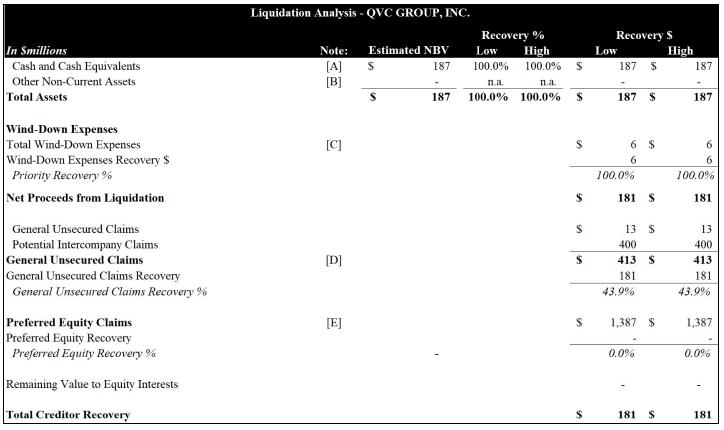
7
Notes to the QVC Group, Inc. Detailed Liquidation Analysis
[A] Cash and Cash Equivalents: The Cash balance represents the estimated balance as of the Liquidation Date. A 100% recovery on Cash and Cash equivalents has been estimated for both the low and high projected recoveries.
[B] Other Non-Current Assets: Other Non-Current Assets include QVC Group, Inc.’s equity interest in subsidiaries, with no recovery expected during the Liquidation Process.
[C] Wind-Down Expenses: Wind-Down Expenses represent the expenses associated with administering the chapter 7 liquidation and existing chapter 11 administrative expenses. A 3% Trustee fee based on Total Assets is estimated in total at approximately $6 million.
[D] General Unsecured Claims: The General Unsecured Claims represent the estimated general unsecured claims that will be unpaid as of the Liquidation Date, including potential intercompany claims that may be asserted by other Debtor entities.
[E] Preferred Equity Claims: These claims represent the aggregate amount outstanding of the 9.5% Series A Cumulative Redeemable Preferred Stock due 2031 as of the Liquidation Date. No recovery is estimated on these claims.
8
LIBERTY INTERACTIVE LLC LIQUIDATION ANALYSIS
Basis of Presentation
The Liquidation Analysis has been prepared assuming that the Debtors would convert their current chapter 11 cases to cases under chapter 7 of the Bankruptcy Code on or about August 31, 2026 (the “Liquidation Date”). Except as otherwise noted herein the Liquidation Analysis is based upon the unaudited financial statements of the Debtors as of February 28, 2026 and those values, in total, have been estimated as of the Liquidation Date and are assumed to be representative of the Debtors’ assets and liabilities as of such date. The Debtors, in consultation with their advisors, believe that estimated August 31, 2026 book value of assets and certain liabilities are a proxy for such book values as of the Liquidation Date. It is assumed that on the Liquidation Dates, the Bankruptcy Court would appoint a Trustee to oversee the liquidation of the Debtors’ Estates, during which time all of the assets of the Debtors would be sold and the Cash proceeds, net of liquidation related costs, would then be distributed to creditors in accordance with applicable law: (i) first, for payment of liquidation, wind-down expenses, and Trustee fees attributable to the Wind-Down Expenses; and (ii) second, any remaining net cash would be distributed to unsecured creditors.
While there are no operations to discontinue at Liberty Interactive LLC, resolution of claims and estate wind-down activities for Liberty Interactive LLC are anticipated to run in parallel with the Liquidation Process for QxH under the direction of the Trustee, utilizing the Debtors’ resources and third-party advisors, to allow for the orderly wind-down of the Debtors’ estates.
9
LIBERTY INTERACTIVE LLC DETAILED LIQUIDATION ANALYSIS
The Liquidation Analysis for Liberty Interactive LLC was prepared on a legal entity basis. The following summary of the Liberty Interactive LLC Liquidation Analysis should be reviewed in conjunction with the associated notes.
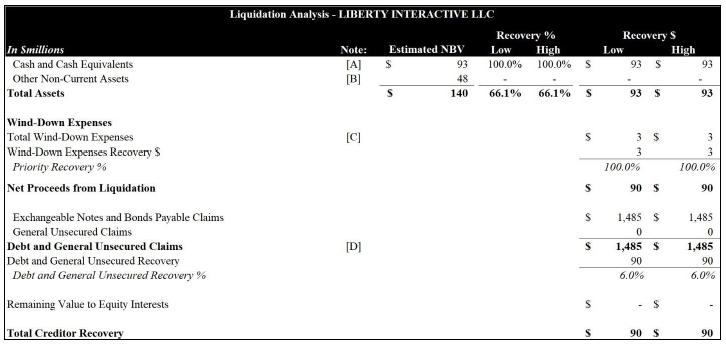
10
Notes to the Liberty Interactive LLC Detailed Liquidation Analysis
[A] Cash and Cash Equivalents: The Cash balance represents the estimated balance as of the Liquidation Date. A 100% recovery on Cash and Cash equivalents has been estimated for both the low and high projected recoveries.
[B] Other Non-Current Assets: Other Non-Current Assets consist of the portfolio of minority interests held by Liberty Interactive LLC, with no recovery expected during the Liquidation Process.
[C] Wind-Down Expenses: Wind-Down Expenses represent the expenses associated with administering the chapter 7 liquidation and existing chapter 11 administrative expenses. A 3% Trustee fee based on Total Assets is estimated in total at approximately $3 million.
[D] Debt and General Unsecured Claims: Because the Liquidation Analysis assumes the preservation of the intercompany claims settlements, these claims represent the aggregate Exchangeable Notes and Bonds outstanding, as well as other General Unsecured Claims. The Debtors estimate a recovery of approximately 6.0% on these claims.
11
CORNERSTONE BRANDS, INC. LIQUIDATION ANALYSIS
Basis of Presentation
The Liquidation Analysis has been prepared assuming that the Debtors would convert their current chapter 11 cases to cases under chapter 7 of the Bankruptcy Code on or about August 31, 2026 (the “Liquidation Date”). Except as otherwise noted herein the Liquidation Analysis is based upon the unaudited financial statements of the Debtors as of December 31, 2025 and those values, in total, have been estimated as of the Liquidation Date and are assumed to be representative of the Debtors’ assets and liabilities as of such date. The Debtors, in consultation with their advisors, believe that estimated August 31, 2026 book value of assets and certain liabilities are a proxy for such book values as of the Liquidation Date. It is assumed that on the Liquidation Dates, the Bankruptcy Court would appoint a Trustee to oversee the liquidation of the Debtors’ Estates, during which time all of the assets of the Debtors would be sold and the Cash proceeds, net of liquidation related costs, would then be distributed to creditors in accordance with applicable law: (i) first, for payment of liquidation, wind-down expenses, and Trustee fees attributable to the Wind-Down Expenses; and (ii) second, any remaining net cash would be distributed to General Unsecured Claim Creditors.
The operations of the Debtors (the “Liquidating Entities”) are assumed to cease on the Liquidation Date, and the related individual assets will be sold during an approximately 9-12 week liquidation (the “Liquidation Process”) under the direction of the Trustee, utilizing the Debtors’ resources and third-party advisors, to allow for the orderly wind-down of the Debtors’ estates, followed by approximately 3 months to wind the estate down.
12
CORNERSTONE BRANDS, INC. DETAILED LIQUIDATION ANALYSIS
The Liquidation Analysis for Cornerstone Brands, Inc. was prepared on an operating entity basis The following summary of the Cornerstone Brands, Inc. Liquidation Analysis should be reviewed in conjunction with the associated notes.
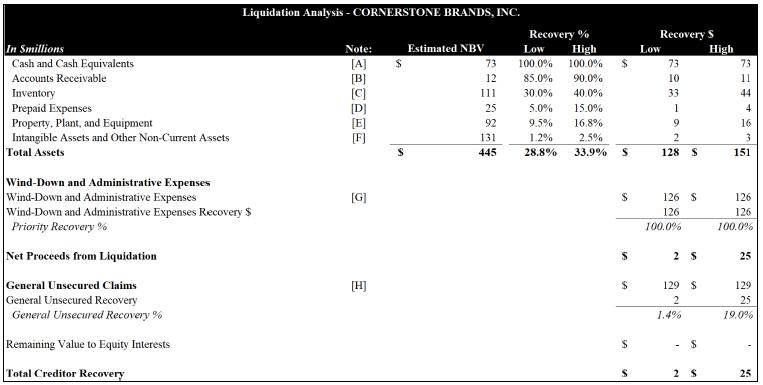
13
Notes to the Cornerstone Brands, Inc. Detailed Liquidation Analysis
[A] Cash and Cash Equivalents: The Cash balance represents the estimated balance as of the Liquidation Date. A 100% recovery has been assumed for both the low and high recovery cases.
[B] Accounts Receivable: The Accounts Receivable balance represents the estimated balance as of the Liquidation Date. A recovery of 85% to 90% has been applied, reflecting the short-term nature of the receivables, which are primarily customer credit card receivables.
[C] Inventory: A 30.0% to 40.0% recovery has been estimated for the eligible projected inventory balance as of the Liquidation Date, which is comprised of on-hand inventory. This level of recovery has been informed by comparable liquidations and further discounted to reflect differences in liquidation channels. The estimated recovery also assumes that the recoveries are net of related costs during the 9-12 week liquidation process.
[D] Prepaid Expenses: Prepaid Expenses have been evaluated by type and assigned recoveries based on the likelihood of recoverability. On a blended basis, a 5.0% to 15.0% recovery has been estimated.
[E] Property, Plant, and Equipment: The net book value of PP&E consists of land, buildings, leasehold improvements, furniture and fixtures, computer equipment, transportation equipment, projects in progress and other equipment. Also incorporated is an estimate for the sale of owned property. Recovery was estimated by asset type. In total, the implied recovery of PP&E relative to net book value is 9.5% to 16.8%.
[F] Intangible Assets and Other Non-Current Assets: Intangible Assets and Other Non-Current Assets consist of capitalized software, tradenames and ROU assets. A recovery of 1.2% to 2.5% has been applied, with the value of trade names estimated by examining actual trade name transactions that resulted from the liquidations of other retailers.
[G] Wind-Down and Administrative Expenses: The Administrative Expenses consist of remaining unpaid accounts payable incurred from the chapter 11 period prior to conversion to chapter 7, estimated at $58 million. Chapter 7 wind-down expenses consist of priority liabilities including, but not limited to, accrued sales tax and employee wages, Trustee fees and chapter 7 legal/professional fees, estimated at $68 million, for a total of approximately $126 million, with recovery at 100%. Wind-down expenses exclude inventory related wind-down expenses which have been factored into the recovery rates assigned to inventory above.
[H] General Unsecured Claims: General Unsecured Claims consist of estimates for unpaid liabilities at the time of liquidation as well as estimated lease and contract rejection damages claims. The Debtors estimate a recovery of 1.4% to 19.0% on these claims.
14
Exhibit E
Valuation Analysis
(To Come)
Exhibit F
Simplified Organizational Chart
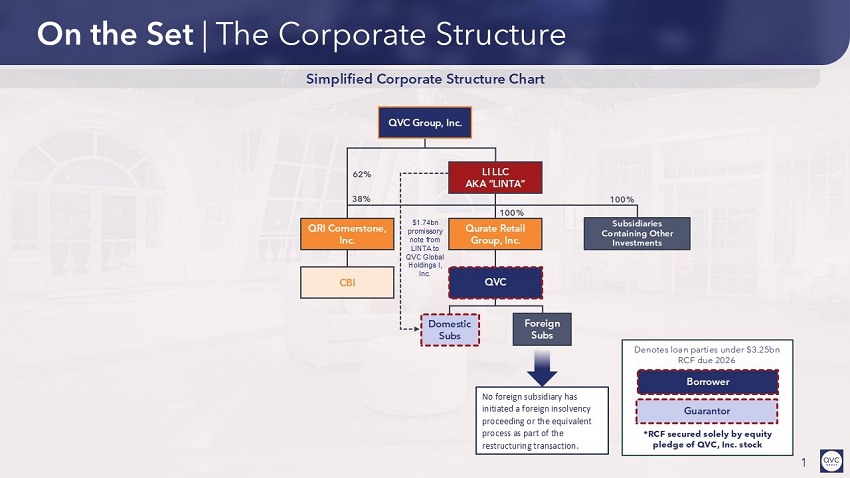
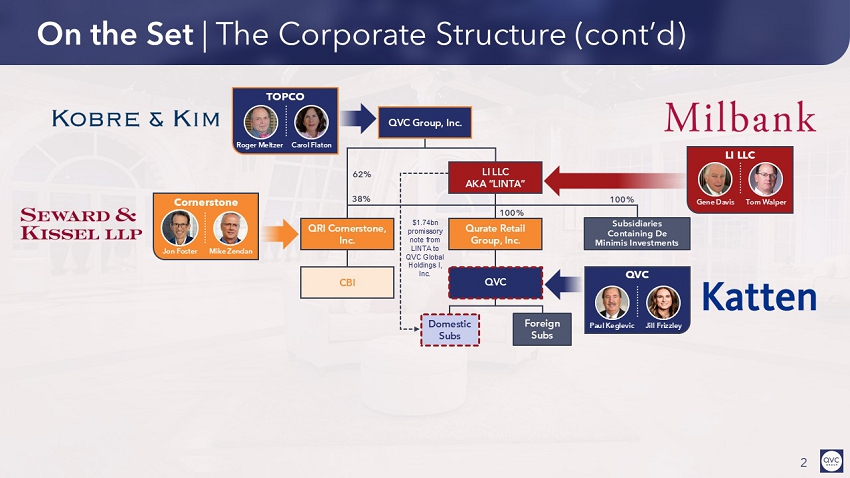
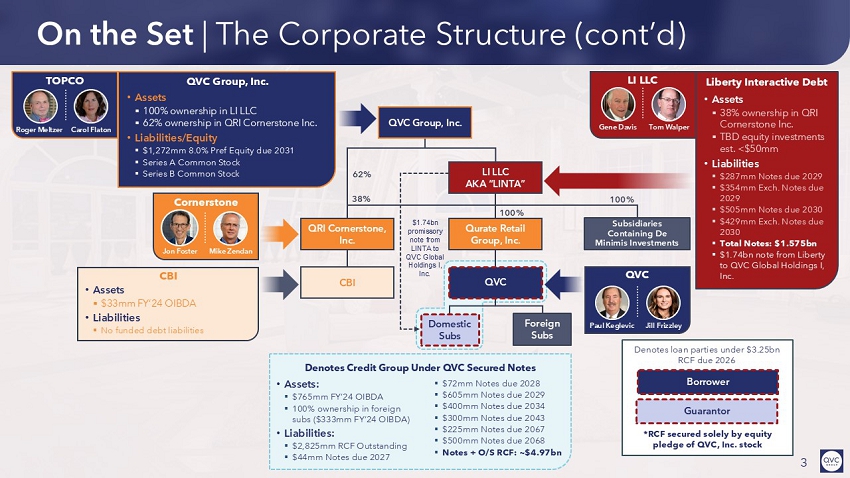
Exhibit G
Corporate Structure Chart