Exhibit 3.1
American Eagle Gold Corp.
Consolidated Financial Statements
For the years ended December 31, 2024 and 2023
(Expressed in Canadian Dollars)

Audit. Tax. Advisory.
Independent Auditor’s Report
To the Shareholders of American Eagle Gold Corp.
Opinion
We have audited the consolidated financial statements of American Eagle Gold Corp. and its subsidiaries (the “Company”), which comprise the consolidated statements of financial position as at December 31, 2024 and 2023, and the consolidated statements of loss and comprehensive loss, consolidated statements of changes in equity and consolidated statements of cash flows for the years then ended, and notes to the consolidated financial statements, including material accounting policy information.
In our opinion, the accompanying consolidated financial statements present fairly, in all material respects, the consolidated financial position of the Company as at December 31, 2024 and 2023, and its consolidated financial performance and its consolidated cash flows for the years then ended in accordance with International Financial Reporting Standards (“IFRS”).
Basis for opinion
We conducted our audit in accordance with Canadian generally accepted auditing standards. Our responsibilities under those standards are further described in the Auditor’s responsibilities for the audit of the consolidated financial statements section of our report. We are independent of the Company in accordance with the ethical requirements that are relevant to our audit of the consolidated financial statements in Canada. We have fulfilled our other ethical responsibilities in accordance with these requirements. We believe that the audit evidence we have obtained is sufficient and appropriate to provide a basis for our opinion.
Key audit matters
Key audit matters are those matters that, in our professional judgement, were of most significance in our audit of the consolidated financial statements of the current period. These matters were addressed in the context of our audit of the consolidated financial statements as a whole, and in forming our opinion thereon, and we do not provide a separate opinion on these matters.
We have determined that there were no key audit matters to communicate in our report.
| 251 Consumers Road, Suite 800 | |
| Toronto, Ontario | |
| M2J 4R3 | |
| mcgovernhurley.com | |
| t. 416-496-1234 | Page 1 |

Other information
Management is responsible for the other information. The other information comprises Management’s Discussion and Analysis.
Our opinion on the consolidated financial statements does not cover the other information and we do not express any form of assurance conclusion thereon.
In connection with our audit of the consolidated financial statements, our responsibility is to read the other information and, in doing so, consider whether the other information is materially inconsistent with the consolidated financial statements or our knowledge obtained in the audit or otherwise appears to be materially misstated.
We obtained Management’s Discussion and Analysis prior to the date of this auditor’s report. If, based on the work we have performed, we conclude that there is a material misstatement of this other information, we are required to report that fact. We have nothing to report in this regard.
Responsibilities of management and those charged with governance for the consolidated financial statements
Management is responsible for the preparation and fair presentation of the consolidated financial statements in accordance with IFRS, and for such internal control as management determines is necessary to enable the preparation of consolidated financial statements that are free from material misstatement, whether due to fraud or error.
In preparing the consolidated financial statements, management is responsible for assessing the Company’s ability to continue as a going concern, disclosing, as applicable, matters related to going concern and using the going concern basis of accounting unless management either intends to liquidate the Company or cease operations, or has no realistic alternative but to do so.
Those charged with governance are responsible for overseeing the Company’s financial reporting process.
Auditor’s responsibilities for the audit of the consolidated financial statements
Our objectives are to obtain reasonable assurance about whether the consolidated financial statements as a whole are free from material misstatement, whether due to fraud or error, and to issue an auditor’s report that includes our opinion. Reasonable assurance is a high level of assurance, but is not a guarantee that an audit conducted in accordance with Canadian generally accepted auditing standards will always detect a material misstatement when it exists. Misstatements can arise from fraud or error and are considered material if, individually or in aggregate, they could reasonably be expected to influence the economic decisions of users taken on the basis of these consolidated financial statements.
Page 2
As part of an audit in accordance with Canadian generally accepted auditing standards, we exercise professional judgement and maintain professional skepticism throughout the audit. We also:
| · | Identify and assess the risks of material misstatement of the consolidated financial statements, whether due to fraud or error, design and perform audit procedures responsive to those risks, and obtain audit evidence that is sufficient and appropriate to provide a basis for our opinion. The risks of not detecting a material misstatement resulting from fraud is higher than for one resulting from error, as fraud may involve collusion, forgery, intentional omissions, misrepresentations, or the override of internal control. |
| · | Obtain an understanding of internal control relevant to the audit in order to design audit procedures that are appropriate in the circumstances, but not for the purpose of expressing an opinion on the effectiveness of the Company’s internal control. |
| · | Evaluate the appropriateness of accounting policies used and the reasonableness of accounting estimates and related disclosures made by management. |
| · | Conclude on the appropriateness of management’s use of the going concern basis of accounting and, based on the audit evidence obtained, whether a material uncertainty exists related to events or conditions that may cast significant doubt on the Company’s ability to continue as a going concern. If we conclude that a material uncertainty exists, we are required to draw attention in our auditor’s report to the related disclosures in the consolidated financial statements or, if such disclosures are inadequate, to modify our opinion. Our conclusions are based on the audit evidence obtained up to the date of our auditor’s report. However, future events or conditions may cause the Company to cease to continue as a going concern. |
| · | Evaluate the overall presentation, structure and content of the consolidated financial statements, including the disclosures, and whether the consolidated financial statements represent the underlying transactions and events in a manner that achieves fair presentation. |
We communicate with those charged with governance regarding, among other matters, the planned scope and timing of the audit and significant audit findings, including any significant deficiencies in internal control that we identify during our audit.
We also provide those charged with governance with a statement that we have complied with relevant ethical requirements regarding independence, and to communicate with them all relationships and other matters that may reasonably be thought to bear on our independence, and where applicable, related safeguards.
Page 3
From the matters communicated with those charged with governance, we determine those matters that were of most significance in the audit of the consolidated financial statements of the current period and are therefore the key audit matters. We describe these matters in our auditor’s report unless law or regulation precludes public disclosure about the matter or when, in extremely rare circumstances, we determine that a matter should not be communicated in our report because the adverse consequences of doing so would reasonably be expected to outweigh the public interest benefits of such communication.
The engagement partner of the audit resulting in this independent auditor’s report is Nicole Louli.
McGovern Hurley LLP
Chartered Professional Accountants
Licensed Public Accountants
Toronto, Ontario
April 29, 2025
Page 4
American Eagle Gold Corp.
Consolidated Statements of Financial Position
(Expressed in Canadian dollars)
| As at | Notes | December 31, 2024 | December 31, 2023 | |||||||
| ASSETS | ||||||||||
| Current | ||||||||||
| Cash | $ | 35,929,619 | $ | 4,393,661 | ||||||
| Amounts receivable | 6 | 388,758 | 119,901 | |||||||
| Prepaid expenses and deposits | 67,326 | 45,239 | ||||||||
| Total current assets | 36,385,703 | 4,558,801 | ||||||||
| Reclamation deposit | 55,518 | 50,518 | ||||||||
| Investment | 5 | 195,000 | 105,000 | |||||||
| Equipment | 18,573 | - | ||||||||
| TOTAL ASSETS | $ | 36,654,794 | $ | 4,714,319 | ||||||
| LIABILITIES | ||||||||||
| Current | ||||||||||
| Accounts payable and accrued liabilities | 11 | 629,018 | 311,244 | |||||||
| Due to related party | 11 | 1,072 | 833 | |||||||
| Flow-through share premium liability | 7 | 826,000 | 879,000 | |||||||
| TOTAL LIABILITIES | 1,456,090 | 1,191,077 | ||||||||
| SHAREHOLDERS’ EQUITY | ||||||||||
| Share capital | 10 | 53,632,776 | 14,990,643 | |||||||
| Share-based reserve | 10 | 3,309,075 | 2,421,061 | |||||||
| Deficit | (21,743,147 | ) | (13,888,462 | ) | ||||||
| TOTAL SHAREHOLDERS’ EQUITY | 35,198,704 | 3,523,242 | ||||||||
| TOTAL LIABILITIES AND SHAREHOLDERS’ EQUITY | $ | 36,654,794 | $ | 4,714,319 | ||||||
Nature of operations and going concern (Notes 1 and 2)
Commitments and contingencies (Notes 6, 7 and 13)
Subsequent events (Note 14)
Approved on behalf of the Directors:
| “Anthony Moreau” | “Stephen Stewart” | |
| Anthony Moreau – Director | Stephen Stewart – Director |
The accompanying notes are an integral part of these consolidated financial statements.
5
American Eagle Gold Corp.
Consolidated Statements of Loss and Comprehensive Loss
(Expressed in Canadian dollars)
| For the years ended | Notes | December 31, 2024 | December 31, 2023 | |||||||
| EXPENSES | ||||||||||
| Exploration and evaluation expenses | 6 | $ | 7,965,795 | $ | 4,998,857 | |||||
| Consulting and management fees | 11 | 757,983 | 509,207 | |||||||
| Office, general and administrative | 210,039 | 91,476 | ||||||||
| Amortization | 7,648 | - | ||||||||
| Audit, accounting and legal | 106,512 | 105,645 | ||||||||
| Transfer agent, filing fees and shareholder communications | 283,290 | 248,384 | ||||||||
| Share-based compensation | 10,11 | 1,510,147 | 434,743 | |||||||
| Unrealized (gain) loss on investment | 5 | (90,000 | ) | 15,000 | ||||||
| Interest income | (483,758 | ) | (139,580 | ) | ||||||
| TOTAL EXPENSES | $ | 10,267,656 | $ | 6,263,732 | ||||||
| Deferred income tax recovery | ||||||||||
| Flow-through share premium liability recovery | 7 | (2,412,971 | ) | (1,210,800 | ) | |||||
| NET LOSS FOR THE YEAR | $ | 7,854,685 | $ | 5,052,932 | ||||||
| Weighted average number of shares – basic and diluted | 131,345,551 | 92,986,493 | ||||||||
| Loss per share – basic and diluted | $ | 0.06 | $ | 0.06 | ||||||
The accompanying notes are an integral part of these consolidated financial statements.
6
American Eagle Gold Corp.
Consolidated Statements of Changes in Equity
(Expressed in Canadian dollars)
| Number
of shares | Amount | Share-based Reserve | (Deficit) | Total (deficiency) Equity | ||||||||||||||||
| Balance at December 31, 2022 | 70,224,291 | $ | 7,108,612 | $ | 1,699,834 | $ | (8,835,530 | ) | $ | (27,084 | ) | |||||||||
| Loss for the year | - | - | - | (5,052,932 | ) | (5,052,932 | ) | |||||||||||||
| Shares issued on hard-dollar private placement | 13,428,740 | 2,150,202 | 442,627 | - | 2,592,829 | |||||||||||||||
| Shares issued on flow-through private placement | 20,340,000 | 3,486,159 | - | - | 3,486,159 | |||||||||||||||
| Shares issued for exploration and evaluation expense | 7,976,744 | 1,455,814 | - | - | 1,455,814 | |||||||||||||||
| Warrants exercised | 2,842,854 | 789,856 | (156,143 | ) | - | 633,713 | ||||||||||||||
| Share-based payments | - | - | 434,743 | - | 434,743 | |||||||||||||||
| Balance at December 31, 2023 | 114,812,629 | $ | 14,990,643 | $ | 2,421,061 | $ | (13,888,462 | ) | $ | 3,523,242 | ||||||||||
| Loss for the year | - | - | - | (7,854,685 | ) | (7,854,685 | ) | |||||||||||||
| Shares issued on hard-dollar private placement | 33,321,577 | 28,974,476 | - | - | 28,974,476 | |||||||||||||||
| Shares issued on flow-through private placement | 7,866,571 | 5,276,837 | 184,574 | - | 5,461,411 | |||||||||||||||
| Shares issued for exploration and evaluation expense | 343,594 | 261,131 | - | - | 261,131 | |||||||||||||||
| Stock options exercised | 775,000 | 205,600 | (73,100 | ) | 132,500 | |||||||||||||||
| Warrants exercised | 10,725,740 | 3,924,089 | (733,607 | ) | - | 3,190,482 | ||||||||||||||
| Share-based payments | - | - | 1,510,147 | - | 1,510,147 | |||||||||||||||
| Balance at December 31, 2024 | 167,845,111 | $ | 53,632,776 | $ | 3,309,075 | $ | (21,743,147 | ) | $ | 35,198,704 | ||||||||||
The accompanying notes are an integral part of these consolidated financial statements.
7
American Eagle Gold Corp.
Consolidated Statements of Cash Flows
(Expressed in Canadian dollars)
| For the year ended | December 31, 2024 | December 31, 2023 | ||||||
| Operating activities | ||||||||
| (Loss) for the year | $ | (7,854,685 | ) | $ | (5,052,932 | ) | ||
| Items not involving cash | ||||||||
| Amortization | 7,648 | - | ||||||
| Flow-through share premium liability recovery | (2,412,971 | ) | (1,210,800 | ) | ||||
| Share-based compensation | 1,510,147 | 434,743 | ||||||
| Unrealized (gain) loss on investment | (90,000 | ) | 15,000 | |||||
| Shares issued for acquisition of interest in NAK | - | 1,255,814 | ||||||
| Shares issued for exploration and evaluation expense | 261,131 | 200,000 | ||||||
| Changes in non-cash working capital items | ||||||||
| Prepaid expenses and deposits | (22,087 | ) | (38,031 | ) | ||||
| Amounts receivable | (268,857 | ) | 175,864 | |||||
| Due to related party | 239 | 833 | ||||||
| Accounts payable and accrued liabilities | 317,774 | (881,982 | ) | |||||
| Net cash (used in) operating activities | $ | (8,551,661 | ) | $ | (5,101,491 | ) | ||
| Financing activities | ||||||||
| Shares issued on hard-dollar private placement, net | 28,974,476 | 2,592,829 | ||||||
| Proceeds on exercise of warrants | 3,190,482 | 633,713 | ||||||
| Shares issued on flow-through private placements, net | 7,821,382 | 5,575,959 | ||||||
| Stock options exercised | 132,500 | - | ||||||
| Net cash provided by financing activities | $ | 40,118,840 | $ | 8,802,501 | ||||
| Investing activities | ||||||||
| Purchase of equipment | (26,221 | ) | - | |||||
| Reclamation deposit | (5,000 | ) | (14,000 | ) | ||||
| Net cash used in investing activities | $ | (31,221 | ) | $ | (14,000 | ) | ||
| Net increase in cash | 31,535,958 | 3,687,010 | ||||||
| Cash, beginning of year | 4,393,661 | 706,651 | ||||||
| Cash, end of year | $ | 35,929,619 | $ | 4,393,661 | ||||
| Supplemental information: | ||||||||
| Brokers warrants issued | $ | 184,574 | $ | 42,000 | ||||
| Brokers units issued | $ | - | $ | 37,590 |
The accompanying notes are an integral part of these consolidated financial statements.
8
American Eagle Gold Corp.
Notes to the Consolidated Financial Statements
For the Years Ended December 31, 2024 and 2023
(Expressed in Canadian dollars)
| 1. | NATURE OF OPERATIONS |
American Eagle Gold Corp. (“American Eagle Gold” or “Company”), was incorporated under the Business Corporations Act (Canada) on June 22, 2018. The Company’s principal business is the acquisition and exploration of mineral properties. To date, the Company has not earned revenue as it is in the exploration stage. The ability of the Company to carry out its business plan rests with its ability to secure equity and other financing. The head and principal office of the Company is located at 141 Adelaide Street West, Suite 1102 Toronto, Ontario M5H 3L5.
The financial statements were authorized for issuance on April 29, 2025 in accordance with a resolution by the board of directors of the Company.
| 2. | GOING CONCERN |
The Company is in the process of exploring its mineral properties and has not yet determined whether the properties contain reserves that are economically recoverable. The recoverability of the amounts expended on mineral properties is dependent upon future profitable production or proceeds from the disposition of properties.
The business of mining and exploration involves a high degree of risk and there can be no assurance that the Company’s exploration programs will result in profitable mining operations. The Company’s continued existence is dependent upon the discovery of economically recoverable reserves and resources, securing and maintaining title and beneficial interest in its properties, making the required payments pursuant to mineral property option agreements and/or securing additional financing; all of which are uncertain.
Although the Company has taken steps to verify title to the properties on which it is conducting its exploration activities, these procedures do not guarantee the Company’s title. Property title may be subject to government licensing requirements or regulations, unregistered prior agreements, social licensing requirements, aboriginal land claims and non-compliance with regulatory and environmental requirements. The Company’s property interests may also be subject to increases in taxes and royalties, renegotiation of contracts, currency exchange fluctuations and restrictions, and political uncertainty.
The Company has raised funds in the year ended December 31, 2024 and will utilize these funds for its exploration programs and working capital requirements. The ability of the Company to arrange such financing in the future will depend in part upon the prevailing capital market conditions as well as the business performance of the Company. There can be no assurance that the Company will be successful in its efforts to arrange additional financing on terms satisfactory to the Company. If additional financing is raised by the issuance of shares from the treasury of the Company, control of the Company may change and existing shareholders may have their interest diluted. If adequate financing is not available, the Company may be required to relinquish rights to certain of its interests or terminate its operations.
As at December 31, 2024, the Company had working capital of $35,755,613 (2023 – $4,246,724) excluding the flow-through liability, and an accumulated deficit of $21,743,147 (2023 - $13,888,462). The Company has no proven history of performance or success.
These financial statements have been prepared on the basis of accounting principles applicable to a going concern, which assumes the Company will continue in operation for the foreseeable future and will be able to realize its assets and discharge its liabilities in the normal course of operations. Accordingly, it does not give effect to adjustments, if any that would be necessary should the Company be unable to continue as a going concern and, therefore, be required to realize its assets and liquidate its liabilities in other than in the normal course of business and at amounts that may differ from those shown in these financial statements. Such adjustments could be material.
9
American Eagle Gold Corp.
Notes to the Consolidated Financial Statements
For the Years Ended December 31, 2024 and 2023
(Expressed in Canadian dollars)
| 3. | SIGNIFICANT ACCOUNTING POLICIES AND BASIS OF PREPARATION |
Statement of compliance
The consolidated financial statements of the Company comply with International Financial Reporting Standards (“IFRS”) as issued by the International Accounting Standards Board (“IASB”) and interpretations of the International Financial Reporting Interpretations Committee (“IFRIC”). The policies applied in these consolidated financial statements are based on IFRS issued and effective December 31, 2024.
Basis of presentation
The consolidated financial statements of the Company have been prepared on an accrual basis except for cash flow information and are based on historical costs, except for certain financial instruments which are measured at fair value as explained in the accounting policies.
Basis of consolidation
The consolidated financial statements include the financial statements of American Eagle and its wholly-controlled subsidiary American Eagle Gold Nevada Corp. Control is achieved when the Company has the power to govern the financial and operating policies of an entity so as to obtain benefits from its activities. The results of subsidiaries acquired or disposed of during the period are included in the consolidated statements of loss from the effective date of acquisition or up to the effective date of disposal, as appropriate. All intra-company transactions, balances, income and expenses are eliminated through the consolidation process.
Functional and presentation currency
The functional currency of the Company is determined using the currency of the primary economic environment in which that entity operates. The consolidated financial statements are presented in Canadian dollars which is the Company’s functional and presentation currency. The functional currency of the Company’s subsidiary is the Canadian dollar.
Transactions in currencies other than the functional currency are recorded at the rates of exchange prevailing on the dates of the transactions. At each reporting date, monetary assets and liabilities that are denominated in foreign currencies are translated at the rates prevailing at the reporting date. Exchange differences are recognized in operations in the period in which they arise.
Significant accounting judgements, estimates and assumptions
The preparation of these consolidated financial statements requires management to make estimates and assumptions that affect the reported amounts of assets and liabilities at the date of the consolidated financial statements and reported amounts of expenses during the reporting period. Actual outcomes could differ from these estimates. These consolidated financial statements include estimates, which, by their nature, are uncertain. The impacts of such estimates are pervasive throughout the consolidated financial statements and may require accounting adjustments based on future occurrences. Revisions to accounting estimates are recognized in the period in which the estimate is revised and the revision affects both current and future periods. The Company regularly reviews its estimates and assumptions; however, actual results could differ from these estimates and these differences could be material.
(a) Estimation of decommissioning and restoration costs and timing of expenditure
Decommissioning, restoration and similar liabilities are estimated based on the Company’s interpretation of current regulatory requirements and constructive obligations and are measured at fair value. Fair value is determined based on the net present value of estimated future cash expenditures for the settlement of decommissioning, restoration or similar liabilities that may occur upon decommissioning of the mine. Such estimates are subject to change based on changes in laws and regulations and negotiations with regulatory authorities.
The cost estimates are updated annually during the life of a project to reflect known developments, (e.g. revisions to cost estimates and to the estimated lives of operations) and are subject to review at regular intervals.
10
American Eagle Gold Corp.
Notes to the Consolidated Financial Statements
For the Years Ended December 31, 2024 and 2023
(Expressed in Canadian dollars)
(b) Income, value added, withholding and other taxes
The Company is subject to income, value added, withholding and other taxes. Significant judgment is required in determining the Company’s provisions for taxes. There are many transactions and calculations for which the ultimate tax determination is uncertain during the ordinary course of business. The Company recognizes liabilities for anticipated tax audit issues based on estimates of whether additional taxes will be due. The determination of the Company’s income, value added, withholding and other tax liabilities requires interpretation of complex laws and regulations. The Company’s interpretation of taxation law as applied to transactions and activities may not coincide with the interpretation of the tax authorities. All tax related filings are subject to government audit and potential reassessment subsequent to the financial statement reporting period. Where the final tax outcome of these matters is different from the amounts that were initially recorded, such differences will impact the tax related accruals and deferred income tax provisions in the period in which such determination is made.
(c) Share-based payments
Management determines costs for share-based payments using market-based valuation techniques. The fair value of the market-based and performance-based share awards are estimated at the date of grant using generally accepted valuation techniques. Assumptions are made and judgment used in applying valuation techniques. These assumptions and judgments include estimating the future volatility of the stock price, expected dividend yield, future employee turnover rates and future employee stock option exercise behaviours and corporate performance. Such judgments and assumptions are inherently uncertain. Warrants are valued in a similar way. Changes in these assumptions affect the fair value estimates.
(d) Contingencies refer to Note 13.
Exploration and evaluation expenditures
Mineral property acquisition costs are expensed as incurred. Exploration expenditures are the costs incurred in the initial search for mineral deposits with economic potential. Exploration expenditures typically include costs associated with prospecting, sampling, mapping, diamond drilling and other work involved in searching for ore. All exploration expenditures are expensed as incurred.
When economically viable reserves have been determined and the decision to proceed with development has been approved, the expenditures incurred subsequent to this date related to development and construction are capitalized as construction-in-process and classified as a component of property, plant and equipment.
Government tax credits are recorded as a reduction to exploration expense.
Once the technical feasibility and commercial viability of the extraction of mineral resources in an area of interest are demonstrable, exploration and evaluation assets attributable to that area of interest are first tested for impairment and then reclassified to mining property and development assets within property, plant and equipment.
Mining properties and process facility assets are amortized upon commencement of commercial production either on a unit-of-production basis over measured and indicated resources included in the mine plan or the life of mine.
Where the Company has granted an option on one of its properties, the Company does not record any expenditures made by the optionee on its account. Any cash consideration received directly from the optionee related to an option or sale agreement is credited against the exploration expenditures incurred.
Loss per share
The Company presents basic and diluted loss per share data for its common shares, calculated by dividing the loss attributable to common shareholders of the Company by the weighted average number of common shares outstanding during the period. The diluted loss per share calculation assumes that any proceeds from the exercise of dilutive stock options and warrants would be used to repurchase common shares at the average market price during the period, with the incremental number of shares being included in the denominator of the diluted loss per share calculation. Diluted loss per share does not adjust the loss attributable to common shareholders or the weighted average number of common shares outstanding when the effect is anti-dilutive. All of the Company’s outstanding stock options and warrants were anti-dilutive for the years ended December 31, 2024 and 2023.
11
American Eagle Gold Corp.
Notes to the Consolidated Financial Statements
For the Years Ended December 31, 2024 and 2023
(Expressed in Canadian dollars)
Financial instruments
Financial assets
Initial recognition and measurement
Non-derivative financial assets within the scope of IFRS 9 are classified and measured as "financial assets at fair value", as either fair value through profit on loss (“FVPL”) or fair value through other comprehensive income (“FVOCI”), and "financial assets at amortized costs", as appropriate. The Company determines the classification of financial assets at the time of initial recognition based on the Company's business model and the contractual terms of the cash flows.
All financial assets are recognized initially at fair value plus, in the case of financial assets not at FVPL, directly attributable transaction costs on the trade date at which the Company becomes a party to the contractual provisions of the instrument.
Financial assets with embedded derivatives are considered in their entirety when determining their classification at FVPL or at amortized cost. Other accounts receivable held for collection of contractual cash flows are measured at amortized cost.
Subsequent measurement – Financial assets at amortized cost
After initial recognition, financial assets measured at amortized cost are subsequently measured at the end of each reporting period at amortized cost using the Effective Interest Rate (“EIR”) method. Amortized cost is calculated by taking into account any discount or premium on acquisition and any fees or costs that are an integral part of the EIR. The EIR amortization is included in other income in the consolidated statements of loss. The Company’s cash and amounts receivable are measured at amortized cost.
Subsequent measurement - Financial assets at FVPL
Financial assets measured at FVPL include financial assets management intends to sell in the short term and any derivative financial instrument that is not designated as a hedging instrument in a hedge relationship. Financial assets measured at FVPL are carried at fair value in the consolidated statements of financial position with changes in fair value recognized in other income or expense in the consolidated statements of loss. The Company’s investment in shares of Orecap Invest Corp. (formerly Orefinders Resources Inc.) (“Orecap”). is measured at FVPL.
Subsequent measurement - Financial assets at FVOCI
Financial assets measured at FVOCI are non-derivative financial assets that are not held for trading and the Company has made an irrevocable election at the time of initial recognition to measure the assets at FVOCI. The Company has no assets measured at FVOCI.
After initial measurement, investments measured at FVOCI are subsequently measured at fair value with unrealized gains or losses recognized in other comprehensive income or loss in the statements of comprehensive loss. When the investment is sold, the cumulative gain or loss remains in accumulated other comprehensive income or loss and is not reclassified to profit or loss.
Derecognition
A financial asset is derecognized when the contractual rights to the cash flows from the asset expire, or the Company no longer retains substantially all the risks and rewards of ownership.
12
American Eagle Gold Corp.
Notes to the Consolidated Financial Statements
For the Years Ended December 31, 2024 and 2023
(Expressed in Canadian dollars)
Impairment of financial assets
The Company has elected to apply the simplified approach to impairment as permitted by IFRS 9, which requires the expected lifetime loss to be recognized at the time of initial recognition of the receivable. To measure estimated credit losses, accounts receivable have been grouped based on shared credit risk characteristics, including the number of days past due. An impairment loss is reversed in subsequent periods if the amount of the expected loss decreases and the decrease can be objectively related to an event occurring after the initial impairment was recognized.
Financial liabilities
Initial recognition and measurement
Financial liabilities are measured at amortized cost, unless they are required to be measured at FVPL as is the case for held for trading or derivative instruments, or the Company has opted to measure the financial liability at FVPL. The Company's financial liabilities include accounts payable and accrued liabilities and due to related party, which are each measured at amortized cost. All financial liabilities are recognized initially at fair value and in the case of long-term debt, net of directly attributable transaction costs.
Subsequent measurement - financial liabilities at amortized cost
After initial recognition, financial liabilities measured at amortized cost are subsequently measured at the end of each reporting period at amortized cost using the Effective Interest Rate ("EIR") method. Amortized cost is calculated by taking into account any discount or premium on acquisition and any fees or costs that are an integral part of the EIR. The EIR amortization is included in finance cost in the consolidated statements of loss.
Derecognition
A financial liability is derecognized when the obligation under the liability is discharged, cancelled or expires with any associated gain or loss recognized in other income or expense in the consolidated statements of loss.
Financial instruments fair value hierarchy
Financial instruments recorded at fair value on the statement of financial position are classified using a fair value hierarchy that reflects the significance of the inputs used in making the measurements. The fair value hierarchy has the following levels:
· Level 1: Quoted prices (unadjusted) in active markets for identical assets or liabilities;
· Level 2: Inputs other than quoted prices included within Level 1 that are observable for the asset or liability, either directly or indirectly; and
· Level 3: Inputs for the assets or liabilities that are not based on observable market data.
Income tax
Income tax expense is comprised of both current and deferred income taxes. Income tax expense is recognized in the statement of loss and comprehensive loss except to the extent that it relates to items recognized directly in equity, in which case it is recognized in equity. Current tax is the expected tax payable on the taxable income for the period, using tax rates enacted or substantively enacted at the reporting date, and any adjustment to tax payable in respect of previous years.
Deferred income tax is provided for temporary differences at the reporting date between the tax bases of assets and liabilities and their carrying amounts for financial reporting purposes. The carrying amount of deferred income tax assets is reviewed at the end of each reporting period and recognized only to the extent that it is probable that sufficient taxable profit will be available to allow all or part of the deferred income tax asset to be utilized.
Deferred income tax assets and liabilities are measured at the tax rates that are expected to apply to the year when the asset is realized or the liability is settled, based on tax rates (and tax laws) that have been enacted or substantively enacted by the end of the reporting period.
13
American Eagle Gold Corp.
Notes to the Consolidated Financial Statements
For the Years Ended December 31, 2024 and 2023
(Expressed in Canadian dollars)
Deferred income tax assets and deferred income tax liabilities are offset if a legally enforceable right exists to set off current tax assets against current income tax liabilities and the deferred income taxes relate to the same taxable entity and the same taxation authority.
Flow-through share issuances
The Company finances a portion of its exploration activities through the issue of flow-through shares issued pursuant to the Canadian Income Tax Act (“Tax Act”). Proceeds received from the issuance of flow-through shares are restricted to be used only for qualifying Canadian exploration and development expenses as defined in the Tax Act.
Pursuant to the terms of the flow-through share subscription agreements, these shares transfer the tax deductibility of qualifying expenditures to flow-through investors. On issuance, the Company allocates a portion of the subscription proceeds as a flow-through share premium, equal to the estimated premium, if any, that investors pay for the flow-through feature, which is recognized as a flow-through share premium liability. As expenditures are incurred and applied against the Company’s associated flow-through commitment, the premium liability is reduced proportionately, charged as a recovery in operations.
Asset retirement obligations (“ARO”)
The Company records the present value of estimated costs of legal and constructive obligations required to restore operating locations in the period in which the obligation is incurred. The nature of these restoration activities includes dismantling and removing structures, rehabilitating mines and tailings dams, dismantling operating facilities, closure of plant and waste sites, and restoration, reclamation and re-vegetation of affected areas.
The obligation generally arises when the asset is installed or the ground / environment is disturbed at the production location. When the liability is initially recognized, the present value of the estimated cost is capitalized by increasing the carrying amount of the related mining assets to the extent that it was incurred prior to the production of related ore.
Over time, the discounted liability is increased for the change in present value based on the discount rates that reflect current market assessments and the risks specific to the liability. The periodic unwinding of the discount is recognized in loss as a finance cost. Additional disturbances or changes in rehabilitation costs will be recognized as additions or charges to the corresponding assets and rehabilitation liability when they occur. For closed sites, changes to estimated costs are recognized immediately in loss. The Company does not currently have any such significant legal or constructive obligations and therefore, no rehabilitation provision has been recorded as at December 31, 2024 and 2023.
Share-based payments
The Company has adopted an employee stock option plan. Share-based payments to employees are measured at the fair value of the instruments issued and amortized over the vesting periods. Share-based payments to non-employees are measured at the fair value of goods or services received or the fair value of the equity instruments issued, if it is determined the fair value of the goods or services cannot be reliably measured, and are recorded at the date the goods or services are received. Share-based payments to employees and others providing similar services are measured at the fair value of the equity instruments issued at the grant date. The corresponding amount is recorded to the share-based payment reserve. The fair value of options is determined using a Black–Scholes pricing model which incorporates market and vesting conditions.
The number of shares and options expected to vest is reviewed and adjusted at the end of each reporting period such that the amount recognized for services received as consideration for the equity instruments granted shall be based on the number of equity instruments that eventually vest.
The share-based payment reserve records items recognized as share-based payments expense until such time that the stock options are exercised, at which time the corresponding amount will be transferred to share capital. If the options expire unexercised, the amount remains in share-based payment reserve.
14
American Eagle Gold Corp.
Notes to the Consolidated Financial Statements
For the Years Ended December 31, 2024 and 2023
(Expressed in Canadian dollars)
| 4. | FUTURE ACCOUNTING PRONOUNCEMENTS |
During the year ended December 31, 2024, the Company adopted a number of amendments and improvements of existing standards. These included amendments to IAS 1 – Disclosure of Accounting Policies. These new standards and changes did not have any material impact on the Company’s financial statements.
Certain pronouncements were issued by the IASB or the IFRIC that are mandatory for accounting periods commencing on or after January 1, 2025. Many are not applicable or do not have a significant impact to the Company and have been excluded. Management is currently evaluating the impact of these pronouncements on the Company’s financial statements.
Classification and Measurement of Financial Instruments (Amendments to IFRS 9 and IFRS 7) - In May 2024, the IASB issued amendments to IFRS 9 Financial Instruments and IFRS 7 Financial Instruments – Disclosures. The amendments clarify the derecognition of financial liabilities and introduces an accounting policy option to derecognize financial liabilities that are settled through an electronic payment system. The amendments also clarify how to asses the contractual cash flow characteristics of financial assets that include environmental, social and governance (ESG)-linked features and other similar contingent features and the treatment of non-recourse assets and contractually linked instruments (CLIs). Further, the amendments mandate additional disclosures in IFRS 7 for financial instruments with contingent features and equity instruments classified at FVOCI. the amendments are effective for annual periods starting on or after January 1, 2026. Retrospective application is required and early adoption is permitted.
Presentation and Disclosure in Financial Statements (IFRS 18) - In April 2024, the IASB issued IFRS 18 Presentation and Disclosure in Financial Statements to improve reporting of financial performance. The new standards replaces IAS 1 Presentation of Financial Statements. IFRS 18 introduces new categories and required subtotals in the statement of profit and loss and also requires disclosure of management-defined performance measures. It also includes new requirements for the location, aggregation and disaggregation of financial information. The standard is effective for annual reporting periods beginning on or after January 1, 2027, including interim financial statements. Retrospective application is required and early adoption is permitted.
| 5. | INVESTMENT |
| Investment in Orecap Invest Corp. | No. of Shares | $/Share | Value | |||||||||
| Balance, December 31, 2022 | 3,000,000 | 0.040 | $ | 120,000 | ||||||||
| Unrealized (loss) on fair value | - | (0.005 | ) | (15,000 | ) | |||||||
| Balance, December 31, 2023 | 3,000,000 | 0.035 | $ | 105,000 | ||||||||
| Unrealized gain on fair value | - | 0.030 | 90,000 | |||||||||
| Balance, December 31, 2024 | 3,000,000 | 0.065 | $ | 195,000 | ||||||||
During the year ended December 31, 2024, the Company recorded an unrealized gain on investment of $90,000 (2023 – loss $15,000).
15
American Eagle Gold Corp.
Notes to the Consolidated Financial Statements
For the Years Ended December 31, 2024 and 2023
(Expressed in Canadian dollars)
| 6. | EXPLORATION AND EVALUATION EXPENSES |
The following are details of the Company’s exploration and evaluation expenses for the years ended December 31, 2024 and 2023:
| 2024 | 2023 | Accumulated From Property Inception | ||||||||||
| NAK Property, British Columbia* | $ | 7,965,795 | 4,998,857 | 15,008,643 | ||||||||
*The NAK properties' expenses, include accrued tax credits receivable from the British Columbia government related to exploration activities of $52,000 in 2023. The Company has estimated the recoverable amount of these tax credits based on its interpretation of eligibility, but they are subject to government audits to confirm the interpretations and amounts. These tax credits are included in amounts receivable at December 31, 2024 and 2023.
Nakinilerak (NAK), British Columbia, Canada
On December 10, 2021, the Company entered into an agreement to acquire a 100% interest in the NAK Property, British Columbia. The Company will assume all rights and interest of the vendor under the terms of an option agreement with the underlying claim owner executed on April 28, 2021. The total purchase price payable by the Company to the optionor for the property consisted of the issue of 2,000,000 common shares of the Company at a value of $300,000 and the transfer of 2,000,000 shares of Orefinders held by the Company at a value of $110,000. The valuations were determined using the quoted market price of the common shares of the Company and Orefinders respectively at the transaction date.
The vendor is currently earning a 100% interest in the property under the terms of the option agreement which calls for cash payments, in tranches, totaling of $450,000 over three years and $1,100,000 in work obligations over three years to earn 100%, subject to a 2% Net Smelter Royalty (NSR) to the optinoor which can be bought down to 1% by paying $1,500,000. The owner has the right to receive shares of the Company in lieu of the tranches totaling $450,000 in cash payments, provided that the value of such shares, at the respective time of issue of the tranche, cannot exceed an aggregate of $750,000 for the initial $300,000 in tranches, based on a ten-day volume weighted price calculation prior to issue of the tranche. The optionor retains a 1% NSR with an option by the Company to buyback 0.5% for $1 million.
Summary of Option Stages
| Option Stage | Payment | Exploration Expenditure |
Timeline |
| Stage 1 | $75,000 or 1,000,000 shares1 (Paid) |
$100,000 (Complete) |
April 30, 2022 |
| Stage 2 | $75,000 or 1,000,000 shares1 (Paid) |
$100,000 (Complete) |
April 30, 2023 |
| Stage 3 | $75,000 or 1,000,000 shares2(Shares issued May 2024) |
$900,000 (Complete) |
April 30, 2024 |
| Stage 4 | $75,000 or 1,000,000 shares2 (Shares issued Jan. 2023) | Earlier of July 31, 2025 and completing 2,500 meters of drilling | |
| Stage 5 | $150,000 or 1,000,000 shares (Shares issued March 2025) | 30 days following public disclosure of inferred or greater resources with a minimum of 1,000,000 ounces of gold or gold equivalent | |
| Total | $450,000 or 5,000,000 shares1,2 | $1,100,000 (Complete) |
16
American Eagle Gold Corp.
Notes to the Consolidated Financial Statements
For the Years Ended December 31, 2024 and 2023
(Expressed in Canadian dollars)
| 1. | Maximum value of shares for each tranche will not exceed $150,000 based on 10-day volume weighted average price on day payment comes due. |
| 2. | Maximum value of shares for each tranche will not exceed $225,000 based on 10-day volume weighted average price on day payment comes due. |
In January 2023, the Company issued 1,000,000 shares with a value of $200,000 based on the market price on the settlement date. In May 2024, the Company issued 343,594 shares in consideration of an option payment for NAK. In March 2025, the Company issued 1,000,000 shares to fulfill stage 5 and obtain title to the NAK project. Refer to Note 10.
In 2022, Orecap Invest Corp. (“Orecap”) earned a 20% interest in the NAK project in return for an aggregate of $1 million in exploration work obligations. American Eagle had an option to repurchase the 20% interest at a price of $1.5 million anytime before April 30, 2024, which is subject to regulatory approvals. The $1.5 million payment for the repurchase may be paid in cash or common shares of the Company, at the sole option of the Company. The Company and Orecap have certain directors and officers in common. In November 2023, the Company reacquired the 20% interest in the NAK project. The Company elected to settle the $1.5 million repurchase through the issuance of 6,976,744 common shares of the Company which were valued based on the market price on the settlement date for $1,225,814. See Note 10.
| 7. | FLOW-THROUGH SHARE LIABILITY |
Flow-through common shares require the Company to incur an amount equivalent to the proceeds of the issued flow-through common shares on Canadian qualifying exploration expenditures. The Company may be required to indemnify the holders of such shares for any tax and other costs payable by them in the event the Company has not incurred the required exploration expenditures. Under the IFRS framework, the increase to share capital when flow-through shares are issued is measured based on the current market price of the common shares. The incremental proceeds, or “premium”, are recorded as a flow-through liability. During the year ended December 31, 2024, the Company recognized a flow-through share premium liability recovery of $2,412,971 (2023 - $1,210,800). As of December 31, 2024, the flow-through liability was $826,000 (2023 - $879,000).
| 8. | CAPITAL MANAGEMENT |
The Company’s objectives when managing capital are to safeguard the Company’s ability to continue as a going concern, so that it can provide returns to shareholders and benefits to other stakeholders.
The Company considers the items included in equity as capital. The Company manages the capital structure and adjusts it in light of changes in economic conditions and the risk characteristics of the underlying assets. In order to maintain or adjust the capital structure, the Company may issue new shares through equity offerings or return capital to shareholders. There can be no assurance that the Company will be successful in its efforts to arrange additional financing, if needed, on terms satisfactory to the Company.
Management reviews its capital management approach on an ongoing basis and believes that this approach, given the relative size of the Company, is reasonable. There were no changes in the Company’s approach to capital management during the years ended December 31, 2024 and 2023. The Company is not subject to externally imposed capital restrictions, other than of the TSX Venture Exchange (“TSXV”) which requires adequate working capital or financial resources of the greater of (i) $50,000 and (ii) an amount required in order to maintain operations and cover general and administrative expenses for a period of 6 months. As at December 31, 2024, the Company believes it is compliant with the policies of the TSX-V.
17
American Eagle Gold Corp.
Notes to the Consolidated Financial Statements
For the Years Ended December 31, 2024 and 2023
(Expressed in Canadian dollars)
| 9. | FINANCIAL RISK MANAGEMENT |
The Company is exposed in varying degrees to a variety of financial instrument related risks. The type of risk exposure and the way in which such exposure is managed is provided as follows:
Fair value of financial instruments
The fair value of financial instruments approximates their carrying value due to the short-term maturity of these instruments. At December 31, 2024 and 2023, the Company’s investment is classified as Level 1 in the fair value hierarchy.
Credit risk
Credit risk is the risk that one party to a financial instrument will fail to discharge an obligation and cause the other party to incur a financial loss. Amounts receivable are due from the Government and the Company believes the risk of loss related to these is remote. The Company’s exposure to credit risk is on its cash held in bank accounts. Cash is held with major banks in Canada. Management assesses the credit risk of cash and related party receivable as remote.
Liquidity risk
Liquidity risk is the risk that the Company will not be able to meet its financial obligations as they fall due. The Company strives to ensure that there are sufficient funds to meet its short-term business requirements, taking into account its anticipated cash flows from operations and its holdings of cash. The Company’s accounts payable and accrued liabilities generally have contractual maturities of less than 30 days and are subject to normal trade terms. In the long-term, the Company may have to issue additional equity to ensure there is sufficient capital to meet long-term objectives. See Note 8.
Currency and interest rate risk
The Company is exposed to foreign currency risk on financial assets and liabilities that are denominated in a currency other than the Canadian dollar. The currencies giving rise to this risk are the US dollar.
Market price risk
The Company was exposed to market risk relating to its investment and unfavourable market conditions could result in dispositions of its investment at less than favourable prices. The Company’s investment is comprised of a publicly-traded corporation. The Company’s investment is subject to fair value fluctuations. As at December 31, 2024, if the fair value of the investments fluctuated by 10% all other factors held constant, consolidated net loss would change by approximately $19,500 (2023 - $10,500) based on the value of the investment as at December 31, 2024.
Classification of financial instruments
Financial assets and liabilities included in the statement of financial position are as follows:
| December 31, 2024 | December 31, 2023 | |||||||
| Financial assets at amortized cost: | ||||||||
| Cash | $ | 35,929,619 | $ | 4,393,661 | ||||
| Financial assets at FVPL: | ||||||||
| Investment in Orecap | 195,000 | 105,000 | ||||||
| $ | 36,124,619 | $ | 4,498,661 | |||||
| December 31, 2024 | December 31, 2023 | |||||||
| Financial liabilities at amortized cost: | ||||||||
| Accounts payable and accrued liabilities | $ | 629,017 | $ | 311,244 | ||||
| Due to related party | 1,072 | 833 | ||||||
| $ | 630,089 | $ | 312,077 | |||||
18
American Eagle Gold Corp.
Notes to the Consolidated Financial Statements
For the Years Ended December 31, 2024 and 2023
(Expressed in Canadian dollars)
| 10. | SHARE CAPITAL |
Authorized share capital
Unlimited number of voting common shares without par value.
Issued share capital
(a) On January 23, 2023, the Company completed a private placement consisting of 10,050,000 units at a price of $0.20 per unit for gross proceeds of $2,010,000, where each unit consists of one common share and one half of one common share purchase warrant. Each whole warrant will entitle the holder to purchase one additional common share of the Company at a price of $0.30 until January 23, 2025. The valuation of the warrants was estimated in the amount of $436,679 using the Black-Scholes option pricing model. In connection with the financing, the Company has issued 405,450 finders’ warrants. Each finders’ warrant entitles the holder, on exercise thereof, to purchase one common share at a price of $0.20 until January 23, 2025. The valuation of the finders’ warrants was estimated in the amount of $42,000 using the Black-Scholes option pricing model. In connection with financing the Company incurred cash finder’s fees and other financing costs totaling $73,271. An officer and director of the Company acquired 50,000 shares for gross proceeds of $10,000.
The following assumptions were used in the Black-Scholes option pricing model calculations: expected dividend yield rate of 0%, expected volatility of 100% based on historical volatility, risk free interest rate of 3.66%, share price of $0.16 and an expected life of 2 years.
(b) On May 25, 2023, the Company completed a flow through private placement consisting of 14,400,000 shares at a price of $0.205 per unit for gross proceeds of $2,952,000. The Company recognized a flow through liability of $1,080,000 in connection with the financing. In connection with financing the Company incurred cash finder’s fees and other financing costs totaling $23,705.
(c) On September 7, 2023 the Company completed a flow through private placement consisting of 5,940,000 shares at a price of $0.450 per unit for gross proceeds of $2,674,782 The Company recognized a flow through liability of $1,009,800 in connection with the financing. In connection with financing the Company incurred cash finder’s fees and other financing costs totaling $17,765.
(d) On November 9, 2023, the Company reacquired the 20% interest in the NAK project. The Company elected to settle the $1.5 million repurchase through the issuance of 6,976,744 common shares of the Company which were valued based on the market price of the settlement date for $1,225,814. See Note 6.
(e) On November 20, 2023 the Company completed a private placement consisting of 3,187,790 shares at a price of $0.215 per unit for gross proceeds of $685,375. In connection with financing the Company incurred financing costs totaling $21,704.
(f) On May 17, 2024, the Company completed a private placement consisting of 7,866,571 charity flow-through units at a price of $1.04 per unit for gross proceeds of $8,181,234. In connection with the financing, the Company has issued 468,993 finders’ warrants. Each finders’ warrant entitles the holder, on exercise thereof, to purchase one common share at a price of $1.04 until May 17, 2026. The finders' warrants' valuation was estimated at $184,574 using the Black-Scholes option pricing model with the assumption of expected dividend yield rate of 0%, expected volatility of 120% based on historical volatility, risk free interest rate of 4.23%, share price of $0.72 and an expected life of 2 years. The Company recognized a flow through liability of $2,359,971 in connection with the financing. In connection with the financing, the Company incurred cash finder’s fees and other financing costs totalling $359,852.
(g) In May 2024, the Company issued 343,594 shares in consideration of an option payment for NAK. The number of shares is calculated based on 10-day volume weighted average price on day payment comes due. The shares were valued at $0.76 based on the market price on the date of issuance for a total of $261,131.
19
American Eagle Gold Corp.
Notes to the Consolidated Financial Statements
For the Years Ended December 31, 2024 and 2023
(Expressed in Canadian dollars)
(h) On November 26, 2024, the Company closed a non-brokered private placement with a wholly owned subsidiary of South32 Ltd. ("South32"). Under the agreement, South32 invested $29,156,380 for 33,321,577 common shares at a price of C$0.875 per share. No broker fees, finder fees or warrants were issued in association with the private placement. In connection with the financing, the Company incurred transaction costs totalling $181,904.
Upon closing, South32 holds approximately 19.9% of the Company's issued and outstanding common shares on a non-diluted basis. The Company entered into an investor rights agreement with South32, providing South32 with participation and top-up rights to maintain its ownership percentage, subject to certain conditions. Pursuant to an agreement between Teck Resources Limited (“Teck”) and the Company, Teck has participation rights to maintain its ownership percentage, subject to certain conditions.
Warrants
Refer to the Share Capital Issued section for warrants valuation and details.
A summary of the changes in the Company’s warrants is set out below:
| December 31, 2024 | December 31, 2023 | |||||||||||||||||||||||
| For the year ended | Number of warrants | Weighted average exercise price | Weighted average life (years) | Number of warrants | Weighted average exercise price | Weighted average life (years) | ||||||||||||||||||
| Outstanding, beginning of the year | 14,358,999 | $ | 0.30 | 0.6 | 15,517,839 | $ | 0.28 | 0.6 | ||||||||||||||||
| Issued – hard-dollar financing | - | - | - | 5,025,000 | 0.30 | 2.0 | ||||||||||||||||||
| Brokers’ warrants issued | 468,993 | 1.04 | 2.0 | 500,925 | 0.20 | 2.0 | ||||||||||||||||||
| Expired | (1,045,259 | ) | 0.30 | - | (3,841,911 | ) | (0.20 | ) | - | |||||||||||||||
| Exercised | (10,725,740 | ) | 0.30 | - | (2,842,854 | ) | (0.22 | ) | - | |||||||||||||||
| Outstanding, end of the year | 3,056,993 | 0.41 | 0.3 | 14,358,999 | $ | 0.30 | 0.6 | |||||||||||||||||
As at December 31, 2024, the following warrants were outstanding:
| Number of warrants outstanding | Exercise Price | Expiry Date | ||||||
| 130,500 | $ | 0.20 | January 23, 2025 | |||||
| 2,457,500 | 0.30 | January 23, 2025 | ||||||
| 468,993 | 1.04 | May 17, 2026 | ||||||
| 3,056,993 | $ | 0.41 | ||||||
Subseuqeunt to December 31, 2024, 2,508,500 shares were issued as a result of warrant exercises for gross proceeds of approximately $740,000 and 79,500 warrants expired unexercised.
Stock option plan
The Company has adopted a 20% fixed stock option plan.
| (a) | On July 14, 2024, the Company granted 3,975,000 stock options to directors, officers and consultants of the Company. Each option is exercisable to acquire one common share at a price of $0.70 and a term of 5 years. These options vest one year from the date of issuance. The total fair value of $2,286,866 was estimated using the Black-Scholes option pricing model assuming an expected life of 5 years, a risk-free interest rate of 3.37%, an expected volatility of 120% based on comparable companies, share price of $0.69 and expected dividend yield of rate of 0%. |
20
American Eagle Gold Corp.
Notes to the Consolidated Financial Statements
For the Years Ended December 31, 2024 and 2023
(Expressed in Canadian dollars)
| (b) | On August 2, 2023, the Company granted 3,600,000 stock options to directors, officers and consultants of the Company. Each option is exercisable to acquire one common share at a price of $0.30 and a term of 5 years. These options vest one year from the date of issuance. The total fair value of $788,858 was estimated using the Black-Scholes option pricing model assuming an expected life of 5 years, a risk-free interest rate of 3.6%, an expected volatility of 120% based on comparable entities, share price of $0.265 and expected dividend yield of rate of 0%. |
During the year ended December 31, 2024, the Company recorded share-based compensation of $1,510,147 (2023 - $434,743).
A summary of the changes in the Company’s stock options is set out below:
| December 31, 2024 | December 31, 2023 | |||||||||||||||||||||||
| For the years ended | Number of options | Weighted average exercise price | Weighted average life (years) | Number of options | Weighted average exercise price | Weighted average life (years) | ||||||||||||||||||
| Outstanding, beginning of year | 13,025,000 | $ | 0.19 | 3.5 | 10,700,000 | $ | 0.16 | 4.0 | ||||||||||||||||
| Granted | 3,975,000 | 0.70 | 4.5 | 3,600,000 | 0.30 | 4.6 | ||||||||||||||||||
| Exercised | (775,000 | ) | 0.15 | - | - | - | - | |||||||||||||||||
| Forfeited | (50,000 | ) | 0.30 | - | (1,275,000 | ) | 0.20 | 3.9 | ||||||||||||||||
| Options outstanding, end of year | 16,175,000 | $ | 0.32 | 3.0 | 13,025,000 | $ | 0.19 | 3.5 | ||||||||||||||||
| Options exercisable, end of year | 12,200,000 | $ | 0.20 | 2.5 | 9,225,000 | $ | 0.15 | 3.0 | ||||||||||||||||
The following incentive stock options were outstanding and exercisable at December 31, 2024:
| Number of options outstanding | Number of options exercisable | Exercise Price | Expiry Date | |||||||||
| 3,650,000 | 3,650,000 | $ | 0.20 | May 3, 2026 | ||||||||
| 825,000 | 825,000 | $ | 0.20 | December 20, 2026 | ||||||||
| 400,000 | 400,000 | $ | 0.13 | April 1, 2027 | ||||||||
| 3,775,000 | 3,775,000 | $ | 0.10 | October 17, 2027 | ||||||||
| 3,550,000 | 3,550,000 | $ | 0.30 | August 2, 2028 | ||||||||
| 3,975,000 | - | $ | 0.70 | August 2, 2028 | ||||||||
| 16,175,000 | 12,200,000 | $ | 0.32 | |||||||||
The weighted average fair value of the grants in the year ended December 31, 2024 was $0.58 (2023 - $0.22) per share.
Sussequent to December 31, 2024, 717,676 shares were issued as a result of the exercise of 1,175,000 stock option on a net exercise basis.
21
American Eagle Gold Corp.
Notes to the Consolidated Financial Statements
For the Years Ended December 31, 2024 and 2023
(Expressed in Canadian dollars)
| 11. | RELATED PARTY TRANSACTIONS |
Key management personnel compensation
Key management includes directors and executive officers. The remuneration of the key management of the Company during the years ended December 31, 2024 and 2023 was as follows:
| 2024 | 2023 | |||||||
| Management and consulting fees | $ | 657,616 | $ | 413,629 | ||||
| Share-based payments (Note 10) | 1,095,495 | 305,464 | ||||||
| $ | 1,753,111 | $ | 719,093 | |||||
Standard Ore is controlled by a director of the Company. Standard Ore provides corporate and administrative services to the Company, including office space. For the year ended December 31, 2024, Standard Ore charged the Company $120,000 of management fees (2023 - $120,000), which is included in the amounts in the above chart.
The following is the balance due to related party as at December 31, 2024 and 2023:
| 2024 | 2023 | |||||||
| Due to Standard Ore Corporation | $ | 833 | $ | 833 | ||||
| Due to XXIX Metal Corp | 239 | - | ||||||
| $ | 1,072 | $ | 833 | |||||
All of the amounts owing are unsecured, non-interest bearing with no fixed terms of repayment.
As at December 31, 2024 the Company owed $247,680 (2023 - $3,111) to directors and officers of the Company.
Refer to Note 6 for details of the option agreement with Orecap on the NAK Property.
As at December 31, 2024, the Company held 3,000,000 common shares of Orecap at a fair value of $195,000 (2023 – 3,000,000 common shares - $105,000) based on the quoted market price of the Orecap’s shares. The Company has directors in common with Orecap.
A person related to a director of the Company provided services to the Company totaling $22,000 for the year ended December 31, 2024 (2023 - $13,000). The Company recognized share based compensation of approximately $36,000 for this person for the year ended December 31, 2024 (2023 - $9,000).
22
American Eagle Gold Corp.
Notes to the Consolidated Financial Statements
For the Years Ended December 31, 2024 and 2023
(Expressed in Canadian dollars)
| 12. | INCOME TAXES |
| a) | Provision for Income Taxes |
Major items causing the Company’s effective income tax rate to differ from the combined Canadian federal and provincial statutory rate of 26.5% (2023 – 26.5%) were as follows:
| 2024 | 2023 | |||||||
| (Loss) before income taxes | $ | (10,267,656 | ) | $ | (6,263,732 | ) | ||
| Expected income tax recovery based on statutory rate | (2,723,000 | ) | (1,667,000 | ) | ||||
| Adjustment to expected income tax benefit: | ||||||||
| Stock-based compensation | 400,000 | 115,000 | ||||||
| Unrealized loss on investment | (24,000 | ) | 4,000 | |||||
| Flow-through renunciation | 2,040,000 | 868,000 | ||||||
| Change in benefit of tax assets not recognized | (2,105,971 | ) | (530,800 | ) | ||||
| Income tax provision (recovery) | (2,412,971 | ) | (1,210,800 | ) | ||||
| b) | Deferred Income Tax |
Deferred income tax assets have not been recognized in respect of the following deductible temporary differences:
| 2024 | 2023 | |||||||
| Non-capital loss carry-forwards | $ | 4,739,000 | $ | 3,781,000 | ||||
| Exploration and evaluation property | 2,482,000 | 2,289,000 | ||||||
| Capital losses | 173,000 | 240,000 | ||||||
| Share issue costs | 371,000 | 310,000 | ||||||
| Total | $ | 7,765,000 | $ | 6,620,000 | ||||
The Company had unused non-capital loss carry forwards which expire as follows:
| 2038 | $ | 9,000 | ||
| 2039 | 68,000 | |||
| 2040 | 69,000 | |||
| 2041 | 987,000 | |||
| 2042 | 1,719,000 | |||
| 2043 | 875,000 | |||
| 2044 | 1,011,000 | |||
| Total unused non-capital losses | $ | 4,739,000 |
The tax benefits have not been recorded in the consolidated financial statements because it is not probable that future taxable profit will be available against which the Company can use the benefits. The tax losses expire from 2038. The other temporary difference do not expire under the current legislation.
23
American Eagle Gold Corp.
Notes to the Consolidated Financial Statements
For the Years Ended December 31, 2024 and 2023
(Expressed in Canadian dollars)
| 13. | COMMITMENTS AND CONTINGENCIES |
(i) Flow-through common shares require the Company to spend an amount equivalent to the proceeds of the issued flow-through common shares on Canadian qualifying exploration expenditures. As at December 31, 2024, the Company is committed to spend a further $2.8 million by December 31, 2024, to utilize funds raised from the issuance of flow-through shares. Certain interpretations are required to assess the eligibility of flow-through expenditures that if changed, could result in the denial of renunciation.
The Company has indemnified the subscribers of the flow-through share offerings against any tax-related amounts that become payable by the shareholder as a result of the Company not meeting its expenditure commitments.
(ii) The Company’s exploration activities are subject to various federal and state laws and regulations governing the protection of the environment. These laws and regulations are continually changing and generally becoming more restrictive. The Company has made, and expects to make in the future, expenditures to comply with such laws and regulations.
(iii) The Company is party to certain contracts and agreements. These contracts require additional payments of up to approximately $320,000 upon the occurrence of employee terminations and $850,000 upon change of control. As a triggering event has not taken place, the contingent payments have not been reflected in these consolidated financial statements.
| 14. | SUBSEQUENT EVENT |
In March 2025, the Company granted 100,000 stock options. The options are exercisable at a price of $0.53 per share for five years from the date of grant, vest over two years from the date of grant and are subject to regulatory policies and approvals.
For share issuance subsequent to December 31, 2024, refer to Note 6 and 10.
24

American Eagle Gold Corp.
Management’s Discussion and Analysis
For the year ended December 31, 2024
April 29, 2025
(Expressed in Canadian Dollars)
Management’s Discussion and Analysis for the Year Ended December 31, 2024
The following is Management’s Discussion and Analysis (“MD&A”) of the financial condition and results of operations of American Eagle Gold Corp. (“American Eagle”, the “Corporation”, or the “Company”) should be read in conjunction with American Eagle’s audited annual consolidated financial statements (“Financial Statements”) and related notes at and for the fiscal year ended December 31, 2024. This MD&A has been prepared as at April 29, 2025 unless otherwise indicated.
Results are reported in Canadian dollars (“$”), unless otherwise noted. The Company’s Financial Statements have been prepared in accordance with International Financial Reporting Standards (IFRS) issued by the International Accounting Standards Board (IASB) and interpretations of the IFRS Interpretations Committee (IFRIC).
Certain statements made may constitute forward-looking statements. Such statements involve a number of known and unknown risks, uncertainties and other factors. Actual results, performance and achievements may be materially different from those expressed or implied by these forward-looking statements. Additional information about American Eagle is available at www.sedar.com.
Scientific and Technical Information
Mark Bradley, B.Sc, M.Sc., P.Geo., a Certified Professional Geologist and Qualified Persons as defined by NI 43-101, has reviewed and approved the scientific and technical content contained in this MD&A.
Corporate Overview and Update
American Eagle was incorporated under the Business Corporations Act (Canada) on June 22, 2018. The Company’s head office is located at Suite 1805, 55 University Avenue, Toronto, Ontario, M5J 2H7. The Company’s principal business is the acquisition and exploration of mineral properties. To date, the Company has not earned revenue as it is in the exploration stage. The ability of the Company to carry out its business plan rests with its ability to secure equity and other financing.
Core Business Strategy
American Eagle Gold is focused on exploring gold and copper deposits in North America. Its flagship project is the wholly-owned NAK copper-gold porphyry project property located in west-central British Columbia, Canada. The Company benefits from a strong treasury, bolstered by strategic investments from Teck Resources and South32 Ltd. over the past two years.
The NAK Project is in the Babine copper-gold porphyry district of Central British Columbia. Historical drilling at NAK revealed a large near-surface copper-gold system measuring over 1.5 km x 1.5 km. Historical exploration was limited to shallow depths, averaging 170 m. Drilling completed by American Eagle in 2022, 2023, and 2024 returned significant intervals of high-grade copper-gold mineralization that reached beyond and much deeper than the historical drilling, indicating that zones of near-surface and deeper mineralization, locally with considerably higher grades, exist within the broader NAK property mineralizing system. In 2025, the Company plans an extensive drill campaign of approximately 30,000 meters, targeting key mineralized zones and newly identified geophysical anomalies within and around the Babine porphyry stock.
The NAK property is road accessible, and many target areas coincide with forest industry clear cuts. Drilling can be completed year-round, and no helicopter support is required. The NAK property is 85 kilometres from Smithers, BC, occurs in the Babine copper-gold porphyry district of west-central British Columbia, and is close to nearby Babine district deposits (Bell, Granisle). It is defined by a compelling geophysical signature that has similarities to classic porphyry systems (e.g. close association of airborne magnetic highs with annular IP chargeability highs).
Corporate Updates
In May 2024, the Company announced a private placement offering of up to 7,884,615 charity flow-through common shares at a price of $1.04 per share, for aggregate gross proceeds of up to $8.2 million. These funds are earmarked for the advancement of the Company's NAK project, strategically situated in the prolific Babine Copper-Gold Porphyry district in central British Columbia.
2
Management’s Discussion and Analysis for the Year Ended December 31, 2024
In May 2024, the Company appointed Gordon Stothart to its board of directors following the retirement of Alexader Stewart from the board of directors. Mr. Stothart is an independent mining consultant and professional engineer whose career began as an Engineer in Training in 1987 at the Noranda (now Glencore) Bell Copper Mine in the Babine region of British Columbia, next door to American Eagle’s NAK project. With over 35 years of management, operations, and technical experience in the mining industry, Gordon has managed numerous global projects from advanced exploration to production. Mr. Stothart was instrumental in constructing both the Antamina Mine in Peru and the Côté Gold mine in Ontario, Canada. Most recently, before becoming the CEO of IAMGOLD, Gordon served as the Chief Operating Officer of IAMGOLD from 2007 to 2020.
In July 2024, James Sykes was elected to the board of directors, replacing Kurt Breede who was not nominated for re-election. All other directors were re-elected.
In November 2024, the Company completed a strategic investment by a subsidiary of South32 Ltd., for $29 million for 33,321,577 common shares of the Company, or approximately 19.9% of the issued and outstanding common shares of the Company, substantially increasing the available resources to the Company. The proceeds will be used to build on the successes of the 2024 drill program at NAK.
In January 2025, substantially all the outstanding 2025 warrants were exercised, resulting in the only existing warrants left within the Company being approximately 470,000 finders’ warrants with a strike price $1.04 expiring on May 17, 2026.
In March 2025, the Company completed its 100% earning at NAK following the issuances of 1,000,000 common shares as the final option payment.
Current Exploration Activities:
The 2024 drill program, which began in May 2024, was completed on October 15th, 2024, with 21 holes drilled for a total of 16,283 m. The objectives of the program were to integrate the Company's growing understanding of the relationship between the emplacement of multi-phase Eocene dikes and sills with reactive and permeable host rocks to form the extensive Nak mineralized system. The Company is continuing to develop models for geology, mineralization, alteration, and structure for the system, which form the basis for its ongoing planning. The expanded 2024 drill program, was aimed to link, better define, and expand upon the historical north and south zones, which the Company showed in its 2022 and 2023 drill programs to extend to considerable depths (close to 950 m below surface) along a strike length of 1 km and a width of 400 m. Results in 2024 included strong confirmation of historical results with infill drilling, and expanded the footprint of known mineralization in the south zone and to the north of the main 2022-2023 drilling trend. Novel mineralized dyking, hosting abundant bornite and chalcopyrite mineralization was encountered in two of the final holes drilled in 2024, with its inferred surface expression remaining untested. The Company has a strong focus going into 2025 to discover the source of this novel mineralized dyking, which adds further value to the already compelling mineralization at NAK.
Mineral Exploration Project and Current Period Update
NAK, British Columbia
About NAK:
The NAK Project is in the Babine copper-gold porphyry district of Central B.C. The poorly exposed NAK porphyry system was first recognized and initially drilled in the 1960’s, and that early work revealed a large near-surface copper-gold system with dimensions exceeding 1.5 km x 1.5 km. Further historical drilling was undertaken in a number of programs in the intervening decades, but was limited to shallow depths, with the nearly 80 holes drilled prior to 2022 averaging only 170 m in depth. In 2022, 2023 and 2024, American Eagle's drill programs explored deeper along a N-S trend in the west-central part of this large system, intersecting significant copper and gold mineralization below, and marginal to, the best of the shallow historically defined mineralized zones. Very strong results from the 2023 drill program, including intervals exceeding 500m of bornite-chalcopyrite-chalcocite mineralization, have been intersected along a zone that possesses a distinct IP chargeability and resistivity signature. This zone underpins the significant exploration potential which remains at NAK, however it is just one part of a large and underexplored system that includes an undrilled geophysical trend to the east of and mirroring that which hosts the zone targeted by the Company in the past two seasons. An aggressive drill program is being planned for 2025, with the goals of further define and expand near-surface mineralization further, enhancing the project's economic potential. In addition, the Company plans to continue to explore, through focused geophysics and scout drilling, little-tested parts of this large porphyry system.
3
Management’s Discussion and Analysis for the Year Ended December 31, 2024
Exploration on the NAK dates back to the mid-1960s, and more than $9 million had been spent prior to American Eagle’s exploration programs.
Historical Exploration
| · | 1964-1971: Noranda Exploration completed soil and geophysical surveying and 28 BQ holes for 1837m. |
| · | 1973: Ducanex Resources conducted geophysical and geochemical surveying and 480m in 8 holes. |
| · | 1993-1997: Hera Resources carried out IP and magnetic surveying and drilled 71 BQ holes for 13,311m. No core retained. |
| · | 2008: Copper Ridge completed soil, IP and magnetic surveying and 1,265m in 5 NQ holes. Core retained and stored in Smithers. |
| · | 2010-2014: Copper Ridge and Redtail Metals completed a helicopter ZTEM and magnetic survey comprising 1,083 line-km and ground IP and magnetics. |
| · | 2016-2019: Generation Mining re-logging B08-04 holes, preliminary metallurgy and several generations of soil sampling. |
| · | 2021: NAK Mining digitized, analyzed, reinterpreted and modelled all historical data for the first time on this property. Independent geophysical and geochemical analysis was completed for historical data. The company recently applied for a five-year, multi-hole drill permit. |
105 diamond holes were completed for 18,475m, averaging 175m in length and to an average vertical depth of 150m. However, only four holes were drilled below 300m vertically and failed to test the top of the coincident magnetic and ZTEM anomaly, which starts at a depth of 500-600m.
The NAK property has excellent logistical advantages and can be accessed via well-maintained forest production roads from Topley Landing. The NAK copper-gold porphyry deposit occurs in the Stikine Island Arc Terrane, which hosts many copper porphyry deposits in British Colombia. In addition, NAK is associated with Babine Intrusive Suite, which is Eocene age and locally hosts the Bell, Granisle, Hearne Hill and Dorothy/Duke copper-gold deposits.
2024 Exploration Program
Drilling for the 2024 exploration program commenced on May 27, 2024, with one drill, and a second drill was added on June 7, 2024. In the middle of June, there was field work done which included a soil sampling program undertaken across the eastern side of the Babine Porphyry stock, a geological mapping program over the bulk of the property, and an IP program over the southern margin of the Babine Porphyry stock. One of the main focuses of the 2024 program is collecting data on the cross-cutting relationships of the complex diking and mineralization for future interpretations.
Initiated in late-June 2024, a geologic mapping program started with a focus on the center of the Babine Porphyry stock before expanding outwards into areas where little-to-no historical geologic information existed. The program discovered numerous outcrops, that were absent from historical maps, and that are expected to improve the Company’s understanding of the NAK property. The results of the mapping program are currently undergoing internal review.
The soil sampling program surveyed the eastern extent of the Babine Porphyry stock to expand and infill the known surface geochemistry. A total of 196 soil samples were taken on E-W lines, with 50 m station spacing and 150 m line spacing, to infill a lack of existing soil sample geochemistry on the eastern margins of the Babine Porphyry stock. Whenever an outcrop was found during this program, rock samples were also taken in collaboration with the surficial geological mapping program.
4
Management’s Discussion and Analysis for the Year Ended December 31, 2024
Lastly, a vein paragenesis study was conducted using the 2024 drill core that constructed a relative geologic chronology of the NAK System and has potentially identified insight into additional mineralization. The results of this study are currently undergoing internal review.
On August 20, 2024, the Company published the first set of assay results from the 2024 drill program which included results that significantly expanded the known extents of the at-surface high-grade “Gold Zone”, an area previously termed the South or Stockwork zone. Refer to the August 20, 2024 news release for additional information.
The 2024 Drill program was completed on October 15th, 2024, with 21 holes drilled for a total of 16,283 m. The 2024 Program was successful in further defining the broad mineralized footprint along the south western margin of the Babine Porphyry stock, as well as discovering additional mineralization extending towards the IP embayment zone south of the Porphyry stock. To the north of the main drilling area, several 100 m+ intercepts of novel mineralized felsic dyking was encountered, hosting abundant bornite/chalcopyrite disseminations, with local zones of chalcocite rimming bornite grains.
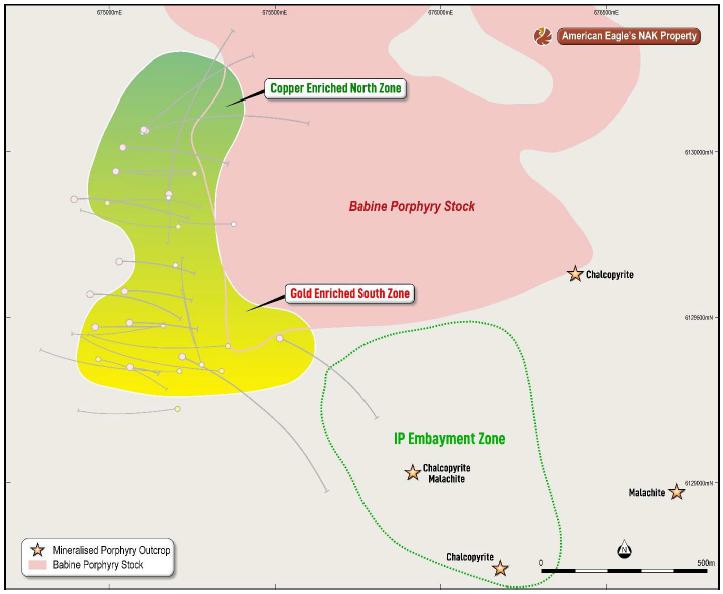
5
| Management’s Discussion and Analysis for the Year Ended December 31, 2024 |
On October 21, 2024, the second set of results from the 2024 the season was published, containing results for holes NAK24-22,24,25,26, and 28. NAK24-28 included 101 m of 1.11 % CuEq from 47 m depth, pushing the extents of the high grade south gold zone further to the east. NAK24-24 Indicated strong continuity of moderate grade from the northern extent of the high-grade gold south zone, to a depth of 980 m, beneath the copper rich north zone. NAK24-26 intercepted similar grade extending to the northeast from the same collar location to a depth of 586 m. Refer to October 21, 2024 News Release for more details.
From December 2024 to January 2025, the assays results for the 11 remaining holes from the 2024 drill program were released over three separate news releases. December 3, 2024 highlights include NAK24-27 intercepting 50m of 1.01% CuEq and NAK24-30 intercepting 515 m of 0.40% CuEq. December 18, 2024 highlights included NAK24-33 intercepting 50 m of 1.00% CuEq, 104 m of 0.78% CuEq and 103 m of 0.67% CuEq within 505 m of 0.52% CuEq within 888m of 0.40% CuEq. The final results of the 2024 drill program were issued on January 14, 2025 with highlights including NAK 24-31 intercepting 248 m of 1.1% CuEq within 308 metres of 0.97% CuEq within 407 metres 0.78% CuEq from surface and NAK24-35 intercepting 106 m of 0.53% CuEq and 324 m of 0.45% CuEq within 514 m of 0.42% CuEq within 911 m of 0.33% CuEq from surface. The results from these releases point towards the continued strong success at encountering mineralization deep within the north zone, from holes NAK24-30 and NAK 24-33, and shows a continuation of the very strong grade encountered to the immediate west of the south zone in hole NAK24-31. Perhaps most importantly, the results show a greater than 100 m long intercept of over 0.5% CuEq in NAK24-35, in a novel felsic dyke strongly mineralized with disseminated bornite and chalcopyrite. This dyke is interpreted to post-date the porphyry stock, and represents a compelling target for follow-up drilling in 2025.
2025 Exploration Program
The Company plans an extensive drill campaign of approximately 30,000 meters, targeting key mineralized zones and newly identified geophysical anomalies within and around the Babine porphyry stock. Geophysics was carried out in April and drilling is set to begin in May 2025.
American Eagle’s 2025 exploration program is designed to further delineate and expand mineralization, unlocking the potential of this large and complex system. The Company's geologists are refining the NAK geological model, integrating hyperspectral and mineralogical data for precise drill planning.
6
| Management’s Discussion and Analysis for the Year Ended December 31, 2024 |
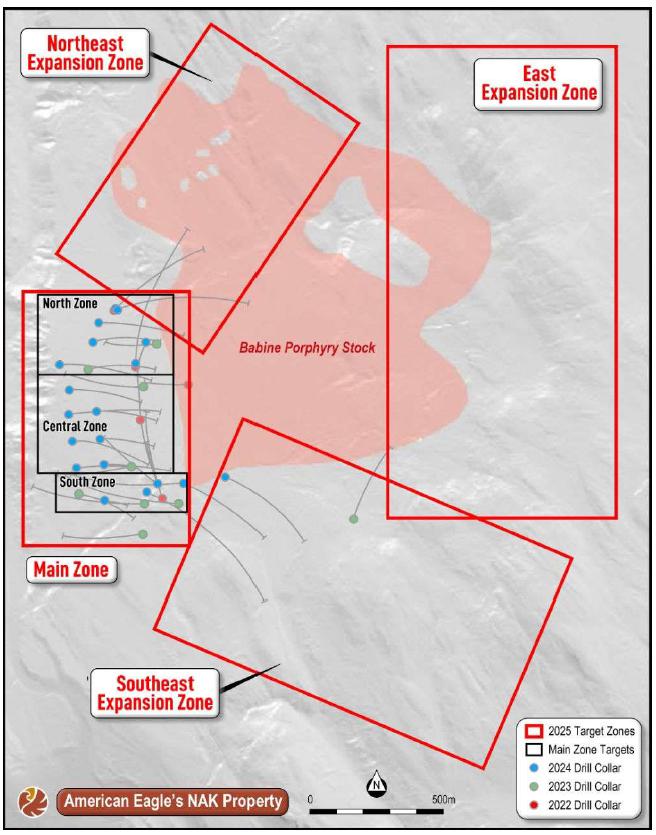
Near Surface Mineralization
A primary objective for 2025 is to further define and expand near-surface mineralization further, enhancing the project's economic potential. NAK offers a rare combination of geological and geographical advantages that American Eagle will leverage. Unlike many other porphyry prospects, the NAK Project benefits from road access, gentle topography, low elevation, and proximity to infrastructure. High-grade copper and gold mineralization has already been identified at surface, with significant potential for additional discoveries across the property.
7
| Management’s Discussion and Analysis for the Year Ended December 31, 2024 |
Key Targets Within the Main Zones
North Zone:
| · | Historically defined by near-surface vein and disseminated chalcopyrite mineralization in sedimentary rocks. |
| · | Expanded in 2022–2023 to include deeper bornite-rich conglomerate and monzonite dykes. |
| · | 2024 drilling extended the zone northeast, encountering broad intervals of seriate-textured dykes with disseminated bornite. |
| · | The Northeast Expansion Zone will be an immediate and large focus to expand the North Zone, which remains open to the north, east and at depth, with step-out drilling planned to refine its orientation and extent. |
Central Zone:
| · | The Central Zone links the historical North and South zones. It returned significant intercepts at depth in all of American Eagle’s 2022-24 drilling, but little systematic drilling has been undertaken to date at shallower depths, up-dip of those intersections. |
South Zone:
| · | Hosts a large-scale gold-rich quartz stockwork mineralized body at surface. |
| · | Drilling will link the mineralized conglomerate intersected in NAK24-17 and -31 with the broader South Zone. |
Step-Out Targets and Emerging Zones
| · | The Southeast Expansion Zone, south of the Babine porphyry, returned long intervals of anomalous gold and copper in NAK22-09 and -36. Soil sampling and mineralized outcrops indicate further potential. |
| · | The East Expansion Zone will utilize additional geophysical surveys to refine targets within and around the Babine porphyry, with scout drilling planned to test these areas. |
Exploration Beyond Drilling
The 2025 program will incorporate several non-drilling initiatives that will enhance the project.
| · | Geophysics: Aeromagnetic surveying and Controlled-Source Audio Magnetotellurics (CSAMT) to refine targets in underexplored areas north, south, and east of the Babine Stock. |
| · | Metallurgical Studies: Testing targeted drill core to assess recovery characteristics across different mineralization styles. |
| · | Core Retrieval: Historical drill core (predating American Eagle Gold) for drill holes with significant shallow Main Zone intersections is stored on the NAK property and appears to be in good shape. The Company will relog and resample this core to incorporate it into its model. |
| · | Timber Harvesting: Collaborating with local logging groups and the Lake Babine First Nation to manage previously permitted logging blocks, improving access to remote parts of the property. |
Commitment to Community and Sustainability
American Eagle is committed to strong relationships with local stakeholders, including the Lake Babine Nation, provincial authorities, and local contractors. The Company prioritizes transparent communication and collaboration as exploration advances.
8
| Management’s Discussion and Analysis for the Year Ended December 31, 2024 |
Review of Operations for the YEAR AND THREE MONTHS ended DECEMBER 31, 2024 and 2023
Year ended December 31, 2024 and 2023
For the year ended December 31, 2024, the Company has a net loss before taxes of $10.3 million compared to the prior year period net loss before taxes of $6.3 million, an increase of $4.0 million. The increase was due to the increase in exploration and evaluation expenditures at NAK, where the 2024 program was larger than the 2023 drill program, coupled with increased share-based compensation.
| Year ended | December 31, 2024 | December 31, 2023 | Change | |||||||||
| EXPENSES | ||||||||||||
| Exploration and evaluation expenses | $ | 7,965,795 | $ | 4,998,857 | $ | 2,966,938 | ||||||
| Consulting and management fees | 757,983 | 509,207 | 248,776 | |||||||||
| Office, general and administrative | 210,039 | 91,476 | 118,563 | |||||||||
| Amortization | 7,648 | - | 7,648 | |||||||||
| Audit, accounting and legal | 106,512 | 105,645 | 867 | |||||||||
| Transfer agent, filing fees and shareholder communications | 283,290 | 248,384 | 34,906 | |||||||||
| Share-based compensation | 1,510,147 | 434,743 | 1,075,404 | |||||||||
| Unrealized (gain) loss on investment | (90,000 | ) | 15,000 | (105,000 | ) | |||||||
| Interest income | (483,758 | ) | (139,580 | ) | (344,178 | ) | ||||||
| TOTAL EXPENSES | $ | 10,267,656 | $ | 6,263,732 | $ | 4,003,924 | ||||||
| · | Exploration expenses increased by $3.0 million, as a result of a more than doubling in the scale of the drill program at NAK from 7,881 m in 2023 to 16,283 m in 2024. In 2023, $1.2 million related to the value ascribed to the shares issued to reacquire a 20% interest in NAK. Refer to 2024 Exploration Program section for further details on the operations. |
| · | Consulting and management fees increased as a result of increased activity of the Company in progressing the NAK Project. |
| · | Office, general and administrative increased as a result of more activity in the current year. |
| · | Transfer agent, filing fees, and shareholder communications expenses increased due to increased capital markets-related activities in the current period. |
| · | Share-based compensation increased as a result of the timing and quantum of options issued and the resulting vesting period. |
| · | Unrealized (gain) loss on investment represents the revaluation of publicly listed securities and reflects the change in the market value during the current period. |
| · | Interest income increased as a result of more funds on hand and higher market rates. |
9
| Management’s Discussion and Analysis for the Year Ended December 31, 2024 |
Three months ended December 31, 2024 and 2023
For the three months ended December 31, 2024, the Company has a net loss before taxes of $2.4 million compared to the prior year period net loss before taxes of $2.5 million, a decrease of $0.1 million. The decrease was due to the acquisition of the 20% interest in NAK through the issuance of shares in the prior year, which is included in exploration and evaluation expenditures, partially offset by increased share-based compensation.
| Three months ended | December 31, 2024 | December 31, 2023 | Change | |||||||||
| EXPENSES | ||||||||||||
| Exploration and evaluation expenses | $ | 1,475,815 | $ | 2,038,582 | $ | (562,767 | ) | |||||
| Consulting and management fees | 360,331 | 199,863 | 160,468 | |||||||||
| Office, general and administrative | 98,807 | 53,152 | 45,655 | |||||||||
| Amortization | 3,278 | - | 3,278 | |||||||||
| Audit, accounting and legal | 34,688 | 23,786 | 10,902 | |||||||||
| Transfer agent, filing fees and shareholder communications | 89,004 | 79,517 | 9,487 | |||||||||
| Share-based compensation | 505,717 | 198,000 | 307,717 | |||||||||
| Unrealized (gain) loss on investment | (15,000 | ) | (15,000 | ) | - | |||||||
| Interest income | (170,862 | ) | (52,147 | ) | (118,715 | ) | ||||||
| TOTAL EXPENSES | $ | 2,381,778 | $ | 2,525,753 | $ | (143,975 | ) | |||||
| · | Exploration expenses decreased from $2.0 million to $1.5 million due to the 20% repurchase of NAK with common shares in the prior year, partially offset by higher spending on NAK in the current year. Refer to 2024 Exploration Program section for further analysis. |
| · | Consulting and management fees increased as a result of increased activity in the Company with the progression of NAK. |
| · | Office, general and administrative increased as a result of more activity in the current year and the timing of activities. |
| · | Share-based compensation increased as a result of the timing and quantum of options issued and the resulting vesting period. |
| · | Unrealized (gain) loss on investment represents the revaluation of publicly listed securities and reflects the change in the market value during the current period. |
| · | Interest income increased as a result more funds on hand and higher market rates. |
10
| Management’s Discussion and Analysis for the Year Ended December 31, 2024 |
Summary of Quarterly Results
The following is a summary of American Eagle’s financial results on a quarterly basis for the last eight quarters:
| December 31, 2024 | September 30, 2024 | June 30, 2024 | March 31, 2024 | |||||||||||||
| Total assets | $ | 36,654,794 | $ | 10,149,316 | $ | 13,975,942 | $ | 6,202,246 | ||||||||
| Total liabilities | 1,456,090 | 2,848,144 | 3,497,403 | 1,123,124 | ||||||||||||
| Total shareholders’ equity | 35,198,704 | 7,301,172 | 10,478,539 | 5,079,122 | ||||||||||||
| Total revenue | - | - | - | - | ||||||||||||
| Total expenses | 2,381,778 | 5,061,745 | 2,353,080 | 471,053 | ||||||||||||
| Net loss | (1,955,604 | ) | (3,786,798 | ) | (1,717,807 | ) | (394,476 | ) | ||||||||
| Basic and diluted net loss per share | $ | (0.02 | ) | (0.03 | ) | (0.01 | ) | (0.00 | ) | |||||||
| December 31, 2023 | September 30, 2023 | June 30, 2023 | March 31, 2023 | |||||||||||||
| Total assets | $ | 4,714,319 | $ | 4,858,911 | $ | 4,352,565 | $ | 1,792,244 | ||||||||
| Total liabilities | 1,191,077 | 1,775,839 | 1,571,869 | 205,742 | ||||||||||||
| Total shareholders’ equity | 3,523,242 | 3,083,072 | 2,780,696 | 1,586,502 | ||||||||||||
| Total revenue | - | - | - | - | ||||||||||||
| Total expenses | 2,525,753 | 2,342,809 | 848,253 | 546,917 | ||||||||||||
| Net loss | (2,249,953 | ) | (1,567,809 | ) | (688,253 | ) | (546,917 | ) | ||||||||
| Basic and diluted net loss per share | $ | (0.02 | ) | $ | (0.02 | ) | $ | (0.01 | ) | $ | (0.01 | ) | ||||
There are no known trends in the expenditures incurred by the Company. Total assets and shareholders’ equity have fluctuated based on the timing of equity financing activities, offset by the execution of exploration and evaluation programs. Total expenses have fluctuated based on the timing of carrying out exploration and evaluation programs which is dependent on the timing of permits and availability of contractors to carry out the planned work.
Liquidity and Financial Condition
Due to the nature of the junior mineral exploration business, the Company relies upon external financing to fund its ongoing business activities. Financing options are continually being evaluated and pursued by the Company, such as the issuance of share capital and/or debt financing. The Company’s ability to continue as a going concern is dependent upon financing arrangements for its business activities. As with any business in this industry, there are uncertainties associated with its ability to raise additional financing through private placements, or other sources to fund these activities. As such, the Company is subject to liquidity risks.
As at December 31, 2024, the Company had working capital of $35.8 million excluding the flow-through liability compared to December 31, 2023 when it had a working capital of $4.2 million. As at December 31, 2024, the Company had $36.4 million in current assets, an increase of $31.8 million from December 31, 2023 as a result of equity financings, spending in the current period and a reduction of outstanding accounts payable and accrued liabilities. As at December 31, 2024, the Company’s current liabilities totaled $1.5 million, which included $0.8 million pertaining to flow-through share premium liability and as at December 31, 2024, long-term liabilities totaled $Nil.
The Company had a cash balance of $35.9 million as at December 31, 2024, an increase of $31.5 million from $4.4 million as at December 31, 2023. In the year ended 2024, cash used in operating activities was $8.6 million compared to $5.1 million in the prior year period. Cash provided by financing totaled $40.1 million due to completed private placements and exercised warrants, compared to $8.8 million in the prior year.
11
| Management’s Discussion and Analysis for the Year Ended December 31, 2024 |
Key management personnel compensation
Key management includes directors and executive officers. The remuneration of the key management of the Company during the years ended December 31, 2024 and 2023 was as follows:
| 2024 | 2023 | |||||||
| Management and consulting fees | 657,616 | 413,629 | ||||||
| Share-based payments | 1,095,495 | 305,464 | ||||||
| $ | 1,753,111 | $ | 719,093 | |||||
Standard Ore is controlled by a director of the Company. Standard Ore provides corporate and administrative services to the Company, including office space. For the year ended December 31, 2024, Standard Ore charged the Company $120,000 of management fees (2023 - $120,000), which is included in the amounts in the above chart.
The following is the balance due to related party as at December 31, 2024 and 2023:
| 2024 | 2023 | |||||||
| Due to Standard Ore Corporation | $ | 833 | $ | 833 | ||||
| Due to XXIX Metal Corp | 239 | - | ||||||
| $ | 1,072 | $ | 833 | |||||
All of the amounts are unsecured, non-interest bearing with no fixed terms of repayment.
As at December 31, 2024, the Company held 3,000,000 common shares of Orecap at a fair value of $195,000 (2023 – 3,000,000 common shares - $105,000) based on the quoted market price of the Orecap’s shares. The Company has directors in common with Orecap.
A person related to a director of the Company provided services to the Company totaling $22,000 for the year ended December 31, 2024 (2023 - $13,000). The Company recognized share based compensation of approximately $36,000 for this person for the year ended December 31, 2024 (2023 - $9,000).
Financial Instruments
The Company is exposed in varying degrees to a variety of financial instrument related risks. The type of risk exposure and the way in which such exposure is managed is provided as follows:
Fair value of financial instruments
The fair value of financial instruments approximates their carrying value due to the short-term maturity of these instruments. At December 31, 2024 and 2023, the Company’s investment is classified as Level 1 in the fair value hierarchy.
Credit risk
Credit risk is the risk that one party to a financial instrument will fail to discharge an obligation and cause the other party to incur a financial loss. Amounts receivable are due from the Government of Canada and related party and the Company believes the risk of loss related to these is remote. The Company’s exposure to credit risk is on its cash held in bank accounts. Cash is held with major banks in Canada. Management assesses the credit risk of cash and related party receivable as remote.
12
| Management’s Discussion and Analysis for the Year Ended December 31, 2024 |
Liquidity risk
Liquidity risk is the risk that the Company will not be able to meet its financial obligations as they fall due. The Company strives to ensure that there are sufficient funds to meet its short-term business requirements, taking into account its anticipated cash flows from operations and its holdings of cash. The Company’s accounts payable and accrued liabilities generally have contractual maturities of less than 30 days and are subject to normal trade terms. In the long-term, the Company may have to issue additional equity to ensure there is sufficient capital to meet long-term objectives.
Currency and interest rate risk
The Company is exposed to foreign currency risk on financial assets and liabilities that are denominated in a currency other than the Canadian dollar. The currencies giving rise to this risk are the US dollar.
Market price risk
The Company was exposed to market risk relating to its investment and unfavourable market conditions could result in dispositions of its investment at less than favourable prices. The Company’s investment is comprised of a publicly-traded corporation. The Company’s investment is subject to fair value fluctuations. As at December 31, 2024, if the fair value of the investments fluctuated by 10% all other factors held constant, consolidated net loss would change by approximately $19,500 (2023 - $10,500) based on the value of the investment as at December 31, 2024.
Classification of financial instruments
Financial assets and liabilities included in the statement of financial position are as follows:
| December 31, 2024 | December 31, 2023 | |||||||
| Financial assets at amortized cost: | ||||||||
| Cash | $ | 35,929,619 | $ | 4,393,661 | ||||
| Financial assets at FVPL: | ||||||||
| Investment in Orecap | 195,000 | 105,000 | ||||||
| $ | 36,124,619 | $ | 4,498,661 | |||||
| December 31, 2024 | December 31, 2023 | |||||||
| Financial liabilities at amortized cost: | ||||||||
| Accounts payable and accrued liabilities | $ | 629,017 | $ | 311,244 | ||||
| Due to related party | 1,072 | 833 | ||||||
| $ | 630,089 | $ | 312,077 | |||||
Capital Management
The Company’s objectives when managing capital are to safeguard the Company’s ability to continue as a going concern, so that it can provide returns to shareholders and benefits to other stakeholders. The Company considers the items included in equity as capital. The Company manages the capital structure and adjusts it in light of changes in economic conditions and the risk characteristics of the underlying assets. In order to maintain or adjust the capital structure, the Company may issue new shares through equity offerings or return capital to shareholders.
There can be no assurance that the Company will be successful in its efforts to arrange additional financing, if needed, on terms satisfactory to the Company.
13
| Management’s Discussion and Analysis for the Year Ended December 31, 2024 |
Management reviews its capital management approach on an ongoing basis and believes that this approach, given the relative size of the Company, is reasonable. There were no changes in the Company’s approach to capital management in the period.
Equity Securities Issued and Outstanding
As at April 29, 2025:
172,071,287 common shares issued and outstanding
15,050,000 stock options outstanding
468,994 warrants outstanding
Corporate Governance Matters
The Company has an independent audit committee and a compensation committee that meets periodically as required to review and approve financial statements and to approve management compensation.
Commitments and Contingencies
(a) The Company’s exploration activities are subject to various federal and state laws and regulations governing the protection of the environment. These laws and regulations are continually changing and generally becoming more restrictive. The Company has made, and expects to make in the future, expenditures to comply with such laws and regulations.
(b) Flow-through common shares require the Company to spend an amount equivalent to the proceeds of the issued flow-through common shares on Canadian qualifying exploration expenditures. Certain interpretations are required to assess the eligibility of flow-through expenditures that if changed, could result in the denial of renunciation. The Company has indemnified the subscribers of current and previous flow-through share offerings against any tax-related amounts that become payable by the shareholder as a result of the Company not meeting its expenditure commitment.
(c) The Company is party to certain management agreements. These contracts require additional payments of up to approximately $320,000 upon the occurrence of employee terminations and $850,000 upon change of control. As a triggering event has not taken place, the contingent payments have not been reflected in these consolidated financial statements.
Off Balance Sheet Arrangements
The Company has no off-balance sheet arrangements.
Risks and Uncertainties
American Eagle’s business of exploring mineral resources involves a variety of operational, financial and regulatory risks that are typical in the natural resource industry. The Company attempts to mitigate these risks and minimize their effect on its financial performance, but there is no guarantee that the Company will be profitable in the future.
Capital Requirements
The Company will require significant capital in order to fund its operating costs and to explore and develop any project. American Eagle has no revenues and is wholly reliant upon external financing to fund all of its capital requirements. American Eagle will require additional financing from external sources to meet such requirements. There can be no assurance that such financing will be available to American Eagle or, if it is, that it will be offered on acceptable terms. If additional financing is raised through the issuance of equity or convertible debt securities of American Eagle, the interests of shareholders in the net assets of American Eagle may be diluted. Any failure of American Eagle to obtain financing on acceptable terms could have a material adverse effect on American Eagle’s financial condition, prospects, results of operations and liquidity and require American Eagle to cancel or postpone planned capital investments.
14
| Management’s Discussion and Analysis for the Year Ended December 31, 2024 |
Dependence on Mineral Exploration Projects
Any adverse development affecting the progress of Company’s exploration projects such as, but not limited to, obtaining financing on commercially suitable terms, hiring suitable personnel and contractors, or securing supply agreements on commercially suitable terms, may have a material adverse effect on the Company and its business or prospects.
Metal Prices
The development and success of any project of the Company will be primarily dependent on the future spot prices of copper and gold (and other metals). The copper and gold spot prices, like any other commodity, is subject to significant fluctuation and is affected by a number of factors, which are beyond the control of the Company. Such factors include, but are not limited to, interest rates, exchange rates, inflation or deflation, fluctuation in the value of the United States dollar and foreign currencies, global and regional supply and demand, and the political and economic conditions of major gold-producing countries throughout the world. Future serious gold price declines could cause any future development of and commercial production from the Company's projects to be impracticable.
Government Regulation, Permits and Licenses
The Company’s mineral exploration and potential development activities are subject to various laws governing prospecting, mining, development, production, taxes, labour standards and occupational health, mine safety, toxic substances, land use, water use, land claims of local people and other matters. No assurance can be given that new rules and regulations will not be enacted or that existing rules and regulations will not be applied in a manner which could limit or curtail exploration, development or production. Many of the mineral rights and interests of the Company are subject to government approvals, licenses and permits. Such approvals, licenses and permits are, as a practical matter, subject to the discretion of the applicable governments or governmental officials. No assurance can be given that the Company will be successful in maintaining any or all of the various approvals, licenses and permits in full force and effect without modification or revocation. To the extent such approvals are required and not obtained; the Company may be curtailed or prohibited from continuing or proceeding with planned exploration or development of mineral projects.
Where required, obtaining necessary permits and licenses can be a complex, time consuming process and the Company cannot assure that required permits will be obtainable on acceptable terms, in a timely manner or at all. The costs and delays associated with obtaining necessary permits and complying with these permits and applicable laws and regulations could stop or materially delay or restrict the Company from proceeding with the development of an exploration project or the operation or further development of a mine. Any failure to comply with applicable laws and regulations or permits, even if inadvertent, could result in interruption or closure of exploration, development or mining operations or material fines, penalties or other liabilities. Failure to comply with applicable laws, regulations and permitting requirements may result in enforcement actions thereunder, including orders issued by regulatory or judicial authorities causing operations to cease or be curtailed, and may include corrective measures requiring capital expenditures, installation of additional equipment, or remedial actions. Parties engaged in mining operations or in the exploration or development of mineral projects may be required to compensate those suffering loss or damage by reason of such mining activities, and may have civil or criminal fines or penalties imposed for violations of applicable laws or regulations. Amendments to current laws and regulations governing operations or more stringent implementation thereof could have a substantial adverse impact on the Company and cause increases in exploration expenses, capital expenditures or production costs or reduction in levels of production at producing projects or require abandonment or delays in development of new mining projects.
Rights or Claims of Indigenous Groups and the Assertion of such Rights or Claims
Within Canada, the Company currently operates in areas currently and/or traditionally inhabited or used by Indigenous peoples and is subject to Indigenous rights, including treaty rights, and in the future may operate in or explore within additional such areas. Operating in areas subject to Indigenous rights or claims triggers various international and national laws, codes, resolutions, conventions, guidelines, and impose obligations on both governments and the Company with respect to the rights of Indigenous people.
15
| Management’s Discussion and Analysis for the Year Ended December 31, 2024 |
Pursuant to section 35 of The Constitution Act, 1982, the Federal and Provincial Crowns have a duty to consult Aboriginal peoples and, in some circumstances, a duty to accommodate if the Crown’s decision could adversely affect potential or established Aboriginal rights or treaty rights. The Crown cannot delegate their duty to consult; however, they can delegate the procedural aspects of consultation to proponents as part of the process to acquire mining rights, permits, approvals or other authorizations. The importance of meaningful engagement with Indigenous communities in Canada has gained prominence in the wake of various court decisions across the country that have resulted in expectations related to Indigenous rights and consultation requirements within the context of resource development. These decisions have highlighted the risks for mining companies in Canada who do not have robust and principled Indigenous engagement approaches. Many Indigenous communities have increased their advocacy with respect to claimed entitlements regarding resource development projects within their traditional territories.
Impacts on established rights may require companies to provide accommodations which could include provisions regarding environmental management, employment and training, royalty payments, procurement opportunities, other financial payments and other matters. The Company is continuing its engagement activity with the Indigenous communities in the vicinity its activities.
In Canada, the nature and extent of Aboriginal rights and title remains the subject of active debate, claims and litigation. In many cases, such claims take a long time to settle, with the potential for extensive delays or other negative impacts on operations and projects, or limited access to certain cultural or historical areas until rights to such properties are clarified. There is no assurance that there will be no such claims on the areas where the Company operates in the future. Also, the impact of any such claim on the Company’s ownership interest cannot be predicted with any degree of certainty and no assurance can be given that a broad recognition of Aboriginal rights in the area in which the Company’s projects are located, by way of a negotiated settlement or judicial pronouncement, would not have a material adverse effect on the Company’s business, financial condition and results of operations.
In addition, there is a general level of concern relating to the perceived effects of mining activities on Indigenous communities both inside and outside of those communities. The evolving expectations related to human rights, Indigenous rights and environmental protection may result in opposition to the Company’s current or future activities. Such opposition may be directed through legal or administrative proceedings against the government or the Company, or expressed in manifestations such as protests, delayed or protracted consultations, blockades or other forms of public expression against the Company’s activities or against the government’s position. There can be no assurance that these relationships can be successfully managed. Intervention by the aforementioned groups may have a material adverse effect on the Company’s business, financial condition and results of operations.
Competition
The mining industry is competitive in all of its phases. The Company faces strong competition from other exploration and mining companies in connection with the acquisition of projects producing or capable of producing, precious and base metals. Many of these companies have greater financial resources, operational experience and technical capabilities than American Eagle. As a result of this competition, American Eagle may be unable to maintain or acquire attractive mining projects on terms it considers acceptable or at all. Consequently, the financial condition and any future revenues and operations of American Eagle could be materially adversely affected.
Exploration, Development and Operational Risk
The exploration for, and development of, mineral deposits involve significant risks that even a combination of careful evaluation, experience and knowledge may not eliminate. While the discovery of an ore body may result in substantial rewards, few projects, which are explored, are ultimately developed into producing mines. Major expenses may be required to locate and establish mineral reserves, to develop metallurgical processes and to construct mining and processing facilities at a particular site. Whether a mineral deposit will be commercially viable depends on a number of factors, some of which are the particular attributes of the deposit, such as size, grade and proximity to infrastructure, metal prices which are highly cyclical, and government regulations including regulations relating to prices, taxes, royalties, land tenure, land use, importing and exporting of minerals and environmental protection. The exact effect of these factors cannot be accurately predicted, but the combination of these factors may result in American Eagle not receiving an adequate return on invested capital.
16
| Management’s Discussion and Analysis for the Year Ended December 31, 2024 |
The Company does not currently operate a mine on any of its projects. There is no certainty that the expenditures made by American Eagle towards the search for, and evaluation of, mineral deposits will result in discoveries of commercial quantities of ore. Mining operations generally involve a high degree of risk. Such operations are subject to all the hazards and risks normally encountered in the exploration for, and development and production of gold. Such hazards and risks include unusual and unexpected geologic formations, seismic activity, rock bursts, cave-ins, flooding and other conditions involved in the drilling and removal of material, any of which could result in damage to, or destruction of mines and other producing facilities, damage to life or project, environmental damage and possible legal liability. Milling operations are subject to hazards such as equipment failure or failure of retaining dams around tailings disposal areas which may result in environmental pollution and consequent liability.
Reliance on Management and Key Employees
The success of the operations and activities of American Eagle is dependent to a significant extent on the efforts and abilities of its management, a relatively small number of key employees, outside contractors, experts and other advisors. Investors must be willing to rely to a significant extent on management’s discretion and judgment, as well as the expertise and competence of its key employees, outside contractors, experts and other advisors. American Eagle does not have in place formal programs for succession of management and training of management nor does it have key person insurance on its key employees. The loss of one or more of these persons, if not replaced, could adversely affect American Eagle’s operations and financial performance.
No Assurance of Titles, Boundaries or Approvals
Titles to American Eagle’s projects may be challenged or impugned, and title insurance is generally not available. American Eagle’s mineral projects may be subject to prior unregistered agreements, transfers or claims, and title may be affected by, among other things, undetected defects. In addition, American Eagle may be unable to operate its projects as permitted or to enforce its rights with respect to its projects. American Eagle cannot assure that it will receive the necessary approval or permits to exploit any or all of its mineral projects in the future. The failure to obtain such permits could adversely affect American Eagle’s operations.
Environmental Risks and Hazards
All phases of American Eagle's operations are subject to environmental regulation in the jurisdiction in which it operates. These regulations mandate, among other things, the maintenance of air and water quality standards and land reclamation. They also set forth limitations on the generation, transportation, storage and disposal of solid and hazardous waste. Environmental legislation is evolving in a manner which will require stricter standards and enforcement, increased fines and penalties for non-compliance, more stringent environmental assessments of proposed projects and a heightened degree of responsibility for companies and their officers, directors and employees. There is no assurance that future changes in environmental regulation, if any, will not adversely affect American Eagle's operations. Environmental hazards may exist on the projects in which American Eagle holds interests which are unknown to American Eagle at present and which have been caused by previous or existing owners or operators of the projects.
Uninsured Risks
American Eagle’s business is subject to a number of risks and hazards generally, including adverse environmental conditions, industrial accidents, labor disputes, unusual or unexpected geological conditions, ground or slope failures, cave-ins, changes in the regulatory environment and natural phenomena such as inclement weather conditions, floods and earthquakes. Such occurrences could result in damage to mineral projects or production facilities, personal injury or death, environmental damage to American Eagle's projects or the projects of others, delays in development or mining, monetary losses and possible legal liability. Although American Eagle maintains insurance to protect against certain risks in such amounts as it considers commercially reasonable, its insurance will not cover all of the potential risks associated with its operations. American Eagle may also be unable to maintain insurance to cover these risks at economically feasible premiums. Insurance coverage may not continue to be available or may not be adequate to cover any resulting liability. Moreover, insurance against risks such as environmental pollution or other hazards as a result of exploration is not generally available to American Eagle on affordable and acceptable terms. American Eagle might also become subject to liability for pollution or other hazards which may not be insured against or which American Eagle may elect not to insure against because of premium costs or other reasons. Losses from these events may cause American Eagle to incur significant costs that could have a material adverse effect upon its financial condition and results of operations.
17
| Management’s Discussion and Analysis for the Year Ended December 31, 2024 |
Evaluation of Disclosure Controls and Procedures
Management has established processes to provide them with sufficient knowledge to support representations that they have exercised reasonable diligence to ensure that (i) the consolidated financial statements do not contain any untrue statement of material fact or omit to state a material fact required to be stated or that is necessary to make a statement not misleading in light of the circumstances under which it is made, as of the date of and for the periods presented by the unaudited interim condensed consolidated financial statements; and (ii) the consolidated financial statements fairly present in all material respects the financial condition, financial performance and cash flows of the Company, as of the date of and for the periods presented.
In contrast to the certificate required for non-venture issuers under National Instrument 52-109 Certification of Disclosure in Issuers’ Annual and Interim Filings (“NI 52-109”), the Venture Issuer Basic Certificate filed by the Company does not include representations relating to the establishment and maintenance of disclosure controls and procedures (“DC&P”) and internal control over financial reporting (“ICFR”), as defined in NI 52-109. In particular, the certifying officers filing such certificate are not making any representations relating to the establishment and maintenance of: i) controls and other procedures designed to provide reasonable assurance that information required to be disclosed by the issuer in its annual filings, interim filings or other reports filed or submitted under securities legislation is recorded, processed, summarized and reported within the time periods specified in securities legislation; and ii) a process to provide reasonable assurance regarding the reliability of financial reporting and the preparation of unaudited interim condensed consolidated financial statements for external purposes in accordance with the issuer’s generally accepted accounting principles (IFRS).
The Company’s certifying officers are responsible for ensuring that processes are in place to provide them with sufficient knowledge to support the representations they are making in such certificate. Investors should be aware that inherent limitations on the ability of certifying officers of a venture issuer to design and implement on a cost-effective basis DC&P and ICFR as defined in NI 52-109 may result in additional risks to the quality, reliability, transparency and timeliness of interim and annual filings and other reports provided under securities legislation.
18
| Management’s Discussion and Analysis for the Year Ended December 31, 2024 |
Cautionary Note Regarding Forward-Looking Statements
Certain of the statements made and information contained herein is “forward-looking information”. These statements relate to future events or the Company’s future performance. All statements, other than statements of historical fact, may be forward-looking statements. Generally, these forward-looking statements can be identified by the use of forward-looking terminology such as “anticipates”, “plans”, “budget”, “scheduled”, “continue”, “estimates”, “forecasts”, “expect”, “is expected”, “project”, “propose”, “potential”, “targeting”, “intends”, “believes” or variations of such words and phrases or statements that certain actions, events or results “may”, “could”, “would”, “might”, or “will be taken”, “occur” or “be achieved” or the negative connotation thereof. These statements involve known and unknown risks, uncertainties and other factors that may cause actual results or events to differ materially from those anticipated in such forward-looking statements. The Company believes that the expectations reflected in those forward-looking statements are reasonable but no assurance can be given that these expectations will prove to be correct and such forward-looking statements included in this MD&A should not be unduly relied upon by investors as actual results may vary. These statements speak only as of the date of this MD&A and are expressly qualified, in their entirety, by this cautionary statement. In particular, this MD&A contains forward-looking statements, pertaining to the following: capital expenditure programs, development of resources, treatment under governmental and taxation regimes, expectations regarding the Company’s ability to raise capital, expenditures to be made by the Company on its projects and work plans to be conducted by the Company. With respect to forward-looking statements listed above and contained in the MD&A, the Company has made assumptions regarding, among other things:
| · | uncertainties relating to receiving exploration permits; | |
| · | the impact of increasing competition; | |
| · | unpredictable changes to the market prices for minerals; | |
| · | exploration and developments costs for its projects; | |
| · | availability of additional financing and opportunities for acquisitions or joint-venture partners; | |
| · | anticipated results of exploration and development activities; and | |
| · | the Company’s ability to obtain additional financing on satisfactory terms. |
The Company’s actual results could differ materially from those anticipated in these forward-looking statements as a result of the risk factors set forth below and elsewhere in this MD&A and Financial Statements and Notes to the Financial Statements as at December 31, 2023 and the Annual MD&A and Financial Statements and Notes to the Financial Statements as at December 31, 2022, uncertainties associated with estimating resources; geological, technical, drilling and processing problems; liabilities and risks, including environmental liabilities and risks, inherent in mineral and oil and gas operations; fluctuations in currencies and interest rates; incorrect assessments of the value of acquisitions; unanticipated results of exploration activities; competition for, amongst other things, capital, undeveloped lands and skilled personnel; lack of availability of additional financing and farm-in or joint venture partners and unpredictable weather conditions. Although the Company has attempted to identify important factors that could cause results to differ materially from those contained in forward-looking statements, there may be other factors that cause results not to be as anticipated, estimated or intended. There can be no assurance that such statements will prove to be accurate, as actual results and future events could differ materially from those anticipated in such statements. Accordingly, readers should not place undue reliance on forward-looking statements. Readers are cautioned that the foregoing lists of factors are not exhaustive. Forward looking statements are made as of the date hereof and accordingly are subject to change after such date. The forward-looking statements contained in this MD&A are expressly qualified by this cautionary statement. The Company does not undertake to update or revise any forward-looking statements, whether as a result of new information, future events or otherwise, except in accordance with applicable securities laws.
“Stephen Stewart"
On behalf of American Eagle’s Board of Directors
19