| Class A | Class C | Class I | Class L | ||||||||
| Stockholder Transaction Expenses (as a percentage of offering price)(1) |
|
|
| ||||||||
| Sales load to Dealer Manager(2) | 6.75 | % | 0.75 | % |
| 4.25 | % | ||||
| Distribution reinvestment plan fees(3) |
|
|
|
|
|
|
| ||||
| Total stockholder transaction expenses | 6.75 | % | 0.75 | % |
| 4.25 | % | ||||
____________
(1) Amount assumes that the Fund raises approximately $25.0 million in net equity proceeds during the 12 months following the effectiveness of this Registration Statement, resulting in estimated net assets of approximately $87.7 million as of the period ended 12 months following the effectiveness of this Registration Statement. Actual expenses will depend on the number of Shares the Fund sells in this offering and the amount of leverage it employs. For example, if the Fund were to raise proceeds significantly less than this amount over the next twelve months, the Fund’s expenses as a percentage of its average net assets would be significantly higher. There can be no assurance that the Fund will sell $25.0 million of Shares during the twelve months following the effectiveness of this Registration Statement.
(2) “Sales load” includes selling commissions of 6.0% and dealer manager fees of 0.75% payable upon a purchase of Class A Shares, dealer manager fees of 0.75% payable upon a purchase of Class C Shares and selling commissions of 3.50% and dealer manager fees of 0.75% payable upon a purchase of Class L Shares. The table assumes the maximum sales load for Class A Shares, Class C Shares and Class L Shares is charged.
(3) The expenses of the distribution reinvestment plan are included in Other Expenses. See “Distribution Reinvestment Plan.”
| Annual expenses (as a percentage of net assets attributable to shares)(1) |
|
|
|
| ||||||||
| Base management fee(4) | 2.08 | % | 2.08 | % | 2.08 | % | 2.08 | % | ||||
| Incentive fees payable under our investment advisory agreement (20% of net investment income)(5) | 2.29 | % | 2.29 | % | 2.29 | % | 2.29 | % | ||||
| Interest payments on borrowed funds(6) |
|
|
|
|
|
|
|
| ||||
| Distribution and shareholder servicing fee(7) |
|
|
|
|
|
| 0.50 | % | ||||
| Other expenses(8) | 4.97 | % | 4.97 | % | 4.97 | % | 4.97 | % | ||||
| Total Annual Fund Operating Expenses(9) | 9.34 | % | 9.34 | % | 9.34 | % | 9.84 | % | ||||
| Less expense waiver and/or expense reimbursement(10) | (3.98 | )% | (3.98 | )% | (3.98 | )% | (3.98 | )% | ||||
| Total annual net expenses(9) | 5.36 | % | 5.36 | % | 5.36 | % | 5.86 | % |
(1) Amount assumes that the Fund raises approximately $25.0 million in net equity proceeds during the 12 months following the effectiveness of this Registration Statement, resulting in estimated net assets of approximately $87.7 million as of the period ended 12 months following the effectiveness of this Registration Statement. Actual expenses will depend on the number of Shares the Fund sells in this offering and the amount of leverage it employs. For example, if the Fund were to raise proceeds significantly less than this amount over the next twelve months, the Fund’s expenses as a percentage of its average net assets would be significantly higher. There can be no assurance that the Fund will sell $25.0 million of Shares during the twelve months following the effectiveness of this Registration Statement.
(4) The Fund’s base management fee is calculated monthly and payable quarterly in arrears at an annual rate equal to 2.00% of its gross assets, including assets purchased with borrowed funds or other forms of leverage, at the end of the two most recently completed quarters.
(5) Amount reflects the estimated annual incentive fees payable to the Adviser over the next twelve months. Based on its current business plan, the Fund anticipates that the net proceeds from the offering of securities will be invested within three months after receipt of proceeds, although such period may vary and depends on the size of the offering and the availability of appropriate investment opportunities consistent with the Fund’s investment objectives and market conditions. The Fund cannot assure you it will achieve its targeted investment pace, which may negatively impact its returns.
The Incentive Fee, which is payable quarterly in arrears, equals 20.0% of the excess, if any, of the Funds “Pre-Incentive Fee Net Investment Income” that exceeds a 1.75% quarterly (7.0% annualized) hurdle rate, which the Fund refers to as the “Hurdle,” subject to a “catch-up” provision measured at the end of each calendar quarter. The Incentive Fee is computed and paid on income that may include interest that is accrued but not yet received in cash.
The incentive fee in each calendar quarter is paid to the Adviser as follows:
• no Incentive Fee is payable to the Adviser in any calendar quarter in which the Fund’s Pre-Incentive Fee Net Investment Income does not exceed the Hurdle of 1.75%;
• 100% of the Fund’s Pre-Incentive Fee Net Investment Income with respect to that portion of such Pre-Incentive Fee Net Investment Income, if any, that exceeds the Hurdle but is less than 2.1875% in any calendar quarter (8.75% annualized) is payable to the Adviser. The Fund refers to this portion of its Pre-Incentive Fee Net Investment Income (which exceeds the Hurdle but is less than 2.1875%) as the “catch-up.” The “catch-up” is meant to provide the Adviser with 20.0% of the Fund’s Pre-Incentive Fee Net Investment Income, as if a Hurdle did not apply when the Fund’s Pre-Incentive Fee Net Investment Income exceeds 2.1875% in any calendar quarter; and
• 20.0% of the amount of the Fund’s Pre-Incentive Fee Net Investment Income, if any, that exceeds 2.1875% in any calendar quarter (8.75% annualized) is payable to the Adviser (once the Hurdle is reached and the catch-up is achieved, 20.0% of all Pre-Incentive Fee Net Investment Income thereafter is allocated to the Adviser).
No Incentive Fee is payable to the Adviser on capital gains. For a more detailed discussion of the calculation of this fee, see “Management and Incentive Fees.”
(6) Assumes that the Fund will refrain from borrowing for investment purposes over the next twelve months. The Fund does not currently anticipate incurring indebtedness on its portfolio or paying any interest during the next twelve months following the effectiveness of this Registration Statement. Although the Fund has no current intention to do so, the Fund may borrow additional funds to make investments, to the extent the Fund determines that additional capital would allow the Fund to take advantage of additional investment opportunities, if the market for debt financing presents attractively priced debt financing opportunities, or if the Board of Directors determines that leveraging the Fund’s portfolio would be in the Fund’s best interests and the best interests of the Fund’s shareholders. The Fund does not currently anticipate issuing any preferred stock over the next twelve months. The costs associated with any borrowing will be indirectly borne by the Fund’s investors.
(7) Class L Shares are subject to a distribution and/or shareholder servicing fee at an annual rate of 0.50% of the Fund’s NAV attributable to Class L Shares most recently determined preceding the payment date. With respect to Class L Shares, 0.25% of the fee is characterized as a “shareholder servicing fee” and 0.25% is characterized as a “distribution fee.”
(8) Other expenses include reasonably estimated costs the Fund can expect to incur related to accounting, custody, transfer agency, legal, valuation agent, pricing vendor, market data, marketing and auditing fees of the Fund, organizational and offering costs, as well as the reimbursement of the compensation of administrative personnel and fees payable to the Independent Directors. The amount presented in the table are based upon estimated amounts for the current fiscal year.
(9) Each of “Total annual Fund operating expenses” and “Total annual net expenses” is presented as a percentage of net assets attributable to common stockholders because the holders of shares of our common stock bear all of our fees and expenses, all of which are included in this fee table presentation. The indirect expenses associated with the Fund’s CLO equity investments are not included in the fee table presentation, but if such expenses were included in the fee table presentation then the Fund’s total annual expenses would have been 14.69% for Class A, Class C and Class I Shares and 15.19% for Class L Shares and total annual net expenses would have been 10.71% for Class A, Class C and Class I Shares and 11.21% for Class L Shares.
(10) The Fund and the Adviser entered into an Amended and Restated Expense Support Agreement, effective May 31, 2025. Until the Expense Payment Period, the Adviser will pay and otherwise be legally responsible for the Ordinary Operating Expenses (as defined in the Amended and Restated Expense Support Agreement) incurred by or on behalf of the Fund that exceed the Expense Cap. The Fund will pay and otherwise be legally responsible for Ordinary Operating Expenses up to the Expense Cap incurred by it or by others on its behalf until the end of the Expense Payment Period and for all Ordinary Operating Expenses incurred by it or others on its behalf on and after the Expense Payment Period. The Ordinary Operating Expenses paid by the Adviser pursuant to the Amended and Restated Expense Support Agreement are not subject to reimbursement from the Fund. Pursuant to the Waiver Letter, the Adviser agreed to irrevocably waive any Management Fee and Incentive Fee due from the Fund to the Adviser through the period ended March 31, 2024, pursuant to the Investment Advisory Agreement between the Fund and the Adviser. The Adviser subsequently irrevocably waived any Management Fee and Incentive Fee through the period ended March 31, 2025, and any Incentive Fee through the period ended March 31, 2026, due from the Fund to the Adviser pursuant to the Investment Advisory Agreement between the Fund and the Adviser.
Example
The following example demonstrates the projected dollar amount of total expenses that would be incurred over various periods with respect to a hypothetical investment in each of Class A, Class C, Class I Shares and Class L Shares. In calculating the following expense amounts, the Fund has assumed its annual net expenses would remain at the percentage levels set forth in the table above. The table assumes the maximum sales load for Class A Shares, Class C Shares and Class L Shares is charged.
An investor would pay the following expenses on a $1,000 investment, assuming a 5.0% annual return:(1)(11)
| 1 Year | 3 Years | 5 Years | 10 Years | |||||||||
| Class A | $ | 117 | $ | 227 | $ | 334 | $ | 593 | ||||
| Class C | $ | 61 | $ | 177 | $ | 291 | $ | 567 | ||||
| Class I | $ | 54 | $ | 171 | $ | 285 | $ | 563 | ||||
| Class L | $ | 103 | $ | 223 | $ | 339 | $ | 608 | ||||
(1) Amount assumes that the Fund raises approximately $25.0 million in net equity proceeds during the 12 months following the effectiveness of this Registration Statement, resulting in estimated net assets of approximately $87.7 million as of the period ended 12 months following the effectiveness of this Registration Statement. Actual expenses will depend on the number of Shares the Fund sells in this offering and the amount of leverage it employs. For example, if the Fund were to raise proceeds significantly less than this amount over the next twelve months, the Fund’s expenses as a percentage of its average net assets would be significantly higher. There can be no assurance that the Fund will sell $25.0 million of Shares during the twelve months following the effectiveness of this Registration Statement.
(11) Reflects conversion of Class L Shares to Class I Shares (which pay lower ongoing expenses) of the Fund on the first business day of the month following the eighth anniversary of the issuance.
The following table is intended to assist you in understanding the costs and expenses that an investor in Shares sold in this offering will bear directly or indirectly. You will pay (i) selling commissions and dealer manager fees for the purchase of Class A Shares or Class L Shares, (ii) dealer manager fees, but no selling commissions, for the purchase of Class C Shares and (iii) no selling commissions or dealer manager fees for the purchase of Class I Shares. The Fund cautions you that some of the percentages indicated in the table below are estimates and may vary. Except where the context suggests otherwise, whenever this Prospectus contains a reference to fees or expenses paid by “you,” “us” or “Oxford Park Income Fund, Inc.,” or that “Fund,” or “we” will pay fees or expenses, shareholders will indirectly bear such fees or expenses as investors in the Fund.
INVESTMENT OBJECTIVE, OPPORTUNITIES AND STRATEGIES
Investment Objective
The Fund’s investment objective is to maximize its portfolio’s risk-adjusted total return. The Fund implements its investment objective by purchasing portions of equity and junior debt tranches of CLO vehicles. Substantially all of the CLO vehicles in which the Fund may invest would be deemed to be investment companies under the 1940 Act but for the exceptions set forth in section 3(c)(1) or section 3(c)(7). Structurally, CLO vehicles are entities formed to originate and/or acquire a portfolio of loans. The loans within the CLO vehicle are limited to loans which meet established credit criteria and are subject to concentration limitations in order to limit a CLO vehicle’s exposure to a single credit. A CLO vehicle is formed by raising various classes or “tranches” of debt (with the most senior tranches being rated “AAA” to the most junior tranches typically being rated “BB” or “B”) and equity. The CLO vehicles which the Fund focuses on are collateralized primarily by Senior Loans and, to a limited extent, other CLO Assets (such as second lien loans, other subordinated loans, unsecured loans and bonds) and generally have very little or no exposure to real estate, mortgage loans or to pools of consumer-based debt, such as credit card receivables or auto loans. Below investment grade securities, such as the CLO securities in which the Fund primarily invests, are often referred to as “junk.” In addition, the CLO equity and junior debt securities in which the Fund invests are highly leveraged (with CLO equity securities typically being leveraged between nine and thirteen times), which significantly magnifies the Fund’s risk of loss on such investments relative to senior debt tranches of CLOs. A CLO is itself highly leveraged because it borrows significant amounts of money to acquire the underlying commercial loans in which it invests. A CLO borrows money by issuing debt securities to investors (including junior debt securities of the type that the Fund invests), and the CLO equity is the first to bear the risk on the underlying investment. The Fund’s investment strategy also includes investing capital in warehouse facilities, which are financing structures intended to aggregate loans that may be used to form the basis of a CLO vehicle. Warehouse facilities typically incur leverage between four and six times prior to a CLO’s pricing. The Fund may also invest, on an opportunistic basis, in other corporate credits of a variety of types. Oxford Park Management manages the Fund’s investments and its affiliate arranges for the performance of the administrative services necessary for the Fund to operate.
CLO vehicles, due to their high leverage, are more complicated to evaluate than direct investments in Senior Loans and other CLO Assets. Since the Fund invests in the residual interests of CLO securities, the Fund’s investments are riskier than the profile of the Senior Loans by which such CLO vehicles are collateralized. The Fund’s investments in CLO vehicles are riskier and less transparent to the Fund and its shareholders than direct investments in the underlying Senior Loans. The Fund’s portfolio of investments may lack diversification among CLO vehicles which would subject the Fund to a risk of significant loss if one or more of these CLO vehicles experience a high level of defaults on its underlying CLO Assets. The CLO vehicles in which the Fund invests will have debt that ranks senior to its investment. The market price for CLO vehicles may fluctuate dramatically, which would make portfolio valuations unreliable and negatively impact the Fund’s NAV and its ability to make distributions to its shareholders. The Fund’s financial results may be affected adversely if one or more of its significant equity or junior debt investments in such CLO vehicles defaults on its payment obligations or fails to perform as the Fund expects.
The Fund’s investments in CLO vehicles may be subject to special anti-deferral provisions that could result in the Fund incurring tax or recognizing income prior to receiving cash distributions related to such income. Specifically, the CLO vehicles in which the Fund invests may generally constitute PFICs. Because the Fund will acquire investments in PFICs (including equity tranche investments in CLO vehicles that are PFICs), the Fund may be subject to U.S. federal income tax on a portion of any “excess distribution” or gain from the disposition of such investments even if such income is distributed as a taxable dividend by the Fund to its shareholders. See “Risks — Risks Related to the Fund’s Investments” beginning on page 31 to read about factors you should consider before investing in the Fund’s securities.
CLO Structural Elements
Structurally, CLO vehicles are entities formed to originate and/or acquire a portfolio of loans. The CLO portfolio is managed by a collateral manager, which is unaffiliated with the Fund or the Adviser. The loans within the CLO vehicle are generally limited to loans which meet established credit criteria and are subject to concentration limitations in order to limit a CLO vehicle’s exposure to a single credit.
A CLO vehicle is formed by raising multiple “tranches” of debt (with the most senior tranches being rated “AAA” to the most junior tranches typically being rated “BB” or “B”) and equity. As interest payments are received, the CLO vehicle makes contractual interest payments to each tranche of debt based on their seniority. If there are funds remaining after each tranche of debt receives its contractual interest rate and the CLO vehicle meets or exceeds required collateral coverage levels (or other similar covenants) the remaining funds may be paid to the equity tranche. The contractual provisions setting out this order of payments are set out in detail in the CLO vehicle’s indenture. These provisions are referred to as the “priority of payments” or the “waterfall” and determine any other obligations that may be required to be paid ahead of payments of interest and principal on the securities issued by a CLO vehicle. In addition, for payments to be made to each tranche, after the most senior tranche of debt, there are various tests which must be complied with, which are different for each CLO vehicle.
CLO indentures typically provide for adjustments to the priority of payments in the event that certain cashflow or collateral requirements are not maintained. The collateral quality tests that may divert cashflows in the priority of payments are predominantly determined by reference to the par values of the underlying loans, rather than their current market values. Accordingly, the Fund believes that CLO equity and junior debt investments allow investors to gain exposure to the Senior Loan market on a levered basis without being structurally subject to mark-to-market price fluctuations of the underlying loans. As such, although the current valuations of CLO equity and junior debt tranches are expected to fluctuate based on price changes within the loan market, interest rate movements and other macroeconomic factors, those tranches will generally be expected to continue to receive distributions from the CLO vehicle periodically so long as the underlying portfolio does not suffer defaults, realized losses or other covenant violations sufficient to trigger changes in the waterfall allocations. The Fund therefore believes that an investment portfolio consisting of CLO equity and junior debt investments of this type has the ability to provide attractive risk-adjusted rates of return.
The diagram below is for illustrative purposes only. The CLO structure highlighted below is illustrative only and depicts structures among CLO vehicles in which the Fund may invest may vary substantially from the illustrative example set forth below.
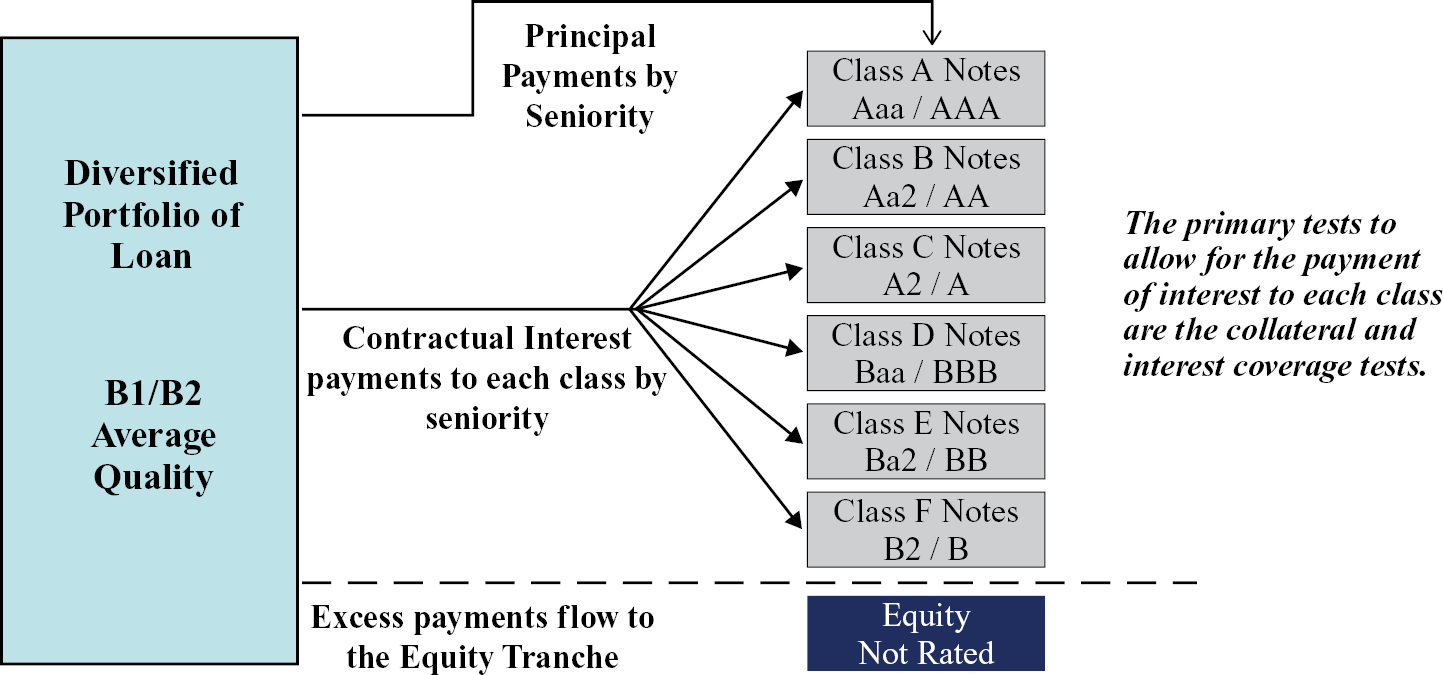
The Fund will typically invest in the equity tranches, which are not rated, and to a lesser extent the “B” and “BB” tranches of CLO vehicles.
The Syndicated Senior Loan Market
The Fund believes that while the syndicated leveraged corporate loan market is relatively large, with Morningstar LSTA Leveraged Loan Index estimating the total par value outstanding at approximately $1.5 trillion as of March 31, 2026, this market remains largely inaccessible to a significant portion of investors that are not lenders or approved institutions. The CLO market permits wider exposure to syndicated Senior Loans, but this market is almost exclusively private and predominantly institutional.
The Senior Loan market is characterized by various factors, including:
• Floating rate instruments. Senior Loans and other types of CLO Assets typically contain a floating interest rate as opposed to a fixed interest rate, which the Fund believes provides some measure of protection against the risk of interest rate fluctuation. However, all of the Fund’s CLO investments have many CLO Assets which are subject to interest rate floors and since interest rates on CLO Assets may only reset periodically and the amount of the increase following an interest rate reset may be below the interest rate floors of such CLO Assets, the Fund’s ability to benefit from rate resets following an increase in interest rates may be limited.
• Frequency of interest payments. Senior Loans and other CLO Assets typically provide for scheduled interest payments no less frequently than quarterly.
Investment Opportunity
The Fund believes that the market for CLO-related assets provides the Fund with opportunities to generate attractive risk-adjusted returns over the long term.
The long-term and relatively low-cost capital that many CLO vehicles have secured, compared with current asset spreads, have created opportunities to purchase certain CLO equity and junior debt instruments that may produce attractive risk-adjusted returns. Additionally, given that the CLO vehicles the Fund invests in are cash flow-based vehicles, this term financing may be beneficial in periods of market volatility.
The Fund will review a large number of CLO investment opportunities in the current market environment, and it expects that the majority of its portfolio holdings, over the near to intermediate-term, will continue to be comprised of CLO debt and equity securities, with the more significant focus over the near-term likely to be on CLO equity securities.
Investment Selection
Oxford Park Management’s investment team (the “Investment Team”) is responsible for all aspects of the Fund’s investment process. Oxford Park Management’s senior investment team currently consists of Messrs. Cohen and Rosenthal, who serve as members of the investment committee of Oxford Park Management. While the investment strategy involves a team approach, whereby potential transactions are screened by various members of the investment team, Messrs. Cohen or Rosenthal must approve all investments in order for them to close. The stages of the Fund’s investment selection process are as follows:
Deal Sourcing
Deal sourcing is generally conducted through brokers and bankers, and may also be sourced through industry contacts, CLO vehicle sponsors and investors. The Fund believes that it has an active pipeline of deal flow, particularly through multiple CLO trading desks.
Screening
In screening potential investments in CLO vehicles, the Investment Team utilizes a similar income-oriented investment philosophy they employ in their work managing other CLO investments at Oxford Lane Capital Corp. and Oxford Square Capital Corp.
Identification
The Fund identifies opportunities in the CLO market through its network of brokers, dealers, agent banks, collateral mangers and sponsors. The Fund believes that it has developed an infrastructure that provides the Fund with a competitive advantage in locating and acquiring attractive CLO opportunities. The Fund believes that it also has an active pipeline of deal flow, particularly through multiple CLO trading desks. The CLO vehicles which the Fund focuses on are collateralized primarily by senior secured loans made to companies whose debt is unrated or is rated below investment grade, and generally have very little or no direct exposure to real estate, mortgage loans or to pools of consumer-based debt, such as credit card receivables or auto loans. In screening potential investments in CLO vehicles,
the Fund’s due diligence process generally includes a review of current financial information and projections, review of collateral quality, concentration limitation and coverage test ratios, and a review of the prospective investment’s capital structure and the terms and conditions.
Due Diligence
The Investment Team conducts due diligence on prospective investments.
The Adviser’s due diligence process generally includes some or all of the following elements:
• review of indenture structures;
• review of underlying collateral loans;
• analysis of projected future cash flows; and
• analysis of compliance with covenants.
Upon the completion of due diligence, the investment professionals present the opportunity to the Adviser’s investment committee, which then determines whether to proceed with the potential investment. Any fees and expenses incurred by Oxford Park Management in connection with due diligence investigations undertaken by third parties will be subject to reimbursement by the Fund, which reimbursements will be in addition to any management or incentive fees payable under the Investment Advisory Agreement to Oxford Park Management. While the investment strategy involves a team approach, the Fund may not enter into a transaction without the prior approval of either Messrs. Cohen or Rosenthal.
Ongoing Relationships
Monitoring
The Adviser monitors the Fund’s investments on an ongoing basis. The Adviser has several methods of monitoring the performance and value of the Fund’s investments, which include the following:
• review of pricing data and indicative bids for recent transactions in the Fund’s investments;
• comparisons to other Senior Loans and CLO vehicles; and
• review of available financial reports for the Fund’s investments.
RISKS
Investing in the Fund’s Shares involves a number of significant risks. In addition to the other information contained elsewhere in this Prospectus, you should consider carefully the following information before making an investment in the Shares. If any of the following events occur, the Fund’s business, financial condition and results of operations could be materially and adversely affected. In such case, the NAV of the Fund’s Shares could decline, and you may lose all or part of your investment.
Risks Related to the Fund’s Business and Structure
Lack of Diversification. The Fund is classified as “non-diversified” under the 1940 Act. As a result, the Fund can invest a greater portion of its assets in obligations of a single issuer than a “diversified” fund. The Fund may therefore be more susceptible than a diversified fund to being adversely affected by any single corporate, economic, political or regulatory occurrence. The Fund intends to continue to qualify as a RIC under Subchapter M of the Code, and thus the Fund intends to satisfy the diversification requirements of Subchapter M, including its less stringent diversification requirements that apply to the percentage of the Fund’s total assets that are represented by cash and cash items (including receivables), U.S. government securities, the securities of other regulated investment companies and certain other securities.
“Best-Efforts” Offering Risk. This offering is being made on a best efforts basis, whereby the Dealer Manager is only required to use its best efforts to sell the Shares and has no firm commitment or obligation to purchase any of the Shares. To the extent that less than the maximum offering amount is subscribed for, the opportunity for the allocation of the Fund’s investments among various issuers and industries may be decreased, and the returns achieved on those investments may be reduced as a result of allocating all of the Fund’s expenses over a smaller capital base.
Inadequate Network of Broker-Dealer Risk. The success of the Fund’s continuous public offering, and correspondingly the Fund’s ability to implement its investment objective and strategies, depends upon the ability of the Dealer Manager to establish, operate and maintain a network of selected broker-dealers to sell the Shares. If the Dealer Manager fails to perform, the Fund may not be able to raise adequate proceeds through the Fund’s continuous public offering to implement the Fund’s investment objective and strategies. If the Fund is unsuccessful in implementing its investment objective and strategies, an investor could lose all or a part of his or her investment in the Fund.
Senior Management and Personnel of the Adviser. The Fund’s ability to achieve its investment objective depends on the Fund’s ability to effectively manage and deploy capital, which depends, in turn, on the Adviser’s ability to identify, evaluate and monitor, and the Fund’s ability to acquire, investments that meet its investment criteria.
Accomplishing the Fund’s investment objective on a cost-effective basis is largely a function of the Adviser’s handling of the investment process, its ability to provide competent, attentive and efficient services and the Fund’s access to investments offering acceptable terms, either in the primary or secondary markets. Even if the Fund is able to grow and build upon its investment operations, any failure to manage its growth effectively could have a material adverse effect on the Fund’s business, financial condition, results of operations and prospects. The results of the Fund’s operations will depend on many factors, including the availability of opportunities for investment, readily accessible short and long-term funding alternatives in the financial markets and economic conditions. Furthermore, if the Fund cannot successfully operate its business or implement its investment policies and strategies as described herein, it could negatively impact the Fund’s ability to pay distributions.
The Fund’s success also requires that Oxford Park Management retain investment and administrative personnel in a competitive market. Its ability to attract and retain personnel with the requisite credentials, experience and skills depends on several factors including, but not limited to, its ability to offer competitive wages, benefits and professional growth opportunities. Many of the entities, including investment funds (such as private equity funds, mezzanine funds and business development companies) and traditional financial services companies, with which the Fund competes for experienced personnel have greater resources than the Fund has.
The Adviser has the right, under the Investment Advisory Agreement, to resign at any time upon 60 days’ written notice, whether the Fund has found a replacement or not. If the Adviser resigns, the Fund may not be able to find a new Adviser or hire internal management with similar expertise and ability to provide the same or equivalent services on acceptable terms within 60 days, or at all. If the Fund is unable to do so quickly, its operations are likely to experience a disruption, the Fund’s financial condition, business and results of operations as well as its ability to pay distributions
are likely to be adversely affected and the market price of the Fund’s Shares may decline. In addition, the coordination of the Fund’s internal management and investment activities is likely to suffer if the Fund is unable to identify and reach an agreement with a single institution or group of executives having the expertise possessed by the Adviser and its affiliates. Even if the Fund is able to retain comparable management, whether internal or external, the integration of such management and their lack of familiarity with the Fund’s investment objective may result in additional costs and time delays that may adversely affect the Fund’s financial condition, business and results of operations.
Key Personnel. The Fund depends on the diligence, skill and network of business contacts of the senior management of Oxford Park Management. The senior management, together with other investment professionals, will evaluate, negotiate, structure, close, monitor and service the Fund’s investments. The Fund’s future success will depend to a significant extent on the continued service and coordination of the senior management team, particularly Jonathan H. Cohen, the Chief Executive Officer of Oxford Park Management, and Saul B. Rosenthal, the President of Oxford Park Management. Neither Mr. Cohen nor Mr. Rosenthal will devote all of their business time to the Fund’s operations, and both will have other demands on their time as a result of their other activities. Neither Mr. Cohen nor Mr. Rosenthal is subject to an employment contract. The departure of either of these individuals could have a material adverse effect on the Fund’s ability to achieve its investment objective. In addition, due to Oxford Park Management’s relatively small staff size, the departure of any of Oxford Park Management’s personnel, including investment, accounting and compliance professionals, could have a material adverse effect on the Fund.
Although Messrs. Cohen and Rosenthal have experience managing other investment portfolios, including those of Oxford Lane Capital Corp., a closed-end management investment company that currently invests primarily in CLO debt and equity tranches, Oxford Square Capital Corp., a publicly traded business development company that invests principally in the debt of U.S.-based companies, and Oxford Bridge II, LLC and the Oxford Gate Funds (as defined below), private investment funds that invest principally in the equity of CLOs, their track record and prior achievements are not necessarily indicative of future results that will be achieved by the Adviser. The Fund cannot assure you that it will be able to achieve the results realized by other vehicles managed by Messrs. Cohen and Rosenthal.
Incentive Fee Risks. The Incentive Fee payable by the Fund to Oxford Park Management may create an incentive for Oxford Park Management to pursue investments on the Fund’s behalf that are riskier or more speculative than would be the case in the absence of such compensation arrangement. Such a practice could result in the Fund investing in more speculative securities than would otherwise be the case, which could result in higher investment losses, particularly during economic downturns. The Incentive Fee payable to Oxford Park Management is based on the Fund’s Pre-Incentive Fee Net Investment Income, as calculated in accordance with the Fund’s Investment Advisory Agreement. In addition, the Fund’s Management Fee is calculated on the basis of the Fund’s gross assets, including assets acquired through the use of leverage. This may encourage Oxford Park Management to use leverage to increase the aggregate amount of and the return on the Fund’s investments, even when it may not be appropriate to do so, and to refrain from de-levering when it would otherwise be appropriate to do so. Under certain circumstances, the use of leverage may increase the likelihood of default, which would impair the value of the Fund’s securities.
The Fund may invest, to the extent permitted by law, in the securities and other instruments of other investment companies, including private funds, and, to the extent the Fund so invests, will bear its ratable share of any such investment company’s expenses, including management and performance fees. The Fund will also remain obligated to pay management and incentive fees to Oxford Park Management with respect to the assets invested in the securities and other instruments of other investment companies. With respect to each of these investments, each of the Fund’s shareholders will bear his or her share of the Management Fee and Incentive Fee of Oxford Park Management as well as indirectly bearing the management and performance fees and other expenses of any investment companies in which the Fund invests.
In the course of the Fund’s investing activities, the Fund pays management and incentive fees to Oxford Park Management and reimburses Oxford Park Management for certain expenses it incurs. As a result, investors in the Fund’s Shares invest on a “gross” basis and receive distributions on a “net” basis after expenses, resulting in a lower rate of return than an investor might achieve through direct investments.
In addition, given the structure of the Investment Advisory Agreement with Oxford Park Management, any general increase in interest rates will likely have the effect of making it easier for Oxford Park Management to meet the quarterly hurdle rate for payment of Incentive Fees under the Investment Advisory Agreement without any additional increase in relative performance on the part of Oxford Park Management. In addition, in view of the catch-up provision applicable to Incentive Fees under the Investment Advisory Agreement, Oxford Park Management could potentially
receive a significant portion of the increase in the Fund’s investment income attributable to such a general increase in interest rates. If that were to occur, the Fund’s increase in net earnings, if any, would likely be significantly smaller than the relative increase in the Adviser’s Incentive Fee resulting from such a general increase in interest rates.
Valuation Risk. Under the 1940 Act, the Fund is required to carry its portfolio investments at market value or, if there is no readily available market value, at fair value as determined by the Fund in accordance with its written valuation policy with the Board of Directors having final responsibility for overseeing, reviewing and approving, in good faith, its estimate of fair value. Typically, there will not be a public market for the type of investments the Fund targets, which will require the Fund to value these securities at fair value based on relevant information compiled by the Adviser, third-party pricing services (when available) and Valuation Committee and with the oversight, review and approval of the Board of Directors.
The determination of fair value and, consequently, the amount of unrealized gains and losses in the Fund’s portfolio, are to a certain degree subjective and dependent on a valuation process approved by the Board of Directors. Certain factors that may be considered in determining the fair value of the Fund’s investments include available indicative bids or quotations, as well as external events, such as private mergers, sales and acquisitions involving comparable companies. Because such valuations, and particularly valuations of private securities, are inherently uncertain, they may fluctuate over short periods of time and may be based on estimates. The fair value of the Fund’s investments may differ materially from the values that would have been used if an active public market for these securities existed. The fair value of the Fund’s investments have a material impact on its net earnings through the recording of unrealized appreciation or depreciation of investments and may cause the Fund’s NAV on a given date to materially understate or overstate the value that the Fund may ultimately realize on one or more of its investments. Investors purchasing the Fund’s securities based on an overstated NAV may pay a higher price than the value of the Fund’s investments might warrant. Conversely, investors selling Shares during a period in which the NAV understates the value of the Fund’s investments may receive a lower price for their Shares than the value of its investments might warrant.
Competition. The Fund may compete for investments with other investment funds (potentially including private equity funds, mezzanine funds and business development companies), as well as traditional financial services companies, which could include commercial banks, investment banks, finance companies and other sources of funding.
Many of the Fund’s competitors are substantially larger and have considerably greater financial, technical and marketing resources than the Fund. For example, some competitors may have a lower cost of capital and access to funding sources that may not be available to the Fund. In addition, some of the Fund’s competitors may have higher risk tolerances or different risk assessments than the Fund has. These characteristics could allow the Fund’s competitors to consider a
wider variety of investments, establish more relationships and offer higher pricing than the Fund is willing to offer to potential sellers. The Fund may lose investment opportunities if its competitors are willing to pay more for the types of investments that the Fund targets. If the Fund is forced to pay more for its investments, the Fund may not be able to achieve acceptable returns on its investments or may bear substantial risk of capital loss. An increase in the number and/or the size of the Fund’s competitors in its target markets could force the Fund to accept less attractive investments. Furthermore, many of the Fund’s competitors have greater experience operating under, or are not subject to, the regulatory restrictions that the 1940 Act imposes on the Fund as a closed-end management investment company.
Conflicts of Interest Risks. Oxford Park Management’s Investment Team presently manages the portfolios of Oxford Lane Capital Corp., a closed-end management investment company that currently invests primarily in CLO debt and equity tranches, and Oxford Square Capital Corp., a publicly-traded business development company that invests principally in the debt of U.S.-based companies. Additionally, Oxford Park Management’s Investment Team also manages Oxford Gate Master Fund, LLC, Oxford Gate, LLC and Oxford Gate (Bermuda), LLC (collectively, the “Oxford Gate Funds”) and Oxford Bridge II, LLC, managed by Oxford Gate Management, LLC (“Oxford Gate Management”). Oxford Bridge II, LLC and the Oxford Gate Funds are private investment funds. In addition, the Fund’s executive officers and directors, as well as the current and future members of Oxford Park Management may serve as officers, directors or principals of other entities that operate in the same or a related line of business as the Fund. Accordingly, they may have obligations to investors in those entities, the fulfillment of which obligations may not be in the best interests of the Fund or its shareholders. Each of Oxford Lane Capital Corp., Oxford Square Capital Corp., Oxford Bridge II, LLC and the Oxford Gate Funds, as well as any affiliated investment vehicle formed in the future and managed by Oxford Park Management or its affiliates may, notwithstanding different stated investment objectives, have overlapping investment objectives with the Fund and, accordingly, may invest in asset classes similar to those targeted by the Fund. As a result, Oxford Park Management’s Investment Team may face conflicts in allocating investment opportunities between the Fund and such other entities. Although Oxford Park Management’s Investment Team will endeavor to allocate investment opportunities in a fair and equitable manner, it is possible that, in the future, the Fund may not be given the opportunity to participate in investments made by investment funds, including Oxford Lane Capital Corp., Oxford Square Capital Corp., Oxford Bridge II, LLC and the Oxford Gate Funds, managed by Oxford Park Management or an investment manager affiliated with Oxford Park Management. In any such case, when Oxford Park Management’s Investment Team identifies an investment, it will be required to choose which investment fund should make the investment, although the Fund, Oxford Lane Capital Corp., Oxford Square Capital Corp., Oxford Bridge II, LLC and the Oxford Gate Funds are subject to an allocation policy to ensure the equitable distribution of such investment opportunities, consistent with the requirements of the 1940 Act.
As a registered closed-end fund, the Fund is limited in its ability to co-invest in privately negotiated transactions with certain funds or entities managed by Oxford Park Management or its affiliates without an exemptive order from the SEC. On January 6, 2026, the SEC issued an exemptive order (the “Order”) which permits the Fund to co-invest in portfolio companies with certain funds or entities managed by Oxford Park Management or its affiliates in certain negotiated transactions where co-investing would otherwise be prohibited under the 1940 Act, subject to the conditions of the Order, including the approval by a “required majority” (as defined in Section 57(o) of the 1940 Act) of the Independent Directors of certain potential co-investment transactions.
The Fund will reimburse Oxford Funds an allocable portion of overhead and other expenses incurred by Oxford Funds in performing its obligations under the Administration Agreement, including rent, the fees and expenses associated with performing administrative functions, and the Fund’s allocable portion of the compensation of its Chief Financial Officer and any administrative support staff, including accounting personnel. The Fund will also reimburse Oxford Funds for the costs associated with the functions performed by its Chief Compliance Officer that Oxford Funds pays on the Fund’s behalf pursuant to the terms of an agreement between the Fund and ACA. These arrangements may create conflicts of interest that the Board of Directors must monitor. Oxford Park Management is not reimbursed for any performance-related compensation of its employees.
Oxford Park Management or its affiliates pays the Dealer Manager a fee of up to 1.00% with respect to Class I Shares.
Risks Relating to our RIC Status. Although the Fund has elected to be treated as a RIC under Subchapter M of the Code, no assurance can be given that the Fund will be able to qualify for and maintain RIC status. If the Fund qualifies as a RIC under the Code, it generally will not be subject to corporate-level federal income taxes on its income and capital gains that are timely distributed (or deemed distributed) as dividends for U.S. federal income tax purposes to the Fund’s shareholders. To qualify as a RIC under the Code and to be relieved of federal taxes on income and gains
distributed as dividends for U.S. federal income tax purposes to the Fund’s shareholders, the Fund must, among other things, meet certain source-of-income, asset diversification and distribution requirements. The distribution requirement for a RIC is satisfied if the Fund distributes dividends each tax year for U.S. federal income tax purposes of an amount generally at least equal to 90% of the sum of its net ordinary income and net short-term capital gains in excess of net long-term capital losses, if any, to the Fund’s shareholders.
Risks Related to the Fund’s Investments
Risks Related to CLOs. The Fund has initially invested principally in equity and junior debt tranches issued by CLO vehicles. Generally, there may be less information available to the Fund regarding the underlying debt investments held by such CLO vehicles than if the Fund had invested directly in the debt of the underlying companies. As a result, the Fund’s stockholders may not know the details of the underlying debt investments of the CLO vehicles in which the Fund invests. The Fund’s CLO investments will also be subject to the risk of leverage associated with the debt issued by such CLOs and the repayment priority of senior debt holders in such CLO vehicles. Additionally, CLOs in which the Fund invests are often governed by a complex series of legal documents and contracts. As a result, the risk of dispute over interpretation or enforceability of the documentation may be higher relative to other types of investments.
In addition to the general risks associated with investing in debt securities, CLO vehicles carry additional risks, including, but not limited to: (i) the possibility that distributions from collateral securities will not be adequate to make interest or other payments; (ii) the credit quality of the CLO Assets that serve as collateral may decline or the CLO Asset may default; (iii) the CLO may experience losses associated with selling CLO Assets at a loss; (iv) the Fund’s investments in CLO debt and equity will likely be subordinate to other senior classes of CLO debt; (v) the CLO vehicle itself may experience an event of default, leading to acceleration of the CLO’s debt and liquidation of CLO Assets at undesirable prices and (vi) the complex structure of the security may not be fully understood at the time of investment and may produce disputes among participants of the CLO transaction or unexpected investment results. The Fund’s NAV may also decline over time if its principal recovery with respect to CLO equity investments is less than the price the Fund paid for those investments.
The CLO vehicles in which the Fund invests will issue and sell or have already issued and sold debt tranches that will rank senior to the debt and equity tranches in which the Fund invests. By their terms, such tranches entitle the holders to receive payment of interest or principal on or before the dates on which the Fund is entitled to receive payments with respect to the tranches in which the Fund invests. Also, in the event of default, insolvency, liquidation, dissolution, reorganization or bankruptcy of a CLO vehicle, holders of senior debt instruments would be entitled to receive payment in full before the Fund receives any distribution. After repaying such senior creditors, such CLO vehicle may not have any remaining assets to use for repaying its obligation to the Fund. In the case of tranches ranking equally with the tranches in which the Fund invests, the Fund would have to share on an equal basis any distributions with other investors holding such securities in the event of a default, insolvency, liquidation, dissolution, reorganization or bankruptcy of the relevant CLO vehicle. Therefore, the Fund may not receive back the full amount of its investment (or any of its investment) in a CLO vehicle or may not receive its anticipated yield.
The CLO equity market has experienced significant downturns from time to time. Due to the continued uncertainty in the CLO equity market, the Fund cannot assure you that it will achieve expected investment results and/or maintain its current level of cash distributions. The Fund’s future distributions are dependent upon the investment income the Fund receives on its portfolio investments, including its CLO equity investments. To the extent such CLO investments are terminated prior to the specified maturity date, such proceeds derived from a termination may be less than originally contemplated at that time of such investment. This may result in proceeds which may not be of a sufficient amount to invest in future CLO investments in order to generate cash returns that will enable the Fund to maintain the same level of distributions. This may result in a meaningful reduction in, or complete cessation of, the Fund’s distributions going forward. In addition, due to the asset coverage test applicable to the Fund as a registered closed-end management investment company, a reduction in the fair value of the Fund’s investments may limit its ability to make distributions.
Accounting and Tax Implications. The accounting and tax implications of such investments are complicated. In particular, reported earnings from the equity tranche investments of these CLO vehicles are recorded under GAAP based upon an effective yield calculation. Current taxable earnings on these investments, however, will generally not be determinable until after the end of the fiscal year of each individual CLO vehicle that ends within the Fund’s fiscal year, even though the investments are generating cash flow. In general, the tax treatment of these investments may result in higher distributable earnings in the early years and a capital loss at maturity, while for reporting purposes the totality of cash flows is reflected in a constant yield to maturity.
Limited Access to Information. None of the information contained in a CLO’s monthly reports, other trustee reports or any other financial information furnished to the Fund as an investor in a CLO is audited and reported upon, nor is an opinion expressed, by an independent public accountant. The Fund is not required to share any trustee reports or other reports received from any CLO with the Fund’s stockholders. Thus, you will have limited information on the assets held by, and the performance of, the CLOs in which the Fund invests.
Illiquidity of CLO Securities and their Investments. Some instruments issued by CLO vehicles may not be readily marketable and may be subject to restrictions on resale. Securities issued by CLO vehicles are generally not listed on any U.S. national securities exchange and no active trading market may exist for the securities of CLO vehicles in which the Fund may invest. Although a secondary market may exist for the Fund’s investments in CLO vehicles, the market for the Fund’s investments in CLO vehicles may be subject to irregular trading activity, wide bid/ask spreads and extended trade settlement periods. As a result, these types of investments may be more difficult to value.
Failure to Satisfy Financial Tests. CLO vehicles in which the Fund invests may fail to satisfy certain financial covenants, specifically those with respect to adequate collateralization and/or interest coverage tests. Such failure could lead to a reduction in such CLO’s payments to the Fund because senior debt holders generally would be entitled to additional payments that would, in turn, reduce the payments the Fund would otherwise be entitled to receive.
Risks Related to CLO Structure. The Fund’s portfolio includes equity and junior debt investments in CLOs, which involve a number of significant risks. CLOs are typically very highly levered (with CLO equity securities typically being leveraged between nine and 13 times), and therefore the junior equity and debt tranches in which the Fund invests will be subject to a higher degree of risk of total loss. In particular, investors in CLO securities indirectly bear risks of the collateral held by such CLOs. The Fund generally has the right to receive payments only from the CLOs, and generally does not have direct rights against the underlying borrowers or the entity that sponsored the CLO transaction. In addition, the Fund may have the option in certain CLOs to contribute additional amounts to the CLO issuer for purposes of acquiring additional assets or curing coverage tests, thereby increasing the Fund’s overall exposure and capital at risk to such CLO. Although it is difficult to predict whether the prices of assets underlying CLOs will rise or fall, these prices (and, therefore, the prices of the CLOs’ securities) are influenced by the same types of political and economic events that affect issuers of securities and capital markets generally.
CLO Fees and Expenses. While the CLO vehicles the Fund targets generally enable the investor to acquire interests in a pool of CLO Assets without the expenses associated with directly holding the same investments, the CLO vehicle itself will incur Management Fees (including Incentive Fees) and other expenses. CLO collateral manager fees are charged on the total assets of a CLO but are assumed to be paid from the residual cash flows after interest payments to the CLO senior debt tranches. Therefore, these CLO collateral manager fees are effectively much higher when allocated only to the CLO equity tranche. These fees incurred at the CLO level are in addition to the fees charged by the Adviser at the Fund level. Additionally, CLOs could also be liable to the collateral manager, trustee and other parties for indemnity payments. The Fund, as a CLO equity investor, will generally bear a share of the CLO vehicles’ administrative and other expenses that is proportionate with other CLO equity investors; however, CLO equity investors often negotiate fee rebates through side letters and other arrangements, and there can be no assurance that the Fund will be able to negotiate fee rebates for any CLO in which it invests, or that any fee rebates it does negotiate will be as favorable as fee rebates other CLO equity investors may negotiate. Separately, the Fund may incur expenses to the extent necessary to seek recovery upon default or to negotiate new terms with a defaulting CLO vehicle or any other investment the Fund may make. If any of these occur, it could materially and adversely affect the Fund’s operating results and cash flows.
Risks Related to Concentration. The Fund’s portfolio may hold investments in a limited number of CLO vehicles. Beyond the asset diversification requirements associated with its qualification as a RIC under the Code, the Fund does not have fixed guidelines for diversification, it does not have any limitations on the ability to invest in any one CLO vehicle, and its investments may be concentrated in relatively few CLO vehicles. As the Fund’s portfolio is less diversified than the portfolios of some larger funds, it is more susceptible to failure if one or more of the CLO vehicles in which the Fund is invested experiences a high level of defaults on its underlying Senior Loans and Other CLO Assets. Similarly, the aggregate returns the Fund realizes may be significantly adversely affected if a small number of investments perform poorly or if the Fund needs to write down the value of any one investment.
Additionally, the CLO vehicles in which the Fund invests may have CLO Asset portfolios that are concentrated in a limited number of industries or borrowers. A downturn in any particular industry or borrower in which a CLO vehicle is heavily invested may subject that vehicle, and in turn the Fund, to a risk of significant loss and could significantly
impact the aggregate returns the Fund realizes. If an industry in which a CLO vehicle is heavily invested suffers from adverse business or economic conditions, a material portion of the Fund’s investment in that CLO vehicle could be affected adversely, which, in turn, could adversely affect its financial position and results of operations.
The Fund may also invest in multiple CLOs managed by the same CLO collateral manager, thereby increasing its risk of loss in the event the CLO collateral manager were to fail, experience the loss of key portfolio management employees or sell its business.
Concentration of Underlying Obligors Across CLOs. Even if the Fund maintains diversification across different CLO issuers, the Fund may still be subject to concentration risk since CLO portfolios tend to have a certain amount of overlap across underlying obligors. This trend is generally exacerbated when demand for bank loans by CLO issuers outpaces supply. Market analysts have noted that the overlap of obligor names among CLO issuers has increased recently, and is particularly evident across CLOs of the same year of origination, as well as with CLOs managed by the same asset manager. To the extent the Fund invests in CLOs which have a high percentage of overlap, this may increase the likelihood of defaults on the Fund’s CLO investments occurring together.
Risks Related to Reinvestment of CLO Assets. As part of the ordinary management of its portfolio, a CLO will typically generate cash from asset repayments and sales and reinvest those proceeds in substitute assets, subject to compliance with its investment tests and certain other conditions. The earnings with respect to such substitute assets will depend on the quality of reinvestment opportunities available at the time. If the CLO collateral manager causes the CLO to purchase substitute assets at a lower yield than those initially acquired (for example, during periods of loan compression or in response to the need to satisfy the CLO’s covenants) or sale proceeds are maintained temporarily in cash, it would reduce the excess interest-related cash flow that the CLO collateral manager is able to achieve. The investment tests may incentivize a CLO collateral manager to cause the CLO to buy riskier assets than it otherwise would, which could result in additional losses. These factors could reduce the Fund’s return on investment and may have a negative effect on the fair value of our assets and the market value of our securities. In addition, the reinvestment period for a CLO may terminate early, which would cause the holders of the CLO’s securities to receive principal payments earlier than anticipated. In addition, in CLO transactions in which the Fund owns a minority of the equity tranche, the holders of a majority of the equity tranche direct a call or refinancing of a CLO, thus causing such CLO’s outstanding CLO debt securities to be repaid at par earlier than expected. There can be no assurance that the Fund will be able to reinvest such amounts in an alternative investment that provides a comparable return relative to the credit risk assumed.
Risks Related to CLO Managers. The Fund relies on CLO collateral managers to administer and review the portfolios of collateral of the CLOs in which they invest. The actions of the CLO collateral managers may significantly affect the return on the Fund’s investments; however, the Fund, as an investor of the CLO, typically does not have any direct contractual relationship with the collateral managers of the CLOs in which the Fund invests. The ability of each CLO collateral manager to identify and report on issues affecting its securitization portfolio on a timely basis could also affect the return on its investments, as the Fund may not be provided with information on a timely basis in order to take appropriate measures to manage its risks. The Fund will also rely on CLO collateral managers to act in the best interests of a CLO it manages; however, such CLO collateral managers are subject to fiduciary duties owed to other classes of debt besides those in which the Fund invests; therefore, there can be no assurance that the collateral managers will always act in the best interest of the CLO securities in which the Fund is invested. If any CLO collateral manager were to act in a manner that was not in the best interest of the CLOs, this could adversely impact the overall performance of the Fund’s investments. Furthermore, since the underlying CLO issuer often provides an indemnity to its CLO collateral manager, the Fund may not be incentivized to pursue actions against the collateral manager since any such action, if successful, may ultimately be borne by the underlying CLO issuer and payable from its assets, which could create losses to the Fund as an investor in the CLO. In addition, liabilities incurred by the CLO manger to third parties may be borne by the Fund as an investor in the CLO to the extent such CLO is required to indemnify its collateral manager for such liabilities.
Additionally, there is no guarantee that, for any CLO the Fund invests in, the collateral manager in place when the Fund invests in such CLO securities will continue to manage such CLO through the life of our investment. Collateral managers are subject to removal or replacement by other holders of CLO securities without our consent, and may also voluntarily resign as collateral manager or assign their role as collateral manager to another entity. There can be no assurance that any removal, replacement, resignation or assignment of any particular CLO manager’s role will not adversely affect the returns on the CLO securities in which the Fund invests.
Risks Related to Leverage of Underlying Obligors. Underlying obligors of the CLO Assets are typically highly leveraged, and there may not be significant restrictions on the amount of debt an obligor can incur. Substantial indebtedness adds additional risk with respect to an obligor and could (i) limit its ability to borrow money for its working capital, capital expenditures, debt service requirements, strategic initiatives or other purposes; (ii) require it to dedicate a substantial portion of its cash flow from operations to the repayment of its indebtedness, thereby reducing funds available to it for other purposes; (iii) make it more highly leveraged than some of its competitors, which may place it at a competitive disadvantage; and/or (iv) subject it to restrictive financial and operating covenants, which may preclude it from favorable business activities or the financing of future operations or other capital needs. In some cases, proceeds of debt incurred by an obligor could be paid as a dividend to stockholders rather than retained by the obligor for its working capital. Leveraged companies are often more sensitive to declines in revenues, increases in expenses, and adverse business, political, or financial developments or economic factors such as a significant rise in interest rates, a severe downturn in the economy or deterioration in the condition of such companies or their industries. A leveraged company’s income and net assets will tend to increase or decrease at a greater rate than if borrowed money were not used.
If an obligor is unable to generate sufficient cash flow to meet principal and/or interest payments on its indebtedness, it may be forced to take other actions to satisfy its obligations under its indebtedness. These alternative measures may include reducing or delaying capital expenditures, selling assets, seeking additional capital, or restructuring or refinancing indebtedness. Any of these actions could significantly reduce the value of the CLO Assets and thus the CLO securities in which the Fund invests. If such strategies are not successful and do not permit the obligor to meet its scheduled debt service obligations, the obligor may also be forced into liquidation, dissolution or insolvency, and the value of the CLO’s investment in such obligor could be significantly reduced or even eliminated.
Bankruptcy or Insolvency of an Obligor of a CLO Asset. In the event of a bankruptcy or insolvency of an issuer or borrower of a CLO Asset, a court or other governmental entity may determine that the claims of the relevant CLO are not valid or not entitled to the treatment the CLO expected when making its initial investment decision.
Various laws enacted for the protection of debtors may apply to the CLO Assets held by the CLOs in which the Fund invests. The information in this and the following paragraph represents a brief summary of certain points only, is not intended to be an extensive summary of the relevant issues and is applicable with respect to U.S. issuers and borrowers only. The following is not intended to be a summary of all relevant risks. Similar avoidance provisions to those described below are sometimes available with respect to non-U.S. issuers or borrowers, and there is no assurance that this will be the case which may result in a much greater risk of partial or total loss of value in that underlying CLO Asset.
If a court in a lawsuit brought by an unpaid creditor or representative of creditors of an issuer or borrower of a CLO Asset, such as a trustee in bankruptcy, were to find that such issuer or borrower did not receive fair consideration or reasonably equivalent value for incurring the indebtedness constituting such CLO Asset and, after giving effect to such indebtedness, the issuer or borrower (1) was insolvent; (2) was engaged in a business for which the remaining assets of such issuer or borrower constituted unreasonably small capital; or (3) intended to incur, or believed that it would incur, debts beyond its ability to pay such debts as they mature, such court could decide to invalidate, in whole or in part, the indebtedness constituting the CLO Assets as a fraudulent conveyance, to subordinate such indebtedness to existing or future creditors of the issuer or borrower or to recover amounts previously paid by the issuer or borrower in satisfaction of such indebtedness. In addition, in the event of the insolvency of an issuer or borrower of a CLO Asset, payments made on such CLO Asset could be subject to avoidance as a “preference” if made within a certain period of time (which may be as long as one year under U.S. Federal bankruptcy law or even longer under state laws) before insolvency.
The CLO Assets of the CLOs in which the Fund invests may be subject to various laws for the protection of debtors in other jurisdictions, including the jurisdiction of incorporation of the issuer or borrower of such CLO Assets and, if different, the jurisdiction from which it conducts business and in which it holds assets, any of which may adversely affect such issuer’s or borrower’s ability to make, or a creditor’s ability to enforce, payment in full, on a timely basis or at all. These insolvency considerations will differ depending on the jurisdiction in which an issuer or borrower or the related CLO Assets are located and may differ depending on the legal status of the issuer or borrower.
U.S. Risk Retention. In October 2014, six federal agencies (the Federal Deposit Insurance Corporation, or the “FDIC,” the Comptroller of the Currency, the Federal Reserve Board, the SEC, the Department of Housing and Urban Development and the Federal Housing Finance Agency) adopted joint final rules implementing certain credit risk
retention requirements contemplated in Section 941 of the Dodd-Frank Act, or the “Final U.S. Risk Retention Rules.” These rules were published in the Federal Register on December 24, 2014. With respect to the regulation of CLOs, the Final U.S. Risk Retention Rules require that the “sponsor” or a “majority owned affiliate” thereof (in each case as defined in the rules), will retain an “eligible vertical interest” or an “eligible horizontal interest” (in each case as defined therein) or any combination thereof in the CLO in the manner required by the Final U.S. Risk Retention Rules.
The Final U.S. Risk Retention Rules became fully effective on December 24, 2016, and to the extent applicable to CLOs in which the Fund invests, the Final U.S. Risk Retention Rules contain provisions that may adversely affect the return of the Fund’s investments. On February 9, 2018, a three-judge panel of the United States Court of Appeals for the District of Columbia Circuit, or the “DC Circuit Court,” rendered a decision in The Loan Syndications and Trading Association v. Securities and Exchange Commission and Board of Governors of the Federal Reserve System, No. 1:16-cv-0065, in which the DC Circuit Court held that open market CLO collateral managers are not “securitizers” subject to the requirements of the Final U.S. Risk Retention Rules (the “DC Circuit Ruling”). Thus, collateral managers of open market CLOs are no longer required to comply with the Final U.S. Risk Retention Rules at this time. As such, it is possible that some collateral managers of open market CLOs will decide to dispose of the securities (or cause their majority owned affiliates to dispose of the securities) constituting the “eligible vertical interest” or “eligible horizontal interest” they were previously required to retain or take other actions with respect to such securities that is not otherwise prohibited by the Final U.S. Risk Retention Rules. To the extent either the underlying collateral manager or its majority-owned affiliate divests itself of such securities, or to the extent none of the underlying collateral manager or its affiliates holds any CLO securities in any event, this will reduce the degree to which the relevant collateral manager’s incentives are aligned with those of the holders of the CLO debt or equity (which may include the Fund as a CLO investor). This could influence the way in which the relevant collateral manager manages the CLO assets and/or makes other decisions under the transaction documents related to the CLO in a manner that is adverse to the Fund.
There can be no assurance or representation that any of the transactions, structures or arrangements currently under consideration by or currently used by CLO market participants will comply with the Final U.S. Risk Retention Rules to the extent such rules are reinstated or otherwise become applicable to open market CLOs. The ultimate impact of the Final U.S. Risk Retention Rules on the loan securitization market and the leveraged loan market generally remains uncertain, and any negative impact on secondary market liquidity for securities comprising a CLO may be experienced due to the effects of the Final U.S. Risk Retention Rules on market expectations or uncertainty, the relative appeal of other investments not impacted by the Final U.S. Risk Retention Rules and other factors.
EU/UK Risk Retention. The securitization industry in both European Union (“EU”) and the United Kingdom (“UK”) has also undergone a number of significant changes in the past few years. Regulation (EU) 2017/2402 relating to a European framework for simple, transparent and standardized securitization (as amended by Regulation (EU) 2021/557 and as further amended from time to time, the “EU Securitization Regulation”) applies to certain specified EU investors, and Regulation (EU) 2017/2402 relating to a European framework for simple, transparent and standardized securitization in the form in effect on 31 December 2020 (which forms part of UK domestic law by virtue of the European Union (Withdrawal) Act 2018 (as amended, the “EUWA”)) (as amended by the Securitization (Amendment) (EU Exit) Regulations 2019 and as further amended from time to time, the “UK Securitization Regulation” and, together with the EU Securitization Regulation, the “Securitization Regulations”) applies to certain specified UK investors, in each case, who are investing in a “securitization” (as such term is defined under each Securitization Regulation).
The due diligence requirements of Article 5 of the EU Securitization Regulation (the “EU Due Diligence Requirements”) apply to each investor that is an “institutional investor” (as such term is defined in the EU Securitization Regulation), being an investor which is one of the following: (a) an insurance undertaking as defined in Directive 2009/138/EC of the European Parliament and of the Council of 25 November 2009 on the taking-up and pursuit of the business of Insurance and Reinsurance (Solvency II) (recast) (“Solvency II”); (b) a reinsurance undertaking as defined in Solvency II; (c) subject to certain conditions and exceptions, an institution for occupational retirement provision falling within the scope of Directive (EU) 2016/2341 of the European Parliament and of the Council of 14 December 2016 on the activities and supervision of institutions for occupational retirement provision (IORPs) (the “IORP Directive”), or an investment manager or an authorized entity appointed by an institution for occupational retirement provision pursuant to the IORP Directive; (d) an alternative investment fund manager (“AIFM”) as defined in Directive 2011/61/EU of the European Parliament and of the Council of 8 June 2011 on Alternative Investment Fund Managers that manages and/or markets alternative investment funds in the EU; (e) an undertaking for the collective investment in transferable securities (“UCITS”) management company, as defined in Directive 2009/65/EC of the European
Parliament and of the Council of 13 July 2009 on the coordination of laws, regulations and administrative provisions relating to undertakings for collective investment in transferable securities (UCITS) (the “UCITS Directive”); (f) an internally managed UCITS, which is an investment company authorized in accordance with the UCITS Directive and which has not designated a management company authorized under the UCITS Directive for its management; or (g) a credit institution as defined in Regulation (EU) No 575/2013 of the European Parliament and of the Council of 26 June 2013 on prudential requirements for credit institutions and investment firms (the “CRR”) for the purposes of the CRR, or an investment firm as defined in the CRR, in each case, such investor an “EU Institutional Investor”.
The due diligence requirements of Article 5 of the UK Securitization Regulation (the “UK Due Diligence Requirements” and, together with the EU Due Diligence Requirements, the “Due Diligence Requirements”) apply to each investor that is an “institutional investor” (as such term is defined in the UK Securitization Regulation), being an investor which is one of the following: (a) an insurance undertaking as defined in the Financial Services and Markets Act 2000 (as amended, the “FSMA”); (b) a reinsurance undertaking as defined in the FSMA; (c) an occupational pension scheme as defined in the Pension Schemes Act 1993 that has its main administration in the UK, or a fund manager of such a scheme appointed under the Pensions Act 1995 that, in respect of activity undertaken pursuant to that appointment, is authorized under the FSMA; (d) an AIFM (as defined in the Alternative Investment Fund Managers Regulations 2013 (the “AIFM Regulations”)) which markets or manages AIFs (as defined in the AIFM Regulations) in the UK; (e) a management company as defined in the FSMA; (f) a UCITS as defined by the FSMA, which is an authorized open ended investment company as defined in the FSMA; (g) a FCA investment firm as defined by the CRR as it forms part of UK domestic law by virtue of EUWA (the “UK CRR”); or (h) a CRR investment firm as defined in the UK CRR, in each case, such investor a “UK Institutional Investor” and, such investors together with EU Institutional Investors, “Institutional Investors”.
Among other things, the applicable Due Diligence Requirements require that prior to holding a “securitization position” (as defined in each Securitization Regulation) an Institutional Investor (other than the originator, sponsor or original lender) has verified that:
(1) the originator, sponsor or original lender will retain on an ongoing basis a material net economic interest which, in any event, shall be not less than five per cent. in the securitization, determined in accordance with Article 6 of the applicable Securitization Regulation, and has disclosed the risk retention to such Institutional Investor;
(2) (in the case of each EU Institutional Investor only) the originator, sponsor or securitization special purpose entity (“SSPE”) has, where applicable, made available the information required by Article 7 of the EU Securitization Regulation in accordance with the frequency and modalities provided for thereunder;
(3) (in the case of each UK Institutional Investor only) the originator, sponsor or SSPE:
(i) if established in the UK has, where applicable, made available the information required by Article 7 of the UK Securitization Regulation (the “UK Transparency Requirements”) in accordance with the frequency and modalities provided for thereunder; or
(ii) if established in a country other than the UK, where applicable, made available information which is substantially the same as that which it would have made available under the UK Transparency Requirements if it had been established in the UK, and has done so with such frequency and modalities as are substantially the same as those with which it would have made information available under the UK Transparency Requirements if it had been established in the UK; and
(4) in the case of each Institutional Investor, where the originator or original lender either (i) is not a credit institution or an investment firm (each as defined in the applicable Securitization Regulation) or (ii) is established in a third country (being (x) in respect of the EU Securitization Regulation, a country other than an EU member state, or (y) in respect of the UK Securitization Regulation, a country other than the UK), the originator or original lender grants all the credits giving rise to the underlying exposures on the basis of sound and well-defined criteria and clearly established processes for approving, amending, renewing and financing those credits and has effective systems in place to apply those criteria and processes in order to ensure that credit-granting is based on a thorough assessment of the obligor’s creditworthiness.
The Due Diligence Requirements further require that prior to holding a securitization position, an Institutional Investor, other than the originator, sponsor or original lender, carry out a due diligence assessment which enables it to assess the risks involved, including but not limited to (a) the risk characteristics of the individual securitization position and the underlying exposures; and (b) all the structural features of the securitization that can materially impact the performance of the securitization position, including the contractual priorities of payment and priority of payment-related triggers, credit enhancements, liquidity enhancements, market value triggers, and transaction-specific definitions of default.
Any Institutional Investor that fails to comply with the applicable Due Diligence Requirements in respect of a securitization position which it holds may become subject to a range of regulatory sanctions including, in the case of a credit institution, investment firm, insurer or reinsurer, a punitive regulatory capital charge with respect to such securitization position, or, in certain other cases, a requirement to take corrective action.
To the extent a CLO is structured in compliance with the Securitization Regulations, the Fund’s ability to invest in the CLO equity of such CLOs could be limited, or the Fund could be required to hold its investment for the life of the CLO. If a CLO has not been structured to comply with the Securitization Regulations, it will limit the ability of Institutional Investors to purchase CLO securities, which may adversely affect the price and liquidity of the securities (including the CLO equity) in the secondary market. Additionally, the Securitization Regulations and any regulatory uncertainty in relation thereto may reduce the issuance of new CLOs and reduce the liquidity provided by CLOs to the leveraged loan market generally. Reduced liquidity in the loan market could reduce investment opportunities for collateral managers, which could negatively affect the return of the Fund’s investments. Any reduction in the volume and liquidity provided by CLOs to the leveraged loan market could also reduce opportunities to redeem or refinance the securities comprising a CLO in an optional redemption or refinancing and could negatively affect the ability of obligors to refinance of their collateral obligations, either of which developments could increase defaulted obligations above historic levels.
Japanese Risk Retention. The Japanese Financial Services Agency (the “JFSA”) published a risk retention rule as part of the regulatory capital regulation of certain categories of Japanese investors seeking to invest in securitization transactions (the “JRR Rule”). The JRR Rule mandates an “indirect” compliance requirement, meaning that certain categories of Japanese investors will be required to apply higher risk weighting to securitization exposures they hold unless the relevant originator commits to hold a retention interest equal to at least 5% of the exposure of the total underlying assets in the transaction (the “Japanese Retention Requirement”) or such investors determine that the underlying assets were not “inappropriately originated.” The Japanese investors to which the JRR Rule applies include banks, bank holding companies, credit unions (shinyo kinko), credit cooperatives (shinyo kumiai), labor credit unions (rodo kinko), agricultural credit cooperatives (nogyo kyodo kumiai), ultimate parent companies of large securities companies and certain other financial institutions regulated in Japan (such investors, “Japanese Affected Investors”). Such Japanese Affected Investors may be subject to punitive capital requirements and/or other regulatory penalties with respect to investments in securitizations that fail to comply with the Japanese Retention Requirement.
The JRR Rule became effective on March 31, 2019. At this time, there are a number of unresolved questions and no established line of authority, precedent or market practice that provides definitive guidance with respect to the JRR Rule, and no assurances can be made as to the content, impact or interpretation of the JRR Rule. In particular, the basis for the determination of whether an asset is “inappropriately originated” remains unclear and, therefore, unless the JFSA provides further specific clarification, it is possible that CLO securities the Fund purchases may contain assets deemed to be “inappropriately originated” and, as a result, may not be exempt from the Japanese Retention Requirement. The JRR Rule or other similar requirements may deter Japanese Affected Investors from purchasing CLO securities, which may limit the liquidity of CLO securities and, in turn, adversely affect the price of such CLO securities in the secondary market. Whether and to what extent the JFSA may provide further clarification or interpretation as to the JRR Rule is unknown.
Investment Risk. An investment in the Fund’s securities is subject to investment risk, including the possible loss of your entire investment. An investment in the Fund’s securities represents an indirect investment in the portfolio of equity and junior tranches issued by CLO vehicles and other securities owned by the Fund, and the value of these securities may fluctuate, sometimes rapidly and unpredictably. At any point in time an investment in the Fund’s securities may be worth less than the original amount invested, even after taking into account distributions paid by the Fund and the ability of shareholders to reinvest dividends.
Market Risk. Market risk is the risk that the fair value or future cash flows of a financial instrument will fluctuate because of changes in market prices and includes interest rate risk, foreign currency risk and “other price risks”, such as index price risk. The Fund may use derivative instruments to hedge the investment portfolio against currency risks. The Fund’s investments in CLO vehicles and other types of corporate credits typically have no significant assets other than the collateral. Accordingly, payments on the equity and junior debt instruments the Fund initially targets are payable solely from the cash flows from the collateral, net of all management fees and other expenses. Quarterly distributions or interest payments to the Fund as a holder of equity or junior debt instruments, respectively, will only be made after payments due on any outstanding senior debt tranches have been made in full for such quarter.
Rating Risk. Certain of the major rating agencies (including Moody’s, Standard and Poor’s and Fitch) have downgraded, and may continue to downgrade, the tranches of CLO vehicles that the Fund is targeting and, therefore, these investments may be seen as riskier than they were previously thought to be. The Fund cannot assure you that the rated CLO securities in which it invests will not experience downgrades. To the extent the Fund’s portfolio experiences such downgrades, the value of the Fund’s investments, and its ability to liquidate such investments, would likely be impaired. A significant impairment of any of the Fund’s investments may have a material adverse effect on the Fund’s financial results and operations.
In addition, the ratings assigned to the CLO Assets in which the CLOs invest are subject to change at any time, including for reasons unrelated to performance, such as changes in rating agency methodology, changes in economic conditions, changes in the loan markets, changes in the creditworthiness of the underlying obligors and a variety of other factors. If downgrade actions by a rating agency result in an increase in the number of CLO Assets with ratings of “Caa1” or “CCC+” or lower, then even if such CLO Assets do not suffer defaults or delinquencies or otherwise deteriorate in performance, the CLO vehicle could fail to satisfy certain tests, which could lead to the early amortization of some or all of the CLO debt. As a result, payments that would have otherwise been made to the CLO equity or CLO debt securities that the Fund holds would instead be diverted to buy additional loans within a given CLO or paid to senior CLO debt holders as an early amortization payment.
Interest Rate Risk. The Fund’s investments have been focused on investments in equity and floating rate junior debt tranches issued by CLO vehicles, and to a lesser extent warehouse facilities and corporate credits, each of which are exposed to interest rate risk. Since a CLO’s asset portfolio is typically comprised principally of floating rate loans and the CLO’s liabilities are also generally floating rate instruments, the Fund expects CLO equity and junior debt tranches to provide potential protection against rising interest rates when the benchmark is above the average benchmark floor on a CLO’s assets. However, the Fund’s investments in CLO Assets through investments in junior equity and debt tranches of CLOs are nonetheless sensitive to interest rate levels and volatility. For example, because CLO debt securities are floating rate securities, a reduction in interest rates would generally result in a reduction in the coupon payment and cash flow the Fund receives on the junior debt securities and CLO equity in which the Fund invests. Furthermore, because floating or variable rates only reset periodically, changes in prevailing interest rates can be expected to cause some fluctuations in the Fund’s NAV. Similarly, a sudden and significant increase in market interest rates may cause a decline in the Fund’s NAV. In addition, many underlying corporate borrowers can elect to pay interest based on a 1-month, 3-month and/or other term base rates in respect of the loans held by CLOs in which the Fund invests, in each case plus an applicable spread, whereas floating rate CLO securities generally pay interest based on a 3-month term plus a spread. The 3-month term rate may fluctuate in excess of other potential term rates, which may result in many underlying corporate borrowers electing to pay interest based on a shorter or lower, but in any event lower, base rate. This mismatch in the rate at which CLOs earn interest and the rate at which they pay interest on their debt tranches negatively impacts the cash flows on a CLO’s equity tranche, which may in turn adversely affect the Fund’s cash flows, results of operations or NAV, which may impact the Fund’s ability to maintain required levels of asset coverage. Unless spreads are adjusted to account for such increases, these negative impacts may worsen as the amount by which the 3-month term base rate exceeds the 1-month term base rate increases.
In addition, CLOs may not be able to enter into hedge agreements, even if it may otherwise be in the best interests of the CLO to hedge such interest rate risk. Furthermore, in the event of a significant rising interest rate environment and/or economic downturn, underlying obligors may be unable to pay their debt liabilities or refinance, and loan defaults may increase, thus resulting in credit losses that would adversely affect our cash flow, fair value of our assets and operating results.
Benchmark Floor Risk. Because CLOs issue debt primarily on a floating rate basis, an increase in the relevant benchmark will increase the financing costs of CLOs. Many of the senior secured loans held by these CLOs have benchmark floors such that, when the relevant benchmark is below the stated benchmark floor, the stated benchmark floor (rather than the benchmark itself) is used to determine the interest payable under the loans. Therefore, if the relevant benchmark increases but stays below the average benchmark floor rate of the senior secured loans held by a CLO, there would not be a corresponding increase in the investment income of such CLOs. The combination of increased financing costs without a corresponding increase in investment income in such a scenario could result in the CLO not having adequate cash to make interest or other payments on the securities which the Fund holds.
Credit Risk. Credit risk is the risk that one or more investments in a portfolio will decline in price or fail to pay interest or principal when due because the issuer of the security experiences a decline in its financial condition. If a CLO in which the Fund invests, an underlying asset of any such CLO or any other type of credit investment in the Fund’s portfolio declines in price or fails to pay interest or principal when due because the issuer or debtor, as the case may be, experiences a decline in its financial status either or both the Fund’s income and NAV may be adversely impacted. Non-payment would result in a reduction of the Fund’s income, a reduction in the value of the applicable CLO security or other credit investment experiencing non-payment and, potentially, a decrease in the Fund’s NAV. With respect to the Fund’s investments in CLO securities and credit investments that are secured, there can be no assurance that liquidation of collateral would satisfy the issuer’s obligation in the event of non-payment of scheduled dividend, interest or principal or that such collateral could be readily liquidated. In the event of bankruptcy of an issuer, the Fund could experience delays or limitations with respect to its ability to realize the benefits of any collateral securing a CLO security or credit investment. While a senior position in the capital structure of a corporate borrower may provide some protection to the CLO vehicles or other credit investments in which the Fund invests, losses or other reductions in collateral may still occur in the portfolios of such CLO vehicles or corporate credits because the market value of such loans is affected by the creditworthiness of borrowers and by general economic and specific industry conditions. CLOs may also invest in second lien loans, first lien last out loans and unsecured loans and bonds, all of which have a heightened level of risk in the event of a decline in the financial condition of the underlying obligor. As the Fund invests primarily in equity and junior debt tranches of CLO vehicles, the Fund is exposed to a greater amount of credit risk than a fund which invests in senior debt or investment grade securities. The prices of primarily non-investment grade securities are more sensitive to negative developments, such as a decline in a CLO vehicle’s collateral or cash flows or a general economic downturn, than are the prices of more senior debt securities. The Fund’s CLO Assets of below investment grade quality, which are often referred to as “junk,” are predominantly speculative with respect to the obligor’s capacity to pay interest and repay principal when due and therefore involve a greater risk of default. The Fund is typically in a first loss or subordinated position with respect to realized losses on the collateral of each investment the Fund makes in a CLO vehicle. The leveraged nature of the CLO vehicle, in particular, magnifies the adverse impact of collateral defaults.
Participation Risk. The CLOs in which the Fund invests may acquire interests in loans either directly (by way of assignment, or “Assignments”) or indirectly (by way of participation, or “Participations”). The purchaser by an Assignment of a loan obligation typically succeeds to all the rights and obligations of the selling institution and becomes a lender under the loan or credit agreement with respect to the debt obligation. In contrast, when a CLO acquires a Participation, the selling institution retains title to the loan and grants the CLO rights to the cash flow and other rights related to such loan (or portion thereof). Thus, in a participation, the contractual relationship is with the lender selling the participation, but not with the borrower. In purchasing a Participation, the CLOs in which the Fund invests generally will have no right to enforce compliance by the obligor with the terms of the loan or credit agreement or other instrument evidencing such debt obligation, nor any rights of setoff against the obligor, and the CLOs in which the Fund invests may not directly benefit from the collateral supporting the debt obligation in which it has purchased the Participation. Furthermore, a participant assumes the credit risk of the lender selling the participation in addition to the credit risk of the borrower. In the event of the insolvency of the lender selling the participation, a participant may be treated as a general creditor of the lender and may not have a senior claim to the lender’s interest in the CLO Asset. Additionally, the holder of a Participation in a debt obligation may not have the right to vote on certain matters presented to the lenders under the relevant CLO Asset.
Liquidity Risk. Liquidity risk is defined as the risk that the Fund may not be able to settle or meet its obligations on time or at a reasonable price. The Fund may invest up to 100% of its portfolio in securities that are considered illiquid. “Illiquid securities” are securities which cannot be sold within seven days in the ordinary course of business at approximately the value used by the Fund in determining its NAV. The Fund may not be able to readily dispose of such securities at prices that approximate those at which the Fund could sell such securities if they were more widely-traded
and, as a result of such illiquidity, the Fund may have to sell other investments or engage in borrowing transactions to raise cash to meet its obligations. Some instruments issued by CLO vehicles may not be readily marketable and may be subject to restrictions on resale. Securities issued by CLO vehicles are generally not listed on any U.S. national securities exchange and no active trading market may exist for the securities in which the Fund invests. Although a secondary market may exist for the Fund’s investments, the market for the Fund’s investments may be subject to irregular trading activity, wide bid/ask spreads and extended trade settlement periods. As a result, these types of investments may be more difficult to value. In addition, the Fund believes that ownership of CLO equity and junior debt instruments has generally been distributed across a wide range of holders, some of whom the Fund believes may continue to face near- to intermediate-term liquidity issues, which may result in such holders attempting to liquidate CLO securities, which can cause a decline in market value of such CLO securities. Further, the Fund believes that larger institutional investors with sufficient resources to source, analyze and negotiate the purchase of these assets may refrain from purchases of the size that the Fund is targeting, thereby reducing the prospective investor population, which would limit the Fund’s ability to sell its position in a CLO vehicle if the Fund chooses to or needs to do so. None of the Fund or any CLO in which it invests has any limitation on the amount of assets which may be invested in assets that are not readily marketable or are subject to restrictions on resale. Further, the CLO securities in which the Fund invests and the CLO Assets in which CLOs invest are typically not listed on any national securities exchange or automated quotation system, and no active trading market exists for many CLO securities or CLO Assets. As a result, many CLO securities and CLO Assets are illiquid, meaning that the Fund may not be able to sell CLO securities quickly at a fair price, and the CLOs in which the Fund invests may not be able to sell underlying CLO Assets quickly at a fair price. The market for illiquid securities is more volatile than the market for liquid securities.
Exposure to Foreign Markets. While the Fund invests primarily in CLOs that hold underlying U.S. assets, these CLOs may be organized outside the United States and the Fund may also invest in CLOs that hold collateral that are non-U.S. assets. Investing in foreign entities may expose the Fund and the CLOs in which the Fund invests to additional risks not typically associated with investing in U.S. issues. These risks include changes in exchange control regulations, political and social instability, expropriation, imposition of foreign taxes, less liquid markets and less available information than is generally the case in the United States, higher transaction costs, less government supervision of exchanges, brokers and issuers, less developed bankruptcy laws, difficulty in enforcing contractual obligations, lack of uniform accounting and auditing standards and greater price volatility. Further, the Fund, and the CLO vehicles in which it invests, may have difficulty enforcing creditor’s rights in foreign jurisdictions.
In addition, international trade tensions may arise from time to time which could result in trade tariffs, embargoes or other restrictions or limitations on trade. The imposition of any actions on trade could trigger a significant reduction in international trade, supply chain disruptions, an oversupply of certain manufactured goods, substantial price reductions of goods and possible failure of individual companies or industries, which could have a negative impact on the value of the CLO securities that the Fund holds.
Foreign markets also have different clearance and settlement procedures, and in certain markets there have been times when settlements have failed to keep pace with the volume of securities transactions, making it difficult to conduct such transactions. Delays in settlement could result in periods when the Fund’s assets are uninvested. The Fund’s inability to make intended investments due to settlement problems or the risk of intermediary counterparty failures could cause the Fund to miss investment opportunities. The inability to dispose of an investment due to settlement problems could result either in losses to the Fund due to subsequent declines in the value of such investment or, if the Fund has entered into a contract to sell the security, could result in possible liability to the purchaser. Transaction costs of buying and selling foreign securities also are generally higher than those involved in domestic transactions. Furthermore, foreign financial markets have, for the most part, substantially less volume than U.S. markets, and securities of many foreign companies are less liquid and their prices more volatile than securities of comparable domestic companies.
The economies of individual non-U.S. countries may also differ favorably or unfavorably from the U.S. economy in such respects as growth of gross domestic product, rate of inflation, volatility of currency exchange rates, depreciation, capital reinvestment, resources self-sufficiency and balance of payments position.
Although the Fund expects that most of its investments will be U.S. dollar-denominated and that most of the CLOs in which the Fund invests will hold CLO Assets which are primarily U.S. dollar-denominated, any investments denominated in a foreign currency will be subject to the risk that the value of a particular currency will change in relation to one or more other currencies. Among the factors that may affect currency values are trade balances, the level of short-term interest rates, differences in relative values of similar assets in different currencies, long-term
opportunities for investment and capital appreciation, and political developments. The Fund may employ hedging techniques to minimize these risks, but the Fund can offer no assurance that it will, in fact, hedge currency risk, or that if the Fund does, such strategies will be effective.
Hedging Transactions. While the Fund does not currently intend to engage in hedging transactions, if the Fund engages in hedging transactions, it may expose itself to risks associated with such transactions. The Fund may utilize instruments such as forward contracts, currency options and interest rate swaps, caps, collars and floors to seek to hedge against fluctuations in the relative values of the Fund’s portfolio positions from changes in currency exchange rates and market interest rates. Hedging against a decline in the values of the Fund’s portfolio positions does not eliminate the possibility of fluctuations in the values of such positions or prevent losses if the values of such positions decline. However, such hedging can establish other positions designed to gain from those same developments, thereby offsetting the decline in the value of such portfolio positions. Such hedging transactions may also limit the opportunity for gain if the values of the underlying portfolio positions increase. It may not be possible to hedge against an exchange rate or interest rate fluctuation that is so generally anticipated that the Fund is not able to enter into a hedging transaction at an acceptable price. Moreover, for a variety of reasons, the Fund may not seek to establish a perfect correlation between such hedging instruments and the portfolio holdings being hedged. Any such imperfect correlation may prevent the Fund from achieving the intended hedge and expose the Fund to risk of loss. In addition, it may not be possible to hedge fully or perfectly against currency fluctuations affecting the value of securities denominated in non-U.S. currencies because the value of those securities is likely to fluctuate as a result of factors not related to currency fluctuations.
Derivatives. Subject to certain exceptions, the Fund is required to trade derivatives and other transactions that create future payment or delivery obligations (except reverse repurchase agreements and similar financing transactions if the Fund has elected to treat them as borrowings) subject to a limit on notional derivatives exposure as a limited derivatives user or subject to a value-at-risk (“VaR”) leverage limit and certain derivatives risk management program and testing requirements and requirements related to board reporting. These requirements may limit the ability of the Fund to invest in derivatives, short sales and similar financing transactions, limit the Fund’s ability to employ certain strategies that use these instruments and/or adversely affect the Fund’s performance, efficiency in implementing its strategy, liquidity and/or ability to pursue its investment objectives and may increase the cost of the Fund’s investments and cost of doing business, which could adversely affect investors.
Non-Performing Investments. The Fund may obtain exposure to underlying senior secured loans and other CLO Assets through its investments in CLOs, but may obtain such exposure directly or indirectly through other means from time to time. Such loans may become nonperforming or impaired for a variety of reasons. Nonperforming or impaired loans may require substantial workout negotiations or restructuring that may entail a substantial reduction in the interest rate and/or a substantial write-down of the principal of the loan. In addition, because of the unique and customized nature of a loan agreement and the private syndication of a loan, certain loans may not be purchased or sold as easily as publicly traded securities, and, historically, the trading volume in the loan market has been small relative to other markets. Loans may encounter trading delays due to their unique and customized nature, and transfers may require the consent of an agent bank and/or borrower. Risks associated with senior secured loans include the fact that prepayments generally may occur at any time without premium or penalty.
Middle-Market Loans. In addition, the portfolios of certain CLOs in which the Fund invests may contain middle market loans. Loans to middle market companies may carry more inherent risks than loans to larger, publicly traded entities. These companies generally have more limited access to capital and higher funding costs, may be in a weaker financial position, may need more capital to expand or compete, and may be unable to obtain financing from public capital markets or from traditional sources, such as commercial banks. Middle market companies typically have narrower product lines and smaller market shares than large companies. Therefore, they tend to be more vulnerable to competitors’ actions and market conditions, as well as general economic downturns. These companies may also experience substantial variations in operating results. The success of a middle market business may also depend on the management talents and efforts of one or two persons or a small group of persons. The death, disability or resignation of one or more of these persons could have a material adverse impact on the obligor. Accordingly, loans made to middle market companies may involve higher risks than loans made to companies that have greater financial resources or are otherwise able to access traditional credit sources. Middle market loans are less liquid and have a smaller trading market than the market for broadly syndicated loans and may have default rates or recovery rates that differ from (and may be better or worse than) broadly syndicated loans or investment grade securities. There can be no assurance as to the levels of defaults and/or recoveries that may be experienced with respect to middle market loans in any CLO
in which the Fund may invest. As a consequence of the forgoing factors, the securities issued by CLOs that primarily invest in middle market loans (or hold significant portions thereof) are generally considered to be a riskier investment than securities issued by CLOs that primarily invest in broadly syndicated loans.
Warehouse Investments. The Fund may invest capital in warehouse facilities, which are short- to medium-term facilities often provided by the bank that will serve as the placement agent or arranger on a CLO transaction and which acquire loans on an interim basis that are expected to form part of the portfolio of such future CLO. Warehouse facilities typically incur leverage between four and six times prior to a CLO’s pricing. Prior to a CLO closing and issuing CLO securities to CLO investors, in anticipation of such CLO closing, a vehicle (often the future CLO issuer or its affiliate) will purchase and “warehouse” a portion of the underlying loans that will be held by such CLO. The Fund may be expected to provide equity capital in support of warehouse facilities during warehousing periods. The period from the date such warehouse facility is opened and asset accumulation begins to the date the CLO closes is referred to as the “warehousing period.” During this period, the price and availability of these loans (referred to as collateral obligations) may be adversely affected by a number of market factors, including price volatility, interest rate volatility and availability of investments suitable for the CLO, which could hamper the ability of the collateral manager to acquire a portfolio of collateral obligations that will satisfy specified concentration limitations and allow the CLO to reach the target initial par amount of collateral prior to the effective date. An inability or delay in reaching the target initial par amount of collateral may adversely affect the timing and amount of interest or principal payments received by the holders of the CLO debt securities and distributions on the CLO equity securities and could result in early redemptions which may cause CLO debt and equity investors to receive less than face value of their investment.
Investments in warehouse facilities present risks similar to those of investments in CLOs and, accordingly, any references herein to CLOs in which the Fund invests or CLO equity investments shall also refer to warehouse facilities and investments therein, as the context requires.
CLO Anti-Deferral Provision Risks. The CLO vehicles in which the Fund invests generally constitute PFICs. Because the Fund will acquire investments in PFICs (including equity tranche investments in CLO vehicles that are PFICs), the Fund may be subject to U.S. federal income tax on a portion of any “excess distribution” or gain from the disposition of such investments even if such income is distributed as a taxable dividend by it to its shareholders. Certain elections may be available to mitigate or eliminate such tax on excess distributions, but such elections (if available) will generally require the Fund to recognize its share of the PFIC’s income for each year regardless of whether the Fund receive any distributions from such PFIC. The Fund must nonetheless distribute such income to maintain its status as a RIC.
If the Fund holds 10% or more (by vote or value) of the shares in a foreign corporation that is treated as a controlled foreign corporation (“CFC”) (including equity tranche investments in a CLO vehicle treated as a CFC), the Fund may be treated as receiving a deemed distribution (taxable as ordinary income) each year from such foreign corporation in an amount equal to its pro rata share of the corporation’s income for the tax year (including both ordinary earnings and capital gains). If the Fund is required to include such deemed distributions from a CFC in its income, the Fund will be required to distribute such income to maintain its RIC tax treatment regardless of whether or not the CFC makes an actual distribution during such year.
If the Fund is required to include amounts in income prior to receiving distributions representing such income, the Fund may have to sell some of its investments at times and/or at prices the Fund would not consider advantageous, raise additional debt or equity capital or forgo new investment opportunities in order to satisfy the annual distribution requirement applicable to RICs. If the Fund is not able to obtain cash from other sources, the Fund may fail to qualify for RIC tax treatment and thus become subject to corporate-level U.S. federal income tax. For additional discussion regarding the tax implications of a RIC, see “Tax Aspects.”
CLO Withholding Tax Risks. Legislation commonly referred to as the “Foreign Account Tax Compliance Act,” or “FATCA,” imposes a withholding tax of 30% on payments of U.S. source interest and dividends, to certain non-U.S. entities, including certain non-U.S. financial institutions and investment funds, unless such non-U.S. entity complies with certain reporting requirements regarding its United States account holders and its United States owners. While existing U.S. Treasury regulations would also require withholding on payments of the gross proceeds from the sale of any property that could produce U.S. source interest or dividends, the U.S. Treasury Department has indicated in subsequent proposed regulations its intent to eliminate this requirement. Most CLO vehicles in which the Fund invests will be treated as non-U.S. financial entities for this purpose, and therefore will be required to comply with
these reporting requirements to avoid the 30% withholding. If a CLO vehicle in which the Fund invests fails to properly comply with these reporting requirements, it could reduce the amounts available to distribute to equity and junior debt holders in such CLO vehicle, which could materially and adversely affect its operating results and cash flows.
Risks related to the transition away from LIBOR. As of September 30, 2024, no settings of London Interbank Offered Rate (“LIBOR”) continue to be published. On March 15, 2022, the Consolidation Appropriations Act of 2022, which includes the Adjustable Interest Rate (LIBOR) Act (“LIBOR Act”), was signed into law in the United States. This legislation establishes a uniform benchmark replacement process for certain financial contracts that mature after June 30, 2023 that do not contain clearly defined or practicable LIBOR fallback provisions. The legislation also creates a safe harbor that shields lenders from litigation if they choose to utilize a replacement rate recommended by the Board of Governors of the Federal Reserve. Although the transition process away from LIBOR has become increasingly well-defined (e.g. the LIBOR Act now provides a uniform benchmark replacement for certain LIBOR-based instruments in the United States), the transition process is complex and it could cause a disruption in the credit markets generally and could have adverse impacts on the Fund’s business financial condition and results of operations, including, among other things, increased volatility or illiquidity in markets for instruments that continue to rely on LIBOR or which have been transitioned away from LIBOR to a different rate like SOFR and, in any case, could result in a reduction in the value of certain investments held by the Fund.
Risks Relating to an Investment in the Fund’s Securities
Shares Not Listed; No Market for Shares. Shares are not traded on any national securities exchange or other market. No market currently exists for the Shares, and the Fund contemplates that one will not develop. The Shares are, therefore, not readily marketable. Although the Fund expects to offer to repurchase Shares quarterly, no assurances can be given that the Fund will do so. Consequently, the Shares should only be acquired by investors able to commit their funds for an indefinite period of time.
Closed-end Fund; Liquidity Risks. The Fund is a non-diversified closed-end management investment company designed primarily for long-term investors and is not intended to be a trading vehicle. An investor should not invest in the Fund if the investor needs a liquid investment. Closed-end funds differ from open-end management investment companies (commonly known as mutual funds) in that investors in a closed-end fund do not have the right to redeem their shares on a daily basis at a price based on NAV.
Repurchase Risks. The Fund has no obligation to repurchase Shares at any time; any such repurchases will only be made at such times, in such amounts and on such terms as may be determined by the Board of Directors, in its sole discretion. With respect to any future repurchase offer, shareholders tendering any Shares for repurchase must do so by the Notice Date. The Notice Date generally will be at least 20 business days prior to the Valuation Date. Tenders will be revocable upon written notice to the Fund until the Expiration Date. The Expiration Date will be prior to the Valuation Date. Shareholders that elect to tender any Shares for repurchase will not know the price at which such Shares will be repurchased until the Fund’s NAV as of the Valuation Date is able to be determined, which determination is expected to be able to be made only late in the month following that of the Valuation Date. It is possible that during the time period between the Notice Date and the Valuation Date, general economic and market conditions, or specific events affecting one or more underlying Investment Funds, could cause a decline in the value of Shares in the Fund. Shareholders who require minimum annual distributions from a retirement account through which they hold Shares should consider the Fund’s schedule for repurchase offers and submit repurchase requests accordingly. In addition, the Fund is not able to dispose of certain investments except through secondary transactions with third parties, which may occur at a significant discount to NAV and which may not be available at any given time. The Fund may need to suspend or postpone repurchase offers if it is not able to dispose of its interests in CLO securities in a timely manner or otherwise fund the share repurchase offer. See “Repurchases of Shares.”
Substantial Repurchases. Substantial requests for the Fund to repurchase Shares could require the Fund to liquidate certain of its investments more rapidly than otherwise desirable in order to raise cash to fund the repurchases and achieve a market position appropriately reflecting a smaller asset base. This could have a material adverse effect on the NAV of the Fund.
To the extent the Fund obtains repurchase proceeds by disposing of its interest in certain CLO securities, the Fund will thereafter hold a larger proportion of its assets in the remaining CLO securities, some of whose interests at times may be less liquid or illiquid. This could adversely affect the ability of the Fund to fund subsequent repurchase requests of shareholders or to conduct future repurchases at all. In addition, substantial repurchases of Shares could result in a sizeable decrease in the Fund’s net assets, resulting in an increase in the Fund’s total annual operating expense ratio.
Possible Exclusion of a Shareholder Based on Certain Detrimental Effects. The Fund may repurchase and/or redeem Shares in accordance with the terms of its Charter, Bylaws and the 1940 Act, including Rule 23c-2, held by a shareholder or other person acquiring Shares from or through a shareholder, if:
• ownership of the Shares by the shareholder or other person likely will cause the Fund to be in violation of, require registration of any Shares under, or subject the Fund to additional registration or regulation under, the securities, commodities or other laws of the United States or any other relevant jurisdiction;
• continued ownership of the Shares by the shareholder or other person may be harmful or injurious to the business or reputation of the Fund, the Board of Directors, the Adviser or any of their affiliates, or may subject the Fund or any shareholder to an undue risk of adverse tax or other fiscal or regulatory consequences;
• any of the representations and warranties made by the shareholder or other person in connection with the acquisition of the Shares was not true when made or has ceased to be true;
• the shareholder is subject to special regulatory or compliance requirements, such as those imposed by the U.S. Bank Holding Company Act of 1956, as amended, certain Federal Communications Commission regulations, or ERISA (as hereinafter defined) (collectively, “Special Laws or Regulations”), and the Fund determines that the shareholder is likely to be subject to additional regulatory or compliance requirements under these Special Laws or Regulations by virtue of continuing to hold the Shares;
• the beneficial owner’s estate submits a tender request and proof of owner’s death;
• the disabled beneficial owner’s legal representative submits tender request and proof of qualified disability; or
• the Fund or the Board of Directors determine that the repurchase of the Shares would be in the best interest of the Fund.
The effect of these provisions may be to deprive an investor in the Fund of an opportunity for a return even though other investors in the Fund might enjoy such a return.
Investment Dilution Risk. The Fund’s investors do not have preemptive rights to any Shares the Fund may issue in the future. The Fund’s Articles of Incorporation (the “Charter”) authorizes it to issue 250,000,000 Shares, 100,000,000 of which are designated as Class A Shares, 50,000,000 of which are designated as Class C Shares, 50,000,000 of which are designated as Class I Shares and 50,000,000 of which are designated as Class L Shares. After an investor purchases Shares, the Fund may sell additional Shares in the future or issue equity interests in private offerings. To the extent the Fund issues additional equity interests after an investor purchases its Shares, such investor’s percentage ownership interest in the Fund will be diluted.
Distribution Payment Risk. The Fund cannot assure investors that it will achieve investment results that will allow the Fund to make a specified level of cash distributions or year-to-year increases in cash distributions. All distributions will be paid at the discretion of the Board of Directors and may depend on the Fund’s net investment income, financial condition, maintenance of its RIC status, compliance with applicable regulations and such other factors as the Board of Directors may deem relevant from time to time.
In the event that the Fund encounters delays in locating suitable investment opportunities, all or a substantial portion of the Fund’s distributions may constitute a return of capital to shareholders. To the extent that the Fund pays distributions that constitute a return of capital for U.S. federal income tax purposes, it will lower an investor’s tax basis in his or her shares. A return of capital generally is a return of an investor’s investment, rather than a return of earnings or gains derived from the Fund’s investment activities, and generally results in a reduction of the tax basis in the Shares. As a result from such reduction in tax basis, shareholders may be subject to tax in connection with the sale of their Shares, even if such Shares are sold at a loss relative to the shareholder’s original investment.
Anti-Takeover Risks. The Maryland General Corporation Law and the Charter and the Fund’s bylaws (the “Bylaws”) contain provisions that may discourage, delay or make more difficult a change in control of the Fund or the removal of its directors. The Fund is subject to the Maryland Business Combination Act, subject to any applicable requirements of the 1940 Act. The Board of Directors has adopted a resolution exempting from the Business Combination Act any business combination between the Fund and any other person, subject to prior approval of such business combination by the Board of Directors, including approval by a majority of Independent Directors. If the resolution exempting business combinations is repealed or the Board of Directors does not approve a business combination, the Business Combination Act may discourage third parties from trying to acquire control of the Fund and increase the difficulty of consummating such an offer. Additionally, the Fund is subject to the Maryland Control Share Act pursuant to its Bylaws, which makes it more difficult for a third party to obtain control of the Fund and increases the difficulty of consummating such a transaction.
The Fund has also adopted measures that may make it difficult for a third party to obtain control of the Fund, including provisions of the Charter authorizing the Board of Directors to classify or reclassify Shares in one or more classes or series, to cause the issuance of additional Shares, to amend the Charter without shareholder approval and to increase or decrease the number of Shares that the Fund has authority to issue. These provisions, as well as other provisions of the Charter and Bylaws, may delay, defer or prevent a transaction or a change in control that might otherwise be in the best interests of the shareholders.
Other Risks Relating to the Fund
Adverse Developments in the Capital Markets. Recent market and economic conditions have been unprecedented and challenging. Continued concerns about the systemic impact of inflation, energy costs, the pandemic, geopolitical issues, the availability and cost of credit, sovereign debt levels, the mortgage market and a declining real estate market in the U.S. have contributed to increased market volatility and diminished expectations for the U.S. economy. These conditions, combined with volatile oil prices, declining business and consumer confidence and increased unemployment have contributed to volatility of unprecedented levels. The factors described above have led to an overall reduction in liquidity in the debt capital markets, including sources of liquidity that the Fund may wish to utilize. Such conditions could reduce the availability of leverage to the Fund, its investments, and potential purchasers of the Fund’s investments or make such leverage more expensive to obtain, thereby adversely affecting its performance.
Market Risk. Various social and political circumstances in the United States and around the world (including wars and other forms of conflict, and other uncertainties regarding actual and potential shifts in the United States and foreign, trade, economic and other policies with other countries, treaties and tariffs, terrorist acts, security operations and catastrophic events such as fires, floods, earthquakes, tornadoes, hurricanes and global health epidemics), may also contribute to increased market volatility and economic uncertainties or deterioration in the United States and worldwide. Specifically, conflict between Russia and Ukraine and in the Middle East, and resulting market volatility, could adversely affect the Fund’s business, financial condition or results of operations. In response to the conflict between Russia and Ukraine, the United States and other countries have imposed sanctions or other restrictive actions against Russia. Any of the above factors, including sanctions, export controls, tariffs, trade wars and other governmental actions, could have a material adverse effect on the Fund’s business, financial condition, cash flows and results of operations and could cause the market value of the Fund’s common stock and/or debt securities to decline. These market and economic disruptions could also negatively impact the operating results of the Fund’s investments.
Economic sanctions may be, and have been, imposed against certain countries, organizations, companies, entities and/or individuals. Economic sanctions and other similar governmental actions or developments could, among other things, effectively restrict or eliminate the Fund’s ability to purchase or sell certain foreign securities or groups of foreign securities, and thus may make its investments in such securities less liquid or more difficult to value. Such sanctions may also cause a decline in the value of securities issued by the sanctioned country or companies located in or economically tied to the sanctioned country. In addition, as a result of economic sanctions and other similar governmental actions or developments, the Fund may be forced to sell or otherwise dispose of foreign investments at inopportune times or prices.
As global systems, economies and financial markets are increasingly interconnected, events that once had only local impact are now more likely to have regional or even global effects. Events that occur in one country, region or financial market will, more frequently, adversely impact issuers in other countries, regions or markets. These impacts can be exacerbated by failures of governments and societies to adequately respond to an emerging event or threat. These types
of events quickly and significantly impact markets in the U.S. and across the globe leading to extreme market volatility and disruption. The extent and nature of the impact on supply chains or economies and markets from these events is unknown, particularly if a health emergency or other similar event, such as the COVID-19 outbreak, persists for an extended period of time. The value of the Fund’s investment may decrease as a result of such events, particularly if these events adversely impact the operations and effectiveness of the Adviser or key service providers or if these events disrupt systems and processes necessary or beneficial to the investment advisory or other activities on its behalf.
The Fund’s investment strategy and the availability of opportunities satisfying its risk-adjusted return parameters relies in part on observable trends and conditions in the financial markets and in some cases the improvement of such conditions. Trends and historical events do not imply, forecast or predict future events and, in any event, past performance is not necessarily indicative of future results. There can be no assurance that the assumptions made or the beliefs and expectations currently held by the Adviser will prove correct and actual events and circumstances may vary significantly.
Adverse economic conditions also decrease the value of collateral securing some of the Fund’s loans and the value of its equity investments. Economic slowdowns or recessions could lead to financial losses in the Fund’s portfolio and a decrease in revenues, net income and assets. Unfavorable economic conditions also could increase its funding costs, limit its access to the capital markets or result in a decision by lenders not to extend credit to the Fund. These events could prevent the Fund from increasing investments and harm its operating results. An issuer’s failure to satisfy financial or operating covenants imposed by the Fund or other lenders could lead to defaults and, potentially, acceleration of the time when the loans are due and foreclosure on its secured assets, which could trigger cross-defaults under other agreements and jeopardize the issuer’s ability to meet its obligations under the debt that the Fund holds. The Fund may incur additional expenses to the extent necessary to seek recovery upon default or to negotiate new terms with a defaulting issuer. In addition, if one of the issuers were to go bankrupt, depending on the facts and circumstances, including the extent to which the Fund will actually provide significant managerial assistance to that issuer, a bankruptcy court might subordinate all or a portion of the Fund’s claim to that of other creditors.
The prices of financial instruments in which the Fund may invest can be highly volatile. General fluctuations in the market prices of securities may affect the value of the investments held by the Fund. Instability in the securities markets may also increase the risks inherent in the Fund’s investments.
Pandemics and Natural Disasters. Widespread disease as well as other pandemics and epidemics, and natural or environmental disasters, such as earthquakes, droughts, fires, floods, hurricanes, tsunamis and climate-related phenomena generally, have been and can be highly disruptive to economies and markets, adversely impacting individual companies, sectors, industries, markets, currencies, interest and inflation rates, credit ratings, investor sentiment, and other factors affecting the value of the Fund’s investments. Economies and financial markets throughout the world have become increasingly interconnected, which increases the likelihood that events or conditions in one region or country will adversely affect markets or issuers in other regions or countries, including the United States. Additionally, market disruptions may result in increased market volatility; regulatory trading halts; closure of domestic or foreign exchanges, markets or governments; or market participants operating pursuant to business continuity plans for indeterminate periods of time. Further, market disruptions can (i) prevent the Fund from executing advantageous investment decisions in a timely manner, (ii) negatively impact the Fund’s ability to achieve its investment objective, as well as the operations of the Fund and the Adviser, and (iii) may exacerbate the risks discussed elsewhere in this Prospectus, including political, social and economic risks.
Terrorist Activities. Terrorist attacks have caused instability in the world financial markets and may generate global economic instability. The continued threat of terrorism and the impact of military or other action could affect the Fund’s financial results.
Environmental Risks. The Fund’s business may face public scrutiny related to environmental, social and governance (“ESG”) activities. The Fund risks damage to its brand and reputation if it fails to act responsibly in a number of areas, such as environmental stewardship, corporate governance and transparency and considering ESG factors in its investment processes. Adverse incidents with respect to ESG activities could impact the value of the Fund’s brand, the cost of its operations and relationships with investors, all of which could adversely affect the Fund’s business and results of operations. Additionally, new regulatory initiatives related to ESG could adversely affect the Fund’s business.
Changes in Laws and Regulations. The Fund, the CLO vehicles in which the Fund invests, and the portfolio companies whose securities are held by such CLO vehicles will be subject to applicable local, state and federal laws and regulations, including, without limitation, federal immigration laws and regulations. New legislation may be enacted or new interpretations, rulings or regulations could be adopted, including those governing the types of investments the Fund is permitted to make, any of which could harm the Fund and its stockholders, potentially with retroactive effect. Additionally, any changes to the laws and regulations governing the Fund’s operations may cause the Fund to alter its investment strategy in order to avail itself of new or different opportunities. Such changes could result in material differences to the strategies and plans set forth herein and may result in the Fund’s investment focus shifting from the areas of expertise of the Adviser’s Investment Team to other types of investments in which the investment team may have less expertise or little or no experience. Thus, any such changes, if they occur, could have a material adverse effect on the Fund’s results of operations and the value of your investment.
Inflation Risk. Inflation risk is the risk that the value of certain assets or income from the Fund’s investments will be worth less in the future as inflation decreases the value of money. The U.S. and other developed economies have continued to experience higher-than normal inflation rates. It remains uncertain whether substantial inflation in the U.S. and other developed economies will be sustained over an extended period of time or have a significant effect on the U.S. or other economies. Inflation and rapid fluctuations in inflation rates have had in the past, and may in the future have, negative effects on economies and financial markets, particularly in emerging economies. For example, if an obligor of a CLO Asset in which the Fund invests is unable to increase its revenue in times of higher inflation, its profitability may be adversely affected. As inflation rises, an underlying obligor may earn more revenue but may incur higher expenses, as wages and prices of inputs increase during periods of inflation. Thus, heightened inflationary pressures could increase the risk of default by the CLO’s underlying obligors. In addition, during any periods of rising inflation, the real value of investments and distributions to the Fund would decline, and the dividend rates or borrowing costs associated with the Fund’s use of leverage would likely increase, all of which would tend to further reduce returns to shareholders. Conversely, as inflation declines, the Fund, any CLO in which it invests and any underlying obligor of the CLO Assets may not be able to reduce expenses commensurate with any resulting reduction in revenue.
In an attempt to stabilize inflation, countries may impose wage and price controls, tighten the monetary supply, or otherwise intervene in the economy. Governmental efforts to curb inflation often have negative effects on the level of economic activity. There can be no assurance that inflation will not become a serious problem in the future and have an adverse impact on the Fund’s returns.
Cybersecurity Risks. The occurrence of a disaster such as a cyber-attack against the Fund or against a third-party that has access to its data or networks, a natural catastrophe, an industrial accident, a terrorist attack or war, disease pandemics, events unanticipated in the Fund’s disaster recovery systems, or a support failure from external providers, could have an adverse effect on the Fund’s ability to conduct business and on its results of operations and financial condition, particularly if those events affect the Fund’s computer-based data processing, transmission, storage, and retrieval systems or destroy data.
The Fund depends heavily upon computer systems to perform necessary business functions. Despite the Fund’s implementation of a variety of security measures, the Fund’s computers, networks, and data, like those of other companies, could be subject to cyber-attacks and unauthorized access, use, alteration, or destruction, such as from physical and electronic break-ins or unauthorized tampering. If one or more of these events occurs, it could potentially jeopardize the confidential, proprietary and other information processed, stored in, and transmitted through the Fund’s computer systems and networks. Such an attack could cause interruptions or malfunctions in the Fund’s operations, which could result in financial losses, litigation, regulatory penalties, client dissatisfaction or loss, reputational damage, and increased costs associated with mitigation of damages and remediation.
Third parties with which the Fund does business may also be sources of cybersecurity or other technological risk. The Fund outsources certain functions and these relationships allow for the storage and processing of the Fund’s information, as well as client, counterparty, employee, and borrower information. While the Fund engages in actions to reduce its exposure resulting from outsourcing, ongoing threats may result in unauthorized access, loss, exposure, destruction, or other cybersecurity incident that affects its data, resulting in increased costs and other consequences as described above.
The Fund’s business is highly dependent on its and third parties’ communications and information systems. Any failure or interruption of those systems, including as a result of the termination of an agreement with any third-party service providers, could cause delays or other problems in the Fund’s activities. The Fund’s financial, accounting, data processing, backup or other operating systems and facilities may fail to operate properly or become disabled or damaged as a result of a number of factors including events that are wholly or partially beyond its control and adversely affect its business. There could be:
• sudden electrical or telecommunications outages;
• natural disasters such as earthquakes, tornadoes and hurricanes;
• events arising from local or larger scale political or social matters, including terrorist acts; and
• cyber attacks.
These events, in turn, could have a material adverse effect on the Fund’s operating results and negatively affect the market price of the Fund’s common stock and its ability to pay distributions to shareholders.
Artificial Intelligence and Machine Learning Technology Risk. Artificial intelligence, including machine learning and similar tools and technologies that collect, aggregate, analyze or generate data or other materials, or collectively, AI, and its current and potential future applications including in the private investment and financial industries, as well as the legal and regulatory frameworks within which AI operates, continue to rapidly evolve.
Recent technological advances in AI pose risks to the Fund, the Adviser, and the Fund’s portfolio investments. The Fund could also be exposed to the risks of AI if third-party service providers or any counterparties, whether or not known to the Fund, also use AI in their business activities. The Fund may not be in a position to control the use of AI technology in third-party products or services.
Use of AI could include the input of confidential information in contravention of applicable policies, contractual or other obligations or restrictions, resulting in such confidential information becoming part accessible by other third-party AI applications and users. While the Adviser does not currently use AI to make investment recommendations, the use of AI could also exacerbate or create new and unpredictable risks to the Fund’s business and the Adviser’s business, including by potentially significantly disrupting the markets in which the Fund operates or subjecting the Fund and the Adviser to increased competition and regulation, which could materially and adversely affect business, financial condition or results of operations of the Fund and the Adviser. In addition, the use of AI by bad actors could heighten the sophistication and effectiveness of cyber and security attacks experienced by the Adviser.
Independent of its context of use, AI technology is generally highly reliant on the collection and analysis of large amounts of data, and it is not possible or practicable to incorporate all relevant data into the model that AI technology utilizes to operate. Certain data in such models will inevitably contain a degree of inaccuracy and error — potentially materially so — and could otherwise be inadequate or flawed, which would be likely to degrade the effectiveness of AI technology. To the extent that the Fund is exposed to the risks of AI use, any such inaccuracies or errors could have adverse impacts on the Fund or the Fund’s investments.
AI technology and its applications, including in the private investment and financial sectors, continue to develop rapidly, and it is impossible to predict the future risks that may arise from such developments.
Use of Leverage: Risk of Borrowing by the Fund. The Fund may in the future issue debt securities or shares of preferred stock and/or borrow money from banks or other financial institutions, which the Fund refers to collectively as “senior securities,” up to the maximum amount permitted by the 1940 Act. Under the provisions of the 1940 Act, the Fund is permitted, as a registered closed-end management investment company, to issue senior securities representing indebtedness so long as the Fund’s asset coverage ratio with respect thereto, defined under the 1940 Act as the ratio of its gross assets (less all liabilities and indebtedness not represented by senior securities) to its outstanding senior securities representing indebtedness, is at least 300% after each issuance of such senior securities. In addition, the Fund is permitted to issue shares of preferred stock so long as its asset coverage ratio with respect thereto, defined under the 1940 Act as the ratio of its gross assets (less all liabilities and indebtedness not represented by senior securities) to the Fund’s outstanding senior securities representing indebtedness, plus the aggregate involuntary liquidation preference of the Fund’s outstanding preferred stock, is at least 200% after each issuance of such preferred stock. If the value of the Fund’s assets declines, the Fund may be unable to satisfy this test. If that happens, the Fund may be required to sell a portion of its investments and, depending on the nature of its leverage, repay a portion of its indebtedness or redeem outstanding debt or shares of preferred stock, if applicable, in each case at a time when doing so may be disadvantageous. Also, any amounts that the Fund uses to service its indebtedness or preferred dividends would not be available for distributions to its common shareholders. Furthermore, as a result of issuing senior securities, the Fund would also be exposed to typical risks associated with leverage, including an increased risk of loss. If the Fund issues preferred stock, the preferred stock would rank “senior” to common stock in the Fund’s capital structure, preferred stockholders would have separate voting rights on certain matters and might have other rights, preferences, or privileges more favorable than those of its common stockholders, and the issuance of shares of preferred stock could have the effect of delaying, deferring or preventing a transaction or a change of control that might involve a premium price for holders of the Fund’s common stock or otherwise be in your best interest.
DESCRIPTION OF CAPITAL STRUCTURE
The following describes the material terms of the Fund’s stock under Maryland General Corporation Law and the Charter and Bylaws. Please refer to the Maryland General Corporation Law and the Charter and Bylaws, copies of which have been filed as exhibits to the registration statement of which this Prospectus is a part, for a more detailed description of the provisions summarized below.
Common Stock
All Shares of the Fund’s common stock have equal rights as to assets and voting privileges and, when they are issued, will be duly authorized, validly issued, fully paid and nonassessable. Each class has exclusive voting rights with respect to matters that affect that class. Distributions may be paid to the holders of the Fund’s Shares if, as and when authorized by the Board of Directors and declared by the Fund out of assets legally available therefor. Shares of the Fund’s common stock have no preemptive, conversion, redemption or appraisal rights and are freely transferable, except where their transfer is restricted by federal and state securities laws or by contract. In the event of the Fund’s liquidation, dissolution or winding up, each Share of the Fund’s common stock would be entitled to share ratably in all of its assets that are legally available for distribution after the Fund pays all debts and other liabilities and subject to any preferential rights of holders of the Fund’s preferred stock, if any preferred stock is outstanding at such time. Each Share of the Fund’s common stock is entitled to one vote on all matters submitted to a vote of shareholders, including the election of directors. Except as provided with respect to any other class or series of stock, the holders of the Fund’s common stock will possess exclusive voting power. There is no cumulative voting in the election of directors, which means that holders of a majority of the outstanding Shares of common stock can elect all of the Fund’s directors, and holders of less than a majority of such Shares will be unable to elect any director.
The Fund sells its Shares with differing up-front sales loads. For example, holders will either pay (i) selling commissions and dealer manager fees, (ii) dealer manager fees, but no selling commissions or (iii) no selling commissions or dealer manager fees. Shares available to the general public are charged selling commissions and dealer manager fees and are referred to as “Class A Shares.” Shares available to accounts managed by certain registered investment advisers and broker-dealers that are managing wrap or other fee-based accounts are charged dealer manager fees but no selling commissions and are referred to as “Class C Shares.” Shares available for purchase (1) through certain fee-based programs, also known as wrap accounts, of investment dealers, (2) through certain participating broker-dealers that have
alternative fee arrangements with their clients, (3) through certain registered investment advisers, (4) through bank trust departments or any other organization or person authorized to act in a fiduciary capacity for its clients or customers, such as an endowment, foundation, or pension fund, (5) to other institutional investors or (6) to any other investors as determined by the Adviser are charged no selling commissions or dealer manager fees and are referred to as “Class I Shares.” Holders pay no selling commissions or dealer manager fees for the purchase of Class I Shares (although Oxford Park Management or its affiliates pays the Dealer Manager a fee of up to 1.00% with respect to any such Class I Shares). Generally, Shares offered through Selling Agents on brokerage or transactional platforms are charged selling commissions and dealer manager fees and are referred to as “Class L Shares.” Investors purchasing Class L Shares may be charged a sales load of up to 4.25% of the investor’s gross purchase. Class L Shares are subject to a distribution and/or shareholder servicing fee at an annual rate of 0.50% of the Fund’s NAV attributable to Class L Shares most recently determined preceding the payment date. The Fund and the Adviser rely on exemptive relief from the SEC that permits the Fund to issue multiple classes of shares of common stock with varying sales loads, contingent deferred sales charges, and/or asset-based service and/or distribution fees. Before making your investment decision, please consult with your financial advisor regarding your account type and the classes of Shares you may be eligible to purchase.
Preferred Stock
The Charter authorizes the Board of Directors to classify and reclassify any unissued shares of stock into other classes or series of stock, including preferred stock. The cost of any such reclassification would be borne by the Fund’s existing common stockholders. Prior to issuance of shares of each class or series, the Board of Directors is required by Maryland law and by the Charter to set the terms, preferences, conversion or other rights, voting powers, restrictions, limitations as to dividends or other distributions, qualifications and terms or conditions of redemption for each class or series. Thus, the Board of Directors could authorize the issuance of shares of preferred stock with terms and conditions which could have the effect of delaying, deferring or preventing a transaction or a change in control that might involve a premium price for holders of the Fund’s common stock or otherwise be in their best interest. You should note, however, that any issuance of preferred stock must comply with the requirements of the 1940 Act. The 1940 Act requires, among other things, that (1) immediately after issuance and before any dividend or other distribution is made with respect to the Fund’s common stock and before any purchase of common stock is made, such preferred stock together with all other senior securities must not exceed an amount equal to 50% of the Fund’s total assets after deducting the amount of such dividend, distribution or purchase price, as the case may be, and (2) the holders of shares of preferred stock, if any are issued, must be entitled as a class to elect two directors at all times and to elect a majority of the directors if dividends on such preferred stock are in arrears by two full years or more. Certain matters under the 1940 Act require the separate vote of the holders of any issued and outstanding preferred stock. The Fund believes that the availability for issuance of preferred stock will provide it with increased flexibility in structuring future financings and acquisitions.
Set forth below is a chart describing the classes of the Fund’s securities outstanding as of February 28, 2026:
| (1) | (2) | (3) | (4) | |||
| Title of Class | Amount | Amount Held | Amount | |||
| Class A Common Stock | 100,000,000 |
| 1,563,393 | |||
| Class C Common Stock | 50,000,000 |
|
| |||
| Class I Common Stock | 50,000,000 |
| 1,596,643 | |||
| Class L Common Stock | 50,000,000 |
| 246,975 |
Risks Related to the Fund’s Business and Structure
Lack of Diversification. The Fund is classified as “non-diversified” under the 1940 Act. As a result, the Fund can invest a greater portion of its assets in obligations of a single issuer than a “diversified” fund. The Fund may therefore be more susceptible than a diversified fund to being adversely affected by any single corporate, economic, political or regulatory occurrence. The Fund intends to continue to qualify as a RIC under Subchapter M of the Code, and thus the Fund intends to satisfy the diversification requirements of Subchapter M, including its less stringent diversification requirements that apply to the percentage of the Fund’s total assets that are represented by cash and cash items (including receivables), U.S. government securities, the securities of other regulated investment companies and certain other securities.
“Best-Efforts” Offering Risk. This offering is being made on a best efforts basis, whereby the Dealer Manager is only required to use its best efforts to sell the Shares and has no firm commitment or obligation to purchase any of the Shares. To the extent that less than the maximum offering amount is subscribed for, the opportunity for the allocation of the Fund’s investments among various issuers and industries may be decreased, and the returns achieved on those investments may be reduced as a result of allocating all of the Fund’s expenses over a smaller capital base.
Inadequate Network of Broker-Dealer Risk. The success of the Fund’s continuous public offering, and correspondingly the Fund’s ability to implement its investment objective and strategies, depends upon the ability of the Dealer Manager to establish, operate and maintain a network of selected broker-dealers to sell the Shares. If the Dealer Manager fails to perform, the Fund may not be able to raise adequate proceeds through the Fund’s continuous public offering to implement the Fund’s investment objective and strategies. If the Fund is unsuccessful in implementing its investment objective and strategies, an investor could lose all or a part of his or her investment in the Fund.
Senior Management and Personnel of the Adviser. The Fund’s ability to achieve its investment objective depends on the Fund’s ability to effectively manage and deploy capital, which depends, in turn, on the Adviser’s ability to identify, evaluate and monitor, and the Fund’s ability to acquire, investments that meet its investment criteria.
Accomplishing the Fund’s investment objective on a cost-effective basis is largely a function of the Adviser’s handling of the investment process, its ability to provide competent, attentive and efficient services and the Fund’s access to investments offering acceptable terms, either in the primary or secondary markets. Even if the Fund is able to grow and build upon its investment operations, any failure to manage its growth effectively could have a material adverse effect on the Fund’s business, financial condition, results of operations and prospects. The results of the Fund’s operations will depend on many factors, including the availability of opportunities for investment, readily accessible short and long-term funding alternatives in the financial markets and economic conditions. Furthermore, if the Fund cannot successfully operate its business or implement its investment policies and strategies as described herein, it could negatively impact the Fund’s ability to pay distributions.
The Fund’s success also requires that Oxford Park Management retain investment and administrative personnel in a competitive market. Its ability to attract and retain personnel with the requisite credentials, experience and skills depends on several factors including, but not limited to, its ability to offer competitive wages, benefits and professional growth opportunities. Many of the entities, including investment funds (such as private equity funds, mezzanine funds and business development companies) and traditional financial services companies, with which the Fund competes for experienced personnel have greater resources than the Fund has.
The Adviser has the right, under the Investment Advisory Agreement, to resign at any time upon 60 days’ written notice, whether the Fund has found a replacement or not. If the Adviser resigns, the Fund may not be able to find a new Adviser or hire internal management with similar expertise and ability to provide the same or equivalent services on acceptable terms within 60 days, or at all. If the Fund is unable to do so quickly, its operations are likely to experience a disruption, the Fund’s financial condition, business and results of operations as well as its ability to pay distributions
are likely to be adversely affected and the market price of the Fund’s Shares may decline. In addition, the coordination of the Fund’s internal management and investment activities is likely to suffer if the Fund is unable to identify and reach an agreement with a single institution or group of executives having the expertise possessed by the Adviser and its affiliates. Even if the Fund is able to retain comparable management, whether internal or external, the integration of such management and their lack of familiarity with the Fund’s investment objective may result in additional costs and time delays that may adversely affect the Fund’s financial condition, business and results of operations.
Key Personnel. The Fund depends on the diligence, skill and network of business contacts of the senior management of Oxford Park Management. The senior management, together with other investment professionals, will evaluate, negotiate, structure, close, monitor and service the Fund’s investments. The Fund’s future success will depend to a significant extent on the continued service and coordination of the senior management team, particularly Jonathan H. Cohen, the Chief Executive Officer of Oxford Park Management, and Saul B. Rosenthal, the President of Oxford Park Management. Neither Mr. Cohen nor Mr. Rosenthal will devote all of their business time to the Fund’s operations, and both will have other demands on their time as a result of their other activities. Neither Mr. Cohen nor Mr. Rosenthal is subject to an employment contract. The departure of either of these individuals could have a material adverse effect on the Fund’s ability to achieve its investment objective. In addition, due to Oxford Park Management’s relatively small staff size, the departure of any of Oxford Park Management’s personnel, including investment, accounting and compliance professionals, could have a material adverse effect on the Fund.
Although Messrs. Cohen and Rosenthal have experience managing other investment portfolios, including those of Oxford Lane Capital Corp., a closed-end management investment company that currently invests primarily in CLO debt and equity tranches, Oxford Square Capital Corp., a publicly traded business development company that invests principally in the debt of U.S.-based companies, and Oxford Bridge II, LLC and the Oxford Gate Funds (as defined below), private investment funds that invest principally in the equity of CLOs, their track record and prior achievements are not necessarily indicative of future results that will be achieved by the Adviser. The Fund cannot assure you that it will be able to achieve the results realized by other vehicles managed by Messrs. Cohen and Rosenthal.
Incentive Fee Risks. The Incentive Fee payable by the Fund to Oxford Park Management may create an incentive for Oxford Park Management to pursue investments on the Fund’s behalf that are riskier or more speculative than would be the case in the absence of such compensation arrangement. Such a practice could result in the Fund investing in more speculative securities than would otherwise be the case, which could result in higher investment losses, particularly during economic downturns. The Incentive Fee payable to Oxford Park Management is based on the Fund’s Pre-Incentive Fee Net Investment Income, as calculated in accordance with the Fund’s Investment Advisory Agreement. In addition, the Fund’s Management Fee is calculated on the basis of the Fund’s gross assets, including assets acquired through the use of leverage. This may encourage Oxford Park Management to use leverage to increase the aggregate amount of and the return on the Fund’s investments, even when it may not be appropriate to do so, and to refrain from de-levering when it would otherwise be appropriate to do so. Under certain circumstances, the use of leverage may increase the likelihood of default, which would impair the value of the Fund’s securities.
The Fund may invest, to the extent permitted by law, in the securities and other instruments of other investment companies, including private funds, and, to the extent the Fund so invests, will bear its ratable share of any such investment company’s expenses, including management and performance fees. The Fund will also remain obligated to pay management and incentive fees to Oxford Park Management with respect to the assets invested in the securities and other instruments of other investment companies. With respect to each of these investments, each of the Fund’s shareholders will bear his or her share of the Management Fee and Incentive Fee of Oxford Park Management as well as indirectly bearing the management and performance fees and other expenses of any investment companies in which the Fund invests.
In the course of the Fund’s investing activities, the Fund pays management and incentive fees to Oxford Park Management and reimburses Oxford Park Management for certain expenses it incurs. As a result, investors in the Fund’s Shares invest on a “gross” basis and receive distributions on a “net” basis after expenses, resulting in a lower rate of return than an investor might achieve through direct investments.
In addition, given the structure of the Investment Advisory Agreement with Oxford Park Management, any general increase in interest rates will likely have the effect of making it easier for Oxford Park Management to meet the quarterly hurdle rate for payment of Incentive Fees under the Investment Advisory Agreement without any additional increase in relative performance on the part of Oxford Park Management. In addition, in view of the catch-up provision applicable to Incentive Fees under the Investment Advisory Agreement, Oxford Park Management could potentially
receive a significant portion of the increase in the Fund’s investment income attributable to such a general increase in interest rates. If that were to occur, the Fund’s increase in net earnings, if any, would likely be significantly smaller than the relative increase in the Adviser’s Incentive Fee resulting from such a general increase in interest rates.
Valuation Risk. Under the 1940 Act, the Fund is required to carry its portfolio investments at market value or, if there is no readily available market value, at fair value as determined by the Fund in accordance with its written valuation policy with the Board of Directors having final responsibility for overseeing, reviewing and approving, in good faith, its estimate of fair value. Typically, there will not be a public market for the type of investments the Fund targets, which will require the Fund to value these securities at fair value based on relevant information compiled by the Adviser, third-party pricing services (when available) and Valuation Committee and with the oversight, review and approval of the Board of Directors.
The determination of fair value and, consequently, the amount of unrealized gains and losses in the Fund’s portfolio, are to a certain degree subjective and dependent on a valuation process approved by the Board of Directors. Certain factors that may be considered in determining the fair value of the Fund’s investments include available indicative bids or quotations, as well as external events, such as private mergers, sales and acquisitions involving comparable companies. Because such valuations, and particularly valuations of private securities, are inherently uncertain, they may fluctuate over short periods of time and may be based on estimates. The fair value of the Fund’s investments may differ materially from the values that would have been used if an active public market for these securities existed. The fair value of the Fund’s investments have a material impact on its net earnings through the recording of unrealized appreciation or depreciation of investments and may cause the Fund’s NAV on a given date to materially understate or overstate the value that the Fund may ultimately realize on one or more of its investments. Investors purchasing the Fund’s securities based on an overstated NAV may pay a higher price than the value of the Fund’s investments might warrant. Conversely, investors selling Shares during a period in which the NAV understates the value of the Fund’s investments may receive a lower price for their Shares than the value of its investments might warrant.
Competition. The Fund may compete for investments with other investment funds (potentially including private equity funds, mezzanine funds and business development companies), as well as traditional financial services companies, which could include commercial banks, investment banks, finance companies and other sources of funding.
Many of the Fund’s competitors are substantially larger and have considerably greater financial, technical and marketing resources than the Fund. For example, some competitors may have a lower cost of capital and access to funding sources that may not be available to the Fund. In addition, some of the Fund’s competitors may have higher risk tolerances or different risk assessments than the Fund has. These characteristics could allow the Fund’s competitors to consider a
wider variety of investments, establish more relationships and offer higher pricing than the Fund is willing to offer to potential sellers. The Fund may lose investment opportunities if its competitors are willing to pay more for the types of investments that the Fund targets. If the Fund is forced to pay more for its investments, the Fund may not be able to achieve acceptable returns on its investments or may bear substantial risk of capital loss. An increase in the number and/or the size of the Fund’s competitors in its target markets could force the Fund to accept less attractive investments. Furthermore, many of the Fund’s competitors have greater experience operating under, or are not subject to, the regulatory restrictions that the 1940 Act imposes on the Fund as a closed-end management investment company.
Conflicts of Interest Risks. Oxford Park Management’s Investment Team presently manages the portfolios of Oxford Lane Capital Corp., a closed-end management investment company that currently invests primarily in CLO debt and equity tranches, and Oxford Square Capital Corp., a publicly-traded business development company that invests principally in the debt of U.S.-based companies. Additionally, Oxford Park Management’s Investment Team also manages Oxford Gate Master Fund, LLC, Oxford Gate, LLC and Oxford Gate (Bermuda), LLC (collectively, the “Oxford Gate Funds”) and Oxford Bridge II, LLC, managed by Oxford Gate Management, LLC (“Oxford Gate Management”). Oxford Bridge II, LLC and the Oxford Gate Funds are private investment funds. In addition, the Fund’s executive officers and directors, as well as the current and future members of Oxford Park Management may serve as officers, directors or principals of other entities that operate in the same or a related line of business as the Fund. Accordingly, they may have obligations to investors in those entities, the fulfillment of which obligations may not be in the best interests of the Fund or its shareholders. Each of Oxford Lane Capital Corp., Oxford Square Capital Corp., Oxford Bridge II, LLC and the Oxford Gate Funds, as well as any affiliated investment vehicle formed in the future and managed by Oxford Park Management or its affiliates may, notwithstanding different stated investment objectives, have overlapping investment objectives with the Fund and, accordingly, may invest in asset classes similar to those targeted by the Fund. As a result, Oxford Park Management’s Investment Team may face conflicts in allocating investment opportunities between the Fund and such other entities. Although Oxford Park Management’s Investment Team will endeavor to allocate investment opportunities in a fair and equitable manner, it is possible that, in the future, the Fund may not be given the opportunity to participate in investments made by investment funds, including Oxford Lane Capital Corp., Oxford Square Capital Corp., Oxford Bridge II, LLC and the Oxford Gate Funds, managed by Oxford Park Management or an investment manager affiliated with Oxford Park Management. In any such case, when Oxford Park Management’s Investment Team identifies an investment, it will be required to choose which investment fund should make the investment, although the Fund, Oxford Lane Capital Corp., Oxford Square Capital Corp., Oxford Bridge II, LLC and the Oxford Gate Funds are subject to an allocation policy to ensure the equitable distribution of such investment opportunities, consistent with the requirements of the 1940 Act.
As a registered closed-end fund, the Fund is limited in its ability to co-invest in privately negotiated transactions with certain funds or entities managed by Oxford Park Management or its affiliates without an exemptive order from the SEC. On January 6, 2026, the SEC issued an exemptive order (the “Order”) which permits the Fund to co-invest in portfolio companies with certain funds or entities managed by Oxford Park Management or its affiliates in certain negotiated transactions where co-investing would otherwise be prohibited under the 1940 Act, subject to the conditions of the Order, including the approval by a “required majority” (as defined in Section 57(o) of the 1940 Act) of the Independent Directors of certain potential co-investment transactions.
The Fund will reimburse Oxford Funds an allocable portion of overhead and other expenses incurred by Oxford Funds in performing its obligations under the Administration Agreement, including rent, the fees and expenses associated with performing administrative functions, and the Fund’s allocable portion of the compensation of its Chief Financial Officer and any administrative support staff, including accounting personnel. The Fund will also reimburse Oxford Funds for the costs associated with the functions performed by its Chief Compliance Officer that Oxford Funds pays on the Fund’s behalf pursuant to the terms of an agreement between the Fund and ACA. These arrangements may create conflicts of interest that the Board of Directors must monitor. Oxford Park Management is not reimbursed for any performance-related compensation of its employees.
Oxford Park Management or its affiliates pays the Dealer Manager a fee of up to 1.00% with respect to Class I Shares.
Risks Relating to our RIC Status. Although the Fund has elected to be treated as a RIC under Subchapter M of the Code, no assurance can be given that the Fund will be able to qualify for and maintain RIC status. If the Fund qualifies as a RIC under the Code, it generally will not be subject to corporate-level federal income taxes on its income and capital gains that are timely distributed (or deemed distributed) as dividends for U.S. federal income tax purposes to the Fund’s shareholders. To qualify as a RIC under the Code and to be relieved of federal taxes on income and gains
distributed as dividends for U.S. federal income tax purposes to the Fund’s shareholders, the Fund must, among other things, meet certain source-of-income, asset diversification and distribution requirements. The distribution requirement for a RIC is satisfied if the Fund distributes dividends each tax year for U.S. federal income tax purposes of an amount generally at least equal to 90% of the sum of its net ordinary income and net short-term capital gains in excess of net long-term capital losses, if any, to the Fund’s shareholders.
Lack of Diversification. The Fund is classified as “non-diversified” under the 1940 Act. As a result, the Fund can invest a greater portion of its assets in obligations of a single issuer than a “diversified” fund. The Fund may therefore be more susceptible than a diversified fund to being adversely affected by any single corporate, economic, political or regulatory occurrence. The Fund intends to continue to qualify as a RIC under Subchapter M of the Code, and thus the Fund intends to satisfy the diversification requirements of Subchapter M, including its less stringent diversification requirements that apply to the percentage of the Fund’s total assets that are represented by cash and cash items (including receivables), U.S. government securities, the securities of other regulated investment companies and certain other securities.
“Best-Efforts” Offering Risk. This offering is being made on a best efforts basis, whereby the Dealer Manager is only required to use its best efforts to sell the Shares and has no firm commitment or obligation to purchase any of the Shares. To the extent that less than the maximum offering amount is subscribed for, the opportunity for the allocation of the Fund’s investments among various issuers and industries may be decreased, and the returns achieved on those investments may be reduced as a result of allocating all of the Fund’s expenses over a smaller capital base.
Inadequate Network of Broker-Dealer Risk. The success of the Fund’s continuous public offering, and correspondingly the Fund’s ability to implement its investment objective and strategies, depends upon the ability of the Dealer Manager to establish, operate and maintain a network of selected broker-dealers to sell the Shares. If the Dealer Manager fails to perform, the Fund may not be able to raise adequate proceeds through the Fund’s continuous public offering to implement the Fund’s investment objective and strategies. If the Fund is unsuccessful in implementing its investment objective and strategies, an investor could lose all or a part of his or her investment in the Fund.
Senior Management and Personnel of the Adviser. The Fund’s ability to achieve its investment objective depends on the Fund’s ability to effectively manage and deploy capital, which depends, in turn, on the Adviser’s ability to identify, evaluate and monitor, and the Fund’s ability to acquire, investments that meet its investment criteria.
Accomplishing the Fund’s investment objective on a cost-effective basis is largely a function of the Adviser’s handling of the investment process, its ability to provide competent, attentive and efficient services and the Fund’s access to investments offering acceptable terms, either in the primary or secondary markets. Even if the Fund is able to grow and build upon its investment operations, any failure to manage its growth effectively could have a material adverse effect on the Fund’s business, financial condition, results of operations and prospects. The results of the Fund’s operations will depend on many factors, including the availability of opportunities for investment, readily accessible short and long-term funding alternatives in the financial markets and economic conditions. Furthermore, if the Fund cannot successfully operate its business or implement its investment policies and strategies as described herein, it could negatively impact the Fund’s ability to pay distributions.
The Fund’s success also requires that Oxford Park Management retain investment and administrative personnel in a competitive market. Its ability to attract and retain personnel with the requisite credentials, experience and skills depends on several factors including, but not limited to, its ability to offer competitive wages, benefits and professional growth opportunities. Many of the entities, including investment funds (such as private equity funds, mezzanine funds and business development companies) and traditional financial services companies, with which the Fund competes for experienced personnel have greater resources than the Fund has.
The Adviser has the right, under the Investment Advisory Agreement, to resign at any time upon 60 days’ written notice, whether the Fund has found a replacement or not. If the Adviser resigns, the Fund may not be able to find a new Adviser or hire internal management with similar expertise and ability to provide the same or equivalent services on acceptable terms within 60 days, or at all. If the Fund is unable to do so quickly, its operations are likely to experience a disruption, the Fund’s financial condition, business and results of operations as well as its ability to pay distributions
are likely to be adversely affected and the market price of the Fund’s Shares may decline. In addition, the coordination of the Fund’s internal management and investment activities is likely to suffer if the Fund is unable to identify and reach an agreement with a single institution or group of executives having the expertise possessed by the Adviser and its affiliates. Even if the Fund is able to retain comparable management, whether internal or external, the integration of such management and their lack of familiarity with the Fund’s investment objective may result in additional costs and time delays that may adversely affect the Fund’s financial condition, business and results of operations.
Key Personnel. The Fund depends on the diligence, skill and network of business contacts of the senior management of Oxford Park Management. The senior management, together with other investment professionals, will evaluate, negotiate, structure, close, monitor and service the Fund’s investments. The Fund’s future success will depend to a significant extent on the continued service and coordination of the senior management team, particularly Jonathan H. Cohen, the Chief Executive Officer of Oxford Park Management, and Saul B. Rosenthal, the President of Oxford Park Management. Neither Mr. Cohen nor Mr. Rosenthal will devote all of their business time to the Fund’s operations, and both will have other demands on their time as a result of their other activities. Neither Mr. Cohen nor Mr. Rosenthal is subject to an employment contract. The departure of either of these individuals could have a material adverse effect on the Fund’s ability to achieve its investment objective. In addition, due to Oxford Park Management’s relatively small staff size, the departure of any of Oxford Park Management’s personnel, including investment, accounting and compliance professionals, could have a material adverse effect on the Fund.
Although Messrs. Cohen and Rosenthal have experience managing other investment portfolios, including those of Oxford Lane Capital Corp., a closed-end management investment company that currently invests primarily in CLO debt and equity tranches, Oxford Square Capital Corp., a publicly traded business development company that invests principally in the debt of U.S.-based companies, and Oxford Bridge II, LLC and the Oxford Gate Funds (as defined below), private investment funds that invest principally in the equity of CLOs, their track record and prior achievements are not necessarily indicative of future results that will be achieved by the Adviser. The Fund cannot assure you that it will be able to achieve the results realized by other vehicles managed by Messrs. Cohen and Rosenthal.
Incentive Fee Risks. The Incentive Fee payable by the Fund to Oxford Park Management may create an incentive for Oxford Park Management to pursue investments on the Fund’s behalf that are riskier or more speculative than would be the case in the absence of such compensation arrangement. Such a practice could result in the Fund investing in more speculative securities than would otherwise be the case, which could result in higher investment losses, particularly during economic downturns. The Incentive Fee payable to Oxford Park Management is based on the Fund’s Pre-Incentive Fee Net Investment Income, as calculated in accordance with the Fund’s Investment Advisory Agreement. In addition, the Fund’s Management Fee is calculated on the basis of the Fund’s gross assets, including assets acquired through the use of leverage. This may encourage Oxford Park Management to use leverage to increase the aggregate amount of and the return on the Fund’s investments, even when it may not be appropriate to do so, and to refrain from de-levering when it would otherwise be appropriate to do so. Under certain circumstances, the use of leverage may increase the likelihood of default, which would impair the value of the Fund’s securities.
The Fund may invest, to the extent permitted by law, in the securities and other instruments of other investment companies, including private funds, and, to the extent the Fund so invests, will bear its ratable share of any such investment company’s expenses, including management and performance fees. The Fund will also remain obligated to pay management and incentive fees to Oxford Park Management with respect to the assets invested in the securities and other instruments of other investment companies. With respect to each of these investments, each of the Fund’s shareholders will bear his or her share of the Management Fee and Incentive Fee of Oxford Park Management as well as indirectly bearing the management and performance fees and other expenses of any investment companies in which the Fund invests.
In the course of the Fund’s investing activities, the Fund pays management and incentive fees to Oxford Park Management and reimburses Oxford Park Management for certain expenses it incurs. As a result, investors in the Fund’s Shares invest on a “gross” basis and receive distributions on a “net” basis after expenses, resulting in a lower rate of return than an investor might achieve through direct investments.
In addition, given the structure of the Investment Advisory Agreement with Oxford Park Management, any general increase in interest rates will likely have the effect of making it easier for Oxford Park Management to meet the quarterly hurdle rate for payment of Incentive Fees under the Investment Advisory Agreement without any additional increase in relative performance on the part of Oxford Park Management. In addition, in view of the catch-up provision applicable to Incentive Fees under the Investment Advisory Agreement, Oxford Park Management could potentially
receive a significant portion of the increase in the Fund’s investment income attributable to such a general increase in interest rates. If that were to occur, the Fund’s increase in net earnings, if any, would likely be significantly smaller than the relative increase in the Adviser’s Incentive Fee resulting from such a general increase in interest rates.
Valuation Risk. Under the 1940 Act, the Fund is required to carry its portfolio investments at market value or, if there is no readily available market value, at fair value as determined by the Fund in accordance with its written valuation policy with the Board of Directors having final responsibility for overseeing, reviewing and approving, in good faith, its estimate of fair value. Typically, there will not be a public market for the type of investments the Fund targets, which will require the Fund to value these securities at fair value based on relevant information compiled by the Adviser, third-party pricing services (when available) and Valuation Committee and with the oversight, review and approval of the Board of Directors.
The determination of fair value and, consequently, the amount of unrealized gains and losses in the Fund’s portfolio, are to a certain degree subjective and dependent on a valuation process approved by the Board of Directors. Certain factors that may be considered in determining the fair value of the Fund’s investments include available indicative bids or quotations, as well as external events, such as private mergers, sales and acquisitions involving comparable companies. Because such valuations, and particularly valuations of private securities, are inherently uncertain, they may fluctuate over short periods of time and may be based on estimates. The fair value of the Fund’s investments may differ materially from the values that would have been used if an active public market for these securities existed. The fair value of the Fund’s investments have a material impact on its net earnings through the recording of unrealized appreciation or depreciation of investments and may cause the Fund’s NAV on a given date to materially understate or overstate the value that the Fund may ultimately realize on one or more of its investments. Investors purchasing the Fund’s securities based on an overstated NAV may pay a higher price than the value of the Fund’s investments might warrant. Conversely, investors selling Shares during a period in which the NAV understates the value of the Fund’s investments may receive a lower price for their Shares than the value of its investments might warrant.
Competition. The Fund may compete for investments with other investment funds (potentially including private equity funds, mezzanine funds and business development companies), as well as traditional financial services companies, which could include commercial banks, investment banks, finance companies and other sources of funding.
Many of the Fund’s competitors are substantially larger and have considerably greater financial, technical and marketing resources than the Fund. For example, some competitors may have a lower cost of capital and access to funding sources that may not be available to the Fund. In addition, some of the Fund’s competitors may have higher risk tolerances or different risk assessments than the Fund has. These characteristics could allow the Fund’s competitors to consider a
wider variety of investments, establish more relationships and offer higher pricing than the Fund is willing to offer to potential sellers. The Fund may lose investment opportunities if its competitors are willing to pay more for the types of investments that the Fund targets. If the Fund is forced to pay more for its investments, the Fund may not be able to achieve acceptable returns on its investments or may bear substantial risk of capital loss. An increase in the number and/or the size of the Fund’s competitors in its target markets could force the Fund to accept less attractive investments. Furthermore, many of the Fund’s competitors have greater experience operating under, or are not subject to, the regulatory restrictions that the 1940 Act imposes on the Fund as a closed-end management investment company.
Conflicts of Interest Risks. Oxford Park Management’s Investment Team presently manages the portfolios of Oxford Lane Capital Corp., a closed-end management investment company that currently invests primarily in CLO debt and equity tranches, and Oxford Square Capital Corp., a publicly-traded business development company that invests principally in the debt of U.S.-based companies. Additionally, Oxford Park Management’s Investment Team also manages Oxford Gate Master Fund, LLC, Oxford Gate, LLC and Oxford Gate (Bermuda), LLC (collectively, the “Oxford Gate Funds”) and Oxford Bridge II, LLC, managed by Oxford Gate Management, LLC (“Oxford Gate Management”). Oxford Bridge II, LLC and the Oxford Gate Funds are private investment funds. In addition, the Fund’s executive officers and directors, as well as the current and future members of Oxford Park Management may serve as officers, directors or principals of other entities that operate in the same or a related line of business as the Fund. Accordingly, they may have obligations to investors in those entities, the fulfillment of which obligations may not be in the best interests of the Fund or its shareholders. Each of Oxford Lane Capital Corp., Oxford Square Capital Corp., Oxford Bridge II, LLC and the Oxford Gate Funds, as well as any affiliated investment vehicle formed in the future and managed by Oxford Park Management or its affiliates may, notwithstanding different stated investment objectives, have overlapping investment objectives with the Fund and, accordingly, may invest in asset classes similar to those targeted by the Fund. As a result, Oxford Park Management’s Investment Team may face conflicts in allocating investment opportunities between the Fund and such other entities. Although Oxford Park Management’s Investment Team will endeavor to allocate investment opportunities in a fair and equitable manner, it is possible that, in the future, the Fund may not be given the opportunity to participate in investments made by investment funds, including Oxford Lane Capital Corp., Oxford Square Capital Corp., Oxford Bridge II, LLC and the Oxford Gate Funds, managed by Oxford Park Management or an investment manager affiliated with Oxford Park Management. In any such case, when Oxford Park Management’s Investment Team identifies an investment, it will be required to choose which investment fund should make the investment, although the Fund, Oxford Lane Capital Corp., Oxford Square Capital Corp., Oxford Bridge II, LLC and the Oxford Gate Funds are subject to an allocation policy to ensure the equitable distribution of such investment opportunities, consistent with the requirements of the 1940 Act.
As a registered closed-end fund, the Fund is limited in its ability to co-invest in privately negotiated transactions with certain funds or entities managed by Oxford Park Management or its affiliates without an exemptive order from the SEC. On January 6, 2026, the SEC issued an exemptive order (the “Order”) which permits the Fund to co-invest in portfolio companies with certain funds or entities managed by Oxford Park Management or its affiliates in certain negotiated transactions where co-investing would otherwise be prohibited under the 1940 Act, subject to the conditions of the Order, including the approval by a “required majority” (as defined in Section 57(o) of the 1940 Act) of the Independent Directors of certain potential co-investment transactions.
The Fund will reimburse Oxford Funds an allocable portion of overhead and other expenses incurred by Oxford Funds in performing its obligations under the Administration Agreement, including rent, the fees and expenses associated with performing administrative functions, and the Fund’s allocable portion of the compensation of its Chief Financial Officer and any administrative support staff, including accounting personnel. The Fund will also reimburse Oxford Funds for the costs associated with the functions performed by its Chief Compliance Officer that Oxford Funds pays on the Fund’s behalf pursuant to the terms of an agreement between the Fund and ACA. These arrangements may create conflicts of interest that the Board of Directors must monitor. Oxford Park Management is not reimbursed for any performance-related compensation of its employees.
Oxford Park Management or its affiliates pays the Dealer Manager a fee of up to 1.00% with respect to Class I Shares.
Risks Relating to our RIC Status. Although the Fund has elected to be treated as a RIC under Subchapter M of the Code, no assurance can be given that the Fund will be able to qualify for and maintain RIC status. If the Fund qualifies as a RIC under the Code, it generally will not be subject to corporate-level federal income taxes on its income and capital gains that are timely distributed (or deemed distributed) as dividends for U.S. federal income tax purposes to the Fund’s shareholders. To qualify as a RIC under the Code and to be relieved of federal taxes on income and gains
distributed as dividends for U.S. federal income tax purposes to the Fund’s shareholders, the Fund must, among other things, meet certain source-of-income, asset diversification and distribution requirements. The distribution requirement for a RIC is satisfied if the Fund distributes dividends each tax year for U.S. federal income tax purposes of an amount generally at least equal to 90% of the sum of its net ordinary income and net short-term capital gains in excess of net long-term capital losses, if any, to the Fund’s shareholders.
Risks Related to the Fund’s Investments
Risks Related to CLOs. The Fund has initially invested principally in equity and junior debt tranches issued by CLO vehicles. Generally, there may be less information available to the Fund regarding the underlying debt investments held by such CLO vehicles than if the Fund had invested directly in the debt of the underlying companies. As a result, the Fund’s stockholders may not know the details of the underlying debt investments of the CLO vehicles in which the Fund invests. The Fund’s CLO investments will also be subject to the risk of leverage associated with the debt issued by such CLOs and the repayment priority of senior debt holders in such CLO vehicles. Additionally, CLOs in which the Fund invests are often governed by a complex series of legal documents and contracts. As a result, the risk of dispute over interpretation or enforceability of the documentation may be higher relative to other types of investments.
In addition to the general risks associated with investing in debt securities, CLO vehicles carry additional risks, including, but not limited to: (i) the possibility that distributions from collateral securities will not be adequate to make interest or other payments; (ii) the credit quality of the CLO Assets that serve as collateral may decline or the CLO Asset may default; (iii) the CLO may experience losses associated with selling CLO Assets at a loss; (iv) the Fund’s investments in CLO debt and equity will likely be subordinate to other senior classes of CLO debt; (v) the CLO vehicle itself may experience an event of default, leading to acceleration of the CLO’s debt and liquidation of CLO Assets at undesirable prices and (vi) the complex structure of the security may not be fully understood at the time of investment and may produce disputes among participants of the CLO transaction or unexpected investment results. The Fund’s NAV may also decline over time if its principal recovery with respect to CLO equity investments is less than the price the Fund paid for those investments.
The CLO vehicles in which the Fund invests will issue and sell or have already issued and sold debt tranches that will rank senior to the debt and equity tranches in which the Fund invests. By their terms, such tranches entitle the holders to receive payment of interest or principal on or before the dates on which the Fund is entitled to receive payments with respect to the tranches in which the Fund invests. Also, in the event of default, insolvency, liquidation, dissolution, reorganization or bankruptcy of a CLO vehicle, holders of senior debt instruments would be entitled to receive payment in full before the Fund receives any distribution. After repaying such senior creditors, such CLO vehicle may not have any remaining assets to use for repaying its obligation to the Fund. In the case of tranches ranking equally with the tranches in which the Fund invests, the Fund would have to share on an equal basis any distributions with other investors holding such securities in the event of a default, insolvency, liquidation, dissolution, reorganization or bankruptcy of the relevant CLO vehicle. Therefore, the Fund may not receive back the full amount of its investment (or any of its investment) in a CLO vehicle or may not receive its anticipated yield.
The CLO equity market has experienced significant downturns from time to time. Due to the continued uncertainty in the CLO equity market, the Fund cannot assure you that it will achieve expected investment results and/or maintain its current level of cash distributions. The Fund’s future distributions are dependent upon the investment income the Fund receives on its portfolio investments, including its CLO equity investments. To the extent such CLO investments are terminated prior to the specified maturity date, such proceeds derived from a termination may be less than originally contemplated at that time of such investment. This may result in proceeds which may not be of a sufficient amount to invest in future CLO investments in order to generate cash returns that will enable the Fund to maintain the same level of distributions. This may result in a meaningful reduction in, or complete cessation of, the Fund’s distributions going forward. In addition, due to the asset coverage test applicable to the Fund as a registered closed-end management investment company, a reduction in the fair value of the Fund’s investments may limit its ability to make distributions.
Accounting and Tax Implications. The accounting and tax implications of such investments are complicated. In particular, reported earnings from the equity tranche investments of these CLO vehicles are recorded under GAAP based upon an effective yield calculation. Current taxable earnings on these investments, however, will generally not be determinable until after the end of the fiscal year of each individual CLO vehicle that ends within the Fund’s fiscal year, even though the investments are generating cash flow. In general, the tax treatment of these investments may result in higher distributable earnings in the early years and a capital loss at maturity, while for reporting purposes the totality of cash flows is reflected in a constant yield to maturity.
Limited Access to Information. None of the information contained in a CLO’s monthly reports, other trustee reports or any other financial information furnished to the Fund as an investor in a CLO is audited and reported upon, nor is an opinion expressed, by an independent public accountant. The Fund is not required to share any trustee reports or other reports received from any CLO with the Fund’s stockholders. Thus, you will have limited information on the assets held by, and the performance of, the CLOs in which the Fund invests.
Illiquidity of CLO Securities and their Investments. Some instruments issued by CLO vehicles may not be readily marketable and may be subject to restrictions on resale. Securities issued by CLO vehicles are generally not listed on any U.S. national securities exchange and no active trading market may exist for the securities of CLO vehicles in which the Fund may invest. Although a secondary market may exist for the Fund’s investments in CLO vehicles, the market for the Fund’s investments in CLO vehicles may be subject to irregular trading activity, wide bid/ask spreads and extended trade settlement periods. As a result, these types of investments may be more difficult to value.
Failure to Satisfy Financial Tests. CLO vehicles in which the Fund invests may fail to satisfy certain financial covenants, specifically those with respect to adequate collateralization and/or interest coverage tests. Such failure could lead to a reduction in such CLO’s payments to the Fund because senior debt holders generally would be entitled to additional payments that would, in turn, reduce the payments the Fund would otherwise be entitled to receive.
Risks Related to CLO Structure. The Fund’s portfolio includes equity and junior debt investments in CLOs, which involve a number of significant risks. CLOs are typically very highly levered (with CLO equity securities typically being leveraged between nine and 13 times), and therefore the junior equity and debt tranches in which the Fund invests will be subject to a higher degree of risk of total loss. In particular, investors in CLO securities indirectly bear risks of the collateral held by such CLOs. The Fund generally has the right to receive payments only from the CLOs, and generally does not have direct rights against the underlying borrowers or the entity that sponsored the CLO transaction. In addition, the Fund may have the option in certain CLOs to contribute additional amounts to the CLO issuer for purposes of acquiring additional assets or curing coverage tests, thereby increasing the Fund’s overall exposure and capital at risk to such CLO. Although it is difficult to predict whether the prices of assets underlying CLOs will rise or fall, these prices (and, therefore, the prices of the CLOs’ securities) are influenced by the same types of political and economic events that affect issuers of securities and capital markets generally.
CLO Fees and Expenses. While the CLO vehicles the Fund targets generally enable the investor to acquire interests in a pool of CLO Assets without the expenses associated with directly holding the same investments, the CLO vehicle itself will incur Management Fees (including Incentive Fees) and other expenses. CLO collateral manager fees are charged on the total assets of a CLO but are assumed to be paid from the residual cash flows after interest payments to the CLO senior debt tranches. Therefore, these CLO collateral manager fees are effectively much higher when allocated only to the CLO equity tranche. These fees incurred at the CLO level are in addition to the fees charged by the Adviser at the Fund level. Additionally, CLOs could also be liable to the collateral manager, trustee and other parties for indemnity payments. The Fund, as a CLO equity investor, will generally bear a share of the CLO vehicles’ administrative and other expenses that is proportionate with other CLO equity investors; however, CLO equity investors often negotiate fee rebates through side letters and other arrangements, and there can be no assurance that the Fund will be able to negotiate fee rebates for any CLO in which it invests, or that any fee rebates it does negotiate will be as favorable as fee rebates other CLO equity investors may negotiate. Separately, the Fund may incur expenses to the extent necessary to seek recovery upon default or to negotiate new terms with a defaulting CLO vehicle or any other investment the Fund may make. If any of these occur, it could materially and adversely affect the Fund’s operating results and cash flows.
Risks Related to Concentration. The Fund’s portfolio may hold investments in a limited number of CLO vehicles. Beyond the asset diversification requirements associated with its qualification as a RIC under the Code, the Fund does not have fixed guidelines for diversification, it does not have any limitations on the ability to invest in any one CLO vehicle, and its investments may be concentrated in relatively few CLO vehicles. As the Fund’s portfolio is less diversified than the portfolios of some larger funds, it is more susceptible to failure if one or more of the CLO vehicles in which the Fund is invested experiences a high level of defaults on its underlying Senior Loans and Other CLO Assets. Similarly, the aggregate returns the Fund realizes may be significantly adversely affected if a small number of investments perform poorly or if the Fund needs to write down the value of any one investment.
Additionally, the CLO vehicles in which the Fund invests may have CLO Asset portfolios that are concentrated in a limited number of industries or borrowers. A downturn in any particular industry or borrower in which a CLO vehicle is heavily invested may subject that vehicle, and in turn the Fund, to a risk of significant loss and could significantly
impact the aggregate returns the Fund realizes. If an industry in which a CLO vehicle is heavily invested suffers from adverse business or economic conditions, a material portion of the Fund’s investment in that CLO vehicle could be affected adversely, which, in turn, could adversely affect its financial position and results of operations.
The Fund may also invest in multiple CLOs managed by the same CLO collateral manager, thereby increasing its risk of loss in the event the CLO collateral manager were to fail, experience the loss of key portfolio management employees or sell its business.
Concentration of Underlying Obligors Across CLOs. Even if the Fund maintains diversification across different CLO issuers, the Fund may still be subject to concentration risk since CLO portfolios tend to have a certain amount of overlap across underlying obligors. This trend is generally exacerbated when demand for bank loans by CLO issuers outpaces supply. Market analysts have noted that the overlap of obligor names among CLO issuers has increased recently, and is particularly evident across CLOs of the same year of origination, as well as with CLOs managed by the same asset manager. To the extent the Fund invests in CLOs which have a high percentage of overlap, this may increase the likelihood of defaults on the Fund’s CLO investments occurring together.
Risks Related to Reinvestment of CLO Assets. As part of the ordinary management of its portfolio, a CLO will typically generate cash from asset repayments and sales and reinvest those proceeds in substitute assets, subject to compliance with its investment tests and certain other conditions. The earnings with respect to such substitute assets will depend on the quality of reinvestment opportunities available at the time. If the CLO collateral manager causes the CLO to purchase substitute assets at a lower yield than those initially acquired (for example, during periods of loan compression or in response to the need to satisfy the CLO’s covenants) or sale proceeds are maintained temporarily in cash, it would reduce the excess interest-related cash flow that the CLO collateral manager is able to achieve. The investment tests may incentivize a CLO collateral manager to cause the CLO to buy riskier assets than it otherwise would, which could result in additional losses. These factors could reduce the Fund’s return on investment and may have a negative effect on the fair value of our assets and the market value of our securities. In addition, the reinvestment period for a CLO may terminate early, which would cause the holders of the CLO’s securities to receive principal payments earlier than anticipated. In addition, in CLO transactions in which the Fund owns a minority of the equity tranche, the holders of a majority of the equity tranche direct a call or refinancing of a CLO, thus causing such CLO’s outstanding CLO debt securities to be repaid at par earlier than expected. There can be no assurance that the Fund will be able to reinvest such amounts in an alternative investment that provides a comparable return relative to the credit risk assumed.
Risks Related to CLO Managers. The Fund relies on CLO collateral managers to administer and review the portfolios of collateral of the CLOs in which they invest. The actions of the CLO collateral managers may significantly affect the return on the Fund’s investments; however, the Fund, as an investor of the CLO, typically does not have any direct contractual relationship with the collateral managers of the CLOs in which the Fund invests. The ability of each CLO collateral manager to identify and report on issues affecting its securitization portfolio on a timely basis could also affect the return on its investments, as the Fund may not be provided with information on a timely basis in order to take appropriate measures to manage its risks. The Fund will also rely on CLO collateral managers to act in the best interests of a CLO it manages; however, such CLO collateral managers are subject to fiduciary duties owed to other classes of debt besides those in which the Fund invests; therefore, there can be no assurance that the collateral managers will always act in the best interest of the CLO securities in which the Fund is invested. If any CLO collateral manager were to act in a manner that was not in the best interest of the CLOs, this could adversely impact the overall performance of the Fund’s investments. Furthermore, since the underlying CLO issuer often provides an indemnity to its CLO collateral manager, the Fund may not be incentivized to pursue actions against the collateral manager since any such action, if successful, may ultimately be borne by the underlying CLO issuer and payable from its assets, which could create losses to the Fund as an investor in the CLO. In addition, liabilities incurred by the CLO manger to third parties may be borne by the Fund as an investor in the CLO to the extent such CLO is required to indemnify its collateral manager for such liabilities.
Additionally, there is no guarantee that, for any CLO the Fund invests in, the collateral manager in place when the Fund invests in such CLO securities will continue to manage such CLO through the life of our investment. Collateral managers are subject to removal or replacement by other holders of CLO securities without our consent, and may also voluntarily resign as collateral manager or assign their role as collateral manager to another entity. There can be no assurance that any removal, replacement, resignation or assignment of any particular CLO manager’s role will not adversely affect the returns on the CLO securities in which the Fund invests.
Risks Related to Leverage of Underlying Obligors. Underlying obligors of the CLO Assets are typically highly leveraged, and there may not be significant restrictions on the amount of debt an obligor can incur. Substantial indebtedness adds additional risk with respect to an obligor and could (i) limit its ability to borrow money for its working capital, capital expenditures, debt service requirements, strategic initiatives or other purposes; (ii) require it to dedicate a substantial portion of its cash flow from operations to the repayment of its indebtedness, thereby reducing funds available to it for other purposes; (iii) make it more highly leveraged than some of its competitors, which may place it at a competitive disadvantage; and/or (iv) subject it to restrictive financial and operating covenants, which may preclude it from favorable business activities or the financing of future operations or other capital needs. In some cases, proceeds of debt incurred by an obligor could be paid as a dividend to stockholders rather than retained by the obligor for its working capital. Leveraged companies are often more sensitive to declines in revenues, increases in expenses, and adverse business, political, or financial developments or economic factors such as a significant rise in interest rates, a severe downturn in the economy or deterioration in the condition of such companies or their industries. A leveraged company’s income and net assets will tend to increase or decrease at a greater rate than if borrowed money were not used.
If an obligor is unable to generate sufficient cash flow to meet principal and/or interest payments on its indebtedness, it may be forced to take other actions to satisfy its obligations under its indebtedness. These alternative measures may include reducing or delaying capital expenditures, selling assets, seeking additional capital, or restructuring or refinancing indebtedness. Any of these actions could significantly reduce the value of the CLO Assets and thus the CLO securities in which the Fund invests. If such strategies are not successful and do not permit the obligor to meet its scheduled debt service obligations, the obligor may also be forced into liquidation, dissolution or insolvency, and the value of the CLO’s investment in such obligor could be significantly reduced or even eliminated.
Bankruptcy or Insolvency of an Obligor of a CLO Asset. In the event of a bankruptcy or insolvency of an issuer or borrower of a CLO Asset, a court or other governmental entity may determine that the claims of the relevant CLO are not valid or not entitled to the treatment the CLO expected when making its initial investment decision.
Various laws enacted for the protection of debtors may apply to the CLO Assets held by the CLOs in which the Fund invests. The information in this and the following paragraph represents a brief summary of certain points only, is not intended to be an extensive summary of the relevant issues and is applicable with respect to U.S. issuers and borrowers only. The following is not intended to be a summary of all relevant risks. Similar avoidance provisions to those described below are sometimes available with respect to non-U.S. issuers or borrowers, and there is no assurance that this will be the case which may result in a much greater risk of partial or total loss of value in that underlying CLO Asset.
If a court in a lawsuit brought by an unpaid creditor or representative of creditors of an issuer or borrower of a CLO Asset, such as a trustee in bankruptcy, were to find that such issuer or borrower did not receive fair consideration or reasonably equivalent value for incurring the indebtedness constituting such CLO Asset and, after giving effect to such indebtedness, the issuer or borrower (1) was insolvent; (2) was engaged in a business for which the remaining assets of such issuer or borrower constituted unreasonably small capital; or (3) intended to incur, or believed that it would incur, debts beyond its ability to pay such debts as they mature, such court could decide to invalidate, in whole or in part, the indebtedness constituting the CLO Assets as a fraudulent conveyance, to subordinate such indebtedness to existing or future creditors of the issuer or borrower or to recover amounts previously paid by the issuer or borrower in satisfaction of such indebtedness. In addition, in the event of the insolvency of an issuer or borrower of a CLO Asset, payments made on such CLO Asset could be subject to avoidance as a “preference” if made within a certain period of time (which may be as long as one year under U.S. Federal bankruptcy law or even longer under state laws) before insolvency.
The CLO Assets of the CLOs in which the Fund invests may be subject to various laws for the protection of debtors in other jurisdictions, including the jurisdiction of incorporation of the issuer or borrower of such CLO Assets and, if different, the jurisdiction from which it conducts business and in which it holds assets, any of which may adversely affect such issuer’s or borrower’s ability to make, or a creditor’s ability to enforce, payment in full, on a timely basis or at all. These insolvency considerations will differ depending on the jurisdiction in which an issuer or borrower or the related CLO Assets are located and may differ depending on the legal status of the issuer or borrower.
U.S. Risk Retention. In October 2014, six federal agencies (the Federal Deposit Insurance Corporation, or the “FDIC,” the Comptroller of the Currency, the Federal Reserve Board, the SEC, the Department of Housing and Urban Development and the Federal Housing Finance Agency) adopted joint final rules implementing certain credit risk
retention requirements contemplated in Section 941 of the Dodd-Frank Act, or the “Final U.S. Risk Retention Rules.” These rules were published in the Federal Register on December 24, 2014. With respect to the regulation of CLOs, the Final U.S. Risk Retention Rules require that the “sponsor” or a “majority owned affiliate” thereof (in each case as defined in the rules), will retain an “eligible vertical interest” or an “eligible horizontal interest” (in each case as defined therein) or any combination thereof in the CLO in the manner required by the Final U.S. Risk Retention Rules.
The Final U.S. Risk Retention Rules became fully effective on December 24, 2016, and to the extent applicable to CLOs in which the Fund invests, the Final U.S. Risk Retention Rules contain provisions that may adversely affect the return of the Fund’s investments. On February 9, 2018, a three-judge panel of the United States Court of Appeals for the District of Columbia Circuit, or the “DC Circuit Court,” rendered a decision in The Loan Syndications and Trading Association v. Securities and Exchange Commission and Board of Governors of the Federal Reserve System, No. 1:16-cv-0065, in which the DC Circuit Court held that open market CLO collateral managers are not “securitizers” subject to the requirements of the Final U.S. Risk Retention Rules (the “DC Circuit Ruling”). Thus, collateral managers of open market CLOs are no longer required to comply with the Final U.S. Risk Retention Rules at this time. As such, it is possible that some collateral managers of open market CLOs will decide to dispose of the securities (or cause their majority owned affiliates to dispose of the securities) constituting the “eligible vertical interest” or “eligible horizontal interest” they were previously required to retain or take other actions with respect to such securities that is not otherwise prohibited by the Final U.S. Risk Retention Rules. To the extent either the underlying collateral manager or its majority-owned affiliate divests itself of such securities, or to the extent none of the underlying collateral manager or its affiliates holds any CLO securities in any event, this will reduce the degree to which the relevant collateral manager’s incentives are aligned with those of the holders of the CLO debt or equity (which may include the Fund as a CLO investor). This could influence the way in which the relevant collateral manager manages the CLO assets and/or makes other decisions under the transaction documents related to the CLO in a manner that is adverse to the Fund.
There can be no assurance or representation that any of the transactions, structures or arrangements currently under consideration by or currently used by CLO market participants will comply with the Final U.S. Risk Retention Rules to the extent such rules are reinstated or otherwise become applicable to open market CLOs. The ultimate impact of the Final U.S. Risk Retention Rules on the loan securitization market and the leveraged loan market generally remains uncertain, and any negative impact on secondary market liquidity for securities comprising a CLO may be experienced due to the effects of the Final U.S. Risk Retention Rules on market expectations or uncertainty, the relative appeal of other investments not impacted by the Final U.S. Risk Retention Rules and other factors.
EU/UK Risk Retention. The securitization industry in both European Union (“EU”) and the United Kingdom (“UK”) has also undergone a number of significant changes in the past few years. Regulation (EU) 2017/2402 relating to a European framework for simple, transparent and standardized securitization (as amended by Regulation (EU) 2021/557 and as further amended from time to time, the “EU Securitization Regulation”) applies to certain specified EU investors, and Regulation (EU) 2017/2402 relating to a European framework for simple, transparent and standardized securitization in the form in effect on 31 December 2020 (which forms part of UK domestic law by virtue of the European Union (Withdrawal) Act 2018 (as amended, the “EUWA”)) (as amended by the Securitization (Amendment) (EU Exit) Regulations 2019 and as further amended from time to time, the “UK Securitization Regulation” and, together with the EU Securitization Regulation, the “Securitization Regulations”) applies to certain specified UK investors, in each case, who are investing in a “securitization” (as such term is defined under each Securitization Regulation).
The due diligence requirements of Article 5 of the EU Securitization Regulation (the “EU Due Diligence Requirements”) apply to each investor that is an “institutional investor” (as such term is defined in the EU Securitization Regulation), being an investor which is one of the following: (a) an insurance undertaking as defined in Directive 2009/138/EC of the European Parliament and of the Council of 25 November 2009 on the taking-up and pursuit of the business of Insurance and Reinsurance (Solvency II) (recast) (“Solvency II”); (b) a reinsurance undertaking as defined in Solvency II; (c) subject to certain conditions and exceptions, an institution for occupational retirement provision falling within the scope of Directive (EU) 2016/2341 of the European Parliament and of the Council of 14 December 2016 on the activities and supervision of institutions for occupational retirement provision (IORPs) (the “IORP Directive”), or an investment manager or an authorized entity appointed by an institution for occupational retirement provision pursuant to the IORP Directive; (d) an alternative investment fund manager (“AIFM”) as defined in Directive 2011/61/EU of the European Parliament and of the Council of 8 June 2011 on Alternative Investment Fund Managers that manages and/or markets alternative investment funds in the EU; (e) an undertaking for the collective investment in transferable securities (“UCITS”) management company, as defined in Directive 2009/65/EC of the European
Parliament and of the Council of 13 July 2009 on the coordination of laws, regulations and administrative provisions relating to undertakings for collective investment in transferable securities (UCITS) (the “UCITS Directive”); (f) an internally managed UCITS, which is an investment company authorized in accordance with the UCITS Directive and which has not designated a management company authorized under the UCITS Directive for its management; or (g) a credit institution as defined in Regulation (EU) No 575/2013 of the European Parliament and of the Council of 26 June 2013 on prudential requirements for credit institutions and investment firms (the “CRR”) for the purposes of the CRR, or an investment firm as defined in the CRR, in each case, such investor an “EU Institutional Investor”.
The due diligence requirements of Article 5 of the UK Securitization Regulation (the “UK Due Diligence Requirements” and, together with the EU Due Diligence Requirements, the “Due Diligence Requirements”) apply to each investor that is an “institutional investor” (as such term is defined in the UK Securitization Regulation), being an investor which is one of the following: (a) an insurance undertaking as defined in the Financial Services and Markets Act 2000 (as amended, the “FSMA”); (b) a reinsurance undertaking as defined in the FSMA; (c) an occupational pension scheme as defined in the Pension Schemes Act 1993 that has its main administration in the UK, or a fund manager of such a scheme appointed under the Pensions Act 1995 that, in respect of activity undertaken pursuant to that appointment, is authorized under the FSMA; (d) an AIFM (as defined in the Alternative Investment Fund Managers Regulations 2013 (the “AIFM Regulations”)) which markets or manages AIFs (as defined in the AIFM Regulations) in the UK; (e) a management company as defined in the FSMA; (f) a UCITS as defined by the FSMA, which is an authorized open ended investment company as defined in the FSMA; (g) a FCA investment firm as defined by the CRR as it forms part of UK domestic law by virtue of EUWA (the “UK CRR”); or (h) a CRR investment firm as defined in the UK CRR, in each case, such investor a “UK Institutional Investor” and, such investors together with EU Institutional Investors, “Institutional Investors”.
Among other things, the applicable Due Diligence Requirements require that prior to holding a “securitization position” (as defined in each Securitization Regulation) an Institutional Investor (other than the originator, sponsor or original lender) has verified that:
(1) the originator, sponsor or original lender will retain on an ongoing basis a material net economic interest which, in any event, shall be not less than five per cent. in the securitization, determined in accordance with Article 6 of the applicable Securitization Regulation, and has disclosed the risk retention to such Institutional Investor;
(2) (in the case of each EU Institutional Investor only) the originator, sponsor or securitization special purpose entity (“SSPE”) has, where applicable, made available the information required by Article 7 of the EU Securitization Regulation in accordance with the frequency and modalities provided for thereunder;
(3) (in the case of each UK Institutional Investor only) the originator, sponsor or SSPE:
(i) if established in the UK has, where applicable, made available the information required by Article 7 of the UK Securitization Regulation (the “UK Transparency Requirements”) in accordance with the frequency and modalities provided for thereunder; or
(ii) if established in a country other than the UK, where applicable, made available information which is substantially the same as that which it would have made available under the UK Transparency Requirements if it had been established in the UK, and has done so with such frequency and modalities as are substantially the same as those with which it would have made information available under the UK Transparency Requirements if it had been established in the UK; and
(4) in the case of each Institutional Investor, where the originator or original lender either (i) is not a credit institution or an investment firm (each as defined in the applicable Securitization Regulation) or (ii) is established in a third country (being (x) in respect of the EU Securitization Regulation, a country other than an EU member state, or (y) in respect of the UK Securitization Regulation, a country other than the UK), the originator or original lender grants all the credits giving rise to the underlying exposures on the basis of sound and well-defined criteria and clearly established processes for approving, amending, renewing and financing those credits and has effective systems in place to apply those criteria and processes in order to ensure that credit-granting is based on a thorough assessment of the obligor’s creditworthiness.
The Due Diligence Requirements further require that prior to holding a securitization position, an Institutional Investor, other than the originator, sponsor or original lender, carry out a due diligence assessment which enables it to assess the risks involved, including but not limited to (a) the risk characteristics of the individual securitization position and the underlying exposures; and (b) all the structural features of the securitization that can materially impact the performance of the securitization position, including the contractual priorities of payment and priority of payment-related triggers, credit enhancements, liquidity enhancements, market value triggers, and transaction-specific definitions of default.
Any Institutional Investor that fails to comply with the applicable Due Diligence Requirements in respect of a securitization position which it holds may become subject to a range of regulatory sanctions including, in the case of a credit institution, investment firm, insurer or reinsurer, a punitive regulatory capital charge with respect to such securitization position, or, in certain other cases, a requirement to take corrective action.
To the extent a CLO is structured in compliance with the Securitization Regulations, the Fund’s ability to invest in the CLO equity of such CLOs could be limited, or the Fund could be required to hold its investment for the life of the CLO. If a CLO has not been structured to comply with the Securitization Regulations, it will limit the ability of Institutional Investors to purchase CLO securities, which may adversely affect the price and liquidity of the securities (including the CLO equity) in the secondary market. Additionally, the Securitization Regulations and any regulatory uncertainty in relation thereto may reduce the issuance of new CLOs and reduce the liquidity provided by CLOs to the leveraged loan market generally. Reduced liquidity in the loan market could reduce investment opportunities for collateral managers, which could negatively affect the return of the Fund’s investments. Any reduction in the volume and liquidity provided by CLOs to the leveraged loan market could also reduce opportunities to redeem or refinance the securities comprising a CLO in an optional redemption or refinancing and could negatively affect the ability of obligors to refinance of their collateral obligations, either of which developments could increase defaulted obligations above historic levels.
Japanese Risk Retention. The Japanese Financial Services Agency (the “JFSA”) published a risk retention rule as part of the regulatory capital regulation of certain categories of Japanese investors seeking to invest in securitization transactions (the “JRR Rule”). The JRR Rule mandates an “indirect” compliance requirement, meaning that certain categories of Japanese investors will be required to apply higher risk weighting to securitization exposures they hold unless the relevant originator commits to hold a retention interest equal to at least 5% of the exposure of the total underlying assets in the transaction (the “Japanese Retention Requirement”) or such investors determine that the underlying assets were not “inappropriately originated.” The Japanese investors to which the JRR Rule applies include banks, bank holding companies, credit unions (shinyo kinko), credit cooperatives (shinyo kumiai), labor credit unions (rodo kinko), agricultural credit cooperatives (nogyo kyodo kumiai), ultimate parent companies of large securities companies and certain other financial institutions regulated in Japan (such investors, “Japanese Affected Investors”). Such Japanese Affected Investors may be subject to punitive capital requirements and/or other regulatory penalties with respect to investments in securitizations that fail to comply with the Japanese Retention Requirement.
The JRR Rule became effective on March 31, 2019. At this time, there are a number of unresolved questions and no established line of authority, precedent or market practice that provides definitive guidance with respect to the JRR Rule, and no assurances can be made as to the content, impact or interpretation of the JRR Rule. In particular, the basis for the determination of whether an asset is “inappropriately originated” remains unclear and, therefore, unless the JFSA provides further specific clarification, it is possible that CLO securities the Fund purchases may contain assets deemed to be “inappropriately originated” and, as a result, may not be exempt from the Japanese Retention Requirement. The JRR Rule or other similar requirements may deter Japanese Affected Investors from purchasing CLO securities, which may limit the liquidity of CLO securities and, in turn, adversely affect the price of such CLO securities in the secondary market. Whether and to what extent the JFSA may provide further clarification or interpretation as to the JRR Rule is unknown.
Investment Risk. An investment in the Fund’s securities is subject to investment risk, including the possible loss of your entire investment. An investment in the Fund’s securities represents an indirect investment in the portfolio of equity and junior tranches issued by CLO vehicles and other securities owned by the Fund, and the value of these securities may fluctuate, sometimes rapidly and unpredictably. At any point in time an investment in the Fund’s securities may be worth less than the original amount invested, even after taking into account distributions paid by the Fund and the ability of shareholders to reinvest dividends.
Market Risk. Market risk is the risk that the fair value or future cash flows of a financial instrument will fluctuate because of changes in market prices and includes interest rate risk, foreign currency risk and “other price risks”, such as index price risk. The Fund may use derivative instruments to hedge the investment portfolio against currency risks. The Fund’s investments in CLO vehicles and other types of corporate credits typically have no significant assets other than the collateral. Accordingly, payments on the equity and junior debt instruments the Fund initially targets are payable solely from the cash flows from the collateral, net of all management fees and other expenses. Quarterly distributions or interest payments to the Fund as a holder of equity or junior debt instruments, respectively, will only be made after payments due on any outstanding senior debt tranches have been made in full for such quarter.
Rating Risk. Certain of the major rating agencies (including Moody’s, Standard and Poor’s and Fitch) have downgraded, and may continue to downgrade, the tranches of CLO vehicles that the Fund is targeting and, therefore, these investments may be seen as riskier than they were previously thought to be. The Fund cannot assure you that the rated CLO securities in which it invests will not experience downgrades. To the extent the Fund’s portfolio experiences such downgrades, the value of the Fund’s investments, and its ability to liquidate such investments, would likely be impaired. A significant impairment of any of the Fund’s investments may have a material adverse effect on the Fund’s financial results and operations.
In addition, the ratings assigned to the CLO Assets in which the CLOs invest are subject to change at any time, including for reasons unrelated to performance, such as changes in rating agency methodology, changes in economic conditions, changes in the loan markets, changes in the creditworthiness of the underlying obligors and a variety of other factors. If downgrade actions by a rating agency result in an increase in the number of CLO Assets with ratings of “Caa1” or “CCC+” or lower, then even if such CLO Assets do not suffer defaults or delinquencies or otherwise deteriorate in performance, the CLO vehicle could fail to satisfy certain tests, which could lead to the early amortization of some or all of the CLO debt. As a result, payments that would have otherwise been made to the CLO equity or CLO debt securities that the Fund holds would instead be diverted to buy additional loans within a given CLO or paid to senior CLO debt holders as an early amortization payment.
Interest Rate Risk. The Fund’s investments have been focused on investments in equity and floating rate junior debt tranches issued by CLO vehicles, and to a lesser extent warehouse facilities and corporate credits, each of which are exposed to interest rate risk. Since a CLO’s asset portfolio is typically comprised principally of floating rate loans and the CLO’s liabilities are also generally floating rate instruments, the Fund expects CLO equity and junior debt tranches to provide potential protection against rising interest rates when the benchmark is above the average benchmark floor on a CLO’s assets. However, the Fund’s investments in CLO Assets through investments in junior equity and debt tranches of CLOs are nonetheless sensitive to interest rate levels and volatility. For example, because CLO debt securities are floating rate securities, a reduction in interest rates would generally result in a reduction in the coupon payment and cash flow the Fund receives on the junior debt securities and CLO equity in which the Fund invests. Furthermore, because floating or variable rates only reset periodically, changes in prevailing interest rates can be expected to cause some fluctuations in the Fund’s NAV. Similarly, a sudden and significant increase in market interest rates may cause a decline in the Fund’s NAV. In addition, many underlying corporate borrowers can elect to pay interest based on a 1-month, 3-month and/or other term base rates in respect of the loans held by CLOs in which the Fund invests, in each case plus an applicable spread, whereas floating rate CLO securities generally pay interest based on a 3-month term plus a spread. The 3-month term rate may fluctuate in excess of other potential term rates, which may result in many underlying corporate borrowers electing to pay interest based on a shorter or lower, but in any event lower, base rate. This mismatch in the rate at which CLOs earn interest and the rate at which they pay interest on their debt tranches negatively impacts the cash flows on a CLO’s equity tranche, which may in turn adversely affect the Fund’s cash flows, results of operations or NAV, which may impact the Fund’s ability to maintain required levels of asset coverage. Unless spreads are adjusted to account for such increases, these negative impacts may worsen as the amount by which the 3-month term base rate exceeds the 1-month term base rate increases.
In addition, CLOs may not be able to enter into hedge agreements, even if it may otherwise be in the best interests of the CLO to hedge such interest rate risk. Furthermore, in the event of a significant rising interest rate environment and/or economic downturn, underlying obligors may be unable to pay their debt liabilities or refinance, and loan defaults may increase, thus resulting in credit losses that would adversely affect our cash flow, fair value of our assets and operating results.
Benchmark Floor Risk. Because CLOs issue debt primarily on a floating rate basis, an increase in the relevant benchmark will increase the financing costs of CLOs. Many of the senior secured loans held by these CLOs have benchmark floors such that, when the relevant benchmark is below the stated benchmark floor, the stated benchmark floor (rather than the benchmark itself) is used to determine the interest payable under the loans. Therefore, if the relevant benchmark increases but stays below the average benchmark floor rate of the senior secured loans held by a CLO, there would not be a corresponding increase in the investment income of such CLOs. The combination of increased financing costs without a corresponding increase in investment income in such a scenario could result in the CLO not having adequate cash to make interest or other payments on the securities which the Fund holds.
Credit Risk. Credit risk is the risk that one or more investments in a portfolio will decline in price or fail to pay interest or principal when due because the issuer of the security experiences a decline in its financial condition. If a CLO in which the Fund invests, an underlying asset of any such CLO or any other type of credit investment in the Fund’s portfolio declines in price or fails to pay interest or principal when due because the issuer or debtor, as the case may be, experiences a decline in its financial status either or both the Fund’s income and NAV may be adversely impacted. Non-payment would result in a reduction of the Fund’s income, a reduction in the value of the applicable CLO security or other credit investment experiencing non-payment and, potentially, a decrease in the Fund’s NAV. With respect to the Fund’s investments in CLO securities and credit investments that are secured, there can be no assurance that liquidation of collateral would satisfy the issuer’s obligation in the event of non-payment of scheduled dividend, interest or principal or that such collateral could be readily liquidated. In the event of bankruptcy of an issuer, the Fund could experience delays or limitations with respect to its ability to realize the benefits of any collateral securing a CLO security or credit investment. While a senior position in the capital structure of a corporate borrower may provide some protection to the CLO vehicles or other credit investments in which the Fund invests, losses or other reductions in collateral may still occur in the portfolios of such CLO vehicles or corporate credits because the market value of such loans is affected by the creditworthiness of borrowers and by general economic and specific industry conditions. CLOs may also invest in second lien loans, first lien last out loans and unsecured loans and bonds, all of which have a heightened level of risk in the event of a decline in the financial condition of the underlying obligor. As the Fund invests primarily in equity and junior debt tranches of CLO vehicles, the Fund is exposed to a greater amount of credit risk than a fund which invests in senior debt or investment grade securities. The prices of primarily non-investment grade securities are more sensitive to negative developments, such as a decline in a CLO vehicle’s collateral or cash flows or a general economic downturn, than are the prices of more senior debt securities. The Fund’s CLO Assets of below investment grade quality, which are often referred to as “junk,” are predominantly speculative with respect to the obligor’s capacity to pay interest and repay principal when due and therefore involve a greater risk of default. The Fund is typically in a first loss or subordinated position with respect to realized losses on the collateral of each investment the Fund makes in a CLO vehicle. The leveraged nature of the CLO vehicle, in particular, magnifies the adverse impact of collateral defaults.
Participation Risk. The CLOs in which the Fund invests may acquire interests in loans either directly (by way of assignment, or “Assignments”) or indirectly (by way of participation, or “Participations”). The purchaser by an Assignment of a loan obligation typically succeeds to all the rights and obligations of the selling institution and becomes a lender under the loan or credit agreement with respect to the debt obligation. In contrast, when a CLO acquires a Participation, the selling institution retains title to the loan and grants the CLO rights to the cash flow and other rights related to such loan (or portion thereof). Thus, in a participation, the contractual relationship is with the lender selling the participation, but not with the borrower. In purchasing a Participation, the CLOs in which the Fund invests generally will have no right to enforce compliance by the obligor with the terms of the loan or credit agreement or other instrument evidencing such debt obligation, nor any rights of setoff against the obligor, and the CLOs in which the Fund invests may not directly benefit from the collateral supporting the debt obligation in which it has purchased the Participation. Furthermore, a participant assumes the credit risk of the lender selling the participation in addition to the credit risk of the borrower. In the event of the insolvency of the lender selling the participation, a participant may be treated as a general creditor of the lender and may not have a senior claim to the lender’s interest in the CLO Asset. Additionally, the holder of a Participation in a debt obligation may not have the right to vote on certain matters presented to the lenders under the relevant CLO Asset.
Liquidity Risk. Liquidity risk is defined as the risk that the Fund may not be able to settle or meet its obligations on time or at a reasonable price. The Fund may invest up to 100% of its portfolio in securities that are considered illiquid. “Illiquid securities” are securities which cannot be sold within seven days in the ordinary course of business at approximately the value used by the Fund in determining its NAV. The Fund may not be able to readily dispose of such securities at prices that approximate those at which the Fund could sell such securities if they were more widely-traded
and, as a result of such illiquidity, the Fund may have to sell other investments or engage in borrowing transactions to raise cash to meet its obligations. Some instruments issued by CLO vehicles may not be readily marketable and may be subject to restrictions on resale. Securities issued by CLO vehicles are generally not listed on any U.S. national securities exchange and no active trading market may exist for the securities in which the Fund invests. Although a secondary market may exist for the Fund’s investments, the market for the Fund’s investments may be subject to irregular trading activity, wide bid/ask spreads and extended trade settlement periods. As a result, these types of investments may be more difficult to value. In addition, the Fund believes that ownership of CLO equity and junior debt instruments has generally been distributed across a wide range of holders, some of whom the Fund believes may continue to face near- to intermediate-term liquidity issues, which may result in such holders attempting to liquidate CLO securities, which can cause a decline in market value of such CLO securities. Further, the Fund believes that larger institutional investors with sufficient resources to source, analyze and negotiate the purchase of these assets may refrain from purchases of the size that the Fund is targeting, thereby reducing the prospective investor population, which would limit the Fund’s ability to sell its position in a CLO vehicle if the Fund chooses to or needs to do so. None of the Fund or any CLO in which it invests has any limitation on the amount of assets which may be invested in assets that are not readily marketable or are subject to restrictions on resale. Further, the CLO securities in which the Fund invests and the CLO Assets in which CLOs invest are typically not listed on any national securities exchange or automated quotation system, and no active trading market exists for many CLO securities or CLO Assets. As a result, many CLO securities and CLO Assets are illiquid, meaning that the Fund may not be able to sell CLO securities quickly at a fair price, and the CLOs in which the Fund invests may not be able to sell underlying CLO Assets quickly at a fair price. The market for illiquid securities is more volatile than the market for liquid securities.
Exposure to Foreign Markets. While the Fund invests primarily in CLOs that hold underlying U.S. assets, these CLOs may be organized outside the United States and the Fund may also invest in CLOs that hold collateral that are non-U.S. assets. Investing in foreign entities may expose the Fund and the CLOs in which the Fund invests to additional risks not typically associated with investing in U.S. issues. These risks include changes in exchange control regulations, political and social instability, expropriation, imposition of foreign taxes, less liquid markets and less available information than is generally the case in the United States, higher transaction costs, less government supervision of exchanges, brokers and issuers, less developed bankruptcy laws, difficulty in enforcing contractual obligations, lack of uniform accounting and auditing standards and greater price volatility. Further, the Fund, and the CLO vehicles in which it invests, may have difficulty enforcing creditor’s rights in foreign jurisdictions.
In addition, international trade tensions may arise from time to time which could result in trade tariffs, embargoes or other restrictions or limitations on trade. The imposition of any actions on trade could trigger a significant reduction in international trade, supply chain disruptions, an oversupply of certain manufactured goods, substantial price reductions of goods and possible failure of individual companies or industries, which could have a negative impact on the value of the CLO securities that the Fund holds.
Foreign markets also have different clearance and settlement procedures, and in certain markets there have been times when settlements have failed to keep pace with the volume of securities transactions, making it difficult to conduct such transactions. Delays in settlement could result in periods when the Fund’s assets are uninvested. The Fund’s inability to make intended investments due to settlement problems or the risk of intermediary counterparty failures could cause the Fund to miss investment opportunities. The inability to dispose of an investment due to settlement problems could result either in losses to the Fund due to subsequent declines in the value of such investment or, if the Fund has entered into a contract to sell the security, could result in possible liability to the purchaser. Transaction costs of buying and selling foreign securities also are generally higher than those involved in domestic transactions. Furthermore, foreign financial markets have, for the most part, substantially less volume than U.S. markets, and securities of many foreign companies are less liquid and their prices more volatile than securities of comparable domestic companies.
The economies of individual non-U.S. countries may also differ favorably or unfavorably from the U.S. economy in such respects as growth of gross domestic product, rate of inflation, volatility of currency exchange rates, depreciation, capital reinvestment, resources self-sufficiency and balance of payments position.
Although the Fund expects that most of its investments will be U.S. dollar-denominated and that most of the CLOs in which the Fund invests will hold CLO Assets which are primarily U.S. dollar-denominated, any investments denominated in a foreign currency will be subject to the risk that the value of a particular currency will change in relation to one or more other currencies. Among the factors that may affect currency values are trade balances, the level of short-term interest rates, differences in relative values of similar assets in different currencies, long-term
opportunities for investment and capital appreciation, and political developments. The Fund may employ hedging techniques to minimize these risks, but the Fund can offer no assurance that it will, in fact, hedge currency risk, or that if the Fund does, such strategies will be effective.
Hedging Transactions. While the Fund does not currently intend to engage in hedging transactions, if the Fund engages in hedging transactions, it may expose itself to risks associated with such transactions. The Fund may utilize instruments such as forward contracts, currency options and interest rate swaps, caps, collars and floors to seek to hedge against fluctuations in the relative values of the Fund’s portfolio positions from changes in currency exchange rates and market interest rates. Hedging against a decline in the values of the Fund’s portfolio positions does not eliminate the possibility of fluctuations in the values of such positions or prevent losses if the values of such positions decline. However, such hedging can establish other positions designed to gain from those same developments, thereby offsetting the decline in the value of such portfolio positions. Such hedging transactions may also limit the opportunity for gain if the values of the underlying portfolio positions increase. It may not be possible to hedge against an exchange rate or interest rate fluctuation that is so generally anticipated that the Fund is not able to enter into a hedging transaction at an acceptable price. Moreover, for a variety of reasons, the Fund may not seek to establish a perfect correlation between such hedging instruments and the portfolio holdings being hedged. Any such imperfect correlation may prevent the Fund from achieving the intended hedge and expose the Fund to risk of loss. In addition, it may not be possible to hedge fully or perfectly against currency fluctuations affecting the value of securities denominated in non-U.S. currencies because the value of those securities is likely to fluctuate as a result of factors not related to currency fluctuations.
Derivatives. Subject to certain exceptions, the Fund is required to trade derivatives and other transactions that create future payment or delivery obligations (except reverse repurchase agreements and similar financing transactions if the Fund has elected to treat them as borrowings) subject to a limit on notional derivatives exposure as a limited derivatives user or subject to a value-at-risk (“VaR”) leverage limit and certain derivatives risk management program and testing requirements and requirements related to board reporting. These requirements may limit the ability of the Fund to invest in derivatives, short sales and similar financing transactions, limit the Fund’s ability to employ certain strategies that use these instruments and/or adversely affect the Fund’s performance, efficiency in implementing its strategy, liquidity and/or ability to pursue its investment objectives and may increase the cost of the Fund’s investments and cost of doing business, which could adversely affect investors.
Non-Performing Investments. The Fund may obtain exposure to underlying senior secured loans and other CLO Assets through its investments in CLOs, but may obtain such exposure directly or indirectly through other means from time to time. Such loans may become nonperforming or impaired for a variety of reasons. Nonperforming or impaired loans may require substantial workout negotiations or restructuring that may entail a substantial reduction in the interest rate and/or a substantial write-down of the principal of the loan. In addition, because of the unique and customized nature of a loan agreement and the private syndication of a loan, certain loans may not be purchased or sold as easily as publicly traded securities, and, historically, the trading volume in the loan market has been small relative to other markets. Loans may encounter trading delays due to their unique and customized nature, and transfers may require the consent of an agent bank and/or borrower. Risks associated with senior secured loans include the fact that prepayments generally may occur at any time without premium or penalty.
Middle-Market Loans. In addition, the portfolios of certain CLOs in which the Fund invests may contain middle market loans. Loans to middle market companies may carry more inherent risks than loans to larger, publicly traded entities. These companies generally have more limited access to capital and higher funding costs, may be in a weaker financial position, may need more capital to expand or compete, and may be unable to obtain financing from public capital markets or from traditional sources, such as commercial banks. Middle market companies typically have narrower product lines and smaller market shares than large companies. Therefore, they tend to be more vulnerable to competitors’ actions and market conditions, as well as general economic downturns. These companies may also experience substantial variations in operating results. The success of a middle market business may also depend on the management talents and efforts of one or two persons or a small group of persons. The death, disability or resignation of one or more of these persons could have a material adverse impact on the obligor. Accordingly, loans made to middle market companies may involve higher risks than loans made to companies that have greater financial resources or are otherwise able to access traditional credit sources. Middle market loans are less liquid and have a smaller trading market than the market for broadly syndicated loans and may have default rates or recovery rates that differ from (and may be better or worse than) broadly syndicated loans or investment grade securities. There can be no assurance as to the levels of defaults and/or recoveries that may be experienced with respect to middle market loans in any CLO
in which the Fund may invest. As a consequence of the forgoing factors, the securities issued by CLOs that primarily invest in middle market loans (or hold significant portions thereof) are generally considered to be a riskier investment than securities issued by CLOs that primarily invest in broadly syndicated loans.
Warehouse Investments. The Fund may invest capital in warehouse facilities, which are short- to medium-term facilities often provided by the bank that will serve as the placement agent or arranger on a CLO transaction and which acquire loans on an interim basis that are expected to form part of the portfolio of such future CLO. Warehouse facilities typically incur leverage between four and six times prior to a CLO’s pricing. Prior to a CLO closing and issuing CLO securities to CLO investors, in anticipation of such CLO closing, a vehicle (often the future CLO issuer or its affiliate) will purchase and “warehouse” a portion of the underlying loans that will be held by such CLO. The Fund may be expected to provide equity capital in support of warehouse facilities during warehousing periods. The period from the date such warehouse facility is opened and asset accumulation begins to the date the CLO closes is referred to as the “warehousing period.” During this period, the price and availability of these loans (referred to as collateral obligations) may be adversely affected by a number of market factors, including price volatility, interest rate volatility and availability of investments suitable for the CLO, which could hamper the ability of the collateral manager to acquire a portfolio of collateral obligations that will satisfy specified concentration limitations and allow the CLO to reach the target initial par amount of collateral prior to the effective date. An inability or delay in reaching the target initial par amount of collateral may adversely affect the timing and amount of interest or principal payments received by the holders of the CLO debt securities and distributions on the CLO equity securities and could result in early redemptions which may cause CLO debt and equity investors to receive less than face value of their investment.
Investments in warehouse facilities present risks similar to those of investments in CLOs and, accordingly, any references herein to CLOs in which the Fund invests or CLO equity investments shall also refer to warehouse facilities and investments therein, as the context requires.
CLO Anti-Deferral Provision Risks. The CLO vehicles in which the Fund invests generally constitute PFICs. Because the Fund will acquire investments in PFICs (including equity tranche investments in CLO vehicles that are PFICs), the Fund may be subject to U.S. federal income tax on a portion of any “excess distribution” or gain from the disposition of such investments even if such income is distributed as a taxable dividend by it to its shareholders. Certain elections may be available to mitigate or eliminate such tax on excess distributions, but such elections (if available) will generally require the Fund to recognize its share of the PFIC’s income for each year regardless of whether the Fund receive any distributions from such PFIC. The Fund must nonetheless distribute such income to maintain its status as a RIC.
If the Fund holds 10% or more (by vote or value) of the shares in a foreign corporation that is treated as a controlled foreign corporation (“CFC”) (including equity tranche investments in a CLO vehicle treated as a CFC), the Fund may be treated as receiving a deemed distribution (taxable as ordinary income) each year from such foreign corporation in an amount equal to its pro rata share of the corporation’s income for the tax year (including both ordinary earnings and capital gains). If the Fund is required to include such deemed distributions from a CFC in its income, the Fund will be required to distribute such income to maintain its RIC tax treatment regardless of whether or not the CFC makes an actual distribution during such year.
If the Fund is required to include amounts in income prior to receiving distributions representing such income, the Fund may have to sell some of its investments at times and/or at prices the Fund would not consider advantageous, raise additional debt or equity capital or forgo new investment opportunities in order to satisfy the annual distribution requirement applicable to RICs. If the Fund is not able to obtain cash from other sources, the Fund may fail to qualify for RIC tax treatment and thus become subject to corporate-level U.S. federal income tax. For additional discussion regarding the tax implications of a RIC, see “Tax Aspects.”
CLO Withholding Tax Risks. Legislation commonly referred to as the “Foreign Account Tax Compliance Act,” or “FATCA,” imposes a withholding tax of 30% on payments of U.S. source interest and dividends, to certain non-U.S. entities, including certain non-U.S. financial institutions and investment funds, unless such non-U.S. entity complies with certain reporting requirements regarding its United States account holders and its United States owners. While existing U.S. Treasury regulations would also require withholding on payments of the gross proceeds from the sale of any property that could produce U.S. source interest or dividends, the U.S. Treasury Department has indicated in subsequent proposed regulations its intent to eliminate this requirement. Most CLO vehicles in which the Fund invests will be treated as non-U.S. financial entities for this purpose, and therefore will be required to comply with
these reporting requirements to avoid the 30% withholding. If a CLO vehicle in which the Fund invests fails to properly comply with these reporting requirements, it could reduce the amounts available to distribute to equity and junior debt holders in such CLO vehicle, which could materially and adversely affect its operating results and cash flows.
Risks related to the transition away from LIBOR. As of September 30, 2024, no settings of London Interbank Offered Rate (“LIBOR”) continue to be published. On March 15, 2022, the Consolidation Appropriations Act of 2022, which includes the Adjustable Interest Rate (LIBOR) Act (“LIBOR Act”), was signed into law in the United States. This legislation establishes a uniform benchmark replacement process for certain financial contracts that mature after June 30, 2023 that do not contain clearly defined or practicable LIBOR fallback provisions. The legislation also creates a safe harbor that shields lenders from litigation if they choose to utilize a replacement rate recommended by the Board of Governors of the Federal Reserve. Although the transition process away from LIBOR has become increasingly well-defined (e.g. the LIBOR Act now provides a uniform benchmark replacement for certain LIBOR-based instruments in the United States), the transition process is complex and it could cause a disruption in the credit markets generally and could have adverse impacts on the Fund’s business financial condition and results of operations, including, among other things, increased volatility or illiquidity in markets for instruments that continue to rely on LIBOR or which have been transitioned away from LIBOR to a different rate like SOFR and, in any case, could result in a reduction in the value of certain investments held by the Fund.
Risks Related to CLOs. The Fund has initially invested principally in equity and junior debt tranches issued by CLO vehicles. Generally, there may be less information available to the Fund regarding the underlying debt investments held by such CLO vehicles than if the Fund had invested directly in the debt of the underlying companies. As a result, the Fund’s stockholders may not know the details of the underlying debt investments of the CLO vehicles in which the Fund invests. The Fund’s CLO investments will also be subject to the risk of leverage associated with the debt issued by such CLOs and the repayment priority of senior debt holders in such CLO vehicles. Additionally, CLOs in which the Fund invests are often governed by a complex series of legal documents and contracts. As a result, the risk of dispute over interpretation or enforceability of the documentation may be higher relative to other types of investments.
In addition to the general risks associated with investing in debt securities, CLO vehicles carry additional risks, including, but not limited to: (i) the possibility that distributions from collateral securities will not be adequate to make interest or other payments; (ii) the credit quality of the CLO Assets that serve as collateral may decline or the CLO Asset may default; (iii) the CLO may experience losses associated with selling CLO Assets at a loss; (iv) the Fund’s investments in CLO debt and equity will likely be subordinate to other senior classes of CLO debt; (v) the CLO vehicle itself may experience an event of default, leading to acceleration of the CLO’s debt and liquidation of CLO Assets at undesirable prices and (vi) the complex structure of the security may not be fully understood at the time of investment and may produce disputes among participants of the CLO transaction or unexpected investment results. The Fund’s NAV may also decline over time if its principal recovery with respect to CLO equity investments is less than the price the Fund paid for those investments.
The CLO vehicles in which the Fund invests will issue and sell or have already issued and sold debt tranches that will rank senior to the debt and equity tranches in which the Fund invests. By their terms, such tranches entitle the holders to receive payment of interest or principal on or before the dates on which the Fund is entitled to receive payments with respect to the tranches in which the Fund invests. Also, in the event of default, insolvency, liquidation, dissolution, reorganization or bankruptcy of a CLO vehicle, holders of senior debt instruments would be entitled to receive payment in full before the Fund receives any distribution. After repaying such senior creditors, such CLO vehicle may not have any remaining assets to use for repaying its obligation to the Fund. In the case of tranches ranking equally with the tranches in which the Fund invests, the Fund would have to share on an equal basis any distributions with other investors holding such securities in the event of a default, insolvency, liquidation, dissolution, reorganization or bankruptcy of the relevant CLO vehicle. Therefore, the Fund may not receive back the full amount of its investment (or any of its investment) in a CLO vehicle or may not receive its anticipated yield.
The CLO equity market has experienced significant downturns from time to time. Due to the continued uncertainty in the CLO equity market, the Fund cannot assure you that it will achieve expected investment results and/or maintain its current level of cash distributions. The Fund’s future distributions are dependent upon the investment income the Fund receives on its portfolio investments, including its CLO equity investments. To the extent such CLO investments are terminated prior to the specified maturity date, such proceeds derived from a termination may be less than originally contemplated at that time of such investment. This may result in proceeds which may not be of a sufficient amount to invest in future CLO investments in order to generate cash returns that will enable the Fund to maintain the same level of distributions. This may result in a meaningful reduction in, or complete cessation of, the Fund’s distributions going forward. In addition, due to the asset coverage test applicable to the Fund as a registered closed-end management investment company, a reduction in the fair value of the Fund’s investments may limit its ability to make distributions.
Accounting and Tax Implications. The accounting and tax implications of such investments are complicated. In particular, reported earnings from the equity tranche investments of these CLO vehicles are recorded under GAAP based upon an effective yield calculation. Current taxable earnings on these investments, however, will generally not be determinable until after the end of the fiscal year of each individual CLO vehicle that ends within the Fund’s fiscal year, even though the investments are generating cash flow. In general, the tax treatment of these investments may result in higher distributable earnings in the early years and a capital loss at maturity, while for reporting purposes the totality of cash flows is reflected in a constant yield to maturity.
Limited Access to Information. None of the information contained in a CLO’s monthly reports, other trustee reports or any other financial information furnished to the Fund as an investor in a CLO is audited and reported upon, nor is an opinion expressed, by an independent public accountant. The Fund is not required to share any trustee reports or other reports received from any CLO with the Fund’s stockholders. Thus, you will have limited information on the assets held by, and the performance of, the CLOs in which the Fund invests.
Illiquidity of CLO Securities and their Investments. Some instruments issued by CLO vehicles may not be readily marketable and may be subject to restrictions on resale. Securities issued by CLO vehicles are generally not listed on any U.S. national securities exchange and no active trading market may exist for the securities of CLO vehicles in which the Fund may invest. Although a secondary market may exist for the Fund’s investments in CLO vehicles, the market for the Fund’s investments in CLO vehicles may be subject to irregular trading activity, wide bid/ask spreads and extended trade settlement periods. As a result, these types of investments may be more difficult to value.
Failure to Satisfy Financial Tests. CLO vehicles in which the Fund invests may fail to satisfy certain financial covenants, specifically those with respect to adequate collateralization and/or interest coverage tests. Such failure could lead to a reduction in such CLO’s payments to the Fund because senior debt holders generally would be entitled to additional payments that would, in turn, reduce the payments the Fund would otherwise be entitled to receive.
Risks Related to CLO Structure. The Fund’s portfolio includes equity and junior debt investments in CLOs, which involve a number of significant risks. CLOs are typically very highly levered (with CLO equity securities typically being leveraged between nine and 13 times), and therefore the junior equity and debt tranches in which the Fund invests will be subject to a higher degree of risk of total loss. In particular, investors in CLO securities indirectly bear risks of the collateral held by such CLOs. The Fund generally has the right to receive payments only from the CLOs, and generally does not have direct rights against the underlying borrowers or the entity that sponsored the CLO transaction. In addition, the Fund may have the option in certain CLOs to contribute additional amounts to the CLO issuer for purposes of acquiring additional assets or curing coverage tests, thereby increasing the Fund’s overall exposure and capital at risk to such CLO. Although it is difficult to predict whether the prices of assets underlying CLOs will rise or fall, these prices (and, therefore, the prices of the CLOs’ securities) are influenced by the same types of political and economic events that affect issuers of securities and capital markets generally.
CLO Fees and Expenses. While the CLO vehicles the Fund targets generally enable the investor to acquire interests in a pool of CLO Assets without the expenses associated with directly holding the same investments, the CLO vehicle itself will incur Management Fees (including Incentive Fees) and other expenses. CLO collateral manager fees are charged on the total assets of a CLO but are assumed to be paid from the residual cash flows after interest payments to the CLO senior debt tranches. Therefore, these CLO collateral manager fees are effectively much higher when allocated only to the CLO equity tranche. These fees incurred at the CLO level are in addition to the fees charged by the Adviser at the Fund level. Additionally, CLOs could also be liable to the collateral manager, trustee and other parties for indemnity payments. The Fund, as a CLO equity investor, will generally bear a share of the CLO vehicles’ administrative and other expenses that is proportionate with other CLO equity investors; however, CLO equity investors often negotiate fee rebates through side letters and other arrangements, and there can be no assurance that the Fund will be able to negotiate fee rebates for any CLO in which it invests, or that any fee rebates it does negotiate will be as favorable as fee rebates other CLO equity investors may negotiate. Separately, the Fund may incur expenses to the extent necessary to seek recovery upon default or to negotiate new terms with a defaulting CLO vehicle or any other investment the Fund may make. If any of these occur, it could materially and adversely affect the Fund’s operating results and cash flows.
Risks Related to Concentration. The Fund’s portfolio may hold investments in a limited number of CLO vehicles. Beyond the asset diversification requirements associated with its qualification as a RIC under the Code, the Fund does not have fixed guidelines for diversification, it does not have any limitations on the ability to invest in any one CLO vehicle, and its investments may be concentrated in relatively few CLO vehicles. As the Fund’s portfolio is less diversified than the portfolios of some larger funds, it is more susceptible to failure if one or more of the CLO vehicles in which the Fund is invested experiences a high level of defaults on its underlying Senior Loans and Other CLO Assets. Similarly, the aggregate returns the Fund realizes may be significantly adversely affected if a small number of investments perform poorly or if the Fund needs to write down the value of any one investment.
Additionally, the CLO vehicles in which the Fund invests may have CLO Asset portfolios that are concentrated in a limited number of industries or borrowers. A downturn in any particular industry or borrower in which a CLO vehicle is heavily invested may subject that vehicle, and in turn the Fund, to a risk of significant loss and could significantly
impact the aggregate returns the Fund realizes. If an industry in which a CLO vehicle is heavily invested suffers from adverse business or economic conditions, a material portion of the Fund’s investment in that CLO vehicle could be affected adversely, which, in turn, could adversely affect its financial position and results of operations.
The Fund may also invest in multiple CLOs managed by the same CLO collateral manager, thereby increasing its risk of loss in the event the CLO collateral manager were to fail, experience the loss of key portfolio management employees or sell its business.
Concentration of Underlying Obligors Across CLOs. Even if the Fund maintains diversification across different CLO issuers, the Fund may still be subject to concentration risk since CLO portfolios tend to have a certain amount of overlap across underlying obligors. This trend is generally exacerbated when demand for bank loans by CLO issuers outpaces supply. Market analysts have noted that the overlap of obligor names among CLO issuers has increased recently, and is particularly evident across CLOs of the same year of origination, as well as with CLOs managed by the same asset manager. To the extent the Fund invests in CLOs which have a high percentage of overlap, this may increase the likelihood of defaults on the Fund’s CLO investments occurring together.
Risks Related to Reinvestment of CLO Assets. As part of the ordinary management of its portfolio, a CLO will typically generate cash from asset repayments and sales and reinvest those proceeds in substitute assets, subject to compliance with its investment tests and certain other conditions. The earnings with respect to such substitute assets will depend on the quality of reinvestment opportunities available at the time. If the CLO collateral manager causes the CLO to purchase substitute assets at a lower yield than those initially acquired (for example, during periods of loan compression or in response to the need to satisfy the CLO’s covenants) or sale proceeds are maintained temporarily in cash, it would reduce the excess interest-related cash flow that the CLO collateral manager is able to achieve. The investment tests may incentivize a CLO collateral manager to cause the CLO to buy riskier assets than it otherwise would, which could result in additional losses. These factors could reduce the Fund’s return on investment and may have a negative effect on the fair value of our assets and the market value of our securities. In addition, the reinvestment period for a CLO may terminate early, which would cause the holders of the CLO’s securities to receive principal payments earlier than anticipated. In addition, in CLO transactions in which the Fund owns a minority of the equity tranche, the holders of a majority of the equity tranche direct a call or refinancing of a CLO, thus causing such CLO’s outstanding CLO debt securities to be repaid at par earlier than expected. There can be no assurance that the Fund will be able to reinvest such amounts in an alternative investment that provides a comparable return relative to the credit risk assumed.
Risks Related to CLO Managers. The Fund relies on CLO collateral managers to administer and review the portfolios of collateral of the CLOs in which they invest. The actions of the CLO collateral managers may significantly affect the return on the Fund’s investments; however, the Fund, as an investor of the CLO, typically does not have any direct contractual relationship with the collateral managers of the CLOs in which the Fund invests. The ability of each CLO collateral manager to identify and report on issues affecting its securitization portfolio on a timely basis could also affect the return on its investments, as the Fund may not be provided with information on a timely basis in order to take appropriate measures to manage its risks. The Fund will also rely on CLO collateral managers to act in the best interests of a CLO it manages; however, such CLO collateral managers are subject to fiduciary duties owed to other classes of debt besides those in which the Fund invests; therefore, there can be no assurance that the collateral managers will always act in the best interest of the CLO securities in which the Fund is invested. If any CLO collateral manager were to act in a manner that was not in the best interest of the CLOs, this could adversely impact the overall performance of the Fund’s investments. Furthermore, since the underlying CLO issuer often provides an indemnity to its CLO collateral manager, the Fund may not be incentivized to pursue actions against the collateral manager since any such action, if successful, may ultimately be borne by the underlying CLO issuer and payable from its assets, which could create losses to the Fund as an investor in the CLO. In addition, liabilities incurred by the CLO manger to third parties may be borne by the Fund as an investor in the CLO to the extent such CLO is required to indemnify its collateral manager for such liabilities.
Additionally, there is no guarantee that, for any CLO the Fund invests in, the collateral manager in place when the Fund invests in such CLO securities will continue to manage such CLO through the life of our investment. Collateral managers are subject to removal or replacement by other holders of CLO securities without our consent, and may also voluntarily resign as collateral manager or assign their role as collateral manager to another entity. There can be no assurance that any removal, replacement, resignation or assignment of any particular CLO manager’s role will not adversely affect the returns on the CLO securities in which the Fund invests.
Risks Related to Leverage of Underlying Obligors. Underlying obligors of the CLO Assets are typically highly leveraged, and there may not be significant restrictions on the amount of debt an obligor can incur. Substantial indebtedness adds additional risk with respect to an obligor and could (i) limit its ability to borrow money for its working capital, capital expenditures, debt service requirements, strategic initiatives or other purposes; (ii) require it to dedicate a substantial portion of its cash flow from operations to the repayment of its indebtedness, thereby reducing funds available to it for other purposes; (iii) make it more highly leveraged than some of its competitors, which may place it at a competitive disadvantage; and/or (iv) subject it to restrictive financial and operating covenants, which may preclude it from favorable business activities or the financing of future operations or other capital needs. In some cases, proceeds of debt incurred by an obligor could be paid as a dividend to stockholders rather than retained by the obligor for its working capital. Leveraged companies are often more sensitive to declines in revenues, increases in expenses, and adverse business, political, or financial developments or economic factors such as a significant rise in interest rates, a severe downturn in the economy or deterioration in the condition of such companies or their industries. A leveraged company’s income and net assets will tend to increase or decrease at a greater rate than if borrowed money were not used.
If an obligor is unable to generate sufficient cash flow to meet principal and/or interest payments on its indebtedness, it may be forced to take other actions to satisfy its obligations under its indebtedness. These alternative measures may include reducing or delaying capital expenditures, selling assets, seeking additional capital, or restructuring or refinancing indebtedness. Any of these actions could significantly reduce the value of the CLO Assets and thus the CLO securities in which the Fund invests. If such strategies are not successful and do not permit the obligor to meet its scheduled debt service obligations, the obligor may also be forced into liquidation, dissolution or insolvency, and the value of the CLO’s investment in such obligor could be significantly reduced or even eliminated.
Bankruptcy or Insolvency of an Obligor of a CLO Asset. In the event of a bankruptcy or insolvency of an issuer or borrower of a CLO Asset, a court or other governmental entity may determine that the claims of the relevant CLO are not valid or not entitled to the treatment the CLO expected when making its initial investment decision.
Various laws enacted for the protection of debtors may apply to the CLO Assets held by the CLOs in which the Fund invests. The information in this and the following paragraph represents a brief summary of certain points only, is not intended to be an extensive summary of the relevant issues and is applicable with respect to U.S. issuers and borrowers only. The following is not intended to be a summary of all relevant risks. Similar avoidance provisions to those described below are sometimes available with respect to non-U.S. issuers or borrowers, and there is no assurance that this will be the case which may result in a much greater risk of partial or total loss of value in that underlying CLO Asset.
If a court in a lawsuit brought by an unpaid creditor or representative of creditors of an issuer or borrower of a CLO Asset, such as a trustee in bankruptcy, were to find that such issuer or borrower did not receive fair consideration or reasonably equivalent value for incurring the indebtedness constituting such CLO Asset and, after giving effect to such indebtedness, the issuer or borrower (1) was insolvent; (2) was engaged in a business for which the remaining assets of such issuer or borrower constituted unreasonably small capital; or (3) intended to incur, or believed that it would incur, debts beyond its ability to pay such debts as they mature, such court could decide to invalidate, in whole or in part, the indebtedness constituting the CLO Assets as a fraudulent conveyance, to subordinate such indebtedness to existing or future creditors of the issuer or borrower or to recover amounts previously paid by the issuer or borrower in satisfaction of such indebtedness. In addition, in the event of the insolvency of an issuer or borrower of a CLO Asset, payments made on such CLO Asset could be subject to avoidance as a “preference” if made within a certain period of time (which may be as long as one year under U.S. Federal bankruptcy law or even longer under state laws) before insolvency.
The CLO Assets of the CLOs in which the Fund invests may be subject to various laws for the protection of debtors in other jurisdictions, including the jurisdiction of incorporation of the issuer or borrower of such CLO Assets and, if different, the jurisdiction from which it conducts business and in which it holds assets, any of which may adversely affect such issuer’s or borrower’s ability to make, or a creditor’s ability to enforce, payment in full, on a timely basis or at all. These insolvency considerations will differ depending on the jurisdiction in which an issuer or borrower or the related CLO Assets are located and may differ depending on the legal status of the issuer or borrower.
U.S. Risk Retention. In October 2014, six federal agencies (the Federal Deposit Insurance Corporation, or the “FDIC,” the Comptroller of the Currency, the Federal Reserve Board, the SEC, the Department of Housing and Urban Development and the Federal Housing Finance Agency) adopted joint final rules implementing certain credit risk
retention requirements contemplated in Section 941 of the Dodd-Frank Act, or the “Final U.S. Risk Retention Rules.” These rules were published in the Federal Register on December 24, 2014. With respect to the regulation of CLOs, the Final U.S. Risk Retention Rules require that the “sponsor” or a “majority owned affiliate” thereof (in each case as defined in the rules), will retain an “eligible vertical interest” or an “eligible horizontal interest” (in each case as defined therein) or any combination thereof in the CLO in the manner required by the Final U.S. Risk Retention Rules.
The Final U.S. Risk Retention Rules became fully effective on December 24, 2016, and to the extent applicable to CLOs in which the Fund invests, the Final U.S. Risk Retention Rules contain provisions that may adversely affect the return of the Fund’s investments. On February 9, 2018, a three-judge panel of the United States Court of Appeals for the District of Columbia Circuit, or the “DC Circuit Court,” rendered a decision in The Loan Syndications and Trading Association v. Securities and Exchange Commission and Board of Governors of the Federal Reserve System, No. 1:16-cv-0065, in which the DC Circuit Court held that open market CLO collateral managers are not “securitizers” subject to the requirements of the Final U.S. Risk Retention Rules (the “DC Circuit Ruling”). Thus, collateral managers of open market CLOs are no longer required to comply with the Final U.S. Risk Retention Rules at this time. As such, it is possible that some collateral managers of open market CLOs will decide to dispose of the securities (or cause their majority owned affiliates to dispose of the securities) constituting the “eligible vertical interest” or “eligible horizontal interest” they were previously required to retain or take other actions with respect to such securities that is not otherwise prohibited by the Final U.S. Risk Retention Rules. To the extent either the underlying collateral manager or its majority-owned affiliate divests itself of such securities, or to the extent none of the underlying collateral manager or its affiliates holds any CLO securities in any event, this will reduce the degree to which the relevant collateral manager’s incentives are aligned with those of the holders of the CLO debt or equity (which may include the Fund as a CLO investor). This could influence the way in which the relevant collateral manager manages the CLO assets and/or makes other decisions under the transaction documents related to the CLO in a manner that is adverse to the Fund.
There can be no assurance or representation that any of the transactions, structures or arrangements currently under consideration by or currently used by CLO market participants will comply with the Final U.S. Risk Retention Rules to the extent such rules are reinstated or otherwise become applicable to open market CLOs. The ultimate impact of the Final U.S. Risk Retention Rules on the loan securitization market and the leveraged loan market generally remains uncertain, and any negative impact on secondary market liquidity for securities comprising a CLO may be experienced due to the effects of the Final U.S. Risk Retention Rules on market expectations or uncertainty, the relative appeal of other investments not impacted by the Final U.S. Risk Retention Rules and other factors.
EU/UK Risk Retention. The securitization industry in both European Union (“EU”) and the United Kingdom (“UK”) has also undergone a number of significant changes in the past few years. Regulation (EU) 2017/2402 relating to a European framework for simple, transparent and standardized securitization (as amended by Regulation (EU) 2021/557 and as further amended from time to time, the “EU Securitization Regulation”) applies to certain specified EU investors, and Regulation (EU) 2017/2402 relating to a European framework for simple, transparent and standardized securitization in the form in effect on 31 December 2020 (which forms part of UK domestic law by virtue of the European Union (Withdrawal) Act 2018 (as amended, the “EUWA”)) (as amended by the Securitization (Amendment) (EU Exit) Regulations 2019 and as further amended from time to time, the “UK Securitization Regulation” and, together with the EU Securitization Regulation, the “Securitization Regulations”) applies to certain specified UK investors, in each case, who are investing in a “securitization” (as such term is defined under each Securitization Regulation).
The due diligence requirements of Article 5 of the EU Securitization Regulation (the “EU Due Diligence Requirements”) apply to each investor that is an “institutional investor” (as such term is defined in the EU Securitization Regulation), being an investor which is one of the following: (a) an insurance undertaking as defined in Directive 2009/138/EC of the European Parliament and of the Council of 25 November 2009 on the taking-up and pursuit of the business of Insurance and Reinsurance (Solvency II) (recast) (“Solvency II”); (b) a reinsurance undertaking as defined in Solvency II; (c) subject to certain conditions and exceptions, an institution for occupational retirement provision falling within the scope of Directive (EU) 2016/2341 of the European Parliament and of the Council of 14 December 2016 on the activities and supervision of institutions for occupational retirement provision (IORPs) (the “IORP Directive”), or an investment manager or an authorized entity appointed by an institution for occupational retirement provision pursuant to the IORP Directive; (d) an alternative investment fund manager (“AIFM”) as defined in Directive 2011/61/EU of the European Parliament and of the Council of 8 June 2011 on Alternative Investment Fund Managers that manages and/or markets alternative investment funds in the EU; (e) an undertaking for the collective investment in transferable securities (“UCITS”) management company, as defined in Directive 2009/65/EC of the European
Parliament and of the Council of 13 July 2009 on the coordination of laws, regulations and administrative provisions relating to undertakings for collective investment in transferable securities (UCITS) (the “UCITS Directive”); (f) an internally managed UCITS, which is an investment company authorized in accordance with the UCITS Directive and which has not designated a management company authorized under the UCITS Directive for its management; or (g) a credit institution as defined in Regulation (EU) No 575/2013 of the European Parliament and of the Council of 26 June 2013 on prudential requirements for credit institutions and investment firms (the “CRR”) for the purposes of the CRR, or an investment firm as defined in the CRR, in each case, such investor an “EU Institutional Investor”.
The due diligence requirements of Article 5 of the UK Securitization Regulation (the “UK Due Diligence Requirements” and, together with the EU Due Diligence Requirements, the “Due Diligence Requirements”) apply to each investor that is an “institutional investor” (as such term is defined in the UK Securitization Regulation), being an investor which is one of the following: (a) an insurance undertaking as defined in the Financial Services and Markets Act 2000 (as amended, the “FSMA”); (b) a reinsurance undertaking as defined in the FSMA; (c) an occupational pension scheme as defined in the Pension Schemes Act 1993 that has its main administration in the UK, or a fund manager of such a scheme appointed under the Pensions Act 1995 that, in respect of activity undertaken pursuant to that appointment, is authorized under the FSMA; (d) an AIFM (as defined in the Alternative Investment Fund Managers Regulations 2013 (the “AIFM Regulations”)) which markets or manages AIFs (as defined in the AIFM Regulations) in the UK; (e) a management company as defined in the FSMA; (f) a UCITS as defined by the FSMA, which is an authorized open ended investment company as defined in the FSMA; (g) a FCA investment firm as defined by the CRR as it forms part of UK domestic law by virtue of EUWA (the “UK CRR”); or (h) a CRR investment firm as defined in the UK CRR, in each case, such investor a “UK Institutional Investor” and, such investors together with EU Institutional Investors, “Institutional Investors”.
Among other things, the applicable Due Diligence Requirements require that prior to holding a “securitization position” (as defined in each Securitization Regulation) an Institutional Investor (other than the originator, sponsor or original lender) has verified that:
(1) the originator, sponsor or original lender will retain on an ongoing basis a material net economic interest which, in any event, shall be not less than five per cent. in the securitization, determined in accordance with Article 6 of the applicable Securitization Regulation, and has disclosed the risk retention to such Institutional Investor;
(2) (in the case of each EU Institutional Investor only) the originator, sponsor or securitization special purpose entity (“SSPE”) has, where applicable, made available the information required by Article 7 of the EU Securitization Regulation in accordance with the frequency and modalities provided for thereunder;
(3) (in the case of each UK Institutional Investor only) the originator, sponsor or SSPE:
(i) if established in the UK has, where applicable, made available the information required by Article 7 of the UK Securitization Regulation (the “UK Transparency Requirements”) in accordance with the frequency and modalities provided for thereunder; or
(ii) if established in a country other than the UK, where applicable, made available information which is substantially the same as that which it would have made available under the UK Transparency Requirements if it had been established in the UK, and has done so with such frequency and modalities as are substantially the same as those with which it would have made information available under the UK Transparency Requirements if it had been established in the UK; and
(4) in the case of each Institutional Investor, where the originator or original lender either (i) is not a credit institution or an investment firm (each as defined in the applicable Securitization Regulation) or (ii) is established in a third country (being (x) in respect of the EU Securitization Regulation, a country other than an EU member state, or (y) in respect of the UK Securitization Regulation, a country other than the UK), the originator or original lender grants all the credits giving rise to the underlying exposures on the basis of sound and well-defined criteria and clearly established processes for approving, amending, renewing and financing those credits and has effective systems in place to apply those criteria and processes in order to ensure that credit-granting is based on a thorough assessment of the obligor’s creditworthiness.
The Due Diligence Requirements further require that prior to holding a securitization position, an Institutional Investor, other than the originator, sponsor or original lender, carry out a due diligence assessment which enables it to assess the risks involved, including but not limited to (a) the risk characteristics of the individual securitization position and the underlying exposures; and (b) all the structural features of the securitization that can materially impact the performance of the securitization position, including the contractual priorities of payment and priority of payment-related triggers, credit enhancements, liquidity enhancements, market value triggers, and transaction-specific definitions of default.
Any Institutional Investor that fails to comply with the applicable Due Diligence Requirements in respect of a securitization position which it holds may become subject to a range of regulatory sanctions including, in the case of a credit institution, investment firm, insurer or reinsurer, a punitive regulatory capital charge with respect to such securitization position, or, in certain other cases, a requirement to take corrective action.
To the extent a CLO is structured in compliance with the Securitization Regulations, the Fund’s ability to invest in the CLO equity of such CLOs could be limited, or the Fund could be required to hold its investment for the life of the CLO. If a CLO has not been structured to comply with the Securitization Regulations, it will limit the ability of Institutional Investors to purchase CLO securities, which may adversely affect the price and liquidity of the securities (including the CLO equity) in the secondary market. Additionally, the Securitization Regulations and any regulatory uncertainty in relation thereto may reduce the issuance of new CLOs and reduce the liquidity provided by CLOs to the leveraged loan market generally. Reduced liquidity in the loan market could reduce investment opportunities for collateral managers, which could negatively affect the return of the Fund’s investments. Any reduction in the volume and liquidity provided by CLOs to the leveraged loan market could also reduce opportunities to redeem or refinance the securities comprising a CLO in an optional redemption or refinancing and could negatively affect the ability of obligors to refinance of their collateral obligations, either of which developments could increase defaulted obligations above historic levels.
Japanese Risk Retention. The Japanese Financial Services Agency (the “JFSA”) published a risk retention rule as part of the regulatory capital regulation of certain categories of Japanese investors seeking to invest in securitization transactions (the “JRR Rule”). The JRR Rule mandates an “indirect” compliance requirement, meaning that certain categories of Japanese investors will be required to apply higher risk weighting to securitization exposures they hold unless the relevant originator commits to hold a retention interest equal to at least 5% of the exposure of the total underlying assets in the transaction (the “Japanese Retention Requirement”) or such investors determine that the underlying assets were not “inappropriately originated.” The Japanese investors to which the JRR Rule applies include banks, bank holding companies, credit unions (shinyo kinko), credit cooperatives (shinyo kumiai), labor credit unions (rodo kinko), agricultural credit cooperatives (nogyo kyodo kumiai), ultimate parent companies of large securities companies and certain other financial institutions regulated in Japan (such investors, “Japanese Affected Investors”). Such Japanese Affected Investors may be subject to punitive capital requirements and/or other regulatory penalties with respect to investments in securitizations that fail to comply with the Japanese Retention Requirement.
The JRR Rule became effective on March 31, 2019. At this time, there are a number of unresolved questions and no established line of authority, precedent or market practice that provides definitive guidance with respect to the JRR Rule, and no assurances can be made as to the content, impact or interpretation of the JRR Rule. In particular, the basis for the determination of whether an asset is “inappropriately originated” remains unclear and, therefore, unless the JFSA provides further specific clarification, it is possible that CLO securities the Fund purchases may contain assets deemed to be “inappropriately originated” and, as a result, may not be exempt from the Japanese Retention Requirement. The JRR Rule or other similar requirements may deter Japanese Affected Investors from purchasing CLO securities, which may limit the liquidity of CLO securities and, in turn, adversely affect the price of such CLO securities in the secondary market. Whether and to what extent the JFSA may provide further clarification or interpretation as to the JRR Rule is unknown.
Investment Risk. An investment in the Fund’s securities is subject to investment risk, including the possible loss of your entire investment. An investment in the Fund’s securities represents an indirect investment in the portfolio of equity and junior tranches issued by CLO vehicles and other securities owned by the Fund, and the value of these securities may fluctuate, sometimes rapidly and unpredictably. At any point in time an investment in the Fund’s securities may be worth less than the original amount invested, even after taking into account distributions paid by the Fund and the ability of shareholders to reinvest dividends.
Market Risk. Market risk is the risk that the fair value or future cash flows of a financial instrument will fluctuate because of changes in market prices and includes interest rate risk, foreign currency risk and “other price risks”, such as index price risk. The Fund may use derivative instruments to hedge the investment portfolio against currency risks. The Fund’s investments in CLO vehicles and other types of corporate credits typically have no significant assets other than the collateral. Accordingly, payments on the equity and junior debt instruments the Fund initially targets are payable solely from the cash flows from the collateral, net of all management fees and other expenses. Quarterly distributions or interest payments to the Fund as a holder of equity or junior debt instruments, respectively, will only be made after payments due on any outstanding senior debt tranches have been made in full for such quarter.
Rating Risk. Certain of the major rating agencies (including Moody’s, Standard and Poor’s and Fitch) have downgraded, and may continue to downgrade, the tranches of CLO vehicles that the Fund is targeting and, therefore, these investments may be seen as riskier than they were previously thought to be. The Fund cannot assure you that the rated CLO securities in which it invests will not experience downgrades. To the extent the Fund’s portfolio experiences such downgrades, the value of the Fund’s investments, and its ability to liquidate such investments, would likely be impaired. A significant impairment of any of the Fund’s investments may have a material adverse effect on the Fund’s financial results and operations.
In addition, the ratings assigned to the CLO Assets in which the CLOs invest are subject to change at any time, including for reasons unrelated to performance, such as changes in rating agency methodology, changes in economic conditions, changes in the loan markets, changes in the creditworthiness of the underlying obligors and a variety of other factors. If downgrade actions by a rating agency result in an increase in the number of CLO Assets with ratings of “Caa1” or “CCC+” or lower, then even if such CLO Assets do not suffer defaults or delinquencies or otherwise deteriorate in performance, the CLO vehicle could fail to satisfy certain tests, which could lead to the early amortization of some or all of the CLO debt. As a result, payments that would have otherwise been made to the CLO equity or CLO debt securities that the Fund holds would instead be diverted to buy additional loans within a given CLO or paid to senior CLO debt holders as an early amortization payment.
Interest Rate Risk. The Fund’s investments have been focused on investments in equity and floating rate junior debt tranches issued by CLO vehicles, and to a lesser extent warehouse facilities and corporate credits, each of which are exposed to interest rate risk. Since a CLO’s asset portfolio is typically comprised principally of floating rate loans and the CLO’s liabilities are also generally floating rate instruments, the Fund expects CLO equity and junior debt tranches to provide potential protection against rising interest rates when the benchmark is above the average benchmark floor on a CLO’s assets. However, the Fund’s investments in CLO Assets through investments in junior equity and debt tranches of CLOs are nonetheless sensitive to interest rate levels and volatility. For example, because CLO debt securities are floating rate securities, a reduction in interest rates would generally result in a reduction in the coupon payment and cash flow the Fund receives on the junior debt securities and CLO equity in which the Fund invests. Furthermore, because floating or variable rates only reset periodically, changes in prevailing interest rates can be expected to cause some fluctuations in the Fund’s NAV. Similarly, a sudden and significant increase in market interest rates may cause a decline in the Fund’s NAV. In addition, many underlying corporate borrowers can elect to pay interest based on a 1-month, 3-month and/or other term base rates in respect of the loans held by CLOs in which the Fund invests, in each case plus an applicable spread, whereas floating rate CLO securities generally pay interest based on a 3-month term plus a spread. The 3-month term rate may fluctuate in excess of other potential term rates, which may result in many underlying corporate borrowers electing to pay interest based on a shorter or lower, but in any event lower, base rate. This mismatch in the rate at which CLOs earn interest and the rate at which they pay interest on their debt tranches negatively impacts the cash flows on a CLO’s equity tranche, which may in turn adversely affect the Fund’s cash flows, results of operations or NAV, which may impact the Fund’s ability to maintain required levels of asset coverage. Unless spreads are adjusted to account for such increases, these negative impacts may worsen as the amount by which the 3-month term base rate exceeds the 1-month term base rate increases.
In addition, CLOs may not be able to enter into hedge agreements, even if it may otherwise be in the best interests of the CLO to hedge such interest rate risk. Furthermore, in the event of a significant rising interest rate environment and/or economic downturn, underlying obligors may be unable to pay their debt liabilities or refinance, and loan defaults may increase, thus resulting in credit losses that would adversely affect our cash flow, fair value of our assets and operating results.
Benchmark Floor Risk. Because CLOs issue debt primarily on a floating rate basis, an increase in the relevant benchmark will increase the financing costs of CLOs. Many of the senior secured loans held by these CLOs have benchmark floors such that, when the relevant benchmark is below the stated benchmark floor, the stated benchmark floor (rather than the benchmark itself) is used to determine the interest payable under the loans. Therefore, if the relevant benchmark increases but stays below the average benchmark floor rate of the senior secured loans held by a CLO, there would not be a corresponding increase in the investment income of such CLOs. The combination of increased financing costs without a corresponding increase in investment income in such a scenario could result in the CLO not having adequate cash to make interest or other payments on the securities which the Fund holds.
Credit Risk. Credit risk is the risk that one or more investments in a portfolio will decline in price or fail to pay interest or principal when due because the issuer of the security experiences a decline in its financial condition. If a CLO in which the Fund invests, an underlying asset of any such CLO or any other type of credit investment in the Fund’s portfolio declines in price or fails to pay interest or principal when due because the issuer or debtor, as the case may be, experiences a decline in its financial status either or both the Fund’s income and NAV may be adversely impacted. Non-payment would result in a reduction of the Fund’s income, a reduction in the value of the applicable CLO security or other credit investment experiencing non-payment and, potentially, a decrease in the Fund’s NAV. With respect to the Fund’s investments in CLO securities and credit investments that are secured, there can be no assurance that liquidation of collateral would satisfy the issuer’s obligation in the event of non-payment of scheduled dividend, interest or principal or that such collateral could be readily liquidated. In the event of bankruptcy of an issuer, the Fund could experience delays or limitations with respect to its ability to realize the benefits of any collateral securing a CLO security or credit investment. While a senior position in the capital structure of a corporate borrower may provide some protection to the CLO vehicles or other credit investments in which the Fund invests, losses or other reductions in collateral may still occur in the portfolios of such CLO vehicles or corporate credits because the market value of such loans is affected by the creditworthiness of borrowers and by general economic and specific industry conditions. CLOs may also invest in second lien loans, first lien last out loans and unsecured loans and bonds, all of which have a heightened level of risk in the event of a decline in the financial condition of the underlying obligor. As the Fund invests primarily in equity and junior debt tranches of CLO vehicles, the Fund is exposed to a greater amount of credit risk than a fund which invests in senior debt or investment grade securities. The prices of primarily non-investment grade securities are more sensitive to negative developments, such as a decline in a CLO vehicle’s collateral or cash flows or a general economic downturn, than are the prices of more senior debt securities. The Fund’s CLO Assets of below investment grade quality, which are often referred to as “junk,” are predominantly speculative with respect to the obligor’s capacity to pay interest and repay principal when due and therefore involve a greater risk of default. The Fund is typically in a first loss or subordinated position with respect to realized losses on the collateral of each investment the Fund makes in a CLO vehicle. The leveraged nature of the CLO vehicle, in particular, magnifies the adverse impact of collateral defaults.
Participation Risk. The CLOs in which the Fund invests may acquire interests in loans either directly (by way of assignment, or “Assignments”) or indirectly (by way of participation, or “Participations”). The purchaser by an Assignment of a loan obligation typically succeeds to all the rights and obligations of the selling institution and becomes a lender under the loan or credit agreement with respect to the debt obligation. In contrast, when a CLO acquires a Participation, the selling institution retains title to the loan and grants the CLO rights to the cash flow and other rights related to such loan (or portion thereof). Thus, in a participation, the contractual relationship is with the lender selling the participation, but not with the borrower. In purchasing a Participation, the CLOs in which the Fund invests generally will have no right to enforce compliance by the obligor with the terms of the loan or credit agreement or other instrument evidencing such debt obligation, nor any rights of setoff against the obligor, and the CLOs in which the Fund invests may not directly benefit from the collateral supporting the debt obligation in which it has purchased the Participation. Furthermore, a participant assumes the credit risk of the lender selling the participation in addition to the credit risk of the borrower. In the event of the insolvency of the lender selling the participation, a participant may be treated as a general creditor of the lender and may not have a senior claim to the lender’s interest in the CLO Asset. Additionally, the holder of a Participation in a debt obligation may not have the right to vote on certain matters presented to the lenders under the relevant CLO Asset.
Liquidity Risk. Liquidity risk is defined as the risk that the Fund may not be able to settle or meet its obligations on time or at a reasonable price. The Fund may invest up to 100% of its portfolio in securities that are considered illiquid. “Illiquid securities” are securities which cannot be sold within seven days in the ordinary course of business at approximately the value used by the Fund in determining its NAV. The Fund may not be able to readily dispose of such securities at prices that approximate those at which the Fund could sell such securities if they were more widely-traded
and, as a result of such illiquidity, the Fund may have to sell other investments or engage in borrowing transactions to raise cash to meet its obligations. Some instruments issued by CLO vehicles may not be readily marketable and may be subject to restrictions on resale. Securities issued by CLO vehicles are generally not listed on any U.S. national securities exchange and no active trading market may exist for the securities in which the Fund invests. Although a secondary market may exist for the Fund’s investments, the market for the Fund’s investments may be subject to irregular trading activity, wide bid/ask spreads and extended trade settlement periods. As a result, these types of investments may be more difficult to value. In addition, the Fund believes that ownership of CLO equity and junior debt instruments has generally been distributed across a wide range of holders, some of whom the Fund believes may continue to face near- to intermediate-term liquidity issues, which may result in such holders attempting to liquidate CLO securities, which can cause a decline in market value of such CLO securities. Further, the Fund believes that larger institutional investors with sufficient resources to source, analyze and negotiate the purchase of these assets may refrain from purchases of the size that the Fund is targeting, thereby reducing the prospective investor population, which would limit the Fund’s ability to sell its position in a CLO vehicle if the Fund chooses to or needs to do so. None of the Fund or any CLO in which it invests has any limitation on the amount of assets which may be invested in assets that are not readily marketable or are subject to restrictions on resale. Further, the CLO securities in which the Fund invests and the CLO Assets in which CLOs invest are typically not listed on any national securities exchange or automated quotation system, and no active trading market exists for many CLO securities or CLO Assets. As a result, many CLO securities and CLO Assets are illiquid, meaning that the Fund may not be able to sell CLO securities quickly at a fair price, and the CLOs in which the Fund invests may not be able to sell underlying CLO Assets quickly at a fair price. The market for illiquid securities is more volatile than the market for liquid securities.
Exposure to Foreign Markets. While the Fund invests primarily in CLOs that hold underlying U.S. assets, these CLOs may be organized outside the United States and the Fund may also invest in CLOs that hold collateral that are non-U.S. assets. Investing in foreign entities may expose the Fund and the CLOs in which the Fund invests to additional risks not typically associated with investing in U.S. issues. These risks include changes in exchange control regulations, political and social instability, expropriation, imposition of foreign taxes, less liquid markets and less available information than is generally the case in the United States, higher transaction costs, less government supervision of exchanges, brokers and issuers, less developed bankruptcy laws, difficulty in enforcing contractual obligations, lack of uniform accounting and auditing standards and greater price volatility. Further, the Fund, and the CLO vehicles in which it invests, may have difficulty enforcing creditor’s rights in foreign jurisdictions.
In addition, international trade tensions may arise from time to time which could result in trade tariffs, embargoes or other restrictions or limitations on trade. The imposition of any actions on trade could trigger a significant reduction in international trade, supply chain disruptions, an oversupply of certain manufactured goods, substantial price reductions of goods and possible failure of individual companies or industries, which could have a negative impact on the value of the CLO securities that the Fund holds.
Foreign markets also have different clearance and settlement procedures, and in certain markets there have been times when settlements have failed to keep pace with the volume of securities transactions, making it difficult to conduct such transactions. Delays in settlement could result in periods when the Fund’s assets are uninvested. The Fund’s inability to make intended investments due to settlement problems or the risk of intermediary counterparty failures could cause the Fund to miss investment opportunities. The inability to dispose of an investment due to settlement problems could result either in losses to the Fund due to subsequent declines in the value of such investment or, if the Fund has entered into a contract to sell the security, could result in possible liability to the purchaser. Transaction costs of buying and selling foreign securities also are generally higher than those involved in domestic transactions. Furthermore, foreign financial markets have, for the most part, substantially less volume than U.S. markets, and securities of many foreign companies are less liquid and their prices more volatile than securities of comparable domestic companies.
The economies of individual non-U.S. countries may also differ favorably or unfavorably from the U.S. economy in such respects as growth of gross domestic product, rate of inflation, volatility of currency exchange rates, depreciation, capital reinvestment, resources self-sufficiency and balance of payments position.
Although the Fund expects that most of its investments will be U.S. dollar-denominated and that most of the CLOs in which the Fund invests will hold CLO Assets which are primarily U.S. dollar-denominated, any investments denominated in a foreign currency will be subject to the risk that the value of a particular currency will change in relation to one or more other currencies. Among the factors that may affect currency values are trade balances, the level of short-term interest rates, differences in relative values of similar assets in different currencies, long-term
opportunities for investment and capital appreciation, and political developments. The Fund may employ hedging techniques to minimize these risks, but the Fund can offer no assurance that it will, in fact, hedge currency risk, or that if the Fund does, such strategies will be effective.
Hedging Transactions. While the Fund does not currently intend to engage in hedging transactions, if the Fund engages in hedging transactions, it may expose itself to risks associated with such transactions. The Fund may utilize instruments such as forward contracts, currency options and interest rate swaps, caps, collars and floors to seek to hedge against fluctuations in the relative values of the Fund’s portfolio positions from changes in currency exchange rates and market interest rates. Hedging against a decline in the values of the Fund’s portfolio positions does not eliminate the possibility of fluctuations in the values of such positions or prevent losses if the values of such positions decline. However, such hedging can establish other positions designed to gain from those same developments, thereby offsetting the decline in the value of such portfolio positions. Such hedging transactions may also limit the opportunity for gain if the values of the underlying portfolio positions increase. It may not be possible to hedge against an exchange rate or interest rate fluctuation that is so generally anticipated that the Fund is not able to enter into a hedging transaction at an acceptable price. Moreover, for a variety of reasons, the Fund may not seek to establish a perfect correlation between such hedging instruments and the portfolio holdings being hedged. Any such imperfect correlation may prevent the Fund from achieving the intended hedge and expose the Fund to risk of loss. In addition, it may not be possible to hedge fully or perfectly against currency fluctuations affecting the value of securities denominated in non-U.S. currencies because the value of those securities is likely to fluctuate as a result of factors not related to currency fluctuations.
Derivatives. Subject to certain exceptions, the Fund is required to trade derivatives and other transactions that create future payment or delivery obligations (except reverse repurchase agreements and similar financing transactions if the Fund has elected to treat them as borrowings) subject to a limit on notional derivatives exposure as a limited derivatives user or subject to a value-at-risk (“VaR”) leverage limit and certain derivatives risk management program and testing requirements and requirements related to board reporting. These requirements may limit the ability of the Fund to invest in derivatives, short sales and similar financing transactions, limit the Fund’s ability to employ certain strategies that use these instruments and/or adversely affect the Fund’s performance, efficiency in implementing its strategy, liquidity and/or ability to pursue its investment objectives and may increase the cost of the Fund’s investments and cost of doing business, which could adversely affect investors.
Non-Performing Investments. The Fund may obtain exposure to underlying senior secured loans and other CLO Assets through its investments in CLOs, but may obtain such exposure directly or indirectly through other means from time to time. Such loans may become nonperforming or impaired for a variety of reasons. Nonperforming or impaired loans may require substantial workout negotiations or restructuring that may entail a substantial reduction in the interest rate and/or a substantial write-down of the principal of the loan. In addition, because of the unique and customized nature of a loan agreement and the private syndication of a loan, certain loans may not be purchased or sold as easily as publicly traded securities, and, historically, the trading volume in the loan market has been small relative to other markets. Loans may encounter trading delays due to their unique and customized nature, and transfers may require the consent of an agent bank and/or borrower. Risks associated with senior secured loans include the fact that prepayments generally may occur at any time without premium or penalty.
Middle-Market Loans. In addition, the portfolios of certain CLOs in which the Fund invests may contain middle market loans. Loans to middle market companies may carry more inherent risks than loans to larger, publicly traded entities. These companies generally have more limited access to capital and higher funding costs, may be in a weaker financial position, may need more capital to expand or compete, and may be unable to obtain financing from public capital markets or from traditional sources, such as commercial banks. Middle market companies typically have narrower product lines and smaller market shares than large companies. Therefore, they tend to be more vulnerable to competitors’ actions and market conditions, as well as general economic downturns. These companies may also experience substantial variations in operating results. The success of a middle market business may also depend on the management talents and efforts of one or two persons or a small group of persons. The death, disability or resignation of one or more of these persons could have a material adverse impact on the obligor. Accordingly, loans made to middle market companies may involve higher risks than loans made to companies that have greater financial resources or are otherwise able to access traditional credit sources. Middle market loans are less liquid and have a smaller trading market than the market for broadly syndicated loans and may have default rates or recovery rates that differ from (and may be better or worse than) broadly syndicated loans or investment grade securities. There can be no assurance as to the levels of defaults and/or recoveries that may be experienced with respect to middle market loans in any CLO
in which the Fund may invest. As a consequence of the forgoing factors, the securities issued by CLOs that primarily invest in middle market loans (or hold significant portions thereof) are generally considered to be a riskier investment than securities issued by CLOs that primarily invest in broadly syndicated loans.
Warehouse Investments. The Fund may invest capital in warehouse facilities, which are short- to medium-term facilities often provided by the bank that will serve as the placement agent or arranger on a CLO transaction and which acquire loans on an interim basis that are expected to form part of the portfolio of such future CLO. Warehouse facilities typically incur leverage between four and six times prior to a CLO’s pricing. Prior to a CLO closing and issuing CLO securities to CLO investors, in anticipation of such CLO closing, a vehicle (often the future CLO issuer or its affiliate) will purchase and “warehouse” a portion of the underlying loans that will be held by such CLO. The Fund may be expected to provide equity capital in support of warehouse facilities during warehousing periods. The period from the date such warehouse facility is opened and asset accumulation begins to the date the CLO closes is referred to as the “warehousing period.” During this period, the price and availability of these loans (referred to as collateral obligations) may be adversely affected by a number of market factors, including price volatility, interest rate volatility and availability of investments suitable for the CLO, which could hamper the ability of the collateral manager to acquire a portfolio of collateral obligations that will satisfy specified concentration limitations and allow the CLO to reach the target initial par amount of collateral prior to the effective date. An inability or delay in reaching the target initial par amount of collateral may adversely affect the timing and amount of interest or principal payments received by the holders of the CLO debt securities and distributions on the CLO equity securities and could result in early redemptions which may cause CLO debt and equity investors to receive less than face value of their investment.
Investments in warehouse facilities present risks similar to those of investments in CLOs and, accordingly, any references herein to CLOs in which the Fund invests or CLO equity investments shall also refer to warehouse facilities and investments therein, as the context requires.
CLO Anti-Deferral Provision Risks. The CLO vehicles in which the Fund invests generally constitute PFICs. Because the Fund will acquire investments in PFICs (including equity tranche investments in CLO vehicles that are PFICs), the Fund may be subject to U.S. federal income tax on a portion of any “excess distribution” or gain from the disposition of such investments even if such income is distributed as a taxable dividend by it to its shareholders. Certain elections may be available to mitigate or eliminate such tax on excess distributions, but such elections (if available) will generally require the Fund to recognize its share of the PFIC’s income for each year regardless of whether the Fund receive any distributions from such PFIC. The Fund must nonetheless distribute such income to maintain its status as a RIC.
If the Fund holds 10% or more (by vote or value) of the shares in a foreign corporation that is treated as a controlled foreign corporation (“CFC”) (including equity tranche investments in a CLO vehicle treated as a CFC), the Fund may be treated as receiving a deemed distribution (taxable as ordinary income) each year from such foreign corporation in an amount equal to its pro rata share of the corporation’s income for the tax year (including both ordinary earnings and capital gains). If the Fund is required to include such deemed distributions from a CFC in its income, the Fund will be required to distribute such income to maintain its RIC tax treatment regardless of whether or not the CFC makes an actual distribution during such year.
If the Fund is required to include amounts in income prior to receiving distributions representing such income, the Fund may have to sell some of its investments at times and/or at prices the Fund would not consider advantageous, raise additional debt or equity capital or forgo new investment opportunities in order to satisfy the annual distribution requirement applicable to RICs. If the Fund is not able to obtain cash from other sources, the Fund may fail to qualify for RIC tax treatment and thus become subject to corporate-level U.S. federal income tax. For additional discussion regarding the tax implications of a RIC, see “Tax Aspects.”
CLO Withholding Tax Risks. Legislation commonly referred to as the “Foreign Account Tax Compliance Act,” or “FATCA,” imposes a withholding tax of 30% on payments of U.S. source interest and dividends, to certain non-U.S. entities, including certain non-U.S. financial institutions and investment funds, unless such non-U.S. entity complies with certain reporting requirements regarding its United States account holders and its United States owners. While existing U.S. Treasury regulations would also require withholding on payments of the gross proceeds from the sale of any property that could produce U.S. source interest or dividends, the U.S. Treasury Department has indicated in subsequent proposed regulations its intent to eliminate this requirement. Most CLO vehicles in which the Fund invests will be treated as non-U.S. financial entities for this purpose, and therefore will be required to comply with
these reporting requirements to avoid the 30% withholding. If a CLO vehicle in which the Fund invests fails to properly comply with these reporting requirements, it could reduce the amounts available to distribute to equity and junior debt holders in such CLO vehicle, which could materially and adversely affect its operating results and cash flows.
Risks related to the transition away from LIBOR. As of September 30, 2024, no settings of London Interbank Offered Rate (“LIBOR”) continue to be published. On March 15, 2022, the Consolidation Appropriations Act of 2022, which includes the Adjustable Interest Rate (LIBOR) Act (“LIBOR Act”), was signed into law in the United States. This legislation establishes a uniform benchmark replacement process for certain financial contracts that mature after June 30, 2023 that do not contain clearly defined or practicable LIBOR fallback provisions. The legislation also creates a safe harbor that shields lenders from litigation if they choose to utilize a replacement rate recommended by the Board of Governors of the Federal Reserve. Although the transition process away from LIBOR has become increasingly well-defined (e.g. the LIBOR Act now provides a uniform benchmark replacement for certain LIBOR-based instruments in the United States), the transition process is complex and it could cause a disruption in the credit markets generally and could have adverse impacts on the Fund’s business financial condition and results of operations, including, among other things, increased volatility or illiquidity in markets for instruments that continue to rely on LIBOR or which have been transitioned away from LIBOR to a different rate like SOFR and, in any case, could result in a reduction in the value of certain investments held by the Fund.
Risks Relating to an Investment in the Fund’s Securities
Shares Not Listed; No Market for Shares. Shares are not traded on any national securities exchange or other market. No market currently exists for the Shares, and the Fund contemplates that one will not develop. The Shares are, therefore, not readily marketable. Although the Fund expects to offer to repurchase Shares quarterly, no assurances can be given that the Fund will do so. Consequently, the Shares should only be acquired by investors able to commit their funds for an indefinite period of time.
Closed-end Fund; Liquidity Risks. The Fund is a non-diversified closed-end management investment company designed primarily for long-term investors and is not intended to be a trading vehicle. An investor should not invest in the Fund if the investor needs a liquid investment. Closed-end funds differ from open-end management investment companies (commonly known as mutual funds) in that investors in a closed-end fund do not have the right to redeem their shares on a daily basis at a price based on NAV.
Repurchase Risks. The Fund has no obligation to repurchase Shares at any time; any such repurchases will only be made at such times, in such amounts and on such terms as may be determined by the Board of Directors, in its sole discretion. With respect to any future repurchase offer, shareholders tendering any Shares for repurchase must do so by the Notice Date. The Notice Date generally will be at least 20 business days prior to the Valuation Date. Tenders will be revocable upon written notice to the Fund until the Expiration Date. The Expiration Date will be prior to the Valuation Date. Shareholders that elect to tender any Shares for repurchase will not know the price at which such Shares will be repurchased until the Fund’s NAV as of the Valuation Date is able to be determined, which determination is expected to be able to be made only late in the month following that of the Valuation Date. It is possible that during the time period between the Notice Date and the Valuation Date, general economic and market conditions, or specific events affecting one or more underlying Investment Funds, could cause a decline in the value of Shares in the Fund. Shareholders who require minimum annual distributions from a retirement account through which they hold Shares should consider the Fund’s schedule for repurchase offers and submit repurchase requests accordingly. In addition, the Fund is not able to dispose of certain investments except through secondary transactions with third parties, which may occur at a significant discount to NAV and which may not be available at any given time. The Fund may need to suspend or postpone repurchase offers if it is not able to dispose of its interests in CLO securities in a timely manner or otherwise fund the share repurchase offer. See “Repurchases of Shares.”
Substantial Repurchases. Substantial requests for the Fund to repurchase Shares could require the Fund to liquidate certain of its investments more rapidly than otherwise desirable in order to raise cash to fund the repurchases and achieve a market position appropriately reflecting a smaller asset base. This could have a material adverse effect on the NAV of the Fund.
To the extent the Fund obtains repurchase proceeds by disposing of its interest in certain CLO securities, the Fund will thereafter hold a larger proportion of its assets in the remaining CLO securities, some of whose interests at times may be less liquid or illiquid. This could adversely affect the ability of the Fund to fund subsequent repurchase requests of shareholders or to conduct future repurchases at all. In addition, substantial repurchases of Shares could result in a sizeable decrease in the Fund’s net assets, resulting in an increase in the Fund’s total annual operating expense ratio.
Possible Exclusion of a Shareholder Based on Certain Detrimental Effects. The Fund may repurchase and/or redeem Shares in accordance with the terms of its Charter, Bylaws and the 1940 Act, including Rule 23c-2, held by a shareholder or other person acquiring Shares from or through a shareholder, if:
• ownership of the Shares by the shareholder or other person likely will cause the Fund to be in violation of, require registration of any Shares under, or subject the Fund to additional registration or regulation under, the securities, commodities or other laws of the United States or any other relevant jurisdiction;
• continued ownership of the Shares by the shareholder or other person may be harmful or injurious to the business or reputation of the Fund, the Board of Directors, the Adviser or any of their affiliates, or may subject the Fund or any shareholder to an undue risk of adverse tax or other fiscal or regulatory consequences;
• any of the representations and warranties made by the shareholder or other person in connection with the acquisition of the Shares was not true when made or has ceased to be true;
• the shareholder is subject to special regulatory or compliance requirements, such as those imposed by the U.S. Bank Holding Company Act of 1956, as amended, certain Federal Communications Commission regulations, or ERISA (as hereinafter defined) (collectively, “Special Laws or Regulations”), and the Fund determines that the shareholder is likely to be subject to additional regulatory or compliance requirements under these Special Laws or Regulations by virtue of continuing to hold the Shares;
• the beneficial owner’s estate submits a tender request and proof of owner’s death;
• the disabled beneficial owner’s legal representative submits tender request and proof of qualified disability; or
• the Fund or the Board of Directors determine that the repurchase of the Shares would be in the best interest of the Fund.
The effect of these provisions may be to deprive an investor in the Fund of an opportunity for a return even though other investors in the Fund might enjoy such a return.
Investment Dilution Risk. The Fund’s investors do not have preemptive rights to any Shares the Fund may issue in the future. The Fund’s Articles of Incorporation (the “Charter”) authorizes it to issue 250,000,000 Shares, 100,000,000 of which are designated as Class A Shares, 50,000,000 of which are designated as Class C Shares, 50,000,000 of which are designated as Class I Shares and 50,000,000 of which are designated as Class L Shares. After an investor purchases Shares, the Fund may sell additional Shares in the future or issue equity interests in private offerings. To the extent the Fund issues additional equity interests after an investor purchases its Shares, such investor’s percentage ownership interest in the Fund will be diluted.
Distribution Payment Risk. The Fund cannot assure investors that it will achieve investment results that will allow the Fund to make a specified level of cash distributions or year-to-year increases in cash distributions. All distributions will be paid at the discretion of the Board of Directors and may depend on the Fund’s net investment income, financial condition, maintenance of its RIC status, compliance with applicable regulations and such other factors as the Board of Directors may deem relevant from time to time.
In the event that the Fund encounters delays in locating suitable investment opportunities, all or a substantial portion of the Fund’s distributions may constitute a return of capital to shareholders. To the extent that the Fund pays distributions that constitute a return of capital for U.S. federal income tax purposes, it will lower an investor’s tax basis in his or her shares. A return of capital generally is a return of an investor’s investment, rather than a return of earnings or gains derived from the Fund’s investment activities, and generally results in a reduction of the tax basis in the Shares. As a result from such reduction in tax basis, shareholders may be subject to tax in connection with the sale of their Shares, even if such Shares are sold at a loss relative to the shareholder’s original investment.
Anti-Takeover Risks. The Maryland General Corporation Law and the Charter and the Fund’s bylaws (the “Bylaws”) contain provisions that may discourage, delay or make more difficult a change in control of the Fund or the removal of its directors. The Fund is subject to the Maryland Business Combination Act, subject to any applicable requirements of the 1940 Act. The Board of Directors has adopted a resolution exempting from the Business Combination Act any business combination between the Fund and any other person, subject to prior approval of such business combination by the Board of Directors, including approval by a majority of Independent Directors. If the resolution exempting business combinations is repealed or the Board of Directors does not approve a business combination, the Business Combination Act may discourage third parties from trying to acquire control of the Fund and increase the difficulty of consummating such an offer. Additionally, the Fund is subject to the Maryland Control Share Act pursuant to its Bylaws, which makes it more difficult for a third party to obtain control of the Fund and increases the difficulty of consummating such a transaction.
The Fund has also adopted measures that may make it difficult for a third party to obtain control of the Fund, including provisions of the Charter authorizing the Board of Directors to classify or reclassify Shares in one or more classes or series, to cause the issuance of additional Shares, to amend the Charter without shareholder approval and to increase or decrease the number of Shares that the Fund has authority to issue. These provisions, as well as other provisions of the Charter and Bylaws, may delay, defer or prevent a transaction or a change in control that might otherwise be in the best interests of the shareholders.
Shares Not Listed; No Market for Shares. Shares are not traded on any national securities exchange or other market. No market currently exists for the Shares, and the Fund contemplates that one will not develop. The Shares are, therefore, not readily marketable. Although the Fund expects to offer to repurchase Shares quarterly, no assurances can be given that the Fund will do so. Consequently, the Shares should only be acquired by investors able to commit their funds for an indefinite period of time.
Closed-end Fund; Liquidity Risks. The Fund is a non-diversified closed-end management investment company designed primarily for long-term investors and is not intended to be a trading vehicle. An investor should not invest in the Fund if the investor needs a liquid investment. Closed-end funds differ from open-end management investment companies (commonly known as mutual funds) in that investors in a closed-end fund do not have the right to redeem their shares on a daily basis at a price based on NAV.
Repurchase Risks. The Fund has no obligation to repurchase Shares at any time; any such repurchases will only be made at such times, in such amounts and on such terms as may be determined by the Board of Directors, in its sole discretion. With respect to any future repurchase offer, shareholders tendering any Shares for repurchase must do so by the Notice Date. The Notice Date generally will be at least 20 business days prior to the Valuation Date. Tenders will be revocable upon written notice to the Fund until the Expiration Date. The Expiration Date will be prior to the Valuation Date. Shareholders that elect to tender any Shares for repurchase will not know the price at which such Shares will be repurchased until the Fund’s NAV as of the Valuation Date is able to be determined, which determination is expected to be able to be made only late in the month following that of the Valuation Date. It is possible that during the time period between the Notice Date and the Valuation Date, general economic and market conditions, or specific events affecting one or more underlying Investment Funds, could cause a decline in the value of Shares in the Fund. Shareholders who require minimum annual distributions from a retirement account through which they hold Shares should consider the Fund’s schedule for repurchase offers and submit repurchase requests accordingly. In addition, the Fund is not able to dispose of certain investments except through secondary transactions with third parties, which may occur at a significant discount to NAV and which may not be available at any given time. The Fund may need to suspend or postpone repurchase offers if it is not able to dispose of its interests in CLO securities in a timely manner or otherwise fund the share repurchase offer. See “Repurchases of Shares.”
Substantial Repurchases. Substantial requests for the Fund to repurchase Shares could require the Fund to liquidate certain of its investments more rapidly than otherwise desirable in order to raise cash to fund the repurchases and achieve a market position appropriately reflecting a smaller asset base. This could have a material adverse effect on the NAV of the Fund.
To the extent the Fund obtains repurchase proceeds by disposing of its interest in certain CLO securities, the Fund will thereafter hold a larger proportion of its assets in the remaining CLO securities, some of whose interests at times may be less liquid or illiquid. This could adversely affect the ability of the Fund to fund subsequent repurchase requests of shareholders or to conduct future repurchases at all. In addition, substantial repurchases of Shares could result in a sizeable decrease in the Fund’s net assets, resulting in an increase in the Fund’s total annual operating expense ratio.
Possible Exclusion of a Shareholder Based on Certain Detrimental Effects. The Fund may repurchase and/or redeem Shares in accordance with the terms of its Charter, Bylaws and the 1940 Act, including Rule 23c-2, held by a shareholder or other person acquiring Shares from or through a shareholder, if:
• ownership of the Shares by the shareholder or other person likely will cause the Fund to be in violation of, require registration of any Shares under, or subject the Fund to additional registration or regulation under, the securities, commodities or other laws of the United States or any other relevant jurisdiction;
• continued ownership of the Shares by the shareholder or other person may be harmful or injurious to the business or reputation of the Fund, the Board of Directors, the Adviser or any of their affiliates, or may subject the Fund or any shareholder to an undue risk of adverse tax or other fiscal or regulatory consequences;
• any of the representations and warranties made by the shareholder or other person in connection with the acquisition of the Shares was not true when made or has ceased to be true;
• the shareholder is subject to special regulatory or compliance requirements, such as those imposed by the U.S. Bank Holding Company Act of 1956, as amended, certain Federal Communications Commission regulations, or ERISA (as hereinafter defined) (collectively, “Special Laws or Regulations”), and the Fund determines that the shareholder is likely to be subject to additional regulatory or compliance requirements under these Special Laws or Regulations by virtue of continuing to hold the Shares;
• the beneficial owner’s estate submits a tender request and proof of owner’s death;
• the disabled beneficial owner’s legal representative submits tender request and proof of qualified disability; or
• the Fund or the Board of Directors determine that the repurchase of the Shares would be in the best interest of the Fund.
The effect of these provisions may be to deprive an investor in the Fund of an opportunity for a return even though other investors in the Fund might enjoy such a return.
Investment Dilution Risk. The Fund’s investors do not have preemptive rights to any Shares the Fund may issue in the future. The Fund’s Articles of Incorporation (the “Charter”) authorizes it to issue 250,000,000 Shares, 100,000,000 of which are designated as Class A Shares, 50,000,000 of which are designated as Class C Shares, 50,000,000 of which are designated as Class I Shares and 50,000,000 of which are designated as Class L Shares. After an investor purchases Shares, the Fund may sell additional Shares in the future or issue equity interests in private offerings. To the extent the Fund issues additional equity interests after an investor purchases its Shares, such investor’s percentage ownership interest in the Fund will be diluted.
Distribution Payment Risk. The Fund cannot assure investors that it will achieve investment results that will allow the Fund to make a specified level of cash distributions or year-to-year increases in cash distributions. All distributions will be paid at the discretion of the Board of Directors and may depend on the Fund’s net investment income, financial condition, maintenance of its RIC status, compliance with applicable regulations and such other factors as the Board of Directors may deem relevant from time to time.
In the event that the Fund encounters delays in locating suitable investment opportunities, all or a substantial portion of the Fund’s distributions may constitute a return of capital to shareholders. To the extent that the Fund pays distributions that constitute a return of capital for U.S. federal income tax purposes, it will lower an investor’s tax basis in his or her shares. A return of capital generally is a return of an investor’s investment, rather than a return of earnings or gains derived from the Fund’s investment activities, and generally results in a reduction of the tax basis in the Shares. As a result from such reduction in tax basis, shareholders may be subject to tax in connection with the sale of their Shares, even if such Shares are sold at a loss relative to the shareholder’s original investment.
Anti-Takeover Risks. The Maryland General Corporation Law and the Charter and the Fund’s bylaws (the “Bylaws”) contain provisions that may discourage, delay or make more difficult a change in control of the Fund or the removal of its directors. The Fund is subject to the Maryland Business Combination Act, subject to any applicable requirements of the 1940 Act. The Board of Directors has adopted a resolution exempting from the Business Combination Act any business combination between the Fund and any other person, subject to prior approval of such business combination by the Board of Directors, including approval by a majority of Independent Directors. If the resolution exempting business combinations is repealed or the Board of Directors does not approve a business combination, the Business Combination Act may discourage third parties from trying to acquire control of the Fund and increase the difficulty of consummating such an offer. Additionally, the Fund is subject to the Maryland Control Share Act pursuant to its Bylaws, which makes it more difficult for a third party to obtain control of the Fund and increases the difficulty of consummating such a transaction.
The Fund has also adopted measures that may make it difficult for a third party to obtain control of the Fund, including provisions of the Charter authorizing the Board of Directors to classify or reclassify Shares in one or more classes or series, to cause the issuance of additional Shares, to amend the Charter without shareholder approval and to increase or decrease the number of Shares that the Fund has authority to issue. These provisions, as well as other provisions of the Charter and Bylaws, may delay, defer or prevent a transaction or a change in control that might otherwise be in the best interests of the shareholders.
Other Risks Relating to the Fund
Adverse Developments in the Capital Markets. Recent market and economic conditions have been unprecedented and challenging. Continued concerns about the systemic impact of inflation, energy costs, the pandemic, geopolitical issues, the availability and cost of credit, sovereign debt levels, the mortgage market and a declining real estate market in the U.S. have contributed to increased market volatility and diminished expectations for the U.S. economy. These conditions, combined with volatile oil prices, declining business and consumer confidence and increased unemployment have contributed to volatility of unprecedented levels. The factors described above have led to an overall reduction in liquidity in the debt capital markets, including sources of liquidity that the Fund may wish to utilize. Such conditions could reduce the availability of leverage to the Fund, its investments, and potential purchasers of the Fund’s investments or make such leverage more expensive to obtain, thereby adversely affecting its performance.
Market Risk. Various social and political circumstances in the United States and around the world (including wars and other forms of conflict, and other uncertainties regarding actual and potential shifts in the United States and foreign, trade, economic and other policies with other countries, treaties and tariffs, terrorist acts, security operations and catastrophic events such as fires, floods, earthquakes, tornadoes, hurricanes and global health epidemics), may also contribute to increased market volatility and economic uncertainties or deterioration in the United States and worldwide. Specifically, conflict between Russia and Ukraine and in the Middle East, and resulting market volatility, could adversely affect the Fund’s business, financial condition or results of operations. In response to the conflict between Russia and Ukraine, the United States and other countries have imposed sanctions or other restrictive actions against Russia. Any of the above factors, including sanctions, export controls, tariffs, trade wars and other governmental actions, could have a material adverse effect on the Fund’s business, financial condition, cash flows and results of operations and could cause the market value of the Fund’s common stock and/or debt securities to decline. These market and economic disruptions could also negatively impact the operating results of the Fund’s investments.
Economic sanctions may be, and have been, imposed against certain countries, organizations, companies, entities and/or individuals. Economic sanctions and other similar governmental actions or developments could, among other things, effectively restrict or eliminate the Fund’s ability to purchase or sell certain foreign securities or groups of foreign securities, and thus may make its investments in such securities less liquid or more difficult to value. Such sanctions may also cause a decline in the value of securities issued by the sanctioned country or companies located in or economically tied to the sanctioned country. In addition, as a result of economic sanctions and other similar governmental actions or developments, the Fund may be forced to sell or otherwise dispose of foreign investments at inopportune times or prices.
As global systems, economies and financial markets are increasingly interconnected, events that once had only local impact are now more likely to have regional or even global effects. Events that occur in one country, region or financial market will, more frequently, adversely impact issuers in other countries, regions or markets. These impacts can be exacerbated by failures of governments and societies to adequately respond to an emerging event or threat. These types
of events quickly and significantly impact markets in the U.S. and across the globe leading to extreme market volatility and disruption. The extent and nature of the impact on supply chains or economies and markets from these events is unknown, particularly if a health emergency or other similar event, such as the COVID-19 outbreak, persists for an extended period of time. The value of the Fund’s investment may decrease as a result of such events, particularly if these events adversely impact the operations and effectiveness of the Adviser or key service providers or if these events disrupt systems and processes necessary or beneficial to the investment advisory or other activities on its behalf.
The Fund’s investment strategy and the availability of opportunities satisfying its risk-adjusted return parameters relies in part on observable trends and conditions in the financial markets and in some cases the improvement of such conditions. Trends and historical events do not imply, forecast or predict future events and, in any event, past performance is not necessarily indicative of future results. There can be no assurance that the assumptions made or the beliefs and expectations currently held by the Adviser will prove correct and actual events and circumstances may vary significantly.
Adverse economic conditions also decrease the value of collateral securing some of the Fund’s loans and the value of its equity investments. Economic slowdowns or recessions could lead to financial losses in the Fund’s portfolio and a decrease in revenues, net income and assets. Unfavorable economic conditions also could increase its funding costs, limit its access to the capital markets or result in a decision by lenders not to extend credit to the Fund. These events could prevent the Fund from increasing investments and harm its operating results. An issuer’s failure to satisfy financial or operating covenants imposed by the Fund or other lenders could lead to defaults and, potentially, acceleration of the time when the loans are due and foreclosure on its secured assets, which could trigger cross-defaults under other agreements and jeopardize the issuer’s ability to meet its obligations under the debt that the Fund holds. The Fund may incur additional expenses to the extent necessary to seek recovery upon default or to negotiate new terms with a defaulting issuer. In addition, if one of the issuers were to go bankrupt, depending on the facts and circumstances, including the extent to which the Fund will actually provide significant managerial assistance to that issuer, a bankruptcy court might subordinate all or a portion of the Fund’s claim to that of other creditors.
The prices of financial instruments in which the Fund may invest can be highly volatile. General fluctuations in the market prices of securities may affect the value of the investments held by the Fund. Instability in the securities markets may also increase the risks inherent in the Fund’s investments.
Pandemics and Natural Disasters. Widespread disease as well as other pandemics and epidemics, and natural or environmental disasters, such as earthquakes, droughts, fires, floods, hurricanes, tsunamis and climate-related phenomena generally, have been and can be highly disruptive to economies and markets, adversely impacting individual companies, sectors, industries, markets, currencies, interest and inflation rates, credit ratings, investor sentiment, and other factors affecting the value of the Fund’s investments. Economies and financial markets throughout the world have become increasingly interconnected, which increases the likelihood that events or conditions in one region or country will adversely affect markets or issuers in other regions or countries, including the United States. Additionally, market disruptions may result in increased market volatility; regulatory trading halts; closure of domestic or foreign exchanges, markets or governments; or market participants operating pursuant to business continuity plans for indeterminate periods of time. Further, market disruptions can (i) prevent the Fund from executing advantageous investment decisions in a timely manner, (ii) negatively impact the Fund’s ability to achieve its investment objective, as well as the operations of the Fund and the Adviser, and (iii) may exacerbate the risks discussed elsewhere in this Prospectus, including political, social and economic risks.
Terrorist Activities. Terrorist attacks have caused instability in the world financial markets and may generate global economic instability. The continued threat of terrorism and the impact of military or other action could affect the Fund’s financial results.
Environmental Risks. The Fund’s business may face public scrutiny related to environmental, social and governance (“ESG”) activities. The Fund risks damage to its brand and reputation if it fails to act responsibly in a number of areas, such as environmental stewardship, corporate governance and transparency and considering ESG factors in its investment processes. Adverse incidents with respect to ESG activities could impact the value of the Fund’s brand, the cost of its operations and relationships with investors, all of which could adversely affect the Fund’s business and results of operations. Additionally, new regulatory initiatives related to ESG could adversely affect the Fund’s business.
Changes in Laws and Regulations. The Fund, the CLO vehicles in which the Fund invests, and the portfolio companies whose securities are held by such CLO vehicles will be subject to applicable local, state and federal laws and regulations, including, without limitation, federal immigration laws and regulations. New legislation may be enacted or new interpretations, rulings or regulations could be adopted, including those governing the types of investments the Fund is permitted to make, any of which could harm the Fund and its stockholders, potentially with retroactive effect. Additionally, any changes to the laws and regulations governing the Fund’s operations may cause the Fund to alter its investment strategy in order to avail itself of new or different opportunities. Such changes could result in material differences to the strategies and plans set forth herein and may result in the Fund’s investment focus shifting from the areas of expertise of the Adviser’s Investment Team to other types of investments in which the investment team may have less expertise or little or no experience. Thus, any such changes, if they occur, could have a material adverse effect on the Fund’s results of operations and the value of your investment.
Inflation Risk. Inflation risk is the risk that the value of certain assets or income from the Fund’s investments will be worth less in the future as inflation decreases the value of money. The U.S. and other developed economies have continued to experience higher-than normal inflation rates. It remains uncertain whether substantial inflation in the U.S. and other developed economies will be sustained over an extended period of time or have a significant effect on the U.S. or other economies. Inflation and rapid fluctuations in inflation rates have had in the past, and may in the future have, negative effects on economies and financial markets, particularly in emerging economies. For example, if an obligor of a CLO Asset in which the Fund invests is unable to increase its revenue in times of higher inflation, its profitability may be adversely affected. As inflation rises, an underlying obligor may earn more revenue but may incur higher expenses, as wages and prices of inputs increase during periods of inflation. Thus, heightened inflationary pressures could increase the risk of default by the CLO’s underlying obligors. In addition, during any periods of rising inflation, the real value of investments and distributions to the Fund would decline, and the dividend rates or borrowing costs associated with the Fund’s use of leverage would likely increase, all of which would tend to further reduce returns to shareholders. Conversely, as inflation declines, the Fund, any CLO in which it invests and any underlying obligor of the CLO Assets may not be able to reduce expenses commensurate with any resulting reduction in revenue.
In an attempt to stabilize inflation, countries may impose wage and price controls, tighten the monetary supply, or otherwise intervene in the economy. Governmental efforts to curb inflation often have negative effects on the level of economic activity. There can be no assurance that inflation will not become a serious problem in the future and have an adverse impact on the Fund’s returns.
Cybersecurity Risks. The occurrence of a disaster such as a cyber-attack against the Fund or against a third-party that has access to its data or networks, a natural catastrophe, an industrial accident, a terrorist attack or war, disease pandemics, events unanticipated in the Fund’s disaster recovery systems, or a support failure from external providers, could have an adverse effect on the Fund’s ability to conduct business and on its results of operations and financial condition, particularly if those events affect the Fund’s computer-based data processing, transmission, storage, and retrieval systems or destroy data.
The Fund depends heavily upon computer systems to perform necessary business functions. Despite the Fund’s implementation of a variety of security measures, the Fund’s computers, networks, and data, like those of other companies, could be subject to cyber-attacks and unauthorized access, use, alteration, or destruction, such as from physical and electronic break-ins or unauthorized tampering. If one or more of these events occurs, it could potentially jeopardize the confidential, proprietary and other information processed, stored in, and transmitted through the Fund’s computer systems and networks. Such an attack could cause interruptions or malfunctions in the Fund’s operations, which could result in financial losses, litigation, regulatory penalties, client dissatisfaction or loss, reputational damage, and increased costs associated with mitigation of damages and remediation.
Third parties with which the Fund does business may also be sources of cybersecurity or other technological risk. The Fund outsources certain functions and these relationships allow for the storage and processing of the Fund’s information, as well as client, counterparty, employee, and borrower information. While the Fund engages in actions to reduce its exposure resulting from outsourcing, ongoing threats may result in unauthorized access, loss, exposure, destruction, or other cybersecurity incident that affects its data, resulting in increased costs and other consequences as described above.
The Fund’s business is highly dependent on its and third parties’ communications and information systems. Any failure or interruption of those systems, including as a result of the termination of an agreement with any third-party service providers, could cause delays or other problems in the Fund’s activities. The Fund’s financial, accounting, data processing, backup or other operating systems and facilities may fail to operate properly or become disabled or damaged as a result of a number of factors including events that are wholly or partially beyond its control and adversely affect its business. There could be:
• sudden electrical or telecommunications outages;
• natural disasters such as earthquakes, tornadoes and hurricanes;
• events arising from local or larger scale political or social matters, including terrorist acts; and
• cyber attacks.
These events, in turn, could have a material adverse effect on the Fund’s operating results and negatively affect the market price of the Fund’s common stock and its ability to pay distributions to shareholders.
Artificial Intelligence and Machine Learning Technology Risk. Artificial intelligence, including machine learning and similar tools and technologies that collect, aggregate, analyze or generate data or other materials, or collectively, AI, and its current and potential future applications including in the private investment and financial industries, as well as the legal and regulatory frameworks within which AI operates, continue to rapidly evolve.
Recent technological advances in AI pose risks to the Fund, the Adviser, and the Fund’s portfolio investments. The Fund could also be exposed to the risks of AI if third-party service providers or any counterparties, whether or not known to the Fund, also use AI in their business activities. The Fund may not be in a position to control the use of AI technology in third-party products or services.
Use of AI could include the input of confidential information in contravention of applicable policies, contractual or other obligations or restrictions, resulting in such confidential information becoming part accessible by other third-party AI applications and users. While the Adviser does not currently use AI to make investment recommendations, the use of AI could also exacerbate or create new and unpredictable risks to the Fund’s business and the Adviser’s business, including by potentially significantly disrupting the markets in which the Fund operates or subjecting the Fund and the Adviser to increased competition and regulation, which could materially and adversely affect business, financial condition or results of operations of the Fund and the Adviser. In addition, the use of AI by bad actors could heighten the sophistication and effectiveness of cyber and security attacks experienced by the Adviser.
Independent of its context of use, AI technology is generally highly reliant on the collection and analysis of large amounts of data, and it is not possible or practicable to incorporate all relevant data into the model that AI technology utilizes to operate. Certain data in such models will inevitably contain a degree of inaccuracy and error — potentially materially so — and could otherwise be inadequate or flawed, which would be likely to degrade the effectiveness of AI technology. To the extent that the Fund is exposed to the risks of AI use, any such inaccuracies or errors could have adverse impacts on the Fund or the Fund’s investments.
AI technology and its applications, including in the private investment and financial sectors, continue to develop rapidly, and it is impossible to predict the future risks that may arise from such developments.
Adverse Developments in the Capital Markets. Recent market and economic conditions have been unprecedented and challenging. Continued concerns about the systemic impact of inflation, energy costs, the pandemic, geopolitical issues, the availability and cost of credit, sovereign debt levels, the mortgage market and a declining real estate market in the U.S. have contributed to increased market volatility and diminished expectations for the U.S. economy. These conditions, combined with volatile oil prices, declining business and consumer confidence and increased unemployment have contributed to volatility of unprecedented levels. The factors described above have led to an overall reduction in liquidity in the debt capital markets, including sources of liquidity that the Fund may wish to utilize. Such conditions could reduce the availability of leverage to the Fund, its investments, and potential purchasers of the Fund’s investments or make such leverage more expensive to obtain, thereby adversely affecting its performance.
Market Risk. Various social and political circumstances in the United States and around the world (including wars and other forms of conflict, and other uncertainties regarding actual and potential shifts in the United States and foreign, trade, economic and other policies with other countries, treaties and tariffs, terrorist acts, security operations and catastrophic events such as fires, floods, earthquakes, tornadoes, hurricanes and global health epidemics), may also contribute to increased market volatility and economic uncertainties or deterioration in the United States and worldwide. Specifically, conflict between Russia and Ukraine and in the Middle East, and resulting market volatility, could adversely affect the Fund’s business, financial condition or results of operations. In response to the conflict between Russia and Ukraine, the United States and other countries have imposed sanctions or other restrictive actions against Russia. Any of the above factors, including sanctions, export controls, tariffs, trade wars and other governmental actions, could have a material adverse effect on the Fund’s business, financial condition, cash flows and results of operations and could cause the market value of the Fund’s common stock and/or debt securities to decline. These market and economic disruptions could also negatively impact the operating results of the Fund’s investments.
Economic sanctions may be, and have been, imposed against certain countries, organizations, companies, entities and/or individuals. Economic sanctions and other similar governmental actions or developments could, among other things, effectively restrict or eliminate the Fund’s ability to purchase or sell certain foreign securities or groups of foreign securities, and thus may make its investments in such securities less liquid or more difficult to value. Such sanctions may also cause a decline in the value of securities issued by the sanctioned country or companies located in or economically tied to the sanctioned country. In addition, as a result of economic sanctions and other similar governmental actions or developments, the Fund may be forced to sell or otherwise dispose of foreign investments at inopportune times or prices.
As global systems, economies and financial markets are increasingly interconnected, events that once had only local impact are now more likely to have regional or even global effects. Events that occur in one country, region or financial market will, more frequently, adversely impact issuers in other countries, regions or markets. These impacts can be exacerbated by failures of governments and societies to adequately respond to an emerging event or threat. These types
of events quickly and significantly impact markets in the U.S. and across the globe leading to extreme market volatility and disruption. The extent and nature of the impact on supply chains or economies and markets from these events is unknown, particularly if a health emergency or other similar event, such as the COVID-19 outbreak, persists for an extended period of time. The value of the Fund’s investment may decrease as a result of such events, particularly if these events adversely impact the operations and effectiveness of the Adviser or key service providers or if these events disrupt systems and processes necessary or beneficial to the investment advisory or other activities on its behalf.
The Fund’s investment strategy and the availability of opportunities satisfying its risk-adjusted return parameters relies in part on observable trends and conditions in the financial markets and in some cases the improvement of such conditions. Trends and historical events do not imply, forecast or predict future events and, in any event, past performance is not necessarily indicative of future results. There can be no assurance that the assumptions made or the beliefs and expectations currently held by the Adviser will prove correct and actual events and circumstances may vary significantly.
Adverse economic conditions also decrease the value of collateral securing some of the Fund’s loans and the value of its equity investments. Economic slowdowns or recessions could lead to financial losses in the Fund’s portfolio and a decrease in revenues, net income and assets. Unfavorable economic conditions also could increase its funding costs, limit its access to the capital markets or result in a decision by lenders not to extend credit to the Fund. These events could prevent the Fund from increasing investments and harm its operating results. An issuer’s failure to satisfy financial or operating covenants imposed by the Fund or other lenders could lead to defaults and, potentially, acceleration of the time when the loans are due and foreclosure on its secured assets, which could trigger cross-defaults under other agreements and jeopardize the issuer’s ability to meet its obligations under the debt that the Fund holds. The Fund may incur additional expenses to the extent necessary to seek recovery upon default or to negotiate new terms with a defaulting issuer. In addition, if one of the issuers were to go bankrupt, depending on the facts and circumstances, including the extent to which the Fund will actually provide significant managerial assistance to that issuer, a bankruptcy court might subordinate all or a portion of the Fund’s claim to that of other creditors.
The prices of financial instruments in which the Fund may invest can be highly volatile. General fluctuations in the market prices of securities may affect the value of the investments held by the Fund. Instability in the securities markets may also increase the risks inherent in the Fund’s investments.
Pandemics and Natural Disasters. Widespread disease as well as other pandemics and epidemics, and natural or environmental disasters, such as earthquakes, droughts, fires, floods, hurricanes, tsunamis and climate-related phenomena generally, have been and can be highly disruptive to economies and markets, adversely impacting individual companies, sectors, industries, markets, currencies, interest and inflation rates, credit ratings, investor sentiment, and other factors affecting the value of the Fund’s investments. Economies and financial markets throughout the world have become increasingly interconnected, which increases the likelihood that events or conditions in one region or country will adversely affect markets or issuers in other regions or countries, including the United States. Additionally, market disruptions may result in increased market volatility; regulatory trading halts; closure of domestic or foreign exchanges, markets or governments; or market participants operating pursuant to business continuity plans for indeterminate periods of time. Further, market disruptions can (i) prevent the Fund from executing advantageous investment decisions in a timely manner, (ii) negatively impact the Fund’s ability to achieve its investment objective, as well as the operations of the Fund and the Adviser, and (iii) may exacerbate the risks discussed elsewhere in this Prospectus, including political, social and economic risks.
Terrorist Activities. Terrorist attacks have caused instability in the world financial markets and may generate global economic instability. The continued threat of terrorism and the impact of military or other action could affect the Fund’s financial results.
Environmental Risks. The Fund’s business may face public scrutiny related to environmental, social and governance (“ESG”) activities. The Fund risks damage to its brand and reputation if it fails to act responsibly in a number of areas, such as environmental stewardship, corporate governance and transparency and considering ESG factors in its investment processes. Adverse incidents with respect to ESG activities could impact the value of the Fund’s brand, the cost of its operations and relationships with investors, all of which could adversely affect the Fund’s business and results of operations. Additionally, new regulatory initiatives related to ESG could adversely affect the Fund’s business.
Changes in Laws and Regulations. The Fund, the CLO vehicles in which the Fund invests, and the portfolio companies whose securities are held by such CLO vehicles will be subject to applicable local, state and federal laws and regulations, including, without limitation, federal immigration laws and regulations. New legislation may be enacted or new interpretations, rulings or regulations could be adopted, including those governing the types of investments the Fund is permitted to make, any of which could harm the Fund and its stockholders, potentially with retroactive effect. Additionally, any changes to the laws and regulations governing the Fund’s operations may cause the Fund to alter its investment strategy in order to avail itself of new or different opportunities. Such changes could result in material differences to the strategies and plans set forth herein and may result in the Fund’s investment focus shifting from the areas of expertise of the Adviser’s Investment Team to other types of investments in which the investment team may have less expertise or little or no experience. Thus, any such changes, if they occur, could have a material adverse effect on the Fund’s results of operations and the value of your investment.
Inflation Risk. Inflation risk is the risk that the value of certain assets or income from the Fund’s investments will be worth less in the future as inflation decreases the value of money. The U.S. and other developed economies have continued to experience higher-than normal inflation rates. It remains uncertain whether substantial inflation in the U.S. and other developed economies will be sustained over an extended period of time or have a significant effect on the U.S. or other economies. Inflation and rapid fluctuations in inflation rates have had in the past, and may in the future have, negative effects on economies and financial markets, particularly in emerging economies. For example, if an obligor of a CLO Asset in which the Fund invests is unable to increase its revenue in times of higher inflation, its profitability may be adversely affected. As inflation rises, an underlying obligor may earn more revenue but may incur higher expenses, as wages and prices of inputs increase during periods of inflation. Thus, heightened inflationary pressures could increase the risk of default by the CLO’s underlying obligors. In addition, during any periods of rising inflation, the real value of investments and distributions to the Fund would decline, and the dividend rates or borrowing costs associated with the Fund’s use of leverage would likely increase, all of which would tend to further reduce returns to shareholders. Conversely, as inflation declines, the Fund, any CLO in which it invests and any underlying obligor of the CLO Assets may not be able to reduce expenses commensurate with any resulting reduction in revenue.
In an attempt to stabilize inflation, countries may impose wage and price controls, tighten the monetary supply, or otherwise intervene in the economy. Governmental efforts to curb inflation often have negative effects on the level of economic activity. There can be no assurance that inflation will not become a serious problem in the future and have an adverse impact on the Fund’s returns.
Cybersecurity Risks. The occurrence of a disaster such as a cyber-attack against the Fund or against a third-party that has access to its data or networks, a natural catastrophe, an industrial accident, a terrorist attack or war, disease pandemics, events unanticipated in the Fund’s disaster recovery systems, or a support failure from external providers, could have an adverse effect on the Fund’s ability to conduct business and on its results of operations and financial condition, particularly if those events affect the Fund’s computer-based data processing, transmission, storage, and retrieval systems or destroy data.
The Fund depends heavily upon computer systems to perform necessary business functions. Despite the Fund’s implementation of a variety of security measures, the Fund’s computers, networks, and data, like those of other companies, could be subject to cyber-attacks and unauthorized access, use, alteration, or destruction, such as from physical and electronic break-ins or unauthorized tampering. If one or more of these events occurs, it could potentially jeopardize the confidential, proprietary and other information processed, stored in, and transmitted through the Fund’s computer systems and networks. Such an attack could cause interruptions or malfunctions in the Fund’s operations, which could result in financial losses, litigation, regulatory penalties, client dissatisfaction or loss, reputational damage, and increased costs associated with mitigation of damages and remediation.
Third parties with which the Fund does business may also be sources of cybersecurity or other technological risk. The Fund outsources certain functions and these relationships allow for the storage and processing of the Fund’s information, as well as client, counterparty, employee, and borrower information. While the Fund engages in actions to reduce its exposure resulting from outsourcing, ongoing threats may result in unauthorized access, loss, exposure, destruction, or other cybersecurity incident that affects its data, resulting in increased costs and other consequences as described above.
The Fund’s business is highly dependent on its and third parties’ communications and information systems. Any failure or interruption of those systems, including as a result of the termination of an agreement with any third-party service providers, could cause delays or other problems in the Fund’s activities. The Fund’s financial, accounting, data processing, backup or other operating systems and facilities may fail to operate properly or become disabled or damaged as a result of a number of factors including events that are wholly or partially beyond its control and adversely affect its business. There could be:
• sudden electrical or telecommunications outages;
• natural disasters such as earthquakes, tornadoes and hurricanes;
• events arising from local or larger scale political or social matters, including terrorist acts; and
• cyber attacks.
These events, in turn, could have a material adverse effect on the Fund’s operating results and negatively affect the market price of the Fund’s common stock and its ability to pay distributions to shareholders.
Artificial Intelligence and Machine Learning Technology Risk. Artificial intelligence, including machine learning and similar tools and technologies that collect, aggregate, analyze or generate data or other materials, or collectively, AI, and its current and potential future applications including in the private investment and financial industries, as well as the legal and regulatory frameworks within which AI operates, continue to rapidly evolve.
Recent technological advances in AI pose risks to the Fund, the Adviser, and the Fund’s portfolio investments. The Fund could also be exposed to the risks of AI if third-party service providers or any counterparties, whether or not known to the Fund, also use AI in their business activities. The Fund may not be in a position to control the use of AI technology in third-party products or services.
Use of AI could include the input of confidential information in contravention of applicable policies, contractual or other obligations or restrictions, resulting in such confidential information becoming part accessible by other third-party AI applications and users. While the Adviser does not currently use AI to make investment recommendations, the use of AI could also exacerbate or create new and unpredictable risks to the Fund’s business and the Adviser’s business, including by potentially significantly disrupting the markets in which the Fund operates or subjecting the Fund and the Adviser to increased competition and regulation, which could materially and adversely affect business, financial condition or results of operations of the Fund and the Adviser. In addition, the use of AI by bad actors could heighten the sophistication and effectiveness of cyber and security attacks experienced by the Adviser.
Independent of its context of use, AI technology is generally highly reliant on the collection and analysis of large amounts of data, and it is not possible or practicable to incorporate all relevant data into the model that AI technology utilizes to operate. Certain data in such models will inevitably contain a degree of inaccuracy and error — potentially materially so — and could otherwise be inadequate or flawed, which would be likely to degrade the effectiveness of AI technology. To the extent that the Fund is exposed to the risks of AI use, any such inaccuracies or errors could have adverse impacts on the Fund or the Fund’s investments.
AI technology and its applications, including in the private investment and financial sectors, continue to develop rapidly, and it is impossible to predict the future risks that may arise from such developments.
Common Stock
Preferred Stock
| [1] | Amount assumes that the Fund raises approximately $25.0 million in net equity proceeds during the 12 months following the effectiveness of this Registration Statement, resulting in estimated net assets of approximately $87.7 million as of the period ended 12 months following the effectiveness of this Registration Statement. Actual expenses will depend on the number of Shares the Fund sells in this offering and the amount of leverage it employs. For example, if the Fund were to raise proceeds significantly less than this amount over the next twelve months, the Fund’s expenses as a percentage of its average net assets would be significantly higher. There can be no assurance that the Fund will sell $25.0 million of Shares during the twelve months following the effectiveness of this Registration Statement. |
| [2] | “Sales load” includes selling commissions of 6.0% and dealer manager fees of 0.75% payable upon a purchase of Class A Shares, dealer manager fees of 0.75% payable upon a purchase of Class C Shares and selling commissions of 3.50% and dealer manager fees of 0.75% payable upon a purchase of Class L Shares. The table assumes the maximum sales load for Class A Shares, Class C Shares and Class L Shares is charged. |
| [3] | The expenses of the distribution reinvestment plan are included in Other Expenses. See “Distribution Reinvestment Plan.” |
| [4] | The Fund’s base management fee is calculated monthly and payable quarterly in arrears at an annual rate equal to 2.00% of its gross assets, including assets purchased with borrowed funds or other forms of leverage, at the end of the two most recently completed quarters. |
| [5] | Assumes that the Fund will refrain from borrowing for investment purposes over the next twelve months. The Fund does not currently anticipate incurring indebtedness on its portfolio or paying any interest during the next twelve months following the effectiveness of this Registration Statement. Although the Fund has no current intention to do so, the Fund may borrow additional funds to make investments, to the extent the Fund determines that additional capital would allow the Fund to take advantage of additional investment opportunities, if the market for debt financing presents attractively priced debt financing opportunities, or if the Board of Directors determines that leveraging the Fund’s portfolio would be in the Fund’s best interests and the best interests of the Fund’s shareholders. The Fund does not currently anticipate issuing any preferred stock over the next twelve months. The costs associated with any borrowing will be indirectly borne by the Fund’s investors. |
| [6] | Class L Shares are subject to a distribution and/or shareholder servicing fee at an annual rate of 0.50% of the Fund’s NAV attributable to Class L Shares most recently determined preceding the payment date. With respect to Class L Shares, 0.25% of the fee is characterized as a “shareholder servicing fee” and 0.25% is characterized as a “distribution fee.” |
| [7] | Amount reflects the estimated annual incentive fees payable to the Adviser over the next twelve months. Based on its current business plan, the Fund anticipates that the net proceeds from the offering of securities will be invested within three months after receipt of proceeds, although such period may vary and depends on the size of the offering and the availability of appropriate investment opportunities consistent with the Fund’s investment objectives and market conditions. The Fund cannot assure you it will achieve its targeted investment pace, which may negatively impact its returns. The Incentive Fee, which is payable quarterly in arrears, equals 20.0% of the excess, if any, of the Funds “Pre-Incentive Fee Net Investment Income” that exceeds a 1.75% quarterly (7.0% annualized) hurdle rate, which the Fund refers to as the “Hurdle,” subject to a “catch-up” provision measured at the end of each calendar quarter. The Incentive Fee is computed and paid on income that may include interest that is accrued but not yet received in cash. The incentive fee in each calendar quarter is paid to the Adviser as follows: • no Incentive Fee is payable to the Adviser in any calendar quarter in which the Fund’s Pre-Incentive Fee Net Investment Income does not exceed the Hurdle of 1.75%; • 100% of the Fund’s Pre-Incentive Fee Net Investment Income with respect to that portion of such Pre-Incentive Fee Net Investment Income, if any, that exceeds the Hurdle but is less than 2.1875% in any calendar quarter (8.75% annualized) is payable to the Adviser. The Fund refers to this portion of its Pre-Incentive Fee Net Investment Income (which exceeds the Hurdle but is less than 2.1875%) as the “catch-up.” The “catch-up” is meant to provide the Adviser with 20.0% of the Fund’s Pre-Incentive Fee Net Investment Income, as if a Hurdle did not apply when the Fund’s Pre-Incentive Fee Net Investment Income exceeds 2.1875% in any calendar quarter; and • 20.0% of the amount of the Fund’s Pre-Incentive Fee Net Investment Income, if any, that exceeds 2.1875% in any calendar quarter (8.75% annualized) is payable to the Adviser (once the Hurdle is reached and the catch-up is achieved, 20.0% of all Pre-Incentive Fee Net Investment Income thereafter is allocated to the Adviser). No Incentive Fee is payable to the Adviser on capital gains. For a more detailed discussion of the calculation of this fee, see “Management and Incentive Fees.” |
| [8] | (8) Other expenses include reasonably estimated costs the Fund can expect to incur related to accounting, custody, transfer agency, legal, valuation agent, pricing vendor, market data, marketing and auditing fees of the Fund, organizational and offering costs, as well as the reimbursement of the compensation of administrative personnel and fees payable to the Independent Directors. The amount presented in the table are based upon estimated amounts for the current fiscal year. |
| [9] | Each of “Total annual Fund operating expenses” and “Total annual net expenses” is presented as a percentage of net assets attributable to common stockholders because the holders of shares of our common stock bear all of our fees and expenses, all of which are included in this fee table presentation. The indirect expenses associated with the Fund’s CLO equity investments are not included in the fee table presentation, but if such expenses were included in the fee table presentation then the Fund’s total annual expenses would have been 14.69% for Class A, Class C and Class I Shares and 15.19% for Class L Shares and total annual net expenses would have been 10.71% for Class A, Class C and Class I Shares and 11.21% for Class L Shares. |
| [10] | The Fund and the Adviser entered into an Amended and Restated Expense Support Agreement, effective May 31, 2025. Until the Expense Payment Period, the Adviser will pay and otherwise be legally responsible for the Ordinary Operating Expenses (as defined in the Amended and Restated Expense Support Agreement) incurred by or on behalf of the Fund that exceed the Expense Cap. The Fund will pay and otherwise be legally responsible for Ordinary Operating Expenses up to the Expense Cap incurred by it or by others on its behalf until the end of the Expense Payment Period and for all Ordinary Operating Expenses incurred by it or others on its behalf on and after the Expense Payment Period. The Ordinary Operating Expenses paid by the Adviser pursuant to the Amended and Restated Expense Support Agreement are not subject to reimbursement from the Fund. Pursuant to the Waiver Letter, the Adviser agreed to irrevocably waive any Management Fee and Incentive Fee due from the Fund to the Adviser through the period ended March 31, 2024, pursuant to the Investment Advisory Agreement between the Fund and the Adviser. The Adviser subsequently irrevocably waived any Management Fee and Incentive Fee through the period ended March 31, 2025, and any Incentive Fee through the period ended March 31, 2026, due from the Fund to the Adviser pursuant to the Investment Advisory Agreement between the Fund and the Adviser. |
| [11] | Reflects conversion of Class L Shares to Class I Shares (which pay lower ongoing expenses) of the Fund on the first business day of the month following the eighth anniversary of the issuance. |