
Olympic Bancorp, Inc. and Subsidiary Consolidated Financial Statements Years Ended December 31, 2025 and 2024
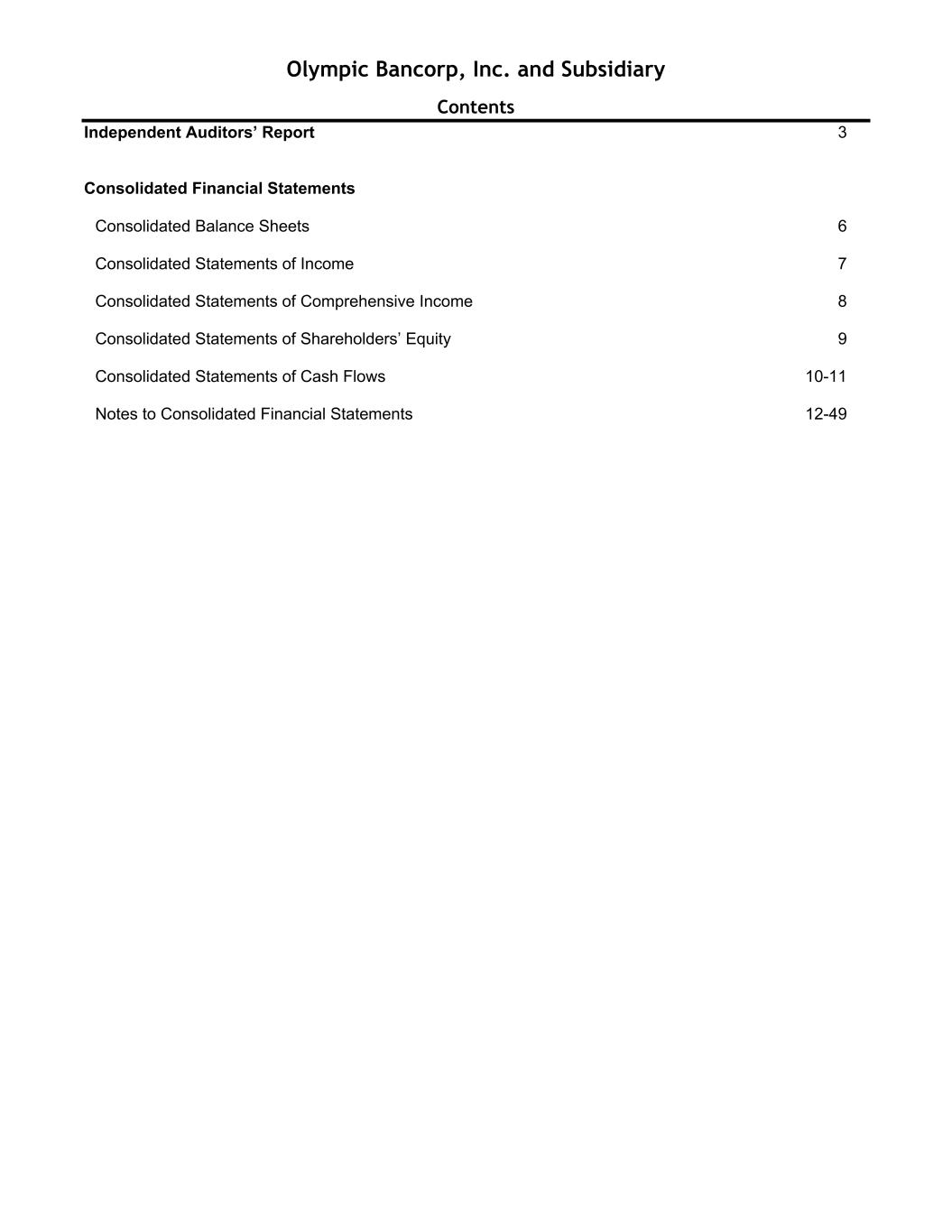
Olympic Bancorp, Inc. and Subsidiary Contents Independent Auditors’ Report 3 Consolidated Financial Statements Consolidated Balance Sheets 6 Consolidated Statements of Income 7 Consolidated Statements of Comprehensive Income 8 Consolidated Statements of Shareholders’ Equity 9 Consolidated Statements of Cash Flows 10-11 Notes to Consolidated Financial Statements 12-49
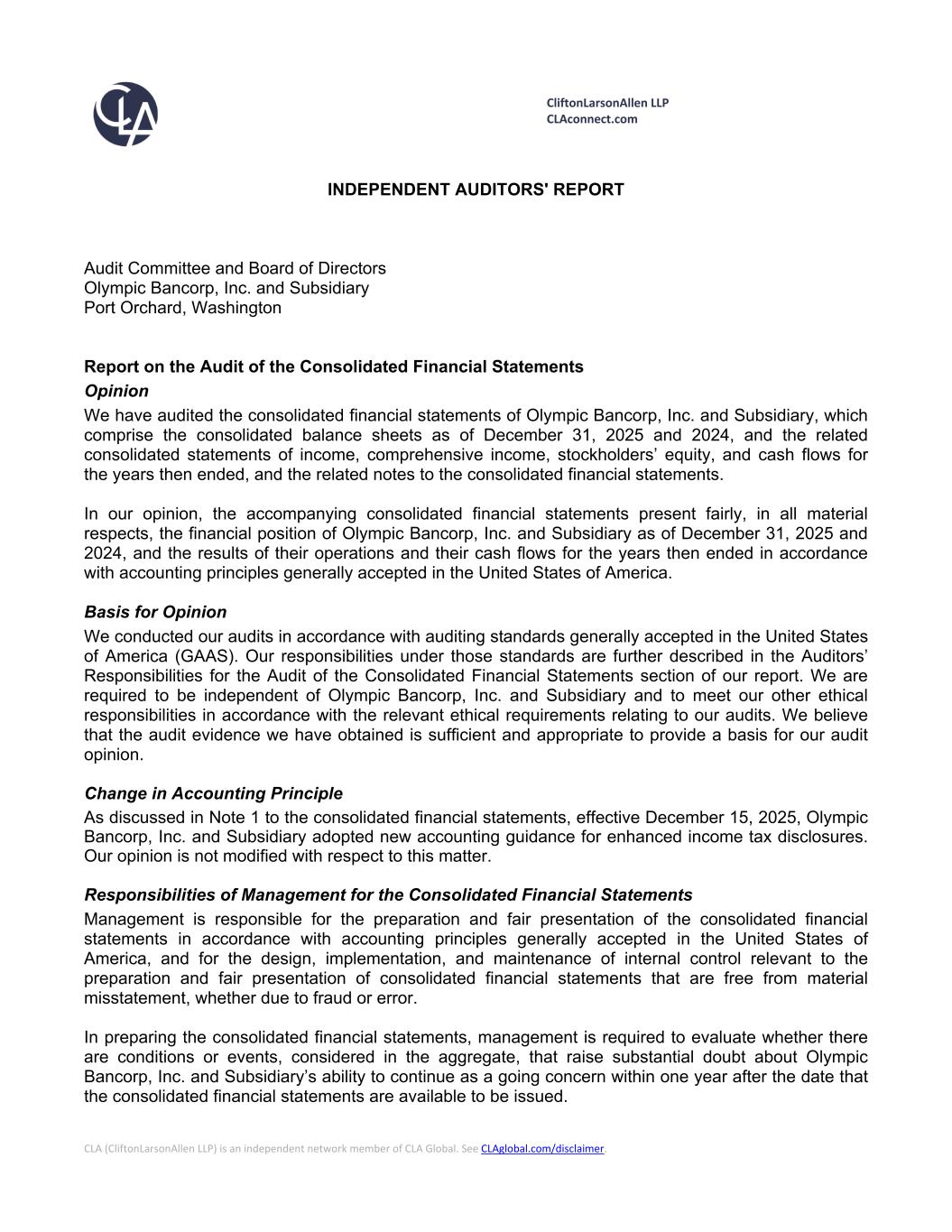
CLA (CliftonLarsonAllen LLP) is an independent network member of CLA Global. See CLAglobal.com/disclaimer. CliftonLarsonAllen LLP CLAconnect.com INDEPENDENT AUDITORS' REPORT Audit Committee and Board of Directors Olympic Bancorp, Inc. and Subsidiary Port Orchard, Washington Report on the Audit of the Consolidated Financial Statements Opinion We have audited the consolidated financial statements of Olympic Bancorp, Inc. and Subsidiary, which comprise the consolidated balance sheets as of December 31, 2025 and 2024, and the related consolidated statements of income, comprehensive income, stockholders’ equity, and cash flows for the years then ended, and the related notes to the consolidated financial statements. In our opinion, the accompanying consolidated financial statements present fairly, in all material respects, the financial position of Olympic Bancorp, Inc. and Subsidiary as of December 31, 2025 and 2024, and the results of their operations and their cash flows for the years then ended in accordance with accounting principles generally accepted in the United States of America. Basis for Opinion We conducted our audits in accordance with auditing standards generally accepted in the United States of America (GAAS). Our responsibilities under those standards are further described in the Auditors’ Responsibilities for the Audit of the Consolidated Financial Statements section of our report. We are required to be independent of Olympic Bancorp, Inc. and Subsidiary and to meet our other ethical responsibilities in accordance with the relevant ethical requirements relating to our audits. We believe that the audit evidence we have obtained is sufficient and appropriate to provide a basis for our audit opinion. Change in Accounting Principle As discussed in Note 1 to the consolidated financial statements, effective December 15, 2025, Olympic Bancorp, Inc. and Subsidiary adopted new accounting guidance for enhanced income tax disclosures. Our opinion is not modified with respect to this matter. Responsibilities of Management for the Consolidated Financial Statements Management is responsible for the preparation and fair presentation of the consolidated financial statements in accordance with accounting principles generally accepted in the United States of America, and for the design, implementation, and maintenance of internal control relevant to the preparation and fair presentation of consolidated financial statements that are free from material misstatement, whether due to fraud or error. In preparing the consolidated financial statements, management is required to evaluate whether there are conditions or events, considered in the aggregate, that raise substantial doubt about Olympic Bancorp, Inc. and Subsidiary’s ability to continue as a going concern within one year after the date that the consolidated financial statements are available to be issued.
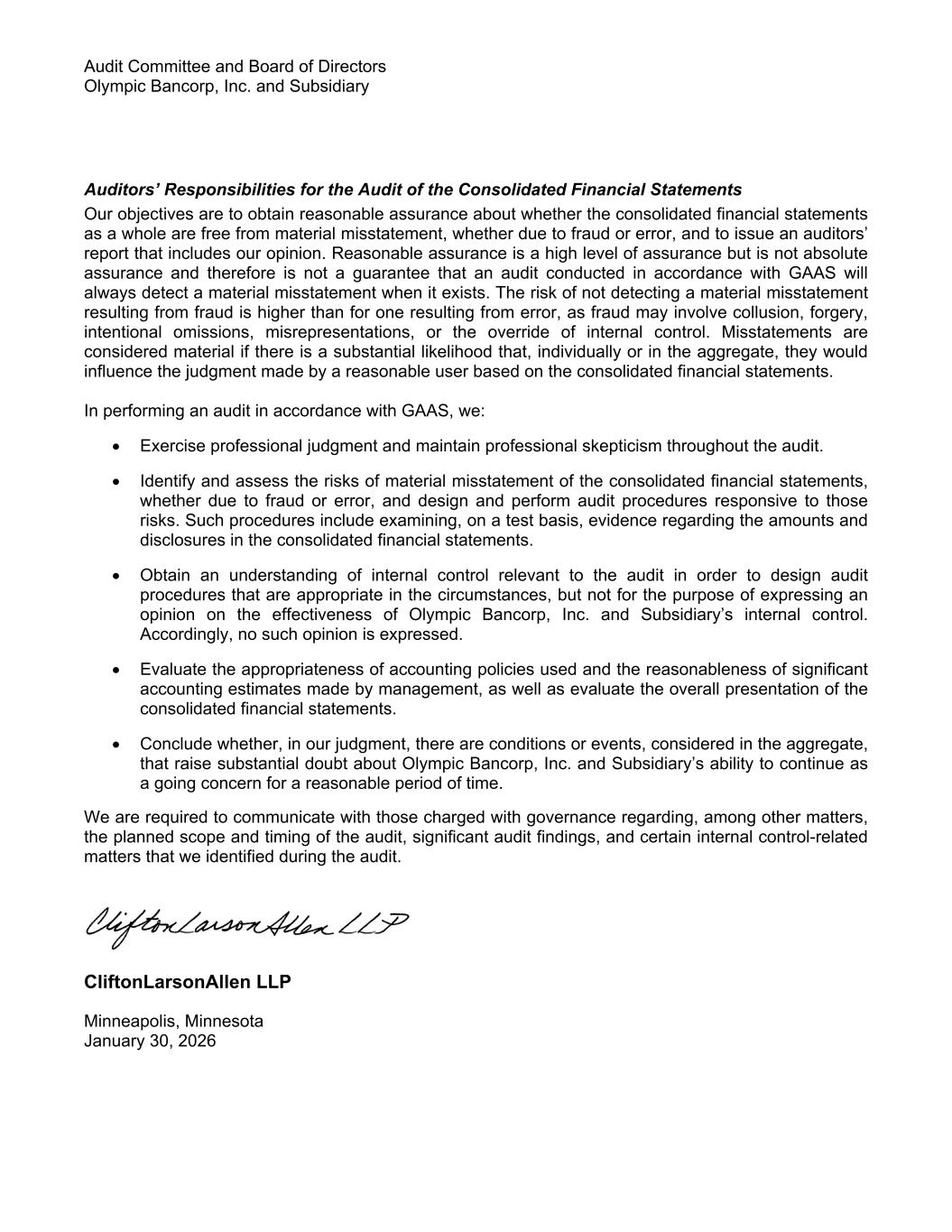
Audit Committee and Board of Directors Olympic Bancorp, Inc. and Subsidiary Auditors’ Responsibilities for the Audit of the Consolidated Financial Statements Our objectives are to obtain reasonable assurance about whether the consolidated financial statements as a whole are free from material misstatement, whether due to fraud or error, and to issue an auditors’ report that includes our opinion. Reasonable assurance is a high level of assurance but is not absolute assurance and therefore is not a guarantee that an audit conducted in accordance with GAAS will always detect a material misstatement when it exists. The risk of not detecting a material misstatement resulting from fraud is higher than for one resulting from error, as fraud may involve collusion, forgery, intentional omissions, misrepresentations, or the override of internal control. Misstatements are considered material if there is a substantial likelihood that, individually or in the aggregate, they would influence the judgment made by a reasonable user based on the consolidated financial statements. In performing an audit in accordance with GAAS, we: Exercise professional judgment and maintain professional skepticism throughout the audit. Identify and assess the risks of material misstatement of the consolidated financial statements, whether due to fraud or error, and design and perform audit procedures responsive to those risks. Such procedures include examining, on a test basis, evidence regarding the amounts and disclosures in the consolidated financial statements. Obtain an understanding of internal control relevant to the audit in order to design audit procedures that are appropriate in the circumstances, but not for the purpose of expressing an opinion on the effectiveness of Olympic Bancorp, Inc. and Subsidiary’s internal control. Accordingly, no such opinion is expressed. Evaluate the appropriateness of accounting policies used and the reasonableness of significant accounting estimates made by management, as well as evaluate the overall presentation of the consolidated financial statements. Conclude whether, in our judgment, there are conditions or events, considered in the aggregate, that raise substantial doubt about Olympic Bancorp, Inc. and Subsidiary’s ability to continue as a going concern for a reasonable period of time. We are required to communicate with those charged with governance regarding, among other matters, the planned scope and timing of the audit, significant audit findings, and certain internal control-related matters that we identified during the audit. CliftonLarsonAllen LLP Minneapolis, Minnesota January 30, 2026

Consolidated Financial Statements
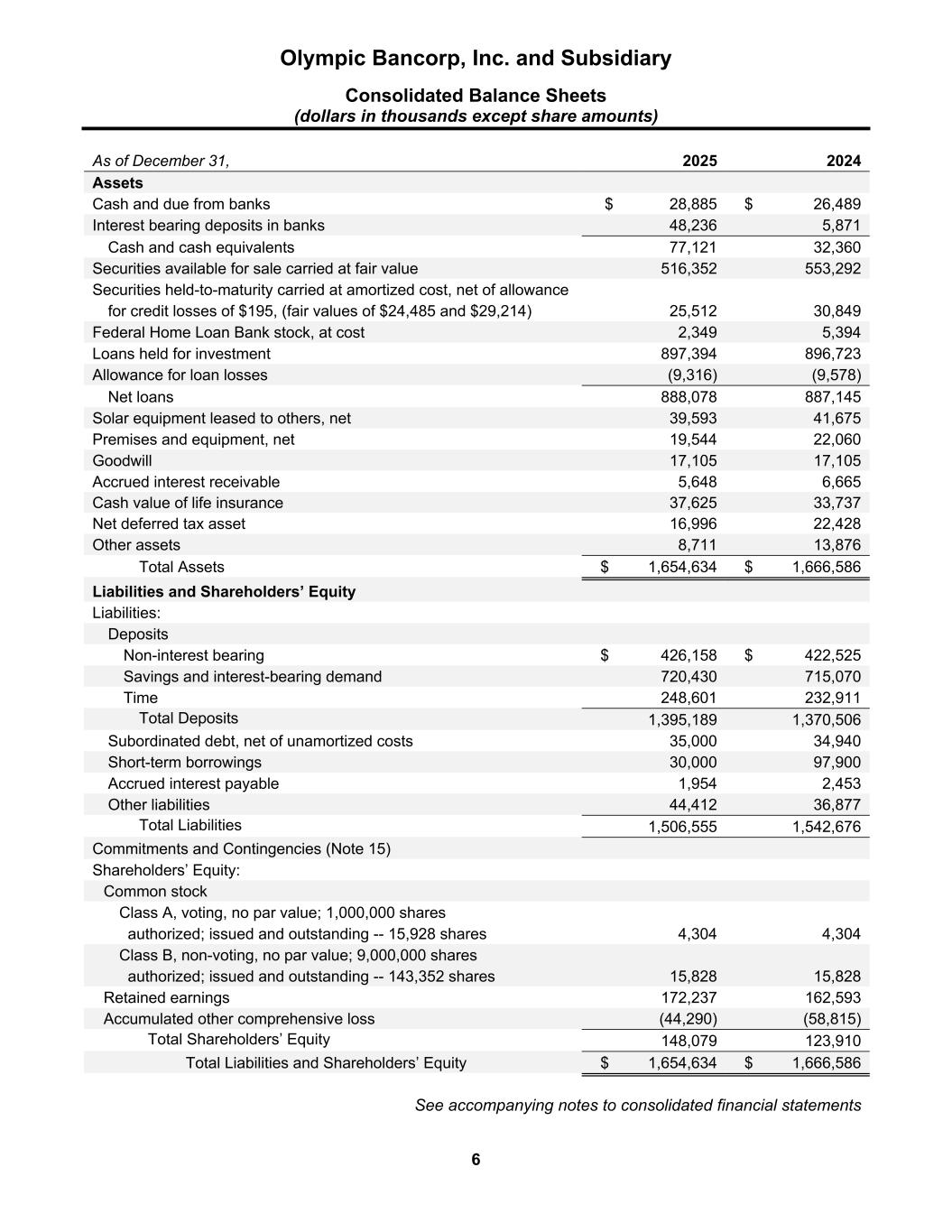
Olympic Bancorp, Inc. and Subsidiary Consolidated Balance Sheets (dollars in thousands except share amounts) 6 As of December 31, 2025 2024 Assets Cash and due from banks $ 28,885 $ 26,489 Interest bearing deposits in banks 48,236 5,871 Cash and cash equivalents 77,121 32,360 Securities available for sale carried at fair value 516,352 553,292 Securities held-to-maturity carried at amortized cost, net of allowance for credit losses of $195, (fair values of $24,485 and $29,214) 25,512 30,849 Federal Home Loan Bank stock, at cost 2,349 5,394 Loans held for investment 897,394 896,723 Allowance for loan losses (9,316) (9,578) Net loans 888,078 887,145 Solar equipment leased to others, net 39,593 41,675 Premises and equipment, net 19,544 22,060 Goodwill 17,105 17,105 Accrued interest receivable 5,648 6,665 Cash value of life insurance 37,625 33,737 Net deferred tax asset 16,996 22,428 Other assets 8,711 13,876 Total Assets $ 1,654,634 $ 1,666,586 Liabilities and Shareholders’ Equity Liabilities: Deposits Non-interest bearing $ 426,158 $ 422,525 Savings and interest-bearing demand 720,430 715,070 Time 248,601 232,911 Total Deposits 1,395,189 1,370,506 Subordinated debt, net of unamortized costs 35,000 34,940 Short-term borrowings 30,000 97,900 Accrued interest payable 1,954 2,453 Other liabilities 44,412 36,877 Total Liabilities 1,506,555 1,542,676 Commitments and Contingencies (Note 15) Shareholders’ Equity: Common stock Class A, voting, no par value; 1,000,000 shares authorized; issued and outstanding -- 15,928 shares 4,304 4,304 Class B, non-voting, no par value; 9,000,000 shares authorized; issued and outstanding -- 143,352 shares 15,828 15,828 Retained earnings 172,237 162,593 Accumulated other comprehensive loss (44,290) (58,815) Total Shareholders’ Equity 148,079 123,910 Total Liabilities and Shareholders’ Equity $ 1,654,634 $ 1,666,586 See accompanying notes to consolidated financial statements
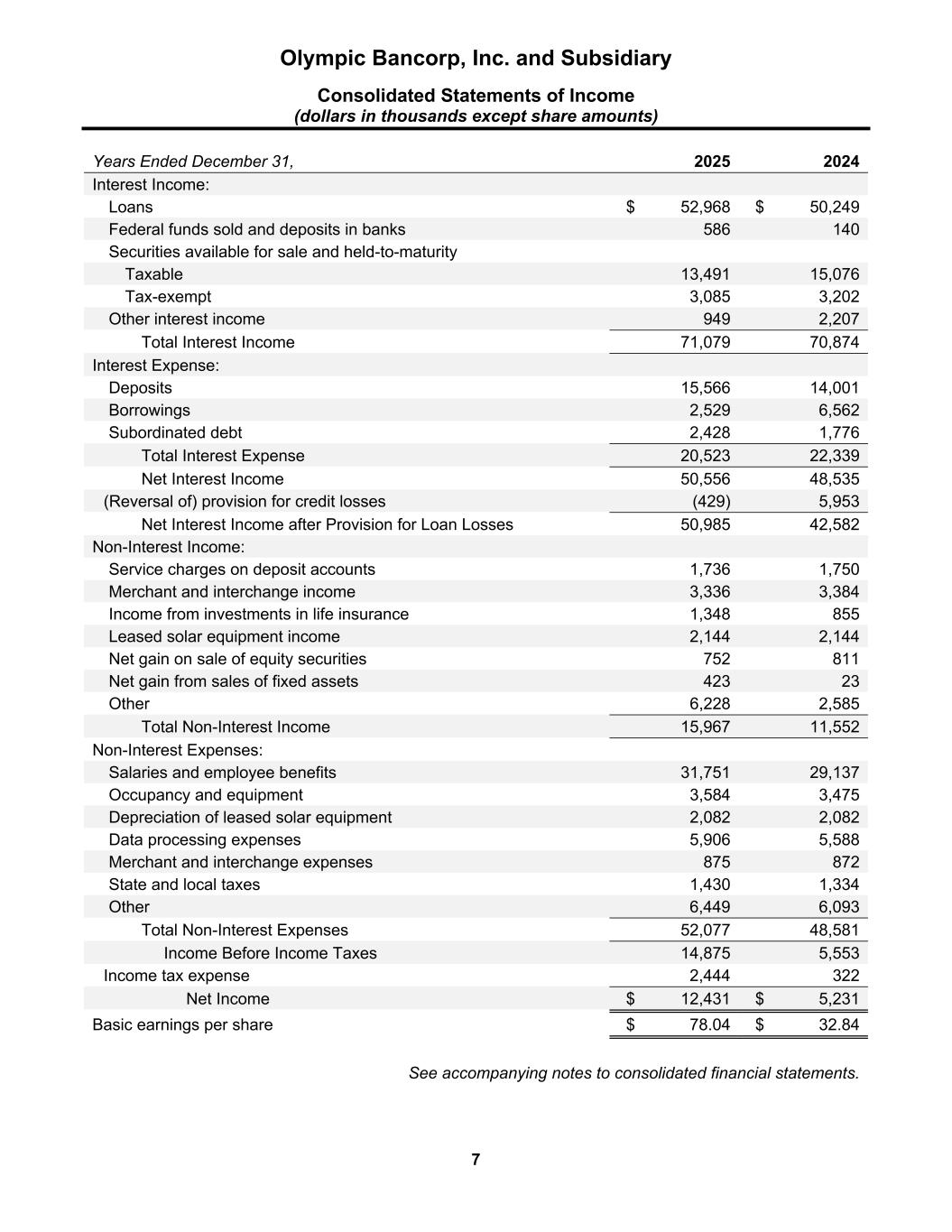
Olympic Bancorp, Inc. and Subsidiary Consolidated Statements of Income (dollars in thousands except share amounts) 7 Years Ended December 31, 2025 2024 Interest Income: Loans $ 52,968 $ 50,249 Federal funds sold and deposits in banks 586 140 Securities available for sale and held-to-maturity Taxable 13,491 15,076 Tax-exempt 3,085 3,202 Other interest income 949 2,207 Total Interest Income 71,079 70,874 Interest Expense: Deposits 15,566 14,001 Borrowings 2,529 6,562 Subordinated debt 2,428 1,776 Total Interest Expense 20,523 22,339 Net Interest Income 50,556 48,535 (Reversal of) provision for credit losses (429) 5,953 Net Interest Income after Provision for Loan Losses 50,985 42,582 Non-Interest Income: Service charges on deposit accounts 1,736 1,750 Merchant and interchange income 3,336 3,384 Income from investments in life insurance 1,348 855 Leased solar equipment income 2,144 2,144 Net gain on sale of equity securities 752 811 Net gain from sales of fixed assets 423 23 Other 6,228 2,585 Total Non-Interest Income 15,967 11,552 Non-Interest Expenses: Salaries and employee benefits 31,751 29,137 Occupancy and equipment 3,584 3,475 Depreciation of leased solar equipment 2,082 2,082 Data processing expenses 5,906 5,588 Merchant and interchange expenses 875 872 State and local taxes 1,430 1,334 Other 6,449 6,093 Total Non-Interest Expenses 52,077 48,581 Income Before Income Taxes 14,875 5,553 Income tax expense 2,444 322 Net Income $ 12,431 $ 5,231 Basic earnings per share $ 78.04 $ 32.84 See accompanying notes to consolidated financial statements.
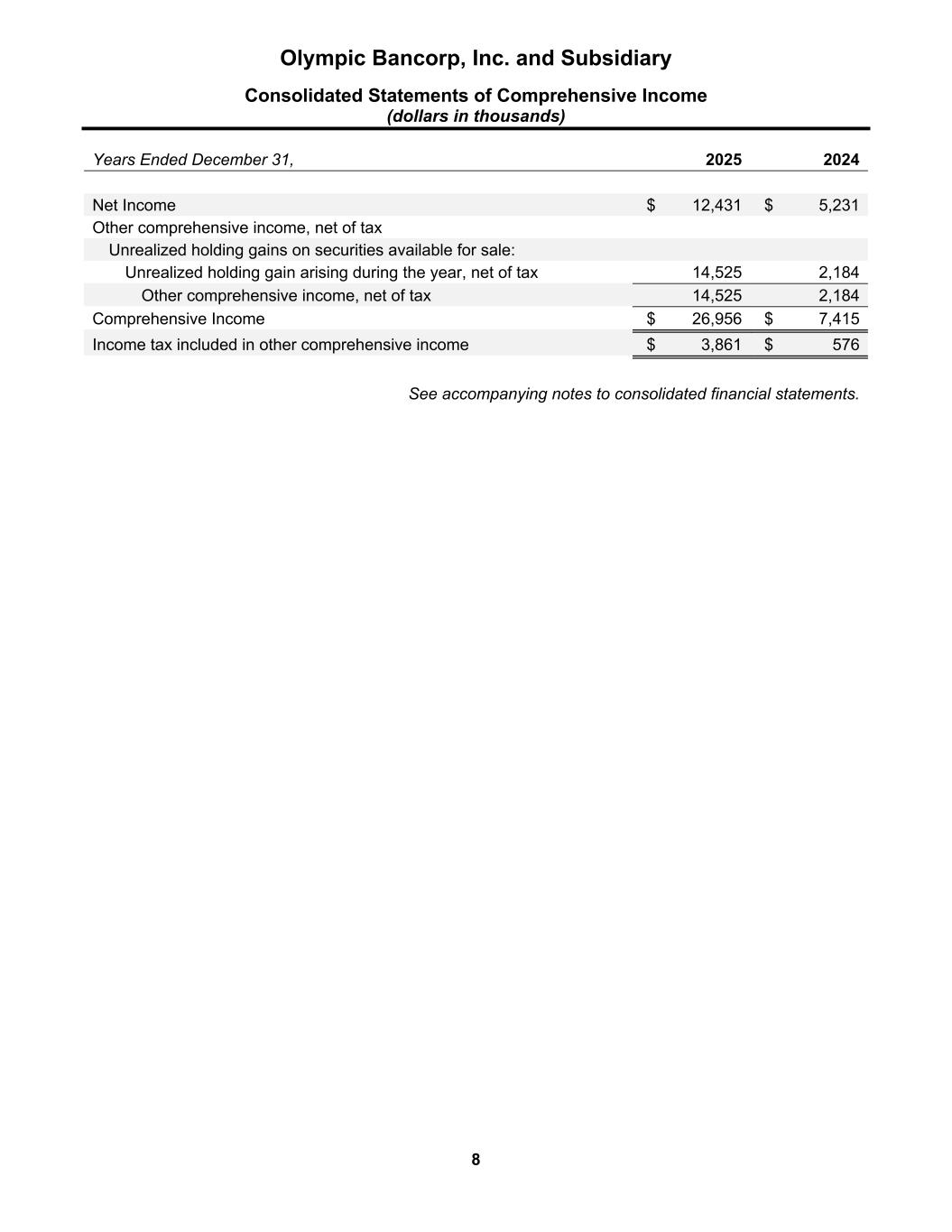
Olympic Bancorp, Inc. and Subsidiary Consolidated Statements of Comprehensive Income (dollars in thousands) 8 Years Ended December 31, 2025 2024 Net Income $ 12,431 $ 5,231 Other comprehensive income, net of tax Unrealized holding gains on securities available for sale: Unrealized holding gain arising during the year, net of tax 14,525 2,184 Other comprehensive income, net of tax 14,525 2,184 Comprehensive Income $ 26,956 $ 7,415 Income tax included in other comprehensive income $ 3,861 $ 576 See accompanying notes to consolidated financial statements.
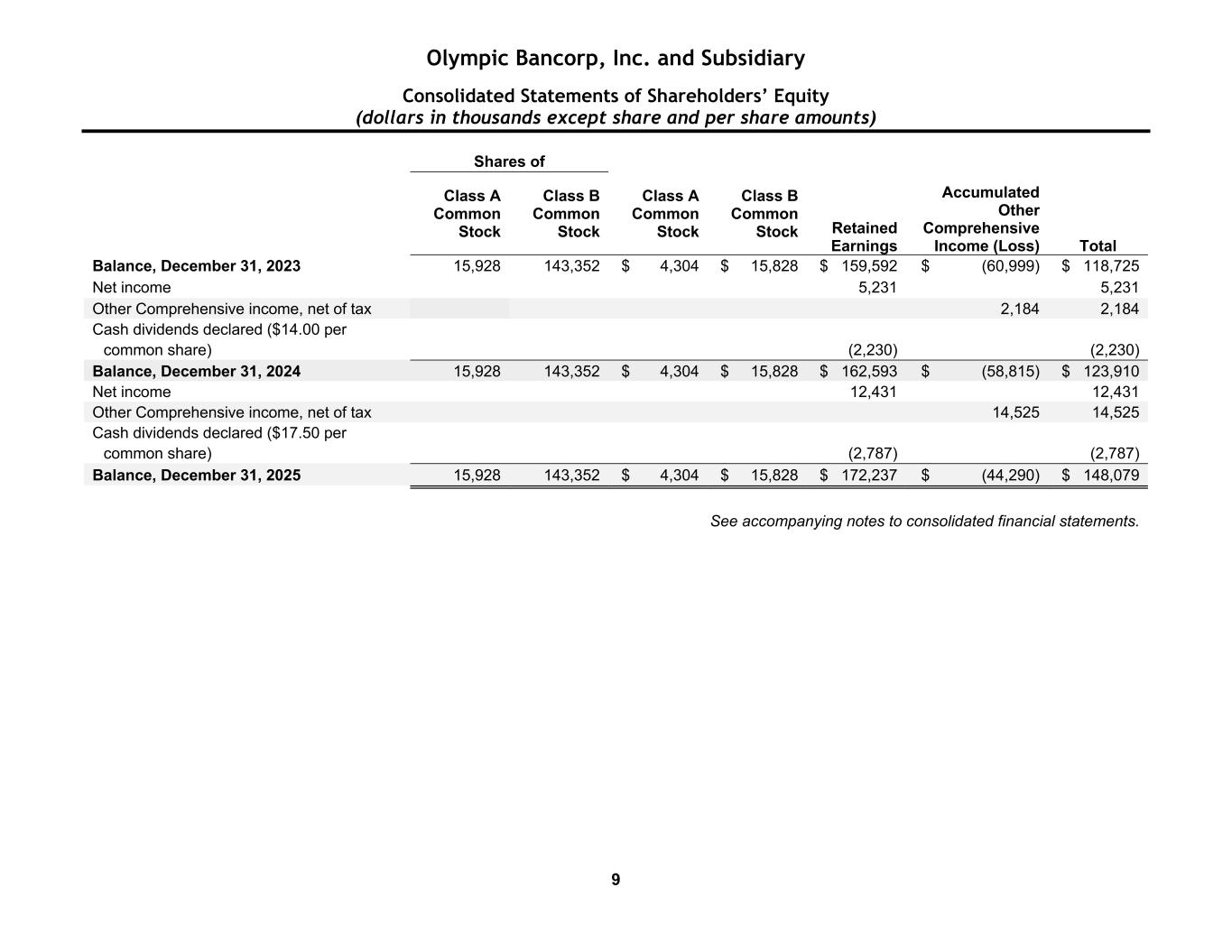
Olympic Bancorp, Inc. and Subsidiary Consolidated Statements of Shareholders’ Equity (dollars in thousands except share and per share amounts) 9 Shares of Class A Common Stock Class B Common Stock Class A Common Stock Class B Common Stock Retained Earnings Accumulated Other Comprehensive Income (Loss) Total Balance, December 31, 2023 15,928 143,352 $ 4,304 $ 15,828 $ 159,592 $ (60,999) $ 118,725 Net income 5,231 5,231 Other Comprehensive income, net of tax 2,184 2,184 Cash dividends declared ($14.00 per common share) (2,230) (2,230) Balance, December 31, 2024 15,928 143,352 $ 4,304 $ 15,828 $ 162,593 $ (58,815) $ 123,910 Net income 12,431 12,431 Other Comprehensive income, net of tax 14,525 14,525 Cash dividends declared ($17.50 per common share) (2,787) (2,787) Balance, December 31, 2025 15,928 143,352 $ 4,304 $ 15,828 $ 172,237 $ (44,290) $ 148,079 See accompanying notes to consolidated financial statements.
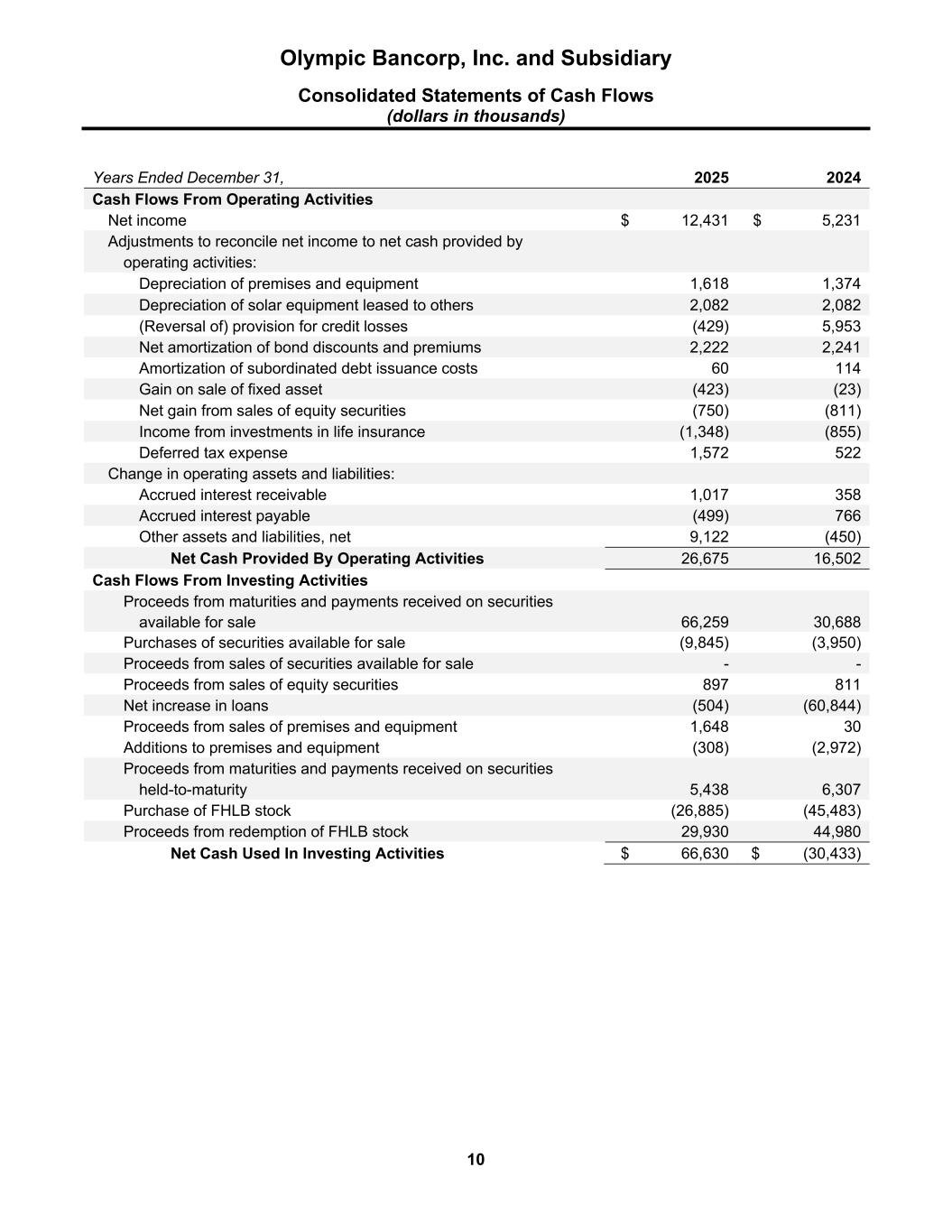
Olympic Bancorp, Inc. and Subsidiary Consolidated Statements of Cash Flows (dollars in thousands) 10 Years Ended December 31, 2025 2024 Cash Flows From Operating Activities Net income $ 12,431 $ 5,231 Adjustments to reconcile net income to net cash provided by operating activities: Depreciation of premises and equipment 1,618 1,374 Depreciation of solar equipment leased to others 2,082 2,082 (Reversal of) provision for credit losses (429) 5,953 Net amortization of bond discounts and premiums 2,222 2,241 Amortization of subordinated debt issuance costs 60 114 Gain on sale of fixed asset (423) (23) Net gain from sales of equity securities (750) (811) Income from investments in life insurance (1,348) (855) Deferred tax expense 1,572 522 Change in operating assets and liabilities: Accrued interest receivable 1,017 358 Accrued interest payable (499) 766 Other assets and liabilities, net 9,122 (450) Net Cash Provided By Operating Activities 26,675 16,502 Cash Flows From Investing Activities Proceeds from maturities and payments received on securities available for sale 66,259 30,688 Purchases of securities available for sale (9,845) (3,950) Proceeds from sales of securities available for sale - - Proceeds from sales of equity securities 897 811 Net increase in loans (504) (60,844) Proceeds from sales of premises and equipment 1,648 30 Additions to premises and equipment (308) (2,972) Proceeds from maturities and payments received on securities held-to-maturity 5,438 6,307 Purchase of FHLB stock (26,885) (45,483) Proceeds from redemption of FHLB stock 29,930 44,980 Net Cash Used In Investing Activities $ 66,630 $ (30,433)
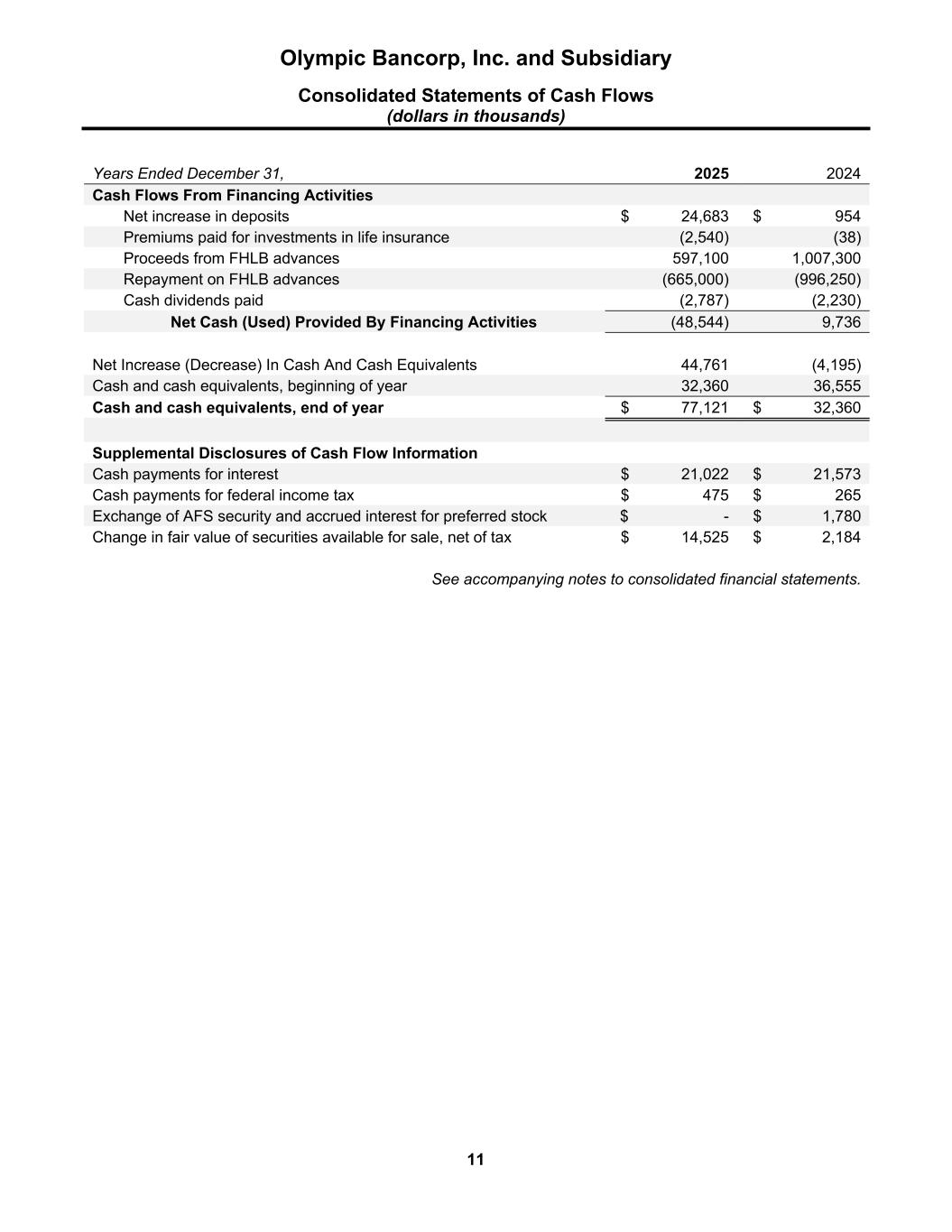
Olympic Bancorp, Inc. and Subsidiary Consolidated Statements of Cash Flows (dollars in thousands) 11 Years Ended December 31, 2025 2024 Cash Flows From Financing Activities Net increase in deposits $ 24,683 $ 954 Premiums paid for investments in life insurance (2,540) (38) Proceeds from FHLB advances 597,100 1,007,300 Repayment on FHLB advances (665,000) (996,250) Cash dividends paid (2,787) (2,230) Net Cash (Used) Provided By Financing Activities (48,544) 9,736 Net Increase (Decrease) In Cash And Cash Equivalents 44,761 (4,195) Cash and cash equivalents, beginning of year 32,360 36,555 Cash and cash equivalents, end of year $ 77,121 $ 32,360 Supplemental Disclosures of Cash Flow Information Cash payments for interest $ 21,022 $ 21,573 Cash payments for federal income tax $ 475 $ 265 Exchange of AFS security and accrued interest for preferred stock $ - $ 1,780 Change in fair value of securities available for sale, net of tax $ 14,525 $ 2,184 See accompanying notes to consolidated financial statements.
Olympic Bancorp, Inc. and Subsidiary Notes to Consolidated Financial Statements 12 1. Nature of Operations and Summary of Significant Accounting Policies Nature of Operations Olympic Bancorp, Inc. (the Company) provides commercial banking services in Washington State through its wholly owned subsidiary, Kitsap Bank (the Bank). The Bank operates under a state bank charter and provides full banking services. As a state bank, the Bank is subject to regulation by the Washington State Department of Financial Institutions and the Federal Deposit Insurance Corporation. The Bank operates sixteen branches and two loan production offices in Kitsap, Pierce, Clallam, Jefferson, King, and Mason Counties. The Bank provides loan and deposit services to customers, who are predominately small and middle market businesses, individuals, and municipalities in western Washington. On December 29, 2025, the Company announced that it had received all necessary regulatory approvals to complete the previously announced merger with Heritage Financial Corporation (Nasdaq: HFWA). The merger is expected to be effective as of January 31, 2026, subject to the satisfaction of remaining customary closing conditions. Upon completion, the separate corporate existence of the Company will cease. Principles of Consolidation The consolidated financial statements include the accounts of the Company and its wholly owned subsidiary Kitsap Bank. All significant intercompany transactions and balances have been eliminated. Consolidated Financial Statement Presentation The consolidated financial statements have been prepared in accordance with accounting principles generally accepted in the United States of America (GAAP) and practices within the banking industry. In preparing the consolidated financial statements, management is required to make estimates and assumptions that affect the reported amounts of assets and liabilities and disclosures of contingent assets and liabilities as of the date of the balance sheet, and revenues and expenses for the period. Actual results could differ significantly from those estimates. Material estimates that are particularly susceptible to significant change relate to the determination of the allowance for credit losses, the valuation of goodwill, and the fair value of financial instruments. Cash and Cash Equivalents and Cash Flows Cash and Cash Equivalents include cash on hand, amounts due from banks, including cash items in the process of clearing, and interest-bearing balances due from correspondent banks and the Federal Reserve Bank. Cash flows from loans, deposits, and short-term borrowings are reported net. The Company maintains its cash in depository institutions, which, at times, may exceed federally insured limits. The Company has not experienced losses in such accounts. Securities Debt securities that management has the positive intent and ability to hold to maturity are classified as held- to-maturity debt securities and reported at amortized cost, net of allowance for credit losses. Debt securities available for sale consist of debt securities that the Company intends to hold for an indefinite period, but not necessarily to maturity. Such debt securities may be sold to implement the Company’s asset/liability management strategies and in response to changes in interest rates and similar factors. Debt securities available for sale are reported at fair value. Unrealized gains and losses are reported in a separate component of shareholders' equity entitled “accumulated other comprehensive loss.” Realized gains and losses on securities available for sale, determined using the specific identification method, are included in earnings. The amortization of premiums and accretion of discounts are recognized in interest income using methods approximating the interest method over the period to maturity. For callable debt securities purchased at a premium, the amortization period is shortened to the earliest call date.
Olympic Bancorp, Inc. and Subsidiary Notes to Consolidated Financial Statements 13 Equity securities held by the Company are measured at fair value, with changes in fair value recognized in earnings. Federal Home Loan Bank Stock At December 31, 2025 and 2024, the Company held $2,349,000 and $5,394,000 of common stock in the FHLB of Des Moines, respectively. This security is reported at par value, which represents the Company’s cost. Ownership of FHLB stock is restricted to the FHLB and member institutions, and can only be purchased and redeemed at par. Management periodically evaluates FHLB stock for impairment. Management’s determination of whether these investments are impaired is based on their assessment of the ultimate recoverability of cost rather than by recognizing temporary declines in value. The determination of whether a decline affects the ultimate recoverability of cost is influenced by criteria such as: (i) the significance of any decline in net assets of the FHLB as compared to the capital stock amount for the FHLB and the length of time this situation has persisted, (ii) commitment by the FHLB to make payments required by law or regulation and the level of such payments in relation to the operating performance of the FHLB, (iii) the impact of legislative and regulatory changes on institutions and, accordingly, the customer base of the FHLB, and (iv) the liquidity position of the FHLB. Management has determined there is no impairment on its FHLB stock as of December 31, 2025 or 2024. Transfers of Financial Assets Transfers of financial assets are accounted for as sales only when control over the assets has been surrendered. Control over transferred assets is deemed to be surrendered when: (i) the assets have been isolated from the Company, (ii) the transferee obtains the right (free of conditions that constrain it from taking advantage of that right) to pledge or exchange the transferred assets, and (iii) the Company does not maintain effective control over the transferred assets through an agreement to repurchase them before their maturity. In addition, for transfers of a portion of financial assets (for example, participations of loan receivables), the transfer must meet the definition of a ‘participating interest’ in order to account for the transfer as a sale. Following are the characteristics of a ‘participating interest’: • Pro-rata ownership in an entire financial asset. • From the date of the transfer, all cash flows received from entire financial assets, except any cash flows allocated for servicing, are divided proportionately among the participating interest holders in an amount equal to their share of ownership. • The rights of each participating interest holder have the same priority, and no participating interest holder’s interest is subordinated to the interest of another participating interest holder. • No party has the right to pledge or exchange the entire financial asset unless all participating interest holders agree to pledge or exchange the entire financial asset. Loans Loans receivable that management has the intent and ability to hold for the foreseeable future or until maturity or payoff are reported at their outstanding principal balances adjusted for any charge-offs, the allowance for credit losses on loans, and any deferred fees or costs on originated loans, and unamortized premiums or discounts on purchased loans. Loan fees and certain direct loan origination costs are deferred, and the net fee or cost is recognized as an adjustment to interest income using the effective interest method or straight- line method. Interest income on loans is accrued daily over the term of the loans based upon the principal outstanding. The accrual of interest on loans is discontinued when, in management's opinion, the borrower may be unable to meet payments as they become due as well as when required by regulatory provision. Past due status is
Olympic Bancorp, Inc. and Subsidiary Notes to Consolidated Financial Statements 14 based on contractual terms of loans. When interest accrual is discontinued, all unpaid accrued interest is reversed against interest income. Loans are returned to accrual status when all the principal and interest amounts contractually due are brought current, the borrower has demonstrated a period of sustained performance, and future payments are reasonably assured. Allowance for Credit Losses Held-to-maturity Debt Securities The Company maintains an allowance for credit losses (ACL) for HTM debt securities to recognize potential future losses due to credit risk. The allowance is established on a collective basis by major security type based on historical experience, current market conditions, and reasonable and supportable forecasts. The ACL is a valuation allowance deducted from the amortized cost of the debt securities to present the net carrying amount at the amount expected to be collected. Factors considered in the estimation of the allowance include historical industry default and loss rates, industry trends, economic conditions, and specific borrower or issuer considerations. Management performs regular assessments of the ACL, adjusting the allowance as necessary to reflect changes in credit risk and market conditions. When available information confirms that specific HTM debt securities or portions thereof are uncollectible, the identified amounts are charged against the ACL. HTM debt securities will be placed on non-accrual status if the Company does not reasonably expect to receive interest payments in the future and interest accrued will be reversed against interest income. HTM debt securities will be returned to accrual status only when collection of interest is reasonably assured. Available-for-sale Debt Securities For available-for-sale debt securities in an unrealized loss position, the Company first assesses whether it intends to sell, or it is more likely than not that it will be required to sell the debt security before recovery of its amortized cost basis. If either of the criteria regarding intent or requirement to sell is met, the debt security’s amortized cost basis is written down to fair value through income. For debt securities available-for-sale that do not meet the aforementioned criteria, the Company evaluates whether the decline in fair value has resulted from credit losses or other factors. In making this assessment, management considers the extent to which fair value is less than amortized cost, any changes to the rating of the debt security by a rating agency, and adverse conditions specifically related to the debt security, among other factors. If this assessment indicates that a credit loss exists, the present value of cash flows expected to be collected is less than the amortized cost basis, a credit loss exists and an allowance for credit losses is recorded for the credit loss, limited by the amount that the fair value is less than the amortized cost basis. Any impairment that has not been recorded through an allowance for credit losses is recognized in other comprehensive income. Changes in the allowance for credit losses are recorded as a credit loss expense or reversal. Losses are charged against the allowance when management believes the uncollectibility of an available-for-sale debt security is confirmed. Loans The ACL on loans is a valuation account that is deducted from the amortized cost basis of loans to present the net amount expected to be collected. The ACL is adjusted through the provision for credit losses to the amount of amortized cost basis not expected to be collected at the balance sheet date. The measurement of expected credit losses encompasses information about historical events, current conditions and reasonable and supportable forecasts. Determining the amount of the ACL is complex and requires extensive judgment by management about matters that are inherently uncertain. Re-evaluation of
Olympic Bancorp, Inc. and Subsidiary Notes to Consolidated Financial Statements 15 the ACL estimate in future periods, in light of changes in composition and characteristics of the loan portfolio, changes in the reasonable and supportable forecast and other factors then prevailing may result in material changes in the amount of the ACL and credit loss expense in those future periods. When available information confirms that specific loans or portions thereof are uncollectible, the identified amounts are charged against the ACL. The existence of some or all of the following criteria will generally confirm that a loss has been incurred: the loan is significantly delinquent and the borrower has not demonstrated the ability or intent to bring the loan current; the Company has no recourse to the borrower, or if it does, the borrower has insufficient assets to pay the debt; the estimated fair value of the loan collateral is significantly below the current loan balance; and there is little or no near-term prospect for improvement. Expected credit losses are estimated on a collective basis for groups of loans that share similar risk characteristics. Factors that may be considered in aggregating loans for this purpose include but are not necessarily limited to, product or collateral type, geography, and internal risk ratings. For loans that do not share similar risk characteristics with other loans such as collateral dependent loans, expected credit losses are estimated on an individual basis. Collateral Dependent Loans Collateral dependent loans are those for which the borrower is experiencing financial difficulty and repayment is potentially expected to be provided substantially through the operation or sale of the collateral. These loans do not typically share similar risk characteristics with other loans and expected credit losses are evaluated on an individual basis. Loans evaluated individually are not included in the collective evaluation. When repayment depends on sale of the collateral, expected losses are based on the fair value of the collateral at the reporting date and adjusted for selling costs as appropriate. Unfunded Commitments Expected credit losses related to off-balance sheet credit exposures are estimated over the contractual period for which the Company is exposed to credit risk via a contractual obligation to extend credit, unless that obligation is unconditionally cancellable by the Company. Expected credit losses are estimated using essentially the same methodologies employed to estimate expected credit losses on the amortized cost basis of loans, taking into consideration the likelihood and amount of additional amounts expected to be funded over the terms of the commitments. The liability for credit losses on off-balance sheet credit exposures is presented within other liabilities l condition, distinct from the ACL. Adjustments to the liability are included in the provision for credit losses. Interest Accrued and not yet Collected Accrued interest is recorded separately on the balance sheet from loans and the allowance for credit losses. For any loans placed on non-accrual or charged off, all accrued interest not yet recognized is reversed against interest income. Additionally, the amortization of related deferred loan fees or costs is suspended. Interest for these loans is accounted for using the cash-basis or cost-recovery method until they qualify for return to accrual status. The cash-basis method is utilized when it is determined that both the principal and interest of the loan are collectible. Conversely, if there are doubts regarding the collectability of the principal and interest, payments are applied to reduce the loan principal. The decision on the ultimate collectability of the loan is supported by a current and thoroughly documented credit evaluation of the borrower's financial condition. This evaluation includes an assessment of the borrower's historical repayment performance and other relevant factors influencing their prospects for repayment. Loans are reinstated to accrual status when all contractual principal and interest payments are brought up to date, the borrower has demonstrated a sustained period of performance, and future payments are deemed reasonably assured.
Olympic Bancorp, Inc. and Subsidiary Notes to Consolidated Financial Statements 16 Investment in Solar Equipment Leased to Others The Company classifies new equipment purchased for the purpose of leasing such equipment to customers for renewable energy projects as operating leases. The term of each operating lease is generally 9 to 15 years. The Company retains ownership of the equipment and the associated tax benefits of such investment tax credits and accelerated depreciation. At the end of the lease term, the lessee has the option to renew the lease for two additional terms or purchase the equipment at fair market value upon lease expiration. Rental revenue from operating leases is recognized on a straight-line basis over the term of the lease. Rental equipment is recorded at cost and depreciated to an estimated residual value on a straight line-basis over the estimated useful life. The useful lives generally range from 30 to 50 years and residual values generally range from 20% to 60%, however, they are subject to periodic evaluation. Changes in useful lives or residual values will impact depreciation expense and any gain or loss from the sale of used equipment. The estimated useful lives and residual values of the Company’s leasing equipment are based on industry experience and the Company’s expectations for future sale prices. Premises and Equipment Premises and equipment are stated at cost less accumulated depreciation, which is computed on the straight- line method over the estimated useful lives of the assets. Asset lives range from three to thirty-nine years. Leasehold improvements are amortized over the terms of the respective leases or the estimated useful lives of the improvements, whichever is shorter. Assets are reviewed for impairment when events indicate that their carrying value may not be recoverable. If management determines impairment exists, the assets are reduced with an offsetting charge to expense. No impairment was recognized in 2025 or 2024. Goodwill Goodwill represents costs in excess of net assets acquired and is evaluated periodically for impairment in accordance with ASC Topic 350, “Intangibles.” The balance of goodwill was reviewed as of December 31, 2025 and 2024, and management determined that no impairment charges were necessary. Cash Value of Life Insurance The Company has purchased life insurance policies on certain key executives. Bank owned life insurance is recorded at its cash surrender value, or the amount that can be realized, if lower. Income Taxes The Company is taxed for federal income tax purposes as a corporation under Subchapter C of the Internal Revenue Code. Income tax expense is comprised of current and deferred taxes. Current income tax expense reflects taxes to be paid or refunded for the current period. Deferred income tax expense results from changes in deferred tax assets and liabilities between periods. These gross deferred tax assets and liabilities represent decreases or increases in taxes expected to be paid in the future because of future reversals of temporary differences in the bases of assets and liabilities as measured by tax laws and their bases as reported under GAAP. Deferred tax assets are also recognized for tax attributes such as net operating loss carryforwards and tax credit carryforwards. Valuation allowances, if necessary, are recorded to reduce deferred tax assets to the amounts management concludes are more likely than not to be realized. The Company has reviewed the Company’s tax positions for the open tax years (current and prior three tax years) and has concluded that no unrecognized tax position should be recognized in the Company’s consolidated financial statements.
Olympic Bancorp, Inc. and Subsidiary Notes to Consolidated Financial Statements 17 Off-Balance Sheet Financial Instruments In the ordinary course of business, the Company has entered into off-balance sheet financial instruments consisting of commitments to extend credit, commercial letters of credit, standby letters of credit, and real estate loans sold in the secondary market with limited recourse. Such financial instruments are recorded in the consolidated financial statements when they become payable. Derivatives At the inception of a derivative contract, the Company designates the derivative as one of three types based on the Company’s intentions and belief as to likely effectiveness as a hedge. These three types are (1) a hedge of fair value of a recognized asset or liability or of an unrecognized firm commitment (“fair value hedge”), (2) a hedge of a forecasted transaction or the variability of cash flows to be received or paid related to a recognized asset or liability (“cash flow hedge”), or (3) an instrument with no hedging designation (“non- designated derivative”). For a fair value hedge, the gain or loss on the derivative, as well as the offsetting loss or gain on the hedged item attributable to the hedged risk, are recognized in current earnings as fair values change. For a cash flow hedge, the gain or loss on the derivative is reported in other comprehensive income and is reclassified into earnings in the same period during which the hedged transaction affects earnings. The Company has no derivatives that are classified as “non-designated derivatives” as of December 31, 2025 and 2024. Accrued settlements on derivatives that qualify for hedge accounting are recorded in interest income or interest expense, based on the item being hedged. Cash flows on hedges are classified in the cash flow statement as the cash flows of the items being hedged. The Company formally documents the relationship between derivatives and hedged items, as well as the risk-management objective and the strategy for hedge transactions at the inception of the hedging relationship. This documentation includes linking fair value or cash flow hedges to specific assets and liabilities on the balance sheet or to specific firm commitments or forecasted transactions. The Company also formally assesses, both at the hedge’s inception and on an ongoing basis, whether the derivative instruments that are designated are highly effective in offsetting changes in fair values or cash flows of the hedged items. The Company discontinues hedge accounting when it determines the derivative is no longer effective in offsetting changes in the fair value or cash flows of the hedged item, the derivative is settled or terminates, a hedged forecasted transaction is no longer probable, hedged firm commitment is no longer firm, or treatment of the derivative as a hedge is longer appropriate or intended. When hedge accounting is discontinued, subsequent changes in fair value of the derivative are recorded as non-interest income. When a fair value hedge is discontinued, the hedged asset or liability is no longer adjusted for changes in fair value and the existing basis adjustment is amortized or accreted over the remaining life of the asset or liability. When a cash flow hedge is discontinued but the hedged cash flows or forecasted transactions are still expected to occur, gains or losses that were accumulated in other comprehensive income (loss) are amortized into earnings over the same periods which the hedged transactions will affect earnings. The Company is exposed to losses if a counterparty fails to make its payments under a contract in which the Company is in the net receiving position. The Company anticipates that the counter parties will be able to fully satisfy their obligations under the agreements. All of the contracts to which the Company is a party settle monthly, quarterly, or semi-annually. In addition, the Company obtains collateral above certain thresholds of the fair value of its derivatives for each dealer counterparty based upon their credit standing and the Company has netting agreements with the dealers with which it does business. Advertising Costs Advertising costs are expensed as incurred. Advertising expense was $216,000 and $234,000 for the years ended December 31, 2025 and 2024, respectively.
Olympic Bancorp, Inc. and Subsidiary Notes to Consolidated Financial Statements 18 Postretirement Benefit Aspects of Endorsement Split-Dollar Arrangements The Company has entered into agreements with directors, officers and select employees of the Company to pay life insurance premiums over the life of the officer. The Company accounts for the postretirement benefit aspects of endorsed split dollar arrangements in accordance with ASC Topic 715, “Compensation- Retirement Benefits”, which requires the recognition of a liability and related compensation expense for the endorsement split-dollar life insurance policies that provide a benefit to an employee that extends to post retirement periods. As the Company has agreed to maintain a split-dollar arrangement and share some portion of the death benefits of the underlying insurance policy, the postretirement cost of insurance, rather than the death benefit, is accrued. The liability for the split dollar arrangements totaled approximately $1,453,000 and $1,380,000 as of December 31, 2025 and 2024, respectively. Fair Value of Financial Instruments ASC Topic 820, “Fair Value Measurements and Disclosures,” defines fair value, establishes a framework for measuring fair value in generally accepted accounting principles, and requires certain disclosures about fair value measurements. See Note 19. In general, fair values of financial instruments are based upon quoted market prices, where available. If such quoted market prices are not available, fair value is based upon internally developed models that primarily use, as inputs, observable market-based parameters. Valuation adjustments may be made to ensure that financial instruments are recorded at fair value. These adjustments may include amounts to reflect counterparty credit quality and the Company’s creditworthiness, among other things, as well as unobservable parameters. Any such valuation adjustments are applied consistently over time. The fair value measurements establish a fair value hierarchy that prioritizes the use of inputs used in valuation methodologies into the following three levels: Level 1: Inputs to the valuation methodology are quoted prices, unadjusted, for identical assets or liabilities in active markets. A quoted price in an active market provides the most reliable evidence of fair value and shall be used to measure fair value whenever available. Level 2: Inputs to the valuation methodology include quoted prices for similar assets or liabilities in active markets; inputs to the valuation methodology include quoted prices for identical or similar assets or liabilities in markets that are not active; or inputs to the valuation methodology that are derived principally from or can be corroborated by observable market data by correlation or other means. Level 3: Inputs to the valuation methodology are unobservable and significant to the fair value measurement. Level 3 assets and liabilities include financial instruments whose value is determined using discounted cash flow methodologies, as well as instruments for which the determination of fair value requires significant management judgment or estimation. Such information, which pertains to the Company’s financial instruments, does not purport to represent the aggregate net fair value of the Company. Further, the fair value estimates are based on various assumptions, methodologies and subjective considerations, which vary widely among different financial institutions, and which are subject to change. Revenue Recognition arising from Contracts with Customers The Company recognizes revenues from contracts with customers in accordance with ASC Topic 606, Revenue from Contracts with Customers. The core principle requires an entity to recognize revenue to depict the transfer of goods or services to customers in an amount that reflects the consideration it expects to be entitled to receive in exchange for those goods or services recognized as performance obligations are satisfied.
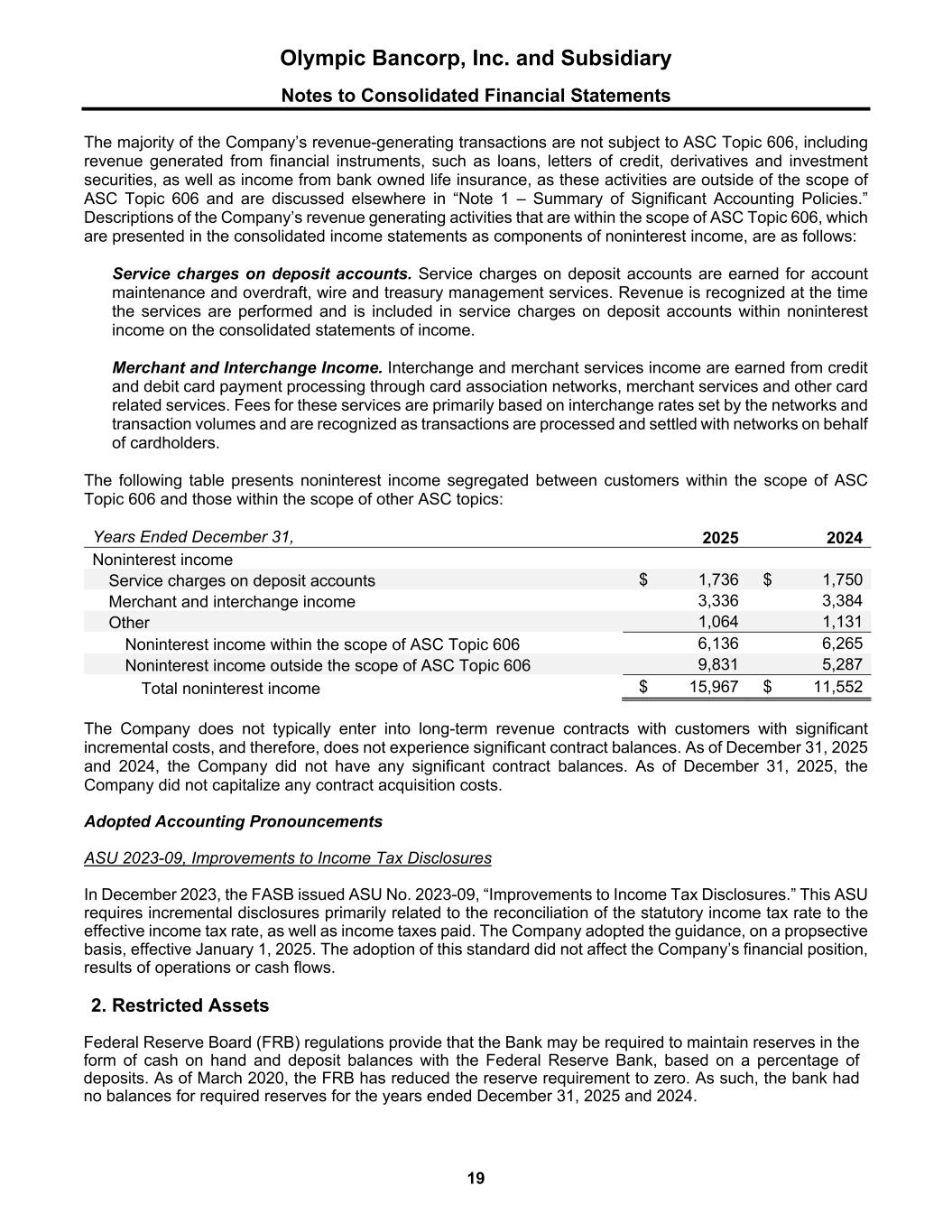
Olympic Bancorp, Inc. and Subsidiary Notes to Consolidated Financial Statements 19 The majority of the Company’s revenue-generating transactions are not subject to ASC Topic 606, including revenue generated from financial instruments, such as loans, letters of credit, derivatives and investment securities, as well as income from bank owned life insurance, as these activities are outside of the scope of ASC Topic 606 and are discussed elsewhere in “Note 1 – Summary of Significant Accounting Policies.” Descriptions of the Company’s revenue generating activities that are within the scope of ASC Topic 606, which are presented in the consolidated income statements as components of noninterest income, are as follows: Service charges on deposit accounts. Service charges on deposit accounts are earned for account maintenance and overdraft, wire and treasury management services. Revenue is recognized at the time the services are performed and is included in service charges on deposit accounts within noninterest income on the consolidated statements of income. Merchant and Interchange Income. Interchange and merchant services income are earned from credit and debit card payment processing through card association networks, merchant services and other card related services. Fees for these services are primarily based on interchange rates set by the networks and transaction volumes and are recognized as transactions are processed and settled with networks on behalf of cardholders. The following table presents noninterest income segregated between customers within the scope of ASC Topic 606 and those within the scope of other ASC topics: Years Ended December 31, 2025 2024 Noninterest income Service charges on deposit accounts $ 1,736 $ 1,750 Merchant and interchange income 3,336 3,384 Other 1,064 1,131 Noninterest income within the scope of ASC Topic 606 6,136 6,265 Noninterest income outside the scope of ASC Topic 606 9,831 5,287 Total noninterest income $ 15,967 $ 11,552 The Company does not typically enter into long-term revenue contracts with customers with significant incremental costs, and therefore, does not experience significant contract balances. As of December 31, 2025 and 2024, the Company did not have any significant contract balances. As of December 31, 2025, the Company did not capitalize any contract acquisition costs. Adopted Accounting Pronouncements ASU 2023-09, Improvements to Income Tax Disclosures In December 2023, the FASB issued ASU No. 2023-09, “Improvements to Income Tax Disclosures.” This ASU requires incremental disclosures primarily related to the reconciliation of the statutory income tax rate to the effective income tax rate, as well as income taxes paid. The Company adopted the guidance, on a propsective basis, effective January 1, 2025. The adoption of this standard did not affect the Company’s financial position, results of operations or cash flows. 2. Restricted Assets Federal Reserve Board (FRB) regulations provide that the Bank may be required to maintain reserves in the form of cash on hand and deposit balances with the Federal Reserve Bank, based on a percentage of deposits. As of March 2020, the FRB has reduced the reserve requirement to zero. As such, the bank had no balances for required reserves for the years ended December 31, 2025 and 2024.
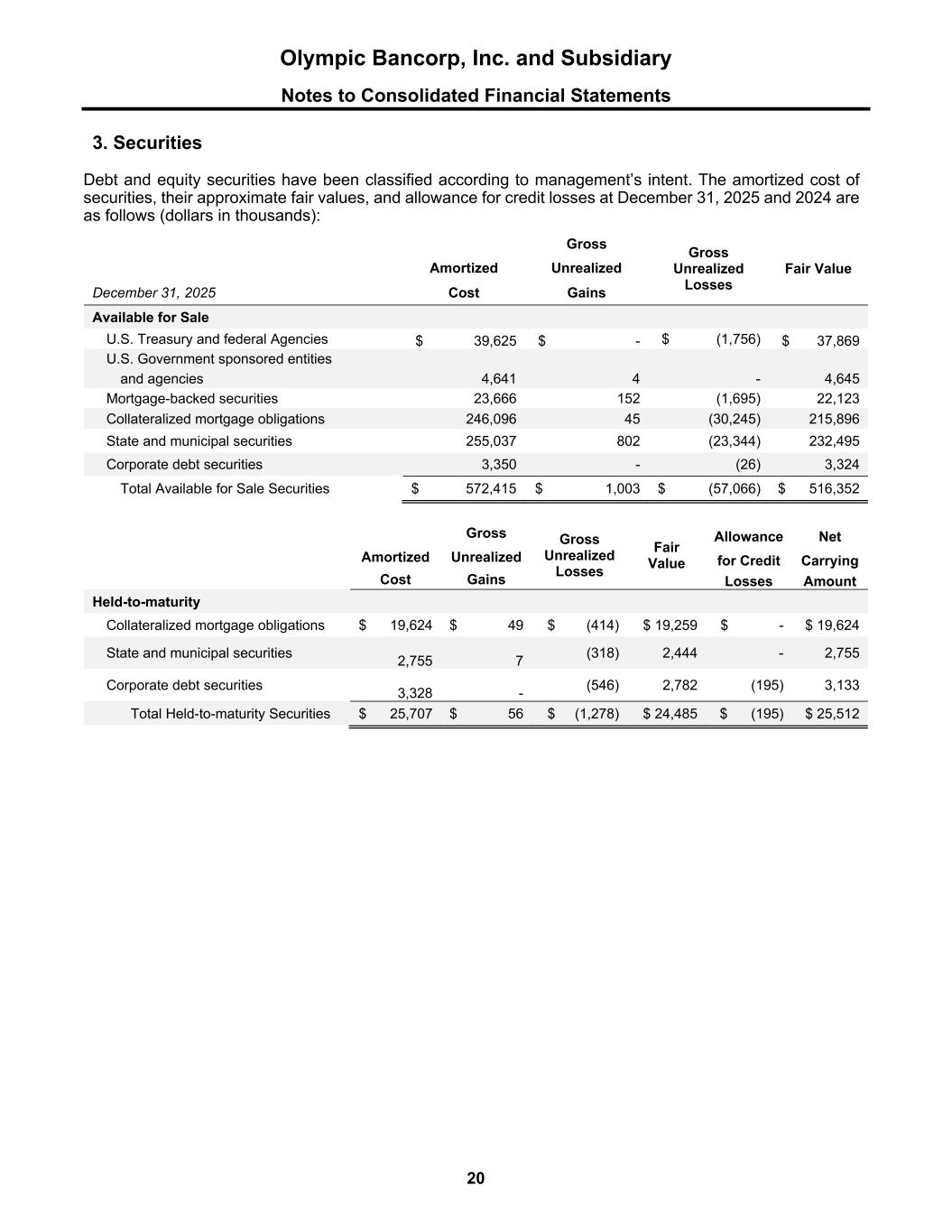
Olympic Bancorp, Inc. and Subsidiary Notes to Consolidated Financial Statements 20 3. Securities Debt and equity securities have been classified according to management’s intent. The amortized cost of securities, their approximate fair values, and allowance for credit losses at December 31, 2025 and 2024 are as follows (dollars in thousands): Gross Gross Unrealized Losses Fair Value Amortized Unrealized December 31, 2025 Cost Gains Available for Sale U.S. Treasury and federal Agencies $ 39,625 $ - $ (1,756) $ 37,869 U.S. Government sponsored entities and agencies 4,641 4 - 4,645 Mortgage-backed securities 23,666 152 (1,695) 22,123 Collateralized mortgage obligations 246,096 45 (30,245) 215,896 State and municipal securities 255,037 802 (23,344) 232,495 Corporate debt securities 3,350 - (26) 3,324 Total Available for Sale Securities $ 572,415 $ 1,003 $ (57,066) $ 516,352 Gross Gross Unrealized Losses Fair Value Allowance Net Amortized Unrealized for Credit Carrying Cost Gains Losses Amount Held-to-maturity Collateralized mortgage obligations $ 19,624 $ 49 $ (414) $ 19,259 $ - $ 19,624 State and municipal securities 2,755 7 (318) 2,444 - 2,755 Corporate debt securities 3,328 - (546) 2,782 (195) 3,133 Total Held-to-maturity Securities $ 25,707 $ 56 $ (1,278) $ 24,485 $ (195) $ 25,512
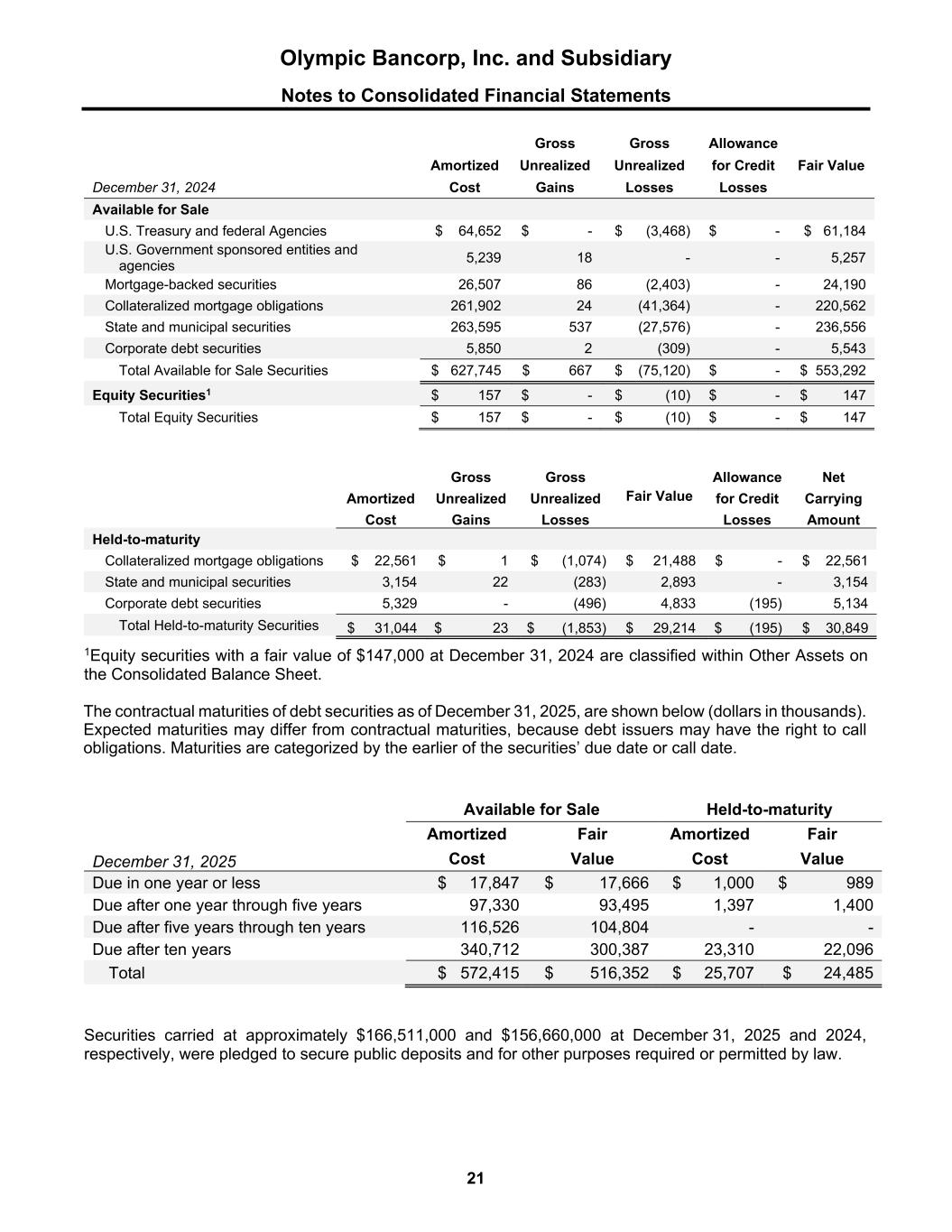
Olympic Bancorp, Inc. and Subsidiary Notes to Consolidated Financial Statements 21 Gross Gross Allowance Fair Value Amortized Unrealized Unrealized for Credit December 31, 2024 Cost Gains Losses Losses Available for Sale U.S. Treasury and federal Agencies $ 64,652 $ - $ (3,468) $ - $ 61,184 U.S. Government sponsored entities and agencies 5,239 18 - - 5,257 Mortgage-backed securities 26,507 86 (2,403) - 24,190 Collateralized mortgage obligations 261,902 24 (41,364) - 220,562 State and municipal securities 263,595 537 (27,576) - 236,556 Corporate debt securities 5,850 2 (309) - 5,543 Total Available for Sale Securities $ 627,745 $ 667 $ (75,120) $ - $ 553,292 Equity Securities1 $ 157 $ - $ (10) $ - $ 147 Total Equity Securities $ 157 $ - $ (10) $ - $ 147 Gross Gross Fair Value Allowance Net Amortized Unrealized Unrealized for Credit Carrying Cost Gains Losses Losses Amount Held-to-maturity Collateralized mortgage obligations $ 22,561 $ 1 $ (1,074) $ 21,488 $ - $ 22,561 State and municipal securities 3,154 22 (283) 2,893 - 3,154 Corporate debt securities 5,329 - (496) 4,833 (195) 5,134 Total Held-to-maturity Securities $ 31,044 $ 23 $ (1,853) $ 29,214 $ (195) $ 30,849 1Equity securities with a fair value of $147,000 at December 31, 2024 are classified within Other Assets on the Consolidated Balance Sheet. The contractual maturities of debt securities as of December 31, 2025, are shown below (dollars in thousands). Expected maturities may differ from contractual maturities, because debt issuers may have the right to call obligations. Maturities are categorized by the earlier of the securities’ due date or call date. Available for Sale Held-to-maturity December 31, 2025 Amortized Fair Amortized Fair Cost Value Cost Value Due in one year or less $ 17,847 $ 17,666 $ 1,000 $ 989 Due after one year through five years 97,330 93,495 1,397 1,400 Due after five years through ten years 116,526 104,804 - - Due after ten years 340,712 300,387 23,310 22,096 Total $ 572,415 $ 516,352 $ 25,707 $ 24,485 Securities carried at approximately $166,511,000 and $156,660,000 at December 31, 2025 and 2024, respectively, were pledged to secure public deposits and for other purposes required or permitted by law.
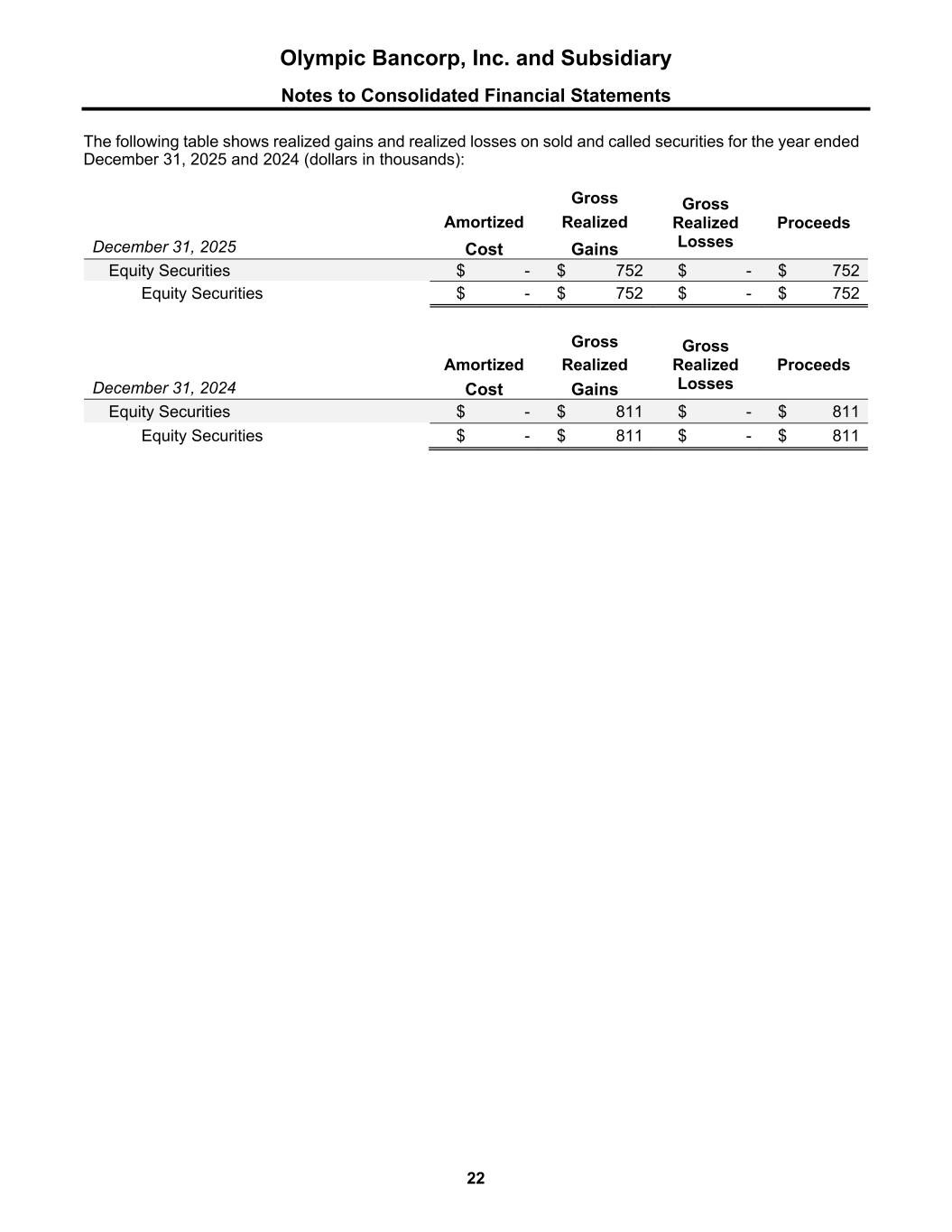
Olympic Bancorp, Inc. and Subsidiary Notes to Consolidated Financial Statements 22 The following table shows realized gains and realized losses on sold and called securities for the year ended December 31, 2025 and 2024 (dollars in thousands): Gross Gross Realized Losses Proceeds Amortized Realized December 31, 2025 Cost Gains Equity Securities $ - $ 752 $ - $ 752 Equity Securities $ - $ 752 $ - $ 752 Gross Gross Realized Losses Proceeds Amortized Realized December 31, 2024 Cost Gains Equity Securities $ - $ 811 $ - $ 811 Equity Securities $ - $ 811 $ - $ 811
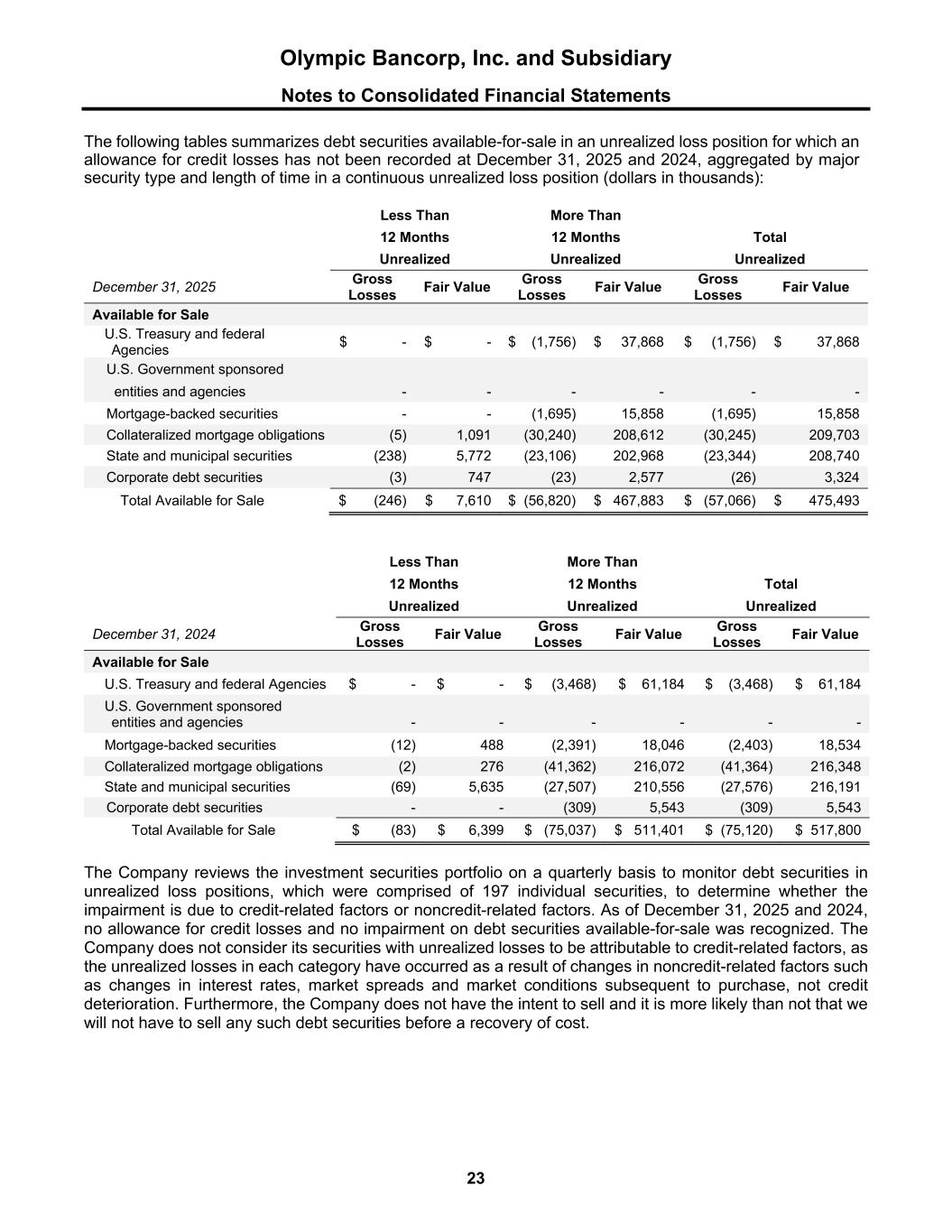
Olympic Bancorp, Inc. and Subsidiary Notes to Consolidated Financial Statements 23 The following tables summarizes debt securities available-for-sale in an unrealized loss position for which an allowance for credit losses has not been recorded at December 31, 2025 and 2024, aggregated by major security type and length of time in a continuous unrealized loss position (dollars in thousands): Less Than More Than 12 Months 12 Months Total Unrealized Unrealized Unrealized December 31, 2025 Gross Losses Fair Value Gross Losses Fair Value Gross Losses Fair Value Available for Sale U.S. Treasury and federal Agencies $ - $ - $ (1,756) $ 37,868 $ (1,756) $ 37,868 U.S. Government sponsored entities and agencies - - - - - - Mortgage-backed securities - - (1,695) 15,858 (1,695) 15,858 Collateralized mortgage obligations (5) 1,091 (30,240) 208,612 (30,245) 209,703 State and municipal securities (238) 5,772 (23,106) 202,968 (23,344) 208,740 Corporate debt securities (3) 747 (23) 2,577 (26) 3,324 Total Available for Sale $ (246) $ 7,610 $ (56,820) $ 467,883 $ (57,066) $ 475,493 Less Than More Than 12 Months 12 Months Total Unrealized Unrealized Unrealized December 31, 2024 Gross Losses Fair Value Gross Losses Fair Value Gross Losses Fair Value Available for Sale U.S. Treasury and federal Agencies $ - $ - $ (3,468) $ 61,184 $ (3,468) $ 61,184 U.S. Government sponsored entities and agencies - - - - - - Mortgage-backed securities (12) 488 (2,391) 18,046 (2,403) 18,534 Collateralized mortgage obligations (2) 276 (41,362) 216,072 (41,364) 216,348 State and municipal securities (69) 5,635 (27,507) 210,556 (27,576) 216,191 Corporate debt securities - - (309) 5,543 (309) 5,543 Total Available for Sale $ (83) $ 6,399 $ (75,037) $ 511,401 $ (75,120) $ 517,800 The Company reviews the investment securities portfolio on a quarterly basis to monitor debt securities in unrealized loss positions, which were comprised of 197 individual securities, to determine whether the impairment is due to credit-related factors or noncredit-related factors. As of December 31, 2025 and 2024, no allowance for credit losses and no impairment on debt securities available-for-sale was recognized. The Company does not consider its securities with unrealized losses to be attributable to credit-related factors, as the unrealized losses in each category have occurred as a result of changes in noncredit-related factors such as changes in interest rates, market spreads and market conditions subsequent to purchase, not credit deterioration. Furthermore, the Company does not have the intent to sell and it is more likely than not that we will not have to sell any such debt securities before a recovery of cost.
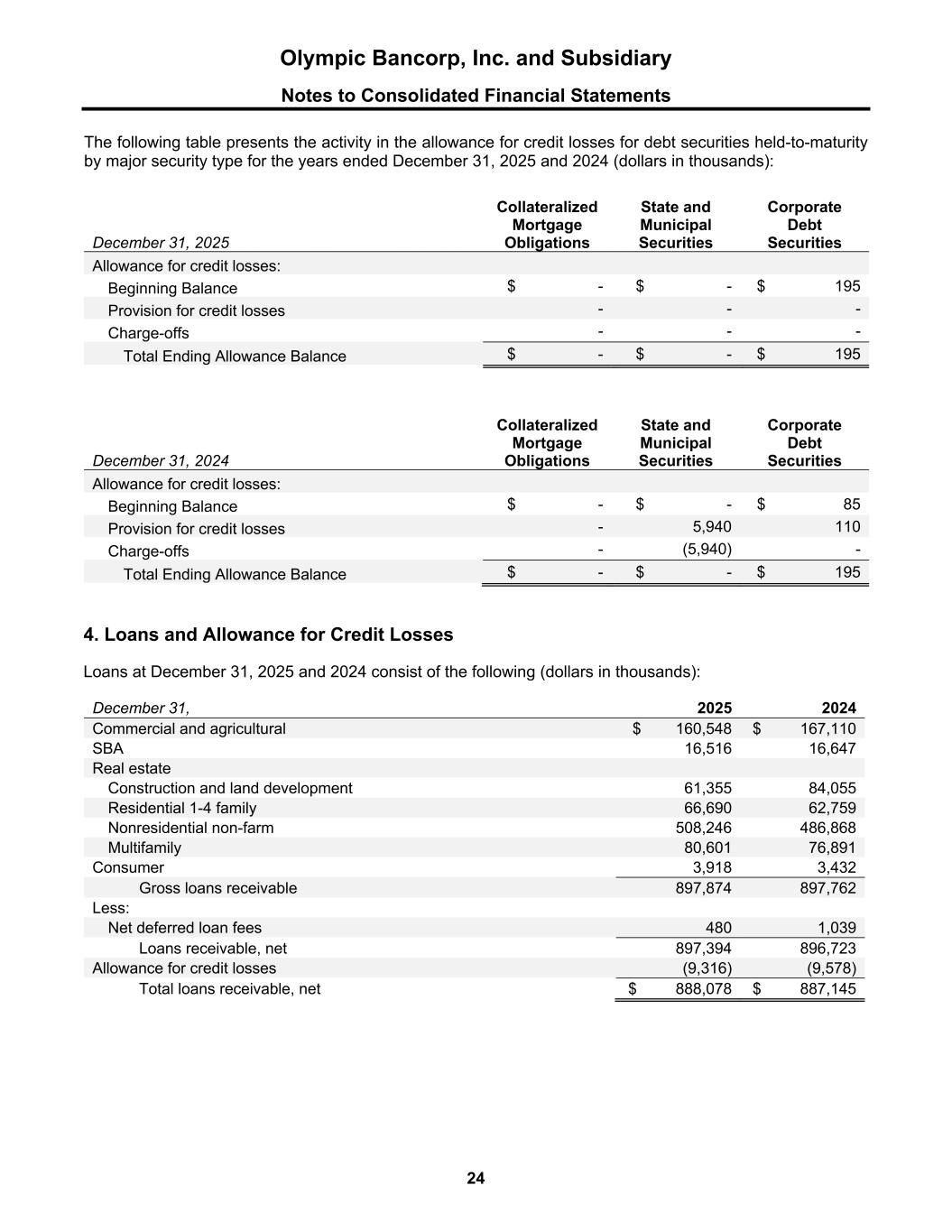
Olympic Bancorp, Inc. and Subsidiary Notes to Consolidated Financial Statements 24 The following table presents the activity in the allowance for credit losses for debt securities held-to-maturity by major security type for the years ended December 31, 2025 and 2024 (dollars in thousands): December 31, 2025 Collateralized Mortgage Obligations State and Municipal Securities Corporate Debt Securities Allowance for credit losses: Beginning Balance $ - $ - $ 195 Provision for credit losses - - - Charge-offs - - - Total Ending Allowance Balance $ - $ - $ 195 December 31, 2024 Collateralized Mortgage Obligations State and Municipal Securities Corporate Debt Securities Allowance for credit losses: Beginning Balance $ - $ - $ 85 Provision for credit losses - 5,940 110 Charge-offs - (5,940) - Total Ending Allowance Balance $ - $ - $ 195 4. Loans and Allowance for Credit Losses Loans at December 31, 2025 and 2024 consist of the following (dollars in thousands): December 31, 2025 2024 Commercial and agricultural $ 160,548 $ 167,110 SBA 16,516 16,647 Real estate Construction and land development 61,355 84,055 Residential 1-4 family 66,690 62,759 Nonresidential non-farm 508,246 486,868 Multifamily 80,601 76,891 Consumer 3,918 3,432 Gross loans receivable 897,874 897,762 Less: Net deferred loan fees 480 1,039 Loans receivable, net 897,394 896,723 Allowance for credit losses (9,316) (9,578) Total loans receivable, net $ 888,078 $ 887,145
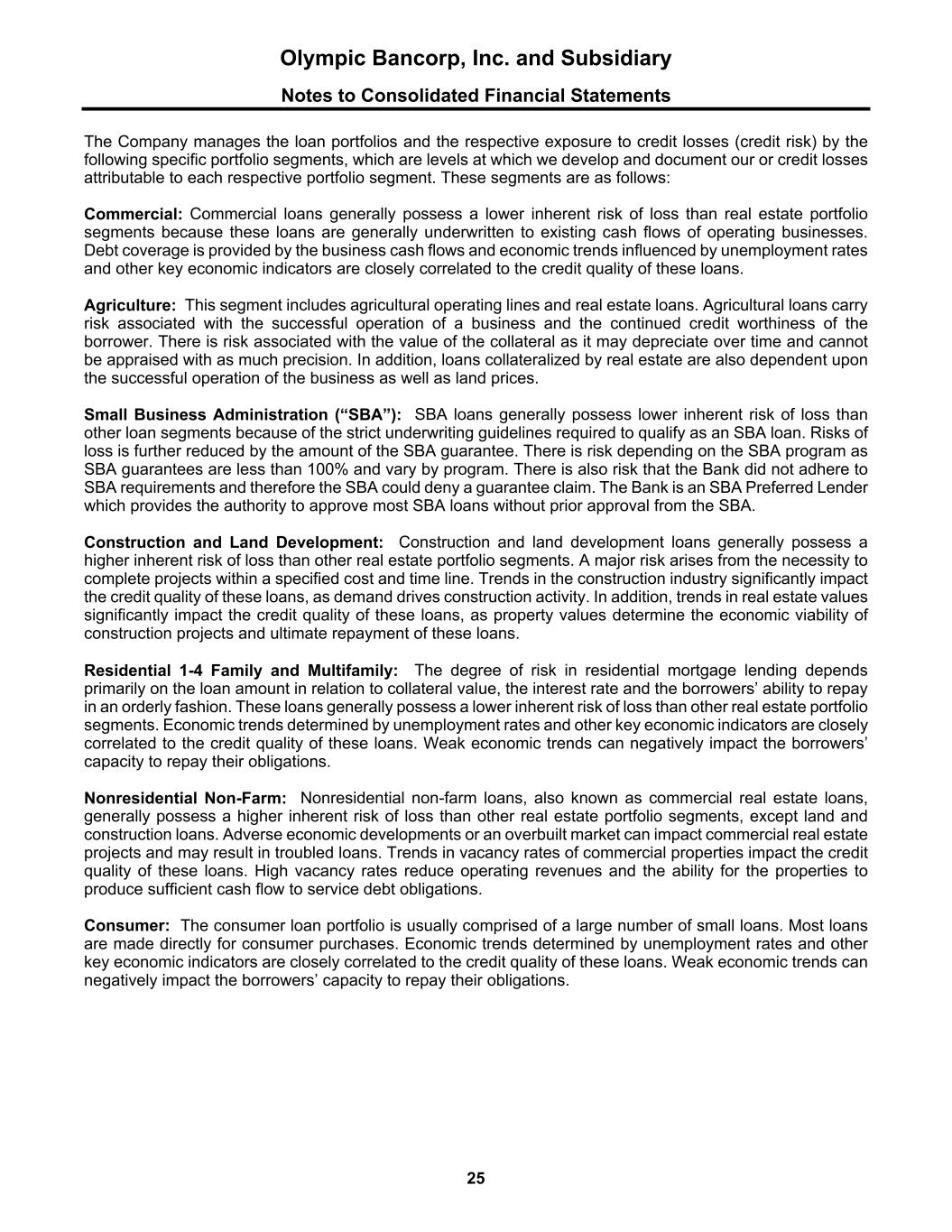
Olympic Bancorp, Inc. and Subsidiary Notes to Consolidated Financial Statements 25 The Company manages the loan portfolios and the respective exposure to credit losses (credit risk) by the following specific portfolio segments, which are levels at which we develop and document our or credit losses attributable to each respective portfolio segment. These segments are as follows: Commercial: Commercial loans generally possess a lower inherent risk of loss than real estate portfolio segments because these loans are generally underwritten to existing cash flows of operating businesses. Debt coverage is provided by the business cash flows and economic trends influenced by unemployment rates and other key economic indicators are closely correlated to the credit quality of these loans. Agriculture: This segment includes agricultural operating lines and real estate loans. Agricultural loans carry risk associated with the successful operation of a business and the continued credit worthiness of the borrower. There is risk associated with the value of the collateral as it may depreciate over time and cannot be appraised with as much precision. In addition, loans collateralized by real estate are also dependent upon the successful operation of the business as well as land prices. Small Business Administration (“SBA”): SBA loans generally possess lower inherent risk of loss than other loan segments because of the strict underwriting guidelines required to qualify as an SBA loan. Risks of loss is further reduced by the amount of the SBA guarantee. There is risk depending on the SBA program as SBA guarantees are less than 100% and vary by program. There is also risk that the Bank did not adhere to SBA requirements and therefore the SBA could deny a guarantee claim. The Bank is an SBA Preferred Lender which provides the authority to approve most SBA loans without prior approval from the SBA. Construction and Land Development: Construction and land development loans generally possess a higher inherent risk of loss than other real estate portfolio segments. A major risk arises from the necessity to complete projects within a specified cost and time line. Trends in the construction industry significantly impact the credit quality of these loans, as demand drives construction activity. In addition, trends in real estate values significantly impact the credit quality of these loans, as property values determine the economic viability of construction projects and ultimate repayment of these loans. Residential 1-4 Family and Multifamily: The degree of risk in residential mortgage lending depends primarily on the loan amount in relation to collateral value, the interest rate and the borrowers’ ability to repay in an orderly fashion. These loans generally possess a lower inherent risk of loss than other real estate portfolio segments. Economic trends determined by unemployment rates and other key economic indicators are closely correlated to the credit quality of these loans. Weak economic trends can negatively impact the borrowers’ capacity to repay their obligations. Nonresidential Non-Farm: Nonresidential non-farm loans, also known as commercial real estate loans, generally possess a higher inherent risk of loss than other real estate portfolio segments, except land and construction loans. Adverse economic developments or an overbuilt market can impact commercial real estate projects and may result in troubled loans. Trends in vacancy rates of commercial properties impact the credit quality of these loans. High vacancy rates reduce operating revenues and the ability for the properties to produce sufficient cash flow to service debt obligations. Consumer: The consumer loan portfolio is usually comprised of a large number of small loans. Most loans are made directly for consumer purchases. Economic trends determined by unemployment rates and other key economic indicators are closely correlated to the credit quality of these loans. Weak economic trends can negatively impact the borrowers’ capacity to repay their obligations.
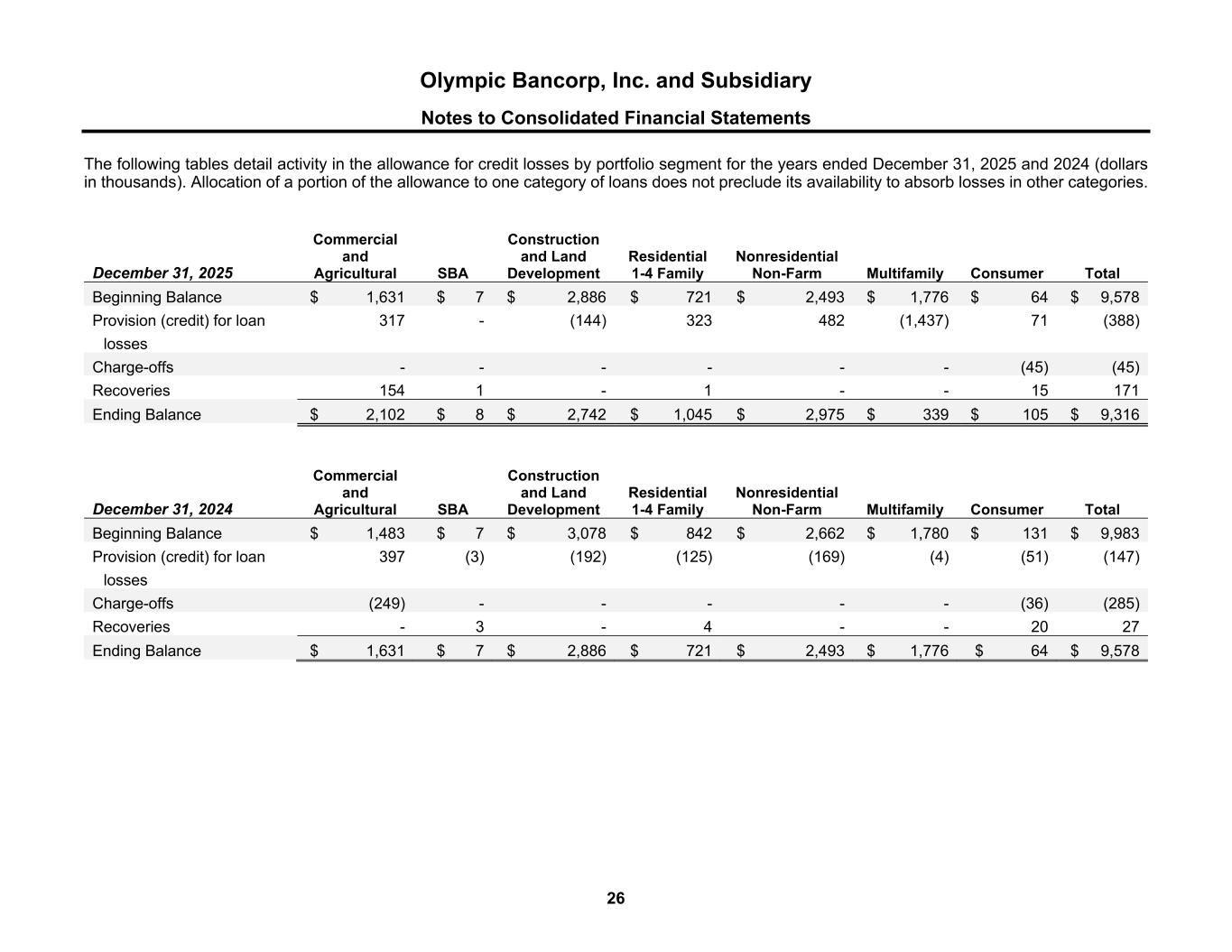
Olympic Bancorp, Inc. and Subsidiary Notes to Consolidated Financial Statements 26 The following tables detail activity in the allowance for credit losses by portfolio segment for the years ended December 31, 2025 and 2024 (dollars in thousands). Allocation of a portion of the allowance to one category of loans does not preclude its availability to absorb losses in other categories. December 31, 2025 Commercial and Agricultural SBA Construction and Land Development Residential 1-4 Family Nonresidential Non-Farm Multifamily Consumer Total Beginning Balance $ 1,631 $ 7 $ 2,886 $ 721 $ 2,493 $ 1,776 $ 64 $ 9,578 Provision (credit) for loan 317 - (144) 323 482 (1,437) 71 (388) losses Charge-offs - - - - - - (45) (45) Recoveries 154 1 - 1 - - 15 171 Ending Balance $ 2,102 $ 8 $ 2,742 $ 1,045 $ 2,975 $ 339 $ 105 $ 9,316 December 31, 2024 Commercial and Agricultural SBA Construction and Land Development Residential 1-4 Family Nonresidential Non-Farm Multifamily Consumer Total Beginning Balance $ 1,483 $ 7 $ 3,078 $ 842 $ 2,662 $ 1,780 $ 131 $ 9,983 Provision (credit) for loan 397 (3) (192) (125) (169) (4) (51) (147) losses Charge-offs (249) - - - - - (36) (285) Recoveries - 3 - 4 - - 20 27 Ending Balance $ 1,631 $ 7 $ 2,886 $ 721 $ 2,493 $ 1,776 $ 64 $ 9,578
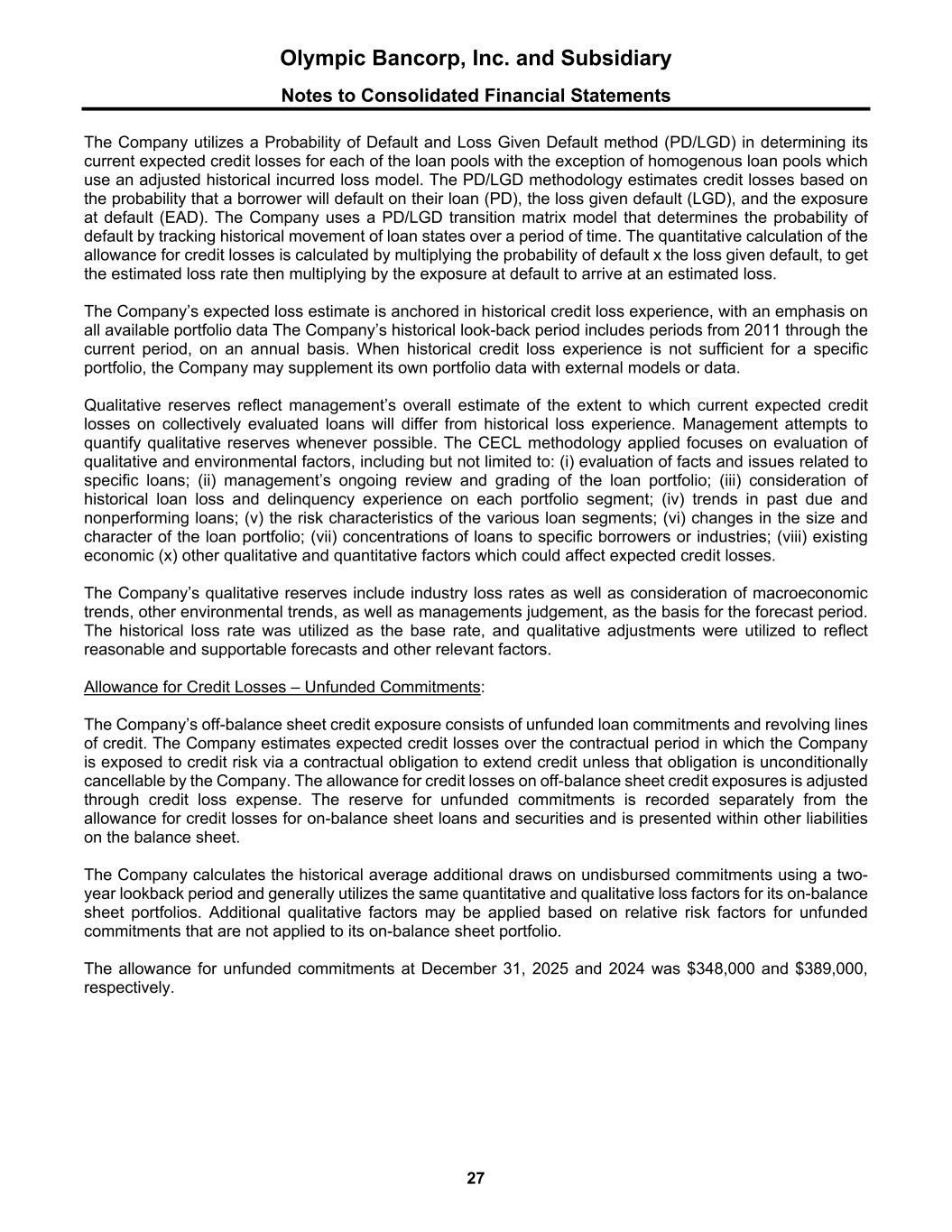
Olympic Bancorp, Inc. and Subsidiary Notes to Consolidated Financial Statements 27 The Company utilizes a Probability of Default and Loss Given Default method (PD/LGD) in determining its current expected credit losses for each of the loan pools with the exception of homogenous loan pools which use an adjusted historical incurred loss model. The PD/LGD methodology estimates credit losses based on the probability that a borrower will default on their loan (PD), the loss given default (LGD), and the exposure at default (EAD). The Company uses a PD/LGD transition matrix model that determines the probability of default by tracking historical movement of loan states over a period of time. The quantitative calculation of the allowance for credit losses is calculated by multiplying the probability of default x the loss given default, to get the estimated loss rate then multiplying by the exposure at default to arrive at an estimated loss. The Company’s expected loss estimate is anchored in historical credit loss experience, with an emphasis on all available portfolio data The Company’s historical look-back period includes periods from 2011 through the current period, on an annual basis. When historical credit loss experience is not sufficient for a specific portfolio, the Company may supplement its own portfolio data with external models or data. Qualitative reserves reflect management’s overall estimate of the extent to which current expected credit losses on collectively evaluated loans will differ from historical loss experience. Management attempts to quantify qualitative reserves whenever possible. The CECL methodology applied focuses on evaluation of qualitative and environmental factors, including but not limited to: (i) evaluation of facts and issues related to specific loans; (ii) management’s ongoing review and grading of the loan portfolio; (iii) consideration of historical loan loss and delinquency experience on each portfolio segment; (iv) trends in past due and nonperforming loans; (v) the risk characteristics of the various loan segments; (vi) changes in the size and character of the loan portfolio; (vii) concentrations of loans to specific borrowers or industries; (viii) existing economic (x) other qualitative and quantitative factors which could affect expected credit losses. The Company’s qualitative reserves include industry loss rates as well as consideration of macroeconomic trends, other environmental trends, as well as managements judgement, as the basis for the forecast period. The historical loss rate was utilized as the base rate, and qualitative adjustments were utilized to reflect reasonable and supportable forecasts and other relevant factors. Allowance for Credit Losses – Unfunded Commitments: The Company’s off-balance sheet credit exposure consists of unfunded loan commitments and revolving lines of credit. The Company estimates expected credit losses over the contractual period in which the Company is exposed to credit risk via a contractual obligation to extend credit unless that obligation is unconditionally cancellable by the Company. The allowance for credit losses on off-balance sheet credit exposures is adjusted through credit loss expense. The reserve for unfunded commitments is recorded separately from the allowance for credit losses for on-balance sheet loans and securities and is presented within other liabilities on the balance sheet. The Company calculates the historical average additional draws on undisbursed commitments using a two- year lookback period and generally utilizes the same quantitative and qualitative loss factors for its on-balance sheet portfolios. Additional qualitative factors may be applied based on relative risk factors for unfunded commitments that are not applied to its on-balance sheet portfolio. The allowance for unfunded commitments at December 31, 2025 and 2024 was $348,000 and $389,000, respectively.
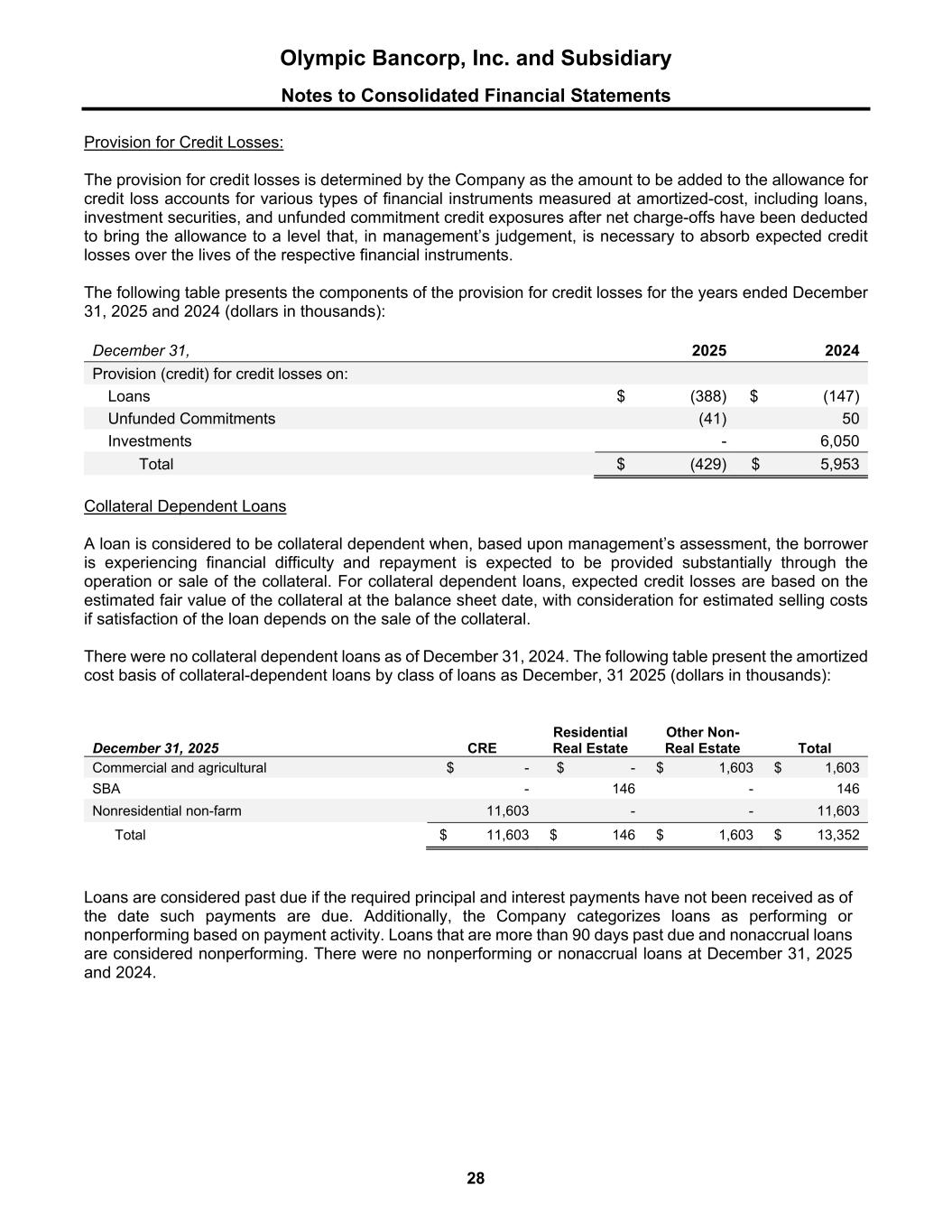
Olympic Bancorp, Inc. and Subsidiary Notes to Consolidated Financial Statements 28 Provision for Credit Losses: The provision for credit losses is determined by the Company as the amount to be added to the allowance for credit loss accounts for various types of financial instruments measured at amortized-cost, including loans, investment securities, and unfunded commitment credit exposures after net charge-offs have been deducted to bring the allowance to a level that, in management’s judgement, is necessary to absorb expected credit losses over the lives of the respective financial instruments. The following table presents the components of the provision for credit losses for the years ended December 31, 2025 and 2024 (dollars in thousands): December 31, 2025 2024 Provision (credit) for credit losses on: Loans $ (388) $ (147) Unfunded Commitments (41) 50 Investments - 6,050 Total $ (429) $ 5,953 Collateral Dependent Loans A loan is considered to be collateral dependent when, based upon management’s assessment, the borrower is experiencing financial difficulty and repayment is expected to be provided substantially through the operation or sale of the collateral. For collateral dependent loans, expected credit losses are based on the estimated fair value of the collateral at the balance sheet date, with consideration for estimated selling costs if satisfaction of the loan depends on the sale of the collateral. There were no collateral dependent loans as of December 31, 2024. The following table present the amortized cost basis of collateral-dependent loans by class of loans as December, 31 2025 (dollars in thousands): December 31, 2025 CRE Residential Real Estate Other Non- Real Estate Total Commercial and agricultural $ - $ - $ 1,603 $ 1,603 SBA - 146 - 146 Nonresidential non-farm 11,603 - - 11,603 Total $ 11,603 $ 146 $ 1,603 $ 13,352 Loans are considered past due if the required principal and interest payments have not been received as of the date such payments are due. Additionally, the Company categorizes loans as performing or nonperforming based on payment activity. Loans that are more than 90 days past due and nonaccrual loans are considered nonperforming. There were no nonperforming or nonaccrual loans at December 31, 2025 and 2024.
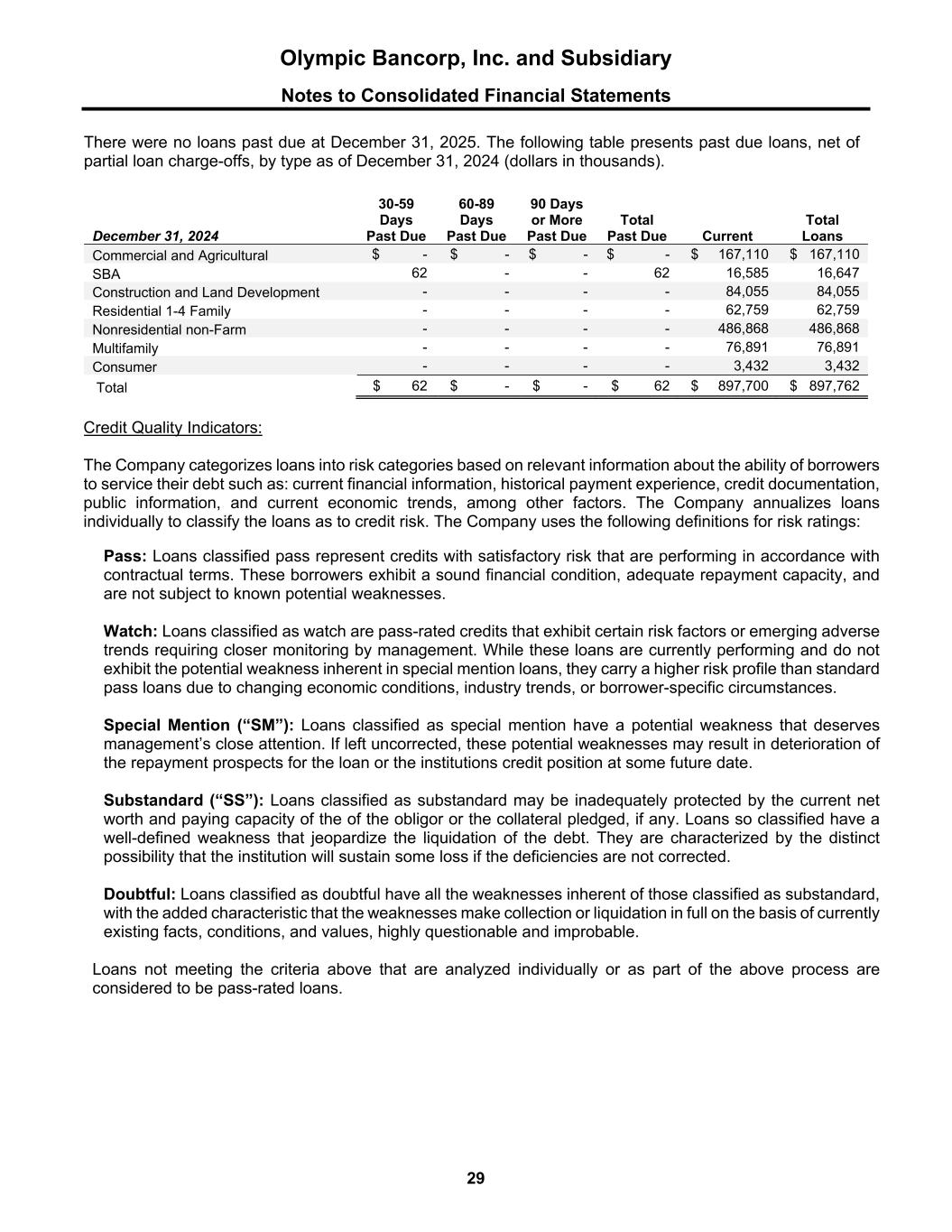
Olympic Bancorp, Inc. and Subsidiary Notes to Consolidated Financial Statements 29 There were no loans past due at December 31, 2025. The following table presents past due loans, net of partial loan charge-offs, by type as of December 31, 2024 (dollars in thousands). December 31, 2024 30-59 Days Past Due 60-89 Days Past Due 90 Days or More Past Due Total Past Due Current Total Loans Commercial and Agricultural $ - $ - $ - $ - $ 167,110 $ 167,110 SBA 62 - - 62 16,585 16,647 Construction and Land Development - - - - 84,055 84,055 Residential 1-4 Family - - - - 62,759 62,759 Nonresidential non-Farm - - - - 486,868 486,868 Multifamily - - - - 76,891 76,891 Consumer - - - - 3,432 3,432 Total $ 62 $ - $ - $ 62 $ 897,700 $ 897,762 Credit Quality Indicators: The Company categorizes loans into risk categories based on relevant information about the ability of borrowers to service their debt such as: current financial information, historical payment experience, credit documentation, public information, and current economic trends, among other factors. The Company annualizes loans individually to classify the loans as to credit risk. The Company uses the following definitions for risk ratings: Pass: Loans classified pass represent credits with satisfactory risk that are performing in accordance with contractual terms. These borrowers exhibit a sound financial condition, adequate repayment capacity, and are not subject to known potential weaknesses. Watch: Loans classified as watch are pass-rated credits that exhibit certain risk factors or emerging adverse trends requiring closer monitoring by management. While these loans are currently performing and do not exhibit the potential weakness inherent in special mention loans, they carry a higher risk profile than standard pass loans due to changing economic conditions, industry trends, or borrower-specific circumstances. Special Mention (“SM”): Loans classified as special mention have a potential weakness that deserves management’s close attention. If left uncorrected, these potential weaknesses may result in deterioration of the repayment prospects for the loan or the institutions credit position at some future date. Substandard (“SS”): Loans classified as substandard may be inadequately protected by the current net worth and paying capacity of the of the obligor or the collateral pledged, if any. Loans so classified have a well-defined weakness that jeopardize the liquidation of the debt. They are characterized by the distinct possibility that the institution will sustain some loss if the deficiencies are not corrected. Doubtful: Loans classified as doubtful have all the weaknesses inherent of those classified as substandard, with the added characteristic that the weaknesses make collection or liquidation in full on the basis of currently existing facts, conditions, and values, highly questionable and improbable. Loans not meeting the criteria above that are analyzed individually or as part of the above process are considered to be pass-rated loans.
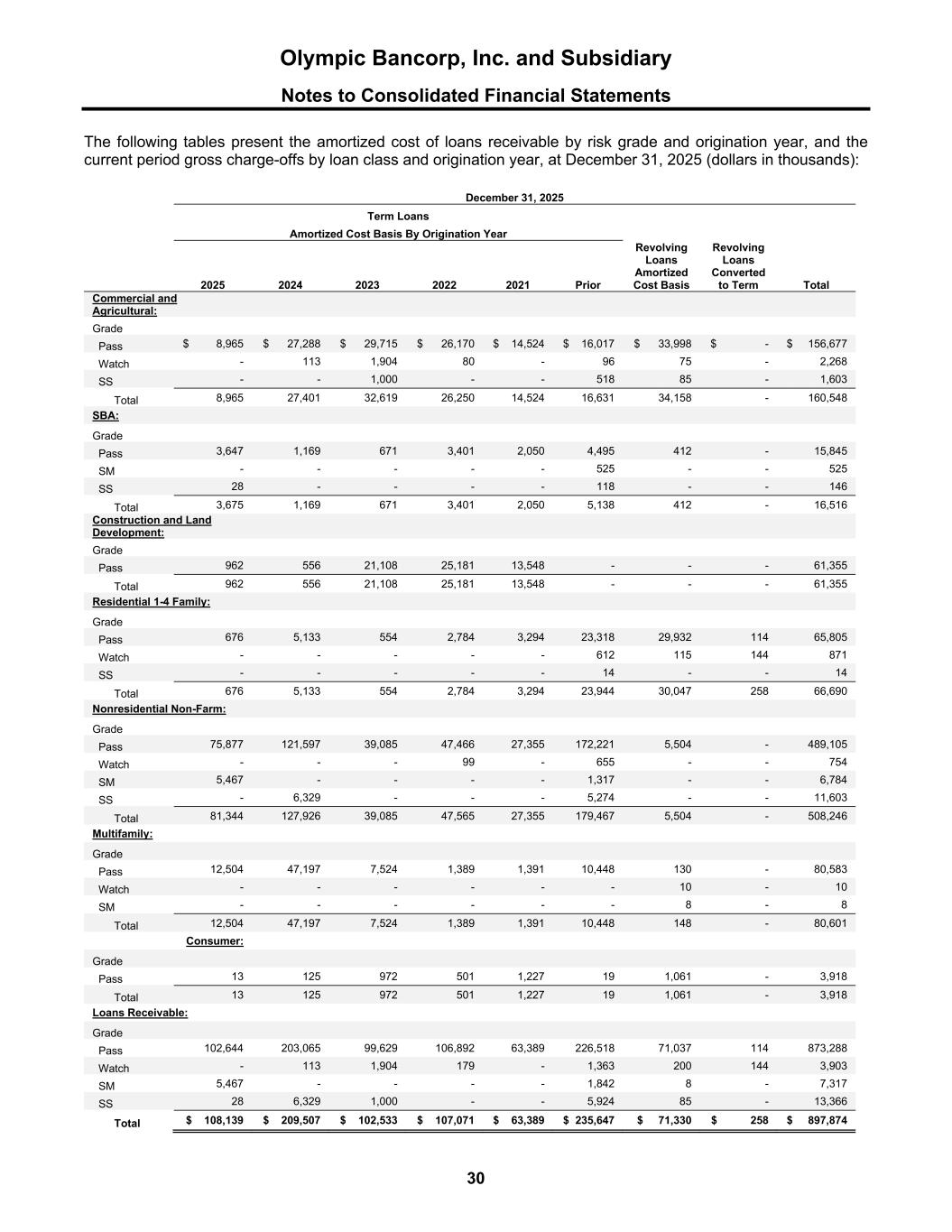
Olympic Bancorp, Inc. and Subsidiary Notes to Consolidated Financial Statements 30 The following tables present the amortized cost of loans receivable by risk grade and origination year, and the current period gross charge-offs by loan class and origination year, at December 31, 2025 (dollars in thousands): December 31, 2025 Term Loans Amortized Cost Basis By Origination Year 2025 2024 2023 2022 2021 Prior Revolving Loans Amortized Cost Basis Revolving Loans Converted to Term Total Commercial and Agricultural: Grade Pass $ 8,965 $ 27,288 $ 29,715 $ 26,170 $ 14,524 $ 16,017 $ 33,998 $ - $ 156,677 Watch - 113 1,904 80 - 96 75 - 2,268 SS - - 1,000 - - 518 85 - 1,603 Total 8,965 27,401 32,619 26,250 14,524 16,631 34,158 - 160,548 SBA: Grade Pass 3,647 1,169 671 3,401 2,050 4,495 412 - 15,845 SM - - - - - 525 - - 525 SS 28 - - - - 118 - - 146 Total 3,675 1,169 671 3,401 2,050 5,138 412 - 16,516 Construction and Land Development: Grade Pass 962 556 21,108 25,181 13,548 - - - 61,355 Total 962 556 21,108 25,181 13,548 - - - 61,355 Residential 1-4 Family: Grade Pass 676 5,133 554 2,784 3,294 23,318 29,932 114 65,805 Watch - - - - - 612 115 144 871 SS - - - - - 14 - - 14 Total 676 5,133 554 2,784 3,294 23,944 30,047 258 66,690 Nonresidential Non-Farm: Grade Pass 75,877 121,597 39,085 47,466 27,355 172,221 5,504 - 489,105 Watch - - - 99 - 655 - - 754 SM 5,467 - - - - 1,317 - - 6,784 SS - 6,329 - - - 5,274 - - 11,603 Total 81,344 127,926 39,085 47,565 27,355 179,467 5,504 - 508,246 Multifamily: Grade Pass 12,504 47,197 7,524 1,389 1,391 10,448 130 - 80,583 Watch - - - - - - 10 - 10 SM - - - - - - 8 - 8 Total 12,504 47,197 7,524 1,389 1,391 10,448 148 - 80,601 Consumer: Grade Pass 13 125 972 501 1,227 19 1,061 - 3,918 Total 13 125 972 501 1,227 19 1,061 - 3,918 Loans Receivable: Grade Pass 102,644 203,065 99,629 106,892 63,389 226,518 71,037 114 873,288 Watch - 113 1,904 179 - 1,363 200 144 3,903 SM 5,467 - - - - 1,842 8 - 7,317 SS 28 6,329 1,000 - - 5,924 85 - 13,366 Total $ 108,139 $ 209,507 $ 102,533 $ 107,071 $ 63,389 $ 235,647 $ 71,330 $ 258 $ 897,874
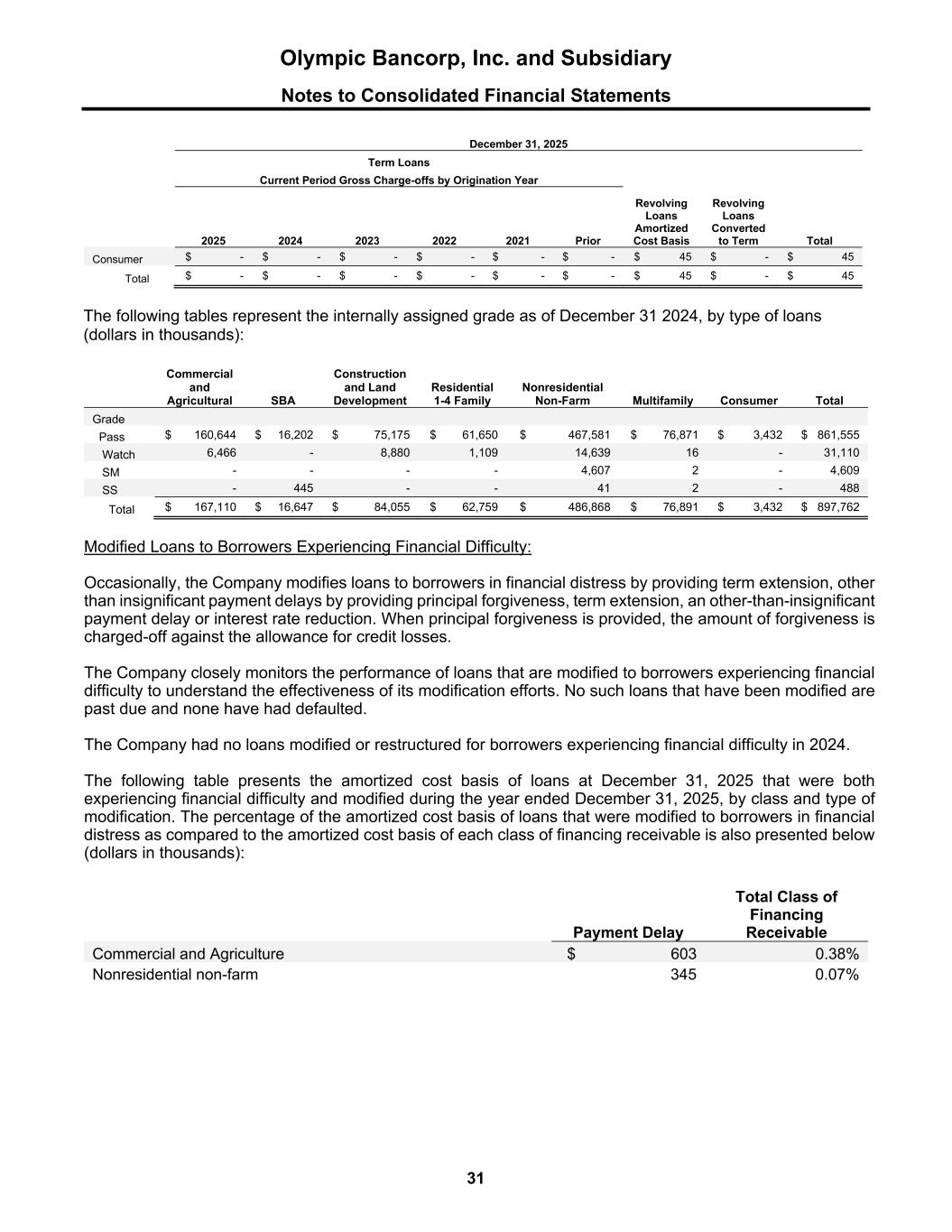
Olympic Bancorp, Inc. and Subsidiary Notes to Consolidated Financial Statements 31 December 31, 2025 Term Loans Current Period Gross Charge-offs by Origination Year 2025 2024 2023 2022 2021 Prior Revolving Loans Amortized Cost Basis Revolving Loans Converted to Term Total Consumer $ - $ - $ - $ - $ - $ - $ 45 $ - $ 45 Total $ - $ - $ - $ - $ - $ - $ 45 $ - $ 45 The following tables represent the internally assigned grade as of December 31 2024, by type of loans (dollars in thousands): Commercial and Agricultural SBA Construction and Land Development Residential 1-4 Family Nonresidential Non-Farm Multifamily Consumer Total Grade Pass $ 160,644 $ 16,202 $ 75,175 $ 61,650 $ 467,581 $ 76,871 $ 3,432 $ 861,555 Watch 6,466 - 8,880 1,109 14,639 16 - 31,110 SM - - - - 4,607 2 - 4,609 SS - 445 - - 41 2 - 488 Total $ 167,110 $ 16,647 $ 84,055 $ 62,759 $ 486,868 $ 76,891 $ 3,432 $ 897,762 Modified Loans to Borrowers Experiencing Financial Difficulty: Occasionally, the Company modifies loans to borrowers in financial distress by providing term extension, other than insignificant payment delays by providing principal forgiveness, term extension, an other-than-insignificant payment delay or interest rate reduction. When principal forgiveness is provided, the amount of forgiveness is charged-off against the allowance for credit losses. The Company closely monitors the performance of loans that are modified to borrowers experiencing financial difficulty to understand the effectiveness of its modification efforts. No such loans that have been modified are past due and none have had defaulted. The Company had no loans modified or restructured for borrowers experiencing financial difficulty in 2024. The following table presents the amortized cost basis of loans at December 31, 2025 that were both experiencing financial difficulty and modified during the year ended December 31, 2025, by class and type of modification. The percentage of the amortized cost basis of loans that were modified to borrowers in financial distress as compared to the amortized cost basis of each class of financing receivable is also presented below (dollars in thousands): Payment Delay Total Class of Financing Receivable Commercial and Agriculture $ 603 0.38% Nonresidential non-farm 345 0.07%
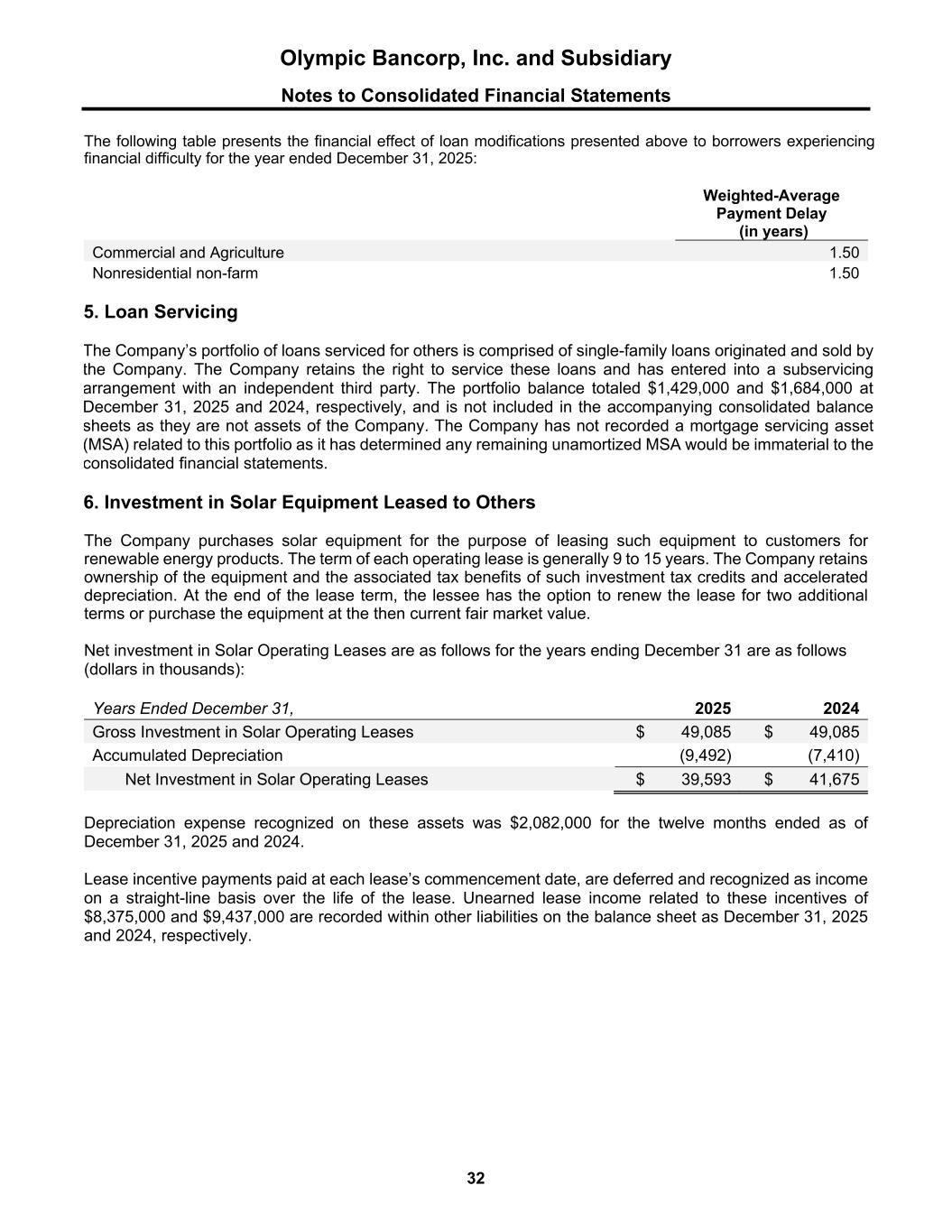
Olympic Bancorp, Inc. and Subsidiary Notes to Consolidated Financial Statements 32 The following table presents the financial effect of loan modifications presented above to borrowers experiencing financial difficulty for the year ended December 31, 2025: Weighted-Average Payment Delay (in years) Commercial and Agriculture 1.50 Nonresidential non-farm 1.50 5. Loan Servicing The Company’s portfolio of loans serviced for others is comprised of single-family loans originated and sold by the Company. The Company retains the right to service these loans and has entered into a subservicing arrangement with an independent third party. The portfolio balance totaled $1,429,000 and $1,684,000 at December 31, 2025 and 2024, respectively, and is not included in the accompanying consolidated balance sheets as they are not assets of the Company. The Company has not recorded a mortgage servicing asset (MSA) related to this portfolio as it has determined any remaining unamortized MSA would be immaterial to the consolidated financial statements. 6. Investment in Solar Equipment Leased to Others The Company purchases solar equipment for the purpose of leasing such equipment to customers for renewable energy products. The term of each operating lease is generally 9 to 15 years. The Company retains ownership of the equipment and the associated tax benefits of such investment tax credits and accelerated depreciation. At the end of the lease term, the lessee has the option to renew the lease for two additional terms or purchase the equipment at the then current fair market value. Net investment in Solar Operating Leases are as follows for the years ending December 31 are as follows (dollars in thousands): Years Ended December 31, 2025 2024 Gross Investment in Solar Operating Leases $ 49,085 $ 49,085 Accumulated Depreciation (9,492) (7,410) Net Investment in Solar Operating Leases $ 39,593 $ 41,675 Depreciation expense recognized on these assets was $2,082,000 for the twelve months ended as of December 31, 2025 and 2024. Lease incentive payments paid at each lease’s commencement date, are deferred and recognized as income on a straight-line basis over the life of the lease. Unearned lease income related to these incentives of $8,375,000 and $9,437,000 are recorded within other liabilities on the balance sheet as December 31, 2025 and 2024, respectively.
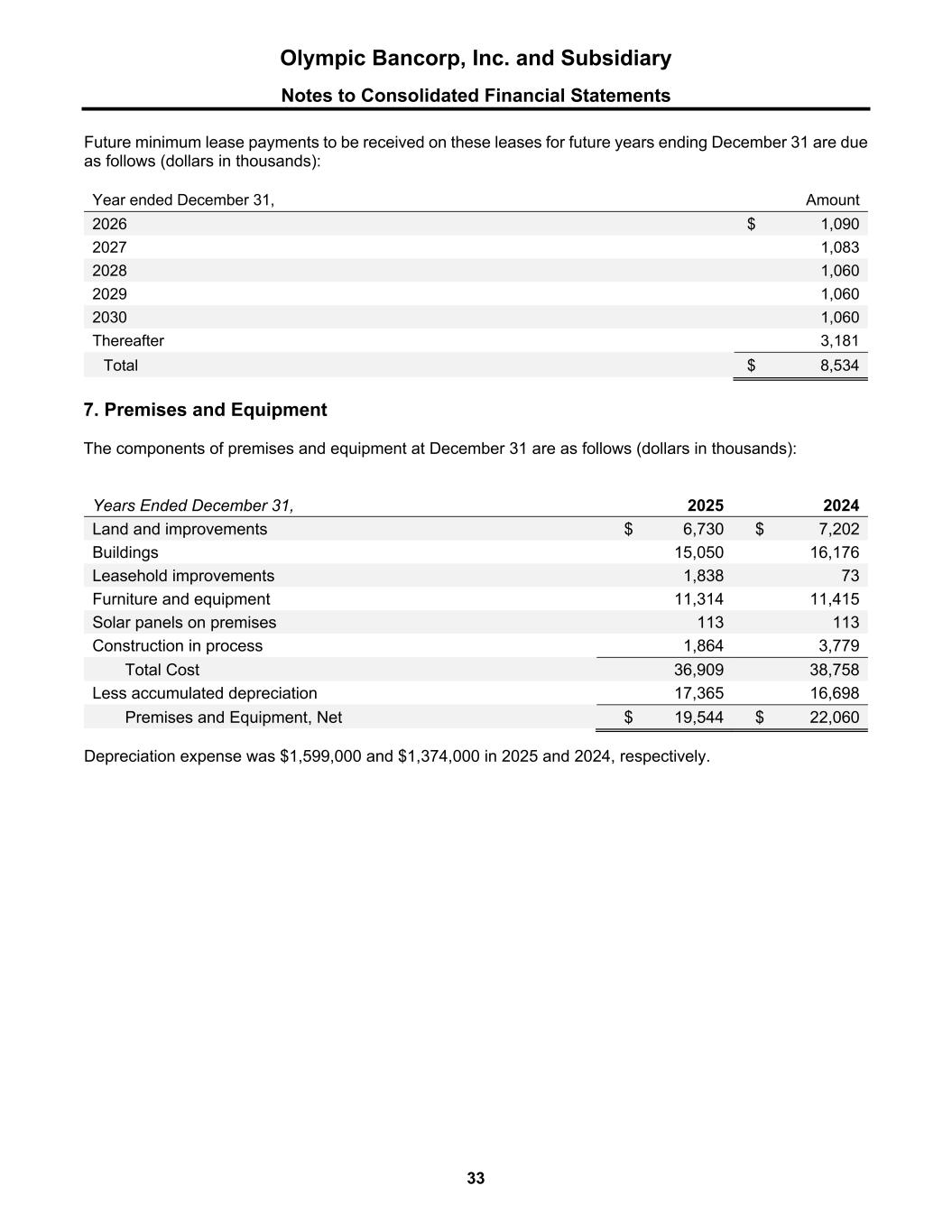
Olympic Bancorp, Inc. and Subsidiary Notes to Consolidated Financial Statements 33 Future minimum lease payments to be received on these leases for future years ending December 31 are due as follows (dollars in thousands): Year ended December 31, Amount 2026 $ 1,090 2027 1,083 2028 1,060 2029 1,060 2030 1,060 Thereafter 3,181 Total $ 8,534 7. Premises and Equipment The components of premises and equipment at December 31 are as follows (dollars in thousands): Years Ended December 31, 2025 2024 Land and improvements $ 6,730 $ 7,202 Buildings 15,050 16,176 Leasehold improvements 1,838 73 Furniture and equipment 11,314 11,415 Solar panels on premises 113 113 Construction in process 1,864 3,779 Total Cost 36,909 38,758 Less accumulated depreciation 17,365 16,698 Premises and Equipment, Net $ 19,544 $ 22,060 Depreciation expense was $1,599,000 and $1,374,000 in 2025 and 2024, respectively.
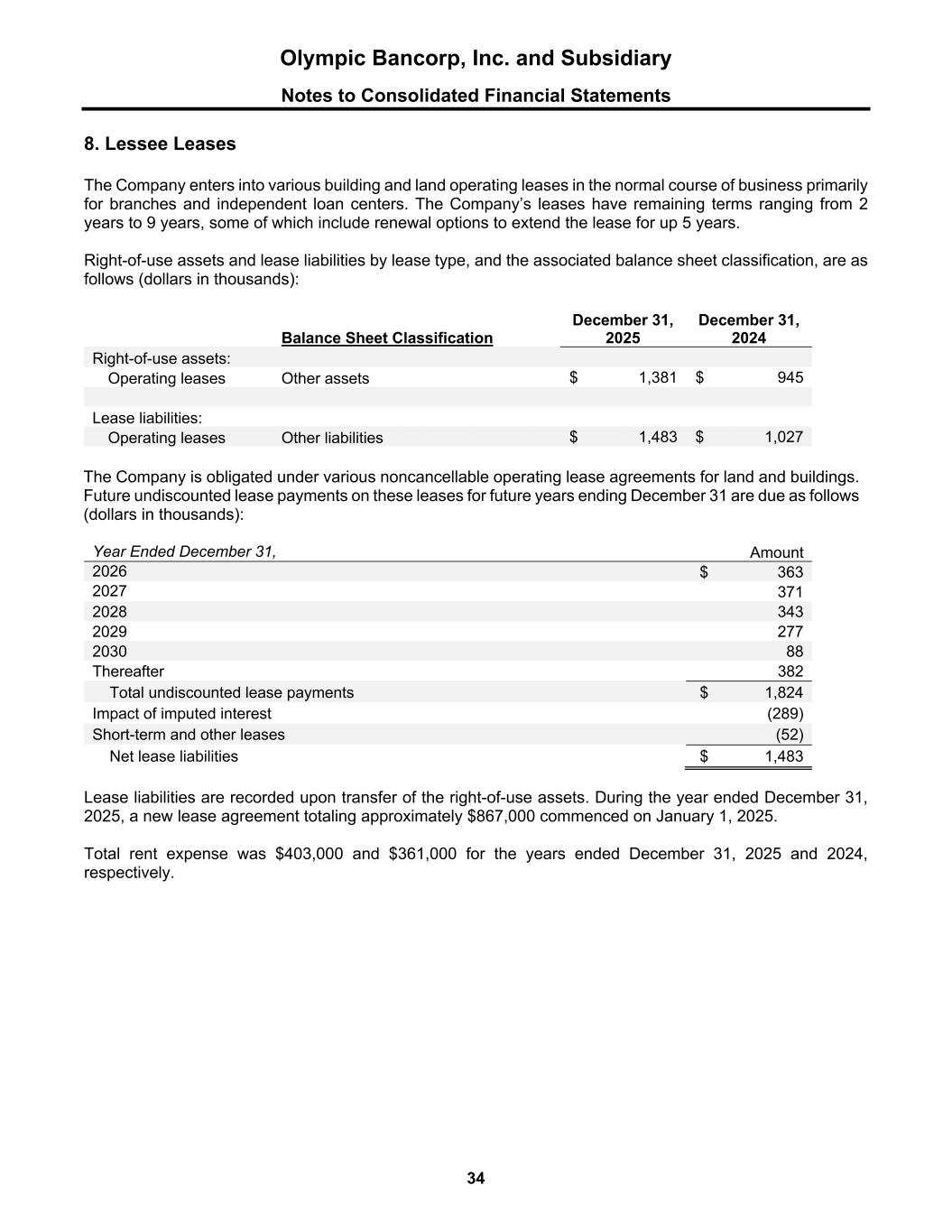
Olympic Bancorp, Inc. and Subsidiary Notes to Consolidated Financial Statements 34 8. Lessee Leases The Company enters into various building and land operating leases in the normal course of business primarily for branches and independent loan centers. The Company’s leases have remaining terms ranging from 2 years to 9 years, some of which include renewal options to extend the lease for up 5 years. Right-of-use assets and lease liabilities by lease type, and the associated balance sheet classification, are as follows (dollars in thousands): Balance Sheet Classification December 31, 2025 December 31, 2024 Right-of-use assets: Operating leases Other assets $ 1,381 $ 945 Lease liabilities: Operating leases Other liabilities $ 1,483 $ 1,027 The Company is obligated under various noncancellable operating lease agreements for land and buildings. Future undiscounted lease payments on these leases for future years ending December 31 are due as follows (dollars in thousands): Year Ended December 31, Amount 2026 $ 363 2027 371 2028 343 2029 277 2030 88 Thereafter 382 Total undiscounted lease payments $ 1,824 Impact of imputed interest (289) Short-term and other leases (52) Net lease liabilities $ 1,483 Lease liabilities are recorded upon transfer of the right-of-use assets. During the year ended December 31, 2025, a new lease agreement totaling approximately $867,000 commenced on January 1, 2025. Total rent expense was $403,000 and $361,000 for the years ended December 31, 2025 and 2024, respectively.
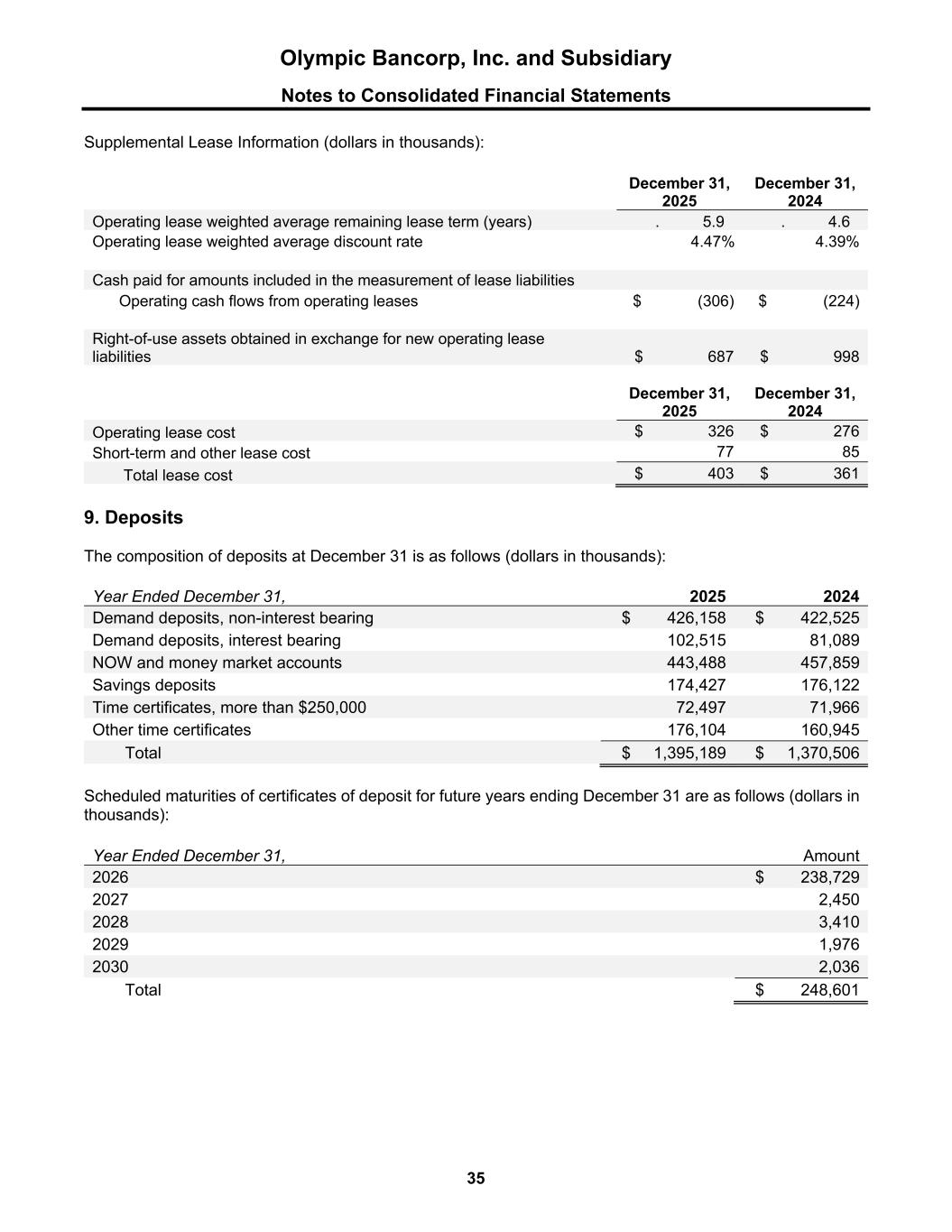
Olympic Bancorp, Inc. and Subsidiary Notes to Consolidated Financial Statements 35 Supplemental Lease Information (dollars in thousands): December 31, 2025 December 31, 2024 Operating lease weighted average remaining lease term (years) . 5.9 . 4.6 Operating lease weighted average discount rate 4.47% 4.39% Cash paid for amounts included in the measurement of lease liabilities Operating cash flows from operating leases $ (306) $ (224) Right-of-use assets obtained in exchange for new operating lease liabilities $ 687 $ 998 December 31, 2025 December 31, 2024 Operating lease cost $ 326 $ 276 Short-term and other lease cost 77 85 Total lease cost $ 403 $ 361 9. Deposits The composition of deposits at December 31 is as follows (dollars in thousands): Year Ended December 31, 2025 2024 Demand deposits, non-interest bearing $ 426,158 $ 422,525 Demand deposits, interest bearing 102,515 81,089 NOW and money market accounts 443,488 457,859 Savings deposits 174,427 176,122 Time certificates, more than $250,000 72,497 71,966 Other time certificates 176,104 160,945 Total $ 1,395,189 $ 1,370,506 Scheduled maturities of certificates of deposit for future years ending December 31 are as follows (dollars in thousands): Year Ended December 31, Amount 2026 $ 238,729 2027 2,450 2028 3,410 2029 1,976 2030 2,036 Total $ 248,601
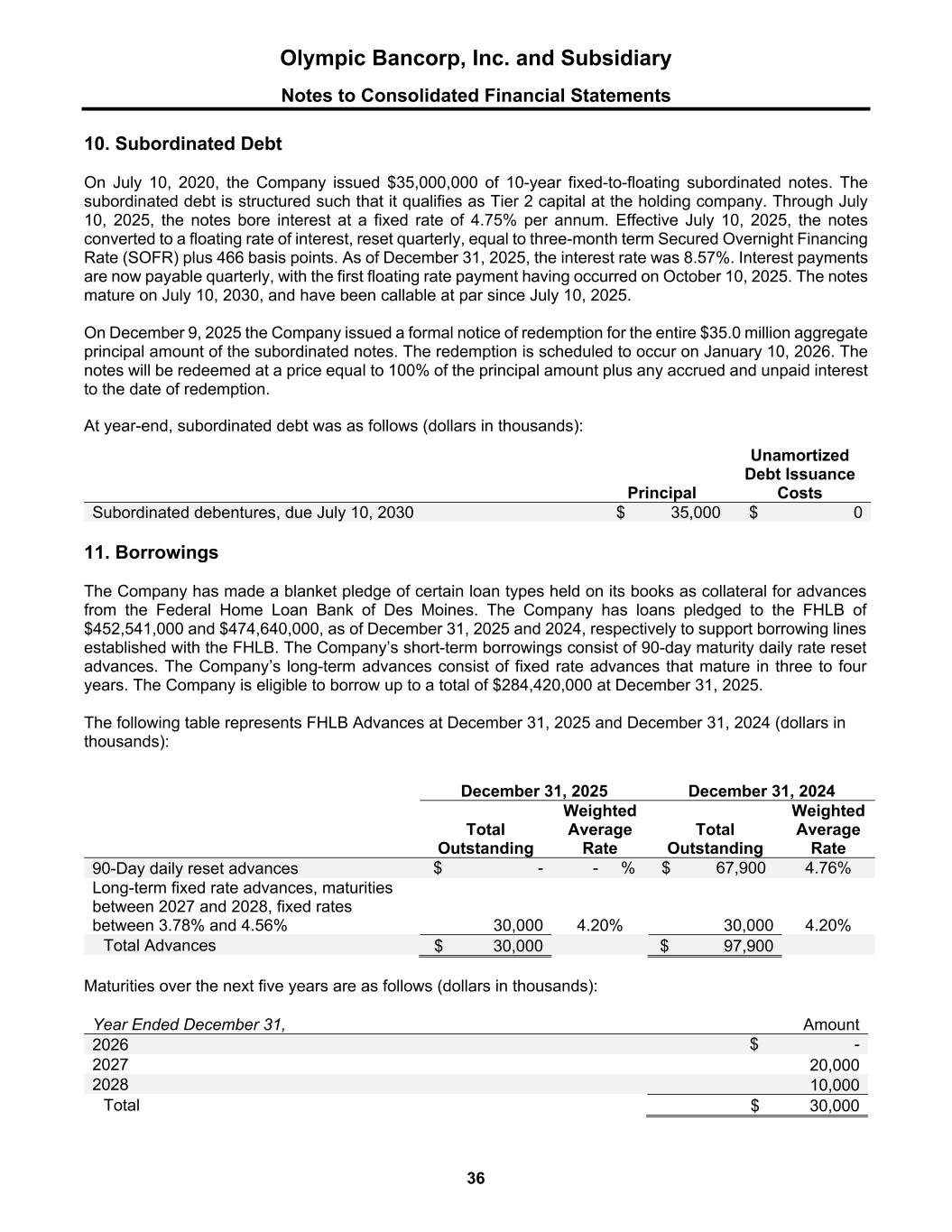
Olympic Bancorp, Inc. and Subsidiary Notes to Consolidated Financial Statements 36 10. Subordinated Debt On July 10, 2020, the Company issued $35,000,000 of 10-year fixed-to-floating subordinated notes. The subordinated debt is structured such that it qualifies as Tier 2 capital at the holding company. Through July 10, 2025, the notes bore interest at a fixed rate of 4.75% per annum. Effective July 10, 2025, the notes converted to a floating rate of interest, reset quarterly, equal to three-month term Secured Overnight Financing Rate (SOFR) plus 466 basis points. As of December 31, 2025, the interest rate was 8.57%. Interest payments are now payable quarterly, with the first floating rate payment having occurred on October 10, 2025. The notes mature on July 10, 2030, and have been callable at par since July 10, 2025. On December 9, 2025 the Company issued a formal notice of redemption for the entire $35.0 million aggregate principal amount of the subordinated notes. The redemption is scheduled to occur on January 10, 2026. The notes will be redeemed at a price equal to 100% of the principal amount plus any accrued and unpaid interest to the date of redemption. At year-end, subordinated debt was as follows (dollars in thousands): Principal Unamortized Debt Issuance Costs Subordinated debentures, due July 10, 2030 $ 35,000 $ 0 11. Borrowings The Company has made a blanket pledge of certain loan types held on its books as collateral for advances from the Federal Home Loan Bank of Des Moines. The Company has loans pledged to the FHLB of $452,541,000 and $474,640,000, as of December 31, 2025 and 2024, respectively to support borrowing lines established with the FHLB. The Company’s short-term borrowings consist of 90-day maturity daily rate reset advances. The Company’s long-term advances consist of fixed rate advances that mature in three to four years. The Company is eligible to borrow up to a total of $284,420,000 at December 31, 2025. The following table represents FHLB Advances at December 31, 2025 and December 31, 2024 (dollars in thousands): December 31, 2025 December 31, 2024 Total Outstanding Weighted Average Rate Total Outstanding Weighted Average Rate 90-Day daily reset advances $ - - % $ 67,900 4.76% Long-term fixed rate advances, maturities between 2027 and 2028, fixed rates between 3.78% and 4.56% 30,000 4.20% 30,000 4.20% Total Advances $ 30,000 $ 97,900 Maturities over the next five years are as follows (dollars in thousands): Year Ended December 31, Amount 2026 $ - 2027 20,000 2028 10,000 Total $ 30,000
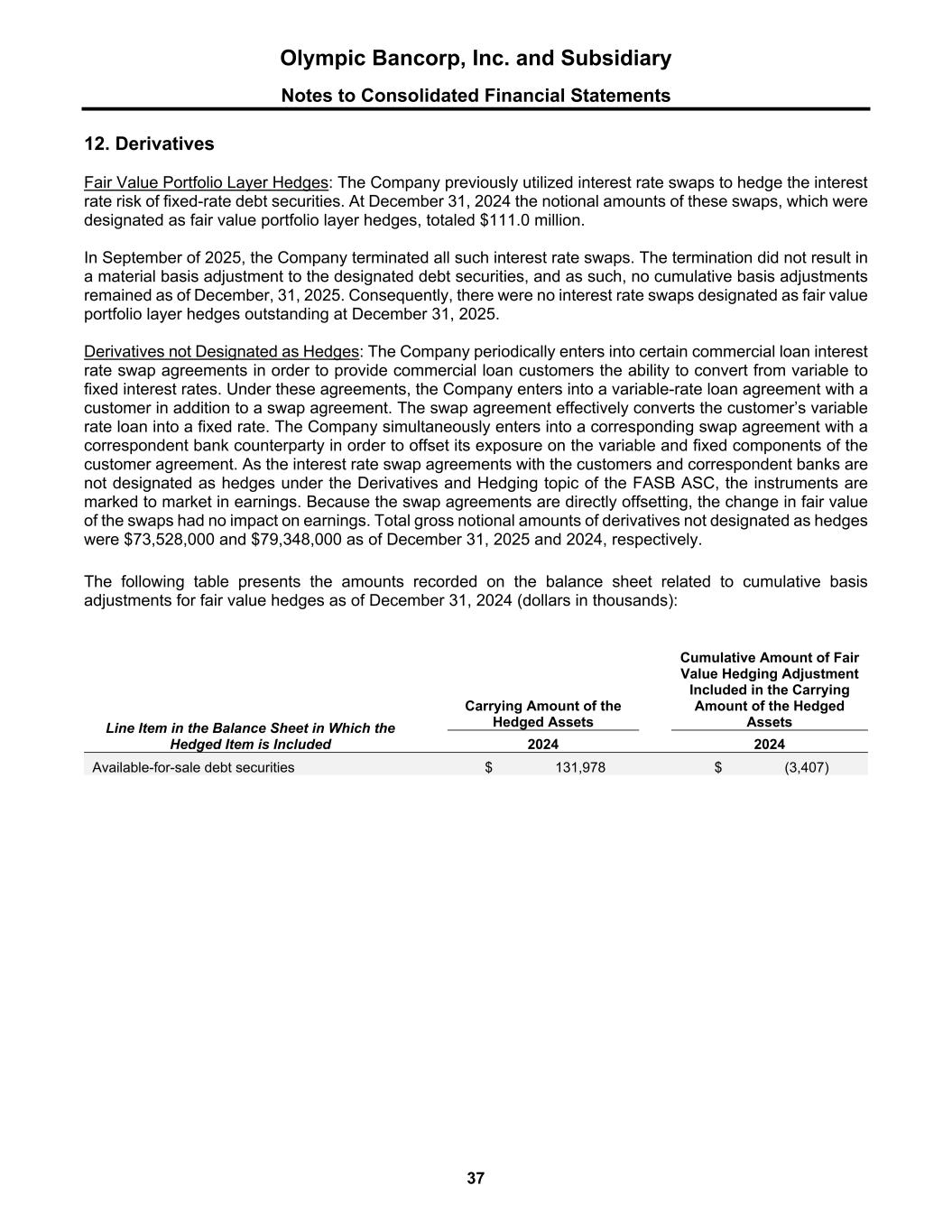
Olympic Bancorp, Inc. and Subsidiary Notes to Consolidated Financial Statements 37 12. Derivatives Fair Value Portfolio Layer Hedges: The Company previously utilized interest rate swaps to hedge the interest rate risk of fixed-rate debt securities. At December 31, 2024 the notional amounts of these swaps, which were designated as fair value portfolio layer hedges, totaled $111.0 million. In September of 2025, the Company terminated all such interest rate swaps. The termination did not result in a material basis adjustment to the designated debt securities, and as such, no cumulative basis adjustments remained as of December, 31, 2025. Consequently, there were no interest rate swaps designated as fair value portfolio layer hedges outstanding at December 31, 2025. Derivatives not Designated as Hedges: The Company periodically enters into certain commercial loan interest rate swap agreements in order to provide commercial loan customers the ability to convert from variable to fixed interest rates. Under these agreements, the Company enters into a variable-rate loan agreement with a customer in addition to a swap agreement. The swap agreement effectively converts the customer’s variable rate loan into a fixed rate. The Company simultaneously enters into a corresponding swap agreement with a correspondent bank counterparty in order to offset its exposure on the variable and fixed components of the customer agreement. As the interest rate swap agreements with the customers and correspondent banks are not designated as hedges under the Derivatives and Hedging topic of the FASB ASC, the instruments are marked to market in earnings. Because the swap agreements are directly offsetting, the change in fair value of the swaps had no impact on earnings. Total gross notional amounts of derivatives not designated as hedges were $73,528,000 and $79,348,000 as of December 31, 2025 and 2024, respectively. The following table presents the amounts recorded on the balance sheet related to cumulative basis adjustments for fair value hedges as of December 31, 2024 (dollars in thousands): Line Item in the Balance Sheet in Which the Hedged Item is Included Carrying Amount of the Hedged Assets Cumulative Amount of Fair Value Hedging Adjustment Included in the Carrying Amount of the Hedged Assets 2024 2024 Available-for-sale debt securities $ 131,978 $ (3,407)
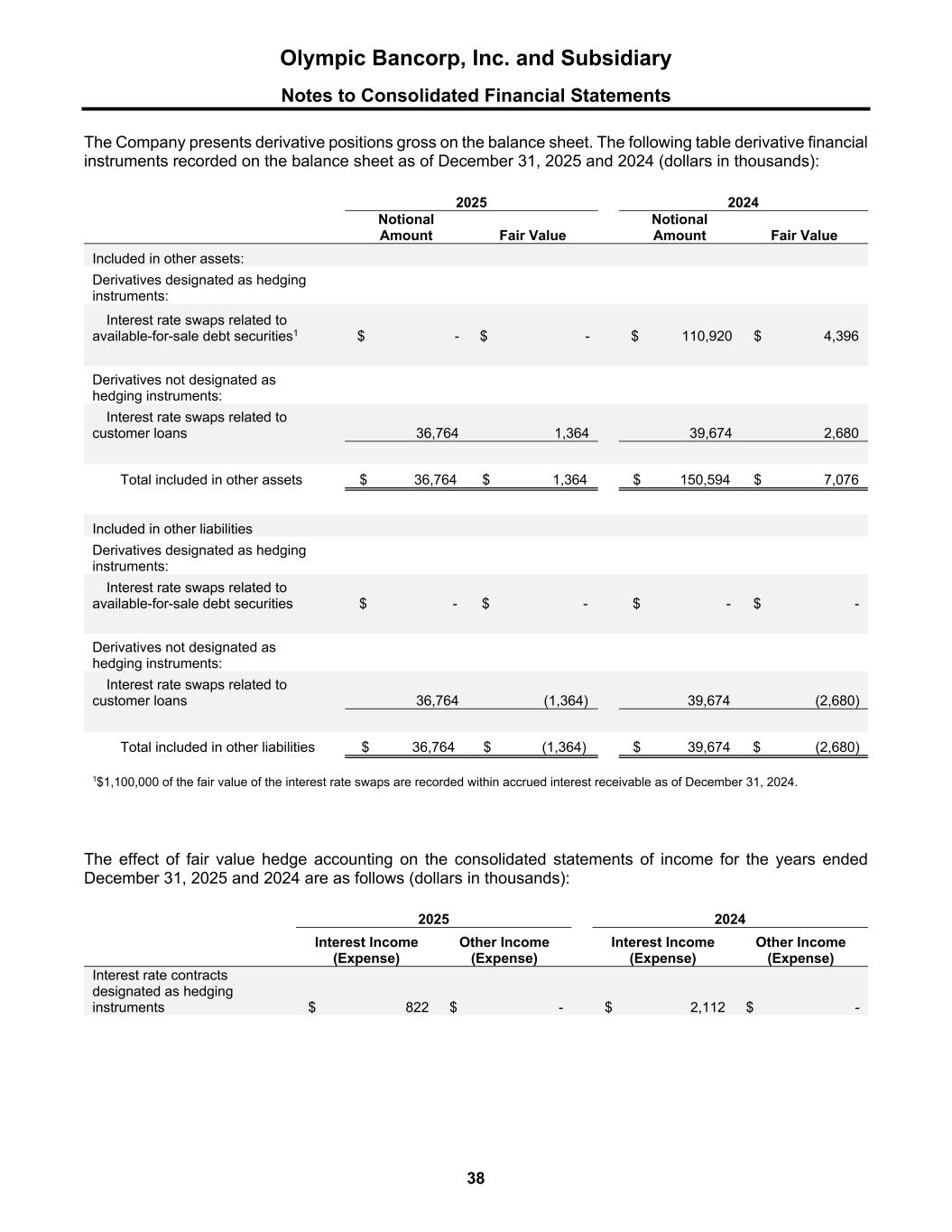
Olympic Bancorp, Inc. and Subsidiary Notes to Consolidated Financial Statements 38 The Company presents derivative positions gross on the balance sheet. The following table derivative financial instruments recorded on the balance sheet as of December 31, 2025 and 2024 (dollars in thousands): 2025 2024 Notional Amount Fair Value Notional Amount Fair Value Included in other assets: Derivatives designated as hedging instruments: Interest rate swaps related to available-for-sale debt securities1 $ - $ - $ 110,920 $ 4,396 Derivatives not designated as hedging instruments: Interest rate swaps related to customer loans 36,764 1,364 39,674 2,680 Total included in other assets $ 36,764 $ 1,364 $ 150,594 $ 7,076 Included in other liabilities Derivatives designated as hedging instruments: Interest rate swaps related to available-for-sale debt securities $ - $ - $ - $ - Derivatives not designated as hedging instruments: Interest rate swaps related to customer loans 36,764 (1,364) 39,674 (2,680) Total included in other liabilities $ 36,764 $ (1,364) $ 39,674 $ (2,680) 1$1,100,000 of the fair value of the interest rate swaps are recorded within accrued interest receivable as of December 31, 2024. The effect of fair value hedge accounting on the consolidated statements of income for the years ended December 31, 2025 and 2024 are as follows (dollars in thousands): 2025 2024 Interest Income (Expense) Other Income (Expense) Interest Income (Expense) Other Income (Expense) Interest rate contracts designated as hedging instruments $ 822 $ - $ 2,112 $ -
Olympic Bancorp, Inc. and Subsidiary Notes to Consolidated Financial Statements 39 13. Regulatory Matters The Company and the Bank are subject to various regulatory capital requirements administered by the federal banking agencies. Failure to meet minimum capital requirements can initiate certain mandatory and possibly additional discretionary actions by regulators that, if undertaken, could have a direct material effect on the Company’s consolidated financial statements. The regulations require the Bank to meet specific capital adequacy guidelines that involve quantitative measures of the Bank’s assets, liabilities and certain off-balance-sheet items as calculated under regulatory accounting practices. The Bank’s capital classification is also subject to qualitative judgments by the regulators about components, risk weightings, and other factors. Quantitative measures established by regulation to ensure capital adequacy require the Company and the Bank to maintain minimum amounts and ratios (set forth in the table below) of tier 1 capital (as defined in the regulations) to total average assets (as defined), and minimum ratios of common equity tier 1, tier 1 and total capital (as defined) to risk-weighted assets (as defined). These measures were modified effective January 1, 2015 to reflect Basel III capital standards. As of December 31, 2025, the most recent notification from the Bank’s regulator categorized the Bank as well capitalized under the regulatory framework for prompt corrective action. To be categorized as well capitalized, the Bank must maintain minimum total risk-based, tier 1 risk-based, common equity tier 1, and tier 1 leverage ratios as set forth in the table. There are no conditions or events since that notification that management believes have changed the institution’s category.
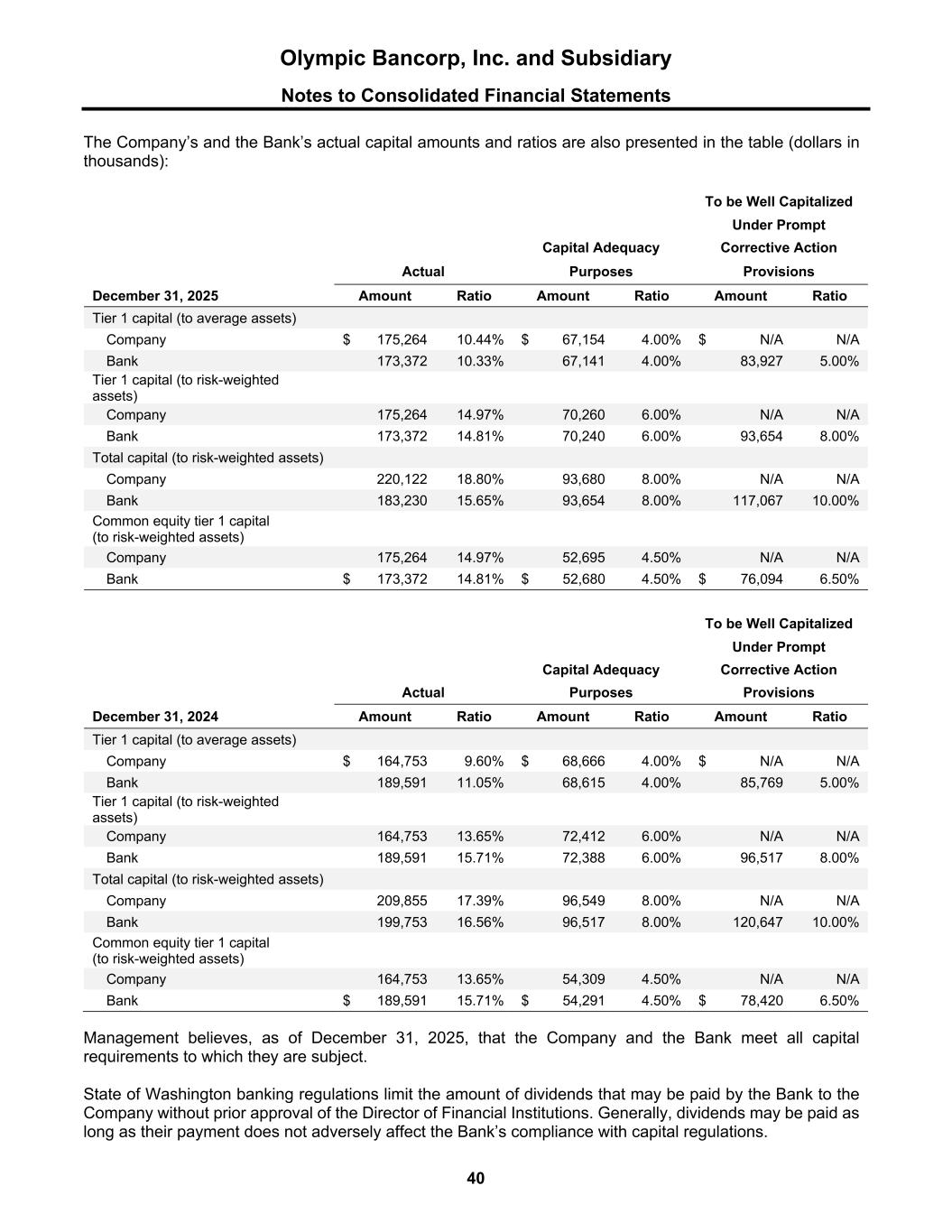
Olympic Bancorp, Inc. and Subsidiary Notes to Consolidated Financial Statements 40 The Company’s and the Bank’s actual capital amounts and ratios are also presented in the table (dollars in thousands): . To be Well Capitalized Under Prompt Capital Adequacy Corrective Action Actual Purposes Provisions December 31, 2025 Amount Ratio Amount Ratio Amount Ratio Tier 1 capital (to average assets) Company $ 175,264 10.44% $ 67,154 4.00% $ N/A N/A Bank 173,372 10.33% 67,141 4.00% 83,927 5.00% Tier 1 capital (to risk-weighted assets) Company 175,264 14.97% 70,260 6.00% N/A N/A Bank 173,372 14.81% 70,240 6.00% 93,654 8.00% Total capital (to risk-weighted assets) Company 220,122 18.80% 93,680 8.00% N/A N/A Bank 183,230 15.65% 93,654 8.00% 117,067 10.00% Common equity tier 1 capital (to risk-weighted assets) Company 175,264 14.97% 52,695 4.50% N/A N/A Bank $ 173,372 14.81% $ 52,680 4.50% $ 76,094 6.50% To be Well Capitalized Under Prompt Capital Adequacy Corrective Action Actual Purposes Provisions December 31, 2024 Amount Ratio Amount Ratio Amount Ratio Tier 1 capital (to average assets) Company $ 164,753 9.60% $ 68,666 4.00% $ N/A N/A Bank 189,591 11.05% 68,615 4.00% 85,769 5.00% Tier 1 capital (to risk-weighted assets) Company 164,753 13.65% 72,412 6.00% N/A N/A Bank 189,591 15.71% 72,388 6.00% 96,517 8.00% Total capital (to risk-weighted assets) Company 209,855 17.39% 96,549 8.00% N/A N/A Bank 199,753 16.56% 96,517 8.00% 120,647 10.00% Common equity tier 1 capital (to risk-weighted assets) Company 164,753 13.65% 54,309 4.50% N/A N/A Bank $ 189,591 15.71% $ 54,291 4.50% $ 78,420 6.50% Management believes, as of December 31, 2025, that the Company and the Bank meet all capital requirements to which they are subject. State of Washington banking regulations limit the amount of dividends that may be paid by the Bank to the Company without prior approval of the Director of Financial Institutions. Generally, dividends may be paid as long as their payment does not adversely affect the Bank’s compliance with capital regulations.
Olympic Bancorp, Inc. and Subsidiary Notes to Consolidated Financial Statements 41 14. Employee Benefits Profit Sharing & 401(k) Plan The Company has a profit sharing and 401(k) plan covering substantially all employees who meet eligibility requirements. Employees can contribute up to 50 percent of gross compensation, subject to IRS maximum contribution limits. The Company contributes an amount equal to 100 percent of each participant’s current year contribution, not to exceed 4 percent of compensation. 401(k) contributions are immediately vested. Additional contributions may be made at the discretion of the board of directors. Total Company contributions to this plan were $1,743,000 and $886,000 in 2025 and 2024, respectively. Incentive Bonus Plan The Company has an incentive bonus plan for corporate officers and employees. Contributions may be made at the discretion of the board of directors. Total contributions to this plan were $2,138,000 and $1,730,000, in 2025 and 2024, respectively. Deferred Compensation Plan The Company has a deferred compensation plan for Company employees for whom annual contributions of profit-sharing benefits by the Company are limited due to provisions of the Internal Revenue Code. The Company will contribute annually an amount equal to the contribution it would have made to the profit-sharing plan for the participant, absent any IRS limitation. Earnings of the plan are based on changes in the book value of the Company’s stock. Upon termination, the participant will receive the value of the phantom shares at the date of termination. There were no payments made from the plan in 2025 and 2024. The total deferred compensation liability was $129,000 at December 31, 2025 and 2024. As of July 1, 2012, with the establishment of the new Phantom Stock Plan, no new deferrals are allowed under this plan and no further contributions will be made. Directors Deferred Compensation Plan Directors have the option to be paid in cash fees earned for each board meeting attended or defer the fees. Upon retiring from the board, the directors will receive the fees accrued into the plan. The Company incurred expenses of $7,000 and $17,000 for the years ended December 31, 2025 and 2024, respectively. Payments made from the plan totaled $20,000 and $19,000 in 2025 and 2024. As of December 31, 2025, deferred director compensation liability totaled $362,000 versus $375,000 at December 31, 2024. Effective January 1, 2013 any new deferrals are to be incorporated into the Company’s Phantom Stock Plan. Executive Retirement Plan The Company previously maintained a deferred compensation plan for key employees. Participation in the plan was at the discretion of the board of directors. The liability was indexed to the performance of the on the S&P 500 market index. The During 2025, the plan was fully settled and terminated. Deferred compensation reflected in other liabilities on the consolidated balance sheets was $0 and $46,000 at December 31, 2025 and 2024, respectively. Payments from the plan totaled $46,000 in 2025 and $83,000 in 2024. Company recognized expense in the plan of $0 and $18,000 in 2025 and 2024, respectively. The Company retains life insurance policies on the lives of the former participants, which were historically intended to offset expenses of the plan. The life insurance policies had a cash surrender value of $2,088,000 and $1,909,000 at December 31, 2025 and December 31, 2024, respectively. ‘
Olympic Bancorp, Inc. and Subsidiary Notes to Consolidated Financial Statements 42 Phantom Stock Plans During 2012, the Company established a Phantom Stock Plan to consolidate and replace various existing deferred compensation plans so that both mandatory and elective individual deferred compensation, and employer-funded deferred compensation, are invested in “phantom stock” that reflects the growth in the value of the Company’s stock. Earnings of the plan are based on changes in the book value of the Company’s stock with additional cash compensation that will be equivalent to cash distributions made to the Company’s shareholders. Contributions to this plan may be made by directors who chose to defer the fees they are entitled to, by executives that are eligible to defer both short and long-term incentive pay under the Management Incentive Plan, and by contributions made to directors and officers at the discretion of the Company’s board. Deferred compensation reflected in other liabilities on the consolidated balance sheets is $7,234,000 and $6,713,000 at December 31, 2025 and 2024, respectively. Expense to the Company related to this plan was $386,000 and $598,000 for the years ended December 31, 2025 and 2024. Cash distributions made under this plan equivalent to distributions made to shareholders totaled $73,000 and $721,000 at December 31, 2025 and 2024, respectively. In 2022, the Company established a new Phantom Stock Plan for select officers of the bank subsidiary. The plan was developed to attract and retain highly-qualified employees who contribute to the Company’s long- term success, by providing incentives that align the interest of such key employees with those of the shareholders of the Company. Awards of Phantom Shares are determined by the compensation committee and paid out after the three-year performance period starting on the first day of the calendar award year. A total of $865,000 in awards were made in the 2022 plan year. An additional $35,000 and $90,000 in awards were made in the 2025 and 2024 plan years, respectively. Distributions of $1,049,000 were paid to participants during the 2025 plan year. The liability for the plan totaled $136,000 and $1,142,000 as of December 31, 2025 and 2024, respectively. Expenses related to the plan were $43,000 and $123,000 for the 2025 and 2024 plan years, respectively. Management Incentive Plan In 2012, the Company established a Management Incentive Plan (MIP) as a means to promote the short- term and long-term interests of the Company and to motivate, reward and retain key executives who significantly contribute to the financial performance of the Company. The Plan consists of two pools: a Short- term Incentive pool (STI) and a Long-term Incentive Pool (LTI). Participants may elect to defer any STI or LTI payments under this plan to the Phantom Stock Plan but at a minimum must defer 50% of LTI payments every year. The total MIP liability for STI was $351,000 as of December 31, 2025 and $150,000 as of December 31, 2024. Total expense related to STI was $351,000 2025 and $150,000 in 2024. STI payments of $150,000 and $376,000 were made in the year ended December 31, 2025 and December 31, 2024, respectively. LTI payments of $415,000 were made in the year ended December 31, 2025 and $708,000 in the year ended December 31, 2024. For both years, 50% of the LTI payment was paid in cash while 50% was transferred to the Phantom Stock Plan. The total MIP liability for LTI was $793,000 as of December 31, 2025 and $772,000 as of December 31, 2024. The total expense related to the LTI was $436,000 and $222,000 in 2025 and 2024, respectively. Salary Continuation Plan During 2012, the Company adopted a Salary Continuation Plan (SCP) covering a select group of management personnel. The post-retirement benefit provided by the SCP is designed to supplement a participating officer’s retirement benefits from social security, in order to provide the officer with a certain percentage of final average income at retirement age. Liabilities to these employees, which will be accrued over their expected time to retirement, were $1,539,000 at December 31, 2025 and $1,359,000 at December 31, 2024. Compensation expense related to this plan totaled $180,000 and $165,000 in 2025 and 2024, respectively. No payments were made from the plan in 2025 or 2024.
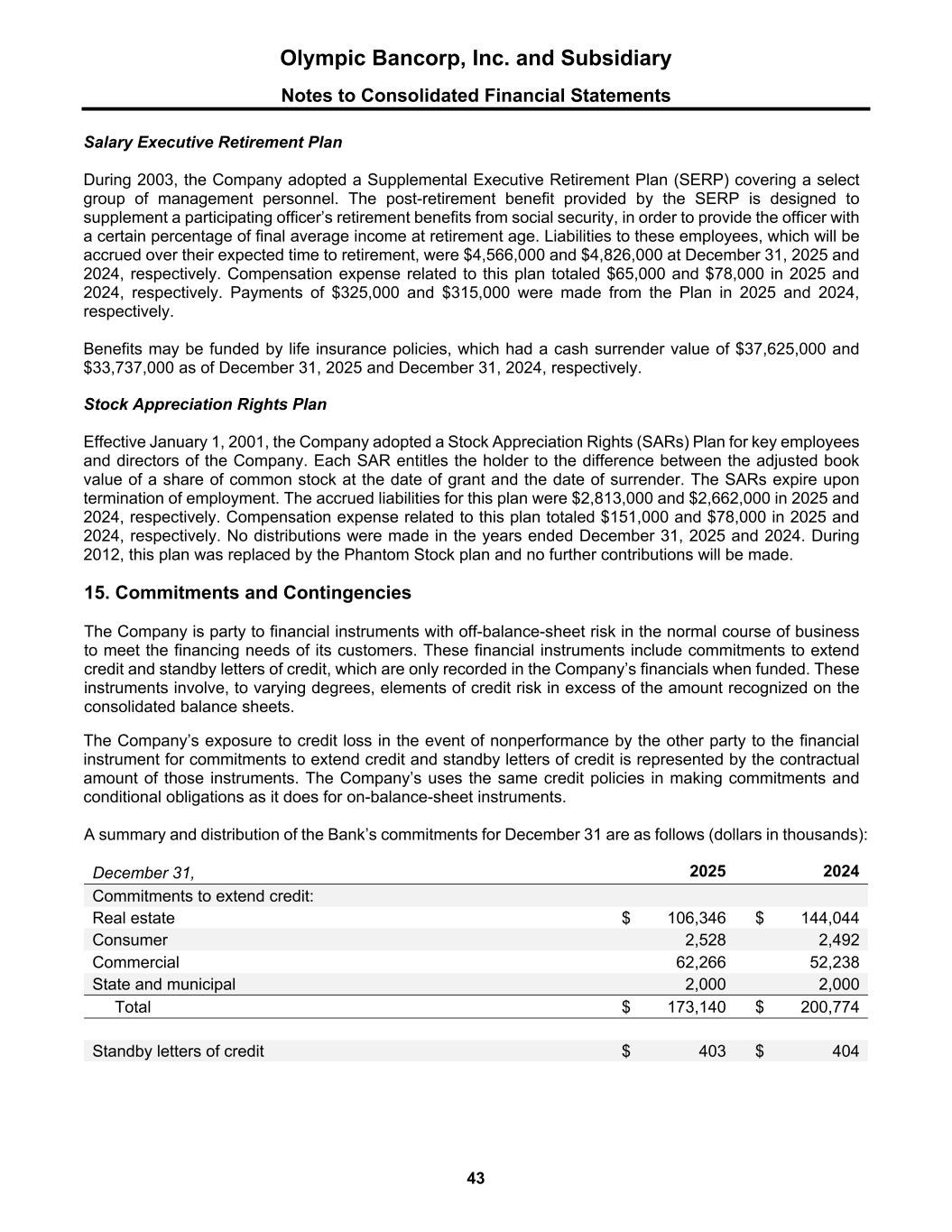
Olympic Bancorp, Inc. and Subsidiary Notes to Consolidated Financial Statements 43 Salary Executive Retirement Plan During 2003, the Company adopted a Supplemental Executive Retirement Plan (SERP) covering a select group of management personnel. The post-retirement benefit provided by the SERP is designed to supplement a participating officer’s retirement benefits from social security, in order to provide the officer with a certain percentage of final average income at retirement age. Liabilities to these employees, which will be accrued over their expected time to retirement, were $4,566,000 and $4,826,000 at December 31, 2025 and 2024, respectively. Compensation expense related to this plan totaled $65,000 and $78,000 in 2025 and 2024, respectively. Payments of $325,000 and $315,000 were made from the Plan in 2025 and 2024, respectively. Benefits may be funded by life insurance policies, which had a cash surrender value of $37,625,000 and $33,737,000 as of December 31, 2025 and December 31, 2024, respectively. Stock Appreciation Rights Plan Effective January 1, 2001, the Company adopted a Stock Appreciation Rights (SARs) Plan for key employees and directors of the Company. Each SAR entitles the holder to the difference between the adjusted book value of a share of common stock at the date of grant and the date of surrender. The SARs expire upon termination of employment. The accrued liabilities for this plan were $2,813,000 and $2,662,000 in 2025 and 2024, respectively. Compensation expense related to this plan totaled $151,000 and $78,000 in 2025 and 2024, respectively. No distributions were made in the years ended December 31, 2025 and 2024. During 2012, this plan was replaced by the Phantom Stock plan and no further contributions will be made. 15. Commitments and Contingencies The Company is party to financial instruments with off-balance-sheet risk in the normal course of business to meet the financing needs of its customers. These financial instruments include commitments to extend credit and standby letters of credit, which are only recorded in the Company’s financials when funded. These instruments involve, to varying degrees, elements of credit risk in excess of the amount recognized on the consolidated balance sheets. The Company’s exposure to credit loss in the event of nonperformance by the other party to the financial instrument for commitments to extend credit and standby letters of credit is represented by the contractual amount of those instruments. The Company’s uses the same credit policies in making commitments and conditional obligations as it does for on-balance-sheet instruments. A summary and distribution of the Bank’s commitments for December 31 are as follows (dollars in thousands): December 31, 2025 2024 Commitments to extend credit: Real estate $ 106,346 $ 144,044 Consumer 2,528 2,492 Commercial 62,266 52,238 State and municipal 2,000 2,000 Total $ 173,140 $ 200,774 Standby letters of credit $ 403 $ 404
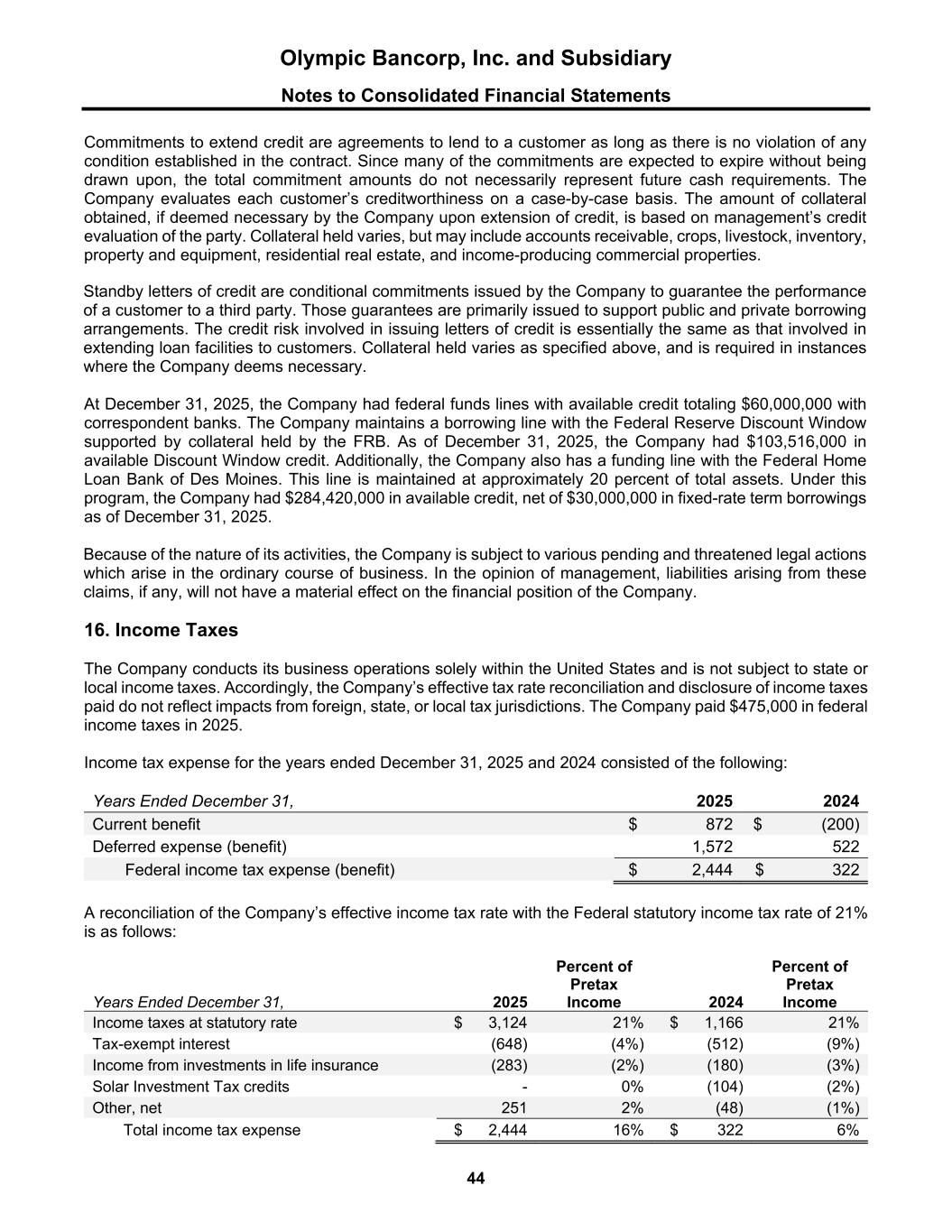
Olympic Bancorp, Inc. and Subsidiary Notes to Consolidated Financial Statements 44 Commitments to extend credit are agreements to lend to a customer as long as there is no violation of any condition established in the contract. Since many of the commitments are expected to expire without being drawn upon, the total commitment amounts do not necessarily represent future cash requirements. The Company evaluates each customer’s creditworthiness on a case-by-case basis. The amount of collateral obtained, if deemed necessary by the Company upon extension of credit, is based on management’s credit evaluation of the party. Collateral held varies, but may include accounts receivable, crops, livestock, inventory, property and equipment, residential real estate, and income-producing commercial properties. Standby letters of credit are conditional commitments issued by the Company to guarantee the performance of a customer to a third party. Those guarantees are primarily issued to support public and private borrowing arrangements. The credit risk involved in issuing letters of credit is essentially the same as that involved in extending loan facilities to customers. Collateral held varies as specified above, and is required in instances where the Company deems necessary. At December 31, 2025, the Company had federal funds lines with available credit totaling $60,000,000 with correspondent banks. The Company maintains a borrowing line with the Federal Reserve Discount Window supported by collateral held by the FRB. As of December 31, 2025, the Company had $103,516,000 in available Discount Window credit. Additionally, the Company also has a funding line with the Federal Home Loan Bank of Des Moines. This line is maintained at approximately 20 percent of total assets. Under this program, the Company had $284,420,000 in available credit, net of $30,000,000 in fixed-rate term borrowings as of December 31, 2025. Because of the nature of its activities, the Company is subject to various pending and threatened legal actions which arise in the ordinary course of business. In the opinion of management, liabilities arising from these claims, if any, will not have a material effect on the financial position of the Company. 16. Income Taxes The Company conducts its business operations solely within the United States and is not subject to state or local income taxes. Accordingly, the Company’s effective tax rate reconciliation and disclosure of income taxes paid do not reflect impacts from foreign, state, or local tax jurisdictions. The Company paid $475,000 in federal income taxes in 2025. Income tax expense for the years ended December 31, 2025 and 2024 consisted of the following: Years Ended December 31, 2025 2024 Current benefit $ 872 $ (200) Deferred expense (benefit) 1,572 522 Federal income tax expense (benefit) $ 2,444 $ 322 A reconciliation of the Company’s effective income tax rate with the Federal statutory income tax rate of 21% is as follows: Years Ended December 31, 2025 Percent of Pretax Income 2024 Percent of Pretax Income Income taxes at statutory rate $ 3,124 21% $ 1,166 21% Tax-exempt interest (648) (4%) (512) (9%) Income from investments in life insurance (283) (2%) (180) (3%) Solar Investment Tax credits - 0% (104) (2%) Other, net 251 2% (48) (1%) Total income tax expense $ 2,444 16% $ 322 6%
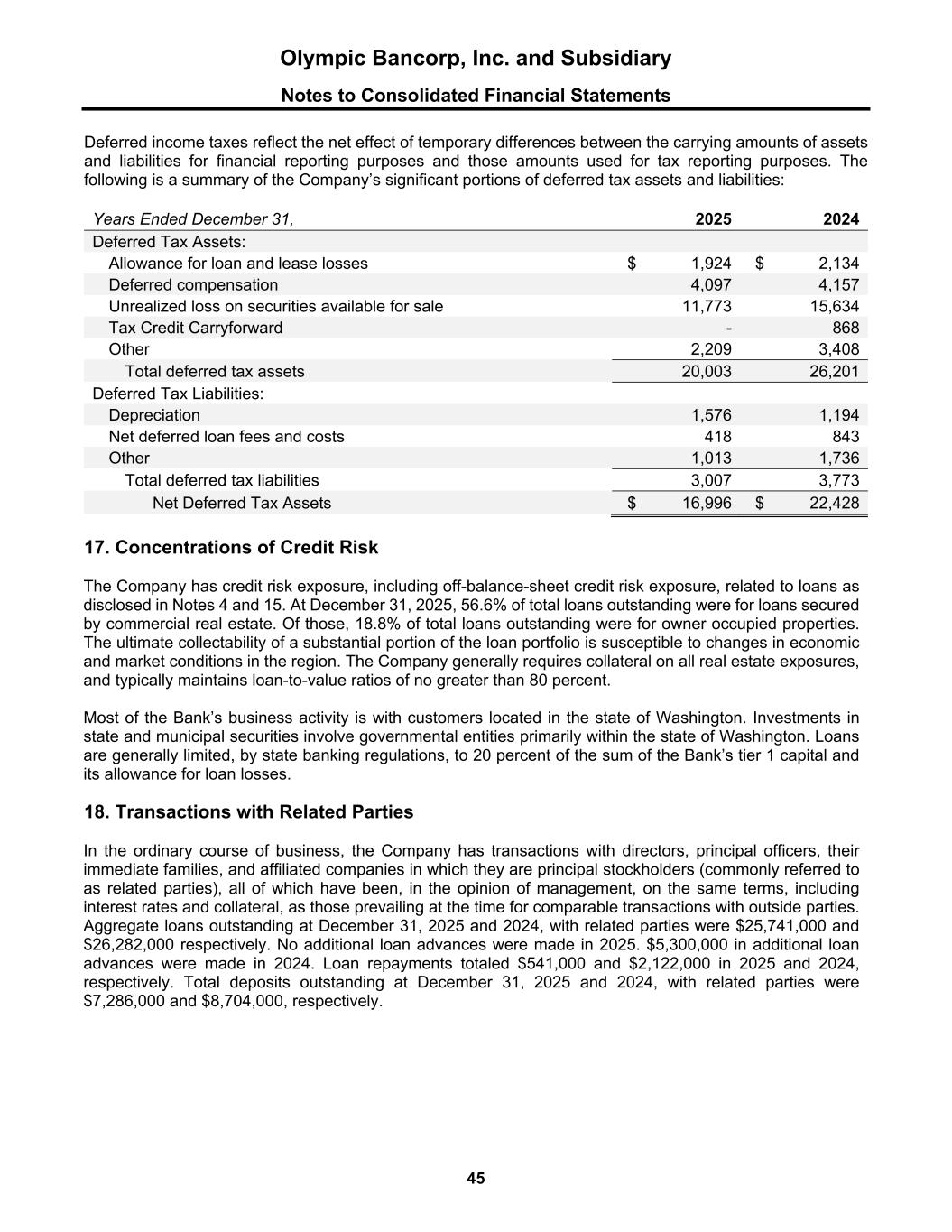
Olympic Bancorp, Inc. and Subsidiary Notes to Consolidated Financial Statements 45 Deferred income taxes reflect the net effect of temporary differences between the carrying amounts of assets and liabilities for financial reporting purposes and those amounts used for tax reporting purposes. The following is a summary of the Company’s significant portions of deferred tax assets and liabilities: Years Ended December 31, 2025 2024 Deferred Tax Assets: Allowance for loan and lease losses $ 1,924 $ 2,134 Deferred compensation 4,097 4,157 Unrealized loss on securities available for sale 11,773 15,634 Tax Credit Carryforward - 868 Other 2,209 3,408 Total deferred tax assets 20,003 26,201 Deferred Tax Liabilities: Depreciation 1,576 1,194 Net deferred loan fees and costs 418 843 Other 1,013 1,736 Total deferred tax liabilities 3,007 3,773 Net Deferred Tax Assets $ 16,996 $ 22,428 17. Concentrations of Credit Risk The Company has credit risk exposure, including off-balance-sheet credit risk exposure, related to loans as disclosed in Notes 4 and 15. At December 31, 2025, 56.6% of total loans outstanding were for loans secured by commercial real estate. Of those, 18.8% of total loans outstanding were for owner occupied properties. The ultimate collectability of a substantial portion of the loan portfolio is susceptible to changes in economic and market conditions in the region. The Company generally requires collateral on all real estate exposures, and typically maintains loan-to-value ratios of no greater than 80 percent. Most of the Bank’s business activity is with customers located in the state of Washington. Investments in state and municipal securities involve governmental entities primarily within the state of Washington. Loans are generally limited, by state banking regulations, to 20 percent of the sum of the Bank’s tier 1 capital and its allowance for loan losses. 18. Transactions with Related Parties In the ordinary course of business, the Company has transactions with directors, principal officers, their immediate families, and affiliated companies in which they are principal stockholders (commonly referred to as related parties), all of which have been, in the opinion of management, on the same terms, including interest rates and collateral, as those prevailing at the time for comparable transactions with outside parties. Aggregate loans outstanding at December 31, 2025 and 2024, with related parties were $25,741,000 and $26,282,000 respectively. No additional loan advances were made in 2025. $5,300,000 in additional loan advances were made in 2024. Loan repayments totaled $541,000 and $2,122,000 in 2025 and 2024, respectively. Total deposits outstanding at December 31, 2025 and 2024, with related parties were $7,286,000 and $8,704,000, respectively.
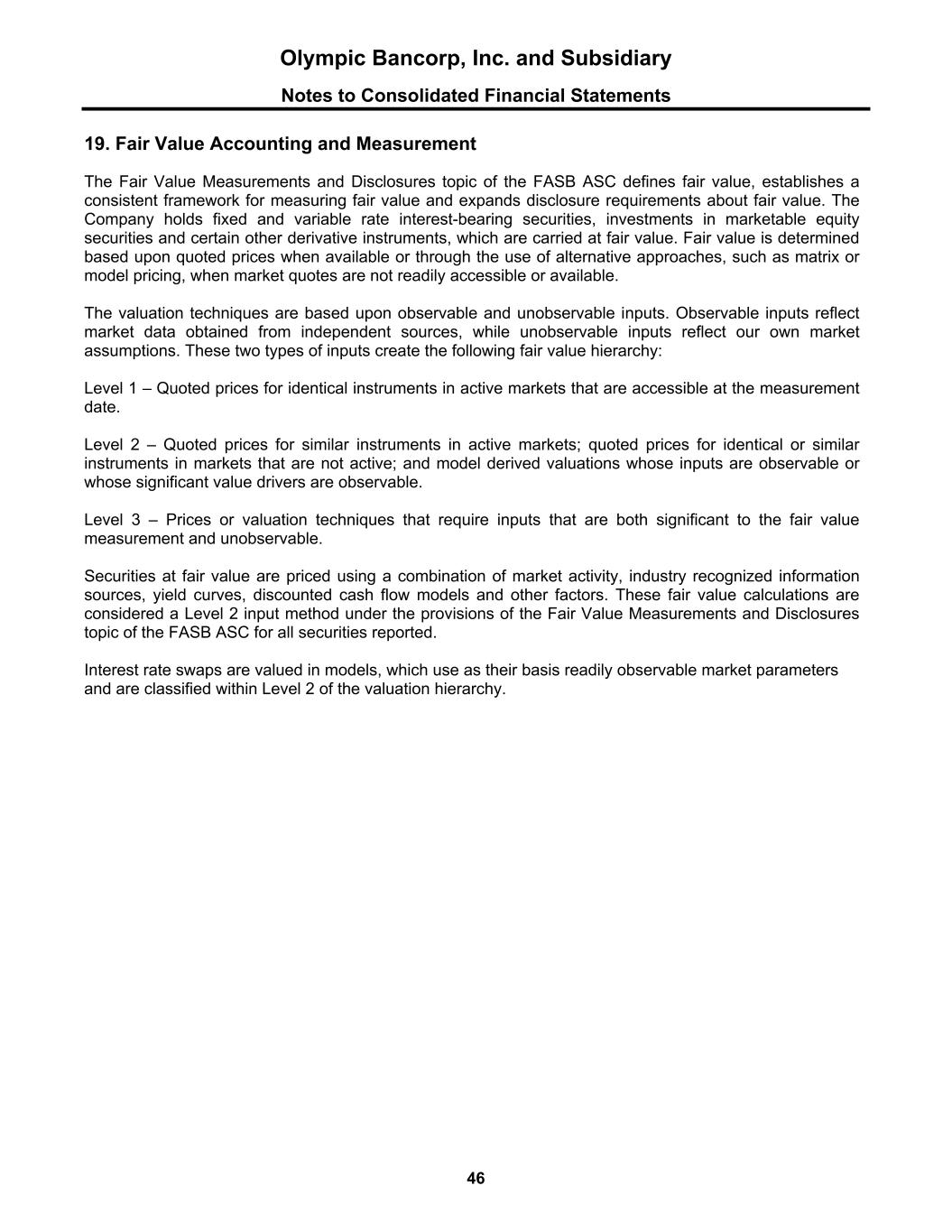
Olympic Bancorp, Inc. and Subsidiary Notes to Consolidated Financial Statements 46 19. Fair Value Accounting and Measurement The Fair Value Measurements and Disclosures topic of the FASB ASC defines fair value, establishes a consistent framework for measuring fair value and expands disclosure requirements about fair value. The Company holds fixed and variable rate interest-bearing securities, investments in marketable equity securities and certain other derivative instruments, which are carried at fair value. Fair value is determined based upon quoted prices when available or through the use of alternative approaches, such as matrix or model pricing, when market quotes are not readily accessible or available. The valuation techniques are based upon observable and unobservable inputs. Observable inputs reflect market data obtained from independent sources, while unobservable inputs reflect our own market assumptions. These two types of inputs create the following fair value hierarchy: Level 1 – Quoted prices for identical instruments in active markets that are accessible at the measurement date. Level 2 – Quoted prices for similar instruments in active markets; quoted prices for identical or similar instruments in markets that are not active; and model derived valuations whose inputs are observable or whose significant value drivers are observable. Level 3 – Prices or valuation techniques that require inputs that are both significant to the fair value measurement and unobservable. Securities at fair value are priced using a combination of market activity, industry recognized information sources, yield curves, discounted cash flow models and other factors. These fair value calculations are considered a Level 2 input method under the provisions of the Fair Value Measurements and Disclosures topic of the FASB ASC for all securities reported. Interest rate swaps are valued in models, which use as their basis readily observable market parameters and are classified within Level 2 of the valuation hierarchy.
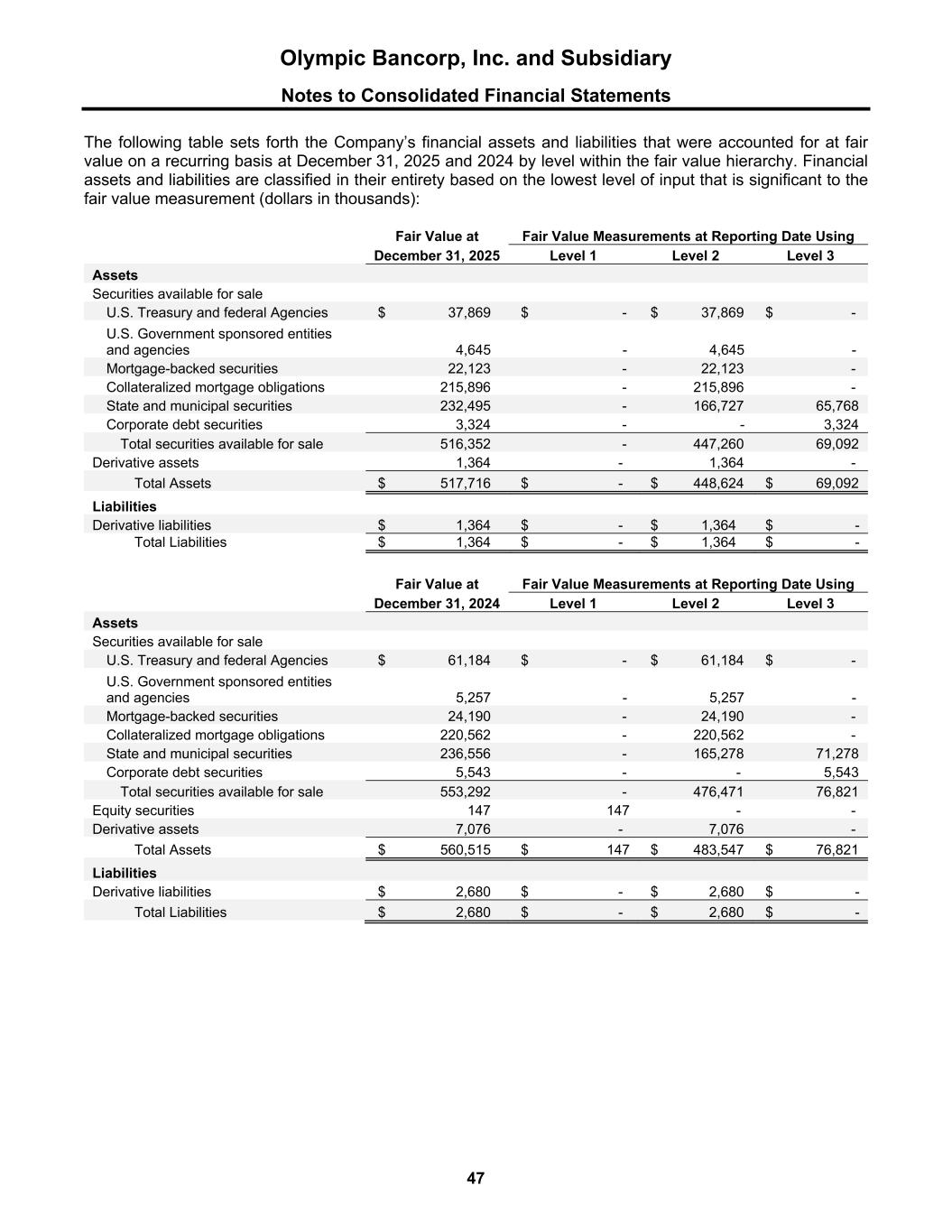
Olympic Bancorp, Inc. and Subsidiary Notes to Consolidated Financial Statements 47 The following table sets forth the Company’s financial assets and liabilities that were accounted for at fair value on a recurring basis at December 31, 2025 and 2024 by level within the fair value hierarchy. Financial assets and liabilities are classified in their entirety based on the lowest level of input that is significant to the fair value measurement (dollars in thousands): Fair Value at Fair Value Measurements at Reporting Date Using December 31, 2025 Level 1 Level 2 Level 3 Assets Securities available for sale U.S. Treasury and federal Agencies $ 37,869 $ - $ 37,869 $ - U.S. Government sponsored entities …and agencies 4,645 - 4,645 - Mortgage-backed securities 22,123 - 22,123 - Collateralized mortgage obligations 215,896 - 215,896 - State and municipal securities 232,495 - 166,727 65,768 Corporate debt securities 3,324 - - 3,324 Total securities available for sale 516,352 - 447,260 69,092 Derivative assets 1,364 - 1,364 - Total Assets $ 517,716 $ - $ 448,624 $ 69,092 Liabilities Derivative liabilities $ 1,364 $ - $ 1,364 $ - Total Liabilities $ 1,364 $ - $ 1,364 $ - Fair Value at Fair Value Measurements at Reporting Date Using December 31, 2024 Level 1 Level 2 Level 3 Assets Securities available for sale U.S. Treasury and federal Agencies $ 61,184 $ - $ 61,184 $ - U.S. Government sponsored entities …and agencies 5,257 - 5,257 - Mortgage-backed securities 24,190 - 24,190 - Collateralized mortgage obligations 220,562 - 220,562 - State and municipal securities 236,556 - 165,278 71,278 Corporate debt securities 5,543 - - 5,543 Total securities available for sale 553,292 - 476,471 76,821 Equity securities 147 147 - - Derivative assets 7,076 - 7,076 - Total Assets $ 560,515 $ 147 $ 483,547 $ 76,821 Liabilities Derivative liabilities $ 2,680 $ - $ 2,680 $ - Total Liabilities $ 2,680 $ - $ 2,680 $ -
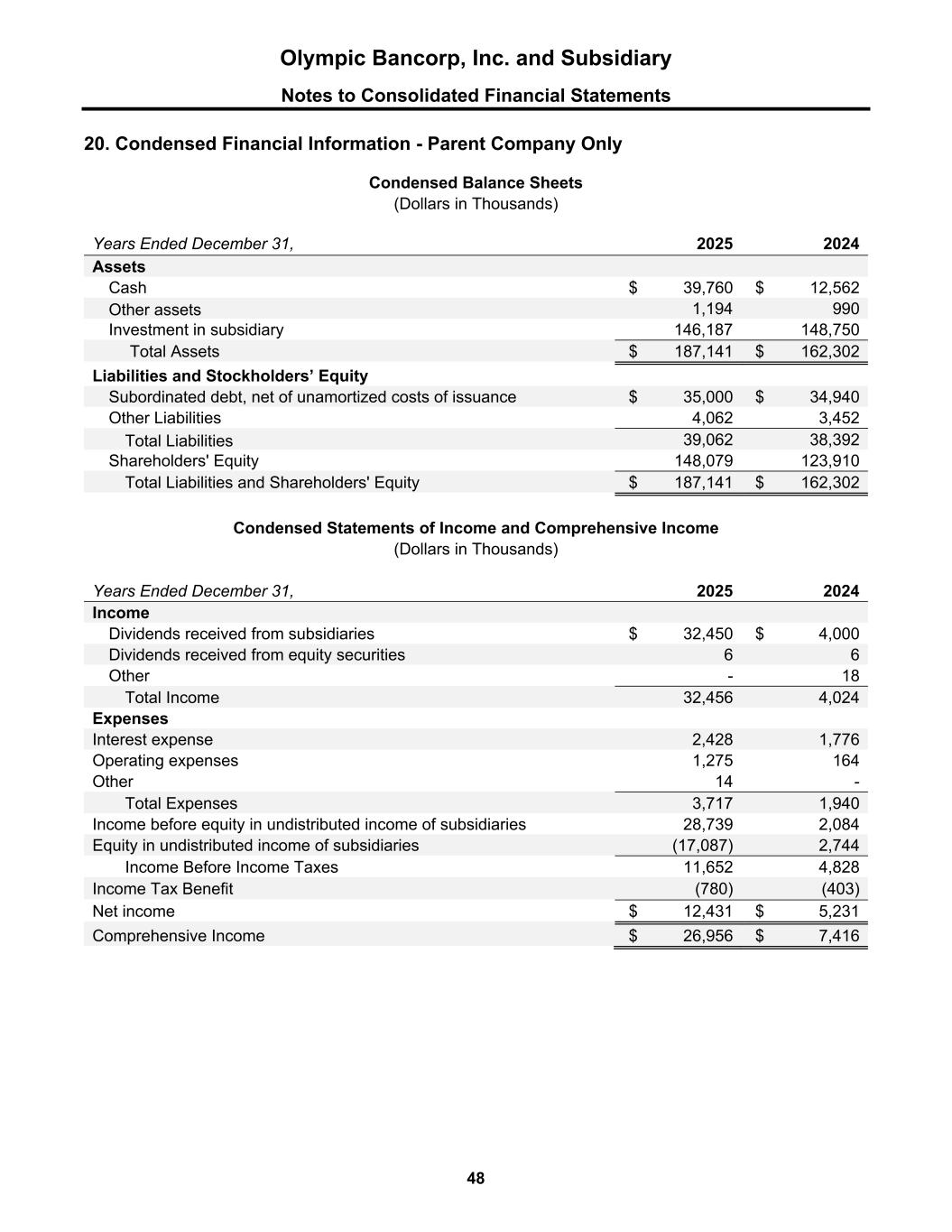
Olympic Bancorp, Inc. and Subsidiary Notes to Consolidated Financial Statements 48 20. Condensed Financial Information - Parent Company Only Condensed Balance Sheets (Dollars in Thousands) Years Ended December 31, 2025 2024 Assets Cash $ 39,760 $ 12,562 Other assets 1,194 990 Investment in subsidiary 146,187 148,750 Total Assets $ 187,141 $ 162,302 Liabilities and Stockholders’ Equity Subordinated debt, net of unamortized costs of issuance $ 35,000 $ 34,940 Other Liabilities 4,062 3,452 Total Liabilities 39,062 38,392 Shareholders' Equity 148,079 123,910 Total Liabilities and Shareholders' Equity $ 187,141 $ 162,302 Condensed Statements of Income and Comprehensive Income (Dollars in Thousands) Years Ended December 31, 2025 2024 Income Dividends received from subsidiaries $ 32,450 $ 4,000 Dividends received from equity securities 6 6 Other - 18 Total Income 32,456 4,024 Expenses Interest expense 2,428 1,776 Operating expenses 1,275 164 Other 14 - Total Expenses 3,717 1,940 Income before equity in undistributed income of subsidiaries 28,739 2,084 Equity in undistributed income of subsidiaries (17,087) 2,744 Income Before Income Taxes 11,652 4,828 Income Tax Benefit (780) (403) Net income $ 12,431 $ 5,231 Comprehensive Income $ 26,956 $ 7,416
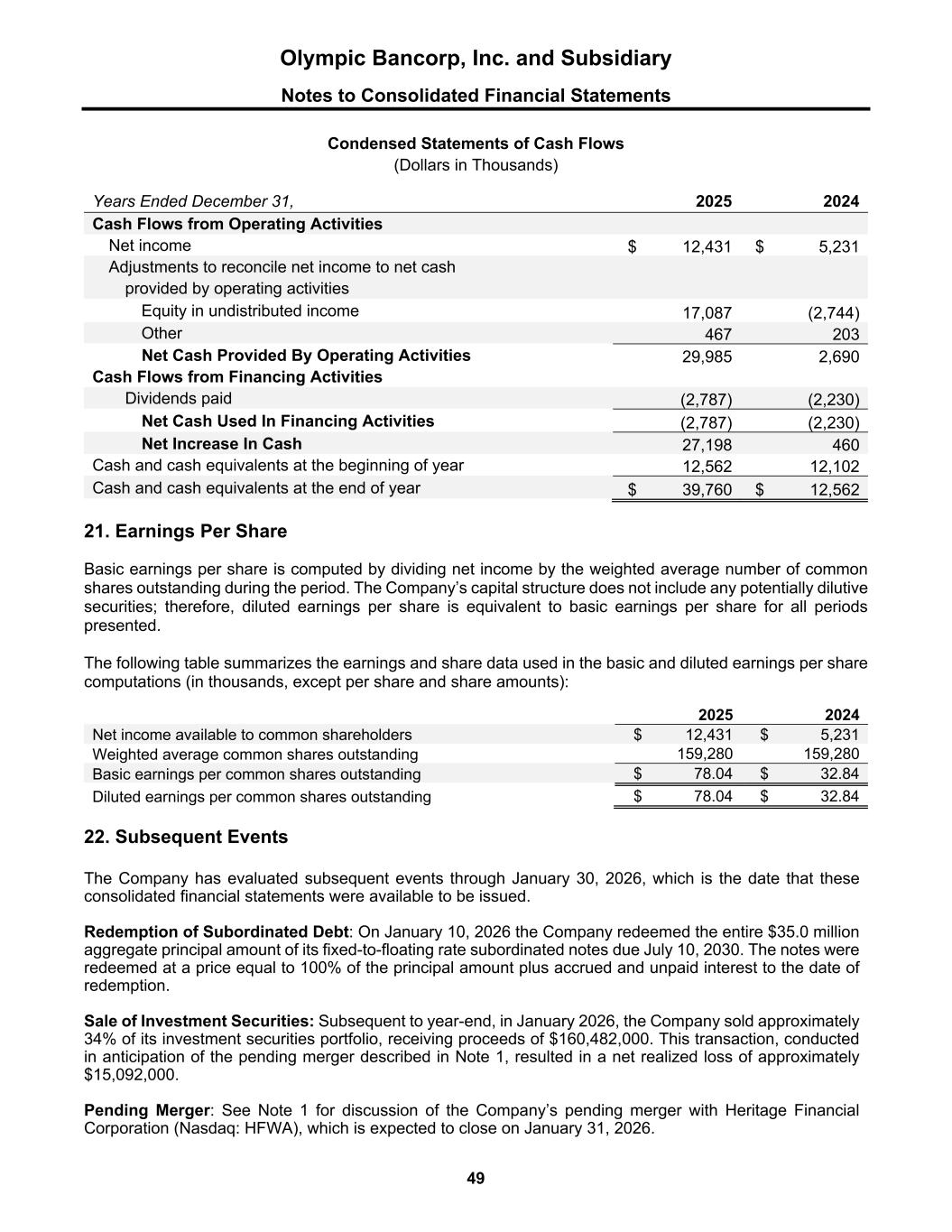
Olympic Bancorp, Inc. and Subsidiary Notes to Consolidated Financial Statements 49 Condensed Statements of Cash Flows (Dollars in Thousands) Years Ended December 31, 2025 2024 Cash Flows from Operating Activities Net income $ 12,431 $ 5,231 Adjustments to reconcile net income to net cash provided by operating activities Equity in undistributed income 17,087 (2,744) Other 467 203 Net Cash Provided By Operating Activities 29,985 2,690 Cash Flows from Financing Activities Dividends paid (2,787) (2,230) Net Cash Used In Financing Activities (2,787) (2,230) Net Increase In Cash 27,198 460 Cash and cash equivalents at the beginning of year 12,562 12,102 Cash and cash equivalents at the end of year $ 39,760 $ 12,562 21. Earnings Per Share Basic earnings per share is computed by dividing net income by the weighted average number of common shares outstanding during the period. The Company’s capital structure does not include any potentially dilutive securities; therefore, diluted earnings per share is equivalent to basic earnings per share for all periods presented. The following table summarizes the earnings and share data used in the basic and diluted earnings per share computations (in thousands, except per share and share amounts): 2025 2024 Net income available to common shareholders $ 12,431 $ 5,231 Weighted average common shares outstanding 159,280 159,280 Basic earnings per common shares outstanding $ 78.04 $ 32.84 Diluted earnings per common shares outstanding $ 78.04 $ 32.84 22. Subsequent Events The Company has evaluated subsequent events through January 30, 2026, which is the date that these consolidated financial statements were available to be issued. Redemption of Subordinated Debt: On January 10, 2026 the Company redeemed the entire $35.0 million aggregate principal amount of its fixed-to-floating rate subordinated notes due July 10, 2030. The notes were redeemed at a price equal to 100% of the principal amount plus accrued and unpaid interest to the date of redemption. Sale of Investment Securities: Subsequent to year-end, in January 2026, the Company sold approximately 34% of its investment securities portfolio, receiving proceeds of $160,482,000. This transaction, conducted in anticipation of the pending merger described in Note 1, resulted in a net realized loss of approximately $15,092,000. Pending Merger: See Note 1 for discussion of the Company’s pending merger with Heritage Financial Corporation (Nasdaq: HFWA), which is expected to close on January 31, 2026.