
2025 Annual Information Form
EXHIBIT 99.1
|
| 2025 Annual Information Form |
ORION DIGITAL CORP.
2025 ANNUAL INFORMATION FORM
DATED: March 31, 2026
| 1 | Page |
|
| 2025 Annual Information Form |
TABLE OF CONTENTS
| CERTAIN INTERPRETATION MATTERS |
| 4 |
|
|
|
|
|
|
| CAUTIONARY NOTE REGARDING FORWARD-LOOKING STATEMENTS |
| 4 |
|
|
|
|
|
|
| CORPORATE STRUCTURE |
| 8 |
|
|
|
|
|
|
| NAME, ADDRESS, AND INCORPORATION |
| 8 |
|
| INTERCORPORATE RELATIONSHIPS |
| 9 |
|
|
|
|
|
|
| BUSINESS DESCRIPTION |
| 10 |
|
|
|
|
|
|
| GENERAL |
| 10 |
|
| PRODUCTS AND SERVICES |
| 10 |
|
| PRODUCT DEVELOPMENT |
| 13 |
|
| OUR PLATFORMS |
| 13 |
|
| SPECIALIZED SKILL AND KNOWLEDGE |
| 15 |
|
| SALES AND MARKETING |
| 15 |
|
| COMPETITIVE CONDITIONS |
| 16 |
|
| INTANGIBLE PROPERTIES |
| 17 |
|
| CREDIT FACILITY |
| 17 |
|
| EMPLOYEES |
| 18 |
|
| FOREIGN OPERATIONS |
| 18 |
|
|
|
|
|
|
| GENERAL DEVELOPMENT OF THE BUSINESS |
| 18 |
|
|
|
|
|
|
| CURRENT FINANCIAL YEAR – RECENT DEVELOPMENTS |
| 19 |
|
| THREE YEAR HISTORY |
| 19 |
|
|
|
|
|
|
| RISK FACTORS |
| 23 |
|
|
|
|
|
|
| DIVIDENDS AND DISTRIBUTIONS |
| 46 |
|
|
|
|
|
|
| DESCRIPTION OF CAPITAL STRUCTURE |
| 46 |
|
|
|
|
|
|
| MARKET FOR SECURITIES |
| 47 |
|
|
|
|
|
|
| TRADING PRICE AND VOLUME |
| 47 |
|
| ESCROWED SECURITIES AND SECURITIES SUBJECT TO A CONTRACTUAL RESTRICTION ON TRANSFER |
| 47 |
|
| PRIOR SALES |
| 47 |
|
|
|
|
|
|
| DIRECTORS AND OFFICERS |
| 47 |
|
|
|
|
|
|
| NAME, OCCUPATION AND SECURITY HOLDING |
| 47 |
|
| BIOGRAPHIES |
| 48 |
|
| CEASE TRADE ORDERS, BANKRUPTCIES, PENALTIES OR SANCTIONS |
| 50 |
|
|
|
|
|
|
| INTERESTS OF MANAGEMENT AND OTHERS IN MATERIAL TRANSACTIONS |
| 50 |
|
|
|
|
|
|
| LEGAL PROCEEDINGS AND REGULATORY ACTIONS |
| 51 |
|
|
|
|
|
|
| LEGAL PROCEEDINGS |
| 51 |
|
| REGULATORY ACTIONS |
| 51 |
|
|
|
|
|
|
| TRANSFER AGENT AND REGISTRAR |
| 51 |
|
|
|
|
|
|
| MATERIAL CONTRACTS |
| 51 |
|
|
|
|
|
|
| 2 | Page |
|
| 2025 Annual Information Form |
| EXPERTS |
| 52 |
|
|
|
|
|
|
| NAMES OF EXPERTS |
| 52 |
|
| INTERESTS OF EXPERTS |
| 52 |
|
|
|
|
|
|
| INFORMATION ON THE AUDIT COMMITTEE |
| 52 |
|
|
|
|
|
|
| THE AUDIT COMMITTEE'S CHARTER |
| 52 |
|
| COMPOSITION OF THE AUDIT COMMITTEE |
| 52 |
|
| RELEVANT EDUCATION AND EXPERIENCE |
| 52 |
|
| AUDIT COMMITTEE OVERSIGHT |
| 52 |
|
| PRE-APPROVAL POLICIES AND PROCEDURES |
| 52 |
|
| EXTERNAL AUDITOR SERVICE FEES (BY CATEGORY) |
| 53 |
|
|
|
|
|
|
| ADDITIONAL INFORMATION |
| 53 |
|
|
|
|
|
|
| APPENDIX A – AUDIT COMMITTEE CHARTER |
| A-1 |
|
| 3 | Page |
|
| 2025 Annual Information Form |
Certain Interpretation Matters
Unless otherwise noted or the context indicates otherwise "we", "us", "our", the "Company" or "Orion Digital" refer to Orion Digital Corp. and its direct and indirect subsidiaries. Amounts in this annual information form ("AIF") are stated in Canadian dollars unless otherwise indicated.
This AIF may refer to trademarks, trade names and material which is subject to copyright and which are protected under applicable intellectual property laws and are the property of Orion Digital. Solely for convenience, our trademarks, trade names and copyrighted material referred to in this AIF may appear without the ® or © symbol, but such references are not intended to indicate in any way, that we will not assert, to the fullest extent under applicable law, our rights to these trademarks, trade names and copyrights. All other trademarks used in this AIF are the property of their respective owners.
This AIF is for the financial year ended December 31, 2025 and is dated March 31, 2026. Except where otherwise indicated, the information contained in this AIF is stated as of December 31, 2025.
Cautionary Note Regarding Forward-Looking Statements
This AIF may contain "forward-looking information" within the meaning of applicable securities laws in Canada and "forward-looking statements" within the meaning of the United States Private Securities Litigation Reform Act of 1995, as amended. Forward-looking information may relate to our future financial outlook and anticipated events or results and may include information regarding our financial position, business strategy, growth strategies, budgets, operations, financial results, taxes, dividend policy, plans and objectives. Particularly, information regarding our expectations of future results, performance, achievements, prospects or opportunities or the markets in which we operate is forward-looking information. In some cases, forward-looking information can be identified by the use of forward-looking terminology such as "plans", "targets", "expects", "does not expect", "is expected", "scheduled", "estimates", "outlook", "intends", "anticipates", "does not anticipate", "believes", or variations (including negative and grammatical variations) of such words and phrases or state that certain actions, events or results "may", "could", "would", "might", "will", "will be taken", "occur" or "be achieved". In addition, any statements that refer to expectations, intentions, projections or other characterizations of future events or circumstances contain forward-looking information. Statements containing forward-looking information are not historical facts but instead represent management's expectations, estimates and projections regarding future events or circumstances. This forward-looking information includes, among other things, statements relating to:
|
| · | the Company's expectations regarding its revenue (including loan interest), expenses and operations, key performance indicators, provision for loan losses (net of recoveries) and delinquencies ratios; |
|
|
|
|
|
| · | the Company's anticipated cash needs and its needs for additional financing, funding costs, and ability to extend or refinance any outstanding amounts under the Credit Facility (as defined below) and debentures; |
|
|
|
|
|
| · | the Company's ability to protect, maintain and enforce its intellectual property; |
|
|
|
|
|
| · | third-party claims of infringement or violation of, or other conflicts with, intellectual property rights; |
|
|
|
|
|
| · | the resolution of any legal matters or disputes; |
|
|
|
|
|
| · | the Company's plans for and timing of expansion of its products and services; |
|
|
|
|
|
| · | the Company's future growth plans; |
|
|
|
|
|
| · | the acceptance by consumers and the marketplace of new technologies and solutions; |
| 4 | Page |
|
| 2025 Annual Information Form |
|
| · | the Company's ability to attract new members and develop and maintain existing members; |
|
|
|
|
|
| · | the Company's ability to attract and retain personnel; |
|
|
|
|
|
| · | the Company's expectations with respect to advancement of its product offering; |
|
|
|
|
|
| · | the Company's competitive position and the regulatory environment in which the Company operates; |
|
|
|
|
|
| · | anticipated trends and challenges in the Company's business and the markets in which it operates; |
|
|
|
|
|
| · | the Company's historical investment approach, objectives and strategy, including its focus on specific sectors; |
|
|
|
|
|
| · | the structuring of its investments and its plans to manage its investments; and |
|
|
|
|
|
| · | the Company's expectations regarding the performance of certain sectors in which it has invested. |
Forward looking statements are based on our opinions, estimates and assumptions in light of our experience and perception of historical trends, current conditions and expected future developments, as well as other factors that we currently believe are appropriate and reasonable in the circumstances. Despite a careful process to prepare and review the forward-looking information, there can be no assurance that the underlying opinions, estimates and assumptions will prove to be correct. Given these assumptions, investors or users of this document should not place undue reliance on this forward-looking information. Whether actual results, performance or achievements will conform to the Company's expectations and predictions is subject to a number of known and unknown risks, uncertainties, assumptions and other factors that are discussed elsewhere in this AIF, including risks related to:
|
| · | disruptions in the credit markets; |
|
|
|
|
|
| · | an increase in member default rates; |
|
|
|
|
|
| · | our risk management efforts; |
|
|
|
|
|
| · | our limited operating history in an evolving industry; |
|
|
|
|
|
| · | our history of losses; |
|
|
|
|
|
| · | our efforts to expand our market reach and product portfolio; |
|
|
|
|
|
| · | changes in the regulatory environment or in the way regulations are interpreted; |
|
|
|
|
|
| · | the impact of trade relations and ongoing trade tensions, including the threat of tariffs and other governmental actions, as well as retaliatory actions; |
|
|
|
|
|
| · | privacy considerations; |
|
|
|
|
|
| · | material changes to the interest rate charged to our members and paid to our lenders; |
|
|
|
|
|
| · | our negative operating cash flow; |
|
|
|
|
|
| · | our ability to access additional capital through issuances of equity and debt securities; |
| 5 | Page |
|
| 2025 Annual Information Form |
|
| · | the concentration of our debt funding sources and our ability to access additional capital from those sources; |
|
|
|
|
|
| · | the financial covenants under the Credit Facility; |
|
|
|
|
|
| · | security breaches of members' confidential information; |
|
|
|
|
|
| · | a decline in demand for our products; |
|
|
|
|
|
| · | our products achieving sufficient market acceptance; |
|
|
|
|
|
| · | protecting our intellectual property rights; |
|
|
|
|
|
| · | claims by third parties for alleged infringement of their intellectual property rights; |
|
|
|
|
|
| · | the use of open source software and any failure to comply with the terms of open source licenses; |
|
|
|
|
|
| · | serious errors or defects in our software and attacks or security breaches; |
|
|
|
|
|
| · | the reliability of our credit scoring model; |
|
|
|
|
|
| · | access to reliable third-party data; |
|
|
|
|
|
| · | our levels of indebtedness; |
|
|
|
|
|
| · | the adequacy of our allowance for loan losses; |
|
|
|
|
|
| · | exchange rate fluctuations; |
|
|
|
|
|
| · | our marketing efforts and ability to increase brand awareness; |
|
|
|
|
|
| · | member complaints and negative publicity; |
|
|
|
|
|
| · | misconduct or errors by our employees and third-party service providers; |
|
|
|
|
|
| · | our ability to collect payment on and service the loans we make to our members; |
|
|
|
|
|
| · | our reliance on data centers to deliver our services and any disruption thereof; |
|
|
|
|
|
| · | competition in our industry; |
|
|
|
|
|
| · | the reliability of information provided by our members; |
|
|
|
|
|
| · | our reliance on key personnel, and in particular, our management; |
|
|
|
|
|
| · | competition for employees; |
|
|
|
|
|
| · | preserving our corporate culture; |
|
|
|
|
|
| · | risks related to litigation; |
|
|
|
|
|
| · | risks related to actively managing our investment portfolio; |
| 6 | Page |
|
| 2025 Annual Information Form |
|
| · | earthquakes, fire, power outages, flood, and other catastrophic events, and interruption by man-made problems such as terrorism; |
|
|
|
|
|
| · | volatility in the market price for our publicly traded securities; |
|
|
|
|
|
| · | future sales of our securities by existing shareholders causing the market price for our publicly traded securities to fall; |
|
|
|
|
|
| · | no cash dividends for the foreseeable future; |
|
|
|
|
|
| · | our trading price and volume declining if analysts publish inaccurate or unfavourable research about us or our business; |
|
|
|
|
|
| · | a failure to maintain effective internal controls; |
|
|
|
|
|
| · | our reliance on third parties to perform key functions; |
|
|
|
|
|
| · | risks related to cost-cutting; |
|
|
|
|
|
| · | insurance coverage and related expense; |
|
|
|
|
|
| · | risks related to flexible remote working model; |
|
|
|
|
|
| · | risks related to our platform for independent portfolio managers; |
|
|
|
|
|
| · | risks related to our use of artificial intelligence and machine learning technologies; |
|
|
|
|
|
| · | maintaining the net capital levels required by regulators; |
|
|
|
|
|
| · | risks related to the Company's investment portfolio including: |
|
| o | investment risk; |
|
|
|
|
|
| o | our ability to monetize the portfolio given investments in private issuers and illiquid securities; |
|
|
|
|
|
| o | foreign currency exposure if investments in the Company's portfolio consist of securities denominated in foreign currencies; |
|
|
|
|
|
| o | concentration of investments; |
|
|
|
|
|
| o | there is no guaranteed return on the Company's investments; |
|
|
|
|
|
| o | intellectual property claims against issuers that the Company invests in; |
|
|
|
|
|
| o | the Company's portfolio may include securities of issuers established in jurisdictions outside of Canada and the U.S.; |
|
|
|
|
|
| o | some investments of the Company may be in markets that are new and emerging; |
|
|
|
|
|
| o | fluctuation in net asset value and valuation of the Company's portfolio; |
|
|
|
|
|
| o | non-controlling interests; |
|
|
|
|
|
| o | trading costs; and |
|
|
|
|
|
| o | the Company may be limited in its ability to make follow-on investments and the dilution in the Company's holdings resulting from a failure to make such follow-on investments. |
| 7 | Page |
|
| 2025 Annual Information Form |
If any of these risks or uncertainties materialize, or if the opinions, estimates or assumptions underlying the forward-looking information prove incorrect, actual results or future events might vary materially from those anticipated in the forward-looking information. Although we have attempted to identify important risk factors that could cause actual results to differ materially from those contained in forward-looking information, there may be other risk factors not presently known to us or that we presently believe are not material that could also cause actual results or future events to differ materially from those expressed in such forward-looking information. There can be no assurance that such information will prove to be accurate, as actual results and future events could differ materially from those anticipated in such information. Accordingly, readers should not place undue reliance on forward-looking information, which speaks only as of the date made. The forward-looking information contained in this AIF represents our expectations as of the date of this AIF (or as the date they are otherwise stated to be made), and are subject to change after such date. However, we disclaim any intention or obligation or undertaking to update or revise any forward-looking information whether as a result of new information, future events or otherwise, except as required under applicable securities laws. All of the forward-looking information contained in this AIF is expressly qualified by the foregoing cautionary statements.
Corporate Structure
Name, Address, and Incorporation
Mogo Finance Technology Inc. ("Mogo Finance") was incorporated under the Company Act on August 26, 2003 under the name "675909 B.C. Ltd." and transitioned under the Business Corporations Act (British Columbia) ("BCBCA") on May 4, 2005. Mogo Finance's name was changed several times, the last of which occurred on June 1, 2012 when its name was changed from "Hornby Management Inc." to the current name, "Mogo Finance Technology Inc.". Mogo Finance completed an initial public offering of its common shares on the Toronto Stock Exchange ("TSX") under the trading symbol "GO" in June 2015.
The Company was incorporated by letters patent under the laws of Canada on January 14, 1972 under the name "Eskimo International Resources Limited." On August 17, 1972, the Company changed its name to "Natalma Mines Limited" by supplementary letters patent. The Company was continued under the Canada Business Corporations Act ("CBCA") by articles of continuance dated November 19, 1979. On May 4, 1983, the Company's name was changed to "Tonka Resources Inc.". The Company underwent several name changes between 1988 and 2013. On June 13, 2013, the Company changed its name to "Difference Capital Financial Inc" ("Difference").
On June 21, 2019, the Company completed a statutory plan of arrangement (the "Arrangement"), being a business combination with Mogo Finance. In connection with the Arrangement, the Company was continued into British Columbia under the BCBCA and changed its name to "Mogo Inc." (referred to in this section as the "Combined Entity").
Under the Arrangement, Mogo Finance was amalgamated with a wholly owned subsidiary of Difference and each Mogo Finance common share (each a "Mogo Finance Share") outstanding immediately prior to the Arrangement, other than Mogo Finance Shares held by Difference, was exchanged for one common share of the Combined Entity (each, a "Common Share"). On completion of the Arrangement, former Mogo Finance shareholders owned approximately 80% of the Combined Entity, on a fully diluted basis and the former directors of Mogo Finance made up a majority of the directors of the Combined Entity and the former officers of Mogo Finance became officers of the Combined Entity. In connection with the Arrangement, all of Mogo Finance's outstanding convertible securities became exercisable or convertible, as applicable, for Common Shares in accordance with the provisions thereof.
The Common Shares began trading on the TSX under the trading symbol "MOGO" in place of the Difference common shares at the open of trading on June 25, 2019. In addition, the Combined Entity was treated as a successor in interest to Mogo Finance and, as such, the Combined Entity was listed on the Nasdaq Capital Market (the "Nasdaq") under the symbol "MOGO". Mogo Finance Shares were delisted from the TSX on the close of trading on June 24, 2019. On August 10, 2023, the issued and outstanding Common Shares of the Combined Entity were consolidated on a three for one basis.
| 8 | Page |
|
| 2025 Annual Information Form |
Following the completion of the Arrangement, Mogo Finance became a wholly owned subsidiary of the Company. The Arrangement was accounted for as a reverse acquisition of the Company by Mogo Finance under IFRS 3 - Business Combinations, and accordingly, beginning with the second quarter of 2019, the Company's financial statements, management's discussion and analysis and all other documents filed with securities commissions or similar authorities in each of the provinces and territories of Canada reflect the continuing operations of Mogo Finance.
On December 29, 2025, the Company’s name was changed to Orion Digital Corp. and on January 2, 2026 the Company’s common shares began trading under the new ticker symbol ORIO on the Nasdaq and TSX.
Orion Digital's head office is located at 516-409 Granville St, Vancouver, BC, V6C 1T2 and its registered office is located at Suite 2700, 666 Burrard Street, Vancouver, British Columbia, V6C 2X8.
Intercorporate Relationships
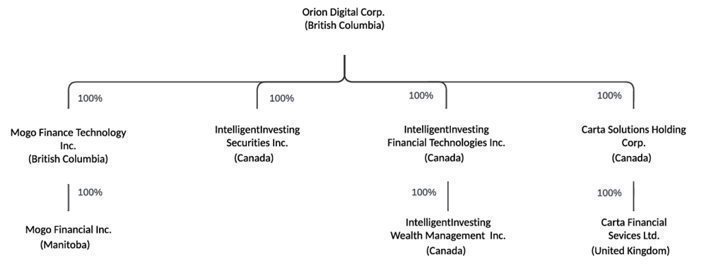
Orion Digital has a number of direct and indirect subsidiaries including Mogo Finance wholly owned by Orion Digital, and Mogo Financial Inc., wholly owned by Mogo Finance, which together operate Orion Digital's online lending platform, IntelligentInvesting Financial Technologies Inc. (formerly, Moka Financial Technologies Inc.) (“IIFTI”) wholly owned by Orion Digital, and it’s wholly owned subsidiary IntelligentInvesting Wealth Management Inc. (formerly, Mogo Asset Management Inc.)(“IIWMI”), which together operate our passive investing app and portfolio management business, IntelligentInvesting Securities Inc. (formerly, MogoTrade Inc.) (“IISI”), wholly owned by Orion Digital, which operates our commission free stock trading platform, and Carta Solutions Holding Corp. (“Carta Solutions”), wholly owned by Orion Digital, which holds the Carta group of companies (together with its subsidiaries, “Carta”). Carta Financial Services Ltd. is a material indirect subsidiary wholly owned by Carta Solutions, incorporated under the laws of the United Kingdom on November 28, 2007, and operates Carta's European payments business.
| 9 | Page |
|
| 2025 Annual Information Form |
Business Description
General
Orion Digital Corp. is a financial technology company focused on its digital wealth platform. The Company’s Intelligent Investing platform provides structured investment solutions designed to support long-term portfolio construction through automated and technology-enabled processes.
Orion Digital also operates a European payments infrastructure business that provides transaction authorization and processing services, and a Canadian consumer lending portfolio that generates cash flow and is managed with a focus on risk and capital efficiency.
Orion Digital’s capital allocation framework prioritizes reinvestment in its wealth platform, followed by investment in payments infrastructure and share repurchases where appropriate, with excess liquidity retained on the balance sheet to support operating stability and capital flexibility.
Products and Services
The Company’s primary products focus on wealth, payments and lending.
Revenue Model and Economics
The Company generates revenue across three primary business lines:
|
| · | Wealth (subscription and services): Recurring revenue derived from platform membership fees and investment-related services, with revenue scaling alongside assets under management and member growth. |
|
|
|
|
|
| · | Payments (transaction and platform fees): Revenue generated from issuer processing, transaction-based fees, and program management services provided to enterprise and fintech clients. Revenue is correlated with transaction volume and client program activity. |
|
|
|
|
|
| · | Lending (interest income): Revenue generated from consumer lending products, with profitability driven by pricing and credit performance. |
The Company’s strategy is to increase the contribution of recurring and scalable revenue streams from wealth and payments over time, while managing lending as a capital-efficient source of cash flow.
Wealth: Primary growth and strategic focus of the Company
IntelligentInvesting.ai
Intelligent Investing is a digital wealth platform designed to help Canadians build long-term wealth through disciplined, technology-enabled investing solutions. As of December 31, 2025, Intelligent Investing was delivered through two mobile applications, the Intelligent Investing app (managed investing) and the MogoTrade app (self-directed investing), which together formed an integrated investing ecosystem. Intelligent Investing consists of two core offerings:
Managed Investing
The Company’s managed investing solution is delivered through the Intelligent Investing mobile application.
The Intelligent Investing app provides a fully managed digital investing experience designed to simplify long-term wealth building through automation and structured portfolio management. Members make recurring or one-time contributions into professionally managed portfolios constructed with a strategic focus on broad-market ETFs, such as those tracking the S&P 500. Dividends are automatically reinvested.
| 10 | Page |
|
| 2025 Annual Information Form |
There are no account minimums, and members may deposit or withdraw funds without transaction fees. Portfolios are constructed and managed based on each member’s investment objectives and risk profile.
Investments held through the Intelligent Investing app are managed by IIWMI, a registered portfolio manager, investment fund manager, and exempt market dealer in Canada.
The Intelligent Investing application is available on the Apple App Store and Google Play Store.
Self-Directed Investing
The Company’s self-directed investing solution is a commission-free self-directed stock trading platform delivered through a mobile app that allows members to trade equities listed on major exchanges, including the TSX, TSX Venture Exchange, Nasdaq, and NYSE. The platform is designed to support informed investment decision-making through integrated research tools and educational resources.
The Company’s self-directed investing platform is offered by IISI, a dealer member regulated by the Canadian Investment Regulatory Organization (CIRO).
The Intelligent Investing self-directed trading application is available on the Apple App Store and Google Play Store.
Platform Integration and Technology
While managed and self-directed investing were offered through separate applications as of December 31, 2025, they operate within a common Intelligent Investing framework and subscription model. Together, they provide members with access to both professionally managed portfolios and self-directed trading capabilities within a single investing ecosystem.
The Intelligent Investing platform is built on cloud-based infrastructure leveraging internally developed microservices and standardized APIs. The architecture is designed to support scalability, regulatory compliance, and integration with third-party data providers, custodians, and market infrastructure.
The Company continues to invest in technology enhancements across the Intelligent Investing platform. This includes ongoing development and evaluation of advanced analytics and artificial intelligence–enabled capabilities intended to enhance personalization, portfolio insights, research functionality, and operational efficiency. While such capabilities were at various stages of development as of December 31, 2025, the Company expects data-driven and AI-enabled tools to play an increasing role in supporting member experience and platform differentiation over time.
Wealth revenue is primarily recurring in nature and benefits from operating leverage as assets under management and member engagement increase.
Tactex Asset Management
Tactex, a division of IIWMI, offers an independent platform designed to empower portfolio managers to grow their business on their own terms. Tactex provides the regulatory, technological, and operational infrastructure needed for advisors to thrive - professionally and financially. IIWMI is registered as a portfolio manager in all Canadian provinces and territories, as an Investment fund manager in the provinces of Ontario and Quebec, and as an exempt market dealer in the provinces of Alberta, British Columbia, Saskatchewan, Manitoba, Ontario, Quebec, New Brunswick, Nova Scotia, Newfoundland and Labrador and Prince Edward Island.
| 11 | Page |
|
| 2025 Annual Information Form |
Payments: Infrastructure layer supporting transaction authorization and client programs
Carta is a digital payments software company, founded in 2008, which provides technology and services that enable financial technology companies, banks, and corporations to issue payment products to consumers via multiple channels, including physical, virtual and tokenized cards, as well as payment switching and routing services. The Carta platform provides the infrastructure needed to help fintech and payments businesses build and manage their payment systems, and supports prepaid, debit, and credit card issuer processing. Carta is certified as a Visa and MasterCard processor with active card programs in over 11 countries, and annual transaction volume of approximately $12 billion.
Payments revenue is driven by transaction volume and client program activity, with revenue scaling as customer programs grow and expand.
Lending: Cash-generative business managed for risk and capital efficiency
The Company’s lending business provides unsecured consumer credit and is operated with a focus on disciplined underwriting, portfolio monitoring, and cash flow generation. The business is not a primary growth driver and is managed within defined risk and capital constraints.
Operating under the Mogo brand, the Company primarily offers an unsecured open line of credit product (the “Mogo Line of Credit”), which is designed to provide members with access to short-term liquidity. The Mogo Line of Credit provides approved members with access to credit up to $5,000 at a rate of 34.37%, subject to applicable provincial regulations and individual credit assessment. The Company's loan portfolio also includes loans originated prior to 2025 at rates higher than 34.37%, which remain in effect at their original terms for existing borrowers. Members may obtain a no-obligation pre-approval through a fully digital application process and funding is completed electronically.
The lending experience is designed to be digital-first and highly automated, with the objective of reducing paperwork and minimizing manual intervention. The Company utilizes proprietary credit decisioning models that incorporate multiple data sources and analytical methodologies to assess risk and determine eligibility and credit limits.
Credit Decisioning and Technology
A core component of the Company’s lending platform is its data-driven underwriting and risk management framework. The Company leverages internally developed risk models, behavioral data, third-party bureau data, and other permitted data sources to inform credit decisions and ongoing account management. The Company continues to enhance its credit decisioning and operational capabilities through advanced analytics and artificial intelligence–enabled tools. These technologies are used to support: risk assessment and credit limit determination; fraud detection and identity verification; automated income and account verification processes; portfolio monitoring and collections prioritization.
Automation is embedded throughout the lending lifecycle, from application and underwriting through servicing and collections. While automated systems are central to the workflow, human oversight remains in place where required by policy, regulation, or internal risk controls.
The Company expects continued investment in AI-driven and automation technologies to improve operational efficiency, reduce manual processing requirements, strengthen risk management, and streamline the member experience over time. These initiatives remain subject to regulatory requirements, internal governance standards, and technological development timelines.
| 12 | Page |
|
| 2025 Annual Information Form |
Integrated Financial Ecosystem
The Company’s lending business operates within a broader financial ecosystem that includes Intelligent Investing.
While the lending product is designed to address short-term liquidity needs, the broader platform provides members with access to tools and services intended to support longer-term financial management and wealth-building objectives.
Investment Portfolio (“Orion Digital Ventures”)
Orion Digital owns a portfolio consisting of approximately 15 investments in private and public companies and bitcoin ETFs. The Company’s investment portfolio is managed opportunistically and is not a core component of its operating strategy.
As of December 31, 2025, Orion Digital's investment portfolio was valued at approximately $21 million and included:
|
| · | A stake in TSX-listed WonderFi Technologies Inc. ("WonderFi"), a fully regulated crypto exchange in Canada; |
|
|
|
|
|
| · | Investments in leading and emerging Crypto, Web 3.0 platforms and gaming companies, including Gemini, NFT Trader, and Enthusiast Gaming (NASDAQ:EGLX); and |
|
|
|
|
|
| · | Legacy investments including Hootsuite, Blue Ant Media and Alida, with a focus on monetizing these investments. |
In the financial year ended December 31, 2025 and subsequently in 2026, Orion Digital monetized approximately $19.5 million and $8.4 million respectively, of its investment portfolio through a sale of its remaining stake in WonderFi.
Product Development
Orion Digital is a product-driven company focused on building digital wealth solutions that support disciplined capital allocation in financial systems that are increasingly automated and AI-assisted. Our CEO leads our product team, ensuring that development priorities are aligned with the Company's capital allocation framework, which prioritizes reinvestment in our wealth platform, followed by investment in payments infrastructure. Our product development is informed by member behavior data, platform performance metrics, and market trends, and we continuously refine our platforms to improve usability, reliability, and the overall member experience. Our primary product development focus is the Intelligent Investing platform, a unified wealth platform that integrates managed and self-directed investing capabilities within a single interface. We expect to continue to invest in products and platform enhancements that we believe meet our return-on-investment criteria and that advance the Company's position as a digital wealth infrastructure business.
Our Platforms
Intelligent Investing Platform
Intelligent Investing is a cloud-based system built on internally developed microservices that communicate through RESTful Application Program Interfaces ("APIs"). Application data resides in both Canada as well as the United States. The Company utilizes third-party service providers to support the delivery of market data and analytics used in customer investment decision-making.
The platform is designed to support a largely self-directed user experience, reducing reliance on operational support. Its core technology foundation was acquired in 2021 and has since been further developed and enhanced by the Company. The platform also leverages shared infrastructure developed across Orion Digital’s other business lines, including services related to ledgering, funds transfer, account creation and account management.
| 13 | Page |
|
| 2025 Annual Information Form |
Mogo Platform
The Company operates an integrated, cloud-based platform designed to deliver financial products to consumers, with a focus on providing access to credit for individuals with non-prime or evolving credit profiles. The platform is built using a modular architecture of internally developed services, supporting reliability and flexibility.
The platform is designed to provide a largely self-service user experience through digital interfaces. For loan customers, this includes the MogoAccount portal, which enables members to manage their accounts, access product information and receive communications.
Automation and data analytics are embedded within the platform’s processes, supporting application processing, transaction execution, credit decisioning and marketing activities. The platform also utilizes standardized interfaces to integrate with third-party service providers, allowing for flexibility and ongoing enhancement of functionality. Data generated through platform operations is used to monitor performance and support continuous improvement in credit and operational processes.
Carta Platform
Carta's business-to-business ("B2B") platform is a cloud-based system with direct connectivity to global card payment networks – Visa and MasterCard ("Payment Networks"). The platform is designed to comply with applicable data security and privacy standards, including Payment Card Industry Data Security Standards (PCI DSS Level 1), General Data Protection Regulation (GDPR), and regional and bank partner regulatory requirements.
Carta serves customers seeking to issue payment cards by providing connectivity to the Payment Networks and client facing interfaces that enable management of the card programs. Customers access the platform through APIs and administration portals built on these APIs, enabling real-time creation and modification of user accounts and issuing of 16 Digit Personal Account Numbers ("PANs").
A core component of the platform is the authorization functionality which enables real-time authorizations of transactions based on configurable rules within the Carta system. Customers may also interact with the authorization process through Carta's delegated authorization service, Issuer Link, which allows for the application of additional customer-defined controls beyond standard processing rules. This functionality enables enhanced transaction-level controls and supports the development of differentiated card products and features.
The integrity, security and reliability of the Company’s technology and payments infrastructure are critical to its operations. The Company intends to continue investing in its platform to meet client needs and maintain confidence in its services, including through ongoing optimization of its cloud-based infrastructure to support global payment processing with localized performance and connectivity to the Payment Networks. The platform is designed to maintain low authorization latency and high availability, while delivering scalable, consistent performance and resilience as transaction volumes grow.
In 2025, Carta exited its Canadian payments business to focus on its core European market.
Platform Maintenance
We maintain our platforms with 37 full‑time technology and credit risk analysis employees (credit risk, product, design, development, business intelligence and information technology) as of December 31, 2025 (excluding Carta). For Carta, we have 52 full time technology employees (Payment Systems, Information Technology and Compliance, Software Engineering, Site Reliability Engineering)
| 14 | Page |
|
| 2025 Annual Information Form |
Specialized Skill and Knowledge
As of December 31, 2025, Orion Digital had 198 team members including employees and contractors. With over twenty years of operating experience, we have developed strong competencies across multiple disciplines. In addition to 50 software developers, designers, data scientists, product managers, and marketers, we have all of the traditional roles of a financial services provider including credit risk, finance, customer experience, operations, governance, legal and compliance. Our team supports the delivery and development of Orion Digital's wealth, payments infrastructure, and consumer lending operations through a combination of technology, financial services, and operational expertise. Our future success partly depends on our continuing ability to attract, develop, motivate, and retain highly qualified and skilled employees who share Orion Digital's passion for innovation through our products, platform and brand.
Sales and Marketing
Mogo and Intelligent Investing
The Company’s marketing strategy is focused on acquiring and retaining long-term investing customers through clear value propositions, transparent pricing, and consistent product experience. Marketing efforts emphasize disciplined investing, simplicity, and alignment with long-term market performance.
We deploy a fully integrated, multi-channel strategy that blends performance marketing with long-term brand building. This includes:
|
| · | Web & Funnel Optimization - Our websites - including intelligentinvesting.ai and mogo.ca - serve as core entry points for onboarding new members. Each site is optimized to reflect the sophistication and simplicity of the Intelligent Investing experience, with an emphasis on education, clarity, and frictionless activation. |
|
|
|
|
|
| · | Content-Driven Education & Inspiration - Intelligent Investing is not built for everyone. It’s designed for those who want to break free from the noise, think independently, and build wealth with conviction. Our content - delivered through email series, in-app lessons, social media, and educational articles - reinforces core investing principles and helps members rewire their behavior for long-term success. |
|
|
|
|
|
| · | Performance Marketing - We run data-driven campaigns across digital platforms to acquire high-intent users efficiently. Messaging focuses on our key differentiators: no-fee self-directed investing, automated S&P 500 portfolios and access to Fiscal.ai research tools, all under a simple, subscription-based membership. |
|
|
|
|
|
| · | Strategic Partnerships - We've partnered with Fundstrat and Tom Lee, one of Wall Street’s most respected strategists, to infuse institutional-grade market insights into our platform. |
|
|
|
|
|
| · | Referral & Viral Growth - Intelligent Investing is designed to be shareable. In-app referrals, social content, and member-driven moments are key levers for low-cost growth and organic momentum. |
|
|
|
|
|
| · | Social Media & PR - We engage audiences across TikTok, Instagram, LinkedIn, and X with high-integrity insights, anti-noise messaging, and high-impact creative. PR efforts focus on thought leadership, investor trust, and brand storytelling that challenges the status quo in Canadian finance. |
|
|
|
|
|
| · | Email & Lifecycle Marketing - Our email engine drives onboarding, activation, education, and long-term retention. We tailor campaigns to different stages of the member journey, always reinforcing the behaviors and mindset that lead to better outcomes. |
We continue to market our consumer lending products through the Mogo brand, which generates stable demand through established digital channels and customer base. Lending acquisition efforts are managed efficiently alongside our wealth marketing, with a focus on disciplined underwriting and high-quality borrower acquisition.
| 15 | Page |
|
| 2025 Annual Information Form |
Carta
Carta is a B2B platform with sales and marketing activities focused on fintechs, banks, and other corporations seeking to issue payment cards. Carta's primary market is Europe, with business development driven primarily through existing client relationships, channel partnerships and inbound interest, including industry referrals and digital channels.
Competitive Conditions
Mogo and Intelligent Investing
The financial services industry continues to undergo rapid transformation, driven by shifting consumer expectations, digital innovation, and growing dissatisfaction with traditional financial institutions. Our competitors include other financial technology companies, other consumer finance companies, brokerages, online lenders, mortgage brokerages, traditional financial institutions such as banks, credit unions, and new market entrants. We compete with various financial services companies in each of our main products including financial technology companies such as Wealthsimple, Koho, Questrade, Qtrade and Webull; large Schedule I banks such as TD Canada Trust, Scotiabank, Royal Bank of Canada, Tangerine, Canadian Imperial Bank of Commerce, EQ Bank and Bank of Montreal; credit unions such as Meridian Credit Union and Coast Capital Savings Federal Credit Union; and consumer credit companies such as Capital One, Fairstone Financial Inc., and goeasy.
What sets Orion Digital apart is our strategic focus on long-term financial outcomes rather than short-term engagement or product volume. Our Intelligent Investing platform is designed to disrupt the traditional wealth industry by offering a simple, powerful solution that helps users actually build wealth over time, where banks and brokers often profit from complexity, fees and frequent trading. The platform is designed to emphasize long-term investing principles, including diversification, cost efficiency, and minimizing behavioral decision errors.
We are also the only non-prime lender in Canada offering an integrated pathway from borrowing to investing -allowing us to serve a broader financial journey than most competitors. We believe our multi-pronged differentiation, including a clear value-driven strategy, 22 years of proprietary data, a strong brand, a talented team, and growing scale, positions us as a category-defining alternative to both legacy institutions and newer fintech entrants. As new players continue to enter the market, few are aligned with long-term outcomes in the way we are. Our focus is not just on acquiring users, but on helping them win financially for life.
Carta
As an issuer processor, Carta operates in a competitive market landscape that includes established legacy processing platforms as well other modern platforms. Legacy processing platforms, including TSYS, FISERV, FIS, and others historically emerged as an outsourcing of traditional bank credit and debit card processing functions and grew to become incumbent players in the payment card market. Often these platforms are based on legacy technology and were not designed to support the complex and dynamic requirements of modern fintech card issuing ecosystem.
As Carta competes against other modern issuer processors, the business leverages product differentiation, service level, pricing models, and partnership engagement to effectively compete in the market. Modern issuer processing platform competitors include Marqeta and Galileo (a subsidiary of SoFi). In some markets, Carta may also face competition from large fintech platforms such as Stripe, Adyen and Checkout.com, whose core business is not issuer processing but may be expanding to more directly compete with Carta. Competitive dynamics vary across countries and regions where Carta operates as well as within industry verticals, and Carta's B2B sales and marketing approach follows a model that is tailored to optimize growth within target market segmentation.
| 16 | Page |
|
| 2025 Annual Information Form |
Intangible Properties
In accordance with industry practice, we protect our proprietary rights through a combination of copyright, trademark, design patent, trade secret laws and contractual provisions. The source code for our software is protected under Canadian and applicable international copyright laws. We currently have a pending and registered Canadian industrial design and a pending United States design application for "Display Screen Having Graphical User Interface for Investment Management". We have no issued or pending utility patent applications.
We also seek to avoid disclosure of our intellectual property and proprietary information by requiring employees and consultants to execute non‑disclosure and assignment of intellectual property agreements. Such agreements require our employees and consultants to assign to us all intellectual property developed in the course of their employment or engagement. We also utilize non‑disclosure agreements to govern interaction with business partners and prospective business partners and other relationships where disclosure of proprietary information may be necessary.
Our software includes software components licensed from third parties, including open source software. We believe that we follow industry best practices for using open source software and that replacements for third‑party licensed software are available either as open source software or on commercially reasonable terms.
We are the registered owners of trademarks in Canada, the United Kingdom and the European Union. We are the authorized user of various social media handles, pages and profiles that reflect the Mogo and Intelligent Investing brands and we have registered and maintain the registration of a variety of domain names that include "Mogo" or variations of "Mogo", and "intelligentinvesting" as well as cartaworldwide.com.
The enforcement of our intellectual property rights depends on any legal actions against any infringers being successful, but these actions may not be successful or may be prohibitively expensive, even when our rights have been infringed.
Credit Facility
As of December 31, 2025, the Company had one credit facility outstanding: the second amended and restated revolving credit and guarantee agreement dated as of February 26, 2025, as amended (the "Credit Facility"), which is used to finance the Company's non-installment loan products. As of the date hereof, the Credit Facility remains outstanding. The 2025 amendment extended the maturity date by three years, reduced the interest rate by 100 basis points and increased the available capital from $60 million to $100 million in certain circumstances.
The Credit Facility consists of a $60 million senior secured credit facility maturing on January 2, 2029. The Credit Facility is subject to variable interest rates that reference the Secured Overnight Financing Rate ("SOFR"), or under certain conditions, the Federal Funds Rate in effect. On December 16, 2021, the Company amended the Credit Facility to lower the effective interest rate from a maximum of LIBOR plus 9%, to LIBOR plus 8%. In June 2023, this was transitioned to SOFR plus 8% upon the cessation of USD LIBOR. In February 2025, the effective interest rate was reduced to SOFR plus 7%. There is a 0.33% fee on the available but undrawn portion of the $60 million facility. The principal and interest balance outstanding for the Credit Facility as at December 31, 2025 was $51.7 million.
The Credit Facility is subject to certain covenants and events of default, including the following:
|
| · | Financial covenants that may include, among others, requirements with respect to minimum tangible net worth, maximum leverage ratio, minimum consolidated liquidity, and minimum unrestricted cash. |
|
|
|
|
|
| · | Portfolio performance covenants that may include, among others, requirements that the portfolio not exceed certain stated static pool default ratios and delinquency rates and that the loan yield not be less than stated minimum levels. |
| 17 | Page |
|
| 2025 Annual Information Form |
|
| · | Other events that may include, among others, change of control events, certain insolvency-related events, events constituting a servicer default, an inability to engage a replacement backup servicer following termination of the current backup servicer, senior management changes, the occurrence of an event of default or acceleration under other facilities, failure to make required payments or deposits, events related to the entry of an order decreeing dissolution that remains undischarged, events related to the entry or filing of judgments, attachments or certain tax liens that remain undischarged, and events related to breaches of terms, representations, warranties or affirmative and restrictive covenants. Restrictive covenants may, among other things, impose limitations or restrictions on our ability to pay dividends, redeem our stock, make payments in order to retire or obtain the surrender of warrants or options, or our ability and of the guarantors thereunder to incur additional indebtedness, pay dividends, make investments, engage in transactions with affiliates, sell assets, consolidate or merge, make changes in the nature of the business, and create liens. |
|
|
|
|
|
| · | Early termination fees that may be payable under the Credit Facility in the event of a termination or other permanent reductions of the credit commitments at the Company's option prior to the expiration of the Credit Facility. |
The Company is in compliance with these covenants. Interest expense on the Credit Facility is included in Credit Facility interest expense in the consolidated statements of operations and comprehensive loss. Management routinely reviews and renegotiates terms, including interest rates and maturity dates, and expects to continue to refinance the Credit Facility as it becomes due and payable.
Employees
As of December 31, 2025 we had 182 full-time employees and 6 part-time employees across the following functional areas, including Carta:
| Functional Area |
| Number of Full-time Employees |
| Number of Part-time Employees |
| Technology & Development |
| 56 |
| 2 |
| Customer Service & Operations |
| 97 |
| 4 |
| General and Administrative |
| 27 |
| 0 |
| Marketing |
| 2 |
| 0 |
Foreign Operations
The Company’s foreign operations consist primarily of Carta, which provides issuer processing and payments infrastructure services across Europe. Carta currently operates card programs in over 11 countries with approximately 97% of Carta's 2025 revenues being derived from its operations in Europe. During 2025, the Company ceased Carta’s Canadian payments operations in order to focus the platform on its core European business.
General Development of the Business
Orion Digital has continued its evolution with a series of strategic and financial initiatives throughout 2025 and early 2026 as described in more detail below.
| 18 | Page |
|
| 2025 Annual Information Form |
Current Financial Year – Recent Developments
In 2026 year-to-date, Orion Digital:
|
| · | Completed a Corporate Rebrand and Ticker Change. On December 29, 2025, the Company changed its corporate name from Mogo Inc. to Orion Digital Corp., reflecting its evolution toward a multi-platform digital financial infrastructure business operating across wealth and payments. The Company’s common shares began trading under the new ticker symbol “ORIO” on Nasdaq and TSX on January 2, 2026. |
|
|
|
|
|
| · | Exited Remaining WonderFi Position. In January 2026, the Company exited its remaining equity position in WonderFi. The transaction increased the Company’s cash and cash equivalents by more than 50% compared to Q3 2025 to approximately $27 million, further strengthening the Company’s balance sheet and liquidity position. |
Three Year History
In 2025, Orion Digital:
|
| · | Completed Phase 1 of the Redesign and Rebuild of Intelligent Investing Platform. In Q4 2025, the Company completed Phase 1 of the comprehensive redesign and rebuild of the Intelligent Investing platform, including enhancements to performance and reliability, expanded portfolio information and suitability processes, new goal-setting and planning tools, improved transfer management capabilities, and other product and user experience improvements. Assets under management on the Company’s wealth platform totaled $498.3 million as at Q4 2025, representing a 17% increase year-over-year. |
|
|
|
|
|
| · | Extended Credit Facility with Fortress Investment Group. In February 2025, the Company amended the Credit Facility, being its senior secured credit facility with funds managed by affiliates of Fortress Investment Group LLC. The amendments extended the maturity date by three years, until January 2, 2029, and reduced the interest rate by 100 basis points from SOFR plus 8%, to SOFR plus 7%. |
|
|
|
|
|
| · | Exited Legacy Institutional Brokerage Business. In Q1 2025, the Company exited its legacy institutional brokerage business, as part of management’s strategic focus on eliminating sub-scale revenue streams and prioritizing higher margin offerings. The institutional brokerage business contributed $5.3 million of revenue for the financial year ended December 31, 2024, with a negligible operating margin. These revenues were reported within other subscription and services revenue. |
|
|
|
|
|
| · | Monetized WonderFi Investment. In May 2025, WonderFi announced that it had entered into a definitive agreement to be acquired by Robinhood Markets, Inc. In 2025, the Company monetized approximately $19.5 million of its investment in WonderFi. |
|
|
|
|
|
| · | Refocused Carta on European Payments Operations. During 2025, the Company ceased payments operations in Canada in order to focus the Carta platform primarily on European payments programs. Excluding the previously exited Canadian operations, European payments volume increased from $2.8 billion in Q4 2024 to $3.1 billion in Q4 2025, representing growth of 14% year-over-year. |
|
|
|
|
|
| · | Completed Carta Migration to Oracle Cloud Infrastructure. In Q1 2025, Carta completed its transition to Oracle Cloud Infrastructure (“OCI”), supporting the scalability and operational efficiency of the Company’s payments platform in Europe. |
|
|
|
|
|
| · | Continued Share Repurchase Program. In 2025, the Company repurchased 548,091 common shares under its share repurchase program. As of December 31, 2025, Orion Digital had repurchased a total of 1,667,185 common shares since June 2022, representing approximately 7.0% of its outstanding shares. |
| 19 | Page |
|
| 2025 Annual Information Form |
|
| · | Continued Execution on its Bitcoin treasury strategy. The Company believes its Bitcoin exposure appropriately reflects its long-term capital allocation objectives. Management’s near-term capital allocation priorities remain focused on reinvesting in the Company’s Wealth and Payments platforms and opportunistically repurchasing common shares where appropriate. |
|
|
|
|
|
| · | Adapted Lending Products to New Interest Rate Legislation. Effective January 1, 2025, the Company became subject to new legislation in Canada that reduces the maximum allowable interest rate to 35% APR. The Company has implemented changes to its lending products to comply with these requirements. All loans originated in 2025 were issued at rates within the new legislative limit. |
In 2024, Orion Digital:
|
| · | Launched Moka.ai. In March 2024, the Company announced the launch of Moka.ai, the next generation of its wealth-building app with significant updates and enhancements designed to help the next generation of Canadians get on a real path to becoming millionaires and achieving financial freedom. |
|
|
|
|
|
| · | Added Bitcoin to its Treasury Management Strategy. In March 2024, the Company announced that its Board of Directors has approved a change to its treasury management strategy to include Bitcoin and Bitcoin ETFs and authorized an initial investment of up to $5.0 million. As of the date hereof, the Company holds less than US$1 million in Bitcoin ETFs. |
|
|
|
|
|
| · | Resumed share repurchases under Nasdaq buyback program. The Company announced the resumption of repurchases of Common Shares under its Nasdaq buyback program as part of its ongoing efforts to enhance shareholder value. In 2024, the Company repurchased 44,741 Common Shares at an average price of $2.30 per Common Share. This follows the repurchase of 474,353 Common Shares in 2023 at an average price of $2.36 per Common Share. By continuing the buyback program, the Company aims to address the perceived valuation of the Common Shares and support long-term growth to better reflect the Company’s financial performance and strategic investments, such as its 13% stake in WonderFi. |
|
|
|
|
|
| · | Extended Maturity of $60 Million Credit Facility to 2026. The Company announced an extension of the maturity date for its $60 million senior credit facility with Fortress Investment Group from July 2, 2025, to January 2, 2026. This amendment provided the Company with continued access to the resources and flexibility necessary to support its digital lending product. |
|
|
|
|
|
| · | Launched “Buffett Mode” Self-Directed Investing App. The Company announced the launch of its “Buffett Mode” self-directed investing app, designed to help Canadians move away from speculative trading and adopt long-term, value-based investing principles inspired by Warren Buffett. The app encourages disciplined, patient investing by adding thoughtful prompts and reducing the temptation for frequent trading, a common issue in many trading platforms. With a flat subscription fee model, the app offers zero commission and FX fees, aligning success with user outcomes. Additionally, the platform promotes positive environmental impact, with users contributing to replanting Canadian forests. |
|
|
|
|
|
| · | Partnered with Postmedia to Launch Educational Wealth Content Channel. The Company announced a strategic partnership with Postmedia, Canada’s largest news media company, to create a new digital wealth content channel aimed at educating Canadians on investing, wealth accumulation, and financial management. As the founding sponsor, Mogo will contribute educational resources, including its wealth calculator, to help users improve their financial literacy. Postmedia, with a reach of 17.8 million Canadians monthly, will independently operate the channel on its Financial Post platform. Additionally, Mogo issued 500,000 warrants to purchase Common Shares to Postmedia as part of the agreement. |
| 20 | Page |
|
| 2025 Annual Information Form |
|
| · | Partnered Exclusively with Tom Lee’s Fundstrat to Offer Equity Market Research. The Company announced an exclusive partnership with Thomas Lee’s Fundstrat Global Advisors to provide users of its digital wealth solutions with premium access to top-tier equity market research. This collaboration offers Canadian retail investors exclusive insights from Fundstrat’s FS Insight research, which is typically available to large institutional clients. As a result of the partnership, our users have access to exclusive webinars, interviews, and research from Tom Lee and other experts, aimed at enhancing their investment decision-making and giving them a competitive edge in the market. |
|
|
|
|
|
| · | Carta Reported 23% Increase in Transaction Volume. Carta reported a 23% increase in quarterly transaction volume, reaching a record $3.0 billion in Q3 2024. This growth highlights Carta’s expanding reach, particularly with large European customers, bringing its annual run rate to $12 billion. |
|
|
|
|
|
| · | appointed a New Auditor. On October 1, 2024, the Company appointed MNP LLP, Chartered Professional Accountants, as the Company’s new auditor, replacing KPMG LLP, Chartered Professional Accountants. |
In 2023, Orion Digital:
|
| · | Announced WonderFi Business Combination. In July 2023, the Company announced that Coinsquare Ltd. (“Coinsquare”) completed a business combination with WonderFi and CoinSmart Financial Inc. This transaction positioned the resulting entity, WonderFi (TSX:WNDR), as the only fully regulated crypto exchange in Canada. The Company’s shares in Coinsquare were exchanged for ~87.0 million shares of WonderFi in the business combination, making the Company the largest shareholder of WonderFi. Certain of the WonderFi shares were subject to a lock-up period, with gradual release scheduled until January 2025. |
|
|
|
|
|
| · | Entered Multi-Year Agreements with Oracle. The Company entered multi-year agreements with OCI in October 2023 to transition to its cloud infrastructure to support the long-term growth of the Company’s digital wealth platform. Carta also announced that it selected OCI to accelerate innovation and support future growth. |
|
|
|
|
|
| · | Expanded Partnership with Snowflake. The Company expanded its partnership with Snowflake, the Data Cloud company, to integrate AI applications and scale its digital wealth offerings. By leveraging Snowflake’s Data Cloud, Mogo aims to enhance processing efficiency and introduce innovative AI solutions, empowering users to invest more effectively and achieve financial freedom. |
|
|
|
|
|
| · | Completed a Share Consolidation. In August 2023, the Company completed a share consolidation at a ratio of three pre-consolidation Common Shares to one post-consolidation Common Share (the “Share Consolidation”), regaining compliance with the minimum bid price requirement under the Nasdaq Listing Rule 555(a)(2). The Common Shares commenced trading on the TSX and Nasdaq on a post-consolidation basis at the start of trading on August 14, 2023. |
|
|
|
|
|
| · | Prioritized Profitability. During the year ended December 31, 2023, the Company continued to focus on accelerating the path to profitability by placing an emphasis on cost efficiency and building financial resiliency in light of challenging financial market conditions. The Company narrowed its strategic focus and completed the wind down of its legacy Mogo app including its prepaid card product, MogoCard, and its identity fraud monitoring product, MogoProtect. |
|
|
|
|
|
| · | Amended Postmedia Agreement. The company amended its marketing collaboration agreement with Postmedia, and extended it until December 31, 2024, aiming to leverage Postmedia’s extensive media network to reach a broader audience. |
| 21 | Page |
|
| 2025 Annual Information Form |
|
| · | Launched MogoTrade App in Quebec. In 2023, the Company expanded its market reach by launching the MogoTrade app in Quebec, offering it in both English and French languages. This move increased the company’s total addressable market opportunity by approximately 28%. Additionally, on May 15, 2023, MogoTrade removed invitation-only restrictions, making the application available to the general public. |
|
|
|
|
|
| · | Filed New Base Shelf Prospectus. On November 6, 2023, the Company filed a final short form base shelf prospectus with the securities regulators in each province and territory of Canada, except Quebec. The prospectus replaced the prospectus that was filed in 2021, enabling the Company to make offerings of Common Shares, preferred shares, debt securities, warrants to purchase Common Shares, preferred shares or debt securities, or any combination thereof of up to an aggregate offering price of US$250 million at any time during the 25-month period that the prospectus remains effective. |
|
|
|
|
|
| · | Announced Carta’s Growth. The Company’s digital payment solutions business, Carta, experienced significant growth, processing over $2.2 billion of payments volume in Q1 2023. This marked a notable increase of over 43% compared to Q1 2022, reflecting the continued expansion and adoption of Carta’s services. |
|
|
|
|
|
| · | Launched Normal Course Issuer Bid on TSX. In August 2023, the Company received approval from the TSX to commence repurchasing its Common Shares on the TSX pursuant to a normal course issuer bid (the “NCIB”). The NCIB is in addition to the Company’s existing Common Share buyback program launched on the Nasdaq in March 2022 (the “Nasdaq Bid” and together with the NCIB, the “Bids”). Under the Bids, the Company may purchase up to 2,183,000 Common Shares (on a post-consolidation basis), representing approximately 10% of the public float of Mogo’s outstanding Common Shares as at March 21, 2023. Purchases under the Bids will be made through the facilities of the TSX, Nasdaq or other designated exchanges or any Canadian or US alternative trading system. In accordance with the policies of the TSX, the period of the NCIB was considered to have commenced on March 22, 2023 and ran until March 21, 2024. Under the NCIB, the Company repurchased 104,800 Common Shares through the facilities of the TSX. The Nasdaq Bid remains on-going and the Company is able to repurchase up to US$7.5 million in Common Shares thereunder. |
| 22 | Page |
|
| 2025 Annual Information Form |
Risk Factors
In addition to any other risks contained in this AIF, as well as our management’s discussion and analysis and consolidated financial statements and accompanying notes, the risks described below are the principal risks that could have a material and adverse effect on our business, financial condition, results of operations, cash flows, future prospects or the trading price of our Common Shares. This AIF also contains forward-looking statements that involve risks and uncertainties. Our actual results could differ materially from those anticipated in the forward-looking statements as a result of a number of factors, including the risks described below. See “Cautionary Note Regarding Forward Looking Statements”.
Worsening economic conditions may cause our members’ loan default rates to increase and harm our operating results.
Approximately 35% of our assets as of December 31, 2025 consisted of loans to our members. Uncertainty and negative trends in general economic conditions in Canada and abroad, including significant tightening of credit markets, historically have created a difficult environment for companies operating in our industries. Current global and macroeconomic conditions remain in a state of heightened volatility due to a number of factors, including geopolitical risks and tensions, changes in government administrations, regulations, legislation and policies, and trade relations and ongoing trade tensions, including the threat of tariffs, other governmental actions and retaliatory actions. In particular, tariffs imposed by the United States on Canadian imports, together with retaliatory tariffs imposed by Canada on U.S imports, have created significant economic uncertainty. These tariffs have contributed to inflationary pressures, supply chain disruptions, reduced consumer confidence, and increased volatility in the Canadian dollar and capital markets. There can be no assurance that the current tariff regime will be eased, and any escalation or prolonged continuation of trade tensions between Canada and the United States could further weaken the economic conditions in which we operate. These factors, which are beyond our control, may influence inflation, interest rates, unemployment levels, consumer confidence, economic growth in the geographies in which the Company operates and other general economic conditions. The Company continues to monitor global and macroeconomic developments and may take steps to mitigate potential risks. However, there can be no assurance that such developments will not have a material adverse effect on the Company’s business, financial condition or results of operations.
In addition, there can be no assurance that economic conditions will remain favorable for our business or that default rates on our loans by our members will remain at current levels. Increased default rates by our members on our loans may inhibit our access to capital and negatively impact our profitability. If delinquency or uncollectable rates on our consumer loans exceed certain levels defined in the Credit Facility it could constitute a default under the Credit Facility or other credit facilities, reducing or terminating such facilities. Furthermore, we receive a number of applications from potential members who do not satisfy the requirements for our loans. If an insufficient number of qualified individuals apply for our loans, our growth and revenue could decline.
Our allowance for loan losses is determined based upon both objective and subjective factors and may not be adequate to absorb loan losses.
We face the risk that our members will fail to repay their loans in full. We reserve for such losses by establishing an allowance for loan losses, the increase of which results in a charge to our earnings as a provision for loan losses. We have established an evaluation process designed to determine the adequacy of our allowance for loan losses. While this evaluation process uses historical and other objective information, the classification of loans and the forecasts and establishment of loan losses are also dependent on our subjective assessment based upon our experience and judgment. Actual losses are difficult to forecast, especially if such losses stem from factors beyond our historical experience, and unlike traditional banks, we are not subject to periodic review by bank regulatory agencies of our allowance for loan losses. As a result, there can be no assurance that our allowance for loan losses will be comparable to that of traditional banks subject to regulatory oversight or sufficient to absorb losses. A significant increase in our allowance for loan losses could also adversely affect our available capital and our ability to comply with financial covenants under our Credit Facility, which could restrict our access to funding. Any of the foregoing could have a material adverse effect on our business, financial condition and results of operations.
| 23 | Page |
|
| 2025 Annual Information Form |
We rely on our proprietary credit scoring model in the forecasting of loss rates. If we are unable to effectively forecast loss rates, it may negatively impact our operating results.
In deciding whether to extend credit to prospective members, we rely heavily on our credit score generated by our proprietary credit scoring model and decisioning system, an empirically derived suite of statistical models built using third-party data, data from our members and our credit experience gained through monitoring the performance of our members over time. If our proprietary credit scoring model and decisioning system fails to adequately predict the creditworthiness of our members, or if our proprietary cash flow analytics system fails to assess prospective members’ financial ability to repay their loans, or if any portion of the information pertaining to the prospective member is false, inaccurate or incomplete, and our systems did not detect such falsities, inaccuracies or incompleteness, or any or all of the other components of the credit decision process described herein fails, we may experience higher than forecasted losses. Furthermore, if we are unable to access the third-party data used in our credit scores, our access to such data is limited or such information is outdated or incorrect, our ability to accurately evaluate potential members will be compromised, and we may be unable to effectively predict probable credit losses inherent in our loan portfolio, which would negatively impact our results of operations.
Our risk management efforts may not be effective.
We could incur substantial losses and our business operations could be disrupted if we are unable to effectively identify, manage, monitor and mitigate financial risks, such as credit risk, interest rate risk, liquidity risk, and other market-related risk, as well as operational risks related to our business, assets and liabilities. To the extent our models used to assess the creditworthiness of potential members do not adequately identify potential risks, the credit scores we produce would not adequately represent the risk profile of such members and could result in higher risk than anticipated. Our risk management policies, procedures, and techniques, including our use of our proprietary credit scoring technology, may not be sufficient to identify all of the risks we are exposed to, mitigate the risks that we have identified or identify concentrations of risk or additional risks to which we may become subject in the future.
We have a history of losses and may not achieve consistent profitability in the future. In addition, if we continue to grow, we may not be able to manage our growth effectively.
Although we had shareholders equity of approximately $72 million as of December 31, 2025, we also had an accumulated deficit of approximately $354 million. We will need to generate and sustain increased revenue levels in future periods to become profitable, and, even if we do so, we may not be able to maintain or increase our level of profitability. We intend to continue to expend significant funds to expand our marketing and sales operations, continue developing our products including further development of our platforms, increase our service and general product servicing capabilities, compensate our growing employee base, and expand into new markets. In addition, our provision for loan losses, net of recoveries, is based on our expectation of future loan losses related to our loans receivable. As we continue to grow our members and loans receivable, we expect the aggregate amount of this expense will also continue to grow.
Our historical growth has placed, and may continue to place, significant demands on our management and our operational and financial resources. Our organizational structure is becoming more complex as we add additional staff, and we will need to improve our operational, financial, management and compliance controls as well as our reporting systems and procedures. Our efforts to grow our business may be costlier than we expect, and we may not be able to increase our revenue enough to offset our higher operating expenses. We may incur significant losses in the future for a number of reasons, including the other risks described in this AIF, and unforeseen expenses, difficulties, complications and delays, and other unknown events. If we are unable to achieve and sustain profitability, the market price of our publicly listed securities may significantly decrease.
| 24 | Page |
|
| 2025 Annual Information Form |
Further, the circumstances that accelerated the growth of our business in prior years, including an extended period of general macroeconomic growth in Canada and the U.S., as well as growth in the financial services and technology industries in which we operate, have slowed in recent years and may not return in the future.Our membership grew from 2.2 million members as at December 31, 2024 to 2.3 million members as at December 31, 2025. We may experience declines in the growth of our business (or negative growth) as a result of a number of factors, including slowing demand for our products, insufficient growth in the number of customers that utilize our products, declines in the level of usage of our products by existing members, macroeconomic factors, increasing competition, a decrease in the growth of our overall market or our failure to continue to capitalize on growth opportunities, including as a result of our inability to scale to meet such growth and economic conditions that could reduce financial activity and the maturation of our business, among others. If our growth rate declines, our business, operating results, financial condition and prospects could be adversely affected.
Carta’s business is reliant on contracts with key customers operating in the payment industry.
There can be no assurance that we will be able to maintain our relationships with these clients or that these client relationships will result in increasing revenue. Given the B2B nature of Carta’s operations, the number of clients that are potential users of the Carta platform is concentrated. Our largest clients may not be easily replaced and the loss of any one or more of such clients may have a material adverse impact on the results of operations and financial condition of the Company. In addition, if we are unable to add new clients, we may not realize anticipated levels of growth in the future. While we expect this concentration of revenue to decrease over time, we may continue to depend upon a relatively small number of clients for a significant portion of our revenue in the foreseeable future. The loss of a significant client or failure to attract new clients could materially adversely affect our business, financial condition and results of operations.
We may require additional capital to pursue our business objectives and respond to business opportunities, challenges or unforeseen circumstances. If capital is not available to us, our business, operating results and financial condition may be harmed.
Since our founding, we have raised substantial equity and debt financing to support the growth of our business. Because we intend to continue to make investments to support the growth of our business, we may require additional capital to pursue our business objectives and respond to business opportunities, challenges or unforeseen circumstances, including increasing our marketing expenditures to improve our brand awareness, developing new products or services or further improving existing products and services, enhancing our operating infrastructure and acquiring complementary businesses and technologies. Accordingly, we may need to engage in equity or debt financings to secure additional funds. However, additional funds may not be available when we need them, on terms that are acceptable to us, or at all. In addition, our agreements with our lenders contain restrictive covenants relating to our capital raising activities and other financial and operational matters, and any debt financing that we secure in the future could involve further restrictive covenants which may make it more difficult for us to obtain additional capital and to pursue business opportunities. Volatility in the credit markets may also have an adverse effect on our ability to obtain debt financing.
If we raise additional funds through further issuances of equity or convertible debt securities, our existing shareholders could suffer significant dilution, and any new equity securities we issue could have rights, preferences and privileges superior to those of holders of our Common Shares. If we are unable to obtain adequate financing or financing on terms satisfactory to us, when we require it, our ability to continue to pursue our business objectives and to respond to business opportunities, challenges or unforeseen circumstances could be significantly limited, and our business, operating results, financial condition and prospects could be adversely affected.
| 25 | Page |
|
| 2025 Annual Information Form |
If new products and platform enhancements do not achieve sufficient market acceptance, our financial results and competitive position will be harmed.
We incur expenses and expend resources upfront to develop, acquire and market new products and platform enhancements to incorporate additional features, improve functionality or otherwise make our platform more desirable to our members. New product or platform enhancements must achieve high levels of market acceptance in order for us to recoup our investment in developing and bringing them to market.
Our products, and changes to our platforms could fail to attain sufficient market acceptance for many reasons, including, without limitation, the following:
|
| · | our failure to predict market demand accurately and supply products that meet this demand in a timely fashion; |
|
|
|
|
|
| · | members using our platforms may not like, find useful or agree with any changes; |
|
|
|
|
|
| · | defects, errors or failures in our platforms; |
|
|
|
|
|
| · | negative publicity about our products or our platforms’ performance or effectiveness; |
|
|
|
|
|
| · | delays in releasing to the market new products or platform enhancements; and |
|
|
|
|
|
| · | the introduction or anticipated introduction of competing products by our competitors. |
If our new products or platform enhancements do not achieve adequate acceptance in the market or if management decides not to proceed with the launch of new products or platform enhancements if it does not expect to achieve adequate acceptance in the market, our competitive position, revenue and operating results could be harmed. The adverse effect on our financial results may be particularly acute because of the significant development, marketing, sales and other expenses we will have incurred in connection with new products or enhancements.
We may not realize the expected benefits from acquisitions due to challenges associated with integrating the operations, technologies, and personnel of Orion Digital and the acquired companies.
Acquisitions, strategic investments, or partnerships could divert the attention of key management personnel, disrupt our business, dilute shareholder value and adversely affect our results of operations and financial condition. The anticipated benefits of any acquisition, strategic investment, or partnership may not be realized or we may be exposed to unknown risks or liabilities.
We may seek to acquire or invest in businesses, products, or technologies that we believe could complement our products and services or otherwise offer growth opportunities. The pursuit of potential investments or acquisitions may divert the attention of management and cause us to incur various expenses in identifying, investigating, and pursuing suitable opportunities, whether or not they are consummated. Any acquisition, investment, or business relationship may result in unforeseen operating difficulties and expenditures.
We may be required to issue equity or increase debt to acquire businesses which could dilute our shareholders or adversely affect our results of operations. In addition, if an acquired business fails to meet our expectations, our business, results of operations, and financial condition may suffer. Further, we may invest in companies that do not succeed, and our investments may lose all or some of their value, which result in us recording impairment charges reflected in of results of operations.
| 26 | Page |
|
| 2025 Annual Information Form |
Our business is subject to extensive and evolving regulation and oversight in a variety of areas, all of which are subject to change and uncertain interpretation.
Our business is subject to numerous federal, provincial and other local laws, ordinances and regulations in each of the jurisdictions in which we operate, which are subject to change and which may impose significant costs or limitations on the way we conduct or expand our business. As we develop and introduce new products and services, we may become subject to additional laws and regulations.
Future legislation or regulations may restrict our ability to continue our current methods of operation or expand our operations and may have a negative effect on our business, results of operations, financial condition and the price of our Common Shares. In addition, future legislation or regulations, or amendments to the existing regulatory regime, could require us to modify our platforms and processes, which may cause us to incur additional costs and lead to a reduction in revenue.
For example, our lending business activities are subject to section 347 of the Criminal Code, which prohibits the receipt of interest at a “criminal rate” (as defined therein). Following consultations on predatory lending conducted by the Department of Finance in August 2022, in 2023, the Canadian federal government introduced the Budget Implementation Act, 2023, No 1, to reduce the criminal rate of interest from 60% to 35%, and to replace an effective annual rate of interest calculation with an annual percentage rate of interest calculation. On January 1, 2025, these amendments came into force. However, the new criminal rate of interest does not apply in respect of any receipt of a payment or partial payment of interest that is interest at a criminal rate, if the payment arises from an agreement or arrangement to receive interest that was entered into before January 1, 2025 and the interest that arises from that agreement or arrangement would not have been at a criminal rate on the date it was entered into. In addition, the federal government has indicated it may further reduce the criminal rate of interest below 35% APR and a consultation on the further lowering of the criminal rate of interest closed on January 7, 2024. The Company continues to monitor developments in this area to ensure compliance with section 347 of the Criminal Code.
In addition to the criminal interest rate restrictions, certain of our MogoMoney products may be subject to new legislation and regulations respecting ‘high-cost credit products’ which have been implemented in certain provinces in which we operate. Provincial high-cost credit (“HCC”) legislation has been implemented in the provinces of Alberta and British Columbia. HCC legislation, which is part of the broader provincial consumer protection regime in these provinces, imposes additional requirements, including licensing and disclosures, on lenders making loans above certain interest rate thresholds. We are currently licensed as an HCC lender in both provinces and comply with all regulatory requirements. We also continue to participate in the regulatory process, monitor the HCC landscape that continues to develop in other provinces. The Company will continue to ensure that its business complies with any HCC regulatory changes and is well positioned to respond to any enhanced disclosure requirements.
While we endeavor to operate our business model in compliance with the applicable provincial and federal laws, with respect to certain of our business models, the application of certain law may be subject to evolving interpretation and requirements. As such, there is a risk that regulatory bodies or consumers could assert that certain federal or provincial laws are applicable where we have determined that they are not, or that such laws apply to aspects of our business in a manner that we have not addressed. If it is determined that we have not complied with the requirements of applicable laws, we could be subject to civil actions for nullification of contracts, rebate of some or all payments made by members, and damages, or subject to sanctions, penalties, or other enforcement for violation of the laws, any of which outcomes could have a material adverse effect on the Company.
As a registrant and member of the Canadian Investment Regulatory Organization, IntelligentInvesting Securities Inc. is subject to extensive regulation in Canada.
IISI is registered as an investment dealer in each of the provinces and territories in Canada, and it is also a member of the Canadian Investment Regulatory Organization (“CIRO”). Compliance with many of the regulations applicable to IISI involves a number of risks, particularly in areas where applicable regulations may be subject to interpretation. In the event of non-compliance with an applicable regulation, securities regulators or CIRO may institute administrative or judicial proceedings that may result in censure, fine, civil penalties, issuance of cease-and-desist orders, deregistration or suspension of the non-compliant investment dealer or investment adviser, suspension or disqualification of the investment dealer’s officers or employees, or other adverse consequences. The imposition of any such penalties or orders on IISI regardless of duration or any subsequent appellate results could have a material adverse effect on the Company.
| 27 | Page |
|
| 2025 Annual Information Form |
If we do not maintain the capital levels required by CIRO, our business may be restricted and we may be subject to disciplinary or corrective actions.
CIRO has stringent rules regarding the maintenance of specific capital levels by investment dealers. CIRO sets minimum capital requirements that require firms to have enough capital for the type and scope of their business activities. This reduces the possibility of firm failure by preventing excessive leverage and risky business practices. CIRO monitors our financial condition, may conduct surprise on-site audits, and requires comprehensive financial reporting. We must have our financial statements audited annually by independent CIRO-approved accounting firms.
Failure to maintain the required capital levels could result in immediate business restrictions, suspension or expulsion by CIRO, limitations on our ability to expand our existing business or commence new businesses, and could ultimately lead to the termination of our investment dealer registration. If capital requirements are changed or expanded, if there is an unusually large charge against our capital, or if we make changes in our business operations that increase our capital requirements, operations that require intensive use of capital could be limited. A large operating loss or charge against capital could have adverse effects on our ability to maintain or expand our business.
Additionally, if we breach early warning thresholds established by CIRO, we may become subject to the Early Warning System, which imposes various business restrictions including potential requirements to deposit additional capital, restrictions on business expansion, and increased regulatory oversight. These restrictions could significantly impact our operations and profitability.
As a registered portfolio manager, investment fund manager and exempt market dealer, IntelligentInvesting Wealth Management Inc. is also subject to extensive regulation in Canada.
Intelligent Investing relies on IIWMI to provide investment management services to its clients. IIWMI is registered as a Portfolio Manager, Investment Fund Manager, and Exempt Market Dealer. These registrations subject IIWMI to extensive regulatory requirements under applicable securities laws and regulations, as well as oversight by provincial and territorial securities regulators and the federal anti-money laundering regulator. Compliance with these regulatory frameworks presents numerous risks, particularly given the complexity and evolving nature of securities regulations and the interpretive discretion exercised by regulatory authorities.
Failure to maintain full compliance or disagreements regarding regulatory interpretation could result in administrative or judicial proceedings initiated by securities regulators. Such proceedings may lead to sanctions including, but not limited to, censure, monetary fines, civil penalties, suspension or revocation of registrations, restrictions or prohibitions on business activities, suspension or disqualification of IIWMI’s officers, directors, or employees, or other regulatory actions. The imposition of any such penalties, sanctions, or orders - regardless of their duration or the outcomes of any subsequent appeals - could significantly impair IIWMI’s (and therefore Intelligent Investing’s) operations, financial performance, and reputation, and consequently, may have a material adverse effect on our overall business and financial condition.
Failure to comply with anti-money laundering, sanctions, and anti-terrorist financing laws could result in significant penalties and harm our business.
Our wealth management operations are subject to the Proceeds of Crime (Money Laundering) and Terrorist Financing Act (Canada), regulations administered by the Financial Transactions and Reports Analysis Centre of Canada (FINTRAC). These laws require us to maintain comprehensive compliance programs, including customer identification and verification procedures, transaction monitoring, suspicious transaction reporting, and recordkeeping. The regulatory expectations in this area continue to increase in scope and complexity, and enforcement activity has intensified. If we fail to maintain adequate compliance programs, or if our systems fail to detect or prevent money laundering, terrorist financing, or sanctions violations, we could be subject to significant monetary penalties, criminal liability, regulatory enforcement actions, loss of licenses, or reputational damage. Any such failure could also result in increased regulatory scrutiny of our operations and could have a material adverse effect on our business, financial condition, and results of operations.
| 28 | Page |
|
| 2025 Annual Information Form |
Our operation of a platform for independent portfolio managers exposes us to potential liability for advisor misconduct, compliance failures, and evolving regulatory expectations for investment management platforms.
Through Tactex, which is a division of IIWMI, we provide regulatory, technological, and operational infrastructure for independent portfolio managers. While these advisors operate their businesses independently, our role creates significant regulatory obligations and potential liability exposure. Canadian regulators may hold us accountable for inadequate supervision of advisors using our platform, even when those advisors exercise independent judgment. We may be subject to regulatory scrutiny regarding our due diligence processes for onboarding advisors, our ongoing monitoring of advisor activities, and our handling of potential compliance violations.
If portfolio managers using our platform engage in misconduct, provide unsuitable investment advice, misappropriate client funds, or violate securities regulations, we could face regulatory investigations, enforcement actions, financial penalties, and reputational damage, even if we were not directly involved in the misconduct. Additionally, clients who suffer investment losses may pursue claims against both the individual advisor and our company as the platform provider and registrant. The costs of defending such claims could be substantial, regardless of the ultimate outcome.
Maintaining the necessary registrations requires significant compliance resources and continuous adaptation to evolving regulatory expectations. Securities regulators are increasingly focused on digital platforms that facilitate investment management services, with evolving guidance on issues such as fee transparency, conflict-of-interest management, and know-your-client obligations. Any failure to meet these regulatory expectations could result in conditions being placed on our registrations, suspension or revocation of our registrations, or enforcement actions that could materially impact our ability to operate the Tactex business.
Furthermore, changes to capital requirements, insurance obligations, or proficiency standards for registered firms could increase our operational costs or require significant changes to our business model. If we are unable to effectively manage these regulatory risks or if the cost of compliance becomes prohibitive, we may need to modify or discontinue certain services offered through our Tactex platform, potentially affecting our growth strategy and financial performance in this business segment.
The loss of one or more investment advisors managing significant assets on our wealth management platform could materially reduce our assets under management and revenue.
A portion of the assets under management on our wealth management platform is managed by a limited number of investment advisors. The loss of any advisor managing a significant portfolio, whether due to termination, regulatory action, departure to a competitor, retirement, or dissatisfaction with our platform, could result in a meaningful decline in our assets under management and associated fee revenue. We may not be able to replace a departing advisor or retain the underlying client assets, particularly if clients have a primary relationship with the advisor rather than with our platform. A significant reduction in assets under management could also affect our ability to attract new advisors and clients, and could adversely affect our business, financial condition, and results of operations.
| 29 | Page |
|
| 2025 Annual Information Form |
Our business may be adversely affected by material changes to the interest rate charged to our members and paid to our lenders.
We earn a substantial portion of our revenues from interest payments on the loans we make to our members. Various financial institutions and other funding sources provide, and may in the future provide, us with the capital to fund these term loans and lines of credit and charge us interest on funds that we draw down. In the event that the spread between the rate at which we lend to our members and the rate at which we borrow from our lenders decreases, our financial results and operating performance will be harmed.
There are a variety of factors that could affect the interest rates we charge to our members and which we pay to our lenders, such as access to capital based on our business performance, the volume of loans we make to our members, competition with other lenders, regulatory requirements. These interest rates may also be affected by variations to the types of products we sell to our members and investors over time and a shift among our channels of member acquisition. Interest rate changes may adversely affect our business forecasts and expectations and are highly sensitive to many macroeconomic factors beyond our control, such as inflation, recession, the state of the credit markets, changes in market interest rates, global economic disruptions, unemployment and the fiscal and monetary policies of the federal government and its agencies. Any material reduction in our interest rate spread could have a material adverse effect on our business, results of operations and financial condition.
Our debt financing sources are highly concentrated, and we may not be able to access additional sources of funding on reasonable terms or at all.
We have obtained debt financing from a limited number of lenders. Our reliance on the Credit Facility for a significant amount of our funding exposes us to funding concentration risks. If the lender were to terminate or decline to renew the Credit Facility, we may not have sufficient liquidity to repay the outstanding balance or to fund ongoing lending operations, which could require us to significantly curtail or cease certain business activities or have a material adverse effect on our business. In addition, the Credit Facility must be renewed on a periodic basis. If we were unable to renew the Credit Facility on acceptable terms when it became due or if the lender imposed materially more restrictive terms, higher borrowing costs, or reduced availability as a condition of renewal, there could be a material adverse effect on our financial condition, liquidity and results of operations. There can be no assurance that alternative sources of debt financing would be available to us on commercially reasonable terms, or at all, in the event that the Credit Facility is terminated or not renewed. Our ability to secure alternative financing may be further constrained by prevailing credit market conditions, our financial performance, and our credit profile at the time such financing is sought.
Our agreements with our lenders contain a number of early payment triggers and covenants, including at the portfolio level. A breach of such triggers or covenants or other terms of such agreements could result in an early amortization, default, or acceleration of the maturity date which could materially impact our operations.
Primary funding sources available to support the maintenance and growth of our business include, among others, the Credit Facility. The Credit Facility contains restrictions on the Company’s ability to, among other things, pay dividends, sell or transfer assets, incur additional debt, repay other debt, make certain investments or acquisitions, repurchase or redeem shares, and engage in alternate business activities. The Credit Facility also contains a number of covenants that require the Company to maintain certain specified financial ratios. Description of these covenants, requirements and events are set out in the Credit Facility agreement.
| 30 | Page |
|
| 2025 Annual Information Form |
During the occurrence of an event of default under the Credit Facility, for example, principal collections from our consumer loans would be applied to repay principal under the Credit Facility rather than being available on a revolving basis to fund newly originated loans. During the occurrence of an event of default under any of our debt, including debt owing under the Credit Facility, debt owing to the holders of debentures issued by the Company or debt owing to future facilities we may enter into, the applicable lender could accelerate the repayment of our debt and the lender’s commitments to extend further credit would terminate. If we were unable to repay the amounts due and payable under our debt when due, the applicable lender could seek remedies, including against the collateral pledged as security for such debt.
An event of default or other event requiring early repayment of the Credit Facility would negatively impact our liquidity, including our ability to originate new loans, and require us to rely on alternative funding sources, which might increase our funding costs or which might not be available when needed. If we were unable to arrange new or alternative methods of financing on favorable terms, we might have to curtail the origination of loans, which could have a material adverse effect on our business, financial condition, operating results and cash flow, which in turn could have a material adverse effect on our ability to meet our obligations under our facility.
Our levels of indebtedness can have negative implications for our shareholders.
We have, and anticipate having, a significant amount of indebtedness, which totaled $48.8 million on our Credit Facility and $35.3 million in outstanding debentures as of December 31, 2025. Our ability to make payments of principal and interest on our funding debt will depend on our future operating performance and our ability to enter into additional debt and equity financings, which to a certain extent, is subject to economic, financial, competitive and other factors beyond our control. If, in the future, we are unable to generate sufficient cash flow to service our debt, we may be required to refinance all or a portion of our existing debt or obtain additional financing. There can be no assurance that any such refinancing would be possible or that any additional financing could be obtained on terms acceptable to us. The inability to obtain additional financing could have a material adverse effect on our operating performance and any additional equity financing would result in the dilution of shareholders.
Our substantial indebtedness could have significant consequences to shareholders, such as the inability to satisfy our obligations under the Credit Facility and increased vulnerability to adverse general economic and industry conditions. We may find it more difficult to fund future working capital, capital expenditures, general corporate purposes or other purposes and we would have to allocate a substantial portion of our cash resources to the payment on our indebtedness, which would reduce the funds available for operations and for distribution to shareholders.
We and our partners obtain, store and process a large amount of sensitive data. Any real or perceived improper or unauthorized use of, disclosure of, or access to such data could harm our reputation as a trusted brand, as well as have a material and adverse effect on our business.
We and our third-party partners and service providers, including third-party data centers that we use, obtain and process large amounts of sensitive data, including our members’ personal and credit information and other sensitive data relating to our members and their transactions. We face risks, including to our reputation as a trusted brand, in the handling and protection of this data, and these risks will increase as our business continues to expand to include new products and technologies.
We have administrative, technical, and physical security measures in place, and we have policies and procedures in place to contractually require third parties to whom we transfer data to implement and maintain appropriate security measures. However, if our security measures or those of the previously mentioned third parties are inadequate or are breached as a result of third-party action, employee error, malfeasance, malware, phishing, hacking attacks, system error, trickery, or otherwise, and, as a result, someone obtains unauthorized access to funds, or sensitive information, including personally identifiable information, on our systems or our partners’ systems, or if we suffer a ransomware or advanced persistent threat attack, or if any of the foregoing is reported or perceived to have occurred, our reputation and business could be damaged. Any perceived or actual breach of security, regardless of how it occurs or the extent of the breach, could have a significant impact on our reputation as a trusted brand, cause us to lose existing members, prevent us from obtaining new members, require us to expend significant funds to remedy problems caused by breaches and to implement measures to prevent further breaches, cease operations, and expose us to legal risk and potential liability including those resulting from governmental or regulatory investigations, class action litigation and costs associated with remediation, such as fraud monitoring. Any actual or perceived security breach at a company providing services to us or our customers could have similar effects.
| 31 | Page |
|
| 2025 Annual Information Form |
The collection, processing, storage, use, and disclosure of personal data could give rise to liabilities as a result of governmental regulation, conflicting legal requirements or differing views of personal privacy rights.
We receive, transmit and store a large volume of personally identifiable information and other sensitive data from members. There are federal, provincial and foreign laws regarding privacy and the storing, sharing, use, disclosure and protection of personally identifiable information and sensitive data. Specifically, personally identifiable information is increasingly subject to legislation and regulations to protect the privacy of personal information that is collected, processed and transmitted. Any violations of these laws and regulations may require us to change our business practices or operational structure, address legal claims and sustain monetary penalties or other harms to our business.
While we have policies and procedures in place to protect personally identifiable information and other sensitive data of our members that comply with applicable laws, the regulatory framework for privacy issues in Canada and Europe is constantly evolving and is likely to remain uncertain for the foreseeable future. The interpretation and application of such laws is often uncertain, and such laws may be interpreted and applied in a manner inconsistent with our current policies and practices or require changes to the features of our platforms. If either we or our third-party service providers are unable to address any privacy concerns, even if unfounded, or to comply with applicable laws and regulations, it could result in additional costs and liability, damage our reputation and harm our business.
Cybersecurity incidents and other systems and technology problems may materially and adversely affect our business, operations and financial results.
Cybersecurity incidents and other issues related to our information systems, technology and data may materially and adversely affect us. Cybersecurity incidents and cyberattacks have been occurring globally at a more frequent and severe level and will likely continue to increase in frequency in the future. The digital finance industry is a particular target for cybersecurity incidents, which may occur through intentional or unintentional acts by individuals or groups having authorized or unauthorized access to our systems or our members’ or counterparties’ information, which may include confidential information. These individuals or groups include employees, vendors and customers, as well as hackers. The information and technology systems used by us and our third-party partners and service providers are vulnerable to damage or interruption from, among other things: hacking, ransomware, malware and other computer viruses; denial of service attacks; network failures; computer and telecommunication failures; phishing attacks; infiltration by unauthorized persons; security breaches; usage errors by their respective professionals; power outages; terrorism; and catastrophic events such as fires, tornadoes, floods, hurricanes and earthquakes.
We may experience cybersecurity incidents in the future. While we take efforts to protect our systems and data, including establishing internal processes and implementing technological measures designed to provide multiple layers of security, and contract with third-party partners and service providers to take similar steps, there can be no assurance that our safety and security measures (and those of our third-party partners and service providers) will prevent damage to, or interruption or breach of, our information systems, data (including personal data) and operations. We may be required to expend significant resources to modify or enhance our protective measures or to investigate and remediate any information security vulnerabilities.
Nevertheless, it is possible we could suffer an impact or disruption that could materially and adversely affect us. Our operational infrastructure may be breached due to the actions of outside parties, error or malfeasance of our employees, or otherwise, and, as a result, an unauthorized party may obtain access to our members’ personally identifiable information and other sensitive data. Additionally, outside parties may attempt to fraudulently induce our employees to disclose sensitive information in order to gain access to our infrastructure. As the techniques used to obtain unauthorized access, disable or degrade service, or sabotage systems change frequently, or may be designed to remain dormant until a predetermined event, and often are not recognized until launched against a target, we may be unable to anticipate these techniques or implement adequate preventative measures.
| 32 | Page |
|
| 2025 Annual Information Form |
Controls employed by our information technology department and our third-party partners and service providers, including cloud vendors, could prove inadequate. If an actual or perceived breach of any of our information systems occurs, the market perception of our effectiveness could be harmed. Moreover, there could be public announcements regarding any cybersecurity-related incidents and any steps we take to respond to or remediate such incidents, and if securities analysts or investors perceive these announcements to be negative, it could, among other things, have a substantial adverse effect on the price of our Common Shares.
As we rely on our third-party partners and service providers for our operations, the risk of cybersecurity attacks and loss, corruption, or unauthorized access to or publication of our information or the confidential information and personal data of members and employees may be more acute. Third-party risks may include insufficient security measures, data location uncertainty, and the possibility of data storage in inappropriate jurisdictions where laws, security measures or other controls may be inadequate or in which there are uncertainties regarding governmental intervention and use of such data, and our ability to monitor our third-party partners’ and service providers’ data security practices are limited. Although we generally have agreements relating to cybersecurity and data privacy in place with our third-party service providers, they are limited in nature and we cannot guarantee that such agreements will prevent the accidental or unauthorized access to or disclosure, loss, destruction, disablement or encryption of, use or misuse of or modification of data (including personal data) or enable us to obtain adequate or any reimbursement from our third-party partners or service providers in the event we should suffer any such incidents. Due to applicable laws and regulations or contractual obligations, we may be held responsible for any information security failure or cybersecurity attack attributed to our third-party partners and service providers as they relate to the information we share with them. A vulnerability in or related to a third-party partner or service provider’s software or systems, a failure of our third-party partners’ or service providers’ safeguards, policies or procedures, or a breach of a third-party partner or service provider’s software or systems could result in the compromise of the confidentiality, integrity or availability of our systems or the data housed in our third-party platforms.
The security of the information and technology systems used by us and our service providers may continue to be subjected to cybersecurity threats that could result in material failures or disruptions in our business. If these systems are compromised, become inoperable for extended periods of time or cease to function properly, we or a service provider may have to make a significant investment to fix or replace them. The failure of these systems or of disaster recovery plans for any reason could cause significant interruptions in operations and result in a failure to maintain the security, confidentiality or privacy of sensitive data, including personal information relating to shareholders (and the beneficial owners of shareholders). Such a failure could harm our reputation, subject to legal claims and otherwise materially and adversely affect our investment and trading strategies and our value.
It may be difficult and costly to protect our intellectual property rights, and we may not be able to ensure their protection.
The success of our platforms depend, in part, upon our intellectual property. We primarily rely on copyright, trade secret and trademark laws, trade secret protection and confidentiality or license agreements with our employees, suppliers and other third parties to protect our intellectual property rights. However, the steps we take to protect our intellectual property rights may be inadequate. We currently do not have any issued patents.
In order to protect our intellectual property rights, we may be required to spend significant resources to monitor and protect these rights. Litigation brought to protect and enforce our intellectual property rights could be costly, time-consuming and distracting to management and could result in the impairment or loss of portions of our intellectual property. Furthermore, our efforts to enforce our intellectual property rights may be met with defenses, counterclaims and countersuits attacking the validity and enforceability of our intellectual property rights.
Our failure to secure, protect and enforce our intellectual property rights could seriously harm our brand and adversely affect our business.
| 33 | Page |
|
| 2025 Annual Information Form |
We may face claims by third parties for alleged infringement of their intellectual property rights, which could harm our business.
Our competitors, as well as a number of other entities and individuals, may claim that we infringe their intellectual property rights. Claims of infringement are becoming increasingly common as the software industry develops and third parties may assert infringement claims against us in the future. Although we have developed most of our platforms, we do include third-party software in our platforms. In these cases, this software is licensed from the entity holding the intellectual property rights. Although we believe that we have secured proper licenses for all third-party software that is integrated into our platforms, third parties may assert infringement claims against us in the future. Any such assertion may result in litigation or may require us to obtain a license for the intellectual property rights of third parties. Such licenses may not be available, or they may not be available on reasonable terms. In addition, such litigation could be disruptive to our ability to generate revenue or enter into new market opportunities and may result in significantly increased costs as a result of our defense against those claims or our attempt to license the intellectual property rights or rework our platforms to ensure they comply with judicial decisions. Even if we were to prevail, any litigation regarding our intellectual property could be costly and time-consuming and divert the attention of our management and key personnel from our business operations. Any of the foregoing could have a significant adverse effect on our business and operating results as well as our ability to generate future revenue.
Some aspects of our platforms include open-source software, and any failure to comply with the terms of one or more of these open-source licenses could negatively affect our business.
We incorporate open-source software into our proprietary platforms and into other processes supporting our business. Such open-source software may include software covered by licenses like the GNU General Public License and the Apache License. The terms of various open-source licenses have not been interpreted by courts, and there is a risk that such licenses could be construed in a manner that limits our use of the software, inhibits certain aspects of the platforms and negatively affects our business operations. Some open-source licenses contain requirements that we make available source code for modifications or derivative works we create based upon the type of open-source software we use. If portions of our proprietary platforms are determined to be subject to an open-source license, or if the license terms for the open-source software that we incorporate change, we could be required to publicly release the affected portions of our source code, re-engineer all or a portion of our platforms or change our business activities. In addition to risks related to license requirements, the use of open-source software can lead to greater risks than the use of third-party commercial software, as open-source licensors generally do not provide warranties or controls on the origin of the software. Many of the risks associated with the use of open-source software cannot be eliminated, and could adversely affect our business.
If our software contains serious errors or defects, we may lose revenue and market acceptance.
Software developed for our proprietary platforms often contains errors, defects, security vulnerabilities or software bugs that are difficult to detect and correct, particularly when first introduced. Despite internal testing, our platforms may contain serious errors or defects, security vulnerabilities or software bugs that we may be unable to successfully correct in a timely manner or at all, which could result in lost revenue, significant expenditures of capital and damage to our reputation and brand, any of which could have an adverse effect on our business, financial condition and results of operations. Since the software we use is a critical component to our proprietary platforms, errors, defects, security vulnerabilities, service interruptions or software bugs in our platforms could result in inappropriate loan decisioning and corresponding credit scores or interest rates or outages that could affect our ability to process some customers’ transactions on our wealth platform.
Operating risk and insurance coverage.
The Company has insurance to protect its assets, operations and employees. While the Company believes its insurance coverage addresses all material risks to which it is exposed and is adequate and customary in its current state of operations, such insurance is subject to coverage limits and exclusions and may not be available for the risks and hazards to which the Company is exposed. In addition, no assurance can be given that such insurance will be adequate to cover the Company’s liabilities or will be generally available in the future or, if available, that premiums will be commercially justifiable. If the Company were to incur substantial liability and such damages were not covered by insurance or were in excess of policy limits, or if the Company were to incur such liability at a time when it is not able to obtain liability insurance, its business, results of operations and financial condition could be materially adversely affected.
| 34 | Page |
|
| 2025 Annual Information Form |
Our success and future growth depend in part on our successful marketing efforts and increased brand awareness. Failure to effectively use our brand to convert sales may negatively affect our growth and our financial performance.
We believe that an important component of our growth will be continued market penetration through our digital marketing channel. To achieve this growth, we anticipate relying heavily on marketing and advertising to increase the visibility of the our brands with potential members. The goal of this marketing and advertising is to increase the strength, recognition and trust in the Mogo and Intelligent Investing brands, and drive more unique visitors to open accounts and access our products. We incurred of $4.1 million of marketing expenses in the year ended December 31, 2025.
Our business model relies on our ability to scale rapidly and to decrease incremental member acquisition costs as we grow. If we are unable to recover our marketing costs through increases in website traffic and in our conversion rates, or if we discontinue our broad marketing campaigns, it could have a material adverse effect on our growth, results of operations and financial condition.
Member complaints or negative publicity could result in a decline in our member growth and our business could suffer.
Our reputation is very important to attracting new members to the lending and wealth platforms as well as securing repeat lending to existing members and retaining wealth management clients. While we believe that we have a good reputation and that we provide our members with a superior experience, there can be no assurance that we will continue to maintain a good relationship with our members or avoid negative publicity. Any damage to our reputation, whether arising from our conduct of business, negative publicity, regulatory, supervisory or enforcement actions, matters affecting our financial reporting or compliance with securities regulatory authorities and TSX and Nasdaq requirements, security breaches or otherwise could have a material adverse effect on our business.
Any misconduct or errors by our employees and third-party service providers could harm our business and reputation.
We are exposed to many types of operational risk, including the risk of misconduct and errors by our employees and third-party service providers. Our business depends on our employees and third-party service providers to process a large number of increasingly complex transactions, including transactions that involve significant dollar amounts and loan transactions that involve the use and disclosure of personal and business information. We could be materially adversely affected if transactions are redirected, misappropriated or otherwise improperly executed, if personal and business information is disclosed to unintended recipients or if an operational breakdown or failure in the processing of other transactions occurs, whether as a result of human error, a purposeful sabotage or by means of a fraudulent manipulation of our operations or systems. In addition, the manner in which we store and use certain personal information and interact with members is governed by various federal and provincial laws. If any of our employees or third-party service providers take, convert or misuse funds, documents or data or fail to follow our protocol when interacting with members, we could be liable for damages and subject to regulatory actions and penalties. As a result, we could also be perceived to have facilitated or participated in illegal misappropriation of funds, documents or data, or failed to have followed protocol, and therefore be subject to civil or criminal liability. It is not always possible to identify and deter misconduct or errors by employees or third-party service providers, and the precautions we take to detect and prevent such activities may not be effective in controlling unknown or unmanaged risks or losses. Any of these occurrences could result in our diminished ability to operate our business, potential liability to our members, inability to attract future members, reputational damage, regulatory intervention and financial harm, which could negatively impact our business, financial condition and results of operations.
| 35 | Page |
|
| 2025 Annual Information Form |
Our business depends on our ability to collect payments and service the products we make available to our members.
We rely on banks and services providers to facilitate funds transfers within our customer accounts, including among other things, the disbursement of proceeds of newly originated loans to our members and the collection of payments from members. As we are not a bank, we do not have the ability to directly access the electronic funds transfer payment network and must therefore rely on a service provider to process our transactions. If we cannot continue to obtain such services from our current institution, service provider or elsewhere, or if we cannot transition to another processor quickly, our ability to process transactions will suffer.
We rely on third-party partners, service providers and systems to deliver our products and services and perform key functions. Any disruption of service by such third parties could interrupt or delay our ability to deliver our products and service to our members.
We rely on third-party partners, service providers and systems, including internet service providers, payment services providers, market and third-party data providers, regulatory services providers, clearing systems, market makers, exchange systems, banking systems, payment gateways that link us to the payment card and bank clearing networks to process transactions, co-location facilities, communications facilities, cloud-based and traditional data center facilities, and other third-party facilities, to deliver our products and services, run our platform, facilitate trades by our customers, and support or carry out some regulatory obligations, including with respect to the provision of our products and services, account verification, credit decisioning and transaction processing. In addition, external content providers provide us with financial information, market news, charts, option and stock quotes, research reports, and other fundamental data that we provide to our customers.
The continuous availability of our service depends on the continued operations of these third-party partners, service providers and facilities. These providers are susceptible to processing, operational, technological and security vulnerabilities, including security breaches, which might impact our business, and our ability to monitor our third-party service providers’ data security is limited. We depend on the ability of our third-party partners and service providers to protect their operations and facilities against damage or interruption from security breaches, natural disasters, power or telecommunications failures, criminal acts and similar events. Any failures by our third-party service providers that result in an interruption in service, unauthorized access, misuse, loss or destruction of data or other similar occurrences could interrupt our business, cause us to incur losses, result in decreased customer satisfaction and increase customer attrition, subject us to customer complaints, significant fines, litigation, disputes, claims, regulatory investigations or other inquiries and harm our reputation. Regulators might also hold us responsible for the failures of our providers.
In addition, these third-party service providers might rely on subcontractors to provide services to us that face similar risks. We face a risk that our third-party service providers might be unable or unwilling to continue to provide these services to meet our current needs in an efficient, cost-effective manner or to expand their services to meet our needs in the future.
We designed our system infrastructure and procure and own or lease the computer hardware used for our services. Design and mechanical errors, failure to follow operations protocols and procedures could cause our systems to fail, resulting in interruptions in our platforms. Any such interruptions or delays, whether as a result of third-party error, our own error, natural disasters or security breaches, whether accidental or willful, could harm our relationships with members and cause our revenue to decrease or our expenses to increase. Also, in the event of damage or interruption, our insurance policies may not adequately compensate us for any losses that we may incur. These factors in turn could further reduce our revenue and subject us to liability, which could materially adversely affect our business.
| 36 | Page |
|
| 2025 Annual Information Form |
Our reliance on third-party platforms for distribution of our mobile applications exposes us to policy changes, fee increases, and potential service disruptions beyond our control.
We rely significantly on third-party platforms, particularly Apple’s App Store and Google Play, to distribute our mobile applications to customers. These platform providers have broad discretion to change their terms of service and other policies, including fee structures, payment processing systems, and content or technical requirements. Such changes could increase our operating costs, reduce our profit margins, or affect our ability to deliver services to customers. These platforms may also limit our access to customer data, impose authentication requirements that impair user experience, or restrict our ability to communicate with customers. Additionally, if our applications are found to violate platform policies, they could be removed from these stores, significantly impairing our ability to acquire and service customers. We have limited ability to negotiate terms with these platform providers or to rapidly migrate our customer base to alternative distribution channels if necessary. Any prolonged disruption in the availability of our applications on these platforms could materially harm our business, financial condition, and results of operations.
We face increasing competition and, if we do not compete effectively, our operating results could be harmed.
We compete with other companies that provide financial services to individuals. These traditional financial institutions include banks, credit unions, credit card issuers and other consumer finance companies. In addition, other technology companies may begin to focus, or may in the future focus, their efforts on targeting millennials.
In some cases, some competitors may offer a broader range of financial products to our members, and some competitors may offer a specialized set of specific products or services. Many of these competitors have significantly more resources and greater brand recognition than we do and may be able to attract customers more effectively than we do.
When new competitors seek to enter one of our markets, or when existing market participants seek to increase their market share, they sometimes undercut the pricing or credit terms prevalent in that market, which could adversely affect our market share or ability to exploit new market opportunities. Our pricing and credit terms could deteriorate if we act to meet these competitive challenges. All of the foregoing could adversely affect our business, results of operations, financial condition and future growth.
If the information provided by members to us is incorrect or fraudulent, we may misjudge a member’s qualification to receive a loan and our operating results may be harmed.
Our lending decisions are based partly on information provided to us by loan applicants. To the extent that these applicants provide information to us in a manner that we are unable to verify, our credit model may not accurately reflect the associated risk. In addition, data provided by third-party sources is a significant component of our credit model, and this data may contain inaccuracies. Inaccurate analysis of credit data that could result from false loan application information could harm our reputation, business and operating results.
We also use identity and fraud check analyzing data provided by external databases to authenticate each member’s identity. There is a risk, however, that these checks could fail, and fraud may occur. We may not be able to recoup funds underlying loans made in connection with inaccurate statements, omissions of fact or fraud, in which case our revenue, operating results and profitability will be harmed. Fraudulent activity or significant increases in fraudulent activity could also lead to regulatory intervention, negatively impact our operating results, brand and reputation and require us to take steps to reduce fraud risk, which could increase our costs.
| 37 | Page |
|
| 2025 Annual Information Form |
We rely on our management team and need additional key personnel to grow our business, and the loss of key employees or inability to hire key personnel could harm our business.
We believe our success has depended, and continues to depend, on the efforts and talents of our executives and employees, including David Feller, our Chair and Chief Executive Officer (“CEO”), and Gregory Feller, our President and Chief Financial Officer (“CFO”). Our future success depends on our continuing ability to attract, develop, motivate and retain highly qualified and skilled employees. Qualified individuals are in high demand and we may incur significant costs to attract and retain them. In addition, the loss of any of our senior management or key employees could materially adversely affect our ability to execute our business plan and strategy, and despite maintaining a comprehensive succession plan, we may not be able to find adequate replacements on a timely basis, or at all. We do not maintain key person life insurance policies on any of our employees.
Competition for our employees is intense, and we may not be able to attract and retain the highly skilled employees whom we need to support our business.
Competition for highly skilled engineering and data analytics personnel is extremely intense, and we continue to face difficulty identifying and hiring qualified personnel in many areas of our business. We may not be able to hire and retain such personnel at compensation levels consistent with our existing compensation and salary structure. Many of the companies with which we compete for experienced employees have greater resources than we have and may be able to offer more attractive terms of employment. In particular, candidates making employment decisions, specifically in high-technology industries, often consider the value of any equity they may receive in connection with their employment. Any significant volatility in the price of our Common Shares may adversely affect our ability to attract or retain highly skilled technical, financial and marketing personnel.
In addition, we invest significant time and expense in training our employees, which increases their value to competitors who may seek to recruit them. If we fail to retain our employees, we could incur significant expenses in hiring and training their replacements and the quality of our services and our ability to serve our members could diminish, resulting in a material adverse effect on our business.
If we cannot maintain our corporate culture, we could lose valuable qualities from our workforce.
We believe that our corporate culture is a critical component of our success, which we believe fosters innovation, encourages teamwork and cultivates creativity. As we evolve, we may find it difficult to maintain these valuable aspects of our corporate culture. Failure to preserve our corporate culture could negatively impact our future success, including our ability to attract and retain employees, encourage innovation and teamwork and effectively focus on and pursue our corporate objectives.
Litigation may adversely affect our business and financial condition.
Our business is subject to the risk of litigation by employees, members, consumers, suppliers, competitors, shareholders, government agencies, or others through private actions, class actions, administrative proceedings, regulatory actions or other litigation. The outcome of litigation, particularly class action lawsuits, regulatory actions and intellectual property claims, is difficult to assess or quantify. Plaintiffs in these types of lawsuits may seek recovery of very large or indeterminate amounts, and the magnitude of the potential loss relating to these lawsuits may remain unknown for substantial periods of time. In addition, certain of these lawsuits, if decided adversely to us or settled by us, may result in liability material to our financial statements as a whole or may negatively affect our operating results if changes to our business operations are required. The cost to defend future litigation may be significant. There also may be adverse publicity associated with litigation that could negatively affect consumer perception of our business, regardless of whether the allegations are valid or whether we are ultimately found liable. As a result, litigation may adversely affect our business and financial condition.
| 38 | Page |
|
| 2025 Annual Information Form |
Our business could be negatively affected as a result of actively managing our investment portfolio.
In managing our investment portfolio, we may from time to time take a position as an activist investor and advocate for changes to corporate governance practices, such as management and board composition, executive compensation practices, social issues and other corporate actions. If a proxy contest results from our actions as an activist investor or otherwise, our business could be adversely affected because engaging in proxy contests and other investor activist actions can be costly and time-consuming, disrupting our operations and diverting the attention of management. In addition, perceived uncertainties as to the future of the strategic direction of any of our investments may result in a loss to the value of such investments, which could negatively impact our financial condition.
United States investors may not be able to obtain enforcement of civil liabilities against the Company.
The enforcement by investors of civil liabilities under the United States federal or state securities laws may be affected adversely by the fact that the Company is governed by the BCBCA, that the majority of the Company’s officers and directors are residents of Canada, and that all, or a substantial portion of their assets and a portion of the Company’s assets, are located outside the United States. It may not be possible for investors to effect service of process within the United States on certain of its directors and officers or enforce judgments obtained in the United States courts against the Company or certain of the Company’s directors and officers based upon the civil liability provisions of United States federal securities laws or the securities laws of any state of the United States.
If we become a passive foreign investment company (“PFIC”) for United States federal income tax purposes, certain adverse tax rules may apply to U.S. Holders of our Common Shares.
Based on the market price of our Common Shares and the composition of our income and assets, including goodwill, we do not expect to be treated as a PFIC for U.S. federal income tax purposes for the current taxable year. However, this is a factual determination that must be made annually after the close of each taxable year, and the application of the PFIC rules is subject to uncertainty in several respects. Moreover, the value of our assets for the purposes of the PFIC determination will generally be determined by reference to the market price of our Common Shares, which could fluctuate significantly. Therefore, there can be no assurance that we are not a PFIC for the current taxable year or will not be classified as a PFIC in the future.
We will be classified as a PFIC for any taxable year for United States federal income tax purposes if either (i) 75% or more of our gross income in that taxable year is passive income or (ii) the average percentage of our assets by value in that taxable year which produce or are held for the production of passive income (which includes cash) is at least 50%.
If we are a PFIC for any taxable year during which a beneficial owner of Common Shares that, for U.S. federal income tax purposes, is or is treated as any of the following (i) an individual who is a citizen or resident of the United States, (ii) a corporation (or another entity treated as a corporation for U.S. federal income tax purposes) created or organized under the laws of the United States, any state thereof, or the District of Columbia, (iii) an estate, the income of which is subject to U.S. federal income tax regardless of its source, or (iv) a trust that (A) is subject to the supervision of a U.S. court and the control of one or more “United States persons” (within the meaning of Section 7701(a)(30) of the Internal Revenue Code of 1986, as amended), or (B) has a valid election in effect to be treated as a United States person for U.S. federal income tax purposes (a “U.S. Holder”) holds Common Shares, such U.S. Holders could be subject to adverse United States federal income tax consequences whether or not we continue to be a PFIC. For example, U.S. Holders may become subject to increased tax liabilities under United States federal income tax laws and regulations and will become subject to burdensome reporting requirements. If we are a PFIC during which a U.S. Holder holds Common Shares, such U.S. Holder may be able to make a “mark-to-market” election or a “qualified electing fund” election that could mitigate the adverse United States federal income tax consequences that would otherwise apply to such U.S. Holder. Although upon request of a U.S. Holder, we will provide the information necessary for a U.S. Holder to make the qualified election, no assurance can be given that such information will be available for any lower-tier PFIC that we do not control.
| 39 | Page |
|
| 2025 Annual Information Form |
International conflicts and other geopolitical tensions may impact the Company’s business.
International conflicts and other geopolitical tensions and events, including war (such as the recent US-Israel-Iran conflict (impacting the wider Middle East) that escalated in late February 2026 and remains ongoing), military action, terrorism, trade disputes, and international responses, including sanctions or other actions, thereto have historically led to, and may in the future lead to, uncertainty or volatility in global financial markets. Continuing or escalating geopolitical tensions may, among other consequences, have a destabilizing effect on global economies and may adversely affect our business, financial condition and results of operations.
Epidemics, pandemics or other outbreaks of an illness, disease or virus could materially adversely affect our business, financial position and results of operations.
Epidemics, pandemics or other outbreaks of an illness, disease or virus could have, a broad impact across industries and the economy, including impacts on our operations and our employees, partners and members. At the onset of an epidemic, pandemic or other outbreaks of an illness, disease or virus, governments and regulatory bodies in affected areas may impose a number of measures designed to contain the outbreak, including business closures, social distancing protocols, travel restrictions, quarantines, curfews and restrictions on gatherings and events. Future disruptions arising from a new pandemic could have a material adverse effect on our business, financial condition and results of operations.
If we fail to maintain effective internal control over financial reporting, as well as required disclosure controls and procedures, our ability to produce timely and accurate consolidated financial statements or comply with applicable regulations could be impaired.
The Sarbanes-Oxley Act of 2002 and related rules of the SEC require, among other things, that we maintain effective disclosure controls and procedures and internal control over financial reporting. In order to maintain and improve the effectiveness of our disclosure controls and procedures and internal control over financial reporting, we have expended, and anticipate that we will continue to expend, significant resources, including accounting-related costs and significant management oversight. Our current controls and any new controls that we develop could become inadequate because of changes in conditions in our business. In addition, changes in accounting principles or interpretations could also challenge our internal controls and require that we establish new business processes, systems and controls to accommodate such changes. If these new systems, controls or standards and the associated process changes do not give rise to the benefits that we expect or do not operate as intended, it could adversely affect our financial reporting systems and processes, our ability to produce timely and accurate financial reports or the effectiveness of our internal control over financial reporting. Moreover, our business might be harmed if we experience problems with any new systems and controls that result in delays in their implementation or increased costs to correct any postimplementation issues that might arise. Further, weaknesses in our disclosure controls and internal control over financial reporting could be discovered in the future. Any failure to develop or maintain effective controls or any difficulties encountered in their implementation or improvement could harm our business or cause us to fail to meet our reporting obligations and could result in a restatement of our consolidated financial statements for prior periods. Any failure to design, develop or maintain effective controls, or difficulties encountered in implementing, improving or remediation lapses in internal controls may affect our ability to prevent fraud, detect material misstatements, and fulfill our reporting obligations. Ineffective disclosure controls and procedures or internal control over financial reporting could harm our business, cause investors to lose confidence in the accuracy and completeness of our reported financial and other information, and result in us becoming subject to investigations by the stock exchanges on which our securities are listed, the SEC or other regulatory authorities, any of which would likely have a negative effect on the trading price of our shares and have a material and adverse effect on our business, results of operations, financial condition and prospects. In addition, if we are unable to continue to meet these requirements, we might not be able to remain listed on the Nasdaq.
Cost-cutting may adversely affect our business.
In response to challenging macroeconomic conditions, we have taken aggressive cost-cutting steps to accelerate the path to profitability and make us a more efficient company. There can be no guarantee that these cost-cutting measures will be successful. We face a risk that our cost-cutting measures negatively impact our ability to attract and retain talent, maintain product quality, invest in innovation, or respond to competitive pressures. Cost-cutting steps, if managed incorrectly, may have a material and adverse effect on our business, results of operations, financial condition and prospects or our ability to expand our business.
| 40 | Page |
|
| 2025 Annual Information Form |
Our insurance coverage might be inadequate or expensive.
While we may have insurance to protect our assets, operations, and employees, such insurance is subject to coverage limits and exclusions and may not be available for the risks and hazards to which we are exposed. No assurance can be given that such insurance will be adequate to cover our liabilities or that it will be available in the future or at all, and that it will be commercially justifiable. We may be subject to liability for risks against which we cannot insure or against which we may elect not to insure due to the high cost of insurance premiums or other factors. The payment of any such liabilities would reduce the funds available for our normal business activities. Payment of liabilities for which we do not carry insurance may have a material adverse effect on our business, financial condition and operations.
Our flexible remote working model subjects us to heightened operational risks.
We have a flexible remote work policy, under which a large segment of our employees are not required to come into the office on a daily basis. Allowing our employees to work remotely subjects us to heightened operational risks. There is no guarantee that the data security and privacy safeguards we have put in place will be completely effective or that we will not encounter risks associated with employees accessing company data and systems remotely. We also face challenges due to the need to operate with a dispersed and remote workforce, as well as increased costs related to business continuity initiatives. Our flexible remote working model may make it more difficult for us to preserve our corporate culture of innovation and our employees might have decreased opportunities to collaborate in meaningful ways. Further, we cannot guarantee that having a large portion of our workforce continuing to work remotely will not have a negative impact on employee morale or productivity. Any failure to overcome the challenges presented by our flexible remote work policy could harm our future success, including our ability to retain and recruit personnel, innovate and operate effectively, maintain product development velocity, and execute on our business strategy.
Our use of artificial intelligence and machine learning technologies may subject us to operational, regulatory, and reputational risks that could adversely affect our business.
We increasingly rely on artificial intelligence (“AI”) and machine learning technologies in various aspects of our business, including credit decisioning, fraud detection, customer service, and product recommendations. The use of these technologies presents several risks that could materially impact our operations, financial condition, and reputation. Our AI models may produce erroneous outputs due to faulty data inputs, algorithmic bias, or technical limitations, which could lead to inappropriate credit decisions, discriminatory outcomes, or regulatory violations. Despite our efforts to test and validate these systems, the complex nature of AI technologies makes it difficult to identify and address all potential flaws or biases. If our AI systems make decisions that are perceived as unfair, biased, or discriminatory, we could face regulatory scrutiny, legal claims, reputational damage, and loss of customer trust. The regulatory landscape governing AI is rapidly evolving, with new laws and regulations being proposed or enacted in various jurisdictions. These regulations may impose new requirements related to transparency, explainability, human oversight, data usage, and algorithmic accountability. Compliance with these emerging regulations may require significant resources and technical modifications to our systems. Failure to comply with current or future AI regulations could result in penalties, restrictions on our business activities, or increased regulatory scrutiny. We may face challenges in explaining or justifying AI-driven decisions to customers, regulators, or other stakeholders due to the inherent complexity and opacity of certain AI systems. This “black box” problem could hinder our ability to demonstrate compliance with applicable laws and regulations, particularly in areas such as fair lending and privacy. Our AI systems depend on high-quality data for training and operation. If the data used to train or operate these systems contains errors, biases, or is otherwise compromised, the resulting outputs could be flawed, potentially leading to operational inefficiencies, customer dissatisfaction, or regulatory issues. We may rely on third-party AI technologies or services, which could introduce additional risks related to data security, system reliability, and vendor management. If these third-party providers experience service disruptions, security breaches, or compliance failures, our operations could be adversely affected. As AI technologies continue to advance, we may face intellectual property challenges related to the development, acquisition, or use of AI systems. Additionally, the use of open-source AI components may create licensing compliance risks or unexpected limitations on our proprietary rights. The integration of AI into our cybersecurity infrastructure may create new vulnerabilities or attack vectors that could be exploited by malicious actors. Conversely, sophisticated AI-powered cyber threats may become more difficult to detect and mitigate, potentially increasing our exposure to data breaches or system compromises. If we are unable to effectively manage the risks associated with AI technologies, our business, financial condition, results of operations, and reputation could be materially and adversely affected.
| 41 | Page |
|
| 2025 Annual Information Form |
Widespread adoption of artificial intelligence technologies may lead to labor market displacement that adversely affects our members and our loan portfolio.
The rapid adoption of artificial intelligence and automation technologies across industries may result in significant changes to the labor market, including job displacement, wage suppression, and structural unemployment in certain sectors. If AI adoption leads to increased unemployment or reduced income levels among our members or prospective members, we could experience higher loan default rates, increased credit losses, reduced demand for our lending products, and lower member engagement across our platforms. These effects may be particularly pronounced among the younger, digitally-oriented demographic that forms a significant portion of our member base, as entry-level and mid-career roles in certain sectors face heightened displacement risk. In addition, AI-driven changes to the labor market could reduce consumer confidence and discretionary savings, which may adversely affect demand for our wealth management products. The pace and scope of AI-driven labor market disruption are difficult to predict, and we may not be able to adjust our credit models, product offerings, or risk management strategies quickly enough to account for these shifts. Any material deterioration in the employment or financial condition of our members as a result of AI-related labor market changes could have a material adverse effect on our business, financial condition, and results of operations.
Evolving regulations governing cross-border data transfers may impair our ability to operate efficiently across international boundaries.
Our operations, particularly through our Carta subsidiary, involve the transfer of customer and operational data across international borders. Regulatory frameworks governing data transfers are rapidly evolving and increasingly restrictive in many jurisdictions. The European Union’s General Data Protection Regulation (GDPR), Canada’s proposed Consumer Privacy Protection Act, and similar regulations in other jurisdictions impose strict requirements on cross-border data transfers. Compliance with these requirements often necessitates complex legal mechanisms such as standard contractual clauses, binding corporate rules, or adequacy decisions, which are subject to ongoing legal challenges and regulatory changes. Court decisions invalidating prior transatlantic data transfer frameworks, and the ongoing legal and political uncertainty surrounding the current EU-U.S. Data Privacy Framework, have created significant uncertainty regarding the long-term viability of compliant data transfer mechanisms. If we are unable to transfer data between jurisdictions due to regulatory changes or the invalidation of transfer mechanisms, we may need to implement costly data localization measures, redesign our technical infrastructure, or limit our service offerings in certain regions. Any failure to comply with cross-border data transfer regulations could result in substantial fines, regulatory enforcement actions, litigation, and reputational damage.
Maintaining compliance with both Canadian and U.S. securities regulations creates additional costs, complexities, and risks.
As a company dual-listed on the TSX and Nasdaq, we are subject to securities laws and regulations in both Canada and the United States, which imposes additional compliance burdens and costs. These dual regulatory regimes sometimes contain differing or even conflicting requirements regarding corporate governance, disclosure obligations, internal controls, and financial reporting. Compliance with these varying requirements necessitates additional legal, accounting, and administrative resources. The costs associated with dual-listing compliance, including legal fees, accounting costs, listing fees, and additional personnel, are substantial and ongoing. Any failure to comply with the requirements of either regulatory regime could result in delisting, regulatory penalties, shareholder litigation, and reputational damage. Additionally, changes to securities laws or regulations in either jurisdiction may require us to modify our compliance programs, governance practices, or disclosure controls, potentially increasing our compliance costs and diverting management attention from operational activities.
| 42 | Page |
|
| 2025 Annual Information Form |
The implementation of open banking frameworks may alter competitive dynamics, create integration challenges, and impose new security and compliance obligations.
Various jurisdictions, including Canada, are developing or implementing open banking or consumer-directed finance frameworks that would require financial institutions to securely share customer data with authorized third parties at the customer’s direction. The Department of Finance Canada has proposed an open banking framework that, if implemented, could impact our business model and competitive position. These initiatives may create opportunities for us to access customer data from traditional financial institutions, but also pose risks as they may lower barriers to entry for new competitors, potentially commoditizing certain aspects of our services. Implementation of open banking will likely require substantial investments in API development, security enhancements, and compliance systems. We may face technical challenges integrating with various financial institutions’ systems, each with potentially different standards and specifications. Additionally, open banking frameworks typically impose strict requirements regarding data security, customer consent management, and liability allocation, creating new compliance obligations and potential sources of liability. If we are unable to effectively adapt to open banking environments, we may lose market share to competitors who more successfully leverage these frameworks.
Our recent corporate name change from Mogo Inc. to Orion Digital Corp. may not achieve its intended benefits and could adversely affect our business.
On December 29, 2025, we changed our corporate name from Mogo Inc. to Orion Digital Corp. and began trading under the ticker symbol “ORIO” on January 2, 2026. While we believe the rebrand better reflects our evolution toward a multi-platform digital financial infrastructure business, the name change involves significant risks. We have built brand recognition and goodwill under the “Mogo” name over many years, and the transition to “Orion Digital” may result in confusion among existing members, partners, and investors. There can be no assurance that the new brand will achieve the same level of recognition or positive association as the prior brand. The rebrand also involves substantial costs, including updating marketing materials, digital properties, contractual and regulatory documentation, and product-level branding. Delays or inconsistencies in executing the rebrand across our platforms and subsidiaries could create further confusion and reputational risk. If the rebrand fails to resonate with our target markets, or if we experience customer attrition or reduced investor interest during the transition, our business, financial condition, and results of operations could be materially adversely affected.
Our investment portfolio is subject to significant valuation risk, illiquidity, and concentration, which could result in further write-downs and materially affect our financial condition.
We hold an investment portfolio consisting of approximately 15 investments in private and public companies and bitcoin ETFs, which was valued at approximately $21 million as of December 31, 2025. Many of these investments are in early-stage or growth-stage companies with limited operating histories, and in the case of private company investments, there is no liquid public market for these securities. The fair value of our portfolio is subject to significant volatility and may decline due to factors beyond our control, including changes in market conditions, the financial performance of portfolio companies, adverse developments in the digital asset markets, and broader macroeconomic trends. We have experienced material declines in the value of our portfolio in prior periods, and there can be no assurance that we will not experience further impairments. In addition, we may be unable to realize the carrying value of our investments upon disposition due to market illiquidity, contractual restrictions on transfer, or a lack of willing buyers. Any material decline in the value of our investment portfolio, or an inability to liquidate investments at acceptable prices, could have a material adverse effect on our business, financial condition, and results of operations.
| 43 | Page |
|
| 2025 Annual Information Form |
The price of the Common Shares in public markets may experience significant fluctuations.
The market price for the Common Shares may be volatile and subject to wide fluctuations in response to numerous factors, many of which are beyond our control, including but not limited to: actual or anticipated fluctuations in our quarterly results of operations; actual or anticipated fluctuations to the capital requirements of our properties; changes in estimates of our future results of operations by us; release or expiration of lock-up or other transfer restrictions on outstanding common shares; and price and volume fluctuations in the trading of the Common Shares and in the overall stock market, including as a result of trends in the economy as a whole.
Financial markets have recently experienced significant price and volume fluctuations that have particularly affected the market prices of equity securities of public entities and that have, in many cases, been unrelated to the performance, underlying asset values or prospects of such entities. Accordingly, the market price of the common shares may decline even if our business, financial condition and results of operations or prospects have not changed. Additionally, these factors, as well as other related factors, may cause decreases in asset values that are deemed to be other than temporary, which may result in impairment losses. As well, certain institutional investors may base their investment decisions on consideration of our environmental, governance and social practices and performance against such institutions’ respective investment guidelines and criteria, and failure to satisfy such criteria may result in limited or no investment in the Common Shares by those institutions, which could materially adversely affect the trading price of the Common Shares. There can be no assurance that fluctuations in price and volume will not occur. If such increased levels of volatility and market turmoil continue for a protracted period of time, our business, financial condition and results of operations could be materially adversely impacted and the trading price of the Common Shares could also be materially adversely affected.
We are subject to risks related to fraudulent activity targeting our digital platforms, which could result in financial losses, regulatory action, and reputational harm.
Our digital lending, payments, and wealth management platforms could be targets for various types of fraud, including application fraud (where individuals use stolen, synthetic, or falsified identities to obtain loans or open accounts), transaction fraud (including unauthorized payments, chargebacks, and merchant fraud within our Carta payments platform), and account takeover (where bad actors gain unauthorized access to member accounts). The volume and sophistication of fraud attempts targeting digital financial services companies have increased in recent years, driven in part by the availability of stolen personal data, advances in social engineering techniques, and the use of artificial intelligence tools to generate convincing fraudulent applications and communications. Our fraud detection and prevention systems, which rely on a combination of automated rules, machine learning models, and manual review, may not identify all fraudulent activity in a timely manner, or at all. When fraud is not detected before a transaction is completed or a loan is funded, we may bear the resulting financial loss and may be unable to recover the funds. In addition, fraud-related losses in our Carta payments business could damage our relationships with payment network partners and clients. If we are unable to maintain effective fraud prevention and detection measures, or if we experience a significant increase in fraud-related losses, our business, financial condition, results of operations, and reputation could be materially adversely affected.
Our mobile applications depend on third-party app stores and mobile operating systems that we do not control.
Our wealth management products, including Intelligent Investing, are distributed primarily through mobile applications available on Apple’s App Store and Google Play. We are dependent on these third-party platforms to distribute our apps to members, process in-app transactions, and deliver updates. Apple and Google each have broad discretion to change their app store terms, policies, and fee structures, and to delay, restrict, or remove applications for a variety of reasons, including changes to their guidelines regarding financial services apps, privacy requirements, or in-app payment rules. Any material change to app store policies, increase in platform fees, or removal or suspension of our applications could disrupt our ability to acquire and serve members, delay the rollout of product updates, and adversely affect our revenue. We have no control over the operating systems on which our apps run, and changes to iOS or Android could require us to devote significant development resources to maintain compatibility. If we are unable to maintain our presence on these platforms on acceptable terms, our business, financial condition, and results of operations could be materially adversely affected.
| 44 | Page |
|
| 2025 Annual Information Form |
If we fail to meet publicly announced financial guidance or expectations, the trading price of our securities could decline.
From time to time, we may provide public guidance regarding our expected financial performance, including revenue, adjusted EBITDA, or other operating metrics. This guidance is based on management’s estimates and assumptions at the time it is provided, which are inherently uncertain and may prove to be inaccurate. Our actual results may differ materially from our guidance due to factors within or outside our control, including changes in macroeconomic conditions, competitive dynamics, regulatory developments, or the timing of product launches. If our actual results fall short of our publicly announced guidance or the expectations of securities analysts, the trading price of the Common Shares could decline significantly, and we could face increased investor scrutiny, securities litigation, or reputational harm. Even if we meet or exceed our guidance, analysts or investors may react negatively if the results do not meet their independent expectations or if we revise our guidance downward for future periods.
Changes in accounting standards or their interpretation could materially affect our reported financial results.
Our consolidated financial statements are prepared in accordance with International Financial Reporting Standards as issued by the International Accounting Standards Board. The IASB periodically issues new or revised accounting standards that may require changes to how we recognize, measure, or disclose certain transactions and balances. Future changes to IFRS, including standards related to financial instruments, revenue recognition, lease accounting, or the classification of digital assets, could materially affect our reported financial position, results of operations, or cash flows, and could require significant changes to our financial reporting systems and processes. In addition, differences in the interpretation or application of accounting standards could result in restatements or revisions to previously reported financial results. Any such changes or restatements could affect investor confidence, the trading price of our securities, and our ability to comply with financial covenants under our credit facilities.
Negative publicity or damage to our brand and reputation could adversely affect our business.
Our ability to attract and retain members, partners, and investors depends in part on the strength of our brand and reputation. Negative publicity, whether or not accurate, relating to our products, services, management, corporate governance, regulatory compliance, data security, or the broader financial services industry, could harm our reputation and erode member trust. The speed and reach of social media, online review platforms, and financial commentary forums amplify the potential impact of negative coverage, and reputational harm can occur rapidly and with limited opportunity to respond. In addition, short-seller reports, analyst downgrades, or negative commentary from market participants could adversely affect investor confidence and the trading price of our securities, regardless of the accuracy of such reports. Reputational harm could reduce member acquisition and engagement, increase member attrition, impair our ability to attract or retain employees, damage relationships with business partners, and result in increased regulatory scrutiny. Restoring a damaged reputation can be a lengthy and costly process with no assurance of success. Any material reputational harm could have a material adverse effect on our business, financial condition, and results of operations.
Our lending operations are concentrated in Canada, which exposes us to regional economic risks.
Substantially all of our loan portfolio consists of loans to borrowers located in Canada. This geographic concentration means that our lending business is disproportionately exposed to economic conditions, regulatory developments, and other factors specific to the Canadian market. A deterioration in Canada’s economy, whether caused by trade disruptions, tariffs, rising unemployment, a downturn in the housing market, natural disasters, or other adverse developments, could result in higher loan default rates and increased credit losses across our portfolio in a manner that would not affect a more geographically diversified lender. Our ability to mitigate this concentration risk through geographic expansion is limited by regulatory requirements, the cost of entering new markets, and the need to develop market-specific underwriting capabilities. If Canadian economic conditions deteriorate materially, our business, financial condition, and results of operations could be adversely affected to a greater degree than those of competitors with more geographically diversified lending operations.
| 45 | Page |
|
| 2025 Annual Information Form |
Evolving expectations and political scrutiny related to environmental, social, and governance matters could expose us to reputational and regulatory risk.
Investors, regulators, employees, and other stakeholders in both Canada and the United States have placed increasing emphasis on corporate environmental, social, and governance (“ESG”) practices. At the same time, there has been a growing political backlash against ESG initiatives in certain U.S. jurisdictions, including legislative and regulatory efforts to restrict the consideration of ESG factors in investment and business decisions. As a dual-listed company, we face the challenge of navigating these diverging expectations. Actions we take, or choose not to take, in response to ESG-related matters, including public statements, diversity and inclusion initiatives, climate-related disclosures, or investment practices, could attract criticism from stakeholders on either side of these debates. Failure to meet evolving ESG-related expectations could result in reputational harm, reduced access to capital from ESG-focused investors, or difficulty attracting and retaining employees, while actions perceived as overly focused on ESG could attract scrutiny from investors, political actors, or regulators opposed to such initiatives. Any of these outcomes could adversely affect our reputation, business relationships, and results of operations.
Dividends and Distributions
The holders of Common Shares are entitled to receive distributions as and when declared from time to time on the Common Shares by the board of directors of the Company (the “Board”), acting in its sole discretion, out of the Company’s assets properly available for the payment of dividends. No dividends have been declared on the Company’s securities in the three most recently completed financial years.
The Company intends to reinvest all future earnings in order to finance the development and growth of its business. As a result, the Company does not intend to pay dividends on the Common Shares in the foreseeable future. The declaration of any future dividends by the Board will be dependent on the Company’s earnings, liquidity position, financial condition and capital requirements, as well as any other factors deemed relevant by the Board.
Description of Capital Structure
The Company’s authorized share capital consists of an unlimited number of Common Shares and an unlimited number of preferred shares. As at the date hereof, there were 23,943,550 Common Shares and no preferred shares issued and outstanding.
Each Common Share entitles its holder to notice of and to one vote at all meetings of the Company’s shareholders. Each Common Share is also entitled to receive dividends if, as and when declared by the Board. Holders of Common Shares are entitled to participate in any distribution of the Company’s net assets upon liquidation, dissolution or winding-up of the Company on an equal basis per share.
| 46 | Page |
|
| 2025 Annual Information Form |
Market for Securities
Trading Price and Volume
As of January 2, 2026, the Common Shares are listed and posted for trading on the TSX under the symbol “ORIO” and on the Nasdaq under the symbol “ORIO”. During the financial year ended December 31, 2025, the Common Shares, traded on the TSX and the Nasdaq under the symbol “MOGO”. The following table sets forth the reported price range and total volume of the Common Shares for the most recently completed financial year:
|
|
| TSX (prices in Canadian dollars) |
|
| Nasdaq (prices in U.S. dollars) |
| ||||||||||||||||||
| Month |
| High Trading Price ($) |
|
| Low Trading Price ($) |
|
| Average Volume |
|
| High Trading Price ($) |
|
| Low Trading Price ($) |
|
| Average Volume |
| ||||||
| January 2025 |
|
| 1.98 |
|
|
| 1.66 |
|
|
| 37,441 |
|
|
| 1.38 |
|
|
| 1.15 |
|
|
| 64,074 |
|
| February 2025 |
|
| 1.89 |
|
|
| 1.34 |
|
|
| 41,999 |
|
|
| 1.34 |
|
|
| 1.03 |
|
|
| 54,340 |
|
| March 2025 |
|
| 1.56 |
|
|
| 1.22 |
|
|
| 50,333 |
|
|
| 1.17 |
|
|
| 0.86 |
|
|
| 68,494 |
|
| April 2025 |
|
| 1.47 |
|
|
| 1.09 |
|
|
| 56,138 |
|
|
| 1.08 |
|
|
| 0.74 |
|
|
| 63,330 |
|
| May 2025 |
|
| 3.80 |
|
|
| 1.24 |
|
|
| 387,151 |
|
|
| 2.73 |
|
|
| 0.89 |
|
|
| 6,854,981 |
|
| June 2025 |
|
| 2.00 |
|
|
| 1.57 |
|
|
| 74,772 |
|
|
| 1.47 |
|
|
| 1.15 |
|
|
| 151,647 |
|
| July 2025 |
|
| 5.19 |
|
|
| 2.21 |
|
|
| 428,010 |
|
|
| 3.83 |
|
|
| 1.17 |
|
|
| 13,773,572 |
|
| August 2025 |
|
| 2.69 |
|
|
| 2.15 |
|
|
| 135,321 |
|
|
| 1.95 |
|
|
| 1.55 |
|
|
| 271,484 |
|
| September 2025 |
|
| 2.76 |
|
|
| 2.38 |
|
|
| 175,588 |
|
|
| 2.00 |
|
|
| 1.72 |
|
|
| 251,683 |
|
| October 2025 |
|
| 2.89 |
|
|
| 2.17 |
|
|
| 157,028 |
|
|
| 2.07 |
|
|
| 1.54 |
|
|
| 190,694 |
|
| November 2025 |
|
| 2.23 |
|
|
| 1.57 |
|
|
| 156,863 |
|
|
| 1.59 |
|
|
| 1.09 |
|
|
| 146,318 |
|
| December 2025 |
|
| 1.78 |
|
|
| 1.38 |
|
|
| 126,284 |
|
|
| 1.26 |
|
|
| 1.01 |
|
|
| 119,357 |
|
Escrowed Securities and Securities Subject to a Contractual Restriction on Transfer
To the knowledge of the Company, as at the date of this AIF, there are no securities of the Company outstanding that are subject to escrow arrangements or contractual restrictions on transfer.
Prior Sales
In 2025, the Company issued the following securities not listed or quoted on a marketplace:
| Date of Issue |
| Exercise Price |
|
| Number of Securities Issued |
| ||
| Options to purchase Common Shares: |
|
|
|
| ||||
| March 31, 2025 |
| $ | 1.29 |
|
|
| 20,000 |
|
| May 22, 2025 |
| $ | 1.86 |
|
|
| 610,000 |
|
| June 30, 2025 |
| $ | 1.70 |
|
|
| 105,000 |
|
| September 30, 2025 |
| $ | 2.57 |
|
|
| 78,700 |
|
| December 31, 2025 |
| $ | 1.44 |
|
|
| 76,200 |
|
Directors and Officers
Name, Occupation and Security Holding
The following table sets out, as of the date of this AIF, for each of the Company’s directors and executive officers, the person’s name, province or state and country of residence, position with the Company, principal occupation and, if a director, the date on which the director first became a director.
| 47 | Page |
|
| 2025 Annual Information Form |
Directors are elected each year at the annual meeting of shareholders of the Company to serve until the next annual meeting or until a successor is elected or appointed.
The following table sets forth information regarding our directors and executive officers as of the date of this AIF:
| Name and Province or State and Country of Residence
| Position/Title
| Director/Officer Since
| Principal Occupation During Past 5 Years
|
| David Feller1 British Columbia, Canada | Chair of the Board, CEO | August 26, 2003 | CEO of Orion Digital Corp. |
| Gregory Feller1 New York, United States | President, CFO and Director | April 10, 2015 | President & CFO of Orion Digital Corp. |
| Alex Shan Ontario, Canada | Director | June 27, 2024 | CEO of Jolera Inc. |
| Christopher Payne2 Ontario, Canada | Director | January 25, 2021 | Managing Partner and Founder of Hawthorn Equity Partners |
| Kristin McAlister3 California, United States | Director | June 27, 2023 | Founder, CEO and Head of School at Centennial Montessori School |
| Joanna Floyd4 London, United Kingdom | Director | September 14, 2025 | Partner and COO of The Work Psychologists |
| Justin Carter British Columbia, Canada | Chief Operating Officer (“COO”) | March 31, 2023 | VP of Growth at Orion Digital Corp. until March 2023 COO of Orion Digital Corp. since March 2023 |
| Christy Cameron Nova Scotia, Canada
| Chief Corporate Officer (“CCO”) | August 22, 2025 | VP, Investor Relations and VP, Corporate & Legal Affairs at Orion Digital Corp. until August 2025 CCO of Orion Digital Corp. since August 2025 |
Notes:
| (1) | Member of the Investment Committee. |
| (2) | Chair of the Audit Committee; Member of the Corporate Governance, Compensation and Nominating Committee (“CGCNC”);. |
| (3) | Chair of the CGCNC; Member of the Audit Committee. |
| (4) | Member of the CGCNC; Member of the Audit Committee. |
As at the date hereof, the directors and executive officers of the Company directly or beneficially owned or controlled an aggregate of 1,952,352 Common Shares, representing approximately 8% of the Company’s issued and outstanding Common Shares as of December 31, 2025.
Biographies
The following are brief profiles of our executive officers and directors, including a description of each individual’s principal occupation within the past five years.
David Feller David Feller founded Orion Digital in 2003 and serves as Chief Executive Officer and Chair of the Board. He has led the Company’s evolution from a consumer lending business into a diversified digital financial platform spanning wealth, payments infrastructure, and capital allocation. Under his leadership, the Company has raised over $500 million in equity and debt capital, completed its public listings on the TSX and Nasdaq, and established long-term institutional financing relationships. Mr. Feller’s current focus is on scaling Orion Digital’s wealth platform and payments infrastructure while maintaining disciplined capital allocation across the business. He is a graduate of the University of Western Ontario.
Gregory Feller is a co-founder of Orion Digital and serves as President, Chief Financial Officer, and a member of the Board. He is responsible for the Company’s capital allocation strategy, financing activities, and investor relations.
| 48 | Page |
|
| 2025 Annual Information Form |
Prior to Orion Digital, Mr. Feller held senior investment banking roles including Managing Director and Co-Head of Technology Investment Banking at Citadel Securities, and Managing Director positions at UBS and Lehman Brothers. Prior to that, he was a Vice President within Goldman Sachs’ Silicon Valley technology group. His experience spans capital markets, M&A, and financing transactions across the technology and financial services sectors, supporting Orion Digital’s focus on disciplined capital allocation and long-term value creation. Mr. Feller holds a Bachelor of Administrative and Commercial Studies from the University of Western Ontario and a Master of Management from Northwestern University’s Kellogg School of Management.
Alex Shan is a serial entrepreneur and technology visionary with a distinguished track record of identifying and executing on unique market opportunities. With his innate bias for action, Alex’s ventures have become incubators for top performers of numerous disciplines who share a collective hunger to work in organizations synonymous with rapid growth, accretive shareholder value and immense community impact. Alex currently serves as the Chief Executive Officer of Jolera Inc. (Jolera), a leading Global Systems Integrator. Under Alex’s guidance Jolera has emerged as a disruptive force in the technology service delivery landscape. With a global footprint, Jolera is widely renowned as one of the world’s most innovative and fastest growing information technology solution providers. Alex has also served on several Technology Advisory Boards for Fortune 500 companies inclusive of McAfee, Barracuda Networks and Cisco Meraki.
Christopher Payne has deep experience in M&A and private equity with a strong focus on the technology sector. He is the Managing Partner and Founder of Hawthorn Equity Partners, a leading middle market private equity firm launched in 2005. Previously, Mr. Payne was a Managing Director within the Merchant Banking Group of CIBC. Prior to CIBC, he was an entrepreneur and investor in Silicon Valley. Mr. Payne co-founded X.com with Elon Musk and other partners in 1999. X.com ultimately merged with another entity to became PayPal. Mr. Payne also worked at BMO Nesbitt Burns in M&A and later helped start BMO Nesbitt Burns Equity Partners, a North American mid-market focused merchant bank. He holds an Honour’s Bachelor’s Degree in Commerce from Queen’s University and an MBA from The Wharton School.
Kristin McAlister is a successful entrepreneur and operator with a background in finance, human behavior and human development. In 2006, Ms. McAlister founded Centennial Montessori School in San Mateo, California, which is one of the top pre-K through elementary schools in the San Francisco Bay area. Ms. McAlister was formerly a financial analyst at Lehman Brothers as well as a researcher at the National Institute of Child Health and Human Development. Her philanthropic efforts focus on opening educational opportunities and financial services to populations without equitable access. Ms. McAlister received a dual honors undergraduate degree from Brown University in Biomedical Ethics and Psychology (Developmental Behavioral Neuroscience), and a master’s with distinction in Urban Education from Kings College, University of London.
Joanna Floyd brings a strong background in global financial services and organizational leadership to Orion Digital. She previously held senior talent management roles at Bain Capital and Lehman Brothers after beginning her career in mergers and acquisitions at Deutsche Bank. She is currently Partner and COO of The Work Psychologists, a London-based high-performance leadership consultancy that works with organizations on leadership strategy and organizational effectiveness. Joanna also served on the Board of the Association for Business Psychology and holds an MSc (Distinction) in Business & Occupational Psychology.
Justin Carter Justin Carter has been with Orion Digital since its founding in 2003 and serves as Chief Operating Officer. He has been responsible for the development and scaling of the Company’s core operating platforms across wealth, lending, and customer operations. He has led the implementation of digital-first processes, automation systems, and operational infrastructure that support the Company’s product delivery and scalability. Mr. Carter brings deep institutional knowledge of the Company’s systems and operations.
Christy Cameron serves as Chief Corporate Officer and has been with Orion Digital since 2007. She is responsible for corporate strategy execution, governance, and coordination across legal, regulatory, and compliance functions.
She has played a key role in the Company’s financings, acquisitions, and public market transactions, including its TSX and Nasdaq listings. Ms. Cameron holds an MSc in Mathematics from the University of British Columbia and a BSc in Mathematics and Psychology from Dalhousie University.
| 49 | Page |
|
| 2025 Annual Information Form |
Cease Trade Orders, Bankruptcies, Penalties or Sanctions
Corporate Cease Trade Orders
None of our directors or executive officers has, within the 10 years prior to the date of this AIF, been a director, chief executive officer or chief financial officer of any company (including us) that, while such person was acting in that capacity (or after such person ceased to act in that capacity but resulting from an event that occurred while that person was acting in such capacity) was the subject of a cease trade order, an order similar to a cease trade order, or an order that denied the company access to any exemption under securities legislation, in each case for a period of more than 30 consecutive days.
Corporate Bankruptcies
None of our directors, executive officers, or shareholders holding a sufficient number of securities to affect materially the control of the Company, (i) has, within the 10 years prior to the date of this AIF, become bankrupt, made a proposal under any legislation relating to bankruptcy or insolvency or was subject to or instituted any proceedings, arrangement or compromise with creditors or had a receiver, receiver manager or trustee appointed to hold its assets, or (ii) is, or has been within the last 10 years before the date of this AIF, a director or executive officer of any company, that, while that person was acting in that capacity, or within a year of that person ceasing to act in that capacity, became bankrupt, made a proposal under any legislation relating to bankruptcy or insolvency or was subject to or instituted any proceedings, arrangement or compromise with creditors or had a receiver, receiver manager or trustee appointed to hold its assets.
Penalties or Sanctions
No director or executive officer of the Company or shareholder holding sufficient securities of the Company to affect materially the control of the Company has: (i) been subject to any penalties or sanctions imposed by a court relating to securities legislation or by a securities regulatory authority or has entered into a settlement agreement with a securities regulatory authority; or (ii) been subject to any other penalties or sanctions imposed by a court or regulatory body that would likely be considered important to a reasonable investor making an investment decision.
Conflicts of Interest
To the best of our knowledge, there are no known existing or potential conflicts of interest among us and our directors, officers or other members of management as a result of their outside business interests except that certain of our directors and officers serve as directors and officers of other companies, and therefore it is possible that a conflict may arise between their duties to us and their duties as a director or officer of such other companies.
Interests of Management and Others in Material Transactions
To the best of our knowledge, there are no material interests, direct or indirect, of any of our directors or senior management, any shareholder that beneficially owns, or controls or directs (directly or indirectly), more than 10% of any class or series of our outstanding voting securities, or any associate or affiliate of any of the foregoing persons, in any transaction within the three years before the date hereof that has materially affected or is reasonably expected to materially affect us or any of our subsidiaries.
| 50 | Page |
|
| 2025 Annual Information Form |
Legal Proceedings and Regulatory Actions
Legal Proceedings
We are from time to time involved in legal proceedings of a nature considered normal to our business. We believe that none of the litigation in which we are currently involved or have been involved since the beginning of the most recently completed financial year, individually or in the aggregate, is material to our consolidated financial condition or results of operations.
Regulatory Actions
Neither the Company nor its subsidiaries are involved in any regulatory action which would have a material adverse effect on the Company.
Transfer Agent and Registrar
The transfer agent and registrar for the Common Shares is Computershare Investor Services Inc. at its principal office in Vancouver, British Columbia.
Material Contracts
The following are the only material contracts, other than those contracts entered into in the ordinary course of business, which we have entered into since the beginning of the last financial year, or entered into prior to such date and are still in effect and which are required to be filed with Canadian securities regulatory authorities in accordance with Section 12.2 of National Instrument 51-102 – Continuous Disclosure Obligations.
|
| · | Second Amended and Restated Revolving Credit and Guarantee Agreement dated as of February 26, 2025, between Orion Digital, Mogo Financial Inc., Mogo Financial (B.C.) Inc., Mogo Financial (Alberta) Inc., Mogo Financial (Ontario) Inc., Carta Solutions Holding Corporation, the Company, and DB FSLF 50 LLC, as amended. See “Business Description – Credit Facility” for more details |
|
|
|
|
|
| · | Amended and Restated Subordination Agreement (Thurlow Guarantee) dated September 30, 2020 among DB FSLF 50 LLC, Dale Matheson Carr-Hilton LaBonte LLP and Mogo Finance Technology Inc., pursuant to which the security granted to Dale Matheson Carr-Hilton LaBonte LLP on behalf of the holders of certain secured debentures, securing debt owing under the secured debentures, is subordinated and postponed to the security granted to DB FSLF 50 LLC. |
|
|
|
|
|
| · | Amended and Restated Subordination Agreement dated September 30, 2020 among DB FSLF 50 LLC, Dale Matheson Carr-Hilton LaBonte LLP, Mogo Finance, Mogo Mortgage Technology Inc., Mogo Financial Inc., Mogo Financial (B.C.) Inc., Mogo Financial (Alberta) Inc., Mogo Financial (Ontario) Inc., Hornby Loan Brokers (Ottawa) Inc., Horny Leasing Inc., Thurlow Management Inc., Thurlow Capital (BC) Inc., Thurlow Capital (Alberta) Inc., Thurlow Capital (Ontario) Inc., Thurlow Capital (Manitoba) Inc., Thurlow Capital (Ottawa) Inc. and Mogo Technology Inc., pursuant to which the security granted to Dale Matheson Carr-Hilton LaBonte LLP on behalf of the holders of certain secured debentures, securing debt owing under the secured debentures, is subordinated and postponed to the security granted to DB FSLF 50 LLC. |
Copies of these material contracts are available under our profile on the SEDAR+ website at www.sedarplus.ca. The above summaries are qualified in their entirety by reference to the terms of the contract.
| 51 | Page |
|
| 2025 Annual Information Form |
Experts
Names of Experts
Our annual consolidated financial statements as of December 31, 2025 have been audited by MNP LLP, an independent registered public accounting firm, as stated in their report appearing therein, and have been so included in reliance upon the report of such firm given upon their authority as experts in accounting and auditing.
Interests of Experts
MNP LLP have confirmed that they are independent with respect to the Company within the meaning of the relevant rules and related interpretations prescribed by the relevant professional bodies in Canada and any applicable legislation or regulation, and that they are independent accountants with respect to the Company under all relevant United States professional and regulatory standards.
Information on the Audit Committee
The Audit Committee’s Charter
The Company’s Audit Committee Charter is included in Appendix A.
Composition of the Audit Committee
Orion Digital’s’s Audit Committee consists of three directors, all of whom are independent under applicable Canadian and U.S. standards. They are also all financially literate in accordance with National Instrument 52-110 – Audit Committees (“NI 52-110”) and with the Nasdaq Stock Market Rules. The members of the Audit Committee are Christopher Payne (Chair), Kristin McAlister, and Joanna Floyd.
Relevant Education and Experience
The Board has considered the extensive financial experience of Ms. McAlister, Mr. Payne, and Ms. Floyd and has determined that each is (i) financially literate in accordance with NI 52-110 and Rule 10A-3 under the Exchange Act, and (ii) an independent director as that term is defined by the applicable Canadian and SEC rules and in the Nasdaq Stock Market Rules.
Specifically, for the purposes of NI 52‑110, an individual is financially literate if he or she has the ability to read and understand a set of financial statements that present a breadth and level of complexity of accounting issues that are generally comparable to the breadth and complexity of the issues that can reasonably be expected to be raised by the issuer’s financial statements. Additionally, at least one member of the Audit Committee must be an “audit committee financial expert” as defined by the SEC. All members of the Audit Committee have experience reviewing financial statements and dealing with related accounting and auditing issues.
Audit Committee Oversight
Pre-Approval Policies and Procedures
Under its charter, the Audit Committee is required to pre‑approve all audit and non‑audit services to be performed by the external auditors in relation to the Company, including audit services, audit-related services, tax services and other services as described above, other than those for de minimis services or routine advisory work as required by management during the year. The Audit Committee is also required to approve the engagement letter for all non‑audit services and estimated fees thereof, other than those for de minimis services or routine advisory work as required by management during the year. The pre‑approval process for non‑audit services will also involve a consideration of the potential impact of such services on the independence of the external auditors. The Audit Committee has also established an External Auditor Hiring Policy.
| 52 | Page |
|
| 2025 Annual Information Form |
External Auditor Service Fees (By Category)
The following table sets forth the aggregate fees by categories specified below in connection with certain professional services rendered by KPMG LLP in 2024 and MNP LLP in 2024 and 2025.. We did not pay any other fees to our auditors during the periods indicated below.
|
|
| Year ended December 31, 2025 |
|
| Year ended December 31, 2024 |
| ||
| Audit Fees(1) |
| $ | 1,053,990 |
|
| $ | 1,171,629 |
|
| Audit Related Fees(2) |
| $ | 217,073 |
|
| $ | 247,170 |
|
| Tax Fees(3) |
|
| - |
|
| $ | 108,305 |
|
| All Other Fees(4) |
|
| - |
|
| $ | 13,433 |
|
| Total Fees Paid(5) |
| $ | 1,271,063 |
|
| $ | 1,540,538 |
|
Notes:
|
| (1) | “Audit fees” means the aggregate fees billed for professional services rendered by our principal auditors for the annual audit of our consolidated financial statements. |
|
| (2) | “Audit related fees” represents the aggregate fees billed for assurance and related services by our principal auditors that are reasonably related to the performance of the audit or review of our consolidated financial statements and are not reported as audit fees. |
|
| (3) | “Tax fees” of 2025 and 2024 were for services rendered by our principal accountants for tax compliance, tax advice and tax planning. |
|
| (4) | “All other fees” refers to the routine consulting services. |
|
| (5) | “Total fees paid” are inclusive of GST. |
Additional Information
Additional information relating to the Company can be found on SEDAR+ at www.sedarplus.ca and EDGAR at www.sec.gov.
Additional information including directors’ and executive officers’ remuneration and indebtedness, principal holders of the Company’s securities and securities authorized for issuance under equity compensation plans is contained in the Company’s management information circular for its most recent annual meeting of shareholders.
Additional financial information is available in the annual audited financial statements and management’s discussion and analysis for the financial year ended December 31, 2025.
| 53 | Page |
|
| 2025 Annual Information Form |
Appendix A – Audit Committee Charter
1.0 Charter Overview
|
|
|
| Established Audit Committee | It is the policy of Orion Digital Corp., including its subsidiaries and affiliates (collectively, “Orion Digital”), to establish and maintain an Audit Committee (the “Committee”) to assist the Directors of Orion Digital in carrying out the Board’s oversight responsibility for the accounting, internal controls, financial reporting, audits of financial statements, and risk management processes of Orion Digital. |
|
|
|
| Resources / admin support | The Committee is provided with resources commensurate with the duties and responsibilities assigned to it by the Board including appropriate administrative support. Without limiting the generality of the foregoing, Orion Digital provides for appropriate funding, as determined by the Committee in its capacity as a committee of the Board, for payment of:
(a) compensation to any registered public accounting firm engaged for the purpose of preparing or issuing an audit report or performing other audit, review or attest services for Orion Digital;
(b) compensation to any advisors engaged by the Committee under Section 4(c) of this Charter; and
(c) ordinary administrative expenses of the Committee that are necessary or appropriate in carrying out its duties. |
|
|
|
| Investigations / unrestricted access | If determined appropriate by the Committee, it has the discretion to institute investigations of improprieties, or suspected improprieties within the scope of its responsibilities, including the standing authority to retain special counsel or other experts.
The Committee has unrestricted access to Orion Digital’s external auditors, is authorized to seek any information that it requires from any employee and all employees are directed to co-operate with any request made by the Committee. |
|
|
|
2.0 Composition of Committee
|
|
(a) Composition
|
|
| Committee minimum | The Committee is established by a resolution of the Board. The Committee must consist of a minimum of three (3) Directors. The Board appoints the members of the Committee and may seek the advice and assistance of the Corporate Governance, Compensation and Nominating Committee in identifying qualified candidates. The Board appoints one member of the Committee to be the chair of the Committee (the “Chair”). |
|
|
| A-1 | Page |
|
| 2025 Annual Information Form |
(b) Independence
|
|
| All members are independent | All of the members of the Committee must be Directors who are independent within the meaning of National Instrument 52-110 — Audit Committees (“NI 52-110”), Rules 10A-3 under the United States Securities Exchange Act of 1934, as amended, and the rules of any stock exchange or market on which Orion Digital’s shares are listed or posted for trading (collectively, “Applicable Governance Rules”).
In this Charter, the term “independent” includes the meanings given to similar terms by Applicable Governance Rules, including the terms “non-executive”, “outside” and “unrelated” to the extent such terms are applicable under Applicable Governance Rules. No member of the Committee will have participated in the preparation of the financial statements of Orion Digital or any current subsidiary of Orion Digital at any time during the past three (3) years. |
|
|
(c) Financial Literacy
|
|
| Understanding of financial statements | All members of the Committee must be able to read and understand fundamental financial statements (including a balance sheet, income statement and cash flow statement) and read and understand a set of financial statements that present a breadth and level of complexity of accounting issues that are generally comparable to the breadth and level of complexity of the issues that can reasonably be expected to be raised by Orion Digital’s financial statements. |
|
|
|
| Audit committee financial expert | At least one member of the Committee must be an “audit committee financial expert” as defined by the United States Securities and Exchange Commission. |
|
|
(d) Term Length
|
|
| Term length | A Director appointed by the Board to the Committee will be a member of the Committee until replaced by the Board or until the individual resigns. |
|
|
| A-2 | Page |
|
| 2025 Annual Information Form |
3.0 Meetings of the Committee
|
|
(a) Frequency of Meetings
|
|
| Frequency | The Committee convenes a minimum of four times each year at such times and places as may be determined by the Chair of the Committee, and whenever a meeting is requested by the Board, a member of the Committee, the auditors or senior management of Orion Digital. Scheduled meetings of the Committee correspond with the review of the quarterly and year-end financial statements and management discussion and analysis. |
|
|
(b) Notice of a Meeting
|
|
| Notice of a meeting | Notice of each meeting of the Committee is given to each member of the Committee.
Notice of a meeting of the Committee will: | ||
|
|
|
|
|
|
|
| · | be in writing, which includes electronic communication facilities; |
|
|
|
|
|
|
|
| · | state the nature of the business to be transacted at the meeting in reasonable detail; |
|
|
|
|
|
|
|
| · | to the extent practicable, be accompanied by a copy of any documentation to be considered at the meeting; and |
|
|
|
|
|
|
|
| · | be given at least two business days prior to the time stipulated for the meeting or such shorter period as the members of the Committee may permit. |
|
|
(c) Quorum
|
|
| Quorum | A quorum for the transaction of business at a meeting of the Committee will consist of a majority of the members of the Committee. However, it is the practice of the Committee to require review, and, if necessary, approval of important matters by all members of the Committee. |
|
|
(d) Forms of Communication
|
|
|
| Communication | A member or members of the Committee may participate in a meeting of the Committee by means of such telephonic, electronic or other communication facilities as permits all persons participating in the meeting to communicate with each other. A member participating in such a meeting by any such means is deemed to be present at the meeting. |
|
|
| A-3 | Page |
|
| 2025 Annual Information Form |
(e) Absence of the Chair
|
|
| Absence of the Chair | In the absence of the Chair of the Committee, the members of the Committee choose one of the members present to chair the meeting. In addition, the members of the Committee choose one of the persons present to be the secretary of the meeting. |
|
|
(f) Inviting Guests
|
|
| Inviting guests to meetings | The Committee may invite such persons to attend meetings of the Committee as the Committee considers appropriate, except to the extent exclusion of certain persons is required pursuant to this Charter or by applicable laws. |
|
|
(g) External Auditors
|
|
| Presence of external auditors | The Committee may invite the external auditors to be present at any meeting of the Committee and to comment on any financial statements, or on any of the financial aspects, of Orion Digital.
The Committee: | ||
|
|
|
|
|
|
|
| ● | meets with the external auditors separately from individuals other than the Committee, and |
|
|
|
|
|
|
|
| ● | may meet separately with management. |
|
|
(h) Minutes
|
|
| Meeting minutes | Minutes are kept of all meetings of the Committee and are signed by the chair and the secretary of the meeting. The Chair of the Committee may circulate the minutes of the meetings of the Committee to all members of the Board. |
|
|
| A-4 | Page |
|
| 2025 Annual Information Form |
4.0 Duties and Responsibilities of the Committee
|
|
(a) Recommending the External Auditor
|
|
| External Auditor | The Committee, in its capacity as a committee of the Board, is directly responsible for recommending to the Board the public accounting firm to be nominated for the purpose of preparing or issuing an audit report or performing other audit, review or attest services for Orion Digital (the “external auditor”) as well as the compensation of the external auditor.
The Committee is also directly responsible for the oversight of the work of the external auditor (including resolution of disagreements between management and the auditor regarding financial reporting), and each such external auditor must report directly to the Committee.
Note: For more information, see the External Auditor Hiring Policy. |
|
|
(b) Other Primary Duties and Responsibilities
|
|
| Other Committee duties | The other primary duties and responsibilities of the Committee are to: | ||
|
|
|
|
|
|
|
| ● | identify and monitor the management of the principal risks that could impact the financial reporting of Orion Digital; |
|
|
|
|
|
|
|
| ● | monitor the integrity of Orion Digital’s financial reporting process and system of internal controls regarding financial reporting and accounting compliance; |
|
|
|
|
|
|
|
| ● | monitor the independence, objectivity and performance of the external auditors, including, without limitation: |
|
|
|
|
|
|
| o | ensuring the Committee’s receipt from the external auditors at least annually of a formal written statement delineating all relationships between the external auditors and Orion Digital; |
|
|
|
|
|
| o | actively engaging in dialogue with the external auditors with respect to any disclosed relationships or services that may impact the objectivity and independence of the external auditor; and |
|
|
|
|
|
| o | taking, or recommending that the Board take, appropriate action to oversee the independence of the external auditors; |
|
|
|
|
|
|
| ● | evaluate the performance of the external auditors at least annually; deal directly with the external auditors to approve external audit plans, other services (if any) and fees; |
|
|
|
|
|
|
|
| ● | directly oversee the external audit process and results (in addition to items described under the Relationship with External Auditors section below); |
|
|
|
|
|
|
|
| ● | provide an avenue of communication between the external auditors, management and the Board; |
|
|
|
|
|
|
|
| ● | periodically review with management the anti-fraud and other relevant risk assessment programs of Orion Digital; |
|
|
|
|
|
|
|
| ● | approve the Whistleblower Policy when material amendments are made and periodically carry out a review designed to ensure that an effective “whistle blowing” procedure exists to permit stakeholders to express any concerns regarding accounting or financial matters to an appropriately independent individual; and |
|
|
|
|
|
|
|
| ● | oversee all pension and retirement benefit plans if and when established. |
|
|
|
|
|
| A-5 | Page |
|
| 2025 Annual Information Form |
(c) Authority
|
|
| Authority of the Committee | The Committee has the authority to: | ||
|
|
|
|
|
|
| · | inspect any and all of the books and records of Orion Digital; | |
|
| |||
|
| · | discuss with the management of Orion Digital, any affected party and the external auditors, such accounts, records and other matters as any member of the Committee considers appropriate; | |
|
| |||
|
| · | engage independent counsel and other advisors as it determines necessary to carry out its duties; and | |
|
| |||
|
| · | set and pay the compensation for any advisors engaged by the Committee. | |
|
|
(d) Relationship with the Board
|
|
| Board reporting | The Committee will, at the earliest opportunity after each meeting, report to the Board the results of its activities and any reviews undertaken and make recommendations to the Board as considered appropriate. |
|
|
(e) Relationship with External Auditor
|
|
| External Auditor | The Committee will: | ||
|
|
|
|
|
|
|
| · | review the audit plan with the external auditors and with management; |
|
|
|
|
|
|
|
| · | review with the external auditors the critical accounting policies and practices used by Orion Digital, all alternative treatments of financial information within international financial reporting standards (“IFRS”) that the external auditors have discussed with management, the ramifications of the use of such alternative disclosures and treatments and the treatment preferred by the external auditors; |
|
|
|
|
|
|
|
| · | discuss with management and the external auditors any proposed changes in major accounting policies or principles, the presentation and impact of material risks and uncertainties and key estimates and judgments of management that may be material to financial reporting; |
| A-6 | Page |
|
| 2025 Annual Information Form |
|
|
| · | review with management and with the external auditors material financial reporting issues arising during the most recent financial period and the resolution or proposed resolution of such issues; |
|
|
|
|
|
|
|
| · | review any problems experienced or concerns expressed by the external auditors in performing any audit, including any restrictions imposed by management or any material accounting issues on which there was a disagreement with management; |
|
|
|
|
|
|
|
| · | review with the external auditors any accounting adjustments that were noted or proposed by the independent auditor but that were “passed” (as immaterial or otherwise), any communications between the audit team and the external auditor’s national office respecting auditing or accounting issues presented by the engagement, any “management” or “internal control” letter or schedule of unadjusted differences issued, or proposed to be issued, by the external auditors to Orion Digital, or any other material written communication provided by the external auditors to Orion Digital’s management; |
|
|
|
|
|
|
|
| · | review with senior management the process of identifying, monitoring and reporting the principal risks affecting financial reporting; |
|
|
|
|
|
|
|
| · | review and discuss with management and the external auditors any off-balance sheet transactions or structures and their effect on Orion Digital’s financial results and operations, as well as the disclosure regarding such transactions and structures in Orion Digital’s public filings; |
|
|
|
|
|
|
|
| · | review the audited annual financial statements (including management discussion and analysis) and related documents in conjunction with the report of the external auditors and obtain an explanation from management of all material variances between comparative reporting periods; |
|
|
|
|
|
|
|
| · | consider and review with management, the internal control memorandum or management letter containing the recommendations of the external auditors and management’s response, if any, including an evaluation of the adequacy and effectiveness of the internal financial controls and procedures for financial reporting of Orion Digital and subsequent follow-up to any identified weaknesses; |
|
|
|
|
|
|
|
| · | review with financial management and the external auditors the quarterly unaudited financial statements and management discussion and analysis before release to the public; |
|
|
|
|
|
|
|
| · | periodically meet separately with management and the external auditors; |
|
|
|
|
|
|
|
| · | oversee the financial affairs of Orion Digital, and, if deemed appropriate, make recommendations to the Board, external auditors or management; |
|
|
|
|
|
|
|
| · | discuss with management and the external auditors any correspondence with regulatory or governmental agencies that raise material issues regarding Orion Digital’s financial statements or accounting policies; |
| A-7 | Page |
|
| 2025 Annual Information Form |
|
|
| · | consider the recommendations of management in respect of the appointment and terms of engagement of the external auditor; |
|
|
|
|
|
|
|
| · | pre-approve all audit and non-audit services to be provided to Orion Digital by its external auditors, or the external auditors of subsidiaries of Orion Digital, subject to the overriding principle that the external auditors not be permitted to be retained by Orion Digital to perform internal audit outsourcing services or financial information systems services1; provided that notwithstanding the above, the foregoing pre-approval of non-audit services may be delegated to a member of the Committee, with any decisions of the member with the delegated authority reporting to the Committee at the next scheduled meeting; |
|
|
|
|
|
|
|
| · | approve the engagement letter for non-audit services to be provided by the external auditors or affiliates thereof together with estimated fees, and consider the potential impact of such services on the independence of the external auditors; |
|
|
|
|
|
|
|
| · | when there is to be a change of external auditors, review all issues and provide documentation related to the change, including the information to be included in the notice of change of auditors and documentation required pursuant to the then current legislation, rules, policies and instruments of applicable regulatory authorities and the planned steps for an orderly transition period; and |
|
|
|
|
|
|
|
| · | review all reportable events, including disagreements, unresolved issues and consultations, as defined by applicable laws, on a routine basis, whether or not there is to be a change of the external auditors. |
|
|
(f) Public Disclosure of Financial Information
|
|
| Public disclosures | In connection with the public disclosure of financial information and other public disclosure, the Committee will: | ||
|
|
|
|
|
|
|
| ● | review Orion Digital’s financial statements, MD&A and annual and interim profit or loss press releases before Orion Digital publicly discloses this information; |
|
|
|
|
|
|
|
| ● | review with management its evaluation of Orion Digital’s procedures and controls designed to assure that information required to be disclosed in Orion Digital’s periodic public reports is recorded, processed, summarized and reported in such reports within the time periods specified by applicable securities laws for the filing of such reports (“Disclosure Controls”), and consider whether any changes are appropriate in light of management’s evaluation of the effectiveness of such Disclosure Controls; |
________________________________
1 Other functions within the same audit firm may be retained for services as long as these functions are independent of the external auditors.
| A-8 | Page |
|
| 2025 Annual Information Form |
|
|
| ● | establish a policy, which may include delegation to an appropriate member or members of management, for release of earnings press releases as well as for the release of financial information and earnings guidance provided to analysts and rating agencies; |
|
|
|
|
|
|
|
| ● | satisfy itself that adequate procedures are in place for the review of Orion Digital’s public information extracted from Orion Digital’s financial statements, other than the public information reviewed in accordance with the first bullet point of this section, and periodically assess the adequacy of those procedures; |
|
|
|
|
|
|
|
| ● | to the extent deemed appropriate, review and supervise the preparation by management of: |
|
|
|
|
|
|
|
| o | the annual information forms, management information circulars and annual and interim financial statements of Orion Digital and any other information filed by Orion Digital with the applicable securities regulators; |
|
|
|
|
|
|
|
| o | press releases of Orion Digital containing financial information, earnings guidance, forward-looking statements, information about operations or any other material information; |
|
|
|
|
|
|
|
| o | correspondence broadly disseminated to shareholders of Orion Digital; and |
|
|
|
|
|
|
|
| o | other relevant written and oral communications or presentations; |
|
|
|
|
|
|
|
| ● | before release, review and if appropriate, recommend for approval by the Board, all public disclosure documents containing audited or unaudited financial information, including any prospectuses, annual reports, annual information forms, management discussion and analysis and press releases, focusing particularly on: |
|
|
|
|
|
|
|
| o | any changes in accounting policies and practices; |
|
|
|
|
|
|
|
| o | any important areas where judgment must be exercised; |
|
|
|
|
|
|
|
| o | significant adjustments resulting from the audit; |
|
|
|
|
|
|
|
| o | the going concern assumption, if any; |
|
|
|
|
|
|
|
| o | compliance with accounting standards; and |
|
|
|
|
|
|
|
| o | compliance with stock exchange and legal requirements; |
|
|
|
|
|
| A-9 | Page |
|
| 2025 Annual Information Form |
(g) Resolution of Conflicts
|
|
| Resolution of conflicts | The Committee enquires into and determines the appropriate resolution of any conflict of interest in respect of audit or financial matters which are directed to the Committee by any member of the Board, a shareholder of Orion Digital, the external auditors or senior management. |
|
|
(h) Internal Audit
|
|
| Review of internal audit need | The Committee periodically reviews with management the need for an internal audit function. |
|
|
(i) Review of Accounting and Reporting Costs
|
|
| Reviews of costs | The Committee reviews the accounting and reporting of costs, liabilities and contingencies of Orion Digital. |
|
|
(j) Review of Risk Exposures
|
|
| Financial risk exposures | The Committee periodically discusses with management Orion Digital’s major financial risk exposures and the steps management has taken to monitor and control such exposures. |
|
|
(k) Establish and Review Policies and Procedures
|
|
| Policies and procedures | The Committee establishes, monitors and reviews policies and procedures for internal accounting, financial control and management information. |
|
|
(l) Quarterly and Other Certifications
|
|
| Certification of disclosure in Issuers’ annual and interim filings | The Committee periodically discusses with management Orion Digital’s process for performing its quarterly certifications pursuant to Multilateral Instrument 52-109 — Certification of Disclosure in Issuers’ Annual and Interim Filings and the annual certifications of the principal executive and principal financial officer required under applicable rules of the United States Securities and Exchange Commission. |
|
|
(m) Handling of Deficiency Reports
|
|
| Internal control deficiency handling | The Committee reviews with the Chief Executive Officer and Chief Financial Officer of Orion Digital any report on significant deficiencies in the design or operation of the internal controls that could adversely affect Orion Digital’s ability to record, process, summarize or report financial data, any material weaknesses in internal controls identified to the auditors, and any fraud, whether or not material, that involves management or other employees who have a significant role in Orion Digital’s internal controls. |
|
|
| A-10 | Page |
|
| 2025 Annual Information Form |
(n) Handling Concerns and Complaints
|
|
| Concerns and complaints handling | The Committee establishes and maintains procedures for: | ||
|
|
|
|
|
|
|
| · | the receipt, retention and treatment of complaints received by Orion Digital regarding accounting, internal accounting controls, or auditing matters; |
|
|
| ||
|
|
| · | the confidential, anonymous submission by employees of Orion Digital of concerns regarding questionable accounting or auditing matters; and |
|
|
| ||
|
|
| · | reviewing arrangements by which staff of Orion Digital may, in confidence, raise concerns about possible improprieties in matters of financial reporting and ensuring that arrangements are in place for proportionate and independent investigation and follow-up action. |
|
|
(o) Review of Complaints
|
|
| Whistleblower complaints | At each meeting of the Committee, the Committee reviews any complaints or concerns regarding accounting, internal accounting controls, or auditing matters relating to Orion Digital and significant violations of the Code of Business Conduct and Ethics and/or of any applicable law, rule or regulation. The Committee follows the procedures established under the Whistleblower Policy regarding such concerns and complaints. |
|
|
(p) Review of Related Party Transactions
|
|
| Related Party Transactions | The Committee reviews and oversees all related party transactions for conflict of interest situations, discusses the business rationale for these transactions and determines whether appropriate disclosures have been made. For this purpose, the term “related party transactions” includes any “material transaction” required to be disclosed under Item 13 of Form 51-102F2 (Annual Information Form) under National Instrument 51-102 — Continuous Disclosure Obligations and “related party transactions” as defined in United States Securities and Exchange Commission Form 20-F, Item 7.B. . |
|
|
| A-11 | Page |
|
| 2025 Annual Information Form |
(q) Review External Auditor Hiring Policy
|
|
| External Auditor Hiring Policy | The Committee reviews and approves Orion Digital’s hiring policies regarding partners, employees, former partners, and employees of the present and former external auditors.
Note: For more information, see the External Auditor Hiring Policy. |
|
|
(r) Material Violations / Breaches
|
|
| Material violations / breaches | The Committee receives any reports from legal counsel of evidence of a material violation of securities laws or breaches of fiduciary duty by Orion Digital. |
|
|
(s) Material Legal Matters
|
|
| Material legal matters | The Committee reviews with Orion Digital’s legal counsel, on no less than an annual basis, any legal matter that could have a material impact on Orion Digital’s financial statements and any enquiries received from regulators or government agencies. |
|
|
(t) Annual Charter Review
|
|
| Annual Charter review | The Committee periodically assesses the adequacy of this Charter and the performance of the Committee. |
| Original Issue Date: | May 14, 2015 | Authorized By: |
| Review: | Annually | Board of Directors |
| Last updated: | March 2026 |
|
| A-12 | Page |