Exhibit 99.1
Exhibit 99.1
|
| ||||
| 1 | ||||
| 2 | ||||
| 4 | ||||
| 6 | ||||
| 11 | ||||
| 12 | ||||
| 16 | ||||
| 17 | ||||
| 19 | ||||
| 22 | ||||
| 25 | ||||
| 29 | ||||
| 29 | ||||
| 31 | ||||
| 32 | ||||
| 48 | ||||
| 49 | ||||
| 49 | ||||
| 53 | ||||
| 59 | ||||
| 60 | ||||
| 61 | ||||
| 67 | ||||
| 68 | ||||
| 74 | ||||
| 86 | ||||
| 1 | ||||
| A-1 | ||||
| B-1 | ||||
| C-1 | ||||
Meeting details
Wednesday, May 6, 2026
11:00 am (Calgary Time)
Access our fully virtual meeting at:
https://meetings.lumiconnect.com/400-630-265-895
Use password: cenovus2026
Business items
| Item |
Management recommendation |
Page | ||
| Appoint auditor |
FOR PwC | 12 | ||
| Elect directors |
FOR named nominees | 13 | ||
| Say on pay |
FOR approach | 14 | ||
| Nominee
|
|
|
Background experience
|
Tenure
|
|
Committee |
| |||||||||||||
|
|
|
|
| |||||||||||||||||
| Bradley |
67 | M | Investment and energy |
2 years |
• | • | • | |||||||||||||
| Casey |
59 | M | Oil and gas: Refining |
6 years |
• | • | • | |||||||||||||
| Crothers |
63 | M | Oil and gas, and energy |
2 years |
• | • | • | |||||||||||||
| Girgulis |
69 | M | Oil and gas, and law |
2 years |
• | • | • | |||||||||||||
| Kinney |
68 | F | Finance |
7 years |
•
|
• Chair |
• | • | ||||||||||||
| Kwok |
83 | F | Investment |
5 years |
• | • | ||||||||||||||
| Little |
56 | F | Oil and gas: Midstream |
3 years |
• | • | • | |||||||||||||
| Marcogliese |
73 | M | Oil and gas: Refining |
10 years |
• | • Chair |
• | |||||||||||||
| Martineau |
56 | F | Finance |
1 year |
• |
• | • | • | ||||||||||||
| McKenzie (CEO) |
58 | M | Oil and gas, and energy |
3 years |
||||||||||||||||
| Mongeau (Lead Independent Director) |
64 | M | Railway |
9 years |
• |
• | • Chair |
• | ||||||||||||
| Pourbaix (Chair) |
60 | M | Oil and gas, and energy |
8 years |
||||||||||||||||
| Sixt |
74 | M | Investment and telecom |
5 years |
• | • | ||||||||||||||
| Zygocki |
68 | F | Oil and gas, and energy |
10 years |
•
|
• Chair |
• | |||||||||||||
Audit Committee Financial Experts are those nominees who meet the definition of financial expert under Securities and Exchange Commission (SEC) regulations, including demonstrating prior audit or finance experience as a partner of an audit company or CFO of a public company. The Board has also determined that all members of the Audit Committee are financially literate, in accordance with National Instrument 52-110 – Audit Committees.
| CENOVUS 2026 CIRCULAR | EXECUTIVE SUMMARY | 1 |
Dear Cenovus Shareholder,
Your vote is important to Cenovus and we invite you to attend our fully virtual 2026 annual general meeting (Meeting) at 11:00 a.m. (Calgary time) on Wednesday, May 6, 2026. Connect to the Meeting at this link: https://meetings.lumiconnect.com/400-630-265-895.
You will hear about our key results for 2025 and our plans for the future. You will vote to elect your directors and on other important items of business.
You will have the opportunity to listen to the Meeting live and submit questions to me and the management team.
Please read this document to learn more about the Meeting, our governance practices, our executives’ and directors’ compensation and your director nominees.
If you have questions, please contact our strategic shareholder advisor and proxy solicitation agent, Morrow Sodali (Canada) Ltd. (Sodali & Co), toll-free in North America at 1-833-711-5528 or by email at assistance@investor.sodali.com.
We encourage you to visit our website throughout the year for updated information and to find out more about our business. Our 2025 Annual Report is available on our website at cenovus.com, under Investors. We look forward to seeing you at the Meeting.
Sincerely,
/s/ Alexander J. Pourbaix
Alexander J. Pourbaix
Chair of the Board
|
In the Meeting section you will also find: |
||||
| Page 3 | ||||
| Page 4 | ||||
| Page 6 | ||||
| Page 8 | ||||
| Page 9 | ||||
| Page 11 | ||||
| Page 12 | ||||
| CENOVUS 2026 CIRCULAR | THE MEETING | 2 |
2026 annual general meeting of the shareholders of Cenovus Energy Inc.
| Date: | May 6, 2026 | |
| Time: | 11:00 a.m. (Calgary time) | |
| Place: | https://meetings.lumiconnect.com/400-630-265-895 | |
The business of the Meeting is to:
| 1. | Receive the audited financial statements for the financial year ending December 31, 2025. |
| 2. | Appoint PricewaterhouseCoopers LLP as auditor. |
| 3. | Elect directors for the coming year. |
| 4. | Consider and, if deemed fit, approve a non-binding advisory resolution on our approach to executive compensation (say on pay). |
| 5. | Transact any other business as may be properly brought before the Meeting. |
You have a right to vote if you were a shareholder of Cenovus at the close of business on March 10, 2026. Find out how to vote starting on page 6 and read more about Cenovus in this management information circular in respect of the Meeting.
By order of the Board of Directors of Cenovus,
/s/ Susan M. Anderson
Susan M. Anderson
Corporate Secretary
| CENOVUS 2026 CIRCULAR | THE MEETING | 3 |
Glossary
| Terminology | Definition | |
| Board |
Board of Directors of Cenovus | |
| “We”, “our” and Cenovus |
Refers to Cenovus Energy Inc. | |
| Cenovus leadership team |
All (a) Executive Vice-Presidents and (b) Senior Vice-Presidents designated by the President & Chief Executive Officer | |
| Circular |
This 2026 management information circular of Cenovus, with respect to the Meeting | |
| HRC Committee |
Human Resources and Compensation Committee of the Board | |
| Meeting |
2026 annual meeting of shareholders of Cenovus, to be held on May 6, 2026 | |
| Notice |
Notice of Meeting | |
| NYSE |
New York Stock Exchange | |
| Record Date |
March 10, 2026 | |
| Shareholders |
Holders of common shares of Cenovus as of the Record Date | |
| SSR Committee |
Safety, Sustainability and Reserves Committee of the Board | |
| TSX |
Toronto Stock Exchange | |
Date of information
Information is as of March 10, 2026, unless otherwise noted.
Common shares outstanding
Our common shares are traded on the TSX and the NYSE under the symbol CVE. There were 1,879,633,669 common shares outstanding at the close of business on March 10, 2026.
Value of common shares
Various compensation components and share ownership guidelines are calculated using the price of our common shares. Unless otherwise noted, all calculations use $23.22, the closing price of our common shares on the TSX on December 31, 2025.
Owners of 10% or more of our common shares
To the knowledge of the directors and officers, no person or company beneficially owns or controls or directs, directly or indirectly, 10% or more of our outstanding common shares other than the following:
| Shareholder |
Number of shares | Ownership | ||
| Hutchison Whampoa Europe Investments S.à r.l. (Hutchison Whampoa) |
308,084,621 | 16.39% | ||
| L.F. Investments S.à r.l. (LF Investments) |
231,194,699 | 12.30% | ||
Hutchison Whampoa is 100% indirectly owned by CK Hutchison Holdings Limited (CK Hutchison), a company with its principal place of business in Hong Kong, whose shares are traded on The Stock Exchange of Hong Kong Limited. Approximately 30.36% of CK Hutchison’s shares are held (directly or indirectly) by various trusts founded by the former chairman of the board of directors of CK Hutchison, Mr. Li Ka-Shing. Members of Mr. Li Ka-Shing’s family are discretionary beneficiaries of the trusts.
LF Investments is wholly owned (indirectly) by a trust founded by Mr. Li Ka-Shing. Members of Mr. Li Ka-Shing’s family are discretionary beneficiaries of the trust.
| CENOVUS 2026 CIRCULAR | THE MEETING | 4 |
Indebtedness of directors and executive officers
Cenovus, including our subsidiaries, does not make loans to directors or executives. There are no loans outstanding, nor have any such loans existed at any time during 2025, from us or any of our subsidiaries, to any current or former director, director nominee, executive, employee or any associate of the foregoing.
Interests in Meeting business and material transactions
None of Cenovus, our directors, director nominees, officers, or anyone associated or affiliated with any of them – an insider – has a material interest, direct or indirect, by way of beneficial ownership of securities or otherwise, in any item of business at the Meeting.
No informed person of Cenovus, nor any director nominee, nor any associate or affiliate of any informed person or director nominee, has, or had during 2025, a material interest, direct or indirect, in a material transaction or proposed material transaction involving Cenovus.
Mailing of Circular
This Circular will be mailed on April 1, 2026, to our shareholders of record as at the Record Date of March 10, 2026 who have requested paper copies. See page 11 for information about the Record Date. We give materials to brokers, custodians, nominees and fiduciaries, and request the materials be sent to beneficial (non-registered) shareholders promptly.
Notice and access
Notice and access is being used to deliver this Circular (and other Meeting-related materials) to both registered and beneficial shareholders. We are delivering your Meeting materials by providing you with a Notice and posting the materials on our website at cenovus.com. The materials will be available on April 1, 2026, and will remain up for at least one full year. The Meeting materials can also be accessed with our public filings on our profile on SEDAR+ at sedarplus.ca and on EDGAR at sec.gov. We are mailing a paper copy to any shareholder who already requested a paper copy. You will receive a package in the mail with the Notice outlining the matters to be addressed at the Meeting and explaining how to access and review the Meeting materials electronically, and how to request a paper copy at no charge. You will also receive a form of proxy or a voting instruction form in the mail so you can vote your shares. All applicable Meeting-related materials will be forwarded to beneficial shareholders at Cenovus’s expense.
Notice and access is an environmentally friendly and cost-effective way to distribute our documents as it reduces printing, paper use and postage. If you received the Notice only and would like a paper copy of the full materials, please follow the instructions provided in the Notice or send us a request as set out below.
Request paper Circular and additional documents
We file an annual information form and annual report, which includes our financial statements and management’s discussion and analysis, with Canadian securities regulators. We will provide you, free of charge, a paper copy of the annual report, the annual information form and/or this Circular on request. Please submit your request by contacting:

|
corporate.secretary@cenovus.com | |
|
|
Cenovus Energy Inc. 225 6 Ave SW PO Box 766 Calgary, AB T2P 0M5
Attention: Corporate Secretary | |
Additional information concerning Cenovus is available on our website at cenovus.com and our financial information is contained in our audited consolidated financial statements and management’s discussion and analysis for the year ended December 31, 2025, which are available at cenovus.com under Investors, our profile on SEDAR+ at sedarplus.ca and EDGAR at sec.gov.
| CENOVUS 2026 CIRCULAR | THE MEETING | 5 |
You can also get copies of any of our documents required to be filed with securities regulators by:
| • | Accessing our public filings on our profile on SEDAR+ at sedarplus.ca and EDGAR at sec.gov. |
| • | Going to the “Investor” section on cenovus.com. |
Shareholder proposals
We must receive any shareholder proposal within the prescribed period and before 5:00 p.m. (Calgary time) on February 4, 2027, for it to be included in the Circular and considered at the 2027 annual shareholder meeting.
Shareholders who wish to make a proposal should refer to section 137 of the Canada Business Corporations Act for a full description of the procedures to follow. You can send your proposal by registered mail to our Corporate Secretary at:
|
|
Cenovus Energy Inc. 225 6 Ave SW PO Box 766 Calgary, AB T2P 0M5
Attention: Corporate Secretary |
Shareholder proposed director nominees
If a shareholder wishes to nominate a person for election as a director of Cenovus at an annual shareholder meeting, the nomination must comply with the procedures in Section 5.03 of Cenovus’s By-law No. 1 (By-law).
The By-law is available at cenovus.com and on our profile on SEDAR+ at sedarplus.ca and EDGAR at sec.gov.
The Meeting will be held virtually only. This allows a broader base of shareholders to participate regardless of their location. All shareholders have the ability to meaningfully participate and are afforded the same rights and opportunities to participate as they would at an in-person meeting.
Attending
To attend, access the Meeting online at:
| • |
https://meetings.lumiconnect.com/400-630-265-895 with password “cenovus2026” (case sensitive). |
Please sign into the Meeting at least 30 minutes in advance of the start time, using a smartphone, tablet or computer. Use the latest version of Google Chrome, Safari, Microsoft Edge or Firefox as your web browser.
| CENOVUS 2026 CIRCULAR | THE MEETING | 6 |
|
If you are a:
|
Please note:
|
How to access the Meeting:
| ||
|
Registered Shareholder |
Registered shareholders will be able to ask questions and vote at the Meeting.
See page 9 for more information. |
Select “I have a Control Number/Username” and enter the 15-digit control number from your proxy form and the password “cenovus2026” (case sensitive). | ||
|
Beneficial Shareholder |
Beneficial shareholders who appointed themselves as a proxy holder in accordance with the instructions provided by their nominee (proxy holders) will be able to ask questions and vote at the Meeting.
Beneficial shareholders who did not appoint themselves as a proxy holder will be able to participate as guests at the Meeting.
See page 8 for more information. |
Select “I have a Control Number/Username” and enter the 4-letter username that was sent to you via email after proxy voting cut-off (May 4, 2026).
Note: You must have previously deposited your vote online or by mail and appointed yourself or a third party as your proxy holder; AND registered your name or your appointee’s name at http://www.Computershare.com/CenovusEnergy. | ||
|
Guest |
Guests may attend the meeting but cannot ask questions. |
Select “I am a guest” and complete the requested information. Guests will be able to listen to the proceedings of the Meeting, but cannot vote or ask questions. |
If you have any difficulties accessing the virtual Meeting, please contact Lumi directly at support-ca@lumiglobal.com. You can also review our Virtual Meeting User Guide, included with this Circular.
Questions
Registered shareholders and proxy holders may submit questions during the Meeting by typing the question into the question box on the main screen of the virtual Meeting platform.
Shareholders may also submit questions in advance of the Meeting by sending them to:
|
|
corporate.secretary@cenovus.com | |

|
Cenovus Energy Inc. 225 6 Ave SW PO Box 766 Calgary, AB T2P 0M5
Attention: Corporate Secretary | |
Questions relating to the business of the Meeting will be read aloud during the Meeting. Similar questions may be aggregated by the moderator. All other questions will be answered following the close of the formal Meeting.
All questions and answers will be posted on our website following the Meeting, and will remain up for at least one full year.
Voting instructions
If you specify how you want to vote on your proxy or voting direction form, your proxy holder will vote your common shares in the manner directed. If you do not indicate how you want to vote, your proxy holder will decide how to vote your common shares. If you appoint Alex Pourbaix or Jon McKenzie, the Board members set out in the enclosed proxy or voting direction, and do not specify how you want to vote, your common shares will be voted as follows:
| Matter |
Voted | |
| Appointment of PricewaterhouseCoopers LLP as auditor |
FOR | |
| Election of director nominees as directors |
FOR | |
| Non-binding advisory resolution on our approach to executive compensation (say on pay) |
FOR | |
| CENOVUS 2026 CIRCULAR | THE MEETING | 7 |
Most people are beneficial shareholders. If you are a beneficial shareholder, your common shares are held in the name of a nominee (usually with a bank, trust company, stockbroker, trustee or some other financial institution or intermediary).
Voting options

|
Attend the virtual Meeting – see below | |

|
Submit the proxy or voting instruction form – see below | |

|
By telephone – see the enclosed voting instruction form | |
|
|
Via the internet – see the enclosed voting instruction form | |
Attending and voting at the virtual Meeting
If you plan to attend the virtual Meeting and wish to vote your common shares during the Meeting, insert your own name in the space on the enclosed proxy or voting instruction form to appoint yourself as your proxy holder. Then follow the signing and return instructions provided by your nominee. Once you have appointed yourself as proxy holder, you must ALSO register your name at http://www.Computershare.com/CenovusEnergy. See the section “Appointing a proxy holder” below for more details.
You will then be able to:
| • | Log in at https://meetings.lumiconnect.com. We recommend that you log in at least 30 minutes before the Meeting starts. |
| • | Click “Login” and then enter the 4-letter username that you received via email after proxy voting cutoff (May 4, 2026). |
| • | Enter password “cenovus2026” (case sensitive). |
| • | Follow the instructions to access the Meeting and vote when prompted. |
You must be connected to the internet at all times in order to be able to vote when solicited. It is your responsibility to ensure connectivity for the duration of the Meeting. You should allow ample time to check into the Meeting online and complete the related procedure. For additional information, please refer to the virtual meeting guide included with this Circular, filed on our SEDAR+ profile at sedarplus.ca and posted on our website at cenovus.com.
Voting by proxy in advance of the Meeting
The proxy form or voting instruction form that is sent to beneficial shareholders by the nominee or its agent will contain instructions as to how you can vote in advance of the Meeting. Please read the instructions carefully in order to ensure that your shares are voted at the Meeting. You may appoint a third party as proxy holder to attend the Meeting and vote for you. Once you have appointed yourself or a third party as proxy holder, you must ALSO register yourself or them at http://www.Computershare.com/CenovusEnergy. See the section “Appointing a proxy holder” below for more details. Please note that proxy appointments are only permitted when voting online or by returning your proxy or voting instruction form by mail. Voting by telephone does not permit proxy appointments.
Your nominee or its agent likely has an earlier deadline for returning your proxy or voting instruction to them. Be sure to complete and return the form early to allow enough time for your nominee or its agent to receive your voting instructions and then submit them before the proxy voting cut-off time (11:00 a.m. (Calgary time) on May 4, 2026). The chair of the Meeting has the discretion to accept proxies received after the proxy deadline.
Revoking your proxy or changing your instructions
You may revoke your proxy by following the procedures provided by your nominee. If you have voted through your nominee and would like to change your vote at the Meeting, contact your intermediary to discuss whether this is possible and what procedures you need to follow.
| CENOVUS 2026 CIRCULAR | THE MEETING | 8 |
Very few people are registered shareholders. If you are a registered shareholder, you hold your common shares in your name and you may have in your possession a physical share certificate or direct registration system (DRS) advice.
Voting options
|
|
Attend online at the virtual Meeting – see below | |
|
|
By submitting a paper proxy form – see below | |
|
|
By telephone – see the enclosed proxy form | |
|
|
Via the internet – see the enclosed proxy form | |
Attending and voting at the virtual Meeting
If you plan to attend the Meeting, you can vote in advance by completing or returning the enclosed proxy form as described under Voting by proxy below, or you may attend and vote at the Meeting:
| • | Log in at https://meetings.lumiconnect.com. We recommend that you log in at least 30 minutes before the Meeting starts. |
| • | Click “Login” and then enter your 15-digit control number located on the form of proxy or in the email notification you received. |
| • | Enter password “cenovus2026” (case sensitive). |
| • | Follow the instructions to access the Meeting and vote when prompted. |
You must be connected to the internet at all times in order to be able to vote when solicited. It is your responsibility to ensure connectivity for the duration of the Meeting. You should allow ample time to check into the Meeting online and complete the related procedure. For additional information, please refer to the virtual Meeting guide included with this Circular, filed on our SEDAR+ profile at sedarplus.ca and on our website at cenovus.com.
Voting by proxy in advance of the Meeting
To vote in advance of the Meeting, please complete, sign, date and return the form in the envelope provided or you can vote by telephone or via the internet by following the instructions on your proxy form, so that in each case the completed form arrives or the vote is submitted, as the case may be, no later than 11:00 a.m. (Calgary time) on May 4, 2026, or, if the Meeting is adjourned or postponed, at least 48 hours (excluding Saturdays, Sundays and holidays) before the time set for the adjourned or postponed Meeting. The chair of the Meeting has the discretion to accept proxies received after the proxy deadline.
You may also appoint a third party as proxy holder to attend the Meeting and vote for you. Once you have appointed a third party as proxy holder, you must ALSO register their name at http://www.Computershare.com/CenovusEnergy. See the section “Appointing a proxy holder” below for more details. Please note that proxy appointments are only permitted when voting online or by returning your proxy or voting instruction form by mail. Voting by telephone does not permit proxy appointments.
Changing or revoking your proxy
You may change the way you voted by proxy by sending a new proxy prior to the cut-off time to revoke your vote. Your latest proxy will be the only one that is valid.
You may revoke your proxy at any time before it is acted on. Deliver to our Corporate Secretary before or on May 4, 2026, (or the last business day before the Meeting, if it is adjourned or postponed), or to the Chair of the Meeting c/o the Corporate Secretary on the date of the Meeting or the date of any adjourned or postponed Meeting, or in any other matter permitted by law, an instrument in writing executed by you or by your personal representative, who is authorized in writing, that you want to revoke your proxy.
| CENOVUS 2026 CIRCULAR | THE MEETING | 9 |
If you have voted by proxy, you or your proxy holder may still vote in person at the virtual Meeting. Your vote at the Meeting will revoke your previously submitted vote by proxy.
Appointing a proxy holder
The following applies to shareholders who wish to appoint as proxy holder a person or company other than the management nominees identified in the form of proxy or voting instruction form (a third-party proxy holder) to participate and/or vote at the Meeting. The persons named in the proxy or voting instruction form, Alex Pourbaix and Jon McKenzie, are directors of Cenovus. A shareholder has the right to appoint a third-party proxy holder (who does not need to be a shareholder of Cenovus) to represent them at the Meeting, either by inserting the name of their chosen representative in the blank space provided in the proxy form or voting instruction form, as applicable, appointing that person as proxy holder and registering them online, as described below.
Note: Registered shareholders can attend and participate in the Meeting without registering and only need to register proxy holders other than themselves. Beneficial shareholders are required to register themselves or a third-party proxy holder to participate in the Meeting.
Shareholders who wish to appoint a third-party proxy holder to attend and participate at the Meeting as their proxy holder and vote their shares MUST submit their form of proxy or voting instruction form appointing that person as proxy holder AND register that proxy holder online, as described below. Registering your proxy holder is an additional step to be completed AFTER you have submitted your form of proxy or voting instruction form. Failure to register the proxy holder will result in the proxy holder not receiving a four-letter username, which is required to vote at the Meeting, and they will only be able to attend as a guest.
| • | Step 1: Appoint a proxy holder. To appoint a third-party proxy holder, insert the third-party proxy holder’s name in the blank space provided in the form of proxy or voting instruction form (if permitted), and follow the instructions for submitting such document. This must be completed before registering your third-party proxy holder, which is an additional step to be completed once you have submitted your form of proxy or voting instruction form. |
| • | Step 2: Register your proxy holder. To register a third-party proxy holder, shareholders must visit http://www.computershare.com/CenovusEnergy by no later than 11:00 a.m. (Calgary time) on May 4, 2026, and provide Computershare with the required third-party proxy holder contact information so that Computershare may provide the third-party proxy holder with a four-letter username via email. Without a username, proxy holders will not be able to vote at the Meeting but will be able to participate as a guest. |
Please note that proxy appointments are only permitted when voting online or by returning your proxy form by mail. Voting by telephone does not permit proxy appointments.
| CENOVUS 2026 CIRCULAR | THE MEETING | 10 |
Request for proxies
Our management is requesting your proxies for this Meeting and is paying for the costs incurred. Cenovus will not send the proxy materials directly to non-objecting beneficial owners under NI 54-101. Cenovus intends to pay for secondary intermediaries to deliver the proxy materials to objecting beneficial owners.
We have retained Sodali & Co to solicit proxies in Canada and the U.S. We are primarily using mail to communicate with you. However, our employees or Sodali & Co may request your proxy by telephone, email, facsimile or personal interview. We estimate Sodali & Co’s fees will be up to approximately $40,000, in addition to certain out-of-pocket expenses.
Additionally, Cenovus may use the Broadridge QuickVote™ service, which involves Sodali & Co soliciting proxies on behalf of management by contacting non-objecting, non-registered owners of common shares to obtain voting instructions over the telephone and relaying them to Broadridge (on behalf of the shareholder’s intermediary). While representatives of Sodali & Co are soliciting proxies on behalf of management, which is recommending that shareholders vote FOR all the resolutions before the Meeting, shareholders are not required to vote in the manner recommended by management. The QuickVote™ system is intended to assist shareholders in placing their votes, however there is no obligation for any shareholder to vote using the QuickVote™ system, and shareholders may vote (or change or revoke their votes) at any other time and in any other applicable manner described in this Circular. Any voting instructions provided by a shareholder will be recorded and such shareholder will receive a letter from Broadridge (on behalf of the shareholder’s intermediary) as confirmation that their voting instructions have been accepted.
It is important to vote your common shares. Please submit your vote before the date indicated on your voting instruction form, or, if voting by proxy, by no later than 11:00 a.m. (Calgary time) on May 4, 2026, or not less than 48 hours (excluding Saturdays, Sundays and holidays) before the time any adjourned Meeting is reconvened or any postponed Meeting is convened.
Record date
The Record Date for the Meeting is March 10, 2026. If you held common shares at the close of business on that date, you are entitled to receive notice of, attend and vote at the Meeting.
Voting securities and votes
Common shares are the only voting securities of Cenovus. Each common share entitles the holder to one vote at the Meeting.
Quorum
We can only decide business at the Meeting if we have a quorum – where two or more people attend the Meeting and hold or represent by proxy at least 25% of our outstanding common shares that are entitled to vote at the Meeting.
Approvals
You are voting on the appointment of the auditor, the election of directors and the non-binding advisory resolution on our approach to executive compensation (say on pay). A simple majority of votes cast at the Meeting (50% plus one vote) is required to approve each of these matters.
Amendments or other business
If amendments or other business are properly brought up at the Meeting, you or your proxy holder can vote as you or they see fit. We are not aware of any other business to be considered at the Meeting or any changes to the current business.
| CENOVUS 2026 CIRCULAR | THE MEETING | 11 |
Vote counting and confidentiality
Computershare Investor Services, Inc. (Computershare) counts the votes made by proxy. Your vote is confidential unless you clearly intend to communicate your vote to management, if there is a proxy contest or validation issue, or as needed to comply with legal requirements.
New York Stock Exchange rules
A broker who is subject to the NYSE rules and holds common shares as a nominee for a beneficial shareholder (learn more about this on page 8) may not, for some items of business, vote your common shares on your behalf unless they have instructions from you. If you do not provide your instructions, the votes submitted for election of directors and other non-routine matters, will not count, but the number of common shares will be counted for quorum purposes.
Voting questions
Our transfer agent is Computershare. Please contact them if you have any questions about how your votes are counted.
|
|
1-866-332-8898 (toll-free in North America) 1-514-982-7555 (direct from outside North America) | |

|
1-888-453-0330 (toll-free in North America) 1-514-982-7555 (direct from outside North America) | |
|
|
https://www-us.computershare.com/Investor/Contact/Enquiry | |
|
|
Computershare Investor Services, Inc. 320 Bay Street 14th Floor Toronto, ON, Canada M5H 4A6 | |
Other questions
Your vote is important to us. Please contact Sodali & Co if you have any questions about the business items of the Meeting or the information in this Circular.
|
|
1-833-711-5528 (toll-free in North America) 1-289-695-3075 (collect from outside North America) | |
|
|
1-877-218-5372 (fax from anywhere) | |
|
|
assistance@investor.sodali.com | |
|
|
Sodali & Co Brookfield Place 181 Bay Street, Suite 2860 Toronto, ON, Canada M5J 2T3 | |
Financial statements
Our consolidated financial statements for the year ended December 31, 2025, and the auditor’s report on those statements are included in the annual report and will be available at the Meeting. Such financial statements and the annual report are also filed on our SEDAR+ profile at sedarplus.ca and available to you on request.
Appointment of auditor
The Board recommends the appointment of PricewaterhouseCoopers LLP (PwC LLP) as the auditor for Cenovus until the close of the 2027 annual shareholder meeting. PwC LLP was first appointed as the auditor for Cenovus on November 30, 2009. We last conducted a request for proposal for the auditor in 2020.
| CENOVUS 2026 CIRCULAR | THE MEETING | 12 |
The directors will be authorized to set the fees paid to our auditor.
Last year, 99.58% of shareholders (1,479,069,159 votes in favour) approved the appointment of PwC LLP as the auditor for Cenovus, with 0.42% of shareholders (6,198,457 votes) withholding.
Audit fees paid. The following table provides information about the fees billed to Cenovus for professional services rendered by PwC LLP:
| Category |
Type of work billed for | 2025 fees ($ thousands) |
2024 fees ($ thousands) | |||
| Audit fees |
Audit of consolidated financial statements and services normally provided for in connection with statutory and regulatory filings or engagements. | 3,989 | 4,809 | |||
| Audit-related fees |
Assurance and related services reasonably related to the audit or review of financial statements not reported as Audit Fees, including fees for audit-related services in connection with sustainability-related disclosures, prospectuses and participation fees levied by the Canadian Public Accountability Board. | 1,178 | 646 | |||
| Tax fees |
Tax compliance and tax advice. | 108 | 103 | |||
| All other fees |
Review of Extractive Sector Transparency Measures Act filings and services around filings. | 65 | 165 | |||
| TOTAL |
5,340 | 5,723 | ||||
More information, including the Audit Committee mandate, is available in the annual information form for the year ended December 31, 2025. See page 5 for how to access the annual information form.
We recommend that you vote FOR the appointment of PwC LLP as our auditor.
The people named in the enclosed proxy will vote FOR the appointment of PwC LLP as our auditor unless you tell them to withhold your vote.
Election of directors
The number of directors to be elected at the Meeting is 14, as decided by the Board. Each director will hold office until the end of the next annual general meeting or until a successor is duly appointed or elected. Our director nominees are:
Stephen E. Bradley
Keith M. Casey
Michael J. Crothers
James D. Girgulis
Jane E. Kinney
Eva L. Kwok
Melanie A. Little
Richard J. Marcogliese
Chana L. Martineau
Jonathan M. McKenzie
Claude Mongeau
Alexander J. Pourbaix
Frank J. Sixt
Rhonda I. Zygocki
You can find more information on the nominees, including voting results from the 2025 annual general meeting, starting on page 33. Each of the nominees brings important skills and experience to the Board. Each nominee is eligible and is willing to serve if elected.
We recommend that you vote FOR the election of each of these nominees.
| CENOVUS 2026 CIRCULAR | THE MEETING | 13 |
The people named in the enclosed proxy will vote FOR the election of each of these nominees unless you tell them to vote against one or more of the nominees.
If for some reason a nominee is not available to serve at the time of the Meeting (and we know of no reason this would occur), the people named in the enclosed proxy will vote for a substitute nominee if one is proposed by the Board.
Majority voting for directors
Pursuant to the Canada Business Corporations Act and our Policy on Directors’ Voting Procedures, we have a majority voting standard with a director resignation policy. If there is an uncontested election (being an election where only one candidate is nominated for each position available on the board) at a meeting of shareholders at which directors are to be elected, each candidate is elected only if the number of votes cast in favour of their election represents a majority of the votes cast “for” and “against” them by the shareholders.
Accordingly, any nominee for director who receives an equal or greater number of votes “against” than votes “for” their election as a director at the meeting shall not be elected to the Board.
Advisory vote on executive compensation (say on pay)
Since 2010 we have provided shareholders with a say on our pay programs. It helps us engage constructively, get meaningful feedback and ensure director accountability for executive compensation.
Last year, 97.32% of shareholders (1,405,612,741 votes in favour) approved of our approach to executive compensation, with 2.68% of shareholders (38,667,029 votes against) voting against.
Our executive compensation programs are similar to last year. You can find full disclosure of how our pay aligned to performance for 2025 in the “Executive compensation” section starting on page 59.
The Board will take the results of the vote into account when considering future compensation policies and decisions.
We anticipate your support. If the advisory resolution is not well supported, the Board will consult with shareholders to better understand their concerns.
We recommend that you vote FOR the acceptance of our approach to executive compensation.
The people named in the enclosed proxy will vote FOR this non-binding advisory resolution unless you tell them to vote against it.
The text of the non-binding advisory resolution to be passed is set out below:
“Resolved that, on an advisory basis, and not to diminish the role and responsibilities of the Board of Directors of Cenovus Energy Inc. (Cenovus), the shareholders accept the approach of Cenovus to executive compensation disclosed in the management information circular dated March 10, 2026, delivered in advance of the 2026 annual meeting of shareholders.”
Other business
If other matters are properly brought up at the meeting, you (or your proxy holder, if you are voting by proxy) can vote as you (or they) see fit. We are not aware of any other items of business to be considered at the Meeting.
| CENOVUS 2026 CIRCULAR | THE MEETING | 14 |
Governance
Highlights
| Strong governance practices
|
Page | Page | ||||||||||
| ☑ | Responsive, active and ongoing shareholder engagement program. | 17 | ☑ | In-camera meetings of independent directors at all regular and special meetings. | 23 | |||||||
| ☑ | Robust Code of Business Conduct & Ethics (Code) for directors and staff. | 17 | ☑ | Risk-aware culture overseen by committees with relevant expertise. | 24 | |||||||
| ☑ | Prohibition on hedging transactions by directors and staff. | 19 | ☑ | Clearly established and distinct roles between Chair and Lead Independent Director. | 29 | |||||||
| ☑ | Transparent sustainability reporting (access it at cenovus.com under “Sustainability Reporting”). | 19 | ☑ | Annual internal Board evaluations and regular third-party Board evaluations. | 29 | |||||||
| ☑ | All committees responsible for oversight of sustainability risk related to their mandate. | 20 | ☑ | Board Term Limit Policy in place. | 30 | |||||||
| ☑ | Transparent Board Diversity Policy with targets. | 22 | ☑ | In-depth orientation for new directors. | 31 | |||||||
| ☑ | Separate Board Chair and CEO. | 23 | ☑ | Sponsored continuing education for directors. | 31 | |||||||
| ☑ | Committees are fully independent and Board is majority independent. | 23 | ||||||||||
| In this section you will find: |
||||
| Page 16 | ||||
| Page 17 | ||||
| Page 19 | ||||
| Page 22 | ||||
| Page 23 | ||||
| Page 25 | ||||
| Page 29 | ||||
| Page 29 | ||||
| Page 31 | ||||
| CENOVUS 2026 CIRCULAR | GOVERNANCE | 15 |
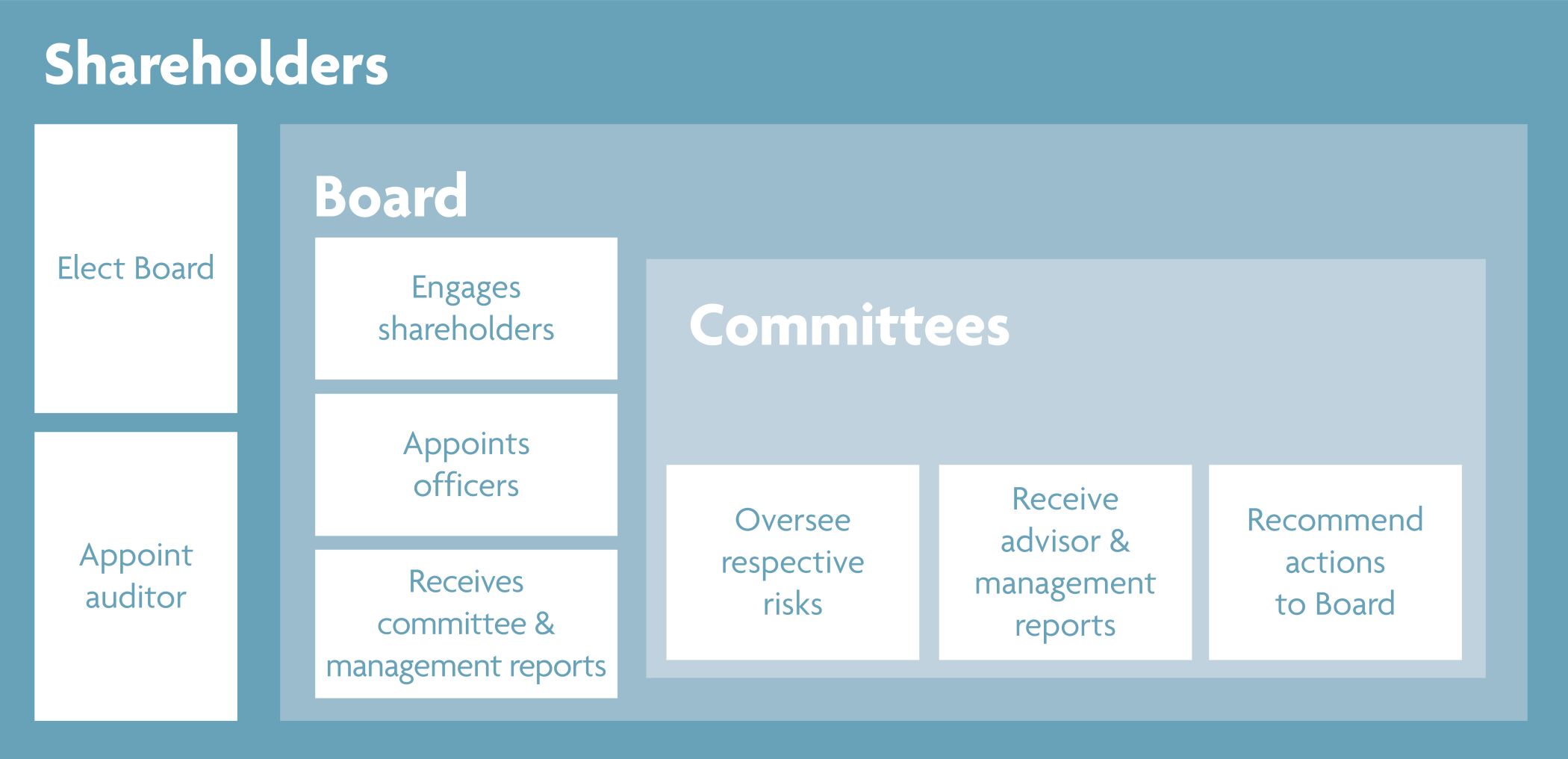
How we do our work at Cenovus is as important as what we do. We recognize that to deliver consistent, long-term shareholder value we must operate in a responsible manner that maintains and enhances our reputation. Delivering on this commitment requires good governance.
Our Board oversees the management of Cenovus’s business through a robust system of corporate governance and internal controls. This includes a comprehensive set of policies, standards and procedures that guide the expected behaviour of all our staff (including employees and contractors) and the Board.
Our governance structure also includes frameworks, such as our Enterprise Risk Management Policy and Cenovus Operations Integrity Management System, which help ensure we properly address risk in our business and embed safety and asset integrity in our work. See more about risk on page 24 and in the overview for each committee, starting on page 25.
Our directors and staff are annually required to review and commit to our Code of Business Conduct & Ethics (Code) and other key policies and standards. Through our Supplier Code of Business Conduct we also expect our service providers and suppliers to respect, uphold and communicate our corporate values and practices across their business enterprise and within their supply chains.
We have a number of channels available to confidentially report concerns about ethical business conduct, including an Integrity Helpline operated by a third-party service provider. Stakeholders, including local community residents and other members of the public, and our staff are encouraged to report any business conduct concerns through the Integrity Helpline. You can read more about the Integrity Helpline on page 17.
Legal requirements
Our governance practices meet or exceed all requirements that apply to us in Canada and the U.S. These include securities regulations and rules of the TSX and NYSE.
Structure
| CENOVUS 2026 CIRCULAR | GOVERNANCE | 16 |
Shareholder engagement
We understand the value of constructive communication and meaningful engagement with our shareholders. Our Board is committed to transparency and informed dialogue with shareholders to assist it in leading Cenovus.
We have a Board Shareholder Communication & Engagement Policy that guides our shareholder communications and sets out our approach to shareholder engagement.
Shareholders and other interested parties can communicate with any director at:
|
|
corporate.secretary@cenovus.com | |
|
|
Cenovus Energy Inc. 225 6 Ave SW PO Box 766 Calgary, AB T2P 0M5
Attention: Corporate Secretary | |
Communication and external engagement activities
| Item / activity |
Description | |
| Shareholder engagement policy |
Our Board Shareholder Communication & Engagement Policy reinforces our commitment to meaningful dialogue with shareholders. You can find a copy at cenovus.com. | |
| Conference calls with investment community |
Management holds quarterly conference calls and webcasts with investors to review financial and operating results. You can find the recording of the most recent call at cenovus.com. | |
| Management shareholder/investor engagement program |
Members of our executive team, including our CEO and CFO, as well as representatives from Investor Relations and Sustainability, had over 350 shareholder engagements throughout the year, including one-on-one meetings and investor roadshows.
Management attended various investor conferences and held a significant number of meetings and conference calls with shareholders, bondholders and other investors throughout 2025. | |
Our principles and values, together with our Code, Sustainability Policy and Human Rights Policy, set out our commitment to conducting business ethically and legally. You can read these policies at cenovus.com.
Code of Business Conduct & Ethics
Our Code applies to all directors and staff working on behalf of Cenovus in all locations where we conduct business. The Code is applicable in all jurisdictions in which Cenovus operates. Go to cenovus.com to read the full Code.
Our directors and staff are expected to be familiar with, and uphold, our values and adhere to the guidance set out in the Code. Each year, all directors and staff are asked to review the Code and confirm they understand their responsibilities and commit to observing and conducting themselves in accordance with its principles and requirements. Suppliers should review the Code and are encouraged to align with the principles and guidance it provides, and are required to comply with our Supplier Code of Business Conduct.
Annual Code compliance is reported to the Audit Committee, which is then reported to the Board. Any waiver of the Code for officers or directors may only be made by the Board and will be promptly disclosed to shareholders to the extent required by law, rule, regulation or stock exchange requirement. No waivers of the Code have been made by the Board.
Integrity Helpline
The Integrity Helpline provides an avenue for anyone, both internal and external, to report concerns or ask questions about any potential ethical issue or workplace concern, such as harassment, inappropriate behaviour, financial and non-financial fraud or unsafe work practices. The Integrity Helpline is independently operated by a third-party company and allows concerns to be shared confidentially or anonymously (if desired).
| CENOVUS 2026 CIRCULAR | GOVERNANCE | 17 |
Concerns reported through the Integrity Helpline relating to violations of policies or standards are handled in accordance with our Investigations Standard and Investigations Process. A quarterly report of Integrity Helpline complaints is provided to the relevant Board committees at each regularly scheduled meeting.
Investigations process
Our Investigations Standard and Investigations Process provide effective and consistent procedures to receive, review and, where appropriate, investigate matters reported to Cenovus’s Investigations Committee.
Our Investigations Committee conducts and oversees investigations. Violations related to any accounting, internal accounting controls or auditing matters are reported to the Audit Committee. Board committees, including Audit, receive quarterly summaries on the nature and status of ongoing investigations. The committees report any significant or material investigations to our Board.
In 2025, we added a Vice-President, Legal & Chief Compliance Officer role responsible for oversight of enterprise compliance at Cenovus, to enhance our compliance processes. This role also serves as Chair for each of the Investigations Committee and the Business Conduct and Integrity Committee. We also established our Ethics & Compliance Office, which centralizes oversight of relevant compliance activities already in place in the company.
Policy on Disclosure & Employee Trading
Our Policy on Disclosure & Employee Trading applies to all staff and directors of Cenovus and its subsidiaries. We also have a Restricted Trading & Insider Standard for directors, officers and insiders that provides additional instruction on trading in Cenovus common shares and other securities, insider reporting, the treatment of material non-public information and trading blackouts.
Directors and staff are prohibited from hedging transactions involving Cenovus common shares and other securities.
Compliance with the policy is reported to the Board by the Governance Committee.
Conflicts of interest and related party transactions
We have a Conflicts of Interest Standard, available at cenovus.com, to help our staff and directors proactively manage any potential conflicts of interest. In addition, Cenovus’s directors must comply with the conflict-of-interest provisions of the Canada Business Corporations Act, as well as applicable securities laws, in order to ensure the directors exercise independent judgment in considering transactions and agreements in respect of which such director has a material interest.
Cenovus’s conflicts of interest and related parties disclosure protocol for directors includes the following:
| • | Directors complete an annual compliance questionnaire where they disclose entities for which they serve as a director, officer or in a similar capacity, and the Governance Committee reviews material relationships which may impact a director’s judgment during their annual independence assessment. This list is made available to all directors in the Directors’ Information Handbook. The annual compliance questionnaire also collects information on related parties (as defined by International Financial Reporting Standards (IFRS)) and the Audit Committee is responsible for reviewing related party transactions between Cenovus and any executive officers or directors, including affiliations of any executive officers or directors. Directors must immediately advise the corporate secretarial team of any deletions, additions or other changes to any information provided. |
| • | The Corporate Secretary will provide advance notice to the Board and executive team of any potential conflict of interest impacting a director and ensure the portion of Board or Committee materials related to the conflict is not distributed to the conflicted director. |
| • | Where a real or perceived conflict of interest exists, appropriate mitigating activities will be undertaken by the director, such as excusing themselves from the meeting for that item of business or abstaining from the discussion and voting during that portion of the meeting. |
| CENOVUS 2026 CIRCULAR | GOVERNANCE | 18 |
| • | Cenovus’s transactions involving related parties, if any, are required to be publicly disclosed in accordance with applicable securities laws and Cenovus discloses the interest of management and others in material transactions where required by such laws. The oversight process is managed by Cenovus’s internal audit team in cooperation with the corporate secretarial team, who maintain a list of all affiliations and run a process annually to ensure that related party transactions are reported and disclosed as required. See our Annual Consolidated Financial Statements for further discussion on related party transactions. |
We believe striking the right balance among environmental, economic, governance and social considerations leads to strong business results and enhances shareholder value. As such, we factor sustainability considerations into our strategy, business plans and capital allocation processes.
We remain committed to reporting on our progress in an open and accountable matter. However, changes to Canada’s Competition Act in 2024 have created significant uncertainty and risk around how Canadian businesses can talk publicly about their environmental actions and performance. While we navigate the uncertainty related to environmental disclosure in Canada, we are sharing our progress in other areas of our business through our 2024 Corporate Social Responsibility (CSR) report, which you can access at cenovus.com.
Sustainability leadership and activity
We are committed to advancing efforts across our sustainability focus areas: acceptance and belonging, Indigenous reconciliation, climate and greenhouse gas (GHG) emissions, water stewardship and biodiversity. Read about our 2025 progress below, and our governance and oversight of sustainability risks on the following pages.
Some Board and management initiatives advanced or completed across our sustainability focus areas in 2025 include:
| • | Continuing to link compensation to sustainability performance across our sustainability focus areas through the sustainability performance index in the 2025 corporate performance scorecard (2025 Scorecard). See more on page 75. |
| • | Evolving our acceptance and belonging and Indigenous reconciliation initiatives with refreshed social commitments. See more on page 21. |
| • | The Board affirmed its commitment to diversity, amending its Board Diversity Policy and Board diversity commitments so that its goals reflect both male and female genders and include all Board members rather than only non-management directors. See more on page 22. |
| • | Expanding the scope of our Indigenous Housing Initiative to new communities near our Canadian oil sands operating areas with an ongoing annual investment of up to $8 million. |
Sustainability-related risk oversight
Our governance structure includes Board and executive oversight, along with policies, standards, processes and procedures to guide the expected behaviours of our staff, how we run our facilities and how we manage risk. Sustainability-related risks are considered within our enterprise risk management program, which helps us identify, assess and manage key risks to our business. Key sustainability-related risks, along with other sustainability-related topics, are reviewed with the Board and committees on a regular basis.
The Board approves our corporate strategic plan, which takes into account the opportunities and risks to our business, including those related to sustainability. The Board has oversight of our approach to sustainability and receives reports and recommendations from management with respect to sustainability-related matters under each committee’s oversight. The Board is also responsible for oversight of Cenovus’s processes and procedures to mitigate environmental impacts (including climate change), address health and safety matters, consider human capital management, and operate in a manner consistent with good governance and recognized standards. The four Board committees act in an advisory capacity to the Board and oversee sustainability-related risks relating to their respective mandates, which are addressed and reported to the Board.
| CENOVUS 2026 CIRCULAR | GOVERNANCE | 19 |
Sustainability governance leadership
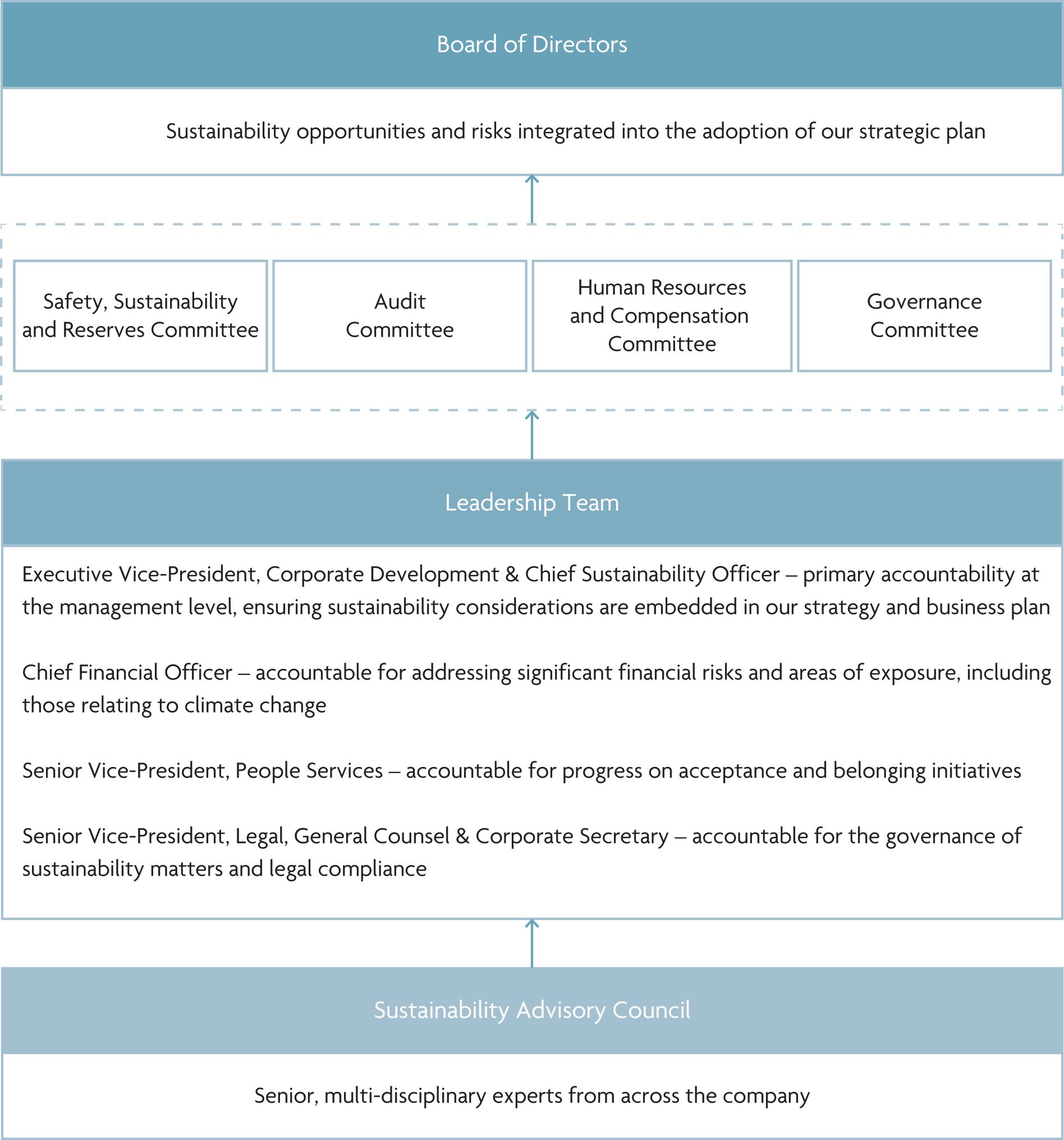
Board and committee sustainability-related oversight
Board. The Board oversees Cenovus’s approach to sustainability and receives reports and recommendations from management and committees on sustainability-related matters for which they are responsible or have oversight. It also oversees Cenovus’s processes and procedures to:
| • | Mitigate environmental impacts (including climate change). |
| • | Address health and safety matters that may arise due to Cenovus’s activities. |
| • | Consider human capital management. |
| • | Operate in a manner consistent with good governance and recognized standards. |
| CENOVUS 2026 CIRCULAR | GOVERNANCE | 20 |
Audit Committee. The Audit Committee oversees significant financial risks or exposures and impacts from evolving sustainability-related matters, including climate change. In particular, it oversees the financial impacts of sustainability-related matters (including climate change) on Cenovus’s access to capital from lenders, debt and equity investors, its access to insurance coverage, and to its credit ratings.
The Audit Committee also monitors development of legal and regulatory requirements related to integrated reporting affecting financial reporting and disclosures, including climate disclosures.
Human Resources and Compensation Committee. The HRC Committee is responsible for overseeing the implementation of Cenovus’s sustainability strategy as it relates to human resources and compensation matters. Specifically, the Committee has oversight of and reports to the Board on risks related to Cenovus’s talent and people management strategies, culture, respectful workplace, health and wellness, engagement, and acceptance and belonging.
Governance Committee. The Governance Committee oversees governance of sustainability matters, including the effectiveness of the Board Diversity Policy, and monitors its implementation.
The Governance Committee makes recommendations to the Board on the allocation of oversight of emerging or developing sustainability-related matters to the appropriate Board committee.
Safety, Sustainability and Reserves Committee. The SSR Committee oversees sustainability, including:
| • | Integration of the Sustainability Policy into the company’s practices and behaviours, including safety, social, environmental, ethical and economic considerations. |
| • | Sustainability performance, reporting and disclosure, safety and health, environment and climate change, asset integrity and stakeholder engagement policies, including Indigenous and other communities. |
| • | The implementation of Cenovus’s sustainability strategy and progress related to performance and achievement of its sustainability commitments, within the Committee’s mandate. |
| • | Critical incidents impacting Cenovus’s assets or operations involving environmental damage or reputational impacts. |
| • | Remedial or mitigating action taken to manage an identified sustainability risk, including environment (including abandonment and reclamation obligations), health, safety or climate change. |
| • | Risks related to alignment of Cenovus’s direct and indirect lobbying and public advocacy activities, including political contributions, with its corporate objectives, strategy, targets and ambition. |
Sustainability reporting
We recognize the importance of reporting in an open and accountable manner and have been reporting on our sustainability performance since the early 2000s.
As mentioned on page 19, changes to Canada’s Competition Act in 2024 have impacted our approach to sustainability reporting.
Our 2024 Corporate Social Responsibility (CSR) Report outlines the progress we’ve made towards our Indigenous reconciliation and acceptance and belonging commitments, as well as information about our safety performance and approach to governance. This report, along with our 2023 CSR Report, differs from our previous ESG Reports in that it does not include information regarding Cenovus’s environmental performance and plans. We have made the decision to defer reporting on our environmental activities as changes to Canada’s Competition Act in 2024 have created significant uncertainty and risk around how Canadian businesses can talk publicly about their environmental actions and performance. However, this does not change our commitment to advancing our environmental work. We stand by the actions we’re taking, the accuracy of our reporting and the information we’ve shared to date about our environmental performance.
We also published refreshed social commitments in December 2025. This and our CSR Reports are available on our website at cenovus.com.
| CENOVUS 2026 CIRCULAR | GOVERNANCE | 21 |
Board and executive characteristics
Cenovus recognizes and embraces the benefits of having a diverse Board and workforce. Membership of diverse teams include varying ages, genders, visible minorities, ethnicities, Indigenous peoples and persons with disabilities, and make good use of varying skills, expertise and experience.
Current diversity status as of March 1, 2026
| Women | Indigenous peoples |
Visible minorities |
Persons with disabilities |
Number of members in group |
Number of individuals that are members of more than one designated group | |||||||||||||||
| # | % | # | % | # | % | # | % | |||||||||||||
| Board |
5 | 35.7% | 1 | 7.1% | 2 | 14.3% | 1 | 7.1% | 14 | 2 | ||||||||||
| Executives |
2 | 22.2% | 0 | 0.0% | 1 | 11.1% | 0 | 0.0% | 9 | 0 | ||||||||||
Diversity calculations for both the Board and executives above include Mr. McKenzie.
Diversity targets for executives
Cenovus does not have formal targets or timelines for representation of women, Indigenous peoples, persons with disabilities or members of visible minorities (designated groups) among executive officer positions. Through data analysis, industry research and in-depth engagement with our employees, we’ve gained valuable insights into our workforce and in 2025 adapted our approach to align with our findings. While we monitor and report on leadership and employee demographics, our focus is on creating a workplace where everyone is valued, respected and feels like they belong so they can grow and do their best work.
Board Diversity Policy
Our written Board Diversity Policy commits us to seeking highly qualified directors and to consider diversity when determining the best composition for the Board. Our diversity criteria include gender, Indigenous identity, disability, ethnicity, age and other distinctions between directors. The Governance Committee monitors the implementation of the Board Diversity Policy and assesses the effectiveness of the Board Diversity Policy at achieving our Board diversity objectives by conducting, at least annually, periodic assessments to consider the level of representation on the Board of the various attributes enumerated in the Board Diversity Policy. The Board members also have the opportunity to evaluate annually the effectiveness of the director selection and nomination process through the Board evaluation process described on page 29.
Diversity targets for directors
In 2025, the Board revised the existing aspirational target in its Board Diversity Policy to include aspirational targets of maintaining at least 40% overall diversity from designated groups and at least 30% of each of the male and female genders, among all directors. Composition of the Board nominees proposed for election at the Meeting satisfies our aspirational targets for Board diversity, based on each directors’ voluntary self-identification. The previous Board Diversity Policy included a 40% target for the representation of designated groups among non-management directors, including 30% women, by year-end 2025. Both of the prior targets were achieved in and have been maintained since January 2023, leading the Board to revise and expand the scope of the Board Diversity Policy in 2025 to include gender neutral language and apply to all directors.
| CENOVUS 2026 CIRCULAR | GOVERNANCE | 22 |
The Board has not established separate targets for each of the number of visible minorities, persons with disabilities or persons with Indigenous identity on the Board. The Board has determined that, at this time, additional targets would not be the most effective way of ensuring the Board is composed of individuals with diverse attributes and backgrounds, and believes its current make up reflects the principles set out in the Board Diversity Policy.
Board diversity targets and progress as of March 1, 2026
| Area |
Target percentage |
Target date |
Current status |
Cumulative progress |
Annual progress | |||||
| Overall diversity |
40 | Maintain | 42.9% | – | n/a | |||||
| Gender diversity |
30 | Maintain | 35.7% | – | n/a | |||||
Cumulative progress is calculated from the adoption of the current Board diversity aspiration in December 2025.
Board of Directors
Succession planning
Effective at the close of the 2025 annual general meeting, Chana Martineau was elected to the Board, and Mr. Pourbaix stepped down as Executive Chair and continued as non-independent Chair. Claude Mongeau continued in his role as Lead Independent Director.
Independence
The Board reviews director independence annually. The Board considers, among other things, Canadian and U.S. securities and stock exchange requirements, and also looks at the business, family and other relationships of each director and considers whether there is any material relationship, including relationships which could, in the view of the Board, interfere with the director’s independent judgement. All but two of the directors proposed for nomination will be independent as at the date of the Meeting. Mr. McKenzie is our CEO and as an executive of Cenovus, is not independent.
Mr. Pourbaix served as Executive Chair until May 8, 2025, in which capacity he was considered both an executive officer and an employee of Cenovus. Accordingly, Mr. Pourbaix would not be considered independent (within the meaning of applicable Canadian securities laws) until May 8, 2028.
Committees
All Board committees are composed entirely of independent directors. See page 25 for more information.
Chair, Lead Independent Director and CEO
The roles of Chair and CEO continue to be separate, with Mr. Pourbaix as non-independent Chair and Mr. McKenzie as CEO. Mr. Mongeau is our Lead Independent Director and ensures the Board operates independently of management and that delineation of responsibilities of the Board and management are well understood and respected.
Meetings
All Board meetings (regular and special) include a scheduled session with only independent directors. No members of management are present, which facilitates open and candid discussion.
Roles and responsibilities
The Board’s key roles are to:
| • | Appoint a competent executive team. |
| • | Oversee the management of the business. |
| CENOVUS 2026 CIRCULAR | GOVERNANCE | 23 |
In support of these roles, the Board employs a system of corporate governance and internal controls to ensure ethical and legal corporate conduct.
The corporate governance system includes:
| • | Individual director expectations. |
| • | Defined mandates for the Board and committees (all available at cenovus.com). |
| • | Written position guidelines for the CEO, Chair, Lead Independent Director and committee chairs. |
The Board also has responsibility for approving communications policies. See page 17 for more information.
Individual director expectations
Cenovus directors are expected to attend all meetings, having reviewed the meeting materials in advance. Our directors must also follow the Code. See page 17 for more details.
Board Mandate and responsibilities
Our complete Board Mandate is included in Schedule B and available at cenovus.com. The key areas of Board responsibility are set out below.
| CEO |
• Appoint. • Monitor performance against corporate objectives that maximize shareholder value. • Ensure a process is in place that adequately provides for succession planning, including the appointing, training and monitoring of senior management. | |
| Strategic plan |
• Approve annually, including key objectives, operating and financial targets, and risk identification, monitoring and mitigation. • Receive regular updates on progress. • Approve annual operating and capital budgets. | |
|
Compensation |
• Approve for the CEO. • Approve for directors. • Approve incentive compensation plans and grant agreements. | |
|
Risk management |
• Approve Enterprise Risk Management Policy and oversee the enterprise risk management program (read more below under Risk Management). • Receive regular reports on risk and risk management from committees and management. | |
| Governance |
• Establish corporate governance systems, policies and practices to ensure the Board functions independently of management. • Approve financial statements and other public disclosure. • Ensure adequate system of internal control exists. • Approve Code and monitor compliance. • Clearly define limits on management’s authority. | |
Risk management
The Board committees have oversight of, and report to, the Board about risks related to each committee’s mandate. The Board remains responsible for approving the Enterprise Risk Management Policy which ensures that a system is in place to identify Cenovus’s principal risks, and that the best practical procedures are in place to monitor and mitigate such risks. The Governance Committee is responsible for reviewing and recommending to the Board the oversight of principal or emerging risks to each of the Board committees.
Oversight of cyber security risk lies with the Audit Committee and management reports to the committee quarterly on information security and cyber security matters. Cenovus’s cyber security management program is a risk-centric program ensuring cyber security risks are identified, analyzed and managed throughout their life cycle, and falls under the overarching
| CENOVUS 2026 CIRCULAR | GOVERNANCE | 24 |
enterprise risk management program. Cenovus’s information technology management controls (including Sarbanes-Oxley) are annually audited by an external consultant. Our employees, contractors and directors receive annual information security training as part of the cyber security awareness program. Oversight of emerging artificial intelligence (AI) risks lies with the Audit Committee and falls under the overarching enterprise risk management program. Management has provided updates on integration of AI at Cenovus to the Audit Committee.
The general categories of risks overseen by the Board and each of the committees are set out below. Find details of each committee’s risk oversight in the committee descriptions below.
|
| ||||||
|
• Corporate strategy
• Enterprise risk management program
• Operating and financial performance
| ||||||
| Audit Committee |
Governance Committee |
HRC Committee | SSR Committee | |||
• Financial reporting • Financial statements and controls • Internal and external auditors • Strategic market risk management framework |
• Board and corporate governance • Director nomination and compensation • Strategic market risk management program |
• Compensation and benefit programs, including executive compensation • People strategy and human capital management |
• Safety and health • Sustainability Policy-related matters • Reserves disclosure | |||
Our committees assist the Board in overseeing our business. The committees allow for a division of the workload, including risk oversight in specific areas, and a concentration of expertise relevant to their work. Detail on our committees, committee members and 2025 director attendance at meetings is on page 47. More details on Board and committee sustainability oversight is on page 21.
Audit Committee
Members. Ms. Kinney (Chair), Mr. Bradley, Mr. Marcogliese, Ms. Martineau and Mr. Mongeau.
Member requirements. All members of the Audit Committee are financially literate and independent according to Canadian securities laws. The Board has designated Ms. Kinney, Ms. Martineau and Mr. Mongeau as audit committee financial experts.
Members may not serve on more than two other public company audit committees without Board approval, and none of the committee members do. The Board considers whether the member’s ability to effectively serve the Audit Committee will be impaired by additional commitments.
Primary responsibilities. Oversees and reviews our market risk management framework and management’s identification of significant financial risks or exposures. It meets regularly to review reports from, and discuss significant risk areas with, internal and external auditors.
Primary duties. Oversees and monitors:
| • | The effectiveness and integrity of our accounting and financial reporting processes, financial statements, and the system of internal controls regarding accounting and financial reporting compliance. |
| • | Audits of our financial statements. |
| • | Our market risk management framework, including supporting guidelines and policies on the management of commodity price, currency (foreign exchange) and interest rate market risk. |
| CENOVUS 2026 CIRCULAR | GOVERNANCE | 25 |
| • | Management’s identification of, and risk management processes for, principal financial risks. |
| • | The qualifications, independence and performance of the external auditors and internal auditing group. |
| • | Amendments to, and compliance with, the Code. |
| • | All related party transactions between Cenovus and any executive officers or directors, including affiliations of any executive officers or directors. |
The Audit Committee also provides an avenue for communication among the external auditors, management, the internal audit group and the Board.
Risks overseen. Reviews or oversees and reports to the Board about risks related to:
| • | The design and operating effectiveness of our market risk management control framework and the processes to manage such risks. |
| • | Non-compliance with regulations and policies, including trends, insights, initiatives and investigations, relating to matters within the Audit Committee’s mandate. |
| • | All financial filings and public documents, including Cenovus’s and any subsidiary with public securities annual audited financial statements and related documents, and all unaudited financial statements and related documents, and other filings and public documents, as to financial information. |
| • | The evaluation, appointment, compensation, retention and work of the external auditors. |
| • | Together with management, the appointment, compensation, replacement, reassignment or dismissal of the head of internal audit. |
| • | The receipt, retention and treatment of complaints received by Cenovus regarding accounting, internal accounting controls or auditing matters. |
| • | Significant financial risks or exposures, including those related to cyber security and sustainability matters, such as climate change. |
| • | Cyber security and artificial intelligence (AI) risks (read more about Risk Management on page 24). |
| • | Principal or emerging risks assigned to the Audit Committee by the Board, as recommended by the Governance Committee. |
Governance Committee
Members. Mr. Mongeau (Chair), Mr. Crothers, Ms. Kwok, Ms. Martineau, Mr. Sixt and Ms. Zygocki.
Member requirements. All members of the Governance Committee are independent according to Canadian securities laws.
Primary responsibilities. Assists and makes recommendations to the Board on corporate governance matters, including issues or principles related to risk governance, allocation of principal and emerging risk oversight, as well as strategic market risk management. Also assists with Board composition and nomination, and director compensation.
Primary duties. Reviews and makes recommendations to the Board on:
| • | Corporate governance principles for Cenovus. |
| • | Appropriate changes and updates to Board and committee mandates. |
| • | Succession planning for the Board as a whole, including: |
| ○ | Assessing the progress on Board Diversity Policy objectives. |
| ○ | Monitoring Chair succession planning and recommending a successor, as required. |
| ○ | Identifying and recommending individuals qualified to be nominated for election or appointment. |
| • | Overseeing evaluations and effectiveness of the Board, its committees and the directors (see page 29 for more). |
| • | Compensation and share ownership guidelines for directors (see page 57 for more). |
| • | The direction and effectiveness of management’s strategic market risk management programs related to commodity price, currency (foreign exchange) and interest rate market risk, and review of the program principles, design and performance. |
| CENOVUS 2026 CIRCULAR | GOVERNANCE | 26 |
| • | Governance of sustainability matters, including allocating oversight of emerging or developing sustainability matters to the appropriate Board committee. |
The Governance Committee approves the succession planning process for the CEO and also monitors best practices among major Canadian and U.S. companies to ensure Cenovus holds itself to a high standard of corporate governance.
Risks overseen. Reviews, oversees and reports to the Board on risks related to:
| • | Corporate governance, including issues related to risk governance. |
| • | Directors’ compensation. |
| • | Director nomination proposals. |
| • | Effectiveness of management’s strategic market risk management programs. |
| • | Shareholder proposals and engagement. |
| • | Principal or emerging risks assigned to the Governance Committee by the Board, as recommended by the Governance Committee. |
Human Resources and Compensation (HRC) Committee
Members. Ms. Zygocki (Chair), Mr. Casey, Mr. Crothers, Mr. Girgulis and Ms. Little.
Please see page 64 for information on their qualifications related to human resources and compensation.
Member requirements. All members of the HRC Committee are independent according to Canadian securities laws.
Primary responsibilities. Makes recommendations to the Board on compensation and human resources matters. The HRC Committee also assists the Board in carrying out its responsibilities as sponsor of Cenovus’s pension, savings and investment plans.
Primary duties. Reviews and reports or makes recommendations to the Board on:
| • | Organization-wide people strategy, including culture, labour relations, engagement and acceptance and belonging in support of Cenovus’s business strategy. |
| • | Incentive compensation plans, including reservation of shares for, and any amendment of, Cenovus’s equity compensation plans. |
| • | CEO, Cenovus leadership team and employee compensation. |
| • | Appointment of corporate officers. |
| • | Progress related to performance and achievement of sustainability commitments, within the HRC Committee’s oversight. |
| • | Strategy of funding levels to Cenovus’s pension, savings and investment plans. |
The HRC Committee reviews information provided by our management pension committees, including fund status and investment management results for our pension, savings and investment plans. (See page 73 for more details).
The HRC Committee also has the authority to approve Cenovus leadership team succession planning and performance measures for CEO and Cenovus leadership team incentive plans, and Cenovus’s compensation philosophy, including any related changes to compensation and benefits policies, and succession planning for the Cenovus leadership team, including annually (at a minimum) reviewing with the CEO and Senior Vice-President, People Services:
| ○ | Succession plans, including long-term executive development to ensure leadership sustainability and continuity. |
| ○ | The internal talent pool. |
| ○ | Retirements, illness, disability and unplanned absences. |
Risks overseen. Reviews or oversees and reports to the Board on risks related to:
| • | People strategy, culture, respectful workplace, health and wellness, engagement and acceptance and belonging. |
| CENOVUS 2026 CIRCULAR | GOVERNANCE | 27 |
| • | Non-compliance with regulations and policies, including trends, insights, initiatives and investigations, relating to matters within the HRC Committee’s mandate. |
| • | Compensation and benefit policies and short and long-term incentives (LTIs), including as they relate to financial or reputational well-being. |
| • | Pension and investment plan matters. |
| • | Principal or emerging risks allocated to the HRC Committee by the Board as recommended by the Governance Committee. |
Safety, Sustainability and Reserves (SSR) Committee
Members. Mr. Marcogliese (Chair), Mr. Bradley, Mr. Casey, Mr. Girgulis, Ms. Kinney and Ms. Little.
Member requirements. All members of the SSR Committee are independent according to Canadian securities laws. See more information on page 23. The Committee maintains independence by ensuring a majority independent committee.
Primary responsibilities. Oversees and monitors our commitments to promoting a culture of safety including the implementation by management of policies and procedures intended to ensure process and occupational safety performance and integrating the Sustainability Policy including environmental, social and economic considerations into our practices and behaviours. The committee also reviews matters related to our reserves and resources, including public disclosure.
Primary duties. Reviews and reports or makes recommendations to the Board on:
| • | Fundamental policies pertaining to safety, sustainability and the environment having the potential to impact corporate activities and strategies. |
| • | Cenovus’s procedures regarding the disclosure of oil and gas activities under applicable regulations and policies. |
| • | Annual selection of the independent qualified reserves evaluators and approval of expected fees. |
| • | Annual reserves and resources data disclosure. |
| • | Disclosure on matters addressed in the Sustainability Policy, including sustainability disclosure. |
The SSR Committee also stewards our sustainability commitments under the Sustainability Policy. See page 21 for more details.
Risks overseen. Reviews or oversees and reports to the Board on risks related to:
| • | Safety performance and programs and procedures in place to mitigate safety incidents. |
| • | Non-compliance with regulations and policies, including trends, insights, initiatives and investigations, relating to matters within the SSR Committee’s mandate. |
| • | Alignment of Cenovus’s direct and indirect lobbying and public advocacy activities, including political contributions, with its corporate objectives, strategy, targets and ambition. |
| • | Reserves governance and resource disclosure data and the procedures relating to the disclosure of such information. |
| • | Sustainability, including safety and health, environment and climate change, engagement with the public, including Indigenous and other communities, and related ethical and reputational impacts and disclosure. |
| • | Persistent trends and high-risk observations resulting from periodic management system assurance activities. |
| • | Remedial or mitigating actions taken to manage identified health and safety, environment and climate change, and other sustainability risk, including abandonment and reclamation obligations. |
| • | Principal or emerging risks allocated to the SSR Committee by the Board as recommended by the Governance Committee. |
| CENOVUS 2026 CIRCULAR | GOVERNANCE | 28 |
The Board has approved general guidelines for the CEO, the Chair, the Lead Independent Director and the committee chairs. Go to cenovus.com for full copies of each of the guidelines, which are summarized below.
CEO. The CEO’s fundamental responsibility is the general direction and management of the business and affairs of Cenovus in accordance with the corporate strategy and objectives approved by the Board. The CEO may only take action within the authority limits delegated by the Board.
Chair. The Chair’s main responsibility is to provide overall leadership to the Board. The Chair is responsible for enhancing the effectiveness of the Board, the committees and the individual directors of the Board. From January 1, 2025 to May 8, 2025, Mr. Pourbaix was Executive Chair of the Board. On May 8, 2025 he stepped down from the Executive Chair role and assumed the role of Chair.
Lead Independent Director. The Lead Independent Director’s responsibility is to ensure the Board continues to operate independently of management, provide independent leadership to the Board to enhance the effectiveness of the Board, the committees and the individual directors of the Board, and engage with shareholders and other key stakeholders on behalf of the Board. As Lead Independent Director since 2023, Mr. Mongeau is responsible for providing leadership to the Board and, in particular, the independent directors, with clearly delineated and comprehensive duties, including the authority to call Board meetings and/or meetings of the independent Board members, approve meeting materials (including agendas) and be available to engage with shareholders and other key stakeholders on behalf of the Board.
Committee Chairs. The main responsibility of the Chair of any Board committee is to effectively manage the duties of the committee. Each Committee Chair ensures its committee is properly organized, functions effectively and meets its obligations and responsibilities.
The Governance Committee is responsible for both Board evaluation and renewal. Board evaluation includes the annual assessment of the effectiveness of the Board, committees and each director. Board renewal activities identify the skills, expertise, experience and diversity required to effectively oversee our business activities.
Board evaluation process
Board evaluations are conducted by an external third party at least every three years and otherwise annually through an internally managed evaluation. We completed an external Board evaluation in 2023. It included an anonymous effectiveness questionnaire, individual interviews, and self and peer evaluations of all directors. A final report was presented to the Board and each individual director was also provided a confidential performance evaluation that was shared with the Lead Independent Director and Chair. The Chair also met individually with each director to discuss the results of the evaluation.
An internally managed Board evaluation was completed in 2024 and 2025. Each director completed an effectiveness questionnaire and the Chair met with each director to discuss the effectiveness of our Board, Board committees and each director. The results of the evaluation were reported to the Board by the Chair. The Chair of the Governance Committee also meets with the Chair to discuss their effectiveness. The Governance Committee also assesses:
| • | The adequacy of information given to directors. |
| • | Communication between our Board and management. |
| • | The processes of the Board and Board committees. |
The Governance Committee recommends to our Board any changes to enhance the overall effectiveness of the Board and its committees.
| CENOVUS 2026 CIRCULAR | GOVERNANCE | 29 |
Board renewal process
Our Board composition and renewal reviews are a continuous process. The Governance Committee annually reviews each director’s knowledge, skills, experience and meaningful contributions, using the skills and experience matrix set out on page 48. The Governance Committee also identifies retiring Board members.
The Governance Committee and Board identify those gaps in skill, expertise and industry experience that are most important to Cenovus in light of best practices, the Board Mandate, the Board Diversity Policy and our long-term plans. The Governance Committee regularly considers potential director candidates to ensure continuous Board renewal.
Director nominee identification process
The Governance Committee develops criteria for prospective director candidates and identifies, evaluates and recommends nominees to the Board. The Committee receives suggestions for candidates from current directors, the CEO and, when appropriate, search firms, and ensures an objective nomination process.
The Governance Committee reviews skill gaps and diversity when evaluating potential directors and recommends to the Board highly qualified candidates who demonstrate integrity and suitability for overseeing management.
Board Diversity Policy
Cenovus recognizes and embraces the benefits of having a diverse Board that makes good use of various skills, expertise and industry experience. You can find the full Board Diversity Policy at cenovus.com. See page 22 for more information on the diversity of the Board.
Board renewal mechanisms
| Age limit |
Tenure limit |
Other mechanisms for Board renewal | ||
| No | Yes: 12-year term limit | Board Diversity Policy and annual Board evaluation | ||
Term limits
To balance the benefit of experience and the need for renewal and new perspectives, the Board has adopted a Board Term Limit Policy, which established a 12-year term limit for non-executive directors. Under the Board Term Limit Policy, the Board has discretion to recommend that a director’s term be extended or request the resignation of a director before the expiration of the 12-year term. This policy helps ensure that we continue to benefit from new perspectives, ideas and business strategies while maintaining critical understanding of Cenovus and our business on the Board. The current average tenure of directors is 4.7 years.
Age limits
Cenovus does not have an age limit for directors, recognizing the ability of both younger and older directors to bring insights and perspectives to a diverse Board. Instead, director nomination for re-election is based on assessment of their performance and contributions.
Board interlocks
See page 49 for details of the other public company boards our directors serve on and how we review interlocks among directors.
Director re-election
The Governance Committee recommends to the Board those directors to be nominated for re-election. Directors who may be re-elected are evaluated in light of skills, diversity and the performance assessments conducted under the Board evaluation process.
| CENOVUS 2026 CIRCULAR | GOVERNANCE | 30 |
Director orientation and education
The Governance Committee implements processes for:
| • | Orientation and education of new directors. |
| • | Continued development of current directors. |
Orientation
We orient new directors to the:
| • | Roles of the Board, its committees and individual directors. |
| • | Nature and operation of our business. |
The orientation includes:
| • | Sessions with senior management. |
| • | An overview of Cenovus’s business. |
| • | Overviews of major producing properties and areas of operations. |
Each new director is also encouraged to conduct their own due diligence by meeting independently with our Chair, CEO, Lead Independent Director, other directors and members of management.
Education
We provide continuing education opportunities for all directors. These opportunities allow directors to enhance their skills and strengthen their understanding of our business. A chart of the education sessions held during 2025 is on page 49.
Directors also meet with management throughout the year, outside of Board or committee meetings, for informal question and answer discussions.
Directors may attend external education programs, at the expense of Cenovus, to assist in their development. The Chair participates in decisions about directors attending external programs.
| CENOVUS 2026 CIRCULAR | GOVERNANCE | 31 |
Director nominee highlights
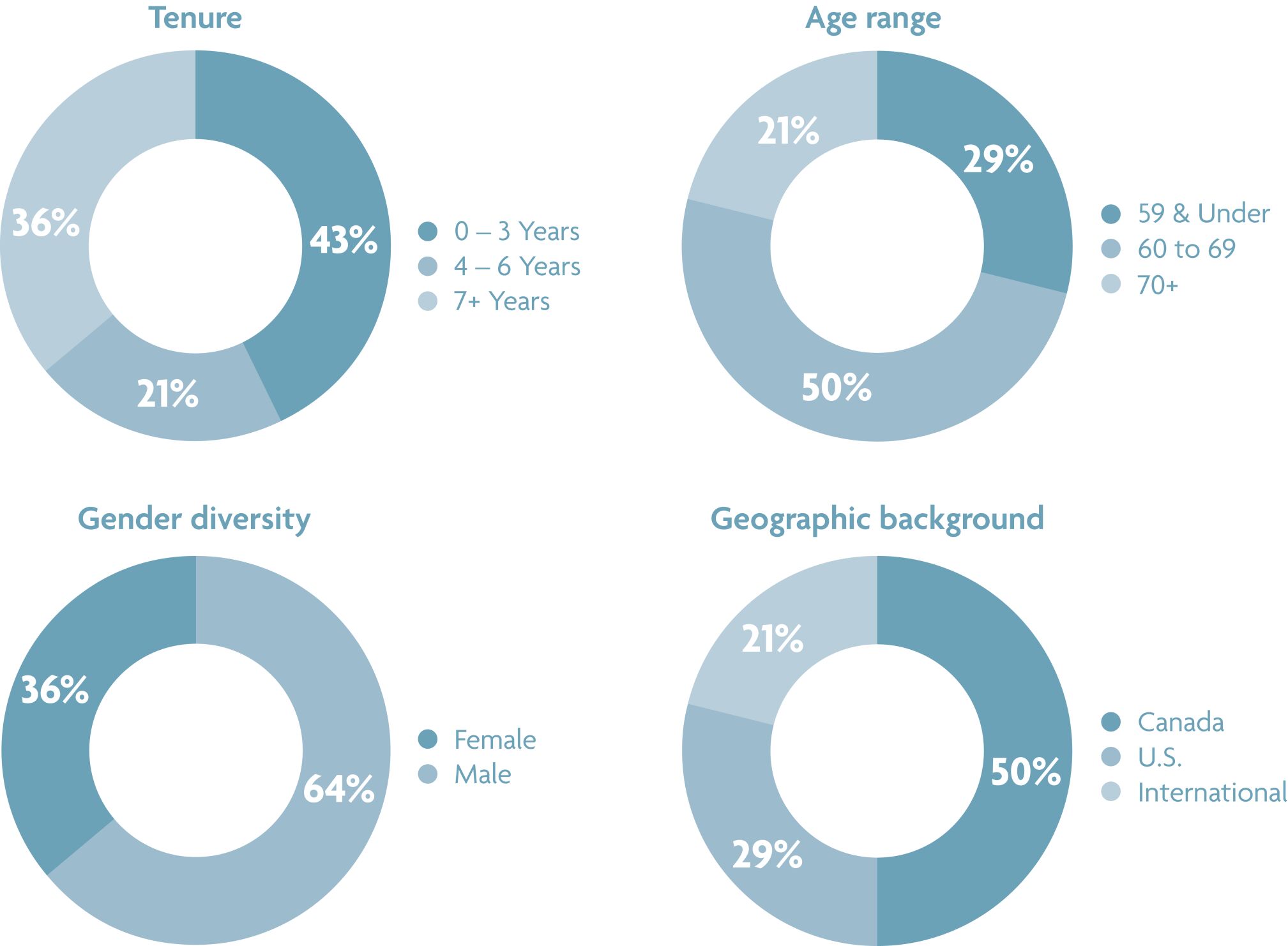
| In this section you will find: |
||||
| Page 33 | ||||
| Page 47 | ||||
| Page 48 | ||||
| Page 49 | ||||
| Page 49 | ||||
| Page 51 | ||||
| Page 52 | ||||
| Page 53 | ||||
| CENOVUS 2026 CIRCULAR | DIRECTORS | 32 |
| Stephen E. Bradley – Independent Director | ||||
|
|
Director since May 2024
Age: 67 Smerillo, Italy |
Key skills and experience: • International markets • Government & stakeholder relations • Corporate governance • Operational & resource development • Risk management
Board committees: Audit SSR | ||
| Experience | ||||
| • |
Director of CK Asset Holdings Limited, a publicly traded global property investment, development, management and utility infrastructure company, since November 2020. |
| • |
Director of Power Assets Holdings Limited, a publicly traded global energy investment company, since May 2022. |
| • |
Former Director of CNex (Shanghai International Money Broking Co.), a private broking and information services company (November 2020 – July 2024). |
| Current public company board |
Committee memberships | Exchange | ||
| CK Asset Holdings Limited |
Nomination (Chair) Audit Sustainability |
SEHK | ||
| Power Assets Holdings Limited |
SEHK | |||
| Prior directorships | ||||
| • |
Husky Energy from July 2010 to December 2020 (when Husky Energy combined with Cenovus). |
| • |
Swire Properties Limited from 2010 to 2018. |
| Education | ||||
| • |
Bachelor of Arts, Balliol College, Oxford University. |
| • |
Post Graduate Diploma, Fudan University, Shanghai. |
| • |
ICD.D from the Institute of Corporate Directors. |

| CENOVUS 2026 CIRCULAR | DIRECTORS | 33 |
| Keith M. Casey – Independent Director | ||||
|
|
Director since April 2020
Age: 59 San Antonio, Texas, U.S. |
Key skills and experience: • Refining • Marketing & transportation • Risk management • Health, safety & environment • Human capital management
Board committees: HRC SSR | ||
| Experience | ||||
| • | CEO of Pin Oak Group, LLC, a private midstream company (February 2022 to February 2025). |
| • | CEO of Tatanka Midstream LLC, a private midstream company (March 2020 to January 2022). |
| • | Executive roles with Andeavor Corporation (formerly Tesoro Corporation), an integrated petroleum refining, logistics and marketing company (April 2013 to October 2018) including: Executive Vice-President, Commercial and Value Chain, responsible for overseeing the integrated commercial value chain and focused on maximizing its asset base through its midstream, infrastructure and refining assets; Executive Vice-President, Operations; and Senior Vice-President, Strategy and Business Development. |
| • | Vice-President at BP Products North America Inc. (2006 to 2013). |
| • | Worked in refining industry since 1998. |
| • | Leadership roles with Praxair Incorporated and Union Carbide Corp. (before 1998). |
| Current public company board |
Committee memberships | Exchange | ||
| None |
||||
| Prior directorships | ||||
| • |
Andeavor Logistics LP (formerly Tesoro Corporation) publicly traded (April 2014 to April 2015). |
| • |
Numerous private midstream companies. |
| Education | ||||
| • |
Bachelor of Science in Metallurgical and Materials Engineering, California Polytechnic State University, San Luis Obispo. |

| CENOVUS 2026 CIRCULAR | DIRECTORS | 34 |
| Michael J. Crothers – Independent Director | ||||
|
|
Director since November 2023
Age: 63 Calgary, Alberta, Canada |
Key skills and experience: • Operational & resource development • Refining • Health, safety & environment • Risk management • Human capital management
Board committees: Governance HRC | ||
| Experience | ||||
| • | Over 37 years of operations, commercial and leadership experience in the upstream, downstream and integrated gas businesses, and previously served as President and Country Chair for Shell Canada Limited (Shell), a public global energy and petrochemical company (December 2015 to May 2021). |
| • | During his tenure at Shell, he also served as Vice President, Canada Integrated Gas (December 2017 to May 2021); Executive Vice President, Oil Sands (January 2017 to December 2017); Vice President, Unconventionals, North America (January 2015 to March 2017); and Managing Director, Shell Exploration & Production Ireland (November 2011 to January 2015). |
| • | Mr. Crothers serves as Chair of the board of directors of Northern RNA Inc., a private life sciences company. He also serves as a Director of DeNova, the United Way of Calgary and Area, and Alberta Regional Board Chair and National Board Director of Nature Conservancy of Canada. |
| Current public company board |
Committee memberships | Exchange | ||
| Keyera Corp. |
Health, Safety and Environment Governance and Sustainability |
TSX | ||
| Prior directorships | ||||
| • | Convrg Innovations Inc., formerly Westgen Technologies, private (August 2022 to May 2024). |
| Education | ||||
| • | Bachelor of Science (Chemical Engineering) with distinction, University of Alberta. |
| • | Professional Engineer, APEGA (retired and non-practising). |
| • | ICD.D from the Institute of Corporate Directors. |

| CENOVUS 2026 CIRCULAR | DIRECTORS | 35 |
| James D. Girgulis – Independent Director | ||||
|
|
Director since November 2023
Age: 69 Luxembourg, Grand-Duchy of Luxembourg
|
Key skills and experience: • Corporate governance • International markets • Government & stakeholder relations • Human capital management • Risk management
Board committees: HRC SSR | ||
| Experience | ||||
| • | Managing Director of Hutchison Whampoa Europe Investments S.a. r.l., a private investment company and Managing Director of CK Hutchison Group Telecom Finance S.A., a public limited company, both since January 2023. |
| • | Managing Director of CK Hutchison Networks Europe Investments S.a. r.l., a private investment company (April 2022 to January 2023). |
| • | Senior Vice-President, General Counsel & Secretary of Husky Energy, a public integrated energy company (April 2012 to March 2021). Consulted as Special Advisor to the Executive at Cenovus (April 2021 to March 2022) following Cenovus’s combination with Husky Energy in January 2021. |
| Current public company board |
Committee memberships | Exchange | ||
|
None |
||||
| Prior directorships | ||||
None
| Education | ||||
| • | Bachelor of Arts, University of Calgary. |
| • | Bachelor of Laws, University of Alberta. |
| • | Member of the Bar and of the Law Society of the Province of Alberta. |

| CENOVUS 2026 CIRCULAR | DIRECTORS | 36 |
| Jane E. Kinney – Independent Director | ||||
|
|
Director since April 2019
Age: 68 Toronto, Ontario, Canada |
Key skills and experience: • Financial, accounting & capital markets • Risk management • Corporate governance • Cyber security • Human capital management
Board committees: Audit (Chair) SSR | ||
| Experience | ||||
| • | Over 30 years providing advisory services to global financial institutions. |
| • | Extensive experience in enterprise risk management, regulatory compliance, cyber and IT risk management, digital transformation and stakeholder relations. |
| • | 25 years with Deloitte LLP Canada (admitted to the Partnership in 1997) including Vice Chair, Leadership Team (June 2010 to June 2019), Canadian Managing Partner, Quality and Risk (May 2010 to June 2015), Global Chief Risk Officer (June 2010 to May 2012) and Risk and Regulatory Practice Leader (June 1999 to May 2010). |
| • | Director and Chair of Nautilus Indemnity Holdings Limited, a private insurance company. Vice-Chair of the Perimeter Institute for Theoretical Physics, and Chair of the Patron’s Council of the Alzheimer Society of Toronto. |
| • | Past lecturer at University of Manitoba, Dalhousie University and Saint Mary’s University. |
| Current public company board |
Committee memberships | Exchange | ||
| Intact Financial Corporation |
Audit (Chair) Governance and Sustainability |
TSX | ||
| Prior directorships | ||||
| • | Toronto Finance International (Board Chair). |
| • | Women’s College Hospital Foundation. |
| Education | ||||
| • | Mathematics, University of Waterloo. |
| • | Fellow of the Chartered Professional Accountants of Ontario. |
| Accolades | ||||
| • | Math Alumni Achievement Medal from the University of Waterloo. |
| • | Recognized as one of Canada’s Most Powerful Women by the Women’s Executive Network in 2014. |

| CENOVUS 2026 CIRCULAR | DIRECTORS | 37 |
| Eva L. Kwok – Independent Director | ||||
|
|
Director since January 2021
Age: 83 Vancouver, British Columbia, Canada
CEO, Amara Holdings Inc. (private investment holding company) |
Key skills and experience: • International markets • Corporate governance • Human capital management • Risk management • Marketing & transportation
Board committee: Governance | ||
| Experience | ||||
| • |
Chair, CEO and a director of Amara Holdings Inc., a private investment holding company, since November 2010. |
| • |
Director of CK Life Sciences Int’l., (Holdings) Inc., a publicly traded nutraceutical, pharmaceutical and agriculture-related company, since June 2002, CK Infrastructure Holdings Limited, a publicly traded global infrastructure investment and development company, since September 2004, and CK Asset Holdings Limited, a publicly traded global property investment, development, management and utility infrastructure company, since May 2022. |
| • |
Director of Li Ka Shing (Canada) Foundation. |
| Current public company board |
COMMITTEE MEMBERSHIPS | EXCHANGE | ||
| CK Infrastructure Holdings Limited |
Nomination (Chair) | SEHK, LSE | ||
| CK Life Sciences Int’l., (Holdings) Inc. |
Remuneration (Chair) | SEHK | ||
| CK Asset Holdings Limited |
SEHK | |||
| Prior Directorships | ||||
| • |
Husky Energy from August 2000 to March 2021 (when Husky Energy combined with Cenovus). |
| Education | ||||
| • |
Master’s in Science, University of London. |
| • |
Honorary Doctor of Laws, Royal Roads University, British Columbia. |

| CENOVUS 2026 CIRCULAR | DIRECTORS | 38 |
| Melanie A. Little – Independent Director | ||||
|
|
Director since January 2023
Age: 56 Alpharetta, Georgia, U.S.
President and CEO, Colonial Pipeline Company (pipeline and terminaling company owned by Brookfield Infrastructure Partners, a publicly traded company) |
Key skills and experience: • Risk management • Health, safety & environment • Human capital management • Climate & emissions • Corporate governance
Board committees: HRC SSR | ||
| Experience | ||||
| • | Served as Executive Vice-President and Chief Operating Officer of Magellan Midstream Partners, L.P. (since acquired by ONEOK, Inc.), a public partnership that transports, stores and distributes petroleum products (June 2022 to January 2023). |
| • | During Ms. Little’s 21-year career with Magellan she held a number of senior management positions, including Senior Vice-President, Operations and Environmental, Health, Safety and Security (July 2017 to May 2022); Vice-President roles in Operations and Crude Oil Commercial (February 2011 to June 2017); Director of Transportation Services for Refined Products and Marine (June 2007 to January 2011); and environmental, health and safety management roles (January 2004 to May 2007). |
| • | Manager of Environmental Compliance at The Williams Companies Inc., a public energy provider and infrastructure company (June 2001 to December 2003) and while on active duty in the U.S. Army, held project management positions in the areas of environmental remediation and civil construction. |
| • | Ms. Little is also a Director of the Liquid Energy Pipeline Association, American Petroleum Institute and a National Petroleum Council appointee. |
| • | She was a Director of the International Liquid Terminals Association and The Discovery Lab in 2023. |
| Current public company board |
Committee memberships | Exchange | ||
| None |
||||
| Prior directorships | ||||
| • |
Diversified Energy Company plc. |
| Education | ||||
| • |
Bachelor of Science in Environmental Engineering, United States Military Academy. |
| • |
Master of Science in Civil Engineering, Georgia Institute of Technology. |

| CENOVUS 2026 CIRCULAR | DIRECTORS | 39 |
| Richard J. Marcogliese – Independent Director | ||||
|
|
Director since April 2016
Age: 73 Alamo, California, U.S.
Principal, iRefine, LLC, (privately owned petroleum refining consulting company) |
Key skills and experience: • Refining • Health, safety & environment • Risk management • Human capital management • Climate & emissions
Board committees: Audit SSR (Chair) | ||
| Experience | ||||
| • | Executive Advisor of Pilko & Associates L.P., a private chemical and energy advisory company (June 2011 to December 2019). |
| • | Operations Advisor to NTR Partners III LLC, a private investment company (October 2013 to December 2017). |
| • | Operations Advisor to the CEO of Philadelphia Energy Solutions, a partnership between The Carlyle Group and a subsidiary of Energy Transfer Partners, L.P. that operated an oil refining complex on the U.S. Eastern seaboard (September 2012 to January 2016). |
| • | More than 40-year career in the U.S. refining industry, including over 25 years with Exxon Mobil Corporation. In 2000, he joined Valero Energy Corporation as a result of Exxon’s acquisition, at which point he led an organizational transition from a major integrated oil company business model to Valero’s independent refiner business model. He held increasingly senior positions with Valero including Senior Vice President of Strategic Planning in 2001, Senior Vice President of Refining Operations (October 2001 to November 2005), Executive Vice President, Operations (December 2005 to October 2007) and Executive Vice President and Chief Operating Officer (October 2007 to December 2010) during which time he was responsible for the operation of Valero’s North American refinery system which processed three million barrels of oil per day. |
| Current public company board |
Committee memberships | Exchange | ||
| Delek US Holdings, Inc. |
Audit Compensation Environmental, Health and Safety (Chair)
|
NYSE | ||
| Prior directorships | ||||
|
• Western States Petroleum Association (past Chair).
| ||||
| Education | ||||
|
• Bachelor of Engineering (Chemical Engineering), New York University School of Engineering and Science. | ||||

| CENOVUS 2026 CIRCULAR | DIRECTORS | 40 |
| Chana L. Martineau – Independent Director Nominee | ||||
|
|
Director since May 2025
Age: 56 Edmonton, Alberta, Canada
CEO, Alberta Indigenous Opportunities Corporation |
Key skills and experience: • Government & stakeholder relations • Financial, accounting & capital markets • Corporate governance • Human capital management • Risk management
Board committees: Audit Governance | ||
| Experience | ||||
| • | Chief Executive Officer of the Alberta Indigenous Opportunities Corporation (AIOC), a crown corporation dedicated to supporting Indigenous economic investment in large scale infrastructure through loan guarantees and capacity grant funding, since July 2022, and was a Director of AIOC (November 2021 to July 2022). |
| • | Senior positions with Canadian Western Bank, including Vice President – Banking (January 2021 to July 2022); COVID-19 Emergency Response Leadership Team member (March 2020 to January 2021); and Vice President – Sales Strategy & Effectiveness (January 2018 to January 2021). On February 3, 2025, Canadian Western Bank was acquired by the National Bank of Canada. |
| • | 13 years at Ernst & Young LLP, in increasingly senior positions. |
| • | Director and Chair of the Governance and Human Resources Committee of Alberta’s Heritage Fund Opportunities Corporation, an independent Crown corporation tasked with providing oversight of the Province of Alberta’s sovereign wealth fund, since March 2025. |
| • | Proud member of Frog Lake First Nation on Treaty 6 territory. |
| Current public company board |
Committee memberships | Exchange | ||
| Alamos Gold Inc. |
Technical and Sustainability Public Affairs |
TSX, NYSE | ||
| Prior directorships | ||||
None
| Education | ||||
| • | Bachelor of Arts (Economics), University of Alberta. |
| • | ICD.D from the Institute of Corporate Directors. |

| CENOVUS 2026 CIRCULAR | DIRECTORS | 41 |
| Jonathan M. McKenzie – Non-Independent Director | ||||
|
|
Director since April 2023
Age: 58 Calgary, Alberta, Canada
President & Chief Executive Officer since April 2023
|
Key skills and experience: • Financial, accounting & capital markets • Risk management • Operational & resource development • Human capital management • Cyber security
Board committees: none
| ||
| Experience | ||||
| • | Served as Executive Vice-President & Chief Operating Officer of Cenovus (January 2021 to April 2023) and prior to that was Executive Vice-President & Chief Financial Officer (May 2018 to January 2021). |
| • | More than 30 years of finance and operations experience, mostly in the Canadian oil and gas industry. He was an integral part of Cenovus’s strategic combination with Husky Energy. Mr. McKenzie was Executive Vice-President and Chief Financial Officer of Husky Energy (April 2015 to April 2018). |
| • | Chief Financial Officer and Chief Commercial Officer of Irving Oil Ltd. (April 2011 to April 2015), where he was responsible for all supply, trading and commercial aspects of the company including coordinating business development projects involving pipelines, rail and terminal operations. Prior to that, Mr. McKenzie was at Suncor Energy Inc. for 10 years where he held increasingly senior positions in finance and operations, including operating responsibility for the company’s upgrader in Fort McMurray, with his final position being Vice-President and Controller. |
| • | Serves on the board of directors of Irving Oil Ltd. and is Chair of the board of directors at the Canadian Association of Petroleum Producers (CAPP). |
| Current public company board |
Committee memberships | Exchange | ||
| None |
||||
| Prior directorships | ||||
None
| Education | ||||
| • | Chartered Professional Accountant and a member of the Chartered Professional Accountants of Alberta. |
| • | Bachelor of Commerce and Bachelor of Arts (Economics), University of Alberta. |
As a member of management, Mr. McKenzie complies with the share ownership guidelines for executives. See page 66 for more details on the guidelines.

| CENOVUS 2026 CIRCULAR | DIRECTORS | 42 |
| Claude Mongeau – Independent Director | ||||
|
|
Director since December 2016
Age: 64 Montréal, Québec, Canada
Lead Independent Director of the Board since April 2023 |
Key skills and experience: • Financial, accounting & capital markets • Marketing & transportation • Corporate governance • Government & stakeholder relations • Health, safety & environment
Board committees: Audit Governance (Chair) | ||
| Experience | ||||
| • | President and Chief Executive Officer of Canadian National Railway Company (CN) (January 2010 to June 2016) and prior to that was Executive Vice-President and Chief Financial Officer (October 2000 to December 2009), Vice-President, Strategic and Financial Planning and Assistant Vice-President, Corporate Development (1994 to 2000). |
| • | Manager, Business Development for Imasco Inc. (1993 to 1994). |
| • | Partner with Groupe Secor Inc., a management consulting firm providing strategic advice to large Canadian corporations (1989 to 1993). |
| • | Consultant at Bain & Company (1988 to 1989). |
| Current public company board |
Committee memberships | Exchange | ||
| None |
||||
| Prior directorships | ||||
| • | Norfolk Southern Corporation (September 2019 to May 2025) |
| • | The Toronto-Dominion Bank (TD) (March 2015 to April 2025). |
| • | TELUS Corporation (May 2017 to August 2019). |
| • | CN (October 2009 to July 2016). |
| • | SNC-Lavalin Group Inc. (August 2003 to May 2015). |
| • | Nortel Networks Corporation and Nortel Networks Limited (June 2006 to August 2009). |
| Education | ||||
| • | Master’s in Business Administration, McGill University. |
| • | Honorary doctorates from Saint Mary’s University and University of Windsor. |
| Accolades | ||||
| • | Named one of Canada’s Top 40 under 40 in 1997, and selected as Canada’s CFO of the Year in 2005. |

| CENOVUS 2026 CIRCULAR | DIRECTORS | 43 |
| Alexander J. Pourbaix – Non-Independent Director | ||||
|
|
Director since November 2017
Age: 60 Calgary, Alberta, Canada
Chair of the Board since May 2025 (Executive Chair from April 2023 to May 2025) |
Key skills and experience: • Risk management • Human capital management • Operational & resource development • Government & stakeholder relations • Refining
Board committees: none
| ||
| Experience | ||||
| • | President & Chief Executive Officer of Cenovus (November 2017 to April 2023). |
| • | 27 years with TC Energy and its affiliates in a broad range of leadership roles, including Chief Operating Officer (October 2015 to April 2017) during which time he was responsible for commercial activity and overseeing major energy infrastructure projects and operations. |
| • | Held increasingly senior positions with TC Energy including Executive Vice-President and President, Development (March 2014 to September 2015) when he was responsible for leadership and execution of all growth initiatives, President, Energy & Oil Pipelines (July 2010 to February 2014), and President, Energy (July 2006 to June 2010). |
| • | During his tenure at TC Energy, he gained extensive experience in corporate strategy, business development, mergers, acquisitions and divestitures, as well as stakeholder relations. |
| • | Past Chair of CAPP. |
| Current public company board |
Committee memberships | Exchange | ||
| Canadian Utilities Limited |
TSX | |||
| NRG Energy, Inc. |
Audit Compensation (Chair) |
NYSE, NYSE Texas | ||
| Prior directorships | ||||
| • | Trican Well Service Ltd. (May 2012 to December 31, 2019). |
| Education | ||||
| • | Bachelor of Law and Bachelor of Arts, University of Alberta. |
| Accolades | ||||
| • | Queen’s Platinum Jubilee Medal in recognition of contributions made to Alberta. |
| • | Canadian Business Leader Lifetime Achievement Award, Canadian Chamber of Commerce. |

| CENOVUS 2026 CIRCULAR | DIRECTORS | 44 |
| Frank J. Sixt – Independent Director | ||||
|
|
Director since January 2021
Age: 74 Hong Kong
Executive Director, Group Co-Managing Director and Group Finance Director, CK Hutchison Holdings Limited |
Key skills and experience: • Financial, accounting & capital markets • International markets • Risk management • Government & stakeholder relations • Corporate governance
Board Committee: Governance | ||
| Experience | ||||
| • | Executive Director, Group Co-Managing Director and Group Finance Director of CK Hutchison Holdings Limited, a publicly traded ports and related services, retail, infrastructure and telecommunications company. |
| • | Director of Li Ka Shing (Canada) Foundation and Li Ka Shing Foundation Limited. |
| Current public company board |
Committee memberships | Exchange | ||
| CK Hutchison Holdings Limited (Executive Director, Group Co-Managing Director and Group Finance Director) |
Sustainability (Chair) | SEHK | ||
| CK Infrastructure Holdings Limited (Executive Director) |
SEHK, LSE | |||
| HK Electric Investments Manager Limited as trustee-manager of HK Electric Investments Limited and HK Electric Investments Limited (Alternate Director) |
SEHK | |||
| TOM Group Limited (Non-Executive Chair) |
Remuneration |
SEHK | ||
| TPG Telecom Limited (Non-Executive Chair) |
Remuneration & Governance Nomination |
ASX | ||
| Prior directorships | ||||
| • | Husky Energy (August 2000 to March 2021) (when Husky Energy combined with Cenovus). |
| • | PT Indosat Tbk (January 2022 to September 2023) |
| • | Hutchison Telecommunications (Australia) Limited (January 1998 to July 2025) |
| Education | ||||
| • | Master’s in Arts, McGill University. |
| • | Bachelor’s in Civil Law, Université de Montréal. |
| • | Member of the Bar and of the Law Society of the Provinces of Québec and Ontario, Canada. |
See pages 49 to 51 for more information on Mr. Sixt’s other public company board memberships.

| CENOVUS 2026 CIRCULAR | DIRECTORS | 45 |
| Rhonda I. Zygocki – Independent Director | ||||
|
|
Director since April 2016
Age: 68 Friday Harbor, Washington, U.S.
|
Key skills and Experience: • Health, safety & environment • Government & stakeholder relations • Operational & resource development • International markets • Climate & emissions
Board Committees: HRC (Chair) Governance
| ||
| Experience | ||||
| • | 34 years with Chevron Corporation including as Executive Vice President, Policy and Planning (March 2011 until retirement in February 2015). In this role, she was responsible for global corporate functions overseeing strategy and planning, policy, government and public affairs, health, environment and safety, real estate and technology ventures, and served as Secretary to the Public Policy Committee of the board of directors. |
| • | Held a number of senior management and executive leadership positions at Chevron in international operations, public affairs, strategic planning, policy, government affairs and health, environment and safety, including Vice President, Policy, Government and Public Affairs (May 2007 to March 2011) and Vice President, Health, Environment and Safety (April 2003 to May 2007). |
| • | During her tenure with Chevron, Ms. Zygocki represented Chevron in high profile external engagements on topics covering climate change policy, responsible development, shale gas and hydraulic fracturing, global gas flaring reduction, energy policy, corporate responsibility, public-private partnerships, development in Africa and the fight against HIV/AIDS. |
| Current public company board |
Committee memberships | Exchange | ||
| None |
||||
| Prior directorships | ||||
| • | Woodrow Wilson International Center of Scholars Canada Institute (advisory board member). |
| • | International Association of Oil and Gas Producers (past Management Committee Chair). |
| Education | ||||
| • | Bachelor’s in Civil Engineering, Memorial University of Newfoundland. |
| Accolades | ||||
| • | Named by the National Diversity Council as one of the Top 50 Most Powerful Women in Oil and Gas (2014). |
| • | Award for Leadership Development from the Washington, D.C. chapter of the Society of International Development (2015). |

| CENOVUS 2026 CIRCULAR | DIRECTORS | 46 |
Committee memberships and overall attendance
2025 Committee membership and attendance
The Governance Committee and Board consider and confirm Board committee memberships and committee Chairs, as needed and at least after every annual shareholder meeting.
|
Director
|
Board
|
Audit
|
Governance
|
HRC
|
SSR
|
Total
| ||||||
| Bradley |
10/11 | 5/5 | 4/5 | 19/21 (90%) | ||||||||
| Casey |
11/11 | 5/5 | 5/5 | 21/21 (100%) | ||||||||
| Crothers |
11/11 | 5/5 | 5/5 | 21/21 (100%) | ||||||||
| Girgulis |
11/11 | 3/3 | 5/5 | 19/19 (100%) | ||||||||
| Kinney |
10/11 | 5/5 | 5/5 | 20/21 (95%) | ||||||||
| Kwok |
10/11 | 5/5 | 15/16 (94%) | |||||||||
| Little |
11/11 | 5/5 | 5/5 | 21/21 (100%) | ||||||||
| Marcogliese |
11/11 | 5/5 | 5/5 | 21/21 (100%) | ||||||||
| Martineau |
8/8 | 3/3 | 3/3 | 14/14 (100%) | ||||||||
| McKenzie (CEO) |
11/11 | 11/11 (100%) | ||||||||||
| Mongeau (Lead Independent Director) |
11/11 | 5/5 | 5/5 | 21/21 (100%) | ||||||||
| Pourbaix (Chair) |
11/11 | 11/11 (100%) | ||||||||||
| Sixt |
9/11 | 3/5 | 12/16 (75%) | |||||||||
| Zygocki |
11/11 | 5/5 | 5/5 | 21/21 (100%) | ||||||||
| 2025 Meetings |
146/151 (97%) |
23/23 (100%) |
26/28 (93%) |
23/23 (100%) |
29/30 (97%) |
247/255 (97%) | ||||||
Total attendance does not include ex officio attendance.
Mr. Bradley was unable to attend the July 25, 2025 special Board meeting and the December 9, 2025 SSR Committee meeting due to travel.
Mr. Girgulis was appointed to the HRC Committee on May 8, 2025 and as such, attended the May HRC Committee meeting as a guest.
Ms. Kinney was unable to attend the May 6, 2025 Board meeting due to a business conflict.
Ms. Kwok was unable to attend the May 6, 2025 Board Meeting due to extenuating circumstances.
Ms. Martineau was elected to the Board and appointed to the Audit and Governance Committees, effective May 8, 2025 and as such, attended the May Board, Audit and Governance Committee meetings as a guest.
Mr. McKenzie, as a member of management, is not a member of any standing committee of the Board.
Mr. Pourbaix, as non-independent Chair, is not a member of any standing committee of the Board.
Mr. Sixt was unable to attend the May 6 and 7, 2025 Board meetings and May 6 and July 30, 2025 Governance Committee meetings due to a scheduling conflict.
| CENOVUS 2026 CIRCULAR | DIRECTORS | 47 |
The table below indicates each director nominee’s level of self-assessed experience or expertise, including board oversight experience, in the areas most important to our Board.
| Director skill: ✓ | ||||||||||
| Level of experience or expertise: | • Advanced | • General | • Limited | None |
| Skills and experience |

|

|

|

|

|

|

|
|

|

|

|

|

|

| ||||||||||||||
| Senior level oil & gas industry Senior leadership experience at a public oil and gas company. |
✓ | ✓ | ✓ | ✓ | ✓ | ✓ | ✓ | ✓ | ✓ | ✓ | ✓ | |||||||||||||||||
| Executive officer Experience at a major public or private company. |
✓ | ✓ | ✓ | ✓ | ✓ | ✓ | ✓ | ✓ | ✓ | ✓ | ✓ | ✓ | ✓ | |||||||||||||||
| Strategic planning & execution Experience developing, evaluating and implementing a corporate strategic plan. |
✓ | ✓ | ✓ | ✓ | ✓ | ✓ | ✓ | ✓ | ✓ | ✓ | ✓ | ✓ | ✓ | ✓ | ||||||||||||||
| Operational & resource development Experience overseeing oil and gas operations and/or reserves evaluation. |
• | • | • | • | • | • | • | • | • | • | • | • | • | |||||||||||||||
| Refining Experience overseeing refining and processing of crude oil assets. |
• | • | • | • | • | • | • | • | • | • | • | |||||||||||||||||
| Marketing & transportation Experience overseeing marketing and/or transportation of crude oil. |
• | • | • | • | • | • | • | • | • | • | ||||||||||||||||||
| Financial, accounting & capital markets Experience overseeing treasury, accounting, audit, financing and/or M&A activities. |
• | • | • | • | • | • | • | • | • | • | • | • | • | • | ||||||||||||||
| International markets Experience overseeing entities operating in multiple jurisdictions with diverse political, cultural, regulatory and business environments. |
• | • | • | • | • | • | • | • | • | • | • | • | • | • | ||||||||||||||
| Risk management Experience overseeing the identification and management of principal risks and procedures for monitoring and mitigating those risks. |
• | • | • | • | • | • | • | • | • | • | • | • | • | • | ||||||||||||||
| Human capital management Experience overseeing compensation philosophy and program design, succession planning, pension and investment plans, labour practices, employee engagement, organizational health and talent management, and acceptance and belonging. |
• | • | • | • | • | • | • | • | • | • | • | • | • | • | ||||||||||||||
| Government & stakeholder relations Experience overseeing public policy and government and stakeholder relations. |
• | • | • | • | • | • | • | • | • | • | • | • | • | • | ||||||||||||||
| Corporate governance Experience overseeing corporate and board governance, including legal and regulatory requirements and best practices. |
• | • | • | • | • | • | • | • | • | • | • | • | • | • | ||||||||||||||
| Health, safety & environment Experience overseeing health, safety and environmental matters and the identifying, evaluating and mitigating impacts. |
• | • | • | • | • | • | • | • | • | • | • | • | • | • | ||||||||||||||
| Cyber security Experience overseeing enterprise-wide cyber security strategy and the design and implementation of programs to identify, manage and evaluate related risk. |
• | • | • | • | • | • | • | • | • | • | • | • | • | |||||||||||||||
| Climate & emissions Experience overseeing air quality and climate change plans, metrics and impacts (including GHG emissions). |
• | • | • | • | • | • | • | • | • | • | • | • | • | • | ||||||||||||||
| CENOVUS 2026 CIRCULAR | DIRECTORS | 48 |
Director sessions in 2025
The sessions were recorded and made available for all directors to view, except for the May 6, 2025 political landscape presentation. Director viewings of recorded sessions are not reflected in the list of attendees. Directors may also attend other independent sessions or sessions by other companies where they serve as a director.
| Date |
Presented by | Subject matter | Attendees | |||
| February 19, 2025 | Cenovus Management | Government affairs, commercial responses to U.S. tariffs and potential financial impacts. | Bradley, Casey, Crothers, Girgulis, Kinney, Kwok, Little, Marcogliese, McKenzie, Mongeau, Pourbaix, Zygocki | |||
| May 6, 2025 | Cenovus Management | Detailed review of the West White Rose project. | Bradley, Casey, Crothers, Girgulis, Little, Marcogliese, Martineau, McKenzie, Mongeau, Pourbaix, Zygocki | |||
| May 6, 2025 | Cenovus Management | Market dynamics in the Downstream business. | Bradley, Casey, Crothers, Girgulis, Little, Marcogliese, Martineau, McKenzie, Mongeau, Zygocki | |||
| May 6, 2025 | An external party | Overarching views on the Canadian political landscape, federally and within the Province of Alberta. | Bradley, Casey, Crothers, Girgulis, Kinney, Kwok, Little, Marcogliese, Martineau, McKenzie, Mongeau, Zygocki | |||
| July 30, 2025 | Cenovus Management | Detailed review of recent and ongoing Upstream production growth projects. | Bradley, Casey, Crothers, Girgulis, Kinney, Kwok, Little, Marcogliese, Martineau, McKenzie, Mongeau, Zygocki | |||
| October 29, 2025 | Cenovus Management and an external party | National Instrument 51-101 Standards of Disclosure for Oil and Gas Activities and reserves governance, delivered as part of the SSR Committee meeting. | Bradley, Casey, Kinney, Little, Marcogliese | |||
Ms. Martineau was elected to the Board effective May 8, 2025 and attended the May 6, 2025 sessions as a guest.
Other public company board and committee memberships
Director Commitment Policy
Cenovus’s Director Commitment Policy formalizes its commitment to ensuring that all members of the Board are able to devote sufficient time and energy to effectively carry out their duties. The Governance Committee annually assesses each director’s other public company board commitments with reference to the policy, and reports any exercise of its discretion to the Board. The policy is summarized below, and a copy is available at cenovus.com.
The policy principles include:
| • | Directors who are CEOs or other senior executive officers of a public company may hold a maximum of one public company board membership in addition to membership on the board of the company at which the individual is CEO or other senior executive officer. |
| • | Directors who are executive chairs of a public company board may hold a maximum of two public company board memberships in addition to the board on which they are executive chair. |
| • | Other directors may hold a maximum of five public company board memberships total. |
| CENOVUS 2026 CIRCULAR | DIRECTORS | 49 |
Where a candidate or existing director exceeds, or would exceed, the policy principles, the Governance Committee will assess whether the individual will, or continue to, be able to effectively carry out their duties and responsibilities to Cenovus and if so, where appropriate, use its discretion to approve an exception to the policy based on relevant considerations outlined in the policy and report the determination to the Board.
In addition, our Audit Committee Mandate states that committee members may not serve on the audit committee of more than two other public companies, unless our Board is satisfied that the additional memberships will not impair the ability of the director to effectively serve on our Audit Committee.
Other public company board memberships
See below for details of each director’s other public company board memberships and the Governance Committee’s assessment of these commitments.
| Director nominee |
Public company |
Exchange(s) | ||
| Bradley |
CK Asset Holdings Limited Power Assets Holdings Limited |
SEHK SEHK | ||
| Casey |
None | |||
| Crothers |
Keyera Corp. | TSX | ||
| Girgulis |
None | |||
| Kinney |
Intact Financial Corporation | TSX | ||
| Kwok |
CK Asset Holdings Limited CK Life Sciences Int’l. (Holdings) Inc. CK Infrastructure Holdings Limited |
SEHK SEHK SEHK, LSE | ||
| Little |
None | |||
| Marcogliese |
Delek US Holdings, Inc. | NYSE | ||
| Martineau |
Alamos Gold Inc. | TSX, NYSE | ||
| McKenzie |
None | |||
| Mongeau |
None | |||
| Pourbaix |
Canadian Utilities Limited NRG Energy, Inc. |
TSX NYSE, NYSE Texas | ||
| Sixt |
CK Hutchison Holdings Limited CK Infrastructure Holdings Limited HK Electric Investments Manager Limited TOM Group Limited TPG Telecom Limited |
SEHK SEHK, LSE SEHK SEHK ASX | ||
| Zygocki |
None | |||
Director Commitment Policy compliance assessment
Except as noted below, each director is in compliance with the Audit Committee Mandate and principles set out in the Director Commitment Policy.
Mr. Sixt exceeds the number of public board memberships set out in the Director Commitment Policy. As Executive Director, Group Co-Managing Director and Group Finance Director of CK Hutchison Holdings Limited (CK Hutchison), a multinational conglomerate with diverse businesses in about 50 countries/markets (CKHH Group), he has oversight of, and is a director of, the public companies listed in the table above, all of which are either subsidiaries or associated companies of CK Hutchison (as disclosed
| CENOVUS 2026 CIRCULAR | DIRECTORS | 50 |
in CK Hutchison’s 2024 annual report). In his employment with CK Hutchison, Mr. Sixt holds board positions in which he helps the CKHH Group businesses ensure that funding requirements are met and monitors the operating and financial performance of its businesses against plans and budgets. Due to the connected nature of entities in the CKHH Group, his board roles require less time commitment than directorships held on boards of unconnected companies.
As summarized in the table below, CK Hutchison indirectly holds an over 20% interest in each public company of which Mr. Sixt is a director, as described in each entity’s most recent annual report:
| Other public company boards |
Principal activities | CKHH Group interest | ||||
| CK Hutchison |
Multinational conglomerate | Ultimate parent company | ||||
| CK Infrastructure Holdings Limited |
Holding company | Indirect Subsidiary | Over 50% interest | |||
| HK Electric Investments Manager Limited(1) |
Investment holding and trust administration | Associate | Less than 50% interest | |||
| TPG Telecom Limited(2) |
Telecommunications services | Associate | ||||
| TOM Group Limited |
Technology and media | Associate | ||||
| (1) | 33.37% equity interest held indirectly by Power Assets Holdings Limited, which is 27% owned by the CKHH Group. Mr. Sixt is an alternate director only. |
| (2) | Mr. Sixt elects to have his fees paid to nominating shareholder. |
Mr. Sixt, as a former member of the Husky Energy board of directors and as a member of the Board starting in 2021, has historically and consistently demonstrated strong commitment and the ability to devote sufficient time and energy to effectively carry out his duties and responsibilities as a director. In 2025, Mr. Sixt’s Board and committee meeting attendance was 75%, due to conflicting commitments, and in 2024 it was 92%. In addition, in 2024 Mr. Sixt’s aggregate board and committee meeting attendance at his other public company boards was 91%.
Mr. Sixt’s years of experience serving on Husky Energy’s board prior to its combination with Cenovus in 2021 gives him a unique and strong understanding of the legacy Husky Energy business, as well as its assets and key markets which were new to Cenovus, including offshore assets in Asia Pacific and Atlantic Canada, and midstream and downstream assets in Canada and the U.S. Mr. Sixt’s external directorships and multinational experience has given him extensive knowledge and experience, which makes him a valuable member of the Board, all of which contribute to the success of Cenovus’s business and creation of long-term value for shareholders.
Based on an assessment of factors outlined in the Director Commitment Policy, including the benefits of Mr. Sixt’s experience set out above, the Governance Committee approved an exception to the policy in respect of Mr. Sixt.
Interlocking board memberships
Our Board considers it good governance to avoid interlocking relationships (where directors serve together on the same outside boards or committees), if possible. The Board examines each situation on its own merits, looking at any material relationships that may affect independence. The only public company interlocks are set out below:
| Company |
Bradley | Kwok | Sixt | Committee interlocks | ||||
| CK Asset Holdings Limited |
• | • | None | |||||
| CK Infrastructure Holdings Limited |
• | • | None | |||||
The Board has determined that these interlocking memberships do not impair the ability of Mr. Bradley, Ms. Kwok or Mr. Sixt to exercise independent judgment as members of the Board.
| CENOVUS 2026 CIRCULAR | DIRECTORS | 51 |
Cease trade orders, bankruptcies, penalties or sanctions
To our knowledge, none of our director nominees have been subject to a cease trade order (now or within the last 10 years), a bankruptcy (now or within the last 10 years), or penalties or sanctions (ever), as detailed below.
| Area |
Response | |
| Cease trade orders – Now or within the past 10 years, has any director been a director, CEO or CFO of any company that was subject to a cease trade order (or an order similar to a cease trade order, or an order that denied the relevant company access to any exemption under securities legislation, that was in effect for a period of more than 30 consecutive days) while the person acted as a director, CEO or CFO in that capacity or because of an event that occurred while the person acted in that capacity? | No | |
| Bankruptcy – Now or within the past 10 years, has any director been a director or executive officer of any company that was or became bankrupt, made a proposal under any legislation relating to bankruptcy or insolvency or was subject to or instituted any proceedings, arrangement or compromise with creditors or had a receiver, receiver manager or trustee appointed to hold their assets while the person acted in that capacity or within one year of the person ceasing to act in that capacity? | No | |
| Personal bankruptcy – Now or within the past 10 years, has any director become bankrupt, made a proposal under any legislation relating to bankruptcy or insolvency, or became subject to or instituted any proceedings, arrangement or compromise with creditors, or had a receiver, receiver manager or trustee appointed to hold their assets? | No | |
| Penalties and sanctions – Has any director been subject to any penalties or sanctions imposed by a court relating to securities legislation or by a securities regulatory authority or entered into a settlement agreement with a securities regulatory authority or had other sanctions or penalties imposed by a court or regulatory body that would likely be considered important to a reasonable shareholder in deciding whether to vote for a director? | No | |
| CENOVUS 2026 CIRCULAR | DIRECTORS | 52 |
Philosophy
Our compensation for non-employee directors is designed to serve three purposes:
| • | Attract individuals with the qualities, expertise and industry experience needed to be effective stewards. |
| • | Reflect the time commitment and responsibilities assumed when serving on our Board and its committees. |
| • | Align our directors’ interests with those of our shareholders. |
Governance
The Governance Committee reviews and makes recommendations to the Board about compensation and share ownership guidelines for non-employee directors.
The Governance Committee engages an independent consultant to benchmark director compensation using the same peer group we use for executive compensation (see page 67 for more details). The consultant also provides information on board compensation governance and best practice trends.
The Governance Committee makes director compensation recommendations to the Board considering the:
| • | Advice, peer data and recommendations of the consultant. |
| • | Recommendations and materials provided by management. |
The Governance Committee has full discretion over the director compensation recommendations it makes to the Board.
Overview
We have a flat fee structure for director compensation. The structure eliminates meeting fees and uses a fixed grant date value for deferred share units (DSUs) awarded to directors. Our flat fee program:
| • | Reduces variability of directors’ fees. |
| • | Promotes efficiency, objectivity and independence of directors as stewards of Cenovus. |
| • | Reduces administrative costs and complexity. |
| • | Reflects the time commitment of directors. |
| • | Aligns director compensation with shareholder interests. |
The CEO does not receive director compensation. See page 79 for details of Mr. McKenzie’s compensation.
| CENOVUS 2026 CIRCULAR | DIRECTORS | 53 |
2025 changes to director compensation structure
Director compensation was reviewed in 2024 and based on recommendations from Cenovus’s compensation consultant, WTW, updates to increase compensation to remain competitive with peers were approved effective January 1, 2025.
2025 director compensation structure
| Role |
Fees ($) |
|||
| Non-Executive Board Chair |
| |||
| Annual retainer |
240,000 | |||
| Annual DSU award |
360,000 | |||
| Lead Independent Director |
| |||
| Annual retainer |
150,000 | |||
| Annual DSU award |
200,000 | |||
| Other non-employee directors |
| |||
| Annual retainer |
100,000 | |||
| Annual DSU award |
200,000 | |||
| Annual committee chair retainers (paid in addition to retainers and awards above) |
| |||
| Audit |
30,000 | |||
| Governance |
20,000 | |||
| HRC |
25,000 | |||
| SSR and any other committee not listed |
20,000 | |||
| Committee members (excluding respective committee chair) |
| |||
| Annual committee member retainer |
10,000 | |||
| All non-employee directors (as applicable) |
| |||
| Travel fee (per instance) |
1,500 | |||
| International travel fee (per instance) |
3,000 | |||
Annual retainers are pro-rated for periods of partial service.
The travel fee is paid when a director travels to a Board or committee meeting location which is:
| • | Outside of the province or state of their normal residence. |
| • | Outside the country of their normal residence, if they are not resident in Canada or the U.S. |
Director DSU Plan
Each non-employee director receives an initial grant of DSUs upon joining the Board and an annual grant each year thereafter under our Director DSU Plan. Directors may also elect to receive any or all of their fees in the form of DSUs. DSUs are not granted on an ad hoc or discretionary basis.
DSUs are ownership interests that have the same economic value as common shares. DSUs vest immediately and accrue dividend equivalents when dividends are paid on common shares. DSUs are not voting securities.
DSUs may only be redeemed after a director’s term ends, and must be redeemed by December 15 of the year after the director leaves the Board.
When redeemed, the current value of DSUs is paid to the director in cash, less any taxes or withholdings. The current value is the number of DSUs in the director’s account on the day they are redeemed multiplied by the market value. The market value of DSUs is the average trading price (volume weighted) of a Cenovus common share on the TSX over the five trading days immediately before a grant or redemption.
Special rules apply to directors who are U.S. taxpayers or where the U.S. Internal Revenue Code of 1986, as amended, is applicable.
| CENOVUS 2026 CIRCULAR | DIRECTORS | 54 |
Director compensation table
Compensation to non-employee directors for the year ended December 31, 2025 is set out below.
|
Director |
Fees earned ($) |
Share-based awards ($) |
Total ($) | ||||||||||||
| Bradley |
126,000 | 200,000 | 326,000 | ||||||||||||
| Casey |
127,500 | 200,000 | 327,500 | ||||||||||||
| Crothers |
120,000 | 200,000 | 320,000 | ||||||||||||
| Girgulis |
125,484 | 200,000 | 325,484 | ||||||||||||
| Kinney |
146,000 | 200,000 | 346,000 | ||||||||||||
| Kwok |
111,500 | 200,000 | 311,500 | ||||||||||||
| Little |
124,500 | 200,000 | 324,500 | ||||||||||||
| Marcogliese |
136,000 | 200,000 | 336,000 | ||||||||||||
| Martineau |
77,802 | 200,000 | 277,802 | ||||||||||||
| Mongeau (Lead Independent Director) |
184,500 | 200,000 | 384,500 | ||||||||||||
| Pourbaix (Chair) |
155,604 | 360,000 | 515,604 | ||||||||||||
| Sixt |
113,000 | 200,000 | 313,000 | ||||||||||||
| Zygocki |
139,500 | 200,000 | 339,500 | ||||||||||||
| Total |
1,687,390 | 2,760,000 | 4,447,390 | ||||||||||||
Ms. Martineau was elected to the Board effective May 8, 2025 and her fees are prorated to that date. On May 16, 2025 she was awarded a grant value of $200,000 converted to DSUs using the volume-weighted average price (VWAP) price on the TSX on the last five trading days prior to the May 16, 2025 grant date being: C$19.0235.
Mr. McKenzie, our President and CEO, did not receive director compensation. See page 80 for details of Mr. McKenzie’s compensation.
Mr. Pourbaix stepped down from the Executive Chair role on May 8, 2025 and did not receive director compensation prior to that date. On the same date he became Board Chair and on May 16, 2025 he was awarded a grant value of $360,000 converted to DSUs using the VWAP price on the TSX on the last five trading days prior to the May 16, 2025 grant date being: C$19.0235
Fees earned include travel fees.
Share-based awards. On January 1, 2025, all independent directors received a grant value in DSUs of $200,000 converted to DSUs using the VWAP of the common shares on the TSX on the last five trading days prior to the January 1, 2025 grant date being: $21.2451.
| CENOVUS 2026 CIRCULAR | DIRECTORS | 55 |
Director retainer DSU elections
In 2025, most of our directors elected to receive all or a portion of their total compensation in the form of DSUs. By doing so, directors voluntarily enhance their alignment with the interests of our shareholders.
2025 director retainer DSU elections
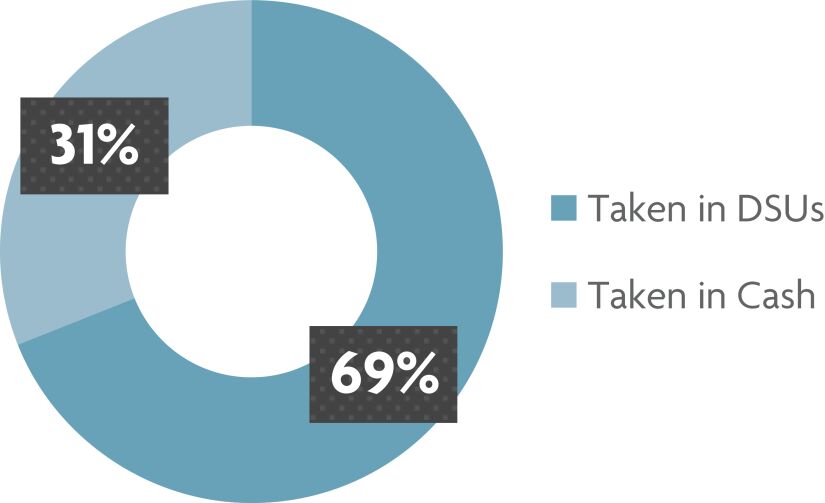
Detailed 2025 director fees
|
Director |
Board retainer |
Committee Chair retainer |
Committee member retainer |
Travel fees |
Total fees earned |
Fees taken in DSUs |
Fees taken in cash | |||||||||||
| ($) | ($) | ($) | ($) | ($) | ($) | (%) | ($) | (%) | ||||||||||
| Bradley |
100,000 | — | 20,000 | 6,000 | 126,000 | — | 0 | 126,000 | 100 | |||||||||
| Casey |
100,000 | — | 20,000 | 7,500 | 127,500 | 127,500 | 100 | — | 0 | |||||||||
| Crothers |
100,000 | — | 20,000 | — | 120,000 | 120,000 | 100 | — | 0 | |||||||||
| Girgulis |
100,000 | — | 16,484 | 9,000 | 125,484 | — | 0 | 125,484 | 100 | |||||||||
| Kinney |
100,000 | 30,000 | 10,000 | 6,000 | 146,000 | 36,500 | 25 | 109,500 | 75 | |||||||||
| Kwok |
100,000 | — | 10,000 | 1,500 | 111,500 | 55,750 | 50 | 55,750 | 50 | |||||||||
| Little |
100,000 | — | 20,000 | 4,500 | 124,500 | 124,500 | 100 | — | 0 | |||||||||
| Marcogliese |
100,000 | 20,000 | 10,000 | 6,000 | 136,000 | 136,000 | 100 | — | 0 | |||||||||
| Martineau |
64,835 | — | 12,967 | — | 77,802 | — | — | 77,802 | — | |||||||||
| Mongeau |
150,000 | 20,000 | 10,000 | 4,500 | 184,500 | 184,500 | 100 | — | 0 | |||||||||
| Pourbaix |
155,604 | — | — | — | 155,604 | 120,000 | — | 35,604 | — | |||||||||
| Sixt |
100,000 | — | 10,000 | 3,000 | 113,000 | 113,000 | 100 | — | 0 | |||||||||
| Zygocki |
100,000 | 25,000 | 10,000 | 4,500 | 139,500 | 139,500 | 100 | — | 0 | |||||||||
| TOTAL |
1,370,440 | 95,000 | 169,451 | 52,500 | 1,687,390 | 1,157,250 | 69 | 530,140 | 31 | |||||||||
Ms. Martineau was elected to the Board effective May 8, 2025.
Mr. Pourbaix transitioned to non-management Board Chair effective May 8, 2025. He elected to receive 100% of his fees in DSUs which commenced in the quarter immediately following his election.
Total fees earned excludes the value of the annual DSU award.
| CENOVUS 2026 CIRCULAR | DIRECTORS | 56 |
Outstanding Director awards
All our share-based awards for directors are in the form of DSUs, which vest immediately when they are credited to the director’s account but may be redeemed only after a director’s term ends. Cenovus does not grant stock options to non-employee directors.
The table below includes:
| • | DSUs awarded as an initial grant. |
| • | DSUs awarded when a director elected to take some or all of their retainers in DSUs. |
| • | Any dividend equivalents credited, in the form of DSUs, consistent with common share dividends declared in 2025. |
| Director |
Total
DSUs (#) |
Value of DSUs awarded/accrued during 2025 ($) |
Total DSUs held as at (#) |
Total value of December 31, 2025 |
||||||||||||
| Bradley |
9,960 | 231,271 | 15,403 | 357,657 | ||||||||||||
| Casey |
18,877 | 438,323 | 103,255 | 2,397,581 | ||||||||||||
| Crothers |
16,085 | 373,493 | 34,033 | 790,246 | ||||||||||||
| Girgulis |
10,247 | 237,935 | 23,480 | 545,205 | ||||||||||||
| Kinney |
15,085 | 350,273 | 113,077 | 2,625,647 | ||||||||||||
| Kwok |
14,250 | 330,885 | 64,895 | 1,506,861 | ||||||||||||
| Little |
16,442 | 381,783 | 38,391 | 891,439 | ||||||||||||
| Marcogliese |
22,329 | 518,479 | 189,486 | 4,399,841 | ||||||||||||
| Martineau |
10,804 | 250,868 | 10,804 | 250,868 | ||||||||||||
| Mongeau |
24,797 | 575,786 | 196,946 | 4,573,086 | ||||||||||||
| Pourbaix |
27,493 | 638,387 | 108,522 | 2,519,880 | ||||||||||||
| Sixt |
17,250 | 400,545 | 76,163 | 1,768,504 | ||||||||||||
| Zygocki |
22,530 | 523,146 | 190,803 | 4,430,422 | ||||||||||||
| Total |
226,153 | 5,251,179 | 1,165,259 | 27,057,237 | ||||||||||||
Value of DSUs was determined by multiplying the number of DSUs by the closing price of the common shares on the TSX on December 31, 2025 of $23.22.
Fractional units were excluded from the table.
Director share ownership guidelines
To align their interests with shareholders, directors who are not employees must hold at least three times the value of their annual compensation in common shares. DSUs count as common shares for this purpose. Management directors are subject to executive share ownership guidelines, see page 66.
New directors must reach the guideline within five years of joining the Board.
To address fluctuations in share price that could cause a director to go below the guideline amount, a director may restore any shortfall by December 31 of the following year.
| CENOVUS 2026 CIRCULAR | DIRECTORS | 57 |
Director share ownership status on March 10, 2026
| At-risk investment – beneficial Shareholdings | Share ownership multiple of 2025 compensation |
Share guideline ($) |
Status | |||||||||||
|
Director |
Common ($) |
DSUs ($) |
Total ($) | |||||||||||
| Bradley |
— | 740,233.89 | 740,233.89 | 2.27 | 978,000.00 | In compliance | ||||||||
| Casey |
634,600.48 | 3,443,409.16 | 4,078,009.64 | 12.45 | 982,500.00 | In compliance | ||||||||
| Crothers |
276,930.00 | 1,313,448.22 | 1,590,378.22 | 4.97 | 960,000.00 | In compliance | ||||||||
| Girgulis |
384,625.00 | 988,732.41 | 1,373,357.41 | 4.22 | 976,450.56 | In compliance | ||||||||
| Kinney |
129,234.00 | 3,745,632.10 | 3,874,866.10 | 11.20 | 1,038,000.00 | In compliance | ||||||||
| Kwok |
677,678.48 | 2,263,071.96 | 2,940,750.44 | 9.44 | 934,500.00 | In compliance | ||||||||
| Little |
215,390.00 | 1,447,543.88 | 1,662,933.88 | 5.12 | 973,500.00 | In compliance | ||||||||
| Marcogliese |
2,040,051.00 | 6,096,706.26 | 8,136,757.26 | 24.22 | 1,008,000.00 | In compliance | ||||||||
| Martineau |
— | 598,691.89 | 598,691.89 | 2.16 | 833,406.63 | In compliance | ||||||||
| Mongeau |
6,159,230.90 | 6,326,281.23 | 12,485,512.13 | 32.47 | 1,153,500.00 | In compliance | ||||||||
| Pourbaix |
44,775,703.98 | 3,818,464.69 | 48,594,168.67 | 94.25 | 1,546,813.20 | In compliance | ||||||||
| Sixt |
2,016,173.48 | 2,609,788.32 | 4,625,961.80 | 14.78 | 939,000.00 | In compliance | ||||||||
| Zygocki |
1,231,846.18 | 6,137,230.35 | 7,369,076.53 | 21.71 | 1,018,500.00 | In compliance | ||||||||
The value of common shares and DSUs in the table above was determined by multiplying the number of common shares and DSUs by $30.77, which was the closing price of our common shares on the TSX on March 10, 2026.
As of March 10, 2026, all our directors complied with the guidelines. Ms. Little, Mr. Crothers, Mr. Girgulis and Mr. Bradley have no share ownership guideline obligations to fulfil until 2028, and Ms. Martineau has no share ownership guideline obligations to fulfill until 2030, in each case five years following their respective appointments or election, as applicable, to the Board, in accordance with the timeline set out in the share ownership guidelines.
| CENOVUS 2026 CIRCULAR | DIRECTORS | 58 |
Highlights
| Strong executive compensation practices | Page | Page | ||||||||||
| ☑ | Pay for performance of 90% for CEO and 81% for other NEOs. | 62 | ☑ | Compensation targeted relative to Relevant Peer Group (geography, size and industry). | 67 | |||||||
| ☑ | 100% independent HRC Committee. | 63 | ☑ | Maximum performance share unit (PSU) payout of 2.0 requires relative total shareholder return (RTSR) performance at 90th percentile or greater. | 72 | |||||||
| ☑ | Independent compensation advisor to HRC Committee. | 64 | ☑ | Shareholder approval required for certain amendments to Stock Option Plan. | 73 | |||||||
| ☑ | Annual compensation risk assessment. | 65 | ☑ | No defined benefit pension plan for new hires. | 73 | |||||||
| ☑ | Clawback Policy in place for executive officers is compliant with NYSE requirements. | 65 |
☑ | Incentives tied to strategy and annual business plan. | 78 | |||||||
| ☑ | No hedging of Cenovus securities allowed. | 66 |
☑ | Sustainability incorporated into annual corporate scorecard and individual performance objectives for executives. | 79 | |||||||
| ☑ | Share ownership requirements for executives, and until executives meet ownership guidelines at least 50% of PSU payouts must be used to purchase common shares. | 66 |
☑ | Analysis and consideration of realizable pay outcomes. | 84 | |||||||
| ☑ | Termination payments capped at 2x compensation. | 89 | ||||||||||
| ☑ | Double-trigger change of control provisions in employment agreements. | 66 |
☑ | No repricing of options. | A-1 | |||||||
| Our Named Executive Officers (NEOs)
Jonathan M. McKenzie
Karamjit (Kam) S. Sandhar
Andrew Dahlin, Executive Vice-President &
John Soini, Executive Vice-President,
Jeffery (Jeff) Lawson, Executive
Vice- |
In this section you will find: | |||||
| Page 60 | ||||||
| Page 61 | ||||||
| Page 67 | ||||||
| Page 68 | ||||||
| Page 74 | ||||||
| Page 79 | ||||||
| Page 84 | ||||||
| Page 86 | ||||||
| CENOVUS 2026 CIRCULAR | EXECUTIVE COMPENSATION | 59 |
Dear fellow shareholders,
In 2025, Cenovus achieved significant operational success and delivered on its strategy while keeping safety the cornerstone of its culture. The HRC Committee considered these achievements in our executive compensation decisions and remains committed to ensuring pay is closely aligned with performance and long-term shareholder value.
Achievements in 2025
In 2025, Cenovus delivered top-quartile process safety performance relative to industry benchmarks, achieved the company’s highest-ever Upstream production and sustained strong Downstream performance. The company successfully achieved major milestones across its growth projects, including the Narrows Lake tieback to Christina Lake and the Foster Creek optimization project, and demonstrated strong progress in advancing the West White Rose project.
Performance exceeded targets in all four main categories on the 2025 Corporate Scorecard, with maximum results in several areas, including most safety metrics, downstream operational availability, downstream non-energy operating costs and strategic initiatives.
The year also saw two strategically significant transactions completed. The acquisition of MEG Energy Corp. (MEG Energy) added great talent and over 100,000 barrels of oil per day of high-quality resource adjacent to Cenovus’s largest-producing SAGD asset. The disposition of Cenovus’s interest in the Wood River and Borger refineries provided the company with full operational and strategic control of its Downstream business.
Based on these achievements, the Board approved a corporate score of 152%, the highest score since 2021. The Board used its discretion to make a small adjustment to the score for Canada and Asia Pacific employees, to equalize results across geographic areas and ensure consistency for all eligible employees.
Pay for performance
The HRC Committee also recognized that Cenovus performed on par with its PSU peer group over the 2023 - 2025 period, delivering a total shareholder return of approximately 3%, compared to a median peer return of minus 4%, resulting in a combined performance multiplier of 1.03.
The Board approved an individual performance score of 152% for Mr. McKenzie, with 20% of his annual bonus tied to individual results, reflecting Cenovus’s strong year and his continuous focus on safety and delivering the company’s strategy, while combining strong operational performance with prudent financial management. 77% of Mr. McKenzie’s total direct compensation - salary, target bonus and long-term incentives - was tied to share price performance, reinforcing alignment with shareholder interests. Full details of our NEOs’ 2025 key results and compensation start on page 80.
The Board welcomes shareholder feedback on Cenovus’s executive compensation program and broader governance practices. You may contact us at the address set out on page 17 of the Governance section of this circular.
/s/ Claude Mongeau
Claude Mongeau
Lead Independent Director
/s/ Rhonda I. Zygocki
Rhonda I. Zygocki
HRC Committee Chair
| CENOVUS 2026 CIRCULAR | EXECUTIVE COMPENSATION | 60 |
Decision-making structure
The HRC Committee assists the Board by reviewing and making recommendations to the Board on compensation and human resource matters. Our Board makes decisions on compensation for the CEO and the HRC Committee has the authority to make decisions on compensation for other executives.
The HRC Committee receives information and recommendations from management and our compensation consultant, the Lead Independent Director and the Chair (with respect to CEO performance), and the CEO (with respect to performance of other NEOs).
Decision process
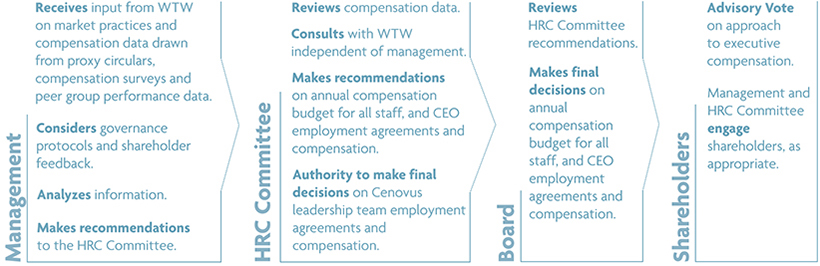
| CENOVUS 2026 CIRCULAR | EXECUTIVE COMPENSATION | 61 |
Annual compensation cycle for the HRC Committee
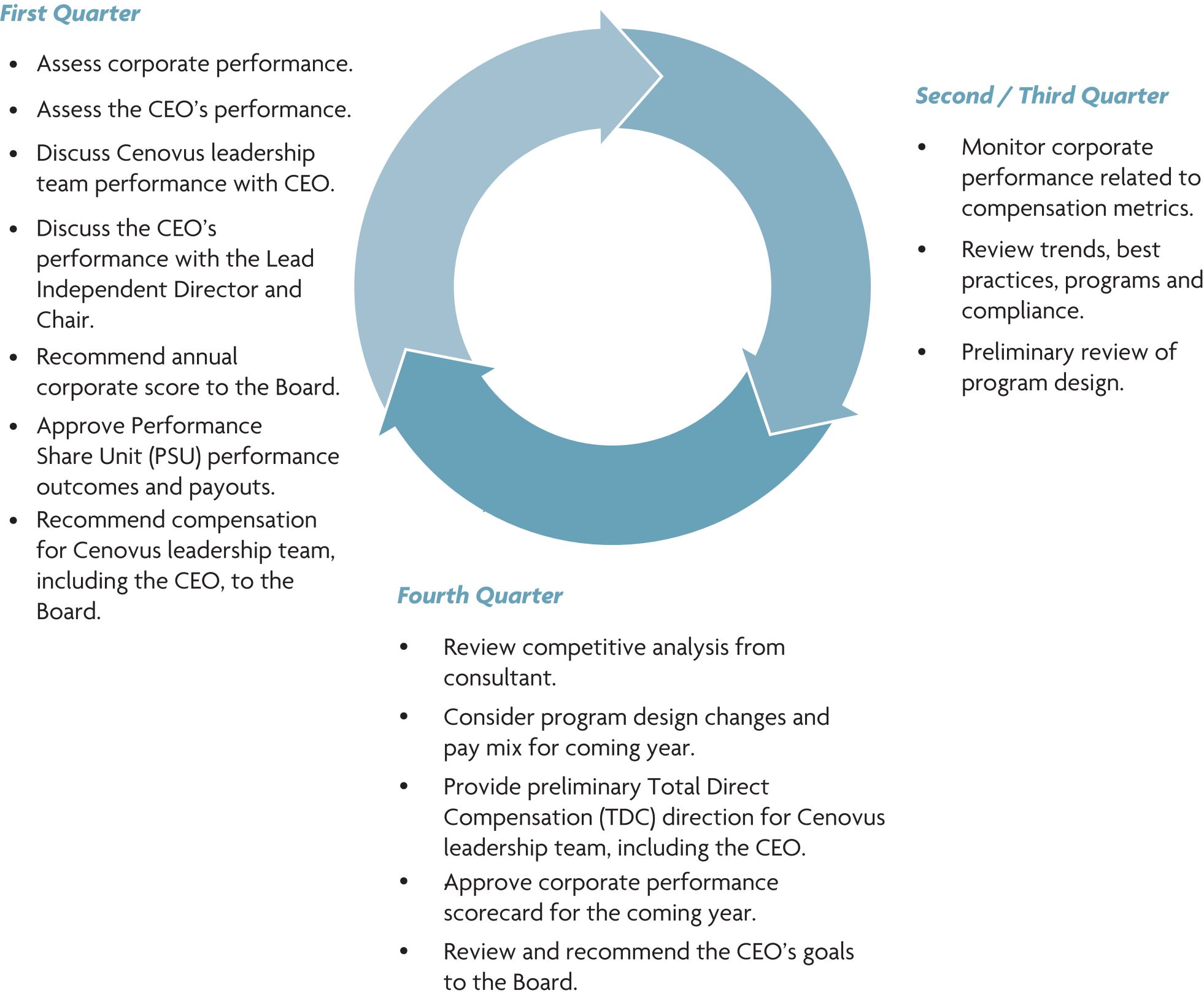
HRC Committee role
The HRC Committee has oversight of, and makes recommendations to, the Board on Cenovus’s people strategy, culture, engagement and acceptance and belonging, as appropriate, in support of achieving our business strategy.
The HRC Committee is responsible for:
| • | Reviewing corporate objectives relevant to the CEO compensation. |
| • | Evaluating the CEO’s performance against those objectives. |
| • | Based on those factors, recommending the CEO’s pay, including salary, short-term incentive awards and LTI awards, to the Board. |
| • | Making recommendations to the Board on the number or value of incentive awards for all employees. |
| • | Recommending the corporate scorecard to the Board for approval, subject to the SSR Committee’s recommendations with respect to the inclusion of safety and sustainability metrics. |
| • | Approving the Cenovus leadership team’s pay, including salary, short-term incentive awards and LTI awards and employment agreements. |
You can find the full HRC Committee Mandate at cenovus.com.
| CENOVUS 2026 CIRCULAR | EXECUTIVE SUMMARY | 62 |
HRC Committee membership
Our HRC Committee includes only independent directors, who provide a strong level of leadership and governance over the design and execution of our compensation programs. As set out in the table below, HRC Committee members are highly experienced senior executives who have dealt with numerous compensation issues over the course of their careers. HRC Committee members are well equipped to inquire, debate, provide guidance and make decisions in respect of a wide range of human resources and compensation matters.
| Member |
Human resources and compensation skills and experience | |
| Zygocki (Chair) |
• HRC Committee member since April 27, 2016 and Chair since April 25, 2018. • Numerous executive leadership positions during her previous 34-year tenure at Chevron Corporation, from which Ms. Zygocki brings a breadth of knowledge and understanding of oil and gas industry compensation practices. | |
| Casey |
• HRC Committee member since April 29, 2020. • Executive leadership positions with integrated, refining and midstream oil and gas companies, providing him with in-depth knowledge and understanding of compensation issues throughout the oil and gas industry. • As a director and former director of private midstream companies, Mr. Casey is experienced with the governance of compensation and board decisions on compensation matters. | |
| Crothers |
• HRC Committee member since November 1, 2023. • Former President and Country Chair of Shell Canada (Shell), where he had oversight of the Shell Pension Board, led employee engagement and culture, was responsible for integrated talent management and ensuring sound succession processes and staff development, and approved compensation, pension and benefits programs. • Committee member of the Nominations and Recruitment Committee for the Nature Conservancy of Canada Alberta Regional Board and former People and Culture Committee for Convrg Innovations Inc. | |
| Girgulis |
• HRC Committee member since May 8, 2025. • Former Senior Vice-President, General Counsel & Secretary of Husky Energy (2012 to 2021), and previously General Counsel and Corporate Secretary (1999 to 2012), where he developed expertise in corporate governance, oil and gas compensation matters, people strategy and employee engagement. | |
| Little |
• HRC Committee member since January 1, 2023. • Executive and senior leadership positions with energy transportation and midstream oil and gas companies, providing her with insight into, and experience in, human capital and compensation matters. • As the former Chair of the Remuneration Committee of Diversified Energy Company plc, Ms. Little is experienced with the governance of compensation and board decisions on compensation matters. | |
Full bios of each of the directors are set out beginning on page 33. The Board is satisfied that the collective skills and experience of the members enable the HRC Committee to make decisions and recommendations on our compensation policies and practices.
| CENOVUS 2026 CIRCULAR | EXECUTIVE COMPENSATION | 63 |
Compensation consultants
WTW has provided the company with compensation consulting services since Cenovus’s inception. Since 2019, WTW has acted as the compensation consultant to both management and the HRC Committee.
WTW provides the HRC Committee with advice on compensation philosophy, peer group determination, policy and program design and associated risk considerations, executive compensation competitiveness, and broader market trends and best practices. The HRC Committee maintains a direct and independent reporting relationship with WTW. WTW and the HRC Committee Chair meet without management present as required, and WTW regularly meets with the Committee in camera. The HRC Committee Chair is responsible for retaining and overseeing WTW for all executive compensation matters. Under the HRC Committee’s oversight, and subject to pre-approval, WTW also supports management on related compensation matters. This structure ensures that the HRC Committee receives objective advice free from management influence.
WTW also provides services to management in other human resources areas, including pension administration and related support. These services are standard in nature, operationally focused, and do not conflict with WTW’s executive compensation advisory work. As a result, neither the Board nor the HRC Committee is required to pre-approve such arrangements.
WTW maintains internal protocols to ensure the independence of the executive compensation advice it provides to the HRC Committee, and reviews these protocols annually with the HRC Committee, including any factors relevant to the Committee’s assessment of WTW’s independence. The HRC Committee verified WTW’s independence in 2025 based on the following: WTW works on behalf of the Board with advice shaped by what is appropriate for Cenovus; members of WTW’s executive compensation consulting team are not responsible for selling other services to Cenovus and receive no incentive or other compensation based on the fees charged to Cenovus for other services provided; WTW’s executive compensation consulting team is separate from the teams that assist Cenovus management with other services provided to management; WTW’s executive compensation consultants do not have a business or personal relationship with any of the HRC Committee members or management and do not own Cenovus shares directly, other than possibly through mutual funds; and WTW has strict protocols and processes to mitigate conflicts of interest, including that all of its consultants are required to adhere to a code of conduct.
Executive compensation consultant fees
| Consulting service |
Retained by |
2025 fees ($) |
2024 fees ($) |
|||||||||
| Executive compensation – related fees |
HRC | 322,144 | 595,448 | |||||||||
| Director compensation |
Governance | — | 27,084 | |||||||||
| Other |
Management | 599,173 | 1,028,668 | |||||||||
| Total |
921,317 | 1,651,200 | ||||||||||
Other fees include assistance with pension and benefits (including actuarial services).
Consultant’s role in decision process
The advice, information and recommendations provided by WTW are considered, but not exclusively relied on, by the HRC Committee in its decisions and recommendations, and by the Board in its decisions regarding executive compensation.
The decisions of the HRC Committee and the Board about executive compensation reflect:
| • | Compensation consultant advice and guidance. |
| • | Current industry trends and best practices. |
| • | Legal advice. |
| • | Peer data. |
| • | Other information and recommendations from management. |
| • | The discretion and judgement of the HRC Committee and the Board. |
| CENOVUS 2026 CIRCULAR | EXECUTIVE COMPENSATION | 64 |
Compensation risk oversight
The HRC Committee’s primary compensation-related duties and responsibilities are to:
| • | Approve our compensation philosophy, including any related changes to program design. |
| • | Review potential risks to financial or reputational well-being from our executive compensation program. |
| • | Recommend to the Board for approval the CEO’s compensation. |
| • | Recommend to the Board for approval share ownership guidelines and amendments to LTI plans and associated grant agreements. |
| • | Review reports and information from our Management Pension Committees related to our pension plans and non-pension savings and investment plans, and convey information and recommendations to the Board. |
| • | Approve and report to the Board on Cenovus leadership team employment agreements, compensation, succession planning and performance measures for annual bonus and LTI plans. |
The executive compensation program design considers the risks to which we are exposed in pursuit of our strategic objectives. Executive compensation is linked to operational risk management so that financial incentives reinforce a focus on safety, execution excellence, environmental and social responsibility, and shareholder value creation. Effective risk management and sound operational business practices and controls are aligned to shareholder value creation through the linkage of over 50% of executive compensation to share price and its relative strength compared to peers.
WTW completed a compensation risk assessment in the fall of 2025. The purpose of the assessment was to identify:
| • | Policies and practices that could encourage inappropriate, excessive risk taking by employees. |
| • | Any risks arising from our compensation policies, incentive programs and practices that would be likely to have a material adverse effect on Cenovus. |
Based on a review of WTW’s risk assessment, the HRC Committee determined that Cenovus’s compensation policies and programs do not encourage excessive risk that could have a material adverse effect on the company.
In addition, we use the policies below to reduce compensation-related risk.
Compensation risk policies
Clawback Policy
We have a Clawback Policy applicable to all executive officers. Under the policy and in certain situations the Board has the discretion to:
| • | Cancel any annual performance incentive (bonus) payments or unvested LTI awards. |
| • | Require reimbursement of paid bonuses or incentive awards. |
The Board has discretion where:
| • | An accounting restatement of any or all of our financial statements is required due to material non-compliance with any financial reporting regulations and the executive officer’s intentional misconduct or fraud caused or materially contributed to the need for the restatement, or |
| • | The executive officer was financially enriched by their fraud, theft or failure to disclose a material conflict of interest that affected the business, reputation, operations or capital of Cenovus in a manner that resulted in a material decrease in the price of the common shares. |
In addition, in the event of an accounting restatement of Cenovus’s financial results due to material non-compliance of Cenovus with any financial reporting requirement under securities laws, Cenovus shall require each executive officer to repay and/or forfeit compensation received by the executive officer for the three fiscal years immediately preceding the restatement that exceeds the amount of compensation that otherwise would have been received had it been determined based on such restatement.
A copy of our Clawback Policy is available on our website at cenovus.com.
| CENOVUS 2026 CIRCULAR | EXECUTIVE COMPENSATION | 65 |
Executive share ownership guidelines
We believe it is important to closely align the interests of our executives with our shareholders. One way we do this is by requiring executives to hold a minimum number of Cenovus common shares. DSUs, unvested RSUs and unvested tranches of PSUs, where the performance for a relevant period has been determined, count as common shares for this purpose.
The executive share ownership guidelines and compliance are reviewed regularly by the HRC Committee. Each of our NEOs is in compliance with their share ownership guidelines. See page 79.
| Executive | Share ownership guideline | Time to accrue | ||
| CEO |
6.0 times annual base salary | 2 years from appointment | ||
| Executive Vice-Presidents |
3.0 times annual base salary | 5 years from appointment | ||
Compliance with the guidelines is determined based on:
| Unit | Valued using the greater of: | |||
| Common shares |
Average weighted purchase price | Common share closing price on the TSX at time of compliance measurement | ||
| DSUs |
Average weighted grant price | |||
| Unvested tranches of PSUs where performance has been determined |
Average weighted grant price | |||
| Unvested RSUs |
Average weighted grant price | |||
Executives must use 50% of the after-tax value of all PSU payouts to purchase common shares, until their share ownership guideline is met.
Double-trigger change of control provisions
All our LTI grants are subject to double-trigger change of control provisions. The provisions require both a change of control and termination as a result of the change of control for early payout of the grants. This ensures that the interests of shareholders and employees are aligned when considering the benefits of significant transactions. This assumes that the LTIs are either replaced or assumed by the successor entity following the completion of the change of control. In the event that the options are not replaced or assumed by the successor entity, unvested options become exercisable on the date of the change of control and remain exercisable until the original expiry date. In the event that the RSUs and PSUs are not replaced or assumed by the successor entity, all unvested units immediately vest and are paid out on the date of the change of control. For PSUs, a multiplier of 1.0 is used for any performance period not yet determined.
Prohibition on hedging
Cenovus employees, executives and directors are prohibited from entering into financial derivative transactions which could result in a profit from a decrease in our common share price.
Prohibited transactions include purchasing financial instruments, prepaid variable forward contracts, equity swaps, collars or units of exchange funds that are designed to offset decreases in the value of common shares granted or held, directly or indirectly.
| CENOVUS 2026 CIRCULAR | EXECUTIVE COMPENSATION | 66 |
The HRC Committee approves and reports to the Board on our compensation philosophy. Our philosophy demonstrates how we align executive interests with the interests of our shareholders, specifically:
| • | We pay for performance, reflecting both individual and corporate results, and expected behaviours that align with our business strategy over the short and long term. |
| • | Our total compensation opportunity includes salary, annual performance and long-term incentives and benefits to support attraction, retention and engagement. |
| • | Our total direct compensation (TDC) includes salary, annual performance and long-term incentives, and is aimed at the 50th percentile of our Executive Compensation Peer Group for target performance, with flexibility to align pay with performance. |
| • | We differentiate individual TDC based on capability, performance and potential. |
Executive Compensation Peer Group
Our Executive Compensation Peer Group (Peer Group) is used to benchmark the compensation of the executives, including the NEOs. It includes companies with North American oil and gas and related operations, or capital intensive or commodity cyclical companies of similar size and complexity, with which we compete for talent. We look at companies beyond the oil and gas industry to better consider broader market dynamics and in appreciation of transferability of executive talent.
We select our Peer Group by considering several factors, including size, complexity of business, revenue, assets, market capitalization, enterprise value, total employees, geographic scope of operations and ownership structure.
In 2025, the HRC Committee reviewed the Peer Group for continued alignment with the factors outlined above and approved the removal of Ovintiv Inc. and addition of EOG Resources, from January 1, 2026. Hess Corporation was acquired on July 18, 2025 by Chevron Corporation and thereafter removed from the peer group.
| COMPANY
|
2025 REVENUE ($BILLION)
|
MARKET ($BILLION)
|
TOTAL ENTERPRISE VALUE ($BILLION)
|
|||||||||
| Canadian Natural Resources Limited |
38.8 | 96.8 | 115.8 | |||||||||
| Enbridge Inc. |
65.2 | 143.3 | 258.3 | |||||||||
| Imperial Oil Limited |
46.9 | 57.3 | 60.4 | |||||||||
| Nutrien Ltd. |
37.6 | (1) | 40.8 | (2) | 56.4 | (2) | ||||||
| Ovintiv Inc. |
12.5 | (1) | 13.6 | (2) | 22.0 | (2) | ||||||
| Pembina Pipeline Corporation |
7.8 | 30.4 | 44.3 | |||||||||
| Suncor Energy Inc. |
52.4 | 72.7 | 83.6 | |||||||||
| TC Energy Corporation |
15.2 | 78.7 | 150.9 | |||||||||
| Teck Resources Limited |
10.8 | 32.1 | 32.9 | |||||||||
| Valero Energy Corporation |
171.5 | (1) | 66.7 | (2) | 78.8 | (2) | ||||||
| 50th percentile |
38.2 | 62.0 | 69.6 | |||||||||
| CENOVUS ENERGY INC. |
49.7 | 43.7 | 55.3 | |||||||||
Source: Bloomberg and company financial statements
| (1) | U.S. dollar values converted at the 2025 average annual exchange rate of US$1.00 to C$1.40. |
| (2) | U.S. dollar values converted at the December 31, 2025 exchange rate of US$1.00 to C$1.37. |
All amounts are as of December 31, 2025.
Similar peer groups of companies are used in our Executive Compensation peer group to determine the RTSR performance for our PSU grants as described on page 72. Differences between the Executive Compensation and PSU peer groups reflect the specific purpose of each group (i.e., benchmarking of executive pay based on the market for executive talent versus comparing company shareholder return performance and the market for investor capital).
| CENOVUS 2026 CIRCULAR | EXECUTIVE COMPENSATION | 67 |
Base salary
We determine the base salary of our executives annually. We consider experience, scope of responsibilities, individual performance and strategic leadership over the course of the year. We also look at the competitiveness of each NEO’s compensation compared to recent market data.
Annual performance incentive award (bonus)
The annual performance incentive award - or bonus - rewards performance achieved in the year. It is made up of two components: corporate and individual performance.
Annual NEO bonus target opportunity
Each NEO has the opportunity to receive an annual bonus based on a percentage target of their base salary and award ranges and weightings. Each year, we look at the competitiveness of each NEO’s bonus target opportunity compared to recent market data and make adjustments to align with the market, as necessary.
| Name and principal position
|
Target (of salary)
|
Award range (of target
|
Weighting (of target opportunity)
|
|||||||||||||
| Corporate
|
Individual
|
|||||||||||||||
| McKenzie, CEO |
125% | 0-200% | 80% | 20% | ||||||||||||
| Sandhar, EVP & CFO |
70% | 70% | 30% | |||||||||||||
| Dahlin, EVP & COO |
80% | |||||||||||||||
| Soini, EVP |
70% | |||||||||||||||
| Lawson, EVP & CSO |
65% | |||||||||||||||
Corporate performance scorecard
The corporate component of the annual bonus is based on our scorecard. The scorecard measures our business performance in four areas: safety and sustainability, operational, financial and strategic initiatives. Our targets focus performance on key elements of our business and strategy, while observing our corporate risk policies. The targets are set within defined performance ranges based on the capital and operating budget approved by the Board for the year. The HRC Committee and the Board assess our corporate performance against the respective targets after the end of each financial year.
Calculation of corporate performance score. The performance score on each measure is multiplied by its weighting, then all the weighted scores are added up. The result is an overall corporate performance score between zero and 200%.
Board and committee discretion. The final score is recommended by the HRC Committee to the Board for approval. The Board may exercise discretion, upon recommendation of the HRC Committee, over the final corporate performance score, where considered appropriate and upon consideration of, among other things, whether the score appropriately reflects our performance in each area, and the safety and sustainability, operational. financial and strategic initiative outcomes over the course of the year.
For more information on the specific measures in our 2025 corporate performance scorecard, see page 77.
Individual performance
Each year our executives, like all employees, identify goals and objectives for their individual annual performance agreements. Those goals and objectives:
| • | Align with our business plan and strategy. |
| • | Provide performance focus throughout the year. |
The CEO consults with the Board to set and approve their goals. The CEO approves the other NEOs’ goals.
| CENOVUS 2026 CIRCULAR | EXECUTIVE COMPENSATION | 69 |
The HRC Committee evaluates the CEO’s performance on their goals and objectives, with insight from the Chair. The CEO evaluates the performance of the other NEOs. These assessments are used to determine the individual performance component of the annual bonus.
Board and committee discretion. The Board has discretion to adjust the individual performance component of the annual bonus award for the CEO and other NEOs, where it deems appropriate.
Long-term incentives (LTIs)
Our LTI program aligns the interests of our executives and employees with our shareholders and supports our executives in achieving their executive share ownership guidelines.
We believe it is important to include performance measures to determine vesting amounts, in addition to the inherent share price risk found in share-based incentives.
LTIs are granted annually in conjunction with our annual compensation cycle. Grant recommendations consider individual performance, prior grants, potential and retention, and competitive market data.
Board discretion. The Board, on the recommendation of the HRC Committee, has discretion over the amount of LTIs granted.
The 2025 LTIs are detailed in the table below. Starting in 2026, stock option weighting will increase to 40%, PSU weighting will increase to 60% and RSUs will no longer be granted. This adjustment strengthens our alignment with the corporate strategy and reinforces a performance-driven compensation structure for senior leadership.
| Key terms |
Performance share units (PSUs) |
Restricted share units (RSUs) |
Stock options (options) | |||
| Weighting |
50% of annual LTI grant | 25% of annual LTI grant | 25% of annual LTI grant | |||
| Term |
3 years | 3 years | 7 years | |||
| Description |
Whole share units subject to performance criteria | Whole share units subject to time-based vesting conditions | Option to acquire common shares | |||
| Primary objective |
Align to shareholder interests over medium term and reward achievement of performance objectives | Align to shareholder interests over medium term | Align to shareholder interests over longer term | |||
| Performance measures |
RTSR | Common share market value over time | Value accrues when common share price exceeds exercise price | |||
| Vesting |
Vests on third anniversary. See page 72 for a description of PSU vesting | Vests on third anniversary. See page 73 for a description of RSU vesting | 30% vests on each of first and second anniversaries and 40% vests on third anniversary of grant. See page A-1 of Schedule A for a description of stock option vesting | |||
| Payout |
Paid in: • Cash based on the 5-day volume-weighted average price at vesting; • Common shares; or • A combination of common shares and cash |
Paid in: • Cash based on the 5-day volume-weighted average price at vesting; • Common shares; or • A combination of common shares and cash |
May acquire common shares at the exercise price or receive cash for the value accrued (market value less exercise price) | |||
| CENOVUS 2026 CIRCULAR | EXECUTIVE COMPENSATION | 70 |
Performance share units
The PSUs we grant have a combination of one-year and three-year performance periods. The number of PSUs eligible to vest are determined based on the performance criteria outcomes for each performance period. Payout occurs following vesting of the PSUs. Vesting occurs on the later of:
| • | the third anniversary of the grant date, and |
| • | the date on which the HRC Committee approves the performance criteria outcome for the three-year performance period. |
PSU performance measures and performance periods
| Grant |
Measures | Periods | Weighting | Vesting period | ||||
| 2023 |
2023 RTSR 2024 RTSR 2025 RTSR 3-Year RTSR |
January 1 to December 31, 2023 January 1 to December 31, 2024 January 1 to December 31, 2025 As of December 31, 2025 |
10% 10% 10% 70% |
End of 3 Years | ||||
| 2024 |
2024 RTSR 2025 RTSR 2026 RTSR 3-Year RTSR |
January 1 to December 31, 2024 January 1 to December 31, 2025 January 1 to December 31, 2026 As of December 31, 2026 | ||||||
| 2025 |
2025 RTSR 2026 RTSR 2027 RTSR 3-Year RTSR |
January 1 to December 31, 2025 January 1 to December 31, 2026 January 1 to December 31, 2027 As of December 31, 2027 | ||||||
Dividend equivalents are credited, in the form of additional PSUs, when we declare dividends on our common shares. PSUs that do not vest at the end of the three-year performance period are not paid out and are cancelled.
PSU performance criteria. Relative total shareholder return (RTSR) is calculated based on the percentile ranking of Cenovus’s total shareholder return (TSR) relative to our PSU peer group (PSU Peer Group) over the same period.
That percentile ranking determines the PSU performance score for that period.
TSR is calculated with the following formula:
| TSR = | ( | Volume-weighted average share price for last 30 trading days of the applicable performance period | – | Volume-weighted average share price for the last 30 trading days before the start of the applicable performance period | + | Dividend equivalents paid during the applicable performance period | ) | |||||||
| Volume-weighted average share price for the last 30 trading days before the start of the applicable performance period | ||||||||||||||
| CENOVUS 2026 CIRCULAR | EXECUTIVE COMPENSATION | 71 |
PSU peer groups. The Cenovus PSU Peer Group against which our RTSR performance criteria is measured is designed to demonstrate our corporate performance relative to similarly situated peers, as described in the table below.
| Cenovus 2024 and 2025 PSU peer group | Cenovus 2023 peer group | |||
| Characteristics |
• Upstream and/or integrated energy producers • Commodity price exposure • Enterprise value > $10 billion • North American / Global operations • Compete for same investor dollars | |||
| Companies |
Apache Corporation BP Plc. Canadian Natural Resources Limited Chevron Corporation ConocoPhillips Devon Energy Corporation Hess Corporation (see note below) Imperial Oil Limited Occidental Petroleum Corporation Ovintiv Inc. Suncor Energy Inc. |
Apache Corporation BP Plc. Canadian Natural Resources Limited Chevron Corporation ConocoPhillips Devon Energy Corporation Hess Corporation Imperial Oil Limited Ovintiv Inc. Suncor Energy Inc. | ||
| Applicable Years |
2024 PSU grant 2025 PSU grant |
2023 PSU grant | ||
Hess Corporation was acquired by Chevron Corporation on July 18, 2025 and was thereafter removed from any one-year or three-year performance periods that include 2025 RTSR performance.
RTSR performance scores by level
| Performance level |
RTSR performance criteria | Performance score | ||
| Minimum |
< 25th percentile | 0.00 | ||
| Threshold |
25th percentile | 0.25 | ||
| Target |
50th percentile | 1.00 | ||
| Maximum |
90th percentile or > | 2.00 | ||
Payouts are interpolated between the 25th to 50th and 50th to 90th percentiles.
The HRC Committee decides the PSU performance criteria, performance scores and payouts. Vested PSUs are paid out following the HRC Committee’s decisions.
Restricted share units
The vesting schedule of our outstanding RSUs is below.
| Grant | Applicable employee group | Vesting date | Weighting | |||
| 2023 - 2025 |
All employees | Third anniversary of grant date | 100% | |||
In addition, RSUs with a two-year vest schedule were granted to Mr. Soini in 2024, in connection with his hiring. Other than the vesting schedule, the material terms of the RSUs granted to Mr. Soini are consistent with the other outstanding RSUs.
Payout occurs when eligible RSUs vest in accordance with the terms of the grant agreement and are paid in one or a combination of:
| • | Cash based on the 5-day volume-weighted average price at vesting. |
| • | Common shares. |
Dividend equivalents are credited, in the form of additional RSUs, when we declare dividends on our common shares. RSUs that do not vest at the end of the applicable vesting period are not paid out and are cancelled.
| CENOVUS 2026 CIRCULAR | EXECUTIVE COMPENSATION | 72 |
Stock options
Our Stock Option Plan is the only active compensation program under which equity securities have been authorized to be issued.
Options do not have performance vesting criteria but only have value if the share price at the time of exercise is higher than the grant price.
See Schedule A for details of our Stock Option Plan.
Stock option grants and burn rate during 2023, 2024 and 2025.
| Year | Options granted under the stock option plan (#) |
Burn rate (%) | ||
| 2023 |
1,571,389 | 0.083 | ||
| 2024 |
2,426,666 | 0.131 | ||
| 2025 |
4,388,954 | 0.243 | ||
Shares authorized and reserved for issue as of December 31, 2025. The number of common shares authorized and reserved for issuance under our Stock Option Plan was approved by shareholders on November 30, 2009. Total common shares authorized and reserved under our Stock Option Plan will not exceed 64,000,000 common shares, representing approximately 3.40% of the total number of common shares outstanding. The following table provides details regarding Cenovus’s equity compensation plans approved by securityholders as at December 31, 2025:
| Number of shares authorized for issue upon the exercise of outstanding Options
|
Weighted-average
|
Number of shares remaining available for future
| ||||
| Stock Option Plan |
10,861,805 (0.58% of outstanding) |
$19.40 | 24,862,268 (1.32% of outstanding) | |||
Other compensation
We provide additional benefits to our NEOs that are competitive with market practice to support recruiting and retention.
Retirement and pension benefits
We believe it is important to provide for the future retirement of our employees through retirement and pension benefits. Our programs provide long-term financial security and support retention.
Cenovus’s Canadian Pension Plan, which includes both a defined benefit provision (the Cenovus DB Plan) and a defined contribution provision (the Cenovus DC Plan), is a registered pension plan. Our employees, including our NEOs, participate in either the Cenovus DB Plan or Cenovus DC Plan. As of January 1, 2019, the Cenovus DB Plan was closed to all new hires, including employees who were previously hired by Husky Energy.
In Cenovus’s Canadian Pension Plan, pensionable earnings for NEOs include base salary plus annual bonus capped at 40% of salary. Annual bonus is not included in pensionable earnings for non-executive participants in Cenovus’s Canadian Pension Plan.
Cenovus DB Plan
Under the Cenovus DB Plan, pension benefits are based on 2% of final average pensionable earnings multiplied by the number of years of membership in the Cenovus DB Plan. The normal retirement age is 70. Employees may take their pension as early as age 60 with pension benefits reduced by 3% per year before age 65. There is no reduction in benefits for retirement between age 65 and 69.
| CENOVUS 2026 CIRCULAR | EXECUTIVE COMPENSATION | 73 |
Cenovus DC Plan
Under the Cenovus DC Plan, employer contributions are made into individual employee accounts at a rate of 8% of pensionable earnings, with the exception of former Husky Energy employees, including Mr. Dahlin, who receive 9% of pensionable earnings if they had attained this rate prior to July 1, 2022. In addition, the Cenovus DC Plan has an employer matching component valued at 2% of pensionable earnings, which is a 50% match of employee contributions.
For the Cenovus DC Plan, each employee individually manages the investment of their account balances from a variety of investment options made available by Cenovus. Interest earned on their DC account balance is derived from the performance of their individually selected investment options.
Supplemental Pension Plans
We pay pension benefits under our Cenovus DB Plan and our Cenovus DC Plan up to the permitted levels for registered pension plans under the Income Tax Act (Canada). Additional pension benefits above such levels, yet within the limits applicable to Cenovus’s Canadian Pension Plan, are payable from Cenovus’s supplemental DB and DC pension plans.
Perquisites
We provide an annual allowance, parking, matching of personal contributions to an investment plan of up to 5% of base salary, and health and wellness services.
The decisions we made for the 2025 compensation of our CEO and other NEOs are based on our compensation philosophy to:
| • | Pay for performance. |
| • | Align the interests of the NEOs with those of our shareholders. |
| • | Balance objectives of market competitiveness and retention. |
We continue to take a prudent approach to executive compensation in response to market volatility and share price performance. Total direct compensation remains targeted at the 50th percentile of our Peer Group.
2025 base salaries
The salary increases below include raises associated with Messrs. Dahlin, Soini and Lawson’s promotions to EVP & COO, EVP and EVP & CSO, respectively.
| NEO
|
Base salary on January 1, 2025 ($)
|
Base salary on March 1, 2025 ($) |
Increase (%) | |||
| McKenzie |
1,140,000 | 1,250,000 | 10 | |||
| Sandhar |
620,000 | 700,000 | 13 | |||
| Dahlin |
575,000 | 700,000 | 22 | |||
| Soini |
500,000 | 550,000 | 10 | |||
| Lawson |
435,000 | 550,000 | 26 | |||
| CENOVUS 2026 CIRCULAR | EXECUTIVE COMPENSATION | 74 |
2025 annual performance incentive awards (bonuses)
The annual bonus rewards individual and corporate performance achieved in the year. The target opportunity is positioned slightly below the 50th percentile of our Peer Group, which reflects our compensation philosophy to pay for performance and align with shareholder interests. Corporate performance is assessed by the HRC Committee and the Board using the corporate performance scorecard.
2025 NEO annual bonus award
For each NEO we determined the payout amount for their 2025 annual bonus award as detailed in the table below. Information on the calculation of their 2025 bonus awards and corporate performance component are set out below and information on the performance of the NEOs under the individual performance component can be found in their respective NEO Profiles beginning on page 80.
|
NEO
|
Base salary ($)
|
Target (of salary)
|
Corporate and
individual performance
|
Actual 2025 bonus
| ||||||||||||
| Corporate
|
+
|
Individual
|
Combined
|
(Of
|
($)
| |||||||||||
| McKenzie |
1,250,000 | 125% | (152% x 80%) | (152% x 20%) | 152% | 190.0% | 2,375,000 | |||||||||
| Sandhar |
700,000 | 70% | (152% x 70%) | (160% x 30%) | 154% | 108.0% | 756,560 | |||||||||
| Dahlin |
679,795 | 80% | (152% x 70%) | (150% x 30%) | 151% | 121.1% | 823,367 | |||||||||
| Soini |
541,918 | 70% | (152% x 70%) | (150% x 30%) | 151% | 105.9% | 574,324 | |||||||||
| Lawson |
531,411 | 65% | (152% x 70%) | (185% x 30%) | 162% | 105.2% | 559,230 | |||||||||
The bonus targets for Messrs. Dahlin, Soini, and Lawson were applied to their respective 2025 Adjusted Annual Salaries, which represent the annual base salary earned in their prior positions and the annual base salary earned following their promotions, excluding acting pay.
Corporate performance scorecard
The corporate performance targets and performance ranges were approved by the Board in December 2024, based on Cenovus’s 2025 strategy and business plan and are adjusted throughout the year for factors such as acquisition and divestitures and alignment to the reporting of actual results.
The 2025 corporate performance scorecard (2025 Scorecard) measures our business performance and seeks to:
| • | Be easy to understand for both shareholders and employees. |
| • | Drive organizational efforts towards generating shareholder value. |
Our corporate scorecard reflects the following changes from the prior year to better align with our company’s safety priorities, improve certain calculations and adjust weightings to better reflect the relative contribution to free funds flow between the different areas of our business. Free funds flow is a non-GAAP measure. Read more on page C-1.
New metrics
| • | Recordable injury with potentially significant injury or fatality (PSIF). |
| • | Potentially significant process safety events (PSE) (Tier 1 and Tier 2). |
Metrics updated
| • | Total safety weighting remained the same at 10% with individual safety metric weighting evenly adjusted to incorporate the two new metrics above. |
| • | Calculation adjustments to methane targets in the Sustainability Performance Index to use year-end exit rates vs an annualized average. |
| CENOVUS 2026 CIRCULAR | EXECUTIVE COMPENSATION | 75 |
| • | Calculation adjustments to downstream non-energy operating costs using the Solomon maximum demonstrated rate to represent operable capacity. |
| • | Upstream production increased from 10% to 12.5% and Downstream operational availability decreased from 10% to 7.5%. |
| • | Upstream non-energy operating costs increased from 7.5% to 10% and downstream non-energy operating costs decreased from 7.5% to 5%. |
2025 Scorecard performance
The Board’s assessment of Cenovus’s performance against the 2025 Scorecard targets is shown below.
| Performance measure |
Weight | Adjusted target | Actual results | Weighted score | ||||||||||
| Safety & sustainability |
20% | 33% | ||||||||||||
| Total recordable injury frequency |
2.5% | 0.29 | 0.31 | 2% | ||||||||||
| Process safety events (Tier 1 and Tier 2) |
2.5% | 20 | 17 | 5% | ||||||||||
| Recordable injury with PSIF |
2.5% | 5 | 2 | 5% | ||||||||||
| Potentially significant PSEs (Tier 1 and Tier 2) |
2.5% | 4 | 3 | 5% | ||||||||||
| Sustainability performance index |
10% | Calculated score | 16% | 16% | ||||||||||
| Operational |
45% | 67% | ||||||||||||
| Upstream production (MBOE/d) |
12.5% | 836 | 834 | 12% | ||||||||||
| Downstream operational availability (%) |
7.5% | 96.4 | 97.9 | 15% | ||||||||||
| Upstream non-energy operating costs ($/BOE) |
10% | 9.64 | 9.45 | 16% | ||||||||||
| Downstream non-energy operating costs ($/bbl) |
5% | 11.50 | 10.86 | 10% | ||||||||||
| Project execution |
10% | Calculated score | 15% | 15% | ||||||||||
| Financial |
25% | 30% | ||||||||||||
| Adjusted funds flow ($ millions) |
15% | 9,829 | 8,871 | 11% | ||||||||||
| Controllable G&A ($ millions) |
10% | 682 | 626 | 18% | ||||||||||
| Strategic |
10% | 20% | ||||||||||||
| Strategic initiatives |
10% | Performed | Outperformed | 20% | ||||||||||
| Calculated 2025 corporate performance score |
150% | |||||||||||||
| Board discretion |
2% | |||||||||||||
| Final 2025 corporate performance score |
152% | |||||||||||||
Adjustments
Absolute operated emissions, upstream production, upstream non-energy operating costs, downstream non-energy operating costs, adjusted funds flow and controllable G&A targets were adjusted in the year. Adjustments reflected the acquisition of MEG Energy, the sale of our interest in WRB Refining LP (WRB) and other minor acquisitions and divestitures, in addition to adjustments to align targets with external reporting.
Safety and sustainability
Total recordable injury frequency is connected to our goal to be a sustained top-quartile performer in process and occupational safety, as measured against industry benchmarks. Reporting is a critical part of our safety management programs, and Cenovus employees must report all work injuries and safety incidents, which will not negatively impact the employee.
Process safety performance (Tier 1 and Tier 2 events) are the unintentional releases of hazardous material from primary containment that exceed defined Tier 1 and 2 PSE thresholds. Process safety is the control of process hazards in a facility, which if released have the potential to impact people, the environment, our assets and our reputation.
Recordable injury with potentially significant injury or fatality classifies events that, if circumstances had been different, could have resulted in a high-severity occupational health event.
| CENOVUS 2026 CIRCULAR | EXECUTIVE COMPENSATION | 76 |
Potentially significant PSEs (Tier 1 and Tier 2) classifies events that, if circumstances had been different, could have resulted in a high-severity PSE.
Sustainability performance index scores are calculated independently, with the percentage score on the face of the scorecard being the sum of the individual measures within the index. The sustainability performance index is calculated separately for employees based in Canada/Asia Pacific and employees based in the U.S. and the calculated score above reflects the Canada/Asia Pacific score.
Operational
Upstream production is presented on a before royalties basis, and includes production attributable to Cenovus’s 40% interest in Husky-CNOOC Madura Ltd. and 30% interest in Duvernay Energy Corp.
Downstream operational availability applies to operated refinery assets only. It is determined using Solomon’s measure showing the percentage of time units were free from equipment failures, regulatory and process-related downtime. Planned turnarounds are excluded.
Upstream non-energy operating costs reflects production costs excluding fuel and electricity costs on a per barrel of oil equivalent.
Downstream non-energy operating costs reflects throughput costs excluding fuel and electricity costs, divided by the total operational capacity of the operated and non-operated refineries, defined as the demonstrated capacity adjusted for a reasonable allowance of downtime in day-to-day operations. This denominator changed from the Solomon maximum demonstrated rate used in the 2024 scorecard.
Project execution scores are calculated independently, with the percentage score on the face of the scorecard being the sum of the individual measures within the index, with emphasis on cost and schedule performance. Specific projects considered in determining the score for 2025 included: West White Rose project, Foster Creek optimization, Foster Creek Amine Claus Unit, Christina Lake Narrows tie-back, and turnaround at the Toledo Refinery.
Financial
Adjusted funds flow is a non-GAAP measure. Read more on page C-1.
Controllable G&A incorporates salaries, benefits and other G&A costs, but excludes costs that are not directly in the control of management, such as LTIs.
Strategic initiatives
Strategic initiatives captures important initiatives for the company which may not be directly reflected elsewhere in the scorecard. This category is intended to be primarily qualitative, based on performance during the year on important strategic initiatives which are expected to have a material impact on the company. Specific initiatives considered in determining the score for 2025 included: the MEG Energy acquisition, disposition of WRB, advancing a proactive safety culture, competitiveness improvements in downstream and conventional businesses, Lloydminster optimization, Asia Pacific value-accretive opportunities, response to the Rush Lake incident, ERP optimization and organizational cost reduction initiatives.
Calculated 2025 corporate performance score may not add due to rounding.
2025 Scorecard performance was 152%. In 2025, separate scorecards were assigned for the U.S. and for the Canada and Asia Pacific operating segments to reflect local differences in the sustainability performance index. The final scores for both segments were within 2%. Due to the small variance between the scores, the Board used its discretion to equalize the final corporate score by adding two percentage points to the Canada and Asia Pacific score. The Board considered such adjustment, and exercise of discretion, as appropriate based on its assessment of, among other things, the circumstances giving rise to the variance, Cenovus’s compensation philosophy and goals, the magnitude of the adjustment and effectiveness of alternatives available to ensure equalization of treatment. In 2026, we are returning to one corporate performance scorecard for all locations. Cenovus’s annual performance is reported in the 2025 year-end and fourth-quarter results news release available at cenovus.com.
| CENOVUS 2026 CIRCULAR | EXECUTIVE COMPENSATION | 77 |
Long-term incentives
Decisions about 2025 LTI grants were made in February 2025. The weighting of the 2025 annual LTI grant to our executives was 50% PSUs, 25% RSUs and 25% options. Aggregate award values are around the 50th percentile compared to our Peer Group.
| NEO |
PSUs (50% of LTIs) | RSUs (25% of LTIs) | Options (25% of LTIs) | DSUs | Total ($) |
|||||||||||||||||||||||||||||||
| (#) | ($) | (#) | ($) | (#) | ($) | (#) | ($) | |||||||||||||||||||||||||||||
| McKenzie |
229,494 | 4,687,484 | 114,747 | 2,343,742 | 891,159 | 2,343,748 | – | – | 9,374,974 | |||||||||||||||||||||||||||
| Sandhar |
73,438 | 1,499,993 | 36,719 | 749,997 | 285,171 | 750,000 | – | – | 2,999,990 | |||||||||||||||||||||||||||
| Dahlin |
69,766 | 1,424,991 | 34,883 | 712,496 | 270,912 | 712,499 | – | – | 2,849,986 | |||||||||||||||||||||||||||
| Soini |
36,719 | 749,997 | 18,359 | 374,988 | 142,585 | 374,999 | 14,687 | 299,986 | 1,799,970 | |||||||||||||||||||||||||||
| Lawson |
36,719 | 749,997 | 18,359 | 374,988 | 142,585 | 374,999 | 14,687 | 299,986 | 1,799,970 | |||||||||||||||||||||||||||
Messrs. Soini and Lawson each received 14,687 DSUs with a grant date fair value of $299,986 in connection with their promotions to Executive Vice-President.
The 2023 PSUs completed vesting with a combined performance multiplier of 1.03 and were paid in 2026. The grant was based on RTSR performance over four periods. It is summarized in the table below.
| Performance period |
Weighting | Cenovus TSR |
RTSR performance |
Performance Multiplier | ||||
| January 1, 2023 to December 31, 2023 |
10% | -10% | 36th percentile | 0.58 | ||||
| January 1, 2024 to December 31, 2024 |
10% | -1% | 44th percentile | 0.83 | ||||
| January 1, 2025 to December 31, 2025 |
10% | 16% | 61st percentile | 1.28 | ||||
| January 1, 2023 to December 31, 2025 |
70% | 3% | 54th percentile | 1.10 | ||||
Executive share ownership status on March 10, 2026
As of March 10, 2026, all our NEOs complied with the guidelines.
|
NEO |
Share ownership guideline (multiple of base salary) |
Timeline to accrue | Value of beneficial shareholdings |
Share ownership multiple of compensation |
Status | |||||
| McKenzie |
6.0 | April 26, 2025 | $57,263,289 | 40.90 | In compliance | |||||
| Sandhar |
3.0 | January 1, 2026 | $11,926,280 | 15.39 | In compliance | |||||
| Dahlin |
3.0 | January 1, 2026 | $5,924,336 | 7.18 | In compliance | |||||
| Soini |
3.0 | March 1, 2030 | $2,286,626 | 3.81 | In compliance | |||||
| Lawson |
3.0 | March 1, 2030 | $8,993,773 | 14.99 | In compliance | |||||
Value of beneficial shareholdings do not include common shares acquired after December 31, 2025 from personal contributions to the investment plan and Cenovus’s match thereof, and were determined in accordance with the share ownership guidelines set out on page 66, using the greater of the average weighted price and $30.77, which was the closing price of our common shares on the TSX on March 10, 2026.
As of March 10, 2026, all our NEOs complied with the guidelines.
| CENOVUS 2026 CIRCULAR | EXECUTIVE COMPENSATION | 78 |
| Jonathan M. McKenzie, President & Chief Executive Officer | ||||
|
|
CEO since: April 2023 |
Bio: See Mr. McKenzie’s director nominee biography on page 42. | ||
Key results considered in 2025 individual performance
| Key results |
• Provided enterprise leadership across safety, operational performance and financial discipline. Fostered a strong culture of operational excellence and stewardship, supporting continued strong process safety performance, record upstream production and improved reliability across the portfolio. |
• Led the successful strategic acquisition of MEG Energy, strengthening Cenovus’s position as the leading SAGD oil producer in Canada, and the disposition of Cenovus’s interest in the non-operated WRB joint venture. |
• Oversaw disciplined delivery of major growth projects, including completion of the Narrows Lake tieback and Foster Creek optimization projects, and advancement of the West White Rose project towards first oil in 2026. |
• Advanced Cenovus’s long-term strategic positioning through targeted acquisitions and divestitures, strengthening stakeholder and government engagement, and reinforcing leadership depth across the organization for sustained performance and value creation. |
2025 Compensation
| Component | Value ($) | |
| Salary |
1,231,667 | |
| Share-based awards (PSUs and RSUs) |
7,031,226 | |
| Options |
2,343,748 | |
| Annual incentive award / bonus |
2,375,000 | |
| Pension |
484,136 | |
| All other compensation |
106,159 | |
| Total compensation |
13,571,936 | |

| CENOVUS 2026 CIRCULAR | EXECUTIVE COMPENSATION | 79 |
| Karamjit (Kam) S. Sandhar, Executive Vice-President & Chief Financial Officer | ||||
|
|
Executive Vice-President & CFO since: September 2023
|
Bio: From January 2021 to September 2023, Mr. Sandhar was Executive Vice-President, Strategy & Corporate Development; from January 2020 to January 2021, Mr. Sandhar was Senior Vice-President, Conventional (and Senior Vice-President, Deep Basin prior to the Deep Basin segment being renamed the Conventional segment in the first quarter of 2020); from December 2017 to December 2019, Mr. Sandhar was Senior Vice-President, Strategy & Corporate Development; from July 2016 until December 2017, Mr. Sandhar was Vice-President, Investor Relations & Corporate Development; and from May 2016 to July 2016, Mr. Sandhar was Vice-President, Investor Relations. | ||
Key results considered in 2025 individual performance
| Key results |
• Structured and executed financing of the MEG Energy acquisition, ensuring continued balance sheet strength and alignment with Cenovus’s financial framework. Maximized after-tax proceeds and strengthened financial flexibility after the disposition of Cenovus’s 50% interest in the WRB joint venture and Vawn thermal project. |
• Successfully accessed debt capital markets, raising approximately $2.6 billion across Canadian and U.S. markets at credit spreads near historical lows for the energy sector, reinforcing Cenovus’s strong credit profile and liquidity position. |
• Oversaw the financial integration of MEG Energy, ensuring the effective integration of financial and reporting systems, and maintaining strong governance, controls and transparency following close. |
• Led Cenovus’s investor relations strategy, including extensive engagement with shareholders in connection with the MEG Energy acquisition, teach-in sessions for oil sands and a Toledo Refinery tour. These activities supported clear communication of the company’s strategy, financial position and capital allocation priorities. |
• Delivered strong shareholder returns while maintaining a strong balance sheet with 89.4 million shares repurchased at a weighted average cost of $21.87 per share as well as repurchasing $350 million in series 5 and 7 preferred shares. |
2025 Compensation
| Component | Value ($) | |
| Salary |
686,667 | |
| Share-based awards (PSUs and RSUs) |
2,249,990 | |
| Options |
750,000 | |
| Annual incentive award / bonus |
756,560 | |
| Pension |
324,138 | |
| All other compensation |
83,153 | |
| Total compensation |
4,850,508 | |

| CENOVUS 2026 CIRCULAR | EXECUTIVE COMPENSATION | 80 |
| Andrew Dahlin, Executive Vice-President & Chief Operating Officer | ||||
|
|
EVP & COO since: March 1, 2025
|
Bio: From September 2023 to February 2025, Mr. Dahlin was Executive Vice-President, Natural Gas & Technical Services; from March 2022 to August 2023, Mr. Dahlin was Executive Vice-President, Corporate & Operations Services; and from January 2021 to February 2022, Mr. Dahlin was Executive Vice-President, Safety & Operations Technical Services. From November 2020 to January 2021, Mr. Dahlin was Executive Vice-President, Downstream & Midstream at Husky Energy. | ||
Key results considered in 2025 individual performance
| Key results |
• Drove continued improvement in safety performance, including completion of the Cenovus Operations Integrity Management System implementation and reinforcing an increased focus on building a proactive safety culture across operations. |
• Delivered record upstream production, supported by the delivery of key growth projects at Foster Creek and Narrows Lake, continued development at Sunrise, and the successful restart of production operations on the SeaRose floating production, storage and offloading vessel following completion of its life extension dry dock. |
• Supported the acquisition and co-led the integration of MEG Energy, with a focus on maintaining business continuity and performance, integrating people and systems, and advancing the delivery of identified synergies. |
• Advanced major upstream growth projects, including West White Rose and the Foster Creek Amine Claus project, with both projects on track for start-up in 2026. |
• Built a strong, senior-level Operations Management Team, with a focus on the development and advancement of the next generation of operational leaders. |
2025 Compensation
| Component | Value ($) | |
| Salary |
679,167 | |
| Share-based awards (PSUs and RSUs) |
2,137,487 | |
| Options |
712,499 | |
| Annual incentive award / bonus |
823,367 | |
| Pension |
100,008 | |
| All other compensation |
84,353 | |
| Total compensation |
4,536,881 | |

| CENOVUS 2026 CIRCULAR | EXECUTIVE COMPENSATION | 81 |
| John Soini, Executive Vice-President, Upstream – Thermal & Atlantic Offshore | ||||
|
|
EVP, Upstream – Thermal & Atlantic Offshore since: March 2025
|
Bio: From April 2024 to February 2025, Mr. Soini was Senior Vice-President, Major & Capital Projects. From January 2023 to March 2024, Mr. Soini was Global Operating Partner at Brookfield Infrastructure Partners L.P. (“Brookfield”), a publicly traded limited partnership engaged in global acquisition and infrastructure asset management. From October 2021 to January 2023, Mr. Soini was Senior Vice-President at Heartland PetroChemical Complex Project at Inter Pipeline Ltd., a public global energy infrastructure business acquired by Brookfield in October 2021 at which time it became a private subsidiary of Brookfield; and from May 2019 to January 2023 Mr. Soini was Chief Operating Officer at NorthRiver Midstream Inc., a Canadian gas gathering and processing business which Brookfield acquired from Enbridge Inc. in October 2018. | ||
Key results considered in 2025 individual performance
| Key results |
• Strengthened safety leadership, operational excellence and asset reliability across the Oil Sands and Atlantic portfolios through disciplined operational stewardship and visible field leadership, contributing to record production and strong process safety performance. |
• Safely delivered major operating activities and enhanced reliability, including the on-plan execution of three significant oil sands turnarounds and the successful restart of the SeaRose floating production, storage and offloading (FPSO) vessel following completion of its life extension dry dock, restoring full operating capability in the Atlantic region. |
• Delivered and advanced major upstream growth projects, including completion of the Narrows Lake tieback and the Foster Creek optimization project, and completion of subsea tie-ins to its existing production system at the SeaRose FPSO on the West White Rose project, with commissioning and start-up activities well advanced. |
• Oversaw the successful integration of MEG Energy’s Christina Lake North into Cenovus’s oil sands organization, ensuring continuity of operations and governance, and advancing the capture of material synergies across Christina Lake, supply chain, workforce planning and reservoir optimization. |
2025 Compensation
| Component | Value ($) | |
| Salary |
541,667 | |
| Share-based awards (PSUs and RSUs) |
1,424,971 | |
| Options |
374,999 | |
| Annual incentive award / bonus |
574,324 | |
| Pension |
54,167 | |
| All other compensation |
73,303 | |
| Total compensation |
3,043,431 | |

| CENOVUS 2026 CIRCULAR | EXECUTIVE COMPENSATION | 82 |
| Jeffery (Jeff) Lawson, Executive Vice-President, Corporate Development & Chief Sustainability Officer | ||||
|
|
EVP & CSO since: March 2025 |
Bio: From May 2024 to February 2025, Mr. Lawson was Senior Vice-President, Corporate Development & Acting Chief Sustainability Officer; and from December 2022 to May 2024 Mr. Lawson was Senior Vice-President, Corporate Development. From October 2018 to December 2022, Mr. Lawson was Managing Director, Corporate Finance at Peters & Co. Limited. | ||
Key results considered in 2025 individual performance
| Key results |
• Led Cenovus’s principal merger and acquisition activities, including the approximately $8.6 billion acquisition of MEG Energy, strengthening Cenovus’s position as the leading SAGD oil producer in Canada. |
• Led the approximately $1.9 billion disposition of Cenovus’s 50% interest in the WRB joint venture, streamlining the downstream portfolio to focus on strategic, wholly-owned and operated assets. |
• Provided leadership in sustainability, emissions reduction and stakeholder engagement, serving as Cenovus’s lead representative on the Pathways Alliance steering committee and advancing advocacy efforts with provincial and federal governments to improve the competitiveness of Canada’s energy industry. |
• Led the 2025 renewal of Cenovus’s Indigenous Housing Initiative, the largest community investment initiative in the company’s history, supporting the provision of housing in First Nations and Métis communities near Cenovus’s operations. |
2025 Compensation
| Component | Value ($) | |
| Salary |
547,508 | |
| Share-based awards (PSUs and RSUs) |
1,424,971 | |
| Options |
374,999 | |
| Annual incentive award / bonus |
559,230 | |
| Pension |
53,083 | |
| All other compensation |
68,267 | |
| Total compensation |
3,028,058 | |

| CENOVUS 2026 CIRCULAR | EXECUTIVE COMPENSATION | 83 |
The performance graph below illustrates the alignment of share prices and Cenovus’s NEO compensation over the past five years. The line graph shows the value of a $100 investment made on December 31, 2020 in Cenovus common shares and S&P/TSX equity market benchmarks, at the end of each of the last five years (assuming reinvestment of dividends), while the bar graph shows the average TDC opportunity and realizable TDC (including realized TDC) of our NEOs over the same period.
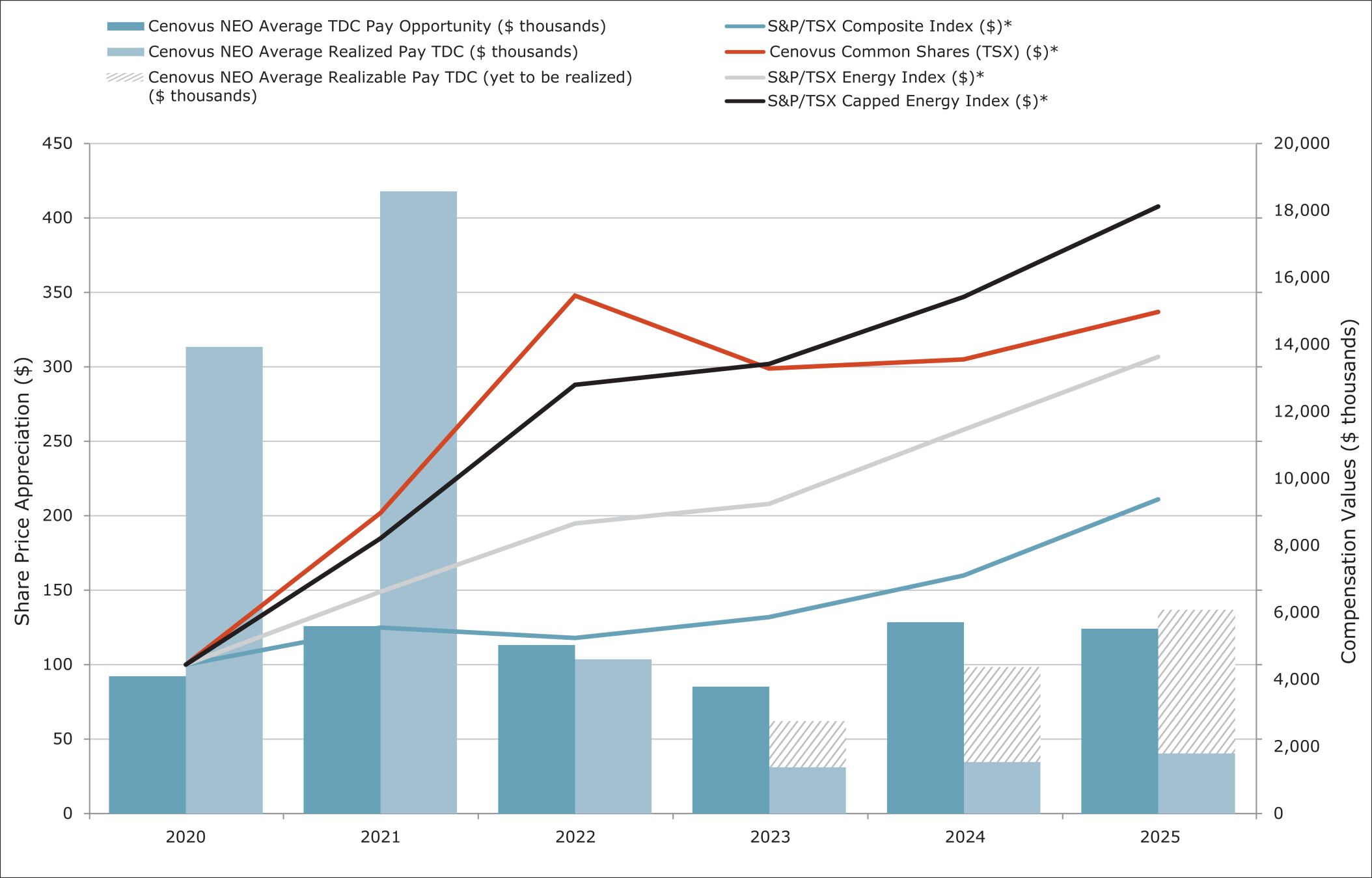
| 2020 | 2021 | 2022 | 2023 | 2024 | 2025 | Compounded annual growth rate | ||||||||
| Cenovus common shares (TSX)* ($) |
100 | 202 | 348 | 299 | 305 | 337 | 27.5% | |||||||
| S&P/TSX Composite Index* ($) |
100 | 125 | 118 | 132 | 160 | 211 | 16.1% | |||||||
| S&P/TSX Energy Index* ($) |
100 | 149 | 195 | 208 | 258 | 307 | 25.1% | |||||||
| S&P/TSX Capped Energy Index* ($) |
100 | 185 | 288 | 302 | 347 | 408 | 32.5% | |||||||
| NEO average TDC pay opportunity ($ thousands) |
4,097 | 5,594 | 5,033 | 3,798 | 5,714 | 5,520 | N/A | |||||||
| NEO average realized and realizable pay TDC ($ thousands) |
13,938 | 18,569 | 4,604 | 2,755 | 4,362 | 6,087 | N/A | |||||||
| * | Source: Bloomberg |
Compounded annual growth rate is from December 31, 2020 to December 31, 2025.
2023 NEO TDC. Mr. McKenzie was appointed CEO in April 2023 and Mr. Sandhar was appointed CFO in September 2023, and therefore their 2023 annual salaries have been annualized to reflect what they would have earned had they served in these positions for the full year. TDC for Mr. Pourbaix and Jeff Hart, Cenovus’s former CFO, is not reflected in the 2023 average. For 2024, Drew Zieglgansberger retired effective August 31, 2024, and therefore his 2024 TDC pay opportunity and realized and realizable pay TDC have been excluded.
| CENOVUS 2026 CIRCULAR | EXECUTIVE COMPENSATION | 84 |
NEO average TDC pay opportunity includes the average of all NEOs’ salary and share-based awards, option-based awards and annual bonuses earned during the year reported. The grant date fair value of share-based awards and option-based awards granted in the particular year reported is determined using the valuation methodology described in the Summary Compensation Table in Cenovus’s management proxy circular for each year reported.
NEO average realized pay is that portion of realizable pay that has been determined and paid out as the performance and vesting periods have passed. In 2023, 2024 and 2025, our NEOs have only realized a portion of their pay opportunity – specifically, base salary paid, bonus paid, PSUs that have vested and paid out based on actual performance, options that have been exercised on or before December 31, 2025, and vested options that are in-the-money for the 2023 and 2024 grants. The unexercised share-based awards and unvested options granted in the referenced years are yet to be realized and are included in realizable pay, as described below.
NEO average realizable pay is made up of realized pay as well as yet to be realized compensation, including annual LTIs granted, valued as follows:
| LTI granted in the year |
Circumstance | Valued | Price | |||
| Options |
In-the-money, but not exercised by or on December 31, 2025 | TSX closing price of our common shares on December 31, 2025, less exercise price | Variable | |||
| PSUs |
Not vested and third year performance period complete | TSX closing price of our common shares on December 31, 2025, and actual performance multiplier | $23.22 | |||
| PSUs |
Not vested and third year performance period not complete by December 31, 2025 | TSX closing price of our common shares on December 31, 2025, assuming performance at target and performance multiplier of 1.0 | $23.22 | |||
| RSUs |
Not vested by December 31, 2025 | TSX closing price of our common shares on December 31, 2025 | $23.22 | |||
Five-year look-back – CEO pay opportunity vs. realizable pay
Alignment of our CEO’s compensation with the experience of our shareholders is shown in the table below which compares the grant date TDC pay opportunity to the realizable pay TDC, which fluctuates based on share price as mid and long-term components of realizable pay TDC have yet to be realized.
The table also compares the realizable value of $100 of CEO pay to the cumulative value of $100 invested in common shares, with dividends reinvested, over the same periods. Shareholder value and the value of realizable pay TDC, including the value of options, RSUs and PSUs, were calculated using the share price on December 31, 2025, and, as applicable, the grant date price. Performance was assumed to be at target for unvested PSUs. Mr. McKenzie was appointed CEO in April 2023 and therefore his 2023 base salary has been annualized to reflect what he would have earned had he served in this position for the full year.
| Period |
CEO |
CEO TDC pay ($) |
CEO ($) |
Performance period | Value of $100 | |||||||||||
| CEO ($) |
Shareholder ($) | |||||||||||||||
| 2025 |
McKenzie | 12,981,641 | 14,384,514 | December 31, 2024 to December 31, 2025 | 111 | 111 | ||||||||||
| 2024 |
McKenzie | 9,932,224 | 8,389,447 | December 31, 2023 to December 31, 2025 | 84 | 113 | ||||||||||
| 2023 |
McKenzie | 8,078,861 | 7,324,673 | December 31, 2022 to December 31, 2025 | 91 | 97 | ||||||||||
| 2022 |
Pourbaix | 12,565,887 | 12,687,484 | December 31, 2021 to December 31, 2025 | 101 | 167 | ||||||||||
| 2021 |
Pourbaix | 13,749,985 | 46,962,777 | December 31, 2020 to December 31, 2025 | 342 | 337 | ||||||||||
| CENOVUS 2026 CIRCULAR | EXECUTIVE COMPENSATION | 85 |
Summary compensation table
| Name and principal |
Year | Salary ($) |
Share-based ($) |
Option-based ($) |
Non-equity incentive plan compensation |
Pension ($) |
All
other ($) |
Total ($) | ||||||||||||
|
Annual ($) | ||||||||||||||||||||
| McKenzie CEO |
|
2025 2024 2023 |
|
|
1,231,667 1,133,333 |
|
7,031,226 5,568,714 4,582,138 |
2,343,748 1,856,249 1,527,393 |
2,375,000 1,373,928 869,330 |
484,136 357,973 |
106,159 100,992 93,658 |
13,571,936 10,391,189 8,671,098 | ||||||||
| Sandhar EVP & CFO |
|
2025 2024 2023 |
|
|
686,667 615,833 544,167 |
|
2,249,990 1,349,970 1,225,027 |
750,000 449,998 408,348 |
756,560 484,778 297,496 |
324,138 160,927 233,110 |
83,153 79,612 76,028 |
4,850,508 3,141,118 2,784,176 | ||||||||
| Dahlin EVP & COO |
|
2025 2024 2023 |
|
|
679,167 569,167 533,333 |
|
2,137,487 1,124,987 1,049,988 |
712,499 374,996 349,995 |
823,367 437,518 274,131 |
100,008 86,368 80,667 |
84,353 78,853 77,062 |
4,536,881 2,671,889 2,365,176 | ||||||||
| Soini EVP |
|
2025 2024 2023 |
|
|
541,667 375,000 – |
|
1,424,971 1,599,972 – |
374,999 500,015 – |
574,324 673,716 – |
54,167 36,667 |
73,303 40,294 – |
3,043,431 3,225,664 – | ||||||||
| Lawson EVP & CSO |
|
2025 2024 2023 |
|
|
547,508 500,033 429,812 |
|
1,424,971 487,479 1,349,970 |
374,999 162,521 450,023 |
559,230 215,064 392,460 |
53,083 43,333 42,146 |
68,267 50,392 50,910 |
3,028,058 1,458,822 2,715,321 | ||||||||
See the section titled 2025 executive compensation on page 69 for information regarding changes to base salary in 2025.
Mr. Soini joined Cenovus on April 1, 2024; therefore, there are no compensation records for 2023.
Salary. Mr. Lawson’s actual salaries paid in 2025 and 2024 include acting pay he received prior to his promotion to Executive Vice-President on March 1, 2025, in recognition of the additional responsibilities he assumed while serving in an interim Executive Vice-President role. Acting pay is not bonus-eligible.
Share-based awards is the fair value of PSUs and RSUs, calculated based on the market value of common shares on the grant date.
Share-based and option-based awards. Mr. Soini joined Cenovus on April 1, 2024. His 2024 share-based and option-based awards include grants provided as part of his new-hire package. Mr. Lawson joined Cenovus on December 28, 2022; therefore, his 2023 share-based and option-based awards include both his annual LTI grants and his new hire grants.
Option-based awards use the Black-Scholes-Merton valuation model for options as of the grant date. This is the same method we use for accounting purposes. The assumptions and fair value for options for the respective grant dates are:
| Grant date | February 27, 2023 | May 4, 2023 | September 11, 2023 | February 26, 2024 | February 28, 2025 | |||||||||||||||
| Common share price |
$24.60 | $21.67 | $27.71 | $23.56 | $20.01 | |||||||||||||||
| Volatility |
32.00 | % | 32.00 | % | 26.46 | % | 24.07 | % | 20.60 | % | ||||||||||
| Expected life |
5.45 years | 5.45 years | 5.42 years | 5.40 years | 5.3 years | |||||||||||||||
| Risk-free rate |
3.50 | % | 2.83 | % | 3.88 | % | 3.52 | % | 2.61 | % | ||||||||||
| Grant date fair value |
$7.74 | $4.93 | $6.72 | $5.32 | $2.63 | |||||||||||||||
Non-equity incentive plan compensation reflects the annual bonus award earned by the NEO in the noted year. At the election of the NEO, all or a portion of their respective annual bonus award may be received in DSUs. Mr. Soini’s 2024 Non-Equity Incentive Plan Compensation and Mr. Lawson’s 2023 Non-Equity Incentive Plan Compensation include a one-time cash signing bonus paid on hire.
Pension value is the compensatory change from the defined benefit plan table (page 89) or the defined contribution plan table (page 90). Pension value amounts shown do not reflect payments made to the NEO during the year. For the Cenovus DB Plan, pension values:
| • | Include the projected pension earned during the year (net of employee contributions, adjusted by gains or losses on the NEO’s entire defined benefit obligation when actual earnings differ from estimated). |
| • | Reported annually, vary due to changes in the underlying discount rate changes and other assumptions. |
| CENOVUS 2026 CIRCULAR | EXECUTIVE COMPENSATION | 86 |
All other compensation includes matching of personal contributions to an investment plan of up to 5% of base salary, an annual allowance of $39,600 paid to all NEOs together with other items detailed on page 75.
Outstanding option and share-based awards
The following table outlines certain information regarding all option-based awards and share-based awards outstanding for the NEOs as at December 31, 2025, and valued based on the closing price of the common shares on the TSX on December 31, 2025 of $23.22.
| Name |
Option-based awards | Share-based awards | ||||||||||||||
| Number
of (#) |
Original date |
Option ($) |
Option expiration date |
Value
of ($) |
Number (#) |
Market or payout value of share- based awards that have not vested ($) |
Market or payout value of vested share- based awards not paid out or distributed ($) | |||||||||
| McKenzie |
891,159 | 28-Feb-2025 | 20.43 | 28-Feb-2032 | 2,490,522 | 826,841 | 19,199,248 | 3,674,038 | ||||||||
| 348,919 | 26-Feb-2024 | 23.56 | 26-Feb-2031 | – | ||||||||||||
| 145,009 | 04-May-2023 | 21.67 | 04-May-2030 | 225,010 | ||||||||||||
| 104,974 | 27-Feb-2023 | 24.60 | 27-Feb-2030 | – | ||||||||||||
| 159,626 | 17-Feb-2022 | 19.88 | 17-Feb-2029 | 533,869 | ||||||||||||
| Sandhar |
285,171 | 28-Feb-2025 | 20.43 | 28-Feb-2032 | 796,967 | 230,069 | 5,342,214 | 1,961,600 | ||||||||
| 84,586 | 26-Feb-2024 | 23.56 | 26-Feb-2031 | – | ||||||||||||
| 1,243 | 11-Sep-2023 | 27.71 | 11-Sep-2030 | – | ||||||||||||
| 51,679 | 27-Feb-2023 | 24.60 | 27-Feb-2030 | – | ||||||||||||
| 68,762 | 17-Feb-2022 | 19.88 | 17-Feb-2029 | 229,975 | ||||||||||||
| Dahlin |
270,912 | 28-Feb-2025 | 20.43 | 28-Feb-2032 | 757,118 | 206,461 | 4,794,023 | 1,024,857 | ||||||||
| 70,488 | 26-Feb-2024 | 23.56 | 26-Feb-2031 | – | ||||||||||||
| 45,219 | 27-Feb-2023 | 24.60 | 27-Feb-2030 | – | ||||||||||||
| 61,394 | 17-Feb-2022 | 19.88 | 17-Feb-2029 | 205,332 | ||||||||||||
| Soini |
142,585 | 28-Feb-2025 | 20.43 | 28-Feb-2032 | 398,482 | 119,583 | 2,776,719 | 353,578 | ||||||||
| 112,111 | 10-Jul-2024 | 26.99 | 10-Jul-2031 | – | ||||||||||||
| Lawson |
142,585 | 28-Feb-2025 | 20.43 | 28-Feb-2032 | 398,482 | 139,234 | 3,233,012 | 600,916 | ||||||||
| 30,549 | 26-Feb-2024 | 23.56 | 26-Feb-2031 | – | ||||||||||||
| 36,444 | 10-Apr-2023 | 24.64 | 10-Apr-2030 | – | ||||||||||||
| 25,842 | 27-Feb-2023 | 24.60 | 27-Feb-2030 | – | ||||||||||||
Number of securities underlying unexercised options includes both vested and unvested options.
Value of unexercised in-the-money options is based on the closing price of the common shares on the TSX on December 31, 2025, of $23.22.
Number of shares or units of shares that have not vested includes PSUs granted to the NEOs in 2023, 2024 and 2025 plus the number of dividend equivalents credited, rounded to the next whole unit. PSUs and related dividend equivalents only vest on achievement of RTSR (all grants). If PSUs do not vest, they are cancelled. RSUs and related dividend equivalents vest after three years in accordance with grant agreements.
Market or payout value of share-based awards that have not vested assumes target performance and is calculated on the actual number of units (not rounded).
| CENOVUS 2026 CIRCULAR | EXECUTIVE COMPENSATION | 87 |
Market or payout value of vested share-based awards not paid out or distributed relates to DSUs granted to Mr. Sandhar as part of his 2020 annual LTIs, DSUs granted to Messrs. Soini and Lawson in 2025 on promotion to Executive Vice-President and DSUs granted if an NEO elects to receive all or a portion of their respective annual bonus award in DSUs.
Incentive plan awards – value vested or earned during 2025
| Name |
Option-based awards – ($) |
Share-based awards
– ($) |
Non-equity incentive ($) | |||
| McKenzie |
115,221 | 2,628,341 | 2,375,000 | |||
| Sandhar |
49,635 | 1,132,202 | 756,560 | |||
| Dahlin |
44,315 | 1,010,886 | 823,367 | |||
| Soini |
– | – | 574,324 | |||
| Lawson |
– | – | 559,230 | |||
Option-based awards – value vested during the year assumes the NEO exercised the options on the day they vested.
Share-based awards – value vested during the year is calculated as the number of PSUs and RSUs vested multiplied by the closing price of the common shares on the TSX on February 24, 2025, of $20.54.
Non-equity incentive plan compensation – value earned during the year includes the amount of the bonus awards earned by the NEOs in 2025, as paid in 2026. At the election of the NEO, all or a portion of their respective annual bonus award may be received in DSUs.
Defined benefit plan to December 31, 2025
|
Name |
Number of years of credited service |
Annual ($) |
Opening ($) |
Compensatory ($) |
Non- ($) |
Closing ($) | ||||||||
| At year |
At age 65 | |||||||||||||
| McKenzie |
6.5000 | 169,823 | 335,291 | 2,059,991 | 484,136 | 50,513 | 2,594,640 | |||||||
| Sandhar |
9.6667 | 142,210 | 373,914 | 1,438,716 | 324,138 | 11,097 | 1,773,951 | |||||||
| Dahlin |
– | – | – | – | – | – | – | |||||||
| Soini |
– | – | – | – | – | – | – | |||||||
| Lawson |
– | – | – | – | – | – | – | |||||||
Amounts in this table do not reflect payments made to the NEO during the year.
Mr. McKenzie joined the Cenovus DB Plan on July 1, 2019. Mr. Sandhar joined the Cenovus DB Plan when first eligible on May 1, 2016.
Opening present value of defined benefit obligation. Our obligations under the DB Plan are determined using the same methods and assumptions noted in our 2025 consolidated financial statements.
Compensatory change shows the projected pension earned for service during the year (service cost), net of employee contributions adjusted by gains or losses on the NEO’s DB Plan obligation when actual and estimated earnings differ.
Non-compensatory change includes interest on the DB Plan obligation and employee contributions for the period. It also includes changes in the discount rate and other net experience as at December 31, 2025.
| CENOVUS 2026 CIRCULAR | EXECUTIVE COMPENSATION | 88 |
Defined contribution plan to December 31, 2025
| Name |
Accumulated value at ($) |
Compensatory ($) |
Accumulated value at ($) | |||
| McKenzie |
102,291 | – | 110,752 | |||
| Sandhar |
103,942 | – | 107,563 | |||
| Dahlin |
878,312 | 100,008 | 1,177,430 | |||
| Soini |
52,939 | 54,167 | 141,611 | |||
| Lawson |
150,335 | 53,083 | 252,025 | |||
Mr. Dahlin, Mr. Lawson and Mr. Soini joined the Cenovus DC Plan effective January 1, 2016, January 1, 2023 and April 1, 2024, respectively. Mr. Dahlin receives 9% and Mr. Lawson and Mr. Soini receive 8% of pensionable earnings. In addition, the Cenovus DC Plan has an employer matching component valued at 2% of pensionable earnings, which is a 50% match of employee contributions. Mr. McKenzie and Mr. Sandhar accrued benefits under the Cenovus DB Plan. They do not receive further contributions from Cenovus to the Cenovus DC Plan. Their pension values are shown in the DB Plan table.
Compensatory is the value of employer contributions made during the year.
Accumulated value at year end includes investment performance during the year.
Termination and change of control benefits
We have employment agreements with all our NEOs that include the terms and conditions for various termination scenarios, including in the case of change of control.
Change of control
The employment agreements we have with our NEOs require a double trigger for payment of severance benefits in the case of a change of control. First, a change of control (as defined in the agreement) must occur. Second, their employment must be terminated for a reason other than cause. This includes a material reduction in responsibilities, salary, annual bonus, incentive plans or benefits, or forced relocation within 18 months of the change of control.
Severance Amount
Following termination of employment due to disability, termination without just cause, or a change of control (other than for just cause), and conditional upon execution of a release, NEOs are eligible for the Severance Amount which includes:
| • | A lump sum payment equivalent to 24 months of the following components: |
| ○ | annual base salary as at the date of termination; |
| ○ | the average of actual annual performance incentive payments over the three completed fiscal years preceding the date of termination; |
| ○ | annual allowance, benefits, employer contributions to the investment plan and membership fees; and |
| ○ | if an active participant in the Cenovus DC Plan, the contribution Cenovus would have been required to make. |
| • | Executive medical benefits continue for 24 months; and |
| • | If an active participant in the Cenovus DB Plan, an additional 24 months of pensionable service under the Canadian Supplemental Pension Plan. May elect to receive lump sum actuarial equivalent, or if 60 or over, may commence the Supplemental Plan pension immediately. Further details are provided below the table of amounts payable under the various termination scenarios. |
Provisions applicable to all termination scenarios:
DSUs. Are redeemable at the NEO’s (or, in case of death, their legal representative’s) option from termination through December 15 of the following calendar year.
| CENOVUS 2026 CIRCULAR | EXECUTIVE COMPENSATION | 89 |
Salary. The NEO will be paid annual base salary up to the date of termination (unless receiving long-term disability insurance), outstanding vacation pay and expense reimbursement, up to the date of termination.
Payments on termination. The following table summarizes the payments due to each NEO upon termination of employment or upon change of control followed by a termination of employment, pursuant to the terms of their employment agreements and incentive plan and grant agreements.
| Trigger event |
Lump sum | Options | RSUs and PSUs | |||
| Change of control and termination without just cause |
Severance amount conditional on execution of release | Unvested options vest on the termination date and remain exercisable until original expiry date. | Unvested units vest and are paid out on the termination date; for PSUs a multiplier of 1.0 is used for any performance period not yet determined. | |||
| Resignation or retirement |
None | Unvested options are forfeited on the termination date.
For Messrs. Sandhar and Soini, as they are each under the age of 55, vested options remain exercisable until the earlier of 60 trading days following the termination date and original expiry date.
For Messrs. Dahlin, Lawson and McKenzie, as they are each over the age of 55, vested options remain exercisable until the earlier of 6 months following the termination date and original expiry date. |
For Messrs. Sandhar and Soini, as they are each under the age of 55, unvested units are forfeited.
For Messrs. Dahlin, Lawson and McKenzie, as they are each over the age of 55, unvested units are prorated to the date of termination, vest per original schedule and for PSUs, actual multiplier is used; non-prorated units are forfeited on termination date. | |||
| Termination for just cause |
None | Unvested options are forfeited on the termination date; vested options remain exercisable until the earlier of 60 trading days following the termination date and original expiry date. | Unvested units are forfeited on the termination date. | |||
| Termination without just cause |
Severance amount conditional on execution of release | Same as termination for just cause. | Unvested units are prorated to the date of termination, vest per original schedule, and PSUs settle based on actual multipliers; non-prorated units are forfeited immediately. | |||
| Death |
Prorated annual bonus at target up to date of death | 2025 Grants: Unvested options vest on the date of death and remain exercisable until original expiry date.
Grants prior to 2025: Unvested options vest for up to 12 months; remainder forfeited. Vested options remain exercisable to original expiry date. |
Unvested units vest on the date of death and are paid out shortly thereafter. For PSUs a multiplier of 1.0 is used for any performance period not yet determined. | |||
| Disability |
Severance amount conditional on execution of release | Same as termination for just cause. | Same as termination without just cause. | |||
Change of control and termination without just cause
| (1) | Assumes that the options are either replaced or assumed by the successor entity following the completion of the change of control. In the event that the options are not replaced or assumed by the successor entity, unvested options become exercisable on the date of the change of control and remain exercisable until the original expiry date. |
| CENOVUS 2026 CIRCULAR | EXECUTIVE COMPENSATION | 90 |
| (2) | Assumes that the RSUs and PSUs are either replaced or assumed by the successor entity following the completion of the change of control. In the event that the RSUs and PSUs are not replaced or assumed by the successor entity, all unvested units vest and are paid out on the date of the change of control. For PSUs, a multiplier of 1.0 is used for any performance period not yet determined. |
Resignation or retirement is voluntary.
Termination and change of control benefit amounts for a trigger event on December 31, 2025
The following table illustrates the estimated incremental payments, payables and benefits that would have been made to each of the NEOs as a result of the triggering events identified below, in each case assuming such trigger event occurred on December 31, 2025. This table does not include amounts already available to the NEO on December 31, 2025, for vested options, PSUs and RSUs.
|
NEO |
Trigger event |
Payment ($) |
Long-term ($) |
Total ($) |
||||||||||
| McKenzie |
Change of control and termination without just cause | 6,973,323 | 21,578,012 | 28,551,335 | ||||||||||
| Resignation or retirement | – | – | – | |||||||||||
| Termination for just cause | – | – | – | |||||||||||
| Termination without just cause | 6,973,323 | – | 6,973,323 | |||||||||||
| Death | – | 21,488,005 | 21,488,005 | |||||||||||
| Disability | 6,973,323 | – | 6,973,323 | |||||||||||
| Sandhar |
Change of control and termination without just cause | 2,852,679 | 6,088,502 | 8,941,181 | ||||||||||
| Resignation or retirement | – | – | – | |||||||||||
| Termination for just cause | – | – | – | |||||||||||
| Termination without just cause | 2,852,679 | – | 2,852,679 | |||||||||||
| Death | – | 6,088,502 | 6,088,502 | |||||||||||
| Disability | 2,852,679 | – | 2,852,679 | |||||||||||
| Dahlin |
Change of control and termination without just cause | 2,593,739 | 5,507,618 | 8,101,357 | ||||||||||
| Resignation or retirement | – | – | – | |||||||||||
| Termination for just cause | – | – | – | |||||||||||
| Termination without just cause | 2,593,739 | – | 2,593,739 | |||||||||||
| Death | – | 5,507,618 | 5,507,618 | |||||||||||
| Disability | 2,593,739 | – | 2,593,739 | |||||||||||
| Soini |
Change of control and termination without just cause | 1,815,589 | 3,174,295 | 4,989,884 | ||||||||||
| Resignation or retirement | – | – | – | |||||||||||
| Termination for just cause | – | – | – | |||||||||||
| Termination without just cause | 1,815,589 | – | 1,815,589 | |||||||||||
| Death | – | 3,174,295 | 3,174,295 | |||||||||||
| Disability | 1,815,589 | – | 1,815,589 | |||||||||||
| Lawson |
Change of control and termination without just cause | 1,815,607 | 3,576,391 | 5,391,998 | ||||||||||
| Resignation or retirement | – | – | – | |||||||||||
| Termination for just cause | – | – | – | |||||||||||
| Termination without just cause | 1,815,607 | – | 1,815,607 | |||||||||||
| Death | – | 3,576,391 | 3,576,391 | |||||||||||
| Disability | 1,815,607 | – | 1,815,607 | |||||||||||
| CENOVUS 2026 CIRCULAR | EXECUTIVE COMPENSATION | 91 |
Incremental pension benefits for Mr. McKenzie and Mr. Sandhar included in the Severance Amount. The incremental DB Plan lump sum pension value is equal to the difference between the actuarial present values of the NEO’s pension, as modified by the employment agreement provisions, less the accrued pension, unmodified, using the commuted value basis for the Cenovus DB Plan as of December 31, 2025. The discount rates used are 3.5% for 10 years and 5.0% thereafter. Pensionable earnings for the additional 24-month period are based on annual base salary plus the average of the annual bonus (capped at 40% of salary) in the three years before termination. The early retirement reduction factor under our Canadian Supplemental Pension Plan is calculated at the age the individual would have been on December 31, 2027.
Incremental pension benefits for Mr. Dahlin, Mr. Lawson and Mr. Soini included in the Severance Amount. The NEOs participating in the Cenovus DC Plan would be compensated based on an additional 24 months of pensionable service. For Mr. Dahlin, the incremental lump sum pension value is equal to 11% of annual base salary plus bonus (capped at 40% of base salary) over the 24 months of additional service. For Mr. Lawson and Mr. Soini, the incremental lump sum pension value is equal to 10% of annual base salary plus bonus (capped at 40% of base salary) over the 24 months of additional service.
The contents and sending of this circular have been approved by the Board.
/s/ Susan M. Anderson
Susan M. Anderson
Corporate Secretary
Calgary, Alberta
March 10, 2026
| CENOVUS 2026 CIRCULAR | EXECUTIVE COMPENSATION | 92 |
| In this section you will find: |
||||
| Page A-1 | ||||
| Page B-1 | ||||
| Page C-1 | ||||
| CENOVUS 2026 CIRCULAR | SCHEDULES | 1 |
Eligibility Approved by shareholders in 2009, our Stock Option Plan was created to provide eligible employees with an incentive to achieve our longer-term objectives, to give suitable recognition to the ability and industry of persons who contribute to our success and to attract and retain persons of experience and ability by providing the opportunity to acquire an increased proprietary interest in Cenovus. Non-employee directors of Cenovus are not eligible to participate in the Stock Option Plan.
Insiders The number of common shares reserved for issuance at any time, to or for the benefit of our insiders (as defined in the TSX Company Manual), pursuant to all of our security-based compensation arrangements shall not exceed 10% of the number of common shares then outstanding, calculated on a non-diluted basis, and the aggregate number of common shares issued to insiders pursuant to all of our security-based compensation arrangements, within any one year period, shall not exceed 10% of the number of the common shares outstanding, calculated on a non-diluted basis.
Administration The HRC Committee is the administrator of the Stock Option Plan, with the authority to interpret its terms and any option agreement thereunder and the discretion to attach tandem stock appreciation rights (“TSARs”) or net settlement rights (“NSRs”) to Options. Subject to regulatory requirements, the terms, conditions and limitations of Options granted under the Stock Option Plan will be determined by the HRC Committee and set out in an option agreement.
Exercise Price The price for common shares that may be purchased through the exercise of options shall be fixed by the HRC Committee for each Option but shall not be less than the “Market Value” of the common shares. Effective January 1, 2018, the Board approved an amendment to the definition of “Market Value” so that it is based on a volume-weighted average trading price on an exchange for the prior five trading days (provided that at least a board lot of common shares has traded) instead of the closing price on the day of exercise. If a board lot has not traded, the average of the bid and ask prices on such a day will be used. This change is consistent with generally accepted governance best practices, including TSX recommendations, as it is considered less sensitive to trading irregularities than using a single trading day closing price. Shareholder approval was not sought for such amendment because it was approved by the Board in accordance with the specific amendments provision of the Stock Option Plan. The exercise price for options granted prior to January 1, 2018, is to be at least the market price of the common shares at the grant date, calculated as the closing price of the common shares on the TSX on the last trading day preceding the date on which the option agreement granting the Option is made, or, if the common shares shall not have traded that day, on the next preceding day on which common shares were traded.
Vesting The HRC Committee has the right to determine at the time of grant whether a particular option will be exercisable in whole or in part on different dates or for reasons other than the passage of time. Options generally vest 30% on the first anniversary, 30% on the second anniversary and 40% on the third anniversary of the grant.
Expiry Each option (unless sooner terminated in accordance with the terms, conditions and limitations of the option agreement) shall be exercisable during such period, not exceeding seven years from the date the option was granted, as the HRC Committee may determine.
TSARs Options may have associated TSARs which entitle the optionholder to surrender the right to exercise his or her options to purchase a specified number of common shares and to receive cash or common shares (at our discretion) in an amount equal to the excess of the closing price of the common shares on the TSX on the last trading day preceding the date of exercise of the TSAR, over the exercise price for the options, multiplied by the number of optioned common shares surrendered, less applicable withholdings. Where TSARs are exercised, the rights to the underlying common shares are forfeited and such number of common shares are returned to the common shares reserved and available for new option grants.
Net Settlement Rights NSRs entitle the optionholder, in his or her sole discretion, to surrender the right to exercise the options to purchase a specified number of common shares and to receive, in exchange, common shares. The optionholder will receive the number of common shares equal in value to the closing price of the common shares on the TSX on the last trading day preceding the date of surrender of the options and contemporaneous exercise of the associated NSRs, less the grant price of the option then multiplied by the number of options surrendered, less applicable withholdings.
| CENOVUS 2026 CIRCULAR | SCHEDULES | A-1 |
Cashless Exercise Optionholders are entitled to effect a cashless exercise of the optionholder’s vested and exercisable options. Upon electing a cashless exercise, the optionholder shall exercise options in exchange for the issuance of the number of common shares subject to the exercise, which common shares will immediately be sold by an arm’s-length third-party broker on the stock exchange (the sale will settle two days after execution). Proceeds from the sale will be forwarded to Cenovus to pay the exercise price of the options, and the balance (less withholding taxes and fees), will be paid as otherwise directed by the optionholder.
Adjustments Adjustments will be made to the exercise price of an option, the number of common shares delivered to an optionholder upon exercise of an option and the maximum number of common shares that may at any time be reserved for issuance pursuant to options granted under the Stock Option Plan in certain circumstances, such as a stock dividend, split, recapitalization, merger, consolidation, combination or exchange of common shares or other similar corporate change.
Cessation of Entitlement Upon termination of employment, unvested options and vested options that are not exercised or surrendered by the end of the Termination Exercise Period shall be forfeited. If a participant retires before attaining age 60, unvested options and vested options that are not exercised or surrendered by the end of the retirement exercise period shall be forfeited. If a participant dies: (i) any unvested options granted prior to January 1, 2025 that do not vest within 12 months of the participant’s date of death shall be forfeited; and (ii) any unvested options granted on or after January 1, 2025 will immediately vest and become exercisable until the relevant expiry date.
Non-Assignable and No Rights as a Shareholder An option may be exercised only by the optionholder and is not assignable, except on death or incapacitation. Nothing in the Stock Option Plan or in any option agreement confers or will confer on any optionholder any right of a shareholder unless acquired through the exercise of the option or otherwise through the holding of common shares. Nothing in the Stock Option Plan or in any option agreement confers or will confer on any optionholder any right to remain as an employee of Cenovus or any of our subsidiaries.
Blackout Period If the exercise period of an option expires during or within 10 business days following a period when option exercising is prohibited by Cenovus (the “Blackout Period”), then the exercise period of such option will be extended to the date which is 10 business days after the last day of the Blackout Period (the “Blackout Extension Period”), after which time such option shall expire and terminate.
Amendments – Board Approval The Board may, at any time and from time to time, amend, suspend, discontinue or terminate the Stock Option Plan in whole or in part; provided, however, no such amendment, suspension, discontinuance or termination may, without the consent of any optionholder, adversely alter or impair the rights under any option previously granted. Any amendment to be made to the Stock Option Plan is subject to the prior approval of the TSX. The Board has certain power and authority to approve amendments relating to the Stock Option Plan or a specific option without further approval of the shareholders of Cenovus, examples of which include, but are not limited to:
| (i) | extending or, in the event of a change of control, retirement, death or disability, accelerating the terms of vesting applicable to any option or group of options; |
| (ii) | altering the terms and conditions of vesting applicable to any option or group of options; |
| (iii) | changing the termination provisions of the Stock Option Plan or any option, provided that the change does not provide for an extension beyond the original expiry date of such option; |
| (iv) | accelerating the expiry date in respect of an option; |
| (v) | determining the adjustment provisions pursuant to the Stock Option Plan (See Adjustments above); |
| (vi) | amending the definitions contained within the Stock Option Plan and other amendments of a “housekeeping” nature; and |
| (vii) | amending or modifying the mechanics of exercise of an option or TSAR. |
Amendments – Shareholder Approval Approval by shareholders of Cenovus will be required for amendments that relate to:
| (i) | accelerating the terms of vesting applicable to any option or group of options other than in the event of a change of control, retirement, death or disability; |
| (ii) | any increase in the number of common shares reserved for issuance under the Stock Option Plan; |
| (iii) | any reduction in the grant price or cancellation and reissue of options; |
| CENOVUS 2026 CIRCULAR | SCHEDULES | A-2 |
| (iv) | any extension of the term of an option beyond the original expiry date, except as permitted under the Blackout Extension Period; |
| (v) | any increase to the length of the Blackout Extension Period; |
| (vi) | the inclusion of non-employee directors, on a discretionary basis, as eligible participants; |
| (vii) | any allowance for the transferability or assignability of options other than for estate settlement purposes; |
| (viii) | amendments to the specific amendment provision of the Stock Option Plan; and |
| (ix) | amendments required to be approved by shareholders of Cenovus under applicable law (including, without limitation, the rules, regulations and policies of the TSX). |
| CENOVUS 2026 CIRCULAR | SCHEDULES | A-3 |
Board of Directors’ Mandate
The fundamental responsibility of the Board of Directors (the “Board”) of Cenovus Energy Inc. (“Cenovus” or the “Corporation”) is to appoint a competent executive team and to oversee the management of the business, acting in the best interests of the Corporation and ensuring corporate conduct in an ethical and legal manner via an appropriate system of corporate governance and internal control.
Executive Team Responsibility
| • | Appoint the President & Chief Executive Officer and other corporate officers, approve the President & Chief Executive Officer’s compensation and monitor the President & Chief Executive Officer’s performance against a set of mutually agreed corporate objectives directed at maximizing shareholder value. |
| • | In conjunction with the President & Chief Executive Officer, develop a clear mandate for the President & Chief Executive Officer, which includes a delineation of management’s responsibilities. |
| • | Ensure that a process is established that adequately provides for succession planning, including the appointing, training and monitoring of senior management. |
| • | Establish limits of authority delegated to management. |
Operational Effectiveness and Financial Reporting
| • | Annual review and adoption of a strategic planning process and approval of the corporate strategic plan, which takes into account, among other things, the opportunities and risks of the business. |
| • | Ensure that a system is in place to identify the principal risks to the Corporation and that the best practical procedures are in place to monitor and mitigate the risks. |
| • | Ensure that processes are in place to address applicable regulatory, corporate, securities and other compliance matters. |
| • | Ensure that processes are in place for the Corporation to mitigate environmental impacts (including climate change), address health and safety matters that may arise with our activities, consider human capital management, and operate in a manner consistent with good governance and recognized standards. |
| • | Ensure that an adequate system of internal control exists. |
| • | Ensure that due diligence processes and appropriate controls are in place with respect to applicable certification requirements regarding the Corporation’s financial and other disclosure. |
| • | Review and approve the Corporation’s financial statements and oversee the Corporation’s compliance with applicable audit, accounting and reporting requirements. |
| • | Approve annual operating and capital budgets. |
| • | Review and consider for approval all amendments or departures proposed by management from established strategy, capital and operating budgets or matters of policy which diverge from the ordinary course of business. |
| • | Review operating and financial performance results relative to established strategy, budgets and objectives. |
Integrity/Corporate Conduct
| • | Approve a communications policy or policies to ensure that a system for corporate communications to all stakeholders exists, including processes for consistent, transparent, regular and timely public disclosure, and to facilitate feedback from stakeholders. |
| • | Approve a code of business conduct and ethics for directors, officers, employees, contractors and consultants and monitor compliance with the code and approve any waivers of the code for officers and directors. |
Board Process/Effectiveness
| • | Ensure that Board materials are distributed to directors in advance of regularly scheduled meetings to allow for sufficient review of the materials prior to the meeting. Directors are expected to attend all meetings. |
| CENOVUS 2026 CIRCULAR | SCHEDULES | B-1 |
| • | Engage in the process of determining Board member qualifications with the Governance Committee including ensuring that a majority of directors qualify as independent directors pursuant to National Instrument 58-101 Disclosure of Corporate Governance Practices. |
| • | Approve the nomination of directors. |
| • | Provide a comprehensive orientation to each new director. |
| • | Establish an appropriate system of corporate governance including practices to ensure the Board functions independently of management. |
| • | Establish appropriate practices for the regular evaluation of the effectiveness of the Board, its committees and its members. |
| • | Establish committees and approve their respective mandates and the limits of authority delegated to each committee. |
| • | Review and re-assess the adequacy of the Audit Committee Mandate on a regular basis, but not less frequently than on an annual basis. |
| • | Review the adequacy and form of the directors’ compensation to ensure it realistically reflects the responsibilities and risks involved in being a director. |
| • | Each member of the Board is expected to understand the nature and operations of the Corporation’s business, and have an awareness of the political, economic and social trends prevailing in all countries or regions in which the Corporation operates or invests, or is contemplating potential operation or investment. |
| • | Independent directors shall meet regularly, and in no case less frequently than quarterly, without non-independent directors and management participation. |
| • | In addition to the above, adherence to all other Board responsibilities as set forth in the Corporation’s By-Laws, applicable policies and practices and other statutory and regulatory obligations, such as approval of dividends, issuance of securities, etc., is expected. |
Risk Oversight
The Board has oversight of risks related to:
| • | The review and adoption of a strategic planning process and approval of the corporate strategic plan. |
| • | Ensuring that a system is in place to identify the principal risks to the Corporation and that the best practical procedures are in place to monitor and mitigate such risks. |
| • | The Corporation’s system of corporate governance. |
| • | Operating and financial performance. |
| • | Appointment of the President & Chief Executive Officer and approval of the President & Chief Executive Officer’s compensation. |
| • | Code of business conduct and ethics and communications policies. |
| • | Non-compliance by directors with applicable by-laws, policies and practices and other statutory and regulatory obligations. |
| • | The Corporation’s public disclosure. |
| • | Amendments to, or departures from, established strategy, capital and operating budgets or matters of policy from the ordinary course of business. |
| • | Nomination of directors, approval of their compensation and the effectiveness of the Board. |
Environmental, Social and Governance (ESG) Oversight
The Board has oversight of:
| • | The Corporation’s approach to sustainability; |
| • | Reports and recommendations from management with respect to ESG matters; and |
| • | The Corporation’s processes and procedures to mitigate environmental impacts (including climate change), address health and safety matters that may arise due to the Corporation’s activities, consider human capital management, and operate in a manner consistent with good governance and recognized standards. |
| CENOVUS 2026 CIRCULAR | SCHEDULES | B-2 |
This circular contains forward-looking statements and other information (collectively “forward-looking information”) about Cenovus’s current expectations, estimates and projections, made in light of Cenovus’s experience and perception of historical trends. This forward-looking information is identified by words such as “achieve”, “align”, “commitment”, “committed”, “designed”, “ensuring”, “expect”, “focus”, “objective”, “opportunity”, “strategy”, or similar expressions and includes suggestions of future outcomes, including but not limited to: performance and achievement of sustainability commitments; alignment of Cenovus’s direct and indirect lobbying and public advocacy activities, including political contributions, with its corporate objectives, strategy, targets and ambition; alignment of director and executive compensation with shareholder interests; paying for performance; our commitment to advancing our sustainability focus areas and commitments, including our social commitments and environmental work; factor sustainability considerations into our strategy, business plans and capital allocation processes; ensure we properly address risk in our business and embed safety and asset integrity in our work; ensures that a system is in place to identify Cenovus’s principal risks, and that the best practical procedures are in place to monitor and mitigate such risks; promoting a culture of safety; focus on safety, execution excellence, environmental and social responsibility, and shareholder value creation; and compensation program philosophy, design and objectives. Readers are cautioned not to place undue reliance on forward-looking information as Cenovus’s actual results may differ materially from those expressed or implied.
Developing forward-looking information involves reliance on a number of assumptions and consideration of certain risks and uncertainties, some of which are specific to Cenovus and others that apply to the industry generally. The factors or assumptions on which the forward-looking information is based include assumptions disclosed in Cenovus’s current guidance, available at cenovus.com and other risks and uncertainties that could cause Cenovus’s actual results to differ materially, as identified in our management’s discussion and analysis for the year ended December 31, 2025 dated February 15, 2026, and risk factors described in other documents Cenovus files from time to time with securities regulatory authorities in Canada, available on our profile on SEDAR+ at sedarplus.ca, and with the U.S. Securities and Exchange Commission on EDGAR at sec.gov, and on the our website at cenovus.com.
Information on or connected to Cenovus’s website cenovus.com does not form part of this circular.
Non-GAAP Measures
This circular contains references, including within the 2025 Scorecard, to certain non-GAAP measures, including adjusted funds flow and free funds flow. These measures do not have a standardized meaning as prescribed by International Financial Reporting Standards (“IFRS”) and therefore, are considered specified financial measures. These specified financial measures may not be comparable to similar measures presented by other issuers. Adjusted funds flow is used in our 2025 Scorecard in order to provide shareholders and potential investors, as well our Board and management, with an additional measure for analyzing our ability to generate funds to finance our operations and to provide information regarding our liquidity. This measure should not be considered in isolation or as a substitute for measures prepared in accordance with IFRS. For information on the composition of this measure, as well as an explanation of how Cenovus uses it, refer to the Specified Financial Measures Advisory located in our management’s discussion and analysis for the year ended December 31, 2025 dated February 15, 2026 and available on our profile on SEDAR+ at sedarplus.ca, on EDGAR at sec.gov and on Cenovus’s website at cenovus.com, which is incorporated by reference into this circular.
| CENOVUS 2026 CIRCULAR | SCHEDULES | C-1 |

YOUR VOTE IS IMPORTANT
If you have any questions or require any assistance in executing your Cenovus proxy or voting instruction form, please call our Proxy Solicitation Agent, Sodali & Co at:

North American toll-free number: 1-833-711-5528
Outside North America, banks, brokers and collect calls: 1-289-695-3075
Email: assistance@investor.sodali.com
North American toll-free facsimile: 1-877-218-5372
CENOVUS ENERGY INC.
4100, 225 - 6 Avenue SW | Calgary, AB T2P 1N2
P: 403-766-2000
F: 403-766-7600
Email: investor.relations@cenovus.com
Read the latest about Cenovus Energy at: www.cenovus.com.
Cenovus Energy is traded on the TSX and NYSE under the symbol CVE