Exhibit 99.1
XANADU QUANTUM TECHNOLOGIES LIMITED
Annual Information Form
Fiscal Year ended December 31, 2025
March 31, 2026
TABLE OF CONTENTS
| ABOUT XANADU | 4 |
| GLOSSARY OF TERMS | 4 |
| CAUTIONARY NOTE REGARDING FORWARD-LOOKING STATEMENTS | 6 |
| EXCHANGE RATE DATA | 9 |
| CORPORATE STRUCTURE | 9 |
| OUR BUSINESS | 9 |
| Business of Xanadu | 9 |
| Our Strategy | 11 |
| Business Model | 12 |
| Key Strategic Relationships and Customers | 14 |
| Employees and Human Capital Resources | 15 |
| GENERAL DEVELOPMENT OF OUR BUSINESS | 15 |
| History of the Business | 16 |
| RISK FACTORS | 20 |
| PRIOR SALES | 85 |
| SECURITIES SUBJECT TO CONTRACTUAL RESTRICTIONS ON TRANSFER | 85 |
| DIVIDEND POLICY | 86 |
| PROMOTER | 87 |
| DESCRIPTION OF SHARE CAPITAL | 87 |
| Authorized Share Capital | 87 |
| Shares | 87 |
| Preferred Shares | 92 |
| Warrants | 92 |
| MATERIAL INDEBTEDNESS | 93 |
| MARKET FOR SECURITIES | 93 |
| Trading Price and Volume | 93 |
| DIRECTORS AND EXECUTIVE OFFICERS | 93 |
| Biographical Information Regarding Our Directors and Executive Officers | 94 |
| Ownership Interest | 97 |
| Corporate Cease Trade Orders, Bankruptcies, Penalties or Sanctions | 97 |
| Conflicts of Interest | 97 |
| AUDIT COMMITTEE | 98 |
| Composition of the Audit Committee | 98 |
| Relevant Education and Experience of the Audit Committee Members | 98 |
| Audit Committee Pre-Approval Policies and Procedures | 99 |
| External Auditor Service Fees | 99 |
| AGREEMENT WITH PRINCIPAL SHAREHOLDERS | 99 |
| TRANSFER AGENT AND REGISTRAR | 100 |
| INTEREST OF MANAGEMENT AND OTHERS IN MATERIAL TRANSACTIONS | 100 |
| MATERIAL CONTRACTS | 100 |
| Business Combination Agreement | 101 |
| SIF Loan Agreement | 103 |
| INTERESTS OF EXPERTS | 104 |
| LEGAL PROCEEDINGS AND REGULATORY ACTIONS | 104 |
| ADDITIONAL INFORMATION | 104 |
| AUDIT COMMITTEE CHARTER | 105 |
- 4 -
ABOUT XANADU
As used in this Annual Information Form (“AIF”), unless the context indicates or requires otherwise, all references to the “Company”, “Xanadu”, “we”, “us” or “our” refer to Xanadu Quantum Technologies Limited following completion of the business combination with Xanadu Quantum Technologies Inc. and Crane Harbor Acquisition Corp, which was completed on March 26, 2026. As a result of the Business Combination (as defined below), Old Xanadu (as defined below) is a wholly-owned subsidiary of Xanadu. Discussions in this AIF regarding the business of Xanadu prior to March 26, 2026 refer to the business carried on by Old Xanadu.
GLOSSARY OF TERMS
As used in this AIF, unless the context indicates or requires otherwise, the following terms have the following meanings:
“Audit Committee” means the audit committee of the Board.
“Aurora” is Xanadu’s networked, modular, and scalable photonic quantum computer demonstrating realtime error detection and photonic rack interconnection.
“Board” means the board of directors of the Company.
“Borealis” is Xanadu’s 216-qubit photonic quantum computer that demonstrated quantum computational advantage in 2022.
“Business Combination” means the combination of Xanadu, Old Xanadu and CHAC pursuant to and subject to the terms and conditions of the Business Combination Agreement, and the Plan of Arrangement contemplated thereby.
“Business Combination Agreement” means the business combination agreement dated November 3, 2025 between Xanadu, Old Xanadu and CHAC.
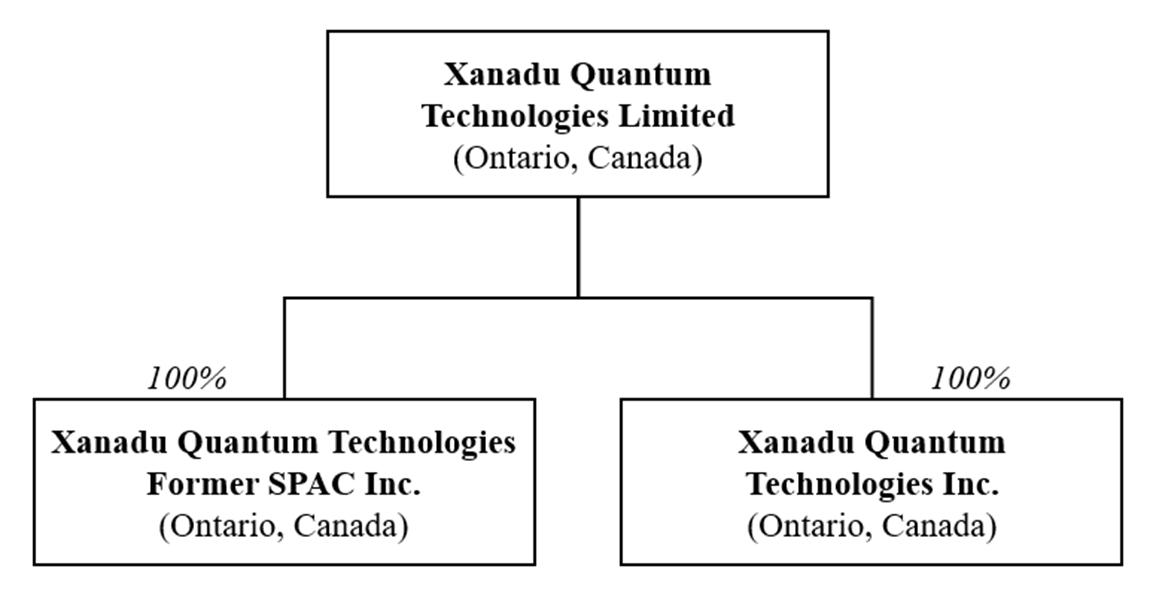
“CHAC” means Xanadu Quantum Technologies Former SPAC Inc., formerly, Crane Harbor Acquisition Corp., being a special purpose acquisition corporation prior to completion of the Business Combination.
“CHAC Class A Shares” has the meaning set forth in “Material Contracts – Business Combination Agreement.”
“CHAC Class B Shares” has the meaning set forth in “Material Contracts – Business Combination Agreement.”.
“CHAC Continuance” has the meaning set forth in “Material Contracts – Business Combination Agreement.”
“CHAC Share Right” has the meaning set forth in “Material Contracts – Business Combination Agreement.”
“CHAC Shares” has the meaning set forth in “Material Contracts – Business Combination Agreement.”
“Class A Multiple Voting Shares” means the multiple voting shares in the capital of Xanadu.
“Class B Subordinate Voting Shares” means the subordinate voting shares in the capital of Xanadu.
“Closing” means the closing of the transactions contemplated by the Business Combination Agreement at 12:01 AM (Toronto time) on March 26, 2026.
“Nasdaq” means The Nasdaq Stock Market LLC.
“NI 52-110” means National Instrument 52-110 – Audit Committees, as amended from time to time.
“OBCA” means the Business Corporations Act (Ontario).
“Old Xanadu” means Xanadu Quantum Technologies Inc., a corporation existing under the OBCA that was acquired by Xanadu on March 26, 2026 pursuant to the Business Combination.
- 5 -
“Old Xanadu Non-Voting Common Shares” has the meaning set forth in “Prior Sales.”
“Old Xanadu Non-Voting Option” means an option to acquire an Old Xanadu Non-Voting Common Share.
“Old Xanadu Preferred Share” has the meaning set forth in “Material Contracts – Business Combination Agreement.”
“Old Xanadu Voting Common Shares” has the meaning set forth in “Prior Sales.”
“Old Xanadu Voting Option” means an option to acquire an Old Xanadu Voting Common Share.
“OSC” means the Ontario Securities Commission.
“PennyLane” is Xanadu’s open-source quantum programming software development kit enabling hybrid quantum — classical algorithm development across hardware platforms.
“PIPE Financing” has the meaning set forth in “Material Contracts – Business Combination Agreement.”
“Plan of Arrangement” means the plan of arrangement under section 182 of the OBCA attached as Annex B to the Prospectus.
“Preferred Shares” means the preferred shared in the capital of Xanadu.
“Prospectus” means the final long-form non-offering prospectus of Xanadu, filed with the Ontario Securities Commission on March 25, 2026.
“Quantum Benchmarking Initiative” is a U.S. Defense Advanced Research Projects Agency (“DARPA”) led program assessing and validating quantum computing system performance against standardized metrics.
“Refinery” is a photonic subsystem responsible for improving the squeezing quality and fidelity of heralded Gottesman-Kitaev-Preskill (“GKP”) states.
“SEC” means the U.S. Securities and Exchange Commission.
“Shareholders” means, at any time, the holders of the Shares and “Shareholder” means any one of them.
“Shares” means, together, the Class A Multiple Voting Shares and Class B Subordinate Voting Shares.
“SIF Loan” means the Strategic Innovation Fund agreement, by and between Old Xanadu and his Majesty the King in Right of Canada as represented by the Minister of Industry, as amended.
“TSX” means the Toronto Stock Exchange.
This AIF is dated March 31, 2026, which is the date it was approved by the Board, and, unless specifically stated otherwise, all information disclosed in this AIF is provided as at March 30, 2026.
This AIF should be read in conjunction with the Company’s audited consolidated financial statements for the 2025 financial year and Management’s Discussion and Analysis for the 2025 financial year, when filed, but which, for greater certainty, are not incorporated by reference herein.
Amounts disclosed in this AIF are in U.S. dollars, unless otherwise specified.
- 6 -
CAUTIONARY NOTE REGARDING FORWARD-LOOKING STATEMENTS
Some of the statements contained in this AIF may constitute “forward-looking statements” for purposes of U.S. federal securities laws and “forward-looking information” for purposes of applicable Canadian securities laws (collectively, “forward-looking statements”). Forward-looking statements relate to expectations, beliefs, projections, future plans and strategies, anticipated events or trends and similar expressions concerning matters that are not historical facts. Forward-looking statements reflect our current views with respect to, among other things, our capital resources, performance and results of operations. Likewise, all of our statements regarding anticipated growth in operations, anticipated market conditions, demographics and results of operations are forward-looking statements. The words “anticipate,” “believe,” “budget,” “can,” “continue,” “could,” “estimate,” “expect,” “forecast,” “indicative,” “intends,” “may,” “might,” “outlook,” “plan,” “possible,” “potential,” “predict,” “project,” “prospect,” “schedule,” “seek,” “should,” “strategy,” “target,” “timeline,” “would” and similar expressions and positive and negative variations thereof may identify forward-looking statements, but the absence of these words does not mean that a statement is not forward-looking.
Forward-looking statements in this AIF may include, for example, statements about: our financial performance following the Business Combination; changes in our strategy, future operations, financial position, estimated revenues and losses, projected costs, prospects and plans; the implementation, market acceptance and success of our business model, growth strategy and opportunities, and our ability to commercialize our quantum computing technology; our expectations with respect to market opportunity and market growth; the expected benefits of and ability to maintain and enter into new contracts, awards and other relationships, partnerships or collaborations with other businesses, governments and government entities; the potential for our quantum computing technology to achieve quantum supremacy; our ability to create quantum computers that are useful and available to people everywhere; our ability to achieve timing and product development milestones on its product roadmap; our ability to attract and retain qualified employees and management; our expectations regarding its ability to obtain and maintain intellectual property protection and not infringe on the rights of others; expectations regarding the time during which we will be an emerging growth company under the JOBS Act; our future capital requirements and sources and uses of cash; our ability to obtain funding for our operations and future growth; expansion plans and opportunities; and the outcome of any known and unknown litigation and regulatory proceedings.
We do not guarantee that the events described will happen as described (or that they will happen at all). The following factors, among others, could cause actual results and future events to differ materially from those set forth or contemplated in the forward-looking statements:
| ● | general economic uncertainty; |
| ● | the effects of a global pandemic; |
| ● | the volatility of currency exchange rates; |
| ● | our ability to obtain and maintain financing arrangements on attractive terms and to commercialize our quantum computing technology; |
| ● | our ability to manage growth; |
| ● | our ability to maintain the listing of the Class B Subordinate Voting Shares on the Nasdaq, the TSX or any other national exchange; |
| ● | the effects of competition on our future business; |
- 7 -
| ● | potential disruption in our employee retention, changes in personnel and availability of qualified personnel, including as a result of the Business Combination; |
| ● | the impact of and changes in governmental regulations or the enforcement thereof, tax laws and rates, accounting guidance and similar matters in regions in which we operate or will operate in the future; |
| ● | potential litigation, governmental or regulatory proceedings, investigations or inquiries involving us, including in relation to the Business Combination; |
| ● | international, national or local economic, social or political conditions that could adversely affect us and our business; |
| ● | the effectiveness of our internal controls and our corporate policies and procedures; |
| ● | the limited experience of certain members of our management team in operating a public company in the United States and Canada; |
| ● | the volatility of the market price and liquidity of the Class B Subordinate Voting Shares; |
| ● | risks relating to any unforeseen liabilities of the Company; |
| ● | failure to obtain lender consent, industry partner and other third-party consents and approvals, when required; |
| ● | changes in our strategy, future operations, financial position, estimated revenues and losses, projected costs, prospects and plans; |
| ● | our expectations with respect to market opportunity and market growth; |
| ● | the expected benefits of and ability to maintain and enter into new contracts, awards and other relationships, partnerships or collaborations with other businesses, governments and government entities; |
| ● | the potential for our quantum computing technology to achieve quantum supremacy; |
| ● | our ability to achieve timing and product development milestones on our product roadmap; |
| ● | our expectations regarding our ability to obtain and maintain intellectual property protection and not infringe on the rights of others; |
| ● | expectations regarding the time during which we will be an emerging growth company under the JOBS Act; |
| ● | our ability to obtain funding for our operations and future growth, and our future capital requirements and sources and uses of cash; |
| ● | expansion plans and opportunities, including risks related to the rollout of the Company's business and expansion strategy; and |
| ● | the need to obtain required approvals from regulatory authorities. |
- 8 -
The forward-looking statements contained herein may prove incorrect. These forward-looking statements speak only as of the date of this AIF and are subject to risks, uncertainties and other factors, which could cause actual results to differ materially from future results expressed, projected or implied by the forward-looking statements. For a further discussion of the risks and other factors that could cause our future results, performance or transactions to differ significantly from those expressed in any forward-looking statements, please see the section entitled “Risk Factors” in this AIF and our filings with the U.S. Securities and Exchange Commission (www.sec.gov) and Canadian Securities Administrators (www.sedarplus.com). There may be additional risks that we do not presently know or that we currently believe are immaterial, that could also cause actual results to differ from those contained in the forward-looking statements.
Such forward-looking statements are based on a number of estimates and assumptions that Xanadu believes are reasonable when made including, but not limited to, the perceived benefits of the Business Combination; the effects of the Business Combination on Old Xanadu; assumptions that none of the risks identified in the AIF materialize; that there are no unforeseen changes to economic and market conditions, and no significant events occur outside the ordinary course of business of Xanadu. Such estimates and assumptions are made by Xanadu in light of the experience of management and its perception of historical trends, current conditions and expected future developments, as well as other factors believed to be appropriate and reasonable in the circumstances. However, there can be no assurance that such estimates and assumptions will prove to be correct.
Should one or more of these risks or uncertainties materialize, or should any of the assumptions made in making these forward-looking statements prove incorrect, actual results may vary in material respects from those projected in these forward-looking statements. In addition, statements that “we believe” and similar statements reflect our beliefs and opinions on the relevant subject. These statements are based upon information available to us as of the date of this AIF and while we believe such information forms a reasonable basis for such statements, such information may be limited or incomplete, and our statements should not be read to indicate that we have conducted an exhaustive inquiry into, or review of, all potentially available relevant information. Because forward-looking statements are inherently subject to risks and uncertainties, some of which cannot be predicted or quantified and some of which are beyond our control, these forward-looking statements should not be relied upon as guarantees of future events. The events and circumstances reflected in our forward-looking statements may not be achieved or occur and actual future results, levels of activity, performance and events and circumstances could differ materially from those projected in the forward-looking statements. Moreover, we operate in an evolving environment. New risks and uncertainties may emerge from time to time, and management cannot predict all risks and uncertainties. Except as required by applicable law, we do not undertake to publicly update or revise any forward-looking statements contained herein, whether as a result of any new information, future events, changed circumstances or otherwise.
All of the forward-looking statements contained in this AIF is expressly qualified by the foregoing cautionary statements.
- 9 -
EXCHANGE RATE DATA
The following table sets forth, for the periods indicated, the high, low, average and period-end daily rates of exchange for one U.S. dollar, expressed in Canadian dollars, published by the Bank of Canada.
| 12 Months Ended December 31 | ||||||||||||
| 2025 | 2024 | 2023 | ||||||||||
| Highest rate during the period | 1.4603 | 1.4416 | 1.3875 | |||||||||
| Lowest rate during the period | 1.3558 | 1.3316 | 1.3128 | |||||||||
| Average rate for the period | 1.3978 | 1.3698 | 1.3497 | |||||||||
| Rate at the end of the period | 1.3706 | 1.4389 | 1.3226 | |||||||||
CORPORATE STRUCTURE
Xanadu was incorporated under the OBCA on October 2, 2025. Its articles were amended on March 12, 2026 to create the existing capital structure of the Company, including to create the Class A Multiple Voting Shares, Class B Subordinate Voting Shares and Preferred Shares, issuable in series.
Old Xanadu was incorporated under the Canada Business Corporations Act on December 7, 2016, and subsequently continued under the OBCA on October 29, 2025. CHAC was a blank check company incorporated under the Cayman Islands Companies Act on January 2, 2025 and continued under the OBCA on March 20, 2026. As a result of the Business Combination, CHAC and Old Xanadu are wholly owned subsidiaries of the Company.
The principal and registered offices of the Company is located at 777 Bay Street, Suite 2400, Toronto, Ontario, M5G 2C8.
OUR BUSINESS
Business of Xanadu
We are a leading quantum computing company developing full-stack quantum computing solutions for enterprise and government customers around the world.
Our mission is to build quantum computers that are useful and available to people everywhere. To achieve this, we are pursuing a full-stack strategy that integrates proprietary photonic quantum hardware with a modality-agnostic software platform. Our hardware platform, demonstrated through the Borealis and Aurora quantum computers, is designed to scale from today’s networked, modular systems toward large-scale fault-tolerant machines with hundreds of thousands of physical qubits and hundreds to thousands of logical qubits. At the same time, our software stack, anchored by PennyLane, has become one of the world’s most widely used quantum application development frameworks, enabling researchers, developers, and enterprises to program quantum circuits across all major modalities and cloud platforms.
- 10 -
Our quantum computing hardware is designed to solve problems that are intractable for classical computing. We are pioneering an approach to developing a scaled quantum computer that leverages light as the medium for computation, commonly referred to as the photonics modality. We believe that the photonics modality, and the use of individual particles of light, or photons, offers the most practical and scalable path to building universal, fault-tolerant quantum computers and, in particular, addresses the coherence problems impacting the scalability of competing matter-based modalities, such as superconducting, trapped ion, neutral atom, and other approaches.
Our quantum software includes our branded PennyLane software offering, which is our open-source Quantum Programming Software Development Kit (“SDK”), whereby commercial and government users can program, write and store quantum computing applications and algorithms for commercial, research, and training purposes. PennyLane is accessible via the web and integrates across modalities and with other quantum computing hardware players.
We were the first pure-play company to achieve quantum supremacy when in 2022 our 216-qubit Borealis system performed a computation on the cloud in two minutes that would have taken a world top 5 classical supercomputer, Fugaku, approximately seven million years. In 2025, our Aurora system became the world’s first networked, modular, and scalable photonic quantum computer, demonstrating real-time error detection and the interconnection of multiple photonic racks through optical fiber. We believe these milestones validate our technological leadership and mark critical steps toward commercially viable fault tolerant quantum computing.
Our vision is to accelerate the world’s transition from classical to quantum computing by deploying photonic quantum systems in data centers, enterprises, and research institutions worldwide, with the goal of enabling breakthroughs in sustainability, medicine, materials, and artificial intelligence.
Quantum Computing
Although advances in semiconductor manufacturing and transistor scaling drove exponential growth in computing power and efficiency, classical computers now face fundamental physical limits in miniaturization, heat dissipation, and energy consumption. As a result, many of the world’s most important industrial and scientific problems, such as molecular simulation, new-materials discovery, and large-scale optimization, remain intractable for even the most powerful supercomputers.
We believe that quantum computing represents the next major technological revolution that can result in exponential improvements in computational power by leveraging the fundamental principles of quantum mechanics. Unlike classical bits, which represent information as 0 or 1, quantum bits (“qubits”) can exist in both states simultaneously, allowing quantum computers to explore a vastly larger computational space. This capability creates opportunities for solving problems that would take classical supercomputers millions of years. Importantly, the real economic potential of quantum computing lies not in today’s Noisy Intermediate-Scale Quantum (“NISQ”) systems, which remain largely ineffective, but in the emergence of utility-scale, fault-tolerant quantum computers capable of executing long, error-corrected computations with hundreds to thousands of logical qubits. We believe that these systems will mark the point at which quantum computing transitions from scientific curiosity to general-purpose technology.
We believe photonic quantum computing, in particular, offers unique advantages in scalability, manufacturability, energy efficiency, and networkability. We view our technology as central not only to quantum computing but also to the broader quantum internet, sensing, and communications ecosystems, providing further adjacent potential monetization and market opportunities in addition to the core quantum computing hardware and software business solutions we are pursuing today.
- 11 -
Our Strategy
Our strategy is to maintain leadership in photonic quantum computing through the simultaneous development of scalable hardware, modality-agnostic software, and strategic industry and government partnerships. We believe this integrated approach, spanning research, product development, and commercialization, positions us to capture value across the full quantum technology stack.
We intend to execute on our mission by pursuing the following key strategies:
| ● | Continued Leadership in Photonics Technologies. We are pioneering a room-temperature computation, modular, and networked photonic quantum architecture designed for scalability, manufacturability, and energy efficiency. Our technology uses photons, the fastest and most stable carriers of information currently available, to compute, communicate, and network quantum systems. By eliminating the need for cryogenic and laser cooling and enabling direct fiber-optic interconnects between quantum processors, we believe our photonic approach offers the most feasible and commercially scalable path to large, fault-tolerant quantum computers. Our Aurora system, launched in 2025, demonstrated the first known integration of the subsystems required for universal quantum computing using photonics, validating this architecture and providing a foundation for continued scaling. |
| ● | Rapidly Achieve Fault-Tolerant Utility-Scale Quantum Computing. We are advancing along a defined roadmap toward full fault-tolerant quantum operation. Building on the success of our Borealis and Aurora systems, our next-generation architecture is designed with a target to scale up to 100,000 physical qubits and up to 500 logical qubits by 2029, potentially enabling us to be the “first mover” in delivering and deploying commercially valuable quantum computing capabilities to enterprise and government customers at scale. Achieving this milestone could enable quantum advantage in commercially meaningful use cases across chemistry, materials science, optimization, and artificial intelligence. |
Our approach combines high-connectivity photonic architectures with GKP photonic qubits and real-time quantum low-density parity-check (“qLDPC”) error correction, allowing for distributed networking between quantum processing modules while maintaining high-fidelity quantum gates. We believe this combination provides a 10-to-100-fold reduction in error-correction overhead compared to competing modalities such as superconducting circuits, trapped ions, or neutral atoms.
By leveraging the stability, speed, and manufacturability of photonic qubits, and integrating real-time error-correction codes directly into our hardware and compiler stack, we believe we are positioned to deliver one of the first practical, fault-tolerant quantum computers capable of addressing real-world industrial challenges.
| ● | Continued Leadership in the Quantum Software Ecosystem with PennyLane. Our open-source software platform, PennyLane, is one of the world’s leading environments for quantum application development. PennyLane enables seamless integration of quantum and classical computing frameworks and, as a hardware-agnostic ecosystem, is able to serve as a front-end operating system for quantum hardware worldwide. |
We have also fostered broad academic and industrial adoption of PennyLane across more than 120 universities and numerous enterprise partners. PennyLane is now widely taught in post-secondary curricula and used by researchers and developers working on all major quantum modalities, including those of our competitors.
This widespread adoption positions us to capture long-term value through the development of an enterprise version of PennyLane and complementary quantum-classical workflow tools. As users mature from research to commercialization, we expect that their applications, algorithms, and workloads will naturally migrate toward our photonic hardware, where performance, scalability, and fidelity are highest. In this way, we believe that PennyLane will act as both an industry platform and a strategic channel, driving users, developers, and enterprise applications back to our quantum computing systems and cloud platform.
- 12 -
| ● | Vertical Integration. We are the only pure-play quantum computing company that develops and controls the complete technology stack, from photonic quantum hardware to the leading open-source software ecosystem and proprietary algorithms. This vertically integrated approach enables tight alignment between hardware innovation, software development, and application performance, ensuring that improvements at one layer immediately translate into measurable gains across the system. By uniting hardware design, software compilation, and domain-specific algorithm development within a single organization, we believe we can accelerate time-to-market, reduce dependency on third parties, and create durable competitive advantages that have yet to be replicated elsewhere in the industry. |
Business Model
The Company operates in a single operating and reportable segment and manages segment performance and resource allocation based upon consolidated net loss.
Monetize Through a Full-Stack Quantum Computing Model
Our business model is designed to capture value across the entire quantum technology stack, spanning hardware, software, and application development. We intend to generate revenue through multiple, complementary channels that reflect the breadth of our full-stack approach. We are in a pre-commercial stage and, to date, we have not achieved sustained commercial revenue from the sale or deployment of utility-scale quantum computers. Our PennyLane software platform is primarily distributed as an open-source offering and is widely used for research, education, and early-stage application development. While we currently derive limited revenue from services, sponsored research, and early-stage commercial engagements associated with PennyLane and related software tooling, such revenues are not yet material and we do not currently generate recurring subscription revenue from PennyLane. We expect any material software or hardware revenues to be contingent on the successful commercialization and broader adoption of fault-tolerant quantum computing systems in the future.
| ● | Revenue Sharing and Co-Development of Intellectual Property: We collaborate with strategic partners to design, test, and validate quantum algorithms on our photonic quantum computers. These collaborations generate valuable intellectual property, for which we expect to participate in revenue sharing and downstream commercialization rights as quantum computing matures. |
| ● | Quantum Compute Access: We plan to offer on-demand and subscription-based access to our photonic quantum computers through major cloud platforms and direct enterprise integrations. This Quantum-Computing-as-a-Service (“QCaaS”) model provides scalable, secure access for customers seeking to explore or deploy quantum solutions without the complexity of on-premise systems. |
| ● | Dedicated System Sales for Secure or Sovereign Deployments: For customers with mission-critical, sensitive, or regulated workloads, including national governments, defense agencies, and enterprises with strict data-sovereignty requirements, we intend to sell and deploy dedicated photonic quantum computers directly into government or enterprise data centers. We expect to deliver these systems with ongoing maintenance, upgrade, and support services to help ensure long-term performance and security. |
- 13 -
| ● | PennyLane Commercialization: Building on PennyLane’s status as a leading true full-stack offering and open-source model that provides exposure to all quantum modalities, we are developing a subscription-based enterprise version of the platform and accompanying developer tools. By combining open-source community leadership with commercial enterprise tools, we believe we can convert our broad user base into a high-margin, recurring revenue stream, complementary to our hardware, algorithm-development, and quantum-compute-access platforms. As a result, we believe PennyLane is positioned to be both the global standard for quantum programming and the commercial foundation for utility-scale quantum computing adoption. |
| ● | Application Development and Joint Ventures: We are co-developing proprietary quantum algorithms and applications with industrial partners across the automotive, aerospace, energy, materials, and semiconductor sectors. These projects are designed to validate early commercial use cases and generate intellectual property aligned with our hardware roadmap. |
| ● | Intellectual Property Licensing: We intend to continue leveraging our innovations in integrated photonics, quantum-classical interfaces, and optical packaging for adjacent markets in classical datacom, sensing, and telecommunications. We currently supply a major defense contractor with our PICs to support a U.S. government quantum-sensing program, marking one of the first real-world deployments of our photonic technology outside quantum computing. In parallel, our low-loss photonic packaging technology is exploring pilot projects with external partners, validating our performance advantages in classical communication environments. Additional licensing and royalty opportunities represent a significant near-term revenue opportunity that leverages our core competencies without diverting focus from our primary mission of building a utility-scale, fault-tolerant quantum computer. |
| ● | Adjacent Market Monetization Opportunities: In addition to our core full-stack quantum computing capabilities, our underlying photonics technology and resulting intellectual property portfolio has value for non-computing use cases, including the quantum internet, quantum communications, quantum sensing, and other adjacent end market and quantum technology use case opportunities. While our core strategic focus today remains building the world’s first fault-tolerant photonic quantum computer, we intend to pursue these adjacent market opportunities in the future to fully capitalize on the multiple uses and market demand for our photonics-based technology capabilities. |
Engage with Governments to Build Sovereign Quantum Compute Capacity
We are actively partnering with federal governments in Canada and the United States to establish sovereign quantum computing and advanced manufacturing capabilities. We are collaborating on national strategies focused on securing domestic access to high-performance quantum infrastructure, developing local supply chains for photonic components, and cultivating a skilled quantum workforce.
These initiatives align with the growing global emphasis on technological sovereignty and national security in advanced computing. Through these partnerships, we aim to ensure that the economic, scientific, and security benefits of quantum computing remain within trusted jurisdictions, while accelerating commercialization, industrial adoption, and workforce development at scale.
Foster Strategic Partnerships to Accelerate Adoption
We collaborate with a global network of partners, including Fortune 500 enterprises, government agencies, and research institutions, to accelerate quantum readiness and application development. Current collaborations include leading organizations such as Volkswagen, Toyota, Mitsubishi Chemical, Rolls-Royce, Raytheon Technologies, Corning, as well as national laboratories in Canada, the United States, and Europe. These partnerships are designed to co-develop quantum algorithms, validate commercial use cases, and ensure that our technology is aligned with real-world demand.
Through this multi-pronged strategy, combining photonic hardware leadership, dominant software adoption, sovereign compute partnerships, and global industry collaborations, we aim to deliver practical, fault-tolerant quantum computing and to establish ourselves as a global leader in the quantum technology industry.
- 14 -
Key Strategic Relationships and Customers
Government and Institutional Partnerships
We collaborate with governments and research agencies to build sovereign quantum computing capacity and domestic advanced-manufacturing ecosystems that strengthen national competitiveness and technological resilience. These partnerships provide co-funding for research and development, enable early procurement of quantum systems, and ensure that the economic and security benefits of quantum technologies remain within trusted jurisdictions.
We have received substantial support from both the United States and Canadian governments and have participated in projects funded by programs and agencies across Europe and the Asia-Pacific region. These collaborations span early-stage hardware development, photonic integration, and national quantum-infrastructure initiatives.
As governments around the world increasingly recognize the strategic importance of sovereign compute capacity, we anticipate that this level of support will continue to grow, becoming an important driver of our roadmap toward delivering a USQC. Through these partnerships, we help ensure that trusted nations maintain access to secure, high-performance quantum technology while fostering regional innovation and supply-chain self-sufficiency.
Commercial Partnerships
Our strategy for achieving USQC is supported by a global network of strategic partnerships spanning hardware manufacturing, industrial applications, software ecosystems, and government collaborations. These relationships are designed to help de-risk our technological roadmap, accelerate commercialization, and validate the economic utility of quantum computing across multiple sectors.
In hardware and manufacturing, we partner with leading semiconductor and photonics companies to address the scale, cost, and performance challenges associated with producing millions of high-quality quantum components. A key collaboration with Applied Materials focuses on co-developing the first 300 mm wafer-compatible process for superconducting transition edge sensors, a crucial step toward mass production of PNR detector channels required for utility-scale systems. With Corning, we are developing customized ultra-low-loss fiber interconnects to minimize optical losses in the modular, fiber-networked architecture demonstrated in our Aurora system. Collaborations with IMEC and SUNY target process development for next-generation Silicon Nitride (SiN) and Thin-Film Lithium Niobate (“TFLN”) photonic platforms, enabling smooth technology transfer from R&D facilities to high-volume commercial foundries. HyperLight contributes expertise in TFLN component design to deliver ultra-fast, low-loss electro-optic switches essential for the Refinery and QPU subsystems. Together, these partnerships form the backbone of our scalable, cost-efficient manufacturing ecosystem, ensuring readiness for mass production.
On the applications front, we work with major industrial partners to co-develop algorithms that demonstrate near-term and long-term quantum advantage, directly linking technical milestones to commercial value. With Volkswagen Group, we are developing quantum simulation workflows for X-ray Absorption Spectroscopy to model next-generation battery materials and degradation pathways, a cornerstone use case in sustainable energy technology. The Toyota Research Institute of North America partnership focuses on quantum sensing and optical response simulations, enabling the identification of optically addressable spin defects in two-dimensional materials, paving the way for new classes of quantum sensors. In collaboration with Mitsubishi Chemical Group, we are advancing EUV lithography simulations to improve photoresist performance at the nanoscale, potentially unlocking major efficiencies in semiconductor fabrication. Meanwhile, with Rolls-Royce, we are developing quantum fluid dynamics algorithms to model complex aerodynamic systems such as jet engines, extending our software capability into high-value aerospace and engineering applications. These collaborations help validate our USQC platform across diverse, high-impact industries, ensuring early alignment between hardware capability and real-world computational demand.
- 15 -
In software and ecosystem development, we maintain a leadership position through PennyLane and Catalyst, our open-source software stack that forms the industry standard for quantum programming and hybrid quantum — classical workflows. Our partnerships with major cloud providers such as Amazon Web Services help ensure PennyLane’s seamless integration into Braket, expanding access to the broadest range of quantum hardware and simulators while preserving hardware-agnostic interoperability. Collaborations with organizations like Quantinuum further our role in shaping quantum software standards, including shared compiler formats and runtime specifications for fault-tolerant quantum circuits. Additionally, our participation in programs with the U.S. Air Force Research Laboratory and the DARPA, specifically through the Quantum Benchmarking Initiative, provides critical external validation. These partnerships not only support technology maturation but also ensure our systems meet the stringent reliability and performance criteria expected of national and sovereign computing infrastructure.
Through this global ecosystem of partnerships, we are simultaneously advancing manufacturability, demonstrating commercial utility, and establishing the software and standards foundation for the next generation of fault-tolerant, photonic quantum computers.
Employees and Human Capital Resources
As of December 31, 2025, Old Xanadu had 264 employees, of which 240 were full-time employees, including 152 physicists and engineers working in quantum technology. We also engage a small number of consultants and contractors to supplement our permanent workforce. A majority of our employees are engaged in research and development and related functions, and hold advanced engineering and scientific degrees, including many from the world’s top universities.
To date, we have not experienced any work stoppages and maintain good working relationships with our employees. None of our employees are subject to a collective bargaining agreement or are represented by a labor union at this time.
Our human capital resources objectives include, as applicable, identifying, recruiting, retaining, incentivizing and integrating our existing and new employees, advisors and consultants. The principal purposes of our equity and cash incentive plans are to attract, retain and reward personnel through the granting of stock-based and cash-based compensation awards, in order to align employee and shareholder interests, and increase the success of our company by motivating such individuals to perform to the best of their abilities and achieve our objectives.
GENERAL DEVELOPMENT OF OUR BUSINESS
Substantially all of the Company’s long-lived assets are located in Canada.
Below is a summary of key general developments of our business over the last three completed financial years.
- 16 -
History of the Business
2023
On January 10, 2023, Old Xanadu announced it had entered into a partnership with the Korea Institute of Science and Technology relating to quantum algorithms for lithium-ion batteries and quantum hardware.
On January 17, 2023, Old Xanadu and Rolls-Royce Holdings plc announced a collaboration to co-develop quantum algorithm tooling for PennyLane, Old Xanadu’s open-source quantum computing software, with an initial focus on Quantum Singular Value Transformation for aerospace applications.
On January 23, 2023, the Government of Canada announced a C$40 million investment through the Strategic Innovation Fund in Old Xanadu to support the development and commercialization of a photonic-based, fault-tolerant quantum computer.
On February 9, 2023, Old Xanadu announced that it and Queen’s University had entered into a memorandum of understanding relating to quantum computing educational tools and programs.
On May 10, 2023, Old Xanadu announced that it and Pawsey Supercomputing Research Centre had signed a memorandum of understanding relating to the integration of high-performance computing and quantum computing technologies.
On June 20, 2023, Old Xanadu and McMaster University announced a research partnership relating to the development of educational materials and testing of quantum computing algorithms.
On September 13, 2023, Old Xanadu and the Electronics and Telecommunications Research Institute announced a partnership relating to research in quantum machine learning and artificial intelligence.
On September 13, 2023, Old Xanadu announced that it and Toronto Metropolitan University had signed an agreement relating to joint quantum computing education and research programmes.
On September 14, 2023, Old Xanadu and the Korea Advanced Institute of Science and Technology announced a partnership relating to quantum computing educational materials.
On September 19, 2023, Old Xanadu and the Korea Institute of Science and Technology Information announced a partnership relating to quantum-classical hybrid computing infrastructure utilizing PennyLane and Lightning software.
On October 10, 2023, Old Xanadu and the University of Calgary announced a partnership relating to educational materials for the university’s Professional Master of Quantum Computing program.
On October 18, 2023, Old Xanadu and Memorial University announced a partnership relating to quantum education and training resources.
On November 2, 2023, Old Xanadu and Hamad Bin Khalifa University’s College of Science and Engineering announced a partnership relating to quantum computing education in Qatar.
On November 15, 2023, Old Xanadu announced that it and Abu Dhabi University had signed a memorandum of understanding relating to quantum education, research projects, and curricula in quantum computing.
On November 29, 2023, Old Xanadu and UC Santa Barbara announced a partnership relating to quantum education and access to quantum hardware, software, and training resources.
- 17 -
2024
On January 30, 2024, Old Xanadu and Hamad Bin Khalifa University announced a PhD fellowship program in quantum machine learning at the Qatar Center for Quantum Computing.
On February 22, 2024, Old Xanadu announced that it had received a C$3.75 million repayable contribution from the Government of Canada, through the Federal Economic Development Agency for Southern Ontario, relating to the development of PennyLane.
On March 11, 2024, Old Xanadu announced that it, Rolls-Royce Holdings plc and Riverlane, had received grant funding from Innovate UK and the National Research Council of Canada Industrial Research Assistance Program for the CATALYST project, a hybrid quantum-classical framework for modelling airflow in jet engines.
On April 23, 2024, Old Xanadu announced that it had joined the Chicago Quantum Exchange as a corporate partner.
On May 2, 2024, Old Xanadu, the University of Toronto, Toronto Metropolitan University, and industry partners announced a collaborative research project relating to quantum technologies, cybersecurity solutions, and smart grid applications, funded by a NSERC Alliance-Mitacs Accelerate grant.
On June 27, 2024, Old Xanadu announced partnerships with Nanofiber Quantum Technologies, Inc. and QunaSys Inc. relating to quantum research.
On September 19, 2024, the University of Bari’s Department of Physics announced a new partnership with Old Xanadu to support its Master’s program in Quantum Science & Technology, aimed at training students for careers in quantum computing and related fields.
On October 8, 2024, Old Xanadu and Toyota Research Institute of North America announced a project relating to quantum algorithms for materials science simulations.
2025
On January 22, 2025, Old Xanadu announced the development of Aurora, a photonic quantum computer consisting of four interconnected server racks with 35 photonic chips and 13 kilometers of fibre optics operating at room temperature, as published in the peer-reviewed journal Nature.
On February 6, 2025, Old Xanadu, RTX’s BBN Technologies, the University of Maryland, and Raytheon’s Advanced Technology business announced a collaboration under DARPA’s INSPIRED Program relating to the INSIGHT device, an integrated squeezed light generator and homodyne detector.
On March 10, 2025, Old Xanadu announced that it and the University of Maryland had established a three-year partnership relating to quantum research, education, and commercialization, with Old Xanadu becoming an industry partner in the National Quantum Laboratory.
On March 18, 2025, Old Xanadu announced that it had published research relating to photonic qubits and quantum error correction codes.
On March 25, 2025, Old Xanadu and Corning Incorporated announced a collaboration relating to low-loss optical fiber and fiber-array solutions for photonic quantum computing chips.
- 18 -
On April 3, 2025, Old Xanadu announced that it was selected to participate in Stage A of DARPA’s Quantum Benchmarking Initiative.
On April 24, 2025, Old Xanadu announced a four-year research and development partnership with the U.S. Air Force Research Laboratory relating to silicon photonic integrated circuits for quantum applications.
On May 1, 2025, Old Xanadu announced a collaboration with Applied Materials, Inc. relating to a 300 mm process for building superconducting transition edge sensors, a component of photon-number-resolving detectors used in Old Xanadu’s photonic quantum computers.
On June 4, 2025, Old Xanadu announced that it had published research relating to error-resistant photonic qubits on an integrated chip platform in Nature.
On June 10, 2025, Old Xanadu, the University of Toronto, and the National Research Council of Canada announced a collaboration relating to quantum algorithms for quantum dynamics and simulations of lithium-ion batteries.
On June 23, 2025, Old Xanadu announced that it had opened a C$10 million photonic packaging facility in Toronto.
On July 2, 2025, Old Xanadu and Mitsubishi Chemical Group Corporation announced a joint project relating to quantum algorithms for simulating extreme ultraviolet lithography processes in semiconductor chip fabrication.
On July 29, 2025, Old Xanadu and HyperLight Corporation announced research relating to thin-film lithium niobate photonic chips, demonstrating waveguide losses below 2 dB/m.
On July 30, 2025, Old Xanadu announced that it was selected for the IDEaS NORAD Modernization S&T Contest, receiving a C$1 million grant relating to quantum computing algorithms for battery development.
On August 12, 2025, Old Xanadu and DISCO Corporation announced a collaboration relating to wafer processing techniques for photonic integrated chips.
On November 3, 2025, Old Xanadu and CHAC announced that they had entered into the Business Combination Agreement. See “Material Contracts – Business Combination Agreement”.
On November 6, 2025, Old Xanadu announced that it was selected to participate in Stage B of DARPA’s Quantum Benchmarking Initiative, with up to $15 million in funding.
On November 24, 2025, Old Xanadu announced that Xanadu had confidentially submitted a draft registration statement on Form F-4 with the SEC in connection with the proposed business combination between CHAC and Old Xanadu.
On November 25, 2025, Old Xanadu, Rolls-Royce Holdings plc, and Riverlane announced the completion of their collaborative project relating to modelling jet engine airflow.
On December 8, 2025, Old Xanadu announced that it had signed a memorandum of understanding with the Agency for Science, Technology and Research in Singapore relating to research and development in quantum technologies.
On December 15, 2025, Old Xanadu announced that it was selected to participate in the Canadian Quantum Champions Program, receiving up to C$23 million.
On December 19, 2025, Old Xanadu announced the development of a quantum computational framework relating to photosensitizers for photodynamic cancer therapy.
- 19 -
2026
Subsequent to year end, a number of significant events occurred leading up to completion of the Business Combination.
On January 12, 2026, Old Xanadu announced the appointment of Michael Trzupek as Chief Financial Officer and Natalie Wilmore as Chief Legal Officer.
On January 13, 2026, Old Xanadu and Thorlabs, Inc. announced a partnership relating to optical fiber components for photonic quantum computing.
On January 28, 2026, Old Xanadu announced that it had publicly filed a joint registration statement with Xanadu on Form F-4 with the SEC in connection with the Business Combination.
On February 13, 2026, Old Xanadu announced the development of a quantum algorithm relating to simulating photochemical reactions on fault-tolerant quantum computers.
On February 19, 2026, Old Xanadu and Tower Semiconductor Ltd. announced an expansion of their collaboration to develop silicon photonics for photonic quantum computers using Tower Semiconductor’s manufacturing platform.
On March 11, 2026, Old Xanadu announced that it had entered negotiations with the Government of Canada and the Government of Ontario for support for Project OPTIMISM, an initiative to establish advanced semiconductor and photonic manufacturing capabilities for the quantum technology supply chain in Canada. Subject to due diligence and the execution of definitive agreements, up to C$390 million in combined government support is under consideration.1
On March 26, 2026, Xanadu, Old Xanadu and CHAC completed the Business Combination.
On March 27, 2026 trading of the Class B Subordinate Voting Shares commenced on the Nasdaq and TSX under the ticker “XNDU”.
During 2026, Xanadu expects to:
| ● | Continue its research and development of core photonic quantum computing components and enabling manufacturing platforms, with a focus on performance, yield, and repeatability. |
| ● | Expand its facilities and capabilities for test and measurement, heterogeneous integration, and advanced packaging to support higher-throughput development cycles and scaling of integrated systems. |
| ● | Grow its team to execute 2026 technical objectives and to support the operational, compliance, and reporting requirements associated with being a public company. |
| 1 | As any support actually provided by either the Government of Canada or the Government of Ontario is subject to both due diligence and the negotiation and execution of mutually acceptable definitive documentation, there can be no assurance that any such agreements will be entered into by Old Xanadu or Xanadu on terms acceptable to Old Xanadu or Xanadu or at all, the nature of such funding, or that any such funding will be provided, whether up to C$390 million or at all. Any potential government funding may be subject to requirements, including obligations with respect to job creation, performance targets and incurrence of eligible costs which may impose operational restrictions on Old Xanadu and/or Xanadu or impose onerous terms that are detrimental. See “Cautionary Note Regarding Forward-Looking Statements”. |
- 20 -
RISK FACTORS
Risks Related to Our Business
Our business involves technology that is not mature and we face significant barriers in our attempts to produce products that meet desired technical specifications. We have not produced a commercially scalable, fault-tolerant quantum computer and face significant barriers in our development and manufacturing efforts. If we cannot successfully overcome those barriers, our business will be negatively impacted and could fail.
Our mission is to build fault-tolerant, utility scale quantum computers that are useful and available to people everywhere. Producing quantum computers and other products utilizing quantum technology is a difficult undertaking. There are significant research, development, and manufacturing challenges that we and our business partners must overcome to build our quantum computers and other products. Overcoming such challenges will require advances in both science and engineering, and we and our business partners may not have the ability to deliver those advances. We are still in the development stage and face significant challenges in developing quantum computers with sufficient performance and scale to meet the requirements of commercial use-cases and in producing quantum computers in commercial volumes. Some of the development challenges that could prevent the introduction of our quantum computers and other products within our pipeline include, but are not limited to, failure to find scalable ways to generate, control, and manipulate qubits, failure to reduce photon loss, failure to transition quantum systems to leverage low-cost components, and failure to scale up the relationship of logical qubits to physical qubits. For example, we have currently only demonstrated 12 logical qubits with photon loss not meeting the required levels. Our architecture is designed with a target to scale up to 100,000 physical qubits and up to 500 logical qubits by 2029, which is the widely recognized threshold for achieving broad-based capabilities in commercially valuable applications; however, we may not be successful in reaching that threshold in the near term or at all, or be successful in deploying our quantum computing capabilities to our target customers at scale by such time. Moreover, although photonic qubits can operate at or near room temperature, certain optical and electronic subsystems, such as detectors, qubit generation assemblies or supporting photonic and electronic assemblies may require temperature control or other advanced cooling methods to meet fidelity and stability targets. If our quantum computers require more stringent operating conditions than anticipated, or if we cannot achieve performance targets without advanced cooling methods or temperature controls, our costs, power needs and serviceability could increase, delaying commercialization and impairing customer adoption. Overcoming these development challenges will be time consuming and costly and we do not expect to achieve these results for a number of years.
In addition, we and our manufacturing partners will need to develop the manufacturing processes necessary to make these quantum computers and other products within our pipeline in high volume. We have not yet developed partnerships or entered into long term supply agreements for manufacturing or validated or obtained the rights to a manufacturing process, nor acquired the tools or developed the processes or support functions necessary to produce high volumes of our quantum cores, computers, sensors or certain other products within our pipeline that meet all commercial requirements. If a manufacturer fails to deliver or delays the delivery of products within our pipeline, we will be required to seek an alternative source of supply. Although alternate manufacturers are available, any change in suppliers would necessitate a change in the design, a process which could take up to several years and entail higher manufacturing costs, since we do not currently own the intellectual property of the technical specifications related to the manufacturing processes necessary to make quantum computers and other products within our pipeline. If we are not able to overcome these manufacturing hurdles in building our quantum computers and other products there would be a delay in the development and marketing of our products, which could have a material adverse effect on our business, financial condition and results of operations.
Even if we complete development and achieve volume production of our quantum computers and/or other products in our pipeline, if the cost, performance characteristics or other specifications of such products fall short of our projections, our business, financial condition and results of operations would be adversely affected.
- 21 -
We have a history of operating losses and negative cash flows, and may not achieve or sustain profitability in the future.
We have experienced net losses and negative cash flows from operations in each period since inception. We generated net losses of $46.0 million and $35.6 million for the years ended December 31, 2024 and 2023, respectively, and had net cash outflows from operating activities of $41.7 million and $29.5 million for the same periods. As of December 31, 2024, and September 30, 2025 we had an accumulated deficit of $135.6 million and $183.3 million, respectively. As of December 31, 2024, we had cash and cash equivalents of $77.6 million and net working capital of $85.0 million. We are a development stage company and have earned limited revenue to date. While we have experienced revenue growth in recent periods, we are not certain whether or when we will obtain a high enough volume of sales to achieve or maintain profitability in the future. We expect to continue to incur additional operating losses and net operating cash outflows, and the rate at which we incur losses will be significantly higher in future periods as we, among other things, continue to incur significant expenses in connection with the design, development, and manufacturing of our quantum computing technology and related software solutions and applications; expand our research and development (“R&D”) activities as we continue to introduce new offerings and services to extend the functionality of our platform; invest in manufacturing capabilities; build up inventories of components for our quantum computers; increase our sales and marketing activities; develop our distribution infrastructure; and increase our general and administrative functions to support our growing operations and operating as a public company. We may find that these efforts are more expensive than we currently anticipate or that these efforts may not result in revenues, which would further increase our losses. If we are unable to achieve and/or sustain profitability, or if we are unable to achieve the growth that we expect from these investments, it could have a material adverse effect on our business, financial condition, or results of operations and could impair our ability to raise capital, expand our business, maintain our development efforts, obtain regulatory approvals, diversify our product offerings, or continue our operations, and may cause the price of our Class B Subordinate Voting Shares to decline. Our business model is unproven and may never allow us to cover our costs.
We may not be able to meet the reliability standards for safety, performance and consistent uptime required by our quantum computing technology and related software solutions and applications.
Our quantum computing technology and related software solutions and applications, including our cloud-based QCaaS platform, require that we meet very high reliability standards for safety, performance and consistent uptime. In the past, our QCaaS platform operated under limited hours and at limited capacity. While we are planning to expand and improve our QCaaS operations to reduce or avoid such limitations in the future, any such limitations, disruption or closures could have a material adverse effect our business.
If we do not adequately fund our R&D efforts or use R&D teams effectively, we may not be able to achieve our technological goals, build scalable, commercial quantum solutions, or compete effectively, and our business and operating results may be harmed.
Our photonic quantum computers, QCaaS platform and computing platform technologies are still in early stages of development and will require significant R&D expense and time before our technologies will be available at commercial scale. Maintaining adequate R&D personnel and resources to meet the demands of the market is essential. If we experience high employee or management turnover, or a lack of other R&D resources, we may be unable to achieve our technological and strategic goals. The success of our business is dependent on our R&D teams developing a roadmap that allows us to achieve technical milestones, retain and increase the spending of our existing customers and attract new customers. The quantum technology industry is quickly evolving, and we may invest significantly in particular functionality or integrations that may become obsolete in the future, and any future product offerings, features or enhancements that we develop may be unsuccessful. To help us remain competitive, we must continue to develop new product offerings and reach technological milestones, as well as add features and enhancements to our existing products. The success of any future product offerings, enhancements or features depends on several factors, including our understanding of market demand, timely execution, successful introduction and market acceptance. We may not successfully develop features or products that meet customer needs and our products, if generally made available at commercial scale at/all, may not achieve adequate acceptance in the market. Additionally, our products may not result in our ability to recoup our investments in a timely manner, or at all. Our failure to maintain adequate R&D resources, to use our R&D resources efficiently or to compete effectively with the R&D programs of our competitors could materially adversely affect our business.
- 22 -
If our quantum computers fail to achieve broad-based capabilities, our business, financial condition and future prospects may be harmed.
“Quantum supremacy” refers to the point at which a quantum computer performs a task that a classical (non-quantum) computer could not complete within a reasonable time frame, regardless of whether the task has any practical or commercial use. “Broad-based capabilities” refers to the point at which quantum computers can perform a task that has commercial value. No current quantum computers, including our quantum hardware, have reached broad-based capabilities, and they may never reach such capabilities. Achieving broad-based capabilities will be critical to the success of any quantum computing company, including us. However, achieving broad-based capabilities would not necessarily lead to commercial viability of the technology that accomplished such capabilities, nor would it mean that such system could outperform classical computers in tasks other than the one used to determine broad-based capabilities.
Our architecture is designed with a target to scale up to 100,000 physical qubits and up to 500 logical qubits by 2029, which is the widely recognized threshold for achieving broad-based capabilities in commercially valuable applications; however, we may not be successful in reaching that threshold in 2029, or be successful in deploying our quantum computing capabilities to our target customers at scale by such time. If we cannot develop quantum computers that have broad-based capabilities that can better address real world problems relative to classical computing or competing quantum solutions, customers may not continue to purchase our products and services. If other companies’ quantum computers reach broad-based capabilities prior to the time our quantum computers reach such capabilities, such technological breakthroughs could render our quantum technology obsolete or inferior to other products, which could lead to a loss of our customers and have a material adverse effect on our business, financial condition and results of operations.
We face significant risks in launching and scaling our quantum computing technology and related software solutions and applications.
Our ability to execute our business plan effectively depends on several factors, including market demand, pricing competitiveness, operational efficiency, customer acquisition and retention, regulatory compliance, and access to sufficient capital to support our quantum computers, quantum software and computing platform technologies. If we fail to assess consumer demand accurately or establish a sustainable pricing model, we may not attract enough subscribers to achieve profitability. Additionally, as we have limited experience operating a subscription- and cloud-based quantum computing solution and application, we may encounter unexpected logistical, financial, and technological challenges, which could delay or hinder implementation. For example, while we anticipate that many customers will engage through cloud-based access, not all workloads or industries are amenable to shared compute environments.
For customers handling sensitive or classified data, particularly in government and defense sectors, we expect to offer on-premise system deployments. These systems will be installed directly into enterprise or sovereign data centers and supported through long-term service, maintenance, and upgrade agreements, which will require significant expansion in personnel for installation and ongoing support, posing additional operational risks.
- 23 -
Our continued growth and expansion of our existing and new quantum computing technology and related software solutions and applications may also subject us to the following additional challenges and constraints:
| ● | We face challenges in ensuring the productivity of a growing employee base, including recruiting, training, and retaining skilled personnel in areas such as sales and marketing and information technology; |
| ● | The technological or operational challenges associated with cloud-based quantum computing technology and related software solutions and applications and customer service in a subscription model may be more complex than anticipated; |
| ● | The challenges in successfully managing our subscription model, which depends upon our ability to properly price our subscription-based arrangements, maintain systems and processes to properly account for and administer subscriptions, deliver our platform and products, retain our customers, and further develop or acquire related technologies and infrastructure; |
| ● | The execution of our future plans will require significant capital investment and expenditures, and there is no guarantee that we will have access to adequate funding; |
| ● | The legal and compliance requirements for cloud-based subscription software vary across different jurisdictions and any unfavorable regulatory changes could restrict our ability to operate or scale our software solutions and applications effectively; and |
| ● | General market conditions, consumer preferences, and economic and political developments in Canada, the U.S., in and around Taiwan, Ukraine, the Middle East and other areas of the world. |
If we are unable to successfully launch or scale our software solutions and applications, or if they fail to gain sufficient market acceptance, we may not realize the anticipated benefits of this expansion strategy. This could result in financial losses, inefficiencies in resource allocation, and a negative impact on our overall business performance and future growth prospects.
All of these endeavors involve risks and will require significant management, financial, and human resources. We cannot assure you that we will be able to launch and scale our quantum computing technology and related software solutions and applications. There is no assurance that the investment to be made by us as contemplated under our future plans will be successful and generate the expected return. If we are not able to manage our growth or execute our strategies effectively, or at all, our business, results of operations, and prospects may be materially and adversely affected.
As an early-stage company with a limited operating history, it is difficult to forecast our future results of operations and funding requirements.
As a result of our limited operating history, our ability to accurately forecast our future results of operations is limited and subject to a number of uncertainties, including our ability to plan for and model future growth. Our ability to generate revenues will largely be dependent on our ability to develop and produce computing technology and related software solutions and applications with increasing numbers of qubits and to connect those quantum computers via quantum networks. However, our scalable business model has not been formed and it is possible that our latest technical roadmap will not be realized as quickly as expected, or at all. The development of our scalable business model will likely require the incurrence of a substantially higher level of costs than incurred to date, while our revenues will not substantially increase until more powerful, scalable computers are produced, which requires a number of technological advancements that may not occur on the currently anticipated timetable, or at all. Further, in future periods, our growth could slow or decline for a number of reasons, including but not limited to slowing demand for our service offerings, increased competition, changes to technology, inability to scale up our technology, a decrease in the growth of the overall market, or our failure, for any reason, to continue to take advantage of growth opportunities. As a result, our historical results should not be considered indicative of our future performance.
We have also encountered, and will continue to encounter, risks and uncertainties frequently experienced by growing companies in rapidly changing industries. If our assumptions regarding these risks and uncertainties and our future growth are incorrect or change, or if we do not address these risks successfully, our operating and financial results could differ materially from our expectations, and our business could suffer. Our success as a business ultimately relies upon fundamental R&D breakthroughs in the coming years. There is no certainty these R&D milestones will be achieved as quickly as expected, or at all.
- 24 -
Our estimates of market opportunity and forecasts of market growth may prove to be inaccurate.
Our market opportunity estimates and growth forecasts are subject to significant uncertainty and are based on assumptions and estimates that may not prove to be accurate. The variables that go into the calculation of our market opportunity are subject to change over time, and there is no guarantee that any particular number or percentage of current or prospective customers covered by our market opportunity estimates will purchase our products at all or generate any particular level of revenue for us. In addition, alternatives to quantum computing technology and their related software and applications may present themselves, which could substantially reduce the market for our products. Any expansion in our market depends on a number of factors, including the cost, performance and perceived value associated with our quantum solutions.
The methodology and assumptions used to estimate market opportunities may differ materially from the methodologies and assumptions we have historically used to estimate the total addressable market. To estimate the size of our market opportunities and our growth rates, we have relied on publicly available market reports by research and consulting firms, peer-reviewed journals and our own internal estimates. While our estimates of the total addressable market opportunity included in this AIF are made in good faith and are based on assumptions and estimates we believe to be reasonable under the circumstances, these estimates of the total addressable market and growth forecasts are subject to significant uncertainty, are based on assumptions and estimates that may not prove to be accurate and are based on data published by third parties that we have not independently verified. For example, if advances in classical computing prove more robust for longer than currently anticipated, it could adversely affect the timing of any quantum supremacy being achieved, if at all. If our estimates of total market opportunity and growth forecasts prove to be inaccurate, it could have a material adverse effect on our business, financial condition and results of operations.
We may not be able to scale our business quickly enough to meet customer and market demand, which could adversely affect our financial condition and results of operations or cause us to fail to execute on our business strategies.
In order to grow our business, we will need to continually evolve and scale our business and operations to meet customer and market demand. We have a limited sales history for our quantum computing technology and related software solutions and applications, and the majority of our revenue is derived from professional services for research projects, proof of concept development, and quantum education, compute services and our quantum platform-as-a-service offering. Our business model is unproven and we have never sold any of our products at large-scale commercial levels. Evolving and scaling our business and operations places increased demands on our management, as well as our financial and operational resources to:
| ● | continue to develop our quantum computing technology and related software solutions and applications, including by offering QCaaS via cloud platforms and enterprise integrations, and to plan and prepare for future commercialization; |
- 25 -
| ● | attract new customers and grow our customer base, including by selling dedicated photonic quantum computers for secure or sovereign deployments with ongoing support; |
| ● | co-develop intellectual property with strategic partners for revenue sharing and commercialization; |
| ● | commercialize PennyLane through enterprise subscriptions and developer tools for SaaS revenue; |
| ● | co-develop proprietary quantum algorithms and applications with industrial partners; |
| ● | license intellectual property for adjacent markets in classical datacom, sensing, and telecommunications; |
| ● | monetize our underlying photonics technology and resulting intellectual property in adjacent non-computing markets, including the quantum internet and sensing; |
| ● | effectively manage organizational change; |
| ● | design scalable processes; |
| ● | accelerate and/or refocus our R&D activities; |
| ● | expand manufacturing, supply chain and distribution capacity; |
| ● | increase sales and marketing efforts; |
| ● | broaden customer support and services capabilities; |
| ● | maintain or increase operational efficiencies; |
| ● | scale support operations in a cost-effective manner; |
| ● | implement appropriate operational and financial systems; and |
| ● | maintain effective financial disclosure controls and procedures. |
Commercial production of quantum computing technology and related applications may never occur. We have no experience in producing large quantities of our quantum computing technology and related software solutions and applications and are currently in the early stages of development of our products. There are significant technological and logistical challenges associated with developing, producing, marketing, selling and distributing products in an advanced technology industry, including our products, and we may not be able to resolve all of the difficulties that may arise, including managing production at a scale or quality consistent with customer demand, in a timely or cost-effective manner, or at all.
If we cannot evolve and scale our business and operations effectively, we may not be able to execute our business strategies in a cost-effective manner and our business, financial condition and results of operations could be adversely affected.
- 26 -
Market adoption of cloud-based quantum computing technology and related software solutions and applications is relatively new and unproven and may not grow as we expect and, even if market demand increases, the demand for our cloud-based QCaaS may not increase, or certain customers may be reluctant to use a cloud-based QCaaS for applications, any of which may harm our business and results of operations.
We plan to derive much of our revenue from our cloud-based quantum computing technology and related software solutions and applications, which we expect to continue for the foreseeable future. As such, the market acceptance of our platform is critical to our continued success. To date, we have generated limited revenue from QCaaS. It is difficult to predict customer adoption rates and demand for our solutions and professional services, the entry of competitive platforms and service providers, or the future growth rate and size of our markets.
In addition, for cloud-based solutions to be widely accepted, organizations must overcome any concerns with moving sensitive information to a cloud-based platform. Demand for our platform in particular is affected by a number of other factors, some of which are beyond our control. These factors include continued market acceptance of our cloud-based quantum computing platform and cloud-based QCaaS, the pace at which existing customers realize benefits from the use of our platform and decide to expand deployment of our platform across their business, the timing of development and release of new products by our competitors, technological change, reliability and security, the pace at which enterprises undergo digital transformation, and developments in data privacy regulations. Furthermore, we expect that the needs of our customers will continue to rapidly change and increase in complexity. We will need to continually improve the functionality and performance of our platform to meet those rapidly changing, complex demands. If we are unable to continue to meet customer demands or to achieve more widespread market acceptance of relevant solutions in general or our platform in particular, our business operations, financial results, and growth prospects will be materially and adversely affected.
We derive a significant amount of our revenues from a few significant customers. The loss of a significant customer could adversely affect our business, financial condition and results of operations.
A substantial percentage of our current revenues are generated from a relatively small number of customers and the loss of a significant customer could materially and adversely affect us. For the period ended September 30, 2025, 36% of our revenue was earned from a single customer, 25% was earned from a second customer and 12% was earned from a third customer. For the year ended December 31, 2024, 53% of our revenue was earned from a single customer and 10% was earned from a second customer. For the year ended December 31, 2023, 70% of our total revenue was earned from a single customer and 15% was earned from a second customer.
Our agreements with significant customers generally fall into two categories and cover four different customers. The first relates to commercial agreements with private entities, which typically feature multi-year initial terms with defined renewal options, such as by prior written notice or automatically unless terminated, and include specific clauses for termination for convenience and for cause. In contrast, the second relates to our contracts with the Canadian and United States governments, which are for shorter, fixed periods (ranging from six months to two years). These agreements typically incorporate standard government-wide general conditions, including customer-friendly termination for convenience and termination for default provisions. These agreements with our significant customers are generally dependent on, and subject to, our ability to demonstrate the technological feasibility of our products and services, as well as research and development of our technology.
- 27 -
Our consolidated results of operations could be adversely affected if any of our significant customers terminate their contracts with us, fail to renew their existing contracts, or do not enter into new contracts with us. Replacing significant customers is difficult, and it is unlikely we would be able to replace such a loss in revenue from a single or a few larger customers. The loss of one or more of our larger customers could have a material adverse effect on our business, financial condition, results of operations and ability to meet our obligations. In addition, if a significant customer experiences liquidity constraints or other financial difficulties it may be unable to make required payments to us or seek to renegotiate contracts, which could adversely affect our liquidity and profitability. As we are currently an early-revenue company, the loss of any customer is unlikely to have a material adverse effect on our business, financial condition, results of operations and ability to meet our obligations, however, as we head further along our path to commercialization, the risk that the loss of a customer could have a material adverse effect increases.
Our business could be harmed if we fail to manage growth effectively.
If we fail to manage growth effectively, our business, results of operations and financial condition could be harmed. We anticipate that a period of significant expansion will be required to address the growth of our operations and personnel that will be necessary to develop and commercialize our existing and new quantum computing technology and related software solutions and applications. This expansion will place a significant strain on our management, operational and financial resources. Expansion will require significant cash investments and management resources, and there is no guarantee that they will generate additional sales of our products, or that we will be able to avoid cost overruns or hire additional personnel to support this growth as required. In addition, we will also need to ensure our compliance with regulatory requirements in various jurisdictions applicable to the sale, installation and servicing of our products. To manage the growth of our operations and personnel, we must establish appropriate and scalable operational and financial systems, procedures and controls and establish and maintain qualified finance, administrative and operations staff. We may be unable to acquire the necessary capabilities and personnel required to manage growth or to identify, manage and exploit potential strategic relationships and market opportunities.
Our quarterly revenues are hard to predict, and may not grow at the rates at which you expect in the future.
Our revenue was approximately $1.6 million for the fiscal year ended December 31, 2024, consisting primarily of applications development and proof of concept partnerships, and $2.7 million for the nine months ended September 30, 2025.We do not currently have quantum computers available for commercial sale beyond those in the beta stage of development. You should not rely on the revenue growth of any prior quarterly or annual period, either individually or collectively, as an indication of our future performance. Even if our revenue increases in the future, we expect that our revenue growth rate will fluctuate as a result of a variety of factors, including as we continue to develop our quantum computing technology and related software solutions and applications.
Overall growth of our revenue also depends on a number of factors, including our ability to:
| ● | expand the features and functionality of our quantum computing technology and related software solutions and applications; |
| ● | extend our product leadership to expand our addressable market; |
| ● | differentiate our quantum computing technology and related software solutions and applications from similar platforms offered by others; |
| ● | successfully develop a substantial sales pipeline for our products; |
| ● | hire sufficient sales personnel to support our growth and reduce the time for such personnel to achieve desired productivity levels; |
- 28 -
| ● | attract new customers and expand sales to our existing customers, including by effectively marketing and pricing our quantum computing technology and related software solutions and applications; |
| ● | increase awareness of our brand on a global basis as a quantum computing leader to successfully compete with other companies; |
| ● | provide our customers with support that meets their needs; |
| ● | effectively leverage and expand our partner ecosystem; |
| ● | protect against security incidents; |
| ● | successfully protect our intellectual property in Canada, the United States and other jurisdictions; and |
| ● | expand to new international markets and grow within existing markets. |
We may not successfully accomplish any of these objectives, and as a result, it is difficult for us to forecast our future results of operations. If the assumptions that we use to plan our business are incorrect or if we are unable to maintain consistent revenue or revenue growth, and we may not be able to achieve and maintain profitability.
In addition, we expect to continue to expend substantial financial and other resources on:
| ● | the development of new products, features and functionality for our existing and future quantum computing technology and related software solutions and applications; |
| ● | the physical assets and facilities required to enable our product development and product manufacturing; |
| ● | our partner ecosystem; |
| ● | international expansion; |
| ● | acquisitions or strategic investments; |
| ● | expansion and enablement of our sales and marketing organizations to increase brand awareness and drive adoption of our solutions; and |
| ● | general administration, including increased legal, human resources, compliance and accounting expenses associated with being a public company. |
These investments may not result in increased revenue for our business. If we are unable to maintain or increase our revenue at a rate sufficient to offset the expected increase in our costs, our business, financial condition and results of operations will be harmed, and we may not be able to achieve or maintain profitability. Additionally, we may encounter unforeseen operating expenses, difficulties, complications, delays, decreased revenue growth associated with general macroeconomic and market conditions, volatility or disruptions (including the effect of those events on our customers) and other unknown factors that may result in losses in future periods. If our revenue does not meet our expectations in future periods, our business, financial condition and results of operations may be harmed.
- 29 -
We will require substantial additional capital to pursue our business objectives and respond to business opportunities, challenges or unforeseen circumstances, and we cannot be sure that additional financing will be available.
Our business and our future plans for expansion are capital-intensive, and the specific timing of cash inflows and outflows may fluctuate substantially from period to period. We believe that our cash and cash equivalents are sufficient to meet our anticipated operating cash needs for at least the next 12 months based on our current business plan, and expectations and assumptions, considering current macroeconomic conditions. Our operating plan may change because of factors currently unknown, and we may need to seek additional funds sooner than planned, through public or private equity or debt financings or other sources, such as strategic collaborations or government contracts. In addition, we may seek additional capital due to favorable market conditions or strategic considerations even if we believe that we have sufficient funds for current or future operating plans. Any such financings may result in dilution to our shareholders, issuance of securities with priority as to liquidation and dividends and other rights more favorable than our Class B Subordinate Voting Shares, imposition of debt covenants and repayment obligations or other restrictions that may adversely affect our business.
There can be no assurance that financing will be available to us on favorable terms, or at all. Weakness and volatility in capital markets and the economy, in general or as a result of bank failures or macroeconomic conditions, such as high inflation, interest rates, geopolitical events and changes in government policies, could limit our access to capital markets and increase our costs of borrowing. The inability to obtain financing when needed may make it more difficult for us to operate our business or implement and execute our quantum computing growth plans and may require us to scale back our operating plans.
We are, or may be subject to risks associated with our current or future customers, partnerships or strategic relationships, and we may not be able to maintain our current strategic partnerships, including relationships with certain government entities or prime contractors, or realize the anticipated benefits from any such relationships or opportunities in the future.
We have entered into binding and non-binding memoranda of understanding and letters of intent (collectively, “MOUs”) with certain key collaborators and development partners with the goal of advancing our technologies and expanding our strategic relationships in the future. We may in the future enter into additional strategic partnerships through similar MOUs. There is no guarantee that any of our MOUs will lead to lasting or successful business relationships with such collaborators and/or development partners, or that any of our development partnerships will ultimately lead to advancement of commercial products. These strategic partnerships may subject us to several risks, including risks associated with sharing proprietary information, non-performance by third parties, and increased expenses in establishing new strategic partnerships, any of which may materially and adversely affect our business. We may have limited ability to monitor or control the actions of these third parties and, to the extent that any of these third parties suffer negative publicity or harm to their reputation from events relating to our business, we may be required to indemnify such parties. We may also suffer negative publicity or harm to our reputation by virtue of our association with any such third party.
We have entered into, and may enter into, strategic partnerships to develop our current and future R&D programs with government and other public entities to accomplish one or more of the following:
| ● | develop utility-scale, photonic quantum computing technology and related software solutions and applications; |
| ● | develop manufacturing processes for low loss photonic integrated circuits; |
| ● | obtain expertise in relevant markets; |
- 30 -
| ● | obtain sales and marketing services or support; |
| ● | obtain equipment and facilities; |
| ● | develop quantum algorithms and applications; |
| ● | develop the quantum software stack including compilers; |
| ● | develop relationships with potential future customers; and |
| ● | generate revenue. |
Strategic partnerships and ongoing customer relationships will be an important factor in the growth and success of our business. However, there are no assurances that we will be able to continue to identify or secure suitable business relationship opportunities in the future, and our competitors may capitalize on such opportunities before we do. Moreover, identifying such opportunities could require substantial management time and resources, and negotiating and financing relationships involves significant costs and uncertainties. If we are unable to successfully source and execute on strategic relationship opportunities in the future, our overall growth could be impaired, and our business, prospects, financial condition, and operating results could be materially adversely affected.
We may be required to record significant charges for impairment of our long-lived assets, other assets or investments as a result of an adverse change in market conditions in the future.
An adverse change in market conditions, including a negative change to our position in the market, or lack of growth in demand for our products could be considered to be an impairment triggering event. Such changes in the future could impact valuation assumptions relating to the recoverability of assets and may result in impairment charges to our long-lived assets, other assets or investments, which would have a material adverse effect on our operating results and harm our business.
There are inherent uncertainties in management’s estimates, judgments and assumptions used in assessing recoverability of intangible and other long-lived assets. Any material changes in key assumptions, including failure to meet business plans, a deterioration in the U.S., Canadian and global financial markets, an increase in interest rates or an increase in the cost of equity financing by market participants within the industry or other unanticipated events and circumstances, may decrease our projected cash flows or increase discount rates and could potentially result in an impairment charge. From time to time, we may be required to record a significant charge to earnings in our consolidated financial statements during the period in which any impairment of our long-lived assets is determined, which might have a materially adverse impact on our business operations and our financial position or results of operations.
If our quantum computing technology and related software solutions and applications are not compatible with some or all industry-standard hardware and software in the future, our business could be harmed.
Programming for quantum computing technology and related software solutions and applications requires unique tools, software, hardware, and development environments. We have focused our efforts on creating full-stack quantum computing technology and related software solutions and applications utilizing photonic-based quantum computing hardware with a modality-agnostic software platform. We rely on third parties to create and advance hardware, software, standards, specifications, applications, and services that enable these systems to integrate into various environments and be utilized for various customer use cases. Full utilization of our quantum computing technology and related software solutions and applications may depend on these third-party hardware, software, standards, specifications, applications, and services, which may not be compatible with our quantum computing technology and related software solutions and applications and their development, or may not be available to us or our customers on commercially reasonable terms, or at all, which could harm our business.
- 31 -
If our customers are unable to achieve compatibility between our quantum hardware and software and other hardware and software, it could impact our relationships with such customers or with customers generally, if the incompatibility is more widespread. In addition, the mere announcement of an incompatibility problem relating to our products with higher level hardware and software tools could cause us to suffer reputational harm and/or lead to a loss of customers. Any adverse impacts from the incompatibility of our quantum solutions could adversely affect our business, operating results, and financial condition.
We may expend our resources to pursue particular products, designs, sectors or investments and we may fail to capitalize on such products, designs, sectors or investments and/or forego other products, designs, sectors or investments that may have been more profitable or for which there may have been a greater likelihood of success.
We have limited financial and operational resources. As such, we must prioritize our R&D for use of quantum technology within certain products, designs sectors or investments. Correctly prioritizing our R&D activities is particularly important for us due to the breadth of companies building or seeking to build quantum solutions that can meet the requirements for solving commercial problems. Our resource allocation decisions may cause us to forego or delay pursuit of opportunities in other products, designs, sectors or investments that later prove to have greater commercial potential and ability to achieve quantum advantage, which would have a material adverse effect on our business, prospects and financial results. We may also fail to capitalize on the products, designs, sectors, or investments we choose to pursue. In addition, because we are pursuing the development and commercialization of multiple verticals on our quantum platform at the same time, we may face challenges related to the appropriate focus of management resources and attention, as well as R&D funding in pursuing these verticals. The failure to correctly prioritize our efforts could adversely affect our business, operating results and financial condition.
We may be unable to reduce the cost of developing our quantum computing technology and related software solutions and applications, which may prevent us from pricing our quantum offerings competitively.
The success of our business is dependent on the cost per logical qubit decreasing over the next several years as our quantum computers and software advance, which is based on achieving anticipated economies of scale related to demand for our computer systems and software, technological innovation and negotiations with third-party suppliers, research organizations and development partners. We have not yet developed partnerships or entered into long term supply agreements with each of the parties that we will need to in order to advance our current business plan. If we do not achieve economies of scale or if the anticipated cost savings do not materialize, we may be unable to achieve a lower cost per logical qubit, which would make our quantum computing technology and related software solutions and applications less competitive than those offered by our competitors and could have a material adverse effect on our business, financial condition and results of operations. Due to macroeconomic headwinds, including inflation, we have experienced and may continue to experience increased costs, including with respect to labor and products. The failure to price our offerings competitively could adversely affect our business, operating results and financial condition.
- 32 -
The quantum technology industry is competitive on a global scale, and we may not be successful in establishing and maintaining confidence in our long-term business prospects among current and future partners and customers.
The markets in which we operate are rapidly evolving and highly competitive. As these markets continue to mature and new technologies and competitors enter such markets, we expect competition to intensify. Our current competitors include, but are not limited to:
| ● | large, well-established tech companies that generally compete in all of our markets, including Amazon, Google, IBM, Intel and Microsoft; |
| ● | quantum computing companies, such as IonQ, PsiQuantum, Infleqtion, D-Wave Computing and Rigetti Computing; |
| ● | countries such as the United States, Canada, Japan, China, Russia, Australia, the United Kingdom (“UK”) and certain countries in the European Union (“EU”), which sponsor material government-funded research in quantum computing; |
| ● | less-established public and private companies with competing technology, including companies located outside the United States and Canada; and |
| ● | new or emerging entrants seeking to develop competing technologies. |
We compete based on various factors, including technology, price, performance, fidelity, brand recognition and reputation, customer support and differentiated capabilities, scalability and reliability. Many of our competitors have substantially greater brand recognition, customer relationships and financial, technical and other resources, including an experienced sales force and sophisticated supply chain management. They may be able to respond more effectively than us to new or changing opportunities, technologies, standards, customer requirements and buying practices or to cross-subsidize their quantum offerings from their other higher margin operations. In addition, many countries are focused on developing quantum solutions either in the private or public sector and may subsidize quantum computers and other technology, which may make it difficult for us to compete. Many of these competitors do not face the same challenges that we do in growing our business, including research, development, manufacturing, sales and marketing. Moreover, other competitors might be able to compete with us by bundling their other products in a way that does not allow us to offer a competitive solution.
Our photonic quantum computers and software also compete with non-photonic architectures that may have substantial support from large, well-established technology companies and developer ecosystems. If developers, independent software vendors and cloud providers prioritize such non-photonic architectures and related SDKs or other software, or if they reduce support for photonic quantum computers and software, our ability to attract developers, partners and customers could be impaired. Furthermore, the value of our quantum software is partly derived from its ability to connect with existing hardware infrastructures of our quantum computing system and other hardware providers (e.g., IBM, IonQ, QuEra). If such providers prioritize their own SDKs and reduce support for our quantum computers and software, including PennyLane, the utility of our solutions could be materially reduced. Even if our photonic quantum computers and software are adopted, entrenched standards and integrations around non-photonic technology systems may delay or prevent adoption of our photonic quantum computers and software, which could materially adversely affect our business, results of operations and financial condition.
We must be able to achieve our objectives in a timely manner or our quantum computing and other technology may lose ground to competitors, including competing technologies. There are a large number of market participants, including certain sovereign nations, focused on developing quantum technology, including quantum computing and networking technology. Accordingly, we must dedicate significant resources to achieving any technical objectives on the timelines established by our management team. Any failure to achieve objectives in a timely manner could adversely affect our business, operating results and financial condition.
For all of these reasons, competition may negatively impact our ability to maintain and grow consumption of our products and platform or put downward pressure on our prices and gross margins, any of which could materially harm our reputation, business, results of operations and financial condition.
- 33 -
The quantum technology industry is in its early stages and volatile, and if it does not develop, if it develops slower than we expect, if it develops in a manner that does not require use of our quantum solutions, if it encounters negative publicity or if our solutions do not drive commercial engagement, the growth of our business will be harmed.
The nascent market for quantum technology is still rapidly evolving, characterized by rapidly changing technologies, competitive pricing and competitive factors, evolving government regulation and industry standards, and changing customer demands and behaviors. If the market for quantum technology in general, or a certain quantum technology sector, such as quantum computing, does not develop as expected, or develops more slowly than expected, our business, prospects, financial condition and operating results could be harmed.
Our quantum hardware is based on a photonic modality. There are a number of other quantum hardware technologies being pursued. If the industry fails to adopt a photonic modality or adopts a competing quantum technology, this would adversely affect our business, prospects, financial condition and operating results.
In addition, our growth and demand for our products is highly dependent upon the adoption of certain quantum technologies and commercially useful quantum algorithms to run on quantum computers by developers and customers, as well as on our ability to demonstrate the value of quantum solutions to our customers. Delays in future generations of our quantum computers or other technology, or technical failures at other quantum computing or other quantum technology companies could limit market acceptance of our solution. Negative publicity concerning our solution or the quantum technology industry as a whole, or a certain quantum technology sector, could limit market acceptance of our solution. We believe quantum technology will solve many large-scale problems. However, such problems may never be solvable by quantum technology or may only be solvable by systems that are more technologically mature than we currently expect. If our clients and partners do not perceive the benefits of our solutions and products, or if our solution does not drive customer engagement, then our market may not develop at all, or it may develop slower than we expect. If any of these events occur, it could have a material adverse effect on our business, financial condition and results of operations. If progress towards quantum advantage ever slows relative to expectations, it could adversely impact revenues and customer confidence to continue to pay for testing, access and “quantum readiness.” This would adversely affect revenues in the period before quantum advantage.
Even if the market in which we compete achieves the forecasted growth, our business could fail to grow at similar rates, if at all.
Even if the market in which we compete meets the size estimates and growth forecasted, our business could fail to grow at similar rates, if at all, and may contract.
Before we will be in a position to begin the growth needed to capture meaningful market opportunity, we must first complete development of utility scale quantum computing technology and related software solutions and applications. Once we have developed suitable commercially scalable product offerings, our growth will depend upon our ability to successfully scale up manufacturing of our products in sufficient quantity and quality, in a timely or cost-effective manner. Any future growth will also depend upon our ability to successfully market and sell quantum computing technology and related software solutions and applications. We have no experience with the distribution and sale of quantum computing technology and related software solutions and applications at scale. Any future growth and long-term success will depend upon the development of our sales and delivery capabilities.
- 34 -
Unforeseen issues associated with scaling up and constructing quantum computing technology and related software solutions and applications at commercially viable levels, and selling our technology, could negatively impact our business, financial condition and results of operations.
Moreover, because of our unique technology, our customers will require particular support and service functions, some of which are not currently available. If we experience delays in adding such support capacity or servicing our customers efficiently or experience unforeseen issues with the reliability of our technology, it could overburden our servicing and support capabilities. Similarly if we enter into additional government contracts or expand to new geographies, we may be required to rapidly increase the availability of these services. Failure to adequately support and service our customers may inhibit our growth and ability to expand computing targets globally. There can be no assurance that our projections on which such targets are based will prove accurate or that the pace of growth will meet customer expectations. Failure to grow at rates similar to that of the quantum computing, software and networking industries may adversely affect our operating results and our ability to effectively compete in the industry.
Our business and future growth are dependent on the success of our strategic relationships with third parties.
We depend on, and anticipate that we will continue to depend on, various third-party suppliers, contractors, and strategic partners, some of which we have not yet developed partnerships or entered into long term supply agreements with, in order to sustain and grow our business now and in the future. Failure of any of these suppliers to continue to provide products and services to maintain, support or secure their technology platforms or our integrations, or errors or defects in their technologies, products or services, could adversely affect our relationships with our customers, damage our brand and reputation and result in delays or difficulties in our ability to provide our products and platform. Our ability to produce and scale our photonic quantum computers is dependent also upon components we must source from the electronics and semiconductor industries. Shortages or supply interruptions in any of these components will adversely impact our financial performance, technology roadmap, and effect our business.
Some of our products and our platform depend on the ability to access and integrate with third-party cloud providers. In particular, we have developed our products and platform to integrate with certain third-party cloud providers and the third-party applications of other parties. If we choose or are required to change cloud providers, we will incur costs to port our products and platform to a new service and may experience service interruptions during a change of cloud provider. Generally, third-party cloud providers and the data we receive from the third-party cloud providers are written and controlled by the application provider. Any changes or modifications to the third-party cloud providers or the data provided could negatively impact the functionality of, or require us to make changes to, our products and platform, which would need to occur quickly to avoid interruptions in service for our customers.
We may face supply chain issues that could delay the introduction of certain of our products and negatively impact our business and operating results.
We are reliant on third-party suppliers for components necessary to develop and manufacture our quantum computing technology. We do not currently have long-term supply agreements with all of our suppliers. As our business grows, we must continue to scale and adapt our supply chain or it could potentially have an adverse impact on our business. Any of the following factors (and others) could have an adverse impact on the availability of these components necessary to our business:
| ● | our inability to enter into agreements with suppliers on commercially reasonable terms, or at all; |
| ● | our inability to license intellectual property from our suppliers, on commercially reasonable terms, if at all; |
- 35 -
| ● | inability of suppliers to mature their operations in line with our growth and to meet our evolving requirements; |
| ● | a significant increase in the price of one or more components, including due to industry consolidation occurring within one or more component supplier markets or as a result of decreased production capacity at manufacturers; |
| ● | any reductions or interruptions in supply, including disruptions on our global supply chain as a result of the global chip shortage, geopolitical tensions in and around Taiwan, Ukraine, the Middle East and other areas of the world and any indirect effects thereof; |
| ● | financial problems of either manufacturers or component suppliers; |
| ● | intentional sabotage by a malicious actor or actors; |
| ● | significantly increased raw material costs and other expenses associated with our business; |
| ● | difficulty obtaining raw materials that meet our quality standards; |
| ● | significantly increased freight charges, disruptions in shipping or reduced availability of freight transportation; |
| ● | proposals to impose, imposition of, or increase in, tariffs, trade protection measures, or import and export controls by the United States or other countries and countermeasures proposed or imposed thereto; |
| ● | reduced access to raw materials due to suppliers entering into exclusivity arrangements with our competitors; |
| ● | significant costs and resources required to facilitate a change in one or more of our current suppliers; |
| ● | other factors beyond our control or that we do not presently anticipate could also affect our suppliers’ ability to deliver components to us on a timely basis; |
| ● | a failure to develop our supply chain management capabilities and recruit and retain qualified professionals; |
| ● | a failure to adequately authorize procurement of inventory by our contract manufacturers; or |
| ● | a failure to appropriately cancel, reschedule, or adjust our requirements based on our business needs. |
If any of the aforementioned factors were to materialize, it could cause us to delay or halt production of some or all of our quantum solutions and/or entail higher manufacturing costs, any of which could materially adversely affect our business, operating results, and financial condition and could materially damage customer relationships.
- 36 -
We may not be able to accurately estimate the future supply and demand for our products, including our quantum computing technology and related software solutions and applications, which could result in a variety of inefficiencies in our business and hinder our ability to generate revenue. If we fail to accurately predict our manufacturing requirements, we could incur additional costs or experience delays.
It is difficult to predict our future revenues and appropriately and accurately budget for our expenses, and we may have limited insight into trends that may emerge and affect our business. We anticipate being required to provide forecasts of our demand to our current and future suppliers prior to the scheduled delivery of products to potential customers. Currently, there is no historical basis for making judgments on the demand for our quantum computing and certain of our other products or our ability to develop, manufacture, and deliver quantum computers and other products, or our profitability, if any, in the future. If we overestimate our requirements, our suppliers may have excess inventory, which indirectly would increase our costs and reduce potential profitability. If we underestimate our requirements, our suppliers may have inadequate inventory, which could interrupt the manufacturing of our products and result in delays in shipments and revenues. In addition, the lead times for materials and components that our suppliers order may vary significantly and depend on factors such as the specific supplier, contract terms and demand for each component at a given time. If we fail to order sufficient quantities of product components in a timely manner, the development, manufacturing and delivery of quantum computers and other products to our potential customers could be delayed, which would harm our business, financial condition and operating results and could materially damage relationships with our strategic partners and future customers.
We are highly dependent on our key employees who have specialized knowledge, and our ability to attract and retain and motivate senior management and other key employees is critical to our success.
Our future success is highly dependent on our ability to attract, retain and motivate our executive officers, key employees and other qualified personnel, including our employees who have specialized knowledge. Our future success is also dependent upon our ability to attract, retain and motivate qualified senior and middle managers on our management team.
We have experienced in the past, and as we build our brand and become more well known, there is increased risk that we may experience again in the future, competitors or other companies hiring our personnel. The loss of the services provided by these individuals could adversely impact the achievement of our business strategy. These individuals could leave our employment at any time. A loss of one or more of our key employees, particularly to a competitor, could also place us at a competitive disadvantage. Effective succession planning is important to our long-term success, and failure to ensure effective transfer of knowledge and smooth transitions involving key employees could hinder our strategic planning and execution.
Our future success also depends on our continuing ability to attract, develop, motivate and retain highly qualified and skilled employees. The market for highly skilled workers and leaders in the quantum technology industry is extremely competitive. In particular, hiring qualified personnel specializing in quantum physics, engineering, software development and sales, as well as other technical staff and R&D personnel, is critical to our business and the development of our solutions. Some of these professionals are hard to find and we may encounter significant competition in our efforts to hire them. Many of the other companies with which we compete for qualified personnel have greater financial and other resources than we do. The effective operation of our supply chain, including the acquisition of critical components and materials, the development of our quantum solutions, the commercialization of our quantum solutions and the effective operation of our managerial and operating systems all depend upon our ability to attract, train and retain qualified personnel in the aforementioned specialties. Additionally, changes in immigration and work permit laws and regulations or the administration or interpretation of such laws or regulations could impair our ability to attract and retain highly qualified employees. If we cannot attract, train and retain qualified personnel in this competitive environment, we may experience delays in the development of our quantum solutions and be otherwise unable to develop and grow our business as planned, or at all.
- 37 -
Our management team has limited experience in operating a public company.
Our executive officers have limited experience in the management of a publicly traded company. Our management team may not successfully or effectively manage our transition to a public company that will be subject to significant regulatory oversight and reporting obligations under applicable securities laws in the U.S. and Canada. Our management team’s limited experience in dealing with the increasingly complex laws pertaining to public companies could be a significant disadvantage in that it is likely that an increasing amount of their time may be devoted to these compliance initiatives, which may strain resources and result in less time being devoted to our management and growth. We may not have adequate personnel with the appropriate level of knowledge, experience, and training in the accounting policies, practices or internal controls over financial reporting required of public companies in the U.S. and Canada and will need to add personnel in areas such as accounting, financial reporting, investor relations and legal in connection with operations as a public company. We will be required to expand our employee base and hire additional employees to support our operations as a public company, which will increase our operating costs in future periods.
We rely on funding and financial contributions from contracts with the public sector, including the Canadian government and U.S. government.
Historically, we have derived a portion of our revenue and financial contributions from the Canadian federal, Canadian provincial, U.S. federal and other governments and government agencies. We believe that the success and growth of our business for the foreseeable future will depend, in part, on our ability to win government contracts, grants and loans, and to attract repayable or non-repayable contributions from various government agencies.
Many of our government customers and many government funding programs are subject to budgetary constraints and our continued performance under these contracts, or award of additional contracts from these agencies, could be jeopardized by spending reductions or budget cutbacks at these agencies. For example, the reduction of government spending has been a primary focus of the U.S. federal government. In January 2025, President Trump announced an executive order establishing the Department of Government Efficiency (“DOGE”) to maximize government efficiency and productivity. In February 2025, President Trump stated that he has directed DOGE to review Pentagon spending for potential waste and fraud. In addition, the U.S. government entered into a shutdown on October 1, 2025 that ended on November 12, 2025. Another similar extended government shutdown could impact our sales to the U.S. government through funding restrictions or delays. As a result of these recent developments and other factors, the long-term funding of U.S. government programs is uncertain. We are dependent on continued congressional appropriations and administrative allotment of funds based on an annual budgeting process. We cannot assure you that current levels of government funding for our products and services will continue and that our business will not decline.
A significant decline in government expenditures generally, or with respect to programs for which we provide products and/or services, could adversely affect our business and prospects. Our operating results may also be negatively impacted by other developments that affect these government programs generally, including the following:
| ● | changes in government programs that are related to our products and services or the funding R&D or related commercialization supports; |
| ● | changes in the availability of, or ability to qualify for, R&D tax credits, such as through the Government of Canada’s Scientific Research and Experimental Development (SR&ED) program; |
- 38 -
| ● | adoption of new laws or regulations relating to government contracting or changes to existing laws or regulations; |
| ● | changes in political or public support for security and defense programs; |
| ● | public sentiment regarding economic nationalism and protectionism; |
| ● | delays or changes in the government appropriations and budget process; |
| ● | ability to comply with existing and new or modified laws and regulations applicable to our business; |
| ● | uncertainties associated with the current global threat environment and other geo-political matters; and |
| ● | delays in the payment of our invoices by government payment offices. |
These developments and other factors could cause governmental agencies to reduce their purchases under existing contracts, to exercise their rights to terminate contracts at-will or to abstain from renewing contracts or entering into new contracts, any of which would cause our revenue to decline and could otherwise harm our business, financial condition and results of operations. Similarly, these developments and other factors could lead to a reduction in available funding under repayable or non-repayable contributions agreements or tax credits under public sector programs.
Certain of our directors reside outside of Canada or outside of the United States; therefore, investors may not be able to enforce their legal rights or applicable securities or other laws against such parties.
Certain of our directors reside outside of Canada or outside of the United States. As a result, it may be difficult, or in some cases not possible, for investors to enforce their legal rights or to enforce judgments of courts of jurisdiction predicated upon civil liabilities under securities laws and/or criminal penalties against any person that resides or is otherwise organized outside of such jurisdiction even if the party has appointed an agent for service of process.
Our future growth and success depends in part on our ability to sell effectively to government entities and large enterprises.
Our customers and potential customers include domestic and international government agencies and large enterprises. Therefore, our future success will depend on our ability to effectively sell our products and services to such customers and strategic partners. Sales to these end-customers involve risks that may not be present (or that are present to a lesser extent) with sales to non-governmental agencies or smaller customers. These risks include, but are not limited to, (i) increased purchasing power and leverage held by such customers in negotiating contractual arrangements with us and (ii) longer sales or service cycles and the associated risk that substantial time and resources may be spent on a potential end-customer that elects not to purchase our solutions. Sales to government agencies can be priced as fixed fee development contracts, which involve additional risks. Cost-plus and time-and-materials contracts can adversely affect our results of operations and financial condition if our costs do not qualify as allowable costs under applicable regulations of government policy. In addition, government contracts generally include the ability of government agencies to terminate for convenience which, if exercised, would result in a lower contract value and lower than anticipated revenues generated by such arrangement and, in the case of defense contracts, may allow the government to adjust prices if costs are determined to be in excess of what is fair and reasonable. Additionally, such government contracts may limit our ability to do business with foreign governments or prevent us from selling our products in certain countries.
- 39 -
Government agencies and large organizations often undertake a significant evaluation process that results in a lengthy sales cycle. Our contracts with government agencies are typically structured in phases, with each phase subject to satisfaction of certain conditions. As a result, the actual scope of work performed pursuant to any such contracts, in addition to related contract revenue, could be less than total contract value. In addition, purchases by such organizations are frequently subject to budget constraints, multiple approvals and unanticipated administrative, processing and other delays. Finally, these organizations typically have longer implementation cycles, require greater product functionality and scalability, require a broader range of services, demand that vendors take on a larger share of risks, require acceptance provisions that can lead to a delay in revenue recognition and expect greater payment flexibility. All of these factors can add further risk to business conducted with these potential customers and could lead to lower revenue results than originally anticipated.
Additionally, reductions in government spending in any jurisdiction in which we do or seek to do business could have adverse consequences on our financial position, results of operations and business. For example, we have anticipated future revenues from the U.S. government resulting from contracts awarded under various U.S. government programs. Cost cutting, including through consolidation and elimination of duplicative organizations, has become a major initiative for certain departments within the U.S. government. The Government of Canada has also indicated that it intends to constrain its spending. The funding of our programs may be subject to the overall U.S. and Canadian government budget and appropriation decisions and processes, which are driven by numerous factors, including geo-political events and macroeconomic conditions. Similar factors may be relevant to our anticipated future revenues other governments. In addition, changes in government priorities and requirements could impact the funding, or the timing of funding, of our programs, which could negatively impact our results of operations and financial condition.
We use certain open source technology in our business, which could expose us to information security vulnerabilities, result in failures, errors and defects, or subject us to possible litigation or to certain unfavorable conditions, including requirements that we offer our products that incorporate the open source software for no cost or that we make publicly available our confidential, proprietary source code and any other intellectual property that we developed using or derived from such open source software.
We use open-source software in connection with certain of our technologies. Use and distribution of open-source software may entail greater risks than use of third-party commercial software, as open source licensors generally do not provide support, warranties, indemnification, or other contractual protections regarding infringement claims or the quality of the code. Accordingly, we cannot assure that the authors of such open-source software will implement or push updates to address security risks or will not abandon further development and maintenance. In addition, the public availability of such software may make it easier for others to compromise our technology. Many of the risks associated with the use of open-source software cannot be eliminated, and could, if not properly addressed, negatively affect our business, our intellectual property and the security of our systems, products and services. To the extent that our systems depend upon the successful operation of the open-source software it uses, any undetected errors or defects in such open-source software could prevent the deployment or impair the functionality of our systems or applications, delay the introduction of new solutions, result in a failure of our systems, products or services, and injure our reputation. For example, undetected errors or defects in open-source software could render it vulnerable to breaches or security attacks and make our systems more vulnerable to data breaches.
- 40 -
If our information technology systems or those third parties with whom we work or our data, are or were compromised, we could experience adverse consequences resulting from such compromise, including but not limited to regulatory investigations or actions, litigation, fines and penalties, disruptions of our business operations, reputational harm, loss of revenue or profits, loss of customers or sales and other adverse consequences.
In the ordinary course of business, we and the third parties with whom we work, collect, receive, store, process, generate, use, transfer, disclose, make accessible, protect, secure, dispose of, transmit and share (collectively, “process”) proprietary, confidential and sensitive data, including confidential business data, trade secrets, sensitive third-party data, personal data, controlled unclassified information, business plans, transactions and financial information of our own, our partners, our vendors and their own supply chains, our customers or other third parties (collectively, “sensitive information”).
Cyber-attacks, malicious internet-based activity, online and offline fraud and other similar activities threaten the confidentiality, integrity and availability of any sensitive information and information technology systems, and those of the third parties with whom we work. Such threats are prevalent and continue to rise, are increasingly difficult to detect and come from a variety of sources, including traditional computer “hackers,” threat actors, “hacktivists,” organized criminal threat actors, personnel (such as through theft or misuse), sophisticated nation states and nation-state-supported actors.
Some actors now engage and are expected to continue to engage in cyber-attacks, including without limitation nation-state and nation-state-supported actors for geopolitical reasons and in conjunction with military conflicts and defense activities. During times of war and other geopolitical tensions or conflicts, we, the third parties with whom we work and our customers may be vulnerable to a heightened risk of these attacks, including retaliatory cyber-attacks, that could materially disrupt our systems and operations, supply chain and ability to distribute our products and services.
We, our employees and, to our knowledge, the third parties with whom we work, may be to subject to a variety of evolving threats, including but not limited to social-engineering attacks (including through deep fakes (which may be increasingly more difficult to identify as fake) and phishing attacks), malicious code (such as viruses and worms), malware (including as a result of advanced persistent threat intrusions), denial-of-service attacks, credential stuffing attacks, credential harvesting, personnel misconduct or error, ransomware attacks, supply-chain attacks, software bugs, server malfunctions, software or hardware failures, loss of data or other information technology assets, adware, telecommunications failures, earthquakes, fires, floods, attacks enhanced or facilitated by artificial intelligence (“AI”) and other similar threats.
In particular, severe ransomware attacks are becoming increasingly prevalent — particularly for companies like ours that are engaged in product and service delivery — and can lead to significant interruptions in our operations, ability to provide our products or services, loss of sensitive data and income, reputational harm, diversion of funds and other adverse consequences. Extortion payments may alleviate the negative impact of a ransomware attack, but we may be unwilling or unable to make such payments due to, for example, applicable laws or regulations prohibiting such payments.
It may be difficult and/or costly to detect and where appropriate, investigate, mitigate, contain and remediate a security incident. Our efforts to do so may not be successful. Actions taken by us or the third parties with whom we work to detect, investigate, mitigate, contain and remediate a security incident could result in outages, data losses, and disruptions of our business. Threat actors may also gain access to other networks and systems after a compromise of our networks and systems.
Remote work has increased risks to our information technology systems and data, as more of our personnel utilize network connections, computers and devices outside our premises or network, including working at home, while in transit and in public locations. Additionally, future business transactions (such as acquisitions or integrations) could expose us to additional cybersecurity risks and vulnerabilities, as our systems could be negatively affected by vulnerabilities present in acquired entities’ systems and technologies. Furthermore, we may discover security issues that were not found during due diligence of such acquired or integrated entities, and it may be difficult to integrate companies into our information technology environment and security program.
- 41 -
Our reliance on third parties could introduce new cybersecurity risks and vulnerabilities, including supply-chain attacks, and other threats to our business operations. Our quantum software platform is built to be accessed through third-party cloud providers, and we rely on these and other third-party service providers and technologies to operate critical business systems to process sensitive information in a variety of contexts, including, without limitation, other cloud-based infrastructure, data center facilities, encryption and authentication technology, personnel email and instant messaging, password management, asset management, HRIS, corporate expenses content delivery to customers, and other functions. We also rely on third-party service providers to provide other products, services or parts, or otherwise to operate our business. Our ability to monitor these third parties’ information security practices is limited, and these third parties’ may not be effective in protecting against all cybersecurity risks and vulnerabilities. If the third parties with whom we work experience a security incident or other interruption, we could experience adverse consequences. While we may be entitled to damages if the third parties with whom we work fail to satisfy their privacy or security-related obligations to us, any award may be insufficient to cover our damages, or we may be unable to recover such award. In addition, supply-chain attacks have increased in frequency and severity, and we cannot guarantee that third parties’ infrastructure in our supply chain or our third-party partners’ supply chains have not been compromised.
While we have implemented security measures designed to protect against security incidents, there can be no assurance that these measures will be effective. We take steps designed to detect, mitigate and remediate vulnerabilities in our information systems (such as our hardware and/or software, including that of third parties with whom we work). We have not and may not in the future, however, detect and remediate all such vulnerabilities on a timely basis. Further, we have and may in the future experience delays in developing and deploying remedial measures and patches designed to address identified vulnerabilities. Vulnerabilities could be exploited and result in a security incident.
Any of the previously identified or similar threats have in the past and may in the future cause a security incident or other interruption that could result in unauthorized, unlawful, or accidental access to, or acquisition, modification, destruction, loss, alteration, encryption, disclosure or other processing of our sensitive information or our information technology systems, or those of third parties with whom we work. For example, we have been the target of phishing attacks in the past and expect such attempts will continue in the future. A security incident or other interruption could disrupt our ability (and that of third parties with whom we work) to provide our products and services.
As a contractor that provides support to a number of U.S. federal agencies, such as the Department of Defense, we are required to comply with a variety of contract clauses related to the safeguarding of sensitive Controlled Unclassified Information (“CUI”) on our information systems as specified in NIST 800.171. Responsibilities include providing adequate security on information systems, completing and reporting system compliance assessments, reporting security breaches, and prohibiting the acquisition and use of covered defense telecommunications equipment or services. Contracts issued by the Government of Canada commonly address how private-sector suppliers must safeguard and handle Protected and Classified information, assets, and work sites and such related requirements typically address facility security clearances, information system security, personnel security screening, subcontractor screening and flow-downs, incident management and reporting, and use and disclosure limits. To the extent we are unable to comply with these or similar requirements, we will be unable to bid on applicable contract awards or on follow-on awards for existing work, or be ineligible to receive option awards under existing contracts with such requirements. This could adversely impact our revenue and profitability. In addition, our subcontractors, and in some cases our vendors, may also be required to adhere to the NIST 800.171 or other flow-down requirements. Should our supply chain fail to meet compliance requirements, this may adversely affect our ability to receive awards or execute on relevant government programs or contracts.
- 42 -
In addition, as a contractor supporting defense and national security customers, we are subject to certain additional contractual and regulatory compliance requirements relating to data privacy and cybersecurity. We are also subject to the U.S. Department of Defense Cybersecurity Maturity Model Certification (“CMMC”) requirements, which will require all contractors to receive specific certifications relating to specified cybersecurity standards in order to be eligible for contract awards. In addition, CMMC certification requirements may be required in modifications to existing contracts. To the extent we are unable to achieve certification in advance of applicable contract awards that specify the requirement, we will be unable to bid on such contract awards or on follow-on awards for existing work with the Department of Defense, depending on the level of standard as required for each solicitation, or be ineligible to receive option awards under existing contracts that specify the certification requirement, which could adversely impact our revenue and profitability. To the extent we are unable to comply with our contractual and regulatory compliance requirements related to data privacy or cybersecurity (including in our government contracts), we could face adverse consequences such as loss of customers and claims. In addition, our subcontractors, and in some cases our vendors, may also be required to adhere to the CMMC program requirements and potentially to achieve certification. Should our supply chain fail to meet compliance requirements or achieve certification, this may adversely affect our ability to receive awards or execute on relevant government programs. In addition, any obligations that may be imposed on us under the CMMC may be different from or in addition to those otherwise required by applicable laws and regulations, which may cause additional expense for compliance.
We expend and may in the future expend significant resources to try to protect against security incidents. Further, we have in the past and may in the future modify our business activities to try to protect against security incidents. Additionally, certain privacy and security obligations (including contracts with customers) require us to implement and maintain specific security measures or industry-standard or reasonable security measures to protect the relevant information technology systems and sensitive information.
Applicable privacy and security obligations may require us, or we may voluntarily choose to notify relevant stakeholders including affected individuals, customers, regulators, and investors, of security incidents, or to take other actions, such as providing credit monitoring and identity theft protection services. Such disclosures are costly, and the disclosure or the failure to comply with such requirements could lead to adverse consequences.
If we (or a third party with whom we work) experience a security incident or are perceived to have experienced a security incident, we may experience adverse consequences, such as: notification obligations; government enforcement actions (for example, investigations, fines, penalties, audits and inspections); additional reporting requirements and/or oversight; restrictions on processing sensitive information (including personal data); litigation (including class claims); indemnification obligations; negative publicity; reputational harm; monetary fund diversions; diversion of management attention; interruptions in our operations (including availability of data); financial loss; and other similar harms. Security incidents and attendant material consequences may prevent or cause customers to stop using our products or services, deter new customers from using our products or services, and negatively impact our ability to grow and operate our business.
Our contracts may not contain limitations of liability, and even where they do, there can be no assurance that limitations of liability in our contracts are sufficient to protect us from liabilities, damages or claims related to our data privacy and security obligations. We cannot be sure that our insurance coverage will be adequate or sufficient to protect us from or to mitigate liabilities arising out of our privacy and security practices, that such coverage will continue to be available on commercially reasonable terms or at all or that such coverage will pay future claims.
In addition to experiencing a security incident, third parties may gather, collect or infer sensitive information about us from public sources, data brokers or other means that reveal competitively sensitive details about our organization and could be used to undermine our competitive advantage or market position.
- 43 -
Our use of AI may result in reputational harm, legal liability, competitive risks, and regulatory concerns that could adversely affect our business, operating results, and financial condition.
We have made, and expect to continue to make, significant investments to integrate AI, including generative AI, and machine learning technology, into our business. Many AI technologies are relatively new and present ethical, legal, regulatory, and reputational challenges. The use of datasets to develop AI models, the content generated by AI systems, or the application of AI systems may be found to be insufficient, offensive, biased, or harmful, or may violate current or future laws and regulations.
Further, we generally rely on third-party models for the AI features in software used in our business. Our ability to continue to use such technologies at scale may be dependent on access to specific third-party software and infrastructure. We cannot control the availability or pricing of such third-party AI technologies, especially in a highly competitive environment, and we may be unable to negotiate favorable economic terms with the applicable providers. If any such third-party AI technologies become unavailable for use, or if the providers of such models unfavorably change the terms on which their AI technologies are offered or terminate their relationship with us, our business, operating results, and financial condition could be adversely impacted. If the models underlying our AI technologies are incorrectly designed or implemented; trained or reliant on incomplete, inadequate, inaccurate, biased or otherwise poor quality data, or on data to which we do not have sufficient rights or in relation to which we and/or the providers of such data have not implemented sufficient legal compliance measures; used without sufficient oversight and governance to ensure their responsible use; and/or adversely impacted by unforeseen defects, technical challenges, cybersecurity threats, or material performance issues, the performance of our business, as well as our reputation and the reputations of our customers, could suffer, and we could incur liability resulting from the violation of laws, breach of contract claims, or civil claims. In addition, the use of AI applications may result in data leakage or unauthorized exposure of data, including, but not limited to, confidential business information, the personal data of end users, or other sensitive information. Such leakage or unauthorized exposure of data related to the use of AI applications could result in legal claims or liability or otherwise adversely affect our reputation and operating results.
We use AI tools in our business, including generative AI, and we expect to use AI tools in the future, including to generate code and other materials incorporated into our quantum computing technology and related software and applications, marketing materials, reports, proprietary software, and systems, and for other internal and external uses, and we are making investments to expand our AI capabilities. Advanced generative AI tools, which may produce content indistinguishable from that generated by humans, are a relatively novel development, with benefits, risks, and liabilities still unknown. Recent decisions of Governmental Entities and courts (such as the U.S. Copyright Office, U.S. Patent and Trademark Office, and U.S. Court of Appeals for the Federal Circuit) interpret U.S. copyright and patent law as limited to protecting works and inventions created by human authors and inventors, respectively. We are therefore unlikely to be able to obtain U.S. copyright or patent protection for works or inventions wholly created by a generative AI tool, and our ability to obtain U.S. copyright and patent protection for source code, text, inventions, or other materials, which are developed with some use of generative AI tools, may be limited, if available at all. Likewise, the availability of such IP protections in other countries is unclear. In addition, we may have little or no insight into and no control over the content and materials used by vendors to train these generative AI tools, or that otherwise use or incorporate these AI tools into their own offerings. There is ongoing litigation over whether the use of copyrighted materials to train the AI models used in these tools is lawful, and the impact of decisions in such litigation on our use of generative AI tools is unknown. Furthermore, our vendors who use AI tools, whether generative or agentic in nature, in their own offerings may not meet existing or rapidly evolving regulatory or industry standards, including with respect to the rights of others, privacy and data security. Additionally, our use of third-party generative AI tools to develop source code, text, inventions, or other materials may expose us to greater risks than utilizing contracted human developers, as third-party vendors of generative AI tools may not provide sufficient warranties or indemnities with respect to the output generated by such generative AI tools, and generative AI tools may also hallucinate, providing output that appears correct but is erroneous. Furthermore, some generative AI tools may be offered under terms that do not protect the confidentiality of the prompts or inputs that users submit to such tools and may use prompts or inputs to train shared AI models, potentially resulting in third-party users receiving outputs containing information from prompts or inputs (including confidential, competitive, proprietary, or personal data) that we submitted to the tool. The disclosure and use of personal data in AI technologies is also subject to various privacy laws and other privacy obligations.
- 44 -
While we are working to develop and implement policies surrounding our use of third party generative and agentic AI tools, any such policies we may develop may be insufficient to evaluate and mitigate potential legal, security, and business risks. Our practices may not be error free, and our use of such tools may inadvertently violate a third party’s rights, be non-compliant with the applicable terms of use or our other legal obligations, or result in a security or privacy risk or data leakage. Our use of AI technology could result in additional compliance costs, regulatory investigations and actions, and lawsuits. For example, we may face new or enhanced governmental scrutiny, or claims from third parties claiming infringement of their intellectual property rights or mandatory compliance with open-source software or other license terms with respect to software or other materials or content we believed to be available for use and not subject to license terms or other third-party proprietary rights. Any of these claims could result in legal investigations or proceedings. Furthermore, if we are found to be in violation of third party rights based on our use of AI tools, we could be required to purchase costly licenses, comply with the requirements of third-party licenses, or limit or cease using the implicated software or other materials or content, unless and until we can re-engineer such software, materials, or content to avoid infringement or change the use of, or remove, the implicated third-party materials, which could reduce or eliminate the value of our technologies and services. Our use of generative AI tools to generate code may also present additional security risks because the generated source code may contain security vulnerabilities. Additionally, vendors of generative AI tools may fail to comply with their contractual obligations to us regarding the confidentiality or security of any data or other inputs provided to such vendor or outputs generated by their generative AI tools. Our sensitive information or that of our customers could be leaked, disclosed, or revealed as a result of or in connection with our employees’, personnel’s, or vendors’ use of third-party generative AI technologies.
Our use of AI could result in additional compliance costs, regulatory investigations and actions, and lawsuits. The regulatory environment for AI technologies is rapidly evolving, as several jurisdictions around the globe, including in Europe, certain states in the United States, and in Canada where federal, provincial and foreign government bodies and agencies have proposed, enacted, or are considering laws governing the development and use of AI. Legislation related to AI technologies has been introduced or passed at various governmental levels in Canada, the United States and Europe. For example, in the United States, several states are applying their data and consumer protection laws to AI, and/or have enacted, or are enacting or considering legal frameworks on AI, such as the Utah Artificial Intelligence Policy Act, the Colorado Artificial Intelligence Act and the draft California Consumer Privacy Act of 2018 (“CCPA”) regulations on automated decision-making technology and in Europe, the European Union Artificial Intelligence Act (the “EU AI Act”) regulates the development and deployment of AI systems. In parallel, industry standards in respect of AI are also developing quickly and may be difficult to interpret or implement consistently across jurisdictions. Additionally, existing laws and regulations may be interpreted in ways that would affect our use of AI technologies, or could be rescinded or amended as new administrations take differing approaches to evolving AI technologies. As a result, implementation standards and enforcement practices are likely to remain uncertain for the foreseeable future, and we cannot yet completely determine the impact future laws, regulations, standards, or market perception of their requirements may have on our business and may not always be able to anticipate how to respond to these laws or regulations.
- 45 -
Already, certain existing legal regimes, for example, relating to data privacy, regulate certain aspects of AI technologies, and new laws regulating AI technologies have already entered into force in the United States and Canada or are expected to enter into force in the near future. Such additional regulations may impact our ability to develop, use, and commercialize AI technologies. It is possible that further new laws and regulations will be adopted in the United States, Europe, Canada and other jurisdictions, or that existing laws and regulations, including competition and antitrust laws, may be interpreted in ways that would limit our ability to use AI technologies for our business, or require us to change the way we use AI technologies in a manner that negatively affects the performance of our offerings and the way in which we use AI technologies. We may need to expend resources to adjust the manner in which we conduct business in certain jurisdictions if these laws, regulations, or decisions are not consistent across jurisdictions. Further, the cost to comply with such laws, regulations, or decisions and/or guidance interpreting existing laws, could be significant and would increase our operating expenses (such as by imposing additional reporting obligations regarding our use of AI technologies). Such an increase in operating expenses, as well as any actual or perceived failure to comply with such laws and regulations, could adversely affect our business, operating results, and financial condition.
Moreover, any changes to the above discussed existing legal regimes with respect to data privacy and AI technologies could require us to expend significant resources to modify our quantum computing technology and related software and applications, development plans, services, or operations to ensure compliance or remain competitive.
Unfavorable conditions in our industry or the global economy, including as a result of certain catastrophic events, may disrupt our business, could limit our ability to grow and could negatively affect our results of operations.
Our results of operations may vary based on the impact of changes in our industry or the global economy on us or our customers and potential customers. Negative conditions in the general economy in Canada, the United States and abroad, including conditions resulting from changes in gross domestic product growth, inflation, financial and credit market fluctuations, international trade relations and tariffs, pandemics, natural catastrophes, warfare and terrorist attacks, could cause a decrease in business investments, including the progress on development of quantum technologies, and negatively affect the future growth of our business. Geopolitical tensions in and around Taiwan, Ukraine, the Middle East and other areas of the world have created extreme volatility in the global capital markets and are expected to have further global economic consequences, including disruptions of the global supply chain and energy markets, and further acts of war, terror, or responses to each could result in similar or increased impacts on the global economy. Increased inflation rates can adversely affect us by increasing our costs, including labor and employee benefit costs. Employee salaries and benefits expenses have increased as a result of economic growth, increased demand for business services and increased competition for trained and talented employees, among other wage-inflationary pressures, and we cannot assure you that they will not continue to rise. In addition, higher inflation also could increase our customers’ operating costs, which could result in reduced budgets for our customers and potentially less demand for our platform and the development of quantum technologies. Any significant increases in inflation and related increase in interest rates could have a material adverse effect on our business, results of operations and financial condition.
In addition, in challenging economic times, our current or potential future customers may experience cash flow problems and as a result may modify, delay or cancel plans to purchase our products and services. Additionally, if our customers are not successful in generating sufficient revenue or are unable to secure financing, they may not be able to pay, or may delay payment of, accounts receivable due to us. Moreover, our key suppliers, some of which we have not yet developed partnerships or entered into long term supply agreements with, may reduce their output or become insolvent, thereby adversely impacting our ability to carry out our research activities and eventually manufacture our products. Furthermore, uncertain economic conditions may make it more difficult for us to raise funds through borrowings or private or public sales of debt or equity securities. We cannot predict the timing, location, strength or duration of any economic slowdown, instability or recovery, generally or within any particular industry.
- 46 -
Government actions and regulations, such as tariffs and trade protection measures, may adversely impact our business, including our ability to obtain products from our suppliers.
Political challenges between the United States and countries in which we operate or countries in our supply chain and changes to trade policies, including tariff rates and customs duties, trade relations between the United States and other countries, including Canada, and other macroeconomic issues could adversely impact our business. The United States administration has imposed and proposed to impose additional tariffs, duties and other trade protection measures on certain products imported into the United States, and certain countries, including Canada, have imposed or proposed to impose tariffs in response to the actions of the United States. The likelihood of an increase in existing, or the imposition of new, tariffs, duties and other trade restrictions on goods sourced from other countries has materially increased in light of comments by the current U.S. presidential administration, which has repeatedly communicated an intention to impose additional duties on imports from other countries. The U.S. government continues to add additional entities to restricted party lists impacting the ability of U.S. companies to provide products and technology, and, in certain cases, services, to these entities and, in some cases, to receive products, technology or services from these entities. The U.S. government also continues to increase end-use restrictions on the provision of products, technology and services to other countries including end-uses related to advanced computing. The current U.S. presidential administration has signaled its intention to use U.S. trade policy, including tariffs and other trade restrictions, as an important foreign policy tool presenting uncertainty regarding the impact of future trade policies on our business. There is also a possibility of future tariffs, trade protection measures or other restrictions imposed on our products or on our customers by the United States or other countries that could have a material adverse effect on our business and supply chains. Additionally, changes in trade policy may adversely affect the macroeconomic environment in certain of the jurisdiction in which we do business.
Given the relatively fluid regulatory environment and uncertainty regarding how the U.S. government or other foreign governments will act with respect to tariffs and international trade agreements and policies, a trade war, further governmental action related to tariffs or international trade policies, or additional tax or other regulatory changes in the future could directly and adversely impact our financial results and results of operations. We cannot predict what actions may ultimately be taken with respect to trade relations between the United States and other countries, what products may be subject to such actions or what actions may be taken by the other countries in retaliation. If we are unable to obtain or use components for inclusion in our products, if component prices increase significantly or if we are unable to export or sell our products to any of our customers, our business, liquidity, financial condition and/or results of operations would be materially and adversely affected.
Acquisitions, divestitures, strategic investments and strategic partnerships could disrupt our business and harm our financial condition and operating results.
While we are currently focused on our core development activities, we may pursue growth opportunities by acquiring complementary businesses, solutions or technologies through strategic transactions, investments or partnerships. Acquisitions and investments involve a number of risks, such as:
| ● | use of resources and management efforts that are needed in other areas of our business; |
| ● | in the case of an acquisition, implementation or remediation of controls, procedures and policies of the acquired company; |
| ● | in the case of an acquisition, difficulty integrating the accounting systems and operations of the acquired company, including potential risks to our corporate culture; |
- 47 -
| ● | in the case of an acquisition, coordination of product, engineering and selling and marketing functions, including difficulties and additional expenses associated with supporting legacy services and products and hosting infrastructure of the acquired company, as applicable, difficulties associated with supporting new products or services, difficulty converting the customers of the acquired company onto our platform and difficulties associated with contract terms, including disparities in the revenues, licensing, support or professional services model of the acquired company; |
| ● | in the case of an acquisition, retention and integration of employees from the acquired company; |
| ● | in the case of an acquisition, past intellectual property infringement or data security issues arising from the acquired company; |
| ● | unforeseen costs or liabilities; |
| ● | adverse effects on our existing business relationships with customers as a result of the acquisition or investment; |
| ● | the possibility of adverse tax consequences; |
| ● | litigation or other claims arising in connection with the acquired company or investment; and |
| ● | in the case of foreign acquisitions, the need to integrate operations across different cultures and languages and to address the particular economic, currency, political and regulatory risks associated with specific countries. |
The identification of suitable acquisition, strategic investment or strategic partnership candidates can be costly and time consuming and can distract our management team from our current operations. If such strategic transactions require us to seek additional debt or equity financing, we may not be able to obtain such financing on terms favorable to us or at all, and such transactions may adversely affect our liquidity and capital structure. To the extent we issue equity and/or convertible securities as consideration in such strategic transactions, our shareholders may experience substantial dilution, which could adversely affect our share price, or result in issuances of securities with superior rights and preferences to our Class B Subordinate Voting Shares or the incurrence of debt with restrictive covenants that limit our future uses of capital in pursuit of business opportunities. Any strategic transaction might not strengthen our competitive position, may increase some of our risks, and may be viewed negatively by our customers, partners or investors. Even if we successfully complete a strategic transaction, we may not be able to effectively integrate the acquired business, technology, systems, control environment, solutions, personnel or operations into our business.
We may experience unexpected changes in how we are required to account for strategic transactions pursuant to U.S. GAAP. We may also not achieve the anticipated benefits of any strategic transaction. In addition, a significant portion of the purchase price of companies we acquire may be allocated to acquired goodwill and other intangible assets, which must be assessed for impairment at least annually. In the future, if our acquisitions do not yield expected returns, we may be required to take charges to our operating results based on this impairment assessment process, which could adversely affect our results of operations.
We may incur unexpected costs, claims or liabilities that we incur during the strategic transaction or that we assume from the acquired company, or we may discover adverse conditions post-acquisition for which we have limited or no recourse.
- 48 -
These transactions may be subject to approval by third parties, including by relevant government authorities, which could result in increased delay and costs, and may disrupt our business strategy if such approvals are ultimately denied or conditions are imposed on the approval. Acquisitions and the subsequent integration of new assets, businesses, key personnel, partners, customers, vendors and suppliers would likely require significant attention from our management and could result in a diversion of resources from our existing business, which in turn could have a material adverse effect on our operations. Acquired assets or businesses may also fail to generate the business or financial results we expect. Key personnel or large numbers of employees who join us through acquisitions may decide to leave to work for other businesses, including our competitors, thereby diminishing the value of our acquisitions. Acquisitions may also entail significant cash expenditures, dilutive issuances of equity securities, the incurrence of significant indebtedness, potential impairments of goodwill, amortization expenses for other intangible assets and exposure to unknown liabilities of acquired businesses. The professional services and other transactional costs associated with selecting, executing and integrating acquisitions may also be significant. Any failure to successfully identify, complete, manage and integrate acquisitions could materially and adversely affect our business, prospects, financial condition and results of operations, and could cause our share price to decline.
We have experienced in the past, and could also suffer future disruptions, outages, and other performance and quality problems with our quantum or information systems, our facilities, and other infrastructure on which they rely.
Our business offering depends on our quantum information systems being available. We have experienced, and may in the future experience, disruptions, outages, defects and other performance and quality problems with our systems. We have also experienced, and may in the future experience, disruptions, outages, defects and other performance and quality problems with the public cloud, internet, private data center providers, facilities in which we build and deploy our systems and technology. These problems can be caused by a variety of factors, including software or firmware updates, vulnerabilities and defects in proprietary software and open-source software, hardware components, human error or misconduct, capacity constraints, design limitations, denial of service attacks or other security-related incidents, foreign objects or debris, weather, construction, supply chain events, or accidents and other force majeure. We do not have a contractual right with our public cloud providers that compensates us for any losses due to availability interruptions in the public cloud.
Any disruptions, outages, defects and other performance and quality problems with our quantum information systems or with the public cloud, internet and other information systems and infrastructure on which they rely, could result in reduced use of our systems, increased expenses, delayed delivery under our contractual commitments, and harm to our brand and reputation, any of which could have a material adverse effect on our business, financial condition and results of operations.
Our products may contain defects in design and manufacture that may cause them to not perform as expected or that may require repair, recalls and design changes.
Our quantum information systems may contain defects in design and manufacture that may cause them to not perform as expected or that may require repair, recalls and design changes. Our quantum solutions are inherently complex and incorporate technology and components that have not been used for other applications and that may contain defects and errors, particularly when first introduced. We have a limited frame of reference from which to evaluate the long-term performance of our products. There can be no assurance that we will be able to detect and fix any or all defects in our quantum solutions. If our products fail to perform as expected, customers may delay deliveries, terminate further orders or initiate product recalls, each of which could adversely affect our sales and brand and could adversely affect our business, prospects and results of operations.
- 49 -
An element of our business is currently dependent upon our relationship with our cloud providers. There are no assurances that we will be able to commercialize quantum computers from our relationships with cloud providers or that our relationships with such cloud provides will not change.
We currently offer PennyLane on public clouds provided by AWS’s Amazon Braket and IBM Quantum. The companies that own these public clouds have internal quantum computing efforts that are competitive to our technology. There is risk that one or more of these cloud providers could use their respective control of their clouds to embed innovations or privileged interoperating capabilities in competing products, bundle competing products, provide us with unfavorable pricing or decline to provide us access to their cloud, leverage their cloud customer relationships to exclude us from opportunities, and treat us and our end users differently with respect to terms and conditions or regulatory requirements than they would treat their similarly situated customers. Further, they have the resources to acquire or partner with existing and emerging providers of competing technology and thereby accelerate adoption of those competing technologies. All of the foregoing could make it difficult or impossible for us to provide products and services that compete favorably with those of the public cloud providers.
Any material change in our contractual and other business relationships with our public cloud providers could result in harm to our brand and reputation and reduced use of our systems, which could have a material adverse effect on our business, financial condition and results of operations.
Although photonic qubits can operate at or near room temperature, certain optical and electronic subsystems (e.g., detectors, stabilization assemblies or supporting electronics) may require temperature control or other environmental conditioning to meet fidelity and stability targets. If our systems require more stringent operating conditions than anticipated, or if we cannot achieve performance targets without cooling or precision environmental controls, our cost, footprint, power needs and serviceability could increase, delaying commercialization and impairing customer adoption.
Risks Related to Our International Expansion and Future Operations
Because our success depends, in part, on our ability to expand sales internationally, our business will be susceptible to risks associated with international operations.
We currently maintain our head office in Canada and have offices and/or have personnel in the United States, the United Kingdom, Europe, India, South Africa and Australia. In the year ended December 31, 2024, our Canadian, U.S., and non-Canadian and non-U.S. revenue was approximately 59%, 25% and 16% of our total revenue, respectively. We expect to continue to expand our international operations by developing our sales and operations presence internationally, which may include opening offices in new jurisdictions. Any additional international expansion efforts that we may undertake may not be successful. In addition, conducting international operations subjects us to new risks, some of which we have not generally faced in Canada or other countries where we currently transact. These risks include, among other things:
| ● | lack of familiarity and burdens of complying with foreign laws, legal standards, privacy and cybersecurity standards, regulatory requirements, tariffs and other barriers, and the risk of penalties to our customers and individual members of management or employees if our practices are deemed to not be in compliance; |
| ● | practical difficulties of enforcing intellectual property rights in countries with varying laws and standards and reduced or varied protection for intellectual property rights in some countries; |
| ● | an evolving legal framework and additional legal or regulatory requirements for privacy and cybersecurity, which may necessitate the establishment of systems to maintain data in local markets, requiring us to invest in additional data centers and network infrastructure, and the implementation of additional employee privacy documentation (including locally compliant privacy notices and policies), all of which may involve substantial expense and may cause us to need to divert resources from other aspects of our business, all of which may adversely affect our business; |
- 50 -
| ● | unexpected changes in regulatory requirements, taxes, trade laws, tariffs, export quotas, custom duties or other trade restrictions; |
| ● | restrictions on the repatriation of funds; |
| ● | scarcity of hard currency, including the U.S. dollar, which may require a transfer or loan of funds to the operations in such countries, which they may not be able to repay on a timely basis; |
| ● | difficulties in managing systems integrators and partners; |
| ● | increased or unexpected supply chain challenges or delays; |
| ● | differing technology standards; |
| ● | different pricing environments, longer sales cycles, longer accounts receivable payment cycles, and difficulties in collecting accounts receivable; |
| ● | increased financial accounting and reporting burdens and complexities; |
| ● | difficulties in managing and staffing international operations, including the proper classification of independent contractors and other contingent workers, differing employer-employee relationships and local employment laws; |
| ● | increased costs involved with recruiting and retaining an expanded employee population, including highly skilled workers and leaders in the quantum computing industry, outside of Canada through cash and equity-based incentive programs, and legal costs and regulatory restrictions in issuing our shares to employees outside of Canada; |
| ● | global political and regulatory changes that may lead to restrictions on immigration and travel for our employees; |
| ● | fluctuations in exchange rates that may decrease the value of our foreign-based revenue or increase the cost of our foreign operations; |
| ● | global public health threats or geopolitical events such as tensions in and around Taiwan, Ukraine, the Middle East and other areas of the world; |
| ● | possible nationalization or expropriation; |
| ● | credit market uncertainty; |
| ● | differing local product preferences and product requirements; |
| ● | potentially adverse tax consequences, including the complexities of foreign value added tax (or other tax) systems, restrictions on the repatriation of earnings and transfer pricing requirements; and |
| ● | permanent establishment risks and complexities in connection with international payroll, tax and social security requirements for international employees. |
- 51 -
Additionally, operating in international markets also requires significant management attention and financial resources. We cannot be certain that the investment and additional resources required in establishing operations in other countries will produce desired levels of revenue or profitability.
Compliance with laws and regulations applicable to our global operations also substantially increases our cost of doing business in foreign jurisdictions. We have limited experience in marketing, selling and supporting our services and platform outside of Canada. Our limited experience in operating our business internationally increases the risk that any potential future expansion efforts that we may undertake will not be successful. If we invest substantial time and resources to expand our international operations and are unable to do so successfully, in a timely manner, our business, financial condition, revenues, results of operations or cash flows will suffer. We may be unable to keep current with changes in government requirements as they change from time to time. Failure to comply with these regulations could harm our business. In many countries, it is common for others to engage in business practices that are prohibited by our internal policies and procedures or other regulations applicable to us. Although we are in the process of assessing and implementing policies and procedures designed to ensure compliance with these laws and policies, there can be no assurance that all of our employees, contractors, partners and agents will comply with these laws and policies. Violations of laws or key control policies by our employees, contractors, partners or agents could result in delays in revenue recognition, financial reporting misstatements, enforcement actions, reputational harm, disgorgement of profits, fines, civil and criminal penalties, damages, injunctions, other collateral consequences or the prohibition of the importation or exportation of our solutions and could harm our business, financial condition, revenues, results of operations or cash flows.
Our international sales and operations subject us to additional risks and costs and exposure to foreign currency exchange rate fluctuations, that can adversely affect our business, financial condition, revenues, results of operations or cash flows.
We are continuing to explore the expansion of our international operations as part of our growth strategy. However, there are a variety of risks and costs associated with our international sales and operations, which include making investments prior to the sales or use of quantum computers, the cost of conducting our business internationally and hiring and training international employees and the costs associated with complying with local law. Furthermore, we cannot predict the rate at which our quantum solutions will be accepted in international markets by potential customers.
Our sales, support and engineering organization in the United States is substantially smaller than our Canadian sales organization. We believe our ability to attract new customers to enter into development agreements or partnerships with us, subscribe to our platform or to attract existing customers to renew or expand their use of our platform is directly correlated to the level of engagement we obtain with the customer. To the extent we are unable to effectively engage with U.S. and non-Canadian customers due to our limited sales force capacity, we may be unable to effectively grow in international markets.
As our international operations expand, our exposure to the effects of fluctuations in currency exchange rates grows. While we have primarily transacted with customers in U.S. and Canadian dollars historically, we expect to continue to expand the number of transactions with our customers that are denominated in foreign currencies in the future. Additionally, fluctuations in the value of the U.S. dollar, Canadian dollar and foreign currencies may make our products and services more expensive for international customers, which could harm our business. Additionally, we incur expenses for employee compensation and other operating expenses for our non-U.S. employees in the local currency for such locations. Fluctuations in the exchange rates between the U.S. dollar and other currencies could result in an increase to the U.S. dollar equivalent of such expenses. These fluctuations could cause our results of operations to differ from our expectations or the expectations of our investors. Additionally, such foreign currency exchange rate fluctuations could make it more difficult to detect underlying trends in our business and results of operations. We may attempt to mitigate a portion of these risks through foreign currency hedging based on our judgment of the appropriate trade-offs among risk, opportunity and exposure. Any future hedging activities may not offset the full, or in some cases any, adverse financial impact resulting from unfavorable movement in foreign currency exchange rates, which could adversely affect our financial condition and results of operations.
- 52 -
Our international operations may subject us to greater than anticipated tax liabilities.
The amount of taxes we may pay in different jurisdictions depends on the application of the tax laws of various jurisdictions, including Canada and the United States, to our international business activities, changes in tax rates, new or revised tax laws or interpretations of existing tax laws and policies, and our ability to operate our business in a manner consistent with our corporate structure and intercompany arrangements. Like many other multinational companies, we are subject to tax in diverse jurisdictions and have structured our operations to reduce our effective tax rate. The taxing authorities of the jurisdictions in which we operate may challenge our methodologies for pricing intercompany transactions pursuant to any future intercompany arrangement or disagree with our determinations as to the income and expenses attributable to specific jurisdictions. If such a challenge or disagreement were to occur, and our position was not sustained, we could be required to pay additional taxes, interest and penalties, which could result in one-time tax charges, higher effective tax rates, reduced cash flows, and lower overall profitability of our operations. Our consolidated financial statements could fail to reflect adequate reserves to cover such a contingency. Similarly, a taxing authority could assert that we are subject to tax in a jurisdiction where we believe we have not established a taxable connection, often referred to as a “permanent establishment” under international tax treaties, and such an assertion, if successful, could increase our expected tax liability in one or more jurisdictions.
Risks Related to Compliance with Law, Government Regulation and Litigation
We are subject to governmental export and import controls and trade and economic sanctions laws that could impair our ability to compete in global markets and subject us to liability if we are not in full compliance with applicable laws and other controls.
Our products, technology and services, and our operations and personnel are subject to various restrictions under export controls, import laws and regulations, and economic sanctions laws of Canada, the United States, and other jurisdictions in which we conduct business, including the Canadian Export and Import Permits Act, Special Economic Measures Act, Justice for Victims of Corrupt Foreign Officials Act, U.S. Export Administration Regulations administered by the U.S. Department of Commerce, the International Traffic in Arms Regulations administered by the U.S. Department of State’s Directorate of Defense Trade Controls, U.S. Customs regulations and trade and economic sanctions laws administered by the U.S. Department of Treasury’s Office of Foreign Assets Control. Export controls and trade and economic sanctions laws include restrictions or prohibitions on the sale or supply of certain products, technologies and services to embargoed or sanctioned countries and territories, and governments of these jurisdictions, as well as other countries, Persons and entities. Additionally, under these current and future laws and regulations, exports of our products, technology and services, as well as the underlying technology, may require export authorizations, including by license, a license exception or other appropriate government authorizations, and the filing of a classification request or certain reports to use a license exception, as applicable. If we need to obtain any necessary export licenses or other authorizations for a particular transaction, the process may be time-consuming and may result in the delay or loss of opportunities, and as a result, our business could be materially adversely affected.
We take precautions to prevent our products and services and the underlying technology from being provided, deployed or used in violation of export controls and sanctions laws and regulations. However, we cannot provide assurance that such measures have prevented, or will prevent, violations by us or our partners or agents. Any violation of sanctions or export controls, including failure to obtain appropriate import, export or re-export licenses or authorizations, could result in significant monetary fines and penalties and government investigations, delays in approving or denials of export licenses and reputational harm and loss of business.
- 53 -
In addition to the United States and Canada, various other countries regulate the import and export of certain products and technology, including import and export licensing requirements, and have enacted laws that could limit our ability to distribute our products, technologies, and services or could limit our customers’ ability to implement our products, technologies and services in those countries. The United States, Canada and several other countries have also recently enacted export controls on quantum computing technology and related software solutions and applications at specified levels of technological advancement. We will continue to review our existing compliance measures to ensure compliance with any applicable regulatory changes. We expect to incur significant costs in complying with these regulations. Regulations related to quantum computing are evolving and we may face additional risks associated with changes to these regulations as well as increased licensing requirements and other restrictions.
Changes in our products, or future changes in export and import and sanctions laws and regulations, may create delays in the introduction of our products and the underlying technology in international markets, prevent our clients with global operations from deploying our products globally, adversely affect our ability to hire personnel from certain countries to work on our products, or, in some cases, prevent the export or import of our products to certain countries, governments or persons altogether.
Any change in export or import controls, economic sanctions laws or related legislation, shift in the enforcement or scope of existing laws and regulations, or change in the countries, governments, persons or technologies targeted by such regulations, could result in decreased use of our products by, or in our decreased ability to export or sell our products to, existing or potential customers. Any decreased use of our products or limitation on our ability to export or sell our products in major international markets could adversely affect our business, financial condition and results of operations.
We may become subject to product liability claims, which could harm our financial condition and liquidity if we are not able to successfully defend or adequately insure against such claims.
We may become subject to product liability claims, even those without merit, which could harm our business prospects, operating results and financial condition. We may face inherent risk of exposure to claims in the event our quantum solutions do not perform as expected or malfunction. A successful product liability claim against us could require us to pay a substantial monetary award; even an unsuccessful claim may involve the expenditure of substantial funds in order to defend. Moreover, a product liability claim could generate substantial negative publicity about our quantum solutions and business and inhibit or prevent commercialization of other future quantum computing technology and related software solutions and applications, which would have material adverse effects on our brand, business, prospects and operating results. Any insurance coverage might not be sufficient to cover all potential product liability claims. Any lawsuit seeking significant monetary damages either in excess of our coverage, or outside of our coverage, may have a material adverse effect on our reputation, business and financial condition. We may not be able to secure additional product liability insurance coverage on commercially acceptable terms or at reasonable costs when needed, particularly if we do face liability for our products and are forced to make a claim under our policy.
Contracts with government entities subject us to risks, including early termination, audits, investigations, sanctions and penalties.
As part of our business strategy, we have entered into and may enter into additional contracts with government entities, including contracts with the U.S. Department of Defense, among others, which subject our business to statutes and regulations applicable to companies doing business with the government, including the Federal Acquisition Regulation in the U.S. and the Government Contracts Regulations in Canada. These government contracts customarily contain provisions that give the government substantial rights and remedies, many of which are not typically found in commercial contracts and which are unfavorable to contractors. For instance, most contracts with U.S. or Canadian government agencies include provisions that allow the government to unilaterally terminate or modify contracts for convenience, and in that event, the counterparty to the contract may generally recover only its incurred or committed costs and settlement expenses and profit on work completed prior to the termination. If the government terminates a contract for default, the defaulting party may be liable to the government for damages caused by the default, including for any extra costs incurred by the government in procuring undelivered items from another source.
- 54 -
In addition, government contracts normally contain additional requirements that may increase our costs of doing business, reduce our profits, and expose us to liability for failure to comply with these terms and conditions. These requirements could include, for example:
| ● | specialized disclosure and accounting requirements unique to government contracts; |
| ● | cybersecurity safeguards and assessments beyond what are typically required by commercial equivalents; |
| ● | financial and compliance audits of our cost structure, accounting controls and procedures and adequacy of our policies and systems to meet regulatory or contractual requirements. These audits may result in potential liability for price adjustments, recoupment of government funds after such funds have been spent, civil and criminal penalties, or administrative sanctions such as suspension or debarment from doing business with government entities; |
| ● | granting the government certain rights to inventions, data, software codes and related material that we develop under government-funded contracts and subcontracts, which may permit the government to disclose or license this information to third parties, including, in some instances, our competitors; |
| ● | requirements to fulfill government contracts ahead of our commercial contracts (for example, under the Defense Priorities and Allocations System Program in the U.S. or the Defense Production Act in Canada), which could prevent us from meeting our commercial customer contracts’ requirements or schedules; |
| ● | public disclosures of certain contract and company information; |
| ● | mandatory security and privacy framework compliance requirements, including the handling of controlled unclassified information in the U.S. or protected or classified data in Canada; and |
| ● | mandatory socioeconomic compliance requirements, including labor requirements, non-discrimination and affirmative action programs and environmental, health and safety compliance requirements. |
Government contracts are also generally subject to greater scrutiny by the government than commercial contracts are by commercial customers. For example, government agencies can initiate reviews, audits and investigations regarding our compliance with government contract requirements. In addition, if we fail to comply with government contracting laws, regulations and contract requirements, our contracts may be subject to termination, and we may be subject to financial and/or other liability under our contracts, the U.S. Federal Civil False Claims Act (including treble damages and other penalties), or criminal law. In particular, the False Claims Act’s “whistleblower” provisions also allow private individuals, including present and former employees, to sue on behalf of the U.S. government. Any penalties, fines, suspension, or damages could adversely affect our ability to operate our business and our financial results. Responding to any investigation or action relating to government contracts could result in a significant diversion of management’s attention and resources and significant defense costs and other professional fees.
- 55 -
Our customers may also include non-U.S. and non-Canadian governments. Similar procurement, budgetary, contract and audit risks that apply in the context of U.S. or Canadian government contracting may also apply to our doing business with these entities. In addition, compliance with complex regulations and contracting provisions in a variety of jurisdictions can be expensive and consume significant management resources.
If we use hazardous materials in a manner that causes injury or violates laws or regulations, we could be liable for damages or subject to enforcement actions.
Our research and product development activities currently require the controlled use of potentially harmful hazardous materials. We cannot eliminate the risk of contamination, exposure or injury to employees or third parties from the use, storage, transportation, handling or disposal of these materials. In the event of contamination, exposure or injury, we could be held liable for any resulting damages, and any liability could exceed our resources or any applicable insurance coverage. Additionally, we are subject to, on an ongoing basis, laws and regulations in the jurisdictions in which we operate governing the use, storage, handling, labeling, transportation, transfer, discharge and disposal of these materials and specified waste products. We generally use third-party vendors to transport and dispose of waste, including regulated medical waste, hazardous waste and/or radioactive materials that we may use during research. The cost of compliance with these laws and regulations, including new legislation or regulations, may become significant and could have a material adverse effect on our financial condition, operations and cash flows.
We are subject to requirements relating to environmental health and safety regulations and environmental remediation matters, which could adversely affect our business, results of operation and reputation.
We are subject to numerous environmental laws and regulations in the jurisdictions in which we operate governing, among other things, solid and hazardous waste storage, treatment, transportation, and disposal, and remediation, response to and reporting of releases of hazardous materials. There are significant capital, operating and other costs associated with compliance with these environmental laws and regulations. Environmental laws and regulations may become more stringent in the future, which could increase costs of compliance, result in heightened regulatory enforcement, or require us to manufacture with alternative technologies and materials.
Governments and authorities in the jurisdictions in which we operate also regulate a variety of matters, including, but not limited to, health, safety, labeling, record keeping, and permitting in addition to the environmental matters discussed above. New legislation and regulations may require us to make material changes to our operations, resulting in significant cost increases, including production and compliance costs.
Our manufacturing process will have hazards such as, but not limited to, hazardous materials, machines with moving parts, and high voltage and/or high current electrical systems typical of manufacturing equipment and related safety incidents. There may be environmental, health or safety incidents that damage machinery or product, slow or stop production, or harm employees or the environment. Consequences may include regulatory enforcement measures, litigation, complaints, regulation, fines, increased insurance premiums, mandates to temporarily or permanently halt production, workers’ compensation claims, or other actions that impact the company brand, finances, or ability to operate.
- 56 -
We and the third parties with whom we work are subject to stringent and evolving laws, regulations and rules, contractual obligations, industry standards, policies and other obligations in the jurisdictions in which we operate related to data privacy and security. Our (or the third parties with whom we work) actual or perceived failure to comply with such obligations could lead to regulatory investigations or actions; litigation (including class claims) and mass arbitration demands; fines and penalties; disruptions of our business operations; reputational harm; loss of revenue or profits; loss of customers or sales; and other adverse business consequences.
In the ordinary course of business, we process personal data and sensitive information. Our data storage and processing activities may subject us to numerous privacy, data protection and security obligations, such as various laws, regulations, guidance, industry standards, external and internal privacy and security policies, contractual requirements and other obligations relating to data privacy, localization and security. Laws and regulations governing privacy, data protection and data sovereignty are rapidly evolving, extensive, complex, and include inconsistencies and uncertainties that may conflict with other rules or our practices. Further, new laws, rules, and regulations could be enacted with which we are not familiar or with which our practices do not comply.
In Canada and the United States, federal, provincial, state and local governments have enacted numerous privacy and security laws, including data breach notification laws, personal data privacy laws, consumer protection laws (e.g., Section 5 of the Federal Trade Commission Act) and other similar laws. Numerous Canadian provinces and U.S. states have enacted comprehensive privacy laws that impose certain obligations on covered businesses, including providing specific disclosures in privacy notices and affording residents with certain rights concerning their personal data. As applicable, such rights may include the right to access, correct, or delete certain personal data, and to opt-out of certain data processing activities, such as targeted advertising, profiling and automated decision-making. The exercise of these rights may impact our business and ability to provide our products and services. Certain states also impose stricter requirements for processing certain personal data, including sensitive information, such as conducting data privacy impact assessments. These state laws allow for statutory fines for noncompliance. For example, the CCPA applies to personal data of California consumers, business representatives and employees who are California residents, and requires covered businesses to provide specific disclosures in privacy notices and honor requests of such individuals to exercise certain privacy rights. The CCPA provides for fines and allows private litigants affected by certain data breaches to recover significant statutory damages. Similar laws are being considered in several other states, as well as at the federal and local levels, and we expect more states to pass similar laws in the future.
In Canada, the Personal Information Protection and Electronic Documents Act and substantially similar provincial privacy laws in Alberta, British Columbia and Québec include requirements to obtain meaningful consent for the collection, use, and disclosure of personal data (subject to limited exceptions), limit data collection to that which is necessary for identified purposes, ensure the accuracy and security of personal data, and afford individuals with certain rights with respect to their personal data (e.g., right to access, correct, withdraw consent). The exercise of these rights may impact our business and ability to provide our products and services. Québec’s recently amended private sector legislation includes stricter obligations, including a confidentiality by default standard, restrictions on transborder data transfers, requirements for technologies used to identify, locate and profile individuals and the use of automated decision making, and statutory obligations to conduct privacy impact assessments. These laws are enforced by Canadian privacy regulators through compliance agreements, orders, or court action. Canadian privacy laws also include potentially significant penalties. Québec’s recently amended privacy law also provides for penal fines of up to C$25 million or 4% of worldwide turnover (whichever is greater). We expect similar reforms to other federal and provincial privacy laws in Canada in the future.
Outside Canada and the United States, an increasing number of laws, regulations, industry standards and other obligations may govern privacy, data protection and security. For example, the European Union’s General Data Protection Regulation (“EU GDPR”), the UK’s General Data Protection Regulation (“UK GDPR”), Australia’s Privacy Act, and China’s Personal Information Protection Law (“PIPL”) impose strict requirements for processing personal data.
- 57 -
For example, under the EU and UK GDPR, companies may face temporary or definitive bans on data processing and other corrective actions; fines of up to 20 million Euros under the EU GDPR, 17.5 million pounds sterling under the UK GDPR or, in each case, or 4% of annual global revenue, whichever is greater; or private litigation related to processing of personal data brought by classes of data subjects or consumer protection organizations authorized at law to represent their interests. Additionally, we also target customers in Asia and may be subject to new and emerging data protection and privacy regimes in Asia, including China’s PIPL, Japan’s Act on the Protection of Personal Information, and Singapore’s Personal Data Protection Act. For example, China’s PIPL imposes a set of specific obligations on covered businesses in connection with their processing and transfer of personal data and imposes fines of up to RMB 50 million or 5% of the prior year’s total annual revenue of the violator.
We may also become subject to new laws that regulate non-personal data. For example, the European Union’s Data Act imposes certain data and cloud service interoperability and switching obligations to enable users to switch between cloud service providers without undue delay or cost, as well as certain requirements concerning cross-border international transfers of, and governmental access to, non-personal data outside the European Economic Area (“EEA”). Depending on how the EEA and any similar laws are implemented and interpreted, we may have to adapt our business practices, contractual arrangements and services to comply with such obligations.
In addition, we may be unable to transfer personal data from Europe and other jurisdictions to the United States or other countries due to data localization requirements or limitations on cross-border data flows. In the ordinary course of business, we transfer personal data from Europe and other jurisdictions to the United States or other countries. Europe and other jurisdictions have enacted laws requiring data to be localized or limiting the transfer of personal data to other countries. In particular, the EEA and the UK each have significantly restricted the transfer of personal data to the United States and other countries whose privacy laws it believes are inadequate. Other jurisdictions may adopt similarly stringent interpretations of their data localization and cross-border data transfer laws. Although various mechanisms may be used to transfer personal data from the EEA and UK to the United States in compliance with law, such as the EEA’s and UK’s respective standard contractual clauses, the EU-U.S. Data Privacy Framework, the UK extension to the EU-U.S. Data Privacy Framework, and the Swiss-U.S. Data Privacy Framework, these mechanisms are subject to legal challenges, and there is no assurance that we can satisfy or rely on these measures to lawfully transfer personal data to the United States. If there is no lawful manner for us to transfer personal data from the EEA, the UK, or other jurisdictions to the United States, or if the requirements for a legally-compliant transfer are too onerous, we could face significant adverse consequences, including the interruption or degradation of our operations, the need to relocate part of or all of our business or data processing activities to other jurisdictions at significant expense, increased exposure to regulatory actions, substantial fines and penalties, the inability to transfer data and work with partners, vendors and other third parties, and injunctions against our transferring or other processing of personal data necessary to operate our business. Additionally, companies that transfer personal data out of the EEA and UK to other jurisdictions, particularly to the United States, are subject to increased scrutiny from regulators, individual litigants, and activist groups. Some European regulators have ordered certain companies to suspend or permanently cease certain transfers of personal data out of Europe for allegedly violating the EU GDPR’s cross-border data transfer limitations. Regulators in other jurisdictions, including the United States, have also enacted and may, in the future, enact cross-border data restrictions the violation of which could lead to civil and criminal fines and penalties.
In addition to privacy, data protection and security laws, we are contractually subject to industry standards adopted by industry groups and may become subject to additional obligations in the future. We are also bound by other contractual obligations related to privacy, data protection and security, and our efforts to comply with such obligations may not be successful. For example, certain laws addressing privacy, data protection and security, such as the EU GDPR, Switzerland Federal Act on Data Protection (FADP), UK GDPR and CCPA, require our customers to impose specific contractual restrictions on their service providers. Additionally, some of our customers may require us to host personal data locally.
- 58 -
We publish privacy policies, marketing materials and other statements, such as compliance with certain certifications or self-regulatory principles, regarding privacy, data protection and security. Regulators are increasingly scrutinizing these statements, and if these policies, materials or statements are or are perceived to be deficient, lacking in transparency, deceptive, unfair or misrepresentative of our practices, we may be subject to investigation, enforcement actions by regulators, or other adverse consequences.
Obligations related to privacy, data protection and security are quickly changing, becoming increasingly stringent and creating regulatory uncertainty. Additionally, these obligations may be subject to differing applications and interpretations, which may be inconsistent or conflict among jurisdictions. Preparing for and complying with these obligations requires us to devote significant resources and may necessitate changes to our services, information technologies, systems and practices and to those of any third parties that process personal data on our behalf.
We may at times fail, or be perceived to have failed, in our efforts to comply with our privacy, data protection or security obligations. Moreover, despite our efforts, our personnel or third parties with whom we work may fail, or be perceived to have failed, to comply with such obligations, which could negatively impact our business operations. If we or third parties with whom we work fail, or are perceived to have failed, to address or comply with applicable privacy, data protection or security obligations, we could face significant consequences, including but not limited to: government enforcement actions (e.g., investigations, fines, penalties, audits, inspections and similar events); litigation (including class-action claims); additional reporting requirements and/or oversight; bans on processing personal data; and orders to destroy or not use personal data. In particular, plaintiffs have become increasingly more active in bringing privacy-related claims against companies, including class claims and mass arbitration demands. Some of these claims allow for the recovery of statutory damages on a per violation basis, and, if viable, carry the potential for monumental statutory damages, depending on the volume of data and the number of violations. Any of these events could have a material adverse effect on our reputation, business or financial condition, including but not limited to: loss of customers; inability to process personal data or to operate in certain jurisdictions; interruptions or stoppages in our business operations or data collection; limited ability to develop or commercialize our products; expenditure of time and resources to defend any claim or inquiry; adverse publicity; or substantial changes to our business model or operations.
We are subject to Canadian, U.S., and other foreign anti-corruption, anti-bribery and similar laws, and non-compliance with such laws can subject us to criminal or civil liability and harm our business.
We are subject to the Canadian Criminal Code, the Canadian Corruption of Foreign Public Officials Act (“CFPOA”), the U.S. Foreign Corrupt Practices Act of 1977, as amended (the “FCPA”), the U.S. domestic bribery statute contained in 18 U.S.C. § 201, the U.S. Travel Act, and other anti-bribery, and anti-corruption laws in countries in which we conduct activities. Anti-corruption and anti-bribery laws are interpreted broadly to generally prohibit companies, their employees, and their third-party intermediaries from authorizing, promising, offering, providing, soliciting, or accepting, directly or indirectly, anything of value, which may include improper payments or benefits to or from any person whether in the public or private sector. We may engage with partners and third-party intermediaries to conduct our business abroad, including marketing our services and obtaining necessary permits, licenses, and other regulatory approvals. In addition, we or our third-party intermediaries may have direct or indirect interactions with officials and employees of government agencies or state-owned or affiliated entities. We can be held liable for the corrupt or other illegal activities of these third-party intermediaries, and of our employees, representatives, contractors, partners and agents, even if we do not explicitly authorize such activities. The FCPA and the CFPOA also requires public companies to make and keep accurate books and records that accurately reflect the transactions of the corporation and to devise and maintain an adequate system of internal accounting controls. We cannot provide any assurance that all of our employees and agents will not take actions in violation of our compliance policies and applicable law, for which we may be ultimately held responsible. As a relatively new company, our compliance policies and systems may not be as robust as those companies which have a longer history and have access to larger resources.
Detecting, investigating, and resolving actual or alleged violations of anti-corruption laws can require a significant diversion of time, resources, and attention from senior management. In addition, noncompliance with anti-corruption or anti-bribery laws could subject us to whistleblower complaints, investigations, sanctions, settlements, prosecution, enforcement actions, fines, damages, other civil or criminal penalties, injunctions, suspension or debarment from contracting with certain persons, reputational harm, adverse media coverage and other collateral consequences.
- 59 -
Changes in tax laws could adversely affect our business prospects and financial results.
We are subject to income and other taxes in Canada, the United States and other jurisdictions, each of which has its own rules. Our current and future effective tax rates may be subject to volatility or adversely affected by a number of factors, including changes in the valuation of our deferred tax assets and liabilities; expected timing and amount of the release of any tax valuation allowances; tax effects of share-based compensation; or lower than anticipated future earnings in jurisdictions where we have lower statutory tax rates and higher than anticipated future earnings in jurisdictions where we have higher statutory tax rates.
In addition, the tax regimes we are subject to or operate under, including with respect to income and non-income taxes, are unsettled and may be subject to significant change. Changes in tax laws, regulations, or rulings, or changes in interpretations of existing laws and regulations, could materially adversely affect us.
In addition, many countries, including Canada, have implemented or proposed changes to existing tax laws, including a 15% global minimum tax. Any of these developments or changes in Canadian or U.S. federal, provincial, state or international tax laws or tax rulings could adversely affect our effective tax rate and our operating results.
In addition, we may be subject to audits of our income, sales and other transaction taxes by taxing authorities. Outcomes from these audits may adversely affect our business, financial condition, and results of operations.
Our current and future effective tax rates may be affected by changes in the mix of earnings in countries with differing statutory tax rates, changes in the valuation of deferred tax assets and liabilities and changes in tax laws or their interpretation. In addition, we may be subject to tax audits by various tax jurisdictions. Although we believe our tax liabilities are reasonably estimated and accounted for in accordance with applicable laws and principles, an adverse resolution by one or more taxing authorities may have a material impact on the results of our operations.
Investments in us may be subject to U.S. and Canadian foreign investment laws governing direct and indirect foreign acquisitions of and investments in U.S. or Canadian businesses. If applicable, such laws may impose conditions or limitations on a foreign investor’s ownership of and rights with respect to Xanadu or Old Xanadu (including, but not limited to, limits on an investor’s total ownership interest in and/or information and governance rights with respect to Xanadu or Old Xanadu).
Certain transactions that involve the acquisition of or investment in a U.S. business by a non-U.S. buyer or investor may be subject to review and approval by the Committee on Foreign Investment in the United States (“CFIUS”). Whether CFIUS has jurisdiction to review an acquisition or investment transaction depends on — among other factors — the nature and structure of the transaction, including the level of beneficial foreign ownership interest and the nature of any information or governance rights afforded to a foreign shareholder. Certain transactions that involve the acquisition of or investment in a Canadian business by a non-Canadian buyer or investor may be subject to an extended national security review by the Government of Canada in accordance with the Investment Canada Act. Quantum computing has been identified as a “sensitive sector” by the Government of Canada, meaning investments by non-Canadians in this sector may be subject to enhanced review.
- 60 -
For example, all investments that could result in foreign “control” of a U.S. business as that term is defined in the relevant regulations are subject to CFIUS jurisdiction. Foreign investments in U.S. businesses that have a qualifying nexus to “critical technology,” “critical infrastructure,” or “sensitive personal data” are subject to a lower CFIUS jurisdiction threshold that is triggered when a foreign investor will not “control” the U.S. business, but will be afforded certain information or governance rights, including board representation or observer rights, access to certain nonpublic technical information, or the right to involvement in certain company decision-making. When CFIUS has jurisdiction to review a foreign investment transaction involving a U.S. business that produces, develops, tests, manufactures, fabricates, or designs “critical technology,” such transaction may trigger a mandatory pre-closing CFIUS filing requirement.
Outside the United States, other countries are expanding their own foreign direct investment (“FDI”) regimes, pursuant to which investments in and transactions with companies that have a qualifying presence outside of the United States may be subject to review by non-U.S. FDI regulators. Any regulatory review of an investment or other transaction by CFIUS or other FDI regulator may have outsized impacts on transaction certainty, timing, feasibility, and cost, among other things. CFIUS and other FDI regulatory regimes are evolving. In the event CFIUS or another FDI regulator wishes to review one or more proposed or completed transactions between Xanadu and a foreign counterparty, there can be no assurances that such foreign counterparty will be able to maintain or proceed with such transaction on terms acceptable to such counterparty. With respect to Xanadu, CFIUS or other FDI regulators may exercise jurisdiction over such transactions and may seek to prohibit, unwind, or impose limitations or restrictions thereon. Should CFIUS or other FDI regulator determine that a transaction with a foreign counterparty violates relevant regulations, the parties thereto could face a financial penalty.
Our business is exposed to risks associated with litigation, investigations and regulatory proceedings.
We may face legal, administrative and regulatory proceedings, orders, claims, demands and/or investigations involving shareholders, customers, competition and/or other issues relating to our business. Litigation and regulatory proceedings are inherently uncertain, and adverse rulings could occur, including monetary damages, or an injunction stopping us from operating or engaging in certain business practices, or requiring other remedies, such as compulsory licensing of patents.
An unfavorable outcome or settlement or any other legal, administrative and regulatory proceeding may result in a material adverse impact on our business, results of operations, financial position and overall trends. In addition, regardless of the outcome, litigation can be costly, time-consuming, and disruptive to our operations. Any claims or litigation, even if fully indemnified or insured, could damage our reputation and make it more difficult to compete effectively or to obtain adequate insurance in the future.
In addition, the laws and regulations our business is subject to are complex and change frequently. We may be required to incur significant expense to comply with changes in, or remedy violations of, these laws and regulations.
Our insurance does not cover all types and amounts of potential liabilities and is subject to various exclusions as well as caps on amounts recoverable. Even if we believe a claim is covered by insurance, insurers may dispute our entitlement to recovery for a variety of potential reasons, which may affect the timing and, if the insurers prevail, the amount of our recovery. Our business and operations could be negatively affected if we become subject to litigation, including any securities litigation or shareholder activism, which could cause us to incur significant expense, hinder execution of business and growth strategy and impact the share price of our Shares.
From time to time, we may become involved in various legal proceedings relating to matters incidental to the ordinary course of our business, including intellectual property, commercial, product liability, employment, class action, whistleblower and other litigation and claims, and governmental and other regulatory investigations and proceedings. Such matters can be time-consuming, divert management’s attention and resources from the operation of our business and cause us to incur significant expenses or liability or require us to change our business practices. Because of the potential risks, expenses, and uncertainties of litigation, from time to time, we may settle disputes, even where we believe that we have meritorious claims or defenses. Because litigation is inherently unpredictable, we cannot assure you that the results of any of these actions will not have a material adverse effect on our business.
- 61 -
Furthermore, in the past, following periods of volatility in the market price of a company’s securities, securities class action litigation has often been brought against that company. Shareholder activism, which could take many forms or arise in a variety of situations, has been increasing recently. Volatility in the price of our Class B Subordinate Voting Shares or other reasons may in the future cause it to become the target of securities litigation or shareholder activism. Securities litigation and shareholder activism, including potential proxy contests, could result in substantial costs and divert management’s and the Board’s attention and resources from our business, which may adversely affect our business, financial condition and results of operations. Additionally, such securities litigation and shareholder activism could give rise to perceived uncertainties as to our future, adversely affect our relationships with service providers and make it more difficult to attract and retain qualified personnel. We may also be required to incur significant legal fees and other expenses related to any securities litigation and activist shareholder matters.
Further, our share price could be subject to significant fluctuation or otherwise be adversely affected by the events, risks and uncertainties of any securities litigation and shareholder activism.
We depend on third parties to meet their contractual, legal, regulatory and other obligations.
We rely on distributors, suppliers, contract research organizations, vendors, service providers, business partners and other third parties to research, develop, manufacture, market and sell our products, as well as perform other services relating to our business. We rely on these third parties, some of which we have not yet developed partnerships or entered into long term supply agreements with, to meet their contractual, legal, regulatory and other obligations. A failure to maintain these relationships or poor performance by these third parties could negatively impact our business. In addition, we cannot guarantee that the contractual terms and protections and compliance controls, policies and procedures we have put in place will be sufficient to ensure that such third parties will meet their legal, contractual and regulatory obligations or that these terms, controls, policies, procedures and other protections will protect us from acts committed by our agents, contractors, distributors, suppliers, service providers or business partners that violate contractual obligations or the laws or regulations of the jurisdictions in which we operate, including matters respecting anti-corruption, fraud, bribery and kickbacks and false claims, pricing, sales and marketing practices, privacy laws and other legal obligations. Any failure of such third parties to meet these legal, contractual and regulatory obligations or any improper actions by such third parties or even allegations of such non-compliance or actions could damage our reputation, adversely impact our ability to conduct business in certain markets and subject us to civil or criminal legal proceedings and regulatory investigations, monetary and non-monetary damages and penalties and could cause us to incur significant legal and investigatory fees and, as a result, could have a material adverse effect on our business, financial condition and results of operations and could cause the price of our Shares to decline.
- 62 -
Risks Related to Our Intellectual Property
If we fail to secure sufficient license rights to intellectual property owned by our collaborators, or if we fail to comply with our obligations under our agreements with these collaborators, it could delay, prevent, or increase our costs of development and commercialization of our products.
Collaboration with third parties to develop intellectual property is of critical importance to our business and our product development and commercialization plans and we are a party to co-development and collaboration agreements with third parties, including certain universities, foundries, government labs, and private companies, such as third party manufacturers. Our current and future plans may be heavily reliant upon these collaborations to develop patents, technology and other intellectual property that may be important or necessary to the development, manufacture and commercialization of our products. In some cases, these collaborations use certain intellectual property that may not be owned by the Company, and which intellectual property is not currently licensed to us under terms that would permit us to commercialize such intellectual property in our products. We expect that we will need to enter into additional license, supply and collaboration agreements in the future to secure sufficient license rights and supply terms that would enable us to bring our products to market and commercialize our products. There is no guarantee that these collaborators will be willing to enter into such agreements on commercially advantageous terms, if at all.
For example, our existing agreements with certain universities impose, and we expect that future license agreements with universities and other third party collaborators may impose, various financial and other obligations on us related to various commercial and development obligations. If we fail to comply with our obligations under our agreements with these collaborators, or if we fail to secure sufficient license rights to intellectual property owned by these collaborators, or if these third party collaborators otherwise have a right to terminate their current or future agreements with us, it could subject us to liability and substantially delay, prevent, or increase our costs of development, manufacturing, marketing and commercialization of our products, which could affect the competitive landscape for our products.
Additionally, we have worked with and expect to continue to work with certain foundries and component suppliers that retain ownership of certain intellectual property related to their manufacturing processes. If we decide to switch foundries or suppliers or diversify our supply chain, we may be unable to timely license such intellectual property or obtain similar intellectual property from an alternate source, on commercially reasonable terms or at all. In such case, we could be required to invest substantial time and resources to redesigning our products, which could delay or otherwise have a material adverse effect on the development and commercialization of such products.
Some of our collaboration agreements, particularly those involving participation by more than one organization, may also result in joint ownership of intellectual property arising from the collaboration, or require us to negotiate the allocation of intellectual property rights. There is no guarantee that we will be able to reach consensus on such allocation on terms that are favorable to us, or at all. Additionally, these agreements may expire and the collaborators may be unwilling to extend such agreements on acceptable terms, if at all. Our business could significantly suffer, for example, if any current or future license agreements terminate or expire, if the licensors or collaborators fail to abide by the terms of the agreement, or if we are unable to enter into, extend rights under, or renew necessary agreements on acceptable terms. Further, collaboration with universities and researchers may subject us to university IP or commercialization policies that grant the university certain rights in our intellectual property, such as joint ownership interests, licenses for research or teaching purposes, or rights to share in revenue derived from that intellectual property.
- 63 -
Collaboration with third parties to develop intellectual property and our future licensing of such intellectual property is of critical importance to our business and involves complex legal, business and scientific issues, and certain provisions in intellectual property license agreements may be susceptible to multiple interpretations. Disputes may arise between us and our collaborators regarding intellectual property subject to a current or future agreement, including:
| ● | the scope of rights granted under the relevant agreement and other interpretation-related issues; |
| ● | whether and the extent to which our technology and processes infringe on intellectual property of the licensor that is not subject to the licensing agreement; |
| ● | our right to sublicense patent and other rights to third parties; |
| ● | our diligence obligations with respect to the use of the licensed technology in relation to our development and commercialization of our product and technology, and what activities satisfy those diligence obligations; |
| ● | the ownership of inventions and know-how resulting from the joint creation or use of intellectual property by our licensors and the Company; |
| ● | our right to transfer or assign the license; and |
| ● | the effects of termination. |
The resolution of any contract interpretation disagreement that may arise could narrow what we believe to be the scope of our rights to the relevant intellectual property or technology, or increase what we believe to be our financial or other obligations under the relevant agreement, either of which could harm our business, financial condition and results of operations. We may not be able to exercise all rights and remedies available to us, including seeking to cure any breach by us, and otherwise seek to preserve our rights under agreement in a timely manner, at an acceptable cost or at all. Moreover, if disputes over intellectual property impair our ability to maintain or expand our current collaboration relationships on acceptable terms, we may be forced to invest further time, effort and funds into development of replacement or alternative intellectual property or technology with different partners, or in some cases, we may be unable to successfully develop and commercialize our products or technology.
If we are unable to obtain and maintain patent protection for our products and technology, or if the scope of the patent protection obtained is not sufficiently broad or robust, our competitors could develop and commercialize products and technology similar or identical to ours, and our ability to successfully commercialize our products and technology may be adversely affected. Moreover, our trade secrets could be compromised, which could cause us to lose the competitive advantage resulting from these trade secrets.
Our success depends, in significant part, on our ability to obtain, maintain, enforce and defend patents and other intellectual property rights, including trade secrets, with respect to our products and technology and to operate our business without infringing, misappropriating or otherwise violating the intellectual property rights of others. We may not be able to prevent unauthorized use of our intellectual property. We rely upon a combination of the intellectual property protections afforded by patent, copyright, trademark and trade secret laws in the United States, Canada and other jurisdictions, as well as license agreements and other contractual protections, to obtain, maintain, enforce and defend rights in our proprietary technologies. In addition, we seek to protect our intellectual property rights through non-disclosure and invention assignment agreements with our employees and consultants, and through non-disclosure agreements with business partners and other third parties, however, our employees and consultants may not abide by their obligations under their non-disclosure and invention assignment agreements. Our trade secrets may also be compromised, which could cause us to lose the competitive advantage from such trade secrets. Despite our efforts to protect our proprietary rights, third parties may attempt to copy or otherwise obtain and use our intellectual property. Monitoring unauthorized use of our intellectual property is difficult and costly, and the steps we have taken or will take to prevent misappropriation may not be sufficient. Any enforcement efforts we undertake, including litigation, could be time-consuming and expensive and could divert management’s attention, which could harm our business, results of operations and financial condition. In addition, existing intellectual property laws and contractual remedies may afford less protection than needed to safeguard our intellectual property portfolio.
- 64 -
Patent, copyright, trademark and trade secret laws vary significantly throughout the world. A number of foreign countries do not protect intellectual property rights to the same extent as do the laws of Canada and the United States. Therefore, our intellectual property rights may not be as strong or as easily enforced outside of Canada and the United States and efforts to protect against the unauthorized use of our intellectual property rights, technology and other proprietary rights may be more expensive and difficult outside of Canada and the United States. Failure to adequately protect our intellectual property rights could result in our competitors using our intellectual property to offer products, potentially resulting in the loss of some of our competitive advantage and a decrease in our revenue, which would adversely affect our business, financial condition and operating results.
Our patent applications may not result in issued patents or our patent rights may be contested, circumvented, invalidated or limited in scope, any of which could have a material adverse effect on our ability to prevent others from interfering with our commercialization of our products.
Our patent applications may not result in issued patents, which may have a material adverse effect on our ability to prevent others from commercially exploiting products similar to ours. The status of patents involves complex legal and factual questions, and the breadth of claims in such patents is uncertain. As a result, we cannot be certain that the patent applications that we file will result in patents being issued, or that our patents and any patents that may be issued to us will afford protection against competitors with similar technology. Additionally, failure to comply with applicable procedural, documentary, fee payment, foreign filing license and other similar requirements with the United States Patent and Trademark Office and various similar foreign governmental agencies could result in abandonment or lapse of the affected patent or patent application. Numerous patents and pending patent applications owned by others exist in the fields in which we have developed and are developing our technology. In addition to those who may have patents or patent applications directed to relevant technology with an effective filing date earlier than any of our existing patents or pending patent applications, any of our existing patents or pending patent applications may also be challenged by others on the basis that they are otherwise invalid or unenforceable. Furthermore, patent applications filed in foreign countries are subject to laws, rules and procedures that differ from those of Canada and the United States, and thus we cannot be certain that foreign patent applications related to issued Canadian or U.S. patents will be issued.
Even if our patent applications succeed and we are issued patents in accordance with them, it is still uncertain whether these patents — including any of the issued patents exclusively licensed to us — will be contested, circumvented, invalidated, found to be unenforceable or limited in scope in the future. The rights granted under any issued patents may not provide us with meaningful protection or competitive advantages, and some foreign countries provide significantly less effective patent enforcement than in the United States. In addition, the claims under any patents that issue from our patent applications may not be broad enough to prevent others from developing technologies that are similar or that achieve results similar to ours. The intellectual property rights of others could also bar us from licensing and exploiting any patents that issue from our pending applications. In addition, patents issued to us may be infringed upon or designed around by others and others may obtain patents that we need to license or design around, either of which would increase costs and may adversely affect our business, prospects, financial condition and operating results.
- 65 -
Our intellectual property often results from the complex government and/or university arrangements that are subject to interpretation, and we may become subject to claims challenging the inventorship or ownership of our patents and other intellectual property.
We are a party to many agreements under which our employees, contractors and consultants within the United States, Canada and other countries create intellectual property. Examples include negotiated research and license agreements, government grants, and employment or consulting relationships with professors and/or graduate or PhD students (which individuals may be subject to university intellectual property policies). Each of these relationships may include complex contractual provisions, or be subject to university intellectual property policies, which allocate intellectual property rights between us and our contractual counterparties and, in some cases, contemplate intellectual property rights being jointly owned, the granting of licenses for research or teaching purposes, or rights to share in revenue derived from that intellectual property. Such allocations of intellectual property rights often result from the interpretations of these provisions and policies based on, among other factors, what funds or resources were used, the subject matter of the intellectual property, and whether new intellectual property is derived from or reliant on one of the parties’ background rights. From time to time we may enter into discussions or, in some cases, formal contractual disputes with our counterparties regarding the proper allocation of such rights. If our interpretation of the agreements, the relevant policies and/or the operative facts, under United States law and, where applicable, under non-United States law, were deemed incorrect or to otherwise vest ownership of intellectual property rights in a third party, the relevant intellectual property that is the subject of the dispute could be re-allocated to such third party, converted to a joint ownership structure, or otherwise reduced in value to our business. In such cases, our ability to successfully enforce our intellectual property portfolio, or even to commercialize our portfolio without having to share revenue, could be negatively impacted.
We in the past have had, and may in the future have, third parties assert claims to intellectual property that was developed by such employees, contractors or consultants. We may also be subject to claims that collaborators or other third parties have an interest in our patents or other intellectual property as an owner, a joint owner, a licensee, an inventor, or a co-inventor. In the latter two cases, the failure to name the proper inventor or co-inventors on a patent application could result in the patents issuing thereon being unenforceable. Inventorship disputes may arise from conflicting views regarding the contributions of different individuals named as inventors, the effects of foreign laws where foreign nationals are involved in the development of the subject matter of the patent, conflicting obligations of third parties involved in developing our patented technology or as a result of questions regarding co-ownership of potential joint inventions. Litigation may be necessary to resolve these and other claims challenging inventorship and ownership. Alternatively, or additionally, we may enter into agreements to clarify the scope of our rights in such intellectual property. If we fail in defending any such claims, in addition to paying monetary damages, we may lose valuable intellectual property rights, such as exclusive ownership of, or right to use, valuable intellectual property. Such an outcome could adversely affect our business. Even if we are successful in defending against such claims, litigation could result in substantial costs and be a distraction to management and other employees.
- 66 -
We may face patent infringement and other intellectual property claims that could be costly to defend, result in injunctions and significant damage awards or other costs (including indemnification of third parties or costly licensing arrangements (if licenses are available at all)) and limit our ability to use certain key technologies in the future or require development of non-infringing products, services, or technologies, which could result in a significant expenditure and otherwise harm our business.
We may become subject to intellectual property disputes. Our success depends, in part, on our ability to develop and commercialize our products, services and technologies without infringing, misappropriating or otherwise violating the intellectual property rights of third parties. However, we may not be aware that our products, services or technologies are infringing, misappropriating or otherwise violating third-party intellectual property rights and such third parties may bring claims alleging such infringement, misappropriation or violation. For example, there may be issued patents of which we are unaware, held by third parties that, if found to be valid and enforceable, could be alleged to be infringed by our current or future products, services or technologies. There also may be pending patent applications of which we are not aware that may result in issued patents, which could be alleged to be infringed by our current or future products, services or technologies. Because patent applications can take years to issue and are often afforded confidentiality for some period of time, there may currently be pending applications, unknown to us, that later result in issued patents that could cover our current or future products, services or technologies. Lawsuits can be time-consuming and expensive to resolve, and they divert management’s time and attention. Numerous patents and pending patent applications owned by others exist in the fields in which we have developed and are developing our technology. Companies that have developed and are developing technology are often required to defend against litigation claims based on allegations of infringement, misappropriation or other violations of intellectual property rights. Our products, services or technologies may not be able to withstand any third-party claims against their use. In addition, many companies have the capability to dedicate substantially greater resources to enforce their intellectual property rights and to defend claims that may be brought against them. In a patent infringement claim against us, we may assert, as a defense, that we do not infringe the relevant patent claims, that the patent is invalid or both. The strength of our defenses will depend on the patents asserted, the interpretation of these patents, our ability to argue non-infringement of these patents, and our ability to invalidate these patents. However, we could be unsuccessful in advancing non-infringement and/or invalidity arguments in our defense. In the United States, issued patents enjoy a presumption of validity, and the party challenging the validity of a patent claim must present clear and convincing evidence of invalidity, which is a high burden of proof. Conversely, the patent owner need only prove infringement by a preponderance of the evidence, which is a lower burden of proof. Our patent portfolio may not be large enough to deter patent infringement claims, and our competitors and others may now and in the future have significantly larger and more mature patent portfolios. Any litigation may also involve patent holding companies or other adverse patent owners that have no relevant product-, service- or technology-based revenue, and therefore, our patent portfolio may provide little or no deterrence as we would not be able to assert our patents against such entities or individuals. If a third party is able to obtain an injunction preventing us from accessing such third-party intellectual property rights, or if we cannot license or develop alternative technology for any infringing aspect of our business, we may be forced to limit or stop sales of our products, services or technologies or cease business activities related to such intellectual property.
Our insurance may not cover potential claims of this type or may not be adequate to indemnify us for all liability that may be imposed. We cannot predict the outcome of lawsuits and cannot ensure that the results of any such actions will not have a material adverse effect on our business, financial condition and results of operations. Any intellectual property litigation to which we might become a party, or for which we are required to provide indemnification, regardless of the merit of the claim or our defenses, may require us to do one or more of the following:
| ● | cease making, selling, offering for sale, using or importing products, services and technologies that incorporate the intellectual property rights that allegedly infringe, misappropriate or violate the intellectual property of a third party; |
- 67 -
| ● | make substantial payments for legal fees, settlement payments or other costs or damages; |
| ● | obtain a license, which may not be available on reasonable terms or at all, to make, sell, offer for sale, use or import the relevant products, services and technologies; |
| ● | redesign the allegedly infringing solutions to avoid infringement, misappropriation or violation, which could be costly, time-consuming or impossible; or |
| ● | indemnify organizations using our relevant products, services and technologies or third-party service providers. |
Even if the claims do not result in litigation or are resolved in our favor, these claims, and the time and resources necessary to resolve them, could divert the resources of our management and harm our business and operating results. Moreover, there could be public announcements of the results of hearings, motions or other interim proceedings or developments and if securities analysts or investors perceive these results to be negative, it could have a substantial adverse effect on the price of our Shares. The occurrence of infringement claims may grow as the market for our products, services and technologies grows. Accordingly, our exposure to damages resulting from infringement claims could increase and this could further exhaust our financial and management resources.
Some of our intellectual property has been conceived or developed through university and/or government-funded research or development and thus may be subject to the internal intellectual property policies of such universities and/or federal regulations or policies providing for certain rights for the funding government or imposing certain obligations on us, such as a license to the U.S. government covered by or applicable to such intellectual property, “march-in” rights, certain reporting requirements and a preference for domestic companies, and compliance with such regulations or policies (including related contractual obligations) may limit our exclusive rights and our ability to contract with domestic manufacturers, and may impose other restrictions on our business.
Certain intellectual property rights that we may wish to in-license in the future may have been generated through the use of U.S. government funding and are therefore subject to certain federal regulations. As a result, the U.S. government may have certain rights to intellectual property embodied in our current or future product candidates pursuant to the Bayh-Dole Act of 1980, or the Patent and Trademark Law Amendment. These U.S. government rights include a non-exclusive, non-transferable, irrevocable worldwide license to use inventions for any governmental purpose. In addition, the U.S. government has the right, under certain limited circumstances, to require the licensor to grant exclusive, partially exclusive or non-exclusive licenses to any of these inventions to a third party if it determines that: (1) adequate steps have not been taken to commercialize the invention, (2) government action is necessary to meet public health or safety needs or (3) government action is necessary to meet requirements for public use under federal regulations (also referred to as “march-in rights”). The U.S. government also has the right to take title to these inventions if the licensor fails to disclose the invention to the government or fails to file an application to register the intellectual property within specified time limits. Intellectual property generated under a government funded program is also subject to certain reporting requirements, compliance with which may require us to expend substantial resources. In addition, the U.S. government requires that any products embodying any of these inventions or produced through the use of any of these inventions be manufactured substantially in the United States. This preference for U.S. industry may be waived by the federal agency that provided the funding if the owner or assignee of the intellectual property can show that reasonable but unsuccessful efforts have been made to grant licenses on similar terms to potential licensees that would be likely to manufacture the products substantially in the United States or that under the circumstances domestic manufacture is not commercially feasible. To the extent any of our owned or licensed future intellectual property is also generated through the use of U.S. government funding, the provisions of the Bayh-Dole Act may similarly apply.
We have entered into various funding or supply agreements with government or public sector entities in Canada (and anticipate entering in one or more future agreements) that impose requirements or restrictions on our intellectual property or our business operations more broadly, such as the following:
| ● | maintaining ownership in Canada of, and refraining from assigning or granting an exclusive license to, developed intellectual property; |
- 68 -
| ● | licensing developed intellectual property without receiving royalties; |
| ● | licensing developed intellectual property without obtaining the counterparty’s consent; |
| ● | licensing developed intellectual property and background information to the counterparty, including under certain circumstances to authorize commercial exploitation; |
| ● | transferring developed intellectual property to the counterparty in certain circumstances; |
| ● | meeting or exceeding minimum employment levels in Canada; |
| ● | meeting or exceeding minimum R&D expenditure levels in Canada; |
| ● | meeting or exceeding minimum annual collaborations with Canadian research institutes or post-secondary institutions in Canada; |
| ● | meeting or exceeding minimum annual collaborations with small and medium-sized Canadian-based enterprises; |
| ● | undergoing a change of control only with consent; and |
| ● | refraining from issuing dividends or other shareholder distributions that would prevent the Company from satisfying its obligations under the applicable agreement. |
Failure to satisfy these requirements or comply with these restrictions may have a variety of adverse consequences, including one or more of the following: termination of existing agreements, suspension or termination of obligations of further payment, public notice disclosing event of default, financial penalties, repayment of past funding, disqualification for funding opportunities, or a bar on contracting with the Canadian government in the future.
Elements of our products use, or are developed using, open-source software and data, which could negatively affect our ability to offer and sell our solutions and subject us to possible litigation.
Our products incorporate, or are developed using, software, data and materials licensed under open-source and other open licenses, and we expect to continue to incorporate, or use for development, software and data licensed under open-source or other open licenses in the future. From time to time, companies that use third-party open-source software or open data have faced claims challenging the use of such open-source software or open data and requesting compliance with the open-source software or other open license terms. Accordingly, we may be subject to suits by parties claiming ownership of what we believe to be open-source software or open data, or claiming non-compliance with the applicable open-source or other open licensing terms. Some open-source software licenses require users who use, distribute or make available across a network software and services that include open-source software to offer aspects of the technology that incorporates the open-source software or open data for no cost. We may also be required to make publicly available source code (which in some circumstances could include valuable proprietary code) for modifications or derivative works we create based upon incorporating or using the open-source software or open data and/or to license such modifications or derivative works under the terms of the particular open-source or other open license. While we try to mitigate the likelihood of such risks, we may inadvertently use third-party open-source software or open data in a manner that exposes us to claims of non-compliance with the terms of their licenses, including claims of intellectual property rights infringement or for breach of contract. Furthermore, there exists today an increasing number of types of open-source software or other open licenses, almost none of which have been tested in courts of law to provide guidance of their proper legal interpretations. If we were to receive a claim of non-compliance with the terms of any of these open-source licenses, we could be required to publicly release certain portions of our proprietary source code or datasets. We could also be required to expend substantial time and resources to re-engineer some of our solutions. Any of the foregoing could disrupt and harm our business.
- 69 -
We also have regularly contributed source code under open-source licenses. Because the source code and data we contribute to open source projects or distribute under open source or source-available licenses is publicly available, our ability to protect our intellectual property rights with respect to such source code and data may be limited or lost entirely, and we may be limited in our ability to prevent our competitors or others from using such contributed source code. While we take steps to mitigate the risk that employees or contractors may submit proprietary source code that is not intended to be open-sourced to open-source projects, we cannot guarantee that such practices will be effective. In addition, the use of third-party open-source software or open data typically exposes us to greater risks than the use of third-party commercial software or data because open-source and open data licensors generally do not provide warranties or controls on the functionality or origin of the software or data. Use of open-source software may also present additional security risks because the public availability of such software may make it easier for hackers and other third parties to determine how to compromise our platform. Any of the foregoing could harm our business and could help our competitors develop products that are similar to or better than ours.
General Risk Factors
Our employees and independent contractors may engage in misconduct or other improper activities, which could have a material adverse effect on our business, prospects, financial condition and operating results.
We are exposed to the risk that our employees and independent contractors may engage in misconduct or other illegal activity. Misconduct by these parties could include intentional, reckless or negligent conduct or other activities that violate laws and regulations, including production standards, fraud, abuse, data privacy and security laws, other similar laws or laws that require the true, complete and accurate reporting of financial information or data. It is not always possible to identify and deter misconduct by employees and other third parties, and the precautions we take to detect and prevent this activity may not be effective in controlling unknown or unmanaged risks or losses or in protecting us from governmental investigations or other actions or lawsuits stemming from a failure to be in compliance with such laws or regulations. In addition, we are subject to the risk that a person or government could allege such fraud or other misconduct, even if none occurred. If any such actions are instituted against us, and we are not successful in defending ourselves or asserting our rights, those actions could have a significant impact on our business, prospects, financial condition and operating results, including, without limitation, the imposition of significant civil, criminal and administrative penalties, damages, monetary fines, disgorgement, integrity oversight and reporting obligations to resolve allegations of non-compliance, imprisonment, other sanctions, contractual damages, reputational harm, diminished profits and future earnings and curtailment of our operations, any of which could adversely affect our business, prospects, financial condition and operating results.
Our business is subject to the risks of disasters, global pandemics, and interruptions by man-made problems, such as terrorism. Material disruptions of our business or information systems resulting from these events could materially and adversely affect our business, financial condition and results of operations.
A significant natural disaster, such as an earthquake, fire, flood, hurricane or significant power outage or other similar events, such as infectious disease outbreaks or pandemic events (such as the outbreak of the COVID-19 pandemic), could materially and adversely affect our business, financial condition and results of operations. In addition, natural disasters, acts of terrorism or war, including the ongoing geopolitical tensions related to Russia’s actions in Ukraine and the conflicts in the Middle East, could cause disruptions in our remaining operations, our or our partners’ businesses, our suppliers’ or the economy as a whole. We also rely on information technology systems to communicate among our workforce and with third parties. Any disruption to our communications, whether caused by a natural disaster or by man-made problems, such as power disruptions, could adversely affect our business. To the extent that any such disruptions result in development or commercialization delays or impede our partners’ and suppliers’ ability to timely deliver product components, or the deployment of our products, this could materially and adversely affect our business, financial condition and results of operations.
- 70 -
We may also not have adequate back-up systems, and natural or man-made disasters could damage our operations, reduce our revenue and lead to a loss of customers. We do not have redundant photonic systems for service at an alternate site. A disaster could severely harm our business because our research activities and services could be interrupted for an indeterminate length of time. Our operations depend upon our ability to maintain and protect our computer systems at our facility in Toronto, Ontario, Canada. Although these systems are designed to be resilient and durable, they are vulnerable to damage from fire, floods, snowstorms, earthquakes, power loss, acts of terrorism, telecommunications failures and similar events. In addition, our facilities in Toronto, Ontario, Canada could be subject to electrical blackouts if Ontario faces any power shortages. Although we do have a backup generator that would maintain critical operations, this generator could fail. Disruptions in our internal business operations could harm our business by resulting in delays, disruption of our customers’ business, loss of data, and loss of customer confidence.
Our ability to effectively monitor and respond to the rapid and ongoing developments and expectations relating to environmental, social and governance (“ESG”) matters, including related social expectations and concerns, have imposed (and may continue to impose) unexpected costs and/or may result in reputational or other harm that could have a material adverse effect on our business, financial condition and results of operations and could cause the market value of our Shares to decline.
There are rapid and ongoing developments and changing expectations relating to ESG matters and factors such as the impact of our operations on climate change, water and waste management, our practices relating to sustainability and product stewardship, product safety, access to health care and affordable drugs, management of business ethics and human capital development, which may result in increased regulatory, social or other scrutiny on us. This scrutiny may be intensified as a result of the varying pro-ESG and anti-ESG views held by certain stakeholders. If we are unable to adequately recognize and respond to such developments and governmental, societal, investor and consumer expectations relating to such ESG matters, we may miss corporate opportunities, become subject to additional scrutiny, incur unexpected costs or experience damage to our reputation or our various brands. If any of these events were to occur, there may be a material adverse effect on our business, financial condition, cash flows and results of operations and the market value of our Shares may decline.
We have various indemnity agreements and indemnity arrangements in place, which may result in an obligation to indemnify or reimburse the relevant counterparty, which amounts may be material.
We have entered into customary indemnification agreements with our directors and certain of our officers. We have also obtained directors’ and officers’ liability insurance to mitigate the cost of any potential future lawsuits or actions. The maximum amount of any potential future payment cannot be reasonably estimated but could have a material adverse effect on the Company.
In the normal course of business, we have entered or may enter into agreements that include indemnities in favor of third parties, such as purchase and sale agreements, license agreements, engagement letters with advisors and consultants and various product and service agreements. These indemnification arrangements may require us to compensate counterparties for losses incurred by the counterparties as a result of breaches in representations, covenants and warranties provided by us or as a result of litigation or other third-party claims or statutory sanctions that may be suffered by the counterparties as a consequence of the relevant transaction. In some instances, the terms of these indemnities are not explicitly defined. We, whenever possible, try to limit this potential liability within the particular agreement or contract (such as through maximum claim amounts, specified claim periods and other conditions and limits), but due to the unpredictability of future events the maximum amount of any potential reimbursement cannot be reasonably estimated, but could have a material adverse effect on the Company.
- 71 -
Additional Risks Related to Ownership of our Shares and Xanadu Operating as a Public Company
An active market for our Shares may not develop, which would adversely affect the liquidity and price of our securities
The price of our Shares may fluctuate significantly due to general market and economic conditions and forecasts, our general business condition and the release of our financial reports. An active trading market for our Shares may never develop or, if developed, it may not be sustained. You may be unable to sell your securities unless a market can be established and sustained.
The market price of our Shares may be volatile, which could cause the value of your investment to decline.
If you purchase our Shares, you may not be able to resell those shares at or above the price you paid. The market price of our Shares may be highly volatile and may fluctuate or decline significantly in response to numerous factors, some of which are beyond our control. The securities markets have experienced and continue to experience significant volatility. Market volatility, as well as general economic, market or political conditions, could reduce the market price of our Shares regardless of our operating performance. Our operating results could be below the expectations of public market analysts and investors due to a number of potential factors, including:
| ● | changes in the industries in which we and our customers operate; |
| ● | variations in quarterly operating results or dividends, if any, to shareholders; |
| ● | additions or departures of key management personnel; |
| ● | publication of research reports about the quantum computing industry; |
| ● | rumors and market speculation involving Xanadu or other companies in our industry, which may include short seller reports; |
| ● | litigation and government investigations; |
| ● | changes or proposed changes in laws or regulations or differing interpretations or enforcement of laws or regulations affecting our business; |
| ● | adverse market reaction to any indebtedness incurred or securities issued in the future; |
| ● | changes in market valuations of similar companies; |
| ● | announcements by competitors of significant contracts, acquisitions, dispositions, strategic partnerships, joint ventures, or capital commitments; |
| ● | the impact of any future bank failures, public health crises or geopolitical events such as tensions in and around Taiwan, Ukraine, the Middle East and other areas of the world; and |
| ● | the impact of any of the foregoing on our management, employees, partners, customers, and operating results. |
- 72 -
Furthermore, the stock markets in general have experienced extreme volatility, which has sometimes been unrelated to the operating performance of the issuer. The trading price of our Shares may be adversely affected by third parties trying to drive down or drive up the market price. Short sellers and others, some of whom post anonymously on social media, may be positioned to profit if our shares declines or otherwise exhibits volatility, and their activities can negatively affect our share price and increase the volatility of our share price. These broad market and industry factors may seriously harm the market price of our Shares, regardless of our operating performance.
Following periods of volatility in the overall market and the market price of a company’s securities, securities class action litigation has often been instituted against such company. Such litigation could result in substantial costs and a diversion of management’s attention and resources. See also the section entitled “— Risks Related to Compliance with Law, Government Regulation and Litigation — Our business is exposed to risks associated with litigation, investigations and regulatory proceedings.”
If our operating and financial performance in any given period does not meet the guidance provided to the public, if so provided, or the expectations of investment analysts, the market price of our Shares may decline.
In the future, we may, but will not be obligated to, provide public guidance on our expected operating and financial results for future periods. Any such guidance will consist of forward-looking statements under U.S. securities laws and forward-looking information under Canadian securities laws, subject to the risks and uncertainties and assumptions made by management described in this filing and any filing announcing the applicable guidance. Our actual results may not always be in line with or exceed any guidance it may provide, especially in times of economic uncertainty. Further, lengthy sales cycle may contribute to substantial fluctuations in our quarterly or annual operating results as significant sales can be delayed to subsequent periods. If, in the future, our operating or financial results for a particular period do not meet any guidance provided or the expectations of investment analysts, or if we reduce our guidance for future periods or withdraw our guidance, the market price of our Shares may decline as well. There can be no assurance that we will continue to issue public guidance in the future.
Our financial results may vary significantly from quarter to quarter.
We expect our revenue and operating results to vary from quarter to quarter. We may incur significant operating expenses during the start-up and early stages of large contracts and may not be able to recognize corresponding revenue in that same quarter. We may also incur additional expenses when contracts are terminated or expire and are not renewed. We may also incur additional expenses when customers are newly acquired. Additionally, payments due to us from our customers may be delayed for a variety of reasons, and these delays could cause significant fluctuations from quarter to quarter.
Additional factors that may cause our financial results to fluctuate from quarter to quarter include those addressed elsewhere in this “Risk Factors” section and the following factors, among others:
| ● | the terms of customer contracts that affect the timing of revenue recognition; |
| ● | labor availability and costs for hourly and management personnel; |
| ● | profitability of our products, especially in new markets; |
| ● | changes in interest rates; |
| ● | impairment of long-lived assets; |
| ● | macroeconomic conditions, both nationally and locally; |
- 73 -
| ● | size and scope of our revenue arrangements with our customers; |
| ● | negative publicity relating to our products; |
| ● | changes in customer preferences and competitive conditions; |
| ● | the loss of strategic relationships or existing contracts with any customer; |
| ● | lengthy customer sales cycle, leading to difficulty in forecasting the timing of purchasing decisions; |
| ● | expansion to new markets; and |
| ● | fluctuations in commodity prices. |
Short sellers may engage in manipulative activity intended to drive down the market price of our Shares, which could also result in related regulatory and governmental scrutiny, among other effects.
Short selling is the practice of selling securities that the seller does not own but rather has borrowed or intends to borrow from a third party with the intention of later buying lower priced identical securities to return to the lender. Accordingly, it is in the interest of a short seller of our Shares for the price to decline. At any time, short sellers may publish, or arrange for the publication of, opinions or characterizations that are intended to create negative market momentum. Issuers, like us, whose securities have historically had limited trading history or volumes and/or have been susceptible to relatively high volatility levels can be vulnerable to such short seller attacks. Short selling reports can cause increased volatility in an issuer’s share price, and result in regulatory and governmental inquiries. A short seller report about Xanadu could result in an inquiry or formal investigation from a governmental organization securities regulatory authority or other regulatory body, which could result in a material diversion of our management’s time and could have a material adverse effect on our business and results of operations.
Compliance obligations under the Sarbanes-Oxley Act may make it more difficult for us to operate our business, and require substantial financial and management resources and.
The fact that we were a Canadian private company that completed a merger transaction with a U.S. SPAC makes compliance with the requirements of the Sarbanes-Oxley Act particularly burdensome on us as compared to other public companies because Xanadu was not previously subject to Section 404 of the Sarbanes-Oxley Act. The standards required for a public company under Section 404 of the Sarbanes-Oxley Act and applicable Canadian securities law are significantly more stringent than those required of Xanadu as a privately held company. Management may not be able to effectively and timely implement controls and procedures that adequately respond to the increased regulatory compliance and reporting requirements that are applicable to us as a public company. If we are not able to implement the requirements of Section 404 of the Sarbanes-Oxley Act and applicable Canadian securities law, including any additional requirements once we are no longer an emerging growth company, to the extent applicable, in a timely manner or with adequate compliance, we may not be able to assess whether our internal controls over financial reporting are effective, which may subject us to adverse regulatory consequences and could harm investor confidence and the market price of our Shares.
If securities or industry analysts do not publish research or reports about Xanadu’s business or publish negative reports about our business, the share price and trading volume of our Shares could decline.
The trading market for our Shares will depend on the research and reports that securities or industry analysts publish about us and our business. We do not have any analyst coverage and may not obtain analyst coverage in the future. In the event we obtain analyst coverage, it will not have any control over such analysts. The market price of our Shares could decline if our actual results do not match the analysts’ projections. If one or more of the analysts who cover us downgrades our shares or changes their opinion of us, the price of our Shares would likely decline. If one or more of these analysts cease coverage of us or fail to regularly publish reports on us, we could lose visibility in the financial markets, which could cause our Share price or trading volume to decline.
- 74 -
We do not intend to pay cash dividends for the foreseeable future.
Xanadu has never declared or paid cash dividends on its share capital, and it does not anticipate paying any cash dividends or making any distributions to shareholders in the foreseeable future. We currently intend to retain our future earnings, if any, to finance the further development and expansion of our business and do not intend to pay cash dividends or make distributions in the foreseeable future. Any future determination to pay dividends or make distributions will be made at the discretion of our Board, subject to applicable laws. It will depend on a number of factors, including our financial condition, results of operations, capital requirements, contractual, legal, tax and regulatory restrictions, general business conditions and other factors that our Board may deem relevant. In addition, the ability to pay cash dividends or make distributions may be restricted by the terms of debt financing arrangements, as any future debt financing arrangement likely will contain terms restricting or limiting the amount of dividends that may be declared or paid on our Shares or the making of distributions to holders of our Shares. As a result, shareholders may not receive any return on an investment in our Shares unless they sell their shares for a price greater than what they paid for them.
Following the Business Combination, we expect to be an emerging growth company within the meaning of the Securities Act, and to the extent we take advantage of certain exemptions from disclosure requirements available to emerging growth companies and permitted under applicable Canadian securities laws, this could make our Shares less attractive to investors and may make it more difficult to compare our performance with other public companies.
Following the Business Combination, we expect to be an “emerging growth company” within the meaning of the Securities Act, as modified by the JOBS Act, and we may take advantage of certain exemptions from various reporting requirements that are applicable to other public companies that are not emerging growth companies to the extent permitted under applicable Canadian securities laws, including, but not limited to, not being required to comply with the auditor attestation requirements of Section 404 of the Sarbanes-Oxley Act, and exemptions from the requirements of holding a nonbinding advisory vote on executive compensation and shareholder approval of any golden parachute payments not previously approved. As a result, Shareholders may not have access to certain information they may deem important.
We cannot predict whether investors will find our Shares less attractive because we will rely on these exemptions. If some investors find our Shares less attractive as a result of our reliance on these exemptions, the trading prices of our Shares may be lower than they otherwise would be, there may be a less active trading market for our securities and the trading prices of our Shares may be more volatile.
Further, Section 102(b)(1) of the JOBS Act exempts emerging growth companies from being required to comply with new or revised financial accounting standards until private companies (that is, those that have not had a Securities Act registration statement declared effective or do not have a class of securities registered under the Exchange Act) are required to comply with the new or revised financial accounting standards. The JOBS Act provides that a company can elect to opt out of the extended transition period and comply with the requirements that apply to non-emerging growth companies but any such election to opt out is irrevocable. We have elected not to opt out of such extended transition period, which means that when a standard is issued or revised and it has different application dates for public or private companies, we, as an emerging growth company, can adopt the new or revised standard at the time private companies adopt the new or revised standard. This may make comparison of our financial statements with another public company, which is neither an emerging growth company nor an emerging growth company which has opted out of using the extended transition period difficult or impossible because of the potential differences in accountant standards used.
Moreover, even if we no longer qualify as an emerging growth company, as long as we continue to qualify as a foreign private issuer under the Exchange Act, we will be exempt from certain provisions of the Exchange Act that are applicable to U.S. domestic public companies.
- 75 -
As a “foreign private issuer” under the rules and regulations of the SEC, we are permitted to, and intend to, file less or different information with the SEC than a company incorporated in the United States or otherwise not filing as a “foreign private issuer,” and is permitted, and intends to, follow certain home country corporate governance practices in lieu of certain Nasdaq requirements applicable to U.S. issuers.
We are a “foreign private issuer” under the Exchange Act and therefore will be exempt from certain rules under the Exchange Act, including the proxy rules, which impose certain disclosure and procedural requirements for proxy solicitations for U.S. and other issuers. Moreover, we will not be required to file periodic reports and financial statements with the SEC as frequently or within the same timeframes as U.S. companies with securities registered under the Exchange Act, and will provide such reports and financial statements within the timeframes required by Canadian securities law. We will not be required to comply with Regulation Fair Disclosure, which imposes restrictions on the selective disclosure of material information; however, we will be required to comply with Canadian securities laws and TSX requirements governing the disclosure of material facts and material changes. Historically, Rule 3a12-3 under the Exchange Act exempted securities registered by a “foreign private issuer” from Section 16 of the Exchange Act. However, effective March 18, 2026, pursuant to the Holding Foreign Insiders Accountable Act, directors and officers of foreign private issuers are required to comply with the reporting requirements of Section 16(a) of the Exchange Act. Notwithstanding the foregoing, directors and officers of a “foreign private issuer” remain exempt from Section 16(b) (short-swing profit liability) and Section 16(c) (short sale prohibitions). Additionally, our reporting insiders will be required to comply with Canadian securities law insider reporting requirements. Accordingly, Shareholders may receive less or different information about us than they currently receive about CHAC, as applicable, or that they would receive about a U.S. domestic public company.
In addition, as a “foreign private issuer” whose shares are intended to be listed on Nasdaq, we are permitted, subject to certain exceptions, to follow certain home country rules in lieu of certain Nasdaq listing requirements. A foreign private issuer must disclose in its annual reports filed with the SEC each Nasdaq requirement with which it does not comply, followed by a description of its applicable home country practice. We will have the option to rely on available exemptions under the Nasdaq and TSX listing rules that would allow it to follow its home country practice, including, among other things, the ability to opt out of (i) the requirement that the Board be comprised of a majority independent directors, (ii) the requirement that our independent directors meet regularly in executive sessions and (iii) the requirement that we obtain shareholder approval prior to the issuance of securities in connection with certain acquisitions, private placements of securities, or the establishment or amendment of certain share option, purchase or other compensation plans. We will be required to comply with TSX rules which require, among other things, that (i) the Board be comprised of at least two independent directors, and (ii) we obtain shareholder approval prior to the issuance of securities in connection with certain acquisitions, private placements of securities, or the establishment or amendment of certain share option, purchase or other compensation plans.
We may lose our foreign private issuer status in the future, which could result in significant additional costs and expenses.
We could lose our status as a “foreign private issuer” under current SEC rules and regulations if more than 50% of our outstanding voting securities become directly or indirectly held of record by U.S. holders and any one of the following is true: (i) the majority of our directors or executive officers are U.S. citizens or residents; (ii) more than 50% of our assets are located in the United States; or (iii) our business is administered principally in the United States. If we lose our status as a foreign private issuer in the future, we will no longer be exempt from the rules described above and, among other things, will be required to file periodic reports and annual and quarterly financial statements as if we were a company incorporated in the United States. If this were to happen, we would likely incur substantial costs in fulfilling these additional regulatory requirements and members of our management would likely have to divert time and resources from other responsibilities to ensuring these additional regulatory requirements are fulfilled.
- 76 -
Our share ownership is highly concentrated which reduces the public “float” and may have a depressive effect on the market price of the our Shares.
Our share ownership is highly concentrated. Following completion of the Business Combination, our public “float” is reduced. Additionally, many of our Shares as subject to restrictions on trading (pursuant to contractual lockups and applicable securities laws). This may have a depressive and volatile effect on the market price of our Shares.
We will issue additional Shares in the future, which would increase the number of shares eligible for future resale in the public market and result in dilution to our Shareholders.
Given our additional capital needs, we will issue additional Shares or other equity securities of equal or senior rank in the future in connection with, among other things, capital-raising initiatives, future investments and acquisitions, or repayment of outstanding indebtedness, in most cases without shareholder approval.
In addition, pursuant to our equity incentive plan, we expect to issue additional Shares, or securities exercisable for Shares. Once shares are issued pursuant to our equity incentive plan, those shares will become eligible for sale in the public market, subject to any applicable vesting requirements, lockup agreements and other restrictions imposed by law. Shares representing 15% of our Shares issued and outstanding from time to time are expected to be reserved for future issuance under our equity incentive plan. We expect to file one or more registration statements on Form S-8 under the Securities Act to register the Shares or securities convertible into or exchangeable for our Shares pursuant to our equity incentive plan. Any such Form S-8 registration statements will automatically become effective upon filing. Accordingly, shares registered under such registration statements will be available for sale in the open market.
The issuance of additional shares or other equity securities of equal or senior rank would have the following effects:
| ● | existing shareholders’ proportionate ownership interest will decrease; |
| ● | the number of shares eligible for resale in the public market will increase; |
| ● | the amount of cash available per share, including for payment of any dividends in the future, may decrease; |
| ● | the relative voting strength of each share of previously outstanding Shares may be diminished; and |
| ● | the market price of our Class B Subordinate Voting Shares may decline. |
We will incur increased costs as a result of operating as a public company.
We will face increased legal, accounting, administrative and other costs and expenses as a public company that Old Xanadu did not incur as a private company. Applicable Canadian securities laws, the Exchange Act, Sarbanes-Oxley Act, including the requirements of Section 404, as well as rules and regulations subsequently implemented by the SEC, the Dodd-Frank Wall Street Reform and Consumer Protection Act of 2010 and the rules and regulations promulgated and to be promulgated thereunder, as well as the Public Company Accounting Oversight Board and the stock exchanges, impose additional reporting and other obligations on public companies. Compliance with public company requirements will increase costs and make certain activities more time-consuming. A number of those requirements will require us to undertake activities it has not done previously. For example, we will create new board committees and adopt new internal controls and disclosure controls and procedures. In addition, expenses associated with Canadian securities law and SEC reporting requirements will be incurred. Furthermore, if any issues in complying with those requirements are identified (for example, if the auditors identify a material weakness or significant deficiency in the internal control over financial reporting), we may incur additional costs to rectify those issues, and the existence of those issues may adversely affect our reputation or investor perceptions of us.
- 77 -
Risks associated with our status as a public company may make it more difficult to attract and retain qualified persons to serve on our board of directors or as executive officers. For example, the rules and regulations governing public companies will likely make it more difficult and more expensive for us to obtain director and officer liability insurance, and it may be required to accept reduced policy limits and coverage or incur substantially higher costs to obtain the same or similar coverage. As a result, it may be difficult for us to attract and retain qualified people to serve on our board of directors, board committees or as executive officers.
The additional reporting and other obligations imposed by these rules and regulations increase legal and financial compliance costs and the costs of related legal, accounting and administrative activities. To the extent necessary to supplement our internal personnel with professional advisors, such costs may be significantly increased. These increased costs will require us to divert a significant amount of money that may otherwise be used to expand Xanadu’s business and achieve strategic objectives. Advocacy efforts by shareholders and third parties may also prompt additional changes in governance and reporting requirements, resulting in further increased costs.
Our by-laws designate specific courts in Canada and the federal district courts of the United States as the exclusive forum for certain litigation that may be initiated by our Shareholders, which could limit Shareholders’ ability to obtain a favorable judicial forum for disputes with us.
Pursuant to the by-laws, unless we consent in writing to the selection of an alternative forum, the courts of the Province of Ontario and the appellate courts therefrom shall, to the fullest extent permitted by law, be the sole and exclusive forum for: (i) any derivative action or proceeding brought on our behalf; (ii) any action or proceeding asserting a claim of breach of fiduciary duty owed by any director, officer or other employee of Xanadu to us; (iii) any action or proceeding asserting a claim arising out of any provision of the OBCA or our articles or by-laws (as either may be amended from time to time); or (iv) any action or proceeding asserting a claim or otherwise related to our affairs. Additionally, our by-laws further provide that unless we consent in writing to the selection of an alternative forum, and without limiting the generality of the foregoing sentence, the federal district courts of the United States of America shall be the sole and the exclusive forum for resolving any complaint filed in the United States asserting a cause of action arising under the Securities Act or the Exchange Act. In addition, our by-laws provide that any person or entity purchasing or otherwise acquiring any interest in our Shares is deemed to have notice of and consented to the by-laws forum selection provision.
The by-laws forum selection provisions may impose additional litigation costs on shareholders in pursuing any such claims. Additionally, the forum selection clauses may limit Shareholders’ ability to bring a claim in a judicial forum that they find favorable for disputes with us or our directors, officers or employees, which may discourage the filing of lawsuits against us and out directors, officers and employees, even though an action, if successful, might benefit Shareholders. In the event a court finds either exclusive forum provision contained in our by-laws to be unenforceable or inapplicable in an action, we may incur additional costs associated with resolving such action in other jurisdictions, which could harm our business, operating results and financial condition. The courts of the Province of Ontario and appellate courts therefrom and the federal district courts of the United States may also reach different judgments or results than would other courts, including courts where a shareholder considering an action may be located or would otherwise choose to bring the action, and such judgments may be more or less favorable to us than Shareholders.
- 78 -
It may be difficult to enforce civil liabilities in Canada under U.S. securities laws.
Xanadu is incorporated in the Province of Ontario, Canada, and our corporate headquarters are located in Toronto, Ontario, Canada. A majority of our executive officers and certain of our directors and the experts named herein reside principally in Canada and the majority of our assets and all or a substantial portion of the assets of these persons is located outside the United States. It may be difficult for investors who reside in the United States to effect service of process upon these persons in the United States, or to enforce a U.S. court judgment predicated upon the civil liability provisions of the U.S. federal securities laws against us or any of these persons. There is substantial doubt whether an action could be brought in Canada in the first instance predicated solely upon U.S. federal securities laws. Canadian courts may refuse to hear a claim based on an alleged violation of U.S. securities laws against us or these persons on the grounds that Canada is not the most appropriate forum in which to bring such a claim. Even if a Canadian court agrees to hear a claim, it may determine that Canadian law and not U.S. law is applicable to the claim. If U.S. law is found to be applicable, the content of applicable U.S. law must be proved as a fact, which can be a time-consuming and costly process. Certain matters of procedure will also be governed by Canadian law.
Our articles and by-laws, and Ontario and Canadian laws and regulations applicable to us may adversely affect our ability to take actions that could be deemed beneficial to Shareholders.
As an Ontario company, we are subject to different corporate requirements than a corporation organized under the laws of the United States. Our articles and by-laws as well as the OBCA, set forth various rights and obligations that are unique to us as a Canadian company. These requirements may limit or otherwise adversely affect our ability to take actions that could be beneficial to Shareholders.
Provisions of the laws of the Province of Ontario and the federal laws of Canada may also have the effect of delaying or preventing a change of control or changes in our management. For example, the OBCA includes provisions that require any shareholder proposal that includes nominations for the election of directors to be signed by one or more holders of shares representing in the aggregate not less than 5% of the shares or 5% of the shares of a class of shares of the corporation entitled to vote at the meeting to which the proposal is to be presented. Additionally, for material corporate transactions (such as mergers and amalgamations, other extraordinary corporate transactions or amendments to our articles) the OBCA generally requires approval by 66 2/3% of the votes cast by shareholders who voted, or as set out in the articles, as applicable.
The Investment Canada Act requires that a non-Canadian must file an application for review with the Minister responsible for the Investment Canada Act and obtain approval of the Minister prior to acquiring control of a “Canadian business” within the meaning of the Investment Canada Act, where prescribed financial thresholds are exceeded. As a “Canadian business,” an acquisition of control of Xanadu by a non-Canadian would be subject to a suspensory review if these thresholds are exceeded. Furthermore, limitations on the ability to acquire and hold our Shares may be imposed by the Competition Act (Canada). This legislation permits the Commissioner of Competition appointed under the Competition Act to review any acquisition or establishment, directly or indirectly, including through the acquisition of shares, of control over or of a significant interest in us.
- 79 -
Under our articles, we are permitted to issue an unlimited number of Class B Subordinate Voting Shares without additional shareholder approval, which would result in immediate dilution to existing Shareholders and may have an adverse effect on the value of their shareholdings.
Our articles permit us to issue an unlimited number of Class B Subordinate Voting Shares, Class A Multiple Voting Shares and Preferred Shares. We may, from time to time, issue additional Class B Subordinate Voting Shares, Class A Multiple Voting Shares and Preferred Shares in the future. Subject to the requirements of the Nasdaq and the TSX, we will not be required to obtain the approval of shareholders for future issuances of Class B Subordinate Voting Shares, Class A Multiple Voting Shares or Preferred Shares. Any further issuances of Class B Subordinate Voting Shares, Class A Multiple Voting Shares or Preferred Shares which may be convertible into Shares will result in immediate dilution to existing shareholders and may have a material adverse effect on the value of their shareholdings.
Our Shares may cause the market price of our securities to drop significantly, even if our business is doing well.
Sales of a substantial number of Shares in the public market could occur. If our Shareholders sell, or the market perceives that our Shareholders intend to sell, substantial amounts of Shares in the public market, the market price of our Shares could decline significantly. Certain of our Shareholders are subject to lock-up arrangements that restrict trading for a period of time after completion of the Business Combination.
As restrictions on resale end, the sale or possibility of sale of these shares could have the effect of increasing the volatility in our share price or the market price of our Shares could decline if the holders of currently restricted shares sell them or are perceived by the market as intending to sell them.
Moreover, following the completion of the proposed Business Combination, the Investor and Registration Rights Agreement will obligate us to file one or more registration statements with the SEC for the registration for resale of certain securities held by the shareholders who are party to that agreement. If any of these additional Shares are sold, or if it is perceived that they will be sold, in the public market, the market price of our Shares could decline.
In addition, certain holders of options will have an immediate income inclusion for tax purposes when they exercise their options (that is, tax is not deferred until they sell the underlying Shares). As a result, these holders may need to sell Shares purchased on the exercise of options in the same year that they exercise their options. This might result in a greater number of Shares being sold in the public market and reduce long-term holdings of Shares by our management and employees.
Future issuances of debt securities and equity or equity-linked securities may adversely affect the market price of our Shares and may be dilutive to existing shareholders.
In the future, we may incur debt or issue equity ranking senior to the Shares. Those securities will generally have priority upon liquidation. Such securities also may be governed by an indenture or other instrument containing covenants restricting our operating flexibility. Additionally, any convertible or exchangeable securities that we issue in the future may have rights, preferences and privileges more favorable than those of our Shares. Because our decision to issue debt or equity in the future will depend on market conditions and other factors beyond our control, we cannot predict or estimate the amount, timing, nature or success of our future capital raising efforts. As a result, future capital raising efforts may reduce the market price of our Shares and be dilutive to existing shareholders.
- 80 -
Our failure to meet the continued listing requirements of Nasdaq or TSX could result in a delisting of our securities.
If we fail to satisfy the continued listing requirements of Nasdaq or TSX (such as Nasdaq’s’ requirements with respect to corporate governance or the minimum closing bid price), such exchanges may take steps to delist our securities. Such a delisting would likely have a negative effect on the price of the securities and would impair your ability to sell or purchase the securities when you wish to do so. In the event of a delisting, we can provide no assurance that any action taken by us to restore compliance with listing requirements would allow our securities to become listed again, stabilize the market price or improve the liquidity of our securities, prevent our securities from dropping below minimum bid price requirements or prevent future non-compliance with Nasdaq’s or TSX’s listing requirements. Additionally, if our securities are not listed on, or become delisted from Nasdaq or TSX for any reason, and are quoted on the OTC Bulletin Board, an inter-dealer automated quotation system for equity securities that is not a national securities exchange, the liquidity and price of our securities may be more limited than if we were quoted or listed on Nasdaq or TSX or another national securities exchange or marketplace. You may be unable to sell your securities unless a market can be established or sustained.
If we are characterized as a passive foreign investment company for U.S. federal income tax purposes, U.S. Holders may suffer adverse tax consequences.
If we are or become a “passive foreign investment company” (“PFIC”), within the meaning of Section 1297 of the Code for any taxable year (or portion thereof) during which a U.S. Holder (as defined in “Material U.S. Federal Income Tax Considerations” in the Prospectus) holds our Shares, certain adverse U.S. federal income tax consequences may apply to such U.S. Holder and such U.S. Holder might be subject to additional reporting requirements.
For U.S. federal income tax purposes, we will be a PFIC for any taxable year in which (i) 75% or more of our gross income consists of passive income or (ii) 50% or more of the value of our assets (determined on the basis of a weighted quarterly average) consists of assets that produce, or are held for the production of, passive income (including cash). For purposes of these tests, passive income includes dividends, interest, gains from the sale or exchange of investment property and certain rents and royalties. For purposes of the above calculations, a non-U.S. corporation that directly or indirectly owns at least 25% by value of the shares of another corporation is treated as holding and receiving directly its proportionate share of assets and income of such corporation.
There can be no assurances that we will not be treated as a PFIC for any taxable year. The determination of whether we are a PFIC is a fact-intensive determination made on an annual basis and the applicable law is subject to varying interpretation. In particular, the characterization of our assets as active or passive may depend in part on our current and intended future business plans, which are subject to change. In addition, for our current and future taxable years, the total value of our assets for PFIC testing purposes may be determined in part by reference to the market price of our ordinary shares from time to time, which may fluctuate considerably. Under the income test, our status as a PFIC depends on the composition of our income which will depend on a variety of factors that are subject to uncertainty, including the characterization of transactions we enter into in the future and our corporate structure. Even if we determine that we are not a PFIC for a taxable year, there can be no assurance that the IRS will agree with our conclusion and that the IRS would not successfully challenge our position. Accordingly, our U.S. counsel expresses no opinion with respect to our PFIC status for any prior, current or future taxable year.
If we were classified as a PFIC for any taxable year during which a U.S. Holder hold our Shares, such U.S. Holder could be subject to adverse U.S. federal income tax consequences (regardless of whether we continue to be a PFIC), including increased tax liability on disposition gains and certain “excess distributions” and additional reporting requirements. U.S. Shareholders are urged to consult their tax advisors regarding our PFIC status for any taxable year and the possible application of the PFIC rules to an investment in our Shares, including the availability and the advisability of making certain election under the PFIC rules.
- 81 -
Unanticipated changes in effective tax rates or adverse outcomes resulting from examination of our income or other tax returns could adversely affect our operating results and financial condition.
We are subject to taxation in Canada, the United States, and other jurisdictions around the world with increasingly complex tax laws, the application of which can be uncertain. The amount of taxes we pay in these jurisdictions could increase substantially as a result of changes in the applicable tax principles, including increased tax rates, new tax laws or revised interpretations of existing tax laws and precedents, which could have a material adverse effect on our liquidity and results of operations. In addition, the authorities in several jurisdictions could review our tax returns and impose additional tax, interest and penalties, which could have a material adverse effect on us and our results of operations. We have previously participated in government programs with the Canadian federal government and Canadian provincial governments that provided refundable and non-refundable investment tax credits based upon qualifying research and development expenditures. If Canadian taxation authorities successfully challenge such expenses or the correctness of such income tax credits claimed, our historical operating results could be adversely affected. As a public company, we will no longer be eligible for refundable tax credits under the Canadian federal Scientific Research and Experimental Development Program (“SR&ED”). However, we are still eligible for non-refundable SR&ED credits under this program, which are eligible to reduce future income taxes payable.
Our dual class share structure will concentrate voting control and the ability to influence corporate matters with holders of Class A Multiple Voting Shares, including directors and officers of Old Xanadu, certain existing Xanadu shareholders and their affiliates.
Class A Multiple Voting Shares have 10 votes per share and Class B Subordinate Voting Shares have one vote per share. Shareholders who hold Class A Multiple Voting Shares, including our executive officers, employees and their affiliates, together hold approximately 98% (with directors and officers together holding approximately 18 %) of the voting power of our outstanding voting shares, and will therefore have significant influence over our management and affairs and over all matters requiring shareholder approval, including the election of directors and significant corporate transactions.
In addition, because of the ten-to-one voting ratio between Class A Multiple Voting Shares and Class B Subordinate Voting Shares, the holders of our Class A Multiple Voting Shares, collectively, will continue to control a majority of the combined voting power of voting shares, even where Class A Multiple Voting Shares represent a substantially reduced percentage of total outstanding shares. The concentrated voting control of holders of Class A Multiple Voting Shares will limit the ability of holders of Class B Subordinate Voting Shares to influence corporate matters for the foreseeable future, including the election of directors as well as decisions regarding amendments to our share capital, creating and issuing additional classes of shares, making significant acquisitions, selling significant assets or parts of our business, merging with other companies and undertaking other significant transactions. As a result, holders of Class A Multiple Voting Shares, including directors and officers of Xanadu, will have the ability to influence many matters affecting us to a much greater degree than us, and actions may be taken that holders of Class B Subordinate Voting Shares may not view as beneficial. The market price of our Class B Subordinate Voting Shares could be adversely affected due to the significant influence and voting power of the holders of our Class A Multiple Voting Shares. Additionally, the significant voting interest of holders of our Class A Multiple Voting Shares may discourage transactions involving a change of control, including transactions in which an investor, as a holder of our Class B Subordinate Voting Shares, might otherwise receive a premium for our Class B Subordinate Voting Shares over the then-current market price, or discourage competing proposals if a going-private transaction is proposed by one or more holders of our Class A Multiple Voting Shares.
Future transfers by holders of Class A Multiple Voting Shares will generally result in the automatic conversion of such shares into Class B Subordinate Voting Shares, which will have the effect, over time, of increasing the relative voting power of those holders of Class A Multiple Voting Shares who retain their shares. If, for example, our Chief Executive Officer, Christian Weedbrook, who holds approximately 18% of the voting power of outstanding Shares, retains a significant portion of his holdings of Class A Multiple Voting Shares for an extended period of time, he could, in the future, control a significant percentage of the combined voting power of Class B Subordinate Voting Shares and Class A Multiple Voting Shares. In addition, holders of greater than 5% of Shares, as a group, beneficially hold a significant percentage of the voting power of outstanding Shares following the Closing. If these holders retain a significant portion of their holdings of Class A Multiple Voting Shares for an extended period of time, they could, in the future, control a significant percentage of the combined voting power of Class B Subordinate Voting Shares and Class A Multiple Voting Shares. As a result, these holders of greater than 5% of Shares have the ability to influence control over matters submitted to Shareholders for approval. While each of our directors and officers owes a fiduciary duty to Xanadu and must act honestly and in good faith with a view to the best interests of Xanadu, any director and/or officer that is a shareholder, even a controlling shareholder, is entitled to vote his or her shares in his or her own interests, which may not always be in the interests of our shareholders generally.
- 82 -
Our dual-class structure may render our Class B Subordinate Voting Shares ineligible for inclusion in certain stock market indices, and thus adversely affect the trading price and liquidity of our Class B Subordinate Voting Shares.
We cannot predict whether our dual-class structure will result in a lower or more volatile market price of our Class B Subordinate Voting Shares, in negative publicity or other adverse consequences. Certain index providers have, from time to time, imposed or modified eligibility restrictions on companies with multi-class share structures. From April 2017 to April 2023, the S&P Dow Jones Indices excluded companies with multiple classes of shares from the S&P 500, S&P MidCap 400 and S&P SmallCap 600 (which together comprise the S&P Composite 1500).
While the S&P Dow Jones Indices do not currently prohibit the inclusion of dual-class issuers, index providers and institutional investors may nonetheless view multi-class structures unfavorably, and future policy changes could limit our eligibility for inclusion in major indices. As a result, our dual-class structure may prevent the inclusion of our Class B Subordinate Voting Shares in such indices, and mutual funds, exchange-traded funds and other investment vehicles that attempt to passively track these indices will not be able to invest in Class B Subordinate Voting Shares, each of which could adversely affect the trading price and liquidity of Class B Subordinate Voting Shares.
In addition, several shareholder advisory firms have announced their opposition to the use of multiple class structure and our dual-class structure may cause shareholder advisory firms to publish negative commentary about our corporate governance, in which case the market price and liquidity of Class B Subordinate Voting Shares could be adversely affected.
We have identified material weaknesses in our internal control over financial reporting. If our remediation of such material weaknesses is not effective, or if we identify additional material weaknesses in the future or otherwise fail to develop and maintain effective internal control over financial reporting, our ability to produce timely and accurate financial statements or comply with applicable laws and regulations could be impaired.
As a public company, we are required to evaluate and determine the effectiveness of internal control over financial reporting. Neither we nor our independent registered public accounting firm were required to, and therefore did not, perform an evaluation of the effectiveness of our internal control over financial reporting as of or for any period included in our financial statements included herein, nor any period subsequent in accordance with the provisions of the Sarbanes-Oxley Act or National Instrument 52-109 — Certifications of Disclosure in Issuers’ Annual and Interim Filings (“NI 52-109”). However, in connection with the preparation of our financial statements, we identified material weaknesses in our internal control over financial reporting. A material weakness is a deficiency, or a combination of deficiencies, in internal control over financial reporting such that there is a reasonable possibility that a material misstatement of our annual or interim financial statements will not be prevented or detected on a timely basis. The material weaknesses identified pertained to:
| ● | Lack of formalized policies, procedures, and controls: We lacked adequate documentation across key processes (including, but not limited to, financial close and reporting, revenue, procure to pay, order to cash, share-based compensation, and Information Technology General Controls). In certain instances, incompatible duties were performed by the same individuals without sufficient mitigating controls |
| ● | Insufficient qualified finance personnel: We lacked sufficient qualified personnel within the finance and reporting function possessing the appropriate level of knowledge, experience, and training in SEC reporting requirements and the ability to meet required reporting requirements under SEC rules and regulations. This limitation adversely affected our ability to maintain effective internal controls |
We are implementing measures designed to improve our internal control over financial reporting to remediate these material weaknesses, including the following:
| ● | Implement a comprehensive internal control program by performing a top-down risk assessment, defining and documenting key controls across processes and systems, formalizing core policies and procedures and establishing governance including issue tracking and remediation |
| ● | Strengthening our finance team by recruiting and onboarding additional qualified accounting and financial reporting personnel with SEC reporting experience and providing training around key concepts to enhance organizational awareness |
- 83 -
These additional resources and policies and procedures are designed to enable us to broaden the scope and quality of our internal review of underlying information related to financial reporting and to formalize and enhance our internal control procedures. With the oversight of senior management, we have begun taking steps and plan to take additional measures to address the underlying causes of the material weakness.
Remediation will require validation of control design and a period of sustained operating effectiveness before management can conclude the material weakness has been remediated. We will not be able to conclude that our internal controls over financial reporting is effective until remediation is completed and tested. We can give no assurance that our efforts will remediate this material weakness in our internal control over financial reporting, or that additional material weaknesses will not be identified in the future.
There can be no assurances that the actions we have taken to remediate these material weaknesses will be effective now or in the future. These material weaknesses will not be considered remediated until management completes the design and implementation of the measures described above and the controls operate for a sufficient period of time and management has concluded, through testing, that these controls are effective. This remediation process, including testing the effectiveness of the remediation efforts is expected to continue through 2026. Additionally, there can be no assurance that we have identified all, or that we will not in the future identify additional material weaknesses. Material weaknesses may still exist when we report on the effectiveness of our internal control over financial reporting as required under Section 404 of the Sarbanes-Oxley Act and NI 52-109.
The process of designing and implementing internal control over financial reporting required to comply with the disclosure and attestation requirements of Section 404 of the Sarbanes-Oxley Act and NI 52-109 will be time-consuming and costly. If during the evaluation and testing process we identify additional material weaknesses in our internal control over financial reporting or determine that existing material weaknesses have not been remediated, our management will be unable to assert that our internal control over financial reporting is effective. If we are unable to assert that our internal control over financial reporting is effective, or when required in the future, if our auditors are unable to express an unqualified opinion as to the effectiveness of our internal control over financial reporting, investors may lose confidence in the accuracy and completeness of our financial reports, the market price of our Shares could be adversely affected and we could become subject to litigation or investigations by governmental agencies and securities, accounting and other regulatory authorities, which could require additional financial and management resources.
Macroeconomic Risks Relating to Our Business
Uncertain global macroeconomic and political conditions could materially adversely affect our business prospects, financial condition, results of operations and cash flows.
Our results of operations could be materially affected by economic and political conditions in the United States and internationally, including inflation, deflation, interest rates, availability of capital, energy and commodity prices, trade laws and the effects of governmental initiatives to manage economic conditions. Potential customers may delay or decrease spending as their business and budgets are impacted by economic conditions. The inability of potential customers to pay us for our services may adversely affect our earnings and cash flows.
- 84 -
Further, the ongoing military conflict in Ukraine and the Middle East and the resulting applicable sanctions and related countermeasures by North Atlantic Treaty Organization members, the United States and other countries have led to, and are likely to lead to additional, market disruptions, including significant volatility in commodity prices, credit, and capital markets, as well as supply chain interruptions for equipment, which could have an adverse impact on our operations and financial performance. Global supply chain disruptions have increasingly affected both the availability and cost of materials, component manufacturing and deliveries. Disruptions such as military conflicts, sanctions, and other countermeasures between nations, as well as any escalation in tension between nations, may result in delays in equipment deliveries and cost escalations that could adversely affect our business prospects, financial condition, results of operations and cash flows.
Our deployment cost estimates are highly sensitive to a range of economic factors, and our ability to control or manage our costs may be limited.
Capital and operating costs for the foreseeable future, are difficult to project, inherently variable and are subject to significant change based on a variety of factors including regulatory oversight, operating agreements, supply chain availability, inflation and other factors. Opportunities for cost reductions in quantum cores, logical qubits and other quantum computing technology and related software solutions and applications are similarly uncertain. While we believe our cost estimates are reasonable, they may increase significantly through design maturity, when accounting for supply chain availability or as a result of other factors. To the extent cost reductions in these areas are not achieved within the expected timeframe or magnitude, our products, may not be cost competitive with alternative technologies, which may have a material adverse effect on our business prospects, financial condition, results of operations and cash flows and could harm our reputation.
The occurrence of adverse events, cancellations of significant projects, delays in project timelines, adjustments in cost structures, and other negative developments announced by competitors could have an impact on our operations, financial performance, and future prospects.
The occurrence of newsworthy events in the quantum computing industry as a whole, including, but not limited to, the delay of major projects, inflated cost adjustments, fluctuations in product pricing strategies, cancellations of public offerings, customer withdrawals, or disruptions in the supply chain may adversely affect our business in several ways, including:
| ● | Negative news or events associated with industry peers may lead to decreased investor confidence in the sector, which could impact the broader stock market performance of companies operating within the industry, including Xanadu. This could result in fluctuations or declines in our share price irrespective of our internal performance. |
| ● | Adverse events involving our competitors may alter the competitive landscape, affecting market share dynamics, pricing strategies, and overall positioning within the industry. This could impact our ability to retain or expand our market presence. |
| ● | Changes in market dynamics influenced by competitors’ actions, such as inflated cost adjustments or potential cancellations, could have ripple effects on our financial stability and profitability, influencing our financial metrics and potentially impacting investor perceptions. |
While we implement risk mitigation strategies and highlight our unique business approach and how it differentiates us from our competitors, there is no guarantee that we will be insulated from the adverse effects of such events and the occurrence of any of these events could negatively impact our business operations and financial condition.
- 85 -
PRIOR SALES
Except as otherwise disclosed in this AIF, during the 12-month period prior to the date of this AIF, Xanadu did not issue any common shares, other than the issuance of one common share to Christian Weedbrook at a price of C$1.00 per common share in connection with the incorporation of Xanadu. In connection with the amendment of Xanadu’s articles on March 12, 2026 to create the existing capital structure, Christian Weedbrook’s common share was converted into one Class A Multiple Voting Share.
Following the completion of the transactions contemplated by the Business Combination on March 26, 2026, each voting common share in the capital of Old Xanadu (each an “Old Xanadu Voting Common Share”) was exchanged for a Class A Multiple Voting Share, each option to purchase Old Xanadu Voting Common Shares was exchanged for an option to purchase Class A Multiple Voting Shares and each option to purchase non-voting common shares in the capital of Old Xanadu (each an “Old Xanadu Non-Voting Common Share”) was exchanged for an option to purchase Class B Subordinate Voting Shares. In addition, warrants to purchase Old Xanadu Voting Common Shares that were issued to SFTrust Holdings, LLC were exchanged for warrants to purchase Class A Multiple Voting Shares and a warrant held by Royal Bank of Canada to purchase Old Xanadu Non-Voting Common Shares was exchanged for a warrant to purchase Class B Subordinate Voting Shares.
SECURITIES SUBJECT TO CONTRACTUAL RESTRICTIONS ON TRANSFER
The Class A Multiple Voting Shares are subject to contractual restrictions on transfer as set out in the Fourth Amended and Restated First Refusal and Co-Sale Agreement, by and among Old Xanadu and certain shareholders dated as of April 20, 2022 and the Fourth Amended and Restated Investors’ Rights Agreement, by and among Old Xanadu, the Founder (as defined therein) and the Investors (as defined therein) dated as of April 20, 2022 (the “Legacy Lock-Up Agreements”).
The Class B Subordinate Voting Shares are subject to contractual restrictions on transfer as set out in the Legacy Lock-Up Agreements, a sponsor letter agreement entered into by CHAC, Crane Harbor Sponsor, LLC (the “Sponsor”), Old Xanadu and the Company on November 3, 2025 (the “Sponsor Letter Agreement”) and an investor and registration rights agreement entered into by the Company, the Sponsor, Christian Weedbrook, and other parties listed in Schedule A thereto on March 26, 2026 (the “Investor and Registration Rights Agreement”).
The following table sets forth the number of Shares and other securities held, that, to the Company’s knowledge, are subject to contractual restriction on transfer as of March 30, 2026:
Designation of Class | Number of Shares Held in Escrow or Subject to a Contractual Restriction on Transfer | Percentage of Class | ||||||
| Class A Multiple Voting Shares | 254,709,400 | (1) | 100 | % | ||||
| Class B Subordinate Voting Shares | 10,308,832 | (1) | 24 | % | ||||
| (1) | On a non-diluted basis and does not include the 3,261,109 Class A Multiple Voting Shares that are reserved for issuance upon the exercise of options issued pursuant to Old Xanadu’s legacy compensation plans and held by parties to the Legacy Lock-Up Agreements. |
| (2) | On a non-diluted basis and does not include the 44,099,371 Class B Subordinate Voting Shares that are reserved for issuance upon the exercise of options issued pursuant to Old Xanadu’s legacy compensation plans and held by parties to the Legacy Lock-Up Agreements. |
- 86 -
The Shares bound by contractual restrictions under the Legacy Lock-Up Agreements are subject to customary market standoff provisions that restrict such holders’ ability to lend, offer, pledge, sell, transfer or otherwise dispose of shares for a period following the closing of the Business Combination of up to 180 days.
The Class B Subordinate Voting Shares bound by contractual restrictions under the Sponsor Letter Agreement are subject to vesting and forfeiture conditions such that a certain number of locked up shares will vest if the closing share price of Class B Subordinate Voting Shares equals or exceeds $12.50 for 20 trading days within any 30 consecutive trading day period during the four-year period following the closing of the Business Combination (the “Vesting Term”), and an additional number of locked up securities will vest if the closing share price of Class B Subordinate Voting Shares equals or exceeds $15,00 for 20 trading days within any 30 consecutive trading day period during the Vesting Term, with any unvested lock-up securities forfeited at the end of the Vesting Term; provided that all locked up securities will vest immediately prior to the occurrence of (A) a merger, amalgamation, arrangement, consolidation or other business combination involving Xanadu, (B) a sale of all or substantially all of the assets of Xanadu, or (C) any other transaction or series of related transactions as a result of which the holders of Class B Subordinate Voting Shares immediately prior to such transaction cease to own at least a majority of the outstanding Class B Subordinate Voting Shares during the Vesting Term.
The Class B Subordinate Voting Shares bound by contractual restrictions under the Investor and Registration Rights Agreement are subject to a lock-up that ends on the earliest of (i) the first anniversary of the effective date of the Investor and Registration Rights Agreement, (ii) the date on which the closing price of the Class B Subordinate Voting Shares equals or exceeds $12.00 per share for any 20 trading days within any 30 consecutive trading-day period commencing at least 150 days after the Investor and Registration Rights Agreement’s effective date, and (iii) the date on which Xanadu completes a subsequent liquidation, merger, arrangement, share exchange, reorganization or other similar transaction that results in all of Xanadu’s shareholders having the right to exchange their Class B Subordinate Voting Shares for cash, securities or other property.
DIVIDEND POLICY
Xanadu has never declared or paid cash dividends on its share capital. Xanadu intends to retain its future earnings, if any, to finance the further development and expansion of its business and does not intend to pay cash dividends or make distributions in the foreseeable future. Any future determination to pay dividends or make distributions will be made at the discretion of the Board, subject to applicable laws. It will depend on a number of factors, including Xanadu’s financial condition, results of operations, capital requirements, contractual, legal, tax and regulatory restrictions, general business conditions and other factors that the Board may deem relevant.
- 87 -
PROMOTER
Christian Weedbrook may be considered a promoter of Xanadu within the meaning of Canadian securities laws in that he took the initiative in organizing the business of Old Xanadu. To the knowledge of Xanadu, as of the date of this AIF, Christian Weedbrook beneficially owns, controls or directs, directly or indirectly, 46,432,704 Class A Multiple Voting Shares, representing 18.19% of the issued and outstanding Class A Multiple Voting Shares and 15.55% of the total issued and outstanding Shares.
Additional information about Christian Weedbrook is disclosed elsewhere in this AIF. Other than as disclosed in this AIF, Christian Weedbrook has not received, directly or indirectly, anything of value, including money, property, contracts, options or rights of any kind from Xanadu or its subsidiaries, and neither Xanadu nor its subsidiaries have received any assets, services or other consideration from Christian Weedbrook in return.
DESCRIPTION OF SHARE CAPITAL
The following description of our share capital summarizes certain provisions contained in our articles and by-laws. The following description does not purport to be complete and is subject to, and qualified in its entirety by reference to, the terms and provisions of our articles and by-laws.
Authorized Share Capital
Our authorized share capital consists of an unlimited number of Class A Multiple Voting Shares, an unlimited number of Class B Subordinate Voting Shares and an unlimited number of Preferred Shares, issuable in series.
Shares
Our Class B Subordinate Voting Shares and Class A Multiple Voting Shares have the same rights and privileges except that the Class B Subordinate Voting Shares will have one vote per share and the Class A Multiple Voting Shares will have ten votes per share. Class A Multiple Voting Shares will be subject to typical transfer restrictions and sunset provisions.
Rank
Our Class A Multiple Voting Shares and the Class B Subordinate Voting Shares will rank pari passu with respect to the payment of dividends, return of capital and distribution of assets in the event of the liquidation, dissolution or winding up of Xanadu. In the event of the liquidation, dissolution or winding-up of Xanadu or any other distribution of our assets among our Shareholders for the purpose of winding-up our affairs, whether voluntarily or involuntarily, the holders of Class A Multiple Voting Shares and the Class B Subordinate Voting Shares will be entitled to participate equally in our remaining property and assets available for distribution to the holders of Shares, without preference or distinction among or between the Class A Multiple Voting Shares and the Class B Subordinate Voting Shares, subject to the rights of the holders of any of our Preferred Shares.
Dividends
The holders of outstanding Shares will be entitled to receive dividends on a share for share basis at such times and in such amounts and form as the Board may from time to time determine, but subject to the rights of the holders of our Preferred Shares, if any, and the shares of any other class ranking senior to the Shares, without preference or distinction among or between the Class B Subordinate Voting Shares and the Class A Multiple Voting Shares. Under the OBCA, we are permitted to pay dividends unless there are reasonable grounds for believing that: (i) we are, or would after such payment be, unable to pay our liabilities as they become due; or (ii) the realizable value of our assets would, as a result of such payment, be less than the aggregate of our liabilities and stated capital of all classes of shares. In the event of a payment of a dividend in the form of shares, Class B Subordinate Voting Shares would be distributed with respect to outstanding Class B Subordinate Voting Shares and Class A Multiple Voting Shares would be distributed with respect to outstanding Class A Multiple Voting Shares, unless otherwise determined by the Board.
- 88 -
Voting Rights and Notices
Under our articles, the holders of Shares will be entitled to receive notice of and to attend any meeting of Shareholders, except meetings at which only holders of a different class or series of our shares are entitled to vote.
At each such meeting, each Class A Multiple Voting Share will entitle the holder thereof to 10 votes per share and each Class B Subordinate Voting Share will entitle the holder thereof to one vote per share, voting together as a single class, except as otherwise expressly provided in our articles or as provided by law.
Conversion and Transfer
Our Class B Subordinate Voting Shares are not convertible into any other class of shares. Each outstanding Class A Multiple Voting Share may at any time, at the option of the holder, be converted into one fully paid and non-assessable Class B Subordinate Voting Share. Upon the first date upon which there is a Transfer (as defined below) of a Class A Multiple Voting Share by a holder of Class A Multiple Voting Shares, other than to a Permitted Holder (as defined below) or from any such Permitted Holder back to such holder of Class A Multiple Voting Shares and/or any other Permitted Holder of such holder of Class A Multiple Voting Shares, the holder thereof, without any further action, will automatically be deemed to have exercised his, her or its rights to convert such Class A Multiple Voting Share into a fully paid and non-assessable Class B Subordinate Voting Share, on a share for share basis, effective immediately upon such Transfer.
In addition, all Class A Multiple Voting Shares, regardless of the holder, will convert automatically into Class B Subordinate Voting Shares at the close of business on the date on which the outstanding Class A Multiple Voting Shares represent less than 5% of the aggregate number of outstanding Class A Multiple Voting Shares and Class B Subordinate Voting Shares as a group. Upon such occurrence and without any further action, the authorized and unissued Class A Multiple Voting Shares as a class will be deleted entirely from the authorized capital set out in our articles.
We may from time to time establish policies and procedures relating to the conversion of the Class A Multiple Voting Shares to Class B Subordinate Voting Shares and the general administration of this dual class share structure as it may deem necessary or advisable.
For the purposes of the foregoing:
“Affiliate” means, with respect to any specified Person, any other Person which directly or indirectly through one or more intermediaries controls, is controlled by, or is under common control with, such specified Person;
- 89 -
“Members of the Immediate Family” means with respect to any individual, each parent (whether by birth or adoption), spouse, child or other descendants (whether by birth or adoption) of such individual, each spouse of any of the aforementioned Persons, each trust created solely for the benefit of such individual and/or one or more of the aforementioned Persons, and each legal representative of such individual or of any aforementioned Persons (including without limitation a tutor, curator, mandatary due to incapacity, custodian, guardian or testamentary executor), acting in such capacity under the authority of the law, an order from a competent tribunal, a will or a mandate in case of incapacity or similar instrument. For the purposes of this definition, a Person shall be considered the spouse of an individual if such Person is legally married to such individual, lives in a civil union with such individual or is the common law partner (as defined in the Income Tax Act (Canada) as amended from time to time) of such individual. A Person who was the spouse of an individual within the meaning of this paragraph immediately before the death of such individual shall continue to be considered a spouse of such individual after the death of such individual;
“Permitted Holders” means, in respect of a holder of Class A Multiple Voting Shares that is an individual, the Members of the Immediate Family of such individual and any Person controlled, directly or indirectly, by any such holder, and in respect of a holder of Class A Multiple Voting Shares that is not an individual, an Affiliate of that holder;
“Person” means any individual, partnership, corporation, company, association, trust, joint venture or limited liability company;
“Transfer” of a Class A Multiple Voting Share shall mean any sale, assignment, transfer, conveyance, hypothecation or other transfer or disposition of such share or any legal or beneficial interest in such share, whether or not for value and whether voluntary or involuntary or by operation of law. A “Transfer” shall also include, without limitation, (1) a transfer of a Class A Multiple Voting Share to a broker or other nominee (regardless of whether or not there is a corresponding change in beneficial ownership) or (2) the transfer of, or entering into a binding agreement with respect to, Voting Control over a Class A Multiple Voting Share by proxy or otherwise, provided, however, that the following shall not be considered a “Transfer”: (a) the grant of a proxy to the Xanadu officers or directors at the request of the Board in connection with actions to be taken at an annual or special meeting of shareholders; or (b) the pledge of a Class A Multiple Voting Share that creates a mere security interest in such share pursuant to a bona fide loan or indebtedness transaction so long as the holder of the Class A Multiple Voting Share continues to exercise Voting Control over such pledged shares; provided, however, that a foreclosure on such Class A Multiple Voting Share or other similar action by the pledgee shall constitute a “Transfer”;
“Voting Control” with respect to a Class A Multiple Voting Share means the exclusive power (whether directly or indirectly) to vote or direct the voting of such Class A Multiple Voting Share by proxy, voting agreement or otherwise.
A Person is “controlled” by another Person or other Persons if: (1) in the case of a company or other body corporate wherever or however incorporated: (A) securities entitled to vote in the election of directors carrying in the aggregate at least a majority of the votes for the election of directors and representing in the aggregate at least a majority of the participating (equity) securities are held, other than by way of security only, directly or indirectly, by or solely for the benefit of the other Person or Persons; and (B) the votes carried in the aggregate by such securities are entitled, if exercised, to elect a majority of the board of directors of such company or other body corporate; or (2) in the case of a Person that is not a company or other body corporate, at least a majority of the participating (equity) and voting interests of such Person are held, directly or indirectly, by or solely for the benefit of the other Person or Persons; and “controls”, “controlling” and “under common control with” shall be interpreted accordingly.
- 90 -
Subdivision or Consolidation
No subdivision or consolidation of the Class B Subordinate Voting Shares or the Class A Multiple Voting Shares may be carried out unless, at the same time, the Class A Multiple Voting Shares or the Class B Subordinate Voting Shares, as the case may be, are subdivided or consolidated in the same manner and on the same basis.
Certain Class Votes
Except as required by the OBCA, applicable securities laws or our articles, holders of Class A Multiple Voting Shares and Class B Subordinate Voting Shares will vote together on all matters subject to a vote of holders of both those classes of shares as if they were one class of shares. Under the OBCA, certain types of amendments to our articles are subject to approval by special resolution of the holders of Xanadu classes of shares voting separately as a class, including amendments to:
| ● | change the rights, privileges, restrictions or conditions attached to the shares of that class; |
| ● | increase the rights or privileges of any class of shares having rights or privileges equal or superior to the shares of that class; and |
| ● | make any class of shares having rights or privileges inferior to the shares of such class equal or superior to the shares of that class. |
Without limiting other rights at law of any holders of Class A Multiple Voting Shares or Class B Subordinate Voting Shares or to vote separately as a class, neither the holders of the Class A Multiple Voting Shares nor the holders of Class B Subordinate Voting Shares will be entitled to vote separately as a class upon a proposal to amend our articles in the case of an amendment to: (i) increase or decrease any maximum number of authorized shares of such class, or increase any maximum number of authorized shares of a class having rights or privileges equal or superior to the shares of such class; or (ii) create a new class of shares equal or superior to the shares of such class, which rights are otherwise provided for in paragraphs (a) and (e) of subsection 170(1) of the OBCA. In addition, pursuant to our articles, neither holders of Class A Multiple Voting Shares nor the holders of Class B Subordinate Voting Shares will be entitled to vote separately as a class upon a proposal to amend our articles to effect an exchange, reclassification or cancellation of all or part of the shares of such class pursuant to Section 170(1)(b) of the OBCA unless such exchange, reclassification or cancellation: (i) affects only the holders of that class; or (ii) affects the holders of Class A Multiple Voting Shares and Class B Subordinate Voting Shares differently, on a per share basis, and such holders are not already otherwise entitled to vote separately as a class under any applicable law or the articles in respect of such exchange, reclassification or cancellation.
Pursuant to our articles, holders of Class A Multiple Voting Shares and Class B Subordinate Voting Shares will be treated equally and identically, on a per share basis, in certain change of control transactions that require approval of Shareholders under the OBCA, unless different treatment of the shares of each such class is approved by a majority of the votes cast by the holders of Class B Subordinate Voting Shares who voted in respect of that resolution and by a majority of the votes cast by the holders of outstanding Class A Multiple Voting Shares, who voted in respect of that resolution, each voting separately as a class at a meeting of the holders of that class called and held for such purpose.
Take-Over Bid Protection
Under applicable Canadian law, an offer to purchase Class A Multiple Voting Shares would not necessarily require that an offer be made to purchase Class B Subordinate Voting Shares. In accordance with the rules of the TSX designed to ensure that, in the event of a take-over bid, the holders of Class B Subordinate Voting Shares will be entitled to participate on an equal footing with holders of Class A Multiple Voting Shares, the holders of not less than 80% of the outstanding Class A Multiple Voting Shares on completion of the Business Combination entered into a customary coattail agreement with Xanadu and a trustee (the “Coattail Agreement”). The Coattail Agreement contains provisions customary for dual class, TSX-listed corporations designed to prevent transactions that otherwise would deprive the holders of Class B Subordinate Voting Shares of rights under the take-over bid provisions of applicable Canadian securities legislation to which they would have been entitled had the Class A Multiple Voting Shares been Class B Subordinate Voting Shares.
- 91 -
The undertakings in the Coattail Agreement will not apply to prevent a sale of Class A Multiple Voting Shares by a holder of Class A Multiple Voting Shares party to the Coattail Agreement if concurrently an offer is made to purchase Class B Subordinate Voting Shares that:
| ● | offers a price per Class B Subordinate Voting Share at least as high as the highest price per share paid or required to be paid pursuant to the take-over bid for the Class A Multiple Voting Shares; |
| ● | provides that the percentage of outstanding Class B Subordinate Voting Shares to be taken up (exclusive of shares owned immediately prior to the offer by the offeror or persons acting jointly or in concert with the offeror) is at least as high as the percentage of outstanding Class A Multiple Voting Shares to be sold (exclusive of Class A Multiple Voting Shares owned immediately prior to the offer by the offeror and persons acting jointly or in concert with the offeror); |
| ● | has no condition attached other than the right not to take up and pay for Class B Subordinate Voting Shares tendered if no shares are purchased pursuant to the offer for Class A Multiple Voting Shares; and |
| ● | is in all other material respects identical to the offer for Class A Multiple Voting Shares. |
In addition, the Coattail Agreement will not prevent the sale of Class A Multiple Voting Shares by a holder thereof to a Permitted Holder, provided such sale does not or would not constitute a take-over bid or, if so, is exempt or would be exempt from the formal bid requirements (as defined in applicable securities legislation). The conversion of Class A Multiple Voting Shares into Class B Subordinate Voting Shares, shall not, in and of itself constitute a sale of Class A Multiple Voting Shares for the purposes of the Coattail Agreement.
Under the Coattail Agreement, any sale of Class A Multiple Voting Shares (including a transfer to a pledgee as security) by a holder of Class A Multiple Voting Shares party to the Coattail Agreement will be conditional upon the transferee or pledgee becoming a party to the Coattail Agreement, to the extent such transferred Class A Multiple Voting Shares are not automatically converted into Class B Subordinate Voting Shares in accordance with our articles.
The Coattail Agreement will contain provisions for authorizing action by the trustee to enforce the rights under the Coattail Agreement on behalf of the holders of the Class B Subordinate Voting Shares. The obligation of the trustee to take such action will be conditional on Xanadu or holders of the Class B Subordinate Voting Shares providing such funds and indemnity as the trustee may require. No holder of Class B Subordinate Voting Shares will have the right, other than through the trustee, to institute any action or proceeding or to exercise any other remedy to enforce any rights arising under the Coattail Agreement unless the trustee fails to act on a request authorized by holders of not less than 10% of the outstanding Class B Subordinate Voting Shares and reasonable funds and indemnity have been provided to the trustee.
The Coattail Agreement will provide that it may not be amended, and no provision thereof may be waived, unless, prior to giving effect to such amendment or waiver, the following have been obtained: (i) the consent of the TSX and any other applicable securities regulatory authority in Canada and (ii) the approval of not less than 662/3% of the votes cast by holders of Class B Subordinate Voting Shares represented at a meeting duly called for the purpose of considering such amendment or waiver, excluding votes attached to Class B Subordinate Voting Shares held directly or indirectly by holders of Class A Multiple Voting Shares, their affiliates and related parties and any persons who have an agreement to purchase Class A Multiple Voting Shares on terms which would constitute a sale for purposes of the Coattail Agreement other than as permitted thereby.
No provision of the Coattail Agreement will limit the rights of any holders of Class B Subordinate Voting Shares under applicable law.
- 92 -
Preferred Shares
We are authorized to issue an unlimited number of Preferred Shares issuable in series. Each series of Preferred Shares shall consist of such number of shares and having such rights, privileges, restrictions and conditions as may be determined by the Board prior to the issuance thereof. Holders of Preferred Shares, except as otherwise provided in the terms specific to a series of Preferred Shares or as required by law, will not be entitled to vote at meetings of holders of shares, and will not be entitled to vote separately as a class upon a proposal to amend our articles in the case of an amendment of the kind referred to in paragraph (a), (b) or (e) of subsection 170(1) of the OBCA. With respect to the payment of dividends and distribution of assets in the event of liquidation, dissolution or winding-up of the company, whether voluntary or involuntary, the Preferred Shares are entitled to preference over the Class A Multiple Voting Shares, Class B Subordinate Voting Shares and any other shares ranking junior to the Preferred Shares from time to time and may also be given such other preferences over Class A Multiple Voting Shares, Class B Subordinate Voting Shares, and any other shares ranking junior to the Preferred Shares as may be determined at the time of creation of such series.
The issuance of Preferred Shares and the terms selected by the Board could decrease the amount of earnings and assets available for distribution to holders of Class A Multiple Voting Shares and Class B Subordinate Voting Shares or adversely affect the rights and powers, including the voting rights, of the holders of Class A Multiple Voting Shares and Class B Subordinate Voting Shares without any further vote or action by the holders of Class A Multiple Voting Shares and Class B Subordinate Voting Shares. The issuance of Preferred Shares, or the issuance of rights to purchase Preferred Shares, could make it more difficult for a third-party to acquire a majority of outstanding voting shares and thereby have the effect of delaying, deferring or preventing a change of control of Xanadu or an unsolicited acquisition proposal or of making the removal of management more difficult. Additionally, the issuance of Preferred Shares may have the effect of decreasing the market price of Class B Subordinate Voting Shares.
We have no current intention to issue any Preferred Shares. We have filed an undertaking with the OSC pursuant to which we have agreed to provide reasonable prior notice to the OSC in the event that we intend to issue a series of preference shares that: (a) carry a greater number of votes on a per share basis, irrespective of the number or percentage of preference shares owned, than the Class A Multiple Voting Shares or the Class B Subordinate Voting Shares; or (b) would cause any of the factors set out in section 4.1 of OSC Rule 56-501 Restricted Shares to be present in relation to the Class A Multiple Voting Shares or the Class B Subordinate Voting Shares, regardless of any existing restrictions on the Class A Multiple Voting Shares or the Class B Subordinate Voting Shares.
Warrants
Upon the Closing, there were three warrants issued exercisable for Class A Multiple Voting Shares and one warrant issued exercisable for Class B Subordinate Voting Shares. On March 30, 2026, the warrants exercisable for Class A Multiple Voting Shares were exercised. Upon exercise, Xanadu issued 382,977 Class A Multiple Voting Shares at a price of $0.02 per share and 134,550 Class A Multiple Shares at a price of $0.15 per share.
- 93 -
MATERIAL INDEBTEDNESS
No director or executive officer of Xanadu is indebted to the Company or indebted to another entity that is, or has been, at any time, the subject of a guarantee, support agreement, letter of credit or similar arrangement provided by the Company.
MARKET FOR SECURITIES
Trading Price and Volume
In connection with the Business Combination, our Class B Subordinate Voting Shares were approved for listing on the TSX and Nasdaq under the symbol “XNDU”.
Listing commenced on March 27, 2026. Prior to such time, no securities of Xanadu were listed for trading or quoted on any other exchange or market.
DIRECTORS AND EXECUTIVE OFFICERS
The following tables set out, as of the date of this AIF, certain information regarding our directors and executive officers. Our directors are either elected annually by the shareholders at the annual meeting of shareholders or, subject to our articles and applicable law, appointed by our Board between annual meetings. Each director holds office until the close of the next annual meeting of our shareholders or until he or she ceases to be a director by operation of law, or until his or her removal or resignation becomes effective. Executive officers are appointed by the Board to serve, subject to the discretion of the Board, until their successors are appointed.
| Name, Province or State and Country of Residence | Position/Title | Independent Director | Principal Occupation | |||
| Christian Weedbrook(1)(6) Toronto, Ontario, Canada |
Chairman and Chief Executive Officer | No | Chief Executive Officer, Xanadu | |||
| Glenda Dorchak(2)(3)(5)(6) Los Altos Hills, California, United States |
Director | Yes | Corporate Director | |||
| William (Bill) I. Fradin(3)(4)(6) New York, New York, United States |
Director | Yes | Chief Executive Officer, Crane Harbor Acquisition Corp. II, a special purpose acquisition company | |||
| Eliot Pence(3)(4)(6) Washington, District of Columbia, United States |
Director | Yes | Chief Executive Officer and Founder of Dominion Dynamics Inc., a defense firm | |||
| Michelle Reynolds(3)(4)(6) Cincinnati, Ohio, United States |
Director | Yes | Chief Accounting Officer & Treasurer, Vice President at Reddit, Inc., a social media and online community platform | |||
| Heidi Shyu(3)(5)(6) Arlington, Virginia, United States |
Director | Yes | President and Chief Executive Officer of Honorable Heidi Shyu, LLC, an aerospace and defense consulting company | |||
| Michael Trzupek Redmond, Washington, United States |
Chief Financial Officer | - | Chief Financial Officer | |||
| Rafal Janik Toronto, Ontario, Canada |
Chief Operating Officer | - | Chief Operating Officer | |||
| Rebecca Laramée Toronto, Ontario, Canada |
Chief People Officer | - | Chief People Officer | |||
| Natalie Wilmore Weston, Connecticut, United States |
Chief Legal Officer | - | Chief Legal Officer |
| (1) | Chair of the Board |
| (2) | Lead Independent Director |
| (3) | Director |
| (4) | Member of the Audit Committee. Ms. Reynolds serves as Chair of the Audit Committee. |
| (5) | Member of the Governance, Compensation and Nominating Committee. Ms. Dorchak serves as Chair of the Governance, Compensation and Nominating Committee. |
| (6) | Mr. Weedbrook was elected to the Board on October 2, 2025. Ms. Dorchak, Mr. Fradin, Mr. Pence, Ms. Reynolds and Ms. Shyu were elected to the Board on March 24, 2026. |
- 94 -
Biographical Information Regarding Our Directors and Executive Officers
Christian Weedbrook, Chairman and Chief Executive Officer
Mr. Weedbrook is Xanadu’s founder and has served as the Chief Executive Officer and a member of the board of directors of Old Xanadu since September 2016 and as Chairman and Chief Executive Officer of Xanadu since its incorporation in October 2025. Prior to Old Xanadu, Mr. Weedbrook was a postdoctoral research fellow at the Massachusetts Institute of Technology and the University of Toronto. Mr. Weedbrook has over a decade of industry, government and research experience in quantum computing. Mr. Weedbrook received a B.S. from the University of Queensland and a Ph.D. from the University of Queensland.
Glenda Dorchak, Director
Ms. Dorchak has spent over thirty years in operational leadership roles in the technology industry and serves as a board member and advisor to public and private technology companies. Her corporate executive experience includes IBM Corporation, where she held several general management positions over 22 years, Intel Corporation for five years as Vice President with positions including Chief Operating Officer Intel Communications Group and Group General Manager Broadband and Consumer Electronics Groups; and Spansion Inc., for three years as Executive Vice President and Global General Manager. She also served as Chief Executive Officer at Value America and Intrinsyc Software.
Ms. Dorchak currently served as an independent director on the boards of: Global Foundries Inc. (Nasdaq GFS) a semiconductor foundry company since May 2019 where she is the chair of the Nominating and Governance Committee and a member of the Audit and Risk Committee; and Cerebras Systems Inc., a private AI company, since July 2024, where she serves as chair of its compensation committee and is a member of its audit committee. Ms. Dorchak also previously served as an independent director on the boards of directors for Ansys Inc., (Nasdaq: ANSS), a software company, from July 2018 to July 2025, Wolfspeed, Inc. (NYSE: WOLF), a semiconductor company, from January 2020 to July 2025; Viavi Solutions Inc. (Nasdaq: VIAV), a network test, monitoring and assurance company, from November 2019 to October 2021, Mellanox Technologies Ltd. (Nasdaq: MLNX), a multinational supplier of computer networking products from June 2009 to April 2020, Quantenna Communications (Nasdaq: QNTA), a pioneer in high-performance Wi-Fi semiconductor solutions, from June 2018 to July 2019, Energy Focus, Inc. (Nasdaq: EFOI), a technology innovation leader in energy-efficient LED lighting solutions from July 2015 to February 2019, and Intrinsyc Technologies Corporation (TSX: ITC), a trusted provider of high-performance engineering, software, and IT solutions for government and commercial partner from July 2006 to November 2008.
Bill Fradin, Director
Mr. Fradin served as CHAC’s Chief Executive Officer and as a director until the Closing, and currently served as Chief Executive Officer and as a director of Crane Harbor Acquisition Corp. II, a special purpose acquisition company. Mr. Fradin brings almost 20 years of finance experience, including expertise in mergers and acquisitions, private equity, venture capital, and special purpose acquisition companies. Mr. Fradin served as Executive Vice President of Osprey Technology Acquisition Corp., a blank check company, from 2019 to 2021, which successfully completed a $1.1 billion merger with BlackSky Technology (NYSE: BKSY) in September 2021. He also served as an Advisor for Juniper Industrial Holdings, Inc., leading its $1.9 billion merger with Janus International Group (NYSE: JBI) in June 2021. Additionally, he served as Chairman and Chief Executive Officer of Juniper II Corp., a blank check company, and advised Broadscale Acquisition Corp., a blank check company. Broadscale Acquisition Corp. and Juniper II Corp. did not complete business combinations and redeemed all outstanding Class A ordinary shares in December 2022 and October 2023, respectively. Since its formation in September 2016, Mr. Fradin has served as Co-Founder and Managing Director at HEPCO Capital Management. HEPCO is a private investment firm that sponsors capital investments in diverse business sectors, particularly real estate, private operating companies and financial investments. Previously, he was an Investment Professional at JLL Partners from 2007 to 2015, a middle market private equity firm. From June 2005 to June 2007, he was an investment banker at Merrill Lynch & Co. Mr. Fradin holds an A.B. from Harvard College and an M.B.A. from the Wharton School of the University of Pennsylvania.
- 95 -
Eliot Pence, Director
Mr. Pence has served as Chief Executive Officer and Founder of Dominion Dynamics Inc., a defense firm working to establish sovereign capability in aerospace, autonomy, and command-and-control, since June 2025. Mr. Pence was also a co-founder of Supply Energetics, Inc., a manufacturer of energetic materials, since 2024, and served as General Partner at Tofino Capital, an early-stage investor in frontier market technology companies, since 2022.
From 2024 to 2025, Mr. Pence served as the Chief Business Officer at Osmo Labs, PBC, an artificial intelligence company, and from 2022 to 2024, he served as the Chief Commercial Officer of Cambium Biomaterials, Inc., a defense technology company. Previously, he was the Head of International at Anduril Industries, Inc., a defense technology company that specializes in advanced autonomous systems, from 2018 to 2022, and a senior director at McLarty Associates, the Washington, DC-based advisory firm from 2013 to 2018. Mr. Pence currently serves on the U.S. Trade Representative’s Advisory Committee and the Yale University President’s Council on International Activities. Mr. Pence earned his M.A. from Yale University and his B.A. from the University of Victoria.
Michelle Reynolds, Director
Ms. Reynolds has served as Chief Accounting Officer & Treasurer, Vice President at Reddit, Inc. (NYSE: RDDT), a social media and online community platform, since August 2021. Prior to Reddit, Ms. Reynolds served as Director of Reporting and Consolidations and other positions at Snap Inc. (NYSE: SNAP), a technology and social media company, from April 2016 to October 2018, Group Manager of U.S. Corporate Accounting and other positions at Procter & Gamble (NYSE: PG), a multinational consumer goods corporation, from December 2012 to April 2016, and in Assurance Services as a Certified Public Accountant at Ernst & Young LLP from 2005 to 2012. Ms. Reynolds has also served as a member of the FASB Public Markets Advisory Committee at the Financial Accounting Standards Board since April 2025. Ms. Reynolds received a B.S. in Business in Accountancy from Miami University and is a Certified Public Accountant licensed in Ohio.
Heidi Shyu, Director
Ms. Shyu has served as President and Chief Executive Officer of Honorable Heidi Shyu, LLC, an aerospace and defense consulting company, since February 2025. Prior to Honorable Heidi Shyu, LLC, Ms. Shyu served as the Undersecretary of Defense for Research & Engineering at the United States Department of Defense from July 2021 to January 2025, President and Chief Executive Officer of Heidi Shyu Inc., an aerospace and defense consulting company, from February 2016 to July 2021, Assistant Secretary of the United States Army for Acquisition, Logistics & Technology and other roles with the United States Army, from 2010 to 2016, and prior to that, in various leadership roles at Raytheon Company, a defense contractor, and Hughes Aircraft Company, an aerospace and defense contractor. Ms. Shyu received her B.Sc. in Mathematics from the University of New Brunswick, an M.S. in Mathematics from the University of Toronto, an M.S. in Systems Science from the University of California, Los Angeles, an Engineer’s Degree from the University of California, Los Angeles and an Honorary Doctor of Science from the University of New Brunswick.
- 96 -
Michael Trzupek, Chief Financial Officer
Mr. Trzupek has served as our Chief Financial Officer since January 2026. Prior to Xanadu, Mr. Trzupek served as the Chief Financial Officer for Imagination Technologies Group Limited, a semiconductor and software design company based in the United Kingdom since May 2022 to December 2025, and as the Chief Financial Officer of Core Scientific, Inc. (Nasdaq: CORZ), one of the largest digital asset mining infrastructure providers in North America, from September 2020 to April 2022. Prior to those roles, Mr. Trzupek served as the Chief Financial Officer of Premera Blue Cross, Washington’s leading health plan, from February 2019 to June 2020. Mr. Trzupek previously served as Group Vice President for Providence St. Joseph Health System, a not-for-profit faith-based health care provider, from November 2015 to February 2017, and various financial positions at Microsoft Corporation (Nasdaq: MSFT) from March 2007 to October 2014, a multinational technology company, including as General Manager of Finance and General Manager of Venture Integration, focusing on business planning for the company’s hardware products, including Xbox and Surface. Mr. Trzupek began his financial career at Intel Corporation (Nasdaq: INTC), where he served in various financial positions from June 1997 to March 2007, including as Senior Controller of Systems Materials and Manufacturing. Mr. Trzupek has also served as a board member for CaliberCos Inc. (Nasdaq: CWD), a private equity real estate investment firm, since May 2023, and has been a member of its advisory board since May 2019. Mr. Trzupek received his B.S. in chemical engineering from the University of Illinois Urbana-Champaign and an M.B.A. from the University of Chicago.
Rafal Janik, Chief Operating Officer
Mr. Janik has served as our Chief Operating Officer since July 2022, and previously as Head of Product from October 2019 to July 2022 and as Machine Learning Lead from April 2019 to October 2019. Prior to Xanadu, Mr. Janik served as Principal Data Scientist (North America) for VDM-Labs, an information technology consulting company, from January 2018 to April 2019, as an independent contractor for Adaxa Technology, a healthcare software company, from October 2016 to January 2018 and as a sole proprietor consultant from January 2012 to January 2018. Mr. Janik received a B.S. in physics from the University of Guelph and a M.S. in biophysics from the University of Guelph in 2008.
Rebecca Laramée, Chief People Officer
Ms. Laramée has served as our Chief People Officer since January 2024, as the Head of Human Resources from January 2020 to January 2024, and as Human Resources Consultant from September 2019 to January 2020. Prior to Xanadu, Ms. Laramée served as a sole proprietor human resources consultant from January 2018 to September 2019, as a member of the human resources department of the Ontario Securities Commission, a regulatory agency, from June 2017 to November 2017, and as a member of the human resources department of Mount Sinai Hospital (Sinai Health Systems), a medical organization, from June 2012 to September 2016. Ms. Laramée received an HBSc in biology and physiology from the University of Toronto and completed post-graduate courses in human resources management at Seneca College (Polytechnic).
Natalie Wilmore, Chief Legal Officer
Ms. Wilmore has served as our Chief Legal Officer since January 2026. Prior to Xanadu, Ms. Wilmore served as Vice President, Deputy General Counsel and Corporate Secretary at Pagaya Technologies Ltd. (Nasdaq: PGY), a global financial services technology company using machine learning, a vast data network and a sophisticated AI-driven approach to provide comprehensive consumer credit and residential real estate products from April 2024 to January 2026, Senior Vice President, Assistant Corporate Secretary, and Associate General Counsel at TelevisaUnivision, Inc., a Spanish-language media company, from November 2022 to August 2023, Head of Corporate, Securities and Compliance, and Assistant Corporate Secretary at Skillz Inc. (NYSE: SKLZ), a mobile gaming platform, from April 2021 to November 2022, and Counsel, Securities and Corporate Governance, and Senior Attorney at International Business Machines Corporation (NYSE: IBM) (“IBM”), a provider of global hybrid cloud and AI, and consulting expertise from June 2017 to April 2021. Ms. Wilmore received a B.A. in politics and romance languages from New York University and a J.D. from New York University School of Law.
- 97 -
Ownership Interest
As at December 31, 2025, Christian Weedbrook was the sole shareholder of Xanadu, holding one common share, which was subsequently converted into one Class A Multiple Voting Share.
Corporate Cease Trade Orders, Bankruptcies, Penalties or Sanctions
None of the directors or executive officers of the Company, and to the best of the Company’s knowledge, no shareholder that holds a sufficient number of securities to affect materially the control of the Company, has been subject to any penalties or sanctions imposed by a court relating to securities legislation or by a securities regulatory authority or has entered into a settlement agreement with a securities regulatory authority or been subject to any other penalties or sanctions imposed by a court or regulatory body that would likely be considered important to a reasonable investor making an investment decision.
Except as described below, none of the directors or executive officers of the Company, and to the best of the Company’s knowledge, no shareholder that holds a sufficient number of securities to affect materially the control of the Company, has, within the 10 years prior to the date of this AIF, become bankrupt, made a proposal under any legislation relating to bankruptcy or insolvency, or become subject to or instituted any proceedings, arrangement or compromise with creditors, or had a receiver, receiver manager or trustee appointed to hold the assets of that individual.
None of the directors or executive officers of the Company, and to the best of the Company’s knowledge, no shareholder that holds a sufficient number of securities to affect materially the control of the Company is, as at the date of this AIF, or has been within the 10 years before the date of this AIF: (a) a director, chief executive officer or chief financial officer of any company that was subject to an order that was issued while the director or executive officer was acting in the capacity as director, chief executive officer or chief financial officer; (b) was subject to an order that was issued after the director or executive officer ceased to be a director, chief executive officer or chief financial officer and which resulted from an event that occurred while that person was acting in the capacity as director, chief executive officer or chief financial officer; or (c) a director or executive officer of any company that, while that person was acting in that capacity, or within a year of that person ceasing to act in that capacity, became bankrupt, made a proposal under any legislation relating to bankruptcy or insolvency or was subject to or instituted any proceedings, arrangement or compromise with creditors or had a receiver, receiver manager or trustee appointed to hold its assets. For the purposes of this paragraph, “order” means a cease trade order, an order similar to a cease trade order or an order that denied the relevant company access to any exemption under securities legislation, in each case, that was in effect for a period of more than 30 consecutive days.
Mr. Trzupek served as Chief Financial Officer of Core Scientific, Inc. from September 2020 to April 2022. In December 2022, Core Scientific, Inc. and certain of its affiliates filed voluntary petitions seeking relief under Chapter 11 of the United States Bankruptcy Code in the United States Bankruptcy Court for the Southern District of Texas. In January 2024, Core Scientific, Inc. emerged from bankruptcy having completed a reorganization pursuant to the United States Bankruptcy Code.
Ms. Dorchak served as a director of Wolfspeed, Inc. from January 2020 to July 2025. In June 2025, Wolfspeed, Inc. filed voluntary petitions for reorganization under the United States Bankruptcy Code in the United States Bankruptcy Court for the Southern District of Texas. In September 2025, Wolfspeed, Inc. emerged from Chapter 11 protection having completed a reorganization pursuant to the United States Bankruptcy Code.
Conflicts of Interest
To the knowledge of the Company, there are no existing or potential material conflicts of interest between the Company or a subsidiary of the Company and any director or officer of the Company or of a subsidiary of the Company, except that certain of our directors and officers also serve as directors or officers of other companies, and therefore it is possible that a conflict may arise between their duties to us and their duties as a director or officer of such other companies. Directors are required to comply with the relevant provisions of the OBCA regarding conflicts of interest.
- 98 -
AUDIT COMMITTEE
Composition of the Audit Committee
Our Audit Committee consists of a minimum of three directors, currently comprised of Michelle Reynolds, who acts as chair of this committee, William (Bill) Fradin and Eliot Pence. Our board of directors has determined that each of the members of the Audit Committee is independent and financially literate within the meaning of NI 52-110.
Relevant Education and Experience of the Audit Committee Members
Each of the Audit Committee members has an understanding of the accounting principles used to prepare financial statements and varied experience as to the general application of such accounting principles, as well as an understanding of the internal controls and procedures necessary for financial reporting. For additional details regarding the relevant education and experience of each member of our Audit Committee, see also “Directors and Executive Officers - Biographical Information Regarding Our Directors and Executive Officers”.
The Board has adopted a written charter, the text of which is reproduced in its entirety as Schedule A, setting forth the purpose, composition, authority and responsibility of the Audit Committee, consistent with the rules of NI 52-110. The Audit Committee assists the Board in fulfilling its oversight of, among other things:
| ● | the integrity of the Company’s financial statements and financial reporting processes, including the audit process and the Company’s internal control over financial reporting, disclosure controls and procedures, and compliance with other related legal and regulatory requirements; |
| ● | the qualifications and independence of the Company’s external auditors; |
| ● | the work of the Company’s financial management, internal auditors and external auditors; |
| ● | enterprise risk management, privacy and data security, and to monitor such matters; and |
| ● | the auditing, accounting and financial reporting process generally. |
It is the responsibility of the Audit Committee to maintain free and open means of communication between the Audit Committee, the external auditor, the internal audit function and the management of the Company. The Audit Committee is given full access to the Company’s management and records, internal audit function and external auditor as necessary to carry out these responsibilities. The Audit Committee has the authority to carry out such special investigations as it sees fit in respect of any matters within its various roles and responsibilities. The Company provides appropriate funding, as determined by the Audit Committee, for the payment of compensation to the external auditor for the purpose of rendering or issuing an audit report and to any advisors employed by the Audit Committee.
- 99 -
Audit Committee Pre-Approval Policies and Procedures
Under its charter, the Audit Committee will approve policies and procedures for the pre-approval of services to be rendered by the external auditors, which policies and procedures will include reasonable detail with respect to the services covered. All permissible non-audit services to be provided to the Company or any of its affiliates by the external auditors or any of their affiliates that are not covered by pre-approval policies and procedures approved by the Audit Committee will be subject to pre-approval by the Audit Committee. The Audit Committee will have the sole discretion regarding the prohibition of the external auditor providing certain non-audit services to the Company and its affiliates. The Audit Committee will also review and approve disclosures with respect to permissible non-audit services.
External Auditor Service Fees
The following table summarizes the fees incurred by Xanadu and its subsidiaries (including Old Xanadu), for external audit and other services by KPMG LLP during the periods indicated.
| Year | Audit Fees(1) ($) | Audit-Related Fees(2) ($) | Tax Fees(3) ($) | All Other Fees(4) ($) | ||||
| 2025 | C$1,039,500 | C$0 | C$352,095 | C$0 | ||||
| 2024 | C$231,000 | C$0 | C$316,720 | C$0 |
Notes:
| (1) | Represents fees incurred for audit services under PCAOB auditing standards, quarterly reviews and auditor involvement in securities offerings and regulatory filings.. |
| (2) | Represents fees billed for assurance and related services reasonably related to the performance of the audit or review of Old Xanadu’s financial statements (and not reported under the heading “Audit Fees”). |
| (3) | Fees billed for tax compliance, tax advice, Scientific Research and Experimental Development filing, and tax planning. |
| (4) | All other fees not included above. |
AGREEMENT WITH PRINCIPAL SHAREHOLDERS
Investor and Registration Rights Agreement
Xanadu, the Sponsor, Christian Weedbrook and certain Old Xanadu and CHAC shareholders, including certain affiliates of OMERS Ventures, Georgian Partners and Bessemer Ventures, entered into the Investor and Registration Rights Agreement on March 26, 2026. Pursuant to the Investor and Registration Rights Agreement, among other things, the parties thereto are granted customary registration rights with respect to their Class B Subordinate Voting Shares and, as applicable, Class A Multiple Voting Shares, including demand, piggyback and shelf resale registration rights, subject to customary cutbacks, suspensions and expenses provisions. Pursuant to the Investor and Registration Rights Agreement, Sponsor and Christian Weedbrook are granted director nomination rights. The Sponsor has designated Mr. Fradin as its nominee pursuant the Investor and Registration Rights Agreement. Mr. Weedbrook was designated for election to the Board pursuant to the Investor and Registration Rights Agreement as he is Xanadu’s Chief Executive Officer. Mr. Weedbrook has not exercised his right to designate a nominee.
- 100 -
Pursuant to the Investor and Registration Rights Agreement, Xanadu has agreed that, within 30 calendar days after the Closing, we will file with the SEC (at our sole cost and expense) a resale shelf registration statement, and we will use commercially reasonable efforts to cause the resale shelf registration statement to become effective by the SEC as soon as reasonably practicable after the initial filing thereof. In certain circumstances, the holders can demand our assistance with underwritten offerings and block trades. The holders will be entitled to customary piggyback registration rights.
Coattail Agreement
We have entered into the Coattail Agreement with a trustee and holders of more than 80% of our outstanding Class A Multiple Voting Shares. See the section entitled “Description of Share Capital — Shares — Take-Over Bid Protection” for more information.
TRANSFER AGENT AND REGISTRAR
The transfer agent and registrar for the Class A Multiple Voting Shares and Class B Subordinate Voting Shares in Canada is Computershare Investor Services Inc. at its principal office in Toronto, Ontario. The U.S. co-transfer agent and registrar for the Class B Subordinate Voting Shares in the United States is Continental Stock Transfer & Trust Company at its principal office in New York, New York.
INTEREST OF MANAGEMENT AND OTHERS IN MATERIAL TRANSACTIONS
Other than as described elsewhere in this AIF, there are no material interests, direct or indirect, of any of our directors or executive officers, any shareholder that beneficially owns, or controls or directs (directly or indirectly), more than 10% of any class or series of our outstanding voting securities, or any associate or affiliate of any of the foregoing persons, in any transaction within the three years before the date hereof that has materially affected or is reasonably expected to materially affect us or any of our subsidiaries.
MATERIAL CONTRACTS
The following are the only material contracts, other than those contracts entered into in the ordinary course of business, which the Company or its subsidiaries has entered and are still in effect:
| ● | the Business Combination Agreement; |
| ● | the Investor and Registration Rights Agreement; and |
| ● | the Strategic Innovation Fund agreement dated as of January 20, 2023, by and between Old Xanadu and His Majesty the King in Right of Canada as represented by the Minister of Industry. |
Copies of the above material contracts have been filed and are available on SEDAR+ at www.sedarplus.ca. The descriptions of these material contracts are qualified in their entirety by reference to the complete text of the contracts.
- 101 -
Business Combination Agreement
On November 3, 2025, CHAC, Xanadu and Old Xanadu, entered into the Business Combination Agreement.
The Business Combination
The Business Combination was effected pursuant to the Plan of Arrangement and completed through the following steps, subject to the terms and conditions of the Business Combination Agreement and the Plan of Arrangement:
| ● | CHAC continued from the Cayman Islands Companies Act (as revised) to the OBCA on March 20, 2026 (the “CHAC Continuance”), and, in connection therewith, each issued and outstanding Class A ordinary share, par value US$0.0001, and Class B ordinary share, par value US$0.0001, of CHAC (collectively, the “ CHAC Shares,” and each a “CHAC Class A Share” and “CHAC Class B Share,” respectively) became, respectively, a CHAC Class A Share and a CHAC Class B Share under the OBCA, and each outstanding right of CHAC that entitled the holder, upon exchange, to receive one-tenth (1/10) of one CHAC Class A Share (a “ CHAC Share Right”), from and after the CHAC Continuance, represents the right to receive one-tenth (1/10) of one CHAC Class A Share under the OBCA, in each case in accordance with their terms. |
At Closing:
| ● | Each then outstanding preferred share in the capital of Old Xanadu (each, an “Old Xanadu Preferred Share”) was converted into and was exchanged for one Old Xanadu Voting Common Share; and immediately thereafter, (A) each outstanding Old Xanadu Voting Common Share (including those issued upon conversion of Old Xanadu Preferred Shares) was transferred to Xanadu in exchange for Class A Multiple Voting Shares, and (B) each outstanding Old Xanadu Non-Voting Common Share was transferred to Xanadu in exchange for Class B Subordinate Voting Shares, in each case, in a number equal to the exchange ratio specified in the Plan of Arrangement, with no fractional Shares to be issued. |
| ● | Each then outstanding (A) Old Xanadu Voting Option was exchanged for an option to purchase Class A Multiple Voting Shares; (B) Old Xanadu Non-Voting Option was exchanged for an option to purchase Class B Subordinate Voting Shares; (C) Old Xanadu warrant to purchase Old Xanadu Voting Common Shares was exchanged for a warrant to purchase Class A Multiple Voting Shares; and (D) Old Xanadu warrant to purchase Old Xanadu Non-Voting Common Shares was exchanged for a warrant to purchase Class B Subordinate Voting Shares, in each case, as provided in the Plan of Arrangement. |
| ● | Each issued and outstanding CHAC Class A Share and CHAC Class B Share was transferred to Xanadu in exchange for one Class B Subordinate Voting Share, and each outstanding CHAC Share Right was transferred to Xanadu in exchange for one-tenth (1/10) of one Class B Subordinate Voting Share, in each case, as provided in the Plan of Arrangement. |
Upon completion of the foregoing steps, CHAC and Old Xanadu became wholly owned subsidiaries of Xanadu, and the former shareholders of CHAC and Old Xanadu now hold Class B Subordinate Voting Shares and/or Class A Multiple Voting Shares, as provided in the Plan of Arrangement.
Concurrently with the execution of the Business Combination Agreement, Xanadu entered into subscription agreements with the certain institutional investors, pursuant to which, subject to the consummation of the Business Combination, the such investors agreed to subscribe for and purchase, and Xanadu agreed to issue and sell, Class B Subordinate Voting Shares at a purchase price of $10.00 per share for aggregate gross proceeds of approximately $275 million (the “PIPE Financing”). The PIPE Financing closed on March 26, 2026.
- 102 -
Representations and Warranties; Covenants
The Business Combination Agreement contains representations and warranties of each of the parties thereto that are customary for transactions of this type, including with respect to the operations of CHAC, Xanadu and Old Xanadu. In addition, the Business Combination Agreement contains customary pre-closing covenants, including the obligation of Old Xanadu to conduct its business in the ordinary course consistent with past practice and to refrain from taking specified actions, subject to certain exceptions. The parties thereto also undertook to procure clearance under the Hart-Scott-Rodino Antitrust Improvements Act of 1976, as amended (the “HSR Act”), and Xanadu agreed to adopt an equity incentive plan effective upon Closing.
Governance
The parties agreed to take all actions within their power as necessary or appropriate such that, effective immediately after the Closing, the initial board of directors of Xanadu was, in compliance with applicable Nasdaq and TSX rules, comprised of one director designated by the Sponsor (subject to the Company’s consent, not to be unreasonably withheld, delayed or conditioned), and the remaining directors were designated by Xanadu (subject to CHAC’s consent, not to be unreasonably withheld, delayed or conditioned), including the Chief Executive Officer of Xanadu and an individual designated by Christian Weedbrook.
Conditions to the Parties’ Obligations
The obligations of CHAC, Xanadu and Old Xanadu to consummate the Business Combination were subject to customary closing conditions, including, among others: (i) expiration of the applicable waiting period under the HSR Act; (ii) receipt of the requisite approvals of the shareholders of CHAC and Old Xanadu; (iii) the Court having granted the Final Order, which has not been set aside or modified in a manner unacceptable to the parties to the Business Combination Agreement; (iv) the registration statement on Form F-4 filed with the SEC in respect of the Business Combination becoming effective and no stop order being in effect; (v) approval for listing of the Company’s Class B Subordinate Voting Shares on the Nasdaq and TSX; (vi) the OSC having issued a receipt for Xanadu’s Canadian Prospectus; (vii) Xanadu’s having at least US$5,000,001 of net tangible assets immediately after Closing; (viii) completion of Old Xanadu’s pre- closing reorganization; and (ix) CHAC’s redemption of all or a portion of the CHAC Class A Shares in connection with the Business Combination, and the occurrence of the CHAC Continuance, in each case as contemplated by the Business Combination Agreement.
In addition, CHAC’s obligations to consummate the Business Combination were subject to additional customary closing conditions, including, among others: (i) Old Xanadu’s representations and warranties being true and correct to the standards set forth in the Business Combination Agreement and Old Xanadu’s pre-closing covenants having been performed or complied with in all material respects; (ii) no Old Xanadu Material Adverse Effect (as defined in the Business Combination Agreement) having occurred that is continuing; and (iii) the Transaction Support Agreements (as defined in the Business Combination Agreement) remaining in full force and effect.
The obligations of the Old Xanadu and Xanadu to consummate the Business Combination were also subject to additional customary closing conditions, including, among others: (i) the representations and warranties of CHAC being true and correct to the standards set forth in the Business Combination Agreement (including CHAC’s capitalization representations being true and correct in all respects other than de minimis inaccuracies) and CHAC’s pre-closing covenants having been performed or complied with in all material respects; (ii) no CHAC Material Adverse Effect (as defined in the Business Combination Agreement) having occurred that is continuing; (iii) Aggregate Transaction Proceeds (as defined in the Business Combination Agreement) being equal to or greater than US$150,000,000; and (iv) the Sponsor Letter Agreement remaining in full force and effect.
- 103 -
Redemption Offer
CHAC provided the holders of CHAC Class A Shares the right to have all or a portion of their CHAC Class A Shares redeemed for cash in connection with the Business Combination, in accordance with CHAC’s second amended and restated memorandum and articles of association, for a per-share price equal to the pro rata portion of the funds then in CHAC’s trust account (including interest not previously released to pay taxes).
Termination
The Business Combination Agreement may have been terminated prior to the Closing under certain customary and limited circumstances, including: (i) by mutual written consent of CHAC, Xanadu and Old Xanadu; (ii) by CHAC, if any representation or warranty of Old Xanadu were untrue or if Old Xanadu failed to perform any covenant or agreement such that the certain conditions to Closing could not be satisfied, and such breach was not cured within the applicable cure period; (iii) by Old Xanadu, if any representation or warranty of CHAC were untrue or if CHAC failed to perform any covenant or agreement such that certain conditions to Closing could not be satisfied, and such breach was not cured within the applicable cure period; (iv) by either CHAC or Old Xanadu if the transactions were not consummated by August 3, 2026, subject to an automatic three-month extension if the Court refused to issue the Final Order (other than as a result of a material breach of CHAC’s covenants or obligations under the Business Combination Agreement or CHAC shareholder approval was not been obtained); (v) by either CHAC or Old Xanadu if a governmental authority issued a final, non-appealable order permanently enjoining the transactions; (vi) by either CHAC or Old Xanadu if, after CHAC’s shareholders meeting, the required approval of CHAC’s shareholders was not obtained; (vii) by either CHAC or Old Xanadu if the required approval of Old Xanadu’s shareholders was not obtained; or (viii) by Old Xanadu, prior to receipt of CHAC’s shareholder approval, in the event of a change in recommendation by CHAC’s board of directors.
If the Business Combination Agreement was validly terminated, it would have become void and have no further force or effect, except that certain specified provisions (including with respect to confidentiality) would have survived, and no party to the Business Combination Agreement would have any liability under the Business Combination Agreement, except that termination would not limit a party to the Business Combination Agreement’s liability for any willful or material breach of any covenant or agreement set forth in the Business Combination Agreement or for fraud prior to termination.
SIF Loan Agreement
On January 20, 2023, we entered into the SIF Loan with His Majesty the King in Right of Canada, as represented by the Minister of Industry (the “Minister”), as amended on September 10, 2025. The SIF Loan provides for a conditionally repayable contribution to support a C$177.8 million project for the development of photonic-based, fault-tolerant quantum computers (the “Project”). The contribution is for an amount up to the lesser of C$40 million or 23.13% of eligible supported costs. As of December 31, 2025, 2024, and 2023, we have received C$35.7 million, C$19.2 million, and C$8.4 million in total funding from SIF, respectively. In the fourth quarter of 2025, we completed the Project. As of the date of this filing, we have received all funds except C$4 million which we expect to receive in the second quarter of 2026.
Principal and interest amounts to be repaid under the SIF Loan are determined using a revenue-based formula and are capped at 150% of the principal amount. Repayments are due in up to 20 annual installments, commencing on April 30, 2028. If the total of the 20 revenue-based annual installments is less than the principal amount, any remaining repayment obligation will be forgiven.
- 104 -
The SIF Loan includes certain covenants requiring us to, among other things, support high-skilled jobs in Canada, collaborate with Canadian institutions and small and medium-sized Canadian-based enterprises, invest in R&D within Canada, maintain certain intellectual property rights, and comply with certain other customary covenants.
Repayment of the SIF Loan contribution can be accelerated upon an event of a default (as defined in the SIF Loan), termination or upon a change of control (as defined in the SIF Loan) that has not been approved by the Minister. In the event the Minister does not provide consent to a change of control, the Minister may require immediate repayment of all disbursed funds. Furthermore, in such circumstances, we may elect to terminate the SIF Loan by paying an additional amount based on contributions disbursed to date.
The SIF Loan expires on the later of March 1, 2048 or the date of the final repayment, other than certain provisions which survive for a period of three years following expiration. Conditional repayments, which are based on our future revenues, are scheduled to be made annually over a 20-year period commencing on April 30, 2028. As of December 31, 2025, we were in compliance with our obligations under the SIF Loan.
INTERESTS OF EXPERTS
KPMG LLP, Chartered Professional Accountants, located at 333 Bay Street, Suite 4600, Toronto, Ontario, M5H 2S5, is our independent auditor and has advised us that it is independent of the Company within the meaning of the relevant rules and related interpretations prescribed by the relevant professional bodies in Canada and any applicable legislation or regulations.
LEGAL PROCEEDINGS AND REGULATORY ACTIONS
We are, from time to time, involved in legal proceedings of a nature considered normal to our business. We believe that none of the litigation in which we are currently involved, or have been involved since the beginning of our most recently completed financial year, individually or in the aggregate, is material to our consolidated financial condition or results of operations.
ADDITIONAL INFORMATION
Additional information about the Company is available on our website at www.xanadu.ai, on SEDAR+ at www.sedarplus.com and on the SEC’s website at www.sec.gov.
Additional information, including directors’ and officers’ remuneration and indebtedness, principal holders of our securities and securities authorized for issuance under equity compensation plans will be contained in our management information circular that will be filed in connection with our next annual meeting of shareholders.
Additional financial information will be provided in our consolidated financial statements and Management’s Discussion and Analysis for the fiscal year ended December 31, 2025.
References to our website in this AIF or any documents that are incorporated by reference in this AIF do not incorporate by reference the information on such website into this AIF, and we disclaim any such incorporation by reference.
- 105 -
SCHEDULE
A
XANADU
QUANTUM TECHNOLOGIES LIMITED
AUDIT COMMITTEE CHARTER
(the “Charter”)
Purpose
| 1. | The Audit Committee (the “Committee”) is a standing committee appointed by the board of directors (the “Board”) of Xanadu Quantum Technologies Limited (the “Company”). The Committee is established to fulfill applicable public company obligations respecting audit committees and to assist the Board in fulfilling its oversight responsibilities with respect to financial reporting. This includes the responsibility to oversee, among other things as may be delegated by the Board from time to time: |
| (a) | the integrity of the Company’s financial statements and financial reporting processes, including the audit process and the Company’s internal control over financial reporting, disclosure controls and procedures, and compliance with other related legal and regulatory requirements; |
| (b) | the qualifications and independence of the registered public accounting firm or firms engaged as the Company’s independent outside auditors for the purpose of preparing or issuing an audit report or performing other audit, review or attest services (“external auditors”); |
| (c) | the work of the Company’s financial management, internal auditors and external auditors; |
| (d) | enterprise risk management, privacy and data security, artificial intelligence risk, and the monitoring of such matters; and |
| (e) | the auditing, accounting and financial reporting process generally. |
| 2. | In addition, the Committee will prepare, if required, an audit committee report for inclusion in the Company’s management information circular, in accordance with applicable rules and regulations. |
| 3. | The function of the Committee is oversight. It is not the duty or responsibility of the Committee or its members to: (a) plan or conduct audits; (b) determine that the Company’s financial statements are complete and accurate and are in accordance with U.S. generally accepted accounting principles (“GAAP”); or (c) conduct other types of auditing or accounting reviews or similar procedures or investigations. The members of the Committee are members of the Board. They are appointed to the Committee to provide broad oversight of the financial, risk and control-related activities of the Company, and are specifically not accountable or responsible for the day-to-day operation or performance of such activities. In particular, the member or members identified as Committee financial experts shall not be accountable for giving professional opinions on the internal or external audit of the Company’s financial information. |
| 4. | Management is responsible for the preparation, presentation and integrity of the Company’s financial statements. Management is also responsible for maintaining appropriate accounting and financial reporting principles and policies and systems of risk assessment and internal controls and procedures designed to provide reasonable assurance that assets are safeguarded and transactions are properly authorized, recorded and reported and to assure the effectiveness and efficiency of operations, the reliability of financial reporting and compliance with accounting standards and applicable laws and regulations. Management is also responsible for monitoring and reporting on the adequacy and effectiveness of the system of internal controls over financial reporting and disclosure controls and procedures. The external auditors are responsible for planning and carrying out audits of the Company’s annual financial statements in accordance with GAAP to provide reasonable assurance that, among other things, such financial statements are in accordance with GAAP. |
- 106 -
Procedures of the Committee
| 5. | Number of Members – The members of the Committee will be appointed by the Board. The Committee will consist of not less than three Board members. |
| 6. | Independence – The Committee shall be constituted at all times of “independent directors” who either meet or exceed the independence requirements of the stock exchange(s) that list the Company’s share capital (the “Exchange”) and meet the criteria for independence set forth in (i) Rule 10A-3(b)(1) of the Securities Exchange Act of 1934, as amended (the “Exchange Act”), (ii) National Instrument 58-101 – Disclosure of Corporate Governance Practices (“NI 58-101”), and (iii) National Instrument 52-110 – Audit Committees (“NI 52-110”), subject to an election by the Company to rely on any available transition period. The Board will consider all relevant facts and circumstances in making a determination of independence for each director and, as appropriate, impose independence requirements more stringent than those provided for by the Exchange and/or NI 58-101 to the extent required by Canadian or U.S. securities laws, including rules and policies promulgated by the United States Securities and Exchange Commission (“SEC”) and the Toronto Stock Exchange (“TSX”). |
| 7. | Financial Literacy and Other Related Experience – Each member shall be financially literate within the meaning of applicable requirements or guidelines for audit committee service under securities laws or the rules of the Exchange, including NI 52-110. It is expected that at least one member will have past employment experience in finance or accounting, requisite professional certification in accounting, or other comparable experience or background, including a current or past position as a principal financial officer or other senior officer with financial oversight responsibilities and will otherwise qualify as an “audit committee financial expert” as defined by applicable rules of the SEC. Further, each member should have reasonably sufficient experience in such other economic, financial, investment or business matters as the Board may deem appropriate. |
| 8. | Service on Other Committees – No member of the Committee may serve simultaneously on the audit committee of more than two other public companies, unless the Board determines that such simultaneous service will not materially adversely affect the Committee’s ability to act independently or to fulfill its mandate in accordance with applicable law. |
| 9. | Appointment and Replacement of Committee Members – Any member of the Committee may be removed or replaced at any time by the Board and will automatically cease to be a member of the Committee upon ceasing to be a director. The Board will fill any vacancy if the membership of the Committee is less than three directors. Whenever there is a vacancy on the Committee, the remaining members may exercise all of the powers of the Committee as long as a quorum remains in office. Subject to the foregoing, the members of the Committee will be appointed by the Board annually and each member of the Committee will remain on the Committee until the next annual meeting of shareholders after his or her appointment or until his or her successor will be duly appointed and qualified. Committee members shall also receive training as necessary, to increase their understanding of financial, accounting, auditing and industry issues applicable to the Company. |
| 10. | Committee Chair – Unless a Committee Chair is designated by the Board, the members of the Committee may designate a Chair by majority vote of the Committee. The Committee Chair will be responsible for leadership of the Committee assignments and reporting to the Board. If the Committee Chair is not present at any meeting of the Committee, one of the other members of the Committee who is present will be chosen by the Committee to preside at the meeting. The Committee will report through the Committee Chair to the Board following meetings of the Committee on matters considered by the Committee, its activities and compliance with this Charter. |
- 107 -
| 11. | Meetings – The Committee will meet regularly and as often as it deems necessary to perform its duties and discharge its responsibilities described herein in a timely manner, but not less than four times a year and any time the Company proposes to issue a press release with its interim period or annual financial results or any other material financial information of the Company. The Committee Chair will approve the agenda for such meetings and any member may suggest items for consideration. Briefing materials will be provided to the Committee as far in advance of meetings as practicable. The Committee will maintain written minutes of its meetings, which will be filed with the meeting minutes of the Board. |
| 12. | Separate Executive Meetings – The Committee will meet periodically, but no less than quarterly, with the Chief Financial Officer, the head of the internal audit function and the external auditors in separate sessions to discuss any matters that the Committee or any of these groups believes should be discussed privately and such persons will have access to the Committee to bring forward matters requiring its attention. However, the Committee will also meet without management present at each meeting. |
| 13. | Reliance – Absent actual knowledge to the contrary (which will be promptly reported to the Board), each member of the Committee will be entitled to rely in good faith on: (a) financial statements of the Company represented to the Committee by an officer of the Company or in a written report of the auditor of the Company to present fairly the financial position of the Company in accordance with GAAP; (b) an interim or other financial report of the Company represented to the Committee by an officer of the Company to present fairly the financial position of the Company in accordance with GAAP; (c) a report or advice of an officer or employee of the Company, where it is reasonable in the circumstances to rely on the report or advice; and (d) a report of a lawyer, accountant, engineer, appraiser or other person whose profession lends credibility to a statement made by any such person. |
| 14. | Self-Evaluation – The Committee will conduct a self-evaluation at least annually to determine whether it and its members are functioning effectively, and report its conclusion to the Board. |
Selection and Oversight of the External Auditors
| 15. | The external auditors are ultimately accountable to the Committee and the Board as the representatives of the shareholders of the Company and will report directly to the Committee and the Committee will so instruct the external auditors. The Committee will evaluate the performance of the external auditors and make recommendations to the Board on the reappointment or appointment of the external auditors of the Company to be proposed in the Company’s management information circular for shareholder approval and will have authority to terminate the external auditors. If a change in external auditors is proposed, the Committee will review the reasons for the change and any other significant issues related to the change, including the response of the incumbent auditors, and enquire on the qualifications of the proposed auditors before making its recommendation to the Board. |
| 16. | The Committee will (a) recommend to the Board for approval the external auditor to be nominated for the purpose of preparing or issuing an auditor’s report or performing other audit, review or attest services for the issue and the compensation of the external auditor and (b) be directly responsible for the retention and oversight of the work of any registered public accounting firm engaged (including resolution of disagreements between management and the external auditor regarding financial reporting) for the purposes of preparing or issuing an audit report or performing other audit, review or attest services of the Company, and each such registered public accounting firm must report directly to the Committee. |
- 108 -
| 17. | Review and approve policies and procedures for the pre-approval of services to be rendered by the external auditors. All permissible non-audit services to be provided to the Company by the external auditors or any of their affiliates that are not covered by pre-approval policies and procedures approved by the Committee will be subject to pre- approval by the Committee. The Committee will have the sole discretion to prohibit the external auditors from providing certain non-audit services to the Company. The Committee will also review and approve disclosures with respect to permissible non-audit services. |
| 18. | At least annually, the Committee will review the independence of the external auditors and will make recommendations to the Board on appropriate actions to be taken that the Committee deems necessary to protect and enhance the independence of the external auditors. In connection with such review, the Committee will: |
| (a) | actively engage in a dialogue with the external auditors about all relationships or services that may impact the objectivity and independence of the external auditors; |
| (b) | require that the external auditors submit to it on a periodic basis, and at least annually, a formal written statement delineating all relationships between the Company and any of its subsidiaries, on the one hand, and the external auditors and their affiliates on the other hand and to the extent there are relationships, monitor and investigate them; |
| (c) | ensure the rotation of the lead (and concurring) audit partner having primary responsibility for the audit and the audit partner responsible for reviewing the audit as required by applicable law; |
| (d) | consider whether there should be a regular rotation of the external audit firm itself; and |
| (e) | consider the auditor independence standards promulgated by applicable auditing regulatory and professional bodies. |
| 19. | The Committee will establish and monitor clear policies for the hiring by the Company of employees and partners or former employees and partners of the current and former external auditors. |
| 20. | The Committee will require the external auditors to provide to the Committee, and the Committee will review and discuss with the external auditors, all reports which the external auditors are required to provide to the Committee under rules, policies or practices of professional or regulatory bodies applicable to the external auditors, and any other reports which the Committee may require. Such reports will include: |
| (a) | a description of the external auditors’ internal quality-control procedures, any material issues raised by the most recent internal quality-control review, or peer review, or Canadian Public Accountability Board and/or Public Company Accounting Oversight Board (“PCAOB”) inspection, of the external auditors, or by any inquiry or investigation by governmental or professional authorities, within the preceding five years, respecting one or more independent audits carried out by the external auditors and any steps taken to deal with any such issues; and |
- 109 -
| (b) | before an audit commences, a report describing: (i) the proposed audit scope, approach, timing, process used to identify risks and reporting such risk to the Committee and the independence of all critical accounting policies and practices to be used in the annual audit; (ii) all alternative treatments of financial information within GAAP related to material items that have been discussed with management, ramifications of the use of such alternative disclosures and treatments, and the treatment preferred by the external auditors; and (iii) other material written communication between the external auditors and management, such as any management letter or schedule of unadjusted differences. |
| 21. | The Committee will (i) annually review the experience and qualifications of the audit team and review the performance of the external auditors, including assessing their professional skepticism, effectiveness and quality of service, and (ii) every five years perform a comprehensive review of the performance of the external auditors over multiple years to provide further insight on the audit firm, its independence and application of professional standards. |
Appointment and Oversight of Internal Auditors
| 22. | The appointment, terms of engagement, compensation, replacement or dismissal of the internal auditors will be subject to prior review and approval by the Committee. When the internal audit function is performed by employees of the Company, the Committee may delegate responsibility for approving the employment, term of employment, compensation and termination of employees engaged in such function (other than with respect to the head of the Company’s internal audit function). |
| 23. | The Committee will obtain from the internal auditors, and will review, summaries of the significant report to management prepared by the internal auditors, or the actual reports if requested by the Committee, and management’s responses to such reports. |
| 24. | The Committee will, as it deems necessary or appropriate, communicate with the internal auditors with respect to their reports and recommendations, the extent to which prior recommendations have been implemented and any other matters that the internal auditors bring to the attention of the Committee. The head of the internal audit function will have unrestricted access to the Committee. |
| 25. | The Committee will, annually or more frequently as it deems necessary or appropriate, evaluate the internal auditors, including their activities, organizational structure, independence, objectivity, qualifications and effectiveness. |
Oversight and Monitoring of Audits
| 26. | The Committee will review with the external auditors, the internal auditors and management the audit function generally, the objectives, staffing, locations, coordination (reduction of redundant efforts) and effective use of audit resources, reliance on management and the internal auditors and general audit approach and scope of proposed audits of the financial statements of the Company and its subsidiaries, the overall audit plans, the responsibilities of management, the internal auditors and the external auditors, the audit procedures to be used and the timing and estimated budgets and staffing of the audits. |
| 27. | The Committee will meet periodically with the internal auditors to discuss the progress of their activities, any significant findings stemming from internal audits, any changes required in the planned scope of their audit plan and any difficulties or disputes that arise with management in the course of their audits, including any restrictions on the scope of their work or access to required information, and the adequacy of management’s responses in correcting audit-related deficiencies. |
- 110 -
| 28. | The Committee will review with management the results of internal and external audits, including a draft of the external auditor’ report and the matters required to be communicated to the Committee by the external auditors under applicable standards adopted by the PCAOB and approved by the SEC from time to time. |
| 29. | The Committee will provide an open avenue of communication between the external auditors, the internal auditors, the Board and management and take such other reasonable steps as it may deem necessary to satisfy itself that the audit was conducted in a manner consistent with all applicable legal requirements and auditing standards of applicable professional or regulatory bodies. |
Oversight and Review of Accounting Principles and Practices
| 30. | The Committee will, as it deems necessary or appropriate, oversee, review and discuss with management, the external auditors and the internal auditors (together and separately as it deems necessary), among other items and matters: |
| (a) | the quality, appropriateness and acceptability of the Company’s accounting principles, practices and policies used in its financial reporting, their consistency from period to period, changes in the Company’s accounting principles or practices and the application of particular accounting principles and disclosure practices by management to new or unusual transactions or events; |
| (b) | all significant financial reporting issues, estimates and judgments made in connection with the preparation of the financial statements, including the effects of alternative methods within GAAP on the financial statements and any “second opinions” sought by management from an external auditor with respect to the accounting treatment of a particular item; |
| (c) | any material change to the Company’s auditing and accounting principles and practices as recommended by management, the external auditors or the internal auditors or which may result from proposed changes to applicable GAAP; |
| (d) | the extent to which any changes or improvements in accounting or financial practices, as approved by the Committee, have been implemented; and |
| (e) | the effect of regulatory and accounting initiatives on the Company’s financial statements and other financial disclosures. |
| 31. | The Committee will review and resolve disagreements between management and the external auditors regarding financial reporting or the application of any accounting principles or practices. |
Oversight and Monitoring of Internal Controls Over Financial Reporting
| 32. | The Committee will, as it deems necessary or appropriate, exercise oversight of, review and discuss with management, the external auditors and the internal auditors (together and separately, as it deems necessary): |
| (a) | the adequacy and effectiveness of the Company’s internal controls, including internal controls over financial reporting and disclosure controls and procedures, and any related significant findings and recommendations of the external auditor and internal auditors together with management’s responses thereto; |
- 111 -
| (b) | any significant deficiencies or material weaknesses in internal control over financial reporting or disclosure controls and procedures; |
| (c) | the risk of management’s ability to override the Company’s internal controls; |
| (d) | any fraud, of any amount or type, that involves management or other employees who have a significant role in the internal control over financial reporting; and |
| (e) | management’s compliance with the Company’s processes, procedures and internal controls. |
| 33. | The Committee will establish procedures for: (a) the receipt, retention, and treatment of complaints received by the Company regarding accounting, internal accounting controls, or auditing matters; and (b) the confidential, anonymous submission by employees of the Company of concerns regarding questionable accounting or auditing matters. |
Oversight and Monitoring of Financial Reporting and Disclosure
| 34. | The Committee will: |
| (a) | review with the external auditors and management and recommend to the Board for approval the audited financial statements and the notes and management’s discussion and analysis accompanying such financial statements, the Company’s annual report and any financial information of the Company contained in any prospectus, information circular or any other disclosure document or regulatory filing of the Company; |
| (b) | review with the external auditors and management each set of interim period financial statements and the notes and Management’s Discussion and Analysis accompanying such financial statements and any other disclosure documents or regulatory filings of the Company containing or accompanying financial information of the Company and approve such filings (if delegated by the Board); and |
| (c) | review the disclosure regarding the Committee required to be included in any publicly filed or available document by applicable securities laws or regulations or stock exchange rules or requirements. |
Such reviews will be conducted prior to the release of any summary of the financial results or the filing of such reports with applicable regulators.
| 35. | Prior to their distribution or public disclosure, the Committee will discuss earnings press releases, as well as financial information and guidance, it being understood that such discussions may, in the discretion of the committee, be done generally (e.g., by discussing the types of information to be disclosed and the type of presentation to be made) and that the Committee need not discuss in advance each earnings release or each instance in which the Company gives guidance. |
| 36. | The Committee will oversee compliance with the requirements of applicable securities laws or rules for disclosure of auditors’ services, engagements and independence of external auditors and audit committee member qualifications and activities. |
| 37. | The Committee will receive and review the financial statements and other financial information of material subsidiaries of the Company and any auditor recommendations concerning such subsidiaries. |
| 38. | The Committee will meet with management to review the process and systems in place for ensuring the reliability of public disclosure documents that contain audited and unaudited financial information and their effectiveness. |
- 112 -
Oversight of Finance Matters
| 39. | The Committee will: |
| (a) | review periodically the capital structure of the Company, and, when necessary, recommend to the Board transactions or alterations to the Company’s capital structure; |
| (b) | review and make recommendations to the Board concerning the financial structure, condition and strategy of the Company and its subsidiaries, including with respect to annual budgets, long-term financial plans, corporate borrowings, investments, capital expenditures, long-term commitments and the issuance and/or repurchase of securities; |
| (c) | review and discuss with management, and ultimately approve and oversee, as applicable, the Company’s investment and asset allocation policies and guidelines, as well as the Company’s compliance with any such investment and asset allocation policies and guidelines, including past and expected future performance, both in the context of financial returns (e.g., capital appreciation or preservation) and risk mitigation; |
| (d) | periodically review matters pertaining to the Company’s material policies and practices respecting cash management and material financing strategies or policies or proposed financing arrangements and objectives of the Company; |
| (e) | periodically review the Company’s major financial risk exposures (including foreign exchange and interest rate) and management’s initiatives to control such exposures, including the use of financial derivatives and hedging activities; |
| (f) | review and approve special transactions or expenditures as specifically delegated by the Board to a committee thereof or to one or more Company directors, officers or other employees; |
| (g) | review and discuss with management all material off-balance sheet transactions, arrangements, obligations (including contingent obligations), leases and other relationships of the Company with unconsolidated entities, other persons, or related parties (subject to section 47), that may have a material current or future effect on the Company’s financial condition, changes in financial condition, results of operations, liquidity, capital resources, capital reserves, or significant components of revenues or expenses; |
| (h) | review and discuss with management any equity investments, acquisitions and divestitures that may have a material current or future effect on the Company’s financial condition, changes in financial condition, results of operations, liquidity, capital resources, capital reserves, or significant components of revenues or expenses; |
| (i) | review and discuss policies, procedures and practices with respect to risk identification, assessment and management, including appropriate guidelines and policies to govern the process, as well as the Company’s major enterprise risk exposures and the steps management has undertaken to control them; |
| (j) | review and discuss with management the Company’s effective tax rate, adequacy of tax reserves, tax payments and reporting of any pending tax audits or assessments, and material tax policies and tax planning initiatives; and |
| (k) | review the Company’s pension or similar retirement arrangements, management and obligations, as applicable. |
- 113 -
Risk Oversight, Privacy and Cybersecurity
| 40. | The Committee will annually (or as more frequently as the Committee deems necessary or appropriate): |
| (a) | review and discuss with management and monitor the adequacy and effectiveness of: (i) management’s program, including policies and guidelines, to identify, assess, manage, and monitor major enterprise risks of the Company, including financial, operational, privacy, security, business continuity, sustainability (including climate change), artificial intelligence, legal and regulatory, and reputational risks, as well as those risks that would threaten the Company’s business, current or potential future licenses, future performance, solvency or liquidity; (ii) management’s risk management decisions, practices and activities; (iii) reports from management and others, including without limitation, internal audit, regarding compliance with item (i) above; and (iv) the adequacy and appropriateness of management’s response to, including the implementation thereof, the matters and findings, if any, in the reports referenced in item (iii) above; and |
| (b) | review, discuss with management and assess (including Board recommendations, as necessary) the Company’s privacy and cybersecurity risk exposures, including, but not limited to: (i) the potential impact of those exposures on the Company’s business, operations and reputation; (ii) the steps management has taken to monitor and mitigate such exposures across all functions and Company connections with third parties and the Company’s cybersecurity insurance coverage; (iii) the Company’s information governance and cybersecurity policies and programs and management’s efforts to build a culture of sensitivity to cybersecurity concerns; (iv) security breach incidence reports and incident response protocols, including crisis management and disaster recovery plans; (v) Company disclosures regarding cybersecurity risks, (vi) the Company’s cybersecurity strategy, including the allocation of Company resources to management of cybersecurity risks; and (vii) major legislative and regulatory developments that could materially impact the Company’s privacy and cybersecurity risk exposure; and |
| (c) | review and discuss with management (including Board recommendations, as necessary) the adequacy of the Company’s insurance coverage. |
Committee Reporting
| 41. | The Committee will report regularly to the Board regarding the execution of the Committee’s duties, responsibilities and activities, as well as any issues encountered and related recommendations and recommend to the Board that the audited financial statements be included in the Company’s applicable annual report. |
| 42. | The Committee will also report to the Board annually regarding the oversight and receipt of certifications from applicable management confirming compliance with certain applicable laws, regulations or rules and certain Company policies and practices, in each case as the Committee deems necessary or appropriate. |
- 114 -
Additional Authority and Responsibilities
| 43. | Each member of the Committee will have full access to the Company’s internal auditors, the Board, corporate executives, the external auditors, and all books, records, facilities and other personnel of the Company as deemed necessary or appropriate by any member of the Committee to discharge such member’s responsibilities hereunder. |
| 44. | The Committee will have the authority to engage independent counsel and other advisers, hire and terminate special legal, accounting, financial or other consultants to advise the Committee at the Company’s expense, in each case, as it determines necessary or appropriate to carry out its duties and without consulting with, or obtaining prior approval from, any officer of the Company or the Board. The Committee may ask members of management, including, without limitation, the applicable member of management responsible for enterprise risk management, or others, including, without limitation, Company employees or the chairperson or any other designated member of any other committee, to attend meetings or provide information as necessary. The Committee will also have the authority to ask the Company’s external auditors to attend meetings or provide information as necessary, and the Company’s external auditors will have direct access to the Committee at their own initiative. |
| 45. | The Company will provide appropriate funding for the payment of compensation to the external auditors as determined by the Board on the advice of the Committee, independent counsel and other advisors engaged by the Committee as determined by the Committee, as well as funding for the payment of ordinary administrative expenses that, as determined by the Committee, are necessary or appropriate in carrying out its duties. |
| 46. | The Committee will review and/or approve any other matter specifically delegated to the Committee by the Board and undertake on behalf of the Board such other activities as may be necessary or desirable to assist the Board in fulfilling its oversight responsibilities with respect to financial reporting and perform such other functions as assigned by law or the Company’s constating documents. |
| 47. | The Committee will review and approve in advance or ratify any proposed related-party transactions and required disclosures of such in accordance with applicable securities laws and regulations and consistent with any related-party transaction policy of the Company, to the extent such policy exists, and report to the Board on any approved transactions. |
| 48. | The Committee will discharge its responsibilities, and will assess the information provided by the Company’s management and the external advisers, in accordance with its business judgment. Members are entitled to rely, absent knowledge to the contrary, on the integrity of the persons and organizations from whom they receive information, and on the accuracy and completeness of the information provided. Nothing in this Charter is intended or may be construed as imposing on any member of the Committee or the Board a standard of care or diligence that is in any way more onerous or extensive than the standard to which the directors are subject under applicable law. This Charter is not intended to change or interpret the constating documents of the Company or applicable law or stock exchange rule to which the Company is subject, and this Charter should be interpreted in a manner consistent with all such applicable laws and rules. |
| 49. | The Board may, from time to time, permit departures from the terms of this Charter, either prospectively or retrospectively. This Charter is not intended to give rise to civil liability on the part of the Company or its directors or officers to shareholders, security holders, customers, suppliers, competitors, employees or other persons, or to any other liability whatsoever on their part. |
Review and Disclosure
The Committee will review and reassess the adequacy of this Charter periodically and otherwise as it deems appropriate and amend it accordingly. The performance of the Committee will be evaluated with reference to this Charter.
The Committee will ensure that this Charter is disclosed on the Company’s website and that this Charter or a summary of it which has been approved by the Committee is disclosed in accordance with all applicable securities laws or regulatory requirements.
Dated this 25th day of March, 2026.