Exhibit 99.1
Collective Mining Ltd.
Annual Information Form
For the year ended December 31, 2025
Dated March 30, 2026
TABLE OF CONTENTS
i
MEANING OF CERTAIN REFERENCES AND CURRENCY INFORMATION
In this annual information form (“AIF” or “Annual Information Form”), unless the context otherwise requires, “Collective” refers to Collective Mining Ltd.; the “Bermuda Subsidiary” refers to Collective Mining Limited (Bermuda), the “Branch” refers to Collective Mining Limited Sucursal, a Colombian branch (Colombia); “Minerales Provenza” refers to the Company’s subsidiary Minerales Provenza S.A.S. (Colombia); “Minera Campana” refers to the Company’s subsidiary Minera Campana S.A.S. (Colombia); “Collective Mining (USA)” refers to Collective Mining (USA) Ltd. (Florida) and the “Company” refers to Collective Mining Ltd. and its subsidiaries.
This AIF applies to the business activities and operations of the Company for the year ended December 31, 2025, as updated to March 30, 2026. Unless otherwise indicated, the information in this AIF is given as of the date hereof.
Unless otherwise indicated, all references to “US$” in this AIF refer to United States dollars and all references to “$” or “C$” in this AIF refer to Canadian dollars.
CAUTIONARY STATEMENT REGARDING FORWARD LOOKING INFORMATION
This AIF contains “forward-looking statements” or “forward-looking information” within the meaning of applicable securities legislation (collectively referred to herein as “forward-looking information” or “forward-looking statements”). Forward-looking information includes, but is not limited to, statements with respect to: the future price of commodities; the estimation of mineral resources; the realization of mineral resource estimates; regulatory compliance; capital expenditures; planned exploration activities, including but not limited to, costs and timing of the development of new deposits and the future acquisitions of properties or mineral rights; the interpretation of geological information; success of exploration activities; the payment of net smelter return royalties; permitting time lines; currency fluctuations; requirements for additional capital, including but not limited to, future financings; future profitability; government regulation of mining operations; the obtaining of required licenses and permits and regulatory approvals; ability to generate a mineral resource estimate and a preliminary economic assessment; reclamation expenses; the acquisition of new properties; other statements relating to the financial and business prospects of the Company; information as to the Company’s strategy, plans or future financial or operating performance; and other events or conditions that may occur in the future. Often, but not always, forward-looking statements can be identified by the use of words and phrases such as “plans”, “expects”, “is expected”, “budget”, “scheduled”, “estimates”, “forecasts”, “intends”, “anticipates”, or “believes” or variations (including negative variations) of such words and phrases, or statements that certain actions, events or results “may”, “could”, “would”, “should”, “might” or “will” be taken, occur or be achieved.
Forward-looking information involve known and unknown risks, uncertainties and other factors which may cause the actual results, performance or achievements of the Company to be materially different from any future results, performance or achievements expressed or implied by the forward-looking statements. Such factors include, among others: results of exploration activities not being supportive of further development of our projects; the future price of commodities; the estimation of mineral resources, the realization of mineral resource estimates; regulatory compliance; capital expenditures; planned exploration activities, including but not limited to, costs and timing of the development of new deposits and the future acquisitions of properties or mineral rights; the interpretation of geological information; success of current drill programs; conducting operations in a foreign country; the assurance of titles or boundaries; uncertainties of project costs; the presence of artisanal/illegal miners; the process of formalization of artisanal miners and the closure of illegal mines; the environmental permitting process in Colombia; title regarding the ownership of the Company’s projects and the related surface rights and to the boundaries of the Company’s projects and other risks related to maintaining land surface rights; maintaining the security of the Company’s information technology systems; the Company’s limited operating history; the payment of net smelter return royalties; the significant influence exercised by the Executive Chairman of the Company over the Company; permitting time lines; currency fluctuations; requirements for additional capital, including but not limited to, future financings; future profitability; government regulation of mining operations; the obtaining of required licenses and permits and regulatory approvals; delays in obtaining, or the inability to obtain, third party contracts, equipment, supplies and governmental or other approvals; accidents, labour disputes, unavailability of appropriate land use permits, changes to land usage agreements and other risks of the mining industry generally and specifically in Colombia; reclamation expenses; the inability to obtain financing required for the completion of exploration and development activities; changes in business and economic conditions; price volatility of the common shares of the Company (the “Common Shares”); socio and geopolitical factors; international conflicts; other factors beyond the Company’s control; and as well as those factors included herein and elsewhere in the Company’s public disclosure. Readers are cautioned that the foregoing list is not exhaustive of all factors and assumptions which may have been used. Although the Company has attempted to identify important factors that could cause actual results to differ materially from those contained in forward-looking information, there may be other factors that cause results not to be as anticipated, estimated or intended. There can be no assurance that such information will prove to be accurate, as actual results and future events could differ materially from those anticipated in such information. Accordingly, readers should not place undue reliance on forward-looking information. The forward-looking information contained herein is presented for the purposes of assisting investors in understanding the Company’s expected financial and operating performance and the Company’s plans and objectives and may not be appropriate for other purposes. The Company does not undertake to update any forward-looking information, except in accordance with applicable securities laws.
1
Readers are cautioned that the foregoing list is not exhaustive of all factors and assumptions which may have been used. Although the Company has attempted to identify important factors that could cause actual results to differ materially, there may be other factors that cause results not to be as anticipated, estimated or intended. There can be no assurance that such forward-looking information and statements will prove to be accurate as actual results and future events could differ materially from those anticipated in such information and statements. Accordingly, readers should not place undue reliance on forward-looking information and statements. The forward-looking information and statements contained herein are presented for the purposes of assisting readers in understanding the Company’s expected financial and operating performance and the Company’s plans and objectives and may not be appropriate for other purposes. See the section entitled “Risk Factors” below, for additional risk factors that could cause results to differ materially from forward-looking statements.
The forward-looking information and statements contained in this AIF represent the Company’s views and expectations as of the date of this AIF. The Company anticipates that subsequent events and developments may cause its views to change. However, while the Company may elect to update such forward-looking information and statements at a future time, it has no current intention of doing so except to the extent required by applicable law.
SCIENTIFIC AND TECHNICAL INFORMATION
Unless otherwise indicated, scientific and technical information in this AIF relating to the Company’s mineral properties has been reviewed and approved by David J. Reading, MSc in Economic Geology and a Fellow of the Institute of Materials, Minerals and Mining and of the Society of Economic Geology (SEG), and a special advisor to the Company, who is a “qualified person” within the meaning of National Instrument 43-101 – Standards of Disclosure for Mineral Projects (“NI 43- 101”).
GLOSSARY OF GEOLOGICAL, TECHNICAL AND MINERAL TERMS
“Ag” means the chemical symbol for silver.
“Alteration” means changes in the mineral composition of a rock brought about by physical or chemical means, especially the local action of hydrothermal solutions that can be related to mineralization.
“Assay” means to analyze the proportions of metal in a rock or overburden sample and to test an ore or mineral for composition, purity, weight or other properties of commercial interest.
“Au” means the chemical symbol for gold.
“Base Metal” means industrial non-ferrous metals excluding precious metals.
”Chalcopyrite” means a copper sulphide mineral, the most common ore mineral of copper.
“Claim” means the area that confers mineral exploration/exploitation rights to the registered (mineral/mining) holder under the laws of the governing jurisdiction.
2
“Cu” means the chemical symbol for copper.
“Deposit” means a mineralized body which has been physically delineated by sufficient drilling, trenching and/or underground work, and found to contain a sufficient average grade of metal or metals to warrant further exploration and/or development expenditures; however, a deposit does not qualify as a commercially mineable or body or as containing reserves of ore, until final legal, technical and economic factors have been resolved.
“Diamond Drilling” means drilling with a hollow bit with a diamond cutting rim to produce a cylindrical core that is used for geological study and assays as used in mine exploration.
“Dip” means the maximum angle that a structural surface makes with the horizontal, measured perpendicular to the strike of the structure and in the vertical plane.
“Disseminated” means the distribution of mineralization usually as small grains randomly distributed throughout a rock mass.
“Exploration” means prospecting, sampling, mapping, diamond drilling and other work involved in searching for ore.
“Fault” means a fracture in a rock across which there has been displacement.
“Fe” means the chemical symbol for iron.
“Grade” means the concentration of an ore metal in a rock sample, given either as weight percent for base metals (e.g. Cu, Zn, Pb) or in grams per tonne (g/t) or ounces per short ton (oz/t) for gold, silver, and platinum group metals.
“ICP” means induced coupled plasma.
“Indicated Mineral Resource” means that part of a mineral resource for which quantity, grade or quality, densities, shape and physical characteristics, can be estimated with a level of confidence sufficient to allow the appropriate application of technical and economic parameters, to support mine planning and evaluation of the economic viability of the deposit. The estimate is based on detailed and reliable exploration and testing information gathered through appropriate techniques from locations such as outcrops, trenches, pits, workings and drill holes that are spaced closely enough for geological and grade continuity to be reasonably assumed.
“Lithology” means the physical character of a rock.
“Measured Mineral Resource” means that part of a Mineral Resource for which quantity, grade or quality, densities, shape, and physical characteristics are so well established that they can be estimated with confidence sufficient to allow the appropriate application of technical and economic parameters, to support production planning and evaluation of the economic viability of the deposit. The estimate is based on detailed and reliable exploration, sampling and testing information gathered through appropriate techniques from locations such as outcrops, trenches, pits, workings and drill holes that are spaced closely enough to confirm both geological and grade continuity.
“Mineral” means a naturally occurring chemical compound or limited mixture of chemical compounds. Minerals generally form crystals and have specific physical and chemical properties which can be used to identify them.
“Mineralization” means the process or processes by which a mineral or minerals are introduced into a rock resulting in concentration of metals and their chemical compounds within a body of rock.
“Mineral Project” means any exploration, development or production activity, including a royalty interest or similar interest in these activities, in respect of diamonds, natural solid inorganic material, or natural solid fossilized organic material including base and precious metals, coal, and industrial minerals.
“mineral reserve” means the economically mineable part of a Measured Mineral Resource or Indicated Mineral Resource demonstrated by at least a Preliminary Feasibility Study. A Mineral Reserve includes diluting materials and allowances for losses that may occur when the material is mined.
3
“mineral resource” means a concentration or occurrence of diamonds, natural solid inorganic material, or natural solid fossilized organic material including base and precious metals, coal, and industrial minerals in or on the earth’s crust in such form and quantity and of such grade or quality that it has reasonable prospects for economic extraction. The lovation, quantity, grade, geological characteristics and continuity of a mineral resource are known, estimated or interpreted from specific geological evidence and knowledge.
“Mo” means the chemical symbol for molybdenum.
“Ore” means a mixture of ore minerals and gangue (worthless minerals) from which there are reasonable and realistic prospects for the economic extraction of at least one ore mineral.
“Pb” means the chemical symbol for lead.
“Preliminary Feasibility Study” means a comprehensive study of a range of options for the technical and economic viability of a mineral project that has advanced to a stage where a preferred mining method, in the case of underground mining, or the pit configuration, in the case of an open pit, is established and an effective method of mineral processing is determined. It includes a financial analysis based on reasonable assumptions on mining, processing, metallurgical, economic, marketing, legal, environmental, social and governmental considerations and the evaluation of any other relevant factors which are sufficient for a Qualified Person, acting reasonably, to determine if all or part of the mineral resource may be classified as a Mineral Reserve.
“Qualified Person” means an individual who: (i) is an engineer or geoscientist with at least five years of experience in mineral exploration, mine development or operation or mineral project assessment; (ii) has experience relevant to the subject matter of the mineral project and the technical report; and (ii) is in good standing with a professional association or foreign association and has the corresponding designation.
“Sample” means a small portion of rock or a mineral deposit taken so that the metal content can be determined by assaying.
“Sampling” means selecting a fractional by representative part of a mineral deposit for analysis.
“Strike” means the course or bearing of the outcrop of an inclined bed, vein, or fault plane on a level surface; the direction of a horizontal line perpendicular to the direction of the Dip.
“Zn” means the chemical symbol for zinc.
| METRIC EQUIVALENTS | ||||||
| For ease of reference, the following conversion factors are provided: | ||||||
| Imperial Measure | Metric Unit | Metric Unit | Imperial Measure | |||
| 2.47 acres | 1 hectare (ha) | 0.4047 hectares (ha) | 1 acre | |||
| 3.28 feet (ft) | 1 metre (m) | 0.3048 metres (m) | 1 foot (ft) | |||
| 0.62 miles | 1 kilometer (Km) | 1.609 kilometers (Km) | 1 mile | |||
| 0.032 troy ounces | 1 gram (g) | 31.1 grams (g) | 1 troy ounce | |||
| 2.205 pounds (lb) | 1 kilogram (kg) | 0.454 kilograms (kg) | 1 pound (lb) | |||
| 1.102 short tons | 1 tonne (t) | 0.907 tonnes (t) | 1 short ton | |||
| 0.029 troy ounces/ton | 1 gram/tonne (g/t) | 34.28 grams/tonne (g/t) | 1 troy ounce/ton | |||
Name, Address and Incorporation
The Company was incorporated under the Business Corporations Act (Ontario) (the “OBCA”) on February 21, 2018 under the name “POCML 5 Inc.” (“POCML5”). On December 10, 2018, POCML5 completed an initial public offering by way of a capital pool company prospectus.
4
On May 20, 2021, POCML5 completed its “Qualifying Transaction” (as such term is defined under the policies of the TSX Venture Exchange) with Collective Mining Inc. and filed Articles of Amendment to effect a name change from “POCML 5 Inc.” to “Collective Mining Ltd.”
The registered office of Collective is located at 82 Richmond St. E., Toronto, Ontario M5C 1P1 and the head office is 201 South Biscayne Boulevard, Suite 2210, Miami, Florida 33131.
Inter-Corporate Relationships
The following diagram presents the inter-corporate relationships among Collective and its subsidiaries, as at the date hereof (all entities are 100% owned by Collective).
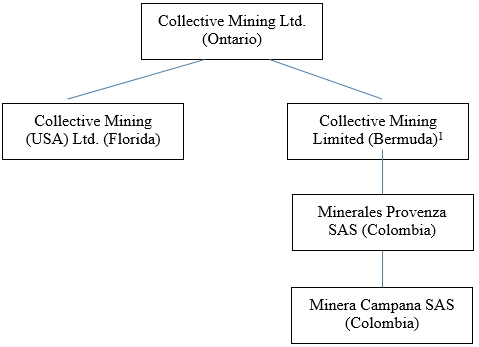
1 Includes the Collective Mining Limited Sucursal Colombia, a Colombian branch (“Branch”).
GENERAL DEVELOPMENT OF THE BUSINESS
Collective is a Canadian company listed on the TSX (the “TSX”) and the NYSE American LLC (“NYSE American”) under the symbol “CNL”. The Company’s long-term focus is on the acquisition, exploration, development and exploitation of mineral properties in which the Company’s exploration, development and operating expertise could substantially enhance shareholder value. The Company currently has one material exploration project which is the Guayabales project (the “Guayabales Project”) located in the Caldas department of Colombia. The Company also owns the San Antonio project also located in a historical gold district in the Caldas department of Colombia (the “San Antonio Project” and, together with the Guayabales Project, the “Colombia Projects”), however, the focus of the Company is on the Guayabales Project, which is currently its only material project. As at the date of this AIF, the Company has made a significant gold, copper, silver and tungsten discovery called the Apollo system, made other earlier stage discoveries such as the Trap target and generated a number of other targets at the Guayabales Project.
Three-Year History and Significant Acquisitions
2023
On March 22, 2023, the Company completed a “bought deal” offering of Common Shares for aggregate gross proceeds of approximately C$30 million. The offering was conducted by a syndicate of underwriters co-led by BMO Capital Markets and Clarus Securities Inc., and including Canaccord Genuity Corp., Cormark Securities Inc. and PI Financial Corp., and consisted of the sale of 7,060,000 Common Shares at a price of C$4.25 per Common Share.
5
On May 2, 2023, the Company filed an updated NI 43-101 technical report for the Guayabales Project. See “Guayabales Project”.
On September 6, 2023, the Company graduated from the TSX Venture Exchange to the TSX and the Common Shares commenced trading on the TSX effective market open on September 6, 2023 under its current stock symbol “CNL”.
On November 8, 2023, the Company appointed Angela María Orozco Gómez as a director of the Company. Mrs. Orozco Gómez is a seasoned executive with over 30 years of government and international experience. Most recently, Mr. Orozco Gómez was the Minister of Transport and Infrastructure, Colombia where she led various initiatives that secured public and private investments in the transportation and infrastructure industries. Mrs. Orozco Gómez has also been a partner in various private ventures that helped to represent industries in international trade disputes.
On December 6, 2023, the Company filed a final short form base shelf prospectus (the “2023 Shelf Prospectus”) with the securities regulatory authorities in each of the provinces and territories of Canada (other than Québec), following the completion of a regulatory review of the preliminary base shelf prospectus of the Company. The 2023 Shelf Prospectus permitted the Company to make offerings of common shares, warrants, subscription receipts, units or debt securities, or a combination thereof (the “Securities”), up to an aggregate total of C$200 million during the 25-month period that the 2023 Shelf Prospectus remained effective until January 2026. Securities were permitted be offered in amounts, at prices and on terms to be determined based on market conditions at the time of sale and set forth in one or more shelf prospectus supplement(s). Information regarding the use of proceeds from a sale of any Securities will be included in the applicable prospectus supplement(s).
2024
On March 4, 2024, the Company completed a strategic investment with Agnico Eagle Mines Ltd. (“Agnico Eagle”) on a non-brokered private placement basis consisting of the sale of 4,500,000 units (each a “March 2024 Unit”), at a price of $4.20 per March 2024 Unit for gross proceeds of C$18.9 million (the “March 2024 Private Placement”). Each March 2024 Unit was comprised of one Common Share and one-half of one Common Share purchase warrant (each whole warrant, a “Warrant”). Each Warrant will entitle the holder thereof to acquire one Common Share (a “Warrant Share”), subject to standard anti-dilution provisions, at a price of $5.01 per Warrant Share exercisable until 5:00 p.m. (Toronto time) on the date that is 36 months following the closing date of the offering (the “Warrant Term”), provided, however, that should the closing price at which the Common Shares trade equal to or exceed $6.00 for 20 consecutive trading days following the date that is 24 months after the Closing Date, the Company may accelerate the Warrant Term to the date which is 30 trading days following the date a notice is provided to holders of Warrants and a press release is issued by the Company announcing the accelerated Warrant Term.
In connection with the March 2024 Private Placement, the Company and Agnico Eagle entered into an investor rights agreement (the “Investor Rights Agreement”), pursuant to which Agnico Eagle is entitled to certain rights, provided Agnico Eagle maintains certain ownership thresholds in the Company, including: (a) the right to participate in equity financings and top-up its holdings in relation to dilutive issuances in order to maintain its pro rata ownership interest at the time of such financing or issuance or acquire up to a 9.99% ownership interest in the Company on a partially-diluted basis; and (b) the right to nominate one person (and in the case of an increase in the size of the board of directors of the Company (the “Board”) to eight or more directors, two persons) to the Board in the event that Agnico Eagle’s ownership interest in the Company exceeds and remains at or above 10%, on a partially-diluted basis.
On March 26, 2024, the Company announced the retirement of Dr. Ken Thomas from its Board effective April 10, 2024.
On July 22, 2024, the Common Shares commenced trading on NYSE American under the symbol “CNL” and ceased trading on the OTCQX.
6
On October 31, 2024, the Company completed a (i) “bought deal” offering of Common Shares, pursuant to a public offering in Canada (the “Public Offering”) and a private placement in the U.S. (together with the Public Offering, the “Offering”) and (ii) completed a non-brokered private placement (the “Concurrent Private Placement”) with Agnico Eagle for aggregate gross proceeds of approximately C$46.4 million including the exercise of the overallotment option. The Public Offering was conducted by a syndicate of underwriters led by BMO Capital Markets, as sole bookrunner, and including Clarus Securities Inc., Scotia Capital, among others. In aggregate, the Company issued 9,276,235 Common shares at a price of C$5.00 per share. The Concurrent Private Placement was completed to enable Agnico Eagle to top-up its ownership interest in the Company to approximately 9.99% on a partially-diluted basis after giving effect to the Offering, as required pursuant to the terms of the Investor Rights Agreement.
On December 16, 2024, the Company announced that Mr. Paul Murphy, a valued member of Collective’s Board, passed away.
2025
On February 6, 2025, the Company appointed Jasper Bertisen to its Board of Directors. Mr. Bertisen is a seasoned leader in the mining industry with a proven track record of successfully driving strategic initiatives. He has spent the majority of his career in mining private equity with Resource Capital Funds, overseeing due diligence and strategy execution for investments spanning development-stage to producing assets across various commodities and global markets. With extensive governance experience, Jasper has served on the boards of both private and public mining companies, as well as on the advisory boards of several mining technology companies. He is also an Adjunct Professor at the Colorado School of Mines and holds M.Sc. degrees in Mining Engineering and Mineral Economics.
On March 20, 2025, the Company completed a non-brokered private placement with Agnico Eagle pursuant to which Agnico Eagle subscribed for 4,741,984 Common Shares at a price of C$11.00 per Common Share for gross proceeds of C$52,161,824 (the “March 2025 Private Placement”). Concurrently with the closing of the March 2025 Private Placement, Agnico Eagle exercised all of the 2,250,000 Warrants it acquired in the March 2024 Private Placement at a price of $5.01 per Warrant Share for additional, aggregate consideration to the Company of C$11,272,500. On closing of the March 2025 Private Placement (and the exercise of the Warrants), Agnico Eagle owned 12,718,219 Common Shares, and no other securities of the Company, representing approximately 14.99% of the issued and outstanding Common Shares on a non-diluted basis.
Concurrent with the closing of the March 2025 Private Placement, the Investor Rights Agreement was amended (the “Amended and Restated Investor Rights Agreement”) to increase the ownership interest ceiling in the participation right and top-up right described above from 9.99% to 14.99% on a partially-diluted basis to match Agnico Eagle’s ownership level as at the closing of the March 2025 Private Placement.
On April 21, 2025, the Company implemented changes to its executive management team with the appointment of Ned Jalil as Chief Executive Officer, with former Chief Executive Officer Omar Ossma retaining his role as President and continuing to perform his same duties within the day-to-day operations of the Company. Ned Jalil is a seasoned mining executive with over 25 years of global experience across gold, silver, and key battery metals including copper and nickel. Ned has successfully led projects from exploration through to feasibility, construction and production. Ned has held senior executive roles with Kinross Gold (“Kinross”) and Appian Capital (“Appian”). As Chief Technical Officer at Kinross, Ned was instrumental in advancing key assets including the Great Bear project, where he delivered a 5-million-ounce initial resource, and Manh Choh, where he led a team that transitioned the asset from study to construction. At Appian, Ned led the construction and operational readiness of the MVV Copper-Gold Project, completing it ahead of schedule and under budget. Ned holds an MBA from the Kellogg-Schulich Executive MBA Program, along with Bachelor and Master degrees in mining engineering from Queen’s University. He is a licensed Professional Engineer and a qualified person under National Instrument 43-101 and brings a strong foundation of technical and academic excellence to his leadership roles.
On June 23, 2025, the Company announced that it accelerated its agreement with the vendor of the Guayabales mining license and as a result will affect the transfer of 100% of the mining license into its name. The Guayabales license, which host the Company’s flagship Apollo system, is one of three major contiguous licenses that make up the Company’s Guayabales Project, located in Caldas, Colombia. The original agreement for the Guayabales mining license was signed between the Company and the vendor in June 2020 and entitled the Company to earn a 100% ownership in the exploitation phase mining license in 2032 by making a series of scheduled payments and committing to certain exploration expenditures. Under the amendment, the total financial consideration owed to the vendor remains the same as the original agreement, however, the payment schedule was accelerated as follows:
| ● | $2 million payable immediately. |
| ● | An additional $2 million is payable within one month provided the title transfer request to the Colombian National Mining Agency (“ANM”) has been filed. |
7
| ● | An additional $2.3 million is payable within two months following the submission of the title transfer request. |
| ● | The remaining $3.5 million will be payable in six equal installments over the following three years from the date of the execution of the amendment to the agreement. |
On October 8, 2025, the Company completed its upsized “bought deal” public offering of 6,600,000 Common Shares at a price of C$19.00 per Share (the “Issue Price”) for aggregate gross proceeds of C$125,400,000 (the “October 2025 Public Offering”). The October 2025 Public Offering was conducted by a syndicate of underwriters led by BMO Capital Markets and Scotia Capital, as joint bookrunners, and including Clarus Securities Inc., Canaccord Genuity Corp., Roth Canada, Inc., Jett Capital Advisors, LLC, and Ventum Financial Corp. (collectively, the “Underwriters”), pursuant to the terms of an underwriting agreement entered into between the Company and the Underwriters on October 3, 2025. Concurrently with the closing of the October 2025 Public Offering, the Company completed a non-brokered private placement with Agnico, whereby Agnico purchased 789,473 Common Shares at the Issue Price for gross proceeds of approximately C$15 million (the “October 2025 Private Placement”), pursuant to the exercise of its participation rights in equity financings of the Company.
On December 31, 2025, the mining license transfer request process with the Colombian National Mining Agency (“ANM”) was completed and as a result the transfer of 100% of the mining license into the Branch’s name, thus the process is finalized. Furthermore, the Company notified the Guayabales Mining Association in December that it was exercising its right to pay the remaining USD $3.5 million as part of the original agreement to take full control of the mining title. A sum of USD $2.0 million was paid in December 2025, and the remaining balance of USD $1.5 million was to be paid at the end of January.
Events Subsequent to Year ended December 31, 2025
On January 13, 2026, the Company announced that further to its press release dated June 23, 2025, where it announced that it had accelerated its agreement with the vendor of the Guayabales mining license, that the transfer request process with the Colombian National Mining Agency (“ANM”) has been completed and as a result the transfer of 100% of the mining license into its name is finalized.
On January 19, 2026 the Company appointed Mr. Carlos Andrés Santos as Executive Vice President. Mr. Santos brings more than two decades of senior leadership experience in strategy, operations, transformation and corporate services across the Americas, with a strong track record in Colombia’s resource sector. Most recently, he served as CEO of Americas Business Services at Holcim / Amrize, where he spearheaded the region’s growth and cash-generation strategy across markets from Canada to Argentina. In this role, he led a team of over 1,400 employees and held full accountability for finance, procurement, sales, human resources and data management. Prior to Holcim / Amrize, Mr. Santos held key executive positions at Ecopetrol S.A., Colombia’s largest integrated energy company, including being the Vice President of Supply Chain & Shared Services. At Ecopetrol S.A., Mr. Santos directed large-scale strategic organizations with substantial budgets, driving efficiency, transparency and sustainability initiatives. Mr. Santos holds a degree in economics from Universidad Externado de Colombia and has completed postgraduate studies in international economics.
On March 1, 2026, the Company announced the appointment of Mr. Russell Evans as Executive Vice President Exploration. Mr. Evans brings international leadership and experience to Collective in mineral exploration and mining, having held senior roles at Newmont Mining Limited and Vedanta/Hindustan Zinc Limited. Mr. Evans holds a B.Sc. degree in Applied Geology (Hons.) from University of Technology in Sydney, Australia, and is a Fellow of the Australian Institute of Mining and Metallurgy (FAusIMM).
On March 11, 2026, the Company entered into binding purchase agreements with certain arms-length vendors in connection with: (i) the acquisition of the remaining surface rights required for future mining operations at the Guayabales Project (the “Guayabales Surface Rights Agreement”); and (ii) the acquisition of ancillary surface rights. The Company also holds the mineral titles, or options to acquire the mineral titles, over all areas where surface titles have been, or are being acquired for future mine development. Under the terms of the Guayabales Surface Rights Agreement, the Company agreed to acquire land for a total purchase price of US$34 million, to be paid in installments over a five year period as follows: (i) an aggregate of US$6.4 million in two instalments in 2026; (ii) an aggregate of US$7.8 million in two installments in 2027; (iii) an aggregate of US$6.4 million in two instalments in 2028; (iv) an aggregate of US$6.4 million in two instalments in 2029; and (v) an aggregate of US$6.4 million in two instalments in 2030. Beginning after the executive of the public deed, payments are also subject to additional annual accrued interest payment of 6.0%, and in the event that the Company receives approval from the relevant environmental agency for a mining operation and elects to begin construction prior to completing the final installments, certain outstanding installment payments shall become immediately due prior to the commencement of major mine construction activities.
8
Summary
As described above under “General Development of the Business”, the Company is a natural resource exploration company engaged in the business of acquisition, exploration, development and exploitation of mineral properties whose current efforts are focused on the exploration of the Colombian Projects. See “Guayabales Project”.
Specialized Skill and Knowledge
All aspects of the Company’s business require specialized skills and knowledge. Such skills and knowledge include the areas of geology, mining, metallurgy, environmental permitting, corporate social responsibility, finance, and accounting. The Company faces competition for qualified personnel with these specialized skills and knowledge, which may increase costs of operations or result in delays.
Competitive Conditions
The mineral exploration and mining business are extremely competitive. Competition is primarily for: (a) mineral properties that can be developed and operated economically; (b) technical experts that can find, develop and mine such mineral properties; (c) labour to operate the mineral properties; and (d) capital to finance development and operations. The Company competes with other mining companies, some of which have greater financial resources and technical facilities, for the acquisition of mineral concessions, claims, leases, and other interests, to finance its activities and in the recruitment and retention of qualified employees. The ability of the Company to acquire and develop precious metal properties will depend not only on its ability to raise the necessary funding but also on its ability to select and acquire suitable prospects for precious metal development and operation or metal exploration. See “Financing Risks” and “Competition” under “Risk Factors”.
Cycles
The Company’s business does not have any material cyclical or seasonal business lines.
Renegotiation or Termination of Contracts
Management of the Company does not anticipate that there will be any material renegotiations or terminations of existing contracts within the next 12 months.
Employees
As at the date of this AIF, the Company had 154 employees, which includes employees located in Canada, United States and Colombia. In addition, there were 529 contractors working on the Guayabales Project and the San Antonio Projects.
Bankruptcy and Similar Procedures
There have been no bankruptcy, receivership, or similar proceedings against the Company or any of its subsidiaries, or any voluntary bankruptcy, receivership, or similar proceedings by the Company or any of its subsidiaries, within the three most recently completed financial years or during or proposed for the current financial year.
Reorganizations
Other than the Business Combination, there have been no material reorganizations of the Company or any of its subsidiaries within the three most recently completed financial years or during or proposed for the current financial year.
9
Emerging Market Disclosure
Operations in an Emerging Market Jurisdiction
The Company’s mineral properties and principal business operations are located in a foreign jurisdiction, namely the Republic of Colombia. Operating in Colombia exposes the Company to various degrees of political, economic and other risks and uncertainties.
Board and Management Experience and Oversight
Key members of the Company’s management team and Board of directors have extensive experience running business operations in Colombia. Mr. Ari Sussman, the Executive Chairman of the Company, was Chief Executive Officer and a director of Continental Gold Inc. (“Continental Gold”), and Mr. Paul Begin, the Chief Financial Officer and Corporate Secretary of the Company, was Chief Financial Officer of Continental Gold, which was the largest gold mining company in Colombia and the first to successfully permit and construct a modern large-scale underground gold mine in the country. Continental Gold was a former Toronto Stock Exchange-listed issuer, from March 2010 until it was acquired by Zijin Mining Group Co., Ltd. in March 2020 for over C$1.4 billion.
Mr. Omar Ossma, the President of the Company, was the former Vice President, Legal of Continental Gold, and has over 20 years of legal experience in Colombian corporate, environmental, mining and energy law. As Vice President, Legal of Continental Gold, he oversaw the Colombian legal team and was responsible for all legal support efforts in the country.
Ms. Maria Constanza García Botero, an independent director of the Company, is a resident of Colombia, and has worked in public finance, urban development, infrastructure, mining, energy, and public-private partnerships (PPPs) as an advisor or in various management positions at the National Planning Department, the Ministry of Finance, and the National Hydrocarbons Agency. From 2010 to 2012 she served as the Deputy Minister of Infrastructure at the Ministry of Transport (Colombia), and from 2012 to 2014, served as President of the National Mining Agency, Ministry of Mining and Energy (Colombia).
Mrs. Angela María Orozco Gómez, an independent director of the Company, is a resident of Colombia and has 30 years of government and international experience. Most recently, Mrs. Orozco Gómez was the Minister of Transport and Infrastructure, Colombia where she led various initiatives that secured public and private investments in the transportation and infrastructure industries. Mrs. Orozco Gómez has also been a partner in various private ventures that helped to represent industries in international trade disputes.
Mr. Ashwath Mehra is a seasoned executive with over 35 years’ experience in the mineral industry. Mr. Mehra spent many years in the commodity trading and mining business as well as owning, buying and selling companies globally.
Mr. Jasper Bertisen is a seasoned leader in the mining industry with a proven track record of successfully driving strategic initiatives. He has spent the majority of his career in mining private equity with Resource Capital Funds, overseeing due diligence and strategy execution for investments spanning development-stage to producing assets across various commodities and global markets including in Colombia.
Mr. Ned Jalil, Chief Executive Officer, is also a seasoned executive in the mining industry with over 25 years of global experience across gold, silver, and key battery metals including copper and nickel. Ned has successfully led projects from exploration through to feasibility, construction and production including some projects located in South America.
Mr. Carlos Andrés Santos, Executive Vice President, is a resident of Colombia and has over 20 years experience in managing Colombian businesses. Most recently, Mr. Santos CEO of Americas Business Services at Holcim / Amrize, where he spearheaded the region’s growth and cash-generation strategy across markets from Canada to Argentina. In this role, he led a team of over 1,400 employees and held full accountability for finance, procurement, sales, human resources and data management. Prior to Holcim / Amrize, Mr. Santos held key executive positions at Ecopetrol S.A., Colombia’s largest integrated energy company, including being the Vice President of Supply Chain & Shared Services.
10
The Board, as well as management and consultants, are actively involved in technical activities, risk assessments and progress reports in connection with the Company’s exploration activities. The Colombian-resident Board and management members work directly with local contractors in an operational capacity, and are familiar with the laws, business culture and standard practices in Colombia, are fluent in Spanish, and are experienced in dealing with Colombian government authorities, including with respect to mineral exploration licensing, maintenance, and operations.
Non-Colombian independent directors typically visit Colombia to meet with local management at least once a year. Ari Sussman, who is a non-independent director, is frequently in Colombia meeting with local management and inspecting the Issuer’s properties.
Communication
While the reporting language of the head office of the Company is English, the primary operating language in Colombia is Spanish. Each member of the senior management team and Board of the Issuer speak English, which is the language spoken at all board meetings. The senior management team in Colombia together with Ms. García Botero and Mrs. Orozco Gómez, are bilingual in English and Spanish, and Mr. Sussman is fluent in English and conversationally fluent in Spanish. The Company maintains open communication with its Colombian operations through its partially bilingual Board, such that there are no language barriers between the Company’s management and local operations. Board materials are provided in English. Any translation of documents if required are made before the board materials are circulated to directors.
The Company’s management communicates with its in-country operations through phone and video calls and conferences, in-country work, meetings, e-mails, and regular reporting procedures. In addition, Collective retained Lloreda Camacho & Co., a law firm based in Bogota, Colombia, as its legal advisors for all Colombian related matters. Professionals at Lloreda Camacho & Co. acting on behalf of Collective are bilingual in both English and Spanish.
Controls Relating to Corporate Structure Risk
The Company has implemented a system of corporate governance, internal controls over financial and disclosure controls and procedures that apply to the Company, Collective Mining Limited (Bermuda) including the Branch and its two indirect Colombian subsidiaries, Minerales Provenza and Minera Campana (together with Minerales Provenza, the “Colombian Subsidiaries”), which are overseen by the Board and implemented by senior management.
The board of directors of the Bermuda Subsidiary is currently comprised of Paul Begin, Chief Financial Corporation of the Company, and two Bermudian residents, Adam Hopkins and Philip Anderson. The Company holds an annual meeting at which, among other business, the directors are appointed by the sole shareholder, being the Company. The Company also has the authority to call a special meeting to remove or appoint directors as they see fit in accordance with the by-laws of the Bermuda Subsidiary.
The relevant features of these systems include direct oversight over the Branch and the Colombian Subsidiaries’ operations by Omar Ossma, as the principal representative of each of the Colombian Subsidiaries and who is also the President of the Company. Since the Company indirectly holds all of the issued and outstanding equity interests of the legal entity that comprises the Branch and the Colombian Subsidiaries, the Company exercises effective control over the Branch and the management of each of the Colombian Subsidiaries, as well as its composition.
Executive management and the Board prepare and review the Colombian Subsidiaries’ financial reporting as part of preparing its consolidated financial reporting, and the Company’s independent auditors review the consolidated financial statements under the oversight of the Company’s Audit Committee.
The Company, as sole shareholder of the Bermudian Subsidiary, can call a board of directors meeting in accordance with its by-laws to remove and appoint any director or officer. Pursuant to applicable Colombian law, Colombian corporations (SAS) are not obligated to have directors. However, SAS companies must have legal representatives which are appointed and removed by the sole shareholder by means of a meeting and issuing a resolution removing and appointing legal representatives.
11
The Company is an exploration stage company and does not generate any revenue from operations. The Company raises capital at the parent level and funds the expenses of its subsidiaries on a monthly and on as-needed basis. In the event that the Company were to repatriate money back to the parent company (through the Bermuda Subsidiary), there are no restrictions to repatriate such funds to a foreign jurisdiction from Colombia.
Paul Begin and the Corporate Controller of the Company have over 10 years and five years respectively of experience with issuers operating in Colombia and are each familiar with both banking systems and controls between Canada and Colombia. Members of the Colombian finance team have multiple years of experience operating in Colombia and are familiar with Colombian banking practices. Differences in bank systems and controls are discussed with other members of management and the audit committee on an as needed basis.
Local Records Management
The minute books and corporate records of each of the Colombian Subsidiaries are maintained and held by the Company at Calle 3 sur N # 43a - 52, floor 5th Edificio Avenida 43, Medellin, Colombia. Senior management control these records and the Board and management team have full access.
Strategic Direction
While the exploration operations of each of the Branch and the Company’s subsidiaries are managed locally, the Board is responsible for the overall stewardship of the Company and, as such, supervises the management of the business and affairs of the Company. More specifically, the Board is responsible for reviewing the strategic business plans and corporate objectives, and approving acquisitions, dispositions, investments, capital expenditures and other transactions and matters that are material to the Company including those of its material subsidiaries.
Disclosure Controls and Procedures
The Company has a disclosure policy that establishes the protocol for the preparation, review and dissemination of information about the Company. This policy provides for multiple points of contact in the review of important disclosure matters, which includes input from Board members in Colombia.
CEO and CFO Certifications
In order for the Company’s Chief Executive Officer and Chief Financial Officer to be in a position to attest to the matters addressed in the quarterly and annual certifications required by National Instrument 52-109 – Certification of Disclosure in Issuers’ Annual and Interim Filings, the Company has developed internal procedures and responsibilities throughout the organization for its regular periodic and special situation reporting, in order to provide assurances that information that may constitute material information will reach the appropriate individuals who review public documents and statements relating to the Company and its subsidiaries containing material information, is prepared with input from the responsible officers and employees, and is available for review by the Chief Executive Officer and Chief Financial Officer of the Company in a timely manner.
Managing Cultural Differences
Differences in cultures and practices between Canada and Colombia are addressed by the engagement of Colombian-resident Board and management members, as well as local advisors, who have deep operational experience with the mineral exploration industry in Colombia and are familiar with the local laws, business culture and standard practices, have local language proficiency, are experienced in working in Colombia and in dealing with the relevant government authorities and have experience and knowledge of the local banking systems and treasury requirements. In addition, most of the Company’s management team members that are non Colombians have been involved in the Colombian mineral exploration and development industry for over 10 years through their involvement with Continental Gold (as further described above), developing an understanding of the relevant cultural differences and helping in mitigating potential risks from cultural differences.
12
Ari Sussman, the Executive Chaiman and Paul Begin, the Chief Financial Officer of the Company, have been operating in Colombia for over a decade and are knowledgeable on Colombian business and culture (in addition to Omar Ossma, the President of the Company, and Maria Constanza Garcia Botero and Angela Maria Orozco Gómez, each a director of the Company, who are each Colombian citizens and residents). In addition, while Jasper Bertisen was a Partner / team leader at Resource Capital Funds, he oversaw two portfolio companies with projects in Colombia. Differences in business culture and practices are discussed with other non-Colombian members of management and the board of directors as required.
Transactions with Related Parties
The Company is subject to applicable Canadian and United States securities laws and applicable exchange rules and Canadian accounting rules with respect to approval and disclosure of potential related party transactions and has procurement and other policies in place which it follows to mitigate risks associated with potential related party transactions. The Company may in the future transact with related parties from time to time, in which case such related party transactions may require disclosure in the consolidated financial statements of the Company and in accordance with applicable Canadian securities laws and accounting rules.
The Company’s major suppliers are: Kluane Colombia SAS (Drilling); ALS Colombia (Assays); Aziwell Colombia (Directional Drilling); Transrumbo Group (Transportation); and Logan Drilling Colombia (Drilling).
These suppliers were engaged through a thorough bidding process. Each of the above-named suppliers are arm’s length to the Company and not related in any way to the Company, its directors or executive officers.
Controls Relating to Verification of Property Interests
The Company engaged a local team with broad experience in mining exploration in Colombia, as well as in legal, social, and environmental matters. The lead team in Colombia was previously successful in licensing, building, and putting into operation other mining projects in Colombia. This contributed to obtaining an understanding of the framework surrounding the good standing of the Company’s properties and assets, from a legal, social, and environmental perspective.
The lead team was tasked with the negotiation and acquisition of properties that comprise the Colombian Projects. The current President of the Company, Mr. Omar Ossma, who led the negotiations and acquisitions of the Company’s current projects, is a licensed lawyer in Colombia, with more than 20 years of professional experience in Colombian corporate, environmental, mining and energy law, 15 of which have been dedicated to the mining and energy sectors. His knowledge of the legal framework of mineral properties and assets assisted the Company in negotiating and entering into legally binding agreements under Colombian law, ensuring the good standing of the Company’s rights over the acquired assets and properties.
The Company also retained an established and leading law firm based in Bogota, Colombia, as its legal advisors for all Colombian related matters, that is widely known for their mining practice. In addition to providing a wide array of legal services beginning from the date of incorporation of the Company’s Colombian subsidiaries, the law firm also prepared and delivered title opinions with respect to the Company’s current Colombian properties.
In addition, the Company retained two independent consulting firms specializing in the mining sector, with significant experience in social, engineering, environmental and other sustainability matters that prepared and delivered a due diligence report on the socio-economic and environmental conditions of the properties comprising the San Antonio option, as well as the first and second Guayabales options, and a baseline study report on the performance of certain socio-economic, health and safety measures in the property area.
The Laws and Requirements of Colombia
Omar Ossma, the President of the Company, is a Colombian lawyer by training and has more than 20 years of experience in Colombian law. Management holds regular meetings (both virtually and in person) and regularly discusses legal issues that impact the business of the Company. Furthermore, management retained a reputable legal firm based in Bogota (Lloreda Camacho & Co.) which consults with the Company on a regular and as-needed basis concerning Colombian legal matters that affect the business and operations of Colombia. Legal issues are then discussed with the Board when appropriate.
13
The role the government of Colombia has in the Company’s foreign operations
Management of the Company and the Colombian board members are experienced in navigating the Colombian political spectrum and interacts with the various levels of government on a regular basis. The state of Colombian politics are regularly discussed at board meetings.
License, Permitting and other Regulatory Approvals
Based on consultations with its local advisers and government authorities, the Company satisfied itself that it has obtained all required permits, licenses and other regulatory approvals to carry out its business in Colombia. The table set out below details which material permits, business licenses and other regulatory approvals are required for the Company to carry out its business operations in Colombia.
| Material permit, license and/or other regulatory approval required to conduct operations | Material permit, license and/or regulatory approval obtained by the Company | |
| Operating as a company requires a Public commercial registry before the Chamber of Commerce. This registry also activates a Tax Registry. | Obtained. | |
| Prospecting activities (all exploration excluding drilling) are free activities in Colombia, and require no permit, other than authorization for land access from private owner. | The Company generally negotiates land access permits in advance to its operations. Currently, the Company has all required land access permits for its current prospecting campaign. | |
| Drilling activities require a valid mining right and/or mining title granted by the National Mining Authority. | The Company is conducting exploration activities on mining titles LH0071-17, 781-17, HI8-15231, 501712 and IIS-10401 which are validly granted mining titles. | |
| Drilling activities will require authorization for land access from private owner. | The Company generally negotiates land access permits in advance to its operations. Currently, the Company has all required land access permits for its current drilling campaign. | |
| Exploration activities are not subject to environmental license. However, if the activities require the use of natural renewable resources (such as water catchments, dumpings and timbering, amongst others) the Company will require a filing, and further permission, before the regional environmental corporation in the territory. | The Company has been granted water rights for its drilling campaign, both in San Antonio and Guayabales projects, and may also recur to purchase water in bulk to perform its drilling campaign. | |
| Construction of a mining project, and its operation requires an environmental license granted by an environmental authority. | The Company is not currently in a position to advance either of its properties to the development and construction phase of a mining project, therefore it does not require an environmental license at this time. | |
| Construction of a mining project, and its operation requires a work plan approved by the applicable mining authority. | The Company is not currently in a position to advance either of its properties to the development and construction phase of a mining project, therefore it does not require a work plan at this time. |
As at the date of this AIF, no restrictions or conditions have been imposed by the government of Colombia on the Company’s ability to operate in Colombia. The Company’s continued ability to operate in Colombia could be impacted as a result of: (i) a drastic change in water conditions which may result in restrictions on already granted water rights; (ii) a breach of environmental commitments and/or regulations by the Company; (iii) the declaration of environmentally protected areas which could restrict mining activities on the Company’s current projects; or (iv) court ordered public hearings in regards to the presence of ethnic minorities on the Company’s properties. See “Risk Factors”.
14
The Company is engaged in the exploration, development and acquisition of mining properties and projects. Due to the high-risk nature of the Company’s business, the Company’s operations are speculative. The Company’s operations, properties and projects are subject to various risks and uncertainties, including but not limited to, those listed below. The risks described herein are not the only risk factors facing the Company and should not be considered exhaustive. Additional risks and uncertainties not currently known to the Company, or that the Company currently considers immaterial, may also materially and adversely affect the business, operations and condition, financial or otherwise, of the Company. These risk factors, together with all other information included or incorporated by reference in this AIF, including, without limitation, information contained in the section “Cautionary Statement Regarding Forward Looking Information” as well as the risk factors set out below, should be carefully reviewed by readers.
Some of the factors described herein, in the documents incorporated or deemed incorporated by reference herein, are interrelated and, consequently readers should treat such risk factors as a whole. If any of the adverse effects set out in the risk factors described herein or in another document incorporated or deemed incorporated by reference herein occur, it could have a material adverse effect on the business, financial condition and results of operations of the Company. The Company cannot assure you that it will successfully address any or all of these risks. There is no assurance that any risk management steps taken will avoid future loss due to the occurrence of the adverse effects set out in the risk factors herein, in other documents incorporated or deemed incorporated by reference herein or other unforeseen risks. These risk factors could materially affect the Company’s future operating results and could cause actual events to differ materially from those described in the Company’s forward-looking statements. Unless the context indicates or implies otherwise, references in this section to the “Company” include the Company and its subsidiaries.
Nature of Mineral Exploration
Resource exploration and development is a speculative business and involves a high degree of risk which even a combination of experience, knowledge and careful evaluation may not be able to overcome. The properties in which the Company holds an interest are without a known mineral resource or reserve. Each of the proposed programs on the properties is an exploratory search for resources or additional resources. There is no assurance that commercial quantities of resources will be discovered. There is also no assurance that even if commercial quantities of resources are discovered, a mineral property will be brought into commercial production. The discovery of mineral deposits is dependent upon a number of factors, not the least of which is the technical skill of the exploration personnel involved. The commercial viability of a mineral deposit, once discovered, is also dependent upon a number of factors, some of which are the particular attributes of the deposit, such as size, grade, ground conditions, metallurgy, proximity to infrastructure, community relations, metal prices and government regulations, including regulations relating to royalties, allowable production, importing and exporting of minerals, and environmental protection. The exact effect of these factors cannot be accurately predicted, but the combination of these factors may result in the Company not receiving an adequate return on invested capital. There is no certainty that the expenditures made by the Company towards the search and evaluation of mineral deposits will result in discoveries of economic commercial quantities of ore.
15
Foreign Country Risk
The Company’s principal mineral properties are located in rural Colombia. Over the past 15 to 20 years, the Government of Colombia has made strides in improving the social, political, economic, legal and fiscal regimes. However, operations in Colombia are still subject to risk due to the potential for social, political, economic, legal and fiscal instability. The government in Colombia faces ongoing problems including, but not limited to, unemployment and inequitable income distribution and unstable neighboring countries. The instability in neighboring countries could result in, but not be limited to, an influx of immigrants which could result in a humanitarian crisis and/or increased illegal activities. Colombia is also home to a number of insurgency groups and large swaths of the countryside are under guerrilla influence. In addition, Colombia experiences narcotics-related violence, a prevalence of kidnapping, extortion and thefts and civil unrest in certain areas of the country. Such instability may require the Company to suspend operations on its properties. There is a risk that agreements with the police and/or army are required and cannot be reached on time or on terms that are acceptable to the Company, which could result in an increase in security threats or loss of control at the project site that could have a material adverse effect on the Company.
Although the Company is not presently aware of any circumstances or facts which may cause the following to occur, other risks may involve matters arising out of the evolving laws and policies in Colombia, any future imposition of special taxes or similar charges, as well as foreign exchange fluctuations and currency convertibility and controls, the unenforceability of contractual rights or the taking or nationalization of property without fair compensation, restrictions on the use of expatriates in the Company’s operations, renegotiation or nullification of existing concessions, licenses, permits and contracts, illegal mining, changes in taxation policies, changes in mining and environmental laws or other matters.
Guerilla Activity
Colombia has experienced, and continues to experience, internal security issues, primarily due to the activities of guerrilla groups, drug cartels and criminal gangs. In rural regions of the country with minimal governmental presence, these groups have exerted influence over the local population, assassinated local social leaders, and funded their activities by protecting and rendering services to drug traffickers and participating in drug trafficking activities. Even though the Colombian Government’s programs and policies have reduced guerrilla and criminal activity, particularly in the form of terrorist attacks, homicides, kidnappings and extortion, such criminal activity persists in Colombia. Possible escalation of such activity and the effects associated with it may have a negative effect on the Colombian economy and on the Company, its employees, financial condition and results of operations The Government of Colombia reached a peace accord in 2016 with the country’s largest guerrilla group. During 2023, the Government of Colombia entered into formal discussions with another guerrilla group for a future peace accord, as well as seeking such agreements with other relevant illegal armed groups. In 2025, the Government of Colombia suspended discussions with the referred guerrilla group on account of disturbances in certain regions of Colombia. There is no clear agenda or date to initiate discussions. There is no certainty that the agreements will be adhered to by all of the members of the guerrilla groups or that a peace agreement will be ultimately reached with the country’s largest guerrilla group or the other existing illegal armed groups. There can also be no assurance that continuing attempts to reduce or prevent guerilla, drug trafficking or criminal activity will be successful or that guerilla, drug trafficking and/or criminal activity will not disrupt the Company’s operations in the future. There is a risk that any peace agreement might contain new laws or change existing laws that could have a material adverse effect on the Company’s projects. Furthermore, the achievement of peace with the country’s guerrilla groups or other illegal armed groups could create additional social or political instability in the immediate aftermath, which could have a material adverse effect on the Company as, among other things, the perception that matters have not improved in Colombia may hinder the Company’s ability to access capital in a timely or cost-effective manner.
See “Description of the Business – Emerging Market Disclosure”.
16
Foreign Operations
The Company’s exploration operations are located in Colombia. Colombia’s legal and regulatory requirements in connection with companies conducting mineral exploration and mining activities, banking system and controls as well as local business culture and practices are different from those in Canada. The officers and directors of the Company must rely, to a great extent, on the Company’s Colombian management, legal counsel and local consultants retained by the Company in order to keep abreast of material legal, regulatory and governmental developments as they pertain to and affect the Company’s business operations, and to assist the Company with its governmental relations. The Company must rely, to some extent, on the members of management and the Board who have previous experience working and conducting business in Colombia to enhance its understanding of and appreciation for the local business culture and practices in Colombia. The Company also relies on the advice of local experts and professionals in connection with current and new regulations that develop in respect of banking, financing and tax matters in Colombia. Any developments or changes in such legal, regulatory or governmental requirements or in local business practices in Colombia are beyond the control of the Company and may adversely affect its business.
The Company also bears the risk that changes can occur to the Government of Colombia and a new government may void or change the laws and regulations that the Company is relying upon. Currently, there are no restrictions on the repatriation from Colombia of earnings to foreign entities and Colombia has never imposed such restrictions. However, there can be no assurance that restrictions on repatriation of earnings from Colombia will not be imposed in the future. Exchange control regulations require that any proceeds in foreign currency originated on exports of goods from Colombia (including minerals) be repatriated to Colombia. However, purchase of foreign currency is allowed through any Colombian authorized financial entities for purposes of payments to foreign suppliers, repayment of foreign debt, payment of dividends to foreign stockholders and other foreign expenses.
Due to its locations in Colombia, the Company depends in part upon the performance of the Colombian economy. As a result, the Company’s business, financial position and results of operations may be affected by the general conditions of the Colombian economy, price instabilities, currency fluctuations, inflation, interest rates, regulatory changes, taxation changes, social instabilities, political unrest and other developments in or affecting Colombia over which the Company does not have control. Because international investors’ reactions to the events occurring in one emerging market country sometimes appear to demonstrate a “contagion” effect in which an entire region or class of investment is disfavoured by international investors, Colombia could also be adversely affected by negative economic or financial developments in other emerging market countries.
See “Description of the Business – Emerging Market Disclosure”.
Financing Risk
The Company has limited financial resources and has limited sources of operating cash flow. The Company will require additional funds to finance exploration and future acquisitions. The exploration and development of the various mineral properties in which the Company holds interests and the acquisition of additional properties depend upon the Company’s ability to obtain financing through equity financings, joint ventures of projects, stream financing, debt financing or other means. The perception that security conditions in Colombia have not improved and the decline in the capital markets for the extractive industry could hinder the Company’s ability to access capital in a timely or cost-effective manner. Although the Company has been successful in raising funds, including an aggregate of approximately C$227 million raised pursuant to four “bought deal” offerings completed in October, 2022, March, 2023, October, 2024 and October 2025 and approximately C$86 million raised pursuant to the March 2024 Private Placement, March 2025 Private Placement and October 2025 Private Placement, there can be no assurance that the Company will be able to raise additional financing required or that such financing will be available on terms acceptable to the Company. Failure to obtain additional financing on a timely basis may result in delays or an indefinite postponement of exploration, development, or production on any or all of the Company’s properties, could cause the Company to reduce or terminate its operations or lose its interests in its properties and cease to continue as a going concern.
In addition, there can be no assurance that future financing can be obtained without substantial dilution to existing shareholders. The issuance of additional securities and the exercise of common share purchase warrants, stock options and other convertible securities will result in dilution of the equity interests of any persons who are or may become holders of Common Shares.
17
Property Interests
The ability of the Company to carry out successful mineral exploration, development and production activities will depend on a number of factors. The Company has a number of obligations with respect to acquiring and maintaining the Company’s interest in certain of its current properties. No guarantee can be given that the Company will be in a position to comply with all such conditions and obligations, or to require third parties to comply with their obligations with respect to such properties. Furthermore, while it is common practice that permits and licenses may be renewed, extended or transferred into other forms of licenses appropriate for ongoing operations, no guarantee can be given that any such renewal, extension or transfer will be granted to the Company or, if they are granted, that the Company will be in a position to comply with all conditions that are imposed. Some of the Company’s interests are the subject of pending applications to register assignments, extend the term, and increase the area or to convert licenses to concession contracts and there is no assurance that such applications will be approved as submitted.
There is no assurance that the Company’s rights and foreign interests will not be revoked or significantly altered to the detriment of the Company.
No Assurance of Titles or Boundaries
The Company is not the registered holder of all of the licences or concessions that comprise its projects in Colombia. Some of the licences and concessions that comprise the Company’s projects in Colombia are registered in the names of certain third-party entities. The Company’s interest in the Colombia Projects is partially derived from option agreements. Under the option agreements, third parties have agreed to transfer the licences and concessions that comprise such properties to the Company upon satisfaction of certain conditions including but not limited to the receipt of all of the option payments. Also, events may occur that would prevent the third-party entities from being able to transfer such licences and concessions to the Company. In addition, in the event of a dispute between the parties, the Company’s only recourse would be to commence legal action in Colombia. If the Company is required to commence legal proceedings, there is no assurance that the Company will succeed in such proceedings, and, therefore, may never obtain title to such properties.
Other parties may dispute title to any of the Company’s mineral properties or land titles, any of the Company’s properties may be subject to prior unregistered agreements, transfers or claims, and title may be affected by, among other things, undetected encumbrances or defects or governmental actions or errors. A successful challenge to the precise area and location of the Company’s projects could result in the Company being unable to operate on its properties as permitted or being unable to enforce its rights with respect to its properties.
Land Surface and Access Rights
Even though the Company has advanced in the acquisition of surface rights relevant to its ongoing operations, as well as a future mine, it does not own all of the surface rights required to build a future project. There is a risk that the Company will not be able to purchase all of the surface rights from third parties or on terms that are acceptable to the Company. Additionally, Colombia Law 1448/2011 compensates, with land restitution, communities that have been displaced as a result of political violence. In the event that the Company is impacted by application of Law 1448/2011, it has the right to begin an expropriation process available under Colombian law, although the process could take longer than expected. Although the Company does not expect the effects of Law 1448/2011 to impact the Company, there is a risk that land near or on the Company’s projects could be impacted, which could have a material adverse effect on the Company.
In order for the Company to conduct exploration including but not limited to surface reconnaissance work, mapping and drilling, it requires permission from third party owners of land. There is a risk that the Company will not be able to negotiate land access rights from third party landowners, which would have a material adverse effect on the Company’s exploration activities. Even though not a common practice, the Company may rely on judicial proceedings to obtain rights of way on third party land.
The Company has a number of option agreements with third parties for surface rights (property and/or adverse possession) which are payable over a number of years. There is a risk that title will not be transferred to the Company by the third party at the termination of the option agreements in which case the Company’s only recourse would be through legal actions, or by application of mining expropriation. Enforcing contracts through legal avenues, or applying expropriation will take years to resolve. If any of these events occur, it could have a material negative impact on the Company.
18
In addition, the Company is purchasing surface rights or entering into option agreements for surface rights in rural Colombia where land titles are characterized by adverse possession rights and not necessarily by land deeds. Although the Company performs due diligence to ensure that adverse possession rights belong to the third parties that it enters into contracts with, there is a chance that another third party could claim the same possession rights or ownership with a deed which could have a material negative effect on the Company.
Decree 044
On January 30, 2024, the Colombian Ministry of Environment issued Decree 044 which allows the Ministry to declare temporary reserve areas in certain parts of Colombia. To declare a temporary reserve area, a resolution must be issued by the Ministry detailing the area that is to be temporarily reserved. Pursuant to this decree, a subsequent resolution may mandate a five-year suspension of environmental license awards, extendable for a further five years, while studies are conducted to determine if an area should be restricted or excluded from mining. However, this decree does not limit the possibility to continue environmental studies in a mandated area. Decree 044 is presently being challenged at constitutional and administrative courts, led by the Colombian Disciplinary Office, artisanal and small mining units, the Colombian Mining Trade Association and the National trade association. Decree 044 does not currently adversely impact operations at Guayables or San Antonio.
Artisanal Mining
The Company’s properties are located in Colombia in an area that has a long history of artisanal mining. A portion of the Company’s property include artisanal groups that are mining informally on a small-scale basis. The Company is committed to respecting their rights and to assist them in formalizing, however, there is no assurance that this process will be successful or that they will not oppose the Company’s exploration activities or potential future development. There is also a risk that the number of informal miners could increase in the future resulting in a material adverse effect on the Company. In addition, artisanal mining accidents occur and, in some cases, result in serious injury or death. While the Company is not responsible for artisanal mining operations including their health and safety standards, an artisanal mining accident could be perceived as the Company’s responsibility which could have a material adverse effect on the Company.
Community Relations
Maintaining a positive relationship with the communities in which the Company operates is critical to continuing successful exploration and development. There can be no assurances that the Company will be successful at managing these impacts and that actions of other mining companies will not have a negative impact on the Company’s ability to manage these impacts. Community support for operations is a key component of a successful exploration or development project. Various international and national laws, codes, resolutions, conventions, guidelines and other materials relating to corporate social responsibility (including rights with respect to health and safety and the environment) may also require government consultation with communities on a variety of issues affecting local stakeholders, including the approval of mining rights or permits. The Company may come under pressure in the jurisdictions in which it explores or develops to demonstrate that other stakeholders benefit and will continue to benefit from its commercial activities. Local stakeholders and other groups may oppose the Company’s current and future exploration, development and operational activities through legal or administrative proceedings, protests, roadblocks or other forms of public expression against the Company’s activities. Opposition by such groups may have a negative impact on the Company’s reputation and its ability to receive necessary mining rights or permits. Opposition may also require the Company to modify its exploration and development plans or enter into agreements with local stakeholders or governments with respect to its projects. Any of these outcomes could have a material adverse effect on the Company’s business, financial condition, results of operations and Common Share price.
Minority Ethnic Groups
Various international and national laws, codes, resolutions, conventions, guidelines, and other materials relate to the rights of minority ethnic groups. Many of these materials impose obligations on government to respect the rights of minority ethnic groups. Some mandate that government consult with minority ethnic groups regarding government actions which may affect minority ethnic groups, including actions to approve or grant mining rights or permits. The obligations of government and private parties under the various international and national materials pertaining to Minority Ethnic Groups continue to evolve and be defined. The Company’s current or future operations are subject to a risk that one or more groups of minority ethnic groups may oppose continued operation, further development, or new development on those projects or operations on which the Company holds an exploration right. Such opposition may be directed through legal or administrative proceedings or protests, roadblocks, public hearings or other forms of public expression against the Company or the owner/operator’s activities. Opposition by minority ethnic groups to such activities may require modification of or preclude operation or development of projects or may require entering into agreements with minority ethnic groups. Claims and protests of minority ethnic groups may disrupt or delay activities of the owners/operators of the Company’s exploration assets.
19
Dependence on Key Management Employees
The Company’s exploration programs will depend on the business and technical expertise of key executives, including the directors of the Company and a small number of highly-skilled and experienced executives and personnel. Due to the relatively small size of the Company, the loss of any of these individuals or the Company’s inability to attract and retain additional highly skilled employees may adversely affect its business and future operations. The Company does not have key man insurance in place with respect to any of these individuals.
Labour and Employment Matters
While the Company has good relations with its employees, these relations may be impacted by changes in labour laws which may be introduced by the relevant governmental authorities in jurisdictions in which the Company carries on business. Adverse changes in such legislation may have a material adverse effect on the Company’s business, results of operations and financial condition.
The Company’s workforce is not governed by a minority union or a cooperative agreement. Although labour relations with its employees have been good, there is no assurance that this will continue in the future or that employees will not attempt to organize in the future. Any significant disruption in labour arrangements could have a material adverse effect on the Company’s reputation and its ability to continue to operate.
Non-Governmental Organization Intervention
The Company’s relationship with the communities in which it operates is critical to ensure the future success of its existing operations. A number of non-governmental organizations are becoming increasingly active in Colombia as the security and safety in Colombia increases and the Government implements the peace accords. These organizations may create or inflame public unrest and anti-mining sentiment among the inhabitants in areas of mineral development. Such organizations have been involved, with financial assistance from various groups, in mobilizing sufficient local anti-mining sentiment to protest and even prevent the issuance of required permits for the development of mineral projects of other companies. While the Company is committed to operating in a socially responsible manner, there is no guarantee that the Company’s efforts in this respect will mitigate this potential risk.
Open Pit Mining
The Company operates in Colombia which has a long history of open pit mining operations, as well as a current and in force legal framework which allows for open pit mining. Despite this and the fact that the government has recently issued a number of open pit mining permits, there can be a perception or misinformation that is prevalent in the media or social media that insinuates that open pit mining is banned in Colombia. While the Company uses extensive means to counter this misinformation, it is possible that even the perception of banning open pit mining in Colombia could make it difficult for the Company to raise capital and could have a material adverse effect on the Company.
Foreign Currency Fluctuations
The Company’s current and proposed exploration in Colombia render it subject to foreign currency fluctuations, which may materially affect its financial position and results. The Company’s reporting currency is the U.S. dollar, which is exposed to fluctuations against other currencies. In addition, the Company maintains cash accounts in Canadian dollars, U.S. dollars and Colombian pesos and has monetary assets and liabilities in U.S. and Canadian dollars and Colombian pesos. The important exchange rates for the Company are currently the rate between the U.S. dollar and the Colombian peso and the Canadian dollar and the U.S. dollar. While the Company is funding work in Colombia, the Company’s results of operations are subject to foreign currency fluctuation risks and such fluctuations may adversely affect the financial position and operating results of the Company. The Common Shares are traded on the TSX, a Canadian stock exchange and NYSE American, a United States stock exchange. Prior and future equity financings result in the generation of Canadian dollar proceeds to fund the Company’s activities, which are principally incurred in U.S. dollars or Colombian pesos. To the extent funds from such financings are maintained in Canadian dollars, the Company’s results can be significantly impacted by adverse changes in exchange rates between the Canadian dollar and the U.S. dollar and Colombian peso. From time to time, to partially mitigate transactional volatility in the U.S. dollar and Colombian peso, the Company may enter into foreign currency instruments in order to partially offset existing currency exposures.
20
Cybersecurity Risks
Cyber threats have evolved in severity, frequency and sophistication in recent years, and target entities are no longer primarily from the financial or retail sectors. The Company is reliant on the continuous and uninterrupted operations of its information technology (“IT”) systems. User access and security of all IT systems are critical elements to the operations of the Company. Protection against cyber security incidents and cloud security, and security of all of the Company’s IT systems, are critical to the operations of the Company. These IT systems could be subject to network disruptions caused by a variety of sources, including computer viruses, security breaches and cyber-attacks, as well as disruptions resulting from incidents such as cable cuts, damage to physical plants, natural disasters, terrorism, fire, power loss, vandalism and theft or other compromising of confidential or otherwise protected information. The Company’s operations also depend on the timely maintenance, upgrade and replacement of networks, equipment, IT systems and software, as well as pre-emptive expenses to mitigate the risks of failures. Any of these and other events could result in IT system failures, delays and/or increase in capital expenses. The failure of IT systems or a component of information systems could, depending on the nature of any such failure, adversely impact the Company’s reputation and results of operations. The Company stores all of its proprietary data on cloud servers including, but not limited to, financial records, drilling databases, technical information, legal information, licences and human resource records. There is no assurance that third parties will not illegally access these records which could have a material adverse effect on the Company.
Social Media
As a result of the increased usage and the speed and global reach of social media and other web-based tools used to generate, publish and discuss user-generated content and to connect with other users, companies today are at much greater risk of losing control over how they are perceived in the marketplace. Damage to reputation can be the result of the actual or perceived occurrence of any number of events, and could include any negative publicity (for example, with respect to handling of environmental matters or the Company’s dealings with community groups), whether true or not. The Company places a great emphasis on protecting its image and reputation, but the Company does not ultimately have direct control over how it is perceived by others. Reputation loss may lead to increased challenges in developing and maintaining community relations, decreased investor confidence and an impediment to its overall ability to advance its projects, thereby having a material adverse impact on financial performance, cash flows and growth prospects.
Health and Safety Risk
Mining and exploration, like many other extractive natural resource industries, is subject to potential risks and liabilities due to accidents that could result in serious injury or death. The impact of such accidents could affect the profitability of the operations, cause an interruption to operations and development, lead to a loss of licenses, affect the reputation of the Company and its ability to obtain further licenses, damage community relations and reduce the perceived appeal of the Company as an employer. The Company has some procedures in place to manage health and safety protocols to reduce the risk of occurrence and the severity of any accident and plans to invest time and resources in the future to enhance health and safety at all operations.
The Company has limited insurance policies in place to cover some accidents and regularly monitors the adequacy of such policies; however, not all risks are covered by insurance policies due to either coverage not being available or not being available at commercially reasonable prices.
21
Criminal Mining
The Company operates in Colombia where criminal mining exists in certain parts of the country. Criminal mining is distinct from artisanal mining where local residents with long-standing mining operations have earned a right to continue operating and earning a living provided they meet certain historical, technical, environmental and legal requirements. Criminal mining is often backed by criminal organizations who use mining to achieve illegal means including but not limited to the laundering of money. The Company’s properties do not have criminal mining activities, however, there is no assurance that criminal mining will not appear in the future which could have a material adverse effect on the Company.
Limited Operating History
The Company has no history of generating profits. The Company expects to continue to incur losses unless and until such time as it develops its properties and commences operations on its properties. The development of the properties will require the commitment of substantial financial resources. The amount and timing of expenditures will depend on a number of factors, some of which are beyond the Company’s control, including the progress of ongoing exploration, studies and development, the results of consultant analysis and recommendations, the rate at which operating losses are incurred and the execution of any joint venture agreements with strategic parties, if any. There can be no assurance that the Company will generate operating revenues or profits in the future.
Special Skill and Knowledge
Various aspects of the Company’s business require specialized skills and knowledge. Such skills and knowledge include the areas of permitting, geology, drilling, metallurgy, logistical planning and implementation of exploration and development programs as well as finance and accounting. The Company has been able to recruit and retain employees and consultants with the necessary skills and knowledge. The Company believes it will continue to be able to do so; however, no assurance can be made in that regard.
Environmental and Other Regulatory Requirements
All phases of the Company’s operations are subject to environmental regulation (including environmental impact assessments and permitting). Environmental legislation and international standards are continually evolving in a manner which will require stricter standards and enforcement, increased fines and penalties for non-compliance, more stringent environmental assessments of proposed projects and a heightened degree of responsibility for companies and their officers, directors and employees. There have been a number of recent regulatory changes in Colombia and the Company expects additional regulatory changes, new interpretations and possibly enhanced enforcement to occur in the future. There is no assurance that the Company can or will be able to meet all standards on time, which could adversely affect the Company’s business, financial condition or operations.
Environmental hazards may exist on the properties in which the Company holds interests which are unknown to the Company at present, and which have been caused by artisanal miners or previous or existing owners or operators of the properties. In addition, the Company has acquired a mining concession contract where a small-scale mine was in operation which gives rise to potential health and safety risks, environmental risks or liabilities that could affect the property or the Company. To mitigate these risks, the Company is evaluating the environmental and health and safety practices, monitoring site conditions, and assessing the need for any remediation measures. The Company is also reviewing applicable legal agreements and regulatory frameworks to ensure that responsibilities and liabilities are clearly defined and, where appropriate, has initiated discussions with the operator to align environmental practices with applicable standards and regulatory expectations.
Failure to comply with applicable laws, regulations, permitting and zoning requirements may result in enforcement actions thereunder, including orders issued by regulatory or judicial authorities causing operations to cease or be curtailed, and may include corrective measures requiring capital expenditures, installation of additional equipment, or remedial actions. Parties engaged in mining operations or in the exploration, development or production of mineral properties may be required to compensate those suffering loss or damage by reason of the mining activities and may have civil or criminal fines or penalties imposed for violations of applicable laws or regulations. Amendments to current laws, regulations and permits governing operations and activities of mining and exploration companies, or more stringent implementation of existing laws, could have a material adverse impact on the Company and cause an increase in exploration expenses or capital expenditures or require abandonment or delays in the development of new exploration properties.
22
It is not possible for the Company to accurately predict changes in laws or policy or the extent to which any such developments or changes may have a material adverse effect on the Company's operations. Failure to comply strictly with applicable laws, regulations and local practices relating to mineral rights applications and tenure could result in loss, reduction or expropriation of entitlements, or the imposition of additional local or foreign parties as joint venture partners with carried or other interests. The occurrence of any of these various factors and uncertainties cannot be accurately predicted and could have an adverse effect on the properties, business, operations, or financial condition of the Company.
In addition, in the event of a dispute arising from foreign operations, the Company may be subject to the exclusive jurisdiction of foreign courts or may not be successful in subjecting foreign persons to the jurisdiction of courts in Canada.
The Company cannot give any assurances that breaches of environmental laws (whether inadvertent or not) or environmental pollution will not materially or adversely affect its financial condition. There is no assurance that future changes to environmental regulation, if any, will not adversely affect the Company.
In the future, the Company may require, from time to time, various approvals including, but not limited to, the approval from the National Environmental Licensing Authority (ANLA in Spanish) or the regional environmental authority for environmental permits. There is no assurance that the Company will receive such approvals or receive them within a reasonable time period.
Decommissioning and Reclamation Costs
The Company is currently in the exploration stage, and as such, a formal decommissioning and reclamation plan has not yet been established. Management anticipates that such a plan, along with a corresponding cost estimate and regulatory filing, will be developed in accordance with applicable environmental and mining regulations prior to the commencement of any construction or development activities. The costs associated with future decommissioning and reclamation could be significant and are subject to change based on site-specific conditions, evolving regulations, and project scope. If the Company is required to comply with more stringent requirements or if actual reclamation costs are materially higher than anticipated, this could have a material adverse effect on the Company’s future cash flows, earnings, and financial condition.
The Company has recently acquired a mining concession contract that includes a small-scale mine and processing plant, two small tailings ponds, and a waste dump, which was operated by a third party within the boundaries of the property, which could give rise to potential environmental risks or future liabilities associated with decommissioning and reclamation costs. The Company is in the process of evaluating the legal and environmental implications of this third-party operation and intends to implement appropriate monitoring and risk mitigation measures to address any potential obligations that may arise.
Control of the Company
Mr. Ari Sussman, the Executive Chairman and a director of the Company, is also a principal shareholder of the Company. Mr. Sussman owns or controls, directly or indirectly, 11,003,600 Common Shares representing approximately 11.9% of the issued and outstanding Common Shares on a non-diluted basis. By virtue of his status as a principal shareholder of the Company, and by being an executive officer and a director of the Company, Mr. Sussman has the power to exercise significant influence over all matters requiring shareholder approval, including the election of directors, amendments to the Company’s articles and by-laws, mergers, business combinations and the sale of substantially all of the Company’s assets. As a result, the Company could be prevented from entering into transactions that could be beneficial to the Company or its other shareholders, and third parties could be discouraged from making a take-over bid. In addition, sales by Mr. Sussman of a substantial number of Common Shares could cause the market price of the Common Shares to decline.
Investors’ Ability to Exercise Statutory Rights and Remedies under Canadian Securities Laws
The Company is incorporated under the laws of the Province of Ontario. However, the subsidiaries of the Company are organized under the laws of jurisdictions outside of Canada, in particular Bermuda and Colombia, and certain of the officers and directors of the Company reside outside of Canada. This may limit an investor’s ability to exercise statutory rights and remedies under Canadian laws. In particular, a Canadian court may determine that it does not have jurisdiction over a claim by an investor against one of the Company’s subsidiaries and/or its officers and directors, or that another international jurisdiction is the more convenient forum to adjudicate the claim. Similarly, extraterritorial jurisdiction for violations of U.S. securities laws may be unavailable.
23
Difficulty in Enforcement of Judgments
The Company has subsidiaries incorporated in Bermuda and Colombia. Certain directors and officers of the Company reside outside of Canada and substantially all of the assets of these persons are located outside of Canada. It may not be possible for shareholders to effect service of process against the Company’s directors and officers who are not resident in Canada. In the event a judgment is obtained in Canada against one or more of the directors or officers of the Company for violations of Canadian securities laws or otherwise, it may not be possible to enforce such judgment against those directors and officers not resident in Canada. Additionally, it may be difficult for an investor, or any other person or entity, to assert Canadian securities law claims or otherwise in original actions instituted in Bermuda or Colombia. Courts in these jurisdictions may refuse to hear a claim based on a violation of Canadian securities laws or otherwise on the grounds that such jurisdiction is not the most appropriate forum to bring such a claim. Even if a court in an international jurisdiction agrees to hear a claim, it may determine that the local law, and not Canadian law, is applicable to the claim. If Canadian law is found to be applicable, the content of applicable Canadian law must be proven as a fact, which can be a time-consuming and costly process. Certain matters of procedure will also be governed by the law in the relevant international jurisdiction.
Negative Operating Cash Flow
To date the Company has recorded no operating cash flow and the Company has not commenced development or commercial production on any property. There can be no assurance that significant losses will not occur in the near future or that the Company will be profitable in the future. The Company’s operating expenses and capital expenditures may increase in subsequent years as consultants, personnel and equipment are retained associated with advancing exploration, development and commercial production of the Company’s properties. The Company expects to continue to incur losses unless and until such time as it enters into commercial production and generates sufficient revenues to fund its continuing operations. The development of the Company’s properties will require the commitment of substantial resources to conduct time-consuming exploration and development. There can be no assurance that the Company will ever generate positive operating cash flow or achieve profitability.
Compliance with Anti-Corruption Laws
The Company is subject to various anti-corruption laws and regulations including, but not limited to, the Canadian Corruption of Foreign Public Officials Act and the Foreign Corrupt Practices Act of 1977, a United States federal law, as well as similar laws in countries in which the Company or its contract counterparties conduct their operations or business. In general, these laws prohibit a company and its employees and intermediaries from bribing or making other prohibited payments to foreign officials or other persons to obtain or retain business or gain some other business advantage. The Company’s primary operations are located in Colombia and, according to Transparency International, Colombia is perceived as having fairly high levels of corruption relative to Canada. The Company cannot predict the nature, scope or effect of future regulatory requirements to which its operations might be subject or the manner in which existing laws might be administered or interpreted.
Failure to comply with the applicable legislation and other similar foreign laws could expose the Company and its senior management to civil and/or criminal penalties, other sanctions and remedial measures, legal expenses and reputational damage, all of which could have a material adverse effect on the Company’s business, financial condition and results of operations. Likewise, any investigation of any potential violations of the applicable anti-corruption legislation by Canadian, U.S. or foreign authorities could also have an adverse impact on the Company’s business, financial condition and results of operations, as well as on the market price of the Common Shares. As a consequence of these legal and regulatory requirements, the Company instituted policies with regard to its anti-corruption policies. There can be no assurance or guarantee that such efforts have been and will be completely effective in ensuring the Company’s compliance, and the compliance of its employees, consultants, contractors and other agents, with all applicable anti-corruption laws.
Tariffs, sanctions, restrictions on imports or other trade barriers between the United States and various countries, most significantly China, may impact future results of operations.
Political changes and trends such as populism, protectionism, economic nationalism and sentiment toward internationally operating companies, and resulting tariffs, export controls, trade sanctions, sanctions blocking statutes, or other trade barriers, or changes to tax or other laws and policies, may be disruptive to our business in the future, by potentially interfering with international sales of products, supply chain, production costs, customer relationships, and competitive position. For example, the U.S. government has imposed tariffs on goods from a variety of countries, including China, Canada, Mexico and others. Further escalation of specific trade tensions, such as those between the United States and China, or in global trade conflict more broadly could be harmful to global economic growth, and related decreases in confidence or investment activity in the global markets could adversely affect our future business performance, especially since the Corporation’s projects are based in an emerging market jurisdiction, where economic, political, and legal risks may be heightened.
24
Regulatory Obligations as a Public Company
The Company is subject to evolving corporate governance and public disclosure regulations that have increased both the Company’s compliance costs and the risk of non-compliance, which could adversely affect the Company’s share price. The Company is subject to changing rules and regulations promulgated by a number of governmental and self-regulated organizations, including Canadian securities administrators, the U.S. Securities and Exchange Commission (the “SEC”), the applicable stock exchange(s), including the TSX and NYSE American, and the International Accounting Standards Board (“IASB”). These rules and regulations continue to evolve in scope and complexity creating many new requirements. For example, (i) the Canadian Extractive Sector Transparency Measures Act (“ESTMA”) and (ii) Rule 13q-1 (“Rule 13q-1”) under the Securities Exchange Act of 1934, as amended, each mandates the public disclosure by the Company of payments over certain specified dollar amounts made by extractive companies, to all levels of domestic and foreign governments (under ESTMA) and to foreign governments and the federal government of the United States (under Rule 13q-1). The Company’s efforts to comply with increasing regulatory burdens could result in increased general and administration expenses and a diversion of management’s time and attention from revenue-generating activities to compliance activities. If the Company becomes subject to an enforcement action or is in violation of ESTMA or Rule 13q-1, this may result in significant penalties, fines and/or sanctions, which may have a material adverse effect on the Company’s reputation. The Company will continue to be required to comply with ESTMA and Rule 13q-1 reporting requirements.
Risks Related to Our Qualification as a Foreign Private Issuer
The Company is a “foreign private issuer”, as such term is defined in Rule 3b-4 under the United States Securities Exchange Act of 1934, as amended (“U.S. Exchange Act”) and in Rule 405 under the United States Securities Act of 1933, as amended (the “Securities Act”), and is permitted, under a multijurisdictional disclosure system adopted by the United States and Canada, to prepare its disclosure documents filed under the U.S. Exchange Act in accordance with Canadian disclosure requirements. Under the U.S. Exchange Act, the Company is subject to reporting obligations that, in certain respects, are less detailed and less frequent than those of U.S. domestic reporting companies. As a result, the Company does not file the same reports that a U.S. domestic issuer would file with the SEC, although the Company is required to file or furnish to the SEC the continuous disclosure documents that it is required to file in Canada under Canadian securities laws. In addition, the Company’s officers, directors and principal shareholders are exempt from the reporting and short swing profit liability provisions of section 16 of the U.S. Exchange Act. Therefore, shareholders may not know on a timely a basis when the Company’s officers, directors and principal shareholders purchase or sell shares, as the reporting deadlines under the corresponding Canadian insider reporting requirements are generally longer. As a result of this exemption, shareholders may not have the same rights and protections as they would if the Company were subject to all of the obligations of a U.S. domestic issuer.
As a foreign private issuer, the Company is exempt from the rules and regulations under the U.S. Exchange Act related to the furnishing and content of proxy statements. The Company is also exempt from Regulation FD, which prohibits issuers from making selective disclosures of material non-public information. While the Company will comply with the corresponding requirements relating to proxy statements and disclosure of material non-public information under Canadian securities laws, these requirements differ from those under the U.S. Exchange Act and Regulation FD, and shareholders should not expect to receive the same information at the same time as such information is provided by U.S. domestic companies.
In addition, as a foreign private issuer, the Company has the option to follow certain Canadian corporate governance practices, except to the extent that such laws would be contrary to U.S. securities laws, and provided that the Company discloses the requirements it is not following and describes the Canadian practices that it follows instead. The Company currently relies on this exemption with respect to certain corporate governance practices. See “NYSE American Corporate Governance”. As a result, the Company’s shareholders may not have the same protections afforded to shareholders of U.S. domestic companies that are subject to all corporate governance requirements.
25
As the Company continues to increase its presence in the United States, it may cease to qualify as a foreign private issuer. Although the Company has elected to comply with certain United States regulatory provisions, the loss of foreign private issuer status would make such compliance mandatory. The regulatory and compliance costs to the Company under securities laws as a United States domestic issuer would be significantly more than the costs incurred as a Canadian foreign private issuer. If the Company were not a foreign private issuer, it would not be eligible to use foreign issuer forms and would be required to file periodic and current reports and registration statements on United States domestic issuer forms with the SEC, which are generally more detailed and extensive than the forms available to a foreign private issuer. In addition, the Company may lose its ability to rely upon exemptions from certain corporate governance requirements on United States stock exchanges that are available to foreign private issuers.
Risks Relating to the Company’s Status as an “Emerging Growth Company” Under United States Securities Laws
The Company is an “emerging growth company” as defined in section 3(a) of the U.S. Exchange Act (as amended by the Jumpstart Our Business Startups Act (“JOBS Act”), enacted on April 5, 2012), and the Company will continue to qualify as an emerging growth company until the earliest to occur of: (i) the last day of the fiscal year during which the Company has total annual gross revenues of US$1,235,000,000 (as such amount is indexed for inflation every five years by the SEC) or more; (ii) the last day of year of the Company following the fifth anniversary of the date of the first sale of common equity securities of the Company pursuant to an effective registration statement under the Securities Act; (iii) the date on which the Company has, during the previous three year period, issued more than US$1,000,000,000 in non-convertible debt; and (iv) the date on which the Company is deemed to be a “large accelerated filer”, as defined in Rule 12b–2 under the U.S. Exchange Act. The Company will qualify as a large accelerated filer (and would cease to be an emerging growth company) at such time when on the last business day of its second fiscal quarter of such year the aggregate worldwide market value of its common equity held by non-affiliates will be US$700,000,000 or more.
For so long as the Company remains an emerging growth company, it is permitted to and intends to rely upon exemptions from certain disclosure requirements that are applicable to other public companies that are not emerging growth companies. These exemptions include not being required to comply with the auditor attestation requirements of Section 404 of the JOBS Act (“Section 404”). The Company takes advantage of the exemptions available to emerging growth companies. When the Company is no longer deemed to be an emerging growth company, it will no longer be entitled to the exemptions provided in the JOBS Act. The Company cannot predict whether investors will find the Common Shares less attractive because the Company relies upon certain of these exemptions. If some investors find the Common Shares less attractive as a result, there may be a less active trading market for the Common Shares and the Common Share price may be more volatile. In addition, if the Company no longer qualifies as an emerging growth company, it would be required to divert additional management time and attention from the Company’s development and other business activities and incur increased legal and financial costs to comply with the additional associated reporting requirements, which could negatively impact the Company’s business, financial condition, results of operations, cash flows or prospects. Based on the Company’s public float as of the date of this Annual Information Form, it is anticipated that the Company will become a large accelerated filer, and cease to be an emerging growth company as of December 31, 2026. To achieve compliance with Section 404 within the prescribed period, the Company has engaged outside consultants to conduct readiness assessments, identify any internal control gaps and establish documentation for Section 404 compliance which is costly and challenging.
Insurance and Uninsurable Risks
Exploration, development and production operations on mineral properties involve numerous risks including, but not limited to, unexpected or unusual geological operating conditions, rock bursts, cave-ins, fires, floods, landslides, earthquakes and other environmental occurrences, risks relating to the storage and shipment of precious metal concentrates or doré bars, and political and social instability. Such occurrences could result in damage to mineral properties, damage to underground development, damage to production facilities, personal injury or death, environmental damage to the Company’s properties or the properties of others, delays in the ability to undertake exploration and development, monetary losses and possible legal liability. Should such liabilities arise, they could reduce or eliminate future profitability and result in increasing costs and a decline in the value of the securities of the Company.
26
Although the Company maintains insurance to protect against certain risks in such amounts as it considers reasonable, its insurance policies do not cover all the potential risks associated with a mining company’s operations. The Company may also be unable to maintain insurance to cover these risks at economically feasible premiums. Insurance coverage may not continue to be available or may not be adequate to cover any resulting liability. Moreover, insurance against risks such as environmental pollution or other hazards as a result of exploration, development and production is not always available to the Company or to other companies in the mining industry on acceptable terms. The Company might also become subject to liability for pollution or other hazards which it may not be insured against or which the Company may elect not to insure against because of premium costs or other reasons. The Company does not currently maintain insurance or has sufficient limits to cover against all political risks, business interruption or loss of profits, cyber security, theft of doré bars, the economic value to re-create core samples, environmental risks and other risks. Furthermore, insurance limits currently in place may not be sufficient to cover losses arising from insured events. Losses from any of the above events may cause the Company to incur significant costs that could have a material adverse effect upon its financial performance and results of operations.
Use of Explosives
The Company does not currently use explosives in its exploration activities, which are limited to drilling and related non-intrusive methods. However, a small-scale mining operation located on a recently acquired mining concession contract is actively using explosives for extraction purposes. The Company may be exposed to certain operational, legal, or reputational risks associated with the use of explosives on its titled property. These risks include the potential for accidents, theft or diversion of explosives, and association with unauthorized or illegal activities. The use of explosives is strictly regulated in Colombia, and any violations could result in sanctions or reputational harm. The Company is currently evaluating whether to assume responsibility for obtaining the necessary permits for future exploitation of the deposit, which could increase its exposure to these risks. Should the Company proceed in this direction, it will be required to comply with applicable explosives regulations and implement rigorous control measures to mitigate related risks.
Government Regulation
The mineral exploration, mining, processing, and development activities of the Company are subject to various laws and regulations governing prospecting, exploration, development, production, taxes, labour standards and occupational health, mine safety, toxic substances, land use, water use, waste disposal, land claims of local people, mine development, and other matters. Although the Company’s exploration activities are currently carried out in accordance with all applicable rules and regulations, no assurance can be given that new rules and regulations will not be enacted or that existing rules and regulations will not be applied in a manner which could limit or curtail exploration. Amendments to current laws and regulations governing operations and activities of exploration, or more stringent implementation thereof could have an adverse impact on the Company.
The Company’s mineral exploration activities in Colombia may be adversely affected in varying degrees by changing government regulations relating to the mining industry or shifts in political conditions that increase royalties or the costs related to the Company’s activities or maintaining its properties. Operations may also be affected in varying degrees by government regulations with respect to restrictions on production, price controls, government-imposed royalties, claim fees, export controls, income taxes, and expropriation of property, environmental legislation and project safety. The effect of these factors cannot be accurately predicted. Although the Company’s exploration activities are currently carried out in material compliance with all applicable rules and regulations, no assurance can be given that new rules and regulations will not be enacted or that existing rules and regulations will not be applied in a manner which could limit or curtail exploration.
Furthermore, any shift in political attitudes, or amendments to current laws and regulations governing operations and activities of exploration or more stringent implementation thereof are beyond the control of the Company and could have a substantial adverse impact on the Company.
Market Price of Common Shares
Securities of mineral exploration, development and production companies have experienced substantial volatility in the past, often based on factors unrelated to the financial performance or prospects of the companies involved. These factors include macroeconomic developments in North America and globally, and market perceptions of the attractiveness of particular industries. The price of the Common Shares is also likely to be significantly affected by short-term changes in precious and base metal mineral prices or the Company’s financial condition or results of operations as reflected in its quarterly and annual earnings reports. Other risks unrelated to the Company’s performance that may have an effect on the price of the Common Shares include the following: regulatory or economic changes affecting the Company’s operations; variations in the Company’s operating results; developments in the Company’s business or its competitors’ businesses; the extent of analytical coverage available to investors concerning the Company’s business may be limited if investment banks with research capabilities do not follow the Company’s securities; lessening in trading volume and general market interest in the Company’s securities may affect an investor’s ability to trade significant numbers of Common Shares; changes in market sentiment towards the Common Shares; the size of the Company’s public float may limit the ability of some institutions to invest in the Company’s securities; and a decline in the price of the Common Shares could result in the failure to meet bid price or market capitalization requirements of the exchanges on which they trade and could cause the Company’s securities to be delisted, further reducing market liquidity.
27
There can be no assurance that an active market for the Common Shares will be sustained. Investors should be aware that the value of the Common Shares may be volatile, and investors may, on disposing of the Common Shares, realize less than their original investment or may lose their entire investment.
The Company’s operating results and prospects from time to time may be below the expectations of market analysts and investors. In addition, stock markets from time to time suffer significant price and volume fluctuations that affect the market prices of the securities listed thereon and which may be unrelated to the Company’s operating performance. Any of these events could result in a decline in the market price of the Common Shares. The Common Shares may, therefore, not be suitable as a short-term investment. In addition, the market price of the Common Shares may not reflect the underlying value of the Company’s net assets. The price at which the Common Shares will be traded and the price at which investors may realize their shares are influenced by a large number of factors, some specific to the Company and its proposed operations, and some which may affect the business and geographic sectors in which the Company operates. Such factors could also include the performance of the Company’s operations, large purchases or sales of the Common Shares, liquidity or the absence of liquidity in the Common Shares, legislative or regulatory changes relating to the business of the Company and general economic conditions.
As a result of any of these factors, the market price of the Common Shares at any given point in time may not accurately reflect the Company’s long-term value. Securities class action litigation often has been brought against companies following periods of volatility in the market price of their securities. The Company may in the future be the target of similar litigation. Securities litigation could result in substantial costs and damages and divert management’s attention and resources.
Dividend Policy
No dividends on the shares of the Company have been paid by the Company to date. Payment of any future dividends will be at the discretion of the Board after taking into account many factors, including the Company’s operating results, financial condition and current and anticipated cash needs. At this time, the Company has no source of cash flow and anticipates using all available cash resources towards its stated business objectives and retaining all earnings, if any, to finance its business operations.
Future Sales of Common Shares by Existing Shareholders
Sales of a large number of Common Shares in the public markets, or the potential for such sales, could decrease the trading price of the Common Shares and could impair the Company’s ability to raise capital through future sales of Common Shares. In addition, shareholders of the Company who have an investment profit in the Common Shares that they own may seek to liquidate their holdings, which could decrease the trading price of the Common Shares and could also impair the Company’s ability to raise capital through future sales of Common Shares.
Litigation Risk
All industries, including the mining industry, are subject to legal claims, with and without merit. Defense and settlement costs of legal claims can be substantial, even with respect to claims that have no merit. Due to the inherent uncertainty of the litigation and dispute resolution process, the litigation process could take away from management time and efforts and the resolution of any particular legal proceeding to which the Company may become subject could have a material adverse effect on the Company’s financial position, results of operations or the Company’s property development.
Seizure or Expropriation of Assets
Pursuant to Article 58 of the Colombian constitution, the Government of Colombia can exercise its eminent domain powers in respect of the Company’s assets in the event such action is required to protect public interests. According to Law 388 of 1997, eminent domain powers may be exercised through: (i) an ordinary expropriation proceeding (expropiacion ordinaria), (ii) an administrative expropriation (expropiacion administrativa) or (iii) an expropriation for war reasons (expropiacion en caso de guerra). In all cases, the Company would be entitled to a fair indemnification for expropriated assets. However, indemnification may be paid in some cases years after the asset is effectively expropriated. Furthermore, the indemnification may be lower than the price for which the expropriated asset could be sold in a free market sale or the value of the asset as part of an ongoing business.
28
Accounting Policies and Internal Controls
The Company prepares its financial reports in accordance with International Financial Reporting Standards as issued by the IASB. In preparing financial reports, management may need to rely upon assumptions, make estimates or use their best judgment in determining the financial condition of the Company. Significant accounting policies are described in more detail in the Company’s annual consolidated financial statements. The Company has implemented and continues to assess its internal control systems for financial reporting in order to have a reasonable level of assurance that financial transactions are properly authorized, assets are safeguarded against unauthorized or improper use and transactions are properly recorded and reported. Although the Company believes its financial reporting and annual consolidated financial statements are prepared with reasonable safeguards and that all accounting policies are applied correctly to ensure reliability of the information, the Company continues to be in a start up phase and internal control processes are still maturing.
The Company’s internal controls are also designed to work within a system that address the Company’s operations in Colombia as follows:
| ● | The Company’s Corporate Controller (who is based out of Canada) has access to the Colombian subsidiary’s online banking systems and participates in the approval process of various invoices in Colombia. |
| ● | The Corporate Controller regularly reviews all of the transactions in the Colombian bank accounts. |
| ● | Limited funds are held in Colombia (typically only funds to cover one months’ worth of expenses). |
| ● | Each month, the Financial Manager of the Company (based in Colombia) submits a monthly cash call to the Chief Financial Officer of the Company after reviewing it with the President and CEO. The CFO will review it and query any issues. |
| ● | The Chief Financial Officer will approve funds flow after which the Executive Chairman will approve it. |
| ● | Once the Chief Financial officer and Executive Chairman have approved the monthly cash call, funds are delivered to Colombia. |
| ● | The Finance Manager is responsible for receiving and converting the funds into Colombian pesos. |
Conflicts of Interest
Certain directors and officers of the Company are also directors, officers and/or shareholders of other companies that are similarly engaged in the business of natural resource exploration, development and production. Such associations may give rise to conflicts of interest from time to time. The directors of the Company are required by law to act honestly and in good faith with a view to the best interests of the Company and to disclose any interest which they may have in any project or opportunity of the Company. If a conflict of interest arises at a meeting of the Board, any director in a conflict is required under the OBCA and the Company’s by-laws to disclose his/her interest.
Competition
The Company may compete with other exploration companies which may have greater financial resources and technical abilities for the acquisition of mineral concessions, claims, leases and other mineral interests as well as for the recruitment and retention of qualified employees. The Company’s ability to increase the number of properties that it holds in the future will depend not only on its ability to explore and develop its present properties, but also on its ability to select, acquire and develop suitable properties or prospects.
29
Differing Interpretations in Tax Regimes in Foreign Jurisdictions
Tax regimes in foreign jurisdictions may be subject to sudden changes. The Company’s interpretation of taxation law where it operates and as applied to its transactions and activities may be different than that of applicable tax authorities. As a result, tax treatment of certain operations, actions or transactions may be challenged and reassessed by applicable tax authorities, which could result in adverse tax consequences for the Company, including additional taxes, penalties or interest. See also “Risk Factors – Bermuda Legal Matters – Bermuda Corporate Income Tax”.
Tax Matters
The Company is subject to income taxes and other taxes in a variety of jurisdictions and the Company’s tax structure is subject to review by both Canadian and foreign taxation authorities. The Company’s taxes are affected by a number of factors, some of which are outside of its control, including the application and interpretation of the relevant tax laws and treaties. If the Company’s filing position were to be challenged for whatever reason, this could have a material adverse effect on the Company’s business, results of operations and financial condition.
Foreign Subsidiaries
The Company conducts certain of its operations through foreign subsidiaries and some of its assets are held in such entities. Any limitation on the transfer of cash or other assets between the Company and such entities, or among such entities, could restrict the Company’s ability to fund its operations efficiently. Any such limitations, or the perception that such limitations may exist now or in the future, could have an adverse impact on the Company’s valuation and stock price.
Unknown Liabilities in Connection with Acquisitions
As part of the Company’s acquisitions, the Company has assumed certain liabilities and risks. While the Company conducted due diligence in connection with such acquisitions, there may be liabilities or risks that the Company failed, or was unable, to discover in the course of performing the due diligence investigations or for which the Company was not indemnified. Any such liabilities, individually or in the aggregate, could have a material adverse effect on the Company’s financial position and results of operations.
Acquisitions and Integration
From time to time, it can be expected that the Company will examine opportunities to acquire additional exploration and/or mining assets and businesses. Any acquisition that the Company may choose to complete may be of a significant size, may change the scale of the Company’s business and operations, and may expose the Company to new geographic, political, social, operating, financial and geological risks. The Company’s success in its acquisition activities depends upon its ability to identify suitable acquisition candidates, negotiate acceptable terms for any such acquisition, and integrate the acquired operations successfully with those of the Company. Any acquisition would typically be accompanied by risks. If the Company chooses to raise debt capital to finance any such acquisitions, the Company’s leverage will be increased, along with potential additional performance and covenant requirements which may increase the risk of default or reduced capital. If the Company chooses to use equity as consideration for such acquisitions, existing shareholders may suffer dilution. Alternatively, the Company may choose to finance any such acquisitions with its existing resources. There can be no assurance that the Company would be successful in overcoming these risks or any other problems encountered in connection with such acquisitions.
Enforcement of Legal Rights
The Company’s material subsidiaries are organized under the laws of foreign jurisdictions and certain of the Company’s directors, management personnel and experts are located in foreign jurisdictions. Given that the Company’s material assets and certain of its directors, management personnel and experts are located outside of Canada, investors may have difficulty in effecting service of process within Canada and collecting from or enforcing against the Company or its directors, officers and experts, any judgments obtained by the Canadian courts or Canadian securities regulatory authorities and predicated on the civil liability provisions of Canadian securities legislation or otherwise. Similarly, enforcement of judgments obtained by U.S. courts or U.S. securities regulatory authorities may be difficult. Further, in the event a dispute arises from the Company’s foreign operations, the Company may be subject to the exclusive jurisdiction of foreign courts or may not be successful in subjecting foreign persons to the jurisdictions of courts in Canada.
30
Forward-looking Information May Prove Inaccurate
Certain valuations and measurements required consideration of forecast estimates and the use of various assumptions reliant upon factors which are beyond the control of the Company. Readers of this AIF should refer to the “Cautionary Statement Regarding Forward Looking Information” section.
Reliability of Mineral Resource and Reserve Estimates
The Company currently does not have any mineral resources or mineral reserves. Furthermore, there is no certainty that any of the mineral resources or mineral reserves on any project with mineral resources or mineral reserves will be realized. Until a deposit is actually mined and processed, the quantity of metal and grades must be considered as estimates only. Any material change in quantity of metal, grade or dilution may affect the economic viability of any project undertaken by the Company.
Environmentally Protected Areas/Forest Reserves
Colombia has a number of environmentally protected areas or forest reserves (“Protected Areas”) that can, in certain circumstances, restrict mining activities. There are varying levels of Protected Areas within the country with different levels of restrictions. The Company’s exploration properties may be subject to Protected Areas and while the Company does not expect any difficulties in obtaining the necessary permits to conduct mining activities in these areas, there can be no assurances that the laws or boundaries will not change or that permits will be granted which could have a material impact on the Company’s operations. In addition, there can be no assurances that the government of Colombia will not declare new Protected Areas that could potentially impact the Company’s Colombian Projects which could have a material negative impact on the Company.
Cultural or Ethnic Restricted Areas
Colombia has a number of restricted areas that can, in certain circumstances, require companies to obtain special permits to advance into exploration and exploitation activities. Restricted areas include (i) urban areas, (ii) archeological interest areas, (iii) cultural and historical interest areas, and (iv) public utilities and infrastructure areas. A small portion of the Company’s exploration titles and/or exploration applications are subject to restricted areas and while the Company does not expect any difficulties in obtaining the necessary permits to conduct mining activities in these areas, there can be no assurances that the laws or boundaries will not change or that permits will be granted. In addition, there can be no assurances that the government of Colombia will not declare new restricted areas that could potentially impact the Company’s operations which could have a material negative impact on the Company.
Fluctuation in Mineral Prices
The mining industry in general is intensely competitive and there is no assurance that, even if commercial quantities of mineral resources are discovered, a profitable market will exist for the sale of same or mineral prices will be such that the Company’s properties can be mined at a profit. Factors beyond the control of the Company may affect the ability of the Company to attract investors and receive further funds for exploration and development. Metal prices have experienced volatile and significant price movements over short periods of time, and are affected by numerous factors beyond the control of the Company, including international economic and political trends, expectations of inflation, currency exchange fluctuations (specifically, the Canadian and U.S. dollars and the Colombian peso relative to other currencies), interest rates, global or regional consumption patterns, speculative activities and increased production due to improved mining and production methods. In particular, the supply of and demand for gold are affected by, among other factors, political events, economic conditions and production costs in major gold-producing regions and governmental or central bank policies with respect to gold holdings. Declines in the price of gold may adversely affect the Company’s development and mining projects. Although the Company believes that the fundamentals of supply and demand will remain stable in the future and participants in various sectors will continue to support the gold price despite uncertainties in the global economy, there is no guarantee that the gold price will not materially decrease.
31
Credit Risk
Credit risk arises from cash and cash equivalents, held with banks and financial institutions, and amounts receivable. The maximum exposure to credit risk is equal to the carrying value of the financial assets.
Global Economic Conditions
There are significant uncertainties regarding the price of gold, other precious and base metals and other minerals and the availability of equity financing for the purposes of mineral exploration and development. Currently, prices of certain commodities such as gold, silver, copper and tungsten have reflected volatility, which has had an impact on the Company and the mining industry in general. The Company’s future performance is largely tied to the exploration and development of the Colombia Projects and the commodity and financial markets. There can be no certainty that commodity prices will increase or maintain the same levels. Current financial markets are likely to continue to be volatile in Canada and the United States potentially through 2026 and beyond, reflecting ongoing concerns about the stability of the global economy, geo-political risks, tariff threats and support for existing treaty and trade relationships, and weakening global growth prospects. Unprecedented uncertainty in the credit markets has also led to increased difficulties in financing activities. As a result, the Company may have difficulty raising financing for the purposes of mineral exploration and development and, if obtained, on terms favourable to the Company and/or without excessively diluting existing shareholders of the Company. These economic trends may limit the Company’s ability to develop and/or further explore its mineral property interests.
Additionally, global economic conditions may cause decreases in asset values that are deemed to be other than temporary, which may result in impairment losses. If such volatility and market turmoil continue, the Company’s business and financial conditions could be adversely impacted.
Unreliable Historical Data
The Company has compiled technical data in respect of the Colombia Projects, some of which was not prepared by the Company. While the data represents a useful resource for the Company, much of it must be verified by the Company before being relied upon in formulating exploration and development programs.
Infrastructure
Mining, processing, development and exploration activities depend, to one degree or another, on adequate infrastructure. Reliable roads, bridges, power sources and water supply are important determinants, which affect capital and operating costs. Unusual or infrequent weather phenomena, road blockades, sabotage, government or other interference in the maintenance or provision of such infrastructure could adversely affect the Company’s operations, development, financial condition and results of operations.
International Conflicts
International conflicts and other geopolitical tensions and events, including war, military action, terrorism, trade disputes and international responses thereto have historically led to, and may in the future lead to, uncertainty or volatility in global commodity and financial markets and supply chains. Russia’s large-scale invasion of Ukraine, the wars involving Israel, Iran and other countries and non-state actors in the Middle East, political uncertainty in Venezuela as a result of U.S. intervention, and increasing global tensions due to the stated desire by the U.S. to control Greenland has resulted in a significant increase in tension in the region and may have far reaching effects on the global economy and may continue to result in market disruptions. Volatility in commodity prices and supply chain disruptions may adversely affect the Company’s business, financial condition and results of operations. The extent and duration of the current global conflicts and related international action cannot be accurately predicted at this time and the effects of such conflict may magnify the impact of the other risks identified in this AIF, including those relating to commodity price volatility and global financial conditions. The outcome of these conflicts is uncertain, and these conflicts may escalate and may result in escalated tensions within and outside the affected regions.. This could result in significant disruption of supplies of oil and natural gas from the region and could cause a significant worldwide supply shortage of oil and natural gas and have a significant impact on worldwide prices of oil and natural gas. A lack of supply of energy and high prices of oil and natural gas could have a significant adverse impact on the world economy. The situation is rapidly changing and unforeseeable impacts, including on the Company’s shareholders and counterparties on which the Company relies and transacts with, may materialize and may have an adverse effect on the Company’s operations and trading price of the Common Shares.
32
Bermuda Legal Matters
The Bermuda Subsidiary is subject to the laws of Bermuda. The following is a non-exhaustive summary of certain laws of Bermuda, which are relevant to the operations of the Bermuda Subsidiary.
Enforcement of Judgments in Bermuda May be Difficult
The current position with regard to enforcement of judgments in Bermuda is set out below but this may be subject to change. A final and conclusive judgment of a foreign court against the Bermuda Subsidiary, under which a sum of money is payable (not being a sum of money payable in respect of multiple damages, or a fine, penalty tax or other charge of a like nature) may be the subject of enforcement proceedings in the Supreme Court of Bermuda under the common law doctrine of “obligation by action” on the debt evidenced by the foreign court’s judgment. On general principles, such proceedings would be expected to be successful provided that:
| ● | the court which gave the judgment was competent to hear the action in accordance with private international law principles as applied in Bermuda; and |
| ● | the judgment is not contrary to public policy in Bermuda, has not been obtained by fraud or in proceedings contrary to natural justice, and is not based on an error in Bermuda law. |
Enforcement of such a judgment against assets in Bermuda may involve the conversion of the judgment debt into Bermuda dollars, but the Bermuda Monetary Authority (the “BMA”) has indicated that its present policy is to give the consents necessary to enable recovery in the currency of the obligation.
No stamp duty, income taxes, corporate or capital gains taxes, withholdings, levies, registration taxes, estate duties, inheritance taxes or gift taxes or similar or other tax or duty is payable in Bermuda on the enforcement of a foreign judgment. Court fees will be payable in connection with proceedings for enforcement.
Bermuda Corporate Income Tax
The Bermuda Subsidiary is not currently subject to tax on income, profits, withholding, capital gains or capital transfers. Furthermore, the Bermuda Subsidiary obtained from the Minister of Finance of Bermuda under the Exempted Undertakings Tax Protection Act 1966 (as amended) (the “EUTP Act”) an assurance that, in the event Bermuda enacts legislation imposing tax computed on profits, income, any capital asset, gain or appreciation, or any tax in the nature of estate duty or inheritance tax, then the imposition of the tax will not be applicable to the Bermuda Subsidiary or to its operations or to its shares, debentures or other obligations except insofar as such tax applies to persons ordinarily resident in Bermuda or to any taxes payable by the Company in respect of real property owned or leased by the Company in Bermuda, until 31 March 2035. As a result of changes made to the EUTP Act by the Corporate Income Tax Act, 2023 (as amended) (the “CIT Act”), this assurance is subject to the application of any taxes pursuant to the CIT Act, as described further below. If tax is due under the CIT Act, the assurance will not apply with respect to such tax and such tax will be payable notwithstanding the assurance, which will remain valid in all other respects.
Under the CIT Act, Bermuda corporate income tax is chargeable in respect of fiscal years beginning on or after 1 January 2025 and applies only to a Bermuda constituent entity (“BCE”) that is part of multinational enterprise group (“MNE Group”). Subject to certain exceptions/exclusions, a BCE means a Bermuda tax resident entity or a Bermuda permanent establishment that is a constituent entity of an “in scope” MNE Group”.
33
An “In Scope MNE Group” for these purposes is a group which meets the relevant revenue threshold (EUR 750 million or more in annual revenues in at least two of the four fiscal years immediately preceding the fiscal year in question) and is a MNE Group (being a group (as further defined below) comprised of an ultimate parent entity and one or more entities (which includes permanent establishments) located in another jurisdiction). For MNE Groups that meet the revenue threshold, corporate income tax generally applies to each BCE. Consistent with the Global Anti-Base Erosion Model Rules (“GloBE Rules”), the terms “group”, “ultimate parent entity” and “controlling interest” are critical to determining whether a Bermuda entity is considered a constituent entity of an MNE Group.
A “group” is defined for the purposes of the CIT Act as (a) a collection of entities that are related through ownership or control such that the assets, liabilities, income, expenses and cash flows of those entities are included in the consolidated financial statements of the ultimate parent entity, or are excluded from the consolidated financial statements of the ultimate parent entity solely on size or materiality grounds, or on the grounds that the entity is held for sale; or (b) an entity that is located in one jurisdiction and has one or more permanent establishments located in other jurisdictions provided that the entity is not part of another group as described in (a) above.
An “ultimate parent entity” is (a) an entity that owns, directly or indirectly, a controlling interest in any entity, and is not owned, with a controlling interest, directly or indirectly by another entity; or (b) with respect to permanent establishments, the main entity in a group, being the entity that includes the financial accounting net income or loss of a permanent establishment in its financial statements. A “controlling interest” is an ownership interest in any entity such that the interest holder (a) is required to consolidate the assets, liabilities, income, expenses and cash flows of the entity on a line-by-line basis in accordance with an acceptable accounting standard, or (b) would have been required to consolidate the assets, liabilities, income, expenses and cash flows of the entity on a line-by-line basis if the interest holder has prepared consolidated financial statements, provided with respect to permanent establishments, that a main entity is deemed to have the controlling interests of its permanent establishments.
In practical terms, this means Bermuda resident entities are within the scope of Bermuda corporate income tax as BCEs if either they are consolidated on a line by line basis in the consolidated financial statements (prepared in accordance with an acceptable financial accounting standard) (or would be if consolidated financial statements had been prepared under an acceptable financial accounting standard) of an ultimate parent entity located in another jurisdiction; or the Bermuda resident entity or entities themselves consolidate on a line by line basis the results of one or more entities located in another jurisdiction in consolidated financial statements, and in either case the group meets the relevant revenue threshold.
BCEs that are a constituent entity of an In Scope MNE Group may nevertheless be excluded and not form part of a Bermuda Constituent Entity Group (as defined below) and/or may have elections available. This is assessed on a case by case basis.
Where corporate income tax is chargeable to a Bermuda Constituent Entity group (“Bermuda Constituent Entity Group”), the amount of corporate income tax chargeable for a fiscal year is (a) 15% of the net taxable income of the Bermuda Constituent Entity Group less (b) tax credits applicable to the Bermuda Constituent Entity Group under Part 4 of the CIT Act, or as prescribed. Detailed rules apply with respect to the calculation of net taxable income of each Bermuda Constituent Entity in a Bermuda Constituent Entity Group. Adjustments include deductions for brought forward losses incurred in prior years, certain excluded dividends, modifications for stock-based compensation, intra-group transactions etc.
The CIT Act also introduces certain “qualified refundable tax credits” which are currently being developed to incentivise companies to support Bermuda residents through investments in key areas such as education, healthcare, housing, and other projects to help develop Bermuda’s workforce. Bermuda will continue to monitor further developments around the world as other jurisdictions address the Organization for Economic Cooperation and Development’s (the “OECD”) standards.
34
Consistent with the GloBE Rules, a de minimis exemption from corporate income tax is provided for in the CIT Act whereby the corporate income tax liability may, at the election of the filing Bermuda Constituent Entity, be deemed to be zero, if for a fiscal year the average revenue of the Bermuda Constituent Entity Group is less than EUR 10 million, and the average net taxable income or loss is either a loss or is less than EUR 1 million. However, the election does not apply in relation to, inter alia, a Bermuda Constituent Entity that is a stateless constituent entity or an investment entity (in each case, as defined under the CIT act).
Exemption from Exchange Controls
The Bermuda Subsidiary is designated as “non-resident” for exchange control purposes by the BMA. Where a company is so designated, it is free to acquire, hold and sell foreign currency and securities without restriction.
Limitations on Carrying on Business
Under Bermuda law, exempted companies are companies formed for conducting business outside Bermuda from a principal place of business in Bermuda. As a result, they are exempt from Bermuda laws restricting the percentage of share capital that may be held by non-Bermudians, but they may not participate in certain business transactions, including:
| a) | the acquisition or holding of land in Bermuda except: |
| I. | that required for their business and held by way of lease or tenancy for terms of not more than 50 years; or |
| II. | with the consent of the Minister of Finance of Bermuda or such other Minister as may be appointed (the “Minister”) to administer the Companies Act 1981 of Bermuda (the “Act”) granted in his discretion, land by way of lease or tenancy agreement for a term of not more than 21 years to provide accommodation or recreational facilities for its offices and employees; |
| b) | the taking of mortgages on land in Bermuda to secure an amount in excess of $50,000 Bermuda dollars without the consent of the Minister; |
| c) | the acquisition or holding of land that is “tourist accommodation” or a “hotel residence” (as defined in section 72(1) of the Bermuda Immigration and Protection Act 1956), unless: |
| I. | the company has a physical presence in Bermuda and the Minister responsible for Immigration has given his consent by issuing a licence under Part VI of that Act; and |
| II. | the land is acquired or held by way of lease or tenancy agreement for a term not exceeding 131 years, or such longer period as is provided for in a hotel concession order made under the Hotels Concession Act 2000 or in a tourism investment order made under the Tourism Investment Act 2017; |
| d) | the acquisition or holding of land consisting only of one or more residential valuation units in an approved residential scheme, unless |
| I. | the company has a physical presence in Bermuda and the Minister has in each case given his prior sanction to the acquisition or holding of the land; and |
| II. | (ii) the land is acquired or held by way of lease or tenancy agreement for a term not exceeding 131 years; |
35
| e) | the acquisition of any bonds or debentures secured by any land in Bermuda, except bonds or debentures issued by the Bermuda Government or a public authority; or |
| f) | the carrying on of business of any kind or type whatsoever in Bermuda either alone or in partnership or otherwise except: |
| I. | carrying on business with persons outside Bermuda; |
| II. | doing business in Bermuda with an exempted undertaking in furtherance only of the business of he exempted undertaking carried on exterior to Bermuda; |
| III. | buying or selling or otherwise dealing in shares, bonds debenture stock obligations, mortgages or other securities or investments issued or created by an exempted undertaking, or a local company, or any partnership which is not an exempted undertaking; |
| IV. | transacting banking business in Bermuda with and through an institution licensed as a bank under the Banks and Deposit Companies Act 1999 of Bermuda; |
| V. | effecting or concluding contracts in Bermuda, and exercising in Bermuda all other powers, so far as may be necessary for the carrying on of its business with persons outside Bermuda; |
| VI. | as manager or agent for, or consultant or adviser to any: |
| A. | exempted company or permit company which is affiliated whether or not incorporated in Bermuda with the exempted company; or |
| B. | exempted partnership registered under the Exempted Partnerships Act 1992 or overseas partnership registered under the Overseas Partnerships Act 1995 in which the exempted company is a partner; |
| I. | carrying on the business of re-insuring risks undertaken by any company incorporated in Bermuda and permitted to engage in insurance and re-insurance business: or |
| II. | in accordance with subsection (7) of section 129 the Act – |
(aa) marketing of shares or dealing with the holders of shares of an exempted company where the exempted company is a mutual fund;
(bb) marketing interests in or dealing with holders of interests in a limited partnership in respect of which the exempted company is a general partner; or
(cc) marketing units in or dealing with holders of units in a unit trust scheme in respect of which the exempted company is a manager.
Economic Substance
Bermuda enacted legislation to introduce economic substance requirements in accordance with the requirements from the European Union (“EU”) and in furtherance of its commitment to comply with international standards concerning the OECD’s Base Erosion and Profit Shifting report. The legislation was enacted to demonstrate the jurisdictions commitment to comply with international standards with respect to cooperation for tax purposes and to ensure that Bermuda does not facilitate the use of structures which attract profits but which do not reflect real economic activity within the jurisdiction. The current legislation is set out in the Economic Substance Act 2018 (the “ES Act”), as amended, and the Economic Substance Regulations 2018, as amended, (the “ES Regulations”, together with the ES Act,, the “ES Law”).
36
The ES Law applies to any ‘relevant entity’ that conducts any ‘relevant activity’ in a ‘relevant financial period’ (as such terms are defined under the ES Law). A relevant entity, which includes Bermuda registered companies, limited liability companies and partnerships, that conducts one or more of the relevant activities specified under the ES Law must satisfy the economic substance requirements under the ES Law in relation to that activity for each relevant financial period. A relevant entity conducting a relevant activity must demonstrate it has satisfied the requirements under the ES Law by filing a declaration form with the Bermuda Registrar of Companies (the “Registrar”) in respect of that ‘relevant financial period no later than six months after the last day of each relevant financial period.
If the Registrar determines that a ‘relevant entity’ (i) has not met the applicable economic substance requirements in respect of its ‘relevant activities’; or (ii) is engaged in a high-risk IP related activity with an affiliate outside Bermuda, the Registrar is required by law to provide to the Bermuda Minster of Finance the information filed by the relevant entity pursuant to the ES Laws (e.g. the declaration form and related information), and the Minister is required to provide that information to his or her counterpart in the relevant EU member state or other relevant jurisdiction in which the ‘relevant entity’ or non-resident entity has its holding entity, its ultimate parent entity, an owner or beneficial owner, or where the relevant non-resident entity claims to be resident for tax purposes. Additionally, the Registrar also has the power to impose sanction schemes in the form of notices to comply (including warning notices and decision notices with the right to appeal) and civil penalties and after exhaustion of all notice requirements the Registrar may move to impose restrictions or regulate the business activities of the relevant entity or be authorized by the court for such proceedings under the relevant legislation to be taken, including striking off the company from the register of companies maintained by the Register, such that it ceases to exist.
Evolving Data Privacy Legislation
The Personal Information Protection Act 2016 (“PIPA”) came into full effect on 1 January 2025.
PIPA applies to any organisation in Bermuda that uses personal information wholly or partly by automated means or as part of a structured filing system. In practice, this means any organisation in Bermuda collecting, using, transferring, storing, etc. the personal information of any individual, including staff members and clients.
Whilst largely principle based, prescriptive rules apply under PIPA including requirements to: (i) only use personal information where a legal condition applies (the legal conditions for using personal information are set out in section 6 of PIPA), (ii) appoint a data privacy officer, (iii) provide all individuals with a privacy notice that must contain at a minimum certain required information and (iv) understand and comply with individual rights around access, rectification and erasure. Breach reporting obligations also apply with reports being required to be made to the Privacy Commissioner of Bermuda on a timely basis.
The scientific and technical information in the section below is summarized, compiled or extracted from the technical report regarding the Guayabales Project dated effective September 15, 2025 and entitled “NI 43-101 Technical Report, Guayabales Gold-Silver-Copper-Tungsten Project Department of Caldas, Colombia” (the “Technical Report”) and prepared for the Company by Stewart D. Redwood, FIMMM, FGS, who is a “qualified person” and independent” within the meaning of NI 43-101. The summary below is subject in entirety to all the assumptions, qualifications and procedures set out in the Technical Report and which may not be fully described herein. For full technical details on the Guayabales Project, reference should be made to the full text of the Technical Report which was prepared in accordance with NI 43-101 and has been filed with the securities regulatory authorities in all of the provinces and territories of Canada, other than Québec, and is available under the Company’s issuer profile on SEDAR+ at www.sedarplusa.ca. The summary below is qualified in its entirety by reference to the full text of the Technical Report. The author of the Technical Report has reviewed and approved the scientific and technical disclosure contained in this AIF related to the Guayabales Project. The Guayabales Technical Report is not and shall not be deemed to be incorporated by reference in this AIF. The property section has been updated to reflect immaterial changes since the publishing of the Technical Report.
37
Project Description, Location and Access
The Guayabales Project is close to several major cities in Colombia. It is located 80 kilometres (“km”) south of Medellin, 75 km north of Pereira and 50 km north-northwest of Manizales in the Municipalities of Marmato, Supia and La Merced, Department of Caldas, and the Municipality of Caramanta, Department of Antioquia, at approximately 5°30‘N, 75°36‘W and an altitude of between 1,470 to 2,150 metres above sea level (See Figure 1 below).
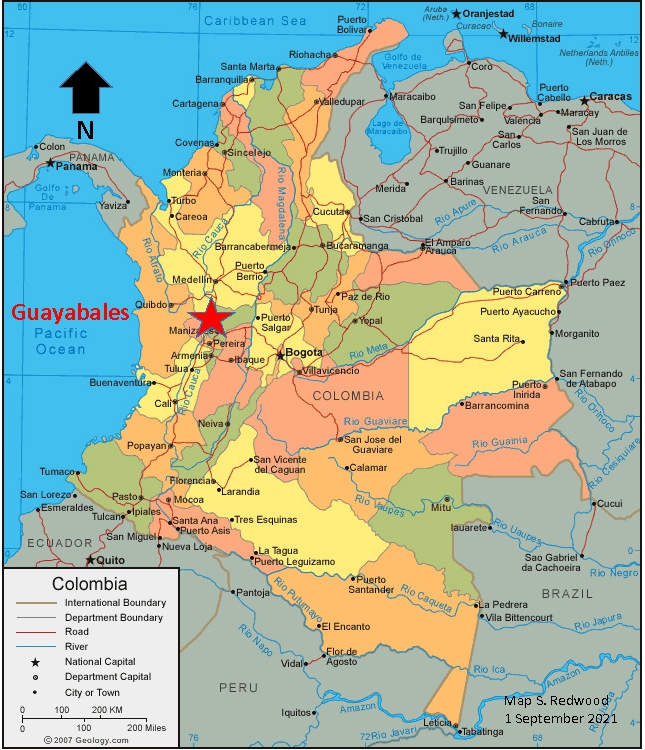
Figure 1: Location of Guayabales Project.
Access to the field office and core logging and storage facility in the town of Supía (population about 26,000) is by paved highways from Medellin (141 to 172 km depending on the route), Manizales (81 km) and Pereira (98 to 122 km) (See Figure 2 below). Supía is 5 km SW of the Guayabales Project with access by a secondary paved road and by local, unsurfaced roads (12 km).
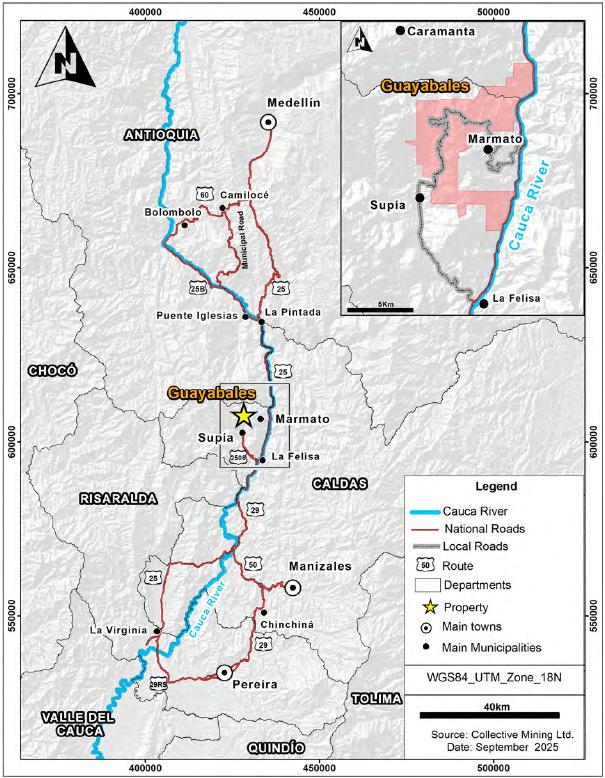
Figure 2: Location and access map of the Guayabales Project.
38
Mineral Tenure
All mineral resources in Colombia belong to the state and can be explored and exploited by means of concession contracts granted by the state. The mining authority is the National Mining Agency (Agencia Nacional Minería or ANM). The Ministry of Mines and Energy is in charge of setting and overseeing the Government´s national mining policies. Mining is governed by the Mining Law 685 of 2001 and subsequent decrees and resolutions, except for mining titles granted before that law, which are grandfathered by the law in place at the time of their granting (most commonly Decree 2655, 1988). Certain minor amendments to the law have been enacted by means of Laws 1450 of 2011, 1753 of 2015, 1955 of 2019, and 2224 of 2023. Under the Mining Law 685 of 2001, there is a single type of concession contract covering exploration, construction and mining that is valid for 30 years and can be extended for another 30 years. Concession contract areas are defined on a map with reference to a starting point (punto arcifinio) with distances and bearings, or map coordinates.
A surface tax (canon superficial) is paid annually in advance during the exploration and construction phases of mining concession contracts. This payment is due when the concession contract is registered in the National Mining Registry (RMN). The amount of the surface tax varies depending on the size and phase of the concession contract and ranges between half a daily minimum wage per hectare (“ha”) (approximately US$5.50) and three daily minimum wages per ha (approximately US$16.50). The daily minimum wage in Colombia is adjusted annually, and in 2025 it was COP $47,450.00 (approximately US$11).
The Company’s mining rights at the Guayabales Project comprise 9 granted concessions for 3,127.32 ha (894.76 ha exploitation plus 2,232.56 ha exploration) (See Table 1 below) and 37 concession applications for 2,704.53 ha (See Table 2 below), for a total of 5,831.85 ha (See Figure 3 below). Additionally, 196 claim applications (123.92 ha) have been made for incomplete cells that surround two of the exploitation titles. These “incomplete cells” are gaps between claims that are smaller than the standard cell size created when converting irregular legacy claims to the current grid-based system of square cells measuring 1.24 ha (about 352 metres (“m”) by 352 m) and oriented north-south. Importantly, incomplete cells cannot be staked by any third party and can only belong to a mineral title holder abutting an incomplete cell, which in this instance is the Company or its affiliates, on all sides.
Furthermore, the mining title owners of the Guayabales license, for which the Company accelerated its option agreement to own an undivided 100% interest in June 2025, requested in 2022 that the Colombian authorities integrate the incomplete cells abutting its mining title into the title. The authorities responded in writing, confirming that the incomplete cells will be incorporated into the title once the Colombian mining cadaster’s software is updated to support such integration.
The location of a mining title is defined by the coordinates of its corners, as described in each of the mining concession agreements executed with the mining authority. There is no legal requirement to mark the corners by monuments in the field or have the corners officially surveyed, and the corners have not been surveyed.
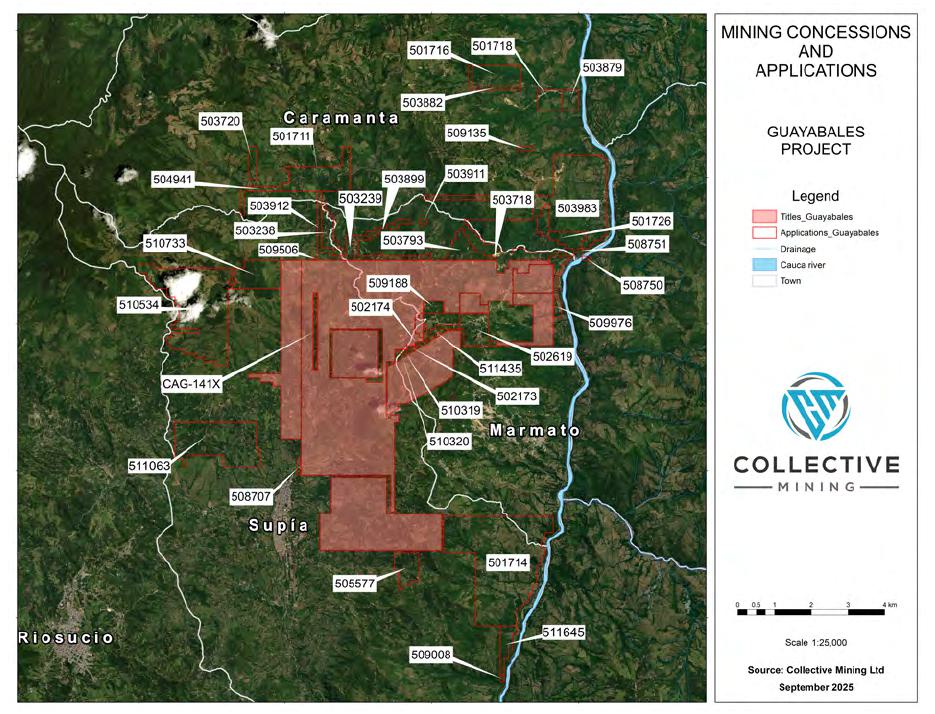
Figure 3: Plan of Guayabales Property mining rights showing concession contracts in red fill and concession applications in red outline.
39
| Name | Number | Type | Owner | Date of Registration | Date of Expiry | Area (ha) | ||||||
| Guayabales | LH0071-17 | Exploitation | Collective Mining Limited Sucursal Colombia1 | 28/03/2008 | 27/03/2038 | 247.87 | ||||||
| The Box | 781-17 | Exploitation | Sandra Liliana Saldarriaga Escobar, Margarita Maria Saldarriaga Escobar, Monica Paola Saldarriaga Escobar | 16/05/2006 | 15/05/2037 | 165.11 | ||||||
| Guayabales | HI8-15231 | Exploration | Collective Mining Limited Sucursal Colombia | 11/10/2021 | 11/10/2051 | 1,710.00 | ||||||
| Guayabales | 501712 | Exploration | Minerales Provenza SAS | 25/10/2021 | 24/10/2051 | 288.18 | ||||||
| Guayabales | HB1-08302X | Exploration | Teresita Agudelo Correa | 3/11/2021 | 2/11/2051 | 12.26 | ||||||
| Guayabales | 674-17 | Exploration | Luis Fernando García | 20/10/2021 | 20/10/2051 | 77.23 | ||||||
| Guayabales | 619-17 | Exploration | Luis Fernando García | 20/10/2021 | 20/10/2051 | 109.11 | ||||||
| Guayabales | 620-17 | Exploitation | Luis Fernando García | 23/09/2004 | 22/09/2033 | 481.88 | ||||||
| Guayabales | DLH-14451X | Exploration | Luis Fernando García | 20/10/2021 | 19/10/2051 | 35.55 | ||||||
| TOTAL: | 3,127.32 |
Table 1: List of the mining rights with title of the Guayabales Project.
1 On January 13, 2026, following payment of the remaining amounts owed to the vendor of the Guayabales mining license, 100% of the mining license was transferred from Asociacion de Mineros Guayabales to Collective Mining Limited Sucursal Colombia, the Colombian branch of Collective Mining Limited (Bermuda), a wholly-owned subsidiary of the Company.
40
| Number | Type | Owner | Date of Application | Area (ha) | ||||||
| 501711 | Exploration | (76966) Collective Mining Limited Sucursal Colombia | 07/05/2021 | 128.73 | ||||||
| 501714 | Exploration | (76966) Collective Mining Limited Sucursal Colombia | 07/05/2021 | 578.70 | ||||||
| 501716 | Exploration | (76966) Collective Mining Limited Sucursal Colombia | 07/05/2021 | 73.55 | ||||||
| 501718 | Exploration | (76966) Collective Mining Limited Sucursal Colombia | 07/05/2021 | 36.77 | ||||||
| 501726 | Exploration | (76966) Collective Mining Limited Sucursal Colombia | 07/05/2021 | 58.84 | ||||||
| 502173 | Exploration | (76966) Collective Mining Limited Sucursal Colombia | 23/07/2021 | 2.45 | ||||||
| 502174 | Exploration | (76966) Collective Mining Limited Sucursal Colombia | 23/07/2021 | 1.23 | ||||||
| 502619 | Exploration | (76966) Collective Mining Limited Sucursal Colombia | 17/09/2021 | 66.20 | ||||||
| 503238 | Exploration | (76966) Collective Mining Limited Sucursal Colombia | 14/10/2021 | 41.68 | ||||||
| 503239 | Exploration | (76966) Collective Mining Limited Sucursal Colombia | 14/10/2021 | 15.94 | ||||||
| CAG-141X | Exploration | Mineros SA | 13/10/2021 | 23.29 | ||||||
| 503720 | Exploration | (76966) Collective Mining Limited Sucursal Colombia | 09/12/2021 | 19.62 | ||||||
| 503718 | Exploration | (76966) Collective Mining Limited Sucursal Colombia | 09/12/2021 | 1.23 | ||||||
| 503793 | Exploration | (76966) Collective Mining Limited Sucursal Colombia | 16/12/2021 | 52.71 | ||||||
| 503879 | Exploration | (74025) Minerales Provenza SAS | 24/12/2021 | 24.52 | ||||||
| 503882 | Exploration | (76966) Collective Mining Limited Sucursal Colombia | 24/12/2021 | 22.06 | ||||||
| 503899 | Exploration | (76966) Collective Mining Limited Sucursal Colombia | 27/12/2021 | 52.72 | ||||||
| 503911 | Exploration | (76966) Collective Mining Limited Sucursal Colombia | 28/12/2021 | 2.45 | ||||||
| 503912 | Exploration | (74025) Minerales Provenza SAS | 28/12/2021 | 23.29 | ||||||
| 503983 | Exploration | (76966) Collective Mining Limited Sucursal Colombia | 30/12/2021 | 549.18 | ||||||
| 504941 | Exploration | (74025) Minerales Provenza SAS | 22/03/2022 | 19.62 | ||||||
| 505577 | Exploration | (76966) Collective Mining Limited Sucursal Colombia | 13/04/2022 | 53.95 | ||||||
| 508707 | Exploration | (74025) Minerales Provenza SAS | 27/11/2023 | 4.90 | ||||||
| 508750 | Exploration | (74025) Minerales Provenza SAS | 05/12/2023 | 2.45 | ||||||
| 508751 | Exploration | (76966) Collective Mining Limited Sucursal Colombia | 05/12/2023 | 1.23 | ||||||
| 509008 | Exploration | (76966) Collective Mining Limited Sucursal Colombia | 22/02/2024 | 2.45 | ||||||
| 509135 | Exploration | (76966) Collective Mining Limited Sucursal Colombia | 8/04/2024 | 1.23 | ||||||
| 509188 | Exploration | (76966) Collective Mining Limited Sucursal Colombia | 12/04/2024 | 18.39 | ||||||
| 509506 | Exploration | (76966) Collective Mining Limited Sucursal Colombia | 03/07/2024 | 1.23 | ||||||
| 510319 | Exploration | (76966) Collective Mining Limited Sucursal Colombia | 04/12/2024 | 1.23 | ||||||
| 510320 | Exploration | (76966) Collective Mining Limited Sucursal Colombia | 04/12/2024 | 1.23 | ||||||
| 510534 | Exploration | (76966) Collective Mining Limited Sucursal Colombia | 11/02/2025 | 405.83 | ||||||
| 510733 | Exploration | (76966) Collective Mining Limited Sucursal Colombia | 14/03/2025 | 93.18 | ||||||
| 511063 | Exploration | (76966) Collective Mining Limited Sucursal Colombia | 28/05/2025 | 236.64 | ||||||
| 511435 | Exploration | (76966) Collective Mining Limited Sucursal Colombia | 04/08/2025 | 17.16 | ||||||
| 511645 | Exploration | (76966) Collective Mining Limited Sucursal Colombia | 12/09/2025 | 34.33 | ||||||
| 509976 | Exploration | (12725) Luis Fernando Garcia | 25/09/2024 | 34.33 | ||||||
Table 2: List of concession applications of the Guayabales Project.
41
Granting a mining concession does not include surface access rights; landowner or community consent is required. The Company holds surface rights over 19 properties within the Guayabales Project, covering 282.82 ha. The Company also holds access rights to properties owned by the holders of concessions LH0071-17 and 781-17, though not all surface rights have yet been acquired. Under the option contracts, the holders must grant access to their lands within the concession areas. In addition, the Company has entered into easement agreements with several landowners in the Guayabales Project. Currently, it holds easement rights over 18 land lots, enabling exploration activities, including:
12 lots used for 20 drilling platforms;
2 lots for water-intake access at Arquía and Guayabales (the latter under the option agreement with the Guayabales Miners Association); and
4 lots for the hoses, pumps, and storage tanks associated with the Arquía and Guayabales water lines.
Most agreements have 12-month terms with payment of a fee.
Tenure Agreements
Concessions LH-0071-17, 620-17, 674-17, 619-17, and HB1-08302X were acquired by the Company between July and September 2025 and grant it full mining-title rights and corresponding investment obligations. Concessions 781-17 and DLH-14451X are subject to agreements granting the Company’s Colombian subsidiary the right to carry out exploration activities on behalf of the holders, with defined exploration-investment commitments and a future right to acquire ownership.
These acquisition and option agreements require total staged payments of US$26.2 million, due through 2030, as shown in Table 3 below. Between 2020 and December 2025, the Company paid US13.6 million, and is up to date on all contractual obligations.
| Year | Amount (US$) | Payments made (US$) | ||
| 2020 | 350,000 | 350,000 | ||
| 2021 | 800,000 | 800,000 | ||
| 2022 | 1,100,000 | 1,100,000 | ||
| 2023 | 750,000 | 750,000 | ||
| 2024 | 666,667 | 666,667 | ||
| 2025 | 11,758,334 | 11,758,334 | ||
| 2026 | 3,417,500 | - | ||
| 2027 | 1,917,500 | - | ||
| 2028 | 1,730,000 | - | ||
| 2029 | 3,880.000 | - | ||
| 2030 | 3,630,000 | - |
Table 3: Yearly payments resulting from mining title option agreements.
42
Total exploration expenditure commitments under these agreements amount to approximately US$13.5 million over their term. As a result of these payments, the Colombian Subsidiary will have the right to acquire 100% ownership of the relevant tenements. During execution, the titleholders may continue existing operations within the concession areas, which must cease once the Colombian Subsidiary completes the payments.
Concession application CAG-141X, filed by Mineros S.A., is subject to a promise-to-assign agreement in favour of the Company, conditional on the title being granted, with a pending payment of US$ 25,000 upon issuance and transfer of the title.
Royalties
Royalties payable to the State are 4% of the gross value at the mine mouth for gold and silver, and 5% for copper (Law 141 of 1994, amended by Law 756 of 2002). For royalty purposes, gold and silver prices are determined by the government and usually set at 80 % of the average London PM Fix price for the previous month.
Environmental Liabilities
The Guayabales Project has artisanal mining in four areas. Under Colombian law, existent artisanal mining will not be an environmental liability for the Company. As a good sustainability practice, the Company has approached the local miners to evaluate joint opportunities and to evaluate the potential of the areas for exploration. The Company has carried out environmental baseline studies to determine existing liabilities in the area and continues to do so as it identifies local miners.
Indigenous Reserves and Communities
Within the Municipality of Supía, there are three Indigenous reserves (resguardo indígena in Spanish), called the Cañamomo - Loma Prieta Reserve, the La Trina Reserve, and the Cartama Reserve. There is also one Indigenous community (parcialidad indígena in Spanish), called Cauromá, where the people live according to indigenous laws and customs but they do not own the territory. In the Municipality of Marmato, there is an indigenous community called Cartama. All of these belong to the Embera Chami indigenous group. The Cauroma and Cartama indigenous communities overlap with parts of Corporation’s mining rights, but not with the areas of current interest for exploration.
Exploration is permitted by law in both the reserves and the communities and, in practice, would require an agreement with the relevant indigenous communities. In principle, prior consultation would not be necessary for the granting of the environmental license for the exploitation phase of this project, as there is no overlap of mining titles with indigenous reserves. However, prior consultation may be necessary depending on the level of direct or indirect impact that a project may have on a neighbouring reserve or community.
43
History
The history of the Guayabales Project is summarized in Table 4 below. The focus of previous exploration was concession contract LH-0071-17. The Comunidad Minera Guayabales (Guayabales Mining Community), also known as Asociación de Mineros Guayabales (Guayabales Miners Association), started artisanal gold mining in 1995 and have developed 16 small underground mines in the Encanto zone. They began the process to legalize ownership in 2002 and were granted ownership when the title was registered on March 28, 2008. The total gold production is not known. The specific mining history is unknown and no older references have been found.
| Years | Company | Work carried out | NI 43-101 reports | |||
| 600 BCE to 21st Century CE | Quimbaya Culture (600 BCE – 1600 CE) Spanish Colonial Period (1534-1819) Republic of Colombia period (1819-present) | The Marmato-Supia district, including Guayabales, was mined for gold since pre-Columbian times. | ||||
| 1995-present | Guayabales Mining Community | Artisanal gold mining in 16 underground mines. Legalisation started 2002. Mining title LH-0071-17 registered 28 March 2008. | ||||
| 2005-2006 | Colombia Gold plc, London | Underground sampling, surface rock sampling. | ||||
| 2006-2009 | Colombian Mines Corporation, Vancouver | Underground sampling, surface rock sampling, 17 diamond drill holes (DDH) for 2,079 m. | Thompson (2007) | |||
| 2010-2011 | Mercer Gold Corporation, Nevada | Underground and surface rock sampling, soil grid, geological mapping, 11 diamond drill holes for 4,067 m. | Turner (2010, 2011) | |||
| 2011-2013 | Tresoro Mining Corp., Nevada (name changed from Mercer Gold Corporation) | No work. Option expired 2012 or 2013. | Leroux (2012) | |||
| 2014-2019 | None | Exploration inactive | ||||
| 2020-present | Collective Mining Ltd., Toronto | Current exploration programme | Redwood (2021, 2023) and the Technical Report |
Table 4: Summary of the history of the Guayabales Project.
From 2005-2013 the Guayabales Project was explored for gold by three companies under option agreements with Comunidad Minera Guayabales. These were Colombia Gold plc in 2005-2006, Colombian Mines Corporation (Colombian Mines) in 2006-2009 (Thompson, 2007), and Mercer Gold Corporation (Mercer Gold) in 2010-2011 (previously called Uranium International Corp.) (Turner, 2010, 2011). Mercer Gold changed its name to Tresoro Mining Corp. in 2011 but it carried out no more exploration (Leroux, 2012). Its option expired for non-compliance sometime in 2012 or 2013, and the Company declared bankruptcy on March 3, 2014. Exploration carried out by these companies included geological mapping, soil sampling, rock sampling, and mapping and channel sampling of artisanal mines, and diamond drilling. In 2008 Colombian Mines drilled 17 holes for 2,079 m in the Encanto Zone, and in 2010-2011 Mercer Gold drilled 11 holes for 4,067 m in the Encanto Zone and to the northeast of this zone.
44
Exploration of the Comunidad Minera Guayabales concession focused on the NW to WNW-trending Encanto Zone where 16 small gold mines are currently operated by Comunidad Minera Guayabales. The zone is a shear zone at least 500 m long and 20-40 m wide with gold-silver-polymetallic veins that were targeted by drilling. Porphyry stockwork veining mineralization is exposed in some road cuts shown by argillic and sericitic alteration overprinting quartz veinlet stockworks and hematite after magnetite veinlets, and was intersected in two historical drill holes. The results of the historical exploration and drilling are summarized in Tables 5 and 6 below.
| Year | Company | Survey | Contractor | Units | Number | Zone | ||||||
| 2005-2006 | Colombia Gold plc | Rock sampling mines and surface | None | Samples | 263 | Encanto Zone | ||||||
| 2006-2009 | Colombian Mines | Rock sampling mines | None | Samples | 512 | Encanto Zone | ||||||
| Corporation | Rock sampling surface | None | Samples | 212 | Encanto Zone | |||||||
| Rock sampling road cuts | None | Samples | 163 | New access road | ||||||||
| Diamond drilling 17 holes | Terramundo | Meters | 2,079.36 | Encanto Zone | ||||||||
| 2010-2011 | Mercer Gold Corporation (became Tresoro Mining Corp.) | Geological mapping | None | km2 | 2.50 | Whole property LH-0017-17 | ||||||
| Soil sample grid 100 m x 100 m | None | Samples | 253 | Whole property LH-0017-17 | ||||||||
| Rock sampling surface | None | Samples | 89 | Whole property LH-0017-17 | ||||||||
| Rock sampling mines | None | Samples | 15.00 | Encanto Zone | ||||||||
| Diamond drilling 11 holes | Logan Drilling | Meters | 4,067.90 | Encanto and Donut targets |
Table 5: Summary of historical exploration carried out at the Guayabales Project.
| Year | Company | Contractor | Rig type | Core size | Diameter (mm) | Holes | Total meters | |||||||
| 2008 | Colombian Mines Corporation | Terramundo | Boyles 37 | HQ | 63.5 | 12 | 1,931.20 | |||||||
| Winkie | BTW | 42 | 5 | 148.16 | ||||||||||
| 2010-2011 | Mercer Gold | Logan Drilling Colombia SAS | Duralite T600N | HQ, NQ | 63.5, 47.6 | 11 | 4,067.90 | |||||||
| Total | 28 | 6,147.26 |
Table 6: Summary of historical diamond drill programs.
45
Geological Setting, Mineralization and Deposit Types
Regional Geology
The Guayabales Project is located in the Western Cordillera of the Colombian Andes in the late Miocene Middle Cauca Gold-Copper Belt. The project occurs in the Romeral terrane, an oceanic terrane comprising a melange of metabasalts, amphibolites, serpentinites, graphitic schist, biotite schist, sericite schist and chlorite schist that are called the Arquía Complex of probable Late Jurassic to Early Cretaceous age. This terrane was accreted to the continental margin along the Romeral Fault in the Aptian. Movement on the Romeral Fault was dextral indicating that terrane accretion was highly oblique from the southwest. The terrane is bounded by the Cauca-Patia Fault on the west side. Further west, additional oceanic and island arc terranes were subsequently accreted to the Western Cordillera in the Paleogene and Neogene periods, culminating in the on-going collision of the Panamá-Choco arc since the late Miocene. This reactivated the Cauca-Patia and Romeral faults with left lateral and reverse movements. The Romeral terrane is partially covered by continental sediments of the middle Oligocene to late Miocene age Amagá Formation, comprising grey to green coloured conglomerates, sandstones, shales and coal seams, and by thick subaerial basaltic to andesitic volcanic and sedimentary rocks of the late Miocene Combia Formation. Epithermal Au-Ag-Zn (gold-silver-zinc) and porphyry Au-Ag-Cu-Mo (gold-silver-copper-molybdenum) mineralization in the Middle Cauca Belt is related to clusters of late Miocene porphyry intrusions of diorite to tonalite composition, and intrusive breccias.
Local Geology
The local geology comprises the country rock of the Late Jurassic to Early Cretaceous Arquía Complex, an elongated, narrow, and discontinuous belt composed of carbonaceous, chloritic, and sericitic schists, as well as segments of ultramafic rocks with a low degree of metamorphism. Foliation in the schist packages typically dips gently to the southeast based on surface exposures and drill core intersections. The Arquía Complex forms roof pendants. To the west of the tenement lies the Oligocene to lower Miocene Amagá Formation composed of basal conglomerate, sandstones with carbonaceous beds, mudstones and claystone. These are overlain by volcano-sedimentary rocks of the late Miocene Combia Formation (age about 9 to 4 million years ago) that locally exceeds 1,000 m in stratigraphic thickness. It is divided into two members: a volcanic member comprising intercalated basalt, andesite, tuff, and subvolcanic stocks, and a sedimentary member of conglomerate, sandstone, and siltstone deposited in continental debris flows and braided fluvial environments. The Amagá and Combia Formations were deposited in a pull-apart basin in the Cauca-Patia continental intermontane basin and are cut by late Miocene porphyry intrusions with porphyry Au-Ag-Cu-Mo and epithermal Au-Ag-Zn mineralisation such as the targets of the Guayabales Project.
Property Geology
The Guayabales Project area has extensive cover of soil, volcanic ash, saprolite, dense vegetation, and landslide deposits. Due to the scarcity of bedrock exposure, geological mapping is necessarily generalized and interpretative in nature. The project area is characterised by multiphase porphyritic intrusions and associated magmatic-hydrothermal breccias. These units are part of the Miocene Combia Volcanic Province (CVP). Basement rocks consist of schists and ultramafic rocks of the Arquía Complex, with sandstones and mudstones of the Amaga Formation to the west and remnant outliers of Combia Formation lavas and tuffs of basalt to andesite composition.
The structural setting of the Guayabales Project is strongly influenced by the major Cauca-Romeral fault system, a large-scale strike-slip deformation zone that is followed by the Cauca River’s north trend. Lineament analysis of topographic data integrated with regional mapping have identified that N-trending fault systems are intersected by steeply dipping to subvertical NW-, WNW-, and E-trending fault systems. The Guayabales shear zone is interpreted as a major NW-trending structural corridor that crosses the centre of the project area. It produces numerous subsidiary faults throughout the concession and is interpreted as the primary first-order fault system controlling the structural architecture of the district.
Gold, Ag, Cu, Mo and WO3 mineralization is related to porphyry and reduced intrusion related systems, which are overprinted by carbonate base metal veins with Au, Ag, Cu, Pb and Zn and trend NW-WNW and EW. The alteration includes potassic, chlorite-sericite, chlorite-epidote and intermediate argillic. The late vein overprints are associated with intense intermediate argillic alteration which is characterized by sericite, carbonates and pyrite.
Deposit Types
Mineralisation at the Guayabales Project comprises 12 known targets for Au-Ag with Cu, Mo, WO3, Pb and Zn that are hosted by multiple porphyry stocks and wall rock of Arquia Group schists, Amaga Formation siliciclastic sedimentary rocks and Combia Formation volcanic and sedimentary rocks. The deposit types are porphyry Au-Ag-Cu±Mo, reduced intrusion-related Au, intermineral breccias with Au-Ag±Cu, and structurally-controlled, Au-Ag-bearing carbonate-base metal (Zn- Pb-Cu) (“CBM”) veins.
46
The Apollo Au-Ag-Cu-WO3 deposit has been explored in the most detail. Apollo is a hydrothermal breccia formed in a subvolcanic porphyry environment with zonation of both alteration and mineralisation. Multistage mineralisation includes early porphyry, various periods of sulphide infill within a hydrothermal breccia matrix and multiple overprinting, late stage, sulphosalts and CBM veins. The characteristic features of Apollo include:
| ● | Early pre-breccia porphyry system shown by quartz veinlets in porphyry clasts in breccia; | |
| ● | The downward flaring or cone shaped geometry of the breccia, which differs from normal funnel-shaped breccias and may indicate formation at depth; | |
| ● | A strong correlation between Cu and Ag with a low Cu/Ag ratio in the upper part of the breccia which is not a typical porphyry fluid; | |
| ● | The presence of WO3 as scheelite and, moreover, at shallow depth of up to 150 m in contrast to its normal occurrence at depth in hydrothermal deposits, which is attributed here to the presence of roof pendants of graphitic schist causing reduction of the fluid and deposition of scheelite; | |
| ● | Upward transition of deep pyrrhotite to replacement by pyrite and chalcopyrite interpreted as a change from a reduced to a more oxidizing fluid chemistry; | |
| ● | High grade Au-Ag-Bi-Te sulphide-rich zone in crackle breccia at 1,000->1,350 m depth, indicating a reduced fluid which is similar to and occurs at the same elevation as the top of the Marmato Deeps Zone located 1.75 km SE (see Figure 4 below); | |
| ● | Late stage, high Au-Ag grade epithermal, Ag and Pb sulphosalt-bearing, carbonate-base metal veins which are notable for their great vertical extent of >1,350 m, and indicate a change in fluid chemistry from an early, reduced, low sulphidation fluid to a late, low temperature, oxidized, intermediate to high sulphidation fluid. |
The characteristics of the Apollo deposit are more characteristic of a reduced intrusion-related gold system (RIRGS) rather than a porphyry system. The system varied between reduced (upper Au-Ag-Cu-WO3 zone, deep pyrrhotite with Au-Ag, deep Au-Ag-Bi-Te zone) and oxidized (pre-breccia porphyry, upper breccia fill of Au-Ag-Cu, CBM veins). Apollo, Marmato and Aguas Claras occur within a 3.5 km northwest trending corridor which hosts multiple calc-alkalic porphyry stocks, dike swarms, and multiple NW and EW trending carbonate base metal veins (see Figure 4 below). The three deposits have the same age.
Radiometric dating of the Apollo porphyries by LA-ICP-MS U–Pb zircon shows that magmatic activity occurred from 6.75 ± 0.091 Ma to 6.39 ± 0.087 Ma, while Re–Os molybdenite dating indicates that the principal phase of bulk-tonnage mineralisation occurred at 6.82 ± 0.028 Ma (Reading et al., 2025). The ages of magmatism and mineralisation ages are the same and indicate a direct genetic link between porphyry intrusion and ore formation at Apollo.
Significantly, the ages are similar to Marmato where the porphyry intrusions have been dated at 6.576 ± 0.075 Ma to 5.75 ± 0.11 Ma by LA-ICP-MS U-Pb on zircon and mineralisation was dated by 40Ar/39Ar analyses of adularia between 6.95 ± 0.02 Ma and 5.96 ± 0.02 Ma (Santacruz et al., 2021). Marmato is described as a hybrid reduced intrusion-related/porphyry gold deposit (Santacruz et al., 2021).
The Aguas Claras porphyry gold deposit, located 1.75 km SE of Marmato, is an oxidized, Maricunga-type porphyry gold deposit related to quartz veinlets with magnetite, pyrite and minor chalcopyrite hosted by quartz diorite to granodiorite porphyry stocks dated at 6.55 ± 0.15 Ma to 5.74 ± 0.14 Ma by LA-ICP-MS U-Pb zircon, and by Combia Formation basalt (Santacruz et al., 2021).
47
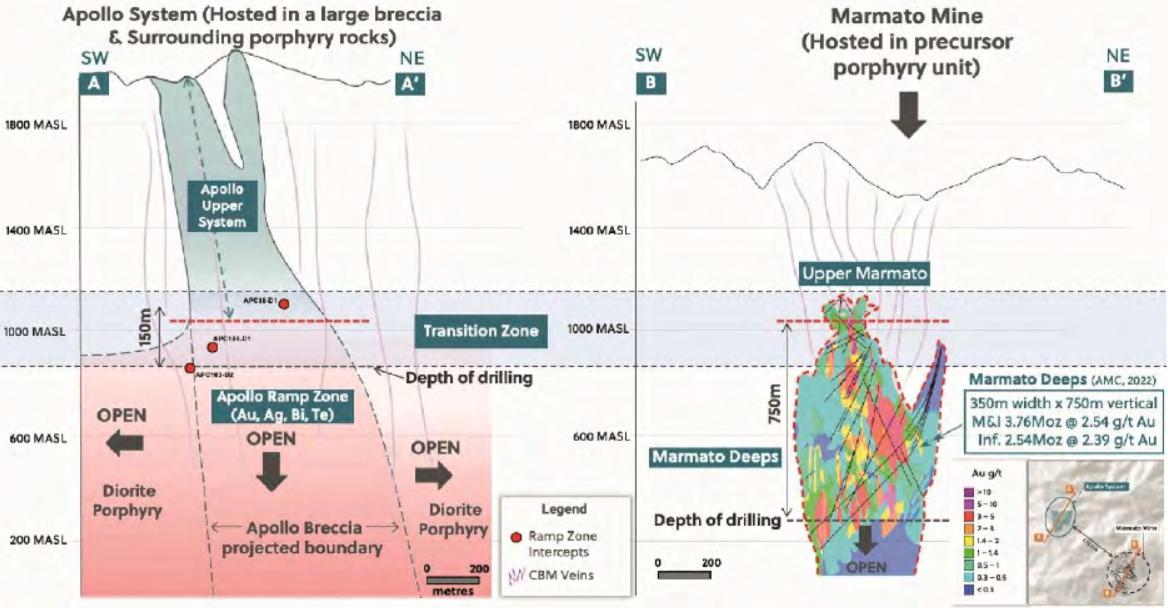
Figure 4: Cartoon NW-SE long section along the Marmato trend showing an interpretation of the possible relationship between the Apollo System and Marmato Deeps Zone.
Many features of the Apollo deposit are typical of reduced intrusion related gold systems (RIRGS) such as those of the Tintina belt (Alaska-Yukon) and Kori Kollo (Bolivia) as described by Thompson et al. (1999), Baker et al. (2005) and Hart (2007). Conditions at the Apollo system fluctuated between oxidised porphyry, oxidised epithermal and RIRGS.
The characteristics of RIRGS deposits are (Hart, 2007):
| ● | Sheeted Au-bearing quartz veins in the brittle roof zone of small plutons or stocks; | |
| ● | Au-Bi-Te-W metal assemblage; | |
| ● | Skarn, replacement, veins in wall rock surrounding the pluton; | |
| ● | Zoned from proximal Au-W-As to distal Ag-Pb-Zn; | |
| ● | Typically associated with metaluminous, moderately reduced, moderately fractionated; | |
| ● | biotite>hornblende>pyroxene quartz monzonites that have mixed with volatile-rich; | |
| ● | lamprophyric melts; | |
| ● | Magmas are ilmenite-series due to a reduced primary oxidation state; | |
| ● | Sulphides are characterised by pyrrhotite due to the reduced state; | |
| ● | Form at 5-7 km depth. |
Porphyry systems were reviewed by Sillitoe (2010) and a schematic deposit model is shown in Figure 8.6 in the Technical Report. Porphyry systems may contain porphyry Cu ± Mo ± Au deposits of various sizes from <10 to 10,000 million tonnes. Typical primary porphyry Cu deposits have average grades of 0.5 to 1.5% Cu, <0.01 to 0.04% Mo, and 0.01 to 1.5 grams per metric ton (“g/t”) Au. Porphyry Au deposits have grades of 0.9 to 1.5 g/t Au but little Cu (<0.1 %).
The alteration and mineralization in porphyry systems can have a volume of many cubic kilometres of rock and are zoned outward from stocks or dike swarms, which typically comprise several generations of intermediate to felsic porphyry intrusions. Porphyry Cu ± Au ± Mo deposits are centred on the intrusions. High-sulphidation epithermal deposits may occur in lithocaps above porphyry Cu deposits, and are typically massive sulphide lodes in deeper feeder structures and Au -Ag-rich, disseminated deposits in the upper parts. Intermediate sulphidation epithermal veins may develop on the peripheries of the lithocaps. The porphyry systems of the Middle Cauca Gold-Copper Belt are characterised by late stage, high grade Au-Ag-polymetallic CBM veins with a vertical extent of 1-2 km.
48
The alteration and mineralization in porphyry Cu deposits is zoned upward from barren, early sodic-calcic alteration through potentially ore-grade potassic, chlorite-sericite, and sericitic alteration, capped by an advanced argillic alteration lithocap up to >1 km in thickness. Low sulphidation-state chalcopyrite ± bornite assemblages are characteristic of potassic zones, whereas higher sulphidation-state sulphides are generated progressively upwards as a result of temperature decline and the accompanying greater degrees of hydrolytic alteration, culminating in pyrite ± enargite ± covellite in the shallow parts of the lithocaps. The porphyry Cu mineralization occurs in a distinctive sequence of quartz-bearing veinlets as well as in disseminated form in the altered rock. Magmatic-hydrothermal breccias may form during porphyry intrusion and may have high-grade mineralization because of their high permeability. The Apollo breccia is a large example of a magmatic-hydrothermal breccia. In contrast, most phreatomagmatic breccias, constituting maar-diatreme systems, are poorly mineralized because they usually formed late in the evolution of the porphyry systems.
Exploration
The exploration of the Guayabales Project carried out by the Company is summarized in Table 7 below.
| Year | Survey | Contractor | Units | Number | Target | |||||
| 2020-2022 | Database compile historic data | None | samples | 1,561 | Whole property | |||||
| 2020-2025 | Historical core relogging | None | meters | 5,294 | Encanto, Donut | |||||
| 2020-2025 | Geological mapping | None | km2 | 37.5 | Whole property | |||||
| 2020-2025 | Rock sampling | None | samples | 6,783 | Whole property | |||||
| 2020-2025 | Soil sampling | None | samples | 3,077 | Whole property | |||||
| 2021 | LIDAR survey | Lidarus | km2 | 76.8 | Whole property | |||||
| 2021 | Full Waveform Distributed Array Induced Polarization survey (AGDAS) | Arce Geofísicos Ltd | km2 | 3.37939 | Olympus and Box | |||||
| 2020-2021 | Heli-magnetic and radiometric survey | MPX Geophysics Ltd & Arce Geophysics Ltd | line km | 775.9 | Whole property | |||||
| 2022 | Heli-magnetic and radiometric survey Reprocessing | Condor North Consulting | line km | 775.9 | Whole property | |||||
| 2022 | IP survey Reprocessing | Condor North Consulting | km2 | 3.37939 | Olympus and Box | |||||
| 2024 | IP Reprocessing - Joint inversion model of the three blocks of the DCIP Survey conducted by Arce Geofísicos | Condor North Consulting | km2 | 3.38 | Box-Olympus | |||||
| 2025 | IP Reprocessing- Constrained 3D resistivity inversion using the 2021 DCIP data collected over the Box target area, in combination with the 3D geology model | Condor North Consulting | m2 | 975 | Box | |||||
| 2025 | Gravity survey | Arce Geofísicos | Ha | 220 | Apollo, ME, Plutus |
Table 7: Summary of exploration carried out by the Company at the Guayabales Project in 2020-2025.
49
The Company carried out a LIDAR survey of the concessions and surrounding areas in 2021 to create a digital terrain model (DTM), a digital surface model (DSM) and a topographic map with 1 m contours.
The Company collected 3,077 soil samples. Soil samples were generally taken on ridges and spurs, and in some places on a grid of 100 m by 100 m. The Company has a written protocol for soil sampling. Samples are taken at the C soil horizon at a depth between 1.5-3.5 m using a manually operated auger. The sample is collected on a plastic sheet and then placed in a sample bag that is numbered and sealed. The geologist completes a sample description card with the location, soil profile description, weathering intensity, colour, oxides and other information. This is entered into the exploration database. The author of the Technical Report considers that the sampling method is appropriate for the type of mineralisation sought. The grid samples are often not effective due to young volcanic ash cover and landslides. The ash has been washed away on the ridges and so the ridge and spur samples are more effective, do not have this sampling bias, and are representative of the mineralisation sought.
The Company took 6,783 surface and underground rock samples as of the effective date of the Technical Report. The types of samples taken were chip channel samples in areas of good exposure and rock chip samples in areas with non-continuous exposure. The Company has a written protocol for taking rock samples. The chip channel samples are marked with paint in lengths of 2.00 m and a continuous sample is taken using a hammer and chisel. The broken rock is collected on a plastic sheet and then placed in a sample bag that is numbered and sealed. Rock chip samples are taken in a similar manner but by taking a rock chip every approximately 10 cm, rather than a continuous channel. A sample description card is completed in the field for each sample with the location and description. The author of the Technical Report considers that the sampling method is appropriate for the type of mineralisation sought, that the samples are representative of the mineralisation sought, are adequate for the purpose intended which is to define the extent of mineralisation on surface and to identify drill targets, and are not considered to have any potential sources of sampling bias.
The Company carried out a helicopter-borne magnetic and radiometric geophysical survey in December 2020 over an area of about 9 km E-W by 8 km N-S centered on the mining titles. Data was collected on 775.9 line-km on N-S flight lines with a line spacing of 100 m and nominal mean terrain clearance of 80 m, with E-W tie lines. The survey was flown by MPX Geophysics Ltd (MPX, 2020). The data was processed by Arce Geophysics (Arce, 2021) and reprocessed by Condor Consulting. In 2021, Arce Geofísicos Ltd. carried out a Full Waveform Distributed Array Induced Polarization (IP) survey (AGDAS) at Apollo, Box, and Victory targets, covering an area of interest of 3.38 km² across three blocks. However, the effectiveness of this survey was limited due to high chargeability responses from graphite schists and sulphides. During 2024, Condor North Consulting generated a joint inversion model of the three blocks using the 2021 data, with the objective of developing a more consistent model to serve as a baseline for comparison with upcoming ZTEM and VTEM surveys. Later in 2024, the Company attempted to conduct ZTEM and VTEM surveys with Geotech Ltd. over the Guayabales Project, covering approximately 70 km², but the survey failed due to high noise from powerlines. Additionally, Condor North Consulting compared inversion modelling results from 3D DC resistivity and induced polarization (“DCIP”) data for the Guayabales Project with geological cross-sections provided by the Company. Smooth resistivity and chargeability inversion models were created using the 2021 DCIP data collected over the three blocks, and the depth of investigation for both models was determined. In 2025, Condor North Consulting performed a constrained 3D resistivity inversion using the 2021 DCIP data collected over the Box target area, combined with a 3D geology model provided by the Company. The geology model was converted into a voxel model, and rock units were assigned conductivity values based on average petrophysical data (a voxel model is a threedimensional, regularly gridded representation of the subsurface composed of individual volumetric cells (“voxels”). Each voxel is assigned one variable such as density, magnetic susceptibility, or resistivity). Later in 2025, Arce Geofísicos conducted a gravity survey at the Guayabales Project. The survey consisted of 372 stations arranged on a 50 m by 100 m grid. The same base station used during the first stage was employed for drift correction. Two Scintrex CG-6 gravity meters were used to carry out the measurements. An additional 372 stations were acquired during this second stage, resulting in a total of 414 stations. The gravity survey was completed with 372 stations at 50 m intervals along previously defined lines. A minimum of 5 repeated readings were taken at each station. The CG6 gravimeter is capable of measuring resolutions in the order of 0.1 microGals.
50
Exploration carried out by the Company has identified 12 targets to date.
Apollo Target
Plans of the geochemistry of Au, Cu, Ag, Mo and W in rocks and soils that were used to define drill targets at Apollo are shown in Figure 9.12 to Figure 9.16 in the Technical Report, together with the later drill core results. Geochemistry and mapping identified a breccia as a drill target.
Trap Target
Plans of the geochemistry of Au, Cu, Ag and Mo in rocks and soils that were used to define drill targets at the Trap target are shown in Figure 9.17 to Figure 9.20 in the Technical Report, together with the later drill core results.
Drilling
Historical Drilling
Two diamond drill programmes were carried out by previous companies in 2008 and 2010-2011 with a total of 28 holes drilled using the wireline recovery method for a total of 6,147.26 m. These focused on the Encanto zone (now called the ME target). Colombian Mines drilled 17 diamond drill holes for 2,079.36 m in 2008. Eleven holes were drilled with a skid-mounted Boyle 37 rig with lengths of 83.70 to 221.50 m and an average of 160.9 m. Five holes were drilled with a man-portable Winkie drill (GDH-05, 06, 09, 11, 16) with lengths of 9.53 to 48.90 m and an average of 29.6 m and failed to reach their targets. Mercer Gold drilled 11 diamond drill holes for 4,067.90 m in 2010-2011 with a track-mounted Duralite T600N drill rig. The hole lengths were 76.6 to 620.0 m with an average of 369.8 m. The holes were drilled in the Guayabales and Plutus North targets. The contractors, rig types and core sizes are summarized in Table 8 below. The drill collar locations are listed in Table 9 below and are shown in a plan in Figure 5 below.
| Year | Company | Contractor | Rig type | Core size | Diameter (mm) | Holes | Total meters | |||||||
| 2008 | Colombian Mines Corporation | Terramundo | Boyles 37 | HQ | 63.5 | 12 | 1,931.20 | |||||||
| Winkie | BTW | 42 | 5 | 148.16 | ||||||||||
| 2010-2011 | Mercer Gold | Logan Drilling Colombia SAS | Duralite T600N | HQ, NQ | 63.5, 47.6 | 11 | 4,067.90 | |||||||
| Total | 28 | 6,147.26 |
Table 8: Summary of historical diamond drill programs.
51
| No. | Hole No. | Company | Year | Easting WGS84 | Northing WGS84 | Altitude (m) | Azimuth | Inclination | Depth (m) | |||||||||
| 1 | GDH-01 | CM | 2008 | 431704 | 606726 | 1881.0 | 20 | -45 | 198.80 | |||||||||
| 2 | GDH-02 | CM | 2008 | 431704 | 606726 | 1881.0 | 20 | -60 | 221.50 | |||||||||
| 3 | GDH-03 | CM | 2008 | 431774 | 606679 | 1914.0 | 20 | -45 | 201.80 | |||||||||
| 4 | GDH-04 | CM | 2008 | 431762 | 606814 | 1890.3 | 50 | -65 | 128.00 | |||||||||
| 5 | GDH-05 | CM | 2008 | 431749 | 606886 | 1849.6 | 200 | -50 | 9.53 | |||||||||
| 6 | GDH-06 | CM | 2008 | 431855 | 606981 | 1820.1 | 200 | -50 | 43.69 | |||||||||
| 7 | GDH-07 | CM | 2008 | 431745 | 606919 | 1844.9 | 200 | -45 | 83.70 | |||||||||
| 8 | GDH-08 | CM | 2008 | 431745 | 606919 | 1844.9 | 200 | -60 | 124.30 | |||||||||
| 9 | GDH-09 | CM | 2008 | 431855 | 606981 | 1820.1 | 20 | -50 | 48.90 | |||||||||
| 10 | GDH-10 | CM | 2008 | 431594 | 606921 | 1872.0 | 20 | -45 | 215.60 | |||||||||
| 11 | GDH-11 | CM | 2008 | 431834 | 606933 | 1828.0 | 50 | -40 | 19.60 | |||||||||
| 12 | GDH-12 | CM | 2008 | 431594 | 606921 | 1872.0 | 20 | -65 | 202.50 | |||||||||
| 13 | GDH-13 | CM | 2008 | 431745 | 606919 | 1844.9 | 245 | -60 | 104.50 | |||||||||
| 14 | GDH-14 | CM | 2008 | 431869 | 606900 | 1860.0 | 200 | -45 | 148.45 | |||||||||
| 15 | GDH-15 | CM | 2008 | 431952 | 606877 | 1889.7 | 200 | -50 | 148.65 | |||||||||
| 16 | GDH-16 | CM | 2008 | 431756 | 606890 | 1846.6 | 200 | -45 | 26.44 | |||||||||
| 17 | GDH-17 | CM | 2008 | 432037 | 606810 | 1916.0 | 200 | -50 | 153.40 | |||||||||
| 18 | MGDH-01 | MG | 2010 | 431889 | 606857 | 1866.0 | 182.9 | -42.1 | 117.50 | |||||||||
| 19 | MGDH-01A | MG | 2010 | 431890 | 606858 | 1866.0 | 201.8 | -45.8 | 76.60 | |||||||||
| 20 | MGDH-02 | MG | 2010 | 431887 | 606856 | 1866.0 | 200.8 | -67.9 | 300.50 | |||||||||
| 21 | MGDH-03 | MG | 2010 | 431804 | 606969 | 1863.8 | 238.6 | -53.8 | 620.00 | |||||||||
| 22 | MGDH-04 | MG | 2011 | 431801 | 607047 | 1871.9 | 24.4 | -56.2 | 505.60 | |||||||||
| 23 | MGDH-04A | MG | 2011 | 431802 | 607048 | 1871.9 | 19.7 | -46.5 | 400.00 | |||||||||
| 24 | MGDH-05 | MG | 2010 | 431999 | 606876 | 1896.0 | 195.3 | -60.2 | 600.00 | |||||||||
| 25 | MGDH-06 | MG | 2011 | 432086 | 607294 | 1799.9 | 70.8 | -42.5 | 400.00 | |||||||||
| 26 | MGDH-06A | MG | 2011 | 432087 | 607295 | 1799.9 | 191.0 | -41.3 | 500.20 | |||||||||
| 27 | MGDH-07 | MG | 2011 | 432225 | 607623 | 1848.0 | 199.2 | -44.7 | 97.50 | |||||||||
| 28 | MGDH-07A | MG | 2011 | 432226 | 607621 | 1848.0 | 199.7 | -47.9 | 450.00 |
Table 9: Drill collar table for historical drilling at the Guayabales Project.
52
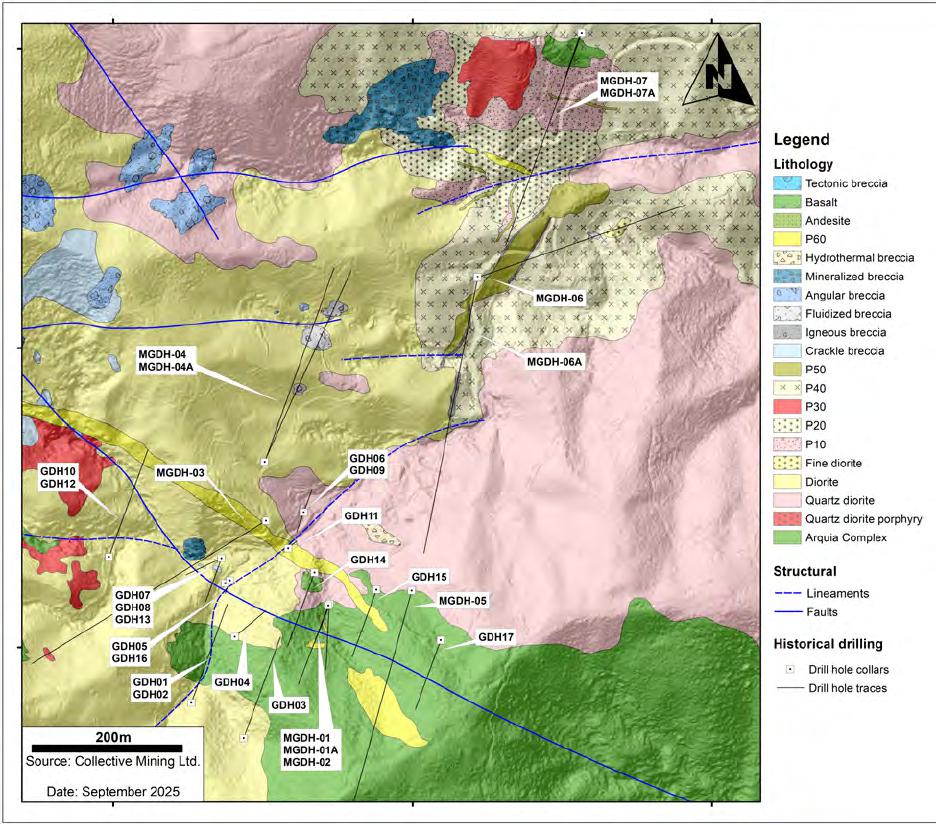
Figure 5: Location map of the historical drill collar locations and drill hole traces in the Guayabales Project.
Colombian Mines drilled 17 diamond drill holes for a total of 2,078.8 m in 2008 numbered GDH-01 to GDH-17. It tested epithermal veins in the Encanto Zone (ME target) along 450 m strike length. Intersections included 21.85 m (9.18 m estimated true width) @ 2.43 g/t Au and 16.5 g/t Ag, including 3.15 m (1.32 m estimated true width) @ 11.0 g/t Au and 43.0 g/t Ag (GDH-07).
Mercer Gold drilled 11 diamond drill holes for 4,060.97 m in 2010-2011 numbered MGDH-01 to MGDH-7A, including four repeated holes with the suffix A when the original hole failed to reach the target depth. The targets were mostly epithermal veins in the Encanto Zone (ME target), and two holes tested porphyry-style mineralization in the Guayabales (Plutus South) and Plutus North targets. Significant intersections in the Encanto Zone included 13.7 m (11.4 m true width) @ 2.36 g/t Au and 38.0 g/t Ag (MGDH-01), 4.0 m (2.6 m true width) @ 2.00 g/t Au and 33.5 g/t Ag (MGDH-02), 2.0 m (1.66 m true width) @ 3.30 g/t Au and <2.0 g/t Ag (MGDH-04), 2.00 m (1.66 m true width) @ 5.56 g/t Au and 49.0 g/t Ag (MGDH-04A), 12.0 m (10.0 m true width) @ 2.14 g/t Au and 12.8 g/t Ag (MGDH-05), 4.0 m (3.33 m true width) @ 2.08 g/t Au and 5.0 g/t Ag (MGDH-05) and 2.0 m (1.66 m true width) @ 2.41 g/t Au and 22.0 g/t Ag (MGDH-05).
Two of the Mercer Gold holes, MGDH-06A and MGDH-07A, intersected porphyry style mineralization in the Guayabales (Plutus South) and Plutus North targets. Hole MGDH-06A was collared north of the Encanto Zone with azimuth 191°. The author of the Technical Report examined the core in 2020 and observed that the hole cut a feldspar-biotite diorite porphyry with large phenocrysts in the upper part of hole with intersections of Au mineralization >0.1 g/t of 96.5 m @ 0.169 g/t Au (7.5-104.0 m) and 138.0 m @ 0.113 g/t Au (128.0-266.0 m). The porphyry is interpreted to be inter-mineral in relative age. The lower part of the hole cut a late mineral quartz diorite porphyry with crowded phenocrysts with low grade Au mineralization <0.1 g/t. The inter-mineral diorite porphyry has biotite-magnetite alteration with quartz B veinlets with pyrite, molybdenite and a few magnetite veinlets. It is cross-cut by pyrite veinlets and quartz-pyrite-molybdenite veinlets with a sericite halo, with pervasive sericite in places.
53
The author of the Technical Report also examined the core of hole MGDH-07A drilled across the Plutus North target with azimuth 199.7°. It cut inter-mineral diorite porphyries, magmatic breccia, basalt county rock and late-mineral basalt dykes. Mineralization >0.1 g/t Au occurs in saprolite, basalt and inter-mineral diorite porphyries in the upper part of the hole with intersections of 110.0 m @ 0.164 g/t Au (12.0-122.0 m) and 106.0 m @ 0.153 g/t Au (188.0-294.0 m). A table of significant drill intersections is given in Table 10 below.
| Hole No. | From (m) |
To (m) |
Interval (m) |
Est. True Width (m) |
Au (g/t) |
Ag (g/t) | ||||||
| GDH-01 | 185.95 | 197.38 | 11.43 | 10.40 | 1.04 | 15.2 | ||||||
| Includes | 194.60 | 195.80 | 1.20 | 1.10 | 5.12 | 43.8 | ||||||
| GDH-02 | 21.40 | 27.00 | 5.60 | 4.31 | 1.08 | 13.0 | ||||||
| GDH-04 | 3.30 | 9.25 | 5.95 | 4.22 | 1.07 | 33.1 | ||||||
| and | 87.85 | 93.50 | 5.65 | 4.01 | 2.55 | 38.3 | ||||||
| Includes | 90.75 | 93.50 | 2.75 | 1.95 | 4.92 | 72.3 | ||||||
| GDH-07 | 50.25 | 72.10 | 21.85 | 9.18 | 2.43 | 16.5 | ||||||
| Includes | 50.25 | 53.40 | 3.15 | 1.32 | 11.00 | 43.0 | ||||||
| GDH-08 | 87.00 | 117.85 | 30.85 | 5.24 | 1.16 | 17.0 | ||||||
| Includes | 95.50 | 99.25 | 3.75 | 0.64 | 4.81 | 32.7 | ||||||
| GDH-13 | 91.80 | 103.60 | 11.80 | 2.01 | 3.11 | 15.3 | ||||||
| Includes | 97.90 | 101.00 | 3.10 | 0.53 | 10.48 | 26.2 | ||||||
| GDH-14 | 78.90 | 122.95 | 44.05 | 18.50 | 1.24 | 17.6 | ||||||
| Includes | 96.45 | 97.50 | 1.05 | 0.44 | 18.45 | 16.6 | ||||||
| Includes | 108.95 | 110.55 | 1.60 | 0.67 | 3.09 | 11.0 | ||||||
| Includes | 117.95 | 122.95 | 5.00 | 2.10 | 2.44 | 67.6 | ||||||
| GDH-15 | 110.10 | 139.45 | 29.35 | 9.98 | 0.87 | 7.8 | ||||||
| MGDH-01 | 20.80 | 42.50 | 21.70 | 18.00 | 1.70 | 28.4 | ||||||
| Includes | 28.80 | 42.50 | 13.70 | 11.40 | 2.36 | 38.0 | ||||||
| MGDH-01A | 24.00 | 44.00 | 20.00 | 16.70 | 1.71 | 12.6 | ||||||
| MGDH-02 | 70.00 | 74.00 | 4.00 | 2.60 | 2.00 | 33.5 | ||||||
| and | 108.00 | 112.00 | 4.00 | 2.60 | 0.74 | 7.0 | ||||||
| MGDH-03 | 204.00 | 209.00 | 5.00 | 4.16 | 0.90 | 1.3 | ||||||
| and | 308.00 | 312.00 | 4.00 | 3.30 | 1.00 | 27.5 | ||||||
| and | 498.00 | 506.00 | 8.00 | 6.63 | 1.90 | 2.2 | ||||||
| MGDH-04 | 80.00 | 82.00 | 2.00 | 1.66 | 3.30 | <2 | ||||||
| and | 184.00 | 186.00 | 2.00 | 1.66 | 1.33 | 18.0 | ||||||
| MGDH-04A | 120.00 | 122.00 | 2.00 | 1.66 | 5.56 | 49.0 |
54
| Hole No. | From (m) |
To (m) |
Interval (m) |
Est. True Width (m) |
Au (g/t) |
Ag (g/t) | ||||||
| and | 180.00 | 182.00 | 2.00 | 1.66 | 1.74 | 6.0 | ||||||
| MGDH-05 | 20.50 | 26.50 | 6.00 | 5.00 | 0.80 | 57.0 | ||||||
| and | 67.00 | 70.00 | 3.00 | 2.50 | 1.29 | 56.0 | ||||||
| and | 544.00 | 556.00 | 12.00 | 10.00 | 2.14 | 12.8 | ||||||
| and | 582.00 | 586.00 | 4.00 | 3.33 | 2.08 | 5.0 | ||||||
| MGDH-06 | 226.00 | 228.00 | 2.00 | 1.66 | 2.41 | 0.6 | ||||||
| MGDH-06A | 7.50 | 104.00 | 96.50 | n/a | 0.17 | 1.1 | ||||||
| and | 128.00 | 266.00 | 138.00 | n/a | 0.11 | 3.5 | ||||||
| MGDH-07 | 21.00 | 24.00 | 3.00 | 2.50 | 1.02 | 9.4 | ||||||
| MGDH-07A | 12.00 | 122.00 | 110.00 | n/a | 0.16 | 4.1 | ||||||
| and | 188.00 | 294.00 | 106.00 | n/a | 0.15 | 1.4 |
Table 10: Significant drill intersections in the Guayabales historical drill holes.2
The drill intersections do not represent the true width of the mineralized zones. The true width cannot be estimated for porphyry intersections which require multiple holes to determine the geometry, width and thickness of the mineralized zones.
The protocols for the drilling, logging, sampling and Quality Assurance-Quality Control (“QA-QC”) of the legacy drilling are not known but appear to have been carried out to current industry standards. The author of the Technical Report considers that there are no drilling, sampling or recovery factors that could materially affect the accuracy and reliability of the results.
Collective Mining Drilling
The Company carried out a Phase 1 diamond drilling programme between September 2021 and December 2022 of 27,618.15 m in 71 holes, and an ongoing Phase 2 diamond drilling programme from January 2023 to the effective date of the Technical Report of 95,109.55 m in 222 holes for a total of 122,727.70 m in 293 holes (See Table 11 below). The contractors were Kluane Colombia SAS and Logan Drilling SAS using modular, portable drill rigs with hydraulic drive using the wireline core drilling method (See Table 11 below). Up to 10 drill rigs were in operation at the same time during Phase 2. The drill hole distribution by target is listed in Table 12, the drill collars are listed in Table 13 and the collar locations are shown in a plan in Figure 6.
Most of the drilling was carried out at the Apollo (69.0%) and Trap (13.5%) targets, with the rest of the drilling on the Box, Knife-Towers, ME, Plutus North, Plutus South, X and Victory targets (See Table 12 below). The average hole length is 418.87 m, the minimum length is 58.55 m, and the maximum length is 1192.80 m, with 5 holes greater than 1,000 m long and 28 holes greater than 700 m long.
Directional diamond drilling was used for some holes using the Aziwell system in order to accurately reach predetermined subsurface targets while ensuring optimal core recovery and orientation control. Directional drilling is employed when deviation or deflection of the borehole is required to follow a specific planned trajectory. This controlled drilling technique allows the drill bit to be guided along a non-vertical path toward the target using specialised downhole tools and steering systems, enabling precise interception of mineralised zones that cannot be reached through conventional vertical drilling methods. The system enables drilling of ‘mother holes’ and multiple ‘daughter’ holes.
| 2 | GDH intervals from Turner (2010) based on veins. MGDH intervals from Leroux (2012) based on veins. MGDH-06A, 07A porphyry intersections calculated by the author of the Technical Report at a cut-off of 0.1 g/t Au. |
55
The Aziwell system is a directional core barrel designed to conduct controlled drilling operations with core recovery capability and is operated in accordance with Aziwell’s established procedures. The orientation steps for the Directional Core Barrel (“DCB”) are as follows: (1) inspection of the 124” Stillson wrench, (2) verification of the drilling machine rotation stop sensor, (3) orientation of the DCB, (4) retrieval of the inner tube, and (5) acquisition of Aziguide sensor data to initiate the Directional Core Drilling (DCD) operation.
After these steps, directional drilling begins with adjustments to water pressure, while the diamond drilling machine operator is instructed on the drilling parameters to be followed before and during the run. The progress of drilling is continuously monitored to confirm proper advancement and to ensure that no deviations from the planned trajectory occur. Upon completion of the directional section, the drill rods must be withdrawn, the DCB removed, and replaced with a conventional core barrel to continue drilling the planned length of the daughter hole using standard diamond drilling techniques.
| Year | Phase | Contractor | Rig type, x number | Core size, diameter (mm) |
Holes | Total meters | ||||||
| 2021-22 | 1 | Kluane Colombia SAS |
KD-1000 x 1 KD-1700 x 2 |
HTW (70.92), NTW (56.0), BTW (42.0) | 71 | 27,618.15 | ||||||
| 2023-25 | 2 | Kluane Colombia SAS |
KD-1700 x 5 KD-1000 x 1 KD-200 x 2 KD-600 x 2 |
PQ (85.0), NQ (44.0), BQ (36.4), HQ3 (61.1), NQ3 (45.1), HTW (70.9), NTW (56.0), BTW (42.0) | 210 | 91,239.00 | ||||||
| 2023-25 | 2 | Logan Drilling SAS |
DL-1000 x 1 LC-800 x 1 |
PQ (85.0), HQ (63.5), BQ (36.4), NQ3 (45.1) | 12 | 3,870.55 | ||||||
| Sub-total Phase 2 | 222 | 95,109.55 | ||||||||||
| Total Phase 1 + 2 | 293 | 122,727.70 |
Table 11: Summary of the drilling contractors of the Guayabales diamond drill programmes.
| Target | Platforms | Drill holes | Total length (m) | Meters (%) | ||||||||||||
| Apollo | 33 | 196 | 84,648.9 | 68.97 | ||||||||||||
| Box | 6 | 16 | 5,403.6 | 4.40 | ||||||||||||
| Knife-Towers | 2 | 5 | 1,628.9 | 1.32 | ||||||||||||
| ME | 3 | 9 | 3,734.1 | 3.04 | ||||||||||||
| Plutus North | 4 | 17 | 6,079.6 | 4.95 | ||||||||||||
| Plutus South | 1 | 8 | 2,939.3 | 2.39 | ||||||||||||
| Trap | 11 | 38 | 16,622.95 | 13.54 | ||||||||||||
| X | 1 | 2 | 734.15 | 0.60 | ||||||||||||
| Victory | 1 | 2 | 936.2 | 0.76 | ||||||||||||
| Total | 62 | 293 | 122,727.7 | 100 | ||||||||||||
Table 12: Summary of Guayabales drill holes by target.
56
| Hole No. | Target | Azimuth | Inclination | Depth (m) | ||||
| APC_001 | Apollo | 170 | -50 | 438.70 | ||||
| APC_002 | Apollo | 235 | -42 | 393.10 | ||||
| APC_003 | Apollo | 28 | -45 | 506.15 | ||||
| APC_004 | Apollo | 185 | -50 | 327.80 | ||||
| APC_005 | Apollo | 235 | -65 | 524.10 | ||||
| APC_006 | Apollo | 28 | -60 | 759.00 | ||||
| APC_007 | Apollo | 225 | -70 | 360.15 | ||||
| APC_008 | Apollo | 220 | -78 | 523.00 | ||||
| APC_009 | Apollo | 168 | -80 | 330.75 | ||||
| APC_010 | Apollo | 126 | -50 | 439.05 | ||||
| APC_011 | Apollo | 195 | -65 | 243.75 | ||||
| APC_012 | Apollo | 95 | -67 | 474.35 | ||||
| APC_013 | Apollo | 85 | -83 | 374.15 | ||||
| APC_014 | Apollo | 355 | -57 | 407.50 | ||||
| APC_015 | Apollo | 310 | -37 | 387.30 | ||||
| APC_016 | Apollo | 215 | -40 | 303.35 | ||||
| APC_017 | Apollo | 356 | -70 | 912.80 | ||||
| APC_018 | Apollo | 166 | -66 | 499.05 | ||||
| APC_019 | Apollo | 144 | -83 | 582.30 | ||||
| APC_020 | Apollo | 185 | -60 | 445.40 | ||||
| APC_021 | Apollo | 356 | -80 | 347.80 | ||||
| APC_022 | Apollo | 13 | -60 | 734.80 | ||||
| APC_023 | Apollo | 170 | -68 | 454.90 | ||||
| APC_024 | Apollo | 185 | -80 | 349.95 | ||||
| APC_025 | Apollo | 326 | -57 | 215.80 | ||||
| APC_026 | Apollo | 56 | -76.5 | 813.70 | ||||
| APC_027 | Apollo | 84 | -65 | 424.50 | ||||
| APC_028 | Apollo | 263 | -73 | 956.35 | ||||
| APC_029 | Apollo | 6 | -65 | 644.80 | ||||
| APC_030 | Apollo | 174 | -83 | 589.00 | ||||
| APC_031 | Apollo | 330 | -78 | 389.60 | ||||
| APC_032 | Apollo | 350 | -82 | 323.35 | ||||
| APC_033 | Apollo | 0 | -76 | 381.35 | ||||
| APC_034 | Apollo | 265 | -75 | 217.45 | ||||
| APC_035 | Apollo | 313 | -72 | 366.15 | ||||
| APC_036 | Apollo | 112 | -75 | 154.10 | ||||
| APC_037 | Apollo | 342 | -85 | 475.80 | ||||
| APC_038 | Apollo | 353 | -80 | 183.70 | ||||
| APC_039 | Apollo | 33 | -73 | 284.30 | ||||
| APC_040 | Apollo | 245 | -80 | 214.55 |
57
| Hole No. | Target | Azimuth | Inclination | Depth (m) | ||||
| APC_041 | Apollo | 50 | -68 | 162.40 | ||||
| APC_042 | Apollo | 85 | -85 | 126.30 | ||||
| APC_043 | Apollo | 305 | -85 | 293.00 | ||||
| APC_044 | Apollo | 285 | -80 | 430.20 | ||||
| APC_045 | Apollo | 190 | -85 | 238.40 | ||||
| APC_046 | Apollo | 258 | -77 | 425.55 | ||||
| APC_047 | Apollo | 81 | -67 | 636.30 | ||||
| APC_048 | Apollo | 235 | -75 | 354.55 | ||||
| APC_049 | Apollo | 315 | -80 | 852.90 | ||||
| APC_050 | Apollo | 92 | -65 | 264.20 | ||||
| APC_051 | Apollo | 180 | -75 | 435.65 | ||||
| APC_052 | Apollo | 262 | -60 | 209.15 | ||||
| APC_053 | Apollo | 50 | -70 | 602.45 | ||||
| APC_054 | Apollo | 220 | -75 | 629.75 | ||||
| APC_055 | Apollo | 17 | -68 | 909.45 | ||||
| APC_056 | Apollo | 49 | -60 | 453.00 | ||||
| APC_057 | Apollo | 265 | -72 | 504.05 | ||||
| APC_058 | Apollo | 230 | -68 | 314.70 | ||||
| APC_059 | Apollo | 182 | -83 | 325.75 | ||||
| APC_060 | Apollo | 46 | -65 | 599.45 | ||||
| APC_061 | Apollo | 223 | -80 | 223.60 | ||||
| APC_062 | Apollo | 215 | -56 | 333.15 | ||||
| APC_063 | Apollo | 25 | -70 | 593.65 | ||||
| APC_064 | Apollo | 57 | -59 | 484.80 | ||||
| APC_065 | Apollo | 37 | -84 | 530.75 | ||||
| APC_066 | Apollo | 220 | -80 | 514.05 | ||||
| APC_067 | Apollo | 91 | -65 | 225.65 | ||||
| APC_068 | Apollo | 275 | -65 | 353.40 | ||||
| APC_069 | Apollo | 86 | -75 | 576.90 | ||||
| APC_070 | Apollo | 180 | -76 | 293.30 | ||||
| APC_071 | Apollo | 115 | -65 | 353.35 | ||||
| APC_072 | Apollo | 40 | -70 | 528.45 | ||||
| APC_073 | Apollo | 295 | -76 | 551.75 | ||||
| APC_074 | Apollo | 205 | -55 | 532.10 | ||||
| APC_075 | Apollo | 240 | -75 | 519.55 | ||||
| APC_076 | Apollo | 268 | -80 | 139.10 | ||||
| APC_077 | Apollo | 180 | -76 | 398.40 | ||||
| APC_079 | Apollo | 147 | -80 | 559.55 | ||||
| APC_080 | Apollo | 200 | -55 | 250.35 | ||||
| APC_082 | Apollo | 225 | -50 | 263.10 |
58
| Hole No. | Target | Azimuth | Inclination | Depth (m) | ||||
| APC_084 | Apollo | 165 | -67 | 269.25 | ||||
| APC_086 | Apollo | 153 | -64 | 229.35 | ||||
| APC_088 | Apollo | 349 | -79 | 90.10 | ||||
| APC_089 | Apollo | 132 | -60 | 187.70 | ||||
| APC_090 | Apollo | 211 | -77 | 470.15 | ||||
| APC_092 | Apollo | 256 | -59 | 757.45 | ||||
| APC_093 | Apollo | 8 | -65 | 1144.50 | ||||
| APC_094 | Apollo | 90 | -55 | 669.30 | ||||
| APC_095 | Apollo | 345 | -68 | 1117.80 | ||||
| APC_096 | Apollo | 170 | -72 | 469.60 | ||||
| APC_097 | Apollo | 317 | -70 | 1129.05 | ||||
| APC_098D | Apollo | 190 | -64 | 280.30 | ||||
| APC_099D | Apollo | 188 | -66 | 403.10 | ||||
| APC_103D | Apollo | 198 | -74 | 900.20 | ||||
| APC_104D | Apollo | 195 | -72 | 166.30 | ||||
| APC_105D | Apollo | 43 | -80 | 682.00 | ||||
| APC_107D | Apollo | 210 | -63 | 167.55 | ||||
| APC_108 | Apollo | 110 | -60 | 136.80 | ||||
| APC_109 | Apollo | 185 | -85 | 105.95 | ||||
| APC_110 | Apollo | 180 | -73 | 147.15 | ||||
| APC_111 | Apollo | 155 | -76 | 131.60 | ||||
| APC_112 | Apollo | 5 | -60 | 82.30 | ||||
| APC_113 | Apollo | 145 | -80 | 105.00 | ||||
| APC_114 | Apollo | 280 | -75 | 173.15 | ||||
| APC_115 | Apollo | 230 | -75 | 342.15 | ||||
| APC_116 | Apollo | 340 | -64 | 129.75 | ||||
| APC_117D | Apollo | 211 | -72 | 100.55 | ||||
| APC_118 | Apollo | 25 | -66 | 169.70 | ||||
| APC_119 | Apollo | 300 | -75 | 146.70 | ||||
| APC_120 | Apollo | 180 | -75 | 195.50 | ||||
| APC_121 | Apollo | 48 | -76 | 163.40 | ||||
| APC_122 | Apollo | 35 | -70 | 397.50 | ||||
| APC_123 | Apollo | 223 | -30 | 407.15 | ||||
| APC_124 | Apollo | 355 | -76 | 137.00 | ||||
| APC_125 | Apollo | 45 | -68 | 442.35 | ||||
| APC_126 | Apollo | 310 | -75 | 384.30 | ||||
| APC_127 | Apollo | 220 | -83 | 943.95 | ||||
| APC_128 | Apollo | 220 | -40 | 476.60 | ||||
| APC_129 | Apollo | 25 | -73 | 163.50 | ||||
| APC_130 | Apollo | 227 | -51 | 543.25 |
59
| Hole No. | Target | Azimuth | Inclination | Depth (m) | ||||
| APC_131 | Apollo | 350 | -81 | 260.15 | ||||
| APC_132 | Apollo | 140 | -80 | 203.85 | ||||
| APC_133 | Apollo | 240 | -56 | 692.85 | ||||
| APC_134 | Apollo | 32 | -82 | 264.40 | ||||
| APC_135 | Apollo | 50 | -60 | 203.75 | ||||
| APC_136 | Apollo | 10 | -45 | 161.90 | ||||
| APC_137 | Apollo | 233 | -52 | 470.15 | ||||
| APC_139 | Apollo | 215 | -57 | 396.10 | ||||
| APC001_D01 | Apollo | 169 | -52.3 | 213.15 | ||||
| APC070_D01 | Apollo | 180.01 | -65.59 | 624.10 | ||||
| APC070_D02 | Apollo | 163 | -65 | 501.80 | ||||
| APC070_D03 | Apollo | 195.58 | -64.74 | 481.10 | ||||
| APC070_D04 | Apollo | 207 | -70 | 728.25 | ||||
| APC070_D05 | Apollo | 180 | -76 | 778.60 | ||||
| APC070_D06 | Apollo | 206.44 | -74.22 | 608.65 | ||||
| APC088_D01 | Apollo | 355.58 | -62.24 | 1054.85 | ||||
| APC088_D02 | Apollo | 26.29 | -56.65 | 855.00 | ||||
| APC090_D01 | Apollo | 233.37 | -74.38 | 657.05 | ||||
| APC098_D01 | Apollo | 217 | -35 | 479.45 | ||||
| APC098_D02 | Apollo | 186.7 | -57 | 351.70 | ||||
| APC098_D03 | Apollo | 202.88 | -61.01 | 462.65 | ||||
| APC098_D04 | Apollo | 209.73 | -29.14 | 58.55 | ||||
| APC098_D05 | Apollo | 207.36 | -47.06 | 461.80 | ||||
| APC099_D01 | Apollo | 162 | -55 | 83.15 | ||||
| APC099_D02 | Apollo | 209.7 | -56.6 | 805.00 | ||||
| APC099_D03 | Apollo | 159.56 | -67.75 | 472.45 | ||||
| APC099_D04 | Apollo | 213 | -68 | 771.90 | ||||
| APC099_D05 | Apollo | 220 | -74 | 914.35 | ||||
| APC100_D01 | Apollo | 191 | -64.5 | 381.15 | ||||
| APC103_D01 | Apollo | 209.2 | -70 | 521.85 | ||||
| APC103_D02 | Apollo | 223 | -71 | 361.35 | ||||
| APC103_D03 | Apollo | 236 | -64.5 | 350.55 | ||||
| APC104_D01 | Apollo | 252 | -54 | 750.20 | ||||
| APC104_D02 | Apollo | 261.94 | -50.26 | 432.75 | ||||
| APC104_D03 | Apollo | 241 | -55 | 509.10 | ||||
| APC104_D04 | Apollo | 224 | -59 | 443.20 | ||||
| APC104_D05 | Apollo | 248 | -60.5 | 791.60 | ||||
| APC104_D06 | Apollo | 264 | -56 | 553.85 | ||||
| APC104_D07A | Apollo | 208.84 | -59.12 | 402.75 | ||||
| APC105_D01 | Apollo | 43 | -82 | 636.25 |
60
| Hole No. | Target | Azimuth | Inclination | Depth (m) | ||||
| APC107_D01 | Apollo | 251 | -53 | 545.50 | ||||
| APC107_D02 | Apollo | 241.14 | -54.26 | 405.25 | ||||
| APC107_D03 | Apollo | 259 | -54 | 513.70 | ||||
| APC107_D04 | Apollo | 203.8 | -65 | 240.90 | ||||
| APC107_D05 | Apollo | 186 | -57 | 317.80 | ||||
| APC117_D01 | Apollo | 233 | -47 | 800.10 | ||||
| APC_091 | Apollo Extension | 5 | -72 | 753.65 | ||||
| APC_100D | Apollo Extension | 152 | -67 | 518.05 | ||||
| APC_101 | Apollo Extension | 200 | -68 | 284.60 | ||||
| APC_102 | Apollo Extension | 240 | -65 | 608.15 | ||||
| APC_106D | Apollo Extension | 195 | -71.5 | 751.20 | ||||
| OLCC_001 | Apollo Extension | 265 | -80 | 366.85 | ||||
| OLCC_002 | Apollo Extension | 250 | -60 | 424.20 | ||||
| OLCC_003 | Apollo Extension | 310 | -60 | 632.75 | ||||
| OLCC_004 | Apollo Extension | 280 | -55 | 688.10 | ||||
| OLCC_005 | Apollo Extension | 330 | -70 | 415.85 | ||||
| OLCC_006 | Apollo Extension | 250 | -50 | 276.35 | ||||
| OLCC_007 | Apollo Extension | 250 | -78 | 326.05 | ||||
| OLCC_008 | Apollo Extension | 195 | -52 | 333.70 | ||||
| OLCC_009 | Apollo Extension | 355 | -65 | 411.85 | ||||
| OLCC_010 | Apollo Extension | 347 | -45 | 134.40 | ||||
| OLCC_011 | Apollo Extension | 294 | -82 | 168.30 | ||||
| OLCC_012 | Apollo Extension | 294 | -55 | 401.30 | ||||
| OLCC_013 | Apollo Extension | 130 | -80 | 189.25 | ||||
| OLCS_001 | Apollo Extension | 130 | -65 | 349.05 | ||||
| OLCS_002D | Apollo Extension | 22 | -50 | 175.80 | ||||
| OLCS_002D01 | Apollo Extension | 18 | -50 | 234.40 | ||||
| OLCS_003 | Apollo Extension | 225 | -50 | 162.10 | ||||
| OLCS_004 | Apollo Extension | 72 | -53 | 141.70 | ||||
| OLCS_005 | Apollo Extension | 95 | -65 | 402.65 | ||||
| OLCU_001 | Apollo Extension | 215 | -30 | 243.00 | ||||
| OLCU_002 | Apollo Extension | 51 | -40 | 331.80 | ||||
| OLCU_003 | Apollo Extension | 25 | -35 | 290.20 | ||||
| OLD_001 | Apollo Extension | 310 | -79 | 1192.80 | ||||
| OLD_002 | Apollo Extension | 345 | -50 | 319.55 | ||||
| PZC_003 | Apollo Extension | 0 | -90 | 241.85 | ||||
| BOC_001 | Box | 2 | -55 | 471.90 | ||||
| BOC_002 | Box | 230 | -45 | 200.40 | ||||
| BOC_003 | Box | 75 | -36 | 339.05 | ||||
| BOXC_001 | Box | 210 | -55 | 616.00 |
61
| Hole No. | Target | Azimuth | Inclination | Depth (m) | ||||
| BOXC_002 | Box | 205 | -65 | 206.70 | ||||
| BOXC_003 | Box | 192 | -55 | 482.10 | ||||
| BOXC_004 | Box | 180 | -83 | 275.50 | ||||
| BOXC_005 | Box | 171 | -65 | 254.75 | ||||
| BOXC_006 | Box | 50 | -40 | 365.15 | ||||
| BOXC_007 | Box | 15 | -60 | 132.00 | ||||
| BOXC_008 | Box | 268 | -80 | 492.55 | ||||
| BOXC_009 | Box | 60 | -68 | 239.40 | ||||
| BOXC_010 | Box | 343 | -60 | 349.85 | ||||
| BOXC_011 | Box | 17 | -67 | 595.85 | ||||
| BOXC_012 | Box | 348 | -60 | 271.40 | ||||
| BOXC_013 | Box | 215 | -60 | 111.00 | ||||
| KNC_001 | Knife | 230 | -50 | 204.45 | ||||
| KNC_002 | Knife | 11 | -50 | 452.05 | ||||
| APC_078 | ME | 213 | -70 | 479.55 | ||||
| APC_081 | ME | 213 | -80 | 476.00 | ||||
| APC_083 | ME | 213 | -87 | 391.40 | ||||
| APC_085 | ME | 180 | -65 | 385.05 | ||||
| APC_087 | ME | 150 | -65 | 73.70 | ||||
| MEC_001 | ME | 217 | -77 | 544.60 | ||||
| MEC_002 | ME | 40 | -64 | 585.85 | ||||
| MEC_003 | ME | 50 | -65 | 376.95 | ||||
| MEC_004 | ME | 150 | -60 | 421.00 | ||||
| DOC_001 | Plutus North | 320 | -50 | 263.15 | ||||
| DOC_002 | Plutus North | 0 | -60 | 264.75 | ||||
| DOC_003 | Plutus North | 0 | -75 | 380.95 | ||||
| DOC_004 | Plutus North | 250 | -85 | 312.30 | ||||
| DOC_005 | Plutus North | 110 | -80 | 327.25 | ||||
| DOC_006 | Plutus North | 15 | -85 | 243.00 | ||||
| DOC_007 | Plutus North | 40 | -85 | 155.15 | ||||
| DOC_008 | Plutus North | 355 | -70 | 150.95 | ||||
| DOC_009 | Plutus North | 237 | -52 | 185.30 | ||||
| DOC_010 | Plutus North | 335 | -82 | 251.75 | ||||
| PNC_001 | Plutus North | 203 | -70 | 594.95 | ||||
| PNC_002 | Plutus North | 232 | -55 | 579.40 | ||||
| PNC_003 | Plutus North | 163 | -73 | 456.80 | ||||
| PNC_004 | Plutus North | 238 | -50 | 614.20 | ||||
| PNC_005 | Plutus North | 240 | -78 | 464.20 | ||||
| PNC_006 | Plutus North | 210 | -73 | 374.45 | ||||
| PNC_007 | Plutus North | 350 | -73 | 461.05 |
62
| Hole No. | Target | Azimuth | Inclination | Depth (m) | ||||
| PSC_001 | Plutus South | 337 | -60 | 502.45 | ||||
| PSC_002 | Plutus South | 76 | -75 | 453.80 | ||||
| PSC_003 | Plutus South | 30 | -73 | 347.55 | ||||
| PSC_004 | Plutus South | 215 | -70 | 471.95 | ||||
| PSC_005 | Plutus South | 255 | -70 | 182.60 | ||||
| PSC_006 | Plutus South | 140 | -70 | 210.75 | ||||
| PSC_007 | Plutus South | 355 | -88 | 283.45 | ||||
| PSC_008 | Plutus South | 345 | -75 | 486.75 | ||||
| TOC_001 | Tower | 262 | -60 | 387.85 | ||||
| TOC_002 | Tower | 200 | -60 | 238.90 | ||||
| TOC_003 | Tower | 350 | -60 | 345.65 | ||||
| TRC_001 | Trap | 10 | -55 | 380.25 | ||||
| TRC_002 | Trap | 160 | -58 | 665.50 | ||||
| TRC_003 | Trap | 280 | -58 | 479.05 | ||||
| TRC_004 | Trap | 90 | -65 | 330.15 | ||||
| TRC_005 | Trap | 178 | -70 | 563.50 | ||||
| TRC_006 | Trap | 150 | -72 | 829.05 | ||||
| TRC_007 | Trap | 270 | -81 | 357.75 | ||||
| TRC_007A | Trap | 192 | -72 | 843.10 | ||||
| TRC_008 | Trap | 218 | -67 | 407.90 | ||||
| TRC_009 | Trap | 170 | -72 | 524.35 | ||||
| TRC_010 | Trap | 315 | -82 | 556.70 | ||||
| TRC_011 | Trap | 190 | -80 | 659.60 | ||||
| TRC_012 | Trap | 201 | -75 | 637.35 | ||||
| TRC_013 | Trap | 64 | -60 | 416.80 | ||||
| TRC_014 | Trap | 225 | -74 | 548.25 | ||||
| TRC_015 | Trap | 100 | -70 | 327.35 | ||||
| TRC_016 | Trap | 260 | -74 | 438.55 | ||||
| TRC_017 | Trap | 250 | -58 | 355.95 | ||||
| TRC_018 | Trap | 238 | -83 | 311.80 | ||||
| TRC_019 | Trap | 220 | -62 | 399.50 | ||||
| TRC_020 | Trap | 210 | -50 | 463.70 | ||||
| TRC_021 | Trap | 235 | -75 | 552.80 | ||||
| TRC_022 | Trap | 5 | -65 | 324.85 | ||||
| TRC_023 | Trap | 199 | -81 | 294.25 | ||||
| TRC_024 | Trap | 55 | -65 | 350.50 | ||||
| TRC_025 | Trap | 335 | -68 | 301.25 | ||||
| TRC_026 | Trap | 33 | -70 | 210.20 | ||||
| TRC_027 | Trap | 85 | -65 | 265.40 | ||||
| TRC_028D | Trap | 234 | -85 | 362.05 |
63
| Hole No. | Target | Azimuth | Inclination | Depth (m) | ||||
| TRC_029 | Trap | 353 | -73 | 247.80 | ||||
| TRC_030 | Trap | 185 | -83 | 212.50 | ||||
| TRC_031 | Trap | 190 | -62 | 323.90 | ||||
| TRC_032 | Trap | 229 | -65 | 637.80 | ||||
| TRC_033 | Trap | 245 | -58 | 623.35 | ||||
| TRC028_D01 | Trap | 246 | -75 | 504.60 | ||||
| TRC028_D02 | Trap | 281.54 | -71.09 | 235.90 | ||||
| VICE_001 | Trap | 25 | -50 | 364.65 | ||||
| VICE_002 | Trap | 75 | -52 | 315.00 | ||||
| VICW_001 | Victory | 185 | -55 | 519.90 | ||||
| VICW_002 | Victory | 219 | -55 | 416.30 | ||||
| XTC_001 | X | 24 | -45 | 395.10 | ||||
| XTC_002 | X | 320 | -50 | 339.05 | ||||
| TOTAL | 122,727.70 |
Table 13: Table of the Company’s drill holes.
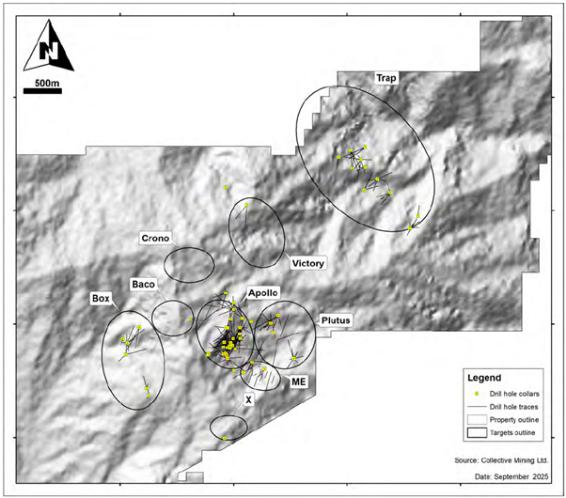
Figure 6: Location map of the Company’s drill holes in Guayabales.
Results
The drilling program at the Guayabales Project resulted in the discovery of significant mineral system at the Apollo target along with additional drilling discoveries in other targets such as Plutus, Trap, Box, ME and X.
Apollo Target
The drill programme resulted in a significant grassroots discovery of a new bulk tonnage and high-grade, gold-silver-copper-tungsten porphyry-breccia-vein system named the Apollo Porphyry System. The discovery hole was announced on 22 June 2022. A total of 196 holes were drilled from 2021 to September 2025, the effective date of the Technical Report, from 33 different pads for 84,648.9m at the Apollo Target.
64
On a grams/tonne x metres basis, APC104-D5 is the highest-grade intercept drilled at Apollo yielding 1,499 g/t gold equivalent. To date, the Company has drilled 18 gold equivalent accumulation intercepts at over 1,000-grams x metres at Apollo as follows:
| ● | APC104_D05: 497.35 m @ 2.68 g/t Au, 20 g/t Ag, 0.05% Cu |
| ● | APC104_D01: 534.40 m @ 2.16 g/t Au, 32 g/t Ag, 0.09% Cu |
| ● | APC_072: 519.10 m @ 2.12 g/t Au, 36 g/t Ag, 0.10% Cu |
| ● | APC_055: 792.25 m @ 0.88 g/t Au, 39 g/t Ag, 0.18% Cu |
| ● | APC104_D02: 402.60 m @ 2.32 g/t Au, 43 g/t Ag, 0.14% Cu |
| ● | APC_064: 451.40 m @ 1.48 g/t Au, 57 g/t Ag, 0.26% Cu |
| ● | APC_035: 359.15m @ 1.84 g/t Au, 48 g/t Ag, 0.48% Cu |
| ● | APC_060: 557.85 m @ 0.74 g/t Au, 59 g/t Ag, 0.33% Cu |
| ● | APC_095: 513.70 m @ 1.50 g/t Au, 42 g/t Ag, 0.18% Cu |
| ● | APC088_D02: 548.90 m @ 1.33 g/t Au, 31 g/t Ag, 0.12% Cu |
| ● | APC_122: 397.50 m @ 1.20 g/t Au, 60 g/t Ag, 0.33% Cu |
| ● | APC_093: 560.05m @ 1.18 g/t Au, 34 g/t Ag, 0.33% Cu |
| ● | APC_053: 329.75m @ 2.30 g/t Au, 42 g/t Ag, 0.16% Cu |
| ● | APC099_D05: 517.35 m @ 1.84 g/t Au, 10 g/t Ag, 0.03% Cu |
| ● | APC_049: 847.25 m @ 0.64 g/t Au, 16 g/t Ag, 0.14% Cu |
| ● | APC_065: 503.25 m @ 1.55 g/t Au, 23 g/t Ag, 0.10% Cu |
| ● | APC_031: 384.70 m @ 1.17 g/t Au, 43 g/t Ag, 0.37% Cu |
| ● | APC_063: 593.65 m @ 1.46 g/t Au, 15 g/t Ag, 0.03% Cu |
65
Plutus North Target
A total of 17 holes were drilled from 4 platforms for 6,079.6 at the Plutus North target (previously called Donut target) from 2021 to 2025. Highlights include:
| ● | DOC_002: 104.00 m @ 1.20 g/t Au, 12.0 g/t Ag. |
| ● | DOC_003: 163.00 m @ 1.20 g/t Au, 11.0 g/t Ag. |
| ● | DOC_008: 107.65 m @ 0.78 g/t Au, 21.0 g/t Ag |
| ● | DOC_010: 176.20 m @ 0.44 g/t Au, 22.0 g/t Ag. |
| ● | PNC_002: 185.80 m @ 0.59 g/t Au, 13 g/t Ag, 0.02% Cu. |
| ● | PNC_002: 136.45 m @ 0.97 g/t Au, 20 g/t Ag, 0.04% Cu. |
| ● | PNC_005: 304.60 m @ 0.58 g/t Au, 9 g/t Ag, 0.03% Cu. |
| ● | PNC_007: 194.05 m @ 0.18 g/t Au, 4 g/t Ag, 0.07% Cu. |
Plutus South Target
A total of 8 holes were drilled from one platform for 2,939.3m at the Plutus South target. Highlights include:
| ● | PSC_001: 328.05 m @ 0.19 g/t Au, 5 g/t Ag, 0.05% Cu. |
| ● | PSC_002: 199.60 m @ 0.19 g/t Au, 5 g/t Ag, 0.06% Cu. |
| ● | PSC_004: 131.55 m @ 0.19 g/t Au, 32 g/t Ag, 0.06% Cu. |
| ● | PSC_008: 160.40 m @ 0.17 g/t Au, 10 g/t Ag, 0.06% Cu. |
Box Target
A total of 16 holes were drilled from 6 different platforms for 5,403.6m at the Box target from 2021 to 2025. Highlights include:
| ● | BOXC_007: 33.30 m @ 0.91 g/t Au, 50 g/t Ag, 0.10% Zn, 0.02% Pb, 0.01% Cu. |
| ● | BOXC_008: 34.95 m @ 0.72 g/t Au, 16 g/t Ag, 0.05% Zn, 0.04% Pb, 0.03% Cu. |
| ● | BOXC_010: 55.00 m @ 0.45 g/t Au, 59 g/t Ag, 0.23% Zn, 0.04% Pb, 0.01% Cu. |
66
Trap Target
Trap is a north to northwest trending, structurally controlled corridor with evidence of porphyry B veins overprinted by late-stage carbonate base metals veins. A total of 38 holes were drilled from 2022 to 2025 at 11 platforms for 16,622.95 m at the Trap target. The holes have the following highlights:
| ● | TRC_001: 102.20 m @ 1.26 g/t Au, 12.0 g/t Ag, 0.09% Cu. |
| ● | VICE_001: 14.70 m @ 1.14 g/t Au, 26.0 g/t Ag, 0.01% Cu. |
| ● | VICE_002: 18.90 m @ 1.06 g/t Au, 36.0 g/t Ag, 0.18% Cu. |
| ● | TRC_002: 646.00 m @ 0.71 g/t Au, 6 g/t Ag, 0.02% Cu. |
| ● | TRC_006: 206.95 m @ 0.90 g/t Au, 5 g/t Ag. |
| ● | TRC_007A: 632.25 m @ 0.92 g/t Au, 9 g/t Ag. |
| ● | TRC_011: 174.45 m @ 0.89 g/t Au, 11 g/t Ag. |
| ● | TRC_014: 30.00 m @ 3.10 g/t Au, 149 g/t Ag, 0.05% Cu. |
| ● | TRC_030: 200.85 m @ 1.01 g/t Au, 5 g/t Ag, 0.04% Cu. |
ME Target
A total of 9 holes were drilled from 3 different platforms for 3,734.1 m at ME Target. Highlights include:
| ● | APC_081: 111.25 m @ 0.83 g/t Au, 10 g/t Ag, 0.03% Cu. |
| ● | APC_083: 55.40 m @ 0.98 g/t Au, 14 g/t Ag, 0.02% Cu. |
| ● | MEC_002: 0.65 m @ 534.00 g/t Au, 40 g/t Ag. |
| ● | MEC_002: 0.90 m @ 47.20 g/t Au, 8 g/t Ag. |
X Target
A total of 2 holes were drilled from one platform for 734.15 m at the X target. They intersected high grade Ag veins carrying au and minor base metals. Highlights include:
| ● | XTC_001: 12.85 m @ 1.82 g/t Au, 361 g/t Ag. |
| ● | XTC_001: 2.15 m @ 0.70 g/t Au, 198 g/t Ag. |
| ● | XTC_001: 18.65 m @ 0.72 g/t Au, 59 g/t Ag. |
| ● | XTC_001: 2.30 m @ 0.64 g/t Au, 368 g/t Ag. |
| ● | XTC_002: 2.15 m @ 0.55 g/t Au, 181 g/t Ag. |
| ● | XTC_002: 1.10 m @ 1.22 g/t Au, 426 g/t Ag. |
Knife-Towers Target
Five holes were drilled from two platforms for 1,628.90 m at the Knife-Towers target with no significant intersections.
Victory Target
Two holes were drilled from one platform for 936.20 m at the Victory target with no significant intersections.
67
Sample Length/True Thickness
The drill intersections do not represent the true width of the mineralised zones in porphyry, breccia and vein intersections, in particular where high angle holes cutting near-vertical mineralisation. Multiple holes are required to determine the geometry, width and thickness of the mineralised zones.
Conclusion
The protocols for the drilling, logging, sampling and QA-QC are carried out to current industry standards. The author of the Technical Report considers that there are no drilling, sampling or recovery factors that could materially affect the accuracy and reliability of the results.
Sampling, Analysis and Data Verification
Historical Data
The historical samples were prepared and analyzed by standard methods at certified laboratories using the methods summarized in Table 14 below.
| Company | Laboratory | Method | Code | Procedure | ||||
| Colombia Gold | not known | Preparation | Not known | |||||
| Au | Fire assay 30 g, AAS | |||||||
| Au overlimit | Fire assay 30 g, gravimetry | |||||||
| Multielements | ICP-AES | |||||||
| Colombian Mines | Inspectorate, Medellin and Reno (ISO/TEC 17025) | Preparation | Crush to -10 mesh, split 500 g, pulverise to -150 mesh. | |||||
| Au | FA/AA | Fire assay 30 g, AAS | ||||||
| Au overlimit | FA/GRAV | Fire assay 30 g, gravimetry | ||||||
| Multielements | ICP | ICP-AES | ||||||
| Colombian Mines (from June 2007) | SGS, Medellin and Callao (ISO 9001) | Preparation | Not known | |||||
| Au | FAA313 | Fire assay 30 g, AAS | ||||||
| Au overlimit | Fire assay 30 g, gravimetry | |||||||
| Multielements | ICP12B | 34 elements by aqua regia digestion, ICP-AES | ||||||
| Mercer Gold (soils, rocks) | SGS, Medellin and Callao (ISO 9001) | Preparation soils | SCR30 | Dry, screen to -10 mesh and -80 mesh, pulverise to P95 -140 mesh. | ||||
| Preparation rocks | PRP94 | Dry, crush to -1/4 inch and -10 mesh, split 250 g, pulverise to P95 -140 mesh. | ||||||
| Au | FAA313 | Fire assay 30 g, AAS | ||||||
| Au | FAI303 | Fire assay 30 g, ICP | ||||||
| Multielements | ICP40B | 32 elements by 4 acid digestion, ICP-AES | ||||||
| Multielements | ICP12B | 34 elements by aqua regia digestion, ICP-AES | ||||||
| Mercer Gold (core) | Acme, Medellin and Vancouver (ISO 9001) | Preparation | R200 | Crush 1 kg to p80 -10 mesh, split 250 g, pulverise to p85 -200 mesh. | ||||
| Au | G6 | Fire assay 30 g, AAS | ||||||
| Ag | 7AR1 | Aqua regia digest, ICP-AES | ||||||
| Multielements | 1D02 | 34 elements by aqua regia digestion, ICP-AES |
Table 14: Summary of the sample preparation and analyses methods of the historical samples.
68
Colombian Gold and Mercer Gold had standard industry protocols for sample security with sampling supervised by a geologist, and secure sample storage and transport to the laboratory.
Colombian Mines and Mercer Gold inserted certified standard reference materials (“CSRM”), coarse blanks and field duplicates in the sample batches of soil, rock and core samples, as summarized in Table 15 below. The CSRM were monitored for Au and Ag by scatter plots with performance gates of the recommended value of the data ± 2SD and ±3SD, and show acceptable results. The blanks were monitored for Au and Ag by scatter plots, and generally showed acceptable results, although the Acme gold samples show some carry-over between samples. Field duplicates were monitored for Au on scatter plots and show low variability at low grades and scatter at higher grades as a result of geological heterogeneity. No check samples at a second laboratory was carried out.
| Company | Type | Material | Position | No. | Acceptance | |||||
| Colombian Mines | CSRM | OREAS 15Pa, 62Pb, 50Pb, 61Pb | Not known | 27 | Average ± 2SD, 3SD | |||||
| Coars Blank | Not known | Not known | 53 | Scatter plot | ||||||
| Field Duplicate | Protocol not known | Not known | 40 | Scatter plot | ||||||
| Check samples | None | none | 0 | n/a | ||||||
| Mercer Gold | CSRM | OREAS 65a, 66a, 60a | Not known | 30 | Average ± 2SD, 3SD | |||||
| Coarse Blank | Not known | Not known | 28 | Scatter plot | ||||||
| Field Duplicate | Protocol not known | Not known | 37 | Scatter plot | ||||||
| Check samples | None | none | 0 | n/a |
Table 15: QA-QC samples used in the historical sampling programs.
Collective Sampling and Analysis
From 2020-2021, the Company’s samples were prepared and analysed by Actlabs Colombia S.A.S. at a laboratory in Rionegro, Medellin, certified to ISO 9001-2008, Activation Laboratories Ltd., Ancaster, Ontario, certified to ISO/IEC 17025 and SGS Colombia S.A.S., Medellin for sample preparation and SGS Peru S.A.S., El Callao for analysis, both certified to ISO 9001. Since 2023, the Company has used ALS Colombia Ltd for sample preparation and ALS Peru S.A for analysis, certified to ISO/IEC 17025. Actlabs, SGS and ALS are all independent of the Company. The methods are listed in Table 16 below.
69
| Laboratory | Method | Code | Procedure | |||
| Actlabs, Medellin and Activation Laboratories Ltd., Ancaster, Ontario | Preparation rocks | RX1 | Dry, crush to P80 -2 mm, riffle split 250 g, and pulverise to P95 -105 μm. | |||
| Preparation soils | S1 | Dry, sieve to -177 μm. | ||||
| Au | 1A2-30 | Fire assay 30 g, AAS | ||||
| Au overlimit | A13 | Fire assay 30 g, gravimetry | ||||
| Multielements rocks | UT-4M | 42 elements by multiacid digestion, ICP-MS | ||||
| Multielements soils | UT-1M | 34 elements by aqua regia digestion, ICP-MS | ||||
| SGS Colombia SAS, Medellin, SGS Peru SAS, El Callao, Peru | Preparation rocks | PRP93 | Dry, crush to P90 -2 mm, riffle split 250 g, and pulverise to P95 -106 μm | |||
| Preparation soils | SCR31 | Dry, sieve to -177 μm, riffle split 250 g, and pulverise to P95 -105 μm. | ||||
| Au | FAA313 | Fire assay 30 g, AAS | ||||
| Au overlimit | FAG303 | Fire assay 30 g, gravimetry | ||||
| Ag | AA12C | Aqua regia digestion, AAS | ||||
| Ag overlimit | AA11B | Aqua regia digestion, AAS | ||||
| Multielements rocks | ICM40B | 43 elements by multiacid digestion, ICP-MS | ||||
| Multielements soils | ICM14B | 36 elements by aqua regia digestion, ICP-OES | ||||
| ALS Colombia Ltd, Medellin. ALS Peru SAS, El Callao, Lima | Preparation Core | PREP-31B | Dry, crush to P70 - 2mm, riffle split 1000g, and pulverise to P85 - 75µm | |||
| Preparation Rocks - Soils | PREP-31 | Dry, crush to P70 - 2mm, riffle split 250g, and pulverise to P85 - 75µm | ||||
| Au (Core Samples) | AA24 | Fire assay 50g, AAS | ||||
| Au overlimit (Core Samples) | GRA22 | Fire assay 50g, gravimetry | ||||
| Au - Screen Metallics (Core) | SCR24 | The gold values for both the (+) 106 and (-) 106-micron fractions are reported together with the weight of each fraction as well as the calculated total gold content of the sample. Fire Assay 50g, AAS | ||||
| Multielements (Core Samples) | MS61 | 48 elements by multiacid digestion, ICP-MS | ||||
| Au (Rocks - Soils Samples) | AA23 | Fire assay 30g, AAS | ||||
| Au overlimit (Rocks – Soils Samples) | GRA21 | Fire assay 30g, gravimetry | ||||
| Multielements (Rocks - Soils Samples) | MS61 | 48 elements by multiacid digestion, ICP-MS |
Table 16: Summary of the sample preparation and analyses methods of the Company’s samples.
70
The Company has written protocols for sampling and QA-QC with the insertion of certified standard reference materials (CSRM), coarse blanks, fine blanks, coarse duplicates and fine duplicates. A total of 24% QA-QC samples are inserted which exceeds normal industry standards. The QA-QC is monitored in real time on receipt of the results of each batch of samples. The protocol for failed CSRM or blanks is to investigate the sample when in company custody then in laboratory custody and, if necessary, reanalyse the interval.
CSRM are purchased from a recognized laboratory. The CSRM are monitored for Au, Ag and Cu by scatter plots with performance gates with rejection if a sample is greater or lesser than the recommended value ± 5SD, and a warning if two or more samples are between the recommended value ±3 to ±5SD. The CSRM are also monitored statistically for accuracy. For gold, greater accuracy is observed in intermediate and low grades such as in CSRM with a Mean Bias% of -0.36 and an RSD% of 1.93 and Mean Bias% of -0.84 and an RSD% of 2.32. For CSRMs with higher grades, the values remain acceptable, with a Mean Bias% of -2.99 and an RSD% of 2.36.
The author of the Technical Report considers that the Company’s sample preparation, analysis and chain of custody and QA-QC meets with or even exceed current standard industry practice, and that the data are adequate for the purposes of the Technical Report. The author of the Technical Report recommends that check samples be sent on a monthly basis in order to monitor accuracy in real time. The sample preparation and analysis of the historical samples were carried out by independent, certified laboratories using standard methods and, although not all of the data is available now, it is the opinion of the author of the Technical Report that sample preparation, analysis and security meet with current standard industry practise. The companies had protocols for sample and analytical QA-QC that follow standard industry practise, with protocols for monitoring QA-QC in real time and for checking any sample batches that fail. In practise, the historical geochemical data are only used as an exploration guide by the Company and repeat soil and rock sampling is carried out in areas of interest.
Data Verification
The author of the Technical Report made a personal inspection of the Guayabales Project and the Company’s field office and core logging facility in Supia on 9 to 14 March 2025. Core from 10 holes from Apollo was examined, the logging and sampling facility was reviewed, and presentations were given on all aspects of the project.
A previous site visit was made on 12 to 15 January 2023 when core from four drill holes was examined; a field visit was made to the drilling at the Apollo target and two drill platforms were visited, Pad 2 and Pad 6; the protocols, workflow and chain of custody of the core from the drill to sample dispatch were seen, and storage of core, rejects and pulps; and the protocols, execution and results for QA-QC were revised; and presentations were given in person and by video-conference on the property, geology and mineralization.
A first site visit was made on 24 to 25 October 2020. The core of two historic drill holes in porphyry mineralization was revised; discussions on the geology and mineralization were held; two field localities were visited, 1) artisanal gold mines at La Llorona (Apollo North target), which showed that free gold was being recovered from porphyry-style mineralization and 2) a viewpoint over the Encanto zone (ME target) in the Guayabales valley where the NW-trending structural control on mineralization extending from Marmato was observed, as well as several re-vegetated drill pads and artisanal mines.
Drill core from ten holes from Apollo was examined on the 2025 site visit, four holes on the 2023 visit, and two historic holes on the 2020 site visit. The sample database of historical and the Company’s data was supplied author of the Technical Report in Access and Excel files. The author of the Technical Report checked a percentage of the assay certificates and Excel reports against the database, the drill logs and the intercept calculations and found no errors in the transcription of the analyses. The historical drill database was reconstructed by the Company based on assay certificates and core photos. The author of the Technical Report reviewed this in 2020 by running checks for unusual sample intervals and for gaps in sample continuity, and found no errors.
71
Mineral Processing and Metallurgical Testing
The Company has carried out seven programmes of metallurgical test work on samples from the Apollo target from 2022 to 2024 as described in Table 17. The results show high Au, Ag, Cu and WO3 recoveries using conventional processing. Cyanide leach Au recoveries reach up to 97.57% with Ag in the range 50% to 60%. Flotation produced concentrates with recoveries up to 95.3% Cu, 79.4% Au and 83.6% Ag. Flotation optimization testing on concentrate showed substantial improvements in overall metal recovery, with Au recovery of 89.4% and Ag recovery of 85.2%, while maintaining Cu recovery at 94%. Tungsten gravity recovery was up to 74%. Test work highlights simple metallurgy and high recoveries based on multiple tests carried out on samples representative of the Apollo mineralisation, and demonstrate the project’s amenability to conventional processing methods. Going forward, the Company plans to carry out mineralogical studies to characterize the metal zones and build a geometallurgical model in order to carry out further test work.
| Date | Laboratory | Samples | Test | Results | ||||
| 2022 | SGS Laboratories, Callao, Peru | 3 samples 1.17-8.01 g/t Au. 16.05-56.08 g/t Ag | Cyanide leach, bottle-roll tests (72 hours) | Au recovery 90.7-97.57%. Ag recovery 46.27-52.34%. | ||||
| 2023 | SGS Laboratories, Callao, Peru | 8 composite samples. 0.7-48.13 g/t Au. 0.06-1.04% Cu | Cyanide leach, bottle-roll tests | Au rec ave 93.5%. Au rec samples <0.15% Cu ave 96.7%. Ag rec 50-60%. | ||||
| 2024 | ALS Canada Ltd., Kamloops, British Columbia | 86.1 kg composite sulphide sample | Flotation locked cycle | Recovery up to 95.3% Cu, 83.6% Ag, 79.4% Au. Con grades up to 30.5% Cu, 1,280 g/t Ag, 28.7 g/t Au. | ||||
| 2024 | ALS | 3 low grade samples <0.9 g/t Au (0.39-0.86 g/t Au) | Cyanide leach, bottle-roll tests | Au rec ave 91.2%. Ag rec ave 59.6%. | ||||
| 2024 | 25 kg composite, 0.44% W | Gravimetry | Recovery W 74%. Con 63.6% scheelite. | |||||
| 2024 | SGS Laboratories, Callao, Peru | 7 sulphide samples low Cu. Ave 1.0 g/t Au, 11.73 g/t Ag. | Cyanide leach, bottle-roll tests | Rec ave 94.3% Au, 63.7% Ag. | ||||
| 2024 | ALS Canada Ltd, Kamloops, BC | Flotation optimisation on con | Rec 89.4% Au, 85.2% Ag, 94.4% Cu |
Table 17: Summary of metallurgical test work carried out on samples from the Apollo target.
Mineral Resource and Mineral Reserve Estimates
There are no mineral resource estimates for the Guayabales Project that were prepared in accordance with the current CIM standards and definitions required by the NI 43-101. Mineral resources that are not mineral reserves do not have demonstrated economic viability.
Exploration, Development and Production
In the opinion of the author of the Technical Report, the Guayabales Project is a discovery-stage project for porphyry, reduced intrusion related, breccia and vein-hosted Au and Ag mineralisation with Cu, Zn, Pb, Mo and WO3. The exploration programmes carried out by the Company are well planned and well executed and supply sufficient information to plan further exploration. Sampling, sample preparation, assaying and analyses were carried out in accordance with best current industry standard practices and are suitable to plan further exploration. Sampling, assaying and analyses include quality assurance and quality control procedures. There are no known significant risks or uncertainties that could reasonably be expected to affect the reliability or confidence in the exploration information.
The author of the Technical Report recommends a two-stage, two-year exploration programme for the Guayabales Project. The objective of Stage I is to define a mineral resource estimate and carry out a preliminary economic assessment (PEA) of the Apollo target. This will require 65,000 m of additional diamond drilling including deep drilling of the Ramp Zone. It is also recommended to carry out exploration of other targets to generate additional drill targets and 10,000 m of drilling on other targets is budgeted. Drilling is on-going since the cut-off date of the Technical Report. The estimated time for Stage I is about 13 months until the end of 2026 and the estimated budget is US$28,250,000 (See Table 18 below).
72
The objective of Stage II is to carry out a pre-feasibility study (“PFS”) of the Apollo target. This will require an estimated 110,000 m of additional diamond drilling to convert inferred resources to measured and indicated resources. The PFS requires metallurgical test work, geotechnical studies, environmental baseline studies, and engineering studies for mining, process design, tailings, and other aspects. It is also recommended to continue exploration of other targets to generate drill targets and carry out 10,000 m of drilling. The estimated time for Stage II is 12 months until the end of 2027 and the estimated budget is US$52,100,000 (See Table 18 below).
The Stage II programme is conditional on a positive outcome of the Stage I programme. The total estimated time for both stages is about two years until the end of 2027 and the total estimated budget is US$80,350,000 (See Table 18 below).
| Total (US$) | Stage I | Stage II | ||||||||||||||||||||||||||
| Item | Metres | Cost per m | Total | Metres | Total | Metres | Total | |||||||||||||||||||||
| Drilling | ||||||||||||||||||||||||||||
| Apollo | 175,000 | 300 | 52,500,000 | 65,000 | 19,500,000 | 110,000 | 33,000,000 | |||||||||||||||||||||
| Other Targets | 20,000 | 250 | 5,000,000 | 10,000 | 2,500,000 | 10,000 | 2,500,000 | |||||||||||||||||||||
| Site G&A | 195,000 | 50 | 9,750,000 | 75,000 | 3,750,000 | 120,000 | 6,000,000 | |||||||||||||||||||||
| Target generative work | 2,000,000 | 1,000,000 | 1,000,000 | |||||||||||||||||||||||||
| Metallurgical test work | 500,000 | - | 500,000 | |||||||||||||||||||||||||
| Geotechnical studies | 600,000 | - | 600,000 | |||||||||||||||||||||||||
| Environmental Baseline Studies | 2,000,000 | - | 2,000,000 | |||||||||||||||||||||||||
| Technical studies for Mining, Process design, tailings etc. | 3,000,000 | - | 3,000,000 | |||||||||||||||||||||||||
| Resource estimation and PEA | 500,000 | 500,000 | - | |||||||||||||||||||||||||
| Pre-Feasibility Study | 2,000,000 | - | 2,000,000 | |||||||||||||||||||||||||
| G&A | 2,500,000 | 1,000,000 | 1,500,000 | |||||||||||||||||||||||||
| Sub-total | 80,350,000 | 28,250,000 | 52,100,000 | |||||||||||||||||||||||||
Table 18: Estimated budget for the recommended exploration programmes for the Guayabales Project.
Collective has never paid any dividends and currently intends to reinvest all future earnings to finance the development and growth of its business. As a result, Collective does not intend to pay dividends on the Common Shares in the foreseeable future. Any future determination to pay distributions will be at the discretion of the Board and will depend on the financial condition, business environment, operating results, capital requirements, any contractual restrictions on the payment of distributions and any other factors that the Board deems relevant. Collective is not bound or limited in any way to pay dividends in the event that the Board determines that payment of a dividend is in the best interest of the shareholders of Collective.
DESCRIPTION OF CAPITAL STRUCTURE
Collective is authorized to issue an unlimited number of Common Shares without par value of which, as of the date of this AIF, 92,575,498 Common Shares were issued and outstanding. The Common Shares do not carry any pre-emptive, subscription, redemption, retraction, conversion or exchange rights, nor do they contain any sinking or purchase fund provisions.
The holders of Common Shares are entitled to receive notice of any meeting of the shareholders of Collective and to attend and vote thereat. Each Common Share entitles its holder to one vote. The holders of Common Shares are entitled to receive on a pro rata basis such dividends as the Board may declare out of funds legally available therefor. In the event of the dissolution, liquidation, winding-up or other distribution of the assets of Collective, such holders are entitled to receive on a pro rata basis all of the assets of the Company remaining after payment of all of Collective’s liabilities. The Common Shares carry no pre-emptive, conversion, redemption or retraction rights. The Common Shares carry no other special rights and restrictions other than as described herein.
73
Trading Price and Volume
Toronto Stock Exchange
The Common Shares are listed and posted for trading on the TSX under the symbol “CNL”. The following table indicates the market price ranges and trading volumes of the Common Shares on the TSX on a monthly basis for Collective’s financial year ended December 31, 2025, as reported by the TSX.
| Month | High ($) | Low ($) | Volume | |||||||
| 2025 | ||||||||||
| January | $ | 7.71 | $ | 5.97 | 1,847,611 | |||||
| February | $ | 9.67 | $ | 7.43 | 2,617,496 | |||||
| March | $ | 15.27 | $ | 8.60 | 5,044,439 | |||||
| April | $ | 16.06 | $ | 11.41 | 3,044,937 | |||||
| May | $ | 15.78 | $ | 12.42 | 3,746,110 | |||||
| June | $ | 16.29 | $ | 13.03 | 2,276,449 | |||||
| July | $ | 16.45 | $ | 12.27 | 3,828,158 | |||||
| August | $ | 18.18 | $ | 11.70 | 3,434,149 | |||||
| September | $ | 20.59 | $ | 17.28 | 3,102,414 | |||||
| October | $ | 20.83 | $ | 14.80 | 7,516,686 | |||||
| November | $ | 17.13 | $ | 13.76 | 3,238,702 | |||||
| December | $ | 21.14 | $ | 15.40 | 4,386,569 | |||||
NYSE American
The Common Shares commenced trading on NYSE American under the trading symbol “CNL” on July 22, 2024. The following table indicates the market price ranges and trading volumes of the Common Shares on NYSE American for each month of the most recently completed financial year, as reported by NYSE American.
| Month | High ($) | Low ($) | Volume | |||||||
| 2025 | ||||||||||
| January | US$ | 5.35 | US$ | 4.12 | 235,207 | |||||
| February | US$ | 6.85 | US$ | 5.08 | 469,361 | |||||
| March | US$ | 10.67 | US$ | 5.56 | 2,021,328 | |||||
| April | US$ | 11.61 | US$ | 7.56 | 2,480,291 | |||||
| May | US$ | 11.81 | US$ | 8.85 | 1,269,691 | |||||
| June | US$ | 11.63 | US$ | 9.46 | 1,208,864 | |||||
| July | US$ | 12.04 | US$ | 8.89 | 1,483,250 | |||||
| August | US$ | 13.27 | US$ | 8.30 | 1,935,765 | |||||
| September | US$ | 14.91 | US$ | 12.50 | 1,320,938 | |||||
| October | US$ | 14.96 | US$ | 10.43 | 1,869,249 | |||||
| November | US$ | 12.13 | US$ | 9.77 | 993,196 | |||||
| December | US$ | 16.16 | US$ | 10.90 | 1,261,124 | |||||
The price of the Common Shares as quoted by the TSX and NYSE American at the close of business on March 27, 2026, being the last full trading day of the Common Shares immediately preceding the date of this AIF, was $20.96 and US$15.05, respectively.
Prior Sales
Collective issued the following securities in the financial year ended December 31, 2025, that are not listed or quoted on a marketplace:
| Month of Issue | Type of Security | Number Issued | Issue/Exercise Price | Reason for Issuance | ||||||
| February 2025 | Incentive Stock Options | 200,000 | $ | 8.32 | Compensation | |||||
| April 2025 | Incentive Stock Options | 700,000 | $ | 15.03 | Compensation | |||||
| December 2025 | Incentive Stock Options | 1,450,000 | $ | 20.82 | Compensation | |||||
74
The following table sets forth the name, municipality of residence, position held with Collective, principal occupation for the five preceding years and number of Common Shares beneficially owned by each person who is a director and/or an executive officer of Collective. The statement as to the Common Shares beneficially owned, controlled or directed, directly or indirectly, by the directors and executive officers hereinafter named is in each instance based upon information furnished by the person concerned and is as at the date hereof.
| Name, Position with the Company and Municipality of Residence | Director/Officer Since | Principal Occupation(s) | Number of Common Shares Beneficially Owned, Directly or Indirectly or Over Which Control or Direction is Exercised | |||
| Ari
Sussman Executive Chairman and a Director Miami, Florida | May, 2021 | Executive Chairman of the Company (2021 to Present); Chief Executive Officer of Continental Gold Inc. (2010 to 2020) | 11,003,600 (11.9%) | |||
| Ned Jalil
Chief Executive Officer Miami, Florida | April, 2025 | Chief Executive Officer of the Company (2025 to Present); Consultant (2023 to 2025); Senior Vice President of Kinross Gold Corp (2022 to 2023); COO of Appian Capital (2020 to 2021) | Nil | |||
| Omar Ossma President Medellín, Colombia | May, 2021 | President and Chief Executive Officer of the Company (2021 to Present); Vice President, Legal of Continental Gold Inc. (2015 to 2020) | 500,000 (<1%) | |||
| Carlos
Andrés Santos Executive Vice President Medellin, Colombia | January, 2026 | Executive Vice President of the Company (2026 to Present); Chief Executive Officer Americas Business Services of Holcim / Amrize (2023 to 2026); VP Supply Chain and Shared Services of Ecopetrol (2016 to 2023) | Nil | |||
| Rusell
Evans Executive Vice President Exploration Medellin, Colombia | March, 2026 | Executive Vice President Exploration of the Company (2026 to Present); Vice President Exploration of Vedanta Limited (2025 t0 2026); Director – Generative Exploration Latin America of Newmont Corporation (2012 to 2025) | Nil | |||
| Paul
Begin Chief Financial Officer and Corporate Secretary Oakville, Ontario | May, 2021 | Chief Financial Officer and Corporate Secretary of the Company (2021 to Present); Chief Financial Officer of Continental Gold Inc. (2011 to 2020)) | 4,081,863 (4.4%) |
75
| Name, Position with the Company and Municipality of Residence |
Director/Officer Since |
Principal Occupation(s) | Number of Common Shares Beneficially Owned, Directly or Indirectly or Over Which Control or Direction is Exercised | |||
|
María Constanza García Botero(1)(2) Director Medellín, Colombia |
May, 2021 |
General Coordinator, Metro Linea 1 (2021 – Present); General Coordinator, Urban Development Institute (2021); Director of Education at Semana (2020); Under-Secretary of Access and Permanence with the Colombian Education Secretary (2019 to 2020); Manager at Deloitte (Bogota, Colombia) (2018 to 2019) |
115,183 (<1%) | |||
|
Ashwath Mehra(1) Director Zug, Switzerland |
September, 2021 | Chief Executive Officer of ASTOR Management AG (2011 to Present) |
1,434,100 (1.5%) | |||
|
Angela María Orozco Gómez(2) Director Bogotá, Colombia |
November, 2023 | Professional Board Member; Minister of Transport and Infrastructure, Colombia (2018 – 2022) | Nil | |||
|
Jasper Bertisen(1)(2) Director Golden, Colorado |
February, 2025 | Professional Board and Advisory Board Member; Investment Committee Member, former Partner, and other roles with Resource Capital Funds (2004 – Present) | Nil |
Notes: | ||
| (1) | Member of the Audit Committee. Each Audit Committee member is (i) “independent” and “financially literate” within the meaning of National Instrument 52-110 – Audit Committees; (ii) satisfies the independence standards specified in the rules of the TSX and NYSE American and SEC Rule 10A-3; and (iii) possesses education or experience that is relevant for the performance of their responsibilities as an Audit Committee member. | |
| (2) | Member of the Compensation, Nominating and Corporate Governance Committee. |
The Board are elected by the shareholders at each annual general meeting and typically hold office until the next annual general meeting at which time they may be re-elected or replaced.
The by-laws of Collective permit the Board to appoint directors to fill any casual vacancies that may occur. Individuals appointed as directors to fill casual vacancies on the Board hold office for the remainder of the term of the director that he or she is replacing, being until the next annual general meeting at which time they may be re-elected or replaced.
As of the date of this AIF, the directors and executive officers, as a group, beneficially own, directly or indirectly, or exercise control or direction over, a total of 17,134,746 Common Shares, representing approximately 18.5% of the Common Shares on a non-diluted basis.
Corporate Cease Trade Orders or Bankruptcies
No director or executive officer of the Company is, or, within 10 years before the date of this AIF, has been, a director, officer or promoter of any person or company (including the Company) that, while that person was acting in that capacity: (a) was the subject of a cease trade or similar order that denied the relevant company access to any exemptions under applicable securities legislation that was in effect for a period of more than 30 consecutive days; or
76
(b) became bankrupt, made a proposal under any legislation relating to bankruptcy or insolvency or was subject to or instituted any proceedings, arrangement or compromise with creditors or had a receiver, receiver manager or trustee appointed to hold the assets of that person.
Penalties or Sanctions
No director or executive officer of the Company is, or, within the last 10 years, has been: (a) subject to any penalties or sanctions imposed by a court relating to securities legislation or by a securities regulatory authority or has entered into a settlement agreement with a securities regulatory authority; or (b) subject to any other penalties or sanctions imposed by a court or regulatory body, including a self-regulatory body, that would be likely to be considered important to a reasonable investor making an investment decision.
Personal Bankruptcies
No director or executive officer of the Company, or a personal holding company of any such persons, has, within the last 10 years, become bankrupt, made a proposal under any legislation relating to bankruptcy or insolvency, or been subject to or instituted any proceedings, arrangement or compromise with creditors, or had a receiver, receiver manager or trustee appointed to hold the assets of the individual.
Conflicts of Interest
Some of the Company’s directors and/or executive officers are also directors of other natural resource companies and, consequently, there exists the possibility for such persons to be in a position of conflict relating to any future transactions or relationships between the Company and such other companies or common third parties. However, the Company is unaware of any such pending or existing conflicts between these parties. Any decision made by any of such directors or executive officers involving the Company are made in accordance with their duties and obligations to deal fairly and in good faith with the Company and such other companies and their obligations to act in the best interests of the shareholders of the Company. None of the present directors or executive officers of the Company, and no associate or affiliate of any of them, has any material interest in any transaction of the Company or in any proposed transaction which has materially affected or will materially affect the Company. See “Risk Factors”.
Audit Committee Charter
The Audit Committee has adopted a written charter setting out its mandate and responsibilities. The Audit Committee is responsible for assisting the Board in fulfilling its oversight responsibilities relating to financial accounting and reporting processes and internal controls. The Audit Committee’s primary duties and responsibilities are to: (i) conduct reviews and discussions with management and the external auditors relating to the audit and financial reporting; (ii) assess the integrity of internal controls and financial reporting procedures; (iii) ensure implementation of internal controls and procedures; (iv) review the quarterly and annual financial statements and management’s discussion and analysis of the Company; (v) select and monitor the independence, performance and remuneration of the external auditors; and (vi) oversee all disclosure relating to financial information. The Audit Committee is also responsible for reviewing and following the procedures established in the Company’s codes, policies and guidelines as may be established from time to time.
The Charter of the Company’s Audit Committee is set forth in Appendix “A” hereto.
Composition of the Audit Committee
The Audit Committee has been constituted to oversee the financial reporting processes of Collective and is comprised of Jasper Bertisen (Chair), María Constanza García Botero and Ashwath Mehra, who are each independent, as defined in National Instrument 52-110 – Audit Committees (“NI 52-110”) adopted by the Canadian Securities Administrators.
Each member of the Audit Committee is financially literate (as defined under NI 52-110) and possesses extensive financial knowledge, experience and comprehension of financial statements.
77
Relevant Education and Experience
Each member of the Audit Committee has experience relevant to his or her responsibilities as an Audit Committee member as described below.
Jasper Bertisen. Mr. Bertisen is a seasoned leader in the mining industry with a proven track record of successfully driving strategic initiatives. He has spent the majority of his career in mining private equity with Resource Capital Funds, overseeing due diligence and strategy execution for investments spanning development-stage to producing assets across various commodities and global markets. As a former Partner at Resource Capital Funds, he oversaw an $800 million portfolio and contributed to more than $3.5 billion in capital raised. Together, these qualifications provide a foundation for overseeing financial reporting, asset valuation and impairment, audit process, and financial controls and disclosure. In addition, with extensive governance experience, Jasper served on the boards of both private and public mining companies, as well as on the advisory boards of several mining technology companies. He is also an Adjunct Professor at the Colorado School of Mines and holds M.Sc. degrees in Mining Engineering and Mineral Economics.
María Constanza García Botero. Ms. García Botero has worked in public finance, urban development, infrastructure, mining, energy, and public-private partnerships (PPPs) as an advisor or in various management positions at the National Planning Department, the Ministry of Finance, and the National Hydrocarbons Agency. From 2010 to 2012 she served as the Deputy Minister of Infrastructure at the Ministry of Transport (Colombia), and from 2012 to 2014 served as President of the National Mining Agency, Ministry of Mining and Energy (Colombia). More recently, Ms. García Botero was a senior manager with Deloitte in Bogota, Colombia (2018-2019), Under-Secretary of Access and Permanence with the Education Secretary in Bogota, Colombia (June 2019 – January 2020), Director of Education at Semana, a weekly periodical magazine of opinion and analysis in Colombia (January 2020 – December 2020) and coordinator for the Carrera Séptima upgrade project in a Green Corridor at the Institute for Urban Development IDU in Bogotá (2021). She currently works as general coordinator of Metro Linea 1, a consortium in charge of design, construction and operation of the first metro line in Bogotá. Together, these qualifications provide relevant experience in financial analysis of large capital projects, understanding corporate financial reporting processes, regulatory and fiscal frameworks affecting mining companies, and governance and financial oversight of infrastructure and resource projects. Ms. García Botero graduated from the Technological University of Pereira, Colombia obtaining a degree in industrial engineering, then obtained a diploma in socio-economic evaluation of projects at Universidad de los Andes, Bogota. She later obtained two master’s degree in Urban and Regional Development Administration and Public Policy from Ohio State University.
Ashwath Mehra. Mr. Mehra is a seasoned executive with 35 years of global experience in the minerals industry. Mr. Mehra is an economist by training and received his BSc (Econ) in Economics and Philosophy from the London School of Economics. He is the CEO of the ASTOR Group, a private investment and advisory business, working in the fields of mining, technology, biotech and real estate. He spent many years in the commodity trading and mining business as well as owning, buying and selling companies. He is a director of several companies, both public and private in both executive and non-executive roles. Together, these experiences provide relevant expertise in financial analysis and capital markets, commodity-price risk and mining economics, corporate governance and financial reporting, and evaluation of financial statements and business risks. He also devotes significant time to non-profit activities in the fields of education and healthcare. Most recently, Mr. Mehra was Executive Chairman of GT Gold, a company he founded and sold to Newmont Corporation generating a significant return to GT Gold shareholders.
Pre-Approval Policies and Procedures
The Audit Committee charter sets out procedures regarding the provision of non-audit services by Collective’s independent chartered professional accountants. This policy encourages consideration of whether the provision of services other than audit services is compatible with maintaining the auditor’s independence and requires Audit Committee pre-approval of permitted non-audit and non-audit related services.
External Auditor Service Fees (by category)
The following table provides detail in respect of audit, audit related, tax and other fees paid by the Company to the external auditors for professional services.
| Year | Audit Fees(1) | Audit Related Fees(2) | Tax Fees(3) | All Other Fees(4) | ||||
| 2025 | C$284,000 | C$53,500 | Nil | Nil | ||||
| 2024 | C$316,900 | C$77,900 | Nil | Nil |
| Notes: | ||
| (1) | “Audit Fees” refers to the aggregate fees billed by the external auditor for audit services, quarterly reviews and involvement with preparation of offering and due diligence related to financing documents. 2024: Fees of C$249,900 paid to BDO our current auditor, and fees of C$67,000 paid to PWC our prior auditor. | |
| (2) | Company “Audit Related Fees” refers to aggregate fees billed for assurance and related services by the Company’s external auditors, including listing applications and other matters. 2024: Fees of C$34,900 paid to BDO our current auditor, and fees of C$43,000 paid to PWC our prior auditor, | |
| (3) | “Tax Fees” includes fees for professional services rendered by the external auditor for tax compliance, tax advice, and tax planning. 2024: Fees paid to PWC | |
| (4) | “All Other Fees” includes all fees billed by the external auditors for services not covered in the other three categories. |
78
Audit Committee Oversight
Pursuant to section 7 of the Audit Committee Charter, the Audit Committee has the authority to: (a) to engage independent counsel and other advisors as it determines necessary to carry out its duties, (b) to set and pay the compensation for any advisors employed by the Audit Committee, and (c) to communicate directly with the internal and external auditors.
The Audit Committee has a direct relationship with the Company’s auditors and has the authority to set their engagement. Furthermore, the Audit Committee meets with the Company’s auditors without the presence of management after every audit committee meeting.
The Audit Committee members are able to oversee financial reporting and internal controls in Colombia as follows:
| ● | One member of the Audit Committee is a Colombian resident and is bilingual and has direct access to staff as required. |
| ● | The Audit Committee has a direct link to the auditors and holds independent meetings with them after each audit committee meeting. |
| ● | Each Audit Committee members has visited the offices in Colombia and has met with Colombian employees. |
| ● | Management regularly updates the audit committee on internal controls and related processes. |
Ari Sussman, the Executive Chairman and a director of the Company, is a promoter of the Company. As of the date hereof Mr. Sussman beneficially owns, or controls or directs, directly or indirectly, a total of 11,003,600 Common Shares and 750,000 incentive stock options representing approximately 12.7% of the equity of the Company on a non diluted basis. No person who was a promoter of the Company:
| ● | received anything of value directly or indirectly from the Company or a subsidiary within the last two years; |
| ● | sold or otherwise transferred any asset to the Company or a subsidiary within the last two years; |
| ● | has been a director, chief executive officer or chief financial officer of any company that during the past 10 years was the subject of a cease trade order or similar order or an order that denied the company access to any exemptions under securities legislation for a period of more than 30 consecutive days or became bankrupt, made a proposal under any legislation relating to bankruptcy or insolvency or been subject to or instituted any proceedings, arrangement or compromise with creditors or had a receiver or receiver manager or trustee appointed to hold its assets; |
| ● | has been subject to any penalties or sanctions imposed by a court relating to Canadian securities legislation or by a Canadian securities regulatory authority or has entered into a settlement agreement with a Canadian securities regulatory authority within the last two years; |
| ● | has been subject to any other penalties or sanctions imposed by a court or regulatory body that would be likely to be considered important to a reasonable investor making an investment decision within the last two years; or |
| ● | has within the past 10 years become bankrupt, made a proposal under any legislation relating to bankruptcy or insolvency or been subject to or instituted any proceedings, arrangement or compromise with creditors or had a receiver or receiver manager or trustee appointed to hold its assets. |
79
LEGAL PROCEEDINGS AND REGULATORY ACTIONS
There are no legal proceedings or regulatory actions to which the Company or properties are or were subject to, during the most recently completed financial year ended December 31, 2025.
INTEREST OF MANAGEMENT AND OTHERS IN MATERIAL TRANSACTIONS
Other than as disclosed elsewhere in this AIF, no director, executive officer or principal shareholder of Collective, or any associate or affiliate of the foregoing, has had any material interest, direct or indirect, in any transaction within the three most recently completed financial years or during the current financial year prior to the date of this AIF that has materially affected or will materially affect the Company.
The transfer agent and registrar of the Common Shares is TSX Trust Company located at 100 Adelaide Street West, Suite 301, Toronto, Ontario M5H 4H1.
There are no contracts of the Company, other than contracts entered into in the ordinary course of business, that are material to the Company and that were entered into by the Company within the most recently completed financial year or before the most recently completed financial year if the material contract is still in effect, other than:
| (i) | an option agreement to acquire the claims comprising the San Antonio Project dated July 9, 2020 entered into between Minerales Provenza SAS and certain option holders; |
| (ii) | an option agreement to acquire claims comprising the Guayabales Project dated June 24, 2020 entered into between Minerales Provenza S.A.S. (subsequently assigned to Collective Mining Limited Sucursal Colombia on August 26, 2020) and the Guayabales Mining Association (the “Guayabales Option Agreement”); |
| (iii) | amending agreement number 01 to the Guayabales Option Agreement entered into between Collective Mining Sucursal Colombia and the Guayabales Mining Association dated July 9, 2020 establishing the amount and timing of the first payment due under the Guayabales Option Agreement; |
| (iv) | amending agreement number 02 to the Guayabales Option Agreement entered into between Collective Mining Limited Sucursal Colombia and the Guayabales Mining Association dated July 16, 2020; |
| (v) | a purchase and sale agreement to acquire an exploration title forming part of the Guayabales Project dated December 23, 2020 entered into between certain arm’s length land owners and Collective Mining Limited Sucursal Colombia; |
| (vi) | amending agreement number 03 to the Guayabales Option Agreement entered into between Collective Mining Limited Sucursal Colombia and the Guayabales Mining Association dated February 25, 2021 clarifying and correcting the number and status of the contractual annexes to the Guayabales Option Agreement; |
| (vii) | amending agreement number 04 to the Guayabales Option Agreement entered into between Collective Mining Limited Sucursal Colombia and the Guayabales Mining Association dated June 19, 2024 to reorganize the agreement into three phases of the mining project and specify the obligations, investments, and activities of each party and provide for certain corporate restructuring of the Guayabales Mining Association; |
| (viii) | amending agreement number 05 to the Guayabales Option Agreement entered into between Collective Mining Limited Sucursal Colombia and the Guayabales Mining Association dated June 20, 2025 providing for the establishment of an operational transition framework in respect of mining operations and exploration activities between the parties, and the elimination of the requirement of Guayabales Mining Association to undertake certain corporate restructuring; |
| (ix) | an amending agreement number 06 to the Guayabales Option Agreement entered into between Collective Mining Limited Sucursal Colombia and the Guayabales Mining Association dated July 22, 2025 confirming the full exercise of the option and establishing the final payment schedule and transfer of mining assets; |
| (x) | the Amended and Restated Investor Rights Agreement; and |
| (xi) | the Guayabales Surface Rights Agreement. |
80
The following persons or companies are named as having prepared or certified a report, valuation, statement or opinion described or included in a filing, or referred to in a filing made under National Instrument 51-102 – Continuous Disclosure Obligations by the Company during or relating to the most recently completed financial year and whose profession or business gives authority to the report, valuation, statement or opinion made by the person or company
| ● | David J. Reading, MSc in Economic Geology and is a Fellow of the Institute of Materials, Minerals and Mining and of the Society of Economic Geology (SEG), a special advisor to the Company, is a “qualified person” within the meaning of this term in NI 43-101 and has prepared the Company’s news releases, sections of this AIF and other disclosure documents that are of a scientific and technical nature pertaining to the Guayabales Project and has verified the data disclosed therein. Mr. Reading is independent of the Company. As of the date of this AIF, he holds directly or indirectly, 1,887,000 Common Shares, incentive stock options to purchase an aggregate of 225,000 Common Shares of the Company at varying prices. |
| ● | Stewart D. Redwood, PhD in ore geology and a Fellow of the Institute of Materials, Minerals and Mining (FIMMM), the Geological Society of London (FGS) and of the Society of Economic Geology (SEG), an independent consulting geologist, is the author of the Guayabales Technical Report. Dr. Redwood is an independent “qualified person” for the purposes of NI 43-101. |
| ● | John Wells is the designated Qualified Person within the meaning of NI 43-101 and has reviewed and verified that the technical information contained herein is accurate and approves of the written disclosure of same. Mr. Wells is a graduate of the Royal School of Mines in the UK, has over 50 years of experience in mineral processing and is a Fellow of the SAIMM (South African Institute of Mines and Metallurgy) and is a member of CIM (Canadian Institute of Mining and Metallurgy). |
Other than Mr. Reading, no person named or referred to above beneficially owns, directly or indirectly, 1% or more of the Common Shares.
The auditors of the Company, BDO Canada LLP, Chartered Professional Accountants, Licensed Public Accountants (“BDO”), at its office located at 360 Oakville Place Drive, Suite 500, Oakville, Ontario, L6H 6K8, issued an independent auditor’s report dated March 24, 2025 in respect of the Company’s annual consolidated financial statements for the years ended December 31, 2024 and December 31, 2023. BDO have advised that they are independent of the Company in accordance with the rules of professional conduct of the Institute of Chartered Professional Accountants of Ontario.
No person or company whose profession or business gives authority to a statement made by the person or company and who is named as having prepared or certified a part of this AIF or as having prepared or certified a report or valuation described or included in this AIF holds any beneficial interest, direct or indirect, in any securities or property of Collective or of an associate or affiliate of Collective and no such person is expected to be elected, appointed or employed as a director, senior officer or employee of the Company or of an associate or affiliate of Collective and no such person is a promoter of Collective or an associate or affiliate of Collective.
81
NYSE AMERICAN CORPORATE GOVERNANCE
Section 110 of the NYSE American Company Guide permits NYSE American to consider the laws, customs and practices of foreign issuers and to grant exemptions from NYSE American listing criteria based on these considerations. Below is a description of the significant ways in which the Company’s governance practices differ from those followed by U.S. domestic companies pursuant to NYSE American standards:
Quorum
Section 123 of the NYSE American Company Guide recommends a quorum of not less than one-third of a listed company’s shares issued and outstanding entitled to vote at a meeting of shareholders. The Company’s quorum requirement under its by-laws is two persons, present in person or who are represented by a proxy, and having voting rights at such meeting.
Notice of Shareholder Meetings
Section 703 of the NYSE American Company Guide requires, among other things, that a listed company is to give shareholders written notice at least ten days in advance of all shareholders’ meetings, and to provide for such notice in its bylaws. The Company’s by-laws provide that notice of meetings of the Company’s shareholders shall be given not more than 10 days, or if an “offering company” as defined under Canadian Laws, not less than 21 days, but in either case not more than 50 days prior to the date of the meeting. The Company is an offering company and as such, is not required to provide notice of shareholder meetings at least ten days in advance of shareholder meetings under Canadian Laws. In addition, the Company’s by-laws provide that notice may be given telephonically which does not comply with the requirement in Section 703 that such notice be in writing. The Company will follow the requirements set forth in its by-laws which are in accordance with Canadian Laws and the rules of the TSX.
Proxy Solicitation
Section 705 of the NYSE American Company Guide requires the solicitation of proxies and delivery of proxy statements for all shareholder meetings of a listed company, and requires that these proxies be solicited pursuant to a proxy statement that conforms to the proxy rules of the SEC. The Company solicits proxies in accordance with the OBCA, applicable Canadian securities laws and the rules and policies of the TSX.
Shareholder Approval
Section 711 of the NYSE American Company Guide requires shareholder approval of all equity compensation plans and material revisions to such plans. The definition of “equity compensation plans” includes plans that provide for the delivery of both newly issued and treasury securities, as well as plans that include securities re-acquired in the open market by the issuing company for the purpose of redistribution to employees and directors. The Company will follow the shareholder approval requirements listed in Section 613 of the TSX Company Manual in connection with equity compensation arrangements.
Sections 712 and 713 of the NYSE Company Guide require a listed company to obtain the approval of its shareholders for certain kinds of securities issuances. The Company will follow the shareholder approval requirements listed in Part VI of the TSX Company Manual in connection with certain securities issuances.
In addition, the Company may from time-to-time seek exemption from NYSE American corporate governance requirements under Section 110 of the NYSE American Company Guide, in which case the Company will make any required disclosures of such exemptions. The foregoing is consistent with the laws, customs and practices in Canada.
Additional information relating to the Company is available on SEDAR+ at www.sedarplus.ca and on the Company’s website at www.collectivemining.com. Additional financial information is contained in the Company’s audited financial statements and MD&A for the most recently completed financial year, copies of which have been filed with the securities regulatory authorities in each of the provinces and territories of Canada other than Quebec. Such documents, as well as additional information about the Company, may be found under Collective’s issuer profile on SEDAR+ at www.sedarplus.ca.
82
Appendix “A” - CHARTER OF THE AUDIT COMMITTEE OF THE BOARD OF DIRECTORS
OF COLLECTIVE MINING LTD.
PURPOSE
| 1. | The audit committee (the “Committee”) is a committee of the board of directors (the “Board”) of Collective Mining Ltd. (“Collective” or the “Company”). Its primary function shall be to assist the Board in fulfilling its oversight responsibilities with respect to: |
| (a) | the financial reporting process and the quality, transparency and integrity of the Company’s consolidated financial statements and other related public disclosures; |
| (b) | the Company’s internal controls over financial reporting; |
| (c) | the Company’s compliance with legal and regulatory requirements relevant to the consolidated financial statements and financial reporting; |
| (d) | ensuring that there is an appropriate standard of corporate conduct for senior financial personnel and employees including, if necessary, adopting a corporate code of ethics; |
| (e) | the external auditors’ qualifications and independence; and |
| (f) | the performance of the internal audit function and the external auditors. |
| 2. | The function of the Committee is oversight. The members of the Committee are not full-time employees of the Company. The Company’s management is responsible for the preparation of the Company’s consolidated financial statements in accordance with applicable accounting standards and applicable laws and regulations. The Company’s external auditors are responsible for the audit or review, as applicable, of the Company’s consolidated financial statements in accordance with applicable auditing standards and laws and regulations. Accordingly, in carrying out its oversight responsibilities, the Committee does not provide any expert or special assurance as to the Company’s financial statements or internal controls or any professional certification as to the auditor’s work. |
COMPOSITION
| 3. | The Committee shall be appointed by the Board annually on the recommendation of the Corporate Governance, Nominating and Compensation Committee and shall be comprised of a minimum of three directors. If an appointment of members of the Committee is not made as prescribed, the members shall continue as such until their successors are appointed. The Board may remove a member of the Committee at any time in its sole discretion by resolution of the Board. |
| 4. | All of the members of the Committee shall be directors whom the Board has determined are independent and all members of the Committee shall be “financially literate”, taking into account the applicable rules and regulations of securities regulatory authorities and/or stock exchanges. In addition, at least one member of the Committee shall be financially sophisticated, in that he or she shall have had past employment experience in finance or accounting, requisite professional certification in accounting, or any other comparable experience or background which results in the individual’s financial sophistication, including but not limited to being or having been a chief executive officer, chief financial officer, or other senior officer with financial oversight responsibilities and be an “audit committee financial expert” within the meaning of U.S. federal securities laws. .None of the members of the Committee may have participated in the preparation of the financial statements of the Company or any current subsidiary of the Company at any time during the past three years. |
A-1
| 5. | None of the members of the Committee may have participated in the preparation of the financial statements of the Company or any current subsidiary of the Company at any time during the past three years. |
| 6. | The Chair of the Committee will be designated by the Board from among the members of the Board. If for any reason a Chair of the Committee is not appointed by the full Board, members of the Committee may designate a Chair of the Committee by majority vote of the full membership of the Committee. |
POWERS OF THE COMMITTEE
| 7. | The Committee shall have the authority, including approval of fees and other retention terms, to obtain advice and assistance from outside legal, accounting or other advisors in its sole discretion, at the expense of the Company, which shall provide adequate funding for such purposes. The Company shall also provide the Committee with adequate funding for the ordinary administrative expenses of the Committee. The Committee shall have unrestricted and direct access to the books and records of the Company, management, the external auditors and, if appointed, the head of internal audit, including private meetings, and shall have the authority to conduct any investigation, in each case as it considers necessary or appropriate to discharge its duties and responsibilities. |
MEETINGS
| 8. | The Committee shall have a minimum of four meetings per year, to coincide with the Company’s financial reporting cycle. Additional meetings will be scheduled as considered necessary or appropriate, including to consider specific matters at the request of the external auditors or the head of internal audit, if appointed. |
| 9. | The time and place of the meetings of the Committee, the calling of meetings and the procedure in all things at such meetings shall be determined by the Chairman of the Committee. A meeting of the Committee may be called by notice, which may be given by written notice, telephone, facsimile, email or other communication equipment, given at least 48 hours prior to the time of the meeting provided that no notice of a meeting will be necessary if all of the members are present either in person or by means of telephone or web conference or if those absent waive notice or otherwise signify their consent to the holding of such meeting. |
| 10. | The Committee will hold an in camera session without any senior officers present at each meeting. The Chairman will inform the Chief Financial Officer of the substance of these meetings to the extent that action is required by management. |
| 11. | The Committee will keep minutes of its meetings which shall be available for review by the Board. The Committee may appoint any individual, who need not be a member, to act as the secretary at any meeting. |
| 12. | The Committee may invite such directors, senior officers and other employees of the Company and such other advisors and persons as is considered appropriate to attend any meeting of the Committee. |
| 13. | A quorum for the transaction of business at all meetings of the Audit Committee shall be a majority of Members. |
| 14. | Any matter to be determined by the Committee will be decided by a majority of the votes cast at a meeting of the Committee called for such purpose. Each Member will have one vote and decisions of the Committee will be made by an affirmative vote of the majority. The Chairman will not have a deciding or casting vote in the case of an equality of votes. Any action of the Committee may be taken by an instrument or instruments in writing signed by all of the members of the Committee (including in counterpart) and any such action will be as effective as if it had been decided by a majority of the votes cast at a meeting of the Committee called for such purpose. |
| 15. | The Committee will report its determinations and recommendations to the Board. |
A-2
DUTIES AND RESPONSIBILITIES
The responsibilities of a member of the Committee shall be in addition to such Member’s duties as a member of the Board. The duties and responsibilities of the Committee shall be as follows:
Financial Reporting and Disclosure
| 16. | The Committee has the duty to determine whether the Company’s financial disclosures are complete, accurate, are in accordance with international financial reporting standards and fairly present the financial position and risks of the organization. The Committee should, where it deems appropriate, resolve disagreements, if any, between management and the external auditor, and review compliance with laws and regulations and the Company’s own policies. |
| 17. | Review, discuss and recommend to the Board for approval the annual audited consolidated financial statements and related management’s discussion and analysis of financial and operating results prior to filing with securities regulatory authorities and delivery to shareholders. |
| 18. | Review and discuss with the external auditors the results of their reviews and audit, any issues arising and management’s response, including any restrictions on the scope of the external auditors’ activities or requested information and any significant disagreements with management, and resolving any disputes, and any additional matters required to be discussed by the applicable requirements of the Public Company Accounting Oversight Board (PCAOB) or the U.S. Securities and Exchange Commission (SEC). |
| 19. | Review, discuss and approve, or recommend to the Board for approval, the quarterly consolidated financial statements and related management’s discussion and analysis of financial and operating results prior to filing with securities regulatory authorities and delivery to shareholders. |
| 20. | Review and discuss with management and the external auditors the Company’s critical accounting policies and practices, material alternative accounting treatments, significant accounting and reporting judgments, material written communications between the external auditor and management (including management’s representation letters and any schedule or unadjusted differences) and significant adjustments resulting from the audit or review. |
| 21. | Review and discuss with management the Company’s earnings press releases, as well as type of financial information and earnings guidance (if any) provided to analysts, rating agencies and shareholders. |
| 22. | Review and discuss such other relevant public disclosures containing financial information as the Committee may consider necessary or appropriate and, if thought advisable, recommend the acceptance of such documents to the Board for approval. |
| 23. | Review disclosure respecting the activities of the Committee included in the Company’s annual filings. |
| 24. | Review and approve any changes to the Company’s significant accounting policies. |
| 25. | Inquire of the auditors the quality and acceptability of Collective’s accounting principles, including the clarity of financial disclosure and the degree of conservatism or aggressiveness of the accounting policies and estimates. |
| 26. | Meet independently with the external auditor and management in separate executive sessions, as necessary or appropriate. |
| 27. | Ensure that management has the proper systems in place so that the Company’s consolidated financial statements, financial reports and other financial information satisfy legal and regulatory requirements. Based upon discussions with the external auditor and the consolidated financial statement review, if it deems appropriate, provide the Board with such recommendations and reports with respect to the financial disclosures of the Company. |
A-3
External Auditor
| 28. | Retaining and terminating, and/or making recommendations to the Board and the shareholders with respect to the retention or termination of, an external auditing firm to conduct review engagements on a quarterly basis and an annual audit of the Company’s consolidated financial statements. |
| 29. | Communicating to the external auditors that they are ultimately accountable to the Board and the Committee as representatives of the shareholders. |
| 30. | Obtaining and reviewing an annual report prepared by the external auditors describing: the firm’s internal quality-control procedures; any material issues raised by the most recent internal quality-control review, or peer review, of the firm, or by any inquiry or investigation by governmental or professional authorities, within the preceding five years, respecting one or more independent audits carried out by the firm, and any steps taken to deal with any such issues. |
| 31. | Reviewing any post-audit or management letter containing the recommendations of the external auditor and management’s response thereto, and monitoring the subsequent follow-up to any identified weaknesses. |
| 32. | Evaluating the independence of the external auditor and any potential conflicts of interest and (to assess the auditors’ independence) all relationships between the external auditors and the Company, including obtaining and reviewing an annual report prepared by the external auditors describing all relationships between the external auditors and the Company. |
| 33. | Approving, or recommending to the Board for approval, all audit engagement fees and terms, as well as all non-audit engagements of the external auditors prior to the commencement of the engagement. |
| 34. | Reviewing with the external auditors the plan and scope of the quarterly review and annual audit engagements. |
| 35. | Setting hiring policies with respect to the employment of current or former employees of the external auditors. |
Internal Controls and Audit
| 36. | Reviewing and discussing with management, the external auditors and the head of internal audit, if appointed, the effectiveness of the Company’s internal controls over financial reporting, including reviewing and discussing any significant deficiencies in the design or operation of internal controls, and any fraud, whether or not material, that involves management or other employees who have a significant role in the Company’s internal controls over financial reporting. |
| 37. | Discussing the Company’s process with respect to risk assessment (including fraud risk), risk management and the Company’s major financial risks and financial reporting exposures, all as they relate to internal controls over financial reporting, and the steps management has taken to monitor and control such risks. |
| 38. | Reviewing and discussing with management, if and when adopted, the Company’s Code of Business Conduct and Ethics and anti-fraud program and the actions taken to monitor and enforce compliance. |
| 39. | Establishing procedures for: |
| (a) | the receipt, retention and treatment of complaints regarding accounting, internal controls, or auditing matters; and |
| (b) | confidential, anonymous submissions by employees of the Company of concerns regarding questionable accounting, internal controls or auditing matters; |
| (c) | dealing with the reporting, handling and taking of remedial action in respect to alleged illegal or unethical behavior as provided in the Company’s Code of Business Conduct and Ethics, Whistleblower Policy and anti-corruption policies, as applicable and if and when adopted. |
| 40. | Requiring the Company to appoint an independent service provider to maintain a whistleblower hotline and be responsible for receiving complaints or concerns. As soon as practical after receiving such information, the independent service provider is to inform the Audit Committee Chair of the complete details of any complaint or concern received. The Chair of the Audit Committee shall promptly advise the other members of the Audit Committee of the complaint or concern and the Audit Committee shall determine how best to deal with the complaint or concern. |
A-4
| 41. | Reviewing and discussing with management, the external auditors and the head of internal audit, if appointed, the responsibilities and effectiveness of the Company’s internal audit function, including reviewing the internal audit mandate, independence, organizational structure, internal audit plans and adequacy of resources, receiving periodic internal audit reports and meeting privately with the head of internal audit on a periodic basis. |
| 42. | Approving in advance the retention and dismissal of the head of internal audit. |
Other
| 43. | Meeting separately, periodically, with each of management, the head of internal audit and the external auditors. |
| 44. | Reporting regularly to the Board. |
| 45. | Reviewing and assessing its mandate and recommending any proposed changes to the Corporate Governance, Nominating and Compensation Committee of the Board on an annual basis. |
| 46. | Evaluating the functioning of the Committee on an annual basis, including with reference to the discharge of its mandate, with the results to be reported to the Corporate Governance, Nominating and Compensation Committee, which shall report to the Board. |
| 47. | Review annually, together with the Corporate Governance, Nominating and Compensation Committee of the Board, the directors’ and officers’ liability insurance and indemnities of the Company and consider the adequacy of such coverage. |
| 48. | Conduct an appropriate review and have oversight of all related party transactions for potential conflicts of interest. |
DUTIES OF THE COMMITTEE CHAIR
| 49. | The fundamental responsibility of the Committee Chair is to be responsible for the management and effective performance of the Committee and provide leadership to the Committee in fulfilling its mandate and any other matters delegated to it by the Board. To that end, the Committee Chair’s responsibilities shall include: |
| (a) | working with the Chairman of the Board, the Chief Executive Officer and the Secretary to establish the frequency of Committee meetings and the agendas for meetings; |
| (b) | providing leadership to the Committee and presiding over Committee meetings; |
| (c) | facilitating the flow of information to and from the Committee and fostering an environment in which Committee members may ask questions and express their viewpoints; |
| (d) | reporting to the Board with respect to the significant activities of the Committee and any recommendations of the Committee; |
| (e) | meet regularly with the Chief Financial Officer of the Company and other members of management to review material issues relating to matters under discussion, review and consideration by the Audit Committee and to provide the Audit Committee and the Board, in a timely manner, all information necessary to permit the Board to fulfill its statutory obligations; |
| (f) | leading the Committee in annually reviewing and assessing the adequacy of its mandate and evaluating its effectiveness in fulfilling its mandate; and |
| (g) | taking such other steps as are reasonably required to ensure that the Committee carries out its mandate. |
ADOPTION
This Policy was adopted by the Board on May 20, 2021, and amended on June 27, 2024.
A-5