
Annual Information Form TABLE OF CONTENTS IMPORTANT INFORMATION ABOUT THIS DOCUMENT 3 CORPORATE STRUCTURE 6 GENERAL DEVELOPMENT OF THE BUSINESS 9 DESCRIPTION OF THE BUSINESS 13 RISKS RELATED TO THE BUSINESS 16 SUMMARY OF MINERAL RESERVE AND MINERAL RESOURCE ESTIMATES 29 MATERIAL PROPERTIES 31 OTHER MINERAL PROJECTS 33 DIRECTORS AND EXECUTIVE OFFICERS 36 AUDIT COMMITTEE 40 MARKET FOR SECURITIES 43 LEGAL PROCEEDINGS AND REGULATORY ACTIONS 44 INTEREST OF MANAGEMENT AND OTHERS IN MATERIAL TRANSACTIONS 45 MATERIAL CONTRACTS 45 INTEREST OF EXPERTS 45 ADDITIONAL INFORMATION 46 APPENDIX A - Material Property Summaries A-1 APPENDIX B - Audit Committee Charter B-1 APPENDIX C - Glossary C-1 APPENDIX D - Notes to Technical Information D-1
Annual Information Form - 3 - IMPORTANT INFORMATION ABOUT THIS DOCUMENT This annual information form (AIF) for the financial year ended December 31, 2025, provides important information about Equinox Gold. It describes, among other things, Equinox Gold’s business including its history, operations and development projects, Mineral Reserves and Mineral Resources, the regulatory environment in which it operates, its governance, the risks it faces, and the market for its products. In this AIF, except as otherwise required by the context, references to Equinox Gold, the Company, our and we mean Equinox Gold Corp. and its subsidiaries, collectively. Date of Information This AIF is dated March 30, 2026. Unless otherwise stated, all information in this AIF is provided as of the date of this AIF. Glossary of Terms and Measurement Conversion Refer to the section “Glossary of Terms” in this AIF for definitions of certain scientific or technical terms that may be useful for your understanding of this document. In this AIF metric units are used with respect to all our mineral properties, unless otherwise indicated. Refer to the section “Measurement Conversion” in this AIF for conversion rates from imperial measures to metric units and from metric units to imperial measures. Cautionary Notes and Forward-Looking Statements This AIF contains forward-looking information and forward-looking statements within the meaning of applicable securities laws and may include future-oriented financial information or financial outlook information (collectively Forward-looking Information). Actual results of operations and the ensuing financial results may vary materially from the amounts set out in any Forward-looking Information. Forward-looking Information in this AIF includes: the Company’s strategic vision and expectations for exploration potential, production capabilities, growth potential, expansion projects and future financial or operating performance, including shareholder returns; anticipated 2026 production and cost guidance; expectations for Greenstone and Valentine operations, including achieving design capacity; potential future mining opportunities around Valentine; receipt of required approvals and permits and effectiveness of the FAST-41 designation for Castle Mountain Phase 2; realization of the contingent cash consideration from the Brazil operations sale; the Company’s ability to restart operations at Los Filos; and the Company’s ability to improve cash flow and self-fund projects. Forward-looking Information is typically identified by words such as “believe”, “will”, “achieve”, “plan”, “deliver”, “expect”, “estimate”, “anticipate”, “target”, “guidance”, “intend” and similar terms, including variations like “may”, “could”, or “should”, or the negative connotation of such terms. While the Company believes these expectations are reasonable, they are not guarantees and undue reliance should not be placed on them. Forward-looking Information is based on the Company’s current expectations and assumptions, including: achievement of exploration, production, cost and development goals; achieving design capacity at Greenstone and Valentine operations; timely execution of Castle Mountain permitting; successfully completing and achieving the anticipated production growth of Phase 2 expansions at Valentine and Castle Mountain; stable gold prices and input costs; availability of funding; accuracy of Mineral Reserve and Mineral Resource estimates; statements relating to the distribution of dividends to shareholders of the Company; the periodic review of, and changes to, the Company’s dividend policy; the declaration and payment of future dividends; successfully executing long-term agreements with Los Filos communities, management of suspended operations and the potential restart of operations; adherence to mine plans and schedules; expected ore grades and recoveries; absence of labour disruptions or unplanned delays; maintaining productive relationships with workers, unions and communities; maintenance and timely receipt of new permits and regulatory approvals; compliance with environmental and safety regulations; and constructive
Annual Information Form - 4 - engagement with Indigenous and community partners. While the Company considers these assumptions reasonable, they may prove incorrect. Forward-looking Information involves numerous risks, uncertainties and other factors that may cause actual results and developments to differ materially from those expressed or implied by such Forward-looking Information. Such factors include those identified in the section “Risks Related to the Business” in this AIF together with the risks identified in the section “Risks and Uncertainties” in the Company’s MD&A for the most recent fiscal year end which is available on SEDAR+ at www.sedarplus.ca and on EDGAR at www.sec.gov/edgar. Forward-looking Information reflects management’s current expectations for future events and is subject to change. Except as required by applicable law, the Company assumes no obligation to update or to publicly announce the results of any change to any Forward-looking Information contained or incorporated by reference to reflect actual results, future events or developments, changes in assumptions or other factors affecting Forward-looking Information. If the Company updates any Forward-looking Information, no inference should be drawn that the Company will make additional updates with respect to those or other Forward-looking Information. All Forward-looking Information contained in this AIF is expressly qualified by this cautionary statement. Scientific and Technical Information Unless otherwise stated, the technical disclosure in this AIF is derived from, and in some instances is an extract from, the technical reports (collectively, the Technical Reports) prepared for our material properties in accordance with National Instrument 43-101 – Standards of Disclosure for Mineral Projects (NI 43-101). The summaries of the Technical Reports contained in this AIF do not purport to be complete summaries of the Technical Reports, are subject to all the assumptions, qualifications and procedures set out in the Technical Reports and are qualified in their entirety with reference to the full text of the Technical Reports. Each of the authors of the Technical Reports is, where required pursuant to NI 43-101, independent of the Company within the meaning of NI 43-101 and is a “Qualified Person” as such term is defined in NI 43-101. The Technical Reports are as follows: • Technical Report for the Greenstone Gold Mine (Greenstone) entitled “NI 43-101 Technical Report, Greenstone Property, Ontario, Canada” dated March 30, 2026, with an effective date of December 31, 2025 (Greenstone Technical Report) prepared by SLR Consulting (Canada) Ltd. (SLR) and Equinox Gold. The Qualified Persons who prepared or supervised the preparation of the information contained in the report are Phillipe Lebleu, P. Eng., Scott Davidson, P. Geo., Niel de Bruin, P. Geo., Kelly Boychuk, P. Eng., Neil Lincoln, P. Eng. and Alex Thompson, P. Geo. • Technical report for the Valentine Gold Mine (Valentine) “NI 43-101 Technical Report, Valentine Gold Mine, Newfoundland and Labrador, Canada” dated March 30, 2026, with an effective date of December 31, 2025 (Valentine Technical Report) prepared by SLR and Equinox Gold. The Qualified Persons who prepared or supervised the preparation of the information contained in the report are Nicholas Capps, P. Geo., Niel de Bruin, P. Geo., Scott Davidson, P. Geo., Kelly Boychuk, P. Eng., Neil Lincoln, P. Eng., Jeff Colden P. Eng., Stuart Collins, P.E., Tony Gilman P. Eng, and Grant A. Malensek, P. Eng. Cautionary Note to U.S. Investors Concerning Estimates of Mineral Reserves and Mineral Resources Disclosure regarding the Company’s mineral properties, including with respect to Mineral Reserve and Mineral Resource estimates included in this AIF, was prepared in accordance with NI 43-101 and the Canadian Institute of Mining, Metallurgy and Petroleum (CIM) – CIM Definition Standards on Mineral Resources and Mineral Reserves, adopted by the CIM Council, as amended (CIM Standards). NI 43-101 is a rule developed by the Canadian Securities Administrators that establishes standards for all public disclosure an issuer makes of scientific and technical information concerning mineral projects. U.S. mineral property disclosure requirements (the SEC Rules) are governed by subpart 1300 of Regulation S-K of the U.S. Securities Act of 1933, as amended. Under the SEC Rules, the U.S. Securities and Exchange Commission (SEC)
Annual Information Form - 5 - recognizes estimates of “measured mineral resources”, “indicated mineral resources” and “inferred mineral resources.” The Company is not required to provide disclosure on its mineral properties under the SEC Rules and provides disclosure under NI 43-101 and the CIM Definition Standards. While the above terms are “substantially similar” to CIM Standards, there are differences in the definitions under the SEC Rules and the CIM Standards. Accordingly, information contained in this AIF, or the documents incorporated by reference herein, may differ significantly from the information that would be disclosed had the Company prepared the Mineral Resource and Mineral Reserve estimates under the standards adopted under the SEC Rules. Non-IFRS and Other Financial Measures This AIF includes certain non-IFRS measures, namely: cash costs, cash costs per ounce (oz) sold, all-in sustaining costs (AISC), and AISC per oz sold, which are measures with no standardized meaning under International Financial Reporting Standards (IFRS) as issued by the International Accounting Standards Board. Such measures are “non- GAAP financial measures”, “non-GAAP ratios”, “supplementary financial measures” or “capital management measures” (as such terms are defined in National Instrument 52-112 – Non-GAAP and Other Financial Measures Disclosure). Equinox Gold believes these measures, while not a substitute for measures of performance prepared in accordance with IFRS, provide investors with an improved ability to evaluate the underlying performance of the Company. These measures do not have any standardized meaning prescribed under IFRS and therefore may not be comparable to the information provided by other issuers. Please see the information under the heading Non-IFRS Measures in Equinox Gold’s Management’s Discussion and Analysis (MD&A) for the year ended December 31, 2025, which section is incorporated by reference in this AIF, for a description of the non-IFRS financial measures noted above. The MD&A can be found under the Company’s profile on SEDAR+ at www.sedarplus.ca, on EDGAR at www.sec.gov/EDGAR and on the Company’s website at www.equinoxgold.com. Reporting Currency and Financial Information Unless otherwise specified, all references to dollar amounts or $ means United States dollars. Any references to C$ or CAD mean Canadian dollars. All financial information presented in this AIF was prepared in accordance with IFRS.
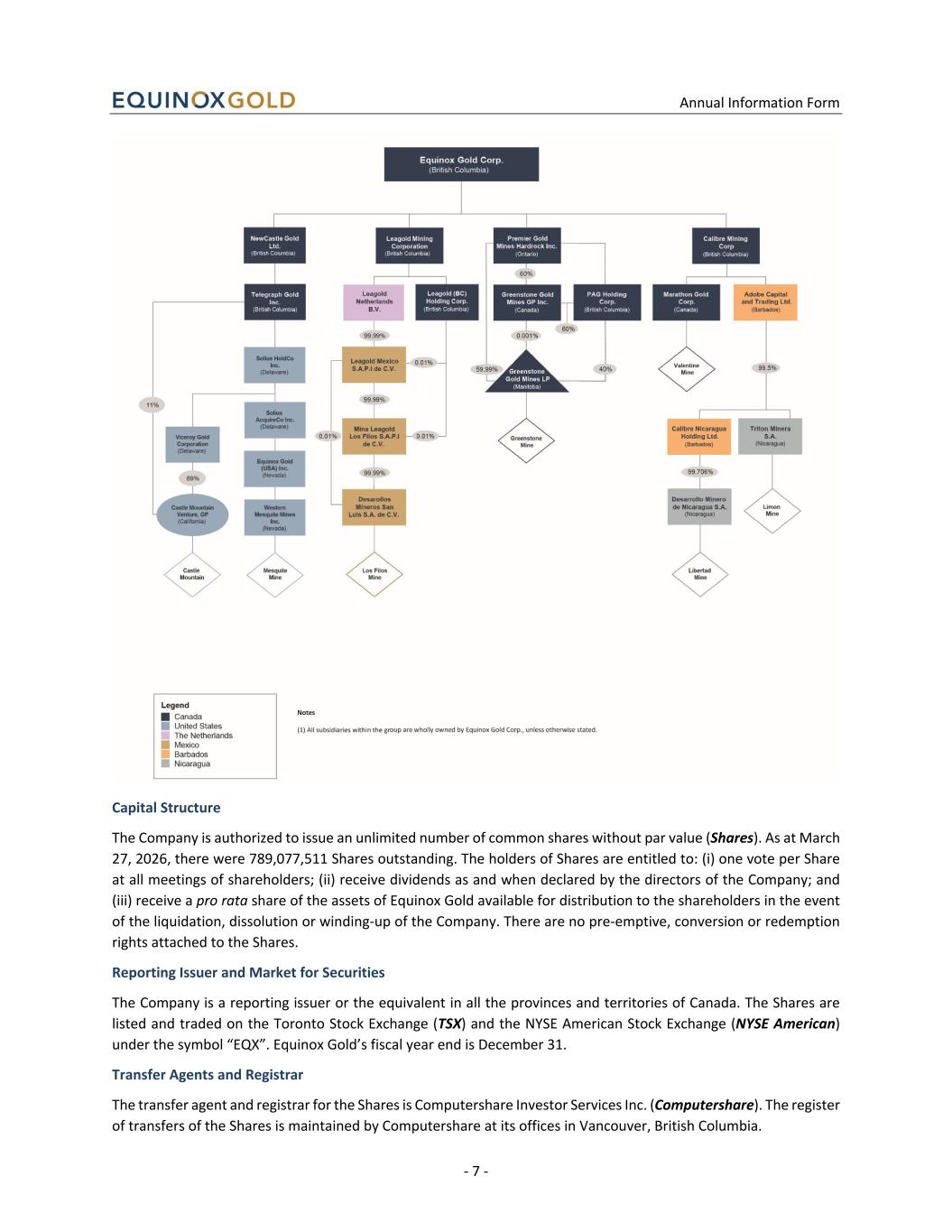
Annual Information Form - 6 - CORPORATE STRUCTURE Incorporation The Company was incorporated under the British Columbia Business Corporations Act (BCBCA) on March 23, 2007 as “Waterloo Resources Ltd.”. The Company has subsequently undergone a series of corporate transactions in connection with which it changed its name, as set out below: From To Date Reason for Name Change Waterloo Resources Ltd. Lowell Copper Ltd. July 9, 2013 Reverse take-over transaction Lowell Copper Ltd. JDL Gold Corp. October 6, 2016 Plan of arrangement1 between Lowell Copper Ltd., Gold Mountain Mining Corporation and Anthem United Inc. JDL Gold Corp. Trek Mining Inc. March 30, 2017 Plan of arrangement1 between JDL Gold Corp. and Luna Gold Corp. Trek Mining Inc. Equinox Gold Corp. December 22, 2017 Plan of arrangement1 between Trek Mining Inc., NewCastle Gold Ltd. and Anfield Gold Corp. Note: 1. Court approved plan of arrangement pursuant to the BCBCA. Company Address The Company’s head and registered office is located at 700 West Pender Street, Suite 1501, Vancouver, British Columbia, Canada, V6C 1G8. Subsidiaries The following chart illustrates the Company’s principal subsidiaries as at the date of this AIF together with the jurisdiction of incorporation or organization of each subsidiary and the percentage of voting securities beneficially owned or over which control or direction is exercised by the Company, as well as the Company’s operating mines and development projects. Unless indicated otherwise, each subsidiary is 100% owned by the Company. Non- material subsidiaries have been omitted.
Annual Information Form - 7 - Capital Structure The Company is authorized to issue an unlimited number of common shares without par value (Shares). As at March 27, 2026, there were 789,077,511 Shares outstanding. The holders of Shares are entitled to: (i) one vote per Share at all meetings of shareholders; (ii) receive dividends as and when declared by the directors of the Company; and (iii) receive a pro rata share of the assets of Equinox Gold available for distribution to the shareholders in the event of the liquidation, dissolution or winding-up of the Company. There are no pre-emptive, conversion or redemption rights attached to the Shares. Reporting Issuer and Market for Securities The Company is a reporting issuer or the equivalent in all the provinces and territories of Canada. The Shares are listed and traded on the Toronto Stock Exchange (TSX) and the NYSE American Stock Exchange (NYSE American) under the symbol “EQX”. Equinox Gold’s fiscal year end is December 31. Transfer Agents and Registrar The transfer agent and registrar for the Shares is Computershare Investor Services Inc. (Computershare). The register of transfers of the Shares is maintained by Computershare at its offices in Vancouver, British Columbia.
Annual Information Form - 8 - Dividends As at December 31, 2025, the Company had not, since incorporation, declared or paid any cash dividends on its Shares and did not have a dividend policy. On February 18, 2026, the board of directors of the Company (Board) adopted a dividend policy pursuant to which the Company intends, subject to quarterly Board approval and certain relevant factors, to pay a regular quarterly dividend of $0.015 per Share ($0.06 per Share annually). On February 18, 2026, the Company declared its inaugural quarterly cash dividend of $0.015 per Share, which was paid on March 26, 2026 to shareholders of record as at the close of business on March 12, 2026 (the Inaugural Dividend). The Inaugural Dividend is designated as an “eligible dividend” for Canadian income tax purposes. The Company will review its dividend policy on an ongoing basis and may amend it at any time. Refer to the section “Risks Related to the Business” in this AIF.
Annual Information Form - 9 - GENERAL DEVELOPMENT OF THE BUSINESS Business of Equinox Gold Equinox Gold is a Canadian mining company positioned for growth with a strong foundation of high-quality, long-life gold operations in Canada and across the Americas, and a pipeline of development and expansion projects. Founded and chaired by renowned mining entrepreneur Ross Beaty and guided by a seasoned leadership team with broad expertise, the Company is focused on disciplined execution, operational excellence and long-term value creation. Equinox Gold offers investors meaningful exposure to gold with a diversified portfolio and clear path to growth. The Company is principally engaged in the operation, development and exploration of gold projects. Equinox Gold owns four producing mines and is advancing expansion projects in Canada, the USA and Mexico. All the Company’s mines are 100% owned. The material operations of the Company consist of the following: • Greenstone, an open-pit gold mining and conventional milling operation with underground potential located in Ontario, Canada; and • Valentine, an open-pit gold mining and conventional milling operation located in Newfoundland and Labrador, Canada. In addition, Equinox Gold owns the Mesquite Mine (Mesquite), an open-pit heap leach mine located in California, USA; La Libertad Mine Complex (Libertad) and El Limon Mine Complex (Limon), a series of underground and open- pit mines located in Nicaragua (together, the Nicaragua Operations); the Castle Mountain Project (Castle Mountain), located in California, USA; and Los Filos Mine Complex (Los Filos), located in Guerrero, Mexico. Equinox Gold produced 922,827 ounces of gold in 2025.1 Greenstone produced 223,843 ounces of gold, Mesquite produced 85,998 ounces of gold, Nicaragua Operations produced 262,025 ounces of gold, and Valentine produced 23,816 ounces of gold following first gold pour in September 2025. Equinox Gold’s Brazil operations, which were sold on January 23, 2026, produced 258,905 ounces of gold in 2025, and 26,138 ounces of gold were produced at Pan Mine in Nevada, which was sold on October 1, 2025. (Refer to the section “Three-year History” in this AIF). The Company released 2026 production guidance on January 14, 2026, estimating production of 700,000 to 800,000 ounces of gold for the year at cash costs of $1,425 to $1,525 per oz sold and AISC of $1,775 to $1,875 per oz sold.1 Guidance is intended to provide baseline estimates from which investors can assess the Company’s expectations for its production and operating costs for the year. To achieve its growth objectives, Equinox Gold intends to maintain a disciplined approach to capital allocation, continuing to review its portfolio to direct investment toward high-return opportunities such as the Phase 2 expansions at Valentine and Castle Mountain and the potential restart of operations and expansion at Los Filos. Gold production in 2026 is expected to benefit from Valentine’s ramp-up and its first full year of operation, as the mine advances toward nameplate throughput. Greenstone production is also planned to increase during 2026 as improvements in mining and milling rates and practices enhance reliability and overall operational performance. The Company will continue to evaluate selective acquisition opportunities involving producing mines and development projects that align with its portfolio and strategic objectives. 1 Including production from January 1, 2025 from the assets acquired in the Calibre Transaction, which closed on June 17, 2025. Production from all assets for the period of ownership totaled 779,544 ounces of gold.
Annual Information Form - 10 - Three-year History Year Ended December 31, 2023 On March 7, 2023, the Company announced that it had entered into an agreement to sell 11.6 million units of i-80 Gold Corp. (i-80 Gold) held by the Company at a price of C$2.76 per unit for gross proceeds of C$23.6 million. Each unit consisted of one common share of i-80 Gold and one-half of one common share purchase warrant of i-80 Gold, with each whole warrant exercisable to purchase one common share of i-80 Gold. On March 24, 2023 and June 23, 2023, the Company entered into two gold prepay arrangements pursuant to which it received net proceeds of $149.4 million in exchange for delivering a total 3,868.5 ounces of gold per month from October 2024 through July 2026 (Delivery Period) for a total of 85,107 ounces. These transactions are referred to collectively as the Gold Prepay Transactions. On September 21, 2023, the Company closed a bought deal offering of 4.75% unsecured convertible senior notes (2023 Convertible Notes) for gross proceeds of $172.5 million. The conversion rate for the 2023 Convertible Notes is 158.7302 Shares per $1,000 principal amount, equivalent to a conversion price of $6.30 per Share, subject to certain anti-dilution provisions, and the notes mature on October 15, 2028. Prior to October 20, 2026, the Company may not redeem the 2023 Convertible Notes, except upon the occurrence of certain changes to the laws governing Canadian withholding taxes. On October 31, 2023, the Company closed a gold purchase agreement with Versamet Royalties Corporation (Versamet, previously Sandbox Royalties Corp.) and Regal Partners Royalties A PTY Limited (Regal and together with Versamet, the Purchasers). Under the agreement, the Company received a payment of $75 million in exchange for monthly deliveries to the Purchasers equal to the greater of: a) 500 gold ounces from any mines, and b) gold ounces equal to 1.8% of the monthly gold production from Greenstone. Gold deliveries started in November 2023 and will continue until a total of 90,000 ounces have been delivered. The Purchasers will make ongoing cash payments equal to 20% of the spot gold price for each gold ounce delivered. The Company may buy down up to 75% of the delivery obligation at the then current spot gold price, subject to adjustment for the ongoing payment and a minimum price per ounce of $2,000. As at March 30, 2026, 75,500 ounces remain to be delivered under the agreement. Year Ended December 31, 2024 On April 1, 2024, the Company amended the terms of its (i) convertible notes issued in 2019 to extend the maturity date from April 12, 2024 to October 12, 2024, and (ii) convertible notes issued in 2020 to extend the maturity date from March 10, 2025 to September 10, 2025 and amend the conversion price from $7.80 per Share to $6.50 per Share. On April 23, 2024, the Company announced that it had entered into a share purchase agreement to consolidate ownership of Greenstone by acquiring Orion Mine Finance’s (Orion) 40% interest, resulting in Equinox Gold holding 100% ownership of Greenstone. The total consideration comprised: a) 42.0 million Shares, b) $705 million in cash payable on closing, and c) $40 million in cash payable before December 31, 2024. Equinox Gold funded the cash consideration using net proceeds from a new $500 million three-year term loan and a bought deal equity financing of Shares. The transaction closed on May 13, 2024 and the final $40 million was paid to Orion on December 30, 2024. The Company was not required to file a business acquisition report in connection with the acquisition. On April 26, 2024, the Company closed the bought deal equity financing of 56,419,000 Shares at $5.30 per Share for gross proceeds of $299 million. On May 9, 2024, Ms. Trudy Curran was appointed to the Board. On May 23, 2024, the Company announced first gold pour at Greenstone. On May 29, 2024, the Company sold its remaining 50.6 million common shares of i-80 Gold for total proceeds of $48.2 million.
Annual Information Form - 11 - On October 3, 2024, the Company announced that its convertible notes issued in 2019 were converted to Shares. On October 1, 2024, the Company filed a well-known seasoned issuer short form base shelf prospectus that allows it to offer Shares, debt securities, subscription receipts, share purchase contracts, units or warrants, or any combination thereof, over a 25-month period. On October 9, 2024, Mr. Fraz Siddiqui resigned from the Company’s Board. Mr. Siddiqui was the Board appointee of Mubadala Investment Company (Mubadala) under an investor rights agreement. Following the conversion of the Company’s 2019 convertible notes and subsequent sale of the issued Shares, Mubadala’s investor rights agreement terminated. On October 29, 2024, the Company entered into amending agreements with the counterparties to defer the first five monthly deliveries of the Gold Prepay Transactions originally scheduled for October 2024 through February 2025. A total of 19,343 deferred ounces will be delivered over the period from May 2026 to September 2026 (the Deferral Period). As consideration for the deferral, the Company will deliver an additional 1,582 gold ounces over the Deferral Period. On November 6, 2024, the Company announced that Greenstone had achieved commercial production. Year Ended December 31, 2025 On February 23, 2025, the Company announced that it had entered into a definitive arrangement agreement for an at-market business combination pursuant to which it agreed to acquire all the outstanding common shares of Calibre Mining Corp. (Calibre) pursuant to a court-approved plan of arrangement (Calibre Transaction) and under which Calibre shareholders would receive 0.31 Equinox Gold Shares for each Calibre share held. On April 1, 2025, the Company announced that it had indefinitely suspended operations at Los Filos following the expiry of its land access agreement with the community of Carrizalillo on March 31, 2025. On April 23, 2025, the Company announced that it had amended the arrangement agreement in connection with the Calibre Transaction such that Calibre shareholders would receive 0.35 Shares for each Calibre share held. On June 17, 2025, the Calibre Transaction closed and the Company issued a total of 302,842,820 Shares. Following completion of the Calibre Transaction, directors Gordon Campbell and Dr. Sally Eyre resigned from the Board and Omaya Elguindi, Douglas Forster, Blayne Johnson and Mike Vint, former directors of Calibre, were appointed as directors of the Company. On July 22, 2025, the Company announced that Greg Smith had stepped down as Chief Executive Office and director of the Company effective July 21, 2025, and that Darren Hall had been appointed as Chief Executive Officer and director of the Company. On August 7, 2025, the Company announced that it had entered into an agreement to sell its 100% interest in the Pan Mine, Gold Rock Project and Illipah Project in Nevada, USA to Minera Alamos Inc. (Minera). The total consideration comprised: a) $90 million in cash paid on closing, subject to customary adjustments, and b) $25 million in equity consideration in the form of Minera common shares (TSX-V: MAI) (the Nevada Asset Sale). The Nevada Asset Sale closed on October 1, 2025. On September 15, 2025, the Company announced first gold pour at Valentine and on November 18, 2025, the Company announced commercial production at Valentine. On December 14, 2025, the Company announced that it had entered into an agreement to sell its 100% interest in its Aurizona Mine, RDM Mine and Bahia Complex (comprising the Fazenda Mine and the Santa Luz Mine) (collectively, the Brazil Operations) to CMOC Limited (CMOC) for total consideration of up to $1.015 billion (the Brazil Sale Transaction), through the sale of non-Brazilian subsidiaries holding such assets. Under the Brazil Sale
Annual Information Form - 12 - Transaction, the Company received $900 million in upfront cash on closing, subject to customary adjustments, and may receive a production-linked contingent cash payment of up to $115 million payable one year after closing. Recent Developments On January 23, 2026, the Company completed the Brazil Sale Transaction. The Company used the proceeds to repay in full its $500 million term loan, repay in full the Sprott loan and related obligations for $300 million, and reduce amounts outstanding under its revolving credit facility. On February 18, 2026, Equinox Gold announced that the Board has adopted a dividend policy and declared the Inaugural Dividend (refer to “Dividends” in this AIF). On February 26, 2026, Equinox Gold announced a normal course issue bid (NCIB) to repurchase, for cancellation, up to an aggregate of 39,414,095 Shares. Purchases can be made at prevailing market prices during a 12-month period commencing on March 2, 2026 and ending on the earlier of March 1, 2027 and the date on which the Company reaches the maximum purchases permitted under the NCIB. The Company entered into an automatic share repurchase plan in relation to purchases under the NCIB to facilitate repurchases of Shares at times under the NCIB when the Company would ordinarily not be permitted to make such purchases due to regulatory restriction or customary self-imposed blackout periods. On March 30, 2026, Equinox Gold filed new Technical Reports for Valentine and Greenstone.
Annual Information Form - 13 - DESCRIPTION OF THE BUSINESS Equinox Gold is an Americas-focused mining company advancing its strategy to become a top quartile gold producer. In its first eight years, the Company has grown from a single-asset developer to a multi-asset gold producer with a portfolio of gold mines in the Americas, a multi-million-ounce gold reserve base and a strong growth profile supported by a pipeline of development and expansion projects. Equinox Gold was founded with the strategic vision of building a diversified, Americas-focused gold company to achieve high-quality and high-margin production. The Company’s strategy is to be a top-quartile valued gold producer, delivering strong per-share returns while maintaining a disciplined approach to capital allocation. Equinox Gold continues to optimize its portfolio, prioritizing long-life, low-cost assets and growth opportunities to maximize shareholder value. The Company is committed to operating responsibly and safely, creating lasting economic and social benefits for its host communities, and fostering a safe and inclusive workplace for its employees and contractors. In support of these objectives, on June 17, 2025, Equinox Gold completed the Calibre Transaction. The transaction expanded Equinox Gold’s portfolio with Pan and some earlier stage projects in the USA, Limon and Libertad in Nicaragua and Valentine in Canada. Following the Calibre Transaction and the sale of the Brazil Operations, Equinox Gold transitioned to a predominantly North American producer with a lower-cost production base and a stronger balance sheet. The Company is focused on ramping up its long-life Greenstone and Valentine mines and directing investment toward high-return opportunities, including the Phase 2 expansions at Valentine and Castle Mountain and the potential restart and expansion at Los Filos. Equinox Gold’s operating mines and development projects at the date of this AIF are as follows: Name of Mineral Property1 Ownership Location Status Greenstone Gold Mine 100% Ontario, Canada Producing Valentine Gold Mine 100% Newfoundland and Labrador, Canada Phase 1 – Producing Phase 2 expansion – advancing studies and engineering Mesquite Gold Mine 100% California, United States Producing Castle Mountain Project 100% California, United States Phase 1 – Residual leaching Phase 2 expansion – permitting underway Nicaragua Operations 100% Nicaragua Producing Los Filos Mine Complex 100% Guerrero State, Mexico Suspended Notes: 1. Equinox Gold’s material assets are Greenstone and Valentine. Principal Products Equinox Gold’s principal product is gold doré. The principal buyers of gold doré produced from its mines are, once refined, international bullion banks, traders and refiners. There is a worldwide market for gold doré and, accordingly, Equinox Gold is not dependent on any particular purchaser for the sale of gold, silver or other metals. Community Engagement and Investment Equinox Gold recognizes local communities as important stakeholders in its business activities and seeks to understand and appropriately address their interests and concerns. The Company believes that mining operations and projects can provide significant economic benefits and social development opportunities that endure well
Annual Information Form - 14 - beyond the life of a mine. Equinox Gold offers training programs and is committed to hiring locally. The Company also supports development initiatives that meet the needs and priorities of local communities with the objective of leaving a legacy of improved infrastructure, skills development and more sustainable communities. Equinox Gold engages in early, frequent and transparent dialogue with stakeholders to build trust and support collaboration and long-term commitment. The Company maintains formal systems to identify stakeholders and communities of interest and strives to maintain strong local relationships. At all its mine sites, dedicated community liaisons meet regularly with host communities to discuss activities, report on environmental performance and discuss concerns. The Company seeks local feedback, particularly where concerns have been raised, to ensure that collaborative solutions are implemented. Health & Safety The health and safety of the Company’s workforce is a top priority for Equinox Gold. Through a strong risk management approach, Equinox Gold engages with and trains its workforce to recognize, understand and mitigate hazards of the workplace to prevent incidents and injuries. The Company complies with all relevant local, state, provincial, and federal laws and has implemented best practices and industry standards. During 2025, Equinox Gold completed 32.5 million work hours with 23 lost-time injuries across its sites, resulting in a lost-time injury frequency rate of 0.71 per million hours worked compared to the target of 0.58 for 2025. Three of the Company’s sites had no lost-time injuries during 2025. The Company’s total recordable injury frequency rate, which measures injuries requiring the attention of medically trained personnel, was 1.69 per million hours worked compared to the target of 2.85 for 2025. Environment Environmental stewardship is fundamental to Equinox Gold’s operations. The Company aims to minimize or mitigate the potential effects of our operations on regional flora, fauna, water quality and air quality. By understanding the components of the ecosystem and the potential impacts of mining activities, the Company plans appropriately and adopts mitigation strategies to eliminate or reduce impacts to acceptable levels. During 2025, Equinox Gold achieved a significant environmental incident frequency rate of 0.00 per million hours worked, based on the Company’s internal environmental reporting standards, compared to the target of 1.20 for 2025. None of the Company’s sites had a significant environmental incident during 2025. Equinox Gold has projects in Canada, the United States, Mexico, and Nicaragua and is subject to national and local laws and regulations in each relevant jurisdiction. All aspects of Equinox Gold’s operations, development activities and exploration programs are subject to environmental regulations and generally require approval by appropriate regulatory authorities prior to commencement. Specific statutory and regulatory requirements and standards must be met throughout the mine cycle, including standards related to air quality, water quality, fisheries and wildlife protection, chemical use, waste disposal, noise, geotechnical stability, geochemistry and land use. When operations cease, the Company is also required to meet reclamation and closure obligations. Details and quantification of Equinox Gold’s reclamation and closure cost obligations as at December 31, 2025 are set out in the Company’s annual financial statements for the year ended December 31, 2025. Employees and Contractors At the end of the most recently completed financial year, Equinox Gold had a total of 5,219 employees and 7,944 contractors. No management functions of Equinox Gold are performed to any substantial degree by a person other than the executive officers of Equinox Gold. Equinox Gold is committed to hiring locally, and most employees and contractors at each of its operations are drawn from local communities The Company has developed a strategy to support employees from diverse backgrounds by providing the resources they need to thrive and contribute in the workplace.
Annual Information Form - 15 - Specialized Skill and Knowledge Many aspects of Equinox Gold’s business require specialized skills and knowledge, including expertise in mine operations, mine construction, permitting, geology, drilling, implementation of exploration programs, logistical planning, accounting, communications and local laws. Equinox Gold retains executive officers, employees and consultants with experience in mining, metallurgy, geology, exploration and development in Canada, the United States, Mexico and Nicaragua, as well as individuals with relevant accounting, communications and legal experience. Competitive Conditions The mineral exploration and mining industry is competitive, and Equinox Gold must compete for the acquisition of mineral permits, claims, leases and other mineral interests for operations, exploration, and development projects. As a result, Equinox Gold may not be able to acquire or retain prospective properties in the future on terms it considers acceptable. The ability of Equinox Gold to acquire and retain mineral properties in the future will depend on its ability to successfully operate and develop its existing properties and fund further exploration and development activities. Equinox Gold also competes with other mining companies for investment capital to fund such projects, and for the recruitment and retention of qualified personnel. Components The raw materials and support services that Equinox Gold requires to carry on its business are available through normal supply or business contracting channels in Canada, the United States, Mexico and Nicaragua. Increased demands by other mineral exploration, development and operating companies, inflationary pressures, tariffs, or disruptions to supply chains due to events such as pandemics and other global events can make it more difficult to procure certain supplies and services. Cycles The mining industry, and particularly precious metals production, is subject to metal price cycles. The marketability of minerals and mineral concentrates is also affected by worldwide economic cycles. Foreign Operations Equinox Gold faces certain risks as a Canadian company operating in the United States, Mexico and Nicaragua. Changes in regulations or shifts in political attitudes are beyond the control of Equinox Gold and may adversely affect its business. Equinox Gold may be affected in varying degrees by factors such as government regulations (or changes thereto) relating to restrictions on mining, export controls, income taxes, expropriation of property, repatriation of profits, environmental legislation, tariffs, land use, water use, land claims of local people, changes in foreign exchange, mine safety regulations, labour laws, corruption, political unrest, timely reimbursement by the government of refundable value added taxes and refundable income taxes, uncertainty with respect to the rule of law and the integrity of court systems, and security issues. The effect of these factors cannot be accurately predicted. Refer to “Risks Related to the Business” in this AIF.
Annual Information Form - 16 - RISKS RELATED TO THE BUSINESS Equinox Gold’s business is subject to significant risks. Any of these risks could have an adverse effect on Equinox Gold, its business, results of operations, financial position and prospects, and could cause actual results or outcomes to differ materially from those expressed or implied by forward-looking statements relating to Equinox Gold. These risks are in addition to the financial risks discussed under the heading “Risks and Uncertainties” in Equinox Gold’s MD&A and those discussed in technical reports and other documents filed by Equinox Gold from time to time on SEDAR+ and on EDGAR. In addition, other risks and uncertainties not presently known by management of Equinox Gold or that management currently believes are immaterial could affect Equinox Gold, its business and prospects. Development Projects Equinox Gold undertakes development of projects or expansion of existing operations from time to time. Development of projects and expansion activities are subject to risks including inflation and cost escalation, labour availability and contractor performance, variability in grade or tonnage, adverse geological or geotechnical conditions, engineering, design or technical issues, supply chain disruptions and equipment availability, access or transportation constraints, community or stakeholder opposition, natural events and climate-related impacts, civil unrest, and changes in taxes, regulations or other government actions. Construction of such projects requires significant expenditures and final costs may exceed budgeted costs. Costs and timelines can be affected by factors beyond the Company’s control, such as weather, ground conditions, material availability, workforce performance, supply chain issues, shipping delays, equipment installation issues, design changes, and community acceptance. Cost overruns or other shortfalls could materially affect Equinox Gold’s cash flow, profitability, financial condition, and share price. Project timelines depend on obtaining required permits and approvals, which are outside the Company’s control and can be unpredictable. Delays in commercial production and ramp-up can increase costs and postpone revenue generation. New operations frequently encounter unexpected startup issues leading to delays, cost increases, and failure to meet production or cost estimates. Because feasibility studies rely on numerous assumptions, there is no assurance that projected results will be achieved. Greenstone has experienced a slower than planned ramp up, with mining and processing rates below expectations during 2024 and the first half of 2025, and continues to ramp-up toward design capacity. Valentine reached commercial production in late 2025 and continues to ramp-up. Startup challenges may demand additional funding, and there is no guarantee sufficient financing will be available. The Company is also advancing expansion projects, including the Valentine Phase 2 expansion in Canada and the Castle Mountain Phase 2 expansion in the United States, and is evaluating potential future development at Los Filos, which remains subject to the resolution of outstanding land access and permitting matters. These projects remain subject to, among other things, the completion of technical studies, investment decisions, and broader market and capital considerations. There can be no assurance that these projects will proceed as planned, be completed on schedule or within budget, or achieve expected production or cost outcomes. These factors may prevent the development of non-producing properties or the achievement of expected production, revenue, or cost levels for new projects developed by Equinox Gold, and could materially harm its business and financial condition and results of operations. Community Relations The Company’s ability to maintain positive relationships with its host communities is critical to ensuring the success of its operations and future projects. Equinox Gold maintains industry-standard social and environmental practices, works to ensure compliance with its commitments to host communities, and has programs in place to enhance its community engagement. However, there is no assurance that the Company will be able to maintain positive relationships with host communities, and opposition by community and non-governmental organizations (NGOs) or
Annual Information Form - 17 - adverse publicity (whether based on actual or perceived events) could result in legal actions, harm to the Company’s reputation, blockades, protests, permitting delays or other disruptions to the Company’s business. Such risks have materialized historically at the Company’s operations. Mining activities at Los Filos were disrupted in each of 2020, 2021 and 2022 due to community blockades, which contributed to the non-renewal of a surface rights agreement with one of the three host communities and resulted in the suspension of operations at Los Filos on March 31, 2025. In Nicaragua, social unrest in 2018 led to protests and roadblocks near Limon and Libertad, restricting the supply of key consumables such as fuel and lime and temporarily affecting gold production. While these disruptions were temporary, Equinox Gold remains exposed to potential disruptions from future illegal roadblocks or social conflict, including risks associated with artisanal and small-scale mining activity near Libertad, which may require relocation or resettlement and could result in delays, increased costs or constraints on development. The Company may also receive additional requests and complaints from communities relating to commitments, and if the Company is unable to address such requests or satisfactorily renegotiate terms, this may result in protests, blockades or other forms of public expression against Equinox Gold’s activities. Reputational harm arising from community-related issues, whether based on actual or perceived events, may also reduce investor confidence, impair the Company’s ability to advance its projects or secure financing, and adversely affect its financial performance, cash flows, growth prospects and the market value of its securities. Permitting Equinox Gold’s operations, development, and exploration activities require numerous permits from various governmental authorities. The timing and ability to obtain, maintain or renew such permits are often beyond the Company’s control and may result in delays to exploration, development, construction or ongoing operations. Previously issued permits may also be suspended, revoked or subject to modification due to regulatory changes or court actions. There is no assurance that Equinox Gold will obtain or maintain the necessary permits, which could negatively impact its operations. These permitting risks are illustrated by the Company’s development projects. The Castle Mountain Phase 2 expansion was accepted into the FAST-41 permitting process in the USA in June 2025, placing it within a federal framework intended to streamline environmental reviews. Under FAST-41, the federal permitting schedule for Castle Mountain is expected to conclude in December 2026. However, FAST-41 does not guarantee approval, and the Company’s ability to obtain all required licenses and permits remains uncertain. The permitting process is complex, lengthy, and influenced by factors outside the Company’s control, and major permits may be subject to appeals or administrative challenges that could result in litigation and delays. Changes in laws and proposed reforms in Mexico, along with the current political environment, have increased uncertainty about renewing or obtaining new permits for Los Filos. Permit applications or renewals may be subject to appeals, protests or other challenges, which could result in reversals or delays. In April 2022, the Mexican Supreme Court issued a decision ordering the cancellation of two mineral claims previously issued to a mining company on the basis that free, prior and informed consultation with Indigenous peoples was not conducted by the Government before the relevant mineral claims were issued. The Court indicated that the relevant mineral claims may be reissued once the required consultations are complete. This decision increases the risk of other communities seeking similar injunctions in the future. These issues could impact ongoing operations at Los Filos and adversely affect the Company’s business. Environmental Risks, Regulations and Hazards Equinox Gold’s mining operations are subject to environmental regulations, including air and water quality standards, land reclamation, and waste management. These regulations are becoming stricter, with increased fines and penalties for non-compliance, more rigorous environmental assessments, and greater responsibility for companies and their personnel. Failure to comply with applicable environmental laws, regulations and permits may result in enforcement actions, including fines, penalties or orders to cease operations, as well as corrective measures
Annual Information Form - 18 - requiring capital expenditures or remedial actions. Parties engaged in mining operations or in the exploration or development of mineral properties may also be required to compensate those suffering loss or damage arising from such activities and may be subject to civil or criminal liability. Amendments to existing laws, more stringent enforcement, or changes to permits could materially increase costs, delay development, or require the suspension or abandonment of mining activities, adversely affecting the Company’s operations. Additionally, unknown environmental hazards from previous owners or operators may exist, and available indemnities may not cover all fines, penalties or remediation costs. The Company’s operations are also subject to environmental hazards associated with mining activities. The extraction process for gold and metals produces tailings, which are stored in engineered tailings storage facilities (TSFs). Some operations use heap leaching, where ore is placed on impermeable pads and sprayed with a cyanide solution to recover gold. Water collection, treatment and disposal systems are also integral to these operations. These activities involve risks such as uncontrolled seepage, discharge or geotechnical failure of containment or water management systems, which may result in environmental contamination, financial loss and liability. The Company’s current and historical operations, including TSFs, rock waste dumps, heap leach pads and water management systems, may result in the accumulation or release of contaminants. Real or perceived environmental, health and safety impacts associated with such activities, whether arising from the Company’s operations or those of other mining companies, may result in regulatory actions, fines, permit suspension or revocation, and may affect the Company’s ability to obtain, maintain or renew permits and approvals or to develop or operate its mines. Insurance coverage may not be available or sufficient to cover such risks or the consequences thereof. In certain jurisdictions, including Nicaragua, artisanal and small-scale mining activities may occur within or adjacent to the Company’s concessions. Such activities may involve the use of hazardous substances, including mercury or cyanide, and may result in environmental impacts or create additional remediation obligations. These activities may also increase the risk of operational disruption, conflict, delays or additional costs, including those associated with relocation, resettlement or environmental remediation. The Company has implemented programs and practices to manage and facilitate coexistence with artisanal and small-scale miners, including engagement with such miners through controlled access and, in certain cases, the purchase of artisanal ore, with the objective of reducing environmental, social and operational risks. Libertad borders extensive artisanal mining, which increases the risk of conflict and operational disruption and could materially affect Equinox Gold’s operations in Nicaragua. Property Rights and Commitments The properties held by Equinox Gold may be subject to various land payments, royalties and/or work commitments. Failure by Equinox Gold to meet its payment obligations or otherwise fulfill its commitments under these agreements could result in the loss of property interests. In certain jurisdictions, mineral rights and surface rights are held by different parties, and the Company must secure and maintain access to surface lands in order to operate. In Mexico, while mineral rights are administered by the federal government through federally issued mining concessions, surface rights are typically owned by local landowners, including “ejidos” and similar rural community entities. This is the case at Los Filos, where two separate ejidos and one other local community own most of the surface rights. The Company has secured long-term access and use agreements (for a period of 20 years) with two of the three groups but currently lacks a long-term agreement with the third group. The Company is currently pursuing a long-term agreement with this third group. If these discussions do not result in mutually acceptable terms, this may have significant negative impacts on the future operation of Los Filos. In certain jurisdictions, including Canada, the granting and maintenance of mineral rights and project authorizations require consultation and, in some cases, agreements with Indigenous peoples and local communities. Such agreements may include commitments related to training, employment, business opportunities, royalties or other
Annual Information Form - 19 - matters and may affect the timing, cost and ability of the Company to secure or maintain mineral titles, permits and licenses. The Company seeks to comply with such agreements and commitments, including through programs relating to local employment, training, procurement, community investment and other stakeholder benefits; however, there can be no assurance that it will be able to do so in all circumstances or that such agreements will not be subject to dispute, challenge or renegotiation. Failure to obtain or maintain required surface rights, agreements or authorizations, or to resolve disputes or reach mutually acceptable terms with relevant stakeholders, could delay, restrict or prevent the development or operation of the Company’s projects and could materially adversely affect its business and operations. Defects in Land Title Title to mineral properties can be held by the Company in the form of mineral claims, mining claims, mining leases, concessions, tenements and other forms of land and mineral tenure depending on jurisdiction. Several of Equinox Gold’s mineral properties are subject to various encumbrances, including royalties. Equinox Gold’s ability to explore, develop, and operate its mineral properties depends on acquiring and maintaining valid title. Securing title is complex and time consuming, and there is no guarantee Equinox Gold will meet all required conditions. Equinox Gold does not hold title insurance on its properties, making it difficult to ensure secure claims to mineral properties. Without surveys of all claims, the exact area and location may be uncertain. Certain lands in Canada are subject to Indigenous rights, treaty rights and/or asserted rights in and to traditional territories. Title to the Company’s properties may be subject to defects, including unregistered liens, agreements, transfers or competing claims, including Indigenous land claims. Any such defects or uncertainties may adversely affect the Company’s ability to operate, enforce its rights or realize the full value of its mineral properties, and could have a material adverse effect on its business, financial condition, and results of operations. Uncertainty of Mineral Reserves and Mineral Resources Estimates Equinox Gold’s Mineral Reserves and Mineral Resources are estimates, and there is no assurance that anticipated tonnages, grades or recovery levels will be achieved, or that Mineral Reserves can be mined and processed profitably. Mineral Reserves and Mineral Resources involve uncertainties and subjective judgements based on available geological, engineering and economic data. Such estimates are based on assumptions relating to, among other things, commodity prices, cut-off grades, operating and capital costs, metallurgical recoveries and other modifying factors, which may prove to be inaccurate. Short-term operating factors such as the need for development of the ore bodies or processing new ore grades can affect profitability. In addition, laboratory test recoveries may not replicate in larger-scale production. Commodity price fluctuations, drilling results, metallurgical testing, and mine plan evaluations may require estimate revisions. Significant reductions in estimates of Mineral Reserves and Mineral Resources, or in Equinox Gold’s ability to extract Mineral Reserves, could adversely impact Equinox Gold’s business and financial position. Mineral Resources that are not Mineral Reserves lack demonstrated economic viability and require further exploration, evaluation and analysis, including feasibility studies, before they can be converted to Mineral Reserves. There is no assurance that Mineral Resources will be upgraded to Mineral Reserves or that such Mineral Resources will ultimately be mined profitably. Acquisitions, Business Arrangements or Transactions Equinox Gold will continue to seek new mining and development opportunities in the mining industry, including through acquisitions, business arrangements or transactions. However, the Company may face challenges in identifying appropriate targets, negotiating arrangements or securing financing on acceptable terms. Acquisition risks include market conditions, inaccurate valuation assumptions, unknown liabilities, regulatory delays, and litigation. The Company may also be unable to obtain required consents or approvals. There can be no assurance
Annual Information Form - 20 - that any transaction will be completed. Any issues that Equinox Gold encounters in connection with an acquisition, business arrangement or transaction could have an adverse effect on its business, results of operations and financial position. Following an acquisition, the Company may face challenges integrating acquired businesses, including operations, systems, and personnel. Differences in culture, management styles, governance practices, and operating procedures may disrupt operations if not effectively managed, and the Company may not complete integration within the expected timeframe, or at all. Integration challenges may include misaligned strategic priorities, unclear roles and reporting structures, loss of key personnel or reduced employee engagement, delays in harmonizing systems, processes, and internal controls, and reduced communication and coordination across business units. Failure to manage these risks could reduce operational efficiency, increase costs, delay expected synergies, and adversely affect financial performance, production results, and the Company’s ability to execute its strategy. Equinox Gold may also pursue the disposition of producing operations, development, early stage or advanced exploration properties and companies possessing exploration permits, mining equipment and mineral property assets. Any disposition may change the scale of the Company’s business and operations and may expose the Company or increase its exposure to new or existing political, operational and financial risks. Dispositions of assets may result in a reduction of the Company’s existing consolidated Mineral Reserves and Mineral Resources. Disposition processes can be complex and may divert the attention of management and the Board from existing operations. There can be no assurance that any such process will result in a successful transaction or the realization of anticipated benefits. In January 2026, Equinox Gold completed the sale of its Brazilian Operations, comprising the Aurizona and RDM mines and the Bahia Complex. Under the applicable share purchase agreement and related documents, the Company has provided certain indemnities, including with respect to environmental matters, TSFs, and existing litigation. These indemnities create potential exposure to future, and potentially significant, costs, particularly given the long-term nature and inherent uncertainty associated with environmental and regulatory matters in Brazil. In addition, $115 million of the purchase price is contingent upon the achievement of certain production targets from the Brazil Operations during 2026, and there can be no assurance that such conditions will be satisfied. Taxation Risk Equinox Gold operates in multiple jurisdictions and is subject to a complex array of taxes, including corporate income taxes, mining-specific royalties and duties, withholding taxes, value-added taxes (VAT/IVA/ICMS), capital gains taxes, and other levies imposed by federal, state/provincial, and municipal authorities in Canada, the United States, Mexico and Nicaragua. Changes in tax laws, regulations, administrative practices or royalty rates could materially increase the Company’s tax burden, reduce profitability, or adversely affect cash flows and financial condition. The Company’s corporate structure and operations are organized in reliance on its interpretation of applicable tax laws, including those related to transfer pricing, withholding taxes, capital gains, and other foreign country tax rules. Tax authorities may challenge these interpretations. Adverse outcomes from tax audits, reassessments, or disputes could result in significant additional tax liabilities, penalties, and interest, with a material impact on the Company’s results of operations and financial position. In addition, the repatriation of earnings from foreign subsidiaries may be subject to withholding taxes, currency controls or other restrictions, which may limit the Company’s ability to fund operations or return capital to shareholders. The Company may also remain subject to historical tax exposures in connection with dispositions and prior operations such as the recent sale of its Brazil Operations. In addition, the tax treatment of completed transactions may be subject to differing interpretations by tax authorities, which could result in additional taxes, interest or penalties. While the Company believes its tax position is reasonable and consistent with applicable legislation, tax authorities could reach an alternative conclusion that may result in additional taxes, interest, or penalties.
Annual Information Form - 21 - The Company is currently involved in ongoing tax disputes and audits in certain jurisdictions. While the Company believes its positions are defensible and pursues appeals or settlements where appropriate, there can be no assurance that such matters will be resolved in the Company’s favour, on a timely basis, or without material cash outflows. Desarrollos Mineros San Luis S.A. (DMSL), which owns Los Filos, is subject to audits by the Servicio de Administración Tributaria (the SAT) in Mexico for the 2017 to 2020 tax years. In late 2025, the Company settled the 2017 audit and was assessed additional income taxes and Special Mining Duty of $73.2 million, of which $54.5 million was paid in December 2025. In Nicaragua, the Company’s subsidiaries credited mining taxes against income taxes based on their interpretation of local legislation. The tax authority rejected this treatment for the 2019 to 2024 tax years, and in September 2025 the Nicaragua Customs and Administrative Tax Tribunal upheld the authority’s position. In December 2025, the Company settled the matter for $37.9 million, including $10.5 million of interest and penalties. The ongoing implementation of the Organisation for Economic Co-operation and Development’s (OECD) Global Anti- Base Erosion Rules (Pillar Two), which impose a 15% global minimum effective tax rate on large multinational enterprises, is being adopted in an increasing number of jurisdictions where the Company operates. These rules could result in additional top-up taxes, increased compliance costs, and heightened disclosure requirements if the Company’s effective tax rate in any jurisdiction falls below the minimum threshold. There can be no assurance that current or future tax laws, interpretations or administrative practices will remain consistent, or that new taxes, royalties or other levies will not be introduced, any of which could have a material adverse effect on the Company’s business, financial condition and results of operations. Production and Cost Estimates Equinox Gold’s production forecasts are estimates based on assumptions, and actual production may be lower than expected. Achieving these forecasts involves risks and uncertainties, such as the accuracy of Mineral Reserve and Mineral Resource estimates, variations in ore grades and recovery rates, ground conditions, physical characteristics of ores, estimated mining and processing costs, and the receipt and maintenance of permits. There can be no assurance that actual production will conform to forecasts or that reconciliation of production results will not vary materially from such estimates. Equinox Gold prepares estimates of operating costs and/or capital costs for each operation and project. Actual operating and capital costs may vary due to factors like foreign exchange rates, production levels, inflation, fuel and material costs, contractor performance, supply chain disruptions, equipment availability, government regulations, skilled labour availability, processing and refining costs, royalties, and construction maintenance and timing. If costs exceed expectations, this could adversely affect the Company’s business, financial condition and results of operations. Liquidity and Financing Risk There is a risk that cash flow from operations will not meet current and future obligations, which may require the Company to obtain additional capital. The Company is dependent, in part, on access to capital markets and other sources of financing, and there can be no assurance that such financing will be available on acceptable terms, or at all. The volatility of global capital markets and other factors may lead to rapid changes to global economic conditions, and may adversely affect the Company’s ability to raise equity or obtain debt financing, refinance existing indebtedness or comply with the terms of its credit facilities. Persistent volatility or economic slowdowns could adversely affect the Company’s operations, capital raising ability, and share price. Gold Price Risk The Company’s profitability is largely tied to the market price of gold. A decline in gold prices could negatively impact the Company’s cash flow, its ability to continue operations at existing mines, and its ability to advance development of its expansion projects. Gold prices are influenced by factors beyond the Company’s control, such as global supply
Annual Information Form - 22 - and demand, interest rates, foreign exchange rates, inflation, and the political and economic conditions of major gold producing countries. Sustained decreases in gold prices could render certain operations or development projects uneconomic and may also affect the Company’s Mineral Reserve and Mineral Resource estimates. The Company has entered into certain gold collar contracts, most of which have matured as of the date hereof. These contracts were intended to reduce variability in cash flows associated with gold sales during the Greenstone ramp-up period. From time to time, the Company may also enter into similar hedging arrangements. The Company also has Gold Prepay Transactions outstanding, which were entered into to provide financing for the development of certain projects and which require the delivery of gold over time, most of which are expected to mature by the fourth quarter of 2026. While such hedging and prepay arrangements may reduce cash flow variability or provide financing, they may also limit the Company’s ability to benefit from increases in gold prices and may result in the Company being required to deliver gold at contracted prices, which could adversely affect cash flows in a rising gold price environment. The Board oversees the Company’s strategy towards gold price exposure. From time to time, the Company may seek to mitigate the market price risk associated with gold production by committing a portion of forecasted gold production to forward sales and option contracts. These contracts could materially adversely affect the Company’s financial performance if the gold price exceeds the upper limit of the contracts, as the Company would not benefit from the increased cash flow associated with the hedged ounces. Operational Risks Equinox Gold’s principal business is the exploration, mining and processing of precious metals. The Company’s operations are subject to a range of industry risks which could adversely affect its business, results of operations and financial position, including variations in ore grade and tonnage, environmental hazards, industrial accidents, labour disputes, changes in laws, technical issues, supply delays, unexpected geological conditions and failures, climate- related events, power or water shortages and force majeure events. Seasonal and extreme weather conditions may further impact operations. Heavy rainfall can limit pit access and mining activities, while prolonged dry conditions can increase wildfire risk and reduce water availability for processing. Extreme weather events may damage infrastructure, interrupt supply chains or power supply, or otherwise disrupt operations. In addition, delays or disruptions in infrastructure availability, including transportation networks, energy supply and third-party service providers, may impact production and increase costs. These and other operational risks may result in reduced production, increased costs, damage to facilities, environmental impacts, delays in project development or expansion activities, economic losses or potential legal or regulatory liabilities. Foreign Operations Equinox Gold operates in multiple foreign jurisdictions, including Mexico and Nicaragua, where political, economic, legal and cultural conditions differ from those in Canada. The Company’s operations in these jurisdictions are subject to risks arising from differences in language, culture and business practices and depend on the ability of management and employees to operate effectively within these environments. The Company and its predecessors have operated in Nicaragua since 2007 and in Mexico since 2017 and have experience managing these differences; however, ongoing success of the Company’s operations in these jurisdictions continues to depend on the ability of management and employees to operate effectively in both languages and to navigate these distinct business environments. Operations in Mexico and Nicaragua are subject to evolving political, economic and regulatory conditions. Changes in laws, regulations or government policy, including the introduction of new or amended mining, environmental or water laws, as well as sanctions, trade measures or other diplomatic actions, could adversely affect the Company’s operations, financial condition or ability to transfer funds between jurisdictions.
Annual Information Form - 23 - In Mexico, recent amendments to mining and water laws and the absence of fully developed implementing regulations have created uncertainty regarding the interpretation and application of such laws, including with respect to existing concessions. In addition, criminal activity, including organized crime and cartel-related violence, poses ongoing security risks. Security incidents or threats may disrupt operations, increase costs or adversely affect personnel and assets. Changes in international trade policies, including the imposition of tariffs, retaliatory measures, domestic procurement requirements or potential modifications to existing trade agreements, such as the Canada-United States-Mexico Agreement, may disrupt supply chains, increase costs or otherwise adversely affect the Company’s operations. Tailings and Tailings Storage Facilities The Company’s mining operations generate tailings and require water collection, treatment and disposal, each of which is subject to substantial regulation and involves significant environmental risk. The extraction process for gold and metals produces tailings, which are stored in engineered TSFs designed, constructed, operated and closed in accordance with applicable requirements and industry standards. Although the Company conducts extensive maintenance and monitoring, and incurs significant costs to maintain the Company’s operations, equipment and infrastructure, including TSFs, unanticipated failures may occur that could result in injuries, loss of life, production interruptions and loss or environmental contamination which may result in significant monetary losses and/or legal liability. A major spill or failure of a TSF or water management system, including as a result of circumstances beyond the Company’s control such as extreme weather, seismic event, or other factors, may result in the release of tailings or other contaminants, damage to the environment or surrounding communities, and suspension of operations. Deficiencies in design, construction, operation or maintenance of the TSFs or water systems may increase these risks. Failure to comply with existing or new environmental, health and safety laws and regulations or permits may result in injunctions, fines, suspension or revocation of permits and other penalties, and may delay or prevent development or operations or increase costs and may materially adversely affect the Company’s business, results of operations, or financial condition. The Company may also be required to investigate, remediate or compensate for contamination or environmental damage at current or former sites, including third-party sites, and may be subject to claims relating to exposure to hazardous substances or tailings releases. Such liabilities may be significant, may not be fully covered by insurance and may require substantial remediation costs, which could result in temporary or permanent suspension of operations. Any such incidents may have a material adverse effect on the Company’s business, financial condition and results of operations, and may also have a negative impact on the reputation and image of the Company. Employee and Labour Relations Some of Equinox Gold’s employees and contractors are unionized. Although the Company has labour agreements in place and places significant emphasis on maintaining positive relationships with unions and employees, there is risk of labour disruptions, including strikes, lockouts and other work stoppages, which could adversely affect the Company’s operations, production, future cash flows, and financial conditions. Further, labour relations may also be affected by changes in applicable labour laws, regulations or government policies in the jurisdictions in which the mining operations are conducted, which may increase labour costs or result in labour disruptions.
Annual Information Form - 24 - The Company has previously experienced labour-related disruptions, including illegal road blockades affecting operations at Limón and Libertad in Nicaragua and at Los Filos in Mexico. While the Company works to prevent future disruptions, there is no assurance they will not recur, and any suspension of operations could have a material adverse effect on the Company’s business, financial condition, and results of operations. Sanctions Risk – Nicaragua Canada and the United States both impose sanctions on Nicaragua that target individuals and entities associated with the Nicaraguan government. These sanctions may increase operational and compliance risks for the Company, including the risk of inadvertent dealings with sanctioned persons or entities. Non-compliance with applicable sanctions laws could result in penalties, reputational harm and operational disruption, and may limit the availability of financing, insurance or other services in connection with the Company’s operations in Nicaragua. Sanctions applicable to Nicaragua have expanded in recent years, including measures targeting individuals involved in human rights abuses, corruption and, in certain cases, participants in Nicaragua’s gold sector. Equinox Gold believes its activities comply with these orders and related sanctions programs. However, because circumstances continue to evolve, entities it currently engages with may become designated in the future, which could materially impact operations. Nicaragua is also listed by the Financial Action Task Force (FATF) as a jurisdiction with strategic deficiencies in anti money laundering and counter-terrorism financing controls, which may increase compliance requirements and scrutiny from financial institutions and other counterparties. Nicaragua is under increased monitoring and has taken steps since 2020 to strengthen its compliance framework, including pursuing international assistance and adopting a beneficial ownership registry. Government Regulation Equinox Gold’s operating, development and exploration activities are governed by various laws related to prospecting, development, production, exports, imports, taxes, labor standards, safety, toxic substances, waste disposal, environmental protection, endangered species, land and water use, and local land claims. Non-compliance with laws or permits may result in enforcement actions, fines, or orders to halt or modify activities, potentially requiring costly corrective measures. Regulatory changes in the countries where the Company operates cannot be predicted with certainty. Future adverse changes in government policies or legislation are beyond the Company’s control and may affect laws on asset ownership, mining, monetary policies, taxation, royalty rates, exchange rates, environmental regulations, labor relations, and capital return. These changes could impact Equinox Gold’s ability to operate, develop, and explore current and future properties as planned. The risk of future governments adopting significantly different policies, including asset expropriation, cannot be ruled out. There is no guarantee that new or existing regulations will not adversely affect Equinox Gold’s business, operations, or financial position. Changes to laws, regulations or permits, or the introduction of new regulatory requirements, may adversely affect the Company’s business, operations or financial position and may delay or prevent the development of mining projects. Climate Change Climate change may create operational risks for Equinox Gold. Governments are introducing stricter climate change regulations, which could increase costs, including through carbon pricing or other regulatory measures. Physical risks, such as sea level rise, extreme weather, fires, water shortages, floods, landslides, and resource disruptions, may also impact the Company’s operations and financial position. While the Company has undertaken efforts to assess and manage climate-related risks, there can be no assurance that such measures will be effective or that
Annual Information Form - 25 - climate change will not have a material adverse effect on the Company’s business, financial condition and results of operations. Infrastructure and Supply Chain Risk Mining, processing, development, and exploration rely on having and maintaining adequate infrastructure, including dependable roads, bridges, power, and water. A failure to secure these resources or disruptions caused by extreme weather, community or government interference, or other events outside Equinox Gold’s control, could negatively affect operations, costs, and financial results. Generators currently act as back-up for power outages at most of the Company’s mines but, despite such backup infrastructure, there can be no assurance that challenges or interruptions in infrastructure and resources will not occur. The Company’s operations also depend on the cost and availability of key inputs, including fuel, electricity, steel, concrete, chemicals, equipment and skilled labour, which may be subject to volatility, supply constraints, increased demand or taxation. Any such factors may increase capital and operating costs, delay projects or production, or render certain operations uneconomic. As the Company’s operations expand and reliance on global supply chains increases, geopolitical risk, pandemics and conflicts may significantly impact its business, financial condition and operations. Instability in the middle east, the ongoing conflict in Ukraine and the imposition of tariffs by the United States have caused, or could cause, uncertainty and supply chain disruptions. Future pandemics, expanded conflicts, or new geopolitical disputes could materially affect the Company. Volcanic and Seismic Activity Risk Equinox Gold’s exploration, development, and mining activities are exposed to natural hazards, including volcanic eruptions and seismic events. Volcanic activity and earthquakes can occur with little warning and may damage infrastructure, disrupt operations, impair air and water quality, and increase regulatory or remediation costs. These events may also affect nearby communities, creating safety, legal, and reputational risks. Active or potentially active volcanoes or seismically active areas near Equinox Gold’s operations could require temporary shutdowns and may harm facilities, tailings and water management systems, power supply, and transportation access. Although the Company monitors geological and geotechnical indicators and maintains emergency and business continuity procedures, volcanic and seismic events are difficult to predict and cannot be fully mitigated. A significant volcanic or seismic event could materially affect Equinox Gold’s operations, financial condition, future development plans, and the market price of its securities. Water Management Water management is an operational risk for many of the Company’s mine sites, which are in various climatic zones, including arid and semi-arid regions, humid regions, and areas with distinct seasonal wet and dry periods. Castle Mountain maintains water rights that include six producing wells, but additional sources of ground water may be required to expand throughput and gold production for the Phase 2 expansion. The Company has identified new water sources, constructed an initial water supply well, and applied for a right-of-way permit to construct a buried pipeline to transport additional water supply for the Phase 2 expansion. These approvals form part of the broader permitting process and may require additional federal and state-level authorizations. Without these efforts, a shortage of adequate water could prevent or limit the Company’s ability to expand production at Castle Mountain. Water management at the Company’s operations includes storage, treatment, recycling and controlled release systems; however, these systems are subject to operational, regulatory and climatic risks. Insufficient water supply, excess water volumes or failures in water management systems may disrupt operations, require additional capital expenditures or result in non-compliance with regulatory requirements. At Greenstone, a water treatment plant
Annual Information Form - 26 - manages grey water and surface runoff, while the TSF provides multi-year storage capacity, extendable through a dam raise. Valentine manages surface runoff through collection ponds; however, due to limited TSF capacity a future water treatment facility is planned. At Los Filos, excess water on heap leach pads is managed through evaporation. In Nicaragua, excess water is stored in the TSF or historical pits, treated through sunlight degradation and a cyanide destruction plant prior to release, and recycled for processing use. Cybersecurity and Information Systems The Company’s operations, and those of our third-party service providers and vendors, depend in part on the proper functioning and availability of information technology (IT) systems, networks, equipment and software. These IT systems are vulnerable to an increasing threat of cybersecurity risks that may take the form of malware, viruses, cyber threats, extortion, employee error, malfeasance, system errors or other types of risks, and may occur from inside or outside of our organization. Cybersecurity risks are evolving and increasingly difficult to identify and mitigate due to the proliferation of new technologies and the growing sophistication of cyber-attacks. Targeted cybersecurity attacks, IT or operations technology system failures, or security breaches could disrupt Equinox Gold’s operations, causing privacy breaches and property damage, as well as litigation, regulatory enforcement, violation of privacy or securities laws and regulations and remediation costs, which could materially impact the Company’s business or reputation. While the Company maintains cybersecurity measures and business continuity and disaster recovery plans, there can be no assurance that such measures will be effective in preventing or mitigating all cyber incidents. Reclamation Estimates, Costs and Obligations Equinox Gold is subject to reclamation obligations after mining operations end. While closure costs are estimated using standard practices, the exact amounts needed for land reclamation are uncertain. In some jurisdictions, bonds, letters of credit or other forms of financial assurance are required as security for these reclamation activities. Although Equinox Gold has been able to obtain the necessary bonding to date, there is no guarantee that the Company will be able to obtain the necessary bonding or other financial assurance in the future. Evolving regulatory requirements in this area, as well as changes in mining activities and processes, closure plans and site rehabilitation plans may have a significant impact on reclamation obligations and closure costs. These obligations represent significant future costs for Equinox Gold and may exceed the provisions the Company has made for such obligations. It may be necessary to revise planned expenditures, operating plans, and reclamation strategies, potentially impacting the Company’s business and financial position. In addition, the Company may incur liabilities in connection with legacy environmental conditions or historical mining activities, including at properties that have been sold where the Company retains certain obligations or may be subject to claims or indemnities in respect of pre-disposition activities. Uninsurable Risks Equinox Gold faces various risks, including environmental conditions, industrial accidents, labour disputes, unexpected geological conditions, mechanical failures, cybersecurity incidents, regulatory changes, and natural phenomena like floods, fires and earthquakes. These risks could lead to property damage, personal injury, environmental harm, mining delays, financial losses, and legal liabilities. Equinox Gold maintains insurance to protect against certain risks in such amounts as it considers to be reasonable. However, Equinox Gold cannot provide assurance that its insurance coverage will be sufficient to cover any resulting loss or liability, or that such insurance will continue to be available at economically reasonable premiums, or at all. Equinox Gold evaluates business risks and carries insurance where feasible, but not all risks are insurable. Coverage may have limits, deductibles, exclusions, and other restrictions. Insurance for environmental pollution, exploration hazards, and cybersecurity attacks is often unavailable or not available on acceptable terms. Uninsured losses could adversely affect the Company’s business, operations, and financial position.
Annual Information Form - 27 - Properties Located in Remote Areas Certain of Equinox Gold’s properties are in remote areas with severe climates, posing technical challenges for exploration, construction, and mining. Equinox Gold benefits from modern technologies for operating in areas with such environments. Nevertheless, Equinox Gold may be unable to overcome problems related to weather and climate at a commercially reasonable cost, which could have an adverse effect on Equinox Gold’s business, results of operations and financial position. Additionally, remote locations can lead to increased costs and transportation difficulties. Corruption and Bribery Equinox Gold’s operations are governed by and involve interactions with various levels of government in multiple countries, requiring compliance with anti-corruption and anti-bribery laws, including applicable Canadian, U.S., Mexican and Nicaraguan legislation, including the Corruption of Foreign Public Officials Act (Canada) and the Foreign Corrupt Practices Act (United States). Enforcement and penalties under these laws have increased, leading to greater scrutiny and punishment for violations. A company may be found liable for violations by its employees, its contractors and third-party agents. Although Equinox Gold has implemented compliance policies, training programs, monitoring, and audits, there can be no assurance that such measures will be effective in preventing violations by the Company, its employees, contractors or third-party agents. Violations could result in significant penalties, fines and sanctions, which could adversely affect the Company’s business and operations. Artificial Intelligence (AI) Risks The use of AI in the mining industry is increasing, and the Company’s ability to effectively integrate and utilize such technologies may affect its competitive position. Equinox Gold utilizes artificial intelligence to enhance exploration. On February 2, 2026, Equinox Gold announced the identification of a high-priority exploration target at Valentine using certain AI-powered exploration software. Failure to effectively integrate AI tools into the Company’s business could result in an inability to strengthen and preserve our competitive positioning relative to industry peers. Further, navigating continually evolving legal and regulatory requirements associated with implementing AI tools may require significant resources to help ensure compliance with applicable laws. The use of AI also presents risks, including the potential exposure of the Company’s proprietary or confidential information to unauthorized recipients, misuse of the Company’s or third-party intellectual property, exposure or misuse of personal information, and allegations or claims against the Company related to violation of third-party intellectual property rights, inheritance or amplification of bias or unfairness. AI systems may produce inaccurate, incomplete or biased outputs, and may lack transparency, which could result in errors in decision-making or other business activities. In addition, AI may be used by third parties to enhance the sophistication and frequency of cybersecurity attacks against the Company and its systems. These risks could adversely affect the Company’s business, operating results and financial condition. Share Price Fluctuation Securities markets are subject to significant price and volume volatility, with wide fluctuations that may be unrelated to a company’s operating performance, underlying asset values or prospects. There is no assurance that share price fluctuations or lack of liquidity will not occur in the future, and their impact on Equinox Gold’s ability to secure financing is uncertain. Fluctuations in the market price or liquidity of the Company’s securities may adversely affect investors and could impact the Company’s ability to access capital on favourable terms.
Annual Information Form - 28 - Dividends The Company commenced paying dividends on its Shares in 2026. The declaration, amount, and payment of future dividends remain subject to the discretion of the Board and will depend upon the Company’s financial results, capital requirements, business conditions, compliance with applicable legal and debt covenant requirements and other factors considered relevant. The Company will review its dividend policy on an ongoing basis and may reduce, suspend or terminate dividends at any time. There can be no assurance that the Company will continue to pay dividends in the future. Internal Controls Over Financial Reporting Equinox Gold may be unable to maintain effective internal controls over financial reporting (ICFR) as standards evolve or as its operations change. Failure to comply with applicable Canadian and United States requirements relating to ICFR on an ongoing and timely basis could result in the loss of investor confidence in the reliability of its financial statements, which could adversely affect Equinox Gold’s business and the market price of its securities. In addition, any failure to implement required new or improved controls, or difficulties encountered in their implementation, could result in errors in financial reporting or delays in Equinox Gold meeting its disclosure obligations. The Company’s disclosure controls and procedures may also be ineffective in ensuring that information required to be disclosed is recorded, processed, summarized and reported on a timely basis. Internal control systems, no matter how well designed and operated, provide only reasonable, not absolute, assurance regarding the reliability of financial reporting and may be limited by human error, faulty judgment or circumvention. If the Company is unable to maintain adequate personnel, processes and controls, it may not be able to report its financial results accurately or on a timely basis, which could adversely affect its share price, access to capital and continued listing on applicable stock exchanges. In connection with recent acquisitions, including the Calibre Transaction completed in June 2025, the Company has integrated, and continues to integrate, acquired operations into its internal control framework. As permitted under Section 3.3(1)(b) of National Instrument 52-109 - Certification of Disclosure in Issuer’s Annual and Interim Filings, which allows an issuer to limit the design of ICFR and disclosure controls and procedures to exclude a business that the issuer acquired not more than 365 days before the end of December 31, 2025, the Company excluded the internal controls of Calibre’s entities from its assessment of the effectiveness of ICFR for the year ended December 31, 2025. The Company is in the process of integrating Calibre’s operations and internal control framework and expects to include Calibre’s entities in the scope of its internal control assessments in future reporting periods. During this process, there is a risk that controls may not be fully effective or that deficiencies may be identified, which could affect the Company’s financial reporting. Conflicts of Interest Certain directors and/or officers of the Company also serve as directors and/or officers of other companies involved in natural resource exploration, development and mining operations, and consequently there exists the possibility for such individuals to be in a position of conflict in the course of their duties. Any such conflicts will be addressed in accordance with applicable laws and the directors’ and officers’ duties to act honestly and in good faith with a view to the best interests of the Company. Each director is required to declare and, where applicable, abstain from voting on any matter in which such director may have a conflict of interest in accordance with the procedures set forth in the BCBCA and other applicable laws.
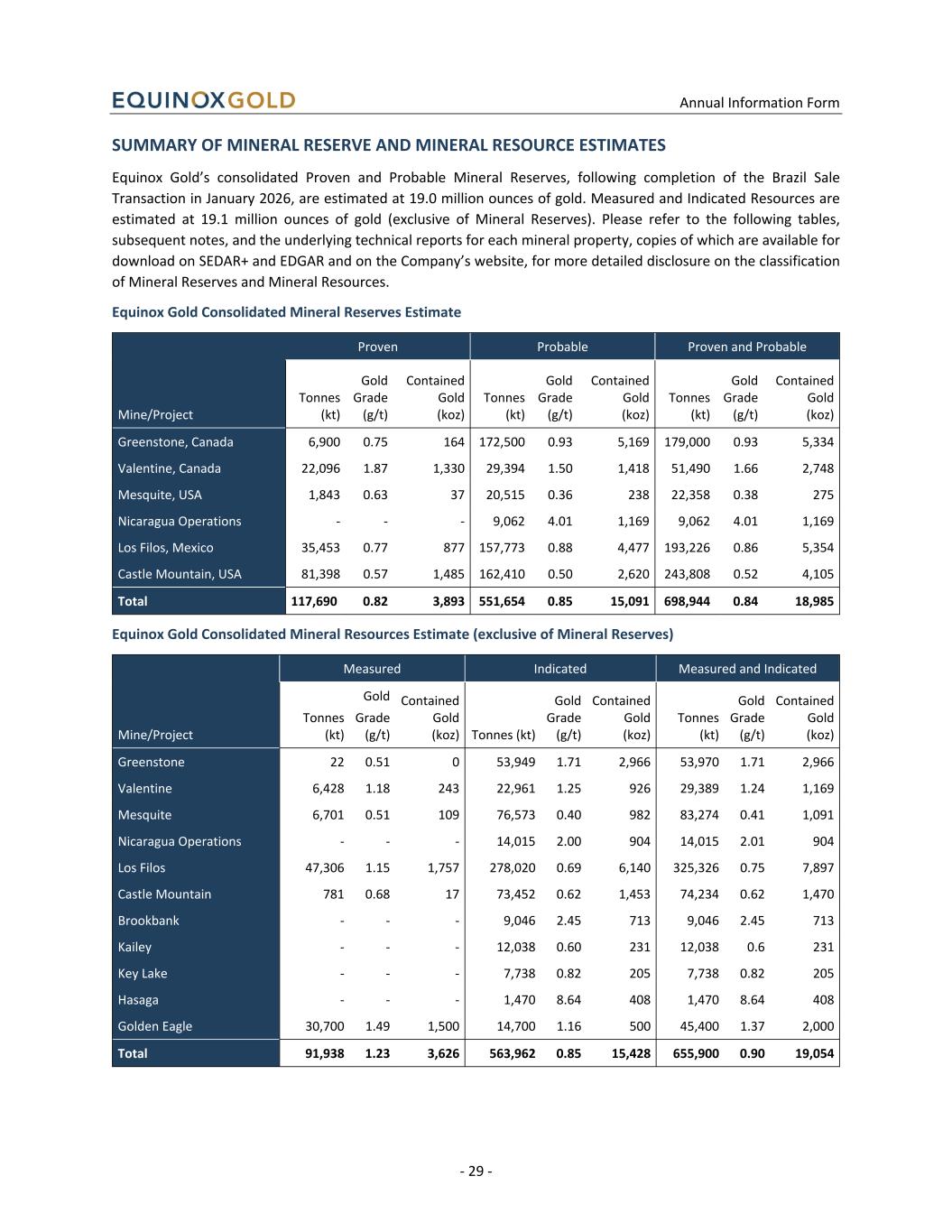
Annual Information Form - 29 - SUMMARY OF MINERAL RESERVE AND MINERAL RESOURCE ESTIMATES Equinox Gold’s consolidated Proven and Probable Mineral Reserves, following completion of the Brazil Sale Transaction in January 2026, are estimated at 19.0 million ounces of gold. Measured and Indicated Resources are estimated at 19.1 million ounces of gold (exclusive of Mineral Reserves). Please refer to the following tables, subsequent notes, and the underlying technical reports for each mineral property, copies of which are available for download on SEDAR+ and EDGAR and on the Company’s website, for more detailed disclosure on the classification of Mineral Reserves and Mineral Resources. Equinox Gold Consolidated Mineral Reserves Estimate Mine/Project Proven Probable Proven and Probable Tonnes (kt) Gold Grade (g/t) Contained Gold (koz) Tonnes (kt) Gold Grade (g/t) Contained Gold (koz) Tonnes (kt) Gold Grade (g/t) Contained Gold (koz) Greenstone, Canada 6,900 0.75 164 172,500 0.93 5,169 179,000 0.93 5,334 Valentine, Canada 22,096 1.87 1,330 29,394 1.50 1,418 51,490 1.66 2,748 Mesquite, USA 1,843 0.63 37 20,515 0.36 238 22,358 0.38 275 Nicaragua Operations - - - 9,062 4.01 1,169 9,062 4.01 1,169 Los Filos, Mexico 35,453 0.77 877 157,773 0.88 4,477 193,226 0.86 5,354 Castle Mountain, USA 81,398 0.57 1,485 162,410 0.50 2,620 243,808 0.52 4,105 Total 117,690 0.82 3,893 551,654 0.85 15,091 698,944 0.84 18,985 Equinox Gold Consolidated Mineral Resources Estimate (exclusive of Mineral Reserves) Mine/Project Measured Indicated Measured and Indicated Tonnes (kt) Gold Grade (g/t) Contained Gold (koz) Tonnes (kt) Gold Grade (g/t) Contained Gold (koz) Tonnes (kt) Gold Grade (g/t) Contained Gold (koz) Greenstone 22 0.51 0 53,949 1.71 2,966 53,970 1.71 2,966 Valentine 6,428 1.18 243 22,961 1.25 926 29,389 1.24 1,169 Mesquite 6,701 0.51 109 76,573 0.40 982 83,274 0.41 1,091 Nicaragua Operations - - - 14,015 2.00 904 14,015 2.01 904 Los Filos 47,306 1.15 1,757 278,020 0.69 6,140 325,326 0.75 7,897 Castle Mountain 781 0.68 17 73,452 0.62 1,453 74,234 0.62 1,470 Brookbank - - - 9,046 2.45 713 9,046 2.45 713 Kailey - - - 12,038 0.60 231 12,038 0.6 231 Key Lake - - - 7,738 0.82 205 7,738 0.82 205 Hasaga - - - 1,470 8.64 408 1,470 8.64 408 Golden Eagle 30,700 1.49 1,500 14,700 1.16 500 45,400 1.37 2,000 Total 91,938 1.23 3,626 563,962 0.85 15,428 655,900 0.90 19,054
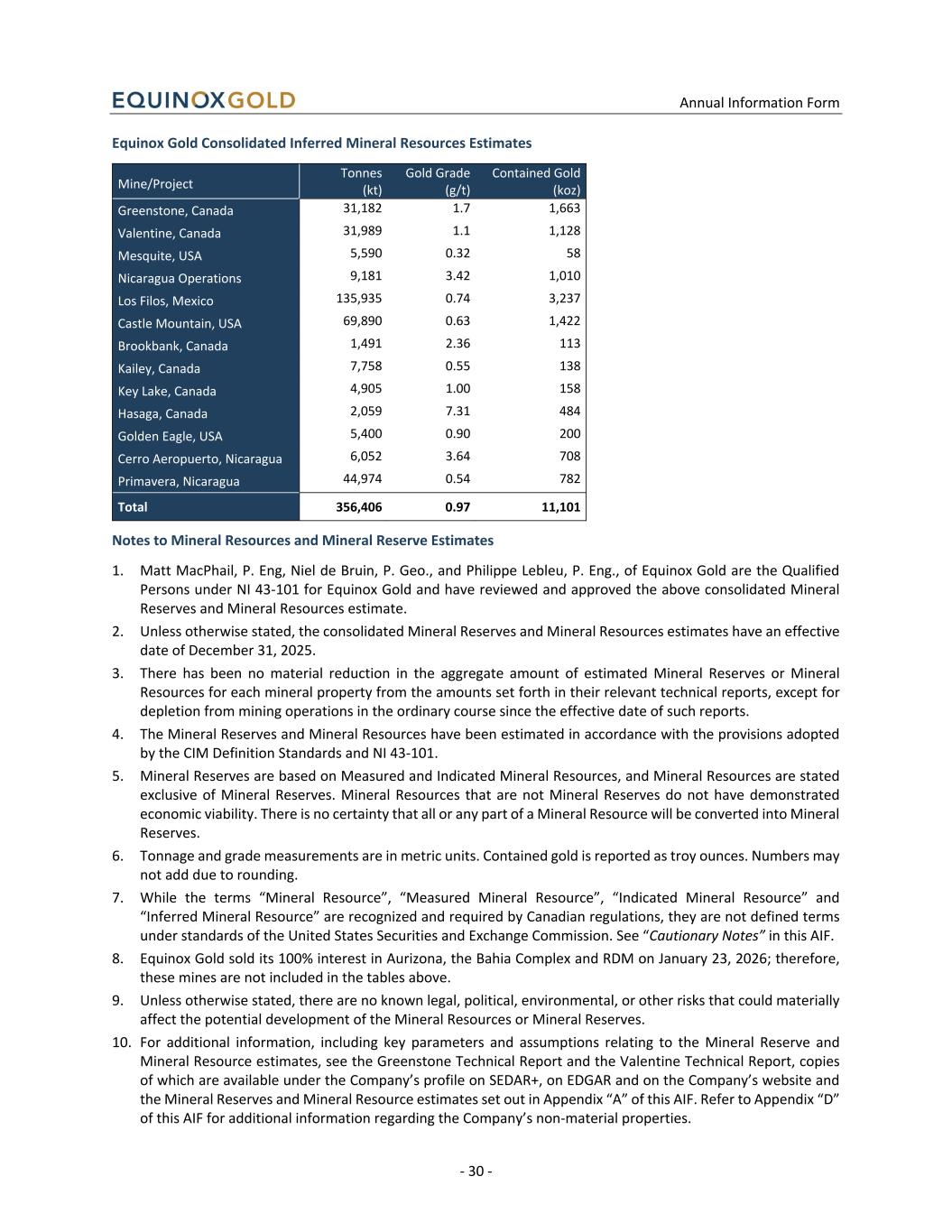
Annual Information Form - 30 - Equinox Gold Consolidated Inferred Mineral Resources Estimates Mine/Project Tonnes (kt) Gold Grade (g/t) Contained Gold (koz) Greenstone, Canada 31,182 1.7 1,663 Valentine, Canada 31,989 1.1 1,128 Mesquite, USA 5,590 0.32 58 Nicaragua Operations 9,181 3.42 1,010 Los Filos, Mexico 135,935 0.74 3,237 Castle Mountain, USA 69,890 0.63 1,422 Brookbank, Canada 1,491 2.36 113 Kailey, Canada 7,758 0.55 138 Key Lake, Canada 4,905 1.00 158 Hasaga, Canada 2,059 7.31 484 Golden Eagle, USA 5,400 0.90 200 Cerro Aeropuerto, Nicaragua 6,052 3.64 708 Primavera, Nicaragua 44,974 0.54 782 Total 356,406 0.97 11,101 Notes to Mineral Resources and Mineral Reserve Estimates 1. Matt MacPhail, P. Eng, Niel de Bruin, P. Geo., and Philippe Lebleu, P. Eng., of Equinox Gold are the Qualified Persons under NI 43-101 for Equinox Gold and have reviewed and approved the above consolidated Mineral Reserves and Mineral Resources estimate. 2. Unless otherwise stated, the consolidated Mineral Reserves and Mineral Resources estimates have an effective date of December 31, 2025. 3. There has been no material reduction in the aggregate amount of estimated Mineral Reserves or Mineral Resources for each mineral property from the amounts set forth in their relevant technical reports, except for depletion from mining operations in the ordinary course since the effective date of such reports. 4. The Mineral Reserves and Mineral Resources have been estimated in accordance with the provisions adopted by the CIM Definition Standards and NI 43-101. 5. Mineral Reserves are based on Measured and Indicated Mineral Resources, and Mineral Resources are stated exclusive of Mineral Reserves. Mineral Resources that are not Mineral Reserves do not have demonstrated economic viability. There is no certainty that all or any part of a Mineral Resource will be converted into Mineral Reserves. 6. Tonnage and grade measurements are in metric units. Contained gold is reported as troy ounces. Numbers may not add due to rounding. 7. While the terms “Mineral Resource”, “Measured Mineral Resource”, “Indicated Mineral Resource” and “Inferred Mineral Resource” are recognized and required by Canadian regulations, they are not defined terms under standards of the United States Securities and Exchange Commission. See “Cautionary Notes” in this AIF. 8. Equinox Gold sold its 100% interest in Aurizona, the Bahia Complex and RDM on January 23, 2026; therefore, these mines are not included in the tables above. 9. Unless otherwise stated, there are no known legal, political, environmental, or other risks that could materially affect the potential development of the Mineral Resources or Mineral Reserves. 10. For additional information, including key parameters and assumptions relating to the Mineral Reserve and Mineral Resource estimates, see the Greenstone Technical Report and the Valentine Technical Report, copies of which are available under the Company’s profile on SEDAR+, on EDGAR and on the Company’s website and the Mineral Reserves and Mineral Resource estimates set out in Appendix “A” of this AIF. Refer to Appendix “D” of this AIF for additional information regarding the Company’s non-material properties.
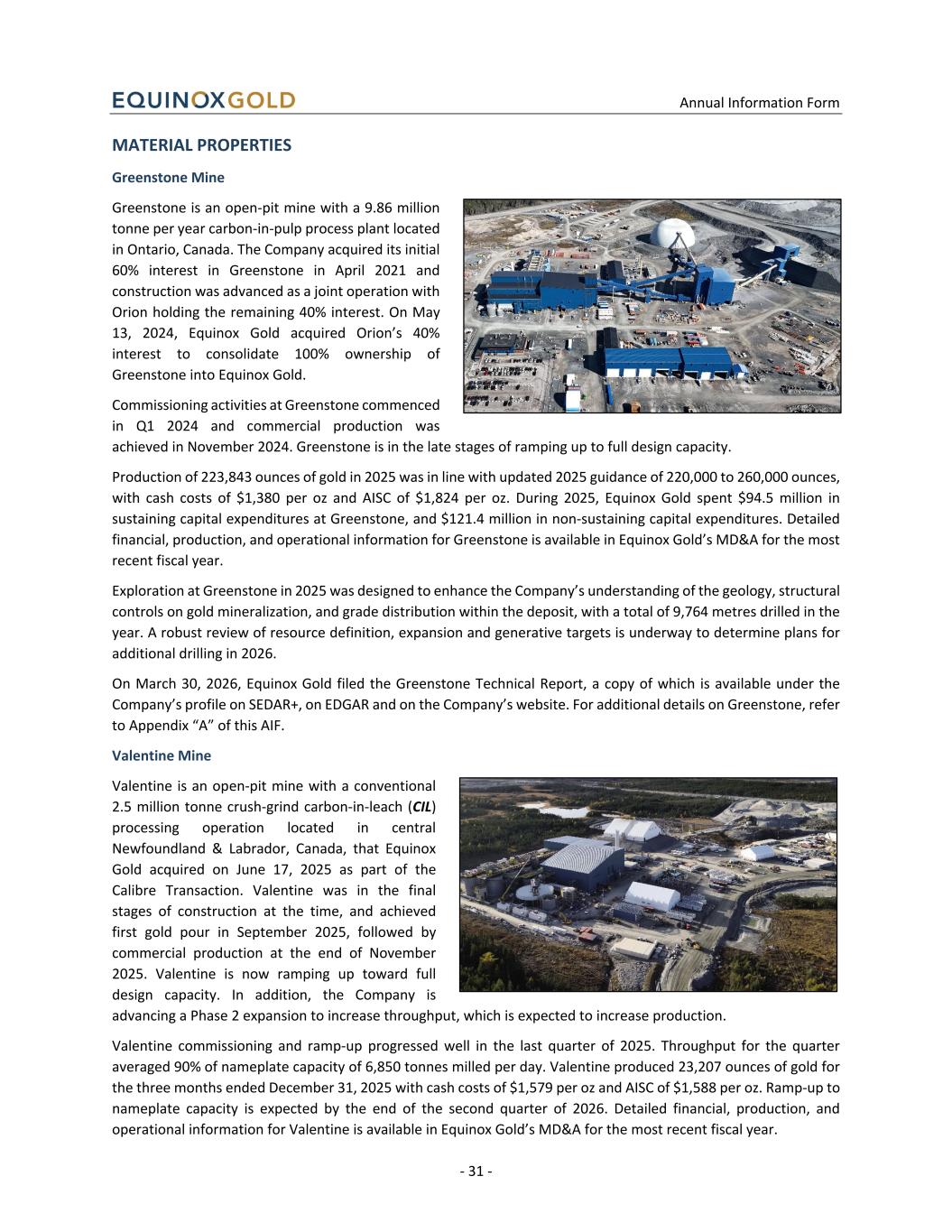
Annual Information Form - 31 - MATERIAL PROPERTIES Greenstone Mine Greenstone is an open-pit mine with a 9.86 million tonne per year carbon-in-pulp process plant located in Ontario, Canada. The Company acquired its initial 60% interest in Greenstone in April 2021 and construction was advanced as a joint operation with Orion holding the remaining 40% interest. On May 13, 2024, Equinox Gold acquired Orion’s 40% interest to consolidate 100% ownership of Greenstone into Equinox Gold. Commissioning activities at Greenstone commenced in Q1 2024 and commercial production was achieved in November 2024. Greenstone is in the late stages of ramping up to full design capacity. Production of 223,843 ounces of gold in 2025 was in line with updated 2025 guidance of 220,000 to 260,000 ounces, with cash costs of $1,380 per oz and AISC of $1,824 per oz. During 2025, Equinox Gold spent $94.5 million in sustaining capital expenditures at Greenstone, and $121.4 million in non-sustaining capital expenditures. Detailed financial, production, and operational information for Greenstone is available in Equinox Gold’s MD&A for the most recent fiscal year. Exploration at Greenstone in 2025 was designed to enhance the Company’s understanding of the geology, structural controls on gold mineralization, and grade distribution within the deposit, with a total of 9,764 metres drilled in the year. A robust review of resource definition, expansion and generative targets is underway to determine plans for additional drilling in 2026. On March 30, 2026, Equinox Gold filed the Greenstone Technical Report, a copy of which is available under the Company’s profile on SEDAR+, on EDGAR and on the Company’s website. For additional details on Greenstone, refer to Appendix “A” of this AIF. Valentine Mine Valentine is an open-pit mine with a conventional 2.5 million tonne crush-grind carbon-in-leach (CIL) processing operation located in central Newfoundland & Labrador, Canada, that Equinox Gold acquired on June 17, 2025 as part of the Calibre Transaction. Valentine was in the final stages of construction at the time, and achieved first gold pour in September 2025, followed by commercial production at the end of November 2025. Valentine is now ramping up toward full design capacity. In addition, the Company is advancing a Phase 2 expansion to increase throughput, which is expected to increase production. Valentine commissioning and ramp-up progressed well in the last quarter of 2025. Throughput for the quarter averaged 90% of nameplate capacity of 6,850 tonnes milled per day. Valentine produced 23,207 ounces of gold for the three months ended December 31, 2025 with cash costs of $1,579 per oz and AISC of $1,588 per oz. Ramp-up to nameplate capacity is expected by the end of the second quarter of 2026. Detailed financial, production, and operational information for Valentine is available in Equinox Gold’s MD&A for the most recent fiscal year.

Annual Information Form - 32 - During 2025, the Company drilled a total of 68,062 metres at Valentine (including the period prior to completion of the Calibre Transaction on June 17, 2025), focused on a combination of conceptual and advanced regional targets, as well as near-mine resource expansion along the Valentine Lake Shear Zone. On March 30, 2026, Equinox Gold filed the Valentine Technical Report, a copy of which is available under the Company’s profile on SEDAR+ and on EDGAR, and on the Company’s website. For additional details on Valentine, refer to Appendix “A” of this AIF.
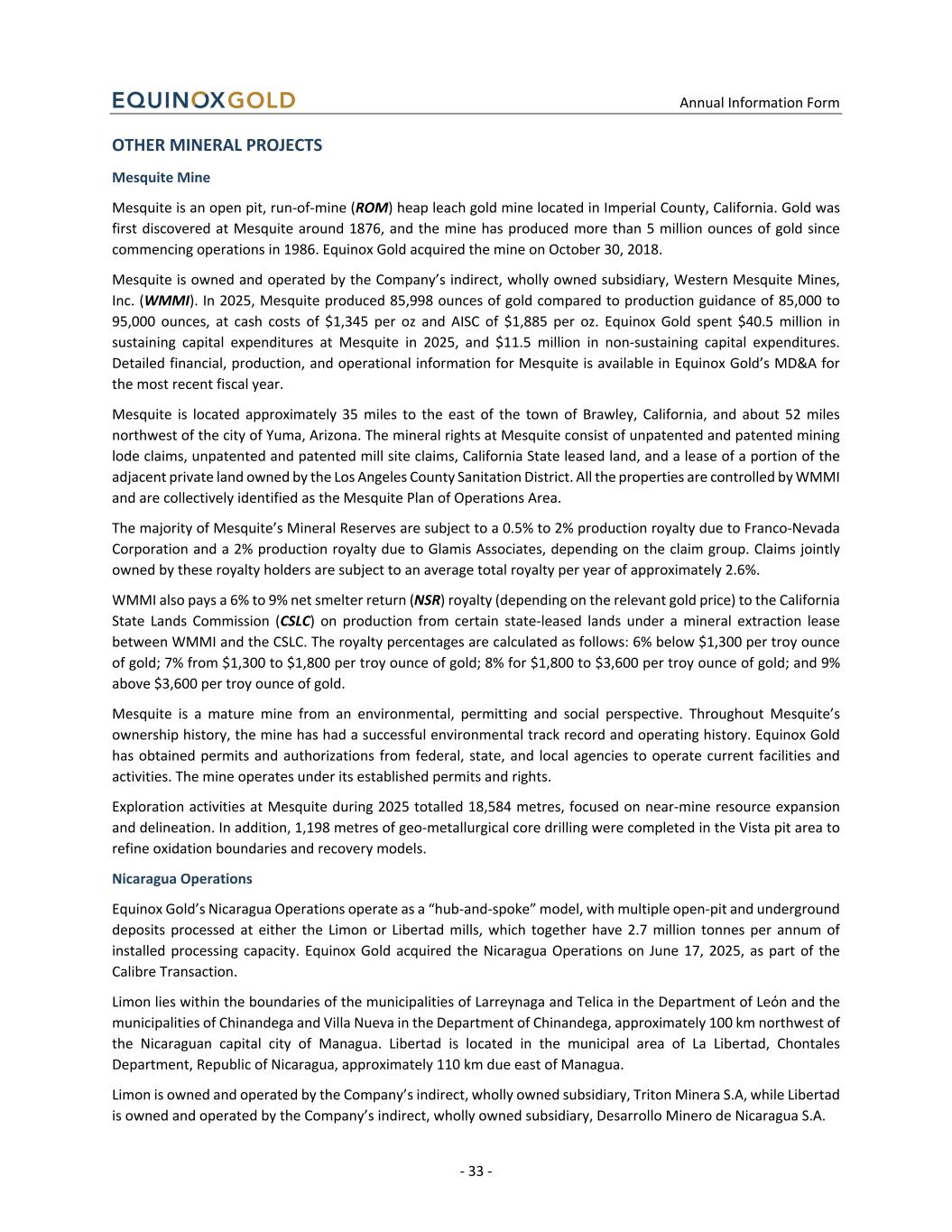
Annual Information Form - 33 - OTHER MINERAL PROJECTS Mesquite Mine Mesquite is an open pit, run-of-mine (ROM) heap leach gold mine located in Imperial County, California. Gold was first discovered at Mesquite around 1876, and the mine has produced more than 5 million ounces of gold since commencing operations in 1986. Equinox Gold acquired the mine on October 30, 2018. Mesquite is owned and operated by the Company’s indirect, wholly owned subsidiary, Western Mesquite Mines, Inc. (WMMI). In 2025, Mesquite produced 85,998 ounces of gold compared to production guidance of 85,000 to 95,000 ounces, at cash costs of $1,345 per oz and AISC of $1,885 per oz. Equinox Gold spent $40.5 million in sustaining capital expenditures at Mesquite in 2025, and $11.5 million in non-sustaining capital expenditures. Detailed financial, production, and operational information for Mesquite is available in Equinox Gold’s MD&A for the most recent fiscal year. Mesquite is located approximately 35 miles to the east of the town of Brawley, California, and about 52 miles northwest of the city of Yuma, Arizona. The mineral rights at Mesquite consist of unpatented and patented mining lode claims, unpatented and patented mill site claims, California State leased land, and a lease of a portion of the adjacent private land owned by the Los Angeles County Sanitation District. All the properties are controlled by WMMI and are collectively identified as the Mesquite Plan of Operations Area. The majority of Mesquite’s Mineral Reserves are subject to a 0.5% to 2% production royalty due to Franco-Nevada Corporation and a 2% production royalty due to Glamis Associates, depending on the claim group. Claims jointly owned by these royalty holders are subject to an average total royalty per year of approximately 2.6%. WMMI also pays a 6% to 9% net smelter return (NSR) royalty (depending on the relevant gold price) to the California State Lands Commission (CSLC) on production from certain state-leased lands under a mineral extraction lease between WMMI and the CSLC. The royalty percentages are calculated as follows: 6% below $1,300 per troy ounce of gold; 7% from $1,300 to $1,800 per troy ounce of gold; 8% for $1,800 to $3,600 per troy ounce of gold; and 9% above $3,600 per troy ounce of gold. Mesquite is a mature mine from an environmental, permitting and social perspective. Throughout Mesquite’s ownership history, the mine has had a successful environmental track record and operating history. Equinox Gold has obtained permits and authorizations from federal, state, and local agencies to operate current facilities and activities. The mine operates under its established permits and rights. Exploration activities at Mesquite during 2025 totalled 18,584 metres, focused on near-mine resource expansion and delineation. In addition, 1,198 metres of geo-metallurgical core drilling were completed in the Vista pit area to refine oxidation boundaries and recovery models. Nicaragua Operations Equinox Gold’s Nicaragua Operations operate as a “hub-and-spoke” model, with multiple open-pit and underground deposits processed at either the Limon or Libertad mills, which together have 2.7 million tonnes per annum of installed processing capacity. Equinox Gold acquired the Nicaragua Operations on June 17, 2025, as part of the Calibre Transaction. Limon lies within the boundaries of the municipalities of Larreynaga and Telica in the Department of Leόn and the municipalities of Chinandega and Villa Nueva in the Department of Chinandega, approximately 100 km northwest of the Nicaraguan capital city of Managua. Libertad is located in the municipal area of La Libertad, Chontales Department, Republic of Nicaragua, approximately 110 km due east of Managua. Limon is owned and operated by the Company’s indirect, wholly owned subsidiary, Triton Minera S.A, while Libertad is owned and operated by the Company’s indirect, wholly owned subsidiary, Desarrollo Minero de Nicaragua S.A.
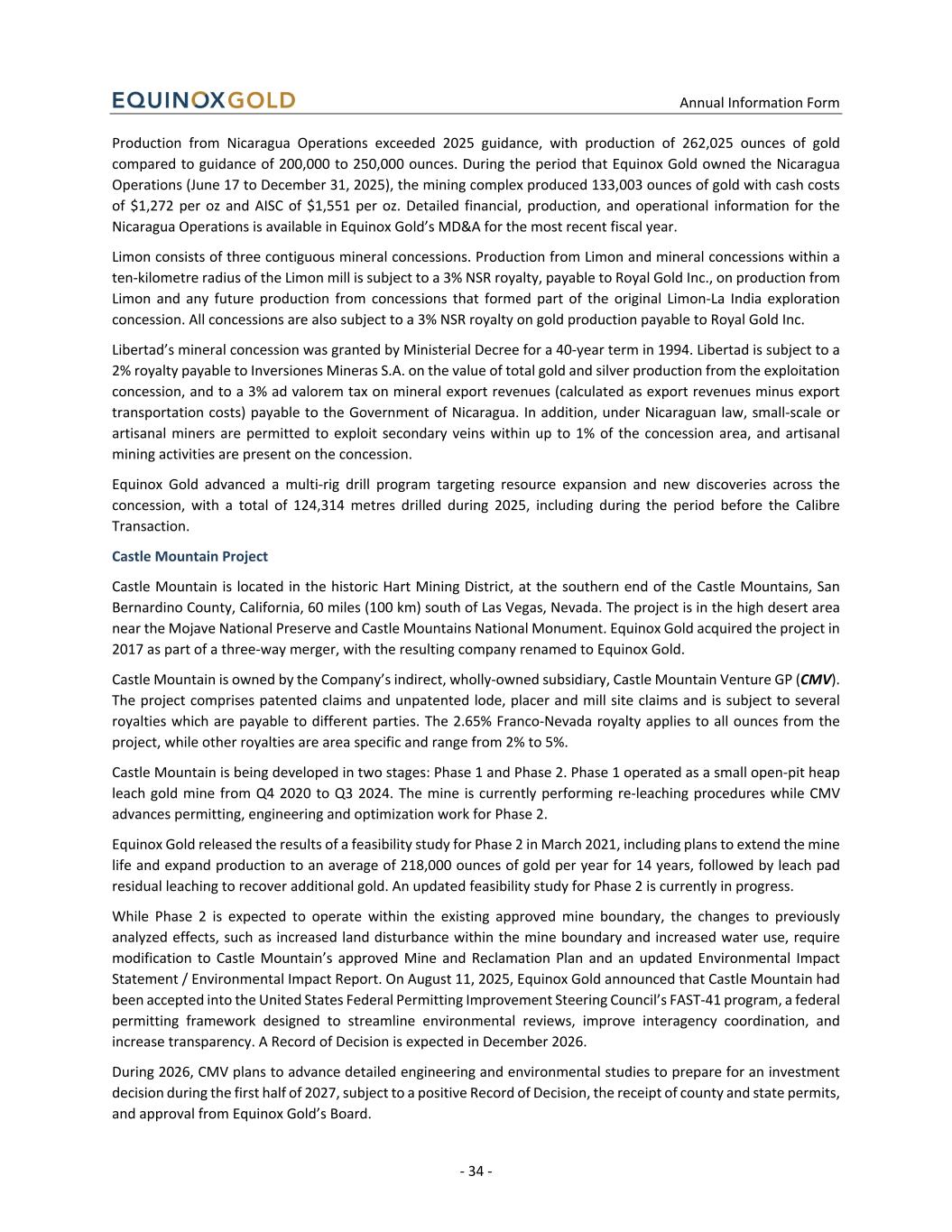
Annual Information Form - 34 - Production from Nicaragua Operations exceeded 2025 guidance, with production of 262,025 ounces of gold compared to guidance of 200,000 to 250,000 ounces. During the period that Equinox Gold owned the Nicaragua Operations (June 17 to December 31, 2025), the mining complex produced 133,003 ounces of gold with cash costs of $1,272 per oz and AISC of $1,551 per oz. Detailed financial, production, and operational information for the Nicaragua Operations is available in Equinox Gold’s MD&A for the most recent fiscal year. Limon consists of three contiguous mineral concessions. Production from Limon and mineral concessions within a ten-kilometre radius of the Limon mill is subject to a 3% NSR royalty, payable to Royal Gold Inc., on production from Limon and any future production from concessions that formed part of the original Limon-La India exploration concession. All concessions are also subject to a 3% NSR royalty on gold production payable to Royal Gold Inc. Libertad’s mineral concession was granted by Ministerial Decree for a 40-year term in 1994. Libertad is subject to a 2% royalty payable to Inversiones Mineras S.A. on the value of total gold and silver production from the exploitation concession, and to a 3% ad valorem tax on mineral export revenues (calculated as export revenues minus export transportation costs) payable to the Government of Nicaragua. In addition, under Nicaraguan law, small-scale or artisanal miners are permitted to exploit secondary veins within up to 1% of the concession area, and artisanal mining activities are present on the concession. Equinox Gold advanced a multi-rig drill program targeting resource expansion and new discoveries across the concession, with a total of 124,314 metres drilled during 2025, including during the period before the Calibre Transaction. Castle Mountain Project Castle Mountain is located in the historic Hart Mining District, at the southern end of the Castle Mountains, San Bernardino County, California, 60 miles (100 km) south of Las Vegas, Nevada. The project is in the high desert area near the Mojave National Preserve and Castle Mountains National Monument. Equinox Gold acquired the project in 2017 as part of a three-way merger, with the resulting company renamed to Equinox Gold. Castle Mountain is owned by the Company’s indirect, wholly-owned subsidiary, Castle Mountain Venture GP (CMV). The project comprises patented claims and unpatented lode, placer and mill site claims and is subject to several royalties which are payable to different parties. The 2.65% Franco-Nevada royalty applies to all ounces from the project, while other royalties are area specific and range from 2% to 5%. Castle Mountain is being developed in two stages: Phase 1 and Phase 2. Phase 1 operated as a small open-pit heap leach gold mine from Q4 2020 to Q3 2024. The mine is currently performing re-leaching procedures while CMV advances permitting, engineering and optimization work for Phase 2. Equinox Gold released the results of a feasibility study for Phase 2 in March 2021, including plans to extend the mine life and expand production to an average of 218,000 ounces of gold per year for 14 years, followed by leach pad residual leaching to recover additional gold. An updated feasibility study for Phase 2 is currently in progress. While Phase 2 is expected to operate within the existing approved mine boundary, the changes to previously analyzed effects, such as increased land disturbance within the mine boundary and increased water use, require modification to Castle Mountain’s approved Mine and Reclamation Plan and an updated Environmental Impact Statement / Environmental Impact Report. On August 11, 2025, Equinox Gold announced that Castle Mountain had been accepted into the United States Federal Permitting Improvement Steering Council’s FAST-41 program, a federal permitting framework designed to streamline environmental reviews, improve interagency coordination, and increase transparency. A Record of Decision is expected in December 2026. During 2026, CMV plans to advance detailed engineering and environmental studies to prepare for an investment decision during the first half of 2027, subject to a positive Record of Decision, the receipt of county and state permits, and approval from Equinox Gold’s Board.
Annual Information Form - 35 - Los Filos Mine Complex Los Filos Mine Complex in Guerrero State, Mexico comprises the Los Filos, Guadalupe and Bermejal open pits, and the Los Filos underground mine, with ore processed through heap leach recovery. Los Filos began commercial production in 2008 and was acquired by Equinox Gold in March 2020 through its acquisition of Leagold Mining Corporation. On April 1, 2025, Equinox Gold announced that it had suspended operations at Los Filos indefinitely following the expiry of a land access agreement with one of the three communities that host the project. Los Filos is owned and operated by the Company’s indirect, wholly-owned subsidiary DMSL. The mine consists of exploitation and exploration concessions located in the Eduardo Neri District, Guerrero State, Mexico approximately 180 km southwest of Mexico City. Concessions are granted for 50-year durations and expirations dates vary depending on the date of grant of the concession. Renewal dates range from 2032 to 2067. In Mexico, while mineral rights are administered by the federal government through federally issued mining concessions, surface rights are typically owned by local landowners, including “ejidos” and similar rural community entities. This is the case at Los Filos, where two separate ejidos and one other local community own most of the surface lands. DMSL has secured long-term access and use agreements (for a period of 20 years) with two of the three groups but currently lacks a long-term agreement with the third group. DMSL is currently pursuing a long- term agreement with this third group, but if these discussions do not result in mutually acceptable terms, there may be significant negative impacts on the potential for future operation of Los Filos. Los Filos has been reclassified as a development project while Equinox Gold evaluates the project’s long-term potential.
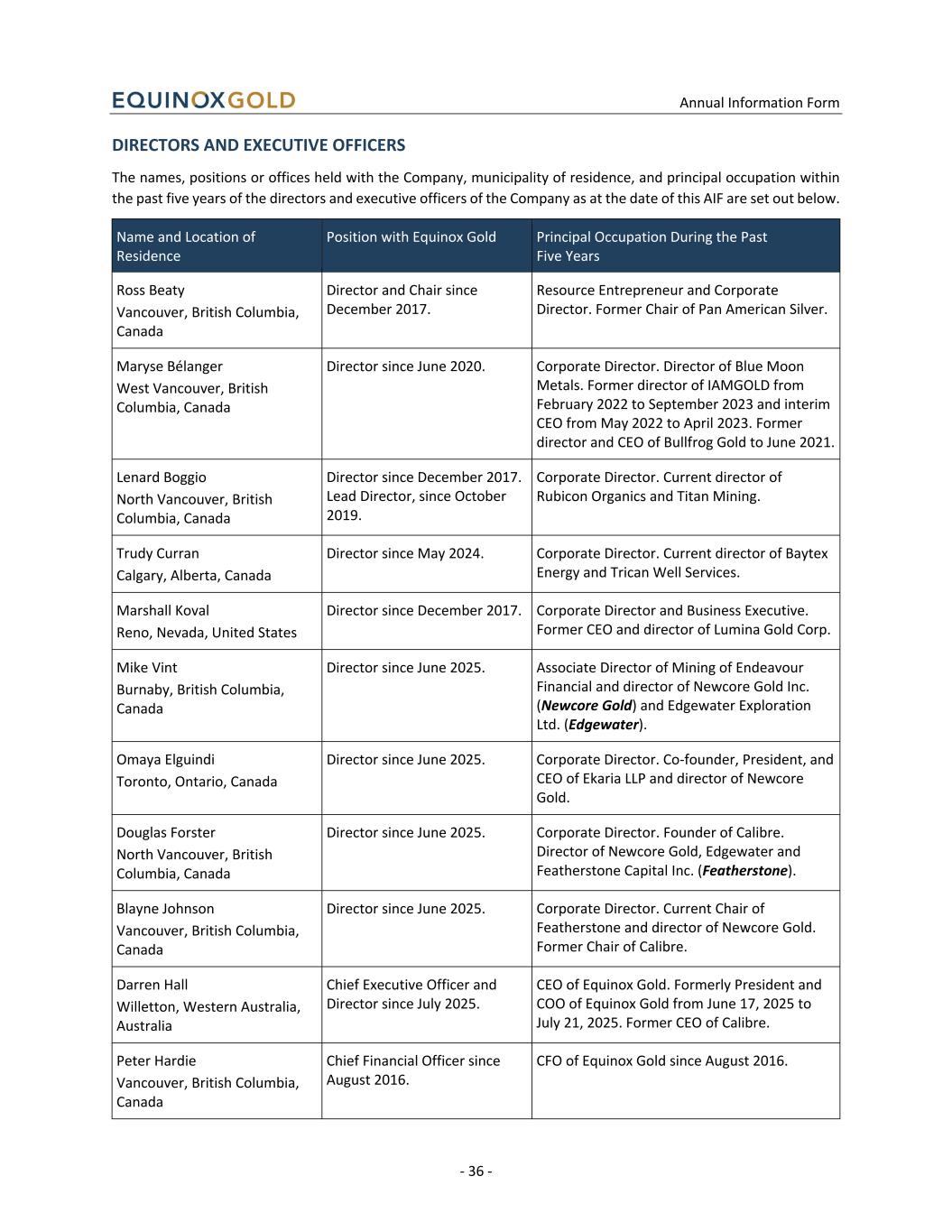
Annual Information Form - 36 - DIRECTORS AND EXECUTIVE OFFICERS The names, positions or offices held with the Company, municipality of residence, and principal occupation within the past five years of the directors and executive officers of the Company as at the date of this AIF are set out below. Name and Location of Residence Position with Equinox Gold Principal Occupation During the Past Five Years Ross Beaty Vancouver, British Columbia, Canada Director and Chair since December 2017. Resource Entrepreneur and Corporate Director. Former Chair of Pan American Silver. Maryse Bélanger West Vancouver, British Columbia, Canada Director since June 2020. Corporate Director. Director of Blue Moon Metals. Former director of IAMGOLD from February 2022 to September 2023 and interim CEO from May 2022 to April 2023. Former director and CEO of Bullfrog Gold to June 2021. Lenard Boggio North Vancouver, British Columbia, Canada Director since December 2017. Lead Director, since October 2019. Corporate Director. Current director of Rubicon Organics and Titan Mining. Trudy Curran Calgary, Alberta, Canada Director since May 2024. Corporate Director. Current director of Baytex Energy and Trican Well Services. Marshall Koval Reno, Nevada, United States Director since December 2017. Corporate Director and Business Executive. Former CEO and director of Lumina Gold Corp. Mike Vint Burnaby, British Columbia, Canada Director since June 2025. Associate Director of Mining of Endeavour Financial and director of Newcore Gold Inc. (Newcore Gold) and Edgewater Exploration Ltd. (Edgewater). Omaya Elguindi Toronto, Ontario, Canada Director since June 2025. Corporate Director. Co-founder, President, and CEO of Ekaria LLP and director of Newcore Gold. Douglas Forster North Vancouver, British Columbia, Canada Director since June 2025. Corporate Director. Founder of Calibre. Director of Newcore Gold, Edgewater and Featherstone Capital Inc. (Featherstone). Blayne Johnson Vancouver, British Columbia, Canada Director since June 2025. Corporate Director. Current Chair of Featherstone and director of Newcore Gold. Former Chair of Calibre. Darren Hall Willetton, Western Australia, Australia Chief Executive Officer and Director since July 2025. CEO of Equinox Gold. Formerly President and COO of Equinox Gold from June 17, 2025 to July 21, 2025. Former CEO of Calibre. Peter Hardie Vancouver, British Columbia, Canada Chief Financial Officer since August 2016. CFO of Equinox Gold since August 2016.
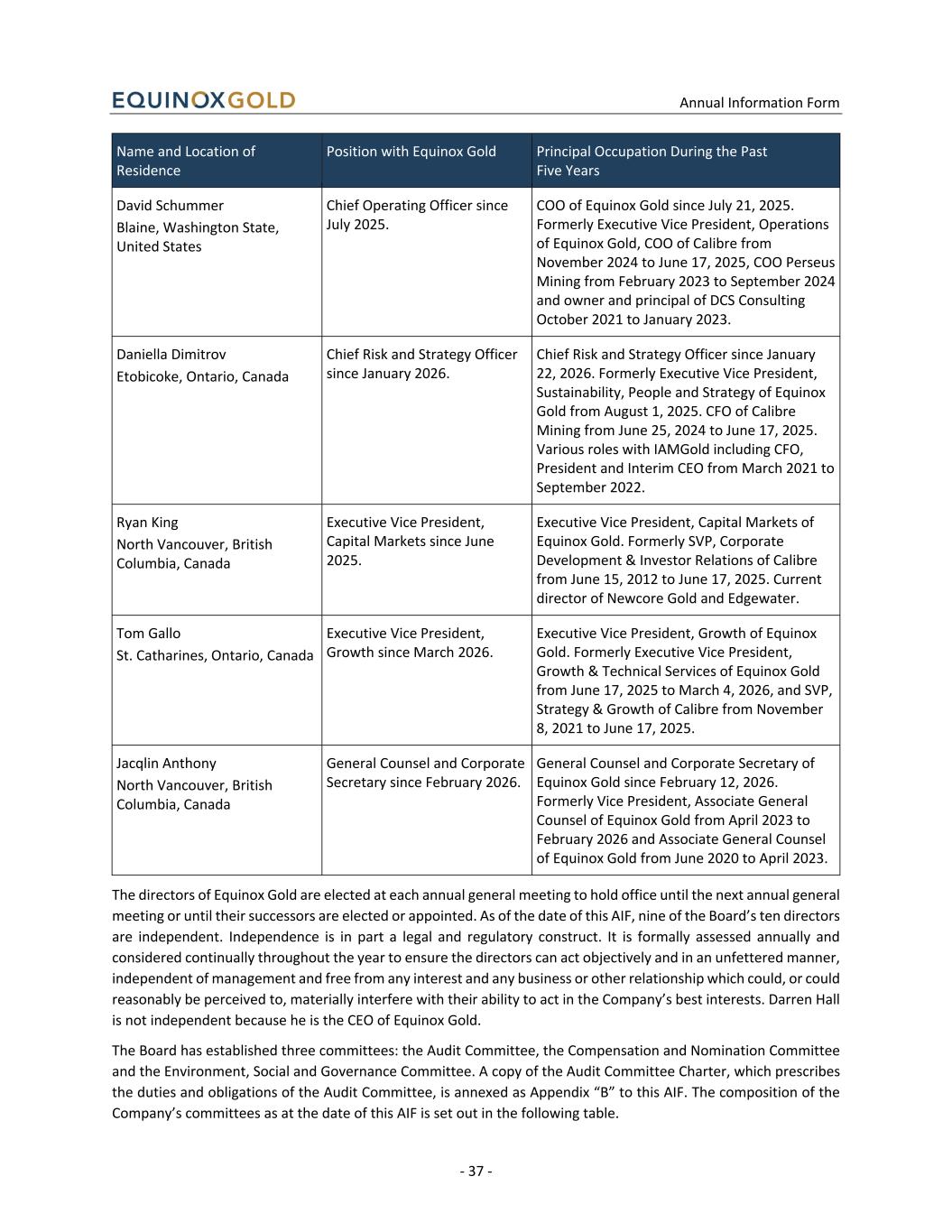
Annual Information Form - 37 - Name and Location of Residence Position with Equinox Gold Principal Occupation During the Past Five Years David Schummer Blaine, Washington State, United States Chief Operating Officer since July 2025. COO of Equinox Gold since July 21, 2025. Formerly Executive Vice President, Operations of Equinox Gold, COO of Calibre from November 2024 to June 17, 2025, COO Perseus Mining from February 2023 to September 2024 and owner and principal of DCS Consulting October 2021 to January 2023. Daniella Dimitrov Etobicoke, Ontario, Canada Chief Risk and Strategy Officer since January 2026. Chief Risk and Strategy Officer since January 22, 2026. Formerly Executive Vice President, Sustainability, People and Strategy of Equinox Gold from August 1, 2025. CFO of Calibre Mining from June 25, 2024 to June 17, 2025. Various roles with IAMGold including CFO, President and Interim CEO from March 2021 to September 2022. Ryan King North Vancouver, British Columbia, Canada Executive Vice President, Capital Markets since June 2025. Executive Vice President, Capital Markets of Equinox Gold. Formerly SVP, Corporate Development & Investor Relations of Calibre from June 15, 2012 to June 17, 2025. Current director of Newcore Gold and Edgewater. Tom Gallo St. Catharines, Ontario, Canada Executive Vice President, Growth since March 2026. Executive Vice President, Growth of Equinox Gold. Formerly Executive Vice President, Growth & Technical Services of Equinox Gold from June 17, 2025 to March 4, 2026, and SVP, Strategy & Growth of Calibre from November 8, 2021 to June 17, 2025. Jacqlin Anthony North Vancouver, British Columbia, Canada General Counsel and Corporate Secretary since February 2026. General Counsel and Corporate Secretary of Equinox Gold since February 12, 2026. Formerly Vice President, Associate General Counsel of Equinox Gold from April 2023 to February 2026 and Associate General Counsel of Equinox Gold from June 2020 to April 2023. The directors of Equinox Gold are elected at each annual general meeting to hold office until the next annual general meeting or until their successors are elected or appointed. As of the date of this AIF, nine of the Board’s ten directors are independent. Independence is in part a legal and regulatory construct. It is formally assessed annually and considered continually throughout the year to ensure the directors can act objectively and in an unfettered manner, independent of management and free from any interest and any business or other relationship which could, or could reasonably be perceived to, materially interfere with their ability to act in the Company’s best interests. Darren Hall is not independent because he is the CEO of Equinox Gold. The Board has established three committees: the Audit Committee, the Compensation and Nomination Committee and the Environment, Social and Governance Committee. A copy of the Audit Committee Charter, which prescribes the duties and obligations of the Audit Committee, is annexed as Appendix “B” to this AIF. The composition of the Company’s committees as at the date of this AIF is set out in the following table.
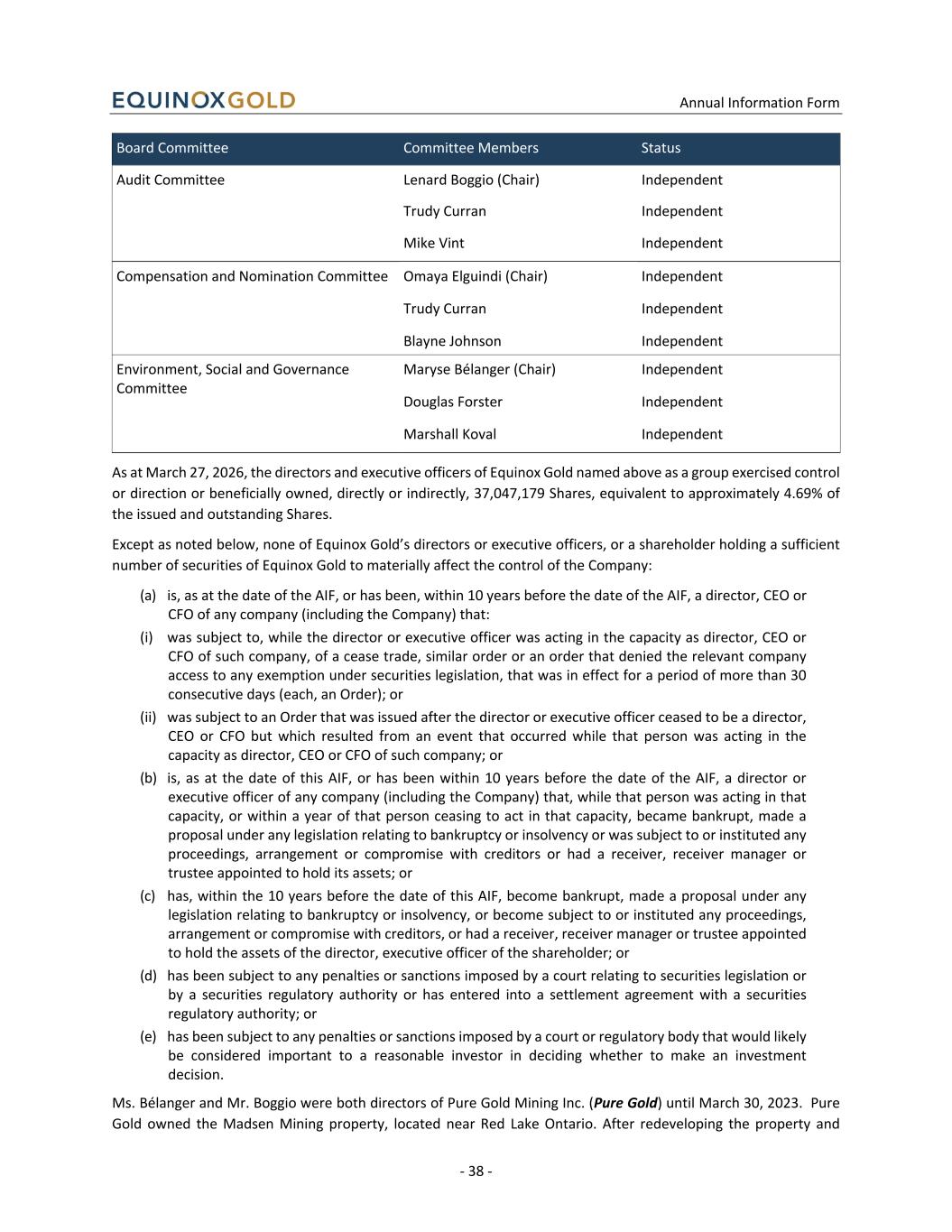
Annual Information Form - 38 - Board Committee Committee Members Status Audit Committee Lenard Boggio (Chair) Independent Trudy Curran Independent Mike Vint Independent Compensation and Nomination Committee Omaya Elguindi (Chair) Independent Trudy Curran Independent Blayne Johnson Independent Environment, Social and Governance Committee Maryse Bélanger (Chair) Independent Douglas Forster Independent Marshall Koval Independent As at March 27, 2026, the directors and executive officers of Equinox Gold named above as a group exercised control or direction or beneficially owned, directly or indirectly, 37,047,179 Shares, equivalent to approximately 4.69% of the issued and outstanding Shares. Except as noted below, none of Equinox Gold’s directors or executive officers, or a shareholder holding a sufficient number of securities of Equinox Gold to materially affect the control of the Company: (a) is, as at the date of the AIF, or has been, within 10 years before the date of the AIF, a director, CEO or CFO of any company (including the Company) that: (i) was subject to, while the director or executive officer was acting in the capacity as director, CEO or CFO of such company, of a cease trade, similar order or an order that denied the relevant company access to any exemption under securities legislation, that was in effect for a period of more than 30 consecutive days (each, an Order); or (ii) was subject to an Order that was issued after the director or executive officer ceased to be a director, CEO or CFO but which resulted from an event that occurred while that person was acting in the capacity as director, CEO or CFO of such company; or (b) is, as at the date of this AIF, or has been within 10 years before the date of the AIF, a director or executive officer of any company (including the Company) that, while that person was acting in that capacity, or within a year of that person ceasing to act in that capacity, became bankrupt, made a proposal under any legislation relating to bankruptcy or insolvency or was subject to or instituted any proceedings, arrangement or compromise with creditors or had a receiver, receiver manager or trustee appointed to hold its assets; or (c) has, within the 10 years before the date of this AIF, become bankrupt, made a proposal under any legislation relating to bankruptcy or insolvency, or become subject to or instituted any proceedings, arrangement or compromise with creditors, or had a receiver, receiver manager or trustee appointed to hold the assets of the director, executive officer of the shareholder; or (d) has been subject to any penalties or sanctions imposed by a court relating to securities legislation or by a securities regulatory authority or has entered into a settlement agreement with a securities regulatory authority; or (e) has been subject to any penalties or sanctions imposed by a court or regulatory body that would likely be considered important to a reasonable investor in deciding whether to make an investment decision. Ms. Bélanger and Mr. Boggio were both directors of Pure Gold Mining Inc. (Pure Gold) until March 30, 2023. Pure Gold owned the Madsen Mining property, located near Red Lake Ontario. After redeveloping the property and
Annual Information Form - 39 - processing facilities, Pure Gold experienced significant start up and operational difficulties. Consequently, on October 31, 2022, Pure Gold applied for and received an initial order for creditor protection from the Supreme Court of British Columbia (Court) under the Companies’ Creditors Arrangement Act (CCAA). KSV Restructuring Inc. was appointed as the monitor. On November 10, 2022, the Court approved a Sales and Investment Solicitation Process Order, among other relief. On March 30, 2023, the Court approved Pure Gold’s appointment of a Chief Administrative Officer and all members of the Pure Gold board of directors resigned immediately. Pure Gold’s common shares were suspended from trading on the NEX Board of the TSX Venture Exchange. Pure Gold was subsequently acquired by West Lake Gold Mines on June 16, 2023 under the CCAA proceedings. Ms. Curran was a director of Great Panther Mining Ltd. (Great Panther) from June 9, 2021 to December 15, 2022. On September 6, 2022, Great Panther filed a notice of intention to make a proposal under the Bankruptcy and Insolvency Act (Canada), which provided Great Panther with creditor protection while it sought to restructure its affairs. On November 18, 2022, the British Columbia Securities Commission issued a cease trade order in respect of Great Panther’s securities as a result of its inability to file its quarterly continuous disclosure documents in accordance with Canadian securities laws. On December 16, 2022, Great Panther made a voluntary assignment into bankruptcy under the Bankruptcy and Insolvency Act (Canada) and Alvarez & Marsal Canada Inc. was appointed licensed insolvency trustee of Great Panther’s estate.
Annual Information Form - 40 - AUDIT COMMITTEE Equinox Gold’s Audit Committee must be comprised of a minimum of three directors of the Company, as determined by the Board, and each member of the Audit Committee must be free from any relationship that, in the opinion of the Board, would interfere with the exercise of their independent judgment as a member of the Audit Committee. All members of the Audit Committee must be “financially literate”. The definition of “financially literate” is the ability to read and understand a set of financial statements that present a breadth and level of complexity of accounting issues that are generally comparable to the breadth and complexity of the issues that can presumably be expected to be raised by the Company’s financial statements. Mr. Boggio has the requisite professional experience in accounting to meet the criteria of an “audit committee financial expert” under the Sarbanes-Oxley Act of 2002 and is the designated financial expert of Equinox Gold. The members of the Audit Committee must be appointed by the Board at its first meeting following the annual meeting of shareholders. Unless a Chair of the Audit Committee is appointed by the Board, the members of the Audit Committee may designate a Chair by a majority vote of the full Audit Committee membership. As at the date of this AIF, the members of Equinox Gold’s Audit Committee are Lenard Boggio (Chair), Trudy Curran and Mike Vint. The following table sets out the names of the members of the Audit Committee and whether they are “independent” and “financially literate”, as defined in National Instrument 52-110 – Audit Committees. Name of Member Independent Financially Literate Lenard Boggio Independent Financially literate Trudy Curran Independent Financially literate Mike Vint Independent Financially literate Relevant Education and Experience of Audit Committee Members The following summarizes the education and experience of each member of the Audit Committee relevant to the performance of their responsibilities as an Audit Committee member and any education or experience that would provide the member with: (a) an understanding of the accounting principles used by the Company to prepare its financial statements; (b) the ability to assess the general application of such accounting principles in connection with the accounting for estimates, accruals and reserves; (c) experience preparing, auditing, analyzing or evaluating financial statements that present a breadth and level of complexity of accounting issues that are generally comparable to the breadth and complexity of issues that can reasonably be expected to be raised by the Company’s financial statements, or experience actively supervising one or more persons engaged in such activities; and (d) an understanding of internal controls and procedures for financial reporting. Lenard Boggio – Mr. Boggio is a former partner of PricewaterhouseCoopers LLP, where he was the leader of the mining industry practice in British Columbia. He has significant expertise in financial reporting, auditing matters and transactions in the mineral resource and energy sectors, including exploration, development and production stage operations in the Americas, Africa, Europe and Asia. Mr. Boggio was previously an independent director of several resource companies and the provincially owned BC Hydro and Power Authority. He is currently an independent director of Rubicon Organics and Titan Mining. Mr. Boggio has a Bachelor of Arts degree and an Honours Bachelor of Commerce degree from the University of Windsor. He is a past chair of the Canadian Institute of Chartered
Annual Information Form - 41 - Accountants and a past president of the Institute of Chartered Accountants of BC and holds the FCPA, FCA designation. He is a member of the Canadian Institute of Corporate Directors and holds an ICD.D designation. In 2019, Mr. Boggio was honoured with a Lifetime Achievement Award by the Chartered Professional Accountants of British Columbia, recognizing his sustained distinction in his career, community service and work within the CPA profession. Trudy Curran – Ms. Curran is a retired businesswoman that brings extensive experience to the Board, including in the key areas of mergers and acquisitions, strategy, governance, human resources and executive compensation across a range of industries, particularly oil and gas and mining. Ms. Curran was previously an independent director of several resource companies and is currently an independent director of Baytex Energy Corp. (Baytex) and Trican Well Services Limited and is a Commissioner with the Alberta Securities Commission. Ms. Curran was a prior member of the audit committees of Baytex and Dominion Diamond Mines, both cross-border public companies, and she was the finance committee chair of Riversdale Resources (subsequently acquired by now Hancock Prospecting Pty Ltd.), an Australian public metallurgical coal company. Ms. Curran holds a Bachelor of Arts degree in English and a Bachelor of Laws degree from the University of Saskatchewan and the ICD.D designation from the Institute of Corporate Directors. Ms. Curran was recognized as one of the Top 100 Most Powerful Women in Canada in 2012 and is also the recipient of the Governor General’s Bronze medal award for her academic, athletic and community achievements. Mike Vint – Mr. Vint is Associate Director of Mining with Endeavour Financial, a leading financial advisor in the natural resources sector providing advice in project financing, structured finance and mergers and acquisitions. He brings to the Board extensive experience in mine operations and construction for precious and base metals as well as corporate finance, mergers and acquisitions. Mr. Vint has spent most of his career working in mining operations across the United States and Canada; he then transitioned to the Research department of CIBC World Markets covering the gold sector. Mr. Vint was a director of Calibre Mining, which merged with Equinox Gold on June 17, 2025 and of Newmarket Gold Inc. which was purchased for $1.0 billion by Kirkland Lake Gold Ltd. Mr. Vint is a registered professional engineer in the Province of British Columbia and received his Mining Engineering degree from the Colorado School of Mines. Mr. Vint is currently an independent director of Newcore Gold. External Auditor Service Fees (By Category) The fees paid or payable to the Company’s auditor, KPMG LLP, in each of the last two fiscal years are as follows: 2025 2024 Audit Fees Services provided by the independent auditor for the audit of the financial statements and internal controls over financial reporting. $3,027,719 $2,622,375 Audit Related Services In 2025 and 2024, special attest services as required by regulatory and statutory requirements in Mexico $86,923 $80,750 All Other Fees Financial due diligence for Calibre Transaction $82,816 Nil Tax Compliance Fees For the preparation and review of tax returns, claims for refund and tax payment- planning services. Nil $303,380 Tax Fees No other tax fees in 2025 or 2024 Nil Nil Total $3,197,458 $3,006,505
Annual Information Form - 42 - Audit Committee Pre-Approval Policies The Audit Committee has adopted specific policies and procedures for the engagement of non-audit services as described in Section 25 of the Audit Committee Charter attached as Appendix “B”. Conflicts of Interest Certain of the directors and/or officers of Equinox Gold are also directors and/or officers of other companies involved in natural resource exploration, development and mining operations and consequently, to the extent such other companies may participate in ventures in which the Company may participate, there exists the possibility for such individuals to be in a position of conflict. As of the date of this AIF, certain directors and an officer of the Company are directors of other issuers. Omaya Elguindi, Douglas Forster, Blayne Johnson, Ryan King and Michael Vint are directors of Newcore Gold. Douglas Forster, Ryan King and Michael Vint are also directors of Edgewater, and Douglas Forster and Blayne Johnson are directors of Featherstone. The Company has determined that these interlocking directorships do not give rise to any conflicts of interest that would impair the ability of the applicable directors or officer to act in the best interests of Equinox Gold. Newcore Gold operates in Africa and does not compete with, or constitute an affiliate of, the Company. Edgewater is a non- operating venture issuer and does not compete with, or constitute an affiliate of, the Company. Featherstone is a private company and has no current or former commercial relationship with the Company.
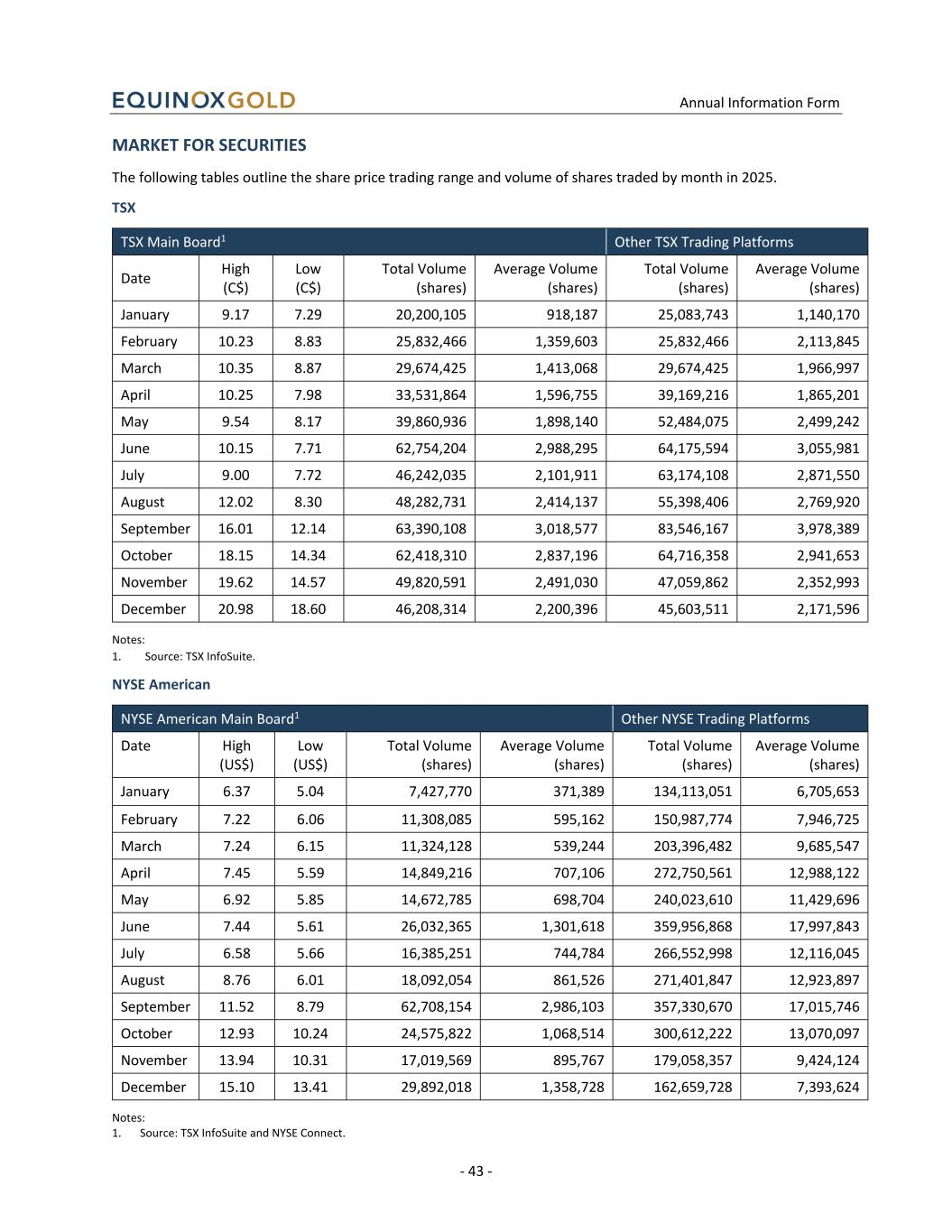
Annual Information Form - 43 - MARKET FOR SECURITIES The following tables outline the share price trading range and volume of shares traded by month in 2025. TSX TSX Main Board1 Other TSX Trading Platforms Date High (C$) Low (C$) Total Volume (shares) Average Volume (shares) Total Volume (shares) Average Volume (shares) January 9.17 7.29 20,200,105 918,187 25,083,743 1,140,170 February 10.23 8.83 25,832,466 1,359,603 25,832,466 2,113,845 March 10.35 8.87 29,674,425 1,413,068 29,674,425 1,966,997 April 10.25 7.98 33,531,864 1,596,755 39,169,216 1,865,201 May 9.54 8.17 39,860,936 1,898,140 52,484,075 2,499,242 June 10.15 7.71 62,754,204 2,988,295 64,175,594 3,055,981 July 9.00 7.72 46,242,035 2,101,911 63,174,108 2,871,550 August 12.02 8.30 48,282,731 2,414,137 55,398,406 2,769,920 September 16.01 12.14 63,390,108 3,018,577 83,546,167 3,978,389 October 18.15 14.34 62,418,310 2,837,196 64,716,358 2,941,653 November 19.62 14.57 49,820,591 2,491,030 47,059,862 2,352,993 December 20.98 18.60 46,208,314 2,200,396 45,603,511 2,171,596 Notes: 1. Source: TSX InfoSuite. NYSE American NYSE American Main Board1 Other NYSE Trading Platforms Date High (US$) Low (US$) Total Volume (shares) Average Volume (shares) Total Volume (shares) Average Volume (shares) January 6.37 5.04 7,427,770 371,389 134,113,051 6,705,653 February 7.22 6.06 11,308,085 595,162 150,987,774 7,946,725 March 7.24 6.15 11,324,128 539,244 203,396,482 9,685,547 April 7.45 5.59 14,849,216 707,106 272,750,561 12,988,122 May 6.92 5.85 14,672,785 698,704 240,023,610 11,429,696 June 7.44 5.61 26,032,365 1,301,618 359,956,868 17,997,843 July 6.58 5.66 16,385,251 744,784 266,552,998 12,116,045 August 8.76 6.01 18,092,054 861,526 271,401,847 12,923,897 September 11.52 8.79 62,708,154 2,986,103 357,330,670 17,015,746 October 12.93 10.24 24,575,822 1,068,514 300,612,222 13,070,097 November 13.94 10.31 17,019,569 895,767 179,058,357 9,424,124 December 15.10 13.41 29,892,018 1,358,728 162,659,728 7,393,624 Notes: 1. Source: TSX InfoSuite and NYSE Connect.
Annual Information Form - 44 - LEGAL PROCEEDINGS AND REGULATORY ACTIONS To Equinox Gold’s knowledge, there are no legal proceedings or regulatory actions material to the Company to which it is a party or to which any of its properties are the subject, since the beginning of the financial year ended December 31, 2025, and no such proceedings are known to be contemplated. There have been no penalties or sanctions imposed against the Company by a court or regulatory body nor has it entered into any settlement agreements with any securities regulatory authority since Equinox Gold’s incorporation. Equinox Gold is a defendant in various legal proceedings arising in the ordinary course of business, including for alleged fines, taxes and labour related matters in jurisdictions where it operates including matters relating to taxes, labour and regulatory issues in the jurisdictions in which it operates. However, none of these matters involve a claim for damages in an amount, exclusive of interest and costs, that individually exceeds 10% of the Company’s current assets. Management regularly reviews these matters with external counsel and, where appropriate, records provisions in accordance with applicable accounting standards. In connection with the Brazil Sale Transaction, CBPM, a state-owned mining company of the State of Bahia that leases mineral rights to the Santa Luz Mine (part of the Bahia Complex), has asserted that its prior consent was required for the sale of the Santa Luz Mine. Equinox Gold believes this assertion has no basis in law. CBPM has initiated legal proceedings in connection with this matter, which remain ongoing. There can be no assurance that this matter will be resolved in the Company’s favour, and any adverse outcome could result in claims, liabilities or other obligations affecting the Company, including potential claims by the purchaser in connection with the sale of the Santa Luz Mine.
Annual Information Form - 45 - INTEREST OF MANAGEMENT AND OTHERS IN MATERIAL TRANSACTIONS Other than transactions carried out in the ordinary course of business of Equinox Gold or any of its subsidiaries and except as described elsewhere in this AIF, none of the directors or executive officers of Equinox Gold or a subsidiary at any time during Equinox Gold’s last completed financial year or within the three most recently completed financial years, any person or company who beneficially owns, or who exercises control or direction over (or a combination of both), directly or indirectly, more than 10% of the issued and outstanding Shares, nor the associates or affiliates of those persons, has any material interest, direct or indirect, by way of beneficial ownership of securities or otherwise, in any transaction or proposed transaction which has materially affected or would materially affect Equinox Gold. Certain directors and officers of Equinox Gold are also directors, officers or shareholders of other companies that are similarly engaged in the business of acquiring, developing and exploiting natural resource properties. See “Directors and Executive Officers” and “Conflicts of Interest” in this AIF. Such associations to other public companies in the resource sector may give rise to actual or perceived conflicts of interest from time to time. As a result, opportunities provided to a director of Equinox Gold may not be made available to Equinox Gold, but rather may be offered to a company with competing interests. The directors and officers of Equinox Gold are required by law to act honestly and in good faith with a view to the best interests of Equinox Gold and to disclose any personal interest which they may have in any project or opportunity of Equinox Gold, and to abstain from voting on such matters. MATERIAL CONTRACTS Except for contracts entered into in the ordinary course of business, the Company has not entered into any material contracts during the most recently completed financial year or before the most recently completed financial year (but after January 1, 2002) which are still in force and effect, and which may reasonably be regarded as presently material other than as set out below: • 2023 Convertible Notes dated September 21, 2023. • Fifth amended and restated credit agreement dated as of July 31, 2025 with a Canadian chartered bank, as administrative agent, and the lenders from time-to-time party thereto, as further amended, restated, supplemented or otherwise modified from time to time. • Share Purchase Agreement dated December 13, 2025 among the Company, Leagold Mining Corporation, CMOC Limited and 17536682 Canada Inc. INTEREST OF EXPERTS The following are the names of persons or companies (a) that are named as having prepared or certified a report, valuation, statement, or opinion included in or included by reference in this AIF; and (b) whose profession or business gives authority to the statement, report or valuation made by the person or Equinox Gold: (a) KPMG LLP provided reports of independent registered public accounting firm dated February 20, 2026 in respect of Equinox Gold’s financial statements for the years ended December 31, 2025 and 2024 and internal control over financial reporting as of December 31, 2025; (b) Phillipe Lebleu, P. Eng., Scott Davidson, P. Geo., Niel de Bruin, P. Geo., Kelly Boychuk, P. Eng., Alex Thompson, P. Geo. of Equinox Gold, each of whom was at the time of filing the report, an employee of the Company, and Neil Lincoln, P. Eng., independent metallurgical consultant, who is, or was at the time of filing the report, independent of the Company, and is named in this AIF as having prepared the Greenstone Technical Report; (c) Nicholas Capps, P. Geo., Niel de Bruin, P. Geo., Scott Davidson, P. Geo., Kelly Boychuk, P. Eng., of Equinox Gold, each of whom was at the time of filing the report, an employee of the Company, Jeff Colden P. Eng. of Moose Mountain Technical Services a metallurgical consultant to the Company, and
Annual Information Form - 46 - Neil Lincoln, P. Eng., Stuart Collins, P.E. of SLR, Tony Gilman, P. Eng of Terrane Geoscience Inc. and Grant A Malensek, P. Eng of SLR, each of whom was at the time of filing the report, independent of the Company, and is named in this AIF as having prepared the Valentine Technical Report; (d) Matthew MacPhail, P.Eng., Niel de Bruin, P. Geo., and Phillipe Lebleu P.Eng., of Equinox Gold are “Qualified Persons” under NI 43-101 and are named as having reviewed and approved the disclosure of the consolidated Mineral Reserves and Mineral Resources in this AIF; and (e) Matthew MacPhail, P.Eng., and Philippe Lebleu, P.Eng., of Equinox Gold have reviewed and approved the technical content in this AIF, including the technical information disclosed in this AIF that has been updated since the effective date of the relevant technical reports. As at the date of this AIF, to the best knowledge of Equinox Gold, the aforementioned persons, collectively, held less than one percent of the securities of Equinox Gold when they prepared or certified a report, valuation, statement or opinion, as applicable, referred to above and as at the date hereof, and they did not receive any direct or indirect interest in any securities of Equinox Gold or of any associate or affiliate of Equinox Gold in connection with the preparation or certification of such report, valuation, statement or opinion, as applicable. KPMG LLP is the independent registered public accounting firm of Equinox Gold and have reported on the Company’s consolidated financial statements for the years ended December 31, 2025 and 2024, in their report dated February 20, 2026. In connection with its audit, KPMG has confirmed with respect to Equinox Gold that they are independent within the meaning of the relevant rules and related interpretations prescribed by the relevant professional bodies in Canada and any applicable legislation or regulations, and also that they are independent accountants with respect to Equinox Gold under all relevant U.S. professional and regulatory standards. As at the date of this AIF, other than Phillipe Lebleu, Scott Davidson, Niel de Bruin, Kelly Boychuk, Alex Thompson, Nicholas Capps and Matthew MacPhail, none of the aforementioned persons is or is currently expected to be elected, appointed or employed as a director, officer or employee of Equinox Gold or of any associate or affiliate of Equinox Gold. ADDITIONAL INFORMATION Additional information, including directors’ and officers’ remuneration and indebtedness, principal holders of Equinox Gold’s securities, and securities authorized for issuance under equity compensation plans, is contained in the management information circular for the most recently completed annual meeting of shareholders. Additional financial information is also provided in our audited consolidated financial statements for the years ended December 31, 2025 and 2024, and related MD&A for the year ended December 31, 2025. The foregoing disclosure documents, along with additional information relating to Equinox Gold, may be found on SEDAR+ and on EDGAR or on the Company’s website.
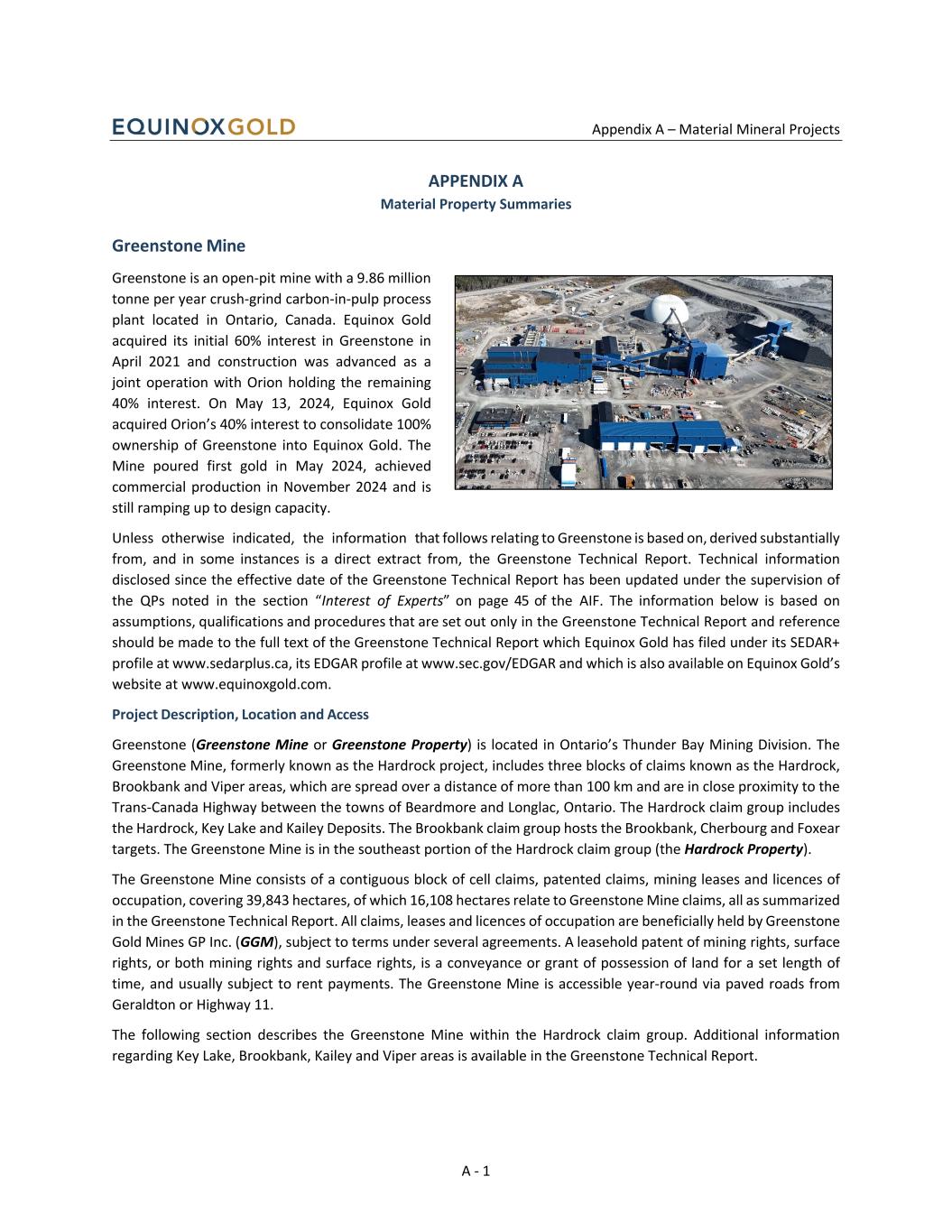
Appendix A – Material Mineral Projects A - 1 APPENDIX A Material Property Summaries Greenstone Mine Greenstone is an open-pit mine with a 9.86 million tonne per year crush-grind carbon-in-pulp process plant located in Ontario, Canada. Equinox Gold acquired its initial 60% interest in Greenstone in April 2021 and construction was advanced as a joint operation with Orion holding the remaining 40% interest. On May 13, 2024, Equinox Gold acquired Orion’s 40% interest to consolidate 100% ownership of Greenstone into Equinox Gold. The Mine poured first gold in May 2024, achieved commercial production in November 2024 and is still ramping up to design capacity. Unless otherwise indicated, the information that follows relating to Greenstone is based on, derived substantially from, and in some instances is a direct extract from, the Greenstone Technical Report. Technical information disclosed since the effective date of the Greenstone Technical Report has been updated under the supervision of the QPs noted in the section “Interest of Experts” on page 45 of the AIF. The information below is based on assumptions, qualifications and procedures that are set out only in the Greenstone Technical Report and reference should be made to the full text of the Greenstone Technical Report which Equinox Gold has filed under its SEDAR+ profile at www.sedarplus.ca, its EDGAR profile at www.sec.gov/EDGAR and which is also available on Equinox Gold’s website at www.equinoxgold.com. Project Description, Location and Access Greenstone (Greenstone Mine or Greenstone Property) is located in Ontario’s Thunder Bay Mining Division. The Greenstone Mine, formerly known as the Hardrock project, includes three blocks of claims known as the Hardrock, Brookbank and Viper areas, which are spread over a distance of more than 100 km and are in close proximity to the Trans-Canada Highway between the towns of Beardmore and Longlac, Ontario. The Hardrock claim group includes the Hardrock, Key Lake and Kailey Deposits. The Brookbank claim group hosts the Brookbank, Cherbourg and Foxear targets. The Greenstone Mine is in the southeast portion of the Hardrock claim group (the Hardrock Property). The Greenstone Mine consists of a contiguous block of cell claims, patented claims, mining leases and licences of occupation, covering 39,843 hectares, of which 16,108 hectares relate to Greenstone Mine claims, all as summarized in the Greenstone Technical Report. All claims, leases and licences of occupation are beneficially held by Greenstone Gold Mines GP Inc. (GGM), subject to terms under several agreements. A leasehold patent of mining rights, surface rights, or both mining rights and surface rights, is a conveyance or grant of possession of land for a set length of time, and usually subject to rent payments. The Greenstone Mine is accessible year-round via paved roads from Geraldton or Highway 11. The following section describes the Greenstone Mine within the Hardrock claim group. Additional information regarding Key Lake, Brookbank, Kailey and Viper areas is available in the Greenstone Technical Report.
Appendix A – Material Mineral Projects A - 2 Location The Greenstone Mine area covered by the Mineral Resource estimate in the Greenstone Technical Report is in the townships of Errington and Ashmore on NTS Sheet 42E/10, approximately 4 km south of Geraldton. The approximate coordinates of the geographic centre of the Greenstone Mine’s deposit resource areas are 49°40’47”N and 86°56’32”W (UTM Zone 16N coordinates: 504175.9E and 5503024N; NAD 83). Royalties The following royalties are in effect on some of the properties as listed in the Greenstone Technical Report: • Essar Steel Algoma Inc. (2% NSR); • Griffin Mining Limited (1% NSR); • Franco-Nevada (3% NSR); • Franco-Nevada (3% NSR) / Essar Steel Algoma Inc. (5% Net Profit Interest); • Placer Dome Inc. (2.25% NSR / Key Lake Exploration 2% NSR); • Unique Broadband Systems (3% NSR); • Argonaut Gold Inc. (3% NSR). In October 2018, a mining lease was granted over CLM 535, which covers the southern part of the Greenstone Mine area. The lease, LEA-109765, is subject to renewal in 2039. In December 2016, GGM acquired the surface rights for the patented claims in Errington and Ashmore townships – TB 10604 to TB 10608, TB 11879, TB 11885, TB 11886, and TB 11888. On May 13, 2024, Equinox Gold announced that the Company had completed its acquisition of the remaining 40% of GGM from Orion, resulting in Equinox Gold holding 100% ownership of GGM and the Greenstone Mine (the Greenstone Acquisition). As part of the Greenstone Acquisition, the Company assumed obligations under a stream agreement with Nomad Royalty Company Ltd, dated October 28, 2021, as amended (the GGM Stream Agreement). Under the GGM Stream Agreement, the Company is required to deliver an amount of refined gold equal to 2.375% of the gold produced from Greenstone, until the Company has delivered a cumulative total of 120,333 ounces, and 1.583% of the gold production from Greenstone thereafter. In exchange for the gold deliveries, the Company will receive consideration equal to 20% of the spot gold price at the time of delivery. As at December 31, 2025, the Company has delivered 6,856.633 ounces under the GGM Stream Agreement. Permits A range of permits and approvals required for mine construction and operations were obtained from numerous federal, provincial and municipal authorities. Greenstone Mine currently has all the necessary permits and licenses in place to support current operations. With ongoing constraints in the public sector, GGM is monitoring the risk of agencies not meeting a reasonable timeframe for any on-going or future permitting approvals. To facilitate the approval timeframes, consultation with Indigenous communities and agencies is undertaken on key permit applications prior to submission. The permit that governs the annual mined quantities is in the process of being increased from 70 Mt/a to 77 Mt/a. Additional federal and provincial authorizations will be required to accommodate additional tailings and waste rock storage requirements for the Mine Plan in the Greenstone Technical Report. Studies related to these permits have been initiated.
Appendix A – Material Mineral Projects A - 3 The QP is not aware of any other significant factors and risks that may affect access, title, or the right or ability to perform work on the properties. History and Exploration There are several past producing gold mines on the Greenstone property, including the Hardrock, MacLeod- Cockshutt, Mosher (all later combined as the consolidated Mosher), Little Long Lac, Bankfield, Jellicoe and Magnet mines. Reference should be made to the Greenstone Technical Report for a detailed description of the applicable exploration and production history. The first gold discovery in the area of the Greenstone property was made between 1916 and 1918 when a gold- bearing boulder was discovered south of the Main Narrows of Kenogamisis Lake. In 1931, W.W. “Hardrock” Smith discovered gold-bearing quartz stringers near the Hardrock Number 1 shaft, and Tom Johnson and Robert Wells discovered gold on Magnet Lake, which later hosted the Bankfield gold mine. T. A. Johnson and T. Oklend followed with the discovery of gold in a small quartz vein along the southern shore of Barton Bay on Kenogamisis Lake, which is now the location of the Little Long Lac property. In 1934, the period of mine production in the area began with the Little Long Lac mine, the first successfully producing mine. To the west of the 1931 Hardrock discovery, F. MacLeod and A. Cockshutt staked claims and continually explored the area throughout the 1930s and 1940s. By the late 1940s, the F Zone, a low-grade, large- tonnage ore body in greywacke, was identified on both the MacLeod–Cockshutt and Hardrock properties. Production on the Mosher Long Lac mine began in 1962 (west of, and immediately down-plunge of the same mineralized zones exploited in the MacLeod–Cockshutt mine); then, in 1967, the MacLeod–Cockshutt, Mosher, and Hardrock mines amalgamated and remained in production until 1970. The consolidated Hardrock, MacLeod– Cockshutt, and Mosher mines produced 2,146,326 ounces of gold at an average grade of approximately 0.14 ounces of gold per ton (~14 Mt at 4.9 g/t Au) in the period from 1934 to 1970. In the 1980s, Lac Minerals Ltd. reviewed the remaining underground reserves and conducted litho-geochemistry, ground geophysical work, and 15,240 m of diamond drilling in 77 holes to target areas with open pit potential (e.g., Hardrock D and F; North and South Porphyry; and Porphyry Hill Zones). In 1993, Asarco Exploration Company of Canada Limited (Asarco) carried out a program of reverse circulation (RC) overburden drilling and diamond drilling, the latter mainly focused on the near-surface portion of the F Zone and targets along the plunging nose of the albite porphyry. Asarco continued their exploration program into 1994, completing RC holes in overburden, sonic holes in historical tailings, and an additional 40,000 feet of diamond drilling, mainly on the targets. In 1996, Cyprus Canada Inc. drilled 24 holes, leading to the discovery of the B Zone. The agreement ended in 1997. Barrick Gold Corporation, through Lac Properties Inc. (Lac Properties), began a rehabilitation program, which continued until 2001. This saw construction of the current visitor’s centre, re-contouring and seeding of the historical MacLeod tailings near Highway 11, and capping of old mine shafts. In 2000, Lac Properties retained Golder Associates Ltd. (Golder) to conduct a stability assessment of the F Zone crown pillar at the MacLeod–Cockshutt mine. During their investigation, Golder drilled a borehole (369.5 m) to determine whether caving had occurred above the stopes. The study also included rock mass classification of the core and a correlation of numerical modelling with the field observations. The drilling allowed Golder to confirm that the crown pillar overlying the workings was intact at the time of the study. No evidence of unravelling or caving was observed. The classification of the rock mass overlying the workings indicated that the quality was “good” to “very good.” Due to the depth of the mine workings and the quality of the rock mass, it was not considered probable that significant caving could occur or would have an influence on the overlying ground surface. In 2002, Lac Properties
Appendix A – Material Mineral Projects A - 4 retained Golder to conduct a stability assessment of the crown pillar of the Hardrock mine. A total of 16 investigation boreholes (2,116.8 m) were drilled to determine whether caving in the crown of the stope had occurred. The study included rock mass classification of the core and a correlation of numerical modelling with the field observations. The drilling indicated that the crown pillar overlying the workings was intact at the time of the study. No unravelling or caving of the crown pillar above the working was observed and no unexpected geometries were encountered. The classification of the rock mass overlying the workings indicated the quality to be “good”. Empirical, analytical, and numerical modelling of the stability of the crown pillar overlying the mined zone indicated the crown pillar to be stable, even when conservative values were used for stope geometries, strength, and rock mass classification, thus ensuring an additional built-in safety factor. In 2007, Lac Properties drilled six geotechnical diamond drill holes totalling 1,208.1 m in the crown pillars. In 2007, Premier Gold Mines Limited (Premier) began assembling the current property. The results of 1,629 drill holes were included in the 2016 feasibility study and summarized in Table 6-2 of the Greenstone Technical Report. Geological Setting, Mineralization and Deposit Types Geology The Greenstone Mine lies within the granite-greenstone Wabigoon Subprovince of the Archean Superior Craton in eastern Canada. The Wabigoon Subprovince, averaging 100 km wide, is exposed for some 900 km eastward from Manitoba and Minnesota, beneath the Mesoproterozoic cover of the Nipigon Embayment, to the Phanerozoic cover of the James Bay Lowlands. The Wabigoon Subprovince can be subdivided into western greenstone-rich domains in the Lake of the Woods-Savant Lake and Rainy Lake Areas, a central dominantly plutonic domain, and an eastern greenstone-rich domain in the Beardmore-Geraldton Area. The Hardrock Property is located within the Beardmore-Geraldton Greenstone Belt that contains several narrow, east-west striking sequences of volcanic and sedimentary rocks of Archean age. The southern edges of these sequences are spatially related to the through-going, major structural discontinuities thought to be thrust faults that have imbricated the sedimentary sequences. In the Geraldton area, most of the gold mines and a number of gold showings occur within or proximal to the Bankfield-Tombill Deformation Zone (also known as the Barton Bay Deformation Zone), a zone of folding and shearing up to 1 km wide. The southern limit of the Bankfield-Tombill Deformation Zone is marked by the Bankfield-Tombill Fault, a zone of intense shearing up to 12 m wide. In the immediate Geraldton area, the dominant rock types are clastic sediments (greywacke and arenite), oxide facies iron formations (BIF) and minor mafic metavolcanics. There are a number of younger intrusives, including an albite-rich porphyry unit (Hardrock Porphyry) that is spatially associated with much of the gold mineralization on the Hardrock, MacLeod-Cockshutt and Mosher mines. Significant gold mineralization is also often spatially associated with BIF. In the case of the Little Long Lac mine, gold mineralization is primarily hosted by an arkosic unit. Gold mineralization occurs in a variety of host rocks and the style of mineralization is partly a function of the host rock. While the location and overall orientation of the orebodies appear to have been largely structurally controlled, the deformation of the orebodies has not been as intense as that of the host rocks. Nevertheless, there are areas where local folding and boudinage of mineralized veins is apparent. Additionally, there are strong secondary controls that influence the extent and intensity of gold mineralization, such as the competency contrast between host rocks (e.g., the Hardrock Porphyry and its contacts with either wacke or BIF) and the chemical character of the host rocks (e.g., oxide facies BIF being replaced by sulphides). Intrusive rocks include the Hardrock Porphyry, diorite, gabbro, and diabase dykes. It is of interest that the Hardrock Porphyry seems to be sill-like in nature, even though it is tightly folded and the contacts between it and the sedimentary units are often highly deformed. The general scale and folding pattern of the porphyry very closely
Appendix A – Material Mineral Projects A - 5 match the geometry of the conglomerate unit that occurs in the vicinity of the Hardrock and MacLeod-Cockshutt Mines. Mineralization Most mineralized occurrences in the Hardrock deposit area lie in a zone of deformation to the immediate north of, and genetically linked to, the Tombill-Bankfield Deformation Zone. This zone of deformation varies from 600 m to 100 m in total width, while the crush zone of the Tombill-Bankfield Fault proper ranges from metres to hundreds of metres in width. Gold mineralization is associated with D3 brittle shear zones and folds overprinting regional F2 folds. The plunge of the mineralized zones is parallel to F3 fold axes and to the intersection of D3 shear zones with F2 and F3 folds. On a sub province scale, regional folds cut by D3 dextral shear zones are promising targets for discovering the next generation of large gold deposits. The interpretation of the mineralized zones by GMS (an independent consultant) is based on a litho-structural model developed by InnovExplo, but greatly simplifies the domains. As compared to the 2016 feasibility block model, some wide domains that encompassed significant amounts of internal dilution have been re- interpreted, such that higher- grade portions have been made more distinct. In the updated model, lithological domains and mineralized zones are located inside three areas. The North Domain consists of a refolded (F3 overprinting F2) sequence of BIF and greywacke, with minor porphyry and gabbros. A Central Domain consisting mainly of an undifferentiated greywacke sequence and a mineralized portion of this greywacke, defined as the Mineralized Central Wacke, which are both likely sheared and folded. Three mineralized zones have been defined within the Central Domain to constrain zones of higher-grade gold mineralization inside the Mineralized Central Wacke. A South Domain is characterized by a tightly folded (F2) stratigraphic sequence. Five mineralized zones have been defined within the South Domain, in which gold mineralization appears primarily associated with the “main” anticline (Hardrock Anticline) and preferentially within both BIFs. Zones which are categorized as quartz-carbonate stringer mineralization include F Zone, F2 Zone, A Zone, SP Zone, Central Zone and Tenacity Zone. Mineralization within these zones generally consists of a series of narrow, tightly asymmetrically folded gold-bearing quartz-carbonate stringers, which are usually attenuated, transposed and dislocated in hook-like segments. The stringers are accompanied by a gold-bearing quartz-sericite-pyrite (±arsenopyrite) alteration halo about the stringers. It is the accumulation of a number of stringers and associated alteration halos that constitutes the zones. Individual stringers and their associated alteration haloes within the mineralized zones are often high-grade with minute flecks and clusters of visible gold. Assay results of up to, and often greater than, 30 g/t Au are attainable from some stringers. Overall, zones having average grades of 4 g/t Au as individual stringers are too narrow and discontinuous to consider mining as separate higher-grade zones. Zones that are categorized as sulphide replacement mineralization include the North 1, North 2 and North 3 zones, and the SP Zone. The nature of the mineralization within these zones is best understood from the historical work completed on the North 1 Zone. Mineralization within these zones occurs as variable pyrite, arsenopyrite and pyrrhotite replacement of iron oxide at the margins of quartz veins, within the hinge zones of folded BIFs. The auriferous sulphide replacement appears to have migrated outwards along the iron oxide bands from gold-bearing quartz-carbonate stringers occupying brittle axial planar tension fractures. This replacement mineralization yields grades of 7 g/t Au or greater.
Appendix A – Material Mineral Projects A - 6 Deposit Types The gold ore bodies at the Greenstone Mine are one of the type examples for BIF-hosted gold deposits. The Greenstone Mine recognizes and presents the following subtypes: non-stratiform deposits and Greenstone-hosted quartz-carbonate vein deposits. Exploration and Drilling Since exploration began on the various projects contained on the Hardrock, Brookbank, and Viper Properties, approximately 90% of the exploration expenditures have been on diamond drilling. The remaining exploration consisted of ground and airborne geophysics, line cutting, overburden stripping and trenching, and surface prospecting. No additional exploration work other than drilling has been carried out on the Hardrock Property since publication of the 2024 technical report by Equinox Gold. Within the Greenstone deposit area, a total of 1,919 drill holes totaling 603,904 metres were completed by Premier between 2009 and 2019 and a total of 1,979 drill holes totaling 133,544 metres were completed by Equinox Gold between 2021 and 2025. Historical exploration and production drill testing in the vicinity of Greenstone mine was primarily by wireline rigs using diamond-faced bits in a variety of coring diameters. Reverse-circulation overburden (RCO) and sonic drill testing of basal till were also undertaken during early reconnaissance exploration, while more recent reverse circulation grade control (RCGC) has delineated and tested mineral domains during later pre-production and production phases. Core drilling prior to 2002 produced BQ-diameter (36.5 mm) core, while all drilling since has been NQ-diameter (47.6 mm). Collar locations for 55% of drill holes completed prior to 2013 were located via hand-held Global Positioning System (GPS) in UTM coordinates. Since 2018, the site surveyor or geologists have spotted the RCGC, blastholes, and diamond drill holes using a Trimble RTK system using the coordinates planned by GMS or GGM. Once holes are drilled, casings are typically left in the ground and the precise drill hole collar, azimuth, and UTM coordinates are confirmed by placing an APS or DeviAligner unit on the drill casing. A steel cap is placed on the casing and the hole collar is subsequently surveyed using a Trimble RTK. RC drilling is conducted by mobile rigs equipped with conventional, air-assisted, down-the-hole (DTH) hammer mechanisms and a Metzke 1200 cyclone with a three chute cone splitter. A member of the geology team will load all designed collar coordinates into a Trimble GPS tool and provide copies of this information to the drilling supervisor. Wooden stakes labeled with the hole ID, azimuth, dip and length are prepared. Once located in the field with the GPS unit, the precise collar location is spray painted on the ground, followed by placement of a spray- painted rock and the labeled stake. Between July 2024 to August 2025, a total of 1,339 RC drill holes comprising 79,878 m were drilled to continue delineation of economic mineralization within Phase 1A and Phase 1B pit boundaries. A diamond drilling campaign commenced in May 2025 targeting geologic and structural features throughout the planned Greenstone pit, with emphasis on the near-term (5 year) mining. As of the effective date of this report, 21 diamond drill holes, including two recollared holes, totalling 6,054 metres were drilled. The results of the 2025 drilling were generally consistent with the predicted geological model for Greenstone. GGM geologists used lithological and structural information collected through this program to complete updates to the geologic model and domain wireframes for the 2025 Mineral Resource estimate. Gold assay results from this program were not available at the time of the August 2025 data cut-off for the Mineral Resource estimate.
Appendix A – Material Mineral Projects A - 7 Sampling, Analysis and Data Verification Laboratories The Geraldton facility belonging to Activation Laboratories Ltd (Actlabs Geraldton) was used for the entire drilling and channelling programs up to March 2024. Actlabs Geraldton received ISO 9001:2008 certification through Kiwa International Cert GmbH. Actlabs Geraldton was an independent commercial laboratory. GGM purchased the Geraldton facility from Actlabs Geraldton in March 2024 and has been processing all blast hole and metallurgical samples at the facility since then. The Activation Laboratories Ltd. facility in Thunder Bay (Actlabs Thunder Bay) has been used to process all RC grade control samples for gold fire assay with AA or gravimetric finish, screen metallic fire assay (SMFA) and inductively coupled plasma-optical emission spectroscopy (ICP-OES) for multi-element analysis. Actlabs Thunder Bay is an independent, ISO 17025 certified laboratory. All umpire assaying of batches (pulps) was undertaken at Australian Laboratory Services (ALS) - Chemex in Thunder Bay. ALS-Chemex laboratory is part of the ALS Global Group and has ISO 9001 certification and ISO/IEC 17025 accreditation through the Standards Council of Canada. ALS-Chemex is an independent commercial laboratory. Quality Control Sample Preparation by GGM All Quality Assurance/Quality Control (QA/QC) samples are prepared and bagged in advance by GGM personnel. The GGM employee in the core-cutting facilities places one half of the ticket into a bag with the sample and staples the other half to the box. One half of each QA/QC sample ticket is placed in the appropriate type of control sample bag, which was prepared beforehand. A list of QA/QC samples and their numbers/locations is posted on the wall in the core logging facility (core shack) and regularly updated by GGM personnel. Five to seven samples are placed in a rice bag and the contents identified on the outside of the bag. Each bag and its contents are recorded on a notepad and placed in a plastic holder once complete. These slips are picked up each morning by a GGM employee and recorded in an Excel spreadsheet. Once the batches are complete, GGM personnel arrange for transportation to Actlabs Thunder Bay via Manitoulin Transport. Samples selected for analysis are sent in batches of 34. Each purchase order covers one batch of 34 samples, consisting of: • 30 regular samples • 1 field duplicate sample • 1 field blank • 1 Certified Reference Material (CRM) with a low gold value • 1 CRM with a high gold value As a QA/QC check, Actlabs Thunder Bay adds a 35th sample to every field batch received – a coarse duplicate of the last regular sample (i.e. the 30th sample), constituting a second pulp prepared from the reject. The quality of the reject is monitored to ensure that proper preparation procedures are used during crushing. For the fusion process, Actlabs Thunder Bay adds seven more QA/QC samples (two analytical blanks, two CRMs and three pulp duplicates), bringing the fusible batch to 42. The pulp duplicates are necessary to ensure that proper preparation procedures are used during pulverization. At Actlabs Thunder Bay, the maximum furnace charge of 42 samples ensures that GGM samples are not mixed with others.
Appendix A – Material Mineral Projects A - 8 Fire Assay Procedures (Actlabs Thunder Bay) Samples (50 g each) are sent to the fire assay area, numbered and in order (usually 1 to 34+1). A rack of 42 crucibles is then labelled with an assigned letter code and numbered 1 to 42. The mixture is placed in a fire clay crucible. The mixture is then preheated to 850°C, intermediate at 950°C and finished at 1,060°C, with the entire fusion process lasting sixty minutes. The crucibles are then removed from the assay furnace and the molten slag (lighter material) is carefully poured from the crucible into a mould, leaving a lead button at the base of the mould. The lead button is then placed in a preheated cupel, which absorbs the lead when cupelled at 950°C to recover the gold (doré bead) + Au. The entire silver doré bead is dissolved in aqua regia and the gold content is determined by atomic absorption (FA-AA) finish (1A2-50 code). On each tray of 42 samples, there are two blanks, three sample duplicates and two CRMs – one high and one low (QA/QC = 7 out of 42 samples). All samples assaying grades over 5.0 g/t Au with AA were re-run with gravimetric finish (1A3-50 FA/GRAV code) to ensure accurate values. After the fire assay procedures, gold is separated from the silver in the doré bead by parting with nitric acid. The resulting gold flake is annealed using a torch. The gold flake remaining is weighed gravimetrically on a microbalance. Gold analysis for samples containing or suspected to contain VG were completed using a screen metallic fire assay (SMFA) procedure (1A4 and 1A4-1000 code). The +100 mesh (coarse) fraction is assayed in its entirety by FA-AA as described above, typically in one or more charges depending on sample mass. Gravimetric finish may also be applied when coarse gold content warrants direct measurement to improve analytical precision. The -100 mesh (fine) fraction is separated into 50 g aliquots and analyzed using traditional FA-AA method. Duplicate analysis of this fraction provides an assessment of precision and helps quantify residual nugget effects in the fine material. Gold concentrations from the coarse and fine fractions are then combined on a weighted-average basis according to their respective mass proportions to calculate the total gold grade for the sample. Fire Assay Procedures with Gravimetric or AA Finish (ALS-Chemex Thunder Bay) The fire assay technique uses high temperature and flux to “melt” the rock and allows the gold to be collected. Lead formed from the reduction of litharge is traditionally used as the collecting medium for silver and gold. The test sample is intimately mixed with a suitable flux that will fuse at high temperatures with the gangue minerals present in the sample to produce a slag that is liquid at the fusion temperature. The liberated precious metals are scavenged by the molten lead and gravitate to the bottom of the fusion crucible. Upon cooling, the lead button is separated from the slag and processed in a separate furnace for high-temperature oxidation (cupellation), where the lead is removed, leaving the precious metals behind as a metallic bead called a prill. Traditionally, this prill was then partially dissolved in nitric acid (parted) to remove silver and the remaining gold determined by weighing (gravimetry). Alternatively, the prill can be dissolved in a mixture of hydrochloric and nitric acid (aqua regia) and the concentration determined by spectroscopic methods. For the AA finish method, a pulp sample is fused with a mixture of lead oxide, sodium carbonate, borax, silica and other reagents as required, then inquarted with 6 mg of gold-free silver and cupelled to yield a precious metal bead. The bead is digested in 0.5 mL dilute nitric acid in the microwave oven. The 0.5 mL concentrated hydrochloric acid is then added, and the bead is further digested in the microwave at a lower power setting. The digested solution is
Appendix A – Material Mineral Projects A - 9 cooled, diluted to a total volume of 4 mL with de-mineralized water, and analyzed by AA spectroscopy against matrix- matched standards. For the gravimetric finish method, a pulp sample is fused with a mixture of lead oxide, sodium carbonate, borax, silica and other reagents to produce a lead button. The lead button containing the precious metals is cupelled to remove the lead. The remaining gold and silver bead is parted in dilute nitric acid, annealed and weighed as gold. Silver, if requested, is then determined by the difference in weight. At the ALS-Chemex laboratory, the batch size for all fire assay methods is 84, including six internal QA/QCs. Therefore, 78 client samples can be taken per batch. The maximum furnace charge of 78 client samples ensures that GGM samples are not mixed with others. QP Conclusions A statistical analysis of the QA/QC data provided by GGM did not reveal any significant analytical issues. GMS is of the opinion that the sample preparation, analysis, QA/QC and security protocols used for the Greenstone Mine follow generally accepted industry standards and that the data are of sufficient quality to be used for Mineral Resource estimation. Data Verification Several drilling campaigns in the Greenstone database have been validated by Equinox Gold personnel and the independent consultant, GMS, at various points during the generation of the 2016, 2019, and 2024 updates of the Mineral Resource estimates for the Greenstone Mine, and are described in the Greenstone Technical Report. This section summarizes data verification procedures after the 2024 Mineral Resources estimate. After the 2024 Mineral Resources estimate, drill holes from historical drilling campaigns in the 1980s and 1990s were identified. The assay values from these drill holes match those publicly reported in the Assessment File Research Image database and in historical drill logs; the original assay certificates were not available for validation. Several statistical and visual comparisons with recently completed validated drill holes within a 25 m radius of these drill holes were completed. Historical drill holes with reasonably comparable assay values were incorporated into the 2025 Mineral Resource estimate. Previously incorporated historical drill holes that have not been confirmed due to a lack of new data or poor comparison were excluded from the Mineral Resource database. Drill hole data added to resource database for the 2025 Mineral Resource estimate comprises only the RCGC drill hole in the open pit area, and the review and validation focused on these drill holes. The close-out date for the 2025 resource database is August 12, 2025. The Greenstone Mine database was migrated from the Datashed database to the MX Deposit database in December 2024. Several validation processes were conducted to ensure the migrated data retained integrity and accuracy, and that it is reliably in MX Deposit. The migration to the MX Deposit database was verified as accurate and is consistent with the original Datashed database. Additionally, historical data not captured in the Datashed database was included in the MX deposit database in 2025. The 2025 resource database, including the additional RCGC drill holes, was validated by Equinox Gold QPs. Visits to the sampling preparation facilities for the RCGC drill hole samples, as well as to the mining pit and outcrop, were completed during site visits by the QPs. Review of the RCGC sample preparation facility and process for preparing samples for the laboratory identified no issues. The sampling preparation processes are well established for transporting the samples from Greenstone Mine to the laboratory.
Appendix A – Material Mineral Projects A - 10 Review of the QA/QC data identified minor issues with CRMs in a subset of data from 2022 to 2025, with CRM values outside the third deviation boundary. These RCGC drill holes were included in the resource database, as the QP considers their inclusion to be immaterial to the Mineral Resource estimate, as the bulk of these drill holes are located within mined-out areas and do not affect any blocks in the Mineral Resources. Additionally, the imported drill holes from the MX deposit database, earmarked for use in the 2025 Mineral Resource estimate, was also validated in the geological software, and minor issues because of the importing were corrected. Mineral Processing and Metallurgical Testing Significant metallurgical test work has been completed on ore samples from various parts of the ore deposit, and the test results were used to develop the process design criteria and flowsheet on the current process plant. Test work concluded that the ore is composed mainly of quartz and plagioclase with minor amounts of pyrite and arsenopyrite; gold occurs mainly as native gold; the ore is in the category of medium hardness to moderately hard; a portion of the gold can be recovered by gravity concentration; and is amenable to conventional cyanidation. During 2014–2015, metallurgical test work programs were completed to support the feasibility study and subsequent design of the existing operating process plant. More recently, a metallurgical test work program was completed in 2019 and focused on whole ore cyanidation and gravity tails cyanidation testing to confirm the current flowsheet. Metallurgical test work was primarily completed at SGS Lakefield in Ontario, Canada. No new significant metallurgical test work program has been completed since the process plant was commissioned in 2024; however, Plant Operations have completed mineralogy and gold deportment tests as part of plant optimization. A multivariant regression model has been used to predict leach residue grade that is then used to predict plant gold recovery, which averages 86.4% over the Life of Mine. Historically, the model was based on gold, arsenic and sulphur head grades, primary grind size from metallurgical test work. The current leach residue grade algorithm is based on 2025 plant performance. The process plant currently treats ore via a conventional gravity-cyanidation flowsheet and is ramping toward nameplate capacity of 27 kt/d. Run-of-mine (ROM) ore is processed via primary and secondary crushing and HPGR- Ball mill comminution circuits followed by a gravity circuit. Gravity tailings are treated via a leach-carbon-in-pulp (CIP) circuit and associated gold recovery and carbon handling circuits to produce gold doré. Average life of mine gold recovery is estimated at 86.4% based on operating data and metallurgical models. CIP tailings are treated via a cyanide destruction process prior to storage in the tailings management facility (TMF). During 2025, the plant continued to ramp up to name plate and achieved a peak production of 24kt/d. Mineral Resource and Mineral Reserve Estimates Mineral Resource Estimates The Greenstone Mineral Resource estimate represents an update to the October 1, 2024, resource model. The estimate incorporates: • An expanded drill hole database including an additional 1,339 RC grade control holes • Updated lithological and structural interpretations • Revised mineralization domains based on litho-structural controls • Updated pit optimization at US$2,300/oz Au • Reporting of the underground Mineral Resources within mineable shapes
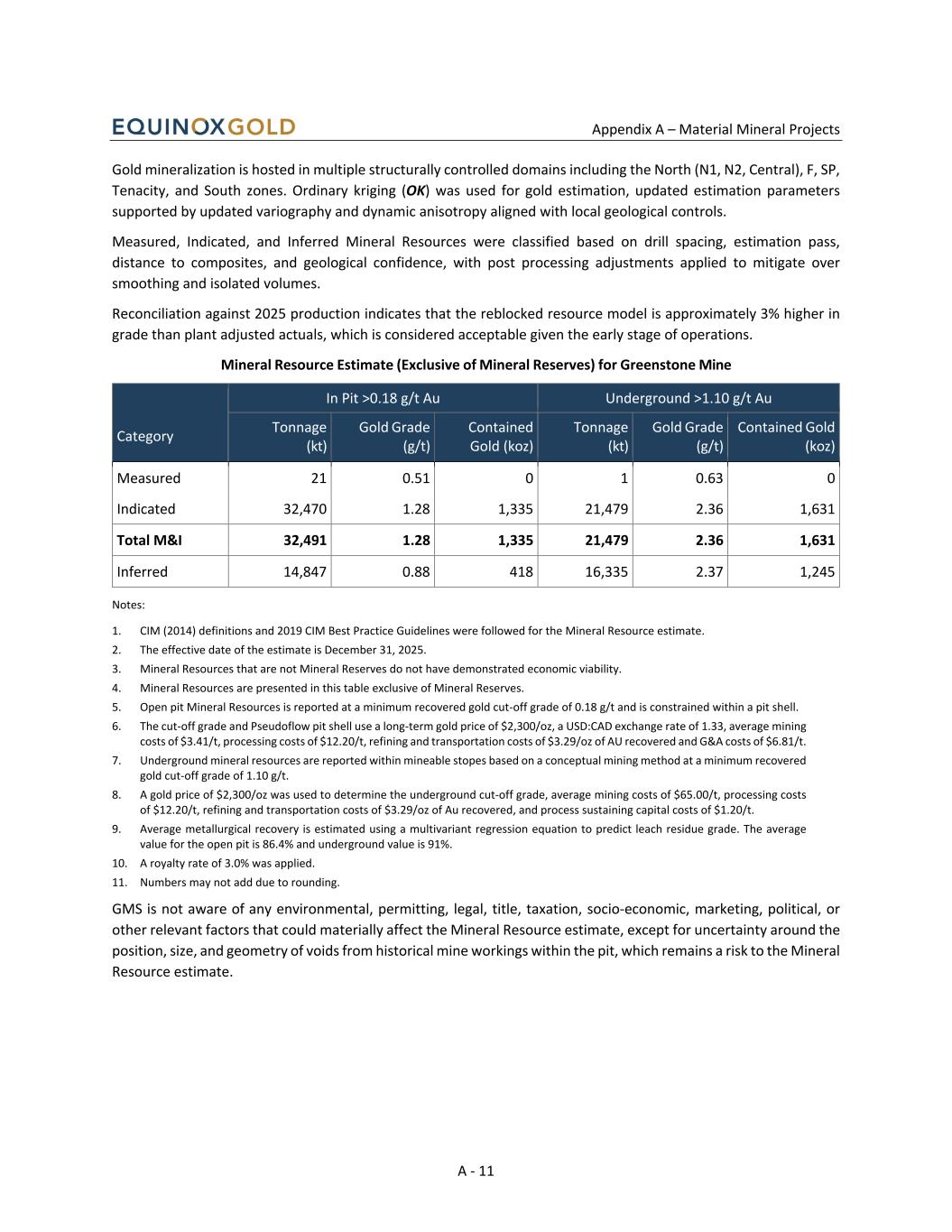
Appendix A – Material Mineral Projects A - 11 Gold mineralization is hosted in multiple structurally controlled domains including the North (N1, N2, Central), F, SP, Tenacity, and South zones. Ordinary kriging (OK) was used for gold estimation, updated estimation parameters supported by updated variography and dynamic anisotropy aligned with local geological controls. Measured, Indicated, and Inferred Mineral Resources were classified based on drill spacing, estimation pass, distance to composites, and geological confidence, with post processing adjustments applied to mitigate over smoothing and isolated volumes. Reconciliation against 2025 production indicates that the reblocked resource model is approximately 3% higher in grade than plant adjusted actuals, which is considered acceptable given the early stage of operations. Mineral Resource Estimate (Exclusive of Mineral Reserves) for Greenstone Mine Category In Pit >0.18 g/t Au Underground >1.10 g/t Au Tonnage (kt) Gold Grade (g/t) Contained Gold (koz) Tonnage (kt) Gold Grade (g/t) Contained Gold (koz) Measured 21 0.51 0 1 0.63 0 Indicated 32,470 1.28 1,335 21,479 2.36 1,631 Total M&I 32,491 1.28 1,335 21,479 2.36 1,631 Inferred 14,847 0.88 418 16,335 2.37 1,245 Notes: 1. CIM (2014) definitions and 2019 CIM Best Practice Guidelines were followed for the Mineral Resource estimate. 2. The effective date of the estimate is December 31, 2025. 3. Mineral Resources that are not Mineral Reserves do not have demonstrated economic viability. 4. Mineral Resources are presented in this table exclusive of Mineral Reserves. 5. Open pit Mineral Resources is reported at a minimum recovered gold cut-off grade of 0.18 g/t and is constrained within a pit shell. 6. The cut-off grade and Pseudoflow pit shell use a long-term gold price of $2,300/oz, a USD:CAD exchange rate of 1.33, average mining costs of $3.41/t, processing costs of $12.20/t, refining and transportation costs of $3.29/oz of AU recovered and G&A costs of $6.81/t. 7. Underground mineral resources are reported within mineable stopes based on a conceptual mining method at a minimum recovered gold cut-off grade of 1.10 g/t. 8. A gold price of $2,300/oz was used to determine the underground cut-off grade, average mining costs of $65.00/t, processing costs of $12.20/t, refining and transportation costs of $3.29/oz of Au recovered, and process sustaining capital costs of $1.20/t. 9. Average metallurgical recovery is estimated using a multivariant regression equation to predict leach residue grade. The average value for the open pit is 86.4% and underground value is 91%. 10. A royalty rate of 3.0% was applied. 11. Numbers may not add due to rounding. GMS is not aware of any environmental, permitting, legal, title, taxation, socio-economic, marketing, political, or other relevant factors that could materially affect the Mineral Resource estimate, except for uncertainty around the position, size, and geometry of voids from historical mine workings within the pit, which remains a risk to the Mineral Resource estimate.
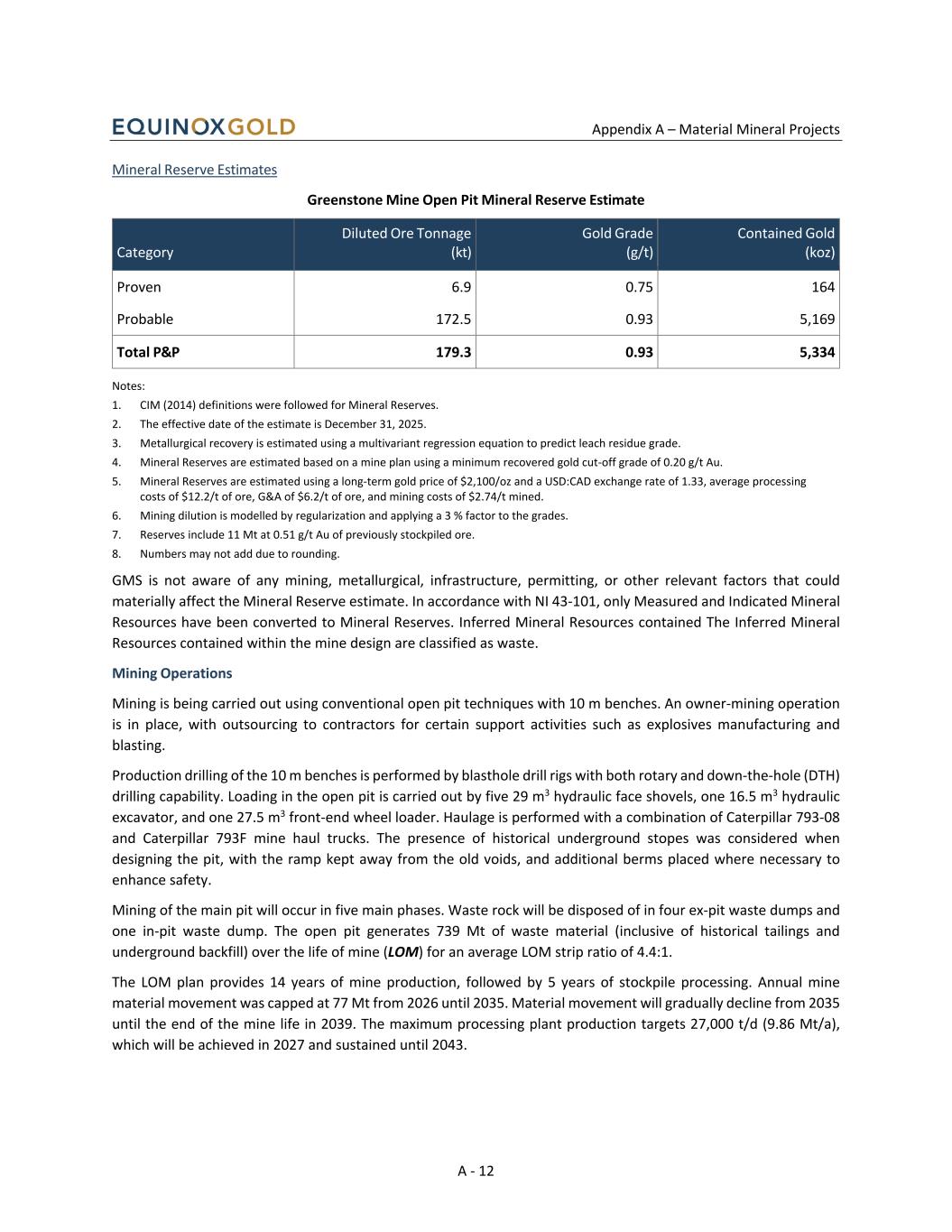
Appendix A – Material Mineral Projects A - 12 Mineral Reserve Estimates Greenstone Mine Open Pit Mineral Reserve Estimate Category Diluted Ore Tonnage (kt) Gold Grade (g/t) Contained Gold (koz) Proven 6.9 0.75 164 Probable 172.5 0.93 5,169 Total P&P 179.3 0.93 5,334 Notes: 1. CIM (2014) definitions were followed for Mineral Reserves. 2. The effective date of the estimate is December 31, 2025. 3. Metallurgical recovery is estimated using a multivariant regression equation to predict leach residue grade. 4. Mineral Reserves are estimated based on a mine plan using a minimum recovered gold cut-off grade of 0.20 g/t Au. 5. Mineral Reserves are estimated using a long-term gold price of $2,100/oz and a USD:CAD exchange rate of 1.33, average processing costs of $12.2/t of ore, G&A of $6.2/t of ore, and mining costs of $2.74/t mined. 6. Mining dilution is modelled by regularization and applying a 3 % factor to the grades. 7. Reserves include 11 Mt at 0.51 g/t Au of previously stockpiled ore. 8. Numbers may not add due to rounding. GMS is not aware of any mining, metallurgical, infrastructure, permitting, or other relevant factors that could materially affect the Mineral Reserve estimate. In accordance with NI 43-101, only Measured and Indicated Mineral Resources have been converted to Mineral Reserves. Inferred Mineral Resources contained The Inferred Mineral Resources contained within the mine design are classified as waste. Mining Operations Mining is being carried out using conventional open pit techniques with 10 m benches. An owner-mining operation is in place, with outsourcing to contractors for certain support activities such as explosives manufacturing and blasting. Production drilling of the 10 m benches is performed by blasthole drill rigs with both rotary and down-the-hole (DTH) drilling capability. Loading in the open pit is carried out by five 29 m3 hydraulic face shovels, one 16.5 m3 hydraulic excavator, and one 27.5 m3 front-end wheel loader. Haulage is performed with a combination of Caterpillar 793-08 and Caterpillar 793F mine haul trucks. The presence of historical underground stopes was considered when designing the pit, with the ramp kept away from the old voids, and additional berms placed where necessary to enhance safety. Mining of the main pit will occur in five main phases. Waste rock will be disposed of in four ex-pit waste dumps and one in-pit waste dump. The open pit generates 739 Mt of waste material (inclusive of historical tailings and underground backfill) over the life of mine (LOM) for an average LOM strip ratio of 4.4:1. The LOM plan provides 14 years of mine production, followed by 5 years of stockpile processing. Annual mine material movement was capped at 77 Mt from 2026 until 2035. Material movement will gradually decline from 2035 until the end of the mine life in 2039. The maximum processing plant production targets 27,000 t/d (9.86 Mt/a), which will be achieved in 2027 and sustained until 2043.
Appendix A – Material Mineral Projects A - 13 Processing and Recovery Operations The process plant has a nameplate capacity of 27,000 t/d and includes primary crushing (gyratory crusher), secondary crushing (cone crusher), HPGR and twin ball milling grinding circuit with gravity recovery, pre-leach thickening, cyanide leaching followed by gold recovery by CIP adsorption, elution and carbon regeneration, and electrowinning and refining. Tailings handling incorporates cyanide destruction and tailings thickening and deposition. The mill operation schedule is 24 h/d, 365 d/a with an overall planned utilization of 92%. The service areas include reagent preparation, compressed air, oxygen plant and sulphur dioxide storage and distribution. The bulk of the water requirements for the process plant is provided by process water and consists of pre-leach thickener overflow and reclaim water from the TMF. Treated water from the effluent water treatment plant is used in the strip circuit, ILR and refinery circuits, used as gland seal water and for reagent dilution. Treated water is used for the grinding mill cooling systems and fire water. Potable is supplied from an onsite potable water treatment plant and used for safety showers and various users within the process plant and administration areas. The primary reagents include flocculant, sodium hydroxide, sodium cyanide, copper sulphate, liquid sulphur dioxide, anti-scalant, lime, hydrochloric acid, and oxygen. Infrastructure, Permitting and Compliance Activities Infrastructure The mine is within a district that is host to numerous mines and processing facilities and has access to good transportation and regional mining-related infrastructure. The mine is within a district that is host to numerous mines and processing facilities and has access to good transportation and regional mining-related infrastructure. The Mine is located along the Trans-Canada Highway 11 and TC Energy’s Mainline natural gas pipeline, and nearby the town of Geraldton that hosts a municipal airport and a 115 kV Hydro One electrical substation. The general infrastructure to support mining and processing activities includes: site access and haul roads, mining equipment maintenance shop, warehouse for spare parts and reagents, site mixed emulsion (SME) plant, sewage treatment plant, fuel supply storage and distribution, communications network, assay laboratory, administration building, including a dry facility, gatehouse, and parking area, potable water and sewage systems, fire water systems, and site security and fencing. A natural gas-fired power plant with a design capacity of 48 MW provides power to the Mine. Natural gas is provided to the power plant via a connection to TC Energy’s Mainline pipeline. A new Ontario Provincial Police (OPP) station is currently being built to replace the existing station that is located within the Mine’s property limits. Portions of the historical MacLeod and Hardrock tailings piles, which extend into the limits of the open pit, have been and continue to be relocated to the TMF. Water Management All collected mine water, surface runoff water, and underground workings water is directed through various runoff and seepage collection ponds to the centralized mine water Collection Pond M1, which is designed to provide buffer flows for mill make-up water, with excess water sent to the effluent water treatment plant for treatment prior to discharge to the Southwest Arm of Kenogamisis Lake. A seepage collection system was installed to manage seepage from the historical MacLeod tailings. Surface water runoff from the exterior of the TMF dams and any seepage
Appendix A – Material Mineral Projects A - 14 through the dams or foundations is collected in a series of ponds and pumped back into the TMF reservoir for reuse in processing. Tailings Management Facility The tailings management facility (TMF) is a series of constructed dams with a final maximum height of 35 m and crest length of approximately 7,400 m. The TMF is currently designed to receive approximately 145 million tonnes (Mt) of mill and historical tailings at an average dry density of 1.34 t/m3. A cyanide destruction system is used to process all tailings water before it is sent to the TMF. An allowance has been made within the TMF to store the historical tailings and contaminated soils being relocated from the open pit area. The TMF dams are and will continue to be constructed primarily using waste rock from mining operations. The dams will be constructed in stages and in the downstream direction. Construction of the TMF starter dams was completed in 2023 with the first (Stage 1) dam raises completed in 2024 and the second in 2025/26 to a crest elevation of 347 m (346 m for the Southwest Dam only), and the planned ultimate crest elevation will be 365 m. The current TMF design does not fully accommodate the life-of-mine tailings requirements, and additional storage solutions are being evaluated. Tailings geochemistry indicates that less than 10% of the ore is considered potentially acid generating. This amount will be reduced through oxidization during ore processing, thereby reducing the overall acid rock drainage potential for the tailings. Foundation improvements for the TMF have included the installation of a seepage cut-off wall via a deep soil mixing (DSM) methodology along the Southwest Dam and construction of a shear key beneath the downstream portion of the Southeast Dam. Additional shear key and DSM programs will be performed for the Southwest and West Dams, respectively, in 2026 and 2027, and these programs will complete the foundation improvements required to achieve the ultimate dam height. Tailings are deposited in the TMF from the dam crests as a conventional slurry to produce a wide exposed beach. This beach will displace the tailings pond away from the dams towards natural ground along the western edge of the facility to enhance long-term dam stability. A barge-mounted pump system, located near the west side of the TMF, reclaims water from the TMF pond and pumps it back to the processing plant. Closure of the TMF involves lowering of the spillway and vegetating the exposed tailings beaches. Runoff from the pond, when deemed suitable for discharge to the environment, will be directed through the spillway. Permitting and Compliance Environmental baseline studies were conducted for the Greenstone Mine between 2013 and 2021 and were used to identify environmental constraints during the development of layouts and designs for the Greenstone Mine. This environmental baseline was the basis for determining incremental changes and predicting environmental effects associated with the Greenstone Mine. A final environmental impact statement / environmental assessment (EIS/EA) was completed and a Notice of Approval was issued by the provincial regulatory agency and a Decision Statement was issued by the federal regulatory agency. GGM submitted a Closure Plan and Financial Assurance to the Ministry of Mines, which received approval on March 30, 2021. Since approval of the initial closure plan, GGM has filed two amendments, one in December 2023 and another in August 2024 to account for detailed design and to address measures implemented to mitigate erosion of the Goldfield Creek diversion channel. The results of the final EIS/EA, including implementing the identified mitigation measures, supports the conclusion that the Greenstone Mine will not cause significant adverse environmental effects. Since completing the final EIS/EA,
Appendix A – Material Mineral Projects A - 15 GGM has completed slight modifications of Greenstone Mine components, which form the basis for the final mine plan used for the Greenstone Technical Report. Active consultation with stakeholders (community members, agencies and interested parties) and Indigenous communities has been undertaken throughout Greenstone Mine planning, permitting, and detailed engineering and will continue through operation and closure of the Greenstone Mine. GGM has established long-term relationship agreements with five local Indigenous communities. The agreements establish increased clarity regarding GGM’s ability to develop the Greenstone Mine and the Indigenous communities’ opportunity to benefit from future mining opportunities in the region, including the potential to extend the life of the Greenstone Mine. The GGM Indigenous Relations team meets regularly with local Indigenous communities discussing employment, training, and procurement opportunities through the Implementation Committee (IC). The IC comprises members of each of the partnering communities and provides an ongoing forum for communication and co-operative measures for supporting Indigenous participation levels in the Mine. This provides an avenue for community members to voice concerns or questions they may have and to receive feedback from GGM. The Environmental Sub-Committee (EAS) reports to the IC and provides a forum for timely review and consultation and comment on Project Approvals and Environmental Management & Monitoring Plans. The EAS considers and recommends appropriate testing, studies, or programs. Five Environmental Technicians from Aroland First Nation, Animbiigoo Zaagi’igan Anishinaabek, Ginoogaming First Nation, Long Lake #58 First Nation, and Métis Nation of Ontario actively participate in the daily operation of the GGM Environmental Department. Capital and Operating Costs Capital Costs In 2025, capital expenditures totaled $191 million. Sustaining capital expenditures totaled $94 million, including $32 million of tailings expansion and related earthworks, $34 million of mobile equipment and critical spares, and $28 million of other capital projects. Non-sustaining capital of $96 million was primarily associated with $69 million of mobile equipment and critical spares and $27 million of other capital projects The capital expenditures include sustaining expenditures for mining, processing and general and administration costs and non-sustaining expenditures. The non-sustaining capital cost is estimated to be $80.3 million for the LOM operating period. Non-Sustaining Capital Cost LOM Summary Capital Cost – Non-Sustaining Total Costs ($ million) Building and Infrastructure 36.6 Project Carryover 40.4 Capitalized Development 3.4 Total Cost 80.3 Major items included in the non-sustaining capital include the costs for the OPP station relocation, remediation work and the HPGR rebuild facility. The sustaining capital cost is estimated to be $1,319.4 million for the LOM operating period.
Appendix A – Material Mineral Projects A - 16 Sustaining Capital Cost LOM Summary Capital Cost – Sustaining Total Costs ($ million) Buildings and Infrastructure 140.2 Hardware/Software 1.5 Machinery and Equipment 48.3 Major Capital Repairs 378.6 Tailings Management Facility 461.7 Fleet Purchase 92.3 Capitalized stripping 196.8 Total Cost 1,319.4 Major items included in the sustaining capital include a new camp accommodation, strategic spares for the processing plant, major capital repairs for the mining fleet, TMF expansions, new mining fleet equipment purchases, and capitalized stripping. The operating costs include mining, processing and G&A. The average operating cost is $1,325/oz Au or $32.20/t milled over the LOM operating period. Operating Costs LOM Summary Description Total Costs ($ million) Mining 2,485 Processing 2,188 G&A 1,107 Total Operating Costs 5,781 Exploration, Development, and Production See the section “Material Properties” on page 31 of this AIF, for a description of current and contemplated exploration, development and production activities at Greenstone.
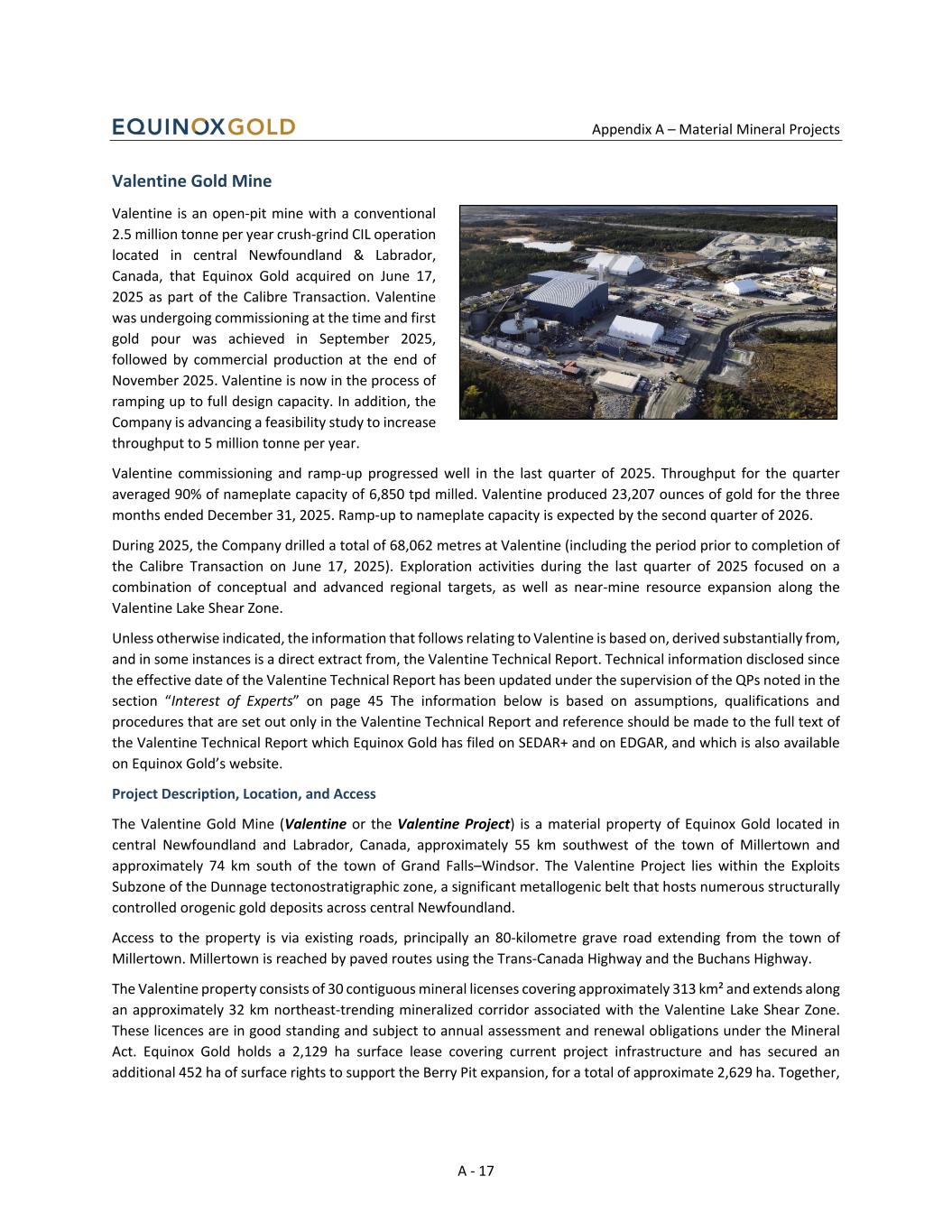
Appendix A – Material Mineral Projects A - 17 Valentine Gold Mine Valentine is an open-pit mine with a conventional 2.5 million tonne per year crush-grind CIL operation located in central Newfoundland & Labrador, Canada, that Equinox Gold acquired on June 17, 2025 as part of the Calibre Transaction. Valentine was undergoing commissioning at the time and first gold pour was achieved in September 2025, followed by commercial production at the end of November 2025. Valentine is now in the process of ramping up to full design capacity. In addition, the Company is advancing a feasibility study to increase throughput to 5 million tonne per year. Valentine commissioning and ramp-up progressed well in the last quarter of 2025. Throughput for the quarter averaged 90% of nameplate capacity of 6,850 tpd milled. Valentine produced 23,207 ounces of gold for the three months ended December 31, 2025. Ramp-up to nameplate capacity is expected by the second quarter of 2026. During 2025, the Company drilled a total of 68,062 metres at Valentine (including the period prior to completion of the Calibre Transaction on June 17, 2025). Exploration activities during the last quarter of 2025 focused on a combination of conceptual and advanced regional targets, as well as near-mine resource expansion along the Valentine Lake Shear Zone. Unless otherwise indicated, the information that follows relating to Valentine is based on, derived substantially from, and in some instances is a direct extract from, the Valentine Technical Report. Technical information disclosed since the effective date of the Valentine Technical Report has been updated under the supervision of the QPs noted in the section “Interest of Experts” on page 45 The information below is based on assumptions, qualifications and procedures that are set out only in the Valentine Technical Report and reference should be made to the full text of the Valentine Technical Report which Equinox Gold has filed on SEDAR+ and on EDGAR, and which is also available on Equinox Gold’s website. Project Description, Location, and Access The Valentine Gold Mine (Valentine or the Valentine Project) is a material property of Equinox Gold located in central Newfoundland and Labrador, Canada, approximately 55 km southwest of the town of Millertown and approximately 74 km south of the town of Grand Falls–Windsor. The Valentine Project lies within the Exploits Subzone of the Dunnage tectonostratigraphic zone, a significant metallogenic belt that hosts numerous structurally controlled orogenic gold deposits across central Newfoundland. Access to the property is via existing roads, principally an 80-kilometre grave road extending from the town of Millertown. Millertown is reached by paved routes using the Trans-Canada Highway and the Buchans Highway. The Valentine property consists of 30 contiguous mineral licenses covering approximately 313 km² and extends along an approximately 32 km northeast-trending mineralized corridor associated with the Valentine Lake Shear Zone. These licences are in good standing and subject to annual assessment and renewal obligations under the Mineral Act. Equinox Gold holds a 2,129 ha surface lease covering current project infrastructure and has secured an additional 452 ha of surface rights to support the Berry Pit expansion, for a total of approximate 2,629 ha. Together,
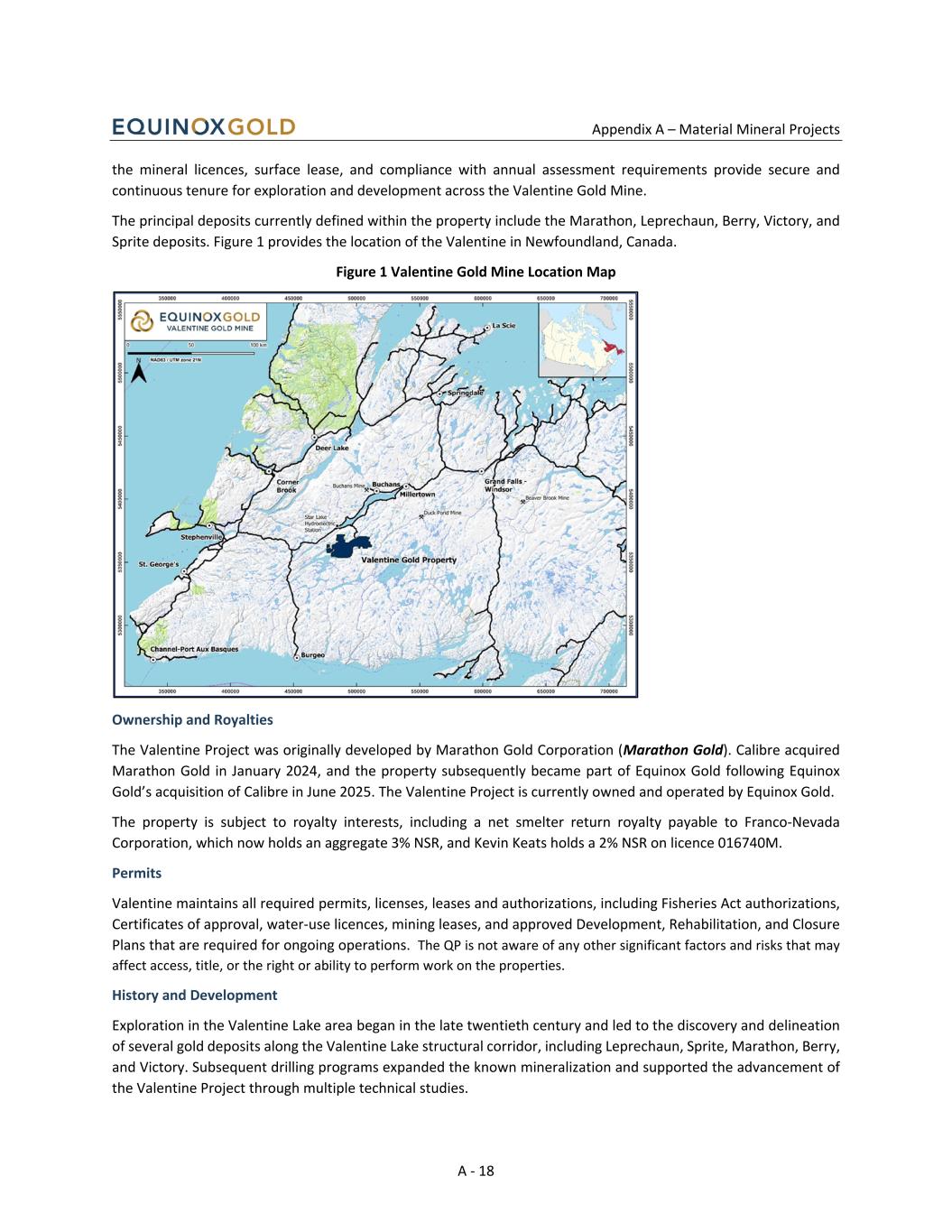
Appendix A – Material Mineral Projects A - 18 the mineral licences, surface lease, and compliance with annual assessment requirements provide secure and continuous tenure for exploration and development across the Valentine Gold Mine. The principal deposits currently defined within the property include the Marathon, Leprechaun, Berry, Victory, and Sprite deposits. Figure 1 provides the location of the Valentine in Newfoundland, Canada. Figure 1 Valentine Gold Mine Location Map Ownership and Royalties The Valentine Project was originally developed by Marathon Gold Corporation (Marathon Gold). Calibre acquired Marathon Gold in January 2024, and the property subsequently became part of Equinox Gold following Equinox Gold’s acquisition of Calibre in June 2025. The Valentine Project is currently owned and operated by Equinox Gold. The property is subject to royalty interests, including a net smelter return royalty payable to Franco-Nevada Corporation, which now holds an aggregate 3% NSR, and Kevin Keats holds a 2% NSR on licence 016740M. Permits Valentine maintains all required permits, licenses, leases and authorizations, including Fisheries Act authorizations, Certificates of approval, water-use licences, mining leases, and approved Development, Rehabilitation, and Closure Plans that are required for ongoing operations. The QP is not aware of any other significant factors and risks that may affect access, title, or the right or ability to perform work on the properties. History and Development Exploration in the Valentine Lake area began in the late twentieth century and led to the discovery and delineation of several gold deposits along the Valentine Lake structural corridor, including Leprechaun, Sprite, Marathon, Berry, and Victory. Subsequent drilling programs expanded the known mineralization and supported the advancement of the Valentine Project through multiple technical studies.
Appendix A – Material Mineral Projects A - 19 Following environmental approvals from both federal and provincial regulators in 2022, construction of Valentine proceeded. First gold was poured in September 2025, and commercial production was achieved on November 18, 2025. Geology and Mineralization Valentine is located within the Exploits Subzone of the Dunnage tectonostratigraphic zone of Central Newfoundland, part of the Newfoundland Appalachian system. Gold mineralization within the Dunnage Zone is correlated with late syn- to post-Salinic orogenic events and is typically spatially related to major structural features and proximal to, or hosted within, intrusive bodies. The gold deposits at the Valentine Project are hosted primarily by the Neoproterozoic Valentine Lake Intrusive Complex (VLIC), which occurs between the Victoria Lake Supergroup (VLSG) to the northwest and the Silurian (or younger) Rogerson Lake Conglomerate (RLC) to the southeast. The contact between the VLIC and the RLC corresponds to the NE-SW Valentine Lake Shear Zone, a zone characterized by localized shearing and faulting and previously described as exhibiting sinistral reverse-transpressive deformation correlated with the Salinic (450-423 Ma) Appalachian Orogenic event. The Valentine Lake Intrusive Complex comprises an elongate northeast-trending body of igneous rocks consisting of dominantly fine- to medium-grained trondhjemite and quartz-monzonite units with lesser aphanitic quartz porphyry, gabbro, and minor pyroxenite units. The Rogerson Lake Conglomerate occurs as a narrow linear unit that extends for approximately 160 km and lies unconformably (overturned) on the southeast margin of the Valentine Lake Intrusive Complex. The conglomerate is interpreted to have infilled a fault-bounded paleo-topographic depression. The entire Valentine Project area is overlain by glacial till between 1 and 5 m thick, as well as boggy areas and ponds, with bedrock exposure along a ridge trending northeast-southwest through the property and in stream beds. Regional metamorphism in the Valentine Lake area ranges from lower to upper greenschist facies, with higher grades in the southern portion of the property. Deformation of the Valentine Lake Intrusive Complex is ductile transitioning to late-stage brittle deformation. The Rogerson Lake Conglomerate exhibits a strongly developed, pervasive foliation, isoclinal folding, and flattened primary clasts indicative of a pure shear crustal shortening regime. Recent project-scale structural investigations by Terrane Geosciences Inc. for Marathon Gold, and more regionally by the Geological Survey of Canada, have established a geotectonic chronology for the deformation within the Valentine Project area. Five phases of deformation are recognized. A penetrative ductile fabric associated with the initiation of the Valentine Lake Shear Zone during an initial D1 crustal shortening phase is characterized by a strong S1 foliation and L1 stretching lineation. These fabrics are observed in both the Rogerson Lake Conglomerate and in the Valentine Lake Intrusive Complex, with a SW strike and steep dip to the NW, paralleling the larger structure. Gold mineralization occurs in Quartz-Tourmaline-Pyrite (QTP) vein sets developed within the Valentine Lake Intrusive Complex, correlated with a D3 phase of renewed crustal shortening following a period of regional D2 relaxation. Overprinting fabrics include a late D4 crenulation fabric and a D5 brittle fault set. The QTP-Au veining has been identified in prospecting samples, outcrop, trenching, and drilling at numerous locations along the 32 km strike extent of the Valentine Lake Intrusive Complex and Valentine Lake Shear Zone within the Valentine Project. Significant QTP-Au veining occurs dominantly within the trondhjemite, quartz-monzonite and lesser mafic dyke units along and proximal to the sheared contact with the Rogerson Lake conglomerate. Minor amounts of gold-bearing QTP veining extend across the Valentine Lake Shear Zone contact and into the Rogerson Lake Conglomerate.
Appendix A – Material Mineral Projects A - 20 The gold mineralization at the Valentine Project occurs as structurally controlled, orogenic gold deposits consisting dominantly of en-echelon stacked SW-dipping extensional vein sets (Set 1) and lesser shear parallel vein sets (Set 2) proximal to the Valentine Lake Shear Zone. This style of mineralization occurs intermittently along the defined strike length of the main gold zone, in which a series of deposits and occurrences have been, and continue to be, discovered. Discoveries to date include the Leprechaun, Sprite, Berry, Marathon, and Victory gold deposits, and Frank, Rainbow, Steve, Scott, Triangle, Victoria Bridge, Narrows, Victory SW, and Victory NE occurrences. At the deposit scale, a pervasively altered, intensely QTP-veined core complex, which is referred to as the “Main Zone”, has been delineated at the Leprechaun, Berry and Marathon deposits. The Main Zones of the Marathon, Leprechaun, and Berry deposits are well-defined by thorough outcrop investigation and densely spaced subsurface drill hole information. Main Zone mineralization at Leprechaun and Berry is constrained by the Valentine Lake Shear Zone to the southeast and several large mafic dykes which parallel the Valentine Lake Shear Zone to the NW, whereas the Marathon mineralization is much more diffuse. Further exploration work is required at the other deposits and occurrences to determine if the Main Zone model is present at these locales. Individual QTP-Au veins range in thickness from a few millimeters and centimeters to meters; however, they are typically 2 to 30 cm thick. The Set 1 extensional and Set 2 shear-parallel QTP-Au veins are up to 1.5 m thick and have been traced in trenched outcrop exposures for over 280 m of continuous strike length; however, the observed strike length of individual veins is typically in the range of meters to tens of centimeters. Up to three separate vein sets have been identified at the Leprechaun and Marathon deposits, and up to four vein sets at the Berry deposit. Set 1 QTP-Au veins developed within brittle extensional fractures dipping at a low angle to the southwest are the dominant mineralization style at the property. The QTP-Au veins represent the principal structural control on gold mineralization in the mineral resource models for the Leprechaun, Sprite, Berry, Marathon, and Victory deposits. Visible gold in the QTP veins occurs as grains, ranging in size from <0.1 mm and up to 2 to 3 mm, hosted by quartz, tourmaline masses, within and along the margins of coarse cubic pyrite, or associated with minor tellurides, as well as in altered host rock along vein margins. Highest gold grades are commonly associated with large (1 to 3 cm) cubic pyrite within the QTP veining. The relationship between high-grade gold mineralization and the location of the dykes supports the theory that the mafic dykes provide a rheologic contrast that (1) promotes brittle fracturing of the granitoid unit and therefore, acts as a controlling factor of mineralized fluid flow, and (2) incites the eventual emplacement of zones of gold enrichment. The detailed geological work completed adds confidence in the continuity of the high-grade mineralized zones at Marathon, Leprechaun, and Berry, and in the overall mineralization model, in which the Set 1 QTP-Au veins represent the principal structural control on gold mineralization at the Valentine Project. Deposit Type In central Newfoundland, numerous examples of mesozonal to epizonal orogenic gold systems are spatially associated with vein-hosted gold mineralization developed along crustal-scale fault zones and subsidiary structures. These systems are interpreted to have formed during late orogenic stages and are commonly accompanied by significant wall-rock alteration, particularly extensive carbonate alteration. The Valentine Project hosts a number of structurally controlled mesothermal gold deposits related to Salinic-age crustal shortening and deformation. Gold mineralization occurs within QTP vein sets that formed during brittle- ductile deformation of granitoid rocks belonging to the Neoproterozoic Valentine Lake Intrusive Complex, where they are in contact with the Silurian Rogerson Lake Conglomerate. This lithological contact is defined by the Valentine Lake Shear Zone, a major crustal-scale lithotectonic boundary trending northeast–southwest.
Appendix A – Material Mineral Projects A - 21 Set 1 QTP-Au veins, which formed within brittle extensional fractures dipping at low angles toward the southwest, represent the dominant style of mineralization across the property. These veins constitute the primary structural control on gold mineralization and form the basis for the mineral resource models at the Leprechaun, Sprite, Berry, Marathon, and Victory deposits. Exploration Between 2010 and the present, Marathon Gold, Calibre and Equinox Gold have conducted systematic exploration programs to follow up on historic prospects within the Valentine property, now referred to as the Leprechaun and Victory deposits, and to discover additional zones of mineralization along the Valentine Project’s mineralized trend. This work includes geological mapping; litho-geochemical grab and channel sampling; ground geophysical surveying (induced polarization, magnetic, and seismic); and drilling and metallurgical processing. Marathon Gold discovered the Marathon, Sprite, and Berry deposits. Subsequent work has significantly expanded the known extents of mineralization at all five gold deposits. Additional early-stage exploration targets were identified by Marathon Gold along the 32 km mineralized trend, including the Frank, Rainbow, Steve, Scott, Triangle, Victoria Bridge, Narrows, Victory SW, Victory NE, Eastern Arm, and Western Peninsula. The results of the detailed mapping, litho-geochemistry, and petrographic studies were used to prepare detailed geological maps for each deposit area. Detailed prospecting, grab rock samples, and channel sampling, in conjunction with geological mapping, assisted Marathon Gold with prioritizing drill targets for follow-up exploration. Geophysical data support a complex structural geological association at the deposit areas. Distinct structural splays associated with the Valentine Lake Shear Zone and late-stage brittle fault offsets of the regional structural fabric are evident in the magnetic data and provide structural context for the exploration. Mineralization at these deposits also appears spatially associated with areas of low magnetic intensity, interpreted to result from the potential magnetite destructive sericite alteration associated with the QTP vein arrays. Drilling Historical drilling at the Valentine Gold property includes 136 NQ diamond drillholes (25,652 m) drilled by various companies prior to 2010. Since 2010, systematic exploration at the Valentine Project has comprised diamond drilling, trenching, channel and grab sampling, detailed geological and structural mapping, and airborne and ground geophysical surveys (magnetics, VLF, IP, LiDAR, and limited seismic). These programs have delineated Mineral Resources at the Leprechaun, Berry, Marathon, Sprite, and Victory deposits and identified numerous additional targets. Current production is sourced from the Leprechaun, Berry, and Marathon pits, while exploration since the 2022 Technical Report has focused on district-scale growth rather than near-pit expansion. Between 2010 and 2025, 2,360 diamond drill holes totaling approximately 543,196 m were completed, with drilling concentrated at Marathon (161,717 m in the resource database), Berry (128,641 m), Leprechaun (104,746 m), and Frank (59,076 m), in addition to regional targets. The 2025 program alone comprised 200 holes totaling 68,062 m, primarily at Frank and other greenfields targets. Advanced drilling at the principal deposits achieved spacings as tight as 25 m × 25 m, locally 10–15 m centers, supporting resource classification. Diamond drilling was conducted using wireline NQ-size double tube barrels typically producing 3 m runs of core except in areas of poor recovery. Core splits are archived for future geological confirmation and QA/QC work. Drilling has been conducted as both inclined and sub-vertical holes to accommodate the variable dip of mineralized domains. Inclined holes were typically drilled at an inclination of 45° to 83° and were oriented either southeast or northwest to intercept the shallowly southeast-dipping QTP veins, the steeply northwest-dipping shear parallel QTP veins and the steeply northwest-dipping contact between the VLIC and the Rogerson Lake Conglomerate.
Appendix A – Material Mineral Projects A - 22 Since 2010, collars were positioned using a Trimble R8, R12i or TopCon Hiper HR GPS unit and were aligned to the designated azimuth using a Reflex TN-14 gyroscopic compass or traditional compass and picket method for holes prior to 2017. The TN-14 unit uses a fibre-optic gyroscope to determine the azimuth and dip of the rig. Upon completion of each drillhole, the GPS unit was used to record the final UTM coordinates of the collar location, spatial referencing in NAD83 UTM coordinate system. All drillholes are subjected to downhole deviation surveys to accurately quantify borehole trajectory. Equinox Gold has historically employed a range of survey instruments supplied by Reflex (now formally Imdex), with equipment selection evolving alongside technological advancements. Since 2024, the primary instrument utilized has been the Reflex Omni-42 gyroscopic survey tool. The Omni-42 incorporates dual north-seeking gyroscopes to determine azimuth and inclination at discrete intervals, typically spaced every 2–5 meters throughout the borehole profile. Results from diamond drilling at the Valentine Project have been used to build out the mineral resource estimates for the five deposits currently outlined, and to define other high-potential targets across the property. Lithological, structural and assay data from recent drill campaigns have been used to update resource models as described in the 2025 NI 43-101 technical report for Valentine. Results generally align with previous geological models and assumptions. Sampling, Analysis and Data Verification Laboratories Sample analysis of diamond drill core from 2010 to 2025 was performed at Eastern Analytical Ltd., an ISO 17025 accredited laboratory located in Springdale, Newfoundland. Eastern Analytical is independent of Marathon Gold, Calibre Mining and Equinox Gold. This analysis included fire assay, ICP-34 and total pulp metallic sieve. Umpire samples, as well as a small portion of the drill core drilled in 2021, were sent to SGS in Lakefield, Ontario, for analysis. SGS is also ISO 17025 accredited and is independent of Marathon Gold, Calibre Mining and Equinox Gold. Quality Assurance and Quality Control A QA/QC program has been in place since the commencement of exploration in 2010 and has been routinely monitored and refined to support the validity and integrity of the analytical database. Prior to dispatch to the laboratory, certified reference materials and blanks are prepared and inserted into the sample stream by a geologist or geotechnician at a rate of 1 in 10 samples (increased from 1 in 20 in 2021), alternating between blanks and one of three CRMs. Control samples are prepared, tagged, and recorded by the responsible geologist, and are stored on site in clearly labelled, separate covered containers to reduce the risk of mix ups. Since 2024, control samples have been inserted at fixed sample ID multiples of ten. Results from the QA/QC program, sample preparation, sample results, security, analytical and transportation methods are regularly reviewed and no significant issues have been noted. Samples were transported by Equinox Gold directly from the Valentine exploration camp to Eastern Analytical by company vehicle in sample batches that were contained in sealed rice sacks up until 2020 when RNR Drilling, the diamond drilling contractor, was contracted to deliver samples to the lab. The date of shipping, number of bags per batch, delivery driver, and other pertinent information are recorded in both Acquire and a designated notebook. Starting in 2024, all material leaving the VGM site required a Material Shipping Notice approved by a manager, which was verified by warehouse and security prior to leaving site. Upon Chain of Custody receipt of samples, laboratory personnel checked the seals on both the rice sacks and individual sample bags to ensure that sample integrity had been maintained during transport.
Appendix A – Material Mineral Projects A - 23 Assaying and Analytical Procedures At the laboratory, individual samples were prepared by drying, if necessary. The entire sample was crushed to a nominal minus 10 mesh (1.7 mm), riffle split to obtain a representative sample and pulverized to at least 95% minus 150 mesh (106 μm). Prepared samples were analyzed by Eastern Analytical for gold using fire assay with atomic absorption finish, with a 30 g charge for rock and core samples and a 20 g charge for soil samples, and a minimum detection limit of less than 5 ppb Au. Samples assaying ≥300 ppb Au, as well as select samples from mineralized zones or containing visible gold below this threshold, were reanalyzed using a total pulp metallic sieve method, which involves pulverizing the full sample pulp to 95% passing −150 mesh, fire assaying the entire +150mesh fraction, fire assaying a 30 g subsample of the −150mesh frac on, and combining the results to produce a weighted average gold grade. Selected samples were also analyzed for multiple elements using inductively coupled plasma atomic emission spectroscopy (ICPAES; ICP34 package). Analytical results are captured in an acQuire database, which is configured to preferentially report screen metallic results where available. QA/QC performance is monitored using control charts generated in acQuire to assess contamination, analytical precision, and accuracy, with warning limits set at ±2 standard deviations and control limits at ±3 standard deviations. Control sample failures are reviewed internally to identify potential errors, and any suspect analytical results are re-assayed prior to public disclosure or use in Mineral Resource estimation. Intercepts are not disclosed where failed control samples occur within or at the margins of mineralized intervals. Two consecutive control samples failing in the same direction are treated as a failed control sample. QP Conclusions The QP has reviewed the sample preparation, analyses, and security and found no significant issues or inconsistencies to question the adequacy of the data. The QA/QC methods employed by Equinox, both historically and with additional protocols established in 2021, indicate that the analytical data have reasonable and acceptable levels of contamination, analytical precision, and accuracy. In the opinion of the QP, the geological and analytical data are sufficient for use within the resource modelling and estimations presented in this Technical Report. Data Verification Exploration data supporting the current Mineral Resource estimate (MRE) have undergone extensive verification by both external and internal QPs. Verification work includes site inspections, drill hole database audits, QA/QC reviews, and independent analytical test work. Data verification prior to the 2022 Technical Report relied partly on work completed by APEX as an external QP, while verification post‑ 2022 has been completed by internal QPs from Equinox Gold. Independent and internal verification programs were completed to assess the accuracy, completeness, and reliability of the exploration data supporting the 2022 Mineral Resource estimate. These programs included external site inspections by APEX, internal QP reviews, drill hole database audits, and independent analytical test work. No material issues were identified that would affect the validity of the data used for resource modelling, as verified by the QPs. APEX conducted site inspections in 2017, 2019, and 2022, with the visit focusing on the Berry deposit. In addition, BOYD and APEX independently audited the drill hole database. Across three site visits, APEX collected 19 independent samples from drill core and outcrop. Samples were analyzed at ALS Canada using PREP‑ 31D and Au‑ AA26/Au‑ GRA22 methods. Results corroborated lithological logging, mineralization styles, and assay tenor. The QPs responsible for the previous 2022 Mineral Resource estimate concluded that the exploration data including drilling, lithological logs, and assay results were adequate, reliable, and appropriate for use in resource modelling
Appendix A – Material Mineral Projects A - 24 and mineral resource estimation. No material issues were identified that would have adversely affected the 2022 Mineral Resource estimate. For the 2025 Mineral Resource Estimate, the QPs completed a formal site visit in October 2025. Their inspections covered core logging, collar verification, geological interpretation, QA/QC procedures, and review of exposed geology in pit walls. The QPs also reviewed the full suite of Acquire database validation tools, confirming that automated and manual controls were consistently applied. An independent comparison of assay certificates to database values identified no issues. For the 2025 Mineral Resource estimate, Niel de Bruin, P.Geo. has reviewed the work completed by previous QPs and confirmed that the drill hole database remains validated, verified and suitable for use in the current MRE. Mineral Processing and Metallurgical Testing Significant metallurgical test work has been completed on mineralized ore samples from the Leprechaun, Marathon and Berry deposits. Metallurgical test work was completed during various test work campaigns from 2010 to 2024 at various metallurgical laboratories. The overall objectives of the various test work programs were to define the metallurgical response of the main ore domains and deposits, generate sufficient metallurgical data to support a flowsheet and develop gold recoveries for project development and the ultimate design of the current process plant. The general scope of the test work campaigns included chemical and mineralogical analyses, comminution tests, gravity recovery, cyanide leaching, detoxification, carbon loading, oxygen uptake evaluations, and dewatering tests (including flocculant selection, static settling, and dynamic thickening tests). Metallurgical test work also included flotation and leaching of flotation concentrate and tailings for the plant expansion as documented in previous NI 43-101 Technical Reports. Following trade off studies, the current plant expansion has reverted to expanding the existing comminution and gravity-leach-CIL circuits and not to implement a flotation circuit. Historical test work used for the initial plant design remains relevant for the plant expansion. The metallurgical test work demonstrated that mineralization from the Leprechaun, Marathon, and Berry deposits is amenable to processing using conventional gravity concentration and cyanide leaching techniques. No material deleterious elements or processing characteristics have been identified to date that would be expected to have a significant adverse effect on potential economic extraction. Ongoing metallurgical testing is recommended to further optimize plant operations and recoveries and assess variability across ore types and head grades within the existing plant flowsheet. Mineral Reserve and Mineral Resource Estimates Mineral Resource Estimate Mineral Resource Estimate (Exclusive of Reserves) for Valentine Gold Mine Category In Pit >0.30 g/t Au Underground >1.21 g/t Au Tonnage (kt) Gold Grade (g/t) Contained Gold (koz) Tonnage (kt) Gold Grade (g/t) Contained Gold (koz) Measured 6,379 1.15 236 49 4.32 7 Indicated 22,790 1.24 908 170 3.28 18 M+I 29,170 1.22 1,145 219 3.51 25 Inferred 31,272 1.07 1,077 717 2.23 51
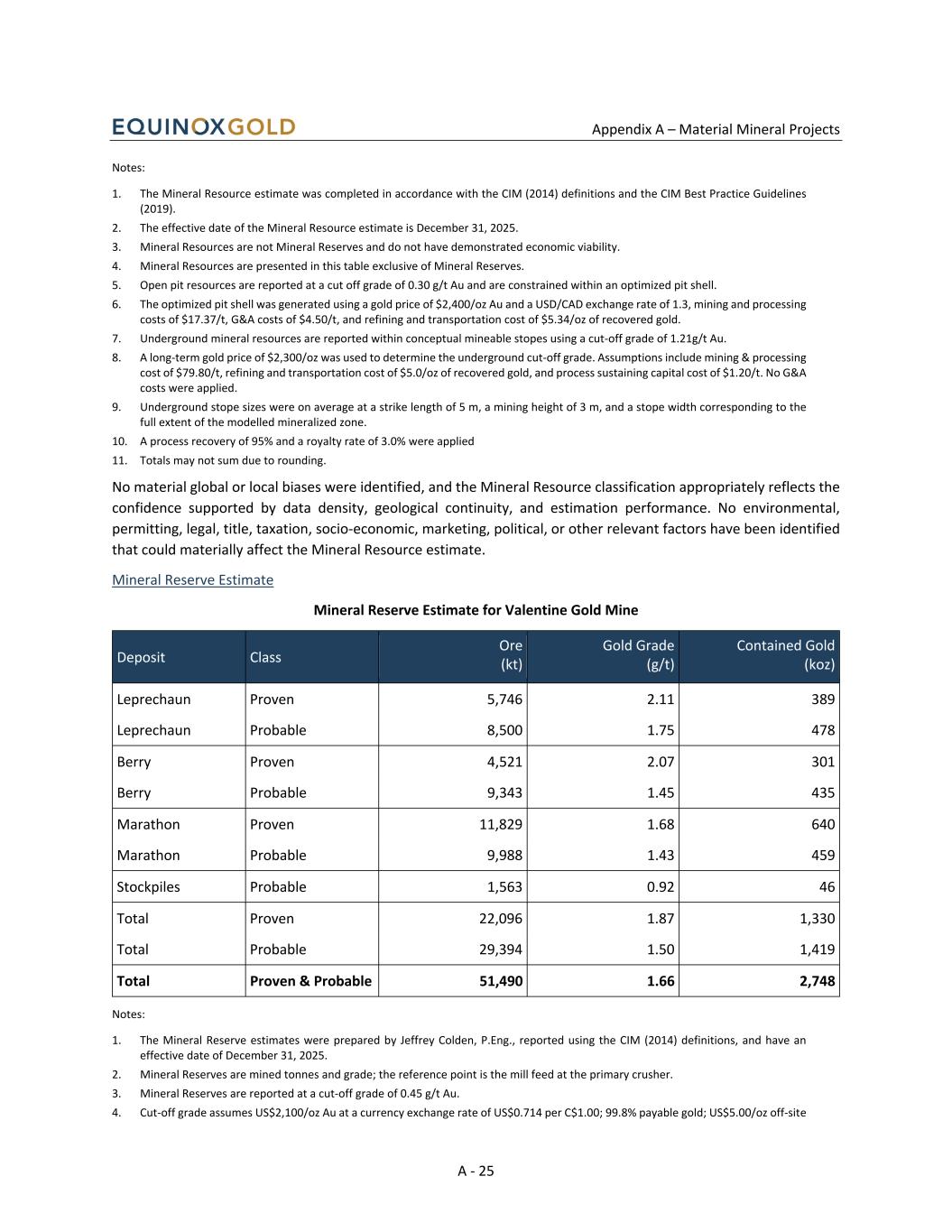
Appendix A – Material Mineral Projects A - 25 Notes: 1. The Mineral Resource estimate was completed in accordance with the CIM (2014) definitions and the CIM Best Practice Guidelines (2019). 2. The effective date of the Mineral Resource estimate is December 31, 2025. 3. Mineral Resources are not Mineral Reserves and do not have demonstrated economic viability. 4. Mineral Resources are presented in this table exclusive of Mineral Reserves. 5. Open pit resources are reported at a cut off grade of 0.30 g/t Au and are constrained within an optimized pit shell. 6. The optimized pit shell was generated using a gold price of $2,400/oz Au and a USD/CAD exchange rate of 1.3, mining and processing costs of $17.37/t, G&A costs of $4.50/t, and refining and transportation cost of $5.34/oz of recovered gold. 7. Underground mineral resources are reported within conceptual mineable stopes using a cut-off grade of 1.21g/t Au. 8. A long-term gold price of $2,300/oz was used to determine the underground cut-off grade. Assumptions include mining & processing cost of $79.80/t, refining and transportation cost of $5.0/oz of recovered gold, and process sustaining capital cost of $1.20/t. No G&A costs were applied. 9. Underground stope sizes were on average at a strike length of 5 m, a mining height of 3 m, and a stope width corresponding to the full extent of the modelled mineralized zone. 10. A process recovery of 95% and a royalty rate of 3.0% were applied 11. Totals may not sum due to rounding. No material global or local biases were identified, and the Mineral Resource classification appropriately reflects the confidence supported by data density, geological continuity, and estimation performance. No environmental, permitting, legal, title, taxation, socio-economic, marketing, political, or other relevant factors have been identified that could materially affect the Mineral Resource estimate. Mineral Reserve Estimate Mineral Reserve Estimate for Valentine Gold Mine Deposit Class Ore (kt) Gold Grade (g/t) Contained Gold (koz) Leprechaun Proven 5,746 2.11 389 Leprechaun Probable 8,500 1.75 478 Berry Proven 4,521 2.07 301 Berry Probable 9,343 1.45 435 Marathon Proven 11,829 1.68 640 Marathon Probable 9,988 1.43 459 Stockpiles Probable 1,563 0.92 46 Total Proven 22,096 1.87 1,330 Total Probable 29,394 1.50 1,419 Total Proven & Probable 51,490 1.66 2,748 Notes: 1. The Mineral Reserve estimates were prepared by Jeffrey Colden, P.Eng., reported using the CIM (2014) definitions, and have an effective date of December 31, 2025. 2. Mineral Reserves are mined tonnes and grade; the reference point is the mill feed at the primary crusher. 3. Mineral Reserves are reported at a cut-off grade of 0.45 g/t Au. 4. Cut-off grade assumes US$2,100/oz Au at a currency exchange rate of US$0.714 per C$1.00; 99.8% payable gold; US$5.00/oz off-site
Appendix A – Material Mineral Projects A - 26 costs (refining and transport); and uses a 93.1% metallurgical recovery. The cut-off grade covers processing costs of C$22.75/t, administrative (G&A) costs of C$14.38/t, and a stockpile rehandle cost of C$1.85/t. 5. Mining loss and dilution is based on diluting the Resource model to a 6 m x 6 m x 6 m model and including additional mining losses estimated for the removal of isolated blocks (surrounded by waste) and low-grade (<0.55 g/t Au) blocks bounded by waste on three sides. 6. Numbers have been rounded as required by reporting guidelines and may not add. 7. The QP is not aware of any mining, metallurgical, infrastructure, permitting, or other relevant factors that could materially affect the Mineral Reserve estimate, unless outlined in this report. Total Proven and Probable Mineral Reserves are estimated at 51.49 Mt grading 1.66 g/t gold, containing approximately 2.75 Moz of gold. Open pits are current operating designs that were verified as economic based on the results of ultimate pit limit sensitivity analysis, with designed pits matching the pit shells generated from gold price inputs of US$1,250/oz at Leprechaun to US$1,900/oz at Marathon and US$1,900/oz at Berry. Mill feed tonnes and gold grades are based on re-blocking the original resource model blocks to a selective mining unit (SMU) block size of 6 m x 6 m x 6 m. Further mining recovery parameters have been introduced, treating the following SMU blocks as waste: • all isolated, mineralized blocks (blocks bounded by waste on all sides) • all blocks below 0.55 g/t gold grade that are bounded by waste on all but one side. Factors that may affect the Mineral Reserve estimates include metal prices, changes in interpretations of mineralization geometry and continuity of mineralization zones, geotechnical and hydrogeological assumptions, ability of the mining operation to meet the annual production rate, planned mining dilution, and mining recovery, process plant throughput recoveries, the ability to meet and maintain permitting and environmental license conditions, and the ability to maintain the social license to operate. Mining Operations Valentine is a conventional open‑pit mining operation utilizing truck‑and‑shovel mining methods. Mining currently focuses on the Marathon, Leprechaun, and Berry deposits. Mining is conducted using conventional open-pit methods appropriate for the Valentine Project location and local site requirements. The mining fleet includes diesel- powered rotary drills: 190 mm rotary drills, 140 mm pre-shear DTH, and 171 mm trim-hole DTH with 144 mm bits for selective drilling. Contractor diesel-powered reverse circulation (RC) drills are used for bench-scale grade control drilling. Production loading is carried out using hydraulic excavators with 15.5 m³ buckets and wheel loaders with 13.5 m³ buckets for bulk loading, as well as diesel hydraulic excavators with 12.0 m³ buckets for selective production loading. Haulage is performed by rigid-frame haul trucks with payload capacities of 133 and 90 tonnes. Ancillary and service equipment support all mining operations. In-pit dewatering systems are being established for each pit. Surface water and precipitation encountered within the pits are directed out of the pits and into ex-pit settling ponds using ditching, in-pit sumps, and diesel-driven pumps. Ore is hauled to a crusher located approximately 3.5 km southwest of the Marathon pit, 3.0 km northeast of the Leprechaun pit, and 1.0 km south of the Berry pit. The ore is crushed to supply the process plant, while waste rock is either deposited in waste rock storage facilities directly adjacent to the pits or used as rock fill for the construction of a tailings dam located about 2 km southwest of the Marathon pit, 4.5 km northeast of the Leprechaun pit, and 1.5 km southeast of the Berry pit. Ultimate pit limits are subdivided into phases, or pushbacks, in order to mine higher-margin material earlier in the mine life. The Marathon Pit consists of four phases, Leprechaun Pit consists of three phases, and Berry Pit consists of five phases. The initial phases generally contain higher-grade gold mineralization and lower strip ratios.
Appendix A – Material Mineral Projects A - 27 Cut-off grade optimization has been carried out on the mine production schedule. Ore grades are divided into four grade bins, High-grade (HG), High medium-grade (HMG), Medium-grade (MG), and Low-grade (LG) ore. Generally, HG is processed when it is available, followed by HMG, then MG and finally LG. Ore not fed to the process plant is stockpiled until ore of that grade bin is being fed. Mining operations are conducted on a continuous schedule of 365 operating days per year with two 12-hour shifts per day. The mine schedule includes an allowance of 12 days per year without production to accommodate potential interruptions caused by adverse weather conditions. Open-pit mining operations run from 2022 through 2037. Figure 16-6 of the Valentine Technical Report presents a summary of the proposed ore and waste mining schedule. Processing Operations The Process Plant currently treats ore via a conventional gravity and cyanidation flowsheet and has been designed to nominally treat 2.5 Mt/a of ore. Run-of-mine (ROM) ore is processed via conventional primary crushing, a two- stage grinding circuit, and a gravity concentration circuit. Gravity circuit tailings are treated via cyanidation and a carbon-in-leach (CIL) circuit and associated gold recovery and carbon handling circuits to produce gold doré. CIL tailings are treated via a cyanide destruction process prior to storage in the TMF. Plant construction was completed in Q3 2025, and the first gold pour was achieved on September 15, 2025. Commercial production, representing 80% nameplate capacity, was achieved on November 18, 2025. Studies are underway to increase nominal plant throughput from 2.5 Mt/a to 5 Mt/a, The current Process Plant consists of primary crushing and associated material handling equipment, crushed ore stockpile and associated feed and reclaim systems, grinding circuit consisting of a semi-autogenous grinding (SAG) and ball mills, hydrocyclone classification and associated pumping and material handling systems to produce a nominal grind size of 80% passing (P80) of 75μm, gravity concentration circuit with intensive leach reactor, pre- aeration, cyanide leaching, and carbon adsorption via a CIL circuit. Carbon elution is via Pressure Zadra circuit and includes carbon handling and regeneration. The gold room includes electrowinning and smelting to produce doré. Cyanide destruction of CIL tailings using SO2 / O2 process and tailings pumping to the TMF. The plant includes reagent mix and storage circuits, air and oxygen circuits, and water systems (potable water, treated water, gland seal water and process water). Life‑of‑Mine Production Summary Mine Life (Years) Mill Feed (Mt) Average Grade (g/t) Recovered Gold (Moz) 12 51.5 1.66 Approximately 2.6 Infrastructure The Valentine Project is accessed via an 80 km upgraded public gravel road connecting the mine site to Millertown, the paved Buchans Highway, and ultimately the Trans-Canada Highway. The overall site layout includes the open pit mines, process plant, TMF, waste rock storage areas, water treatment facilities, mine services area, access roads, and accommodations camp. Access to the site is from the northeast via the public access road, with controlled entry to the process plant through a security gate located at the public road intersection. Figure 2 shows the final general arrangement of the Valentine Project’s Infrastructure.
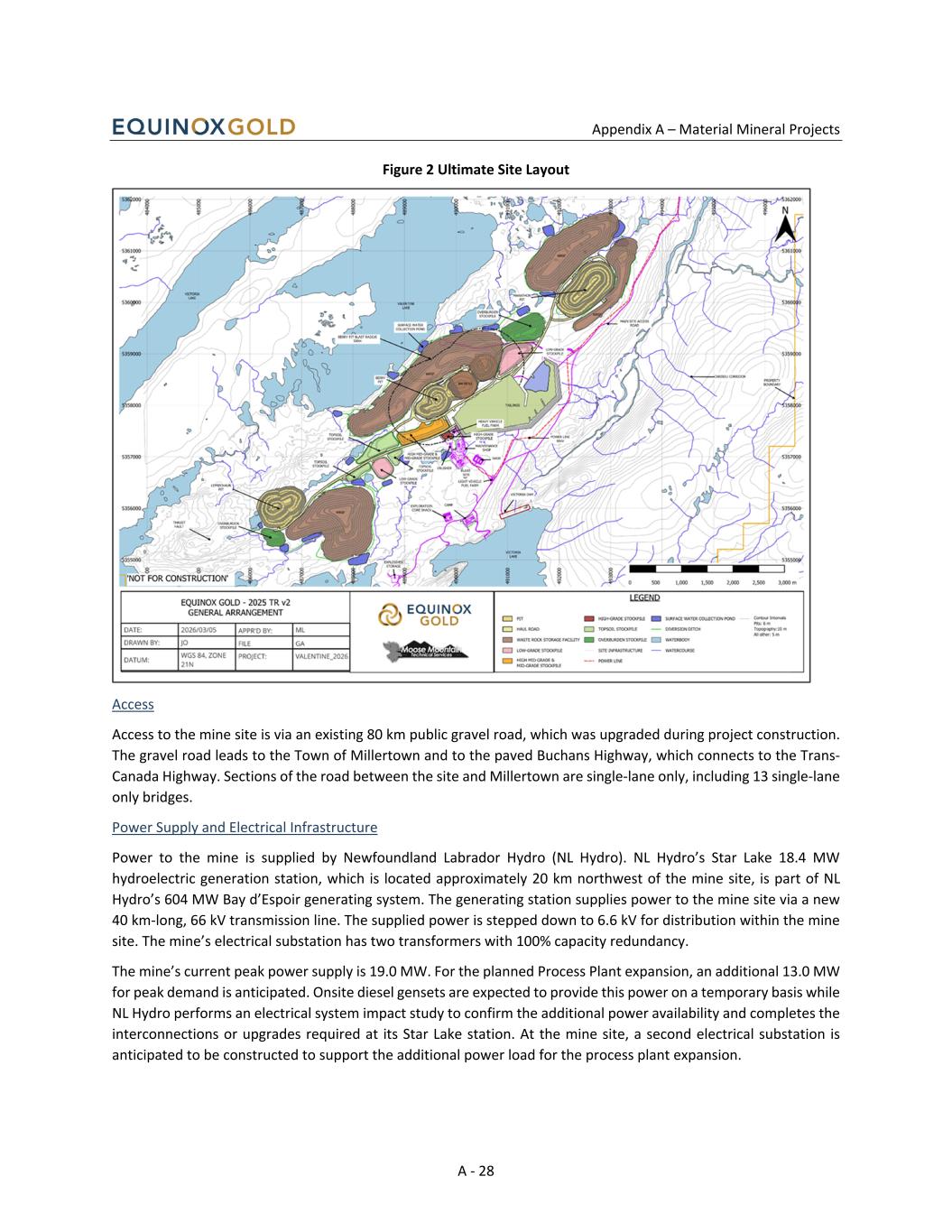
Appendix A – Material Mineral Projects A - 28 Figure 2 Ultimate Site Layout Access Access to the mine site is via an existing 80 km public gravel road, which was upgraded during project construction. The gravel road leads to the Town of Millertown and to the paved Buchans Highway, which connects to the Trans- Canada Highway. Sections of the road between the site and Millertown are single-lane only, including 13 single-lane only bridges. Power Supply and Electrical Infrastructure Power to the mine is supplied by Newfoundland Labrador Hydro (NL Hydro). NL Hydro’s Star Lake 18.4 MW hydroelectric generation station, which is located approximately 20 km northwest of the mine site, is part of NL Hydro’s 604 MW Bay d’Espoir generating system. The generating station supplies power to the mine site via a new 40 km-long, 66 kV transmission line. The supplied power is stepped down to 6.6 kV for distribution within the mine site. The mine’s electrical substation has two transformers with 100% capacity redundancy. The mine’s current peak power supply is 19.0 MW. For the planned Process Plant expansion, an additional 13.0 MW for peak demand is anticipated. Onsite diesel gensets are expected to provide this power on a temporary basis while NL Hydro performs an electrical system impact study to confirm the additional power availability and completes the interconnections or upgrades required at its Star Lake station. At the mine site, a second electrical substation is anticipated to be constructed to support the additional power load for the process plant expansion.
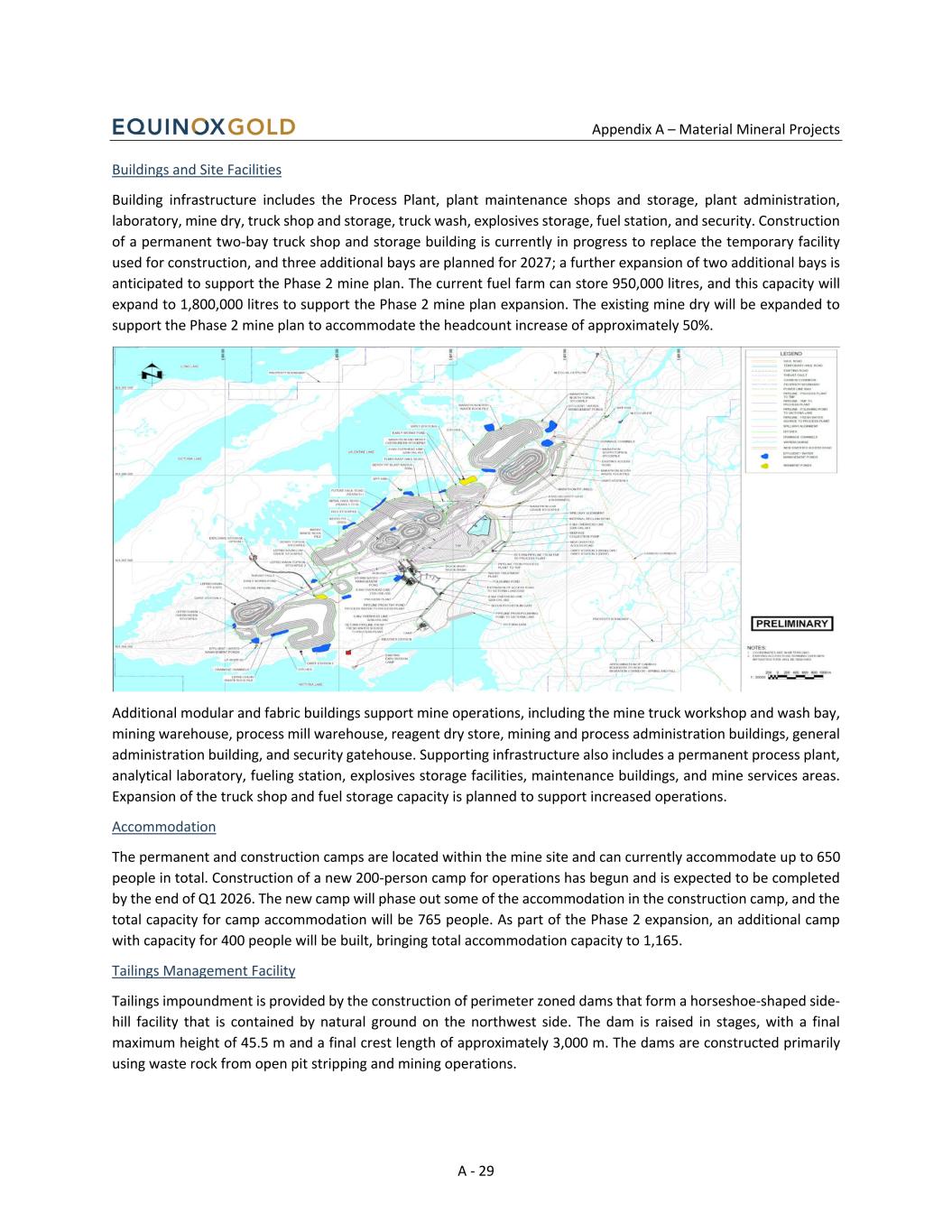
Appendix A – Material Mineral Projects A - 29 Buildings and Site Facilities Building infrastructure includes the Process Plant, plant maintenance shops and storage, plant administration, laboratory, mine dry, truck shop and storage, truck wash, explosives storage, fuel station, and security. Construction of a permanent two-bay truck shop and storage building is currently in progress to replace the temporary facility used for construction, and three additional bays are planned for 2027; a further expansion of two additional bays is anticipated to support the Phase 2 mine plan. The current fuel farm can store 950,000 litres, and this capacity will expand to 1,800,000 litres to support the Phase 2 mine plan expansion. The existing mine dry will be expanded to support the Phase 2 mine plan to accommodate the headcount increase of approximately 50%. Additional modular and fabric buildings support mine operations, including the mine truck workshop and wash bay, mining warehouse, process mill warehouse, reagent dry store, mining and process administration buildings, general administration building, and security gatehouse. Supporting infrastructure also includes a permanent process plant, analytical laboratory, fueling station, explosives storage facilities, maintenance buildings, and mine services areas. Expansion of the truck shop and fuel storage capacity is planned to support increased operations. Accommodation The permanent and construction camps are located within the mine site and can currently accommodate up to 650 people in total. Construction of a new 200-person camp for operations has begun and is expected to be completed by the end of Q1 2026. The new camp will phase out some of the accommodation in the construction camp, and the total capacity for camp accommodation will be 765 people. As part of the Phase 2 expansion, an additional camp with capacity for 400 people will be built, bringing total accommodation capacity to 1,165. Tailings Management Facility Tailings impoundment is provided by the construction of perimeter zoned dams that form a horseshoe-shaped side- hill facility that is contained by natural ground on the northwest side. The dam is raised in stages, with a final maximum height of 45.5 m and a final crest length of approximately 3,000 m. The dams are constructed primarily using waste rock from open pit stripping and mining operations.
Appendix A – Material Mineral Projects A - 30 WSP (and its predecessor company Golder Associates) has performed specialized geotechnical and hydrologic engineering services for the design of the TMF, including design of the tailings dam and ancillary hydraulic structures and tailings deposition planning. Since 2019, WSP has been responsible for the ongoing design and, since 2023, for construction quality assurance (CQA) and Engineer of Record (EOR) services during the staged construction of the TMF. An Independent Tailings Review Board (ITRB) was formed in 2022 and has been involved on an annual basis to provide oversight during the lifecycle of the TMF. In accordance with the Canadian Dam Association (CDA) Dam Safety Guidelines, the TMF dams have been classified as having a ‘Very High’ hazard potential. The TMF was designed to meet the minimum allowable factors of safety for static and pseudo-static loading conditions recommended by CDA. A seepage and runoff collection ditch is installed downstream of the dams to collect any water and convey it to a collection sump, where it is pumped back into the TMF reservoir. Tailings are deposited as a thickened slurry from the dam crests and from the natural high ground on the northwest site of the reservoir to produce a wide, exposed beach. The beach will displace the tailings supernatant pond away from the dams and towards natural ground along the eastern side of the reservoir and the emergency spillway, enhancing long-term dam stability. A barge-mounted pump system draws water from the supernatant pond and returns it to the processing plant. The TMF is designed to store 31.6 Mt of tailings. The TMF is anticipated to be filled by 2033 based on the current and expansion process plant capacity, and there will be a shortfall of approximately 20.1 Mt of tailings storage. For additional storage capacity, tailings may subsequently be deposited into the mined-out Berry open pit in 2033 and for the remainder of the mine life. Water Management Process water is primarily reclaimed from the TMF, with supplemental fresh water sourced from Victoria Lake for process, potable, and firewater use. The site water management system divides the operation into four complexes: 1. Marathon Complex 2. Berry Complex 3. Process Plant and TMF Complex 4. Leprechaun Complex Each complex incorporates independent water management infrastructure, including sedimentation ponds, containment dams and berms, drainage ditches, and pumping systems designed to collect and control runoff from pits, waste rock storage areas, and stockpiles. Across the site, 21 sedimentation ponds with spillway capacity are planned. Surface water from the process plant and truck shop areas is collected through drainage ditches and routed to a sedimentation pond prior to treatment. Effluent Treatment Water collected within the TMF system is managed through the tailings pond, effluent treatment plant, seepage collection systems, and discharge infrastructure. Treated water is discharged to Victoria Lake following treatment. Earlier design plans included an 8-hectare polishing pond with a retention time of approximately 7 days and an operational capacity of approximately 57,700 m³, designed to manage runoff and process water under 25-year wet- precipitation conditions. In 2023, the Valentine Project replaced the polishing pond with a submerged attached
Appendix A – Material Mineral Projects A - 31 growth reactor (SAGR®) biological treatment system to improve treatment efficiency and remove nitrogen compounds from the effluent. Water discharge typically occurs during seven to eight months of the year, with the TMF pond providing storage capacity during periods when discharge is not permitted. Environment and Permitting The Valentine Project underwent both provincial and federal environmental assessment (EA) processes prior to construction and operation. The assessment scope included the mine access road, the Marathon Complex, the Leprechaun Complex, the Berry Complex, the process plant, the TMF, and associated infrastructure. The Valentine Project was released from the provincial EA process on March 17, 2022, and from the federal EA process on August 24, 2022, following completion of the EIS review. Subsequent Valentine Project modifications have also been subject to regulatory review, including construction and operation of a communications tower and the Berry Pit Expansion. In January 2023, Marathon Gold consulted with IAAC and NLDECC regarding the construction and operation of a communications tower, which provincial regulators determined did not require additional assessment. In May 2023, IAAC issued an Amended Decision Statement confirming that existing EA conditions apply to the tower. In August 2023, Marathon Gold submitted the Berry Pit Expansion Environmental Registration / Environmental Assessment Update to provincial and federal regulators as a proposed Valentine Project change. Following regulatory review and a 30-day public comment period, the expansion was released from the provincial EA process on October 27, 2023, and from the federal EA process on July 29, 2024, subject to applicable conditions. The environmental assessments evaluated potential effects on valued components (VCs), including surface water, groundwater, aquatic habitat, wildlife, air quality, noise, and socio-economic conditions. Baseline studies characterized existing environmental conditions and assessed the potential effects of Valentine Project construction, operation, closure, and post-closure activities. The assessments concluded that routine project activities, including the Berry Pit Expansion, are not expected to result in significant adverse environmental effects on identified VCs, except for caribou, which are addressed through specific monitoring and mitigation measures. The assessments also considered cumulative effects associated with other past, present, and reasonably foreseeable projects in the region. The EA process also incorporated input from regulators, Indigenous groups, and other stakeholders, leading to modifications to the Valentine Project design and engineering to reduce potential environmental impacts. Valentine has been in commercial production since November 2025 and operates under provincial and federal approvals issued following completion of the EA processes in 2022. The Valentine Project maintains all required permits, licenses, leases, and authorizations, including Fisheries Act authorizations, Certificates of Approval, water- use licenses, mining leases, and approved Development, Rehabilitation, and Closure Plans. A Notice of Valentine Project Change submitted in 2025 to support stockpile modifications, expanded fuel storage, camp expansion, and plant pad enlargement has been released provincially and remains under federal review. The planned Phase 2 expansion will be addressed through the same project change process. Environmental monitoring and compliance programs include water quality monitoring, air quality monitoring, noise monitoring, and management of acid rock drainage and metal leaching (ARD/ML). A comprehensive compliance and effects-monitoring framework includes 11 Follow-up Monitoring Plans and 13 supporting management plans addressing groundwater, surface water, air quality, noise, ARD/ML management, fish and fish habitat, caribou, and other wildlife.
Appendix A – Material Mineral Projects A - 32 The Valentine Project is subject to the Metal and Diamond Mining Effluent Regulations and maintains 19 Final Discharge Points. Commissioning of the surface water management system and SAGR® biological treatment unit is scheduled for 2026. Baseline studies indicate that regional surface waters are naturally low in alkalinity, with elevated background levels of metals in some locations. Tailings generated by the operation are classified as non- potentially acid generating, while potentially acid generating waste rock comprises approximately 1–4% at Marathon, approximately 1% at Leprechaun, and approximately 11% at Berry, and is managed under an operational ARD/ML management program. Groundwater is generally shallow and fresh with moderate buffering capacity and is monitored through 51 monitoring wells, including real-time monitoring stations. Ambient air quality and acoustic monitoring indicate general compliance with regulatory criteria, with limited episodic exceedances during peak construction activities. Fisheries monitoring confirms the presence of salmonids and other freshwater species, and offsetting programs, fish tissue monitoring, and adaptive mitigation measures are implemented in coordination with Fisheries and Oceans Canada and provincial regulators. Caribou and other species at risk are managed through dedicated monitoring and protection plans developed in consultation with provincial wildlife authorities. The Valentine Project is located within a relatively undisturbed boreal forest environment, characterized primarily by coniferous forests and a continental climate with colder winters and warmer summers than those of coastal regions. Waste management is conducted through licensed contractors, with programs for segregation, recycling, hazardous material containment, spill contingency planning, and regulated sewage treatment. Community and Indigenous engagement remain integral to operations. Community Cooperation Agreements are in place with local communities, and Socio-Economic Agreements have been executed with Miawpukek First Nation and Qalipu First Nation, supporting employment, procurement opportunities, training initiatives, and joint environmental monitoring through dedicated sub-committees. Closure planning is addressed through an approved Rehabilitation and Closure Plan, most recently updated in 2024, which provides for progressive reclamation, pit flooding, TMF decommissioning and passive treatment, revegetation, and post-closure monitoring for approximately five to ten years. The estimated third-party closure liability is approximately US$94 million (C$125.9 million) and is secured through staged financial assurance in accordance with the Newfoundland and Labrador Mining Act. Capital and Operating Costs In 2025, capital expenditures totaled $178 million. Sustaining capital expenditures totaled $0 million. Non-sustaining capital of $178 million was primarily associated with construction and development of processing plant, mining equipment and supporting infrastructure. Life-of-mine capital costs for the Project are estimated at approximately $727 million, including $94 million for reclamation and closure, as summarized below. Life-of-Mine Capital Cost Estimate Capital Cost – Non-Sustaining Total Costs ($ million) Growth and Phase 2 Combined Capital 397 Owners / Indirects / Contingency (Growth Capital) 109 Sustaining Capital 126 Reclamation / Closure Capital 94 Total Cost 727
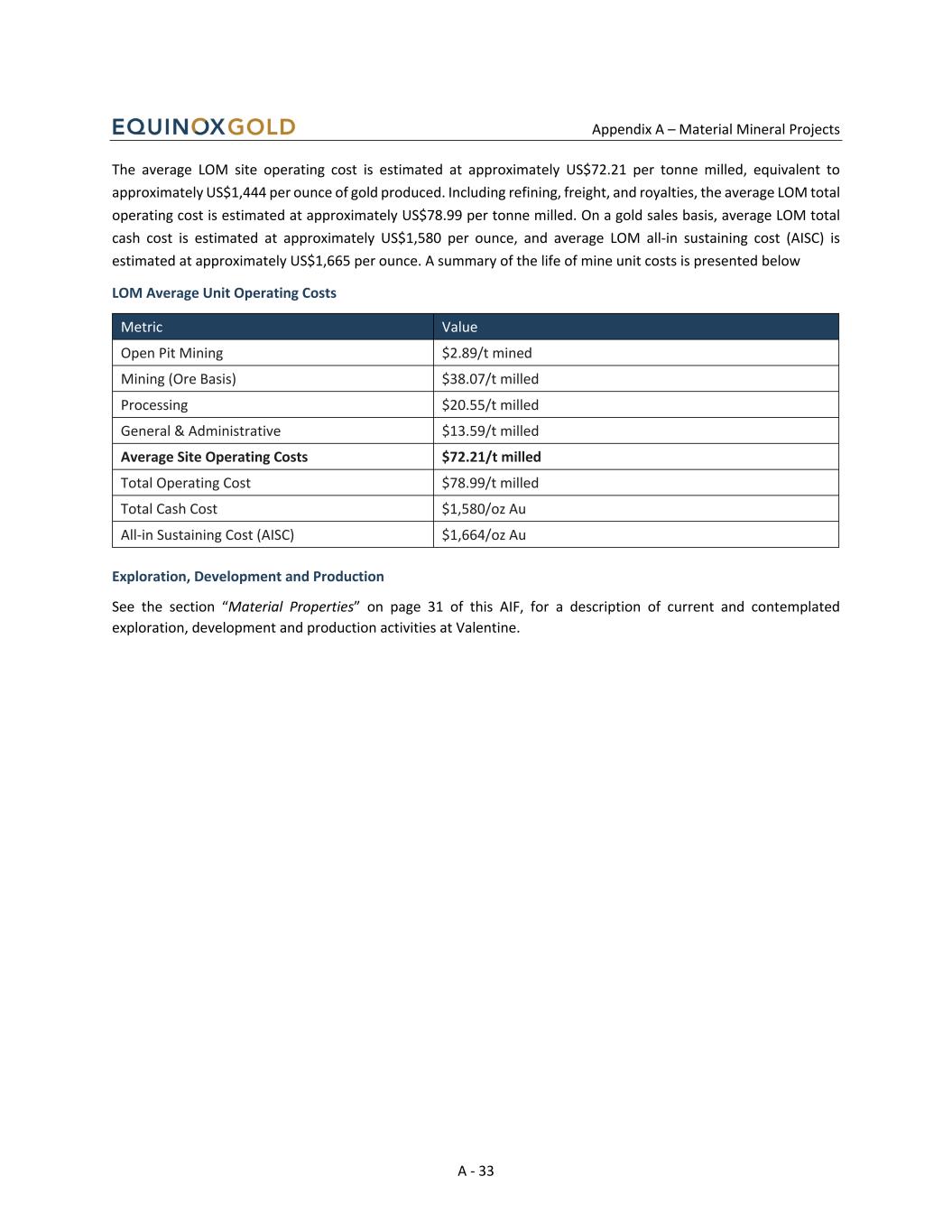
Appendix A – Material Mineral Projects A - 33 The average LOM site operating cost is estimated at approximately US$72.21 per tonne milled, equivalent to approximately US$1,444 per ounce of gold produced. Including refining, freight, and royalties, the average LOM total operating cost is estimated at approximately US$78.99 per tonne milled. On a gold sales basis, average LOM total cash cost is estimated at approximately US$1,580 per ounce, and average LOM all-in sustaining cost (AISC) is estimated at approximately US$1,665 per ounce. A summary of the life of mine unit costs is presented below LOM Average Unit Operating Costs Metric Value Open Pit Mining $2.89/t mined Mining (Ore Basis) $38.07/t milled Processing $20.55/t milled General & Administrative $13.59/t milled Average Site Operating Costs $72.21/t milled Total Operating Cost $78.99/t milled Total Cash Cost $1,580/oz Au All-in Sustaining Cost (AISC) $1,664/oz Au Exploration, Development and Production See the section “Material Properties” on page 31 of this AIF, for a description of current and contemplated exploration, development and production activities at Valentine.
Appendix B – Audit Committee Charter B - 1 APPENDIX B Audit Committee Charter I. Purpose The primary function of the Audit Committee (the “Committee”) is to assist the Board of Directors of Equinox Gold Corp. (the “Company”) in fulfilling its financial oversight responsibilities by reviewing the financial reports and other financial information provided by the Company to regulatory authorities and shareholders, the Company’s systems of internal controls regarding finance and accounting, the fairness of transactions between the Company and related parties and the Company’s auditing, accounting and financial reporting processes. Consistent with this function, the Committee will encourage continuous improvement of, and should foster adherence to, the Company’s policies, procedures and practices at all levels. The Committee’s primary duties and responsibilities are to: • Serve as an independent and objective party to monitor the Company’s financial reporting and internal control system and review the Company’s financial statements; • Review and appraise the performance and compensation of the Company’s external auditor; • Provide an open avenue of communication among the Company’s external auditor, internal auditor, financial and senior management, the Committee and the Board of Directors; and • Such other matters as the Board may delegate to the Committee. II. Composition The composition of the Committee shall include a minimum of three Directors as determined by the Board of Directors, and shall meet the independence requirements in accordance with applicable legal requirements, including the requirements of National Instrument 52-110 - Audit Committees, Part 6, and applicable stock exchange requirements, and further shall be free from any relationship that, in the opinion of the Board of Directors, could reasonably be expected to interfere with the exercise of his or her independent judgment as a member of the Committee. All members of the Committee shall have financial management experience and be financially literate and at least one member shall be financially sophisticated, in that he or she has past employment experience in finance or accounting, requisite professional certification in accounting, or any other comparable experience or background which results in the individual's financial sophistication, including but not limited to being or having been a chief executive officer, chief financial officer, other senior officer with financial oversight responsibilities. For the purposes of the Company's Charter, the definition of "financially literate" is the ability to read and understand a set of financial statements that present a breadth and level of complexity of accounting issues that are generally comparable to the breadth and complexity of the issues that can reasonably be expected to be raised by the Company's financial statements. The members of the Committee shall be appointed by the Board of Directors. Unless a Chair is elected by the full Board of Directors, the members of the Committee may designate a Chair by a majority vote of the full Committee membership. III. Meetings The Committee shall meet at least quarterly, or more frequently as circumstances dictate. The meetings will take place as the Committee or the Chair of the Committee shall determine, upon 48 hours’ notice to each of its members. The notice period may be waived by a quorum of the Committee. The Committee may ask members of Management or others to attend meetings or to provide information as necessary.
Appendix B – Audit Committee Charter B - 2 The quorum for the transaction of business at any meeting of the Committee shall be a majority of the members of the Committee or subcommittee present in person or by telephone or other telecommunication device that permits all persons participating in the meeting to speak and to hear each other. Decisions by the Committee will be by the affirmative vote of a majority of the members of the Committee, or by consent resolutions in writing signed by each member of the Committee. The Committee shall prepare and maintain minutes of its meetings, and periodically report to the Board of Directors regarding such matters as are relevant to the Committee’s discharge of its responsibilities, and shall report in writing on request of the Chairman of the Board. As part of its duty to foster open communication, the Committee will meet at least annually with the Chief Financial Officer, the internal auditor and the external auditor in separate sessions. IV. Subcommittees The Committee may form and delegate authority to one or more subcommittees, which may consist of one or more members, as it deems necessary or appropriate from time to time under the circumstances. The quorum for the transaction of business at any meeting of the Subcommittee shall be a majority of the members of the subcommittee. V. Responsibilities and Duties The Committee shall take charge of all responsibilities imparted on an audit committee of a public company, as they may apply from time to time to the Company, under applicable laws and stock exchange requirements and any other requirements of applicable regulatory and professional bodies, together with such other responsibilities as delegated by the Board to the Committee. To fulfill its responsibilities and duties, the Committee shall: Financial Reporting Processes 1. Review and recommend to the Board for approval the Company's annual and interim (quarterly) financial statements, Management’s Discussion and Analysis (“MD&A”), and any annual and interim earnings- related press releases, before the Company publicly discloses this information and any financial reports or other material financial information that are submitted to any governmental body, stock exchange or to the public, including any certification, report, opinion, or review rendered by the external auditor and, in accordance with the Company’s Communications and Corporate Disclosure Policy, material non-GAAP (generally accepted accounting principles) financial measures, non-GAAP ratios, total of segments measures, capital management measures, and supplementary financial measures (each as defined in National Instrument 52-112 – Non-GAAP and Other Financial Measures Disclosure). 2. Obtain assurance the Company has the proper systems and procedures, internal controls over financial reporting, information technology systems, and disclosure controls and procedures in place so that the Company's financial statements, MD&A, and other financial reports, other financial information, including all Company disclosure of financial information extracted or derived from the Company’s financial statements and other reports, satisfy all legal and regulatory requirements. The Audit Committee shall periodically assess the adequacy of such systems, procedures and controls. 3. In consultation with the external auditor, review with management the integrity of the Company's financial reporting process, both internal and external. 4. In connection with the annual audit, review material written matters between the external auditor and management, such as management letters, schedules of unadjusted differences and analyses of alternative assumptions, estimates or generally accepted accounting methods. 5. Consider the external auditor’s judgments about the quality and appropriateness of the Company’s accounting principles, practices and internal controls as applied in its financial reporting. 6. Consider and approve, if appropriate, changes to the Company’s accounting principles, practices and internal controls over financial reporting as suggested by the external auditor and management.
Appendix B – Audit Committee Charter B - 3 7. Review significant judgments made by management in the preparation of the financial statements and the view of the external auditor as to appropriateness of such judgments. 8. Following completion of the annual audit, review separately with management and the external auditor any significant difficulties encountered during the course of the audit, including any restrictions on the scope of work or access to required information. 9. Review and assist in the resolution of any significant disagreement between management and the external auditor in connection with the preparation of the financial statements and financial reporting generally. 10. Review with the external auditor and management the extent to which changes and improvements in financial or accounting practices have been implemented. 11. Review certification processes relating to preparation and filing of reports and financial information. 12. Establish procedures for the receipt, retention and treatment of complaints or concerns received by the Company regarding accounting, internal accounting controls or auditing matters, and for the confidential, anonymous submission by employees of the Company of concerns regarding questionable accounting or auditing matters. Internal Audit 13. Review and advise on the selection and removal of the head of internal audit and the organizational structure of the internal audit group. 14. Review the activities of the internal audit group, including its annual audit plan. 15. Periodically review, with the head of internal audit, any matters that the Committee or the head of internal audit believes should be discussed, including any significant difficulties, disagreements with management, or scope restrictions encountered in the course of the work planned or performed by the internal audit group. 16. Periodically review, with the external auditor, the internal audit group‘s responsibility, budget, and staffing. External Auditor 17. Review annually the performance of the external auditor who shall report directly to the Committee and who will be ultimately accountable to the Committee and the Board of Directors as representatives of the shareholders of the Company. 18. Obtain annually a formal written statement by the external auditor setting forth all relationships between the external auditor, including its network firms, and the Company that could reasonably be considered to bear on the independence of the auditor. Confirm with the external auditor that they are registered as a participating audit firm in good standing with the Canadian Public Accountability Board. 19. Review and discuss with the external auditor any disclosed relationships or services that may affect the objectivity and independence of the external auditor. 20. Take, or recommend that the Board of Directors take, appropriate action to oversee the independence of the external auditor. 21. Be responsible for overseeing and recommending to the Board (subject to the approval of the shareholders, where required) the appointment of the Company’s external auditor and for the compensation, retention and oversight of the work of the external auditor engaged by the Company. 22. At each meeting, consult with the external auditor, without the presence of management, about the quality of the Company’s accounting principles, internal controls and the completeness and accuracy of the Company's financial statements. 23. Review and approve the Company’s hiring policies regarding partners, employees and former partners and employees of the present and former external auditor of the Company.
Appendix B – Audit Committee Charter B - 4 24. Review with management and the external auditor the audit plan for the year-end financial statements, the intended template for such statements and oversee the audit. 25. Review and pre-approve all audit and audit-related services and the fees and other compensation related thereto, and any non-audit services provided by the Company’s external auditor and the fees and other compensation related. The pre-approval requirement is waived with respect to the provision of non-audit services by the auditor if: (i) such services were not recognized by the Company at the time of the engagement to be non- audit services; and (ii) such services are promptly brought to the attention of the Committee by the Company and approved, prior to the completion of the audit, by the Committee or by one or more members of the Committee to whom authority to grant such approvals has been delegated by the Committee. The pre-approval of non-audit services by any member to whom authority has been delegated must be presented to the Committee at its first scheduled meeting following such pre-approval. VI. Other Responsibilities Enterprise Risk Management (ERM) 26. Review the ERM process, including its annual risk management plan. 27. Provide oversight over the ERM process to assess the adequacy of its design and if it is operating effectively. 28. Receive regular reports from management on the risks the Company faces, and the status of action plans implemented by management to mitigate such risks. 29. Periodically review, with the external auditor, the ERM process, budget, and staffing. General Responsibilities 30. Review with management the Company’s financial fraud risk assessment, including an annual review of the top fraud risks identified by management, and the policies and practices adopted by the Company to mitigate those risks. 31. Review for fairness any proposed related-party transactions and make recommendations to the Board of Directors whether any such transactions should be approved. 32. Recommend to the Compensation and Nomination Committee the qualifications and criteria for membership on the Committee. 33. The Committee may retain and terminate the services of outside specialists, counsel, accountants or other consultants and advisors to the extent it deems appropriate and shall have the sole authority to approve their fees and other retention terms. The Company shall provide for appropriate funding, as determined by the Committee, for payment of compensation to any advisors retained by the Committee and to the external auditor engaged by the Company for the purpose of rendering or issuing an audit report or performing any other audit, review or attestation services and ordinary administrative expenses of the Committee that are necessary or appropriate in carrying out its duties. 34. The Committee shall evaluate its own performance at least annually and recommend to the Compensation and Nomination Committee the qualifications and criteria for membership on the Committee. 35. Perform other activities related to this Charter as requested by the board of directors. 36. Review annually the adequacy of this Charter and recommend appropriate revisions to the Board of Directors.
Appendix B – Audit Committee Charter B - 5 VII. Oversight Function While the Committee has responsibilities set out in this Charter, the members of the Committee are members of the Board appointed to provide broad oversight of the Company’s affairs and are specifically not accountable or responsible for the day to day activities, nor the administration or implementation or arrangements relating thereto. Approved by the Board of Directors Adopted: March 30, 2020 Updated: February 2023 Last Reviewed: February 2025
Appendix C – Glossary C - 1 APPENDIX C Glossary Glossary of Terms Unless otherwise defined, technical terms used in this AIF or elsewhere the materials published by the Company, have the following meanings. CIM Definition Standards are marked with an asterisk (*). Term Definition assay Analysis to determine the amount or proportion of the element of interest contained within a sample. ball mill A horizontal rotating steel cylinder which grinds ore to fine particles. The grinding is carried out by the pounding and rolling of a charge of steel balls carried within the cylinder. bullion Gold or silver in bulk before coining, or valued by weight. CIM The Canadian Institute of Mining, Metallurgy and Petroleum. concentrate A processing product containing the valuable ore mineral from which most of the waste mineral has been eliminated. core Cylindrical rock cores produced by diamond drilling method that uses a rotating barrel and an annular-shaped, diamond-impregnated rock-cutting bit to produce cores and lift them to the surface to be examined. crushing Breaking of ore into smaller and more uniform fragments to be then fed to grinding mills or to a leach pad. crust The outermost solid shell of a rocky planet, which is chemically distinct from the underlying mantle. cyanidation A method of extracting exposed gold or silver grains from crushed or ground ore by dissolving the contained gold and silver in a weak cyanide solution. doré Unrefined gold and silver bullion bars, which will be further refined to almost pure metal. electrowinning Recovery of a metal from a solution by means of electro-chemical processes. epithermal A hydrothermal mineral deposit formed within about one kilometre of the Earth’s surface and in the temperature range of 50 to 200 degrees Celsius, occurring mainly as veins. fault A fracture in the earth’s crust accompanied by a displacement of one side of the fracture with respect to the other and in a direction parallel to the fracture. feasibility study A comprehensive technical and economic study of the selected development option for a mineral project that includes appropriately detailed assessments of applicable modifying factors together with any other relevant operational factors and detailed financial analysis, that are necessary to demonstrate at the time of reporting that extraction is reasonably justified (economically mineable). The results of the study may reasonably serve as the basis for a final decision by a proponent or financial institution to proceed with, or finance, the development of the project. The confidence level of the study will be higher than that of a pre-feasibility study. fire assay Analysis to determine the amount or proportion of the element of interest contained within a sample alloy by removal of other metals. Also known as gravimetric analysis.
Appendix C – Glossary C - 2 Term Definition formation Unit of sedimentary rock of characteristic composition or genesis. geophysical surveying Exploration activity mapping an area showing the physics of the earth. grade The amount of metal in each tonne of ore, expressed as grams per tonne for precious metals. granite A very hard, granular, crystalline, igneous rock consisting mainly of quartz, mica, and feldspar and often used as a building stone. grinding (milling) Powdering or pulverizing of ore, by pressure or abrasion, to liberate valuable minerals for further metallurgical processing. heap leaching A process whereby gold is extracted by placing broken ore on impermeable pads and repeatedly spraying the heaps with a weak cyanide solution to recover gold from the ore. The solution carrying the gold is then collected for gold recovery. hectares A metric unit of area measuring 100 metres by 100 metres. igneous rock Igneous rock forms when hot, molten rock crystallizes and solidifies. The melt originates deep within the Earth near active plate boundaries or hot spots, then rises toward the surface. Igneous rocks are divided into two groups, intrusive or extrusive, depending on where the molten rock solidified. Indicated Mineral Resource* The part of a Mineral Resource for which quantity, grade or quality, densities, shape and physical characteristics are estimated with sufficient confidence to allow the application of Modifying Factors in sufficient detail to support mine planning and evaluation of the economic viability of the deposit. Geological evidence is derived from detailed and reliable exploration, sampling and testing and is sufficient to assume geological and grade or quality continuity between points of observation. An Indicated Mineral Resource has a lower level of confidence than that applying to a Measured Mineral Resource and may only be converted to a Probable Mineral Reserve. Inferred Mineral Resource* The part of a Mineral Resource for which quantity and grade or quality are estimated on the basis of limited geological evidence and sampling. Geological evidence is sufficient to imply but not verify geological and grade or quality continuity. An Inferred Mineral Resource has a lower level of confidence than that applying to an Indicated Mineral Resource and must not be converted to a Mineral Reserve. It is reasonably expected that the majority of Inferred Mineral Resources could be upgraded to Indicated Mineral Resources with continued exploration. intrusive Igneous rock which, while molten, penetrated into or between other rocks and solidified before reaching the surface. life-of-mine (LOM) The plan for how the Company will mine in a particular area and for how long. lode A mineral deposit, consisting of a zone of veins, veinlets or disseminations, in consolidated rock as opposed to a placer deposit. low-grade Descriptive of ores relatively poor in the metal they are mined for; lean ore. mafic A group of dark-colored minerals, composed chiefly of magnesium and iron, that occur in igneous rocks.
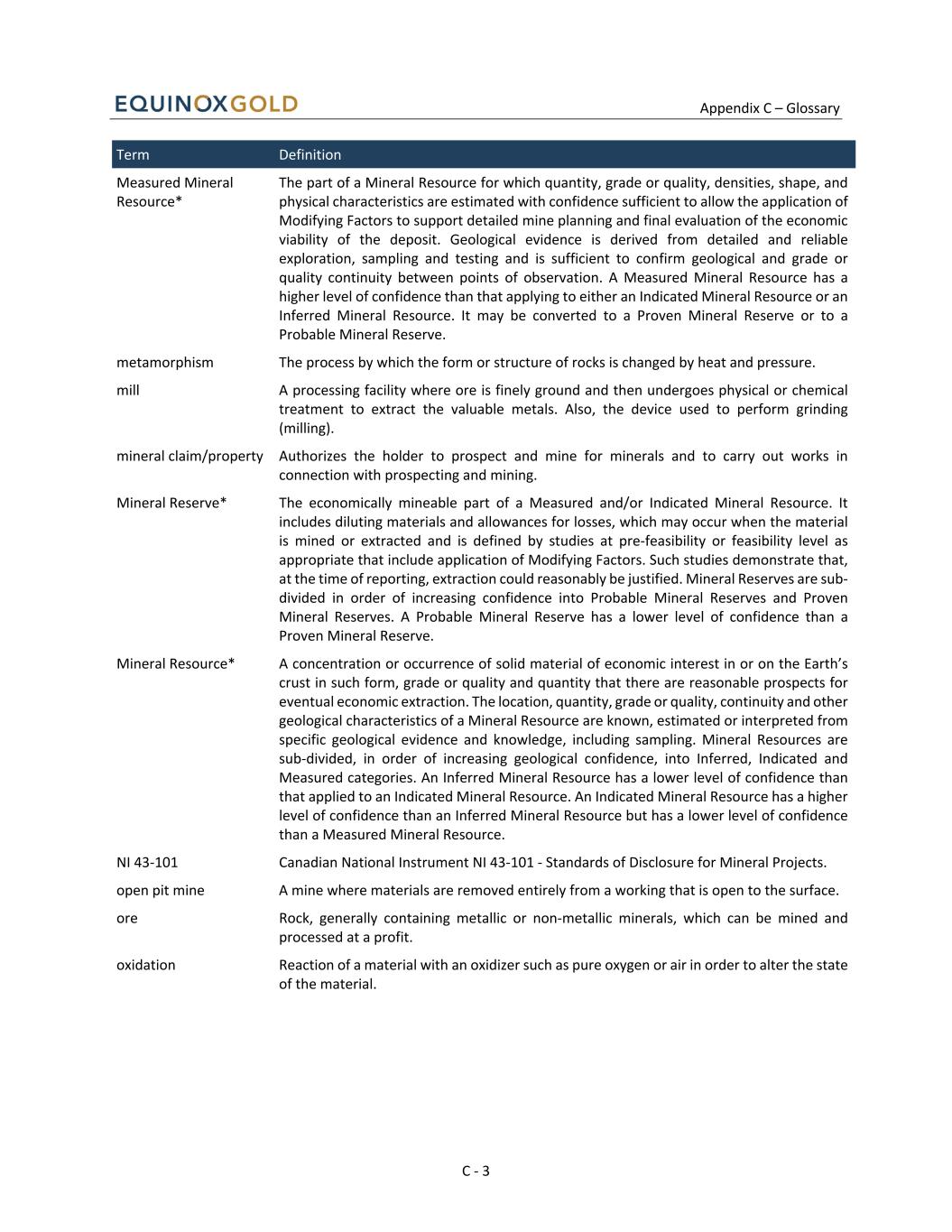
Appendix C – Glossary C - 3 Term Definition Measured Mineral Resource* The part of a Mineral Resource for which quantity, grade or quality, densities, shape, and physical characteristics are estimated with confidence sufficient to allow the application of Modifying Factors to support detailed mine planning and final evaluation of the economic viability of the deposit. Geological evidence is derived from detailed and reliable exploration, sampling and testing and is sufficient to confirm geological and grade or quality continuity between points of observation. A Measured Mineral Resource has a higher level of confidence than that applying to either an Indicated Mineral Resource or an Inferred Mineral Resource. It may be converted to a Proven Mineral Reserve or to a Probable Mineral Reserve. metamorphism The process by which the form or structure of rocks is changed by heat and pressure. mill A processing facility where ore is finely ground and then undergoes physical or chemical treatment to extract the valuable metals. Also, the device used to perform grinding (milling). mineral claim/property Authorizes the holder to prospect and mine for minerals and to carry out works in connection with prospecting and mining. Mineral Reserve* The economically mineable part of a Measured and/or Indicated Mineral Resource. It includes diluting materials and allowances for losses, which may occur when the material is mined or extracted and is defined by studies at pre-feasibility or feasibility level as appropriate that include application of Modifying Factors. Such studies demonstrate that, at the time of reporting, extraction could reasonably be justified. Mineral Reserves are sub- divided in order of increasing confidence into Probable Mineral Reserves and Proven Mineral Reserves. A Probable Mineral Reserve has a lower level of confidence than a Proven Mineral Reserve. Mineral Resource* A concentration or occurrence of solid material of economic interest in or on the Earth’s crust in such form, grade or quality and quantity that there are reasonable prospects for eventual economic extraction. The location, quantity, grade or quality, continuity and other geological characteristics of a Mineral Resource are known, estimated or interpreted from specific geological evidence and knowledge, including sampling. Mineral Resources are sub-divided, in order of increasing geological confidence, into Inferred, Indicated and Measured categories. An Inferred Mineral Resource has a lower level of confidence than that applied to an Indicated Mineral Resource. An Indicated Mineral Resource has a higher level of confidence than an Inferred Mineral Resource but has a lower level of confidence than a Measured Mineral Resource. NI 43-101 Canadian National Instrument NI 43-101 - Standards of Disclosure for Mineral Projects. open pit mine A mine where materials are removed entirely from a working that is open to the surface. ore Rock, generally containing metallic or non-metallic minerals, which can be mined and processed at a profit. oxidation Reaction of a material with an oxidizer such as pure oxygen or air in order to alter the state of the material.
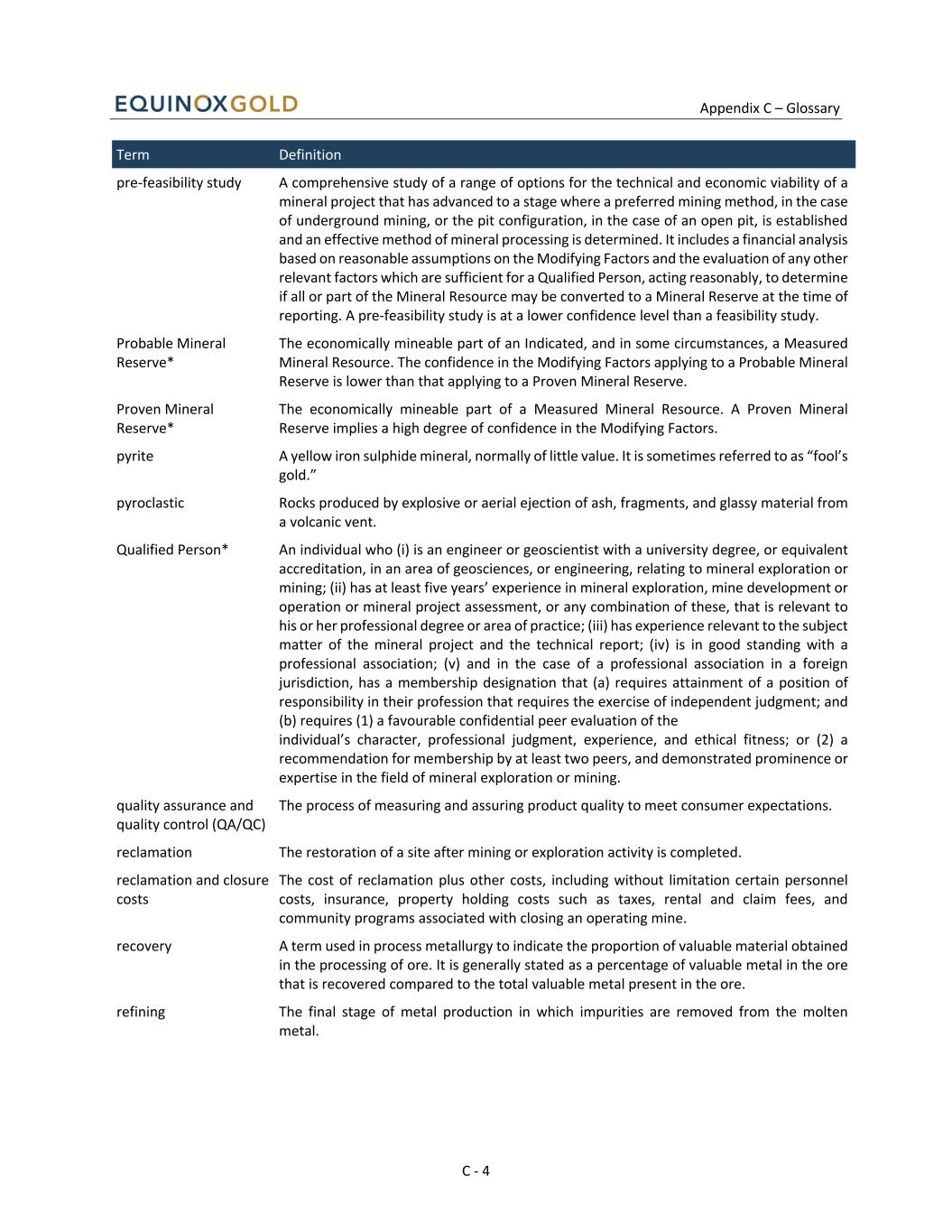
Appendix C – Glossary C - 4 Term Definition pre-feasibility study A comprehensive study of a range of options for the technical and economic viability of a mineral project that has advanced to a stage where a preferred mining method, in the case of underground mining, or the pit configuration, in the case of an open pit, is established and an effective method of mineral processing is determined. It includes a financial analysis based on reasonable assumptions on the Modifying Factors and the evaluation of any other relevant factors which are sufficient for a Qualified Person, acting reasonably, to determine if all or part of the Mineral Resource may be converted to a Mineral Reserve at the time of reporting. A pre-feasibility study is at a lower confidence level than a feasibility study. Probable Mineral Reserve* The economically mineable part of an Indicated, and in some circumstances, a Measured Mineral Resource. The confidence in the Modifying Factors applying to a Probable Mineral Reserve is lower than that applying to a Proven Mineral Reserve. Proven Mineral Reserve* The economically mineable part of a Measured Mineral Resource. A Proven Mineral Reserve implies a high degree of confidence in the Modifying Factors. pyrite A yellow iron sulphide mineral, normally of little value. It is sometimes referred to as “fool’s gold.” pyroclastic Rocks produced by explosive or aerial ejection of ash, fragments, and glassy material from a volcanic vent. Qualified Person* An individual who (i) is an engineer or geoscientist with a university degree, or equivalent accreditation, in an area of geosciences, or engineering, relating to mineral exploration or mining; (ii) has at least five years’ experience in mineral exploration, mine development or operation or mineral project assessment, or any combination of these, that is relevant to his or her professional degree or area of practice; (iii) has experience relevant to the subject matter of the mineral project and the technical report; (iv) is in good standing with a professional association; (v) and in the case of a professional association in a foreign jurisdiction, has a membership designation that (a) requires attainment of a position of responsibility in their profession that requires the exercise of independent judgment; and (b) requires (1) a favourable confidential peer evaluation of the individual’s character, professional judgment, experience, and ethical fitness; or (2) a recommendation for membership by at least two peers, and demonstrated prominence or expertise in the field of mineral exploration or mining. quality assurance and quality control (QA/QC) The process of measuring and assuring product quality to meet consumer expectations. reclamation The restoration of a site after mining or exploration activity is completed. reclamation and closure costs The cost of reclamation plus other costs, including without limitation certain personnel costs, insurance, property holding costs such as taxes, rental and claim fees, and community programs associated with closing an operating mine. recovery A term used in process metallurgy to indicate the proportion of valuable material obtained in the processing of ore. It is generally stated as a percentage of valuable metal in the ore that is recovered compared to the total valuable metal present in the ore. refining The final stage of metal production in which impurities are removed from the molten metal.
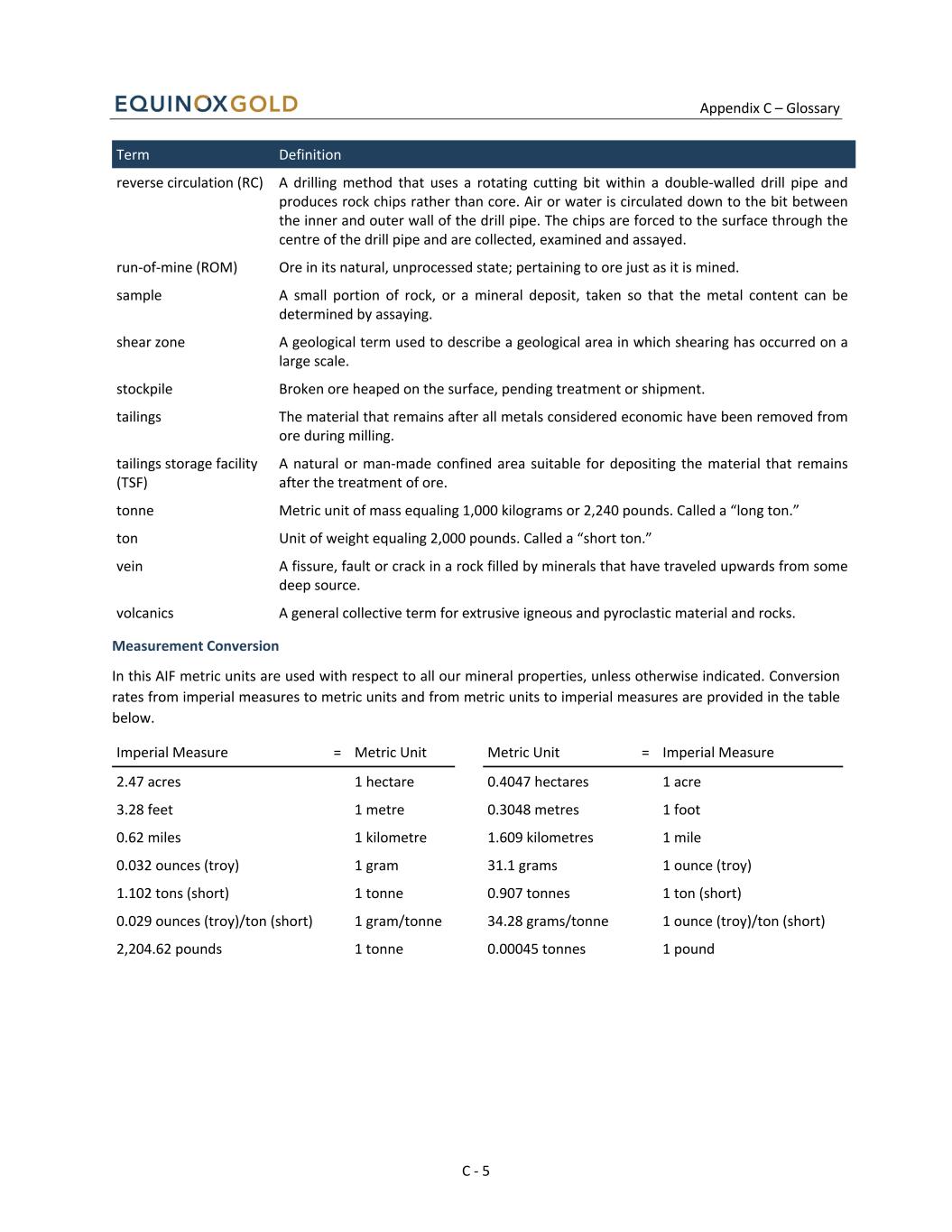
Appendix C – Glossary C - 5 Term Definition reverse circulation (RC) A drilling method that uses a rotating cutting bit within a double-walled drill pipe and produces rock chips rather than core. Air or water is circulated down to the bit between the inner and outer wall of the drill pipe. The chips are forced to the surface through the centre of the drill pipe and are collected, examined and assayed. run-of-mine (ROM) Ore in its natural, unprocessed state; pertaining to ore just as it is mined. sample A small portion of rock, or a mineral deposit, taken so that the metal content can be determined by assaying. shear zone A geological term used to describe a geological area in which shearing has occurred on a large scale. stockpile Broken ore heaped on the surface, pending treatment or shipment. tailings The material that remains after all metals considered economic have been removed from ore during milling. tailings storage facility (TSF) A natural or man-made confined area suitable for depositing the material that remains after the treatment of ore. tonne Metric unit of mass equaling 1,000 kilograms or 2,240 pounds. Called a “long ton.” ton Unit of weight equaling 2,000 pounds. Called a “short ton.” vein A fissure, fault or crack in a rock filled by minerals that have traveled upwards from some deep source. volcanics A general collective term for extrusive igneous and pyroclastic material and rocks. Measurement Conversion In this AIF metric units are used with respect to all our mineral properties, unless otherwise indicated. Conversion rates from imperial measures to metric units and from metric units to imperial measures are provided in the table below. Imperial Measure = Metric Unit Metric Unit = Imperial Measure 2.47 acres 1 hectare 0.4047 hectares 1 acre 3.28 feet 1 metre 0.3048 metres 1 foot 0.62 miles 1 kilometre 1.609 kilometres 1 mile 0.032 ounces (troy) 1 gram 31.1 grams 1 ounce (troy) 1.102 tons (short) 1 tonne 0.907 tonnes 1 ton (short) 0.029 ounces (troy)/ton (short) 1 gram/tonne 34.28 grams/tonne 1 ounce (troy)/ton (short) 2,204.62 pounds 1 tonne 0.00045 tonnes 1 pound
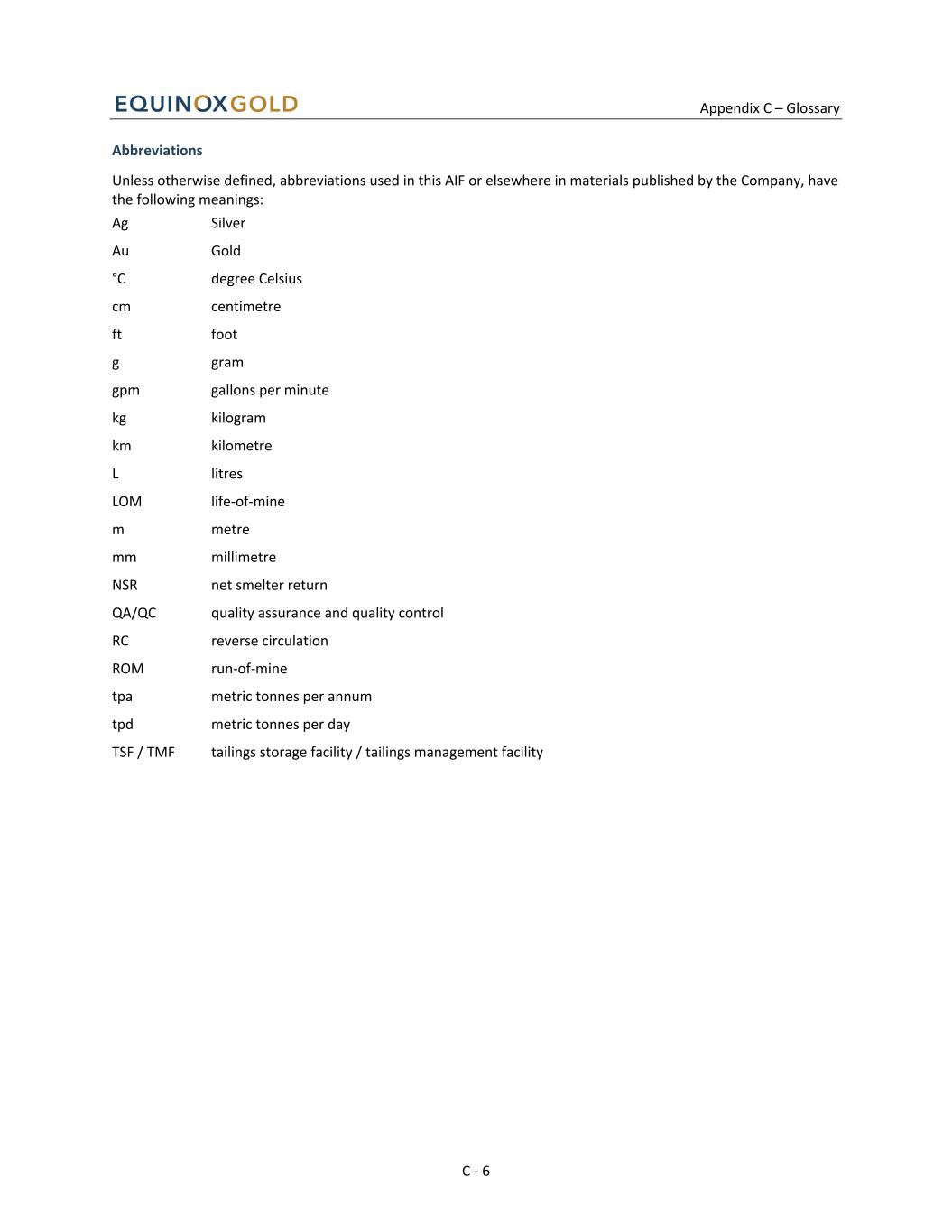
Appendix C – Glossary C - 6 Abbreviations Unless otherwise defined, abbreviations used in this AIF or elsewhere in materials published by the Company, have the following meanings: Ag Silver Au Gold °C degree Celsius cm centimetre ft foot g gram gpm gallons per minute kg kilogram km kilometre L litres LOM life-of-mine m metre mm millimetre NSR net smelter return QA/QC quality assurance and quality control RC reverse circulation ROM run-of-mine tpa metric tonnes per annum tpd metric tonnes per day TSF / TMF tailings storage facility / tailings management facility
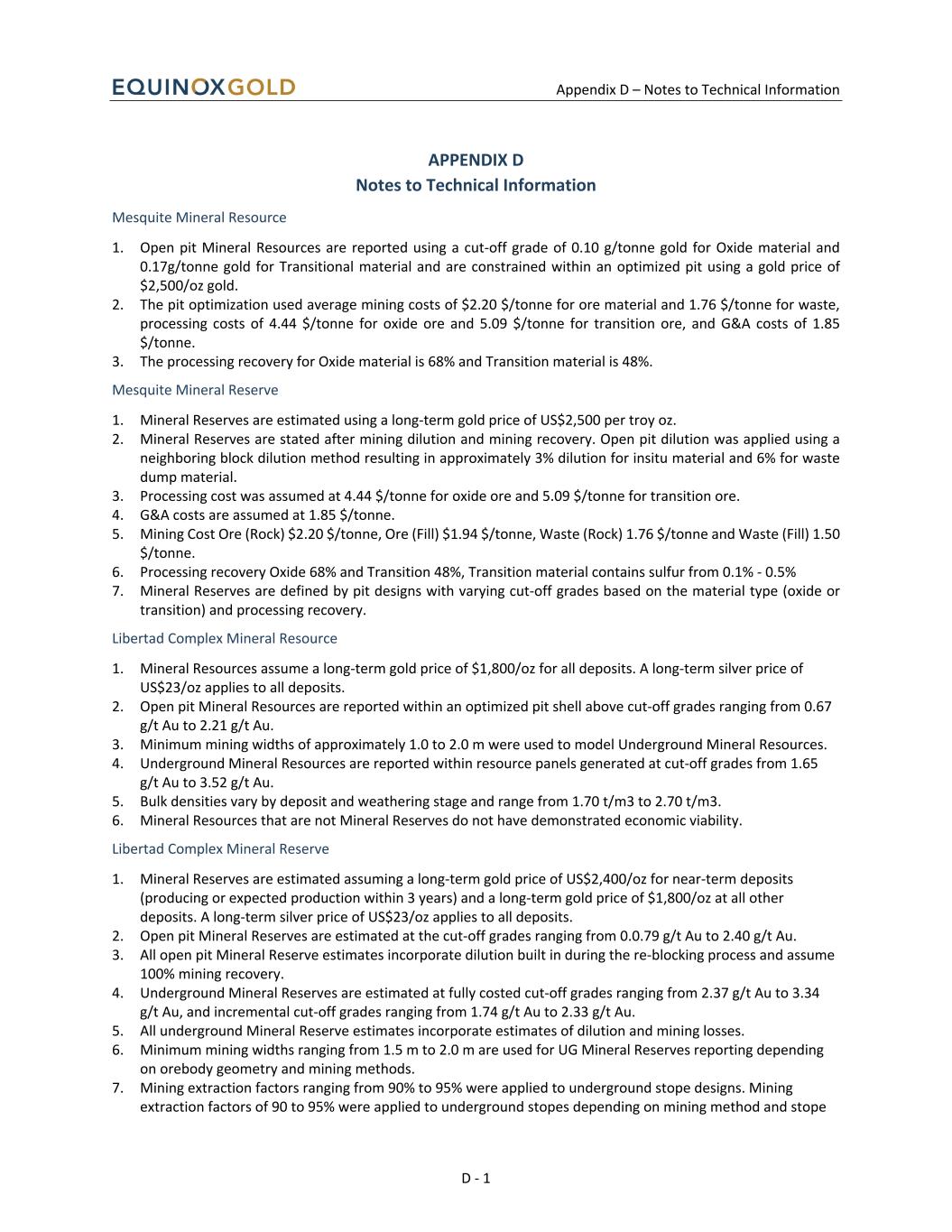
Appendix D – Notes to Technical Information D - 1 APPENDIX D Notes to Technical Information Mesquite Mineral Resource 1. Open pit Mineral Resources are reported using a cut-off grade of 0.10 g/tonne gold for Oxide material and 0.17g/tonne gold for Transitional material and are constrained within an optimized pit using a gold price of $2,500/oz gold. 2. The pit optimization used average mining costs of $2.20 $/tonne for ore material and 1.76 $/tonne for waste, processing costs of 4.44 $/tonne for oxide ore and 5.09 $/tonne for transition ore, and G&A costs of 1.85 $/tonne. 3. The processing recovery for Oxide material is 68% and Transition material is 48%. Mesquite Mineral Reserve 1. Mineral Reserves are estimated using a long-term gold price of US$2,500 per troy oz. 2. Mineral Reserves are stated after mining dilution and mining recovery. Open pit dilution was applied using a neighboring block dilution method resulting in approximately 3% dilution for insitu material and 6% for waste dump material. 3. Processing cost was assumed at 4.44 $/tonne for oxide ore and 5.09 $/tonne for transition ore. 4. G&A costs are assumed at 1.85 $/tonne. 5. Mining Cost Ore (Rock) $2.20 $/tonne, Ore (Fill) $1.94 $/tonne, Waste (Rock) 1.76 $/tonne and Waste (Fill) 1.50 $/tonne. 6. Processing recovery Oxide 68% and Transition 48%, Transition material contains sulfur from 0.1% - 0.5% 7. Mineral Reserves are defined by pit designs with varying cut-off grades based on the material type (oxide or transition) and processing recovery. Libertad Complex Mineral Resource 1. Mineral Resources assume a long-term gold price of $1,800/oz for all deposits. A long-term silver price of US$23/oz applies to all deposits. 2. Open pit Mineral Resources are reported within an optimized pit shell above cut-off grades ranging from 0.67 g/t Au to 2.21 g/t Au. 3. Minimum mining widths of approximately 1.0 to 2.0 m were used to model Underground Mineral Resources. 4. Underground Mineral Resources are reported within resource panels generated at cut-off grades from 1.65 g/t Au to 3.52 g/t Au. 5. Bulk densities vary by deposit and weathering stage and range from 1.70 t/m3 to 2.70 t/m3. 6. Mineral Resources that are not Mineral Reserves do not have demonstrated economic viability. Libertad Complex Mineral Reserve 1. Mineral Reserves are estimated assuming a long-term gold price of US$2,400/oz for near-term deposits (producing or expected production within 3 years) and a long-term gold price of $1,800/oz at all other deposits. A long-term silver price of US$23/oz applies to all deposits. 2. Open pit Mineral Reserves are estimated at the cut-off grades ranging from 0.0.79 g/t Au to 2.40 g/t Au. 3. All open pit Mineral Reserve estimates incorporate dilution built in during the re-blocking process and assume 100% mining recovery. 4. Underground Mineral Reserves are estimated at fully costed cut-off grades ranging from 2.37 g/t Au to 3.34 g/t Au, and incremental cut-off grades ranging from 1.74 g/t Au to 2.33 g/t Au. 5. All underground Mineral Reserve estimates incorporate estimates of dilution and mining losses. 6. Minimum mining widths ranging from 1.5 m to 2.0 m are used for UG Mineral Reserves reporting depending on orebody geometry and mining methods. 7. Mining extraction factors ranging from 90% to 95% were applied to underground stope designs. Mining extraction factors of 90 to 95% were applied to underground stopes depending on mining method and stope
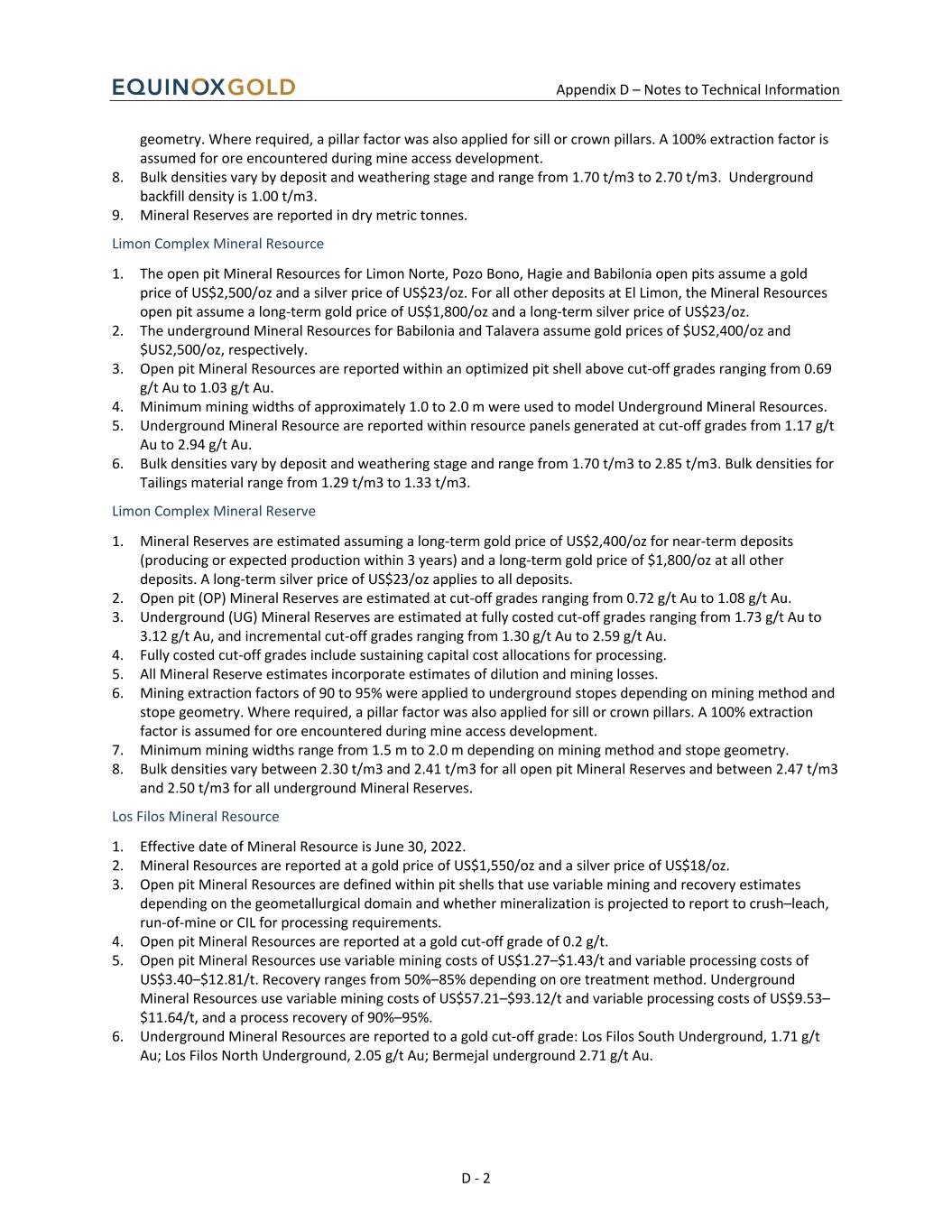
Appendix D – Notes to Technical Information D - 2 geometry. Where required, a pillar factor was also applied for sill or crown pillars. A 100% extraction factor is assumed for ore encountered during mine access development. 8. Bulk densities vary by deposit and weathering stage and range from 1.70 t/m3 to 2.70 t/m3. Underground backfill density is 1.00 t/m3. 9. Mineral Reserves are reported in dry metric tonnes. Limon Complex Mineral Resource 1. The open pit Mineral Resources for Limon Norte, Pozo Bono, Hagie and Babilonia open pits assume a gold price of US$2,500/oz and a silver price of US$23/oz. For all other deposits at El Limon, the Mineral Resources open pit assume a long-term gold price of US$1,800/oz and a long-term silver price of US$23/oz. 2. The underground Mineral Resources for Babilonia and Talavera assume gold prices of $US2,400/oz and $US2,500/oz, respectively. 3. Open pit Mineral Resources are reported within an optimized pit shell above cut-off grades ranging from 0.69 g/t Au to 1.03 g/t Au. 4. Minimum mining widths of approximately 1.0 to 2.0 m were used to model Underground Mineral Resources. 5. Underground Mineral Resource are reported within resource panels generated at cut-off grades from 1.17 g/t Au to 2.94 g/t Au. 6. Bulk densities vary by deposit and weathering stage and range from 1.70 t/m3 to 2.85 t/m3. Bulk densities for Tailings material range from 1.29 t/m3 to 1.33 t/m3. Limon Complex Mineral Reserve 1. Mineral Reserves are estimated assuming a long-term gold price of US$2,400/oz for near-term deposits (producing or expected production within 3 years) and a long-term gold price of $1,800/oz at all other deposits. A long-term silver price of US$23/oz applies to all deposits. 2. Open pit (OP) Mineral Reserves are estimated at cut-off grades ranging from 0.72 g/t Au to 1.08 g/t Au. 3. Underground (UG) Mineral Reserves are estimated at fully costed cut-off grades ranging from 1.73 g/t Au to 3.12 g/t Au, and incremental cut-off grades ranging from 1.30 g/t Au to 2.59 g/t Au. 4. Fully costed cut-off grades include sustaining capital cost allocations for processing. 5. All Mineral Reserve estimates incorporate estimates of dilution and mining losses. 6. Mining extraction factors of 90 to 95% were applied to underground stopes depending on mining method and stope geometry. Where required, a pillar factor was also applied for sill or crown pillars. A 100% extraction factor is assumed for ore encountered during mine access development. 7. Minimum mining widths range from 1.5 m to 2.0 m depending on mining method and stope geometry. 8. Bulk densities vary between 2.30 t/m3 and 2.41 t/m3 for all open pit Mineral Reserves and between 2.47 t/m3 and 2.50 t/m3 for all underground Mineral Reserves. Los Filos Mineral Resource 1. Effective date of Mineral Resource is June 30, 2022. 2. Mineral Resources are reported at a gold price of US$1,550/oz and a silver price of US$18/oz. 3. Open pit Mineral Resources are defined within pit shells that use variable mining and recovery estimates depending on the geometallurgical domain and whether mineralization is projected to report to crush–leach, run-of-mine or CIL for processing requirements. 4. Open pit Mineral Resources are reported at a gold cut-off grade of 0.2 g/t. 5. Open pit Mineral Resources use variable mining costs of US$1.27–$1.43/t and variable processing costs of US$3.40–$12.81/t. Recovery ranges from 50%–85% depending on ore treatment method. Underground Mineral Resources use variable mining costs of US$57.21–$93.12/t and variable processing costs of US$9.53– $11.64/t, and a process recovery of 90%–95%. 6. Underground Mineral Resources are reported to a gold cut-off grade: Los Filos South Underground, 1.71 g/t Au; Los Filos North Underground, 2.05 g/t Au; Bermejal underground 2.71 g/t Au.
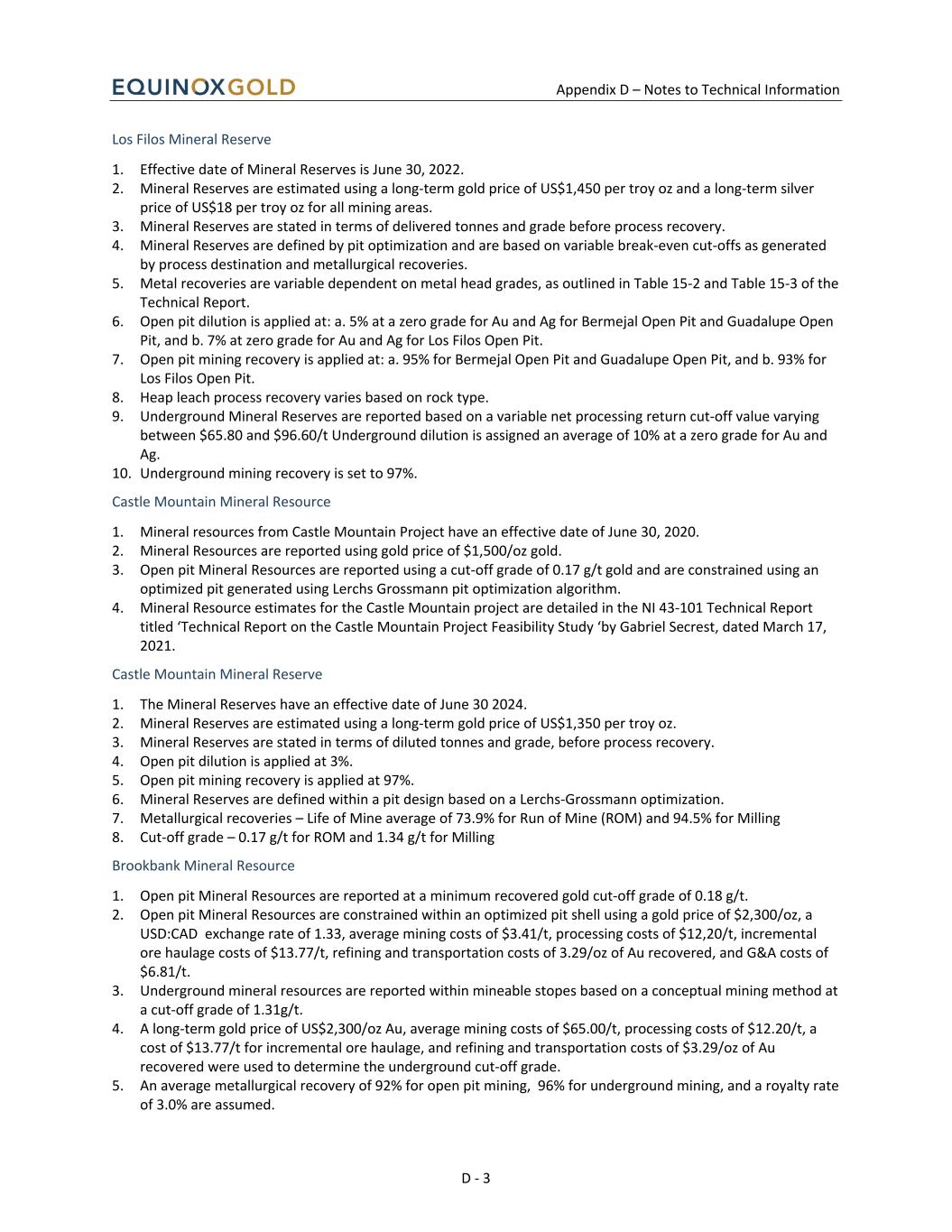
Appendix D – Notes to Technical Information D - 3 Los Filos Mineral Reserve 1. Effective date of Mineral Reserves is June 30, 2022. 2. Mineral Reserves are estimated using a long-term gold price of US$1,450 per troy oz and a long-term silver price of US$18 per troy oz for all mining areas. 3. Mineral Reserves are stated in terms of delivered tonnes and grade before process recovery. 4. Mineral Reserves are defined by pit optimization and are based on variable break-even cut-offs as generated by process destination and metallurgical recoveries. 5. Metal recoveries are variable dependent on metal head grades, as outlined in Table 15-2 and Table 15-3 of the Technical Report. 6. Open pit dilution is applied at: a. 5% at a zero grade for Au and Ag for Bermejal Open Pit and Guadalupe Open Pit, and b. 7% at zero grade for Au and Ag for Los Filos Open Pit. 7. Open pit mining recovery is applied at: a. 95% for Bermejal Open Pit and Guadalupe Open Pit, and b. 93% for Los Filos Open Pit. 8. Heap leach process recovery varies based on rock type. 9. Underground Mineral Reserves are reported based on a variable net processing return cut-off value varying between $65.80 and $96.60/t Underground dilution is assigned an average of 10% at a zero grade for Au and Ag. 10. Underground mining recovery is set to 97%. Castle Mountain Mineral Resource 1. Mineral resources from Castle Mountain Project have an effective date of June 30, 2020. 2. Mineral Resources are reported using gold price of $1,500/oz gold. 3. Open pit Mineral Resources are reported using a cut-off grade of 0.17 g/t gold and are constrained using an optimized pit generated using Lerchs Grossmann pit optimization algorithm. 4. Mineral Resource estimates for the Castle Mountain project are detailed in the NI 43-101 Technical Report titled ‘Technical Report on the Castle Mountain Project Feasibility Study ‘by Gabriel Secrest, dated March 17, 2021. Castle Mountain Mineral Reserve 1. The Mineral Reserves have an effective date of June 30 2024. 2. Mineral Reserves are estimated using a long-term gold price of US$1,350 per troy oz. 3. Mineral Reserves are stated in terms of diluted tonnes and grade, before process recovery. 4. Open pit dilution is applied at 3%. 5. Open pit mining recovery is applied at 97%. 6. Mineral Reserves are defined within a pit design based on a Lerchs-Grossmann optimization. 7. Metallurgical recoveries – Life of Mine average of 73.9% for Run of Mine (ROM) and 94.5% for Milling 8. Cut-off grade – 0.17 g/t for ROM and 1.34 g/t for Milling Brookbank Mineral Resource 1. Open pit Mineral Resources are reported at a minimum recovered gold cut-off grade of 0.18 g/t. 2. Open pit Mineral Resources are constrained within an optimized pit shell using a gold price of $2,300/oz, a USD:CAD exchange rate of 1.33, average mining costs of $3.41/t, processing costs of $12,20/t, incremental ore haulage costs of $13.77/t, refining and transportation costs of 3.29/oz of Au recovered, and G&A costs of $6.81/t. 3. Underground mineral resources are reported within mineable stopes based on a conceptual mining method at a cut-off grade of 1.31g/t. 4. A long-term gold price of US$2,300/oz Au, average mining costs of $65.00/t, processing costs of $12.20/t, a cost of $13.77/t for incremental ore haulage, and refining and transportation costs of $3.29/oz of Au recovered were used to determine the underground cut-off grade. 5. An average metallurgical recovery of 92% for open pit mining, 96% for underground mining, and a royalty rate of 3.0% are assumed.
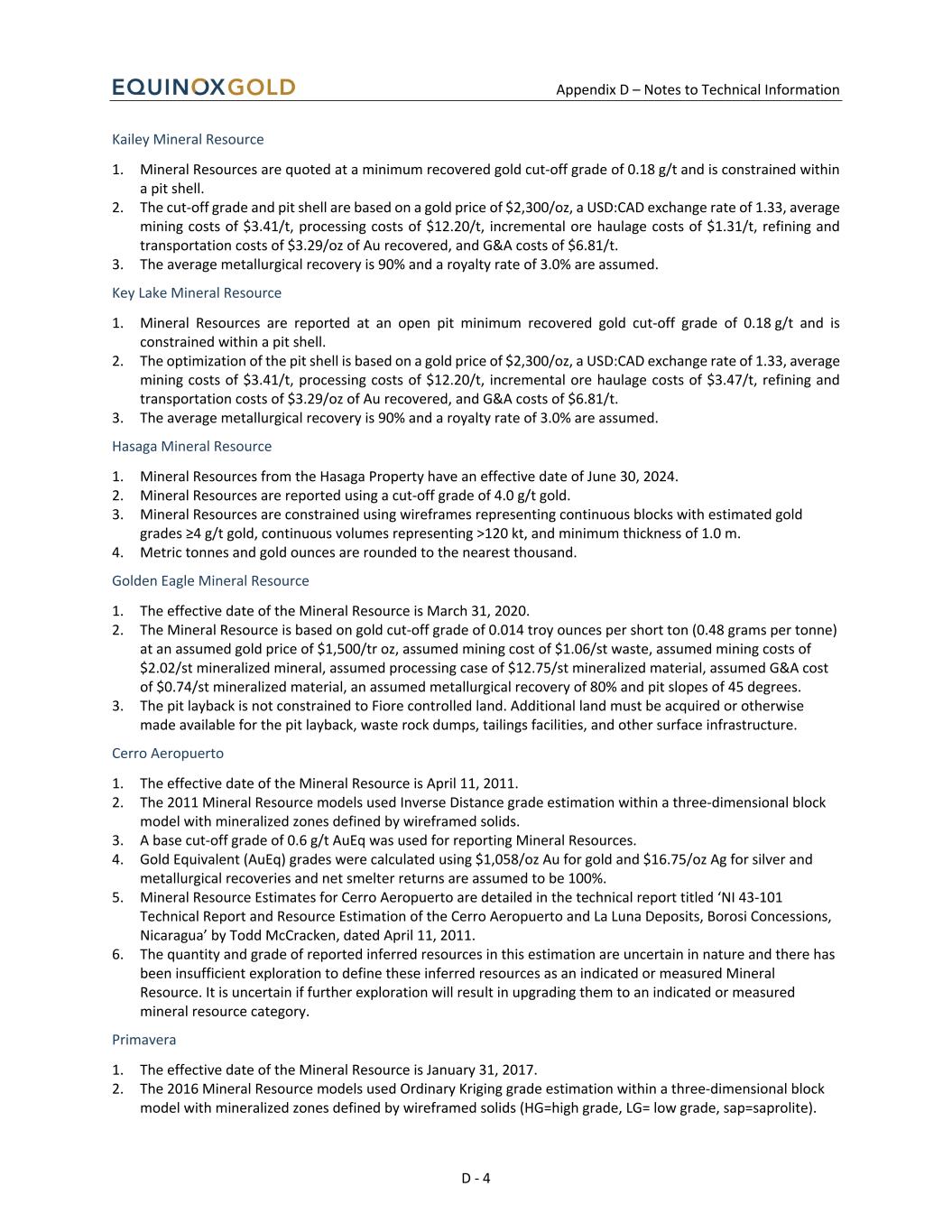
Appendix D – Notes to Technical Information D - 4 Kailey Mineral Resource 1. Mineral Resources are quoted at a minimum recovered gold cut-off grade of 0.18 g/t and is constrained within a pit shell. 2. The cut-off grade and pit shell are based on a gold price of $2,300/oz, a USD:CAD exchange rate of 1.33, average mining costs of $3.41/t, processing costs of $12.20/t, incremental ore haulage costs of $1.31/t, refining and transportation costs of $3.29/oz of Au recovered, and G&A costs of $6.81/t. 3. The average metallurgical recovery is 90% and a royalty rate of 3.0% are assumed. Key Lake Mineral Resource 1. Mineral Resources are reported at an open pit minimum recovered gold cut-off grade of 0.18 g/t and is constrained within a pit shell. 2. The optimization of the pit shell is based on a gold price of $2,300/oz, a USD:CAD exchange rate of 1.33, average mining costs of $3.41/t, processing costs of $12.20/t, incremental ore haulage costs of $3.47/t, refining and transportation costs of $3.29/oz of Au recovered, and G&A costs of $6.81/t. 3. The average metallurgical recovery is 90% and a royalty rate of 3.0% are assumed. Hasaga Mineral Resource 1. Mineral Resources from the Hasaga Property have an effective date of June 30, 2024. 2. Mineral Resources are reported using a cut-off grade of 4.0 g/t gold. 3. Mineral Resources are constrained using wireframes representing continuous blocks with estimated gold grades ≥4 g/t gold, continuous volumes representing >120 kt, and minimum thickness of 1.0 m. 4. Metric tonnes and gold ounces are rounded to the nearest thousand. Golden Eagle Mineral Resource 1. The effective date of the Mineral Resource is March 31, 2020. 2. The Mineral Resource is based on gold cut-off grade of 0.014 troy ounces per short ton (0.48 grams per tonne) at an assumed gold price of $1,500/tr oz, assumed mining cost of $1.06/st waste, assumed mining costs of $2.02/st mineralized mineral, assumed processing case of $12.75/st mineralized material, assumed G&A cost of $0.74/st mineralized material, an assumed metallurgical recovery of 80% and pit slopes of 45 degrees. 3. The pit layback is not constrained to Fiore controlled land. Additional land must be acquired or otherwise made available for the pit layback, waste rock dumps, tailings facilities, and other surface infrastructure. Cerro Aeropuerto 1. The effective date of the Mineral Resource is April 11, 2011. 2. The 2011 Mineral Resource models used Inverse Distance grade estimation within a three-dimensional block model with mineralized zones defined by wireframed solids. 3. A base cut-off grade of 0.6 g/t AuEq was used for reporting Mineral Resources. 4. Gold Equivalent (AuEq) grades were calculated using $1,058/oz Au for gold and $16.75/oz Ag for silver and metallurgical recoveries and net smelter returns are assumed to be 100%. 5. Mineral Resource Estimates for Cerro Aeropuerto are detailed in the technical report titled ‘NI 43-101 Technical Report and Resource Estimation of the Cerro Aeropuerto and La Luna Deposits, Borosi Concessions, Nicaragua’ by Todd McCracken, dated April 11, 2011. 6. The quantity and grade of reported inferred resources in this estimation are uncertain in nature and there has been insufficient exploration to define these inferred resources as an indicated or measured Mineral Resource. It is uncertain if further exploration will result in upgrading them to an indicated or measured mineral resource category. Primavera 1. The effective date of the Mineral Resource is January 31, 2017. 2. The 2016 Mineral Resource models used Ordinary Kriging grade estimation within a three-dimensional block model with mineralized zones defined by wireframed solids (HG=high grade, LG= low grade, sap=saprolite).

Appendix D – Notes to Technical Information D - 5 3. A base cut-off grade of 0.5 g/t AuEq was used for reporting Mineral Resources. 4. Gold Equivalent (AuEq) grades have been calculated using $1300/oz Au for gold, $2.40/lb for Copper, and $20.00/oz Ag for silver and metallurgical recoveries are assumed to be equal for all metals. 5. The quantity and grade of reported Inferred resources in this estimation are uncertain in nature and there has been insufficient exploration to define these Inferred resources as an indicated or measured resource. It is uncertain if further exploration will result in upgrading them to indicated or measure mineral resource category.