Exhibit 99.1
ANFIELD ENERGY INC.
Annual Information Form
For the year ended December 31, 2025
March 30, 2026
TABLE OF CONTENTS
| FORWARD LOOKING STATEMENTS | 1 | ||
| DEFINITIONS AND OTHER INFORMATION | 3 | ||
| References | 3 | ||
| Currency | 3 | ||
| Technical Disclosure | 3 | ||
| Third-Party Information | 4 | ||
| Non-IFRS Measures | 4 | ||
| Note to US Investors Concerning Technical Disclosure | 4 | ||
| Date of Information | 5 | ||
| CORPORATE STRUCTURE OF THE COMPANY | 5 | ||
| Name, Address and Incorporation | 5 | ||
| Intercorporate Relationships | 5 | ||
| GENERAL DEVELOPMENT OF THE BUSINESS | 5 | ||
| Overview | 5 | ||
| Three Year History | 6 | ||
| DESCRIBE THE BUSINESS | 14 | ||
| Risk Factors | 14 | ||
| General | 30 | ||
| Competitive Conditions | 30 | ||
| Specialized Skills and Knowledge | 30 | ||
| Mineral Price and Economic Cycles | 31 | ||
| Economic Dependence | 31 | ||
| Bankruptcy and Similar Procedures | 31 | ||
| Reorganizations | 31 | ||
| Foreign Operations | 31 | ||
| Employees | 31 | ||
| Environmental Protection | 31 | ||
| Social or Environmental Policies | 31 | ||
| TECHNICAL INFORMATION | 31 | ||
| The West Slope Project | 32 | ||
| The Shootaring Canyon Mill, Velvet-Wood Project and Slick Rock Project | 44 | ||
| DESCRIPTION OF CAPITAL STRUCTURE | 65 | ||
| PRIOR SALES | 66 | ||
| DIVIDENDS AND DISTRIBUTIONS | 67 | ||
| MARKET FOR SECURITIES | 67 | ||
| i |
| DIRECTORS AND OFFICERS | 68 | |
| Name and Occupation | 68 | |
| Cease Trade Orders, Bankruptcies, Penalties or Sanctions | 69 | |
| Committees of the Board | 69 | |
| Conflicts of Interest | 69 | |
| AUDIT COMMITTEE INFORMATION | 70 | |
| Audit Committee Charter | 70 | |
| Composition of the Audit Committee and Independence | 70 | |
| Relevant Education and Experience | 70 | |
| Audit Committee Oversight | 70 | |
| Reliance on Certain Exemptions | 70 | |
| Pre-Approval Policies and Procedures | 71 | |
| Audit Fees | 71 | |
| LEGAL PROCEEDINGS AND REGULATORY ACTIONS | 71 | |
| INTEREST OF MANAGEMENT AND OTHERS IN MATERIAL TRANSACTIONS | 71 | |
| TRANSFER AGENTS AND REGISTRARS | 72 | |
| MATERIAL CONTRACTS | 72 | |
| INTERESTS OF EXPERTS | 72 | |
| ADDITIONAL INFORMATION | 72 | |
| SCHEDULE “A” AUDIT COMMITTEE CHARTER | A-1 | |
| ii |
FORWARD LOOKING STATEMENTS
Certain of the statements made and information contained herein is “forward-looking information” within the meaning of applicable Canadian securities legislation (“forward-looking information” or “forward-looking statements”). These statements relate to future events or the Company’s future performance. All statements, other than statements of historical fact, may be forward-looking statements. Information concerning mineral resource and mineral reserve estimates also may be deemed to be forward-looking statements in that it reflects a prediction of mineralization that would be encountered if a mineral deposit were developed and mined. Forward-looking statements are often, but not always, identified by the use of words such as “seek”, “anticipate”, “plan”, “continue”, “estimate”, “expect”, “may”, “will”, “project”, “predict”, “propose”, “potential”, “targeting”, “intend”, “could”, “might”, “should”, “believe” and similar expressions. These statements involve known and unknown risks, uncertainties and other factors that may cause actual results or events to differ materially from those anticipated in such forward-looking statements. The Company believes that the expectations reflected in those forward-looking statements are reasonable but no assurance can be given that these expectations will prove to be correct and such forward-looking statements included in this annual information form (“AIF”) should not be unduly relied upon by investors as actual results may vary. These statements speak only as of the date of this AIF and are expressly qualified, in their entirety, by this cautionary statement. In particular, this AIF contains forward-looking statements, pertaining to the following: capital expenditure programs; estimates of the quality and quantity of the mineral resources at its mineral properties; development of mineral resources; accuracy and success of exploration programs; whether mineral resources will ever be developed into mineral reserves, and information underlying assumptions related thereto; plans and expectations including anticipated expenditures relating to exploration, development, pre-extraction, extraction and reclamation activities; costs and timing of the development of new deposits; success of exploration activities and permitting timelines; fluctuations in the prices of uranium and vanadium; commodity price changes; currency fluctuations; budget estimates and expenditures to be made by the Company on its properties; planned exploration and development programs and expenditures (including, but not limited to, plans and expectations regarding advancement of the Velvet-Wood Project (as defined below), the Shootaring Canyon Mill (as defined below), the Slick Rock Project (as defined below) and the West Slope Project (as defined below)); the Company’s intention to focus its business activity in the near term on advancing its conventional uranium and vanadium portfolio to production, including updating its Radioactive Materials License (as defined below) at the Shootaring Canyon Mill, determining economics and completing permitting application requirements for its West Slope Project, commencing construction activities for the Velvet-Wood Project and advancing the Slick Rock Project; filing of technical reports; continued access to mineral properties or infrastructure; payments and share issuances pursuant to property agreements; performance of the Company’s business and operations; changes in exploration costs and government regulation in Canada and the United States; competition for, among other things, capital, acquisitions, undeveloped lands and skilled personnel; treatment under governmental and taxation regimes; belief and expectations including the possible impact of any legal proceedings, arbitration or regulatory actions against the Company; the reliability of third party information; inflation; changes in trade relationships; tariffs and trade barriers; the Company’s funding requirements and ability to raise capital; geopolitical instability; the Company’s overall strategy, objectives, plans and expectations for the fiscal year ended December 31, 2025 and beyond; and work plans to be conducted by the Company.
| 1 |
Forward-looking statements are necessarily based upon a number of factors and assumptions that, if untrue, could cause actual results, performance or achievements to be materially different from future results, performance or achievements expressed or implied by such statements. Forward-looking statements are based upon a number of estimates and assumptions that, while considered reasonable by the Company at this time, are inherently subject to significant business, economic and competitive uncertainties and contingencies that may cause the Company’s actual financial results, performance, or achievements to be materially different from those expressed or implied herein. With respect to forward-looking statements listed above and contained in the AIF, the Company has made assumptions regarding, among other things: uncertainties relating to receiving mining, exploration, environmental and other permits or approvals; unpredictable changes to the market prices for uranium and vanadium; pricing and demand for uranium and vanadium; anticipated results of exploration and development activities for the Velvet-Wood Project, the Shootaring Canyon Mill, the Slick Rock Project and West Slope Project; exploration and development costs for the Velvet-Wood Project, the Shootaring Canyon Mill, the Slick Rock Project and West Slope Project; availability of additional financing; ability to remain in compliance with the terms of the Company’s indebtedness; the Company’s ability to obtain additional financing on satisfactory terms; the ability to achieve production at any of the Company’s mineral exploration and development properties; the ability to fund, advance and develop the Company’s properties; the Company’s ability to operate in a safe and effective manner; impact of increasing competition; commodity prices, exchange rates, tariffs, trade barriers, currency rates, interest rates, trade relationships and general economic conditions; the legislative, regulatory and community environments in the jurisdictions where the Company operates; current technological trends; impact of unknown financial contingencies; budgets and estimates of capital and operating costs; estimates of mineral resources and mineral reserves; reliability of technical data; the ability to negotiate access agreements on commercially reasonable terms; and the anticipated timing and results of operations.
Forward-looking statements are subject to a variety of known and unknown risks, uncertainties and other factors that could cause actual events, performance or results to differ from those expressed or implied. There can be no assurance that such statements will prove to be accurate, as actual results and future events could differ materially from those anticipated in these forward-looking statements as a result of the risk factors set forth below and elsewhere in this AIF, including the following: mining operations risks, including without limitation, the decisions to advance development of the Velvet-Wood Project and the West Slope Project are not based on feasibility studies of mineral reserves demonstrating economic and technical viability; risks associated with development and industry competitiveness; risks related to mineral resource and mineral reserve uncertainties; risks in obtaining and maintaining all necessary licenses and permits for operations; delays in obtaining governmental approvals of financing or in the completion of development or construction activities; risks relating to rights of ownership of mineral properties; risks in maintaining interest in the Company’s mineral properties; risks resulting from future environmental legislation, regulations and actions; risks related to environmental liabilities inherent in mining operations; uninsurable risks related to mineral properties; construction project expenditure risks; foreign operations risks; cost estimate risks; risks related to negative operating cash flows; dilution risks; risks related to not issuing dividends; financial risks; credit risks with respect to the Company’s cash and cash equivalents; risks arising from changes in foreign currency fluctuations; liquidity risks; risks related to capital resources; risks related to the Company’s capability to continue as a going concern; risks related to the market prices of uranium and vanadium; risks related to commodity prices; risks related to Uranium Energy Corp. (together with its subsidiaries, “Uranium Energy”) having significant influence over the Company; risks related to political and regulatory effects on the uranium and vanadium industries; political uncertainty risks; risks related to war and international conflict; risks resulting from adverse economic conditions in Canada, the United States and globally; risks relating to tariffs or the imposition of other restrictions on trade; risks related to the integration of acquisitions; risks related to potential joint venture operations; actual results of current exploration and development activities; conclusions of economic evaluations; uncertainties in estimating capital and operating costs, cash flows and other economics; changes in project parameters as plans continue to be refined; future prices of metals; failure of plant, equipment or processes; risks related to geological, technical and drilling issues; unanticipated operating events; health and safety risks; risks related to accidents; unanticipated weather conditions; labour disputes and other risks of the mining industry; risks related to climate change; intellectual property risks; decommissioning and reclamation risks; risks related to the Company’s capability to attract and maintain qualified key management personnel; risks related to conflicts of interest; risks related to litigation, arbitration, disputes and judgments; risks related to enforcing judgements; risks related to anti-corruption; risks related to Indigenous peoples; inflationary pressure risks; information systems risks; risks related to new technology and generative artificial intelligence; risks related to tax law changes and incentive programs with respect to the mining industry; risks related to share price volatility; risks related to future issuances of shares; risks related to obtaining additional financing satisfactory to the Company; and risks related to continued listing requirements for the TSXV (as defined below) and the Nasdaq (as defined below).
| 2 |
Other factors which could materially affect such forward-looking information are described in the risk factors in the Company’s most recent annual management’s discussion and analyses or annual information forms and Anfield’s other filings with the Canadian securities regulators which are available on the Company’s profile on SEDAR+ at www.sedarplus.ca. Readers are cautioned that the foregoing lists of factors are not exhaustive. The forward-looking statements contained in this AIF are expressly qualified by this cautionary statement. The Company does not undertake any obligation to update or revise any forward-looking statements, whether as a result of new information, future events or otherwise, except as required by law.
DEFINITIONS AND OTHER INFORMATION
References
References in this AIF to “Anfield” or the “Company” refer to Anfield Energy Inc., and its subsidiaries (as the context requires).
Currency
All sums of money which are referred to herein are expressed in Canadian dollars, unless otherwise specified. References to United States dollars are referred to as “US$”.
Technical Disclosure
This AIF contains disclosure regarding the Company’s mineral resources. Mineral resources are not mineral reserves, and do not have demonstrated economic viability, but do have reasonable prospects for economic extraction. Measured and indicated mineral resources are sufficiently well defined to allow geological and grade continuity to be reasonably assumed and permit the application of technical and economic parameters in assessing the economic viability of the mineral resource. Inferred mineral resources are estimated on limited information not sufficient to verify geological and grade continuity or to allow technical and economic parameters to be applied. Inferred mineral resources are too speculative geologically to have economic considerations applied to them to enable them to be categorized as mineral reserves. There is no certainty that mineral resources of any classification can be upgraded to mineral reserves through continued exploration.
The Company’s mineral resource figures are estimates and the Company can provide no assurances that the indicated levels of mineral will be produced. Such estimates are expressions of judgment based on knowledge, mining experience, analysis of drilling results and industry practices. Valid estimates made at a given time may significantly change when new information becomes available. While the Company believes that these mineral resource estimates are well established and the best estimates of the Company’s management, by their nature mineral resource estimates are imprecise and depend, to a certain extent, upon the analysis of drilling results and statistical inferences which may ultimately prove unreliable. If the Company’s mineral resource estimates are inaccurate or are reduced in the future, this could have an adverse effect on the Company’s future cash flows, earnings, results of operations and financial condition.
The Company notes decisions to advance development of the Colorado-based West Slope project (the “West Slope Project”) and the Utah-based Velvet-Wood uranium and vanadium project (the “Velvet-Wood Project”) are not based on feasibility studies of mineral reserves demonstrating economic and technical viability. As a result, there is additional uncertainty and risk related to the economics and viability of development.
| 3 |
Third-Party Information
This AIF includes market information, industry data and forecasts obtained from independent industry publications, market research and analyst reports, surveys and other publicly available sources. Although the Company believes these sources to be generally reliable, market and industry data is subject to interpretation and cannot be verified with complete certainty due to limits on the availability and reliability of raw data, the voluntary nature of the data gathering process and other limitations and uncertainties inherent in any statistical survey. Accordingly, the accuracy and completeness of this data is not guaranteed. Actual outcomes may vary materially from those forecast in such reports, surveys or publications, and the prospect for material variation can be expected to increase as the length of the forecast period increases. The Company has not independently verified any of the data from third party sources referred to herein nor ascertained the underlying assumptions relied on by such sources.
Non-IFRS Measures
The annual consolidated financial statements of the Company are prepared in accordance with International Financial Reporting Standards, as issued by the International Accounting Standards Board (“IFRS”). Additionally, the Company utilizes certain non-IFRS measures such as working capital (calculated as current assets less current liabilities). The Company believes that these measures, together with measures determined in accordance with IFRS, provide investors with an improved ability to evaluate the underlying performance of the Company. Non-IFRS measures do not have any standardized meaning prescribed under IFRS, and therefore they may not be comparable to similar measures employed by other companies. The data is intended to provide additional information and should not be considered in isolation or as a substitute for measures of performance prepared in accordance with IFRS.
Note to US Investors Concerning Technical Disclosure
This AIF has been prepared in accordance with the requirements of the securities laws in effect in Canada, which differ from the requirements of the United States of America (“United States” or “US”) securities laws. As a result, the Company reports the mineral reserves and resources of the projects it has an interest in according to Canadian standards. Canadian reporting requirements for disclosure of mineral properties are governed by, and utilize definitions required by, National Instrument 43-101 - Standards of Disclosure for Mineral Projects (“NI 43-101”) and the Canadian Institute of Mining, Metallurgy and Petroleum (the “CIM”) – CIM Definition Standards on Mineral Resources and Mineral Reserves, adopted by the CIM Council, as amended (the “CIM Standards”). These requirements and definitions differ from those adopted by the United States Securities and Exchange Commission (the “SEC”) under subpart 1300 of Regulation S-K (“S-K 1300”) of the United States Securities Act of 1933 that are applicable to United States companies. Accordingly, descriptions of mineralization and estimates of mineral reserves and mineral resources under Canadian standards included or incorporated by reference in this AIF may not be comparable to similar information reported by United States companies subject to the reporting and disclosure requirements of S-K 1300. Unless otherwise stated, the technical disclosure in this AIF is derived from and in some instances is an extract from, the technical reports prepared for those properties in accordance with NI 43-101.
As a foreign private issuer that is eligible to file reports with the SEC pursuant to the multi-jurisdictional disclosure system, the Company is not required to provide disclosure on its mineral properties in accordance with S-K 1300 and will continue to provide disclosure under NI 43-101 and the CIM Standards. Accordingly, the Company’s disclosure of mineralization and other technical information may differ from the comparable information that would be disclosed had the Company prepared the information under the standards adopted under S-K 1300.
| 4 |
Date of Information
Unless otherwise noted, all information presented herein is as of December 31, 2025.
CORPORATE STRUCTURE OF THE COMPANY
Name, Address and Incorporation
Anfield is a publicly listed company incorporated under the Business Corporations Act (British Columbia) (the “BCBCA”) on July 12, 1989. Anfield is a reporting issuer in both British Columbia and Alberta, and the Company’s common shares (the “Shares”) are listed on the TSX Venture Exchange (“TSXV”) and the Nasdaq Capital Market (the “Nasdaq”) under the symbol “AEC”, and the Frankfurt Stock Exchange (“FSE”) under the symbol “0AD”.
The Company was incorporated on September 12, 1986, under the name Merritech Development Corporation. It changed its name several times: to Dencam Development Corporation on August 17, 1992; to Consolidated Dencam Development Corporation on January 19, 1994; to Equinox Exploration Corp. on March 13, 2009; to Equinox Copper Corp. on February 1, 2013; and to Anfield Resources Inc. on September 20, 2013. Finally, on December 27, 2017, the Company changed its name from Anfield Resources Inc. to Anfield Energy Inc.
The Company is engaged in mineral exploration and development in the U.S.
The Company’s head office and its registered and records offices are located at 2005-4390 Grange Street, Burnaby, British Columbia, Canada. The Company also has project offices in Mesa, Arizona, US. And Nucla, Colorado, U.S.
Intercorporate Relationships
The corporate structure of Anfield, its material subsidiaries, the jurisdiction of incorporation of such corporations and the percentage of equity ownership are listed below:
Anfield Energy Inc. – Parent (British Columbia)
Anfield Energy US Corp. – Subsidiary, 100% owned by the Company (Arizona)
Anfield Precious Metals Inc. – Subsidiary, 100% owned by the Company (South Dakota)
Anfield Resources Holding Corp. – Subsidiary, 100% owned by the Company (Utah)
ARH Wyoming Corp. – Subsidiary, 100% owned by the Company (Wyoming)
Highbury Resources Inc. (“HRI”) – Subsidiary, 100% owned by the Company (Wyoming)
Neutron Energy, Inc. – Subsidiary, 100% owned by the Company (Nevada)
GENERAL DEVELOPMENT OF THE BUSINESS
Overview
The Company is an energy metals exploration, development and near-term production company that is committed to becoming a top-tier energy-related fuels supplier by creating value through sustainable, efficient growth in its energy metals assets. The Company is focused on the acquisition and development of uranium and vanadium assets in the United States.
| 5 |
Anfield’s assets include: (i) the West Slope Project; (ii) the Velvet-Wood Project; (iii) the Shootaring Canyon mill located in Utah (the “Shootaring Canyon Mill”); (iv) for the Company’s Colorado-based Slick Rock conventional uranium and vanadium project (the “Slick Rock Project”); and (v) surface stockpiles containing approximately 370,000 pounds of uranium. The Company’s assets have been chosen for their production potential and location in a safe and politically-stable jurisdiction.
Three Year History
Details of the events that have influenced the general development of the Company for the past three years are set out below. For additional information, please see “Describe the Business”.
Fiscal 2023
On January 3, 2023, the Company announced that it had entered into a definitive agreement with Nedeel LLC & BBL-2 LLC to acquire a 100% interest in 65 unpatented mining claims and historical data of the Marysvale uranium project, located in Beaver County, Utah, and 100% interest in 26 unpatented mining claims and historical data of the Calf Mesa uranium project, located in Emery County, Utah.
On January 16, 2023, the Company announced that it had entered into a definitive agreement with LiVada Corporation to acquire a 100% interest in 119 unpatented mining claims and historical data to further consolidate its Artillery Peak project area in Arizona.
On January 31, 2023, the Company announced that B.R.S., Inc. (“BRS”) had begun a Preliminary Economic Assessment (“PEA”) for the Slick Rock Project.
In February 2023, the Company completed the sale of its royalty portfolio, previously announced on November 17, 2022. The transaction realized US$1.5 million in operating cash.
On February 13, 2023, the Company announced that it had entered into a definitive agreement with ACCO Resources to acquire a 100% interest in 115 unpatented mining claims and associated data covering more than 2,300 acres of the Dripping Springs Quartzite uranium project, located in Gila County, Arizona.
On March 30, 2023, the Company reported the results of a combined PEA for both its Velvet-Wood Project and its Slick Rock Project. The PEA returned a pre-tax NPV of US$238M and an IRR of 40% at a discount rate of 8%, a uranium price of US$70 per pound and a vanadium price of US$12 per pound.
On April 5, 2023, the Company provided an update with regard to the progress of Precision Systems Engineering (“PSE”) on its reactivation report.
On May 15, 2023, the Company announced that it had filed its PEA titled, “The Shootaring Canyon Mill and Velvet-Wood and Slick Rock Uranium Projects, Preliminary Economic Assessment” on SEDAR+. For additional information, please see “Technical Information”.
On July 10, 2023, the Company closed its brokered private placement in which it issued 81,820,000 units of the Company at a price of $0.055 per unit, for aggregate gross proceeds of $4,500,100. Each unit was comprised of one Share and one-half of one Share purchase warrant (each whole warrant, a “Warrant”). Each Warrant entitles the holder to purchase one additional Share at an exercise price of $0.085 per Share until July 10, 2025. In connection with the private placement, the Company paid a cash commission of $255,024 and issued 4,636,800 compensation options with an exercise price of $0.055 per Share and expiry date of July 10, 2025.
| 6 |
On July 20, 2023, the Company completed the acquisition of Neutron Energy, Inc. (“Neutron”), a wholly-owned subsidiary of enCore Energy Corp. (“enCore”), which holds the Marquez-Juan Tafoya uranium project located in the Grants Uranium Merial District, Albuquerque, New Mexico. As consideration for the acquisition of Neutron, the Company issued 185,000,000 Shares to enCore and agreed to pay $5,000,000 in cash. At closing, the Company made a payment of $4,000,000 and the balance was paid on September 25, 2023.
On October 6, 2023, the Company closed a $4.3 million credit facility (the “Credit Facility”) with existing shareholder Extract Advisors LLC (“Extract”), as agent, on behalf of Extract Capital Master Fund Ltd. The Credit Facility has a maturity date of October 6, 2028 and bears a coupon of the Secured Overnight Financing Rate (as defined in the Credit Facility) plus 5% per annum, payable semi-annually, provided the effective annualized rate of interest does not exceed an agreed limit.
On October 6, 2023, the Company granted 36,717,828 incentive stock options (the “Options”) to certain directors, officers, employees and consultants of the Company. The Options vested immediately and are exercisable at a price of $0.10 per Share until October 6, 2028.
On October 19, 2023, the Company entered into a definitive agreement with Nolan Holdings, Inc. to acquire 100% interest in 175 federal unpatented uranium mining claims, located in San Juan and Grand Counties in Utah. As consideration for the claims and associated data, the Company paid US$85,000 in cash and issued 15,000,000 Shares.
On October 20, 2023, the Company repaid a US$525,000 loan to a director of the Company.
On December 20, 2023, the Company issued 800,000 units with a fair value of $52,000 to settle $52,000 of legal fees owing to a director of the Company. Each unit consisted of one Share and one Warrant with each Warrant entitling the holder to purchase an additional Share at a price of $0.10 until December 21, 2025.
On December 21, 2023, the Company completed a non-brokered private placement in which it issued 38,462,100 units at $0.065 per unit for gross proceeds of $2,500,037. Each unit was comprised of one Share and one Warrant. Each Warrant entitles the holder to purchase one additional Share at an exercise price of $0.10 per Share until December 21, 2025. In connection with the private placement, the Company incurred $138,505 of Share issuance costs. The Company also issued 1,966,170 broker warrants with a fair value of $85,968, exercisable until December 21, 2025, at an exercise price of $0.10 per Share.
On December 21, 2023, the Company issued 8,500,000 units with a fair value of $552,500 to settle management bonus issued during the year. Each unit consisted of one Share and one Warrant with each Warrant entitling the holder to purchase an additional Share at a price of $0.10 until December 21, 2025.
On December 31, 2023, the Company determined the impairment loss recognized in prior periods in relation to Shootaring Canyon Mill no longer exists and that the fair value less cost of disposal of the asset was higher than the carrying value of the mill if no impairment loss had been recognized in prior periods. As a result, the Company reversed the total impairment of $21,986,159 (US$16,576,438) along with the changes to the asset retirement obligations estimates for the period between the impairment and December 31, 2023.
Fiscal 2024
On January 2, 2024, HRI, a subsidiary of the Company entered into a definitive agreement with Gold Eagle Mining Inc. and Golden Eagle Uranium LLC to acquire a 100% interest in twelve US Department of Energy (the “DOE”) leases and associated data in various counties in Colorado. The agreement was subsequently amended on September 28, 2024 – with consideration of US$100,000 paid – and again amended on February 20, 2025. For additional information pertaining to the agreement, please see “Current Fiscal Year”.
| 7 |
On January 5, 2024, the Company issued 15,000,000 Shares to acquire 100% interest in 175 federal unpatented uranium mining claims, located in San Juan and Grand Counties in Utah in connection with the definitive agreement entered into with Nolan Holdings Inc. as announced on October 19, 2023.
On January 18, 2024, the Company issued 674,800 Shares upon exercise of 674,800 Warrants with an exercise price of $0.055.
On January 31, 2024, the Company issued 1,860,885 Shares upon exercise of 1,860,885 Warrants with an exercise price of $0.055.
On February 2, 2024, the Company issued 42,150 Shares upon the exercise of 42,150 Warrants with an exercise price of $0.055.
On April 2, 2024, the Company announced that it had hired Mr. Douglas Beahm as its Chief Operating Officer.
On April 9, 2024, the Company announced that it had submitted its production reactivation plan for its Shootaring Canyon Mill to the State of Utah’s Department of Environmental Quality (“UDEQ”).
On April 10, 2024, the Company issued 3,000,000 Shares upon the exercise of 3,000,000 Warrants with an exercise price of $0.085.
On April 15, 2024, the Company entered into a waiver and second amending agreement to the Credit Facility with Extract and Extract Capital Master Fund Ltd., whereby: (a) the lender agreed to waive a covenant breach related to lender’s consent which was not obtained prior to the acquisition of the DOE leases on January 2, 2024; (b) the Credit Facility was amended by reducing the minimum working capital requirement to $250,000; and (c) the Credit Facility was amended by requiring written consent of the agent prior to taking any corporate action to effect a share consolidation or stock split, unless the market price exceeds $0.12 per Share for 20 consecutive trading days. In consideration for entering into the waiver and second amending agreement, the Company issued the lender 4,000,000 Warrants with an exercise price of $0.095 exercisable until September 26, 2028.
On April 17, 2024, the Company issued 3,500,000 Shares upon the exercise of 3,500,000 Warrants with an exercise price of $0.085 per Share.
On May 1, 2024, the Company submitted its plan of operations for its Velvet-Wood mine to both the State of Utah and the US Bureau of Land Management.
On May 6, 2024, the Company announced that as a result of a delay in filing its annual financial statements, accompanying management’s discussion and analysis and related officer certifications for the financial year ended December 31, 2023, the British Columbia Securities Commission had issued a cease trade order.
On June 3, 2024, the Company announced that it had filed its annual financial statements, accompanying management’s discussion and analysis and related officer certifications for the financial year ended December 31, 2023. Following completion of the filings, the British Columbia Securities Commission has revoked the previously issued cease trade order and the Shares resumed trading on June 5, 2024.
On June 17, 2024, the Company announced that it had received approval for its Slick Rock Project drill program permit application to conduct a 20-hole drill campaign.
| 8 |
On July 18, 2024, the Company announced that it had received an affirmative completeness review with regard to its Shootaring Canyon Mill production restart application.
On August 2, 2024, the Company entered into a loan agreement with a director of the Company (the “Lender”) for $1,650,000 (the “Note”). The Note was repaid in full in connection with the announcement of the Transaction (as defined below).
On August 2, 2024, the Company announced that it had engaged BRS to prepare an updated uranium and vanadium resource with regard to the Company’s Slick Rock Project.
On September 24, 2024, the Company announced the commencement of its drill program at the Slick Rock Project.
On October 1, 2024, the Company entered into an arrangement agreement with IsoEnergy Ltd. (“IsoEnergy”) pursuant to which IsoEnergy was expected to acquire all of the issued and outstanding Shares by way of a court-approved plan of arrangement (the “Transaction”). In connection with the Transaction, IsoEnergy provided a secured loan in the form of a promissory note of $6.020 million to the Company, with an interest rate of 15% per annum and a maturity date of April 1, 2025, for purposes of satisfying working capital and other obligations of the Company through to the closing of the Transaction (the “IsoEnergy Promissory Note”). IsoEnergy also agreed to provide an indemnity for up to US$3 million in principal with respect to certain of the Company’s property obligations.
On November 6, 2024, the Company announced that it had filed notice to convene a special shareholder meeting to vote on a special resolution to approve the Transaction.
On November 20, 2024 and November 25, 2024, the Company announced that leading independent proxy advisory firms, Institutional Shareholder Services Inc. and Glass Lewis & Co., LLC, respectively, recommended that Anfield shareholders vote “FOR” the resolution approving the Transaction.
On December 3, 2024, the Company announced the Transaction was approved at the Company’s special meeting of shareholders held on December 3, 2024.
On December 16, 2024, the Company announced it appeared before the British Columbia Supreme Court (the “Court”) on Monday, December 9 and Friday, December 13 seeking the Court’s final order to the Transaction. Uranium Energy, a shareholder of the Company, opposed the granting of the final order and appeared at the hearing. During the afternoon of the second day of the hearing, Uranium Energy submitted to the Court a letter addressed to the Company offering to purchase 107,142,857 Shares at a price of $0.14 per Share for total proceeds of $15,000,000. The judge adjourned the Company’s application and ordered disclosure of the Uranium Energy letter by way of press release and further ordered the Company to hold a new shareholders’ meeting to approve the Transaction.
Current Fiscal Year
On January 2, 2025, the Company announced the British Columbia Court of Appeal will hear the Company’s appeal in respect of the Court’s order on January 27, 2025 and January 28, 2025. The Company appealed the decision of the Court requiring the Company to have another shareholder meeting to consider the Transaction given the Uranium Energy financing offer.
On January 14, 2025, the Company announced that it had entered into a subscription agreement with Uranium Energy whereby Uranium Energy agreed to acquire 107,142,857 Shares at a price of $0.14 per Share for total gross proceeds of $15,000,000 (the “Uranium Energy Financing”). The Company also announced the termination of the Transaction with IsoEnergy. To repay the IsoEnergy Promissory Note, the Company also entered into an indicative term sheet with Extract to increase the existing Credit Facility by an additional US$8 million.
| 9 |
On January 15, 2025, the Company announced the closing of the Uranium Energy Financing.
On January 20, 2025, the Company repaid the IsoEnergy Promissory Note.
On January 29, 2025, the Company announced that it had completed a 14-hole, 14,100-foot rotary drill program at its Slick Rock Project.
On February 20, 2025, the Company entered into an indemnification support agreement with Uranium Energy whereby Uranium Energy provided indemnification support limited to US$3,000,000 (the “Support Amount”) in connection with certain bonding requirements relating to Shootaring Canyon Mill. In consideration for the provision of the indemnity, the Company agreed to pay to Uranium Energy a cash support fee equal to the Support Amount multiplied by the secured overnight financing rate as administered by the CME Group Benchmark Administration Limited plus 5% per annum, which fee shall be calculated monthly and paid in U.S. dollars in arrears on the first day of each calendar month. The Company also agreed to grant Uranium Energy the right, to subscribe for and to be issued up to such number of the Shares that will allow Uranium Energy to maintain its percentage ownership interest in the Company.
On March 10, 2025, the Company announced that it had filed notice to convene a special shareholder meeting to seek approval for a share consolidation of the Shares on the basis of one new Share for up to 200 currently issued and outstanding Shares, or some lesser ratio as directors may deem appropriate.
On March 11, 2025, HRI increased its performance bonds for reclamation with the DOE to US$2,799,900.
On March 18, 2025, the Company announced that it had entered into an amending agreement with Extract for the extension of an additional US$6,000,000 increase to the existing Credit Facility dated September 26, 2023, in connection with the indicative term sheet as previously announced by the Company on January 14, 2025.
On April 2, 2025, the Company appointed Ross McElroy to its board of directors (the “Board”) and announced that shareholder approval was received for a consolidation of the Shares on the basis of one new Share for up to 200 currently issued and outstanding Shares.
On April 2, 2025, the Company announced that it is finalizing the acquisition of the DOE leases (the “Acquisition”). The Acquisition is being completed pursuant to an asset transfer agreement (the “Transfer Agreement”) previously entered into by HRI, and Gold Eagle Mining Inc. and Golden Eagle Uranium LLC, and which was subsequently amended on February 20, 2025. Pursuant to the amended Transfer Agreement, the Company’s consideration for the Acquisition consists of the following Share issuance and payments:
| ● | US$400,000 in cash (paid), and 12,729,464 Shares (the “Consideration Shares”), the Consideration Shares representing a value of US$1,250,000 based upon a deemed price of C$0.14 per Consideration Share and a deemed exchange rate of US$1.00 to C$1.4257 (issued); |
| ● | US$750,000 in cash at the one-year anniversary of closing, with an option to extend by two subsequent ninety-day periods (paid); |
| ● | US$1,000,000 in cash at the two-year anniversary of closing; |
| ● | US$1,000,000 in cash at the three-year anniversary of closing; and |
| ● | US$1,500,000 in cash at the four-year anniversary of closing. |
On April 22, 2025, the Company announced that it had submitted both its listing application to the Nasdaq and the accompanying Form 20-F Registration Statement to the SEC.
| 10 |
On May 6, 2025, the Company issued 12,729,464 Consideration Shares pursuant to the Transfer Agreement with Gold Eagle Mining Inc.
On May 13, 2025, the Company announced that the Velvet-Wood Project was selected for expedited permitting as part of the U.S. federal government’s national response to the energy emergency declared by President Donald J. Trump. This new procedure accelerated the environmental review process for critical energy infrastructure.
On May 27, 2025, the Company announced that the US Department of the Interior approved the Company’s Velvet-Wood Project. The Velvet-Wood Project’s selection as part of the federal government’s national response to the energy emergency declared by President Donald J. Trump was previously announced by the Company on May 13, 2025.
On June 16, 2025, the Company announced that it had filed a notice of intent, through HRI, with the Colorado Division of Reclamation, Mining and Safety, to begin a 20-hole, 8,000-foot rotary drill program at the existing JD-7 open pit mine at the West Slope Project in Montrose County, Colorado.
On June 20, 2025, enCore sold 170,000,000 Shares (on a pre-Consolidation basis) to Uranium Energy pursuant to a private sale agreement. As a result, enCore no longer holds any Shares.
On July 30, 2025, the Company announced that in preparation of the listing of Shares on the Nasdaq, the Company would undertake a consolidation of its outstanding share capital (the “Consolidation”) on the basis of one (1) post-Consolidation Share for every seventy-five (75) pre-Consolidation Shares. On August 1, 2025, the Company completed the Consolidation.
On August 25, 2025, the Company announced that it had received approval to begin a 20-hole, 8,000-foot confirmation rotary drill program at its JD-7 open pit mine at the West Slope Project in Montrose County, Colorado.
On September 17, 2025, the Company announced that it had received approval for the listing of its Shares on the Nasdaq, trading under the symbol “AEC”.
On September 23, 2025, the Company announced that Jeff Duncan, former U.S. House Representative of South Carolina, joined the Company’s Board.
On September 30, 2025, the Company announced the completion of the first 12 holes of the Company’s 20-hole, 8,000-foot confirmation drill program at its JD-7 mine at the West Slope Project.
On October 7, 2025, the Company announced that it had received approval from the Utah Department of Oil, Gas and Mining for the Company to commence advancement of the Velvet-Wood Project to construction.
On October 21, 2025, the Company announced the completion of the Company’s 20-hole, 8,000-foot confirmation drill program at its JD-7 mine at the West Slope Project.
On October 23, 2025, the Company announced plans for a ceremonial groundbreaking at the Velvet-Wood Project on November 6, 2025. This event signaled the launch of construction activities at the Velvet-Wood Project.
On November 13, 2025, the Company announced it had completed its first major procurement of specialized underground mining equipment. The Company ordered eight custom-built underground haul trucks.
| 11 |
On November 19, 2025, the Company announced the formal submission of a comprehensive permitting application to the Colorado Division of Reclamation, Mining and Safety for the restart of its fully permitted, past-producing JD-8 uranium and vanadium mine in Montrose County, Colorado, at the West Slope Project, with a target operational restart in the second half of 2026.
On December 18, 2025, the Company announced that it entered into a definitive stock purchase agreement with Douglas L. Beahm, the Chief Operating Officer of the Company, to acquire all of the issued and outstanding common stock of BRS, a uranium-focused engineering, mine development, construction management and geology consulting firm based in Wyoming. In consideration for the acquisition of BRS, the Company will pay to Mr. Beahm an aggregate of US$5,000,000, payable as follows: (i) US$1,500,000 upon closing of the acquisition of BRS; (ii) a further US$1,500,000 on the first anniversary of closing; and (iii) the remaining US$2,000,000 on the second anniversary of closing. The closing of the acquisition of BRS remains subject to a number of conditions, including receipt of any required regulatory approvals, including the approval of the TSXV, and satisfaction of customary closing deliverables. There can be no assurance that the acquisition of BRS will close as contemplated, or at all.
On December 22, 2025, the Company announced that the Colorado Division of Reclamation, Mining and Safety has issued an affirmative initial completeness determination for the Company’s permitting application to restart its past-producing JD-8 uranium and vanadium mine at the West Slope Project in Montrose County, Colorado. The completeness review confirms that the application package, submitted on November 19, 2025, contains all required technical, environmental, reclamation, and financial assurance components necessary to advance to full substantive review.
On December 24, 2025, the Company announced a non-brokered private placement of up to 1,120,000 Shares at a price of C$6.25 per Share for gross proceeds of up to C$7,000,000 (the “LIFE Offering”). The Shares under the LIFE Offering would be issued pursuant to the listed issuer financing exemption under Part 5A of National Instrument 45-106 – Prospectus Exemptions, as amended by Coordinated Blanket Order 45-935 – Exemptions from Certain Conditions of the Listed Issuer Financing Exemption. The Company also announced a concurrent non-brokered private placement for Uranium Energy, through its wholly owned subsidiary UEC Energy Corp., to subscribe for up to 1,120,000 subscription receipts of the Company (the “Subscription Receipts”) for gross proceeds of up to C$7,000,000 (the “Concurrent Offering”). Each Subscription Receipt entitled Uranium Energy, through its wholly owned subsidiary UEC Energy Corp., to receive, upon satisfaction of the Escrow Release Conditions (as defined below) on or prior to 5:00 p.m. (Vancouver time) on March 31, 2026 or such other later date as may be specified by Uranium Energy, through its wholly owned subsidiary UEC Energy Corp., in writing, one (1) Share, without payment of additional consideration and without further action on the part of Uranium Energy, through its wholly owned subsidiary UEC Energy Corp. The Company required the approval of the TSXV of Uranium Energy’s participation in the Concurrent Offering, through its wholly owned subsidiary UEC Energy Corp., and, pursuant to the policies of the TSXV, the approval of the disinterested shareholders of the Company of Uranium Energy as a “Control Person” of the Company (as such term is defined by the policies of the TSXV) by at least a simple majority of the votes cast at a special meeting of shareholders of the Company which was held on February 27, 2026, excluding votes attached to Shares held by Uranium Energy and its “Associates” and “Affiliates” (as such terms are defined by the policies of the TSXV) (the “Escrow Release Conditions”). On the same day, the Company announced that it had amended the terms of the LIFE Offering and the Concurrent Offering. The LIFE Offering was amended to consist of up to 1,345,292 Shares at a price of US$4.46 per Share for gross proceeds of up to US$6,000,000. The Concurrent Offering was amended to consist of up to 896,861 Subscription Receipts for gross proceeds of up to US$4,000,000.
On December 29, 2025, the Company announced that Lubica Niemann was appointed as its new Chief Financial Officer, effective January 1, 2026. Laara Shaffer, the former Chief Financial Officer, will remain on as a director of the Company. Effective December 31, 2025, the Company granted 560,572 Options to certain directors, officers, employees and consultants of the Company. The Options vest immediately upon grant and are exercisable at a price of $6.90 per Share until December 31, 2030. Effective December 31, 2025, the Company also granted 769,401 restricted share units (the “RSUs”) to certain directors, officers and consultants. The RSUs will vest and settle in Shares after twelve months, subject to the holder continuing to be involved with the Company.
| 12 |
Subsequent Events to December 31, 2025
On January 12, 2026, the Company announced that it had closed the LIFE Offering and the Concurrent Offering for total gross proceeds of US$10,000,000.
On January 29, 2026, the Company announced that it entered into the fifth amending and consent agreement with Extract to amend the terms of the Credit Facility with Extract. Pursuant to the amending and consent agreement, Extract consented to the Company’s proposed acquisition of BRS (the “Extract Consent”). In consideration for the Extract Consent, the Company agreed to issue 50,000 Shares (the “Bonus Shares”) and 500,000 Share purchase warrants (the “Bonus Warrants”) to Extract, in accordance with TSXV Policy 5.1 – Loans, Loan Bonuses, Finder’s Fees and Commission. Each Bonus Warrant entitles the holder thereof to acquire one Share at an exercise price of C$12.50 per Bonus Warrant until September 26, 2028. The Extract Consent is conditional upon the Company’s issuance of the Bonus Shares and Bonus Warrants to Extract. The issuance of the Bonus Shares and Bonus Warrants is subject to the approval of the TSXV.
On February 6, 2026, the Company announced the legal mailing date and filing of the notice of a special meeting of shareholders, management information circular and related documents to convene a special meeting of the shareholders on February 27, 2026 to approve Uranium Energy as a “Control Person” of the Company (as such term is defined by the policies of the TSXV) in connection with the Concurrent Offering.
On March 2, 2026, the Company announced that the shareholders of the Company, at a special meeting of such shareholders held on February 27, 2026, approved Uranium Energy as a “Control Person” of the Company (as such term is defined by the policies of the TSXV).
Trends and Outlook
The Company intends to focus its business activity in the near term on advancing its conventional uranium and vanadium portfolio closer to production. This includes updating its radioactive materials license at the Shootaring Canyon Mill (the “Radioactive Materials License”), determining economics for its West Slope Project and, uranium price permitting, advancing both its Velvet-Wood Project and Slick Rock Project.
At the Velvet-Wood Project, the Company has started construction activities and purchased major equipment to plan for uranium and vanadium production. At the Slick Rock Project, the Company completed a 14,100 ft drill program and is targeting the submittal of a plan of operations to the Colorado Department of Reclamation, Mining and Safety in 2026.
At the Shootaring Canyon Mill, the Company is updating its Radioactive Materials License in order to update the license from its current “standby status” to “operational status” and obtain final approval before commencing refurbishment and a full production restart.
At the West Slope Project, the Company is pursing an updated resource report for four of the nine mines held within the West Slope Project portfolio that were initially captured in the initial 2022 Technical Report (as defined below). The Company has also completed drill programs at both the JD-7 and JD-8 mines at the West Slope Project, which will contribute to the updated resource report. The Company has also started working on a permitting application to restart the JD-8 uranium and vanadium mine at the West Slope Project.
| 13 |
DESCRIBE THE BUSINESS
Risk Factors
The Company is in the business of acquiring and developing uranium and vanadium properties. It is exposed to a number of risks and uncertainties that are common to other mineral development companies in the same business. The industry is capital intensive at all stages and is subjected to variations in commodity prices, market sentiment, exchange rates for currency, inflations and other risks. The Company currently has no source of revenue. The Company will rely mainly on equity financing to fund development activities on its mineral properties. An investment in the Company’s securities is highly speculative and subject to a number of risks at any given time. The following is a description of the principal risk factors affecting the Company.
Risks related to Mining
Mining Operations Risks
The business of developing mines involves a high degree of risk. Few properties that are explored are ultimately developed into producing mines. Unusual or unexpected formations, formation pressures, fires, power outages, personal injury or death, accidents, labour disruptions, the failure of plant, equipment or processes to operate as anticipated, flooding, explorations, cave-ins, landslides and the inability to obtain suitable adequate machinery, equipment or labour are other risks involved in the operation of mines and the conduct of exploration programs. The Company has relied on and may continue to rely upon consultants and others for development expertise. Substantial expenditures are required to establish ore reserves through drilling, to develop processes to extract the metal from the ore and, in the case of new properties, to develop the mining and processing facilities and infrastructure at any site chosen for mining. Although substantial benefits may be derived from the discovery of a major mineral deposit, no assurance can be given that minerals will be discovered in sufficient quantities to justify commercial operations or that funds required for development can be obtained on a timely basis. The economics of developing uranium and vanadium properties is affected by many factors including the cost of operations, variations in the grade of ore mined, fluctuations in metal markets, costs of processing equipment and such other factors as government regulations, including regulations relating to royalties, allowable production, importing and exporting of minerals and environmental protection. The Company has no producing mines at this time. Most exploration projects do not result in the discovery of commercially mineable deposits of ore. Whether an ore body contains commercially recoverable material depends on many factors including, without limitation: (i) the particular attributes, including material changes to those attributes, of the ore body such as size, grade, recovery rates and proximity to infrastructure; (ii) the market price of uranium or vanadium, which may be volatile; and (iii) government regulations and regulatory requirements including, without limitation, those relating to environmental protection, permitting and land use, taxes, land tenure and transportation.
The Company notes decisions to advance development of the West Slope Project and the Velvet-Wood Project are not based on feasibility studies of mineral reserves demonstrating economic and technical viability. As there have been no feasibility studies conducted in respect of the West Slope Project and the Velvet-Wood Project, the Company has not derived estimates of capital and operating costs including, among others, anticipated tonnage and grades of mineral resources to be mined and processed, the configuration of the mineral resource body, ground and mining conditions, expected recovery rates of energy metals, and anticipated environmental and regulatory compliance costs. No assurance can be given that the operation of the West Slope Project and the Velvet-Wood Project will prove to be economic or profitable. As a result, there is additional uncertainty and risk related to the economics and viability of development.
| 14 |
Development Risks
The mining industry in general is intensely competitive and there is no assurance that, even if commercial quantities of ore are discovered, a profitable market may not exist for the sale of uranium and vanadium produced by the Company. The Company’s competition includes larger, more established companies with longer operating histories that not only explore for and produce uranium and vanadium, but also market uranium, vanadium and other products on a regional, national or worldwide basis. Due to their greater financial and technical resources, the Company may not be able to acquire additional uranium or vanadium projects in a competitive bidding process involving such companies. Additionally, these larger companies have greater resources to continue with their operations during periods of depressed market conditions.
Additionally, the marketability of any uranium or vanadium which may be acquired or discovered by the Company may be affected by numerous factors which are beyond the control of the Company and which cannot be accurately predicted, such as macroeconomic factors, market fluctuations, the proximity and capacity of milling facilities, mineral markets and processing equipment, land tenure and use, and such other factors as government regulations, including regulations relating to royalties, allowable production, importing and exporting of uranium or vanadium, and environmental protection. The future effects of these factors cannot be accurately predicted, but any one or a combination of these factors may result in the Company’s inability to receive an adequate return on its invested capital. Uranium prices have been depressed in recent years, but there has been recent improvement.
Mineral Resource and Mineral Reserve Uncertainties
Calculations of mineral resources, mineral reserves and metal recovery are estimates only, and there can be no assurance about the quantity and grade of minerals until reserves or resources are actually mined. Until mineral reserves or mineral resources are actually mined and processed, the quantity of mineral reserves or mineral resources and grades must be considered as estimates only. In addition, the quantity of mineral reserves or mineral resources may vary depending on commodity prices. Any material change in the quantity of mineral resources, grade or stripping ratio or recovery rates may adversely affect the economic viability of the Company’s projects and the Company’s financial condition and prospects.
Mineral resources that are not mineral reserves do not have demonstrated economic viability. Due to the uncertainty which may attach to mineral resources, there can be no assurances that mineral resources will be upgraded to mineral reserves as a result of continued exploration or during the course of operations. There can be no assurances that any of the mineral resources stated in this AIF or published technical reports of the Company will be realized. Until a deposit is actually extracted and processed, the quantity of mineral resources or mineral reserves, grades, recoveries and costs must be considered as estimates only. In addition, the quantity of mineral resources or mineral reserves may vary depending on, among other things, product prices. Any material change in the quantity of mineral resources or mineral reserves, grades, dilution occurring during mining operations, recoveries, costs or other factors may affect the economic viability of stated mineral resources or mineral reserves.
In addition, there is no assurance that mineral recoveries in limited, small scale laboratory tests or pilot plants will be duplicated by larger scale tests or during production. Fluctuations in uranium prices, results of future drilling, metallurgical testing, actual mining and operating results, and other events subsequent to the date of stated mineral resources and mineral reserves estimates may require revision of such estimates. Any material reductions in estimates of mineral resources or mineral reserves could have a material adverse effect on the Company. In addition, the Company is still engaged in exploration on certain of its properties in order to determine if any economic deposits exist thereon. The Company may expend substantial funds in exploring some of its properties only to abandon them and lose its entire expenditure on the properties if no commercial or economic quantities of minerals are found. Even if commercial quantities of minerals are discovered, the exploration properties might not be brought into a state of commercial production. Finding mineral deposits is dependent on a number of factors, including the technical skill of exploration personnel involved.
| 15 |
The commercial viability of a mineral deposit once discovered is also dependent on a number of factors, some of which are the particular attributes of the deposit, such as content of the deposit including harmful substances, size, grade and proximity to infrastructure, as well as metal prices and the availability of power and water in sufficient supply to permit development. Most of these factors are beyond the control of the entity conducting such mineral exploration. The Company is an exploration and development stage company with no history of pre-tax profit and no income from its operations. There can be no assurance that the Company’s operations will be profitable in the future. There is no certainty that the expenditures to be made by the Company in the exploration and development of its properties will result in discoveries of mineralized material in commercial quantities. Most exploration projects do not result in the discovery of commercially mineable deposits and no assurance can be given that any particular level of recovery of mineral reserves will in fact be realized or that any identified mineral deposit will ever qualify as a commercially mineable (or viable) mineral deposit which can be legally and economically exploited. There can be no assurance that minerals recovered in small scale tests will be duplicated in large scale tests under on-site conditions or in production. If the Company is unsuccessful in its exploration and development efforts, it may be forced to acquire additional projects or cease operations.
Permits and Licenses
The operations of the Company may require licenses and permits from various governmental authorities. There can be no assurance that the Company will be able to obtain or maintain all necessary licenses and permits that may be required to carry out exploration, development and mining operations at its projects. Further, failure to comply with applicable laws, regulations and permitting requirements may result in enforcement actions thereunder, including orders issued by regulatory or judicial authorities causing activities to cease or be curtailed, and may include corrective measures requiring capital expenditures or remedial actions.
No Assurances of Titles, Boundaries or Surface Rights
The Company has investigated rights of ownership of all of the mineral properties in which it has an interest and, to the best of its knowledge, all agreements relating to such ownership rights are in good standing. However, all properties may be subject to prior claims or agreement transfers, and rights of ownership may be affected by undetected defects. While to the best of the Company’s knowledge, title to all properties in which it has the right to acquire an interest is in good standing, this should not be construed as a guarantee of title. Other parties may dispute title to the mining properties in which the Company has the right to acquire an interest. The properties may be subject to prior unregistered agreements or transfers or native land claims and title may be affected by undetected defects or the statutes referred to above.
Loss of Interest in and Value of Properties
The Company’s ability to maintain its interests in its mineral properties and to fund ongoing development costs will be entirely dependent on its ability to raise additional funds by equity or debt financings. If the Company is unable to raise such funds it may suffer dilution or loss of its interest in its mineral properties. The amounts attributed to the Company’s interests in mineral properties in its financial statements represent acquisition and exploration costs, and should not be taken to reflect realizable value.
Environmental and Other Regulatory Requirements
Existing and possible future environmental legislation, regulations and actions could cause significant expense, capital expenditures, restrictions and delays in the activities of the Company, the extent of which cannot be predicted and which may well be beyond the capacity of the Company to fund. The Company’s right to exploit the mining properties is subject to various reporting requirements and to obtaining certain government approvals and there is no assurance that such approvals, including environmental approvals, will be obtained without inordinate delay or at all.
| 16 |
Uninsurable Risks
In the course of exploration, development and production of mineral properties, certain risks, and in particular, unexpected or unusual geological operating conditions including rock bursts, cave-ins, fires, flooding and earthquakes may occur. It is not always possible to fully insure against such risks and the Company may decide not to take out insurance against such risks as a result of high premiums or other reasons. Should such liabilities arise, they could reduce or eliminate any future profitability and result in increasing costs and a decline in the value of the securities of the Company.
Construction Project Expenditures and Changes
As a result of the substantial expenditures involved in development projects, developments are prone to material cost overruns versus budget, and actual time and costs may vary significantly from estimates for a variety of reasons, both within and beyond the control of the Company. The capital expenditures and time required to develop new mines are considerable and changes in cost or construction schedules can significantly increase both the time and capital required to build the project.
Construction costs and timelines can be impacted by a wide variety of factors, many of which are beyond the control of the Company. These include, but are not limited to, weather conditions, ground conditions, performance of the mining fleet and availability of appropriate rock and other material required for construction, availability and performance of contractors and suppliers, delivery and installation of equipment, design changes, accuracy of estimates and availability of accommodations for the workforce.
Project development schedules are also dependent on obtaining the governmental approvals necessary for the operation of a project. The timeline to obtain these government approvals is often beyond the control of the Company. A delay in start-up or commercial production would increase capital costs and delay receipt of revenues.
Failure to achieve time estimates and increases in costs may adversely affect the Company’s ability to advance the Velvet-Wood Project to construction, and ultimately generate sufficient cash flows. There is no assurance that the Company’s estimates of time and costs will be achievable.
Risks related to the Company’s Operations
Foreign Operations
The Company’s principal mineral properties are located in the United States. The Company holds mining claims and leases in Utah, Colorado, New Mexico and Arizona. The Company is subject to certain risks as a result of conducting foreign operations, including, but not limited to: currency fluctuations; possible political or economic instability that may result in the impairment or loss of mineral titles or other mineral rights; opposition from environmental or other non-governmental organizations; government regulations relating to the mining industry; renegotiation, cancellation, or forced modification of existing contracts; expropriation or nationalization of property; changes in laws or policies or increasing legal and regulatory requirements including those relating to taxation, royalties, imports, exports, duties, currency, or other claims by government entities, including retroactive claims and/or changes in the administration of laws, policies, and practices; uncertain political and economic environments; war, terrorism, or activities, sabotage, and civil disturbances; delays in obtaining or the inability to obtain or maintain necessary governmental or similar permits or to operate in accordance with such permits or regulatory requirements; currency fluctuations; import and export regulations, including restrictions on the export of gold or other minerals; limitations on the repatriation of earnings; and increased financing costs. Any changes in regulations or shifts in political attitudes are beyond the control of the Company and may adversely affect its business.
| 17 |
The introduction of new tax laws, regulations, or rules, or changes to, or differing interpretation of, or application of, existing tax laws, regulations, or rules in any of the countries in which the Company currently conducts business or in the future may conduct business, could result in an increase in taxes, or other governmental charges, duties, or impositions. No assurance can be given that new tax laws, rules, or regulations will not be enacted or that existing tax laws will not be changed, interpreted, or applied in a manner that could result in the Company being subject to additional taxation or that could otherwise have a material adverse effect on the Company.
Although the Company believes that its exploration and development activities are currently carried out in accordance with all applicable rules and regulations, new rules and regulations may be enacted, and existing rules and regulations may be applied in a manner that could limit or curtail exploration and development of the Company’s properties. Amendments to current laws and regulations governing the operations and activities of the Company or more stringent implementation thereof could have a material adverse effect on the Company’s business, financial condition, and results of operations. The Company does not carry political risk insurance.
The Company’s Results of Operations are Significantly Affected by the Market Prices of Uranium and Vanadium
The Company’s earnings and operating cash flow are and will be particularly sensitive to the long- and short-term changes in the market prices of uranium and vanadium. Among other factors, these prices also affect the value of the Company’s resources and inventories, as well as the market price of the Company’s securities, including the Shares.
Market prices are affected by numerous factors beyond the Company’s control. With respect to uranium, such factors include, among others: demand for nuclear power; political and economic conditions in uranium producing and consuming countries; public and political response to a nuclear incident or fear of a nuclear incident; reprocessing of used reactor fuel, the re-enrichment of depleted uranium tails and the enricher practice of underfeeding; sales of excess civilian and military inventories (including from the dismantling of nuclear weapons; the premature decommissioning of nuclear power plants; and from the build-up of Japanese utility uranium inventories as a result of the Fukushima incident) by governments and industry participants; uranium supply, including the supply from other secondary sources; production levels and costs of production, and government actions such as, any plans included in a President’s fiscal budget and those taken pursuant to the U.S. Uranium Reserve Program. With respect to vanadium, such factors include, among others: demand for steel; the potential for vanadium to be used in advanced battery technologies; political and economic conditions in vanadium producing and consuming countries; world production levels; and costs of production.
Other factors relating to the prices of uranium and vanadium, include: levels of supply and demand for a broad range of industrial products; substitution of new or different products in critical applications for the existing products; expectations with respect to the rate of inflation; the relative strength of the U.S. dollar and of certain other currencies; tariffs, subsidies or other trade barriers; interest rates; global or regional political or economic crises; regional and global economic conditions; and sales of uranium and vanadium by holders in response to such factors. If prices are below the cash costs of extraction or recovery and remain at such levels for any sustained period, the Company may determine that it is not economically feasible to commence or continue commercial extraction, recovery or processing at any or all of the Company’s projects or other facilities and may also be required to look for alternatives other than cash flow to maintain the Company’s liquidity until prices recover. The expected levels of uranium, vanadium and other business activity are dependent on the Company’s expectation and the industry’s expectations of uranium, and vanadium, which may not be realized or may change. In the event the Company concludes that a significant deterioration in expected future uranium and vanadium product prices has occurred, the Company will assess whether an impairment allowance is necessary which, if required, could be material.
| 18 |
The recent fluctuations in the price of many commodities is an example of a situation over which the Company has no control, and which could materially adversely affect the Company in a manner for which the Company may not be able to compensate. There can be no assurance that the price of any minerals recovered from or processed at the Company’s properties will be such that any deposits can be operated at a profit.
Commodity Price Volatility
The prices of commodities vary on a daily basis and is intensely competitive. Even if commercial quantities of minerals are discovered and developed, a profitable market will exist for the sale of same. Price volatility could have dramatic effects on the results of operations and the ability of the Company to execute its business plan.
Additionally, factors beyond the control of the Company may affect the marketability of any minerals discovered. The prices of natural resources are volatile over short periods of time and is affected by numerous factors beyond the control of the Company, including international economic and political trends, expectations of inflation, currency exchange fluctuations, interest rates and global or regional consumption patterns, speculative activities and increased production. If the Company is unable to economically produce minerals from its projects, it would have a negative effect on the Company’s financial condition or require the Company to cease operations altogether.
Cost Estimates
The Company prepares estimates of operating costs and/or capital costs for each operation and project. The Company’s actual costs are dependent on several factors, including royalties, the price of lithium and by-product metals and the cost of inputs used in exploration activities.
The Company’s actual costs may vary from estimates for a variety of reasons, including labor and other input costs, commodity prices, general inflationary pressures and currency exchange rates. Failure to achieve cost estimates or material increases in costs could have an adverse impact on the Company’s future cash flows, profitability, results of operations and financial condition.
Negative Operating Cash Flows
Given that none of the Company’s properties have yet to enter commercial production and generate cash flow, the Company had negative operating cash flow for its fiscal period ended December 31, 2025. To the extent that the Company has negative cash flow in future periods, the Company may need to deploy a portion of its cash reserves or a portion of the proceeds of any offering of securities to fund such negative cash flow could adversely impact the Company’s business, financial condition and profitability.
Financial Risks
The Company’s financial instruments consist of cash and cash equivalents, deposits and accounts payable and accrued liabilities. The carrying values of cash and cash equivalents, deposits, and accounts payable and accrued liabilities approximate their fair values due to the relatively short period to maturity of those financial instruments.
| 19 |
The Company is exposed to credit risk with respect to its cash and cash equivalents. Cash and cash equivalents have been placed on deposit with a major Canadian financial institution.
Foreign exchange risk is the risk arising from changes in foreign currency fluctuations. The Company does not use any derivative instruments to reduce its exposure to fluctuations in foreign currency rates.
Another price risk is the risk that the fair value or future cash flows of a financial instrument will fluctuate because of changes in market prices, other than those arising from interest rate risk or currency risk. The Company is not exposed to significant other price risk.
Liquidity Risks
Liquidity risk arises through the excess of financial obligations due over available financial assets at any point in time. The Company’s objective in managing liquidity risk is to maintain sufficient readily available cash reserves and credit in order to meet its liquidity requirements at any point in time. The total cost and planned timing of acquisitions and/or other development or construction projects is not currently determinable, and it is not currently known whether the Company will require external financing in future periods.
Capital Resources
The Company anticipates that it will incur substantial capital expenditures for the continued exploration and development of its projects in the future. The Company currently has no revenue and may have limited ability to undertake or complete future drilling or exploration programs, process studies, or fulfill its capital contribution requirements under its joint venture arrangements. There can be no assurance that debt, equity, or other financing, or cash generated by operations will be available or sufficient to meet these requirements or for other corporate purposes or, if debt, equity, or other financing is available, that it will be on terms acceptable to the Company. Moreover, future activities may require the Company to alter its capitalization significantly.
The inability of the Company to access sufficient capital for its operations could have a material and adverse effect on the Company’s financial condition, results of operations or prospects. Sales of substantial amounts of securities may have a highly dilutive effect on the ownership or share structure of the Company. Sales of a large number of Shares in the public markets, or the potential for such sales, could decrease the trading price of the Shares and could impair the Company’s ability to raise capital through future sales of Shares.
The Company has not yet commenced commercial production at any of its properties and as such, it has not generated positive cash flows to date and has no reasonable prospects of doing so unless successful commercial production can be achieved at the Company’s projects. The Company expects to continue to incur negative investing and operating cash flows until such time as it enters into commercial production. This will require the Company to deploy its working capital to fund such negative cash flow and to seek additional sources of financing.
Historically, capital requirements have been primarily funded through the sale of Shares. Factors that could affect the availability of financing include the progress and results of ongoing exploration at the Company’s mineral properties, the state of international debt and equity markets and investor perceptions and expectations of the global market for uranium and vanadium and its derivatives. There can be no assurance that such financing will be available in the amount required at any time or for any period or, if available, that it can be obtained on terms satisfactory to the Company. Based on the amount of funding raised, the Company’s planned exploration, development or other work programs may be postponed, or otherwise revised, as necessary.
| 20 |
Going Concern
The Company’s capability to continue as a going concern is dependent upon its ability to obtain additional debt or equity financing to meet its obligations as they come due. If the Company were unable to continue as a going concern, then significant adjustments would be required to the carrying value of assets and liabilities, and to the balance sheet classifications currently used.
The Company has no history of profitable operations, and its present business is at an early stage. As such, the Company is subject to many risks common to other companies in the same business, including under-capitalization, cash shortages, and limitations with respect to personnel, financial and other resources and the lack of revenues.
The Company may consider plans to obtain financing in the future primarily through further equity financing or debt financing, as well as through joint venturing and/or optioning out the Company’s properties to qualified mineral exploration companies. There can be no assurance that the Company will succeed in obtaining additional financing, now or in the future. Failure to raise additional financing on a timely basis could cause the Company to suspend its operation and eventually to forfeit or sell its interest in its exploration and evaluation assets.
Management has initiated a strict cost control program to effectively control expenditures. In addition, management will review several funding options including equity financing and seeking joint venture partners to further its mineral property interests at the appropriate time. While the Company has been successful in raising funds in the past, there are no assurances that additional funding and/or suitable joint venture agreements will be obtained.
Uranium Energy holds Significant Influence over the Company
As of March 30, 2026, Uranium Energy beneficially owned approximately 36.8% on a fully-diluted basis of the Company’s outstanding Shares. As long as Uranium Energy owns or controls a significant percentage of the Company’s outstanding voting power, it will have the ability to significantly influence all corporate actions requiring shareholder approval, including the election and removal of directors and the size of the Board, any amendment to the constating documents, or the approval of any merger or other significant corporate transaction, including a sale of substantially all of the Company’s assets. Uranium Energy’s influence over the Company’s management could have the effect of delaying or preventing a change in control or otherwise discouraging a potential acquirer from attempting to obtain control of the Company, which could cause the market price of the Shares to decline or prevent stockholders from realizing a premium over the market price for the Shares. As a result of the significant holdings of Uranium Energy, there is a risk that the Shares are less liquid and trade at a relative discount compared to circumstances where Uranium Energy did not have the ability to influence or determine matters affecting the Company.
Uranium Energy’s interests may not align with the interests of the Company or the interests of other shareholders. Further, Uranium Energy may acquire and hold interests in businesses that compete directly or indirectly with the Company. Uranium Energy may also pursue acquisition opportunities that may be complementary to the business, and, as a result, those acquisition opportunities may not be available to the Company. In the event that any of these persons or entities acquires knowledge of a potential transaction or matter which may be a corporate opportunity for itself and the Company, the Company will not have any expectancy in such corporate opportunity, and these persons and entities will not have any duty to communicate or offer such corporate opportunity to the Company and may pursue or acquire such corporate opportunity for themselves or direct such opportunity to another person. These potential conflicts of interest could have a material adverse effect on the Company’s business, financial condition and results of operations if, among other things, attractive corporate opportunities are allocated by Uranium Energy to themselves or their other affiliates.
| 21 |
Subject to Influential Political and Regulatory Factors
The uranium and vanadium industry are subject to influential political and regulatory factors which could have a material adverse effect on the Company’s business and financial condition. The international uranium industry, including the supply of uranium concentrates, is relatively small, competitive and heavily regulated. Worldwide demand for uranium is directly tied to the demand for electricity produced by the nuclear power industry, which is also subject to extensive government regulation and policies. In addition, the international marketing and trade of uranium is subject to political changes in governmental policies, regulatory requirements and international trade restrictions (including trade agreements, customs, duties and/or taxes). International agreements, governmental policies and trade restrictions are beyond the Company’s control. Changes in regulatory requirements, customs, duties or taxes may affect the availability of uranium, which could have a material adverse effect on the Company’s business and financial condition.
Political Uncertainty
Political, legal, and regulatory changes in Canada and the US, and other countries can impact the Company’s operations and business performance. In recent years, there were national elections in several of the world’s largest economies, including Japan, India, the European Union, France, the United Kingdom, Mexico, the US, Canada and Germany. These elections have brought, or may bring, new political leadership with substantially different political, social, and economic policy priorities than their predecessors on both domestic and foreign policy matters, including the environment, trade and tariffs, and energy. These political shifts may create uncertainty about future government policies, regulations, and trade relationships between major global economies which could result in broad-based volatility and decreased investor confidence.
Political risks faced by the Company that could impact its operations or planned operation include:
| ● | changes in government policy and regulations; |
| ● | new interpretations of existing laws; |
| ● | implementation of new, or expansion of existing, tariffs on exported and/or imported products; |
| ● | opposition from government or other political actors to industrial activities; |
| ● | extended regulatory review periods and third-party consultation requirements; |
| ● | delays or denials of necessary permits and licenses; and |
| ● | disruption of critical third-party infrastructure and supply chains. |
Changing environmental regulations pose additional challenges. Changes in assessment processes and expanding stakeholder consultation requirements and expectations, including with stakeholders, may extend project timelines, increase compliance costs, increase project execution risk and limit business opportunities.
Other potential governmental impacts include:
| ● | tax increases; |
| ● | higher government royalty rates, including possible retroactive claims; |
| ● | new efficiency standards; |
| ● | alternative fuel mandates; |
| 22 |
| ● | tax and other subsidies for competing energy sources; and |
| ● | government support for research into, and mandated uses of, alternative energy technologies. |
These government initiatives, particularly those promoting emissions reductions and alternative energy sources, could reduce demand for the Company’s future products.
International Conflict
Although the Company’s operations and properties are located in the U.S., the Company’s operations and financial performance may be affected by international conflicts. Any conflicts, imposition of sanctions, outbreak of war into other countries or regions or other escalation may have a material adverse effect on the Company’s operations due to, among other factors, the effect on the supply chain, diversion of resources to the conflict, and an increase in the Company’s costs for fuel and other supplies used to carry out its exploration activities. Metal prices continue being impacted by economic and geopolitical concern. Recent hostilities in the Middle East and Europe, and the accompanying international response, has been disruptive to the world economy, with increased volatility in commodity markets, including higher oil and gasoline prices, international trade and financial markets, all of which have a trickle-down effect on supply chains, equipment and construction. There is material uncertainty about the extent to which this conflict will continue to impact economic and financial affairs, as the numerous issues arising from the conflict are in flux and there is the potential for escalation of the conflict both within Europe, the Middle East and globally. The Company continues to monitor the situation, although there is no assurance the Company’s operations will not be adversely affected by geopolitical tensions.
Adverse Economic Conditions
Any credit crisis and related instability in the global financial system, has had, and may continue to have, an impact on the Company’s business and the Company’s financial condition. The Company may face significant challenges if conditions in the financial markets do not continue to improve. The Company’s ability to access the capital markets may be severely restricted at a time when the Company wishes or needs to access such markets, which could have a materially adverse impact on the Company’s flexibility to react to changing economic and business conditions or carry on our operations.
Market events and conditions, including the disruptions in the international credit markets and other financial systems and the deterioration of global economic conditions and regional economic conditions in Canada and the United States have caused significant volatility in commodity prices. These conditions also caused a loss of confidence in global credit and financial markets and resulted in the collapse of, and government intervention in, major banks, financial institutions and insurers and created a climate of greater volatility, less liquidity, widening of credit spreads, a lack of price transparency, increased credit losses and tighter credit conditions. The possibility of a global recession and attempts to control it may impact metals demand and prices. More recently, there has been mounting government debt in many western nations and significant volatility in the price of commodities. Further, the imposition of protectionist or retaliatory trade tariffs by countries may impact the Company’s ability to import materials needed to conduct its operations, construct its projects, or to export its products at prices that are economically feasible.
These events are illustrative of the effect that events beyond the Company’s control may have on commodity prices, demand for metals, availability of credit, investor confidence and general financial market liquidity, all of which may affect the Company’s business. Any or all of these economic factors, as well as other related factors, may cause decreases in asset values that are deemed to be other than temporary, resulting in impairment losses. If such increased levels of volatility and market turmoil reoccur, the Company’s operations could be adversely impacted and the trading price of the Shares may be adversely affected.
| 23 |
Tariffs and Imposition of Other Restrictions on Trade
The Company’s ability to procure inputs and equipment required for its operations in Canada and the US, and access to markets for Canada and the U.S.’s future products, may be subject to interruptions or trade barriers due to policies and tariffs or import/export restrictions of individual countries. The Company’s future products may also be subject to tariffs that do not apply to producers based in other countries which could result in changes to its customer base and disrupt the Company anticipated sales processes. Any disruption to current trade practices could have a material impact on the Company’s ability to procure inputs and equipment for its operations and projects and to market its future products. The Company is reviewing its exposure to the potential tariffs and alternatives to inputs sourced from suppliers that may be subject to the tariffs. There is uncertainty as to whether current tariffs will be enforceable or whether proposed or retaliatory tariffs will be implemented, the quantum of such tariffs, the goods on which they may be applied and the ultimate effect on the Company’s supply chain and costs. Other countries may also adopt other protectionist measures including tariffs, trade barriers and other protectionist or retaliatory measures that could limit the Company’s ability to procure goods and services either in response to the imposition of tariffs or otherwise. Such tariffs or retaliatory actions taken by governments could adversely impact the Company’s business, financial condition and profitability.
Acquisition Risks
From time to time the Company may examine opportunities to acquire additional mining assets and businesses. Any acquisition that the Company may choose to complete may be of a significant size, may change the scale of its business and operations and may expose it to new geographic, political, operating, financial and geological risks. The Company’s success in its acquisition activities depends on its ability to identify suitable acquisition candidates, negotiate acceptable terms for any such acquisition and integrate the acquired operations successfully with those of the Company. Any acquisitions would be accompanied by risks which could have a material adverse effect on the Company’s business. For example: (i) there may be a significant change in commodity prices after the Company has committed to complete the transaction and established the purchase price or exchange ratio; (ii) a material ore body may prove to be below expectations; (iii) the Company may have difficulty integrating and assimilating the operations and personnel of any acquired companies, realizing anticipated synergies and maximizing the financial and strategic position of the combined enterprise and maintaining uniform standards, policies and controls across the organization; (iv) the integration of the acquired business or assets may disrupt the Company’s ongoing business and relationships with employees, customers, suppliers and contractors; and (v) the acquired business or assets may have unknown liabilities which may be significant. In the event that the Company chooses to raise debt capital to finance any such acquisition, the Company’s leverage will be increased. If the Company chooses to use equity as consideration for such acquisition, existing shareholders may suffer dilution. Alternatively, the Company may choose to finance any such acquisition with its existing resources. There can be no assurance that the Company would be successful in overcoming these risks or any other problems encountered in connection with such acquisitions.
Joint Venture Risks
The Company may enter into agreements and undertakings with third parties from time to time. If the Company is unable to satisfy the conditions of these agreements and undertakings, or if it defaults on its obligations under these agreements and undertakings, the Company’s interest in their subject matter may be jeopardized. If the Company were to breach certain offtake agreements, this could result in the Company being in breach of material financing arrangements which could have a material adverse effect on the Company. Further, if the third parties default on their obligations under the agreements and undertakings, the Company may be adversely affected.
| 24 |
In addition, there is a risk of financial failure or default by a participant in any joint venture to which the Company may become a party to, or the insolvency or managerial failure by any of the contractors used by the Company in any of its activities or the insolvency or other managerial failure by any of the other service providers used for any activity.
Climate Change
A number of governments have introduced or are moving to introduce climate change legislation and treaties at the international, national, state/provincial, and local levels. Regulation relating to emission levels (such as carbon taxes), energy efficiency, and reporting of climate-change related risks is becoming more stringent. If the current regulatory trend continues, this may result in increased costs at some or all of the Company’s operations. In addition, the physical risks of climate change may also have an adverse effect on the Company’s operations. These risks include, among other things, extreme weather events, resource shortages, changes in rainfall and in storm patterns and intensities, water shortages, and extreme temperatures. Climate-related events such as mudslides, floods, droughts and fires can also have significant impacts, directly and indirectly, on the Company’s operations and could result in damage to facilities, disruptions in accessing its sites with labour and essential materials, risks to the safety and security of its personnel and to communities, shortages of required supplies, and the temporary or permanent cessation of one or more of the Company’s operations.
There can be no assurance that efforts to mitigate the risks of climate changes will be effective and that the physical risks of climate change will not have an adverse effect on the Company’s business, financial condition, and results of operations.
Decommissioning and Reclamation
Environmental regulators are increasingly requiring financial assurances to ensure that the cost of decommissioning and reclaiming sites is borne by the parties involved, and not by government. It is not possible to predict what level of decommissioning and reclamation (and financial assurances relating thereto) may be required in the future by regulators. The Company’s ability to advance its projects could be adversely affected by any inability on its part to obtain or maintain the required financial assurances.
Reliance on Key Personnel
The nature of the business of the Company, the ability of the Company to continue its development activities and to thereby develop a competitive edge in the marketplace depends, in a large part, on the ability of the Company to attract and maintain qualified key management personnel. Competition for such personnel is intense, and there can be no assurance that the Company will be able to attract and retain such personnel. The development of the Company now and in the future, will depend on the efforts of key management figures, the loss of whom could have a material adverse effect on the Company. The Company does not currently maintain key-man life insurance on any of the key management employees.
Conflicts of Interest
Certain directors and officers of the Company are, and may continue to be, involved in the mining and mineral exploration industry through their direct and indirect participation in corporations, partnerships or joint ventures which are potential competitors of the Company. Situations may arise in connection with potential acquisitions in investments where the other interests of these directors and officers may conflict with the interests of the Company. Directors and officers of the Company with conflicts of interest will be subject to the procedures set out in applicable corporate and securities legislation, regulation, rules and policies.
| 25 |
Litigation, Disputes and Judgments
In the ordinary course of the Company’s business, it may become party to new litigation or other proceedings in local or international jurisdictions in respect of any aspect of its business, whether under criminal law, contract or otherwise. The causes of potential litigation cannot be known and may arise from, among other things, business activities, employment matters, including compensation issues, environmental, health and safety laws and regulations, tax matters, volatility in the Company’s stock price, failure to comply with disclosure obligations or labor disruptions at its project sites. Regulatory and government agencies may initiate investigations relating to the enforcement of applicable laws or regulations and the Company may incur expenses in defending them and be subject to fines or penalties in case of any violation and could face damage to its reputation. The Company may attempt to resolve disputes involving adverse parties through arbitration in another county and such arbitration proceedings may be costly and protracted, which may have an adverse effect on the Company’s financial condition. Litigation and arbitration may be costly and time-consuming and can divert the attention of management and key personnel from the Company’s operations and, if adjudged adversely to the Company, may have a material and adverse effect on the Company’s cash flows, results of operations and financial condition. For additional information see “Legal Proceedings and Regulatory Actions.”
Additionally, the Company is incorporated under the laws of the Province of British Columbia, and a number of the Company’s directors and officers are not residents of the United States. Because certain of the Company’s assets and the assets of these persons are located outside of the United States, it may be difficult for U.S. investors to effect service of process within the United States upon the Company or upon such persons who are not residents of the United States, or to realize in the United States upon judgments of U.S. courts predicated upon civil liabilities under U.S. securities laws. A judgment of a U.S. court predicated solely upon such civil liabilities may be enforceable in Canada by a Canadian court if the U.S. court in which the judgment was obtained had jurisdiction, as determined by the Canadian court, in the matter. There is substantial doubt whether an original action could be brought successfully in Canada against any of such persons or the Company predicated solely upon such civil liabilities.
Anti-Corruption Legal Compliance
The Company is subject to various anti-corruption laws and regulations including, but not limited to, the Canadian Corruption of Foreign Public Officials Act, the U.S. Foreign Corrupt Practices Act, and similar laws in any country in which the Company conducts business. In general, these laws prohibit a company and its employees and intermediaries from bribing or making other prohibited payments to foreign officials or other persons to obtain or retain business or gain some other business advantage. In recent years, there has been a general increase in both the frequency of enforcement and the severity of penalties under such laws, resulting in greater scrutiny and punishment to companies convicted of violating anti-corruption and anti-bribery laws. Furthermore, a company may be found liable for violations by not only its employees, but also by its contractors and third-party agents.
Failure to comply with the applicable legislation and other similar foreign laws could expose the Company and/or its senior management to civil and/or criminal penalties, other sanctions and remedial measures, legal expenses, and reputational damage, all of which could materially and adversely affect the Company’s business, financial condition, and results of operations. Likewise, any investigation of any potential violations of the applicable anti-corruption legislation by Canadian, American, or foreign authorities could also have an adverse impact on the Company’s business, financial condition, and results of operations.
As a consequence of these legal and regulatory requirements, the Company has instituted policies with regard to anti-corruption and anti-bribery, as well as business ethics, which have been designed to ensure that the Company and its employees comply with applicable anti-corruption laws and regulations. However, there can be no assurance or guarantee that such efforts have been and will be completely effective in ensuring the Company’s compliance, and the compliance of its employees, consultants, contractors, and other agents, with all applicable anti-corruption laws and regulations.
| 26 |
Indigenous Peoples
Various international and national, state, provincial and territorial laws, codes, resolutions, conventions, guidelines, treaties, and other principles and considerations relate to the rights of Indigenous peoples. Many of these materials impose obligations on government to respect the rights of Indigenous people. Some mandate consultation with Indigenous people regarding actions which may affect Indigenous people, including actions to approve or grant mining rights or permits. The obligations of government and private parties under the various international and national requirements, principles and considerations pertaining to Indigenous people continue to evolve and be defined. Interests in the Company’s mineral properties may be located in areas presently or previously inhabited or used by Indigenous peoples. The Company’s current and future operations are subject to a risk that one or more groups of Indigenous people may oppose continued operation, further development, or new development of those projects or operations on which the Company holds an interest. This risk exists even where the Company has sought to comply with applicable consultation obligations. Such opposition may be directed through legal or administrative proceedings or protests, roadblocks or other forms of public expression against the Company’s activities. Opposition by Indigenous people to such activities may require modification of or preclude operation or development of projects or may require the entering into of agreements with Indigenous people. Claims and protests of Indigenous peoples may disrupt or delay the Company’s operating activities of its mineral property interests.
Inflationary Pressures
General inflationary pressures may affect labor and other costs, which could have a material adverse effect on the Company’s financial condition, results of operations and the capital expenditures required to advance the Company’s business plans. There can be no assurance that any governmental action taken to control inflationary or deflationary cycles will be effective or whether any governmental action may contribute to economic uncertainty. Governmental action to address inflation or deflation may also affect currency values. Accordingly, inflation and any governmental response thereto may have a material adverse effect on the Company’s business, results of operations, cash flow, financial condition and the price of the Company’s securities.
Information Systems
Targeted attacks on the information technology (“IT”) systems of the Company and of third parties, failure or non-availability of such IT systems or a breach of security measures designed to protect such IT systems could result in disruptions to the Company’s business, extensive property damage or financial or reputational risks. As the threat landscape is ever-changing, the Company must make continuous mitigation efforts, including risk-prioritized controls to protect against known and emerging threats, tools to provide automated monitoring and alerting and backup and recovery systems to restore systems and return to normal operations.
New Technology and Generative Artificial Intelligence
New technological advances, including the use of generative artificial intelligence (“Generative AI”), are evolving rapidly and risks regarding their use are emerging. The successful development, adoption and monitoring of Generative AI at the Company may require significant additional resources and costs. The Company’s consideration of the value of Generative AI in its business will require assessments of opportunities for its use as well as the quality, limitations, vulnerabilities and potential legal and regulatory concerns, as well as enhanced controls, processes and practices designed to address challenges. In addition, if the Company uses or adopts Generative AI in the future, the availability of intellectual property protection is uncertain. Finally, Generative AI could be used by the Company’s competitors to obtain a competitive advantage over the Company and could adversely impact the Company’s results of operations.
| 27 |
Intellectual Property Risks
The Company relies on the ability to protect its intellectual property rights and depends on patent, trademark and trade secret legislation to protect its proprietary know-how. There is no assurance that the Company has adequately protected or will be able to adequately protect its valuable intellectual property rights, or will at all times have access to all intellectual property rights that are required to conduct its business or pursue its strategies, or that the Company will be able to adequately protect itself against any intellectual property infringement claims. There is also a risk that the Company’s competitors could independently develop similar technologies, processes or know-how; that the Company’s trade secrets could be revealed to third parties; that any current or future patents, pending or granted, will be broad enough to protect the Company’s intellectual property rights; or, that foreign intellectual property laws will adequately protect such rights. The inability to protect the Company’s intellectual property could have a material adverse effect on the Company’s business, results of operations and financial condition.
Risks related to the Company’s Shares
Share Price Volatility
The prices of securities of junior companies have experienced substantial volatility in the past, often based on factors unrelated to the financial performance or prospects of the junior companies involved. These factors, among others, include macroeconomic developments in North America and globally and market perceptions of the attractiveness of particular industries. The Share price is also likely to be significantly affected by delays experienced in progressing with development plans, a decrease in investor appetite for junior stocks, or adverse changes in the Company’s financial condition or results of operations as reflected in its quarterly and annual financial statements. Other factors unrelated to performance that could have an effect on the price of the Shares include the following:
| (a) | the trading volume and general market interest in the Shares could affect a shareholder’s ability to trade significant numbers of Shares; |
| (b) | the size of the public float in the Shares may limit the ability of some institutions to invest in the Company’s securities; |
| (c) | actual or anticipated fluctuations in the Company’s quarterly results of operations; |
| (d) | regulatory and political changes affecting the Company’s industry generally and its business and operations; |
| (e) | recommendations by securities research analysts; |
| (f) | changes in the economic performance or market valuations of companies in the industry in which the Company operates; |
| (g) | addition or departure of the Company’s executive officers, directors and other key personnel; |
| (h) | operating and financial performance that vary from the expectations of management, securities analysts and investors; |
| (i) | announcements of developments and other material events by the Company; |
| (j) | fluctuations to the costs of materials and services; |
| 28 |
| (k) | changes in global financial markets, global economies, general market conditions, interest rates and volatility in the price of precious metals which may be impacted by a variety of factors; and |
| (l) | natural disasters, unusual weather, pandemic outbreaks, boycotts and geo-political events or acts of terrorism. |
As a result of any of these or other factors, the market price of the Shares at any given point in time might not accurately reflect the Company’s long-term value. Securities class action litigation has been brought against companies following years of volatility in the market price of their securities. The Company could in the future be the target of similar litigation. Securities litigation could result in substantial costs and damages and divert management’s attention and resources. Further, there is no guarantee that an active trading market for the Shares will be maintained on the TSXV and/or the Nasdaq.
Dilution from Further Financings
The Company may need to raise additional financing in the future through the issuance of additional equity securities or convertible debt securities. If the Company raises additional funding by issuing additional equity securities or convertible debt securities, such financings may substantially dilute the interests of shareholders of the Company and reduce the value of their investment and the value of the Company’s securities.
No Dividends
The Company has never paid cash dividends on its Shares and does not expect to pay any cash dividends in the future in favor of utilizing cash to support the development of the Company’s business. Any future determination relating to the Company’s dividend policy will be made at the discretion of the Company’s Board and will depend on a number of factors, including future operating results, capital requirements, financial condition and the terms of any credit facility or other financing arrangements the Company may obtain or enter into, future prospects and other factors the Company’s Board may deem relevant at the time such payment is considered.
Future Share Issuances May Affect Market Price of Shares
In order to finance future operations, the Company may raise funds through the issuance of additional Shares or the issuance of debt instruments or other securities convertible into Shares. The Company cannot predict the size of future issuances of Shares or the issuance of debt instruments or other securities convertible into Shares or the dilutive effect, if any, that future issuances and sales of the Company’s securities will have on the market price of the Shares.
Failure to meet TSXV’s and Nasdaq’s Continued Listing Requirements
If the Company fails to satisfy the continued listing requirements of the TSXV and/or the Nasdaq, such as corporate governance requirements or the minimum closing bid price requirement, the TSXV and/or the Nasdaq may take steps to delist the Shares. Such a delisting would likely have a negative effect on the price of the Shares and would impair shareholders’ ability to sell or purchase its Shares when they wish to do so.
Forward-Looking Statements May Prove to be Inaccurate
Investors are cautioned not to place undue reliance on forward-looking statements. By their nature, forward-looking statements involve numerous assumptions, known and unknown risks and uncertainties, of both a general and specific nature, that could cause actual results to differ materially from those suggested by the forward-looking statements or contribute to the possibility that predictions, forecasts or projections will prove to be materially inaccurate.
| 29 |
General
The Company is in the business of acquiring and developing uranium and vanadium properties. Anfield is focused on continuing to advance its plans to create a vertically-integrated uranium and vanadium entity.
Competitive Conditions
The trend indicators for nuclear energy and the uranium sector are positive and point towards sustained increases in the uranium price — as is now called for by many uranium analysts. Notably, Japan has restarted a number of reactors and is preparing for further re-starts, India has created a strategic uranium reserve, Europe is attempting to wean itself off of Russian oil and gas and is embracing nuclear power, and further energy-related sanctions as a result of Russia’s attack on Ukraine may spill over to uranium ore conversion and enrichment services. Moreover, China’s move to align itself with Kazakhstan in order to secure a long-term source of uranium creates a greater risk that this material will not be available for western reactors. In addition, the global nuclear industry is moving forward strongly with 74 reactors currently being built, another 116 planned to come online in the next 10 years and hundreds further back in the pipeline. Moreover, the US government has embraced nuclear as part of its green economy which is reflected in its recent legislation to facilitate both the maintenance and expansion of nuclear reactors at risk of closing and the ongoing work related to the creation of a strategic uranium reserve as part of its comprehensive plans to revive the industry. Finally, the US government is aiming to facilitate domestic uranium mining through both direct and indirect project funding and regulatory relief.
Nuclear power is increasingly being seen as essential in providing new baseload electricity and meeting greenhouse gas emission targets. These developments, combined with the shuttering of producing mines and deferment or abandonment of many uranium projects in the current low-price environment, has likely created a uranium shortfall in the near term. Anfield feels it is well positioned to benefit from the uranium market’s current prospects as it continues to advance its plans to create a vertically-integrated uranium entity.
Nevertheless, the mineral exploration and mining business is competitive in all phases of exploration, development and production. The Company competes with a number of other entities in the search for and acquisition of productive mineral properties. As a result of this competition, the majority of which may often be with companies with greater financial resources than the Company, the Company may be unable to acquire attractive properties in the future on terms it considers acceptable. The Company also competes for financing with other resource companies, many of which have greater financial resources and/or more advanced properties.
The Company’s ability to acquire properties depends on its success in developing the Company’s present properties and its ability to select, acquire and bring to production suitable properties or prospects for mineral development. Factors beyond the Company’s control may affect the marketability of minerals mined or discovered by the Company. See “Risk Factors” in this AIF for information regarding the impact that competitive conditions may have on the Company’s business.
Specialized Skills and Knowledge
All aspects of the Company’s business require specialized skills and knowledge. Such skills and knowledge include the areas of geology, drilling, logistical planning and implementation of exploration programs and regulatory, finance and accounting. The Company relies upon its management, employees and various consultants for such expertise.
| 30 |
Mineral Price and Economic Cycles
The mining business is subject to mineral price cycles. The marketability of minerals and mineral concentrates is also affected by worldwide economic cycles. Uranium markets are affected by global economic conditions. Fluctuations in supply and demand in various regions throughout the world are common.
Economic Dependence
The Company’s business is dependent on the development and operation of uranium and vanadium properties. The Company is not dependent on any sole contract to sell a major part of the Company’s products or services or to purchase a major part of the Company’s requirements for goods, services or raw materials, or on any franchise or licence or other agreement to use a patent, formula, trade secret, process or trade name upon which the Company’s business depends.
Bankruptcy and Similar Procedures
There are no bankruptcies, receivership or similar proceedings against the Company, nor is the Company aware of any such pending or threatened proceedings. The Company has not commenced any bankruptcy, receivership or similar proceedings during the Company’s history.
Reorganizations
There have been no corporate reorganizations of the Company.
Foreign Operations
The Company’s properties are located in the United States. The Company holds mining claims and leases in Utah, Colorado, New Mexico and Arizona.
Employees
As at December 31, 2025, the Company had no full-time employees working in Canada, 15 full-time employees working in the United States, and a variable number of consultants and contractors as needed to carry on its activities. The operations of the Company are managed by its officers.
Environmental Protection
The Company’s operations are subject to various government laws and regulations concerning safety and environmental protection.
Social or Environmental Policies
The Company aims to minimize the impact of its operations on both local communities and the environment. The Company takes its responsibilities seriously to protect the environment, to conduct business based on high ethical standards and to make a positive difference in the communities in which it operates.
TECHNICAL INFORMATION
Anfield is engaged in the acquisition and development of uranium and vanadium assets in the United States. Anfield’s assets include: (i) the West Slope Project, located in Colorado; (ii) the Velvet-Wood Project and the Shootaring Canyon Mill, both located in Utah; (iii) the Slick Rock Project, located in Colorado; and (iv) surface stockpiles containing approximately 370,000 pounds of uranium. The Company’s assets have been chosen for their production potential and location in a safe and politically-stable jurisdiction.
| 31 |
Management of the Company considers the West Slope Project, Velvet-Wood Project, Slick Rock Project and the Shootaring Canyon Mill to be the material properties of the Company.
Readers are cautioned that mineral resources are considered too speculative to have the economic considerations applied that would enable classification as mineral reserves.
The West Slope Project
The 2022 Mineral Resource Technical Report entitled “US DOE Uranium/Vanadium Leases JD-6, JD-7, JD-8, and JD-9 Montrose County, Colorado, USA” and dated effective April 10, 2022 (the “2022 Technical Report”), which refers to the four core DOE leases of the nine which make up the West Slope Project, was prepared by Douglas L. Beahm, P.E., P.G., Carl Warren, P.E., P.G. and Joshua Stewart, P.E., P.G. of BRS, all of whom were independent qualified persons (“QPs”) for the purposes of NI 43-101 at the time the 2022 Technical Report was prepared. Joshua Stewart is no longer employed by BRS. Therefore, BRS is now taking responsibility for all of the statements made by Joshua Stewart in respect of the 2022 Technical Report. Technical reports for the remaining five DOE leases, which do not share common geography or development plans, have not been prepared.
The summary section from the 2022 Technical Report is reproduced below in its entirety. The 2022 Technical Report is available on the Company’s SEDAR+ profile at www.sedarplus.ca and is incorporated by reference herein. Capitalized terms used but not defined in the following summary have the meanings ascribed thereto in the 2022 Technical Report.
Where appropriate, certain information contained in this AIF updates information derived from the 2022 Technical Report. Any updates to the technical information derived from the 2022 Technical Report was prepared by or under the supervision of Douglas L. Beahm, P.E, P.G., the Company’s Chief Operating Officer, and a QP within the meaning of NI 43-101. Readers should be cautioned that the Company’s decision to advance the West Slope Project is not based on a feasibility study of mineral reserves demonstrating economic and technical viability. As a result, there is additional uncertainty and risk related to the economics and viability of development.
Project Overview
The West Slope Project is located within the Uravan Mineral District of southwestern Colorado, approximately 10 miles west of Naturita, Colorado, within Sections 16 to 22, 29, 30, T46N, R17W, 6th P.M., of Montrose County, Colorado. The West Slope Project consists of four adjacent DOE Mineral Leases, JD-6, JD-7, JD-8, and JD-9, that were previously developed and mined by Cotter Corporation (“Cotter”) from the late 1970s to early 2000s. All the four leases experienced underground mining activity over the 30-year period. In addition, the JD-7 lease also had significant open pit stripping performed to within less than 100 feet of the top of mineralization. Mineral resource estimates for the four leases, JD-6, JD-7, JD-8, and JD-9, were completed for and are the subject of the 2022 Technical Report.
The uranium mineralization is present as uranium oxides and uranium/vanadium mineral assemblages. Mineralization is sandstone-hosted, and channel-bound into tabular and lenticular deposits within the Salt Wash member of the Jurassic Morrison Formation.
Uranium and vanadium have been previously recovered from these deposits primarily by random room and pillar underground mining methods. The mined material was processed through Cotter’s Canon City mill, a conventional acid leach uranium/vanadium mill.
| 32 |
Project Description and Ownership
The current West Slope Project includes four contiguous DOE leases: JD-6, JD-7, JD-8, and JD-9 (refer to Table 1.1 – Historical Mineral Production on the DOE Leases and for additional lode mining claims to the leases in the West Slope Project).
| ● | JD-6 Lease (DE-RO01-19LM0254: effective July 6, 2020) |
Consists of 325 acres, located within Sections 21 and 22, T46N, R17W, 6th P.M.
| ● | JD-7 Lease (DE-RO01-19LM0255: effective July 6, 2020) |
Consists of 320 acres of the main mineable lease and an adjacent lease, JD-7A, which is intended for placement of overburden extracted from the open-pit. The JD-7 Lease is located within Sections 16, 17, 21, and 22, T46N, R17W, 6th P.M.
| ● | JD-8 Lease (DE-RO01-19LM0256: effective July 6, 2020) |
Consists of 813 acres, located within Sections 18, 19, and 20, T46N, R17W, 6th P.M.
| ● | JD-9 Lease (DE-RO01-19LM0257: effective July 6, 2020) |
Consists of 897 acres, located within Sections 19, 29, and 30, T46N, R17W, 6th P.M.
Development Status
The DOE leases have been previously mined. From the 1950s to early 2000s, extensive mineral exploration by drilling defined significant uranium and vanadium resources on the four leases. Considerable mine-related infrastructure was built by Cotter on the leases, including adits and underground stopes, an open-pit, and associated underground and surface infrastructure. More than 1.3 million pounds of uranium (U3O8) and 6.6 million pounds of vanadium (V2O5) were produced from the leases and adjacent lode mining claims.
History
The DOE leases were first made available to mining companies in the 1950s, following exploration by the US Geological Survey (USGS) on behalf of the US Atomic Energy Commission (US AEC, now DOE). Extensive exploration by drilling was completed by the mining companies and extensive uranium and vanadium mineralization was delineated. Underground mining was completed on each of the leases, with an open pit partially developed on the JD-7 lease, where stripping of overburden ceased prior to reaching the mineralized deposits.
Table 1.1 summarizes the past production on the leases. Note: the production totals for each lease includes that extracted from adjacent, unpatented lode mining claims as the individual totals were not separated in the historical records.
| 33 |
Table 1.1 Historical Mineral Production on the DOE Leases
Past Production Leases & Claims (Pounds U3O8) (Pounds V2O5) | ||||||||||||||||
DOE Lease and Lode Mining Claims | Acres | 1977-2002 | 2003-2006 | Total | ||||||||||||
| JD-6 | 325 | 279,902 | 68,223 | 348,125 | ||||||||||||
| Mineral Joe claims | 120 | 1,910,463 | 396,630 | 2,307,093 | ||||||||||||
| JD-7 | 320 | |||||||||||||||
| JD-7A, | 120 | 46,280 | - | 46,280 | ||||||||||||
| Palmer Ranch | 240 | 125,410 | - | 125,410 | ||||||||||||
| Sugar claims | 120 | |||||||||||||||
| JD-8 | 813 | - | 35,704 | 35,704 | ||||||||||||
| Doagy, Opera Box claims | 35 | - | 151,501 | 151,501 | ||||||||||||
| JD-9 | 897 | 128,584 | 98,127 | 226,711 | ||||||||||||
| Lasso claims | 40 | 701,553 | 512,433 | 1,213,986 | ||||||||||||
| Project Total | 454,766 | 202,054 | 656,820 | |||||||||||||
| 2,737,426 | 1,060,564 | 3,797,990 | ||||||||||||||
On February 20, 2020, Anfield signed a binding agreement with Cotter, whereby Cotter issued a letter of credit as required by applicable government entities to facilitate Anfield obtaining replacement surety bonds (“Bonds”) for US$2,400,000 (“Principal”) in connection to the DOE leases (including 6 others in the greater area). On or before the one-year anniversary of the agreement date, Anfield was required to pledge sufficient security under the Bonds to obtain the release of the letter of credit and pay US$360,000, equal to 15% of the Principal owed to Cotter. During the six months ended June 30, 2021, Anfield lifted the letter of credit issued by Cotter by making a cash collateral payment of US$1,200,000 to cover the entirety of the reclamation bond amount and US$360,000 payment for the replacement fee.
On March 1, 2019, Anfield reported the acquisition of nine, past-producing DOE uranium/vanadium leases in southwestern Colorado, and the Charlie in-situ project in northeastern Wyoming, from Cotter, a wholly owned subsidiary of General Atomics. The subject DOE leases in the 2022 Technical Report, JD-6, 7, 8, and 9, were included in this transaction. Cotter received 11,051,775 Shares. Cotter retained a royalty in the amount of 15% on uranium and vanadium produced form the DOE leases including, JD-6, 7, 8, and 9. In addition to the Cotter royalties, the DOE leases are subject to yearly royalty, and a production royalty of mined material (per dry ton), payable to the DOE and varies by lease as summarized in Table 1.2.
Table 1.2 DOE Lease Annual Payments and Royalties
| Lease No. | Yearly Royalty Payment | Royalty bid payments due upon mining | ||||||
| JD-6 (DE-RO01-19LM70254) | $ | 28,300 | 19.92 | % | ||||
| JD-7 (DE-RO01-19LM70255) | $ | 87,100 | 16.86 | % | ||||
| JD-8 (DE-RO01-19LM70256) | $ | 13,600 | 15.02 | % | ||||
| JD-9 (DE-RO01-19LM70257) | $ | 21,800 | 16.26 | % | ||||
The annual royalty payments shall be credited against the royalty bid payments upon successful mineral extraction from the individual leases.
| 34 |
Regulatory Status
Currently, the permitting status is active for each of the four leases, with 3 years to perform final reclamation. The Company currently inspects each of the leases on a weekly basis, as required by the lease agreements. Monthly stormwater inspections are conducted on the four leases, with precipitation data collected at the JD-7 and JD-9 rain gauge monitoring sites. Quarterly monitor wells samples are collected at the JD-9 lease. Quarterly lysimeter readings are collected at JD-6, JD-8, and JD-9 leases. Quarterly water depth readings on vent holes are completed at the JD-7 and JD-9 leases. A new mine permit for the JD-8 lease, to restart the JD-8 uranium and vanadium mine, has been submitted the Colorado Division of Mining Reclamation and Safety and the DOE. This permit is currently in the process of being reviewed by the Colorado Division of Mining Reclamation and Safety and the DOE.
Geological Setting and Mineralization
The West Slope Project is in the Uravan Mineral Belt of the Colorado Plateau which is a physiographic province spanning southwestern Colorado and southeastern Utah. The Colorado Plateau is a block of continental crust that has been tectonically stable since the early Paleozoic. This extended period of stability allowed for thick deposition of clastic, carbonate, and evaporitic sediments. Beginning approximately 25-30 million years ago, the Colorado Plateau was subjected to extensive uplift of 4,000 to 6,000 feet. The uplift was related to changing plate motions and stress directions due to basin and range development to the west of the Colorado Plateau in central Utah and Nevada. Over the past 6-9 million years, rapid uplift caused extensive downcutting by streams, resulting in the canyonlands topography of today.
Sedimentary strata within the Colorado Plateau hosts numerous uranium and vanadium deposits. Most of these mineralized deposits are within the Pennsylvanian Hermosa Formation, the Permian Cutler Formation, the Triassic Chinle Formation, and the Jurassic Morrison Formation; the latter being the host rock of mineralization at the West Slope Project. The overwhelming majority of past uranium and vanadium production in the Uravan district was from the Salt Wash member of the Morrison Formation.
The Morrison Formation is recognized as an aggrading, terrigenous, fan-shaped fluvial sequence of sediments. The provenance of the sediments was likely from uplifted terrane in the present-day areas of south-central Utah and north-central Arizona.
During the Jurassic, rising salt domes, which caused anticlinal and synclinal folding, were the positive topographic features that dictated the direction of river systems flowing from the highlands to the southwest. This resulted in a pattern of high sandstone to mudstone ratios in synclinal valleys that flanked the elongated salt domes at the time. The high ratio of sandstone to mudstone allowed for increased permeability and porosity. This permitted increased fluid flow, which later influenced the formation of the uranium and vanadium deposits. Thicker sequences of sandstone were generally more conducive for development of the mineralized zones of uranium and vanadium.
The uranium and vanadium mineralization at the property is hosted within the Jurassic Morrison Formation. The Morrison Formation is separated into two members: the upper Brushy Basin member and the lower Salt Wash member. The Brushy Basin member consists of reddish-brown and greenish-gray mudstone, siltstone, sandstone, and conglomerate. The Salt Wash member is the primary host for known mineralization of uranium and vanadium at the West Slope Project, and is composed of fluvial sandstone and mudstone, averaging 350 feet thick. The Salt Wash member is further sub-divided into three parts, the upper, middle, and lower units. The upper, and lower units are composed of nearly continuous layers of sandstone interbedded with thin layers of mudstone, and the middle unit is primarily mudstone and siltstone, with discontinuous lenses of sandstone.
| 35 |
In the 1950s, the USGS, on behalf of the Raw Materials Division of the US AEC, conducted extensive exploration throughout the Uravan mineral district. As early as 1952, the USGS had determined that the following four geologic characteristics were indicative of favorable grounds for a uranium/vanadium deposit:
| ● | Most mineralized deposits are in or near thicker, central parts of sandstone lenses, and, in general, the thickness of the sandstone decreases moving away from the deposits. Sandstone less than 40-ft thick is generally not favorable for large, mineralized deposits. | |
| ● | Sandstone in the vicinity of the mineralized deposit is colored light brown, but an increasing proportion of sandstone, moving away from the deposit, has a reddish color which is indicative of unfavorable ground. | |
| ● | The mudstone in the mineral-bearing sandstone near and immediately below the deposit changes from a red to gray color. The amount of altered mudstone decreases further outward from the mineral deposit. | |
| ● | Sandstone in the immediate vicinity of the mineral deposit contains more carbonized plant fossils than similar beds further form the mineral deposit. This suggests that a mineral deposit is localized in the vicinity of abundant carbonaceous material. |
The geologic structure in the West Slope Project area varies, depending on location. On the eastern flank of Monogram Mesa (JD-6, JD-7, JD-8) there are numerous synthetic and antithetic faults striking NW-SE that drop down mostly to the east, toward the basin center of Paradox Valley. Small horst blocks were also developed between opposing faults. Atop Monogram Mesa and on its western side (JD-9), the bedding is mostly flat to very shallow dipping. The uranium/vanadium mineralization pre-dates the structural history that created the numerous small faults, and in the mineralization at the JD-7 Lease, faulting can be observed to cut across mineralized zones.
The surficial geology of the West Slope Project area is quite variable, depending on topography and location along the flank of Monogram Mesa. Extensive light-red sandy, silty wind-blown, and reworked material mantles the mesa tops. The flanks of the leases near JD-6 and JD-7 are comprised of talus slopes of varying rock types, and landslide deposits predominantly from the Brushy Basin mudstone. In the valley bottom of Paradox Basin, the wind-blown materials are intermixed with disintegrated slope wash deposits.
The uranium and vanadium bearing minerals occur as fine-grained coatings in detrital grains. These minerals fill pore spaces between the grains and replace carbonaceous material and some detrital grains. The primary uranium mineral is uraninite, with minor amounts of coffinite. Montroseite is the primary vanadium mineral, along with vanadium clays and hydromica. Metal sulfides occur in trace amounts. The mineralization typically occurs in the tabular to lenticular bodies within sedimentary bedding but may also cut across sedimentary bedding to form highly irregular shapes. The mineralized bodies have an average thickness of 2 to 4-ft, and range in size from a few feet wide to several hundred feet wide. The length of the deposits varies from several feet to hundreds of feet.
Exploration
As of the effective date of the 2022 Technical Report, Anfield had not performed any exploration activities or drilling on the subject DOE leases; all the data used to define the mineralization and utilized to generate the mineral resource was historical in nature. See “The West Slope Project – Subsequent Works” for exploration activities undertaken by Anfield on the subject DOE leases following the effective date of the 2022 Technical Report.
| 36 |
Drilling
As of the effective date of the 2022 Technical Report, Anfield had not carried out any drilling at the West Slope Project to define or otherwise evaluate the uranium deposits outlined by the previous operators of the West Slope Project. The most recent exploration drilling occurred in the early 2000s, by Cotter, as can be found in the 2022 Technical Report. See “The West Slope Project – Subsequent Works” for drilling activities conducted by Anfield at the West Slope Project following the effective date of the 2022 Technical Report.
Sampling
The database used in the 2022 Technical Report is historical in nature. As of the effective date of the 2022 Technical Report, Anfield had not performed any exploratory activities at the West Slope Project. The primary assay data for the West Slope Project is downhole geophysical logging. Historically, the mineralized uranium intercepts from the gamma-logs were calculated by Cotter’s in-house geophysical logging and geology department, creating a printout of the gamma-ray logs, and outlining the mineral intercepts at various cutoffs. Each downhole log typically consisted of gamma-ray, resistivity, and spontaneous potential curves plotted by depth. BRS created a digital database from this information including the hole location, elevation, downhole drift, and mineralized intercepts. The digital data was checked and compared to available drill hole maps.
Interpretation of radiometric equivalent uranium grades was verified by re-interpretation of a representee portion of the original geophysical logs, as discussed in Section 12 of the 2022 Technical Report.
The resistivity and spontaneous potential curves are mainly used to identify and correlate the sandstones and mudstones. The gamma-ray curves are used to measure the equivalent amounts of uranium oxide (eU3O8) present in the rock. The logging equipment was regularly calibrated at test pits operated by the DOE at Grand Junction, Colorado in accordance with industry standards at the time.
Additional data includes limited vanadium chemical assays of cored intervals or drill cuttings. The vanadium assay data complimented the historical mineral production records to determine the ratio of vanadium to uranium. Production records show a vanadium : uranium ratio of 5.8:1 for the West Slope Project. The mineral resource estimates use a lower vanadium : uranium ration of 5:1 as a conservative measure as described in Section 14 of the 2022 Technical Report.
Data Verification
The primary assay data for the West Slope Project is downhole geophysical log data, all of which is historical in nature; as of the effective date of the 2022 Technical Report, Anfield had yet to drill on the West Slope Project. See “The West Slope Project – Subsequent Works” for drilling conducted by Anfield at the West Slope Project following the effective date of the 2022 Technical Report. The author of the 2022 Technical Report has examined the geophysical logs in possession of the Company for the US DOE lease tracts, explored during the 1950s by the USGS on behalf of the US AEC, and later from the 1970s to early 2000s by Cotter. The Company also owns an extensive library of geophysical, geological, and mine permitting and development documents and data that served as a basis for evaluating the West Slope Project.
The historical data meets the standards employed by the uranium exploration and mining industry in the United States at the time it was collected. Cotter was a significant explorer and developer of uranium deposits in the western United States. The data collected was generated professionally and is considered adequate for the calculation of new mineral resources.
| 37 |
BRS personnel generated a digital database from the original files of Cotter. The file included: Drill hole ID, northing and easting coordinates (NAD-27, Colorado South state plane), collar elevation, depth drilled, drift direction and distance (if recorded), total depth drilled, and depth, thickness, and grade %eU3O8. When posted, vanadium grade % was also entered in the excel file. However, vanadium grade % is very limited in scope in the Cotter database. For the estimates of contained vanadium in the mineral resources, the average ratio of the mined material (vanadium to uranium) from past mineral production at each lease tract, was utilized. Typically, this is a 5:1 to 7:1 ratio, vanadium to uranium, in the Uravan district. For those posted intercepts in the historical database, with both uranium and vanadium grade %s, a comparison of their ratios was overall similar to those reported from past production.
Radiometric equivalent data for the depth, thickness and grade of uranium was available in the original files from the Cotter for each drill hole used in the mineral resource calculation.
The US AEC published information on the calibration standards for geophysical logging and on gamma log interpretation methods. The standard manual log interpretation method was the half-amplitude method. The US AEC and its successor agency the Energy Research and Development Administration conducted workshops on gamma-ray logging techniques and interpretation as did private companies including Century Geophysical. The principal author, Douglas L. Beahm attended the geophysical log interpretation workshop conducted by Century Geophysical. On November 19, 1976, the author received certification in geophysical log interpretation from Century Geophysical after attending their short course.
For verification purposes, 33 drill holes containing 51 mineralized intercepts were selected representing the range of mineralization observed from each of the four JD leases in rough portion to the numbers of drill holes within each lease. The author re-calculated the mineralized intercepts for each drill holes to verify the original log interpretation. Mineralization in the verification drill holes ranged from a high GT (as defined below) value of 9.10 to a low value of 0.14. Barren holes were examined but not included in the analysis.
Mineral Processing and Metallurgical Testing
As of the effective date of the 2022 Technical Report, specific metallurgical reports for the West Slope Project were not located by the authors during their review of available data. Metallurgical testing is currently being conducted by Hazen Research of Golden, Colorado (“Hazen”), on representative samples from the JD-8 and JD-7 leases. As of the date of this AIF, the studies are still in process and not yet complete. See “The West Slope Project – Subsequent Works” for metallurgical testing conducted by Anfield at the West Slope Project following the effective date of the 2022 Technical Report. Each of the sites within the West Slope Project were mined and the mined material processed at the Cotter’s Canon City, Colorado mill during the period of 1977 through 2006. It is reported that some 1.3 million pounds of uranium and 6.6 million pounds of vanadium were recovered from the material mined on the JD leases. The mill is no longer operational but was a conventional acid leach mill. The authors concluded that the mineralized material from the West Slope Project can be recovered by conventional milling. It is recommended that representative samples of mineralized material either form coring or small scale mining be obtained for metallurgical testing via conventional milling, heap leaching, and vat leaching.
Indicated Uranium Mineral Resources
For the 2022 Technical Report, data was available for 2,198 drill holes, totaling approximately 1,250,370 feet drilled. Mineral resources were estimated using the Grade times Thickness (GT) Contour method. The primary data modeled used were uranium equivalent grades as determined by downhole geophysical logging and reported as eU3O8. A radiometric disequilibrium factor of 1 was applied to the resource estimate. The minimum uranium grade included in the estimate was 0.05% eU3O8. Mineral resources are reported at a minimum GT value of 0.30.
| 38 |
While no formal economic evaluation, PEA, Preliminary Feasibility Study (“PFS”), or Feasibility Study has been completed and while mineral resources are not mineral reserves and do not have demonstrated economic viability, reasonable prospects for future economic extraction were applied to the mineral resource estimate herein through consideration of grade and GT cutoffs and by screening out areas of isolated mineralization which would not support the cost of conventional mining under current and reasonably foreseeable conditions.
The drill spacing in most areas was sufficient to support a higher level of mineral resource classification, however, due to the historical nature of the drill data with no recent confirmatory drilling, the uranium mineral resource estimates reported in the 2022 Technical Report are considered Indicated Mineral Resources. Estimated Indicated Mineral Resources for uranium are reported at a GT cutoff of 0.30 with a minimum grade of 0.05% eU3O8 as summarized on Table 1.3 which follows. Detailed estimates for each area are provided in Section 14 of the 2022 Technical Report.
Table 1.3 Total Indicated Mineral Resources Uranium
Uranium Indicated Mineral Resource | GT Cutoff (ft%) | AVG. Thickness (ft) | AVG. Grade (%eU3O8) | Tons | Pounds (eU3O8) | |||||||||||||||
| JD6 Lease | 0.3 | 2.9 | 0.229 | 52,000 | 238,000 | |||||||||||||||
| JD7 Lease | 0.3 | 5.9 | 0.196 | 865,000 | 3,385,000 | |||||||||||||||
| JD8 Lease | 0.3 | 4.0 | 0.197 | 306,000 | 1,202,000 | |||||||||||||||
| JD9 Lease | 0.3 | 4.4 | 0.193 | 144,000 | 556,000 | |||||||||||||||
| Mineral Resource | 0.3 | 5.2 | 0.197 | 1,367,000 | 5,381,000 | |||||||||||||||
*Pounds and tons as reported are rounded to the nearest 1,000.
Inferred Vanadium Mineral Resources
Vanadium grade was estimated using the historical results of mining and comparative review of the limited number of intercepts assayed for vanadium content for each of the lease tracts. In general, the ratio of vanadium to uranium (V:U) in the Uravan mineralized deposits is typically 5:1 to 7:1. Past production from the JD6 through JD9 leases shows a V:U ratio of 5.8:1. Vanadium resources were estimated using a more conservative 5:1 ratio.
It was industry practice when these leases were developed to estimate vanadium mineral resources and control vanadium grade during mining based on the uranium grade with only limited vanadium assays. Whereas there are limited vanadium assays available for vanadium mineral resource estimation, the mineral resource estimate is considered as an inferred mineral resource for vanadium.
Table 1.4 provides a summary of inferred vanadium mineral resources based on the uranium grade and GT cutoffs and reasonable prospects for economic extraction applied to the estimated uranium mineral resource.
| 39 |
Table 1.4 Total Inferred Mineral Resources Vanadium
Vanadium Inferred Mineral Resource | AVG. Grade %V2O5 | Tons | Pounds (V2O5) | |||||||||
| JD6 Lease | 1.147 | 52,000 | 1,189,000 | |||||||||
| JD7 Lease | 0.979 | 865,000 | 16,923,000 | |||||||||
| JD8 Lease | 0.985 | 306,000 | 6,012,000 | |||||||||
| JD9 Lease | 0.963 | 144,000 | 2,782,000 | |||||||||
| Mineral Resource | 0.984 | 1,367,000 | 26,906,000 | |||||||||
*Pounds and tons as reported are rounded to the nearest 1,000
Key Assumptions and Parameters
A minimum GT cutoff of 0.30 ft% and a minimum grade cutoff of 0.05% eU3O8 was applied to the data. At this uranium grade the estimated vanadium grade would be 0.25% V2O5. Under the assumptions outlined in the 2022 Technical Report, a ton of mined material would have a gross value of approximately $120 dollars. As of the effective date of the 2022 Technical Report, the authors estimated underground mine costs for similar types of deposits in the range of $60 to $90 per ton, leaving a margin for mineral processing.
In addition to the application of minimum cutoff grade and minimum GT values, isolated areas of mineralization which were estimated to contain less than 10,000 pounds were excluded from mineral resource summary on the basis reasonable prospects for future economic extraction by screening out areas of isolated mineralization which would not support the cost of conventional mining under current and reasonably foreseeable conditions.
The historic density expressed as a tonnage factor from mine records and past experience of the author is 14.5 cubic feet per ton (2.21 tonnes per cubic meter).
Radioactive isotopes decay until they reach a stable non-radioactive state. The radioactive decay products are of two general categories: the first being the sub-atomic energy generating product (i.e., the radiation) and the second being the atomic isotope. Decay product isotopes are referred to as daughters and occur down what is known as a decay chain. When all the decay products are maintained in close association with the primary uranium isotope U238 for the order of a million years or more, the decay chain will reach equilibrium with the parent isotope; meaning that the daughter isotopes will be decaying in the same quantity as they are being created.
An otherwise equilibrated decay system may be put into a state of disequilibrium when one or more decay products are mobilized and removed from the system because of differences in solubility between uranium and its daughter isotopes. In addition, both the primary isotope of uranium U238 and its daughters emit different forms of radiation as they decay. The primary field instruments for the indirect measurement of uranium, either surface or down-hole probes, measure gamma radiation. Within the uranium decay the gamma emitting elements are primarily Radium226, Bismuth214, and Uranium with Radium226 being the dominant source of gamma radiation.
Disequilibrium is considered positive when there is higher proportion of uranium present compared to daughters and negative where daughters are accumulated, and uranium is depleted. The disequilibrium factor (DEF) is determined by comparing radiometric equivalent uranium grade eU3O8 to chemical uranium grade. Radiometric equilibrium is represented by DEF of 1, positive radiometric equilibrium by a factor greater than 1, and negative radiometric equilibrium by a factor of less than 1.
| 40 |
Negative disequilibrium occurs when uranium is separated from its daughters specifically Radium. This occurs when the uranium mineralization is oxidized liberating the uranium but leaving the radium in place. The uranium mineralization within the West Slope Project is complexed with vanadium and is located within reduced sandstone horizons. These geologic factors inhibit the oxidation of uranium. While site specific radiometric equilibrium data is not available to the authors at the time of the 2022 Technical Report it is recommended that a radiometric equilibrium of 1.0 be assumed for the %eU3O8 grade of mineralized intercepts.
Mineral Resource Summary
Mineral resources were estimated by zone or horizon, based on geologic interpretation and correlation. Mineral resources are reported at various cutoff grades for Indicated Mineral Resources, to illustrate the effect of varying cutoff on the mineral resource. The preferred cutoff of 0.30 ft% GT is shaded in the respective tables above.
Summary of Risks
As of the effective date of the 2022 Technical Report, it is the authors’ opinion that the risks associated with the West Slope Project are moderate as there has been past mining on the leases and the mine workings generally remain open and accessible. In addition, mining permits are in place although they would need to be updated. However, there are risks similar in nature to other mining projects in general and uranium mining projects specially, i.e., risks common to mining projects include:
| ● | risks associated with mineral reserve and resource estimates, including the risk of errors in assumptions or methodologies; | |
| ● | risks associated with estimating mineral extraction and recovery, forecasting future price levels necessary to support mineral extraction and recovery; | |
| ● | uncertainties and liabilities inherent to conventional mineral extraction and recovery; | |
| ● | geological, technical and processing problems, including unanticipated metallurgical difficulties, less than expected recoveries, ground control problems, process upsets, and equipment malfunctions; | |
| ● | risks associated with labor costs, labor disturbances, and unavailability of skilled labor; | |
| ● | risks associated with the availability and/or fluctuations in the costs of raw materials and consumables used in the production processes; | |
| ● | risks associated with environmental compliance and permitting, including those created by changes in environmental legislation and regulation, and delays in obtaining permits and licenses that could impact expected mineral extraction and recovery levels and costs; and | |
| ● | actions taken by regulatory authorities with respect to mineral extraction and recovery activities. |
The West Slope Project should anticipate some specific risks as follows.
| ● | Based on the experience of other proposed mines in the Uravan district, some level of public opposition given its geographical location. However, Anfield controls the Shootaring Canyon Mill near Ticaboo, Utah. The Shootaring Canyon Mill has a Radioactive Materials License (UT090048) from the State of Utah which is currently active and an amendment to such license has been submitted for operational status and is in the process of being reviewed. The Shootaring Canyon Mill would require updating and revision of permits to allow operations and the Shootaring Canyon Mill would require refurbishment, but it is considered reasonable to presume mined material from the West Slope Project could ultimately be processed at Ticaboo. | |
| ● | The combined royalty burden from both Cotter and the DOE is considered excessive in comparison to typical industry practice and may inhibit the development of the West Slope Project. |
| 41 |
Recommendations
The recommended project development program, summarized in Section 26 of the 2022 Technical Report, included collection of core samples from select areas across the West Slope Project in a manner representative of the overall resource area and/or complete test mining to obtain a bulk sample of mineralized material.
As of the effective date of the 2022 Technical Report, the recommended project development program, with total estimated expenditures of US$750,000 included:
| ● | Analyze the samples for uranium, vanadium, and radium to evaluate disequilibrium and the ratio of vanadium to uranium. | |
| ● | Complete bench scale testing of mechanical sorting of the mined material prior to mineral processing to upgrade the mined material. | |
| ● | Complete bench scale metallurgical testing of the bulk sample for anticipated mill processing alternatives including conventional milling, vat and heap leaching. | |
| ● | Completion of a PEA or PFS. |
Subsequent Works
As of the date of this AIF, a verification drilling program for the JD-7 mine was completed, for a total of 23 drill holes including rotary and core drilling for a total footage drilled of 7,564 feet, of which 149 feet was core. Specifically, samples were collected of representative mineralization in the JD-8 mine. The cores can also be used for mineralogical and metallurgical testing and will be augmented with samples from the JD-7 coring program. The significant intercepts of mineralization from the verification drilling program include:
| ● | 17.0 ft grading an average of 5,190 ppm (0.519%) eU3O8 in Hole JD7-25-004B, with a peak of 14,850 ppm (1.485%) eU3O8 at 153.5 ft; | |
| ● | 19.0 ft grading an average of 2,380 ppm (0.238%) eU3O8 in Hole JD7-25-005, with a peak of 9,240 ppm (0.924%) eU3O8 at 170.0 ft; | |
| ● | 17.0 ft grading an average of 1,620 ppm (0.162%) eU3O8 in Hole JD7-25-012, with a peak of 5,990 ppm (0.599%) eU3O8 at 185.0 ft; and | |
| ● | 21.0 ft grading an average of 2,500 ppm (0.250%) eU3O8 in Hole JD7-25-014B, with a peak of 7,770 ppm (0.777%) eU3O8 at 212.5 ft. |
Drilling commenced on September 15th, 2025, and preliminary downhole gamma results have been highly encouraging. A total of 23 drill holes were performed over the 20 planned drilling targets. All drilling activities were completed on October 9th, 2025, with reclamation activities ongoing to date. A total of 7,564 ft of drilling was performed of which 149 ft was performed by split barrel coring and the remainder was air rotary.
Drill hole results including Depth, Thickness and Grade, as determined by downhole geophysical logging, are shown on Table 1.5. Uranium grade is reported as equivalent weight per cent. For sandstone hosted uranium the GT product is commonly used as an indication of the intensity of mineralization. Gamma ray logging results indicate elevated uranium mineralization exceeding the typical minimum cutoff grade of 0.02 %eU3O8 (200 ppm) eU3O8 and minimum GT of 0.2 in 15 of the 23 drill holes completed. These findings verify the presence of uranium mineralization at depths and locations consistent with the historical drilling dataset for the JD-7 mine.
| 42 |
The drilling results demonstrate robust uranium mineralization across the targeted areas, with eleven holes yielding a GT over 0.5, indicating high-potential zones; six holes showing GT values between 0.1 and 0.5, reflecting moderate mineralization; five holes containing only trace mineralization, and one drill hole containing no mineralization over the 0.02% eU3O8 grade cutoff. The lower-strength intercepts are associated with the program’s objective to delineate the outer boundaries of the mineralization, providing valuable data for refining resource models and supporting future mine planning and development at the JD-7 lease.
Next steps include obtaining assay of the core sample for closed can (radiometric) and chemical uranium and vanadium grades. This data will be used along with correlation to downhole geophysical logging to assess radiometric equilibrium and to verify the vanadium to uranium ratio (V:U).
The verification of the historic drill data, confirmation of radiometric equilibrium and verification of the vanadium uranium ratio will allow re-assessment of the uranium and associated vanadium mineral resources at the JD-7 lease. The drill results will provide a higher level of confidence in the uranium and vanadium resource estimates.
Table 1.5 Drill Results
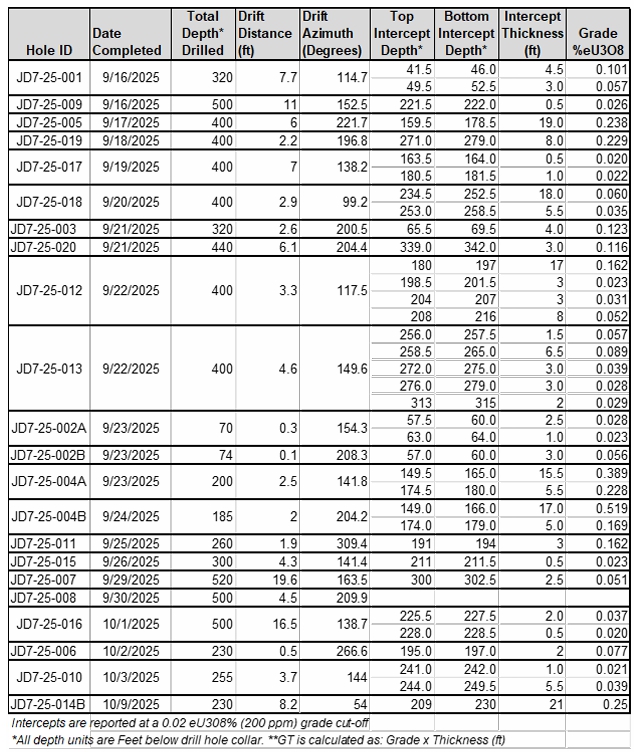
Split barrel core intervals were obtained from 5 of the 23 drill holes at 5 of the 20 planned drilling locations. These corings will be employed to provide physical samples of mineralized material. Cored intervals were completed using split-barrel core aimed at drilling through the mineralized zones. Four of the five cored locations intercepted mineralization above the minimum grade cutoff.
The core samples were analyzed by two arms-length laboratories: Pace Analytical of Sheridan, Wyoming and Hazen. These labs used chemical methods to: 1) determine both uranium and vanadium content to evaluate the vanadium-to-uranium ratio of the mineralization; 2) to provide data to validate the uranium gamma ray logging results; and 3) further refine the uranium and vanadium resource estimates for JD-7 lease. The cores can also be used for mineralogical and metallurgical testing. This data will enhance the accuracy of the geological model and supports Anfield’s efforts to advance the project toward production readiness.
| 43 |
Metallurgical testing is currently being conducted by Hazen on representative samples from the JD-8 and JD-7 leases. As of the date of this AIF, the studies are still in process and not yet complete.
A new mine permit for the JD-8 lease, to restart the JD-8 uranium and vanadium mine, has been submitted the Colorado Division of Mining Reclamation and Safety and the DOE. This permit is currently in the process of being reviewed by the Colorado Division of Mining Reclamation and Safety and the DOE.
The Shootaring Canyon Mill, Velvet-Wood Project and Slick Rock Project
The 2023 combined Velvet-Wood Project and Slick Rock Project PEA entitled “The Shootaring Canyon Mill and Velvet Wood and Slick Rock Uranium Projects, Preliminary Economic Assessment” and dated May 6, 2023 (the “2023 PEA”), was authored by Douglas L. Beahm, P.E., P.G. Principal Engineer, Harold H. Hutson, P.E., P.G. and Carl D. Warren, P.E., P.G., of BRS, and Terence P. (Terry) McNulty, P.E., D. Sc., of T.P. McNulty and Associates Inc., all of whom were independent QPs for the purposes of NI 43-101 at the time the 2023 PEA was prepared.
The summary section from the 2023 PEA is reproduced below in its entirety. The 2023 PEA is available on the Company’s SEDAR+ profile at www.sedarplus.ca and is incorporated by reference herein. Capitalized terms used but not defined in the following summary have the meanings ascribed thereto in the 2023 PEA.
Where appropriate, certain information contained in this AIF updates information derived from the 2023 PEA. Any updates to the technical information derived from the 2023 PEA was prepared by or under the supervision of Douglas L. Beahm, P.E, P.G., the Company’s Chief Operating Officer, and a QP within the meaning of NI 43-101. Readers should be cautioned that the Company’s decision to advance the Velvet-Wood Project is not based on a feasibility study of mineral reserves demonstrating economic and technical viability. As a result, there is additional uncertainty and risk related to the economics and viability of development.
Shootaring Canyon Mill
The Shootaring Canyon Mill is one of only three licensed, permitted and constructed conventional uranium mills in existence in the United States, with the other two held by Rio Tinto Group and Uranium Energy (Sweetwater) and Energy Fuels (White Mesa). Located approximately 48 miles (77 kilometres) south of Hanksville, Utah, the Shootaring Canyon Mill is a conventional acid-leach facility that is permitted to process up to 750 tonnes of ore per day, with a capacity to process up to 1,000 tonnes per day. The Shootaring Canyon Mill was built in 1980 and during its period of operation it processed and sold 27,825 pounds of triuranium octoxide. It ceased operation with the collapse of the uranium price in the early 1980s.
2023 PEA – Summary
Project Overview
Velvet-Wood Overview
The Velvet and Wood mine projects are located within the Lisbon Valley physiographic province in San Juan County, Utah, as shown in Figure 1.1 and 1.2. The Velvet mine produced a reported 400,000 tons of ore containing some 4.2 million pounds of uranium (U3O8) and 4.8 million pounds of vanadium (V2O5).
Slick Rock Project Overview
The Slick Rock Project is located in the southern end of the Uravan mineral belt of the Colorado Plateau physiographic province and at the southeastern edge of the Paradox fold and fault belt in the proximal Disappointment syncline as shown on Figures 1.1 and 1.2. The Slick Rock District is also a past producer with reported production of 2,236,723 pounds of uranium (U3O8) and 13,941,457 pounds of vanadium (V2O5).
| 44 |
Shootaring Canyon Mill Overview
For the purposes of the 2023 PEA, it was assumed that mineral processing will take place at Anfield’s mineral processing facility, the Shootaring Canyon Mill, which lies approximately 180 miles from the Velvet-Wood mine area and approximately 200 miles from the Slick Rock mine area, following existing roads as shown on Figure 1.1.
Figure 1.1 - Overall Project Location Map
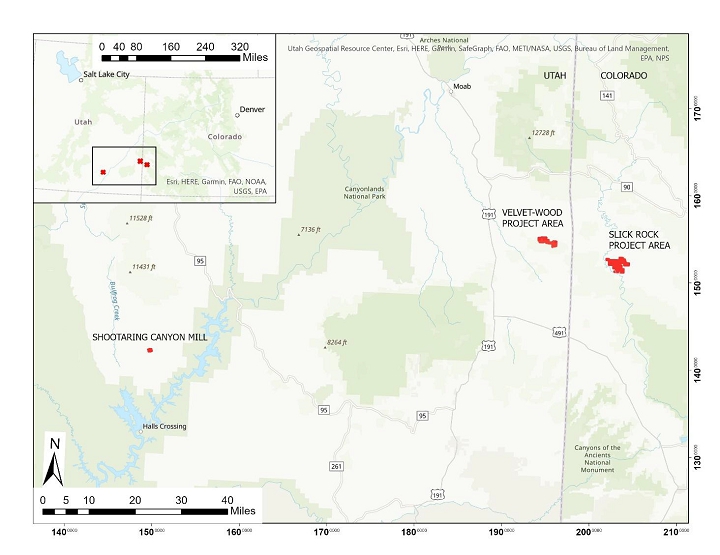
| 45 |
Figure 1.2 - Velvet-Wood and Slick Rock Location and Access Map
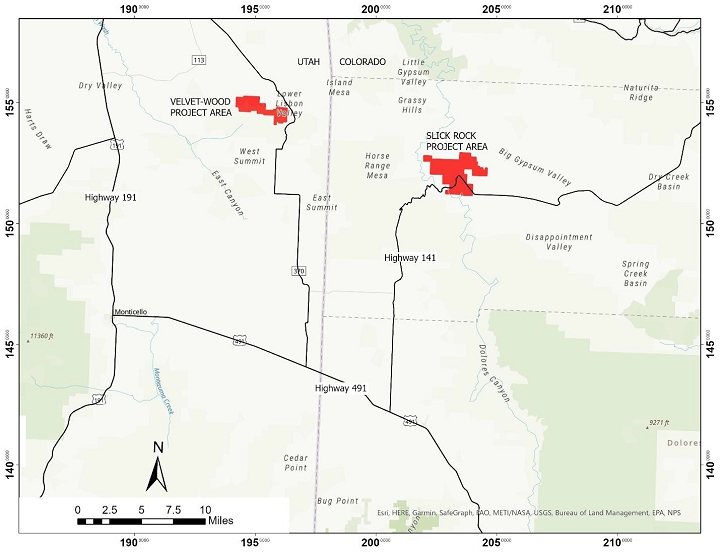
Project Description and Ownership
Velvet-Wood Project Description and Ownership
The Velvet area is located in San Juan County, Utah, approximately 31 miles from Monticello, Utah, in Township 31 South, Range 25 East, Sections 2, 3, 4 and 10, at Latitude 38o 07’ 00” North and Longitude 109º 09’ 00” West. The Wood area is located in Township 31 South, Range 26 East, Sections 6 and 7 and Township 31 South, Range 25 East, Sections 1, 11, and 12 at Latitude 38o 08’ 00” North and Longitude 109o 06’ 00” West. The Velvet-Wood Project ownership includes unpatented mining claims and a State of Utah mineral lease totaling approximately 2,166 acres related to the Velvet and Wood mine areas.
Slick Rock Project Description and Ownership
The Slick Rock Project is located in San Miguel County, Southwest Colorado, approximately 23.9 miles north of the town of Dove Creek, Colorado and east of the Dolores River in the Slick Rock District of the Uravan mineral belt. The approximate geographic center of the property is Latitude 38° 2’ 51.7” North, Longitude 108° 51’ 42.3” West.
Anfield entered into a definitive agreement to acquire the Slick Rock Project from Uranium Energy in an asset swap transaction on April 21, 2022. The Slick Rock Project is comprised of 268 mineral lode claims included in the 2023 PEA and encompasses an area of approximately 4,976 acres or 7.8 square miles as shown in Figure 4.2 of the 2023 PEA. Certain claims within the block are subject to 1% to 3% royalties of net uranium and vanadium production.
| 46 |
Shootaring Canyon Mill Description and Ownership
The Shootaring Canyon Mill is located in Garfield County Utah approximately 52 miles south of Hanksville, Utah in Township 36 South, Range 11 East, Sections 3 and 4 and Township 35 South, Range 11 East, Sections 33 and 34 at approximate Latitude 37o 43’ 00” North and Longitude 110o 41’ 00” West. The Shootaring Canyon Mill is located on lands which are split estate, with the surface estate being fee land held by Anfield, and the mineral estate being Utah State Trust Land held by Anfield through two mineral leases totaling approximately 905 acres of surface and mineral fee lands.
Development Status
Velvet-Wood Project Development Status
A portion of the Velvet area has been mined by underground mine methods. The mined material from this area was transported to the Atlas mill in Moab, Utah for conventional processing. A mine permit is held for the Velvet mine. Re-opening of the Velvet mine would require updating of the mine permit as well as additional permits as subsequently discussed. As of the date of this AIF, an updated mine permit has been granted approval by the U.S. Department of the Interior for the re-opening of the Velvet-Wood mine and the Company is in the process of rehabilitating the mine. Access from the former mine operations remain in place. The upper portion of the decline and portal has been closed by backfill and the vent shafts capped at the surface. As of the effective date of the 2023 PEA, it is the authors’ opinion that the decline and vents can be re-opened; however, underground conditions are unknown.
As of the effective date of the 2023 PEA, the Wood area had not been mined. Site access and drill roads which were not already pre-existing were established under this exploration permit.
Slick Rock Project Development Status
The Burro No. 3, 5, and 7 Mines were historically operated adjacent to the Slick Rock Project and within the northwest corner of the Slick Rock Project area. These mines were operated as underground random room and pillar mines through the early 1980s. As of the effective date of the 2023 PEA, no access agreement existed to access the Slick Rock Project through the Burro Mines. As of the date of this AIF, the Company has acquired the SR13 DOE lease which includes access through the Burro and Ellison declines. The 2023 PEA was based on the sinking of new mine shafts to access the mineral resources at the Slick Rock Project.
Shootaring Canyon Mill Development Status
The Shootaring Canyon Mill has a Radioactive Materials License that is administrated by the UDEQ- DWMRC. As of the effective date of the 2023 PEA, this license authorized possession of byproduct material (tailings and other milling wastes) and reclamation activities only. The Radioactive Materials License (UT090048) is currently active and an amendment to such license has been submitted for operational status and is in the process of being reviewed. A license amendment to return to operational status is needed as are capital improvements, as subsequently discussed in the 2023 PEA.
History
Velvet-Wood Project History
The Velvet-Wood mineral holdings have gone through a succession of ownership. Anfield purchased the Velvet-Wood mine along with other conventional uranium assets from Uranium One including the Velvet-Wood Project in August 2015.
| 47 |
The Velvet-Wood Project, as discussed herein, consists of two areas which were historically held by separate companies. The Velvet area was held by Atlas Minerals who mined portions of the mineralization. The Wood area was held during a similar time frame by Uranerz. Uranerz drilled 120 rotary holes from 1985 through 1991 and outlined the current Wood mineral resource area. The Wood area as described in the 2023 PEA was drilled but not mined.
Slick Rock History
Surficial to shallow uranium/vanadium mineralization has been known in the Slick Rock Project area since the early 1900s (then called the McIntyre district). First mined for radium and minor uranium until 1923, numerous companies sporadically operated small scale mining and processing facilities along the Dolores River. In 1931, a mill was constructed by Shattuck Chemical Co. to process vanadium ore. In 1944, the area was worked by the Union Mines Development Corp. for uranium/vanadium ore.
By December of 1955, Union Carbide Nuclear Corp. (UCNC) had drilled out a sufficient resource on the north side of Burro Canyon and began sinking three shafts. In December 1957, the shaft sinking was complete on the Burro No. 3, 5, and 7 mines to total depths of 408 feet, 414 feet, and 474 feet, respectively. In the same year, initial ore shipments were made to UCNC’s concentrating mill at the Slick Rock Project.
Anfield entered into a definitive agreement to acquire the Slick Rock Project from Uranium Energy in an asset swap transaction on April 21, 2022. The Slick Rock Project is comprised of 268 mineral lode claims and encompasses an area of approximately 4,976 acres or 7.8 square miles. Certain claims within the block are subject to 1% to 3% royalties of net uranium and vanadium production.
Shootaring Canyon Mill History
The Shootaring Canyon Mill was licensed and constructed by Plateau Resources and has had a succession of owners including US Energy and Uranium One prior to Anfield’s acquisition. The Shootaring Canyon Mill was constructed by Plateau Resources and operated briefly in 1982. The Shootaring Canyon Mill has not been decommissioned and has been under care and maintenance since cessation of operations.
Anfield purchased the Shootaring Canyon Mill along with other conventional uranium assets from Uranium One including the Velvet-Wood Project in August 2015.
Regulatory Status
Permitting for the Velvet-Wood Project and the Slick Rock Project mining operations and the reactivation of the Shootaring Canyon Mill requires various approvals from the state of Utah, the US Bureau of Land Management, and other agencies including but not limited to the following.
As of the effective date of the 2023 PEA, major actions needed included:
| ● | Reactivation of the Shootaring Canyon Mill |
| ○ | The existing Radioactive Materials License, UT0900480, issued by UDEQ/DRC, requires an amendment to convert from the current care and maintenance status to operational status. An amendment to such license has been submitted for operational status and is in the process of being reviewed. | |
| ○ | A mill reactivation plan has been submitted to UDEQ. The application includes both substantial designs for the rehabilitation of the mill and a basis for amending the mill license and a reclamation design for the mill tailings. | |
| ○ | The mill is being maintained along with all additional permits and licenses and required environmental monitoring programs. |
| 48 |
| ● | Velvet-Wood Mine |
| ○ | The existing Large Mine Permit, UTU68060, issued by DOGM and the Plan of Operations issued by BLM require an amendment to convert from current care and maintenance status of operational status and to include the Wood portion of the mine. | |
| ○ | The existing ground water discharge permit, UGW170003, issued by UDEQ/WQD will require amendment. If uranium is recovered from the ground water this would require licensing action by UDEQ/DRC. | |
| ○ | As of the date of this AIF, a new mine permit for the Velvet-Wood mine has been granted by the U.S. Department of the Interior and the Company has received all ancillary permits necessary for the resumption of mine operations. Currently, the Company is in the process of rehabilitating the Velvet-Wood mine. |
| ● | Slick Rock Mine |
| ○ | A new Large Mine Permit and Plan of Operations is required to be issued by CMLRB and BLM, respectively. | |
| ○ | If it were necessary to recover uranium onsite from ground water treatment in order to meet discharge permit requirements, a source materials license from CDPHE would be required. |
| ● | Permits common to all operations. |
| ○ | Air quality permits. | |
| ○ | Water quality permits, storm water discharge (construction and operations). | |
| ○ | Monitor well permits. | |
| ○ | Water rights for consumptive use. | |
| ○ | Federal Mine Safety for mine and mill under the Mine Safety and Health Administration (MSHA). |
Geology and Mineralization
Velvet-Wood Project Geology
The Velvet-Wood Project is located in the Lisbon Valley uranium district which was the largest uranium producing district in Utah. The Lisbon Valley or Big Indian Wash District produced 5 times as much uranium as any other district in Utah from the period of 1948 through 1988 totaling some 77,913,378 pounds U308 at an average grade of 0.30 % U308. Uranium mineralization in the Velvet and Wood areas is found in sandstone units within the Cutler Formation. The sandstones are fluvial arkose that has been bleached. The mineral deposits are irregular tabular bodies located at the base, at the top, or close to pinch-outs of the sandstone bodies. The major producing zone in the Cutler occurs near the unconformity between the Cutler and the overlying Chinle Formation.
Slick Rock Project Geology
Uranium/vanadium mineralization is hosted by the Upper Jurassic Morrison Formation and is typical of Colorado Plateau-style uranium/vanadium deposits. Past production came from the upper or third-rim sandstone of the Salt Wash member of the Morrison Formation. This is the target host for uranium/vanadium mineralization within Anfield’s Slick Rock Project area.
Uranium and vanadium-bearing minerals occur as fine-grained coatings in detrital grains filling pore spaces between the sand grains and replacing carbonaceous material and some detrital grains. The primary uranium minerals are uraninite (UO2) with minor amounts of coffinite (USiO4OH). Montroseite (VOOH) is the primary vanadium mineral, along with vanadium clays and hydromica. Metal sulfides occur in trace amounts. Mineralization occurs within tabular to lenticular bodies that are peneconcordant within sedimentary bedding. Mineralization may also cut across sedimentary bedding to form irregular shapes.
| 49 |
Exploration and Drilling Status
Velvet-Wood Project Exploration and Drilling
As of the effective date of the 2023 PEA, drill data was available for a total of 325 drill holes. Of this total 268 drill holes were of a historic nature and 57 were completed by Uranium One in the 2007/2008 time period. Relevant data including geophysical and lithological logs were available for both recent and historic drilling. 46% of the drill holes encountered uranium mineralization in excess of the recommended cutoff criteria, an additional 41% showed low grade to trace mineralization, and the remaining drill holes were barren and/or not completed to the host horizon.
Slick Rock Exploration and Drilling
As of the effective date of the 2023 PEA, a total of 312 drill holes were available for the Slick Rock Project area. All of the drill holes were considered historic. Of this total, 27 holes had location data but no additional data associated with them. These 27 holes were excluded from the resource modeling. The remaining 285 holes contained 346 unique intercepts. As of the effective date of the 2023 PEA, Anfield commenced a 20-hole drill program at the Slick Rock Project in order to verify – and potentially expand – the current resource. See “The Shootaring Canyon Mill, Velvet-Wood Project and Slick Rock Project – Subsequent Works – Slick Rock Project” for exploration and drilling activities on the Slick Rock Project following the effective date of the 2023 PEA.
Sampling
Velvet-Wood Sampling
The Velvet-Wood Project was initially drilled during the 1970s and 1980s with the principal exploratory work and drilling completed by Gulf and Uranerz for the Velvet and Wood properties, respectively. As discussed in Section 14 of the 2023 PEA, as of the effective date of the 2023 PEA, the data was considered accurate and reliable for the purposes of completing a mineral resource estimate for the Velvet-Wood Project.
Core drilling completed during the 2007/2008 drilling program was directly supervised by BRS and Uranium One personnel including Douglas L. Beahm and personnel under his direct supervision. On site personnel completed lithologic logging of rotary and core samples. Upon completion of drilling, geophysical logs of the drill holes were completed by a commercial provider of such services, Century Geophysical. The loggers were contractually required to provide Uranium One with calibration data and the k-factor for their probes and completed onsite calibration for each hole.
With respect to QA/QC for equivalent uranium measurements (eU3O8) by downhole geophysical logging, the DOE maintains standard calibration pits located in Grand Junction, Colorado for use by the US uranium industry for instrument calibration. For Velvet and Wood, the original log files contain a record of the geophysical probes which show the instruments were calibrated at the DOE standard calibration pits located in Grand Junction, Colorado prior to the drilling program. For example, the geophysical logging unit which measured eU3O8 for core holes DW14T-08 and SLV-8883T-08, completed on October 2, 2008 and September 25, 2008, respectively were calibrated at the Grand Junction DOE facility on September 22, 2008.
| 50 |
Drill core was placed in protective plastic sleeves at the drill site and packaged into core boxes. Mineralized core was subsequently split for analysis and metallurgical testing with half of the core retained. The core splits were delivered to the testing laboratory and testing facility, Hazen, by the author, Douglas L. Beahm, and a chain of custody established. In addition, select core samples were chosen for geotechnical testing. Chemical assays were completed by the following methods:
| ● | Uranium by fluorometric assay. | |
| ● | Vanadium, molybdenum, arsenic, iron, magnesium, aluminum, calcium, thorium, zinc, copper, nickel, cobalt, and manganese by semi-quantitative x-ray fluorescence (XRF). | |
| ● | Uranium equivalent (eU3O8) by gamma spectroscopy. |
Hazen is located at 4601 Indiana Street, Golden, Colorado, USA 80403. Hazen has provided analytical services for the uranium mining and processing industries since the early 1960s. An outgrowth of this activity has been the Radiochemistry Laboratory, which specializes in the determination of the long half-life radionuclides of the uranium and thorium decay series and radionuclides produced from nuclear power generation. These isotopes emit alpha, beta, and gamma radiation. Hazen holds a variety of state and federal certifications to perform radiochemical testing on drinking water from domestic and foreign sources, including NELAC Certification by the State of New York. Typical parameters include gross alpha/beta, gross gamma, radium-226, radium-228, radon in water, thorium, tritium, strontium, cesium, and uranium. In addition, Hazen Analytical Laboratory holds certifications from various state regulatory agencies and from the USEPA.
As of the effective date of the 2023 PEA, it is the authors’ opinion that the sample preparation, security, and analytical procedures were in keeping with industry practice and are adequate for the purposes of 2023 PEA.
Slick Rock Sampling
Anfield has not conducted a drilling and/or sampling program on the Slick Rock Project. The only chemical assay values are historical and were generated by the US AEC laboratories. Later operators (USEC, UCNC, Homeland Uranium, Energy Fuels, and Uranium Energy) relied on radiometric values and did not perform chemical assays.
Samples were prepared by the USGS on behalf of the Raw Materials Division of the US AEC. USGS geologists conducted diamond drilling and radiometrically logged the holes, described the lithology, and scanned the cores for radiometric anomalies using a Geiger counter. Within the Slick Rock Project area, 51 of the 52 core samples were retrieved with greater than an 80% recovery rate. Only borehole DV-88 was less than 80% at a 65% recovery rate (OFR70-348).
Sample intervals with radiometric anomalies greater than 0.045% eU3O8 were shipped to the US AEC labs in Washington, D.C., Denver, CO, or Grand Junction, CO for chemical determination of uranium and vanadium content. The precise chain of custody of these samples is unknown. The US AEC laboratories determined uranium values using fluorometric, colorimetric, volumetric, polargraphic, coulometric, radioactivation, X-ray spectrometric, and nuclear photographic plate techniques. The choice of method is determined by many factors such as the concentration of uranium in the sample, its chemical complexity, the accuracy sought, the speed required, and the availability of the instrumentation. The US AEC laboratories determined vanadium content via wet chemical digestion and volumetric determination by using a prescribed method developed by Claude W. Sill, U.S. Bureau of Mines, Salt Lake City, Utah and compiled and edited by R. W. Langridge in AEC publication, RMO-3001. The certifications held by the US AEC laboratories were unknown as of the effective date of the 2023 PEA.
The samples were collected and processed according to strict protocols developed by the US AEC and other U.S. government agencies. The results are consistent with later industry analyses. As of the effective date of the 2023 PEA, the authors believe the determinations of grade are sufficiently accurate and precise to support the estimation of mineral resources.
| 51 |
Data Verification
Velvet-Wood Data Verification
The primary assay data for the Velvet-Wood Project is downhole geophysical log data. A comparison of downhole radiometric geophysical data to chemical core assays was also completed to evaluate radiometric equilibrium conditions.
Ten of the 96 Wood Project logs were chosen at random and reviewed for data entry errors. In one instance half foot uranium grade data from a printout was compared to half foot grade data that was scaled from a histogram. The two data sets varied by less than 0.002 %eU3O8. This amount of variance is insignificant. No grade data entry errors were found. Five drift data entry errors were corrected. Due to the preliminary amount of drift data entry errors, all drift data entries were checked and corrected if necessary. One hundred percent of the log data entry was reviewed after entry and corrected where necessary. Multiple maps were rectified, and point locations and rectifications were checked for consistency and any data entry errors.
Historic drill data for each drill hole consisting of radiometric data was posted on drill maps including collar elevation, elevation to the bottom of the mineralized intercept, thickness of mineralization, grade of mineralization, and elevation of the bottom of the hole. Data entry was checked and confirmed. Drill hole locations were digitized from the drill maps to create a coordinate listing and then plotted. The resultant drill maps were then checked and confirmed by overlaying with the original maps.
2008 drill data included collar elevation, collar location, grade and elevation of mineralized intercepts, and elevation of bottom of hole. New drill hole locations were taken from field surveys using modern survey grade GPS equipment. All historic coordinates were converted to match the Utah State Plane NAD83 coordinate system. This conversion included the re-surveying of a limited number of historic survey monuments and rectification of the historic coordinate system to the Utah State Plane NAD83 coordinate system. With this rectification, historic drill holes could be located in the field with an estimated error of approximately 15 feet. Further field surveys should be completed to increase the accuracy of historic drill hole coordinates.
A comparison was completed of historic drill hole Sum GT data with 2008 Uranium One drill hole Sum GT data for three holes completed which were intended to twin holes SLV-8806, SLV-8803, and DW-14. The closest of the 2008 core holes to historic data was SLV-8806T-08 which is approximately 23 feet to the southeast of SLV-8806 at mineralization. SLV-8806T-08 had an 8.28 GT as compared to SLV-8806 with a 6.12 GT. Drill hole SLV-8803T-08 deviated approximately 25 feet to the west from SLV-8803 at mineralization. SLV-8803T-08 had a 2.08 GT as compared to SLV-8803 which had a 9.36 GT. No deviation data is available for the historic drill hole DW-14 so the distance to the intended twin drill hole is not known at depth. The 2008 drill hole DW-14T-08 did not intercept mineralization above cutoff grade as compared to DW-14 with a 1.65 GT.
Although the GT values of holes SLV-8803T-08 and DW-14T-08 are less than the intended twin holes, the drill holes show mineralization at the same elevation, in the same host rock, and with approximately the same mineralized thicknesses. The drill holes therefore confirm the continuity of the host formation but indicate that variations in grade should be expected, as seen historically at Atlas’ nearby Velvet Mine.
| 52 |
Slick Rock Data Verification
As of the effective date of the 2023 PEA, Anfield had not conducted any drilling activities at the Slick Rock Project to verify data generated by the USGS or subsequent operators. See “The Shootaring Canyon Mill, Velvet-Wood Project and Slick Rock Project – Subsequent Works – Slick Rock Project” for drilling activities on the Slick Rock Project following the effective date of the 2023 PEA. Anfield had obtained radiometric and chemical assays and from the US AEC exploration program OFR70-348 for vanadium and uranium values, respectively, from those holes drilled by the USGS on behalf of the Raw Materials Division of the US AEC. Logs for boreholes drilled by USEC and Energy Fuels were obtained by claim acquisition, and the uranium intercept values from the logs for boreholes drilled by Homeland Uranium were available in the public domain.
Previous owner, Uranium Energy, validated historic drill sites by locating and measuring drill hole locations in the project area using a Trimble GeoXH mapping-grade GPS unit. The authors of the 2023 PEA reconfirmed multiple site locations during their site visit on April 12, 2023. The drill hole database was compared with measured geo-spatial coordinates from the previous field work where physical locations of all available drill holes were found to be consistent with their locations stated in the database.
The authors audited the OFR70-348 data from copies of the original documents and re-extracted the intercept data for comparison to the existing database acquired by Anfield in acquisition from Uranium Energy. Where data in the database was missing compared to the original Geologic and Assay Logs from the USGS that data was taken into the database. Few present inconsistencies in the Uranium Energy database were explainable by data entry error and corrected to match the original document data.
The veracity of the OFR70-348 documents was confirmed to the authors by location of multiple duplicate originals from a separate USGS file collection. The separate USGS documents were found to be identical between the USGS data set and the one provided by Anfield for 5 holes that occurred in both data sets. The 5 identical holes are: DV-5A, DV-39, DV-40, DV-41, DV-42.
As of the effective date of the 2023 PEA, a total of 312 holes were known to be contained within or proximal to the Slick Rock Project area. Of that total, 27 of these holes had locations but no other data leaving 285 drill holes upon which to build a database. Of the 285 holes in the database used for resource estimation, 207 were drilled by Union Carbide, 53 by the USGS, 17 by USEC and 4 each by Energy Fuels and Homeland Uranium. Within the 285 drill holes data was available on 346 discrete intercepts distributed between 3 stratigraphically distinct zones.
Given the consistency of the results from government and private industry drilling, the ability to recover historic information in original form, the ability to locate the drill collars in the field, and the agreement of drill results with nearby mine production, the authors believe the sample data are sufficiently accurate and precise to generate an inferred mineral resource estimate as described in Section 14 of the 2023 PEA.
Mineral Processing and Metallurgical Testing
During the period 1953-1980, there were as many as 24 uranium and uranium/vanadium mills operating in the Colorado Plateau region of Arizona, Utah, Colorado, and New Mexico. The “gold standard” reference for the industry through 1970 was Merritt, 1971. If the vanadium content of the mill feed was sufficiently high, the mill usually had a vanadium byproduct circuit. A notable example was the Navajo mill at Shiprock, NM, built by Kerr-McGee Oil Industries Inc., later acquired by Vanadium Corporation of America and its successor, Foote Mineral Company. For operations without vanadium circuits, a vanadium penalty was sometimes assessed for toll and custom shippers.
| 53 |
The general processing technique employed by most mills was crushing and coarse grinding in rod mills, followed by agitated tank leaching in aqueous sulfuric acid at pH 1.5-2.0 with an oxidant like manganese dioxide or sodium chlorate, solution purification, and precipitation of a uranium oxide product. Early mills recovered uranium from the leached slurry with ion exchange resin beads suspended in mesh baskets, but commercialization of polyacrylamide flocculants allowed later plants to effect separation of the pregnant leach solution from the leached residue by countercurrent decantation (“CCD”) in a string of thickeners. By 1970, nearly all plants treated the clarified pregnant leach solution (“PLS”) in solvent extraction (“SX”) circuits using tertiary amine extractants dissolved in a diluent that was usually a high-flash point kerosene.
Some mineralized material contained sufficient calcite to render acid leaching uneconomical, and leaching was conducted at elevated temperature and pressure in agitated autoclaves with sodium carbonate and bicarbonate in an aqueous solution. In this case, carbonate ion complexed the dissolved uranium and bicarbonate ion-controlled hydroxyl ion which otherwise would have prematurely precipitated the uranium as a hydroxide. A few mills, notably Anaconda’s operation at Bluewater, NM, treated ores on a toll basis and had both acid and alkaline circuits.
The plants with vanadium recovery circuits leached at a higher free acid concentration corresponding to pH 0.5-1.5 and recovered vanadium from the uranium SX waste solution in another SX circuit with a different extractant, typically an aliphatic phosphoric acid, or with a different concentration in the organic phase of the same extractant.
Overall recoveries of uranium were typically in the range of 93 to 97 percent and vanadium recoveries were 70 to 80 percent, depending on mineralogy and the extent to which soluble losses could be minimized during solid/liquid separation. As of the effective date of the 2023 PEA, it was very likely that the Shootaring Canyon Mill would be able to achieve at least 96 percent U3O8 recovery, especially given the unusually high average feed grades of 0.24 to 0.29% U3O8 and the high free acid concentration during leaching. The vanadium plant would have the advantage of state-of-art instrumentation and process control and may readily achieve 80% V2O5 recovery.
Velvet-Wood Metallurgical Studies
Metallurgical studies have been completed on mineralized material from the Velvet deposit that was recovered from core drilling completed in 2007 and 2008 at the Velvet Mine. Metallurgical testing completed as of the effective date of the 2023 PEA demonstrated that the mineralized material is amenable to acid leaching with conventional mineral processing methods.
Leaching experiments for 18 Velvet core samples were completed; however, three of the extractions were low due to laboratory errors and difficulties in pH control. The average of the 15 experiments that were conducted under near-optimum conditions was 96.1 percent uranium extraction. However, the average grade of mineralized samples used in the leaching experiments was only 0.100% U3O8, while the run-of-mine diluted average grade is expected to be 0.265% U3O8 and the average grade mined from Atlas Mineral’s Velvet Mine was 0.46% U3O8. Therefore, the samples used in the leach experiments were substantially lower in uranium grade than the estimated grade of the Velvet and Wood mineralization. It is therefore possible that vanadium content and uranium extractions obtained in the tests were also lower than may be obtained with the estimated higher grades for mined material.
Acid consumption for baseline experiments averaged 118 lb/ton. Carbonate content in the mineralized material has a direct relationship to acid consumption during leaching and may influence uranium extractions either by causing excessive gypsum precipitation or by making pH control difficult. Sodium chlorate (NaClO3) proved to be an effective oxidant. Molybdenum content for all of the core samples that were assayed averaged 99 ppm and molybdenum content in the pregnant leach solution averaged 0.17 grams per liter. Vanadium assay results from Uranium One’s 2007/2008 exploration program showed an overall average of 2.13 to 1 vanadium to uranium ratio, while the historic ratio was 1.39 to 1. On average, vanadium concentrations will be less than 1.00% V2O5, whether based on the historic vanadium to uranium ratio, or the ratio from 2008 assays.
| 54 |
As of the effective date of the 2023 PEA, no metallurgical testing had been completed on the Wood property. However, given the close proximity to Velvet and the fact that the mineralization lies within the same geologic unit as Velvet, similar metallurgical test results are expected. The mineralized core recovered from Wood in 2008 had similar mineralogy to that found in mineralized core recovered from Velvet in 2007, based on geologists’ direct observation of core and drill samples from both projects.
As alternatives to conventional milling, heap and vat leaching were briefly considered. However, the 2023 PEA was confined to agitated leaching, and there are several reasons for this decision:
| ● | Vat leaching economics depend on rapid leaching kinetics that can be obtained in a 4- to 7-day leaching cycle, thereby minimizing the number of vats required. In order to ensure rapid solution percolation, the vat feed must be crushed to minus 0.25 to 0.5 inches, de-slimed, and the slimes separately leached in agitated tanks. Since fine particles dictate the thickener area requirement for a CCD circuit, vat leaching would require essentially the same size CCD system that conventional milling requires, negating most of the cost advantage usually attributable to vats. | |
| ● | Heap leaching was applied successfully to several uranium ores during the 1960s and 1970s, but it has not been attempted when co-product vanadium is planned. Satisfactory vanadium extraction requires a higher free acid concentration, causing more severe attack of the gangue minerals and heightening the potential for secondary slimes to impair heap permeability. | |
| ● | Neither vats nor heaps could reasonably be expected to achieve uranium extractions that can be obtained with milling. |
Owing to the need to leach at an elevated free acid concentration to dissolve and complex vanadium, an acid consumption of 112 pounds of 98% H2SO4 per ton of leach feed was assumed.
The author of this section of the 2023 PEA, Terry McNulty, is familiar with and has reviewed the available metallurgical testing and concludes that practices which have been employed are in keeping with industry standards, and the data available for completion of a PEA for the Velvet-Wood Project is reliable.
Slick Rock Metallurgical Studies
As of the effective date of the 2023 PEA, Anfield had not conducted any metallurgical tests for mineral processing at the Slick Rock Project. Production from this property was processed by UCNC with acceptable recoveries by conventional milling methods for nearly 26 years. Uranium recoveries at the processing mill in Uravan, Colorado, were estimated to be 97 to 98%, and vanadium recoveries at the Rifle, Colorado, processing mill were estimated to be 85% according to personal communication with Curt Sealy, formerly with UCNC and UEC as VP-Strategic Development.
Recommended Metallurgical Recoveries
Owing to the need to leach at an elevated free acid concentration to dissolve and complex vanadium, an acid consumption of 112 pounds of 98% H2SO4 per ton of leach feed was assumed for the purposes of the 2023 PEA. Under these leaching conditions, the authors recommended metallurgical recoveries of at least 94% for uranium and 75% for vanadium as a conservative base case. However, as of the effective date of the 2023 PEA, it was very likely that the Shootaring Canyon Mill would be able to achieve at least 96 percent U3O8 recovery, especially given the high average feed grades of 0.24 to 0.29 % U3O8 and the high free acid concentration during leaching. The vanadium plant would have the advantage of state-of-art instrumentation and process control and may readily achieve 80% V2O5 recovery.
| 55 |
Mineral Resource Summary
The 2023 PEA summarizes mineral resources for the Velvet-Wood Project and Slick Rock Project mines with mineral processing at common facility, the Shootaring Canyon Mill. A detailed description of the mineral resource estimation methodology and results is provided in Section 14 of the 2023 PEA. Mineral resources have been estimated for both uranium and vanadium as the mineralization occurs primarily as uranyl-vanadates, and the refurbishment of the Shootaring Canyon Mill will include a vanadium circuit to recover the vanadium as a co-product with the uranium.
The total estimated uranium mineral resources are summarized in Table 1.7. The associated vanadium mineral resource which will be mined as a co-product is summarized in Table 1.8.
Table 1.7 - Velvet-Wood Project & Slick Rock Project Uranium Mineral Resource Summary*
Area/Classification | GT Cutoff | Pounds eU3O8 | Tons | Average Grade %eU3O8 | ||||||||||
| TOTAL MEASURED AND INDICATED MINERAL RESOURCE URANIUM | 0.25 – 0.50 | 4,627,000 | 811,000 | 0.29 | ||||||||||
| TOTAL INFERRED MINERAL RESOURCE URANIUM | 0.25 – 0.40 | 8,410,000 | 1,836,000 | 0.24 | ||||||||||
*Numbers rounded
Table 1.8 - Velvet-Wood Project & Slick Rock Project Vanadium Mineral Resource Summary*
Area/Classification | GT cutoff (Based on Uranium) | V:U Ratio | Pounds V2O5 | Tons | Avg Grade %V2O5 | |||||||||||||
| TOTAL INFERRED MINERAL RESOURCE VANADIUM | 0.25-0.50 | 4.2 | 54,399,000 | 2,647,000 | 1.03 | |||||||||||||
*Numbers rounded
While mineral resources are not mineral reserves and do not have demonstrated economic viability, reasonable prospects for future economic extraction were applied to the mineral resource estimates herein through consideration of grade and GT cutoffs as well as mineralization proximity to existing and proposed conceptual mining. As such, economic considerations were exercised by screening out areas which were below these cutoffs or of isolated mineralization and thus would not support the cost of conventional mining under current and reasonably foreseeable conditions.
Preliminary Economic Assessment
Project cost estimates are based on a conventional random room and pillar underground mine operation at the Velvet-Wood Project and Slick Rock Project mine areas. Mined material would be hauled by truck to the Shootaring Canyon Mill approximately 180 miles from the Velvet-Wood Project and 200 miles from the Slick Rock Project. The Shootaring Canyon Mill would be fully refurbished and would process mined material for both uranium and vanadium recovery.
All costs were estimated in constant 2022 U.S. Dollars. Operating (OPEX) and Capital (CAPEX) costs reflected a full and complete operating cost going forward including all pre-production costs, permitting costs, mine costs, and complete reclamation and closure costs for of the mine and mineral processing facility. CAPEX did not include sunk costs or acquisition costs.
| 56 |
Commodity prices used in the 2023 PEA are discussed in Section 19 of the 2023 PEA and were $70 per pound for uranium oxide and $12 per pound for vanadium pentoxide.
An investigation and design study for the reactivation of the Shootaring Canyon Mill was commissioned by Anfield who engaged PSE of Salt Lake City, Utah for this study. The PSE study provided substantial designs for the rehabilitation of the mill, provided a basis updating the mill license, and considered options for increasing the mill throughput.
As of the effective date of the 2023 PEA, mine design and permitting for the Velvet-Wood Project and Slick Rock Project mines were also ongoing. It was recommended that the 2023 PEA be revised following completion of this investigation and study. As of the date of this AIF, a new mine permit for the Velvet-Wood mine has been granted by the U.S. Department of the Interior and the Company has received all ancillary permits necessary for the resumption of mine operations. Currently, the Company is in the process of rehabilitating the Velvet-Wood mine. See “The Shootaring Canyon Mill, Velvet-Wood Project and Slick Rock Project – Subsequent Works – Velvet-Wood Project” for permitting activities at the Velvet-Wood Project following the effective date of the 2023 PEA.
Mining and mineral recovery methods are described in Sections 16 and 17 of the 2023 PEA, respectively. Capital and operating costs, CAPEX and OPEX, are discussed in Section 21 of the 2023 PEA.
| ● | Total initial CAPEX, not including current and sunk costs, is estimated at US$122.3 million (refer to table 21.1 in the 2023 PEA). | |
| ● | Total weighted average OPEX is estimated at US$244 per ton mined and processed (refer to table 21.3 in the 2023 PEA). | |
| ● | The total cost per ton to produce saleable uranium and vanadium products is estimated at US$290 per ton. This compares to an estimated gross value of US$741 per ton (refer to table 21.3 in the 2023 PEA). |
For the purposes of the 2023 PEA, it was assumed that the Shootaring Canyon Mill would be refurbished to its original 750 tons per day capacity and a vanadium recovery circuit would be added. The 2023 PEA considers simultaneous mine feed from the Velvet-Wood Project decline and two production shafts at the Slick Rock Project. Given the selective nature of the mining and the geometry of the mineralization, three production centers are needed to meet the mill tonnage capacity. As of the effective date of the 2023 PEA, the defined mineral resource at the Velvet-Wood Project would be mined out in 8 years while production from the two shafts at Slick Rock Project would continue for 15 years. Thus, additional mill tonnage capacity would be available beginning in year 9. Additional mill feed could be sourced as captive feed from other Anfield mineral resource holdings in the Colorado Plateau or from mineral resource holdings of others under toll milling agreements.
In the 2023 PEA, the base case was based on commodity prices of $70 per pound for uranium oxide and $12 per pound for vanadium pentoxide with respective mill recoveries of 92% and 75%, respectively. The base case economic evaluation shows:
| ● | Pre-tax IRR 40% | |
| ● | Post-tax IRR 33% | |
| ● | Pre-Tax NPV (8% discount rate) $238,398 $US x 1,000 | |
| ● | Post-Tax NPV (8% discount rate) $196,768 $US x 1,000 |
| 57 |
Breakeven with respect to commodity price occurs when the base case commodity prices were reduced by 40% to $42/lb and $7.20/lb, respectively.
This project, like all similar projects, is quite sensitive to commodity prices as shown in Figures 1.3 and 1.4 for pre and post income tax NPV, respectively.
Figure 1.3 – NPV Price Pre-Tax Sensitivity Chart
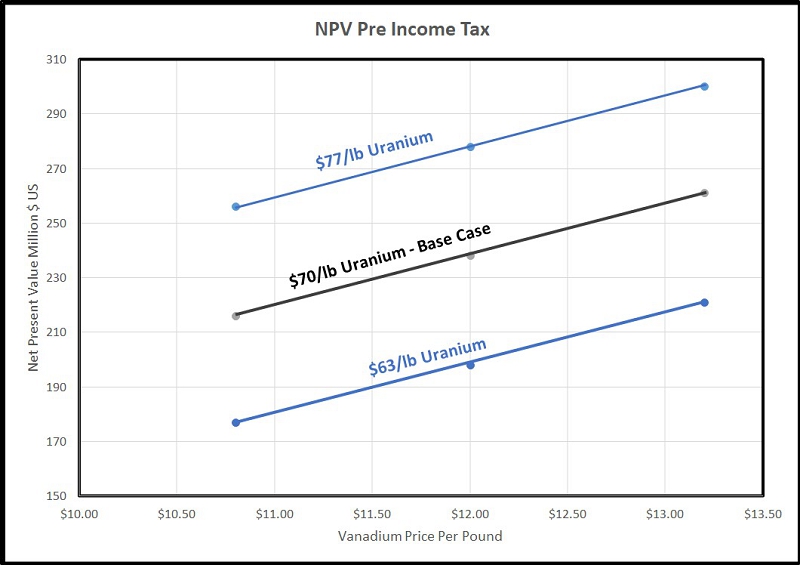
| 58 |
Figure 1.4 – NPV Price Post-Tax Sensitivity Chart
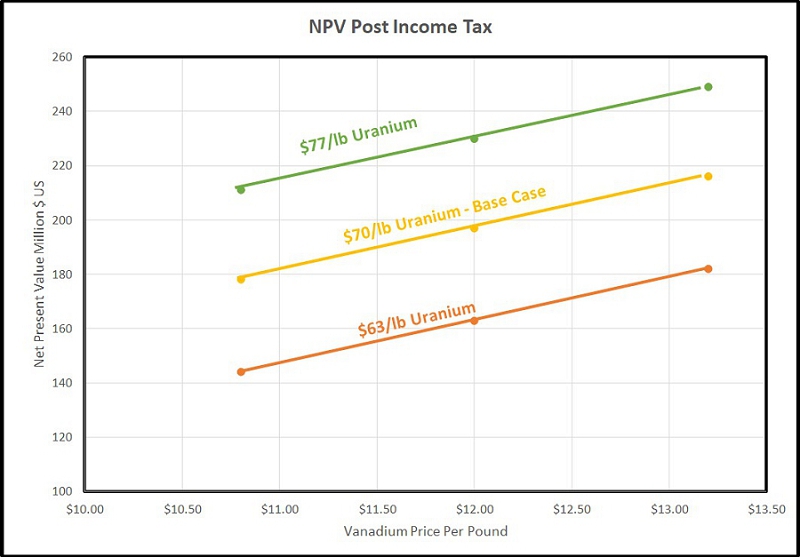
This is restricted disclosure as allowed under section 2.3(3) of NI 43-101 which includes a PEA and is preliminary in nature such that it includes a portion of the inferred mineral resources as reported in Section 14 of the 2023 PEA. Mineral resources are not mineral reserves and do not have demonstrated economic viability in accordance with CIM Standards. Inferred mineral resources are too speculative to have the economic considerations applied to them that would enable them to be categorized as mineral reserves, and there is no certainty that the outcomes estimated in the 2023 PEA will be realized.
Key Assumptions and Parameters
Data cutoffs and modeling assumptions are critical components of any resource modeling method. Modelling parameters are dictated by several factors including density of drilling data, deposit characteristics and interpreted geologic model. In the case of both the Velvet-Wood Project and Slick Rock Project, they are both stratigraphically controlled, sand-stone hosted uranium/vanadium deposits of the Colorado Plateau style, as discussed in Section 7 of the 2023 PEA. This deposit style has been modelled well in the authors experience by the GT contouring method and has yielded results which have proven accurate enough to guide mining operations for many decades.
| 59 |
The modeling assumptions and data cutoffs applied to each model are stated below in Table 1.9 below:
Table 1.9 – Modeling Assumption Parameters by GT Contour Model
GT Contour Resource Model | ||||||||||||
| Modeling Assumption Parameter | Velvet Mine | Wood Mine | Slick Rock Mine | |||||||||
| Minimum reported grade (% eU3O8) | 0.05 | 0.05 | 0.02 | |||||||||
| Nominal Thickness (ft) | 4 | 4 | 4 | |||||||||
| Maximum Radius of Influence (ft) | 100 | 100 | 400 | |||||||||
| Radiometric Equilibrium Factor (DEF) | 1 | 1 | 1 | |||||||||
| Bulk Tonnage Factor (cft/st) | 14.5 | 14.5 | 15 | |||||||||
| Minimum Sum GT Resource Model Cutoff | 0.25 – 0.50 | 0.25 | 0.40 | |||||||||
Minimum grade and thickness criteria are used to define mineralized intercepts for resource modeling purposes. These are applied to each individual mineralized intercept and then to the sum GT of intercept composites are applied to the data prior to contour modeling. Data not meeting these minimum requirements are removed from the modeling data set and have no influence on the contour model other than establishing its boundaries.
A minimum thickness dictated by mining approach is typically applied at the data preparation level and thus some mining dilution can be accounted for as was done for the Velvet-Wood Project at the minimum mining thickness of 4 feet. In the case of the Slick Rock Project, the average thickness was 3.8 feet, or essentially equal to the minimum mining thickness, so the minimum thickness was not applied.
Maximum radius of influence is influenced by the drilling density and the continuity of the deposit model. The tighter drilling spacing of the Velvet and Wood data allows for a smaller maximum radius of influence and a more certain resource classification. The larger drill spacing available at the Slick Rock Project provides decreased certainty and a lower resource classification in the Inferred category.
The bulk tonnage factors and DEF discussed in Section 12 of the 2023 PEA were used in the calculation of the resource quantities from the sum GT and sum thickness contour model volumes.
The minimum sum GT contour resource model cutoff is the primary cutoff criteria applied to the contour model volume as the initial screening of those portions of the model quantities not meeting the criteria for reasonable economic extraction. In addition, individual model areas outside the conceptual mine limits not meeting a minimum of 10,000 lbs of eU3O8 resource were dropped from the resource totals as not meeting a minimum expectation of reasonable economic extraction.
Summary of Risks
As of the effective date of the 2023 PEA, the authors were not aware of environmental, permitting, legal, title, taxation, socio-economic, marketing, political, or other relevant factors not stated herein which would materially affect the mineral resource estimates or the results of the 2023 PEA. To the authors’ knowledge there were no other significant factors that may affect access, title, or the right or ability to perform work on the property, provided the conditions of all mineral leases and options and relevant operating permits and licenses are met. A summary of risks follows, categorized in terms of economic, technical, and permitting and licensing risks.
| 60 |
Economic Risks:
The 2023 PEA includes disclosure permitted under Section 2.3(3) of NI 43-101 as the 2023 PEA includes a portion of the inferred mineral resources reported in Section 14 of the 2023 PEA. Mineral resources are not mineral reserves and do not have demonstrated economic viability. A PFS is required, at a minimum, to demonstrate the economic viability of the measured and indicated mineral resources and qualify an initial estimate of mineral reserves.
The 2023 PEA is preliminary in nature and includes inferred mineral resources that are considered too speculative geologically to have economic considerations applied to them that would enable them to be categorized as mineral reserves, and there is no certainty that the 2023 PEA will be realized.
Technical Risks:
As of the effective date of the 2023 PEA, it is the authors’ opinion that the technical risks associated were low for the following reasons:
| ● | Portions of deposit have been successfully mined in the past. | |
| ● | Uranium has been successfully extracted from mined material via conventional milling. | |
| ● | The Velvet-Wood Project and the Slick Rock Project have some of the required operating permits and facilities in place. |
As of the effective date of the 2023 PEA, the Velvet-Wood Project and Slick Rock Project had some risks similar in nature to other mining projects in general and uranium mining projects specially, i.e., risks common to mining projects including:
| ● | Future commodity demand and pricing. | |
| ● | Environmental and political acceptance of the projects. | |
| ● | Variance in capital and operating costs. | |
| ● | Mine and mineral processing recovery and dilution. | |
| ● | Continuity of mineralization with respect to thickness and grade may vary. | |
| ● | Mining claims are subject to the Mining Law of 1872. Changes in the mining law could affect the mineral tenure. | |
| ● | There is a risk that underground conditions at the Velvet Mine and/or the Slick Rock Mine may limit access to mineral resources. |
As of the effective date of the 2023 PEA, the authors were not aware of environmental, permitting, legal, title, taxation, socio-economic, marketing, political, or other relevant factors which would materially affect the mineral resource estimates, provided the conditions of all mineral leases and options, and relevant operating permits and licenses are met.
Permitting and Licensing Risks:
| ● | The BLM could require updated baseline environmental studies and initiate the National Environmental Policy Act (NEPA) process if the updated mine plan deviates significantly from the scope of the currently approved but outdated plan. This could have substantial cost and schedule impacts, as discussed in Section 20 of the 2023 PEA. | |
| ● | The Colorado Department of Health and/or Utah Department of Environmental Quality - Division of Waste Management and Radiation Control could require a Source Materials License if mine dewatering treatment wastes exceed the minimum quantities identified in 10 CFR §40.22 (more than 150 lbs of material with greater than 0.05% natural uranium), which would incur risks of additional costs and extended schedule. |
| 61 |
Recommendations
The following recommendations relate to potential improvement and/or advancement of the Velvet-Wood Project and Slick Rock Project and fall within two categories; recommendations to potentially enhance the resource base and recommendations to advance the projects towards development. Both may be conducted contemporaneously.
As of the effective date of the 2023 PEA, the Slick Rock Project would require a Phase 1 verification drilling program to confirm the existing database and upgrade the resource category. This would be followed by Phase 2 of work, including delineation drilling, updating resource model, and preparation of a PEA update or PFS. As of the effective date of the 2023 PEA, the Velvet mine did not require an initial phase of verification and would be included along with the Slick Rock Project in Phase 2.
Phase 1 costs total US$550,000. Total Phase 2 cost is estimated at US$4.5 million.
Terms and Abbreviations
Table 1.10 provides a brief list of terms and abbreviations used in the 2023 PEA:
Table 1.10 - Terms and Abbreviations
| GENERAL TERMS AND ABBREVATIONS | ||||||||||
| METRIC US | Metric: US | |||||||||
| Term | Abbreviation | Term | Abbreviation | Conversion | ||||||
| Area | Square Meters | M2 | Square Feet | Ft2 | 10.76 | |||||
| hectare | Ha | Acre | Ac | 2.47 | ||||||
| Volume | Cubic Meters | m3 | Cubic Yards | Cy | 1.308 | |||||
| Length | Meter | m | Feet | Ft | 3.28 | |||||
| Meter | m | Yard | Yd | 1.09 | ||||||
| Distance | Kilometer | km | Mile | mile | 0.6214 | |||||
| Weight | Kilogram | Kg | Pound | Lb | 2.20 | |||||
| Metric Ton | km3 | Short Ton | Ton | 1.10 | ||||||
| Currency | US Dollars | $US | ||||||||
| URANIUM / VANADIUM SPECIFC TERMS AND ABREVATIONS | ||||||||||
| Uranium Oxide Grade | Parts Per Million | ppm U3O8 | Weight Percent | %U3O8 | ||||||
| Vanadium Oxide Grade | Parts Per Million | Ppm V2O5 | Weight Percent | %V2O5 | ||||||
| Radiometric Equivalent Grade | ppm eU3O8 | % eU3O8 | ||||||||
| Thickness | meters | m | Feet | Ft | ||||||
| Grade Thickness Product | grade x meters | GT(m) | grade x feet | GT(Ft) | ||||||
| 62 |
Subsequent Works
Velvet-Wood Project
As of the date of this AIF, a new mine permit for the Velvet-Wood mine has been granted by the U.S. Department of the Interior and the Company has received all ancillary permits necessary for the resumption of mine operations. Currently, the Company is in the process of rehabilitating the Velvet-Wood mine.
Slick Rock Project
As of the date of this AIF, the Company has completed a verification drilling program at the Slick Rock Project. Fourteen holes were completed for a total footage of 14,100 feet. Highlights of the verification drilling program include:
| ● | Gamma ray logging results show elevated uranium mineralization exceeding 200ppm eU3O8 in 7 of 14 drill holes | |
| ● | Significant intercepts of mineralization including: |
| ○ | 10.0 ft grading 1560 ppm eU3O8 (GT of 1.56) in Hole SR-24-01, peak of 2610 ppm eU3O8 at 925.0 ft | |
| ○ | 5.0 ft grading 2180 ppm eU3O8 (GT of 1.09) in Hole SR-24-04, peak of 5910 ppm eU3O8 at 809.5 ft |
Drilling results confirm the presence of uranium mineralization at depths and locations consistent with the historical drilling dataset.
The objective of Anfield’s initial drilling program was to verify the historical drilling dataset of 285 drill holes at the Slick Rock Project which was generated by the USGS and various subsequent operators. The company has completed fourteen rotary drill holes in the Slick Rock Project area totaling 14,100 feet of drilling. The drilling locations and results are summarized in Figure 1.5 and Table 1.11.
The local drilling contractor, Tri Park Corporation, mobilized out of Nucla Colorado on September 22nd, 2024. The drilling employed standard circulation rotary drilling techniques, varying between air, foam, and mud circulation depending on the depth and groundwater conditions. Lithological samples were taken on 5-foot intervals and recorded by on-site geologists. Fourteen drill holes were completed by November 12th, 2024, and all associated drill pads were reclaimed and seeded by November 22nd, 2024.
The drill holes were designed to offset and verify drilling targets derived from historical drilling data used in preparation of the Inferred Mineral Resource estimate for the Slick Rock Project (as per the 2023 PEA). The depths and grades of mineralization encountered in this drilling program were consistent with the historical depths and grades of mineralization contained in the historical drilling data. Variance between the historical drill hole intercepts and the verification holes was experienced, with some intercepts yielding greater or lesser values. Variances are to be expected due to the distances between the historical collars and offset holes and the variable downhole drift of the drill holes. The verification holes demonstrated close stratigraphic correlation and a prevalence of mineralization of similar tenor and character to the historical intercepts, placing a high level of confidence in the quality and validity of the historical drill hole data.
| 63 |
Figure 1.5 – Slick Rock Drill Collar Location Map
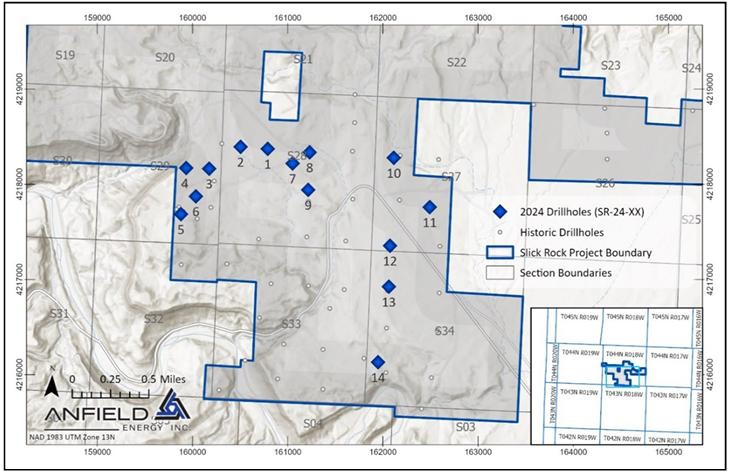
Table 1.11 Slick Rock Drilling Results
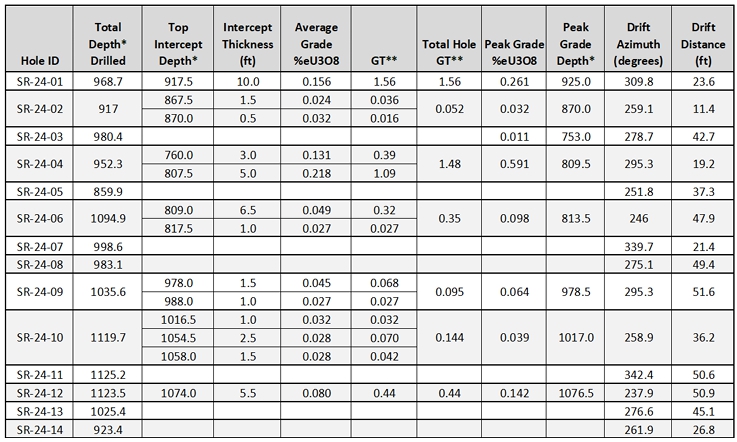
*All depth units are Feet below drill hole collar.
**GT is calculated as: Grade x Thickness (ft)
| 64 |
Intercepts are reported at a 0.02 (200 ppm) eU3O8% grade cut-off. All grades were calculated from gamma-ray logs measured by an experienced commercial independent logging contractor, Hawkins CBM Logging of Cody, Wyoming. Hawkins CBM’s downhole sonde was calibrated at the DOE’s Casper, Wyoming logging test pits prior to deployment to the field. The calibrated downhole sonde is used to measure natural gamma emission from the rock formation down the borehole. The recorded natural gamma data was used in creating the geophysical well log and calculate “equivalent” (“e”) grades of U3O8.
The drill holes were vertical in orientation and all drill holes were measured for downhole drift with the geophysical probe. Drift values for each drill hole are listed in Table 1.11 and in the most extreme cases, the drill hole deviation value was less than 3 degrees from vertical. The geologic units hosting the mineralization are generally flat lying, therefore reported thicknesses are apparent true thicknesses.
Currently, three ground water monitoring wells are being installed at the Slick Rock Project. These monitoring wells are required for permitting to establish baseline ground water quality and levels.
Shootaring Canyon Mill
As of the date of this AIF, the Shootaring Canyon Mill Radioactive Materials License (UT090048) has been maintained. An amendment to the license has been submitted for operational status and is currently being reviewed.
DESCRIPTION OF CAPITAL STRUCTURE
Common Shares
The Company has been authorized to issue an unlimited number of Shares, of which, as of December 31, 2025, 15,942,823 Shares are issued and outstanding. The holders of Shares are entitled to: (i) dividends if, as and when declared by the Board; (ii) one vote per Share at any meeting of the shareholders of the Company; (iii) and, upon liquidation, to receive all assets as are distributable to the holders of Shares.
Warrants
The following table provides details on the Company’s Warrants outstanding as of December 31, 2025:
| Number of Warrants outstanding | Exercise price | Expiry | ||||||
| 1,666,667 | (1) | $ | 13.50 | (1) | May 12, 2027 | |||
| 1,283,638 | (2) | $ | 13.50 | May 12, 2027 | ||||
| 799,000 | (2) | $ | 11.25 | September 26, 2028 | ||||
| 461,404 | (2) | $ | 7.125 | October 6, 2028 | ||||
| 4,210,709 | ||||||||
Note:
| (1) | Represented on a post-Consolidation basis such that seventy-five (75) Warrants must be exercised at a price of $0.18 per Warrant to acquire one (1) Share at an aggregate exercise price of $13.50 per Share. | |
| (2) | These Warrants are reflected on a post-Consolidation basis. |
| 65 |
Stock Options
The following table provides details on Options outstanding as of December 31, 2025:
| Number of Options outstanding and exercisable | Exercise price | Expiry | ||||||
| 190,000 | $ | 9.00 | August 27, 2026 | |||||
| 416,667 | $ | 7.50 | September 20, 2027 | |||||
| 424,904 | $ | 7.50 | October 6, 2028 | |||||
| 560,572 | $ | 6.90 | December 31, 2030 | |||||
| 1,592,143 | ||||||||
The Company’s omnibus incentive plan permits the Board to grant to directors, officers, consultants and employees of the Company’s Options to purchase from the Company a designated number of authorized but unissued Shares up to but not exceeding 10% of the issued and outstanding Shares from time to time, less any Shares reserved for issuance under any other securities-based compensation arrangements of the Company. The Company’s omnibus incentive plan also permits the Board to grant RSUs or deferred share units (“DSUs”). As of the date of this AIF, there were Options to acquire 1,592,143 Shares, 769,401 RSUs and nil DSUs outstanding.
PRIOR SALES
The following table sets forth information in respect of issuances or purchases of Shares and securities that are convertible or exchangeable into Shares during the financial year ended December 31, 2025, including the price at which such securities have been issued, the number of securities issued, and the date on which such securities were issued:
| Date of Issuance | Reason for Issuance | Type of Security | Number | Price per Security | Aggregate Proceeds | |||||||||||
| January 15, 2025 | Private Placement | Shares | 107,142,857 | $ | 0.14 | $ | 15,000,000.00 | |||||||||
| March 18, 2025 | Consideration for Credit Facility Amendment | Warrants | 59,925,000 | $ | 0.15 | N/A | ||||||||||
| May 6, 2025 | Asset Acquisition | Shares | 12,729.464 | $ | 0.06 | N/A | ||||||||||
| June 3, 2025 | Warrant Exercise | Shares | 200,000 | $ | 0.085 | $ | 17,000.00 | |||||||||
| June 13, 2025 | Warrant Exercise | Shares | 44,580 | $ | 0.055 | $ | 3,789.30 | |||||||||
| June 17, 2025 | Warrant Exercise | Shares | 50,000 | $ | 0.085 | $ | 2,750.00 | |||||||||
| June 18, 2025 | Warrant Exercise | Shares | 15,000 | $ | 0.085 | $ | 1,275.00 | |||||||||
| June 24, 2025 | Warrant Exercise | Shares | 150,000 | $ | 0.085 | $ | 12,750.00 | |||||||||
| June 26, 2025 | Warrant Exercise | Shares | 50,115 | $ | 0.055 | $ | 2,756.33 | |||||||||
| July 3, 2025 | Warrant Exercise | Shares | 400,000 | $ | 0.085 | $ | 34,000.00 | |||||||||
| July 4, 2025 | Warrant Exercise | Shares | 1,000,000 | $ | 0.085 | $ | 85,000.00 | |||||||||
| July 8, 2025 | Warrant Exercise | Shares | 15,000 | $ | 0.055 | $ | 825.00 | |||||||||
| July 8, 2025 | Warrant Exercise | Shares | 1,000,000 | $ | 0.085 | $ | 85,000.00 | |||||||||
| July 8, 2025 | Warrant Exercise | Shares | 450,000 | $ | 0.085 | $ | 38,250.00 | |||||||||
| July 8, 2025 | Warrant Exercise | Shares | 1,227,000 | $ | 0.085 | $ | 104,295.00 | |||||||||
| July 10, 2025 | Warrant Exercise | Shares | 900,000 | $ | 0.085 | $ | 76,500.00 | |||||||||
| July 16, 2025 | Warrant Exercise | Shares | 13,636,400 | $ | 0.085 | $ | 1,159,094.00 | |||||||||
| July 16, 2025 | Warrant Exercise | Shares | 250,000 | $ | 0.055 | $ | 13,750.00 | |||||||||
| September 24, 2025(1) | Warrant Exercise | Shares | 2,053 | $ | 7.50 | $ | 15,397.50 | |||||||||
| September 24, 2025 | Warrant Exercise | Shares | 3,000 | $ | 7.50 | $ | 22,500.00 | |||||||||
| September 25, 2025 | Warrant Exercise | Shares | 2,866 | $ | 7.50 | $ | 21,495.00 | |||||||||
| September 26, 2025 | Warrant Exercise | Shares | 2,972 | $ | 7.50 | $ | 22,290.00 | |||||||||
| September 26, 2025 | Warrant Exercise | Shares | 134 | $ | 7.50 | $ | 1,005.00 | |||||||||
| October 2, 2025 | Warrant Exercise | Shares | 4,000 | $ | 7.50 | $ | 30,000.00 | |||||||||
| October 15, 2025 | Warrant Exercise | Shares | 1,333 | $ | 7.50 | $ | 9,997.50 | |||||||||
| October 20, 2025 | Warrant Exercise | Shares | 53,333 | $ | 7.125 | $ | 379,997.63 | |||||||||
| October 24, 2025 | Warrant Exercise | Shares | 100,000 | $ | 7.125 | $ | 712,500.00 | |||||||||
| October 29, 2025 | Warrant Exercise | Shares | 61,540 | $ | 7.50 | $ | 461,550.00 | |||||||||
| November 20, 2025 | Warrant Exercise | Shares | 43,667 | $ | 7.50 | $ | 327,502.50 | |||||||||
| November 28, 2025 | Warrant Exercise | Shares | 10,000 | $ | 7.50 | $ | 75,000.00 | |||||||||
| December 5, 2025 | Warrant Exercise | Shares | 10,533 | $ | 7.50 | $ | 78,997.50 | |||||||||
| December 15, 2025 | Warrant Exercise | Shares | 860 | $ | 7.50 | $ | 6,450.00 | |||||||||
| December 31, 2025 | Option Grant | Options | 560,572 | $ | 6.90 | N/A | ||||||||||
Notes:
| (1) | On August 1, 2025, the Company completed the Consolidation of its outstanding share capital on a basis of seventy-five (75) pre-Consolidation Shares for one (1) post-Consolidation Share. |
| 66 |
DIVIDENDS AND DISTRIBUTIONS
The Company has no fixed dividend policy and the Company has not declared any dividends on its Shares since its incorporation. The Company anticipates that all available funds will be used to undertake exploration and development programs on its mineral properties as well as for the acquisition of additional mineral properties. The payment of dividends in the future will depend, among other things, upon the Company’s earnings, capital requirements and operating and financial condition. Generally, dividends can only be paid if a corporation has retained earnings. There can be no assurance that the Company will generate sufficient earnings to allow it to pay dividends. See also “Describe the Business – Risk Factors”.
MARKET FOR SECURITIES
Market
The Shares of the Company are listed on the TSXV and the Nasdaq under the symbol “AEC”, and the FSE under the symbol “0AD”. On March 27, 2026, the closing price of the Shares on the TXSV was $7.26, on the Nasdaq was US$5.31 and on the FSE was €4.42.
Trading Price and Volume
The following sets forth the high and low market prices and the volume of the Shares traded on the TSXV during the periods indicated (stated in Canadian dollars):
| Month | High $ | Low $ | Volume | |||||||||
| January, 2025 | 0.105 | 0.075 | 21,097,648 | |||||||||
| February, 2025 | 0.085 | 0.065 | 9,117,827 | |||||||||
| March, 2025 | 0.080 | 0.050 | 16,596,029 | |||||||||
| April, 2025 | 0.065 | 0.045 | 12,061,109 | |||||||||
| May, 2025 | 0.120 | 0.055 | 34,960,404 | |||||||||
| June, 2025 | 0.135 | 0.090 | 66,426,682 | |||||||||
| July, 2025 | 0.130 | 0.100 | 75,446,597 | |||||||||
| August, 2025(1) | 8.800 | 5.510 | 480,194 | |||||||||
| September, 2025 | 14.250 | 7.270 | 929,237 | |||||||||
| October, 2025 | 16.250 | 9.790 | 1,012,122 | |||||||||
| November, 2025 | 11.690 | 7.710 | 436,321 | |||||||||
| December, 2025 | 10.300 | 6.100 | 1,900,029 | |||||||||
Notes:
| (1) | On August 1, 2025, the Company completed the Consolidation of its outstanding share capital on a basis of seventy-five (75) pre-Consolidation Shares for one (1) post-Consolidation Share. |
| 67 |
The following sets forth the high and low market prices and the volume of the Shares traded on the Nasdaq during the periods indicated (stated in U.S. dollars):
| Month | High $ | Low $ | Volume | |||||||||
| September 18-30, 2025(1) | 10.980 | 6.000 | 2,661,656 | |||||||||
| October, 2025 | 12.490 | 6.960 | 5,730,310 | |||||||||
| November, 2025 | 8.410 | 5.500 | 1,850,100 | |||||||||
| December, 2025 | 7.250 | 4.420 | 1,896,600 | |||||||||
Notes:
| (1) | The Company’s Shares commenced trading on the Nasdaq on September 18, 2025. |
DIRECTORS AND OFFICERS
Name and Occupation
The name, province or state of residence, position with and principal occupation within the five preceding years for each of the directors and officers of the Company are set out in the following table:
Name, Province or State and Country of Residence and Position with the Company (1) |
Principal Occupation or Employment for the Last Five Years(1) |
Position Since | ||
Ken Mushinski, Texas, USA Chairman and Director |
President, Chief Executive Officer and Director of Rare Element Resources Ltd.; former President of Cotter; Board member for technology developer Diazyme Shanghai and chemical manufacturer Miltec Inc. and as a management committee member for the Honeywell/General Atomics ConverDyn partnership. | September 20, 2022 | ||
Corey A. Dias(2) Ontario, Canada Chief Executive Officer and Director |
Chief Executive Officer of the Company since February 2013. | November 5, 2012 | ||
Donald Falconer(3) Ontario, Canada Director |
Independent businessman and director of public companies since 2014. | June 11, 2014 | ||
John Eckersley Utah, USA Director |
An independent attorney for 30 years, with 10 years of experience with publicly traded companies. | July 19, 2019 | ||
Joshua D. Bleak(2) Arizona, USA Director |
President of North American Environmental Corporation, a consulting company specializing in mining project management, permitting, lobbying and land tenure. | December 15, 2010 | ||
Laara Shaffer(3) British Columbia, Canada Director |
Public company administrator; Chief Financial Officer from June 2010 to December 2025. | May 15, 2023 | ||
Ross McElroy British Columbia, Canada Director |
President and Chief Executive Officer of Apollo Silver Corp. since May 2025; President and Chief Executive Officer of Fission Uranium Corp. from September 2020 to December 2024. | March 27, 2025 | ||
Stephen S. Lunsford(2)(3) Wyoming, USA Director |
Independent businessman and consulting geologist since 2014. | May 23, 2018 | ||
Jeffrey Duncan South Carolina, USA Director |
The Honorable Jeff Duncan served as a Member of the United States Congress for 14 years. Before being elected to the US House of Representatives, Jeff served in the South Carolina General Assembly for 8 years. Duncan most recently served on the House Energy and Commerce Committee, where he was Chairman of the Subcommittee on Energy, Climate. and Grid Security.
He is a principal of Covenant Government LLC. |
September 23, 2025 | ||
Lubica Niemann British Columbia, Canada Chief Financial Officer |
Controller at Canadian Nexus Team Ventures Corp. (now known as Data Watts Partners Inc.) between 2021 and 2024. Consultant as a controller to public companies since 2019. |
January 1, 2026 | ||
Douglas Beahm Wyoming, USA Chief Operating Officer |
Owner and President of BRS, an engineering consulting firm. | March 20, 2024 |
Notes:
| (1) | The information as to country of residence and principal occupation has been furnished by the respective directors and officers individually. | |
| (2) | Member of the Audit Committee. | |
| (3) | Member of the Compensation Committee. |
Each director’s term of office expires at the next annual general meeting of the Company.
| 68 |
Shareholdings of Directors and Officers
As of December 31, 2025, the directors and officers of the Company, as a group, beneficially owned, directly or indirectly, or exercised control or direction over 704,406 Shares representing approximately 4.41% of the issued and outstanding Shares, and held convertible securities of the Company to acquire 1,796,167 Shares.
Cease Trade Orders, Bankruptcies, Penalties or Sanctions
No director or executive officer of the Company is, as at the date of this AIF, or was, within ten years before the date of this AIF, a director, chief executive officer or chief financial officer of any company (including the Company), that (a) was subject to a cease trade or similar order or an order that denied the relevant company access to any exemption under the securities legislation, for a period of more than 30 consecutive days, or (b) was subject to an order that was issued after the director or executive officer ceased to be a director, chief executive officer or chief financial officer and which resulted from an event that occurred while that person was acting in the capacity as director, chief executive officer or chief financial officer.
No director or executive officer of the Company, or a shareholder holding a sufficient number of securities of the Company to affect materially the control of the Company (a) is, as at the date of this AIF, or has been within the 10 years before the date of this AIF, a director or executive officer of any company (including the Company) that, while that person was acting in that capacity, or within a year of that person ceasing to act in that capacity, became bankrupt, made a proposal under any legislation relating to bankruptcy or insolvency or was subject to or instituted any proceedings, arrangement or compromise with creditors or had a receiver, receiver manager or trustee appointed to hold its assets, or (b) has, within the 10 years before the date of this AIF, become bankrupt, made a proposal under any legislation relating to bankruptcy or insolvency, or become subject to or instituted any proceedings, arrangement or compromise with creditors, or had a receiver, receiver manager or trustee appointed to hold the assets of the director, executive officer or shareholder.
No director, or executive officer of the Company, or a shareholder holding a sufficient number of securities of the Company to affect materially the control of the Company, has been subject to (a) any penalties or sanctions imposed by a court relating to securities legislation or by a securities regulatory authority or has entered into a settlement agreement with a securities regulatory authority; or (b) any other penalties or sanctions imposed by a court or regulatory body that would likely be considered important to a reasonable investor in making an investment decision.
Committees of the Board
The committees of the Board are the Audit Committee and the Compensation Committee. The members of the Audit Committee are Joshua D. Bleak (Chairman), Corey A. Dias and Stephen S. Lunsford. The members of the Compensation Committee are Don Falconer (Chair), Stephen S. Lunsford and Laara Shaffer. Information concerning the Audit Committee is provided under “Audit Committee Information” below.
Conflicts of Interest
To the best of the Company’s knowledge, except as otherwise noted in this AIF, there are no existing or potential conflicts of interest among the Company, its directors, officers, or other members of management of the Company except that certain of the directors, officers and other members of management serve as directors, officers and members of management of other public companies and therefore it is possible that a conflict may arise between their duties as a director, officer or member of management of such other companies and their duties as a director, officer or member of management of the Company.
The directors and officers of the Company may serve as directors or officers, or may be associated with, other reporting companies, or have significant shareholdings in other public companies. To the extent that such other companies may participate in business or asset acquisitions, dispositions, or ventures in which the Company may participate, the directors and officers of the Company may have a conflict of interest in negotiating and concluding on terms with respect to the transaction. If a conflict of interest arises, the Company will follow the provisions of the BCBCA dealing with conflict of interest. These provisions state that where a director has such a conflict, that director must, at a meeting of the Company’s directors, disclose his or her interest and refrain from voting on the matter unless otherwise permitted by the BCBCA. In accordance with the laws of the Province of British Columbia, the directors and officers of the Company are required to act honestly, in good faith, and in the best interest of the Company.
| 69 |
AUDIT COMMITTEE INFORMATION
Audit Committee Charter
The charter of the Audit Committee is attached as Schedule “A” to this AIF.
Composition of the Audit Committee and Independence
The Company’s Audit Committee consists of Joshua D. Bleak (Chairman), Corey A. Dias and Stephen S. Lunsford. National Instrument 52-110 – Audit Committees (“NI 52-110”) provides that a member of an audit committee is “independent” if the member has no direct or indirect material relationship with the Company, which could, in the view of the Board, reasonably interfere with the exercise of the member’s independent judgment. The Board has determined that Messrs. Bleak and Lunsford of the Audit Committee are “independent” directors. The Company complies with NI 52-110 by relying on the exemptions for U.S. listed issuers thereunder
Relevant Education and Experience
NI 52-110 provides that an individual is “financially literate” if he or she has the ability to read and understand a set of financial statements that present a breadth and level of complexity of accounting issues that are generally comparable to the breadth and complexity of the issues that can reasonably be expected to be raised by the Company’s financial statements. The Company has determined that all of the members of the Audit Committee are “financially literate”.
Based on their business and educational experiences, each Audit Committee member has a reasonable understanding of the accounting principles used by the Company; an ability to assess the general application of such principles in connection with the accounting for estimates, accruals and reserves; experience preparing, auditing, analyzing or evaluating financial statements that present a breadth and level of complexity of issues that can reasonably be expected to be raised by the Company’s financial statements, or experience actively supervising one or more individuals engaged in such activities; and an understanding of internal controls and procedures for financial reporting. Each of the members of the Audit Committee has had several years of experience as a senior executive and a member of the Board of significant business enterprises in which he has assumed substantial financial and operational responsibility. In the course of these duties, the members have gained a reasonable understanding of the accounting principles used by the Company; an ability to assess the general application of such principles in connection of the accounting for estimates, accruals and reserves; experience analyzing and evaluating financial statements that present a breadth and level of complexity of issues that can reasonably be expected to be raised by the Company’s financial statements, or experience actively supervising one or more individuals engaged in such activities; and an understanding of internal controls and procedures for financial reporting.
Audit Committee Oversight
Since the commencement of the Company’s most recently completed financial year, the Audit Committee has not made any recommendations to nominate or compensate an external auditor which were not adopted by the Board.
Reliance on Certain Exemptions
Since the commencement of the Company’s most recently completed financial year, the Company has not relied on the exemptions in section 2.4 (De Minimis Non-audit Services), section 3.2 (Initial Public Offerings), section 3.4 (Events Outside Control of Member) or section 3.5 (Death, Disability or Resignation of Audit Committee Member) of NI 52-110, or an exemption from NI 52-110, in whole or in part, granted under Part 8 (Exemptions).
| 70 |
Since the commencement of the Company’s most recently completed financial year, the Company has not relied on the exemption in subsection 3.3(2) (Controlled Companies), section 3.6 (Temporary Exemption for Limited and Exceptional Circumstances) or the exemption in section 3.8 (Acquisition of Financial Literacy) of NI 52-110.
Pre-Approval Policies and Procedures
The chair of the Audit Committee is authorized to pre-approve all non-audit services to be provided to the Company or its subsidiary entities by the Company’s external auditor, subject to the chair of the Audit Committee reporting the pre-approval(s) to the Audit Committee at the Audit Committee’s meeting subsequent to the said approval(s).
Audit Fees
The following table sets forth the fees paid by the Company and its subsidiaries to DMCL LLP, Chartered Professional Accountants (“DMCL”), the current auditors for services rendered during the year ended December 31, 2025 and the year ended December 31, 2024:
| YE Dec. 31, 2025 | YE Dec. 31, 2024 | |||||||
| Audit fees(1) | $ | 310,000 | $ | 140,000 | ||||
| Audit-related fees(2) | Nil | Nil | ||||||
| Tax fees(3) | $ | 19,000 | $ | 19,000 | ||||
| All other fees | Nil | Nil | ||||||
| Total | $ | 329,000 | $ | 159,000 | ||||
| (1) | The aggregate audit fees billed by the Company’s auditor (or accrued). | |
| (2) | The aggregate fees billed (or accrued) for assurance and related services that are reasonably related to the performance of the audit or review of the Company’s financial statements which are not included under the heading “Audit Fees”, including for quarterly reviews. | |
| (3) | The aggregate fees billed (or accrued) in 2025 and 2024 for professional services provided by the auditor rendered for tax compliance, tax advice and tax planning. |
LEGAL PROCEEDINGS AND REGULATORY ACTIONS
Except as disclosed below, the Company is not a party to, nor are any of the Company’s properties subject to, any pending legal proceedings or regulatory actions the outcome of which would have a material adverse effect on the Company. The management of the Company is not aware of any material legal proceedings in which the Company may be a party which are contemplated by governmental authorities or otherwise.
On
August 25, 2025, the Company, its subsidiary HRI and
INTEREST OF MANAGEMENT AND OTHERS IN MATERIAL TRANSACTIONS
Management of the Company is not aware of any material interest, direct or indirect, of any insider of the Company, or any associate or affiliate of any such person, in any transaction during the Company’s three last completed financial years, or during the current financial year that has materially affected or is reasonably expected to materially affect the Company.
Certain directors, officers and other insiders of Anfield have historically participated in private placements by Anfield on the same basis as other arm’s length subscribers to such offerings.
| 71 |
TRANSFER AGENTS AND REGISTRARS
The Company’s registrar and transfer agent is Computershare Trust Company of Canada located at its principal offices in Vancouver, British Columbia.
MATERIAL CONTRACTS
As of the date of this AIF, the Credit Facility is the only agreement reasonably regarded as being material to the Company. See “General Development of the Business – Three Year History”.
A copy of the Credit Facility and amendments to the Credit Facility are available under the Company’s SEDAR+ profile at www.sedarplus.ca.
INTERESTS OF EXPERTS
Mr. Douglas L. Beahm, P.E., P.G., Mr. Carl Warren, P.E., P.G., and Mr. Joshua Stewart, P.E., P.G. of BRS have acted as qualified persons under NI 43-101 in connection with the preparation of the 2022 Technical Report. Joshua Stewart is no longer employed by BRS. Therefore, BRS is now taking responsibility for all of the statements made by Joshua Stewart in respect of the 2022 Technical Report.
Mr. Douglas L. Beahm, P.E., P.G., Mr. Carl Warren, P.E., P.G., Mr. Harold H. Hutson, P.E., P.G., of BRS, and Mr. Terence P. (Terry) McNulty, P.E., D. Sc., of T.P. McNulty and Associates Inc., have acted as qualified persons under NI 43-101 in connection with preparation of the 2023 PEA.
All technical and scientific information discussed in this AIF has been reviewed and approved by Douglas L. Beahm, P.E., P.G. the Company’s Chief Operating Officer, who is considered, by virtue of his education, experience and professional association, a QP for the purposes of NI 43-101. Mr. Beahm is not independent of the Company as he is the Chief Operating Officer of the Company. As of the date hereof, Mr. Beahm holds 40,000 Options.
The Company’s independent auditors, DMCL, report that they are independent of the Company within the meaning of the Code of Professional Conduct of the Chartered Professional Accountants of British Columbia.
As of the date hereof, to the knowledge of the Company, except as disclosed above, none of the above-mentioned experts nor any director, officer, partner, or employee thereof, as applicable, received or has received a direct or indirect interest in the Company’s property or of any of the Company’s associates or affiliates. As at the date hereof, such persons, and the directors, officers, partners and employees, as applicable, of each of the experts beneficially own, directly or indirectly, in the aggregate, less than one percent (1%) of the securities of the Company and they did not receive any direct or indirect interest in any securities of the Company or of any associate or affiliate of the Company in connection with the preparation of such report. None of such persons, or any director, officer or employee, as applicable, of any such companies or partnerships, is currently expected to be elected, appointed or employed as a director, officer or employee of the Company or of any associate or affiliate of the Company.
ADDITIONAL INFORMATION
Additional information including directors’ and officers’ remuneration and indebtedness, principal holders of the Company’s securities and options to purchase Shares of the Company and securities authorized for issuance under equity compensation plans is contained in the management proxy circular dated May 7, 2025 for the annual general meeting of the Company held on June 13, 2025, which is available on SEDAR+ at www.sedarplus.ca. Additional financial information is contained in the Company’s comparative financial statements and MD&A as at and for the years ended December 31, 2025 and December 31, 2024, which are available on SEDAR+ at www.sedarplus.ca. Additional information relating to the Company may be found on SEDAR+ at www.sedarplus.ca.
| 72 |
SCHEDULE “A”
AUDIT COMMITTEE CHARTER
The audit committee will assist the board of directors (the “Board”) in fulfilling its financial oversight responsibilities. The audit committee will review and consider in consultation with the auditors the financial reporting process, the system of internal control and the audit process. In performing its duties, the audit committee will maintain effective working relationships with the Board, management, and the external auditors. To effectively perform his or her role, each audit committee member must obtain an understanding of the principal responsibilities of audit committee membership as well and the Company’s business, operations and risks.
Composition
The Board will appoint from among their membership an audit committee after each annual general meeting of the shareholders of the Company. The audit committee will consist of a minimum of three directors.
Independence
A majority of the members of the audit committee must not be officers, employees or control persons of the Company.
Expertise of Committee Members
Each member of the audit committee must be financially literate or must become financially literate within a reasonable period of time after his or her appointment to the committee. At least one member of the audit committee must have accounting or related financial management expertise. The Board shall interpret the qualifications of financial literacy and financial management expertise in its business judgment and shall conclude whether a director meets these qualifications.
Meetings
The audit committee shall meet in accordance with a schedule established each year by the Board, and at other times that the audit committee may determine. The audit committee shall meet at least annually with the Company’s Chief Financial Officer and external auditors in separate executive sessions.
Roles and Responsibilities
The audit committee shall fulfill the following roles and discharge the following responsibilities:
| A-1 |
External Audit
The audit committee shall be directly responsible for overseeing the work of the external auditors in preparing or issuing the auditor’s report, including the resolution of disagreements between management and the external auditors regarding financial reporting and audit scope or procedures. In carrying out this duty, the audit committee shall:
| ● | recommend to the Board the external auditor to be nominated by the shareholders for the purpose of preparing or issuing an auditor’s report or performing other audit, review or attest services for the Company; |
| ● | review (by discussion and enquiry) the external auditors’ proposed audit scope and approach; |
| ● | review the performance of the external auditors and recommend to the Board the appointment or discharge of the external auditors; |
| ● | review and recommend to the Board the compensation to be paid to the external auditors; and |
| ● | review and confirm the independence of the external auditors by reviewing the non-audit services provided and the external auditors’ assertion of their independence in accordance with professional standards. |
Internal Control
The audit committee shall consider whether adequate controls are in place over annual and interim financial reporting as well as controls over assets, transactions and the creation of obligations, commitments and liabilities of the Company. In carrying out this duty, the audit committee shall:
| ● | evaluate the adequacy and effectiveness of management’s system of internal controls over the accounting and financial reporting system within the Company; and |
| ● | ensure that the external auditors discuss with the audit committee any event or matter which suggests the possibility of fraud, illegal acts or deficiencies in internal controls. |
Financial Reporting
The audit committee shall review the financial statements and financial information prior to its release to the public. In carrying out this duty, the audit committee shall:
| ● | General |
| ○ | review significant accounting and financial reporting issues, especially complex, unusual and related party transactions; and | |
| ○ | review and ensure that the accounting principles selected by management in preparing financial statements are appropriate. |
| ● | Annual Financial Statements |
| ○ | review the draft annual financial statements and provide a recommendation to the Board with respect to the approval of the financial statements; | |
| ○ | meet with management and the external auditors to review the financial statements and the results of the audit, including any difficulties encountered; and | |
| ○ | review management’s discussion & analysis respecting the annual reporting period prior to its release to the public. |
| ● | Interim Financial Statements |
| ○ | review and approve the interim financial statements prior to their release to the public; and | |
| ○ | review management’s discussion & analysis respecting the interim reporting period prior to its release to the public. |
| A-2 |
| ● | Release of Financial Information |
| ○ | where reasonably possible, review and approve all public disclosure, including news releases, containing financial information, prior to its release to the public. |
Non-Audit Services
All non-audit services (being services other than services rendered for the audit and review of the financial statements or services that are normally provided by the external auditor in connection with statutory and regulatory filings or engagements) which are proposed to be provided by the external auditors to the Company or any subsidiary of the Company shall be subject to the prior approval of the audit committee.
Delegation of Authority
The audit committee may delegate to one or more independent members of the audit committee the authority to approve non-audit services, provided any non-audit services approved in this manner must be presented to the audit committee at its next scheduled meeting.
De-Minimis Non-Audit Services
The audit committee may satisfy the requirement for the pre-approval of non-audit services if:
| ● | the aggregate amount of all non-audit services that were not pre-approved is reasonably expected to constitute no more than five per cent of the total amount of fees paid by the Company and its subsidiaries to the external auditor during the fiscal year in which the services are provided; or |
| ● | the services are brought to the attention of the audit committee and approved, prior to the completion of the audit, by the audit committee or by one or more of its members to whom authority to grant such approvals has been delegated. |
Pre-Approval Policies and Procedures
The audit committee may also satisfy the requirement for the pre-approval of non-audit services by adopting specific policies and procedures for the engagement of non-audit services, if:
| ● | the pre-approval policies and procedures are detailed as to the particular service; |
| ● | the audit committee is informed of each non-audit service; and |
| ● | the procedures do not include delegation of the audit committee’s responsibilities to management. |
Other Responsibilities
The audit committee shall:
| ● | establish procedures for the receipt, retention and treatment of complaints received by the company regarding accounting, internal accounting controls, or auditing matters; |
| ● | establish procedures for the confidential, anonymous submission by employees of the company of concerns regarding questionable accounting or auditing matters; |
| A-3 |
| ● | ensure that significant findings and recommendations made by management and external auditor are received and discussed on a timely basis; |
| ● | review the policies and procedures in effect for considering officers’ expenses and perquisites; |
| ● | perform other oversight functions as requested by the Board; and |
| ● | review and update this Charter and receive approval of changes to this Charter from the Board. |
Reporting Responsibilities
The audit committee shall regularly update the Board about audit committee activities and make appropriate recommendations.
Resources and Authority of the Audit Committee
The audit committee shall have the resources and the authority appropriate to discharge its responsibilities, including the authority to:
| ● | engage independent counsel and other advisors as it determines necessary to carry out its duties; |
| ● | set and pay the compensation for any advisors employed by the audit committee; and |
| ● | communicate directly with the internal and external auditors. |
Guidance – Roles & Responsibilities
The following guidance is intended to provide the audit committee members with additional guidance on fulfilment of their roles and responsibilities on the committee:
Internal Control
| ● | evaluate whether management is setting the goal of high standards by communicating the importance of internal control and ensuring that all individuals possess an understanding of their roles and responsibilities; |
| ● | focus on the extent to which external auditors review computer systems and applications, the security of such systems and applications, and the contingency plan for processing financial information in the event of an IT systems breakdown; and |
| ● | gain an understanding of whether internal control recommendations made by external auditors have been implemented by management. |
Financial Reporting
| ● | General |
| ○ | review significant accounting and reporting issues, including recent professional and regulatory pronouncements, and understand their impact on the financial statements; |
| A-4 |
| ○ | ask management and the external auditors about significant risks and exposures and the plans to minimize such risks; and |
| ○ | understand industry best practices and the Company’s adoption of them. |
| ● | Annual Financial Statements |
| ○ | review the annual financial statements and determine whether they are complete and consistent with the information known to committee members, and assess whether the financial statements reflect appropriate accounting principles in light of the jurisdictions in which the Company reports or trades its shares; |
| ○ | pay attention to complex and/or unusual transactions such as restructuring charges and derivative disclosures; |
| ○ | focus on judgmental areas such as those involving valuation of assets and liabilities, including, for example, the accounting for and disclosure of loan losses; warranty, professional liability; litigation reserves; and other commitments and contingencies; |
| ○ | consider management’s handling of proposed audit adjustments identified by the external auditors; and |
| ○ | ensure that the external auditors communicate all required matters to the committee. |
| ● | Interim Financial Statements |
| ○ | be briefed on how management develops and summarizes interim financial information, the extent to which the external auditors review interim financial information; |
| ○ | meet with management and the auditors, either telephonically or in person, to review the interim financial statements; and |
| ○ | to gain insight into the fairness of the interim statements and disclosures, obtain explanations from management on whether: |
| ● | actual financial results for the quarter or interim period varied significantly from budgeted or projected results; |
| ● | changes in financial ratios and relationships of various balance sheet and operating statement figures in the interim financial statements are consistent with changes in the company’s operations and financing practices; |
| ● | generally accepted accounting principles have been consistently applied; |
| ● | there are any actual or proposed changes in accounting or financial reporting practices; |
| ● | there are any significant or unusual events or transactions; |
| ● | the Company’s financial and operating controls are functioning effectively; |
| ● | the Company has complied with the terms of loan agreements, security indentures or other financial position or results dependent agreement; and |
| ● | the interim financial statements contain adequate and appropriate disclosures. |
| ● | Compliance with Laws and Regulations |
| ○ | periodically obtain updates from management regarding compliance with this policy and industry “best practices”; |
| ○ | be satisfied that all regulatory compliance matters have been considered in the preparation of the financial statements; and |
| ○ | review the findings of any examinations by securities regulatory authorities and stock exchanges. |
| ● | Other Responsibilities |
| ○ | Review, with the Company’s counsel, any legal matters that could have a significant impact on the Company’s financial statements. |
| A-5 |