Exhibit 99.1
STANDARD LITHIUM LTD.
ANNUAL INFORMATION FORM
for the Fiscal Year ended December 31, 2025
Dated March 27, 2026
CORPORATE OFFICE
Suite 1625, 1075 West Georgia Street
Vancouver, British Columbia, V6E 3C9
REGISTERED OFFICE
Suite 2200, 885 West Georgia Street
Vancouver, British Columbia, V6C 3E8
PRELIMINARY NOTES AND CAUTIONARY STATEMENT
Date of Information
All information in this Annual Information Form ("AIF") is as of December 31, 2025, unless otherwise indicated.
Cautionary Notes to U.S. Investors Concerning Resource Estimates
This AIF has been prepared in accordance with the requirements of the securities laws in effect in Canada, which differ from the requirements of the U.S. securities laws. In particular, and without limiting the generality of the foregoing, the terms "mineral reserve", "proven mineral reserve", "probable mineral reserve", "inferred mineral resources," "indicated mineral resources," "measured mineral resources" and "mineral resources" used or referenced in this AIF are Canadian mineral disclosure terms as defined in accordance with National Instrument 43-101 – Standards of Disclosure for Mineral Projects ("NI 43-101") under the guidelines set out in the 2014 Canadian Institute of Mining, Metallurgy and Petroleum Standards for Mineral Resources and Mineral Reserves, Definitions and Guidelines, May 2014 (the "CIM Standards"). The Canadian Institute of Mining ("CIM") Standards differ from the mineral property disclosure requirements of the U.S. Securities and Exchange Commission (the "SEC") in Regulation S-K Subpart 1300 (the "SEC Modernization Rules") under the U.S. Securities Act of 1933, as amended (the "Securities Act").
As a foreign private issuer that is eligible to file reports with the SEC pursuant to the multi-jurisdictional disclosure system, Standard Lithium Ltd. ("Standard Lithium" or the "Company") is not required to provide disclosure on its mineral properties under the SEC Modernization Rules and will continue to provide disclosure under NI 43-101 and the CIM Standards. Accordingly, the Company's disclosure of mineralization and other technical information may differ significantly from the information that would be disclosed had the Company prepared the information under the standards adopted under the SEC Modernization Rules.
Non-GAAP Measures
The Company has included certain non-GAAP and other financial measures in this AIF, which the Company believes, together with measures determined in accordance with International Financial Reporting Standards ("IFRS"), provide investors with an improved ability to evaluate the underlying performance of the Company. Non-GAAP financial measures do not have any standardized meaning prescribed under IFRS, and therefore they may not be comparable to similar non-GAAP and other financial performance measures employed by other companies. The data is intended to provide additional information and should not be considered in isolation or as a substitute for measures of performance prepared in accordance with IFRS.
EBITDA
The Company has provided estimated earnings, before interest, taxes, depreciation and amortization ("EBITDA") for the resource development of brine leases located in southwest Arkansas (the "South West Arkansas Project"). EBITDA excludes items that are not directly related to operating activities. While there is no standardized meaning of the measure across the industry, the Company believes that this measure is useful to external users in assessing operating performance of the South West Arkansas Project. Upon commencing commercial production and reporting EBITDA costs, the Company will provide a reconciliation to IFRS figures then presented.
All-In Operating Costs
The Company has provided estimated all-in operating cost performance measure for the South West Arkansas Project that reflects both direct costs and indirect costs, as well as royalties, sustaining capital and allowances for mine closure, but is exclusive of taxes. The majority of the all-in operating cost comprises reagent usage required for extraction of lithium from the brine, as well as conversion to battery quality lithium carbonate and electricity consumption. While there is no standardized meaning of the measure across the industry, the Company believes that this measure is useful to external users in assessing operating performance. Upon commencing commercial production and reporting all-in operating costs, the Company will provide a reconciliation to IFRS figures then presented.
Currency
Except where otherwise indicated, all references to currency in this AIF are to United States Dollars ("$").
Forward-Looking Information
Except for statements of historical fact, this AIF contains certain "forward-looking information" within the meaning of applicable Canadian securities legislation and "forward-looking statements" within the meaning of the United States Private Securities Litigation Reform Act of 1995 (collectively referred to herein as "forward-looking information"). The statements relate to future events or the Company's future performance. All statements, other than statements of historical fact, may be forward-looking information. Information concerning mineral resource and mineral reserve estimates also may be deemed to be forward-looking information in that it reflects a prediction of mineralization that would be encountered if a mineral deposit were developed and mined. Forward-looking information generally can be identified by the use of words such as "seek", "anticipate", "plan", "continue", "estimate", "expect", "may", "will", "would", "project", "predict", "propose", "potential", "target", "intend", "could", "might", "should", "believe", "scheduled", "implement" and similar words or expressions. These statements involve known and unknown risks, uncertainties and other factors that may cause actual results or events to differ materially from those anticipated in such forward-looking information.
In particular, this AIF contains forward-looking information, including, without limitation, with respect to the following matters or the Company's expectations relating to such matters: the Company's planned exploration and development programs (including, but not limited to, plans and expectations regarding advancement, testing and operation of the lithium extraction at the Company's direct lithium extraction ("DLE") demonstration plant (the "Demonstration Plant"); commercial opportunities for lithium products; delivery of studies; the Company's strategic and ongoing partnerships, including with Equinor TDI Holdings LLC and certain of its subsidiaries ("Equinor"); filing of technical reports; expected results of exploration; accuracy of mineral or resource exploration activity; ability to secure further leasehold positions and perform further exploration drilling in East Texas; anticipated timing for a preliminary economic assessment of the Franklin Project in the northeast region of Texas (the "Franklin Project"); accuracy of mineral reserves or mineral resources estimates, including the ability to develop and realize on such estimates; whether mineral resources will ever be developed into mineral reserves, and information and underlying assumptions related thereto; budget estimates and expected expenditures by the Company on its properties; regulatory or government requirements or approvals; the reliability of third party information; continued access to mineral properties or infrastructure; payments and share issuances pursuant to property agreements; fluctuations in the market for lithium and its derivatives; expected timing of the expenditures; performance of the Company's business and operations; anticipated timelines for a Final Investment Decision and production at the South West Arkansas Project; changes in exploration costs and government regulation in Canada and the United States; competition for, among other things, capital, acquisitions, undeveloped lands and skilled personnel; changes in commodity prices and exchange rates; currency and interest rate fluctuations; the Company's funding requirements and ability to raise capital; geopolitical instability; war (such as U.S. military intervention in Iran and Russia's invasion of Ukraine); and other factors or information.
Forward-looking information does not take into account the effect of transactions or other items announced or occurring after the statements are made. Forward-looking information is based upon a number of expectations and assumptions and is subject to a number of risks and uncertainties, many of which are beyond the Company's control, which could cause actual results to differ materially from those that are disclosed in or implied by such forward-looking information. With respect to forward-looking information listed above, the Company has made assumptions regarding, among other things: current technological trends; ability to fund, advance and develop the Company's properties; the Company's ability to operate in a safe and effective manner; uncertainties with respect to receiving and maintaining mining, exploration, environmental and other permits; pricing and demand for lithium, including that such demand is supported by growth in the energy security and storage market and the electric vehicle market; impact of increasing competition; commodity prices, currency rates, interest rates and general economic conditions; the legislative, regulatory and community environments in the jurisdictions where the Company operates; impact of unknown financial contingencies; impacts of changes in current and future trade agreements, legislation, regulations, import tariffs and other similar trade barriers, including material changes in the U.S.-Mexico-Canada Agreements and implementation of the "America First Trade Policy"; increases in geo-political tension and tension with respect to lithium; market prices for lithium products; budgets and estimates of capital and operating costs; estimates of mineral resources and mineral reserves; reliability of technical data; the ability to negotiate access agreements on commercially reasonable terms, anticipated timing and results of operation and development; inflation; and war (such as U.S. military intervention in Iran and Russia's invasion of Ukraine). Although the Company believes that the assumptions and expectations reflected in such forward-looking information are reasonable, the Company can give no assurance that these assumptions and expectations will prove to be correct. Since forward-looking information inherently involves risks and uncertainties, undue reliance should not be placed on such information.
Forward-looking information involves known and unknown risks, uncertainties and other factors that may cause the actual results, performance or achievements of the Company to be materially different from any future results, performance or achievements expressed or implied by the forward-looking information. Such factors include, but are not limited to: general economic conditions in Canada, the United States and globally; industry conditions, including the state of the energy security and storage market and electric vehicle market; governmental regulation of the mining industry, including environmental
regulation and permitting; geological, technical and drilling problems; unanticipated operating events; negotiation of commercial access agreements, competition for and/or inability to retain drilling rigs and other services and to obtain capital, undeveloped lands, skilled personnel, equipment and inputs; inability to secure customer offtake agreements on economically favorable terms; reliance on third parties; potential or ongoing joint ventures; ability to secure further leasehold positions and perform further exploration drilling in East Texas; anticipated timing for a preliminary economic assessment of the Franklin Project in East Texas; the availability of capital on acceptable terms; the need to obtain required approvals from regulatory authorities; uncertainties associated with estimating mineral resources and mineral reserves, including uncertainties relating to the assumptions underlying mineral resource and mineral reserve estimates; whether mineral resources will ever be converted into mineral reserves; uncertainties in estimating capital and operating costs, cash flows and other project economics; liabilities and risks, including environmental liabilities and risks inherent in mineral extraction operations; health and safety risks; risks related to unknown financial contingencies, including litigation costs, on the Company's operations; unanticipated results of exploration activities; unpredictable weather conditions; unanticipated delays in preparing technical studies; inability to generate profitable operations; restrictive covenants in debt instruments; lack of availability of additional financing on terms acceptable to the Company; intellectual property ("IP") risk; stock market volatility; volatility in market prices for commodities; liabilities inherent in the mining industry; inflation risks; risks related to war (such as U.S. military intervention in Iran and Russia's invasion of Ukraine); changes in tax laws, royalty policies and incentive programs relating to the mining industry; other risks pertaining to the mining industry; conflicts of interest; dependency on key personnel; and fluctuations in currency and interest rates, as well as those factors discussed in the section entitled "Risk Factors" in this AIF.
Although the Company has attempted to identify important factors that could cause actual actions, events or results to differ materially from those described in forward-looking information, there may be other factors that cause actions, events or results to differ from those anticipated, estimated or intended.
Readers are cautioned that the foregoing lists of factors are not exhaustive. All forward-looking information in this AIF speaks as of the date of this AIF. The Company does not undertake any obligation to update or revise any forward-looking information, whether as a result of new information, future events or otherwise, except as required by law. All forward-looking information contained in this AIF is expressly qualified in its entirety by this cautionary statement. Additional information about these assumptions and risks and uncertainties is contained in the Company's filings with securities regulators, including the Company's most recent management's discussion and analysis for its most recently completed financial year and, if applicable, interim financial period, which are available on the system for electronic document analysis and retrieval ("SEDAR+") at www.sedarplus.ca and the electronic data gathering, analysis and retrieval system ("EDGAR") at www.sec.gov.
Certain Other Information
The filings under the Company's profile on SEDAR+ and EDGAR are not incorporated by reference in this AIF unless specifically stated. Information contained on the Company's website is also not incorporated by reference in this AIF.
Certain information in this AIF is obtained from third party sources, including public sources, and there can be no assurance as to the accuracy or completeness of such information. Management of the Company has not independently verified any of the data from third party sources nor ascertained the validity or accuracy of the underlying economic assumptions relied upon therein, and the Company does not make any representation as to the accuracy of such information.
CORPORATE STRUCTURE
Name, Address and Incorporation
The Company was incorporated under the laws of the Province of British Columbia on August 14, 1998 under the name "Tango Capital Corp." Effective April 7, 1999, Tango Capital Corp. changed its name to "Patriot Capital Corp." Effective March 5, 2002, Patriot Capital Corp. changed its name to "Patriot Petroleum Corp." At its annual general and special meeting of shareholders held on November 3, 2016, the shareholders of the Company approved a change of name of the Company to "Standard Lithium Ltd." and to the continuance of the Company from the Business Corporations Act (British Columbia) to the Canada Business Corporations Act. On December 1, 2016, the Company completed the name change and continuation.
Standard Lithium is a leading near-commercial lithium company focused on the sustainable development of a portfolio of large, high-grade lithium-brine bearing properties in the United States. The Company prioritizes brine projects characterized by high-grade resources, robust infrastructure, skilled labor, and streamlined permitting. The Company aims to achieve sustainable, commercial-scale lithium production via the application of a scalable and fully integrated DLE and purification
process. Recognized as a critical mineral, lithium holds strategic importance for electric vehicle and battery manufacturing, as well as energy storage systems with profound implications for the broader economy and national security.
The Company's flagship project, the South West Arkansas Project is located on the Smackover Formation in Arkansas, a world-class lithium brine asset. The South West Arkansas Project is being developed in partnership with Equinor, a multi-national energy company and encompasses a significant land area on approximately 30,000 net mineral acres of brine leases. A Definitive Feasibility Study ("DFS") for the South West Arkansas Project was published on October 14, 2025 after completing a detailed Front-End Engineering Study ("FEED"). The partnership is targeting a Final Investment Decision ("FID") and commencing construction in 2026, subject to, among other things, finalizing key contracts and securing suitable project financing.
The Company, in partnership with Equinor, is also developing prospective lithium brine areas within the Smackover Formation in East Texas (the "East Texas Properties"). The Company published exploration drilling results and testing on October 25, 2023, which demonstrated lithium concentrations of 644 mg/L on average. The Company then completed and published a maiden inferred mineral resource for the Franklin Project on November 5, 2025. In partnership with Equinor, the Company plans to continue securing additional leasehold positions and to perform further exploration drilling in East Texas and will pursue a Preliminary Feasibility Study ("PFS") for the Franklin Project. This partnership forms part of the Company’s strategic transaction with Equinor, pursuant to which Equinor has committed to invest up to $160 million for a 45% ownership interest across the South West Arkansas Project and the East Texas Properties (the "Equinor Transaction")
The Company also historically pursued a project in southern Arkansas at the LANXESS Corporation ("LANXESS") South facility near El Dorado, Arkansas (the "Lanxess Property Project"). The Lanxess Property Project contemplated development of a first phase of the project (the "Lanxess 1A Project"). In October of 2023, the Company completed a DFS for the Lanxess 1A Project. In 2025, the Company and LANXESS mutually agreed to terminate the previously executed amended and restated memorandum of understanding related to the Lanxess 1A Project. Subsequent to termination, the Company continued to have discussions and negotiations regarding its go forward plans with respect to the project.
As a result of these discussions and negotiations, on January 12, 2026, the Company entered into a site services agreement with LANXESS, effective January 1, 2026, that will allow it to maintain the operations of the Demonstration Plant, but the Company did not enter into a new memorandum of understanding or other agreement that would serve to advance the Lanxess 1A Project. The Company has refocused its capital allocation and management plans towards the development of its South West Arkansas Project and Franklin Project, within the East Texas Properties. As such, the Company is no longer pursuing the development of the Lanxess Property Project, including the Lanxess 1A Project at this time. Therefore, the Company determined that as of December 31, 2025, the Lanxess Property Project ceased to be considered a material property of the Company and identified indicators of impairment. The Company estimated the recoverable amount for the Lanxess Property Project to be nil and has recognized a $26.5 million impairment expense as a result.
The Company has been successfully operating the Demonstration Plant near the Lanxess 1A Project site for approximately six years. The Demonstration Plant serves as both a testing and optimization facility, as well as a training facility for future potential operators at the Company's South West Arkansas and East Texas projects. This innovative plant, utilizing DLE to extract lithium from an existing brine pipeline system, operates continuously, with commercial scale technology and equipment.
The Company's interests also extend to certain mineral leases and option agreements in the Mojave Desert, San Bernardino County, California.
The Company is listed on the TSX Venture Exchange ("TSXV") and the NYSE American, LLC (the "NYSE") under the symbol "SLI". The Company is a reporting issuer in each of the Provinces and Territories of Canada and files its continuous disclosure documents with the Canadian Securities Authorities in such Provinces and Territories. Such documents are available on SEDAR+ at www.sedarplus.ca and on EDGAR at www.sec.gov.
The Company's corporate office is located at Suite 1625, 1075 West Georgia Street, Vancouver, British Columbia, V6E 3C9 and its registered office is located at Suite 2200, 885 West Georgia Street, Vancouver, British Columbia, V6C 3E8.
Intercorporate Relationships
Standard Lithium currently has the following direct or indirect material subsidiaries:
•Standard Lithium US Holdings LLC (Delaware) 100%
oStandard Lithium US Services Company LLC (Delaware)
oSWA Lithium Holdings LLC (Delaware)
oSWA Lithium Financing LLC (Delaware) ("SWA Lithium") 55%
oSWA Lithium LLC (Delaware)
oStandard Lithium US Asset Management LLC (Delaware)
oTexas Lithium Holdings LLC (Delaware)
oTexas Lithium Financing LLC (Delaware) ("Texas Lithium") 55%
oCass County Brine LLC (Delaware)
oLone Star Brine LLC (Delaware)
oTexas Lone Star Brine LLC (Delaware)
oArkansas Lithium LLC (Delaware)
oStandard Lithium US IP Holdco LLP (Delaware)
oStandard Lithium US IP Licensor LLC (Delaware)
oSLL El Dorado Parent LLC (Delaware) 100%
oSLL El Dorado South HoldCo LLC (Delaware)
oSLL El Dorado South LLC (Delaware)
oSLL Carbon Capture LLC (Delaware) 100%
oCalifornia Lithium Ltd. (Nevada) 100%
GENERAL DEVELOPMENT OF THE BUSINESS
Three Financial Fiscal Period History
Fiscal Year Ended June 30, 2024
On July 5, 2023, the Company appointed David Park as Senior Strategic Advisor of the Company.
On July 26, 2023, the Company filed a short form base shelf prospectus (the "Previous Base Shelf").
On August 8, 2023, the Company announced positive results of a PFS for the South West Arkansas Project, including an upgraded mineral resource for a portion of the project.
On September 6, 2023, the Company announced positive results of a DFS for the Lanxess 1A Project.
On September 13, 2023, the Company announced it had acquired 118 acres of land adjacent to its South West Arkansas Project, with the intended use to assist with the advancement of development.
On September 18, 2023, the Company filed a PFS and updated indicated mineral resource for its South West Arkansas Project.
On September 25, 2023, the Company appointed Salah Gamoudi as Chief Financial Officer following Kara Norman's appointment as Chief Accounting Officer of the Company.
On October 5, 2023, the Company appointed Michael Barman as Chief Development Officer of the Company.
On October 18, 2023, the Company filed a DFS on the Lanxess Property Project, which was comprised of a mineral reserve and resource estimate on Phase 1A of the Lanxess Property Project.
On October 31, 2023, the Company announced that it had exercised its option to acquire brine production rights pursuant to an option agreement dated December 29, 2017 between Tetra Technologies, Inc. ("TETRA") and the Company (the "TETRA 1st Option Agreement") at the South West Arkansas Project.
On November 7, 2023, the Company adopted an Executive Officer Incentive Compensation Clawback Policy in accordance with the listing requirements of the NYSE, the Dodd-Frank Wall Street Reform and Consumer Protection Act of 2010, and
the U.S. Securities Exchange Act of 1934, as amended (the "Exchange Act").
On November 17, 2023, the Company filed a supplement to its Previous Base Shelf to establish an at-the-market ("ATM") equity program that allowed the Company to issue up to $50 million of common shares of the Company (the "Shares") from treasury to the public from time to time, at the Company's discretion. Distributions of Shares through the ATM equity program were made pursuant to the terms of a sales agreement between the Company and Citigroup Global Markets Inc., Canaccord Genuity LLC and Canaccord Genuity Corp.
On January 24, 2024, the Company announced the engagement of Ausenco Engineering Canada ULC. to provide the FEED services required by the Company's DFS on the South West Arkansas Project.
On March 13, 2024, the Company announced the successful installation of a commercial-scale full-size DLE column at the Demonstration Plant near El Dorado, Arkansas — a Li-Pro™ Lithium Selective Sorption ("LSS") unit supplied by Koch Technology Solutions ("KTS"). Thereafter, the Company announced that during a representative period of continuous operation, the commercial-scale column exceeded design parameters, achieving an average lithium recovery of 97.3%.
On April 16, 2024, the Company reorganized certain of its Canadian subsidiaries such that: Texas Lithium Holdings Corp. was continued under the Canada Business Corporations Act (resulting in Texas Lithium Holdings Corp. changing its name to 15951232 Canada Inc. ("15951232")) and 15951232 was thereafter combined with the Company pursuant to a vertical short-form amalgamation.
On May 8, 2024, the Company announced the completion of a strategic partnership with Equinor to accelerate the development of the Company's large-scale, sustainable lithium projects in the Smackover Formation. The Equinor Transaction includes an investment of up to $160 million by Equinor and the acquisition of a 45% interest in the Company's former subsidiaries related to the South West Arkansas Project and the East Texas Properties.
Six-Month Transition Year Ended December 31, 2024
On July 23, 2024, the Company announced that it entered into an agreement with an advisor to settle a fee of $0.8 million in consideration for the issuance of 666,667 Shares, which fee related to strategic advisory services facilitating the partnership between the Company and Equinor. The consultant was subsequently appointed as a member of executive management. Services provided were advisory in nature and did not assume management responsibilities.
On September 1, 2024, David Park was appointed as Chief Executive Officer of the Company following the retirement of Robert Mintak.
On September 20, 2024, the Company announced that SWA Lithium was awarded a $225 million grant from the U.S. Department of Energy (the "DOE") for the South West Arkansas Project (the "DOE Grant").
On September 20, 2024, the Company announced that the South West Arkansas Project's design was being updated from its original PFS, and would now target a larger total output of 45,000 metric tons per annum of lithium carbonate, to be developed in two equal phases.
On October 28, 2024, the Company announced that SWA Lithium had entered into a licensing agreement with KTS to deploy and use KTS' Li-ProTM LSS technology (the "Licensing Agreement").
On November 18, 2024, the Company announced that it had changed its financial year-end from June 30 to December 31 to better align to the operating cycle of the industry.
On December 10, 2024, the Company appointed Paul Collins to the Board as an independent director.
On December 19, 2024, the Company announced that SWA Lithium, in partnership with KTS, successfully designed, built, commissioned and began operating a pilot DLE plant at the South West Arkansas Project. The pilot DLE plant is processing brine directly from the South West Arkansas Project to confirm engineering design parameters and provide samples of battery-quality lithium carbonate for use in the qualification process with potential off-take partners.
Fiscal Year Ended December 31, 2025
On January 15, 2025, the Company announced that SWA Lithium successfully commenced drilling a new well into the Smackover Formation at the South West Arkansas Project. SWA Lithium is also undertaking an extensive field program to re-enter the wells drilled in 2023 to conduct detailed reservoir testing and brine sampling work.
On January 16, 2025, the Company announced that SWA Lithium finalized the $225 million DOE Grant, which will support construction of Phase 1 of the South West Arkansas Project.
On March 19, 2025, the Company appointed Karen Narwold to the Board as an independent director.
On April 21, 2025, the South West Arkansas Project was designated as a Priority Critical Mineral Project under Executive Order 14241 – Immediate Measures to Increase American Mineral Production. This designation facilitates streamlined permitting through inclusion on the U.S. Federal Permitting Dashboard and reinforces the South West Arkansas Project's strategic significance to U.S. domestic lithium supply chains.
On April 24, 2025, the Arkansas Oil and Gas Commission ("AOGC") unanimously approved the formation of the Reynolds brine unit (the "Reynolds Unit"), a key milestone enabling Phase 1 brine production activities within the South West Arkansas Project area.
On May 29, 2025, the AOGC approved Smackover Lithium's brine royalty application, originally submitted on May 6, 2025, marking a key step in establishing the regulatory and financial framework for Phase 1 development.
On June 3, 2025, the Company announced a collaboration with Telescope Innovations Corp. ("Telescope") to advance the development of low-temperature lithium sulfide synthesis for potential application in next-generation solid-state battery technologies.
On July 15, 2025, the Company announced that sampling from the Lester Well, located at the South West Arkansas Project area, yielded the highest lithium concentration recorded to date within the South West Arkansas Project — 616 mg/L of lithium in brine. The average lithium concentration from the three brine samples was 582 mg/L.
On July 30, 2025, the Company filed a final short form base shelf prospectus (the "Base Shelf") with the securities commissions in each of the provinces and territories of Canada and a corresponding shelf registration statement on Form F-10 with the SEC allowing for the future issuance, from time to time, of up to $1 billion in Company securities.
On August 8, 2025, the Company filed a prospectus supplement to the Base Shelf, establishing an ATM equity offering program ("Current ATM Program") to issue and sell up to $50 million in Shares, from time to time.
On September 3, 2025, the Company announced the highlights of a DFS for its South West Arkansas Project. The study confirms an estimated operating life of more than 20 years, supported by a measured and indicated resource of 1.18 million metric tons lithium carbonate equivalent ("LCE") and proven and probable reserves of 709,000 metric tons LCE. The South West Arkansas Project is designed to produce approximately 22,500 metric tons per year of battery-quality lithium carbonate.
On September 16, 2025, Aquatech International LLC ("Aquatech") announced the acquisition of the KTS direct lithium extraction business, including the Li-Pro™ technology used in the Company's demonstration activities and planned for use in the South West Arkansas Project. As a result of the transaction, Aquatech has assumed KTS' role under existing arrangements with the Company with no material changes to underlying terms.
On September 24, 2025, the Company announced a maiden inferred mineral resource estimate for the Franklin Project in the northeast region of Texas, within the East Texas Properties. The Franklin Project represents an initial phase of the joint venture’s broader East Texas development strategy. The resource comprises approximately 2.2 million metric tons of LCE at an average concentration of 668 mg/L lithium, 15.4 million metric tons of potash and 2.6 million metric tons of bromide.
On October 14, 2025, the Company filed a DFS for its South West Arkansas Project. See "Mineral Properties – South West Arkansas Project" below for more information with respect to the DFS on the South West Arkansas Project.
On October 20, 2025, the Company filed a prospectus supplement to the Base Shelf (the "Public Offering Prospectus Supplement") relating to the underwritten public offering (the "Public Offering") of 29,885,057 Shares at a price of $4.35 per Share, for aggregate gross proceeds of $130 million. Concurrently, the Company entered into an underwriting agreement with a syndicate of underwriters led by Morgan Stanley and Evercore ISI as co-lead book-running managers and including
BMO Capital Markets, as a book-running manager, Canaccord Genuity Corp., Raymond James & Associates, Inc., Roth Capital Partners, LLC, and Stifel, Nicolaus & Company, Incorporated (the “Underwriting Agreement”).
On October 30, 2025, the AOGC approved Smackover Lithium’s integration application for the Reynolds Unit, a key de-risking step providing certainty on the resource underpinning the South West Arkansas Project.
On November 5, 2025, the Company filed a technical report for the maiden inferred mineral resource estimate at its Franklin Project. See "Mineral Properties – East Texas Properties" below for more information with respect to the technical report on the Franklin Project.
On December 9, 2025, Smackover Lithium announced that it had received expressions of interest from three Export Credit Agencies ("ECAs"), including the Export-Import Bank of the United States and Export Finance Norway, for over $1 billion in potential senior secured project debt to support development of Phase 1 of the South West Arkansas Project. Smackover Lithium is pursuing a project financing package of up to $1.1 billion, expected to include ECA-supported debt and commercial bank financing. These expressions of interest are non-binding and subject to customary due diligence, credit approvals and negotiation of definitive documentation.
Subsequent Events to December 31, 2025
On March 9, 2026, the Company announced that Smackover Lithium entered into a binding offtake agreement with Trafigura Trading LLC ("Trafigura") for the purchase by Trafigura of battery-grade lithium carbonate to be produced from the South West Arkansas Project (the "Offtake Agreement"). Pursuant to the Offtake Agreement, Trafigura is expected to purchase up to 8,000 tons per year of lithium carbonate over a 10-year term commencing upon commercial production.
On March 16, 2026, the Company announced the engagements of The Walsh Group, LLC, led by its Principal General Robert S. Walsh, USMC (Ret.) and Global Mineral Strategies, led by its Managing Director, Mr. Gary Stanley, as strategic advisors to the Company.
Selected Financings
The Company has completed the following financings over the last three completed financial fiscal periods:
ATM Issuances
On July 26, 2023, the Company filed the Previous Base Shelf relating to the offering for sale from time to time of up to $250 million Shares, preferred shares, with no par value ("Preferred Shares"), debt securities, subscription receipts, warrants or units. The Previous Base Shelf replaced the base shelf prospectus filed by the Company on September 10, 2021.
On November 17, 2023, the Company filed a prospectus supplement relating to the offering for sale from time to time of up to $50 million Shares pursuant to its Previous Base Shelf, and entered into an ATM sales agreement with Canaccord Genuity Corp., Canaccord Genuity LLC and Citigroup Global Markets Inc. for distribution of the Shares (the "2023 ATM"). The Company raised gross proceeds of $50.0 million pursuant to the 2023 ATM.
On July 30, 2025, the Company filed the Base Shelf relating to the offering for sale from time to time of up to $1 billion Shares, Preferred Shares, debt securities, subscription receipts, warrants or units. The Base Shelf replaced the Previous Base Shelf filed by the Company on July 26, 2023.
On August 8, 2025, the Company filed a prospectus supplement relating to the offering for sale from time to time of up to $50 million Shares pursuant to its Base Shelf, and entered into an agreement with Canaccord Genuity Corp., Canaccord Genuity LLC and Evercore Group L.L.C. for distribution of the Shares. As of December 31, 2025, the Company has raised gross proceeds of $13.6 million pursuant to the Current ATM Program.
Public Offering
On October 20, 2025, the Company filed the Public Offering Prospectus Supplement relating to the Public Offering of 29,885,057 Shares at a price of $4.35 per Share, for aggregate gross proceeds of $130 million, pursuant to its Base Shelf, and entered into the Underwriting Agreement.
Trends and Outlook
As the global economy continues to demand more energy from electric based sources to power electric grids, data centers, artificial intelligence applications, standby energy storage, electric vehicles, and other end use cases, the demand for lithium, a critical mineral used in batteries, is steadily increasing. The United States has designated lithium as a critical mineral vital to national security and economic resilience, underscoring the need for a reliable domestic supply chain.
The Company is addressing this need by focusing on the Smackover Formation, a region rich in lithium-brine resources. The Company's strategy emphasizes sustainable and responsible resource development, recognizing that the successful delivery of these projects requires careful attention to market conditions, including the cyclical nature of lithium pricing, the pace of energy storage system expansion, electric vehicle adoption and other dynamic factors influencing the industry.
The importance of the Smackover Formation is further underscored by significant interest and investment from global energy companies. This interest includes the Company's strategic partnership with Equinor, involving a gross investment of up to $160 million across the South West Arkansas and East Texas Properties as part of the Equinor Transaction. The Equinor Transaction highlights the potential of these projects to contribute meaningfully to the global lithium supply chain while ensuring that the Company's development efforts are well-funded and strategically supported.
As part of its future strategy, Standard Lithium is committed to expanding its presence in the Smackover Formation. This includes securing additional brine leases and property rights across Arkansas and East Texas, as well as engaging with stakeholders to ensure that all projects are developed in a manner that meets both environmental standards and community expectations. By focusing on stakeholder engagement and strategic collaborations, the Company is positioning itself to navigate market challenges, meet the increasing demand for lithium, and deliver long-term value through sustainable practices.
DESCRIPTION OF THE BUSINESS
Background
Standard Lithium is a near-commercial lithium company dedicated to the sustainable development of a portfolio of lithium-brine bearing properties in the United States. The Company places a strong emphasis on partnerships and collaborative relationships, focusing on projects characterized by high-grade resources, robust infrastructure, skilled labor, and streamlined permitting processes. Through the application of fully integrated DLE and purification technology, the Company aims to achieve commercial-scale lithium production.
The Company's primary focus is on projects within the Smackover Formation in southern Arkansas and in East Texas: the South West Arkansas Project and the East Texas Properties, including the Franklin Project. The South West Arkansas Project is strategically located in a region known for its long-standing mineral extraction and energy industries. The South West Arkansas Project, developed in collaboration with Equinor, is central to the Company's portfolio due to its scale and high-quality lithium-brine.
In addition to the South West Arkansas Project, the Company is pursuing development and exploration opportunities within the Smackover Formation in its larger East Texas Properties, including its Franklin Project, also supported through its partnership with Equinor. The Equinor Transaction includes a significant gross investment of up to $160 million across both the South West Arkansas Project and the East Texas Properties.
The Company also historically pursued the Lanxess Property Project, including the LANXESS 1A Project. Furthermore, the Company holds interests in mineral leases and option agreements in the Mojave Desert, San Bernardino County, California.
Standard Lithium currently does not own any producing properties and, as such, has no operating income or cash flow from its properties. The Company's operations are primarily funded through equity financings.
For additional details on the development of these projects, refer to the sections "General Development of the Business – Three Financial Fiscal Period History," "General Development of the Business – Trends and Outlook," and "Mineral Properties" below.
Flagship Projects
The Company’s principal properties within the Smackover Formation consist of (i) the South West Arkansas Project and (ii) its broader East Texas Properties, which includes the Franklin Project. The South West Arkansas Project, developed in
collaboration with Equinor, represents a core asset of the Company. The Company’s East Texas mineral interests are also material to the Company; however, a technical report supporting a mineral resource estimate has been prepared solely in respect of the Franklin Project. No mineral resource estimate has been prepared for the Company’s remaining East Texas acreage.
South West Arkansas Project Background
All of the Company's activities in southern Arkansas relate to brine leases within the Smackover Formation in a region with a long history of commercial scale brine processing. Historical published brine data and current unpublished brine data from within and adjacent to the Company's two areas of interest lead the Company to believe that lithium-bearing brines are present.
The South West Arkansas Project brine lease area has been historically drilled for oil and gas exploration, and approximately 2,041 exploration and production wells have been completed in the Smackover Formation in or immediately adjacent to SWA Lithium's lease area. A portion of these wells had available petro-physical logs of the Smackover Formation brine-bearing zone.
The resource development of brine leases located in southwest Arkansas is maintained pursuant to the TETRA 1st Option Agreement to acquire certain rights to conduct brine exploration and production and lithium extraction activities on approximately 27,262 net mineral acres of brine leases and deeds located in Columbia and Lafayette Counties, Arkansas.
Under the TETRA 1st Option Agreement, the Company paid TETRA $0.5 million on January 28, 2018, $0.6 million on December 29, 2018, $0.7 million on January 31, 2020, and $0.8 million on December 29, 2020. Under the TETRA 1st Option Agreement, the Company is required to pay additional annual payments of $1.0 million by each annual anniversary date beginning on the date that is 48 months following the date of the TETRA 1st Option Agreement, until the earlier of the expiration of 10 years from the date of the agreement or the execution of a limited mineral assignment, or, if the Company exercises the option. During the lease period, as specified in the TETRA 1st Option Agreement, at any time following the commencement of commercial production of the lithium, the Company agreed to pay a royalty of 2.5% (minimum royalty $1.0 million) to TETRA. On October 31, 2023, the Company exercised its option to acquire brine production rights pursuant to the TETRA 1st Option Agreement at the South West Arkansas Project.
On January 28, 2019, the Company announced a maiden inferred mineral resource of 802,000 metric tons of LCE at the South West Arkansas Project.
On October 12, 2021, the Company announced the results of a Preliminary Economic Assessment ("PEA") and updated inferred mineral resource estimate on the South West Arkansas Project. The results of the PEA led to the commencement of the PFS at the South West Arkansas Project on May 2, 2022.
On August 8, 2023, the Company announced the results of a PFS on the South West Arkansas Project. On September 18, 2023, the Company filed a PFS and updated the mineral resource for its South West Arkansas Project.
On May 7, 2024, the Company entered into the Equinor Transaction whereby Equinor acquired interests in two Standard Lithium formerly wholly-owned subsidiaries, SWA Lithium, which holds Standard Lithium's South West Arkansas Project and Texas Lithium, which holds the East Texas Properties. Pursuant to the terms of the Equinor Transaction, Equinor acquired a 45% interest in each of the former subsidiaries for an initial cash payment of $30 million to the Company and the commitment to invest up to an additional $130 million as follows:
•Equinor solely funded the first $40 million and $20 million of development costs for SWA Lithium and Texas Lithium, respectively, after which all additional capital expenditures would be funded on a pro-rata basis; and
•Standard Lithium is to receive $40 million in milestone payments associated with SWA Lithium and $30 million in milestone payments associated with Texas Lithium subject to FIDs being made by certain dates ("Financial asset – FID").
The Company will maintain majority ownership and operatorship pursuant to a development services agreement at each of the South West Arkansas Project and the East Texas Properties.
On September 20, 2024, the Company announced that SWA Lithium was awarded a $225 million DOE Grant for the South West Arkansas Project. On January 16, 2025, the Company announced that SWA Lithium finalized the $225 million DOE Grant, which will support construction of Phase 1 of the South West Arkansas Project.
On October 28, 2024, the Company announced that SWA Lithium had entered into the License Agreement with KTS to deploy and use KTS' Li-ProTM technology at SWA Lithium's commercial plant for the South West Arkansas Project.
On December 19, 2024, the Company announced that SWA Lithium, in partnership with KTS, successfully designed, built, commissioned and began operating a pilot DLE plant at the South West Arkansas Project. The pilot DLE plant is processing brine directly from the South West Arkansas Project to confirm engineering design parameters and provide samples of battery-quality lithium carbonate for use in the qualification process with potential off-take partners.
On March 11, 2025, the Company announced that its joint venture with Equinor, Smackover Lithium, successfully completed the final derisking phase of its DLE technology at the South West Arkansas Project, in collaboration with KTS. The Demonstration Plant exceeded performance benchmarks, achieving greater than 99% lithium recovery from over 100,000 gallons of brine and producing approximately 970 gallons of concentrated and purified lithium chloride solution, which was subsequently converted into 27 kilograms of battery-quality lithium carbonate. The results support advancement of the South West Arkansas Project into FEED and feasibility studies and represent a significant milestone toward commercial-scale U.S. lithium production.
On September 3, 2025, the Company announced the results of a DFS on the South West Arkansas Project. On October 14, 2025, the Company filed a DFS and upgraded mineral resource for its South West Arkansas Project1. See "Mineral Properties – South West Arkansas Project" below. While the DFS is focused on this initial phase of development at the South West Arkansas Project, SWA Lithium is planning to develop additional phases of the South West Arkansas Project throughout the total area.
SWA Lithium is advancing towards an FID on the South West Arkansas Project.
East Texas Properties
The Company's ongoing expansion into East Texas has been driven by a deliberate strategy to secure additional brine-hosted lithium resources within the Smackover Formation, one of the most prospective sedimentary brine systems in North America. The Company began assembling its East Texas land position through the acquisition of brine mineral rights beginning in 2022 in the approximately 80,000 acre Franklin Project, with over 46,000 gross brine mineral acres leased to support the inferred resource.
As part of its early technical evaluation, the Company initiated a program to re-enter legacy oil and gas wells across the East Texas Properties. These wells provided valuable subsurface data, including porosity, permeability, pressure, and brine chemistry, enabling the Company to confirm the presence of lithium-bearing brines within the Upper and Middle Smackover intervals. The re-entry program was followed by a series of new appraisal wells drilled specifically to test lithium concentrations and reservoir continuity. The Franklin Project is highlighted by 2,159,000 metric tons of LCE at an average lithium concentration of 668 mg/L, 15,414,000 metric tons of potash (as potassium chloride) and 2,638,000 metric tons of bromide contained within 0.61km3 of brine volume. The Franklin Project represents the first step in advancing the joint venture's East Texas development strategy, which targets scalable lithium chemical production through phased expansion.
On October 25, 2023, the Company published exploration drilling results and testing which demonstrated lithium concentrations of 668 mg/L on average at the East Texas Properties.
On May 7, 2024, the Company entered into the Equinor Transaction as previously discussed. Following completion of the Equinor Transaction, Texas Lithium advanced exploration activities across the Franklin Project and broader East Texas Properties. These activities included additional brine sampling, reservoir characterization, and land consolidation to expand the East Texas Properties' footprint.
On September 24, 2025, the Company announced a maiden inferred mineral resource estimate for the Franklin Project, representing the first resource delineated within the Company’s East Texas Properties.
[1] See NI 43-101 technical report titled "South West Arkansas Project NI 43-101 Technical Report & Definitive Feasibility Study, Arkansas United States" with an effective date of September 3, 2025 and available under the Company's SEDAR+ profile at www.sedarplus.ca.
On November 5, 2025, the Company filed a technical report for the maiden inferred mineral resource estimate for its Franklin Project2. See "Mineral Properties – Franklin Project" below.
The Company maintains a 55% ownership stake in Texas Lithium and Equinor maintains a 45% ownership stake. The Company plans to continue securing further mineral leasehold positions and performing additional exploration, development and de-risking programs on the East Texas Properties. The Company has also begun work to advance the Franklin Project toward a future PFS.
Other Projects
Lanxess Property Project
The Lanxess Property Project was centered on the development of the Lanxess 1A Project. Development was governed by an amended and restated memorandum of understanding dated February 23, 2022 (the "Amended and Restated MOU") with LANXESS which was terminated by mutual agreement in 2025. The Company has refocused its capital allocation and management plans towards the development of its South West Arkansas Project as well as the Franklin Project and other potential projects within the East Texas Properties. As such, the Company is no longer pursuing development of the Lanxess Property Project. Therefore, the Company determined that as of December 31, 2025, the Lanxess Property Project ceased to be considered a material property of the Company and identified indicators of impairment. The Company estimated the recoverable amount for the Lanxess Property Project to be nil and has recognized a $26.5 million impairment expense as a result.
Demonstration Plant
Notwithstanding termination of the Amended and Restated MOU, Standard Lithium has been successfully operating an industrial-scale DLE Demonstration Plant near the Lanxess 1A Project site for approximately six years. The Demonstration Plant plays a crucial role as both a testing and optimization facility, as well as a training facility for future potential operators at the Company's South West Arkansas and East Texas projects.
In August 2018, the Company initiated mini-pilot scale process work, using tail brine collected from operating facilities in southern Arkansas. This work and data collected formed the basis for the Demonstration Plant and aimed for continuous 24/7 operation. The Demonstration Plant was constructed by Zeton Inc. in three phases and was completed in October 2019, with initial installation at LANXESS' south plant facility in southern Arkansas. During November and December 2019, a semi-permanent all-weather structure was installed to enclose the Demonstration Plant, and an office/control room and an analytical laboratory were also installed.
On May 19, 2020, the Company announced full-time operation of the Demonstration Plant. The plant is designed to process up to 50 US gallons per minute of tail brine, and extract the lithium, with the aim of producing a high quality, concentrated lithium chloride intermediate product. This product can then be converted into battery quality lithium carbonate. As of July 15, 2020, the Company's Demonstration plant was operational using proprietary SiFT technology the Company is developing.
On September 1, 2021, the Company announced completion of the installation of the lithium carbonate plant, with all major connections made to the existing Demonstration Plant and the installation of a new weatherproof enclosure.
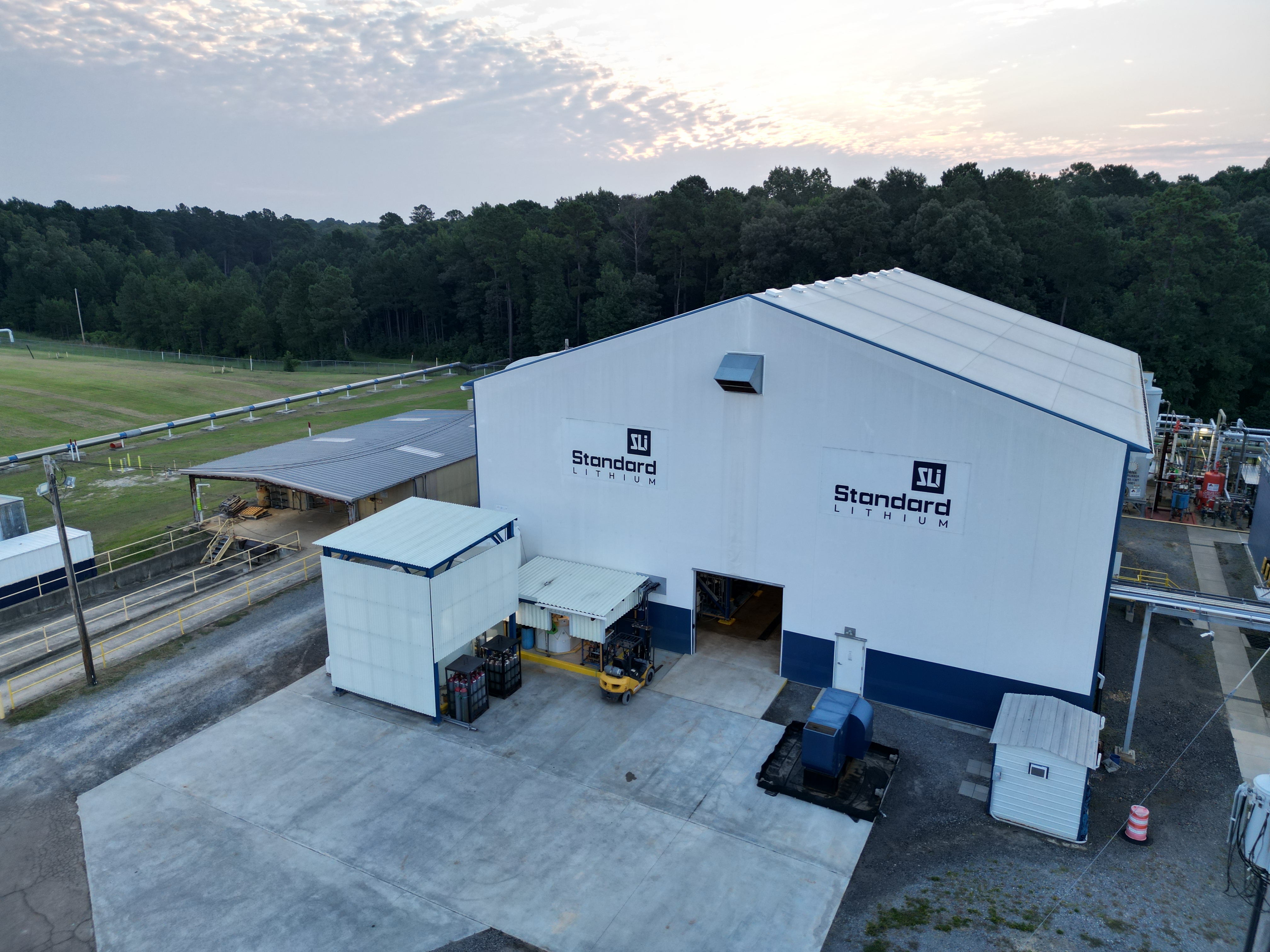
The Demonstration Plant's (pictured below) primary focus is to test, trial and optimize the most effective DLE process for specific brine conditions, and plays a crucial role as a training facility for future potential operators at the Company's South West Arkansas and East Texas projects. Since October 2022, the Company has been testing Aquatech's proprietary Li-ProTM technology at the Demonstration Plant. The highly automated three-story Demonstration Plant is complemented by adjacent buildings housing the control room, office and an analytical laboratory, ensuring precise and monitored lithium extraction processes. The resulting high-purity lithium chloride solution can either be processed further at the Company's on-site carbonation pilot plant or sent to a third party for refining.
[2] See NI 43-101 technical report titled "NI 43-101 Technical Report: Maiden Inferred Resource Estimate for Standard Lithium Ltd.'s Franklin Project, located in Hopkins, Franklin and Titus Counties, Texas, United States" with an effective date of September 24, 2025 and available under the Company's SEDAR+ profile at www.sedarplus.ca.
Activities at the Demonstration Plant are governed by a site services agreement, which was renewed on January 12, 2026, and is focused on refining and validating solutions independent of the advancement of the Lanxess Property Project.
Lithium Brine Processing R&D Project
The Company is focused on continuously improving its lithium extraction and refining technologies through its technical group.
This work centers on several areas: (i) pre-treating brines using filtration technologies; (ii) selectively extracting lithium from pre-treated brine to produce concentrated lithium salt solutions; (iii) purifying and crystallizing these solutions to produce battery-grade lithium products; and (iv) de-risking the technology by designing, building, and operating progressively larger pilot and pre-commercial plants.
As part of these efforts, the Company entered into a joint development agreement with Koch Engineered Solutions to support the commercial deployment of its projects. In March 2024, Standard Lithium installed a commercial-scale lithium extraction column—referred to as a Li-Pro™ LSS unit—at its Demonstration Plant near El Dorado, Arkansas. This column is the same size and design as those planned for the Company's commercial projects, including the South West Arkansas Project.
On April 24, 2024, the Company announced that it had successfully commissioned a commercial-scale DLE column at its DLE facility, which is one of the largest continuously operating DLE facilities in North America. The Company further announced that during a representative period of continuous operation, the commercial-scale column exceeded design parameters, achieving an average lithium recovery of 97.3%.
The commercial-scale lithium extraction column has been integrated with the Demonstration Plant for testing and
optimization. This step is intended to provide validation and information necessary for ongoing project financing processes, as well as for the South West Arkansas Project FEED Study.
This work, carried out at project sites and various other locations in the United States and Canada, supports the Company's efforts to advance its projects toward commercial-scale production.
Carbon Capture Project
On September 14, 2021, the Company announced that it was undertaking and funding a pilot project in southern Arkansas to test a novel carbon capture technology. The pilot project is being conducted with the owner of the technology, Aqualung Carbon Capture ASA ("Aqualung"), and a pilot carbon capture unit was installed at a natural gas processing site in southern Arkansas owned and operated by Mission Creek Resources LLC. The pilot project will take a slipstream of flue gas for processing through the Aqualung pilot unit. The resulting concentrated carbon dioxide ("CO2") stream will then be used in the Company's ongoing research and development ("R&D") program to understand how CO2 may be permanently sequestered by the Company as part of normal brine reinjection activities. This R&D program will then expand to consider how CO2 may also be used as an alternative reagent at several points in the Company's process flowsheet.
The Company believes the patent-protected Aqualung carbon capture systems ("CCS") technology, developed by the Norwegian University of Science and Technology ("NTNU"), is an innovative approach with the ability to deliver a cost effective, scalable, modular decarbonization solution.
The Aqualung CCS technology results from over 20 years of research at NTNU and is based on a membrane system that selectively extracts CO2 from a wide range of CO2 sources emitted by hydrocarbon-burning energy sources. It produces a high purity CO2 gas stream that can either be sequestered or reused.
The Company invested $2.5 million in Aqualung as part of a $10 million strategic equity round that included Nasdaq listed, Golar LNG, London-based shipowner, Global Ship Lease and Geneva-based metals trading services group, MKS Pamp. Dr. Andrew Robinson, President and COO of the Company also joined the board of Aqualung.
On January 31, 2023, the Company installed its carbon capture pilot plant in Southern Arkansas to assess sustainable production practices in collaboration with its investment partner, Aqualung.
Specialized Skills and Knowledge
Successful exploration, development and operation of the Company's lithium projects will require access to personnel in a wide variety of disciplines, including geologists, geophysicists, engineers, chemists, drillers, managers, project managers, supply chain and procurement specialists, accounting, financial and administrative staff, and others. Since the project locations are also in jurisdictions familiar with and friendly to resource extraction, management believes that the Company's access to the skills and experience needed for success is sufficient.
Competitive Conditions
The Company's activities are directed towards the exploration, evaluation and development of mineral deposits. There is no certainty that the expenditures to be made by the Company will result in discoveries of commercial quantities of mineral deposits. There is aggressive competition within the mining industry for the discovery and acquisition of properties considered to have commercial potential. The Company will compete with other interests, many of which have greater financial resources than it will have, for the opportunity to participate in promising projects. Significant capital investment is required to achieve commercial production from successful exploration efforts, and the Company may not be able to successfully raise funds required for such capital investments. See "Risk Factors – Competition" below.
Components
Standard Lithium is focused on the sustainable development of a portfolio of lithium-brine bearing properties in the United States, utilizing scalable, proven, and optimized lithium extraction and purification technologies. The Company has secured brine leases through direct acquisition from public lands or private landowners and has established various commercial partnerships with existing brine resource holders in Arkansas and Texas. The Company continues to explore additional opportunities in other jurisdictions.
The Company's collaboration with Equinor is a key aspect of its development strategy. Equinor's investment supports the advancement of the South West Arkansas Project as well as the Company's East Texas Properties, including the Franklin
Project and the additional development activities within the Smackover Formation in East Texas. This partnership is central to the Company's strategy of establishing a sustainable lithium supply chain in the United States.
Intangible Assets
The Company has developed a suite of IP related to novel technologies that can be deployed to either selectively extract lithium from brine or convert and purify intermediate lithium chemicals to higher purity materials. This IP suite is protected by a series of patents, and where the underlying inventor is an associate of, consultant or third party to the Company, exclusive rights or sole-licensing agreements are in place to allow the Company unfettered access to the patent(s) and associated know-how.
Business Cycles
Mining is a cyclical industry and commodity prices fluctuate according to global economic trends and conditions. See "Risk Factors – Risk Related to the Cyclical Nature of the Mining Business" below.
Economic Dependence
The Company's economic dependence is closely tied to its partnership with Equinor for the development of the South West Arkansas Project and continued exploration at the East Texas Properties, including the Franklin Project. Pursuant to the Equinor Transaction, Equinor acquired a 45% interest in the former subsidiaries holding these projects, providing an initial payment and committing to further investments, subject to positive FIDs. Equinor initially funded development and exploration costs for these projects after the formation of the Company’s partnership with them, with additional costs being shared on a pro-rata basis. The Company may receive milestone payments upon reaching FIDs. The Company retains majority ownership and operatorship of both projects, which are governed by development services agreements and a limited liability company agreement, with certain significant decisions requiring approval of both partners. The success of these projects is substantially dependent on Equinor continuing to provide the investments as detailed in the associated amended and restated limited liability company agreements that form part of the Membership Interest Purchase and Sale Agreement between the Company and Equinor TDI Holdings LLC ("MIPSA").
Changes to Contracts
The Company continues to work with Equinor under the terms of their partnership, particularly concerning the South West Arkansas Project and East Texas Properties, including the Franklin Project. Any changes to contracts entered into with Equinor in relation to these projects, including milestone payments to be made by Equinor, will be dependent on reaching positive FIDs as outlined in the LLCA.
In 2024, the Company announced that SWA Lithium finalized a license agreement with KTS, particularly in relation to the use of proprietary technologies at the Company's Smackover Formation projects. The license agreement is an important part of the Company's broader strategy to integrate proven technologies into its commercial-scale operations.
In 2025, the Company and LANXESS mutually agreed to terminate the previously executed Amended and Restated MOU related to the Lanxess 1A Project.
On January 12, 2026, the Company entered into a site services agreement, effective January 1, 2026, that will allow it to maintain the operations of the Demonstration Plant and is focused on refining and validating solutions independent of the advancement of the Lanxess Property Project.
Environmental Protection
The Company's exploration and development activities, as applicable, are subject to various levels of federal, state and local laws and regulations relating to the protection of the environment, including requirements for closure and reclamation of mining properties.
Employees
As of the date of this AIF, the Company has 53 employees, along with numerous contractual engagements with operators, engineers, and back-office employees as further described in "Description of the Business – Social Responsibility and Community Relations" below.
Foreign Operations
The Company's property interests are all located outside of Canada, with the projects being in the United States. The lithium business in which the Company operates is increasingly affected by political factors, including geopolitical tensions among major world powers and industrial policy promoting the development of domestic energy security and storage and electric vehicle and battery production infrastructure. These factors are relevant in the United States.
Reorganizations
Except as set forth above in "General Development of the Business – Three Financial Fiscal Period History", there have been no corporate reorganizations within the three most recently completed financial fiscal periods of the Company and there is no corporate reorganization completed during or proposed for the current financial fiscal period.
Social or Environmental Policies
The Company is committed to maintaining high standards of integrity, professional conduct, and environmentally responsible business practices. The operations are guided by a commitment to producing sustainable lithium chemicals that contribute to energy security, reliability, and environmental responsibility. The Company prioritizes minimizing environmental impacts through careful project planning, compliance with regulatory standards, and the adoption of best practices in environmental management.
In addition to environmental stewardship, the Company is dedicated to fostering positive social outcomes in the regions where it operates. This includes engaging with local communities, respecting cultural and environmental values, and ensuring that its activities generate mutual benefits. The Company seeks to build trust and transparency with stakeholders by upholding ethical business practices and contributing to the social and economic well-being of the communities associated with its projects.
Social Responsibility and Community Relations
The Company remains committed to supporting communities as a central element of its operations. In support of the communities surrounding the South West Arkansas Project and the East Texas Properties, the Company participates in STEM initiatives with local school districts, supports local non-profit and charitable organizations, and collaborates with LiTHIUM LEARNS and LiTHIUM WORKS on workforce development, technical training and education initiatives related to the lithium industry in the South Arkansas region. Additionally, the Company has taken part in music festivals, holiday events, and Independence Day celebrations. These initiatives reflect the Company's ongoing dedication to fostering positive relationships and contributing to the cultural and social vitality of the regions in which it operates.
To further support local workforce development, the Company has established partnerships with educational institutions such as South Arkansas College, Southern Arkansas University, and University of Arkansas Hope-Texarkana. These collaborations aim to enhance training programs that prepare community members for specialized roles within the Company's projects. Currently, the Company employs 33 staff members in South Arkansas, including engineers, operators, technicians, and administrative staff, predominantly from nearby communities. This strategy emphasizes its commitment to local employment and economic development.
In support of the communities surrounding the Company's operations in East Texas, initiatives include contributions to local non-profits and charities. Efforts are focused on engaging local stakeholders and ensuring that the benefits of the Company's projects are shared with the surrounding communities. The Company has remained actively engaged with county judges and city officials in the surrounding areas to provide updates on project activities and to foster open communication. During the year ended December 31, 2025, the Company joined the Franklin County and Sulphur Springs Chambers of Commerce and presented at the August Mt. Vernon Rotary Club meeting to provide an update on its activities. The Company's ongoing focus on sustainable development seeks to balance environmental stewardship with the social and economic needs of the regions in which it operates.
MINERAL PROPERTIES
The Company has two material mineral properties: the South West Arkansas Project and the East Texas Properties, including the Franklin Project. Each property will be discussed below separately. Previously, the Lanxess Property Project was considered a material project by the Company. Due to the termination of the Amended and Restated MOU between Lanxess and the Company in 2025, and the cessation of further discussions, negotiations, and capital allocation towards advancing the development of the Lanxess Property Project, the Company no longer considers the Lanxess Property Project to be a material mineral property.
South West Arkansas Project
Please refer to the technical report titled "South West Arkansas Project NI 43-101 Technical Report & Definitive Feasibility Study, Arkansas, United States" dated effective September 3, 2025 (the "South West Arkansas DFS"), as filed on the Company's SEDAR+ profile, for detailed disclosure relating to:
•Property Description and Location;
•Accessibility, Climate, Local Resources, Infrastructure and Physiography;
•Geological Setting and Mineralization;
•Sample Preparation, Analyses and Security;
•Mineral Processing and Metallurgical Testing;
•Mineral Resource Estimates;
•Mineral Reserve Estimates;
•Market Studies and Contracts;
•Environmental Studies, Permitting and Social or Community Impact;
•Capital and Operating Costs;
•Other Relevant Data and Information;
•Interpretation and Conclusions; and
The following is a summary of the South West Arkansas DFS, prepared by a multi-disciplinary team of qualified persons ("QPs") that includes geologists, hydrogeologists, chemical, process and civil engineers with relevant experience in the lithium-brine confined aquifer type deposits, Smackover Formation geology and brine processing. The authors include Patricio Pinto Gallardo, C.P.R.M. of Ausenco Chile Ltda., Aleksandar Spasojevic, P.Eng. of Ausenco Engineering Canada ULC, Randal M. Brush, P.E. and Robert E. Williams, Jr., P.G., CPG of Haas & Cobb Petroleum Consultants, Thomas Wynn Rogers, Jr., P.E. of Hunt, Guillot & Associates, LLC and Richard DeLong, P.G. of Trinity Consultants Inc.
The South West Arkansas DFS is incorporated by reference herein and for full technical details, the complete text of the South West Arkansas DFS should be consulted.
The following summary does not purport to be a complete summary of the South West Arkansas Project and is subject to all the assumptions, qualifications and procedures set out in the South West Arkansas DFS and is qualified in its entirety with reference to the full text of the South West Arkansas DFS. The following summary is subject to any updated information contained elsewhere in this AIF.
Property Location and Ownership
The center of the South West Arkansas Project is located approximately 24 km (15 miles) west of the City of Magnolia in Lafayette County, southwestern Arkansas, United States. The South West Arkansas property encompasses Townships 16-17 South and Ranges 22-24 West of the 5th Meridian and lies wholly within Lafayette and Columbia counties.
The South West Arkansas Project comprises 947 brine leases and eight brine deeds that cover approximately 11,438 net mineral hectares (28,263 net mineral acres). The first phase project area, known as the Reynolds Unit, has been approved by the AOGC and consists of 8,439 gross mineral hectares (20,854 gross mineral acres). Of the remaining acreage, a portion will be integrated by means of a unit expansion application with the AOGC ahead of project sanction for the second phase, which will be known as the Reynolds Unit expansion area.
TETRA is the underlying owner of many of the brine leases and brine deeds. The Company acquired the rights to produce brine-sourced lithium from these leases and deeds through an option agreement with TETRA. In addition, Smackover Lithium acquired additional brine leases owned exclusively by TETRA and Saltwerx, LLC through a like-kind brine lease exchange completed in April 2025. In 2023, the Company purchased 48 hectares (118 acres) of surface land to build the central processing facility ("CPF") for the South West Arkansas Project, and Smackover Lithium has subsequently executed surface leases and/or option agreements for the Reynolds Unit well locations, well pad locations, and pipeline rights-of-way in support of future development. As of the date hereof, SWA Lithium has successfully completed unitization and has established a lithium royalty for the Reynolds Unit. None of the Company, Equinor or TETRA has developed the project brine leases and brine deeds for production of brine minerals.
Geology and Mineralization
The South West Arkansas Project lithium deposit is a confined aquifer brine deposit in the form of a lithium-bearing brine contained within the porosity of the Smackover Formation within the project’s property boundaries. The Smackover Formation in southern Arkansas is commonly subdivided into three intervals, the Reynolds Member Oolite (predominantly oolitic limestone), referred to as the "Upper Smackover", the "Middle Smackover" (a burrowed pellet packstone), and the Brown Dense (dark, dense limestone), referred to as the “Lower Smackover”. The lithium brine resource, as reported, is contained within the Upper and Middle Members of the Smackover Formation, (which underlie the entire South West Arkansas Project area). The Lower Smackover does not contribute to the resource estimates but is a future target for exploration.
The depth of the top of the Smackover Formation in the property area generally dips from north-northeast to south-southwest and varies in depth from approximately 2,316 m (7,600 ft) subsea to approximately 2,773 m (9,100 ft) subsea. Brine has been extracted commercially from the Smackover Formation in southern Arkansas for approximately 60 years and the geology is well-understood.
The volume of in-place lithium is proportional to the product of the brine-saturated pore volume and lithium concentration, both of which are known with reasonable accuracy, based on the drilling, logging, coring, and brine sampling data obtained throughout the South West Arkansas property area. The data used to estimate and model the resource were gathered from the six project-specific wells along with 93 prior wells in the property and 316 additional prior oil and gas production wells adjacent to the property, as well as surface seismic information.
Exploration, Drilling and Sampling
The Company successfully executed a six-well exploration program that significantly improved the geological description of the target Smackover Formation. The program addressed the three key factors that determine the quality of the resource: the total volume of brine based on core and log porosity data, the brine’s lithium concentration based on the analysis of multiple brine samples from the wells, and the productivity of the formation based on the core permeability data collected and the well tests conducted. The resulting data and analyses support the conclusion that the measured, indicated, and inferred resources present at the South West Arkansas Project are of sufficient quality to justify installation of a lithium extraction project at the site.
From February to July, 2023, the Company conducted a five-well exploration program at the South West Arkansas Project, followed by additional well brine sampling and drilling in 2024 and 2025. These five well locations were chosen to maximize the description of the geological properties and lithium concentrations within the South West Arkansas Project. In 2024 and 2025, the brine from the IPC-1 well was re-sampled, and in 2025 the Lester 2 well was drilled, logged, and the brine was sampled.
Mineral Resource Estimate
The resource present in the Smackover Formation below the South West Arkansas Project was updated based on the proposed unitized area encompassing 13,095 gross mineral hectares (32,358 gross mineral acres). Using a conversion factor of 5.323 kg of LCE per kilogram of lithium, the measured plus indicated resource value corresponds to an estimate of 1,177,000 metric tons LCE for 0.5 km3 of brine. For the Middle Smackover inferred resource, the estimate is 278,000 metric tons LCE for 0.15 km3 of brine.
The lithium resource estimates are presented in Tables 1 and 2, effective September 3, 2025, and represent the estimated total lithium in place within the Upper Smackover and Middle Smackover formations within the bounds of the South West
Arkansas Project. Mineral resources that are not mineral reserves do not have demonstrated economic viability. The footnotes provided below Table 2 apply to both Tables 1 and 2.
Table 1: South West Arkansas Property Geological Factors and Indicated Lithium Resource Estimates
|
|
|
|
|
|
|
|
|
|
Resource Category |
|
Measured |
Indicated |
Measured + Indicated |
|
|
|
|
|
|
|
|
|
|
Project Area, Smackover Formation |
|
Initial Phase Upper |
Future Expansion Upper |
Total Upper |
|
|
|
|
|
|
|
|
|
|
Gross Aquifer Volume, km3 |
|
4.33 |
2.12 |
6.45 |
|
|
|
|
|
|
|
|
|
|
Net Aquifer Volume, km3 |
|
2.86 |
1.39 |
4.25 |
|
|
|
|
|
|
|
|
|
|
Average Porosity, % |
|
11.80 |
11.75 |
11.79 |
|
|
|
|
|
|
|
|
|
|
Brine Volume, km3 |
|
0.34 |
0.16 |
0.50 |
|
|
|
|
|
|
|
|
|
|
Average Lithium Concentration, mg/L |
|
514 |
293 |
442 |
|
|
|
|
|
|
|
|
|
|
Lithium Resource, k metric tons |
|
173 |
48 |
221 |
|
|
|
|
|
|
|
|
|
|
LCE, kt |
|
922 |
255 |
1,177 |
|
|
|
|
|
Table 2: South West Arkansas Project Geological Factors and Inferred Lithium Resource Estimates
|
|
|
|
|
|
|
|
|
|
Resource Category |
|
Inferred |
|
|
|
|
|
|
|
|
|
|
Project Area, Smackover Formation |
|
Initial Phase Middle |
Future Expansion Middle |
Total Middle |
|
|
|
|
|
|
|
|
|
|
Gross Aquifer Volume, km3 |
|
4.99 |
3.00 |
7.99 |
|
|
|
|
|
|
|
|
|
|
Net Aquifer Volume, km3 |
|
0.96 |
0.61 |
1.57 |
|
|
|
|
|
|
|
|
|
|
Average Porosity, % |
|
9.05 |
9.88 |
9.37 |
|
|
|
|
|
|
|
|
|
|
Brine Volume, km3 |
|
0.09 |
0.06 |
0.15 |
|
|
|
|
|
|
|
|
|
|
Average Lithium Concentration, mg/L |
|
452 |
215 |
355 |
|
|
|
|
|
|
|
|
|
|
Lithium Resource, k metric tons |
|
39 |
13 |
52 |
|
|
|
|
|
|
|
|
|
|
LCE, kt |
|
210 |
68 |
278 |
|
|
|
|
|
Notes: 1. The effective date of the resource estimate is September 3, 2025. 2. Numbers may not add up due to rounding. 3. The resource estimates were developed and classified in accordance with guidelines established by the CIM. The associated South West Arkansas DFS was completed in accordance with NI 43-101 and all associated documents and amendments. As per these guidelines, the resource was estimated in terms of metallic (or elemental) lithium. 4. To describe the resource in terms of "industry standard" lithium carbonate equivalent, a conversion factor of 5.323 was used to convert elemental lithium to LCE.
The updated 2025 resource for the South West Arkansas Project is approximately 20% less than the 2023 PFS resource estimate. Approximately 12% of that reduction resulted from a reduced project area, and the remaining 8% reduction is associated with changes in net formation volume and lithium concentration resulting from the additional data gathered.
Mineral Reserve Estimate
The lithium reserve estimates for the Upper Smackover Formation in the initial phase were obtained using a computer simulation model that directly incorporates the geological model used to estimate the resource values. The simulation model was used to track the varying lithium concentrations in the brine using a tracer component. Note, the Middle Smackover layers were deactivated for these evaluations because the Middle Smackover has an inferred lithium resource which can have no reserves associated with it. The model tracked the lithium concentration in the rich brine within the Upper Smackover and in the brine produced in each well, as well as the injected lean brine (with lithium removed), and the movement of the injected brine through the reservoir.
To estimate proven reserves associated with the Upper Smackover in the initial phase, a 20-year case was run assuming installation of the initial phase wells (26 total wells: 14 production wells and 12 injection wells). Facility-limiting capacities of 11.6 Mm3 per year (200,000 barrels per day) of brine production capacity and 22,500 t/a of lithium carbonate processing
capacity were assumed. To estimate the proven plus probable reserves associated with production of the initial phase past 20 years, the same simulation model was run for 40 years. The resulting rate forecasts are presented in Table 3.
Table 3: Initial Phase Proven and Probable Reserves
|
|
|
|
|
|
|
|
|
|
Description |
Units |
Proven Reserves |
Probable Reserves |
Proven + Probable Reserves |
|
|
|
|
|
|
|
|
|
|
Brine Volume Pumped |
Mm³ |
195 |
232 |
427 |
|
|
|
|
|
|
|
|
|
|
Average Lithium Concentration |
mg/L |
481 |
237 |
348 |
|
|
|
|
|
|
|
|
|
|
Lithium Metal Reserves Produced to Facility |
k metric tons |
94 |
55 |
149 |
|
|
|
|
|
|
|
|
|
|
LCE Reserves Recovered by Facility |
k metric tons |
447 |
262 |
709 |
|
|
|
|
|
|
|
|
|
|
Notes: 1. The effective date of the reserve estimate is September 3, 2025. 2. Any discrepancies in the totals are due to rounding effects. 3. The qualified person for the reserve estimate is Randal M. Brush, PE. 4. The proven case assumes a 20-year operating life. 5. Proven plus probable reserves assume a 40-year operating life. 6. Offtake is limited to 11.6 Mm3/a of brine production and 22,500 t/d of LCE facility processing capacity. 7. The reserves reference point for the brine volume, average lithium concentration, and lithium metal is the brine inlet to the South West Arkansas Project processing plant. 8. The reserves reference point for the LCE is the product output of the project processing plant. 9. Lithium carbonate production values consider plant processing efficiency factors. 10.The reserve estimate follows 2014 CIM Definition Standards and the 2019 CIM MRMR Best Practice Guidelines. 11. LCE is calculated using mass of LCE = 5.323 multiplied by mass of lithium metal. 12. The QP is not aware of any known environmental, permitting, legal, title-related, taxation, sociopolitical or marketing issues, or any other relevant issue, that could materially affect the potential development of resources other than those discussed in the resource estimates.
Recovery Methods
Lithium-rich brine is produced from wells completed in the Smackover Formation at vertical depths of approximately 2,600 to 2,900 m (8,500 to 9,400 ft) below mean sea level.
At the surface, raw brine from multiple wells is routed to a three-phase separator, where brine, sour gas, trace hydrocarbon liquids, and trace solids are separated. The cooled gas stream flows to a condensate tank for final vapor-liquid separation. Dry sour gas is transferred via pipeline to a third-party facility, and recovered condensate is recirculated to the separator.
Raw brine is transferred from the separator to the CPF. The remaining balance of sour gas in the raw brine is extracted at the air stripping unit (at the CPF) prior to entry to the primary processing units. At the CPF, lithium is recovered through proprietary processing methods. The resulting lithium-depleted spent brine is returned to the well pads and reinjected into the formation using horizontal multi-stage centrifugal pumps. The CPF considers a nominal production of 22,500 t/a of battery-quality lithium carbonate (Li2CO3) by processing up to 1,325 m3/h (200,000 bbl/d) of brine from the Smackover Formation.
The South West Arkansas Project utilizes Aquatech's proprietary LSS process to directly extract lithium ions from Smackover brine. Under the joint development agreement with Aquatech, the Company has Smackover regional exclusivity for the LSS process for a period of time.
As shown in Figure 1, the brine from the wellfield is degassed, filtered, adjusted and followed by lithium extraction using the LSS process. The LSS product is concentrated by conventional reverse osmosis, chemically softened for calcium and magnesium removal, and then passed through ion exchange columns to remove the residual calcium, magnesium, and boron. The treated brine is further concentrated by osmotically assisted reverse osmosis ("OARO") and NaCl crystallization prior to conventional two-stage lithium carbonate crystallization to produce battery-quality Li2CO3.
Figure 1: Process Block Flow Diagram
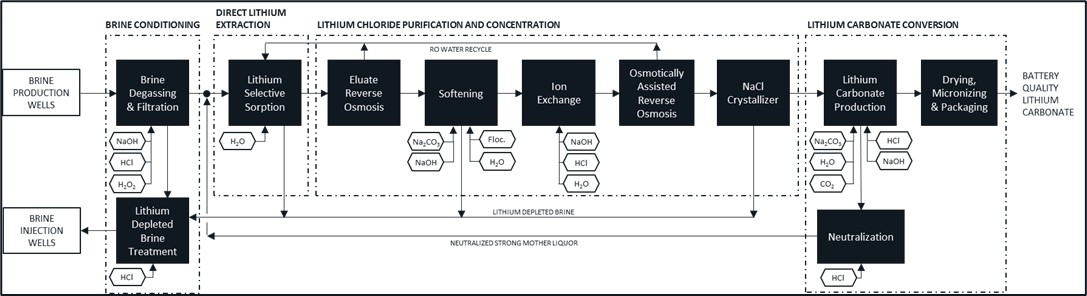
Source: Ausenco (2025).
Project Infrastructure, Environmental, Permitting and Social Considerations
The infrastructure for the South West Arkansas Project has been planned to support the reliable, phased production of battery-quality lithium carbonate through a closed-loop brine extraction and reinjection system integrated with centralized processing facilities.
Construction and operational emissions to air, discharges to surface waters and subsurface waters, and proper management/disposal of solid wastes are regulated by federal and state agencies to protect the environment while allowing the development of the natural resources. These permits will require review and approval from the Arkansas Department of Health, the Arkansas Department of Energy and Environment, the AOGC, and a federal permit from the United States Army Corps of Engineers ("USACE"). Additionally, the South West Arkansas Project was awarded funding by the DOE, which has triggered compliance with the National Environmental Policy Act ("NEPA"). The DOE is currently completing the associated Environmental Assessment which included completion of a biological assessment for an identified listed species, assessment of environmental impacts, engagement with tribes and an assessment of social impacts for the South West Arkansas Project. The DOE anticipates completing the Environmental Assessment in Q2 2026.
Capital and Operating Cost
Capital Expenditure Costs
Table 4 summarizes the South West Arkansas Project capital cost estimate by major scope area. The capital cost estimate of $1,449 million includes all costs (e.g., brine production and disposal, central processing facility, ancillary infrastructure, power supply infrastructure and indirect costs) required to support the South West Arkansas Project operations.
The estimate conforms to Class 3 guidelines for a feasibility study estimate with a ±15% accuracy according to the Association of the Advancement of Cost Engineering International ("AACE"). Costs have a base date of Q1 2025.
The overall life-of-project capital cost is $1,593 million, including $144 million of sustaining capital.
Table 4 Capital Cost Estimate
|
|
|
|
Description |
Capital Costs
($M) |
|
|
Wellfield (Wells, Pipelines and Power) |
324 |
|
|
|
|
Brine Preparation |
67 |
|
|
|
|
Lithium Extraction |
158 |
|
|
|
|
Lithium Purification / Concentration |
109 |
|
|
|
|
Lithium Conversion |
100 |
|
|
|
|
Product Handling |
36 |
|
|
|
|
Utilities, Chemicals and Reagents |
79 |
|
|
|
|
Infrastructure, Piperacks and Site Preparation |
104 |
|
|
|
|
Total Direct Costs |
977 |
|
|
|
|
Indirect Costs |
146 |
|
|
|
|
Owner’s and Miscellaneous Costs |
166 |
|
|
|
|
Total Indirect Costs |
312 |
|
|
Total Direct + Indirect Costs |
1,289 |
|
|
|
|
Contingency (12.3%) |
160 |
|
|
Total Capital Cost of Project |
1,449 |
|
|
Note: Numbers may not add due to rounding.
Operating Expenditure Costs
The operating cost base date is Q1 2025. The estimate was developed to have an accuracy of ±15% (AACE Class 3). The estimate includes wellfields, processing, and general and administration (“G&A”) costs.
The overall life-of-mine operating cost is $2,001 million over 20 years, or an average of $4,516/t of produced Li2CO3 in a typical year. Of this total, fixed costs account for $749 million and variable costs account for $1,252 million. Table 5 provides a summary of the South West Arkansas Project operating costs.
Table 5 Operating Cost Summary
|
|
|
|
|
|
|
|
Cost Area |
Total ($M) |
$/t Li2CO3(1) |
% of Total |
|
|
|
|
|
|
|
|
Labor(2) |
191 |
429.91 |
9.5 |
|
|
|
|
|
|
|
|
Wellfield & Subsurface |
202 |
255 |
10 |
|
|
|
|
|
|
|
|
Power & Natural Gas |
250 |
563 |
12.5 |
|
|
|
|
|
|
|
|
Reagents |
955 |
2,156 |
47.7 |
|
|
|
|
|
|
|
|
Consumables |
47 |
106 |
2.3 |
|
|
|
|
|
|
|
|
Maintenance and External Services(3) |
171 |
386 |
8.7 |
|
|
|
|
|
|
|
|
Miscellaneous Cost(4) |
186 |
420.08 |
9.3 |
|
|
|
|
|
|
|
|
Total Cash Operating Cost(5) |
2,001 |
4,516 |
100 |
|
|
|
|
Notes:
1.Operating costs are calculated based on an average determined over the 20-year operating life.
2.Approximately 106 full-time equivalent positions.
3.Includes contract maintenance, solids waste disposal, mobile equipment and external lab service.
4.Includes general and administrative expenses.
5.Numbers may not add due to rounding.
Economic Analysis
The South West Arkansas economic analysis was performed assuming an 8% discount rate with no inflation (constant dollar basis). On a pre-tax basis, the net present value ("NPV") discounted at 8% is $1,666 million, the internal rate of return (“IRR”) is 20.2%, and payback period is 4.0 years. On a post-tax basis, the NPV discounted at 8% is $1,275 million, the IRR
is 18.2%, and the payback period is 4.2 years. It must be noted, however, that tax estimates involve many complex variables that can only be accurately calculated during operations and, as such, the post-tax results are only approximations. The analysis was performed on an annual cash flow basis and the cash flow output is shown graphically in Table 6 and Figure 2.
Table 6 Economic Analysis Summary
|
|
|
|
|
|
Description |
Units |
Base |
|
|
|
|
|
|
Modelled Plant Operating Life |
yrs |
20.0 |
|
|
|
|
|
|
Average Lithium Concentration |
mg/L Li |
481 |
|
|
|
|
|
|
Average Annual Lithium Carbonate Production |
t (LCE)/a |
22,155.8 |
|
|
|
|
|
|
Total Lithium Carbonate Production |
t (LCE) |
443,115 |
|
|
|
|
|
|
Revenue/Costs |
|
|
|
|
|
|
|
|
Selling Price |
$/t |
22,400 |
|
|
|
|
|
|
Total Revenue |
$M |
9,925.8 |
|
|
|
|
|
|
Average Annual Revenue |
$M/a |
496.3 |
|
|
|
|
|
|
EBITDA |
$M |
7,444.6 |
|
|
|
|
|
|
Average Annual EBITDA |
$M/a |
372.2 |
|
|
|
|
|
|
Total On Site Operating Costs (Production, Process, G&A) |
$M |
2,001.1 |
|
|
|
Cash Costs |
|
|
|
|
|
|
|
|
Cash Operating Cost* |
$/tLCE |
4,516.05 |
|
|
|
|
|
|
Total Cash Cost** |
$/tLCE |
5,599.51 |
|
|
|
All-In Operating Cost*** |
$/t LCE |
5,923.84 |
|
|
|
|
|
|
Capital Costs |
|
|
|
|
|
|
|
|
Initial Capital |
$M |
1,448.9 |
|
|
|
|
|
|
Sustaining Capital |
$M |
122.7 |
|
|
|
|
|
|
Closure Capital |
$M |
21.0 |
|
|
|
|
|
|
Salvage Value |
$M |
– |
|
|
|
|
|
|
Pre-Tax Economics |
|
|
|
|
|
|
|
|
NPV (8%) |
$M |
1,665.8 |
|
|
|
|
|
|
IRR |
% |
20.2 |
|
|
|
|
|
|
Payback |
year |
4.0 |
|
|
|
|
|
|
NPV / Initial Capital |
– |
1.1 |
|
|
|
|
|
|
Post-Tax Economics |
|
|
|
|
|
|
|
|
NPV (8%) |
$M |
1,275.0 |
|
|
|
|
|
|
IRR |
% |
18.2% |
|
|
|
|
|
|
Payback |
year |
4.2 |
|
|
|
|
|
|
NPV/Initial Capital |
– |
0.9 |
|
|
|
Notes: * Cash operating costs consist of production costs, processing costs, site-level G&A and offsite charges. ** Total cash cost includes cash operating cost and royalties. *** AISC includes total cash cost, sustaining capital and closure capital. Source: Ausenco (2025).
Figure 2: Projected Life-of-Mine Post-Tax Unlevered Free Cash Flow
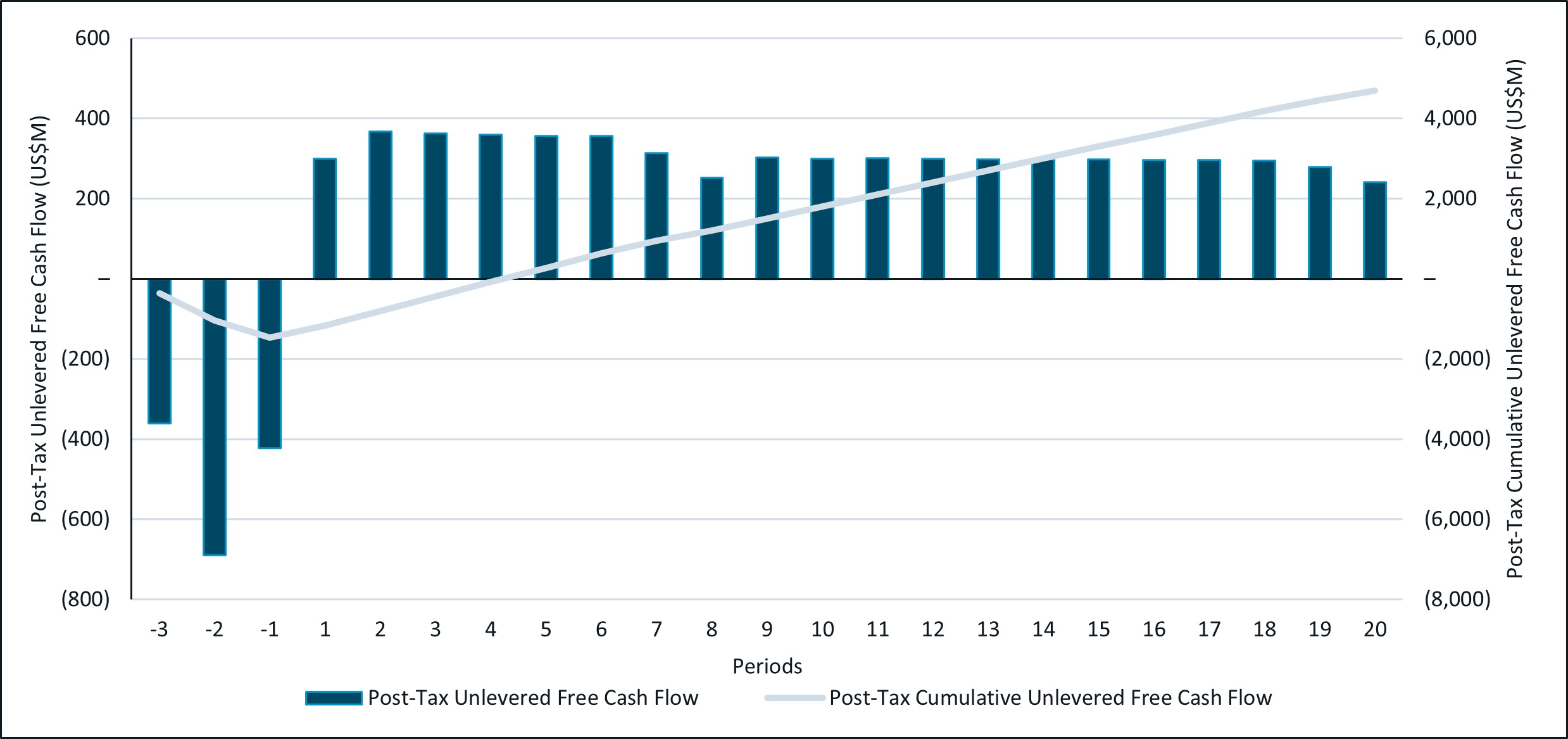
Source: Ausenco (2025).
A sensitivity analysis was conducted on the South West Arkansas Project's pre-tax and post-tax NPV and IRR assessing the impact of changes in lithium price, discount rate, operating costs, initial capital, and LCE production. A summary of post-tax economic sensitivities to lithium price, operating costs, initial capex and LCE production is shown in Figure 3. The South West Arkansas Project is most sensitive to lithium price and LCE production, and to a lesser extent, initial capital cost and operating costs.
Figure 3: Post-Tax Sensitivity Charts
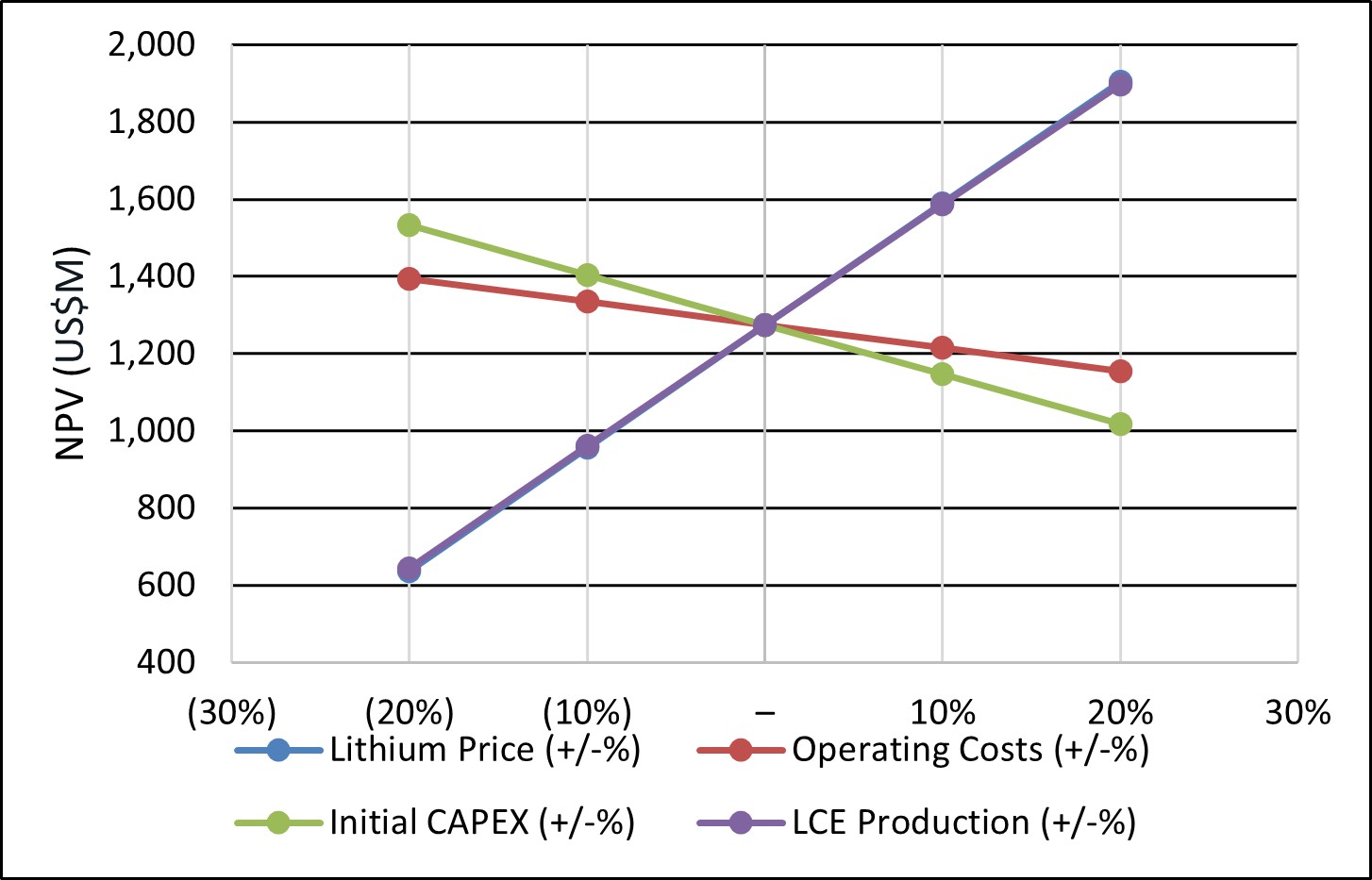
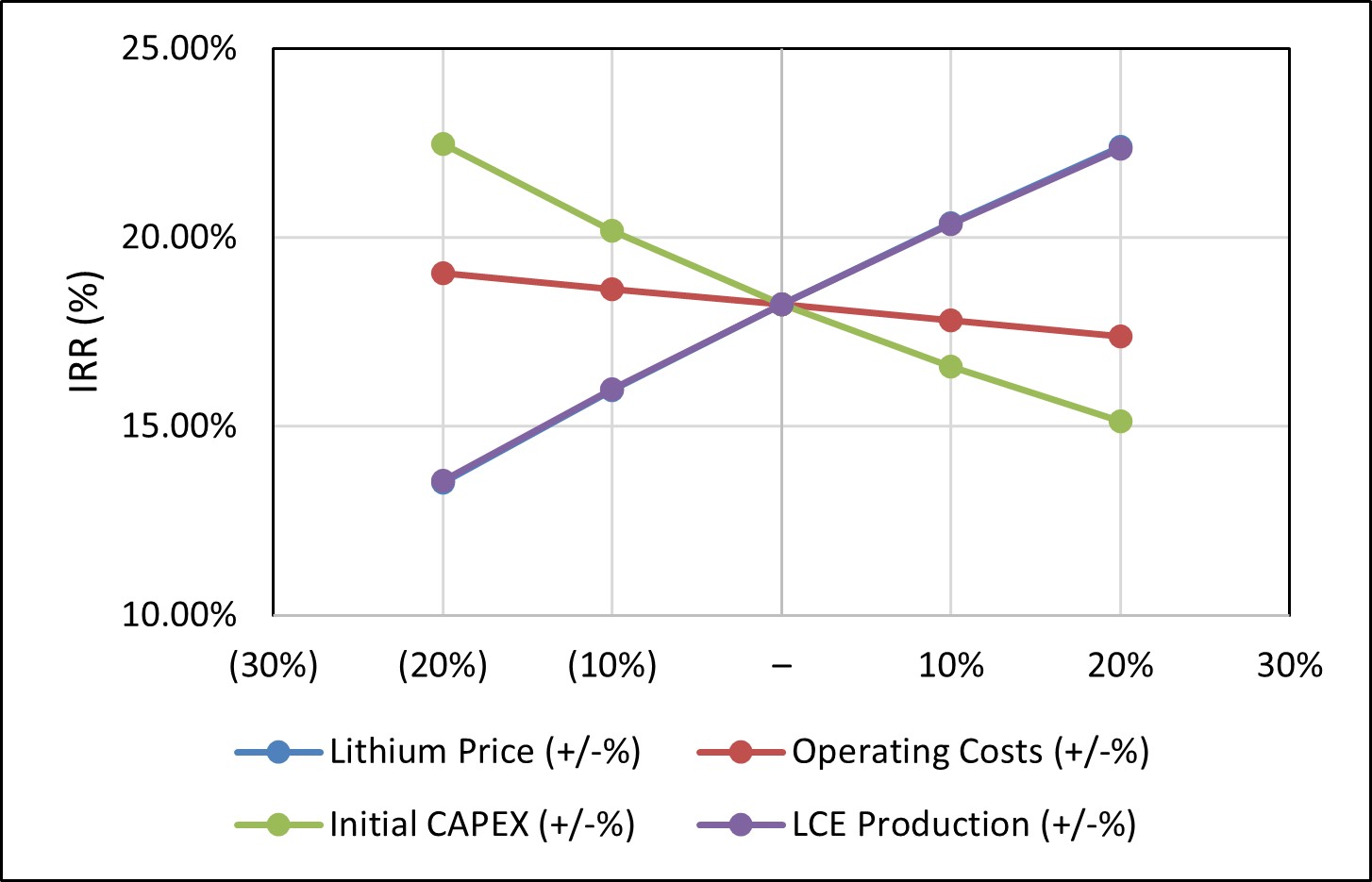
Note: Series lines for lithium price and LCE production overlap in the above figures. Source: Ausenco (2025).
South West Arkansas Project Related Risks and Uncertainties
A risk analysis was held to assess initial and residual risk in the mineral tenures, geology, resource and reserve estimate, metallurgy, infrastructure, permitting and environmental risks posed from development of the South West Arkansas Project. The South West Arkansas Project risks identified with an assessment of their potential impacts are presented below.
•To facilitate 100% mineral rights coverage, it is necessary to integrate any remaining unleased brine owners or uncommitted brine leasehold working interest owners within the Reynolds Unit. Integration is a well-established process in Arkansas and poses little risk to project development planning. Smackover Lithium has spent considerable time and effort understanding the mineral and surface title, and any residual risks with production are limited to an incorrect allocation of the royalty payment. Once identified, these are easily curable.
•Potential geological risks include unexpected reservoir heterogeneity, which could include (i) presence of high permeability pathways between injection and production wells which could reduce the displacement efficiency of the injected lean brine and lead to early breakthrough, (ii) insufficient productivity resulting from lower-than-expected formation permeability, (iii) discontinuity of the porous formation resulting in a smaller brine volume accessible from the project wells, and (iv) unexpected faulting resulting in barriers to flow. These risks have been addressed in part during the data gathering program and can also be addressed through adjustments to the injection and production
well configuration and operating guidelines if these factors are encountered during development. One such adjustment would be to drill additional injection and/or production wells to maintain the desired plant throughput.
•If the injected volumes result in an excessive increase in reservoir pressure due to over injection, it could reduce the ability to inject processed brine. This risk is addressed by evaluating injection and production distribution in the reservoir through simulation studies and identifying means to reduce any over-injection.
•If the brine production rate or lithium concentrations on which this DFS is based differ from the forecast values during the life of the South West Arkansas Project, the economics of the project could be impacted. To reduce this risk, the South West Arkansas Project has carried out additional well data gathering and testing and reservoir modeling specific to the project brine leases to further prove the anticipated lithium values. This process has identified economic lithium concentrations and demonstrated high well productivity values, validating the Reynolds Unit production rate estimates of up to 200,000 barrels per day and up to 22,500 tons of annual production of lithium carbonate. As a result, downside economics associated with lack of understanding of the resource is seen as a low risk.
•The risks associated with the CPF design are mostly associated with the composition and volumes of the brine that will be extracted and processed from the wellfield. These risks were identified early on and have been addressed to the extent practical at this stage. The materials and equipment selected have been sized and specified based on the anticipated volumes and composition of the flows. The residual metallurgy and process risks are:
oProcess Scalability – The LSS DLE process has now been operated continuously for nearly 3 years (since October 2022) at a pre-commercial demonstration plant scale that included the operation of a commercially sized DLE column. The operation of multiples of commercial sized DLE columns has not been trialed.
oBoron Rejection – The two-week continual operation at the pilot plant showed very high lithium recovery (97.7%) and high rejections for the majority of impurities at the expense of Boron (89.1%). However, these changes showed the performance could be dramatically shifted to improve Boron rejection whilst still meeting the other process targets, validating the process guarantees in the license can be achieved for the representative IPC brine.
oDLE Adsorbent Life – A 10% replacement of DLE adsorbent is considered in the design based on previous experience with similar projects and adsorbents. This is a risk since the demonstration plant has only operated with the LSS adsorbent for approximately 3 years. The replacement rate is in line with what is used for the DFS so this is considered a low risk.
oH2S, along with the remaining light hydrocarbons extracted from the brine, presents health and fire hazards. Flammability risks are also present in the systems that receive natural gas, in diesel storage, and in the tank receiving hydrocarbons extracted from the brine at the start of the process.
oThe reinjection of brine presents an operational risk, since it can generate incrustations at the wellheads, which restricts/block the flow.
oIn the case of H2O2 storage, if there is a temperature increase, there is a risk of explosion.
oThe variability in the feed composition, regarding contaminants that are neither treated nor purged, poses a risk of their accumulation in the system due to process recirculation.
•The well pads have been secured and acquired for use; however, most of the right-of-way for the infrastructure corridor has not been acquired at this time. The landowners have all been contacted and have allowed for preliminary surveys to be conducted in anticipation of the acquisition, but until all the easements have been acquired, there will continue to be the risk that a landowner may oppose the construction of the corridor on their property, causing potential re-routes, system modifications, and project delays.
•Pipelines are the safest and most reliable way to transport energy products, as well as by-products. Pipelines are primarily underground, which keeps them away from public contact and accidental damage. Pipelines can also move large volumes of product at a significantly lower operating cost when compared to other modes of transportation. Despite safety and efficiency statistics, increases in energy consumption and population growth near pipelines present the potential for a pipeline incident. Third-party strikes (intentional or accidental), and material failure could cause leaks, spills, or potential release of brine and/or toxic gases.
•The final South West Arkansas Project configuration has the potential to affect the scope of the permitting outlined in the South West Arkansas DFS. The optimized pipeline route configuration needs to be finalized to ensure the Waters of the United States impacts are quantified to support timely submission of all permits. The work has the potential to impact timing for permit review and approval.
•As of the date of the South West Arkansas DFS, the pipeline route configuration relative to the occupied habitat for the identified environmental site assessment listed species has the potential to impact the timing for construction activities.
•Any decision by a regulatory body on an environmental assessment is subject to legal challenges in federal district court.
Conclusions and Recommendations
Key Study Conclusions
Based on the assumptions and parameters presented in this report, the South West Arkansas Project shows positive economics (i.e., $1,666 million pre-tax NPV (8%) and 20.2% pre-tax IRR) which support a decision to advance the South West Arkansas Project to the execution phase.
Key Study Recommendations
Development of the South West Arkansas Project is considered to be adequately de-risked to support Standard Lithium making an informed FID. The overall recommendation is to advance the South West Arkansas Project to the execution stage. The specific QP recommendations identified in this report includes (1) executing the necessary surface leases or option agreements early; (2) gathering data to refine the current reservoir description from drilling of new injection and production wells during execution; (3) continuing to operate and collect data from the existing demonstration plant; (4) completing engineering studies to confirm electrical, water, and reagent infrastructure; (5) continuing to advance key permits and authorizations; and (6) using a limited notice to proceed with the selected Engineering, procurement, construction and commissioning contractor to undertake early procurement activities.
The list of recommendations can be completed concurrently. The total cost estimate for third-party services to complete the proposed work programs is $10.3 million. This cost estimate excludes Standard Lithium’s in-house costs, which are to be incurred as part of the team’s ongoing work on the South West Arkansas Project prior to execution approval. Table 7 shows the estimated cost for the recommended work.
Table 7: Recommended Work Program
|
|
|
|
Program Component |
Estimated Total Cost ($M) |
|
|
|
|
Surface Leases or Option Agreement* |
5.4 |
|
|
|
|
Resource and Reserve Estimate |
0.3 |
|
|
|
|
Metallurgy and Process |
2.0 |
|
|
|
|
Infrastructure |
0.4 |
|
|
|
|
Environmental* |
0.2 |
|
|
|
|
Project Schedule* |
2.0 |
|
|
|
|
|
|
Total |
10.3 |
|
|
Note: *These costs are already included in the initial capital cost estimate.
The authors of the South West Arkansas DFS further recommend that the Company continue or complete the following, to optimize operations and infrastructure:
•Continue to operate and collect data from the existing demonstration plant.
•Continue to test alternative filtration technologies and optimize brine filtration to optimize capital and operating costs.
•Continue to optimize the LSS DLE to improve the quality of the raw LiCl by increased elimination of impurities, including testing of alternative adsorbents and adjustments to operating parameters to support future commercial operations.
•Continue testing the LSS DLE to reduce water consumption and the dilution of the eluate.
•Continue to study the behavior of the DLE adsorbent to determine its degree of degradation (chemical and physical) with use over time to optimize sustaining costs related to adsorbent replacement.
•Continue to optimize the chemical softening process being used at the existing demonstration plant for commercial process optimization.
•Work with selected vendors in the early execution stages to define specific equipment.
•Review current design considering possibility to connect to the electrical grid. Renting the gas turbine generator for a period until grid connection is available would reduce initial capital costs.
•Confirm the firewater demand with approval from the Arkansas Fire Protection Code. This could reduce the water demand considered during the feasibility study design.
•Review the option of main reagents delivery through rail instead of trucks. While this would create additional investment costs, the operational cost would be reduced.
•Define the location and quantity of the water wells for water supply of the South West Arkansas Project. This should be completed before full notice to proceed with the execution contracts.
Franklin Project
Please refer to the technical report titled "NI 43-101 Technical Report: Maiden Inferred Resource Estimate for Standard Lithium Ltd.'s Franklin Project, located in Hopkins, Franklin and Titus Counties, Texas, United States" dated September 24, 2025 (the "Franklin Technical Report"), as filed on the Company's SEDAR+ profile, for detailed disclosure relating to:
•Property Description and Location;
•Accessibility, Climate, Local Resources, Infrastructure and Physiography;
•Geological Setting and Mineralization;
•Sample Preparation, Analyses and Security;
•Mineral Processing and Metallurgical Testing;
•Mineral Resource Estimates; and
•Conclusions and Recommendations.
The following is a summary of the Franklin Technical Report, prepared by a multi-disciplinary team of QPs that includes geologists and engineers with relevant experience in lithium-brine, Smackover Formation geology and brine processing. The authors include Abinash Moharana, SME of WSP USA Inc., Marek Dworzanowski, EUR ING, C.Eng. and Randal M. Brush, P.E. and Robert E. Williams, Jr., P.G., CPG of Haas & Cobb Petroleum Consultants.
The Franklin Technical Report is incorporated by reference herein and for full technical details, the complete text of the Franklin Technical Report should be consulted. The following summary does not purport to be a complete summary of the Franklin Technical Report and is subject to all the assumptions, qualifications and procedures set out in the Franklin Technical Report and is qualified in its entirety with reference to the full text of the Franklin Technical Report.
Property Location and Ownership
The center of the Franklin Project is located approximately 5.2 kilometers (km) (3.2 miles) south of the City of Mt. Vernon in Franklin County, northeastern Texas, United States. The Franklin Project lies within Hopkins, Franklin, and Titus counties.
The Company has obtained a total of 617 separate brine and brine-sourced mineral leases from private mineral owners within the Franklin Project area of 32,455 hectares (80,199 acres), consisting of 18,732 gross brine mineral hectares (46,287 acres) and 14,346 net brine mineral hectares (35,450 acres). The mineral resource estimates presented in the Franklin Technical Report correspond to the Company’s gross brine mineral holdings. Additional leases have been acquired since the effective date of the Franklin Technical Report, and it is expected that additional leasing activities in and around the Franklin Project area will continue by the Company’s subsidiary for the foreseeable future. In general, each lease has a 5-year primary term, with two 5-year extensions, and payments are either made yearly or for each 5-year term.
Royalties
Royalty rates are determined by the terms of the lease agreements between mineral owners and their leaseholders, which are frequently treated as confidential in the brine fields of East Texas, and such leases are not regulated by the Railroad Commission of Texas ("RRC"). Therefore, there are currently no known royalties, back-in rights, payments or other agreements and encumbrances to which the Franklin Project is subject.
Environmental Liabilities and Permitting
Several federal and state permits and approvals are required for brine production at the Franklin Project, including:
•Clean Water Act Section 404 permitting through USACE;
•Air emissions permitting through the Texas Commission on Environmental Quality (“TCEQ”);
•Water discharge permitting and public water supply permitting through the TCEQ; and
•Well drilling and operating permits and underground injection control permits through the RRC.
Currently, there is no brine production occurring on the Franklin Project for the express purpose of brine mineral extraction. Brine is produced from the Smackover Formation adjacent to the Franklin Project area as a normal part of oil and gas extraction operations, but any brine produced is removed and disposed of as per normal oilfield activities.
Risks and Uncertainties
While the Company will endeavor to mitigate any risks or uncertainties through project management, engaging technical experts and developing contingency plans, the Franklin Project is subject to risks of delay in obtaining RRC permits as the potential first brine production project to be permitted by the RRC, and risks related to the potential uncertainty in Texas law over whether brine-sourced lithium forms part of the surface or mineral estate, which may result in one or more lower court decision confusing the issue before being corrected by a higher court of appeal.
Accessibility, Climate, Local Resources, Infrastructure and Physiography
Access and Climate
The Franklin Project area spans across west Hopkins, Franklin, and east Titus counties. The largest nearby city is Sulphur Springs, in Hopkins County and has a population of approximately 16,891 as of 2024. The nearest airport is Sulphur Springs Municipal Airport, located in the northwestern area of the Franklin Project, in Hopkins County. The nearest commercial airport is Texarkana Regional Airport, approximately 115 km (72 miles) east-northeast. Dallas-Ft. Worth International Airport is approximately 193 km (120 miles) west-southwest. There is existing rail access parallel to Interstate 30, approximately 16 km (10 miles) north. The area also has an extensive all-season secondary road network. Access is provided by the federal and state highways. Interstate 30 links the cities of Sulphur Springs, Mt. Vernon, and Mt. Pleasant. Texas State Highways 37, 67, 271, and several improved county roads provide access to every leased tract of the Franklin Project area.
The Franklin Project area climate is generally humid with an average temperature and precipitation of 25ºC and 113.7 cm, respectively. Annual rainfall is distributed throughout the year. The wettest month of the year is May with an average rainfall of 146 mm. The warmest month of the year is August with an average temperature of 29.4ºC, while the coldest month of the year is January with an average temperature of 7.5ºC. The mild and humid climate as well as the moderate seasonal variations of the Franklin Project area is not expected to impede year-round exploration activities and allow consistent access and operational flexibility throughout the year.
Local Resources and Infrastructure
Oil and gas extraction-related infrastructure is present across the Franklin Project area, particularly to the north and south. This infrastructure consists of wellheads, collection facilities for various fluids, tank batteries, gas processing plants and associated pipelines, and cleared easements. Much of the infrastructure is sporadically in use by smaller operators, and the operation thereof can be cyclical depending on hydrocarbon market conditions.
History
Regional properties have verified lithium-brine mineralization within the Smackover Formation, though lithium-brine information regionally is not necessarily indicative of the mineralization on the Franklin Project.
Based on the USGS National Produced Waters Geochemical Database, lithium-enriched brine occurs throughout eastern Texas and within Hopkins, Franklin, and Titus Counties. The highest recorded lithium-brine in the USGS-compiled database occurs within Cass County at a concentration of 473 mg/L.
In 1992, Moldovanyi and Walter conducted a regional brine chemical study where Smackover Formation brine samples were collected and analyzed from 87 wells, which were producing from 45 Smackover Formation oil and natural gas reservoirs in southwest Arkansas, east Texas, and northern Louisiana, and concluded that (i) boron and alkali metal lithium, potassium and rubidium concentrations in the Smackover Formation water exhibit coherent geochemical relations across the east Texas shelf, (ii) the concentration of these elements is greater and more heterogeneous in hydrogen sulfide rich brine than in hydrogen sulfide-free brine, and (iii) regional concentration gradients suggest fluids enriched in these elements may have migrated into the Smackover Formation reservoirs from large-scale circulation of deep-seated waters along fault segments in the region.
In 1974, exploration by Collins et. al created a dataset including six brine analyses within the same counties as the Franklin Project area. Based on this data, lithium-brine values range from <1 mg/L to 293 mg/L, with an average of 97 mg/L lithium. Bromide concentrations from five wells in the three Franklin Project counties ranged from 3 mg/L to 2,903 mg/L with an average of 1,532 mg/L bromide, and potassium concentrations in the three Franklin Project counties varied from 5 mg/L to 9,980 mg/L with an average of 3,296 mg/L potassium.
No prior production of brine as a feedstock for mineral extraction has occurred on the Franklin Project, and no prior mineral resource estimate has been conducted.
Geological Setting and Mineralization
The Franklin Project lithium deposit is a confined brine aquifer deposit in the form of a lithium-bromide-potassium-bearing brine contained within the porosity of the Smackover Formation within the Franklin Project. The Smackover Formation in northeastern Texas is commonly subdivided into three intervals: the Upper Smackover (predominantly an oolitic limestone with common dolomite replacement), the Middle Smackover (a burrowed pellet packstone), and the Lower Smackover (a dark, dense limestone). The lithium-bromide-potassium brine resource, as reported, is contained within the Upper Smackover and Middle Smackover Formation which underlie the entire Franklin Project area. The Lower Smackover Formation does not contribute to the resource estimates in this report but is a future target for exploration.
The structural top of the Upper Smackover in the Franklin Project generally dips from north-northwest to south-southeast and varies in depth from approximately 2,865 meters (9,400 feet) subsea to approximately 3,810 meters (12,500 feet) subsea. Brine has never been extracted commercially from the Smackover Formation in east Texas, except as a by-product of hydrocarbon production.
The volumes of in-place lithium, bromide, and potassium are proportional to the product of the brine-saturated pore volume and the respective concentration, both of which are known with reasonable accuracy, based on the drilling, logging, coring, and sampling data obtained throughout the Franklin Project. The data used to estimate and model the resource were gathered from the three project-specific wells along with 100 existing and suspended oil and gas production and exploration wells in and around the Franklin Project. Two-dimensional seismic data were combined with well log data to assess the top of the Smackover Formation structure and to identify faults.
Deposit Types
Lithium is extracted from either mineral deposits (often pegmatite deposits containing the lithium-rich mineral spodumene) or brine deposits, while bromide is usually extracted from brine, and potassium from either brine or evaporite deposits. Brine deposits can either be unconfined in salars, where chemical constituents have been concentrated by the surface evaporation of water or confined in underground brine-bearing formations. The Franklin Project deposit is a confined brine aquifer deposit in the form of a lithium-potassium-bromide bearing brine contained within the porosity of the Smackover Formation within the Franklin Project.
The geologic characteristics of the reservoir and its lithium, bromide, and potassium content estimates are based on the whole of the available geologic data set and the results of brine sampling in the Upper and Middle Smackover. This comprehensive data set provides a reasonable basis upon which to estimate the resource.
Exploration
The Company conducted a 2023 exploration program at the Franklin Project, which consisted of (i) conducting a historical geological compilation and subsurface review of the Smackover Formation stratigraphy using 2D seismic data, oil and gas well logs, and (ii) completing three exploration wells to collect well logs and analyze core and 14 brine samples. Two additional brine samples were collected by the QP in February 2023 as confirmation samples and submitted independently
to the laboratory. All 16 brine samples were analyzed by an independent, accredited commercial laboratories – Intertek Westport Technology Center located in Houston, Texas and Western Environmental Testing Laboratory in Sparks, Nevada ("WETLAB").
Geotechnical and geochemical analyses for the three exploration wells were conducted by WETLAB. The average porosity and permeability from the 158 core samples collected from the two cored exploration wells in the Upper Smackover Formation were 14% and 17 millidarcies (mD), respectively. The brine sample analytical laboratory results yielded an average of 4,321 milligrams per liter (mg/L) bromide, 671 mg/L lithium, and 13,586 mg/L potassium for the Upper Smackover and 4,600 mg/L bromide, 626 mg/L lithium, and 12,400 mg/L potassium for the Middle Smackover in the brine samples collected from the three 2023 exploration wells.
Figure 4 Franklin Project Area and Locations of 2023 Exploration Wells
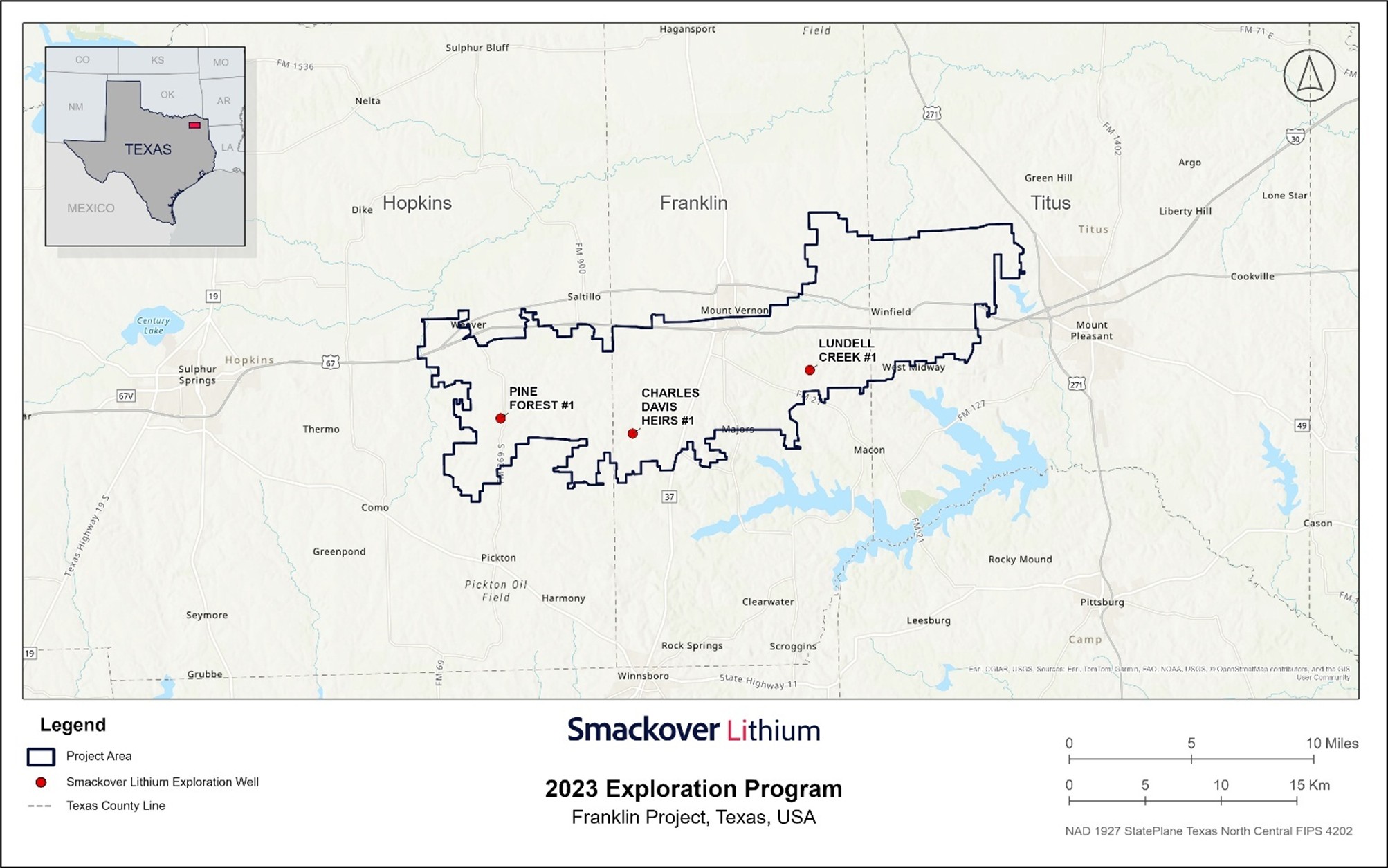
Table 8 Franklin Project Lithium, Bromide and Potassium Concentration Data
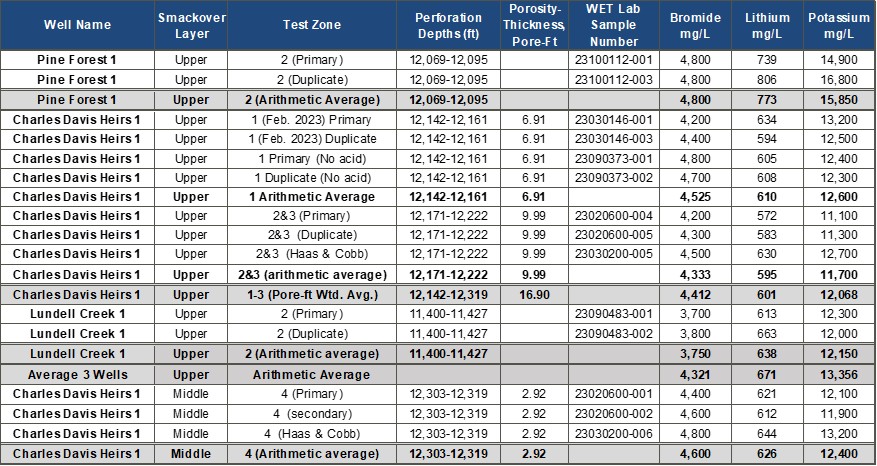
Drilling
From December 2022 to July 2023, the Company conducted a three-well exploration program at the Franklin Project. This program included drilling three all-new wells (Charles Davis Heirs 1, Pine Forest 1, and Lundell Creek 1). These three well locations were chosen to enhance the description of the geologic properties and lithium, bromide, and potassium concentrations within the Franklin Project. Both whole core and sidewall coring programs were conducted in the Pine Forest 1 and Lundell Creek 1 wells. Each well successfully tested the high-porosity interval in the Upper Smackover which is considered the Franklin Project’s main pay zone. Additional productive pay was encountered and successfully tested at various depths in the Middle Smackover.
Sample Preparation, Analyses, Security and Data Verification
Brine samples were collected from the three new wells at the Franklin Project. During the 2023 sampling program, the sample collection methodology included (i) obtaining well logs once each well was drilled and identifying test intervals, (ii) setting a cast iron bridge plug above the prior test interval to isolate the testing horizon, (iii) removing brine by swabbing the production tubing, of which the volume of fluid removed from the well was measured with flow meters and calculated based upon the volume measured at regular intervals in the onsite storage tank, (iv) collecting and analyzing field-measured parameters onsite to assess brine density, electrical connectivity and temperature, (v) comparing field measured parameters to known values of the Smackover Formation, (vi) recording physical attributes, (vii) utilizing consistent sample labeling procedures (i.e. sample identification, date, time, sampler’s initials). The sample containers were checked to verify that all sample label information was correct, and the sample container was properly closed. All sample containers were stored in coolers for shipping to WETLAB.
Coolers holding the sample containers were taken from the field to a secure location to double-check the sample identification and make sure all containers were in good condition prior to shipment to WETLAB. Chain of custody forms were filled out and included with the sample cooler. The cooler was taped closed and hand-delivered to the local courier company (Fed-Ex in El Dorado,) for delivery to the WETLAB laboratory. The laboratory was instructed to confirm receipt of the samples and provide a statement pertaining to the condition of the samples upon receipt. The samples were then coded into the respective laboratory’s sample stream for analysis.
A field duplicate sample was collected for every sampling event and taken at the same time as the original sample (i.e., back-to-back samples from the brine sample spigot). Random identifiers were given to the duplicate sample and duplicate
field samples were never in sequential order so that they were randomly presented to the laboratory. A total of six primary and six duplicate brine samples were collected from the three newly completed wells. The duplicate sample Relative Percentage Difference (“RPD”) was 0.0% to 12.8%. The QP considers RPD less than 20% acceptable.
The QP verified the lithium, bromide, and potassium concentration data by reviewing the choice of analytical laboratory to ensure it met all analytical industry standards, reviewing the overall scatter in each well’s lithium, bromide, and potassium concentration data, comparing concentration results between samples independently taken and verified by the QP to those by the Company, and comparing concentration results of the primary and duplicate sample concentrations. The four evaluations confirmed the choice of WETLAB, the consistency of the data, the close match between the independently gathered samples and those of the Company, and the reasonable match between primary and duplicate sample concentrations.
Mineral Processing and Metallurgical Testing
The Company’s operating Demonstration Plant, exclusively processing Smackover brine, since May 2020 provided a valuable source of knowledge in regard to the behavior of the brine, direct testing of various flowsheet elements, and a test bed for operator training. The Demonstration Plant is located about 273 km (170 miles) east of the Franklin Project and it is the Company’s intent to continue to use the information obtained from the Demonstration Plant to aid in flowsheet development, optimize lithium extraction and lithium chloride purification, and to develop operations capability.
The potential development plan considered for the Franklin Project includes pumping brine from the Smackover and, via production wells, extracting lithium, bromide and potassium from the brine, converting it to saleable products, and then reinjecting the lithium-bromide-potassium depleted brine via injection wells to maintain pressure in the reservoir and to sweep additional brine to the production wells. Brine from the supply wells will be routed to a production facility by a network of underground pipelines. The brine entering the production facility will be pre-treated and then processed by DLE. The lithium chloride extracted by the DLE is subsequently purified and concentrated using industry-proven and commercially established processes prior to conversion to lithium carbonate. After extraction, the lithium-depleted effluent brine will be returned to the resource area by a pipeline system to a network of brine injection wells.
In Arkansas, bromine has been produced from Smackover brine for many decades. Production of potash from potassium rich brines is a well proven process. The bromine would be recovered ahead of the lithium, and the potash would be recovered from the spent lithium brine before reinjection back into the Smackover Formation.
Outside of sodium, potassium, calcium, magnesium, strontium, boron, silicon, chlorides, and bromides, the initial full chemical analysis of Franklin Project brine has not indicated the presence of deleterious elements in concentrations of concern other than iron. This is the same as the South West Arkansas Project brine, which means the iron removal steps applied to the South West Arkansas Project could likely be applied to the Franklin Project.
Mineral Resource Estimate
The lithium, bromide, and potassium resources present in the Upper Smackover and Middle Smackover were estimated based on the 18,732 hectares (46,287 acres) gross Smackover Lithium brine and brine minerals leased within the 32,455 hectare (80,199 acre) Franklin Project. The inferred resource value corresponds to an estimate of 2,638,000 metric tons of elemental bromide, 406,000 metric tons of elemental lithium, and 8,070,000 metric tons of elemental potassium. These values are equivalent to 2,159,000 metric tons of LCE using a conversion factor of 5.323 kg of LCE per kg of lithium and 15,414,000 tons of potash (potassium chloride) using a conversion factor of 1.91 kg of potash per kg of potassium. These resources are contained within 0.61 km3 of brine volume and are presented in more detail in Table 9. The reported inferred mineral resources are considered too speculative from a geological perspective to have the economic considerations applied to them that would allow them to be categorized as mineral reserves. The mineral resource estimate is effective as of September 24, 2025.
Table 9 Franklin Project Inferred Resource Estimates (1,2,3,4,5,6)
|
|
|
|
|
Resource Category |
Units |
Inferred |
Inferred |
Inferred |
Smackover Formation |
|
Upper Smackover |
Middle Smackover |
Total Smackover |
Gross Aquifer Volume |
km3 |
7.69 |
7.98 |
15.67 |
Net Aquifer Volume |
km3 |
3.10 |
0.37 |
3.47 |
Average Porosity |
% |
18.1% |
12.4% |
17.5% |
Brine Volume |
km3 |
0.56 |
0.05 |
0.61 |
Average Lithium Concentration |
mg/L |
671 |
626 |
668 |
Lithium Resource |
000 metric tons |
377 |
29 |
406 |
LCE5 |
000 metric tons |
2,005 |
153 |
2,159 |
Average Bromide Concentration |
mg/L |
4,321 |
4,600 |
4,343 |
Bromide Resource |
000 metric tons |
2,426 |
212 |
2,638 |
Average Potassium Concentration |
mg/L |
13,356 |
12,400 |
13,286 |
Potassium Resource |
000 metric tons |
7,500 |
570 |
8,070 |
Potassium Chloride (Potash) 5 |
000 metric tons |
14,324 |
1,089 |
15,414 |
Notes:
1.Mineral resources are not mineral reserves and do not have demonstrated economic viability. There is no guarantee that all or any part of the mineral resource will be converted into a mineral reserve. The estimate of mineral resources may be materially affected by geology, environment, permitting, legal, title, taxation, socio-political, marketing, or other relevant issues.
2.Numbers may not add up due to rounding to the nearest 1,000 unit.
3.The resource estimate was completed and reported using a cutoff of 6% porosity (net aquifer) and 100 mg/L lithium and 1,000 mg/L for bromide and potassium.
4.The inferred resource estimate was developed and classified in accordance with guidelines established by the CIM. The Franklin Technical Report was completed in accordance with NI 43-101 and all associated documents and amendments. As per these guidelines, the resource was estimated in terms of metallic (or elemental) lithium, bromide, and potassium. The effective date of the mineral resource estimate is September 24, 2025.
5.In order to describe the resource in terms of "industry standard" lithium has been converted to LCE by a conversion factor of 5.323 and potassium converted to potash by a conversion factor of 1.91.
6.The lithium, bromide, and potassium resources present in the Upper Smackover and Middle Smackover were estimated based on the 18,732 hectares (46,287 acres) gross Smackover Lithium leased acreage within the 32,455 hectare (80,199 acre) Franklin Project.
The mineral resource estimate was built on a multi‑layer geologic model that divides the Smackover Formation into eight distinct layers based on well‑log interpretation and core‑derived petrophysical characteristics, supported by structural mapping from well and 2D seismic data. The procedures followed in creating this multi-layer geologic model relate to well log and core data analysis, net pay estimation, the mapping procedures, and the estimation of in-place brine volumes. Core data from two cored wells (203 samples) provided the primary basis for quantifying porosity and permeability, revealing moderate to high permeability (0.5–550 mD) and average Upper Smackover porosity and permeability of 14% and 17 mD, respectively. For those wells with both log and core porosity data, the core porosity data was used whenever available, with the calibrated log porosity curve (the PhiND_COBB_CC curve) used elsewhere. All well data were integrated into Petra and PowerLog Software, where gridding algorithms and bounding constraints) were applied to generate stable maps of gross thickness, porosity, and net‑to‑gross ratios.
Interpretation and Conclusions
The Company successfully executed a three-well exploration program that significantly improved the geologic description of the target Smackover Formation at the Franklin Project. The exploration program addressed the three key factors that determine the quality of a resource: the total volume of brine based on core and log porosity data, the brine’s lithium concentration based on the analysis of multiple brine samples from the wells, and the productivity of the formation based on the core permeability data collected. The QP, Robert Williams, reviewed all aspects of the exploration program, including selection of the well locations, designing the coring, logging, and sampling programs, attending the coring and sampling of the wells and analyzing the resulting data. In the opinion of the QP, the resulting data and analyses support the inferred resource classification estimates present at the Franklin Project.
Given continuous start-to-finish DLE without the use of evaporation ponds is not yet commercially proven, test work becomes especially critical to mitigate process and scale-up risks. General test work needs to be conducted over a reasonable period of time and at a suitable scale-up factor. In the opinion of the QP, the Demonstration Plant operation has achieved both these objectives. In addition, the equipment operated in the Demonstration Plant has shown reliability in
terms of having the required availability for stable process operation. The process control and chemical analysis applied in the Demonstration Plant have provided a solid foundation for reliable results. The DLE process has been run over three years, demonstrating consistency of results and its applicability for the Franklin Project.
The QP concluded that the Franklin Project brine is similar to the South West Arkansas Project brine from a metallurgical perspective and that the differences in concentrations of the major constituents are relatively small. In turn it was also concluded that the potential lithium process flowsheet for the Franklin Project will be similar to that for the South West Arkansas Project. From a metallurgical testing perspective, the QP concluded that the Company is in a position to proceed to the next phase of the Franklin Project. The QP further noted that, although the South West Arkansas Project brine is similar, it is not fully representative of the brine for the Franklin Project.
Recommendations
The recommended next steps in order for the Company to advance the Franklin Project to a higher level of resource classification and project definition are to:
•Collect brine samples from select zones in the 2023 exploration program wells;
•Conduct fall off tests (pressure transient analysis) on one or more of the 2023 exploration program wells;
•Drill two additional exploration wells targeting the Upper, Middle, and Lower Smackover Formation in areas not tested by the 2023 data gathering programs to provide, among other things, geologic data, lithium, bromide, and potassium concentrations, long term production test;
•Monitor the test wells for salt precipitation, evaluate the potential effect of salt precipitation on production operations, and identify remediation options;
•Update the geological model;
•Revise and adjust the resource classification;
•Develop a reservoir simulation model to support an optimized well plan and brine production profile; and
•Incorporate all data obtained in the simulation model input geologic description and prepare a potential Franklin Project development concept and plan, including brine flow rate, well count, and well configuration.
The Company is also recommended to increase its knowledge of the Franklin Project brine processing by conducting:
•DLE characterization of the Franklin Project brine;
•Testing DLE pre-treatment steps on Franklin Project brine; and
•Laboratory scale testing of the DLE eluate, derived from Franklin Project brine, for the purification, concentration and lithium carbonate production steps.
Table 10 Recommended Works for Geology and Mineral Resource Estimates
|
|
Recommended Works |
Estimated Cost ($M) |
2023 well re-entry program brine sampling and production testing |
5.0 |
Drill two additional exploration wells |
12.0 |
Update geological model and develop reservoir simulation model |
1.0 |
|
|
Total |
18.0 |
Table 11 Recommended Works for Metallurgy and Mineral Processing
|
|
Recommended Works |
Estimated Cost ($M) |
DLE characterization and laboratory scale testing |
1.5 |
Total |
1.5 |
RISK FACTORS
There are a number of risks that may have a material and adverse impact on the future operating and financial performance of the Company and could cause the Company's operating and financial performance to differ materially from the estimates described in forward-looking information relating to the Company. These include widespread risks associated with any form of business and specific risks associated with the Company's business and its involvement in the lithium exploration and development industry.
This section describes risk factors identified as being potentially significant to the Company and its material properties, the South West Arkansas Project and the East Texas Properties, including the Franklin Project. Additional risk factors may be included in the South West Arkansas DFS and the Franklin Technical Report or other documents previously disclosed by the Company. In addition, other risks and uncertainties not discussed to date or not known to management could have material and adverse effects on the valuation of the Company's securities, existing business activities, financial condition, results of operations, plans and prospects.
An investment in the Company's securities should be considered as highly speculative given the current stage of the Company's business and development. Such an investment is subject to a number of risks at any given time. The risk factors set out below are not exhaustive and do not include risks the Company deems to be immaterial; however, even an immaterial risk has the potential to have a material adverse effect on the Company's financial condition, operating results, business or future prospects. Investors should carefully consider these risk factors, many of which are beyond the Company's control, together with other information set out in this AIF before investing in the Company's securities.
Negative Operating Cash Flow
The Company is an exploration and development stage company and has not yet commenced commercial production at any of its properties. As such, the Company has not generated positive operating cash flows to date and has no reasonable prospects of doing so unless successful commercial production can be achieved at its projects. The Company expects to continue to incur negative operating cash flows until such time as the Company enters into commercial production. The Company also expects to incur negative investing cash flows. This will require the Company to deploy its working capital or a portion of its cash reserves or a portion of the proceeds of any offering of securities to fund such negative cash flow and to seek additional sources of financing.
SWA Lithium's Ability to Draw on the DOE Grant is Contingent on Meeting Specific Conditions and Covenants
The conditional $225 million DOE Grant was awarded to SWA Lithium. SWA Lithium's ability to draw down and utilize funds under the DOE Grant is subject to the satisfaction of the conditions set out in the DOE Grant documents which conditions may be amended pursuant to the terms of the DOE Grant documents. There can be no assurance as to the satisfaction of these conditions or as to the outcome of any amended requirements, if any. The DOE Grant documents also include representations, warranties and covenants customary for grants of a similar nature by the U.S. Government. Failure to comply with or satisfy any or all of the conditions and requirements or to remain in compliance with the covenant regime under the DOE Grant could result in the termination of the DOE Grant, which would have a material adverse effect on its business, financial condition, results of operations and prospects. The U.S. government could also seek to terminate or modify the terms of the DOE Grant.
Government Intervention in Mineral Projects
Lithium and other strategic metals have become subject to heightened government attention and policy initiatives in Canada, the U.S. and internationally, which may materially impact its operations. Governments may intervene in the strategic metals sector through the imposition of export controls, restrictions on foreign investment, mandatory domestic processing requirements, changes to royalty or taxation regimes, and the establishment of strategic reserves or purchasing programs. Such interventions may be driven by geopolitical considerations, supply chain security concerns, or environmental and social policy objectives. These actions can create significant regulatory uncertainty and price volatility, and may adversely affect its ability to finance, develop, or operate its projects as planned.
Macroeconomic Risks
Political and economic instability, global or regional adverse conditions, such as pandemics or other disease outbreaks or natural disasters, currency exchange rates, trade tariff developments, changes to royalty or taxation regimes, export controls, restrictions on foreign investment and other government interventions, transport availability and cost, including import-related taxes, transport security, inflation and other factors are beyond the Company's control. The macroeconomic environment remains challenging and the Company's results of operations could be materially affected by such macroeconomic conditions.
Market Price Depression
Sales of a substantial number of Shares or other equity-related securities in the public markets by the Company or its significant shareholders could depress the market price of the Shares and impair its ability to raise capital through the sale of additional equity securities. The Company cannot predict the effect that future sales of Shares or other equity-related securities would have on the market price of the Shares. The price of the Shares could be affected by possible sales of the
Shares by hedging or arbitrage trading activity. If the Company raises additional funding by issuing additional equity securities, such financing may substantially dilute the interests of its shareholders and reduce the value of its investment.
Development of the South West Arkansas Project, East Texas Properties and Franklin Project
The Company's business strategy depends in large part on developing the South West Arkansas Project and the East Texas Properties, including the Franklin Project, generally, into commercially viable operations and processing facilities, as applicable. Whether a mineral deposit will be commercially viable depends on numerous factors, including: (i) the particular attributes of the deposit, such as size, grade and proximity to infrastructure; (ii) commodity prices, which are highly volatile; and (iii) government regulations, including regulations relating to prices, taxes, royalties, land tenure, land use, importing and exporting of mineral resources and mineral reserves, environmental protection and capital and operating cost requirements. The capital expenditures and time required to develop the projects are significant and the Company has not yet secured funding that it believes will be sufficient to cover the entirety of its share of capital expenditure obligations for development of the South West Arkansas Project and the East Texas Properties and the Franklin Project, respectively. Accordingly, there can be no assurance that the Company will ever develop the South West Arkansas Project, the East Texas Properties or the Franklin Project. If the Company is unable to develop all or any of its projects and properties into a commercial operating resource or processing facility, as applicable, the Company's business and financial condition will be materially adversely affected.
Reliance on Key Personnel
The senior officers of the Company are critical to its success. In the event of the departure of a senior officer, the Company believes that it will be successful in attracting and retaining qualified successors, but there can be no assurance of such success. Recruiting qualified personnel as the Company grows is critical to its success. The number of persons skilled in the acquisition, exploration and development of mining properties is limited, and competition for such persons is intense. As the Company's business activity grows, it will require additional key financial, administrative, engineering, geological and other personnel. If the Company is not successful in attracting and training qualified personnel, the efficiency of its operations could be affected, which could have an adverse impact on future cash flows, earnings, results of operations and the financial condition of the Company. The Company is particularly at risk at this state of its development as it relies on a small management team, the loss of any member of which could cause severe adverse consequences.
Reliance on Third Parties
The Company relies on third parties to fulfil their obligations under agreements entered into between the Company and the third parties. The Company currently has entered into, may enter into, or will enter into multiple agreements, including the joint development agreement with Aquatech, MIPSA with Equinor and the Offtake Agreement with Trafigura.
Third parties may, as a result of financial or other reasons, be unable or unwilling to fulfill their obligations under the respective option, earn-in right or other agreement(s). Any one or a combination of these could result in liabilities for the Company and could adversely affect the value of the related project(s) and, by association, damage the Company's reputation and consequently its ability to acquire or advance other projects and/or attract future partners.
Substantial Capital Requirements and Liquidity
As of December 31, 2025, the Company had a cash balance of $152.3 million, working capital (current assets less current liabilities) of $147.6 million and current liabilities of $10.1 million.
The Company anticipates that it will incur substantial capital expenditures for the continued exploration and development of its projects in the future. The Company currently has no revenue and may have limited ability to undertake or complete future drilling or exploration programs, process studies, or fulfill its capital contribution requirements under its joint venture arrangements. There can be no assurance that debt, equity, or other financing, or cash generated by operations will be available or sufficient to meet these requirements or for other corporate purposes or, if debt, equity, or other financing is available, that it will be on terms acceptable to the Company. Moreover, future activities may require the Company to alter its capitalization significantly.
The inability of the Company to access sufficient capital for its operations could have a material and adverse effect on the Company's financial condition, results of operations or prospects. Sales of substantial amounts of securities may have a highly dilutive effect on the ownership or share structure of the Company. Sales of a large number of Shares in the public markets, or the potential for such sales, could decrease the trading price of the Shares and could impair the Company's ability to raise capital through future sales of Shares.
The Company has not yet commenced commercial production at any of its properties and as such, it has not generated positive cash flows to date and has no reasonable prospects of doing so unless successful commercial production can be achieved at the Company's projects. The Company expects to continue to incur negative investing and operating cash flows until such time as it enters into commercial production. This will require the Company to deploy its working capital to fund such negative cash flow and to seek additional sources of financing.
Historically, capital requirements have been primarily funded through the sale of Shares. Factors that could affect the availability of financing include the progress and results of ongoing exploration at the Company's mineral properties, the state of debt and equity markets, and investor perceptions and expectations of the global market for lithium and its derivatives. There is no assurance that any such financing sources will be available or sufficient to meet the Company's requirements. There is no assurance that the Company will be able to continue to raise equity capital or that the Company will not continue to incur losses.
Offtake Risk
The Company’s ability to advance the South West Arkansas Project and any future projects will depend, in part, on its ability to enter into offtake agreements on commercially acceptable terms. There can be no assurance that the Company will be able to negotiate and execute offtake agreements that are satisfactory to the Company and its potential financing counterparties, or at all. The absence of such agreements, or the inability to secure terms acceptable to lenders or other financing sources, could adversely affect the Company’s ability to obtain project financing and proceed to construction and commercial production.
In addition, any offtake agreements entered into may include minimum production, delivery, quality, pricing, or timing requirements. The Company may not be able to satisfy such contractual obligations due to operational challenges, construction delays, technical performance issues, market conditions or other factors. Failure to meet these obligations could result in contractual disputes, penalties, termination rights, loss of anticipated revenue or other adverse consequences, which could have a material adverse effect on the Company’s business, financial condition, results of operations and prospects.
Development and Production Uncertainties
Feasibility studies are used to determine the economic viability of a deposit. Many factors are involved in the determination of the economic viability of a deposit, including the achievement of satisfactory mineral reserve estimates, the level of estimated metallurgical recoveries, capital and operating estimates and the estimate of future commodity prices. Capital and operating cost estimates are based on many factors, including anticipated tonnage and grades to be mined, the configuration of the ore body, ground and mining conditions, expected recovery rates of the ore and anticipated environmental and regulatory compliance costs. Each of these factors involves uncertainties and, as a result, the Company cannot give any assurance that the estimates in the South West Arkansas DFS will be correct or that the South West Arkansas Project will produce a profitable operating project. If a project is developed, actual operating results may differ from those anticipated in the DFS. There can be no assurance that delays will not be experienced. Should there be any delays, such delays may result in an increase in capital requirements, costs and expenditures.
Property Commitments
The Company's resource properties may be subject to various land payments, royalties and/or work commitments. Failure by the Company to meet its payment obligations or otherwise fulfill its commitments under these agreements could result in the loss of related property interests.
Title
The acquisition of title to resource properties is a detailed and time-consuming process. The Company may acquire an interest in its properties through land use permits. Title to, and the area of, the properties may be disputed. There is no guarantee that such title will not be challenged or impaired. There may be challenges to the title of the property in which the Company may have an interest, including concessions which, if successful, could result in the loss or reduction of the Company's interest in the property.
Although the Company has taken steps to verify the title to the resource properties in which it has or has a right to acquire an interest in accordance with industry standards for the current stage of exploration and development of such properties, these procedures do not guarantee title (whether of the Company or of any underlying vendor(s) from whom the Company may be acquiring its interest).
Exploration and Development
Exploring and developing natural resource projects bears a high potential for all manner of risks. Additionally, few exploration projects successfully achieve development due to factors that cannot be predicted or foreseen. Moreover, even one such factor may result in the economic viability of a project being detrimentally impacted, such that it is neither feasible nor practical to proceed. Natural resource exploration involves many risks, which even a combination of experience, knowledge and careful evaluation may not be able to overcome. Operations in which the Company has a direct or indirect interest will be subject to all the hazards and risks normally incidental to exploration, development and production of natural resources, any of which could result in work stoppages, damage to property, and possible environmental damage. If any of the Company's exploration programs are successful, there is a degree of uncertainty attributable to the calculation of resources and corresponding grades and in the analysis of the economic viability of future resource development and mineral extraction. Until actually extracted and processed, the quantity of lithium resources, reserves and grade must be considered as estimates only. In addition, the quantity of resources and reserves may vary depending on commodity prices and various technical and economic assumptions. Any material change in quantity of resources, reserves, grade or recovery ratio, may affect the economic viability of the Company's properties. In addition, there can be no assurance that results obtained in small-scale laboratory tests, pilot plants or the Demonstration Plant will be duplicated in larger scale tests under on-site conditions or during production. The Company closely monitors its activities and those factors which could impact them, and employs experienced consulting, engineering, and legal advisors to assist in its risk management reviews where it is deemed necessary.
Operational Risks
The Company will be subject to a number of operational risks and may not be adequately insured for certain risks, including: environmental contamination, liabilities arising from historic operations, accidents or spills, industrial and transportation accidents, which may involve hazardous materials, labor disputes, catastrophic accidents, fires, blockades or other acts of social activism, changes in the regulatory environment, impact of non-compliance with laws and regulations, natural phenomena such as inclement weather conditions, floods, earthquakes, ground movements, cave-ins, and encountering unusual or unexpected geological conditions and technological failure of exploration methods.
There is no assurance that the foregoing risks and hazards will not result in damage to, or destruction of, the property of the Company, personal injury or death, environmental damage or, regarding the exploration or development activities of the Company, increased costs, monetary losses and potential legal liability and adverse governmental action. These factors could all have an adverse impact on the Company's future cash flows, earnings, results of operations and financial condition.
Additionally, the Company may be subject to liability or sustain loss for certain risks and hazards against which the Company cannot insure or which the Company may elect not to insure because of the cost. This lack of insurance coverage could have an adverse impact on the Company's future cash flows, earnings, results of operations and financial condition.
Construction Risks
As a result of the substantial expenditures involved in development projects, developments are prone to material cost overruns versus budget. The capital expenditures and time required to develop new projects are considerable and changes in cost or construction schedules can significantly increase both the time and capital required to build the project.
Construction costs and timelines can be impacted by a wide variety of factors, many of which are beyond the control of the Company. These include, but are not limited to, weather conditions, ground conditions, performance of the mining fleet and availability of appropriate rock and other material required for construction, availability and performance of contractors and suppliers, inflation, delivery and installation of equipment, design changes, accuracy of estimates and availability of accommodations for the workforce.
Project development schedules are also dependent on obtaining the governmental approvals necessary for the operation of a project. The timeline to obtain these government approvals is often beyond the control of the Company. A delay in start-up or commercial production would increase capital costs and delay receipt of revenues. Each of these risks could materially impact the Company's financial position.
Environmental Risks
All phases of mineral exploration and development businesses present environmental risks and hazards and are subject to environmental regulations. Environmental legislation provides for, among other things, restrictions and prohibitions on spills, releases or emissions of various substances used and or produced in association with natural resource exploration and production operations. The legislation also requires that facility sites be operated, maintained, abandoned and reclaimed to
the satisfaction of applicable regulatory authorities. Compliance with such legislation can require significant expenditures, and a breach may result in the imposition of fines and penalties, some of which may be material.
If the Company uses certain federal funding programs on the South West Arkansas Project, Franklin Project, or East Texas Properties, an Environmental Assessment ("EA"), wetland delineation, floodplain study and a cultural resource study may be required. Irrespective of whether federal funding is used or not, the Company's projects will require multiple permits for air, water, hazardous waste, resource extraction, and underground injection, as applicable. Permit application approvals in some cases will take more than a year from submission dates. Planning for the permits will need to take place with this long approval time in mind. Detailed plans will be needed so that the permit application process can be completed in a timely fashion. If the Company receives unfavorable results from any of these studies or assessments, it could materially and adversely impact the Company's ability to complete its planned development.
Environmental legislation is evolving in a manner expected to result in stricter standards and enforcement, larger fines and liability and potentially increased capital expenditures and operating costs. The discharge of pollutants into the air, soil or water may give rise to liabilities to foreign governments and third parties and may require the Company to incur costs to remedy such discharge.
No assurance can be given that the application of environmental laws to the business and operations of the Company will not result in a curtailment of production or a material increase in the costs of production, development or exploration activities or otherwise adversely affect the Company's financial condition, results of operations or prospects.
Commodity Price Fluctuations
The prices of commodities vary on a daily basis. Price volatility could have dramatic effects on the results of operations and the ability of the Company to execute its business plan. The price of lithium materials may also be reduced by the discovery of new lithium deposits, which could not only increase the overall supply of lithium (causing downward pressure on its price), but could draw new firms into the lithium industry which could compete with the Company. Even if commercial quantities of mineral deposits are discovered by the Company, there is no guarantee that a profitable market will exist for the sale of the lithium produced. The development of the Company's projects will be significantly affected by changes in the market price of lithium-based end products, such as lithium carbonate and lithium hydroxide. Factors beyond the control of the Company may affect the marketability of any substances discovered. The prices of various metals have experienced significant movement over short periods of time and are affected by numerous factors beyond the control of the Company, including international economic and political trends, expectations of inflation, currency exchange fluctuations, interest rates and global or regional consumption patterns, speculative activities and increased production due to improved mining and production methods. The supply of and demand for lithium is affected by various factors, including political events, economic conditions and production costs in major producing regions. Furthermore, the price of lithium products is significantly affected by their purity and performance, and by the specifications of end-user battery manufacturers. If the products produced from the Company's projects do not meet battery-grade quality and/or do not meet customer specifications, pricing will be reduced from that expected for battery-grade product. In turn, the availability of customers may also decrease. The Company may not be able to effectively mitigate against pricing risks for its products. Depressed pricing for the Company's products will affect the level of revenues expected to be generated by the Company, which in turn could affect the value of the Company, its Share price and the potential value of its properties. There can be no assurance that the price of any mineral deposit will be such that any of its resource properties could be extracted at a profit.
Joint Venture Risks
On May 7, 2024, the Company completed the Equinor Transaction, pursuant to which Equinor acquired a minority participating interest in the South West Arkansas Project, and the Company's brine leases located in the East Texas Properties. Pursuant to the Equinor Transaction, the parties intend to collaborate in the development of the South West Arkansas Project, the Franklin Project and the East Texas Properties. The Company has assessed the nature of the Equinor Transaction and determined it to be a joint venture. Joint ventures are joint arrangements whereby the parties that have joint control have rights to the net assets of the arrangement. The Equinor Transaction indicates joint control as both parties are required to act together to direct relevant activities. Additionally, significant decisions regarding the Joint Ventures require unanimous consent from both parties.
Third-party ownership of interests in the properties and projects of the Company is subject to the risks normally associated with the conduct of joint ownership structures. These include the following: disagreements between the parties as to project development and operating matters; the inability of any or both parties to meet contractual obligations under the relevant agreements, such as funding requirements, or to third parties; and disputes or litigation between the parties regarding budgets, development activities, reporting requirements and other matters. The occurrence of any such matters could have a material adverse impact on the Company and the viability of its interests in the project over which a joint venture is created.
This in turn could have a material adverse impact on the Company's business prospects, results of operations and financial condition.
Lithium Market Growth Risks
The development of lithium operations at the Company's projects is significantly dependent on the anticipated demand for lithium-based end products, such as lithium-ion batteries for electric vehicles and other large-scale energy storage solutions. While these markets are expected to grow, they currently hold limited market share, and their projected adoption rates are not guaranteed. If these markets do not develop as anticipated, the long-term growth potential for lithium products could be adversely affected, hindering the development and commercial viability of the Company's projects, which would negatively impact the Company's business and financial condition.
Additionally, as a commodity, the lithium market is susceptible to substitution effects, where end-users may opt for alternative materials in response to supply constraints or rising prices. The emergence of alternative battery technologies, such as sodium-ion batteries, could further impact the demand for lithium. If these alternative technologies gain significant market share, it could negatively affect the overall growth prospects and pricing of the lithium market, which in turn could have a detrimental effect on the Company's projects and overall business performance.
Royalty Regime Risks
Changes in royalty policies, including the taxation of royalties, in jurisdictions where the Company operates could impact the economics of current and future lithium extraction projects. New or revised royalties or other fiscal regimes could affect project costs and profitability, potentially having a material adverse effect on the Company's financial performance and project viability. An increase in royalties could also reduce earnings and make future capital investments and operations less economic.
EV Credit Risk
Demand for lithium-based end products, such as lithium-ion batteries for use in electric vehicles ("EV"), may be impacted by changes to government regulation and economic incentives. Government and economic incentives that support the development and adoption of EVs in the United States and abroad, including certain tax exemptions, tax credits and rebates, may be reduced, eliminated or exhausted from time to time. For example, previously available incentives favoring EVs in areas including Ontario, Canada, Germany, Hong Kong, Denmark and the United States have expired or were cancelled or made temporarily unavailable, and in some cases were not eventually replaced or reinstituted. Any similar developments could have a negative impact on overall prospects for growth of the lithium market and pricing, which in turn could have a negative effect on the Company and its projects.
Novel Technology Risks
The Company has explored various proprietary technologies (SiFT, LiSTR and LSS), which offer innovative lithium extraction and processing methods but have not yet been used in a commercial operation. To mitigate this risk, and assess their viability, the Company has constructed the Demonstration Plant focused on evaluating different technological approaches for extracting lithium from brine, a byproduct of existing production facilities. The Demonstration Plant serves as a platform for proof-of-concept and commercial feasibility studies. Despite these risk-mitigation steps, there are inherent uncertainties associated with the adaptation of novel technologies to commercial scales. These uncertainties include but are not limited to, effectiveness in process chemistry, scale efficiencies of recovery, throughput capacity, and cost-effectiveness of scaled production.
Additionally, the experimental nature of the Company's diverse technological portfolio could lead to unanticipated complications. These might include unexpected costs, revisions in process chemistry and engineering, and other unforeseen circumstances. Such uncertainties could result in delays in the development of projects like the South West Arkansas Project, the Franklin Project and the East Texas Properties, or in increases in estimated capital or operational expenditures. These factors could materially and adversely affect the progression and commercial viability of any project undertaken by the Company.
Geopolitical Risks
The Company's business is international in scope, with its incorporating jurisdiction and head office located in Canada and its projects located in the United States. In recent years there has been a substantial increase in political tensions among many jurisdictions, including between the United States, Canada and China. This political tension is particularly acute in respect of lithium, which has been identified as a 'critical mineral' in these jurisdictions and is the subject of increasingly active industrial policy. There is a risk that the Company's connection to conflicting jurisdictions will have a negative impact
on its ability to advance its business, including becoming subject to restrictions arising from industrial and trade policies (see "Industry Competition and International Trade Restrictions" below), a reduced ability to obtain ongoing financing and impediments to obtaining government approvals, all of which could have a material adverse impact on the Company.
IP Risks
The Company relies on the ability to protect its intellectual property rights and depends on patent, trademark and trade secret legislation to protect its proprietary know-how. There is no assurance that the Company has adequately protected or will be able to adequately protect its valuable intellectual property rights, or will at all times have access to all intellectual property rights that are required to conduct its business or pursue its strategies, or that the Company will be able to adequately protect itself against any intellectual property infringement claims. There is also a risk that the Company's competitors could independently develop similar technologies, processes or know-how; that the Company's trade secrets could be revealed to third parties; that any current or future patents, pending or granted, will be broad enough to protect the Company's intellectual property rights; or, that foreign intellectual property laws will adequately protect such rights. The inability to protect the Company's intellectual property could have a material adverse effect on the Company's business, results of operations and financial condition.
Volatility of the Market Price of the Shares
Securities of junior companies have experienced substantial volatility in the past, often based on factors unrelated to the financial performance or prospects of the companies involved. These factors include macroeconomic developments in North America and globally and market perceptions of the attractiveness of particular industries. The Share price is also likely to be significantly affected by delays experienced in progressing with development plans, a decrease in investor appetite for junior stocks, or adverse changes in the Company's financial condition or results of operations as reflected in the Company's quarterly and annual financial statements. Other factors unrelated to performance that could have an effect on the price of the Shares include the following:
(a)the trading volume and general market interest in the Shares could affect a shareholder's ability to trade significant numbers of Shares; and
(b)the size of the public float in the Shares may limit the ability of some institutions to invest in the Company's securities.
As a result of any of these or other factors, the market price of the Shares at any given point in time might not accurately reflect the Company's long-term value. Securities class action litigation has been brought against companies following years of volatility in the market price of their securities. The Company could in the future be the target of similar litigation. Securities litigation could result in substantial costs and damages and divert management's attention and resources. Further, there is no guarantee that an active trading market for the Shares will be maintained on the TSXV and/or the NYSE.
Cost Estimates
The Company prepares estimates of operating costs and/or capital costs for each operation and project. The Company's actual costs are dependent on several factors, including royalties, the price of lithium and by-product metals and the cost of inputs used in exploration activities.
The Company's actual costs may vary from estimates for a variety of reasons, including labor and other input costs, commodity prices, general inflationary pressures and currency exchange rates. Failure to achieve cost estimates or material increases in costs could have an adverse impact on the Company's future cash flows, profitability, results of operations and financial condition.
Future Share Issuances May Affect the Market Price of the Shares
In order to finance future operations, the Company may raise funds through the issuance of additional Shares or the issuance of debt instruments or other securities convertible into Shares. The Company cannot predict the size of future issuances of Shares or the issuance of debt instruments or other securities convertible into Shares or the dilutive effect, if any, that future issuances and sales of the Company's securities will have on the market price of the Shares.
Economic and Financial Market Instability
Global financial markets can be volatile and unstable. Bank failures, the risk of sovereign defaults, other economic conditions and intervention measures have caused significant uncertainties in the markets. The resulting disruptions in credit and capital markets have negatively impacted the availability and terms of credit and capital. High levels of volatility and market turmoil could also adversely impact commodity prices, exchange rates and interest rates. In the short term, these factors,
combined with the Company's financial position, may impact the Company's ability to obtain equity or debt financing in the future and, if obtained, the terms that are available to the Company. In the longer term, these factors, combined with the Company's financial position could have important consequences, including the following:
(a)increasing the Company's vulnerability to general adverse economic and industry conditions;
(b)limiting the Company's ability to obtain additional financing to fund future working capital, capital expenditures, operating and exploration costs and other general corporate requirements; and
(c)limiting the Company's flexibility in planning for, or reacting to, changes in the Company's business and the industry.
Issuance of Debt
From time to time, the Company may enter into transactions to acquire assets or the shares of other companies or may need to find sources of funding outside of equity markets. These transactions may be financed partially or wholly with debt, which may increase the Company's debt levels above industry standards. The Company's articles and by-laws do not limit the amount of indebtedness that the Company may incur. The level of the Company's indebtedness from time to time could impair the Company's ability to obtain additional financing in the future on a timely basis to take advantage of business opportunities that may arise. The Company's ability to service any future debt obligations will depend on the Company's future operations, which are subject to prevailing industry conditions and other factors, many of which are beyond the control of the Company.
Financing Risks
The Company's development and exploration activities may require additional external financing. There can be no assurance that additional capital or other types of financing will be available when needed or that, if available, the terms of such financing will be acceptable to the Company. Furthermore, if the Company raises additional capital by offering equity securities or securities convertible into equity securities, any additional financing may involve substantial dilution to existing shareholders. Failure to obtain sufficient financing could result in the delay or indefinite postponement of exploration, development, construction or production of any or all of the Company's mineral properties. The cost and terms of such financing may significantly reduce the expected benefits from new developments or render such developments uneconomic.
Industry Competition and International Trade Restrictions
The international resource industries are highly competitive. The value of any future resources and reserves discovered and developed by the Company may be limited by competition from other world resource mining companies, or from excess inventories. Existing international trade agreements and policies and any similar future agreements, governmental policies or trade restrictions are beyond the control of the Company and may affect the supply of and demand for minerals, including lithium, around the world. For example, if the U.S. takes action to withdraw from or materially modify certain other international trade agreements, including the U.S.-Mexico-Canada Agreements which entered into force on July 1, 2020, the Company's business, financial condition and results of operations could be adversely affected.
There continues to be discussion in the U.S. Government regarding potential changes to U.S. legislation, regulations, import tariffs, administrative measures, and policies that affect trade and transactions with other countries including Canada, China, the European Union, Mexico, and other U.S. trading partners, and potential and ongoing retaliatory tariffs and other measures by such countries. Since the inauguration of U.S. President Donald Trump in January 2025, the U.S. Government has announced tariff actions against certain imported goods and has issued an "America First Trade Policy" memorandum that could lead to additional tariff and trade measures. The U.S. Government has recently implemented comprehensive tariffs on imports from various countries around the world, including sweeping 10% import taxes. Changes to these and other tariffs can be announced with little to no advance notice. If the U.S. Government continues to impose such tariffs, sanctions, trade restrictions, or other measures against products and materials that relevant suppliers and other parties import to the U.S., such products and materials could become significantly more expensive or unavailable, which could have a material adverse impact on the Company's business, financial condition, and results of operations.
Compliance with Regulations and Laws
Mining operations and exploration activities are subject to extensive laws and regulations. Such regulations relate to production, development, exploration, exports, imports, taxes and royalties, labor standards, occupational health, waste disposal, protection and remediation of the environment, mine decommissioning and reclamation, mine safety, toxic and radioactive substances, transportation safety and emergency response, and other matters. Compliance with such laws and regulations increases the costs of exploring, drilling, developing, constructing, operating and closing mines and refining and other facilities. It is possible that in the future the costs, delays and other effects associated with such laws and regulations may impact decisions of the Company with respect to the exploration and development of properties, such as the properties
in which the Company has an interest. The Company will be required to expend significant financial and managerial resources to comply with such laws and regulations. Since legal requirements change frequently, are subject to interpretation and may be enforced in varying degrees in practice, the Company is unable to predict the ultimate cost of compliance with these requirements or their effect on operations. Furthermore, future changes in governments, regulations and policies and practices, such as those affecting exploration and development of the Company's properties could materially and adversely affect the results of operations and financial condition of the Company in a particular year or in its long-term business prospects.
The development of mines and related facilities is contingent upon governmental approvals, licenses and permits which are complex and time consuming to obtain and which, depending upon the location of the project, involve multiple governmental agencies. The receipt, duration and renewal of such approvals, licenses and permits are subject to many variables outside the control of the Company, including potential legal challenges from various stakeholders such as environmental groups or non-government organizations. Any significant delays in obtaining or renewing such approvals, licenses or permits could have a material adverse effect on the Company, including delays and cost increases in the advancement of the Company's projects.
Permitting
The Company's operations, development projects and exploration activities are subject to receiving and maintaining licenses, permits and approvals, including regulatory relief or amendments, (collectively, "permits") from appropriate governmental authorities. Before any development on any of its properties the Company must receive numerous permits, and continued operations at the Company's mines and development properties are also dependent on maintaining, complying with and renewing required permits or obtaining additional permits.
The Company may be unable to obtain on a timely basis or in the future maintain all necessary permits required to explore and develop its properties, commence construction or operation of mining and processing facilities and properties or maintain continued operations. Delays may occur in connection with obtaining necessary renewals of permits for the Company's existing operations and activities, additional permits for existing or future operations or activities, or additional permits associated with new legislation. It is possible that previously issued permits may become suspended or revoked for a variety of reasons, including through government or court action.
Surface Rights and Access
Although the Company acquires the rights to some or all of the minerals in the ground subject to the tenures that it acquires, or has a right to acquire, in most cases it does not thereby acquire any rights to, or ownership of, the surface to the areas covered by its mineral tenures. In such cases, applicable mining laws usually provide for rights of access to the surface for the purpose of carrying on mining activities, however, the enforcement of such rights can be costly and time consuming. In areas where there are no existing surface rights holders, this does not usually cause a problem, as there are no impediments to surface access. However, in areas where there are local populations or landowners, it is necessary, as a practical matter, to negotiate surface access. There can be no guarantee that, despite having the right at law to access the surface and carry on mining activities, the Company will be able to negotiate a satisfactory agreement with any such existing landowners/occupiers for such access, and therefore it may be unable to carry out mining activities. In addition, in circumstances where such access is denied, or no agreement can be reached, the Company may need to rely on the assistance of local officials or the courts in such jurisdictions.
Cyclical Nature of the Mining Business
The mining business and the marketability of the products it produces are affected by worldwide economic cycles. At the present time, the significant demand for lithium and other commodities in many countries is driving increased prices, but it is difficult to assess how long such demand may continue. Fluctuations in supply and demand of mined resources in various regions throughout the world are common.
As the Company's resource and exploration business is in the exploration stage and as the Company does not carry on production activities, its ability to fund ongoing exploration is affected by the availability of financing which is, in turn, affected by the strength of the economy and other general economic factors.
Title Claims and Indigenous Land Rights
The Company has investigated its rights to explore and exploit its projects and, to the best of its knowledge, its rights in relation to lands covering the projects are in good standing. Nevertheless, no assurance can be given that such rights will not be revoked, or significantly altered, to the Company's detriment. There can also be no assurance that the Company's rights will not be challenged or impugned by third parties.
Although the Company is not aware of any existing title uncertainties with respect to lands covering material portions of its projects, there is no assurance that such uncertainties will not result in future losses or additional expenditures, which could have an adverse impact on the Company's future cash flows, earnings, results of operations and financial condition.
Certain of the Company's properties may be subject to the rights or the asserted rights of various community stakeholders, including Indigenous peoples. The presence of community stakeholders may impact the Company's ability to develop or operate its properties and its projects or to conduct exploration activities. Accordingly, the Company is subject to the risk that one or more groups may oppose the continued operation, further development or new development or exploration of the Company's current or future properties and projects.
Such opposition may be directed through legal or administrative proceedings, or through protests or other campaigns against the Company's activities.
Governments in many jurisdictions must consult with, or require the Company to consult with, Indigenous peoples with respect to grants of mineral rights and the issuance or amendment of project authorizations. Consultation and other rights of Indigenous peoples may require accommodation including undertakings regarding employment, royalty payments and other matters. This may affect the Company's ability to acquire within a reasonable time frame effective mineral titles, permits or licenses in any jurisdictions in which title or other rights are claimed by Indigenous peoples, and may affect the timetable and costs of development and operation of mineral properties in these jurisdictions. The risk of unforeseen title claims by Indigenous peoples also could affect existing operations as well as development projects. These legal requirements may also affect the Company's ability to expand or transfer existing operations or to develop new projects.
Community Relations and License to Operate
The Company's relationship with the host communities where it operates is critical to ensure the future success of its existing operations and the construction and development of its projects. There is an increasing level of public concern relating to the perceived effect of mining activities on the environment and on communities impacted by such activities. Certain non-governmental organizations ("NGOs"), some of which oppose globalization and resource development, are often vocal critics of the mining industry and its practices, including the use of cyanide and other hazardous substances in processing activities. Adverse publicity generated by such NGOs or others related to extractive industries generally, or the Company's exploration or development activities specifically, could have an adverse effect on the Company's reputation. Reputation loss may result in decreased investor confidence, increased challenges in developing and maintaining community relations and an impediment to the Company's overall ability to advance its projects, which could have a material adverse impact on the Company's results of operations, financial condition and prospects. While the Company is committed to operating in a socially responsible manner, there is no guarantee that the Company's efforts in this respect will mitigate this potential risk.
Acquisition and Integration Risks
As part of its business strategy, the Company has sought and will continue to seek new operating, development and exploration opportunities in the mining industry. In pursuit of such opportunities, the Company may fail to select appropriate acquisition candidates or negotiate acceptable arrangements, including arrangements to finance acquisitions or integrate the acquired businesses and their personnel into the Company. The Company cannot assure that it can complete any acquisition or business arrangement that it pursues, or is pursuing, on favorable terms, if at all, or that any acquisition or business arrangement completed will ultimately benefit its business. Such acquisitions may be significant in size, may change the scale of the Company's business and may expose the Company to new geographic, political, operating, financial or geological risks. Further, any acquisition the Company makes will require a significant amount of time and attention of the Company's management, as well as resources that otherwise could be spent on the operation and development of the Company's existing business.
Any future acquisitions would be accompanied by risks, such as a significant decline in the relevant metal price after the Company commits to complete an acquisition on certain terms; the quality of the mineral deposit acquired proving to be lower than expected; the difficulty of assimilating the operations and personnel of any acquired companies; the potential disruption of the Company's ongoing business; the inability of management to realize anticipated synergies and maximize the Company's financial and strategic position; the failure to maintain uniform standards, controls, procedures and policies; the impairment of relationships with employees, customers and contractors as a result of any integration of new management personnel; and the potential for unknown or unanticipated liabilities associated with acquired assets and businesses, including tax, environmental or other liabilities. In addition, the Company may need additional capital to finance an acquisition. Debt financing related to any acquisition may expose the Company to the risks related to increased leverage, while equity financing may cause existing shareholders to suffer dilution. There can be no assurance that any business or assets acquired in the future will prove to be profitable, that the Company will be able to integrate the acquired businesses
or assets successfully or that it will identify all potential liabilities during the course of due diligence. Any of these factors could have a material adverse effect on the Company's business, prospects, results of operations and financial condition.
No Revenue and Negative Cash Flow
The Company has negative cash flow from operating activities and does not currently generate any revenue. Lack of cash flow from the Company's operating activities could impede its ability to raise capital through debt or equity financing to the extent required to fund its business operations. In addition, working capital deficiencies could negatively impact the Company's ability to satisfy its obligations promptly as they become due. If the Company does not generate sufficient cash flow from operating activities, it will remain dependent upon external financing sources. There can be no assurance that such sources of financing will be available on acceptable terms or at all.
Legal and Litigation
In the ordinary course of the Company's business, it may become party to new litigation or other proceedings in local or international jurisdictions in respect of any aspect of its business, whether under criminal law, contract or otherwise. The causes of potential litigation cannot be known and may arise from, among other things, business activities, employment matters, including compensation issues, environmental, health and safety laws and regulations, tax matters, volatility in the Company's stock price, failure to comply with disclosure obligations or labor disruptions at its project sites. Regulatory and government agencies may initiate investigations relating to the enforcement of applicable laws or regulations and the Company may incur expenses in defending them and be subject to fines or penalties in case of any violation and could face damage to its reputation. The Company may attempt to resolve disputes involving foreign contractors/suppliers through arbitration in another county and such arbitration proceedings may be costly and protracted, which may have an adverse effect on the Company's financial condition. Litigation may be costly and time-consuming and can divert the attention of management and key personnel from the Company's operations and, if adjudged adversely to the Company, may have a material and adverse effect on the Company's cash flows, results of operations and financial condition.
In particular, on January 27, 2022, a putative securities class action lawsuit was filed against the Company, Robert Mintak, Andrew Robinson and Kara Norman in the United States District Court for the Eastern District of New York, captioned Gloster v. Standard Lithium Ltd., et al., 22-cv-0507 (E.D.N.Y.) (the "Action"). The complaint seeks to certify a class of investors who purchased or otherwise acquired the Company's publicly traded securities between May 19, 2020 and November 17, 2021, and asserts violations of Section 10(b) of the Exchange Act against all defendants and Section 20(a) of the Exchange Act against the individually-named defendants. The complaint alleges, among other things, that during the proposed class period, defendants misrepresented and/or failed to disclose certain material facts regarding the Company's LiSTR DLE technology and "final product lithium recovery percentage" at the Demonstration Plant. The plaintiff seeks various forms of relief, including monetary damages in an unspecified amount. The Company filed a motion to dismiss the complaint on August 10, 2022, which became fully briefed on September 28, 2022. On September 28, 2025, the court dismissed the amended complaint in full. On October 29, 2025, the plaintiff filed a notice of appeal, which is expected to be fully briefed by May 13, 2026. As of December 31, 2025, the Company has not recorded any provision associated with this matter, as there is no probable outflow that can be reasonably determined at this time.
Enforcing United States Judgments
The Company is a Canadian company, organized under the laws of Canada and headquartered in British Columbia. A majority of the Company's directors, officers and experts, taken as a whole, named in this AIF are not citizens or residents of the United States. In addition, a portion of the assets of the Company are located outside the United States. As a result, it may be difficult or impossible for an investor to (i) enforce in courts outside the United States any judgments against the Company and its directors and officers and the experts named in this AIF, which are obtained in United States courts based upon the civil liability provisions of United States federal securities laws, or (ii) bring in courts outside the United States an original action against the Company and its directors and officers and the experts named in this AIF to enforce liabilities based upon such United States securities laws.
Insurance
The Company is also subject to a number of operational risks and may not be adequately insured for certain risks, including: accidents or spills, industrial and transportation accidents, which may involve hazardous materials, labor disputes, catastrophic accidents, fires, blockades or other acts of social activism, changes in the regulatory environment, impact of non-compliance with laws and regulations, natural phenomena such as inclement weather conditions, floods, earthquakes, tornados, thunderstorms, ground movements, cave-ins, and encountering unusual or unexpected geological conditions and technological failure of exploration methods.
There is no assurance that the foregoing risks and hazards will not result in damage to, or destruction of, the properties of the Company, personal injury or death, environmental damage or, regarding the exploration or development activities of the Company, increased costs, monetary losses and potential legal liability and adverse governmental action, all of which could have an adverse impact on the Company's future cash flows, earnings, results of operations and financial condition. The payment of any such liabilities would reduce the funds available to the Company. If the Company is unable to fully fund the cost of remedying an environmental problem, it might be required to suspend operations or enter into costly interim compliance measures pending completion of a permanent remedy.
No assurance can be given that insurance to cover the risks to which the Company's activities are subject will be available at all or at commercially reasonable premiums. The Company is not currently covered by any form of environmental liability insurance, since insurance against environmental risks (including liability for pollution) or other hazards resulting from exploration and development activities is unavailable or prohibitively expensive. This lack of environmental liability insurance coverage could have an adverse impact on the Company's future cash flows, earnings, results of operations and financial condition.
Conflicts of Interest
The Company's directors and officers are or may become directors or officers of other mineral resource companies or reporting issuers or may acquire or have significant shareholdings in other mineral resource companies. To the extent that such other companies may participate in ventures in which the Company may participate or wish to participate, the directors and officers of the Company may have a conflict of interest with respect to such opportunities or in negotiating and concluding terms respecting the extent of such participation.
The Company and its directors and officers will attempt to minimize such conflicts. If such a conflict of interest arises at a meeting of the directors of the Company, a director who has such a conflict will abstain from voting for or against the approval of such participation or such terms. In appropriate cases, the Company will establish a special committee of independent directors to review a matter in which several directors, or officers, may have a conflict. In determining whether or not the Company will participate in a particular program and the interest to be acquired by it, the directors will primarily consider the potential benefits to the Company, the degree of risk to which the Company may be exposed and its financial position at that time. Other than as indicated, the Company has no other procedures or mechanisms to deal with conflicts of interest.
Decommissioning and Reclamation
Environmental regulators are increasingly requiring financial assurances to ensure that the cost of decommissioning and reclaiming sites is borne by the parties involved, and not by government. It is not possible to predict what level of decommissioning and reclamation (and financial assurances relating thereto) may be required in the future by regulators. The Company's ability to advance its projects could be adversely affected by any inability on its part to obtain or maintain the required financial assurances.
Climate Change
The Company acknowledges climate change as an international and community concern, and it supports and endorses various initiatives for voluntary actions consistent with international initiatives on climate change. However, in addition to voluntary actions, governments are moving to introduce climate change legislation and treaties at the international, national, state/provincial and local levels. Where legislation already exists, regulation relating to emission levels and energy efficiency is becoming more stringent. Some of the costs associated with reducing emissions can be offset by increased energy efficiency and technological innovation. However, if the current regulatory trend continues, the Company expects that this could result in increased costs at its operations in the future.
The physical effects of climate change, which may include extreme weather events, resource shortages, changes in rainfall and storm patterns, water shortages, changing sea levels and temperatures and higher temperatures may have an adverse effect on the operations of the Company.
Dividends
The Company has never paid cash dividends on its Shares and does not expect to pay any cash dividends in the foreseeable future in favor of utilizing cash to support the development of its business. Any future determination relating to the Company's dividend policy will be made at the discretion of the Board of Directors and will depend on a number of factors, including future operating results, capital requirements, financial condition and the terms of any credit facility or other financing arrangements the Company may obtain or enter into, future prospects and other factors the Company's Board of Directors
may deem relevant at the time such payment is considered. As a result, shareholders will have to rely on capital appreciation, if any, to earn a return on their investment in the Shares for the foreseeable future.
Time and Cost Estimates
Actual time and costs may vary significantly from estimates for a variety of reasons, both within and beyond the control of the Company. Failure to achieve time estimates and significant increases in costs may adversely affect the Company's ability to continue exploration, develop the Company's projects and ultimately generate sufficient cash flows. There is no assurance that the Company's estimates of time and costs will be achievable.
Consumables Availability and Costs
The Company's planned exploration, development and operating activities, including the profitability thereof, will continue to be affected by the availability and costs of consumables used in connection with the Company's activities. Of significance, this may include concrete, steel, copper, piping, fuel and electricity. Other inputs such as labor, consultant fees and equipment components are also subject to availability and cost volatility. If inputs are unavailable at reasonable costs, this may delay or indefinitely postpone planned activities. Furthermore, many of the consumables and specialized equipment used in exploration, development and operating activities are subject to significant volatility and inflation. There is no assurance that consumables will be available at all or at reasonable costs.
Mineral Resource Uncertainties
Calculations of mineral resources, mineral reserves and metal recovery are estimates only, and there can be no assurance about the quantity and grade of minerals until reserves or resources are actually mined. Until mineral reserves or mineral resources are actually mined and processed, the quantity of mineral reserves or mineral resources and grades must be considered as estimates only. In addition, the quantity of mineral reserves or mineral resources may vary depending on commodity prices. Any material change in the quantity of mineral resources, grade or stripping ratio or recovery rates may adversely affect the economic viability of the Company's projects and the Company's financial condition and prospects.
Mineral resources that are not mineral reserves do not have demonstrated economic viability. Due to the uncertainty which may attach to mineral resources, there can be no assurances that mineral resources will be upgraded to mineral reserves as a result of continued exploration or during the course of operations. There can be no assurances that any of the mineral resources stated in this AIF or published technical reports of the Company, including the Franklin Project Technical Report, will be realized. Until a deposit is actually extracted and processed, the quantity of mineral resources or mineral reserves, grades, recoveries and costs must be considered as estimates only. In addition, the quantity of mineral resources or mineral reserves may vary depending on, among other things, product prices. Any material change in the quantity of mineral resources or mineral reserves, grades, dilution occurring during mining operations, recoveries, costs or other factors may affect the economic viability of stated mineral resources or mineral reserves. In addition, there is no assurance that mineral recoveries in limited, small scale laboratory tests or pilot plants will be duplicated by larger scale tests or during production. Fluctuations in lithium prices, results of future drilling, metallurgical testing, actual mining and operating results, and other events subsequent to the date of stated mineral resources and mineral reserves estimates may require revision of such estimates. Any material reductions in estimates of mineral resources or mineral reserves could have a material adverse effect on the Company.
In addition, the Company is still engaged in exploration on certain of its properties in order to determine if any economic deposits exist thereon. The Company may expend substantial funds in exploring some of its properties only to abandon them and lose its entire expenditure on the properties if no commercial or economic quantities of minerals are found. Even if commercial quantities of minerals are discovered, the exploration properties might not be brought into a state of commercial production. Finding mineral deposits is dependent on a number of factors, including the technical skill of exploration personnel involved.
The commercial viability of a mineral deposit once discovered is also dependent on a number of factors, some of which are the particular attributes of the deposit, such as content of the deposit including harmful substances, size, grade and proximity to infrastructure, as well as metal prices and the availability of power and water in sufficient supply to permit development. Most of these factors are beyond the control of the entity conducting such mineral exploration. The Company is an exploration and development stage company with no history of pre-tax profit and no income from its operations. There can be no assurance that the Company's operations will be profitable in the future. There is no certainty that the expenditures to be made by the Company in the exploration and development of its properties will result in discoveries of mineralized material in commercial quantities. Most exploration projects do not result in the discovery of commercially mineable deposits and no assurance can be given that any particular level of recovery of mineral reserves will in fact be realized or that any identified mineral deposit will ever qualify as a commercially mineable (or viable) mineral deposit which can be legally and
economically exploited. There can be no assurance that minerals recovered in small scale tests will be duplicated in large scale tests under on-site conditions or in production. If the Company is unsuccessful in its exploration and development efforts, it may be forced to acquire additional projects or cease operations.
Lithium Supply and Demand
Lithium is considered an industrial mineral and the sales prices for the different lithium compounds are not public. Lithium is not a traded commodity like base and precious metals. Sales agreements are negotiated on an individual and private basis with each separate end-user. Therefore, it is possible that the sales prices used in the South West Arkansas DFS will be different than the actual prices at which the Company is able to sell its lithium compounds. In addition, there are a limited number of producers of lithium compounds, and it is possible that these existing producers will try to prevent newcomers from entering the chain of supply by increasing their production capacity and lowering sales prices. Factors such as foreign currency fluctuation, supply and demand, industrial disruption and actual lithium market sale prices could have an adverse impact on operating costs and stock market prices and on the Company's ability to fund its activities. In each case, the economics of the South West Arkansas Property Project could be materially adversely affected.
Global Financial Conditions
Global financial conditions have been subject to continued volatility. Government debt, the risk of sovereign defaults, political instability and wider economic concerns in many countries have been causing significant uncertainties in the markets. Disruptions in the credit and capital markets can have a negative impact on the availability and terms of credit and capital. Uncertainties in these markets could have a material adverse effect on the Company's liquidity, ability to raise capital and cost of capital. High levels of volatility and market turmoil could also adversely impact commodity prices, exchange rates and interest rates and have a detrimental effect on the Company's business.
The recent global economic and geopolitical events, such as U.S. military intervention in Venezuela and Iran, the war in Ukraine and Middle East, sanctions imposed on Russia and higher energy costs coupled with supply concerns from general supply availability, threatened and actual closing of oil shipping routes, including the strait of Hormuz, potential import tariffs imposed by the U.S., retaliatory tariffs, and changes to international trade agreements, have been extremely disruptive to the world economy, with increased volatility in commodity markets, international trade and financial markets and oil and gasoline prices, all of which have a trickle-down effect on supply chains, equipment and construction. There is substantial uncertainty about the extent to which each of these events, and any future events including changes in elected officials in the jurisdictions in which the Company operates, will continue to impact economic and financial affairs, as numerous issues arising from each event are in flux and there is the potential for escalation of conflict both within Europe and globally. There is a risk of substantial market and financial turmoil arising from further conflict and restrictive trade practices which could have a material adverse effect on the economics of the Company's projects and the Company's ability to operate its business and advance project development. There is also a risk of recession or a general shift in government policy resulting from changes in elected officials, which may cause decreases in asset values and may result in impairment losses which could adversely impact the Company's operations and the trading price of the Company's Shares.
Disruption of Global Shipping Routes
Heightened geopolitical tensions in the Middle East significantly increase the risk of partial or complete disruption of transit through key global shipping routes, including the Strait of Hormuz, one of the world’s most critical passages for international crude oil trade. A closure – or even perceived risk of closure – of any key shipping route could trigger sharp spikes in global oil prices, heightened commodity‑market volatility, and major logistical challenges for companies dependent on energy inputs, fuel‑intensive operations, shipping routes, or Middle East linked supply chains. Recent conflict related disruptions have also caused substantial oil price surges amid fears of extended supply interruptions from the Persian Gulf. Disruption of shipping routes could adversely affect the Company’s operating costs, supply chain reliability and broader macroeconomic conditions, including inflationary pressures and foreign‑exchange volatility. The Company may also face indirect impacts through tightening credit markets, reduced investor risk appetite, and weakened global demand.
Infrastructure
Mining, processing, development and exploration activities depend on adequate infrastructure. Reliable roads, bridges, power sources and water supply are important determinants which affect capital and operating costs. The lack of availability on acceptable terms or the delay in the availability of any one or more of these items could prevent or delay exploration, exploitation or development of the Company's projects. If adequate infrastructure is not available in a timely manner, there can be no assurance that the exploitation or development of the Company's projects will be commenced or completed on a timely basis, if at all, or that the resulting operations will achieve the anticipated production volume, or that the construction costs and ongoing operating costs associated with the exploitation, development and/or production of the Company's
advanced projects will not be higher than anticipated. Unusual or infrequent weather phenomena, sabotage, or community, government or other interference in the maintenance or provision of such infrastructure could adversely affect the Company's operations, financial condition and results of operations.
Specifically, while the Company believes that it has adequate energy infrastructure to support current operations, future developments could limit the availability of certain aspects of energy infrastructure. The Company could be adversely affected by the need for new energy infrastructure, or in a change to its current access to energy. There can be no guarantee that the Company will be successful in maintaining adequate energy for its operations, whether from third party providers or through its own infrastructure, which could adversely affect the Company's business, operations and profitability.
Foreign Currency Risk
The Company is subject to foreign currency risk on assets and liabilities denominated in currencies other than the presentation currency, the US dollar. While a majority of the Company's expenditures are transacted in United States dollars, its functional currency is denominated in Canadian dollars, and the Company is exposed to risk of exchange rate fluctuation between both currencies. The Company does not hedge the foreign currency balances.
Corruption and Bribery Laws
The Company's operations are governed by, and involve interactions with, many levels of government in other countries. The Company is required to comply with anti-corruption and anti-bribery laws, including the Criminal Code, and the Corruption of Foreign Public Officials Act (Canada), as well as similar laws in the countries in which the Company conducts its business. In recent years, there has been a general increase in both the frequency of enforcement and the severity of penalties under such laws, resulting in greater scrutiny and punishment to companies convicted of violating anti-corruption and anti-bribery laws. Measures that the Company has adopted to mitigate these risks are not always effective in ensuring that the Company, its employees or third-party agents will comply strictly with such laws. Furthermore, a company may be found liable for violations by not only its employees, but also by its contractors and third-party agents. If the Company finds itself subject to an enforcement action or is found to be in violation of such laws, this may result in significant penalties, fines and/or sanctions imposed on the Company resulting in a material adverse effect on the Company's reputation and results of its operations.
Competition
The Company faces strong competition from other companies in connection with the identification and acquisition of properties producing, or capable of producing, lithium. Many of these companies have greater financial resources, operational experience and technical capabilities than the Company. As a result of this competition, the Company may be unable to identify, maintain or acquire attractive properties on acceptable terms or at all. Consequently, the Company's prospects, revenues, operations and financial condition could be materially adversely affected.
Use of Consultants
The Company has relied on, and may continue to rely on, consultants and others for mineral exploration, development and exploitation expertise. The Company believes that those consultants are competent and that they have carried out their work in accordance with internationally recognized industry standards. However, if the work conducted by those consultants is ultimately found to be incorrect or inadequate in any material respect, the Company may experience delays or increased costs in developing its properties and projects.
Taxation
The Company is affected by the tax regimes of various local, regional and national authorities. Revenues, expenditures, income, investments, land use, intercompany transactions and all other business conditions can be taxed. Tax regulations, interpretations and enforcement policies may differ from the Company's applied methods and may change over time due to circumstances beyond the Company's control. The effect of such events could have material adverse effects on the Company's anticipated tax consequences. There is no assurance regarding the nature or rate of taxation, assessments and penalties that may be imposed.
Previous operations may have caused environmental damage at certain of the Company's properties. It may be difficult or impossible to assess the extent to which such damage was caused by the Company or by the activities of previous operators, in which case, any indemnities and exemptions from liability may be ineffective and the Company may be responsible for the costs of reclamation. If any of the Company's properties move to a production stage, the Company would be subject to additional risks in respect to any production activities.
Limitation of Controls and Procedures
Management believes that any disclosure controls and procedures or internal control over financial reporting, no matter how well designed and operated, have their inherent limitations. Due to those limitations (resulting from unrealistic or unsuitable objectives, human judgment in decision making, human errors, management overriding internal control, circumventing controls by the individual acts of some persons, by collusion of two or more people, external events beyond the entity's control), internal control can only provide reasonable assurance that the objectives of the control system are met.
The design of a control system must reflect the fact that there are resource constraints, and the benefits of controls must be considered relative to their costs. Due to the inherent limitations in a cost-effective control system, misstatements due to error or fraud may occur and not be detected.
There have been no changes in its internal control over financial reporting that occurred during the year ended December 31, 2025, that have materially affected or are reasonably likely to materially affect its internal control over financial reporting.
Cybersecurity and Information Systems
The Company's operations depend, in part, on how well it and the entities that it conducts business with protect networks, technology systems and software against damage from a number of threats, including viruses, security breaches and cyber-attacks. Cybersecurity threats include attempts to gain unauthorized access to data or automated network systems and the manipulation or improper use of information technology systems. A failure of the Company's information technology systems could, depending on the nature of such failure, materially adversely impact the Company's reputation, financial condition and results of operations. Although to date the Company has not experienced any material losses relating to cyber-attacks or other information security breaches, there can be no assurance that it will not incur such losses in the future. The risk and exposure to these matters cannot be fully mitigated because of, among other things, the evolving nature of these threats.
In addition, as the regulatory environment related to information security, data collection and use, and privacy becomes increasingly rigorous, with new and constantly changing requirements applicable to the Company's business, compliance with those requirements could also result in additional costs. As cyber threats continue to evolve, the Company may be required to expend additional resources to continue to modify or enhance protective measures or to investigate and remediate any cybersecurity or system vulnerabilities.
Risks Related to the Company's Status as a Foreign Private Issuer
The Company is a "foreign private issuer" as such term is defined in Rule 405 under the Securities Act, and is permitted, under a multijurisdictional disclosure system adopted by the United States and Canada, to prepare its disclosure documents filed under the Exchange Act, in accordance with Canadian disclosure requirements. Under the Exchange Act, the Company is subject to reporting obligations that, in certain respects, are less detailed and less frequent than those of United States domestic reporting companies. As a result, the Company does not file the same reports that a United States domestic issuer would file with SEC, although the Company is required to file or furnish to the SEC the continuous disclosure documents that the Company is required to file in Canada under Canadian securities laws. In addition, the Company's officers, directors, and principal shareholders are exempt from the reporting and "short swing" profit recovery provisions of Section 16 of the Exchange Act. Therefore, the Company's shareholders may not know on as timely a basis when its officers, directors and principal shareholders purchase or sell Shares, as the reporting deadlines under the corresponding Canadian insider reporting requirements are longer.
As a foreign private issuer, the Company is exempt from the rules and regulations under the Exchange Act related to the furnishing and content of proxy statements. The Company is also exempt from Regulation FD, which prohibits issuers from making selective disclosures of material non-public information. While the Company expects to comply with the corresponding requirements relating to proxy statements and disclosure of material non-public information under Canadian securities laws, these requirements differ from those under the Exchange Act and Regulation FD and shareholders should not expect to receive in every case the same information at the same time as such information is provided by United States domestic companies.
In addition, as a foreign private issuer, the Company has the option to follow certain Canadian corporate governance practices, except to the extent that such laws would be contrary to United States securities laws, and provided that the Company discloses the requirements that it is not following and describe the Canadian practices it follows instead. As a result, the Company's shareholders may not have the same protections afforded to shareholders of United States domestic companies that are subject to all United States corporate governance requirements.
As the Company continues to increase its presence in the United States, it may cease to qualify as a foreign private issuer. Although the Company has elected to comply with certain United States regulatory provisions, its loss of foreign private issuer status would make such compliance mandatory. The regulatory and compliance costs to the Company under securities laws as a United States domestic issuer would be significantly more than the costs incurred as a Canadian foreign private issuer. If the Company were not a foreign private issuer, it would not be eligible to use foreign issuer forms and would be required to file periodic and current reports and registration statements on United States domestic issuer forms with the SEC, which are generally more detailed and extensive than the forms available to a foreign private issuer. In addition, the Company may lose its ability to rely upon exemptions from certain corporate governance requirements on United States stock exchanges that are available to foreign private issuers.
Risks Relating to the Company's Status as an "Emerging Growth Company" Under United States Securities Laws
The Company is an "emerging growth company" as defined in section 3(a) of the Exchange Act (as amended by the JOBS Act, enacted on April 5, 2012), and the Company will continue to qualify as an emerging growth company until the earliest to occur of: (a) the last day of the fiscal year during which the Company has total annual gross revenues of $1,070,000,000 (as such amount is indexed for inflation every five years by the SEC) or more; (b) the last day of the fiscal year of the Company following the fifth anniversary of the date of the first sale of common equity securities of the Company pursuant to an effective registration statement under the Securities Act; (c) the date on which the Company has, during the previous three year period, issued more than $1,000,000,000 in non-convertible debt; and (d) the date on which the Company is deemed to be a "large accelerated filer", as defined in Rule 12b–2 under the Exchange Act. The Company will qualify as a large accelerated filer (and would cease to be an emerging growth company) at such time when on the last business day of its second fiscal quarter of such year the aggregate worldwide market value of its common equity held by non-affiliates will be $700,000,000 or more.
For so long as the Company remains an emerging growth company, it is permitted to and intends to rely upon exemptions from certain disclosure requirements that are applicable to other public companies that are not emerging growth companies. These exemptions include not being required to comply with the auditor attestation requirements of Section 404 of the JOBS Act. The Company takes advantage of some, but not all, of the available exemptions available to emerging growth companies. The Company cannot predict whether investors will find the Shares less attractive because the Company relies upon certain of these exemptions. If some investors find the Shares less attractive as a result, there may be a less active trading market for the Shares and the Share price may be more volatile. On the other hand, if the Company no longer qualifies as an emerging growth company, the Company would be required to divert additional management time and attention from the Company's development and other business activities and incur increased legal and financial costs to comply with the additional associated reporting requirements, which could negatively impact the Company's business, financial condition, results of operations, cash flows or prospects.
Project Management
The Company is concurrently overseeing the advancement of the South West Arkansas Project, the Franklin Project and the East Texas Properties. Work to advance these projects and properties requires the dedication of considerable time and resources by the Company and its management team. The advancement of multiple major resource projects concurrently brings with it the associated risk of strains arising on managerial, human and other resources. The Company's ability to successfully manage each of these projects will depend on a number of factors, including its ability to manage competing demands on time and other resources, financial or otherwise, and successfully retain personnel and recruit new personnel to support its growth and the advancement of its projects and properties.
DIVIDENDS AND DISTRIBUTIONS
The Company has not, for any of the three most recently completed financial fiscal periods or its current fiscal period, declared or paid any dividends on its Shares, and does not currently have a policy with respect to the payment of dividends. For the foreseeable future, the Company anticipates that it will not pay dividends but will retain future earnings and other cash resources for the operation and development of its business. The payment of dividends in the Company's future will depend on its earnings, if any, its financial condition and such other factors as its directors consider appropriate.
CAPITAL STRUCTURE
The authorized share capital of the Company consists of an unlimited number of Shares and an unlimited number of Preferred Shares. As of the date of this AIF, 243,020,347 Shares were issued and outstanding and there were no Preferred Shares issued and outstanding. In addition, as of the date of this AIF, there were 10,993,698 incentive stock options ("Options"), 1,937,963 deferred share units ("DSUs") and 2,139,559 restricted share units ("RSUs") and no warrants outstanding.
Holders of Shares are entitled to receive notice of any meeting of shareholders of the Company, to attend and to cast one vote per Share at such meetings. Holders of Shares are also entitled to receive on a pro-rata basis such dividends, if any, as and when declared by the Board at its discretion from funds legally available therefor and upon the liquidation, dissolution or winding up of the Company are entitled to receive on a pro-rata basis, the net assets of the Company after payment of debts and other liabilities, in each case subject to the rights, privileges, restrictions and conditions attaching to any other series or class of shares ranking senior in priority. The Shares do not carry any pre-emptive, subscription, redemption or conversion rights.
MARKET FOR SECURITIES
Trading Price and Volume
The Shares are listed for trading on the TSXV and NYSE under the trading symbol "SLI".
The following table sets forth the high and low prices and total monthly volume of the Shares as traded on the NYSE for the periods indicated.
|
|
|
|
|
|
|
|
|
|
Period |
High ($) |
|
Low ($) |
|
Total Volume |
|
January 2025 |
$ |
1.70 |
|
$ |
1.49 |
|
|
27,648,639 |
|
February 2025 |
$ |
1.55 |
|
$ |
1.26 |
|
|
20,463,914 |
|
March 2025 |
$ |
1.45 |
|
$ |
1.20 |
|
|
24,509,641 |
|
April 2025 |
$ |
1.60 |
|
$ |
1.11 |
|
|
65,432,303 |
|
May 2025 |
$ |
1.82 |
|
$ |
1.38 |
|
|
41,063,176 |
|
June 2025 |
$ |
1.96 |
|
$ |
1.52 |
|
|
38,512,007 |
|
July 2025 |
$ |
2.85 |
|
$ |
2.03 |
|
|
55,270,459 |
|
August 2025 |
$ |
2.96 |
|
$ |
2.29 |
|
|
36,725,857 |
|
September 2025 |
$ |
3.78 |
|
$ |
2.80 |
|
|
67,006,424 |
|
October 2025 |
$ |
5.39 |
|
$ |
3.78 |
|
|
174,630,271 |
|
November 2025 |
$ |
4.19 |
|
$ |
3.18 |
|
|
72,041,568 |
|
December 2025 |
$ |
5.11 |
|
$ |
4.22 |
|
|
84,108,745 |
|
The following table sets forth the high and low prices and total monthly volume of the Shares as traded on the TSXV for the periods indicated. All Share prices are shown in U.S. dollars.
|
|
|
|
|
|
|
|
|
|
Period |
High ($) |
|
Low ($) |
|
Total Volume |
|
January 2025 |
$ |
1.74 |
|
$ |
1.49 |
|
|
5,267,202 |
|
February 2025 |
$ |
1.57 |
|
$ |
1.25 |
|
|
4,818,717 |
|
March 2025 |
$ |
1.48 |
|
$ |
1.18 |
|
|
3,656,894 |
|
April 2025 |
$ |
1.63 |
|
$ |
1.09 |
|
|
2,948,568 |
|
May 2025 |
$ |
1.85 |
|
$ |
1.38 |
|
|
3,840,775 |
|
June 2025 |
$ |
1.97 |
|
$ |
1.53 |
|
|
3,635,514 |
|
July 2025 |
$ |
2.85 |
|
$ |
2.17 |
|
|
3,634,866 |
|
August 2025 |
$ |
2.97 |
|
$ |
2.26 |
|
|
3,109,706 |
|
September 2025 |
$ |
3.79 |
|
$ |
2.81 |
|
|
7,541,335 |
|
October 2025 |
$ |
5.44 |
|
$ |
3.78 |
|
|
16,927,171 |
|
November 2025 |
$ |
4.31 |
|
$ |
3.15 |
|
|
8,028,050 |
|
December 2025 |
$ |
5.09 |
|
$ |
4.13 |
|
|
6,927,304 |
|
Prior Sales
The Company issued the following securities during the most recently completed fiscal period, including securities issued pursuant to the Company's equity compensation plans:
|
|
|
|
|
|
|
|
|
|
|
|
|
|
Date |
Class of
Security |
Amount Issued |
|
Price |
|
|
Gross Proceeds ($M) |
|
|
Description |
January 6, 2025 |
Shares |
|
633,071 |
|
N/A |
|
(1) |
Nil |
|
|
Settlement of DSUs |
March 26, 2025 |
Options |
|
1,598,853 |
|
$ |
1.35 |
|
(2) |
Nil |
|
|
Issued to management of the Company |
March 26, 2025 |
RSUs |
|
1,055,017 |
|
N/A |
|
(1) |
Nil |
|
|
Issued to management of the Company |
March 26, 2025 |
DSUs |
|
501,856 |
|
N/A |
|
(1) |
Nil |
|
|
Issued to directors of the Company |
March 31, 2025 |
Options |
|
557,599 |
|
$ |
1.27 |
|
(2) |
Nil |
|
|
Issued to management and employees of the Company |
March 31, 2025 |
RSUs |
|
408,175 |
|
N/A |
|
(1) |
Nil |
|
|
Issued to management and employees of the Company |
June 23, 2025 |
Options |
|
400,000 |
|
$ |
1.78 |
|
(2) |
Nil |
|
|
Issued to an employee of the Company |
August 18, 2025 |
Options |
|
250,000 |
|
$ |
2.92 |
|
(2) |
Nil |
|
|
Issued to an employee of the Company |
August 31, 2025 |
Shares |
|
576,113 |
|
N/A |
|
|
Nil |
|
|
Settlement of RSUs |
September 30, 2025 |
Shares |
|
450,000 |
|
$ |
1.06 |
|
(2) |
$ |
0.5 |
|
|
Exercise of CAD-denominated stock options |
September 30, 2025 |
Shares |
|
300,669 |
|
N/A |
|
|
Nil |
|
|
Settlement of DSUs |
October 1, 2025 |
Shares |
|
200,000 |
|
$ |
2.66 |
|
(2) |
$ |
0.5 |
|
|
Exercise of CAD-denominated stock options |
October 9, 2025 |
Shares |
|
350,000 |
|
$ |
3.77 |
|
(2) |
$ |
1.3 |
|
|
Exercise of CAD-denominated stock options |
October 16, 2025 |
Shares |
|
50,000 |
|
$ |
3.85 |
|
(2) |
$ |
0.2 |
|
|
Exercise of CAD-denominated stock options |
October 20, 2025 |
Shares |
|
29,885,057 |
|
$ |
4.35 |
|
|
$ |
130.0 |
|
|
Public equity offering |
December 10, 2025 |
Shares |
|
100,000 |
|
$ |
2.66 |
|
(2) |
$ |
0.2 |
|
|
Exercise of CAD-denominated stock options |
December 12, 2025 |
Shares |
|
100,000 |
|
$ |
2.66 |
|
(2) |
$ |
0.2 |
|
|
Exercise of CAD-denominated stock options |
December 18, 2025 |
Shares |
|
141,108 |
|
N/A |
|
|
Nil |
|
|
Issued for vesting of RSUs |
January 1, 2025 - December 31, 2025 |
Shares |
|
18,146,870 |
|
$ |
2.27 |
|
(3) |
$ |
41.2 |
|
|
Issued pursuant to the ATM supplement |
(1) RSUs and DSUs were granted or settled pursuant to the Company’s equity compensation plans and do not have an exercise price.
(2) Stock options were granted and exercised pursuant to the Company’s equity compensation plans. Certain options have exercise prices denominated in Canadian dollars. Exercise prices have been translated into U.S. dollars for presentation purposes and gross proceeds from exercises were translated using the exchange rate in effect on the date of exercise. Accordingly, the exercise price multiplied by the number of shares exercised may not equal the gross proceeds disclosed.
(3) Represents the average sale price per common share for shares issued pursuant to the Company’s ATM equity program.
Subsequent to December 31, 2025, the Company has issued 685,000 Shares upon the exercise of options at a weighted average exercise price of $2.83. The Company has also issued 2,222,342 Shares at a weighted average issue price of $4.87 pursuant to the ATM supplement. The Company has not issued any additional securities as of the date of this AIF other than as described above.
ESCROWED SECURITIES AND SECURITIES SUBJECT TO CONTRACTUAL RESTRICTIONS ON TRANSFER
As of the date of this AIF, no Shares are held in escrow or subject to a contractual restriction on transfer.
DIRECTORS AND OFFICERS
Name, Province or State, Country of Residence and Offices Held
The following table sets forth the name of each of the Company's directors and executive officers, their province or state and country of residence, their position(s) with the Company, their principal occupation during the preceding five years and the date they first became a director of the Company, as applicable. Each director's term will expire immediately prior to the following annual meeting of shareholders.
|
|
|
|
Name and Residence |
Position(s) with the
Company |
Principal Occupation During Past
Five Years |
Director Since |
David Park
Georgia, USA |
CEO and Director |
Current principal occupation is Chief Executive Officer of the Company. |
September 1, 2024 |
Dr. Andrew Robinson(4)
British Columbia, Canada |
President, COO and Director |
Current principal occupation is Chief Operating Officer of the Company. |
June 5, 2017 |
Salah Gamoudi Texas, USA |
CFO |
Current principal occupation is Chief Financial Officer of the Company. |
N/A |
Michael Barman Ontario, Canada |
CDO |
Current principal occupation is Chief Development Officer of the Company. |
N/A |
Robert Cross(2)(4)
British Columbia, Canada |
Non-Executive Chairman and Director |
Independent investor and Chairman of the Company. |
September 4, 2018 |
Jeffrey Barber(1)(2)
British Columbia, Canada |
Director |
Current principal occupation is Chief Financial Officer of a private investment company. |
January 23, 2017 |
Dr. Volker Berl(1)(3) New York, USA |
Director |
Current principal occupation is Managing Partner of New Age Ventures, a venture capital company. |
July 20, 2021 |
Claudia D'Orazio(1)(2) British Columbia, Canada |
Director |
Executive Vice President, People, Technology and Supply Chain for Centerra Gold Inc. |
January 16, 2023 |
Anca Rusu(3)(4) Ontario, Canada |
Director |
Member of the Management Board of RGLNG, Global Infrastructure Partners representative and Board member Moss Lake Partners LP |
January 16, 2023 |
Paul Collins(1)(3) Connecticut, USA |
Director |
Senior advisor at Centerview Partners LLC, Industrial and Chemicals Group |
December 10, 2024 |
Karen Narwold(3)(4) South Carolina, USA |
Director |
Current Board member at Ingevity Corporation and previous Chief Administrative Officer and General Counsel at Albemarle Corporation |
March 19, 2025 |
Note:
1.Member of audit committee.
2.Member of the compensation committee.
3.Member of the corporate governance and nominating committee.
4.Member of the health, safety, social, environment committee.
Shareholdings of Directors and Officers
As of the date of this AIF, the Company's directors and executive officers beneficially own, control or direct, directly or indirectly, 7,451,863 Shares.
Cease Trade Orders, Bankruptcies, Penalties or Sanctions
None of the Company's directors or executive officers is, as of the date hereof, or was within 10 years before the date hereof, a director, chief executive officer or chief financial officer of any company (including the Company) that (a) was
subject to a cease trade order, an order similar to a cease trade order or an order that denied the relevant issuer access to any exemption under securities legislation, that was in effect for a period or more than 30 consecutive days (a "Cease Trade Order") that was issued while the director or executive officer was acting in the capacity as director, chief executive officer or chief financial officer of such issuer, or (b) was subject to a Cease Trade Order that was issued after the director or executive officer ceased to be a director, chief executive officer or chief financial officer and which resulted from an event that occurred while that person was acting in the capacity as director, chief executive officer or chief financial officer.
None of the Company's directors or executive officers, nor, to the Company's knowledge, any shareholder holding a sufficient number of the Company's securities to affect materially the control of the Company (a) is, as of the date hereof, or has been within the 10 years before the date hereof, a director or executive officer of any company (including ours) that, while that person was acting in that capacity, or within a year of that person ceasing to act in that capacity, became bankrupt, made a proposal under any legislation relating to bankruptcy or insolvency or was subject to or instituted any proceedings, arrangement or compromise with creditors or had a receiver, receiver manager or trustee appointed to hold its assets, or (b) has, within the 10 years before the date hereof, become bankrupt, made a proposal under any legislation relating to bankruptcy or insolvency, or become subject to or instituted any proceedings, arrangement or compromise with creditors, or had a receiver, receiver manager or trustee appointed to hold the assets of such director, executive officer or shareholder.
None of the Company's directors or executive officers, nor, to the Company's knowledge, any shareholder holding a sufficient number of the Company's securities to affect materially the control of the Company, has been subject to (a) any penalties or sanctions imposed by a court relating to securities legislation or by a securities regulatory authority or has entered into a settlement agreement with a securities regulatory authority, or (b) any other penalties or sanctions imposed by a court or regulatory body that would likely be considered important to a reasonable investor in making an investment decision.
Conflicts of Interest
To the best of the Company's knowledge, and other than as disclosed in this AIF, there are no known existing or potential conflicts of interest between the Company and any of the Company's directors or officers. However, certain of the Company's directors and officers are directors, officers and/or shareholders of other private and publicly listed companies, including companies that engage in mineral exploration and development and therefore it is possible that a conflict may arise between their duties to the Company and their duties to such other companies. All such conflicts will be dealt with pursuant to the provisions of the applicable corporate legislation and the Company's Code of Business Conduct and Ethics. In the event that such a conflict of interest arises at a meeting of the directors, a director affected by the conflict must disclose the nature and extent of his interest and abstain from voting for or against matters concerning the matter in respect of which the conflict arises. Directors and executive officers are required to disclose any conflicts or potential conflicts to the Board as soon as they become aware of them. See "Risk Factors – Conflicts of Interest".
PROMOTERS
During the previous two most recently completed financial years or during the current financial year, no person or company has been a promoter of the Company or any subsidiary of the Company.
AUDIT COMMITTEE
Composition of the Audit Committee
The current members of the audit committee of the Company (the "Audit Committee") are Claudia D'Orazio, Volker Berl, Jeffrey Barber and Paul Collins, all of whom are independent and all of whom are financially literate as defined by National Instrument 52-110 – Audit Committees ("NI 52-110").
Relevant Education and Experience
All members of the Audit Committee hold professional accounting designations and have been involved in enterprises which publicly report financial results, each of which requires a working understanding of, and ability to analyze and assess, financial information (including financial statements).
Reliance on Certain Exemptions
During the most recently completed financial year, the Company has not relied on certain exemptions set out in NI 52-110, namely section 2.4 (De Minimis Non-audit Services), section 3.2 (Initial Public Offerings), section 3.4 (Events Outside
Control of Members), section 3.5 (Death, Disability or Resignation of Audit Committee Member) or an exemption, in whole or in part, in Part 8 (Exemptions).
Audit Committee Oversight
At no time since the commencement of the Company's most recently completed financial period was a recommendation of the Audit Committee to nominate or compensate an external auditor not adopted by the Board.
Pre-approval Policies and Procedures
The Audit Committee charter, attached as Schedule "A", provides for the Audit Committee to establish the auditors' fees. Such fees have been based upon the complexity of the matters in question and the time incurred by the auditors. Management of the Company believes that the fees negotiated in the past with the auditors of the Company were reasonable in the circumstances and would be comparable to fees charged by other auditors providing similar services.
External Auditor Service Fees
The aggregate fees billed by the Company's external auditors in each of the last two financial periods for audit fees are as follows:
|
|
|
|
|
|
|
|
|
|
|
|
|
Financial Period Ended |
Audit Fees(1) |
|
Audit-Related
Fees(2) |
|
Tax Fees |
|
All Other Fees |
|
December 31, 2025 |
$ |
189,156 |
|
$ |
108,386 |
|
$ |
— |
|
$ |
— |
|
December 31, 2024 |
$ |
307,141 |
|
$ |
35,393 |
|
$ |
— |
|
$ |
— |
|
Notes:
1."Audit fees" include aggregate fees billed by the Company's external auditor in each of the last two financial fiscal periods for audits and reviews.
2."Audit-related fees" consist of fees for comfort letters and related services provided in connection with regulatory filings and financings.
LEGAL PROCEEDINGS AND REGULATORY ACTIONS
Other than disclosed elsewhere in this AIF, there are no material legal proceedings or regulatory actions to which the Company is a party, or to which it has been a party since its incorporation, or of which any property of the Company is or has been the subject matter of, since the beginning of the financial year ended December 31, 2025, and the Company is not aware of any such proceedings to be contemplated. There have been no penalties or sanctions imposed against the Company by a court relating to provincial or territorial securities legislation or by any securities regulatory authority, and the Company has not entered into any settlement agreements before a court relating to provincial or territorial securities legislation or with any securities regulatory authority since its incorporation. See "Risk Factors – Legal and Litigation".
INTEREST OF MANAGEMENT AND OTHERS IN MATERIAL TRANSACTIONS
Other than disclosed elsewhere in this AIF, no director, senior officer or principal shareholder of the Company and no associate or affiliate of the foregoing have had a material interest, direct or indirect, in any transaction in which the Company has participated within the three-year period prior to the date of this AIF, or will have any material interest in any proposed transaction, which has materially affected or will materially affect the Company.
AUDITORS, TRANSFER AGENT AND REGISTRAR
Auditors
The Company's auditors are PricewaterhouseCoopers LLP, Chartered Professional Accountants ("PwC") having an address at 250 Howe St., Suite 1400, Vancouver, British Columbia, V6C 3S7. PwC was first appointed on October 18, 2022.
Transfer Agents, Registrars or Other Agents
The transfer agent and registrar for the Shares in Canada is TSX Trust Company, at its principal office in Vancouver, British Columbia.
MATERIAL CONTRACTS
As of the date of this AIF, the following agreements are reasonably regarded as being material to the Company:
•The subscription agreement entered into between the Company and Koch Strategic Platforms on December 1, 2021 pursuant to a direct private placement (the "Subscription Agreement").
•MIPSA. See "Description of the Business – Economic Dependence".
•Underwriting Agreement. See "General Developments of the Business – Fiscal Year Ended December 31, 2025".
•Offtake Agreement. See "General Developments of the Business – Subsequent Events to December 31, 2025".
Copies of the Subscription Agreement, MIPSA, Underwriting Agreement and Offtake Agreement are available under the Company's SEDAR+ profile at www.sedarplus.ca.
INTERESTS OF EXPERTS
Interest of Qualified Person and Technical Reports
Certain scientific and technical information with respect to the South West Arkansas Project contained in this AIF has been taken from the South West Arkansas DFS, a copy of which is available on the Company's SEDAR+ profile at www.sedarplus.ca. Patricio Pinto Gallardo, C.P. R.M. of Ausenco Chile Ltda., Aleksandar Spasojevic, P.Eng. of Ausenco Engineering Canada ULC, Randal M. Brush, P.E. and Robert E. Williams, Jr., P.G., CPG of Haas & Cobb Petroleum Consultants, Thomas Wynn Rogers, Jr., P.E. of Hunt, Guillot & Associates, LLC and Richard DeLong, P.G. of Trinity Consultants Inc. have acted as QPs under NI 43-101 in connection with the South West Arkansas DFS. All such QPs have reviewed and approved the information related to the South West Arkansas Project contained in this AIF.
Certain scientific and technical information with respect to the Franklin Project contained in this AIF has been taken from the Franklin Technical Report, a copy of which is available on the Company's SEDAR+ profile at www.sedarplus.ca. Abinash Moharana, SME of WSP USA Inc., Marek Dworzanowski, EUR ING, C.Eng. and Randal M. Brush, P.E. and Robert E. Williams, Jr., P.G., CPG of Haas & Cobb Petroleum Consultants have acted as QPs under NI 43-101 in connection with the
Franklin Technical Report. All such QPs have reviewed and approved the information related to the Franklin Project contained in this AIF.
None of the above-mentioned experts nor any director, officer, partner, or employee thereof, as applicable, received or has received a direct or indirect interest in the Company's property or of any of the Company's associates or affiliates. As of the date hereof, such persons, and the directors, officers, partners and employees, as applicable, of each of the experts beneficially own, directly or indirectly, in the aggregate, less than one percent (1%) of the securities of the Company and they did not receive any direct or indirect interest in any securities of the Company or of any associate or affiliate of the Company in connection with the preparation of such report. None of such persons, or any director, officer or employee, as applicable, of any such companies or partnerships, is currently expected to be elected, appointed or employed as a director, officer or employee of the Company or of any associate or affiliate of the Company.
All other scientific and technical information in this AIF has been reviewed and approved by Stephen Ross, P. Geo., Vice President, Resource Development of the Company, who is a QP under NI 43-101. Mr. Ross is not independent of the Company as he is the Vice President, Resource Development of the Company. As of the date hereof, Mr. Ross holds 275,000 Shares and 172,730 Options.
Independent Auditors
The Company’s independent registered public accounting firm is PwC, who have issued a Report of Independent Registered Public Accounting Firm dated March 27, 2026 in respect to the Company's consolidated financial statements as of December 31, 2025, 2024 and June 30, 2024, and for the year ended December 31, 2025, for the six-month fiscal period ended December 31, 2024 and for the year ended June 30, 2024. PwC has advised that they are independent with respect to the Company within the meaning of the relevant rules and related interpretations prescribed by the relevant professional bodies in Canada, including the CPABC Code of Professional Conduct and any applicable legislation or regulations, as well as the rules of the SEC and the Public Company Accounting Oversight Board (PCAOB) on auditor independence.
ADDITIONAL INFORMATION
Additional information relating to the Company may be found on SEDAR+ at www.sedarplus.ca. Additional information including directors' and officers' remuneration and indebtedness, principal holders of the Company's securities, securities authorized for issuance under equity compensation plans and a statement as to the interest of insiders in material transactions, was contained in the management proxy circular for the annual general and special meeting of shareholders held on July 16, 2025. Additional financial information is provided in the audited financial statements and management discussion and analysis for the most recent year-end. The foregoing additional information is available on SEDAR+ at www.sedarplus.ca under the Company's profile.
Schedule "A"
Audit Committee Charter
PURPOSE
The Audit Committee (the "Committee") is a committee of the Board of Directors (the "Board") of Standard Lithium Ltd. (the "Company") charged with oversight of financial reporting as well as related disclosure, internal controls, regulatory compliance and risk management functions.
COMPOSITION
The Committee shall be composed of no fewer than three directors, all of whom shall be independent directors of the Company, within the meaning of section 1.4 of National Instrument 52-110 – Audit Committees, and who otherwise satisfy the laws governing the Company and the experience requirements of securities law, stock exchanges and any other regulatory requirements.
The Committee members shall be appointed by the Board annually and serve at the pleasure of the Board, and the Board may at any time remove or replace any member of the Committee and may fill any vacancy with another Board member, as required. A Committee member shall cease to be a member of the Committee upon ceasing to be a director of the Company. The Board shall appoint a chair (the "Chair") and a secretary from among the Committee members.
QUALIFICATIONS & EXPERIENCE
Each member of the Committee must be financially literate, meaning that the director has the ability to read and understand a set of financial statements that present the breadth and level of complexity of accounting issues that can reasonably be expected to be raised by the Company's financial statements.
At least one member of the Committee shall be a 'financial expert' within the meaning of Applicable Laws. The financial expert should have the following competencies:
•An understanding of financial statements and accounting principles used by the Company to prepare its financial statements;
•The ability to assess the general application of such accounting principles in connection with the accounting for estimates, accruals and reserves;
•Experience preparing, auditing, analyzing or evaluating financial statements that present a breadth and level of complexity comparable to the Company's financial statements, or experience actively supervising one or more persons engaged in such activities;
•An understanding of internal controls and procedures for financial reporting; and
•An understanding of audit committee functions.
RISK OVERSIGHT
In addition to the specific responsibilities enumerated below, the Committee shall be responsible for reviewing financial risks of the business and overseeing the implementation and evaluation of appropriate risk management practices. This will involve inquiring with management regarding how financial risks are managed and seeking opinions from management and the independent auditor regarding the adequacy of risk mitigation strategies.
COMMITTEE RESPONSIBILITIES
In addition to such other duties as may be delegated by the Board, the Committee shall:
1.Financial Statements: Review the Company's interim and annual financial statements, MD&A and related press releases, as well as disclosure documents and statutory reports including such information and recommend Board approval of such documents. Review status of significant accounting estimates and judgments implemented in connection with the financial report of the Company.
2.Variances: Obtain explanations from management for significant variances between comparative reporting periods and question management and the independent auditor regarding any significant financial reporting issues raised during the fiscal period and the method of resolution.
3.Internal Controls: Inquire as to the adequacy of the Company's system of internal controls and review periodic reports from management regarding internal controls, which should include an assessment of risk with respect to financial reporting.
4.Auditor: Recommend Board approval for the appointment of the Company's independent auditor. Oversee the work of the independent auditor and evaluate their performance; ensure the objectivity and independence of the auditor; ensure that the independent auditor reports directly to the Committee; review and approve the independent auditor's plans for the annual audit and interim review engagements including the total estimate cost of each; and ensure that any disagreements between management and the independent auditor regarding financial reporting are resolved.
5.Non-audit Services: Approve all audit and non-audit services to be provided to the Company and its subsidiaries by the independent auditor. The Chair of the Committee may pre-approve such services on behalf of the Committee provided that such approvals are presented at the Committee meeting following such pre-approval. In order to obtain pre-approval, management should detail the work to be performed by the independent auditor and obtain the assurance from the independent auditor that the proposed work will not impair their independence.
Certain de minimis non-audit services will satisfy the pre-approval requirement provided:
•the aggregate amount of all these non-audit services that were not pre-approved is reasonably expected to constitute no more that 5% of the total audit fees paid by the Company and its subsidiaries to the independent auditor during the fiscal year in which the services are provided;
•the Company or its subsidiaries, did not recognize the services as non-audit services at the time of the engagement; and
•the services are promptly brought to the attention of the Committee and approved prior to the completion of the annual audit.
6.Whistleblower: Oversee the Company's whistleblower program that provides an opportunity for confidential and anonymous submissions of concerns regarding questionable accounting or auditing matters and other potential violations of the Company's Code of Business Conduct and Ethics.
7.Hiring: Review and approve the Company's policies regarding the hiring of current and past partners and employees of the Company's present or former independent auditor.
8.Going Concern: Review management's assessment of the Company as a going concern, including the long-term viability of the business model implemented by management.
9.Legal Compliance: Review with legal counsel the Company's compliance with applicable laws and regulations, as well as inquiries received from regulators and governmental agencies, to the extent they have a material impact on the financial reporting of the Company.
10.Reporting: Report to the Board on a quarterly basis on the proceedings of Committee meetings.
11.Mandate: Annually review the Committee's mandate and assess the Committee's functioning and performance relative to the requirements set out within this charter.
CHAIRMAN RESPONSIBILITIES
The Chairman of the Committee shall:
1.Convene and preside over Committee meetings and ensure they are conducted in an efficient, effective and focused manner.
2.Oversee management with the preparation of an agenda and ensure that meeting materials are prepared and disseminated in a timely manner.
3.Ensure that the Committee has sufficient time and information to make informed decisions.
4.Provide leadership to the Committee and management with respect to matters covered by this charter.
5.Provide continuing education opportunities for all members of the Committee to enhance their expertise and competencies with finance and accounting.
AUTHORITY
The Committee has authority to:
1.Appoint, compensate, and oversee the work of any registered public accounting firm retained by the Company.
2.Conduct or authorize investigations into any matters within its scope of responsibility, including with respect to whistleblower submissions.
3.Retain, at the Company's expense, independent legal, accounting or other advisors to assist the Committee in carrying out its duties or to assist in the conduct of an investigation.
4.Meet with management, the independent auditor and other advisors, as necessary.
5.Obtain full access to the books, records, facilities and personnel of the Company and its subsidiaries.
6.Call a meeting of the Board to consider any matter of concern to the Committee.
MEETINGS
The Committee shall meet as often as it deems necessary, but not less frequently than quarterly. A quorum for the transaction of business at all meetings shall be a majority of members. Decisions shall be made by an affirmative vote of the majority of members in attendance and the Committee Chair shall not have a deciding or casting vote.
An in-camera session of independent directors shall take place at least quarterly. The Committee may also request to meet separately with management, internal auditors, independent auditors or other advisors. Meeting minutes shall be recorded and maintained, as directed by the Chair of the Committee.