Exhibit 99.5
Minister’s Foreword Foreword
Exhibit 99.5
Minister’s Foreword Foreword
For general inquiries regarding 2026 Ontario Budget: A Plan to Protect Ontario, please call:
| Toll-free English and French inquiries: |
1-800-337-7222 | |
| Teletypewriter (TTY): |
1-800-263-7776 |
For electronic copies of this document, visit our website at www.ontario.ca/budget
© King’s Printer for Ontario, 2026
ISBN 978-1-4868-9772-8 (PRINT)
ISBN 978-1-4868-9771-1 (HTML)
ISBN 978-1-4868-9770-4 (PDF)
Ce document est disponible en français sous le titre :
Budget de l’Ontario 2026 : Un plan pour protéger l’Ontario
| Minister’s Foreword |
A Plan to Protect Ontario
In the midst of tariffs and economic uncertainty, our government is delivering on our plan to protect Ontario and build the most competitive, resilient and self-reliant economy in the G7. Trade tensions, supply chain pressures and shifting market dynamics are sending unpredictable economic shocks through industries and economies everywhere.
Navigating these challenges requires a pragmatic approach — and the government’s prudent fiscal plan is more important than ever.
Our government’s plan to build a more competitive provincial economy includes a multi-year Tax Action Plan, which will attract investment, encourage economic growth and support job creation in the province. We are continuing to accelerate and invest in strategic priorities like energy, critical minerals, strong postsecondary and education sectors, key infrastructure and critical technologies to protect Ontario’s workers, families and businesses.
We are cutting red tape and speeding up permitting for major projects, and Ontario is leading the country in removing interprovincial trade barriers, while also attracting investments to create jobs and drive growth.
Ontario has a strong track record of prudent financial management and continues work to protect the path to balance by 2028–29 by pursuing opportunities to modernize programs, improve efficiencies, reduce red tape and ensure taxpayer dollars are being used responsibly. This work will also ensure that Ontario has the fiscal capacity to protect the province, unleash our economy and safeguard public-facing services.
Protect Workers and Businesses from Tariffs and Economic Uncertainty
Last year, when the U.S. government placed tariffs on goods, it brought unprecedented uncertainty to our economy and added pressure for many Ontario businesses and workers.
We acted quickly to protect Ontario from these economic impacts in April 2025 and since then, have announced nearly $30 billion in relief and support for workers and businesses. These measures went beyond temporary relief, including investments that continue to build long-term resiliency, prosperity and set a strong path forward for growth.
We swiftly established the Protect Ontario Financing Program to provide targeted working capital support. Since its launch, the program has worked with a number of companies, the majority of which are small and medium-sized enterprises. Working with the federal government, our government supported Algoma Steel to help it navigate changing market conditions and the impact of U.S. tariffs.
| iii |
| Minister’s Foreword |
Building on this momentum, we are establishing the Protect Ontario Account Investment Fund, in which the province will invest up to $4 billion, to identify and execute on a pipeline of new economy-enabling investment opportunities in high-growth industries like artificial intelligence, defence, advanced manufacturing, life sciences, biotechnology and research and development in the critical minerals sector. The fund will crowd in investment from pension funds and other private capital to advance Ontario’s long-term economic and strategic priorities. Together, these supports will diversify Ontario’s economy, enhance productivity, increase independence from U.S. trade relationships and reduce exposure to external economic uncertainty.
Ontario’s strong credit ratings, fiscal profile and professional approach to markets have contributed to unprecedented global investor demand for our debt and attractive interest rates with predictable, long-term costs.
We are helping to protect workers with the Protect Ontario Workers Employment Response (POWER) Centres, providing transition assistance, including referrals and access to Employment Ontario programs, for workers affected by layoffs. Last year, these centres helped nearly 15,000 workers.
And from April 1 to October 1, 2025, we made up to $9 billion available in liquidity relief to businesses through a six-month deferral of payments under select provincially administered taxes. This reduced short-term pressure on businesses during a period of economic uncertainty.
Protect Ontario by Building the Most Competitive Economy in the G7
Through key actions our government has taken and supported since 2018, businesses would benefit from nearly $10 billion in estimated cost savings and support this year. As part of our plan to make Ontario the most competitive jurisdiction not just in Canada, but in the G7, our government is delivering on a multi-year Tax Action Plan.
As part of this effort, we are proposing to cut Ontario’s small business corporate income tax rate by more than 30 per cent. This would provide up to $5,000 in annual tax relief to small businesses and build on actions already taken, including expanding access to the small business rate in 2023, helping to lower costs and protect Ontario’s small businesses.
The government would also lower the cost of doing business by accelerating the income tax deduction for the cost of equipment and other assets, subject to passage of federal legislation. Further incentivizing investment in these assets will help Ontario’s business competitiveness. This would provide over $3.5 billion in Ontario income tax relief over four years to qualifying businesses. By taking action to allow faster writeoffs of capital investments, the government would lower costs for businesses, creating the conditions that make Ontario an attractive place to start and grow a business.
| iv |
| Minister’s Foreword |
In addition to tax competitiveness, we are leading the country in removing interprovincial trade barriers, cutting red tape and streamlining permitting processes for job-creating investments. These changes are strengthening economic integration across Canada and attracting strategic investments, helping to improve competitiveness and create new markets and opportunities for Ontario workers and businesses.
In October, we launched the One Project, One Process framework to speed up approvals for advanced exploration, mine development and mine expansion projects. To date, three major projects have been announced as accelerating through the framework: Frontier Lithium’s PAK Lithium Project, the Canada Nickel Company’s Crawford Nickel Project and Kinross Gold’s Great Bear Project. More projects are being onboarded in the coming months.
In partnership with First Nations, Ontario continues its plan to unlock the economic potential of the Ring of Fire by supporting the development of key infrastructure, including all-season, dependable road access and connections to provincial highways. Earlier this month, we released a plan to accelerate completion of construction on the all-season roads to the Ring of Fire five years ahead of schedule, with construction planned to start in June 2026 and roads beginning to open in November 2030. This plan is supported by agreements with three First Nations and a co-operation agreement with the federal government to eliminate duplication between provincial environmental assessments and federal impact assessments. Ontario continues to call on the federal government to match or exceed Ontario’s $1 billion funding commitments to support infrastructure in the Ring of Fire.
We are powering Ontario’s economic growth by making record investments in energy infrastructure. Ontario is leading nuclear expansion and is leveraging its nuclear advantage to advance opportunities here at home and globally. The government’s nuclear expansion plan is expected to create 150,000 new job opportunities and add over $800 billion to Canada’s economy.
We reached a significant milestone recently with the completion of construction on the refurbishment of the Darlington Unit 4 nuclear reactor, with the overall refurbishment project coming in ahead of schedule and $150 million under budget.
We are advancing planning for new large-scale nuclear energy generation. Last month, Ontario Power Generation signed an agreement for the Wesleyville nuclear project, which will support 10,500 jobs across Ontario, including 1,700 new good-paying jobs in Port Hope and contribute $235 billion to Ontario’s GDP over its lifespan.
Ontario continues to lead the G7 by building the first of four small modular reactors (SMRs) at the existing Darlington nuclear site; once fully licensed and built, these four SMRs will produce enough electricity to power the equivalent of 1.2 million homes, and the government is supporting this project with a $1 billion investment through the Building Ontario Fund.
| v |
| Minister’s Foreword |
Through the Protect Ontario Through Free Trade Within Canada Act, 2025, Ontario became the first province in Canada to remove all of its Party-Specific Exemptions under the Canadian Free Trade Agreement (CFTA), and we are also working to enable mutual recognition of goods and services and expand labour mobility with the new, first-in-Canada “As of Right” rules.
In January, we brought into force a historic labour mobility regulation that breaks down interprovincial barriers for workers and businesses and helps employers access the skilled Canadian workers they need sooner.
The government is also helping Ontario businesses expand into new markets. In November 2025, Ontario invested an additional $100 million into the Ontario Together Trade Fund (OTTF) to help businesses make near-term investments so that they can serve more interprovincial customers, enhance trade resiliency and reshore critical supply chains.
We are also working hard to support the expansion of trade and investment with non-U.S. partners.
The world has changed, and national defence is becoming an increasingly important pillar of Canada’s security and economic resilience as the federal government prepares to raise defence spending to meet its NATO commitments.
Ontario is well positioned to play a leading role in supporting national defence and has continued its advocacy for the City of Toronto to be selected as the headquarters of the new Defence, Security and Resilience Bank (DSRB) by launching a comprehensive bid book outlining the city’s unique strengths to host the bank. The DSRB is expected to create up to 3,500 direct jobs, and support thousands of additional indirect jobs, which would benefit Toronto as well as the entire province and country.
| vi |
| Minister’s Foreword |
Protect Ontario by Building
Ontario has a 10-year, over $210 billion plan to build Ontario — the most ambitious provincial capital plan in Canadian history. This historic capital plan includes investments to get shovels in the ground faster, create more construction jobs and lay the foundation for long-term growth and prosperity for communities across the province.
The costs of gridlock are real. Time stuck in traffic keeps people away from their families and delays the movement of goods for businesses and trade. Gridlock also costs Ontario $56 billion every year — a cost that is expected to rise to $108 billion per year by 2044 if no action is taken.
To fight gridlock and get people and goods moving, we have started construction on Highway 413, which is expected to shorten travel times for drivers by up to 30 minutes, and the Bradford Bypass, which will save drivers an estimated 35 minutes in travel time. We are also expanding existing highways and conducting a feasibility study to assess building a new expressway under Highway 401.
The government is also leading the largest expansion of public transit in North America, including through the recent opening of two new transit lines in Toronto.
We continue to expand GO train and bus services to make it easier and faster for people to get where they need to go within the Greater Golden Horseshoe. This includes extensions to Kitchener with the first-ever weekend service, more frequent train service to the Niagara Region, construction at Woodbine Station and early work on the Bowmanville GO Extension.
We are also building subways, with the largest subway expansion in Ontario’s history, and continuing to meet construction milestones on the Ontario Line, such as excavation work at Queen Station. Ontario is breaking ground on the first of three stations for the Scarborough Subway Extension and taking steps to get shovels in the ground for the Yonge North Subway Extension.
Protect Ontario by Keeping Costs Down
Families in Ontario have seen costs increase on everyday items, and those costs are increasing as a result of ongoing economic uncertainty caused by tariffs.
This is why the government acted early to provide relief and deliver on its objective to make life more affordable across the province.
We have helped make life more affordable by committing almost $11.9 billion to support families and individuals in the 2025–26 fiscal year alone.
| vii |
| Minister’s Foreword |
The government is helping to keep electricity bills stable and predictable through programs such as the Ontario Electricity Rebate (OER) — decreasing monthly bills for a typical residential consumer by about $36 — and supporting other targeted programs such as the Low-Income Energy Assistance Program (LEAP).
Last fall, to make new homes more affordable for first-time home buyers, we announced a proposal to remove the 8 per cent provincial portion of the Harmonized Sales Tax (HST) on homes valued at or up to $1 million. We are working with the federal government to expand the proposed rebate by having it take effect earlier, which would enable eligible buyers who purchased a new home on or after March 20, 2025, to qualify.
More can and should be done to provide real relief for home buyers.
To make housing more affordable, we are now taking steps to temporarily enhance HST rebates for all buyers of new homes. Ontario is proposing to remove the full 8 per cent provincial portion of the HST for eligible buyers of new homes valued up to $1 million for up to $80,000 in relief, and this amount would be maintained for new homes valued at or up to $1.5 million. This could stimulate thousands of housing starts, support up to 14,000 good construction jobs and boost Ontario real GDP growth by 0.2 percentage points.
While Ontario is moving first, we continue to work with the federal government to partner and match Ontario’s action to lower the cost of new homes, put money back into people’s pockets and create more jobs.
Our government’s cuts to the Gasoline Tax and Fuel Tax rates have been made permanent and have already saved individuals and families $2.1 billion since first introduced in July 2022.
To keep lowering costs, we permanently removed tolls from the provincially owned portion of Highway 407 East, saving commuters an estimated $7,200 annually. We are extending the One Fare program for an additional two years to continue to keep transit costs down for riders in the Greater Toronto Area. The One Fare program saves daily users up to $1,600 per year. Since launching in 2024, this program has saved the people of Ontario nearly $233 million.
| viii |
| Minister’s Foreword |
Protect Ontario’s Borders and Communities
Our plan to protect Ontario includes keeping our streets and communities safe through policies that enhance border security, keep dangerous criminals off the streets and protect communities.
In January 2025, Ontario launched Operation Deterrence to enhance security at the border and address criminal activity affecting communities on both sides of the border. Since this launch, Ontario’s enhanced border enforcement measures have resulted in the tracing of over 550 illegal firearms, of which over 440 were traced to the United States, the seizure of 4,152 kilograms of cocaine and 192 kilograms of fentanyl and 641 charges laid through Ontario Provincial Police border-related patrols.
The province is further enhancing border policing capacity through Operation Deterrence 2.0 and is investing $32.5 million in 2026–27 for two new border security grant programs.
To hold offenders accountable and support victims of crime, the government is also exploring options to make part of the Ontario Sex Offender and Trafficker Registry publicly available, to give the public the information it needs to support safe communities.
Combined with historic investments in correctional capacity to guarantee space for high-risk, repeat and violent offenders, these measures underscore Ontario’s commitment to keeping communities safe, supporting law enforcement and holding offenders accountable.
We are taking action to protect communities by proposing new legislation to strengthen Ontario’s bail system and tighten bail requirements for violent and repeat offenders. We are also expanding specialized bail prosecution teams that work with police to build strong cases for bail hearings involving serious offences. The government continues to support police services in ensuring that high-risk and repeat violent offenders comply with their bail conditions.
| ix |
| Minister’s Foreword |
Protect Ontario’s Public Services
A strong, resilient economy helps support the world-class social services that families in Ontario count on. We continue to invest in our social services to further improve them so they can deliver on standards that the people of Ontario deserve.
We are providing $965 million, including $186 million in new funding, to the Ontario Autism Program in 2026–27 to improve services for children and youth on the autism spectrum.
As announced last December, the government is investing $20 million to launch the Liam Riazati Memorial Fund to help keep children safe in child care centres. This fund will support licensed community-based facilities in their efforts to install preventive concrete barriers that protect these centres and their outdoor play spaces.
Our government is ensuring that student achievement always comes first in Ontario’s education system. By providing $66 million, or $750 for every elementary school homeroom teacher per school year through the Classroom Supplies Fund, we are helping teachers access the classroom materials they need to fit their teaching plans.
Last month, we took action to protect postsecondary education by announcing a transformative $6.4 billion in new funding for the postsecondary sector. This will ensure the sustainability of our colleges, universities and Indigenous Institutes, and help prepare graduates to develop the skills they need to find good-paying, rewarding careers. This funding will also ensure that the province’s world-class institutions are sustainable and continue to produce one of the most competitive workforces in the G7 for generations to come.
We also continue to make record investments in Ontario’s health care sector, thanks, in part, to our $64 billion plan. These investments include $50 billion in capital grants dedicated to building and upgrading hospitals and other health infrastructure. We are also delivering on our four-year $3.4 billion Primary Care Action Plan and other investments to build and expand medical schools to support the training of new doctors.
For the fourth consecutive year, our government is making a historic investment in hospitals with over $1.1 billion in additional funding, as well as $139.4 million in additional funding to long-term care homes, further strengthening health care in Ontario.
| x |
| Minister’s Foreword |
Ready to Protect Ontario
Ontario continues to navigate a period of global economic and geopolitical uncertainty. The year ahead could bring the potential of new challenges.
This is why our government is ready with a plan to protect Ontario — for today and for generations to come.
Our government continues to deliver on our plan to help create a province that is more competitive, more resilient and more self-reliant than ever.
We continue to take the steps needed to lower costs and protect Ontario businesses, while keeping costs down for families and individuals by supporting ongoing investments in key public services, job creation and the province’s long-term prosperity. We also remain focused on preserving the fiscal flexibility to adapt to changing conditions, in order to deliver a prudent and fiscally responsible outlook.
This is why we are also building to grow — creating new opportunities for workers, no matter what. That’s how we are protecting Ontario.
Our government is not only building new, large-scale nuclear facilities, we have also completed the first small modular reactor in the G7. We are speeding up approvals to build mines and unlock access to the critical minerals the world needs. We are diversifying our trade and building pipelines, rail lines and ports to connect Ontario to new markets.
We will continue building the infrastructure that supports growth, homes that are welcoming and skills that yield opportunities.
We will manage finances responsibly, so Ontario remains competitive, resilient and self-reliant.
We will not only adapt to change — we will lead it.
We are building to make Ontario the most competitive economy in the G7.
Together, we will protect Ontario.
Original signed by
The Honourable Peter Bethlenfalvy
Ontario’s Minister of Finance
| xi |
| Contents |
Contents
| Minister’s Foreword |
| |||
| A Plan to Protect Ontario | iii | |||
| Protect Workers and Businesses from Tariffs and Economic Uncertainty | iii | |||
| Protect Ontario by Building the Most Competitive Economy in the G7 | iv | |||
| Protect Ontario by Building | vii | |||
| Protect Ontario by Keeping Costs Down | vii | |||
| Protect Ontario’s Borders and Communities | ix | |||
| Protect Ontario’s Public Services | x | |||
| Ready to Protect Ontario | xi | |||
| Ontario’s Economic and Fiscal Outlook in Brief | ||||
| Ontario’s Economic and Fiscal Outlook in Brief | 3 | |||
| Ontario’s Economic Outlook | 5 | |||
| Revisions to the Economic Outlook Since the 2025 Budget |
5 | |||
| Managing Ontario’s Finances Responsibly | 7 | |||
| Ontario’s Fiscal Plan | 9 | |||
| Revenue Outlook Over the Medium Term |
10 | |||
| Program Expense Outlook Over the Medium Term |
10 | |||
| Interest and Other Debt Servicing Charges Outlook Over the Medium Term |
10 | |||
| Other Fiscal Plan Assumptions |
11 | |||
| Economic and Fiscal Outlook Scenarios |
11 | |||
| Borrowing and Debt Management | 13 | |||
| Ontario’s Capital Plan | 15 | |||
| Building Together Through Federal–Provincial Partnerships | 20 | |||
| xiii |
| Contents |
| Chapter 1: A Plan to Protect Ontario |
| |||
| Section A: Protect Workers and Businesses from Tariffs and Economic Uncertainty |
||||
| Supporting Businesses Through the Protect Ontario Financing Program | 24 | |||
| Investing in Ontario’s Future Economy with the Protect Ontario Account Investment Fund | 25 | |||
| Assisting Communities and Industries Impacted by Trade Disruptions | 26 | |||
| Protecting Ontario with the Buy Ontario Act | 26 | |||
| Protecting Ontario’s Auto Sector | 28 | |||
| Fostering Growth in Ontario’s Forest Sector | 31 | |||
| Supporting Innovation in Ontario’s Forest Sector |
31 | |||
| Investing in Ontario’s Forest Biomass Program |
32 | |||
| Developing Advanced Wood Construction in Ontario |
33 | |||
| Supporting Workers Impacted by Tariffs | 34 | |||
| Helping Businesses Through the Deferral of Select Provincially Administered Taxes | 35 | |||
| Section B: Protect Ontario by Building the Most Competitive Economy in the G7 |
||||
| Strengthening the Foundation for Growth Through a Multi-Year Tax Action Plan | 37 | |||
| Protect Ontario by Unleashing the Economy | 38 | |||
| Powering Ontario’s Energy Future |
38 | |||
| Unleashing Ontario’s Critical Minerals Advantage |
43 | |||
| Advancing Ontario’s Life Sciences Sector |
49 | |||
| Building Ontario’s Defence Industry |
51 | |||
| Accelerating New Opportunities for Investment and Growth |
53 | |||
| Building New Trade Opportunities for Ontario Businesses |
58 | |||
| Making Ontario Even More Competitive and Productive |
61 | |||
| Creating New Growth Opportunities Through Innovation and Technology |
64 | |||
| Supporting Manufacturing Businesses and Workers |
68 | |||
| Cultivating Cutting-Edge Growth in Ontario’s Agri-Food Sector |
70 | |||
| Investing to Protect and Support Northern and Rural Communities |
72 | |||
| Strengthening Ontario’s Tourism and Cultural Sectors |
73 | |||
| Supporting Entrepreneurs to Grow and Succeed |
76 | |||
| Improving Capital Markets |
77 | |||
| Safeguarding Ontario’s Workforce |
78 | |||
| xiv |
| Contents |
| Modernizing Ontario’s Pension Sector |
80 | |||
| Protect Ontario by Building | 83 | |||
| Building Highways |
83 | |||
| Building Transit |
94 | |||
| Protect Ontario Communities |
100 | |||
| Protect Ontario’s Borders and Communities | 105 | |||
| Protecting Ontario’s Borders |
106 | |||
| Strengthening Ontario’s Bail System to Protect Communities |
107 | |||
| Building More Provincial Jails |
108 | |||
| Getting More Boots on the Ground by Making It Easier to Recruit and Train Police Officers |
109 | |||
| Modernizing Police Training Facilities |
110 | |||
| Supporting Police Services in First Nation Communities |
110 | |||
| Fighting Guns, Gangs and Violence |
110 | |||
| Tackling Organized Crime |
111 | |||
| Strengthening Enforcement and Partnerships to Combat Contraband Tobacco |
112 | |||
| Deterring Financial Crime Through Beneficial Ownership Transparency |
112 | |||
| Protecting Public Spaces |
112 | |||
| Protecting Children from Sexual Abuse and Exploitation on the Internet |
114 | |||
| Investing in Emergency Services |
114 | |||
| Protect Ontario by Keeping Costs Down | 115 | |||
| Supporting Families and Individuals |
115 | |||
| Enhancing Harmonized Sales Tax Relief on New Homes |
117 | |||
| Expanding Harmonized Sales Tax Relief for First-Time Home Buyers on New Homes |
118 | |||
| Saving on Energy Costs |
118 | |||
| Permanently Reducing the Tax Rates for Gasoline and Fuel |
119 | |||
| Removing Tolls |
119 | |||
| Helping Transit Users Save with One Fare |
120 | |||
| Putting Fans and Consumers First |
121 | |||
| Ensuring an Effective Property Assessment and Taxation System |
121 | |||
| xv |
| Contents |
| Protect Ontario’s Public Services | 123 | |||
| Connecting Everyone in Ontario to Primary Care |
123 | |||
| Investing in Hospitals |
125 | |||
| Strengthening Home and Community Care |
125 | |||
| Expanding Access to Supportive Housing |
126 | |||
| Training and Retaining Health Care Providers Across Ontario |
126 | |||
| Continuing to Invest in Clinical Education for Nurses |
127 | |||
| Building and Expanding Hospitals |
127 | |||
| Supporting High-Quality Long-Term Care |
129 | |||
| Building Long-Term Care Homes |
129 | |||
| Strengthening Supports to Improve Student Achievement |
131 | |||
| Protecting Children in Child Care with the Liam Riazati Memorial Fund |
132 | |||
| Investing in Schools and Child Care Spaces |
132 | |||
| Supporting the Postsecondary Sector’s Long-Term Success and Sustainability |
135 | |||
| Expanding Services for Children and Youth with Autism |
136 | |||
| Enhancing Social Assistance to Help Manage Rising Costs |
136 | |||
| Strengthening Community Organizations to Support People |
137 | |||
| Boosting Supports to Help Women Build Skills and Advance Their Careers |
137 | |||
| Advocating for a Fair and Sustainable Federal Transfer System |
138 | |||
| Protecting Ontario with Stronger Safeguards for Public Information |
139 | |||
| Allowing Retail Stores to be Open on Family Day and Victoria Day |
140 | |||
| Public Services Delivered More Efficiently |
140 | |||
| Strengthening Public Services for a Sustainable and Prosperous Future |
142 | |||
| Modernizing Ontario’s Alcohol Sector |
143 | |||
| Improving Ontario’s Mortgage Broker Industry |
145 | |||
| Protecting Consumers in the Life and Health Insurance Sector |
145 | |||
| xvi |
| Contents |
| Chapter 2: Economic Performance and Outlook | ||||
| Introduction | 149 | |||
| Revisions to the Outlook Since the 2025 Budget |
150 | |||
| Recent Economic Performance | 151 | |||
| Ontario Labour Market |
152 | |||
| Consumer Price Inflation |
153 | |||
| Economic Outlook | 154 | |||
| Global Economic Environment |
158 | |||
| Financial Markets and Other External Factors |
160 | |||
| Details of Ontario’s Economic Outlook |
162 | |||
| Employment |
163 | |||
| Consumer Price Index |
164 | |||
| Housing Market |
165 | |||
| Risks to the Outlook | 166 | |||
| Alternative Economic Scenarios |
167 | |||
| Transparent Reporting on the Economy | 169 | |||
| Chapter 3: Ontario’s Fiscal Plan and Outlook | ||||
| Introduction | 173 | |||
| 2025–26 Interim Fiscal Performance | 175 | |||
| Revenue Update |
177 | |||
| Expense Update |
179 | |||
| Prudence in 2025–26 |
180 | |||
| Medium-Term Fiscal Plan | 181 | |||
| Medium-Term Revenue Outlook |
181 | |||
| Medium-Term Expense Outlook |
184 | |||
| Prudence Built into the Medium-Term Outlook |
186 | |||
| Transparency and Risks | 188 | |||
| New Accounting Standards | 189 | |||
| Conceptual Framework and Reporting Model |
189 | |||
| Details of Ontario’s Finances | 190 | |||
| xvii |
| Contents |
| Chapter 4: Borrowing and Debt Management | ||||
| Introduction | 203 | |||
| Borrowing Program | 204 | |||
| Sustainable Bond Framework | 208 | |||
| Cost of Debt | 210 | |||
| Term of Debt |
213 | |||
| Ensuring Adequate Liquidity Levels | 214 | |||
| Debt Burden Reduction Strategy | 215 | |||
| Consolidated Financial Tables | 221 | |||
| Annex: Details of Tax Measures and Other Legislative Initiatives |
| |||
| Overview | 225 | |||
| Lowering Taxes for Small Businesses | 225 | |||
| Enhancing Harmonized Sales Tax Relief on New Homes | 225 | |||
| Eliminating the Harmonized Sales Tax New Housing Rebate and New Residential Rental Property Rebate | 226 | |||
| Expanding Harmonized Sales Tax Relief for First-Time Home Buyers on New Homes | 227 | |||
| Ontario Trillium Benefit Lump-Sum Payment Threshold | 227 | |||
| Simplifying and Reducing Alcohol Taxes | 228 | |||
| Regional Opportunities Investment Tax Credit | 229 | |||
| Providing Insurance Premium Tax Flexibility for Benefit Plans | 229 | |||
| Summary of Measures | 230 | |||
| Technical Amendments | 231 | |||
| Other Legislative Initiatives |
231 | |||
| xviii |
| Contents |
List of Tables
| Ontario’s Economic and Fiscal Outlook in Brief | ||||
| Summary of Ontario’s Economic Outlook | 5 | |||
| Changes in the Ontario Ministry of Finance Key Economic Forecast Assumptions: 2025 Budget Compared to 2026 Budget |
6 | |||
| Details of Ontario’s Fiscal Plan | 9 | |||
| Ontario Real GDP Growth Scenarios | 11 | |||
| Ontario Nominal GDP Growth Scenarios | 11 | |||
| Ontario’s Taxation Revenue Scenarios | 12 | |||
| 2025–26 Borrowing Program and Medium-Term Outlook | 13 | |||
| Progress on Relevant Debt Sustainability Measures | 14 | |||
| Infrastructure Expenditures | 19 | |||
| Chapter 1: | A Plan to Protect Ontario |
|||||
| Table 1.1 | Recently Completed Highway Projects | 92 | ||||
| Table 1.2 | Projected School Projects Opening for the 2026–27 School Year | 133 | ||||
| Table 1.3 | Continuing to Get Shovels in the Ground to Build More Schools | 134 | ||||
| Chapter 2: | Economic Performance and Outlook |
|||||
| Table 2.1 | Summary of Ontario’s Economic Outlook | 149 | ||||
| Table 2.2 |
Changes in the Ontario Ministry of Finance Key Economic Forecast Assumptions: 2025 Budget Compared to the 2026 Budget |
150 | ||||
| Table 2.3 | Private-Sector Forecasts for Ontario Real GDP Growth | 154 | ||||
| Table 2.4 | Private-Sector Forecasts for Ontario Nominal GDP Growth | 155 | ||||
| Table 2.5 | External Factors | 161 | ||||
| Table 2.6 | Ontario’s Economic Outlook | 162 | ||||
| Table 2.7 | Ontario Real GDP Growth Scenarios | 167 | ||||
| Table 2.8 | Ontario Nominal GDP Growth Scenarios | 167 | ||||
| Table 2.9 | Ontario Economic Accounts Release Dates | 169 | ||||
| xix |
| Contents |
| Chapter 3: | Ontario’s Fiscal Plan and Outlook |
|||||
| Table 3.1 | Fiscal Summary | 174 | ||||
| Table 3.2 | 2025–26 In-Year Fiscal Performance | 176 | ||||
| Table 3.3 | Summary of 2025–26 Revenue Changes Since the 2025 Budget | 177 | ||||
| Table 3.4 | Summary of 2025–26 Expense Changes Since the 2025 Budget | 179 | ||||
| Table 3.5 | Summary of Medium-Term Revenue Outlook | 181 | ||||
| Table 3.6 | Selected Economic and Revenue Sensitivities | 183 | ||||
| Table 3.7 | Summary of Medium-Term Expense Outlook | 184 | ||||
| Table 3.8 | Selected Expense Sensitivities | 187 | ||||
| Table 3.9 | Total Revenue | 190 | ||||
| Table 3.10 | Total Expense | 192 | ||||
| Table 3.11 | Infrastructure Expenditures | 197 | ||||
| Table 3.12 | 10-Year Review of Selected Financial and Economic Statistics | 198 | ||||
| Chapter 4: | Borrowing and Debt Management |
|||||
| Table 4.1 | 2025–26 Borrowing Program and Medium-Term Outlook | 204 | ||||
| Table 4.2 | Progress on Relevant Debt Sustainability Measures | 217 | ||||
| Table 4.3 | Net Debt and Accumulated Deficit | 221 | ||||
| Table 4.4 | Medium-Term Outlook: Net Debt and Accumulated Deficit | 222 | ||||
| Annex: Details of Tax Measures and Other Legislative Initiatives | ||||||
| Table A.1 | Summary of Measures | 230 | ||||
| xx |
| Contents |
List of Charts
| Ontario’s Economic and Fiscal Outlook in Brief | ||||||
| Current Fiscal Outlook Compared to the 2025 Budget | 4 | |||||
| Ontario Fiscal Outlook Scenarios | 12 | |||||
| Chapter 1: | A Plan to Protect Ontario |
|||||
| Chart 1.1 | Building Roads to the Ring of Fire | 47 | ||||
| Chart 1.2 | Supporting Ontario Businesses | 63 | ||||
| Chart 1.3 | Highway 413 Project Route | 85 | ||||
| Chart 1.4 | Bradford Bypass Project Route | 86 | ||||
| Chart 1.5 | Building Transit in the Greater Golden Horseshoe | 96 | ||||
| Chart 1.6 | Select Measures That Provide Relief to Families and Individuals | 116 | ||||
| Chart 1.7 | Ontario’s Health Sector Investments Compared to Federal Health Transfers | 138 | ||||
| Chart 1.8 | Comparative Cumulative Growth Rate of Public-Sector Employees | 141 | ||||
| Chapter 2: | Economic Performance and Outlook |
|||||
| Chart 2.1 | Ontario Exports of Goods and Services | 151 | ||||
| Chart 2.2 | Ontario Employment Growth in 2025 | 152 | ||||
| Chart 2.3 | Inflation Continues to Moderate in 2025 | 153 | ||||
| Chart 2.4 | Ontario Real GDP Growth Outperformed Expectations in 2025 | 156 | ||||
| Chart 2.5 | Ontario Real GDP Growth Outlook Modestly Changed | 157 | ||||
| Chart 2.6 | Economic Policy Uncertainty | 158 | ||||
| Chart 2.7 | Global Real GDP Growth Projections | 159 | ||||
| Chart 2.8 | Labour Market Projected to Strengthen | 163 | ||||
| Chart 2.9 | Housing Market Projected to Rebound | 165 | ||||
| Chart 2.10 | Range of Ontario GDP Scenario Forecasts | 168 | ||||
| Chapter 3: | Ontario’s Fiscal Plan and Outlook |
|||||
| Chart 3.1 | Current Fiscal Outlook Compared to the 2025 Budget | 173 | ||||
| Chart 3.2 | Composition of Total Revenue, 2026–27 | 196 | ||||
| Chart 3.3 | Composition of Total Expense, 2026–27 | 196 | ||||
| xxi |
| Contents |
| Chapter 4: | Borrowing and Debt Management |
|||||
| Chart 4.1 | Borrowing Outlook Scenarios for Long-Term Borrowing | 205 | ||||
| Chart 4.2 | 2025–26 Borrowing | 206 | ||||
| Chart 4.3 | Domestic and International Borrowing | 207 | ||||
| Chart 4.4 | Green Bond Allocation by Framework Category | 208 | ||||
| Chart 4.5 | Ontario’s Green Bond Issues | 209 | ||||
| Chart 4.6 | Effective Interest Rate (Weighted Average) on Total Debt | 210 | ||||
| Chart 4.7 | Average Annual Ontario Borrowing Rate Forecast | 211 | ||||
| Chart 4.8 | Comparison of Interest on Debt Servicing Charges Forecast | 212 | ||||
| Chart 4.9 | Weighted-Average Term of Borrowings | 213 | ||||
| Chart 4.10 | Average Unrestricted Liquid Reserve Levels | 214 | ||||
| Chart 4.11 | 2026 Ontario Budget – DBRS Definitions | 216 | ||||
| Chart 4.12 | Net Debt-to-GDP | 218 | ||||
| Chart 4.13 | Net Debt-to-Revenue (formerly Net Debt-to-Operating Revenue) | 219 | ||||
| Chart 4.14 | Interest-to-Revenue (formerly Net Interest-to-Operating Revenue) | 220 | ||||
| xxii |
| Ontario’s Economic and Fiscal Outlook in Brief |
Ontario’s Economic and Fiscal Outlook in Brief
Ontario, alongside jurisdictions around the world, continues to navigate a period of economic and geopolitical uncertainty and an evolving global landscape, as trade tensions and supply chain pressures impact the economy.
Despite these headwinds, Ontario’s economy has been resilient and performed better than expected in 2025. Real gross domestic product (GDP) is estimated to have increased by 1.2 per cent, up from 0.8 per cent at the time of the 2025 Budget.
It is more imperative than ever that the government continue to make prudent and thoughtful decisions that enable ongoing investments in key public services and the province’s long-term prosperity, while maintaining fiscal flexibility to respond to changing conditions.
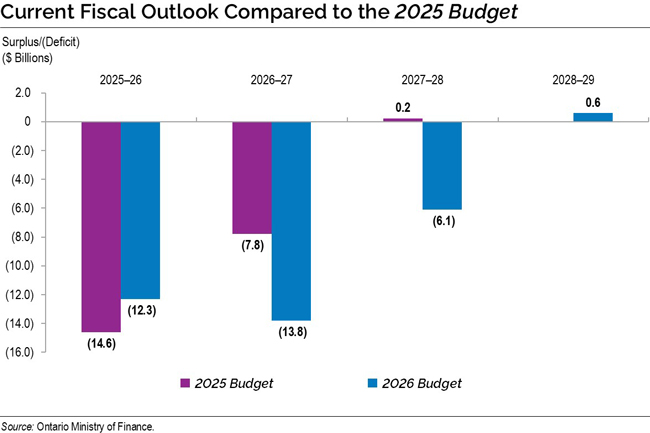
In 2025–26, Ontario is projecting a deficit of $12.3 billion. Over the medium term, the government is projecting deficits of $13.8 billion in 2026–27 and $6.1 billion in 2027–28, before planning for a surplus of $0.6 billion in 2028–29, including reserve and contingencies.
The government continues to prioritize strategic investments in initiatives that protect workers and the economy from global trade tensions and put money back in people’s pockets without compromising on a path to balance.
Ontario has, and continues to implement, a plan to make Ontario the most competitive place to invest and do business in the G7 by cutting taxes, reducing red tape, streamlining permitting, removing interprovincial trade barriers, investing in infrastructure, supporting workers, improving services and making life more affordable. This is how the government is protecting Ontario.
| 3 |
| Ontario’s Economic and Fiscal Outlook in Brief |
| 4 |
| Ontario’s Economic and Fiscal Outlook in Brief |
Ontario’s Economic Outlook
Ontario’s real GDP is projected to grow by 1.0 per cent in 2026 and growth is expected to pick up in subsequent years with projected increases of 1.7 per cent in 2027, 1.8 per cent in 2028 and 2.0 per cent in 2029. For the purposes of prudent fiscal planning, these projections are set slightly below the average of private-sector forecasts.
Summary of Ontario’s Economic Outlook
| (Per Cent) | ||||||||||||||||||||
| 2025 | 2026p | 2027p | 2028p | 2029p | ||||||||||||||||
| Real GDP Growth | 1.2e | 1.0 | 1.7 | 1.8 | 2.0 | |||||||||||||||
| Nominal GDP Growth | 4.2e | 3.2 | 3.9 | 3.7 | 3.9 | |||||||||||||||
| Employment Growth | 1.0 | 0.5 | 0.7 | 0.8 | 1.1 | |||||||||||||||
| CPI Inflation | 1.9 | 2.1 | 2.0 | 2.0 | 2.0 | |||||||||||||||
e = estimate.
p = Ontario Ministry of Finance planning projection based on external sources as of January 16, 2026.
Sources: Statistics Canada and Ontario Ministry of Finance.
Revisions to the Economic Outlook Since the 2025 Budget
The outlook has been revised compared to the projections in the 2025 Budget. Key changes since the 2025 Budget include:
| • |
Stronger nominal GDP growth in 2025 and 2026; |
| • |
Stronger growth in compensation of employees and net operating surplus in 2025; |
| • |
Stronger job creation in 2025 and 2026; and |
| • |
Slower growth in home resales in 2025 and 2026. |
| 5 |
| Ontario’s Economic and Fiscal Outlook in Brief |
Changes in the Ontario Ministry of Finance Key Economic Forecast
Assumptions: 2025 Budget Compared to 2026 Budget
| (Per Cent Change) | ||||||||||||||||||||||||||||||||
| 2025 | 2026p | 2027p | 2028p | |||||||||||||||||||||||||||||
| 2025 Budget |
2026 Budget |
2025 Budget |
2026 Budget |
2025 Budget |
2026 Budget |
2025 Budget |
2026 Budget |
|||||||||||||||||||||||||
| Real Gross Domestic Product | 0.8 | 1.2e | 1.0 | 1.0 | 1.9 | 1.7 | 1.9 | 1.8 | ||||||||||||||||||||||||
| Nominal Gross Domestic Product | 3.1 | 4.2e | 3.0 | 3.2 | 4.0 | 3.9 | 4.0 | 3.7 | ||||||||||||||||||||||||
| Compensation of Employees | 3.7 | 4.0e | 3.2 | 3.2 | 3.6 | 3.3 | 3.8 | 3.5 | ||||||||||||||||||||||||
| Net Operating Surplus — Corporations | (3.0) | 4.4e | 6.4 | 4.7 | 7.2 | 7.2 | 5.2 | 6.1 | ||||||||||||||||||||||||
| Nominal Household Consumption | 3.5 | 4.0e | 3.1 | 3.3 | 3.7 | 3.4 | 3.8 | 3.6 | ||||||||||||||||||||||||
| Other Economic Indicators | ||||||||||||||||||||||||||||||||
| Employment | 0.9 | 1.0 | 0.4 | 0.5 | 0.9 | 0.7 | 0.9 | 0.8 | ||||||||||||||||||||||||
| Job Creation (000s) | 73 | 81 | 33 | 41 | 74 | 58 | 75 | 67 | ||||||||||||||||||||||||
| Unemployment Rate (Per Cent) | 7.6 | 7.7 | 7.3 | 7.4 | 6.6 | 6.9 | 6.2 | 6.4 | ||||||||||||||||||||||||
| Consumer Price Index | 2.3 | 1.9 | 2.0 | 2.1 | 2.0 | 2.0 | 2.0 | 2.0 | ||||||||||||||||||||||||
| Housing Starts (000s)1 | 71.8 | 65.4 | 74.8 | 64.8 | 82.5 | 70.3 | 85.9 | 76.8 | ||||||||||||||||||||||||
| Home Resales | 5.3 | (5.6) | 12.7 | 9.1 | 4.6 | 5.6 | 1.5 | 4.6 | ||||||||||||||||||||||||
| Home Resale Prices | (1.2) | (4.4) | 2.6 | 0.8 | 3.8 | 2.7 | 4.0 | 4.2 | ||||||||||||||||||||||||
| Key External Variables | ||||||||||||||||||||||||||||||||
| U.S. Real Gross Domestic Product | 1.4 | 2.2 | 1.4 | 2.4 | 2.0 | 2.1 | 2.0 | 2.0 | ||||||||||||||||||||||||
| WTI Crude Oil ($US per Barrel) | 69 | 65 | 69 | 59 | 74 | 62 | 75 | 67 | ||||||||||||||||||||||||
| Canadian Dollar (Cents US) | 69.2 | 71.6 | 71.2 | 73.2 | 73.0 | 75.3 | 74.1 | 76.4 | ||||||||||||||||||||||||
| Three-Month Treasury Bill Rate (Per Cent)2 | 2.4 | 2.6 | 2.3 | 2.3 | 2.4 | 2.6 | 2.6 | 2.5 | ||||||||||||||||||||||||
| 10-Year Government Bond Rate (Per Cent)2 | 3.1 | 3.2 | 3.2 | 3.3 | 3.4 | 3.5 | 3.5 | 3.5 | ||||||||||||||||||||||||
e = estimate.
| p | = Ontario Ministry of Finance planning projection based on external sources as of January 16, 2026. |
| 1 | Housing starts projection based on private-sector average as of January 16, 2026. |
| 2 | Government of Canada interest rates. |
Sources: Statistics Canada; Canada Mortgage and Housing Corporation; Canadian Real Estate Association; Bank of Canada; United States Bureau of Economic Analysis; Blue Chip Economic Indicators (February 2026 and October 2025); U.S. Energy Information Administration; and Ontario Ministry of Finance.
| 6 |
| Ontario’s Economic and Fiscal Outlook in Brief |
Managing Ontario’s Finances Responsibly
The government’s plan is consistent with the Fiscal Sustainability, Transparency and Accountability Act, 2019 and its governing principles that guide Ontario’s fiscal policy.
| • |
Transparent: The government continues to be transparent through the release of regular fiscal updates. This is the eighth year in a row that the government has received a clean audit opinion from Ontario’s Auditor General. |
| • |
Responsible: The government has developed a measured and accountable approach to managing Ontario’s finances, while investing in key public services and capital projects. |
| • |
Flexible: The government’s plan has built in appropriate levels of prudence in the form of contingency funds and a reserve to ensure the necessary fiscal flexibility is available to respond to changing circumstances. |
| • |
Equitable: The government’s plan sustains investments in key public services, such as health care, social services and education, ensuring that these services are readily available for the people of today and maintained for the benefit of future generations. |
| • |
Sustainable: The government remains committed to achieving a balanced budget and reducing the province’s debt burden to ensure the long-term sustainability of Ontario’s finances. |
Ontario remains committed to responsible borrowing and debt management. Over the medium-term outlook, the net debt-to-GDP ratio is forecast to stay below the province’s target of 40.0 per cent, demonstrating that Ontario continues to make positive progress towards reducing the debt burden. Ontario’s interest-to-revenue ratio is projected to be 6.3 per cent in 2025–26, 0.2 percentage points lower than the 6.5 per cent forecasted in the 2025 Budget. This ratio remains close to the lowest levels it has been at since the 1980s.
Ontario’s strong credit ratings, fiscal profile and professional approach to markets have contributed to unprecedented global investor demand for the province’s debt. Increased international demand has resulted in increased foreign issuance, allowing for further diversification of Ontario’s investor base while reducing overall borrowing costs. For example, this year, for the first time, Ontario issued euro denominated 30-year bonds, raising $0.6 billion at lower costs than issuing in Canada after being hedged back to Canadian dollars.
| 7 |
| Ontario’s Economic and Fiscal Outlook in Brief |
In response to global economic challenges, Ontario has continued the prudent management of its finances to build a more resilient, self-reliant economy and secure long-term prosperity. The government will continue to rise to these challenges by pursuing opportunities to modernize programs, reduce bureaucracy and administrative costs and ensure that services are provided in the most efficient and cost-effective way possible. This will help ensure that Ontario has the fiscal capacity to deliver better front-line services for those who need them most, and that it can invest in strategic priorities to unleash the economy. See section entitled “Strengthening Public Services for a Sustainable and Prosperous Future” in Chapter 1: Protect Ontario’s Public Services for more details.
|
Determining Extraordinary Circumstances
The Fiscal Sustainability, Transparency and Accountability Act, 2019 requires that the government determine that extraordinary circumstances exist if it plans to run a deficit. The government has determined that extraordinary circumstances exist for the planned deficits in the current year and the medium-term outlook as a result of ongoing economic and geopolitical uncertainty, including significant risk to Ontario’s economy related to trade. Combatting this risk requires significant government investment in improving public services, streamlining government processes, investing in critical infrastructure and supporting emerging industries. Ontario is not alone, as these challenges have resulted in difficult economic and fiscal circumstances for governments across Canada and around the world.
|
| 8 |
| Ontario’s Economic and Fiscal Outlook in Brief |
Ontario’s Fiscal Plan
In 2026–27, the government is projecting a deficit of $13.8 billion, improving to a deficit of $6.1 billion in 2027–28 and a surplus of $0.6 billion in 2028–29. This outlook is driven by investments to grow Ontario’s economy and protect critical public services such as health care, education and infrastructure.
Details of Ontario’s Fiscal Plan
| ($ Billions) | ||||||||||||||||||||
| Actual 2024–25 |
Interim 2025–26 |
Medium-Term Outlook | ||||||||||||||||||
| 2026–27 | 2027–28 | 2028–29 | ||||||||||||||||||
| Revenue | ||||||||||||||||||||
| Personal Income Tax |
55.7 | 61.9 | 65.1 | 69.5 | 74.1 | |||||||||||||||
| Sales Tax |
39.4 | 39.2 | 39.9 | 43.2 | 45.1 | |||||||||||||||
| Corporations Tax |
27.8 | 27.6 | 28.6 | 30.6 | 32.5 | |||||||||||||||
| Ontario Health Premium |
5.2 | 5.2 | 5.5 | 5.7 | 5.9 | |||||||||||||||
| Education Property Tax |
5.9 | 5.9 | 6.0 | 6.0 | 6.1 | |||||||||||||||
| All Other Taxes |
17.6 | 18.0 | 18.5 | 19.1 | 20.1 | |||||||||||||||
| Total Taxation Revenue | 151.5 | 158.0 | 163.6 | 174.1 | 183.8 | |||||||||||||||
| Government of Canada Transfers | 36.6 | 39.1 | 39.8 | 40.1 | 40.4 | |||||||||||||||
| Income from Government Business Enterprises | 7.5 | 7.3 | 6.5 | 6.8 | 7.3 | |||||||||||||||
| Other Non-Tax Revenue | 30.5 | 22.2 | 21.9 | 22.4 | 22.6 | |||||||||||||||
| Total Revenue | 226.2 | 226.6 | 231.9 | 243.4 | 254.1 | |||||||||||||||
| Programs | ||||||||||||||||||||
| Health Sector |
91.3 | 97.8 | 101.2 | 103.5 | 106.7 | |||||||||||||||
| Education Sector1 |
38.3 | 40.5 | 40.8 | 41.2 | 41.5 | |||||||||||||||
| Postsecondary Education Sector |
14.2 | 14.0 | 14.0 | 12.8 | 12.7 | |||||||||||||||
| Children, Community and Social Services Sector |
20.5 | 21.5 | 21.4 | 21.6 | 21.7 | |||||||||||||||
| Justice Sector |
7.2 | 7.3 | 7.3 | 7.3 | 7.4 | |||||||||||||||
| Other Programs |
40.6 | 41.2 | 42.4 | 42.5 | 41.3 | |||||||||||||||
| Total Programs | 212.1 | 222.4 | 227.0 | 229.0 | 231.3 | |||||||||||||||
| Interest and Other Debt Servicing Charges | 15.1 | 16.0 | 17.2 | 18.6 | 19.7 | |||||||||||||||
| Total Expense | 227.3 | 238.4 | 244.2 | 247.5 | 251.1 | |||||||||||||||
| Surplus/(Deficit) Before Reserve | (1.1) | (11.8) | (12.3) | (4.1) | 3.1 | |||||||||||||||
| Reserve | – | 0.5 | 1.5 | 2.0 | 2.5 | |||||||||||||||
| Surplus/(Deficit) | (1.1) | (12.3) | (13.8) | (6.1) | 0.6 | |||||||||||||||
| Net Debt as a Per Cent of GDP2 | 35.7% | 36.8% | 37.7% | 38.5% | 38.2% | |||||||||||||||
| Net Debt as a Per Cent of Revenue2 | 191.2% | 204.4% | 210.9% | 212.9% | 209.8% | |||||||||||||||
| Interest as a Per Cent of Revenue | 5.5% | 6.3% | 6.7% | 6.9% | 7.1% | |||||||||||||||
| 1 | Excludes Teachers’ Pension Plan. Teachers’ Pension Plan expense is included in Other Programs. |
| 2 | For 2026–27 and future years, Net Debt reflects financial assets less financial liabilities and is aligned with Net Financial Liabilities, as will be reported in the Public Accounts of Ontario 2026–2027. See the Debt Burden Reduction Strategy in Chapter 4: Borrowing and Debt Management for additional details on the calculations supporting the ratios. |
Note: Numbers may not add due to rounding.
Sources: Ontario Treasury Board Secretariat and Ontario Ministry of Finance.
| 9 |
| Ontario’s Economic and Fiscal Outlook in Brief |
Revenue Outlook Over the Medium Term
Ontario’s revenue outlook is forecast to increase from $226.2 billion in 2024–25 to $254.1 billion in 2028–29.
Ontario’s revenue outlook is anchored by an economic projection based on private-sector forecasts and the best available information at the time of finalizing the planning projection. Details of the medium-term revenue outlook are outlined in Chapter 3: Ontario’s Fiscal Plan and Outlook.
Key inputs included in the revenue forecast are: a prudent economic outlook, existing federal–provincial agreements and funding formulas and the business plans of government ministries, business enterprises and service organizations.
Program Expense Outlook Over the Medium Term
Ontario’s program expense outlook is expected to grow from $212.1 billion in 2024–25 to $231.3 billion in 2028–29. The additional funding will primarily be used to protect Ontario’s economy and its workers, improving affordability and strengthening investments in critical public services such as health, education and infrastructure. In addition, contingencies have been incorporated into the program expense outlook to ensure fiscal stability and the ability to respond to unforeseen events.
See Chapter 3: Ontario’s Fiscal Plan and Outlook for further details on the program expense outlook over the medium term.
Interest and Other Debt Servicing Charges Outlook Over the Medium Term
Interest and Other Debt Servicing Charges (IOD) is forecast to be $16.0 billion in 2025–26, down from the 2025 Budget forecast of $16.2 billion. Over the medium-term outlook, IOD is forecast to be $17.2 billion in 2026–27, $18.6 billion in 2027–28 and $19.7 billion in 2028–29.
| 10 |
| Ontario’s Economic and Fiscal Outlook in Brief |
Other Fiscal Plan Assumptions
The reserve is set at $1.5 billion in 2026–27, $2.0 billion in 2027–28 and $2.5 billion in 2028–29, reflecting Ontario’s commitment to maintaining a prudent and flexible fiscal plan. These reserve levels are among the highest allocated in any Ontario Budget.
The net debt-to-GDP ratio is projected to be 37.7 per cent in 2026–27, 38.5 per cent in 2027–28 and declining to 38.2 per cent in 2028–29.
Economic and Fiscal Outlook Scenarios
To provide more transparency about the province’s economic outlook amid the elevated degree of economic uncertainty, the Ontario Ministry of Finance has developed Faster Growth and Slower Growth scenarios that could impact the economy over the next few years. These alternative scenarios should not be considered the best case or the worst case, but reasonable possible outcomes in this period of uncertainty. See Chapter 2: Economic Performance and Outlook for more details.
Ontario Real GDP Growth Scenarios
| (Per Cent) | ||||||||||||||||
| 2026p | 2027p | 2028p | 2029p | |||||||||||||
| Faster Growth Scenario | 1.6 | 2.2 | 1.9 | 2.1 | ||||||||||||
| Planning Projection | 1.0 | 1.7 | 1.8 | 2.0 | ||||||||||||
| Slower Growth Scenario | 0.3 | 0.6 | 1.8 | 2.0 | ||||||||||||
p = Ontario Ministry of Finance planning projection based on external sources as of January 16, 2026, and alternative scenarios.
Source: Ontario Ministry of Finance.
Ontario Nominal GDP Growth Scenarios
| (Per Cent) | ||||||||||||||||
| 2026p | 2027p | 2028p | 2029p | |||||||||||||
| Faster Growth Scenario | 4.0 | 4.6 | 4.0 | 4.2 | ||||||||||||
| Planning Projection | 3.2 | 3.9 | 3.7 | 3.9 | ||||||||||||
| Slower Growth Scenario | 2.3 | 2.6 | 3.5 | 3.7 | ||||||||||||
p = Ontario Ministry of Finance planning projection based on external sources as of January 16, 2026, and alternative scenarios.
Source: Ontario Ministry of Finance.
If either of the alternative economic scenarios were to materialize versus the Planning Projection, Ontario’s fiscal plan would also change as a result.
Based on the two alternative nominal GDP growth economic scenarios, two taxation revenue outlook scenarios were developed.
| 11 |
| Ontario’s Economic and Fiscal Outlook in Brief |
Ontario’s Taxation Revenue Scenarios
| ($ Billions) | ||||||||||||
| 2026–27p | 2027–28p | 2028–29p | ||||||||||
| Faster Growth Scenario | 166.2 | 179.4 | 191.3 | |||||||||
| Planning Projection | 163.6 | 174.1 | 183.8 | |||||||||
| Slower Growth Scenario | 160.9 | 167.8 | 175.5 | |||||||||
p = Ontario Ministry of Finance planning projection based on external sources as of January 16, 2026, and alternative scenarios.
Note: Numbers may not add due to rounding.
Source: Ontario Ministry of Finance.
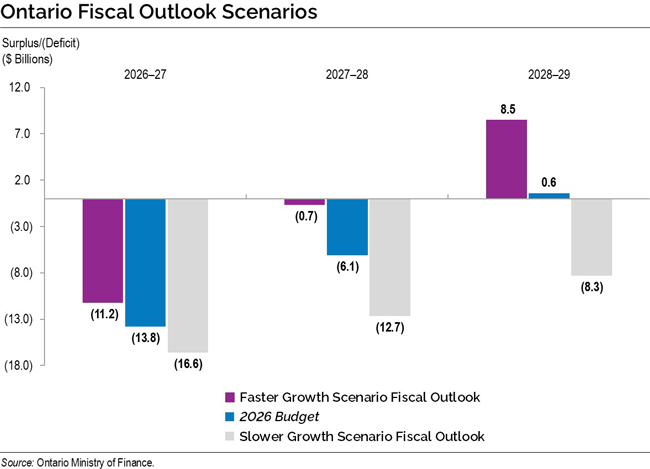
Under the Faster Growth scenario, total taxation revenue over the medium term is $7.4 billion higher than the Planning Projection in 2028–29; under the Slower Growth scenario, total taxation revenue is $8.3 billion lower.
Under the Faster Growth scenario, the deficit outlook may improve to $11.2 billion in 2026–27, $0.7 billion in 2027–28 and a surplus of $8.5 billion in 2028–29. However, if the Slower Growth scenario materializes instead, the deficit outlook may deteriorate to $16.6 billion in 2026–27, $12.7 billion in 2027–28 and $8.3 billion in 2028–29.
| 12 |
| Ontario’s Economic and Fiscal Outlook in Brief |
Borrowing and Debt Management
Ontario’s borrowing program is primarily used to fund deficits, refinance maturing debt, make investments in capital assets and support other loans and investments that advance key provincial priorities. Ontario will continue to finance most of its borrowing program in the long-term public markets in Canada, as well as internationally. Ontario completed long-term public borrowing of $58.6 billion for 2025–26. The total long-term borrowing requirements for 2026–27, 2027–28 and 2028–29 are forecast to be $47.2 billion, $43.1 billion and $42.7 billion, respectively. Ontario’s borrowing program is partly driven by a historic capital plan.
2025–26 Borrowing Program and Medium-Term Outlook
| ($ Billions) | ||||||||||||||||||||||||
| 2025–26 | Medium-Term Outlook | |||||||||||||||||||||||
| 2025 Budget |
Change from 2025 Budget |
Interim 2025–26 |
2026–27 | 2027–28 | 2028–29 | |||||||||||||||||||
| Deficit/(Surplus) | 14.6 | (2.3) | 12.3 | 13.8 | 6.1 | (0.6) | ||||||||||||||||||
| Provincial Investment in Capital Assets | 23.1 | 1.3 | 24.4 | 28.0 | 28.0 | 22.4 | ||||||||||||||||||
| Pre-funding for Protect Ontario Account | – | 5.0 | 5.0 | – | – | – | ||||||||||||||||||
| Amortization of Capital Assets | (9.1) | – | (9.1) | (10.2) | (10.5) | (11.4) | ||||||||||||||||||
| Non-Cash and Cash Timing Adjustments | (3.1) | 1.0 | (2.1) | (2.5) | (2.7) | (3.5) | ||||||||||||||||||
| Net Loans and Investments1 | 1.2 | 1.1 | 2.4 | 5.2 | 5.6 | 4.9 | ||||||||||||||||||
| Debt Maturities and Redemptions | 33.1 | – | 33.1 | 26.9 | 27.5 | 30.7 | ||||||||||||||||||
| Total Funding Requirement | 59.8 | 6.1 | 65.9 | 61.2 | 54.1 | 42.7 | ||||||||||||||||||
| Decrease/(Increase) in Short-Term Borrowing | (5.0) | (0.5) | (5.5) | (6.0) | (6.0) | – | ||||||||||||||||||
| Increase/(Decrease) in Year-End Cash and Cash Equivalents | (12.0) | 10.2 | (1.8) | (8.0) | (5.0) | – | ||||||||||||||||||
| Total Long-Term Borrowing | 42.8 | 15.8 | 58.6 | 47.2 | 43.1 | 42.7 | ||||||||||||||||||
| 1 | The increase in Net Loans and Investments primarily reflects higher projected loan disbursements associated with Ontario Student Assistance Program (OSAP) policy changes effective in the 2026–27 academic year. |
Note: Numbers may not add due to rounding.
Source: Ontario Financing Authority.
Ontario is projected to pay $16.0 billion in IOD in 2025–26, $17.2 billion in 2026–27, $18.6 billion in 2027–28 and $19.7 billion in 2028–29.
As a share of revenue, IOD is projected to remain near record lows in 2025–26. A one percentage point change in interest rates either up or down from the current interest rate is estimated to have a corresponding change in Ontario’s borrowing costs by around $0.9 billion in the first full year.
| 13 |
| Ontario’s Economic and Fiscal Outlook in Brief |
The net debt-to-GDP ratio in 2025–26 is now projected to be 36.8 per cent, or 1.1 percentage points lower than the 37.9 per cent forecast in the 2025 Budget, which is mainly due to a lower than previously projected deficit. Over the medium-term outlook, the net debt-to-GDP ratio is projected to remain modestly lower than the forecasts provided in the 2025 Budget and continues to remain below target levels. The table below shows the progress that has been made on relevant debt sustainability measures; see Chapter 4: Borrowing and Debt Management for more details on Ontario’s debt burden reduction strategy.
Progress on Relevant Debt Sustainability Measures
| (Per Cent) | ||||||||||
| Targets | 2025–26 Forecast | 2026–27 Forecast | ||||||||
| 2025 Budget | 2026 Budget | 2025 Budget | 2026 Budget | |||||||
| Net Debt-to-GDP1 | <40.0 | 37.9 | 36.8 | 38.9 | 37.7 | |||||
| Net Debt-to-Revenue1 | <200 | 211 | 204 | 215 | 211 | |||||
| Interest-to-Revenue | <7.5 | 6.5 | 6.3 | 6.7 | 6.7 | |||||
| 1 | For 2026–27 and future years, Net Debt reflects financial assets less financial liabilities and is aligned with Net Financial Liabilities, as will be reported in the Public Accounts of Ontario 2026–2027. See the Debt Burden Reduction Strategy in Chapter 4: Borrowing and Debt Management for additional details on the calculations supporting the ratios. |
Source: Ontario Financing Authority.
| 14 |
| Ontario’s Economic and Fiscal Outlook in Brief |
Ontario’s Capital Plan
Ontario’s capital plan continues to be the most ambitious provincial plan to build in Canadian history, with planned investments over the next 10 years totalling more than $210 billion, including $37 billion in 2026–27. This plan is getting shovels in the ground to build highways, transit, hospitals and other critical assets, laying the foundation for a better Ontario while creating jobs for workers on construction sites.
Key highlights in the capital plan include the following:
Building Highways
Approximately $31 billion over 10 years to support the planning and construction of highway expansion and rehabilitation projects across the province, including:
| • |
Highway 413, a new 400-series highway and transportation corridor across Halton, Peel and York regions that will support future population growth in the Greater Golden Horseshoe, bring relief to one of the busiest corridors in North America and save drivers up to 30 minutes each way on their commute; |
| • |
Bradford Bypass, a new four-lane freeway connecting Highway 400 in Simcoe County and Highway 404 in York Region, which will save drivers an estimated 35 minutes in travel time; |
| • |
Feasibility work for a Highway 401 tunnel expressway to help relieve gridlock and improve the effectiveness of infrastructure, with fieldwork starting this spring; |
| • |
Accelerating construction on the all-season roads to the Ring of Fire, with construction planned to start in June 2026 and roads beginning to open in November 2030, five years ahead of schedule; |
| • |
Queen Elizabeth Way (QEW) Garden City Skyway Bridge Twinning project, which includes construction of a new bridge on the QEW over the Welland Canal, connecting the City of St. Catharines to the Town of Niagara-on-the-Lake; |
| • |
New Highway 7 expansion between Kitchener and Guelph, which includes planning and design work for widening the roadway from two to four lanes; |
| • |
Enhancing Highway 401 to improve safety and traffic flow, and support economic development through resurfacing, bridge replacements and repairs, interchange improvements and ramp upgrades across the province; |
| • |
Widening existing corridors across the province, such as Highway 11/17 between Thunder Bay and Nipigon and Highway 17 between Kenora and the Manitoba border; |
| • |
Supporting planning and design for a new interchange connecting Highway 401 to the future Lauzon Parkway extension in Windsor, which will support increased opportunities for trade and improved access to the Windsor–Detroit border; |
| • |
Continuing progress on due diligence for the Gardiner Expressway and Don Valley Parkway, while providing ongoing support to repair and rehabilitate the Gardiner Expressway; |
| 15 |
| Ontario’s Economic and Fiscal Outlook in Brief |
| • |
Providing funding for the maintenance and rehabilitation of Ottawa Road 174 while due diligence is underway; |
| • |
Widening Highway 69 from two to four lanes between Parry Sound and Sudbury; |
| • |
Widening Highway 3 from two to four lanes between Essex and Leamington to improve road safety and keep people and goods moving in Southwestern Ontario; and |
| • |
Supporting renewed partnerships with First Nations to build and improve highway infrastructure that will promote equity and help connect more First Nation communities to the province’s highway network. |
Building Transit
Approximately $63 billion over 10 years for public transit, with a variety of projects underway, including:
| • |
Building the largest subway expansion in Canadian history: the Ontario Line, the Scarborough Subway Extension, the Eglinton Crosstown West Extension and the Yonge North Subway Extension, as part of the government’s plan to slash commute times across the Greater Toronto Area (GTA) and promote integrated and efficient transportation service delivery; |
| • |
Building and expanding Light Rail Transit (LRT): opening the Finch West LRT and Eglinton Crosstown LRT, as well as advancing the Hamilton LRT and Hazel McCallion Line into downtown Brampton and Mississauga, with plans to tunnel the Brampton portion of the line, which will provide more people with fast, affordable and reliable transit; |
| • |
Investing nearly $1 billion to help the Toronto Transit Commission (TTC) purchase 55 new trains manufactured in Thunder Bay for Toronto’s Line 2 subway; |
| • |
Investing $850 million to refurbish GO Transit rail cars, as part of the ongoing service expansion across the GO rail network, and to support hundreds of manufacturing jobs and economic growth in Northern Ontario; |
| • |
Bringing back the Northlander in 2026, which will provide safe and reliable transportation options between Northern Ontario and Toronto, with new, fully accessible and state-of-the-art trains; and |
| • |
Constructing the East Harbour Transit Hub, which is anticipated to serve approximately 100,000 riders daily while substantially reducing crowding at Union Station. |
| 16 |
| Ontario’s Economic and Fiscal Outlook in Brief |
Building Health Infrastructure
Approximately $64 billion over the next 10 years in health infrastructure, including nearly $50 billion in capital grants, to support more than 50 major hospital projects that would add approximately 3,000 new beds over 10 years to increase access to quality care. Investments are being made to support hospital projects, including:
| • |
Investing in the new Fancsy Family Hospital project to consolidate acute care services from two hospitals into one site with a capacity of 594 beds (including 101 net new beds), to relieve system pressures in Windsor and Essex County; |
| • |
Supporting the Peter Gilgan Mississauga Hospital, to build the largest teaching hospital in Canada, tripling the size of the existing hospital to help provide health care to an estimated 2.2 million people; |
| • |
Investing in the Ottawa Hospital to build a state-of-the-art Civic Campus, which will serve as the lead acute care centre for Ottawa and Eastern Ontario; |
| • |
Funding to support the planning of a new Orillia Soldiers’ Memorial Hospital, which will connect more families in Orillia and its surrounding communities to more convenient, high-quality care close to home; |
| • |
Supporting the construction of Phase One of Stevenson Memorial Hospital’s redevelopment, which will include construction of a new, three-storey building that will more than double the size of the hospital; |
| • |
Supporting the construction of the new South Niagara Hospital which, once completed in summer 2028, will include 469 beds and expand 24/7 emergency, diagnostic, surgical, and therapeutic services for patients and families across the region; |
| • |
Advancing work on Lakeridge Health’s Bowmanville Hospital redevelopment, which will more than double the hospital’s capacity by adding up to 32 new beds and expanding inpatient and ambulatory care services and the emergency department; and |
| • |
Advancing work on William Osler Health System’s Peel Memorial Hospital Phase 2 redevelopment, which includes construction of a new, 12-storey tower to accommodate non-acute inpatient services, including space for up to 250 new post-acute inpatient beds, a 24/7 emergency care centre, inpatient and outpatient dialysis and expanded ambulatory and non-acute services. |
| 17 |
| Ontario’s Economic and Fiscal Outlook in Brief |
Building Long-Term Care
Planned investments that total a historic $6.4 billion since 2019 are in place to build 58,000 new and upgraded long-term care beds across the province by 2028 to modern design standards. As of February 2026, nearly 26,000 beds (164 projects) are either open, under construction or approved to start construction, including:
| • |
Eleven long-term care homes that have advanced to construction between June 2025 and February 2026, including projects supported by the new 2025 Capital Funding Program, which provides a funding framework that better reflects regional cost variations while addressing diverse operator needs across the sector. |
Building Schools and Child Care Spaces
| • |
Investing about $30 billion over the next 10 years, including over $22 billion in capital grants, to build more schools and child care spaces, including a new English public elementary school in Savant Lake, a new French Catholic elementary school in Orléans, a new English Catholic elementary and secondary school in Kitchener, a new French public elementary school in North York and an addition to Holy Trinity Catholic High School in Bradford West Gwillimbury. |
Building Postsecondary Education Infrastructure
| • |
Investing $5.5 billion in the Postsecondary Education sector over the next 10 years, including over $2.2 billion in capital grants to help colleges, universities and Indigenous Institutes make critical repairs, improve energy efficiency and modernize facilities by upgrading technology. |
Building Housing-Enabling Municipal Infrastructure
| • |
Building housing-enabling municipal infrastructure projects, such as roads and water systems, through the Municipal Housing Infrastructure Program to support growing and developing communities. |
| 18 |
| Ontario’s Economic and Fiscal Outlook in Brief |
Infrastructure Expenditures1
| ($ Millions) | ||||||||||||||||||||
| Interim2 2025–26 |
Medium-Term Outlook | 10-Year Total3 |
||||||||||||||||||
|
2026–27 |
2027–28 |
2028–29 |
||||||||||||||||||
| Sector | ||||||||||||||||||||
| Transportation | ||||||||||||||||||||
| Transit |
12,714 | 13,789 | 14,629 | 8,991 | 63,342 | |||||||||||||||
| Provincial Highways |
4,128 | 5,391 | 4,073 | 3,892 | 30,693 | |||||||||||||||
| Other Transportation, Property and Planning |
225 | 261 | 183 | 104 | 1,288 | |||||||||||||||
| Health | ||||||||||||||||||||
| Hospitals |
4,458 | 5,602 | 8,457 | 8,354 | 62,171 | |||||||||||||||
| Other Health |
645 | 1,413 | 1,249 | 929 | 9,106 | |||||||||||||||
| Education | 4,213 | 4,211 | 4,277 | 3,635 | 29,665 | |||||||||||||||
| Postsecondary Education | ||||||||||||||||||||
| Colleges and Other |
831 | 701 | 520 | 293 | 4,045 | |||||||||||||||
| Universities |
213 | 202 | 235 | 142 | 1,483 | |||||||||||||||
| Social | 601 | 583 | 478 | 110 | 1,811 | |||||||||||||||
| Justice | 629 | 1,102 | 659 | 806 | 4,055 | |||||||||||||||
| Other Sectors4 | 6,041 | 5,386 | 3,200 | 2,641 | 27,893 | |||||||||||||||
| Total Infrastructure Expenditures | 34,695 | 38,641 | 37,960 | 29,897 | 235,552 | |||||||||||||||
| Less: Other Partner Funding5 |
2,416 | 1,897 | 2,883 | 2,308 | 24,661 | |||||||||||||||
| Total6 | 32,279 | 36,744 | 35,077 | 27,588 | 210,890 | |||||||||||||||
| 1 | Includes interest capitalized during construction; third-party investments in hospitals, colleges and schools; federal and municipal contributions to provincially owned infrastructure investments; and transfers to municipalities, universities and non-consolidated agencies. |
| 2 | Includes provincial investment in capital assets of $24.4 billion. |
| 3 | Total reflects the planned infrastructure expenditures for years 2026–27 through 2035–36. |
| 4 | Includes high-speed internet infrastructure, government administration, natural resources and culture and tourism industries. |
| 5 | Other Partner Funding refers to third-party investments primarily in hospitals, colleges and schools. |
| 6 | Includes federal/municipal contributions to provincial infrastructure investments. |
Note: Numbers may not add due to rounding.
Source: Ontario Treasury Board Secretariat.
| 19 |
| Ontario’s Economic and Fiscal Outlook in Brief |
Building Together Through Federal–Provincial Partnerships
Flexible, adequate, fair and sustainable federal–provincial transfers are critical to ensuring sustainable public services. Ontario’s partnership with the federal government has resulted in important progress, including on key projects to unleash Ontario’s economy by harnessing its advantages in critical minerals and nuclear energy. However, more work remains to be done. Ontario is ready and willing to work with the federal government on shared priorities, including working together with all three levels of government to lower municipal development charges and support housing affordability, as well as funding infrastructure and transportation that strengthens the province’s economy and communities.
Ontario supports a Team Canada approach to stand up to U.S. tariffs and economic uncertainty by creating new opportunities for job creation and investment attraction, enhancing economic integration across Canada and diversifying into new markets. Provinces, territories and the federal government can achieve these common goals through key actions like unlocking free trade barriers within Canada, supporting strategic sectors like auto and steel and prioritizing domestic suppliers and materials when investing in national defence capacity.
To address long-term challenges in health care, education and other social services that Ontario continues to face, it is important for the federal government to ensure long-term, predictable funding for initiatives that federal, provincial and territorial governments have worked on together to implement. Ontario, along with other provinces and territories, continues to call on the federal government to make permanent the temporary 5 per cent minimum growth rate guarantee in the Canada Health Transfer, and increase and sustain support for the Canada-wide Early Learning and Child Care Agreement in order to achieve federal goals and targets.
| 20 |
Chapter 1 A Plan to Protect Ontario
| Section A: Protect Workers and Businesses from Tariffs and Economic Uncertainty |
Section A: Protect Workers and Businesses from Tariffs and Economic Uncertainty
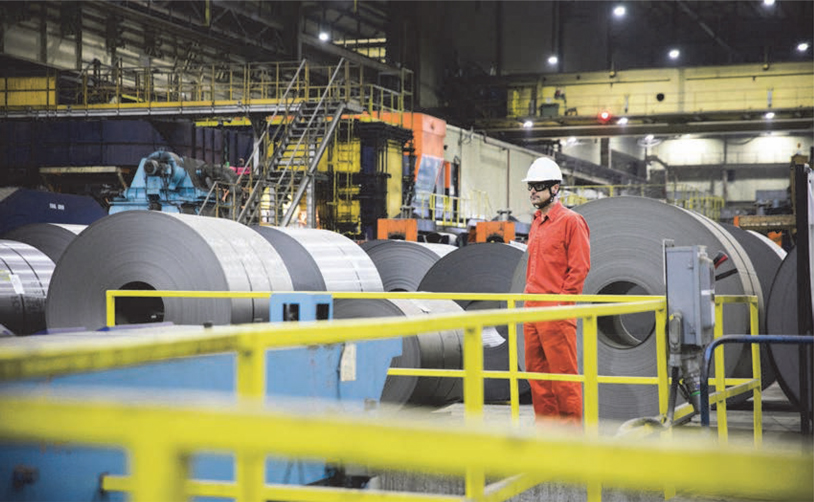
While uncertainty remains at the centre of the global economic landscape, the government is taking bold and decisive action to protect Ontario from the impacts of U.S. imposed tariffs on the provincial economy, including key sectors such as automotive, steel and forestry. The government is fighting for Ontario workers and businesses by ensuring they have the supports needed to weather these challenges and creating opportunities for long-term sustainability and job creation in growth-ready sectors.
The government acted quickly to protect Ontario from these impacts and has announced nearly $30 billion in relief and support for workers and businesses since April 2025, including measures to build long-term resiliency and prosperity. Initiatives such as the Protect Ontario Financing Program (POFP), the Trade-Impacted Communities Program (TICP), tax deferrals for businesses and transitional support for laid-off workers help protect Ontario by creating greater stability and support for businesses and workers today, while building long-term growth and resiliency for tomorrow.
| Chapter 1: A Plan to Protect Ontario |
Supporting Businesses Through the Protect Ontario Financing Program
As part of the government’s strategy to protect Ontario’s key industries from the impacts of U.S. tariffs, the province quickly established the Protect Ontario Financing Program to provide targeted working capital support. Working in partnership with the federal government, Ontario announced a $500 million joint investment to help Algoma Steel navigate changing market conditions and the impacts of U.S. tariffs.
The province is providing a $100 million loan, complementing $400 million from the federal Large Enterprise Tariff Loan (LETL) facility, to ensure Algoma has the liquidity and flexibility needed to remain a key source of jobs and economic activity in Northern Ontario.
The Protect Ontario Financing Program is being delivered with rigorous oversight and a strong focus on integrity. The government has accelerated reviews by allowing companies to complete multiple due diligence processes simultaneously, speeding up support while maintaining high standards of scrutiny and responsible stewardship of public funds. Continued work in this area remains essential. Potential U.S. trade disruptions, including new tariffs, could increase financial pressures on companies in Ontario and spike demand for the program. Sustaining and advancing this work ensures Ontario remains prepared to protect critical sectors amid shifting cross-border conditions.
| 24 |
| Section A: Protect Workers and Businesses from Tariffs and Economic Uncertainty |
Investing in Ontario’s Future Economy with the Protect Ontario Account Investment Fund
Global economic conditions are becoming increasingly dynamic and the province must evolve to address that volatility. The government is taking deliberate steps to position Ontario’s economy for long-term growth and resilience. Recent investments to unlock critical mineral resources in Northern Ontario are strengthening the province’s role in emerging global supply chains. These investments are fortifying a critical segment in the supply chain by adding to Ontario’s domestic manufacturing capacity.
Building on this momentum, the province is advancing a new initiative to diversify Ontario’s economy, enhance productivity, increase independence from U.S. trade relationships and reduce exposure to external economic uncertainty. While traditional sectors will continue to play a vital role, there will be a deliberate focus on investments to support the new economy. These investments will be anchored in resilience, innovation, advanced industries and emerging technologies that will fortify Ontario’s existing economic base. Building a pathway to sustained economic growth will require deeper capital formation, and greater alignment between public policy objectives and private investment activity.
Building on the Protect Ontario Account announcement in the 2025 Budget, and later the 2025 Ontario Economic Outlook and Fiscal Review, the province is establishing the Protect Ontario Account Investment Fund, a fund in which the province will invest up to $4 billion, and partner with a best-in-class private investment manager. This fund will identify and execute on a pipeline of investment opportunities to advance Ontario’s long-term economic and strategic priorities. The province has initiated a competitive process to partner with an investment manager capable of delivering on investments that advance Ontario’s strategic policy goals.
The fund will be structured to operate as a commercial market fund, with capital deployed by an independent, private-sector General Partner. The fund will leverage the provincial seed commitment to help crowd in Canadian pension fund capital and other major investors, to multiply the total fund size and encourage investment in Ontario. Ontario will act as a founding and significant investor anchoring a large private-market fund of domestic and global institutional capital to generate an economic return. The province will gain access to a private-market investment manager to leverage private-sector expertise, capital, market discipline and global networks, while retaining a prominent position to ensure investments deliver a clear benefit to Ontario taxpayers.
| 25 |
| Chapter 1: A Plan to Protect Ontario |
The province’s role as a Limited Partner will promote and maintain strong public governance and accountability while capitalizing on private-sector expertise, innovation and a focus on generating a return on investment. Drawing on an experienced private-sector investor, the fund will leverage proven investment strategies to enhance productivity and create jobs. By accelerating the development of strategic sectors and reinforcing domestic supply chains, the fund will attract capital from multiple sources, unlocking investments in Ontario that would otherwise not be deployed at scale. This approach will allow Ontario to harness market discipline and global networks to deliver tangible benefits for the province’s economy and its people.
This approach reflects an evolution in the relationship between government and the private sector. Adding to the ecosystem of successful, traditional investment attraction programs, the fund adds a new element of support and positions capital allocation as a core economic policy tool. Capital as a policy tool enables Ontario to act at market speed, share risk with private investors and build durable assets aligned with provincial priorities. Over time, this model is intended to improve economic resilience, create jobs, enhance competitiveness and support sustainable growth across the province.
Assisting Communities and Industries Impacted by Trade Disruptions
The province continues to respond to the impacts of U.S. tariffs and global economic uncertainty, by ensuring communities and local industries get the support they need to navigate these economic challenges through the Trade-Impacted Communities Program. The $40 million program supports local projects that promote economic resiliency, increase export and investment opportunities, as well as bolster Ontario’s strategic priority sectors and their supply chains. Eligible applicants include municipal governments, economic development organizations, business accelerators and incubators, as well as sector or industry associations. Applications for funding under the program are currently being reviewed.
Protecting Ontario with the Buy Ontario Act
In December 2025, the Ontario legislature passed the Buy Ontario Act (Public Sector Procurement), 2025, a key piece of legislation designed to protect the province’s workers and businesses by prioritizing Ontario goods and services across all public-sector procurement. The Act strengthens the province’s economic resilience by requiring public-sector organizations — including ministries, agencies and designated broader public-sector entities that are delivering Ontario’s more than $210 billion capital plan — to prioritize Ontario, and then Canadian, goods and services whenever feasible.
| 26 |
| Section A: Protect Workers and Businesses from Tariffs and Economic Uncertainty |
The government is working with municipalities and the broader public sector to ensure their fleet vehicle purchases and capital projects also support local workers and industries, starting this spring. Introduced in response to escalating U.S. tariffs and economic uncertainty, the Act provides the framework to deliver on the government’s commitment to ensure Ontario tax dollars support Ontario workers and industries, including sectors such as steelmaking, forestry, automotive manufacturing, agriculture and construction. The legislation has enabled the government to prioritize Ontario goods and services, while still maintaining value for money for Ontario taxpayers and protecting major infrastructure projects from undue delays.
As a first step under the new Buy Ontario Act (Public Sector Procurement), 2025, Ontario established a new directive to prioritize made-in-Ontario vehicles for fleet purchases, and Ontario and Canadian goods and services in capital infrastructure procurements. To uphold these requirements, the government is looking at measures to monitor compliance of public-sector organizations and vendors, and potential penalties could include holdbacks, vendor performance management measures, and, when necessary, even barring vendors from future procurement opportunities.
At the same time, the government is actively working to strengthen Ontario’s domestic capacity to minimize reliance on foreign supply chains. This includes developing vendor lists of Ontario and Canadian suppliers to support their participation in the provincial procurement processes, thereby ensuring more opportunities for local businesses and workers across Ontario.
| 27 |
| Chapter 1: A Plan to Protect Ontario |
Protecting Ontario’s Auto Sector
Ontario’s auto industry is currently operating in a period of significant global uncertainty, but Ontario’s commitment is unwavering. Ontario is working hard to rapidly grow its electric vehicle (EV) manufacturing ecosystem and support uptake and has attracted billions in investments from global automakers, parts suppliers and EV battery manufacturers. The government is deeply invested in the sector’s success and will continue to take every step necessary to protect and grow an industry that employed nearly 100,000 people in 2025, enhance economic resilience, secure domestic supply chains and position Ontario as a top-tier destination for long-term investment. Ontario is also supporting the broader supply chain by investing in Ontario’s auto workers and equipping them with the skills they need to secure rewarding, high-paying jobs.
To support the auto sector and further enhance its competitiveness, the government is investing $85 million in the Ontario Automotive Modernization Program (O-AMP) and the Ontario Vehicle Innovation Network (OVIN), as announced in the 2025 Budget.
OVIN supports regional technology development sites, research and development (R&D) partnerships and incubator projects for small and medium-sized enterprises (SMEs). The investments in O-AMP are helping to support Ontario’s automotive parts suppliers and SMEs in upgrading equipment and adopting new tools and technologies to innovate product lines and continue to modernize processes.
Supporting Investments Through Ontario Vehicle Innovation Network to Establish Regional Technology Development Sites
As announced in February 2026, Ontario is providing $17.5 million through OVIN to support a nearly $70 million investment to establish nine Regional Technology Development Sites (RTDS) across the province to accelerate the adoption of made-in-Ontario automotive and mobility solutions.
| 28 |
| Section A: Protect Workers and Businesses from Tariffs and Economic Uncertainty |
To help protect Ontario’s auto industry and workers and enhance its resiliency, Ontario is supporting strategic investments from automakers, parts suppliers and manufacturers of EV batteries and battery materials. Since 2020, Ontario has attracted billions of dollars in new investments that will help grow the auto sector and create thousands of jobs. This includes Asahi Kasei’s $1.6 billion manufacturing facility in Port Colborne to produce lithium-ion battery separators, a key component of EV batteries, expected to begin production in 2027. In addition, Vianode is investing $3.2 billion to build its first large-scale, North American synthetic graphite plant in St. Thomas.
Ontario and the federal government are also continuing to support EV and battery projects through their auto pact, which covers the $5 billion NextStar battery plant in Windsor and the $7 billion PowerCo battery cell plant in St. Thomas. Production of lithium-ion battery cells at the NextStar plant in Windsor began in 2025, while PowerCo is on track to bring its advanced battery technology to the North American market, with the gigafactory to serve as PowerCo’s third and largest project globally.
Celebrating the Grand Opening of Canada’s First Commercial-Scale Battery Facility
On March 5, 2026, NextStar celebrated the grand opening of its 4.23 million-square-foot, state-of-the-art battery cell facility in Windsor. With a $5 billion investment, the plant has already produced more than one million battery cells and hired over 1,300 highly skilled workers, with 1,200 more jobs expected once it reaches full operational capacity. The opening of the NextStar Energy battery facility marks a major milestone for Ontario, creating thousands of local jobs and supporting workers across the province’s automotive and advanced manufacturing supply chains.
| 29 |
| Chapter 1: A Plan to Protect Ontario |
The government is also supporting Ontario’s auto sector by engaging with employers, training providers and regional partners to ensure that workers have the skills they need and are supported during career transitions. This includes aligning employment, training and apprenticeship programs through initiatives like POWER Centres, Better Jobs Ontario and Integrated Employment Services and addressing workforce and community pressures in places such as Windsor, St. Thomas, Oshawa, Brampton and Oakville.
Working Together to Make Ontario’s Auto Sector More Competitive
The government supports a strong, united Team Canada approach to fight back against U.S. tariffs, make Ontario’s auto sector more competitive and defend its workers, businesses and communities. The province continues to drive new investments to build more vehicles in Canada and create good-paying auto jobs on factory floors. The Auto Pact established between the governments of Canada and Ontario in 2023 has helped to attract and secure once-in-a-generation projects in Ontario’s auto sector. The federal government’s automotive strategy, announced in February 2026, incentivizes production of made-in-Canada vehicles, harnesses Canadian artificial intelligence and technology expertise, and positions Canada to become a leader in global electric vehicle production. New federal funding for investments in auto and parts companies, job training and charging infrastructure will complement and enhance Ontario’s investments and supports.
However, when implementing this strategy, the federal government must ensure its greenhouse gas (GHG) emissions standards are designed and implemented in a way that does not undermine the competitiveness of Ontario’s auto sector, one of the province’s largest employers and a cornerstone of its advanced manufacturing industry. If federal GHG standards are misaligned with industry realities or with policies in the United States, Ontario’s most critical automotive trading partner, automakers operating in the province could face disproportionate compliance costs, investment risks and logistical challenges.
| 30 |
| Section A: Protect Workers and Businesses from Tariffs and Economic Uncertainty |
Fostering Growth in Ontario’s Forest Sector
Ontario’s forestry sector is an important contributor to the province’s economy. The province is currently facing increased U.S. duties on softwood lumber exports that were announced in July 2025, as well as tariffs on timber, lumber and wood products that came into effect in October 2025.
In the face of these U.S. actions, the government has repeatedly stepped up to protect jobs and encourage economic growth in the forest industry, supporting Indigenous, Northern and rural communities that depend on the sector.
Supporting Innovation in Ontario’s Forest Sector
Ontario’s Forest Sector Investment and Innovation Program (FSIIP) supports the forest sector and brings more made-in-Ontario wood products to market. The FSIIP provides financial support for projects that improve productivity, increase innovation, support market expansion and strengthen regional economies and supply chains. The FSIIP contains two elements: the business projects stream which supports capital investment, and the collaboration projects stream.
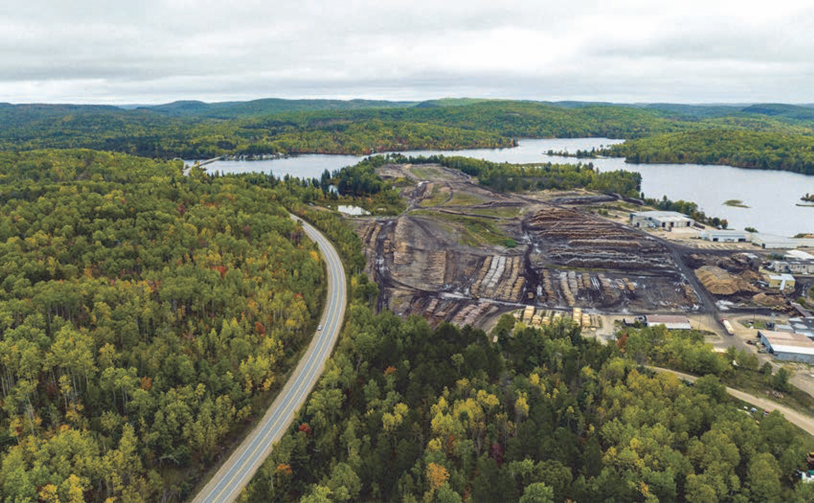
| Chapter 1: A Plan to Protect Ontario |
Adopting Innovative Technology in the Forest Sector
Under the FSIIP, over $72 million will be invested, leveraging $425 million in new investment to help Ontario forestry companies adopt innovative technologies to stay competitive in the global market.
An investment of $10 million was announced in October 2025 to help Daiken North America upgrade its laminated board production line at its manufacturing facility in Huntsville. This investment will help the company bring a first-of-its-kind wood panel product to market, create jobs and boost productivity.
In September 2025, the FSIIP also invested over $3.5 million in DSI Industries, an office furniture manufacturer, to support installation of automated finishing equipment, and Diamond CNC, a kitchen cabinet manufacturer, to support installation of robotic systems that automate material handling.
Investing in Ontario’s Forest Biomass Program
In 2022, Ontario released the Forest Biomass Action Plan to create new opportunities in developing the untapped potential of forest biomass for forest sector growth. This includes the Forest Biomass Program, which continues to invest up to $20 million each year in projects that increase wood harvest, create opportunities and find new uses for wood in collaboration with stakeholders, industry and Indigenous communities.
The program supports initiatives that secure and increase long-term wood utilization across the province, with a focus on underutilized species and forest biomass. Across its four streams, this program helps to position Ontario as a leader in the growing circular and green economy. To date, the government has invested over $50 million under the Forest Biomass Program to support more than 55 projects since the program’s launch in 2023.
| 32 |
| Section A: Protect Workers and Businesses from Tariffs and Economic Uncertainty |
Supporting Commercialization of Forest Biomass
As part of its plan to protect Ontario, the government is making strategic investments to help forest sector businesses adapt, compete and grow, in order to stay resilient in the face of U.S. tariffs. In December 2025, Ontario invested $2.25 million through the Forest Biomass Program to help CHAR Technologies commercialize biocoal, a rapidly emerging, low-carbon fuel derived from forest mill by-products and underused wood. This investment will help CHAR Technologies improve the storage and transport durability of biocoal needed for use in steelmaking at ArcelorMittal Dofasco, as well as establish a new supply chain with significant potential for future growth.
Developing Advanced Wood Construction in Ontario
Locally made mass timber and wood construction, known as advanced wood construction, can be used to build modular and prefabricated buildings, such as mid-rise and tall multi-family homes and a wide variety of commercial and industrial buildings. Advanced wood construction will help build more homes faster and create a more resilient forestry sector.
In June 2025, the government released the Advanced Wood Construction Action Plan, Ontario’s blueprint for education, research and investment to increase the manufacturing and use of high-quality, made-in-Ontario wood building products. Ontario also launched a new working group in December 2025 to harness Ontario’s advanced wood construction expertise and guide the implementation of the Advanced Wood Construction Action Plan.
| 33 |
| Chapter 1: A Plan to Protect Ontario |
Supporting Workers Impacted by Tariffs
Ontario is helping to protect workers in the face of economic uncertainty with the Protect Ontario Workers Employment Response (POWER) Centres. Through partnerships with employers, unions, community organizations, municipalities, colleges and universities, the POWER Centres provide transition assistance, including targeted training referrals and access to Employment Ontario Programs, for workers affected by layoffs. The centres are typically set up by unions, employee or employer associations or municipalities, and can be launched proactively before a layoff has occurred. Last year, 10 of these centres were operational across Ontario, helping almost 15,000 workers with services and supports. Funding and cooperation to support POWER Centres is coming through the Canada–Ontario Tariff Response Initiative.
Supporting Workers in the Steel and Forest Sectors
The government is taking decisive action to support workers affected by layoffs at Algoma Steel, with the Steelworker POWER Centre of Sault Ste. Marie, which provides dedicated services to help workers navigate retraining and transition opportunities. A total of 1,050 workers will be impacted, and the Centre aims to support 600 affected workers through needs assessments and help 500 workers successfully adjust to new employment pathways. With $1 million in funding, the Centre is delivering individualized guidance, job-matching and skills development supports to help workers move forward with confidence.
The government is also partnering with Unifor to deliver a POWER Centre in Ear Falls to ensure that forest sector workers receive the support they need following the sudden closure of the Interfor Ear Falls Sawmill. A total of 169 workers have been impacted and the Centre is expected to provide needs assessments to all affected workers and help 135 individuals successfully adjust to new employment pathways. With nearly $500,000 in provincial funding, the Centre is offering individualized guidance, peer support, job-matching, skills development and mental health and community resource connections.
| 34 |
| Section A: Protect Workers and Businesses from Tariffs and Economic Uncertainty |
Helping Businesses Through the Deferral of Select Provincially Administered Taxes
From April 1 to October 1, 2025, Ontario provided immediate support to businesses through a six-month interest and penalty-free period for businesses that chose to defer payments under select provincially administered taxes.
The program has made up to $9 billion available in liquidity relief to approximately 80,000 businesses, offering near-term flexibility and enabling them to sustain operations. Relief applied to 10 business-related tax programs, including the Employer Health Tax; Fuel Tax; Gasoline Tax; Mining Tax; and Beer, Wine and Spirits Tax. This initiative reduced short-term financial pressure during a period of economic uncertainty and helped businesses maintain liquidity and preserve jobs, thereby supporting Ontario’s priority to protect jobs and strengthen economic resilience.
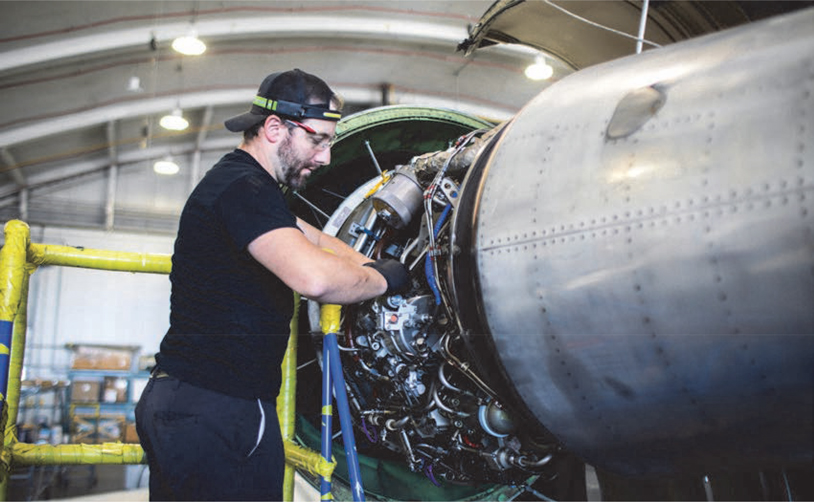
| Chapter 1: A Plan to Protect Ontario |
Section B: Protect Ontario by Building the Most Competitive Economy in the G7
The government is delivering on its plan to protect Ontario by building the most competitive, resilient and self-reliant economy in the G7. Global economic uncertainty, driven by U.S. tariffs, geopolitical instability and technological change, presents historic challenges and opportunities that will accelerate the pace of structural change in Ontario’s industries.
Ontario is cutting red tape, streamlining and speeding up approvals, as well as lowering costs and taxes. In addition, the government continues to make strategic investments in nuclear energy, critical minerals, life sciences, defence, manufacturing, as well as in innovation and in the province’s highly skilled workforce, while working to create new opportunities for trade to support future growth. Together, these actions are reinforcing the foundations of a strong and resilient economy.
| 36 |
| Section B: Protect Ontario by Building the Most Competitive Economy in the G7 |
Strengthening the Foundation for Growth Through a Multi-Year Tax Action Plan
Since 2018, the government has provided significant tax relief to improve competitiveness and lower costs, including delivering the Ontario Made Manufacturing Investment Tax Credit, implementing the Low-income Individuals and Families Tax Credit, permanently reducing gas and fuel tax rates and increasing the Employer Health Tax exemption.
Building on these actions to support Ontario workers, businesses and communities, the government launched a multi-year Tax Action Plan in the 2025 Ontario Economic Outlook and Fiscal Review to help make Ontario the most competitive jurisdiction in Canada. As first steps in its multi-year Tax Action Plan, Ontario is:
| • |
Planning to lower the cost of capital investments by providing $3.5 billion in tax relief over four years through the renewal and enhancement of accelerated writeoff measures, subject to passage of federal legislation; |
| • |
Proposing to cut the small business Corporate Income Tax (CIT) rate by over 30 per cent, allowing small businesses to reinvest in their business and grow; and |
| • |
Providing a temporary rebate on the full provincial portion of the Harmonized Sales Tax (HST) on all new homes valued at up to $1 million, subject to federal legislative enactment, helping more families realize the dream of homeownership. |
However, there is more work to be done to make Ontario the best place to live, work and raise a family, as well as to invest, create jobs and do business. Through the Tax Action Plan, the government will continue to update Ontario’s tax framework in a prudent and fiscally responsible manner to further improve Ontario’s competitiveness, lower costs and provide relief in the years to come.
| 37 |
| Chapter 1: A Plan to Protect Ontario |
Protect Ontario by Unleashing the Economy
The government is taking action to protect Ontario during this period of profound global change by unleashing the province’s full economic potential. It is driving new growth by creating jobs for workers and opportunities for businesses, supporting strategic investments and encouraging innovation in key sectors as part of an ambitious plan to make Ontario the most competitive place to invest, grow and succeed in the G7.
To support these efforts, the government has made progress by cutting red tape, streamlining permitting processes for job-creating investments and projects, as well as removing interprovincial trade barriers that will support the free movement of goods and labour and strengthen greater economic integration across Canada. These steps will improve economic conditions in the province and help attract strategic investments, improve competitiveness and create new markets and opportunities for Ontario workers and businesses. The government is also leveraging its domestic advantages by driving investments and supporting innovation in manufacturing, the auto sector, nuclear energy and other key sectors such as life sciences. In addition, work is underway to unlock Ontario’s vast supply of critical minerals in the Ring of Fire and bolster the province’s end-to-end critical minerals supply chain to help meet growing domestic and international demand, positioning the province for sustained economic growth.
Powering Ontario’s Energy Future
Ontario is determined to unleash its economic potential and make the province the most competitive place in the G7 to invest, create jobs and do business. The province is making record investments in energy infrastructure in order to build a more self-reliant economy, protect jobs, support workers and secure Ontario’s future as an energy superpower.
| 38 |
| Section B: Protect Ontario by Building the Most Competitive Economy in the G7 |
Positioning Ontario as a Global Nuclear Leader
Ontario is championing nuclear expansion and is leveraging its nuclear advantage to advance opportunities at home and globally. The government is delivering key nuclear priorities ahead of schedule and under budget and putting in place a nuclear expansion plan that is expected to create 150,000 new job opportunities and add over $800 billion to Canada’s economy.
Refurbishing the Darlington Nuclear Generating Station is a key pillar of Energy for Generations, Ontario’s first-ever integrated energy plan. Ontario reached a significant milestone with the completion of construction on the refurbishment of the Darlington Unit 4 nuclear reactor. Along with the overall refurbishment project coming in $150 million under budget, the refurbishment and continued operations at Darlington are expected to generate up to $90 billion in economic benefits for Ontario, support approximately 14,200 jobs and produce enough clean electricity to power 3.5 million homes.
Ontario has also approved the Ontario Power Generation (OPG) plan to refurbish four units at the Pickering Nuclear Generating Station, which will extend the facility’s operations for up to 38 years and increase capacity to power the equivalent of up to 2.2 million homes. The project is expected to create approximately 30,500 jobs during refurbishment, while sustaining 6,700 jobs through the station’s operation, contributing $41.6 billion to Canada’s gross domestic product (GDP).

| Chapter 1: A Plan to Protect Ontario |
As part of Ontario’s ambitious plan to expand nuclear energy generation, the government is advancing early-stage planning for new, large-scale nuclear energy generation, both at OPG’s Wesleyville site in Port Hope and at the Bruce C nuclear site in Bruce County. In February 2026, OPG signed a partnership agreement with the Municipality of Port Hope to support the Wesleyville project. The Wesleyville project will support 10,500 jobs across Ontario, including 1,700 new, good-paying jobs in Port Hope, representing an average 15 to 20 per cent boost to overall employment levels in the local area, while contributing $235 billion to Ontario’s GDP over its lifespan. Bruce C is expected to contribute more than $217 billion to Ontario’s GDP and support an estimated annual average of 8,700 jobs in Ontario during the project’s lifespan.
Ontario continues to lead the G7 by building the first of four small modular reactors (SMRs) at the existing Darlington nuclear site. Once fully licensed and built, these four SMRs will produce enough reliable, affordable and clean electricity to power the equivalent of 1.2 million homes, and the government is supporting this project with a $1 billion investment through the Building Ontario Fund. Ontario’s SMRs will create 18,000 jobs during construction along with 3,700 jobs during operation, while contributing $38.5 billion to Canada’s GDP over 65 years.
The government recognizes that nuclear projects are complex and capital-intensive and is exploring the potential for innovative equity partnership opportunities and ownership models that can unlock private sources of capital for the successful development of nuclear generation projects. By attracting investment from pension funds and other institutional investors, the government’s goal is to keep more Canadian energy dollars working here at home.
Ontario’s leadership in nuclear power is further demonstrated by recent agreements leveraging Ontario’s nuclear energy expertise to build two new large-scale nuclear reactors in Bulgaria and explore opportunities to deploy SMR expertise to Belgium. Other agreements are already in place, such as those in Estonia and Poland, to deploy 24 SMRs, as well as an agreement to support major refurbishment projects currently underway at Romania’s Cernavoda Nuclear Power Plant.
| 40 |
| Section B: Protect Ontario by Building the Most Competitive Economy in the G7 |
Strengthening Ontario’s Nuclear Future: Ontario Calls for Federal Action
Ontario welcomes the federal government’s recognition of the Darlington New Nuclear Project as nationally important, and its $2 billion investment through the Canada Growth Fund to go along with the Ontario government’s $1 billion investment through the Building Ontario Fund. Ontario is asking the federal government for additional support in streamlining approvals for the remaining three SMRs at the Darlington Nuclear site to keep critical clean-energy projects on track.
Going forward, there are opportunities for the federal government and Ontario to continue working together to advance shared energy priorities. While progress was made on clean economy investment tax credits (ITCs) in federal Budget 2025, Ontario continues to call on the federal government to enact all outstanding clean economy ITCs and enhance ITC relief, to support Ontario’s efforts to develop its energy infrastructure. This includes extending the Clean Electricity ITC to be inclusive of intra-provincial transmission projects, which are critical to connecting clean electricity generation to consumers, workers and job creators across the province.
Accelerating Electricity Transmission Expansion
The government has taken a major step forward to power Northern Ontario and unlock the vast economic potential of the Ring of Fire by declaring the Greenstone Transmission Line a priority project. The 230-kilometre line will run from Nipigon Bay to near Aroland First Nation and the gateway to the Ring of Fire and will create more than 7,000 jobs while driving economic growth in the North. With electricity demand in Northern Ontario projected to increase by 81 per cent by 2050, Ontario is making historic investments to build the infrastructure needed to deliver clean, reliable power to the region. Once complete, Greenstone will provide the capacity needed to unlock 350 to 700 megawatts (MW) of additional hydroelectricity and other power generation.
The province also accelerated the Barrie to Sudbury Transmission Line. The new 290-kilometre, 500-kilovolt transmission line will run from the Essa Transformer Station near Barrie to the Hanmer Transformer Station in Sudbury and will create over 9,000 jobs.
First Nations will have access to Hydro One’s Equity Partnership Model, which will include First Nation leadership in decision-making and up to 50 per cent ownership of the lines.
| 41 |
| Chapter 1: A Plan to Protect Ontario |
Ontario has also approved a plan to build the province’s first-ever underwater high-voltage transmission line from near the Darlington Nuclear Generating Station to downtown Toronto. The line, which will be the third transmission line to Toronto, will deliver up to 900 MW of clean, reliable power, securing the electricity needed to fuel housing, transit and economic growth. To keep costs affordable, the government is proposing that the Independent Electricity System Operator (IESO) launch a competitive procurement process to select a transmitter, which will be informed by a consultation on the procurement design. This approach will drive value for ratepayers while accelerating construction and creating opportunities for Indigenous participation and good-paying jobs across the province.
These projects are in addition to others across the province, including the upgrading of two major electricity transmission lines between Orangeville and Barrie, and construction of the St. Clair Transmission Line that will connect the County of Lambton and the Municipality of Chatham-Kent.
Initiated by Ontario, the government has secured a landmark agreement with other Canadian provinces and territories to advance new electricity transmission projects and strategic interties across Canada. This first-of-its-kind interprovincial–territorial partnership marks a major nation-building milestone, breaking down longstanding barriers between provincial grids and enabling a more connected, resilient and self-reliant energy system. The agreement lays the foundation for thousands of jobs, billions in investment and a modernized grid that advances Canada’s long-term energy future.
| 42 |
| Section B: Protect Ontario by Building the Most Competitive Economy in the G7 |
Unleashing Ontario’s Critical Minerals Advantage
Global demand for critical minerals, such as nickel, copper, lithium, cobalt, graphite and rare earth elements, is increasing. These minerals are the foundation upon which modern technology is built, and Ontario is one of the most mineral-rich areas in the world.
Ontario’s five-year Critical Minerals Strategy, launched in 2022, laid a strong foundation for securing the province’s position as a reliable global supplier of responsibly sourced critical minerals. However, escalating geopolitical tensions, supply chain disruptions, U.S. tariffs and rising trade protectionism call for a strategy that reduces foreign dependence and protects Ontario’s vital industries and workers.
In March 2026, the government announced a forward-looking vision to help make the province a critical minerals superpower by overhauling and modernizing Ontario’s Critical Minerals Strategy. Fortifying Ontario’s Economy: A Plan to Accelerate Responsible Resource Development is a new strategy that will be shaped by input from industry, Indigenous partners, communities and the public.
Ontario is inviting feedback on key priorities to unlock the province’s critical mineral wealth to create jobs, protect economic security, strengthen sovereignty and lead as a trusted G7 partner. These priorities include:
| • |
Planning for growth to reduce exposure to global shocks; |
| • |
Building a future-ready workforce; |
| • |
Continuing to deliver regulatory certainty and faster permitting; |
| • |
Supporting exploration to find the mines of tomorrow; |
| • |
Building early, meaningful and mutually beneficial partnerships that support reconciliation, equity participation and shared prosperity with Indigenous communities; and |
| • |
Scaling up innovation, attracting global capital and anchoring domestic critical mineral supply chains. |
As part of the announcement of a new strategy, the government also announced the addition of high-purity iron and aluminum to its Critical Minerals List. This is the first expansion since the inception of the list and it increases the number of critical minerals in Ontario to 35. High-purity iron is essential for the transition to “green steel” manufacturing using electric arc furnace technology in Ontario’s steel mills, while aluminum is a cornerstone material for the province’s world-class automotive, aerospace and defence sectors.
| 43 |
| Chapter 1: A Plan to Protect Ontario |
Fast-Tracking Mining Projects with One Project, One Process
Ontario’s outdated and fragmented system for mining permits has held back major infrastructure, mining and resource development projects in the province. In October 2025, the government implemented the One Project, One Process framework to speed up approvals for advanced exploration, mine development and mine expansion projects.
The framework streamlines government approvals into one process, coordinated by Ontario’s Mine Authorization and Permitting Delivery Team, maintains robust environmental standards and fulfils Ontario’s duty to consult with Indigenous communities. By simplifying the permitting process, Ontario is providing the certainty and predictability needed to open new mines faster and is also making it easier for companies to plan, hire and execute projects in Northern communities.
Since its launch in October, three major projects have been designated through the One Project, One Process framework, including:
| • |
Frontier Lithium’s PAK Lithium Project (announced October 2025) — The PAK Lithium Project is the largest lithium project in Ontario, encompassing both a mine and mill, as well as a downstream conversion facility for manufacturing battery-quality lithium. Located 175 kilometres north of Red Lake, the site is one of the few commercially viable deposits for producing battery-grade lithium and is also closely aligned with the proposed lithium refinery in Thunder Bay, which would be the first lithium hydroxide conversion plant on the continent. |
| • |
Canada Nickel Company’s Crawford Nickel Project (announced January 2026) — Crawford, located 42 kilometres north of Timmins, is one of the world’s largest nickel resources with a mineral reserve estimate of 1,715 million tonnes. The project includes developing a nickel processing plant for stainless steel and electric vehicle markets, as well as planning to construct a stainless steel and alloy production facility. It is expected to attract a total of $5 billion in investment and, when complete, will be one of the largest mine and mill facilities in North America, contributing 1,300 direct jobs and adding $67 billion to Ontario’s GDP. This project was also recognized as one of national significance by the federal government and referred to the Major Projects Office. |
| • |
Kinross Gold’s Great Bear Project (announced February 2026) — Located 24 kilometres southeast of Red Lake in Northwestern Ontario, the Great Bear Project is a high-grade combined open-pit and underground gold mine. This project represents more than $5 billion in capital investment and is expected to create up to 1,100 good-paying jobs during its operational life. Kinross Gold’s preliminary economic assessment outlines a high-grade operation producing an average of over 500,000 ounces of gold per year at its peak, with potential for 5.3 million ounces of initial production and longer-term expansion potential supported by an ongoing regional exploration program. |
| 44 |
| Section B: Protect Ontario by Building the Most Competitive Economy in the G7 |
In February 2026, the Fraser Institute’s Annual Survey of Mining Companies, 2025 reported that Ontario ranked as the most attractive jurisdiction in Canada for mining investment and the second most attractive jurisdiction globally.
Unleashing the Economic Potential of the Ring of Fire
The Ring of Fire covers approximately 8,000 square kilometres and represents one of the most promising mineral development opportunities in the world. The region is rich in minerals, such as nickel, copper, platinum group elements and chromite. Developing these resources has the potential to generate approximately $22 billion in economic activity over 30 years, creating over 70,000 jobs in industries across the province.
In partnership with First Nations, Ontario continues its plan to unlock the economic potential of the Ring of Fire by supporting the development of key infrastructure, including all-season, dependable road access and connections to provincial highways.
Creating Partnerships to Unlock Economic Prosperity
In 2025, the Ontario government signed three agreements with First Nations partners to help unlock the Ring of Fire. In October, Ontario signed a Community Partnership Agreement with Webequie First Nation and in November, Ontario also signed a Community Partnership Agreement with Marten Falls First Nation. These agreements will help to unlock economic development and accelerate construction of the all-season Webequie Supply Road (WSR) and the Marten Falls Community Access Road (MFCAR), while also supporting each partners’ additional key community priorities. Each agreement provides these communities with up to $39.5 million for community infrastructure and economic supports.
In January 2025, Ontario signed a Shared Prosperity Agreement with Aroland First Nation to drive economic growth and upgrade infrastructure in Northern Ontario. This agreement includes support for upgrades to Anaconda and Painter Lake Roads, which are important connections on the road to the Ring of Fire, as well as major new investments in infrastructure and energy transmission in the region, including the Greenstone Electricity Transmission Line. The agreement provides Aroland First Nation with $20 million for community economic and infrastructure projects.
Accelerating Construction on Roads to the Ring of Fire
In March 2026, at the annual Prospectors & Developers Association of Canada convention, Ontario released a plan to accelerate construction of the all-season roads to the Ring of Fire, with construction planned to start in June 2026 and roads beginning to open in November 2030, five years ahead of schedule.
| 45 |
| Chapter 1: A Plan to Protect Ontario |
This plan is supported by the partnership agreements mentioned above, a Co-operation Agreement with the federal government to eliminate duplication between provincial environmental assessments and federal impact assessments, as well as a streamlined regulatory environment to speed up approvals, including through the One Project, One Process framework.
Under the accelerated plan:
| • |
The Webequie Supply Road is scheduled to start construction in June 2026 and open by November 2030, four years ahead of schedule; |
| • |
The Marten Falls Community Access Road is scheduled to start construction in August 2026 and open by November 2031, four years ahead of schedule; |
| • |
Upgrades to the Anaconda and Painter Lake Roads are scheduled to open by November 2030, two years ahead of schedule; and |
| • |
The Northern Road Link is scheduled to start construction in spring 2028 and open by November 2031, five years ahead of schedule. |
Ontario and Canada Sign Historic Co-operation Agreement
In December 2025, Ontario and Canada signed a Co-operation Agreement, the “one project, one process, one decision” model, to streamline environmental approvals for major infrastructure and resource projects. Under this new model, most projects that would previously have been subject to both a federal impact assessment and a provincial environmental assessment will now only be subject to Ontario’s world-class assessment process. Moreover, the Impact Assessment Agency of Canada will complete its review of the assessment of roads to the Ring of Fire no later than June 2026.
Investing in Critical Infrastructure to the Ring of Fire
In January 2026, the government announced that it is declaring the Greenstone Transmission Line a priority project, in order to accelerate construction of the line that will run from Nipigon Bay to near Aroland First Nation and the gateway to the Ring of Fire. Ontario committed to building the Greenstone Transmission Line as part of the Aroland–Ontario Shared Prosperity Agreement.
In September 2025, Ontario announced an investment of $61.8 million in Geraldton’s Main Street Rehabilitation Project to fortify connections between Highway 11, at the south end, to Highway 584, at the north end, and ultimately, to the Trans-Canada Highway, which will be the first segment on the road network to the Ring of Fire. This critical road infrastructure project will be the gateway to the Ring of Fire and is part of the government’s strategy to unlock the economic potential of the region.
| 46 |
| Section B: Protect Ontario by Building the Most Competitive Economy in the G7 |
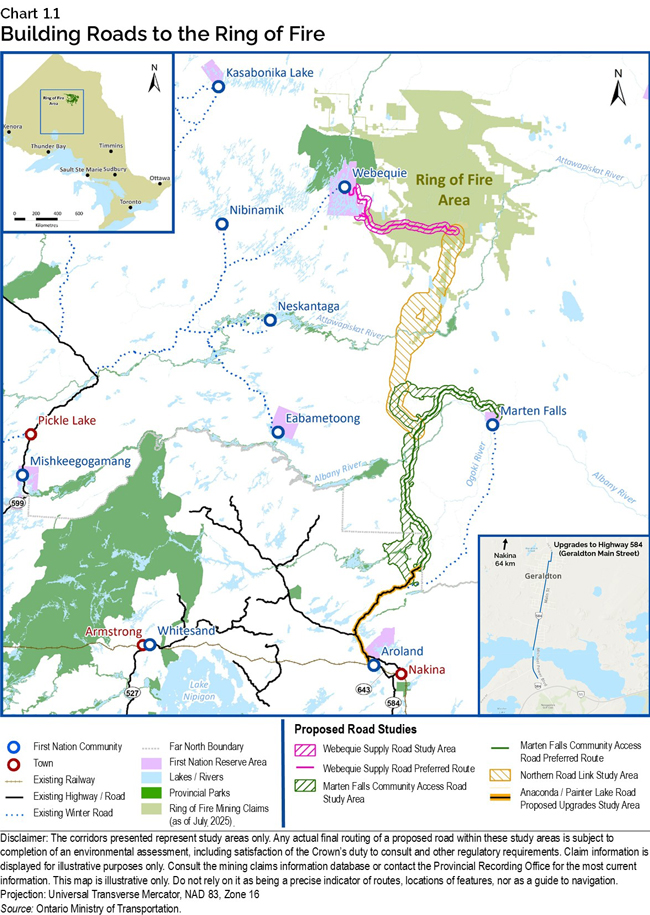
| 47 |
| Chapter 1: A Plan to Protect Ontario |
Ontario Calls for Federal Action
Ontario welcomes both the federal government’s recognition of the Ring of Fire as a key project under its Critical Minerals Strategy and its continued support to streamline environmental approvals for major infrastructure and resource projects. As a next step, Ontario continues to call on the federal government to match or exceed the province’s $1 billion funding commitments to support infrastructure in the Ring of Fire, including roads, transmission lines and rail lines, which will unlock the mineral wealth of the region, connect it to existing supply chains and create important economic opportunities.
Building a Domestic Critical Minerals Supply Chain
Ontario’s critical minerals advantage will play a key role in growing strategic sectors, and Ontario is working to help ensure that minerals mined in Ontario will be processed and refined in Ontario, by workers in Ontario. First announced in the 2025 Budget, the $500 million Critical Minerals Processing Fund (CMPF) provides strategic financial support to accelerate the province’s critical minerals processing capacity and strengthen domestic supply chains.
Delivered through Invest Ontario, the province’s investment attraction agency, the CMPF complements the government’s ongoing efforts to unlock the economic potential of Ontario’s mineral resources sector in the Ring of Fire and across Northern Ontario. By ensuring that existing mineral processing facilities can maximize their production and by supporting the construction of new processing operations, the government is boosting Ontario’s manufacturing competitiveness and building a more resilient and self-reliant economy equipped with the tools needed to meet growing domestic and international demand for critical mineral resources.
Investing in Junior Mining Companies Through the Ontario Junior Exploration Program
Early mineral exploration is often high-risk, with long odds of success and operations in Northern regions and challenging terrain, making it difficult for companies to secure the necessary investments to move projects forward. Ontario is providing financial support towards eligible costs associated with early exploration to reduce risks for private investors and boost Ontario’s appeal as a jurisdiction of choice for mining investment. The government is investing an additional $30 million over the next three years into the Ontario Junior Exploration Program (OJEP), starting in 2026–27, to support early-stage mineral exploration. In July 2025, Ontario introduced two funding streams to help accelerate critical mineral projects: the New Prospector Stream and the enhanced Indigenous Participation Incentive.
| 48 |
| Section B: Protect Ontario by Building the Most Competitive Economy in the G7 |
This investment builds on the $10 million already announced in July 2025 and helps junior mining companies and licensed prospectors cover early exploration and development costs. Between 2021 and 2025, Ontario has provided $29.8 million in funding to 213 projects (162 of which included critical minerals exploration), leveraging an additional $61.8 million in private-sector investment.
Fostering Innovation in Ontario’s Critical Minerals Supply Chain
Launched in November 2022, the Critical Minerals Innovation Fund (CMIF) helps stimulate investment in critical minerals exploration, mining development, production and processing of domestically sourced critical minerals.
In July 2025, Ontario invested more than $7 million to launch a new intake of the CMIF. This investment builds on the $20 million invested through the CMIF since its launch in November 2022, supporting more than 29 Ontario-based projects. This new intake was open between July 2025 and October 2025, to support the research, development and commercialization of made-in-Ontario technologies for the province’s mining sector. The CMIF supports projects in four priority areas: battery supply chain, innovative techniques for deep exploration and mining, recovery of minerals and other innovative projects that support the critical minerals sector. Projects are currently moving through the evaluation process, reflecting continued strong demand for funding and innovation in Ontario’s critical minerals sector.
Advancing Ontario’s Life Sciences Sector
Ontario boasts a strong and growing life sciences sector, which is a key contributor to the province’s economy, employing more than 74,000 people across nearly 2,000 firms and generating more than $11.8 billion in exports annually. Since 2018, the province has attracted more than $6 billion in new life sciences investment and created over 6,700 additional jobs. The government continues its plan to establish Ontario as a global biomanufacturing and life sciences hub, by driving innovation, improving responsiveness to current and future health challenges and promoting better patient outcomes.
Driving Growth in Ontario’s Life Sciences Sector
To continue strengthening the province’s life sciences sector, the government is investing an additional $24 million over three years, starting in 2026–27, to renew the Life Sciences Scale-Up Fund (LSSUF). The LSSUF supports Ontario’s SMEs in the human health sciences sector, including medical isotopes, to commercialize market-ready products, scale operations, strengthen competitiveness and prepare for procurement opportunities. Strong demand in the program’s first round supported 14 projects and leveraged an additional $52 million in private-sector investment. This investment will continue to advance the government’s Life Sciences Strategy, Taking Life Sciences to the Next Level, to position Ontario as a leading jurisdiction for biomanufacturing and life sciences, innovation and the commercialization and early adoption of innovative health products and services.
| 49 |
| Chapter 1: A Plan to Protect Ontario |
Ontario’s Life Sciences Strategy, introduced in 2022 and expanded with Phase 2 in October 2024, aims to accelerate sector growth by strengthening research and development, improving access to capital, supporting the existing ecosystem and fostering a culture of innovation. Through this strategy, Ontario is targeting to grow employment in the sector to 85,000 high-value jobs by 2030, a 25 per cent increase from 2020.
Producing Life-Saving Medical Isotopes
Ontario is reinforcing its position as a global leader in the production of life-saving medical isotopes, which are an essential part of modern health care and are used to diagnose and treat serious diseases such as cancer.
In February 2026, the government announced a provincial guarantee through the Indigenous Opportunities Financing Program to support a $250 million investment to expand life-saving medical isotope production. This investment in the partnership between Saugeen Ojibway Nation and Bruce Power will help expand Bruce Power’s world-leading isotope production capacity, enhancing Ontario’s role in delivering cancer-fighting treatments globally, while strengthening Indigenous participation in Ontario’s economy.
In December 2025, the government welcomed a $138 million investment from AtomVie Global Radiopharma Inc., a leading manufacturer of radiopharmaceuticals, to expand its facility in Hamilton. Ontario is supporting the project with up to $5 million through the Invest Ontario Fund, to sustain 131 existing jobs, create 70 new high-paying positions and expand the domestic manufacturing capacity of radiopharmaceuticals.
These investments will advance Ontario’s goal of doubling medical isotope production by 2030.
| 50 |
| Section B: Protect Ontario by Building the Most Competitive Economy in the G7 |
Building Ontario’s Defence Industry
National defence is becoming an increasingly important pillar of Canada’s security and economic resilience. To meet its NATO commitment, the federal government is preparing to raise defence spending to 5 per cent of GDP by 2035, including $150 billion annually in military, industrial and infrastructure-related investments. The global expansion in defence procurement creates a significant opportunity to strengthen Canada’s industrial base and expand its export sector.
Ontario is well positioned to play a leading role in supplying national defence. As of 2022, the province accounted for roughly 36 per cent of Canada’s defence sector employment, the largest share of any province, reflecting strong capabilities across advanced manufacturing, aerospace, cybersecurity, artificial intelligence (AI) and emerging dual-use technologies. With over 300 companies generating over $5 billion in annual revenue and directly employing more than 13,000 people, Ontario is a national hub for defence manufacturing and innovation.
New federal initiatives and investments can leverage Ontario’s talent base and comparative advantages to support national security objectives, while creating jobs and anchoring high-value activity domestically. This includes measures to enhance the capacity of the Canadian Armed Forces through initiatives such as Canada’s Defence Industrial Strategy, as well as regionally focused programs that help small and medium-sized businesses integrate into domestic and international supply chains, including in priority areas such as armoured vehicles.
Ontario is working to build a globally competitive defence sector. The province has several initiatives that can support businesses as they look to meet federal defence procurement needs and expand exports, including:
| • |
The Ontario Made Manufacturing Investment Tax Credit, which is available to help support investment in defence-related manufacturing buildings, machinery and equipment; |
| • |
The $500 million Critical Minerals Processing Fund designed to support and expand Ontario’s processing capacity of minerals that can play a key role in strategic sectors, including defence; |
| • |
Investing $215 million to support shipbuilding and the broader marine sector in the province, including the Ontario Shipbuilding Grant Program, which supports Canada’s National Shipbuilding Strategy; and |
| • |
Providing $50 million in venture capital funding through Venture Ontario for Ontario-based venture capital firms focused on technologies that support national defence and related technologies, such as artificial intelligence and cybersecurity. |
| 51 |
| Chapter 1: A Plan to Protect Ontario |
Working Together to Strengthen Ontario’s Defence Industry
A strong defence sector is crucial to protect Canadians and benefit Ontario’s workers, businesses and communities. Ontario welcomes and supports the federal government’s new Defence Industrial Strategy. Ontario has strong capabilities in specialized vehicles, aerospace, shipbuilding, advanced manufacturing and materials and dual-use technologies. Its industries are ready to support Canada in meeting national defence spending commitments. With the need for timely federal procurements to meet these commitments, Ontario-based companies like London’s General Dynamics Land Systems, Ontario shipbuilders such as Hamilton’s Ontario Shipyards and aerospace manufacturers across the province are strongly positioned to deliver and will continue to reinforce Canada’s defence industrial base and enhance national security.
Enhancing Ontario’s Position in Global Defence Markets
In March 2026, the government appointed Bernard Derible to serve as the province’s first-ever Ontario Military Defence Representative (OMDR) to help position Ontario as a trusted supplier of defence equipment and technology and attract new defence investments. The OMDR will promote Ontario’s defence industry in global markets and will leverage Ontario’s existing in-market resources in Southeast Asia to help Ontario companies take advantage of growing export opportunities and connect with new international partners. The OMDR will also help identify high value investments that strengthen Ontario’s security, R&D capacity, domestic production and supply chain resilience.
| 52 |
| Section B: Protect Ontario by Building the Most Competitive Economy in the G7 |
Positioning Toronto as a Global Hub for Defence Financing
In January 2026, the Ontario government continued its advocacy to secure the City of Toronto’s selection as the headquarters of the new Defence, Security and Resilience Bank (DSRB) by launching a comprehensive bid book outlining the many attributes that make Toronto uniquely positioned to host the bank. The DSRB is a new multilateral institution focused on financing defence, security and resilience projects for NATO members and allied nations. The bank would help unlock capital for suppliers of all sizes, streamline multinational procurement and strengthen the industrial capacity of allied partners, while supporting Canada’s role in global security. The DSRB is expected to create up to 3,500 direct jobs and support thousands of additional indirect jobs, that would benefit Toronto as well as the entire province and country.
Canada’s Newest Coast Guard Icebreaker Built with Made-in-Ontario Steel
In February 2026, the province marked a major milestone as Algoma Steel shipped its first plates of made-in-Ontario steel to Davie in Quebec for construction of the Canadian Coast Guard’s new icebreaking vessel, the Polar Max. The shipment highlights Ontario’s strength in steel manufacturing and its role in strengthening domestic supply chains while supporting Canada’s defence and marine infrastructure needs. Ontario’s steel sector, responsible for over 70 per cent of national capacity, continues to anchor skilled jobs and reinforce the province’s position as a key contributor to Canada’s industrial and security priorities.
Accelerating New Opportunities for Investment and Growth
The government is creating the conditions for growth by fostering an economic environment where businesses looking for opportunities to grow can invest with confidence. By reducing barriers, supporting strategic investments and creating more opportunities for growth, the government is fighting to protect Ontario workers while building the province’s economic resiliency and long-term competitiveness.
| 53 |
| Chapter 1: A Plan to Protect Ontario |
Lowering Taxes for Small Businesses
Small businesses play an important role in Ontario’s economy, from family-owned businesses to innovative startups. To support these businesses, Ontario provides small businesses with a preferential CIT rate. To ensure Ontario’s small businesses continue to stay competitive and resilient, and as an important step in Ontario’s Tax Action Plan, the government is proposing to cut the small business CIT rate from 3.2 per cent to 2.2 per cent, effective July 1, 2026. By cutting the rate by more than 30 per cent, over 375,000 small businesses would benefit from an additional $1.1 billion in CIT relief over the next three years. A qualifying small business would benefit by up to $5,000 in additional tax relief each year, which could help them cover their expenses, invest in their business and grow.
This proposed tax cut builds on actions taken by the government to cut the small business CIT rate from 3.5 per cent to 3.2 per cent, starting in 2020, and to expand access to the preferential rate to more businesses, starting in 2023. Through the preferential small business CIT rate, the province already provides $3.45 billion per year in CIT relief to small businesses across Ontario.
Tax Savings for Small Business
The following example illustrates how one small business could benefit from Ontario’s tax incentives:
Lounging Leo Chairs, a small Ontario company that produces durable low-maintenance outdoor furniture, is planning to speed up production next year by purchasing $100,000 in equipment to manufacture and mould recycled plastics. The proposed 2.2 per cent small business CIT rate, and the proposed immediate 100 per cent accelerated writeoff the government intends to allow, would provide $5,374 in new Ontario CIT relief, resulting in total savings of $48,370 in 2027. The 15 per cent refundable Ontario Made Manufacturing Investment Tax Credit would also provide $15,000 in additional tax support. Together, Ontario CIT savings of $63,370 would be provided to help Lounging Leo Chairs lower their product costs and grow.
See the Annex: Details of Tax Measures and Other Legislative Initiatives for more details.
| 54 |
| Section B: Protect Ontario by Building the Most Competitive Economy in the G7 |
Encouraging Business Investment in Ontario
The government is making Ontario the best place in the G7 to invest and do business, and improving Ontario’s competitiveness for business investment is a key cornerstone of this priority. That is why the government intends to lower the cost of capital investments by allowing businesses to accelerate the income tax deduction for the cost of depreciable assets, in parallel with changes announced by the federal government.
These changes would lower the cost for investment in a broad range of assets, by allowing:
| • |
Immediate 100 per cent writeoffs for manufacturing and processing (M&P) machinery and equipment, M&P buildings, greenhouse buildings, certain clean technology assets and zero-emission vehicles; |
| • |
Immediate 100 per cent writeoffs for productivity-enhancing assets; |
| • |
Immediate 100 per cent writeoffs for capital expenditures for R&D; |
| • |
Accelerated depreciation for liquefied natural gas equipment and related buildings; |
| • |
Accelerated depreciation from 4 per cent to 10 per cent for purpose-built rental housing; and |
| • |
Accelerated first-year deductions of up to three times the regular amount for most other depreciable assets. |
Together, these measures would provide over $3.5 billion in Ontario income tax relief to qualifying businesses over four years, from 2025–26 to 2028–29. The measures would take effect following the passage of federal legislation for corresponding measures announced in the federal Budget 2025 and other announcements.
By taking action to allow faster writeoffs of capital investments and lower business costs, the government is creating the conditions that make Ontario an attractive place to start and grow a business.
| 55 |
| Chapter 1: A Plan to Protect Ontario |
Preparing Industrial Sites for Investment
The government continues to help assemble shovel-ready sites to support large-scale investments in Ontario that will help drive regional growth and job creation. The province competes with other jurisdictions that have a portfolio of these sites, putting Ontario at risk of losing out on investments if the province is unable to save businesses the time and money needed to prepare industrial land. Developing mega sites that are ready for business construction can attract high-value manufacturing projects that can boost Ontario’s long-term prosperity through job creation, increased investor funding and enhanced infrastructure development.
Ontario Helps Industrial Sites Become Investment Ready
In 2022, Ontario partnered with the City of St. Thomas to prepare a large, investment-ready site and ensure that it could be rapidly advanced by future investors. This proactive work, including comprehensive due diligence, proved critical in securing Volkswagen’s $7 billion PowerCo battery cell plant, announced in 2023. The fully vetted site significantly de-risked the project compared to competing North American jurisdictions and gave PowerCo the confidence that it could move from business case to implementation quickly and efficiently.
Advancing Strategic Projects Through Special Economic Zones
To support its plan to build a more competitive and resilient economy, the government recently enacted a new regulation for Special Economic Zones (SEZs). SEZs help create a predictable and stable environment for new investments, allowing designated projects within these zones to launch and progress significantly faster. They will support the advancement of job-creating investments and projects that are of strategic and critical importance to Ontario’s economic security.
Under the Special Economic Zones Act, 2025, the government’s new regulation establishing the criteria to designate SEZs, trusted proponents and projects came into effect on January 1, 2026. Informed by consultations with Indigenous communities, the regulation sets out the SEZ criteria while upholding the province’s strong environmental standards and fulfilling the Crown’s duty to consult. SEZs are an important tool for communities to unlock First Nations-led economic prosperity.
Identified projects and trusted proponents in designated zones that meet high standards for operation, safety and the environment could benefit from streamlined requirements, faster permitting and priority access to services such as the new One Project, One Process framework. The government will continue to prioritize new advanced exploration and mine production projects through this framework.
| 56 |
| Section B: Protect Ontario by Building the Most Competitive Economy in the G7 |
Strengthening Ontario’s Investment Pipeline Through Invest Ontario
Through Invest Ontario, the government is creating jobs and making Ontario more competitive by attracting new investments and positioning the province as one of the world’s top investment destinations. The investment attraction agency offers investors one-window access to expertise and tailored services, as well as financial support through the Invest Ontario Fund. In the 2025 Budget, the government allocated an additional $600 million to the Invest Ontario Fund, bringing the fund total to $1.3 billion. The additional funding will offer stability to investors and attract new opportunities for jobs and growth during a time of continued economic uncertainty. To date, Invest Ontario has announced over $12.4 billion in investments, which are expected to create more than 11,300 jobs across the province.
Supporting Ontario’s Domestic Supply Chains
In December 2025, Ontario welcomed an investment of over $85 million from Sandvik, a global, high-tech engineering group, to establish a new, state-of-the-art maintenance, repair and overhaul (MRO) facility in Greater Sudbury. The new facility will serve as a regional manufacturing hub equipped with larger workshops, as well as warehousing and office space to support equipment rebuilds, component repairs, field operations and servicing for battery electric vehicles (BEV). In support of this investment, Ontario is providing up to $4 million in funding through the Invest Ontario Fund. The investment is expected to create more than 60 new, good-paying jobs and retain 400 jobs, while advancing the development of next-generation tools and technologies needed to support rising demand for critical mineral processing infrastructure across strategic industries.
Promoting Investment in Environment-Friendly Carbon Storage
Carbon capture, utilization and storage (CCUS) includes activities designed to capture carbon dioxide and then transport, use or store it. Geologic carbon storage is one component of CCUS, involving the permanent storage of carbon dioxide in deep underground rock formations.
In February 2026, the government began accepting applications for commercial-scale geologic carbon storage projects. These projects will create opportunities for new investments that will help energy-intensive industries cut greenhouse gas emissions by five to seven million tonnes annually, with the potential to create over 4,000 jobs and reduce costs for Ontario’s industries by nearly $1 billion.
The government will continue to work closely with industry stakeholders, municipalities, Indigenous communities, landowners and the public to ensure that the regulatory framework for geologic carbon storage projects remains safe and effective.
| 57 |
| Chapter 1: A Plan to Protect Ontario |
Carbon capture and storage projects have a proven track record of success. By 2023, there were almost 400 projects at various stages of development worldwide, including four active storage operations in Alberta and three in Saskatchewan, along with 28 planned storage projects in Alberta and five in Saskatchewan. Close to 300 million tonnes of carbon dioxide have already been captured underground worldwide.
Building New Trade Opportunities for Ontario Businesses
U.S. tariffs have disrupted supply chains, created significant economic uncertainty and continue to have an impact on firms in Ontario. These tariffs have also created an urgent need for Ontario to diversify trade and reach new markets, both internationally and across Canada. As Ontario navigates these turbulent waters, the government continues to break down internal trade barriers and provide support for businesses affected by U.S. tariffs to identify new markets and expand trade.
Enhancing Free Trade within Canada
Internal trade barriers have held back trade with other provinces, a significant contributor to the economy. In times of economic uncertainty, Ontario is taking a leadership role and reducing barriers through the Protect Ontario Through Free Trade Within Canada Act, 2025, passed in June 2025. Through this Act, Ontario also set the foundation for mutual recognition of goods and services and expanded labour mobility with first-in-Canada “As of Right” rules. Ontario is the first and only province to remove all of the province’s Party-Specific Exceptions under the Canadian Free Trade Agreement (CFTA).
In December 2025, Ontario took the next steps towards implementing mutual recognition of goods and services from other reciprocating Canadian jurisdictions by publishing a draft regulation under the Ontario Free Trade and Mobility Act, 2025 (OFTMA). Under this draft regulation, the province would recognize goods and services from other Canadian jurisdictions that are taking similar actions at home. This will play a substantial role in supporting economic integration across Canada by removing internal trade barriers that are estimated to cost the nation’s economy up to $200 billion every year in forgone economic activity and GDP.
In January 2026, Ontario also enacted historic labour mobility regulations that break down interprovincial barriers for workers and businesses and help employers access the skilled Canadian workers they need sooner. See the section “Protecting Workers by Promoting Labour Mobility” for more details.
| 58 |
| Section B: Protect Ontario by Building the Most Competitive Economy in the G7 |
To further support internal trade and mobility across Canada, Ontario has secured Memoranda of Understanding (MOUs) with 10 provinces and territories since April 2025. These MOUs strengthen economic cooperation between jurisdictions by supporting efforts to eliminate red tape, cut costs for businesses and open new pathways for skilled workers to move more freely across the country.
Launching Direct-to-Consumer Alcohol Sales
The government is reducing internal trade barriers and is implementing interprovincial direct-to-consumer (DTC) alcohol sales. This will allow Ontario consumers to purchase alcohol directly from a participating out-of-province producer, and it will also allow Ontario producers to sell their products directly to consumers in a participating province or territory. This will provide more choice and convenience for consumers and open new markets for Ontario producers.
Following the signing of the federal–provincial–territorial MOU on Direct-to-Consumer Sales of Alcoholic Beverages in 2025, Ontario and Nova Scotia became the first provinces to sign a first-of-its-kind bilateral operating agreement on March 2, 2026, that enables DTC alcohol sales for personal consumption.
Ontario continues to work with other willing provinces and territories to further implement DTC alcohol sales.
In January 2026, Ontario received the “One to Watch” Golden Scissors Award from the Canadian Federation of Independent Business (CFIB) for Ontario’s role in the Committee on Internal Trade’s Canadian Mutual Recognition Agreement (CMRA) on the Sale of Goods, signed on November 19, 2025 by the federal government and most provinces and territories. The CMRA will allow goods in one province to be sold in other provinces without having to meet additional testing, certification or other requirements, unless a government has identified a specific requirement it will retain. Ontario listed no applicable requirements in the CMRA. Ontario’s internal trade actions are helping firms pivot in response to global challenges, expand into new Canadian markets and contribute to a more resilient and competitive economy.
| 59 |
| Chapter 1: A Plan to Protect Ontario |
Taking Steps to Expand and Diversify Interprovincial and International Trade
The government is diversifying trade to new markets by promoting Ontario-made goods and services. In November 2025, Ontario invested an additional $100 million in the Ontario Together Trade Fund (OTTF) to help businesses with near-term investments so they can serve more interprovincial customers. The fund aims to support SMEs affected by U.S. tariffs in their efforts to diversify into new markets, strengthen trade resiliency and reshore critical supply chains. This investment brought the total program funding to $150 million over three years in response to strong demand for the program.
Investing in Small and Medium-Sized Businesses Impacted by U.S. Tariffs
In January 2026, the government announced an investment of $5 million in funding through the Ontario Together Trade Fund (OTTF) to support an $85 million investment by Massilly North America Inc. Massilly, a leading manufacturer of metal packaging solutions, is establishing a new state-of-the-art facility that will produce cans for food packaging. It is expanding its operations to include coil cutting and three-piece can production lines. This project will help ensure consumer goods sold across Canada can leverage Canadian steel, bolstering Ontario’s end-to-end supply chain and ensuring that the province’s key industries are self-reliant and resilient in the face of geopolitical volatility.
This followed the government’s announcement, in November 2025, of an investment of $16.5 million into eight recipient companies through the OTTF. These projects amount to more than $120 million in investments that will create over 300 new, good-paying jobs and protect nearly 1,200 more jobs across the province.
Ontario is working hard to support the expansion of trade and investment with non-U.S. countries. To further support trade within Canada and abroad, Ontario is investing $31 billion in roads, highways and other transportation infrastructure to ensure goods can reach new trade gateways, such as Port Saint John in New Brunswick, while ensuring that manufacturers, resource producers and shippers have the infrastructure needed to reach markets across Canada and around the world.
Ontario is also promoting trade with new international trading partners through its network of Trade and Investment Offices (TIOs). Working closely with federal, provincial, territorial and municipal partners, TIOs facilitate investment deals and help expand the province’s SME exports into global markets to raise Ontario’s commercial profile. These offices have facilitated market access for over 2,330 Ontario firms across several sectors. In November 2024, Ontario opened its fourteenth TIO in Singapore. In May 2025, Ontario strengthened its regional presence by appointing an Agent-General in Thailand, expanding strategic coverage and access to opportunities across Southeast Asia.
| 60 |
| Section B: Protect Ontario by Building the Most Competitive Economy in the G7 |
This global network complements Ontario’s broader trade diversification efforts. In 2025, the government undertook over 60 targeted export missions, helping Ontario companies increase export revenue by more than $110 million. In addition, Ontario is working closely with the federal government to advance provincial interests during Canada’s free trade agreement negotiations with new high-growth markets. Once in effect, these new trade agreements will offer important opportunities to diversify exports and expand Ontario’s presence in fast-growing regions.
Making Ontario Even More Competitive and Productive
As part of its plan to protect Ontario, the government is continuing to lay the groundwork for a more competitive and productive economy. The province is positioning itself to unlock stronger growth with an ambitious plan to make Ontario the most competitive place to invest, grow and succeed in the G7.
Further Cutting Red Tape to Build a More Competitive Ontario
Since 2018, Ontario has taken approximately 700 actions to reduce regulatory burdens, saving businesses, individuals and the broader public sector more than $1.3 billion in annualized compliance costs and delivering 1.8 million hours in annual savings.
The government continued to build on this progress through the passage of 12 legislative bills during the fall 2025 session. These bills are focused on cutting red tape, unleashing Ontario’s economy, investing in infrastructure, improving services and making life more affordable. Among them is the Protect Ontario by Cutting Red Tape Act, 2025, which will help reduce regulatory burdens to save people and businesses an additional $5.8 million and more than 256,000 hours every year.
The government is also cutting red tape and supporting trade, investment and economic growth to strengthen Ontario’s competitiveness through the Building a More Competitive Economy Act, 2025. This includes initiatives to streamline government processes for permits and approvals, champion local businesses and improve labour mobility by expanding “As of Right” provisions, which build on the province’s historic actions to reduce interprovincial trade barriers. Key reforms under the Act include:
| • |
Reviewing all of Ontario’s economic development-focused permits by the end of 2028, with the goal of eliminating or transforming 35 per cent or more to position the province as the leading G7 jurisdiction for investment, while maintaining robust health, safety and environmental protections; and |
| • |
Creating a centralized digital permitting system that streamlines how businesses apply for and monitor permits, thereby reducing approval times, enhancing transparency and providing the certainty needed to invest and move projects forward. |
| 61 |
| Chapter 1: A Plan to Protect Ontario |
In recognition of the government’s significant progress in cutting red tape in 2025, the Canadian Federation of Independent Business (CFIB) awarded Ontario its first-ever overall grade of “A” as part of its latest Red Tape Report Card. The report also recognized the province as having the lowest number of provincial regulatory restrictions per capita. In addition, the government received CFIB’s “One to Watch” Golden Scissors Award for outstanding red tape reduction efforts attributed to Regulatory Intelligence (REGi). REGi was launched in 2025 and is the first AI-powered tool in North America to leverage a Large Language Model for the identification of Ontario’s regulatory compliance requirements and red tape reduction opportunities.
The province will continue to build on these efforts and deliver real results that save time and money for businesses and families.
Enhancing Competitiveness by Lowering Costs for Businesses
Through key actions taken since 2018, the government would enable nearly $10 billion in estimated cost savings and support for Ontario businesses in 2026, of which $4.8 billion would go to small businesses. Some of these actions include:
| • |
Proposing to further cut the small business CIT rate to 2.2 per cent, which would provide up to $5,000 in additional tax relief each year, building on actions already taken to cut the rate from 3.5 per cent to 3.2 per cent and expand access to this preferential rate; |
| • |
Implementing and temporarily enhancing and expanding the Ontario Made Manufacturing Investment Tax Credit, which provides businesses up to $3 million in annual tax support for manufacturing or processing investments in the province; |
| • |
Cutting the Gasoline Tax by 5.7 cents per litre and the Fuel Tax by 5.3 cents per litre, to help reduce the cost of gas and fuel for Ontario businesses; |
| • |
Continuing to support businesses and ease financial pressures through the Workplace Safety and Insurance Board, which is further reducing the average premium rate to $1.23 per $100 of insurable payroll, the lowest level in more than 50 years; |
| • |
Increasing the Employer Health Tax (EHT) exemption from $490,000 to $1 million. The EHT exemption increase helps businesses by reducing the tax for eligible private-sector employers; |
| • |
Cancelling the cap-and-trade carbon tax to remove its cost impact from items such as gasoline, diesel fuel and natural gas; |
| • |
Lowering high Business Education Tax (BET) rates in 2021, providing $450 million in annual savings for over 200,000 employers, or 95 per cent of all business properties in Ontario; |
| • |
Lowering business costs by providing corporate income tax relief through paralleling proposed federal measures that would allow businesses to accelerate writeoffs of certain capital investments; |
| 62 |
| Section B: Protect Ontario by Building the Most Competitive Economy in the G7 |
| • |
Implementing the Comprehensive Electricity Plan in January 2021, which is lowering electricity costs by an estimated average of 9 to 13 per cent in 2026 for medium-sized and larger industrial and commercial customers, respectively; |
| • |
Extending the Liquor Control Board of Ontario (LCBO) wholesale discount of 10 per cent from the retail price on beverage alcohol wholesaled to bars and restaurants, big box, grocery and convenience stores from December 31, 2025, to March 31, 2026; and |
| • |
Reducing LCBO wholesale mark-ups by about $200 million per year to help support producers and retailers succeed in the expanded alcohol marketplace. |
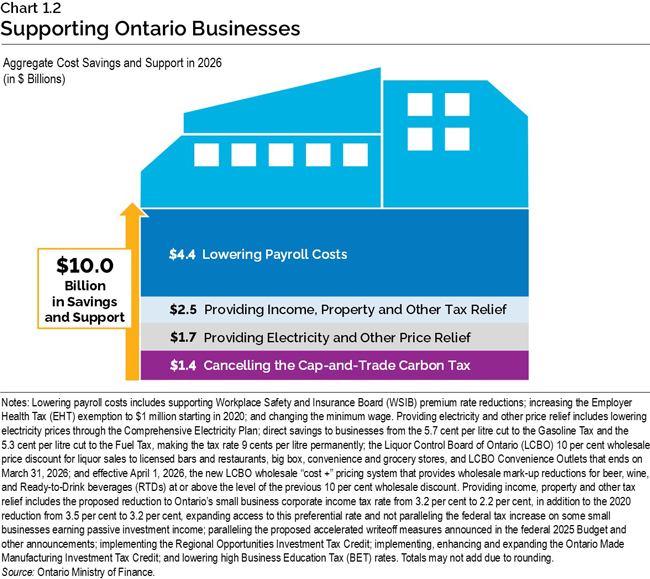
| 63 |
| Chapter 1: A Plan to Protect Ontario |
Creating New Growth Opportunities Through Innovation and Technology
Ontario’s innovation ecosystem continues to attract significant investment and create high-value jobs. Innovation is driving progress across a number of sectors, with new discoveries and critical technologies helping to protect and create good-paying jobs, while also keeping Ontario businesses competitive in the global market. By accelerating technology adoption, supporting homegrown research and equipping workers with the right skills and tools, Ontario is strengthening the conditions for more high-paying jobs, sustained growth and a more competitive economy.
Unlocking Growth Through Artificial Intelligence
Artificial intelligence represents a significant economic opportunity for Ontario. It has the potential to drive growth, enhance productivity and transform economies. Globally, AI has the potential to contribute US$15.7 trillion to the global economy by 2030. Research from Deloitte Canada, commissioned by the Vector Institute, estimates that between 2025 and 2035, AI adoption is projected to generate $122 billion in real GDP for Ontario and create an average 17,600 new jobs annually. The adoption of AI is also expected to boost labour productivity in the province by 1.6 per cent by 2035.
As global demand for AI-driven innovation continues to grow, Ontario is well positioned to unlock new opportunities and strengthen its competitiveness. The government is strengthening the foundations for the responsible use of AI, prioritizing clean energy to support data centres and driving economic transformation through the adoption of AI technologies across the economy.
Adopting Innovations in Artificial Intelligence Responsibly
Ontario is embracing transformational and powerful AI tools to help build a better province, while remaining committed to implementing appropriate guardrails in both the public and broader public sectors to ensure that AI systems are used transparently, accountably and responsibly.
In January 2025, the Enhancing Digital Security and Trust Act, 2024 (EDSTA) came into effect in Ontario. The EDSTA establishes a foundation to support the responsible use of AI. This legislation gives Ontario the tools it needs, as a leading Canadian jurisdiction, to ensure AI is governed and used in a transparent, responsible and accountable way.
As Ontario advances its digital economy, the government will accelerate the use of AI to boost economic growth, modernize and improve public services, and support innovation and transparency, while ensuring AI is used responsibly in the public sector.
| 64 |
| Section B: Protect Ontario by Building the Most Competitive Economy in the G7 |
Prioritizing Electricity for Data Centres That Strengthen Ontario’s Economy
According to a 2025 report published by the Independent Electricity System Operator, Ontario is home to approximately 100 data centres. The Ontario government is taking action to prioritize electricity for data centres that support the province’s economic interests, including those that create high-quality jobs, assist in domestic data hosting and strengthen Ontario’s position in the digital economy.
With the tools created within the Protect Ontario by Securing Affordable Energy for Generations Act, 2025, the province can set out certain criteria that data centres must meet before connecting or reconnecting to the electricity grid. This ensures Canadian data stay in Canada, protected from misuse.
Building Ontario’s Artificial Intelligence Infrastructure
In December 2025, the government welcomed Marvell Technology Inc.’s investment of $238 million for a five-year expansion, which includes the launch of a new office in Toronto, scaling of its semiconductor research and development operations in Ottawa and York Region and establishing a new optical lab. To support this expansion, Ontario is providing up to $17 million in funding through the Invest Ontario Fund, which will create up to 350 new, good-paying jobs and solidify the province’s position as a global hub for technology and AI infrastructure.
| 65 |
| Chapter 1: A Plan to Protect Ontario |
Developing Ontario’s Artificial Intelligence Industrial Strategy
Ontario has established a strong AI foundation supported by its growing AI sector, including its deep pool of AI talent and increasing number of homegrown AI companies. To leverage these strengths and drive broader adoption across the economy, the government is developing a comprehensive provincial AI strategy. This will enhance Ontario’s position as a world-leading AI jurisdiction to attract investment and talent, support the growth of domestic firms and boost business productivity.
Working closely with industry and academic partners, the government is developing a coordinated plan, to be launched in summer 2026, that will support the scale-up of Ontario-based AI firms, expand access to sovereign compute and data resources and ensure the province has the digital and grid-ready energy infrastructure required for next-generation innovation. The strategy will also aim to increase adoption and deployment across communities and businesses in key sectors, with a focus on Ontario-made technology and talent. To set up Ontario for success, the government will also further advance the safe and responsible use of AI by establishing clear governance frameworks and enhancing AI literacy.
Boosting AI Adoption in Ontario
To advance AI adoption in the province, the government is supporting Communitech’s launch of a community-led AI adoption pilot to help SMEs adopt practical AI solutions that strengthen productivity and competitiveness. This initiative focuses on firms in key sectors such as defence, construction, manufacturing, health care and services. The project pairs businesses in the Waterloo Region with teams of postsecondary co-op students to identify high-value opportunities and deploy real AI-enabled workflows. This model accelerates hands-on AI adoption for businesses, while giving students meaningful applied career experience. Insights from the pilot will help inform Ontario’s approach to supporting broader AI uptake across the province.
| 66 |
| Section B: Protect Ontario by Building the Most Competitive Economy in the G7 |
Strengthening Ontario’s Development and Adoption of Critical Technologies
To help Ontario businesses stay competitive on the global stage, the government is continuing to invest in critical technologies. Through an additional $107 million investment over three years, starting in 2026–27, the government is renewing the Critical Technology Initiatives (CTI) program and there will be an upcoming call for proposals to seek CTI delivery partners. The renewed funding will target projects that accelerate the development, commercialization and adoption of critical technologies such as AI, quantum technologies, cybersecurity and advanced connectivity, as well as critical manufacturing or supply-chain technologies such as robotics and semiconductors, in key sectors, such as advanced manufacturing, automotive, life sciences, mining, defence, agriculture and smart infrastructure. The CTI program launched in 2023.
In the first round, successful partners included the Vector Institute, the Ontario Centre of Innovation, the Ontario Bioscience Innovation Organization, the Quantum Valley Ideas Lab and the Canadian Cyber Threat Exchange. The development and adoption of these technologies have helped boost Ontario’s innovation ecosystem and AI infrastructure, creating new opportunities for businesses, increasing productivity and driving the development and adoption of transformative technologies. Since its inception, the CTI is on track to create or retain over 65,000 jobs and train over 14,000 highly qualified personnel, leading to the generation of over 700 new intellectual properties in the province.
Supporting Homegrown Research and Innovation by Investing in Ontario’s Research Infrastructure
Supporting homegrown research helps lead to groundbreaking discoveries and real-world applications that improve lives, while keeping Ontario businesses on the cutting edge of innovation. Research and innovations generated through Ontario’s colleges, universities, research hospitals and research institutes are advancing solutions to social, environmental and health challenges, while driving economic growth, strengthening key industries and enhancing international competitiveness.
The government is investing an additional $117.1 million over three years, starting in 2026–27, through the Ontario Research Fund–Research Infrastructure (ORF-RI), which will help continue to build, renovate and equip cutting-edge research facilities for critical projects across priority sectors, including agri-food, critical minerals, information technology, life sciences and manufacturing. This investment will strengthen Ontario’s research capacity and help attract and retain highly qualified personnel and support growth in the province’s innovation economy.
This builds on investments of over $47 million announced in January 2026 to support 195 research projects at universities, colleges and hospitals across the province as part of the government’s plan to protect Ontario by supporting high-impact, homegrown research, protecting good-paying jobs and helping Ontario businesses compete globally.
| 67 |
| Chapter 1: A Plan to Protect Ontario |
Making New Discoveries Through Ontario’s Research Institutes
The government continues to advance Ontario-made research and innovation to help keep ideas, expertise and intellectual property in the province and support long-term economic growth. To sustain the operations of established research programs, the government is investing $26 million over three years, starting in 2026–27, to maintain existing and planned levels of support for Ontario’s research institutes and continue to help catalyze the province’s research discoveries into world-leading breakthroughs and innovations. This will also continue to foster a skilled labour force, promote new business opportunities and support Ontario’s long-term economic growth.
Supporting Manufacturing Businesses and Workers
The manufacturing sector accounts for over 800,000 workers across the province and is a driving force behind Ontario’s economic strength and global competitiveness. As challenges facing Ontario manufacturers intensify due to U.S. trade policy, the government continues to help attract investments that will underpin the domestic manufacturing sector of the future.
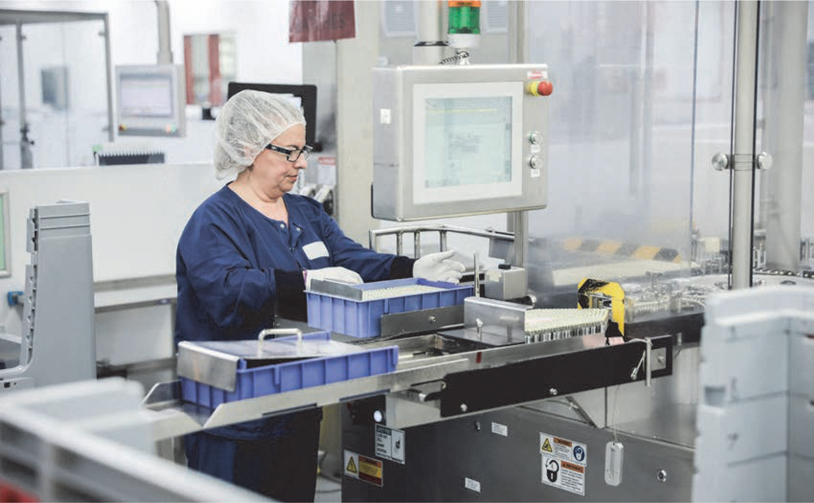
| Section B: Protect Ontario by Building the Most Competitive Economy in the G7 |
The government is promoting growth in the manufacturing sector and helping manufacturers compete by securing next-generation production facilities, strengthening domestic supply chains, leveraging productivity-enhancing technologies and building a workforce of the future.
To support manufacturing in the province, the government implemented the Ontario Made Manufacturing Investment Tax Credit, which provides support of up to $3 million per year to a qualifying corporation that makes eligible investments in buildings, machinery and equipment for use in manufacturing or processing in the province.
In addition, to further improve Ontario’s tax competitiveness for business investment, the government intends to allow businesses to accelerate the depreciation of a broad range of capital investments, in parallel with proposed federal measures. These measures include provisions that would allow qualifying corporations to immediately write off 100 per cent of the cost of buildings, machinery and equipment used in manufacturing or processing. The accelerated writeoff measures would provide over $3.5 billion in Ontario income tax savings over four years, helping make Ontario the best place in the G7 to invest and do business, pending the passage of federal legislation.
The government is also supporting Ontario’s competitiveness in the advanced manufacturing sector through the Advanced Manufacturing and Innovation Competitiveness (AMIC) Stream of the Regional Development Program. The AMIC Stream supports advanced manufacturers across the province by providing financial support and tools, primarily to small and medium-sized businesses, to help manufacturers invest in equipment, technologies and skills development. To date, the government has announced investments of approximately $50 million in over 40 companies and organizations through the AMIC Stream. This has leveraged $675 million in investments from industry, creating over 1,100 jobs.
Supporting New Investments in Advanced Manufacturing
In November 2025, the government welcomed an investment of more than $165 million by the Convertus Group to build a new, state-of-the-art biofuel facility in York Region. As one of the largest North American operators in organic waste management, Convertus’ new biofuel facility will be the first of its kind in Canada, using advanced technology to convert organic waste into renewable natural gas. In support of the investment, the government is providing $2 million through the Advanced Manufacturing and Innovation Competitiveness (AMIC) Stream of the Regional Development Program (RDP), which will help position Ontario as a leader in waste treatment, processing and renewable energy and create 52 good-paying jobs. This investment will also help increase Ontario’s resilience and self-reliance across domestic supply chains and reinforce the province’s leadership in next-generation technologies and solutions.
| 69 |
| Chapter 1: A Plan to Protect Ontario |
Cultivating Cutting-Edge Growth in Ontario’s Agri-Food Sector
Ontario has a rich and diverse agri-food sector, producing over 200 agricultural commodities, with 60 per cent of the food produced in Ontario being processed and consumed in the province. To support the province’s agri-food sector, which contributed over $51 billion to GDP in 2024 and represented one in nine jobs in Ontario, the government released Grow Ontario: a provincial agri-food strategy in November 2022. The strategy has strengthened agri-food supply chains, grown agri-food talent and enhanced competitiveness by supporting the adoption of new technologies and practices.
Enhancing Agri-Food Innovation Through the Sustainable Canadian Agricultural Partnership
Since April 2023, Ontario has supported the agri-food sector through the Sustainable Canadian Agricultural Partnership (Sustainable CAP). This five-year program, a $3.5 billion investment by federal, provincial and territorial governments, includes $1 billion in federal programs and activities and a $2.5 billion commitment that is cost-shared between the federal government (60 per cent) and the provinces and territories (40 per cent). Sustainable CAP aims to strengthen the competitiveness, innovation and resiliency of Canada’s agriculture, agri-food and agri-based products sector.
In September 2025, the governments of Canada and Ontario invested in several companies through several Sustainable CAP programs, including:
| • |
$14.6 million through the Resilient Agricultural Landscape Program (RALP) to help farmers make improvements to their farmland; and |
| • |
Up to $4.8 million in 48 research and innovation projects and supporting 20 companies through the Ontario Agri-Food Research Initiative (OAFRI). |
This is in addition to the $9 million invested in the Ontario Agricultural Sustainability Initiative, funded through Sustainable CAP in 2024, to help farmers enhance the sustainability and competitiveness of their farms.
| 70 |
| Section B: Protect Ontario by Building the Most Competitive Economy in the G7 |
Strengthening Stability in the Agri-Food Sector Through Ontario’s Risk Management Program
Ontario’s Risk Management Program (RMP) helps farmers manage risks beyond their control, like fluctuating costs and market prices, so they can compete globally with confidence. This program supports over 383,000 jobs and $24 billion throughout Ontario’s agri-food supply chain across 8,500 farms, which produce cattle, hogs, sheep, veal, grains and oilseeds, as well as edible horticulture, through the Self-Directed Risk Management Program. In January 2025, the Ontario government announced an increase in annual funding for its RMP from $150 million to $250 million over three years to enhance support for farmers.
Boosting Investments in Ontario’s Agri-Food Sector
In December 2025, Ontario welcomed an investment of over $533 million from Lee Li Holdings Inc. to upgrade and expand its existing facility, as well as establish a new state-of-the-art bottling and packing facility in Mississauga. The new North American hub will focus on plastic bottle manufacturing for in-demand products like tea, coffee, sparkling water and flavoured water, ensuring more beverages that are sold across Canada and North America are made, filled and packaged in Ontario. The government is providing $90 million through the Invest Ontario Fund to support this investment, which is expected to create 275 good-paying jobs and strengthen Ontario’s competitive advantage in the agri-food sector.
In June 2025, Ontario also announced an investment of more than $1.4 million through the Northern Ontario Heritage Fund Corporation (NOHFC) to support five agriculture projects in the Clay Belt region. These investments in a vast tract of fertile soil in Northern Ontario will help expand business operations, improve crop yields, create jobs and stimulate economic growth in the North.
| 71 |
| Chapter 1: A Plan to Protect Ontario |
Supporting Agricultural Research Infrastructure
Ontario is investing nearly $50 million over the next three years, starting in 2026–27, into Agricultural Research and Innovation Ontario (ARIO), which includes the $41 million investment announced in October 2025. These investments will help support the province’s network of strategic agri-food research infrastructure, including 14 research station properties, with 5,600 acres and more than 200 buildings. ARIO helps translate research into practical solutions for farmers and agribusinesses.
This funding also includes an investment of $10.5 million in the new Ontario Poultry Research Centre at the Elora Research Station, bringing the total provincial contribution to $24 million. Supporting this infrastructure will help cutting-edge research and innovation, benefiting farmers and agribusinesses across Ontario.
Investing to Protect and Support Northern and Rural Communities
Ontario’s small, Northern and rural communities are an essential part of the province’s overall economic strength and resilience.
To ensure the resilience of Northern communities, Ontario is extending the Northern Ontario Resource Development Support Fund with a new ongoing investment of $15 million annually. This funding will help Northern municipalities invest in core assets such as roads and bridges, access new economic opportunities through resource development and help mitigate the impacts of resource development on local infrastructure.
As part of its plan to protect Ontario, the government is strengthening rural capacity to support strong communities, create and retain jobs and drive local economic growth. In January 2026, the government announced the launch of its second intake of the Rural Ontario Development (ROD) Program. This $20 million program provides cost-shared funding to help strengthen the economies of rural communities, protect jobs, improve infrastructure and create strong businesses.
Ontario is also continuing to support the financial sustainability of small, Northern and rural municipalities across the province by enhancing the Ontario Municipal Partnership Fund (OMPF) through an increase to the program of $100 million over two years and bringing the total funding envelope to $600 million annually. The funding will help municipalities provide critical services, from public transit and libraries to emergency services and road maintenance.
| 72 |
| Section B: Protect Ontario by Building the Most Competitive Economy in the G7 |
Strengthening Ontario’s Tourism and Cultural Sectors
Ontario is continuing to invest in its tourism and cultural sectors to drive economic growth, support local communities, create jobs and position the province as a premier global travel destination.
Building Destination Niagara
Ontario is advancing the Destination Niagara Strategy to unlock the region’s full potential as a year-round, world-class destination. The plan aims to grow annual tourism to 25 million visitors and double Niagara’s tourism impact, adding about $3 billion to Ontario’s GDP each year. Key priorities include enhancing tourism attractions, while also offering world-class gaming, wine and culinary experiences, arts and culture and transportation improvements.
Upcoming initiatives include procurements for a new observation wheel, revitalization of the Niagara Parks Marina, redevelopment of the Ontario Power Generating Station, exploration of a signature theme park and a fully accessible, all-season Niagara River Line tram. Transportation initiatives include expanding the Queen Elizabeth Way (QEW), twinning the Garden City Skyway Bridge, increasing GO service and exploring enhanced air access at Niagara District Airport.
Progress to date includes dedicating $35 million for the Shaw Festival’s rebuild of the Royal George Theatre, more than $1 million for regional festivals and events and a new visitor attraction. The privately funded redevelopment of the Toronto Power Generating Station, an over $300 million investment, will deliver the region’s only five-star hotel.
Through Niagara Parks, Niagara Takes Flight was launched and has already welcomed more than 120,000 visitors and generated nearly $3.5 million in revenue, further strengthening the region’s four-season draw.
Supporting Niagara District Airport Redevelopment
The province will be exploring opportunities to support potential infrastructure improvements to the Niagara District Airport and drive tourism growth and economic development through improved connectivity to the Niagara Region, in alignment with the Destination Niagara Strategy. The government is also advancing work on the Niagara Air Access Feasibility Study to inform future decisions on supporting long-term growth in passenger volumes and economic impact.
| 73 |
| Chapter 1: A Plan to Protect Ontario |
Revitalizing Ontario Place
Ontario is working to make Ontario Place a world-class destination that will attract up to six million visitors every year. The reimagined Ontario Place will provide people of all ages with something to enjoy, including enhanced public spaces, playgrounds, trails and parks, increased access to Toronto’s waterfront, an enhanced year-round indoor-outdoor concert and entertainment venue, a family-friendly waterpark and wellness facility, as well as an all-new and state-of-the-art Ontario Science Centre to be completed as early as 2029. This one-of-a-kind transformation of Toronto’s waterfront will create over 5,700 jobs in the construction and tourism sectors while boosting economic growth across Toronto and the region. Once complete, the redeveloped Ontario Place will be a world-class, international attraction for generations of visitors from near and far, offering a unique opportunity to establish a powerhouse economic driver on Toronto’s waterfront.
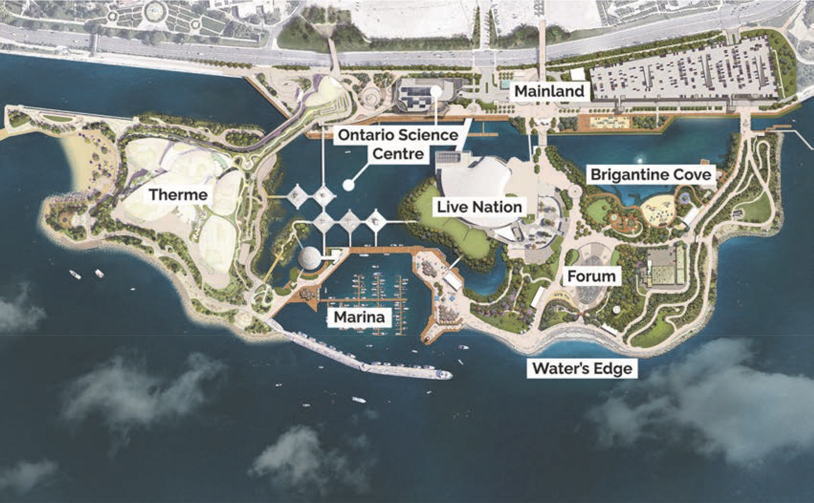
| Section B: Protect Ontario by Building the Most Competitive Economy in the G7 |
Developing Mississauga’s Waterfront
The province is committing $29 million over three years to support the Lakeview Village Cultural Pier Development project, in collaboration with the City of Mississauga, Peel Region and the Lakeview Village development group. The former “Four Sisters” Lakeview Generating Station site is being transformed into a mixed-use community facility, with the pier being repurposed to become a focal point for the new development. This project is intended to significantly enhance Mississauga’s Lake Ontario waterfront and support economic growth, job creation and tourism in the region.
Investing in Destination Wasaga
Wasaga Beach is home to the world’s longest freshwater beach and one of Ontario’s most unique coastal dune ecosystems. With views of the rugged Niagara Escarpment and more than 14 kilometres of white sandy coastline, it welcomes millions of visitors from around the world every year.
The province is continuing to work with the Town of Wasaga Beach to improve the area for residents and visitors, including by making available $2 million in tourism planning support and up to $25 million to redevelop the Nancy Island Historic Site. Ontario will soon begin the process of transferring a portion of the provincially owned beachfront in Wasaga Beach Provincial Park to the town, in order to support its integration into the broader development of Destination Wasaga, under the condition that the beach remain public.
This ongoing work will help better recognize the importance of the area and preserve its history, improve local roads to support future housing and traffic needs and help the town revitalize its downtown area to create a greater sense of community and encourage visitors to return again and again.
Investing in Ontario’s Cultural Institutions
To accommodate its growing collection of modern and contemporary art, the province is committing $35 million over two years to support the Dani Reiss Modern and Contemporary Gallery capital expansion project in the Art Gallery of Ontario (AGO). This initiative represents significant expansion at the AGO, which will help modernize the facility and continue to drive increased attendance and economic impacts for Ontario. Construction is already underway and once completed, the project will enable the AGO to display new and innovative exhibits.
Ontario is also providing $21 million in additional annual operating funding support for the AGO and the Royal Ontario Museum. This investment will help these cultural icons of Ontario continue delivering opportunities for visitors to appreciate and enjoy all that these world-class institutions have to offer.
| 75 |
| Chapter 1: A Plan to Protect Ontario |
Supporting Entrepreneurs to Grow and Succeed
Ontario is helping entrepreneurs start and grow their businesses. This is why the government is investing $9.4 million over three years, beginning in 2026–27, to renew grants for the Summer Company and Starter Company Plus programs delivered through the Small Business Enterprise Centres (SBECs) network. To help SBECs meet growing program demand, expand advisory services and support new initiatives, Ontario is also providing an investment of $3 million over three years, starting in 2026–27.
Ontario’s 54 SBEC locations provide a comprehensive range of business support to entrepreneurs, which include one-stop access to advisors, programs and services, along with learning opportunities tailored to small business owners in their region. In 2024–25, Ontario’s SBECs helped start over 8,000 businesses, expand 2,700 businesses and create more than 15,800 jobs.

| Section B: Protect Ontario by Building the Most Competitive Economy in the G7 |
The government is also continuing to support programs that help entrepreneurs start, grow and scale their businesses by:
| • |
Renewing its support for young entrepreneurs by investing $2 million annually over three years in Futurpreneur, starting in 2026–27. Futurpreneur helps entrepreneurs aged 18 to 39 launch and grow their businesses by providing mentorship, in-person programming, and up to $75,000 in loan capital from Futurpreneur and the Business Development Bank of Canada (BDC); |
| • |
Investing $5 million in 2026–27 in the Digitalization Competence Centre to help small businesses modernize and grow through the adoption of digital technologies; and |
| • |
Renewing its support for Fédération des gens d’affaires francophones de l’Ontario (FGA) by investing $750,000 over three years, starting in 2026–27, to ensure Francophone entrepreneurs have continued access to dedicated business service supports in French. |
Improving Capital Markets
As the global economic order continues to be marked by rapid change, shifting trade flows, demographic pressures and challenges to entrepreneurship, business retention and capital formation, Ontario’s financial services sector remains a cornerstone of stability and an economic engine of Canada.
The Ontario government remains committed to working closely with key partners in the capital markets sector and the Ontario Securities Commission (OSC) to implement innovative reforms, renew focus on reducing regulatory burden, accelerate access to capital and ensure investors remain protected and confident in Ontario’s markets.
The government is exploring opportunities to position Ontario as a global leader in digital asset innovation. To support this, the province will convene targeted stakeholder roundtable discussions in the coming months, to identify the strategic conditions required for effective regulation of digital assets that supports entrepreneurs to launch their ideas and innovate in Ontario. The province is also actively working with the federal government on the Canadian stablecoin regulatory framework. Fostering a supportive environment for innovators is essential to maintaining the province’s leadership in the global financial services industry.
These activities will strengthen Ontario’s position in the emerging financial technologies sector and advance the province’s ambition to become an international hub for entrepreneurial finance — where robust capital formation drives breakthrough innovation, high-value job creation and long-term economic growth.
| 77 |
| Chapter 1: A Plan to Protect Ontario |
Safeguarding Ontario’s Workforce
Ontario’s workers remain the province’s most valuable asset and the government is taking action to protect them against U.S. tariffs and economic uncertainty. Ontario is protecting workers by promoting labour mobility between provinces, giving workers the tools they need to land rewarding, good-paying jobs and making investments to train workers to meet current and future labour market needs.
Protecting Workers by Promoting Labour Mobility
To protect Ontario workers and strengthen Ontario’s economic resilience, the province has implemented historic labour mobility and free-trade regulations that help employers access the skilled Canadian workers they need sooner.
As of January 1, 2026, new “As of Right” labour mobility rules allow in-demand, certified workers to start working in Ontario within 10 business days following confirmation of their credentials by the appropriate regulator. These historic “As of Right” rules apply across occupations regulated by over 50 non-health regulatory bodies and more than 300 certifications. They promote faster hiring for critical roles, enhance worker mobility across the country and strengthen Ontario’s economic competitiveness.
Ontario is also enhancing access to health care workers by extending “As of Right” labour mobility to 16 additional regulated health professions, supporting workforce growth while upholding regulatory standards. These expanded reforms also include taking the next step toward automatic recognition of physicians and nurses who are registered and in good standing in other provinces and territories, making it faster and easier for them to continue their practice in Ontario.
These historic changes are part of the government’s plan to support Ontario and Canadian workers and build a unified Canadian workforce that can stand up to U.S. tariffs and economic uncertainty.
| 78 |
| Section B: Protect Ontario by Building the Most Competitive Economy in the G7 |
Investing in Skilled Trades and Construction-Related Talent
To build a strong skilled trades workforce and help safeguard Ontario’s economy during a period of uncertainty, Ontario continues to invest in programs that support and strengthen the skilled trades workforce. Since 2020, Ontario has invested more than $2.1 billion in the skilled trades, with initiatives aimed at reducing stigma, streamlining the apprenticeship system and increasing employer participation.
The province is also strengthening Ontario’s construction workforce by creating additional construction and urban planning seats at colleges, universities and Indigenous Institutes. As announced in the 2025 Budget, the province invested $75 million over three years to train up to 7,800 additional postsecondary students across Ontario for in-demand construction-related occupations. This investment supports the province’s ability to meet current and future labour needs and advance its ambitious infrastructure agenda.
Supporting Skilled Trades Apprentices
Ontario is continuing to expand in-class apprenticeship training, helping more apprentices across the province gain the skills they need to land rewarding careers in the skilled trades. Ontario is investing $64.2 million over three years to create up to 4,000 new training seats each year, helping apprentices access in-class training faster, while covering their $10-per-day Level 1 classroom fees. This investment is part of the $159.3 million commitment announced in the 2025 Budget to strengthen skilled trades programs.
Creating Resource Development Scholarships for First Nation Students
As announced in the 2025 Budget, the government invested $10 million over three years to create new scholarship opportunities for First Nation students interested in pursuing careers in resource development. These scholarships will equip First Nation students with access to the tools and training needed to succeed as leaders and innovators in this sector. This investment contributes to the government’s plan to protect Ontario and support Indigenous participation, partnership and ownership in Ontario’s critical mineral supply chain.
| 79 |
| Chapter 1: A Plan to Protect Ontario |
Modernizing Ontario’s Pension Sector
Ontario workers deserve a modern and robust pension system. This is why Ontario’s government is moving forward with initiatives to enhance retirement income security, provide new options for pension plan members, increase flexibility and simplify pension plan administration. These modernization efforts are designed to respond to the evolving needs of the pension system and its members.
Protecting Plan Beneficiaries Through the Pension Benefits Guarantee Fund
The Pension Benefits Guarantee Fund (PBGF) plays an important role in protecting the 635,000 members of defined benefit, single-employer pension plans (DB SEPPs) in the event of employer insolvency. In its current form, the PBGF tops up the first $1,500 per month of an eligible pension in the event a pension plan is forced to wind up with a shortfall and the sponsor is bankrupt. The PBGF is financed through annual assessments paid by employers sponsoring DB SEPPs and income earned from the investment of the fund. Ontario is the only jurisdiction in Canada to provide this protection for plan beneficiaries.

| Section B: Protect Ontario by Building the Most Competitive Economy in the G7 |
In the 2025 Ontario Economic Outlook and Fiscal Review, the government announced that it would conduct a review of the PBGF, as required by the Pension Benefits Act, and report back in the 2026 Budget. The previous legislated review of the PBGF, conducted in 2021, resulted in improved reporting requirements for PBGF-eligible plans. The data collected through this enhanced reporting were used, with the assistance of the Financial Services Regulatory Authority of Ontario (FSRA), to inform the review. The 2026 review shows a decline in membership and the number of plans as DB SEPPs continue to close. In addition, plans are aging and include a growing proportion of retirees, who are the most vulnerable to a potential employer insolvency.
However, with $1.3 billion in net assets as of March 31, 2025, the PBGF is in a financially strong position, which can be leveraged to provide additional coverage for plan beneficiaries.
The government proposes doubling the guarantee limit from $1,500 per month to $3,000 per month — the largest increase since the PBGF was created in 1980 — for all eligible plan beneficiaries, at no increased cost to employers or the government. This would help to protect the people of Ontario from employer insolvency as they age, giving them the opportunity to enjoy retirement. The change is proposed to be effective on or after March 26, 2026.
The Ontario government is also supporting public and private-sector employers working to consolidate their pensions with jointly sponsored pension plans (JSPPs), which share risk between employees and employers. Currently, PBGF assessments and coverage end after a plan merges into a JSPP. The government will be consulting on regulations to assist with consolidation into JSPPs by eliminating PBGF premiums paid by sponsors of DB SEPPs, once plan beneficiaries have consented and while the merger is awaiting regulatory approval.
These changes are timely and support workers and retirees during a period of economic uncertainty, while maintaining the health and sustainability of the PBGF.
Providing a New Pension Option Through Variable Life Benefits
The government is proposing legislation to enable certain pension plans — defined contribution plans or plans with additional voluntary contributions — to offer a new option for retirees called a Variable Life Benefit (VLB). If offered, a VLB would be a new alternative to a locked-in account or an annuity that would provide a monthly benefit for life. Similar to a traditional annuity, VLBs help protect retirees from outliving their retirement savings. Since the benefit is provided by a pension plan, VLB assets would be professionally invested, and risk would be pooled among participants, which could result in better outcomes than if managed individually. Payments would be adjusted based on the investment performance of the VLB and the mortality experience of the fund’s retirees.
| 81 |
| Chapter 1: A Plan to Protect Ontario |
The VLB framework would require comprehensive disclosure to retirees to ensure transparency and support informed decision-making. The framework would also provide flexibility for plan sponsors to design features that best suit their retirees. Enabling regulations would be required before a pension plan could offer a VLB in Ontario. Proposed regulations would be informed by stakeholder consultations that are planned for later this year. The government is targeting January 1, 2027, as the date when eligible plans could begin to offer VLBs.
Unlocking Pension Funds
When an employee leaves a pension plan, they can transfer their pension funds to a locked-in account offered by a financial institution. Locked-in accounts preserve funds to provide an income throughout retirement. However, the rules for locked-in accounts do not address affordability challenges that people face.
The government is responding to people’s evolving needs by increasing flexibility for locked-in account holders. Account holders who have reached early retirement age under the terms of their pension plan would be able to fully unlock their funds, as would account holders under age 55 whose total locked-in balances are below a prescribed amount ($29,840 in 2026) that would be indexed annually. These changes would provide Ontario’s workers and retirees with more control over their money, allowing them to better balance their short and long-term financial needs while maintaining safeguards to protect retirement security.
Reducing Pension Plan Costs
Pension plans incur unnecessary costs when pension plan administrators cannot locate members of their plan who never collected a pension and have likely been deceased for some time. To address this ongoing issue, the government would relieve pension plan administrators of costs related to unlocatable plan members aged 100 and above. Pension plan administrators would be required to conduct additional searches for these unlocatable members, which would be followed by a prescribed waiting period. Administrators could then apply to FSRA for approval to receive a discharge. This initiative would also benefit pension plan members, as pension plan costs are paid from pension assets.
| 82 |
| Section B: Protect Ontario by Building the Most Competitive Economy in the G7 |
Protect Ontario by Building
The government is investing in the most ambitious provincial capital plan in Canadian history, with planned investments over 10 years totalling more than $210 billion, including $37 billion in 2026–27. This includes building highways, transit and community infrastructure to keep workers on the job, thereby strengthening Ontario’s economy, and ensuring communities thrive for generations to come.
Building Highways
The costs of gridlock are real. Time stuck in traffic is one of the least productive parts of people’s day-to-day lives. It keeps people away from their families and delays the movement of goods for businesses. The Canadian Centre for Economic Analysis estimates that the economic and social impact of gridlock in Ontario was $56.4 billion in 2024 and could potentially rise to $108 billion annually by 2044 if no action is taken.1
Building Highway 413
To solidify the province’s position as a leader in moving people and goods efficiently, Ontario has started construction on Highway 413, a new 52-kilometre, 400-series highway, to better connect the transportation network across Halton, Peel and York regions, and shorten travel times by up to 30 minutes per trip. The corridor will extend from Highway 400 in the east to the Highway 401/407 ETR interchange in the west. This will include a six-lane, 400-series highway and protection for a dedicated future transitway.
The province is delivering Highway 413 and issued a Request for Proposals in December 2025 to design a major extension of Highway 410 that will connect directly to the future corridor for a total of nine kilometres of new highway construction. The construction of the broader highway will support an average of 6,000 jobs per year and contribute up to $1 billion to Ontario’s annual gross domestic product (GDP).
| 1 | Canadian Centre for Economic Analysis (CANCEA), “Impact of Congestion in the GTHA and Ontario: Economic and Social Risks,” Research Report (December 2024), https://rccao.com/news/files/Impact-of-Congestion-in-the-GTHA-and-Ontario-December2024.pdf |
| 83 |
| Chapter 1: A Plan to Protect Ontario |
This progress builds on the major milestones that Ontario has reached for this project, including awarding the first two contracts to start construction of Highway 413 and completing the preliminary design work. Work is actively underway to acquire the necessary properties for highway construction and transitway protection. Alongside ongoing property acquisition discussions, the government continues to engage impacted landowners to provide project updates and information on the acquisition process. In addition, the government is advancing early works construction projects to get shovels in the ground for this project, including an embankment at the Highway 401 and Highway 407 interchange, the Highway 10 resurfacing and underpass and the Bovaird Drive underpass. The government is also advancing delivery of the mainline highway corridor and is working in consultation with the industry on a plan to deliver Highway 413 in multiple sections.
In addition, the province has designated Highway 413 under the Public Transportation and Highway Improvement Act, providing greater certainty for planning and development along the corridor. As a result, lands no longer required for Highway 413 or the Northwest Greater Toronto Area (GTA) Transmission Corridor will be released, while properties adjacent to the designated route will now require permits for certain activities. This approach supports more efficient land use planning, protects future infrastructure needs and ensures that communities can continue to grow with clarity and predictability.
| 84 |
| Section B: Protect Ontario by Building the Most Competitive Economy in the G7 |
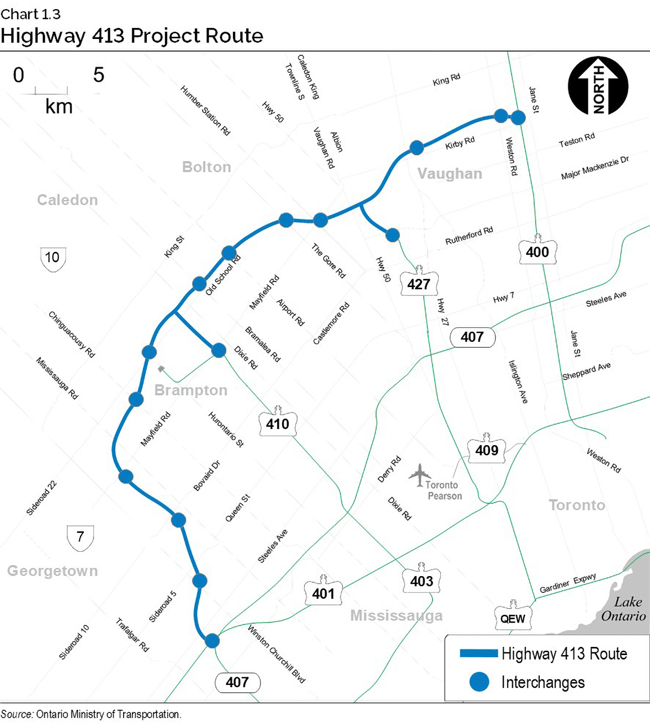
| 85 |
| Chapter 1: A Plan to Protect Ontario |
Advancing Work on the Bradford Bypass
Ontario is helping prepare York Region and Simcoe County for rapid population growth by building the Bradford Bypass, a new four-lane highway designed to relieve congestion on the existing east-west local roads and connect Highways 400 and 404. The new 16-kilometre highway will relieve gridlock, save commuters time and keep goods moving across the Greater Golden Horseshoe (GGH).
In November 2025, the province reached a major milestone by awarding contracts for the detail design of the central and east sections of the highway. This work will include field investigations, Indigenous consultation, utility coordination and finalizing the design for both sections, marking significant progress toward construction. The province has also secured a program management consultant to oversee the full project, including design, quality assurance, scheduling and construction oversight.
Progress continues on the west section of the bypass, where crews have completed tree clearing along the proposed route to streamline utility relocations and prepare the corridor for construction. A temporary detour at 10 Sideroad is being completed to support a future bridge and interchange, and work is progressing on a new southbound lane on Highway 400 that will connect directly to the Bradford Bypass.
Once complete, the Bradford Bypass will save drivers an estimated 35 minutes in travel time compared to when they use local roads. During construction, the project is expected to create up to 2,200 jobs per year and contribute up to $286 million to the province’s GDP.
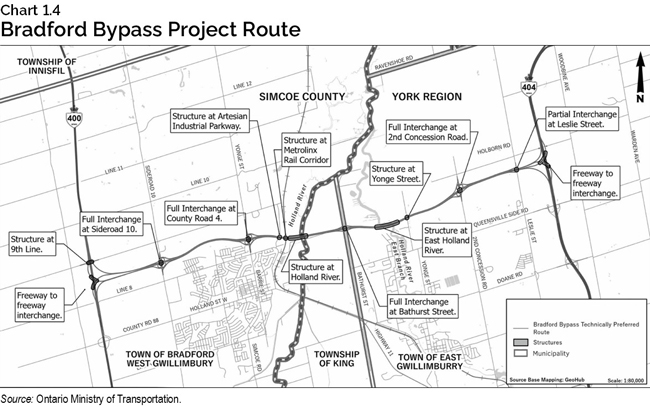
| 86 |
| Section B: Protect Ontario by Building the Most Competitive Economy in the G7 |
Building the Highway 401 Tunnel Expressway
In addition to the work already being done to upgrade and expand the province’s 400-series highways, the government is exploring innovative options to tackle congestion. This is why the government is undertaking a feasibility study for a new vehicle and transit tunnel expressway under Highway 401, with fieldwork starting this spring. The study examines tunnelling options to increase Highway 401 capacity, along with complementary approaches for congestion relief. The study will analyze the economic benefits both in the short and long term, as well as the project’s impact on reducing congestion.
Twinning the Queen Elizabeth Way Garden City Skyway
The Queen Elizabeth Way (QEW) Garden City Skyway Bridge Twinning Project includes construction of a new bridge on the QEW over the Welland Canal, connecting the City of St. Catharines to the Town of Niagara-on-the-Lake. In June 2025, Ontario reached a major milestone by awarding a contract for the detail design of the QEW Garden City Skyway Bridge Twinning Project. While design development is ongoing, certain advance works have already been identified and commenced in winter 2026.
As a vital corridor, this section of the highway supports tourism in Niagara Region and improves the connection of Niagara Region’s three international crossings to the rest of Ontario, while supporting the flow of over $1.1 trillion in goods annually. The new and expanded Garden City Skyway will reduce gridlock and time spent travelling for people in the growing Niagara Region and allow for the repair and upgrade of the existing aging bridge.
Building Highway 7
Construction of the new Highway 7 between Kitchener and Guelph will provide relief to the gridlocked Highway 401 and connect the fast-growing urban centres of Kitchener, Waterloo and Guelph. The government is advancing the project with activities that include replacement of the Frederick Street Bridge in Kitchener, environmental fieldwork and other engineering work to support construction of the remainder of the corridor. The construction phase of the Frederick Street Bridge replacement project is well underway, with the bridge demolition completed in December 2025.
In addition, the province is undertaking planning and design work for the easterly expansion of Highway 7 from two to four lanes, from west of Reesor Road in Markham to Brock Road in Pickering, to support the development of the City of Pickering’s Innovation Corridor. This will ensure Highway 7 is a continuous four-lane highway from Markham to Pickering, supporting the movement of goods and people in the region.
| 87 |
| Chapter 1: A Plan to Protect Ontario |
Improving Highways 400, 401 and 404
The Highway 401 corridor is a crucial economic link within Ontario, and between Ontario, Eastern Canada and the United States, handling about 11,000 trucks daily with goods valued up to $434 million in Eastern Ontario alone.
The province is taking a significant step towards accommodating the future widening of Highway 401 near Port Hope by replacing the Choate Road Overpass and Ganaraska River Bridge, as well as replacing the Wilson Road, Park Road and Cubert Street overpasses in Oshawa and the Bennett Road overpass in Clarington. These upgrades will benefit over 50,000 daily drivers and support hundreds of construction jobs, reinforcing the province’s commitment to economic resilience and mobility.
In Eastern Ontario, the province has replaced 20 bridges that will accommodate future widening of Highway 401. Several design studies are also underway for additional bridge replacements and interchange improvements to accommodate the future widening of the highway.
The province also completed major widening projects on Highways 400 and 404, as part of its plan to tackle gridlock and support the safe movement of people and goods in the GTA. More than 26 kilometres of Highway 400 between Langstaff Road and Highway 9 in York Region will be widened to 10 lanes: eight general purpose lanes, and one High Occupancy Vehicle (HOV) lane in each direction, with 21 kilometres from Major Mackenzie Drive to Highway 9 already complete. Highway 404 has been widened over 11 kilometres from Highway 407 to Stouffville Road.
Ontario has also taken the next step towards widening Highway 400, with new bridges being built at North Canal, Highway 88, Innisfil Beach Road and Dunlop Street in Simcoe to accommodate the future 10-lane highway. During construction, the project will create almost 500 good-paying jobs, from engineers to heavy equipment operators and labourers, and will ultimately save time for the more than 100,000 drivers who rely on this stretch of highway every day.
| 88 |
| Section B: Protect Ontario by Building the Most Competitive Economy in the G7 |
Accelerating Gardiner Expressway Rehabilitation
The government’s $73 million investment in the Gardiner Expressway rehabilitation has accelerated progress on one of Toronto’s most critical infrastructure projects. By working with the City of Toronto to enable 24/7 construction, the province was able to fast-track the timeline and reopened all six lanes to traffic in November 2025. This marks a major milestone for the project, which was delivered significantly earlier than originally planned, thanks to accelerated construction efforts.
With the expressway now fully open, commuters are benefiting from smoother traffic flow and improved reliability along one of Toronto’s busiest corridors.
This initiative is part of a broader government strategy to protect Ontario in the face of economic uncertainty, including from U.S. tariffs, by investing in infrastructure to support economic growth, fight gridlock and keep workers on the job. The project has delivered substantial economic impact by supporting approximately 500 good-paying jobs through construction and supply chain roles. The expressway upgrades are expected to save Ontario’s economy $273 million by reducing congestion and improving travel times by 22 minutes per trip compared to when construction was underway.
Building Highway 17
Ontario is taking the next steps to widen Highway 17 between Renfrew and Arnprior by issuing a Request for Proposals for the detail design of the expansion of the highway from two to four lanes. Highway 17 is a critical link in the Trans-Canada Highway system and a vital trade corridor, connecting communities across Eastern Ontario and supporting the movement of people and goods throughout the region.
The province is twinning 22.5 kilometres of Highway 17 running from Scheel Drive near Arnprior to three kilometres west of Bruce Street near the Town of Renfrew. The first stage of the expansion project was completed in November 2023, when the province finished construction of a new bridge and interchange at Highway 17 and Calabogie Road. As Ontario remains focused on dismantling interprovincial trade barriers that cost Canada’s economy $200 billion annually, widening Highway 17 remains a key component of the province’s plan to protect Ontario by building a stronger, more resilient and self-reliant economy while expanding cross-country trade routes.
| 89 |
| Chapter 1: A Plan to Protect Ontario |
Connecting Highway 401 to Lauzon Parkway in Windsor
The government is undertaking the planning and design for a new interchange connecting Highway 401 to the future Lauzon Parkway extension in Windsor, which will support increased opportunities for trade and improved access to the Windsor–Detroit border.
Completing Construction of Grand River Bridges
In December 2025, Ontario completed major construction on the Grand River bridges adjacent to Highway 401 in Kitchener, along with the rehabilitation of the King Street overpass between Kitchener and Cambridge. These upgrades are reducing congestion and improving travel times through one of Southwestern Ontario’s busiest corridors, while laying the foundation for future plans to widen Highway 401 from six to 10 lanes to support the region’s continued growth.
The new bridges will carry tens of thousands of vehicles each day, including a significant share of Ontario’s commercial traffic, helping people and goods move more efficiently across the Waterloo Region. These improvements build on the province’s plan to build, expand and repair highways, roads and bridges across Ontario, thereby strengthening the economy and supporting local jobs in Kitchener, Cambridge and beyond.
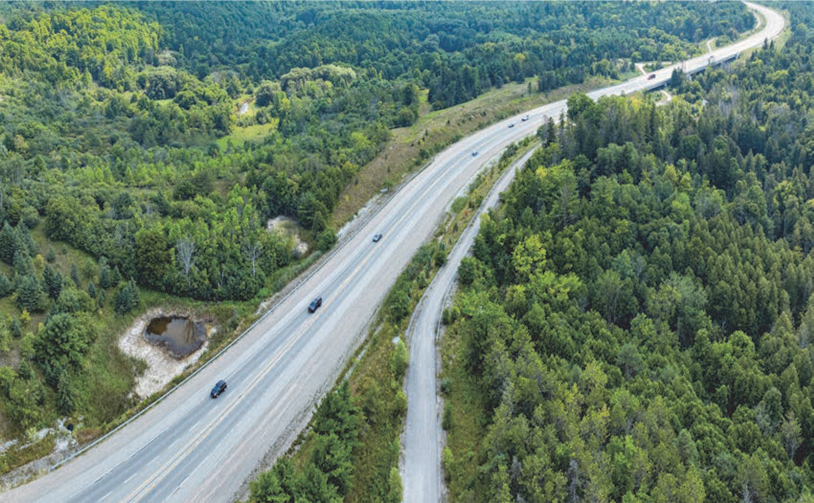
| Section B: Protect Ontario by Building the Most Competitive Economy in the G7 |
Building Highways for Northern Ontario
The government is investing in highways in the North to improve road safety, connect communities and unlock economic opportunities. Projects include:
| • |
Investing nearly $62 million in Geraldton’s Main Street Rehabilitation Project, a critical road infrastructure project in Greenstone that will be the gateway to the Ring of Fire. |
| • |
Awarding a contract for the detail design of a new two-lane bridge that will replace the Little Current Swing Bridge on Highway 6 in the Town of Northeastern Manitoulin and the Islands. The new bridge will provide reliable year-round access to the provincial highway network, making it easier for workers to connect to jobs, housing and essential services, while supporting businesses by helping to drive economic growth and tourism across the region. |
| • |
Improving passing opportunities and safety on highways in Northeastern Ontario through innovative designs such as 2+1 highways, which feature alternating centre passing lanes every two to five kilometres. |
| • |
Expanding Highway 11/17 from two to four lanes between Thunder Bay and Nipigon, including two new sections that opened to traffic in fall 2025: Highway 587 to Pearl Lake for 14 kilometres, and Highway 582 to Coughlin Road for seven kilometres. These two projects are part of an extensive series of projects to widen over 100 kilometres of the highway between Thunder Bay and Nipigon. There are four sections remaining, the next of which is a six-kilometre section between McGuire Road and Coughlin Road. |
| • |
Widening Highway 17 between Kenora and the Manitoba border from two to four lanes for approximately 40 kilometres. |
| • |
Supporting renewed partnerships with First Nations to build and improve highway infrastructure that will help connect more First Nation communities to the province’s highway network. This work includes maintenance and upgrades to Highway 584 and Highway 11. |
| • |
Continuing to expand the province’s rest area network across Northern Ontario. Since 2020, four new rest areas and 11 rehabilitation projects have been completed, nine of which are located along Highway 11 and Highway 17. |
| • |
Widening Highway 69 from two to four lanes between Parry Sound and Sudbury. In total, 84 kilometres of Highway 69 has been expanded to four lanes and the government is working to complete the remaining 68 kilometres. |
| 91 |
| Chapter 1: A Plan to Protect Ontario |
Table 1.1
Recently Completed Highway Projects
Northern
| • |
Rehabilitation of Highway 11 from 4.0 kilometres north of the north junction of Highway 569 for 21.1 kilometres further north. |
| • |
Rehabilitation of Highway 17 from 1.3 kilometres west of Goremanville Road easterly to the north junction of Highway 11/17, North Bay. |
| • |
Replacement of the North Driftwood River Bridge on Highway 11. |
| • |
Rehabilitation of Highway 556 from Highway 552 easterly to Highway 532, and Highway 532 from Highway 556 northerly to 1.4 kilometres north of Achigan Creek. |
| • |
Rehabilitation of the Kaministiquia River bridges on Highway 588. |
| • |
Rehabilitation of Highway 61 from Jarvis Bay Road to Highway 130. |
| • |
Reconstruction of Highway 599 from the English River Bridge to Highway 642. |
| • |
Rehabilitation of the Nestor Falls Bridge and Sioux Narrows Bridge on Highway 71. |
| • |
Rehabilitation of 30 kilometres of Highway 17 from Sawmill Bay Road to Upsala with hot-in-place recycling. |
Eastern
| • |
Replacing the Highway 416 culvert at the interchange of Roger Stevens Drive and Highway 417 and resurfacing various ramps on Highway 417 between Eagleson Road and Maitland Avenue, Ottawa. |
| • |
Replacing the Highway 41 culvert located between Kaladar and Machesney Lake Road. |
| • |
Resurfacing of Highway 60 from Wilno to the boundary of Renfrew and Nipissing. |
| • |
Replacing the structural culvert on Highway 17 near the intersection with Foresters Falls Road near Cobden. |
| • |
Resurfacing Highway 401 at various locations between Wyman Road in Tyendinaga Township and Wilton Road in Loyalist Township. |
| • |
Resurfacing Highway 41 and replacement of the structural culvert between Griffith and Eganville. |
Continued…
| 92 |
| Section B: Protect Ontario by Building the Most Competitive Economy in the G7 |
Southwestern
| • |
Improving the interchange at Highway 401 and Middlesex Road 32 (Dorchester Road) and replacing the bridge at Thames Centre. |
| • |
Constructing a new interchange on Highway 6 between Maltby Road and Wellington Road 34, including a new underpass structure at Highway 6 and Wellington Road 34. |
| • |
Rehabilitation of Highway 4 from Elginfield to Exeter. |
Central
| • |
Replacing the Highway 400 and Essa Road interchange. |
| • |
Rehabilitation of the QEW and Highway 427 bridges at Evans Avenue and The Queensway. |
| • |
Replacing the bridge on Highway 401 at Simcoe Street and Albert Street. |
| • |
Rehabilitation of Highway 401 westbound express lanes from Avenue Road to Jane Street, including pavement and bridge rehabilitations. |
| • |
Rehabilitation of pavement on the QEW from 1.3 kilometres west of Seventh Street Louth to 0.12 kilometres east of Niagara Street. |
| • |
Rehabilitation of 10 bridges and one structural culvert along Highways 401 and 403, as well as at the Highway 401/403/410 interchange. |
Source: Ontario Ministry of Transportation.
Completing Construction on the Hanlon Expressway
In October 2025, Ontario opened a new Midblock interchange on the Hanlon Expressway (Highway 6) in Puslinch Township, north of Highway 401.
The new interchange is part of the broader Highway 6 corridor improvement plan, which will support a continuous, free-flowing route between Guelph and Hamilton and improve traffic flow, accommodating future growth across the region.
The project included:
| • |
A new road linking the interchange to Concession Road 7 and Wellington Road 34, which is improving connectivity in Wellington County; |
| • |
A new bridge and underpass to replace the signalized intersection at Highway 6 and Wellington Road 34, allowing for uninterrupted traffic flow and enhanced safety; and |
| • |
A new roundabout at the intersection of Wellington Road 34 and Concession Road 7 to improve traffic movement and safety. |
|
|
| 93 |
| Chapter 1: A Plan to Protect Ontario |
Building Transit
Building transit alongside new roads and highways is also vital to support the province’s economy and connect more people to jobs and housing. With the opening of the Finch West Light Rail Transit (LRT), Eglinton Crosstown LRT as well as two new GO stations, Ontario is continuing to see the results of its historic investments in transit infrastructure. The government continues to lead the largest expansion of public transit in North America to keep pace with the rapid growth of Ontario’s cities and towns.
Building Light Rail Transit
The government is bringing fast, reliable transit projects to the people of Ontario to help reduce travel times and create more transit options:
| • |
Eglinton Crosstown LRT: In February 2026, the Eglinton Crosstown LRT officially opened, delivering 19 kilometres of rapid transit, 10 kilometres of which are underground. The new Line 5 Eglinton links to 68 routes, three Toronto Transit Commission (TTC) subway stations and two GO lines, moving more than 123,000 riders each weekday and reducing travel times from Kennedy Station to Mount Dennis Station by nearly one hour. |
| • |
Finch West LRT: In December 2025, the Finch West LRT officially opened, servicing 18 stops across 10 kilometres of rail along Finch Avenue West from Keele Street to Highway 27 and south to the Humber College North Campus. By 2031, the new Line 6 Finch West is projected to move more than 51,000 riders each weekday, carrying 12 million riders annually. It supports connections with other TTC lines, as well as connections to Peel Region and York Region local transit services. |
| • |
Hazel McCallion Line LRT: The 18-kilometre Hazel McCallion Line LRT will provide key connections with GO stations at Port Credit and Cooksville, the Mississauga Transitway, Square One GO Bus Terminal, Brampton Gateway Terminal and key Brampton Transit, Züm and MiWay routes. In 2025, the construction of the Hazel McCallion Line LRT progressed further with the installation of girders over the Highway 403 interchange, completion of flood-proofing for Mary Fix Creek and advances in station construction. Ontario is also moving forward with work to extend the Hazel McCallion Line LRT by building the Mississauga loop and tunnelling the line into downtown Brampton. The next steps for the extensions will involve detailed planning and design, public consultation and environmental approvals. |
| • |
Hamilton LRT: In May 2025, Ontario issued a Request for Proposals for the first package of civil and utility work for the Hamilton LRT. Submissions have been received from the shortlisted teams, all of which include Canadian contractors. Early works are already underway in the City of Hamilton, including on water mains, sewers, hydro, telecommunications and gas lines. |
| 94 |
| Section B: Protect Ontario by Building the Most Competitive Economy in the G7 |
Expanding GO Transit Services
To better connect growing communities across the GGH, the government is continuing to expand, integrate and build better GO train and GO bus services to make it easier and faster for people to get where they need to go. The government continues to deliver on GO Expansion, with Metrolinx rolling out incremental service increases, building new GO infrastructure, including new stations and improving passenger and train capacity at Union Station.
| • |
Bowmanville GO Extension: In January 2026, the province announced that it had broken ground on GO Transit’s Bowmanville Extension. The project will extend the Lakeshore East GO line 18.7 kilometres into Durham Region, accommodating 17,000 daily trips and 4.9 million boardings annually by 2041. Once complete, the Bowmanville Extension will deliver two-way, all-day service, saving commuters time and money, while bringing families closer to housing and putting 10,400 jobs within walking distance of transit. Early works began in spring 2025 and included tree clearing, geotechnical investigations and the installation of a new watermain in Oshawa. |
| • |
Kitchener GO Extension: In October 2025, the province reached an agreement-in-principle with CN Rail to purchase land to construct dedicated GO tracks on the Kitchener Line, marking a major milestone in the province’s plan to build faster transit between Kitchener and Toronto. The agreement-in-principle coincided with additional GO train service that was added to the Kitchener Line in November 2025, including 18 new weekend trips between Bramalea GO and Union Station, as well as the first-ever weekend service to Kitchener. |
| • |
Niagara GO Extension: Ontario is bringing faster, more frequent, two-way, all-day train service between Niagara Region, Hamilton and the GTA. In September 2025, the government completed construction of the new Confederation GO Station in Hamilton, marking a significant milestone in the province’s Plan to Protect Ontario by investing in key infrastructure that will reduce gridlock and connect more people to jobs and housing. The new station will expand fast, reliable train service across the GO Transit network and generate nearly half a million more rides annually. |
| • |
Woodbine GO: In June 2025, construction started at Woodbine GO Station, marking a significant milestone in the province’s plan to provide two-way, all-day service across core segments of the GO Transit network. As part of its agreement with the province, Woodbine Entertainment Group is also providing up to $170 million to support the construction of the new station. The new station located on the Kitchener Line will provide increased capacity and feature new rail platforms. The station will create new links between the Union Pearson (UP) Express and Kitchener GO train, as well as to local bus services, including the TTC, MiWay, York Region Transit and Brampton Transit. |
| • |
Mount Dennis GO and UP Station: In November 2025, the government opened the Mount Dennis GO and UP Station, connecting riders to GO Transit’s Kitchener Line and UP Express. Mount Dennis Station also offers a direct connection to the newly opened Line 5 Eglinton and is the first station outside of Union Station to connect GO Transit, TTC and UP Express at a single station. |
| 95 |
| Chapter 1: A Plan to Protect Ontario |
Advancing GO 2.0
Ontario is taking the next steps to advance planning for GO 2.0. Building on the extensive transit network vision in Connecting the GGH: A Transportation Plan for the Greater Golden Horseshoe, these next steps will help Ontario identify potential new rail corridors and study where new GO stations are needed to respond to network demand. GO 2.0 will build on existing investments to the GO Transit network by delivering two-way, all-day service across segments of the network.
Ontario is calling on the federal government to be a partner in this project by providing the funding and supports needed to expand passenger rail service in the GGH.
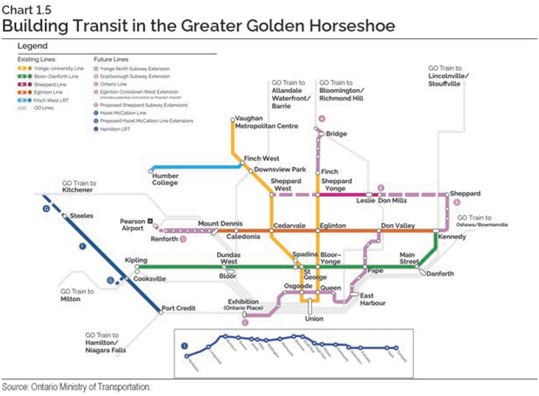
| 96 |
| Section B: Protect Ontario by Building the Most Competitive Economy in the G7 |
Building Subways
Work is underway on Ontario’s priority subway projects. The government is closer to providing better travel options, alleviating gridlock on roads and creating thousands of good, local jobs.
| • |
Ontario Line: Ontario has broken ground on all sections of the Ontario line, including four new stations and the three-kilometre elevated guideway of raised track that will connect Don Valley, Flemingdon Park and Thorncliffe Park stations, marking another milestone in the province’s Plan to Protect Ontario by creating jobs, cutting commute times across the GTA and bringing nearly 230,000 more people within walking distance of public transit. |
| • |
Yonge North Subway Extension: In October 2025, Infrastructure Ontario and Metrolinx took the next major step towards getting shovels in the ground for the project by issuing a Request for Qualifications for the contract to design and build the subway’s five stations. In summer 2025, the government awarded a contract to North End Connectors, which will design and build the twin tunnels for this extension. The contract also includes early works construction of support headwalls for future stations and emergency exit buildings. Once complete, the Yonge North Subway Extension will accommodate over 90,000 daily trips. |
| • |
Scarborough Subway Extension: Ontario has broken ground on the first of three stations for the Scarborough Subway Extension, marking a significant milestone in the province’s plan to fight gridlock and bring rapid transit to tens of thousands of commuters across the GTA. Tunnelling work is also advancing, having passed the halfway point in early 2026. Once complete, the construction of the Scarborough Subway Extension is expected to bring 38,000 people within walking distance of transit. |
| • |
Eglinton Crosstown West Extension: With the first tunnel segment now complete, work is well underway on the final tunnel segment and all other segments of the Eglinton Crosstown West Extension. Once complete, the nine-kilometre line will connect seven new stations to the Eglinton Crosstown LRT, making travel faster and more convenient, while bringing more than 37,500 people within walking distance of world-class transit. |
| • |
Proposed Sheppard Subway Extension: The government is advancing planning on options to extend rapid transit both east and west of the existing TTC Line 4, which would improve transit connections in Toronto’s north end and make it easier and faster for people to get around Toronto and the GTA. |
| 97 |
| Chapter 1: A Plan to Protect Ontario |
Investing in New Ontario-Made Subway Cars
Ontario has partnered with the federal government to maximize the Canadian content in the 55 new subway trains for Toronto’s Line 2. This will ensure Ontario tax dollars support Ontario companies in tariff-hit sectors such as steel and aluminum. This decision furthers the government’s ongoing work to support a strong manufacturing sector in Ontario that will help the province withstand growing geopolitical and economic uncertainty around the world.
Maximizing Canadian content has led to an increased provincial investment totalling nearly $1 billion, up from $758 million, which will be matched by the Government of Canada to contribute to the City of Toronto’s purchase of the new subway trains.
Funding for this project will support 946 good-paying Canadian jobs, including 285 at Alstom’s Ontario facilities, with 240 in Thunder Bay, 15 in Kingston and 30 in Toronto. The current 30-year-old Line 2 trains are nearing the end of their expected lifespan, which would significantly increase costs to maintain safety if they continue in operation.
Bringing Back the Northlander
The government is investing more than $100 million in rail infrastructure to support the return of Northlander passenger rail service to Northeastern Ontario, slated to open later this year. Work is underway along the corridor, and includes joint elimination, curve adjustments and improvements at rail crossings, and will deliver a smoother ride, enhance comfort and safety and reduce travel times for passengers. The Northlander will span 740 kilometres between Toronto and Timmins, with a rail connection to Cochrane, for a total of 16 stops, and is part of the government’s efforts to protect Ontario’s economy by connecting Northern communities, creating good-paying jobs, supporting local industries and driving economic growth across the North.
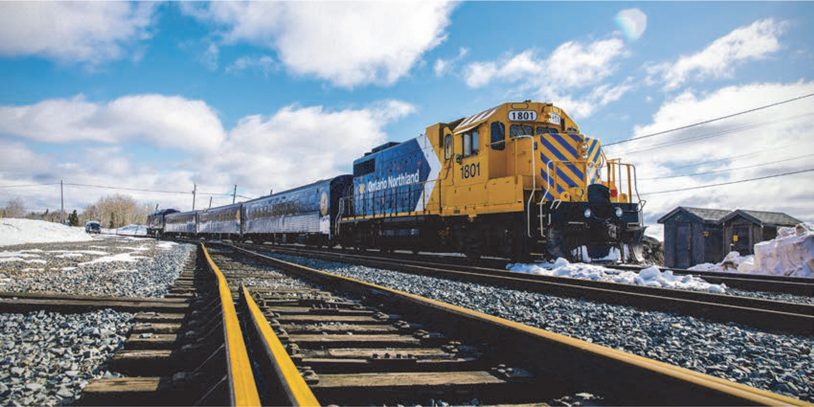
| Section B: Protect Ontario by Building the Most Competitive Economy in the G7 |
In September 2025, the government completed the North Bay Rail Bypass, a 982-metre track that will improve travel times to North Bay Station by 15 minutes, giving passengers more time with their families and friends while supporting tourism, jobs and economic growth in Northern Ontario.
In January 2026, the government also awarded a contract for renovations at North Bay Station, which will serve the Northlander, as well as Ontario Northland’s motor coach and Bus Parcel Express services. Construction is underway to modernize the station with new digital screens, seating and service counters, as well as washroom and lighting enhancements to improve accessibility and comfort. Similar work is underway at the Cochrane and Englehart stations, with construction expected to be completed in spring 2026.
Developing a Northland Rideshare Pilot Framework
Ontario is planning to engage with rideshare operators, the taxi sector and municipalities to explore the standardization of rideshare guidelines across the province, starting with a proposed pilot rideshare framework along the Northlander corridor to support opportunities in Northlander communities. Rules for rideshare programs, such as application fees and driver screening requirements, are currently managed by individual municipalities, resulting in differing standards across the province. The initial focus on Northlander communities is intended to improve passenger access as the Northlander resumes service later this year and support a future provincewide rollout.
The province is consulting on potential approaches to a framework and gathering feedback that could inform any future, broader application beyond the pilot. Through these initiatives, the government continues to support an integrated and efficient transportation network that will improve access for everyone, including rural and remote communities such as those along the Northlander route.
Investing in Transit in Rural Communities
Ontario is investing an additional $15 million over three years, starting in 2026–27, in the Ontario Transit Investment Fund. This investment will double the total program funding to $30 million over three years to support the startup and growth of transit services in rural communities. Since its launch in October 2024, there has been significant interest in the program, with over 35 projects at various stages of the application process. Eligible projects include new and expanded bus services, on-demand shared rides and door-to-door transportation.
This additional investment will help to provide safe, reliable transit services in unserved and underserved parts of the province, driving economic growth and connecting more people to communities, jobs and housing.
| 99 |
| Chapter 1: A Plan to Protect Ontario |
Supporting the Future Growth of Billy Bishop Airport
Billy Bishop Airport is a vital transportation hub for Ontario and Canada, serving approximately two million passengers each year and connecting Toronto to more than 20 cities across Canada and the United States. It is also a major economic driver, contributing $900 million in GDP and $1.8 billion in economic output each year, while supporting 9,000 jobs in 2024.
Ontario’s population is expected to grow to more than 20.5 million by 2051, including significant growth in the GTA, making it increasingly important to plan for the airport capacity needed to support a growing economy and keep people and goods moving. In order to unlock the full economic potential of Billy Bishop Airport, the Ontario government will introduce legislation that will, if passed, see the province provide compensation to take ownership of the City of Toronto’s lands around the airport, alongside its part in the tripartite agreement with the Toronto Port Authority and the federal government. By expanding capacity at Billy Bishop Airport, the province will work with the federal government to expand the airport’s runway, meet future demand, reduce pressure at Toronto Pearson International Airport, increase competition in the air travel sector to support more routes and cheaper flights and support the creation of good-paying jobs in Ontario’s aviation, tourism and construction sectors.
Protect Ontario Communities
Advancing Infrastructure Projects with the Building Ontario Fund
Focused on infrastructure projects in the priority areas of energy, affordable housing, long-term care, transportation, municipal and Indigenous community infrastructure and critical minerals, the Building Ontario Fund (BOF) continues to deliver on its mandate by advancing high-impact infrastructure investments in partnership with Canadian institutional investors and project proponents.
In addition to its historic $1 billion investment in the Darlington New Nuclear Project, BOF is also making investments in new projects for affordable housing and long-term care, including the following:
| • |
Up to $300 million to launch a housing initiative with High Art Capital to help alleviate rental housing pressures in the GTA. This initiative will fund the conversion of about 2,200 newly built condominium units into long-term rental housing and will include about 550 affordable units; |
| • |
A $133.6 million investment, in partnership with Arch Corporation, in four long-term care homes that will create over 570 new and redeveloped beds. This includes a new 160-bed facility in Amherstburg to help meet growing demand for senior care in rural communities; and |
| • |
An $83 million investment in the first phase of an affordable student housing development at Toronto Metropolitan University (TMU) that will increase on-campus accommodations and revitalize Toronto’s downtown core. |
These investments reflect the government’s commitment to build Ontario by unlocking critical infrastructure projects and delivering measurable, long-term public value across priority sectors.
| 100 |
| Section B: Protect Ontario by Building the Most Competitive Economy in the G7 |
Strengthening Indigenous Partnerships
The Indigenous Opportunities Financing Program (IOFP), administered by the BOF, seeks to advance economic reconciliation and prosperity by enabling financial participation of Indigenous partners in Ontario-based infrastructure projects through provincial loan guarantees.
Through the IOFP, Ontario is providing a provincial guarantee to support a $250 million investment by Saugeen Ojibway Nation to expand medical-isotope production at Bruce Power. This partnership strengthens financial participation and advances shared ownership that will create long-term benefits and economic opportunities for the community.
Supporting Housing Development
The government has taken action to help increase the supply of affordable homes and support housing development across Ontario. This includes removing the full 8 per cent provincial portion of the Harmonized Sales Tax (HST) on qualifying purpose-built rental housing in order to get more rental homes built across the province.
Lowering the cost of homeownership requires a coordinated response from all orders of government. Ontario is working with the federal government to provide funding to eligible municipalities that take action to significantly reduce development charges and, in doing so, make housing more affordable and speed up construction of the homes that families across the province urgently need. The province and federal government are discussing the details of a new funding program that will be made available to municipalities that agree to reduce development charges.
| 101 |
| Chapter 1: A Plan to Protect Ontario |
Building Modular Homes
The government is partnering with the City of Toronto and Habitat for Humanity GTA to build 33 modular homes in a six-storey condominium building at 355 Coxwell Avenue, as well as with the City of Ottawa and Habitat for Humanity Greater Ottawa to build another 33 modular townhomes at 40 Beechcliffe Street. Lessons learned through the construction of these buildings will inform the ongoing work the province and its partners are doing to support modular homebuilding in Ontario and keep the dream of homeownership alive.
The Municipal Housing Infrastructure Program (MHIP) is also enabling housing development by building core infrastructure projects such as roads and water systems, to support growing and developing communities.
Through the Housing-Enabling Water Systems Fund and Housing-Enabling Core Servicing Stream, MHIP is helping to unlock new housing opportunities. Since its launch in 2024, the MHIP has made about 800,000 more new homes possible across Ontario.
The government is increasing funding to the MHIP – Health and Safety Water Stream by $700 million for a total of $875 million. This funding is supporting 120 projects across 127 municipalities and First Nation communities to build, expand or rehabilitate aging water, wastewater, stormwater, flood and erosion infrastructure — protecting housing otherwise at risk.
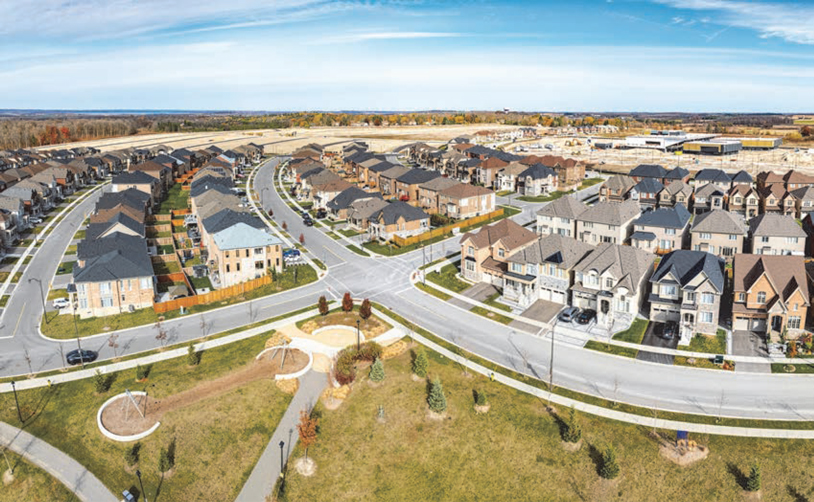
| Section B: Protect Ontario by Building the Most Competitive Economy in the G7 |
In addition, municipalities can access up to $1 billion in loans, with flexible borrowing terms, through the Infrastructure Ontario Loan Program’s Housing-Enabling Water Infrastructure lending stream.
Protecting Water and Irrigation Infrastructure in Niagara and Leamington
Through MHIP, the government is investing $135 million in water systems and irrigation infrastructure in Niagara Region and the Municipality of Leamington. Niagara Region will receive approximately $94 million, which includes almost $53 million for six water systems projects through the MHIP – Housing-Enabling Water Systems Fund stream, and another $41 million for irrigation pipelines to help deliver water to hundreds of farms and agricultural businesses. Leamington will receive $41 million to improve wastewater treatment services to help support domestic food production.
Enhancing the Community Sport and Recreation Infrastructure Fund
Through the Community Sport and Recreation Infrastructure Fund, Ontario is providing an additional $300 million over six years to help meet the needs of growing communities by supporting the repair, upgrade or construction of new sport and recreation facilities. This brings the total program funding to $500 million. As part of the initial $200 million investment in the program, launched as part of the 2024 Budget, the government is supporting 94 development and revitalization projects for sport and recreation infrastructure across the province.
These investments will create jobs, while helping people across the province to lead healthier, more active lifestyles. Enhancing and expanding sport and recreation facilities increases accessibility, encourages participation and helps communities unlock the economic opportunities that come from hosting local, national and international sporting events and competitions.
| 103 |
| Chapter 1: A Plan to Protect Ontario |
Building Transit-Oriented Communities
Ontario is also actively working on transit-oriented development through the Transit-Oriented Communities program to support the advancement of mixed-use communities that increase access to housing and jobs at or near future subway, GO and LRT transit stations.
Ontario is advancing transit-oriented communities near 17 subway and GO stations. Planned transit-oriented communities have the potential to create approximately 292,000 new homes, including affordable options, and about 84,000 new jobs.
Launching the Pothole Prevention and Repair Program
Ontario invested $10 million to make roads safer by preventing accidents and damage that can occur from potholes. Under the new Pothole Prevention and Repair Program, the majority of smaller municipalities have applied for funding to support critical road maintenance and pothole repair.
Improving the Role of Conservation Authorities
The government is updating Ontario’s conservation authority system to deliver stronger watershed management, flood resilience and better housing support and infrastructure projects. The new Ontario Provincial Conservation Agency will move Ontario to a regionally consolidated conservation authorities model grounded in watershed science, data transparency and measurable performance that will ensure flood management, erosion control and drinking water protection. Dedicated funding has been approved to support the transition and drive system-wide improvements like standardizing service delivery and introducing digital permitting tools that will help speed up approvals, improve customer service and direct more resources to frontline service delivery and conservation.
| 104 |
| Section B: Protect Ontario by Building the Most Competitive Economy in the G7 |
Protect Ontario’s Borders and Communities
The government continues to strengthen public safety across Ontario by improving border security, keeping dangerous offenders off the streets and protecting communities. This includes disrupting illegal border crossings and cross-border trafficking in guns and drugs, keeping criminals behind bars and investing in measures to deter and combat illicit activities.
Ontario is advancing its plan to create a strong, modern justice system and increase capacity by making targeted, multi-ministry investments across community safety and policing, courts and correctional services.
The government is fighting for the safety and well-being of children, families and communities across Ontario. This is why Ontario is making investments to enhance safety in schools and protect public spaces.
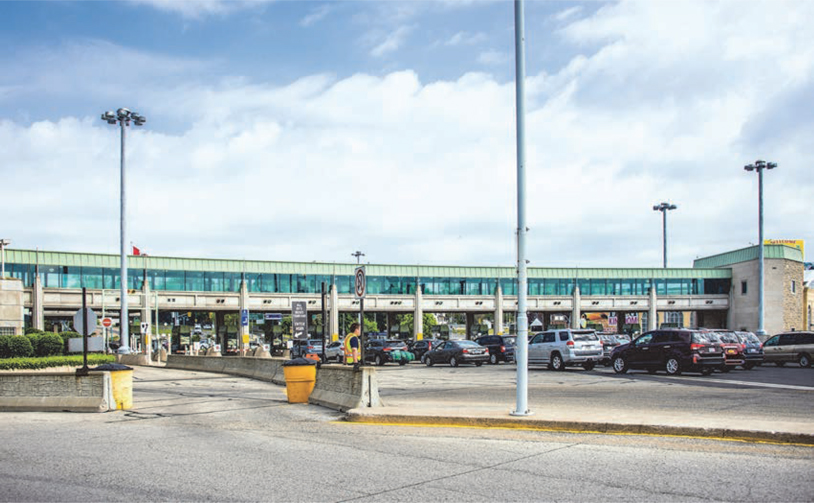
| Chapter 1: A Plan to Protect Ontario |
Protecting Ontario’s Borders
The government is continuing to enhance the security of the Ontario – United States border at all points of entry and deter and prevent illegal crossings by land, air and water. These efforts are focused on protecting communities and disrupting cross-border criminal activity, such as the smuggling of illegal drugs and firearms into Ontario.
In January 2025, Ontario launched Operation Deterrence to enhance security at the border and address criminal activity affecting communities on both sides of the border. Since this launch, Ontario’s enhanced border enforcement measures have resulted in the tracing of over 550 illegal firearms, of which over 440 were traced to the United States, the seizure of 4,152 kilograms of cocaine and 192 kilograms of fentanyl and 641 charges laid through Ontario Provincial Police (OPP) border-related patrols.
Building on these results, the province is expanding Operation Deterrence to involve and further integrate local police services in border protection and security. Under Operation Deterrence 2.0, Ontario is investing $32.5 million in 2026–27 to:
| • |
Establish both the Border Security Grant to enable municipal and First Nations police services to acquire specialized assets, such as drones, marine vessels and surveillance technologies; and |
| • |
Establish the Border Integrity Investigation Fund to provide targeted operational funding to police services to address border-related enforcement gaps, with an emphasis on unmonitored general aviation fields and other vulnerable entry points. |
These measures will enhance investigations, intelligence gathering and interdiction operations. They will also expand border policing capacity and help disrupt organized crime networks from operating across the border.
| 106 |
| Section B: Protect Ontario by Building the Most Competitive Economy in the G7 |
Strengthening Ontario’s Bail System to Protect Communities
The people of Ontario deserve the peace of mind that comes with safe communities and a justice system they can trust. For years, Ontario has put forward many tough-on-crime recommendations for the federal government, including initiatives aimed at fixing a bail system that all too often leaves victims, families and communities at risk. In October 2025, the federal government introduced legislation that enables consecutive sentences for specified violent crimes, expands reverse-onus bail and makes bail harder to obtain for violent and repeat offenders. Ontario will continue advocating for federal Criminal Code and bail reform to keep communities safe.
Ontario is advancing its own comprehensive bail reform strategy that puts accountability and public safety first, while supporting a justice system that is efficient and fair. The Keeping Criminals Behind Bars Act, 2025 will require accused individuals or their surety to provide a cash security deposit equal to the full, court-ordered amount once the accused person is released from custody. This change will make it easier for the province to collect forfeited bail payments when bail conditions are violated, ensuring that bail is both meaningful and enforceable.
To enhance enforcement and improve oversight, Ontario is exploring new digital tools, including a centralized surety database, to improve efficiency, increase public safety and strengthen information sharing between police services and prosecutors. The province is also expanding specialized bail prosecution teams that work directly with police to build strong cases for bail hearings involving serious offences. Since 2023, these teams have managed over 4,600 serious violent cases, helping prevent dangerous individuals from being released back into the community.
These measures build on Ontario’s ongoing investments to prevent repeat and violent offenders from committing crimes while out on bail. Through an additional investment of $8.3 million in the Bail Compliance and Warrant Apprehension Grant program in 2026–27, the government continues to support police services in ensuring that high-risk, repeat and violent offenders comply with their bail conditions.
The government is ensuring that adult offenders and accused individuals required to wear a court-mandated GPS ankle monitor, as a condition of release, are held accountable for related costs through a new GPS user fee model. The fees collected will be used to support victim services. The government is also strengthening the GPS ankle monitoring program by exploring options to increase police access to GPS information for the purpose of monitoring people who are accused or convicted of a crime.
These measures underscore Ontario’s commitment to keeping communities safe, supporting law enforcement and holding offenders accountable.
| 107 |
| Chapter 1: A Plan to Protect Ontario |
Building More Provincial Jails
The government is expanding the capacity of the adult correctional system, including readiness for future needs associated with the recent bail reforms. This includes adding more space to existing facilities to optimize capacity where feasible, alongside building new facilities and inmate housing, to meet forecasted demand.
In March 2025, the government repurposed and reopened the Regional Intermittent Centre at the Elgin-Middlesex Detention Centre, adding 74 staffing resources, including correctional officers, to accommodate an additional 110 inmates and plans to expand space for programming. The government plans to reopen the Toronto Intermittent Centre at the Toronto South Detention Centre in 2026 to increase detention capacity for 320 inmates and add 166 staffing resources, including correctional officers. The government is also targeting substantial completion of the new Thunder Bay Correctional Complex in late 2026 to increase capacity for at least 345 inmates, once the facility becomes operational in 2027.
The government continues to further expand the capacity of provincial jails. This includes:
| • |
Adding capacity for 91 inmates at the Quinte Detention Centre, bringing detention capacity to over 300 at the facility; |
| • |
Constructing the new Eastern Ontario Correctional Complex, which will be able to accommodate 235 inmates; |
| • |
Building new modular facilities in Niagara, Milton and Sudbury, each of which can accommodate at least 50 inmates; and |
| • |
Increasing capacity for 295 inmates by building the new Brockville Correctional Complex and expanding the St. Lawrence Valley Correctional and Treatment Centre. |
The government is also hiring over 700 more staffing resources, including correctional officers, nurses and support staff, to manage the increased correctional capacity. This will help frontline staff to do their jobs safely and effectively and keep violent and repeat offenders off the streets.
To further enhance detention capacity in correctional institutions, the government is moving forward with plans to optimize existing adult correctional institutions by adding more inmate accommodations and staff. The government will never choose to let a violent offender walk free due to capacity constraints.
| 108 |
| Section B: Protect Ontario by Building the Most Competitive Economy in the G7 |
Getting More Boots on the Ground by Making It Easier to Recruit and Train Police Officers
There is a growing need for police officers across the province to keep our communities safe. This is why the Ontario government is extending the removal of tuition fees for the Basic Constable Training program at the Ontario Police College for an additional three years to support police services in their efforts to recruit and train more officers.
By covering 100 per cent of tuition costs for Basic Constable Training, the government is making the path to becoming a police officer more accessible than ever. This approach helps remove financial barriers for prospective recruits and supports police services as they work to expand their frontline capacity. Since the introduction of the Basic Constable Training tuition fee waiver in 2023, 6,277 recruits have been trained.
The elimination of tuition fees underscores the government’s commitment to strengthening public safety, putting more boots on the ground and supporting the development of highly trained and responsive police services.

| Chapter 1: A Plan to Protect Ontario |
Modernizing Police Training Facilities
In 2025, the government committed over $1 billion towards renovating and expanding the Ontario Police College in Aylmer and a new Ontario Provincial Police Academy in Orillia to ensure that police officers and new recruits have adequate training facilities. The government continues to advance these projects, including expanding the Ontario Police College’s capacity to accommodate additional recruits and replacing aging infrastructure at the Huronia Regional Centre, to support the future Ontario Provincial Police Academy.
These facilities will equip new recruits and current police personnel with the skills needed to respond to the increasing complexity of contemporary policing and address urgent specialized training demands driven by rising crime.
Supporting Police Services in First Nation Communities
The province continues to work with First Nation communities to strengthen First Nations police services and ensure access to reliable and culturally responsive policing.
In December 2024, the government announced a $514 million investment to support the Nishnawbe Aski Police Services Board (NAPSB) as it became the first-ever First Nations police service board constituted under the Community Safety and Policing Act, 2019. This investment supports the NAPSB’s efforts to provide culturally appropriate and effective policing delivered under a provincial legislative framework for 34 remote and Northern First Nation communities.
Through ongoing collaboration with First Nations partners and the federal government under the First Nations and Inuit Policing Program, the province is also advancing cost-shared efforts to support equitable resourcing for police services, and investing in policing infrastructure and support initiatives aimed at combatting illicit drugs in First Nation communities.
The province is supporting First Nations Police Services across Ontario, in continued partnership with the Indigenous Police Chiefs of Ontario, First Nation leadership and continues to call on the federal government for further support, so that these services have the resources and stability needed to provide effective and culturally responsive policing to First Nation communities across the province.
Fighting Guns, Gangs and Violence
Gang members are criminals who put the lives of the people of Ontario at risk. A variety of crimes are consistently linked to gang activity, including property offences, drug trafficking, fraud, robberies, assaults with weapons, homicides, auto theft and human trafficking.
| 110 |
| Section B: Protect Ontario by Building the Most Competitive Economy in the G7 |
The government is continuing its partnership with the federal government, which is providing Ontario with $121 million from 2023 to 2028 to fight gun and gang violence. This funding provides resources to prosecutors, the OPP, municipal and First Nations Police Services, community organizations and school boards across the province to help them conduct investigations and undertake measures focused on preventing, monitoring and fighting gun and gang-related violence and organized crime, and assist victims and survivors of sexual assault, domestic violence and human trafficking. Since 2018, Ontario, with support from the federal government, has allocated over $375 million under the Guns, Gangs and Violence Reduction Strategy to fund initiatives that deliver strong legal enforcement, prosecution and proactive gang disruption.
This funding is helping keep people safe and criminals off the street. For example, since 2019–20, Ontario’s Guns, Gangs and Violence Reduction Strategy resulted in seizures of over 1,100 firearms, more than 2,900 vehicles and $26 million in currency, resulting in over 22,700 charges.
Tackling Organized Crime
Maintaining public safety is a top priority for the government. Key stakeholders have identified that repeat and violent offenders are the overwhelming perpetrators of organized retail crime. Retail theft orchestrated by organized criminal entities threatens the safety and security of both employees and customers, disrupting business operations. This is why Ontario is working with industry partners in the retail sector to identify strategies to combat organized retail crime. These discussions are important to protect the well-being of frontline workers, ensure Ontario businesses thrive and establish communication channels across jurisdictions. The government will continue to protect the rights of the people of Ontario to work and shop in safety.
Ontario is also increasing safety, supporting customers and improving standards in the towing industry. In June 2020, the province established a towing task force to increase safety and legal enforcement, clarify protections for customers, improve industry standards and consider tougher penalties for violators in response to concerns about violence and organized criminal activity in the industry.
In 2024, Ontario became the first province to require both tow truck drivers and vehicle storage operators to have a certificate to operate, helping protect drivers against fraudulent towing companies. Building on this work, Ontario amended regulations under the Towing and Storage Safety and Enforcement Act to further improve transparency for people and businesses needing a tow. These amendments came into effect in July 2025, and include an updated rate structure for towing services, new record-keeping requirements, as well as enhancements to government oversight. These requirements, along with publicly available maximum rate schedules and operator certification status, provide consumers with clearer information and stronger protections while curbing criminal activity in the industry.
| 111 |
| Chapter 1: A Plan to Protect Ontario |
Strengthening Enforcement and Partnerships to Combat Contraband Tobacco
Contraband tobacco in Ontario continues to undermine Ontario’s public health goals, fuel organized crime, weaken the tax system and harm legitimate businesses.
The government is engaging law enforcement, industry, public health and First Nations partners to explore additional opportunities to address contraband tobacco and its links to organized crime. This includes examining options to potentially enhance police authorities under the Tobacco Tax Act.
Ontario is also partnering with federal, provincial and territorial governments to establish a working group to identify tools and approaches to tackle the growing issue of online contraband tobacco sales.
Deterring Financial Crime Through Beneficial Ownership Transparency
Ontario is working towards implementing a Beneficial Ownership Registry in 2027 as part of broader efforts to combat money laundering, protect public safety and support a competitive business environment. A registry would provide timely access to reliable information about beneficial owners, serving as an important tool for law enforcement, regulatory bodies and tax authorities. These efforts will help to advance a coordinated national framework that strengthens Canada’s economic security and resilience against financial crime.
Protecting Public Spaces
The government continues to keep our streets, public parks and transit systems safe for children and families, while improving access to high-quality mental health and addictions care.
Since passing the Safer Streets, Stronger Communities Act, 2024 and the Community Care and Recovery Act, 2024, Homeless and Addiction Recovery Treatment (HART) Hubs have been implemented in communities across Ontario. This includes nine former Consumption and Treatment Services sites that transitioned to HART Hubs. HART Hubs are bringing services to those in Simcoe County, Belleville, Windsor, Lanark County (Lanark, Leeds and Grenville), Orangeville, Lambton County, Renfrew County, Sault Ste. Marie, Sagamok, Benbowopka, Sudbury, Guelph, Toronto, Kitchener-Waterloo, Hamilton, Thunder Bay, Ottawa, Windsor-Essex, Hastings County, Prince Edward County, London, Kenora, Niagara, Oxford County, Dufferin, Brampton, Peterborough and Durham.
| 112 |
| Section B: Protect Ontario by Building the Most Competitive Economy in the G7 |
HART Hubs reflect regional priorities by connecting people with complex needs to comprehensive treatment and preventive services. These include a range of services to meet local needs, such as primary care, mental health services, addictions care and support, social services and employment supports. HART Hubs will support treatment and recovery for thousands of people each year and add almost 900 supportive housing units to transition hundreds of people who are homeless or at risk of homelessness to more stable, long-term supportive housing.
Ontario continues to support local addictions recovery and treatment programs while working alongside municipal partners and communities to address the open use and distribution of illegal drugs, which continues to contribute to safety challenges in many areas. As the province continues to focus on treatment and recovery, provincial funding for Consumption and Treatment Services is ending for active drug injection sites across the province, initiating a 90-day wind-down period. The province will continue to collaborate with municipalities and community partners to ensure a coordinated wind-down of provincial funding for the drug injection sites, while continuing to advance the HART Hub model, supported by nearly $550 million to deliver comprehensive, recovery focused services across the province.
The government is also proposing changes to the Restricting Public Consumption of Illegal Substances Act, 2025 to allow special constables working on public transit to direct individuals using drugs to stop or leave the public space or face charges. These changes would keep people safe while getting around their communities.
Enhancing Safety in Ontario Schools
Ontario is investing more than $41 million over the next three years to offer School Resource Officer programs across the province. This funding will help reduce the risk of violence in schools, promote the safety of students and educators and foster trust and mentorship within schools. By strengthening relationships between students, educators and law enforcement, this initiative will support the creation of secure learning environments and enhance understanding between communities.
| 113 |
| Chapter 1: A Plan to Protect Ontario |
Protecting Children from Sexual Abuse and Exploitation on the Internet
As announced in July 2025, to protect communities, the province renewed its Anti-Human Trafficking Strategy 2025–2030 to enhance collective efforts across government to extend and strengthen initiatives that support survivors, including children and youth and to hold offenders accountable.
The government is continuing to keep children safe through an additional investment of $11 million in 2026–27, to support the Provincial Strategy to Protect Children from Sexual Abuse and Exploitation on the Internet Grant, which targets online child sex crimes, internet luring and pornography. This strategy allows undercover teams of police officers to monitor websites, chat rooms and newsgroups to identify suspected child predators and victims and prevent further victimization. It also helps police investigators work with other agencies and jurisdictions to help apprehend offenders and assist victims.
To hold offenders accountable and support victims of crime, the government is also exploring options to make part of the Ontario Sex Offender and Trafficker Registry publicly available to give the public the information it needs to support safe communities.
Investing in Emergency Services
The government continues strengthening its support of the province’s firefighters, who keep our communities safe. Firefighters are more likely to experience health problems because of exposure to hazardous chemicals. This is why the government increased funding for the Fire Protection Grant in 2025—26, from $10 million to $20 million, to help municipal fire departments expand cancer prevention initiatives, improve responses to lithium-ion battery-related incidents and support critical upgrades such as enhanced broadband and internet connectivity. In 2025–26, all 380 eligible municipalities have been approved for the Fire Protection Grant. The government is maintaining $20 million in enhanced funding for the 2026–27 grant cycle to ensure firefighters on the front lines have the infrastructure and equipment necessary to protect themselves and do their jobs effectively.
| 114 |
| Section B: Protect Ontario by Building the Most Competitive Economy in the G7 |
Protect Ontario by Keeping Costs Down
The government recognizes the financial challenges faced by many in Ontario, with recent economic pressures and uncertainty driving up prices. This is why the government has consistently acted early to provide relief, by taking steps to provide support and deliver on its objective to make life more affordable across the province.
Supporting Families and Individuals
The government committed almost $11.9 billion in support for families and individuals in the 2025–26 fiscal year, as shown in Chart 1.6.

| Chapter 1: A Plan to Protect Ontario |
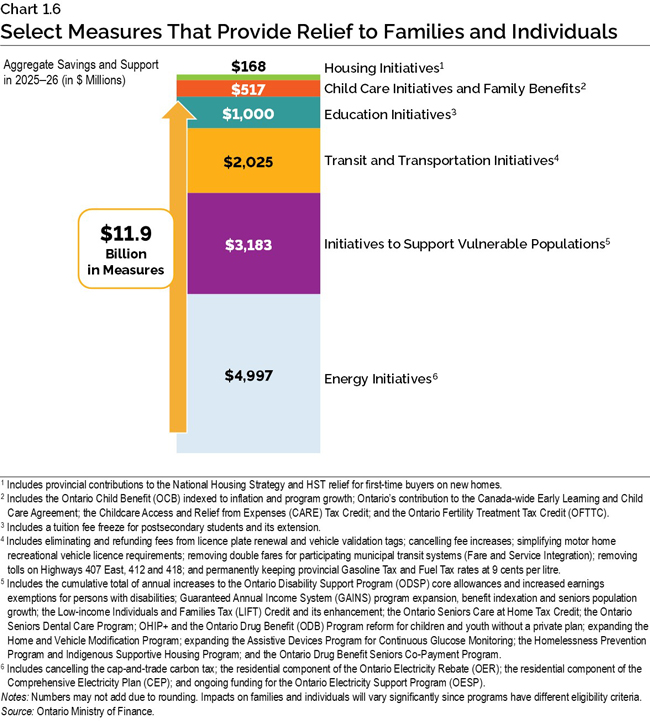
Chart 1.6 Select Measures That Provide Relief to Families and Individuals 1 Includes provincial contributions to the National Housing Strategy and HST relief for first-time buyers on new homes. 2 Includes the Ontario Child Benefit (OCB) indexed to inflation and program growth; Ontario’s contribution to the Canada-wide Early Learning and Child Care Agreement; the Childcare Access and Relief from Expenses (CARE) Tax Credit; and the Ontario Fertility Treatment Tax Credit (OFTTC). 3 Includes a tuition fee freeze for postsecondary students and its extension. 4 Includes eliminating and refunding fees from licence plate renewal and vehicle validation tags; cancelling fee increases; simplifying motor home recreational vehicle licence requirements; removing double fares for participating municipal transit systems (Fare and Service Integration); removing tolls on Highways 407 East, 412 and 418; and permanently keeping provincial Gasoline Tax and Fuel Tax rates at 9 cents per litre. 5 Includes the cumulative total of annual increases to the Ontario Disability Support Program (ODSP) core allowances and increased earnings exemptions for persons with disabilities; Guaranteed Annual Income System (GAINS) program expansion, benefit indexation and seniors population growth; the Low-income Individuals and Families Tax (LIFT) Credit and its enhancement; the Ontario Seniors Care at Home Tax Credit; the Ontario Seniors Dental Care Program; OHIP+ and the Ontario Drug Benefit (ODB) Program reform for children and youth without a private plan; expanding the Home and Vehicle Modification Program; expanding the Assistive Devices Program for Continuous Glucose Monitoring; the Homelessness Prevention Program and Indigenous Supportive Housing Program; and the Ontario Drug Benefit Seniors Co-Payment Program. 6 Includes cancelling the cap-and-trade carbon tax; the residential component of the Ontario Electricity Rebate (OER); the residential component of the Comprehensive Electricity Plan (CEP); and ongoing funding for the Ontario Electricity Support Program (OESP). Notes: Numbers may not add due to rounding. Impacts on families and individuals will vary significantly since programs have different eligibility criteria. Source: Ontario Ministry of Finance.
| 116 |
| Section B: Protect Ontario by Building the Most Competitive Economy in the G7 |
Enhancing Harmonized Sales Tax Relief on New Homes
To better address housing affordability and provide savings for families and individuals, the government is proposing to modernize provincial Harmonized Sales Tax (HST) relief provided to buyers of new homes.
As a first step, the government is proposing to enhance the provincial HST New Housing Rebate and New Residential Rental Property Rebate for one year. This would temporarily remove the full 8 per cent provincial portion of the HST for eligible buyers of new homes valued up to $1 million, providing up to $80,000 in savings to an eligible buyer. This maximum rebate amount of $80,000 would be maintained for new homes valued between $1 million and $1.5 million. For new homes valued above $1.5 million, a reduced rebate would be available. Higher-valued new homes that would have qualified for the maximum rebate of $24,000 under the current rules would qualify for at least that amount under this proposed enhancement. This would mean all eligible buyers, including first-time home buyers, could receive the same or more in total provincial relief as announced in the fall for first-time home buyers.
The province will propose that Ontario’s enhanced rebates be available from April 1, 2026 to March 31, 2027. For example, purchasers who acquire the home as their primary place of residence could be eligible if they enter into an agreement of purchase and sale with a builder on or after April 1, 2026 and on or before March 31, 2027. For these purchasers, construction of the home must begin on or before December 31, 2028 and the home must be substantially completed on or before December 31, 2031.
Other eligibility requirements for the New Housing Rebate and New Residential Rental Property Rebate would remain the same as under the current rules, including that the purchaser must be acquiring the new home for use as their primary place of residence or as a residential rental property.
These steps are necessary to help address the affordability of new homes, and as part of a suite of measures the government is taking to support a robust housing industry in the province.
See the Annex: Details of Tax Measures and Other Legislative Initiatives for more information.
Federal Partnership on New Housing
Ontario is working with the federal government to partner and match the province’s commitment to temporarily rebate the HST on all eligible new homes. Together, this could provide up to $130,000 in combined federal and provincial HST relief on new homes valued at $1 million and up to $1.5 million, to help build more homes, create jobs and improve affordability for families.
| 117 |
| Chapter 1: A Plan to Protect Ontario |
Expanding Harmonized Sales Tax Relief for First-Time Home Buyers on New Homes
On October 28, 2025, Ontario announced a proposal to remove the full 8 per cent provincial portion of the Harmonized Sales Tax (HST) for first-time home buyers of new homes valued up to $1 million. This would mirror the federal Goods and Services Tax/Harmonized Sales Tax (GST/HST) First-Time Home Buyers Rebate.
Ontario is now taking steps to align the effective date of the provincial rebate for first-time home buyers with the federal government’s new earlier effective date of March 20, 2025. This change would extend the rebate to purchasers who entered into agreements of purchase and sale on or after March 20, 2025, and before 2031. Ontario will continue working with the federal government on the implementation of the provincial rebate subject to passage of federal regulations that would bring the rebates into force.
Saving on Energy Costs
The Ontario Electricity Rebate (OER) continues to ensure electricity bills remain affordable, stable and predictable by providing rate relief for households, small businesses and farms. Through the OER, the government is currently providing a 23.5 per cent rebate to help keep residential, small business and farm electricity bills low and stable. For a typical residential customer who uses 700 kilowatt-hours (kWhs) of electricity per month, the OER will decrease bills by about $36 each month. The government also provides targeted electricity bill relief for eligible low-income households and on-reserve First Nation consumers, as well as eligible rural or remote customers. In addition, the Low-Income Energy Assistance Program (LEAP) provides grants towards electricity or natural gas bills for eligible consumers who are behind on payments and face having their service disconnected. Consumers who meet income eligibility can get up to $650 in emergency assistance for their electricity bills ($780 if their home is heated electrically) and up to $650 for natural gas bills.
The government has also recently expanded its energy savings programs. Under the Home Renovation Savings Program, eligible households can receive rebates of up to $200 for a wide range of energy-efficient appliances and new rebates for attic insulation without needing a home energy assessment. For industrial, municipal, institutional and health care organizations, the Save on Energy XLerate Program has increased the per project incentive from $5 million to $15 million to support large, complex, industrial capital projects that deliver measurable energy savings.
These programs are part of the province’s historic 12-year, $10.9 billion Energy Efficiency Framework, the largest investment in energy-efficiency programs in Canadian history, estimated to result in $23.1 billion in nominal electricity system benefits, thereby saving ratepayers $12.2 billion.
| 118 |
| Section B: Protect Ontario by Building the Most Competitive Economy in the G7 |
Permanently Reducing the Tax Rates for Gasoline and Fuel
To provide ongoing relief to households and businesses in Ontario, effective July 1, 2025, the government permanently cut the Gasoline Tax rate by 5.7 cents per litre and the Fuel (diesel) Tax rate by 5.3 cents per litre to establish a rate of 9 cents per litre.
To date, this measure has delivered $2.1 billion in Gasoline Tax and Fuel Tax relief to families and individuals since it was first introduced on a temporary basis on July 1, 2022. On average, these cuts are saving households about $115 per year.
Removing Tolls
Effective June 1, 2025, the government permanently removed tolls from the provincially owned portion of Highway 407 East — saving drivers approximately $94 million annually. This initiative will reduce the cost of travel, while increasing convenience and choice, and it is expected to save daily commuters an estimated $7,200 annually.
This was in addition to a number of other measures that the government implemented to put money back in drivers’ pockets, including eliminating licence plate renewal fees, removing tolls on Highway 412 and Highway 418, freezing fees for driver’s licences and Ontario Photo Cards and permanently cutting Gasoline and Fuel Tax rates.
| 119 |
| Chapter 1: A Plan to Protect Ontario |
Helping Transit Users Save with One Fare
Building on the success of One Fare, which is saving daily transit users in the Greater Toronto and Hamilton Area (GTHA) up to $1,600 per year, Ontario is extending the program for an additional two years to continue keeping transit costs down for commuters. Since launching in 2024, One Fare has saved the people of Ontario nearly $233 million and enabled nearly 72 million free transfers across participating transit agencies.
One Fare makes cross-boundary travel more affordable and convenient for all transit customers, including students, seniors and low-income riders, by ensuring the customer only pays once when transferring between GO Transit, the Toronto Transit Commission (TTC), Brampton Transit, Durham Region Transit, MiWay (Mississauga), Peel TransHelp and York Region Transit.
In addition, free transfers are offered between GO Transit and participating local agencies including Milton Transit, Grand River Transit, Guelph Transit, Oakville Transit, Hamilton Street Railway, Burlington Transit, Bradford West Gwillimbury Transit and Barrie Transit.
The government is taking further action to make public transit easier and more affordable across municipalities in the GTHA. It is moving forward with legislation, followed by engagement with partners, to explore expanding free transfers, simplifying fares, improving cross-boundary travel and enhancing specialized transit.
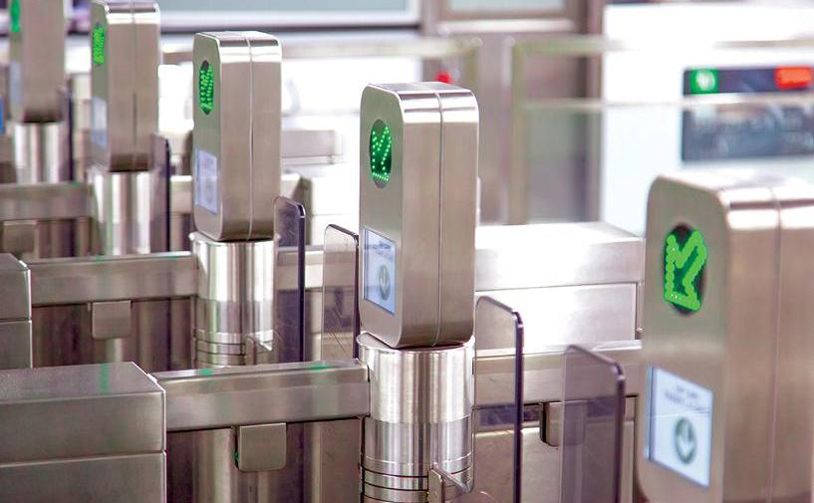
| Section B: Protect Ontario by Building the Most Competitive Economy in the G7 |
Putting Fans and Consumers First
Ontario is taking action to protect fans and promote fairness in the live events marketplace. As part of the government’s plan to Protect Ontario, new consumer protection measures will make it illegal for tickets to concerts, cultural events, sports games, theatre performances and other live events held in Ontario to be resold for more than their original total cost (the face value plus service fees and applicable taxes), plus permitted fees and charges on resale.
These changes are designed to address longstanding concerns about unfair resale practices. Recent high-demand events have highlighted how quickly tickets can be purchased and relisted at significantly higher prices. With demand for live events continuing to rise and resale practices becoming more sophisticated, this is an important moment to strengthen protections and help ensure fans have a fair chance to buy tickets.
By capping resale ticket prices, the government is reducing profit incentives for bulk resellers and helping restore fairness for fans. These measures also provide consumers with a clear, legal standard, making it easier to understand their rights.
In addition, the government will be undertaking a consultation to strengthen protections for consumers who participate in rewards points programs. Ontario is ensuring that consumers are protected and that the live events marketplace operates fairly and responsibly.
Ensuring an Effective Property Assessment and Taxation System
The government continues to make sure that the property assessment and taxation system is working effectively for Ontario businesses and families, while ensuring stability in challenging economic circumstances.
Several initiatives have been implemented, including providing authority for municipalities to reduce their property tax rates on affordable rental housing, ensuring consistent tax treatment for university-operated student housing, allowing municipalities to use Municipal Property Assessment Corporation (MPAC) data more broadly and supporting the digital delivery of MPAC property assessment notices. As part of this work, the government continues to examine policy options aimed at increasing the development of new purpose-built student housing facilities. This ongoing work aims to prioritize infrastructure strategies that support student success and benefit communities across the province.
The government continues to receive feedback on approaches that could make the property assessment and taxation system more effective from a broad range of stakeholders, including residential and business property owners and their affiliated organizations and the professional property tax and assessment sector.
| 121 |
| Chapter 1: A Plan to Protect Ontario |
Streamlining Municipal Education Property Tax Remittances
Education Property Tax (EPT) helps fund the elementary and secondary education system in Ontario. Currently, municipalities collect EPT on behalf of Ontario and distribute the funds across 72 school boards. This creates a cumbersome process of remitting EPT revenue several times per year to multiple school boards within each municipality’s jurisdiction.
The government plans to modernize the administration of EPT to ensure resources are directed to frontline student support rather than to unnecessary administrative burden. Planned legislative changes would streamline municipal EPT remittance processes so that beginning in 2028, municipalities would remit EPT directly to Ontario. School boards would continue to receive their full funding but would receive it directly through provincial payments, rather than separate payments from municipalities and the Ministry of Education.
Building on legislative changes announced in the 2025 Ontario Economic Outlook and Fiscal Review to simplify EPT administration, this measure would significantly reduce the number of transactions between municipalities and school boards and thereby lessen both the administrative burden and costs for Ontario, municipalities and school boards.
The government will work closely with municipalities and school boards prior to implementing the new streamlined processes.
| 122 |
| Section B: Protect Ontario by Building the Most Competitive Economy in the G7 |
Protect Ontario’s Public Services
By protecting the strength of the economy, the government can expand its investments in critical areas such as health care, education and other vital services. A solid economic foundation enables Ontario to enhance service delivery, support communities and businesses, create jobs and enable the conditions for continued success.
Connecting Everyone in Ontario to Primary Care
Ontario is building on the investments it has made to date for a primary care system that is comprehensive, convenient and connected for every single person in Ontario. This is why the government launched the Primary Care Action Plan on January 27, 2025. Through this Budget and sustained operational funding for new and expanded teams, the government is investing an additional $325 million to further expand primary care and connect everyone in Ontario to a family doctor or primary care team by 2029, bringing the four-year investment to $3.4 billion.
As part of the plan, the government has launched a series of initiatives, supported through this $3.4 billion investment, that aim to close the gap for people in need of primary care, including:
| • |
Creating and expanding more than 300 additional primary care teams to connect approximately two million people to primary care, including the investment of more than $250 million in 2026–27 to establish and expand additional primary care teams across the province that will connect 500,000 more people to primary care this year; and |
| • |
Investing in primary care teaching clinics across the province, including up to $300 million to support the creation and expansion of 18 clinics that will help connect more people to primary care. |
Since the launch of Ontario’s Primary Care Action Plan, the Health Care Connect waitlist as of January 1, 2025, has been reduced by more than 87 per cent as of March 2026 and is on track to be cleared by spring 2026. The new and expanded primary care teams are prioritizing people on the waitlist as they attach new patients to ongoing care.
| 123 |
| Chapter 1: A Plan to Protect Ontario |
Expanding Primary Care Teams
Since the launch of the Primary Care Action Plan, Ontario has connected 330,000 patients to a primary care provider. In April 2025, the government launched a call for proposals to create and expand up to 80 new primary care teams. As of June 2025, the government has approved 75 proposals representing over 130 primary care teams, including:
| • |
Port Arthur Health Centre (Thunder Bay): creating a new family health team, resulting in 7,400 patients connected as of December 2025; |
| • |
Superior Family Health Team (Sault Ste. Marie): expanding an existing family health team, connecting 700 patients as of December 2025; |
| • |
North Peel Family Health Team (Brampton): expanding an existing family health team, connecting 2,000 patients as of December 2025; |
| • |
Woolwich Community Health Centre (St. Jacobs): expanding an existing community health centre, connecting 1,600 patients as of December 2025; |
| • |
Erie Shores Family Health Team (Leamington): expanding an existing family health team, connecting 1,900 patients as of December 2025; and |
| • |
Équipe de santé familiale académique Montfort (Ottawa): expanding an existing Francophone family health team, connecting over 800 patients as of December 2025. |
As part of Ontario’s Primary Care Action Plan, the government is making primary care more accessible and convenient by advancing work on a provincewide electronic medical record for primary care. The Primary Care Medical Record system will form the foundation of a modern digital platform for primary care, replacing thousands of isolated chart systems with an interoperable, secure system that supports clinicians and patients alike. By eliminating the need for patients to repeat their medical history at every visit, primary care clinicians will have timely access to organized, comprehensive health information and the tools they need to make informed decisions, reduce delays in care and avoid unnecessary duplication of tests. This approach will significantly improve the security of patient records, all while connecting patients to more convenient care. To advance this work, the province will begin procurement activities to ensure the Primary Care Medical Record system meets the needs of both patients and clinicians.
| 124 |
| Section B: Protect Ontario by Building the Most Competitive Economy in the G7 |
Investing in Hospitals
Ontario’s hospitals play an integral role in delivering critical health services. This is why the government is investing over $1.1 billion in additional hospital funding for 2026–27. This investment includes an up to 4 per cent increase in base and targeted hospital funding, which promotes high-quality care, increased accountability, system efficiency and improved access to life-saving treatments.
This continues Ontario’s historic investment in hospitals for a fourth consecutive year and demonstrates that the government is enhancing hospital services so that the people of Ontario can access the care they need, where and when they need it.
Enhancing Hospital Accountability
The government has introduced a multi-year hospital sector stabilization plan to strengthen financial stewardship, oversight and system improvement through collaboration among the Ministry of Health, Ontario Health and hospitals. As one component of the plan, hospitals have identified cost-saving measures to support efficient, accessible hospital services.
Strengthening Home and Community Care
Home and community care is a foundational part of Ontario’s health system, helping to ensure people receive the right care in the right place. In the 2025 Ontario Economic Outlook and Fiscal Review, the government invested $1.1 billion over three years to connect more patients with home care services, including from nurses, personal support workers and therapists in 2025–26 and to sustain and expand the Hospital to Home (H2H) program. In the 2026 Budget, the government is investing an additional $1.1 billion over three years to support patients with more home and community care services that they need. This will further strengthen the sector by extending services to thousands more patients.
These sustained investments are delivering real and measurable improvements, including more consistency of care for patients, and a 94 per cent reduction in waitlisted patients for home-based personal support services from 2022–23 to 2024–25. These investments will also help to reduce the number of patients awaiting discharge from hospital to more appropriate care settings. To further strengthen this sector, the government is engaging with stakeholders to transform home care.
| 125 |
| Chapter 1: A Plan to Protect Ontario |
Expanding Access to Supportive Housing
Ontario is strengthening its supportive housing system to ensure the province’s most vulnerable individuals can access stable housing, mental health and addictions services and comprehensive wrap-around supports. This is why the government is committing nearly $53 million over three years to expand supportive housing initiatives for vulnerable populations and enhance access to critical mental health services and housing supports.
Once fully operational, these investments will enable the operations of over 425 supportive housing units, including new units at LOFT’s Bradford House and various Indwell Community Homes across the province. These initiatives will help vulnerable populations access the community-based services they need to achieve safety, independence and long-term well-being.
Training and Retaining Health Care Providers Across Ontario
The government is building a stronger and more resilient health care workforce throughout the province. Through the Ontario Learn and Stay Grant (OLSG), the government is supporting students with funding to cover the cost of tuition, books and other direct educational expenses for eligible health-related programs in underserved and growing communities in Northern, Southwestern and Eastern Ontario.
The government is continuing to deliver on its commitment to protect the province’s health care system by expanding the OLSG to include two new medical laboratory programs in Northern Ontario. This expansion builds on the thousands of highly trained nurses, paramedic and medical laboratory technologists who have been or will be added to the workforce in high-need regions of the province with the support of the OLSG. Since its launch in 2023, the government has invested more than $174 million to support 12,900 learners across the province. This includes more than $54 million invested in the North to train nearly 4,000 future health care workers.
The OLSG is a critical part of the government’s plan to protect the province’s health care system and highly skilled workforce to ensure people have access to high-quality health care, close to home. As announced in the 2025 Budget, the government is expanding the OLSG to four cohorts of medical school students. The grant will cover 100 per cent of direct educational costs, including tuition and fees, for those who commit to working in the community as family medicine physicians after completing residency anywhere in the province.
| 126 |
| Section B: Protect Ontario by Building the Most Competitive Economy in the G7 |
Continuing to Invest in Clinical Education for Nurses
Ontario is investing an additional $124.2 million over the next three years for clinical training and education funding to continue supporting the expansion of 2,000 registered nurse and 1,000 registered practical nurse seats at publicly assisted colleges and universities. Clinical education is a mandatory component of nursing education programs and provides students with a range of hands-on and clinical experiences. The continuation of clinical education funding is part of the government’s plan to address health human resource needs and support the growing demand for health care professionals in Ontario.
Building and Expanding Hospitals
The government is investing approximately $64 billion over the next decade in health infrastructure, including approximately $50 billion in capital grants. Ontario’s ambitious plan will support over 50 hospital projects and deliver approximately 3,000 new hospital beds to enhance access to quality care and build a connected, people-first health care system.
Recent milestones include:
| • |
Stevenson Memorial Hospital – Phase 1 Redevelopment (Alliston): Construction began on the 147,100 square foot facility, which will include a new emergency department and birthing suite, as well as expanded diagnostic and surgical services. |
| • |
Hamilton Health Sciences – Hamilton General Hospital Emergency Department Renovation Project: Construction is expected to begin in spring 2026 to help relieve space and volume pressures within the hospital, as well as to provide additional space for ambulance off-loading. |
| • |
Bluewater Health – Community Addictions Hub Project (Sarnia): The project is expected to be tendered in spring 2026 and includes the Integrated Withdrawal Management Program. This program consists of 24 beds along with other community withdrawal management services, day treatment and wrap-around services. |
| • |
Bluewater Health – Rural Health Capital Improvement Project (Petrolia): The project is expected to be tendered in spring 2026 and includes renovations to the emergency room and diagnostic imaging department. |
| 127 |
| Chapter 1: A Plan to Protect Ontario |
| • |
Sioux Lookout Meno Ya Win Health Centre – Magnetic Resonance Imaging Suite Project: This project is expected to be completed by the end of 2026 and will add approximately 1,900 square feet of new space to accommodate a new magnetic resonance imaging (MRI) machine as well as ancillary items. |
| • |
Lake of the Woods Hospital Redevelopment Project (Kenora): A planning grant of $50 million was provided to support the advanced planning of a replacement hospital that will include a culturally safe space for Indigenous communities and expanded medical services. |
| • |
Ottawa Civic Hospital: Investing in the building of a state-of-the-art campus, which will serve as the lead acute care centre for Ottawa and Eastern Ontario. |
| • |
Scarborough Health Network Dialysis Stations Projects (Toronto): The projects, which are nearing the end of construction, will support the renovation of existing space at Scarborough Health Network to accommodate a total of 27 new hemodialysis stations, including 21 stations at the Centenary site and 6 stations at the General site to meet the ongoing needs of patients and their families. |
| • |
New South Niagara Hospital Project (Niagara Falls): The project marked a significant milestone with the raising of the final structure beam in February 2026. Once completed in summer 2028, the project will include 469 beds, which is 156 more than the combined number of total beds in Niagara Health’s Port Colborne, Fort Erie and Niagara Falls sites, while expanding 24/7 emergency, diagnostic, surgical and therapeutic services for patients and families across the region. |
| 128 |
| Section B: Protect Ontario by Building the Most Competitive Economy in the G7 |
Supporting High-Quality Long-Term Care
Ontario continues to strengthen long-term care for residents across the province. This is why the government is providing $139.4 million in additional annual funding to support high-quality, resident-centred and sustainable long-term care.
As part of this funding, the government is investing $95.3 million, starting in 2026–27, to maintain existing services for residents. The government is also investing $44.1 million, starting in 2026–27, to ensure every resident continues to receive an average of four hours of direct care each day from nurses and personal support workers and 36 minutes of care from allied health professionals.
With this funding, Ontario continues to strengthen long-term care, helping ensure residents across the province receive more consistent, high-quality care.
Building Long-Term Care Homes
The government continues to make progress towards its commitment to build 58,000 new and upgraded beds to modern design standards across the province by 2028. As of February 2026, 164 long-term care homes are either open, under construction or are approved to start construction. This includes:
| • |
61 projects completed, representing 4,054 new beds and 4,297 beds upgraded to modern design standards; and |
| • |
103 projects under construction or approved to start construction, representing 10,337 new beds and 7,205 beds being upgraded to modern design standards. |
| 129 |
| Chapter 1: A Plan to Protect Ontario |
In July 2025, the government launched a new construction funding support program to ensure long-term care operators and builders have additional flexibility and support to continue Ontario’s historic level of construction. The 2025 Long-Term Care Home Capital Funding Program provides a funding framework that better reflects regional cost variations while addressing diverse operator needs across the sector. In total, the government enabled 120 long-term care homes to start construction between August 2023 and March 2026. Projects underway with support of the Capital Funding Program include:
| • |
Carefirst Campus of Care York Region – building 124 new beds in Richmond Hill; |
| • |
Maxville Manor – building 38 new beds and upgrading 122 beds in Maxville; |
| • |
Mon Sheong Richmond Hill Long-Term Care Centre – building 288 new beds in Richmond Hill; |
| • |
St. Joseph’s Health Centre – building three new beds and upgrading 61 beds in Gore Bay; |
| • |
IOOF Seniors Home Inc. – building 64 new beds and upgrading 66 beds in Barrie; |
| • |
Belmont House – building 168 new beds in Toronto; and |
| • |
Southbridge Ottawa II – building 192 new beds in Ottawa. |
In addition, Ontario continues to leverage tools to support financing the development of long-term care beds with the support of the Building Ontario Fund. This will stimulate and sustain more construction starts of long-term care homes across Ontario.
Support for the long-term care sector has enabled significant new investments that will increase health system capacity and help address wait times for placement from the community and hospital settings.
| 130 |
| Section B: Protect Ontario by Building the Most Competitive Economy in the G7 |
Strengthening Supports to Improve Student Achievement
Ontario is reinforcing its dedication to student success by advancing foundational investments in math and literacy, strengthening graduation outcomes and enhancing student well-being. These investments will help ensure students develop the skills needed to reach their full potential and contribute to Ontario’s future prosperity.
The government will provide continued funding to strengthen student achievement in the 2026–27 school year, including investments of $95 million to:
| • |
Sustain access to digital math tools that provide anytime access to learning opportunities at home and in the classroom, and to maintain access to math facilitators who work directly with students requiring additional support; |
| • |
Continue offering dedicated reading supports for early learners so that every child in senior kindergarten, Grade 1 and Grade 2 benefits from screening; |
| • |
Continue delivering a catalogue of high-quality online courses accessible to students; and |
| • |
Sustain mental health services for students during summer months and maintain dedicated resources to help students with special education needs navigate the school system and beyond. |
There is also a net new investment of over $5 million to develop learning resources that reflect the French language and Francophone culture.
Helping Teachers Access Classroom Supplies
Improving student achievement and preparing students for the future requires that teachers have consistent and adequate resources, including classroom supplies. This is why the government is investing $66 million per school year to create the Classroom Supplies Fund for elementary school homeroom teachers to receive a Classroom Supplies Card that provides access to $750 annually to reduce out-of-pocket expenses.
Teachers can purchase resources such as arts and crafts materials, writing supplies, tissues and paper towels through a new provincial website. This investment makes it easier for elementary teachers to order what they need, giving them flexibility to choose materials that fit their teaching plans, and further supports student success by putting funding directly into the classroom.
| 131 |
| Chapter 1: A Plan to Protect Ontario |
Protecting Children in Child Care with the Liam Riazati Memorial Fund
As announced in December 2025, the government is investing $20 million to launch the Liam Riazati Memorial Fund to help keep children safe in child care by supporting community-based licensed facilities to install concrete barriers that protect these centres and their outdoor play spaces. This fund honours the life of Liam Riazati, a child who tragically passed away following a motor vehicle collision with a child care centre in September 2025.
The Liam Riazati Memorial Fund supports community-based child care programs, many of which operate in unique spaces such as retail settings, places of worship and other standalone public buildings, where concrete barriers can offer greater peace of mind and add an extra layer of protection.
Investing in Schools and Child Care Spaces
The government is continuing to provide support to growing communities by increasing modern learning spaces for students to drive student success. This is why Ontario is investing about $30 billion over the next 10 years, including over $22 billion in capital grants, to support new and redeveloped schools and child care projects. These investments will help students succeed in their studies and prepare them for the future.

| Section B: Protect Ontario by Building the Most Competitive Economy in the G7 |
Table 1.2
Projected School Projects Opening for the 2026–27 School Year
Northern
| • |
A new English public elementary and secondary school in Rainy River, which will serve 311 students and include 39 new licensed child care spaces. |
| • |
A new English public elementary school in Savant Lake, which will serve 95 students. |
Eastern
| • |
An addition to Notre Dame Catholic High School in Carleton Place, with 230 student spaces. |
| • |
A new French Catholic elementary school in Orléans, which will serve 412 students and include 49 new licensed child care spaces. |
| • |
A new French public elementary school in Orléans, which will serve 354 students and include 49 new licensed child care spaces. |
| • |
A new English public elementary school in Ottawa, which will serve 674 students and include 39 new licensed child care spaces. |
| • |
An addition to St. Thomas Aquinas Catholic High School in Russell, with 230 student spaces. |
Southwestern
| • |
A new joint English public and Catholic elementary school in Cambridge, which will serve 873 students and include 88 new licensed child care spaces. |
| • |
A new English public elementary school in Central Elgin, which will serve 507 students. |
| • |
A new French public elementary school in Hamilton, which will serve 271 students and include 49 new licensed child care spaces. |
| • |
A new English Catholic elementary and secondary school in Kitchener, which will serve 1,400 students. |
| • |
A new English public elementary school in Lucan Biddulph, which will serve 531 students and include 88 new licensed child care spaces. |
| • |
An addition to St. Joseph’s Catholic High School in Windsor, with 184 student spaces. |
Central
| • |
An addition to Holy Trinity Catholic High School in Bradford West Gwillimbury, with 276 student spaces. |
| • |
A new English public elementary school in Caledon, which will serve 650 students and include 73 new licensed child care spaces. |
| • |
A new French public elementary school in North York, which will serve 412 students and include 73 new licensed child care spaces. |
| • |
A new English Catholic elementary school in Tottenham, which will serve 516 students and include 49 new licensed child care spaces. |
| • |
A new English public elementary school in Whitby, which will serve 634 students and include 49 new licensed child care spaces. |
Source: Ontario Ministry of Education.
| 133 |
| Chapter 1: A Plan to Protect Ontario |
Table 1.3
Continuing to Get Shovels in the Ground to Build More Schools
Northern
| • |
A new English public elementary school in Kenora, which will serve 46 students and include 15 new licensed child care spaces. |
Eastern
| • |
A new English Catholic elementary school in Amherstview, which will serve 518 students and include 49 new licensed child care spaces. |
| • |
A new French public secondary school in Clarence-Rockland, which will serve 414 students. |
| • |
A new French Catholic elementary and secondary school in Kemptville, which will serve 417 students and include 49 new licensed child care spaces. |
| • |
A new French public elementary school in Ottawa, which will serve 467 students and include 88 new licensed child care spaces. |
Southwestern
| • |
A new English public elementary school in Lakeshore, which will serve 582 students. |
| • |
A new English Catholic elementary school in Lincoln, which will serve 421 students and include 49 new licensed child care spaces. |
| • |
An addition to St. Mary’s Catholic School in Listowel, with 150 student spaces, including 98 new licensed child care spaces. |
| • |
A new English public elementary school in London, which will serve 525 students and include 88 new licensed child care spaces. |
| • |
A new English Catholic elementary school in Middlesex Centre, which will serve 424 students and include 88 new licensed child care spaces. |
Central
| • |
A new French public elementary school in Ajax, which will serve 317 students and include 49 new licensed child care spaces. |
| • |
A new English public elementary school in Barrie, which will serve 662 students. |
| • |
A new French Catholic secondary school in Brampton, which will serve 410 students. |
| • |
A new English public secondary school in Oakville, which will serve 1,338 students and include 88 new licensed child care spaces. |
| • |
A new English Catholic elementary and secondary school in Oshawa, which will serve 1,061 students. |
| • |
A new English Catholic elementary school in Toronto, which will serve 600 students and include 88 new licensed child care spaces. |
Source: Ontario Ministry of Education.
| 134 |
| Section B: Protect Ontario by Building the Most Competitive Economy in the G7 |
Supporting the Postsecondary Sector’s Long-Term Success and Sustainability
The government is taking decisive action to protect postsecondary students’ access to the education they need to launch successful careers, while building long-term sustainability in the postsecondary sector and supporting the world-class research being conducted at Ontario universities and colleges.
The province is establishing a new long-term funding model that will bring an additional $6.4 billion into the sector over four years and raise annual operating funding to $7 billion, a 30 per cent increase and the highest level in the province’s history. It will also fund 70,000 more in-demand seats, while better meeting the needs of small, rural, Northern, French-language colleges and universities and Indigenous Institutes. This investment builds on the over $2 billion in additional funding for colleges, universities and Indigenous Institutes since 2024, which included $750 million to support the delivery of Science, Technology, Engineering and Mathematics (STEM) programs, funding up to 20,500 STEM seats per year. The government is also introducing an updated tuition framework and a stronger, more sustainable Ontario Student Assistance Program (OSAP) system, which will ensure financial assistance remains available for future generations, while maintaining one of the lowest rates of tuition increase in Canada.
The government is also investing $6 million over three years to provide competitive scholarships for Ontario postsecondary students through the Queen Elizabeth Scholars program, administered by the Rideau Hall Foundation. This investment will strengthen the province’s talent pipeline and international competitiveness.
These initiatives will support students and protect access to the education they need to land rewarding, in-demand careers and ensure the province’s world-class institutions can continue producing one of the most competitive workforces in the G7 for generations to come.
Expanding French-Language Postsecondary Education in the North
The Ontario government is investing $21.6 million to re-launch courses at the Université de Sudbury, in partnership with the University of Ottawa. This investment will expand access to high-quality French-language postsecondary education in Northern Ontario, helping more Francophone students acquire the skills they need for good-paying, in-demand jobs and meeting the needs of Ontario’s workforce. At its Sudbury campus, the Université de Sudbury is offering programs in health sciences, general science, commercial studies and the arts.
| 135 |
| Chapter 1: A Plan to Protect Ontario |
Expanding Services for Children and Youth with Autism
The government is taking further action to improve services for children and youth on the autism spectrum by providing $965 million to the Ontario Autism Program in 2026–27, including $186 million in new funding.
This new investment will enable more children and youth to access core clinical services while further strengthening sector capacity across the province. It also builds on the government’s ongoing work to modernize and enhance the Ontario Autism Program to better meet the needs of families.
Children’s Hospital of Eastern Ontario — New Integrated Children’s Treatment Centre
Ontario is investing in redeveloping the Children’s Hospital of Eastern Ontario (CHEO) Integrated Treatment Centre, which will consolidate services and programs across eight locations into one modern, fully accessible facility connected directly to the CHEO hospital, improving access to and coordination of quality care for children and youth with special needs. Once it is operational in 2028, the centre will serve approximately 13,700 children and youth with special needs every year, along with their families, across Eastern Ontario.
Enhancing Social Assistance to Help Manage Rising Costs
The government is helping people with a disability who rely on social assistance to manage the rising cost of living. This is why Ontario continues to index Ontario Disability Support Program (ODSP) rates and Assistance for Children with Severe Disabilities (ACSD) to inflation. In July 2025, recipients received a 2.8 per cent increase to their monthly basic needs and shelter amounts, bringing the maximum support for a single person to $1,408 per month and $655 per month for ACSD. Since 2022, rates have increased by 20 per cent and the next annual inflationary increase will take effect in July 2026.
The province also introduced a measure in May 2025 to strengthen income security across social assistance programs by exempting the Canada Disability Benefit as income for social assistance recipients. This change allows recipients of ODSP, Ontario Works and Assistance for Children with Severe Disabilities (ACSD) to receive their maximum entitlement under the federal benefit, without any reduction to their provincial supports.
| 136 |
| Section B: Protect Ontario by Building the Most Competitive Economy in the G7 |
Strengthening Community Organizations to Support People
The government is investing an additional $407 million over three years to help community organizations manage rising operational costs and continue delivering vital services to people who need them. This investment strengthens supports for individuals with special needs and developmental disabilities, as well as for survivors of gender-based violence or human trafficking.
Boosting Supports to Help Women Build Skills and Advance Their Careers
The government is taking action to improve the lives of women across the province by advancing women’s economic security, supporting survivors of violence and human trafficking and building safer and more resilient communities.
Building on existing programs, the government is providing $5.5 million in 2026–27 for the Women’s Economic Leadership and Legacy (WELL) Fund. The WELL fund will create more opportunities for women to gain skills, grow their careers and take on leadership roles. It will also support Indigenous women and help survivors of human trafficking rebuild their lives.
Working closely with community and Indigenous organizations, the WELL fund will support initiatives that help women prepare for and connect to jobs in high-demand sectors. These investments will also strengthen the province’s economy by expanding the talent pool, boosting labour force participation and supporting growth in key sectors.

| Chapter 1: A Plan to Protect Ontario |
Advocating for a Fair and Sustainable Federal Transfer System
Flexible, adequate, fair and sustainable federal–provincial transfers are critical to ensuring sustainable public services in Ontario. To address ongoing challenges in health care, education and other services faced by Ontario, it is important for the federal government to ensure long-term, predictable funding for initiatives that federal, provincial and territorial governments have worked together to implement.
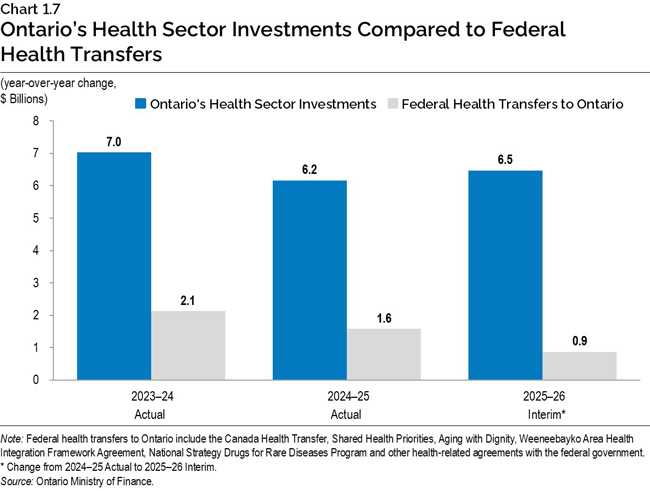
Provincial budgets continue to face pressures due to rising health care expenses. As shown in Chart 1.7, in recent years, Ontario’s incremental investments in the health sector far exceed increases in federal health funding. This trend will continue without additional federal support.
This is why Ontario, along with other provinces and territories, continues to call on the federal government to make permanent the temporary 5 per cent minimum growth rate guarantee for the Canada Health Transfer that ends in 2027–28. Ontario is also advocating for additional health funding, and for the renewal of expiring time-limited agreements to ensure the continuation of essential programs and services, including funding to support mental health and addictions programs as outlined in the Roadmap to Wellness, home and community care and long-term care.
| 138 |
| Section B: Protect Ontario by Building the Most Competitive Economy in the G7 |
Ontario continues to call on the federal government to advance the achievement of shared housing outcomes, including increasing support under the current National Housing Strategy, and working with other provinces and territories on a long-term federal commitment beyond its expiry in 2027–28.
Supporting Child Care in Ontario
Ontario has signed a one-year, $3.6 billion extension of the Canada-wide Early Learning and Child Care (CWELCC) Agreement with the federal government until March 31, 2027. This extension includes a one-time allocation of $695 million to sustain parent fees at their current levels (an average of approximately $19 per day, and a maximum of $22 per day) until December 31, 2026, while allowing Canada and Ontario to continue renegotiation discussions on a longer-term agreement.
While Ontario and Canada have made meaningful progress, Ontario remains focused on addressing the funding pressures associated with sustaining the CWELCC system beyond 2026.
Protecting Ontario with Stronger Safeguards for Public Information
After nearly four decades without any major updates, Ontario’s current privacy and access laws are no longer reflective of today’s technology or responsible modern governance. To address these gaps, the province is taking a number of actions to improve digital government and privacy, including enhanced cybersecurity rules for the broader public service, stronger safeguards for children’s information and modernized Freedom of Information (FOI) timelines and processes. This includes changes to the FOI process for cabinet ministers, parliamentary assistants and their offices, that will more closely align Ontario with other jurisdictions in Canada, supporting more cost-efficient government administration and helping ensure a more modern and secure Ontario.
| 139 |
| Chapter 1: A Plan to Protect Ontario |
Allowing Retail Stores to Open on Family Day and Victoria Day
The government is proposing amendments that will remove the requirement for retail businesses to close on Family Day and Victoria Day, while maintaining the authority of municipalities to set their own retail closure by-laws. These changes modernize provincial standards to better reflect the evolving needs of retailers, workers and consumers, while ensuring that municipalities retain flexibility to address their own local priorities.
To ensure a consistent experience for consumers and a level playing field for retail businesses across Ontario, the proposed legislative amendments would include removing the authority of municipalities — including the City of Toronto — to pass or maintain local by-laws requiring retail business establishment closures on these two holidays.
Our government would be modernizing out of date rules, while maintaining strong protections for employees who would continue to benefit from public holiday rights under the Employment Standards Act.
Public Services Delivered More Efficiently
The people of Ontario expect their services to be efficient, effective and relevant. To deliver on its plan, the government committed, in the 2025 Ontario Economic Outlook and Fiscal Review, to explore and apply new ways to responsibly harness technology and modern solutions. This will help to save time, streamline government operations and make the best use of resources. Ultimately, this means key public services will involve fewer steps that take less time for businesses and the public.
| 140 |
| Section B: Protect Ontario by Building the Most Competitive Economy in the G7 |
Ontario’s prudent management of the public-sector workforce has resulted in an Ontario Public Service (OPS) that is a national leader in modern, efficient and focused frontline service delivery. Since 2018, this management has included a hiring freeze on non-essential positions, leaning out processes that have reduced the need for staffing increases, redeploying staff to advance key government priorities without increasing overall staffing numbers and back-office efficiencies that have redirected the ratio of front-office to back-office staff from 50:50 in 2019–2020 to 60:40 in 2025–2026. As a result, Ontario’s public service size relative to population is leaner than that of the federal government or any other province or territory, at 519 public servants for every 100,000 residents of Ontario in 2025. Ontario also has the fewest public servants per $1 billion of base government spending on services and transfer payments at 388.3 public servants for every $1 billion, again, better than any other public service in Canada.
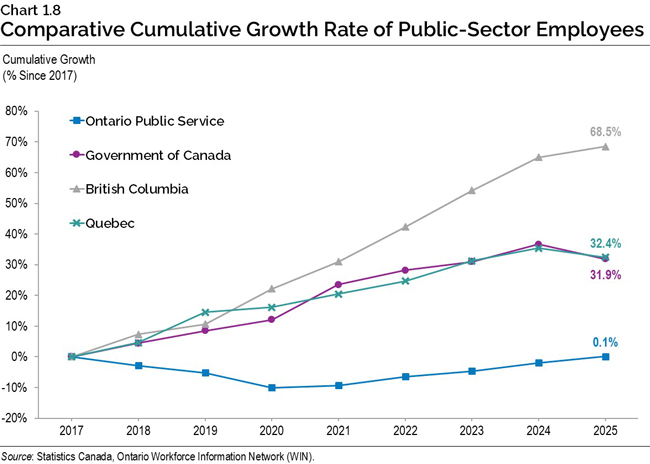
This responsible management means that since 2018, Ontario’s public-service growth rate has been substantially lower than that of the federal government and other provinces and territories, several of which are now cutting their public services after years of rapid growth. Ontario’s proactive approach to date has helped avoid the need for these rapid cuts, although the government will always pursue efficiencies while maintaining high-quality service delivery, including by maintaining strict control over the growth of the OPS.
| 141 |
| Chapter 1: A Plan to Protect Ontario |
Building on this proven approach, the government is now focused on applying this discipline to Ontario government agencies, boards and commissions, which have grown at a much faster rate than the OPS. In September 2025, the government imposed a hiring freeze, which is projected to avoid costs to the public of close to $300 million. This action builds on Ontario’s progress in modernizing public services — including reducing the number of provincial agencies from 191 to 137 since 2018 — to create a more accountable, sustainable system that delivers better value and better services for the people of Ontario.
Strengthening Public Services for a Sustainable and Prosperous Future
In response to global economic challenges, Ontario has continued to judiciously manage its finances to build a more resilient and self-reliant economy and secure long-term prosperity. The government is rising to these challenges by pursuing opportunities to modernize programs and address areas where there have been rising pressures. By reducing bureaucracy and administrative costs and ensuring programs are delivered in the most efficient and cost-effective way possible, the government is freeing up resources to deliver better frontline services to those who need them most.
Examples of actions taken to date include:
| • |
Updating the postsecondary tuition framework, which will support the sector’s long-term sustainability while maintaining one of the lowest rates of tuition increase in Canada; |
| • |
Strengthening the long-term sustainability of OSAP by bringing eligibility for grants and loans in line with that of other provinces; |
| • |
Seeking new technology solutions to enhance the efficiency of government services such as using automation to renew vehicle permits so the people of Ontario no longer need to visit ServiceOntario counters; |
| • |
Streamlining the province’s approach to conservation management by establishing the new Ontario Provincial Conservation Agency, which will support work to standardize service delivery, introduce digital permitting tools and dedicate more resources to frontline services; |
| • |
Finding internal efficiencies across the OPS by applying Lean Six Sigma management techniques; and |
| • |
Continuing to strengthen and sustain public services. |
| 142 |
| Section B: Protect Ontario by Building the Most Competitive Economy in the G7 |
Taking actions like these will help ensure that Ontario has the enhanced fiscal capacity to invest in better frontline services for those who need them most, and that it can invest in strategic priorities that put more money back in people’s pockets and unleash the economy. The government will continue to consider opportunities to ensure programs are providing the best value for money for the people of Ontario. For example, the government will:
| • |
Review provincial infrastructure investments and electricity rate relief programs to reduce duplication and streamline program delivery; |
| • |
Consider options to reduce the incidence of Ontario Health Insurance Plan (OHIP) fraud and enhance the program integrity of Ontario Works; |
| • |
Continue to review Ontario’s business support programs to identify opportunities to streamline programs and ensure they are successful in attracting investments while achieving good value for taxpayer dollars; and |
| • |
Continue to work with health care partners to ensure accountable and improved service delivery, without impacting frontline workers. |
These initiatives will help modernize Ontario’s services and ensure the province is providing lasting, high-impact results for businesses and people.
Modernizing Ontario’s Alcohol Sector
The Ontario government is increasing choice and convenience for Ontario consumers by modernizing the alcohol marketplace. Today, customers across Ontario can shop for beer, wine, cider and ready-to-drink (RTD) beverages in over 6,600 licensed convenience and grocery stores.
Sales of Ontario alcohol products have grown by approximately 22 per cent, with local craft products up by about 35 per cent and Vintners Quality Alliance (VQA) wine sales increasing by roughly 52 per cent.1 In response to consumer demand, the LCBO continues to promote and prioritize small producers and Ontario-made products to help these businesses contribute further to Ontario’s economy.
As of April 1, 2026, the LCBO will become the exclusive wholesaler for all retailers, bars and restaurants selling alcohol to the public. To help with this transition, the government is reducing wholesale mark-ups by about $200 million to support producers and retailers succeed in the expanded marketplace. The new wholesale pricing model will streamline and simplify wholesale pricing, providing a more level playing field for all market participants.
| 1 | Based on April 1, 2025 to January 31, 2026 sales data from the Liquor Control Board of Ontario (LCBO). |
| 143 |
| Chapter 1: A Plan to Protect Ontario |
To help support a more dynamic and competitive beverage alcohol marketplace, the government is also simplifying and reducing alcohol taxes by $60 million. In addition, this summer, the government will be consulting with stakeholders on a progressive alcohol tax and mark-up system.
Improving Choice and Convenience
By July 1, 2026, the LCBO will have implemented a fully open listing process. The process will provide retailers and producers with access to the LCBO’s product catalogue, bringing new products to the market in a timely manner. This will help foster competition and improve consumer choice and convenience.
Reducing Red Tape for Producers and Retailers
Ontario is further enhancing the LCBO Direct Delivery Program. Starting July 1, 2026, all Ontario distillers will be able to deliver spirits-based RTD beverages directly to eligible licensees (for example, bars and restaurants), providing local distillers with opportunities to grow their businesses further. This builds on recent changes to the program for producers of 100 per cent Ontario non-VQA wine.
The government is also providing additional flexibility for suppliers to recover delivery costs from wholesale customers when directly delivering their products. This change is expected to foster more competition among suppliers and provide new opportunities for other businesses to deliver products in the expanded marketplace.
Ontario is making it easier for retailers and producers to manage their logistics more efficiently. Later this summer, convenience stores will have more options on how they use distributors, including third parties, to get beverage alcohol to their stores. Eligible retailers will also be able to fulfil online orders from their distribution centres for consumers who want to order alcohol with their groceries. Retailers will also be able to transfer products between their licensed affiliated locations.
The government is working with the LCBO to allow domestic beer manufacturers, who have facilities in Ontario, to ship their products directly to their final destination in the province. By removing Ontario’s restrictions, the government is taking steps towards allowing retailers to temporarily hold alcohol products in neighbouring provinces before bringing them back into Ontario for sale.
These changes will support a more dynamic and responsive expanded marketplace.
| 144 |
| Section B: Protect Ontario by Building the Most Competitive Economy in the G7 |
Improving Ontario’s Mortgage Broker Industry
The report of the third legislative review of the Mortgage Brokerages, Lenders and Administrators Act, 2006 was delivered in February 2026. The report’s recommendations centre on three key themes: reinforcing professionalism of mortgage experts, reducing regulatory burden and strengthening consumer protection.
The report was delivered by Member of Provincial Parliament Michelle Cooper, Parliamentary Assistant to the Minister of Finance, and its recommendations were informed by extensive stakeholder consultations led by the previous appointees, Minister Stephen Crawford and Associate Solicitor General Zee Hamid.
The government will work with the regulator, the Financial Services Regulatory Authority of Ontario (FSRA), on implementing the recommendations. These include proposals for regulatory change, such as allowing mortgage agents to work with additional lenders, enabling more modern options for delivery of orders and notices and allowing the use of team names within a brokerage. As part of implementation, the government will continue to engage the sector, including lenders, borrowers and investors, to ensure the sector can better serve the people of Ontario.
Protecting Consumers in the Life and Health Insurance Sector
To strengthen consumer protection and recognize the role that Managing General Agents (MGAs) play in Ontario’s life and health insurance sector, the government created a new licensing framework for these MGAs in fall 2024, following earlier consultations.
Since then, FSRA has actively engaged in consultations with the sector on associated framework rules, in support of a June 1, 2026 launch date for the framework.
The government has decided to postpone this launch date to allow for sufficient time to assess stakeholder feedback received during the consultation period with FSRA. The government will continue to engage with the sector as next steps on the framework are determined.
| 145 |

| Chapter 2: Economic Performance and Outlook |
Introduction
Ontario’s economy remains resilient and performed better than expected in 2025, despite headwinds created by U.S. trade policy. Real gross domestic product (GDP) is estimated to have increased by 1.2 per cent, up from 0.8 per cent at the time of the 2025 Budget.
Ontario’s real GDP is projected to grow by 1.0 per cent in 2026 and growth is expected to pick up in subsequent years, with projected increases of 1.7 per cent in 2027, 1.8 per cent in 2028 and 2.0 per cent in 2029. For the purposes of prudent fiscal planning, these projections are set slightly below the average of private-sector forecasts.
| Table 2.1 Summary of Ontario’s Economic Outlook
(Per Cent) |
||||||||||||||||||||
| 2025 | 2026p | 2027p | 2028p | 2029p | ||||||||||||||||
| Real GDP Growth | 1.2e | 1.0 | 1.7 | 1.8 | 2.0 | |||||||||||||||
| Nominal GDP Growth | 4.2e | 3.2 | 3.9 | 3.7 | 3.9 | |||||||||||||||
| Employment Growth | 1.0 | 0.5 | 0.7 | 0.8 | 1.1 | |||||||||||||||
| CPI Inflation | 1.9 | 2.1 | 2.0 | 2.0 | 2.0 | |||||||||||||||
| e = estimate. p = Ontario Ministry of Finance planning projection based on external sources as of January 16, 2026. Sources: Statistics Canada and Ontario Ministry of Finance. |
| |||||||||||||||||||
| 149 |
| Chapter 2: Economic Performance and Outlook |
Revisions to the Outlook Since the 2025 Budget
The outlook has been revised compared to the projections in the 2025 Budget. Key changes since the 2025 Budget include the following:
| • |
Stronger nominal GDP growth in 2025 and 2026; |
| • |
Stronger growth in compensation of employees and net operating surplus in 2025; |
| • |
Stronger job creation in 2025 and 2026; and |
| • |
Slower growth in home resales in 2025 and 2026. |
Table 2.2
Changes in the Ontario Ministry of Finance Key Economic Forecast Assumptions: 2025 Budget Compared to 2026 Budget
(Per Cent Change)
| 2025 | 2026p | 2027p | 2028p | |||||||||||||||||||||||||||||
| 2025 Budget |
2026 Budget |
2025 Budget |
2026 Budget |
2025 Budget |
2026 Budget |
2025 Budget |
2026 Budget |
|||||||||||||||||||||||||
| Real Gross Domestic Product | 0.8 | 1.2e | 1.0 | 1.0 | 1.9 | 1.7 | 1.9 | 1.8 | ||||||||||||||||||||||||
| Nominal Gross Domestic Product | 3.1 | 4.2e | 3.0 | 3.2 | 4.0 | 3.9 | 4.0 | 3.7 | ||||||||||||||||||||||||
| Compensation of Employees | 3.7 | 4.0e | 3.2 | 3.2 | 3.6 | 3.3 | 3.8 | 3.5 | ||||||||||||||||||||||||
| Net Operating Surplus — Corporations | (3.0) | 4.4e | 6.4 | 4.7 | 7.2 | 7.2 | 5.2 | 6.1 | ||||||||||||||||||||||||
| Nominal Household Consumption | 3.5 | 4.0e | 3.1 | 3.3 | 3.7 | 3.4 | 3.8 | 3.6 | ||||||||||||||||||||||||
| Other Economic Indicators | ||||||||||||||||||||||||||||||||
| Employment | 0.9 | 1.0 | 0.4 | 0.5 | 0.9 | 0.7 | 0.9 | 0.8 | ||||||||||||||||||||||||
| Job Creation (000s) | 73 | 81 | 33 | 41 | 74 | 58 | 75 | 67 | ||||||||||||||||||||||||
| Unemployment Rate (Per Cent) | 7.6 | 7.7 | 7.3 | 7.4 | 6.6 | 6.9 | 6.2 | 6.4 | ||||||||||||||||||||||||
| Consumer Price Index | 2.3 | 1.9 | 2.0 | 2.1 | 2.0 | 2.0 | 2.0 | 2.0 | ||||||||||||||||||||||||
| Housing Starts (000s)1 | 71.8 | 65.4 | 74.8 | 64.8 | 82.5 | 70.3 | 85.9 | 76.8 | ||||||||||||||||||||||||
| Home Resales | 5.3 | (5.6) | 12.7 | 9.1 | 4.6 | 5.6 | 1.5 | 4.6 | ||||||||||||||||||||||||
| Home Resale Prices | (1.2) | (4.4) | 2.6 | 0.8 | 3.8 | 2.7 | 4.0 | 4.2 | ||||||||||||||||||||||||
| Key External Variables | ||||||||||||||||||||||||||||||||
| U.S. Real Gross Domestic Product | 1.4 | 2.2 | 1.4 | 2.4 | 2.0 | 2.1 | 2.0 | 2.0 | ||||||||||||||||||||||||
| WTI Crude Oil ($US per Barrel) | 69 | 65 | 69 | 59 | 74 | 62 | 75 | 67 | ||||||||||||||||||||||||
| Canadian Dollar (Cents US) | 69.2 | 71.6 | 71.2 | 73.2 | 73.0 | 75.3 | 74.1 | 76.4 | ||||||||||||||||||||||||
| Three-Month Treasury Bill Rate (Per Cent)2 | 2.4 | 2.6 | 2.3 | 2.3 | 2.4 | 2.6 | 2.6 | 2.5 | ||||||||||||||||||||||||
| 10-Year Government Bond Rate (Per Cent)2 | 3.1 | 3.2 | 3.2 | 3.3 | 3.4 | 3.5 | 3.5 | 3.5 | ||||||||||||||||||||||||
e = estimate.
p = Ontario Ministry of Finance planning projection based on external sources as of January 16, 2026.
| 1 | Housing starts projection based on private-sector average as of January 16, 2026. |
| 2 | Government of Canada interest rates. |
Sources: Statistics Canada; Canada Mortgage and Housing Corporation; Canadian Real Estate Association; Bank of Canada; United States Bureau of Economic Analysis; Blue Chip Economic Indicators (February 2026 and October 2025); U.S. Energy Information Administration; and Ontario Ministry of Finance.
| 150 |
| Chapter 2: Economic Performance and Outlook |
Recent Economic Performance
Ontario’s economy continued to grow in 2025 as the province navigated the changing trade landscape. Real GDP rose 0.5 per cent in the first quarter of 2025, as export activity was pulled forward in anticipation of the implementation of U.S. tariffs. In the second quarter, exports experienced the biggest decline since the pandemic, contributing to a 0.7 per cent decline in overall real GDP. Real GDP then rebounded by 0.5 per cent in the third quarter, with growth supported by gains in net trade as exports edged up and imports declined.
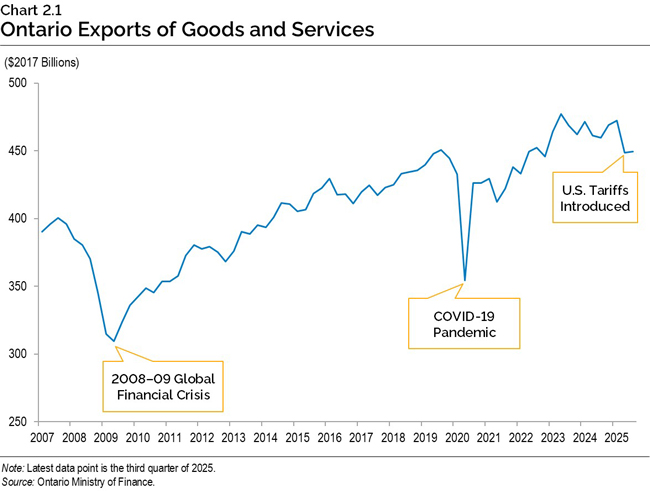
While uncertainty related to trade continues to impact the economy, measures of consumer confidence have improved since early 2025, and consumer spending has remained resilient. Real consumer spending rose by 0.5 per cent in the first quarter of 2025 and 0.7 per cent in the second quarter, before edging down slightly by 0.1 per cent in the third quarter.
Business investment in machinery and equipment has weakened amid ongoing trade uncertainty. By the third quarter of 2025, real machinery and equipment investment had declined by more than 6 per cent compared with the end of 2024.
| 151 |
| Chapter 2: Economic Performance and Outlook |
Ontario Labour Market
Ontario’s employment increased by 80,900 net jobs in 2025, with nearly all gains in the private sector, and growth evenly split between full-time and part-time positions. Ontario’s unemployment rate rose to an average of 7.7 per cent in 2025, up from 7.0 per cent in 2024, as labour force growth outpaced employment growth.
Tariff-related impacts have hit some parts of Ontario’s economy harder than others. Statistics Canada estimates that nationally, about 9 per cent of employment was based in industries dependent on U.S. demand for Canadian exports in 2024. These jobs are largely concentrated within the goods-producing sector, including most manufacturing industries. Trade disruptions have also disproportionately impacted employment in regions of the province near the United States and with a higher concentration of manufacturing employment.1
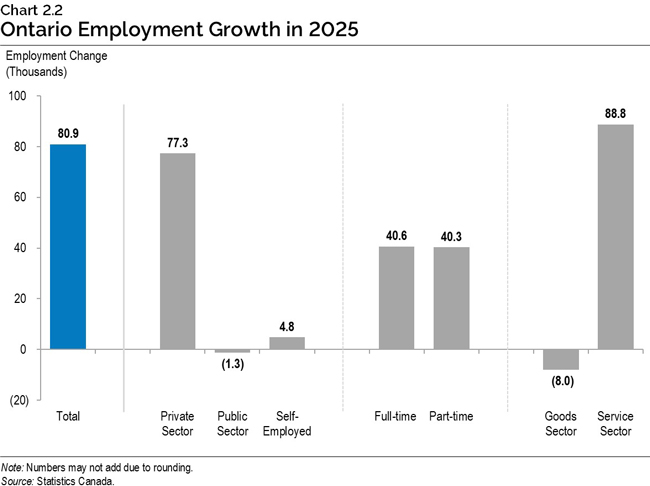
| 1 | Statistics Canada, “United States Tariffs and Canadian Labour Market Trends” (2025), https://www150.statcan.gc.ca/n1/pub/75-006-x/2025003/article/00004-eng.htm |
| 152 |
| Chapter 2: Economic Performance and Outlook |
Consumer Price Inflation
Ontario’s Consumer Price Index (CPI) inflation has moderated significantly from the peak of 7.9 per cent in June 2022, with monthly inflation remaining within the 1 to 3 per cent range for all of 2024 and 2025. Ontario’s CPI inflation rose by an average of 1.9 per cent in 2025, following an increase of 2.4 per cent in 2024.
A significant driver of the overall moderation in inflation in 2025 was a decline in energy prices, which fell 7.4 per cent. The largest contributor to this decline was a 10.7 per cent decrease in gasoline prices, largely reflecting the removal of the consumer carbon price in April 2025. In contrast, food inflation was elevated, rising 3.2 per cent in 2025 compared to 2.6 per cent in 2024. Excluding food and energy, inflation rose by 2.4 per cent in 2025.
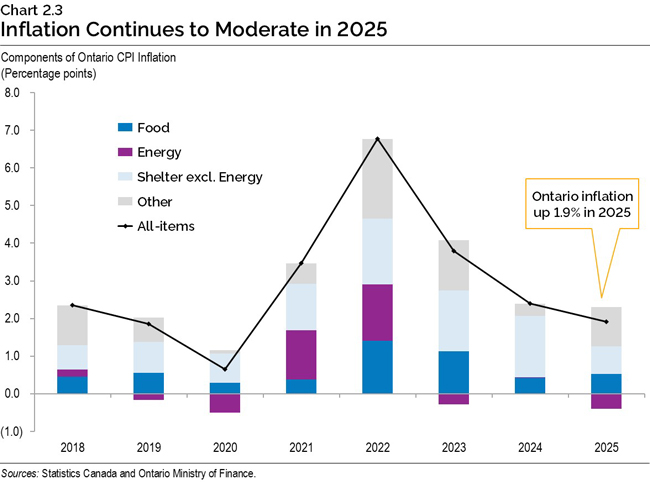
| 153 |
| Chapter 2: Economic Performance and Outlook |
Economic Outlook
The Ontario Ministry of Finance regularly consults with private-sector economists while tracking their forecasts to inform the government’s planning assumptions.
Private-sector forecasters, on average, are projecting that Ontario’s real GDP will grow by 1.1 per cent in 2026, 1.8 per cent in 2027, 1.9 per cent in 2028 and 2.1 per cent in 2029. The Ontario Ministry of Finance’s real GDP projections are set slightly below the average of private-sector forecasts in each year for prudent planning purposes. Three external economic experts reviewed the Ontario Ministry of Finance’s economic planning assumptions and found them to be reasonable.2
Table 2.3
Private-Sector Forecasts for Ontario Real GDP Growth
| (Per Cent) | ||||||||||||||||
| 2026 | 2027 | 2028 | 2029 | |||||||||||||
| BMO Capital Markets (January) | 1.2 | 2.3 | – | – | ||||||||||||
| Central 1 Credit Union (January) | 1.0 | 1.7 | – | – | ||||||||||||
| CIBC Capital Markets (January) | 1.2 | 2.1 | – | – | ||||||||||||
| Desjardins Group (January) | 1.1 | 1.9 | – | – | ||||||||||||
| Laurentian Bank Securities (January) | 1.2 | 1.6 | – | – | ||||||||||||
| National Bank of Canada (December) | 0.9 | 1.8 | – | – | ||||||||||||
| Quantitative Economic Decisions, Inc. (January) | 0.9 | 1.1 | 1.0 | 1.4 | ||||||||||||
| Royal Bank of Canada (December) | 1.1 | 1.4 | – | – | ||||||||||||
| Scotiabank (January) | 1.2 | 1.7 | – | – | ||||||||||||
| Signal49 Research1 (January) | 1.6 | 2.5 | 2.7 | 2.7 | ||||||||||||
| Stokes Economics (January) | 1.0 | 2.0 | 2.1 | 2.0 | ||||||||||||
| TD Bank Group (December) | 1.0 | 1.8 | – | – | ||||||||||||
| University of Toronto (January) | 0.5 | 1.4 | 1.8 | 2.4 | ||||||||||||
| Private-Sector Survey Average | 1.1 | 1.8 | 1.9 | 2.1 | ||||||||||||
| Ontario’s Planning Assumption | 1.0 | 1.7 | 1.8 | 2.0 | ||||||||||||
| 1 | Formerly, the Conference Board of Canada, effective January 2026. |
Sources: Ontario Ministry of Finance Survey of Forecasters (January 16, 2026) and Ontario Ministry of Finance.
| 2 | The three experts are from the Policy and Economic Analysis Program at the University of Toronto; Quantitative Economic Decisions, Inc. (QEDinc.); and Stokes Economics Consulting, Inc. |
| 154 |
| Chapter 2: Economic Performance and Outlook |
Private-sector forecasters, on average, are projecting that Ontario’s nominal GDP will grow by 3.3 per cent in 2026, 4.0 per cent in 2027, 3.8 per cent in 2028 and 4.0 per cent in 2029. The Ontario Ministry of Finance’s nominal GDP projections are set slightly below the average of private-sector forecasts in each year for prudent planning purposes.
Table 2.4
Private-Sector Forecasts for Ontario Nominal GDP Growth
(Per Cent)
| 2026 | 2027 | 2028 | 2029 | |||||||||||||
| BMO Capital Markets (January) | 3.5 | 4.4 | – | – | ||||||||||||
| Central 1 Credit Union (January) | 3.5 | 4.0 | – | – | ||||||||||||
| CIBC Capital Markets (January) | 3.2 | 4.5 | – | – | ||||||||||||
| Desjardins Group (January) | 3.5 | 3.9 | – | – | ||||||||||||
| Laurentian Bank Securities (January) | 3.3 | 3.8 | – | – | ||||||||||||
| National Bank of Canada (December) | 3.3 | 4.0 | – | – | ||||||||||||
| Quantitative Economic Decisions, Inc. (January) | 2.7 | 3.2 | 3.1 | 3.4 | ||||||||||||
| Royal Bank of Canada (December) | 3.5 | 4.1 | – | – | ||||||||||||
| Scotiabank (January) | 3.0 | 3.9 | – | – | ||||||||||||
| Signal49 Research1 (January) | 3.7 | 4.4 | 4.2 | 4.2 | ||||||||||||
| Stokes Economics (January) | 3.8 | 4.3 | 4.1 | 4.1 | ||||||||||||
| TD Bank Group (December) | 3.4 | 3.8 | – | – | ||||||||||||
| University of Toronto (January) | 2.7 | 3.4 | 3.9 | 4.5 | ||||||||||||
| Private-Sector Survey Average | 3.3 | 4.0 | 3.8 | 4.0 | ||||||||||||
| Ontario’s Planning Assumption | 3.2 | 3.9 | 3.7 | 3.9 | ||||||||||||
| 1 | Formerly, the Conference Board of Canada, effective January 2026. |
Sources: Ontario Ministry of Finance Survey of Forecasters (January 16, 2026) and Ontario Ministry of Finance.
| 155 |
| Chapter 2: Economic Performance and Outlook |
In 2025, Ontario real GDP growth outperformed expectations by rising an estimated 1.2 per cent, 0.4 percentage points faster than projected in the 2025 Budget. This was supported by strong growth in the third quarter of 2025 as Ontario showed economic resilience in the face of U.S. trade policy.
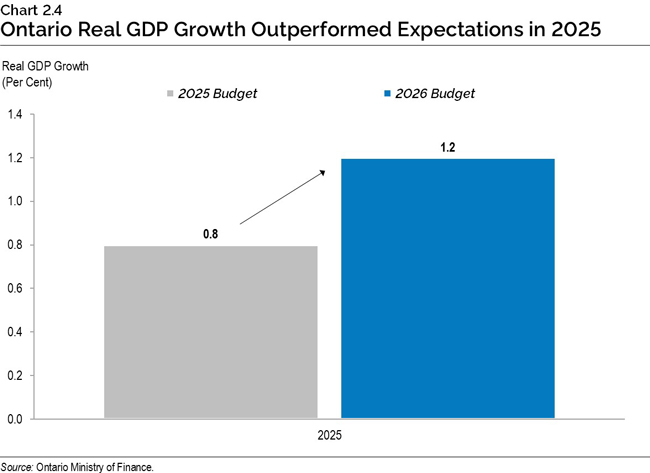
| 156 |
| Chapter 2: Economic Performance and Outlook |
Despite heightened uncertainty around trade policy, the economic outlook for Ontario has been little changed. Compared to the 2025 Budget, the private-sector average of real GDP growth forecasts remained stable for 2026 but declined slightly for 2027 and 2028.
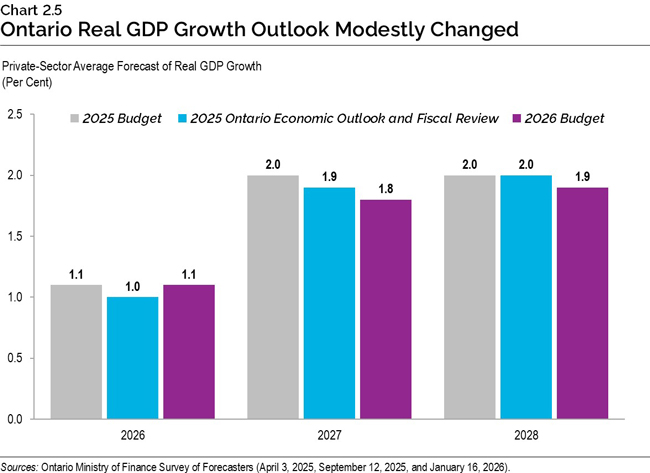
| 157 |
| Chapter 2: Economic Performance and Outlook |
Global Economic Environment
The global economic climate continues to be affected by heightened trade and geopolitical tensions, which have contributed to a sharp rise in the global economic policy uncertainty index, recently reaching its highest levels since 1997. In Canada, the level of policy uncertainty rose faster than in the United States and remains historically elevated despite recent moderation.
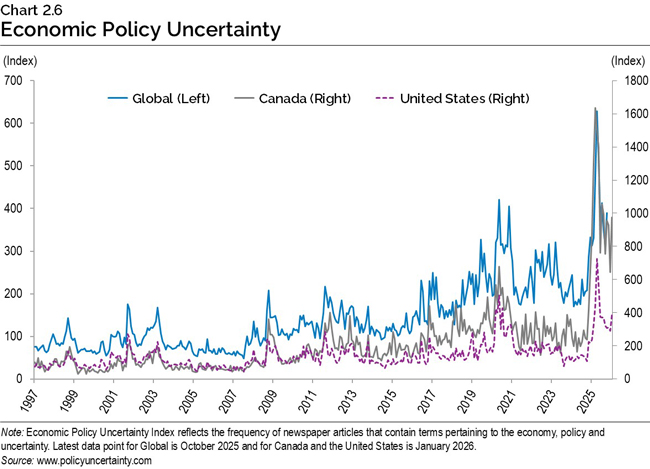
Global trade relationships remain unpredictable and volatile. The United States has continued to announce additional tariff increases on imports from most countries, alongside sector-specific tariffs on steel and aluminum, cars and parts, trucks, buses, timber and copper. The effects of higher tariffs are impacting consumer spending choices, business costs and consumer prices.
| 158 |
| Chapter 2: Economic Performance and Outlook |
In its January World Economic Outlook Update, the International Monetary Fund (IMF) projects global growth to remain stable. The IMF projects global real GDP growth of 3.3 per cent in 2026 and 3.2 per cent in 2027. U.S. real GDP rose by 2.2 per cent in 2025 and according to Blue Chip Economic Indicators released in February 2026, it is projected to rise by 2.4 per cent in 2026 and 2.1 per cent in 2027. Compared to projections at the time of the 2025 Ontario Economic Outlook and Fiscal Review, U.S. real GDP growth is now estimated to be higher by 0.5 percentage points in 2025 and 0.9 percentage points in 2026. The upward revisions mainly reflect stronger investment and consumption. Euro area real GDP rose by 1.5 per cent in 2025 and the IMF projects growth to remain stable, easing to 1.3 per cent in 2026 before rising slightly to 1.4 per cent in 2027. China’s real GDP growth is expected to slow from 5.0 per cent in 2025 to 4.5 per cent in 2026 and 4.0 per cent in 2027.
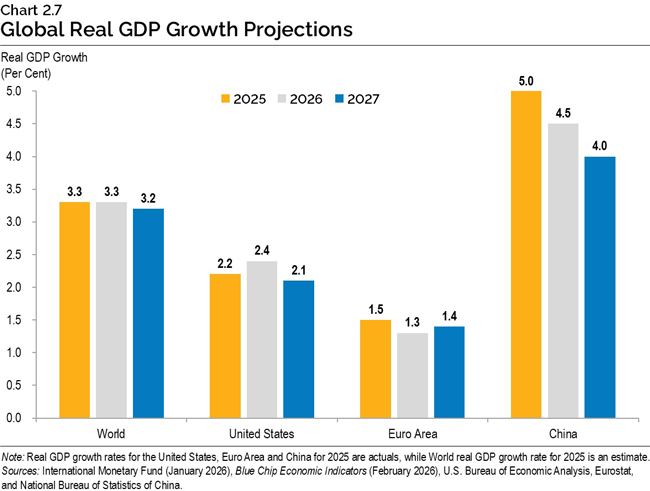
Most major central banks have continued to ease their monetary policy as price inflation has been on a moderating trend. At the same time, inflation remains higher than the central bank targets in several economies. Looking forward, these central banks are likely to be faced with a difficult decision between lowering their policy interest rates to stimulate economic growth or undertake restrictive monetary policy in case inflationary pressures mount, including from trade tensions.
| 159 |
| Chapter 2: Economic Performance and Outlook |
Financial Markets and Other External Factors
The Bank of Canada (the Bank) held its key policy interest rate, the target for the overnight rate, unchanged in January 2026, citing a broadly unchanged economic outlook since the fall, while noting that U.S. tariffs and uncertainty surrounding future trade arrangements continue to disrupt Canadian economic activity. The Bank has held its policy interest rate steady for two consecutive meetings. The target for the overnight rate is currently at the bottom of the Bank’s estimated “neutral range” of 2.25 to 3.25 per cent, a range that indicates the Bank’s monetary policy is not restricting economic growth. The Bank has indicated that heightened geopolitical uncertainty, and the upcoming review of the Canada–United States–Mexico Agreement (CUSMA), pose significant risks to the economic outlook.
With the overnight rate at the lower bound of the Bank’s estimated “neutral range,” private-sector forecasters largely expect the monetary policy easing cycle to be nearing its end. The Government of Canada three-month treasury bill rate was 2.6 per cent in 2025 and is projected to decline to 2.3 per cent in 2026. The rate is then expected to rise to 2.6 per cent in 2027, ease to 2.5 per cent in 2028 and return to 2.6 per cent in 2029.
Long-term interest rates began declining in mid-2025 as signs of economic cooling in the United States raised expectations for easing measures by the Federal Reserve. Since the fall, more resilient U.S. data, along with expectations for a more cautious Federal Reserve, helped long-term rates rise. Over the projection period, long-term rates are expected to change modestly, with the Government of Canada 10-year bond rate projected to slightly increase from 3.2 per cent in 2025 to 3.3 per cent in 2026, then rise further to 3.5 per cent in 2027, and remain stable at that rate through 2028 and 2029.
| 160 |
| Chapter 2: Economic Performance and Outlook |
The West Texas Intermediate (WTI) crude oil price is projected to decline from US$65 per barrel in 2025 to US$59 per barrel in 2026. The price is expected to edge up to US$62 per barrel in 2027, before increasing gradually to US$67 and US$69 per barrel in 2028 and 2029, respectively. The Canadian dollar is projected to appreciate gradually from 71.6 cents US in 2025 to 73.2 cents US in 2026, before strengthening further to 75.3 cents US in 2027 and averaging 76.5 cents US in 2028 and 2029.
Table 2.5
External Factors
| 2025 | 2026p | 2027p | 2028p | 2029p | ||||||||||||||||
| World Real GDP Growth (Per Cent) | 3.3e | 3.3 | 3.2 | 2.6 | 2.5 | |||||||||||||||
| U.S. Real GDP Growth (Per Cent) | 2.2 | 2.4 | 2.1 | 2.0 | 1.9 | |||||||||||||||
| West Texas Intermediate (WTI) Crude Oil ($US per Barrel) | 65 | 59 | 62 | 67 | 69 | |||||||||||||||
| Canadian Dollar (Cents US) | 71.6 | 73.2 | 75.3 | 76.4 | 76.6 | |||||||||||||||
| Three-Month Treasury Bill Rate1 (Per Cent) | 2.6 | 2.3 | 2.6 | 2.5 | 2.6 | |||||||||||||||
| 10-Year Government Bond Rate1 (Per Cent) | 3.2 | 3.3 | 3.5 | 3.5 | 3.5 | |||||||||||||||
e = estimate.
p = Ontario Ministry of Finance planning projection based on external sources.
| 1 | Government of Canada interest rates. |
Sources: International Monetary Fund World Economic Outlook Update (October 2025 and January 2026); U.S. Bureau of Economic Analysis; U.S. Energy Information Administration; Bank of Canada; Blue Chip Economic Indicators (October 2025 and February 2026); and Ontario Ministry of Finance Survey of Forecasters (January 16, 2026).
| 161 |
| Chapter 2: Economic Performance and Outlook |
Details of Ontario’s Economic Outlook
The Ontario Ministry of Finance estimates that real GDP rose by 1.2 per cent in 2025 and is projected to rise by 1.0 per cent in 2026, 1.7 per cent in 2027, 1.8 per cent in 2028 and 2.0 per cent in 2029. Nominal GDP is estimated to have grown by 4.2 per cent in 2025 and is projected to rise by 3.2 per cent in 2026, 3.9 per cent in 2027, 3.7 per cent in 2028 and 3.9 per cent in 2029.
| Table 2.6 Ontario’s Economic Outlook
(Per Cent Change) |
||||||||||||||||||||||||
| 2024 | 2025 | 2026p | 2027p | 2028p | 2029p | |||||||||||||||||||
| Real Gross Domestic Product | 1.6 | 1.2e | 1.0 | 1.7 | 1.8 | 2.0 | ||||||||||||||||||
| Nominal Gross Domestic Product | 5.1 | 4.2e | 3.2 | 3.9 | 3.7 | 3.9 | ||||||||||||||||||
| Compensation of Employees | 6.4 | 4.0e | 3.2 | 3.3 | 3.5 | 3.8 | ||||||||||||||||||
| Net Operating Surplus — Corporations | (1.1) | 4.4e | 4.7 | 7.2 | 6.1 | 6.0 | ||||||||||||||||||
| Nominal Household Consumption | 4.6 | 4.0e | 3.3 | 3.4 | 3.6 | 3.7 | ||||||||||||||||||
| Other Economic Indicators | ||||||||||||||||||||||||
| Employment | 1.7 | 1.0 | 0.5 | 0.7 | 0.8 | 1.1 | ||||||||||||||||||
| Job Creation (000s) | 140 | 81 | 41 | 58 | 67 | 92 | ||||||||||||||||||
| Unemployment Rate (Per Cent) | 7.0 | 7.7 | 7.4 | 6.9 | 6.4 | 6.2 | ||||||||||||||||||
| Consumer Price Index | 2.4 | 1.9 | 2.1 | 2.0 | 2.0 | 2.0 | ||||||||||||||||||
| Housing Starts (000s)1 | 74.6 | 65.4 | 64.8 | 70.3 | 76.8 | 80.5 | ||||||||||||||||||
| Home Resales | 4.0 | (5.6) | 9.1 | 5.6 | 4.6 | 1.5 | ||||||||||||||||||
| Home Resale Prices | (1.2) | (4.4) | 0.8 | 2.7 | 4.2 | 4.0 | ||||||||||||||||||
| Key External Variables | ||||||||||||||||||||||||
| U.S. Real Gross Domestic Product | 2.8 | 2.2 | 2.4 | 2.1 | 2.0 | 1.9 | ||||||||||||||||||
| WTI Crude Oil ($US per Barrel) | 77 | 65 | 59 | 62 | 67 | 69 | ||||||||||||||||||
| Canadian Dollar (Cents US) | 73.0 | 71.6 | 73.2 | 75.3 | 76.4 | 76.6 | ||||||||||||||||||
| Three-Month Treasury Bill Rate (Per Cent)2 | 4.3 | 2.6 | 2.3 | 2.6 | 2.5 | 2.6 | ||||||||||||||||||
| 10-Year Government Bond Rate (Per Cent)2 | 3.4 | 3.2 | 3.3 | 3.5 | 3.5 | 3.5 | ||||||||||||||||||
e = estimate.
p = Ontario Ministry of Finance planning projection based on external sources as of January 16, 2026.
| 1 | Housing starts projection based on private-sector average as of January 16, 2026. |
| 2 | Government of Canada interest rates. |
Sources: Statistics Canada; Canada Mortgage and Housing Corporation; Canadian Real Estate Association; Bank of Canada; United States Bureau of Economic Analysis; Blue Chip Economic Indicators (February 2026 and October 2025); U.S. Energy Information Administration; and Ontario Ministry of Finance.
| 162 |
| Chapter 2: Economic Performance and Outlook |
Employment
Slower economic growth and lower population growth due to changes in federal immigration policy are projected to contribute to a softer labour market in 2026. Ontario employment growth is also being impacted by ongoing trade conflicts and the effect of the associated uncertainty on investment and hiring. As these effects are projected to ease, employment growth is projected to rise to 0.7 per cent in 2027, 0.8 per cent in 2028 and 1.1 per cent in 2029. Slowing population growth and rising economic growth are projected to result in a decrease in the unemployment rate from 7.7 per cent in 2025 to 7.4 per cent in 2026, 6.9 per cent in 2027, 6.4 per cent in 2028 and 6.2 per cent in 2029.
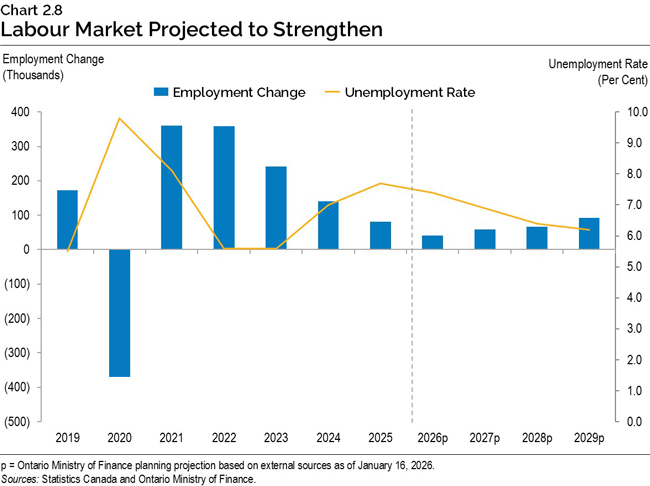
| 163 |
| Chapter 2: Economic Performance and Outlook |
Consumer Price Index
Inflationary pressures have broadly receded in recent months, with CPI inflation near the Bank of Canada’s 2 per cent target since September 2025. A modest near-term acceleration in inflation is expected, as the decline in energy prices starting last April due to the removal of the federal carbon tax ceases to factor into year-over-year price changes.
For planning purposes, the Ontario Ministry of Finance is projecting Ontario CPI inflation to be 2.1 per cent in 2026 before returning to the Bank’s 2 per cent inflation rate target over the medium-term projection horizon. Ontario’s inflation outlook is influenced by a range of offsetting risks. Both trade tensions and global economic uncertainty could weigh on economic activity, potentially easing inflationary pressures in Ontario. Geopolitical developments and supply-chain disruptions could raise input costs and push inflation higher than expected. In addition, heightened geopolitical tensions may lift global commodity prices, adding upside risk to Ontario’s inflation trajectory.
| 164 |
| Chapter 2: Economic Performance and Outlook |
Housing Market
Economic uncertainty has weighed on Ontario’s housing market activity despite easing mortgage rates. Ontario home resales declined 5.6 per cent in 2025, the lowest volume of resales in over two decades. With home buyers holding off purchasing, inventory has risen relative to resales, contributing to a decline in the average home price. The average resale home price fell 4.4 per cent in 2025, marking the third consecutive annual decline in prices.
Looking ahead, home resales are projected to rebound, supported by pent-up demand and economic growth. Home resales are projected to grow 9.1 per cent in 2026, 5.6 per cent in 2027, 4.6 per cent in 2028 and 1.5 per cent in 2029. The average home resale price is expected to grow more gradually, rising 0.8 per cent in 2026, 2.7 per cent in 2027, 4.2 per cent in 2028 and 4.0 per cent in 2029.
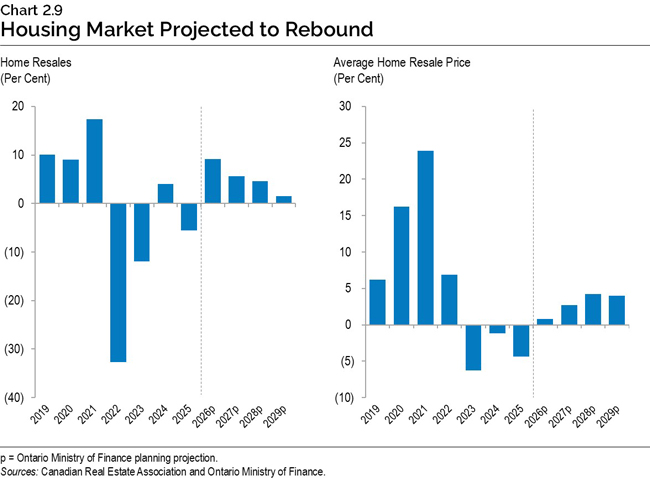
Construction activity softened in 2025 and is expected to remain subdued in 2026 as private-sector forecasters continue to highlight the negative effects of economic uncertainty on homebuilding. Ontario housing starts are projected to moderate from 65,400 units in 2025 to 64,800 units in 2026, before increasing to 70,300 units in 2027, 76,800 in 2028 and 80,500 in 2029.
| 165 |
| Chapter 2: Economic Performance and Outlook |
Risks to the Outlook
Global trade tensions and associated uncertainty constitute the main risks to Ontario’s economic outlook. Heightened trade tensions could continue to impact global supply chains and commodity markets, exerting upward pressure on inflation, dampening economic growth and raising volatility in financial markets. While Ontario and Canada have gradually started to adjust and diversify their trade to markets outside the United States, this adjustment could potentially take longer than expected. On the upside, efforts to reduce and eliminate interprovincial trade barriers, coupled with development of significant infrastructure projects, could help boost economic growth over the medium term.
The other significant source of risk is the upcoming review of CUSMA in 2026. Most of Canada’s exports are compliant with CUSMA, which has eased the impacts of announced U.S. tariffs. However, there is a wide range of possible outcomes related to the review in 2026. On the upside, the CUSMA review may result in a mutually favourable trade outcome between Canada and its trading partners that supports growth among trading partners. On the downside, the review may include negative policy adjustments, up to and including a possible withdrawal of member countries from the agreement.
A significant escalation in geopolitical tensions, particularly in the Middle East or Ukraine, but also possibly in Asia and Latin America, could disrupt major shipping routes, critical supply chains and air travel, leading to delays and increased costs.
A surge in investment in artificial intelligence (AI) has recently been a source of economic growth, particularly in the United States. Rising demand for new technologies, such as AI, could support renewed business expansion and contribute to increasing productivity growth. However, there is a risk that the prospects for AI are not as promising as expected and could lead to a correction in capital markets.
| 166 |
| Chapter 2: Economic Performance and Outlook |
Alternative Economic Scenarios
The Ministry of Finance continues to develop scenarios to assess the potential impact of U.S. trade policy on Ontario’s economy over the projection period. As significant uncertainty remains regarding the international trade environment, these alternative scenarios should not be considered the best case or the worst case. Rather, they illustrate a broader range of possible outcomes.
The Faster Growth Scenario assumes that most tariffs and countermeasures imposed by the United States and Canada are removed in the near term. Under this scenario, Ontario’s economic output accelerates in 2026 and 2027 before moderating back to trend by 2028.
The Slower Growth Scenario assumes the United States withdraws from CUSMA. Under this scenario, the United States imposes tariffs at 12 per cent on Canada and Mexico and maintains the current Section 232 tariffs. Motor vehicle tariffs remain effectively at 12.5 per cent, while a similar tariff is applied to vehicle parts. Canada’s energy, potash and critical mineral exports remain exempt. Canada’s current retaliatory tariffs on the United States remain in place.
Table 2.7
Ontario Real GDP Growth Scenarios
| (Per Cent) | ||||||||||||||||
| 2026p | 2027p | 2028p | 2029p | |||||||||||||
| Faster Growth Scenario | 1.6 | 2.2 | 1.9 | 2.1 | ||||||||||||
| Planning Projection | 1.0 | 1.7 | 1.8 | 2.0 | ||||||||||||
| Slower Growth Scenario | 0.3 | 0.6 | 1.8 | 2.0 | ||||||||||||
p = Ontario Ministry of Finance planning projection based on external sources as of January 16, 2026, and alternative scenarios.
Source: Ontario Ministry of Finance.
Table 2.8
Ontario Nominal GDP Growth Scenarios
| (Per Cent) | ||||||||||||||||
| 2026p | 2027p | 2028p | 2029p | |||||||||||||
| Faster Growth Scenario | 4.0 | 4.6 | 4.0 | 4.2 | ||||||||||||
| Planning Projection | 3.2 | 3.9 | 3.7 | 3.9 | ||||||||||||
| Slower Growth Scenario | 2.3 | 2.6 | 3.5 | 3.7 | ||||||||||||
p = Ontario Ministry of Finance planning projection based on external sources as of January 16, 2026, and alternative scenarios.
Source: Ontario Ministry of Finance.
| 167 |
| Chapter 2: Economic Performance and Outlook |
By 2029, the level of real GDP in the Faster Growth scenario is 1.4 per cent higher than in the Planning Projection, while in the Slower Growth scenario, the level of real GDP is 1.7 per cent lower. By 2029, the level of nominal GDP in the Faster Growth scenario is 2.0 per cent higher than in the Planning Projection, while in the Slower Growth scenario, the level of nominal GDP is 2.5 per cent lower.
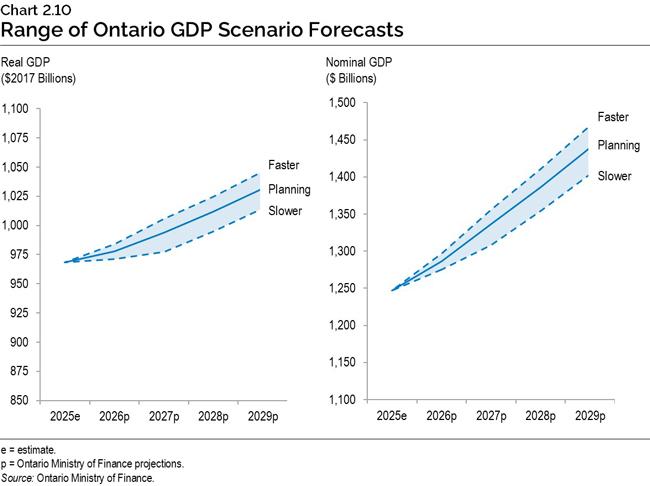
| 168 |
| Chapter 2: Economic Performance and Outlook |
Transparent Reporting on the Economy
The Ontario Economic Accounts provide a comprehensive overall assessment of the performance of Ontario’s economy. Private-sector economists use this to assess the current state of the province’s economy and as a basis for updating their forecasts. The Ontario Economic Accounts help inform the government’s economic and revenue forecasts, providing a key foundation for Ontario’s fiscal plan.
The Fiscal Sustainability, Transparency and Accountability Act, 2019 states that the quarterly Ontario Economic Accounts shall be released within 45 days after the Statistics Canada release of the National Income and Expenditure Accounts.
In compliance with the legislation, the quarterly Ontario Economic Accounts will be released according to the schedule outlined in Table 2.9.
Table 2.9
Ontario Economic Accounts Release Dates
| Reference Period | Expected Statistics Canada Release of National Income and Expenditure Accounts |
Corresponding Deadline for Release of Ontario Economic Accounts | ||
| Fourth quarter (October-December) 2025 | February 27, 2026 | By April 13, 2026 | ||
| First quarter (January-March) 2026 | May 29, 2026 | By July 13, 2026 | ||
| Second quarter (April-June) 2026 | August 28, 2026 | By October 13, 2026 | ||
| Third quarter (July-September) 2026 | November 30, 2026 | By January 14, 2027 | ||
| Fourth quarter (October-December) 2026 | March 1, 2027 | By April 15, 2027 | ||
Sources: Statistics Canada and Ontario Ministry of Finance.
| 169 |
| Chapter 3: Ontario’s Fiscal Plan and Outlook |
Introduction
Ontario, like other jurisdictions around the world, continues to navigate significant economic challenges amid a heightened climate of uncertainty. The global environment is rapidly evolving, driving shifts across the economy.
In this context, it is more important than ever for the government to make prudent, well-considered decisions that support ongoing investments in key public services, job creation and the province’s long-term prosperity, while preserving the fiscal flexibility needed to respond to changing conditions.
Although economic and fiscal pressures are expected to weigh on the fiscal outlook relative to the projections presented in the 2025 Budget, the 2026 Budget plan remains prudent and fiscally responsible. In 2025–26, Ontario is projecting a deficit of $12.3 billion. Over the medium term, the government is projecting deficits of $13.8 billion in 2026–27 and $6.1 billion in 2027–28 before planning for a surplus of $0.6 billion in 2028–29.
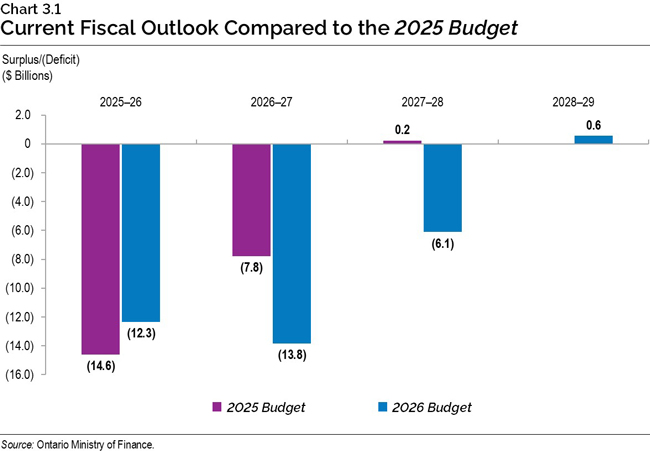
| 173 |
| Chapter 3: Ontario’s Fiscal Plan and Outlook |
Table 3.1
Fiscal Summary
($ Billions)
| Actual | Interim | Medium-Term Outlook | ||||||||||||||||||
| 2024–25 | 2025–26 | 2026–27 | 2027–28 | 2028–29 | ||||||||||||||||
| Revenue | 226.2 | 226.6 | 231.9 | 243.4 | 254.1 | |||||||||||||||
| Expense | ||||||||||||||||||||
| Programs |
212.1 | 222.4 | 227.0 | 229.0 | 231.3 | |||||||||||||||
| Interest and Other Debt Servicing Charges |
15.1 | 16.0 | 17.2 | 18.6 | 19.7 | |||||||||||||||
| Total Expense | 227.3 | 238.4 | 244.2 | 247.5 | 251.1 | |||||||||||||||
| Surplus/(Deficit) Before Reserve | (1.1) | (11.8) | (12.3) | (4.1) | 3.1 | |||||||||||||||
| Reserve | – | 0.5 | 1.5 | 2.0 | 2.5 | |||||||||||||||
| Surplus/(Deficit) | (1.1) | (12.3) | (13.8) | (6.1) | 0.6 | |||||||||||||||
| Net Debt as a Per Cent of GDP1 | 35.7% | 36.8% | 37.7% | 38.5% | 38.2% | |||||||||||||||
| Net Debt as a Per Cent of Revenue1 | 191.2% | 204.4% | 210.9% | 212.9% | 209.8% | |||||||||||||||
| Interest as a Per Cent of Revenue | 5.5% | 6.3% | 6.7% | 6.9% | 7.1% | |||||||||||||||
| 1 | For 2026–27 and future years, Net Debt reflects financial assets less financial liabilities and is aligned with Net Financial Liabilities, as will be reported in the Public Accounts of Ontario 2026–2027. See the Debt Burden Reduction Strategy in Chapter 4: Borrowing and Debt Management for additional details on the calculations supporting the ratios. |
Note: Numbers may not add due to rounding.
Sources: Ontario Treasury Board Secretariat and Ontario Ministry of Finance.
| 174 |
| Chapter 3: Ontario’s Fiscal Plan and Outlook |
2025–26 Interim Fiscal Performance
| Ontario’s 2025–26 deficit is projected to be $12.3 billion, which is an improvement of $2.3 billion compared to the outlook published in the 2025 Budget.
Total revenues in 2025–26 are projected to be $226.6 billion, which is $6.7 billion higher than forecast in the 2025 Budget, mainly reflecting increases in taxation revenue, net income from Government Business Enterprises and other non-tax revenue. |
Defining Interim
Interim represents the 2026 Budget projection for the 2025–26 fiscal year and is subject to change as actual provincial revenue and expense are finalized in the Public Accounts of Ontario 2025–2026, to be released no later than September 27, 2026. | |
|
| ||
|
| ||
Program expense is projected to be $222.4 billion, $6.1 billion higher than the 2025 Budget forecast, primarily due to investments in health, postsecondary education, social services and justice.
Ontario is forecast to pay $16.0 billion in Interest and Other Debt Servicing Charges in 2025–26, lower than the $16.2 billion forecast in the 2025 Budget. At 36.8 per cent, the net debt-to-GDP ratio in 2025–26 is forecast to be 1.1 percentage points lower than in the 2025 Budget.
The 2025 Budget also included a $2.0 billion reserve in 2025–26 to protect the fiscal plan against unforeseen adverse changes in Ontario’s revenue and expense forecasts. The reserve has been drawn down to $0.5 billion at interim, which could be used to address any unforeseen events that could arise before year-end.
| 175 |
| Chapter 3: Ontario’s Fiscal Plan and Outlook |
Table 3.2
2025–26 In-Year Fiscal Performance
($ Billions)
| 2025 Budget |
Interim 2025–26 |
In-Year Change |
||||||||||
| Revenue | 219.9 | 226.6 | 6.7 | |||||||||
| Expense | ||||||||||||
| Programs |
216.3 | 222.4 | 6.1 | |||||||||
| Interest and Other Debt Servicing Charges |
16.2 | 16.0 | (0.2) | |||||||||
| Total Expense | 232.5 | 238.4 | 5.9 | |||||||||
| Surplus/(Deficit) Before Reserve | (12.6) | (11.8) | 0.8 | |||||||||
| Reserve |
2.0 | 0.5 | (1.5) | |||||||||
| Surplus/(Deficit) | (14.6) | (12.3) | 2.3 | |||||||||
Note: Numbers may not add due to rounding.
Sources: Ontario Treasury Board Secretariat and Ontario Ministry of Finance.
| 176 |
| Chapter 3: Ontario’s Fiscal Plan and Outlook |
Revenue Update
The 2025–26 total revenue outlook is $6.7 billion higher than projected in the 2025 Budget. Since the release of the 2025 Ontario Economic Outlook and Fiscal Review, total revenue is projected to increase by $3.5 billion, mainly due to increases in taxation revenue and net income from Government Business Enterprises.
Table 3.3
Summary of 2025–26 Revenue Changes Since the 2025 Budget
($ Millions)
| Interim 2025–26 |
||||||||
| 2025 Budget Total Revenue1 |
219,887 | |||||||
| Revenue Changes in the 2025–26 First Quarter Finances |
– | |||||||
| Revenue Changes in the 2025 Ontario Economic Outlook and Fiscal Review |
3,219 | |||||||
| Revenue Changes in the 2025–26 Third Quarter Finances |
577 | |||||||
| Revenue Changes Since the 2025–26 Third Quarter Finances |
||||||||
| Personal Income Tax |
2,632 | |||||||
| Corporations Tax |
637 | |||||||
| Sales Tax |
(894) | |||||||
| All Other Taxation |
12 | |||||||
|
|
|
|||||||
| Total Taxation Revenue |
2,387 | |||||||
| Government of Canada Transfers |
(11) | |||||||
| Government Business Enterprises |
413 | |||||||
| Other Non-Tax Revenue |
138 | |||||||
|
|
|
|||||||
| Total Revenue Changes Since the 2025–26 Third Quarter Finances |
2,926 | |||||||
| Total Revenue Changes Since the 2025 Budget |
6,721 | |||||||
| 2026 Budget Total Revenue Outlook | 226,609 | |||||||
| 1 | Beginning in the 2025 Budget, the Total Revenue, Interest and Other Debt Servicing Charges (IOD), and Total Expense figures for all years have been restated to report interest and investment income as part of revenue and separate from IOD. These changes are fiscally neutral. |
Note: Numbers may not add due to rounding.
Source: Ontario Ministry of Finance.
| 177 |
| Chapter 3: Ontario’s Fiscal Plan and Outlook |
The forecast for Total Taxation Revenue has increased by $2.4 billion compared to the 2025–26 Third Quarter Finances. Key changes in the taxation revenue outlook include:
| • |
Personal Income Tax revenue projections increased by $2.6 billion, mainly due to stronger-than-expected economic growth in 2025, including robust equity market performance supporting stronger-than-anticipated growth in capital gains and dividend income; |
| • |
Corporations Tax revenue projections increased by $0.6 billion, mainly due to higher-than-anticipated corporate profit growth in 2025 and the processing of 2024 and prior year tax returns; |
| • |
Sales Tax revenue projections decreased by $0.9 billion, mainly reflecting lower official federal entitlement estimates for 2025 and prior years; and |
| • |
Projections for revenue from All Other Taxation combined increased by $12 million, mainly due to higher Land Transfer Tax and Employer Health Tax, partially offset by lower Ontario Health Premium revenue. |
Government of Canada Transfers projections decreased by $11 million, mainly due to a reprofiling of funding from 2025–26 to 2026–27 under the Canada-wide Early Learning and Child Care Agreement and the Investing in Canada Infrastructure Program. This decrease is partially offset by higher direct transfers to Broader Public Sector organizations.
Net Income from Government Business Enterprises projections increased by $413 million, driven mainly by a higher net income forecast for Ontario Power Generation, reflecting stronger projected Ontario Nuclear Funds’ realized gains. This increase is partially offset by lower revenue from the Ontario Lottery and Gaming Corporation and the Liquor Control Board of Ontario.
Other Non-Tax Revenue projections increased by $138 million, mainly reflecting higher miscellaneous other non-tax revenue reported by ministries and consolidated government organizations. This is partially offset by lower net third-party revenue from the broader public sector, sales and rentals and interest and investment income.
| 178 |
| Chapter 3: Ontario’s Fiscal Plan and Outlook |
Expense Update
Since the release of the 2025 Budget, the government has made additional investments to support critical public services. The 2025–26 total expense outlook is $238.4 billion, $5.9 billion higher than the 2025 Budget. Since the release of the most recent update as part of the 2025–26 Third Quarter Finances, the total program expense projection has increased by $2.5 billion, primarily due to higher-than-forecasted ministry spending in health, social services and justice, partially offset by the Contingency Fund.
Table 3.4
Summary of 2025–26 Expense Changes Since the 2025 Budget
($ Millions)
| Interim 2025–26 |
||||||||
| 2025 Budget Total Expense1 |
232,497 | |||||||
| Total Expense Changes in the 2025–26 First Quarter Finances |
– | |||||||
| Total Expense Changes in the 2025 Ontario Economic Outlook and Fiscal Review |
2,130 | |||||||
| Total Expense Changes in the 2025–26 Third Quarter Finances |
1,480 | |||||||
| Program Expense Changes Since the 2025–26 Third Quarter Finances |
||||||||
| Health Sector |
5,658 | |||||||
| Education Sector2 |
(462) | |||||||
| Postsecondary Education Sector |
(385) | |||||||
| Children, Community and Social Services Sector |
1,100 | |||||||
| Justice Sector |
582 | |||||||
| Other Programs |
(4,036) | |||||||
|
|
|
|||||||
| Total Program Expense Changes Since the 2025–26 Third Quarter Finances |
2,458 | |||||||
| Interest and Other Debt Servicing Charges Change Since the 2025–26 Third Quarter Finances |
(130) | |||||||
|
|
|
|||||||
| Total Expense Changes Since the 2025–26 Third Quarter Finances |
2,328 | |||||||
| Total Expense Changes Since the 2025 Budget |
5,938 | |||||||
| 2026 Budget Total Expense Outlook |
238,434 | |||||||
| 1 | Beginning in the 2025 Budget, the Total Revenue, Interest and Other Debt Servicing Charges (IOD), and Total Expense figures for all years have been restated to report interest and investment income as part of revenue and separate from IOD. These changes are fiscally neutral. |
| 2 | Excludes Teachers’ Pension Plan. Teachers’ Pension Plan expense is included in Other Programs. |
Note: Numbers may not add due to rounding.
Sources: Ontario Treasury Board Secretariat and Ontario Ministry of Finance.
| 179 |
| Chapter 3: Ontario’s Fiscal Plan and Outlook |
The following program expense changes are projected since the release of the 2025–26 Third Quarter Finances:
| • |
Health sector expense is projected to be $5,658 million higher, primarily to address pressures related to the delivery of health care and to address growing demand for other health services, such as utilization-driven programs like the Ontario Health Insurance Plan and Ontario Public Drug Programs. |
| • |
Education sector expense is projected to be $462 million lower, mainly due to lower-than-projected student enrolment and school board expenditures. |
| • |
Postsecondary Education sector expense is projected to be $385 million lower, mainly due to lower-than-forecasted spending in the college sector. |
| • |
Children, Community and Social Services sector expense is projected to be $1,100 million higher, mostly due to demand for social assistance programs. |
| • |
Justice sector expense is projected to be $582 million higher, mainly due to obligations under the Crown Liability and Proceedings Act, 2019 and investments in essential service delivery, including the Ontario Provincial Police, courts, corrections, forensic sciences, coroner and forensic pathology services. |
| • |
Other Programs expense is projected to be a net $4,036 million lower, primarily due to lower-than-projected spending across various ministry infrastructure programs, including the Community Sport and Recreation Infrastructure Fund, Transit-Oriented Communities program, high-speed internet access, as well as the drawdown of the Contingency Fund to offset increases in other sectors. |
Interest and Other Debt Servicing Charges expense is projected to be $130 million lower due to an efficient debt management strategy.
Prudence in 2025–26
The Contingency Fund is maintained to help mitigate expense risks that may adversely affect Ontario’s fiscal performance. For the remainder of 2025–26, the Contingency Fund had a remaining balance of $100 million, which was made available to offset additional expenses that may materialize before the end of the fiscal year.
The 2025 Budget included a reserve of $2.0 billion in 2025–26, which has been drawn down to $0.5 billion at interim to address any unforeseen events that could arise before year-end.
| 180 |
| Chapter 3: Ontario’s Fiscal Plan and Outlook |
| Medium-Term Fiscal Plan | ||||
| The government is projecting deficits of $13.8 billion in 2026–27, $6.1 billion in 2027–28, and a surplus of $0.6 billion in 2028–29.
Medium-Term Revenue Outlook
Total revenue is projected to increase from $226.2 billion in 2024–25 to $254.1 billion in 2028–29, representing an average annual growth rate of 3.0 per cent. Projections over the medium term are higher compared to the 2025 Ontario Economic Outlook and Fiscal Review. |
|
Defining the Medium-Term Outlook
Medium term represents the 2026 Budget projection for the Plan year, or Current year (2026–27), and the following two fiscal years (2027–28 and 2028–29). | ||
Table 3.5
Summary of Medium-Term Revenue Outlook
($ Billions)
| Actual | Interim | Medium-Term Outlook | ||||||||||||||||||
| 2024–25 | 2025–26 | 2026–27 | 2027–28 | 2028–29 | ||||||||||||||||
| Revenue | ||||||||||||||||||||
| Personal Income Tax |
55.7 | 61.9 | 65.1 | 69.5 | 74.1 | |||||||||||||||
| Sales Tax |
39.4 | 39.2 | 39.9 | 43.2 | 45.1 | |||||||||||||||
| Corporations Tax |
27.8 | 27.6 | 28.6 | 30.6 | 32.5 | |||||||||||||||
| Ontario Health Premium |
5.2 | 5.2 | 5.5 | 5.7 | 5.9 | |||||||||||||||
| Education Property Tax |
5.9 | 5.9 | 6.0 | 6.0 | 6.1 | |||||||||||||||
| All Other Taxes |
17.6 | 18.0 | 18.5 | 19.1 | 20.1 | |||||||||||||||
| Total Taxation Revenue | 151.5 | 158.0 | 163.6 | 174.1 | 183.8 | |||||||||||||||
| Government of Canada Transfers | 36.6 | 39.1 | 39.8 | 40.1 | 40.4 | |||||||||||||||
| Income from Government Business Enterprises | 7.5 | 7.3 | 6.5 | 6.8 | 7.3 | |||||||||||||||
| Other Non-Tax Revenue | 30.5 | 22.2 | 21.9 | 22.4 | 22.6 | |||||||||||||||
| Total Revenue | 226.2 | 226.6 | 231.9 | 243.4 | 254.1 | |||||||||||||||
Note: Numbers may not add due to rounding.
Source: Ontario Ministry of Finance.
The forecast for Personal Income Tax revenues is driven by the economic outlook including compensation of employees. Personal Income Tax revenue is projected to grow at an average annual rate of 7.4 per cent between 2024–25 and 2028–29.
The forecast for Sales Tax revenue is driven by the projection for household consumption spending. Average growth in Sales Tax revenue is projected to be 3.5 per cent between 2024–25 and 2028–29.
The forecast for Corporations Tax revenue is driven by the projections of corporate profitability. Corporations Tax revenue is projected to grow at an average annual rate of 4.0 per cent between 2024–25 and 2028–29.
| 181 |
| Chapter 3: Ontario’s Fiscal Plan and Outlook |
The primary driver of the forecast for Ontario Health Premium revenue is the outlook for growth in compensation of employees. Ontario Health Premium revenue is projected to grow at an average annual rate of 3.3 per cent between 2024–25 and 2028–29.
Education Property Tax revenue is based primarily on the outlook for growth in the property assessment base resulting from new construction activities.
Revenues from All Other Taxes are projected to increase at an average annual rate of 3.4 per cent between 2024–25 and 2028–29. This includes revenues from the Employer Health Tax; Land Transfer Tax; Beer, Wine and Spirits Taxes; and volume-based taxes such as the Gasoline Tax, Fuel Tax and Tobacco Tax.
The forecast for Government of Canada Transfers is largely based on existing federal–provincial funding agreements and formulas. Federal transfers are projected to increase at an average annual rate of 2.5 per cent between 2024–25 and 2028–29.
The outlook for Income from Government Business Enterprises (GBEs) is based on Ontario Ministry of Finance estimates of net income for Hydro One Ltd. (Hydro One) and projections provided by Ontario Power Generation (OPG), the Ontario Cannabis Store (OCS), the Liquor Control Board of Ontario (LCBO), the Ontario Lottery and Gaming Corporation (OLG) and iGaming Ontario (iGO). The net incomes of GBEs are projected to decrease at an average annual rate of 0.5 per cent from 2024–25 to 2028–29.
The forecast for Other Non-Tax Revenue is based on projections provided by government ministries and consolidated agencies. The outlook for Other Non-Tax Revenue is expected to decline at an average annual rate of 7.3 per cent between 2024–25 and 2028–29, mainly due to one-time revenue recorded in 2024–25 related to the court-approved settlement between tobacco companies and their creditors for smoking-related health care costs. The decline also reflects lower third-party revenues reported by the colleges sector, as well as lower revenue from interest and investment income.
| 182 |
| Chapter 3: Ontario’s Fiscal Plan and Outlook |
Risks to the Revenue Outlook
There are a variety of risks to the economic planning assumptions underlying the revenue forecast, as outlined in Chapter 2: Economic Performance and Outlook. Table 3.6 highlights some key risks and sensitivities to the 2026–27 revenue forecast that could arise from unexpected changes in economic conditions. These are only estimates; actual results can vary. The risks identified are based on factors that are considered to have the most material impact on the largest revenue sources.
Table 3.6
Selected Economic and Revenue Sensitivities
| Economic Factors |
Revenue Sources |
2026–27 Sensitivities | ||
| Nominal GDP | Total Taxation Revenue | $1,250 million revenue change for each percentage point change in nominal GDP growth. This can vary significantly, depending on the composition and source of changes in GDP growth. | ||
| Compensation of Employees | Personal Income Tax; Ontario Health Premium; and Employer Health Tax | $786 million revenue change for each percentage point change in growth in compensation of employees. | ||
| Household Consumption Expenditures | Sales Tax | $310 million revenue change for each percentage point change in growth of household consumption expenditures. | ||
| Net Operating Surplus of Corporations | Corporations Tax | $263 million revenue change for each percentage point change in growth in net operating surplus of corporations. | ||
| Housing Resales and Resale Prices | Land Transfer Tax | $34 million revenue change for each percentage point change in growth of either housing resales or resale prices. | ||
| Ontario Population Share | Canada Health Transfer | $57 million revenue change for each one-tenth of a percentage point change in Ontario’s population share. | ||
| Ontario Population Share | Canada Social Transfer | $18 million revenue change for each one-tenth of a percentage point change in Ontario’s population share. | ||
| Source: Ontario Ministry of Finance. | ||||
| 183 |
| Chapter 3: Ontario’s Fiscal Plan and Outlook |
Medium-Term Expense Outlook
The government is safeguarding Ontario’s economy and strengthening essential public services while maintaining fiscal responsibility. The province’s plan keeps program spending growth below that of revenue and includes contingency measures over the medium term to address unexpected challenges. The total expense outlook is projected to grow from $227.3 billion in 2024–25 to $251.1 billion in 2028–29.
Ontario’s program expense outlook is projected to grow from $212.1 billion in 2024–25 to $231.3 billion in 2028–29, for an average annual growth rate of 2.2 per cent.
Table 3.7
Summary of Medium-Term Expense Outlook
($ Billions)
| Actual | Interim | Medium-Term Outlook | ||||||||||||||||||
| 2024–25 | 2025–26 | 2026–27 | 2027–28 | 2028–29 | ||||||||||||||||
| Programs | ||||||||||||||||||||
| Health Sector |
91.3 | 97.8 | 101.2 | 103.5 | 106.7 | |||||||||||||||
| Education Sector1 |
38.3 | 40.5 | 40.8 | 41.2 | 41.5 | |||||||||||||||
| Postsecondary Education Sector |
14.2 | 14.0 | 14.0 | 12.8 | 12.7 | |||||||||||||||
| Children, Community and Social Services Sector |
20.5 | 21.5 | 21.4 | 21.6 | 21.7 | |||||||||||||||
| Justice Sector |
7.2 | 7.3 | 7.3 | 7.3 | 7.4 | |||||||||||||||
| Other Programs |
40.6 | 41.2 | 42.4 | 42.5 | 41.3 | |||||||||||||||
| Total Programs | 212.1 | 222.4 | 227.0 | 229.0 | 231.3 | |||||||||||||||
| Interest and Other Debt Servicing Charges | 15.1 | 16.0 | 17.2 | 18.6 | 19.7 | |||||||||||||||
| Total Expense | 227.3 | 238.4 | 244.2 | 247.5 | 251.1 | |||||||||||||||
1 Excludes Teachers’ Pension Plan. Teachers’ Pension Plan expense is included in Other Programs.
Note: Numbers may not add due to rounding.
Sources: Ontario Treasury Board Secretariat and Ontario Ministry of Finance.
Highlights of the changes to the program expense outlook over the medium term include the following:
| • |
Health sector expense is projected to increase from $91.3 billion in 2024–25 to $106.7 billion in 2028–29. The growth is primarily due to investments to: |
| • |
Address the growing demands in the health sector, including utilization-driven programs like the Ontario Health Insurance Plan, investments to support home and community care services, funding for hospitals, cancer treatment services and other health care services to respond to Ontario’s aging population; and |
| • |
Maintain support for direct hours of care through staffing, as well as improve quality of care in the long-term care sector. |
| 184 |
| Chapter 3: Ontario’s Fiscal Plan and Outlook |
| • |
Education sector expense is projected to increase from $38.3 billion in 2024–25 to $41.5 billion in 2028–29. Key investments include: |
| • |
Improving student achievement by strengthening foundational skills in reading, writing and mathematics so that all students get the skills and knowledge they need to be successful; |
| • |
Providing classrooms with resources and supplies so educators and students have access to high-quality materials that help students reach their full potential; and |
| • |
Continuing to support access to child care for all families while strengthening early learning services and child care programs. |
| • |
Postsecondary Education sector expense is projected to decrease from $14.2 billion in 2024–25 to $12.7 billion in 2028–29. This reflects: |
| • |
Lower forecasted college sector spending, primarily in direct response to reduced third-party revenue from the federal policy to cap international student study permit applications; and |
| • |
Increased investments to support the Postsecondary Education sector’s long-term success and sustainability, as well as research and innovation to help drive economic growth. |
| • |
Children, Community and Social Services sector expense is projected to increase from $20.5 billion in 2024–25 to $21.7 billion in 2028–29. This is mainly due to: |
| • |
Annual inflation adjustments to core allowances for the Ontario Disability Support Program and the maximum monthly amount for the Assistance for Children with Severe Disabilities Program; |
| • |
Enhanced funding to expand access to core clinical services through the Ontario Autism Program in response to growing demand; and |
| • |
New investments to help community organizations manage rising operational costs, including agencies supporting individuals with special needs, developmental disabilities and survivors of gender-based violence or human trafficking. |
| • |
Justice sector expense is projected to increase from $7.2 billion in 2024–25 to $7.4 billion in 2028–29. Investments in the sector support enhanced border security, the expansion and construction of new correctional institutions, public safety modernization initiatives and essential service delivery including First Nations policing, the Ontario Provincial Police, courts, corrections, animal welfare services, coroner and forensic pathology services. |
| 185 |
| Chapter 3: Ontario’s Fiscal Plan and Outlook |
| • |
Other Programs expense is projected to increase from $40.6 billion in 2024–25 to $41.3 billion in 2028–29. Key changes include: |
| • |
Supporting industrial land development and investments in the critical minerals sector; |
| • |
Helping municipalities build housing-enabling infrastructure through the Municipal Housing Infrastructure Program; and |
| • |
Maintaining the Contingency Fund to help address emerging needs and risks to reflect a cautious approach to planning due to economic uncertainty. |
The total expense outlook includes Interest and Other Debt Servicing Charges expense, which is projected to increase from $16.0 billion in 2025–26 to $19.7 billion in 2028–29.
Prudence Built into the Medium-Term Outlook
In keeping with sound fiscal planning practices, Ontario’s revenue outlook is based on prudent economic planning projections, as discussed in Chapter 2: Economic Performance and Outlook. Three external economic experts reviewed the Ontario Ministry of Finance’s economic assumptions and found them to be reasonable.1
With the ongoing challenges the province has faced due to U.S. tariff uncertainty, the government maintains a responsible and flexible fiscal plan to respond to these impacts as necessary.
In addition, the Contingency Fund is maintained to help mitigate expense risks that may adversely affect Ontario’s fiscal performance. The Contingency Fund in 2026–27 is set at $1.5 billion and increases further through the remainder of the medium-term outlook, reflecting the government’s prudent and responsible fiscal planning.
Ontario incorporates prudence in the form of a reserve to protect the fiscal outlook against unforeseen adverse changes in Ontario’s revenue and expense, including those resulting from changes in Ontario’s economic performance.
The reserve has been set at $1.5 billion in 2026–27, $2.0 billion in 2027–28 and $2.5 billion in 2028–29. This reflects Ontario’s commitment to maintaining a prudent and flexible fiscal plan.
| 1 |
The three experts are from the Policy and Economic Analysis Program at the University of Toronto; Quantitative Economic Decisions, Inc. (QEDinc.); and Stokes Economics Consulting, Inc. |
| 186 |
| Chapter 3: Ontario’s Fiscal Plan and Outlook |
Risks to the Expense Outlook
Table 3.8 provides a summary of key expense risks and sensitivities that could result from unexpected changes in economic conditions and program demands. A change in these factors could affect total expense and the public sector, causing variances in the overall fiscal forecast. These sensitivities illustrate possible effects on the government’s key programs and can vary, depending on the nature and composition of potential risks.
Table 3.8
Selected Expense Sensitivities
| Program/Sector | 2026–27 Assumption | 2026–27 Sensitivities | ||
| Hospital |
Annual growth up to 4 per cent. |
One per cent change in hospital costs: approximately $280 million. | ||
| Home Care |
Approximately 53 million hours of personal support services.
Approximately 12 million nursing and therapy visits and 2.5 million nursing shifts. |
One per cent change in hours of personal support services: approximately $26 million.
One per cent change in all nursing and therapy visits: approximately $16 million. | ||
| Elementary and Secondary Schools |
Approximately 2.055 million |
One per cent enrolment change: approximately $190 million. | ||
| Ontario Works |
305,452 average annual caseload. |
One per cent caseload change: approximately $35 million. | ||
| Ontario Disability Support Program |
385,545 average annual caseload. |
One per cent caseload change: approximately $69 million. | ||
| Interest and Other Debt Servicing Charges |
Average cost of borrowing in 2026–27 is forecast to be 4.1 per cent. |
In the first full year, the impact of a 100 basis-point change in borrowing rates: approximately $870 million. | ||
Sources: Ontario Treasury Board Secretariat and Ontario Ministry of Finance.
| 187 |
| Chapter 3: Ontario’s Fiscal Plan and Outlook |
Transparency and Risks
The government continues to be transparent about the state of Ontario’s finances. This principle is reflected in the Fiscal Sustainability, Transparency and Accountability Act, 2019, which stipulates that Ontario’s fiscal policy should be clearly articulated, and information about it should be readily available to the public without charge.
To ensure a reasonable and prudent economic forecast, the government’s key economic planning projections are set below the average of private-sector forecasts in each year. For 2026 onwards, the planning assumptions are set 0.1 percentage point below the private-sector average.
While the planning assumptions for economic growth are reasonable and prudent, the Ontario Ministry of Finance has also developed Faster Growth and Slower Growth scenarios to provide greater transparency around a broader range of possible outcomes, amid heightened economic uncertainty.
As a matter of transparent fiscal management, financial pressures are monitored throughout the fiscal year by the Ontario Treasury Board Secretariat, with the goal of ensuring that robust and prudent methodologies are used to develop forecasts. Other important risk management tools include closely tracking the pace of implementation of initiatives and proactively identifying emerging program and policy risks. Comprehensive analysis of known pressures informs the government’s flexible fiscal planning processes, including the development of plans to mitigate and manage fiscal pressures and maintain adequate contingencies as part of medium-term fiscal projections to respond to uncertainty and risks.
In addition to the key demand sensitivities and economic risks to the fiscal plan, there are risks stemming from the government’s contingent liabilities. Whether future events will result in actual liabilities for the province is beyond the direct control of the government. For example, losses could result from legal settlements or a call on loan or funding guarantees. While a Contingency Fund is included in the fiscal plan to help mitigate the expense risks, these risks are not included in the province’s fiscal plan until there is certainty about the likelihood and costs of these future events. Provisions for losses that are likely to occur and can be reasonably estimated are expensed and reported as liabilities in Ontario’s financial statements. Any significant contingent liabilities related to the 2025–26 fiscal year will be disclosed as part of the Public Accounts of Ontario 2025–2026, to be released no later than September 27, 2026.
| 188 |
| Chapter 3: Ontario’s Fiscal Plan and Outlook |
New Accounting Standards
The Public Sector Accounting Board (PSAB) has issued new standards for government financial reporting, Conceptual Framework for Financial Reporting in the Public Sector and Section PS 1202 Financial Statement Presentation (Conceptual Framework and Reporting Model), which will impact the Public Accounts of Ontario 2026–2027. Where reasonably determinable, the government has included the estimated presentation impact from the PSAB standards in this 2026 Budget.
Conceptual Framework and Reporting Model
The Conceptual Framework is a set of interrelated concepts underlying accounting and financial reporting standards and provides a foundation for formulating consistent financial reporting standards. The Reporting Model is based on the concepts in the Conceptual Framework and sets out the requirements for presentation of information in the financial statements.
The Reporting Model introduces changes to the presentation of information in the province’s financial statements. One key change is that the name, calculation and presentation of the current net debt indicator in the Consolidated Financial Statements will now be referred to as “net financial liabilities.” Net financial liabilities will exclude non-financial liabilities and externally restricted endowments held in perpetuity.
This change reflects a shift in presentation and reporting and is fiscally and economically neutral.
| 189 |
| Chapter 3: Ontario’s Fiscal Plan and Outlook |
Details of Ontario’s Finances
Table 3.9
Total Revenue1
($ Millions)
| Actual 2023–24 |
Actual 2024–25 |
Interim 2025–26 |
Plan 2026–27 |
|||||||||||||
| Taxation Revenue | ||||||||||||||||
| Personal Income Tax | 50,773 | 55,701 | 61,900 | 65,108 | ||||||||||||
| Sales Tax | 39,864 | 39,363 | 39,201 | 39,871 | ||||||||||||
| Corporations Tax | 23,094 | 27,757 | 27,638 | 28,618 | ||||||||||||
| Education Property Tax | 5,810 | 5,887 | 5,937 | 5,981 | ||||||||||||
| Employer Health Tax | 8,581 | 9,061 | 9,507 | 9,812 | ||||||||||||
| Ontario Health Premium | 5,008 | 5,221 | 5,234 | 5,518 | ||||||||||||
| Gasoline Tax | 1,620 | 1,719 | 1,728 | 1,737 | ||||||||||||
| Land Transfer Tax | 3,538 | 3,736 | 3,444 | 3,785 | ||||||||||||
| Tobacco Tax | 813 | 693 | 715 | 602 | ||||||||||||
| Fuel Tax | 517 | 514 | 535 | 540 | ||||||||||||
| Beer, Wine and Spirits Taxes | 593 | 530 | 443 | 262 | ||||||||||||
| Electricity Payments in Lieu of Taxes2 | 529 | 54 | 529 | 350 | ||||||||||||
| Ontario Portion of the Federal Cannabis Excise Duty | 346 | 390 | 396 | 405 | ||||||||||||
| Other Taxes | 728 | 891 | 750 | 1,043 | ||||||||||||
| 141,814 | 151,517 | 157,958 | 163,633 | |||||||||||||
| Government of Canada Transfers | ||||||||||||||||
| Canada Health Transfer | 19,286 | 20,363 | 21,393 | 22,406 | ||||||||||||
| Canada Social Transfer | 6,407 | 6,611 | 6,813 | 7,000 | ||||||||||||
| Equalization | 421 | 576 | 546 | 406 | ||||||||||||
| Infrastructure Programs | 609 | 1,124 | 929 | 1,104 | ||||||||||||
| Labour Market Programs | 1,149 | 921 | 955 | 1,064 | ||||||||||||
| Social Housing Agreement | 218 | 173 | 133 | 98 | ||||||||||||
| Other Federal Payments | 5,621 | 6,174 | 7,624 | 7,070 | ||||||||||||
| Direct Transfers to Broader Public Sector Organizations | 625 | 691 | 670 | 684 | ||||||||||||
| 34,336 | 36,633 | 39,064 | 39,831 | |||||||||||||
| Income from Government Business Enterprises | ||||||||||||||||
| Liquor Control Board of Ontario | 2,574 | 2,171 | 1,793 | 1,896 | ||||||||||||
| Ontario Power Generation Inc./Hydro One Ltd. | 2,065 | 2,581 | 2,704 | 1,818 | ||||||||||||
| Ontario Lottery and Gaming Corporation | 2,368 | 2,247 | 2,344 | 2,219 | ||||||||||||
| Ontario Cannabis Store | 244 | 247 | 237 | 236 | ||||||||||||
| iGaming Ontario | 176 | 219 | 262 | 294 | ||||||||||||
| 7,427 | 7,465 | 7,341 | 6,462 | |||||||||||||
continued...
| 190 |
| Chapter 3: Ontario’s Fiscal Plan and Outlook |
Table 3.9
Total Revenue1 (continued)
($ Millions)
| Actual 2023–24 |
Actual 2024–25 |
Interim 2025–26 |
Plan 2026–27 |
|||||||||||||
| Other Non-Tax Revenue | ||||||||||||||||
| Fees, Donations and Other Revenues from Hospitals, School Boards and Colleges | 13,071 | 14,710 | 11,640 | 11,066 | ||||||||||||
| Vehicle and Driver Registration Fees | 1,222 | 1,232 | 1,196 | 1,251 | ||||||||||||
| Miscellaneous Other Non-Tax Revenue3 | 3,344 | 6,916 | 2,644 | 2,124 | ||||||||||||
| Other Fees and Licences | 1,618 | 1,862 | 1,816 | 2,010 | ||||||||||||
| Sales and Rentals | 1,566 | 1,630 | 1,711 | 2,069 | ||||||||||||
| Reimbursements | 1,131 | 1,073 | 1,020 | 1,278 | ||||||||||||
| Royalties | 320 | 297 | 301 | 311 | ||||||||||||
| Power Supply Contract Recoveries | 41 | 40 | 43 | 42 | ||||||||||||
| Interest and Investment Income | 3,085 | 2,786 | 1,875 | 1,779 | ||||||||||||
| 25,398 | 30,546 | 22,246 | 21,930 | |||||||||||||
| Total Revenue | 208,975 | 226,161 | 226,609 | 231,856 | ||||||||||||
| 1 | Actual results for 2023–24 are restated to present an accounting policy change implemented in the Public Accounts of Ontario 2024–2025 regarding the calculation of accrued Corporations Tax Revenue. |
| 2 | The 2024–25 figure is net of a $343 million adjustment, reflecting the cumulative impact of the Ontario Electricity Financial Corporation’s change in reporting Electricity Payments-In-Lieu of Taxes revenue for past years prior to 2024–25, moving from the previous instalment-based method to a tax assessment-based approach. |
| 3 | Revenue in 2024–25 reflects the accounting for Ontario’s compensation for smoking-related health care costs under a court-approved settlement between tobacco companies and their creditors. |
Note: Numbers may not add due to rounding.
Source: Ontario Ministry of Finance.
| 191 |
| Chapter 3: Ontario’s Fiscal Plan and Outlook |
Table 3.10
Total Expense1
($ Millions)
| Ministry Expense | Actual 2023–24 |
Actual 2024–25 |
Interim 2025–26 |
Plan 2026–27 |
||||||||||||
| Agriculture, Food and Agribusiness (Base) |
331 | 330 | 340 | 320.9 | ||||||||||||
| Demand-Driven Risk Management and Time-Limited Programs |
601 | 569 | 784 | 710.3 | ||||||||||||
| Agriculture, Food and Agribusiness (Total) | 932 | 899 | 1,124 | 1,031.2 | ||||||||||||
| Attorney General (Base) |
2,086 | 2,274 | 2,426 | 2,428.8 | ||||||||||||
| Statutory Appropriations — Crown Liability and Proceedings Act, 2019 |
27 | 602 | 109 | – | ||||||||||||
| Bad Debt Expense |
22 | 18 | 18 | 5.3 | ||||||||||||
| Attorney General (Total) | 2,135 | 2,894 | 2,553 | 2,434.1 | ||||||||||||
| Board of Internal Economy (Total) | 299 | 486 | 399 | 399.2 | ||||||||||||
| Children, Community and Social Services (Total) | 19,282 | 20,549 | 21,459 | 21,425.5 | ||||||||||||
| Citizenship and Multiculturalism (Base) |
68 | 86 | 95 | 83.0 | ||||||||||||
| Time-Limited Investments |
14 | – | – | – | ||||||||||||
| Citizenship and Multiculturalism (Total) | 82 | 86 | 95 | 83.0 | ||||||||||||
| Colleges, Universities, Research Excellence and Security (Base) |
11,934 | 12,285 | 11,111 | 11,512.4 | ||||||||||||
| Student Financial Assistance |
1,316 | 1,883 | 2,919 | 2,448.4 | ||||||||||||
| Colleges, Universities, Research Excellence and Security (Total) | 13,251 | 14,167 | 14,030 | 13,960.8 | ||||||||||||
| Economic Development, Job Creation and Trade (Base) |
200 | 244 | 214 | 210.5 | ||||||||||||
| Tax Credits for Business Investment and Research and Development2 |
537 | 567 | 703 | 758.3 | ||||||||||||
| Tax Credits for Business Investment and Research and Development — Amounts Related to Prior Years |
18 | 42 | 82 | – | ||||||||||||
| Time-Limited Investments |
513 | 873 | 959 | 950.3 | ||||||||||||
| Economic Development, Job Creation and Trade (Total) | 1,268 | 1,726 | 1,959 | 1,919.1 | ||||||||||||
| Education (Base) |
37,132 | 38,348 | 40,526 | 40,762.1 | ||||||||||||
| Teachers’ Pension Plan |
1,652 | 1,684 | 2,171 | 1,787.0 | ||||||||||||
| Education (Total) | 38,784 | 40,032 | 42,697 | 42,549.1 | ||||||||||||
| Emergency Preparedness and Response (Base) |
40 | 47 | 65 | 69.9 | ||||||||||||
| First Nations Emergency Evacuations on behalf of Indigenous Services Canada |
11 | 0 | 227 | – | ||||||||||||
| Emergency Preparedness and Response (Total) | 52 | 47 | 292 | 69.9 | ||||||||||||
continued...
| 192 |
| Chapter 3: Ontario’s Fiscal Plan and Outlook |
Table 3.10
Total Expense1 (continued)
($ Millions)
| Ministry Expense | Actual 2023–24 |
Actual 2024–25 |
Interim 2025–26 |
Plan 2026–27 |
||||||||||||
| Energy and Mines (Base) |
527 | 540 | 666 | 701.1 | ||||||||||||
| Electricity Cost Relief Programs |
5,996 | 6,385 | 6,931 | 6,913.1 | ||||||||||||
| Accounting Adjustments for Contaminated Sites |
369 | 24 | 62 | – | ||||||||||||
| High-Speed Internet |
110 | 491 | 362 | 351.1 | ||||||||||||
| Time-Limited Investments |
– | 114 | 73 | 89.8 | ||||||||||||
| Energy and Mines (Total) | 7,003 | 7,554 | 8,094 | 8,055.0 | ||||||||||||
| Environment, Conservation and Parks (Base) |
815 | 853 | 1,089 | 1,191.2 | ||||||||||||
| Accounting Adjustment for Contaminated Sites |
84 | 9 | – | – | ||||||||||||
| Environment, Conservation and Parks (Total) | 899 | 862 | 1,089 | 1,191.2 | ||||||||||||
| Executive Offices (Total) | 69 | 74 | 82 | 82.6 | ||||||||||||
| Finance (Base) |
903 | 1,150 | 1,216 | 1,072.1 | ||||||||||||
| Investment Management Corporation of Ontario |
300 | 307 | 320 | 321.7 | ||||||||||||
| Ontario Municipal Partnership Fund |
501 | 514 | 563 | 600.0 | ||||||||||||
| Temporary and Other Local Assistance |
68 | 21 | 17 | 17.7 | ||||||||||||
| Power Supply Contract Costs |
41 | 40 | 43 | 42.5 | ||||||||||||
| Time-Limited Investments |
89 | 2,947 | 11 | – | ||||||||||||
| Finance (Total) | 1,902 | 4,979 | 2,169 | 2,053.9 | ||||||||||||
| Francophone Affairs (Base) |
8 | 8 | 9 | 8.9 | ||||||||||||
| Time-Limited Investments |
– | 5 | 6 | 4.4 | ||||||||||||
| Francophone Affairs (Total) | 8 | 13 | 15 | 13.3 | ||||||||||||
| Health (Base) |
76,064 | 81,711 | 89,025 | 91,800.0 | ||||||||||||
| Adjustments for One-Time Extraordinary Costs3 |
1,241 | – | – | – | ||||||||||||
| Retroactive Compensation |
– | 1,241 | – | – | ||||||||||||
| Health (Total) | 77,304 | 82,952 | 89,025 | 91,800.0 | ||||||||||||
| Indigenous Affairs and First Nations Economic Reconciliation (Base) |
133 | 124 | 167 | 179.0 | ||||||||||||
| One-Time Investments Including Settlements |
17 | 846 | 13 | – | ||||||||||||
| Indigenous Affairs and First Nations Economic Reconciliation (Total) | 150 | 970 | 180 | 179.0 | ||||||||||||
| Infrastructure (Base) |
339 | 347 | 499 | 821.0 | ||||||||||||
| Federal-Provincial Infrastructure Programs |
401 | 368 | 176 | 121.6 | ||||||||||||
| Waterfront Toronto Revitalization (Port Lands Flood Protection) |
25 | 30 | 33 | 35.0 | ||||||||||||
| Municipal Infrastructure Program Investments |
389 | 639 | 1,169 | 600.0 | ||||||||||||
| Realty |
1,298 | 1,379 | 1,412 | 1,655.2 | ||||||||||||
| Infrastructure (Total) | 2,451 | 2,762 | 3,289 | 3,232.7 | ||||||||||||
continued...
| 193 |
| Chapter 3: Ontario’s Fiscal Plan and Outlook |
Table 3.10
Total Expense1 (continued)
($ Millions)
| Ministry Expense | Actual 2023–24 |
Actual 2024–25 |
Interim 2025–26 |
Plan 2026–27 |
||||||||||||
| Labour, Immigration, Training and Skills Development (Base) |
253 | 267 | 289 | 242.0 | ||||||||||||
| Co-operative Education Tax Credit4 |
116 | 93 | 88 | 98.1 | ||||||||||||
| Demand-Driven Employment and Training Programs |
1,322 | 1,461 | 1,342 | 1,631.1 | ||||||||||||
| Time-Limited Investments |
13 | – | – | – | ||||||||||||
| Labour, Immigration, Training and Skills Development (Total) | 1,703 | 1,820 | 1,719 | 1,971.2 | ||||||||||||
| Long-Term Care (Total)5 | 7,878 | 8,398 | 8,798 | 9,354.0 | ||||||||||||
| Municipal Affairs and Housing (Base) |
796 | 781 | 792 | 803.1 | ||||||||||||
| Time-Limited Investments |
983 | 1,307 | 1,348 | 991.3 | ||||||||||||
| Municipal Affairs and Housing (Total) | 1,780 | 2,088 | 2,139 | 1,794.3 | ||||||||||||
| Natural Resources (Base) |
666 | 795 | 795 | 739.5 | ||||||||||||
| Emergency Forest Firefighting |
203 | 171 | 271 | 150.0 | ||||||||||||
| Accounting Adjustments for Contaminated Sites |
210 | 44 | – | – | ||||||||||||
| Natural Resources (Total) | 1,079 | 1,010 | 1,065 | 889.5 | ||||||||||||
| Northern Economic Development and Growth (Total) | 705 | 762 | 839 | 927.9 | ||||||||||||
| Public and Business Service Delivery and Procurement (Base) |
1,526 | 1,675 | 1,742 | 1,522.1 | ||||||||||||
| Adjustments for One-Time Extraordinary Costs3 |
176 | – | – | – | ||||||||||||
| Public and Business Service Delivery and Procurement (Total) | 1,702 | 1,675 | 1,742 | 1,522.1 | ||||||||||||
| Rural Affairs (Total) | 6 | 7 | 12 | 19.3 | ||||||||||||
| Seniors and Accessibility (Base) |
63 | 67 | 77 | 77.9 | ||||||||||||
| Time-Limited Investments |
– | – | 10 | – | ||||||||||||
| Seniors Tax Credit |
108 | 96 | 86 | 100.2 | ||||||||||||
| Seniors and Accessibility (Total) | 171 | 163 | 173 | 178.1 | ||||||||||||
| Solicitor General (Total) | 3,832 | 4,261 | 4,782 | 4,832.3 | ||||||||||||
| Sport (Base) |
53 | 57 | 64 | 63.9 | ||||||||||||
| Time-Limited Investments |
– | 4 | 101 | 221.2 | ||||||||||||
| Sport (Total) | 53 | 60 | 165 | 285.1 | ||||||||||||
| Tourism, Culture and Gaming (Base) |
895 | 908 | 1,028 | 1,201.8 | ||||||||||||
| Ontario Cultural Media Tax Credits |
841 | 985 | 1,019 | 1,046.2 | ||||||||||||
| Ontario Cultural Media Tax Credits — Amounts Related to Prior Years |
89 | 35 | 22 | – | ||||||||||||
| Tourism, Culture and Gaming (Total) | 1,824 | 1,928 | 2,070 | 2,247.9 | ||||||||||||
continued...
| 194 |
| Chapter 3: Ontario’s Fiscal Plan and Outlook |
Table 3.10
Total Expense1 (continued)
($ Millions)
| Ministry Expense | Actual 2023–24 |
Actual 2024–25 |
Interim 2025–26 |
Plan 2026–27 |
||||||||||||
| Transportation (Base) |
6,266 | 6,928 | 7,955 | 8,073.1 | ||||||||||||
| Federal-Provincial Infrastructure Programs |
418 | 364 | 430 | 556.3 | ||||||||||||
| Time-Limited Investments |
675 | – | – | – | ||||||||||||
| Transportation (Total) | 7,359 | 7,292 | 8,385 | 8,629.4 | ||||||||||||
| Treasury Board Secretariat (Base) |
260 | 306 | 394 | 411.0 | ||||||||||||
| Employee and Pensioner Benefits |
985 | 1,307 | 1,451 | 1,921.0 | ||||||||||||
| Operating Contingency Fund |
– | – | 100 | 1,350.0 | ||||||||||||
| Capital Contingency Fund |
– | – | – | 150.0 | ||||||||||||
| Treasury Board Secretariat (Total) | 1,245 | 1,612 | 1,944 | 3,832.0 | ||||||||||||
| Interest and Other Debt Servicing Charges6 | 14,461 | 15,122 | 16,047 | 17,237.2 | ||||||||||||
| Total Expense | 209,668 | 227,251 | 238,434 | 244,200.0 | ||||||||||||
| 1 | Ministry expenses have been restated for reclassification and program transfer changes. These changes are fiscally neutral. The actual results are presented on a similar basis for consistency. |
| 2 | Includes the estimated cost of tax credit claims for the Regional Opportunities Investment Tax Credit (ROITC), the Ontario Innovation Tax Credit, the Ontario Business-Research Institute Tax Credit and the Ontario Made Manufacturing Investment Tax Credit (OMMITC). Amounts in 2026–27 for the ROITC include the proposed wind down of the credit for expenditures incurred after 2026. The OMMITC costs starting in 2025–26 include the OMMITC enhancement but not the OMMITC expansion, the impacts of which are reported separately as a revenue decrease. |
| 3 | Includes extraordinary costs related to personal protective equipment in 2023–24. |
| 4 | Amounts from 2023–24 to 2025–26 include tax credit amounts related to prior year adjustments. |
| 5 | The Ontario Ministry of Long-Term Care total includes expenses incurred by Ontario Health and hospitals for funding for long-term care. These amounts will be consolidated in the total expense of the Ontario Ministry of Health, including $7.7 billion in 2025–26 Interim and $8.0 billion in 2026–27. |
| 6 | Interest and Other Debt Servicing Charges is net of interest capitalized during construction of tangible capital assets of $978 million in 2023–24, $1,221 million in 2024–25, $1,309 million in 2025–26 and $1,261 million in 2026–27. |
Note: Numbers may not add due to rounding.
Sources: Ontario Treasury Board Secretariat and Ontario Ministry of Finance.
| 195 |
| Chapter 3: Ontario’s Fiscal Plan and Outlook |
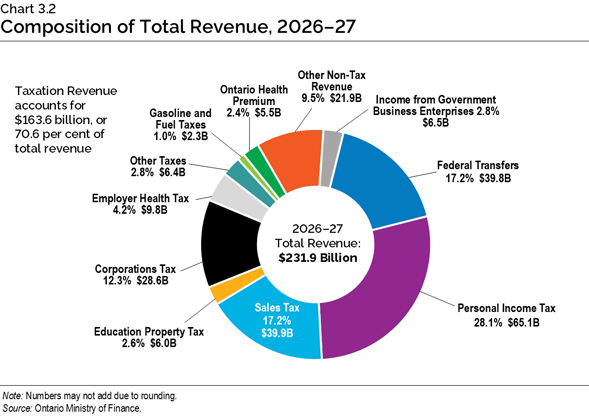
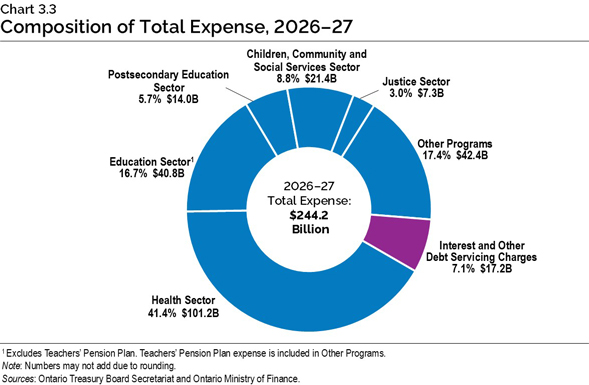
| 196 |
| Chapter 3: Ontario’s Fiscal Plan and Outlook |
Table 3.11
Infrastructure Expenditures
($ Millions)
| Sector | Total Infrastructure Expenditures Interim1 2025–26 |
2026–27 Plan | ||||||||||||||
| Investment in Capital Assets2 |
Transfers and Other Infrastructure Expenditures3 |
Total Infrastructure Expenditures |
||||||||||||||
| Transportation | ||||||||||||||||
| Transit |
12,714 | 12,796 | 993 | 13,789 | ||||||||||||
| Provincial Highways |
4,128 | 5,001 | 390 | 5,391 | ||||||||||||
| Other Transportation, Property and Planning |
225 | 139 | 123 | 261 | ||||||||||||
| Health | ||||||||||||||||
| Hospitals |
4,458 | 5,579 | 22 | 5,602 | ||||||||||||
| Other Health |
645 | 183 | 1,229 | 1,413 | ||||||||||||
| Education | 4,213 | 4,134 | 77 | 4,211 | ||||||||||||
| Postsecondary Education | ||||||||||||||||
| Colleges and Other |
831 | 670 | 32 | 701 | ||||||||||||
| Universities |
213 | – | 202 | 202 | ||||||||||||
| Social | 601 | 40 | 543 | 583 | ||||||||||||
| Justice | 629 | 1,006 | 96 | 1,102 | ||||||||||||
| Other Sectors4 | 6,041 | 3,035 | 2,351 | 5,386 | ||||||||||||
| Total Infrastructure Expenditures | 34,695 | 32,583 | 6,058 | 38,641 | ||||||||||||
| Less: Other Partner Funding5 | 2,416 | 1,897 | – | 1,897 | ||||||||||||
| Total6 | 32,279 | 30,686 | 6,058 | 36,744 | ||||||||||||
| 1 | Includes provincial investment in capital assets of $24.4 billion. |
| 2 | Includes $1,261 million in interest capitalized during construction. |
| 3 | Includes transfers to municipalities, universities, and non-consolidated agencies. |
| 4 | Includes high-speed internet infrastructure, government administration, natural resources, and culture and tourism industries. |
| 5 | Other Partner Funding refers to third-party investments primarily in hospitals, colleges and schools. |
| 6 | Includes Federal–Municipal contributions to provincial infrastructure investments. |
Note: Numbers may not add due to rounding.
Source: Ontario Treasury Board Secretariat.
| 197 |
| Chapter 3: Ontario’s Fiscal Plan and Outlook |
Table 3.12
10-Year Review of Selected Financial and Economic Statistics1, 2
($ Millions)
| 2017–18 | 2018–19 | 2019–20 | ||||||||||
| Revenue | 151,291 | 154,751 | 157,141 | |||||||||
| Expense | ||||||||||||
| Programs |
142,464 | 148,747 | 152,265 | |||||||||
| Interest and Other Debt Servicing Charges3 |
12,506 | 13,332 | 13,471 | |||||||||
| Total Expense | 154,969 | 162,079 | 165,736 | |||||||||
| Reserve | – | – | – | |||||||||
| Surplus/(Deficit) | (3,679) | (7,328) | (8,595) | |||||||||
| Net Debt4 | 323,068 | 337,623 | 352,382 | |||||||||
| Accumulated Deficit | 208,257 | 215,770 | 224,814 | |||||||||
| Gross Domestic Product (GDP) at Market Prices | 824,979 | 860,103 | 893,224 | |||||||||
| Primary Household Income | 541,501 | 567,484 | 593,065 | |||||||||
| Population (000s) — July5 | 14,078 | 14,327 | 14,574 | |||||||||
| Net Debt per Capita4 (Dollars) | 22,948 | 23,566 | 24,180 | |||||||||
| Household Income per Capita (Dollars) | 38,463 | 39,610 | 40,695 | |||||||||
| Net Debt as a Per Cent of Revenue4 | 214.4% | 219.5% | 225.6% | |||||||||
| Interest as a Per Cent of Revenue | 7.9% | 8.1% | 8.0% | |||||||||
| Net Debt as a Per Cent of GDP4 | 39.2% | 39.3% | 39.5% | |||||||||
| Accumulated Deficit as a Per Cent of GDP | 25.2% | 25.1% | 25.2% | |||||||||
| 1 | Amounts reflect a change in pension expense that was calculated based on recommendations of the Independent Financial Commission of Inquiry, as described in Note 19 to the Consolidated Financial Statements, in Public Accounts of Ontario 2017–2018. Amounts for net debt and accumulated deficit also reflect this change. |
| 2 | Beginning in the 2025 Budget, the Total Revenue, Interest and Other Debt Servicing Charges (IOD), and Total Expense figures for all years have been restated to report interest and investment income as part of revenue and separate from IOD. These changes are fiscally neutral. |
| 3 | Interest and Other Debt Servicing Charges is net of interest capitalized during construction of tangible capital assets of $694 million in 2022–23, $978 million in 2023–24, $1,221 million in 2024–25, $1,309 million in 2025–26, and $1,261 million in 2026–27. |
| 4 | For 2026–27 and future years, Net Debt reflects financial assets less financial liabilities and is aligned with Net Financial Liabilities, as will be reported in the Public Accounts of Ontario 2026–2027. A one-year restatement will be provided in the Public Accounts of Ontario 2026–2027. |
| 5 | Population figures are for July 1 of the fiscal year indicated (i.e., for 2025–26, the population on July 1, 2025, is shown). |
Note: Numbers may not add due to rounding.
Sources: Statistics Canada, Ontario Treasury Board Secretariat and Ontario Ministry of Finance.
| 198 |
| Chapter 3: Ontario’s Fiscal Plan and Outlook |
| 2020–21 | 2021–22 | 2022–23 | 2023–24 | Actual 2024–25 |
Interim 2025–26 |
Plan 2026–27 | ||||||||||||||||||
| 165,737 | 185,847 | 194,431 | 208,975 | 226,161 | 226,609 | 231,856 | ||||||||||||||||||
| 168,964 | 170,520 | 186,364 | 195,207 | 212,129 | 222,387 | 226,963 | ||||||||||||||||||
| 13,063 | 13,302 | 13,935 | 14,461 | 15,122 | 16,047 | 17,237 | ||||||||||||||||||
| 182,027 | 183,822 | 200,299 | 209,668 | 227,251 | 238,434 | 244,200 | ||||||||||||||||||
| – | – | – | – | – | 500 | 1,500 | ||||||||||||||||||
| (16,290) | 2,025 | (5,868) | (693) | (1,090) | (12,326) | (13,844) | ||||||||||||||||||
| 372,501 | 382,842 | 399,806 | 409,761 | 427,050 | 459,362 | 485,120 | ||||||||||||||||||
| 238,231 | 238,160 | 246,007 | 246,101 | 247,060 | 259,386 | 273,230 | ||||||||||||||||||
| 874,354 | 970,146 | 1,065,260 | 1,138,592 | 1,197,020 | 1,246,922 | 1,286,664 | ||||||||||||||||||
| 592,514 | 642,144 | 689,842 | 740,660 | 797,253 | 831,850 | 862,616 | ||||||||||||||||||
| 14,762 | 14,842 | 15,156 | 15,632 | 16,145 | 16,258 | 16,232 | ||||||||||||||||||
| 25,234 | 25,794 | 26,380 | 26,212 | 26,451 | 28,254 | 29,887 | ||||||||||||||||||
| 40,138 | 43,264 | 45,517 | 47,380 | 49,381 | 51,165 | 53,143 | ||||||||||||||||||
| 225.8% | 206.8% | 207.3% | 199.0% | 191.2% | 204.4% | 210.9% | ||||||||||||||||||
| 7.5% | 6.8% | 6.4% | 5.5% | 5.5% | 6.3% | 6.7% | ||||||||||||||||||
| 42.6% | 39.5% | 37.5% | 36.0% | 35.7% | 36.8% | 37.7% | ||||||||||||||||||
| 27.2% | 24.5% | 23.1% | 21.6% | 20.6% | 20.8% | 21.2% | ||||||||||||||||||
| 199 |

| Chapter 4: Borrowing and Debt Management |
Introduction
Ontario’s borrowing program is primarily used to fund deficits, refinance maturing debt, make investments in capital assets and support other loans and investments that advance key provincial priorities. Ontario has completed $58.6 billion in long-term borrowing in 2025–26. This is $15.8 billion higher than anticipated in the 2025 Budget and has allowed Ontario to pre-fund 2026–27 borrowing requirements and the $5 billion Protect Ontario Account, first announced in the 2025 Budget. The 2026–27 and 2027–28 long-term public borrowing forecasts are $47.2 billion and $43.1 billion, an increase of $6.1 billion and $10.1 billion from the 2025 Budget forecast, respectively. Long-term public borrowing for 2028–29 is forecast to be $42.7 billion.
Ontario remains committed to transparent, prudent and responsible borrowing and debt management. Beginning in 2026–27, changes to Public Sector Accounting Standards – Conceptual Framework for Financial Reporting in the Public Sector and Section PS 1202 Financial Statement Presentation (Conceptual Framework and Reporting Model), will affect how certain balance sheet measures are presented in the Public Accounts of Ontario. These changes do not affect Ontario’s fiscal plan, borrowing requirements or debt management strategy. Rather, they update the accounting presentation of key debt sustainability measures.
To ensure clarity and continuity for users of the 2026 Budget and other strategic fiscal documents, Ontario is updating the presentation and terminology of its measures, while maintaining strong connectivity to the Public Accounts. For comparability with previously published fiscal plan information and the forthcoming Public Accounts of Ontario 2025–2026, the 2025–26 Interim measure of Net Debt continues to be presented using the existing calculation. However, beginning in 2026–27, the 2026 Budget outlook reflects a revised calculation under PS 1202 that will be adopted in the Public Accounts of Ontario 2026–2027. Under this approach, Net Debt is equivalent to Net Financial Liabilities for the outlook.
As a result of the updated calculation applied to fiscal 2026–27 and beyond, the net debt-to-GDP ratio and net debt-to-revenue ratio will be marginally lower than previously reported. These differences reflect accounting and methodological updates only and do not represent a change in Ontario’s fiscal plan. Ontario’s Debt Burden Reduction Strategy targets remain unchanged and more information can be found in the relevant section below.
| 203 |
| Chapter 4: Borrowing and Debt Management |
Borrowing Program
Ontario’s borrowing program is primarily used to fund deficits, refinance maturing debt, make investments in capital assets and support other loans and investments that advance key provincial priorities. Ontario will continue to finance most of its borrowing program in the long-term public markets.
Table 4.1
2025–26 Borrowing Program and Medium-Term Outlook
| ($ Billions) | ||||||||||||||||||||||||
| 2025–26 | Medium-Term Outlook | |||||||||||||||||||||||
| 2025 Budget |
Change from 2025 Budget |
Interim 2025–26 |
2026–27 | 2027–28 | 2028–29 | |||||||||||||||||||
| Deficit/(Surplus) | 14.6 | (2.3) | 12.3 | 13.8 | 6.1 | (0.6) | ||||||||||||||||||
| Provincial Investment in Capital Assets | 23.1 | 1.3 | 24.4 | 28.0 | 28.0 | 22.4 | ||||||||||||||||||
| Pre-funding for Protect Ontario Account | – | 5.0 | 5.0 | – | – | – | ||||||||||||||||||
| Amortization of Capital Assets | (9.1) | – | (9.1) | (10.2) | (10.5) | (11.4) | ||||||||||||||||||
| Non-Cash and Cash Timing Adjustments | (3.1) | 1.0 | (2.1) | (2.5) | (2.7) | (3.5) | ||||||||||||||||||
| Net Loans and Investments1 | 1.2 | 1.1 | 2.4 | 5.2 | 5.6 | 4.9 | ||||||||||||||||||
| Debt Maturities and Redemptions | 33.1 | – | 33.1 | 26.9 | 27.5 | 30.7 | ||||||||||||||||||
| Total Funding Requirement | 59.8 | 6.1 | 65.9 | 61.2 | 54.1 | 42.7 | ||||||||||||||||||
| Decrease/(Increase) in Short-Term Borrowing | (5.0) | (0.5) | (5.5) | (6.0) | (6.0) | – | ||||||||||||||||||
| Increase/(Decrease) in Year-End Cash and Cash Equivalents | (12.0) | 10.2 | (1.8) | (8.0) | (5.0) | – | ||||||||||||||||||
| Total Long-Term Borrowing | 42.8 | 15.8 | 58.6 | 47.2 | 43.1 | 42.7 | ||||||||||||||||||
| 1 | The increase in Net Loans and Investments primarily reflects higher projected loan disbursements associated with Ontario Student Assistance Program (OSAP) policy changes effective in the 2026–27 academic year. |
| Note: | Numbers may not add due to rounding. |
| Source: | Ontario Financing Authority. |
Ontario has completed long-term borrowing for 2025–26 of $58.6 billion. This is $15.8 billion higher than anticipated in the 2025 Budget and has allowed Ontario to pre-fund 2026–27 borrowing requirements and the $5 billion Protect Ontario Account, first announced in the 2025 Budget. The 2026–27, 2027–28 and 2028–29 long-term public borrowing forecasts are $47.2 billion, $43.1 billion and $42.7 billion.
Year-end cash and cash equivalents are forecasted to decrease by $8.0 billion in 2026–27 and $5.0 billion in 2027–28.
Ontario plans to increase short-term borrowing by $6.0 billion in 2026–27 and 2027–28. This positions Ontario to respond to recent changes in market demand for short-term Ontario debt. It will also maintain the proportion of short-term debt as a percentage of total debt outstanding within the target range of 5 to 7 per cent, as it has been over the past 10 years.
| 204 |
| Chapter 4: Borrowing and Debt Management |
In the event that alternative economic scenarios materialize, Ontario’s borrowing requirements in the next three years would also change (see Chapter 3: Ontario’s Fiscal Plan and Outlook for more details, and a description of the resulting alternative medium-term outlook scenarios). Under the Faster Growth scenario, long-term borrowing would decrease by a total of $16.1 billion over the three-year outlook period, while under the Slower Growth scenario, long-term borrowing would increase by $18.1 billion over the same period.
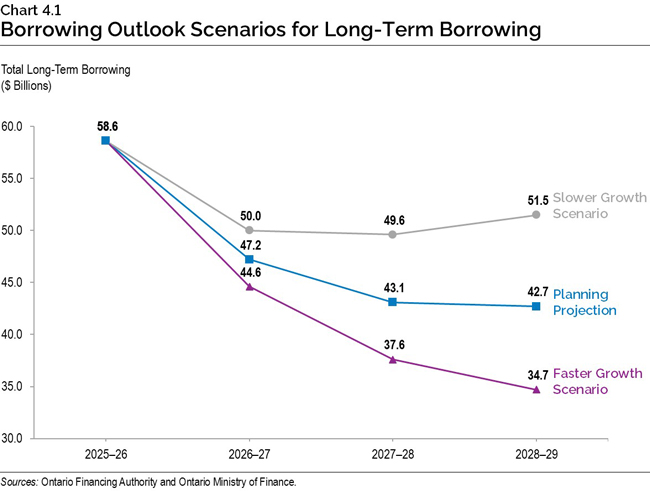
| 205 |
| Chapter 4: Borrowing and Debt Management |
Increased foreign demand and favourable international market conditions allowed for increased foreign issuance this year. Domestic Canadian borrowing represented 59 per cent of 2025–26 long-term borrowing and was comprised of 35 syndicated issues, one floating rate note, two Green Bonds and one Green Bond floating rate note. This percentage was lower than Ontario’s guidance for domestic borrowing of 65 to 80 per cent for the 2025–26 fiscal year. Ontario’s new guidance for domestic borrowing will be adjusted to 60 to 80 per cent for 2026–27. This range will continue to be adjusted, if necessary, in response to evolving investor demand in the Canadian dollar and foreign currency markets.
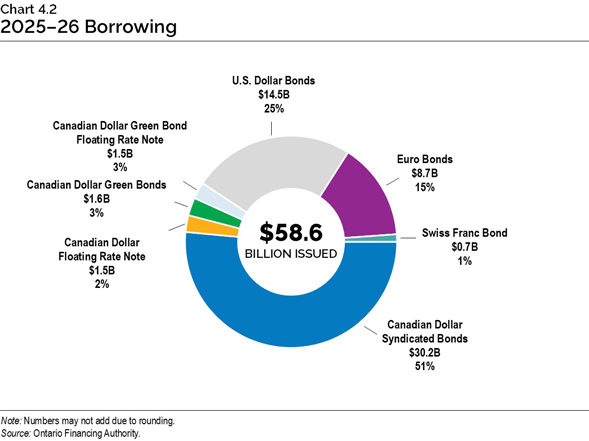
| 206 |
| Chapter 4: Borrowing and Debt Management |
The increase in foreign issuance allowed for further diversification of Ontario’s investor base while achieving cost-effective funding, ensuring reliable access to capital away from the domestic market. Foreign currency borrowing helps reduce Ontario’s overall borrowing costs. Responding to investor demand, Ontario issues foreign denominated public debt as well as privately placed transactions. Approximately $23.9 billion, or 41 per cent of this year’s long-term borrowing, was completed in foreign currencies, primarily in U.S. dollars, euros and Swiss francs. This year, for the first time, Ontario issued euro denominated 30-year bonds, raising $0.6 billion at lower costs than issuing in Canada after being hedged back to Canadian dollars. All proceeds from this fiscal year’s foreign issuances have been effectively hedged back to Canadian dollars, resulting in no foreign exchange risk to the province.
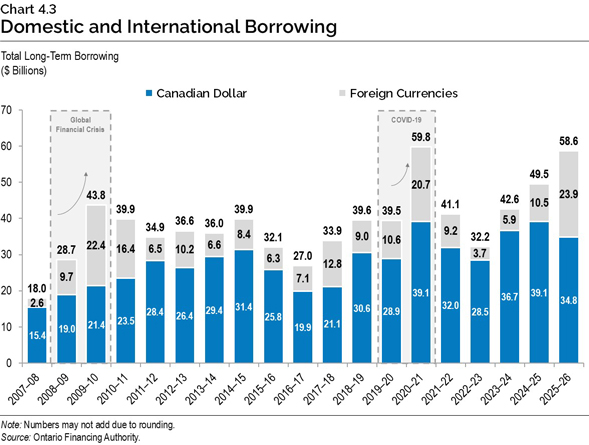
| 207 |
| Chapter 4: Borrowing and Debt Management |
Sustainable Bond Framework
The Green Bond Program, as part of the Sustainable Bond Framework, has been a core component of Ontario’s borrowing program since 2014. It is an important tool to help finance public transit initiatives, extreme weather-resistant infrastructure, as well as energy efficiency and conservation projects. Ontario remains the largest and most frequent issuer of Canadian dollar Green Bonds, with 21 issues totalling $24.6 billion since 2014–15 and $19.85 billion outstanding. A total of 29 projects have or will receive funding from Ontario’s 21 Green Bond issues. This includes the recently opened Eglinton Crosstown Light Rail Transit (LRT), which received $3.7 billion in financing across 10 Green Bond issues.
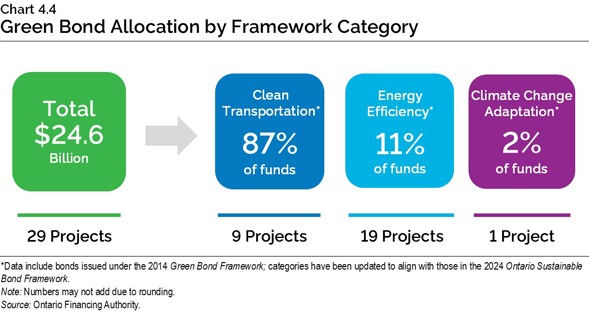
| 208 |
| Chapter 4: Borrowing and Debt Management |
On November 19, 2025, Ontario issued its first dual-tranche Green Bond, consisting of a $600 million Green Bond and a $1.5 billion Green Bond Floating Rate Note. Ontario has issued three Green Bonds in 2025–26, 21 Green Bond issues overall, and seven Green Bonds issued under the Ontario Sustainable Bond Framework. Four projects were selected to receive funding from the most recent Green Bond:
| • |
GO Expansion; |
| • |
Hazel McCallion Line; |
| • |
Ontario Line Subway; and |
| • |
Scarborough Subway Extension. |
Ontario plans to continue its leadership in the Canadian dollar Green Bond market and, subject to market conditions, will issue multiple Green Bonds each fiscal year.
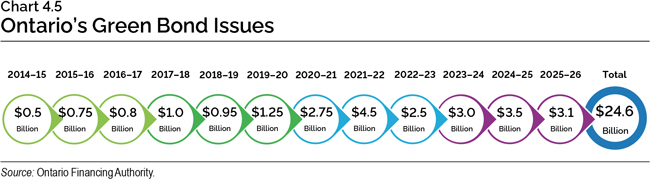
| 209 |
| Chapter 4: Borrowing and Debt Management |
Cost of Debt
The Bank of Canada cut the overnight policy rate four times in 2025 and entered 2026 with a neutral stance. As a result, short-term interest rates have declined significantly, while longer-term interest rates, which affect most of Ontario’s borrowing, have remained relatively stable.
In an environment where ongoing trade tension, geopolitical conflicts and rapid technological change are collectively reshaping the Canadian and global economies, the central bank actions and financial markets’ responses remain unpredictable. Ontario actively manages interest rate risks to minimize impacts on the Interest and Other Debt Servicing Charges (IOD) costs.
Chart 4.6 shows that Ontario’s decision to lock in long-term rates and extend the term of its debt has left the interest rate on the total debt portfolio lower, in historical terms, in spite of rising broader market interest rates over the past five years.
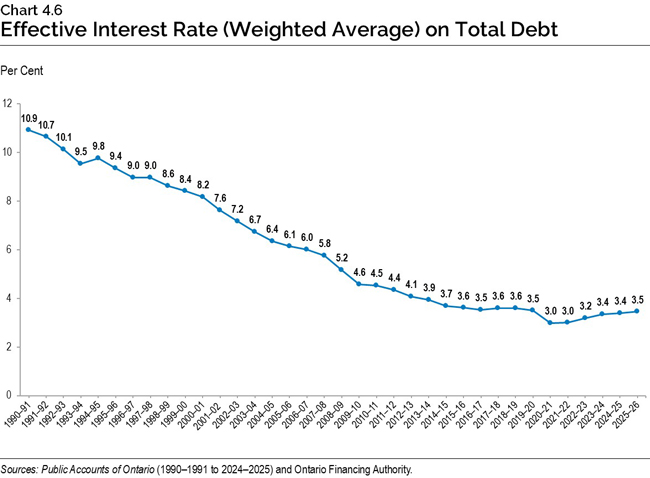
| 210 |
| Chapter 4: Borrowing and Debt Management |
Ontario’s borrowing costs for 2025–26 are now estimated to be 3.85 per cent, 15 basis points lower than forecasted in the 2025 Budget, as shown in Chart 4.7. A one percentage point change in interest rates, either up or down from the current interest rate forecast, would result in a corresponding change in Ontario’s borrowing costs of approximately $0.9 billion in the first full year. IOD remains Ontario’s fourth largest expense after health care, education and social services.
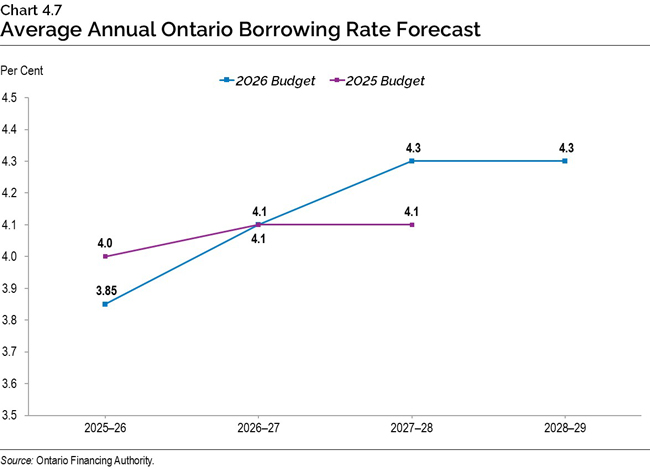
| 211 |
| Chapter 4: Borrowing and Debt Management |
Ontario is forecast to pay $16.0 billion in interest costs in 2025–26, $0.2 billion lower than the 2025 Budget projection. Interest costs for 2026–27 and 2027–28 are estimated to be $17.2 billion and $18.6 billion, up from the 2025 Budget forecasts of $17.0 billion and $17.8 billion, respectively.
The forecast for interest costs has risen due to higher deficits, increased capital spending and an increase in Ontario’s loans and investment portfolio, with the latter primarily driven by a larger Ontario Student Assistance Program (OSAP).
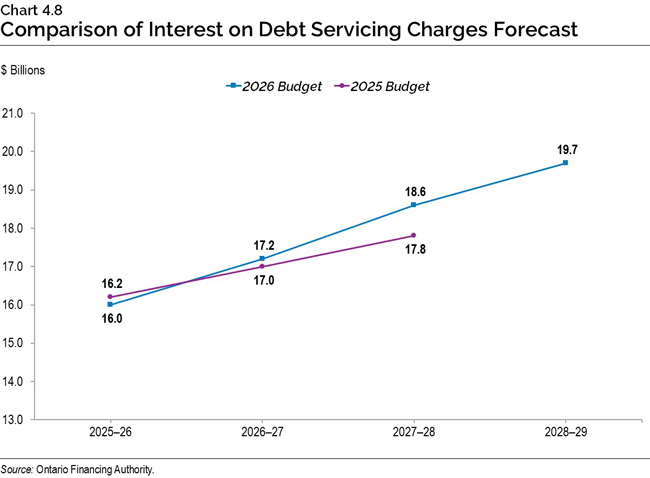
| 212 |
| Chapter 4: Borrowing and Debt Management |
Term of Debt
Ontario has continued to extend the term of its debt when investor demand allowed, to reduce future refinancing risk. This also protects the IOD forecast in the long term against future interest rate increases. Ontario has issued $160.8 billion of bonds, or almost one-third of total debt outstanding, with maturities of 30 years or longer since 2010–11. This includes $11.1 billion in 2025–26.
The success Ontario has had in extending the term of its debt has created flexibility for managing its large borrowing program and debt portfolio. Due to the extension of the term of debt, the impact on IOD in the short term and medium term has been lessened. Ontario will continue to monitor the market and adjust the debt term strategy in response to further changes to interest rates and the yield curve.
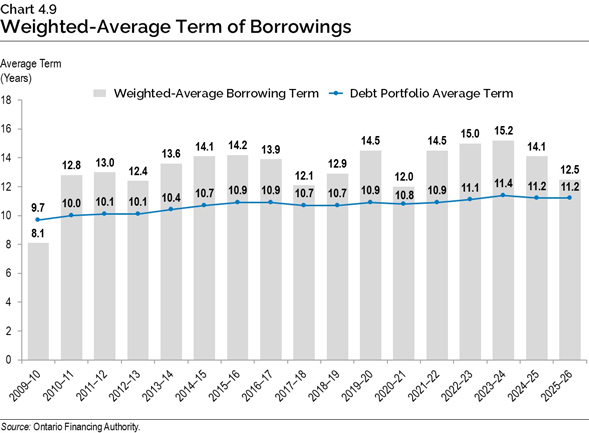
| 213 |
| Chapter 4: Borrowing and Debt Management |
Ensuring Adequate Liquidity Levels
Ontario aims to maintain an optimal level of cash reserves that balance potential holding costs with the need to have adequate funds to meet its financial obligations in a timely manner, as well as to be able to respond promptly during economic downturns or financial challenges. Prior to 2025–26, short-term interest rates were higher than long-term rates, which meant that holding liquid reserves reduced IOD as short-term investments earned more income than Ontario’s cost of borrowing long-term debt. Although short-term and long-term rates have normalized, Ontario intends to maintain current liquid reserve levels due to ongoing market and economic volatility. Ontario will continue to actively manage liquid reserve investments, including creating a core liquidity portfolio of longer-term liquid investments, to help mitigate the cost of holding liquid reserves.
As shown in Chart 4.10, Ontario’s cash reserves averaged $44.0 billion in 2025–26.
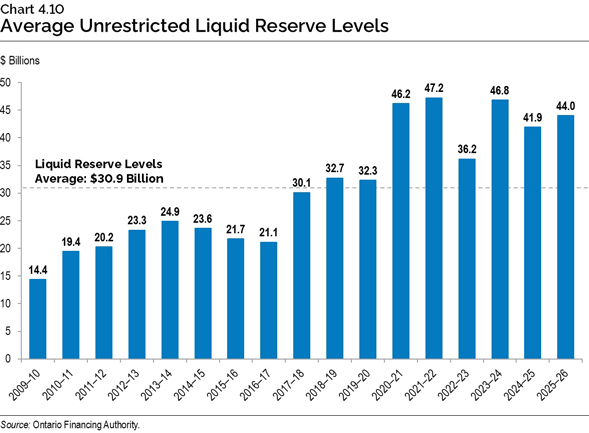
| 214 |
| Chapter 4: Borrowing and Debt Management |
Debt Burden Reduction Strategy
The Debt Burden Reduction Strategy set out below provides the government’s progress and associated metrics required under the Fiscal Sustainability, Transparency and Accountability Act, 2019.
The government remains committed to reducing the debt burden while ensuring that Ontario’s finances are sustainable. As a result, Ontario has maintained its targets and continues to make progress towards achieving them over the medium-term outlook. In addition, Ontario’s path to balance by 2028–29 will further support progress towards its Debt Burden Reduction Strategy.
Effective April 1, 2026, new Public Sector Accounting Standards – Conceptual Framework for Financial Reporting in the Public Sector and Section PS 1202 Financial Statement Presentation (Conceptual Framework and Reporting Model), require governments to present Net Financial Liabilities as the primary balance sheet indicator in the Public Accounts, replacing Net Debt. Net Financial Liabilities is calculated as Financial Assets less Financial Liabilities. Under the new standard, certain elements previously included in liabilities are excluded, reflecting updated accounting guidance.
For the purposes of fiscal planning, transparency and international comparability, Ontario will continue to use Net Debt in the 2026 Budget and other strategic fiscal documents. Net Debt remains a widely used indicator across jurisdictions in Canada and internationally and is an important benchmark for investors in Ontario bonds. To maintain comparability with previously published fiscal plan information and the forthcoming Public Accounts of Ontario 2025–2026, the 2025–26 Interim Net Debt measure will continue to be presented using the previous calculation. Beginning in 2026–27, Net Debt for the outlook years reflects the revised calculation that will be adopted in the 2026–2027 Public Accounts and is equivalent to Net Financial Liabilities. As a result, Net Debt figures will differ from previously reported figures even though the underlying fiscal position is unchanged.
| 215 |
| Chapter 4: Borrowing and Debt Management |
To improve clarity, consistency and ease of communication, Ontario is updating the names of the debt burden ratios, as follows:
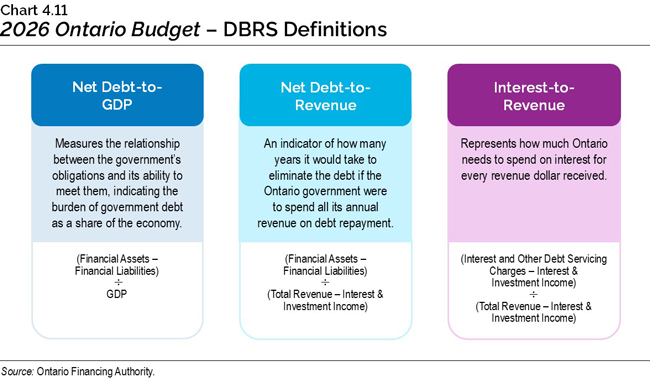
| 216 |
| Chapter 4: Borrowing and Debt Management |
Making Progress on the Debt Burden Reduction Strategy
The 2026 Budget includes a Debt Burden Reduction Strategy that continues to focus on meeting the established targets over the medium-term outlook for the relevant measures of debt sustainability. Meeting these targets on a sustained basis would help improve Ontario’s credit rating profile and lower Ontario’s cost of borrowing. Ontario’s borrowing and debt management strategy is achieving results. In an environment of global economic uncertainty and volatile interest rates, Ontario has responded by diversifying its investor base, locking in long-term rates and extending the term of its debt. These strategic actions, when taken collectively, help Ontario reduce its overall borrowing costs, mitigate future interest rate increases and minimize the impacts of market volatility. This also results in less money being required to pay for IOD, while freeing up financial resources for other priorities.
Table 4.2
Progress on Relevant Debt Sustainability Measures
| (Per Cent) | ||||||||||
| 2025–26 Forecast | 2026–27 Forecast | |||||||||
| Targets | 2025 Budget | 2026 Budget | 2025 Budget | 2026 Budget | ||||||
| Net Debt-to-GDP1 | <40.0 | 37.9 | 36.8 | 38.9 | 37.7 | |||||
| Net Debt-to-Revenue1 | <200 | 211 | 204 | 215 | 211 | |||||
| Interest-to-Revenue | <7.5 | 6.5 | 6.3 | 6.7 | 6.7 | |||||
Source: Ontario Financing Authority.
| 1 |
For 2026–27, Net Debt reflects financial assets less financial liabilities and is aligned with Net Financial Liabilities, as will be reported in the Public Accounts of Ontario 2026–2027. |
| 217 |
| Chapter 4: Borrowing and Debt Management |
Ontario’s 2025–26 net debt-to-GDP ratio is now forecast to be 36.8 per cent, a decrease of 1.1 percentage points from the 37.9 per cent forecasted in the 2025 Budget, which is primarily due to a lower-than-projected deficit. The ratio is projected to be 37.7 per cent in 2026–27, 38.5 per cent in 2027–28, and 38.2 per cent in 2028–29. This represents a modest improvement from the forecast in the 2025 Budget, attributed to stronger GDP growth. Beginning in 2026–27, the net debt-to-GDP ratio reflects the revised net debt calculation under the new Public Sector Accounting Standard effective April 1, 2026. This methodological change results in the ratio being 0.8 per cent lower in each of the three outlook years compared to what would have been reported under the previous calculation.
Over the medium-term outlook, the net debt-to-GDP ratio is forecast to stay below the target of 40.0 per cent, demonstrating that Ontario continues to make positive progress towards reducing the debt burden.
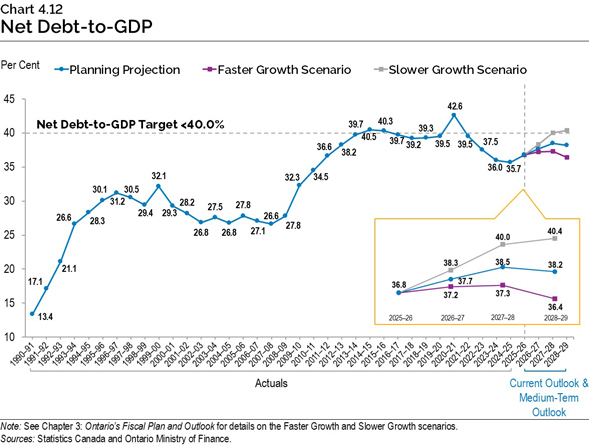
| 218 |
| Chapter 4: Borrowing and Debt Management |
The net debt-to-revenue ratio is projected to be 204 per cent in 2025–26, 7 percentage points below the 211 per cent forecasted in the 2025 Budget. Over the medium-term outlook, this ratio is forecast to be 211 per cent in 2026–27, 213 per cent in 2027–28, and 210 per cent in 2028–29. The methodological change in the calculation of Net Debt beginning in 2026–27 results in the ratio being approximately 4 per cent lower in each of the three outlook years compared to what would have been reported under the previous calculation. Ontario’s target for the net debt-to-revenue ratio remains to be below 200 per cent. While the current economic environment will temporarily raise the level of this ratio, the government remains committed to and has proven it has the capability to reattain this target. Based on the growth trend in net debt and revenue beyond the medium-term outlook, this ratio is expected to meet the target of 200 per cent by 2032–33, or as early as 2028–29 should the Faster Growth scenario materialize.
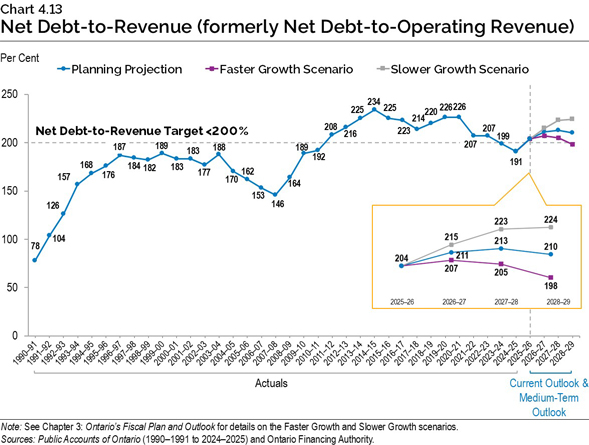
| 219 |
| Chapter 4: Borrowing and Debt Management |
Ontario’s interest-to-revenue ratio is projected to be 6.3 per cent in 2025–26, 0.2 percentage points lower than the 6.5 per cent forecast in the 2025 Budget. Over the medium-term outlook, this ratio is forecast to be 6.7 per cent in 2026–27, 6.9 per cent in 2027–28 and 7.1 per cent in 2028–29. In comparison to the 2025 Budget, the ratio remains the same for 2026–27 and increases by 0.1 percentage points in 2027–28.
Ontario continues to show positive progress on the interest-to-revenue ratio and is forecasting that it will meet the target and stay below 7.5 per cent over the medium-term outlook. This ratio remains close to the lowest levels it has been at since the 1980s.
A lower interest-to-revenue ratio frees up financial resources for critical priorities.
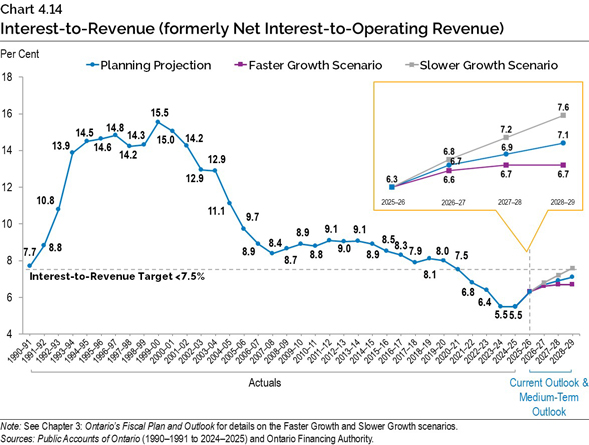
| 220 |
| Chapter 4: Borrowing and Debt Management |
Consolidated Financial Tables
Table 4.3
Net Debt and Accumulated Deficit
| ($ Millions) | ||||||||||||||||||||||||
| 2021–22 | 2022–23 | 2023–24 | Actual 2024–25 |
Interim1 2025–26 |
Plan 2026–27 |
|||||||||||||||||||
| Debt2 | ||||||||||||||||||||||||
| Publicly Held Debt | ||||||||||||||||||||||||
| Bonds3 |
399,628 | 403,398 | 417,308 | 440,186 | 466,951 | 487,326 | ||||||||||||||||||
| Treasury Bills |
22,301 | 22,276 | 22,536 | 22,189 | 21,122 | 27,122 | ||||||||||||||||||
| U.S. Commercial Paper3 |
1,735 | 460 | – | 5,395 | 11,962 | 11,962 | ||||||||||||||||||
| Infrastructure Ontario (IO)4 |
300 | 300 | 300 | 300 | 300 | 300 | ||||||||||||||||||
| Other |
231 | 217 | 202 | 186 | 170 | 152 | ||||||||||||||||||
| Total Publicly Held Debt | 424,195 | 426,651 | 440,346 | 468,256 | 500,505 | 526,862 | ||||||||||||||||||
| Non-Public Debt | 8,766 | 8,678 | 7,956 | 6,782 | 6,165 | 6,123 | ||||||||||||||||||
| Gross Debt | 432,961 | 435,329 | 448,302 | 475,038 | 506,670 | 532,985 | ||||||||||||||||||
| Less: Holdings of own Ontario Bonds and Treasury Bills5 | (7,098) | (10,154) | (6,125) | (12,549) | (9,984) | – | ||||||||||||||||||
| Less: Unamortized Discounts, Premiums and Commissions6 | – | (3,376) | (4,544) | (4,361) | (4,564) | – | ||||||||||||||||||
| Total Debt | 425,863 | 421,799 | 437,633 | 458,128 | 492,122 | 532,985 | ||||||||||||||||||
| Other Net Financial (Assets)/Liabilities7 | (54,729) | (38,554) | (46,288) | (47,331) | (50,319) | (64,200) | ||||||||||||||||||
| Broader Public Sector Net Debt | 11,708 | 16,561 | 18,416 | 16,253 | 17,559 | 16,335 | ||||||||||||||||||
| Net Debt9 | 382,842 | 399,806 | 409,761 | 427,050 | 459,362 | 485,120 | ||||||||||||||||||
| Non-Financial Assets8 | (144,682) | (153,799) | (163,660) | (179,990) | (199,976) | (211,890) | ||||||||||||||||||
| Accumulated Deficit | 238,160 | 246,007 | 246,101 | 247,060 | 259,386 | 273,230 | ||||||||||||||||||
| 1 | Interim represents the 2026 Budget projection for the 2025–26 fiscal year. |
| 2 | Includes debt issued by Ontario and all government organizations, including the Ontario Electricity Financial Corporation (OEFC). |
| 3 | All balances are expressed in Canadian dollars. The balances above reflect the effect of related derivative contracts. |
| 4 | IO debt is composed of Infrastructure Renewal Bonds. IO debt is not guaranteed by Ontario. |
| 5 | Ontario holds its own debt mainly to reduce the cash flow required to service large maturities, typically in June. For 2026–27, there are currently no significant holdings for maturities. |
| 6 | Effective April 1, 2022, Ontario adopted the new Public Sector Accounting Standards (PSAS) on Financial Instruments on a prospective basis. Unamortized discounts and premiums are now amortized on an effective interest basis. These amounts are not forecasted for 2026–27. |
| 7 | Other Net Financial (Assets)/Liabilities include cash and temporary investments, accounts receivable, loans receivable, advances and investments in Government Business Enterprises (GBEs) offset by accounts payable, accrued liabilities, deferred revenue and capital contributions, pensions and other employee future benefits, and other liabilities. |
| 8 | Non-financial assets include the tangible capital assets of Ontario, including the broader public sector. |
| 9 | Effective April 1, 2026, Ontario adopted the new Public Sector Accounting Standards (PSAS) related to the Conceptual Framework and Reporting Model. For 2026–27 and future years, Net Debt reflects financial assets less financial liabilities and is aligned with Net Financial Liabilities, as will be reported in the Public Accounts of Ontario 2026–2027. |
Sources: Ontario Financing Authority and Ontario Ministry of Finance.
| 221 |
| Chapter 4: Borrowing and Debt Management |
Table 4.4
Medium-Term Outlook: Net Debt and Accumulated Deficit
| ($ Millions) | ||||||||||||
| 2026–27 | 2027–28 | 2028–29 | ||||||||||
| Total Debt | 532,985 | 554,566 | 566,432 | |||||||||
| Other Net Financial (Assets)/Liabilities | (64,200) | (57,303) | (54,695) | |||||||||
| Broader Public Sector Net Debt | 16,335 | 17,114 | 17,545 | |||||||||
| Net Debt1 | 485,120 | 514,377 | 529,282 | |||||||||
| Non-Financial Assets | (211,890) | (235,030) | (250,491) | |||||||||
| Accumulated Deficit | 273,230 | 279,347 | 278,791 | |||||||||
| 1 | Effective April 1, 2026, Ontario adopted the new Public Sector Accounting Standards (PSAS) related to the Conceptual Framework and Reporting Model. For 2026–27 and future years, Net Debt reflects financial assets less financial liabilities and is aligned with Net Financial Liabilities, as will be reported in the Public Accounts of Ontario 2026–2027. |
Note: Numbers may not add due to rounding.
Sources: Ontario Financing Authority and Ontario Ministry of Finance.
| 222 |
| Annex: Details of Tax Measures and Other Legislative Initiatives |
Overview
This Annex contains detailed information on certain tax measures and other legislative initiatives proposed in the 2026 Budget.
Lowering Taxes for Small Businesses
Ontario’s general corporate income tax (CIT) rate is 11.5 per cent. Up to $500,000 of active business income earned by small Canadian-controlled private corporations (CCPCs), and associated groups of CCPCs, is eligible for a reduced small business CIT rate of 3.2 per cent. The small business limit of $500,000 of active business income begins to phase out when a CCPC, or an associated group of CCPCs, has over $10 million of taxable capital employed in Canada and phases out completely at $50 million.
To continue supporting small businesses in the province, the government is proposing to cut the Ontario small business CIT rate from 3.2 per cent to 2.2 per cent, effective July 1, 2026. The tax rate reduction would be prorated for taxation years straddling July 1, 2026.
As dividends are paid out of after-tax corporate earnings, individual shareholders are eligible for personal income tax relief through the federal and Ontario dividend tax credits, the rate of which approximates the CIT rate paid by the corporation. To align with the reduction in Ontario’s small business CIT rate, Ontario’s small business (non-eligible) dividend tax credit rate would be reduced from 2.9863 per cent to 1.9863 per cent, effective January 1, 2027.
Enhancing Harmonized Sales Tax Relief on New Homes
The government is taking steps to temporarily enhance the existing Ontario Harmonized Sales Tax (HST) New Housing Rebate and New Residential Rental Property Rebate to fully remove the 8 per cent provincial portion of the HST paid for qualifying new homes valued up to $1 million.
Currently, the two provincial housing rebates provide a 75 per cent rebate of the provincial portion of the HST, up to a maximum rebate of $24,000 on purchases of a qualifying new or substantially renovated home. These rebates are not limited to individuals who would qualify for the proposed provincial rebate for first-time home buyers.
The province will work with the federal government to propose that Ontario’s enhanced rebates be available from April 1, 2026 to March 31, 2027. For example, purchasers who acquire the home as their primary place of residence could be eligible if they enter into an agreement of purchase and sale with a builder on or after April 1, 2026 and on or before March 31, 2027. For these purchasers, construction of the home must begin on or before December 31, 2028 and the home must be substantially completed on or before December 31, 2031.
| 225 |
| Annex: Details of Tax Measures and Other Legislative Initiatives |
The maximum rebate amount after the enhancement would be $80,000 for a new home valued at or under $1 million, with that amount being maintained for new homes valued up to $1.5 million. The maximum amount of the rebate would follow a linear reduction for higher-valued homes. For new homes valued at or above $1.85 million, a rebate of $24,000 would continue to be available as under the current rules.
The new home must be used as a primary place of residence to qualify for the New Housing Rebate or as a residential rental property for the New Residential Rental Property Rebate. Eligible individuals who would qualify for the proposed rebate for first-time home buyers, and who make a purchase during this enhancement period, would be able to receive the same rebate amount as under this proposed enhancement.
Changes to Ontario’s existing rebates require federal regulatory changes. The Ontario government will work closely with the federal government to ensure timely implementation of the enhancement.
Eliminating the Harmonized Sales Tax New Housing Rebate and New Residential Rental Property Rebate
Eligibility for the provincial HST New Housing Rebate and New Residential Rental Property Rebate is proposed to end after the end of the proposed enhancement period for those same rebates. Further details on transitional provisions detailing the elimination of the rebates will be provided in the 2026 Ontario Economic Outlook and Fiscal Review.
Eligibility for Ontario’s proposed HST rebate for first-time home buyers and the Ontario HST Purpose-Built Rental Housing Rebate would not be affected and would continue to follow the criteria set by the federal government for eligible properties.
| 226 |
| Annex: Details of Tax Measures and Other Legislative Initiatives |
Expanding Harmonized Sales Tax Relief for First-Time Home Buyers on New Homes
After the federal Goods and Services Tax/Harmonized Sales Tax (GST/HST) First-Time Home Buyers’ Rebate was announced, the federal government amended its draft legislation to have the rebate take effect earlier, on March 20, 2025.
Federal regulations are required to bring the provincial rebate into force. Ontario will continue working with the federal government to align the Ontario rebate’s effective period with the federal rebate. This would mean both the Ontario and federal rebate would be available if the agreement of purchase and sale for the home is entered into with the builder on or after March 20, 2025, and before 2031.
All other rebate parameters, as announced by Ontario on October 28, 2025, would remain unchanged.
Ontario Trillium Benefit Lump-Sum Payment Threshold
The Ontario Trillium Benefit (OTB) is a tax-free payment that helps low- to moderate-income Ontario residents pay for energy costs as well as sales and property taxes. The OTB combines the following three credits:
| • |
Northern Ontario Energy Credit; |
| • |
Ontario Energy and Property Tax Credit; and |
| • |
Ontario Sales Tax Credit. |
The OTB is paid either monthly or as a single lump sum, depending on certain factors, including the amount payable for the benefit year.
When the amount of the OTB payable for the benefit year is no more than a certain threshold, the benefit is paid as a single lump-sum payment at the beginning of the benefit year (instead of as a series of monthly payments throughout the benefit year). Since the 2013–14 benefit year, the threshold value has been $360.
The government is proposing to increase this threshold from $360 to $500, starting with the 2026–27 benefit year (July 1, 2026 to June 30, 2027), which would result in more OTB recipients receiving their full benefit upfront. This change would not impact the total benefit amount received.
As a result of this proposed change, starting July 2026:
| • |
Individuals who are to receive OTB of $500 or less for the benefit year would receive one lump-sum payment in the first month of the benefit year; and |
| 227 |
| Annex: Details of Tax Measures and Other Legislative Initiatives |
| • |
Individuals who are to receive OTB of more than $500 for the benefit year would continue to receive monthly payments starting the first month of the benefit year (unless they chose on their personal income tax return to receive a single lump-sum payment at the end of the benefit year). |
Simplifying and Reducing Alcohol Taxes
The government is proposing to consolidate legacy taxes into simplified single rates to reduce complexity and provide further tax cuts on sales of beer, wine and spirits products sold in producer stores.
The government is proposing to combine the basic, volumetric and environmental beer taxes into a single tax rate of $1.18 per litre for non-draft and $0.90 per litre for draft beer made by a beer manufacturer, and $0.46 per litre for non-draft and $0.36 per litre for draft beer made by a microbrewer. The Small Beer Manufacturers’ Tax Credit (SBMTC) would also be adjusted to account for proposed beer tax rate changes. This would increase the maximum benefit for eligible small beer manufacturers and maintain the phase-out at 2 million litres of annual sales.
To simplify wine taxes that apply on wine products sold in on-site and off-site winery retail stores, the government is proposing to combine the basic, volumetric and environmental wine taxes into a single rate. A single rate of 0 per cent will apply on Ontario wines and wine coolers and 19.1 per cent will apply on non-Ontario wines and wine coolers in on-site winery retail stores. A single rate of 12 per cent will apply on owner wines and wine coolers sold in off-site winery retail stores.
To align the treatment of spirits sold in on-site distillery stores with the respective products sold in other channels, the spirits and spirits coolers categories would be replaced with three categories distinguished by alcohol by volume (ABV): (1) 7.1 per cent or below; (2) greater than 7.1 per cent to 18 per cent; and (3) greater than 18 per cent. The government is proposing to combine the basic, volumetric and environmental spirit taxes into a single rate of 20 per cent on the first category, 25 per cent on the second category and 30.75 per cent rate on the third category.
The government is proposing changes to beer, wine and spirits tax rates effective April 1, 2026, to align with the implementation of the new LCBO wholesale mark-up pricing structure. To allow time to update tax administration systems and educate beer, wine and spirits tax filers, the government will defer the requirement for tax filing and reporting from April to July 2026. No interest or penalties will be charged as long as the April to July returns are filed by the July return due date of August 20, 2026.
| 228 |
| Annex: Details of Tax Measures and Other Legislative Initiatives |
Regional Opportunities Investment Tax Credit
Since 2020, the Regional Opportunities Investment Tax Credit (ROITC) has met its objective of supporting business investment in regions of the province that were lagging in employment growth compared to the provincial average between 2009 and 2019. Furthermore, employment has grown in regions eligible for the ROITC since the parameters for the credit were set. Given these developments, and to focus tax support more broadly through measures like the proposed small business CIT rate cut and accelerated writeoffs, the government is proposing that the ROITC expire, effective January 1, 2027. To ensure an appropriate transition period, expenditures incurred on or before December 31, 2026 would continue to be eligible for the credit.
Providing Insurance Premium Tax Flexibility for Benefit Plans
Under the Corporations Tax Act, Ontario applies the Insurance Premium Tax (CT-IP) to insurance policies and benefit plans based on how the plan is funded. Under the Act, a benefit plan is considered a funded benefit plan if the contributions paid into it exceed the amounts required for the payment of benefits foreseeable and payable within 30 days. Any other benefit plan is considered an unfunded benefit plan.
For a funded benefit plan, CT-IP is imposed on taxable contributions at the time they are paid into the plan, resulting in an upfront tax liability. For an unfunded benefit plan, contributions paid into the plan are not subject to CT-IP and liability arises only as benefits are paid out. In both cases, the tax is collected by the plan administrator or trustee, and administration fees related to the plan are also subject to CT-IP.
The government is proposing amendments to the Corporations Tax Act that would enable all funded benefit plans to elect to be treated as unfunded benefit plans, effective April 1, 2026. This amendment would allow planholders of the benefit plans to make an election that would trigger a CT-IP liability once benefits are paid out of the plan, instead of when contributions are paid into the plan.
| 229 |
| Annex: Details of Tax Measures and Other Legislative Initiatives |
Summary of Measures
Table A.1
| ($ Millions) | ||||||||||||||||
| 2025–26 | 2026–27 | 2027–28 | 2028–29 | |||||||||||||
| Lowering Taxes for Small Businesses — Cutting the Small Business CIT Rate | – | 230 | 450 | 490 | ||||||||||||
| Reducing the Non-Eligible Dividend Tax Credit Rate | – | (60) | (245) | (250) | ||||||||||||
| Enhancing Harmonized Sales Tax Relief on New Homes1 | – | 1,365 | – | – | ||||||||||||
| Expanding Harmonized Sales Tax Relief for First-Time Home Buyers on New Homes | 15 | – | – | – | ||||||||||||
| Simplifying and Reducing Beer, Wine and Spirits Taxes | – | 60 | 60 | 60 | ||||||||||||
| Regional Opportunities Investment Tax Credit Expiry | – | (17) | (70) | (80) | ||||||||||||
| Providing Insurance Premium Tax Flexibility for Benefit Plans | – | 115 | 10 | 10 | ||||||||||||
| Total | 15 | 1,693 | 205 | 230 | ||||||||||||
Notes: Numbers reflect the benefit to individuals, families, businesses and other beneficiaries. Positive numbers represent a decrease in government revenue or an increase in government expenditure. Total is based on the sum of rounded figures for the purpose of presentation.
| 1 | Estimated costs do not adjust for the yet-to-be implemented first-time home buyer rebate. |
“–” = a nil amount.
Source: Ontario Ministry of Finance.
| 230 |
| Annex: Details of Tax Measures and Other Legislative Initiatives |
Technical Amendments
Amendments are being proposed to various statutes administered by the Ontario Minister of Finance, and other statutes, to improve administrative effectiveness or enforcement, maintain the integrity and equity of Ontario’s tax and revenue collections system, or enhance legislative clarity or regulatory flexibility to preserve policy intent.
Proposed legislative amendments include:
| • |
Amendments to the Taxation Act, 2007 to: |
| • |
Clarify the calculation of the Ontario Computer Animation & Special Effects Tax Credit with respect to the minimum labour expenditure threshold; |
| • |
Align Ontario’s income tax administration with federal income tax administration by adopting the federal government’s provisions regarding proof of sending certain items by mail, personal service and electronic delivery; and |
| • |
Adopt the federal government’s provision regarding when certain periods of time are not to be counted when computing the period of time that an assessment may be made of a taxpayer. |
| • |
Amendments to the Land Transfer Tax Act so that First Nation individuals who are registered under the federal Indian Act are excluded from the application of the Non-Resident Speculation Tax (NRST). |
| • |
Amendments to the Pension Benefits Act to clarify the application of the conversion framework from a single employer pension plan to a jointly sponsored pension plan that were introduced last fall. |
Other Legislative Initiatives
Additional proposed legislative initiatives include:
| • |
Amendments to the Financial Administration Act to repeal section 28 and replace it with a modernized directives-based approach to the oversight and management of contingent liabilities. |
| • |
Amendments to the Fiscal Sustainability, Transparency and Accountability Act, 2019 updating the debt burden reduction strategy. |
| • |
Amendments to the Workplace Safety and Insurance Act, 1997 to require the Minister of Labour, Immigration, Training and Skills Development to establish and maintain an advisory committee to make recommendations for appointments to the Workplace Safety and Insurance Board (WSIB) Board of Directors to the Minister. The Lieutenant Governor in Council would be required to make 50 per cent plus one of the member appointments (excluding Chair and Chief Executive Officer) to the WSIB Board of Directors from the recommended individuals. |
| • |
A proposed new Act to repeal the SkyDome Act (Bus Parking), 2002 and remove bus parking requirements from 305 Bremner Boulevard, a government-owned property in downtown Toronto, and to enable regulations to address other development restrictions. |
| 231 |