ANNUAL INFORMATION FORM
FOR THE FINANCIAL YEAR ENDED DECEMBER 31, 2025
DATED MARCH 27, 2026
ANNUAL INFORMATION FORM
TABLE OF CONTENTS
PRELIMINARY NOTES
Effective Date of Information
All information in this annual information form (this "AIF") of Americas Gold and Silver Corporation ("Americas Gold and Silver" or the "Company") is as at December 31, 2025, unless otherwise indicated. This AIF is dated March 27, 2026.
Additional Information
Additional information is provided in the Company's audited consolidated financial statements for the years ended December 31, 2025 and 2024 (the "2025 Annual Financial Statements") and Management's Discussion and Analysis for the year ended December 31, 2025 (the "2025 Annual MD&A"). Additional information, including directors' and officers' remuneration and indebtedness and information concerning the principal holders of the Company's securities, and securities authorized for issuance under equity compensation plans, where applicable, will be contained in the Company's Management Information Circular to be filed in connection with its upcoming annual meeting of shareholders for 2026 (the "2026 Circular"). The 2025 Annual MD&A and the 2025 Annual Financial Statements, and other additional information relating to the Company may be found in the Company's public filings with provincial securities regulatory authorities which can be found on the Company's profile on the System for Electronic Data Analysis and Retrieval + ("SEDAR+") website at www.sedarplus.ca and on the Electronic Data-Gathering, Analysis and Retrieval ("EDGAR") website at www.sec.gov and, in the case of the 2026 Circular, will be made available in accordance with the time requirements of Canadian and U.S. securities laws.
Non-GAAP and Other Financial Measures
The Company has included certain non-GAAP and other financial measures, which the Company believes, that together with measures determined in accordance with IFRS, provide investors with an improved ability to evaluate the underlying performance of the Company. Non-GAAP financial measures do not have any standardized meaning prescribed under IFRS, and therefore they may not be comparable to similar non-GAAP and other financial performance measures employed by other companies. The data is intended to provide additional information and should not be considered in isolation or as a substitute for measures of performance prepared in accordance with IFRS.
Reconciliations and descriptions can be found under the heading "Non-GAAP and Other Financial Measures" of the 2025 Annual MD&A, which section is incorporated by reference herein and is available on SEDAR+ at www.sedarplus.ca.
Interpretation and Definitions
A glossary of certain technical abbreviations, measurement conversions and definitions is set forth in Appendix A.
Currency and Exchange Rate
Unless otherwise indicated, in this AIF all references to "dollar" or the use of the symbol "$" are to the United States dollar and all references to "C$" are to the Canadian dollar. The following table sets out the closing, average, high and low exchange rates for each period indicated as reported by the Bank of Canada. Additionally, percentage changes in this AIF are based on dollar amounts before rounding.
| Year ended December 31, | |||||||
| United States Dollar into Canadian Dollars |
2025 | 2024 | 2023 | ||||
| Closing | 1.3706 | 1.4389 | 1.3226 | ||||
| Average | 1.3978 | 1.3698 | 1.3497 | ||||
| High | 1.4603 | 1.4416 | 1.3875 | ||||
| Low | 1.3558 | 1.3316 | 1.3128 | ||||
| Year ended December 31, | |||||||
| Mexican Peso into Canadian Dollars |
2025 | 2024 | 2023 | ||||
| Closing | 0.07622 | 0.06929 | 0.07818 | ||||
| Average | 0.07284 | 0.07520 | 0.07615 | ||||
| High | 0.07666 | 0.08326 | 0.08122 | ||||
| Low | 0.06821 | 0.06758 | 0.06949 | ||||
Forward-Looking Statements
Statements contained in this Annual Information Form (“AIF”) may constitute "forward-looking information" or "forward-looking statements" within the meaning of applicable Canadian and United States securities laws ("forward-looking statements"). Often, but not always, forward-looking statements can be identified by forward-looking words such as "may", "would", "could", "will", "intend", "plan", "anticipate", "believe", "seek", "propose", "estimate", "expect", and similar expressions. Specific forward-looking statements in this AIF include, but are not limited to: estimated and targeted production rates and results for silver and other metals at the Galena Complex including the Crescent mine and Cosalá Operations; statements relating to the Company’s acquisition of the remaining 40% interest in the Galena Complex, including expected benefits to the Company and its shareholders; statements relating to the Company’s positioning as a silver-focused producer and the precious metals markets; the expected timing and completion of required development and the expected operational and production results therefrom, statements relating to Americas Gold and Silver’s EC120 Project, including expected approvals and capital requirements, and timing to reach commercial and sustainable production and full production on its anticipated timeline and budget; the Company’s expectations relating to the operation of San Rafael throughout the EC120 Project development period and related cashflows; the Company’s technical review and optimization work at the Galena Complex and related operational improvements, production potential and production efficiencies at the Galena Complex, including the expected production levels and anticipated improvements through production growth and operational efficiency; the Company’s second phase test work confirming the potential to extract over 99% of antimony from test copper floatation concentrate and the Company’s role in the U.S. domestic supply of critical minerals; estimates of, and realizations on, mineral reserves and resources; expected prices of silver and other metals and related expectations relating to the Company's revenue derived from the sale of such metals; anticipated costs, expenses and capital expenditures; opportunities relating to the optimization of concentrate sales by enhancing by-product recovery and the timing and results of its metallurgical sampling program to identify by-product revenue optimization opportunities and the anticipated improvements therefrom; initial results and expectations arising out of the Company’s exploration and drilling programs at the Galena Complex; the Company’s ability to continue as a going concern; the Company’s liquidity position and ability to fund expected operations at prevailing commodity prices and requirement for additional financing, including potential additional debt financing opportunities and existing debt restructuring; the Company’s intention to issue guidance for 2026; and expectations regarding the Company’s ability to rely in existing infrastructure, facilities and equipment.
Inherent in the forward-looking statements are known and unknown risks, uncertainties and other factors beyond the Company's ability to control or predict that may cause the actual results, performance or achievements of the Company, or developments in the Company's business or in its industry, to differ materially from the anticipated results, performance, achievements or developments expressed or implied by such forward-looking statements. Some of the risks and other factors (some of which are beyond the Company’s control) that could cause results to differ materially from those expressed in the forward-looking statements contained in this AIF include, but are not limited to risks relating to: interpretations or reinterpretations of geologic information; results of exploration and production activities; inability or delay in obtaining permits required for future exploration, development or production; mineral reserves and mineral resources and related interpretations, development and production and the Company's ability to sustain or increase present production; general economic conditions and conditions affecting the industries in which the Company operates; the uncertainty of regulatory requirements and approvals; potential litigation; fluctuating mineral and commodity prices; any hedging activities of the Company; the ability to obtain necessary future financing on acceptable terms or at all; the ability to operate the Company’s projects; operational matters and hazards inherent in the mining industry; competition in the mining industry; non-compliance with exchange listing standards; cybersecurity; government regulation of mining operations; cyclical aspects of the Company’s business; changing global economic conditions and market volatility, including volatility in financial markets, adverse changes in currencies, trade policies and inflation; geopolitical instability, political unrest, tariffs or trade restrictions, war, and other global conflicts; ground conditions; government regulation and environmental compliance, property claims, title, surface rights and access; tailing risks, mining and exploration activities and future mining operations; risks relating to negative operating cash flows; risks relating to the possibility that the Company’s working capital requirements may be higher than anticipated and/or its revenue may be lower than anticipated over relevant periods; illegal blockades and other factors limiting mine access or regular operations without interruption; labour relations, disputes and/or disruptions, employee recruitment and retention and pension funding and valuation; failure of plant, equipment, processes and transportation services to operate as anticipated; the US election and expectations related to and actions taken by the current administration; recession expectations; environmental compliance, climate change and government regulation thereof; variations in ore grade or recovery rates; capital and construction expenditures; certain of the Company's material properties are located in Mexico and are subject to changes in political and economic conditions and regulations in that country; risks associated with foreign operations; risks related to the Company's relationship with the communities where it operates; risks related to actions by certain non-governmental organizations; substantially all of the Company's assets are located outside of Canada, which could impact the enforcement of civil liabilities obtained in Canadian and U.S. courts; currency fluctuations that may adversely affect the financial condition of the Company; litigation risks; acquisitions and integrations; joint ventures; the Company may need additional capital in the future and may be unable to obtain it or to obtain it on favourable terms; risks associated with the Company's outstanding debt and its ability to make scheduled payments of interest and principal thereon; and reclamation activities and other factors described in this AIF and the Company’s 2025 Annual MD&A under the heading “Risk Factors”. The list above is not exhaustive of the factors that may affect any of the Company's forward-looking statements. Investors and others should carefully consider these and other factors and not place undue reliance on the forward-looking statements.
Forward-looking statements contained in this AIF are based on management's plans, estimates, projections, beliefs and opinions as at the time such statements were made and the related assumptions may change. Although forward-looking statements contained in this AIF are based on what management considers to be reasonable assumptions based on information currently available to it, there can be no assurances that actual events, performance or results will be consistent with these forward-looking statements, and management's assumptions may prove to be incorrect. Some of the important risks and uncertainties that could affect forward-looking statements are described further in this AIF The Company cannot guarantee future results, levels of activity, performance or achievements, should one or more of these risks and uncertainties materialize, or should underlying assumptions prove incorrect, the actual results or developments may differ materially from those contemplated by the forward-looking statements. The Company does not undertake to update any forward-looking statements, even if new information becomes available, as a result of future events or for any other reason, except to the extent required by applicable securities laws.
Cautionary Note to Investors in the United States Regarding Resources and Reserves
This AIF has been prepared in accordance with the requirements of the securities laws in effect in Canada, which differ from the requirements of United States securities laws. The Company's mineral reserves and mineral resources have been calculated in accordance with National Instrument 43-101 - Standards of Disclosure for Mineral Projects ("NI 43-101"), as required by Canadian securities regulatory authorities. These standards differ from the requirements of the United States Securities and Exchange Commission (the "SEC") that are applicable to domestic United States reporting companies. Accordingly, information in this AIF that describes the Company's mineral reserves and mineral resources may not be comparable to information made public by United States companies subject to the SEC's reporting and disclosure requirements.
***
CORPORATE STRUCTURE
Name, Address and Incorporation
Americas Gold and Silver was incorporated as Scorpio Mining Corporation ("Scorpio Mining") pursuant to articles of incorporation dated May 12, 1998, under the Canada Business Corporations Act with authorized share capital of an unlimited number of common shares (the "Common Shares"). On December 23, 2014, a merger of equals transaction between Scorpio Mining and U.S. Silver & Gold Inc. ("U.S. Silver") was completed to combine their respective businesses by way of a plan of arrangement of U.S. Silver pursuant to section 182 of the Business Corporations Act (Ontario). Following the merger of equals, the combined company changed its name to Americas Silver Corporation ("Americas Silver") by way of articles of amendment dated May 19, 2015. On April 3, 2019, Americas Silver completed its acquisition of Pershing Gold Corporation ("Pershing Gold") pursuant to a plan of merger under Nevada law (the "Pershing Gold Transaction"). Following the completion of the Pershing Gold Transaction, the Company changed its name to Americas Gold and Silver Corporation pursuant to articles of amendment dated effective September 3, 2019. The Company's principal and registered office is located at 145 King Street West, Suite 2870, Toronto, Ontario, Canada M5H 1J8.
The Company is a reporting issuer in each of the provinces of Canada. The Common Shares trade on the Toronto Stock Exchange (the "TSX") under the symbol "USA" and on the NYSE American under the symbol "USAS".
Inter‐Corporate Relationships
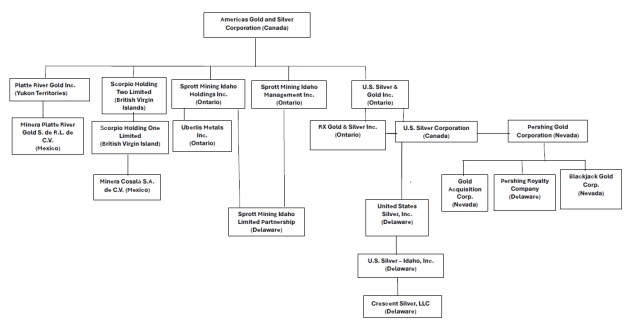
The organizational chart below indicates the inter-corporate relationships between the Company and its material subsidiaries (and includes their jurisdiction of organization) as of the date hereof. Unless otherwise indicated, all such subsidiaries are wholly owned.
GENERAL DEVELOPMENT OF THE BUSINESS
Overview
The Company is a silver-focused producer with two operations in the world's leading silver mining regions: the Galena Complex in Idaho, USA, including the acquisition of the neighbouring Crescent mine, and the Cosalá Operations in Sinaloa, Mexico. The Company also owns the Crescent mine, and Relief Canyon gold mine (“Relief Canyon”) which is currently on care and maintenance in Nevada, USA.
In Idaho, USA, the Company operates the 100%-owned producing Galena Complex whose primary assets are the operating Galena mine, the recently acquired Crescent mine, the Coeur mine, and the contiguous Caladay development project in the Coeur d'Alene Mining District of the northern Idaho Silver Valley. The Galena Complex has recorded production of over 230 million ounces of silver along with associated by-product metals of copper, antimony and lead over a production history of more than sixty years. The Company is currently underway with a new strategy at Galena aimed at increasing production and lowering operating costs following the Crescent mine acquisition, and recapitalization in December 2024.
In Idaho, U.S.A., the Company owns a 100% interest in the Crescent mine, located approximately 4 mile southeast of Kellogg, Idaho and approximately nine miles from the Galena Complex, which it acquired on December 12, 2025. The Crescent mine is a past-producing underground mine that the Company is advancing towards production through infrastructure upgrades, equipment repairs and additions as well as site upgrades. The Company believes that through these advancements it will position the mine for a mid- 026 restart of silver, copper and antimony production, leveraging synergies with the Company’s neighbouring Galena Complex.
In Sinaloa, Mexico, the Company operates the 100%-owned Cosalá Operations, which includes EC120 silver-copper mine and the San Rafael silver-zinc-lead mine ("San Rafael"), after declaring commercial production in January 2026 and December 2017, respectively. Prior to that time, it operated the Nuestra Señora silver-zinc-copper-lead mine after commissioning the Los Braceros processing facility and declaring commercial production in January 2009. The Cosalá area land holdings also host several other known precious metals and polymetallic deposits, past-producing mines, and development projects, including the 100%-owned Zone 120 and the El Cajón silver-copper deposits ("EC120 Project"). These properties are located in close proximity to the Los Braceros processing plant. The Company also owns a 100% interest in the San Felipe development project in Sonora, Mexico.
In Nevada, USA, the Company has the 100%-owned, Relief Canyon located in Pershing County, which is currently on care and maintenance. Operations were suspended in August 2021 in order to resolve technical challenges related to the metallurgical characteristics of the deposit; leaching and heap rinsing operations were discontinued in Q4 2023. The landholdings at Relief Canyon and the surrounding area cover over 11,700 hectares.
On February 10, 2026, the Company entered into the Antimony JV (as defined below) with United States Antimony to construct and operate an antimony processing plant in Idaho's Silver Valley in order to participate in the downstream antimony market. Ownership of the Antimony JV is 51% Company and 49% United States Antimony. Governance is exercised through a six-member management committee, with three representatives appointed by the Company and three representatives appointed by United States Antimony, which is chaired by the Company's representatives. United States Antimony is the operator of the Antimony JV. The Company will contribute to the processing plant under existing operating permits at its Galena Complex and will sell antimony feed material mined from the Galena Complex to the Antimony JV on market terms. United States Antimony will contribute its knowledge and technical expertise in constructing and operating such processing plants and will provide the Antimony JV with access to its antimony marketing network, which includes the U.S.A's federal government.
The Company's management and Board of Directors (the "Board") are comprised of senior mining executives who have extensive experience identifying, acquiring, developing, financing, and operating precious metals deposits globally. The Company's registered office is located at 145 King Street West, Suite 2870, Toronto, Ontario, Canada, M5H 1J8, with offices in Reno, Nevada, Mazatlán, Mexico and Wallace, Idaho. The Company is a reporting issuer in each of the provinces of Canada and is listed on the TSX trading under the symbol "USA" and on the NYSE American trading under the symbol "USAS".
Information contained on the Company's website is not incorporated by reference herein and should not be considered part of this AIF.
Three Year History
Fiscal 2023
On January 11, 2023, the Company provided a production update for the silver equivalent production noting that the silver equivalent production of 5.3 million ounces exceeded the silver equivalent guidance range of 4.8-5.2 million ounces for the completed year 2022. It was also announced that the Galena hoist had been put in place prior to year-end with shaft repairs to start following the completion of electrical work and commissioning. Further, the installation was completed as of the end of Q3, 2023.
On February 26, 2023 the Company and Sandstorm amended the April 3, 2019 Precious Metals Purchase Agreement to increase the advance payment payable to the Company by an additional $11 million. On April 12, 2023, the Company entered into a $4.0 million net smelter returns royalty agreement with Sandstorm to be repaid through a 2.5% royalty on attributable production from the Cosalá Operations and Galena Complex. The royalty reduces to 0.2% on attributable production from the Cosalá Operations and Galena Complex after the aggregate repayment of $4.0 million and may be eliminated thereafter with a buyout payment of $1.9 million.
On April 11, 2023, a tragic accident occurred at the Galena Complex resulting in a fatality. The U.S. Mine Safety and Health Administration completed investigation in October 2023 and issued two citations relating to a fall of ground in a working area of the mine.
On June 21, 2023, the Company issued an additional secured convertible debenture to Delbrook Capital Advisors ("Delbrook") under the Company's existing convertible debenture, increasing the principal balance by C$8.0 million to a total of C$24.3 million outstanding at the end of the second quarter. The Company also amended the interest payable to 11% per annum, the conversion price to C$0.80, and extended the term of the maturity to July 1, 2024 with mutual option to extend by incremental calendar quarters up to April 28, 2025, among other terms. On October 30, 2023, the Company amended the convertible debenture held by Delbrook by increasing the principal by C$2.0 million with all other material terms unchanged. On November 13, 2023, the Company and Delbrook agreed to amend the terms of the existing 3,500,000 Common Share purchase warrants held by Delbrook and affiliates to amend the exercise price from C$0.80 per warrant to C$0.55 per warrant. The warrants expire on June 21, 2026 and contain customary anti-dilution provisions, as well as customary blocker language regarding becoming a control person without required shareholder and TSX approvals. The principal balance under the convertible debentures was converted to Common Shares in 2024.
Fiscal 2024
On January 23, 2024, the Company provided a production update for the consolidated attributable silver production noting that the silver equivalent production increased by over 2.04 million ounces compared with approximately 1.31 million ounces in 2022. It was noted that despite the challenges encountered with the Galena Shaft Repair project and the associated lower than planned ore and waste hoisting capacity, the operation was able to produce 40% more attributable silver ounces in 2023 compared to 2022.
On March 27, 2024, the Company completed an equity offering of an aggregate 26,000,000 units at a price of C$0.30 per unit for total aggregate gross proceeds of C$7.8 million. Each unit consisted of one common share and one common share purchase warrant where each warrant is exercisable for one common share at an exercise price of C$0.40 for a period of three years.
On May 31, 2024, the Company filed and published its first Supply Chains Act Report for the year ended December 31, 2023 (the "Supply Chains Act Report"), as required by the Fighting Against Forced Labour and Child Labour in Supply Chains Act (the "Supply Chains Act"). The Supply Chains Act came into force on January 1, 2024, and obligates the Company to publish an annual report detailing steps regarding the previous year's effort to mitigate the risk of forced labour used at any step in its supply chain, including production of goods in Canada or elsewhere or of goods imported into Canada. The Supply Chains Act Report constitutes the second report prepared by the Company pursuant to the Supply Chains Act.
On August 14, 2024, the Company signed a Credit and Offtake agreement (the "Trafigura Agreement") with Trafigura PTE Ltd. ("Trafigura") for a secured facility of up to $15 million to complete initial development of the EC120 Project. The Company has drawn only $10 million under the Trafigura Credit Agreement initially. The Trafigura Credit Agreement is for a term of 36 months which includes a principal repayment grace period of 12 months and bears interest of U.S. SOFR rate plus 6% per annum on cumulative drawings up to $12 million and 6.5% thereafter. The Trafigura Credit Agreement will be amortized in equal monthly installments of $0.6 million commencing after expiry of the grace period. As part of the Trafigura Credit Agreement, Trafigura receives 100% of the silver-copper concentrate production from the EC120 Project.
On October 9, 2024, the Company announced an agreement (the "Acquisition Agreement") to acquire the remaining 40% interest of the Company's Galena Complex it did not own from Eric Sprott (the "Consolidation Transaction"). In conjunction with entering into the Acquisition Agreement, the Company announced a bought deal private placement of subscription receipts completed for gross proceeds of C$50 million at an issue price of C$0.40 per subscription receipt completed on December 19, 2024 (the "Subscription Receipt Financing").
On November 11, 2024, the Company announced that Mr. Paul Andre Huet was appointed Chief Executive Officer. Mr. Huet is focused on building a strong, experienced technical team to unlock the dormant value of the Galena Complex in pursuit of increased shareholder returns and was appointed Chairman of the Board following the closing of the Consolidation Transaction on December 19, 2024.
On December 19, 2024, the Company completed the Consolidation Transaction to acquire the remaining 40% non-controlling interests of the Company's Galena Complex from Eric Sprott in accordance with the Acquisition Agreement. Mr. Sprott received issuance of 170,000,000 Common Shares plus $10 million in cash, and commitment to monthly deliveries of 18,500 ounces of silver for a period of 36 months starting in January 2026.
The Company also closed the Subscription Receipt Financing raising gross proceeds of C$50 million at an issue price of C$0.40. As part of the Acquisition Agreement, the Company closed non-brokered private placements for total gross proceeds of $6.9 million CAD through total issuance of 16,650,000 Common Shares priced at approximately $0.42 CAD per share for additional financing purposes.
Fiscal 2025
On February 24, 2025, the Company provided an operational update on the Galena Complex, noting that drilling had identified new high-grade structures (including the 049, 181, and 182 veins) with plans to integrate them into near-term production.
On April 22, 2025, the Company announced strong exploration results at the Galena Complex evidenced by the discovery and growth of the high-grade 034 Vein (including an intersection of 983g/tonne Ag over 3.44 metres).
On May 2, 2025, following the Company's obligation to conduct annual reviews of the compensation provisions of its Collective Bargaining Agreement ("CBA"), the Cosalá' Operations and the National Union of Workers in the Construction, Manufacturing, Drilling, Excavation, Extraction, Crushing, Demolition, Structural, and Materials Hauling Industries, "Eng. Luis Horacio Duran Mier" (the "Cosalá Union") entered into an agreement to update the compensation provisions of the Cosalá's CBA. A comprehensive revision of the CBA, including a vote of the unionized members is expected to take place in 2026.
On May 29, 2025, the Company filed and published its second Supply Chains Act Report for the year ended December 31, 2024, as required by the Supply Chains Act.
On June 25, 2025, the Company closed a $100 million senior secured debt facility with funds affiliated with SAF Group (the "SAF Credit Agreement") with proceeds of the initial $50 million advanced at closing. The initial tranche advanced on the closing date is subject to an interest rate of SOFR (4% floor) plus 6% per annum and matures 60 months following the closing date. Principal will amortize over the term of the loan, with principal repayments commencing one year after the closing date and payable quarterly thereafter. Two additional $25 million tranches will be available to the Company upon the achievement of certain conditions precedent. The first additional tranche will be subject to an interest rate of SOFR (4% floor) plus 6% per annum after funding. The second additional tranche will be subject to an interest rate of SOFR (4% floor) plus 4% per annum after funding. Principal will amortize over the term of the loan with principal repayments commencing one year after the closing date and payable quarterly thereafter.
On August 21, 2025, the Company effected a share consolidation on the basis of one post-consolidation common share for every two and a half pre-consolidation Common Shares. As a result of the share consolidation, shares issuable pursuant to the Company's outstanding stock options, warrants, restricted share units, performance share units and other convertible securities were proportionally adjusted on the same basis.
On September 16, 2025, the Company completed Phase I of the No. 3 shaft upgrade at the Galena Complex four days ahead of schedule, achieving an immediate 100% improvement in the existing skipping capacity and installing a new 2,250 horsepower hoist motor as backup for the primary No. 3 shaft.
On October 3, 2025, the Galena Complex entered into a 5-year CBA with the United Steel, Paper and Forestry, Rubber Manufacturing, Energy, Allied Industrial and Service Workers International Union, AFL CIO-CLC, on behalf of its, Local No. 5114-03 (the "United Steelworkers"). The CBA was approved by a vote of the United Steelworkers membership and has a term from October 3, 2025, through October 2, 2030.
On November 13, 2025, the Company entered into a binding purchase agreement to acquire 100% of Crescent Silver, LLC ("Crescent"), owner of the Crescent mine in Idaho, for total consideration of approximately $65 million ($20 million in cash and approximately $45 million in equity based on a deemed price of $4.00 per Common Share). To fund the cash portion of purchase price for the acquisition and provide additional capital to advance Crescent, the Company entered into an agreement with Canaccord Genuity Corp. and BMO Capital Markets Corp., on behalf of a syndicate of underwriters, to complete a concurrent equity financing for gross proceeds of $65 million by way of a "bought deal" private placement of Common Shares.
On December 4, 2025, the Company closed the above-noted "bought deal" private placement for proceeds of $132,250,000. The net proceeds were used to fund the cash portion of the Crescent acquisition, to fund capital expenditures and support working capital at the Crescent mine following completion of the acquisition, and for working capital and general corporate purposes. On December 12, 2025, the Company closed the acquisition of Crescent.
Sustainability Performance
Americas recognizes the evolving expectations of investors, regulators, and communities regarding Environmental, Social and Governance ("ESG") performance.
The Company's ESG strategy is a foundational element of its multi-year growth plan and is directly linked to its corporate values. The Company understands that ESG factors can materially impact our operations, workforce, communities, and long-term enterprise value.
Americas management of ESG factors is in strong alignment with its overall commitment to safe and responsible mining, to strong governance, and to enhancing the role of the minerals and metals sector to support global sustainable development. Our ESG strategy is guided by a framework built on five key pillars: Governance, Strategy, Risk Management, Metrics and Targets, and Reporting and Disclosure. Across these areas, we are strengthening our approach by adopting industry standards and embedding best practices to ensure our strategy is both rigorous and fit-for-purpose.
The Company is committed to aligning with leading ESG frameworks, including the Sustainability Accounting Standards Board (SASB) Standards and the Task Force on Climate-related Financial Disclosures (TCFD) Recommendations, and to embedding best practices across the five pillars of our ESG approach.
In 2025, the Company took a major step towards aligning with leading industry standards in the mining industry by establishing the corporate position of Vice President of Sustainability and Communications ("VP Sustainability") to review and introduce corporate-wide sustainability initiatives aimed at guiding the Company in a socially and environmentally responsible manner, strengthening compliance with ESG related regulations.
During 2025 and as part of the Company's commitment, the VP Sustainability lead the Company to complete an ESG Materiality Assessment which identified the ESG factors most relevant to Americas - categorized as Core, Enhanced, or Emerging. A total of 17 ESG factors were identified. Americas' material ESG factors were identified and assessed based on a "Weight of Evidence" approach that considered information and data from third-party sources and Americas own information. During the reporting period, the Company also updated its risk registers for operations at the Galena Complex in Idaho and Cosalá in Mexico. The risk registers consider all Core ESG Factors identified through completion of the Materiality Assessment.
The Company believes that alignment among leadership, key decision-makers, and the Board on the prioritization of material ESG factors is essential to drive cohesive and effective strategy execution.
Building on our continued commitment, the Company is committed to publishing its first corporate voluntary reporting during 2026, which will be the Company's first report to encompass all of its operations and focus on financially material ESG factors, seeking alignment with investor-preferred standards and frameworks.
Moreover, we will continue to refine our ESG strategy, enhance risk management practices, strengthen metrics and targets across operations, and improve reporting and disclosure. This includes maintaining alignment with the Metals & Mining SASB Standard and the TCFD Recommendations.
RECENT DEVELOPMENTS
On February 10, 2026, the Company signed a joint venture agreement with United States Antimony (the "Antimony JV") to construct and operate an antimony processing facility in Idaho's Silver Valley in early 2026. The joint venture will be 51% owned by the Company and will provide a mine-to-finished antimony production solution to secure the supply chain for this critical mineral within the United States. The Company will contribute the land for the site and will sell antimony feed material mined from the Galena Complex to the joint venture on market terms. US Antimony will contribute its knowledge and technical expertise in constructing and operating antimony processing facilities and will provide the joint venture with access to its extensive antimony marketing network including the United States Government.
DESCRIPTION OF THE BUSINESS
Summary
The Company is engaged in the evaluation, acquisition, exploration, development and operation of precious metals and polymetallic mineral properties, primarily those already producing or with the potential for near-term production. The Company's geographic focus is the Western Hemisphere, particularly the United States and Mexico. The Company owns and operates the Cosalá Operations in Sinaloa, Mexico and the Galena Complex in Idaho, U.S.A. The Company also owns the Crescent Mine in Idaho, U.S.A., the Relief Canyon mine in Nevada, U.S.A. and the San Felipe property in Sonora, Mexico.
Principal Product
The Company produces silver-bearing zinc, lead and copper concentrates. The Company believes that because of the availability of alternate processing and commercialization options for its concentrates, it is not dependent on a particular purchaser with regard to the sale of its products.
Production
The Company operates the Galena Complex located near the town of Wallace in Idaho, U.S.A., and the Cosalá Operations located near the town of Cosalá in the State of Sinaloa, Mexico.
The Galena Complex produces a silver-lead concentrate. Ore mined at the Galena Complex is milled at the Galena mill. The Galena mill has an installed milling capacity of 680 tonnes per day. The 450 tonnes-per-day capacity Coeur mill is currently on care and maintenance.
The high grade and "narrow vein" nature of the underground Galena Complex requires careful application of selective mining techniques, primarily using cut and fill. As well, the age and expanse of the underground infrastructure demands regular, ongoing maintenance. As such, production and operating costs will display a degree of variability depending on a number of timing and other factors. Substantial resources exist outside of the defined reserve, and exploration continues to develop resources and identify new areas of mineralization. A multi-year Recapitalization Plan began in mid-October 2019 and was concluded with the commissioning of the Galena hoist in mid-2023. Other investments have included mine development, new equipment purchases and exploration to define and expand silver resources. The Company's current strategy at the Galena Complex is aimed at increasing production and lowering operating costs following the Consolidation Transaction and concurrent C$50 million financing which closed in December 2024.
In 2025, the Cosalá Operations in Mexico achieved production of 1.19 million ounces of consolidated annual silver production. The production results for 2025 benefited from higher grades mined at Cosalá from the Upper Zone at the San Rafael mine and strong performance at the EC 120 mine, which achieved commercial production on January 1, 2026. San Rafael is an underground silver-zinc-lead mine which entered commercial production in December 2017. The EC120 mine expands underground development and infrastructure into the adjacent Zone 120 and nearby El Cajón silver-copper orebodies. This expansion provides an additional source of high-grade silver-copper ore. The Los Braceros processing plant, located 9 kilometers east southeast of the San Rafael mine, produces silver-bearing zinc and lead concentrates and silver-bearing copper concentrate. The facility processes approximately 1,350 tonnes per day.
In this AIF, the management of the Company presents operating highlights for the year ended December 31, 2025 compared to the year ended December 31, 2024 as well as comments on plans for the future. Throughout this AIF, consolidated production results and consolidated operating metrics are based on the attributable ownership percentage of each operating segment: 100% Cosalá Operations and 60% Galena Complex up to December 18, 2024, prior to acquisition of Galena Complex’s 40% non-controlling interests, and 100% from both operations thereafter including fiscal 2025.
Consolidated Results and Developments
| Fiscal Year Ended December 31 | 20252 | 20242 | 2023 | ||||||
| Revenue ($ M) | $ | 117.9 | $ | 100.2 | $ | 95.2 | |||
| Net Loss ($ M)4 | (87.4 | ) | (49.0 | ) | (40.1 | ) | |||
| Comprehensive Loss ($ M)4 | (87.4 | ) | (41.2 | ) | (40.9 | ) | |||
| Net Loss per Common Share - Basic and Diluted | $ | (0.33 | ) | $ | (0.43 | ) | $ | (0.41 | ) |
| Silver Produced (oz) | 2,646,293 | 1,739,272 | 2,043,053 | ||||||
| Zinc Produced (lb) | 8,284,795 | 31,508,284 | 34,084,119 | ||||||
| Lead Produced (lb) | 9,326,026 | 15,834,224 | 20,539,540 | ||||||
| Copper Produced (lb)3 | 2,011,352 | - | - | ||||||
| Cost of Sales/Ag Eq Oz Produced ($/oz)1 | $ | 24.98 | $ | 18.12 | $ | 14.01 | |||
| Cash Costs/Ag Oz Produced ($/oz)1 | $ | 25.69 | $ | 17.41 | $ | 13.21 | |||
| All-In Sustaining Costs/Ag Oz Produced ($/oz)1 | $ | 32.95 | $ | 28.13 | $ | 20.44 | |||
| Cash ($ M) | $ | 129.8 | $ | 20.0 | $ | 2.1 | |||
| Receivables ($ M) | 8.9 | 7.1 | 9.5 | ||||||
| Inventories ($ M) | 10.7 | 10.7 | 8.7 | ||||||
| Property, Plant and Equipment ($ M) | $ | 255.3 | $ | 147.4 | $ | 153.1 | |||
| Current Assets ($ M) | $ | 153.7 | $ | 40.7 | $ | 23.0 | |||
| Current Liabilities ($ M)4 | 86.2 | 68.6 | 56.0 | ||||||
| Working Capital ($ M) | 67.5 | (27.9 | ) | (33.0 | ) | ||||
| Total Assets ($ M) | $ | 413.0 | $ | 192.6 | $ | 180.5 | |||
| Total Liabilities ($ M)4 | 191.4 | 130.5 | 103.1 | ||||||
| Total Equity ($ M) | 221.6 | 62.1 | 77.4 |
1 This is a supplementary or non-GAAP financial measure or ratio. See “Non-GAAP and Other Financial Measures” section of the Company’s 2025 MD&A for further information.
2 Throughout this AIF, tonnes milled, silver grade and recovery, silver production and sales, silver equivalent production, and cost per ounce measurements during fiscal 2025 and 2024 include EC120 Project pre-production from the Cosalá Operations.
3 Throughout this AIF, copper production, grade, recovery, and sold disclosed for fiscal 2025 are from EC120 Project pre-production from the Cosalá Operations.
4 Throughout this AIF, a portion of the Company's metals and silver contract liabilities were revised for periods ending 2024 and 2023 to retained earnings, and loss on metals contract liabilities was revised in fiscal 2024 and 2023.
Consolidated silver production of approximately 2.65 million ounces during fiscal 2025 was higher than fiscal 2024 production of approximately attributable 1.7 million ounces due to higher grades at both operations, offset by lower tonnage. Pre-production of EC120 silver-copper concentrate contributed silver production of 1.0 million ounces during fiscal 2025. Production of both zinc and lead during fiscal 2025 were lower than fiscal 2024 due to lower tonnage of zinc-lead-silver San Rafael ore processed during the year as the Company developed and transitioned into the silver-copper EC120 orebody.
Revenue of $117.9 million for the year ended fiscal 2025 was higher than revenue of $100.2 million for the year ended fiscal 2024, resulting from increased silver production and realized silver prices during the period, partially offset by the noted lower zinc and lead production. Revenue included pre-production revenue from the EC120 Project of $44.8 million during the year. The average realized silver price increased by 39% from fiscal 2024 to 2025, while the average realized lead decreased by 5% during the same period. The average realized silver price of $39.13/oz for fiscal 2025 (2024 – $28.13/oz) is comparable to the average London silver spot price of $39.94/oz for fiscal 2025 (2024 – $28.25/oz).
The Company recorded a net loss of $87.4 million for the year ended December 31, 2025 compared to a net loss of $48.9 million for the year ended December 31, 2024. The increase in net loss was primarily attributable to increase in current and forward gold and silver prices on the Company's metals contract liabilities, impairment to plant and equipment, higher cost of sales, higher corporate expenses including share-based payments, and higher income tax expense, offset in part by higher net revenue, lower depletion and depreciation, lower interest and financing expense, and higher other gain on derivatives. These variances are further discussed in the following sections.
Cosalá Operations
| Fiscal Year Ended December 31, | ||||||
| 20253 | 20243 | |||||
| Tonnes Milled | 462,485 | 584,830 | ||||
| Silver Grade (g/t) | 104 | 74 | ||||
| Zinc Grade (%) | 3.10 | 3.14 | ||||
| Lead Grade (%) | 0.83 | 1.14 | ||||
| Copper Grade (%)4 | 0.34 | - | ||||
| Silver Recovery (%) | 77.3 | 59.6 | ||||
| Zinc Recovery (%) | 80.3 | 80.7 | ||||
| Lead Recovery (%) | 67.0 | 68.0 | ||||
| Copper Recovery (%)4 | 86.1 | - | ||||
| Silver Produced (oz) | 1,189,196 | 825,097 | ||||
| Zinc Produced (lb) | 8,284,795 | 31,508,284 | ||||
| Lead Produced (lb) | 1,802,681 | 9,664,288 | ||||
| Copper Produced (lb)4 | 2,011,352 | - | ||||
| Total Silver Equivalent Produced (oz)1 | 1,757,782 | 2,586,577 | ||||
| Silver Sold (oz) | 1,099,966 | 828,975 | ||||
| Zinc Sold (lb) | 9,474,630 | 30,064,028 | ||||
| Lead Sold (lb) | 1,826,547 | 9,338,917 | ||||
| Copper Sold (lb)4 | 1,848,562 | - | ||||
| Cost of Sales/Ag Eq Oz Produced ($/oz)2 | $ | 21.92 | $ | 16.45 | ||
| Cash Costs/Ag Oz Produced ($/oz)2 | $ | 22.82 | $ | 11.13 | ||
| All-In Sustaining Costs/Ag Oz Produced ($/oz)2 | $ | 26.52 | $ | 21.48 | ||
1 Throughout this AIF, silver equivalent production was calculated based on all metals production at average realized silver, zinc, lead, and copper prices during each respective period.
2 This is a supplementary or non-GAAP financial measure or ratio. See “Non-GAAP and Other Financial Measures” section of the Company’s 2025 MD&A for further information
3. Throughout this AIF, tonnes milled, silver grade and recovery, silver production and sales, silver equivalent production, and cost per ounce measurements during fiscal 2025 and 2024 include EC120 Project pre-production from the Cosalá Operations.
4. Throughout this AIF, copper production, grade, recovery, and sold disclosed for fiscal 2025 are from EC120 Project preproduction from the Cosalá Operations.
Silver production increased in fiscal 2025 by 44% to approximately 1.2 million ounces of silver compared to approximately 0.8 million ounces of silver in fiscal 2024, primarily due to higher grades and silver recoveries offset by lower tonnages during the period. A higher portion of the mill feed came from pre-production of the EC120 Project which has higher silver grades and silver recoveries based on its minerology. The EC120 Project contributed approximately 1.0 million ounces of silver production in fiscal 2025 (1.2 million ounces of silver production project-to-date) as the Cosalá Operations milled and sold silver-copper concentrate during the EC120 Project's development phase contributed $44.8 million to net revenue during fiscal 2025. Lower milled tonnage from the San Rafael Main Central orebody caused base metals production of zinc and lead to drop in fiscal 2025.
The Cosalá Operations increased capital spending on the EC120 Project, incurring $11.4 million during fiscal 2025 ($3.6 million during fiscal 2024). Cash costs per silver ounce increased during fiscal 2025 to $22.82 per ounce from $11.13 per ounce in fiscal 2024, primarily due to decreased zinc and lead production resulting in lower by-product credits during the period.
Galena Complex
| Fiscal Year Ended December 31, | ||||||
| 2025 | 2024 | |||||
| Tonnes Milled | 97,173 | 120,804 | ||||
| Silver Grade (g/t) | 473 | 392 | ||||
| Lead Grade (%) | 3.76 | 4.02 | ||||
| Silver Recovery (%) | 98.5 | 98.1 | ||||
| Lead Recovery (%) | 93.5 | 93.7 | ||||
| Silver Produced (oz) | 1,457,097 | 1,494,385 | ||||
| Lead Produced (lb) | 7,523,345 | 10,021,111 | ||||
| Total Silver Equivalent Produced (oz)1 | 1,639,261 | 1,830,191 | ||||
| Silver Sold (oz) | 1,469,487 | 1,481,874 | ||||
| Lead Sold (lb) | 7,599,198 | 9,932,977 | ||||
| Cost of Sales/Ag Eq Oz Produced ($/oz)2 | $ | 28.27 | $ | 21.96 | ||
| Cash Costs/Ag Oz Produced ($/oz)2 | $ | 28.04 | $ | 23.07 | ||
| All-In Sustaining Costs/Ag Oz Produced ($/oz)2 | $ | 38.20 | $ | 34.13 | ||
1 Throughout this AIF, silver equivalent production was calculated based on all metals production at average realized silver, zinc, lead and copper prices during each respective period.
2 This is a supplementary or non-GAAP financial measure or ratio. See “Non-GAAP and Other Financial Measures” section of the Company’s 2025 MD&A for further information
During fiscal 2025, the Company continued to make significant advances at the Galena Complex and is on-track with its operational growth plan. The Galena Complex produced approximately 1.5 million ounces of silver in fiscal 2025 which was comparable to approximately 1.5 million ounces of silver produced in fiscal 2024. The mine also produced 7.5 million pounds of lead in fiscal 2025, compared to 10.0 million pounds of lead in fiscal 2024 (a 25% decrease in lead production). By product production levels may vary in the short term as mining activities focus on increasing higher-grade, silver copper ore and supporting infrastructure continues to be advanced. Cash costs per ounce of silver increased to $28.04 in fiscal 2025 from $23.07 in fiscal 2024, primarily due to decreased lead production resulting in lower by-product credits during the period, and modest increases in salaries and employee benefits at the operations.
Employees
As at December 31, 2025, the Company had the following number of employees:
| Galena Complex | Cosalá Operations | Relief Canyon | Corporate | Total | ||||||
| Salary | 54 | 129 | 2 | 24 | 207 | |||||
| Hourly | 179 | 273 | 4 | 0 | 452 | |||||
| Total | 233 | 402 | 6 | 24 | 659 |
* Some workers at the Galena Complex and Cosalá Operations are covered by collective bargaining agreements. See "- Changes to Contracts and Economic Dependence" also see "Risk Factors - Labour Relations, Employee Recruitment, Retention and Pension Funding".
In addition, the Company, from time to time, employs outside contractors on a fee‐for‐service basis.
Specialized Skill and Knowledge
Various aspects of the Company's business require specialized skills and knowledge. Such skills and knowledge include the areas of geology, drilling, metallurgy, engineering, logistical planning and implementation of programs as well as finance and accounting and legal/regulatory compliance. While competitive conditions exist in the industry, the Company has been able to locate and retain employees and consultants with such skills and believes it will continue to be able to do so in the foreseeable future. See "Risk Factors - Labour Relations, Employee Recruitment, Retention and Pension Funding".
Competitive Conditions
Competition in the mineral exploration industry is intense. The Company competes with other mining companies, many of which have significant financial resources and technical facilities for the acquisition and development of, and production from, mineral interests, as well as for the recruitment and retention of qualified employees and consultants. The ability of the Company to acquire viable mineral properties in the future will depend not only on its ability to develop its present properties, but also on its ability to select and acquire suitable producing properties or prospects for development or mineral exploration.
Business Cycles
The mining business is highly cyclical. The marketability of minerals and mineral concentrates is also affected by global economic cycles. The ultimate economic viability of the Company's projects is related and sensitive to the market price of gold and silver as well the market price of by‐products such as zinc, lead copper, and antimony. Metal prices fluctuate widely and are affected by numerous factors such as global supply, demand, inflation, exchange rates, interest rates, forward selling by producers, central bank sales and purchases, production levels, global or regional political, economic or financial conditions and other factors beyond the control of the Company.
Changes to Contracts and Economic Dependence
The Company's cash flow is dependent on delivery of its ore concentrate to market. The Company's contracts with concentrate purchasers provide for provisional payments based on periodic deliveries. The Company may sell its concentrate to a metal trader while it is at the smelter in order to help manage its cash flow. The Company has not had any problems collecting payments from concentrate purchasers in a reliable and timely manner and expects no such difficulties in the foreseeable future. However, this cash flow is dependent on continued mine production which can be subject to interruption for various reasons including fluctuations in metal prices and concentrate shipment difficulties. Additionally, unforeseen cessation in smelter provider capabilities could severely impact the Company's capital resources. Although the Company sells its concentrate to a limited number of customers, it is not economically dependent upon any one customer as there are other markets throughout the world for the Company's concentrate.
Environmental Protection
The Company's mining, exploration and development activities are subject to various federal, state and municipal laws and regulations relating to the protection of the environment, including requirements for closure and reclamation of mining properties. In all jurisdictions where the Company operates, specific statutory and regulatory requirements and standards must be met throughout the exploration, development and operations stages of a mining property with regard to matters including water quality, air quality, wildlife protection, solid and hazardous waste management and disposal, noise, land use and reclamation. Changes in any applicable governmental regulations to which the Company is subject or inconsistent application of these regulations, may adversely affect its operations. Failure to comply with any condition set out in any required permit or with applicable regulatory requirements may result in the Company being unable to continue to carry out its activities. The impact of these requirements cannot accurately be predicted.
Management estimates costs associated with reclamation of mining properties as well as remediation costs for inactive properties. The Company uses assumptions about future costs, including inflation, prices, mineral processing recovery rates, production levels and capital and reclamation costs. Such assumptions are based on the Company's current mining plan and the best available information for making such estimates. Details and quantification of the Company's reclamation and closure costs are discussed in the 2025 Annual Financial Statements (see "Note 4 - Significant Accounting Judgments and Estimates - Decommissioning Provision") and the 2025 Annual MD&A (see "Significant Accounting Judgements and Estimates - Decommissioning Provision"). See also "Risk Factors - Government Regulation and Environmental Compliance".
The Company is focused on strengthening monitoring, controls and disclosure of environmental issues that affect employees and the surrounding communities. Through proactive public engagement, the Company continues to gain a better understanding of the concerns of area-wide citizens and regulators and continues to work collaboratively to identify the most reasonable and cost-effective measures to address the most pressing concerns.
Foreign Operations
As of the date hereof, substantially all of the Company's long-term assets, comprising its mineral properties, are located in Mexico and the United States.
Tax Considerations
With current operations in the United States and Mexico, the Company is subject to the tax considerations of those jurisdictions. Certain changes to United States and Mexican tax laws affect the Company. See "Risk Factors - Tax Considerations" of the 2025 Annual MD&A and "Note 25 - Income Taxes" of the 2025 Annual Financial Statements.
It cannot be predicted whether, when, in what form, or with what effective dates, new tax laws may be enacted, or regulations and rulings may be enacted, promulgated or issued under existing or new tax laws, which could result in an increase in the Company's or investors' tax liability or require changes in the manner in which the Company operates in order to minimize or mitigate any adverse effects of changes in tax law or in the interpretation thereof.
***
MINERAL RESERVE AND MINERAL RESOURCE ESTIMATES
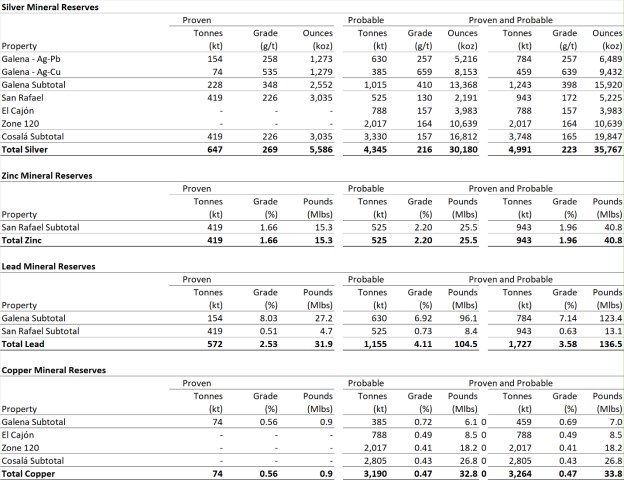
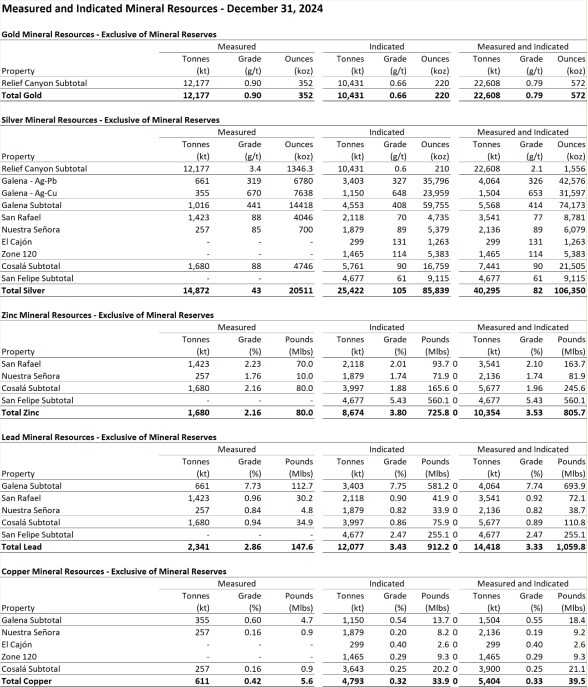
Americas Gold and Silver’s mineral reserves and mineral resources have been estimated as at December 31, 2024, and do not reflect depletion from subsequent mining activities or any other updates. Further analysis is ongoing and the Company expects to provide an update in due course.
The Company’s mineral reserves and mineral resources have been calculated in accordance with National Instrument 43-101 – Standards of Disclosure for Mineral Projects (“NI 43-101”), as required by Canadian securities regulatory authorities. These standards differ from the requirements of the United States Securities and Exchange Commission (the “SEC”) that are applicable to domestic United States reporting companies. Accordingly, information in this AIF that describes the Company's mineral reserves and mineral resources may not be comparable to information made public by United States companies subject to the SEC’s reporting and disclosure requirements.
Production details for 2025 are provided under "Description of the Business - Production" and in the 2025 Annual Financial Statements and the 2025 Annual MD&A.
For further detail regarding the extent to which estimates of mineral reserves and mineral resources may be materially affected by external factors, including metallurgical, environmental, permitting, title and other risks and relevant issues, see "Risk Factors - Mineral Reserves and Resources, Development and Production".
***
Attributable Proven and Probable Mineral Reserves
Silver Mineral Reserves – December 31, 2024
Attributable Measured & Indicated Mineral Resources
Attributable Inferred Mineral Resources -
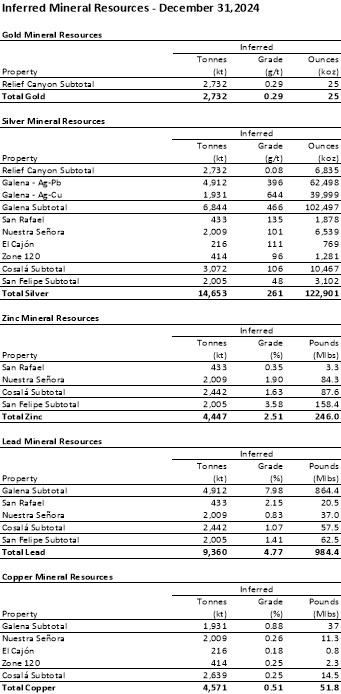
Notes for Mineral Reserve and Mineral Resource Estimates:
(1) Americas Gold and Silver’s mineral reserves and mineral resources have been estimated as at December 31, 2024, and do not reflect depletion from subsequent mining activities or any other updates. Further analysis is ongoing and the Company expects to provide an update in due course.
(2) CIM (2014) Definitions and Standards were followed for Mineral Reserve and Mineral Resource Estimates.
(3) Mineral Reserves are estimated at a net smelter return ("NSR") cut-off value of $60/tonne at San Rafael, $45/tonne at El Cajón, $45/tonne at Zone 120 and $225/tonne at Galena. The NSR cut-off is calculated using long term assumptions based on operating results for recoveries, off-site concentrate costs, and on-site operating costs.
(4) Mineral Resources are estimated at a NSR cut-off value of $34/tonne at San Rafael, $45/tonne at Zone 120, $45/tonne at El Cajón and $198/tonne at Galena. Mineral Resources at Nuestra Señora are estimated at a 90g/tonne silver equivalent cut-off grade. Mineral Resources at San Felipe are estimated at a 2.3% zinc equivalent cut-off grade on a fully diluted block size of 2m by 3m by 2m. Mineral Resources are estimated using cut-off grades of 0.17g/tonne Au, 0.34g/tonne Au and 0.69 g/tonne Au for oxide, mixed and sulfide material types respectively at Relief Canyon constrained by a $1,500 Au pseudoflow pit shell. Inferred Resources at Relief Canyon include existing low grade stockpiles.
(5) Mineral Reserves are estimated using metal prices of $1,300/oz Au, $20.00/oz Ag, $2.75/lb Cu, $0.90/lb Pb and $1.15/lb Zn.
(6) Mineral Resources are estimated using metal prices of $1,500/oz Au, $22.00/oz Ag, $3.50/lb Cu, $1.10/lb Pb and $1.30/lb Zn.
(7) Mineral Resources at all properties are reported exclusive of Mineral Reserves and as such these Mineral Resources do not have demonstrated economic viability.
(8) A minimum mining width of 4.5 feet was used for estimating Galena Reserves, with a minimum additional dilution of 0.5 feet from both the hangingwall and footwall. A mining recovery of 90% was used based on the mining methods used at the operation.
(9) A mining recovery of 95% and 5% dilution factor at zero grade were used for estimating Mineral Reserves at San Rafael to reflect the mining methods (post-pillar cut and fill and overhand cut and fill) used at the operation.
(10) A minimum mining width of 4 meters and a 15% dilution factor, at zero grade, with mining recovery of 90% to reflect the proposed mining methods (post-pillar cut and fill and overhand cut and fill), were used for estimating Mineral Reserves at El Cajón and Zone 120.
(11) Numbers may not add or multiply accurately due to rounding.
(12) The effective date of the Mineral Reserve and Mineral Resource estimates at Relief Canyon, San Rafael, Nuestra Señora, San Felipe, El Cajón, Zone 120 and Galena is December 31, 2024.
(13) Apart from depletion of the mineral resources and reserves yearly, the estimation methodology and parameters remained unchanged from the June 30, 2022, estimate.
(14) The San Rafael, El Cajón, Zone 120 and Nuestra Señora Mineral Resource estimates were prepared internally by Niel de Bruin, P.Geo., a Qualified Person for the purpose of NI 43-101. The San Rafael, El Cajón and Zone 120. Mineral Reserve estimates were prepared by Company personnel under the supervision of Daren Dell, P.Eng., a Qualified Person for the purpose of NI 43-101. The depletion of the mineral reserves and mineral resources to December 31, 2024 for these properties was prepared by Company personnel under the supervision of and with the review of a Qualified Person for the purpose of NI 43-101.
(15) The Galena Complex Mineral Resource estimate was prepared by Company personnel under the supervision of Niel de Bruin, P.Geo., a Qualified Person for the purpose of NI 43-101. The Galena Complex Mineral Reserve estimate was prepared by Company personnel under the supervision of Daren Dell, P.Eng., a Qualified Person for the purpose of NI 43-101. The depletion of the mineral reserves and mineral resources to December 31, 2024 for this property was prepared by Company personnel under the supervision of and with the review of a Qualified Person for the purpose of NI 43-101.
(16) The Relief Canyon Mineral Resource estimate was prepared by Niel de Bruin, P.Geo., a Qualified Person for the purpose of NI 43-101.
(17) The San Felipe Mineral Resource estimate was prepared by Niel de Bruin, P.Geo., a Qualified Person for the purpose of NI 43-101.
(18) The Company is not aware of any environmental, permitting, legal, title, taxation, socio-economic, marketing, political, or other relevant issues that would materially affect the Mineral Reserve and Mineral Resource estimates.
***
MINERAL PROJECTS
The following is a summary description of the Company's material mineral projects, namely the Galena Complex and the Cosalá Operations, and other mineral projects, namely Relief Canyon and the Crescent Mine, a recently acquired historically operated mine located approximately 9 miles to the west of the Galena Complex Certain of the scientific and technical information relating to the Company's material mineral projects in this section has been derived from the relevant technical reports, being, the San Rafael Technical Report, or the Galena Technical Report (each as defined below), as applicable. Unless otherwise indicated, the information set forth below are extracts, as updated and conformed to be consistent with other disclosure within this AIF, from the summary section of the respective technical reports. All scientific and technical information in this section relating to any updates to the Company's material mineral projects since the date of the respective technical reports has been reviewed and approved by Rick Streiff, EVP Geology a current member of Company management, who is a Qualified Person for the purposes of NI 43-101. Defined terms and abbreviations used in this section relating to the various properties and not otherwise defined have the meanings attributed to them in the respective technical reports. A copy of each of these technical reports can be accessed online and is available for review on the Company's SEDAR+ profile at www.sedarplus.ca and on EDGAR at www.sec.gov. Reference should be made to the full text of the technical reports for further information. The content of the technical reports does not form part of this AIF.
All reference to "Americas Silver", "Americas Gold and Silver" or "Americas" or any of its subsidiaries or predecessor companies in this section "Mineral Projects" are to the Company.
Galena Complex, U.S.A.
General
Americas Gold and Silver is the owner and operator of the Galena Complex located in the eastern part of the Coeur d'Alene Mining District, one of the preeminent silver, lead and zinc producing areas in the world, near the base of the panhandle of northern Idaho, U.S.A. The Galena Complex consists of the Galena mine, the Galena processing plant, the Osburn tailings impoundment, the idle Coeur mine and Coeur processing plant (currently on care and maintenance) and the Caladay exploration property.
The Galena Complex is 100% owned by Americas Gold and Silver. Americas Gold and Silver owns and operates the Galena Complex through its wholly owned subsidiary, U.S. Silver Idaho Inc.
The Galena Complex is subject to applicable environmental regulations including environmental compliance. Necessary operating and environmental permits for current operations are in place or are in the process of being duly applied for. For further detail see "Description of the Business - Environmental Protection" and "Risk Factors - Government Regulation and Environmental Compliance".
Technical Report
See the Company's National Instrument 43-101 Technical Report dated December 23, 2016 entitled, "Technical Report on the Galena Complex, Shoshone County, Idaho, USA" (the "Galena Technical Report") prepared by James R. Atkinson, P.Geo., Daren Dell, P.Eng, and Dan H. Hussey, C.P.G., available at www.americas-gold.com and under the Company's profile on SEDAR+ (www.sedarplus.ca). Detailed financial, production and operational information for the Galena Complex is available in the 2025 Annual MD&A. The content of the Company's website and information accessible through the website do not form part of this AIF.
Property Description, Location and Access
The Galena Complex is located in the Coeur d'Alene Mining District in Shoshone County, Idaho, a prolific silver producing district since the mid-1800s, located two miles west of the town of Wallace. Spokane, Washington is about 75 miles to the west, and Missoula, Montana is about 110 miles to the east. The property is about one mile south of Interstate Highway I-90.
The property covers 8,915 acres, over an area about nine miles long east to west and two miles wide north to south. The Galena Shaft is located near the center of the property and lies at 47 28'39" N latitude and 115 058'01" W longitude, with a collar elevation of 3,042 feet above sea level.
The Company's land position at the Galena Complex has changed since the preparation of the Galena Technical Report due to the sale of part of the holdings on the western end of the property. The property is a combination of patented, unpatented and fee lands that are owned or leased by the Company's subsidiaries. The total area covered by all the land owned, controlled or leased by the Company is 8,915 acres. All properties are in good standing with respect to title and current taxes. Net smelter return royalty agreements exist on some leased properties, but no production has been realized from any of the leased claims, and none is contemplated in the life of mine plan ("LOMP"). All necessary operating and environmental permits are current. All production, reserves and resources are on patented mining claims owned by the Company. See also "Risk Factors - Mining Property and Title Risks" and "Risk Factors - Surface Rights and Access".
All the centers of population and Americas Gold and Silver's property are accessible by main highways, hard surfaced roads or well-graded gravel roads. Personnel are recruited from nearby towns and cities.
The Company has established necessary sources of water, power, waste disposal and tailings storage for current and planned operations. The Company has the necessary processing facilities and holds sufficient surface rights to conduct its operations.
History
The Galena Complex is situated in the center of the Coeur d'Alene Mining District of northern Idaho. Placer gold was first discovered in the district in 1858. By 1860, the gold-rush prospectors had also discovered the silver-lead veins in the district.
Prior to Americas Gold and Silver, companies owning all or part of the Galena Complex properties at various times since 1887 have included Killbuck Mining, Galena Mining, Callahan Mines, Federal Mining and Smelting, Vulcan, ASARCO, Day Mines, Coeur d’Alene Mines, U.S. Silver, and U.S. Silver and Gold Inc.
Since 1953, the Galena and Coeur mines have yielded approximately 238 million ounces of silver, 165 million pounds of copper and 206 million pounds of lead from 12.8 million short tons of combined silver-copper and silver-lead ore. More than 80% of the total silver has come from the Galena mine.
The Galena mine has a long history dating back to 1887, but the modern history and mining commenced in 1947 under the management of ASARCO. From 1953 to 2013, the Galena mine primarily mined silver-copper ore with minor production of silver-lead ore. Beginning in 2014, silver-lead ore became the predominant ore type.
Total production from the Galena mine from 1953 to the end of 2015 was approximately 189.5 million ounces of silver from 9.3 million short tons of ore. Average grade of the silver-copper ore was 21.3 opt Ag and 0.72% Cu. Average grade of the silver-lead ore was 5.1 opt Ag and 6.0% Pb. This excludes production from the Coeur mine, which is now part of the Galena Complex.
The Coeur mine shaft was collared in 1963 by Coeur d'Alene Mines. The mine produced continuously from 1976 through 1991, and again from 1996 through 1997. The total production from the Coeur mine sent to the processing plants was approximately 40.5 million ounces of silver from 2.5 million short tons of ore. Average ore grades were 16.5 opt Ag and 0.67% Cu.
The Coeur mine was put on care and maintenance from 1997 to 2007, when work was begun to rehabilitate the Coeur mine 3400 Level and later the Coeur shaft. The Coeur mill was re-started in September 2007 to process silver-lead ore from the Galena mine. By early 2008, silver-lead ore was trammed from the Galena mine 3700 Level to the Coeur shaft (Coeur 3400 Level) and was hoisted up the Coeur shaft for processing at the Coeur mill. During 2012, the Coeur mine was rehabilitated for mining, which started in September 2012, but underground work ceased in 2014.
The Caladay property began in the mid-1960s as a joint venture involving Callahan Mining, ASARCO, and Day Mines (hence the name "Caladay"). The joint venture sank a 5,100-foot shaft during the early 1980s on the east end of the Coeur d'Alene Silver Belt, just east of the Galena property. From the 4900 Level of the Caladay shaft an exploration drift was developed east and west. The western drift intersects the Galena mine's 4900 Level.
The joint venture was purchased by Coeur d'Alene Mines in the 1980s. The Caladay shaft and workings are currently used as ventilation exhaust for the Galena workings.
The Crescent Mine was purchased by Americas Gold and Silver in December 2025 from Crescent Silver, LLC. The mine is located approximately 4 miles southeast of Kellogg, Idaho in Shoshone County about 75 miles east of Spokane, Washington. The project hosts a historical 2015 resource of 22.9 million ounces of silver at an average grade of 663.3 g/t in the measured, indicated and inferred resource categories. The property hosts historic infrastructure including three portals and associated surface infrastructure such as geology buildings, maintenance shops and office facilities. See "Crescent Mine, U.S.A" at page 42 for the Company's updates on the Crescent Mine.
Geology and Mineralization
The Galena Complex and most other deposits of the Coeur d'Alene Mining District are hosted by metamorphosed Precambrian sedimentary rocks which are part of the Belt Supergroup. The strata are composed primarily of fine-grained quartz and clay (the clay now metamorphosed to fine-grained white mica, or sericite). Three major rock types are generally recognized: vitreous quartzite, which is primarily metamorphosed fine-grained quartz sand, siltite-argillite, which is silt-sized quartz grains that are completely separated from each other by a large proportion of sericite, and sericitic quartzite which contains intermediate proportions of quartz and sericite.
Mineralization at the Galena Complex occurs in steeply dipping fissure filling veins and in wide disseminated zones, all occurring near four major fracture systems and three major faults. The veins generally strike east-west and northeast-southwest and range in thickness from a few inches to over fifteen feet.
The vein mineralization is of two distinct types: silver-copper mineralization containing tetrahedrite and lesser chalcopyrite as the principal economic minerals; and silver-lead mineralization dominated by argentiferous galena. Gangues in both types are mainly siderite, with varying amounts of pyrite and quartz. The silver-lead mineralization occurs both as well-defined, steeply-dipping, relatively narrow veins and as wider zones of disseminated and stringer mineralization. The latter type occurs predominately in the eastern part of the property, on and adjacent to, the former Caladay property.
Exploration
Since the early 1950s, year-end reserves at the Galena Complex have consistently indicated a mine life ranging from three to nine years. Diamond drilling combined with sound geologic interpretation and development is an ongoing exercise every year to replace ore reserves net of depletion.
The objectives of the current exploration program at the Galena Complex are to discover new high-grade veins and ore shoots in close vicinity to existing development and to systematically replace reserves as they are mined. The Company is also focused on exploring for new large veins in unexplored or underexplored areas along strike and down-dip of know ore shoots. Although the majority of the effort and budget will be allocated to the Galena mine, the Company's exploration teams are increasing exploration efforts at the Coeur and Calladay shafts as well as the recently acquired Crescent Mine. As silver-copper ore has historically been less-emphasized by previous operators in favour of mining silver lead ore, there is very excellent potential to add to resources and reserves by exploring for silver-copper bearing tetrahedrite veins. Recent discoveries in 2025 at the 034 vein complex has added significant resources at considerably higher grades than the current mine plan with additional drilling planned in 2026 to expand the known zone and convert resources to reserves. Ongoing drilling in the lower levels of the mine has focused on testing the down-dip extensions of the 072 vein, Silver vein and 360 Vein, which host some of the most consistent and highest grade mineralization at the Galena Complex.
Drilling
Drilling for exploration, delineation and development has been performed with diamond core drills for many years. Americas Gold and Silver primarily employs Hagby drills for both delineation and exploration drilling.
Diamond drilling logs completed since the early 1950s are on file at the geology office located at the Galena mine. Drill logs are kept as paper logs, and data from the paper logs is also entered into an electronic database for use in mine planning software.
Since the effective date of the Galena Technical Report through June 2022, an additional 623 diamond drillholes with 15,627 samples with assay values and 9,260 channel samples with 24,797 individual channel samples have been added to the database. Additional drilling and underground sampling has been done since June 2022, however, this new information has not yet been included in the mineral resources or mineral reserves estimates, the Company intends to update the mineral resource and mineral reserves estimate in Q2, 2026.
Recent exploration has focused on expanding the mineralized footprint within the Galena Complex. Since this program began in November 2019, nearly 400,000 feet have been drilled from platforms on the 2400, 3200, 3700, 4300, 4900, 5200 and 5500 Levels of the Galena mine and the 3400 Level of the Coeur Mine. Positive drilling results have driven significant down dip extensions of the 72, 175, 185 and 291 veins, and led to the discovery of the new 034vein complex as well as high-grade extensions of known veins at the 198, 149 and 360 vein zones. The360 Complex has been extended both up and down dip and several new veins were identified south of the complex. In addition, drilling conducted from the Coeur 3400 Level has led to a new discovery at the 520 vein as well as extended both the 400 and 425 veins substantially down-dip.
The Galena Complex had 3,471 diamond drillholes completed as of December 31, 2015. The database contains more than 43,000 samples with assay values from the diamond drillholes. The database also includes 18,289 channel sample locations with 40,870 individual samples.
Sampling, Analysis and Data Verification
The diamond drilling program used NQ-size core and BQ-size core. The Company's standard QA/QC practices are utilized to ensure the integrity of the core and sample preparation at the Galena Complex through delivery of the samples to the assay lab. The drill core was stored in a secure facility, photographed, logged and sampled based on lithologic and mineralogical interpretations. Standards of certified reference materials, field duplicates and blanks were inserted as samples shipped with the core samples to the lab.
Analytical work was carried out by American Analytical Services Inc. ("AAS") located in Osburn, Idaho. AAS is an independent, ISO-17025 accredited laboratory. Sample preparation includes a 30-gram pulp sample analyzed by atomic absorption spectrometry ("AA") techniques to determine silver, copper, and lead, using aqua regia for pulp digestion. Samples returning values over 514 g/t Ag are re-assayed using fire-assay techniques for silver. Additionally, samples returning values over 23% Pb are re-assayed using titration techniques.
Duplicate pulp samples are sent out quarterly to ALS Global, an independent, ISO-17025 accredited laboratory based in Reno, Nevada to perform an independent check analysis. A conventional AA technique was used for the analysis of silver, copper and lead at ALS Global with the same industry standard procedures as those used by AAS. The assay results listed in this report did not show any significant contamination during sample preparation or sample bias of analysis.
There is no sample preparation (except core splitting) or laboratory facility at the Galena mine. No officer or director or employee of Americas Gold and Silver is involved in AAS's operations or in sample preparation or assaying, after the samples arrive at the assay laboratory.
The core samples, rock chip, channel and select samples are placed in bags with identification tags and are tied closed at the sample site. The samples are placed in a designated area in the mine yard until they are transported to the assay lab. The samples and a submittal sheet are transported daily by mine employee to the AAS laboratory. The sample tags in the bags and the submittal sheet indicate a unique number for each sample and the elements that are to be analyzed.
The AAS laboratory has a capacity of about 200 samples per day, but the Galena Complex typically generates fewer than 100 samples per day. Typically, Galena Complex samples are received at the lab late in the day, placed in the oven for overnight drying then assayed beginning early the following morning, so that results are available in the afternoon.
Upon arrival at the lab, samples are compared to the submittal sheet and placed in drying ovens to dry overnight at a temperature of approximately 65 degrees Celsius. Samples are emptied from sample bags into the jaw crusher, then run through a second time resulting in a sample size of approximately 1.2 inches. The sample is then run through a cone crusher reducing the size to about 50% after passing through a 10 mesh screen. The sample is then split using a Jones riffle splitter until a sample of approximately 200 grams is obtained. The rejected portion of sample is returned to original sample bag. The 200-gram sample is ring pulverized (eight-inch bowl) for 45 seconds. The resulting pulp usually passes a 140 mesh screen at about 90%. About 125 grams of pulp is placed in a sample envelope and sent to the fire assay room. The ring pulverizer is cleaned between each sample with silica sand to prevent contamination. Barren rock is run through the crushers once a day, and this sample is assayed as a sample blank. A second split is made on one sample for every twenty that are prepared, and this is assayed as a prep duplicate.
Galena samples sent to AAS are analyzed primarily by atomic absorption ("AA") and occasionally by inductively coupled plasma ("ICP") techniques to determine silver, copper, and lead, using aqua regia for pulp digestion. Occasionally other elements are analyzed including zinc, antimony, and iron values. Those measuring over 40 opt Ag are also fire-assayed for silver, and the fire assays are used in calculations in preference to AA results for the same sample. Higher grade lead samples are re-assayed using titration techniques. Occasionally, gold determinations are made using fire assay.
For fire assay at AAS, one-half assay short ton of channel sample or drill core sample is weighed into a 30-gram crucible with approximately 100 grams of standard flux mixture and a litharge cover. Twenty samples are fired at a time, which includes a pulp duplicate and a control sample. Lead buttons are cupelled in either composite or bone ash cupels. Dore beads are weighed and then parted, decanted, washed with a weak ammonia wash, annealed and weighed.
After samples have been assayed, they are boxed with proper identification and stored for two months at the laboratory. Pulps from diamond drill core are collected by Galena staff and stored for no less than two years at a separate storage area.
Galena has a quality assurance/quality control ("QA/QC") regimen which meets industry standards. Since 2019, approximately 5% of submitted samples have been standards, blanks or duplicates.
The QA/QC program does not include blind submittal of duplicate core or channel samples. This is due to the fact that most drill core samples are submitted as full core (i.e. not split), and the extra time required to collect duplicate channel samples is not considered to be worthwhile for the minor improvement in results.
The security and sample preparation are of acceptable quality for generation of data for use in resource and reserve estimation, subject to the minor qualifications stated in each sub-section above.
Mineral Resource and Mineral Reserve Estimates
Refer to the "Mineral Reserves and Mineral Resource Estimates" section for quantity, grades and category. Assumptions are outlined under "Notes for Mineral Reserve and Mineral Resource Estimates".
Mining Operations
The current mining methods used at the Galena Complex are conventional cut and fill and mechanized cut and fill. Conventional cut and fill is done using the overhand method, utilizing hydraulically placed tailings ("sand fill") as backfill, typically without the addition of cement. Mechanized cut and fill is done using both overhand and underhand methods. In the case of the overhand method, sand fill is used as backfill, typically without the addition of cement. For the underhand method, cement is typically added to the sand fill in order to provide the required strength to work underneath the placed backfill. Ore is hauled to the No. 3 shaft via tracked locomotives and rail cars. Ore is loaded into the rail cars directly via ore chutes in stopes, pneumatic cavos, or in mechanized stoping areas, by diesel scooptrams/load haul dump equipment. Waste associated with primary and secondary development is typically kept underground and placed as fill in old headings and open stopes. As needed, it can be hauled to the shaft, skipped to surface and placed on the existing surface waste rock storage facility. Material is currently skipped to surface from several levels of the mine using the No. 3 hoist. The Coeur mine is currently on care and maintenance. The Coeur shaft is used for ventilation purposes and provides an alternative means of egress.
Processing and Recovery Operations
The Galena Complex consists of two processing plants, Galena and Coeur. The Coeur plant has been on care and maintenance since April 2016. The Galena processing plant follows a conventional flowsheet:
• Crushing and Screening
• Grinding and Classification
• Flotation Concentration
• Concentrate Dewatering
• Tailings Pumping for Sand Fill
• Tailings Pumping to Osburn Tailings Storage Facility
Overall recoveries achieved in 2025 production at the Galena processing plant were approximately 98.46% % for silver and 93.28 % for lead. Although only a silver-lead concentrate is currently produced, the LOMP does include future mining from the silver-copper veins, at which time a silver- copper concentrate may be produced again.
Infrastructure, Permitting and Compliance Activities
The Galena Complex has produced for over 130 years with only minor interruption. There are four shafts on the property of which the Galena, No. 3 and Coeur are equipped for hoisting. The No. 3 shaft currently serves as the main production hoist.
Surface facilities other than the processing plants at both the Galena and Coeur mines include compressor houses, mine dry, mine and administrative offices, warehouses, timber framing yard, parking areas, hoist houses and headframes, a core storage facility, electrical power lines and substations for both mines and a modern telecommunications system.
Primary utilities for the Galena Complex include fixed installations for main and auxiliary ventilation, water pumping systems, emergency electricity generation, electrical distribution and a clean water supply. In addition, there are mine and surface water treatment circuits.
The tailings storage facility, known as the Osburn Tailings Impoundment, is located adjacent to the town of Osburn, approximately two miles from the Galena processing plant.
Americas Gold and Silver has required operating and environmental permits to operate the Galena Complex. There are no known issues in terms of environmental, permitting, legal, title, tax, socio-economic, marketing, political, or other relevant issues that could materially affect the stated estimates of mineral reserves or mineral resources, or the operation of the mine.
The National Pollutant Discharge Elimination System (NPDES) permit issued in June 2019 remains effective and enforceable. In February 2024, the Company timely submitted its application for permit renewal, and following a completeness review, the Department of Environmental Quality (DEQ) determined that the application was received within the required timeframe and deemed conditionally complete. Pursuant to Idaho Administrative Procedure Act (IDAPA) 58.01.25.101.02, the timely submission of a complete application extends the effectiveness and enforceability of the existing permit until DEQ issues a renewed permit.
No air permits are required for the Galena operation. The Galena Complex is considered a Conditionally Exempt Small Quantity Generator in terms of hazardous waste (CESQG). The Osburn tailings impoundment has approximately 6 years of storage capacity.
See "General Development of the Business - Operations - Three Year History" for the Company's updates on the Galena Complex.
Exploration, Development and Production
"Galena Complex, U.S.A. - Exploration, Development and Production" has been prepared subsequent to the date of the Galena Technical Report and is not an extract from such report.
The Company continues to actively drill and explore at the Galena Complex in an effort to increase overall mineral resources and convert existing mineral resources to mineral reserves and higher confidence mineral resources. The Company plans to incorporate new drilling data into an updated resource estimate for the property with expected completion in Q2 2026.
The Phase II drill program at the Galena Complex began in late August 2021. Initial drilling traced the discovered a silver vein extension to 800 feet below the 5500 Level, and extended the adjacent 175 and 185 Veins to similar depths. Other targets include the 360 Complex between the 4300 and 4900 Levels, the 291 Vein on the 5500 Level and shallow mineralization above the 2400 Level.
Ongoing development of the 5500 Level drift extended access to the east for exploration as well as near term production from the 291 Vein. The 3700 incline was driven through to the 3400 Level allowing production to start from the 210 Vein. Development at east end of 4900 has driven an incline ramp to 4600 Level Q4,2025 with Overhand cut and fill stopes being mined and Long hole stopes being developed, Long hole stopes starting in Q1,2026 on the 360 zone.
Cosalá Operations Mexico
General
Americas Gold and Silver is the owner of the Cosalá Operations located in the east-central portion of the state of Sinaloa, Mexico. The Cosalá Operations consists of the San Rafael mine, the Los Braceros processing plant and tailings storage facility, the EC120 Project, and the past-producing Nuestra Señora mine.
The Cosalá Operations is 100% owned and operated by Americas' wholly owned subsidiaries, Platte River Gold Inc. ("Platte River Gold"), Minera Platte River Gold S. de R.L. de C.V. ("Minera Platte") and Minera Cosalá S.A. de C.V. ("Minera Cosalá").
The Cosalá Operations are subject to applicable governmental regulations including environmental compliance. Necessary operating and environmental permits for current operations are in place or are in the process of being duly applied for renewal. See "Description of the Business - Environmental Protection" and "Risk Factors - Government Regulation and Environmental Compliance".
Technical Report
See the Company's National Instrument 43-101 Technical Report dated May 17, 2019 entitled, "Technical Report on the San Rafael mine and the EC120 Preliminary Feasibility Study, Sinaloa, Mexico" (the "San Rafael Technical Report") prepared by Daren Dell, P.Eng., Shawn Wilson, P. Eng., Niel de Bruin, P.Geo. and James Stonehouse, SME (RM), available at www.americas-gold.com and under the Company's profile on SEDAR+ (www.sedarplus.ca). Detailed financial, production and operational information for the Cosalá Operations are available in the 2025 Annual MD&A. The content of the Company's website and information accessible through the website do not form part of this AIF.
Property Description, Location and Access
The San Rafael mine and EC120 Project are located in the Cosalá district of east-central Sinaloa, Mexico. Some of the concessions that form the property extend into the neighbouring state of Durango. Cosalá is approximately 180km by road from the city of Mazatlán. The San Rafael mine and EC120 Project are 12km north-northeast of the town of Cosalá. The Los Braceros plant is located approximately 6 km east of the town of Cosalá and the past-producing Nuestra Señora mine another 4 km southeast of the Los Braceros plant.
The property consists of 68 mining concessions covering a total area of 20,089ha. These concessions and fractional concessions are 100% owned by Americas' subsidiaries Minera Platte and Minera Cosalá. Five of the sixty-eight concessions are subject to a 1.25% NSR royalty, and one of the sixty-eight concessions is subject to a 1.5% NSR royalty. Four of the concessions are subject to a credit and off-take agreement with Trafigura PTE Ltd. for the development of the EC120 Project.
Mazatlán is serviced by an international airport with daily flights connecting it to Mexico City and several major centers in the United States. Access to site from Mazatlán is via Mexico Highway 15N, a major north-south trucking route, and then SIN Highway 1. Driving time is about 2.5 hours. Access to San Rafael and EC120 from Cosalá is via rural paved and dirt roads approximately 15km in length. These roads can accommodate standard highway vehicles. The entire project area is easily accessible year-round with two-wheel-drive vehicles.
History
The Cosalá district was discovered and locally worked by the Spanish approximately 400 years ago with production of enriched silver ore from the upper levels of the Nuestra Señora mine. However, no records of any kind remain from their activities. At the turn of the 19th century, French engineers through Negociación Minera La República reportedly developed and worked the Nuestra Señora mine with a 10-stamp mill that produced 800 to 1,000kg of silver per month. Activities in the area may have been halted after the 1910 Mexican Revolution.
Over the years, there have been numerous companies that have owned, operated and explored the property. Americas Gold and Silver acquired the property through its merger with Scorpio Mining on December 23, 2014. During this time, the Nuestra Señora mine was in operation and processing ore at the Los Braceros plant. The Company released results of the pre-feasibility study for the San Rafael project in March 2016 and started construction of the mine in September 2016.
In early 2017, production from the Nuestra Señora mine began to slow as preparations were made to transition the Cosalá Operation to other ore sources. Activities continued at the previously-idle El Cajón mine to bring it into limited production beginning in Q1 2017. A total of approximately 110,000 tonnes were processed between January and September 2017. The El Cajón mine is currently on care and maintenance.
Successful development of the San Rafael mine was the Company's top priority during 2017, and commercial production was declared as of December 2017. Ramp development was slowed during the year by difficult ground conditions at the contact between the overlying volcanic rock and the limestone beneath. However, improvements were found in other areas of the mine design, and the Company began stockpiling ore in late August. Construction of the mill modifications was completed, and the plant switched to San Rafael ore as the sole feed source in November. The Los Braceros mill averaged approximately 1,400 tonnes per day through the pre-production period with silver, zinc and lead recoveries within 5% of Company expectations, consistent with the March 2016 San Rafael pre-feasibility study. Construction was completed for approximately $16 million.
Exploration drilling resumed in 2017 at the Cosalá Operation for the first time since 2014. An initial 4,000m diamond drill program at the silver-copper Zone 120 deposit adjacent to the San Rafael mine commenced in April, focusing on upgrading the existing resource as well as expanding the footprint of mineralization to the southeast. Following up on the success of step-out drilling, the Company drilled 3,260m in seven holes to further test continuity and expand the mineralized footprint.
Production from the Nuestra Señora mine stopped in early 2018, and the mine is currently on care and maintenance. The San Rafael mine supplied all ore to the processing plant with Main Zone production being increasingly supplemented by the Upper Zone ore starting in 2022.
In late 2023, mining began in the Zone 120 deposit and approximately 25,000t were extracted. This initial production proved continuity of mineralization and confirmed silver and copper grades versus the block model. Due to the proximity of this initial production to the San Rafael deposit, there were higher than expected lead and zinc grades, however, this is not expected to present any major challenges with the project's future economic viability. Continued development into the Zone 120 orebody and initial development in the El Cajón mine both showed results consistent with expectations for the EC120 Project, and the Company expects a transition to commercial production of high-grade silver-copper ore by Q4 2025.
The Cosalá Operations had a strong year as it transitioned from the zinc-lead-silver San Rafael mine to the higher-grade silver-copper EC120 Project in 2025. Silver production increased in 2025 by 44% to approximately 1.2 million ounces of silver, representing record silver production for the Cosalá Operations This production compares to approximately 0.8 million ounces of silver in 2024, primarily due to higher grades and silver recoveries, partially offset by lower tonnages during the period. Ore tonnages were impacted by approximately 17 days due to a longer than usual, rainy weather season, in addition to regional security concerns. The majority of production during the second half of the year was sourced from EC120 which contributed approximately 1.0 million ounces of silver production (1.2 million ounces of silver production project-to-date). Production from EC120 was supplemented with limited tonnage from the Upper Zone of San Rafael with significant grades ranging over 1,000g/t. Silver processed from mining of this higher-grade Upper Zone are expected to continue into 2026 and future years. The EC120 Project declared to be in commercial production at the start of 2026.
Geology and Mineralization
The Cosalá mining district lies along the western edge of the Sierra Madre Occidental, an extensive volcanic province covering approximately 800,000km2. The pre-volcanic basement consists of a variety of tectonic/stratigraphic terranes of Precambrian, Paleozoic and Mesozoic rocks. Within the western Sierra Madre Occidental, the Mesozoic rocks have been altered to recrystallized limestone and skarn in many locations. An extensional, basin and range-type phase of faulting overprinted the western portion of the Sierra Madre Occidental during formation of the Gulf of California in Miocene time. In the Cosalá region, this late-Tertiary faulting produced an extensive, northwest-trending graben and related, parallel fault system, along with later northeast-trending dextral faults.
Mineralization within the Cosalá mining district is related to granodioritic or granitic intrusions of the Sinaloa Batholith, a composite gabbroic to granodioritic complex that induced strong contact metamorphism in adjacent sedimentary and volcano-sedimentary units.
Exploration
This section describes exploration, other than drilling, which is discussed in "Drilling", of San Rafael and surrounding area by the Company and its predecessor Scorpio since the acquisition of Minera Platte by Scorpio. All work completed by Scorpio before the corporate name change is attributed to Americas Silver.
Quantec Geoscience Ltd. completed a 48-line km Titan-24 DC/IP geophysical survey centered over the San Rafael area in 2010 (Izarra, 2010) at the request of Americas Silver. The survey was initiated in June 2010 and covered a 3km by 3km area, using 100m dipole spacing with a 200m line spacing. Interpreted results from this survey led to seven exploration core holes being drilled at El Cajón between September and November 2010 to test some of the geophysical anomalies. A total of 2,555m was drilled, but the results were not encouraging and have not been followed up by additional drilling.
A 33-line km DC/IP geophysical survey was completed in 2022 to extend coverage of the 2010 survey. Analysis of new and historical IP data facilitated a three-dimensional interpretation of the area around San Rafael. A number of anomalies were identified, and a drill program was proposed to test the most promising targets. at the La Tania and El Alacrán targets, which have returned promising exploration results in 2025 and will see additional drilling in 2026
Apart from the DC/IP survey and core drilling summarized above, Americas Silver has conducted road building, rock chip sampling and surface mapping. A significant soil sampling program and 3D IP geophysical survey is planned for Q2-Q3 of 2026 to compliment historical surface exploration work. the Company intends to update the mineral resource and mineral reserves estimate in Q2, 2026.
Drilling
The Platte River Gold drilling was completed in four phases from late 2004 to 2008. Scorpio had two major drill campaigns in 2010 and 2012, and Americas Silver has drilled since 2014.
As of June 30, 2018, a total of 600 exploration drill holes for 104,443m had been completed for the El Cajón, Zone 120, Main Zone and Upper Zone. This total includes 282 drill holes completed by Platte River Gold between 2004 and 2008 and 318 drill holes completed by Scorpio and Americas Silver between 2010 and July 2018.
As of June 30, 2020, the Company had completed 174 exploration drill holes for 32,903m in El Cajón, 78 drill holes for 26,760m in Zone 120 and 422 drill holes for 52,269m in the Main and Upper Zones at San Rafael.
Since the effective date of the technical report until June 2022, an additional 51 underground holes for 3,877m and 39 surface holes for 4,990m were drilled in the Main and Upper Zones at San Rafael. As of June 2022, a total of 690 exploration drill holes for 113,310m had been completed for El Cajón, Zone 120, Main Zone and Upper Zone. Additional surface and underground drilling has been completed in 2023, 2024 and 2025 and the Company intends to update the mineral resource and mineral reserves estimate in Q2, 2026.
Sampling, Analysis and Data Verification
The following information refers only to the work of Platte River Gold and Americas Gold and Silver. Americas Gold and Silver has no information on sample preparation, analyses, or security used by prior operators, but none of their samples are used in the Mineral Resource estimate.
The following sampling procedure has been adopted for core drill holes;
a) Core is transported from the drill site to a secure core processing facility in the town of Cosalá every day by Company personnel.
b) The core is geotechnically and geologically logged by a Company geologist and marked for sampling.
c) The geologist determines sample intervals using geology as a guide, but only mineralized core (where sulphides are noted) is generally sampled. Sample intervals are normally 1.5m in mineralized zones and may vary up to 3m depending on geological units.
d) Core samples are split in half using a hydraulic or traditional splitter, a simple hammer or is cut using a diamond saw.
e) Half the sample intercept is put into a sample bag, while the remaining half is left in the core box. Sample numbers are based on a pre-determined scheme that allows for insertion of standards, blanks and duplicates.
f) Once the core hole is completely logged, split and sampled, appropriate blanks and standards are added to the sample stream in a random fashion, with an approximate average of one standard, one blank and one duplicate in every 20 samples.
g) Samples are bagged in rice bags and shipped by truck, using an independent contractor, to a commercial laboratory. On some occasions, Company personnel may take samples to the laboratory. A strict chain of custody protocol is in place to ensure no tampering occurs.
h) The remaining split core is stored in Cosalá at a secure site in wooden boxes under a covered roof.
Sampling, Analysis and Data Verification
Samples were sent to ALS laboratory in Hermosillo for sample preparation and analysis. Silver, copper, lead and zinc were analyzed by four-acid (HF-HNO3-HClO4-HCl) digestion and inductively coupled plasma atomic-emission spectrometry ("ICP-AES") and/or AA finish (ALS method OG62). Gold was analyzed by 30g fire assay with AA finish ("FA-AA"). Pulps were sent by ALS from Hermosillo to the ALS assay laboratory in North Vancouver, British Columbia, Canada, for analysis.
RC rig duplicates were regularly checked by a second laboratory during drilling. SGS de México S.A. de C.V. ("SGS") was used for the Phase I and II check assaying. Sample preparation occurred at the SGS facility in Durango City, Durango, Mexico, and the pulps were sent to Toronto, Ontario, Canada for analysis. SGS used a similar multi-acid digestion and ICP-AES analysis (SGS method ICP90A), for the base-metal and silver, and a FA-AA process for the gold. International Plasma Labs Limited ("IPL") was used for the Phase III check assaying. Samples were prepared at IPL's facility in Hermosillo, Sonora, Mexico, and the pulps were sent to Richmond, British Columbia, Canada for analysis. IPL used a similar multi-acid digestion for the base-metal and silver analysis, and a FA-AA process for the gold.
Drill Campaigns - 2010 to 2018
Samples were delivered to ALS's preparation laboratory in either Hermosillo or Chihuahua for drying, crushing and pulverizing. ALS then shipped the pulps by air-freight to ALS in North Vancouver, British Columbia, Canada for assaying. ALS is accredited to ISO 17025 and is independent of Americas Gold and Silver. Gold was analyzed by FA-AA on a 30g sample (ALS method Au-AA23). Silver, lead, zinc and copper were analyzed by HF-HNO3-HClO4 digestion with HCl leach and ICP-AES or AA finish (ALS method OG62). Samples were also analyzed for 33 major, minor and trace elements by ICP-AES following a four-acid digestion (ALS method ME-ICP61) for the drilling campaigns between 2014 and 2018. Over limits were re-analyzed by AA (ALS method OG62) for silver, copper, lead and zinc.
Security of samples is important for any sample which may be publicly reported or might be used in a resource estimation. Samples are accompanied by Company personnel from the collection site to the sample preparation facility. Samples are not left unattended for any period for any reason. All personnel with access to the sample preparation area are aware of the importance of sample security and not contaminating samples. Samples ready for shipment are secured in bags or boxes and kept in a secure area. If no security personnel are present, the sample is locked in a secure area.
When transporting, samples are not left unattended for any reason. If a third-party transporter is used, a copy of the receipt for acceptance of the shipment is kept and filed.
A QA/QC program was implemented in 2004 to ensure data integrity of the samples for use in the resource estimation. The QA/QC procedures were analyzed by the Company and external consultant MDA and have been validated to be reasonable.
Verification of the database focused on the (i) geochemical component, (ii) drill collar, (iii) down-hole survey and (iv) geotechnical database. Verification of the geochemical component of the database on multiple occasions included the following:
The rock quality designation ("RQD") data from 2017 were reviewed against the drill logs, and it was noticed that the RQD percentage value for each drill interval was calculated using a "RQD length divided by recovered length" formula. This is not the correct method in calculating the RQD percentage as it should be "RQD length divided by drill interval length". Americas Gold and Silver was notified of the issue, and the database was corrected to reflect the correct RQD values for the 2017 and 2018 resource estimates. The collar coordinates for all drill holes were checked against digital files supplied by the contracted different surveyor (Servicio Topographic and Terra Group of Hermosillo).
The database collar coordinates were checked against the original spreadsheet. The data for the drill hole final depths listed in the database was also verified with the depths noted on the drill logs. Any deviations were corrected in the database. The drill hole locations were also viewed on-screen and checked against the current topography. Americas Gold and Silver re-surveyed the collar location for this drill hole, and the new, corrected coordinates were entered into the database. Any other deviations were also corrected. The location of drill holes was checked using a hand-held GPS. Although the hand-held GPS cannot achieve survey-level accuracy, it serves to verify that in general terms drill holes are where the database indicates they should be.
The down-hole survey data for the RC holes and core holes was audited. The survey readings were taken at approximate 30m down-hole intervals, with the bottom reading usually taken at a depth of 5 to 10m above the drill hole's final drill depth. No significant discrepancies between the survey field notes, the geologic logs, and the database were found.
Where down-hole survey readings were taken inside the drill rods, the azimuth readings were considered meaningless due to the magnetic effects of the drill rods. As a result of the unusable azimuth readings, all vertical holes remain as undeviating vertical holes in the database. The database has been changed by removing the actual dip readings and using the standard 0o azimuth and -90o dip values. For RC angle holes, the azimuth data are based on a Brunton compass reading taken by the field geologist. The down-hole survey readings were removed from the drill holes where there was a concern over the azimuth readings.
Americas Gold and Silver is of the opinion that database verification procedures for San Rafael and the EC120 Project comply with industry standards and are adequate for the purposes of mineral resource estimation.
Mineral Processing and Metallurgical Testing
Laboratory testing has demonstrated that both Zone 120 and El Cajón materials can be successfully treated using flotation to produce a saleable silver-copper concentrate.
The relatively limited amount of flotation testing done on Zone 120 requires that a conservative approach be taken with projected future performance at a commercial scale. Many geological and metallurgical similarities exist between Zone 120 and El Cajón, including similar flotation conditions and comparable rougher performance. Improving Zone 120 flotation response to match that of El Cajón is a reasonable goal. Additional work could and should be done on Zone 120 material to optimize cleaner flotation performance, especially for material carrying higher concentrations of arsenic.
The successful commercial scale processing of El Cajón material provides support for the lab-derived metal recovery and concentrate grade results. Historical plant performance is considered an excellent predictor of future performance.
The two material types are similar in the nature of the sulphide mineralization and the gangue. Within each deposit, geologists report the style of mineralization to be consistent. Although no complications are anticipated, test work could be done to confirm that the two material types can be comingled.
In 2023, approximately 25,000t was extracted from Zone 120 and approximately 18,000t were periodically blended into the mill feed alongside San Rafael ore. The blended material made up approximately 15% of the mill feed during its processing, and there were no negative impacts observed in the processing or recovery in the process plant during these periods. The Company also batch tested approximately 6,900t of Zone 120 material through the process plant and considers the tests to be successful as a high silver grade copper concentrate was successfully produced. These initial tests did have lower than expected recoveries of silver and copper (60-61%) due to higher than expected lead and zinc values, however, continuing metallurgical testwork has shown ability to increase silver and copper recoveries to over 80% by making adjustments to the reagents and residence time. The Company has engaged an external metallurgical laboratory to complete a full metallurgical characterization of the Zone 120 ore from the bulk sample and develop a processing plan for this material, this work is expected to be completed by Q3 2024 prior to the transition to the commercial processing of EC120 ore.
Future planning and metal scheduling considering a primary grind of 80% passing 110 to 130μm, results in anticipated copper recoveries for Zone 120 and El Cajón are expected to be approximately 86% and 90% respectively, with silver recovery of approximately 85% and 89%.
The following is not from the San Rafael Technical Report but based on previous testing and operating results.
Metallurgical testing of material from San Rafael was conducted in seven main phases over a period of roughly ten years (2005 - 2015) on a variety of composites. Both bench-top and locked-cycle flotation testing conducted on the San Rafael Main Zone sulfide mineralization has shown this material can be successfully processed using a sequential flotation process to produce separate silver-lead and zinc concentrate products. Lead head grades ranged from 1.22% to 2.09%, while zinc head grades ranged from 2.99% to 4.27%.
The test work confirmed a conventional process approach would serve adequately with crushing and grinding followed by lead rougher flotation, in turn followed by zinc flotation. It was confirmed that a primary grind of 80% passing 100 to 110μm would be suitable for commercial operation, and data was obtained on reagent dosage.
Plant performance has supported forecast lead and zinc recoveries of approximately 75% and 83%, respectively, with total silver recovery of approximately 45% to 50%.
Mineral Resource and Mineral Reserve Estimates
Refer to the "Mineral Reserves and Mineral Resource Estimates" section for quantity, grades and category. Assumptions are outlined under "Notes for Mineral Reserve and Mineral Resource Estimates".
Mining Operations
Construction started at San Rafael in September 2016, and the project achieved commercial production in December 2017. The mineral reserves support an initial mine life of five years. The underground mine is accessed by a decline that portals at surface near the southern portion of the deposit where the surface infrastructure is located. A series of ramp systems from the main decline provides access to the various stoping areas of the mine.
The main decline was driven to the bottom of the defined mineral reserves in the Main Zone at the beginning of the project. Incline development now allows access and production from the Upper Zone. Due to the depth, shallow-dipping angle and variable thickness of the mineralization, the mining method used at San Rafael is post-pillar cut and fill. Stopes are accessed from a primary stope access driven at a -15% decline. After mining of each successive 5m high cut of ore, the stope is backfilled, and the access backslashed to allow for mining of the next cut. This sequence is repeated up to five times until the stope access reaches an incline of +15%. Access to the next cut is then provided by a -15% stope access driven from a higher elevation.
Primary mine ventilation is provided via two vertical bored raises and the main decline. A main exhaust fan is located underground at the northern end of the deposit, and fresh air is pulled through a central intake bored raise and the main decline. Fresh air is provided to the working development faces and stoping areas by use of secondary fans and ducting.
Due to the depth, variable dip angle (shallow to near vertical) and variable thickness of the mineralization, the mining method proposed at EC120 is a combination of post-pillar cut and fill and overhand cut and fill. This mining method is very selective and adaptable to changes in the mineralization in terms of shape, dip, thickness and lateral extent. The designed widths for the stoping areas at EC120 range from a minimum of 4m to a maximum of approximately 60m.
Stopes are accessed from a primary stope access driven at a -15% decline. After mining of each successive 5m high cut of ore, the stope is backfilled, and the access backslashed to allow for mining of the next cut. This sequence is repeated up to five times until the stope access reaches an incline of +15%. Access to the next cut is then provided by a -15% stope access driven from a higher elevation. The nominal level spacing between main accesses is planned to be 25m.
The LOM plan assumes that the stopes will be backfilled with unconsolidated development waste and waste generated from a waste quarry. Given the use of unconsolidated backfill, the mining sequence is generally from the bottom up.
Ore will be mucked from the stopes to muck bays located on the main level access using load-haul-dump equipment ("LHD"). LHDs will load trucks equipped for both underground and surface use at the truck loadout area. Ore will be hauled directly from the underground to the processing plant to avoid re-handling. On their return trip from the plant, trucks will be loaded with waste fill and travel directly or adjacent to the stopes requiring backfill. Final placement of the waste fill in stopes will be done using LHDs.
In 2026 the Company plans to continue development into the Zone 120 and El Cajón orebodies to allow for sufficient operating faces since commercial production from EC120 was declared at the start of 2026. The LOM production plan for EC120 is not materially different from that presented in the May 2019 technical report titled “Technical Report of the San Rafael Mine and the EC120 Preliminary Feasibility Study, Sinaloa, Mexico”.
Processing and Recovery Operations
San Rafael ore has been the exclusive feed for the Los Braceros plant since November 2017. The Los Braceros processing plant is a conventional polymetallic concentrator currently configured to produce zinc and lead concentrates. Throughput has recently been approximately 1,750 tonnes per operating day.
Processing of material from EC120 is expected to start as production from San Rafael winds down due to stope availability. Each ore type will be processed in batches. The existing Los Braceros plant can be easily reconfigured to suit the needs of EC120. No unit operations will be added, and no new equipment will be installed.
All tailings generated from the processing of San Rafael and the EC120 Project ore can be deposited in the existing tailings storage facility. A 5m high lift of the tailings dam was completed as planned during 2019 with an additional 5m high lift of the tailings dam completed since then. Over the remaining life of the San Rafael mine and the EC120 Project, it is anticipated that three more 5m high lifts will be completed.
Infrastructure, Permitting and Compliance Activities
The San Rafael and the EC120 Project sites include the following:
• The surface mine site and associated facilities, including offices, shops, compressors, fuel storage, electrical substations, standby generators, stockpile facilities, portals, ventilation fans, run-of-mine ("ROM") ore storage, ROM waste storage and dry facilities.
• Facilities providing basic infrastructure to the mine, including access roads and electric power distribution.
• Underground infrastructure, including ramps, raises, ventilation/service raises, explosives magazines, dewatering pumps and underground mobile equipment fleet.
• Excellent access to the Los Braceros processing plant by paved highway and dirt roads.
• Grid electric power supply to both sites.
The Los Braceros processing plant site includes the following:
• The surface mill site and associated facilities including offices, shops, compressors, fuel storage, electric substations, ROM ore stockpile facilities, crushing, grinding, flotation, filtering circuits, concentrate storage facilities and assay laboratory.
• Facilities providing basic infrastructure to the mill, including access roads, electric power distribution and process water supply.
• A tailings storage facility.
• Grid electric power supply to the site.
The town office site in Cosalá includes the following:
• The surface office site and associated facilities including offices, shops, fuel storage and diamond drill core logging and storage facilities.
• Grid electric power supply to the site.
Americas Gold and Silver's environmental management systems for the San Rafael project are under continual development. These systems include:
• Annual and quarterly reporting to SEMARNAT and PROFEPA (the policing, auditing, and inspection authority of SEMARNAT).
• Water quality monitoring at Arroyo Higuera Larga upstream and downstream from the El Cajón mine, as well as discharge at the mine portal.
• Hazardous waste control systems.
• Compliance with NOM 120-SEMARNAT-2011 regulations which dictate environmental protection and permitting requirements for exploration activities.
• Participation in PROFEPA's certified national Environmental Audit Program.
As part of the permitting process, Americas Gold and Silver has completed archaeological surveys in operational and project areas, including the San Rafael-El Cajón area.
Most mining and processing activities are carried out under the terms of Authorization of Environmental Impact ("AEI") and Change of Land Use ("Cambio de Uso de Suelo" or "CUS") permits, issued by the Mexican Secretaria de Medio Ambiente y Recursos Naturales (The Secretariat of Environment and Natural Resources, or "SEMARNAT"). An AEI permit was issued in 2007 to allow for the construction of a process plant and tailings storage facility on site, and another AEI permit was issued in 2014 to allow for the construction of the El Cajón mine and project area. A bond was not required. To maintain these permits in good standing, Americas Gold and Silver must report on activities on an annual basis, particularly any changes such as an increase in production. Applications to extensions to both permits are submitted and renewed in the ordinary course. On April 1, 2024, SEMARNAT issued a 10-year AEI for the Los Braceros processing plant and on March 3, 2026, a 10-year AEI for El Cajón, San Rafael and Zone 120.
Exploration activities, particularly drilling, are also governed by SEMARNAT regulations. Various authorization for a CUS are held by Americas Gold and Silver. The approval of affected surface rights holders is required as part of the permitting and drilling process.
There are 14 communities distributed in five ejidos in the vicinity of Americas Gold and Silver's mining concessions, including the capital of the municipality, Cosalá. Americas Gold and Silver is the major local employer. 100% of the Company's employees have full-time contracts; 89% of the Company's employees live in the municipality of Cosalá, and 93% are native to the state of Sinaloa.
See "General Development of the Business - Operations - Three Year History" for the Company's updates on the San Rafael mine.
Relief Canyon Mine, U.S.A.
General
Americas Gold and Silver is the owner of the Relief Canyon mine, which is currently on care and maintenance, located on the southwestern flank of the Humboldt Range near Lovelock, Nevada, U.S.A. The Relief Canyon mine consists of an open pit mine and an adsorption, desorption and recovery processing plant.
The Relief Canyon mine is 100% owned and operated by the Company's wholly owned subsidiaries, Pershing Gold and Gold Acquisition Corp.
Relief Canyon is currently on care and maintenance as the Company focuses on the operating Galena Complex and the Cosalá Operations. The Company is evaluating all strategic options regarding Relief Canyon. The mine poured its first gold in February 2020 and declared commercial production in January 2021. Operations were suspended in August 2021 in order to resolve technical challenges related to the metallurgical characteristics of the deposit. The past-producing mine includes three historic open-pit mines, a newly constructed crushing and ore conveying system, leach pads, and a refurbished heap-leach processing facility. The landholdings at Relief Canyon and the surrounding area cover over 11,700 hectares, providing the Company the potential to expand the Relief Canyon deposit and to explore for new discoveries close to existing processing infrastructure.
Crescent Mine, U.S.A.
General
The Company closed the strategic acquisition of Crescent Silver, LLC which owns the neighbouring Crescent mine (“Crescent”) in Idaho, USA, on December 12, 2025 for total consideration of $87 million.
Crescent is a past-producing underground mine which has produced over 25 million ounces of silver at an average grade of 891 g/t between 1917 and 1981. The mine is located approximately 4 miles southeast of Kellogg, Idaho, and consists of 10 acres of surface rights and 15 acres of patented claims and mineral rights over 64 patented claims. The mineralized material at Crescent is tetrahedrite, which is identical to the Galena Ag-Cu-Sb material and ideally suited for Galena and Coeur mills. The property hosts 3.8 million ounces of historical measured and indicated resource, as well as an historical inferred resource of 19.1 million ounces. The Company intends to mine Crescent using a combination of cut and fill and long hole stoping mining, similar to the successful optimization of neighbouring Galena currently underway.
The total consideration for the acquisition consisted of $20 million in cash and approximately 11.1 million common shares of the Company. To fund the cash portion, the Company completed a concurrent equity financing for gross proceeds of $132.3 million through a bought deal private placement of approximately 33.1 million of the Company’s common shares, the excess of which will fund working capital requirements at Crescent, Galena Complex, and administrative purposes.
Figure 1: Location of the Crescent mine in relation to the Galena Complex and other selected properties in Idaho's Silver Valley
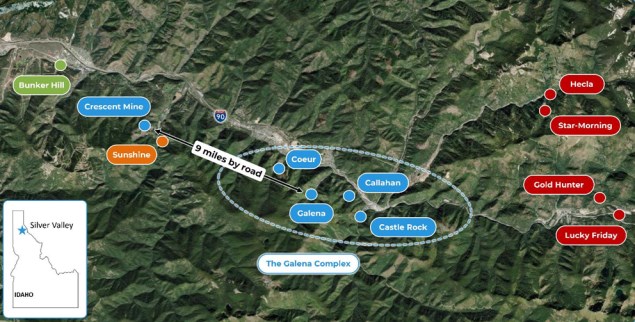
Table 1: Historical Mineral Resource Estimate (effective August 2015)
| Tons (kst) | Grade | Contained | |||
| Silver (opt) |
Copper (%) |
Silver (Moz) |
Copper (Mlbs) |
||
| Measured & Indicated | 201 | 19.1 | 0.41% | 3.8 | 1.6 |
| Inferred | 985 | 19.4 | 0.43% | 19.1 | 8.6 |
The information is extracted from the report entitled 'NI 43-101 Technical Report | Preliminary Economic Assessment | Crescent Silver Project | Shoshone County, Idaho USA' dated August 21, 2015 (the "2015 Technical Report"). The Company confirms that the form and context in which the Qualified Persons' findings are presented have not been materially modified from the original report. The effective date of the historical estimate is August, 2015. The Company believes that the historical estimate is reliable and relevant to continuing exploration and development on the Crescent mine. No more recent estimates of the mineral resource or other data are available to the Company. A qualified person has not done sufficient work on behalf of Americas to classify the historical estimate noted here and in Table 1 as current mineral resources or mineral reserves and Americas is not treating the historical estimates as current mineral resources or mineral reserves. There is no certainty that they will prove to be accurate or that a range of outcomes will be achieved.
The historical mineral resources were reported above a silver cut-off of 10 opt Ag. The following assumptions were used to define the portion of the mineral resource that meets the test of reasonable prospect for economic extraction and can be declared a mineral resource: Silver price of $20.00 per troy ounce, underground mining costs of $145 per ton, metallurgical recovery of 92% average, mining rate of 250 tons per day and minimum mining width of 4 feet. Additional key assumptions, parameters, and methods used to prepare the historical estimate are disclosed in the 2015 Technical Report.
RISK FACTORS
The business of the Company is subject to a substantial number of risks and uncertainties. In addition to considering the information disclosed in the forward-looking statements, financial statements and the other publicly filed documentation regarding the Company available on SEDAR+ at www.sedarplus.ca, on EDGAR at www.sec.gov, and on the Company’s website at www.americas-gold.com, the reader should carefully consider each of, and the cumulative effect of, the following risk factors. Any of these risk elements could have material adverse effects on the business of the Company. See Note 27 – Financial risk management of the Company’s audited consolidated financial statements for the year ended December 31, 2025.
Additional risks and uncertainties not known to the Company or that management currently deems immaterial may also impair the Company's business, condition (financial or otherwise), results of operations, properties or prospects.
The Company's production estimates may not be achieved as mining and exploration activities and future mining operations are, and will be, subject to operational risks and hazards inherent in the mining industry.
The Company currently has two production-level mines: the Galena Complex in Idaho, U.S.A. and the Cosalá Operations in Sinaloa, Mexico. No assurance can be given that the intended or expected production estimates will be achieved by the Company's operating mines or in respect of any future mining operations in which the Company owns or may acquire interests. Failure to meet such production estimates could have a material effect on the Company's future cash flows, financial performance and financial position. Production estimates are dependent on, among other things, the accuracy of mineral reserve estimates, the accuracy of assumptions regarding ore grades and recovery rates, ground conditions and physical characteristics of ores, such as hardness and the presence or absence of particular metallurgical characteristics and the accuracy of estimated rates and costs of mining and processing. Actual production may vary from its estimates for a variety of other reasons, including:
Such occurrences could result in damage to mineral properties, interruptions in production, injury or death to persons, damage to property, monetary losses and legal liabilities. These factors may cause a mineral deposit that has been mined profitably in the past to become unprofitable, forcing production to cease. Each of these factors also applies to sites not yet in production. It is not unusual in new mining operations to experience unexpected problems during the start-up or ramp-up phases to full production and operations. Depending on the price of gold, silver or other metals, it may be determined to be impractical to commence or, if commenced, to continue commercial production at a particular site.
The Company's Cosalá Operations were previously subject to an illegal blockade which began in January 2020 and continued until the Company signed an agreement with the Mexican Ministries of Economy, Interior and Labour along with union representatives committing to a reopening at the Cosalá Operations. Following this, the Company began recalling its workers as of September 11, 2021 and commenced reopening the operation as of September 13, 2021 as the employees arrived on site. The Cosalá Operations returned to full production following its restart and ramp-up in the fourth quarter of 2021. However, there can be no assurances that the that the Company will receive and continue to receive the level of support from the Mexican government with respect to the long-term stability of the Cosalá Operations or the ability to maintain such support in the near- and long-term. As a result, Company may experience further labour disputes, work stoppages, illegal blockades or other disruptions in production that could materially adversely affect its operations and results. We believe that the Company's continuing efforts to build lasting and constructive relationships with the Mexican government, host communities, its workforce and key stakeholders, and the significant local economic development initiatives the Company supports both directly and indirectly, will result in maintaining and building trust with local communities and more local citizens benefiting economically which will continue to support our Cosalá Operations. However, there is no assurance that the Company's efforts will effectively mitigate such risk.
Uncertainty in the estimation of mineral reserves and mineral resources
Mineral reserves and mineral resources are estimates only and no assurance can be given that the anticipated tonnages and grades will be achieved, that the indicated level of recovery will be realized or that mineral reserves can be mined or processed profitably. Mineral reserve and mineral resource estimates may be materially affected by environmental, permitting, legal, title, taxation, socio-political, geotechnical factors, marketing and other risks and relevant issues. There are numerous uncertainties inherent in estimating mineral reserves and mineral resources, including many factors beyond the Company's control. Such estimation is a subjective process, and the accuracy of any mineral reserve or mineral resource estimate is a function of the quantity and quality of available data, the nature of the ore body and of the assumptions made and judgments used in engineering and geological interpretation. These estimates may require adjustments or downward revisions based upon further exploration or development work, drilling or actual production experience.
Fluctuations in gold and silver prices, results of drilling, metallurgical testing and production, the evaluation of mine plans after the date of any estimate, permitting requirements or unforeseen technical or operational difficulties may require revision of mineral reserve and mineral resource estimates. Prolonged declines in the market price of metals may render mineral reserves and mineral resources containing relatively lower grades of mineralization uneconomical to recover and could materially reduce the Company's mineral reserves and mineral resources. Mineral resource estimates for properties that have not commenced production or at deposits that have not yet been exploited are based, in most instances, on limited drill hole information, which is not necessarily indicative of conditions between and around the drill holes. There may also be outliers in the representative samples that may disproportionally skew the estimates. Accordingly, such mineral resource estimates may require revision as more geologic and drilling information becomes available and as actual production experience is gained. Should reductions in mineral resources or mineral reserves occur, the Company may be required to take a material write-down of its investment in mining properties, reduce the carrying value of one or more of its assets or delay or discontinue production or the development of new projects, resulting in reduced net income or increased net losses and reduced cash flow. Mineral resources and mineral reserves should not be interpreted as assurances of mine life or of the profitability of current or future operations. In addition, the estimates of mineral resources, mineral reserves and economic projections rely in part on third-party reports and investigations. There is a degree of uncertainty attributable to the calculation and estimation of mineral resources and mineral reserves and corresponding grades being mined and, as a result, the volume and grade of reserves mined and processed and recovery rates may not be the same as currently anticipated. Any material reductions in estimates of mineral reserves and mineral resources, or of the Company's ability to extract these mineral reserves and mineral resources, could have a material adverse effect on the Company's projects, results of operations and financial condition.
Mineral resources are not mineral reserves and have a greater degree of uncertainty as to their existence and feasibility. There is no assurance that mineral resources will be upgraded to proven or probable mineral reserves.
Mineral Reserves and Resources, Development and Production
The estimation of ore reserves is imprecise and depends upon a number of subjective factors. Estimated ore reserves or production guidance may not be realized in actual production. The Company's operating results may be negatively affected by inaccurate estimates. Reserve estimates are a function of geological and engineering analyses that require the Company to make assumptions about production costs and the market price of gold, silver, copper, zinc, and lead. Reserve estimation is based on available data, which may be incomplete, and subject to engineering and geological interpretation, judgment and experience. Market price fluctuations of metals, as well as increased production costs or reduced recovery rates may render ore reserves containing relatively lower grades of mineralization uneconomic and may ultimately result in a restatement of reserves. Moreover, short-term operating factors relating to the ore reserves, such as the need for orderly development of the ore bodies and the processing of new or different ore grades may cause a mining operation to be unprofitable in any particular accounting period. Should the Company encounter mineralization or geologic formations at any of its mines different from those predicted, adjustments of reserve estimates might occur, which could alter mining plans. Either of these alternatives may adversely affect the Company's actual production and operating results.
The mineral reserve and resource estimates contained or incorporated are only estimates and no assurance can be given that any particular level of recovery of minerals will be realized or that an identified reserve or resource will qualify as a commercially mineable (or viable) deposit which can be legally and economically exploited. The Company relies on laboratory-based recovery models and historical performance of its processing plant to project estimated ultimate recoveries by ore type at optimal grind sizes. Actual recoveries in a commercial mining operation may exceed or fall short of projected laboratory test results. In addition, the grade of mineralization ultimately mined may differ from the one indicated by the drilling results and the difference may be material. There can be no assurance that minerals recovered in small scale laboratory tests will be duplicated in large scale tests under on-site conditions or in production scale operations and there can be no assurance that historical performance of the process plant will continue in the future. Material changes, inaccuracies or reductions in proven and probable reserves or resource estimates, grades, waste-to-ore ratios or recovery rates could have a materially adverse impact on the Company's future operations, cash flows, earnings, results of operations, financial condition and the economic viability of projects. The estimated proven and probable reserves and resources described herein should not be interpreted as assurances of mine life or of the profitability of future operations.
The Company has engaged internal and expert independent technical consultants to advise it on, among other things, mineral resources and reserves, geotechnical, metallurgy and project engineering. The Company believes that these experts are competent and that they have carried out their work in accordance with all internationally recognized industry standards. If, however, the work conducted by, and the mineral resource and reserve estimates of these experts are ultimately found to be incorrect or inadequate in any material respect, such events could materially and adversely affect the Company's future operations, cash flows, earnings, results of operations, financial condition and the economic viability of its projects.
The Company's ability to sustain or increase present production levels depends in part on successful exploration and development of new ore bodies and/or expansion of existing mining operations. Forecasts of future production are estimates based on interpretation and assumptions and actual production may be less than estimated. Mineral exploration involves many risks and is frequently unproductive. If mineralization is discovered, it may take a number of years until production is possible, during which time the economic viability of the project may change. Substantial expenditures are required to establish ore reserves, extract metals from ores and, in the case of new properties, to construct mining and processing facilities and infrastructure at any site chosen for mining. The economic feasibility of any development project is based upon, among other things, estimates of the size and grade of ore reserves, proximity to infrastructures and other resources (such as water and power), metallurgical recoveries, production rates and capital and operating costs of such development projects, and metals prices. Development projects are also subject to the completion of positive technical and economic studies, issuance of necessary permits and receipt of adequate financing, which may be difficult to obtain on terms reasonably acceptable to the Company.
The Company's future gold, silver, zinc, lead, and copper production may decline as a result of an exhaustion of reserves and possible closure of work areas. It is the Company's business strategy to conduct silver exploration activities at the Company's existing mining operations as well as at new exploration projects, and to acquire other mining properties and businesses or reserves that possess mineable ore reserves and are expected to become operational in the near future. However, the Company can provide no assurance that its future production will not decline. Accordingly, the Company's revenues from the sale of concentrates may decline, which may have a material adverse effect on its results of operations.
Global Financial Conditions and Geopolitical Instability
Global financial and political instability, including the 2026 Iran war, the ongoing conflict in Ukraine, sanctions on Russia, trade tariffs, credit risk, and high market volatility, continue to drive uncertainty and commodity price fluctuations. These external factors may impact demand for metals like silver and gold, credit availability, investor confidence, inflation, energy costs, tax rates, employment, interest rates, and overall financial market liquidity, all of which could adversely affect the Company's operations, business conditions and financial results. These factors may also impact the ability of the Company to obtain equity or debt financing in the future and, if obtained, on terms favourable to the Company. Increased levels of volatility and market turmoil can adversely impact the Company's operations and the price of the common shares could be adversely affected.
In particular, the imposition of protectionist or retaliatory trade tariffs by countries or other trade restrictions may impact the Company's ability to import materials needed to conduct its operations, construct its projects, or to export its products at prices that are economically feasible. Since early 2025, ongoing and sustained changes in the application of tariffs by the United States, Canada, and other countries, have created significant uncertainty and instability for importers globally.
The Company is reviewing its exposure to tariffs and is considering alternatives to inputs sourced from suppliers that may be subject to tariffs. Labour, contractors, and energy are locally sourced and are not expected to be directly affected by the tariffs, if implemented. The Company continues to monitor developments and will take steps to limit the impact of such tariffs as appropriate.
There continues to exist significant uncertainty about the future relationship between the U.S. and other countries with respect to such trade policies, treaties and tariffs. These developments, or the perception that any of them could occur, may have a material adverse effect on global economic conditions and the stability of global financial markets, and may significantly reduce global trade and, in particular, trade between the impacted nations and the U.S. Overall, trade policy restrictions create financial uncertainty for companies, disrupt trade relationships, and put downward pressure on economic growth.
Inflationary pressure and global supply chain delays may negatively impact the Company's operations
The geographic areas and markets in which the Company operates have been experiencing and continue to experience elevated inflationary pressures. During fiscal 2025, the Company has experienced, among other things, higher machinery, raw material and equipment costs, as well as wage pressures in some markets. Inflationary pressures on the Company are expected to continue through 2026 and potentially further, and such pressures could be exacerbated by global supply chain shortages and delays and increased input costs. Inflationary price increases and related pressures that are not offset by commodity price increases and operational efficiencies may have a material adverse effect on the Company's results of operations and profitability
Impairment
On a quarterly basis, the Company reviews and evaluates its mining interests for indicators of impairment or impairment reversals. Impairment assessments are conducted at the level of cash-generating units ("CGU"). An impairment of a hoist at the Galena Complex was identified during the year ended December 31, 2025 where carrying value of $10.4 million was recognized as an impairment loss to plant and equipment.
CGU is the smallest identifiable group of assets that generates cash inflows that are largely independent of the cash inflows from other assets or groups of assets. Each operating mine, development and exploration project represents a separate CGU. If an indication of impairment exists, the recoverable amount of the CGU is estimated. An impairment loss is recognized when the carrying amount of the CGU is in excess of its recoverable amount. The assessment for impairment is subjective and requires management to make significant judgments and assumptions in respect of a number of factors, including estimates of production levels, operating costs and capital expenditures reflected in the Company's life-of-mine plans, the value of in situ ounces, exploration potential and land holdings, as well as economic factors beyond management's control, such as precious metals prices, discount rates, foreign exchange rates, and observable net asset value multiples. It is possible that the actual fair value could be significantly different than those estimates. In addition, should management's estimate of the future not reflect actual events, further impairment charges may materialize, and the timing and amount of such impairment charges is difficult to predict.
The Company's audited consolidated financial statements for the year ended December 31, 2025 contain going concern disclosure
The Company's audited consolidated financial statements for the year ended December 31, 2025 contain disclosure related to the Company's ability to continue as a going concern. The Company's ability to continue as a going concern is dependent upon its ability to raise additional capital, achieve sustainable revenues and profitable operations, and obtain the necessary financing to meet obligations and repay liabilities when they become due. No assurances can be given that the Company will be successful in achieving these goals. If the Company is unable to achieve these goals, its ability to carry out and implement planned business objectives and strategies will be significantly delayed, limited or may not occur. The Company's financial statements do not include adjustments to amounts and classifications of assets and liabilities that might be necessary should the Company be unable to continue as a going concern. There are no guarantees that access to equity and debt capital from public and private markets in Canada or the U.S. will be available to the Company.
Risks associated with market fluctuations in commodity prices
The majority of the Company’s revenue is derived from the sale of silver, copper and lead contained in concentrates. Fluctuations in the prices of silver, copper, and lead represent one of the most significant factors affecting the Company’s results of operations and profitability. If the Company experiences low prices for these commodities, it may result in decreased revenues and decreased net income, or losses, and may negatively affect the Company’s business.
The market price for silver, copper and lead continues to be volatile and is influenced by a number of factors, including, among others, levels of supply and demand, global or regional consumptive patterns, sales by government holders, metal stock levels maintained by producers and others, increased production due to new mine developments, improved mining and production methods, speculative trading activities, inventory carrying costs, availability and costs of metal substitutes, international economic and political conditions, interest rates and the relative exchange rate of the U.S. dollar with other major currencies. The aggregate effect of such factors (all of which are beyond the control of the Company) is impossible to predict with any degree of accuracy, and as such, the Company can provide no assurances that it can effectively manage such factors.
In addition, the price of silver, for example, has on occasion been subject to very rapid short-term changes due to speculative activities. Fluctuations in silver and other commodity prices may materially adversely affect the Company's business, financial condition, or results of operations. The world market price of commodities has fluctuated during the last several years. Declining market prices for silver and other metals, in general, could have a material adverse effect on the Company's results of operations and profitability. If the market price of silver and other commodities falls significantly from its current levels, the operation of the Company's properties may be rendered uneconomic and such operation and exploitation may be suspended or delayed. In addition to adversely affecting the Company's reserve estimates and its financial condition, declining commodity prices can impact operations by requiring a reassessment of the feasibility of a particular project. Such a reassessment may be the result of a management decision or may be required under financing arrangements related to a particular project. Even if the project is ultimately determined to be economically viable, the need to conduct such a reassessment may cause substantial delays or may interrupt operations until the reassessment can be completed.
In particular, if applicable commodity prices are depressed for a sustained period and net losses accumulate, the Company may be forced to suspend some or all of its mining operations until prices increase or record asset impairment write-downs. Any lost revenues continued or increased net losses, or asset impairment write-downs would adversely affect the Company's results of operations.
The Company has a history of negative operating cash flow and may continue to experience negative operating cash flow
The Company has recently experienced negative operating cash flow and may continue to experience negative operating cash flow. The Company had negative operating cash flow for recent past financial reporting periods. Such negative operating cash flows can be common for mining companies in the exploration and/or development stages in respect of material mineral properties. However, to the extent that the Company has negative operating cash flow in future periods, the Company may need to allocate a portion of its cash reserves to fund such negative cash flow. The Company may also be required to raise additional funds through the issuance of equity or debt securities. There can be no assurance that additional capital or other types of financing will be available if or when needed or that these financings will be on terms favourable to the Company if at all, or that the Company's expectations regarding net cash flow in future period will prove to be accurate.
The Company's working capital requirements may be higher than anticipated and/or its revenue may be lower than anticipated over relevant periods
The Company's revenues over the 12 months from the date of this MD&A may be lower than anticipated. For instance, the Company's ability to generate sales and realize revenues is dependent on the Company achieving its production goals, including doing so on its expected timelines.
Working capital requirements over the next 12 months may also be greater than the Company currently anticipates for a variety of reasons, including, but not limited to, the following: the ability of the Company to maintain production at expected levels; unanticipated capital requirements at the Galena Complex; operating costs at the Cosalá Operations; unanticipated increases in contract mining, production costs or other operating expenses; labour disputes; and catastrophic events such as weather events, as well as or public health crises or pandemics and the related health and safety measures that may be instituted, particularly in the jurisdictions in which the Company operates. Many of these factors are not within the Company's control.
The Company expects to achieve net cash flow over the 12 months following the date of this AIF, and this expectation is reliant on revenues, production results, metals prices and working capital requirements being in line with current expectations. The Company's expectations regarding net cash flow are dependent on a number of assumptions and estimates, some of which are not in the Company's control. See "Cautionary Note Regarding Forward-Looking Information".
The Company may be subject to significant capital requirements and operating risks associated with its operations and its portfolio of growth projects
The Company must generate sufficient internal cash flows and/or be able to utilize available financing sources to finance its growth and sustaining capital requirements. The Company could be required to raise significant additional capital through the capital markets and/or incur significant borrowings to meet its capital requirements. These financing requirements could adversely affect the Company's ability to access the capital markets in the future to meet any external financing requirements the Company might have. If there are significant delays in terms of when any exploration, development and/or expansion projects are completed and producing on a commercial and consistent scale, and/or their capital costs were to be significantly higher than estimated, these events could have a significant adverse effect on the Company's results of operation, cash flow from operations and financial condition.
The Company expects that it may require additional financing in connection with the implementation of its business and strategic plans from time to time. The exploration and development of mineral properties and the ongoing operation of mines require a substantial amount of capital and will depend on the Company's ability to obtain financing through joint ventures, debt financing, equity financing or other means. The Company may accordingly need further capital depending on exploration, development, production and operational results and market conditions, including the prices at which the Company sells its production, or in order to take advantage of further opportunities or acquisitions. The Company's financial condition, general market conditions, volatile metals markets, volatile interest rates, a claim against the Company, a significant disruption to the Company's business or operations or other factors may make it difficult to secure financing necessary for the development or expansion of mining activities or to take advantage of opportunities for acquisitions. Further, continuing volatility in the credit markets may affect the ability of the Company, or third parties it seeks to do business with, to access those markets.
There is no assurance that the Company will be successful in obtaining required financing as and when needed on acceptable terms, if at all. A failure to obtain additional financing could result in delay or indefinite postponement of further exploration and development of its projects and the possible loss of such properties. If the Company raises funding by issuing additional equity securities or securities convertible, exercisable or exchangeable for equity securities, such financing may substantially dilute the interests of the shareholders of the Company and reduce the value of their investment. The Company has a limited history of earnings, has never paid a dividend, and does not anticipate paying dividends in the near future.
In addition, the Company's mining operations and processing and related infrastructure facilities are subject to risks normally encountered in the mining and metals industry. Such risks include, without limitation, environmental hazards, industrial accidents, labour disputes, changes in laws, technical difficulties or failures, late delivery of supplies or equipment, unusual or unexpected geological formations or pressures, cave-ins, pit-wall failures, rock falls, unanticipated ground, grade or water conditions, flooding, periodic or extended interruptions due to the unavailability of materials and force majeure events. Such risks could result in damage to, or destruction of, mineral properties or producing facilities, personal injury, environmental damage, delays in mining or processing, losses and possible legal liability. Any prolonged downtime or shutdowns at the Company's mining or processing operations could materially adversely affect the Company's business, results of operations, financial condition and liquidity. Additional risks and uncertainties not known to the Company or that management currently deems immaterial may also impair the Company's business, condition (financial or otherwise), results of operations, properties or prospects.
The Company’s dependence on the success of its Cosalá Operations, Galena Complex, including Crescent mine which are exposed to operational risks and other risks, including certain development and exploration related risks
The principal mineral projects of the Company are the Galena Complex, including Crescent mine and its Cosalá Operations. The Company is primarily dependent upon the success of these properties as sources of future revenue and profits, and as opportunities for the growth and development of the Company. Commercial production and operations at the Galena Complex, including Crescent mine, and its Cosalá Operations, will require the commitment of resources for operating expenses and capital expenditures, which may increase subsequently as needed, and for consultants, personnel and equipment associated primarily with commercial production. In addition, the Company’s other mining operations, exploration and development will require the commitment of additional resources for operating expenses and capital expenditures, which may increase subsequently as needed, and for consultants, personnel and equipment associated with advancing exploration, development and commercial production. The amounts and timing of expenditures will depend on, among other things, the results of commercial production, the progress of ongoing exploration and development, the results of consultants’ analysis and recommendations and other factors, many of which are beyond the Company’s control.
The success of construction projects and the start-up of new mines by the Company is subject to a number of factors including the availability and performance of engineering and construction contractors, mining contractors, suppliers and consultants, the receipt of required governmental approvals and permits in connection with the construction of mining facilities and the conduct of mining operations (including environmental permits), the successful completion and operation of ore passes, the adsorption, desorption and recovery plants, and conveyors to move ore, among other operational elements. Any delay in the performance of any one or more of the contractors, suppliers, consultants or other persons on which the Company is dependent in connection with its construction activities, a delay in or failure to receive the required governmental approvals and permits in a timely manner or on reasonable terms, or a delay in or failure in connection with the completion and successful operation of the operational elements in connection with new mines could delay or prevent the construction and start-up of new mines as planned. There can be no assurance that current or future construction and start-up plans implemented by the Company will be successful, that the Company will be able to obtain sufficient funds to finance construction and start-up activities, that personnel and equipment will be available in a timely manner or on reasonable terms to successfully complete construction projects, that the Company will be able to obtain all necessary governmental approvals and permits or that the completion of the construction, the start-up costs and the ongoing operating costs associated with the development of new mines will not be significantly higher than anticipated by the Company. Any of the foregoing factors could adversely impact the operations and financial condition of the Company.
Substantial risks are associated with mining and milling operations. The Company's commercial operations are subject to all the usual hazards and risks normally encountered in the exploration, development and production of gold, silver, zinc, lead and copper, including, among other things: unusual and unexpected geologic formations, inclement weather conditions, seismic activity, rock bursts, cave-ins, flooding and other conditions involved in the drilling and removal of material, any of which could result in damage to, or destruction of, mines and other producing facilities, catastrophic damage to property or loss of life, labour disruptions, equipment failure or failure of retaining dams around tailings disposal areas which may result in environmental pollution and legal liability. The Company will take appropriate precautions as are applicable to similar mining operations and in accordance with general industry standards to help mitigate such risks. However, the Company can provide no assurances that its precautions will actually succeed in mitigating, or even reducing the scope of potential exposure to, such operational risks.
Substantial efforts and compliance with regulatory requirements are required to establish mineral reserves through drilling and analysis, to develop metallurgical processes to extract metal and, in the case of development properties, to develop and construct the mining and processing facilities and infrastructure at any site chosen for mining. Shareholders cannot be assured that any reserves or mineralized material acquired or discovered will be in sufficient quantities to justify commercial operations.
Risks associated with outstanding debt
The Company’s ability to make scheduled payments of interest and principal on its outstanding indebtedness or refinance its debt obligations depends on its financial and operating performance, which is subject to prevailing economic and competitive conditions and to certain financial, business and other factors beyond its control. There can be no assurance that the Company will generate sufficient cash flow from operating activities to make its scheduled repayments of principal, interest, and any applicable premiums. The Company may be forced to pursue strategic alternatives such as reduce or delay capital expenditures, sell assets or operations, seek additional capital or restructure or refinance its indebtedness. While the Company has been able to successfully reduce liabilities by approximately $35 million since completion of the consolidation transaction in December 2024, there is no assurance the Company can continue to reduce its liabilities or do so on terms that are acceptable to it. No assurances can be made that the Company would be able to take any of these actions, that these actions would be successful, or that these actions would be permitted under the terms of existing or future debt agreements. If the Company cannot make scheduled payments on its debt, or comply with its covenants, it will be in default of such indebtedness and, as a result (i) holders of such debt could declare all outstanding principal and interest to be due and payable, and (ii) the lenders under the credit facilities could terminate their commitments to lend the Company money and if no provision for payment is made, the lender may exercise its applicable security.
Government regulation and environmental compliance
The Company is subject to significant governmental regulations, and costs and delays related to such regulations may have a material adverse effect on the Company's business.
The Company's mining activities are subject to extensive federal, state, local and foreign laws and regulations governing environmental protection, natural resources, prospecting, development, production, post-closure reclamation, taxes, labour standards and occupational health and safety laws and regulations including mine safety, toxic substances and other matters related to the Company's business. The costs associated with compliance with such laws and regulations could be substantial. Possible future laws and regulations, or more restrictive or false interpretations of current laws and regulations by governmental authorities could cause additional expense, capital expenditures, restrictions on or suspensions of the Company's operations and delays in the development of the Company's properties. Moreover, governmental authorities and private parties may bring lawsuits based upon damage to property and injury to persons resulting from the environmental, health and safety impacts of the Company's past and current operations, which could lead to the imposition of substantial fines, penalties and other civil and criminal sanctions. Substantial costs and liabilities, including for restoring the environment after the closure of mines, are inherent in the Company's operations. The Company is often required to post surety bonds or cash collateral to secure its reclamation obligations and may be unable to obtain the required surety bonds or may not have the resources to provide cash collateral, and the bonds or collateral may not fully cover the cost of reclamation and any such shortfall could have a material adverse impact on its financial condition. Although the Company believes it is in substantial compliance with applicable laws and regulations, the Company can give no assurance that any such law, regulation, enforcement or private claim will not have a material adverse effect on the Company's business, financial condition or results of operations.
In the United States, some of the Company's mining wastes are currently exempt to a limited extent from the extensive set of federal Environmental Protection Agency (the "EPA") regulations governing hazardous waste under the Resource Conservation and Recovery Act (the "RCRA"). If the exemption is altered and these wastes are designated as hazardous under the RCRA, the Company would be required to expend additional amounts on the handling of such wastes and may be required to make significant expenditures to construct or modify facilities for managing these wastes. In addition, releases of hazardous substances from a mining facility causing contamination in or damage to the environment may result in liability under the Comprehensive Environmental Response, Compensation and Liability Act (the "CERCLA"). Under the CERCLA, the Company may be jointly and severally liable for contamination at or originating from its facilities. Liability under the CERCLA may require the Company to undertake extensive remedial clean-up action or to pay for the government's clean-up efforts. It can also lead to liability to state and tribal governments for natural resource damages. Additional regulations or requirements are also imposed upon the Company's operations in Idaho under the federal Clean Water Act (the "CWA"). Airborne emissions are subject to controls under air pollution statutes implementing the Clean Air Act in Idaho. Compliance with the CERCLA, the CWA and state environmental laws could entail significant costs, which could have a material adverse effect on the Company's operations.
The Company's mining operations are subject to regulations promulgated by government agencies from time to time. Specifically, the Company's activities at the Galena Complex (and the care and maintenance of Relief Canyon) are subject to regulation by the U.S. Department of Labor's Mine Safety and Health Administration and related regulations under applicable legislation and the Company's activities at the Cosalá Operations projects are subject to regulation by SEMARNAT (defined below), the environmental protection agency of Mexico. Such regulations can result in citations and orders which can entail significant costs or production interruptions and have an adverse impact on the Company's operations and profitability. SEMARNAT regulations require that an environmental impact statement, known in Mexico as MIA, be prepared by a third-party contractor for submittal to SEMARNAT. Studies required to support the MIA include a detailed analysis of the following areas: soil, water, vegetation, wildlife, cultural resources and socio-economic impacts. The Company must also provide proof of local community support for a project to gain final approval of the MIA.
In the context of environmental permits, including the approval of reclamation plans, the Company must comply with standards and regulations, which involve significant costs and can entail significant delays. Such costs and delays could have an adverse impact on the Company's operations.
In the ordinary course of business, the Company is required to obtain or renew governmental permits for the operation and expansion of existing mining operations or for the development, construction and commencement of new mining operations. Obtaining or renewing the necessary governmental permits is a complex and time-consuming process involving numerous jurisdictions, which often involves public hearings and costly undertakings. The duration and success of the Company's efforts to obtain or renew permits are contingent upon many variables not within its control including the interpretation of applicable requirements implemented by the permitting authority. The Company's ability to obtain, maintain and renew permits and approvals and to successfully develop and operate mines may be adversely affected by real or perceived impacts associated with the Company's activities or those of other mining companies that affect the environment, human health and safety. Interested parties including governmental agencies and non-governmental organizations or civic groups may seek to prevent issuance of permits and intervene in the process or pursue extensive appeal rights. Past or ongoing or alleged violations of laws or regulations involving obtaining or complying with permits could provide a basis to revoke existing permits, deny the issuance of additional permits, or commence a regulatory enforcement action, each of which could have a material adverse impact on the Company's operations or financial condition. The Company may not be able to obtain or renew permits that are necessary to its operations, or the cost to obtain or renew permits may exceed what the Company believes it can recover from the property once in production. Any unexpected delays or costs associated with the permitting process could delay the development or impede the operation of a mine, which could have a material adverse effect on the Company's operations and profitability.
Legislative and regulatory measures to address climate change and greenhouse gas emissions are in various phases of consideration. If adopted, such measures could increase the Company's cost of environmental compliance and also delay or otherwise negatively affect efforts to obtain permits and other regulatory approvals with regard to existing and new facilities. Proposed measures could also result in increased cost of fuel and other consumables used at the Company's operations. Climate change legislation or regulation may affect the Company's customers and the market for the metals it produces with effects on prices that are not possible to predict. Adoption of these or similar new environmental regulations or more stringent application of existing regulations may materially increase the Company's costs, threaten certain operating activities and constrain its expansion opportunities.
Tailing Risks
Mining companies face innate risks in their operations with respect to tailings storage facilities and structures built for the containment of processed rock that remains after the target minerals are extracted, known as tailings, which will expose the Company to certain risks in connection with its operations. Unexpected failings or breaches of tailings storage facilities, such as slope failures, foundation failures, or erosion, could release tailings and result in extensive environmental damage to the surrounding area as well as damage to property, personal injury, or death. Tailings storage facility failures can result in the immediate suspension of mining operations by government authorities and lead to significant costs and expenses, write offs of material assets, and the recognition of provisions for remediation, which could affect the Company's operations and financial condition.
The unexpected failure of a tailings storage facility could subject the Company to any or all of the potential impacts discussed above in "Government regulation and environmental compliance", among others. A major spill or failure of the tailings facilities (including as a result of matters beyond the Company's control such as extreme weather, a seismic event, or other incident) could cause damage to the environment and the surrounding communities, wildlife, and areas. Failure to comply with existing or new environmental, health, and safety laws and regulations could lead to injunctions, fines, suspension or revocation of permits and other penalties. The costs and delays associated with compliance with these laws, regulations, and permits may prevent the Company from proceeding with the development of a project or the operation or further development of a project or operation or increase the costs of development or production, or otherwise impact the Company's ability to execute its strategic plans, and may materially adversely affect the Company's business, results of operations or financial condition. The Company could also be held responsible for the costs associated with investigating and addressing contamination (including claims for natural resource damages) or for fines or penalties from governmental authorities relating to contamination issues. The Company could also be found liable for claims relating to exposure to hazardous and toxic substances and major spills, breach, or other failure of the tailing facilities. The costs associated with such responsibilities and liabilities could be significant, be higher than estimated, and may involve a time consuming clean-up. Furthermore, in the event that the Company is deemed liable for any damage caused by overflow, the Company's losses or consequences of regulatory action might not be sufficiently covered by insurance policies. Should the Company be unable to fully fund the cost of remedying such environmental concerns, the Company could be required to temporarily or permanently suspend certain of its operations. If any such risks were to materialize, this could materially and adversely affect the Company's reputation and its ability to conduct its operations, and could subject the Company to liability and result in a material adverse effect on its business, financial condition and results of operations.
Some of the Company's material properties are located in Mexico and are subject to changes in political and economic conditions and regulations in that country
Mexico has been subject to political instability, changes and uncertainties, which may cause changes to existing governmental regulations or their application affecting mineral exploration and mining activities. The Company's operations and properties are subject to a variety of governmental regulations including, among others: regulations promulgated by the Mexican Department of Economy - Dirección General de Minas, Mexico's Secretary of Environment and Natural Resources ("SEMARNAT"); the Mexican Mining Law; and the regulations of the Comisión Nacional del Aqua with respect to water rights, the Mexican Department of labour and the Mexican Department of the Interior. Mexican regulators have broad authority to shut down and/or levy fines against facilities that do not comply with regulations or standards. The Company's mineral exploration and mining activities in Mexico may be adversely affected in varying degrees by changing government regulations relating to the mining industry or shifts in political conditions that increase the costs related to the Company's activities or maintenance of its properties. Government regulations may affect operations in unpredictable ways, including disruptions of supplies and markets, ability to move equipment from site to site, or disruption of infrastructure facilities, including public roads, could be targets or experience collateral damage as a result of social instability, labour disputes or protests. Operations may also be affected in varying degrees by government regulations with respect to restrictions on production, price controls, export controls, income taxes, and expropriation of property, environmental legislation and mine safety. Mexico's status as an emerging market economy may make it more difficult than it was in the past for the Company to obtain any required financing for its projects. The Mexican government has conducted a highly publicized crackdown on the drug cartels, resulting in widespread violence and a loss of lives. There is no assurance that the Company's operations will not be adversely impacted by such organizations. Further, these risks may not in any part be insurable in the event the Company does suffer damage.
The Company is uncertain if all necessary permits will be maintained on acceptable terms or in a timely manner. Future changes in applicable laws and regulations or changes in their enforcement or regulatory interpretation or improper application could negatively impact current operations or planned exploration and development activities on its Cosalá district properties, or in any other projects that the Company becomes involved with. Any failure (actual or alleged) to comply with applicable laws and regulations or to obtain or maintain permits, even if inadvertent, could result in the interruption of production, exploration and development operations or material fines, penalties, diminution of property rights including mining concessions or other liabilities.
Risks associated with foreign operations
The Company's operations are currently conducted principally in Mexico and the United States. As such, its operations are exposed to various levels of political, economic and other risks and uncertainties which could result in work stoppages, blockades of the Company's mining operations and appropriation of assets. Some of the Company's operations are located in areas where Mexican drug cartels operate. These risks and uncertainties vary from region to region and include, but are not limited to, terrorism; hostage taking; organized crime, including local drug gang activities; military repression; expropriation; extreme fluctuations in currency exchange rates; changes in royalty regimes, including the elimination of tax exemptions; underdeveloped industrial and economic infrastructure; unenforceability of judgements; high rates of inflation; labour unrest; the risks of war or civil unrest; renegotiation or nullification of existing concessions, licenses, permits and contracts; illegal mining; changes in taxation policies; restrictions on foreign exchange and repatriation; and changing political conditions arising from changes in government and otherwise, currency controls, import and export regulations and governmental regulations that favour or require the awarding of contracts to local contractors or require foreign contractors to employ citizens of, or purchase supplies from, a particular jurisdiction.
Local opposition to mine development projects could arise in Mexico, and such opposition could be violent. If the Company were to experience resistance or unrest in connection with its Mexican operations, it could have a material adverse effect on its operations and profitability. To the extent the Company acquires mineral properties in jurisdictions other than Mexico, it may be subject to similar and additional risks with respect to its operations in those jurisdictions.
Labour relations, employee recruitment, retention and pension funding
The Company may experience labour disputes, work stoppages or other disruptions in production that could adversely affect its operations. The Company is dependent on its workforce at its producing properties and mills. The Company endeavours to maintain good relations with its workforce in order to minimize the possibility of strikes, lock-outs and other stoppages at the site. Relations between the Company and its employees may be impacted by changes in labour relations which may be introduced by, among other things, employee groups, competing labour unions, or other groups using a labour related justification, and the relevant governmental authorities in whose jurisdictions the Company carries on business.
Many of the Company's employees at its operations are represented by a labour union under a collective labour agreement. The Company may not be able to satisfactorily renegotiate the collective labour agreement when it expires. In addition, the existing labour agreement may not prevent a strike or work stoppage at the Company's facilities in the future, and any such work stoppage could have a material adverse effect on its earnings.
A subsidiary of the Company is party, with the United Steel Workers Union, to a collective bargaining agreement that covers substantially all of the hourly employees at the Galena Complex that was ratified by union membership at the Galena Complex and is effective from October 3, 2025, through October 2, 2030. A failure to come to an agreement after expiration of such agreement could impact the operations at the Galena Complex if there was a labour action that results in an interruption of operations.
The Cosalá Operations were subject to an illegal blockade which began in January 2020 and continued until the Company signed an agreement with the Mexican Ministries of Economy, Interior and Labour along with union representatives committing to a reopening at the Cosalá Operations. The Company has since resumed operations. However, there can be no assurances that the Company will receive and continue to receive the level of support from the Mexican government with respect to the long-term stability of the Cosalá Operations or the ability to maintain such support in the near- and long-term. As a result, Company may experience further labour disputes, work stoppages, illegal blockades or other disruptions in production that could materially adversely affect its operations and results.
We believe that the Company's continuing efforts to build lasting and constructive relationships with the Mexican government, host communities, its workforce and key stakeholders, and the significant local economic development initiatives the Company supports both directly and indirectly, will result in maintaining and building trust with local communities and more local citizens benefiting economically which will continue to support the Cosalá Operations. However, there is no assurance that the Company's efforts will effectively mitigate such risk.
The Company also hires its employees or consultants to assist it in conducting its operations in accordance with laws of the host country. The Company also purchases certain supplies and retains the services of various companies in the host country to meet its business plans. It may be difficult to find or hire qualified people in the mining industry who are situated in the host country or to obtain all the necessary services or expertise in the host country or to conduct operations on its projects at reasonable rates. If qualified people and services or expertise cannot be obtained in the host country, the Company may need to seek and obtain those services from people located outside the host country, which will require work permits and compliance with applicable laws and could result in delays and higher costs to the Company to conduct its operations. Recruiting and retaining qualified personnel is critical to the Company's success.
The number of persons skilled in acquisition, exploration and development of mining properties is limited and competition for such persons is intense. As the Company's business activity grows, the Company will require additional key executive, financial, operational, administrative and mining personnel. Although the Company believes that it will be successful in attracting, training and retaining qualified personnel, there can be no assurance of such success. The number of qualified skilled workers and personnel is limited and competition for such workers and personnel is intense. The Company's ability to meet its labour needs, while controlling labour costs, is subject to many external factors, including the competition for and availability of skilled personnel in our markets, unemployment levels within those markets, prevailing wage rates, minimum wage laws, health and other insurance costs and changes in employment and labour legislation or other workplace regulation. If the Company is not successful in attracting and training qualified personnel, the efficiency of its operations could be affected, which could have a material adverse effect on the Company's results of operations and profitability.
The volatility in the equity markets over the last several years and other financial impacts have affected the Company's costs and liquidity through increased requirements to fund the Company's defined benefit pension plans for its employees. There can be no assurance that financial markets will sufficiently recover in the future with the effect of causing a corresponding reduction in the Company's future pension funding requirements. Furthermore, there can be no assurance that unforeseen changes in pensioner longevity, government regulation or other financial market uncertainties will not cause pension funding requirements to differ from the requirements projected by professional actuaries. The Company intends to continue to fund its pension plan for hourly and salary employees of the Company pursuant to all relevant regulatory requirements.
Dependence on key personnel and the risk of loss
The Company strongly depends on the business and technical expertise of its small group of senior management and key personnel. There is little possibility that this dependence will decrease in the near term. Key man life insurance is not in place on senior management and key personnel. From time to time in the course of carrying out their responsibilities, including conducting mine site visits, certain of these key senior management and/or personnel travel together as a group at the same time and by the same mode of transportation for security, efficiency and cost-effectiveness. If the services of the Company's senior management and key personnel were lost for any reason, it could have a material adverse effect on future operations and such effect could be particularly acute in the event of loss of multiple members of this group.
Community relations and social impact
The Company's relationship with the communities where it operates is critical to ensuring the future success of project development and future operations. Globally, there is an increasing level of public concern relating to the perceived effect of mining activities on the environment and on communities impacted by such activities. There is no assurance that the Company will be able to appropriately manage community relations (including, for greater certainty, relations with Indigenous peoples and any applicable attendant formal consultation obligations) in a manner that will allow the Company to proceed with its plans to develop and operate its properties.
Certain non‐governmental organizations, some of which oppose globalization and resource development, or have other interests, can be vocal critics of the mining industry and its practices. Actions by such organizations could adversely affect the Company's reputation and financial condition and may impact its relationship with the communities in which it operates. These actions can relate not only to current activities but also historic mining activities by prior owners and could have a material, adverse effect on the Company. They may also file complaints with regulators and others. Such complaints, regardless of whether they have any substance or basis in fact or law, may have the effect of undermining the confidence of the public or a regulator and may adversely affect the Company.
Risks associated with transportation and storage of concentrate in Mexico
The concentrates produced by the Company have significant value and are loaded onto road vehicles for transport or to seaports for export to foreign markets. The geographic location of the Company's operations in Mexico and the United States, and air and trucking routes taken through the country to the refinery, smelters and ports for delivery, give rise to risks including concentrate theft, roadblocks and terrorist attacks, losses caused by adverse weather conditions, delays in delivery of shipments, and environmental liabilities in the event of an accident or spill.
Mining property and title risks
Third parties may dispute the Company's mining claims, which could result in losses affecting the Company's business. The validity of unpatented mining claims is often uncertain and may be contested. Although the Company has attempted to acquire satisfactory title to undeveloped properties, the Company, in accordance with mining industry practice, does not generally obtain title opinions until a decision is made to develop a property. As a result, some titles, particularly titles to undeveloped properties, may be defective. Defective title to any of the Company's mining claims could result in litigation, insurance claims, and potential losses affecting the Company's business.
The validity of mining or exploration titles or claims, which constitute most of the Company's property holdings, can be uncertain and may be contested. No assurance can be given that applicable governments will not revoke or significantly alter the conditions of the applicable exploration and mining titles or claims and that such exploration and mining titles or claims, will not be challenged or impugned by third parties. The Company has not conducted surveys of all the claims in which it holds direct or indirect interests and therefore, the precise area and location of such claims may be in doubt. The Company's properties may be subject to prior unregistered liens, agreements or transfers, Indigenous land claims (including any applicable formal consultation obligations), or undetected title defects.
Speculative nature of exploration and development
The Company's future growth and productivity will depend, in part, on the ability to identify and acquire additional commercially mineable mineral rights, and on the costs and results of continued exploration and potential development programs. Exploration for minerals and the development of mineral properties is speculative and involves significant uncertainties and financial risks that even a combination of careful evaluation, experience and technical knowledge may not eliminate. While the discovery of an ore body may result in substantial rewards, few properties which are explored prove to return the discovery of a commercially mineable deposit and/or are ultimately developed into producing mines. As at the date hereof, some of the Company's projects are preliminary in nature and mineral resource estimates include inferred mineral resources, which are considered too speculative geologically to have the economic considerations applied that would enable them to be categorized as mineral reserves. Mineral resources that are not mineral reserves do not have demonstrated economic viability. Major expenses may be required to properly evaluate the prospectivity of an exploration property, to develop new ore bodies and to estimate mineral resources and establish mineral reserves. There is no assurance that the Company's deposits are commercially mineable, nor can there be any certainty that the Company's exploration, development and production activities will be commercially successful.
Unauthorized mining
The mining industry in Mexico is subject to incursions by illegal miners who gain unauthorized access to mines to steal mineralized material mainly by manual mining methods. Such incursions could result in both a significant financial loss to the Company and a material impact to the Company's operations. In addition to the risk of losses and disruptions, these illegal miners pose a safety and security risk. The Company has taken security measures at its sites to address this issue and ensure the safety and security of its employees, contractors and assets. These incursions and illegal mining activities can potentially compromise underground structures, equipment and operations, which may lead to production stoppages and impact the Company's ability to meet production goals.
Global financial and economic conditions
The re-emergence of a global financial crisis or recession or reduced economic activity in the United States, Mexico, Canada, China, India and other industrialized or developing countries, or disruption of key sectors of the economy such as oil and gas, may have a significant effect on the Company's results of operations or may limit its ability to raise capital through credit and equity markets. The prices of the metals that the Company produces are affected by a number of factors, and it is unknown how these factors may be impacted by a global financial event or development impacting major industrial or developing countries. Additionally, global economic conditions may cause a long-term decrease in asset values. If such global volatility and market uncertainty were to continue, the Company's operations and financial condition could be adversely impacted.
Natural disasters, terrorist acts, health crises and other disruptions or dislocations
Upon the occurrence of a natural disaster, or upon an incident of war, riot or civil unrest, the impacted country may not efficiently and quickly recover from such event, which could have a materially adverse effect on the Company. Terrorist attacks, public health crises including epidemics, pandemics or outbreaks of new infectious disease or viruses, and related events can result in volatility and disruption to global supply chains, operations, mobility of people and the financial markets, which could affect interest rates, credit ratings, credit risk, inflation, business, financial conditions, results of operations and other factors relevant to the Company.
Surface rights and access
The Company has reached various agreements for surface rights and access with certain local groups, including members of ejidos, for mining exploitation activities, including open pit mining, in the surroundings of the Cosalá Operations. In addition, the Company has formal ongoing agreements for surface access to all ejidos on which its exploration activities are being performed. These agreements are valid and are regularly reviewed in terms of the appropriate level of compensation for the level of work being carried out.
For future activities, the Company will need to negotiate with ejido and non-ejido members, as a group and individually, to reach agreements for additional access and surface rights. Negotiations with ejidos membership or other interested groups can become time-consuming if demands for compensation become unreasonable. There can be no guarantee that the Company will be able to negotiate satisfactory agreements with any such existing members for such access and surface rights, and therefore it may be unable to carry out planned mining activities. In addition, in circumstances where access is denied, or no agreement can be reached, the Company may need to rely on the assistance of local officials or the courts in such jurisdiction, the outcomes of which cannot be predicted with any certainty. The inability of the Company to secure surface access or purchase required surface rights could materially and adversely affect the timing, cost or overall ability of the Company to operate or develop any mineral deposits it may locate. See "Labour relations, employee recruitment, retention and pension funding" for further information.
The Company is subject to currency fluctuations that may adversely affect the financial position of the Company
One of the Company's primary operations, the Cosalá Operations, is located in Mexico and many of its expenditures and obligations are denominated in Mexican pesos. Other operations are located in the United States and expenditures related to those operations are denominated in U.S. dollars. The Company maintains its principal office and raises its equity financings in Canada, maintains cash accounts in U.S. dollars, Canadian dollars and Mexican pesos and has monetary assets and liabilities in U.S. dollars, Canadian dollars and Mexican pesos. For its financial reporting, the Company's presentation currency is the U.S. dollar. As such, the Company's results of operations are subject to foreign currency fluctuation risks and such fluctuations may adversely affect the financial position and results of the Company. The Company may, from time to time, employ derivative financial instruments to manage exposure to fluctuations in foreign currency exchange rates.
Litigation Risk
All industries, including the mining industry, are subject to legal claims, with and without merit. Defence and settlement costs of legal claims can be substantial, even with respect to claims that have no merit. Due to the inherent uncertainty of the litigation and dispute resolution process, the litigation process could take away from management time and efforts and the resolution of any particular legal proceeding to which the Company may become subject could have a material adverse effect on the Company's financial position, results of operations, or the Company's property development or operations.
Acquisitions and Integration
From time to time, the Company examines opportunities to acquire additional mining assets and businesses, including its recent acquisition of Crescent. Any acquisition that the Company may choose to complete may be of a significant size, may change the scale of the Company's business and operations, and may expose the Company to new geographic, political, operating, financial, and geological risks. The Company's success in its acquisition activities depends on its ability to identify suitable acquisition candidates, negotiate acceptable terms for any such acquisition, and integrate the acquired operations successfully with those of the Company. Any acquisitions would be accompanied by risks. For example, there may be a significant change in commodity prices after the Company has committed to complete the transaction and established the purchase price or exchange ratio; a material property may prove to be below expectations; the Company may have difficulty integrating and assimilating the operations and personnel of any acquired companies, realizing anticipated synergies and maximizing the financial and strategic position of the combined enterprise, and maintaining uniform standards, policies and controls across the organization; the integration of the acquired business or assets may disrupt the Company's ongoing business and its relationships with employees, customers, suppliers, and contractors; and the acquired business or assets may have unknown liabilities, which may be significant. In the event that the Company chooses to raise debt capital to finance any such acquisition, the Company's leverage will be increased. If the Company chooses to use equity as consideration for such acquisition, existing shareholders may experience dilution. Alternatively, the Company may choose to finance any such acquisition with its existing resources. There can be no assurance that the Company would be successful in overcoming these risks or any other problems encountered in connection with such acquisitions.
Joint Ventures
The Company's interests in joint ventures or other similar arrangements, including the Antimony JV, are subject to risks customarily associated with joint venture structures. These may include: (i) disagreement with partners on how to develop, construct, commission and operate facilities efficiently, or on business plans and related capital and operating expenditures; (ii) an inability to exert influence or control over certain strategic decisions due to governance frameworks that require partner consent or consensus (including equal representation on the management committee); (iii) the risk that partners may be unable or unwilling to meet their obligations (including funding capital contributions, honouring offtake or marketing commitments, or fulfilling closure and reclamation obligations); and (iv) the potential for litigation or other dispute resolution processes regarding joint venture matters. Each of these risks could have a material adverse impact on the profitability or viability of the Company's joint venture interests and, consequently, on the Company's cash flows, earnings, results of operations and/or financial condition.
Although the Company is the majority owner of the Antimony JV, it is not the operator and therefore the success and timing of construction, commissioning and operations will depend in significant part on United States Antimony. As a result, the Company may have limited ability to direct day-to-day activities, will be subject to decisions made by the United States Antimony as operator, and will rely on the United States Antimony for accurate, timely information about the joint venture facility, including costs, schedules, operating performance, product quality and marketing activities. In addition, although the Company holds a majority interest and chairs the management committee, major decisions may require agreement with United States Antimony, and dispute-resolution or deadlock provisions could lead to outcomes that are unfavorable to the Company, including decisions being made without the Company's consent, suspension of construction if supply agreements are not finalized within the prescribed period, dilution of the Company's interest if it is unable to fund required contributions, or the triggering of buy/sell mechanisms that could require us to commit significant capital or, alternatively, result in the loss of the Company's joint venture interest.
The Company may enter into additional joint ventures or other similar arrangements in the future. The success and timing of such ventures, including the Antimony JV), will also depend on factors outside of the Company's sole control, including counterparty's financial resources, operational performance and marketing capabilities (including contemplated purchases and sales of joint venture output), pricing (e.g., for the Antimony JV, the Company will be required to deliver antimony to be sold at market rates, but there is no assurance or guarantee that the Company will be able to produce or deliver the antimony at a cost which is less than what buyers are willing to pay for it), as well as alignment of objectives over time. While partners may generally reach consensus on the direction and operation of a joint venture, there is no assurance that this will continue. Failure to agree on matters requiring consensus (or delays arising from required approvals, budget finalization, construction execution, commissioning or supply/offtake arrangements) could delay development or operations, prevent the joint venture from progressing as planned or impair the economics of the project. These and other joint venture risks could materially and adversely impact the development and operation of such ventures, including the Antimony JV, as well as the Company's business, financial condition and results of operations.
Risks associated with Americas Gold and Silver's various financial instruments
The Company's financial instruments consist of cash and cash equivalents, restricted cash, receivables, accounts payable and accrued liabilities, other payables, derivative assets and liabilities, and other financial instruments may be held from time to time. These financial instruments are exposed to numerous risks, including, among others, liquidity risk, currency risk, equity price risk, interest rate risk, counterparty risk and credit risk. Many of these risks are outside the Company's control. There is no assurance that the Company will realize the carrying value of any of its financial instruments.
The Company may engage in hedging activities
From time to time, the Company may use certain derivative products to hedge or manage the risks associated with changes in the prices of zinc, lead, and the Mexican Peso. The use of derivative instruments involves certain inherent risks including, among other things: (i) credit risk - the risk of an unexpected loss arising if a counterparty with which the Company has entered into transactions fails to meet its contractual obligations; (ii) market liquidity risk - the risk that the Company has entered into a derivative position that cannot be closed out quickly, by either liquidating such derivative instrument or by establishing an offsetting position; (iii) unrealized mark-to-market risk - the risk that, in respect of certain derivative products, an adverse change in market prices for commodities, currencies or interest rates will result in the Company incurring an unrealized mark-to-market loss in respect of such derivative products.
There is no assurance that any hedging program or transactions which may be adopted or utilized by the Company designed to reduce the risk associated with price changes will be successful. Although hedging may protect the Company from an adverse price change, it may also prevent the Company from benefiting fully from a positive price change.
The Company may require significant capital expenditures
Substantial capital expenditures will be required to maintain, develop and to continue with exploration at the Company properties. In order to explore and develop these projects and properties, the Company may be required to expend significant amounts for, among other things, geological, geochemical and geophysical analysis, drilling, assaying, and, if warranted, mining and infrastructure feasibility studies.
The Company may not benefit from any of these investments if it is unable to identify commercially exploitable mineralized material. If successful in identifying reserves, it will require significant additional capital to construct facilities necessary to extract recoverable metal from those reserves.
The ability of the Company to achieve sufficient cash flows from internal sources and obtain necessary funding depends upon a number of factors, including the state of the worldwide economy and the price of silver, zinc, lead and copper. The Company may not be successful in achieving sufficient cash flows from internal sources and obtaining the required financing for these or other purposes on terms that are favourable to it or at all, in which case its ability to continue operating may be adversely affected. Failure to achieve sufficient cash flows and obtain such additional financing could result in delay or indefinite postponement of further exploration or potential development.
Risks associated with the Company's business objectives
The Company's strategy to create shareholder value through the acquisition, exploration, advancement and development of its mineral properties will be subject to substantive risk. While the Company may seek to acquire additional mineral properties that are consistent with its business objectives, there can be no assurance that the Company will be able to identify suitable additional mineral properties or, if it does identify suitable properties, that it will have sufficient financial resources to acquire such properties or that such properties will be available on terms acceptable to the Company or at all. Any partnership or joint venture agreements with respect to mineral properties that the Company enters into will be subject to the typical risks associated with such agreements, including disagreement on how to develop, operate or finance a property and contractual and legal remedies of the Company's partners in the event of such disagreement.
Competition in the mining industry
Competition in the mining sector is intense. Mines have limited lives and as a result, the Company may in the future seek to replace and expand its reserves through the acquisition of new properties. In addition, there is a limited supply of desirable mineral lands available in areas where the Company would consider conducting exploration and/or production activities. Because the Company faces strong competition for new properties from other mining companies, some of which have greater financial resources than it does, the Company may be unable to acquire attractive new mining properties on terms that it considers acceptable. Competition in the mining business for limited sources of capital could adversely affect the Company's ability to acquire and develop suitable mines, developmental projects, producing companies, or properties having significant exploration potential. As a result, there can be no assurance that the Company's acquisition and exploration plans will yield new mineral reserves to replace or expand current mineral reserves.
Concentrate sales risks
The Company currently sells its concentrates under offtake contracts with a limited number of counterparties. Based on past practice, and the quality of its concentrates, the Company expects to be able to renew these contracts or find alternative purchasers for its concentrates, however there can be no assurance that the existing contracts will be renewed or replaced on reasonable terms.
The Company frequently sells its concentrates on the basis of receiving a sales advance when the concentrates are delivered, with the advance based on market prices of metals at the time of the advance. Final settlement of the sale is then made later, based on prevailing metals prices at that time. In an environment of volatile metal prices, this can lead to negative cash adjustments, with amounts owing to the purchaser, and such amounts could potentially be substantial. In volatile metal markets, the Company may elect to fix the price of a concentrate sale at the time of initial delivery.
Sprott holds significant voting power in the Company and the interests of Sprott may not be the same as those of the Company's other shareholders
Eric Sprott holds significant voting power in the Company, and the interests of Eric Sprott and his affiliates may conflict with or differ from the interests of the Company’s shareholders. Eric Sprott holds approximately 12% of the Company’s issued and outstanding common shares, on a non-diluted basis. Additionally, Eric Sprott (or his affiliates) may hold or may acquire investments and assets that may compete with the Company. Accordingly, the interests of Eric Sprott and his affiliates may not be the same as those of the Company’s other shareholders, and conflicts of interest may arise from time to time that may be resolved in a manner detrimental to the Company or the Company’s minority shareholders. Mr. Sprott and his affiliates may also pursue, for their own account, acquisition opportunities that could be complementary to our business, and, as a result, those acquisition opportunities may not be available to us. As long as Mr. Sprott owns or controls a significant number of our outstanding common shares, he may have the ability to exercise significant influence over corporate actions requiring shareholder approval, irrespective of how our other shareholders may vote, including the election and removal of directors and the size of our Board, any amendments to our articles, or the approval of any merger, acquisition or other significant corporate transaction, including a sale of all or substantially all of our assets.
Circumstances may occur in which the interests of Mr. Sprott (or his affiliates) could be in conflict with the interests of other shareholders. In addition, this concentration of ownership could have the effect of delaying or preventing a change in control or otherwise discouraging a potential acquiror from attempting to obtain control of the Company, which could cause the market price of the common shares to decline or prevent shareholders from realizing a premium over the market price for their common shares.
Certain risks related to the ownership of the Common Shares
In recent years, the securities markets in the United States and Canada have experienced a high level of price and volume volatility, and the market price of securities of many companies, including mineral resource and mining companies and particularly those considered development stage companies, have experienced wide fluctuations in price which have not necessarily been related to the operating performance, underlying asset values or prospects of such companies. There can be no assurance that continual severe fluctuations in price will not occur.
The common shares are currently listed on the TSX and the NYSE American. There can be no assurance that an active market for the common shares will be sustained. If an active or liquid market for the common shares fails to be sustained, the prices at which such common shares trade may be adversely affected. Whether or not the common shares will trade at lower prices depends on many factors, including the liquidity of the common shares, prevailing interest rates and the markets for similar securities, general economic conditions and the Company’s financial condition, historic financial performance and future prospects.
Additionally, the exercise of stock options and warrants already issued by the Company, the issuance of additional equity securities or convertible debt securities and the repayment of debt through the issuance of additional equity securities in the future could result in dilution in the equity interests of holders of common shares.
The Company may also issue and sell additional securities of the Company to finance its operations or future acquisitions. The Company cannot predict the size of future issuances of securities of the Company or the effect, if any, that future issuances and sales of securities will have on the market price of any securities of the Company that are issued and outstanding from time to time. Sales or issuances of substantial amounts of securities of the Company, or the perception that such sales or issuances could occur, may adversely affect prevailing market prices for the securities of the Company that are issued and outstanding from time to time. With any additional sale or issuance of securities of the Company, holders will suffer dilution with respect to voting power and may experience dilution in the Company’s earnings per share. Moreover, the Company’s recent offerings of common shares may create a perceived risk of dilution resulting in downward pressure on the price of the Company’s issued and outstanding common shares, which could contribute to progressive declines in the prices of such securities.
The Company is subject to the rules and regulations of the TSX and NYSE American
The Company is subject to the rules and regulations of the NYSE American and the TSX. Further, in order to maintain compliance with all continued listing requirements, the Company pays legal, accounting and compliance fees to advisors and regulatory organizations. Any changes to rules, regulations, policies or guidelines issued by regulatory authorities may impact the risk of non-compliance. There is no assurance that the Company will be able to comply with the applicable NYSE American or TSX continued listing standards or maintain its listing status on either the TSX or NYSE American. Any failure to comply with applicable continued listing requirements and regulations may result in the delisting of the Common Shares from the TSX and/or the NYSE American. Any voluntary or involuntary delisting may have material adverse effects on the Company's business and financial condition.
Absolute assurance on financial statements
The Company prepares its financial statements in accordance with accounting policies and methods prescribed by International Financial Reporting Standards. In the preparation of financial statements, management may need to rely upon assumptions, make estimates or use their best judgment in determining the financial condition of the Company. In order to have a reasonable level of assurance that financial transactions are properly authorized, assets are safeguarded against unauthorized or improper use and transactions are properly recorded and reported, the Company has implemented and continues to analyze its internal control systems for financial reporting. Although the Company believes that its financial reports and financial statements are prepared with reasonable safeguards to ensure reliability, the Company cannot provide absolute assurance in that regard.
The Company is a Canadian company and this could have an impact on enforcement of civil liabilities obtained under U.S. securities laws
The Company is a corporation existing under the laws of Canada and its registered and head office is in Canada. Most of the Company's directors and officers are residents of Canada or otherwise reside outside of the United States, and a substantial portion of their assets, and a substantial portion of the Company's assets, are located outside the United States. As a result, it may be difficult to serve process on the Company or such other persons, to effect service of process within the United States on certain of the Company's directors and officers or enforce judgments obtained in the United States courts against the Company or certain of the Company's directors and officers based upon the civil liability provisions of United States federal securities laws or the securities laws of any state of the United States. Enforcement by investors of civil liabilities under the United States federal or state securities laws may be affected adversely by these facts.
There is some doubt as to whether a judgment of a United States court based solely upon the civil liability provisions of United States federal or state securities laws would be enforceable in Canada against the Company or its directors and officers. There is also doubt as to whether an original action could be brought in Canada against the Company or its directors and officers to enforce liabilities based solely upon United States federal or state securities laws.
Uninsured or uninsurable risks
In the course of exploration, development and production of mineral properties, several risks and, in particular, unexpected or unusual geological or operating conditions, may occur. Such risks and hazards may include adverse environmental conditions, industrial accidents, labour disputes, social unrest, political or economic instability, unusual or unexpected geological conditions, ground or slope failures, cave-ins, catastrophic equipment failures, changes in the regulatory environment, and natural phenomena such as inclement weather conditions, floods and earthquakes. Such occurrences could result in damage to mineral properties or production facilities, personal injury or death, environmental damage to the Company's properties or the properties of others, delays in mining, monetary losses, and possible legal liability.
Although the Company will maintain insurance to protect against certain risks in such amounts as it considers reasonable, its insurance will not cover all the potential risks associated with a mining company’s operations. Furthermore, the Company may decide not to take out insurance against such risks as a result of high premiums or other reasons. Insurance coverage may not continue to be available or may not be adequate to cover any resulting liability. Should such aforementioned liabilities arise, they could have a material adverse effect on the results of the Company’s operations, cash flow, financial condition, and business, they could reduce or eliminate any future profitability, and they could result in an increase in costs and a decline in value of the Company’s common shares.
As of the date of this AIF, the Company is not insured against environmental risks. Insurance against environmental risks (including potential liability for pollution or other hazards as a result of the disposal of waste products occurring from exploration and production) has not been generally available to companies within the industry. Without such insurance, and if the Company becomes subject to environmental liabilities, the payment of such liabilities would reduce or eliminate its available funds or could exceed the funds the Company has to pay such liabilities and result in bankruptcy. Should the Company be unable to fund fully the remedial cost of an environmental problem, it might be required to enter into interim compliance measures pending completion of the required remedy.
The Company's information technology systems may be vulnerable to disruption which could place its systems at risk from data loss, operational failure, or compromise of confidential information
The Company relies on various information technology systems, and on third party developers and contractors, in connection with operations, including production, equipment operation and financial support systems. While the Company regularly obtains and develops solutions to monitor the security of its systems, it remains vulnerable to disruption, damage or failure from a variety of sources, including errors by employees or contractors, computer viruses, cyber-attacks including phishing, ransomware, and similar malware, misappropriation of data by outside parties, and various other threats. Techniques used to obtain unauthorized access or sabotage systems are under continuous and rapid evolution, which may deter efforts to detect disruption of data and systems in advance. Breaches and unauthorized access carry the potential to cause losses of production, operational delays, equipment failure that could cause other risks to be realized, inaccurate recordkeeping, or disclosure of confidential information, any of which could result in financial losses and regulatory or legal exposure and could have a material adverse effect on the Company's cash flows, financial condition or results of operations.
Accessibility and reliability of existing local infrastructure
The Company's mining, processing, development and exploration activities depend, to some degree, on adequate infrastructure. Reliable roads, bridges, power sources and water supply are important considerations, which affect capital and operating costs. The lack of availability on acceptable terms or the delay in the availability of any one or more of these items could prevent or delay exploitation or development of the Company's projects. If adequate infrastructure is not available in a timely manner, the exploitation or development of the Company's projects may not be commenced or completed on a timely basis, if at all. In addition, the resulting operations may not achieve the anticipated production volume, or the construction costs and ongoing operating costs associated with the exploitation and/or development of the Company's advanced projects will be higher than anticipated. Unusual or infrequent weather phenomena, sabotage, government or other interference in the maintenance or provision of such infrastructure could adversely affect the Company's operations and profitability.
Risks and uncertainties related to the repatriation of funds from foreign subsidiaries
The Company expects to generate cash flow and profits at its foreign subsidiaries and may need to repatriate funds from those subsidiaries to fulfill its business plans, in particular in relation to ongoing expenditures at its exploration and development assets. The Company may not be able to repatriate funds or may incur tax payments or other costs when doing so, as a result of a change in applicable law or tax requirements at local subsidiary levels or at the parent level, which costs could be substantial.
U.S. Foreign Corrupt Practices Act and similar worldwide anti-bribery laws
The Foreign Corrupt Practices Act (United States) and the Corruption of Foreign Public Officials Act (Canada) and anti-bribery laws in other jurisdictions generally prohibit companies and their intermediaries from making improper payments for the purpose of obtaining or retaining business or other commercial advantage. The Company’s policies mandate compliance with these anti-bribery laws, which often carry substantial penalties. The Company operates in jurisdictions that have experienced governmental and private sector corruption to some degree and, in certain circumstances, strict compliance with anti-bribery laws may conflict with certain local customs and practices. There can be no assurance that the Company’s internal control policies and procedures will always protect it from reckless or other inappropriate acts committed by the Company’s affiliates, employees or agents. Violations of these laws, or allegations of such violations, could have a material adverse effect on the Company’s reputation, as well as business, financial position and results of operations and could cause the market value of the Company’s common shares to decline.
Tax considerations
Mexico
Corporate profits in Mexico are taxed only by the Federal Government. Previously, there were two federal taxes in Mexico that applied to the Company's operations in Mexico: corporate income tax and a Flat Rate Business Tax ("IETU"). Mexican corporate income tax was calculated based on gross revenue less deductions for all refining and smelting charges, direct operating costs, all head office general and administrative costs, and depreciation deductions as applicable at a corporate income tax rate in Mexico of 30%. The IETU was a cash-based minimum tax that applies in addition to the corporate income tax. The tax was applicable to the taxpayer's net income from the (i) sale of goods; (ii) performance of independent services; and (iii) lease of goods at the rate of 16.5% during 2008, 17% during 2009, 17.5% during 2010, 2011 and 2013.
In late 2013, a new income Tax Law was enacted in Mexico ("Mexican Tax Reform") which became effective January 1, 2014. Key provisions of the Mexican Tax Reform that may affect the Company consist of:
United States
U.S. holders of the Company’s common shares should be aware that Americas Gold and Silver believes it was not classified as a “passive foreign investment company” (“PFIC”) within the meaning of Section 1297(a) of the Code for its most recently completed tax year, and based on current business plans and financial expectations, Americas Gold and Silver expects that it will likely not be a PFIC for the current tax year. No opinion of legal counsel or ruling from the IRS concerning the status of Americas Gold and Silver as a PFIC has been obtained or is currently planned to be requested. PFIC classification is fundamentally factual in nature, generally cannot be determined until the close of the tax year in question, and is determined annually. Consequently, there can be no assurance that Americas Gold and Silver will not become a PFIC for any tax year during which U.S. holders own common shares of the Company.
If Americas Gold and Silver is a PFIC for any year during a U.S. holder’s holding period, then such U.S. holder generally will be required to treat any gain realized upon a disposition of its common shares of the Company, or any “excess distribution” received on its common shares of the Company , as ordinary income, and to pay an interest charge on a portion of such gain or distribution, unless the U.S. holder makes a timely and effective “qualified electing fund” election under Section 1295 of the Code (“QEF Election”) with respect to Americas Gold and Silver or a “mark-to-market” election under Section 1296 of the Code with respect to its common shares of the Company . A U.S. holder who makes a QEF Election generally must report on a current basis its share of Americas Gold and Silver’s net capital gain and ordinary earnings for any year in which Americas Gold and Silver is a PFIC, whether or not Americas Gold and Silver distributes any amounts to its shareholders. However, U.S. holders should be aware that there can be no assurance that Americas Gold and Silver will satisfy the record keeping requirements that apply to a QEF, or that Americas Gold and Silver will supply U.S. holders with information that such U.S. holders require to report under the QEF Election rules, in the event that Americas Gold and Silver is a PFIC and a U.S. holder wishes to make a QEF Election. Thus, U.S. holders may not be able to make a QEF Election with respect to their common shares of the Company. A U.S. holder who makes a mark-to-market election generally must include as ordinary income each year the excess of the fair market value of the Company’s common shares over the taxpayer’s adjusted tax basis therein. Each U.S. holder should consult its own tax advisors regarding the PFIC rules and the U.S. federal income tax consequences of the acquisition, ownership, and disposition of common shares of the Company.
There is a risk that Americas Gold and Silver will be classified as a “controlled foreign corporation”, (a “CFC”) within the meaning of Section 957(a) of the Code. Americas Gold and Silver will generally be classified as a CFC if more than 50% of the Company’s outstanding shares, measured by reference to voting power or value, are owned (directly, indirectly or by attribution) by “U.S. Shareholders.” For this purpose, a “U.S. Shareholder” is any U.S. person that owns directly, indirectly or by attribution, 10% or more of the aggregate voting power or value of Americas Gold and Silver’s outstanding shares. If Americas Gold and Silver is classified as a CFC, a U.S. Shareholder may be subject to U.S. income taxation at ordinary income tax rates on all or a portion of Americas Gold and Silver’s undistributed earnings and profits attributable to “subpart F income”, may be required to take into account its pro rata share of Americas Gold and Silver’s “Net CFC tested income” (formerly “global intangible low-taxed income”), and may also be subject to tax at ordinary income tax rates on any gain realized on a sale of the Company’s common shares, to the extent of Americas Gold and Silver’s current and accumulated earnings and profits attributable to such common shares. The CFC rules are complex and U.S. Shareholders of the Company should consult their own tax advisors regarding the possible application of the CFC rules to them in their particular circumstances.
Climate change
Extreme weather events (for example, prolonged drought, or the increased frequency and intensity of storms) have the potential to disrupt the Company's operations and the transportation routes that the Company uses. The Company's ability to conduct mining operations depends upon access to the volumes of water that are necessary to operate its mines and processing facilities. Changes in weather patterns and extreme weather events, either due to normal variances in weather or due to global climate change, could adversely impact the Company's ability to secure the necessary volumes of water to operate its facilities.
For example, the Cosalá Operations and Galena Complex have in the past experienced damage from flooding during periods of excessive rain. Increased precipitation, either due to normal variances in weather or due to global climate change, could result in flooding that may adversely impact mining operations and could damage the Company's facilities, plant and operating equipment at the Company's properties. Accordingly, extreme weather events and climate change may increase the costs of operations and may disrupt operating activities, either of which would adversely impact the profitability of the Company.
Regulations and pending legislation governing issues involving climate change, ESG and DEI could result in increased operating and capital costs which could have a material adverse effect on the Company's business
The production of metals concentrates is an energy-intensive undertaking that results in a significant carbon footprint. The Company utilizes electricity, diesel fuel, and gasoline to directly or indirectly to produce metal.
A number of governments or governmental bodies have introduced or are contemplating regulatory changes in response to the potential impacts of climate change that are viewed as the result of emissions from the combustion of carbon-based fuels. At the 21st Conference of the Parties of the United Nations Framework Convention on Climate Change held in Paris in 2015, the Paris Agreement was adopted which was intended to govern emission reductions beyond 2020. The Paris Agreement went into effect in November 2016 when countries that produce at least 55% of the world's greenhouse gas emissions ratified the agreement. While there are no immediate impacts to business from the Paris Agreement, the goal of limiting global warming to "well below 2ºC" will be taken up at national levels.
Some of the countries in which the Company operates have implemented, and are developing, laws and regulations related to climate change and greenhouse gas emissions. In December 2009, the United States EPA issued an endangerment finding under the U.S. Clean Air Act that current and projected concentrations of certain mixed greenhouse gases, including carbon dioxide, in the atmosphere threaten the public health and welfare. Additionally, the United States and China signed a bilateral agreement in November 2014 that committed the United States to reduce greenhouse gas emissions by an additional 26% to 28% below 2005 levels by the year 2025. The EPA in August 2015 issued final rules for the Clean Power Plan under Section 111(d) of the Clean Air Act designed to reduce greenhouse gas emissions at electric utilities in line with reductions planned for the compliance with the Paris Agreement. On June 19, 2019, the EPA as part of a regulatory review repealed the Clean Power Plan and replaced it with the Affordable Clean Energy rule which eliminates most of the emission reduction standards included in the Clean Power Plan. On January 19, 2021, the D.C. Circuit vacated the Affordable Clean Energy rule and remanded to the Environmental Protection Agency for further proceedings consistent with its opinion.
Legislation and increased regulation and requirements regarding climate change could impose increased costs on the Company and its venture partners and suppliers, including increased energy, capital equipment, environmental monitoring and reporting and other costs to comply with such regulations.
The Company may also be impacted by conflicting expectations relating to environmental, social and governance ("ESG"). While Canadian regulators have increased expectations relating to ESG practices and disclosure, "anti-ESG" sentiment has gained momentum across the U.S. A growing number of U.S. governmental bodies (state and federal) have enacted, proposed or indicated an intent to pursue "anti-ESG" policies and legislation or issued related legal opinions, including in respect of ESG and diversity, equity and inclusion ("DEI") initiatives in the private sector. State governments and regulators have also increased their focus on ESG practices of large U.S. entities conducting business in their states, particularly with respect to climate risk and greenhouse gas emissions. This includes conflicting state level considerations on ESG practices that reflect the political polarization surrounding ESG in the U.S.
Practices and disclosures relating to ESG matters (including but not limited to climate change and emissions, DEI, data security and privacy, ethical sourcing, and water, waste and ecological management) continue to attract increasing scrutiny by stakeholders. In response to potential "anti- ESG" sentiment, it is possible that proponents of ESG measures will become galvanized and increase their efforts to compel or pressure corporations with operations in the U.S. to advance such initiatives. If the Company does not successfully manage expectations across varied stakeholder interests, it could erode trust and impact the Company's reputation. Failure to implement the policies and practices as requested or expected by stakeholders may result in such investors reducing their investment in the Company, or not investing at all. Navigating varying expectations of policymakers and other stakeholders has inherent costs, and any failure to successfully navigate such expectations may expose the Company to negative publicity, shareholder activism, litigation, investigations and enforcement actions or other engagement from both pro- and anti-ESG stakeholders. Addressing changing ESG regulations and practices can involve significant costs and require a significant time commitment from the Board, management of the Company and employees of the Company. The Company's response to addressing ESG matters and any negative perception thereof can also impact its reputation, business prospects, ability to hire and retain qualified employees, and vulnerability to activist shareholders. Such risks could adversely affect the Company's future business operations and profitability.
Additional reporting requirements may apply if Americas Gold and Silver loses its status as a "Foreign Private Issuer" under the U.S. Exchange Act
Americas Gold and Silver is currently considered a "foreign private issuer" under the rules of the SEC. However, it may lose its "foreign private issuer" status at future assessment dates. The Company may in the future lose its foreign private issuer status if a majority of the common shares are owned of record in the United States and the Company fails to meet the additional requirements necessary to avoid loss of foreign private issuer status.
As a foreign private issuer, Americas Gold and Silver is subject to the reporting requirements under the Securities Exchange Act of 1934, as amended, (the “U.S. Exchange Act”) applicable to foreign private issuers. Americas Gold and Silver is required to file its annual report on Form 40-F with the SEC at the time it files its annual information form with the applicable Canadian securities regulatory authorities. In addition, Americas Gold and Silver must furnish reports on Form 6-K to the SEC regarding certain information required to be publicly disclosed by Americas Gold and Silver in Canada or filed with the TSX and which was made public by the TSX, or regarding information distributed or required to be distributed by Americas Gold and Silver to its shareholders. Moreover, although Americas Gold and Silver is required to comply with Canadian disclosure requirements, in some circumstances Americas Gold and Silver is not required to file periodic reports and financial statements with the SEC as frequently or as promptly as United States companies that have securities registered under the U.S. Exchange Act. Americas Gold and Silver is permitted to file financial statements in accordance with IFRS as issued by International Accounting Standards Board, and therefore does not file financial statements prepared in accordance with generally accepted accounting principles in the United States as do United States companies that file reports with the SEC. Furthermore, Americas Gold and Silver is not required to comply with the United States proxy rules or with Regulation FD, which addresses certain restrictions on the selective disclosure of material information, although it must comply with Canadian disclosure requirements. Americas Gold and Silver also presents information regarding mineral resources and reserves in accordance with NI 43-101 rather than in compliance with S-K 1300, the requirements of the SEC applicable to domestic United States reporting companies and foreign private issuers that are not eligible for the Canada-U.S. multijurisdictional disclosure system. In addition, among other matters, Americas Gold and Silver’s officers, directors and principal shareholders are exempt from the reporting and “short-swing” profit recovery provisions of Section 16 of the U.S. Exchange Act and the rules under the U.S. Exchange Act with respect to their purchases and sales of the Company’s common shares. Therefore, the Company’s securityholders may not know on as timely a basis when its officers, directors and principal shareholders purchase or sell securities of the Company as the reporting periods under the corresponding Canadian insider reporting requirements are longer. Americas Gold and Silver also presents information regarding mineral resources and reserves in accordance with NI 43-101 rather than the requirements of the SEC applicable to domestic United States reporting companies.
If Americas Gold and Silver loses its status as a foreign private issuer, it will no longer be exempt from such rules and, among other things, will be required to file periodic reports and financial statements with the content and in the form required as if it were a domestic United States reporting company, and will incur additional costs to make such filings. The regulatory and compliance costs to the Company under United States federal securities laws as a domestic United States reporting company may be significantly more than the costs the Company incurs as a Canadian foreign private issuer eligible to use the multijurisdictional disclosure system. Additionally, if the Company ceases to be a foreign private issuer or loses its eligibility to file its annual report on Form 40-F pursuant to the multijurisdictional disclosure system, then the Company will be subject to S-K 1300, which differs from the requirements of NI 43-101.
Americas Gold and Silver may incur increased costs as a reporting company whose common shares are publicly traded in the United States if Americas Gold and Silver were to lose its eligibility to use the multijurisdictional disclosure system, and our management would be required to devote substantial time to new compliance initiatives
If Americas Gold and Silver loses eligibility to report under the multijurisdictional disclosure system, as a public company whose shares are publicly traded in the United States and reporting under the Exchange Act, the Company would incur significant legal, accounting and other expenses that it would not incur as a company reporting under the multijurisdictional disclosure system. The Sarbanes-Oxley Act, the Dodd-Frank Wall Street Reform and Consumer Protection Act and other applicable securities rules and regulations impose various requirements on public companies in the United States. Senior management of the Company and other personnel would need to devote a substantial amount of time to these compliance initiatives. Moreover, these rules and regulations would increase legal and financial compliance costs and would make some activities more time-consuming and costly.
We have identified a material weakness in our internal controls over financial reporting and may identify additional material weaknesses in the future or otherwise fail to maintain an effective system of internal controls, which may result in material misstatements of our consolidated financial statements or cause us to fail to meet our periodic reporting obligations.
Section 404(a) of the Sarbanes-Oxley Act requires that Americas Gold and Silver's management assess and report annually on the effectiveness of its internal controls over financial reporting and identify any material weaknesses in its internal controls over financial reporting. Section 404(b) of the Sarbanes-Oxley Act requires the Company's independent registered public accounting firm to issue an annual report that addresses the effectiveness of the Company's internal controls over financial reporting.
A material weakness is a deficiency, or a combination of deficiencies, in internal control over financial reporting, such that there is a reasonable possibility that a material misstatement of a company’s annual or interim financial statements will not be prevented or detected on a timely basis. We identified a material weakness in our internal controls over financial reporting as of December 31, 2025. Although the material weakness identified above did not result in material misstatements in our consolidated financial statements for the periods presented and there were no changes to previously released financial results (other than the revision to contract liabilities noted in notes 10 and 11 in the consolidated financial statements), our management concluded that these control weaknesses constitute a material weakness and that our internal control was not effective as of December 31, 2025.
Our management, under the oversight of the Audit Committee of our Board of Directors and in consultation with outside advisors, has begun evaluating and implementing measures designed to ensure that the control deficiencies contributing to the material weakness are remediated. Further details are included in Management's Report on Internal Control Over Financial Reporting.
Remediation activities need to operate for a sufficient period of time for management to conclude that they are operating effectively. As such, the material weakness will not be considered remediated until management has concluded through the implementation of these remediation measures and additional testing that these controls are effective.
We continue to incur increased costs as a result of operating as a public company in the United States and loss of our status as an emerging growth company, and our management is required to devote substantial time to new compliance initiatives and corporate governance practices.
As a U.S. public company, Americas Gold and Silver incurs significant legal, accounting and other expenses. The Sarbanes-Oxley Act, the Dod-Frank Wall Street Reform and Consumer Protection Act, the listing requirements of the NYSE Americans and other applicable securities rules and regulations impose various requirements on non-U.S. reporting public companies, including the establishment and maintenance of effective disclosure and financial controls and corporate governance practices. The Company's management and other personnel devote a substantial amount of time to these compliance initiatives. Moreover, these rules and regulations have increased its legal and financial compliance costs and have made some activities more time consuming and costly. Moreover, these rules and regulations may make it more difficult and more expensive for the Company to obtain director and officer liability insurance.
These rules and regulations are often subject to varying interpretations, in many cases due to their lack of specificity, and, as a result, their application in practice may evolve over time as new guidance is provided by regulatory and governing bodies. This could result in continuing uncertainty regarding compliance matters and higher costs necessitated by ongoing revisions to disclosure and governance practices.
Pursuant to Section 404 of the Sarbanes-Oxley Act, the Company is required to furnish a report by its senior management on its internal control over financial reporting issued by its independent registered public accounting firm.
Cybersecurity risk
The Company's operations depend, in part, upon information technology systems. The Company's information technology systems are subject to disruption, damage or failure from a number of sources, including, but not limited to, hacking, computer viruses, security breaches, natural disasters, power loss, vandalism, theft and defects in design. Any of these and other events could result in information technology systems failures, operational delays, production downtimes, destruction or corruption of data, security breaches or other manipulation or improper use of the Company's data, systems and networks, any of which could have adverse effects on the Company's reputation, business, results of operations, financial condition and share price.
The Company's risk and exposure to these matters cannot be fully mitigated because of, among other things, the evolving nature of these threats. As a result, cyber security and the continued development and enhancement of controls, processes and practices designed to protect the Company's systems, computers, software, data and networks from attack, damage or unauthorized access remain a priority. As cyber threats continue to evolve, the Company may be required to expend additional resources to continue to modify or enhance protective measures or to investigate and remediate any security vulnerabilities.
Conflicts of interest
Certain of the Company's directors and officers also serve as directors and/or officers of other companies involved in natural resource exploration and development, and consequently there exists the possibility for such directors and officers to have interests that conflict with the Company's interests. Situations may arise in connection with potential investments where the other interests of the Company's directors conflict with its interests. As such, conflicts of interest may arise that may influence these persons in evaluating possible acquisitions or in generally acting on the Company's behalf, as they may pursue opportunities that would then be unavailable to the Company. In the event that the Company's directors are subject to conflicts of interest, there may be a material adverse effect on its business.
DIVIDENDS
The Company has not, since its incorporation, paid any dividends on any of the Common Shares, and it is not contemplated that any dividends will be declared on the Common Shares in the immediate or foreseeable future. The directors of the Company will determine any future dividend policy on the basis of earnings, the Company’s financial position and other relevant factors.
GENERAL DESCRIPTION OF CAPITAL STRUCTURE
The Company is authorized to issue an unlimited number of Common Shares and preferred shares (“Preferred Shares”)., where each common share provides the holder with one vote while preferred shares are non-voting. As at December 31, 2025, there were 320,418,782 common shares and nil preferred shares issued and outstanding.
Holders of Common Shares are entitled to receive dividends, if any, as and when declared by the Board out of monies properly applicable to the payment of dividends, in such amount and in such form as the Board may from time to time determine, and all dividends which the Board may declare on the Common Shares shall be declared and paid in equal amounts per share on all Common Shares at the time outstanding. In the event of the dissolution, liquidation or winding-up of the Company, whether voluntary or involuntary, or any other distribution of assets of the Company among its shareholders for the purpose of winding up its affairs, the holder of the Common Shares shall be entitled to receive the remaining property and assets of the Company.
As of March 27, 2026, there were 325,893,105 common shares and nil preferred shares issued and outstanding, and 7,390,338 options outstanding which are exchangeable in common shares of the Company. The number of common shares issuable on the exercise of warrants is 5,086,800. The increase in the common shares between December 31, 2025, and March 27, 2026, is primarily related to the exercise of the Company’s outstanding options, warrants, RSUs, and DSUs.
The following table summarizes the Company's Common Share purchase warrants outstanding as of December 31, 2025.
| Number of | Exercise | Issuance | Expiry |
| warrants | price (CAD) | date | date |
| 7,040 | 0.75 | Mar 2024 | Mar 27, 2026 |
| 400,000 | 1.38 | Jun 2023 | Jun 21, 2026 |
| 4,709,400 | 1.00 | Mar 2024 | Mar 27, 2027 |
| 1,000,000 | 1.05 | Aug 2024 | Aug 14, 2027 |
| 1,044,000 | 2.50 | Mar 2025 | Mar 31, 2028 |
| 7,160,440 |
Ratings
To the best of its knowledge, the Company is not aware of any ratings, including provisional ratings, from rating organizations for the Company's securities that are outstanding and continue in effect.
MARKET FOR SECURITIES
The Common Shares are traded on the TSX under the symbol "USA". The closing price of the Common Shares on the TSX on December 31, 2025 was C$7.04 and on March 26, 2026 was C$7.35 The Common Shares are traded on the NYSE American under the symbol "USAS". The closing price of the Common Shares on the NYSE American on December 31, 2025 was $5.11 and on March 26, 2026 was $5.31.
The following table sets forth the high and low market prices and the volume of the Common Shares traded on the TSX during the periods indicated:
| Period | High (C$) | Low (C$) | Total Volume |
||||
| January 2025 | 1.94 | 1.40 | 5,618,101 | ||||
| February 2025 | 2.10 | 1.63 | 7,189,217 | ||||
| March 2025 | 2.13 | 1.60 | 7,177,716 | ||||
| April 2025 | 2.26 | 1.40 | 15,700,094 | ||||
| May 2025 | 2.30 | 1.88 | 10,231,020 | ||||
| June 2025 | 2.98 | 2.13 | 13,270,418 | ||||
| July 2025 | 3.63 | 2.71 | 9,681,549 | ||||
| August 2025 | 3.88 | 3.03 | 10,231,700 | ||||
| September 2025 | 5.23 | 3.58 | 22,267,384 | ||||
| October 2025 | 7.18 | 5.18 | 26,927,813 | ||||
| November 2025 | 6.29 | 4.97 | 34,795,652 | ||||
| December 2025 | 8.20 | 5.95 | 30,442,452 | ||||
| January 2026 | 14.14 | 6.72 | 40,550,758 | ||||
| February 2026 | 13.39 | 8.96 | 36,500,566 | ||||
| March 1-26, 2026 | 13.74 | 7.22 | 47,564,274 |
The following table sets forth the high and low market prices and the volume of the Common Shares traded on the NYSE American during the periods indicated:
| Period | High ($) | Low ($) | Total Volume |
||||
| January 2025 | 1.35 | 0.95 | 528,490 | ||||
| February 2025 | 1.50 | 1.14 | 1,805,264 | ||||
| March 2025 | 1.48 | 1.10 | 632,566 | ||||
| April 2025 | 1.63 | 0.99 | 1,084,913 | ||||
| May 2025 | 1.66 | 1.33 | 1,714,213 | ||||
| June 2025 | 2.20 | 1.55 | 1,620,024 | ||||
| July 2025 | 2.65 | 2.01 | 1,821,001 | ||||
| August 2025 | 2.83 | 2.18 | 1,659,781 | ||||
| September 2025 | 3.75 | 2.60 | 3,190,095 | ||||
| October 2025 | 5.11 | 3.71 | 5,370,537 | ||||
| November 2025 | 4.50 | 3.52 | 6,040,696 | ||||
| December 2025 | 6.23 | 4.26 | 7,675,804 | ||||
| January 2026 | 10.38 | 4.87 | 11,905,333 | ||||
| February 2026 | 9.82 | 6.55 | 13,998,411 | ||||
| March 1-26, 2026 | 10.05 | 5.27 | 17,646,282 |
DIRECTORS AND OFFICERS
Name, Occupation and Security Holding
The table below sets forth the name, province or state and country of residence, position with the Company, principal occupation during the previous five years and the number of voting securities beneficially owned, directly or indirectly, or over which control or direction is exercised, for the directors and executive officers of the Company.
As of December 31, 2025, directors and executive officers of the Company, as a group, beneficially owned, directly or indirectly, or exercised control or direction over an aggregate of 14,203,903 Common Shares representing approximately 4.4% of its issued and outstanding Common Shares.
The terms of the directors of the Company expire at the annual general meeting of shareholders where they can be nominated for re-election. The officers hold their office at the discretion of the Board, but typically on an annual basis, after the annual general meeting, the directors pass resolutions to appoint officers and constitute committees.
| Name and Residence and Position with the Company |
Principal Occupation for Five Preceding Years | Number of Company Shares Owned1 |
| DIRECTORS | ||
| Paul Huet Chairman of the Board Chief Executive Officer Nevada, USA Director since December 19, 2024 |
Mr. Huet is the Chairman and Chief Executive Officer of Americas Gold and Silver Corp. Mr. Huet served as the Executive Chairman of Karora Resources Inc. from February 25, 2019 until July 18, 2019, when he was appointed Chairman and interim Chief Executive Officer. The "interim" portion of his title was removed in August 2019, and Mr. Huet served as Chairman and Chief Executive Officer of Karora Resources Inc. until its acquisition by Westgold Resources Limited in August 2024. Previously, Mr. Huet was President, Chief Executive Officer and Director of Klondex Mines from 2012 to 2018, until its acquisition by Hecla Mining Company. Mr. Huet has a strong command of capital markets and has served in all levels of engineering and operations of Mining. Mr. Huet graduated with Honors from the Mining Engineering Technology program at Haileybury School of Mines in Ontario, and successfully completed the Stanford Executive program at the Stanford School of Business. In 2013 Mr. Huet was nominated for the Premier's Award for outstanding college graduates in Ontario; he is currently a member of the Ontario Association of Certified Engineering Technicians and Technologists as an applied Science Technologist and an Accredited Director. Mr. Huet serves as Chair of the Board of Directors and a member of the Sustainability & Technical Committee of the Company. |
7,686,823 |
| Name and Residence and Position with the Company |
Principal Occupation for Five Preceding Years | Number of Company Shares Owned1 |
| Scott Hand Lead Director Massachusetts, USA Director since December 19, 2024 |
Mr. Hand is a founder and Executive Chairman of Kharrouba Copper Company Inc. (copper mining and processing in Morocco, and Lead Director of Boyd Biomedical LLC (services and products to the medical and life science industries in the U.S.). He is a former director of Culico Metals Inc., former Lead Director (and prior to that, Executive Chairman) of Karora Resources Inc. (sold to Westgold Resources Limited in 2024), former director of Fronteer Gold Inc. (sold to Newmont Mining in 2011), and former director of Legend Gold Corp., Chinalco Mining Corporation International (copper mining in Peru) and Manulife Financial Corporation. Mr. Hand was the Chairman and Chief Executive Officer of Inco Limited from April 2002 until he retired from Inco in January 2007. Prior to that, Mr. Hand was President of Inco Limited and held positions in Strategic Planning, Business Development and Law. Mr. Hand received a Bachelor of Arts degree from Hamilton College in 1964, a Juris Doctorate degree from Cornell University in 1969 and an Honorary degree from Memorial University of Newfoundland in 2005. He served in the United States Peace Corps in Ethiopia from 1964 to 1966. Mr. Hand serves as Lead Director and a member of the Compensation and Corporate Governance Committee of the Company. |
593,352 |
| Peter Goudie Director New South Wales, Australia Director since December 19, 2024 |
Mr. Goudie is currently retired from full-time employment. Mr. Goudie currently serves as Chairman of Culico Metals Inc. and served as a director of Karora Resources Inc. from July 2008 to August 2024. He was also Executive Vice President (Marketing) of Inco Limited and then Vale Inco from January 1997 to February 2008. Mr. Goudie was responsible for the strategy, negotiation, construction and operation of Inco's joint venture production projects in Asia. He was employed with Inco since 1970 in increasingly more senior accounting and financial roles in Australia, Indonesia, Singapore and Hong Kong, before becoming Managing Director (later President and Managing Director) of Inco Pacific Ltd. in Hong Kong in 1988. He is an Australian CPA. Mr. Goudie serves as Chair of the Compensation and Corporate Governance Committee of the Company. |
718,352 |
| Name and Residence and Position with the Company |
Principal Occupation for Five Preceding Years | Number of Company Shares Owned1 |
| Tara Hassan Director British Columbia, Canada Director since April 21, 2025 |
Ms. Hassan brings 20 years of mining industry and capital markets experience in corporate and operational leadership and equity analysis. Ms. Hassan is currently Executive Vice President, Corporate Development of Silverco Mining and has served as a director of Orezone Gold since 2024. Previously, she served as Senior Vice President, Corporate Development for SilverCrest Metals (2020 -2025) where she played a leading role in the mine financing and the US$1.5 billion sale of the company to Coeur Mining Inc. Ms. Hassan was also Vice Chair of the Association for Mineral Exploration (AME) from 2018 to 2024 and a director of Maverix Metals from 2020 to 2023. Ms. Hassan was also a highly ranked precious metals equity research analyst for over 13 years at a number of prominent Canadian investment dealers. Ms. Hassan began her career as mining engineer with Inco Limited and Placer Dome where she gained extensive experience in a wide variety of underground and open pit mining operations. Ms. Hassan is a Professional Engineer (Ontario) and holds a Bachelor of Science degree in Mining Engineering from Queen's University in Kingston, Ontario. Ms. Hassan serves as Chair of the Sustainability and Technical Committee of the Company. |
Nil |
| Gordon E. Pridham Director Ontario, Canada Director since: November 10, 2008 (Americas Gold and Silver since September 3, 2019; Americas Silver since December 23, 2014; U.S. Silver & Gold since August 13, 2012; and U.S. Silver since November 10, 2008) |
Mr. Pridham is Principal of Edgewater Capital. Mr. Pridham has over 25 years of experience in investment banking, capital markets, and corporate banking. He has worked in New York, Calgary, Toronto and Hong Kong for global financial institutions and has financed and advised companies in public and private markets across a broad range of industry sectors. He has served on over 17 boards of which he has chaired five. He is a graduate of the University of Toronto and the Institute of Corporate Directors program. Mr. Pridham serves as a member of the Audit Committee of the Company. |
57,931 |
| Name and Residence and Position with the Company |
Principal Occupation for Five Preceding Years | Number of Company Shares Owned1 |
| Bradley R. Kipp Director Ontario, Canada Director since: June 12, 2014 (Americas Gold and Silver since September 3, 2019, Americas Silver since June 12, 2014) |
Mr. Kipp served as a director of Haventree Bank, a federally regulated Schedule I Bank supervised by the Office of the Superintendent of Financial Institutions from June 2008 until his retirement from the board in March 2026. He served as Chair of the Audit Committee of Haventree Bank until March 2024, when he rotated off the committee upon reaching the term limit. Mr. Kipp was also a director of Shiny Health & Wellness Corp. (formerly ShinyBud Corp.) (TSXV: SNYB), until his resignation in September 2024. Mr. Kipp has over 30 years of experience in operations, corporate finance, and public company reporting within the financial services and mining sectors. Over the course of his career, he has served as Chief Financial Officer and/or director of several public companies listed on the Toronto Stock Exchange and the London AIM market. He is a member of the Chartered Professional Accountants of Canada and the CFA Institute. Mr. Kipp serves as Chair of the Audit Committee of the Company since his appointment in June 2014. |
Nil |
| Meri Verli Director Ontario, Canada Director since June 24, 2025 |
Ms. Verli is currently a Director and Chair of the Audit Committee of Culico Metals and was formerly a Director and Chair of the Audit Committee at Karora Resources from 2022 until its merger in 2024. She is an experienced senior financial executive with extensive background in financial management and reporting, mergers and acquisitions, risk management and strategy development. She is currently serving as Senior Advisor, Business Improvements at Discovery Silver since July 2024 and previously has served as Strategic Advisor at Agnico Eagle Mines following Kirkland Lake Gold's merger with Agnico, SVP, Business Operation Management Systems and SVP, Finance & Treasury at Kirkland Lake Gold and previously served as CFO of McEwen Mining and VP, Finance at Lake Shore Gold. She is a CPA and holds a PhD in Economic Sciences, a BSc. Geology & Engineering and a BSc. Economics from the University of Tirana, Albania. Ms. Verli services as a member of the Audit Committee of the Company. |
Nil |
| Shirley In't Veld Director Perth, Australia Director since August 6, 2025 |
Ms. In't Veld has over 30 years of career experience in mining, renewables and energy sectors and is currently a Director of Westgold Resources and Develop Global. Ms. In't Veld was formerly Deputy Chair of CSIRO (Commonwealth Science and Industrial Research Organisation) and a Director of Karora Resources, NBN Co. (National Broadband Network), Northern Star Resources, Perth Airport, DUET Group, Asciano Limited and Alcoa of Australia. Ms. In't Veld was also the Managing Director of Verve Energy (2007 - 2012) and, previously, served in senior roles at Alcoa of Australia, WMC Resources, Bond Corporation and BankWest Perth. Ms. In't Veld serves as a member of the Compensation and Corporate Governance Committee and the Sustainability and Technical Committee of the Company. |
Nil |
| Name and Residence and Position with the Company |
Principal Occupation for Five Preceding Years | Number of Company Shares Owned1 |
| OFFICERS | ||
| Warren Varga Chief Financial Officer Ontario, Canada |
Mr. Varga was formerly the Chief Financial Officer of US Silver & Gold and brings over 20 years of progressive financial leadership and senior management expertise to Americas Gold and Silver. Prior to this, Mr. Varga held the role of Senior Director, Corporate Development at Barrick Gold Corporation. Mr. Varga is a member of the Canadian Institute of Chartered Accountants and a member of the Chartered Financial Analyst Institute. | 277,278 |
| Michael Doolin Chief Operating Officer Nevada, USA |
Mr. Doolin has over 35 years of experience in mining operations and management, with a proven track record of driving significant growth and operational efficiency. While serving as Senior Vice President of Technical Services at Karora, he played a key role in increasing the company's throughput from 340,000 tonnes per annum to 1.6 million tonnes per annum, leading up to its successful merger. As Chief Operating Officer of Klondex, he was instrumental in boosting gold production from 8,000 ounces per year to 200,000 ounces per year, ultimately contributing to the company's acquisition by Hecla. In addition to these accomplishments, Mr. Doolin has held leadership roles as CEO and COO of Silver Elephant Mining. His extensive career also includes key positions such as Mill Manager at Great Basin Gold and Metallurgical Lab Lead at McClelland Labs, further demonstrating his deep expertise in metallurgical processing and operational management. |
4,013,287 |
| Name and Residence and Position with the Company |
Principal Occupation for Five Preceding Years | Number of Company Shares Owned1 |
| Peter J. McRae Executive Vice President, Corporate and Legal Affairs Ontario, Canada |
Mr. McRae formerly served as Vice President, General Counsel & Corporate Secretary of U.S. Silver and Gold and brings over 15 years of corporate and commercial experience to Americas Gold and Silver. He was an attorney at Weil, Gotshal & Manges LLP, based in New York, in the firm's transactions group representing some of the largest organizations and private equity firms globally. He is also a director of Barksdale Resources Corp. and, formerly, Guerrero Ventures Inc. (Nomad Royalty Ltd.). Mr. McRae is currently a member of the New York and Ontario Bars and is a certificate holder in Mining Law. | 856,880 |
Standing Committees of the Board
There are currently three standing committees of the Board: the Audit Committee, the Compensation and Corporate Governance Committee and the Sustainability & Technical Committee. The following table identifies the members of each of these Committees:
| Board Committee | Committee Members |
| Audit Committee | Bradley Kipp (Chair) Gordon Pridham Meri Verli |
| Compensation and Corporate Governance Committee | Peter Goudie (Chair) Scott Hand Shirley In't Veld |
| Sustainability & Technical Committee | Tara Hassan (Chair) Paul Huet Shirley In't Veld |
CEASE TRADE ORDERS, BANKRUPTCIES, PENALTIES OR SANCTIONS
Except as stated below, no director or executive officer of the Company is, as at the date hereof, or has been, within 10 years before the date hereof, a director, chief executive officer or chief financial officer of any company that:
(i) was subject to an order that was issued while the director was acting in the capacity as director, chief executive officer or chief financial officer, or
(ii) was subject to an order that was issued after the director or executive officer ceased to be a director, chief executive officer or chief financial officer and which resulted from an event that occurred while that person was acting in the capacity as director, chief executive officer or chief financial officer.
No director or executive officer of the Company, or a shareholder holding a sufficient number of securities of the Company to affect materially the control of the Company:
(i) is, as at the date hereof, or has been, within 10 years before the date hereof, a director or executive officer of any company that, while that person was acting in that capacity, or within a year of that person ceasing to act in that capacity, became bankrupt, made a proposal under any legislation relating to bankruptcy or insolvency or was subject to or instituted any proceedings, arrangement, or compromise with creditors or had a receiver, receiver-manager or trustee appointed to hold its assets; or
(ii) has, within 10 years before the date hereof, become bankrupt, made a proposal under any legislation relating to bankruptcy or insolvency, or become subject to or instituted any proceedings, arrangement or compromise with creditors, or had a receiver, receiver-manager or trustee appointed to hold the assets of the director or executive officer.
Gordon Pridham was the chairman on the board of directors of CHC Student Housing Inc. ("CHC") when CHC was subject to a management cease trade order that was in effect for more than 30 consecutive days. On May 5, 2017, the Ontario Securities Commission (the "OSC") issued a management cease trade order against the securities of CHC until CHC prepared and filed its annual audited financial statements, management's discussion and analysis and related certifications for the period ended December 31, 2016. On July 4, 2017, the OSC revoked the management cease trade order after CHC filed all required records.
Mr. Kipp was a director of Shiny Health & Wellness Corp. (formerly ShinyBud Corp.) (TSXV: SNYB) until his resignation in September 2024. On November 25, 2024, Shiny Health & Wellness Corp. made an assignment into bankruptcy pursuant to the Bankruptcy and Insolvency Act (Canada). B. Riley Farber Inc. was appointed as the Licensed Insolvency Trustee.
No director or executive officer of the Company, or a shareholder holding a sufficient number of securities of the Company to affect materially the control of the Company has been subject to:
(i) any penalties or sanctions imposed by a court relating to securities legislation or by a securities regulatory authority or has entered into a settlement agreement with a securities regulatory authority; or
(ii) any other penalties or sanctions imposed by a court or regulatory body that would likely be considered important to a reasonable investor in making an investment decision.
CONFLICTS OF INTEREST
To the best of the Company's knowledge, there are no existing or potential conflicts of interest among the Company, its directors, officers or other insiders of the Company other than as described elsewhere in this AIF, including the following paragraph.
Various officers, directors or other insiders of the Company may hold senior positions with entities involved in the mining industry or otherwise be involved in transactions within the mining industry and may develop or already have other interests outside the Company. If any such conflict of interest arises, a director who is in such a conflict will be required to disclose the conflict to a meeting of the directors of the Company in accordance with the CBCA.
LEGAL PROCEEDINGS AND REGULATORY ACTIONS
Due to the size, complexity and nature of the Company's operations, various legal and tax matters arise in the ordinary course of business. The Company accrues for such items when a liability is both probable and the amount can be reasonably estimated.
***
INTEREST OF MANAGEMENT AND OTHERS IN MATERIAL TRANSACTIONS
Except as otherwise disclosed in this AIF, no director or executive officer of the Company or shareholder holding more than 10% of any outstanding securities of the Company or any associate or affiliate of any such person or company, has or had in the three most recently completed financial years of the Company any material interest, direct or indirect, in any transaction that has materially affected or will materially affect the Company or any of its subsidiaries.
TRANSFER AGENT AND REGISTRAR
The transfer agent and registrar of the Company is Computershare Investor Services Inc. at its offices located at 100 University Avenue, 8th Floor, Toronto, Ontario, M5J 2Y1.
MATERIAL CONTRACTS
Aside from contracts entered into in the ordinary course of business and not required to be filed under section 12.2 of National Instrument 51-102 - Continuous Disclosure Obligations ("NI 51-102"), the following are the only contracts regarded as material which were entered into by the Company within the most recently completed fiscal year or before the most recently completed fiscal year that are still in effect:
• The Precious Metals Purchase Agreement with Sandstorm Gold Ltd., see under "General Development of the Business - Three Year History - Fiscal 2023" in this AIF for further information.
• The Credit and Offtake agreement with Trafigura PTE Ltd. see under "General Development of the Business - Three Year History - Fiscal 2024" in this AIF for further information.
• The Acquisition Agreement with Eric Sprott, see under "General Development of the Business - Three Year History - Fiscal 2024" in this AIF for further information.
• Senior Secured Term Loan Facility - The Company entered into a senior secured debt facility with SAF Group - see under "General Development of the Business - Three Year History - Fiscal 2025" in this AIF for further information
• JV with United States Antimony – The Company signed a joint venture agreement with United States Antimony - see under “Recent Developments” in this AIF for further information.
INTEREST OF EXPERTS
The following persons, firms and companies named below have prepared or certified a statement or report described or included in a filing, or referred to in a filing, made under NI 51-102 by the Company during, or relating to, the Company's most recently completed financial year and whose profession, or business gives rise to the report or statement or opinion made by the person or company:
The San Rafael Technical Report was prepared by Mr. Daren Dell, P.Eng., Mr. Shawn Wilson, P.Eng., Mr. Niel de Bruin, P.Geo., and Mr. James Stonehouse, SME (RM), all of whom are Qualified Persons for the purposes of NI 43-101.
The Galena Technical Report was prepared by Mr. James R. Atkinson, P. Geo, Mr. Daniel H. Hussey, C.P.G. and Mr. Daren Dell, P. Eng., all of whom are Qualified Persons for the purposes of NI 43-101.
Rick Streiff, EVP Geology is a Qualified Person for the purposes of NI 43-101 and have reviewed and approved certain technical disclosure in this AIF.
The Company’s auditors are PricewaterhouseCoopers LLP, Chartered Professional Accountants, who have prepared a report of independent registered public accounting firm dated March 30, 2026 in respect of the Company’s consolidated financial statements as at December 31, 2025 and 2024 for the years then ended. PricewaterhouseCoopers LLP has advised that they are independent with respect to the Company within the meaning of the Chartered Professional Accountants of Ontario CPA Code of Professional Conduct and in accordance with the independence rules of the SEC and the Public Company Accounting Oversight Board.
To management's knowledge, none of the Qualified Persons held any securities of the Company or of any associate or affiliate of the Company when they prepared the reports referred to above or following the preparation of such reports and none of the Qualified Persons listed above received any direct or indirect interest in any securities of the Company or of any associate or affiliate of the Company in connection with the preparation of such reports. None of the aforementioned firms or persons, nor any directors, officers or employees of such firms, are currently expected to be elected, appointed or employed as a director, officer or employee of the Company or of any associate or affiliate of the Company.
AUDIT COMMITTEE INFORMATION
The Audit Committee is responsible for monitoring the Company's accounting and financial reporting practices and procedures, the adequacy of internal accounting controls and procedures, the quality and integrity of financial statements and for directing the auditors' examination of specific areas.
Audit Committee Charter
A copy of the Company's Audit Committee Charter, which was ratified on November 5, 2025, is attached to this document as Appendix B.
Composition of the Audit Committee
The members of the Audit Committee are Brad Kipp (Chair), Gordon Pridham and Meri Verli , all of whom are "independent" directors as defined in National Instrument 52-110 - Audit Committees ("NI 52-110"). Each member of the Audit Committee is considered to be "financially literate" within the meaning of NI 52-110, which includes the ability to read and understand a set of financial statements that present a breadth and level of complexity of accounting issues that are generally comparable to the breadth and complexity of the Company's financial statements. Additionally, as specified in the Company's Audit Committee Charter, the nature and role of each member has been set out in accordance with the meanings of the terms "independent" and "financially literate," as defined in Section 803 of the NYSE American Company Guide and Rule 10A-3 of the U.S. Exchange Act, as amended.
Relevant Education and Experience
The relevant education and experience of each of the proposed members of the Audit Committee is as follows:
| Member | Relevant Education and Experience | |
| Bradley R. Kipp (Chair) |
• Over 30 years' experience in the mining sector specializing in operations, corporate finance and public reporting • Has been Chief Financial Officer and/or director of several public companies listed on both the TSX/TSXV and London AIM stock exchange2 |
__________________________________________
2 Executive Vice-President and director of AR3 Capital Partners Inc. (currently known as JSF Group Inc.) from August 2015 to December 2017; Chief Financial Officer and director of African Copper PLC (mining and exploration) from September 2004 to July 2015; Vice-President Finance of Summit Resource Management Limited (venture capital) since July 2001; director of Equity Financial Holdings Inc. from June 2008 to December 2017; CFO and Director of Blackshire Capital Corp. from February 2017 to December 2018, and Vice President and Director of Blackshire Capital Group from December 2018.
| Member | Relevant Education and Experience | |
| Gordon Pridham |
• More than 25 years' experience in investment banking, capital markets and corporate finance • Has worked in New York, Calgary, Toronto and Hong Kong for global financial institutions and has financed and advised companies in the public and private markets |
|
| Meri Verli |
• Experienced senior financial executive with extensive background in financial management and reporting, mergers and acquisitions, risk management and strategy development. • Has been Chief Financial Officer, held senior financial position and been a director of several public companies listed on the TSX/TSXV. |
Pre‐Approval Policies and Procedures
The Audit Committee will pre-approve all audit and non-audit services not prohibited by law to be provided by the independent auditors of the Company.
External Auditor's Service Fees
The fees billed by the Company's external auditor in the last two fiscal years for audit fees are as follows:
| Financial Year | Audit Fees3 (C$) |
Audit Related Fees4 (C$) |
Tax Fees5 (C$) |
All Other Fees6 (C$) |
||||
| 2025 | 1,617,950 | 30,000 | Nil | Nil |
***
_______________________________
3 "Audit Fees" include fees necessary to perform the audit of the Company's consolidated financial statements. Audit Fees include quarterly reviews, fees for review of tax provisions and for accounting consultations on matters reflected in the financial statements. Audit Fees also include audit or other attest services required by legislation or regulation, such as comfort letters, consents, reviews of securities filings and statutory audits.
4 "Audit-Related Fees" include services that are traditionally performed by the auditor. These audit- related services include due diligence assistance, accounting consultations on proposed transactions, internal control reviews and audit or attest services not required by legislation or regulation.
5 "Tax Fees" include fees for all tax services other than those included in "Audit Fees" and "Audit- Related Fees". This category includes fees for filing tax returns for U.S. subsidiary, tax compliance, tax planning and tax advice. Tax planning and tax advice includes assistance with tax audits and appeals, tax advice related to mergers and acquisitions, and requests for rulings or technical advice from tax authorities.
6 "All Other Fees" include fees relating to the aggregate fees billed in each of the last two fiscal years for products and services provided by the Company's external auditor, other than the services reported under clauses 1 to 3 above.
APPENDIX A
TECHNICAL ABBREVIATIONS, CONVERSIONS AND DEFINITIONS
Technical Abbreviations
| Ag | Silver |
| Au | Gold |
| Cu | Copper |
| g | Gram |
| NI 43-101 | National Instrument 43-101 - Standards of Disclosure for Mineral Projects |
| km | Kilometer |
| ha | Hectare |
| NSR | net smelter return |
| m | Meter |
| oz | Ounce |
| Pb | Lead |
| Zn | Zinc |
Conversions
The following table lists Imperial measurements and their equivalent value under the Metric system:
|
Imperial |
Converts to |
Metric |
|
1 in |
= |
2.54 cm |
|
1 ft (12 in) |
= |
0.3048 m |
|
1 yd (3ft) |
= |
0.9144 m |
|
1 mile (1760 yd) |
= |
1.6093 km |
|
1 square in (in2) |
= |
6.4516 cm2 |
|
1 square ft (ft2) |
= |
0.0929 m2 |
|
1 square yd (yd2) |
= |
0.8361 m2 |
|
1 acre (4840 yd2) |
= |
0.4047 ha |
|
1 square mile (640 acres) |
= |
2.59 km2 |
|
short ton |
= |
0.907 metric tonnes |
Definitions
The following is a glossary of certain technical terms and abbreviations that appear in this AIF:
"2025 Annual Financial Statements" means the Company's audited consolidated financial statements for the years ended December 31, 2025 and 2024.
"2025 Annual MD&A" means the Company's Management's Discussion and Analysis for the year ended December 31, 2025.
"2026 Circular" means the Management Information Circular to be filed in connection with its upcoming annual meeting of shareholders for 2026.
"AA" means atomic absorption.
"AAS" means American Analytical services in Osburn, Idaho.
"AEI" means Authorization Environmental Impact.
"AIF" means this Annual Information Form.
"Americas Gold and Silver" means Americas Gold and Silver Corporation and its affiliates.
"Americas Silver" means Americas Silver Corporation.
"Antimony JV" means the joint venture between the Company and United States Antimony.
"ASARCO" means the US subsidiary of ASARCO that owned and operated the Galena mine.
"Assay" means an analysis to determine the quantity of one or more elemental components.
"Board" means the Board of Directors of Americas Gold and Silver.
"Caladay" means the Caladay property which began in the mid-1960s as a joint venture involving Callahan Mining, ASARCO, and Day Mines.
"Cambio de Uso de Suelo" or "CUS" means change of land use permits.
"CERCLA" means the Comprehensive Environmental Response, Compensation and Liability Act.
"CFC" means a controlled foreign corporation, as defined under the Code.
"CGU" means cash generating unit
"CIM" means the Canadian Institute of Mining, Metallurgy and Petroleum.
"Code" means the U.S. Internal Revenue Code of 1986, as amended.
"Coeur mill" means the mill located northwest of the Galena mill on the Galena Complex.
"Coeur mine" means the mine located northwest of the Galena mine on the Galena Complex.
"Common Shares" means the common shares in the capital of the Company.
"Company" means Americas Gold and Silver Corporation and its affiliates.
"Concentrate" means a product in which valuable minerals have been enriched (concentrated) through mineral processing.
"Cosalá Operations" means the 100% Americas Gold and Silver owned property in the Sinaloa, Mexico.
"CWA" means the Clean Water Act.
"Delbrook Fund" means the Delbrook Resources Opportunities Fund and Delbrook Resource Opportunities Master Fund.
"dilution" means the effect of grade reduction that occurs when material adjacent to a defined Mineral Resource and of significantly lower grade than the defined Mineral Resource is mined and sent to the mill along with material comprising the defined Mineral Resource.
"Dip" means the degree of inclination of a tilted bed or other 2-dimensional plane, taken perpendicular to its strike. Also refers to the angle of inclination of a drill hole.
"Discount" means an arbitrary rate selected to apply to a stream of costs and benefits for the calculation of net present value. The discount rate allows for the time value of money to be factored into the calculation of net present value. Discount rates can also be used to make an assessment of projects of different risk levels by assigning a higher discount rate to projects of higher risk.
"Disseminated" means a mineral deposit, whereby the minerals (metals) occur as scattered particles in the rock, but in sufficient quantity to make the deposit a worthwhile ore.
"EC120 Project" means the combined operation at El Cajón and Zone 120 silver-copper deposits.
"EDGAR" means Electronic Data Gathering, Analysis, and Retrieval.
"El Cajón" means the silver-copper development project included in Americas Gold and Silver's Cosalá Operations.
"EPA" means the Environmental Protection Agency.
"FA-AA" means fire assay with AA finish.
"Fault" means a fracture in a rock across which there has been displacement.
"Forward-looking statements" means statements contained in this AIF that are not current or historical factual statements.
"Fracture" means a break in a rock, usually along flat surfaces.
"Galena" means lead sulphide (PbS), a common economic lead mineral. It also means the Galena Complex in certain parts of the AIF.
"Galena Complex" means the 60% Americas Gold owned property in the Coeur d'Alene Mining District of northern Idaho.
"Galena Joint Venture" means the strategic joint venture that the Company entered into on September 9, 2019 with Sprott Mining Idaho Limited Partnership and which was cancelled effective December 19, 2024.
"Galena mill" means the mill located southeast of the Coeur mill on the Galena Complex.
"Galena mine" means the mine located southeast of the Coeur mine on the Galena Complex.
"Galena Technical Report" means the "Technical Report on the Galena Complex, Shoshone County, Idaho, U.S.A." dated December 23, 2016, and prepared in accordance with NI 43-101 by and under the supervision of James R. Atkinson, P. Geo, Daniel H. Hussey, CPG and Daren Dell, P.Eng.
"Grade" means the concentration of a valuable metal in a rock sample, given either as weight percent for base metals (e.g., Pb, Zn, Cu) or in g/t or ounces per tonne for precious metals (e.g., Ag, Au, Pt).
"hoist" means the machine used for raising and lowering the cage or other conveyance in a mine shaft.
"ICP-AES" means inductively coupled plasma atomic-emission spectrometry.
"IETU" means the Mexican Flat Rate Business Tax.
"IFRS" means International Financial Reporting Standards, as issued by the International Accounting Standards Board.
"Intrusive" means a rock mass formed below the earth's surface from molten magma which was intruded into a pre-existing rock mass and cooled to a solid.
"IPL" means International Plasma Labs Limited.
"JOBS Act" means the JumpStart our Business Startups Act.
"Lbs" means pounds.
"LHD" means load-haul-dump equipment.
"LOMP" means Life Of Mine Plan.
"M&I" means measured and individual mineral resources.
"Metallurgical Testing" means a technical assessment of the physical and chemical behavior of metallic elements, their inter-metallic compounds, and their mixtures (i.e. alloys).
"MIA" means environmental impact statement in Mexico.
"Mill" or "concentrator" means an industrial installation assembled to allow separation and recovery of mineral particles of interest from bulk mineralization and waste material. Typically includes equipment for crushing and grinding, selective particle recovery and production of a concentrate from which the contained metals can be refined to marketable purity.
"Minera Cosalá" means Minera Cosalá, S.A. de C.V.
"Minera Platte" means Minera Platte River Gold, S. de R.L. de C.V.
"Mineral" means a naturally occurring inorganic substance typically with a crystalline structure.
"Mineralization" means minerals of value occurring in rocks.
"Net present value" means a future stream of benefits and costs converted into equivalent values today. This is done by assigning monetary values to the benefits and costs discounting future benefits and costs using an appropriate discount rate and subtracting a sum total of discounted costs from the total of discounted benefits.
"NI 43-101" means National Instrument 43-101 and is a regulation with the force of law prepared by the Canadian Securities Administrators and governing the standards of disclosure for mineral projects.
"NI 51-102" means National Instrument 51-102 and is a regulation with the force of law prepared by the Canadian Securities Administrators and governing the standards of Continuous Disclosure Obligations.
"NI 52-110" means National Instrument 52-110 and is a regulation with the force of law prepared by the Canadian Securities Administrators and governing the standards of Audit Committees.
"NSR" means Net Smelter Return and means the gross revenue from a resource extraction operation, less a proportionate share of transportation, insurance, and processing costs.
"NYSE American" means the NYSE American stock exchange.
"Operating costs" or "OPEX" means the costs of operating a mine, usually including all onsite costs of mining, milling, environmental compliance, tailings disposal, storing concentrate, and administration. Typically quoted in U.S. dollars/tonne. Major sustaining capital items such as mill expansion, large underground development or high-value items of fixed or mobile mining or milling equipment during the life of a project are excluded.
"opt" means ounces per short ton.
"Ore" means a natural occurrence of one or more minerals that may be mined and sold at a profit, or from which some part may be profitably separated. The word ore should only be used to refer to defined Mineral Reserves, preferably related to a mine in the development or production phase or to a historical mineral deposit that was economically exploited.
"P&P" means proven and probable mineral reserves.
"Pershing Gold" means Pershing Gold Corporation.
"Pershing Gold Transaction" means the merger transaction between Americas Gold and Pershing Gold to create a low‐cost, precious metal growth company in the Americas.
"PFIC" means a passive foreign investment company, as defined under the Code.
"Platte River Gold" means Platte River Gold Inc.
"Precious Metals Purchase Agreement" means the $25 million precious metals delivery and purchase agreement included in the Sandstorm financing dated April 3, 2019.
"PROFEPA" means the Federal Bureau of Environmental Protection in Mexico
"QA/QC" means quality assurance/quality control program.
"QEF Election" means a qualified electing fund election, as defined under the Code.
"RCRA" means the Resource Conservation and Recovery Act.
"Recapitalization Plan" means the plan to recapitalize the mining operations at the Galena Complex.
"Recovery" means the percentage of valuable minerals that are recovered during milling and/or other forms of processing and captured into a concentrate.
"Relief Canyon" means the 100% Americas Gold and Silver owned property in Pershing County, Nevada, U.S.A.
"ROM" means run-of-mine.
"RoyCap" means Royal Capital Management Corp.
"RQD" means rock quality designation.
"San Felipe property" means the development project in Sonora, Mexico.
"San Rafael mine" or "San Rafael" means the San Rafael silver-zinc-lead mine in Sinaloa, Mexico.
"San Rafael Technical Report" means the "Technical Report and Preliminary Feasibility Study for the San Rafael property, Sinaloa, Mexico", dated May 17, 2019 and prepared in accordance with NI 43-101 by and under the supervision of Daren Dell, P.Eng., Shawn Wilson, P. Eng., Niel de Bruin, P.Geo. and James Stonehouse, SME (RM).
"Sand fill" means hydraulically placed tailings used to fill underground mined voids.
"Sandstorm" means Sandstorm Gold Ltd.
"Scorpio Mining" means Scorpio Mining Corporation.
"SEC" means the U.S. Securities and Exchange Commission.
"SEDAR+" means the System for Electronic Data Analysis and Retrieval +.
"SEMARNAT" means Secretary of Environment and Natural Resources in Mexico.
"SGS" means SGS de Mexico S.A. de C.V.
"shaft" or "mine shaft" means a vertical or inclined excavation in rock or consolidated material for the purpose of providing access to a mineral deposit.
"Skarn" means an alteration assemblage dominated by calcium and magnesium silicate minerals (dominantly garnets, pyroxenes and amphiboles). Skarns form by reaction between silica-bearing fluids and carbonate rocks, converting original carbonate minerals to silicate minerals. Mineralized Skarns contain economically attractive amounts of certain metals and are classified on the basis of the dominant metal (cf. Copper skarn or Lead-Zinc skarn). Skarns typically form in close proximity to intrusive bodies and may have massive sulphide replacement mineralization on their distal sides.
"Smelter" means an industrial installation where pyrometallurgical processes are used to extract metals from a feedstock, typically a sulphide concentrate.
"Strike" means horizontal level direction or bearing of an inclined rock bed, structure, vein or stratum surface. The direction is perpendicular to the direction of dip.
"Tailings" means the waste products resulting from the processing of mineralized material.
"Tetrahedrite" means a copper antimony sulfosalt mineral (Cu,Fe)12Sb4S13.
"TSX" means the Toronto Stock Exchange.
"U.S. Exchange Act" means the United States Securities Exchange Act of 1934, as amended.
"U.S. Silver" means U.S. Silver & Gold Inc.
"Vein" means a fissure, fault or crack in a rock filled by minerals.
"Zone 120" means the silver-copper development project included in Americas Gold and Silver's Cosalá Operations.
Certain CIM (2014) Definition Standards
"Feasibility Study" A Feasibility Study is a comprehensive technical and economic study of the selected development option for a mineral project that includes appropriately detailed assessments of applicable Modifying Factors together with any other relevant operational factors and detailed financial analysis that are necessary to demonstrate, at the time of reporting, that extraction is reasonably justified (economically mineable). The results of the study may reasonably serve as the basis for a final decision by a proponent or financial institution to proceed with, or finance, the development of the project. The confidence level of the study will be higher than that of a Pre-Feasibility Study.
"Indicated Mineral Resource" An Indicated Mineral Resource is that part of a Mineral Resource for which quantity, grade or quality, densities, shape and physical characteristics are estimated with sufficient confidence to allow the application of Modifying Factors in sufficient detail to support mine planning and evaluation of the economic viability of the deposit. Geological evidence is derived from adequately detailed and reliable exploration, sampling and testing and is sufficient to assume geological and grade or quality continuity between points of observation.
"Inferred Mineral Resource" An Inferred Mineral Resource is that part of a Mineral Resource for which quantity and grade or quality are estimated on the basis of limited geological evidence and sampling. Geological evidence is sufficient to imply but not verify geological and grade or quality continuity.
"Measured Mineral Resource" A Measured Mineral Resource is that part of a Mineral Resource for which quantity, grade or quality, densities, shape, and physical characteristics are estimated with confidence sufficient to allow the application of Modifying Factors to support detailed mine planning and final evaluation of the economic viability of the deposit. Geological evidence is derived from detailed and reliable exploration, sampling and testing and is sufficient to confirm geological and grade or quality continuity between points of observation.
"Mineral Reserve" A Mineral Reserve is the economically mineable part of a Measured and/or Indicated Mineral Resource. It includes diluting materials and allowances for losses, which may occur when the material is mined or extracted and is defined by studies at Pre-Feasibility or Feasibility level as appropriate that include application of Modifying Factors. Such studies demonstrate that, at the time of reporting, extraction could reasonably be justified.
"Mineral Resource" A Mineral Resource is a concentration or occurrence of solid material of economic interest in or on the Earth's crust in such form, grade or quality and quantity that there are reasonable prospects for eventual economic extraction. The location, quantity, grade or quality, continuity and other geological characteristics of a Mineral Resource are known, estimated or interpreted from specific geological evidence and knowledge, including sampling. Material of economic interest refers to diamonds, natural solid inorganic material, or natural solid fossilized organic material including base and precious metals, coal, and industrial minerals.
"Modifying Factors" Modifying Factors are considerations used to convert Mineral Resources to Mineral Reserves. These include, but are not restricted to, mining, processing, metallurgical, infrastructure, economic, marketing, legal, environmental, social and governmental factors.
"Pre‐Feasibility Study" The CIM Definition Standards requires the completion of a Pre-Feasibility Study as the minimum prerequisite for the conversion of Mineral Resources to Mineral Reserves. A Pre-Feasibility Study is a comprehensive study of a range of options for the technical and economic viability of a mineral project that has advanced to a stage where a preferred mining method, in the case of underground mining, or the pit configuration, in the case of an open pit, is established and an effective method of mineral processing is determined. It includes a financial analysis based on reasonable assumptions on the Modifying Factors and the evaluation of any other relevant factors which are sufficient for a Qualified Person, acting reasonably, to determine if all or part of the Mineral Resource may be converted to a Mineral Reserve at the time of reporting. A Pre-Feasibility Study is at a lower confidence level than a Feasibility Study.
"Probable Mineral Reserve" A Probable Mineral Reserve is the economically mineable part of an Indicated Mineral Resource, and in some circumstances, a Measured Mineral Resource. The confidence in the Modifying Factors applying to a Probable Mineral Reserve is lower than that applying to a Proven Mineral Reserve.
"Proven Mineral Reserve" A Proven Mineral Reserve is the economically mineable part of a Measured Mineral Resource. A Proven Mineral Reserve implies a high degree of confidence in the Modifying Factors.
"Qualified Person" Mineral Resource and Mineral Reserve estimates and any supporting Technical Reports must be prepared by or under the direction of a Qualified Person, as that term is defined in NI 43-101. The Qualified Person(s) should be clearly satisfied that they could face their peers and demonstrate competence and relevant experience in the commodity, type of deposit and situation under consideration. If doubt exists, the person must either seek or obtain opinions from other colleagues or demonstrate that he or she has obtained assistance from experts in areas where he or she lacked the necessary expertise.
***
APPENDIX B
AUDIT COMMITTEE CHARTER
See attached.
| Title: | Audit Committee Charter | ||
| Approved by: | Board of Directors | Date approved: | November 5, 2025 |
1. PURPOSE
(a) The Audit Committee (the "Committee") of Americas Gold and Silver Corporation, and its subsidiaries (the "Corporation") has been established by the Board of Directors of the Corporation (the "Board").
(b) The Committee has been established for the purposes of assisting the Board in its oversight and evaluation of the following matters in respect of the Corporation:
(i) The quality and integrity of the financial statements of the Corporation;
(ii) The compliance by the Corporation with legal and regulatory requirements in respect of financial disclosure;
(iii) The Corporation's internal control over financial reporting;
(iv) The qualification, independence and performance of the independent auditor of the Corporation;
(v) The assessment, monitoring and management of the financial risks of the business of the Corporation;
(vi) The performance of the Chief Financial Officer of the Corporation (the "CFO"); and
(vii) Such other matters as assigned to it by the Board from time-to-time.
(b) In addition, the Committee provides an avenue for communication between the independent auditor, the CFO and other senior management, other employees and the Board concerning accounting, auditing and financial risk management matters.
(c) The Committee is directly responsible for the recommendation of the appointment and retention (and termination) and for the compensation and the oversight of the work of the independent auditor for the purpose of preparing audit reports or performing other audit, review or attest services for the Corporation.
(d) The Committee is not responsible for:
(i) Planning or conducting audits, or
(ii) Certifying or determining the completeness or accuracy of the Corporation's financial statements or that those financial statements are in accordance with generally accepted accounting principles ("GAAP").
(e) Each member of the Committee shall be entitled to rely in good faith upon:
(i) Financial statements of the Corporation represented to him or her by senior management of the Corporation or in a written report of the independent auditor to present fairly the financial position of the Corporation in accordance with GAAP; and
(ii) Any report of a lawyer, accountant, engineer, appraiser or other person whose profession lends credibility to a statement made by any such person.
"Good faith reliance" means that the Committee member has considered the relevant issues, questioned the information provided and assumptions used, and assessed whether the analysis provided by senior management or the expert is reasonable. Generally, good faith reliance does not require that the member question the honesty, competence and integrity of senior management or the expert unless there is a reason to doubt their honesty, competence and integrity.
The fundamental function of the Committee is oversight. The responsibility for the Corporation's financial statements and disclosure rests with senior management. It is not the duty of the Committee to conduct investigations or to assure compliance with applicable legal and regulatory requirements. The Corporation's independent auditor is responsible of the audit and review, as applicable, of the Corporation's financial statements in accordance with applicable standards, laws and regulations.
In discharging its obligations under this Charter, the Committee shall act in accordance with its fiduciary duties. Nothing contained in this mandate is intended to expand applicable standards of conduct under statutory or regulatory requirements for the directors of the Corporation or the members of the Committee. This Charter is intended to comply with Section 803 of the NYSE MKT Company Guide (the "Company Guide") and Rule 10A-3 of the United States Securities Exchange Act of 1934, as amended ("Rule 10A-3").
2. COMPOSITION
(a) The Committee shall consist of as many members as the Board shall determine, but in any event, not fewer than three (3) members. The Board shall appoint the members of the Committee annually. The Board may modify the membership of, or fill vacancies in, the Committee by appointment from among the members of the Board.
(b) Each member of the Committee shall be an independent director of the Corporation within the meaning of Section 1.4 of National Instrument 52-110 - Audit Committees and National Instrument 58-101 - Disclosure of Corporate Governance Practices
(c) Unless a Chair is elected by the full Board, the members of the Committee may designate a Chair by majority vote of the full Committee membership.
(d) Any member of the Committee may be removed or replaced at any time by the Board and shall cease to be a member of the Committee on ceasing to be a director of the Corporation. The Board may fill vacancies on the Committee by appointment from among the Board. If, and whenever, a vacancy shall exist on the Committee, the remaining members may exercise all its powers so long as a quorum remains.
(e) At least one member of the Committee shall be considered "financial sophisticated" as such term is used in the Company Guide and shall meet the requirements of an "Audit Committee Financial Expert" as defined by the United States Securities and Exchange Commission (the "SEC").
(f) No member of the Committee shall:
(i) Accept (directly or indirectly) any consulting, advisory or other compensatory fee from the Corporation or any of its subsidiaries (other than remuneration for acting in his or her capacity as a director or Committee member) or be an "affiliated person" of the Corporation or any of its subsidiaries; or
(ii) Concurrently serve on the audit committee of more than three (3) other public companies without the prior approval of the Committee, the Compensation and Corporate Governance Committee and the Board and their determination that such simultaneous service would not impair the ability of the member to effectively serve on the Committee (which determination shall be disclosed in the Corporation's annual management information circular).
3. OPERATIONS
(a) The Chair of the Committee, in consultation with the Committee members, shall determine the schedule and frequency of the Committee meetings, provided that the Committee shall meet at least four (4) times per year.
(b) The Committee members may meet independently, with only members of the Committee, at the end of every meeting of the Board, or more frequently if necessary. Such members-only meeting must occur at least once per year.
(c) Quorum for the transaction of business at any meeting of the Committee shall be a majority of the number of members of the Committee. If fifteen (15) minutes after the time appointed for a meeting of the Committee, a quorum is not present, the meeting shall stand adjourned for one hour unless a quorum is present before that time. If following such one-hour period a quorum as hereinbefore specified is not present, then, at the discretion of the members then present, the quorum for the adjourned meeting shall consist of the members then present; provided however that quorum cannot consist of one member without a waiver from the Board.
(d) Committee meetings shall be held from time to time and at such place as any member of the Committee shall determine upon reasonable notice to each of its members which shall not be less than seventy-two (72) hours before the time fixed for the meeting. The notice period may be waived by all members of the Committee and attendance at a meeting is deemed waiver of notice. The Chair of the Board or the CEO shall be entitled to request that any member of the Committee call a meeting of the Committee.
(e) Members may participate in a meeting of the Committee in person or by means of telephone, web conference or other communication equipment. The Committee may invite such other directors, officers and employees of the Corporation and such other advisors and persons as is considered advisable to attend any meeting of the Committee. For greater certainty, the Committee shall have the right to determine who shall and who shall not be present at any time during a meeting of the Committee.
(f) The Chair of the Committee shall develop and set the Committee's agenda, in consultation with other members of the Committee, the Board and management. The agenda and information concerning the business to be conducted at each Committee meeting shall be, to the extent practical, communicated to members of the Committee sufficiently in advance of each meeting to permit meaningful review. The Committee will keep minutes of its meetings which shall be available for review by the Board. Except in exceptional circumstances, draft minutes of each meeting of the Committee shall be circulated to the Committee for review within fourteen (14) days following the date of each such meeting.
(g) Any matter to be determined by the Committee shall be decided by a majority of the votes cast at a meeting of the Committee called for such purpose. Any action of the Committee may also be taken by an instrument or instruments in writing signed by all the members of the Committee (including in counterparts, by facsimile or other electronic signature) and any such action shall be as effective as if it had been decided by a majority of the votes cast at a meeting of the Committee called for such purpose. In case of an equality of votes, the matter will be referred to the Board for decision.
(h) The Committee shall report regularly to the entire Board. The Chair of the Committee shall prepare and deliver the report to the Board. The Committee's report by the Chair may be a verbal report delivered to the Board at a duly called Board meeting.
4. CHAIR
(a) The Chair of the Committee shall:
(i) provide leadership to the Committee and oversee the functioning of the Committee;
(ii) chair meetings of the Committee (unless not present), including in-camera sessions, and report to the Board following each meeting of the Committee on the activities and any recommendations and decisions of the Committee and otherwise at such times and in such manner as the Chair considers advisable;
(iii) ensure that the Committee meets at least four (4) times per financial year of the Corporation, and otherwise as is considered advisable;
(iv) establish dates for holding meetings of the Committee;
(v) set the agenda for each meeting of the Committee with input from other members of the Committee and any other appropriate individuals;
(vi) ensure that Committee materials are available to any director;
(vii) act as a liaison, and maintain communication, with the Chairman of the Board, the Lead Director of the Board (the "Lead Director"), if any, and the Board to co-ordinate input from the Board and to optimize the effectiveness of the Committee;
(viii) oversee the fulfillment by the Committee of its role, mandate, and responsibilities as set forth in this Charter;
(ix) assist the members of the Committee to understand and comply with the responsibilities contained in this Charter;
(x) foster ethical and responsible decision making by the Committee;
(xi) oversee the structure, composition and membership of, and activities delegated to, the Committee from time to time;
(xii) ensure appropriate information is requested from the officers of the Corporation and is provided to the Committee to enable it to function effectively and comply with this Charter;
(xiii) ensure that appropriate resources and expertise are available to the Committee;
(xiv) ensure that the Committee considers whether any independent counsel or other experts or advisors retained by the Committee are appropriately qualified and independent in accordance with applicable laws;
(xv) facilitate effective communication between the members of the Committee and the officers of the Corporation;
(xvi) when practicable, attend, or arrange for another member of the Committee or one of the other Directors sufficiently informed on Committee matters to attend, each meeting of the shareholders of the Corporation to respond to any questions from shareholders that may be asked of the Committee; and
(xvii) perform such other duties as may be delegated to the Chair by the Committee or the Board from time to time.
5. RESPONSIBILITIES
4.1 Independent Auditor - The Committee shall:
(a) Recommend the appointment and the compensation of, and, if appropriate, the termination of the independent auditor, subject to such Board and shareholder approval as is required under applicable legislation and stock exchange requirements.
(b) Obtain confirmation from the independent auditor that it ultimately is accountable, and will report directly, to the Committee.
(c) Pre-approve all audit and non-audit services (including any internal control-related services) provided by the independent auditor (subject to any restrictions on such non- audit services imposed by applicable legislation, regulatory requirements and applicable policies of securities administrators) and adopt policies as it determines appropriate for the pre-approval of such services including procedures for the delegation of authority to provide such approval to one or more members of the Committee.
(d) Review the experience and qualifications of the senior members of the independent auditor's team.
(e) Oversee the work of the independent auditor, including the resolution of any disagreements between senior management and the independent auditor regarding financial reporting.
(f) Review with the independent auditor:
(i) The quality, as well as the acceptability of the accounting principles that have been applied;
(ii) Any problems or difficulties the independent auditor may have encountered during the provision of its audit services, including any restrictions on the scope of activities or access to requested information and any significant disagreements with senior management, any management letter provided by the independent auditor or other material communication (including any schedules of unadjusted differences) to senior management and the Corporation's response to that letter or communication; and
(iii) Any changes to the Corporation's significant auditing and accounting principles and practices suggested by the independent auditor or other members of senior management.
(g) Obtain and review an annual report from the independent auditor regarding the independent auditor's internal quality-control procedures outlining:
(i) Any material issues raised by the most recent internal quality-control review, or peer review, of the auditor, or by any inquiry or investigation by governmental or professional authorities within the preceding five (5) years respecting one or more independent audits carried out by the firm;
(ii) Any steps taken to deal with any such issues; and
(iii) All relationships between the independent auditor and the Corporation.
(h) Evaluate, annually, the qualifications, performance and independence of the independent auditor, including considering whether the auditor's quality controls are adequate and the provision of permitted non-audit services is compatible with maintaining the auditor's independence.
(i) Confirm with the independent auditor that it is in compliance with applicable legal, regulatory and professional standards relating to auditor independence.
(j) Confirm with the independent auditor that it is a participating audit firm of the Canadian Public Accountability Board in compliance with all restrictions or sanctions imposed on it (if any).
(k) Approve all engagements for accounting advice prepared to be provided by an accounting firm other than the independent auditor and review reports from senior management on tax advisory or other services provided by accounting firms other than the independent auditor.
(l) Review and approve the Corporation's hiring policies regarding partners, employees and former partners and employees of the present and former external auditor of the issuer.
4.2 Audit Process, Financial Statements and Related Disclosure and Internal Controls - The Committee shall meet with senior management and/or the independent auditor to review and discuss:
(a) The planning and staffing of the audit by the independent auditor;
(b) Before public disclosure, the Corporation's annual audited financial statements and quarterly financial statements, the Corporation's accompanying disclosure of Management's Discussion and Analysis, earnings and related press releases, the Corporation's annual report to be filed with the SEC, the Corporation's annual information form, management information circular, and any prospectus or registration statement and make recommendations to the Board as to their approval and dissemination of those statements and disclosure;
(c) Financial information and earnings guidance provided to analysts and rating agencies: this review need not be done on a case by case basis but may be done generally (consisting of a discussion of the types of information disclosed and the types of presentations made) and need not take place in advance of the disclosure;
(d) Any significant financial reporting issues and judgments made in connection with the preparation of the Corporation's financial statements, including any significant changes in the selection or application of accounting principles, any major issues regarding auditing principles and practices, and the adequacy of internal controls that could significantly affect the Corporation's financial statements;
(e) All critical accounting policies and practices used;
(f) All alternative treatments of financial information within GAAP that have been discussed with senior management, ramifications of the use of such alternative disclosures and treatments, and the treatment preferred by the independent auditor;
(g) The use of "pro forma" or "adjusted" non-GAAP information, - the effect of new regulatory and accounting pronouncements;
(h) The effect of any material off-balance sheet structures, transactions, arrangements and obligations (contingent or otherwise) on the Corporation's financial statements;
(i) Any disclosures concerning any weaknesses or any deficiencies in the design or operation of internal controls or disclosure controls made to the Committee in connection with certification of forms by the CEO and/or the CFO for filing with applicable securities regulators;
(j) The adequacy of the Corporation's internal accounting controls and management information systems and its financial, auditing and accounting organizations and personnel (including any fraud involving an individual with a significant role in internal controls or management information systems) and any special steps adopted in light of any material control deficiencies; and
(k) The adequacy of the Corporation's procedures for the disclosure of any financial information extracted or derived from the Corporation's financial statements.
4.3 Financial Risks - The Committee shall review with senior management the Corporation's tolerance for financial risk and senior management's assessment of the significant financial risks facing the Corporation as well as the guidelines and policies utilized by senior management with respect to financial risk assessment and management, and the procedures to monitor and control such exposures.
4.4 Compliance - The Committee shall:
(a) Review with senior management and the independent auditor any correspondence with regulators or governmental agencies and any employee complaints or published reports, which raise material issues regarding the Corporation's financial statements or accounting policies.
(b) Review with the Corporation's CFO and General Counsel legal matters that may have a material impact on the financial statements, the Corporation's compliance policies and any material reports or inquiries received from regulators or governmental agencies.
(c) Review for fairness to the Corporation proposed transactions, contracts and other arrangements between the Corporation and its subsidiaries and any insider, related party or affiliate ("Related Party Transactions")7, and make recommendations to the Board whether any such transactions, contracts and other arrangements should be approved or continued. The foregoing shall not include any compensation payable pursuant to any plan, program, contract or arrangement subject to the authority of the Corporation's Compensation and Corporate Governance Committee. To avoid any confusion, the Committee responsibilities identified in this subsection are the sole responsibility of the Committee and may not be allocated by the Board to a different committee without revisions to this Charter.
__________________________________________
7 As used herein the term "related party" means any officer or director of the Company or any subsidiary, or any shareholder holding a greater than 10% direct or indirect financial or voting interest in the Company, and the term "affiliate" means any person, whether acting alone or in concert with others, that has the power to exercise a controlling influence over the Company and its subsidiaries.
(d) Establish procedures for:
(i) the receipt, retention and treatment of complaints regarding accounting, internal accounting controls or auditing matters; and
(ii) the confidential, anonymous submission by employees of the Corporation with concerns regarding any accounting or auditing matters.
4.5 Reporting - The Committee shall prepare, as required by applicable law, any audit committee report required for inclusion in the Corporation's publicly filed documents.
4.6 Annual Evaluation - Annually the Committee shall, in a manner it determines to be appropriate:
(a) Conduct a review and evaluation of the performance of the Committee and its members, including the compliance of the Committee with this Charter.
(b) Review and assess the adequacy of this Charter and recommend to the Board any improvements to this Charter that the Committee determines to be appropriate.
6. AUTHORITY
(a) The Committee has the power to delegate its authority and duties to a subcommittee or individual members of the Committee, as it deems appropriate, provided that the subcommittee is comprised entirely of independent directors.
(b) In accordance with the Board Mandate, the Committee shall have the authority to retain (at the Corporation's expense) and receive advice from special financial, legal, accounting or other independent advisors as the Committee determines to be necessary to permit it to carry out its duties. The Committee may also seek any information it requires directly from employees. Any meetings or contacts that an Committee member wishes to initiate should normally be arranged through the CEO, the CFO, Senior Vice-President, Corporate and Legal Affairs or Senior Legal Officer Consultant. The Committee members will use their judgment to ensure that any such contact is not disruptive to the business operations of the Corporation. The directors are normally expected to provide a copy or otherwise inform senior management as applicable of communications with employees of the Corporation.