
ANNUAL INFORMATION FORM
FOR THE FINANCIAL YEAR ENDED
DECEMBER 31, 2025
DATED AS OF MARCH 27, 2026
Exhibit 99.1
ANNUAL INFORMATION FORM
FOR THE FINANCIAL YEAR ENDED
DECEMBER 31, 2025
DATED AS OF MARCH 27, 2026
1 | |
1 | |
CAUTIONARY NOTE TO U.S. INVESTORS REGARDING PREPARATION OF FINANCIAL INFORMATION | 2 |
2 | |
2 | |
2 | |
2 | |
3 | |
3 | |
3 | |
3 | |
4 | |
4 | |
11 | |
11 | |
11 | |
12 | |
12 | |
13 | |
13 | |
13 | |
13 | |
13 | |
13 | |
14 | |
14 | |
14 | |
30 | |
32 | |
32 | |
32 | |
33 | |
33 | |
33 |
34 | |
35 | |
36 | |
Prior Sales – Securities Not Listed or Quoted on a Marketplace | 36 |
37 | |
37 | |
38 | |
38 | |
39 | |
39 | |
40 | |
42 | |
43 | |
43 | |
44 | |
45 | |
45 | |
45 | |
45 | |
45 | |
46 | |
46 | |
47 | |
47 | |
47 | |
48 | |
48 | |
49 | |
49 | |
A-1 | |
B-1 | |
C-1 |
| (i) |
|
Unless otherwise indicated, the information contained in this annual information form (the "AIF") is given as of December 31, 2025, with specific updates post-financial year end where specifically indicated. More current information may be available on the Corporation's website at www.osiskodev.com, on SEDAR+ at www.sedarplus.ca, or on EDGAR at www.sec.gov.
All capitalized terms used in this AIF and not defined herein have the meaning ascribed to such terms in the Schedule "A" – "Glossary of Terms" or elsewhere in this AIF.
Unless otherwise noted or the context otherwise indicates, the term "ODV" or the "Corporation" refers to the Osisko Development Corp. and its subsidiaries.
For reporting purposes, the Corporation presents its financial statements in Canadian dollars and in conformity with IFRS Accounting Standards ("IFRS") as issued by the International Accounting Standards Board.
CAUTIONARY STATEMENT REGARDING FORWARD-LOOKING INFORMATION
Except for the statements of historical fact contained herein, the information presented in this AIF constitutes forward-looking information and forward-looking statements within the meaning of applicable Canadian Securities Laws (forward-looking information and forward-looking statements being collectively referred to as "forward-looking information") concerning the business, operations, plans and financial performance and condition of the Corporation. Often, but not always, forward-looking information can be identified by words such as "plans", "expects", "may", "should", "could", "will", "budget", "scheduled", "estimates", "forecasts", "intends", "anticipates", "believes", or variations including negative variations thereof, of such words and phrases that refer to certain actions, events or results that may, could, would, might or will occur or be taken or achieved.
Forward-looking information involves known and unknown risks, uncertainties and other factors which may cause the actual plans, results, performance or achievements of the Corporation to differ materially from any future plans, results, performance or achievements expressed or implied by the forward-looking information. Such factors include, among others: the risks relating to mineral exploration, development and operations; industry conditions; uncertainty of mineral resource and mineral estimates; the results and assumptions underlying the mineral resource estimate and mineral resource on the Cariboo Gold Project; negative operating cash flows; financing risks and additional financing; the ability of the Corporation to meet its financial obligations as they become due; actual operating cash flows, operating costs, free cash flows, total cash, transaction costs, and administrative costs of the Corporation differing materially from those anticipated; failure to obtain licenses, approvals or permitting in a timely manner (or at all); risks relating to project infrastructure requirements and anticipated processing methods, exploration expenditures differing materially from those anticipated; the expected costs to take the Cariboo Gold Project to a positive construction decision (if at all); changes in project parameters; the possibility of project cost overruns or unanticipated costs and expenses; accidents, labour disputes, community and stakeholder protests and other risks of the mining industry risks relating to foreign operations and enforcement of judgements; the potential impact of the Corporation's projects in local communities and the social acceptability of the projects; risks related to partnership or other joint operations; actual results of current exploration, development and mining activities; the geology of the Corporation's properties; variations in mineral resources, mineral production, grades or recovery rates or optimization efforts; uninsured risks, including, but not limited to, pollution, cave-ins or hazards for which insurance cannot be obtained; regulatory changes, defects in title; availability or integration of personnel, materials and equipment; inability to recruit or retain management and key personnel; adequacy and access to required infrastructure, equipment and supplies; unanticipated environmental impacts on operations; sustainability and environmental impacts of operations at the Corporation's properties; market prices; operating risks associated with the operations or an expansion of the operations; the focus of the Corporation in the future; the ability of the Corporation to complete its objectives for the Cariboo Gold Project, including the timing and ability, if at all, to advance through the next phase of pre-construction and early works milestones toward construction readiness; future mining activities; cybersecurity threats and technological risks; foreign operations risk; impact of any litigation; risks relating to significant shareholder control; dilution due to future equity financings; fluctuations in precious or base metal prices and currency exchange rates; uncertainty relating to future production and cash resources; anticipated timing of events, developments and milestones at the Corporation's properties; inflation; adverse changes to market, political and general economic conditions or laws, rules and regulations applicable to the Corporation; risks relating to climate change; outbreak of diseases and public health crises; risks relating to any imposition of tariffs or other trade restrictions; risk of an undiscovered defect in title or other adverse
Page 1 |
|
claim; factors discussed under the heading "Risk Factors"; and other risks, including those risks set out in the continuous disclosure documents of the Corporation, which are available on SEDAR+ (www.sedarplus.ca) and on EDGAR (www.sec.gov) under the Corporation's issuer profiles.
Forward-looking information contained herein is based on certain assumptions and involved risks related to the business of the Corporation, including, but are not limited to, interest and exchange rates; the price of gold, silver and other metals; competitive conditions in the mining industry; title to mineral properties; financing and funding requirements; general economic, political and market conditions; and changes in laws, rules and regulations applicable to the Corporation.
Readers are cautioned not to place undue reliance on forward-looking information. Although the forward-looking information contained in this AIF is based upon what management believes, or believed at the time, to be reasonable assumptions, there can be no assurance that actual results will be consistent with such forward-looking information, as there may be other factors that cause results not to be as anticipated, estimated or intended. Neither the Corporation nor any other person assumes responsibility for the accuracy and completeness of any such forward-looking information. The Corporation does not undertake, and assumes no obligation, to update or revise any such forward-looking statements or forward-looking information contained herein to reflect new events or circumstances, except as may be required by securities laws.
CAUTIONARY NOTE TO U.S. INVESTORS REGARDING
PREPARATION OF FINANCIAL INFORMATION
As a Canadian company, the Corporation prepares its financial statements in accordance with IFRS. Consequently, all of the financial information of the Corporation is derived from financial statements of the Corporation that are prepared in accordance with IFRS, which are materially different than financial statements prepared in accordance with U.S. generally accepted accounting principles.
CAUTIONARY NOTE TO U.S. INVESTORS REGARDING
THE USE OF MINERAL RESERVE AND MINERAL RESOURCE ESTIMATES
The Corporation is subject to the reporting requirements of the applicable Canadian Securities Laws and, as such, reports information regarding mineral properties, mineralization and estimates of mineral reserves and mineral resources in accordance with Canadian reporting requirements, which are governed by NI 43-101 (as defined herein). As such, the information contained in this AIF concerning mineral properties, mineralization and estimates of mineral reserves and mineral resources is not comparable to similar information made public by U.S. companies subject to the reporting and disclosure requirements of the SEC.
Unless otherwise indicated herein, references to "$", "C$" or "Canadian dollars" refer to Canadian dollars, and references to "US$" or "U.S. dollars" refer to United States dollars. See "Cautionary Statement Regarding Forward-Looking Information".
The following table sets forth the high and low exchange rates for one U.S. dollar expressed in Canadian dollars for each period indicated, the average of the exchange rates for each period indicated and the exchange rate at the end of each such period, based upon the exchange rates provided by the Bank of Canada:
| 2025 | 2024 | 2023 |
|---|---|---|---|
| (C$) | (C$) | (C$) |
Highest rate during period | 1.4603 | 1.4416 | 1.3875 |
Lowest rate during period | 1.3558 | 1.3316 | 1.3128 |
Average rate during period | 1.3980 | 1.3698 | 1.3497 |
Rate at end of period | 1.3706 | 1.4389 | 1.3226 |
| | | |
Page 2 |
|
On March 26, 2026, the last trading day immediately prior to the date of this AIF, the daily average exchange rate for Canadian dollars in terms of U.S. dollars, as quoted by the Bank of Canada, was US$1.00 = C$1.3844 or C$1.00 = US$0.7223.
The average fixing gold and silver prices in U.S. dollars per troy ounce for each of the two years in the period ended December 31, 2025, as quoted by the London Bullion Market Association ("LBMA"), were as follows:
| 2025 | 2024 |
|---|---|---|
| (US$) | (US$) |
Gold (LBMA pm US$/oz) | 3,432 | 2,386 |
Silver (LBMA US$/oz) | 40.03 | 28.27 |
Name, Address and Incorporation
The Corporation was incorporated under the Business Corporations Act (British Columbia) on June 13, 2006. On November 3, 2011, the Corporation changed its name from "Ringbolt Ventures Ltd." to "North American Potash Developments Inc.". On September 20, 2018, the Corporation changed its name from "North American Potash Developments Inc." to "Barolo Ventures Corp."
On November 23, 2020, in connection with the spinout transaction by OR Royalties Inc. (formerly Osisko Gold Royalties Ltd) ("OR Royalties") and the transfer of certain mining properties and marketable securities by OR Royalties, which resulted in a reverse takeover of the Corporation (formerly Barolo Ventures Corp.) by OR Royalties (the "RTO"), the Corporation filed articles of amendment to consolidate its common shares (the "Common Shares") on the basis of one post-consolidation Common Share for each 60 pre-consolidated Common Shares and filed articles of amendment to change the name of the Corporation from "Barolo Ventures Corp." to "Osisko Development Corp." On November 25, 2020, the Corporation announced the completion of the RTO.
Subsequent to the RTO, the Corporation continued from under the laws of the Province of British Columbia under the Business Corporations Act (British Columbia) to the laws of Canada under the Canada Business Corporations Act under the name "Osisko Development Corp./Osisko Développement Corp." On December 2, 2020, the Common Shares resumed trading with the completion of the RTO under the symbol "ODV" on the TSX Venture Exchange (the "TSXV"). On May 27, 2022, the Common Shares commenced trading on the New York Stock Exchange (the "NYSE").
On May 3, 2022, the Corporation amended its articles to give effect to a consolidation of all of its issued and outstanding Common Shares on the basis of one post-consolidation Common Share for each three pre-consolidation Common Shares. The Common Shares commenced trading on a post-consolidation basis at the open of markets on May 4, 2022. Unless specifically noted otherwise, the references to the Corporation's Common Shares are to post-consolidation Common Shares of the Corporation.
As of the date of this AIF, the Corporation is a reporting issuer in each of the provinces of Canada and is subject to the reporting requirements of the U.S. Securities Exchange Act of 1934, as amended (the "U.S. Exchange Act").
The Corporation's head and registered office is located at 1100 Avenue des Canadiens-de-Montréal, Suite 300, Montreal, Québec, H3B 2S2.
The following chart sets out the legal entity structure of the Corporation for its material subsidiaries, together with the jurisdiction as at December 31, 2025.
Page 3 |
|
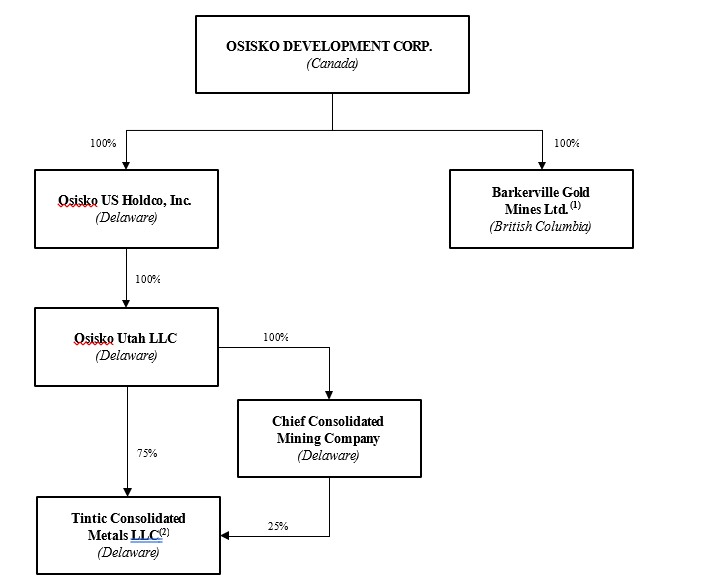
Notes:
(1) | Barkerville Gold Mines Ltd. holds the Cariboo Gold Project. |
(2) | Tintic Consolidated Metals LLC holds the Tintic Project. |
GENERAL DEVELOPMENT OF BUSINESS
The primary focus of the Corporation has been to acquire, explore, and if appropriate, develop base metal properties in North America. The following is a summary of the Corporation's development over the three most recently completed financial years. The following is a summary of the Corporation's development over the three most recently completed financial years.
Page 4 |
|
Financial Year Ended December 31, 2023
Feasibility Study and Technical Report for Cariboo Gold Project
On January 3, 2023, the Corporation announced the results of an independent feasibility study on the Cariboo Gold project, an advanced stage exploration project located in the historic Wells-Barkerville mining camp, in the District of Wells, British Columbia (the "Cariboo Gold Project") which have been prepared in accordance with NI 43-101. On January 12, 2023, the Corporation filed the technical report titled "NI 43-101 Technical Report, Feasibility Study for the Cariboo Gold Project, District of Wells, British Columbia, Canada" in respect of the feasibility study.
Tintic Project Initial Mineral Resource Estimate and Technical Report
On January 17, 2023, the Corporation announced an initial mineral resource estimate for the Trixie mine, within the wider Tintic project (the "Tintic Project"). On January 31, 2023, the Corporation filed a technical report for the Tintic Project titled "NI 43-101 Technical Report, Initial Mineral Resource Estimate for the Trixie Deposit, Tintic Project, Utah, United States of America", effective January 10, 2023, in respect of the initial mineral resource estimate for the Trixie mine, part of the wider Tintic Project. The Corporation no longer considers the Tintic Project to be a material property of the Corporation within the meaning of NI 43-101.
Share Issuance Pursuant to Participation Agreement with Williams Lake First Nation
On February 24, 2023, the Corporation announced that it had issued 10,000 Common Shares in accordance with the terms of a participation agreement dated June 10, 2022 with the Williams Lake First Nation relating to the Cariboo Gold Project (the "June 2022 Participation Agreement"). The Corporation also announced that it had agreed, pursuant to the June 2022 Participation Agreement, to make certain cash payments and issue up to 50,000 additional Common Shares, subject to the achievement of certain future milestones.
$51.8 Million Bought Deal Public Offering
On March 2, 2023, the Corporation announced the completion of a bought deal public offering of an aggregate of 7,841,850 units of the Corporation at a price of $6.60 per unit, for aggregate gross proceeds of approximately $51.8 million, including the full exercise of the over-allotment option granted to the underwriters. Each Unit was comprised of one common share and one warrant (a "2026 Warrant"), with each 2026 Warrant entitling the holder thereof to purchase one additional Common Share at a price of $8.55 per Common Share, subject to adjustments, for a period of 36 months following the closing date of the offering.
Warrant Repricing
On March 14, 2023, the Corporation announced that, subject to the final approval of the TSXV, it intended to amend the exercise prices of the March 2027 Warrants (as defined herein) and May 2027 Warrants (as defined herein) such that (i) the exercise price of the March 2027 Warrants is reduced from $22.80 per Common Share to $14.75 per Common Share, and (ii) the exercise price of the May 2027 Warrants is reduced from US$18.00 per Common Share to US$10.70 per Common Share (the "Warrant Repricing"). The Warrant Repricing was completed on March 17, 2023.
Warrant Listings
On May 8, 2023, the following Common Share purchase warrants of the Corporation were listed and posted for trading on the TSXV (i) an aggregate 7,752,916 Warrants expiring on March 2, 2027 (the "March 2027 Warrants") under the trading symbol "ODV.WT.U", and (ii) an aggregate 11,363,933 Warrants expiring on May 27, 2027 (the "May 2027 Warrants") under the trading symbol "ODV.WT.B". Subsequently, on November 10, 2023, the May 2027 Warrants were also listed and posted for trading on Nasdaq under the trading symbol "ODVWZ".
Page 5 |
|
Permitting Agreements for Cariboo Gold Project
On May 8, 2023, the Corporation announced that it has entered into two landmark permitting agreements in respect of the Cariboo Gold Project: (i) the process charter with the BC Major Mines Office, and (ii) the joint information requirements table with the Ministry of Energy, the Mines and Low-Carbon Innovation and the Ministry of Environment.
Environmental Assessment Certificate for Cariboo Gold Project
On October 10, 2023, the Corporation announced that it has received an environmental assessment certificate for the Cariboo Gold Project.
Asset Spin-Out and Formation of Electric Elements Mining Corp.
On November 15, 2023, the Corporation announced the spin out of all its shares and partnership units in certain subsidiaries holding the rights and title and interest in its James Bay properties and the formation, jointly with O3 Mining Inc., of "Electric Elements Mining Corp."
Management Updates
On December 28, 2023, the Corporation announced that Mr. Luc Lessard would resign from his position as Chief Operating Officer effective as of December 31, 2023 and Mr. Chris Pharness, Vice-President, Sustainable Development has departed from his position. Effective as of December 31, 2023, Mr. Eric Tremblay, who is a director of the Corporation and chair of the environmental and sustainability committee, assumed the role of interim Chief Operating Officer.
Financial Year Ended December 31, 2024
Management Updates
On February 2, 2024, the Corporation announced that Mr. Francois Vézina, Senior Vice President, Project Development, Technical Services and Environment, would be departing from the Corporation, effective as of March 1, 2024, to pursue another opportunity in the mining sector. On May 9, 2024, the Corporation announced that Ms. Maggie Layman would resign from her position as Vice President, Exploration effective as of May 30, 2024. On December 5, 2024, the Corporation announced the appointment of Mr. Stephen Quin as director of the Corporation and on December 12, 2024, the Corporation announced that Mrs. Marina Katusa resigned from her position as Director.
Impairment Analysis
On February 21, 2024, the Corporation announced that, based on a preliminary review of the carrying value of its assets in accordance with IFRS as at December 31, 2023, the Corporation believes that a non-cash impairment exists to the carrying value of its 100%-owned Trixie gold test mine. For more details relating to the final impairment analysis, see note 10 of the Corporation's annual financial statements for the year ended December 31, 2023.
US$50 Million Credit Facility and Subsequent Amendments
On March 4, 2024, the Corporation announced that the Corporation, as guarantor, and Barkerville, its wholly-owned subsidiary, as borrower, entered into a credit agreement dated March 1, 2024 with National Bank of Canada, as lender and administrative agent, and National Bank Financial Markets, as mandated lead arranger and sole bookrunner, in connection with a US$50 million delayed draw term loan (the "Credit Facility"). The Credit Facility will be used to fund ongoing detailed engineering and pre-construction activities at the Cariboo Gold Project. The Credit Facility was subsequently amended on June 10, 2024, December 20, 2024 and March 13, 2025. For the purposes of this AIF, references to "Amended Credit Facility" refers to the Credit Facility and the March 2024 credit agreement, respectively, as amended on June 10, 2024, December 20, 2024 and March 13, 2025. The Amended Credit Facility was ultimately paid out and terminated in connection with the establishment of the Appian Credit Facility.
Page 6 |
|
Updated Mineral Resource Estimate for the Tintic Project
On April 26, 2024, the Corporation filed a technical report for the Tintic Project titled "NI 43-101 Technical Report, Mineral Resource Estimate for the Trixie Deposit, Tintic Project, Utah, United States of America", effective March 14, 2024. This technical report was prepared for the Corporation by independent representatives of Micon International Limited in accordance with NI 43-101. The Corporation no longer considers the Tintic Project to be a material property of the Corporation within the meaning of NI 43-101.
October 2024 Non-Brokered Private Placement
On October 14, 2024, the Corporation completed a non-brokered private placement of an aggregate of 19,163,410 units of the Corporation at a price of US$1.80 per unit for a total gross proceeds of approximately US$34.5 million comprising of: (i) 13,426,589 units issued on October 1, 2024 at a price of US$1.80 per unit for gross proceeds of approximately US$24.2 million; and (ii) 5,736,821 units issued on October 14, 2024 at a price of US$1.80 per unit for gross proceeds of approximately US$10.3 million (together, the "October 2024 Offering"). Each unit under the October 2024 Offering consisted of one Common Share and one Warrant, with each Warrant entitling the holder to purchase one additional Common Share at a price of US$3.00 on or before October 1, 2029 (the "2029 Warrants"). The October 2024 Offering satisfied the requirement under the Amended Credit Facility to raise at least US$20 million by October 31, 2024, and the Amended Credit Facility became effective.
US$57.5 Million Marketed Private Placement
On November 12, 2024, the Corporation completed a marketed private placement of 31,946,366 units at a price of US$1.80 per unit for aggregate gross proceeds of approximately US$57.5 million (the "November 2024 Offering") pursuant to the terms of an agency agreement dated November 12, 2024 between the Corporation, National Bank Financial Inc., Cantor Fitzgerald Canada Corporation and Eight Capital (the "Agency Agreement"). Each unit under the November 2024 Offering consisted of one Common Share and one 2029 Warrant. Pursuant to the terms of the Agency Agreement, the agents were paid a cash commission equal to 4.5% of the aggregate gross proceeds of the November 2024 Offering and reimbursed for certain costs and expenses.
Cariboo Gold Project Permits
On November 20, 2024 and December 12, 2024, the Corporation announced the approval of the following BC Mines Act permits for the Cariboo Gold Project: (i) Mines Act permits for the Mine Site Complex, Bonanza Ledge and QR Mill (as obtained on November 20, 2024); and (ii) Environmental Management Act permits for the Mine Site Complex, Bonanza Ledge and QR Mill (as obtained on December 12, 2024). The Mines Act permits provide the Corporation the ability to proceed with the construction, operation and reclamation activities of each of the site boundaries and the Environmental Management Act permits pertain to any discharge activities to the environment.
Board and Management Updates
On January 9, 2025, the Corporation announced the appointment of Mr. David Rouleau as Vice President, Project Development of the Corporation. On the same date, the Corporation also announced that Mr. Éric Tremblay had resigned from his role as Chief Operating Officer. On March 28, 2025, the Corporation announced the appointment of Mr. Philip Rabenok as Vice President, Investor Relations of the Corporation, effective as of March 26, 2025. On June 16, 2025, Ms. Susan Craig was appointed as independent director of the Corporation and on November 3, 2025, the Corporation announced the appointment of Mr. Scott Smith as Vice President, Exploration, of the Corporation, effective November 1, 2025.
Warrant Listing
On April 14, 2025, the Corporation announced that, effective as of the opening of markets on April 17, 2025, the 2029 Warrants, which were issued pursuant to private placements completed by the Corporation between October and November of 2024, would be listed for trading on the TSXV under the symbol "ODV.WT.V.".
Page 7 |
|
Cariboo Gold Project Technical Report
On April 28, 2025, the Corporation announced the results of its optimized feasibility study in respect of the Cariboo Gold Project (the "2025 FS"). The 2025 FS was completed by BBA Engineering Ltd. as lead independent consultant, and supported by other independent engineering firms, in accordance with National Instrument 43-101 – Standards of Disclosure for Mineral Projects ("NI 43-101"). On June 11, 2025, the Corporation announced the filing of its technical report, prepared in accordance with NI 43-101, titled "NI 43-101 Technical Report, Feasibility Study for the Cariboo Gold Project, District of Wells, British Columbia, Canada", dated June 11, 2025 (with an effective date of April 25, 2025), in respect of the 2025 FS (the "Cariboo Technical Report"). The Cariboo Technical Report is the current NI 43-101 technical report in respect of the Cariboo Gold Project.
On July 21, 2025, the Corporation entered into a credit agreement (the "Appian Credit Agreement") with Appian Capital Advisory Limited ("Appian") in connection with a US$450 million financing facility (the "Appian Credit Facility") to support the development of the Cariboo Gold Project. The Appian Credit Facility provides for an initial draw of US$100 million, which has been drawn by the Corporation, of which (i) US$25 million has been used to repay an existing credit facility with National Bank of Canada and National Bank Financial Markets, and (ii) US$75 million is being used to fund pre-construction development, construction, operational activities and working capital requirements for the Cariboo Gold Project. The Corporation may make subsequent draws for the remaining US$350 million under the Appian Credit Facility. In connection with the Appian Credit Facility, the Corporation granted Appian 5,625,031 Common Share purchase warrants as loan bonus (the "Appian Warrants").
The key terms of the Appian Credit Facility are summarized below. The summary of the Appian Credit Facility provided herein is qualified in its entirety by the full text of the Appian Credit Agreement, a copy of which is available on SEDAR+ (www.sedarplus.ca) under the Corporation's issuer profile.
| ● | Credit Limit: US$450 million senior secured credit facility, through the Corporation's wholly-owned subsidiary, Barkerville Gold Mines Ltd. ("Barkerville"). |
| ● | Term & Maturity Date: The Appian Credit Facility will mature on the earlier of (i) July 21, 2033, if subsequent draws are made, or (ii) July 21, 2028, if no subsequent draws are made. |
| ● | Repayment: The full outstanding credit under the Appian Credit Facility, and all accrued and unpaid interest thereon, shall be repaid on the Maturity Date. |
| ● | Interest Rate: |
| o | The initial draw bears interest at the 3-month secured overnight financing rate ("SOFR"), plus adjustment of 0.10% per annuum, and plus a margin of 9.50% per annuum (subject to a 2.00% SOFR floor), with interest payable in cash or in kind ("PIK"). Any PIK amount will be added to the principal balance. |
| o | Any funds drawn in excess of the initial draw will cause the Appian Credit Facility to step down to a 3-month SOFR, plus a margin of 0.10% per annum, and 7.50% per annum (subject to 2.00% SOFR floor). At such time and henceforth, all interest will be payable quarterly in arrears in cash. |
| ● | Use of Proceeds: The Appian Credit Facility will be used to (i) repay outstanding debt under the existing National Bank of Canada credit facility, and (ii) fund pre-construction activities, development, construction, operation and working capital requirements of the Cariboo Gold Project and Barkerville. |
| ● | Voluntary Prepayments: Subject to the terms and conditions of the Appian Credit Agreement, Barkerville may prepay the outstanding loans under the Appian Credit Facility at any time, subject to a minimum prepayment amount of US$5 million. |
Page 8 |
|
| ● | Mandatory Prepayments: Mandatory prepayments are required in certain events, including (i) specified net cash proceeds and other customary events, in each case as set out in the Appian Credit Agreement. |
| ● | Security: The obligations under the Appian Credit Facility are guaranteed by the Corporation pursuant t a limited recourse guarantee and secured by a first-ranking security interest against all of the shares of Barkerville held by the Corporation. Additionally, the obligations are secured by a first-ranking security interest over all present and future assets and property of Barkerville. |
| ● | Representations, Warranties and Covenants: The Appian Credit Agreement contains terms and conditions which are customary for a transaction of this nature, including representations, warranties, borrower covenants, permitted liens and indebtedness, assignment rights, and events of default. |
| ● | Fees: In connection with the Appian Credit Facility, the Corporation has agreed to pay certain fees to the lenders, including arrangement fees and standby fees on the unused portion of the Appian Credit Facility, as set out in the Appian Credit Agreement. |
Brokered and Non-Brokered Private Placements
On August 15, 2025, the Corporation announced that it had completed a private placement of 99,065,330 units of the Corporation at a price at a price of US$2.05 per unit for aggregate gross proceeds of approximately US$203 million (the "August 2025 Offering"), comprising of: (i) a "bought deal" brokered private placement of 58,560,000 units for gross proceeds of approximately US$120 million, and (ii) a non-brokered private placement of 40,505,330 units for gross proceeds of approximately US$83 million, pursuant to the terms of the underwriting agreement dated August 15, 2025, among the Corporation, BMO Nesbitt Burns Inc., RBC Dominion Securities Inc., Cantor Fitzgerald Canada Corporation, National Bank Financial Inc. and Ventum Financial Corp. (the "August 2025 Underwriting Agreement"). Pursuant to the August 2025 Underwriting Agreement, the underwriters were paid a cash commission equal to 4.5% of the aggregate gross proceeds of the August 2025 Offering and reimbursed for certain costs and expenses. Each unit issued under the August 2025 Offering was comprised of one Common Share and one-half of one Common Share purchase warrant, with each warrant entitling the holder thereof to purchase one Common Share at a price of US$2.56 per Common Share on or prior to August 15, 2027 (the "August 2027 Warrants"), subject to acceleration in certain circumstances. Double Zero Capital LP ("Double Zero") subscribed for approximately US$75 million of units under the August 2025 Offering and became an insider of the Corporation.
On October 29, 2025, the Corporation announced that it had completed a private placement of 15,409,798 Common Shares for aggregate gross proceeds to the Corporation of approximately $82.5 million (the "October 2025 Offering"). Pursuant to the October 2025 Offering, the Corporation issued: (i) 8,616,000 Common Shares, pursuant to the listed issuer financing exemption under Part 5A of National Instrument 45-106 – Prospectus Exemptions, as amended by Coordinated Blanket Order 45-935 – Exemptions from Certain Conditions of the Listed Issuer Financing Exemption, comprising of: (a) 2,990,000 Common Shares that will qualify as "flow-through shares" at a price of $6.69 per flow-through share, (b) 1,444,000 Common Shares that will qualify as "flow-through shares" to certain eligible British Columbia resident subscribers at a price of $6.93 per flow-through share, and (c) 4,182,000 Common Shares at a price of $4.78 per Common Share, and (ii) 6,793,798 Common Shares at a price of $4.78 per Common Share. The October 2025 Offering was conducted in accordance with the terms of the underwriting agreement dated October 29, 2025 among the Corporation, National Bank Financial Inc., BMO Nesbitt Burns Inc. and RBC Dominion Securities Inc. (the "October 2025 Underwriting Agreement"). Pursuant to the October 2025 Underwriting Agreement, the underwriters were paid a cash commission equal to 4.5% of the aggregate gross proceeds of the October 2025 Offering and reimbursed for certain costs and expenses.
Investor Rights Agreement
In connection with Double Zero's participation in the August 2025 Offering, the Corporation and Double Zero entered into an investor rights agreement dated August 15, 2025 (the "Double Zero IRA"). Pursuant to the Double Zero IRA, the Corporation agreed, among other things, to provide Double Zero with rights to nominate one director to the board of directors of the Corporation (the "Board"), customary pre-emptive rights and top-up rights in respect of certain acquisitions. In addition, pursuant to the terms of the Double Zero IRA, Double Zero has agreed to provide certain voting support to the Corporation. The full text of the Double Zero IRA is available on SEDAR+ (www.sedarplus.ca) under the Corporation's issuer profile.
Page 9 |
|
Strategic Investments
On October 27, 2025, the Corporation announced that, on October 17, 2025, it acquired, indirectly through its wholly owned subsidiary, Barkerville, 6,250,000 units of Falco Resources Ltd. ("Falco") at a price of $0.32 per unit, for an aggregate purchase price of $2,000,000, in connection with a "bought deal" private placement of 41,005,000 units completed by Falco. Each unit consisted of one common share of Falco and one-half of one common share purchase warrant of Falco.
On December 23, 2025, the Corporation announced that, on December 18, 2025, it acquired, indirectly through Barkerville, 8,571,429 units of Niobay Metals Inc. ("Niobay") at a price of $0.14 per unit, for an aggregate subscription price of $1,200,000.06, pursuant to a private placement completed by Niobay. Each unit consisted of one common share of Niobay and one common share purchase warrant of Niobay.
Sale of San Antonio Gold Project
On November 24, 2025, the Corporation announced that it had entered into a securities purchase agreement dated November 21, 2025 with Axo Copper Corp. ("Axo"), pursuant to which, the Corporation agreed to sell the San Antonio gold project located in the Sonora State, Mexico to Axo (the "San Antonio Sale"). The San Antonio Sale was completed on January 27, 2026. As consideration in respect of the San Antonio Sale, the Corporation received 15,325,841 common shares of Axo and is entitled to certain contingent deferred payments, including cash payment relating to certain value-added tax refund and milestone payments: (i) US$2 million (in cash or shares, subject to certain limits) upon public filing of a NI 43-101 feasibility study in respect of the San Antonio gold project; (ii) US$2 million cash payment upon first gold pour completed at the San Antonio gold project; and (iii) additional Axo shares (and cash, if any) if a qualifying financing is completed by Axo. On February 25, 2026, the Corporation received 2,363,516 common shares of Axo in connection with a qualifying financing completed by Axo.
Health and Safety Incident
On January 22, 2026, a contractor working on surface activities suffered a fatal injury following an isolated incident at the Cariboo Gold Project. The Corporation promptly notified appropriate authorities, and an investigation of the incident was initiated. Activities at the Cariboo Gold Project site were temporarily suspended to allow for completion of an investigation. On March 2, 2026, resumption of planned site activities was announced, following the successful implementation of a phased gradual reopening plan of surface and underground activities over several preceding weeks, in coordination with and approval from the relevant regulatory authorities, and with a focus on ensuring the health and safety of all employees and contractors.
Management Updates
On February 2, 2026, the Corporation announced the appointment of Ms. Sarah Harrison as Vice President, Permitting and Compliance.
Public Offering of Common Shares
On February 3, 2026, the Corporation announced the completion of a bought deal public offering of an aggregate of 40,607,650 Common Shares at a price of US$3.54 per Common Share, for aggregate gross proceeds of approximately US$143.8 million, including the full exercise of the over-allotment option granted to the underwriters (the "2026 Public Offering"), pursuant to the terms of the underwriting agreement dated January 27, 2026 among the Corporation, National Bank Financial Inc., RBC Dominion Securities, Cantor Fitzgerald Canada Corporation, and BMO Nesbitt Burns Inc. (the "2026 Underwriting Agreement"). Pursuant to the 2026 Underwriting Agreement, the underwriters were paid a cash commission equal to 4.5% of the aggregate gross proceeds of the 2026 Public Offering and reimbursed for certain costs and expenses.
Double Zero, a significant shareholder of the Corporation, participated in the 2026 Public Offering and acquired 8,080,000 Common Shares for gross proceeds of approximately US$28.6 million pursuant to its pre-emptive rights under the Double Zero IRA (as defined herein).
Page 10 |
|
Project and Construction Management Services Agreement
On February 9, 2026, the Corporation announced that its wholly-owned subsidiary, Barkerville Gold Mines Ltd., has entered into a definitive Project and Construction Management Services Agreement with JDS Energy & Mining Inc. for the development of the Cariboo Gold Project, located in British Columbia (the "Cariboo Gold Project").
Exercise of Appian Warrants
On March 9, 2026, the Corporation announced that it has received approximately $24.9 million from the exercise of 5,625,031 Appian Warrants held by funds advised by Appian and previously issued in connection with the Appian Credit Facility. See "Appian Credit Facility".
Inclusion in VanEck Junior Gold Miners ETF
On March 16, 2026, the Corporation announced its inclusion in the VanEck Junior Gold Miners ETF (the "GDXJ") pursuant to the GDXJ's semi-annual review and rebalancing announced on March 13, 2026, effective at the close of markets on March 2026.
The Corporation is a Canadian-based gold development company focused on the acquisition, exploration and development of precious metals resource properties in continental North America. The Corporation's objective is to become a North American intermediate precious metals producer, through curating and advancing a portfolio of development projects and investments with potential for value creation.
The Corporation's flagship mining asset is the Cariboo Gold Project, located in the District of Wells, British Columbia, Canada. As of the date of this AIF, the Corporation considers the Cariboo Gold Project to be its only material mineral property for the purposes of NI 43-101. The Corporation's current strategy is to advance and develop the Cariboo Gold Project towards the next stage of development with the aim of reaching a construction decision. For further details regarding the Cariboo Gold Project, see Schedule "C" – "Technical Information – Cariboo Gold Project".
In addition to its flagship Cariboo Gold Project, the Corporation owns the Tintic Project, located in Utah, United States and maintains exposure to certain exploration assets in James Bay region in Québec, through its 43.2% equity interest in Electric Elements Mining Corp.
The Corporation's assets also include a portfolio of shares, mainly of Canadian publicly traded exploration and development mining companies. The Corporation may, from time to time and without further notice, except as required by law or regulations, increase or decrease its investments at its discretion.
The following table presents the main investments of the Corporation in marketable securities as at March 27, 2026:
Name of Company | Number of Securities Held | Ownership |
|---|---|---|
Falco Resources Ltd. | 54,925,240 common shares 4,915,000 warrants | 15.7% (on a non-diluted basis) |
Niobay Metals Inc. | 18,428,572 common shares 8,571,429 warrants | 9.8% (on a non-diluted basis) |
Page 11 |
|
Notes:
(1) | These securities are held by Barkerville. |
Social and Environmental Policies
The Corporation is committed to conducting its activities in an ethical, responsible and safe manner, focusing on the quality of its operations, respect of human rights and local community and cultures as well as the well-being of its employees. The Corporation adopted its Health and Safety Policy and Environmental Policy on May 26, 2023, in addition to its Code of Ethics adopted in 2020. These policies establish the standards applicable across the Corporation's operations and require, among other things, that all employees follow all applicable laws and regulations, treat everyone fairly and equitably, work in an environmentally responsible manner and respect the cultures and rights of communities where the Corporation operates its business.
Health and safety are core priorities for the Corporation. The Corporation seeks to identify, prevent and mitigate occupational health and safety risks across its activities and to foster a culture of safety at all levels of the organization. Measures implemented by the Corporation include onsite orientation programs and training, standard operating procedures and incident reporting systems, which are reviewed and adapted as the Corporation's activities evolve.
The Corporation is also committed to minimizing the environmental impact of its operations and to conducting its activities in accordance with applicable environmental laws, regulations and industry standards. Environmental management practices include environmental monitoring, permitting compliance, reclamation and closure planning, water management, waste and tailings management, spill prevention and response measures, and are designed to support the responsible development of the Corporation's projects.
The Corporation also sets out to build enduring relationships with its neighbours that demonstrate mutual respect, active partnership, and long-term commitment. The Corporation respects the diversity of Indigenous nations, acknowledging the unique and important interests that they have in the land, waters and environment, as well as their history, culture and traditional ways, and is committed to maintaining and advancing collaborative partnerships with Indigenous nations related to its projects. The Corporation has engaged in years of extensive consultation with Indigenous nations, resulting in, among other things, (i) the implementation of an engagement protocol and relationship agreements with Lhtako Dené Nation, including a life-of-project agreement entered into in 2020, (ii) a participation agreement with Williams Lake First Nation in 2022, and (iii) continued engagement and consultation with Xatśūll First Nation since 2016. The Corporation aims to advance its projects in accordance with health, safety, and environmental best practices, and is committed to engaging in constructive dialogue to ensure all Indigenous nations and local stakeholders benefit from the development of its projects, while maintaining economic viability.
The Corporation recognizes the importance of strong relationships with stakeholders and communities. It seeks to engage in a transparent and constructive manner with local stakeholders in connection with its activities and projects. This includes the implementation of engagement initiatives such as donations and sponsorships, public information sessions, grievance mechanisms, community office and the dissemination of project-related information through the Corporation's project website and social media platforms, as well as the development of agreements intended to support long-term collaboration and shared benefits.
The full text of the Code of Ethics, Health and Safety Policy and Environmental Policy are available on the Corporation's website at https://osiskodev.com/about-us/#corporate-governance.
The Corporation's exploration and development activities are subject to the federal, state, provincial, regional and local environmental laws and regulations in jurisdictions in which the Corporation's activities and facilities are located. This includes requirements relating to air and water quality, waste disposal, planning and implementing the closure and reclamation of mining properties and related financial assurance. Each mineral property is subject to environmental assessment and permitting processes. In 2023, the Corporation obtained an environmental assessment certificate for the Cariboo Gold Project from the Environmental Assessment Officer of the Province of British Columbia. On November 20, 2024, the Corporation obtained BC Mines Act permits for the Cariboo Gold Project, and
Page 12 |
|
subsequently, on December 12, 2024, the Corporation obtained the Environmental Management Act permits for the Cariboo Gold Project. See "General Development of Business – Financial Year Ended December 31, 2024".
The Corporation's Environmental, Sustainability and Technical Committee is responsible for overseeing certain health, safety, corporate social responsibility and environmental matters and making recommendations to the Board regarding the steps to be taken in connection with these areas of activity. The Environmental, Sustainability and Technical Committee held 4 meetings during the financial year ended December 31, 2025.
The full text of the Environmental, Sustainability and Technical Committee Charter is available on the Corporation's website at https://osiskodev.com/about-us/#corporate-governance.
The Corporation views sustainability as a key part of its strategy and in seeking to create value for its Shareholders and other stakeholders. The Corporation's approach to sustainability includes a focus on: (i) integrating social and environmental considerations in its business and operations decision-marking, as appropriate; (ii) engaging and seeking to build constructive relationships with the federal, provincial, municipal, state and First Nations, Indigenous communities or tribal nations where the Corporation has activities and projects; (iii) seeking to contribute to the economic development of regions where it operates; and (iv) encouraging diversity and integrity throughout the organization. The Corporation regularly assess its sustainability-related priorities and practices, which may evolve over time and are subject to a variety of factors, including regulatory requirements, operational considerations and stakeholder engagement. See also "Description of Business – Social and Environmental Policies" and "Description of Business – Environmental Protection".
The mining business is subject to global economic cycles which affect the marketability of products derived from mining. The Corporation's current exploration and development operations is not cyclical and may be conducted all year round.
The Corporation holds interests in certain properties located outside of Canada, including the Tintic Project, located in Utah, United States. See "Risk Factors – Risk Factors Related to the Corporation – Enforcing Judgments" and "Risk Factors – Risk Factors Related to the Corporation – Foreign Operations Risks".
The Corporation's business requires specialized skills and knowledge in the areas of geology, mining, mineral processing, environmental management, permitting, First Nations relations and the global commodity markets. To date, the Corporation has been able to locate and retain such professionals in Canada and the United States, and believes it will be able to continue to do so.
The Corporation's business is not dependent on any contract to sell a major part of its products or to purchase a major part of its requirements for goods, services or raw materials, or on any franchise or license or other agreement to use a patent, formula, trade secret, process or trade name upon which its business depends. It is not expected that the Corporation's business will be affected in the current financial year by the renegotiation, amendment or termination of contracts or subcontracts.
As at December 31, 2025, the Corporation had approximately 102 employees. The Corporation evaluates on an ongoing basis the required expertise and skills to execute its business strategy and will seek to attract and retain the individuals required to meet the Corporation's goals.
Page 13 |
|
The Corporation believes its success is dependent on the performance of its management team and key individuals, many of whom have specialized skills in exploration, development and production in the mining industry. A majority of site personnel at the Cariboo Gold Project have extensive experience with similar projects and are knowledgeable as to operations, geology, engineering, construction, environment, mining, metallurgy and infrastructure related to mining development.
The Corporation believes it has adequate personnel with the specialized skills required to carry out its business and operations and, anticipates making ongoing efforts to match its workforce capabilities with its business strategy as it evolves.
The precious metal exploration and mining industry is highly competitive. The Corporation competes with other companies and individuals in connection with the discovery, acquisition, development and advancement of mining properties, the sourcing of raw materials and supplies used in connection with mining operations, the recruitment and retention of qualified personnel and suitable contractors, technical and engineering sources and necessary exploration and mining equipment. See "Risk Factors – Risk Factors Related to the Corporation – Competition".
The Corporation's business, being the acquisition, exploration and development of mineral properties in Canada and worldwide, is speculative and involves a high degree of risk. The risk factors listed below could materially affect the Corporation's financial condition and/or future operating results and could cause actual events to differ materially from those described in forward-looking information relating to or made by the Corporation.
In evaluating the Corporation and its business, the readers should carefully consider the risk factors which follow and the risks set forth in the Corporation's continuous disclosure documents filed on SEDAR+ and EDGAR. These risk factors may not be a definitive list of all risk factors associated with an investment in the Corporation or in connection with its business and operations.
The risks described herein and in other documents forming part of the Corporation's disclosure record are not the only risks facing the Corporation. Additional risks and uncertainties not currently known to the Corporation, or that the Corporation currently deems immaterial, may also materially and adversely affect its business. Prospective purchasers or holders of Common Shares should give careful consideration to all risk factors enumerated below.
Risk Factors Related to the Corporation
Mineral Exploration and Development
Mineral exploration and development is speculative and involves a high degree of risk. While the discovery of an ore body may result in substantial rewards, few properties which are explored are commercially mineable and ultimately developed into producing mines. There is no assurance that any exploration properties will be commercially mineable.
Should any mineral resources exist, substantial expenditures will be required to confirm mineral reserves which are sufficient to commercially mine and to obtain the required environmental approvals and permitting required to commence commercial operations. The decision as to whether a property contains a commercially viable mineral deposit and should be brought into production will depend upon the results of exploration programs, preliminary economic assessment and/or feasibility studies, and the recommendations of duly qualified engineers and/or geologists, all of which involves significant expense. This decision will involve consideration and evaluation of several significant factors including, but not limited to: (a) costs of bringing a property into production, including exploration and development work, preparation of, if applicable, preliminary economic assessment and production feasibility studies and construction of production facilities; (b) availability and costs of financing; (c) ongoing costs of production; (d) metal prices; (e) environmental compliance regulations and restraints (including potential environmental liabilities associated with historical exploration activities); and (f) political climate and/or governmental regulation and control. Development projects are also subject to the successful completion of engineering studies, issuance of necessary governmental permits, and availability of adequate financing. Development projects have no operating history upon which to base estimates of future cash flow.
Page 14 |
|
Mining Operations
Mining operations are and will be subject to all the hazards and risks normally incidental to exploration, development and production of mineral resources and mineral reserves including unusual or unexpected geological formations, geotechnical challenges and other conditions such as formation pressures, fire, power outages, flooding, explosions, cave-ins, landslides and the inability to obtain suitable machinery, equipment or labour, any of which could result in work stoppages, damage to property, and possible environmental damage that even a combination of careful evaluation, experience and knowledge may not eliminate or adequately mitigate. The Corporation may be subject to liability for pollution, cave-ins or hazards against which it cannot insure or against which it may elect not to insure. The payment of such liabilities may have a material adverse effect on the financial position of the Corporation.
Major expenditures are required to develop metallurgical processes and to construct mining and processing facilities at a particular site. Whether a mineral deposit will be commercially viable depends on a number of factors, some of which are: the particular attributes of the deposit, such as size, grade and proximity to infrastructure; metal prices, which are highly volatile; and governmental regulations, including those relating to prices, taxes, royalties, land tenure, land use, allowable production, importing and exporting of minerals and environmental protection.
Operations Not Supported by a Feasibility Study
Certain operations of the Corporation including prior test mining activities at Bonanza Ledge II Project and current test mining activities at Trixie test mine, have operated without the benefit of a feasibility study including mineral reserves, demonstrating economic and technical viability, and, as a result, there may be increased uncertainty of achieving any particular level of recovery of material or the cost of such recovery. Historically, such projects have a much higher risk of economic and technical failure. There is no guarantee that commercial production will commence, continue as anticipated or at all or that anticipated production costs will be achieved. The failure to commence or continue production would have a material adverse impact on the Corporation's ability to generate revenue and cash flow to fund operations. Failure to achieve the anticipated production costs would have a material adverse impact on the Corporation's cash flow and potential profitability.
Dependence on the Cariboo Gold Project
The Corporation is primarily dependent on the successful development and operation of the Cariboo Gold Project, which is the Corporation's only material property for the purposes of NI 43-101. While the Corporation also has the Tintic Project, located in Utah, United States, the Tintic Project is no longer considered a material property and the Corporation is primarily focused on raising capital and expending funds to advance the Cariboo Gold Project.
The concentration of the Corporation's business in a single material property exposes the Corporation to heightened risk. Any adverse development affecting the Cariboo Gold Project, including operational difficulties, permitting delays, labour disputes, equipment failures, adverse geological or geotechnical conditions, environmental incidents, community opposition, or changes in government regulation or policy, could have a disproportionate effect on the Corporation's financial condition and results of operations compared to a company with a more diversified asset base.
There can be no assurance that the Corporation will be able to develop the Cariboo Gold Project on the timeline or at the cost anticipated, or that the project will achieve commercial production. If the Cariboo Gold Project does not proceed as planned, the Corporation may not have sufficient alternative sources of revenue or cash flow, which could have a material adverse effect on the Corporation's business, financial condition, and ability to continue as a going concern.
Unanticipated Metallurgical Processing Problems
Unanticipated metallurgical processing problems may occur during operations, including, without limitation, mechanical problems with milling or extraction equipment, unexpected grade anomalies in processed material, contaminants in processing or processed material, and the inability to operate tested processes at scale which can lead to lower metallurgical recoveries than expected and delay and impede operations, which may affect the potential profitability of the Corporation's material mineral properties. In addition, further metallurgical testing or operations may determine that the metals cannot be extracted as economically as anticipated.
Page 15 |
|
Cost Overruns
The development of the Cariboo Gold Project requires significant capital investment. The feasibility study and economic analysis outlined in the Cariboo Technical Report are based on estimates and assumptions regarding capital costs, operating costs, commodity prices, and other factors, all of which are subject to change. Capital cost estimates are inherently uncertain and actual costs may differ materially from those estimated due to a variety of factors, including:
| ● | changes in the scope of work or project design; |
| ● | increases in the cost of labour, materials, equipment, or services; |
| ● | the imposition of tariffs, trade restrictions, or other governmental measures affecting the cost of imported goods and equipment; |
| ● | delays in the construction schedule resulting in escalation of costs; |
| ● | unforeseen geological, geotechnical, or hydrogeological conditions; |
| ● | changes in foreign exchange rates; and |
| ● | regulatory changes or delays in obtaining permits or approvals. |
Any material increase in capital costs could adversely affect the economic viability of the project, delay or prevent the commencement of commercial production, require additional financing (which may not be available on favourable terms or at all), and have a material adverse effect on the Corporation's business, financial condition, and results of operations.
Industry Conditions
The exploration for and development of mineral deposits involve significant risks and while the discovery of an ore body may result in substantial rewards, few properties that are explored are ultimately developed into producing mines. All of the Corporation's properties are in the development or exploration stage and the Corporation is presently not commercially exploiting any of its properties and its future success will depend on its capacity to generate revenues from an exploited property.
The discovery of mineral deposits depends on a number of factors, including the professional qualification of its personnel in charge of exploration. Whether a mineral deposit will be commercially viable depends on a number of factors, some of which are the particular attributes of the deposit, such as size, grade and proximity to infrastructure, as well as metal prices which are highly cyclical and government regulations, including regulations relating to prices, taxes, royalties, land tenure, land use, importing and exporting of minerals and environmental protection. In the event that the Corporation wishes to commercially exploit one of its properties, the exact effect of these factors cannot be accurately predicted, but the combination of these factors may result in the Corporation not receiving an adequate return on invested capital. The Corporation's operations will be subject to all the hazards and risks normally encountered in the exploration and development of mineral deposits. Mining operations generally involve a high degree of risk, including unusual and unexpected geological formations.
Uncertainty of Mineral Resource and Mineral Reserve Estimates
Mineral resource and mineral reserve figures are only estimates. Mineral resource and mineral reserve estimates have inherent uncertainty. Such estimates are expressions of judgment based on knowledge, mining experience, analysis of drilling results and industry practices. While the Corporation believes that the mineral resource and mineral reserve estimates, as applicable, in respect of properties in which the Corporation holds a direct interest reflect best estimates, the estimating of mineral resources and mineral reserves is a subjective process and the accuracy of mineral resource and mineral reserve estimates is a function of the quantity and quality of available data, the accuracy of statistical computations, and the assumptions used and judgments made in interpreting available engineering and geological information. There is significant uncertainty in any mineral resource and mineral reserve estimate and the actual deposits encountered and the economic viability of a deposit may differ materially from estimates. Estimated mineral resources and mineral reserves may have to be re-estimated based on changes in prices of gold or other minerals, further exploration or
Page 16 |
|
development activity or actual production experience. This could materially and adversely affect estimates of the volume or grade of mineralization, estimated recovery rates or other important factors that influence such estimates. In addition, mineral resources are not mineral reserves and there is no assurance that any mineral resource estimate will ultimately be reclassified as proven or probable mineral reserves. Mineral resources which are not mineral reserves do not have demonstrated economic viability.
The Corporation’s consolidated financial statements do not reflect the adjustments to the carrying values of assets and liabilities, expenses and financial position classifications that would be necessary if the going concern assumption was not appropriate. These adjustments could be significant.
The Corporation’s consolidated financial statements have been prepared using IFRS applicable to a going concern, which contemplates the realization of assets and settlement of liabilities in the normal course of business as they come due for the foreseeable future. Based on all available information about the future, which includes at least, but not limited to, the next twelve months, management believes that without additional funding, the Corporation does not have sufficient liquidity to pursue its planned expenditures. These circumstances indicate the existence of material uncertainties that cast substantial doubt as to the ability of the Corporation to continue as a going concern and accordingly, the appropriateness of the use of accounting principles applicable to a going concern.
The Corporation’s ability to continue future operations and fund its development and acquisition activities is dependent on management’s ability to secure additional financing in the future, which may be completed in a number of ways including, but not limited to, the issuance of debt or equity instruments, expenditure reductions, or a combination of strategic partnerships, joint venture arrangements, project debt finance, offtake financing, royalty financing and other capital markets alternatives. While management has been successful in securing financing in the past, there can be no assurance it will be able to do so in the future or that these sources of funding or initiatives will be available for the Corporation or that they will be available on terms which are acceptable to the Corporation.
Negative Operating Cash Flow
For the financial year ended December 31, 2025 and 2024, the Corporation had negative operating cash flow of $25 million and $52.3 million respectively. For the same ending periods, the Corporation experienced net loss of $169 million and $86.3 million respectively. As a result of the expected expenditures to be incurred by the Corporation for the development of the Corporation's material projects, the Corporation anticipates that negative operating cash flows will continue until one or both of the Corporation's material projects enters commercial production. There can be no assurance that the Corporation will generate positive cash flow from operations in the future. The Corporation will require additional capital in order to fund its future activities for its material projects. To the extent that the Corporation continues to have negative operating cash flow in future periods, it may need to allocate a portion of its cash reserves to fund such negative cash flow. Furthermore, additional financing, whether through the issue of additional equity and/or debt securities and/or project level debt, will be required to continue the development of the Corporation's material projects and there is no assurance that additional capital or other types of financing will be available or that these financings will be on terms at least as favourable to the Corporation as those previously obtained, or at all. Failure to obtain additional financing or to achieve profitability and positive operating cash flows will have a material adverse effect on its financial condition and results of operations.
No Earnings and History of Losses
The business of developing and exploring resource properties involves a high degree of risk and, therefore, there is no assurance that current exploration and test mining programs will result in profitable operations. The Corporation has not determined whether any of its properties contain economically recoverable reserves of mineralized material and currently has minimal or no revenues from its projects; therefore, the Corporation does not generate sufficient cash flows from its operations. There can be no assurance that significant additional losses will not occur in the future. The Corporation's operating expenses and capital expenditures may increase in future years with advancing exploration, development, and/or production from the Corporation's properties. The Corporation does not expect to receive sufficient revenues from operations to offset operational expenditures in the foreseeable future and expects to incur losses until such time as one or more of its properties enters into commercial production and generates sufficient revenues to fund continuing operations. There is no assurance that any of the Corporation's properties will eventually graduate to commercial operation. There is also no assurance that new capital will become available, and if it is not, the Corporation may be forced to substantially curtail or cease operations.
Page 17 |
|
Financing Risks and Additional Financing
The Corporation's operations are subject to financing risks and additional financing may result in dilution or partial sale of assets. At the present time, the Corporation has exploration and development assets which may generate periodic revenues through test mining at the Tintic Project, but has no mines in the commercial production stage. The Corporation cautions that test mining at its operations could be suspended at any time. The Corporation's ability to explore for and find potential economic projects, and then to bring them into production is highly dependent upon its ability to raise equity and debt capital in the financial markets. Any projects that the Corporation develops will require significant capital expenditures. Currently, the Corporation does not have any producing projects and no sources of revenue and any projects it develops will require significant capital expenditures. As a result, the Corporation may be required to seek additional sources of debt and equity financing in the near future.
To obtain such funds, the Corporation may sell additional securities including, but not limited to, the Corporation's shares or some form of convertible security, the effect of which could result in a substantial dilution of the equity interests of the Corporation's shareholders. Alternatively, the Corporation may also sell a part of its interest in an asset in order to raise capital. There is no assurance that the Corporation will be able to raise the funds required to continue its exploration programs and finance the development of any potentially economic deposit that is identified on acceptable terms or at all.
The failure to obtain the necessary financing could have a material adverse effect on the Corporation's growth strategy, results of operations, financial condition and project scheduling. The development of the Corporation's material mineral properties remains subject to, among other things, ODV securing adequate financing on conditions acceptable to it.
Indebtedness and Debt Obligations
The Corporation has outstanding indebtedness mainly under the Appian Credit Facility, which is secured against the Corporation's flagship Cariboo Gold Project. The Corporation may also incur additional indebtedness. A substantial portion of the Corporation's cash or cash flow from operations (if any) may be required to be dedicated to servicing its indebtedness, thereby reducing funds available for operations, development activities or acquisitions. In addition, the Appian Credit Facility also contain certain customary covenants, including compliance with certain financial ratios and restrictions on the use of the proceeds from the Appian Credit Facility, incurrence of liens and additional indebtedness. A failure to comply with such covenants could result in an event of default, which if not cured or waived, could result in the acceleration of amounts owing, which could have a material adverse effect on the Corporation's business, financial condition and results of operations. In addition, upon maturity of the Corporation's indebtedness, if the Corporation is unable to repay or refinance its debt in the amount required or on terms acceptable to it, the Corporation may be required to reduce expenditures or sell assets, which may adversely affect the Corporation's ability to execute its business strategy.
Regulatory Matters
The Corporation's activities are subject to governmental laws and regulations. These activities can be affected at various levels by governmental regulation governing prospecting and development, price control, taxes, labour standards and occupational health, expropriation, mine safety, compliance with securities matters and other matters. Exploration and commercialization are subject to various federal, provincial and local laws and regulations relating to the protection of the environment. These laws impose high standards on the mining industry to monitor the discharge of wastewater and report the results of such monitoring to regulatory authorities, to reduce or eliminate certain effects on or into land, water or air, to progressively rehabilitate mine properties, to manage hazardous wastes and materials and to reduce the risk of worker accidents.
Failure to comply with applicable laws and regulations may result in civil or criminal fines or penalties or enforcement actions, including orders issued by regulatory or judicial authorities enjoining or curtailing operations or requiring corrective measures, installation of additional equipment or remedial actions, any of which could result in significant expenditures. The Corporation may also be required to compensate private parties suffering loss or damage by reason of a breach of such laws, regulations or permitting requirements. It is also possible that future laws and regulations, or more stringent enforcement of current laws and regulations by governmental authorities, could cause additional expense, capital expenditures, restrictions on or suspensions of the Corporation's activities and delays in the exploration and development of the projects and properties.
Page 18 |
|
Amendments to current laws, regulations and permits governing operations and activities of mining companies, or more stringent implementation thereof, could have a material adverse impact on the Corporation and cause increases in capital expenditures or development costs or require abandonment or delays in development of new mining properties.
Also, no assurance can be made that the Canada Revenue Agency and provincial agencies will agree with the Corporation's characterization of expenses as Canadian exploration expenses or Canadian development expenses or the eligibility of such expenses as Canadian exploration expenses under the Tax Act or any provincial equivalent.
Taxation Laws or Reviews
The Corporation has operations and conducts business in multiple jurisdictions, and it is subject to the taxation laws of each such jurisdiction. These taxation laws are complicated and subject to change. The Corporation may also be subject to review, audit and assessment in the ordinary course. Any such changes in taxation law or reviews and assessments could result in higher taxes being payable or require payment of taxes due from previous years, which could adversely affect the Corporation's liquidities. Taxes may also adversely affect the Corporation's ability to repatriate earnings and otherwise deploy its assets.
Changes in Economic and Political Conditions and Regulations
The economics of the exploration and development of mining projects are affected by many factors, including the costs of exploration and development, variations of grade of mineralized material discovered, fluctuations in metal prices, foreign exchange rates and the prices of goods and services, applicable laws and regulations, including regulations relating to royalties, allowable production and importing and exporting goods and services. Depending on the price of minerals, the Corporation may determine that it is neither potentially profitable nor advisable to acquire or develop properties.
The Corporation's mineral properties are located in Canada and the United States. Economic and political conditions in these countries could adversely affect the business activities of the Corporation. These conditions are beyond the Corporation's control, and there can be no assurance that any mitigating actions by the Corporation will be effective.
Changing laws and regulations relating to the mining industry or shifts in political conditions may increase the costs related to the Corporation's activities including the cost of maintaining its properties. Operations may also be affected to varying degrees by changes in government regulations with respect to restrictions on exploration and development activities, price controls, export controls, income taxes, royalties, expropriation of property, environmental legislation (including specifically legislation enacted to address climate change) and mine safety. The effect of these factors cannot be accurately predicted. Economic instability could result from current global economic conditions and could contribute to currency volatility and potential increases to income tax rates, both of which could significantly impact the Corporation's potential profitability.
The Corporation's activities are subject to extensive laws and regulations governing worker health and safety, employment standards, waste disposal, protection of historic and archaeological sites, mine development, protection of endangered and protected species and other matters. Regulators have broad authority to shut down and/or levy fines against facilities that do not comply with regulations or standards.
Risk factors specific to certain jurisdictions are described throughout, including specifically "Foreign Operations Risks". The occurrence of the various factors and uncertainties related to economic and political risks of operating in the Corporation's jurisdictions cannot be accurately predicted and could have a material adverse effect on the Corporation.
As the Corporation is a Canadian corporation and most of its directors and officers reside in Canada, it may be difficult or impossible for investors in the United States to effect service or to realize on judgments obtained in the United States predicated upon the civil liability provisions of the U.S. federal securities laws. A judgment of a U.S. court predicated solely upon such civil liabilities may be enforceable in Canada by a Canadian court if the U.S. court in which the judgment was obtained had jurisdiction, as determined by the Canadian court, in the matter. Investors should not assume that Canadian courts: (i) would enforce judgments of U.S. courts obtained in actions against the Corporation or such persons predicated upon the civil liability provisions of the U.S. federal securities laws or the
Page 19 |
|
securities or blue-sky laws of any state within the United States, or (ii) would enforce, in original actions, liabilities against the Corporation or such persons predicated upon the U.S. federal securities laws or any such state securities or blue-sky laws.
Similarly, all or a substantial portion of the assets of such persons are located outside Canada and some of the Corporation's mineral assets, including the Tintic Project, are located outside of Canada and are held indirectly through foreign affiliates. As a result, it may be difficult or impossible for Canadian investors to initiate a lawsuit within Canada against these persons or to enforce judgments in Canada against such assets. In addition, it may not be possible for Canadian investors to collect from these persons or assets judgments obtained in courts in Canada predicated on the civil liability provisions of securities legislation of certain of the provinces and territories of Canada. It may also be difficult or impossible for Canadian investors to succeed in a lawsuit in the United States based solely on violations of Canadian Securities Laws.
Permits, Licences and Approvals
The operations of the Corporation require licences and permits from various governmental authorities. The Corporation believes it holds or is in the process of obtaining all necessary licences and permits to carry on the activities, which it is currently conducting under applicable laws and regulations. Such licences and permits are subject to changes in regulations and in various operating circumstances. While the Corporation has obtained all key permits required, based on the current mine plan, in order to proceed to construction of the Cariboo Gold Project, changes to the project design and scope as described in the Cariboo Technical Report will require amendments to existing certificates and permits. Timelines for regulatory amendment processes may be lengthy and could impact construction and operational schedule targets. Any delays in obtaining permit amendments or new approvals could result in delays to the construction schedule, increased costs due to schedule extensions, and a material adverse effect on the Corporation's business, financial condition, and results of operations.
There can be no guarantee that the Corporation will be able to obtain all necessary licences and permits that may be required to maintain its business operations, mining activities, construct mines or milling facilities and commence operations of any of its exploration properties. In addition, if the Corporation proceeds to production on any exploration property, it must obtain and comply with permits and licences which may contain specific conditions concerning operating procedures, water use, the discharge of various materials into or on land, air or water, waste disposal, spills, environmental studies, abandonment and restoration plans and financial assurances. There can be no assurance that the Corporation will be able to obtain such permits and licences in respect of its properties or that it will be able to comply with any such conditions.
Indigenous Peoples and First Nations
Indigenous title claims, rights to consultation/accommodation and the Corporation's relationship with such communities may affect the Corporation's existing exploration and development projects. Governments in many jurisdictions must consult with Indigenous peoples and First Nations with respect to grants of mineral rights or surface rights and the issuance or amendment of project authorizations. Consultation and other rights of Indigenous peoples and First Nations may require accommodations, including undertakings regarding employment, royalty payments and other matters. This may affect the Corporation's ability to acquire, within a reasonable time frame, effective mineral titles or surface rights in these jurisdictions, including in some parts of Canada and the United States, in which Indigenous or First Nation's titles are claimed, and may affect the timetable and costs of development of mineral properties in these jurisdictions. The risk of unforeseen Indigenous title claims also could affect exploration and development projects. These legal requirements may also affect the Corporation's ability to transfer existing projects or to develop new projects.
Local Communities
The Corporation's relationship with the communities in which it conducts activities are critical to ensure the future success of its existing activities and the exploration and development of its projects. There is an increasing level of public concern relating to the perceived effect of mining activities on the environment and on communities impacted by such activities. Adverse publicity relating to the mining industry generated by non-governmental organizations and others could have an adverse effect on the Corporation's reputation or financial condition and may impact its relationship with the communities in which it conducts activities. While the Corporation is committed to working in a socially responsible manner, there is no guarantee that the Corporation's efforts in this regard will mitigate this potential risk.
Page 20 |
|
The inability of the Corporation to maintain positive relationships with local communities may result in additional obstacles to permitting, increased legal challenges, or other disruptive operational issues at any of the Corporation's projects, and could have a significant adverse impact on the Corporation's share price and financial condition.
Environmental Risks and Hazards
The Corporation is subject to environmental regulation in the jurisdictions in which it operates. These regulations mandate, among other things, the maintenance of air and water quality standards and land reclamation. They also set forth limitations on the general, transportation, storage and disposal of solid and hazardous waste. Environmental legislation is evolving in a manner which will require stricter standards and enforcement, increased fines and penalties for non-compliance, more stringent environmental assessments of proposed projects and a heightened degree of responsibility for companies and their officers, directors and employees. There is no assurance that future changes in environmental regulation, if any, will not adversely affect the Corporation's operations. Environmental hazards may exist on the properties which are unknown to the Corporation at present and which have been caused by previous or existing owners or operators of the properties. Reclamation costs are uncertain and planned expenditures estimated by management may differ from the actual expenditures required.
The Corporation's activities are directed towards the exploration, evaluation and development of mineral deposits. There is no certainty that the expenditures to be made by the Corporation will result in discoveries of commercial quantities of mineral deposits. There is aggressive competition within the mining industry for the discovery and acquisition of properties considered to have commercial potential. The Corporation will compete with other interests, many of which have greater financial resources than it will have, for the opportunity to participate in promising projects. Significant capital investment is required to achieve commercial production from successful exploration efforts, and the Corporation may not be able to successfully raise funds required for any such capital investment.
Anti-Bribery Laws
The Canadian Corruption of Foreign Public Officials Act, the U.S. Foreign Corrupt Practices Act and anti-bribery laws in other jurisdictions where the Corporation does business, prohibit companies and their intermediaries from making improper payments for the purposes of obtaining or retaining business or other commercial advantage. The Corporation's policies mandate compliance with these anti-bribery laws, which often carry substantial penalties. The Corporation operates in jurisdictions that have experienced governmental and private sector corruption to some degree, and, in certain circumstances, strict compliance with anti-bribery laws may conflict with certain local customs and practices. There can be no assurances that the Corporation's internal control policies and procedures will always protect it from reckless or other inappropriate acts committed by the Corporation's affiliates, employees or agents. Violations of these laws, or allegations of such violations, could have a material adverse effect on the Corporation's business, financial position and results of operations.
Management
The Corporation is dependent on certain members of its management, particularly its Chief Executive Officer. The loss of their services could adversely affect the Corporation.
The Corporation may experience difficulty attracting and retaining qualified management to grow its business, which could have a material adverse effect on the Corporation's business and financial condition. The Corporation is dependent on the services of key executives and other highly skilled personnel focused on advancing its corporate objectives as well as the identification of new opportunities for growth and funding. The loss of these persons or its inability to attract and retain additional highly skilled employees required for its activities may have a material adverse effect on the Corporation's business and financial condition. Further, while certain of the Corporation's officers and directors have experience in the exploration, development and operation of mineral properties, the Corporation remains highly dependent upon contractors and third parties in the performance of their exploration and development activities. There can be no guarantee that such contractors and third parties will be available to carry out such activities on behalf of the Corporation or be available upon commercially acceptable terms.
Page 21 |
|
Implementation of Business Strategy
There can be no assurance that ODV's management team will be successful in implementing its strategy (including as set out in this AIF) or that past results will be reproduced going forward. The management team may experience difficulties in effecting key strategic goals such as the growth and investment in tier one assets, tier two assets and strategic assets, the sale of non-core assets or the development of exploration projects. The performance of the Corporation's operations could be adversely affected if its management team cannot implement the stated business strategy effectively.
Certain directors and officers of the Corporation also serve as directors and officers of other companies involved in natural resource exploration and development. Consequently, there is a possibility that such directors and officers will be in a position of conflict of interest. Any decision made by such directors and officers involving the Corporation will be made in accordance with their duties and obligations to deal fairly and in good faith with the Corporation and such other companies. In addition, such directors will declare, and refrain from voting on, any matter in which such directors may have a material conflict of interest.
Factors Beyond the Control of the Corporation
The potential profitability of mineral properties is dependent upon many factors beyond the Corporation's control. For instance, world prices of and markets for minerals are unpredictable, highly volatile, potentially subject to governmental fixing, pegging and/or controls and respond to changes in domestic, international, political, social and economic environments. Another factor is that rates of recovery of minerals from mined mineralized material (assuming that such mineral deposits are known to exist) may vary from the rate experienced in tests and a reduction in the recovery rate will adversely affect potential profitability and, possibly, the economic viability of a property. Profitability will also depend on the costs of operations, including costs of labour, equipment, electricity, environmental compliance or other production inputs. Such costs will fluctuate in ways the Corporation cannot predict and are beyond the Corporation's control, and such fluctuations will impact on profitability and may eliminate the Corporation's ability to achieve profitability altogether, or if achieved, its ability to maintain profitability. Additionally, due to worldwide economic uncertainty, (i) the availability and cost of funds for development and other costs have become increasingly difficult, if not impossible, to project; and (ii) global supply chain may also be negatively affected. These changes and events may materially affect the financial performance of the Corporation and they may also negatively impact the project schedule.
Lack of Insurance Coverage
The Corporation may be subject to liability or sustain loss for certain risks and hazards against which it does not or cannot economically insure, taking into consideration the importance of the premiums or other reasons. Mining is capital intensive and subject to a number of risks and hazards, including environmental pollution, accidents or spills, industrial and transportation accidents, labour disputes, changes in the regulatory environment, natural phenomena (such as inclement weather conditions, earthquakes, pit wall failures and cave-ins) and encountering unusual or unexpected geological conditions. Such risk and hazards might impact the Corporation's business. Consequently, many of the foregoing risks and hazards could result in damage to, or destruction of, the Corporation's mineral properties or future processing facilities, personal injury or death, environmental damage, delays in or interruption of or cessation of their exploration or development activities, delay in or inability to receive required regulatory approvals, or costs, monetary losses and potential legal liability and adverse governmental action. The Corporation may be subject to liability or sustain loss for certain risks and hazards against which it does not or cannot insure or against which it may reasonably elect not to insure because of the cost. This lack of insurance coverage could result in material economic harm to the Corporation.
Fluctuation in Market Value
The price of the Common Shares has been and may continue to be volatile. Securities markets have a high level of price and volume volatility, and the market price of securities of many companies have experienced wide fluctuations in price, including as a result of factors outside of such companies' control. The price of the Common Shares is affected by the Corporation's financial conditions or results of operations as reflected in its liquidity position and earnings reports. The price of the Common Shares may also be affected by factors unrelated to the financial performance or prospects of the Corporation, including macroeconomic developments in North
Page 22 |
|
America and globally, and market perceptions of the attractiveness of particular industries, which may increase the volatility of Common Share prices. These include the risks described elsewhere in this AIF.
Other factors which may influence the price of the Corporation's securities, including the Common Shares, include, but are not limited to: worldwide economic conditions; changes in government policies; investor perceptions; movements in global interest rates and global stock markets; variations in operating costs; the cost of capital that the Corporation may require in the future; metals prices; the price of commodities necessary for the Corporation's operations; recommendations by securities research analysts; issuances of Common Shares or debt securities by the Corporation; exploration and development successes and, if applicable, the share price performance of the Corporation's competitors; the addition or departure of key management and other personnel; significant acquisitions or business combinations, strategic partnerships, joint ventures or capital commitments by or involving the Corporation or its competitors; news reports relating to trends, concerns, technological or competitive developments, regulatory changes and other related industry and market issues affecting the mining sector; publicity or other third party statements or coverage about the Corporation (including its prospects and strategy) and its personnel; loss of a major funding source; and all market conditions that are specific to the mining industry. There can be no assurance that such fluctuations will not affect the price and liquidity of the Corporation's securities. In addition, a substantial decline in the price of the Common Shares that persists for a significant period of time could cause the Corporation's securities to be delisted from the NYSE and/or the TSXV, further reducing market liquidity.
Securities class action litigation has often been brought against companies following periods of volatility in the market price of their securities. The Corporation may in the future be the target of similar litigation. Securities litigation could result in substantial costs and damages and divert management's attention and resources.
Further, the Corporation's public disclosure record is available on SEDAR+ (www.sedarplus.ca) and on EDGAR (www.sec.gov) and, to that end, the Corporation does not endorse, and provides no assurance in respect of, any third party statements or coverage about the Corporation.
Completion of Announced Transactions
From time to time the Corporation may enter into binding transactions to acquire assets such as mining companies, metals or mineral projects and properties. There can be no assurances the Corporation will successfully complete any announced transactions as a variety of conditions may exist that need to be waived or satisfied prior to completion. There can be no certainty that proposed benefits of transactions to acquire such assets will be realized as anticipated.
Exploration for metals and minerals is a speculative venture necessarily involving substantial risk. There is no certainty that the expenditures on any given project will result in discoveries of commercial quantities of minerals.
If mineable deposits are discovered, substantial expenditures are required to establish reserves through drilling, to develop processes to extract the resources and, in the case of new properties, to develop the extraction and processing facilities and infrastructure at any site chosen for extraction. Although substantial benefits may be derived from the discovery of a major deposit, no assurance can be given that resources will be discovered in sufficient quantities to justify commercial operations or that the funds required for development can be obtained on terms acceptable to the Corporation or at all.
Mergers, Acquisitions, Joint Ventures and Integration
From time to time, the Corporation examines opportunities to acquire, merge and joint venture assets and businesses or conduct any other type of transaction. The global landscape has changed and there are risks associated to such transactions due to liabilities and evaluations with the aggressive timelines of closing transactions from increased competition. There is also a risk that the review and examination process might be inadequate and cause material negative outcomes. Any transaction that the Corporation may choose to complete may be of a significant size, may change the scale of the Corporation's business and operations, and may expose it to new or greater geographic, political, operating, financial, legal and geological risks. The Corporation's success in its acquisition activities depends on its ability to identify suitable acquisition candidates, negotiate acceptable terms for any such acquisition and integrate the acquired operations successfully with those of the Corporation. Any transactions would be accompanied by risks, including those related to changes in commodity prices after the Corporation has committed to complete the transaction and established the purchase price or exchange ratio; an ore body being below expectations; difficulty integrating and assimilating the operations and personnel of any
Page 23 |
|
acquired companies (which may be compounded by geographical separation, unanticipated costs, and the loss of key employees), realizing anticipated synergies and maximizing the financial and strategic position of the combined enterprise, and maintaining uniform standards, policies, procedures and controls across the organization; integration of the acquired business or assets diverting the attention of management or disrupt the Corporation's ongoing business and its relationships with employees, customers, suppliers and contractors; dilution of the Corporation's interests in its assets, including by the decision to grant interests to a joint venture partner; an acquired business or assets having unknown liabilities which may be significant. In the event that the Corporation chooses to raise debt capital, it may reduce its financial flexibility as the Corporation services interest and debt repayments. If the Corporation chooses to use equity as consideration for any such transaction, existing shareholders may suffer dilution. In addition, many companies in the mining industry have recently seen substantial downward pressure on their equity values after announcing significant transactions. There is a risk that if the Corporation was to announce a significant acquisition, the value of the Common Shares could decrease over the short-, medium- and/or long-term. The Corporation cannot assure that it can complete any transaction that it pursues, or is pursuing, on favorable terms, or that any transactions completed will ultimately benefit the Corporation's business. There can be no assurance that the Corporation would be successful in overcoming the risks noted above or any other problems encountered in connection with such transactions or joint ventures. There may be no right for shareholders to evaluate the merits or risks of any future transaction or joint venture undertaken except as required by applicable laws and regulations.
Potential Fraud and Corruption
The Corporation is subject to risks related to potential to gain benefits from improper transactions and financial reporting to hide operational deficiencies or enhance remuneration. Other risks include the potential for fraud and corruption by suppliers, personnel or government officials and which may implicate the Corporation, and its compliance with applicable anti-corruption laws. The Corporation's internal controls might not be sufficient or sophisticated enough to identify adequately all potential fraud and corruption.
Foreign Operations Risks
From time to time, the Corporation's properties may be located outside of North America. Such properties and operations (if any) are subject to various levels of political, economic and other risks and uncertainties that are different from those encountered at the Corporation's North American properties. These risks and uncertainties vary from country to country and may include: extreme fluctuations in currency exchange rates; high rates of inflation; labour unrest; risks of war or civil unrest; expropriation and nationalization; renegotiation or nullification of existing concessions, licences, permits and contracts; illegal mining; corruption; restrictions on foreign exchange and repatriation; restrictions or travel; hostage taking; security issues (including theft); changing political conditions; and currency controls.
The Corporation takes measures to protect employees, property and production facilities from these and other operational risks. There can be no assurance, however, operational risks in the future, will not have a material adverse effect on the Corporation's operations. In the future, the Corporation may choose to acquire properties or operate in foreign jurisdictions.
Labour Relations
The Corporation is dependent on its ability to maintain positive relationships with its employees and there can be no assurance that the Corporation will be able to continue to do so in the future. In addition, relations between the Corporation and its employees may be impacted by regulatory or governmental changes introduced by the relevant authorities in whose jurisdictions the Corporation carries on business. Adverse changes in such legislations or in the relationship between the Corporation and its employees could have a material adverse impact on the Corporation's business, results of operations and financial condition.
Significant Influence of Shareholders
As of the date hereof, (i) Double Zero held 48,591,775 Common Shares and 18,300,000 Warrants, representing approximately 16% of the outstanding Common Shares of the Corporation on a non-diluted basis and approximately 21% on a partially diluted basis (subject to a blocker provision preventing exercise of Warrants which results in Double Zero holding over 19.9%), and (ii) OR Royalties held 33,333,366 Common Shares, representing approximately 10.9% of the outstanding Common Shares of the Corporation. As significant shareholders of the Corporation, Double Zero and OR Royalties may exercise significant influence over all matters requiring approval of the shareholders of the Corporation, including the election of directors, determination of significant corporate actions, amendments
Page 24 |
|
to the Corporation's articles of incorporation and the approval of any business combinations, mergers or takeover attempts, in a manner that could conflict with the interests of other shareholders of the Corporation.
Uncertainty of Ownership Rights and Boundaries of Resource Properties
There is no assurance that the rights of ownership and other rights in concessions held by the Corporation are not subject to loss or dispute, particularly because such rights may be subject to prior unregistered agreements or transfers or other third-party claims and may be affected by defects and adverse laws and regulations which have not been identified by the Corporation. There is no guarantee that title to the properties will not be challenged or impugned. The Corporation's property interest may be subject to prior unregistered agreements or transfers or native other third-party claims and title may be affected by undetected defects.
Third Party Approvals
The Corporation may require the consent or approval of third parties in order to enter into or complete certain agreements or transactions necessary in the course of its operations. There can be no assurance that such third parties, which may include shareholders, regulatory bodies or entities with an interest in the applicable property or others (including water supply management and availability), will provide the required approval or consent or enter into such agreement in a timely manner, or at all. Failure to obtain such third-party approval may result in a material adverse effect on the Corporation's operations and financial condition.
Community Relations and Social License
Maintaining a positive relationship with the communities in which the Corporation operates is critical to its business operations and the development of the Cariboo Gold Project. The Corporation may come under pressure to demonstrate that other stakeholders (including employees, communities surrounding operations and their respective countries) benefit and will continue to benefit from its commercial activities, and/or that it operates in a manner that will minimize any potential damage or disruption to the interests of those stakeholders.
Erosion of social licence or activities of third parties seeking to call into question social licence may have the effect of slowing down the development of new projects and potentially may increase the cost of constructing and operating these projects. Productivity may be reduced due to restriction of access, proceedings initiated or delays in permitting, and there may also be extra costs associated with improving the relationship with the surrounding communities. While the Corporation is committed to operating in a socially responsible manner and working towards entering into agreements in satisfaction of such requirements there is no guarantee that its efforts will be successful, in which case interventions by third parties could have a material adverse effect on the Corporation's business, financial position and operations.
Reliance on Historical Data
Although the Corporation's normal data verification procedures have been employed in connection with the calculations of the mineral resource estimation on the Cariboo Gold Project and sampling, analytical and test data underlying the estimated mineral resources have been reviewed by qualified persons, an extensive amount of historical data and records on the Cariboo Gold Project was relied on in establishing these calculations. The Corporation cannot, however, guarantee that the historical records that are available are free from material errors or inaccuracies. While the Corporation believes that the mineral resource and mineral reserve estimates in respect of its Cariboo Gold Project reflect best estimates, the estimating of mineral resources is a subjective process and the accuracy of mineral resource estimate is a function of the quantity and quality of available data, the accuracy of statistical computations, and the assumptions used and judgments made in interpreting available engineering and geological information. There is significant uncertainty in any mineral resource estimate, and the actual deposits encountered and the economic viability of a deposit may differ materially from estimates.
Reputational Risks
Reputational risk is the risk that an activity undertaken by an organization or its representatives will impair its image in the community or lower public confidence in it, resulting in loss of revenue, legal action or increased regulatory oversight and loss of valuation and share price. Possible sources of reputational risk could come from, but are not limited to, operational failures, non-compliance with laws
Page 25 |
|
and regulations or leading an unsuccessful financing. In addition to its risk management policies, controls and procedures, the Corporation has a formal Code of Ethics to help manage and support the Corporation's reputation.
Inflation
The Corporation is affected by rising inflationary pressures. A significant portion of the upward pressure on prices has been attributed to the rising costs of labour and energy, as well as continuing global supply-chain disruptions. These inflationary pressures have affected the Corporation's labour, commodity and other input costs and such pressures may or may not be transitory. Any continued upward trajectory in the inflation rate for the Corporation's inputs may have a material adverse effect on the Corporation's capital expenditures for the development of its projects as well as its financial condition and results of operations. See also "Risk Factors – Infrastructure and Supplies" and "Risk Factors – Impairment of Assets".
The availability of skilled labour, electricity and other necessary supplies at an economic cost cannot be assured. These are integral requirements for exploration, development and production facilities on mineral properties. Prices for goods and services will fluctuate in relation to the level of investment in the mining sector; it is reasonable to expect that increased demand could impact the Corporation's future economic projections and competitiveness, as it may entail a meaningful increase in costs for various goods and services.
Improvements in the economic conditions for the mining industry as a whole will typically result in increases to both the costs of planned exploration and development activities, which must also be factored into economic models used in projections for future development and potential operations. Increased demand for, and costs of, goods or services could result in delays if they cannot be obtained in a timely manner due to inadequate availability, and may cause scheduling difficulties and delays due to the need to coordinate their availability, any of which could materially increase project exploration, development and/or construction costs. These factors could have a material adverse impact on the Corporation's operations and financial results.
Cybersecurity Threats and Information Technology Systems
The Corporation is dependent upon information technology systems in the conduct of its operations. The Corporation could be adversely affected by network disruptions from a variety of sources, including, without limitation, computer viruses, security breaches, cyber-attacks, natural disasters and defects in design. Cybersecurity threats include attempts to gain unauthorized access to data or automated network systems and the manipulation or improper use of information technology systems.
A failure of any part of the Corporation's information technology systems could, depending on the nature of such failure, materially adversely impact the Corporation's reputation, financial condition and results of operations. The Corporation is subject to cybersecurity attacks and related threats from time to time. Although to date the Corporation has not experienced any material losses relating to cyber-attacks or other information security breaches, there can be no assurance that it will not incur such losses in the future. The risk and exposure to these matters cannot be fully mitigated because of, among other things, the evolving nature of these threats. As cyber threats continue to evolve, the Corporation may be required to expend additional resources to continue to modify or enhance protective measures or to investigate and remediate any system vulnerabilities. In addition, the Corporation's insurance coverage for cyber-attacks may not be sufficient to cover all the losses it may experience as a result of a cyber incident. The Corporation and its third party service providers also collects, uses, discloses, stores, transmits and otherwise processes customer, supplier and employee and others' data as part of its business and operations, which may include personal data or confidential or proprietary information. There can be no assurance that any security measures that the Corporation or its third-party service providers have implemented will be effective against current or future security threats. If a compromise of such data were to occur, the Corporation may become liable under its contracts with other parties and under applicable law for damages and incur penalties and other costs to respond to, investigate and remedy such an incident. Depending on the facts and circumstances of such an incident, these damages, penalties, fines and costs could be significant. Any such event could harm the Corporation's reputation and result in litigation against it.
The Corporation's operations also depend on the timely maintenance, upgrade and replacement of networks, equipment information technology systems and software, as well as pre-emptive expenses to mitigate the risk of failure. Any of these or other events could result in information system failures, delays and/or increases in capital expenditures. Given the unpredictability of the timing, nature and scope of information technology disruptions, the Corporation could potentially be subject to production downtimes, operational
Page 26 |
|
delays, destruction or corruption of data, any of which could have a material adverse effect on the Corporation's cash flows, competitive position, financial condition and results of operations. From time to time, the Corporation pursues investments and initiatives to improve the productivity and efficiency of existing systems and operations, including through investments in digital technologies. There can be no certainty that some or any of such investments and initiatives will meet the Corporation's capital allocation objectives. In addition, certain of such investments and initiatives are still in the early stages of evaluation, and additional engineering and other analysis is required to fully assess their impact. Further, there can be no certainty as to the time required for the Corporation to extract value from these investments or initiatives, or that the Corporation will achieve any anticipated savings or efficiency improvements.
Equipment Shortages and Access Restrictions
The Corporation's interest in its material mineral properties will require adequate infrastructure, such as roads, bridges and sources of power and water, for future exploration and development activities. The lack of availability of these items on terms acceptable to the Corporation or the delay in availability of these items could prevent or delay exploitation or development of the Corporation's mineral properties. Natural resource exploration, development, processing and mining activities are dependent on the availability of mining, drilling and related equipment in the particular areas where such activities are conducted. A limited supply of such equipment or access restrictions may affect the availability of such equipment to the Corporation and may delay exploration, development or extraction activities. Certain equipment may not be immediately available, or may require long lead time orders. A delay in obtaining necessary equipment could have a material adverse effect on the Corporation's operations and financial results.
Litigation, the Causes and Costs of Which Cannot Be Known
The Corporation is subject to litigation arising in the normal course of business and may be involved in disputes with other parties in the future which may result in litigation. The causes of potential future litigation cannot be known and may arise from, among other things, business activities, environmental laws, volatility in stock price or failure or alleged failure to comply with disclosure obligations. The results of litigation cannot be predicted with certainty. If the Corporation is unable to resolve litigation favourably, either by judicial determination or settlement, it may have a material adverse effect on the Corporation's financial performance and results of operations.
In the event of a dispute involving the foreign operations of the Corporation, the Corporation may be subject to the exclusive jurisdiction of foreign courts or may not be successful in subjecting foreign persons to the jurisdiction of courts in Canada. The Corporation's ability to enforce its rights could have a material adverse effect on its future cash flows, earnings, results of operations and financial condition.
Dividend Policy
No dividends on the Common Shares have been declared or paid to date. The Corporation anticipates that, for the foreseeable future, it will retain future earnings and other cash resources for the operation and development of its business. Payment of any future dividends will be at the discretion of the Board after taking into account many factors, including the Corporation's earnings, operating results, financial condition, and current and anticipated cash needs and any restrictions in financing agreements, and the Corporation may never pay dividends.
Sales by Existing Shareholders
Sales of a substantial number of Common Shares in the public market by existing shareholders could occur, including by the Corporation's largest shareholders, Double Zero and OR Royalties, which held approximately 16.0% and 10.9% of the issued and outstanding Common Shares of the Corporation, respectively, as of the date hereof. These sales, or the market perception that the holders of a large number of Common Shares intend to sell Common Shares, could reduce the market price of the Common Shares. This could impair the Corporation's ability to raise additional capital through the sale of securities.
Public Company Obligations
As a dual-listed public corporate entity, the Corporation is subject to evolving rules and regulations promulgated by a number of governmental and self-regulated organizations, including the Canadian Securities Administrators, the TSXV, the SEC, the NYSE and the International Accounting Standards Board, which govern corporate governance and public disclosure regulations. These rules and regulations continue to evolve in scope and complexity creating many new requirements, which increase compliance costs and the risk
Page 27 |
|
of non-compliance. The Corporation's efforts to comply with these rules and obligations could result in increased general and administration expenses and a diversion of management time and attention from financing, development, operations and, eventually, revenue-generating activities. See also "U.S. Public Company Costs" below.
IFRS requires that the Corporation review for indicators of impairment of the carrying value of its mining assets, and to test for impairment when those indicators are present. Based on specific market factors and circumstances at the time of prospective impairment reviews, production data, economics and other factors, the Corporation may be required to record additional write downs of its mining assets. The Corporation reviews and evaluates the carrying amount of its mining assets for impairment whenever events or changes in circumstances indicate that such a mining asset's carrying amount may not be recoverable. If the carrying value exceeds the estimated recoverable amount of such mining asset, the Corporation would record an impairment charge for any excess of the carrying value of the mining assets over the estimated fair value of such assets. Factors used to estimate fair value may include estimates of mineral resources and reserves, expected recoverable ore reserves, grade per ounce, recovery rates, future commodity prices, future production estimates and a commensurate discount rate. The risk that the Corporation will be required to recognize additional impairments of its mining assets increases during periods of low commodity prices, high industry cost pressures and high inflation. Moreover, additional impairments would occur if the Corporation were to experience sufficient downward adjustments to its estimated mineral resources or reserves or the present value of estimated future net revenues. An impairment recognized in one period may be reversed in a subsequent period. The Corporation may incur additional impairment charges in the future, which could materially adversely affect its results of operations for the periods in which such charges are taken.
Compliance with Listing Standards
The Corporation must meet continuing listing standards to maintain the listing of the Common Shares on the TSXV and the NYSE, including minimum price of such Common Shares. If the Corporation fails to comply with listing standards and the TSXV or NYSE delists the Common Shares, the Corporation and its Shareholders could face significant material adverse consequences, including: a limited availability of market quotations for the Common Shares; reduced liquidity for the Common Shares; a determination that the Common Shares are "penny stock," which would require brokers trading in the Common Shares to adhere to more stringent rules and possibly result in a reduced level of trading activity in the secondary trading market for the Common Shares; a limited amount of news about the Corporation and analyst coverage; and a decreased ability for the Corporation to issue additional equity securities or obtain additional equity or debt financing in the future.
As a public company in the United States, the Corporation incurs additional legal, accounting, NYSE, reporting and other expenses that it did not incur as a public company in Canada. The additional demands associated with being a U.S. public company may disrupt regular operations of the Corporation's business by diverting the attention of some of its senior management team away from revenue-producing activities to additional management and administrative oversight, adversely affecting the Corporation's ability to attract and complete business opportunities and increasing the difficulty in both retaining professionals and managing and growing its business. Any of these effects could harm the Corporation's business, results of operations and financial condition.
If the Corporation's efforts to comply with new U.S. laws, regulations and standards differ from the activities intended by regulatory or governing bodies, such regulatory bodies or third parties may initiate legal proceedings against the Corporation and its business may be adversely affected. As a public company in the United States, it is more expensive for the Corporation to obtain director and officer liability insurance, and the Corporation is and will be required to accept reduced coverage or incur substantially higher costs to continue its coverage. These factors could also make it more difficult for the Corporation to attract and retain qualified directors.
The U.S. Sarbanes-Oxley Act 2002, as amended (the "U.S. Sarbanes-Oxley Act"), requires that the Corporation maintain effective disclosure controls and procedures and internal control over financial reporting. Pursuant to Section 404 of the U.S. Sarbanes-Oxley Act ("Section 404"), the Corporation is required to furnish a report by its management on the Corporation's internal control over financial reporting ("ICFR"), which, if or when the Corporation is no longer an emerging growth company, must be accompanied by an attestation report on ICFR issued by the Corporation's independent registered public accounting firm.
Page 28 |
|
To achieve compliance with Section 404 within the prescribed period, the Corporation will document and evaluate its ICFR, which is both costly and challenging. In this regard, the Corporation needs to continue to dedicate internal resources, potentially engage outside consultants and maintain a detailed work plan to assess and document the adequacy of the Corporation's ICFR, continue steps to improve control processes as appropriate, validate through testing that controls are functioning as documented and implement a continuous reporting and improvement process for ICFR. Despite the Corporation's efforts, there is a risk that neither it nor its independent registered public accounting firm will be able to conclude within the prescribed timeframe that the Corporation's ICFR is effective as required by Section 404. This could result in a determination that there are one or more material weaknesses in the Corporation's ICFR, which could cause an adverse reaction in the financial markets due to a loss of confidence in the reliability of the Corporation's consolidated financial statements. In addition, in the event that the Corporation is not able to demonstrate compliance with the U.S. Sarbanes-Oxley Act, that the Corporation's internal control over financial reporting is perceived as inadequate, or that the Corporation is unable to produce timely or accurate financial statements, investors may lose confidence in its operating results and the price of the Common Shares may decline. In addition, if the Corporation is unable to continue to meet these requirements, the Corporation may not be able to remain listed on the NYSE.
Foreign Private Issuer
The Corporation is a "foreign private issuer" as such term is defined in Rule 405 under the U.S. Securities Act of 1933, as amended, and is permitted, under a multijurisdictional disclosure system adopted by the United States and Canada, to prepare its disclosure documents filed under the U.S. Exchange Act, in accordance with Canadian disclosure requirements. Under the U.S. Exchange Act, the Corporation is subject to reporting obligations that, in certain respects, are less detailed and less frequent than those of U.S. domestic reporting companies. As a result, the Corporation will not file the same reports that a U.S. domestic issuer would file with the SEC, although it will be required to file or furnish to the SEC the continuous disclosure documents that it is required to file in Canada under Canadian Securities Laws. In addition, the Corporation's officers, directors, and principal Shareholders are exempt from the reporting and "short swing" profit recovery provisions of Section 16 of the U.S. Exchange Act. Therefore, the Corporation's Shareholders may not know on a timely basis when the Corporation's officers, directors and principal Shareholders purchase or sell shares, as the reporting deadlines under the corresponding Canadian insider reporting requirements are longer.
As a foreign private issuer, the Corporation is exempt from the rules and regulations under the U.S. Exchange Act related to the furnishing and content of proxy statements. The Corporation is also exempt from Regulation FD, which prohibits issuers from making selective disclosures of material non-public information. While the Corporation expects to comply with the corresponding requirements relating to proxy statements and disclosure of material non-public information under Canadian Securities Laws, these requirements differ from those under the U.S. Exchange Act and Regulation FD and Shareholders should not expect to receive in every case the same information at the same time as such information is provided by U.S. domestic companies.
In addition, as a foreign private issuer, the Corporation has the option to follow certain Canadian corporate governance practices, except to the extent that such laws would be contrary to U.S. Securities Laws, and provided that the Corporation discloses the requirements it is not following and describes the Canadian practices the Corporation follows instead. For example, the Corporation does not intend to follow the minimum quorum requirements for shareholder meetings as well as certain shareholder approval requirements prior to the issuance of securities under NYSE listing standards, as permitted for foreign private issuers. As a result, the Corporation's Shareholders may not have the same protections afforded to shareholders of U.S. domestic companies that are subject to all U.S. corporate governance requirements.
Emerging Growth Company
The Corporation is an "emerging growth company" as defined in the Jumpstart Our Business Startups Act of 2012. The Corporation will remain an emerging growth company until the earliest to occur of (i) the last day of the fiscal year in which the Corporation has a total annual gross revenue of US$1.235 billion or more; (ii) the last day of the fiscal year ending after the fifth anniversary of the first sale of equity securities pursuant to an effective registration statement occurs; (iii) the date on which the Corporation has issued more than US$1.0 billion in non-convertible debt securities during the prior three-year period; or (iv) the date the Corporation qualifies as a "large accelerated filer" under the rules of the SEC, which means the market value of the Common Shares held by non-affiliates exceeds US$700 million as of the last business day of the Corporation's most recently completed second fiscal quarter after it has been a reporting company in the United States for at least 12 months. For so long as the Corporation remains an emerging growth company, it is permitted to and intends to rely upon exemptions from certain disclosure requirements that are applicable to other public companies that are not
Page 29 |
|
emerging growth companies. These exemptions include not being required to comply with the auditor attestation requirements of Section 404 of the U.S. Sarbanes-Oxley Act.
The Corporation may take advantage of some, but not all, of the exemptions available to emerging growth companies. The Corporation cannot predict whether investors will find the Common Shares less attractive if the Corporation relies on these exemptions. If some investors find the Common Shares less attractive as a result, there may be a less active trading market for the Common Shares and the price of the Common Shares may be more volatile.
Precious and Base Metal Prices
The development of the Corporation's properties and revenue (if any) are dependent on the future prices of minerals and metals. As well, should any of the Corporation's properties eventually enter commercial production, the Corporation's profitability will be significantly affected by changes in the market prices of minerals and metals.
The price of precious and base metal prices can fluctuate widely and is affected by numerous factors including demand, inflation, strength of the U.S. dollar and other currencies, interest rates, gold sales by the central banks, hedging and de-hedging activities by producers, global or regional political or financial events, production and cost levels in major producing regions, changes in supply or changes in consumer sentiment, all of which are outside the Corporation's control. The aggregate effect of these factors is impossible to predict with accuracy. In addition, precious and base metal prices are sometimes subject to rapid short-term changes because of speculative activities.
Fluctuations in gold prices may materially adversely affect the Corporation's financial performance or results of operations. Even if the Corporation discovers commercial amounts of metals on its properties, it may not be able to place the property into commercial production if precious and base metal prices are not at sufficient levels to render the project economically viable. If the market price of gold falls below the Corporation's anticipated all-in sustaining costs per ounce of production at one or more of its properties and remains so for any sustained period, the Corporation may curtail or suspend some or all of its exploration or development activities at such property. In addition, such fluctuations may require changes to the Corporation's mine plans.
Climate Change
The Corporation recognizes that climate change is as much an international concern as it is a community concern which may affect its business and operations, directly or indirectly. The continuing rise in global average temperatures has created varying changes to regional climates across the globe, resulting in risks to equipment and personnel. Governments at all levels are moving towards enacting legislation to address climate change by regulating carbon emissions and energy efficiency, among other things. Where legislation has already been enacted, regulation regarding emission levels and energy efficiency are becoming more stringent. The mining industry, as a significant emitter of greenhouse gas emissions, is particularly exposed to these regulations. Costs associated with meeting these requirements may be subject to some offset by increased energy efficiency and technological innovation; however, there is no assurance that compliance with such legislation will not have an adverse effect on the Corporation's business, results of operations, financial condition and its share price.
Extreme weather events (such as prolonged drought or freezing, increased flooding, increased periods of precipitation and increased frequency and intensity of storms) have the potential to disrupt operations and transport routes. Extended disruptions could result in interruption to production which may adversely affect the Corporation's business, results of operations, financial condition and its share price.
Climate change is perceived as a threat to communities and governments globally. Stakeholders may increase demands for emissions reductions and call upon mining companies to better manage their consumption of climate-relevant resources (hydrocarbons, water etc.). This may attract social and reputational attention towards operations, which could have an adverse effect on the Corporation's business, results of operations, financial condition and its share price.
Page 30 |
|
Outbreaks of Diseases and Public Health Crises
The Corporation may face risks related to health epidemics and other outbreaks of communicable diseases, which could significantly disrupt its operations and may materially and adversely affect its business and financial conditions.
Although the Corporation's current operations are not being materially impacted by any public health crises, the Corporation continues to monitor the developments and impact of any health crises and pandemic diseases as they may arise. The Corporation cannot estimate whether, or to what extent, any future outbreak of epidemics or pandemics or other health crises may have an impact on the business, operations and financial condition of the Corporation. The outbreak of epidemics, pandemics or other public health crises may result in volatility and disruptions in the supply and demand for gold and other metals and minerals, global supply chains and financial markets, as well as declining trade and market sentiment and reduced mobility of people, all of which could affect commodity prices, interest rates, credit ratings, credit risk, share prices and inflation. The risks to the Corporation of such public health crises also include risks to employee health and safety, a slowdown or temporary suspension of operations in geographic locations impacted by an outbreak, increased labor and fuel costs, regulatory changes, political or economic instabilities or civil unrest as well as the Corporation's ability to service its debt obligations. As such, the impacts of such crises may have a material adverse effect on the Corporation's business, results of operations and financial condition and the market price of the Common Shares. There can be no assurance that the Corporation's personnel or its contractors' personnel will not be impacted by these pandemic diseases and ultimately see its workforce productivity reduced or incur increased safety and medical costs / insurance premiums as a result of these health risks.
Potential Impact of Tariffs and Trade Restrictions
The imposition of tariffs and trade restrictions between Canada and the United States presents a risk to the Corporation and the global economy, which may have adverse effects on supply chains, capital expenditures, and operational costs. Since February 2025, the United States announced broad-based tariffs on goods exported out of a number of countries, including Canada, into the United States. In response, the Canadian government and a number of other governments imposed, or announced that they would impose, retaliatory tariffs. The introduction of protectionist or retaliatory international trade tariffs, sanctions of other barriers to international commerce by the United States, Canada or other countries may impact the Corporation's current or proposed mineral exploration and development objectives or otherwise negatively impact the Corporation. The timing, implementation and extent of such tariffs and other measures is uncertain. Any change to tariffs and/or international trade regulations, and related impact to global economic conditions, may have a material adverse effect on the Canadian economy and the mining industry as well as global economic conditions and the stability of global financial markets, and may, as a result, have a material adverse effect on the Corporation's business, financial conditions and results of operations. Furthermore, there is a risk that the tariffs imposed by the United States on other countries could trigger a broader global trade war which could have a material adverse effect on the Canadian, United States and global economies, and by extension the mining industry and the Corporation.
Higher capital and operating costs resulting from tariffs may negatively impact project economics, profitability, and production efficiency. The impact of tariffs may also increase the cost of certain materials originating from the United States. Supply chain disruptions and delays in procuring essential equipment could also affect project timelines and operational efficiency. In addition, the imposition of tariffs and other trade restrictions may also exacerbate other risk factors such as currency fluctuations and general economic volatility. Tariffs could impact trade flows, investor sentiment, and monetary policy decisions, leading to greater fluctuations in the CAD/USD exchange rate. Since a significant portion of the Corporation's equipment, supplies, and operational expenses are denominated in U.S. dollars, a weaker Canadian dollar would increase costs in Canadian dollar terms, potentially reducing the profitability of the Corporation's operations and projects. See also "Foreign Operations Risks" above. These impacts may have a material adverse effect on the Corporation's business, results of operations and financial condition.
Currency Fluctuations
The Corporation is subject to currency risks. The Corporation's functional currency is the Canadian dollar, which is exposed to fluctuations against other currencies. The Corporation's activities are located in Canada and the United States, and as such, a portion of its expenditures and obligations are denominated in U.S. dollars. The Corporation maintains its principal office in Montreal, Québec, Canada, and maintains cash accounts in Canadian dollars and U.S. dollars and has monetary assets and liabilities in Canadian dollars and U.S. dollars. On occasion, depending on capital market conditions, the Corporation also raises funding in U.S. dollars.
Page 31 |
|
The Corporation's assets and liquidities are significantly affected by changes in the Canadian/U.S. dollar exchange rate. Most expenses are currently denominated in Canadian dollars and U.S. dollars. Exchange rate movements can therefore have a significant impact on the Corporation's costs. The appreciation of non-Canadian dollar currencies against the Canadian dollar can increase the costs of the Corporation's activities.
Additionally, the imposition of tariffs and other trade restrictions between Canada and the United States may further contribute to currency fluctuations. For more details, see "Potential Impact of Tariffs and Trade Restrictions" above.
International Conflict, Geopolitical Instability and War
International conflict and other geopolitical tensions and events, including war, military action, terrorism, trade disputes, and international responses thereto have historically led to, and may in the future lead to, uncertainty or volatility in global commodity and financial markets and supply chains. International conflicts (such as the Russian invasion of Ukraine and the Israel-Hamas conflict) including any related sanctions or other international action, may have a destabilizing effect on commodity prices, supply chains, and global economies more broadly. Volatility in commodity prices and supply chain disruptions may adversely affect the Corporation's business, financial condition, and results of operations. The extent and duration of the international conflicts and related international action cannot be accurately predicted at this time and the effects of such conflict may magnify the impact of the other risks identified in this AIF, the financial statements of the Corporation, including those relating to commodity price volatility and global financial conditions. The situation is rapidly changing and unforeseeable impacts, including on shareholders of the Corporation, and third parties with which the Corporation relies on or transacts, may materialize and may have an adverse effect on the Corporation's business, results of operation, and financial condition.
Since its incorporation, the Corporation has not declared or paid any cash dividends on Common Shares. The Corporation currently intends to retain future earnings, if any, to fund the development and growth of its business, and does not intend to pay any cash dividends in the foreseeable future. Any future dividend payment will depend on the Corporation's financial needs to fund its exploration programs and its future financial growth and any other factors that the Board deems necessary to consider in the circumstances. Under the Canada Business Corporations Act (the "CBCA"), the discretion of the Board to declare or pay a dividend on the Common Shares is restricted if reasonable grounds exist to conclude that the Corporation is, or after payment of the dividend would be, unable to pay its liabilities as they become due, or that the realizable value of its assets would, as a result of the dividend, be less than the aggregate sum of its liabilities and the stated capital of the Common Shares. Other than solvency requirements pursuant to the CBCA and pursuant to the Appian Credit Agreement which restricts the Corporation from declaring or paying cash dividends (without consent of the lenders in accordance with the terms thereof), there are no restrictions in the Corporation's articles or by-laws or pursuant to any agreement or understanding which could prevent the Corporation from paying dividends. See "Risk Factors".
DESCRIPTION OF CAPITAL STRUCTURE
The Corporation is authorized to issue an unlimited number of Common Shares without nominal or par value, of which, 304,596,755 Common Shares were issued and outstanding as at March 27, 2026.
All of the Common Shares are of the same class and, once issued, rank equally as to entitlement to dividends, voting powers (one vote per share) and participation in assets upon dissolution or winding-up. No Common Shares have been issued subject to call or assessment. The directors may from time to time declare and authorize the payment of dividends in respect of the Common Shares. The Common Shares contain no pre-emptive conversion or exchange rights and have no provisions for redemption or purchase for cancellation, surrender, sinking or purchase funds. Provisions as to the modification, amendment or variation of such rights or provisions are contained in ODV's articles and by-laws and the CBCA.
Page 32 |
|
Pursuant to the terms of an investment agreement dated as of November 25, 2020, as amended on September 30, 2022 (the "OR Royalties IRA") between the Corporation and OR Royalties, OR Royalties has certain nomination rights for so long as OR Royalties (and its affiliates) holds more than 9.9% of the outstanding Common Shares. The OR Royalties IRA also includes customary demand registration and piggyback rights in favour of OR Royalties. Additionally, for so long as OR Royalties holds more than 10% of the outstanding Common Shares, OR Royalties has: (i) the right of first refusal on any proposed sale, transfer or disposition in any royalty, stream, royalty buyback right, forward sale, gold loan or other agreement involving the sale of a similar interest in products mined or otherwise extracted from any property belonging to the Corporation or any of its subsidiaries; and (ii) the right to participate in the buy-back of any royalty affecting any property held directly or indirectly by the Corporation.
In addition, pursuant to the Double Zero IRA, Double Zero has certain nomination and participation rights. See "General Development of Business – Financial Year Ended December 31, 2025".
The Corporation's omnibus equity incentive plan (the "Omnibus Plan") was adopted by the Board on March 26, 2025 and approved by shareholders of the Corporation at the annual and special meeting of shareholders that was held on May 7, 2025. The Omnibus Plan is a fixed 20% plan, providing for a maximum of 27,324,297 Common Shares reserved for issuance pursuant to Options, DSUs, RSUs and performance share units governed thereunder (less any shares reserved for issuance under other share compensation arrangements of the Corporation). The Omnibus Plan has received final acceptance from the TSXV.
As of March 27, 2026, the following convertible securities were issued and outstanding:
| ● | 5,328,460 options to acquire Common Shares ("Options") issued pursuant to the Omnibus Plan; |
| ● | 115,645,398 warrants to acquire Common Shares ("Warrants") consisting of the March 2027 Warrants, the May 2027 Warrants, the August 2027 Warrants and the 2029 Warrants; |
| ● | 1,767,232 restricted share units ("RSUs") outstanding pursuant to the Omnibus Plan; and |
| ● | 817,797 deferred share units ("DSUs") outstanding pursuant to the Omnibus Plan. |
Trading Price and Volume of Securities
Common Shares
The Common Shares are traded in Canada on the TSXV, and in the U.S. on the NYSE. The following table sets forth the price range and trading volume for the Common Shares on the TSXV and the NYSE, in each case listed under the symbol "ODV", for the most recently completed financial year.
TSXV | |||
|---|---|---|---|
Period | High | Low | Trading Volume |
January, 2025 | $2.40 | $2.08 | 730,537 |
February, 2025 | $2.34 | $1.64 | 1,585,846 |
March, 2025 | $2.28 | $1.80 | 1,434,927 |
April, 2025 | $2.49 | $1.93 | 2,106,974 |
May, 2025 | $2.77 | $2.18 | 1,191,535 |
June, 2025 | $3.28 | $2.55 | 1,954,424 |
July, 2025 | $3.70 | $2.91 | 2,032,662 |
August, 2025 | $4.01 | $2.95 | 2,511,927 |
Page 33 |
|
TSXV | |||
|---|---|---|---|
Period | High | Low | Trading Volume |
September, 2025 | $4.99 | $3.72 | 3,595,912 |
October, 2025 | $5.44 | $4.08 | 4,825,486 |
November, 2025 | $4.99 | $4.11 | 2,033,029 |
December, 2025 | $5.78 | $4.65 | 2,073,004 |
Source: Bloomberg.
NYSE | |||
|---|---|---|---|
Period | High | Low | Trading Volume |
January, 2025 | US$1.67 | US$1.50 | 571,516 |
February, 2025 | US$1.595 | US$1.16 | 938,933 |
March, 2025 | US$1.585 | US$1.24 | 1,210,160 |
April, 2025 | US$1.75 | US$1.36 | 2,698,021 |
May, 2025 | US$1.995 | US$1.565 | 2,062,977 |
June, 2025 | US$2.415 | US$1.90 | 2,099,670 |
July, 2025 | US$2.69 | US$2.085 | 3,938,795 |
August, 2025 | US$2.905 | US$2.14 | 5,411,605 |
September, 2025 | US$3.59 | US$2.69 | 7,909,170 |
October, 2025 | US$3.88 | US$2.93 | 13,377,916 |
November, 2025 | US$3.58 | US$2.91 | 7,682,600 |
December, 2025 | US$4.20 | US$3.385 | 9,447,606 |
Source: Bloomberg
The closing price of the Common Shares on the TSXV and NYSE on March 27, 2026 was C$4.07 and US$2.93, respectively.
As at March 27, 2026, the Corporation had 7,752,916 March 2027 Warrants outstanding which are exercisable at any time on or before 5:00 p.m. (Toronto time) on March 2, 2027 at a price of $14.75 per Common Share.
The March 2027 Warrants have been listed and posted for trading on the TSXV under the symbol "ODV.WT.A" since May 8, 2023. The following table sets forth trading information for the March 2027 Warrants on the TSXV for the most recently completed financial year.
Period | High | Low | Trading Volume |
|---|---|---|---|
January, 2025 | $0.09 | $0.09 | 13,001 |
February, 2025 | $0.09 | $0.06 | 241,000 |
March, 2025 | $0.085 | $0.07 | 166,000 |
April, 2025 | $0.14 | $0.085 | 9,500 |
May, 2025 | $0.17 | $0.08 | 153,500 |
June, 2025 | $0.07 | $0.06 | 39,999 |
July, 2025 | $0.205 | $0.065 | 27,100 |
August, 2025 | $0.24 | $0.14 | 7,100 |
September, 2025 | $0.24 | $0.23 | 5,000 |
October, 2025 | $0.23 | $0.23 | 6 |
November, 2025 | $0.23 | $0.23 | 5,000 |
Page 34 |
|
Period | High | Low | Trading Volume |
|---|---|---|---|
December, 2025 | $0.23 | $0.12 | 50,000 |
Source: Bloomberg.
The closing price of the March 2027 Warrants on the TSXV on March 27, 2026 was C$0.12.
As at March 27, 2026, the Corporation had 11,363,933 May 2027 Warrants outstanding which are exercisable at any time on or before 5:00 p.m. (Toronto time) on May 27, 2027 at a price of US$10.70 per Common Share.
The May 2027 Warrants have been listed and posted for trading on the TSXV under the symbol "ODV.WT.U" since May 8, 2023. The following table sets forth trading information for the May 2027 Warrants on the TSXV since the day the May 2027 Warrants were listed.
TSXV | |||
|---|---|---|---|
Period | High | Low | Trading Volume |
January, 2025 | US$0.135 | US$0.045 | 22,099 |
February, 2025 | US$0.10 | US$0.08 | 2,100 |
March, 2025 | US$0.30 | US$0.07 | 41,032 |
April, 2025 | US$0.30 | US$0.245 | 7,500 |
May, 2025 | US$0.25 | US$0.10 | 15,979 |
June, 2025 | US$0.18 | US$0.10 | 11,595 |
July, 2025 | US$0.18 | US$0.17 | 3,033 |
August, 2025 | US$0.17 | US$0.17 | 7,999 |
September, 2025 | US$0.23 | US$0.11 | 54,125 |
October, 2025 | US$0.24 | US$0.20 | 45,115 |
November, 2025 | US$0.21 | US$0.17 | 5,400 |
December, 2025 | US$0.35 | US$0.20 | 6,165 |
Source: Bloomberg.
The May 2027 Warrants have also been listed and posted for trading on the Nasdaq under the symbol "ODVWZ" since November 10, 2023. The following table sets forth trading information for the May 2027 Warrants on the Nasdaq since the day the May 2027 Warrants were listed.
Nasdaq | |||
|---|---|---|---|
Period | High | Low | Trading Volume |
January, 2025 | US$0.15 | US$0.10 | 10,768 |
February, 2025 | US$0.20 | US$0.09 | 19,853 |
March, 2025 | US$0.32 | US$0.1399 | 14,842 |
April, 2025 | US$0.3193 | US$0.183 | 16,060 |
May, 2025 | US$0.25 | US$0.16 | 14,564 |
June, 2025 | US$0.19 | US$0.15 | 4,245 |
July, 2025 | US$0.17 | US$0.155 | 390 |
August, 2025 | US$0.50 | US$0.16 | 22,487 |
Page 35 |
|
Nasdaq | |||
|---|---|---|---|
Period | High | Low | Trading Volume |
September, 2025 | US$0.50 | US$0.17 | 39,740 |
October, 2025 | US$0.4494 | US$0.19 | 23,204 |
November, 2025 | US$0.36 | US$0.15 | 116,201 |
December, 2025 | US$0.32 | US$0.19 | 11,637 |
Source: Bloomberg.
The closing price of the May 2027 Warrants on the TSXV and Nasdaq on March 27, 2026 was US$0.22 and US$0.21, respectively.
As at March 27, 2026, the Corporation had 50,245,888 2029 Warrants outstanding which are exercisable at any time on or before 5:00 p.m. (Toronto time) on October 1, 2029 at a price of US$3.00 per Common Share.
The 2029 Warrants have been listed and posted for trading on the TSXV under the symbol "ODV.WT.V" since April 17, 2025. The following table sets forth trading information for the 2029 Warrants on the TSXV since the day the 2029 Warrants were listed.
Period | High | Low | Trading Volume |
|---|---|---|---|
January, 2025 | - | - | - |
February, 2025 | - | - | - |
March, 2025 | - | - | - |
April, 2025 | US$0.40 | US$0.30 | 481,900 |
May, 2025 | US$0.65 | US$0.32 | 197,200 |
June, 2025 | US$0.85 | US$0.48 | 374,067 |
July, 2025 | US$0.90 | US$0.54 | 96,650 |
August, 2025 | US$1.03 | US$0.73 | 402,303 |
September, 2025 | US$1.45 | US$0.90 | 219,975 |
October, 2025 | US$1.59 | US$1.01 | 125,822 |
November, 2025 | US$1.45 | US$1.06 | 282,300 |
December, 2025 | US$1.85 | US$1.40 | 270,438 |
Source: Bloomberg.
The closing price of the 2029 Warrants on the TSXV on March 27, 2026 was US$1.10.
Prior Sales – Securities Not Listed or Quoted on a Marketplace
The only securities of the Corporation that were outstanding as of December 31, 2025 but not listed or quoted on a marketplace are the Unlisted Warrants, the Options, the RSUs and the DSUs.
The price at which such securities have been issued by the Corporation during the most recently completed financial year, the number of securities of the class issued at that price and the date on which such securities were issued are detailed hereinbelow.
Page 36 |
|
The following table sets forth the number of Warrants issued during the most recently completed financial year.
Date of Grant | Number of Warrants | Exercise Price | Expiry Date |
|---|---|---|---|
July 21, 2025 | 5,625,031(1) | $4.43 | July 21, 2028 |
August 15, 2025 | 20,252,661(2) | US$2.56 | August 15, 2027(4) |
August 15, 2025 | 29,280,000(3) | US$2.56 | August 15, 2027(4) |
Notes:
(1) | Represents the Warrants issued to Appian in connection with the Appian Credit Facility as a loan bonus. Each Warrant entitled Appian to purchase one Common Share. The material terms of such Warrants are governed by the Appian Credit Agreement. On March 9, 2026, Appian exercised all 5,625,031 Warrants, resulting in aggregate proceeds to the Corporation of approximately C$24.9 million. See "General Development of Business – Financial Year Ended December 31, 2025 – Exercise of Appian Warrants". |
(2) | Represents the Warrants issued in connection with the non-brokered private placement portion of the August 2025 Offering. Each Warrant entitles the holder thereof to purchase one Common Share. |
(3) | Represents the Warrants issued in connection with the brokered private placement portion of the August 2025 Offering. Each Warrant entitles the holder thereof to purchase one Common Share. |
(4) | The maturity is subject to an acceleration clause. If, at any time after 15 months from August 15, 2025, the closing price of the Common Shares on the TSXV or NYSE exceeds the exercise price for 20 consecutive trading days, the Corporation may, within 10 days, notify holders to accelerate the expiry date to 30 days from the notice date. |
For more details, please see "General Development of Business – Financial Year Ended December 31, 2025 – Brokered and Non-Brokered Private Placements".
The following table sets forth the number of Options granted during the most recently completed financial year, the date of grant and the exercise price thereof. During the year ended December 31, 2025, the Corporation granted a total of 1,494,300 Options pursuant to the Omnibus Plan, and a total of 5,328,560 Options are outstanding as at March 27, 2026.
Date of Grant | Number of Options | Exercise Price | Expiry Date |
|---|---|---|---|
April 2, 2025 | 220,400(1) | $2.20 | April 2, 2030 |
May 13, 2025 | 1,273,900(2) | $2.57 | May 13, 2030 |
Notes:
(1)Represents 220,400 Options issued to certain non-executive employees of the Corporation in connection with the Corporation's regular annual remuneration plan. Vesting of the Options will occur in three equal parts on the following dates: April 2, 2026, April 2, 2027 and April 2, 2028, respectively.
(2)Represents 1,273,900 Options issued to certain senior officers of the Corporation in connection with the Corporation's regular annual remuneration plan. Vesting of the Options will occur in three equal parts on the following dates: May 13, 2026, May 13, 2027 and May 13, 2028, respectively.
Page 37 |
|
The following table sets forth the number of RSUs granted during the most recently completed financial year, the date of grant and the grant price thereof. During the year ended December 31, 2025, the Corporation granted a total of 1,279,100 RSUs pursuant to the Omnibus Plan and a total of 1,784,632 RSUs are outstanding as at March 27, 2026. RSUs provide the right to receive payment in the form of Common Shares, cash or a combination of Common Shares and in cash, at the Corporation's discretion.
Date of Grant | Number of RSUs | Grant Price | Expiry Date |
|---|---|---|---|
April 2, 2025 | 101,900(1) | $2.20 | April 2, 2028 |
May 13, 2025 | 1,177,200(2) | $2.57 | May 13, 2028 |
Notes:
(1) | Represents 101,900 RSUs issued to certain non-executive employees of the Corporation in connection with the Corporation's regular annual remuneration plan. The RSUs will vest on April 2, 2028. |
(2) | Represents 1,177,200 RSUs issued to certain senior officers of the Corporation in connection with the Corporation's regular annual remuneration plan. The RSUs will vest on May 13, 2028. |
The following table sets forth the number of DSUs granted during the most recently completed financial year, the date of grant and the grant price thereof. During the year ended December 31, 2025, the Corporation granted a total of 288,397 DSUs pursuant to the Omnibus Plan and a total of 817,797 DSUs are outstanding as at March 27, 2026. DSUs provide the right to receive payment in the form of Common Shares, cash or a combination of Common Shares and cash, at the Corporation's discretion.
Date of Grant | Number of DSUs | Grant Price | Expiry Date |
|---|---|---|---|
May 13, 2025 | 229,573(1) | $2.57 | - |
August 20, 2025 | 58,824(2) | $3.40 | - |
Notes:
(1) | Represents 229,573 DSUs issued to non-executive directors of the Corporation in connection with the Corporation's director remuneration plan. The DSUs will vest in accordance with the terms of the Omnibus Plan. |
(2) | Represents 58,824 DSUs issued to Ms. Susan Craig as part of her recent appointment to the Corporation's board of directors announced on June 16, 2025. The DSUs will vest in accordance with the terms of the Omnibus Plan. |
Page 38 |
|
Name, Place of Residence and Principal Occupation
The following table sets out the directors and officers of the Corporation as at the date of this AIF, together with their province or state and country of residence, positions and offices held, principal occupations during the last five years and the years in which they were first appointed as directors and/or officers of the Corporation.
Name, Province and Country of Residence(1) | Position(s) with the Corporation | Date of Appointment as Director | Principal Occupation(s) |
|---|---|---|---|
Sean Roosen(5) | Chair of the Board & Chief Executive Officer ("CEO") | November 25, 2020 | Executive Chair of the Board of Directors of Osisko Gold Royalties Ltd (2020 – 2023) Osisko Mining Inc. (2015-2022) |
Charles E. Page(2)(4) | Lead Director | November 25, 2020 | Retired Consulting Geologist (1986 – Present) Director of Unigold Inc. (2010 – 2026) Director of Osisko Gold Royalties Ltd. (2014 – 2023) |
Michèle McCarthy(2) (3) (4) | Director | November 25, 2020 | President and CEO of McCarthy Law Professional Corp. (2003 – Present) President and CEO of Independent Review Inc. (2019 – Present) |
Duncan Middlemiss(3) (4) (5) | Director | November 25, 2020 | President, CEO and Director of Arizona Metals Corp. (2024 – Present) Self Employed (Mining Consultant) (2023 – 2024) President, CEO and Director of Wesdome Gold Mines Ltd. (2016 – 2023) |
David Danziger(2) (3) | Director | December 14, 2022 | Senior Advisor Consultant at MNP LLP (2023 – Present) Senior Vice President, Assurance and National Leader of Public Companies at MNP LLP (2015– 2023) |
Stephen Quin(5) British Columbia, Canada | Director | December 5, 2024 | Director of Bravo Mining Corp. (2022 – Present) Director of TDG Gold Corp. (2023 – Present), and formerly, non-executive Chair of TDG Gold Corp. (2023 – 2025) Director of Hot Chili Limited (2023 – 2025) Director of West Vault Mining (2023 – 2024) Director of Kutcho Copper Corp. (2017 – 2024) |
Susan Craig(5) Yukon, Canada | Director | June 16, 2025 | Managing Director at Tintina Consultants (2000 – Present) Director of Yukon Metals Corporation (2025-2026) |
Chris Lodder | President | — | President and Founder of Talisker Exploration Services Inc. (2010 – Present) |
Alexander Dann | Chief Financial Officer & Vice President, Finance | — | CFO and Vice President, Finance of the Corporation (February 2021 – Present) |
Page 39 |
|
Name, Province and Country of Residence(1) | Position(s) with the Corporation | Date of Appointment as Director | Principal Occupation(s) |
|---|---|---|---|
Laurence Farmer | General Counsel, Vice President, Strategic Development and Corporate Secretary | — | Senior Counsel at Osisko Gold Royalties Ltd. (2021 – 2022) Investment Banker at RBC Capital Markets (2019 – 2021) |
David Rouleau | Vice President, Project Development | — | Vice President Strategic Planning at Victoria Gold Corp. (2022 – 2024) Vice President Operations at Victoria Gold Corp. (2018 – 2021) |
Notes:
(1) | The information as to province and country of residence and principal occupation, not being within the knowledge of the Corporation, has been furnished by the respective directors individually. |
(2) | Member of the Audit and Risk Committee. Ms. McCarthy is the Chair. |
(3) | Member of the Governance and Nomination Committee. Ms. McCarthy is the Chair. |
(4) | Member of the Human Resources Committee. Mr. Middlemiss is the Chair. |
(5) | Member of the Environmental, Sustainability and Technical Committee. Mr. Quin is the Chair. |
The following is a brief biography of each of the Corporation's directors.
Sean Roosen, Chair of the Board of Directors and Chief Executive Officer
Mr. Sean Roosen is the Chair of the Board of Directors and Chief Executive Officer of the Corporation. Mr. Roosen was the Executive Chair of OR Royalties from 2020 to 2023 and the Chair and Chief Executive Officer of OR Royalties from June 2014 to November 2020. Mr. Roosen was a founding member of Osisko Mining Corporation (2003) and of EurAsia Holding AG, a European venture capital fund. Mr. Roosen has over 30 years of progressive experience in the mining industry. As founder, president, chief executive officer and director of Osisko Mining Corporation, he was responsible for developing the strategic plan for the discovery, financing and development of the Canadian Malartic mine. He also led the efforts for the maximization of shareholders' value in the sale of Osisko Mining Corporation, which resulted in the creation of OR Royalties. Mr. Roosen is an active participant in the resource sector and in the formation of new companies to explore for mineral deposits both in Canada and internationally. In 2017, Mr. Roosen received an award from Mines and Money Americas for best Chief Executive Officer in North America and was, in addition, named in the "Top 20 Most Influential Individuals in Global Mining". In prior years, he has been recognized by several organizations for his entrepreneurial successes and his leadership in innovative sustainability practices. Mr. Roosen is a graduate of the Haileybury School of Mines. He previously served on the board of directors of OR Royalties (2020-2023), Osisko Green Acquisition Limited (2021-2024), Osisko Mining Inc. (2014-2020), Victoria Gold Corp. (2018-2021), Barkerville Gold Mines Ltd. (2015-2019), Condor Petroleum Inc. (2011-2019), Dalradian Resources Inc. (2010-2018) and Falco Resources Ltd. (2014-2019).
Charles E. Page, Lead Director
Mr. Charles E. Page is a corporate director and has more than 40 years of experience in the mineral industry. During his career, Mr. Page has held progressive leadership roles in developing strategies to explore, finance and develop mineral properties in Canada and internationally. Mr. Page worked at Queenston Mining Inc. in various capacities, including as President and Chief Executive Officer, from 1990 until its sale to Osisko Mining Corporation in 2012. Mr. Page was initially appointed to the Board as a nominee of OR Royalties in accordance with the terms and conditions of the Investment Agreement between the Corporation and OR Royalties under which, among other things, OR Royalties has the right to nominate one or more directors to the Board as a function of its beneficial
Page 40 |
|
ownership in the Corporation provided that it, together with its Affiliates (as defined in the Investment Agreement), beneficially owns, directly or indirectly, at least 10% of the outstanding Common Shares. However, Mr. Page ceased to be a nominee of OR Royalties pursuant to the Investment Agreement on January 1, 2024 in connection with his departure from OR Royalties' Board. Mr. Page is designated as Lead Director of the Corporation by the Board. Mr. Page was also Lead Director of Unigold Inc. from 2014 to 2026. Mr. Page holds a Bachelor of Science degree in Geological Science from Brock University and a Master of Science degree in Earth Science from the University of Waterloo. He is a Professional Geologist registered in the province of Ontario and Saskatchewan and is also a Fellow of the Geological Association of Canada.
Michèle McCarthy, Director
Ms. Michèle McCarthy is the President and Chief Executive Officer of McCarthy Law Professional Corporation as well as President and Chief Executive Officer of Independent Review Inc., a corporate governance and advisory services provider. She is an experienced corporate director and has significant experience in corporate restructuring and regulatory compliance, with over 30 years of board director experience. Ms. McCarthy is a director of Electric Metals (USA) Limited, a director/Audit Chair of Russell Investments Corporate Class, a director of Nexus Renewables Inc. and a trustee of Pier 4 REIT. She was the Chair of the boards of Sandy Lake Gold Inc., Big 8 Split Inc., TD Split Inc. and 5Banc Split Inc. She also served as a director and member of the Audit Committee and Risk Management Committees at Equity Financial Holdings Inc. and Bitcoin Well Inc. She is the former Chair of the Toronto Port Authority and former member of the Small Business Advisory Committee of the Ontario Securities Commission. Ms. McCarthy is the Chair of the board of the Queen's Own Rifles' Museum and serves on its Senate. She also served on the boards of the McMichael Foundation, Canada's National Ballet School, the St. George's Society of Toronto, the University of Toronto (Trinity College), Honourable Company of Freemen of the City of London in North America, The Rekai Centres and the Humber Memorial Hospital. Ms. McCarthy holds an MA (Political Science), an LLB and LLM in Securities Law from Osgoode Hall and has obtained the ICD.D designation from the Institute of Corporate Directors in 2004 and a CDI.D on March 2, 2022.
Duncan Middlemiss, Director
Mr. Duncan Middlemiss is a professional mining engineer with decades of mining experience, currently the President, CEO, and Director of Arizona Metals Corp. since May 2024. Previously he was the President and Chief Executive Officer and a Director of Wesdome Gold Mines Ltd. from 2016 to January 2023. Prior to joining Wesdome Gold Mines Ltd., he was President and Chief Executive Officer and a director of St. Andrew Goldfields Ltd. until its acquisition by Kirkland Lake Gold Inc. in January 2016. Mr. Middlemiss currently serves as independent Director of West Red Lake Gold Mines Inc. and Electrum Copper Corp. Mr. Middlemiss joined St. Andrew Goldfields Ltd. in July 2008 as General Manager and Vice President Operations, later assuming the role of Chief Operating Officer. He was appointed as President and Chief Executive Officer in October 2013. Mr. Middlemiss has extensive experience in the mining of gold deposits in the Abitibi Greenstone Belt. He is the Past Chair of the Ontario Mining Association. Mr. Middlemiss holds B.Sc. in Mining Engineering from Queen's University.
David Danziger, Director
Mr. Danziger serves as Senior Advisor at MNP LLP, supporting the Public Company audit team nationally and working on special projects. Before that, he served as Senior Vice President, Assurance and National Leader of Public Companies at MNP LLP, Chartered Professional Accountants, Canada's fifth largest accounting firm, until May 31, 2023.Mr. Danziger has extensive experience in advising public and private companies in North America on significant public markets transactions, complex accounting and regulatory matters, and draws on many years of experience serving as a director for many publicly listed companies on the TSX, TSXV, CSE and the NYSE. He is the Chairman of Interactive Entertainment Group and Director and President of Danzi Management Inc. He was also a past member of the advisory committee to the TSXV and of the Ontario Securities Commission's Advisory Committee on Small and Medium Sized Enterprises, as well as a past member of the CPA/PDAC Taskforce on IFRS for Mining. Mr. Danziger graduated from the University of Toronto with a Bachelor of Commerce and is a Chartered Professional Accountant (CPA), qualifying as a Chartered Accountant (CA) in 1983.
Stephen Quin, Director
Page 41 |
|
Susan Craig, Director
Ms. Susan Craig is a geologist with over 35 years of experience in the mining industry, with a strong focus on regulatory, environmental, social, Indigenous, and community relations. Her career spans projects in Yukon and British Columbia across all stages of development, from exploration and permitting to production and closure. She held senior executive roles, including President & CEO and Director of Northern Freegold Resources, and worked extensively with governments, Indigenous communities, and publicly listed companies. Ms. Craig played key roles in advancing the Galore Creek project through its initial EA and in negotiating a Participation Agreement with the Tahltan Nation. Prior to that, she was part of the team that permitted and developed the Brewery Creek gold mine and collaborated with the First Nation to implement one of Canada's first socio-economic accords. More recently, she supported Indigenous negotiations and the EA processes for the Kemess Underground and Kutcho Copper projects. Ms. Craig has received multiple industry awards recognizing her leadership in sustainable development, beginning with the Robert E. Hedley Award from Association Mineral Exploration BC for Excellence in Social and Environmental Responsibility (2006) and has been a longstanding advocate for responsible mining practices. She was recognized as the Canadian Women in Mining Trailblazer in 2017. Ms. Craig currently serves as non-executive Director of the Yukon Foundation. Ms. Craig also serves as Director and President of Yukon Reads Society o/a Yukon Imagination Library. She is the chair of the Advisory Board at Lakehead University's Centre of Excellence for Sustainable Mining & Exploration.
The following is a brief biography of each of the Corporation's officers. For the brief biography of Mr. Sean Roosen, who is also the Chief Executive Officer of the Corporation, see " Directors and Officers – Directors".
Chris Lodder, President
Mr. Chris Lodder has more than 30 years of experience working on and managing Greenfields exploration, Brownfields exploration, and mine development with major and junior mining companies worldwide with the majority of his career focused in the Americas. He has led teams responsible for discoveries of compliant resources containing more than 34 million ounces of gold. He was President, CEO and a director of Barkerville from 2016 until its acquisition by OR Royalties in 2019. Mr. Lodder is also the President of Talisker Exploration Services Inc., an Ontario based mining and exploration services company founded by Mr. Lodder and two partners in 2010, whose principal clients are OR Royalties and their associated companies. From 1999 to 2010 he was South American Exploration Manager and later the Americas Exploration Manager for AngloGold Ashanti and, prior to that, he had various management roles with Queenstake Resources in South America. He is a volunteer director on the board of the Barkerville Heritage Trust which oversees the management of the Barkerville Historic Town and Park which is a living museum that preserves the history of the Cariboo Gold Rush.
Alexander Dann, Chief Financial Officer & Vice President, Finance
Mr. Alexander Dann is a chartered professional accountant with over 30 years of experience leading financial operations and strategic planning for multinational public companies, primarily in the mining and manufacturing sectors. Mr. Dann is the Chief Financial Officer and Vice President, Finance of the Corporation and previously served as the Chief Financial Officer of Osisko Green Acquisition Limited from 2021 to 2024. From November 2017 to March 2020, Mr. Dann served as Chief Financial Officer of The Flowr Corporation, where he successfully guided them from a small private company to a TSXV publicly traded corporation. Prior to that, Mr. Dann was CFO of Avion Gold Corp. and Era Resources Inc., until their acquisitions by Endeavour Mining Corporation and The Sentient Group,
Page 42 |
|
respectively. Mr. Dann also held senior finance roles with Falconbridge Ltd. (now part of Glencore), Rio Algom Limited (now part of BHP Billiton) and Litens Automotive Partnership (a group within Magna International Inc.). Mr. Dann currently serves as Chair of the Board of Directors of Falco Resources Ltd. Mr. Dann obtained his Chartered Accountant designation in 1995 and holds a Bachelor degree in Business Administration from l'Université Laval in Québec City.
Laurence Farmer, General Counsel, Vice President, Strategic Development and Corporate Secretary
Mr. Farmer has over 10 years of cross-border M&A, finance and capital markets advisory experience, first as a corporate lawyer with Norton Rose Fulbright in Montreal, Canada and London, England and then as an investment banker with RBC Capital Markets in London, England. Mr. Farmer is currently the CEO and Director of Electric Elements Mining Corp. and the Director of NioBay Metals Inc. Over his career in mining and metals, Mr. Farmer has participated in the origination, structuring and execution of deals totalling over US$20 billion. Prior to joining the Corporation in July 2022, Mr. Farmer held the position of Senior Counsel with OR Royalties. Mr. Farmer holds a Bachelor of Civil Law and Juris Doctor (B.C.L./JD) from McGill University and is a member of the Québec Bar Association.
David Rouleau, Vice President, Project Development
Mr. Rouleau is a seasoned executive with over 35 years of operational and management experience in the mining industry. His experience spans across projects and operations at various stages of growth including feasibility studies, environmental assessments, permitting, construction, start-up, expansion, and continuous improvement settings. Most recently, Mr. Rouleau served as Vice President of Mine Optimization and Strategic Planning at Victoria Gold, where he oversaw the Brewery Creek Project and supported business development initiatives in assessing mining and exploration projects. Earlier, he worked in British Columbia's Cariboo Regional District as Vice President of Operations for Barkerville Gold Mines (2016-2018) and at Taseko Mines (2010-2016), responsible for the Gibraltar Mine. Earlier in his career, Mr. Rouleau was a key member of the Canadian Natural Resources senior management team developing the Horizon Oil Sands Project in Fort McMurray, Alberta. Additionally, Mr. Rouleau spent 17 years with Teck Cominco in various operational and engineering roles across multiple mine sites. Mr. Rouleau holds a BSc in Mine Engineering from the South Dakota School of Mines and a Mine Technology Diploma from the Haileybury School of Mines.
Shareholdings of Directors and Officers
Based on the disclosure available on the System for Electronic Disclosure by Insiders as at the date hereof, all of the directors and officers (as listed on this AIF), as a group, beneficially own, directly or indirectly, or exercise control or direction over 1,532,797 Common Shares, representing approximately 0.5% of the issued and outstanding Common Shares.
Cease Trade Orders, Bankruptcies, Penalties or Sanctions
Other than as noted below, as of the date of this AIF, no current director or executive officer of the Corporation is, or within the ten years prior to the date of this AIF has been, a director, chief executive officer or chief financial officer of any company (including the Corporation), that:
| (b) | was subject to an Order that was issued after the current director or executive officer ceased to be a director, chief executive officer or chief financial officer and which resulted from an event that occurred while that person was acting in the capacity as director, chief executive officer or chief financial officer. |
During the period from July 29, 2025 to December 30, 2025, Mr. Danziger served as a director of Dye & Durham Corporation. On December 15, 2025, Canadian securities regulators issued a general cease trade order in respect of Dye & Durham Corporation in
Page 43 |
|
connection with the company's failure to file its audited annual financial statements, management's discussion and analysis and related certifications for the fiscal year ended June 30, 2025 and certain other required financial disclosure on a timely basis. The required continuous disclosure documents were filed on January 31, 2026 and the general cease trade order was revoked on February 6, 2026. Prior to the general cease trade order, a management cease trade order had been in place in connection with the same filing default.
Bankruptcy
To the knowledge of the Corporation, except as disclosed in this section and as at the date of this AIF, no current director, and no executive officer, or shareholder holding a sufficient number of securities of the Corporation to affect materially the control of the Corporation is, or within the ten years prior to the date of this AIF has:
| (a) | been a director or executive officer of any company (including the Corporation) that, while that person was acting in that capacity, or within a year of that person ceasing to act in that capacity, became bankrupt, made a proposal under any legislation relating to bankruptcy or insolvency or was subject to or instituted any proceedings, arrangement or compromise with creditors or had a receiver, receiver manager or trustee appointed to hold its assets; or |
| (b) | become bankrupt, made a proposal under any legislation relating to bankruptcy or insolvency, or become subject to or instituted any proceedings, arrangement or compromise with creditors, or had a receiver, receiver manager or trustee appointed to hold the assets of the current or proposed director, executive officer or shareholder. |
Mr. Rouleau was the Vice President, Mine Optimization and Strategic Planning of Victoria Gold. On August 14, 2024, the Ontario Superior Court of Justice (the "ONSC") issued an order appointing PricewaterhouseCoopers Inc. as receiver over all assets, undertakings, and properties of Victoria Gold Corp. ("Victoria Gold"). This order was sought by the Government of Yukon under the Courts of Justice Act and the Bankruptcy and Insolvency Act due to environmental, health, and safety concerns related to a major heap leach failure at the Eagle Gold Mine. On December 9, 2024, the ONSC issued an amended and restated receivership order, further defining the receiver's role in overseeing remediation efforts and compliance with environmental orders issued by the Government of Yukon and the Government of Canada. At the time PricewaterhouseCoopers Inc. was appointed as a receiver over all of the assets, undertakings and properties of Victoria Gold.
Penalties and Sanctions
To the knowledge of the Corporation, as at the date of this AIF, no current director, executive officer, or shareholder holding a sufficient number of securities of the Corporation to affect materially the control of the Corporation has been subject to any penalties or sanctions imposed by a court relating to securities legislation or by a securities regulatory authority or has entered into a settlement agreement with a securities regulatory authority, or any other penalties or sanctions imposed by a court or regulatory body that would likely be considered important to a reasonable investor in making an investment decision.
To the best knowledge of the Corporation, and other than as disclosed in this AIF, there are no known existing or potential conflicts of interest between the Corporation and any director or officer of the Corporation, except that certain of the directors and officers of the Corporation do not devote all of their time to the affairs of the Corporation and serve as directors and officers of other companies, some of which are in the same business as the Corporation. The directors and officers of the Corporation are required by law to act in the best interests of the Corporation. They have the same obligations to the other companies in respect of which they act as directors and officers. Therefore, it is possible that a conflict may arise between their duties as a director or officer of the Corporation and their duties as a director or officer of such other company. Any decision made by any of such officers or directors involving the Corporation will be made in accordance with their duties and obligations under the applicable laws of Canada.
See "Risk Factors – Risk Factors Related to the Corporation – Conflicts of Interest".
Page 44 |
|
LEGAL PROCEEDINGS AND REGULATORY ACTIONS
During the financial year ended December 31, 2025 and as of the date hereof, there have been and are no legal proceedings outstanding, threatened or pending, by or against the Corporation or to which the Corporation is a party or to which any of the Corporation's properties are subject, nor to the Corporation's knowledge are any such legal proceedings contemplated, and which could become material to the Corporation.
During the financial year ended December 31, 2025 and as of the date hereof, there have been no penalties or sanctions imposed against the Corporation (a) by a court relating to securities legislation or by a securities regulatory authority or (b) by a court or regulatory body that would likely be considered important to a reasonable investor making an investment decision in the Corporation. The Corporation has not entered into any settlement agreements with a court relating to securities legislation or with a securities regulatory authority during the fiscal year ended December 31, 2025 and as of the date hereof.
INTEREST OF MANAGEMENT AND OTHERS IN MATERIAL TRANSACTIONS
Except as disclosed elsewhere in this AIF, within the three most recently completed financial years or during the current financial year, no director or executive officer of the Corporation, or Shareholder who beneficially owns, or controls or directs, directly or indirectly, more than 10% of the outstanding Common Shares, or any known associates or affiliates of such persons, has or has had any material interest, direct or indirect, in any transaction or in any proposed transaction that has materially affected or is reasonably expected to materially affect the Corporation.
TRANSFER AGENTS AND REGISTRARS
The transfer agent and registrar for the Common Shares is TSX Trust Company in Canada at its principal offices in Montréal. Continental Stock Transfer & Trust Company acts as co-transfer agent for the Common Shares in the United States and has its principal office in New York, New York.
Page 45 |
|
The material contracts that the Corporation has entered into (i) since the beginning of its most recently completed financial year or (ii) before the beginning of its most recently completed financial year and that are still in effect, other than contracts entered into in the ordinary course of business, copies of which are available on SEDAR+ (www.sedarplus.ca) under the Corporation's issuer profile, are as follows:
| (a) | the August 2025 Underwriting Agreement (see "General Development of Business – Financial Year Ended December 31, 2025 – Brokered and Non-Brokered Private Placements"); |
| (b) | the October 2025 Underwriting Agreement (see "General Development of Business – Financial Year Ended December 31, 2025 – Brokered and Non-Brokered Private Placements"); |
| (c) | the Appian Credit Agreement dated July 21, 2025 between Barkerville, a wholly owned subsidiary of the Corporation, and Appian (see "General Development of Business – Financial Year Ended December 31, 2025 – Appian Credit Facility"); and |
| (d) | the 2026 Underwriting Agreement (see "General Development of Business – Events Subsequent to Financial Year Ended December 31, 2025 – Public Offering of Common Shares"). |
The Corporation has relied on the work of the following qualified persons in connection with the scientific and technical information presented in this AIF in respect of its material mineral property, the Cariboo Gold Project, which is based upon the Cariboo Technical Report:
Mathieu Belisle, P. Eng.
Amanda Fitch, P.Eng.
Sebastien Guido, P.Eng.
Philip Clark, P.Eng.
Rob Griffith, P.Eng.
Katherine Mueller, P.Eng.
Nikolay Sidenko, P.Geo.
Eric Lecomte, P.Eng.
Carl Pelletier, P.Geo.
Tessa Scott, P.Geo.
A. J. MacDonald, P.Eng.
Jean-François Maillé, P.Eng.
Yapo Allé-Ando, P.Eng.
Rachel Sawyer, P.Eng.
Paul Gauthier, P.Eng.
Certain technical and scientific information contained in this AIF, including in respect of the Cariboo Gold Project, was reviewed and approved in accordance with NI 43-101 by Scott Smith, P. Geo., Vice President, Exploration, who is a "qualified person" for purposes of NI 43-101.
PricewaterhouseCoopers LLP, a partnership of Chartered Professional Accountants, have issued a Report of Independent Registered Public Accounting Firm dated March 27, 2026 in respect of the consolidated financial statements of the Corporation as at December 31, 2025 and December 31, 2024 and for the years then ended. PricewaterhouseCoopers LLP has advised that they are independent within the meaning of the Code of ethics of chartered professional accountants (Québec) and the rules of the SEC and the Public Company Accounting Oversight Board (PCAOB) on auditor independence.
Page 46 |
|
To the Corporation's knowledge, no person or company whose profession or business gives authority to a statement made by the person or company and who is named as having prepared or certified a part of this AIF or as having prepared or certified a report or valuation described or included in this AIF, holds more than one percent (1%) beneficial interest, direct or indirect, in any securities or property of the Corporation or an associate or affiliate thereof and no such person is expected to be elected, appointed or employed as a director, officer or employee of the Corporation or of any associate or affiliate of the Corporation.
Description of the Audit and Risk Committee
The purpose of the Audit and Risk Committee is to assist the Board in its oversight of the Corporation's accounting and financial reporting principles and policies and internal audit controls and procedures; in its oversight of the integrity, transparency and quality of the Corporation's financial statements and the independent audit thereon; in selecting, evaluating and, where deemed appropriate, replacing the external auditors; in evaluating the qualification, independence and performance of the external auditors; in its oversight of the Corporation's risk identification, assessment and management program; and in the Corporation's compliance with legal and regulatory requirements in respect of the above.
A copy of the Audit and Risk Committee's Charter is included as Schedule "B" – "Audit and Risk Committee Charter" to this AIF.
Audit and Risk Committee Members
As of December 31, 2025, the members of the Audit and Risk Committee were Ms. Michèle McCarthy (Chair), Mr. Charles E. Page and Mr. David Danziger, all of whom are "independent" and "financially literate" (as such terms are defined in National Instrument 52-110 – Audit Committees). Mr. David Danziger is an "audit committee financial expert" in accordance with SEC requirements.
Name of Member | Independence(1) | Financial Literate(2) | Financial Expert(3) |
|---|---|---|---|
Michèle McCarthy (Chair) | Yes | Yes | No |
Charles E. Page | Yes | Yes | No |
David Danziger | Yes | Yes | Yes |
Notes:
(1) | To be considered independent, a member of the Audit and Risk Committee must not have any direct or indirect "material relationship" with the Corporation. A "material relationship" is a relationship which could, in the view of the Board, be reasonably expected to interfere with the exercise of a member's independent judgment. |
(2) | To be considered financially literate, a member of the Audit and Risk Committee must have the ability to read and understand a set of financial statements that present a breadth and level of complexity of accounting issues that are generally comparable to the breadth and complexity of issues that can reasonably be expected to be raised by the Corporation's financial statements. |
(3) | To be considered a financial expert, a member of the Audit and Risk Committee must have an understanding of accounting principles and financial statements, the ability to assess the general application of such principles in connection with the accounting for estimates, accruals and reserves, experience preparing, auditing, analyzing or evaluating financial statements that present a breadth and level of complexity of accounting issues that are generally comparable to the breadth and complexity of issues that can reasonably be expected to be raised by the Corporation's financial statements, or experience actively supervising one or more persons engaged in such activities, an understanding of internal controls over financial reporting and an understanding of audit committee functions. Such expertise may be based on past experience in finance or accounting, requisite professional certification in account, and any other comparable experience in finance or accounting, requisite professional certification in accounting, and any other comparable experience or background which results in the individual's financial sophistication. |
Page 47 |
|
Relevant Education and Experience
Ms. Michèle McCarthy
Ms. McCarthy is the President and Chief Executive Officer of McCarthy Law Professional Corporation as well as President and Chief Executive Officer of Independent Review Inc., a corporate governance and advisory services provider. She is an experienced corporate director and has significant experience in corporate restructuring and regulatory compliance, with over 30 years of board director experience. Ms. McCarthy is a director of Electric Metals (USA) Limited, a director/Audit Chair of Russell Investments Corporate Class, a director of Nexus Renewables Inc. and a trustee of Pier 4 REIT. She is the Chief Executive Officer of McGoo Enterprises Inc. and 1192390 Ontario Inc., private holding companies. She was the Chair of the boards of Sandy Lake Gold Inc., Big 8 Split Inc., TD Split Inc. and 5Banc Split Inc. She also served as a director and member of the Audit Committee and Risk Management Committees at Equity Financial Holdings Inc. and Bitcoin Well Inc. She is the former Chair of the Toronto Port Authority and former member of the Small Business Advisory Committee of the Ontario Securities Commission. Ms. McCarthy is the Chair of the board of the Queen's Own Rifles' Museum and serves on its Senate. She also served on the boards of the McMichael Foundation, Canada's National Ballet School, the St. George's Society of Toronto, the University of Toronto (Trinity College), Honourable Company of Freemen of the City of London in North America, The Rekai Centres and the Humber Memorial Hospital. Ms. McCarthy holds an MA (Political Science), an LLB and LLM in Securities Law from Osgoode Hall and has obtained the ICD.D designation from the Institute of Corporate Directors in 2004 and a CDI.D on March 2, 2022.
Mr. Charles E. Page
Mr. Page is a professional geologist with more than 40 years of board experience in the mineral industry. During his career, Mr. Page has held progressive leadership roles in developing strategies to explore, finance and develop mineral properties in Canada and internationally. Mr. Page worked at Queenston Mining Inc. in various capacities, including President and Chief Executive Officer from 1990 to its sale to Osisko Mining Corporation in 2012. Mr. Page is the lead director of Unigold Inc. Mr. Page holds a Bachelor of Science degree in Geological Science from Brock University and a Master of Science degree in Earth Science from the University of Waterloo. He is a Professional Geologist registered in the province of Ontario and Saskatchewan and is also a Fellow of the Geological Association of Canada.
Mr. David Danziger
Mr. Danziger serves as Senior Advisor at MNP LLP, supporting the Public Company audit team nationally and working on special projects. Before that, he served as Senior Vice President, Assurance and National Leader of Public Companies at MNP LLP, Chartered Professional Accountants, Canada's fifth largest accounting firm, until May 31, 2023. Mr. Danziger has extensive experience in advising public and private companies in North America on significant public markets transactions, complex accounting and regulatory matters, and draws on many years of experience serving as a director for many publicly listed companies on the TSX, TSXV, CSE and the NYSE. He is the Chairman of Interactive Entertainment Group and Director and President of Danzi Management Inc. He was also a past member of the advisory committee to the TSXV and of the Ontario Securities Commission's Advisory Committee on Small and Medium Sized Enterprises, as well as a past member of the CPA/PDAC Taskforce on IFRS for Mining. Mr. Danziger graduated from the University of Toronto with a Bachelor of Commerce and is a Chartered Professional Accountant (CPA), qualifying as a Chartered Accountant (CA) in 1983.
At no time since the commencement of the Corporation's most recent completed financial year was a recommendation of the Audit and Risk Committee to nominate or compensate an external auditor not adopted by the Board.
Pre-Approval Policies and Procedures
The Audit and Risk Committee has adopted a pre-approval policy, which is embedded in the Audit and Risk Committee Charter.
Page 48 |
|
The aggregate fees billed by the Corporation's external auditor in each of the last two financial years are as follows:
| 2025 |
| 2024 |
Audit fees(1) | 909,020 |
| 885,837 |
Audit-related fees | - |
| - |
Tax fees(2) | 35,158 |
| 46,847 |
All other fees(3) | 28,800 |
| 6,560 |
Total | 972,978 |
| 939,243 |
Notes:
| (1) | Audit fees include professional services rendered in connection with the audit of the Corporation's annual consolidated financial statements and the review of the interim condensed consolidated financial statements for the first three quarters of the year. Audit fees for 2025 also include professional fees related to consent and comfort letters provided in connection with prospectuses and related regulatory filings. |
(2) | Tax fees include professional services for tax compliance, including the preparation of corporate income tax returns. Tax fees for 2025 also include tax advisory services related to the issuance of flow-through shares. |
(3) | All other fees include subscription fees for an IFRS accounting manual database. All other fees for 2025 also include professional fees related to assurance services on GHG emission. |
Additional information relating to the Corporation is available electronically on SEDAR+ at www.sedarplus.ca or on EDGAR at www.sec.gov and on the Corporation's website at www.osiskodev.com.
Additional information, including directors' and officers' remuneration and indebtedness, principal holders of the Corporation's securities and securities authorized for issuance under equity compensation plans, is contained in the Corporation's management information circular for its annual and special meeting of Shareholders held on May 7, 2025, filed on SEDAR+ at www.sedarplus.ca and on EDGAR at www.sec.gov. Additional financial information is provided in the Corporation's financial statements and management's discussion and analysis as at and for the years ended December 31, 2025 and 2024. Copies of the management proxy circular, consolidated financial statements and management's discussion and analysis (when filed) are available on SEDAR+ at www.sedarplus.ca and on EDGAR at www.sec.gov, and may also be obtained upon request from the Corporation at 1100 avenue des Canadiens-de-Montréal, Suite 300, Montreal, Québec, H3B 2S2.
Page 49 |
|
GLOSSARY OF TERMS
In this annual information form, the following capitalized words and terms shall have the following meanings:
In this annual information form, the following capitalized words and terms shall have the following meanings:
"2029 Warrant" has the meaning ascribed to such term under the heading "General Development of Business – Financial Year Ended December 31, 2024 – October 2024 Non-Brokered Private Placement".
"AAS" has the meaning ascribed to such term in Schedule "C" – Technical Information – Cariboo Gold Project.
Page A-1 |
|
Page A-2 |
|
Page A-3 |
|
Page A-4 |
|
AUDIT AND RISK COMMITTEE CHARTER
This Charter shall govern the activities of the Audit and Risk Committee (the "Committee") of the board of directors (the "Board of Directors") of Osisko Development Corp. (the "Corporation").
| I. | Purposes of the Audit and Risk Committee |
The purposes of the Committee are to assist the Board of Directors of the Corporation:
| (i) | in its oversight of the Corporation's accounting and financial reporting principles, processes and policies and internal audit controls and procedures; |
| (ii) | in its oversight of the integrity, transparency and quality of the Corporation's financial statements and the independent audit thereof; |
| (iii) | in selecting, evaluating and, where deemed appropriate, replacing the external auditors; |
| (iv) | in evaluating the qualification, independence and performance of the external auditors; |
| (v) | in its oversight of the Corporation's risk identification, assessment and management program; and |
| (vi) | in the Corporation's compliance with legal and regulatory requirements in respect of the above. |
The function of the Committee is to provide independent and objective oversight. The Corporation's management team is responsible for the preparation, presentation and integrity of the Corporation's financial statements. Management is responsible for maintaining appropriate accounting and financial reporting principles and policies and internal controls and procedures that provide for compliance with accounting standards and applicable laws and regulations. The external auditors are responsible for planning and carrying out a proper audit of the Corporation's annual financial statements and other procedures. In fulfilling their responsibilities hereunder, it is recognized that members of the Committee are not full-time employees of the Corporation and are not, and do not represent themselves to be, accountants or auditors by profession or experts in the fields of accounting or auditing including in respect of auditor independence. As such, it is not the duty or responsibility of the Committee or its members to conduct "field work" or other types of auditing or accounting reviews or procedures or to set auditor independence standards, and each member of the Committee shall be entitled to rely on (i) the integrity of those persons and organizations within and external to the Corporation from which it receives information, (ii) the accuracy of the financial and other information provided to the Committee by such persons or organizations absent actual knowledge to the contrary (which shall be promptly reported to the Board of Directors) and (iii) representations made by management as to non-audit services provided by the auditors to the Corporation.
The external auditors are ultimately accountable to the Board of Directors and the Committee as representatives of shareholders. The Committee is directly responsible (subject to the Board of Directors' approval) for the appointment, compensation, retention (including termination), scope and oversight of the work of the external auditors engaged by the Corporation (including for the purpose of preparing or issuing an audit report or performing other audit, review or attestation services or other work of the Corporation), and is also directly responsible for the resolution of any disagreements between management and any such firm regarding financial reporting.
The external auditors shall submit, at least annually, to the Corporation and the Committee:
| ● | as representatives of the shareholders of the Corporation, a formal written statement delineating all relationships between the external auditors and the Corporation ("Statement as to Independence"); and |
| ● | a formal written statement of the fees billed in compliance with the disclosure requirements of Form 52-110F2 of National Instrument 52-110. |
A report describing: the Corporation's internal quality-control procedures; any material issues raised by the most recent internal quality control review, or peer review, of the Corporation, or by any inquiry or investigation by governmental or professional
Page B-1 |
|
authorities, within the preceding five years, respecting one or more independent audits carried out by the Corporation, and any steps taken to deal with any such issues.
| II. | Composition of the Audit and Risk Committee |
| (i) | The Committee shall be comprised of three or more independent directors as defined under applicable legislation and stock exchange rules and guidelines, who have not participated in the financial statements of the Corporation or any current subsidiary of the Corporation at any time during the past three years, and are appointed (and may be replaced) by the Board of Directors. Determination as to whether a particular director satisfies the requirements for membership on the Committee shall be made by the Board of Directors. |
| (ii) | All members of the Committee shall be financially literate within the meaning of National Instrument 52-110 – Audit Committees ("NI 52-110") and any other securities legislation and stock exchange rules applicable to the Corporation, and as confirmed by the Board of Directors using its business judgement (including but not limited to be able to read and understand a set of financial statements that present a breadth and level of complexity of accounting issues that are generally comparable to the breadth and complexity of the issues that can reasonably be expected to be raised by the Corporation's financial statements), and at least one member of the Committee shall have accounting or related financial expertise or sophistication as such qualifications are interpreted by the Board of Directors in light of applicable laws and stock exchange rules. The later criteria may be satisfied by past employment experience in finance or accounting, requisite professional certification in accounting, or any other comparable experience or background which results in the individual's financial sophistication, including being or having been a chief executive officer, chief financial officer or other senior officer of an entity with financial oversight responsibilities, as well as other requirements under applicable laws and stock exchange rules. |
| III. | Membership, Meetings and Quorum |
| (i) | The Committee shall meet at least quarterly or more frequently if circumstances dictate, to discuss with management and recommend to the Board of Directors to approve the annual audited financial statements and quarterly financial statements, and all other related matters. The Committee may request any officer or employee of the Corporation or the Corporation's external counsel or external auditors to attend a meeting of the Committee or to meet with any members of, or consultants to, the Committee. |
| (iii) | The quorum at any meeting of the Committee is a majority of members in office. All members of the Committee should strive to be at all meetings. |
| IV. | Duties and Powers of the Audit and Risk Committee |
To carry out its purposes, the Committee shall have unrestricted access to information and shall have the following duties and powers:
| 2. | with respect to the external auditor, |
| (i) | to review and assess annually, the performance of the external auditors, and recommend to the Board of Directors the nomination of the external auditors for appointment by the shareholders, or if required, the revocation of appointment of the external auditors; |
| (ii) | to review and approve the fees charged by the external auditors for audit services; |
| (iii) | to review and pre-approve all services, including non-audit services, to be provided by the Corporation's external auditors to the Corporation or to its subsidiaries, and associated fees and to oversee that such services will not have an impact on |
Page B-2 |
|
| the auditor's independence, in accordance with procedures established by the Committee. The Committee may delegate such authority to one or more of its members, which member(s) shall report thereon to the committee; |
| (iv) | to oversee that the external auditors prepare and deliver annually a Statement as to Independence (it being understood that the external auditors are responsible for the accuracy and completeness of such statement), to discuss with the external auditors any relationships or services disclosed in the Statement as to Independence that may impact the objectivity and independence of the Corporation's external auditors and to recommend that the Board of Directors take appropriate action in response to the Statement as to Independence to satisfy itself of the external auditors' independence; and |
| (v) | to instruct the external auditors that the external auditors are ultimately accountable to the Committee and the Board of Directors, as representatives of the shareholders; |
| 3. | with respect to financial reporting principles, policies and internal controls, |
| (i) | to advise management that they are expected to provide to the Committee a timely analysis of significant financial reporting issues and practices; |
| (ii) | to oversee that the external auditors prepare and deliver as applicable a detailed report covering 1) critical accounting policies and practices to be used; 2) material alternative treatments of financial information within generally accepted accounting principles that have been discussed with management, ramifications of the use of such alternative disclosures and treatments, and the treatment preferred by the external auditors; 3) other material written communications between the external auditors and management such as any management letter or schedule of unadjusted differences; and 4) such other aspects as may be required by the Committee or legal or regulatory requirements; |
Page B-3 |
|
| (iv) | to meet with management and external auditors: |
Page B-4 |
|
| (v) | to discuss with the Chief Financial Officer any matters related to the financial affairs of the Corporation; |
| (vi) | to discuss with the Corporation's management any significant legal matters that may have a material effect on the financial statements, the Corporation's compliance policies, including material notices to or inquiries received from governmental agencies; |
| (vii) | to periodically review with management the need for an internal audit function; |
| (ix) | to create an agenda for the ensuing year; and |
| (x) | to set clear hiring policies regarding partners, employees and former partners and employees of the present and, as the case may be, former external auditors of the Corporation. |
| 4. | with respect to reporting and recommendations, |
| (i) | to prepare/review any report or other financial disclosures to be included in the Corporation's annual information form and management information circular; |
| (iii) | to review and recommend to the Board of Directors for approval, the annual report, management's assessment on internal controls and any other like annual disclosure filings to be made by the Corporation under the requirements of securities laws or stock exchange rules applicable to the Corporation; |
| (iv) | to review and reassess the adequacy of the procedures in place for the review of the Corporation's public disclosure of financial information extracted or derived from the Corporation's financial statements, other than the public disclosure referred to in paragraph 3(ii) above; |
| (v) | to prepare Committee report(s) as required by applicable regulators; |
| (vi) | to review this Charter at least annually and recommend any changes to the Board of Directors; |
| (vii) | to report its activities to the Board of Directors on a regular basis and to make such recommendations with respect to the above and other matters as the Committee may deem necessary or appropriate; |
| (ix) | to establish and reassess the adequacy of the procedures for the receipt, retention and treatment of any complaint received by the Corporation regarding accounting, internal accounting controls or auditing matters, including procedures for the confidential anonymous submissions by employees of concerns regarding questionable accounting or auditing matters in accordance with applicable laws and regulations. |
Page B-5 |
|
| 5. | with respect to Related Party Transaction, |
| (i) | to review, discuss with management, and approve all related party transactions; |
| (ii) | review and approve, unless otherwise delegated to another committee by the Board, all transactions involving the Corporation and "related parties" as the term is defined in Multilateral Instrument 61-101 – Protection of Minority Security Holdings in Special Transaction or transaction required to be disclosed pursuant to Form 20-F, Item 7.B (collectively, "Related Party Transactions"); |
| 6. | with respect to Cyber Security; |
| (i) | to oversee the Corporation's cyber security program; |
| 7. | with respect to Legal Compliance, |
| (i) | to review legal compliance matters with the Corporation's General Counsel; |
| V. | Resources and Authority of the Audit and Risk Committee |
The Committee shall have the resources and authority appropriate to discharge its responsibilities, as it shall determine, including the authority to engage external auditors for special audits, reviews and other procedures and to retain special counsel and other experts or consultants. The Committee shall have the sole authority to determine the terms of engagement and the extent of funding necessary (and to be provided by the Corporation) for payment of (a) compensation to the Corporation's external auditors engaged for the purpose of preparing or issuing an audit report or performing other audit, review or attest services for the Corporation, (b) any compensation to any advisors retained to advise the Committee and (c) ordinary administrative expenses of the Committee that are necessary or appropriate in carrying out its duties.
| VI. | Annual Evaluation |
At least annually, the Committee shall, in a manner it determines to be appropriate:
| (i) | perform a review and evaluation of the performance of the Committee and its members, including the compliance with this Charter; and |
| (ii) | review and assess the adequacy of its Charter and recommend to the Board of Directors any improvements to this Charter that the Committee determines to be appropriate. |
This Charter was adopted by the Board of Directors on November 25, 2020 and ratified on December 4, 2020. This Charter was last reviewed on November 6, 2025.
Page B-6 |
|
TECHNICAL INFORMATION – CARIBOO GOLD PROJECT
Scientific and technical information relating to the Cariboo Gold Project is supported by and qualified in its entirety by the full text of the technical report titled "NI 43-101 Technical Report, Feasibility Study for the Cariboo Gold Project, District of Wells, British Columbia, Canada" dated June 11, 2025, with an effective date of April 25, 2025 (the "Cariboo Technical Report"), which was prepared for the Corporation by Mathieu Belisle, P.Eng., Amanda Fitch, P.Eng., Sebastien Guido, P.Eng., Philip Clark, P.Eng., Rob Griffith, P.Eng., Katherine Mueller, P.Eng., Nikolay Sidenko, P.Geo., Eric Lecomte, P.Eng., Carl Pelletier, P.Geo., Tessa Scott, P.Geo., A. J. MacDonald, P.Eng., Jean-François Maillé, P.Eng., Yapo Allé-Ando, P.Eng., Rachel Sawyer, P.Eng., Paul Gauthier, P.Eng. For readers to fully understand the scientific and technical information relating to the Cariboo Gold Project in this AIF, they should read the Cariboo Technical Report, which is available on SEDAR+ (www.sedarplus.ca) and on EDGAR (www.sec.gov) under the Corporation's issuer profile in its entirety, including all qualifications, assumptions and exclusions outlined therein. The Cariboo Technical Report is intended to be read as a whole, and sections should not be read or relied upon out of context. The Cariboo Technical Report is subject to certain assumptions, qualifications and procedures described herein. In particular, "inferred" mineral resources have a greater amount of uncertainty as to their existence, economic and legal feasibility. Mineral resources that are not mineral reserves do not have demonstrated economic viability.
The Cariboo Technical Report supersedes and replaces the report intitled "NI 43-101 Technical Report, Feasibility Study for the Cariboo Gold Project, District of Wells, British Columbia, Canada" dated January 10, 2023, and amended January 12, 2023, with an effective date of December 30, 2022, which report should no longer be relied upon.
Scientific and technical information in respect of the Cariboo Gold Project contained in this AIF, including any updates to the scientific or technical derived from the Cariboo Technical Report and any other scientific or technical information in respect of the Cariboo Gold Project contained in this AIF has been reviewed by Scott Smith, P. Geo, Vice President, Exploration of the Corporation, who is a "qualified person" (as such term is defined in NI 43-101).
Property Description and Ownership
The Cariboo Gold Project is in the historic Wells-Barkerville mining camp of British Columbia ("BC") that extends for approximately 60 kilometres ("km") from northwest to southeast.
The Cariboo Gold Project falls within the Cariboo Regional District ("CRD"), a division of the local government system in BC. The main towns in the Cariboo Gold Project area are the District of Wells and Barkerville Historic Town & Park. The District of Wells is situated 74 km east of Quesnel, approximately 115 km southeast of Prince George, and approximately 500 km north of Vancouver.
ODV's land holdings consist of 384 mineral titles totaling 142,885.12 hectares ("ha") in one contiguous property block known as the Cariboo Main Block. The land holdings are registered in the names of Barkerville and will be referred to as such throughout this summary of the Cariboo Technical Report. These mineral titles include mineral claims, mineral leases, placer claims, and placer leases.
Barkerville holds 100% of interest in 62 Cariboo Main Block placer titles and the mineral lease #1105995. Barkerville also holds 100% of interest in 366 of the 384 Cariboo Main Block mineral and placer claims and placer leases. A total of 17 mineral claims are jointly owned with other companies and individuals: Barkerville holds 97.5% of interest in six mineral claims, 85% of interest in two mineral claims, and 50% of interest in the other nine mineral claims.
Page C-1 |
|
A map showing mineral title distribution and ownership is presented below:
Mineral Title and Ownership Map for the Cariboo Gold Project
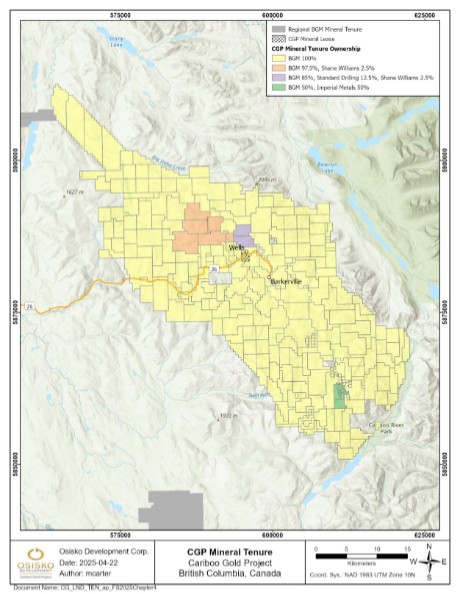
The Cariboo Gold Project also contains 546 private land parcels from Crown-granted mineral claims (3,330.20 ha) that overlap many of the mineral titles where Barkerville is the registered owner on the title of the surface and/or undersurface rights to the parcels. A net smelter return ("NSR") royalty of 5% payable to OR Royalties Inc. (formerly Osisko Gold Royalties Ltd) ("OR Royalties") is the only royalty that applies to the mineral resource area Cariboo Gold Project.
For a summary of permitting and regulatory approvals required on the Cariboo Gold Project, please refer the section "Environmental and Permitting" below.
Accessibility, Climate and Infrastructure
The Project is located in Wells, BC, approximately 74 km east of the City of Quesnel and 120 km southeast of the City of Prince George. The Project is accessible via paved Highway 26, which branches off Provincial Highway 97 at Quesnel. An extensive network of gravel roads provides access throughout the area of the Project, including roads maintained by the BC Forest Service and old mine exploration roads and trails. These roads are also used as part of an extensive winter snowmobile trail system. ODV's Project offices and related facilities are in the town of Wells.
The Project is located within the CRD of BC, with the closest major city being Quesnel acting as the primary supply and service centre for natural resource industries and has the closest regional hospital. Within 120 km are located the main regional cities of Williams Lake and Prince George, which together have a population of over 100,000, including skilled mining and industrial workers.
Page C-2 |
|
The Project has access to sufficient power and water to support a mining operation. Canadian National Railway provides rail access from Quesnel to the Port of Vancouver.
ODV has sufficient surface rights in the Project area for mineral exploration and development operations. These rights are generally conveyed by ODV's Crown-granted mineral claims or by specific permits, such as those related to tailings and waste disposal areas, or water and timber use, and the mineral lease that was applied for November 29, 2021 and was granted on July 13, 2023.
Currently, local resources include single-phase 7.2 kilovolt ("kV") power, potable water from the District of Wells public works (supplying roughly 985,000 litres ("L") per day to the town), local sewage treatment, waste disposal sites, and high-speed internet and telecommunication services, including a communication tower maintained by Telus and radio repeater stations maintained by ODV for use by company personnel and site contractors. The Project infrastructure includes a planned upgrade to the potable water supply and the construction of a Transmission Line, connecting to the Barlow Creek Substation and terminating at the Mine Site Complex ("MSC") in Wells.
ODV holds seven water licences: one for Willow River, three at the QR Mill, one at the Ballarat temporary work camp, one unused licence on Island Mountain, and one for a well at the geological compound and field offices at Lowhee Creek. The climate allows for year-round mining operations, and there is enough readily available water to conduct diamond drilling.
History
The Cariboo Gold Project is situated within the Cariboo Gold Belt, a producer of gold that has had a history of mining dating from the Cariboo gold rush in the 1860's. The Project area contains several historical mines, including the Cariboo Gold Quartz Mine, Aurum Mine/Island Mountain Mine, and Mosquito Creek Mine.
The extensive history of the district's placer gold deposits will not be discussed as it is not relevant to the Cariboo Technical Report other than to comment that the gold rush was the largest in Canadian history, drew a large number of people to the area, which eventually led to the discovery of hard rock gold deposits in the area.
Historical mineral resource estimates are superseded by the 2025 Feasibility Study Mineral Resource Estimate ("2025 FS MRE") reported in the Cariboo Technical Report.
Historical Mines
Cariboo Gold Quartz Mine
Fred Wells purchased the Rainbow claim group from A.W. Sanders and formed Cariboo Gold Quartz Mining Company Ltd. ("Cariboo Gold Quartz Mining") in 1927. The Cariboo Gold Quartz Mining operated from 1927 to 1959 at Cow Mountain.
In 1959, in its 33rd Annual Report, Cariboo Gold Quartz Mining reported historical reserves scattered in 51 remnants through 13 levels and across a distance of 10,500 feet ("ft") (3,200 meters ("m")).
The Cariboo Gold Quartz Mill continued processing mineralized material from the Aurum Mine on Island Mountain until March 1967. During the period between 1933 and 1967, a total of 1,951,944 metric tonnes of mineralized material was mined, yielding 863,307 ounces ("oz") of gold and 91,652 oz of silver (MINFILE number 093H 019). The average recovery during that period was 95.3%.
Page C-3 |
|
Island Mountain Mine (Aurum Mine)
In 1925, C.J. Seymour Baker acquired the original five Crown-granted mineral claims (later known as the Aurum Group) (the "Aurum Group"), at which he worked until 1932. In 1932, Newmont Mining Corporation ("Newmont") acquired the Aurum Group and eight adjacent claims to form Island Mountain Mines Company Ltd.
Under Newmont's ownership, production from the mine was 699,536 tonnes from which 333,705 oz of gold and 48,130 oz of silver were recovered (MINFILE number 093H 006). The mill also recovered 531 lbs of zinc and 134 lbs of lead.
Cariboo Gold Quartz Mining purchased the mine and equipment from Newmont in 1954 for a sum of $305,000. Underground workings extending northwest from the Island Mountain Mine into the Mosquito Group are formally known as the Aurum Mine.
Mosquito Creek Mine
Andrew H. Jukes, of Calgary, acquired the Mosquito Creek claim group and formed Mosquito Creek Gold Mining Company Ltd. ("Mosquito Creek Gold") in 1971 to explore the ground above the Aurum Mine. Surface exploration drilling and underground development from 1971 to 1975 were financed by a joint venture agreement with the Home Oil Company Ltd. of Calgary (the "Home Oil Company"). They conducted an extensive surface and underground exploration and development program on the property. In 1975, Mosquito Creek Gold purchased all of Home Oil Company's interest in the property. Subsequently, Peregrine Petroleum Ltd. ("Peregrine") entered into a joint venture agreement with Mosquito Creek Gold, whereby it ultimately earned a 50% working interest in the property.
A total of 27,384 oz of gold were recovered from 86,248 tonnes of mostly pyrite-type mineralization milled during the main production period (1980 to 1983). The operation failed due to low initial reserves and a low discovery rate of new resources. The latter was the result of insufficient development at depth and northwest of the Mosquito Fault.
In 1984, Hudson Bay Mining and Smelting Co. Ltd. ("Hudson Bay") optioned the property but dropped it after earning a 10% interest. Hudson Bay sold its interest back to Mosquito Creek Gold and Peregrine sold its 50% interest to Mosquito Creek Gold.
In 1986, the property was optioned by Hecla Mining Company of Canada Ltd. who conducted underground exploration work and then dropped their interest in the company.
Mining operations were intermittent until 1987 when Mosquito Creek Gold became Mosquito Consolidated Gold Mines Ltd. After the gold price dropped, and new ore became hard to find, the mine closed in 1987. During the period between 1980 and 1987, a total of 92,826 t of mineralized material were mined from which 35,054 oz of gold and 9,750 oz of silver were recovered (MINFILE number 093H 010).
In 1988, Lyon Lake Mines Ltd optioned the property and earned a 50% interest after performing underground exploration.
Surface Work Programs
Cariboo Gold Quartz Mining Company Ltd (1968)
In 1968, Dolmage Campbell and Associates Ltd carried out 5 km of bulldozer trenching on behalf of Cariboo Gold Quartz Mining.
A total of seventeen (17) trenches approximately 2 metres to 2.5 metres deep were excavated across the Baker-Rainbow contact over a strike length of 1.6 km on Island Mountain. Pyritic mineralization, 6 metres long by 1 metres wide, was discovered in Trench J.
Wharf Resources Ltd (1980-1981)
In 1972, Cariboo Gold Quartz Mining amalgamated with Coseka Resources Ltd ("Coseka Resources") to form a company with the name of the latter. In April 1973, Wharf Resources Ltd (formerly Plateau Metals and Industries) amalgamated with French Exploration Ltd (a wholly-owned subsidiary of Coseka Resources) ("Wharf Resources"). Wharf Resources carried out surface drilling programs in
Page C-4 |
|
1980 and 1981 to search for near-surface mineralization on the Cariboo and Island Mountain claim groups. A total of 7,010 metres of percussion drilling and 1,219 metres of diamond drilling were completed in 1980 and 1981.
Blackberry Gold Resources Inc. (1988)
In 1987, Blackberry Gold Resources Inc. completed several work programs on the ARCH 1-4 claim group located on Cow and Richfield mountains. The objective of the work was to discover gold mineralization associated with the system of north-striking fault structures. Very low frequency electromagnetic geophysical surveys were used to define conductors inferred to be the strike extension of major faults on the Cariboo Group of Crown-granted mineral claims. Four strong conductive trends were tested along six fences of percussion drill holes for a total of 2,424 metres of drilled in 79 holes. This was followed by 2,465 metres of diamond drilling in 19 holes.
Pan Orvana Resources Inc. (1989-1991)
On July 12, 1985, Mosquito Creek Gold purchased the Cariboo and Island Mountain claim groups from Wharf Resources, Pan Orvana Resources Ltd ("Pan Orvana") signed the Cariboo Gold Option Agreement on May 20, 1988, obtaining the right to earn a 50% interest in the Cariboo Group, but terminated the agreement in 1991 without exercising the option. Pan Orvana excavated 20 surface trenches, drilled four holes and conducted ground geophysical surveys, geochemical sampling programs and geological mapping.
Gold City Mining Corp. (1994-1995)
In 1994 and 1995, Gold City Mining Corp. ("Gold City Mining") assembled a large land position consisting of 13,000 ha of mineral titles between Mount Tom and the Cariboo Hudson Mine to form the Welbar Gold Project.
Doing so involved seven option agreements, including one that covered the Mosquito Creek, Island Mountain and Cariboo claim groups. The latter was subject to the Cariboo Option Agreement between Mosquito Consolidated Gold and International Wayside Gold Mines Ltd. ("IWGM"). Intera Information Technologies Corp. flew a synthetic aperture radar survey in July 1995. DIGHEM I Power completed a regional airborne radiometric- Mag-EM survey of 1,280 line-kilometres, as well as trenching and diamond drilling on some of their properties, including one drill hole on the Mosquito Creek Group.
From October 1 to November 30, 1995, Gold City Mining conducted a 13-hole (1,865 metres) diamond drilling program on the Cariboo-Hudson Property. Gold City Mining optioned the Cariboo-Hudson Property from Cathedral Gold Corp. in 1994. In November 1995, Gold City Mining sunk four diamond drill holes (560 metres) on the Williams Creek Property. That same month, Gold City Mining drilled two holes (390 metres) on the Island Mountain Property.
International Wayside Gold Mines Ltd
1999-2014
From 1999 to 2014, IWGM drilled 66 holes totaling 8,602 metres in surface diamond drilling on the Island Mountain Project.
1995-2009
1995-1999 Work Programs
IWGM worked the Cariboo Gold Project area continuously from May 1, 1995. Most of the work was carried out on the main mine trend, either from the surface or underground from the 1,200-level adit. In 1998 and 1999, a secondary target, the BC Vein, was explored over a strike length of 384 metres by 31 surface drill holes totaling 2,245.2 metres.
In the summer of 1997, IWGM carried out a geochemical and prospecting program to find new mineralized showings and generate targets for further exploration. The geochemical surveys yielded 1,079 soil samples, 59 stream sediment samples and 121 rock samples.
Page C-5 |
|
Between 1995 and 1999, IWGM's drilled 104 holes totaling 7,349.4 metres in surface diamond drilling, 17 holes totaling 654.1 metres in underground diamond drilling and 135 holes totaling 5,739.9 metres in underground percussion drilling over the Rainbow, Pinkerton, Sanders, Butts and BC Vein zones.
2000-2009 Work Programs
IWGM carried out extensive work from 2000 to 2009. During this period, IWGM drilled 336 holes totaling 49,121.5 metres in surface diamond drilling and 76 holes totaling 6,177.4 metres in underground diamond drilling over the Bonanza Ledge zone.
Barkerville Gold Mines Ltd.
2010-2014
From 2010 to 2014, Barkerville engaged in surface diamond drilling on the Cariboo Gold Project and drilled a total of 318 holes (73,700.1 metres).
2015-2022
Barkerville as it operated from 2015-2022, will be referred to as ODV. Current ODV management has been in place since 2015 and on November 21, 2019, OR Royalties acquired the Cariboo Gold Project through the acquisition of Barkerville. The Cariboo Gold Project was part of the OR Royalties contributed assets that created ODV on November 25, 2020.
During 2015, ODV milled 11,275 tonnes of Bonanza Ledge mineralized material at an average head grade of 10.14 g/t Au, a recovery rate of 94%, and an average net operating cost of $877/oz. Based on the results as of February 28, 2015, management decided to cease production and place Bonanza Ledge under care and maintenance.
In 2016, ODV mandated InnovExplo Inc. to complete a NI 43-101 technical report (the "2017 MRE") for the Barkerville Mountain deposit. GEOVIA GEMS was used for modelling purposes and the estimation approach, which consisted of 3D block modelling and the ordinary kriging interpolation method. The close-out date of the database was July 18, 2016, and the effective date of the 2017 MRE was March 21, 2017.
In 2017, ODV mandated InnovExplo to update the 2017 MRE and perform a review and validation of the maiden mineral resource estimate ("MRE") for the Cow Mountain and Island Mountain deposits combined. The close-out date of the database was December 31, 2017, and the effective date for the 2018 MRE was May 2, 2018 (the "2018 MRE"). Test Mining at Bonanza Ledge was completed in December 2018. The objective was to gain technical information and train personnel to aid in future studies, permitting, and future mining. A total of 1,900 m of development took place at the Bonanza Ledge Mine in 2018. Approximately 120,000 t of mineralized material was extracted and processed at an average grade of 5.94 g/t Au. Bonanza Ledge Mine was placed on care and maintenance in December 2018.
In 2019, ODV mandated InnovExplo to review, validate and update the 2018 MRE. Based on the mineral resource estimate completed in 2019, ODV mandated BBA Engineering Ltd. to prepare a technical report and preliminary economic assessment for the Cariboo Gold Project (the "Cariboo 2019 PEA"). The effective date of the Cariboo 2019 PEA was August 18, 2019. The Cariboo 2019 PEA provided a base case assessment for developing the Cariboo Gold Project as a 4,000 tonnes per day ("tpd") underground mine, with a concentrator located at the Mine Site at Wells and further processing at the QR Mill. The mine life was estimated to be 11 years.
In 2020, ODV mandated InnovExplo to complete an NI 43-101 technical report to present an updated MRE and geological model (the "2020 MRE") for the Cariboo Gold Project. In 2022, a PEA was completed for the Cariboo Gold Project. The effective date of the 2022 MRE update was May 17, 2022.
In 2023, a feasibility study was completed for the Cariboo Gold Project: ODV mandated BBA Engineering Ltd ("BBA") to prepare a technical report and feasibility study for the Cariboo Gold Project. It encompassed updated resources of Cow Mountain (Cow Zone and Valley Zone), Island Mountain (Shaft Zone and Mosquito Zone), and Barkerville Mountain (Lowhee Zone). The effective date of the 2022 MRE update was May 17, 2022.
Page C-6 |
|
The Bonanza Ledge Mine resumed development in mid–2019 and in 2020, 3,268 tonnes of mineralized material was extracted at an average grade of 2.58 g/t Au. In 2020, the underground focus was the development of drifts to access the BC Vein. In 2021, 98,786 tonnes of mineralized material was extracted at an average grade of 4.48 g/t Au (as of December 31, 2021). In 2022, 170,652 tonnes of mineralized material was extracted at an average grade of 5.16 g/t Au. Development of a new portal to access and develop a bulk sample at the Cow Mountain portion of the mineral resource was completed in December 2021. The Bonanza Ledge Mine was placed on care and maintenance again in June 2022.
Regional Mineral Claims of the Cariboo Gold Project
Parts of the regional mineral claims of the Cariboo Gold Project have a very long history of exploration and development dating back to the late 1800's. It is beyond the scope and technical requirements of the Cariboo Technical Report to review all the historical information. Work History provides a complete list of references for all available records relating to historic work on the regional mineral claims of the Project by previous owners for the period 1949 to 2024.
Geology and Mineralization
The Cariboo Gold Project lies within the Kootenay Terrane of the Omineca Tectonic Belt in the south-central Canadian Cordillera. The Omineca rocks were complexly deformed by Middle Jurassic to Early Tertiary compressional tectonics, and by Tertiary transtension and extension. The Kootenay Terrane in the vicinity of the Cariboo Gold Project is subdivided into the eastern Cariboo and western Barkerville subterranes. The Cariboo Subterrane is juxtaposed on the Barkerville Subterrane by the east-dipping Pleasant Valley Thrust.
The Snowshoe Group, central to the Barkerville Subterrane, hosts the Cariboo Gold Project. The Barkerville and Cariboo Subterranes comprise metamorphosed equivalents of continent-derived siliciclastic protoliths with interlayered marble units and granitic orthogneiss. The subterranes are pericratonic in character and are thought to have formed near the current western margin of Laurentia. Various authors suggest that both Barkerville and Cariboo Subterranes share the same tectostratigraphic position and depositional environment.
The principal gold-producing areas in the Barkerville Subterrane are hosted in rocks metamorphosed to lower-greenschist facies (sub-biotite isograd); amphibolite-facies rocks are locally found on the Cariboo Gold Project but are not associated with any significant mineralization. The S1 and S2 fabrics are defined by phyllosilicate minerals (sericite and chlorite); they generally define foliation suggesting that peak metamorphic temperature coincided with the formation of cleavage.
Lode-gold mineralization in the Wells-Barkerville mining camp (Cariboo Gold District) shares many characteristics with an orogenic gold deposit model. Gold mineralization is associated with orogenic silica-carbonate-sericite-pyrite stable fluids moving along secondary permeability controlled by metamorphic fabrics, vein arrays, faults, lithologic contacts, and rheological contrasts. Deposit types on the Cariboo Gold Project consist of vein and replacement-type mineralization grouped into five inter-related styles:
Deposit Types
The Cariboo Gold Project shares many characteristics with an orogenic gold deposit model. This class of deposit is typified by deformed and metamorphosed mid-crustal blocks and major structures, inherent products of orogenesis. Orogenic gold deposits span the entire breadth of the province of BC, occurring predominantly within two main trends. The westerly trend is associated with accreted pericratonic terranes linked to Late Cretaceous to Paleocene movement on crustal-scale dextral strike-slip fault systems along the western margin of the Stikine terrane, and eastern Coast Belt. The easterly trend is crudely cospatial with the Jurassic to Cretaceous
Page C-7 |
|
accretion of the Intermontane terranes and autochthonous strata of the ancestral North American. Orogenic deposits have significant economic importance, as they are known to host auriferous mineralization as high-grade vein deposits and low-grade bulk-tonnage lode deposits, and are intimately linked with substantial placer accumulations.
Most orogenic gold deposits in metamorphic terranes, such as the Barkerville terrane, are found adjacent to first-order, deep-crustal fault zones, which show complex structural histories and may extend along strike for hundreds of kilometres with widths of as much as a few thousand metres. Most orogenic gold deposits occur in greenschist facies rocks, but significant orebodies can be present in both lower and higher-grade rocks. Hydrothermal fluids are generated from metamorphic dehydration reactions along deepcrustal fault zones, driven by episodes of major pressure fluctuations during seismic events. Gold mineralization is associated with orogenic silica-carbonate-sericite-pyrite stable fluids moving along secondary permeability controlled by metamorphic fabrics, vein arrays, faults, lithologic contacts, and rheological contrasts. Gold deposits form as simple to complex networks of gold-bearing, laminated quartz-carbonate shear veins along second and third-order faults, particularly at jogs or changes in strike along major deformation zones.
Mineralization styles vary from stockworks and breccias in shallow, brittle regimes, through laminated crack-seal veins and sigmoidal vein arrays in brittle-ductile crustal regions, to replacement- and disseminated-type orebodies in deeper, ductile environments. Mineralization is syn- to late-deformation and typically post-peak metamorphism, and commonly associated with silica-carbonate-sericite-pyrite alteration. Gold is largely confined to the quartz-carbonate vein network, but may also be present in significant amounts within iron-rich sulphidized wall-rock selvages, or within silicified and sulphide-rich replacement zones. One of the key structural factors for gold mineralization emplacement is often a late strike-slip movement event that reactivates earlier-formed structures within the developing orogen.
Inter-related vein systems are the principal source of gold and silver within the Barkerville trend and are a key fluid pathway for sulphide mineralization. Axial planar quartz veins represent the dominant vein system hosting gold-and-silver-rich sulphide mineralization in the Cariboo Gold Project's most well-developed deposits and regional prospects, namely the Mosquito Creek, Shaft, Valley, Cow Mountain, Lowhee, and KL Zone deposits.
Veins range in width from millimetres to several metres and are termed vein corridors when concentrated in zones that are 2 m in width or greater in thickness. Vein corridors are planar structures, typified as steeply dipping, striking N020-N050, extending 100–700 m downdip and extending 100–300 m along strike. The principal aims of exploration and infill drilling programs involve testing the extent and concentrations of axial planar ("AXPL") vein corridor deposits, with targeting based in part on proximity to identifiable large-scale F3 hinge zones.
Replacement-style gold mineralization contains the highest and most consistent gold grades at the Project and was the main target for the historic underground of Mosquito Creek Mine on Island Mountain. Occasional elevated silver grades are also observed within replacement sulphide bodies at Cariboo. Semi-massive replacement style mineralization observed at the historically mined Bonanza Ledge is fault-bounded in the footwall of the BC Vein shear. The replacement deposits at Island Mountain and Mosquito Creek are thought to be structurally controlled in the hinges of F2 folds. These rod-like structures, parallel to the axes of the F2 fold, act as conduits for hydrothermal fluids that react with the pH buffered calcareous sediments. This reaction simultaneously creates pore space and precipitates gold-rich sulphides.
Shear zone deposits are typified by the BC Vein deposit that was mined on Barkerville Mountain from 2019 to 2022. These shear zones are commonly found within the Barkerville Trend and can be spatially associated with vein deposits. These steep, orogen-parallel faults and damage zones can act as fluid pathways for crustal fluids. The BC Vein is a poly-deformed, steeply-dipping, and S1 strike-parallel shear zone of unknown relative offset. The structure is internally characterized by strongly carbonaceous to graphitic siltstone fault breccia, discontinuous pods of brecciated milky white quartz and later stage grey quartz that has, in places, annealed the breccia matrix. Fine-grained pyrite and gold are associated with the annealing late-stage grey quartz.
The Wells Shear is interpreted as the offset Cow Mountain equivalent of BC Vein owing to its similar strike, deformational style, and position within tectonostratigraphic sequence. The BC Vein-Wells Shear structure is highly variable in thickness both along strike and down dip. The close geographic association between this structure and the locations of highest density axial planar veining as well as the highest gold grades in both soil and rock geochemical assays is taken to reflect its importance as a fluid pathway at the time of mineralization.
Page C-8 |
|
The Proserpine Shear is a poly-deformed, steeply-dipping, and S1 strike-parallel shear zone. The Proserpine Shear structure is internally characterized by strongly carbonaceous to graphitic siltstone fault breccia, discontinuous pods of brecciated milky white quartz and later stage grey quartz that has, in places, annealed the breccia matrix. Fine-grained pyrite and gold are associated with the annealing late-stage grey quartz.
Exploration
ODV's exploration team executed a systematic methodology to the exploration program on the Cariboo Gold Project. The program included geological mapping, channel, soil, underground sampling, and diamond drilling.
The exploration team has continued its geological mapping across the Cariboo Gold Project's area to identify lithologic contacts, define alterations and geochemical signatures, record micro- and macro-scale structural data, and to collect select rock samples. The targeted deposit types within the Cariboo Gold Project are structurally and/or geochemically controlled, thus the mapping data continues to play a vital role in refining the geologic model of the area and defining mineralized zones.
2015-2019 Geochemical and Mapping Programs
From 2015 to 2019, ODV executed a systematic approach with surface mapping and geochemical sampling. From 2015 to 2017, sampling efforts specifically targeted the Barkerville Trend, a major deep-seated shear that trends 60 km northwest-southeast through the centre of the Cariboo Gold Project area. In 2018 and 2019, the focus shifted to the northwest and southeast extensions of known mineralization around the Wells area within the Barkerville Trend. Further exploration was conducted along the parallel Lightning Creek Trend.
2016 Magnetic and VTEM Survey Program
In 2016, a helicopter-borne Magnetic and VTEM Survey was conducted by Geotech Ltd. over ODV's Cariboo Gold Project. The survey was flown in southwest to northeast lines spaced 200 m apart. A total of 7,024 line-km of data was acquired. The data was corrected against a base station. The program resulted in 1,308 km2 of geophysical data that confirmed a northwest-southeast VTEM anomaly associated with magnetic anomalies.
2020 Geochemical and Mapping Programs
Geological surface mapping took place on the Burns Mountain prospect from June 22 to August 4, 2020. Geochemical surveying coincided with mapping on the Yanks Peak prospect from August 18 to September 10, 2020. The geochemical survey then moved to Burns Mountain from September 10 to 29, 2020. The objective at Yanks Peak prospect was designed to expand upon the results derived from the 2017 and 2018 geochemical survey completed by ODV. The grid at the Burns Mountain prospect was designed to infill a gap in the geochemical grid and expand to the south of Lightning Creek to Chisholm Creek.
The 2020 geochemical sampling program was designed to primarily test for soil geochemical signatures in an area known to host several mineral occurrences which lay within a quartzite dominant lithology. A secondary objective was to collect stratigraphic and structural geologic information with emphasis on structural control and the structural relation to mineralization on the properties. A total of 429 soil samples and seven rock samples were collected on the Burns Mountain prospect; 1,187 soil samples and 56 rock samples were collected on the Yanks Peak prospect in 2020.
The principal objectives of the 2020 mapping program were to refine the understanding of local stratigraphy and structure, with emphasis on the structural controls on mineralization. Additionally, another goal of the program was to delineate highly prospective target areas for future brownfields exploration and provide recommendations for targeting methodology. The program consisted of detailed geologic mapping at a 1:2000 scale at the Burns Mountain, Yanks Peak and Cunningham Creek prospects. A total of 43 rock samples were collected at the Burns Mountain prospect, 12 rock samples at the Cunningham Creek prospect and 42 rock samples at the Yanks Peak prospect. The 2020 program collected an additional 3,060 structural measurements at 905-point locations on the Burns Mountain prospect, 1,036 structural measurements at 341-point locations on the Cunningham Creek prospect, and 2,318 structural measurements at 706-point locations on Yanks Peak prospect. The anomalous gold-in-soil values along with the data gleaned from the geologic
Page C-9 |
|
mapping program on these prospects indicated stratigraphy and veining similar to those which are gold-bearing in the Wells-Barkerville area.
2021 Geochemical and Mapping Programs
Geological surface mapping took place on the Burns Mountain prospect from June 1 to July 25, 2021, and September 18 to October 3, 2021, and on the Cunningham Creek prospect from August 12 to October 21, 2021. The geochemical survey took place on the Burns Mountain, Cow Mountain, and Mount Agnes prospects from June 26 to July 21, 2021 and July 25 to August 31, 2021.
The primary objective of the 2021 Soil program was to connect the Burns Mountain and Yanks Peak soil sampling grids along the Lightning Creek Trend. A secondary objective was to begin closing the gap in the soil data between Cow Mountain and Burns Prospects, following up on anomalies seen in the eastern portion of Burns Mountain and western portion of Cow Mountain. In total, 651 soil samples were collected on the Burns Mountain prospect, 682 on the Mount Agnes prospect and 20 on the Cow Mountain prospect areas. In addition, in 2021, the geochemical sampling team collected a total of eight rock samples on the Mount Agnes prospect and eight on the Burns Mountain prospect. The 2021 Geologic mapping programs principal aims were to delineate and provide detailed exploration strategies for greenfield-brownfield exploration targets within both Burns Mountain and Cunningham Creek prospects. The focus of the mapping efforts in the Burns Mountain area was on Mount Nelson and Oregon Gulch. The efforts on Mount Nelson were in following up on geochemical anomalies found in previous years' soil programs. Oregon Gulch has many historic showings that suggest mineralization in a style comparable to what ODV is targeting. On the Cunningham Creek prospect mapping was focused on the historic Cariboo-Hudson Mine and along the trend of it. Detailed geologic mapping was conducted at a 1:2000 scale. A total of 244 rock samples were collected on Burns Mountain, eight rock samples on Mount Agnes, and 97 rock samples on the Cunningham Creek prospects. The 2021 mapping team collected an additional 3,509 structural measurements at 844-point locations on the Burns Mountain prospect, and 1,390 structural measurements at 407-point locations on the Cunningham Creek prospect. These results are summarized in Table 9-3. The anomalous gold-in-soil values along with the data collected from the geologic mapping program on both prospects indicated stratigraphy and veining similar to those which are gold-bearing in the Wells-Barkerville area. Exploratory drilling in this area is recommended in the future to test the area's viability.
2024 Underground Development Program
The objective of the 2024 underground development program was to access the mineralization at the Lowhee deposit for the eventual extraction and analysis of a 10,000-t bulk sample, which was permitted in 2021 under a mineral exploration ("MX") permit MX-4-561.
The Cow portal construction was completed in Q4 2021. During Q1 2024, the Corporation commenced development of the underground ramp from the existing Cow portal into the Project's mineral deposit at the Lowhee Zone. JDS Energy and Mining Inc. were contracted for the construction of the Cow portal and the subsequent development of the ramp access and the Lowhee bulk sample.
All 1,172 m of linear development to reach the target bulk sample area has been completed and the bulk sample stope of ~7,482 t was extracted, providing supporting information for geotechnical, dilution, and potential stope sizes. A further ~150 m of development has advanced on the 1,260 elevation level, cross-cutting the geological model with the objective of facilitating the collection of one or two additional bulk samples. Mapping and structural analysis of the development has confirmed the local geological model. Data collection, analysis and interpretation from the bulk sample are pending as of the effective date of the Cariboo Technical Report.
Drilling
From 2015 to 2022, Barkerville/ODV drilled a total of 2,280 diamond drill holes, totalling 695.08 km of drill core. While surface data continues to inform the geologic model, diamond drill core is the primary source of geological information for the Cariboo Gold Project.
The objectives for the 2020 and 2021 diamond drilling programs were to test new brownfields targets adjacent to known deposits, infill high-grade vein corridors modelled from the Cariboo 2019 PEA classified as Inferred and explore the depth potential of known deposits. The focus of the 2022 diamond drilling program was the infill of a proposed underground bulk-sampling area, the continued category conversion from Inferred to Indicated status of modelled vein corridors, and the delineation of additional vein corridors.
Page C-10 |
|
The objective of the 2023 program was to provide geotechnical information along the proposed underground development towards a bulk sample area to aid with safe and productive extraction methods. The Cow portal geotechnical drill holes enabled the identification of faults, rock mass designation testing, lithologic contacts, rock mass abrasiveness, and Metal Leaching and Acid Rock Drainage ("MLARD") hazards, to aid in the planning for underground development towards the Lowhee Zone bulk sample.
Drilling Methodology
Drills are aligned using a Suunto compass. Drill alignments are confirmed using Minnovare's Azimuth Aligner (it was used for a part of the 2021 drilling campaign and all of the 2022 drilling campaign). For the 2023 program, the drill rig was aligned by a geologist using a robotic total station. The downhole dip and azimuth are surveyed using a REFLEX EZ-TRAC too. Collar locations are determined using a Trimble DGPS. The first survey was usually measured 9 m below the casing, and readings were then taken every 30 m downhole. A survey was also taken at the bottom of the hole if the end of hole depth was 15 m or more from the previous test. The instrument was handled by the drilling contractors, and survey information was digitally recorded using IMDEX's IMDEXHUB-IQ, as well as transcribed and provided in paper format to ODV geologists.
At the drill rig, the drill helpers placed the core into core boxes and marked off every 3-m drill run using a labelled wooden block. The drill helpers were also responsible for marking orientation information on the core using either the REFLEX ACT IIITM tool or the Devico DeviHead orientation tool. All holes were drilled in NQ diameter unless noted otherwise in the Cariboo Technical Report.
All drill hole casings collared at an elevation similar to Jack of Clubs Lake were cemented into bedrock. Special consideration was given to the Valley Zone due to the local groundwater conditions, whereby a cementing procedure was deployed to ensure no groundwater would escape the drill hole once plugged: A first hole was drilled through the overburden and cased (HWT size) 6 m to 9 m into competent bedrock. HQ drill rods were then drilled 1 m beyond casing. Once the geologist and drill foreman inspected the rock to ensure the rock was competent bedrock, casing was reamed to the bottom of the hole and cemented with the drill foreman present. A PQ displacement plug was then pushed downhole until cement came up around the casing, leaving it to set. After at least 24 hours, 250 pounds per square inch ("psi") of water pressure was applied to the drill hole. If, during the pressure test, the pressure decreased and water was able to escape the cement, the drill hole was either abandoned or recemented. If no issues were experienced during the pressure test, drilling would then commence, and this process was repeated for any additional holes. Upon completion of the drill hole, a safety plug was placed 24 m past the shoe and the hole cemented. The HQ drill rods were then removed, and a displacement plug was pumped down the hole. One additional batch of cement was then pumped downhole, and a wait time of 45 minutes was observed, ensuring that no water was seen exiting the hole.
Core Logging Procedures
The drill core was transported to ODV's facility in Wells, BC where it was cleaned of drilling additives and mud, and the metres were marked before collecting data. Recovery for each 3 m drill run was noted. When recovery was less than 2.5 m (>0.5 m of loss), loss was recorded on a separate block as a "lost core interval".
Geotechnical data collection included Rock Quality Designation ("RQD"), Intact Rock Strength ("IRS"), and fracture counts at 1–3 m intervals. Magnetic susceptibility data were not collected because it was concluded that such data are not relevant to the deposit. Downhole orientation lines were connected where possible, and orientation off-set measurements were recorded. All data (lithology, alteration, mineralization, structures, interval structures, and veins less and greater than 5 cm) were recorded using Datamine DHLogger software. Sample intervals and pertinent information regarding lithology, mineralization and alteration were marked on the core.
After recording the sampling information, drill core samples were cut in half using a diamondblade table mounted rock saw. Half the sample was bagged and labelled, then packaged for shipment to an assay lab. Numbered security tags were applied to lab shipments for chain of custody requirements. Samples were then shipped to the laboratory of ALS Minerals ("ALS") in North Vancouver, BC, for analysis. The remaining half-core samples are stored on-site in a secured location for future reference.
The QPs have not identified drilling, sampling, or recovery factors that could materially impact the accuracy and reliability of the results. In the opinion of the QPs, the core logging and sampling procedures used by ODV are consistent with generally accepted industry best practices and are, therefore, adequate for an advanced exploration project and use in the Cariboo Technical Report.
Page C-11 |
|
2015 to 2019 Drilling
2015 Drilling
In 2015, drilling was focused on Barkerville Mountain with 180 holes drilled on the BC Vein and Bonanza Ledge deposit, totalling 35,848.5 m; eight drill holes on the KL Zone totalling 1,675 m, and 12 dill holes on the Barkerville Mountain deposit totalling 3,626.7 m. The 2015 diamond drill program was designed to drill the BC Vein structure at a spacing of 25 m to 50 m to a depth of 250 m from surface, and a spacing of 100 m down to a depth of 450 m below surface.
2016 Drilling
In 2016, drilling on Barkerville Mountain consisted of 53 holes on the BC Vein and Bonanza Ledge deposit, totalling 8,605.5 m, and 10 holes on the KL Zone deposit, totalling 2,621.18 m. The BC Vein area was drilled to infill high-grade areas at 12.5 m to 25 m spacing while the KL Zone was drilled to test an 800 m-long gold-in-soil ("Au-in soil") anomaly. Cow Mountain drilling produced 233 drill holes on the Cow prospect, and drill holes on the Valley Zone prospect, totalling 31,157.07 m and 1,023.5 m, respectively. The 2016 campaign tested depths of approximately 300 m. Drill holes were completed on approximately 50 m centres in selected areas. Drilling in the Valley Zone tested the lateral extents of AP veins and refined the stratigraphic model. Results showed denser than expected vein occurrences. As a result, three more rigs were added to the program and collar locations were stepped out to expand the intersected vein corridors. On Island Mountain, 33 holes were drilled on the Shaft Zone prospect, and 50 holes on the Mosquito Creek prospect, totalling 11,289.5 m and 16,026.75 m, respectively. Drilling on Island Mountain was conducted in order to understand the structural and lithological controls on gold mineralization, as well as to test the down-plunge extent of sulphide replacement zones.
2017 Drilling
In 2017, drilling was again conducted on Barkerville Mountain (BC Vein and Bonanza Ledge, KL Zone, and Barkerville Mountain deposits), Cow Mountain (Cow and Valley Zone deposits), and Island Mountain (Shaft Zone and Mosquito Creek deposits). Barkerville Mountain drilling produced 25 holes at BC Vein, seven at Bonanza Ledge, and one drill hole at KL Zone, totalling 4,412.7 m, 3,388 m, and 530.15 m, respectively. The 2017 drilling program on Barkerville Mountain explored the Au-in-soil anomaly adjacent to the KL Zone, investigating the 2016 identified targets. Cow Mountain had a total of 17 drill holes at the Cow prospect, and 80 drill holes at the Valley Zone prospect, totalling 6,034.7 m, and 38,872.96 m, respectively. Cow Mountain drilling continued the goals of the 2016 drilling program. Island Mountain had a total of 211 holes at the Shaft Zone prospect, and 44 dill holes at the Mosquito Creek prospect, totalling 93,733.12 m and 13,455.7 m, respectively. Drilling on Island Mountain during 2017 was primarily designed to define the extent of recently discovered vein systems and to discover new vein corridors and sulphide replacement. Early in the program, holes were drilled on 100 m drill centres with dice-five infill patterns concentrated in the Shaft Zone. As the geologic understanding of the controls on mineralization improved, a tighter infill of approximately 25 m spacing began in August to expand known corridors.
2018 Drilling
In 2018, drilling was conducted on Barkerville Mountain (BC Vein and Bonanza Ledge deposits), Cow Mountain (Cow and Valley Zone deposits), and Island Mountain (Shaft Zone and Mosquito Creek deposits). Barkerville Mountain had a total of ten drill holes on the BC Vein and Bonanza Ledge deposits totalling 1,683.8 m. The aim of the 2018 Program at Barkerville Mountain was to provide infill data on the BC Vein. In addition, the program expanded upon data collected in 2017 and also targeted vein mineralization concentrated within the hanging wall of the BC Vein. Cow Mountain had a total of 246 drill holes on the Cow prospect, and two drill holes on the Valley Zone prospect, totalling 67,715.05 m and 401.9 m, respectively. The aim of the 2018 Program at Cow Mountain was to infill and expand the high-grade gold-bearing vein corridors. Drilling on Island Mountain produced 168 drill holes on the Shaft Zone prospect, and 20 drill holes on the Mosquito Creek prospect, totalling 53,731.29 m and 4,597 m, respectively. The 2018 Program at Island Mountain focused on targets generated by underground mapping and sampling data, as well as historical data compiled from smaller scale mapping, trenching, soil sampling and drilling programs. The program aimed to demonstrate continuity and expand on known mineralized vein corridors. Infill drilling was designed to intercept modelled vein corridors with a 25 m spacing at depth in order to convert Inferred resources to the Indicated category.
Page C-12 |
|
2019 Drilling
In 2019, drilling was conducted on Barkerville Mountain (BC Vein and Bonanza Ledge, KL Zone, Williams Creek, and Lowhee Zone deposits), Cow Mountain (Cow prospect), and Island Mountain (Shaft Zone, Mosquito Creek, and Willow prospects). Barkerville Mountain had a total of 36 drill holes on the BC Vein and Bonanza Ledge deposit, 73 on the KL Zone, four on Williams Creek, and 24 holes on the Lowhee Zone, totalling 7,974.2 m, 31,974.62 m, 1,572 m, and 8,422 m, respectively. The 2019 Program on Barkerville Mountain focused on exploration for mineralized vein corridors analogous to those on Cow Mountain and Island Mountain within the prospective sandstone unit, with drilling on BC Vein to increase confidence in the block model. Cow Mountain had a total of 72 drill holes on the Cow prospect, totalling 16,136.6 m and was primarily focused on infill drilling and testing down dip extents of mineralized vein corridors. Island Mountain had a total of 26 drill holes on the Shaft Zone prospect, 15 on the Mosquito Creek prospect, and six on the Willow prospect, totalling 12,032.45 m, 8,258.89 m, and 3,078.9 m, respectively. The objective of the 2019 Program on Island Mountain was to infill high-grade areas currently classified as Inferred on the Mosquito and Shaft Zones and to test the strike and depth extent of the mineralized vein corridors. Exploration to the northwest of Mosquito Creek also occurred on what is known as the Willow Target, an Au-in-soil geochemical anomaly identified from 2018 soil sampling. Additionally, the Proserpine property had a total of six holes drilled, totalling 2,676.25 m. This program was aimed at testing Au-in-soil anomalies and historical gold occurrences, as well as historical underground workings.
2020 Drilling Program
The 2020 drilling program was conducted between January 16, 2020, and December 14, 2020, by Smithers, B.C. based Hy-Tech Drilling Ltd. ("Hy-Tech") and its primary focus was delineating the Cow-Island-Barkerville corridor. A total of 57,078.8 m was drilled in 201 surface holes. The objective of this program was to delineate mineralized vein corridors further within all deposits and intercept veins with a 25 m spacing from previously drilled holes to support conversion of Inferred resources to the Indicated category. The below table provides a summary of Barkerville's 2020 Program:
Deposit | Number of Drill Holes | Metres Drilled |
|---|---|---|
BC Vein and Bonanza Ledge | 3 | 560.60 |
Lowhee Zone | 24 | 10,144.50 |
Cow Mountain | 48 | 12,596.05 |
Valley Zone | 56 | 17,558.85 |
Shaft Zone | 15 | 3,909.00 |
Mosquito Creek | 50 | 9,392.40 |
Proserpine | 5 | 2,917.40 |
Total | 201 | 57,078.80 |
| | |
Overall, visual inspection of the 2020 drilling results demonstrated that the thickness and the grade of the mineralized zones were in the same order of magnitude as the 2020 MRE. The 2020 drilling continued to confirm the geological and grade continuities that were demonstrated in the 2020 MRE.
2021 Drilling Program
The 2021 drilling program (the "2021 Program") was conducted by Hy-Tech between January 4, 2021 and October 20, 2021. The 2021 Program also saw the addition of Paycore Drilling, based in Valemount, BC, between August 18, 2021, and October 16, 2021.
The 2021 Program at Island Mountain focused on Shaft Zone with 60,990.8 m drilled in 162 holes, and Mosquito Creek totalling 10,710.65 m drilled in 42 holes, further continuing the category conversion work from Inferred to Indicated status within known vein corridors.
Page C-13 |
|
The 2021 Program at Cow Mountain was primarily focused in the Valley Zone to continue category conversion work and expand known mineralized vein corridors with a total of 47,484.92 m drilled in 108 holes. Minor drilling on Cow Mountain was conducted, totalling 1,988.5 m drilled in six holes. The purpose of this drilling was to conduct metallurgical testing of modelled vein corridors.
The 2021 Program at Lowhee Zone continued to define the prospect, targeting mineralized vein corridors within the prospective sandstone unit analogous to those on Cow Mountain and Island Mountain. A total of 29,860.9 m was drilled in 95 holes. Drill hole spacing along the modelled vein corridors was kept to a distance of 25 m.
2022 Drilling Program
The 2022 drilling program (the "2022 Program") was conducted by Hy-Tech at the Lowhee Zone on Barkerville Mountain. The 2022 Program started on March 25, 2022, and was completed on of July 6, 2022. The focus of the 2022 Program at the Lowhee Zone was the infill of a proposed underground bulk sampling area, the continued support for category conversion from Inferred to Indicated status of modelled vein corridors, and the delineation of additional vein corridors.
Assay results from 27 drill holes were received after April 6, 2022, representing 6,563.9 m of assays, and, as such, are excluded from the 2025 FS MRE. Overall, the visual inspection of the 2022 drilling results demonstrated that the thickness and the grade of the mineralized zones are in the same order of magnitude as the 2025 FS MRE. The 2022 drilling continued to confirm the geological and grade continuities that were demonstrated in the 2025 FS MRE.
2023 Drilling Program
The 2023 geotechnical drilling program (the "2023 Program") was conducted by Hy-Tech at the Cow portal on Barkerville Mountain. The 2023 Program started on October 7, 2023, and was completed on October 20, 2023.
The focus of the 2023 Program at the Lowhee Zone consisted of geotechnical drilling parallel to planned underground development that would lead towards a planned bulk sample location in the Lowhee Zone Deposit. The core was logged for lithology, alteration, mineralization, oriented structures, and geotechnical logging to calculate RQD and RMR89. LECO analysis was completed at the Quesnel River Mine assay lab.
The Cow portal geotechnical drill holes enabled the identification of faults, rock mass designation testing, lithologic contacts, rock mass abrasiveness, and MLARD hazards, to aid in the planning for underground development towards the Lowhee Zone bulk sample.
The following paragraphs describe the sample preparation, analysis and security procedures of the 2020 and 2021 Programs included in the current resource estimate in the Cariboo Technical Report. The QP reviewed the quality assutance/quality control ("QA/QC") procedures and results completed only on gold assay results.
Core Handling, Sampling and Security
Core handling, sampling, and security procedures as detailed in this section are managed by ODV personnel.
The drill core is placed into wooden core boxes at the drill site with the end of each drill run marked with a small wooden block displaying the depth of the hole. Box labels indicate the hole and box numbers. The boxes are racked and covered at the drill, secured with ratchet straps, and then transported daily from the drill site to ODV's core storage and logging facility in the District of Wells, BC. The boxes are labelled in permanent marker with the hole and box number (e.g., GR-15-01 Bx 1). The core is transported by truck during the drilling programs. There are two secure core storage areas, one in Wells near the core logging facility and a second is located near the Ballarat Camp, approximately 5 km east of Wells.
Upon receiving a load of core from the drill crew, the core is brought into the logging room. Meterage blocks are checked for errors, the core is oriented in the box and cleaned, and the metre marks are drawn on the core before logging begins. The geological and geotechnical core logging data is collected with Datamine's DHLogger software.
Page C-14 |
|
The sample intervals are between 0.5 m and 1.5 m in length and do not cross geological contacts. A line is drawn with a pencil along the length of the core to indicate where the core will be sawed. Each sampling ticket is divided into three tags. One tag is stapled to the core box at the beginning of the interval to record the drill hole number and sample interval recorded. The second tag is placed in the sample bag, which is sent to the laboratory; this tag does not reference the drill hole or meterage. The last tag remains in the sample ticket book with the hole number and recorded intervals. All samples are assigned a unique sample number.
After the core boxes with tags are photographed, the core boxes are moved to the cutting station. The core is cut lengthwise by diamond saw, with half the core submitted as the primary sample and the remaining half core retained in the core box for future reference.
The samples are individually bagged with the corresponding tag. The tag number is written on the bag and each bag is sealed. The bags are then placed in rice bags and the rice bags are sealed with numbered security tags for the chain of custody requirements. If any tampering with security tags is suspected, the laboratory will communicate with ODV. Samples are transported to the ALS laboratory in Vancouver, BC and the remaining drill core is subsequently stored on site at ODV's secure facilities in Wells and at a second location near the Ballarat Camp.
Sample Preparation and Assay
Sample Preparation
| ● | Samples are sorted and logged into the ALS LIMS program; |
| ● | Samples are dried and weighed; |
| ● | Samples are crushed to +70% passing 2 millimetres ("mm") (CRU-31); |
| ● | The crushed sample split of up to 500 grams ("g") is pulverized to +85% passing 75 microns ("μm") screen (PUL 32m); |
| ● | Samples containing visible gold or cosalite mineralization are assayed by metallic screen method; a crushed sample split of 1,000 g is pulverized (method PUL-32) to pass 100 μm (Tyler 150 mesh) stainless steel screen to separate the oversize fractions (method SCR-21). |
Gold Assaying
| ● | A 50 g pulp aliquot is analyzed by Au-AA26: fire assay followed by aqua regia digestion (HNO3‐HCl) with an atomic absorption spectroscopy finish ("AAS"); |
| ● | When assay results are higher than 100 g/t Au, a second 50 g pulp aliquot is analyzed by Au-GRA22: fire assay, parting with nitric acid (HNO3) with a gravimetric finish; |
| ● | All samples containing visible gold or cosalite mineralization are assayed by the metallic screen method (method Au-SCR21). At the request of ODV, any sample exceeding 100 g/t Au (Au-AA26) is rerun with the screen method following the procedure below; |
| ● | For visible gold assays or cosalite mineralization, the +100 μm fraction (Au+) is analyzed in its entirety by fire assay ("FA") with gravimetric finish. The 100 μm fraction (minus) is homogenized and two subsamples are analyzed by FA with AAS (Au-AA25) or gravimetric finish (Au-GRA21). The average of the two minus fraction subsamples are taken and reported as the Au-fraction result. The gold content is then determined by the weighted average of the Au+ and Au- fractions. |
Multi-Element Assaying
| ● | Some samples are analyzed by trace-level multi-element method ME‐MS61: a 0.25 g aliquot is digested by four-acid digestion (HNO3‐HClO4‐HF‐HCl) and HCl leach (method GEO-4A01) and analyzed by ICP-AES; |
Page C-15 |
|
| ● | Following this analysis, the results are reviewed for high concentrations of bismuth, mercury, molybdenum, silver, and tungsten and diluted accordingly. Samples meeting these criteria are then analyzed by ICP-MS. Results are corrected for spectral interelement interferences. |
Specific Gravity Measurements
Before crushing and pulverizing, the specific gravity of selected samples is determined by the bulk sample method (water displacement, OA GRA08).
Quality Assurance and Quality Control
A total of 49,243 and 111,361 samples (including QA/QC samples) were assayed during 2020 and 2021, respectively. The 2020 and 2021 QA/QC programs included a routine insertion of standards and blanks to monitor gold assay results. ODV included one standard in every 20 samples and one blank in every 40 samples. The 2020 and 2021 QA/QC programs did not include field or coarse reject duplicates.
Accuracy is monitored by adding standards at the rate of one certified reference materials ("CRM") for every 20 samples. Standards are used to detect assay problems with specific sample batches and any possible long-term biases in the overall dataset. ODV's definition of a quality control failure is when:
| ● | Assays for a CRM are outside plus or minus three standard deviations (±3SD) or ±10%; or |
| ● | Assays for two consecutive CRMs are outside ±2SD, if one of them is outside ±3SD. |
Conclusions
A total of 564 holes from the 2020 and 2021 Programs were included in the current resource. The QP is of the opinion that the sample preparation, analysis, QA/QC, and security protocols used for the Cariboo Gold Project follow generally accepted industry standards, and that the data is valid. The QP recommends the implementation of QA/QC on the silver assay results for future programs.
This section covers the data verification of ODV's diamond drill hole databases used for the resource estimates previously reported in the 2022 FS MRE (the "ODV Databases"), as well as the review and validation of the geological models of each deposit. It also includes the review of information on mined-out areas and the data for selected drill holes, including assays, QA/QC programs, downhole surveys, lithologies, alteration, and structures. No changes have been made to the resource estimation as previously reported in the 2022 FS MRE; however, there has been mining depletion for the Lowhee Zone and changes to the cut-off grade assumptions as well as elimination of silver in the model.
The ODV Databases contain 4,064 completed and validated diamond drill holes used for the 2025 FS MRE for the Cariboo Gold Project. These are divided among four databases covering the eight deposits as follows:
| ● | Cow Mountain database: Cow and Valley deposits (1,473 holes); |
| ● | Island Mountain database: Shaft and Mosquito deposits (1,851 holes); |
| ● | Barkerville Mountain database: BC Vein and Splays, KL, and Lowhee deposits (578 holes); |
| ● | Bonanza Ledge database: Bonanza Ledge deposit (162 holes). |
Since the 2020 MRE, no drilling has been carried out on the KL, BC Vein, and the Bonanza Ledge deposits. The block model completed for the 2020 MRE for the Bonanza Ledge deposit as published in the 2020 technical report remains current for the 2022 FS MRE. The
Page C-16 |
|
block model completed for the BC Vein deposit for the 2022 Mineral Resource Estimate dated May 17, 2022 (the "2022 PEA MRE") remains current for the 2022 FS MRE. Other block models for the remaining six deposits were updated.
Carl Pelletier, QP, previously conducted site visits from February 1 to 4, 2016, and from May 3 to 12, 2016. The first included visits to the Bonanza Ledge pit, the Cow Mountain area, and the Island Mountain area, while the second focused on core logging facilities, several drill hole collars, drill pads, and mineralized outcrops. Core logging and sampling procedures were discussed with ODV's geologists, covering collar locations, drilling protocols, downhole surveys, logging protocols, oriented core, structural measurements, sampling protocols, and QA/QC protocols.
Eric Lecomte, QP, has also visited the property on February 25, 2022. The visit included a review of the proposed MSC location in Wells and an inspection of the Bonanza Ledge site. The primary objective was to evaluate surface and underground site conditions, including a visual assessment of ground conditions and excavation behaviour at Bonanza Ledge. A second visit was conducted on September 11, 2024, with a primary focus on the Cow portal ramp. The inspection aimed to assess current ground conditions and excavation behaviour specific to the ramp area. Discussions were held with site personnel regarding the operational performance of the Roadheader used for ramp development, including its productivity, ground response, and cycle time performance.
The 2025 FS MRE for the Project, effective April 22, 2025, encompasses resources for the deposits of Cow Mountain (Cow Zone and Valley Zone), Island Mountain (Shaft Zone and Mosquito Zone), and Barkerville Mountain (Lowhee Zone, KL Zone, BC Vein Zone, and the Bonanza Ledge Zone).
There have been no changes for the resource estimation as previously reported in the 2022 FS MRE, however, there has been mining depletion for Lowhee and changes to the cut-off grade assumptions.
The silver has been removed from the 2025 MRE due to limited supporting data and the estimated ounces were not material.
The 2022 FS MRE for Cow, Valley, Mosquito, Shaft, KL, Lowhee, and BC vein was prepared by Daniel Downton, P.Geo., of ODV. The Bonanza Ledge deposit remained unchanged.
The Lowhee Zone is depleted by the underground workings and the bulk sample stope. As mineralization is present in the walls of the bulk sample, a 5 m buffer has not been added as there is still mining potential. Both the underground workings and bulk sample are current as of the end of January 2025.
The depletion was reviewed and validated by Carl Pelletier, P.Geo., and Tessa Scott, P.Geo., both of InnovExplo Inc. ("InnovExplo"), using all available information.
The 2025 FS MRE covers all the deposits in the Cow-Island-Barkerville Mountain Corridor. The Mineral Resource area for the Cow/Island segment covers a strike length of 3.7 km and a width of approximately 700 m, down to a vertical depth of 600 m below surface. The estimate for the Barkerville segment covers a strike length of 3 km and a width of approximately 700 m, down to a vertical depth of 500 m below surface.
Two diamond drill hole databases cover the Project: Bonanza Ledge and BM-CM-IM (Barkerville Mountain including the BC Vein, KL, and Lowhee deposits, Cow Mountain including the Cow and Valley deposits, and Island Mountain including the Shaft and Mosquito deposits). These databases were filtered by deposit (Cow, Shaft, Valley, Mosquito, BC Vein, KL, or Lowhee) before the work in Datamine. A subset of drill holes was used to generate the 2022 FS MRE database for each deposit, as follows:
| ● | The Cow deposit contains 1,219 validated drill holes; |
| ● | The Valley deposit contains 254 validated drill holes; |
| ● | The Shaft deposit database contains 1,010 validated drill holes; |
Page C-17 |
|
| ● | The Mosquito deposit contains 841 validated drill holes; |
| ● | The Lowhee deposit contains 158 validated drill holes; |
| ● | The BC Vein and KL Zone deposits contain 420 validated drill holes. |
The QPs reviewed and validated the resource estimation process followed by ODV, including all parameters, geological interpretation, basic statistics, variography, interpolation parameters, block model construction, scripts that run the model, volumetric report, and the validation process.
Historical work subject to verification consisted of the holes used for the 2022 PEA MRE. Basic cross-check routines were performed between the current ODV Databases and the previously validated database for the 2022 PEA MRE.
The QPs were granted access to the assay certificates for all holes in the 2021 drilling programs. Assays were verified for 5% of the drill holes. No discrepancies were found.
Overall, the QPs data verification demonstrates that the data, protocols, and estimation process for the Project are acceptable. The QPs consider the ODV databases to be valid and of sufficient quality to be used for the MRE herein.
A total of 482 geological solids were created for the deposits and remain unchanged from the 2022 FS MRE.
A solid representing a 5 m halo surrounding the AXPL vein corridors was also created for each of the Mosquito, Shaft, Valley, Cow, Lowhee, and KL deposits. These were created to limit and provide a halo of dilution around the AXPL mineralized veins.
The classification is unchanged since the 2022 FS MRE. The MRE was classified as Measured, Indicated, and Inferred Mineral Resources based on data density, search ellipse criteria, drill hole density, and interpolation parameters. The 2025 FS MRE is considered to be reliable and based on quality data and geological knowledge. The MRE follows the 2014 CIM Definition Standards on Mineral Resources and Reserves and the 2019 CIM Best Practice Guidelines.
Page C-18 |
|
Table 1: Cariboo Gold Project 2022 FS MRE Reported at a 1.8 g/t Au cut-off grade (except for Bonanza Ledge reported at a 3.5 g/t Au cut-off grade)
| | Tonne | Au Grade | Au Ounce |
|---|---|---|---|---|
Category | Deposit | '000 | (Au g/t) | '000 |
Measured | Bonanza Ledge | 47 | 5.06 | 8 |
| Bonanza Ledge | 32 | 4.02 | 4 |
| BC Vein | 1,057 | 3.00 | 102 |
| KL | 527 | 2.80 | 47 |
Indicated | Lowhee | 1,333 | 2.76 | 118 |
| Mosquito | 1,553 | 2.96 | 148 |
| Shaft | 6,121 | 2.92 | 575 |
| Valley | 2,718 | 2.70 | 236 |
| Cow | 3,991 | 2.91 | 374 |
Total Indicated Mineral Resources | 17,332 | 2.88 | 1,604 | |
Total Measured and Indicated Mineral Resources | 17,380 | 2.88 | 1,612 | |
| BC Vein | 596 | 3.17 | 61 |
| KL | 2,514 | 2.53 | 205 |
| Lowhee | 486 | 3.01 | 47 |
Inferred | Mosquito | 1,883 | 3.08 | 186 |
| Shaft | 7,457 | 3.44 | 826 |
| Valley | 2,470 | 3.01 | 239 |
| Cow | 3,368 | 2.78 | 301 |
Total Inferred Mineral Resources | 18,774 | 3.09 | 1,864 | |
Mineral Resource Estimate notes:
(1) | The independent and QPs for the Mineral Resources estimates, as defined by NI 43-101, are Carl Pelletier, P.Geo., and Tessa Scott, P.Geo. of InnovExplo Ltd. The effective date of the 2025 FS MRE is April 22, 2025. |
(2) | These Mineral Resources, exclusive of the reserves, are not Mineral Reserves as they do not havedemonstrated economic viability. |
(3) | The MRE follows the 2014 CIM Definition Standards on Mineral Resources and Reserves and the 2019 CIMEstimation of Mineral Resources and Mineral Reserves Best Practice Guidelines. |
(4) | A total of 481 vein zones were modelled for the Cow Mountain (Cow and Valley), Island Mountain (Shaft and Mosquito), Barkerville Mountain (BC Vein, KL, and Lowhee) deposits and one gold zone for Bonanza Ledge. A minimum true thickness of 2.0 m was applied, using the gold grade of the adjacent material when assayed or a value of zero when not assayed. |
(5) | The estimate is reported for a potential underground scenario at a cut-off grade of 1.8 g/t Au, except for Bonanza Ledge at a cut-off grade of 3.5 g/t Au. The cut-off grade for the Cow, Valley, Shaft, Mosquito, BC Vein, KL, and Lowhee deposits was calculated using a gold price of USD 2,400/oz; a USD:CAD exchange rate of 1.35; an underground mining cost of $66.3/t; a processing and transport cost of $30.80/t; a G&A plus Environmental cost of $22.40/t; and a sustaining CAPEX (as defined herein) cost of $45.6/t. No changes have been applied for the Bonanza Ledge. The cut-off grade for the Bonanza Ledge deposit was calculated using a gold price of USD 1,700/oz; a USD:CAD exchange rate of 1.27; a global mining cost of $79.13/t; a processing and transport cost of $65.00/t; and a G&A plus Environmental cost of $51.65/t. The cut-off grades should be re-evaluated in light of future prevailing market conditions (metal prices, exchange rate, mining cost, etc.). |
(6) | Density values for Cow, Shaft, Lowhee, and BC Vein were estimated using the ID2 interpolation method, with a value applied for the non-estimated blocks of 2.80 g/cm3 for Cow, 2.78 g/cm3 for Shaft, 2.74 g/cm3 for Lowhee, and 2.69 g/cm3 for BC Vein. Median densities were applied for Valley (2.81 g/cm3), Mosquito (2.79 g/cm3), and KL (2.81 g/cm3). A density of 3.20 g/cm3 was applied for Bonanza Ledge. |
Page C-19 |
|
(7) | A four-step capping procedure was applied to composited data for Cow (3.0 m), Valley (1.5 m), Shaft (2.0 m), Mosquito (2.5 m), BC Vein (2.0 m), KL (1.75 m), and Lowhee (1.5 m). Restricted search ellipsoids ranged from 7 to 50 g/t Au at four different distances ranging from 25 m to 250 m for each deposit. High-grades at Bonanza Ledge were capped at 70 g/t Au on 2.0 m composited data. |
(8) | The gold Mineral Resources for the Cow, Valley, Shaft, Mosquito, BC Vein, KL, and Lowhee vein zones were estimated using Datamine StudioTM RM 1.9 software using hard boundaries on composited assays. The OK method was used to interpolate a sub-blocked model (parent block size = 5 m x 5 m x 5 m). Mineral Resources for Bonanza Ledge were estimated using GEOVIA GEMSTM 6.7 software using hard boundaries on composited assays. The OK method was used to interpolate a block model (block size = 2 m x 2 m x 5 m). |
(9) | Results are presented in situ. Ounce (troy) = metric tons x grade / 31.10348. Calculations used metric units (metres, tonnes, g/t). The number of tonnes was rounded to the nearest thousand. Any discrepancies in the totals are due to rounding effects. Rounding followed the recommendations as per NI 43-101. |
(10) | The QPs responsible for this section of the technical report are not aware of any environmental, permitting, legal, title, taxation, socio-economic, marketing, political, or other relevant factors that could materially affect the MRE. |
Mineral Reserve Estimate
Mineral Reserves are reported using the 2014 CIM Definition Standards and were estimated in accordance with the CIM 2019 Best Practices Guidelines, as required by NI 43-101 Standards of Disclosure for Mineral Projects. As such, the Mineral Reserves are based on Measured and Indicated Mineral Resources and do not include any Inferred Mineral Resources. Measured and Indicated Mineral Resources are exclusive of proven and probable reserves. Mineral Reserves are the estimated tonnage and grade of ore that is considered economically viable for extraction based on the assumptions set out in the Cariboo Technical Report. Mineral Reserves for the Cariboo Gold Project deposit incorporate dilution and mining recovery factors based on the selected mining method and design as set out in Chapter 16. In addition, economic analyses were completed to validate the profitability of particular areas of the Mineral Resource to ensure it could be converted to Mineral Reserve.
The following sources of information were instrumental in the Mineral Reserve estimation process: the resource blocks model (last updated September 8, 2022); The previous 2023 FS ("NI 43-101 Technical Report - Feasibility Study for the Cariboo Gold Project") conducted by BBA in 2022-2023 for Osisko Development Corporation, effective date December 30, 2022; current estimates of operating costs and other financial assumptions, as laid out in the Cariboo Technical Report; updated forecasts for metal prices; the current 3D model of existing underground workings and historical stope outlines; and the litho-structural model of the site.
The cut-off grade ("CoG") calculations are based on technical and economic parameters developed specifically for this Study, building in part on data obtained from the 2023 FS and on cost estimates prepared by InnovExplo and ODV. These calculations consider current market conditions, including gold price and exchange rate assumptions derived from a trailing 3-year average, to reflect a balanced economic outlook. Mining costs were estimated using a zero-based approach tailored to the selected longitudinal long hole retreat mining method and benchmarked against comparable underground gold projects.
Stope optimization was conducted in two stages. The initial stage involved a preliminary screening using a cut-off grade-based stope optimization to identify potentially mineable zones. This was followed by a second pass that incorporated development costs into the economic evaluation, ensuring that only stopes with a positive economic margin, including access development, were retained. The parameters used in these calculations are summarized in Table 2.
For mineralized development material, a lower CoG of 1.7 g/t Au was applied to account for reduced incremental cost structures associated with pre-planned access development.
The base cut-off grade was determined using the following formula:
COG = | Ctotal x (1 + D) | |
(PAu – SAu) x RAu x Rmining x (1 – Rf) | | |
Where: | | |
Page C-20 |
|
COG | Cut-off grade, in grams per tonne of gold (g/t Au) | |
Ctotal | Total operating cost, in CAD per tonne of mined material (mining, processing, G&A, environment, sustaining capital) | |
PAu | Gold price, in CAD per gram (converted from $/oz at market rate and exchange rate) | |
SAu | Selling cost, in CAD per gram (converted from $/oz at market rate and exchange rate) | |
RAu | Gold metallurgical recovery, expressed as a decimal (e.g., 92.1% = 0.921) | |
Rmining | Mining recovery, expressed as a decimal (e.g., 94% = 0.94) | |
Rf | Royalty as a decimal (e.g., 5.0% = 0.05) | |
D | Dilution, expressed as a decimal (e.g., 5% = 0.05) | |
Table 2: Cut-Off Grade Calculation Parameters
| Production Rate: 4,900 tpd | |
|---|---|---|
Input Parameters | General Economic Assessment | |
Gold Price | USD/oz | 1,915 |
Exchange Rate | CAD/USD | 1.32 |
Royalty | % | 5.00 |
Refining Cost | USD/oz | 5.0 |
Processing Cost and Transport | $/t treated | 30.53 |
Metallurgical Recovery | % | 92.10 |
Mining Recovery | % | 94.00 |
Mining Dilution | % | 5.00 |
Mining Cost | $/t treated | 54.19 |
Sustaining Cost | $/t treated | 25.63 |
Environment | $/t treated | 6.47 |
General and Administration | $/t treated | 10.39 |
Cut-off Grade | g/t | 2.0 |
Page C-21 |
|
Table 3: Cariboo Gold Statement of Mineral Reserves at the effective date of April 10, 2025
| Tonnage | Grade | Contained Gold |
|---|---|---|---|
Category | (t) | Au (g/t) | (oz) |
Proven | | | |
- | - | - | |
Probable | | | |
Cow | 3,999,971 | 3.35 | 430,548 |
Valley | 3,238,636 | 3.59 | 374,058 |
Shaft | 8,548,295 | 3.72 | 1,021,599 |
Mosquito | 1,105,370 | 3.94 | 140,102 |
Lowhee | 923,162 | 3.52 | 104,491 |
Total P & P | 17,815,435 | 3.62 | 2,070,798 |
Notes:
(1) | The QP for the Mineral Reserve Estimate is Eric Lecomte, P.Eng. (InnovExplo a subsidiary of Norda Stelo). |
(2) | The Mineral Reserve Estimate has an effective date of April 10, 2025. |
(3) | Estimated at US$1,915/oz Au using an exchange rate of USD 1.32:CAD 1.00, variable cut-off value from 1.70 g/t to 2.0 g/t Au. |
(4) | Mineral Reserve tonnage and mined metal have been rounded to reflect the accuracy of the estimate and numbers may not add due to rounding. |
(5) | Mineral Reserves include both internal and external dilution along with mining recovery. The average external dilution is estimated to be 10.1%. The average mining recovery factor was set at 91.3% to account for mineralized material left in each block in the margins of the deposit. |
Environmental, Social, and Governance ("ESG") considerations have been evaluated as part of the modifying factors applied in converting Mineral Resources to Mineral Reserves. These factors are not expected to materially affect the viability of the mine plan. ESG factors have been reviewed by the QP and are not expected to present a material risk to the classification of Mineral Reserves. They support the conclusion of reasonable prospects for economic extraction as required under CIM and NI 43-101 standards.
The Cariboo Gold Project consists of three main zones (Cow, Shaft, and Valley) with two smaller satellite zones (Lowhee and Mosquito). The rate of exploitation of each deposit will change over time, while the overall steady state production rate of 4,900 tpd is expected to be met by the first half of Year 1 and will be maintained until Year 10, before decreasing. The life of mine ("LOM") production plan represents a 10-year mine life.
The selected mining method is mainly long hole longitudinal retreat with some stopes using a modified long hole longitudinal retreat method or transverse. Primary materials handling fleet will be comprised of 10 t scooptram Load Haul Dump ("LHD") and 51 t haul trucks.
Stope production is set to begin in the second half of Year-1 and progressively ramp up until full production of 4,900 tpd is achieved in Q2 Year 1. Underground mine life is set to last until the first half of Year 10.
Page C-22 |
|
Geotechnical characterization for the Project was undertaken through two core logging campaigns conducted in 2018 and 2021, complemented by laboratory testing. The results supported the development of a geotechnical classification system (Classes 1 to 5), each with corresponding stope design guidelines. The classification ranges from Class 1, representing the most competent ground conditions, to Class 5, representing the least competent ground. Classes 1 through 4 are considered suitable for open stoping, whereas Class 5 requires a cut-and-fill mining approach.
Approximately 95% of the planned stopes were assigned a geotechnical class. For design purposes, a single representative class was selected for each vein corridor, based on the class associated with the median stope tonnage. Classes 1 to 3 were designed using industry-accepted empirical methods. To validate the proposed stope design guidelines for Classes 3L and 4, a back-analysis was conducted using stope performance data from the Bonanza Ledge Mine. This analysis compared planned versus actual stope geometries for 21 stopes, using data from cavity monitoring system surveys. The rock mass quality of these stopes was also compared with that of the Cariboo Gold Project to confirm the relevance of the back-analysis results.
Typical stope dimensions are approximately 30 m in height (floor-to-floor). For longitudinal stopes with widths less than 8 m, the strike length ranges from 15 to 25 m, depending on the geotechnical class. Higher classes were assigned increasing dilution factors, and reduced geotechnical recovery was applied to Class 4 areas.
A hydrogeological investigation program was completed to provide key groundwater related inputs to the FS (as defined herein), namely, to estimate potential mine dewatering rates, to understand further the regional groundwater flow regime, and to characterize potential impacts of mine dewatering on groundwater and surface water systems.
The long hole mining method was primarily selected due to the sub vertical geometry of mineralized vein corridors and the relatively lower cost. This method involves driving two drifts longitudinally along the mineralized vein corridors to define a stope. The top access serves as a drilling platform while the bottom access allows for mucking of drilled then blasted material. Once empty, these stopes are then backfilled with paste fill. Stopes are mined retreating towards the access. This method allows for simultaneous mining of stopes along different vein corridors as well as along the same corridor if a pillar exists between active levels. A few mining horizons will include some stopes using transversal long-hole stoping. This decision was driven by the average vein width, contained metal (value), and ground conditions.
The minimum designed stope width for all zones is 3.7 m and the sill-to-sill stope height for all zones is 30 m. The maximum permissible strike length (the distance along strike that can be mined before backfilling is required) is a function of geotechnical constraints and differs by zone.
There will be two portals providing access to the underground ramps as well as one portal to connect the underground incline conveyor to the processing plant. The Cow portal, already excavated, will serve as the initial access point to develop the underground zones during the early stages of the Project. The Valley portal will be brought into service in parallel with development toward the Shaft Zone. Once established, it will serve as the primary production access due to its strategically central location within the deposit. A portal for the conveyor access will be developed simultaneously and ready for conveyor install prior to commissioning of the process plant.
The zones are accessed via main ramps connected to haulage drifts, with each zone featuring its own internal ramp system. The Mosquito Zone, located farther west, is connected to the Shaft Zone by a 1,083 m long haulage drift.
Mining in each zone will primarily use the longitudinal retreat longhole method. A few marginal stopes, either too wide or located in low-competency ground, will be mined using the transverse method or a modified version of the longitudinal longhole method. Sublevels are spaced at 30 m (sill to sill), and mined stopes will generally be backfilled with paste fill. Stope strike lengths will vary by zone based
Page C-23 |
|
on individual geotechnical assessments. Each zone is capped with a crown pillar—22 m for Cow and Lowhee, 32 m for Mosquito and Shaft, and 25 m for Valley—with depth varying according to local geological conditions.
The development schedule has been created with a combination of traditional Jumbo development and Roadheaders. The Roadheaders are scheduled to provide a lateral advance of 200 m per month in single heading conditions and will be concentrated on the ramps. Jumbo equipment is expected to achieve an average lateral development rate ranging from 244 m to 292 m per month per Jumbo crew, depending on the type of excavation, when multiple active headings are available simultaneously.
Initial development will be carried out by contractors at the start of the Project. ODV will gradually assume development responsibilities beginning in Year 2 and is expected to fully take over all development activities by Year 1.
A major piece of underground infrastructure of the Cariboo Gold Project is the underground crushing system. This crusher is located below the services building in a location that has been identified as geotechnically favourable for long-term infrastructure. Ore will be brought to the crusher by underground trucks from all mining zones.
Ore will ultimately be brought to surface using an underground conveyor to be pre-concentrated by sorting and flotation. The material rejected by the sorter will be transferred back underground using a waste pass raise and then it will either be used as backfill material or hauled to the Bonanza Ledge Waste Rock Storage Facility ("WSRF") using the underground trucks.
The mine will include haulage drifts connecting the five separate zones, an underground garage, and pumping stations. The Valley Portal will provide access for material and the labour force.
Power is supplied at 13.8 kV and stepped down to 600 volt ("V") and 1,000 V using dual-output substations. Two feeders from the Cow and Valley portals will distribute power to underground levels, ensuring redundancy and load balancing.
Fixed equipment such as fans, pumps, and chargers will operate at 600 V, while mobile mining equipment like Jumbos and bolters will use 1,000 V. Auxiliary services including lighting, heating, ventilation and air conditioning ("HVAC"), and controls will be powered at 120/208 V. The electrical design includes single-line diagrams, load lists, and bills of material, and complies with all applicable codes and standards.
The load list reflects a high but reasonable level of mining activity and will be refined as the production plan advances. Mobile substations rated between 1 mega volt ampere ("MVA") and 2 MVA are planned for each level, with flexibility to adjust quantities and reuse units based on mine development progress.
The mine's automation strategy includes teleoperated LHD mucking from stopes and loading bays, with transitional ore storage in re-muck areas. Loading bays on access levels will separate teleoperated from manually operated equipment, ensuring regulatory compliance while enabling remote loading operations. On levels without a loading bay, fully automated mucking will be secured through physical barriers restricting access to other vehicles in the affected area. The communication network structure, the integration of the original equipment manufacturer's automation system, and the LHD units—already equipped with the necessary automation options—will enable autonomous operation. It is assumed that one operator will remotely control two LHDs during the automation period. Starting in Year 2, autonomous mucking is expected to account for approximately 30% of stope production over a 12-hour shift, assuming optimal operating conditions.
Page C-24 |
|
The ventilation system has been designed to comply with BC regulations. The airflow required to ventilate diesel engines was compiled using a 0.06 cubic metres per second per kilowatt("m3/s")/ kilowatt ("kW") rate.
The system will be comprised of four independent intake fresh air raises, one exhaust raise and remaining exhaust through the main ramps and the Cow portal. The total estimated airflow required to meet production is 1.255 kilo cubic feet per minute ("kcfm") (592 m3/s).
Project development will begin in Year-3, and the total ore production rate will ramp up until reaching the nominal full production target of 4,900 tpd in the first half of Year 1, with each zone contributing a different ratio to production over time.
The LOM has a 10-year mine life at average production rates of 4,900 tpd. Production ramp-up to a steady state of 4,900 tpd will be achieved by the second half of Year 1. The different zones were divided into three distinct sectors: South (Valley Upper, Cow and Lowhee zones), North (Mosquito and Upper Shaft zones) and Deep (Lower Shaft and Valley zones), each production sector to contribute to a third of the nominal production. The overall mine plan comprises 17.8 Mt of ore mined at an average grade of 3.6 g/t of Au. The mine will produce 8.0 Mt of waste from the development over LOM.
Table 4: Ore produced per year
Year | -3 | -2 | -1 | 1 | 2 | 3 | 4 | |
Lowhee | t | 1,662 | 33,552 | 134,696 | 561,937 | 186,025 | 5,290 | - |
| g/t | 1.86 | 4.33 | 3.75 | 3.60 | 3.02 | 2.35 | - |
Cow | t | - | - | 8,226 | 56,670 | 238,925 | 251,626 | 327,103 |
| g/t | - | - | 3.78 | 4.31 | 4.22 | 3.86 | 3.61 |
Valley | t | - | 2,541 | 52,207 | 164,253 | 228,149 | 246,371 | 434,465 |
| g/t | - | 3.12 | 3.23 | 3.51 | 4.02 | 3.26 | 3.97 |
Shaft | t | - | 7,123 | 224,669 | 912,205 | 1,135,506 | 1,285,713 | 1,025,358 |
| g/t | - | 2.28 | 4.16 | 3.95 | 4.37 | 4.04 | 4.07 |
Mosquito | t | - | - | - | - | - | - | - |
| g/t | - | - | - | - | - | - | - |
Total | t | 1,662 | 43,216 | 419,798 | 1,695,065 | 1,788,605 | 1,788,999 | 1,786,926 |
| g/t | 1.86 | 3.92 | 3.90 | 3.80 | 4.16 | 3.91 | 3.96 |
Year | 5 | 6 | 7 | 8 | 9 | 10 | 11 | |
Lowhee | t | - | - | - | - | - | - | - |
| g/t | - | - | - | - | - | - | - |
Cow | t | 322,541 | 359,549 | 576,463 | 691,972 | 538,224 | 586,986 | 41,686 |
| g/t | 3.00 | 3.44 | 3.31 | 3.35 | 3.06 | 2.91 | 4.18 |
Valley | t | 324,296 | 514,527 | 391,930 | 247,930 | 379,470 | 227,805 | 24,690 |
| g/t | 3.44 | 3.53 | 3.99 | 3.52 | 3.45 | 3.06 | 2.51 |
Shaft | t | 1,136,946 | 609,051 | 465,999 | 513,554 | 769,117 | 457,916 | 5,138 |
| g/t | 3.44 | 3.18 | 3.20 | 3.12 | 3.27 | 3.09 | 3.43 |
Page C-25 |
|
Mosquito | t | 9,593 | 300,000 | 354,087 | 335,115 | 106,575 | - | - |
| g/t | 3.47 | 4.30 | 3.69 | 3.86 | 4.06 | - | - |
Total | t | 1,793,375 | 1,783,128 | 1,788,480 | 1,788,572 | 1,793,387 | 1,272,706 | 71,515 |
| g/t | 3.36 | 3.52 | 3.50 | 3.40 | 3.29 | 3.00 | 3.55 |
Mine Equipment and Personnel
The selection of mining equipment was guided by key criteria to ensure equipment was suited to support a steady-state production rate of 4,900 tpd, with allowances for critical spares. All development activities will be carried out by contractors using their own equipment, except for the Roadheaders, which will be supplied by the Project. ODV will progressively take over the development with new equipment, aiming for full in-house development operations by early Year 1. Production is scheduled to begin in mid Year-1, with ODV gradually integrating its own equipment fleet based on operational requirements.
The selected equipment fleet includes six two-boom Jumbos, two Sandvik Roadheaders for decline development, 17 diesel 51 t trucks for ore and waste haulage (including two temporary rentals), and 10 t LHDs for mucking and backfilling. Stoping activities will be carried out using three top hammer drills and three down-the-hole drills.
The mine will operate continuously year-round with three roster systems in place for office and hourly workers. During full production, an average of up to 169 underground mining employees per rotation will be required to support operations and maintenance in Wells.
A major piece of underground infrastructure of the Project is the underground crushing system. This crusher is located below in the Cow Zone in a location that has been identified as geotechnically favourable for long-term infrastructure. Ore will be brought to the crusher by underground trucks from all mining zones.
Ore will ultimately be brought to surface using an underground conveyor to be pre-concentrated by sorting and flotation. The material rejected by the sorter will be transferred back underground using a waste pass raise and then it will either be used as backfill material or hauled to the Bonanza Ledge WRSF using the underground trucks.
The mine will include haulage drifts connecting the five separate zones, an underground garage, mine water pumping stations and two paste pumping stations. The Valley portal will provide access for material and the labour force.
The mine will be equipped with a paste network in order to dispose of the flotation tailings and facilitate underground mining.
The network will originate on surface, inside the processing plant where paste pumps will initially send the paste underground through a borehole. From there paste will be redistributed through a vertical and horizontal pipe network spanning all levels and all zones. Two underground booster stations will be required, one in Shaft, to allow the paste to reach the higher level of the zones and the satellite Mosquito Zone. One in the ramp between Cow and Lowhee Zone, to allow the paste to reach the Lowhee Zone.
The network will be installed and maintained by a dedicated team, as the underground infrastructure is developed.
The test programs were carried out between 2018 and 2025 under the supervision of ODV and BBA, with contributions from multiple laboratories including Société Générale de Surveillance, Base Met Labs, AMTEL, and Metso.
The key findings include the following: Ore sorting technologies such as X-ray transmission and laser sensors achieved gold recoveries of 87–97% with mass pulls of 30–65%, and optimization through laser scavenging improved recovery but increased mass pull. Gravity
Page C-26 |
|
concentration tests showed gravity recoveries ranging from 20% to 55% depending on the zone, with bulk composite gravity recovery averaging around 45%.
Comminution tests, including Bond Work Index and Abrasion Index tests, categorized the ore as medium-hard to moderately abrasive, with additional hardness profiling provided by SMC Test® and Hardness Index Test tests.
Flotation tests, including rougher and cleaner flotation, achieved gold recoveries greater than 98%, with cleaner flotation performance being sensitive to grind size and regrinding. Cyanide leach tests showed gold recoveries of 92–96%, while silver recoveries were more variable, ranging from 44–77%.
Thickening, filtration, and rheology tests identified multiple effective flocculants, with MF10 and SNF913-SH being the most effective, and belt vacuum and pressure filtration achieving cake moistures of 8–20%, supporting paste backfill design. Paste backfill feasibility was confirmed through multiple campaigns, with unconfined compressive strength tests showing strength increases with binder content and curing time, and optimal binder content estimated at 4% over the mine life.
Overall gold recovery over the LOM is expected to be 92.6%. The recovery modelling integrated ore sorting, gravity, and flotation. The average metallurgical recovery per site is reported in Table 5.
Table 5: Average gold recovery and process step
Process Step | Average Au Stage Recovery (%) |
|---|---|
Gravity Au Recovery – LOM | 42.7 |
Floatation Au Recovery – LOM | 49.9 |
Overall Au Recovery – LOM | 92.6 |
The Cariboo Gold Project will ramp up to a processing capacity of 4,900 tpd. The process includes underground crushing and conveyance to surface for ore sorting, grinding, gravity concentration, flotation, and tailings dewatering, with all mill tailings returned underground as paste backfill. Gravity concentrate is refined on-site into doré bars, while flotation concentrate is shipped offsite.
The ore is crushed underground and conveyed to the surface, where it is screened. Approximately 30% of the material bypasses ore sorting and goes directly to the fine ore silo. The remaining 70% is sorted using two ore sorters. The concentrate from sorting is crushed further and combined with fines before being sent to the grinding circuit.
Grinding is performed in a ball mill, reducing the ore to a P80 of 190 microns ("μm"). The circuit includes primary gravity concentration, which recovers a portion of gold. The remaining material is processed through flotation, including rougher, regrind, and cleaner stages. The regrind mill reduces particle size to 25 μm to improve liberation. Secondary gravity concentration is also employed, and the combined gravity concentrates are refined into doré.
Flotation concentrate is thickened and filtered before shipment. Tailings undergo a similar dewatering process and are mixed with cement use as paste backfill underground.
The concentrator will employ 84 personnel across operations, maintenance, and technical roles. Estimated annual propane consumption is 1.2 million L, and the plant's power demand is 8.2 megawatts. Reagent and consumable usage is based on lab test data, with specific consumption rates provided for each material.
Page C-27 |
|
Waste Management
A WRSF with an elevation of 1,533 m and a capacity for approximately 7,940,000 cubic metres of waste rock storage will be built in the northern limits of the Bonanza Ledge property. The WRSF is designed to have slopes of 3H:1V with inclusion of working benches to manage erosion. This results in an overall slope of 3.3H:1V which will allow for lower bench slopes to be progressively reclaimed while upper lifts of the WRSF are being built. This will reduce the need for rehandling at closure to accommodate the closure design of the potentially acid generating ("PAG") WRSF. Prior to construction, removal of existing PAG waste rock and overburden stockpiled materials will be carried out.
Water Management
Overall, the water infrastructure at the MSC and Bonanza Ledge areas is designed to support the water management strategy and achieve the following objectives:
| ● | Intercept and divert non-contact runoff: Wherever practical, non-contact water will be collected and conveyed for discharge downstream of the mining areas, to the receiving environment. |
| ● | Manage contact water: collect contact water through a system of channels, culverts, French drains and sumps, and convey it to Sediment Control Ponds ("SCP"). Contact water is conveyed to the MSC SCP where treated and then reused to supply freshwater at the mill, with the remaining unused treated effluent being discharged directly to the Jack of Clubs Lake via a diffuser. |
Where possible, existing water management infrastructure will be reused and upgraded, as needed, to meet the Project design basis requirements.
At the Bonanza Ledge area, the water management system is designed to pump and temporarily store excess water from extreme flood events in the flood management reservoir ("FMR"), located underground. This system is intended to be used in emergency situations, when water accumulating at site exceeds Bonanza Ledge area water storage capacity. Water stored temporarily in the FMR is then pumped to the water treatment plant for treatment and discharge to the receiving environment.
Water Treatment Plant
Water treatment infrastructure is a foundational element of the Project's environmental and operational planning. Two facilities have been designed to manage contact water and mine dewatering flows throughout the life of the Project: a temporary plant at Bonanza Ledge and a permanent facility at the MSC. Each system aligns with the phased development approach and is tailored to the site's specific hydrological, climatic, and regulatory conditions.
The Bonanza Ledge Water Treatment System ("WTP") will support initial construction and early underground development activities during Stage 1 (construction). This interim system includes chemical precipitation using barium hydroxide, clarification, and multimedia filtration, followed by advanced membrane treatment. The membrane system features ultrafiltration and nanofiltration ("NF") or reverse osmosis, with NF currently favored to avoid the need for post-treatment remineralization. A separate, small-scale Moving Bed Biofilm Reactor ("MBBR") is also in operation at Bonanza Ledge to supplement nitrogen removal; however, it is not integrated into the main plant flow or design capacity. The Bonanza Ledge WTP is scheduled for decommissioning upon full commissioning of the MSC facility.
The MSC WTP, scheduled for activation in Stage 2 (operation), will serve as the primary long-term treatment system. With a design flow of up to 800 m³/h, it incorporates High-Density Sludge precipitation for metals and solids removal, biological treatment using MBBRs for nitrogen species, and polishing filtration. Treated water will be reused within site operations where feasible, with surplus volumes discharged to Jack of Clubs Lake via a submerged diffuser system. The MSC WTP is designed to remain in operation through closure and into post-closure care, supporting ongoing compliance and water quality management.
Page C-28 |
|
Both treatment systems are engineered to accommodate extreme climatic conditions, including cold weather and seasonally variable flows. Design features such as redundant pumping capacity, heat tracing, and modular construction support resilience and reliability. The water treatment program is fully integrated within the Project's site-wide water management strategy and is critical to achieving environmental discharge objectives and sustaining mine operations.
Water Treatment Conveyance Infrastructure
The Project will utilize pump stations and pipe systems to meet the water treatment conveyance requirements. The pumping stations and pipeline systems are designed to transfer water directly or indirectly to the water treatment plants from water storage infrastructure. Pump stations will consist of a range of submersible and centrifugal pumps, varying in size and capacity. These pumps were sized to meet site-specific flow rate and pressure requirements. Larger pumps were utilized for high volume fluid transfer and dewatering operations, while smaller units provided precise control in lower-demand areas. This approach allowed for efficient, scalable pumping solutions adaptable to seasonal flow conditions forecasted. A wide range of High-Density Polyethylene pipe diameters and pressure ratings were utilized to match the varying flow rate and pressure requirements across the different pipeline systems. Pipe sizes were selected based on hydraulic performance criteria, ensuring optimal flow velocity and minimal head loss, while pressure classes were chosen to withstand the specific operating conditions of each pipeline segment. This approach ensured reliability, efficiency, and long-term durability of the piping network under diverse service demands.
Substation and On-site Distribution
The transmission line and Mine Site substation will provide the required electrical power at 69 kV, based on what is available at the Barlow Substation. The Mine Site substation will be designed to 138 kV to accommodate future loads but will initially operate at 69 kV. The transmission line will require a step-up substation to meet the future case.
Mine Site Infrastructure
The MSC will include the following infrastructure:
| ● | Access roads, bridge, parking lots, security gate; |
| ● | Mine surface infrastructure inclusive of portal, mine ventilation and heating infrastructure; |
| ● | Concentrator; |
| ● | Office complex including office space and mine dry facilities; |
| ● | Surface water management infrastructure; |
| ● | MSC WTP and treated effluent discharge through an effluent diffuser; |
| ● | 69 kV to 13.8 kV electrical substation; |
| ● | Fuel systems (diesel and gas storage and distribution); |
| ● | Raw water well and potable water treatment plant and distribution system; |
| ● | Sewage Treatment system; |
| ● | Bridge to allow access to the MSC area. |
Page C-29 |
|
Regulatory Context and Environmental Studies
Environmental baseline studies and modelling for the Project have been undertaken in the following areas: air quality, terrain and soils, vegetation, wildlife and wildlife habitat, climate and physiography, fisheries and aquatic resources, surface water, and groundwater. In addition, ODV has established environmental monitoring plans for a suite of valued components to respond to regulatory requirements and best management practices for the Project.
The Project is composed of three main components:
| ● | The Mine Site, including the MSC, and the Bonanza Ledge Site (together referred to as the "Mine Site"); |
| ● | The Transportation Route; |
| ● | The Transmission Line. |
The Project received an Environmental Assessment Certificate ("EAC"), Certificate #M23-01, on October 10, 2023, and Schedule B of the certificate lays out the conditions of the approval under 22 separate sections. The Mines Act permit, M-247, was received on November 20, 2024 and the Environmental Management Act permits, PE-17876 for Bonanza Ledge and PE-111511 for the MSC, were received on December 11, 2024.
The permitting process for the Transmission Line is being overseen by the Ministry of Water, Land and Resource Stewardship who is running a coordinated process for all authorizations required for the Transmission Line. The permits required to authorize the construction of the Transmission Line are anticipated to be granted in 2026.
Amendments to the EAC and other permits will be required to authorize changes in the Cariboo Gold Project described in Chapter 1 of the Cariboo Technical Report.
Considerations of Social and Community Impacts
Since 2016, ODV has been undertaking meaningful and transparent engagement with Indigenous nations, the public, local community members, provincial and local government agencies and other stakeholders, and this engagement is ongoing. Relationships have been developed and maintained with three Participating Indigenous nations, Lhtako Dené Nation, Xatśūll First Nation, Williams Lake First Nation, and ODV intends to continue building on these relationships through all phases of the Project.
Mine Reclamation and Closure Plan
ODV has prepared various Reclamation and Closure Plans ("RCP") for the Project to detail how the sites will be reclaimed to a safe, stable, and non-polluting condition. Detailed RCPs were provided in support of the Mines Act application which received approval in late 2024. RCPs will continue to be updated as mine plans evolve, regulatory guidelines change, and in accordance with permit requirements. The Project footprint has been divided into Master Areas to reflect disturbance type and proposed end land use. Detailed closure and reclamation prescriptions have been provided to the regulators for each Master Area.
Permitting and Required Approvals
BC Environmental Assessment Regulations
The Project completed an environment assessment under the BCEAA (2018) and was awarded EAC #M23-01 on October 10, 2023.
The assessment of the Project's potential effects specifically targets the valued components ("VCs") of the environment that may be affected by the Cariboo Gold Project, and the priorities of the participating Indigenous nations, the public, local governments, provincial and federal government agencies, and stakeholders. VCs are defined as fundamental elements of the physical, biological, or socio-
Page C-30 |
|
economic (human) environment, including the air, water, soil, terrain, vegetation, wildlife, fish, economy, health, heritage, and land use components that may be affected by a proposed project.
Any significant changes in the way the Cariboo Gold Project will be undertaken will require an amendment to the EAC, which is expected based on the changes described in this study update. Amendments to the EAC are categorized into three categories: simple, typical or complex. It is anticipated that the changes will fall into the typical category, as they are technical in nature and will result in a change to the way the Project will be implemented. This will be confirmed with BC Environmental Assessment Office. The amendment application will assess how the proposed changes alter the Project's predicted impacts on the VCs.
Federal Permits, Approvals, Licenses and Authorizations
Below is a list of federal permits, approvals and authorizations that could potentially be applicable to the Cariboo Gold Project. ODV does not currently hold any federal permits in relation to their operations in the Project area.
| ● | Fisheries Act Authorization |
| ● | Migratory Birds Convention Act Authorization |
| ● | Navigation Protection Program Notification and/or Approval |
| ● | Species at Risk Act Authorization |
| ● | Explosive Licenses and Permits |
| ● | Transportation of Dangerous Goods Regulation |
Provincial Permits, Approvals and Licenses
Below is a list of provincial permits, approvals and licenses that could potentially be applicable to the Cariboo Gold Project. ODV holds a valid mining lease for the Mine Site.
| ● | Mines Act Permit |
| ● | Effluent Discharge Permit |
| ● | Emissions Discharge Permit |
| ● | Refuse Permit and Waste Storage Approval |
| ● | Heritage Conservation Act Permit |
| ● | Heritage Conservation Act Concurrence Letters |
| ● | License of Occupation |
| ● | Statutory Right of Way |
| ● | Wildlife Act Permit |
| ● | Sewer System Regulation Approval |
Page C-31 |
|
| ● | Construction Permit for a Potable Water Well |
| ● | Water System Construction Permit |
| ● | Drinking Water System Operations Permit |
| ● | Short term Use of Water Permit (Water Sustainability Act, Section 10) |
| ● | Change of Approval (for changes in and about a stream) (Water Sustainability Act, Section 11) |
| ● | Water License (Diversion, storage, and use of water) (Water Sustainability Act, Sections 7 and 9) |
| ● | Licenses to Cut and Special Use Permit |
| ● | Industrial Access Permit |
| ● | Permit for regulated activities |
| ● | Explosives Magazine Storage and Use Permit |
A Mines Act permit approving the mine plan and reclamation program is required for the Project, as well as amendments to existing provincial permits (e.g., Mines Act and Environmental Management Act) for the Bonanza Ledge Site. The Joint Permit Application and Ancillary Permit Application packages were submitted on May 31, 2023. The Mines Act permit was received November 21, 2024, with the Environmental Management Act permits received December 11, 2024. Other ancillary authorizations are expected in early 2026.
In addition, two pieces of provincial climate action legislation have direct impacts on the Project and could impact the operation of the Project. The Climate Change Accountability Act, 2019 (Government of BC, 2019a) and the Greenhouse Gas Industrial Reporting and Control Act, 2016 (Government of BC, 2014) and associated reporting regulations. The Project is expected to have annual direct GHG emissions exceeding 25,000 tonnes of carbon dioxide equivalent, meaning that it would be subject to both the emissions reporting and verification requirements in the above Acts.
Local Government Permits
The Project facilities include areas within the jurisdictions of the CRD and Wells, for the Mine Site specifically. Both jurisdictions have passed bylaws that may pertain to Project activities/operations and property ownership or business operations, including:
| ● | CRD Invasive Plant Management Regulation Bylaw, No. 4949, 2015, regarding the management of invasive plants; |
| ● | CRD Untidy and Unsightly Premises Regulatory Bylaw, No. 4628, regarding the management of untidy/unsightly properties; |
| ● | District of Wells Noise Control Bylaw, No. 93, 2018 limiting hours of noise during construction; and |
| ● | District of Wells Traffic and Streets Bylaw, No. 68, addressing traffic and provides load and size restrictions. |
Other Wells bylaws are applicable to utility connections and municipal service fees related to property development (water, sewer, garbage, etc.). These bylaws would be addressed through direct applications with the Wells as required.
Page C-32 |
|
Capital Costs
The total initial capital costs for the Project are estimated to be $881M. The total sustaining capital cost is estimated to be $525M. These estimates include the addition of certain contingencies and indirect costs. The cumulative LOM capital expenditure ("CAPEX"), including initial and sustaining capital is estimated to be $1,406M. The Project's site reclamation and closure costs are estimated at about $135M and its salvage value is expected to be about $36M.
The overall capital cost estimate developed in this FS generally meets the American Association of Cost Engineers Class 3 requirements. The capital cost estimate was compiled using a mix of quotations and budgetary quotations, database costs, and database factors. Items such as sales taxes, land acquisition, permitting, licensing, feasibility studies, and financing costs are not included in the cost estimate.
Table 6: Capital costs summary
WBS | Cost Area | Initial Capital Cost | Sustaining Capital Cost | Total Cost |
|---|---|---|---|---|
000 | Surface Mobile Equipment | -- | -- | -- |
200 | Underground Mine | 313 | 397 | 710 |
300 | Water and Waste Management | 98 | 24 | 123 |
400 | Electrical and Communication | 19 | 0 | 19 |
500 | Surface Infrastructure | 42 | 1 | 43 |
600 | Process Plant - Wells | 180 | 0 | 180 |
700 | Construction Indirect Costs | 95 | 0 | 95 |
900 | Contingency (16.5%) | 72 | 4 | 76 |
| Total | 819 | 426 | 1,246 |
| Pre-production Revenue | -150 | 0 | -150 |
| Pre-production Operating Costs | 212 | 0 | 212 |
| Salvage Value | 0 | -36 | -36 |
| Site Reclamation and Closure | 0 | 135 | 135 |
| Project Total | 881 | 525 | 1,406 |
All capital costs for the Cariboo Gold Project have been distributed against the development schedule to support the economic cash flow model. Figure 1: Annual and cumulative Project capital costs presents the planned annual and cumulative LOM capital cost profile.
Page C-33 |
|
Figure 1: Annual and cumulative Project capital costs
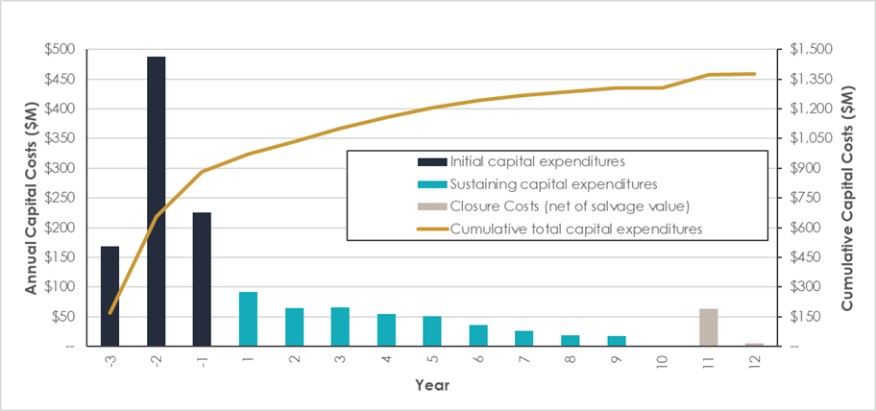
Operating Costs
The operating cost estimate was based on multiple sources, such as budget quotations, in-house data, and ODV's projected salary chart. The operating cost expenditure ("OPEX") estimate is based on a combination of experience, reference projects, quotes, and budgetary quotes and factors appropriate for an FS study. The target accuracy of the operating costs is ±15%. No cost escalation or contingency has been included within the operating cost estimate.
The average operating cost over the 10-year mine life is estimated to be $110.7 per tonne mined. Total LOM and unit operating cost estimates are summarized and shown on a percentage basis in Table 7. Mining costs are presented inclusive of costs related to the paste fill binder costs (i.e., underground). Processing costs are presented inclusive of the surface paste fill plant operating costs (i.e., surface).
Page C-34 |
|
Table 7: Total Operating Cost Breakdown
Area | Cost Area Description(1) | LOM unit cost ($/t processed) | LOM | Annual average cost | Average LOM | OPEX |
|---|---|---|---|---|---|---|
200 | Underground mining | 62.3 | 1,080 | 98 | 570 | 56 |
300 | Water and waste management | 5.0 | 86 | 8 | 45 | 4 |
400 | Electrical transmission line | 4.9 | 86 | 8 | 45 | 4 |
600 | Processing | 23.2 | 403 | 37 | 213 | 21 |
800 | General and administration | 15.4 | 266 | 24 | 141 | 14 |
| Total | 110.7 | 1,921 | 175 | 1,014 | 100% |
Note:
(1) | Underground mining, Water and Waste Management, Processing and G&A operating cost do not include a portion of the expenditures which have been capitalized – refer to Section 21.1.4.10 of the Cariboo Technical Report. |
It is anticipated that 525 employees (staff and labour) will be required during the peak of operations. Table 8 provides a summary of labour in all areas.
Table 8: Summary of Maximum Personnel Per Phase
Area | Activity | Construction | LOM |
|---|---|---|---|
| Mine administration | 13 | 15 |
| Logistics | 4 | 4 |
General and administration | Finance | 9 | 10 |
| Information technology | 36 | 46 |
| Human resources | 35 | 37 |
| Subtotal | 97 | 112 |
| Staff and supervision | 16 | 16 |
Underground mine | Operations | 193 | 200 |
| Maintenance and services | 74 | 94 |
| Subtotal | 283 | 310 |
| Staff and supervision | 9 | 16 |
Process plant | Operations | 20 | 40 |
| Maintenance and services | 16 | 32 |
| Subtotal | 45 | 88 |
Water and waste management | Operations | 15 | 15 |
| Subtotal | 15 | 15 |
Construction | Construction Staff | 129 | 0 |
Total | | 613 | 525 |
Project Economics
The economic assessment of the Project was carried out using a discounted cash flow approach on a pre-tax and after-tax basis, based on consensus equity research on long-term commodity price projections in United States dollars and cost estimates in the currency in
Page C-35 |
|
which they are incurred. An exchange rate of USD 0.74 per CAD 1.00 was assumed to convert United States Dollar ("USD") projections and particular components of the capital cost estimates into Canadian Dollars ("CAD"). The base case gold price is USD 2,400 per ounce ("USD/oz"). No provision was made for the effects of inflation. Current Canadian tax regulations were applied to assess the corporate tax liabilities, while the most recent provincial regulations were applied to assess the BC mining and carbon tax liabilities.
The economic analysis presented in this section contains forward-looking information with regards to the Mineral Resource Estimates, commodity prices, exchange rates, proposed mine production plan, projected recovery rates, operating costs, construction costs, and project schedule. The results of the economic analysis are subject to several known and unknown risks, uncertainties, and other factors that may cause actual results to differ materially from those presented here. OR Royalties retains a 5.0% net smelter return royalty on the Project.
The input parameters used and results of the financial analysis are presented in Table 9 and the financial analysis summary is presented in Table 10.
The pre-tax base case financial model resulted in an internal rate of return ("IRR") of 26.5% and a net present value ("NPV") of $1,371.4M using a 5% discount rate. The pre-tax payback period after start of operations is 2.6 years. On an after-tax basis, the base case financial model resulted in an IRR of 22.1% and a NPV of $943.5M using a 5% discount rate. The after-tax payback period after start of operations is 2.8 years. The AISC including royalties over the LOM are USD1,157/oz.
Table 9: Financial Analysis Assumptions
Description | Unit | Value |
|---|---|---|
Long Term Gold Price | USD/oz | 2,400 |
Exchange Rate | USD:CAD | 0.74 |
Discount Rate | % | 5.0 |
Mine Life | year | 10 |
Total Ore Mined | Mt | 17.8 |
Average Gold Grade | g/t | 3.62 |
Overall Gold Metallurgical Recovery | % | 92.6 |
Gold Recovered in Doré | koz | 884.0 |
Gold Recovered in Flotation Concentrate | koz | 1,033.5 |
Flotation Concentrate Produced | kt | 240.8 |
Underground Mining Operating Cost | $/t | 62.25 |
Processing Operating Cost | $/t | 23.21 |
Waste and Water Management Operating Cost | $/t | 4.97 |
Electrical Transmission Line Operating Cost | $/t | 4.93 |
General and Administrative Operating Cost | $/t | 15.36 |
Total Operating Cost | $/t | 110.73 |
Royalties | % NSR | 5.0 |
Initial Capital Cost | $M | 880.8 |
Sustaining Capital Cost | $M | 426.1 |
Reclamation Cost | $M | 134.8 |
Salvage Value | $M | -36.0 |
Page C-36 |
|
Table 10: Financial analysis results
Description | Unit | Value | |
| Net Present Value (0% discount rate) | $M | 2,216.1 |
| Net Present Value (5% discount rate) | $M | 1,371.4 |
Pre-tax | Internal Rate of Return | % | 26.5 |
| Simple Payback Period | year | 5.6 |
| Payback Period (after start of operations) | year | 2.6 |
| Net Present Value (0% discount rate) | $M | 1,577.4 |
| Net Present Value (5% discount rate) | $M | 943.5 |
After-tax | Internal Rate of Return | % | 22.1 |
| Simple Payback Period | year | 5.8 |
| Payback Period (after start of operations) | year | 2.8 |
A financial sensitivity analysis was conducted on the Project's after tax NPV and IRR using the following variables: capital cost (pre-production and sustaining) operating costs, USD:CAD exchange rate, and the price of gold.
The graphical representations of the financial sensitivity analysis on NPV and IRR are depicted in Figure 2Figure 2Figure 2 and Figure 3. The sensitivity analysis reveals that the USD:CAD exchange rate and gold price have the most significant influence on both NPV and IRR compared to the other parameters, based on the range of values evaluated. After the USD:CAD exchange rates and gold price, NPV was most impacted by changes in operating costs and then, to a lesser extent, capital costs. After the USD:CAD exchange rate and gold price, the Project's IRR was most impacted by variations in capital costs and to a lesser extent, by the operating costs. Overall, the NPV of the Project is positive over the range of values used for the sensitivity analysis.
Figure 2: After-Tax Sensitivity Analysis – Net Present Value (NPV)
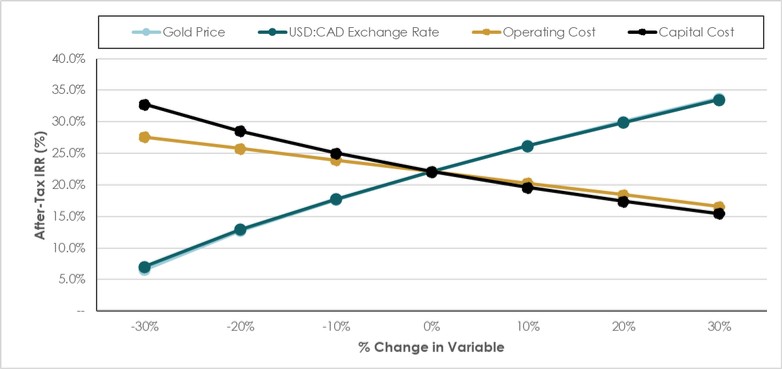
Page C-37 |
|
Figure 3: After-Tax Sensitivity Analysis – Internal Rate of Return (IRR)
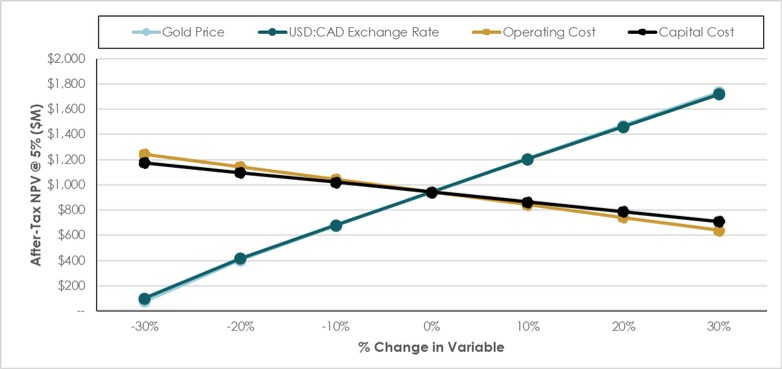
The Project will be developed by ODV. Construction activities have been broken out to be carried out prior to construction to support infrastructure upgrades allowing for water treatment and conveyance. Construction and pre-production will occur over a total of 30-months, commencing Q3 Year-3 with completion expected to be achieved Q2 Year-1. Final product of construction will be a 4,900 tpd concentrator building with supporting infrastructures producing gold flotation concentrate and doré, which will be transported to port to ship.
The Project's organization and construction execution philosophy benefits from certain existing facilities, expansion of the Ballarat camp, and experience gained with the current operations at the Bonanza Ledge site.
The Integrated Owner's Team has the personnel and experience to bring the Project from exploration through production. All upcoming Project activities, including detailed engineering, procurement, pre-production, and construction will be under the direction of the Vice-President Project Development of ODV.
Preconstruction activities allow for early works to be completed while utilizing the existing Ballarat camp infrastructure with a current capacity of 76 beds. Before construction ramps up, the camp will be expanded with additional dorm units increasing capacity to 264 beds.
The major Project activity milestones are presented in Table 10.
Table 10: Key Milestones
Activity | Date |
|---|---|
Main Construction Permits | COMPLETE |
Construction Start – Surface & Underground | 0 months |
Earthworks Completed | 10 months |
Process Plant Mill Building | 24 months |
Underground Crushing Completed | 24 months |
Page C-38 |
|
Activity | Date |
|---|---|
First Ore & Process Plant C3 | 24 months |
Full Production Reached | 34 months |
69 kV/138 kV Powerline | 19 months |
69 kV/138 kV Substation | 19 months |
Crusher Stations | 24 months |
First Production Stoping | 24 months |
Interpretations and Conclusions
The Cariboo Technical Report was prepared by BBA and other experienced consultants for ODV to demonstrate the economic viability of developing the Project resources as an underground mine, with a new processing plant facility at the MSC. The Cariboo Technical Report provides a summary of the results and findings from each major area of investigation. Standard industry practices, equipment, and processes were used. To date, the QPs are not aware of any unusual or significant risks or uncertainties that could materially affect the reliability or confidence in the Project based on the information available or as discussed in the Cariboo Technical Report.
The results of the Cariboo Technical Report indicate that the proposed Project has technical and financial merit using the base case assumptions. The QPs consider the Cariboo Technical Report results sufficiently reliable and recommend that the Project be advanced to next stage of development through the initiation of detailed engineering.
The following conclusions are based on the QPs detailed review of all pertinent information:
| ● | The results demonstrate the geological and grade continuities for all eight gold deposits in the Cow-Island-Barkerville Mountain Corridor. |
| ● | In underground scenario, the Project contains an estimated Measured Mineral Resource of 8,000 oz of gold, an Indicated Mineral Resource of 1,604,000 oz, and an Inferred Mineral Resource of 1,864,000 oz. These Mineral Resources are exclusive of the Reserves. |
| ● | The Mineral Resource Estimates have not been updated since the 2022 FS MRE as there has been no new drilling; however, there has been mining depletion for Lowhee and changes to the cut-off grade assumptions. |
| ● | The LOM has a 10-year mine life at maximum production rates of 4,900 tpd. Production ramps-up to steady state of 4,900 tpd is achieve by Q2 Year 1. |
| ● | The Project mine layout demonstrates a development intensive stope access requirement and therefore has a high development metre per tonne of mineralized material ratio. These factors may pose a challenge to successful implementation of the mine plan given the restrictive geotechnical parameters and intrinsically lower productivities of the mining method. However, through diligent planning and adherence to proper work procedures, sufficient active headings and stoping areas should meet daily production requirements. |
| ● | The Project process plant is designed with a comprehensive and integrated flowsheet that emphasizes efficiency, recovery, and environmental responsibility. From underground crushing to doré production, each stage of the process is engineered to maximize gold recovery while minimizing waste and environmental impact. The use of advanced ore sorting, gravity concentration, and flotation technologies ensures high recovery rates, while the paste backfill system supports sustainable tailings management. Based on the test work results and the proposed mining plan at the time, the overall projected Au recovery is 92.6%. |
| ● | Overall, the water infrastructure at the MSC and Bonanza Ledge areas supports the site's water management strategy and achieves the following objectives: |
Page C-39 |
|
| ● | WTP configurations account for highly variable seasonal flows, challenging influent chemistry (including metals and nitrogen species), and resilience to extreme cold and storm events. Features such as redundant pumping, heat tracing, storage capacity, and process flexibility are built into both facilities to ensure compliance and continuity of operations. The water treatment strategy is fully integrated with the broader site water management system, and key performance objectives include meeting provincial discharge limits, minimizing reagent usage, and ensuring long-term environmental protection during post-closure monitoring and care. |
| ● | The environmental baseline work completed to date, in addition to ongoing environmental monitoring requirements in the EAC, Mines Act Permit, and Environmental Management Act Permits, is sufficient to support this FS update. |
| ● | The information and assumptions used in the design of the MSC, and Bonanza Ledge are sufficient to support a FS. Further work is underway and recommended to support subsequent detailed engineering phase. |
| ● | The total capital costs (initial and sustaining) for the Project were estimated at $1,406M, and the average operating costs over the 10-year mine life is estimated to be $110.7/t mined. The AISC including royalties over the LOM are USD $1,157/oz. |
| ● | The financial analysis performed as part of this revised FS using the base case assumptions results in an after-tax NPV 5% of $943M and an internal rate of return of 22.1% (base case exchange rate of 0.74 CAD for 1.00 USD). The average base case LOM free cash flow of $158M and the payback period after start of commercial production is 2.8 years. |
The QPs consider the FS to be reliable, thorough, based on quality data, reasonable hypotheses, and parameters compliant with NI 43-101 requirements and CIM Definition Standards.
An analysis of the results of the investigations has identified a series of risks and opportunities associated with each of the technical aspects considered for the development of the Cariboo Gold Project.
Potential Risks
The most significant potential risks associated with the Cariboo Gold Project are:
| ● | The planned daily mining production rate may be difficult to achieve due to geological continuity issues, geotechnical issues, possible interaction of equipment, automation constraints, and other potential slowdowns resulting in a longer mining cycle time; |
| ● | Risks related to paste backfill, including: |
| ● | Ground conditions may be worse than anticipated, leading to dilution, lower grades, and delays; |
| ● | Greater water inflow than anticipated leading to an increase in water pumping and treatment capital and operational costs; |
| ● | The underground mine water quality is not represented by groundwater samples collected from deep mine workings, and then the influent predictions may not be representative, and the water treatment design may need to be re-evaluated; |
| ● | The ore sorter mass pull is lower than the design value. The amount of ore sorter waste sent to underground will then increase, requiring increased use of void space, leading to the requirement to drop the overall recovery; |
Page C-40 |
|
| ● | Ammonia and Nitrate concentration fluctuations for the WTP causing potential starvation of the biological community in the MBBR; |
| ● | The inability to locate an appropriate borrow source for aggregate material near the Mine Site could increase the construction cost and environmental impact of the Project due to transporting the material over a greater distance; |
| ● | Risk of load exceeding the allowance, mitigated by power factor correction and scalable distribution equipment; |
| ● | Schedule risk related to amended permit- changes proposed to the project will require amendments to existing certificates and permits. Timelines for regulatory processes may be lengthy and could impact construction and operational schedule targets. Several of the previous noted risks are common to most mining projects, many of which may be mitigated, at least to some degree, with adequate engineering, planning, and pro-active management. |
Key Opportunities
There are several opportunities that could improve the economics, timing, and/or permitting potential of the Cariboo Gold Project. The key opportunities that have been identified at this time are as follows:
| ● | Surface and underground definition diamond drilling resulting in potential to upgrade Inferred resources to the indicated category; |
| ● | The planned processing plant and surface infrastructure design have been strategically optimized to accommodate potential future expansion options. |
| ● | Assessing the economic viability of extracting ore from geotechnical Class 5 category using a selective mining method, such as cut-and-fill leading to increase in Project value; |
| ● | Dispose of rougher flotation tailings co-mingled with the ore sorter and development waste on surface increasing flexibility and recovery; |
| ● | Addition of a step-up substation to allow the transmission line to expand to 138 kV to access more load for potential expansion; |
| ● | Opportunity to blend contract for scopes of similar disciplines of work in the request for proposal process. |
Based on the results of the 2025 FS, the QPs recommend that the Project move to an advanced phase of development, which would involve detailed engineering and that Project execution activities commence at ODV's discretion to ensure construction readiness.
It is also recommended that ODV do additional work on the regional and local exploration to define potential expansions to the project footprint, and covert internal inferred resources to extend LOM. The proposed work budget includes regional surface drilling and local infill drilling from underground. The budget amounts to approximately $55M.
In summary, the QPs recommend that ODV executes the work planned as outlined below, which includes, but is not limited to:
| ● | The detailed engineering and construction schedule including the purchase of long lead time equipment, advance various construction readiness activities; |
| ● | Undertake exploration drilling with the objective of converting Inferred Mineral Resources within and around the mine area to Mineral Reserves; |
| ● | Define additional potential Mineral Reserves that could feed into the current or expanded mineral processing facilities; |
Page C-41 |
|
| ● | Detail mine planning, characterization and testing related to paste flow loop, as well as early supplier engagement; |
| ● | Perform additional test work will support a more comprehensive understanding of the lithological influence on metallurgical performance; |
| ● | Conduct a sensitivity analysis for parameters of concern for water quality/balance and reduce uncertainty related to inputs for parameters of concern, if possible; |
| ● | Commence with preparation for surface infrastructure. |
A work program budget summarized in Table 11 has been developed based on the Project needs and the QP's recommendations described above. The work program includes additional and included activities to advance the Project through detail engineering and construction.
Additional and full recommendations and further details on those can be found in Chapter 26 of the Cariboo Technical Report.
Table 11: Work Program Budget
Cost Estimate ($000s) | |
|---|---|
Use of Proceeds | |
Drilling & Geology | |
Regional Exploration Drilling - Proserpine (12,900 m) Regional Exploration Drilling - Cariboo Hudson (10,000 m) Regional Exploration Drilling - Yanks Peak (6,300 m) Underground Infill Drilling (100,000 m) | 6,500 5,000 3,000 30,000 |
Drilling & Geology Total | 45,000 |
Mine Design & Geotechnical | |
Underground Major Infrastructure Detailed Geotechnical Characterization Site Specific In Situ Stress Measurements Crown Pillar Definition Detailed Construction Mine Plan Detailed Underground Infrastructure Engineering Supplier Engagement Underground Crushing and Material Handling Detail Engineering and Modelling Paste Mixture Flow Loop Testing | 250 50 150 350 500 15 350 50 |
Mine Design & Geotechnical Total | 1,715 |
Mineral Processing & Metallurgy | |
Variability Testing Fines Testing Full Process Pilot Equipment Specific Testing Paste USC Testing | 800 100 500 200 100 |
Mineral Processing & Metallurgy Total | 1,700 |
Water Balance & Water Quality | |
EDF Management Planning Hydrogeological Model Calibration Expanded Water Balance Model | 50 250 350 25 200 |
Page C-42 |
|
Cost Estimate ($000s) | |
|---|---|
Mine Pool Characterization Add Discharge Nodes, Calibrate and Add Sensitivities to the Model | |
Water Balance & Water Quality Total | 875 |
Surface Infrastructure | |
MSC Access Road Testing and Engineering MSC Site Preparation Bonanza Ledge WRSF MSC Foundation Surface Water Management Detail Engineering MSC Sediment Pond Construction Housing MSC WTP Detail Engineering and Pilot Testing Power Supply Engineering and Permitting | 150 50 150 50 250 350 25 4,500 700 |
Surface Infrastructure Total | 6,225 |
Environment and Permitting | |
Permitting Change Assessment | 250 |
Environment & Permitting Total | 250 |
Total | 55,765 |
Page C-43 |
|