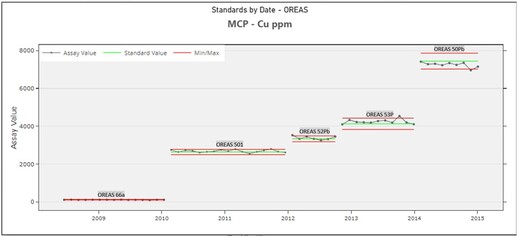
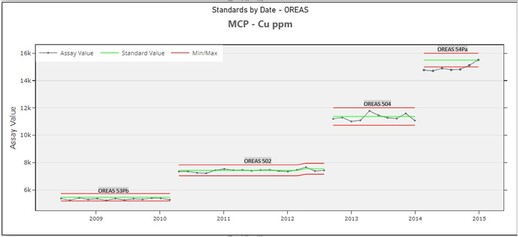
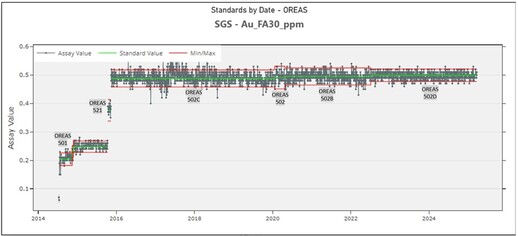
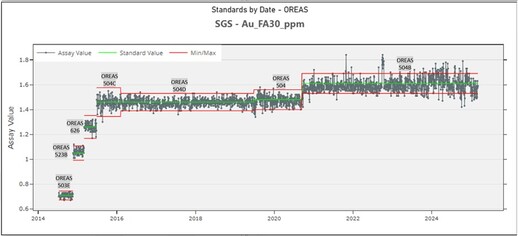
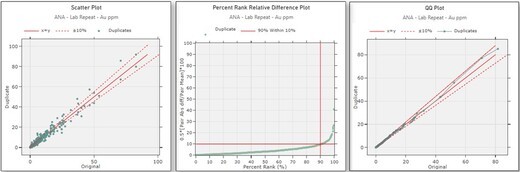
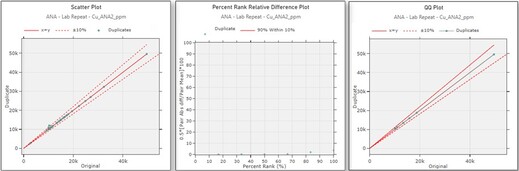
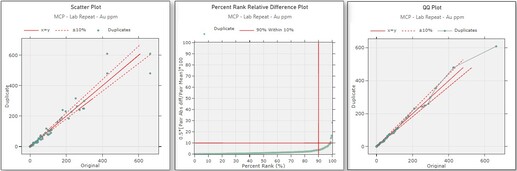
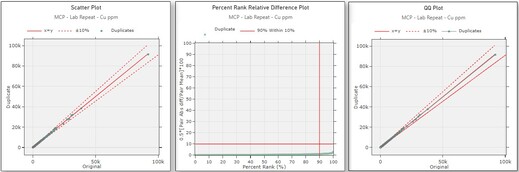
| | | | | |
NI 43-101 Technical Report – Didipio Mine, Luzon, Philippines |
|
|
Forward-Looking Information
This report contains certain “forward-looking statements” and “forward-looking information” (collectively, “forward-looking statements”) within the meaning of applicable Canadian securities laws which may include, but is not limited to, statements with respect to: future financial and operating performance; cash flow forecasts; projected capital, operating and exploration expenditures; targeted cost reductions; mine life and production rates; potential mineralization and metal or mineral recoveries; information pertaining to potential improvements to financial and operating performance and mine life at the Didipio Mine; future metals prices; the estimation of Mineral Reserves and Mineral Resources; the realization of Mineral Reserves and Mineral Resources estimates; costs of production; costs and timing of the development of new deposits; costs and timing of future exploration and drilling programs; timing of filing of updated technical information; requirements for additional capital; governmental regulation of mining operations and exploration operations; timing and receipt of approvals; consents and permits under applicable legislation; environmental risks; title disputes or claims; and the timing and possible outcome of current and pending litigation and regulatory matters. All statements in this report that address events or developments that OceanaGold Corporation (“OceanaGold”) expects to occur in the future are forward-looking statements. Forward-looking statements are statements that are not historical facts and are generally, although not always, identified by words such as “may”, “plans”, “expects”, “projects”, “is expected”, “scheduled”, “potential”, “estimates”, “forecasts”, “intends”, “targets”, “aims”, “anticipates” or “believes” or variations (including negative variations) of such words and phrases, or may be identified by statements to the effect that certain actions, events or results “may”, “could”, “would”, “should”, “might” or “will” be taken, occur or be achieved.
Forward-looking statements involve known and unknown risks, uncertainties and other factors which may cause OceanaGold’s actual results, performance or achievements to be materially different from any future results, performance or achievements expressed or implied by the forward-looking statements. Such risks include, among others: the risk of not achieving OceanaGold’s production estimates, forecasts or Guidance; inaccuracy of Mineral Reserves, Mineral Resources and operating and capital cost estimates; the actual results of current and future production, development and/or exploration activities; possible variations of ore grade, metallurgy or recovery rates; changes in mine plans, project parameters or assumptions as plans continue to be refined; delays in, or inability to complete, development or construction or expansion activities or to re-commence or sustain operations as planned; failures or underperformance of plant, equipment, infrastructure or processes; geotechnical risks or events, including open pit wall stability, crown pillar failure, land subsidence and tailings dam failures; challenges associated with effective water management; environmental, health and safety and climate-related risks; risks related to community acceptance, stakeholder engagement and social licence to operate; competition for mineral properties and other growth opportunities; legal and regulatory challenges to current and future permits, certifications, approvals or licences; adverse judicial, regulatory or governmental decisions; delays in, or inability to obtain, financing or governmental approvals on acceptable terms; changes in laws, regulations, taxation regimes, regulated accounting standards or their interpretation or application; the risks associated with operating in foreign jurisdictions, including political instability, changes in policy or law, civil unrest or conflict; fluctuations in the prices of gold, copper and silver; general business, economic and market conditions (including changes in global, national or regional financial, credit, currency or
| | | | | | | | | | | |
Released: 27 March 2026 | Page 2 of 234 | |
| | | | | |
NI 43-101 Technical Report – Didipio Mine, Luzon, Philippines |
|
|
securities markets); changes or developments in global, national or regional political and social conditions; fluctuations in foreign exchange rates, including the value of the U.S. dollar relative to the Canadian dollar, the New Zealand dollar or the Philippine peso; inflationary pressure; labour availability, retention and turnover; accidents, labour disputes and other operational risks of the mining industry; limitations of insurance coverage or uninsured risks; the conclusions of economic evaluations, studies and models; and those other factors identified and described in more detail in the section entitled “Risk Factors” contained in OceanaGold’s most recent Annual Information Form and OceanaGold’s other filings with Canadian securities regulators, which are available under OceanaGold’s profile on SEDAR+ at sedarplus.com and on OceanaGold’s website at oceanagold.com. The list is not exhaustive of the factors that may affect OceanaGold’s forward-looking statements.
OceanaGold’s forward-looking statements are based on the applicable assumptions and factors Management considers reasonable as of the date hereof, based on the information available to Management at such time. These assumptions and factors include, but are not limited to, assumptions and factors related to our ability to carry on current and future operations, including: exploration and development activities; the timing, extent, duration and economic viability of such operations; the accuracy and reliability of estimates, projections, forecasts, studies and assessments; our ability to meet or achieve guidance, estimates, projections and forecasts; the availability and cost of inputs; the price and market for outputs, including gold, copper and silver; foreign exchange rates; taxation levels; the timely receipt of necessary approvals, permits or certifications; the ability to meet current and future obligations; the ability to obtain timely financing on reasonable terms when required; the current and future social, economic and political conditions; and other assumptions and factors generally associated with the mining industry.
OceanaGold’s forward-looking statements are based on the opinions and estimates of OceanaGold management and reflect their current expectations regarding future events and operating performance and speak only as of the date hereof. OceanaGold does not assume any obligation to update forward-looking statements if circumstances or management’s beliefs, expectations or opinions should change other than as required by applicable law. There can be no assurance that forward-looking statements will prove to be accurate, and actual results, performance or achievements could differ materially from those expressed in, or implied by, these forward-looking statements. Accordingly, no assurance can be given that any events anticipated by the forward-looking statements will transpire or occur, or if any of them do, what benefits or liabilities OceanaGold will derive therefrom. For the reasons set forth above, undue reliance should not be placed on forward-looking statements.
| | | | | | | | | | | |
Released: 27 March 2026 | Page 3 of 234 | |
| | | | | |
NI 43-101 Technical Report – Didipio Mine, Luzon, Philippines |
|
|
Contents
| | | | | | | | | | | |
1 | Summary | 15 |
1.1 | Property Description, Location, Access and Ownership | 15 |
1.2 | History | 15 |
1.3 | Geological Setting, Mineralization and Deposit Types | 16 |
1.4 | Mineral Permits and Regulatory Matters | 16 |
1.5 | Exploration | 17 |
1.6 | Drilling | 18 |
1.7 | Sampling, Analysis and Data Verification | 18 |
1.8 | Mineral Processing and Metallurgical Testing | 19 |
1.9 | Mineral Resources Estimate | 20 |
1.10 | Mineral Reserves Estimate | 22 |
1.11 | Mining Method | 23 |
1.12 | Processing and Recovery Methods | 24 |
1.13 | Infrastructure | 25 |
1.14 | Environment Studies, Social Matters and Permitting | 25 |
1.15 | Capital and Operating Costs | 26 |
1.16 | Economic Analysis | 28 |
1.17 | Conclusions and Recommendations | 29 |
2 | Introduction | 32 |
2.1 | Terms of Reference | 32 |
2.2 | Sources of Information and Data | 32 |
2.3 | Qualified Persons | 32 |
2.4 | Site Visits and Scope of Personal Inspection | 33 |
2.5 | Units of Measure | 33 |
2.6 | Effective Date | 33 |
3 | Reliance On Other Experts | 34 |
4 | Property Description and Location | 35 |
4.1 | Property Location | 35 |
| | | | | | | | | | | |
Released: 27 March 2026 | Page 4 of 234 | |
| | | | | |
NI 43-101 Technical Report – Didipio Mine, Luzon, Philippines |
|
|
| | | | | | | | | | | |
4.2 | Mineral Tenure | 37 |
4.3 | Environmental Compliance Certificate and Partial Declaration of Mining Feasibility | 40 |
4.4 | Didipio Ownership Structure | 41 |
5 | Accessibility, Climate, Physiography, Local Resources, and Infrastructure | 43 |
5.1 | Topography, Elevation and Vegetation | 43 |
5.2 | Accessibility | 44 |
5.3 | Climate | 45 |
5.4 | Local Resources and Infrastructure | 47 |
6 | History | 50 |
6.1 | Prior Ownership | 50 |
6.2 | OceanaGold | 50 |
6.3 | Previous Work | 50 |
6.4 | Historical Estimates | 52 |
6.5 | Previous Production | 52 |
7 | Geological Setting and Mineralization | 53 |
7.1 | Regional Geology | 53 |
7.2 | Local Geology | 55 |
7.3 | Didipio Deposit Mineralization | 56 |
7.4 | Lithology | 57 |
8 | Deposit Types | 65 |
8.1 | Description of Deposits | 65 |
9 | Exploration | 67 |
9.1 | Pre-OceanaGold | 67 |
9.2 | OceanaGold | 67 |
10 | Drilling | 72 |
10.1 | Introduction | 72 |
10.2 | Drill Campaigns | 73 |
10.3 | Down Hole Surveying | 74 |
10.4 | Surface Grid | 74 |
10.5 | Underground Grid | 74 |
| | | | | | | | | | | |
Released: 27 March 2026 | Page 5 of 234 | |
| | | | | |
NI 43-101 Technical Report – Didipio Mine, Luzon, Philippines |
|
|
| | | | | | | | | | | |
10.6 | Core Logging | 75 |
10.7 | Sampling Method and Analysis | 75 |
11 | Sample Preparation, Analyses, and Security | 77 |
11.1 | Sampling Methods and Preparation | 77 |
11.2 | Analytical Methods | 79 |
11.3 | Sample Security | 80 |
11.4 | Opinion on Adequacy (Security, Sample Preparation, Analysis) | 81 |
12 | Data Verification | 82 |
12.1 | Summary | 82 |
12.2 | CRM Standards | 83 |
12.3 | Blanks (SGS and McPhar-Intertek) | 88 |
12.4 | Laboratory Repeats – Analabs, SGS and McPhar-Intertek | 89 |
12.5 | Field Duplicates – Analabs, SGS and McPhar-Intertek | 91 |
13 | Mineral Processing and Metallurgical testing | 94 |
13.1 | Introduction | 94 |
13.2 | Ore Mineralogy | 94 |
13.3 | Historical Test Work Studies | 95 |
13.4 | 2024 – 2025 Didipio Underground Optimisation Test Work | 95 |
13.5 | Metallurgical Performance of the Process Plant | 107 |
13.6 | Forward Work Program | 109 |
14 | Mineral Resource Estimates | 110 |
14.1 | Introduction | 110 |
14.2 | Database Analysis | 110 |
14.3 | Mineral Deposit Model and Interpretation | 111 |
14.4 | Compositing | 113 |
14.5 | Top Capping | 114 |
14.6 | Variography | 114 |
14.7 | Block Model Dimensions | 116 |
14.8 | Estimation Strategy | 116 |
14.9 | In Situ Bulk Density Determinations | 116 |
| | | | | | | | | | | |
Released: 27 March 2026 | Page 6 of 234 | |
| | | | | |
NI 43-101 Technical Report – Didipio Mine, Luzon, Philippines |
|
|
| | | | | | | | | | | |
14.10 | Resource Classification | 117 |
14.11 | Model Validation | 117 |
14.12 | Reconciliation | 121 |
14.13 | Surface Stockpiles | 123 |
14.14 | Risks | 123 |
14.15 | Mineral Resource Statement | 123 |
15 | Mineral Reserve Estimates | 125 |
15.1 | Open-pit Stockpile Reserve Estimate | 125 |
15.2 | Underground Reserve Estimate | 125 |
15.3 | Mineral Reserve Statement | 126 |
16 | Mining Methods | 128 |
16.1 | Status of Current Underground Mine Development | 128 |
16.2 | Cut-off Grade Strategy | 129 |
16.3 | Geotechnical – Open-Pit | 130 |
16.4 | Geotechnical – Underground | 132 |
16.5 | Mine Dewatering and Hydrogeology | 139 |
16.6 | Mine Design | 146 |
16.7 | Productivities and Mine Production Schedule | 152 |
16.8 | Ventilation | 155 |
16.9 | Pastefill | 157 |
16.10 | Emergency Preparedness | 160 |
16.11 | Mine Services | 160 |
16.12 | Underground Electrical Distribution | 160 |
16.13 | Mobile Equipment | 161 |
16.14 | Underground Production Schedule | 161 |
17 | Recovery Methods | 165 |
17.1 | Introduction | 165 |
17.2 | Process Flowsheet | 165 |
17.3 | Process Plant Facilities, Description and Design Characteristics | 166 |
17.4 | Production Performance | 171 |
| | | | | | | | | | | |
Released: 27 March 2026 | Page 7 of 234 | |
| | | | | |
NI 43-101 Technical Report – Didipio Mine, Luzon, Philippines |
|
|
| | | | | | | | | | | |
17.5 | Energy, Water and Consumable Requirements | 174 |
17.6 | Process Unit Costs | 175 |
17.7 | Future Development Projects | 176 |
18 | Project Infrastructure | 180 |
18.1 | Clean Water | 180 |
18.2 | Power Supply | 180 |
18.3 | Sewage | 180 |
18.4 | Refuse Disposal | 180 |
18.5 | Accommodation | 181 |
18.6 | Port Facilities | 181 |
18.7 | Paste Plant | 181 |
18.8 | Tailings Storage Facility (TSF) | 182 |
19 | Market Studies and Contracts | 185 |
19.1 | Mining | 185 |
19.2 | Processing | 185 |
19.3 | Gold Hedging and Forward Sales | 185 |
19.4 | Transportation and Refining of Bullion | 185 |
19.5 | Transportation and Refining of Concentrate | 186 |
19.6 | Power | 186 |
19.7 | Fuel | 187 |
19.8 | Supply of Explosives | 187 |
19.9 | Project Financing | 187 |
19.10 | Other | 187 |
20 | Environmental Studies, Permitting, and Social or Community Impact | 188 |
20.1 | Permitting | 188 |
20.2 | Environmental Performance | 192 |
20.3 | Site Monitoring | 196 |
20.4 | Community Development | 196 |
20.5 | Mine Closure | 198 |
21 | Capital and Operating Costs | 199 |
| | | | | | | | | | | |
Released: 27 March 2026 | Page 8 of 234 | |
| | | | | |
NI 43-101 Technical Report – Didipio Mine, Luzon, Philippines |
|
|
| | | | | | | | | | | |
21.1 | Capital Expenditure Estimates | 199 |
21.2 | Operating Costs | 200 |
22 | Economic Analysis | 205 |
22.1 | Principal Assumptions and Input Parameters | 205 |
22.2 | Taxes, Royalties and Other Interests | 205 |
22.3 | Pricing Model Results - Reserves Case | 207 |
22.4 | Sensitivity Analysis - Reserve Case | 210 |
22.5 | Pricing Model Results - Alternative Case | 211 |
23 | Adjacent Properties | 213 |
24 | Other Relevant Data and Information | 214 |
25 | Interpretation and Conclusion | 215 |
25.1 | Geology and Mineralization | 215 |
25.2 | Resource Geology | 215 |
25.3 | Status of Exploration, Development and Operations | 216 |
25.4 | Geotechnical, Hydrology, Mining Reserves | 217 |
25.5 | Mineral Processing, and Water Treatment | 217 |
25.6 | Project Infrastructure | 217 |
25.7 | Mineral Tenure, Surface Rights, Royalties, Environment, Social and Permits | 218 |
25.8 | Economic Analysis | 218 |
26 | Recommendations | 219 |
27 | References | 220 |
28 | Glossary | 223 |
| | | | | | | | | | | |
Released: 27 March 2026 | Page 9 of 234 | |
| | | | | |
NI 43-101 Technical Report – Didipio Mine, Luzon, Philippines |
|
|
Tables
| | | | | |
Table 1-1: Didipio Measured, Indicated and Inferred Mineral Resources as at December 31, 2025 | 21 |
Table 1-2: Didipio Proven and Probable Reserves as at December 31, 2025 | 22 |
Table 1-3: Didipio Underground Mining Physicals | 24 |
Table 1-4: Didipio Processing Summary | 25 |
Table 1-5: Operating Cost Summary ($M and $/t) | 27 |
Table 1-6: Underground Capital Cost | 27 |
Table 1-7: Surface and Other Capital Costs | 27 |
Table 1-8: Metal Price Assumptions | 28 |
Table 1-9: LoM Post-Tax Financial Results | 29 |
Table 2-1: Qualified Persons Responsible for Technical Report Preparation | 32 |
Table 5-1: Didipio Average Monthly Rainfall (mm) | 46 |
Table 9-1: Summary of FTAA Exploration (exclusive of mine development work) at Didipio | 69 |
Table 10-1: Underground Grid Coordinate System | 75 |
Table 11-1: Didipio Sample Preparation | 77 |
Table 12-1: Resource Estimate Assays by Laboratory | 82 |
Table 12-2: QA/QC Material Statistics for Didipio Underground Resource Estimate | 82 |
Table 12-3: Laboratory Repeats | 89 |
Table 12-4: Field Duplicates | 91 |
Table 13-1: Measured Grinding Results | 96 |
Table 13-2: Other Measured Grinding Results | 98 |
Table 13-3: Measured Grinding Results from 2016 Samples | 98 |
Table 13-4: Measured Grinding Results from 2016 Samples - Bond Mill Data | 98 |
Table 13-5: Gravity Test Work of Future Ore | 99 |
Table 13-6: Bingo Charts for Didipio UG Panels 1, 2 and 3 | 102 |
Table 13-7: Panel 1 Head Grades | 103 |
Table 13-8: Panel 2 Head Grades | 104 |
Table 13-9: Panel 3 Head Grades | 104 |
Table 13-10: Comminution Test Results | 105 |
Table 13-11: Panels 1-3 Recovery Test Results | 105 |
Table 14-1: Holes and Channels Utilized for Resource Estimation | 109 |
| | | | | | | | | | | |
Released: 27 March 2026 | Page 10 of 234 | |
| | | | | |
NI 43-101 Technical Report – Didipio Mine, Luzon, Philippines |
|
|
| | | | | |
Table 14-2: Basic Statistics for 3m Composites (by Domain) Length Weighted | 113 |
Table 14-3: Top Capping 3m Composites (By Domain) Length Weighted | 113 |
Table 14-4: Variogram Parameters (By Estimation Domain) | 114 |
Table 14-5: Search Parameter (By Estimation Domain) | 114 |
Table 14-6: Block Model Limits | 115 |
Table 14-7: Assigned Lithological Bulk Density Values | 116 |
Table 14-8: Statistical Comparison DDH Composites vs Mineral Resource Model by Domain | 117 |
Table 14-9: Underground Resource Model vs Mill Adjusted Mine | 121 |
Table 14-10: Didipio Measured, Indicated and Inferred Resources as at December 31, 2025 . | 123 |
Table 15-1: Ore Recovery and Dilution Parameters | 125 |
Table 15-2: Didipio Proven and Probable Reserves as at December 31, 2025 | 125 |
Table 16-1: Underground Mining Inventory By Panel | 128 |
Table 16-2: Breakeven Cut-off Grade Calculations | 128 |
Table 16-3: Surface Geotechnical Monitoring | 129 |
Table 16-4: Geomechanical Laboratory Testing | 132 |
Table 16-5: Geotechnical Domain Summary | 134 |
Table 16-6: Rock Mass Quality Classifications | 135 |
Table 16-7: Underground Modifying Factors | 146 |
Table 16-8: Lateral Development Profiles | 148 |
Table 16-9: Schedule Productivity Rates | 150 |
Table 16-10: LoM Mobile Equipment Fleet | 159 |
Table 16-11: Annual Production Profile | 162 |
Table 17-1: Consumable Consumption Rates | 174 |
Table 18-1: Didipio Tailings Storage Plan | 183 |
Table 21-1: Underground Capital Costs | 200 |
Table 21-2: Surface and Other Capital Costs | 201 |
Table 21-3: Operating Cost Summary (Excluding Selling Costs) | 201 |
Table 21-4: Surface Operating Cost Breakdown | 202 |
Table 21-5: Underground Operating Cost Breakdown | 202 |
Table 21-6: Processing Operating Cost Breakdown | 202 |
Table 21-7: General and Administration Cost Breakdown | 203 |
Table 21-8: Payable Product Sales Assumptions | 203 |
| | | | | | | | | | | |
Released: 27 March 2026 | Page 11 of 234 | |
| | | | | |
NI 43-101 Technical Report – Didipio Mine, Luzon, Philippines |
|
|
| | | | | |
Table 21-9: Transport & Refining Charges | 204 |
Table 21 10: Indirect Cost Summary | 204 |
Table 22 1: Metal Price Assumptions | 205 |
Table 22 2: Calculation Methodology for Additional Government Share | 207 |
Table 22-3: Financial Performance Summary (Reserve Case) | 209 |
Table 22-4: LoM Post-tax Economic Financial Metrics (Alternative Price Case) | 212 |
Figures
| | | | | |
Figure 4-1: Location Map Didipio Gold Mine | 35 |
Figure 4-2: FTAA Boundaries and Provincial Boundaries | 36 |
Figure 4-3: FTAA Boundaries | 37 |
Figure 4-4: Didipio Mine Ownership Structure | 42 |
Figure 5-1: Didipio Location Map (Not to Scale) | 44 |
Figure 5-2: Modified Corona's Classification of the Philippines | 45 |
Figure 5-3: Average Monthly Rainfall for Didipio (mm) | 46 |
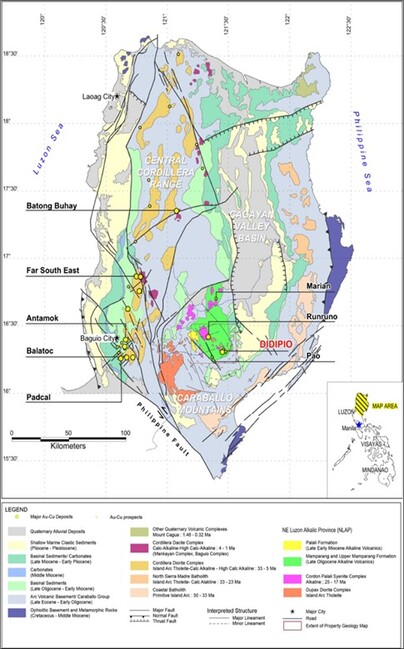
Figure 7-1: Regional Geology and Structures Northern Luzon Island | 53 |
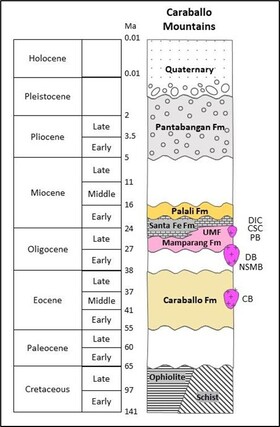
Figure 7-2: Regional Stratigraphy Caraballo Mountains | 54 |
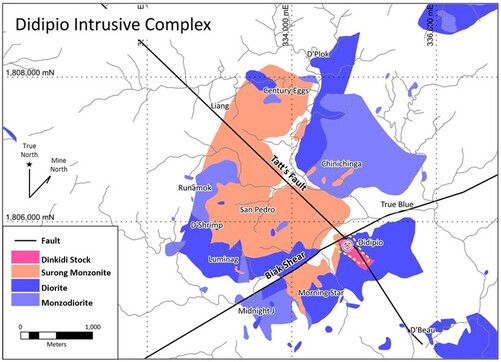
Figure 7-3: Local Geology | 56 |
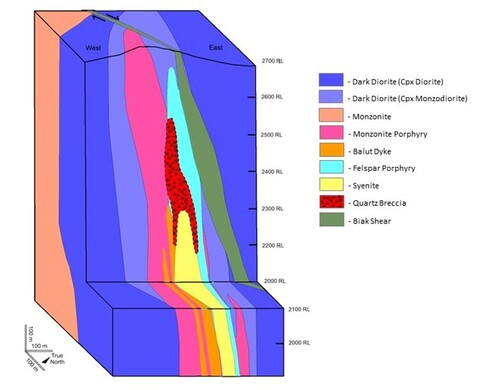
Figure 7-4: Didipio Geology 3D Block Cut Shown in Mine Grid | 58 |
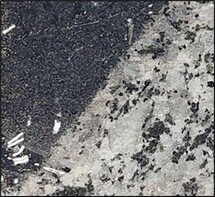
Figure 7-5: Dark Diorite (Left) with sharp Monzonite contact (Right) | 59 |
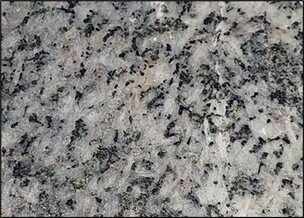
Figure 7-6: Hornblende bearing Monzonite | 59 |
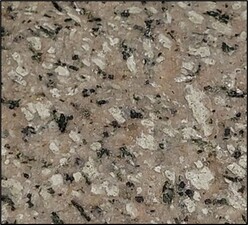
Figure 7-7: Monzonite Porphyry | 60 |
Figure 7-8: Balut Dyke Mafic Facies | 61 |
Figure 7-9: Feldspar Porphyry | 61 |
Figure 7-10: Syenite Porphyry | 62 |
Figure 7-11: Variety of Breccia at Didipio | 63 |
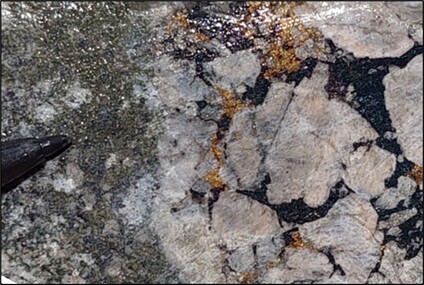
Figure 7-12: Monzonite Porphyry Intrusions Breccia (left) & Feldspar Porphyry Igneous Breccia (Right) | 64 |
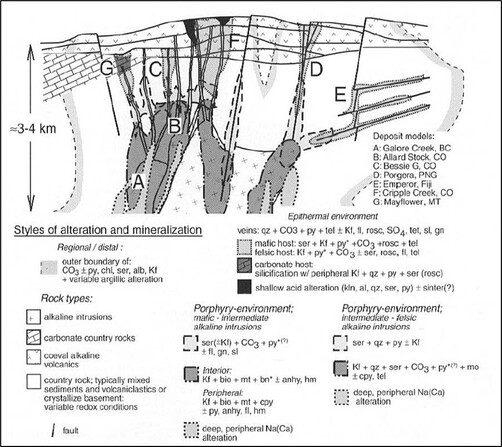
Figure 8-1: Schematic Illustration - Relationships Between Rock types | 66 |
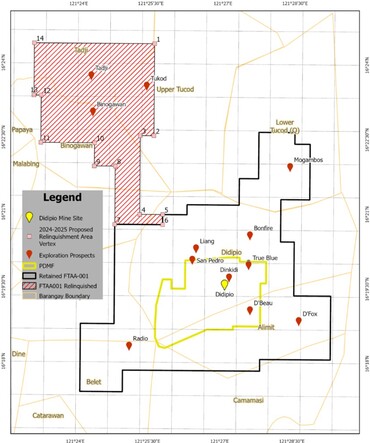
Figure 9-1: Prospect Locations within the FTAA | 69 |
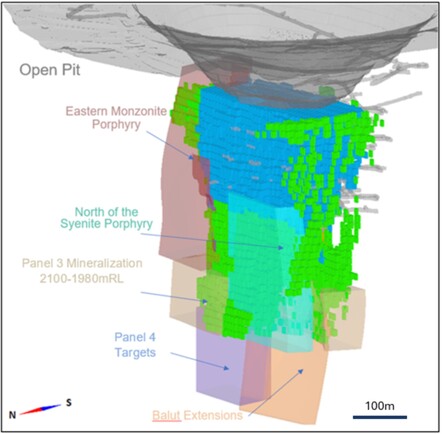
Figure 9-2: Didipio Underground With Exploration Targets | 71 |
| | | | | | | | | | | |
Released: 27 March 2026 | Page 12 of 234 | |
| | | | | |
NI 43-101 Technical Report – Didipio Mine, Luzon, Philippines |
|
|
| | | | | |
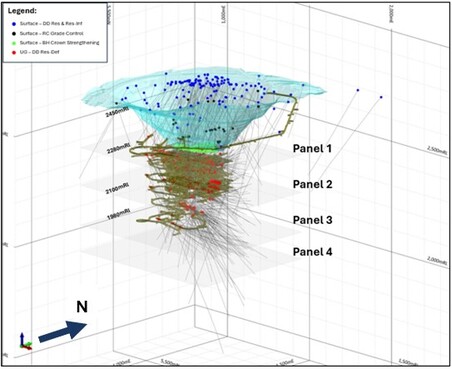
Figure 10-1: Oblique View - Didipio Underground Drilling | 72 |
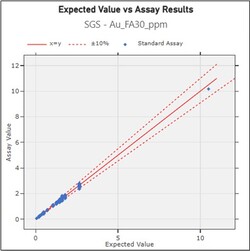
Figure 12-1: Gold (g/t Au) Standards - SGS | 83 |
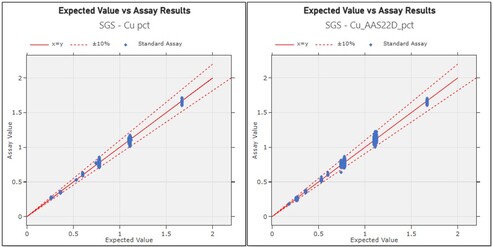
Figure 12 2: Copper (% Cu) XRF - Left, % CU AAS - (Right) Standards – SGS | 83 |
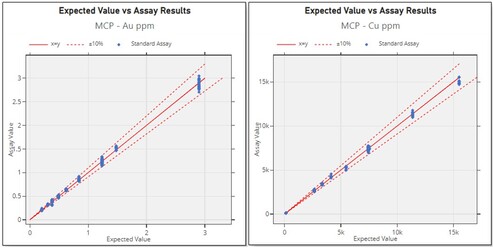
Figure 12 3: Gold (g/t Au) and Copper (% Cu) Standards - McPhar-Intertek | 84 |
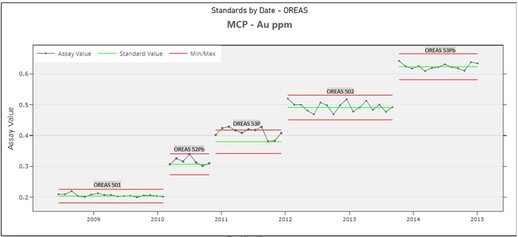
Figure 12 4: Au Standards - McPhar-Intertek (9 Standards Used – 2 Charts) | 85 |
Figure 12-5: Cu Standards - McPhar-Intertek (9 Standards Used – 2 Charts) | 85 |
Figure 12-6: Au Standard – SGS (Shown Over 2 Charts) | 86 |
Figure 12-7: Cu Standard – SGS | 87 |
Figure 12-8: Blanks for Au and Cu - McPhar Intertek | 88 |
Figure 12-9: Standard Blank for Au and Cu – SGS | 88 |
Figure 12-10: Lab Repeat Metrics for Au and Cu (Analabs Laboratory) | 90 |
Figure 12-11: Lab Repeat Metrics for Au and Cu (McPhar-Intertek Laboratory) | 90 |
Figure 12-12: Lab Repeat Metrics for Au and Cu (SGS Laboratory) | 91 |
Figure 12-13: Field Duplicates for Cu and Au (Analabs Laboratory) | 92 |
Figure 12-14: Field Duplicates for Cu and Au (SGS Laboratory) | 92 |
Figure 13-1: Metallurgical Samples Collected June 2011 | 95 |
Figure 13-2: Metallurgical Samples Collected October 2011 | 95 |
Figure 13-3: Relative Copper Recovery Change (With and Without CPS Compared to Fresh Ore) | 100 |
Figure 13-4: Didipio Gold Recovery vs Model | 107 |
Figure 13-5: Didipio Copper Recovery vs Model | 107 |
Figure 14-1: Oblique View (Looking NE) of Didipio Intrusions | 110 |
Figure 14-2: Au Mineralized Domains (AUDOM 1 and 2) | 112 |
Figure 14-3: Section 1370 m E of Block Model, looking west | 118 |
Figure 14-4: Swath Plot (audom 1) | 119 |
Figure 14-5: Swath Plot (cudom 1) | 119 |
Figure 16-1: Didipio Underground – Oblique view Looking North- West | 127 |
Figure 16-2: Section View of CSP (Looking East) | 131 |
Figure 16-3: Didipio Faults - Plan View | 133 |
Figure 16-4: Didipio Geotechnical Domains (Plan View: 2280-2430 mRL) | 134 |
Figure 16-5: Didipio Geotechnical Domains (Plan View: 2280 mRL and below) | 135 |
Figure 16-6: Underground Dewatering Strategy Schematic | 140 |
Figure 16-7: Didipio Dewatering Schematic | 141 |
| | | | | | | | | | | |
Released: 27 March 2026 | Page 13 of 234 | |
| | | | | |
NI 43-101 Technical Report – Didipio Mine, Luzon, Philippines |
|
|
| | | | | |
Figure 16-8: CPS1 Layout | 142 |
Figure 16-9: CPS1 System Flow Sheet | 143 |
Figure 16 10: 2026 In-Pit Dewatering Set-Up | 143 |
Figure 16 11: 2025 Modelled Flows with Proposed Underground Borefield | 145 |
Figure 16 12: Plan View - Didipio Underground Level Layout (2100 mRL Level Plan View) | 147 |
Figure 16-13: 2370 Level Plan View | 149 |
Figure 16-14: Oblique View Looking South-East of Reconfigured Breccia Mine Design (2430 to 2340 Levels) | 150 |
Figure 16-15: Underground Sequence By Year - Section Looking North-West | 152 |
Figure 16-16: Ventsim Model - Primary Ventilation Upgrades | 154 |
Figure 16-17: Planned Level Ventilation Layout | 155 |
Figure 16-18: Didipio Paste Plant | 156 |
Figure 16-19: Underground Pastefill Reticulation | 156 |
Figure 16-20: Basic Schematic of Proposed BH04 Primary Borehole | 157 |
Figure 16-21: Annual Underground Production – Gold | 159 |
Figure 16-22: Annual Underground Production – Copper | 160 |
Figure 16-23: Processing Production Profile – Gold | 161 |
Figure 16-24: Processing Production Profile – Copper | 161 |
Figure 17-1: Process Plant Flowsheet 2025 | 164 |
Figure 17-2: Process Plant Throughput 2012 – 2025 | 170 |
Figure 17-3: Annual Didipio Concentrate Production Data | 171 |
Figure 17-4: Annual Gold and Copper Recovery Data | 172 |
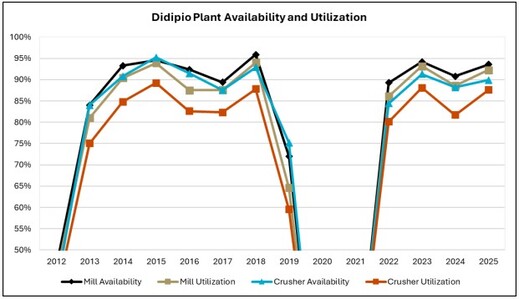
Figure 17-5: Annual Plant Availability and Utilisation | 173 |
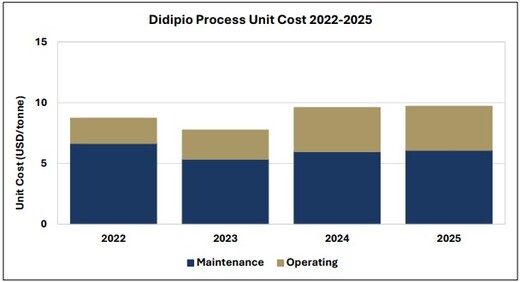
Figure 17-6: Processing Plant Unit Cost Performance | 175 |
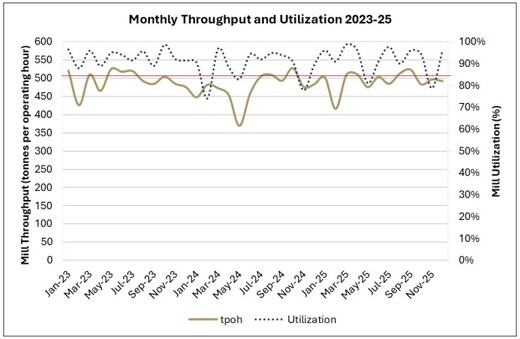
Figure 17-7: Historic Throughput and Utilisation | 176 |
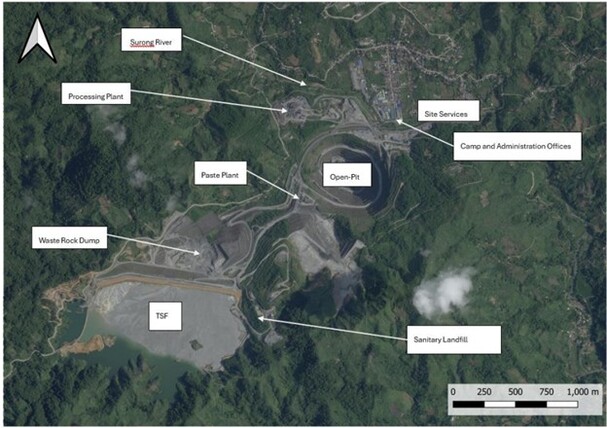
Figure 18-1: Didipio Site Plan with Major Surface Infrastructure Including TSF | 182 |
Figure 18-2: LoM Storage Requirements and Scheduled TSF Development | 183 |
Figure 22-1: Post-Tax Metrics (Reserve Case) | 208 |
Figure 22-2: After Tax NPV Sensitivity Analysis | 210 |
Figure 22-3: Metal Price Sensitivity Analysis | 211 |
| | | | | | | | | | | |
Released: 27 March 2026 | Page 14 of 234 | |
| | | | | |
NI 43-101 Technical Report – Didipio Mine, Luzon, Philippines |
|
|
1Summary
OceanaGold Corporation (OceanaGold) has prepared this National Instrument 43-101 (NI43-101) Technical Report (Technical Report) on the Didipio Mine to support disclosures in OceanaGold’s Annual Information Form for the year ended December 31, 2025.
This report includes both underground mining and open-pit stockpile components and an economic analysis based on Mineral Reserves only. Underground mining components include material from Panels 1, 2 and 3 including a Pre-Feasibility Study (PFS) to support increased throughput from the underground mine.
1.1Property Description, Location, Access and Ownership
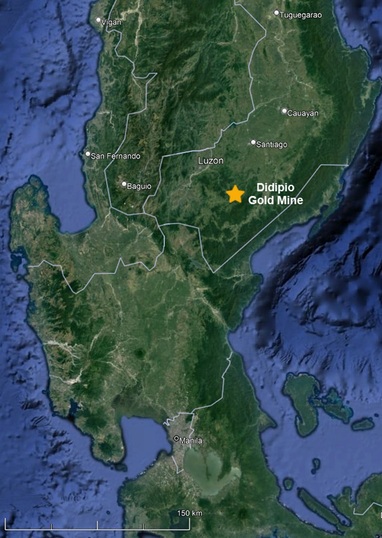
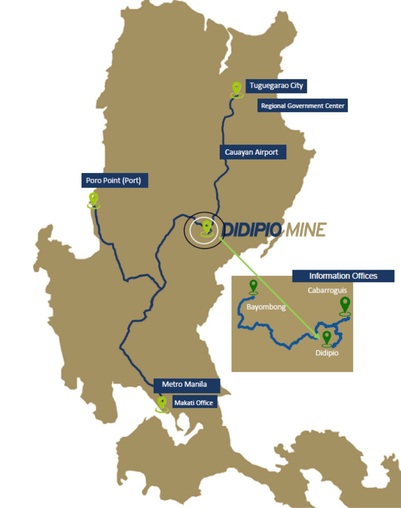
The Didipio Mine is located in the north of Luzon Island approximately 270 kilometres (km) NNE of Manila, in the Republic of the Philippines. The nearest significant towns are Cabarroguis, in the Province of Quirino, located approximately 20 km to the north, and Kasibu, in the Province of Nueva Vizcaya, approximately 18 km to the west.
There are two alternative routes connecting the Didipio Mine by road to the port facilities at Manila and Poro Point, La Union. The main route, approaching from the north via the Municipality of Cabarroguis, is an all-weather route suitable for heavy trucks and bulk freight. The secondary access, approaching from the South via the Municipality of Kasibu, is also an all-weather route and is suitable for smaller trucks and light vehicles.
The Didipio Mine is covered by Financial or Technical Assistance Agreement No. 001 (FTAA) entered between the Republic of the Philippines and Climax Arimco Mining Corporation (CAMC) on June 20, 1994. The FTAA was subsequently assigned by CAMC to Australasian Philippines Mining Inc (APMI), which was then renamed to OceanaGold (Philippines) Inc. (OGPI).
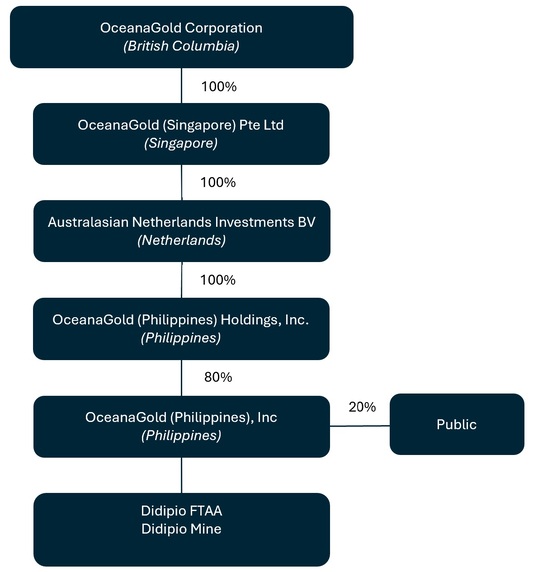
Following the completion of an initial public offering of 20% of the issued and outstanding common shares in the capital of OGPI on The Philippine Stock Exchange, Inc. on May 13, 2024, OceanaGold holds an 80% interest in OGPI, which owns and operates the Didipio Mine.
1.2History
The Didipio area was first recognized as a gold province in the 1970’s, when alluvial gold deposits were discovered in the region. There had been no large-scale mining at Didipio at that time and there were no records of artisanal mining.
In May 1975, Victoria Consolidated Resources Corporation and Fil-Am Resources Inc. entered into an exploration agreement with a syndicate of claim owners who had title to an area covering the Didipio valley and undertook exploration activities, including a stream geochemistry program between 1975 and 1977. Marcopper Mining Corporation subsequently investigated the region in 1984, and Benguet Corporation examined the Didipio area in September 1985.
In April 1985, the Didipio area was explored by a consultant geologist engaged by local claim owner Mr. Jorge G. Gonzales, Sr. This was followed by further investigation by Geophilippines Inc. (GPI) in September 1987, after which GPI submitted mining lease applications in November 1987. In 1989, Cyprus Philippines Corporation (CPC) and subsequently Arimco NL (as Arimco Mining Corporation (AMC) in the Philippines) entered into an agreement with GPI and Mr. Gonzales to explore the
| | | | | | | | | | | |
Released: 27 March 2026 | Page 15 of 234 | |
| | | | | |
NI 43-101 Technical Report – Didipio Mine, Luzon, Philippines |
|
|
Didipio area. Between April 1989 and December 1991, an exploration program was carried out. Subsequently, Climax Mining Ltd (Climax) acquired control of AMC (later renamed to CAMC) and 100% of the interest of CPC in the Didipio Mine in 1992.
Prior to acquisition by OceanaGold, previous explorers had drilled a total of 230 diamond drill holes totalling 62,769 metres (m). The drilling metres were mostly for resource delineation of the Didipio porphyry gold-copper deposit, with a small percentage of drilling in nearby prospects.
1.3Geological Setting, Mineralization and Deposit Types
1.3.1Geology
The Didipio area is situated within the southern part of the meridional Cagayan Valley basin in north-eastern Luzon and is bounded on the east by the Sierra Madre Range, on the west by the Luzon Central Cordillera range and to the south by the Caraballo Mountains. The regional geology comprises late Miocene volcanic, volcanoclastic, intrusive and sedimentary rocks overlying a basement complex of pre-Tertiary age tonalite and schist, which have been interpreted to represent an island arc depositional and tectonic setting.
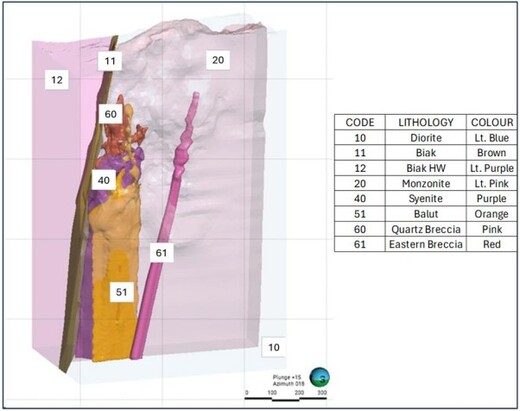
The Didipio deposit is hosted within the multiphase Didipio Stock, which is in turn part of a larger alkalic intrusive body, the Didipio Igneous Complex. The deposit is a gold-copper porphyry system, roughly elliptical in shape at surface (450 m long by 150 m wide) and with a vertical pipe-like geometry that extends to at least 800 m below the surface. The local geology comprises north-northwest trending, steeply east-dipping composite monzodiorite intrusive, in contact with volcaniclastics of the Mamparang Formation. The monzodiorite lies in a circular topographic depression that is coincident with a circular IP anomaly.
1.3.2Mineralization and Deposit Types
The mineralization is closely associated with a zone of potassic feldspar alteration, the extent of which is marked by the Didipio Ridge, approximately 400 m long and rising steeply to about 100 m above an area of river flats and undulating ground.
Chalcopyrite and gold, along with pyrite and magnetite, are the main metallic minerals in the deposit. Higher grade gold and copper mineralization is closely associated with the Balut Dykes and Quartz Breccia, both of which are elongated along the north-south trending, steeply north-east dipping Tatts Fault Zone.
The deposit was oxidized from the surface to a depth of between 15 m and 60 m, averaging 30 m. The oxide zone formed a blanket over the top of the deposit. A 5 to 15-m thick transition zone was present over most of the deposit.
1.4Mineral Permits and Regulatory Matters
1.4.1Financial or Technical Assistance Agreement (FTAA)
The Didipio Mine is operated pursuant to the FTAA with the Republic of the Philippines (Government), which grants title, exploration and mining rights within a fixed fiscal sharing regime as set out in the agreement. The original FTAA was executed in 1994 and was renewed in July 2021
| | | | | | | | | | | |
Released: 27 March 2026 | Page 16 of 234 | |
| | | | | |
NI 43-101 Technical Report – Didipio Mine, Luzon, Philippines |
|
|
through the execution of the FTAA Addendum and Renewal Agreement, extending the term for a further 25 years commencing in June 2019 and ending in June 2044.
Under the FTAA, OGPI, as a contractor to the Government, is granted the right to undertake large-scale exploration, development and mining of gold, silver, copper and other minerals within the contract area, subject to the agreed fiscal and regulatory framework.
The FTAA was entered into prior to the promulgation of the Philippine Mining Act of 1995 (PMA) and its Implementing Rules and Regulations. An Environmental Compliance Certificate (ECC) and a declaration of mining feasibility were both required as a condition for the implementation of the FTAA. Both an ECC and a Partial Declaration of Mining Project Feasibility (PDMF) were obtained and remain in place for the Didipio Mine. A PDMF is a critical regulatory milestone approving specific areas for commercial operation that allows mining to process within the FTAA.
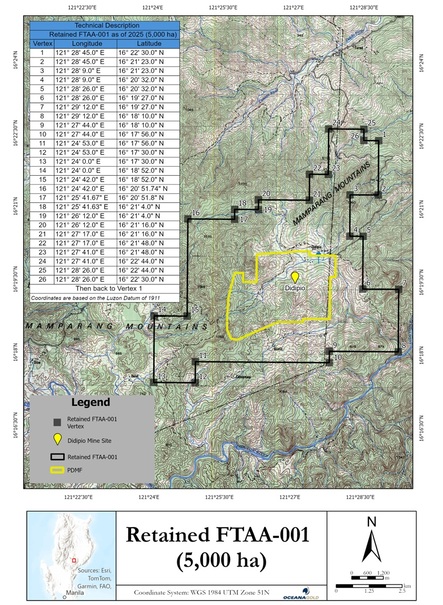
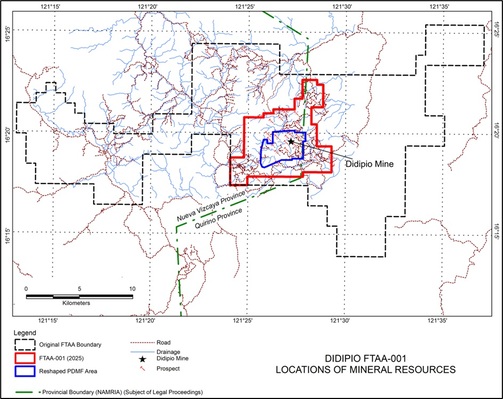
Most of the original FTAA area of 37,000 hectares have been relinquished under the terms of the agreement. As of December 31, 2025, OGPI’s FTAA area is 5,000 hectares (with no further requirement to relinquish) and the PDMF for the Didipio Mine covers 975 hectares within the FTAA.
The Didipio Mine is subject to several ongoing obligations under the FTAA to ensure that the mine is operated in accordance with the social and environmental policies developed by the Government and enacted under the PMA. Compliance with the FTAA is measured by the implementation of the approved work programs, verified through regular compliance monitoring audits by the regulators, submission of periodic reporting requirements and payment of fiscal obligations. In addition, other approvals required to be maintained under the FTAA contain conditions relating to community consultation that are required to be satisfied, including the ECC.
1.4.2Entitlements of Addendum Claimowners
Pursuant to a 1991 addendum agreement, a third-party syndicate of original claimowners led by the late Mr. Jorge G. Gonzales, Sr. (Addendum Claimowners) has a contractual right to an 8% free carried interest and to a 2% net smelter return royalty (NSR) in OGPI, in each case with respect only to a certain area (the Gonzales Addendum Agreement).
It is expected that the 8% free carried interest will be reflected as an equity interest in the capital stock of OGPI through the issuance of new shares in OGPI to the Addendum Claimowners. Pursuant to the FTAA, any distribution to the Addendum Claimowners form part of the Government’s share in the net revenue. Further, there are two pending legal cases with respect to the Gonzales Addendum Agreement, and OGPI believes that it does not have an obligation to issue fully paid shares to such claimowners until final and executory order or decision is rendered.
OGPI have accrued in its financial accounts the 2% NSR since the commencement of production in 2013 pending the final resolution of the outstanding legal cases. The timing of cash settlement of the accrued NSR remains dependent on resolution of the proceedings. As of December 31, 2025, OGPI have accrued in its financial accounts $83.7 million ($69.6 million of royalties and $14.1 million related to free-carried interest) pertaining to this claim.
1.5Exploration
Exploration from 2015 to 2019 involved fieldwork and a series of drilling campaigns within the FTAA area. The drilling was focused on testing targets generated from various data sets, including
| | | | | | | | | | | |
Released: 27 March 2026 | Page 17 of 234 | |
| | | | | |
NI 43-101 Technical Report – Didipio Mine, Luzon, Philippines |
|
|
geological and alteration mapping, rock chip sampling, stream sediment geochemistry, soil sampling, and deep imaging geophysics.
Exploration and resource definition activities were placed on hold between July 2019 and February 2022 due to the ongoing FTAA renewal process. Regional exploration activities were restarted in 2023 with drilling completed at Napartan in 2024 before the expiry of the exploration period in August 2024. In September 2024, OGPI obtained approval for a five-year extension of the exploration period under the FTAA to 2029. Drilling of near-mine targets at True Blue and D’Fox were initiated in 2025 and is expected to continue in 2026.
Regional surface exploration drilling commenced at the Napartan prospect in 2024, with a total of four drillholes completed for 626 m, targeting mineralized pegmatitic dykes identified in muck-out samples sourced from abandoned small scale mining adits and an associated copper-gold geochemical anomaly. A 2,000-hectare airborne drone magnetic geophysics survey was subsequently initiated at Napartan during the fourth quarter of 2024 and completed in February 2025. Drilling was restarted at Napartan in July 2025 completing 10 holes for 4,000 m. The Napartan drillholes returned insignificant assay results and the drilled area was included in the Annual Relinquishment Report of FTAA 001 submitted in 2025.
1.6Drilling
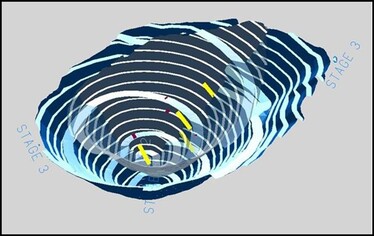
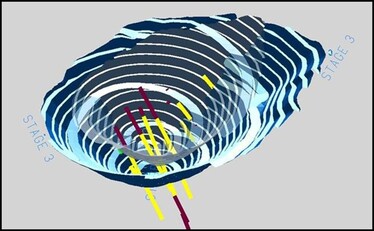
Drilling re-commenced underground in February 2022. Three drill rigs operated underground from May 2024 from the 2160 mRL Resource Definition drill platforms; however, all underground drilling was suspended in September 2024 due to inundation of the lower levels of the mine resulting from extensive rainfall associated with a succession of typhoons impacting the area. Following dewatering of the lower levels in 2025, underground drilling is planned to restart in early 2026. Drilling will focus on the Northern Monzonite, Eastern Monzonite and Eastern Breccia (EBX) in Panels 3 and Panel 4. Additional intercepts of Balut Dyke, located immediately north of the Syenite Porphyry, confirm the strike extent of the Northern Balut Dyke below 2100 Level.
As at December 31, 2025 the drill hole database for the Didipio FTAA area contained records of 3,452 holes for a total of 278,888 m drilled.
1.7Sampling, Analysis and Data Verification
Starting from 2015, PQ (85 mm diameter) and HQ (63 mm diameter) diamond core was cut in half. Half core is assayed and the other half is retained. NQ (47 mm diameter) core is submitted whole for assaying. All core is submitted in one metre sample intervals except where sample intervals are split to align with lithology. Drill core is submitted to the independent SGS laboratory on site and staffed with SGS employees. Reverse circulation (RC) holes were sub-sampled either through a cone splitter (Schramm) or riffle splitter (Edson). Blast holes were sub-sampled with a riffle splitter. Underground channel sampling is ongoing as the mine develops.
The SGS sample procedure is as follows: oven dry samples; crush using jaw crusher to approximately four mm in size; crush using Boyd crusher into approximately two mm in size, and dry screen every 20th sample; split 15% of the sample using BOYD-RSD; pulverize 750 grams to one kilogram samples to 75 microns µm and wet screen every 20th sample; and riffle split to 250 grams for assaying and 250 grams as pulp retention.
| | | | | | | | | | | |
Released: 27 March 2026 | Page 18 of 234 | |
| | | | | |
NI 43-101 Technical Report – Didipio Mine, Luzon, Philippines |
|
|
The samples obtained are handled and managed according to documented standard procedures. The entire sample handling process from acquisition, transport and delivery, sample preparation and analysis is supervised and/or monitored by Didipio Mine geology personnel. There is no identified area in the sample chain of custody which can result in mishandling or altering of samples.
SGS undertakes the assay analysis at the Didipio Mine. Fire assaying is used for the standard gold assay procedure and Atomic Absorption Spectrometry (AAS), Inductively Coupled Plasma (ICP) and X-Ray Fluorescence (XRF) procedures are used for the standard copper assay procedure.
Since commissioning of the SGS onsite laboratory, all samples from near-mine exploration have gone directly from point of collection to the onsite SGS laboratory or for drill core via the onsite core shed. The core is photographed, split by a core saw (HQ and PQ sized core) and sampled every metre at the onsite core shed. The samples are uniquely numbered with two QA/QC Certified Reference Material (CRM) and one quartz blank sample inserted for every batch of 50 samples. The CRMs are typically low-grade CRM and medium grade CRM. The quartz blank sample is normally below detection limits. Thereafter, all drill core samples are transported by a technician or geologist directly from the onsite core shed to the onsite SGS laboratory. Upon arrival at the onsite SGS laboratory, samples are checked by the SGS staff in the presence of the mine or exploration geology representative. SGS inserts an additional six QA/QC check samples.
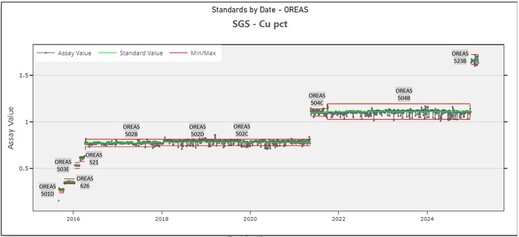
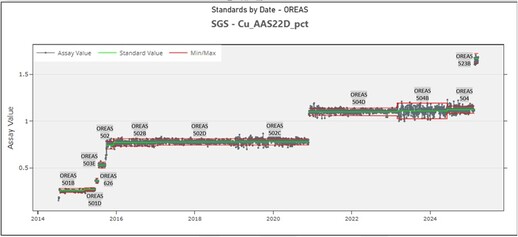
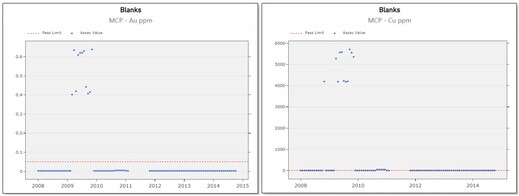
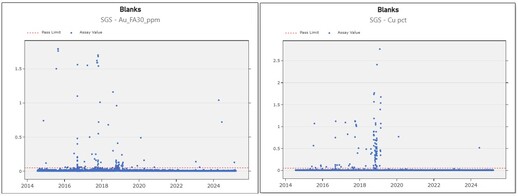
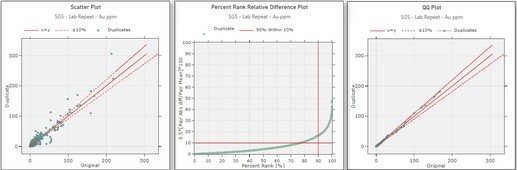
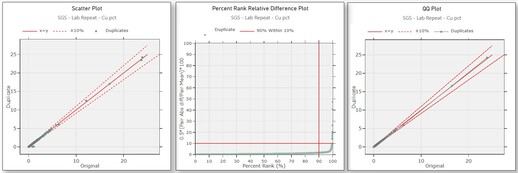
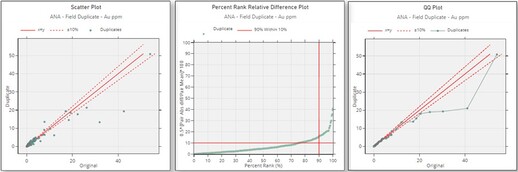
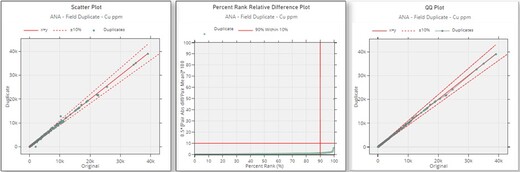
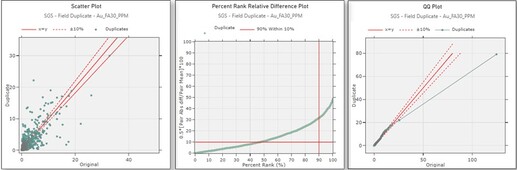
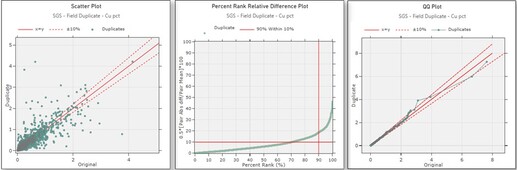
Performance for Standards, blanks, field duplicates and laboratory repeats are considered acceptable. SGS field duplicates returned acceptable precision compared to original assays for both gold and copper.
1.8Mineral Processing and Metallurgical Testing
A detailed design was prepared for the processing plant in February 2011 and site construction of the plant commenced in November 2011. First ore was introduced to the plant in December 2012, and commercial production was achieved in April 2013.
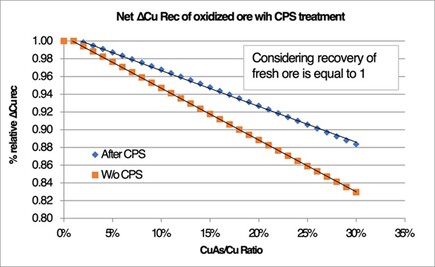
Operational plant performance since the commencement of operations provides comparison data assisting in validating the recovery models developed in the prior feasibility phase and plant response to changes in grind size and partial oxidation of older stockpiled feed. The plant is capable of meeting the modelled recovery estimates and the impacts of partial oxidation of surface stockpiles has been studied and categorized for improved production forecasting.
Test work programs have been conducted in several stages as the predominate ore source has changed from open-pit to underground. Several processing options and reagent modifications are under evaluation to increase metallurgical performance of stockpile material. To further investigate the variability of the different ore types, future ore test work programs were conducted in 2024 with both external and internal laboratories. The project aimed to evaluate the variability in ore metallurgical parameters (competency, work index, gravity, copper and gold recoveries) between the ore types sampled from the underground. Data is used to develop models that will estimate the influence of geological and mineralogical attributes of these ore types to plant performance.
A future ores testing program has been maintained with progressive testing with the availability of fresh core from infill drilling programs to allow variability testing to be undertaken and increase the knowledge of recovery and ore competency for production planning. Current test work is focused
| | | | | | | | | | | |
Released: 27 March 2026 | Page 19 of 234 | |
| | | | | |
NI 43-101 Technical Report – Didipio Mine, Luzon, Philippines |
|
|
on developing independent throughput and recovery models for open-pit stockpiles and underground ore.
1.9Mineral Resources Estimate
A total of 725 diamond drill holes, comprising 141,733 m of drilling, along with 904 wall channels (with the walls sampled at between 1 m and 3 m intervals), totalling 27,879 m, are considered acceptable for the Mineral Resource estimation. Underground drilling is generally arranged in fans on north–south oriented mine‑grid sections, resulting in a variety of intersection angles ranging from perpendicular to the dip to approximately 45 degrees. Given the typically disseminated mineralization style, this drilling pattern provides an acceptable basis for Mineral Resource estimation.
The sampling method and sample preparation of the Didipio Mine has been conducted in several phases which have introduced changes in sample preparation procedures. The OceanaGold phase accounts for 93% of the dataset used in the estimation process. Most pre‑OceanaGold samples have now been mined out or fall outside the current mine designs. Overall, the sample preparation, security, analytical procedures and database management employed at Didipio are considered appropriate and adequate for the style of mineralization under assessment.
The underground Mineral Resource estimate was updated in October 2024 using Ordinary Kriging to estimate gold (Au), copper (Cu), and silver (Ag) grades. The model used implicit gold grade shells, generated in Leapfrog software whilst grade estimation and block model construction were completed in Vulcan TM software.
The estimates for the surface stockpiles were based upon the Ordinary Kriging of closely spaced open-pit grade control samples at the time of open-pit mining. This data, and monthly stockpile surveys were used to construct a 3D block model of the stockpiled tonnes and grades.
Mineral Resources at the Didipio Mine comprise both open-pit and underground Mineral Resources. Mineral Resources were classified in accordance with the Canadian Institute of Mining, Metallurgy and Petroleum Standard Definitions for Mineral Resources and Reserves dated May 10, 2014 (CIM Definition Standards). The Mineral Resource Statement as at December 31, 2025 is summarized in Table 1-1.
OceanaGold has a comprehensive Mineral Resource model governance process in place, including model validation, peer review, production reconciliation as well as coaching and team-based training.
| | | | | | | | | | | |
Released: 27 March 2026 | Page 20 of 234 | |
| | | | | |
NI 43-101 Technical Report – Didipio Mine, Luzon, Philippines |
|
|
Table 1-1: Didipio Measured, Indicated and Inferred Mineral Resources as at December 31, 2025
| | | | | | | | | | | | | | | | | | | | | | | | | | | | | | | | | | | | | | |
| Measured | Indicated | Measured & Indicated | Inferred |
Gold | Tonnes (Mt) | Au (g/t) | Contained Ozs (Moz) | Tonnes (Mt) | Au (g/t) | Contained Ozs (Moz) | Tonnes (Mt) | Au (g/t) | Contained Ozs (Moz) | Tonnes (Mt) | Au (g/t) | Contained Ozs (Moz) |
Didipio |
Didipio Underground | 14.3 | 1.53 | 0.71 | 17.7 | 0.89 | 0.51 | 32 | 1.18 | 1.21 | 9.2 | 0.9 | 0.3 |
Didipio Open Pit Stockpile | 13.2 | 0.29 | 0.12 | - | - | - | 13.2 | 0.29 | 0.12 | - | - | - |
Didipio Total | 27.5 | 0.94 | 0.83 | 17.7 | 0.89 | 0.51 | 45.2 | 0.92 | 1.34 | 9.2 | 0.9 | 0.3 |
| | | | | | | | | | | | |
| Measured | Indicated | Measured & Indicated | Inferred |
Silver | Tonnes (Mt) | Ag (g/t) | Contained Ozs (Moz) | Tonnes (Mt) | Ag (g/t) | Contained Ozs (Moz) | Tonnes (Mt) | Ag (g/t) | Contained Ozs (Moz) | Tonnes (Mt) | Ag (g/t) | Contained Ozs (Moz) |
Didipio |
Didipio Underground | 14.3 | 1.8 | 0.8 | 17.7 | 1.4 | 0.8 | 32 | 1.6 | 1.6 | 9.2 | 1.2 | 0.4 |
Didipio Open Pit Stockpile | 13.2 | 1.9 | 0.8 | - | - | - | 13 | 1.9 | 0.8 | - | - | - |
Didipio Total | 27.5 | 1.6 | 1.6 | 17.7 | 1.4 | 0.8 | 45 | 1.5 | 2.4 | 9.2 | 1.2 | 0.4 |
| | | | | | | | | | | | |
| Measured | Indicated | Measured & Indicated | Inferred |
Copper | Tonnes (Mt) | Cu (%) | Contained Tonnes (Mt) | Tonnes (Mt) | Cu (%) | Contained Tonnes (Mt) | Tonnes (Mt) | Cu (%) | Contained Tonnes (Mt) | Tonnes (Mt) | Cu (%) | Contained Tonnes (Mt) |
Didipio |
Didipio Underground | 14.3 | 0.43 | 0.06 | 17.7 | 0.33 | 0.058 | 32 | 0.37 | 0.12 | 9.2 | 0.3 | 0.02 |
Didipio Open Pit Stockpile | 13.2 | 0.28 | 0.0 | - | - | - | 13.2 | 0.28 | 0.037 | - | - | - |
Didipio Total | 27.5 | 0.36 | 0.1 | 17.7 | 0.33 | 0.058 | 45.2 | 0.35 | 0.16 | 9.2 | 0.3 | 0.02 |
Notes:
•Mineral Resources are reported on a 100% basis. OceanaGold holds an 80% attributable interest in the Didipio Mine
•Mineral Resources are reported inclusive of Mineral Reserves. Mineral Resources that are not Mineral Reserves do not have demonstrated economic viability.
•All Resources are based on the following assumptions: Metal prices of US$2,450/oz gold, US$4.50/lb copper and US$28.50/oz silver.
•Underground resources are reported within volumes guided by conceptual stope designs which are based upon economic assumptions above and exclude mining modifying factors.
•Gold equivalence (AuEq) is based upon the presented gold and copper prices as well as processing recoveries (89.4% for copper and 88.1% for gold). AuEq = Au g/t +1.27 x Cu%
•13.2 Mt surface stockpile inventory is based on mining cut-off grades ranging from 0.27 g/t to 0.40 g/t AuEq
•Underground resources are reported at a cut-off grade of 0.67 g/t AuEq and between the 2460 mRL and 1800 mRL
•All figures are rounded to reflect the relative accuracy and confidence of the estimates and totals may not add correctly.
•The Mineral Resources were estimated under the supervision of J Moore, MAusIMM CP(Geo), a Qualified Person.
Over the previous eight years (2018 to 2025), the Measured and Indicated Resources have reconciled acceptably against the mill-adjusted mine, averaging over this period 104%, 98%, 98%, 102% and 106% for ore tonnes, gold grade, copper grade, contained gold and contained copper respectively.
While ongoing monthly, quarterly and annual reconciliation fluctuations are expected, the Mineral Resource estimates are believed to provide an acceptable basis for medium to long term mine planning purposes.
| | | | | | | | | | | |
Released: 27 March 2026 | Page 21 of 234 | |
| | | | | |
NI 43-101 Technical Report – Didipio Mine, Luzon, Philippines |
|
|
1.10Mineral Reserves Estimate
Mineral Reserves at the Didipio Mine are sub-divided for reporting purposes:
•Surface stockpiles resulting from open-pit mining between 2012 to 2017 which are lower grade and provide supplemental processing feed; and
•Underground which incorporates material from the 2460 mRL down to the 1980 mRL.
Mineral Reserves were classified in accordance with the 2014 CIM Definition Standards. The Mineral Reserve Statement, as at December 31, 2025 is summarized in Table 1-2.
Table 1-2: Didipio Proven and Probable Reserves as at December 31, 2025
| | | | | | | | | | | | | | | | | | | | | | | | | | | | | |
| Proven | Probable | Proven & Probable |
Gold | Tonnes (Mt) | Au (g/t) | Contained Ozs (Moz) | Tonnes (Mt) | Au (g/t) | Contained Ozs (Moz) | Tonnes (Mt) | Au (g/t) | Contained Ozs (Moz) |
Didipio |
Didipio Underground | 13.5 | 1.39 | 0.60 | 14.7 | 0.85 | 0.40 | 28.3 | 1.11 | 1.01 |
Didipio Open Pit Stockpile | 13.2 | 0.30 | 0.13 | - | - | - | 13.2 | 0.30 | 0.13 |
Didipio Total | 26.7 | 0.85 | 0.73 | 14.7 | 0.85 | 0.40 | 41.5 | 0.85 | 1.13 |
| | | | |
| Proven | Probable | Proven & Probable |
Silver | Tonnes (Mt) | Ag (g/t) | Contained Ozs (Moz) | Tonnes (Mt) | Ag (g/t) | Contained Ozs (Moz) | Tonnes (Mt) | Ag (g/t) | Contained Ozs (Moz) |
Didipio |
Didipio Underground | 13.5 | 1.7 | 0.7 | 14.7 | 1.3 | 0.6 | 28.3 | 1.5 | 1.4 |
Didipio Open Pit Stockpile | 13.2 | 1.9 | 0.8 | - | - | - | 13.2 | 1.9 | 0.8 |
Didipio Total | 26.7 | 1.8 | 1.6 | 14.7 | 1.3 | 0.6 | 41.5 | 1.7 | 2.2 |
| | | | | | | | | |
| Proven | Probable | Proven & Probable |
Copper | Tonnes (Mt) | Cu (%) | Contained Tonnes (Mt) | Tonnes (Mt) | Cu (%) | Contained Tonnes (Mt) | Tonnes (Mt) | Cu (%) | Contained Tonnes (Mt) |
Didipio |
Didipio Underground | 13.5 | 0.38 | 0.1 | 14.7 | 0.31 | 0.05 | 28.3 | 0.35 | 0.10 |
Didipio Open Pit Stockpile | 13.2 | 0.28 | 0.0 | - | - | - | 13.2 | 0.28 | 0.04 |
Didipio Total | 26.7 | 0.33 | 0.1 | 14.7 | 0.31 | 0.05 | 41.5 | 0.32 | 0.13 |
Notes
•Mineral Reserves are reported on a 100% basis. OceanaGold holds an 80% attributable interest in the Didipio Mine
•Mineral Reserves are defined by mine designs based upon the following assumptions: Metal prices of US$2,200/oz gold, US$4.00/lb copper and US$25/oz silver.
•Reported estimates of contained metal are not depleted for processing losses.
•Cut-off grades are applied to diluted grades.
•Gold equivalence (AuEq) is based upon the presented gold and copper prices as well as processing recoveries (89.4% for copper and 88.1% for gold). AuEq = Au g/t +1.27 x Cu%.
•13.2 Mt surface stockpile inventory is based on mining cut-off grades ranging from 0.27 g/t to 0.40 g/t AuEq
•Underground cut-off grade is 1.16 g/t AuEq whilst incremental stopes proximal to development already planned to access main stoping areas are reported to a lower cut-off grade of 0.76 g/t AuEq.
•All figures are rounded to reflect the relative accuracy and confidence of the estimates and totals may not add correctly.
•The Mineral Reserves were estimated under the supervision of P. Jones. AusIMM CP(Min), a Qualified Person.
| | | | | | | | | | | |
Released: 27 March 2026 | Page 22 of 234 | |
| | | | | |
NI 43-101 Technical Report – Didipio Mine, Luzon, Philippines |
|
|
1.11 Mining Method
Open-pit mining ceased at Didipio in 2017.
The long hole open stoping method (LHOS) is employed underground at the Didipio Mine for the extraction of underground ore. LHOS allows for a high degree of mechanization and good mining selectivity, high mining recovery and scheduling flexibility. A primary/secondary stoping sequence is utilized where primary stopes are separated by a secondary stope. Extraction of the secondary stope can only occur after the two immediately filled adjacent primary stopes have been mined, backfilled and have time to cure.
Stope dimensions vary depending on their location within the orebody. On the eastern side of the orebody in the monzonite zone, stopes are up to 60 m high whereas in the breccia zone on the western side of the orebody, more conservative stope dimensions are adopted due to poorer ground conditions. These include, where required, significant stope crown support to prevent unravelling. Paste backfill is utilized for backfilling of all stope voids. A top-down sequence beneath paste fill is employed.
The Western Breccia zone has been subjected to recent studies and optimization due to poor ground conditions. A small section of bottom-up mining and smaller stope sizes planned to mitigate any potential unravelling due to these conditions has been trialled with good success. The extraction sequence in the Western Breccia is geotechnically constrained and planned to be mined slower than previous versions of the mining schedule resulting in a diversion of a portion of ounces from this zone to later years of the Life of Mine (LoM). This strategy strives to provide a safe and sustainable production sequence that maximizes metal recovery.
The current decline face has advanced to the 2133 mRL. Approximately 47 km of lateral development is required in the mining schedule which includes capital development in the lower part of the mine to establish production levels down to the 1980 mRL and associated active dewatering and critical pumping infrastructure including Capital Pump Station 1 (CPS1). Lateral development rates of just under 8 km a year are required from 2027 to 2029 before tailing off once capital development is complete at depth in 2030 per the current schedule. Additional capital development will be required if drill conversion programs in Panel 3 and 4 are successful, however are not considered in current mine schedules or capital cost estimates for this report.
Historic haulage rates from the Didipio underground has achieved annual rates exceeding 1.6 Mtpa and instantaneous rates in excess of 2.5 Mtpa but these have not been sustained due to various interruptions to production, including poor performance of Breccia stopes on the western side of the orebody and inundation of the lower levels of the mine following typhoons in 2024, with the lower levels of the mine remediated in late 2025.
A Pre-Feasibility Study (PFS) has been undertaken to assess increased mining rates from the underground mine. Results from the study show that rates in excess of 2.5 Mtpa can be achieved when additional mining fronts at depth are available and supported by upgrades to existing pumping, electrical and paste fill infrastructure. Planned production rates from the underground in 2026 is 1.9 Mtpa, increasing to 2.1 Mtpa in 2027, 2.2 Mtpa in 2028, and 2.6 Mtpa in 2029, in line with the commissioning of planned dewatering and primary ventilation infrastructure to support the increased mining rates. Mine physicals are summarized in Table 1-3.
| | | | | | | | | | | |
Released: 27 March 2026 | Page 23 of 234 | |
| | | | | |
NI 43-101 Technical Report – Didipio Mine, Luzon, Philippines |
|
|
Table 1-3: Didipio Underground Mining Physicals
| | | | | | | | | | | | | | | | | | | | | | | | | | | | | | | | | | | | | | | | | | | | |
| Unit | Total | 2026 | 2027 | 2028 | 2029 | 2030 | 2031 | 2032 | 2033 | 2034 | 2035 | 2036 | 2037 |
Lateral Development | | | | | | | | | | | | | | |
Total Development | km | 47.4 | 7.4 | 7.9 | 8.0 | 8.0 | 3.2 | 2.2 | 2.0 | 2.4 | 1.9 | 2.0 | 1.6 | 0.7 |
Capital Development | km | 9.1 | 1.6 | 2.8 | 2.5 | 1.9 | 0.2 | 0.0 | 0.0 | 0.0 | 0.0 | 0.0 | 0.0 | 0.0 |
Operating Development | km | 38.3 | 5.8 | 5.1 | 5.5 | 6.1 | 3.0 | 2.2 | 2.0 | 2.4 | 1.9 | 2.0 | 1.6 | 0.7 |
Mined Tonnes | | | | | | | | | | | | | | |
Total Material Moved | kt | 30,065 | 2,193 | 2,488 | 2,600 | 2,893 | 2,890 | 2,588 | 2,474 | 2,684 | 2,761 | 2,818 | 2,704 | 971 |
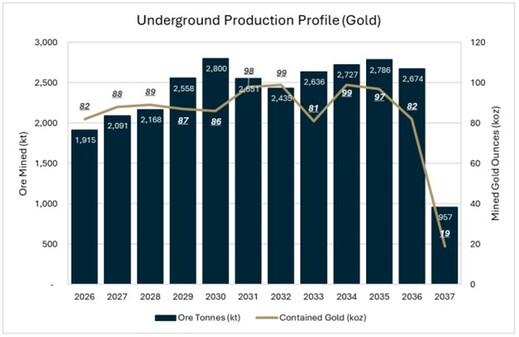
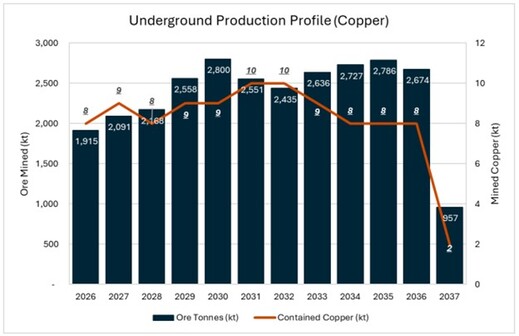
Total Ore Production | kt | 28,298 | 1,915 | 2,091 | 2,168 | 2,558 | 2,800 | 2,551 | 2,435 | 2,636 | 2,727 | 2,786 | 2,674 | 957 |
Total Waste | kt | 1,768 | 278 | 397 | 432 | 336 | 90 | 37 | 39 | 49 | 34 | 33 | 30 | 15 |
Stoping Ore | kt | 26,381 | 1,582 | 1,817 | 1,913 | 2,229 | 2,656 | 2,451 | 2,354 | 2,528 | 2,640 | 2,686 | 2,600 | 925 |
Development Ore | kt | 1,916 | 333 | 275 | 255 | 329 | 144 | 101 | 81 | 107 | 87 | 99 | 74 | 32 |
Metal and Grade | | | | | | | | | | | | | | |
Gold Grade | g/t | 1.11 | 1.32 | 1.31 | 1.28 | 1.05 | 0.95 | 1.20 | 1.26 | 0.95 | 1.13 | 1.08 | 0.95 | 0.63 |
Silver Grade | g/t | 1.53 | 1.90 | 1.82 | 1.73 | 1.55 | 1.43 | 1.76 | 1.71 | 1.32 | 1.34 | 1.36 | 1.29 | 1.08 |
Copper Grade | % | 0.35 | 0.43 | 0.41 | 0.37 | 0.37 | 0.33 | 0.39 | 0.42 | 0.35 | 0.29 | 0.28 | 0.28 | 0.19 |
Gold Metal | koz | 1,006 | 82 | 88 | 89 | 87 | 86 | 98 | 99 | 81 | 99 | 97 | 82 | 19 |
Silver Metal | koz | 1,389 | 117 | 122 | 120 | 128 | 128 | 144 | 134 | 112 | 117 | 122 | 111 | 33 |
Copper Metal | kt | 98 | 8 | 9 | 8 | 9 | 9 | 10 | 10 | 9 | 8 | 8 | 8 | 2 |
1.12Processing and Recovery Methods
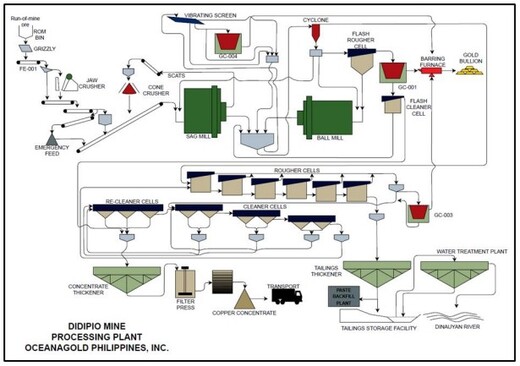
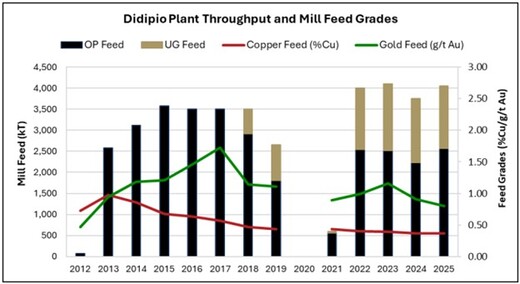
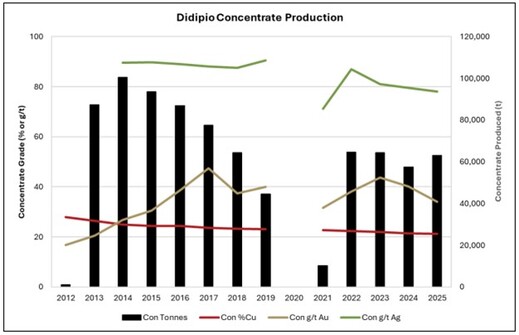
Recovery of copper and gold at Didipio is achieved from the use of froth flotation following a conventional SAG Mill – Ball Mill – Pebble Crushing grinding circuit and gravity recovery circuit, which produces both a gold-copper concentrate and a gold doré. Considerable operating experience has been accumulated over the life of the mine, having been operated since 2012. Following processing of first ore in December 2012, and the first concentrate shipments in April 2013, the processing plant has achieved targeted utilization rates greater than 95% and processing rates greater than 4.1 Mtpa. Copper and gold recovery rates have been in line with forecast rates used in the production planning process.
Progressive improvement projects continue to be implemented. The installation of additional gravity gold equipment to target coarser gold in the underground ore was completed in 2022 along with the addition of pH modifier in the flotation circuit to counteract impacts from underground paste dilution in the feed in 2024 to aid metal recovery.
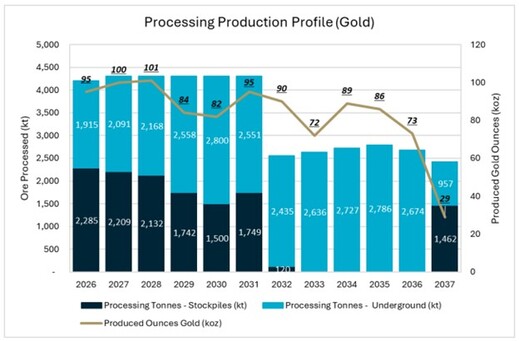
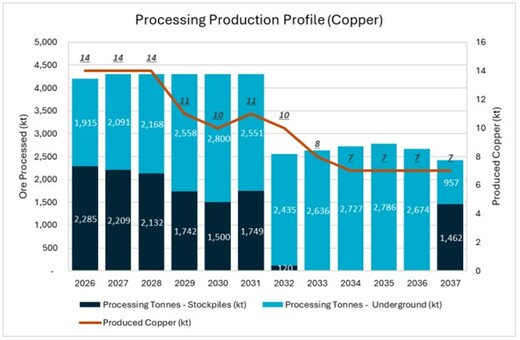
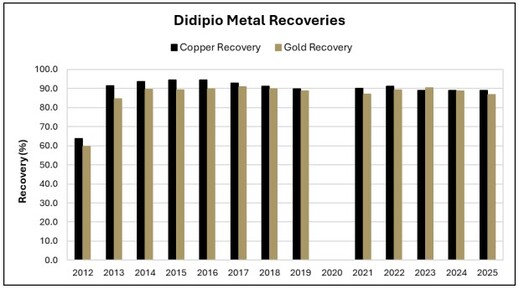
Processing throughput is planned to ramp up to 4.3 Mtpa, the currently permitted limit, in 2027. Average gold recovery over the LoM is 88.2% whilst average copper recovery is 90.4%. Open-pit stockpiles are expected to be exhausted in 2032 with a small amount of residual material that makes up the current Run of Mine (ROM) ore processed in 2037. Processing physicals are summarized in Table 1-4.
| | | | | | | | | | | |
Released: 27 March 2026 | Page 24 of 234 | |
| | | | | |
NI 43-101 Technical Report – Didipio Mine, Luzon, Philippines |
|
|
Table 1-4: Didipio Processing Summary
| | | | | | | | | | | | | | | | | | | | | | | | | | | | | | | | | | | | | | | | | | | | |
| Unit | Total | 2026 | 2027 | 2028 | 2029 | 2030 | 2031 | 2032 | 2033 | 2034 | 2035 | 2036 | 2037 |
Processing | | | | | | | | | | | | | | |
Total Ore Processed | kt | 41,496 | 4,200 | 4,300 | 4,300 | 4,300 | 4,300 | 4,300 | 2,555 | 2,636 | 2,727 | 2,786 | 2,674 | 2,419 |
Gold Grade Processed | g/t | 0.85 | 0.80 | 0.83 | 0.84 | 0.70 | 0.68 | 0.78 | 1.21 | 0.95 | 1.13 | 1.08 | 0.95 | 0.46 |
Copper Grade Processed | % | 0.32 | 0.38 | 0.37 | 0.36 | 0.28 | 0.27 | 0.29 | 0.41 | 0.35 | 0.29 | 0.28 | 0.28 | 0.34 |
Gold in Feed | koz | 1,132 | 109 | 114 | 116 | 97 | 94 | 108 | 99 | 81 | 99 | 97 | 82 | 36 |
Copper in Feed | kt | 134 | 16 | 16 | 16 | 12 | 11 | 13 | 10 | 9 | 8 | 8 | 8 | 8 |
Gold Recovery | % | 88.2 | 87.7 | 87.8 | 87.8 | 87.1 | 87.0 | 87.8 | 90.3 | 89.2 | 89.6 | 89.2 | 89.2 | 82.4 |
Copper Recovery | % | 90.4 | 88.7 | 88.7 | 95.6 | 89.4 | 88.9 | 89.7 | 93.2 | 92.0 | 90.6 | 90.4 | 90.6 | 85.5 |
Gold Recovered | koz | 998 | 95 | 100 | 101 | 84 | 82 | 95 | 90 | 72 | 89 | 86 | 73 | 29 |
Copper Recovered | kt | 121 | 14 | 14 | 15 | 11 | 10 | 11 | 10 | 8 | 7 | 7 | 7 | 7 |
1.13Infrastructure
The Didipio Mine has been in operation since 2012 with construction commencing in 2011. Established infrastructure includes a tailings storage facility (TSF), workshops, camp, water treatment plant, pastefill plant and ore processing facilities.
Power supply for the mine is connected to the national grid via a 69kV dedicated line to Bayombong with diesel generators on site providing a backup source. Improvements in power reticulation and delivery has increased reliability and reduced unplanned outages.
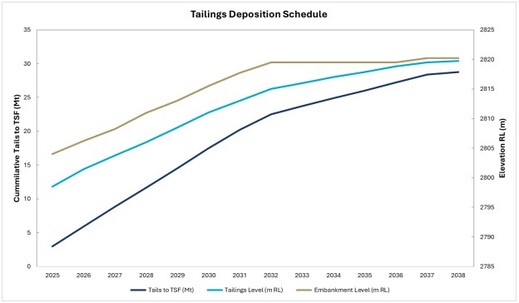
The TSF has been designed to accommodate the LoM tailings requirement net of paste backfill. The current construction schedule supports the tailings deposition schedule.
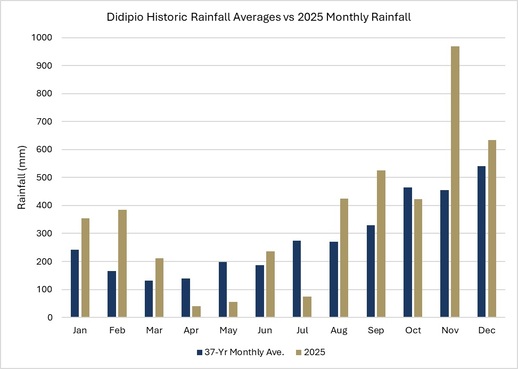
Recently, underground performance has been impacted by the ability to manage periods of higher rainfall. Additional planned dewatering and electrical infrastructure will enable aquifer depressurization at depth, adequate pumping capacity, and ensure there is sufficient latent capacity to manage periods of higher rainfall during typhoon seasons, including surface water diversion projects and upgrades to in-pit dewatering systems.
Upgrades are underway to existing infrastructure to support increased underground mining rates including:
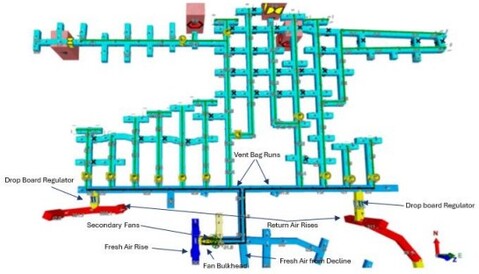
•Primary ventilation upgrades to support mining at depth and increased fleet requirements;
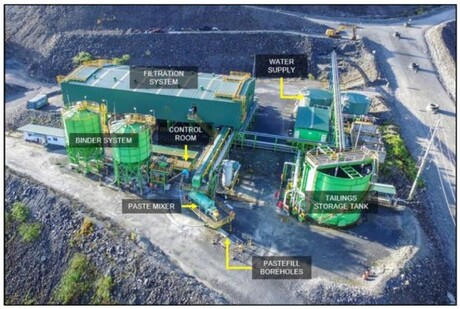
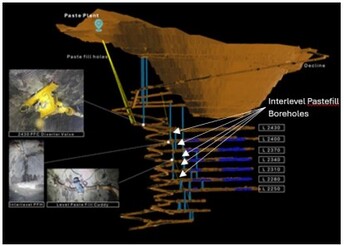
•Surface paste plant and underground reticulation upgrades;
•Construction and commissioning of CPS1 in 2027 and other associated dewatering infrastructure including borefields and active dewatering stations; and
•Surface electrical upgrades including an additional 25 MVA substation.
1.14Environment Studies, Social Matters and Permitting
In addition to regular monitoring, inspection and verification mine visits by the Mines and Geosciences Bureau (MGB), Environmental Management Bureau (EMB) and the Department of Environment and Natural Resources (DENR), operations are also monitored for compliance with the annual Environmental Protection and Enhancement Program (EPEP) and other environmental laws by the Mine Rehabilitation Fund Committee (MRFC) and the Multipartite Monitoring Team (MMT). The MMT is composed of 14 members representing national governmental authorities, local
| | | | | | | | | | | |
Released: 27 March 2026 | Page 25 of 234 | |
| | | | | |
NI 43-101 Technical Report – Didipio Mine, Luzon, Philippines |
|
|
government units and communities in the provinces of Nueva Vizcaya and Quirino and certain Non-Governmental Organizations (NGO).
The ECC specifies environmental management and protection requirements, including the submission of an annual EPEP, Final Mine Rehabilitation & Decommissioning Plan (FMR/DP) and Social Development and Management Program (SDMP).
Under the PMA, OGPI is required during mining operations to allot annually a minimum of 1.5% of operating costs for the SDMP, whereby 75% of the 1.5% shall be apportioned to the development of host and neighboring barangays. The remainder of the amount is utilized for the development of mining technology and geosciences and for public awareness and education on mining and geosciences. OGPI also allocates funds equivalent to 10% of the approved exploration work program budget for the Community Development Program to be implemented in the areas where OGPI are undertaking exploration activities.
The SDMP aims to facilitate sustained improvement to the living standards of the host and neighbouring communities by helping to define, fund and implement development programs. OGPI work collaboratively with the MGB, local government units of the host and adjacent communities, and local contractors to complete SDMP projects.
Under the FTAA Addendum and Renewal Agreement, OGPI are required to annually allot an amount equivalent to 1% of gross mining revenues of the preceding year for the Community Development Fund (CDF) and an amount equivalent to 0.5% of the gross mining revenues of the preceding year for the Provincial Development Fund (PDF). These additional social development funds, which are included as an allowable deduction in the computation of net revenue, contribute to the sustainable social, economic and cultural development of the communities in the region.
OGPI holds the permits, certificates, licences and agreements required to conduct current operations for the Didipio Mine. The ECC issued was last amended on April 26, 2022 to increase the processing plant throughput from 3.5 Mtpa to 4.3 Mtpa.
1.15Capital and Operating Costs
All costs, unit costs and prices are in United States dollars unless otherwise noted.
Total LoM operating costs including surface operations, underground mining, processing, and administration are estimated at $1,719 million. This translates to a total unit cost of $41.42/t processed as summarized in Table 1-5.
| | | | | | | | | | | |
Released: 27 March 2026 | Page 26 of 234 | |
| | | | | |
NI 43-101 Technical Report – Didipio Mine, Luzon, Philippines |
|
|
Table 1-5: Operating Cost Summary ($M and $/t)
| | | | | | | | | | | |
Description | $M | $/t UG Ore Mined | |
Surface | 39.3 | 1.32 | |
Underground Mining | 774.2 | 27.33 | |
Subtotal Mining1 | 813.5 | 28.65 | |
Description | $M | $/t Ore Processed | |
Processing | 349.9 | 8.43 | |
General and Administration | 555.5 | 13.38 | |
Total Operating Costs2 | 1,719 | 41.42 | |
Total LoM capital costs are estimated at $258.3 million. Underground capital costs are $198.9 million and summarized in Table 1-6 whilst other site capital is $59.4 million and summarized in Table 1-7.
Additional capital required to facilitate ramp up of underground mining rates and processing plant upgrades is included in estimates.
Table 1-6: Underground Capital Cost
| | | | | | | | | | | |
Description – Underground Capital Costs | Non-Sustaining Capital ($M) | Sustaining Capital ($M) | Total Capital ($M) |
Capitalized Mine Development | 13.9 | 27.2 | 41.1 |
Mining Projects | 4.3 | 71.4 | 75.7 |
Mobile Equipment | 3.6 | 14.3 | 17.9 |
Infrastructure – Electrical | 5.8 | 10.1 | 15.9 |
Infrastructure – Dewatering | 10.5 | 5.9 | 16.4 |
Infrastructure – Ventilation | 13.3 | 2.0 | 15.3 |
Exploration | 3.6 | 3.3 | 6.9 |
Underground Other | - | 9.7 | 9.7 |
Total Capital Costs (Underground) | 55.0 | 143.9 | 198.9 |
Table 1-7: Surface and Other Capital Costs
| | | | | | | | | | | |
Description – Surface & Other Capital Costs | Non-Sustaining Capital ($M) | Sustaining Capital ($M) | Total Capital ($M) |
Surface Assets and Equipment | 7.3 | 20.2 | 27.5 |
TSF Design and Construction | - | 15.0 | 15.0 |
Community Relations | 7.4 | - | 7.4 |
Process Plant Infrastructure | 2.6 | 2.2 | 4.8 |
Exploration | 2.3 | - | 2.3 |
Rehabilitation | - | 2.4 | 2.4 |
Total Capital Costs (Surface/ Other) | 19.6 | 39.8 | 59.4 |
1 Mining unit costs are calculated using mined ore tonnes as the denominator
2 Processing, G&A and Total Operating unit costs are calculated using processed tonnes as the denominator
| | | | | | | | | | | |
Released: 27 March 2026 | Page 27 of 234 | |
| | | | | |
NI 43-101 Technical Report – Didipio Mine, Luzon, Philippines |
|
|
1.16Economic Analysis
All revenues, costs, prices and economic indices are in United States (US) dollars unless otherwise noted. Economic analysis is undertaken in real terms (constant 2026 dollars). No inflation or escalation is included.
Under the terms of the FTAA, Net Revenue3 is shared between the Government and OGPI on a 60/40 basis; that is, the Government receives 60% of the Net Revenue (as defined) and OGPI receives the remaining 40%. The OGPI FTAA is not covered by the new mining fiscal regime under the Enhanced Fiscal Regime for Large Scale Metallic Mining Act, which was signed into law in September 2025.
In the financial summary presented below, cash flows and net present value (NPV) as presented are OGPI’s share after taking into account all of the estimated local and production-based taxes, royalties, and payments to local and national government and income tax where defined, including the Additional Government Share that achieves the abovementioned 60/40 ratio.
As the project is operating and is valued on a total project basis with prior expenditures treated as sunk capital, and not by an incremental analysis of the underground mine, an Internal Rate of Return (IRR) value is not relevant in this analysis.
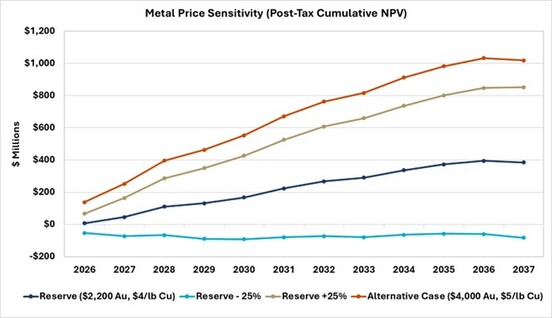
Two pricing scenarios have been analyzed for the economic analysis of the project – an OceanaGold Reserves case and an alternative price case. The alternative price case assumes metal prices closer to current spot prices and is detailed in Table 1-8.
Table 1-8: Metal Price Assumptions
| | | | | | | | | | | |
Description | Reserves Case | Alternative Price Case | |
Gold ($/oz) | 2,200 | 4,000 | |
Silver ($/oz) | 25 | 45 | |
Copper ($/lb) | 4.00 | 5.00 | |
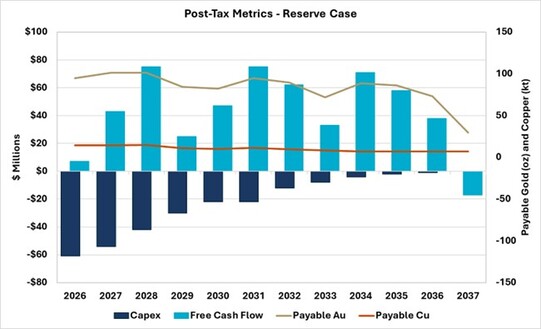
Post-tax project economic metrics are summarized in Table 1-9. At OceanaGold Reserve prices, the project delivers post-tax cashflow of $517 million and NPV5 of $384 million. The alternative price scenario delivers post-tax cashflow of $1,323 million and NPV5 of $1,018 million.
3 Under the FTAA, Net Revenue is the gross mining revenues derived from operations, less allowable deductions and an amortization deduction.
| | | | | | | | | | | |
Released: 27 March 2026 | Page 28 of 234 | |
| | | | | |
NI 43-101 Technical Report – Didipio Mine, Luzon, Philippines |
|
|
Table 1-9: LoM Post-Tax Financial Results
| | | | | | | | | | | |
Description | Reserves Case | Alternative Price Case | |
Metal Prices | |
Gold ($/oz) | 2,200 | 4,000 | |
Silver ($/oz) | 25 | 45 | |
Copper ($/lb) | 4.00 | 5.00 | |
Revenue ($M) | |
Gross Gold Revenue | 2,197 | 3,994 | |
Gross Copper Revenue | 1,072 | 1,340 | |
Silver by-product Credit | 18 | 42 | |
Total Revenue | 3,287 | 5,375 | |
Costs ($M) | |
Underground Mining | 814 | 814 | |
Processing | 350 | 350 | |
General and Administration | 555 | 555 | |
Total Operating Costs | 1,719 | 1,719 | |
Treatment and Refining Charges (TCRC), Deductions & Selling Costs | 159 | 206 | |
Royalties, Production Taxes, Levies, Government Payments | 468 | 1,229 | |
Stock Movement (Cash) | 52 | 20 | |
EBITDA | 889 | 2,201 | |
Income Tax and Other Finance Cost | 135 | 616 | |
Capital Expenditure | 258 | 258 | |
Other Working Capital | (21) | 4 | |
Financial Metrics ($M) | |
Pre-Tax Net Cash Flow | 652 | 1,939 | |
After Tax Net Cash Flow | 517 | 1,323 | |
Pre-Tax NPV @ 5% | 488 | 1,491 | |
After Tax NPV @ 5% | 384 | 1,018 | |
All-In Sustaining Cost ($/oz) | |
AISC | 1,275 | 1,161 | |
1.17Conclusions and Recommendations
1.17.1Conclusions
The following conclusions have been drawn from this Technical Report:
•The Mineral Resources and Mineral Reserves have been estimated in accordance with the Canadian Institute of Mining, Metallurgy and Petroleum Definition Standards.
| | | | | | | | | | | |
Released: 27 March 2026 | Page 29 of 234 | |
| | | | | |
NI 43-101 Technical Report – Didipio Mine, Luzon, Philippines |
|
|
•The Qualified Persons (QP) considers that the sample preparation, security and analytical procedures used for the Didipio Mine are appropriate and adequate for the style of mineralization being assessed;
•While ongoing annual reconciliation fluctuations are expected, the Resource estimates are believed to provide an acceptable basis for medium to long term mine planning purposes;
•Potential extensions to the current underground designs are likely following re-start of in-fill drill programs at depth;
•The mining method, layout and size of the underground orebody is amenable to production rates in excess of 2.5 Mtpa;
•Completion of dewatering in 2025 will enable the opening of additional mining fronts at depth in 2026;
•Increased lateral development rates are scheduled to open up additional production fronts in the lower levels of the mine to facilitate increased underground mining rates;
•An updated mining sequence in the Western Breccia Zone is expected to deliver a sustainable production profile with reduced geotechnical risks;
•The processing plant workforce and management team are well established and successfully operating the plant at rates exceeding 4.1 Mtpa and implementing capital improvements to enable ramp up to 4.3 Mtpa;
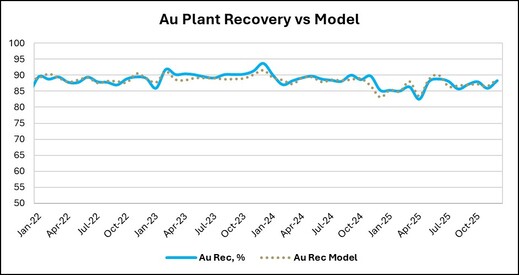
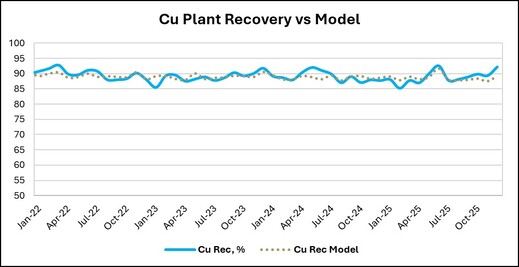
•Metallurgical recovery for both copper and gold have tracked well with modelled recoveries over the life of the project;
•Several capital projects are underway to improve resiliency for water management and facilitate increased mining rates from the underground mine including ongoing active dewatering, main pump station design, procurement and installation, primary ventilation upgrades, and upgrades to the surface pastefill plant and underground reticulation network;
•Project economics are cashflow positive at OceanaGold Reserve price of $2,200/oz and robust at alternate pricing scenario that is closer to spot metal prices (as at December 31, 2025).
1.17.2Recommendations
Recommended work program costs are included in cost models and financial analysis. Based on the conclusions of the Technical Report, the following actions are recommended:
•A comprehensive model to mine to mill reconciliation review is recommended to better attribute fluctuations to mining modifying factors, surface stockpile performance, or other potential causes;
•Restart underground in-fill resource drilling programs in early 2026 with a focus on conversion of material at depth in Panel 3 and Panel 4 to Measured and Indicated Resources and further assessment of Panel 5 at depth;
•Advance geological understanding and further Resource potential of the high-grade Breccia complex and Balut complex at depth;
•Continue to pursue district-wide exploration opportunities on a number of prospects within the FTAA, including additional drilling (currently in progress) to further characterize the potential at True Blue as a near-mine future ore source;
•Ensure adequate skilled labour is sourced to facilitate increased lateral development rates in the lower levels of the mine in 2026 and 2027 to open up additional stoping fronts;
| | | | | | | | | | | |
Released: 27 March 2026 | Page 30 of 234 | |
| | | | | |
NI 43-101 Technical Report – Didipio Mine, Luzon, Philippines |
|
|
•Prioritize the re-establishment of active dewatering in the lower levels of the mine to enable aquifer drawdown;
•Ensure the main decline development is supported by fit-for-purpose dewatering infrastructure and restarted in 2026 to supplement emergency flood water storage during the wet season;
•Further refinement of the groundwater model is recommended to improve the reliability of predicted regional aquifer drawdown resulting from planned infrastructure installation, including model recalibration using updated hydrogeological data and evaluation of uncertainty through sensitivity analyses;
•Focus on quality mining and schedule discipline during the embedment of a more conservative mining sequence in the Western Breccia zone;
•Complete processing plant upgrades to plant material handling and pumping systems to allow treatment at 4.3 Mtpa rates by Q4 2026;
•Evaluate the benefits of alternative technology to improve copper recovery in surface stockpiles;
•Continue future ore testing for recovery variability on underground drill core as it becomes available;
•Complete surface water diversion projects and upgrades to the in-pit pumping system;
•Continue upgrade works to the surface paste plant and underground reticulation system to facilitate increased pastefill rates;
•Prioritize primary ventilation upgrades including geotechnical investigation programs for additional shafts and early engagement with raisebore contractors;
•Ensure dedicated project management and procurement plans are in place for other ventilation related upgrades including ventilation on demand implementation, and upgrades to the primary surface fans to facilitate increased volumes required for additional haulage fleet;
•Maintain a high priority on aquifer depressurization programs including establishment and commissioning of the 2250 mRL borefields and active dewatering at depth;
•Ensure critical components are sourced to enable construction and commissioning of CPS 1 in 2027.
| | | | | | | | | | | |
Released: 27 March 2026 | Page 31 of 234 | |
| | | | | |
NI 43-101 Technical Report – Didipio Mine, Luzon, Philippines |
|
|
2Introduction
2.1Terms of Reference
This report has been prepared to support disclosures in OceanaGold’s Annual Information Form (AIF) for the year ended December 31, 2025.
This report provides updated information on the Didipio Mine, including an updated Mineral Resources and Mineral Reserves estimate.
References in this report to OceanaGold refers to OceanaGold Corporation.
This report uses Mineral Reserve and Mineral Resource classification terms that comply with reporting standards in Canada and the Mineral Reserve and Mineral Resource estimates are made in accordance with the Canadian Institute of Mining, Metallurgy and Petroleum (CIM) Council – Definition Standards for Mineral Resources & Mineral Reserves adopted by the CIM Council on May 19, 2014, which were adopted by the Canadian Securities Administrators’ National Instrument 43-101 – Standards of Disclosure for Mineral Projects (NI 43-101).
2.2Sources of Information and Data
Reports and documents listed in Section 27 of this report were used to support preparation of the report. Additional information was provided by OceanaGold personnel as requested. Supplemental information was also provided to the Qualified Persons by third-party consultants retained by OceanaGold in their areas of expertise.
2.3Qualified Persons
The following individuals, by virtue of their education, experience and professional association, are considered Qualified Persons (QP) as defined in the NI 43-101 standard and are members in good standing of appropriate professional institutions. QP certificates of authors are provided in Appendix A. The QPs are responsible for specific sections summarized in Table 2-1.
Table 2-1: Qualified Persons Responsible for Technical Report Preparation
| | | | | | | | | | | |
Qualified Person | Employer | Position | Tech Report Item(s) Contributed |
David Carr (Not Independent) BEng Metallurgical (Hons) MAusIMM CP Metallurgy | OceanaGold | Head of Metallurgy | Sections: 13,17,18,19 |
Phillip Jones (Not Independent) BEng Mining (Hons) MAusIMM CP Mining | OceanaGold | Head of Underground Mining | Sections: 1,2,3,4,5,15,16,21,22,23,24,25,26 |
Jonathan Moore (Not Independent) BSc Geology (Hons) MAusIMM CP Geology | OceanaGold | Head of Resource Development | Sections: 6 to 12, 14,20 |
| | | | | | | | | | | |
Released: 27 March 2026 | Page 32 of 234 | |
| | | | | |
NI 43-101 Technical Report – Didipio Mine, Luzon, Philippines |
|
|
2.4Site Visits and Scope of Personal Inspection
Mr. Carr has visited the property on several occasions since 2012 and last visited the property in March 2026. During site visits, Mr. Carr inspected the processing plant, maintenance facilities and TSF areas.
Mr. Jones has visited the property on several occasions since 2020 and last visited the property in November 2025. During the site visit, Mr. Jones inspected underground production levels, infrastructure and mining equipment and reviewed aspects of mine design and planning.
Mr. Moore has visited the property on several occasions since 2012 and last visited the property in July 2025. During the site visit, Mr. Moore inspected drill core, the underground mine and reviewed aspects of mine geology, Mineral Resource estimation and reconciliation practices.
2.5Units of Measure
The Metric System for weights and units has been used throughout this report unless otherwise noted. Tonnes are reported in metric tonnes of 1,000 kg. Gold is reported in grams and troy ounces, where applicable (1 Troy ounce = 31.1035 grams). All currency is in U.S. dollars (US$) unless otherwise stated.
2.6Effective Date
The effective date of this Technical Report is December 31, 2025.
| | | | | | | | | | | |
Released: 27 March 2026 | Page 33 of 234 | |
| | | | | |
NI 43-101 Technical Report – Didipio Mine, Luzon, Philippines |
|
|
3Reliance On Other Experts
The Qualified Persons’ opinions contained herein are based on information provided by OceanaGold through the course of the investigations. The Qualified Persons have relied upon OceanaGold and the work of other consultants in various project areas in support of this Technical Report.
The Qualified Persons have used their experience to determine if the information from previous reports was suitable for inclusion in this Technical Report and adjusted information that required amending. This report includes scientific and technical information, which required subsequent calculations to derive subtotals, totals, and weighted averages. Such calculations inherently involve a degree of rounding and consequently introduce a margin of error. Where these occur, the Qualified Persons do not consider them to be material.
For reporting of environmental, permitting and social or community impact matters in Section 20 of this Technical Report, the Qualified Persons have relied upon information provided by OGPI's Didipio Manager of Environment and Social Responsibility in a report dated March 16, 2026.
For applicable taxes, royalties and other government levies or interests applicable to revenue or income from the Didipio Mine in Section 22 of this Technical Report, the Qualified Persons have relied on ownership information provided by OGPI’s Chief Financial Officer in a report dated March 16, 2026.
| | | | | | | | | | | |
Released: 27 March 2026 | Page 34 of 234 | |
| | | | | |
NI 43-101 Technical Report – Didipio Mine, Luzon, Philippines |
|
|
4Property Description and Location
4.1Property Location
The Didipio Mine is located in the north Luzon Island approximately 270 km NNE of Manila, in the Republic of the Philippines as highlighted in Figure 4-1.
Figure 4-1: Location Map Didipio Gold Mine
The site is at 121.45º E 16.33º N (World Geodetic System 1984). The underground mine grid is discussed in Section 10.5. The FTAA straddles a Provincial boundary, with part of the property within the Province of Nueva Vizcaya and part within the Province of Quirino. The location of the
| | | | | | | | | | | |
Released: 27 March 2026 | Page 35 of 234 | |
| | | | | |
NI 43-101 Technical Report – Didipio Mine, Luzon, Philippines |
|
|
FTAA area and the Didipio Mine are shown in Figure 4-2 subject to the outcome of a pending litigation between the two provinces in the area.
Figure 4-2: FTAA Boundaries and Provincial Boundaries
The FTAA covers 5,000 hectares as shown in Figure 4-2. The original FTAA covered 37,000 hectares with parts relinquished annually under the terms of the agreement. The latest relinquishment
| | | | | | | | | | | |
Released: 27 March 2026 | Page 36 of 234 | |
| | | | | |
NI 43-101 Technical Report – Didipio Mine, Luzon, Philippines |
|
|
report was lodged on December 26, 2025 where OGPI relinquished 1,957 hectares and retained 5,000 hectares as remaining FTAA contract area. No further relinquishments are required as the property is now within the maximum size for retained area stipulated under the agreement. The approved PDMF for the Didipio Mine covers 975 hectares within the FTAA. The PDMF is a critical regulatory milestone approving specific areas for commercial operation that allows mining to proceed within the FTAA. The boundary of the original FTAA, the updated FTAA and PDMF are shown in Figure 4-3
Figure 4-3: FTAA Boundaries
4.2Mineral Tenure
4.2.1Financial or Technical Assistance Agreement (FTAA)
The Didipio Mine is covered by the FTAA which grants OGPI the right to undertake large-scale exploration, development and mining of gold, silver, copper and other minerals within a fixed fiscal sharing regime.
The FTAA application was first lodged in February 1992 and granted to CAMC (subsequently renamed OceanaGold (Philippines) Exploration Corporation or OGPEC) on June 20, 1994, under Executive Order No. 279 and the Mineral Resources Development Decree of 1974. The FTAA
| | | | | | | | | | | |
Released: 27 March 2026 | Page 37 of 234 | |
| | | | | |
NI 43-101 Technical Report – Didipio Mine, Luzon, Philippines |
|
|
therefore pre-dates the PMA, which is the empowering legislation for subsequent FTAAs. On December 9, 2004, the DENR approved the transfer of all of CAMC’s rights and obligations under the FTAA to OGPI. OGPI is the current holder of the Didipio FTAA.
Pursuant to the FTAA, OGPI notified the DENR that commercial production had commenced at the Didipio Mine on April 1, 2013.
The FTAA makes provision for exploration over tenements outside the PDMF area for a five-year term from grant of the FTAA, subject to further extensions. OGPI secured two extensions of the exploration period in 2005 and 2016. In September 2024, OGPI obtained approval for a further five-year extension of the FTAA exploration period covering 2024 to 2029.
The initial 25-year term of the FTAA ended on June 20, 2019. On the same day, the MGB issued a letter stating that OGPI was permitted to continue its mining operations pending the approval of the renewal of the FTAA. On June 25, 2019, the Nueva Vizcaya Provincial Government considered the FTAA to have expired and blockaded access to the Didipio Mine. This resulted in the temporary suspension of underground mining in July 2019 and processing in October 2019.
On July 14, 2021, the Philippine Government confirmed the renewal of the FTAA through the execution of the FTAA Addendum and Renewal Agreement, extending the term for a further 25 years commencing June 2019 and ending in June 2044. The FTAA Addendum and Renewal Agreement imposed certain additional obligations, including each of the following:
•Provision for an additional Social Development Fund (SDF) equivalent to 1.5% of the gross mining revenue of the preceding calendar year. 1% of the fund will be allocated as CDF and 0.5% is for the PDF for the provinces of Quirino and Nueva Vizcaya. The expenses for the SDF shall be included as an allowable deduction from the gross mining revenue under the FTAA;
•Reclassification of the NSR to be an allowable deduction and shared 60% / 40% rather than wholly included in the government share;
•Listing of at least 10% of the common shares in OGPI on the Philippine Stock Exchange within three years from confirmation of FTAA renewal;
•OGPI to offer for purchase by the Bangko Sentral ng Pilipinas (which is the central bank of the Philippines) not less than 25% of its annual gold doré production at a fair market price and on mutually agreed terms; and
•OGPI shall transfer its principal office to a local government unit in either of the host provinces of Nueva Vizcaya or Quirino within two years.
OceanaGold has complied with all the above amendment terms including the following:
•Transfer of the principal office to the Didipio Mine, Didipio, Kasibu, Nueva Vizcaya in February 2022;
•Successful completion of the initial public offering of 20%4 of the outstanding common shares of OGPI on the Philippines Stock Exchange on May 13, 2024 under the ticker symbol ‘OGP’; and
4 The 20% public float satisfied the Philippine Stock Exchange’s minimum requirement and complied with the 10% mandatory listing required under the renewed FTAA
| | | | | | | | | | | |
Released: 27 March 2026 | Page 38 of 234 | |
| | | | | |
NI 43-101 Technical Report – Didipio Mine, Luzon, Philippines |
|
|
•Execution of an agreement with the Bangko Sentral ng Pilipinas on May 5, 2022 for the sale of at least 25% of its annual doré production5, which was renegotiated in 2024 for a further three (3) year term.
Following the confirmation of the renewal of the FTAA, OGPI commenced a restart of operations. In November 2021 processing restarted with stockpile feed followed by underground production later that month ramping up to achieve full production rates by Q2 2022 and has operated uninterrupted since that time.
Furthermore, the FTAA provides that OGPI shall be required, after ten years from the recovery of pre-operating expenses and property expenses under the FTAA or 20 years after the original effective date of the FTAA, whichever is later, to divest its equity within a period of one year by either: (a) disposing 60% of its equity holdings (or such lesser equity requirement as may be imposed by law at that time) to be a qualified entity to Filipinos or any Philippine juridical entity at the end of such year; or (b) allowing the terms of the FTAA to continue to govern the relation of the parties therein and by disposing 60% of its equity holdings (or such lesser equity requirement as may be imposed by law at that time) to be a qualified entity to Filipinos or any Philippine juridical entity. The one-year divestment period may be extended by the DENR Secretary if there are justifiable economic reasons warranting the extension, and if the divestment requirement is met, OGPI can, at its option, avail of the rights and privileges of converting the FTAA into a mineral production sharing agreement, in which case the revenue sharing under the FTAA shall no longer apply.
In a letter dated October 1999 from the DENR Secretary, the DENR stated that it does not interpose any objection to the deletion of the divestment requirement, as the PMA and its implementing rules and regulations do not prescribe or impose any mandatory divestment requirement on mining companies. The deletion of the divestment requirement was not discussed during the FTAA renewal process and the FTAA Addendum and Renewal Agreement does not address the divestment provision in the FTAA.
The Didipio FTAA is not covered by the new fiscal regime mandated by Republic Act No. 12253 of the Enhanced Fiscal Regime for Large-Scale Metallic Mining Act, which was signed into law in September 2025.
4.2.2Entitlements of Addendum Claimowners
The Addendum Claimowners are entitled to (i) an 8% free carried interest in OGPI and (ii) a 2% NSR, in each case applicable only to a certain area pursuant to the Gonzales Addendum Agreement. The relevant area comprises a portion of the FTAA, including the PDMF area in its entirety, which encompasses the Didipio Mine.
It is expected that the 8% free carried interest will be reflected as an equity interest in the capital stock of OGPI through the issuance of new shares in OGPI to the Addendum Claimowners. However, there are two pending legal cases with respect to the Gonzales Addendum Agreement.
Under the Gonzales Addendum Agreement, the shares of stock corresponding to the 8% interest of the Addendum Claimowners in OGPI, when issued, shall have voting rights and shall have similar rights and privileges as those of the shares of stock of the other shareholders holding the remaining 92% of the equity of OGPI in respect of voting rights and distribution of dividends. Thus, apart from
5 In 2025 a total of 30.54% of Didipio’s doré production was sold to the Bangko Sentral ng Pilipinas
| | | | | | | | | | | |
Released: 27 March 2026 | Page 39 of 234 | |
| | | | | |
NI 43-101 Technical Report – Didipio Mine, Luzon, Philippines |
|
|
voting rights, the 8% free carried interest will entitle the Addendum Claimowners to a proportionate share of any dividends declared from the net profits of OGPI after full recovery of our pre-operating expenses and property expenses and with respect only to the area defined therein. Pursuant to the FTAA, any entitlements flowing to the Addendum Claimowners after recovery of pre-operating expenses and property expenses form part of the Philippine Government’s share in the net revenue.
The Addendum Claimowners are also entitled to a 2% NSR in respect of a certain area defined in the FTAA. Under the original FTAA, the NSR due to the Addendum Claimowners are considered part of the Government share in net revenue and therefore borne by the Government in its entirety. However, under the FTAA Addendum and Renewal Agreement, the 2% NSR due after July 2021 is classified as part of allowable deductions against net revenue and therefore shared 60% / 40% between the Government and OGPI, respectively.
Under the Gonzales Addendum Agreement, the payment of the 2% NSR shall commence upon actual production from the area of interest and shall be derived and payable by OGPI from the sale of gold doré and/or copper concentrate and other by-products from the operation of the area of interest.
OGPI have accrued the 2% NSR since the commencement of actual production in 2013 pending the final resolution of the outstanding cases. The timing of cash settlement of the accrued NSR remains dependent on resolution of the proceedings. As of December 31, 2025, OGPI have accrued $83.7 million ($69.6 million of royalties and $14.1 million related to free-carried interest) pertaining to this claim.
4.3Environmental Compliance Certificate and Partial Declaration of Mining Feasibility
Although the Didipio FTAA was granted prior to the PMA, in common with subsequent FTAAs granted under the PMA and its Implementing Rules and Regulations, an ECC and a PDMF are both required as a condition of the implementation of the FTAA. Both an ECC and a PDMF have been obtained and remain in place for the Didipio Mine.
The PDMF was approved under a DENR Order dated October 11, 2005, and OGPI was deemed to have satisfied all conditions required for its approval. The declaration, covering 975 km2, was defined as only ‘partial’ as it applied specifically to the development zone around the Didipio deposit. OGPI retains the right to seek further partial declarations of mining feasibility in the future over other deposits in the broader Didipio FTAA area. The PDMF approval allows for, among other matters, open-pit and underground mining, a tailings storage facility and impoundment, waste rock stacks, a process plant, an explosives magazine and watersheds. The Definitive Feasibility Study completed in 1998 specified the initial project mining methods, production rate, processing methods and other aspects of the mining operation.
On August 11, 1999, the Company obtained an ECC (No. 9801-001-301) for the project. The ECC specifies the environmental management and protection requirements including the submission of an EPEP, an annual EPEP, a FMR/DP, and a SDMP. The ECC was amended in 2000 and 2004 to accommodate project modifications.
Following further optimization studies in the last quarter of 2010 and early part of 2011, OGPI identified certain changes that could be made to optimize the value of Didipio. The changes
| | | | | | | | | | | |
Released: 27 March 2026 | Page 40 of 234 | |
| | | | | |
NI 43-101 Technical Report – Didipio Mine, Luzon, Philippines |
|
|
included revised processing capacity - from 2.5 Mtpa to 3.5 Mtpa, and the change in the mining methodology - from a limited open-pit operation followed by underground mining operation utilising sub-level caving and benching, to an open-pit for followed by an underground stoping operation with paste backfill. Considering these modifications, the ECC was further revised and the amended ECC named ECC-CO-1112-0022 was issued on December 10, 2012. An additional amendment was approved by the DENR on July 15, 2015, allowing for the construction of approximately 3.35 km of Overhead Power Line (OHPL) and the High Voltage (HV) Sub-station within the FTAA Area (approximately 1500 m2). A separate ECC was also approved for the establishment and operation of onsite Sanitary Landfill under ECC No. ECC-OL-RO2-2016-0083 issued on June 28, 2016, in addition to the main project ECC.
On July 4, 2016, OGPI applied for the amendment of the ECC-CO-1112-0022 to cover further potential increase in processing throughput from 3.5 Mtpa to 4.3 Mtpa. The application, however, was impacted by the moratorium under DENR Memorandum Order No. 2016-01 which also includes the processing of any ECC-related applications. Following issuance of the DENR’s clarificatory memorandum dated December 22, 2017, eliminating the processing of ECC applications from the coverage of the moratorium, the ECC amendment application was resubmitted on February 19, 2018, and the first review was completed on January 21, 2019, followed by the conduct of the public hearing on March 7, 2019. Subsequently, the Environmental Impact Assessment Review Committee (EIARC) completed the review of the ECC amendment application and endorsed the approval thereof. After the confirmation of the renewal of the FTAA, the EIARC conducted final deliberation of the ECC amendment, and the ECC amendment was approved and issued on April 26, 2022 as ECC No. ECC-CO-1901-0002.
4.4Didipio Ownership Structure
Following the completion of the initial public offering of 20% of the issued and outstanding common shares in the capital of OGPI on the Philippine Stock Exchange, Inc. on May 13, 2024, OceanaGold Corporation holds an 80% interest in OGPI. The ownership structure for the Didipio assets is illustrated in Figure 4-4.
| | | | | | | | | | | |
Released: 27 March 2026 | Page 41 of 234 | |
| | | | | |
NI 43-101 Technical Report – Didipio Mine, Luzon, Philippines |
|
|
Figure 4-4: Didipio Mine Ownership Structure
| | | | | | | | | | | |
Released: 27 March 2026 | Page 42 of 234 | |
| | | | | |
NI 43-101 Technical Report – Didipio Mine, Luzon, Philippines |
|
|
5Accessibility, Climate, Physiography, Local Resources, and Infrastructure
5.1Topography, Elevation and Vegetation
The Didipio Mine is located approximately 270 km NNE of Manila in the southern part of the Mamparang mountain range adjacent to the border of Nueva Vizcaya and Quirino Provinces as shown in Figure 5-1.
The project area is located within the southern part of the Cagayan Valley basin in north-eastern Luzon, the Philippines. The area is bounded on the east by the Sierra Madre Range, on the west by the Luzon Central Cordillera range and on the south by the Caraballo Mountains. The regional geology comprises late Miocene volcanics, volcaniclastics, intrusives and sedimentary rocks overlying a basement complex of pre-Tertiary tonalites and schists. This geology is consistent with an island arc depositional and tectonic setting.
The geomorphology of the project area is diverse. The project can be generally sub-divided into at least six geomorphic units: ridges-and-spurs, escarpment zones, hills-and-slopes, valley-and-gully sides, infilled valley bottom and mass movement zones. Infilled valley bottoms occur as narrow strips of low and flat-lying areas within the project area. These areas occupy the main Didipio Valley. Morphological associations include the floodplain and terraces along the Didipio River. The valley floor near the project centre is at 690-700 m above sea level with the surrounding ridgelines rising another 150-200 m above this. In the project area, three segments of existing vegetative cover have been identified, and consist of:
•Grassland, which covers both primary and secondary impact areas;
•Brushland (riparian), which is located within the primary impact site; and
•Low-density forest, which is located within the secondary impact area.
Development of the operation has involved partial clearance of some vegetative cover, comprising the clearance and covering or inundation of trees, brush and scrub. All removal of trees has been subject to appropriate clearance permits, which ensure that any trees of harvestable size are harvested in accordance with regulatory requirements.
| | | | | | | | | | | |
Released: 27 March 2026 | Page 43 of 234 | |
| | | | | |
NI 43-101 Technical Report – Didipio Mine, Luzon, Philippines |
|
|
Figure 5-1: Didipio Location Map (Not to Scale)
5.2Accessibility
Barangay Didipio is approximately 36 km east of Bayombong and about 40 km south of Cordon off the National Maharlika Highway. Presently, access to Didipio is from the north commencing at the national highway at Cordon, continuing along a concrete paved road to Cabarroguis and thereafter passing a concrete bridge over the Dibibi River. The Dibibi-Tucod Didipio Provincial Road serves as the main route for fuel deliveries, employee travel and concentrate transport. In total, over 160 km of roads have been improved in Nueva Vizcaya and Quirino.
The concentrate haulage route follows the Maharlika Highway over approximately 370 km from Didipio to Poro Point Port, San Fernando, La Union. Road conditions are generally good; however
| | | | | | | | | | | |
Released: 27 March 2026 | Page 44 of 234 | |
| | | | | |
NI 43-101 Technical Report – Didipio Mine, Luzon, Philippines |
|
|
sections include sharp curves, steep gradients and intermittent rough surfaces, particularly through the Dalton Pass.
Alternate access to the site, suitable for vehicle sizes up to small trucks, extends east from the National Maharlika Highway at Bambang. The road is fully sealed to the town of Kasibu. Thereafter, the road is 100% all weather and partially sealed to Barangay Capisaan and to the Didipio TSF.
The nearest airport to the project is the Cauayan Airport in Isabela approximately 100 km away by road. The terrain within the project area is not amenable for the construction of an airstrip. A helipad is maintained for emergency purposes.
Commercial air services operate seven days per week between Manila and Cauayan (about three hours travelling time from the Didipio site by road). The total travel time to site from Manila by road and air is approximately 8 hours.
5.3Climate
Didipio is classified under the Type III Modified Corona’s Classification. Type III climate typically has no pronounced maximum rainfall period with a dry season from one to three months, usually during the period from December to February or from March to May. Figure 5-2 shows the location of Didipio within the Modified Corona’s Classification.
Source: Philippine Atmospheric, Geophysical and Astronomical Services Administration
Figure 5-2: Modified Corona's Classification of the Philippines
At the Didipio Mine, rainfall has been monitored daily since May 1989. The mean annual number of rainfall days at the site is 226 and the mean annual rainfall is 3,388 mm. Consistent with the Type III Modified Corona’s Classification, the mine site area experiences a tropical climate consisting of three main seasons:
•The south-west monsoon season in June-September;
•The north-west monsoon in October- January;
•A seasonal transition period in February-May.
| | | | | | | | | | | |
Released: 27 March 2026 | Page 45 of 234 | |
| | | | | |
NI 43-101 Technical Report – Didipio Mine, Luzon, Philippines |
|
|
Didipio receives most of its rainfall during the monsoon seasons. As shown in Table 5-1 and Figure 5-3 the wettest months are normally November and December and the driest month is normally April.
Table 5-1: Didipio Average Monthly Rainfall (mm)6
| | | | | | | | | | | | | | | | | | | | | | | | | | | | | | | | | | | | | | |
| Jan | Feb | Mar | Apr | May | Jun | Jul | Aug | Sep | Oct | Nov | Dec |
37-Year Ave. | 242.2 | 166.0 | 131.4 | 139.4 | 197.9 | 187.3 | 274.6 | 269.7 | 330.4 | 465.4 | 454.9 | 540.3 |
2025 | 354.6 | 384.6 | 211.9 | 41.0 | 54.5 | 236.0 | 75.0 | 424.0 | 524.4 | 422.6 | 969.1 | 634.5 |
Figure 5-3: Average Monthly Rainfall for Didipio (mm)
The maritime setting of the Philippines results in relatively small temperature ranges being experienced. Based on the temperature monitoring data from 2012 to present at site, the mean annual temperature at the project site is 22.8ºC. The hottest months were May 2012 and July 2014, and the coldest month was January 2014.
Luzon Island's setting combined with its high rainfall, results in high humidity levels. The average annual humidity is 80.9% and nearly all regional weather stations report a relative humidity in excess of 70% on a monthly basis. A large majority of these stations report a relative humidity of greater than 80% for more than eight months of the year. The prevailing winds tend to conform to the dominant seasonal air streams. Consequently, north-east winds are associated with the north-
6 Source: Didipio rainfall measurement stations
| | | | | | | | | | | |
Released: 27 March 2026 | Page 46 of 234 | |
| | | | | |
NI 43-101 Technical Report – Didipio Mine, Luzon, Philippines |
|
|
east monsoon season. Local topography and diurnal effects do, however, influence this general trend to some extent. The average annual wind speed is 3.75 m/s.
The Didipio region is subject to the effects of an average of two tropical typhoons a year, which, together with topographical effects, can greatly influence wind speeds and contribute to the high annual rainfall. In such instances, wind speeds can exceed 50 m/s and may reach as much as 75 m/s. The average wind speed over such surge periods normally exceeds 38 m/s.
The Didipio Mine has experienced direct impacts from several typhoons since commercial operations commenced in 2013. The effect on operations can vary depending on the severity of the typhoon. OGPI monitors typhoon and tropical storm development progress and has developed emergency planning to protect personnel and equipment in the event of a typhoon impacting the site.
5.4Local Resources and Infrastructure
5.4.1Site Infrastructure and Surface Rights
More detailed infrastructure information is contained in Chapter 18 in this document. Current site infrastructure includes:
•A 52 hectare open-pit (final design surface disturbance);
•A 4.3 Mtpa capacity processing plant;
•A diesel-powered backup power station supplying a maximum of 16 megawatts (MW);
•An incoming 69kV overhead HV powerline and switchyard;
•A 129-hectare TSF which includes the flowthrough intake and the impoundment area;
•A 64-hectare waste rock dump, a portion of which has already been rehabilitated;
•Workforce accommodation compounds;
•Water treatment plant;
•Plant sediment ponds and other waste-water storage ponds;
•Warehousing, workshops, offices and crib rooms;
•Fuel farm, backfill paste plant, emulsion plant;
•Site roads and bridges; and
•Armoured river diversion channel
OGPI has acquired surface rights over all the land on which the current and planned site infrastructure is located.
The daily water demand for the Didipio Mine at a 4.3 Mtpa processing rate is approximately 20,000 m3, of which 100% is recycled water from TSF decant water and underground mine dewatering after being treated at the Arsenic Treatment Plant (ATP). Fresh makeup water was sourced previously from the five deep bores around the perimeter of the open-pit mine. In the third quarter of 2018, these boreholes were decommissioned. The current source of domestic and raw water supply for the camp and processing plant comes from either the Madadag levee or from the water treatment plant.
A water discharge permit (Permit No. DP-RO2-23-07760) for the TSF is currently held to allow discharge of up to 47,520 m3 per day from the TSF. A water treatment plant with capacity to process 48,000 m3 per day ensures OGPI meets the required discharge standards. In the event of heavy rainfall in excess of the combined capacity of the decant system, the water treatment plant and
| | | | | | | | | | | |
Released: 27 March 2026 | Page 47 of 234 | |
| | | | | |
NI 43-101 Technical Report – Didipio Mine, Luzon, Philippines |
|
|
available storage capacity in the TSF, clean decant water from the TSF can be discharged via an emergency direct discharge pipeline.
5.4.2Power Supply
Since November 2015, Didipio has been operating on National Grid Power as its main operational power supply. Diesel powered generators remain in place and provides up to 16MW back-up power to the operation. Details on power, future requirements, and contracts are covered in Sections 18.2 and 19.6.
5.4.3Sewage
Sewage from locations around the Didipio Mine site are piped or transferred to a site-based sewage treatment plant for which OGPI holds a Discharge Permit: No. DP-R02-22-02691. This permit allows the discharge of wastewater up to 400 m3 per day to the Didipio River.
5.4.4Refuse Disposal
As part of the Company’s commitment to comply with its ECC, OGPI is implementing best practice reusing and recycling in waste management. A separate ECC has been approved for the establishment and operation of onsite Sanitary Landfill under ECC No. ECC-OL-RO2-2016-0083 issued on June 28, 2016, as an addition to the main project ECC and thereby superseded by ECC-CO-1901-0002. Recyclable wastes are collected in a material recovery facility operated by a contractor and sold to recyclers. Scrap metals generated in the operation are collected at a metal scrap yard and sold to scrap metal buyers. Waste oils and lubricants are recovered and disposed of at a registered waste treatment or disposal facility in accordance with Philippines Government requirements.
5.4.5Port Facilities
The Port of Manila (372 km from the Didipio site) is the destination port for inwards transit of bulk goods and reagents, while the existing copper concentrate storage and shipment facilities at Poro Point, La Union (356 km from the Didipio site) is the departure port for the shipment of copper ore concentrate.
5.4.6Personnel
OGPI and its main contractors currently employs approximately 2,304 personnel consisting of 978 OceanaGold personnel and 1,326 contractors.
Under the FTAA, OGPI is committed to a target of 100% employment of Filipinos in unskilled, skilled and clerical positions and 60% employment of Filipinos in professional and management positions. Long-term contractors servicing the project are required to follow a similar employment policy.
Where possible, recruitment for the Didipio Mine, particularly of mining and processing plant personnel, is from the local area. The Didipio Mine sources the majority of its employees from the provinces of Nueva Vizcaya and Quirino. Positions requiring skills and experience not available locally are filled from the remainder of the Philippines. There are a small number of highly skilled
| | | | | | | | | | | |
Released: 27 March 2026 | Page 48 of 234 | |
| | | | | |
NI 43-101 Technical Report – Didipio Mine, Luzon, Philippines |
|
|
and experienced expatriate employees present at the Didipio Mine. These expatriates, who compose approximately 3% of the OGPI workforce, actively mentor and assist in the development of OGPI’s Filipino employees in accordance with the Mining Act.
5.4.7Accommodation
A 878-person capacity site-based camp offering single-status accommodation is provided for all personnel recruited from outside the Didipio region. The camp includes both permanent and temporary operational accommodation in a mix of self-contained one-bedroom apartments, single bedrooms with ensuites or shared ensuites and barracks style accommodation with a shared ablutions block.
Other buildings/facilities within the accommodation camp include:
•Kitchen and mess hall;
•Medical clinic;
•Accommodation camp laundry and linen storage;
•Recreation room and gym;
•Camp office;
•Sewage treatment plant;
•Emergency Response Team (ERT) office and equipment storage;
•Emergency generators; and
•Guard house.
The camp is operated by a local contractor, the Didipio Community Development Corporation, whose role includes providing meals, cleaning duties for the camp and mine site buildings, laundry services, provision of linen, cutlery and shuttle services for employees.
The camp has sufficient accommodation to service mine, plant and other surface infrastructure requirements for LoM plans.
5.4.8Communications
Satellite and terrestrial services provide telephone and data communications to the Didipio Mine. Mobile telephone coverage is available throughout the majority of the mining area.
A multi-channel radio network is utilized for operations communication within the mine and process plant.
In 2015, the company established an internet backbone using a fibre optic link with secondary internet users connected to the network using microwave technology. The site has a single service provider Globe – LTE which provides 4G capability to the site and local community.
| | | | | | | | | | | |
Released: 27 March 2026 | Page 49 of 234 | |
| | | | | |
NI 43-101 Technical Report – Didipio Mine, Luzon, Philippines |
|
|
6History
6.1Prior Ownership
The Didipio area was first recognised as a gold province in the 1970s, when alluvial gold deposits were discovered. There followed a succession of owners undertaking exploration activities in the region. Prior to the Didipio Mine, there has been no large-scale mining in the Didipio region and while artisanal miners have been active in the area, there are no records of production.
Since the discovery of alluvial gold in the 1970s, the Didipio area has been held by a succession of claim holders:
•In May 1975, Victoria Consolidated Resources Corporation and Fil-Am Resources Inc. entered into an exploration agreement with a syndicate of claim owners who had title to an area covering the Didipio valley and undertook exploration activities, including a stream geochemistry program, between 1975 and 1977;
•In April 1985, the property was explored (with work including geological mapping, panning of stream-bed sediments and ridge and spur soil sampling) by a consultant geologist engaged by local claim owner Jorge Gonzales;
•In September 1987, Geophilippines Inc. investigated the Didipio area and lodged mining lease applications in November 1987;
•In 1989, Cyprus Philippines Corporation and subsequently Arimco NL (as Arimco Mining Corporation in the Philippines) entered into an agreement with Geophilippines Inc. and the local claim owner, Jorge Gonzales, to explore the Didipio area, undertaking an exploration program between April 1989 and December 1991; and
•In 1992, Climax acquired control of Armico Mining Corporation (renamed CAMC) and the entire Cyprus-Arimco NL interest in the Didipio Project. The FTAA was executed in 1994 and was subsequently assigned from CAMC to Australasian Philippines Mining Incorporated in 2004. Australasian Philippines Mining Incorporated was subsequently renamed to OGPI.
6.2OceanaGold
In 2006, Oceana Gold Ltd and Climax Mining Ltd merged. Construction activities at the Didipio project commenced in 2008, however, the project was placed in care and maintenance in December of that year following the deterioration of global financial markets and project funding constraints.
Detailed design recommenced in 2010 with construction onsite commencing in November 2011. Open-pit mining started in July 2012 and commercial production was declared on April 1, 2013 at a 2.5 Mtpa rate, increasing to 3.5 Mtpa in 2015.
6.3Previous Work
Indigenous miners from Ifugao Province first discovered alluvial gold in the Didipio region in the 1970s. Gold was mined either by the excavation of tunnels following high-grade quartz-sulphide veins associated with altered dioritic intrusive rocks, or by sluice mining in softer, clay-altered zones. Gold was also recovered by panning and sluicing gravel deposits in nearby rivers, and small-
| | | | | | | | | | | |
Released: 27 March 2026 | Page 50 of 234 | |
| | | | | |
NI 43-101 Technical Report – Didipio Mine, Luzon, Philippines |
|
|
scale alluvial mining still takes place. No indications of the amount of gold recovered have been recorded.
Since 1975, exploration work carried out in the area has been managed by the following (note that where Resources are mentioned but not quoted, it is because they are not compliant with CIM Definition Standards):
•From 1975 to 1977, Victoria Consolidated Resources Corporation and Fil-Am Resources Inc undertook a stream geochemistry program, collecting 1,204 pan concentrates samples that were assayed for gold, copper, lead and zinc. A large area of hydrothermal alteration was mapped, but, although nine drill holes were planned to test it, no drilling eventuated. Despite recognition of an altered diorite intrusive (the Didipio Gold-Copper Deposit), no further work was undertaken;
•Marcopper Mining Corporation investigated the region in 1984, followed in April 1985 by a consultant geologist (E P Deloso) who was engaged by local claim owner Jorge Gonzales. Work by Deloso included geological mapping, panning of stream-bed sediments and ridge and spur soil sampling. Deloso described the Didipio Gold-Copper Deposit as a protruding ridge of diorite with mineralized quartz veinlets within a vertically dipping breccia pipe containing a potential resource. Benguet Corporation examined the Didipio area in September 1985 and evaluated the bulk gold potential of the diorite intrusion. Work included grab and channel sampling of mineralized outcrops, with sample gold grades ranging up to 12 g/t Au and copper averaging 0.14% Cu. It was concluded that the economic potential of the diorite intrusion depended on the intensity of quartz veining and the presence of a clay-quartz-pyrite stockwork at depth;
•Geophilippines Inc investigated the Didipio area in September 1987 and carried out mapping, gridding, rock chip and channel sampling over the diorite ridge. In November 1987, Geophilippines Inc commissioned the DENR, Region One, to undertake a geological investigation of the region in conjunction with mining lease applications;
•Between April 1989 and December 1991 Cyprus and then AMC carried out an exploration program that included the drilling of 16 diamond core holes into the Didipio Ridge deposit. This work outlined potential for a significant deposit;
•From 1992, Climax exploration work concentrated on the Didipio Gold-Copper Deposit, although concurrent regional reconnaissance, geological, geophysical and geochemical programs delineated other gold and copper anomalies in favourable geological settings within the wider Didipio area. Diamond drilling and other detailed geological investigations continued in the Didipio area and elsewhere in the Didipio region through 1993 and were coupled with a preliminary Environmental Impact Study (EIS) and geotechnical and water management investigations. These works included 21 diamond drill holes for a total of 7,480 m of drilling, and formed the basis for a preliminary Mineral Resource estimate and commencement of a Project Development Study (PDS) by Minproc Limited in January 1994;
•Additional diamond drilling was completed at Didipio as part of the PDS, providing a database of 59 drill holes within the deposit. A model of the deposit was developed, and a Mineral Resource estimate made. The work identified the key parameters for potential project development, which included the likelihood of underground block caving for ore extraction. The economics of this scenario were dependent in part on the delineation of a central core of higher-grade gold and copper mineralization;
•A program of 17 additional diamond drill holes was undertaken to provide closer spaced sampling data primarily within an area lying above the 2400 mRL. This work was completed
| | | | | | | | | | | |
Released: 27 March 2026 | Page 51 of 234 | |
| | | | | |
NI 43-101 Technical Report – Didipio Mine, Luzon, Philippines |
|
|
in June 1997, with all drill core assays received by early August 1997. These data formed the basis for a study completed by Minproc Limited in 1998; and
•By the time the FTAA was assigned to APMI in 2004, CAMC had drilled 94 drill holes into the Didipio gold-copper deposit for a total of 35,653 m of drilling.
6.4Historical Estimates
Several Resource estimates have been made since 1985. The chronology of these is presented below. As commented above, none of the Resource estimates are quoted as they do not adhere to the CIM Definition Standards. No work is proposed to upgrade or verify the historical estimates:
•Work by Deloso in April 1985 suggested a potential Resource;
•In September 1985, Benguet Corporation estimated the total Resource potential;
•In December 1993, Climax produced an estimate based on available data including the first 21 diamond drill holes; interpolation method was inverse distance squared into 25 m x 25 m x 25 m blocks;
•Snowden Associates produced a Resource estimate in 1995 using additional drill holes (up to hole DDDH65). This model effectively used a 3 g/t AuEq interpretation and wire-framing of the high-grade core of mineralization. Interpolation was by indicator kriging into 15 m x 15 m x 15 m blocks and classification was based on search radii and number of samples;
•The Minproc Limited DFS estimate used all 79 holes (up to hole DDDH83) plus the data for nine surface trenches. The stockwork and high-grade core were modelled separately and grades were interpolated using ordinary or indicator kriging (with grade top cutting) into 15 m x 15 m x 15 m blocks.
6.5Previous Production
There was no large-scale mining at Didipio prior to the commencement of the Didipio open-pit operation and there are no records of the production by artisanal miners although minor artisanal activity did occur. From the start of commercial production in 2013 to the end of 2025, a total of 46 Mt of ore has been mined by a combination of open-pit and underground mining methods.
| | | | | | | | | | | |
Released: 27 March 2026 | Page 52 of 234 | |
| | | | | |
NI 43-101 Technical Report – Didipio Mine, Luzon, Philippines |
|
|
7Geological Setting and Mineralization
7.1Regional Geology
The Northeast Luzon Alkalic Province (NLAP) – in which Didipio sits – forms part of the complex island arc system of the Philippine archipelago. The NLAP today forms the southern edge of the Cagayan Valley basin, and bounded to the west by Central Cordillera Range, to the south by the Caraballo Mountains, and to the east by the Northern Sierra Madre illustrated in Figure 7-1.
Figure 7-1: Regional Geology and Structures Northern Luzon Island
| | | | | | | | | | | |
Released: 27 March 2026 | Page 53 of 234 | |
| | | | | |
NI 43-101 Technical Report – Didipio Mine, Luzon, Philippines |
|
|
The regional geology comprises late Oligocene-early Miocene volcanic, volcaniclastic, intrusive, and sedimentary rocks overlying a basement complex of pre-Tertiary age that represents an island arc depositional and tectonic setting and is shown in Figure 7-2, where:
•CB = Coastal Batholith
•NSMB = Northern Sierra Madre Batholith
•DB = Dupax Batholith
•PB = Palali Batholith
•CSC = Cordon Syenite Complex
•DIC = Didipio Intrusive Complex
•UMF = Upper Mamparang Formation
Figure 7-2: Regional Stratigraphy Caraballo Mountains
The basal sequence of the Caraballo Group is Cretaceous to Eocene age and comprises andesitic pyroclastics, andesitic lavas, and basaltic tuffs with inter-layered beds of sandstone, shale, and tuff. The Caraballo Group includes andesitic-basaltic volcanics, intruded by tonalites, diorites, quartz diorites, and gabbros of the Coastal Batholith (27 to 49 Ma) and the Dupax Batholith (26 to 33 Ma).
The Caraballo Group is unconformably overlain by the Mamparang Formation of Late Oligocene age, comprising andesitic and basaltic lavas and volcaniclastic rocks. This was intruded by various alkalic plutonic rocks of NLAP including syenite, monzonite, and a variety of potassium (K)-
| | | | | | | | | | | |
Released: 27 March 2026 | Page 54 of 234 | |
| | | | | |
NI 43-101 Technical Report – Didipio Mine, Luzon, Philippines |
|
|
feldspar-rich igneous rocks that comprise the Cordon Syenite Complex (CSC) the Palali Batholith (PB), and the Didipio Intrusive Complex (DIC). The DIC is host to the Didipio porphyry copper-gold deposit. The alkalic intrusives of the NLAP are dated 25 to 23 Ma, coincident with the commencement of rifting along the Cagayan Valley basin as a product of eastward-directed subduction along the western margin of the Luzon Island arc (Wolfe and Cooke, 2011 and Wolfe, 2001).
Unconformably overlying the Caraballo Group and Mamparang Formation, the Palali Formation comprises basaltic and andesitic lavas, mudstones, sandstones, and dacitic pyroclastics of Early to Middle Miocene age.
Continuing subsidence of the Cagayan Valley basin that began in Late Oligocene resulted in the formation of thick sedimentary sequence of Miocene to Plio-Pleistocene carbonates and clastic sediments of the Pantabangan Formation.
The DIC and the Didipio copper-gold deposit are broadly within a set of two northwest (NW) striking lineaments that characterize the Caraballo Mountain range. This mountain range links the southern end of the Central Cordillera and the Northern Sierra Madre Mountain ranges. The set of two NW-striking lineaments bound a region of about 40 km wide and 60 km long. Contained within this region is a series of less conspicuous ENE-trending lineaments. The southeast end of this region is characterized by ridges and incised valleys forming arcuate geometries concave to NW. They are the morphological expression of folds affecting units that are generally older than the intrusive complexes.
Recent geological mapping in the Didipio region has been interpreted to indicate the Didipio Gold-Copper Deposit is hosted within the multi-phase Dinkidi Stock, which is in turn part of a larger alkalic intrusive body, the Didipio Igneous Complex. The Didipio Igneous Complex consists of:
•An early composite clinopyroxene-gabbro-diorite-monzodiorite pluton that comprises medium- grained, clinopyroxene-biotite rich microdiorites and monzodiorites of the dark diorite (pre- mineralization);
•The Surong clinopyroxene to biotite monzonite pluton;
•The Au-Cu mineralized Dinkidi Stock; and
•Post-mineralization andesite dykes.
7.2Local Geology
The Dinkidi Stock is an alkalic gold-copper porphyry system, NW-trending body that is roughly elliptical in shape at surface (480 m long by 180 m wide) and with a vertical pipe-like geometry that extends to at least 800 m below the surface.
Porphyry-style mineralization is closely associated with a zone of K-feldspar alteration within a small composite porphyritic monzonite stock intruded into the main body of diorite (Dark Diorite). The extent of alteration is broadly marked by a prominent topographic feature (the Didipio Ridge) some 400 m long and rising steeply to about 100 m above an area of river flats and undulating ground. The northwestern end of the Didipio deposit is truncated by the Biak Shear. It is believed that the True Blue prospect is the displaced northern tip of the deposit. Local geology and faults are shown in Figure 7-3.
| | | | | | | | | | | |
Released: 27 March 2026 | Page 55 of 234 | |
| | | | | |
NI 43-101 Technical Report – Didipio Mine, Luzon, Philippines |
|
|
Figure 7-3: Local Geology
7.3Didipio Deposit Mineralization
The Didipio copper-gold mineralization is associated with two main magmatic events, each accompanied by alteration and mineralization (Wolfe and Cooke, 2011). These magmatic events represent the evolution of the Didipio intrusive complex from a silica-undersaturated to a silica-saturated system.
The silica-undersaturated mineralization is related to the intrusion of the Monzonite Porphyry and the Balut Dykes. The Monzonite Porphyry intrusion produced weak copper-gold mineralization accompanied by patchy pervasive orthoclase along the margins of the porphyry and biotite-magnetite alteration in the intruded rock. The copper-gold mineralization was further enhanced with the emplacement of the Balut Dykes causing calc-potassic alteration with K-feldspar±actinolite-sulphide and diopside-perthite±actinolite-magnetite-sulphide veining. Bornite dominates the sulphide species of the veins and stockworks. The varied textures and composition of the Balut Dykes possibly heralds the onset of magma mixing and the shift to a more silica-saturated magma.
With the emplacement of the succeeding syenitic porphyry intrusions (Feldspar Porphyry and Syenite), the system evolved to more silica-saturated. Quartz-sulphide veins began to form and were later hydrothermally brecciated to form a high-grade, quartz-dominated breccia (QBX) above the Syenite. Wall rock alteration consists of quartz-calcite-actinolite-sulphide and illite-calcite-sulphide. There is also a suggestion that the QBX is genetically related to the equally well-
| | | | | | | | | | | |
Released: 27 March 2026 | Page 56 of 234 | |
| | | | | |
NI 43-101 Technical Report – Didipio Mine, Luzon, Philippines |
|
|
mineralized Balut Dykes (Sillitoe, 2017) which would imply that the QBX is co-genetic with the Balut Dykes and that it was emplaced prior to the intrusion of the Feldspar Porphyry and the Syenite.
More recent underground exploration and development has discovered a pipe-like mineralized breccia body (called Eastern Breccia or EBX), east of the mine grid at level 2250 mRL and below. The breccia consists of two units, monzonite porphyry gradational to monzonite porphyry intrusion breccia, both intruded by a smaller cylindrical body of feldspar porphyry igneous breccia (Sillitoe, 2023). The breccia contains intergrown actinolite, apatite, calcite, magnetite, chalcopyrite and bornite. Some veinlets cut the breccia containing semi-massive chalcopyrite and bornite which give some high-grade Cu and Au values. The breccia pipe is probably related to the silica-saturated magmatic event.
The deposit is oxidised from the surface to a depth between 15 m and 60 m, averaging 30 m. The oxide zone forms a blanket over the top of the deposit and largely comprises silicification, clay and carbonate minerals, accompanied by secondary copper minerals including malachite and chrysocolla. All of the oxide and transitional mineralization has been mined out since mining commenced in 2012.
7.4Lithology
The lithologies at Didipio consist of a composite diorite-monzonite pluton (Dark Diorite) that was intruded by the Surong monzonite, the Didipio composite stock, and crosscut by the Didipio breccia complex (Wolfe, 2001, Wolfe and Cooke, 2011). The lithological units, especially the mineralized breccia complex was previously described by Wolfe et al. (1999), Wolfe (2001), and Blackwell (2017).
The sequence of intrusions and breccias is observed to develop inwards towards the centre of the mineralized stock: diorite, monzonite, monzonite porphyry, Balut Dyke (mafic and aplitic components), quartz and overlying monolithic breccias, feldspar porphyry dykes and syenite porphyry (Sillitoe, 2019).
Sillitoe (2019) interpreted that a clear genetic linkage exists between the syenite porphyry and quartz breccia, with the latter occurring as a spatially coincident carapace to the former. The parent syenitic magma is believed to have released the fluid that accumulated to form a giant bubble that crystallized to form the copper- and gold-bearing quartz body. Feldspar porphyry dykes appear to have intervened between breccia and syenite emplacement. There are two main events of mineralization in the Didipio mineral deposit, one is related to monzonite porphyry, which is characterized by irregularly distributed chalcopyrite-bornite-magnetite mineralization. This event was overprinted by quartz veinlets containing clots of chalcopyrite, which were fed from the fluid bubble that produced the quartz body. The northwestern end of the deposit is truncated by the Biak Shear. A section of the Didipio geology model is shown in Figure 7-4.
| | | | | | | | | | | |
Released: 27 March 2026 | Page 57 of 234 | |
| | | | | |
NI 43-101 Technical Report – Didipio Mine, Luzon, Philippines |
|
|
Figure 7-4: Didipio Geology 3D Block Cut Shown in Mine Grid
7.4.1Dark Diorite
The Dark Diorite is the field term for a diorite to monzodiorite pluton containing cumulative phases. This is part of DIC. The composition varies from medium-grained equigranular clinopyroxene gabbro to fine-medium grained dark gray clinopyroxene diorite and plagioclase-phyric clinopyroxene monzodiorite as shown in Figure 7-5.
| | | | | | | | | | | |
Released: 27 March 2026 | Page 58 of 234 | |
| | | | | |
NI 43-101 Technical Report – Didipio Mine, Luzon, Philippines |
|
|
Base of slide approximately 4cm
Figure 7-5: Dark Diorite (Left) with sharp Monzonite contact (Right)
7.4.2Monzonite
Formerly called the Surong Monzonite, this unit intrudes the Dark Diorite and its dykes penetrate into the surrounding Dark Diorite for over 100 m from the main intrusive contact. Medium-grained equigranular to weakly porphyritic monzonite, this rock commonly occurs with medium-grained biotite, actinolite, and feldspar and is shown in Figure 7-6.
Base of slide approximately 8cm
Figure 7-6: Hornblende bearing Monzonite
7.4.3Monzonite Porphyry
Formerly called the Tunja Monzonite, this unit also intrudes the Dark Diorite and the earlier Monzonite. It is medium-grained, pale-pink to grey coloured biotite-amphibole monzonite with an equigranular to plagioclase-phyric texture. This unit has typically albitized plagioclase crystals surrounded by orthoclase and perthite. Ferromagnesian minerals of biotite and amphibole occur interstitially and commonly altered to chlorite or calcite-rutile. Accessory minerals are apatite and magnetite. The emplacement of this Monzonite Porphyry marks the beginning of copper-gold mineralization in the Didipio mineral deposit and is shown Figure 7-7.
| | | | | | | | | | | |
Released: 27 March 2026 | Page 59 of 234 | |
| | | | | |
NI 43-101 Technical Report – Didipio Mine, Luzon, Philippines |
|
|
Base of slide approximately 7cm
Figure 7-7: Monzonite Porphyry
7.4.4Balut Dyke
The Balut Dykes, hosting high-grade Au-Cu mineralization, intrudes the Monzonite Porphyry at the north and south of the Syenite. The two Balut Dykes are about 10 m to 30 m wide and extend >600 m vertically down and are observed at the deepest level of the mine (1980 mRL). Both the Northern and Southern Balut Dykes are complex units that are confined to the Monzonite Porphyry (Sillitoe, 2017). These units comprise both mafic and felsic components, which are commonly intimately intermixed, although either one may predominate. The mafic component is dominated by granular aggregates of clinopyroxene and magnetite plus lesser amounts of interstitial feldspar and apatite. In places, this material is well-banded, with individual, albeit gradational bands composed mainly of either clinopyroxene-magnetite or feldspar. Massive, magnetite-dominated veinlets and patches are also widespread. The felsic component is either fine-grained aplite or pod-like, pegmatitic aggregates of K-felspar and quartz. Both the mafic and felsic components contain disseminated chalcopyrite and bornite, with grain sizes that correspond to those of their respective host minerals. In contrast, the aplite phase is generally deficient in sulphides. The close spatial and textural association between the mafic and felsic constituents of the Balut Dykes indicates that they may represent coexisting immiscible magmatic phases that segregated at deeper levels within the Monzonite Porphyry intrusion. Except for a small number of cross cutting actinolite bearing veinlets, the Balut Dykes; and the chalcopyrite and bornite they contain; appear to be entirely magmatic in origin and is shown in Figure 7-8 .
| | | | | | | | | | | |
Released: 27 March 2026 | Page 60 of 234 | |
| | | | | |
NI 43-101 Technical Report – Didipio Mine, Luzon, Philippines |
|
|
Base of slide approximately 5cm
Figure 7-8: Balut Dyke Mafic Facies
7.4.5Feldspar Porphyry
The Feldspar Porphyry was formerly called the Quan Porphyry. It has a coarse feldspar phenocryst (subhedral often with fuzzy boundaries), up to 8 mm, in a fine-grained groundmass. This unit sometimes exhibits small miarolitic cavities filled by quartz and is shown in Figure 7-9.
Base of slide approximately 10cm
Figure 7-9: Feldspar Porphyry
| | | | | | | | | | | |
Released: 27 March 2026 | Page 61 of 234 | |
| | | | | |
NI 43-101 Technical Report – Didipio Mine, Luzon, Philippines |
|
|
7.4.6Syenite Porphyry
The Syenite was formerly called the Bufu Syenite. Its texture varies from very fine-grained aphanitic syenite to sparsely feldspar ± quartz porphyritic syenite. The Syenite sometimes has sharp dyke-like margins but also exhibits gradational contact with the feldspar porphyry. The Syenite commonly contains vughs (often lined with quartz). These vughs are interpreted to be miarolitic cavities created by escaping gas from a crystallizing gaseous magma and is shown in Figure 7-10.
Base of slide approximately 5cm
Figure 7-10: Syenite Porphyry
7.4.7Quartz Fragment Rich Breccia (QBX)
A variety of breccias is present within the Monzonite Porphyry intrusion (Sillitoe, 2017) and is shown in Figure 7-11. They are generally above Balut Dyke and Syenite bodies. Quartz fragment-rich Breccia (QBX) is the most prominent breccia and is essentially monomictic and composed of abraded clasts of vein quartz and subsidiary chalcopyrite ± bornite in a matrix of comminuted quartz. This material is transitional to breccias containing clasts of Monzonite Porphyry and/or actinolite along with chalcopyrite ± bornite. Breccia cement appears to be dominated by rock flour, commonly, showing the effects of fault movement but massive chalcopyrite-bornite plus minor quartz can constitute the cement. The QBX occupies the central part of underground mine grid between 1190 to 1350 mRL. It is a less competent rock unit that hosts very high-grade Au-Cu mineralization due to the high content of Cu sulphides.
| | | | | | | | | | | |
Released: 27 March 2026 | Page 62 of 234 | |
| | | | | |
NI 43-101 Technical Report – Didipio Mine, Luzon, Philippines |
|
|
Base of each slide approximately 3cm
Figure 7-11: Variety of Breccia at Didipio
7.4.8Eastern Breccia (EBX)
The EBX is a clast-supported monomictic to polymictic breccia with lithic clasts of all coherent units and is shown in Figure 7-12. Textures vary from jigsaw puzzle to chaotic rotational clasts from the edge to the centre of the breccia. This unit is known to be more competent than QBX but relatively lower in average grades. It is commonly observed on the eastern side of the underground mine.
| | | | | | | | | | | |
Released: 27 March 2026 | Page 63 of 234 | |
| | | | | |
NI 43-101 Technical Report – Didipio Mine, Luzon, Philippines |
|
|
Base of each slide approximately 3cm
Figure 7-12: Monzonite Porphyry Intrusions Breccia (left) & Feldspar Porphyry Igneous Breccia (Right)
7.4.9Biak Shear
The Biak Shear Zone truncates the northern end of the deposit, reflecting post-mineralization movement. There is, however, evidence of primary mineralization within the Biak Shear, suggesting that the structure was present during mineralization. Intrusives within the shear zone are extensively carbonate-veined and sheared.
| | | | | | | | | | | |
Released: 27 March 2026 | Page 64 of 234 | |
| | | | | |
NI 43-101 Technical Report – Didipio Mine, Luzon, Philippines |
|
|
8Deposit Types
8.1Description of Deposits
The Didipio Mineral Property is an alkalic porphyry copper-gold system (Jensen and Barton, 2000; Bissig & Cooke, 2014). Globally, alkalic deposits are relatively uncommon compared to calc-alkaline porphyry copper deposits which occur the length of the main magmatic arcs known on the planet. Alkalic porphyry deposits are genetically associated with more spatially restricted alkaline volcano-plutonic geological provinces. The Didipio deposit exhibits features that are common to other alkalic porphyries found in British Columbia, Canada, and eastern Australia. The main features of this porphyry type are:
•Alkalic porphyry intrusions are host to Au-Cu mineralization;
•Generally associated with extensional tectonics and commonly occur in a back-arc setting;
•The porphyry intrusion and associated mineralization tend to be small although higher grade and may contain appreciable gold and silver;
•Presence of calc-potassic alteration consisting of orthoclase, magnetite, apatite, perthite, and diopside is associated with the main stage Au-Cu mineralization; and
•Sulphur isotope compositions are characterized by negative sulphur isotope values consistent with oxidized magmatic sources of sulphur.
Jensen and Barton (2000) published a model for a range of alkalic gold and gold-copper deposits found in British Columbia, shown in Figure 8-1 below. The Didipio deposit is interpreted to be close to the location of “A” (similar to the Galore Creek Cu-Au-Ag deposit) on this model. Didipio mineralization formed at a depth of about 2.9 to 4.5 km based on fluid inclusion studies (Wolfe and Cooke, 2011). The diagram also shows a central alteration core of K-feldspar, biotite, magnetite, bornite and a peripheral sodic and calcic alteration accompanied by chalcopyrite mineralization. This broadly resembles the Didipio porphyry mineralization and alteration.
| | | | | | | | | | | |
Released: 27 March 2026 | Page 65 of 234 | |
| | | | | |
NI 43-101 Technical Report – Didipio Mine, Luzon, Philippines |
|
|
Figure 8-1: Schematic Illustration - Relationships Between Rock types
| | | | | | | | | | | |
Released: 27 March 2026 | Page 66 of 234 | |
| | | | | |
NI 43-101 Technical Report – Didipio Mine, Luzon, Philippines |
|
|
9Exploration
9.1Pre-OceanaGold
Prior to the acquisition of the Didipio Project by OceanaGold, previous explorers drilled a total of 230 diamond drill holes totalling 62,769 m. The drilling metres were mostly for the Mineral Resource delineation of the Didipio porphyry Au-Cu deposit with a small percentage of drilling in nearby prospects including True Blue, D’Fox, San Pedro, D’Beau, and Morning Star.
Previous companies also completed exploration work to assess the regional prospectivity of the FTAA tenement and follow-up detailed investigations on the targets identified. The regional work includes about 100,000 line-kilometres of airborne magnetics and radiometrics, 2,248 stream sediment samples, and 5,287 rock samples. Follow-up programs consisted of detailed mapping, grid soil sampling, induced polarisation, and ground magnetic surveys.
9.2OceanaGold
OceanaGold continued follow-up works on some of the targets previously identified. The works included detailed investigation of the Mogambos, Papaya, Upper Tucod, MMB, and TNN prospects. Grid soil sampling over these prospects have delineated coincident Au-Cu anomalies over prospective lithologies for potential future drill testing.
OceanaGold conducted exploratory drilling within the PDMF area in 2013 and 2014 to test near- mine targets. A total of 5,448 m over 15 holes were drilled over the period. The drilling program hit several low-grade mineralized intersections at D’Beau, San Pedro and Chinichinga prospects. These intersections may indicate separate mineralized bodies from Didipio or peripheral low-grade occurrences.
A Titan 24 DC-IP-MT survey completed a total of 30 km (Direct Current/Induced Polarization) DC/IP and MT (Magneto-Telluric) over the PDMF area in Q3 of 2014. The survey includes 13 DC/IP and MT spreads along 10 survey lines with 100 m station intervals and nominal 200 m and 400 m line spacing. Several potential targets with different priority levels were outlined along the survey lines. These targets were prioritized as high, moderate and low based on the category of the chargeability and resistivity of the anomalies as well as the size. Anomalies were drill tested and intersected some minor sections of low gold and copper grade that could be the basis of more drilling in the future.
Exploration from 2015 to 2019 comprised mapping and drilling campaigns within the FTAA area. The drilling was focused on testing potential targets generated from the completed deep-imaging geophysical survey, technical review of available data, and follow-up on anomalous intersections from historical drilling. A total of 35 diamond drill holes were drilled during this period totalling 13,225 m and was carried out over the prospect areas of San Pedro, Dinkidi South, Morning Star, Chinichinga, Luminag, Mogambos, Radio, and True Blue.
In mid-2016, approval for the five-year Didipio FTAA exploration period extension was received, and another drilling program was planned to test targets from priority prospects outside the PDMF area. At the Mogambos prospect, three holes that tested the copper-gold anomaly in soil were completed and intersected narrow zones of copper-gold mineralization generally along the intrusive contacts. In Chinichinga, surface mapping revealed exposures of lithologies similar to
| | | | | | | | | | | |
Released: 27 March 2026 | Page 67 of 234 | |
| | | | | |
NI 43-101 Technical Report – Didipio Mine, Luzon, Philippines |
|
|
Didipio. An old drill hole (CDDH104) intersected a Bufu-like intrusion typified by the presence of miarolitic cavities. Two holes were drilled to test for conceptual porphyry mineralization beneath CDDH104. Exploration groundworks at the Radio prospect identified three closely spaced discrete gold anomaly target defined by grid soil. Results from the soil geochemical survey were further supported with rock chip sampling and trenching works that uncovered quartz veins that yielded anomalous gold. The scout drilling program tested these anomalies with five holes completed with 543 m drilled. Complete assays returned with the best results of 1.5 m @ 1.2 g/t Au (including 0.5 m @2.5 g/t Au) and 2.4 m @ 0.75 g/t Au (including 0.3 m @ 1.8 g/t Au). This mineralization is hosted in andesite lavas containing narrow veins (mm-cm) of quartz-calcite-gypsum-hematite.
Target generation activities at the Napartan prospect initially produced encouraging results. Follow-up of coincident Au-Cu anomalies in soil revealed the presence of pegmatitic dykes from artisanal miners’ muck-out. The pegmatitic dykes have similar composition with the Balut dykes at Didipio. Assay of the muck sample returned >2% Cu and >1 g/t Au.
In Q4 2024, Austhai Geophysical was engaged to carry out a UAV magnetic survey over the Napartan and Upper Tukod prospects, covering a total of 426 line-km. The geophysical data, together with the results of geochemical sampling, was used to define drill targets. In 2025, a grid-based soil geochemical sampling program with 200-metre spacing, together with detailed geological mapping, was conducted over the Napartan, Binogawan, and Upper Tukod prospects. These programs targeted previously underexplored areas within the tenement to address data gaps, enhance the geological understanding of the project area, and refine targets for subsequent phases of exploration.
Exploration drilling at Napartan prospect completed 624 m in 4 holes prior to the expiration of the 5-year exploration permit in August 2024. Approval of the renewal of the exploration permit was received in September 2024. Additional drilling at Napartan, True Blue and D’Fox was carried out to reassess the prospects and test areas adjacent to the existing drillholes. The drilling from these prospects completed a total of 12,946 m from 35 holes in 2025. The Napartan drillholes returned insignificant exploration results, hence, it was included as part of the relinquished area indicated in the Annual Relinquishment Report of FTAA 001 submitted in December 2025.
Exploration within the mining area will focus on deep drilling in Panel 5 from the surface to gain an early view of Resource potential. In addition, drilling in True Blue and D’Fox prospects are ongoing, and results will be released upon completion of exploration activities including the data validation, interpretation and evaluation.
Table 9-1 provides a summary of exploration work completed across the wider FTAA (i.e. away from the Didipio mine environment) completed to date and Figure 9-1 shows prospect locations within the FTAA boundary.
| | | | | | | | | | | |
Released: 27 March 2026 | Page 68 of 234 | |
| | | | | |
NI 43-101 Technical Report – Didipio Mine, Luzon, Philippines |
|
|
Table 9-1: Summary of FTAA Exploration (exclusive of mine development work) at Didipio
| | | | | | | | | | | |
Activity | Unit | Pre-OceanaGold | OceanaGold |
Geophysics | | | |
Airborne Magnetics | Line km | 100,000 line km | 426 line km |
Ground Magnetics | Line km | 205 line km | - |
Gradient Array IP | Line km | 300 line km | - |
Dipole-Dipole IP | Line km | 65 line km | - |
Ground DCIP and MT (Titan 24) | Line km | - | 31 line km |
Geochemistry | | | |
Stream Sediment Sampling | No. of Samples | 2,248 | 263 |
Soil Sampling | No. of Samples | 8,298 | 6,781 |
Rock Sampling | No. of Samples | 5,287 | 3,155 |
Drilling | | | |
Exploration Drilling | No. of Holes | 230 | 218 |
Exploration Drilling | Metres | 62,769 | 55,390 |
| | | | | | | | | | | |
Released: 27 March 2026 | Page 69 of 234 | |
| | | | | |
NI 43-101 Technical Report – Didipio Mine, Luzon, Philippines |
|
|
Figure 9-1: Prospect Locations within the FTAA
Underground Resource definition and extension drilling resumed in 2022. Delays to drilling were encountered in 2024 and 2025 due to inundation in the lower levels of the mine resulting in a loss of access to drill platforms. From 2022 to December 31, 2025, a total of 43,391 m have been drilled from 206 diamond drill holes. Underground drilling is planned to restart in early 2026 from the 2160 Level focused on:
•Converting Inferred Resources to Indicated and Measured Resources in Panel 3 and 4.
•Defining the vertical extensions of the previously intersected mineralization within Feldspar Porphyry at the northeast end of the mine;
•Characterising a cemented monomictic Eastern Breccia (EBX) at the southeast; and
•Assessing the Balut Dyke at the north of the Syenite Porphyry.
Resource conversion drilling of Inferred Resource has successfully returned broad intersections of high-grade gold-copper mineralization within the Balut Dyke, the Monzonite Porphyry, EBX, Feldspar Porphyry and the Syenite. Additional extensional drilling has also identified new areas of porphyry copper-gold mineralization below Panel 4 down to 1710 mRL. These results are in line
| | | | | | | | | | | |
Released: 27 March 2026 | Page 70 of 234 | |
| | | | | |
NI 43-101 Technical Report – Didipio Mine, Luzon, Philippines |
|
|
with and support historic drilling within the Mineral Resource model shell. All identified targets remain open beyond the existing Resource and require further evaluation and are illustrated in Figure 9-2. Additional drilling is planned in 2026 and beyond to test these extensions.
Figure 9-2: Didipio Underground With Exploration Targets
| | | | | | | | | | | |
Released: 27 March 2026 | Page 71 of 234 | |
| | | | | |
NI 43-101 Technical Report – Didipio Mine, Luzon, Philippines |
|
|
10Drilling
10.1Introduction
All drill hole collar, down hole survey, assay, magnetic susceptibility, and logged geology data, including pre-OceanaGold data, has been transferred to an Open Database Connectivity (ODBC) database via an acQuire interface. In some cases, it was not possible to locate original source copies of pre-OGPI data.
All drilling at Didipio has been performed by contractors. As at December 31, 2025, the drill hole database for the Didipio PDMF area contained records of 3,388 holes for a total of 259,446 m drilled. The drill hole database for the Didipio Mine comprises 2,620 holes totalling 152,810 m for surface holes and 768 underground holes totalling 106,636 m.
Underground drilling is generally fanned on sections oriented mine grid north-south. This results in a range of intersection angles, from perpendicular dip to 45 degrees to dip. Given the mineralization style, the drilling provides an acceptable basis for Mineral Resource estimation.
For Measured Resources the drill hole spacing is typically 25 m x 25 m, Indicated Resources up to 45 m x 45 m (although typically less) and Inferred Resources is within 75 m by 75 m. Figure 10-1 shows an oblique view of Didipio underground drilling.
Figure 10-1: Oblique View - Didipio Underground Drilling
| | | | | | | | | | | |
Released: 27 March 2026 | Page 72 of 234 | |
| | | | | |
NI 43-101 Technical Report – Didipio Mine, Luzon, Philippines |
|
|
10.2Drill Campaigns
10.2.1Pre-OceanaGold
Up to July 31, 1995, a total of 74 diamond drill holes were drilled at Didipio. 59 of these holes were drilled at Didipio Hill, including oxide definition holes, largely on 50 m sections, with a vertical separation of 120 m to 180 m. An infill diamond core program was designed and undertaken in the first half of 1997 to reduce drill hole spacing to approximately 50 m down dip on sections 25 m to 50 m apart, concentrating on the high-grade mineralization in the northwestern part of the deposit.
Earlier diamond drill holes were collared using 5¼ inch roller bits to refusal (generally less than 10 m depth), cased off, and then drilled HQ (63 mm core diameter) as far as possible, reducing to NQ (47 mm core diameter) as required. Depth limitations with HQ equipment were generally around 600 m. From DDDH29 onwards, all holes were drilled by diamond coring starting from the surface.
Diamond drilling on site has been carried out by several different contractors, but from January 1994 (from drill hole DDDH29 to DDDH83) all holes were drilled by either Core Drill Asia or Diamond Drilling Company of the Philippines. Both contractors used Longyear drilling rigs and wireline drilling methods. The 2008 infill drilling program (DDDH201 – DDDH221) was completed by DrillCorp Philippines Inc, using CS 1000 drilling rigs. The 2013 – 2014 drilling program (DDDH222 – DDDH 229) was done by Quest Exploration Drilling using an Edson MP drilling rig.
10.2.2OceanaGold
An infill drilling program at the Didipio mineral deposit was completed in mid-2008. This program, aimed to improve the understanding of the high-grade gold-copper core of the mineral deposit as well as improve confidence within the open-pit design, comprised 21 infill diamond drill holes for 7,390.6 m. These holes were incorporated into the October 2008 Mineral Resource update.
Between August and October 2013, 5 diamond drill holes (DDDH 222 – DDDH 226) totalling 2,156.4 m were drilled by Quest Exploration Drilling from the floor of the open-pit. These holes tested the extent of high-grade gold mineralization in the transition between open-pit and the proposed underground mine. Targeting was restricted by physical access and proximity to mining activity. Completed drilling comprised of 292.6 m PQ size core and 1,863.8 m HQ size core.
Three deep diamond drill holes (DDDH 227 – DDDH 229), targeting the Syenite, were drilled in April 2014. In December 2014, a total of 20 RC holes were drilled at the pit to upgrade the resource. 10 of the holes were terminated before target depth was reached due to high water inflows.
From May 2015 to February 2016, 18 boreholes were drilled for geotechnical monitoring and determination of geotechnical properties of the different geotechnical domains in the underground (BHUG01-18). 15 of these were included in the resource estimate (BHUG01-6, 08, 09-16).
From September 2016 to June 2019, 307 diamond drillholes were completed as part of an underground Mineral Resource definition drilling program. This program allowed for a ~25 m x ~25 m spaced drill pattern to accurately measure and predict local geological units that contain different geological, hydrogeological and grade domains;
•Panel 1 drilling was completed by Quest Exploration Drilling using an Atlas Copco Diamec U6 rig. Vertical fans were drilled from the footwall drives of the production levels;
| | | | | | | | | | | |
Released: 27 March 2026 | Page 73 of 234 | |
| | | | | |
NI 43-101 Technical Report – Didipio Mine, Luzon, Philippines |
|
|
•Panel 2 drilling was completed by Quest Exploration Drilling using an Atlas Copco Diamec U8 rig and by Indodrill Philippines using a Sandvik DE150/DE140. These were drilled from crosscuts of the decline since the Panel 2 footwall drives had not yet been developed;
•From September 2016 to January 2017, 3 deep diamond drill holes (DDDH 240, 241A, 242) for Resource extension were drilled by Indodrill Philippines. These holes were designed to target the extensional potential of mineralization both down dip and strike proximal to the Biak Shear, as well as the eastern flank of the Syenite;
A total of 325 rotary air blast (RAB) blastholes from the 2019 Crown Strengthening Project (CSP) were also spear-sampled and included in the Mineral Resource estimate for the crown pillar. The crown pillar was mined out in early 2022. A total of four hundred drillholes were completed from February 2022 to December 31, 2025. These diamond drill holes include grade control and Mineral Resource holes collared from different levels of the underground mine and used to upgrade the Mineral Resource classification to Indicated and Measured and to evaluate the deeper potential of the orebody.
10.3Down Hole Surveying
Drill orientation alignment is undertaken by the drilling contractor Quest Exploration Drilling (QED) using a Reflex TN-14 Gyro compass with a system azimuth accuracy of ±0.5º and system dip accuracy of ±0.2º. Drill hole cores are oriented using a Reflex ACT II orientation tool. Downhole survey utilizes Reflex EZ-TRAC equipment with azimuth and dip accuracy of ± 0.35º and DeviGyro with azimuth and dip accuracy of ± 0.1º. Data is read and recorded by the Imdex Survey-IQ equipment and synced to the Imdex Hub, a data platform that compiles measurements. The downhole orientation readings and the drill shift reports are encoded by the QED contractor to the OGPI developed Drill Plod application which are then emailed to the geologists.
10.4Surface Grid
OGPI uses the National Grid for the whole FTAA area. Prior to OGPI, three (3) grids were used in the collection of survey data within the Didipio Mine area - Regional Grid, Drill Grid, and Project Grid. The previous use of these grids, and in particular, the conversions between them, has resulted in some locational uncertainty for previously drilled holes. All drill hole collar coordinates are now captured using the National Grid, known as the Philippine Transverse Mercator which is based on UTM WGS84 Zone 51 coordinates and is used in all national mapping.
10.5Underground Grid
To better align the underground geology and the layout of the underground mine, a new grid was established. The underground mine operates on a mine grid rotated 44° east of the UTM WGS84 Zone 51 grid used on the surface, with the translation points shown in Table 10-1.
| | | | | | | | | | | |
Released: 27 March 2026 | Page 74 of 234 | |
| | | | | |
NI 43-101 Technical Report – Didipio Mine, Luzon, Philippines |
|
|
Table 10-1: Underground Grid Coordinate System
| | | | | | | | | | | |
Coordinate System 1 | Point 1 | Point 2 | |
X | 333150 | 335730 | |
Y | 1804140 | 1804140 | |
Z | 0 | 0 | |
Coordinate System 2 | Point 1 | Point 2 | |
X | 1260 | 3115.89668 | |
Y | 3220 | 5012.21860 | |
Z | 0 | 0 | |
10.6Core Logging
Immediately after retrieval from a drill hole, a drill core is photographed in wet and dry states using a digital camera. Some cores, particularly from early drill holes, were also re-photographed after splitting with a diamond saw. On site, core logging and marking up is carried out in several stages. Preliminary geological logging is carried out by the site geologist using logging sheets and/or notes to construct a brief geological log that includes:
•Lithology;
•Alteration; and
•Mineralization.
Geotechnical logging uses standard logging forms:
•Recoveries;
•Orientations; and
•Rock quality designation (RQD).
Physical property measurements:
•Point load testing (after DDDH31);
•Magnetic susceptibility measurements are taken at approximately four (4) readings per metre;
•Specific gravity determinations; and
•Portable Infrared Mineral Analyzer (PIMA) and portable x-ray fluorescence (pXRF) are being trialled.
Detailed geological logging is generally carried out after the core is split and sampled.
All diamond drill holes are logged geotechnically and geologically for the entire length of each hole using the OGPI logging form on a laptop. The drill logs are then downloaded and go through Quality Assurance/Quality Control (QA/QC) checks as part of loading into the acQuire database. Holes drilled prior to 2008 were re-logged using the OGPI procedure. All logged data is loaded into an acQuire database.
10.7Sampling Method and Analysis
The core processing and storage facilities were transferred from Cordon to Didipio in mid-2014. All core is now processed (logged, cut, assayed) and stored on-site at the Didipio core shed.
| | | | | | | | | | | |
Released: 27 March 2026 | Page 75 of 234 | |
| | | | | |
NI 43-101 Technical Report – Didipio Mine, Luzon, Philippines |
|
|
10.7.1Sampling
The overall envelope of mineralization at Didipio has a steep easterly dip, with the >0.5 g/t gold equivalent footprint approximately 180 m wide and 480 m long. Underground drilling is generally fanned on sections orientated mine grid N-S. This results in a range of intersection angles, from perpendicular-to-dip to 45° -to-dip. Given the typically disseminated mineralization style, the drilling provides an acceptable basis for Mineral Resource estimation.
The majority of surface-based holes, which are being superseded by underground drilling, were drilled at around 60° to the southwest, which is considered appropriate, although does result in some acute intersection angles immediate to the Biak Shear. Nominal sample lengths of 2 m to 3 m (which equates to 1 m or 1.5 m in plan view projection) are considered adequate to define the grade distribution within this zone.
Sample intervals are defined during the initial logging of cores on site. Core is cut in half using a diamond saw. Core is typically sampled in 2 m or 3 m intervals under supervision of the site geologist or sample preparation manager, generally crossing rock type boundaries. After sampling, the remaining half core is stored for further technical and/or metallurgical purposes.
For underground Resource conversion drilling, diamond core sampling intervals are defined after geological logging was completed. Sampling is currently half NQ size core and half HQ size core sampled in intervals of one metre, within a range from 0.3 m to 1.3 m, depending on lithological boundaries.
10.7.2Core Recovery and Sample Quality
Core recoveries are generally better than 95%, although in local areas of severe structural deformation recovery is as low as 50%. A review of core recoveries indicated that there was not a strong relationship between core recovery and grade. The sampling is considered to be appropriate for purposes of Resource estimation.
| | | | | | | | | | | |
Released: 27 March 2026 | Page 76 of 234 | |
| | | | | |
NI 43-101 Technical Report – Didipio Mine, Luzon, Philippines |
|
|
11Sample Preparation, Analyses, and Security
11.1Sampling Methods and Preparation
Sample preparation of drill core and underground channel samples has been conducted by numerous explorers through the years. Within these campaigns there have been several variations in sample preparation procedures over time. The OGPI activities represents 91% of the samples used for estimation. The majority of pre-OGPI samples have now been mined out or are not contained with current mine designs. Details of the methods are described below and are summarized in Table 11-1.
Table 11-1: Didipio Sample Preparation
| | | | | | | | | | | | | | | | | |
Period | Company | Sample Preparation | Drillholes | Number Of Samples | % of Total Database |
1989 | CPC | ANALABS (Manila) | DDH1-5 | 344 | 0.34 |
1990-1991 | AMC | ANALABS (Manila) | DDH8-11 | 347 | 0.34 |
1990-1991 | AMC | AMC | DDH14-16 | 249 | 0.25 |
1992-1998 | CAMC | CAMC | DDH18-22, 25-38, 41-45,47,49-55,60-64,66-83; DOX1-9 | 7,806 | 7.7 |
2007-2008 | OGPI | McPhar (Manila) | DDH 201-221 | 2,484 | 2.5 |
2013-2015 | OGPI | Intertek (Manila) | DDH222, 235, 230-232 | 903 | 0.89 |
2013-2015 | OGPI | SGS (Didipio) | DDH223-229; BHUG02-6, 8-15; RCDH1-2,5,9,13-15 | 4,198 | 4.2 |
2016-2019 | OGPI | SGS (Didipio) | BHUG16; DDDH240-255; RDUG1-326; RCDH550032, 560031, 33-36, 570003, 5800001-2; RCDH39-45; RAB Holes; UG Channels | 54,220 | 53.7 |
2022-2025 | OGPI | SGS (Didipio) | RDUG400-535, 600-646,700-708; GCUG001-104; UG-Channels | 30,363 | 30.1 |
CAMC, from 1992 to 1998, maintained a sample preparation facility at the town of Cordon, comprehensively stocked with diamond saws, crushers, pulverisers, mills and riffle splitters. A large working area was kept clean and dust free by means of an efficient extraction system. The sample preparation and core storage areas were under the supervision of experienced local staff. The storage facility was kept by OGPI until mid-2014, when all core was transferred to a core storage farm at the Didipio Mine. Since that time diamond cores from Mineral Resource definition
| | | | | | | | | | | |
Released: 27 March 2026 | Page 77 of 234 | |
| | | | | |
NI 43-101 Technical Report – Didipio Mine, Luzon, Philippines |
|
|
drilling programs have been sampled and stored in the Didipio core farm with the samples, starting 2013, being submitted to the onsite SGS laboratory.
The following sample preparation sequence was used by CAMC:
•Oven dry quarter core samples;
•Jaw crush to minus 6 mm;
•Disc pulverize to minus 2 mm; and
•Hammer mill to minus 1 mm.
•Riffle split into two by 2kg samples and fine pulverized with one split to minus 200 mesh;
•Screen >95% minus 200 mesh;
•Riffle split 150 g to 200 g for assay;
•All sample rejects stored; and
•Prepared samples air freighted to Analabs Proprietary Limited (Analabs) in Perth, Western Australia for assay.
For the 2007-2008 drilling (DDH201-222) as well as 2013-2015 drilling (DDDH230-239), the diamond core was cut and prepared at 2 m intervals at Didipio. Half core was transported to the McPhar facility in Manila. McPhar-Intertek sample preparation procedure is as follows:
•Oven dry core samples;
•Crushed core to 90% passing 2 mm;
•Riffle split to 1000 g – 1500 g, retain coarse reject;
•Pulverize 1000 g – 1500 g to 95% passing 75 μm; and
•Riffle split to 200 g – 250 g, retain pulp reject;
For the 2013-2014 drilling (DDDH223-229), the diamond core was cut and prepared at 2 m intervals at Didipio. Crushed cores were submitted to the SGS facility on site. SGS sample preparation procedure is as follows:
•Oven dry core samples;
•Crushed core to 75% passing 2 mm;
•Rotary split to 500 g – 1000 g, retain coarse reject;
•Pulverize 500 g – 1000 g to 85% passing 75 μm; and
•Scoop 250 g for analysis; retain pulp reject.
Starting from 2015, PQ and HQ diamond core (BHUG1-6, 8-16; DDDH240-255; RDUG1-326) has been cut in half. Half core is assayed, and the other half is retained. NQ core was submitted whole for assaying until July 2023. Half core sampling of NQ core started in late quarter 3 of 2023 after an analysis on the repeatability of NQ half core samples. This sampling procedure was applied to the recent drilling campaigns to True Blue core. All core is submitted in one metre sample intervals except where sample intervals are split to align with lithology. Drill cores are submitted to SGS facilities on site.
RC holes were sub-sampled either through a Schramm cone splitter or Edson riffle splitter. Blast holes were sub-sampled with a riffle splitter. Underground channel sampling is ongoing as the mine develops. These samples have been taken from the walls of ore drives with sample lengths varying between 0.2 m to 2.0 m where intervals are designed to align with lithology. The SGS sample procedure is as follows:
•Oven dry samples for 8-12 hrs at 105°C;
•Crush using jaw crusher into ~4 mm size;
| | | | | | | | | | | |
Released: 27 March 2026 | Page 78 of 234 | |
| | | | | |
NI 43-101 Technical Report – Didipio Mine, Luzon, Philippines |
|
|
•Crush using Boyd crusher into ~2 mm size – dry screen every 20th sample;
•Split 15% of the sample using BOYD-RSD;
•Pulverize 400-800 g samples into 75 μm – wet screen every 20th sample; and
•Scoop 250 g for analysis and 250 g as pulp retention.
11.2Analytical Methods
Since 1989, three assay laboratories have been used; Analabs until 2007, McPhar-Intertek (Manila) from 2008 until 2012, and SGS (on site) since 2013. All three laboratories are independent of OceanaGold. SGS laboratory facilities are located at Didipio site and are staffed by SGS employees.
11.2.1Gold Assay Procedures
The standard gold assay procedure used by Analabs in Perth (NATA certified) was as follows: Laboratory Method Code 313:
•A 50 g sample pulp was fired with litharge and flux and the lead-silver button cupelled. This was followed by acid dissolution of the silver-gold prill, and gold content was measured by Atomic Absorption Spectroscopy (AAS) to a 0.005 ppm Au lower detection limit; and
•Assaying for gold in samples from DDDH1 to DDDH6 was performed by Analabs in Manila, but this practice was discontinued in November 1989. The same procedures were used by the Manila and Perth laboratories.
The standard gold assay procedure used by McPhar-Intertek (Manila) was as follows: Laboratory Method Code PM6 (2008):
•A 50 g sample pulp was fired with litharge and flux and the lead-silver button cupelled. This was followed by acid dissolution of the silver-gold prill, and gold content was measured by AAS/GTA (Graphite Tube Atomizer) to a 0.001 ppm Au lower detection limit.
Laboratory Method Code FA30/AA (2013):
•A 30 g sample pulp was fired with litharge and flux and the lead-silver button cupelled. This was followed by acid dissolution of the silver-gold prill, and gold content was measured by AAS to a 0.01 ppm Au lower detection limit.
Laboratory Method Code FA50/AA (2014-2015):
•A 50 g sample pulp was fired with litharge and flux and the lead-silver button cupelled. This was followed by acid dissolution of the silver-gold prill, and gold content was measured by AAS to a 0.005 ppm Au lower detection limit.
The standard gold assay procedure used by SGS (on site) is as follows:
Laboratory Method Code FAA303.
•A 30 g of sample pulp is fired with fire assay flux and the button is cupelled. The collected prill is dissolved in acid. The gold in solution is then quantified using AAS at a detection limit of 0.01 ppm.
| | | | | | | | | | | |
Released: 27 March 2026 | Page 79 of 234 | |
| | | | | |
NI 43-101 Technical Report – Didipio Mine, Luzon, Philippines |
|
|
11.2.2Copper and Silver Laboratory Analyses
The standard procedures used by Analabs, Perth, for copper and silver assays were as follows: Laboratory Method Code 101:
•Perchloric acid digest then AAS finish to a 4 ppm lower detection limit for copper and a 2 ppm lower detection limit for silver.
For samples containing >1% Cu: Laboratory Method Code 104:
•Mixed acid digest followed by volumetric dilution and AAS finish to a 25 ppm copper lower detection limit.
The standard copper assay procedure used by McPhar-Intertek (Manila) was as follows:
Laboratory Method Code ICP1 (2008):
•Acid digest using HCl-HNO3 then ICP to a 1 ppm copper detection limit.
Laboratory Method Code 4AH1/AA (2013):
•Acid digest using HCl-HNO3 -HClO4-HF then AAS to 1 ppm copper detection limit.
Laboratory Method Code AR005/OM1 (2014-2015)
•Determination by ICP-OES following aqua regia digestion (HCl/HNO3) with test tube finish to a 1 ppm Cu detection limit.
The standard copper and silver assay procedure used by SGS (on site) is as follows:
Laboratory Method Code AAS22D:
•Acid digestion using HCl-HNO3-HClO4. The AAS detection ranges are 0.01%-10% and 0.5-500 ppm for copper and silver, respectively.
Laboratory Method Code XRF78S
•Copper, iron and sulphur assay using XRF analysis by borate fusion method. 0.50 g of sample is mixed with an XRF flux to produce a glass bead which is subjected to XRF for elemental analysis. Detection limit of the method is 0.01%.
11.3Sample Security
There was no specific documentation on sample security procedures prior to OGPI’s ownership of the Didipio Mineral Property. However, copper assays are consistent with mineralization observed in core, and gold assays are generally consistent with mineralized features. Metallurgical test work, independent verification work by other companies, and mine versus Mineral Resource model reconciliation support this view. Most of the samples of prior to OGPI’s ownership have now been mined out.
Since commissioning of the SGS onsite laboratory, RC samples have gone directly from point of collection to the onsite SGS laboratory whilst drill core, is transported via the Didipio Core Shed. Drill core is digitally photographed, split by a core saw and sampled every metre at the Didipio Core Shed. The samples are uniquely numbered with two (2) QAQC CRM and one (1) quartz blank sample standards inserted for every batch of fifty (50) samples. The CRMs are typically low-grade CRM and medium grade CRM. The quartz blank sample is normally below detection limits.
| | | | | | | | | | | |
Released: 27 March 2026 | Page 80 of 234 | |
| | | | | |
NI 43-101 Technical Report – Didipio Mine, Luzon, Philippines |
|
|
Thereafter, all drill core samples are transported by a technician or geologist directly from Didipio Core Shed to the SGS laboratory located approximately 1 km away. Upon arrival at the onsite SGS laboratory, samples are checked by the SGS staff in the presence of the mine or exploration geology representative. SGS inserts an additional 6 internal QA/QC check samples.
The SGS laboratory transmits assay results for each batch to the Mine Geology department via a secure OGPI network folder managed by the OGPI IT department platform. Both a signed PDF and a CSV version of the assay results are duplicated into the SGS network folder.
Upon receiving the results, the files are copied and organized within the mine geology network folder by year and drillhole ID. Subsequently, the CSV file undergoes importation and validation in acQuire. Graphical comparisons are made for assay results related to blanks and CRM, scrutinizing their adherence to predefined acceptable thresholds. Batches failing validation prompts a re-assaying process. As at the reporting date of 31 December 2025, only 2% of batches have required re-assaying.
The validated assay results, encompassing both prior and current data, are then loaded to Minesight V16.0.3 or Leapfrog Geo+EDGE alongside drillhole geology logging data. This integration facilitates a comprehensive 3D visual comparison.
In addition to monthly audits conducted at the onsite SGS assay laboratory, mine geologists generate routine QA/QC reports on a weekly and monthly basis. A Power BI report has been specifically crafted to streamline data analyzes, enabling a more effective examination of key parameters such as the performance of blanks, CRM, field duplicates, laboratory repeats, as well as grind size and drillhole recovery—all assessed against predetermined acceptable limits.
11.4Opinion on Adequacy (Security, Sample Preparation, Analysis)
The author considers that the sample preparation, security and analytical procedures used for the Didipio Mine are appropriate and adequate for the style of mineralization being assessed.
| | | | | | | | | | | |
Released: 27 March 2026 | Page 81 of 234 | |
| | | | | |
NI 43-101 Technical Report – Didipio Mine, Luzon, Philippines |
|
|
12Data Verification
12.1Summary
The data verification presented in this chapter include all the drill hole sample data that was used in the current underground Mineral Resource estimate dated October 2024. Drilling that supported the Resource estimates for open-pit which was mined to completion in 2017 is not included.
Three laboratories have performed assay analysis for Didipio:
•Analabs (1989 – 1997);
•McPhar-Intertek (1992 – 2015); and
•SGS (2013 – 2025).
A break down by laboratory is shown in Table 12-1 .
Of the 125,395 samples sent for laboratory analysis, 22,915 samples for gold and 19,005 samples for copper were inserted as Standards, blanks, field duplicates (field dups) and laboratory replicates (lab repeats). The break down is shown in Table 12-2. These assays represent 18% of total gold samples and 15% for copper samples sent for laboratories analysis.
Overall, the performances for Standards, blanks, field duplicates and laboratory repeats are considered acceptable. SGS field duplicates returned fair precision comparing to original assays for both gold and copper. Further investigation indicates the variation is more likely to be due to sampling procedures when the duplicates samples were taken. However, this issue will be eliminated by full core sampling for grade control samples.
The available Mineral Resource drilling has been assessed and OceanaGold considers the data to be of a suitable quality for resource estimation purposes.
Table 12-1: Resource Estimate Assays by Laboratory
| | | | | | | | | | | | | | |
Laboratory | Years | Quantity of Analysis | % of Total | |
Analabs | 1989-1997 | 8,709 | 7% | |
McPhar-Intertek | 1992-2015 | 3,408 | 3% | |
SGS | 2013-2025 | 113,278 | 90% | |
Total | | 125,395 | 100% | |
Table 12-2: QA/QC Material Statistics for Didipio Underground Resource Estimate
| | | | | | | | | | | | | | | | | |
QC Material | Quantity of Au Analysis | Quantity of Cu Analysis | % of Au Analysis | % of Au Analysis | |
Standard | 5,586 | 5,255 | 4% | 4% | |
Blank | 5,960 | 5,962 | 5% | 5% | |
Field Duplicate | 3,371 | 3,415 | 3% | 3% | |
Lab Repeat | 7,998 | 4,373 | 6% | 3% | |
Total | 22,915 | 19,005 | | | |
| | | | | | | | | | | |
Released: 27 March 2026 | Page 82 of 234 | |
| | | | | |
NI 43-101 Technical Report – Didipio Mine, Luzon, Philippines |
|
|
12.2CRM Standards
Overall, the performance of gold and copper Standards for both SGS and McPhar-Intertek Laboratories are acceptable, with total accuracy exceeding 95% of results within ±10% of the expected value as shown in Figure 12-1, Figure 12-2 and Figure 12-3. No trend or bias is observed throughout the range of values. Note, that mis-labelled Standards were identified and removed from the calculations and figures.
Figure 12-1: Gold (g/t Au) Standards - SGS
Figure 12-2: Copper (% Cu) XRF - Left, % CU AAS - (Right) Standards – SGS
| | | | | | | | | | | |
Released: 27 March 2026 | Page 83 of 234 | |
| | | | | |
NI 43-101 Technical Report – Didipio Mine, Luzon, Philippines |
|
|
Figure 12-3: Gold (g/t Au) and Copper (% Cu) Standards - McPhar-Intertek
A total of 109 copper Standards and 109 gold Standards were inserted to McPhar-Intertek laboratory from 2008 – 2015, these Standards inserted at a rate of about one every 30 samples (3.2%) for copper and gold assays. The insertion rate is deemed appropriate to support the Mineral Resource estimate.
Using industry norms of performance of Standards within 2 standard deviations (±2STDEV), McPhar-Intertek are well within the acceptable range with 93% of gold standards within ±2STDEV (Figure 12-4) and 90% within ±2STDEV for copper (Figure 12-5). An 8% positive bias is seen for OREAS 53P gold and 4% negative bias for the OREAS 54Pa copper Standards. The OREAS 53P and 54Pa have not been used since 2010 and 2014, respectively.
| | | | | | | | | | | |
Released: 27 March 2026 | Page 84 of 234 | |
| | | | | |
NI 43-101 Technical Report – Didipio Mine, Luzon, Philippines |
|
|
Figure 12-4: Au Standards - McPhar-Intertek (9 Standards Used – 2 Charts)
| | | | | | | | | | | |
Released: 27 March 2026 | Page 85 of 234 | |
| | | | | |
NI 43-101 Technical Report – Didipio Mine, Luzon, Philippines |
|
|
Figure 12-5: Cu Standards - McPhar-Intertek (9 Standards Used – 2 Charts)
A total of 5,477 gold Standards and 5,146 copper Standards were inserted to SGS laboratory from 2013 – 2025, these Standards were inserted one every 25 samples for copper assays (4%) and one every 20 samples for gold assays (5%). The insertion rate is deemed appropriate to support the Mineral Resource estimate.
The analysis comparing to certified ±2STDEV of gold and copper standards for SGS laboratory were acceptable with 92% of gold standards within ±2STDEV (Figure 12-6) and 92% within ±2STDEV for copper (Figure 12-7). No adverse trend or bias has been observed over time.
| | | | | | | | | | | |
Released: 27 March 2026 | Page 86 of 234 | |
| | | | | |
NI 43-101 Technical Report – Didipio Mine, Luzon, Philippines |
|
|
Figure 12-6: Au Standard – SGS (Shown Over 2 Charts)
| | | | | | | | | | | |
Released: 27 March 2026 | Page 87 of 234 | |
| | | | | |
NI 43-101 Technical Report – Didipio Mine, Luzon, Philippines |
|
|
Figure 12-7: Cu Standard – SGS
12.3Blanks (SGS and McPhar-Intertek)
McPhar’s performance is acceptable for the use of blanks (Figure 12-8). Overall, 89% of the gold blanks passed the acceptable limit (< 0.05 g/t Au) and 85% of the copper blanks passed the acceptable limit (< 10ppm Cu). It is noted that sample batches in 2009 had contamination showing Au values from about 0.4 to 0.6 g/t and Cu values of 4000 to >6000 ppm. It was thought that CRM samples were used mistakenly instead of blanks for these 11 samples. However, all actual CRM’s submitted within these batches were within accepted tolerance, so the results were accepted.
Figure 12-8: Blanks for Au and Cu - McPhar Intertek
SGS’s overall blank performance is acceptable for both gold and copper. Overall, 98% gold blank passed acceptable limit (< 0.1 g/t Au) and 98% copper blank passed acceptable limit (< 0.1% Cu). It is noted that sample batches in 2018-2019 had contamination in Cu with several values ranging from 0.1 to ~2.8% Cu. Reviewing the data, it appears there was again a mix-up with the blanks and CRM’s during this period, and review of the CRM’s submitted during this period has shown
| | | | | | | | | | | |
Released: 27 March 2026 | Page 88 of 234 | |
| | | | | |
NI 43-101 Technical Report – Didipio Mine, Luzon, Philippines |
|
|
acceptable results. Since 2019, a more stringent control on the insertion of blanks used has removed this potential source of error.
Figure 12-9: Standard Blank for Au and Cu – SGS
12.4Laboratory Repeats – Analabs, SGS and McPhar-Intertek
A significant number of gold and copper laboratory repeats were completed as part of internal laboratory QAQC. In total 7,998 gold a nd 4,373 copper lab repeats were compared to the original assays. Overall, acceptable precision was observed from all the laboratories. Details for each set of laboratory repeats are shown in Table 12-3.
Table 12-3: Laboratory Repeats
| | | | | | | | | | | | | | | | | |
Laboratory | Total Assays | No of Lab Repeats | Lab Repeats % |
| | Au | Cu | Au | Cu |
Analabs | 8,709 | 1,000 | 34 | 11% | 0.4% |
McPhar-Intertek | 3,408 | 485 | 496 | 14% | 15% |
SGS | 113,278 | 6,513 | 3,843 | 6% | 3% |
TOTAL | 125,395 | 7,998 | 4,373 | | |
| | | | | | | | | | | |
Released: 27 March 2026 | Page 89 of 234 | |
| | | | | |
NI 43-101 Technical Report – Didipio Mine, Luzon, Philippines |
|
|
Figure 12-10, Figure 12-11, & Figure 12-12 show laboratory repeat metrics for copper and gold, which were all acceptable and within expectation.
Figure 12-10: Lab Repeat Metrics for Au and Cu (Analabs Laboratory)
| | | | | | | | | | | |
Released: 27 March 2026 | Page 90 of 234 | |
| | | | | |
NI 43-101 Technical Report – Didipio Mine, Luzon, Philippines |
|
|
Figure 12-11: Lab Repeat Metrics for Au and Cu (McPhar-Intertek Laboratory)
Figure 12-12: Lab Repeat Metrics for Au and Cu (SGS Laboratory)
12.5Field Duplicates – Analabs, SGS and McPhar-Intertek
As part of site QA/QC procedures. In total, 3,371 gold and 3,415 copper field duplicate results were compared to the original assays. Details for the field duplicates is shown in Table 12-4 and statistical analysis is shown in Figure 12-13 and Figure 12-14 which are acceptable and within expectation.
| | | | | | | | | | | |
Released: 27 March 2026 | Page 91 of 234 | |
| | | | | |
NI 43-101 Technical Report – Didipio Mine, Luzon, Philippines |
|
|
Table 12-4: Field Duplicates
| | | | | | | | | | | | | | | | | | | | |
Laboratory | Total Assays | No of Field Duplicates | Field Duplicates % | |
| | Au | Cu | Au | Cu | |
Analabs | 8,709 | 416 | 412 | 4.8% | 4.7% | |
McPhar-Intertek | 3,408 | 8 | 8 | 0.2% | 0.2% | |
SGS | 113,278 | 2,947 | 2,995 | 2.6% | 2.6% | |
TOTAL | 125,395 | 3,371 | 3,415 | | | |
Figure 12-13: Field Duplicates for Cu and Au (Analabs Laboratory)
| | | | | | | | | | | |
Released: 27 March 2026 | Page 92 of 234 | |
| | | | | |
NI 43-101 Technical Report – Didipio Mine, Luzon, Philippines |
|
|
Figure 12-14: Field Duplicates for Cu and Au (SGS Laboratory)
Based on the available quality assurance information for gold, copper and silver assay results, the QP considers the Didipio assay data to be of suitable quality for Mineral Resource estimation purposes.
| | | | | | | | | | | |
Released: 27 March 2026 | Page 93 of 234 | |
| | | | | |
NI 43-101 Technical Report – Didipio Mine, Luzon, Philippines |
|
|
13Mineral Processing and Metallurgical testing
13.1Introduction
Test work and site investigations on the gold-copper deposit at Didipio have been conducted over several stages as the predominate ore source has changed from open-pit to underground. These include:
•The first program was conducted from 1990-1993 and incorporated several bench-scale flotation tests to determine the characteristics of the materials;
•The second program was conducted by several laboratories from 1994-1995 with more detailed test programs, including locked cycle flotation tests and two mini-pilot plant Syenite studies.
•The third phase was conducted in 1997, testing primarily core from deeper drill holes, being material potentially mineable via underground methods, and included confirmatory tests based on the flow sheet developed in the previous test work;
•Test work between 2006 and 2008 managed by Ausenco and conducted by AMMTEC and internally by OceanaGold has generally confirmed the previous results;
•The plant was commissioned in Q4 2012 and upgraded to 3.5 Mtpa in Q4 2014 and operational plant performance matched predicted metallurgical performance;
•During 2017 processing feed transitioned from open-pit (unoxidized ore) to being entirely from stockpiles. Stockpile drilling and metallurgical test work commenced in 2017 to estimate partially oxidised stockpile performance with age and indicated maximum ore oxidation will be 10% which will result in a 5% to 7% drop in copper recovery of the reclaimed stockpile ore. Several processing options and reagent modifications are under evaluation to increase metallurgical performance of stockpile material;
•Projected processing feed from 2026 onwards is a blend of 60% underground ore and 40% stockpile ore; and
•Current metallurgical test work is focussed on developing distinct recovery and throughput models for open-pit stockpiles and underground ores. This will support plant improvement projects and improve the accuracy of metallurgical assumptions used in forecasting.
13.2Ore Mineralogy
The Didipio mineralogy work has been based on the principal rock types (Monzonite Porphyry, Dark Diorite and Syenite) together with the higher-grade breccia and the quartz-feldspar-carbonate altered zones. Volumetrically, OceanaGold estimates that the Monzonite Porphyry will comprise more than 75% of the projected processing feed.
Mineralogical studies were carried out from 1994-1995 by Wally Fander of Central Mineralogical Services and by Ian Pontifex of Pontifex and Associates. In addition, Amdel conducted some optical and X-ray diffraction studies. All three groups are well respected in the industry.
The principal mineralogical characteristics of the primary copper ore are as follows:
•Principal sulphide minerals are chalcopyrite, pyrite and bornite, with traces of chalcocite and digenite; chalcopyrite is the principal copper mineral, whilst bornite generally contributes less than 20% of the contained copper;
| | | | | | | | | | | |
Released: 27 March 2026 | Page 94 of 234 | |
| | | | | |
NI 43-101 Technical Report – Didipio Mine, Luzon, Philippines |
|
|
•Magnetite comprises approximately 5-7% of ore, but there are few composite grains with the sulphides.
•The sulphides are generally well liberated, with generally >92% in the float concentrates.
•Minor or trace talc and/or sericite is present in the higher-grade samples; and
•There is little or no evidence of oxidation in the sulphide samples tested except for some tarnishing.
•Gold occurs as native grains in sulphides (predominantly in chalcopyrite and bornite) along the grain boundaries.
•Some gold occurs as finely disseminated electrum in the non-sulphide gangue minerals at 5-20 microns and is unlikely to be recoverable by conventional flotation means
13.3Historical Test Work Studies
13.3.1Minproc Limited
The Minproc Limited Study reported on the following test work:
•The Phase one test work was based on samples obtained from early stages of deposit drilling, and as such is considered less than wholly representative;
•The Phase two test work studied five separate composites of primary material, both low-grade and high-grade, from three vertical sections of the deposit;
•Within the second phase test work, a program was conducted on sample composites made up of a large number of mineralization intercepts;
•Nine variability samples tested in Phase Two were selected to represent ore feed for the first five years of production and to test each of the four main rock types; and
•Two pilot plant studies were carried out. The first was based on approximately 2 tonnes of sample comprising 140 m of intersections from a single PQ drill hole. The second pilot plant test program was based on 1.25 tonnes of quarter core samples selected from throughout the deposit representing approximately 600 m of core.
13.3.2Ausenco
Comminution test work was conducted on several composites from HQ core in 2007. Media competency test work was conducted on portions of the pilot plant PQ sample. In 2006 confirmatory test work was conducted at AMMTEC’s laboratory in Perth. Three drill holes were sampled and composited into three samples, used for flotation tests and for comminution tests.
13.3.3OceanaGold
By 2011 numerous changes to the project had occurred since the previous round of metallurgical sampling, including changes to the relative size of the underground mine, the open-pit staging, and the reagent regime. Due to these changes, OceanaGold collected supplementary test samples. The opportunity was also taken to collect samples according to broad rock types and gold/copper ratios with the focus on testing Stage Two and the upper regions of Stage Three pits, These are shown in Figure 13-1 and Figure 13-2 (Yellow samples are Monzonite Porphyry whilst Maroon
| | | | | | | | | | | |
Released: 27 March 2026 | Page 95 of 234 | |
| | | | | |
NI 43-101 Technical Report – Didipio Mine, Luzon, Philippines |
|
|
coloured samples are Dark Diorite) and the program confirmed expected metal recovery to concentrate on the different rock types and with the proposed change in primary collector type.
Figure 13-1: Metallurgical Samples Collected June 2011
Figure 13-2: Metallurgical Samples Collected October 2011
13.3.4Comminution Test Work
Several studies have been undertaken to investigate the physical and comminution characteristics of the various mineralized samples. Three laboratories have conducted test work as follows:
•AMMTEC conducted standard comminution tests, including Bond Work Index tests, on HQ core samples from different rock types at different deposit depths whilst JK Tech Proprietary Limited (JK) Pendulum conducted tests on PQ core from the pilot plant test work sample;
•Amdel conducted Media Competency tests on the PQ core intersections; and
| | | | | | | | | | | |
Released: 27 March 2026 | Page 96 of 234 | |
| | | | | |
NI 43-101 Technical Report – Didipio Mine, Luzon, Philippines |
|
|
•Lakefield Research in Canada conducted Aerofall grinding evaluation tests on PQ core.
Minproc Limited evaluated the data to determine the appropriate circuit design and correct mill sizing. Table 13-1 summarizes the various comminution results.
Table 13-1: Measured Grinding Results
| | | | | | | | | | | | | | | | | | | | | | | | | | | | | | | | |
Material Type | | Bond Indices | JK Tech Parameters |
| | Ball-Bwi kWh/t | Rod-Rwi kWh/t | Abrasion-Ai | A | b | A*b | Dwi | ta | SG |
Monzonite Porphyry | Range | 12.3-14.8 | 13.2-15.2 | 0.204-0.315 | - | - | - | - | - | - |
Average | 13.8 | 14.3 | 0.2777 | - | - | - | - | - | - |
Dark Diorite | Range | 13.8-15.1 | 15.0-17.5 | 0.185-0.371 | - | - | - | - | - | - |
Average | 14.1 | 16.2 | 0.255 | - | - | - | - | - | - |
Feldspar Porphyry | Range | 13.2-14.8 | 13.9-15.5 | 0.211-0.337 | - | - | - | - | - | - |
Average | 14.1 | 14.9 | 0.295 | - | - | - | - | - | - |
PQ Samples | Range | 12.7-12.9 | 12.5-16.3 | - | - | - | - | - | - | - |
Average | 12.8 | 14.4 | - | 71.2 | 0.54 | 38.5 | - | 0.39 | 2.67 |
2006 Test work | Average | 14.1 | 14.1 | 0.1456 | 74.6 | 0.9 | 67.2 | 3.9 | - | - |
Comminution results indicate that the Didipio tock types can be classified as having a low to moderate level of competency, which suggest a relatively low power consumption to reduce the material to the required particle size distribution for processing. The abrasion indices also suggest relatively low levels of abrasive wear on grinding media, liners, plant chutes and pipes.
The 2006 test work programs were carried out by JKTech (JK) and Dr Steve Morrell of SMCC Proprietary Limited. JK comments that the DWi, or drop weight index, at 3.9 is relatively low, indicating that the Didipio material is fairly soft with relatively low power requirements to grind to a specified size, with a minimum of critical size development. The parameters A, b and the product A*b also indicate a relatively soft material.
Other comminution tests conducted on the PQ samples are shown in 13-2.
Ausenco adopted a 14.6 kilowatt-hours per tonne (kWh/t) for the Ball Mill Work Index and 14.5 kWh/t for the Rod Mill Work Index with an Abrasion Index of 0.26 for the plant design criteria from the completion of this work.
Table 13-2: Other Measured Grinding Results
| | | | | | | | | | | | | | | | | | | | | | | | | | | | | |
Tested | Autogenous | Unconfined Compressive Strength | Impact Crushing Work Indices – kWh/t |
| WI (kWh/t) | Range (MPa) | Peak (MPa) | Failure | 102-76mm | 76-51mm | 51-38mm | 38-25mm | 25-19mm |
PW-Avg | 13.2 | - | - | - | 38.9 | 23.2 | 9.4 | 8.7 | 6.7 |
PQ-Max | - | - | - | - | 57.8 | 45.4 | 13.7 | 15.4 | 11.3 |
PQ-Min | - | - | - | - | 28.3 | 16.2 | 6.5 | 3.8 | 3.9 |
Monzonite Porphyry | - | 45-130 | 130 | Shear | - | - | - | - | - |
Dark Diorite | - | 45-175 | 175 | Shear | - | - | - | - | - |
Feldspar Porphyry | - | 50-110 | 110 | Cataclisis | - | - | - | - | - |
| | | | | | | | | | | |
Released: 27 March 2026 | Page 97 of 234 | |
| | | | | |
NI 43-101 Technical Report – Didipio Mine, Luzon, Philippines |
|
|
The impact indices indicated that there could be a need for a recycle pebble crusher after the SAG mill as the rock competency increases significantly from the 51mm fraction to the 76mm fraction. However, this is not supported by other data that suggests there will be a minor amount of critical size build-up.
In 2013 and 2014 OceanaGold initiated a program to conduct Point Load Index (PLI) measurements on existing diamond core reserves held in storage. This was initiated to evaluate the variability of ore competency and options to increase plant capacity to 3.5 Mtpa.
Samples representing the original Stage three and four pit shells were selected and testing of all of the available drill core (including all Monzonite, Dark Diorite and mineralization in proximity to the Biak shear) was completed as the first priority with a total of 934 individual intercepts tested. In parallel, selected core intervals were selected for SMC testing to provide a lithology-based reference model to identify any areas of concern from higher expected competency that may affect processing scheduling for the monzonite and diorite lithologies that dominated the processing feed.
The key items of information found in the PLI measurements taken to date are:
•The north side of the ore zone has a lower PLI measurement compared to the south;
•The north side of the deposit correlates with the higher-grade zones of mineralization; and
•There is no appreciable increase in PLI measurement with increasing depth in the deposit.
Full grinding circuit surveys were used to produce a JKSimmet model of the plant to allow the variation in expected ore competency from the PLI program to be evaluated in terms of predicted plant throughput. Metso Technology provided the technical assistance in modelling the competency data and plant survey data and to provide a series of circuit simulation scenarios demonstrating the expected throughputs that would be expected with the inclusion of a pebble crusher. The work provided the basis for the conversion of the grinding circuit from a SAB to a SABC circuit to achieve the target of 3.5 Mtpa with modest capital outlay.
In 2016, OceanaGold submitted an underground breccia sample and an ore sample to JK Tech for standard comminution tests. The results are summarized in Table 13-3 and Table 13-4.
The DWi of the breccia sample was 1.88, hence was categorised as very soft, while the plant sample was 4.54 which is still in the soft range in terms of resistance to impact breakage. On the other hand, the calculated work indices suggest the samples can be classified as “Medium” hardness in terms of resistance to grinding.
In terms of grindability and throughput, underground breccia ore is less competent compared to monzonite and diorite lithologies and does not present an issue with processing throughput. Plant blend trials following commencement of underground mining validated this assumption however breccia lithology now represents a minor proportion of the feed to the processing plant.
Table 13-3: Measured Grinding Results from 2016 Samples
| | | | | | | | | | | | | | | | | | | | | | | | | | | | | |
Sample Designation | Dwi | Dwi | Mia | Mik | Mie | A | b | SG | ta |
| kWh/m3 | % | kWh/t | kWh/t | kWh/t |
Breccia | 1.88 | 4 | 7.5 | 4.3 | 2.2 | 67 | 2.01 | 2.54 | 1.37 |
CV003 | 4.54 | 24 | 14.9 | 10.2 | 5.3 | 70.1 | 0.81 | 2.59 | 0.57 |
| | | | | | | | | | | |
Released: 27 March 2026 | Page 98 of 234 | |
| | | | | |
NI 43-101 Technical Report – Didipio Mine, Luzon, Philippines |
|
|
| | | | | | | | | | | | | | | | | | | | | | | | | | | | | | | | |
Sample Designation | | A*b | SC SE (kWh/t) |
| Value | Category | Rank | % | Value | Category | Rank | % | Value | % |
Breccia | 134.7 | Very Soft | 4,143 | 7.0 | 6.25 | Very Soft | 229 | 5.8 | 1.37 | 7.8 |
CV003 | 56.8 | Moderately Soft | 2,942 | 34 | 8.37 | Moderately Soft | 1196 | 30.2 | 0.57 | 35.1 |
Table 13-4: Measured Grinding Results from 2016 Samples - Bond Mill Data
| | | | | | | | | | | | | | | | | | | | |
Sample Designation | F80 | P80 | Grindability | Aperture | Work Index | |
| µm | µm | (g/rev) | µm | kWh/t | |
Breccia | 2,239 | 86 | 1.455 | 106 | 12.8 | |
CV003 | 2,239 | 83 | 1.246 | 106 | 14.3 | |
13.3.5Gravity Gold Recovery Test Work
Consistent gold recoveries were difficult to attain based on flotation test work alone. This is not unusual with gold-copper deposits that contain high levels of gold with a significant amount of free gold. Investigations with the use of gravity recovery techniques prior to flotation were conducted from the late 1990’s under the studies coordinated by Minproc. Optimet carried out test work on the nine variability samples based on tabling and hand panning the table concentrates. The overall recovery to a gravity product was approximately 20% or more, indicating that gravity recovery to bullion was likely to be economically viable.
Subsequently, tests were undertaken using a laboratory Knelson high G-force concentrator followed by amalgamation of the Knelson concentrates. This work indicated that up to 40% of the gold could be concentrated into a low mass pull concentrate and amalgamation indicated a significant portion could be expected to be recovered by tabling. Gold particles observed in the panned concentrates were generally much finer than 100 µm in size.
When the Didipio Underground was developed in 2016, Gravity Recoverable Gold (GRG) test work was undertaken to determine mineralogy and grain size of future ore which consists of 60% low-medium grade stockpiled monzonite/diorite and 40% underground breccia.
The gold grain size of the future ore was determined to be significantly coarser at greater than 200 microns compared to earlier testwork and plant observations that free gold recovered in the plant treating open-pit ore was predominantly finer than 75 microns.
Two independent laboratories (Consep and Met-Solve) undertook the gravity test work and came to a similar conclusion, that earlier recovery of GRG is possible to prevent over grinding and losses of the GRG material.
Consep Australia’s laboratory developed and provided a gravity gold recovery model using KC Mod*Pro using their GRG results for the sample. From the modelling, the gold recovery to doré would be increased by more than 10% and the overall gold recovery benefit is estimated to increase by around 2% from incorporation of an additional coarse gravity recovery circuit on mill discharge compared to the current flowsheet utilizing gravity recovery on the flash flotation rougher concentrate stream.
| | | | | | | | | | | |
Released: 27 March 2026 | Page 99 of 234 | |
| | | | | |
NI 43-101 Technical Report – Didipio Mine, Luzon, Philippines |
|
|
Met-Solve Laboratories Inc in Canada also conducted test work on gravity recovery on samples from the underground resource and modelled simulated overall impact on gold recovery. Results of test work programs on gravity gold recovery on underground samples is presented in Table 13-5.
Table 13-5: Gravity Test Work of Future Ore
| | | | | | | | | | | | | | | | | | | | | | | | | | | | | |
Sample Designation | Head Grade | Concentrate Grade | Recovery % Gold |
| Cu (%) | Au (g/t) | Type | Cu (%) | Au (g/t) | Copper | Total | Gravity | Flotation |
LS0001 | 1 | 2.12 | Locked Cycle | 23.6 | 22.8 | 95.6 | 90 | 43.5 | 46.5 |
Batch Locked | 28.4 | 16.7 | 94.3 | 88.1 | 39.5 | 48.6 |
LS0002 | 1.09 | 2.4 | Cycle Batch | 26.5 | 23.1 | 94.8 | 91.2 | 49.4 | 41.8 |
Locked Cycle | 28.5 | 24.2 | 93.6 | 91.8 | 51.0 | 40.8 |
LS0003 | 0.81 | 1.17 | Batch | 29.2 | 17.6 | 95.9 | 92.9 | 46.6 | 46.3 |
26.5 | 23.2 | 95.7 | 90.5 | 41.0 | 49.5 |
A smaller gravity recovery unit, a Falcon SB750, was installed in 2016 on the rougher concentrate to capture missed GRG from the primary gravity recovery unit Falcon SB2500. The addition of the Falcon SB750 gravity concentrator unit has increased gravity recovery by 5%.
An additional gravity recovery Falcon SB5200 unit to process Cyclone Underflow stream was installed and commissioned in August 2022 following resumption of operation. The additional unit is supplied with screened primary cyclone feed in parallel to the flash flotation circuit.
In addition to improvements to overall gold recovery the gravity recovered gold has a higher payable component than gold in copper concentrate, increasing overall revenue.
13.3.6Flotation Recovery Test Work
Flotation test work during the Pre-Feasibility stage from 1997-2000 was carried out in several phases:
•Flotation Recovery Test Work;
•Optimisation Flotation Test Work;
•Ore Variability Test Work; and
•Pilot Plant Testing.
General conclusions were that:
•Copper flotation kinetics were rapid;
•Copper recoveries were generally high with acceptable concentrate grades;
•Over-grinding was detrimental to good metallurgical performance; and
•Gold recovery to copper concentrate generally ranged from 80-90%.
Flotation test work was also conducted on site in 2016 to predict the recovery response of the different types of underground breccia ore, which is one of the predominant lithologies of the underground ore. In summary:
•Recoveries are best at higher rates of sodium isobutyl xanthate (SIBX) dosage (maximum 15 g/t of SIBX compared to open-pit ores at around 5 g/t);
•Lime dosage is not necessary to increase recovery, as is the current process set-up;
| | | | | | | | | | | |
Released: 27 March 2026 | Page 100 of 234 | |
| | | | | |
NI 43-101 Technical Report – Didipio Mine, Luzon, Philippines |
|
|
•Optimum recoveries are achieved at 140 µm grind; and
•Paste backfill dilution could be detrimental to copper recovery only.
13.3.7Stockpile Flotation Recovery Test Work
Site conducted further test work programs on stockpiled ore after experiencing gradual reduction in copper recovery since 2017. It was found that the stockpile ore had partially oxidised due to being exposed to surface weathering conditions. Depending on the intensity of oxidation of the ore, there is a corresponding loss in copper recovery when compared to the fresh state. The oxidation degree was found to be correlated to the age of stockpile ore. Figure 13-3 illustrates the decreasing trend of copper recovery as an effect of oxidation as represented by the ratio of acid soluble copper to total copper in the ore, as well as the effect of Controlled Potential Sulphidisation (CPS) method using Sodium Hydrosulphide (NaHS) to minimize the effect.
Lab results indicate a recovery increase with CPS as the ore oxidation extent increases; however it will not restore recovery to the same level as the fresh ore. CPS presents a possible opportunity to increase recovery on rehandled stockpiled ore should validation testing and plant trials prove successful and can be effectively incorporated into the current flotation flowsheet.
Figure 13-3: Relative Copper Recovery Change (With and Without CPS Compared to Fresh Ore)
13.42024 – 2025 Didipio Underground Optimisation Test Work
A new geometallurgical test work program was initiated in 2024 to support the Didipio Underground Optimisation (DUO) Study, with planned processing feed to be increased from 3.5 Mtpa to 4.3 Mtpa and the underground portion to be increased from 1.6 Mtpa to >2.5 Mtpa, a proportional uplift of 15% (increasing from 45% of feed to 60%).
Two Bingo charts were developed in conjunction with the geology team – one for future ores from Panels 1 & 2 and another for future ores from Panel 3. These are summarized in Table 13-6. These
| | | | | | | | | | | |
Released: 27 March 2026 | Page 101 of 234 | |
| | | | | |
NI 43-101 Technical Report – Didipio Mine, Luzon, Philippines |
|
|
bingo charts identified the main copper-gold geometallurgical domains and the minimum number of composites to be targeted for metallurgical test work.
| | | | | | | | | | | |
Released: 27 March 2026 | Page 102 of 234 | |
| | | | | |
NI 43-101 Technical Report – Didipio Mine, Luzon, Philippines |
|
|
Table 13-6: Bingo Charts for Didipio UG Panels 1, 2 and 3
| | | | | | | | | | | | | | | | | | | | | | | | | | | | | | | | | | | | | | | | | | | | |
| | | | | | | | | | | | | | |
| Tonnes (kt) for each Lithology and Domain | Representative Samples (no.) for each Lithology and Domain |
| | | | | | | | | | | | | | |
Ore Class | Low Au/Low Cu | Low Au/High Cu | Medium Au/Low Cu | Medium Au/High Cu | High Au/Low Cu | High Au/High Cu | Total | Low Au/Low Cu | Low Au/High Cu | Medium Au/Low Cu | Medium Au/High Cu | High Au/Low Cu | High Au/High Cu | Total |
Panel 1: DOM20 – Monzonite - Cu Mid=0.45%, Au Bins =<0.83, 0.83 to 1.41,>1.41g/t | 3,089 | 1,272 | 1,841 | 1,345 | 1,316 | 2,282 | 11,145 | 3 | 2 | 2 | 2 | 2 | 3 | 14 |
Panel 1: DOM40 – Syenite - Cu Mid=0.29%, Au Bins=<1.37, 1.37 to 2.13,>2.13 g/t | 124 | 2 | 50 | 38 | 24 | 77 | 315 | 1 | - | - | - | - | - | 1 |
Panel 1: DOM51 – Balut – Cu Mid=0.75%, Au Bins=<2.82,2.82 to 3.94,>3.94 g/t | 22 | 2 | 11 | 9 | 5 | 13 | 62 | - | - | - | - | - | - | 0 |
Panel 1: DOM60 – East Breccia – Cu Mid=0.72%, Au Bins=<0.57,0.57 to 0.67,>0.67 g/t | 2 | 2 | 4 | - | 0 | 6 | 15 | - | - | - | - | - | - | 0 |
Panel 1: DOM61 – Breccia – Cu Mid=0.67%, Au Bins=<3.14,3.14 to 5.33,>5.33 g/t | 250 | 36 | 174 | 108 | 87 | 266 | 919 | 1 | - | 1 | 1 | 1 | 1 | 5 |
Panel 2: DOM20 – Monzonite – Cu Mid=0.42%, Au Bins=<0.81,0.81 to 1.28,>1.28 g/t | 2,675 | 530 | 1,230 | 1,029 | 770 | 1,604 | 7,838 | 3 | 1 | 2 | 1 | 1 | 2 | 10 |
Panel 2: DOM40 – Syenite – Cu Mid=0.19%, Au Bins=<0.67,0.67 to 0.94,>0.94 g/t | 337 | 32 | 226 | 135 | 92 | 273 | 1,095 | 1 | - | 1 | 1 | 1 | 1 | 5 |
Panel 2: DOM51 – Balut – Cu Mid=0.47%, Au Bins=<1.29,1.29 to 1.88,>1.88 g/t | 337 | 16 | 173 | 71 | 68 | 242 | 908 | 1 | - | - | - | - | 1 | 2 |
Panel 2: DOM60 – East Breccia – Cu Mid=0.73%, Au Bins=<0.89, 0.89 to 1.10,>1.10 g/t | 64 | 5 | 13 | 21 | 1 | 71 | 176 | - | - | - | - | - | 1 | 1 |
Total (Panels 1 and 2) | 6,901 | 1,896 | 3,723 | 2,756 | 2,363 | 4,835 | 22,473 | 10 | 3 | 6 | 5 | 5 | 9 | 38 |
Panel 3: DOM20 – Monzonite – Cu Mid=0.35%, Au Bins=<0.71,0.71 to 1.02,>1.02 g/t | 3,101 | 646 | 2,527 | 830 | 1,444 | 3,082 | 11,630 | 3 | 1 | 2 | 1 | 1 | 3 | 11 |
Panel 3: DOM40 – Syenite – Cu Mid=0.13%, Au Bins=<0.67,0.67 to 0.94,>0.94 g/t | 329 | 60 | 9 | 116 | 1 | 85 | 600 | 1 | - | - | 1 | - | - | 2 |
Panel 3: DOM51 – Balut – Cu Mid=0.36%, AuBins=<1.02,1.02 to 1.61,>1.61 g/t | 161 | 6 | 79 | 74 | 34 | 131 | 486 | 1 | - | - | - | - | 1 | 2 |
Total (Panel 3) | 3,592 | 712 | 2,614 | 1,020 | 1,479 | 3,299 | 12,716 | 5 | 1 | 2 | 2 | 1 | 4 | 15 |
| | | | | | | | | | | |
Released: 27 March 2026 | Page 103 of 234 | |
| | | | | |
NI 43-101 Technical Report – Didipio Mine, Luzon, Philippines |
|
|
Panels 1 & 2 contain 22.9 Mt or 81% of LoM underground processing feed - comprised of 85% Monzonite, 6% Syenite, 5% Breccia and 4% Balut. Panel 3 contains 5.4 Mt or 19% of future UG ore – comprised of 92% Monzonite, 5% Syenite and 4% Balut over the LoM.
All comminution test work was conducted off-site by JKTech and AMML, with the site laboratory not equipped for the full suite of tests. Seven samples were dispatched for comminution test work – five samples from Panels 1 & 2 and two from Panel 3, each representative of the five lithologies at Didipio.
Recovery test work was conducted on-site in the OGPI metallurgical laboratory. A total of thirty-five Panel 1 & 2 samples and fifteen Panel 3 samples were submitted for recovery test work. The head assays for these samples are shown in Table 13-7, Table 13-8, and Table 13-9.
Table 13-7: Panel 1 Head Grades
| | | | | | | | | | | | | | | | | | | | |
Panel 1 | Au (g/t) | Cu (%) | Fe (%) | S (%) | Ag (ppm) | |
P1-MON-LL-1 | 0.67 | 0.24 | 3.01 | 0.23 | 0.72 | |
P1-MON-LL-2 | 0.76 | 0.21 | 3.05 | 0.62 | 0.64 | |
P1-MON-LL-3 | 0.67 | 0.21 | 3.15 | 0.48 | 0.59 | |
P1-MON-LH-1 | 1.04 | 0.78 | 3.06 | 0.72 | 2.74 | |
P1-MON-LH-2 | 0.65 | 0.59 | 3.22 | 0.52 | 2.09 | |
P1-MON-ML-1 | 1.09 | 0.24 | 3.11 | 0.40 | 0.95 | |
P1-MON-ML-2 | 1.24 | 0.35 | 3.12 | 0.30 | 1.27 | |
P1-MON-MH-1 | 1.75 | 0.65 | 3.08 | 0.59 | 2.27 | |
P1-MON-MH-2 | 0.93 | 0.79 | 3.06 | 0.73 | 3.24 | |
P1-MON-HL-1 | 1.75 | 0.31 | 3.07 | 0.48 | 0.95 | |
P1-MON-HL-2 | 1.77 | 0.25 | 2.90 | 0.36 | 1.03 | |
P1-MON-HH-1 | 2.16 | 0.84 | 3.22 | 0.76 | 2.69 | |
P1-MON-HH-2 | 4.80 | 0.94 | 3.79 | 0.85 | 4.46 | |
P1-MON-HH-3 | 3.26 | 0.92 | 3.94 | 1.02 | 3.94 | |
P1-SYE-LL-0 | 1.43 | 0.19 | 1.45 | 0.41 | 0.25 | |
P1-QBX-LL-0 | 1.58 | 0.21 | 2.29 | 0.45 | 2.73 | |
P1-QBX-MH-0 | 4.49 | 0.93 | 3.00 | 1.08 | 4.54 | |
P1-QBX-HH-0 | 19.11 | 0.96 | 2.36 | 1.47 | 2.86 | |
P1-QBX-ML-0 | 4.21 | 0.67 | 2.67 | 0.88 | 2.95 | |
P1-QBX-HL-0 | 5.03 | 0.62 | 2.77 | 0.81 | 2.66 | |
| | | | | | | | | | | |
Released: 27 March 2026 | Page 104 of 234 | |
| | | | | |
NI 43-101 Technical Report – Didipio Mine, Luzon, Philippines |
|
|
Table 13-8: Panel 2 Head Grades
| | | | | | | | | | | | | | | | | | | | |
Panel 2 | Au (g/t) | Cu (%) | Fe (%) | S (%) | Ag (ppm) | |
P2-MON-LL-1 | 0.72 | 0.29 | 2.90 | 0.19 | 0.84 | |
P2-MON-LH-0 | 0.75 | 0.52 | 2.86 | 0.44 | 1.63 | |
P2-MON-ML-1 | 1.03 | 0.31 | 2.94 | 0.30 | 1.07 | |
P2-MON-ML-2 | 0.94 | 0.27 | 2.90 | 0.28 | 1.11 | |
P2-MON-MH-0 | 1.01 | 0.57 | 2.98 | 0.60 | 2.00 | |
P2-MON-HL-0 | 1.68 | 0.31 | 2.58 | 0.28 | 1.07 | |
P2-MON-HH-1 | 2.16 | 0.71 | 3.35 | 0.49 | 3.22 | |
P2-SYE-LL-0 | 0.92 | 0.20 | 2.75 | 0.43 | 0.64 | |
P2-SYE-ML-0 | 0.65 | 0.13 | 1.31 | 0.50 | 0.57 | |
P2-SYE-MH-0 | 0.87 | 0.13 | 1.26 | 0.24 | 0.71 | |
P2-SYE-HL-0 | 1.66 | 0.25 | 1.31 | 0.46 | 0.80 | |
P2-SYE-HH-0 | 3.52 | 0.48 | 2.85 | 0.46 | 1.85 | |
P2-BAL-LL-0 | 0.78 | 0.31 | 6.41 | 0.13 | 1.09 | |
P2-BAL-HH-0 | 4.99 | 1.00 | 6.91 | 0.68 | 1.17 | |
P2-EBX-HH-0 | 2.37 | 1.11 | 3.11 | 1.07 | 2.84 | |
Table 13-9: Panel 3 Head Grades
| | | | | | | | | | | | | | | | | | | | |
Panel 3 | Au (g/t) | Cu (%) | Fe (%) | S (%) | Ag (ppm) | |
P3-MON-LL-1 | 0.30 | 0.17 | 2.81 | 0.17 | 0.70 | |
P3-MON-LL-2 | 0.44 | 0.20 | 2.77 | 0.20 | 1.00 | |
P3-MON-LL-3 | 0.25 | 0.14 | 2.75 | 0.14 | 0.50 | |
P3-MON-LH-0 | 0.58 | 0.43 | 2.86 | 0.42 | 1.40 | |
P3-MON-ML-1 | 0.76 | 0.21 | 2.46 | 0.18 | 1.10 | |
P3-MON-ML-2 | 0.66 | 0.24 | 2.53 | 0.27 | 1.20 | |
P3-MON-MH-0 | 0.86 | 0.53 | 2.66 | 0.52 | 1.50 | |
P3-MON-HL-0 | 2.85 | 0.22 | 2.12 | 0.21 | 0.70 | |
P3-MON-HH-1 | 1.79 | 0.60 | 2.58 | 0.64 | 2.80 | |
P3-MON-HH-2 | 1.97 | 0.81 | 2.78 | 0.75 | 2.40 | |
P3-MON-HH-3 | 2.05 | 0.88 | 2.69 | 0.95 | 2.70 | |
P3-SYE-LL-0 | 0.76 | 0.11 | 1.20 | 0.45 | 0.90 | |
P3-SYE-MH-0 | 0.81 | 0.22 | 1.06 | 0.40 | 0.70 | |
P3-BAL-LL-0 | 1.14 | 0.21 | 4.31 | 0.31 | 0.90 | |
P3-BAL-HH-0 | 5.37 | 1.31 | 4.11 | 0.75 | 6.10 | |
| | | | | | | | | | | |
Released: 27 March 2026 | Page 105 of 234 | |
| | | | | |
NI 43-101 Technical Report – Didipio Mine, Luzon, Philippines |
|
|
13.4.1Comminution Test Work
Seven hardness samples were dispatched to AMML for comminution test work – five samples from Panels 1 & 2 and two from Panel 3, each representative of the five lithologies at Didipio. The samples were made up of a mixture of half and full diamond drill core. Each sample was coarse crushed to produce pieces for SMC test work which were sent to JKTech for testing. The SMC samples were returned to AMML after testing and recombined with the remaining sample. Each sample was then crushed further to produce a sample for Abrasion Index (Ai) test work, which was completed at AMML. The Ai sample was then recombined with the remaining sample and crushed to -3.35mm for Bond Ball Mill Work Index which was also completed at AMML.
The results for the comminution test work are summarized in Table 13-10.
Table 13-10: Comminution Test Results
| | | | | | | | | | | | | | | | | |
Sample | Abrasion (Ai) | Bond Ball BBWi (kWh/t) | SMC |
Dwi (kWh/m3) | A*b | SCSE |
Panel 1&2 Monzonite | 0.3991 | 14.9 | 5.91 | 43.2 | 9.36 |
Panel 1&2 Syenite | 0.2159 | 12.8 | 2.57 | 95.2 | 6.97 |
Panel 1&2 Balut | 0.1187 | 12.8 | 2.12 | 135.9 | 6.27 |
Panel 1&2 EBX | 0.3396 | 14.4 | 4.83 | 54.3 | 8.53 |
Panel 1&2 QBX | 0.1127 | 14.0 | 1.92 | 135.4 | 6.22 |
Panel 3 N Monzonite | 0.2796 | 14.8 | 3.67 | 67.9 | 7.81 |
Panel 3 S Monzonite | 0.3583 | 14.9 | 5.81 | 44.6 | 9.24 |
The SMC and Bond Wi results indicate that the Didipio rock types can be classified as having a low to moderate level of competency, which suggests a relatively low power consumption to reduce the material to the required particle size distribution for processing. The abrasion indices also suggest relatively low levels of abrasive wear on grinding media, liners, plant chutes and pipes (although given the higher Ai results, Monzonite will be more abrasive than the other lithologies).
13.4.2Recovery Test Work
Recovery test work was conducted on-site at the OGPI metallurgical laboratory. The test work procedure replicates the Didipio process flowsheet and can be summarized as:
•Grind to a P80 of 140 µm; then
•Pass through gravity unit; then
•Conduct rougher flotation test on gravity tails; and
•Total recovery equals gravity concentrate plus flotation concentrate.
Recovery test work results are summarized by panel and geometallurgical domain in Table 13-11.
| | | | | | | | | | | |
Released: 27 March 2026 | Page 106 of 234 | |
| | | | | |
NI 43-101 Technical Report – Didipio Mine, Luzon, Philippines |
|
|
Table 13-11: Panels 1-3 Recovery Test Results
| | | | | | | | | | | | | | | | | |
Domain | Head Grade (Au g/t) | Au Recovery (%) | Head Grade (Cu %) | Cu Recovery (%) | |
Panel 1 Monzonite | 1.62 | 91.55 | 0.53 | 91.71 | |
Panel 1 Syenite | 1.43 | 96.44 | 0.19 | 87.15 | |
Panel 1 Quartz Breccia | 6.88 | 96.20 | 0.68 | 94.47 | |
Panel 2 Monzonite | 1.19 | 87.50 | 0.42 | 91.57 | |
Panel 2 Syenite | 1.53 | 94.71 | 0.24 | 92.56 | |
Panel 2 Balut | 2.89 | 89.01 | 0.65 | 92.73 | |
Panel 2 East Breccia | 2.37 | 90.15 | 1.11 | 91.27 | |
Panel 3 Monzonite | 1.05 | 89.96 | 0.37 | 87.05 | |
Panel 3 Syenite | 0.74 | 96.04 | 0.15 | 94.81 | |
Panel 3 Balut | 3.06 | 94.62 | 0.71 | 95.09 | |
| | | | | |
Panel 1 (Average) | 2.93 | 92.95 | 0.55 | 92.17 | |
Panel 2 (Average) | 1.54 | 89.82 | 0.44 | 91.96 | |
Panel 3 (Average) | 1.28 | 91.39 | 0.38 | 89.15 | |
Key observations are as follows:
•Both gold and copper demonstrate a strong grade-recovery relationship;
•Rougher recovery results are comparable with current plant performance;
•There is an opportunity to revise the gold and copper recovery models to improve the accuracy of operational forecasting and study inputs;
•As a minimum, it is recommended that two models are utilized – one for underground ore and another for open-pit stockpiles; and
•Test results also indicate that lithology influences recovery, and it might be worth developing individual recovery models for the different lithological domains.
13.5Metallurgical Performance of the Process Plant
Site recovery models have been updated over time to reflect changes in plant feed and performance – with plant feed changing from 100% fresh open-pit ore to a blend of stockpiled (oxidized) open-pit ore and fresh underground ore. Plant improvements over time include additional gravity recovery capacity and pH control. Models have been developed from future ore test work results along with modifying factors correlated from plant operating data over 11 years of operation.
Figure 13-4 and Figure 13-5 illustrate plant recovery vs model recovery for gold and copper respectively. The models track well against plant performance and are considered suitable for forecasting purposes. In addition, site has identified an opportunity to improve model accuracy with the development of distinct models for open-pit and underground ores.
| | | | | | | | | | | |
Released: 27 March 2026 | Page 107 of 234 | |
| | | | | |
NI 43-101 Technical Report – Didipio Mine, Luzon, Philippines |
|
|
13.5.1Gold Recovery Model
Key drivers of gold recovery include gold grade and grind size with recovery increasing with higher gold grade and decreasing with coarser grind size. Other factors incorporated into the model include uplift factors for improvements in gravity circuit operations and a penalty for paste contamination (a product of increasing levels of underground feed).
Current data shows that paste contamination reduces gold recovery by 2% due to depression of pyrite flotation with the increase in feed pH. To counter this, acid dosing was introduced at the head of the flotation circuit in November 2024 to mitigate this impact. Actual gold recovery (combined flotation and gravity) compared to the model has averaged within 1% over the last three years of production.
Figure 13-4: Didipio Gold Recovery vs Model
13.5.2Copper Recovery Model
Key drivers of copper recovery include copper grade and grind size – with recovery increasing with higher copper grade and decreasing with coarser grind size. An additional factor incorporated into the model includes a penalty for stockpile oxidation (with plant feed changing from 100% fresh open-pit ore to a blend of stockpiled (oxidized) open-pit ore and fresh underground ore).
| | | | | | | | | | | |
Released: 27 March 2026 | Page 108 of 234 | |
| | | | | |
NI 43-101 Technical Report – Didipio Mine, Luzon, Philippines |
|
|
As with the gold model, the copper recovery model tracks well with plant performance and over the last three years predicts recovery within 1.1%.
Figure 13-5: Didipio Copper Recovery vs Model
13.6Forward Work Program
The forward work program will include, but not be limited to:
•Progressive test work on fresh core from drilling programs to confirm hardness and recovery estimates for any new reserves that are defined. This will inform forecasting assumptions and identify any high risk geometallurgical zones;
•Produce independent throughput and recovery models for open-pit stockpiles and underground ore. Evaluate developing individual recovery models for the different lithological domains;
•Identify low throughput geometallurgical zones and evaluate processing options to increase throughput rates;
•Identify low recovery geometallurgical zones and evaluate uplift opportunities via mineralogical analysis and optimization test work;
•Ongoing assessment of the use of pH control to mitigate the negative impact of paste contamination on flotation recovery; and
•Ongoing evaluation of CPS potential to improve recovery of oxidised open-pit stockpiles.
| | | | | | | | | | | |
Released: 27 March 2026 | Page 109 of 234 | |
| | | | | |
NI 43-101 Technical Report – Didipio Mine, Luzon, Philippines |
|
|
14Mineral Resource Estimates
14.1Introduction
The underground Mineral Resource estimate, “DP2410URR”, was updated in October 2024 using Ordinary Kriging to estimate gold (Au), copper (Cu), and silver (Ag) grades. The Didipio model used implicit gold grade shells that were generated in Leapfrog software whilst grade estimation and block model construction were completed in Vulcan TM software
The estimates for the surface stockpiles were based upon the Ordinary Kriging of closely spaced grade control samples at the time of open-pit mining. This data, and monthly stockpile surveys were used to construct a 3D block model of the stockpiled grades.
14.2Database Analysis
The Mineral Resource estimation used a total of 725 drill holes, for an aggregated metreage of 141,733 m summarized in Table 14-1. Included also are 904 channel samples from mine development openings which total 27,879 m. Diamond drill hole (DDH) core recoveries average at 95%, ranging from 100% to as low as 50%. Low recoveries are typically associated with the areas of faulting and fracturing and there is no strong relationship with grade. As such, inclusion of drill intervals where there are low recoveries is not considered a material risk in the Resource estimation.
Table 14-1: Holes and Channels Utilized for Resource Estimation
| | | | | | | | | | | |
Hole Type | Quantity | Metreage | |
Diamond Drill Hole | 725 | 141,733 | |
Channel | 904 | 27,879 | |
14.2.1Database Validation
AcQuire V4 is a Geoscientific Data Management software system that is both secure and streamlined to capture, manage, and deliver data, and provide analytical tools. Use of acQuire is restricted to select users to ensure that data cannot be adulterated or otherwise altered.
All assay reports are validated using the QA/QC processes described in Section 12, i.e. actual assay values are graphed and compared with certified assay values in the case of CRM Standards and blanks while primary assays are compared to secondary assays in the case of repeat check assaying. Geological logs are validated by geologists and acQuire. Some logging fields utilize pick lists to prevent errors in data encoding. Drill holes completed prior to 2008 were re-logged using OGPI procedures and uploaded into the acQuire database.
Downhole surveys reported by drillers are checked by geologists using stored data in Imdex Survey-IQ equipment and Imdex Hub. Results are also plotted in mining software. Surveyors provide the hole collar locations, and the geologist updates the database to ensure actual coordinates are utilized during the estimation process.
| | | | | | | | | | | |
Released: 27 March 2026 | Page 110 of 234 | |
| | | | | |
NI 43-101 Technical Report – Didipio Mine, Luzon, Philippines |
|
|
14.3Mineral Deposit Model and Interpretation
The Didipio Porphyry copper-gold deposit consists of multiple alkaline porphyry intrusions that brought about and hosts the Au-Cu mineralization as shown in Figure 14-1. Two magmatic events are recognized that represent the evolution from a silica-undersaturated to a silica-saturated system. The silica-undersaturated mineralization consists of the intrusion of the Monzonite Porphyry that produced weak copper-gold mineralization and emplacement of Balut Dykes which appreciably supplemented this mineralization.
With the emplacement of the succeeding Feldspar Porphyry and Syenite, the system evolved to be silica-saturated. Quartz-sulphide veins formed and were later hydrothermally brecciated forming a high-grade breccia, rich in quartz fragments (QBX) bodies above the Balut Dykes and Syenite. The pipe-like mineralized Eastern breccia is most probably part of the silica-saturation event and consists of monzonite porphyry gradational to monzonite porphyry intrusion breccia, both intruded by a smaller cylindrical body of feldspar porphyry igneous breccia. Gold-copper mineralization remains open at depth.
Figure 14-1: Oblique View (Looking NE) of Didipio Intrusions
| | | | | | | | | | | |
Released: 27 March 2026 | Page 111 of 234 | |
| | | | | |
NI 43-101 Technical Report – Didipio Mine, Luzon, Philippines |
|
|
Indicator grade shells were used for estimation domaining because lithological contacts generally do not correspond with hard grade boundaries, due to the controls on mineralization. The exception is the Eastern Breccia (EBX), for which logged geology was used to construct the domain wireframe.
Statistical analysis of grade populations, including log-probability plots, guided the selection of grade shell thresholds. Grade shell solids for domains were developed in Leapfrog Version 2024.1 using implicit modelling with a trend that matches the observed anisotropy of the respective mineralization. The following estimation domains were developed:
For gold (3 domains identified):
•AUDOM=0 - < 0.1 g/t Au;
•AUDOM=1 - >=0.1 g/t Au; and
•AUDOM=2 - within the EBX.
For copper (3 domains identified):
•CUDOM=0 - < 0.09 %Cu;
•CUDOM=1 - >=0.09 %Cu; and
•CUDOM=2 - within the EBX.
For silver (2 domains identified):
•AGDOM=0 - <0.7 g/t Ag; and
•AGDOM=1 - >=0.7 g/t Ag.
The EBX consistently dips east-northeast in contrast to the main orebody's general orientation of north-northeast. Note that no hard grade boundary was implemented between the EBX and the main orebody for the silver estimation. An example of AUDOM 1 and 2 is shown in Figure 14-2.
| | | | | | | | | | | |
Released: 27 March 2026 | Page 112 of 234 | |
| | | | | |
NI 43-101 Technical Report – Didipio Mine, Luzon, Philippines |
|
|
| | | | | |
| |
AUDOM 1 domain (blue) / AUDOM 2 domain (green); LHS – looking south / RHS – plan view. | |
Plan view slice - 2360mRL ± 10m (left) / 2270mRL ± 10m (right) | |
Figure 14-2: Au Mineralized Domains (AUDOM 1 and 2)
14.4Compositing
Compositing to 3 m downhole lengths was implemented in Vulcan software, honouring domain boundaries. The 3 m length was chosen to reflect mining selectivity and the parent block size used. All residual sample lengths of less than or equal to 1.5 m were included in the adjacent sample resulting in a minimum of 1.5 m and a maximum of 4.5 m composite length, with a mean of 3 m. Univariate statistics, log probability and histograms of the composite data for Au, Cu and Ag domains are summarized in Figure 14-2.
| | | | | | | | | | | |
Released: 27 March 2026 | Page 113 of 234 | |
| | | | | |
NI 43-101 Technical Report – Didipio Mine, Luzon, Philippines |
|
|
Table 14-2: Basic Statistics for 3m Composites (by Domain) Length Weighted
| | | | | | | | | | | | | | | | | | | | | | | | | | |
Element | Domain | Count | Minimum | Maximum | Mean | Std Dev | Variance | CV |
Au | audom=0 | 6,047 | 0.003 | 13.92 | 0.10 | 0.35 | 0.12 | 3.39 |
audom=1 | 52,651 | 0.005 | 215.7 | 1.06 | 2.94 | 8.64 | 2.76 |
audom=2 | 1,136 | 0.02 | 54.02 | 0.96 | 2.17 | 4.70 | 2.26 |
Cu | cudom=0 | 11,202 | 0.005 | 3.38 | 0.06 | 0.08 | 0.01 | 1.39 |
cudom=1 | 47,565 | 0.005 | 14.91 | 0.38 | 0.45 | 0.20 | 1.17 |
cudom=2 | 1,135 | 0.013 | 14.32 | 0.65 | 0.96 | 0.92 | 1.48 |
Ag | agdom=0 | 15,481 | 0.06 | 45.90 | 0.58 | 0.68 | 0.46 | 1.17 |
agdom=1 | 30,822 | 0.07 | 233.0 | 1.94 | 3.04 | 9.25 | 1.56 |
14.5Top Capping
Top-capping for Au, Cu, and Ag values is based primarily on the grade distribution for each domain. Capped composites were plotted to check the spatial location of high-grade samples and confirmed that there was no clustering of outliers. Table 14-3 presents the statistical comparison of uncapped and capped composite values.
Table 14-3: Top Capping 3m Composites (By Domain) Length Weighted
| | | | | | | | | | | | | | | | | | | | | | | | | | | | | | | | |
Element | Domain | 3m Composite | Top-Cut 3m Composite | % Change |
Count | Mean | Std Dev | CV | Upper Cut | Mean | Std Dev. | CV |
Au | audom=0 | 6,047 | 0.10 | 0.35 | 3.39 | 0.5 | 0.08 | 0.10 | 1.362 | -27 |
audom=1 | 52,651 | 1.06 | 2.94 | 2.76 | 41 | 1.043 | 2.33 | 2.235 | -2 |
audom=2 | 1,136 | 0.96 | 2.17 | 2.26 | 6.5 | 0.8549 | 0.94 | 1.11 | -11 |
Cu | cudom=0 | 11,202 | 0.06 | 0.08 | 1.39 | 0.45 | 0.0655 | 0.05 | 0.926 | -4 |
cudom=1 | 47,565 | 0.38 | 0.45 | 1.17 | 7 | 0.3879 | 0.43 | 1.126 | 0 |
cudom=2 | 1,135 | 0.65 | 0.96 | 1.48 | 4.5 | 0.61 | 0.60 | 0.993 | 6 |
Ag | agdom=0 | 15,481 | 0.58 | 0.68 | 1.17 | 4.6 | 0.57 | 0.36 | 0.632 | 2 |
agdom=1 | 30,822 | 1.95 | 3.04 | 1.56 | 28 | 1.92 | 2.31 | 1.204 | 1 |
14.6Variography
The variograms were generated for each domain, from the length-weighted, top-capped, and grade shell-coded drill hole composites. Ordinary Kriging estimation was used for gold, copper and silver.
The variogram parameters utilized in Ordinary Kriging estimation of the individual blocks are presented in Table 14-4 and search parameters are shown in Table 14-5.
| | | | | | | | | | | |
Released: 27 March 2026 | Page 114 of 234 | |
| | | | | |
NI 43-101 Technical Report – Didipio Mine, Luzon, Philippines |
|
|
Table 14-4: Variogram Parameters (By Estimation Domain)
| | | | | | | | | | | | | | | | | | | | | | | | | | | | | | | | | | | | | | | | | | | | | | | | | | | | | | | | | | | |
Element | Dom | Nugget | No. Of Structure | Model Type | Sill 1 | Bearing | Plunge | Dip | Major | Semi Major | Minor | Model Type | Sill 2 | Bearing | Plunge | Dip | Major | Semi Major | Minor |
Au | 0 | 0.4584 | 2 | Spherical | 0.4015 | 340 | -85 | 0 | 30 | 28 | 15 | Spherical | 0.1401 | 340 | -85 | 0 | 60 | 110 | 44 |
1 | 0.3316 | 2 | Spherical | 0.4315 | 340 | -85 | 0 | 45 | 34 | 17 | Spherical | 0.2369 | 340 | -85 | 0 | 300 | 255 | 83 |
2 | 0.4481 | 2 | Spherical | 0.3537 | 320 | -78 | 0 | 9 | 7 | 6.5 | Spherical | 0.1981 | 320 | -78 | 0 | 65 | 32 | 16 |
Cu | 0 | 0.5492 | 2 | Spherical | 0.3130 | 347 | -79 | 0 | 37 | 45 | 30 | Spherical | 0.1378 | 347 | -79 | 0 | 187 | 187 | 90 |
1 | 0.3334 | 2 | Spherical | 0.3690 | 347 | -79 | 0 | 45 | 25 | 25 | Spherical | 0.3084 | 347 | -79 | 0 | 310 | 232 | 75 |
2 | 0.3206 | 2 | Spherical | 0.4860 | 320 | -78 | 0 | 17 | 11 | 11 | Spherical | 0.1935 | 320 | -78 | 0 | 136 | 23 | 18 |
Ag | 0 | 0.8039 | 2 | Spherical | 0.0921 | 340 | -85 | 0 | 25 | 20 | 20 | Spherical | 0.1040 | 340 | -85 | 0 | 350 | 250 | 250 |
1 | 0.3580 | 2 | Spherical | 0.5283 | 340 | -85 | 0 | 31 | 10 | 9 | Spherical | 0.1137 | 340 | -85 | 0 | 150 | 88 | 40 |
Table 14-5: Search Parameter (By Estimation Domain)
| | | | | | | | | | | | | | | | | | | | | | | | | | | | | | | | | | | | | | | | | |
Element | Domain | Passes | Bearing | Plunge | Dip | Major Axis | Semi-Major Axis | Minor Axis | Discretisation | Min Samples per Est | Max Sample per Est | Max Samples per Octant | Max Samples Per DH |
Au | 0 | 1 | 340 | -85 | 0 | 60 | 60 | 42 | 5x5x5 | 5 | 22 | 3 | 3 |
2 | 340 | -85 | 0 | 200 | 200 | 150 | 5x5x5 | 4 | 22 | 3 | 3 |
1 | 1 | 340 | -85 | 0 | 80 | 40 | 20 | 5x5x5 | 8 | 22 | 3 | 3 |
2 | 340 | -85 | 0 | 250 | 150 | 50 | 5x5x5 | 3 | 22 | 3 | 3 |
2 | 1 | 320 | -78 | 0 | 65 | 25 | 16 | 5x5x5 | 5 | 22 | 3 | 3 |
2 | 320 | -78 | 0 | 140 | 60 | 40 | 5x5x5 | 4 | 22 | 3 | 3 |
Cu | 0 | 1 | 347 | -79 | 0 | 150 | 130 | 85 | 5x5x5 | 5 | 22 | 0 | 3 |
2 | 347 | -79 | 0 | 450 | 450 | 250 | 5x5x5 | 4 | 22 | 0 | 3 |
1 | 1 | 347 | -79 | 0 | 250 | 100 | 60 | 5x5x5 | 8 | 22 | 3 | 3 |
2 | 347 | -79 | 0 | 400 | 200 | 80 | 5x5x5 | 4 | 22 | 3 | 3 |
2 | 1 | 320 | -78 | 0 | 100 | 25 | 15 | 5x5x5 | 8 | 22 | 3 | 3 |
2 | 320 | -78 | 0 | 200 | 60 | 40 | 5x5x5 | 4 | 22 | 3 | 3 |
Ag | 0 | 1 | 340 | -85 | 0 | 290 | 245 | 60 | 5x5x5 | 5 | 22 | 3 | 3 |
2 | 340 | -85 | 0 | 500 | 450 | 100 | 5x5x5 | 4 | 22 | 3 | 3 |
1 | 1 | 340 | -85 | 0 | 63 | 25 | 25 | 5x5x5 | 8 | 22 | 3 | 3 |
2 | 340 | -85 | 0 | 180 | 75 | 60 | 5x5x5 | 4 | 22 | 3 | 3 |
| | | | | | | | | | | |
Released: 27 March 2026 | Page 115 of 234 | |
| | | | | |
NI 43-101 Technical Report – Didipio Mine, Luzon, Philippines |
|
|
14.7Block Model Dimensions
The block model dimensions, origin and cell size are provided in Table 14-6. The total number of blocks is 750,000. The model is created with a Vulcan rotation of Bearing = 90, Dip = 0, Plunge = 0. The Didipio Underground Mine Grid Coordinate system is used.
Table 14-6: Block Model Limits
| | | | | | | | | | | | | | | | | |
| Minimum | Maximum | Block Size (m) | No. of Blocks | |
Eastings (X) | 1050 | 1800 | 10 | 75 | |
Northings (Y) | 5200 | 5700 | 5 | 100 | |
Elevation (Z) | 1500 | 3000 | 15 | 100 | |
14.8Estimation Strategy
The model has been estimated in Vulcan software using Ordinary Kriging. Estimations were constrained to individual grade shell domains using length weighted 3 m downhole composites into parent cells of 10m E x 5m N x 15 mRL with sub-celling down to 5 m E x 2.5 m N x 5 mRL.
Aside from grade shell domains, the individual blocks are coded with lithology and bulk density values using lithological wireframes.
The summary of methodology that was used for the mineralized domains for Au, Cu and Ag is as follows:
•Build a variogram for the top-capped grade in the respective grade shell
•Set search orientation to match variogram direction within respective grade shell
•Estimate Au grade within mineralized / background shells (hard boundary) via Ordinary Kriging
•Limit data to three samples per DH
•Quadrant restriction applied (except CUDOM 0)
The search parameters used are summarized in Table 14-5.
The Au equivalent (AuEq) for each block is computed using the following formula: AuEq g/t = Au g/t + 1.27 x Cu %. The formula considered metal prices of US$2,450/oz Au and US$4.50 per pound Cu and processing recoveries of 89.4% for copper and 88.1% for gold.
14.9In Situ Bulk Density Determinations
In-situ density determinations have been carried out at regular intervals on a number of drill core samples from different lithologies. Each sample comprised approximately 10 cm of half drill core or a 5 cm whole core sample. The density values were determined through gravimetric buoyancy method involving drying and sealing the selected sample with a waterproofing compound, then weighing the sample both in air and in water. The measurements were then averaged for each lithology. Data from a total of 2,803 samples were statistically analyzed. The average bulk density (BD), calculated by rock type, was then loaded into Leapfrog for 3D geological coding. The BD statistics and values used in the resource model are tabulated in Table 14-7.
| | | | | | | | | | | |
Released: 27 March 2026 | | Page 116 of 234 | |
| | | | | |
NI 43-101 Technical Report – Didipio Mine, Luzon, Philippines |
|
|
Table 14-7: Assigned Lithological Bulk Density Values
| | | | | | | | | | | | | | | | | | | | |
Lithology Code | Lithology | Count | Mean | Std Dev | Median | Value Used |
10 | Diorite | 775 | 2.76 | 0.27 | 2.78 | 2.76 |
11 | Biak Shear Zone | 38 | 2.55 | 0.24 | 2.57 | 2.65 |
12 | Biak Hanging Wall | 60 | 2.72 | 0.16 | 2.75 | 2.65 |
20 | Monzonite Composite | 1,530 | 2.55 | 0.22 | 2.55 | 2.55 |
51 | Balut | 138 | 2.61 | 0.26 | 2.55 | 2.61 |
40 | Syenite | 140 | 2.40 | 0.26 | 2.42 | 2.40 |
60 | Eastern Breccia | 78 | 2.59 | 0.13 | 2.59 | 2.59 |
61 | Quartz Breccia | 44 | 2.49 | 0.08 | 2.48 | 2.49 |
14.10Resource Classification
Resource classification is a reporting-based categorization scheme that relates to the confidence of estimates made within reasonable range of the reporting cut-off grades. A combination of geological confidence and drill hole spacing are used, supplemented by Kriging variance (KV), average distance of samples used to inform block (AVD), and slope of regression (SOR). No single criterion is used in isolation to define the classification.
Mineral Resource categories are then simplified by constructing wireframed solids that group regions of class. This ensures against scattered and discontinuous block classification.
Drill hole spacing defines the base classification to which the following steps are applied:
•Inferred Mineral Resource (approx. >45 m x 45 m) is defined where the AVD approximately less than or equal to 75 m and where the SOR is approximately greater than 0.2,
•Indicated Mineral Resource (approx. < 45 m x 45 m) is defined where a minimum of 10 samples and 4 holes are found inside the search; KV is less than 0.26, the AVD is less than 45 m, and the SOR is greater than 0.65,
•Measured Mineral Resource (approx. < 25 m x 25 m) is defined with a similar method as Indicated, except the KV is less than 0.135. Within the volume defined as Measured, the AVD is less than 25 m and the SOR is greater than 0.75.
14.11Model Validation
Validation of the Mineral Resource block model includes the following:
•Statistics comparison of composite vs block model;
•Global grade and tonnage comparisons with the previous model;
•A visual sectional validation of the block model with drillhole composites; and
•Swath plots comparing the grades in the block model with the drillhole composites.
A review of all macros used in the estimation process was performed to ensure all appropriate files were used and correct naming conventions were followed. Model estimation parameters were reviewed to evaluate the performance of the model with respect to supporting data.
| | | | | | | | | | | |
Released: 27 March 2026 | | Page 117 of 234 | |
| | | | | |
NI 43-101 Technical Report – Didipio Mine, Luzon, Philippines |
|
|
Comparison of the 3 m composited top capped drill data (with an appropriate declustering weighting applied of 90 m E x 90 m N x 90 mRL for audom=1, cudom=1, and agdom=1), was compared to the final calculated block grade (block volume weighted) in each estimation domain. This shows good correlation as shown in Table 14-8.
Table 14-8: Statistical Comparison DDH Composites vs Mineral Resource Model by Domain
| | | | | | | | | | | | | | | | | | | | | | | |
Element | Domain | BM/DDH Data | Count | Min | Max | Mean | % Diff BM vs DDH |
Au | Audom1 | Block Model (vol. weight.) | 354,758 | 0.017 | 19 | 0.456 | -9% |
DDH 3m comp top cap (len. weight.) | 52,651 | 0.005 | 41 | 1.046 |
DDH 3m comp top cap (len. weight.) | 52,651 | 0.005 | 41 | 0.496 |
Audom2 | Block Model (vol. weight.) | 1,699 | 0.221 | 3.1 | 0.785 | -6% |
DDH 3m comp top cap (len. weight.) | 1,136 | 0.02 | 6.5 | 0.831 |
Cu | Cudom1 | Block Model (vol. weight.) | 221,660 | 0.056 | 3.8 | 0.248 | -6% |
DDH 3m comp top cap (len. weight.) | 47,565 | 0.005 | 7 | 0.379 |
DDH 3m comp top cap (len. weight.) | 47,565 | 0.005 | 7 | 0.265 |
Cudom2 | Block Model (vol. weight.) | 1,861 | 0.139 | 2.1 | 0.472 | -17% |
DDH 3m comp top cap (len. weight.) | 1,135 | 0.013 | 4.5 | 0.567 |
Ag | Agdom1 | Block Model (vol. weight.) | 654,244 | 0.169 | 3.5 | 0.710 | -1% |
DDH 3m comp top cap (len. weight.) | 15,481 | 0.06 | 4.6 | 0.567 |
DDH 3m comp top cap (len. weight.) | 15,481 | 0.06 | 4.6 | 0.720 |
A sample of the visual validation of the drillhole composite data against estimated final block grades is shown in Figure 14-3 for Au.
| | | | | | | | | | | |
Released: 27 March 2026 | | Page 118 of 234 | |
| | | | | |
NI 43-101 Technical Report – Didipio Mine, Luzon, Philippines |
|
|
Figure 14-3: Section 1370 m E of Block Model, looking west
Swath plots (by Easting (X), Northing (Y) and RL (Z)) were used to compare the estimates with underlying top capped composite grades for all domains and grades. The correlation between the composites and the block estimation grade was found to be acceptable for all domains.
As an example, audom=1 and cudom=1 swath plots are shown in Figure 14-4 and Figure 14-5 respectively, where the green line represents the block model (volume weighted) and the red line represents DDH (declustered weighted).
| | | | | | | | | | | |
Released: 27 March 2026 | | Page 119 of 234 | |
| | | | | |
NI 43-101 Technical Report – Didipio Mine, Luzon, Philippines |
|
|
Figure 14-4: Swath Plot (audom 1)
Figure 14-5: Swath Plot (cudom 1)
| | | | | | | | | | | |
Released: 27 March 2026 | | Page 120 of 234 | |
| | | | | |
NI 43-101 Technical Report – Didipio Mine, Luzon, Philippines |
|
|
14.12Reconciliation
Table 14-9 summarizes the performance of the underground Mineral Resource model against mill-adjusted trucked ore. Mill feed comprises both rehandled surface stockpiles, from earlier open-pit mining, and direct feed from underground stopes and development. The positive tonnage reconciliation reflects stope overbreak, in both primary and secondary stopes, variously barren paste fill and mineralized wall rock. The generally negative gold and copper grade reconciliation (but positive contained gold and copper reconciliation) is interpreted to be a result of stope overbreak and potentially also negative stockpile performance, however stockpile grade estimates are based on closely spaced open pit grade control sampling, with better support than the underground estimates. The underground Resource model performance is acceptable for the purposes of medium- and long-term mine planning.
| | | | | | | | | | | |
Released: 27 March 2026 | | Page 121 of 234 | |
| | | | | | | | |
NI 43-101 Technical Report – Didipio Mine, Luzon, Philippines | | |
| | |
Table 14-9: Underground Resource Model vs Mill Adjusted Mine
| | | | | | | | | | | | | | | | | | | | | | | | | | | | | | | | | | | | | | | | | | | | | | | |
| Resource Model | Mine (Mill Reconciled) | Mine/Model Factor% |
Year | Mt | Au (g/t) | Cu (%) | Au (Moz) | Cu (Mt) | Mt | Au (g/t) | Cu (%) | Au (Moz) | Cu (Mt) | Mt | Au (g/t) | Cu (%) | Au (Moz) | Cu (Mt) |
2025 | 1.42 | 1.53 | 0.50 | 0.07 | 0.01 | 1.48 | 1.56 | 0.49 | 0.07 | 0.01 | 105% | 102% | 97% | 107% | 102% |
2024 | 1.37 | 1.77 | 0.50 | 0.08 | 0.01 | 1.52 | 1.69 | 0.47 | 0.08 | 0.01 | 111% | 95% | 93% | 106% | 104% |
2023 | 1.42 | 2.62 | 0.55 | 0.12 | 0.01 | 1.58 | 2.43 | 0.52 | 0.12 | 0.01 | 111% | 93% | 94% | 103% | 105% |
2022 | 1.59 | 1.94 | 0.53 | 0.10 | 0.01 | 1.61 | 1.89 | 0.57 | 0.10 | 0.01 | 101% | 98% | 108% | 99% | 108% |
2021 | 0.64 | 1.07 | 0.38 | 0.02 | 0.00 | 0.63 | 0.92 | 0.43 | 0.02 | 0.00 | 98% | 86% | 113% | 95% | 111% |
2020 | - | - | - | - | - | - | - | - | - | - | - | - | - | - | - |
2019 | 2.23 | 1.26 | 0.44 | 0.09 | 0.01 | 2.33 | 1.21 | 0.44 | 0.09 | 0.01 | 104% | 96% | 100% | 96% | 95% |
2018 | 2.27 | 1.16 | 0.49 | 0.08 | 0.01 | 2.22 | 1.26 | 0.49 | 0.09 | 0.01 | 98% | 109% | 100% | 107% | 100% |
2018-2025 | 10.9 | 1.61 | 0.50 | 0.56 | 0.05 | 11.4 | 1.58 | 0.50 | 0.58 | 0.06 | 104% | 98% | 98% | 102% | 106% |
| | | | | |
Released: 27 March 2026 | 122 of 234 |
| | | | | |
NI 43-101 Technical Report – Didipio Mine, Luzon, Philippines | |
| |
14.13Surface Stockpiles
The estimates for the surface stockpiles were based upon the Ordinary Kriging of closely-spaced open-pit grade control samples at the time of open-pit mining. This data, and monthly stockpile surveys, were used to construct a 3D block model of the stockpiled grades by attributing the monthly stockpiled volume increment with the averaged monthly grade sent to stockpiles.
14.14Risks
The Mineral Resource Estimates that form the basis of this report are based on assumptions that are subject to a variety of risks and uncertainties which could cause actual results to differ from those reflected in this report. Potential geologic risks include unusual or unexpected geological complexities, variation in estimation and modelling of grade, tonnes, geologic continuity of mineral deposits, the possibility that future exploration, development, or mining results will not be consistent with expectations and the potential for historic mine workings to be materially different to that assumed in these studies. Many of these risks are reflected in the classification of the resources.
Measured Mineral Resource as defined under the CIM Definition Standards is that part of a Mineral Resource for which quantity, grade or quality, densities, shape and physical characteristics are so well established that they can be estimated with confidence sufficient to allow the appropriate application of technical and economic parameters, to support production planning and evaluation of the economic viability of the deposit.
Indicated and Inferred Mineral Resources both have inherent risk. The term Indicated Mineral Resource refers to that part of a Mineral Resource for which quantity, grade or quality, densities, shape, and physical characteristics can be estimated with a level of confidence sufficient to allow the appropriate application of technical and economic parameters, to support mine planning and evaluation of the economic viability of the deposit. The geological and grade continuity to be reasonably assumed. The term Inferred Mineral Resource refers to that part of a Mineral Resource for which quantity and grade or quality can be estimated on the basis of geological evidence and limited sampling and reasonably assumed, but not verified, geological and grade continuity.
The Qualified Person is not aware of environmental, permitting, legal, title, taxation, socio-economic, marketing, political or other relevant issues that will materially affect the resource estimate.
14.15Mineral Resource Statement
Mineral Resource estimates, as at 31 December 2025, are presented in Table 14-10 and are classified in accordance with CIM Definition Standards. Mineral Resources are inclusive of Mineral Reserves and are reported at a metal price of $2,450 /oz gold.
| | | | | |
Released: 27 March 2026 | 123 of 234 |
| | | | | |
NI 43-101 Technical Report – Didipio Mine, Luzon, Philippines | |
| |
Table 14-10: Didipio Measured, Indicated and Inferred Mineral Resources as at December 31, 2025
| | | | | | | | | | | | | | | | | | | | | | | | | | | | | | | | | | | | | | |
| Measured | Indicated | Measured & Indicated | Inferred |
Gold | Tonnes (Mt) | Au (g/t) | Contained Ozs (Moz) | Tonnes (Mt) | Au (g/t) | Contained Ozs (Moz) | Tonnes (Mt) | Au (g/t) | Contained Ozs (Moz) | Tonnes (Mt) | Au (g/t) | Contained Ozs (Moz) |
Didipio |
Didipio Underground | 14.3 | 1.53 | 0.71 | 17.7 | 0.89 | 0.51 | 32 | 1.18 | 1.21 | 9.2 | 0.9 | 0.3 |
Didipio Open Pit Stockpile | 13.2 | 0.29 | 0.12 | - | - | - | 13.2 | 0.29 | 0.12 | - | - | - |
Didipio Total | 27.5 | 0.94 | 0.83 | 17.7 | 0.89 | 0.51 | 45.2 | 0.92 | 1.34 | 9.2 | 0.9 | 0.3 |
| | | | | | | | | | | | |
| Measured | Indicated | Measured & Indicated | Inferred |
Silver | Tonnes (Mt) | Ag (g/t) | Contained Ozs (Moz) | Tonnes (Mt) | Ag (g/t) | Contained Ozs (Moz) | Tonnes (Mt) | Ag (g/t) | Contained Ozs (Moz) | Tonnes (Mt) | Ag (g/t) | Contained Ozs (Moz) |
Didipio |
Didipio Underground | 14.3 | 1.8 | 0.8 | 17.7 | 1.4 | 0.8 | 32 | 1.6 | 1.6 | 9.2 | 1.2 | 0.4 |
Didipio Open Pit Stockpile | 13.2 | 1.9 | 0.8 | - | - | - | 13 | 1.9 | 0.8 | - | - | - |
Didipio Total | 27.5 | 1.8 | 1.6 | 17.7 | 1.4 | 0.8 | 45 | 1.7 | 2.4 | 9.2 | 1.2 | 0.4 |
| | | | | | | | | | | | |
| Measured | Indicated | Measured & Indicated | Inferred |
Copper | Tonnes (Mt) | Cu (%) | Contained Tonnes (Mt) | Tonnes (Mt) | Cu (%) | Contained Tonnes (Mt) | Tonnes (Mt) | Cu (%) | Contained Tonnes (Mt) | Tonnes (Mt) | Cu (%) | Contained Tonnes (Mt) |
Didipio |
Didipio Underground | 14.3 | 0.43 | 0.06 | 17.7 | 0.33 | 0.058 | 32 | 0.37 | 0.12 | 9.2 | 0.3 | 0.02 |
Didipio Open Pit Stockpile | 13.2 | 0.28 | 0.0 | - | - | - | 13.2 | 0.28 | 0.037 | - | - | - |
Didipio Total | 27.5 | 0.36 | 0.1 | 17.7 | 0.33 | 0.058 | 45.2 | 0.35 | 0.16 | 9.2 | 0.3 | 0.02 |
Notes:
•Mineral Resources are reported on a 100% basis. OceanaGold holds an 80% attributable interest in the Didipio Mine
•Mineral Resources are reported inclusive of Mineral Reserves. Mineral Resources that are not Mineral Reserves do not have demonstrated economic viability.
•All Resources are based on the follow assumptions: Metal prices of US$2,450/oz gold, US$4.50/lb copper and US$28.50/oz silver.
•Underground resources are reported within volumes guided by conceptual stope designs which are based upon economic assumptions above and exclude mining modifying factors.
•Gold equivalence (AuEq) is based upon the presented gold and copper prices as well as processing recoveries (89.4% for copper and 88.1% for gold). AuEq = Au g/t +1.27 x Cu%
•13.2 Mt surface stockpile inventory is based on mining cut-off grades ranging from 0/27 g/t to 0.40 g/t AuEq
•Underground resources are reported at a cut-off grade of 0.67 g/t AuEq and between the 2460 mRL and 1800 mRL
| | | | | |
Released: 27 March 2026 | 124 of 234 |
| | | | | |
NI 43-101 Technical Report – Didipio Mine, Luzon, Philippines | |
| |
15Mineral Reserve Estimates
Mineral Reserves at Didipio are sub-divided for reporting purposes:
•Surface stockpiles resulting from open-pit mining between 2012 to 2017 which are lower grade and provide supplemental processing feed; and
•Underground which incorporates material from the 2460 mRL down to the 1980 mRL.
The inclusion of modifying factors (dilution and recovery) to the Mineral Resources results in a reduction in ounces (due to the inclusion of mining recovery factors) and a reduction in grade (due to a combination of dilution and mining recovery factors).
15.1Open-pit Stockpile Reserve Estimate
Major open-pit mining was completed in May 2017. Low grade stockpiles, which were mined prior to the cessation of open-pit mining, provide supplementary processing feed to underground ore. For Mineral Reserves reporting purposes, these stockpiles are defined as Open-pit Reserves at Didipio.
15.2Underground Reserve Estimate
15.2.1Methods
The Underground Mineral Reserves are derived from the Measured and Indicated Mineral Resource category blocks in the Mineral Resource estimate. Proven Mineral Reserves are taken from Measured Mineral Resources and Probable Reserves are taken from Indicated Resources. Inferred Resources have not been considered in mining schedules or financial analyzes in this report, except where Inferred material is within Proved and/or Probable stopes and is assigned zero grade. Mining dilution and recovery have been applied to the Reserves using the methodologies described below
15.2.2Ore Recovery and Dilution
The underground mine plan is based on a Long Hole Open Stoping (LHOS) mining method, with paste backfill incorporated to enable a primary/secondary extraction sequence. Stope designs vary depending on their location within the orebody. Stopes located in the monzonite zone are in generally good ground and have dimensions up to 20 m W x 20 m L x 60 m H, though more commonly having dimensions of 20 m W x 20 m L x 30 m H. Stopes located within the breccia zone are subject to poorer ground conditions and therefore smaller dimensions of between 5 m W x 10 m L x 30 m H to 20 m W x 20 m L x 30 m H. Paste dilution is anticipated to be higher for secondary stopes compared to primary stopes, however for LoM planning purposes, all stopes are assigned a 105% tonnage factor and 95% metal recovery factor. Loss and dilution factors were applied as follows in Table 15-1.
| | | | | |
Released: 27 March 2026 | 125 of 234 |
| | | | | |
NI 43-101 Technical Report – Didipio Mine, Luzon, Philippines | |
| |
Table 15-1: Ore Recovery and Dilution Parameters
| | | | | | | | | | | | | | |
Item | Dilution (%) | Tonnage (%) | Metal (%) | |
Lateral Development – Waste | 10 | 110 | - | |
Lateral Development - Ore | 0 | 100 | 100 | |
Vertical Development - Waste | 0 | 100 | - | |
Stope - Primary | 5 | 105 | 95 | |
Stope - Secondary | 5 | 105 | 95 | |
15.3Mineral Reserve Statement
Mineral Reserves were classified in accordance with the 2014 CIM Definition Standards. Open-pit stockpile Mineral Reserves are estimated at 13.2 Mt (diluted) with an average gold grade of 0.30 g/t and an average copper grade of 0.28%. Underground Mineral Reserves are estimated at 28.3 Mt (diluted) with an average gold grade of 1.11 g/t and an average copper grade of 0.35%. The Mineral Reserve Statement as at December 31, 2025, is summarized in Table 15-2.
Table 15-2: Didipio Proven and Probable Reserves as at December 31, 2025
| | | | | | | | | | | | | | | | | | | | | | | | | | | | | |
| Proven | Probable | Proven & Probable |
Gold | Tonnes (Mt) | Au (g/t) | Contained Ozs (Moz) | Tonnes (Mt) | Au (g/t) | Contained Ozs (Moz) | Tonnes (Mt) | Au (g/t) | Contained Ozs (Moz) |
Didipio |
Didipio Underground | 13.5 | 1.39 | 0.60 | 14.7 | 0.85 | 0.40 | 28.3 | 1.11 | 1.01 |
Didipio Open Pit Stockpile | 13.2 | 0.30 | 0.13 | - | - | - | 13.2 | 0.30 | 0.13 |
Didipio Total | 26.7 | 0.85 | 0.73 | 14.7 | 0.85 | 0.40 | 41.5 | 0.85 | 1.13 |
| | | | |
| Proven | Probable | Proven & Probable |
Silver | Tonnes (Mt) | Ag (g/t) | Contained Ozs (Moz) | Tonnes (Mt) | Ag (g/t) | Contained Ozs (Moz) | Tonnes (Mt) | Ag (g/t) | Contained Ozs (Moz) |
Didipio |
Didipio Underground | 13.5 | 1.7 | 0.7 | 14.7 | 1.3 | 0.6 | 28.3 | 1.5 | 1.4 |
Didipio Open Pit Stockpile | 13.2 | 1.9 | 0.8 | - | - | - | 13.2 | 1.9 | 0.8 |
Didipio Total | 26.7 | 1.8 | 1.6 | 14.7 | 1.3 | 0.6 | 41.5 | 1.7 | 2.2 |
| | | | | | | | | |
| Proven | Probable | Proven & Probable |
Copper | Tonnes (Mt) | Cu (%) | Contained Tonnes (Mt) | Tonnes (Mt) | Cu (%) | Contained Tonnes (Mt) | Tonnes (Mt) | Cu (%) | Contained Tonnes (Mt) |
Didipio |
Didipio Underground | 13.5 | 0.38 | 0.1 | 14.7 | 0.31 | 0.05 | 28.3 | 0.35 | 0.10 |
Didipio Open Pit Stockpile | 13.2 | 0.28 | 0.0 | - | - | - | 13.2 | 0.28 | 0.04 |
Didipio Total | 26.7 | 0.33 | 0.1 | 14.7 | 0.31 | 0.05 | 41.5 | 0.32 | 0.13 |
Notes
•Mineral Reserves are reported on a 100% basis. OceanaGold holds an 80% attributable interest in the Didipio Mine.
•Mineral Reserves are defined by mine designs based upon the following assumptions: Metal prices of US$2,200/oz gold, US$4.00/lb copper and US$25/oz silver.
•Reported estimates of contained metal are not depleted for processing losses.
| | | | | |
Released: 27 March 2026 | 126 of 234 |
| | | | | |
NI 43-101 Technical Report – Didipio Mine, Luzon, Philippines | |
| |
•Cut-off grades are applied to diluted grades.
•Gold equivalence (AuEq) is based upon the presented gold and copper prices as well as processing recoveries (89.4% for copper and 88.1% for gold). AuEq = Au g/t +1.27 x Cu%.
•13.2 Mt surface stockpile inventory is based on mining cut-off grades ranging from 0/27 g/t to 0.40 g/t AuEq
•Underground cut-off grade is 1.16 g/t AuEq whilst incremental stopes proximal to development already planned to access main stoping areas are reported to a lower cut-off grade of 0.76 g/t AuEq.
•The Mineral Reserves were estimated under the supervision of P. Jones AusIMM CP (Min), a Qualified Person.
| | | | | |
Released: 27 March 2026 | 127 of 234 |
| | | | | |
NI 43-101 Technical Report – Didipio Mine, Luzon, Philippines | |
| |
16Mining Methods
This Technical Report relates only to the Didipio deposit. No other nearby deposits are included in the evaluation of mining methods. Since commencement of the project, mining has transitioned from open-pit mining to underground mining. With the completion of open-pit mining in 2017, this section focuses primarily on underground mining with some discussion on existing open-pit infrastructure and surface geotechnical monitoring programs.
16.1Status of Current Underground Mine Development
In April 2015 construction of the underground portal and development began, with first production in December 2017. Since portal establishment in 2015, 39 km of lateral development has been completed with the main decline advanced to the 2133 mRL. Production is currently occurring from seven levels (2430 mRL to the 2250 mRL) with Reserve designs extending down to the 1980 mRL. Figure 16-1 shows an oblique view of current and planned Didipio underground designs.
Figure 16-1: Didipio Underground – Oblique view Looking North- West
The stoping front at Didipio is divided into three panels as shown in Figure 16-1:
•Panel 1: 2430 mRL to 2280 mRL
•Panel 2: 2250 mRL to 2100 mRL
•Panel 3: 2070 mRL to 1980 mRL
| | | | | |
Released: 27 March 2026 | 128 of 234 |
| | | | | |
NI 43-101 Technical Report – Didipio Mine, Luzon, Philippines | |
| |
Inferred Resources below the 1980 mRL (Panel 4) have not been included in mining schedules or financial models for this report and are currently the subject of in-fill drilling programs through 2026.
In earlier versions of the Didipio LoM plan, a bottom-up sequence beginning at the bottom of Panel 1 was planned with a sill pillar at 2250 mRL (top of Panel 2). However, with the subsequent implementation of a top-down mining sequence in 2018, the designation between Panels is now made in relation to the drainage catchment zones for the capital pump stations, as opposed to the mining zones separated by a sill pillar as in previous mining plan iterations. Production is currently focused on Panel 1 and the top of Panel 2. The breakdown of material by Panel is summarized in Table 16-1.
Table 16-1: Underground Mining Inventory By Panel
| | | | | | | | | | | | | | | | | | | | | | | | | | |
Panel | Tonnes (Mt) | Au (g/t) | Au (Moz) | Ag (g/t) | Ag (Moz) | Cu (%) | Cu (Mt) | |
1 | 10.8 | 1.28 | 0.44 | 1.5 | 0.5 | 0.36 | 0.04 | |
2 | 12.1 | 1.03 | 0.40 | 1.6 | 0.6 | 0.35 | 0.04 | |
3 | 5.4 | 0.97 | 0.17 | 1.3 | 0.2 | 0.29 | 0.02 | |
Total | 28.3 | 1.11 | 1.01 | 1.5 | 1.4 | 0.35 | 0.10 | |
16.2Cut-off Grade Strategy
Breakeven cut-off grades for Didipio, based on latest OceanaGold Reserve gold price assumptions ($2,200/oz) is summarized in Table 16-2.
Table 16-2: Breakeven Cut-off Grade Calculations
| | | | | | | | | | | |
Parameter | Operating CoG | Incremental CoG | |
Mining Costs ($/t) | $32.00 | $28.02 | |
Process Costs ($/t) | $7.65 | $7.65 | |
G&A ($/t) | $10.63 | - | |
Total Cost ($/t) | $50.28 | $35.48 | |
Gold Price | $2,200 | $2,200 | |
Average Recovery | 88.1% | 88.1% | |
Gold Payability | 98.17% | 98.17% | |
Gold Royalty | 2.37% | 2.37% | |
Refining Charge | $3.61/oz | $3.61/oz | |
Cog (g/t AuEQ) | 0.84 | 0.66 | |
Breakeven cut-off grades as summarized in Table 16-2 are not utilized at Didipio. A Hill of Value analysis was undertaken in 2024 which involved a review of cut-off grade and underground production rates to determine optimal future mining strategies. Results from the study were:
•Lowering the cut-off grade at Didipio has a detrimental effect on financial outcomes;
| | | | | |
Released: 27 March 2026 | 129 of 234 |
| | | | | |
NI 43-101 Technical Report – Didipio Mine, Luzon, Philippines | |
| |
•Introduction of lower grade stopes on the northern side of the deposit delays higher grade stopes to the south, resulting in a reduction in NPV due to the deferment of higher-grade ore sources;
•Additional lower-grade material introduces a long underground tail with very low annual production towards the end of the mine life, as the production sequence becomes constrained by available mining fronts;
•Maintaining the previously utilized 1.16 g/t AuEq cut-off grade (compared to a lower breakeven cut-off grade), along with a targeted 2.5 Mtpa throughput from the underground delivers superior financial returns and provides for greater scheduling flexibility.
Based on the Hill of Value analysis, an operating cut-off grade of 1.16 g/t AuEq and an incremental cut-off grade of 0.76 g/t AuEq is utilized at Didipio (as opposed to lower breakeven cut-off grades) as a strategic tool to deliver the highest overall value to the operation.
Each stope in the LoM schedule is interrogated against the Resource block model with material broken down by Resource category. Dilution and recovery factors are applied, and the average grade of each stope is reassessed, allowing contribution of metal from Measured and Indicated Mineral Resource categories. Any Inferred Resource material within a mining block is effectively included as diluting material at zero grade. Any stope above 1.16 g/t AuEq is retained for inclusion in the Mineral Reserve schedule. Lower grade incremental stopes (>0.76 g/t AuEq) are also included. Incremental stopes are included in the Mineral Reserve schedule only when lateral development costs have already been sunk to access higher grade stopes and are generally located on the southern side of the orebody close to the footwall drive.
16.3Geotechnical – Open-Pit
Although open-pit mining ceased in 2017, Didipio utilizes an array of geotechnical instruments across the open-pit and surrounding landforms to monitor surface and sub-surface ground displacement. Monitoring frequencies are risk-based and have been adjusted over time and are summarized in Table 16-3.
| | | | | |
Released: 27 March 2026 | 130 of 234 |
| | | | | |
NI 43-101 Technical Report – Didipio Mine, Luzon, Philippines | |
| |
Table 16-3: Surface Geotechnical Monitoring
| | | | | | | | | | | | | | |
Instrument | Capabilities | Location | Quantity | Monitoring Frequency |
Vibrating Wire Piezometers (VWP) | Monitors change in ground water pressure | Saprolite layers in north and south pit boundaries | 7 | Weekly/ Monthly |
Vertical Inclinometer | Monitor subsurface deformation and shearing | Southern and northern saprolite boundaries of the pit | 5 | Weekly |
Electronic Distance Monitoring (EDM) Prisms | Calculates slope distance from survey pillars to the targeted prisms to monitor slope movement | Final benches in the pit | >200 | Weekly/ Monthly |
IBIS Radar System | Synthetic aperture radar (SAR) that uses interferometric technology to scan the walls of the pit and generate displacement and velocity maps | East Wall current location (Radar is mobile and can be moved anywhere) | 1 | Every 2 minutes |
InSAR | Geodetic technique that can identify movements of the Earth’s surface. Produced velocity maps showing average surface motion and time-series products that track displacement history | Open-pit and surface areas | 2 | Every 11 days |
Several slope stabilisation measures have been implemented in the open-pit to minimise the potential for damage to critical infrastructure due to slope failures. These include:
•North Wall Gabions - The gabion wall and intensive ground support works at its base provides adequate support to the weak clays and silts on which the main haul road is located and prevents the Dinauyan River diversion from breaking through into the pit. Geotechnical monitoring is conducted weekly (prism monitoring, inclinometer monitoring and visual inspections of the gabion wall). The north wall is monitored continuously by the slope monitoring radar system;
•Northwest Fault Zone Stabilisation - Pressure grouting has been used to enhance the shear strength and interlocking strength of the moderately poor ground encountered at this location. Cable bolts have also been installed to improve ground stability and act as a passive long-term support;
•Biak Shear Ground Support - Underground ground support techniques were used on the pit-bottom section of the Biak Shear slope to stabilise and improve the ground conditions while activities are being conducted for the Crown Stabilisation Project (CSP). The ground support used were 3-m friction bolts, drape mesh, 9.3-m triple strand cable bolts, and 12-m-deep drain holes. Shotcrete spraying of the slope was also completed;
•Rockfall Barrier/Fence - A rockfall fence has been constructed above the lower underground portal in the pit. It is engineered to protect and provide safety to all personnel from rockfall events while using the portal, whilst at the same time protecting the Capital Pump Station 3 infrastructure that is located nearby; and
| | | | | |
Released: 27 March 2026 | 131 of 234 |
| | | | | |
NI 43-101 Technical Report – Didipio Mine, Luzon, Philippines | |
| |
•Rock Buttressing of Saprolite Areas – Weak, silty clays (saprolite) are prevalent along the north, southeast and south margins of the pit. This slope stabilisation technique provides long-term stability for these areas and minimises erosion of loose and non-cohesive soils. Installation of several prisms on the rock buttresses, and installation of inclinometer holes in strategic locations were completed to monitor ground movement and effectiveness of the design.
To facilitate the transition from open-pit mining to underground mining, a Crown Stabilisation Project (CSP) was initiated in 2017, whereby small amounts of material were mined from the pit floor before an engineered crown pillar consisting of cemented rock fill (CRF) were placed in the bottom of the pit to maintain stability and maximize recovery of ounces from the underground. The extent of the open-pit CRF activities is shown in Figure 16-2 with 101,927m3 remaining to ensure a 25m crown pillar is maintained above the Eastern crown stopes and is due for completion in Q3 2026.
Figure 16-2: Section View of CSP (Looking East)
16.4Geotechnical – Underground
16.4.1Data Collection
Didipio maintains a comprehensive database of consolidated technical data to characterize rock mass properties and support underground geotechnical design. Foundational information was established through multi-disciplinary drilling programs, which integrated geotechnical and geological logging, packer testing, acoustic televiewer surveys, and geomechanical core sampling. Additional critical data sources include:
•Historical Performance: Documented observations of existing open-pit walls, underground development drives, and stope behaviour;
•Mapping: Geotechnical evaluations and structural data collection via scanline and face mapping within underground drives;
| | | | | |
Released: 27 March 2026 | 132 of 234 |
| | | | | |
NI 43-101 Technical Report – Didipio Mine, Luzon, Philippines | |
| |
•LiDAR Scanning: High-resolution mapping of open stopes used to analyze large-scale structural features.
16.4.2Laboratory Testing
Geomechanical testing has been conducted on core samples collected from diamond drilling to help determine the strength characteristics of the in-situ materials. Since 2016, a total of 712 samples were tested at multiple laboratories. A summary of laboratory testing programs is summarized in Table 16-4.
Table 16-4: Geomechanical Laboratory Testing
| | | | | | | | | | | | | | |
Test Type | Samples | Laboratory | Year | |
Direct Shear | 33 | E-Precision | 2016 | |
Triaxial Compressive Strength | 74 | E-Precision | 2016 | |
Uniaxial Compressive Strength | 180 | E-Precision and Geotechnica | 2016 | |
Uniaxial Tensile Strength (Brazilian) | 312 | E-Precision and Geotechnica | 2016 | |
Cerchar Abrasivity Index | 3 | E-Precision | 2016 | |
Hardness | 3 | E-Precision | 2016 | |
Hoek Triaxial Compressive Strength | 24 | GPI | 2024 | |
Uniaxial Compressive Strength | 20 | GPI | 2024 | |
Uniaxial Tensile Strength (Brazilian) | 49 | GPI | 2024 | |
Uniaxial Compressive Strength (With Young’s Modulus) | 14 | GPI | 2024 | |
Total | 712 |
|
| |
16.4.3Underground Geotechnical Structures
The Didipio structural model is updated by integrating photogrammetry, core logging, LiDAR stope scans, and mapping data. This approach ensures that interpreted fault planes are accurately projected from the surface down to current underground production levels.
A primary regional feature is the Biak Shear, a 60 m-thick fractured zone that displaces mineralization. Accordingly, production stopes are located outside this zone, and underground development is designed to minimize traversing this structure. More immediate operational impacts are caused by the Northwest (NW) Fault, where 5–10 m wide zones of weak, slicken-sided rock and clay gouge require heavy ground support. Additionally, the East-West (EW) Fault’s characteristic intermittent water flow was strategically used to orient the 2250 mRL water storage stope.
As development continues, the geological model incorporates newly identified features like the TJM Fault. This structure defines the lithological contact between Monzonite and Breccia from 2400 mRL to 2280 mRL, and between Monzonite and Syenite from 2250 mRL downward. Furthermore, the 270G Shear Zone has been identified as a significant source of ground weakening between the 2370 mRL and 2340 mRL levels. Major faults are illustrated in plan view in Figure 16-3.
Structures are classified as "major" if they meet one or more of the following criteria:
•Cause significant changes or damage to ground conditions;
•Produce substantial water inflow exceeding 5 L/s; or
| | | | | |
Released: 27 March 2026 | 133 of 234 |
| | | | | |
NI 43-101 Technical Report – Didipio Mine, Luzon, Philippines | |
| |
•Demonstrate persistence and continuity across multiple mine levels
Figure 16-3: Didipio Faults - Plan View
16.4.4Underground Geotechnical Domains
Geotechnical domains are areas where the aggregation of lithology, structural geology, geomechanical and defect properties combine to form rock mass conditions that are broadly similar.
Values for the geotechnical domains are calculated and classified using Barton’s Q-system, which quantitatively characterizes the rock mass around underground excavations. The Dark Diorite (DKD) domain is intruded by the monzonite and bounded by the Biak Shear to the west. This comprises mostly Dark Diorite, with minor dykes of Monzodiorite and Monzonite porphyry. This domain is comprised of north and south DKD with extremely high rock strength but heavily jointed and fractured. The Monzonite (TJM) domain, which hosts the ore body, is bounded by the Biak Shear to the west and Dark Diorite domains along the north and south regions of the mine. There
| | | | | |
Released: 27 March 2026 | 134 of 234 |
| | | | | |
NI 43-101 Technical Report – Didipio Mine, Luzon, Philippines | |
| |
are relatively fewer joint sets in this domain due to its later intrusion into the dark diorite, thus post-dating some of the deformation events. The intact rock strength is far lower than the dark diorite, but it is still classified as strong rock. The East and West Monzonite (MONZ-E and MONZ-W) are relatively similar in terms of rock mass rating, whereas the Faulted Breccia (FBX) is characterized by the rock mass within or adjacent to Biak Shear.
The Breccia domain is located on the western side of the ore body, bound within the Didipio intrusive complex. It is composed of multiple breccia groups: Cemented breccias (CBX), Igneous breccias (IBX), Fault breccias (FBX), Monomictic breccias (MBX), and Quartz-fragment rich breccias (QBX). Breccia is classified as very poor in terms of Q-system rock mass rating. The Balut (BAD) domain is a relatively strong rock mass, next to DKD. Geotechnical domains are summarized in Table 16-5 and illustrated in Figure 16-4 and Figure 16-5.
Table 16-5: Geotechnical Domain Summary
| | | | | | | | | | | | | | | | | | | | |
Geotech Domain | Material Type | Strength | Axial Stiffness | Q’_25th | Q’_50th | Q_50th |
Dark Diorite (DKD) | Waste | Extremely Strong | Extremely Stiff | 8.3 | 11.1 | Fair |
Balut (BAD) | Waste | Strong | Stiff | 4.4 | 11.9 | Fair |
Faulted Breccia (FBX) | Waste | Medium Strong | Medium Stiff | 1.8 | 2.7 | Very Poor |
East Monzonite (MONZ-E) | Ore | Very Strong | Stiff | 11.1 | 14.8 | Fair |
West Monzonite (MONZ-W) | Ore | Strong | Medium Stiff | 5 | 11.1 | Very Poor |
Syenite (SYE) | Ore | Medium Strong | Medium Stiff | 3.3 | 8.3 | Poor |
Breccia (QBX/MBX) | Ore | Weak | Low Stiff | 1.4 | 10.0 | Very Poor |
Figure 16-4: Didipio Geotechnical Domains (Plan View: 2280-2430 mRL)
| | | | | |
Released: 27 March 2026 | 135 of 234 |
| | | | | |
NI 43-101 Technical Report – Didipio Mine, Luzon, Philippines | |
| |
Figure 16-5: Didipio Geotechnical Domains (Plan View: 2280 mRL and below)
16.4.5Ground Conditions
Ground support requirements for lateral development are governed by anticipated ground conditions, excavation size, and the type of development. Ground conditions at Didipio are classified into three types and summarized in Table 16-6.
Table 16-6: Rock Mass Quality Classifications
| | | | | | | | | | | | | | |
Rock Type | Q-Rating | Rock Mass Quality | Typical Cut Length | |
1 | Q≥10 | Fair to Good | 4.3 m | |
2 | 10>Q>4 | Poor | 4.3 m | |
3 | Q≤4 | Very Poor Ground | 2.5 m | |
Type 1 ground (fair to good ground conditions) is a moderately strong rock mass with two to three well developed joint/structure sets. Joints/structures are usually tight, and the ground generally remains intact. Approximately 66% of planned development is in Type 1 ground with the majority (80%) of capital decline and access development located within Type 1 ground.
Type 2 ground (poor ground conditions) is a weak rock mass which typically has more than three well developed joint/structure sets and distinct weak foliation, faults and/or shears. Deterioration of ground can occur quickly after excavation, and/or with time due to stress changes. Approximately 21% of planned development is in Type 2 ground with 30% of ore drives being excavated in Type Two ground.
| | | | | |
Released: 27 March 2026 | 136 of 234 |
| | | | | |
NI 43-101 Technical Report – Didipio Mine, Luzon, Philippines | |
| |
Type 3 ground (very poor ground conditions) typically occur in the weak Breccia rock mass and can easily disintegrate and soften when disturbed and mixed with water and at its weakest (500kPa) can behave more like a soil than soft rock. Approximately 13% of planned development is in Type 3 ground which is almost exclusively located within Breccia zones on the west of the orebody.
16.4.6Ground Support
A Ground Control Management Plan (GCMP) is in place at Didipio which aims to establish minimum ground control standards for new underground development and rehabilitation areas, and develop standards for use of ground control systems, including quality assurance programs. Ground support standards are designed based on heading profile/size, purpose of excavation, service life, ground condition type, and stress changes expected during the service life.
Didipio uses several different rock bolts (installed with a suitable washer and plate or combination plate). These include:
•Resin bolts, which range from 2.4 - 3.0 m in length with a 24 mm diameter (used in long term capital development and ore drives);
•Galvanised friction bolts, which are either 0.9 m long (used for pinning mesh sheets) or 2.4 m long (used for temporary support, or for lower sidewall areas); and
•Cable bolts, which are required in all new development intersections, pillars and stope brows. Existing intersections are continuously re-assessed, and designs issued as required. Lengths vary, however the standard length used for support of intersections is 6.3 m (6 m hole length and 0.3 m for tensioning).
Surface ground support at Didipio consists of mesh and fibrecrete. The mesh used for standard surface support of headings is galvanised, 100 mm aperture, 5.6 mm welded mesh. Installed mesh sheets have a minimum overlap of three squares, with rock bolts used to pin the sheets. Face meshing is mandatory for all development headings. Fibrecrete is used as the primary surface support and is manufactured on site at a batch plant, with sprayed thickness as per the ground support design plans or as specified by geotechnical engineers.
Pull testing of rock bolts is undertaken by geotechnical engineers and geotechnicians. Pull tests are carried out on approximately 1% of all bolts installed. Test locations include the walls, shoulders and the backs. Fibrecrete testing is undertaken to demonstrate that it routinely meets the minimum mix design requirements. These tests are slump and UCS tests and are conducted at the batch plant, slump tests are undertaken for every load batched, UCS (cylinder) tests are undertaken every 200m3 of fibrecrete batched and UCS (core) tests are undertaken every 300m3 of fibrecrete batched. The minimum UCS requirements for fibrecrete at Didipio are as follows:
•Early strength: 1MPa must be achieved within two hours after spraying;
•The minimum 28-day strength must not be less than 30 MPa; and
•The slump prior to spraying should be approximately 220 mm.
Ongoing monitoring of the performance and condition of excavations is conducted by geotechnical engineers as part of routine inspections. The frequency of the routine inspections varies according to the type of excavation. The following inspections frequencies are used as a guideline:
•Current active faces – once every 72 hours;
•Level development – every three months;
•Decline development and adjacent development – every six months; and
| | | | | |
Released: 27 March 2026 | 137 of 234 |
| | | | | |
NI 43-101 Technical Report – Didipio Mine, Luzon, Philippines | |
| |
•Ventilation rises – every four months.
16.4.7Seismicity
A small seismic monitoring system was installed and commissioned at Didipio in November 2018 to build up a base line of actual seismic activity. This system is used to quantify rock noise and rock deformation in terms of “micro-seismic” events (time, magnitude, and location) as the mine progresses, whilst also being used to monitor crown pillar stability, and the performance of underground stopes and development headings. The seismic network consists of three substations – open-pit pontoon sump, 2430 Substation and 2310 Substation with a total of seven geophones. Each substation consists of one triaxial and two uniaxial geophones. The triaxial geophone in the pit was recently removed due to the works involved with the CSP, with the seismic monitoring system temporarily decommissioned. When the CSP project is completed, the geophone will be reinstalled.
Based on seismic data to date, the Didipio underground mine is not seismically active, with no large events measured (m >= 0.5) and no damage to critical infrastructure noted. Small, minor seismic events clustered in the decline area have been recorded, which is hosted mainly by the Dark Diorite rock mass, and have caused no damage to major development and infrastructure.
Beck Engineering undertook a stability and deformation assessment in 2025. Based on numerical modelling, the magnitude of stress and rate of energy released (RER) induced by mining will not result in increased levels of seismicity as the mine expands at depth. High levels of strain localised to poorer rock mass or large faults is expected to remain the leading cause of potential instability with underground excavations.
16.4.8LoM Stability and Deformation Assessment
Several studies have been undertaken to assess LoM stability. In 2017, Beck Engineering conducted underground stability and deformation assessments which identified geotechnical risks associated with a bottom-up stoping sequence that led to the recommendation of a top-down sequence beneath pastefill crowns. In 2025, AMC Consultants completed a geotechnical review of the Breccia stoping and extraction sequence, as well as the Didipio crown pillar and mining at depth study.
More recent analysis utilized finite element methods to perform a numerical stability assessment of the planned mining activities at Didipio. The assessment concluded that mine stability is primarily governed by structural controls, with a direct correlation between major fault zones and high plastic shear strain (>5%). The current large-scale models accurately predict global deformation, but they lack the resolution to identify localised, small-scale failures.
The northern abutment and crown pillars face increasing risk as mining advances. Accumulating strain and degradation of CRF are expected to cause progressive overbreak and higher water permeability. Conversely, the Monzonite domains remain stable, enabling larger stope designs.
AMC Consultants’ assessment undertaken in 2025 showed that relaxation of the rock mass could cause large deformations that may compromise the stability of drives and stopes in some areas of the Western Breccia zone. This is in line with demonstrated performance where, following the commencement of underground operations, challenges have been encountered when mining
| | | | | |
Released: 27 March 2026 | 138 of 234 |
| | | | | |
NI 43-101 Technical Report – Didipio Mine, Luzon, Philippines | |
| |
stopes in the Breccia zone. These challenges include excessive overbreak and uncontrolled crown propagation that has historically impacted ore recovery and the mining cycle.
Key findings and recommendations from recent studies, including changes to Breccia Zone stope shapes, size and orientation, are discussed in detail in Section 16.6.5.
16.5Mine Dewatering and Hydrogeology
16.5.1History
Didipio is located in an area with high seasonal rainfall, with high connectivity between regional structures exposed at surface and the underground operation. The engineered CRF pillar in the base of the open-pit limits the inflow of surficial water however the CRF pillar is not impermeable. Significant rain events during typhoons in late 2024 resulted in the inundation of the lower levels of the mine due to surface water entering the underground through the open-pit, loss of power to the main underground pump station, and significant recharge of the aquifer. Remediation efforts were undertaken throughout 2025 to re-establish access to the lower levels of the mine, with all water from the decline pumped out by September 2025.
During the typhoons in 2024 the 2310 mRL to 2250 mRL water storage stope flooded, which resulted in silt accumulation and rendered the facility unserviceable. Engineering works to remediate the stope and improve its performance are currently underway. Key lessons regarding silt accumulation in water storage stopes are being incorporated into the final design for Capital Pump Station 1 (CPS1) water storage stope, ensuring appropriate settlement of silt and management of settled material.
In November 2025, Didipio experienced sustained periods of significant rainfall with ~970 mm recorded during the month. Following upgrades to the dewatering system during 2025, water entering the underground via the open-pit was minimized and removed promptly with only minor delays to production.
16.5.2Active Dewatering Strategy
Aquifer depressurization remains critical to the safe development of underground workings. A combination of vertical borefields and in-level active dewatering stations, in conjunction with additional major pump stations is required at depth to ensure sustained production. A series of vertical borefields targeting the Biak Shear, a major water bearing structure at Didipio, are planned to facilitate aquifer drawdown via six holes each quipped with a 10-stage Lowara bore pump driven by a 150 kW Franklin motor. Pumps are set approximately 130 m below collar depth and are capable of delivering up to 50 L/s per well, giving the borefield a combined dewatering capacity of 300 L/s. The first of the borefields has been partially constructed on the 2250 mRL with two holes drilled and commissioned, and producing ~90 L/s. The remaining four holes in the 2250 mRL will be commissioned in 2026.
As mining progresses at depth, the bore pumps, headworks, and associated electrical controllers will be relocated to the 2100 mRL horizon, where they will connect to CPS1.
In addition to the borefields, dedicated active dewatering galleries will be re-established where a series of directed drill holes, typically arranged in a fan configuration, are drilled into water-bearing structures. Standpipes are installed into these holes and grouted in place to resist high water
| | | | | |
Released: 27 March 2026 | 139 of 234 |
| | | | | |
NI 43-101 Technical Report – Didipio Mine, Luzon, Philippines | |
| |
pressures and prevent injection. Each standpipe is collared with a steel pipe fitted with an isolation valve, allowing controlled connection to booster pumps or direct discharge lines. This arrangement enables the water table to be drawn down in a regulated manner, keeping water clean and channelling it directly into the pump station. Active dewatering galleries can be tailored regarding number of holes and groundwater pressure. Historically, 132 kW Pioneer Pumps have been used for active dewatering, with six Pioneer Pumps achieving up to 250 L/s.
This method has proven to be both efficient and reliable in lowering groundwater levels at Didipio, with active dewatering galleries at depth currently being re-established following inundation in 2024.
The planned sequence for borefields, active dewatering galleries, and additional major pumping infrastructure is illustrated in Figure 16-6. Note that preliminary dewatering designs have been completed for Panel 4 (below 1980 mRL) although material from this horizon is not included in this report as material below 1980 mRL is classified as Inferred Resources.
All Mineral Reserves from Panel 3 can be recovered through the commissioning of CPS 1, installation of Borefield #2 where six holes are planned to be drilled with borehole pumps installed at the 2100 mRL, and installation of active dewatering galleries from the lower levels of the mine where capacity has been designed to ensure the infrastructure is suitably robust to support mining down to the 1980 mRL.
| | | | | |
Released: 27 March 2026 | 140 of 234 |
| | | | | | | | |
NI 43-101 Technical Report – Didipio Mine, Luzon, Philippines | | |
| | |
Figure 16-6: Underground Dewatering Strategy Schematic
| | | | | |
Released: 27 March 2026 | Page 141 of 234 |
| | | | | |
NI 43-101 Technical Report – Didipio Mine, Luzon, Philippines | |
| |
16.5.3Pumping Infrastructure
A dewatering system study was undertaken in 2025 to enable a robust dewatering configuration to support mining to the 1980 mRL Level (the bottom level of current Reserves). Extensions to the dewatering system at depth preserves existing strategies at Didipio including gravity drainage, large storage/settling capacity, and staged capital pumps.
The cornerstone is the construction and commissioning of CPS 1 at 2160 mRL, with no fundamental changes proposed to current major pumping infrastructure - CPS 2 at the 2250 mRL and CPS3 at SP12 in the open-pit remain relay stations to move water from the underground to the surface and is illustrated in Figure 16-7.
During periods of high demand (during the wet season) total pumping rates from the underground have exceeded 600 L/s with total capacity of 750 L/S, through both capital pump stations and a secondary pumping arrangement that allows approximately 150L/s of dewatering capacity discharging to the pit if the capital pump stations are inoperable for a period. In the event of unplanned downtime of the capital pump station network, the mine plan provides approximately 20 ML of flood-storage capacity within development located at the bottom of the mine, below active mining areas. This storage allows water to be temporarily contained, enabling safe and timely reactivation of the capital pumping network once operational capacity is restored.
Figure 16-7: Didipio Dewatering Schematic
| | | | | |
Released: 27 March 2026 | Page 142 of 234 |
| | | | | |
NI 43-101 Technical Report – Didipio Mine, Luzon, Philippines | |
| |
The planned CPS 1 installation will be equipped with three 630 kW Keto 10x10DW-400JH horizontal end-suction pumps, each with a design capacity of 225 L/s and configured for duty, assist, and standby operation. These pumps are identical to those proven in CPS 2 operations, standardising equipment specification across the capital p0umping system. The design of CPS 1 allows for the installation of an additional fourth pump if deemed necessary as mining progresses.
Once commissioned, CPS 1 will transfer mine water to the CPS 2 Vertical Dam through two DN300 rising mains. This water is then pumped by CPS 2 through existing infrastructure to CPS 3, the system of all capital pump stations balance with one another ensuring consistent dewatering achieved from the network.
Figure 16-8 and Figure 16-9 shows the proposed layout and system flow sheet for the Planned CPS 1 facility.
Figure 16-8: CPS1 Layout
| | | | | |
Released: 27 March 2026 | Page 143 of 234 |
| | | | | |
NI 43-101 Technical Report – Didipio Mine, Luzon, Philippines | |
| |
Figure 16-9: CPS1 System Flow Sheet
In-pit pumping is currently undertaken via a pontoon pump and an additional skid mounted pump to remove water build up in the base of the open-pit. In 2026, in-pit dewatering infrastructure will be modified to increase pump capacity from 200-220 L/s to 280-320 L/s and is illustrated in Figure 16-10. Along with the changes in the designs to the in-pit dewatering, a project to capture and divert surface water sources reporting to the open-pit is underway and is due for completion in H1 2026 prior to the wet season.
Figure 16-10: 2026 In-Pit Dewatering Set-Up
| | | | | |
Released: 27 March 2026 | Page 144 of 234 |
| | | | | |
NI 43-101 Technical Report – Didipio Mine, Luzon, Philippines | |
| |
16.5.4Groundwater Monitoring
Groundwater monitoring is maintained through underground piezometers, observation wells, and quarterly seep mapping to track groundwater levels, pore pressures, and uncontrolled inflows. In addition to area-based Water Inflow Risk Zones (WIRZ), a separate inflow risk zone for drillhole intercept is incorporated into the Mine Instruction Plans (MIP’s) and Development Work Plans (DWP’s). Drillholes are risk rated based on the assessed zone of influence and grouting status, with defined hold points applied to high-risk drillholes prior to exposure. Hydrogeology inspections and controls, including probing and grouting, are implemented as required.
16.5.5Groundwater Modelling
Groundwater modelling remains a core tool for dewatering strategy development, inflow risk management, and assessment of groundwater behaviour associated with underground mining at Didipio. The numerical groundwater flow model was updated in 2025 and developed using a staged approach.
Stage 1 involved a comprehensive review of the previous groundwater model and refinement of the conceptual hydrogeological understanding. Stage 2 focused on model calibration, incorporating observed groundwater levels, underground inflow measurements, and active dewatering pumping data. Stage 3 comprised predictive modelling, applying the calibrated model to assess groundwater behaviour under updated LoM plans.
Model simulations included a comparative scenario of the current LoM plan against the relative drawdown impacts associated with the proposed 300 L/s extraction rate from the Borefields Project.
Modelled groundwater inflows and drawdown responses for the two scenarios, simulated using the WEL software package which simulates the inflows and outflows specified to individual cells to model global pumping rate requirements and aquifer response to pumping, are presented in Figure 16-11. Groundwater modelling predicts limited long-term drawdown from the Borefields but highlights its operational value in generating localized drawdown and intercepting inflows that would otherwise enter active mine workings.
| | | | | |
Released: 27 March 2026 | Page 145 of 234 |
| | | | | |
NI 43-101 Technical Report – Didipio Mine, Luzon, Philippines | |
| |
Figure 16-11: 2025 Modelled Flows with Proposed Underground Borefield
16.6Mine Design
16.6.1Underground Access
Access to the underground at Didipio is via a portal (Portal 1) from a bench in the upper open-pit. Portal 1 is the main travelway for personnel, materials and haulage equipment. A second portal (Portal 2) is located at the 2450 mRL on the southern side of the open-pit and provides fresh air for ventilation and secondary means of egress, with occasional use by some personnel and mobile equipment.
16.6.2Mining Method
Didipio employs a Long Hole Open Stoping mining method (LHOS) which is a commonly employed method suitable for steeply dipping orebodies. The method allows a high degree of mechanisation and offers good mining selectivity, good recovery and is relatively flexible to suit variable geometries and ground conditions. A transverse primary/secondary stoping sequence is predominantly used at Didipio. The sequence progresses from the top down beneath paste backfill, with personnel and equipment working on top of insitu rock (the exception to this is some stopes in the upper levels on the west of the orebody in the Breccia Zone that is discussed in further detail below).
Primary stopes are mined first and are separated by secondary stopes. Extraction of the secondary stope can only occur after the two immediately adjacent primary stopes, and the stopes directly above in the crown, have been mined, pastefilled, and have had sufficient time to cure. The primary/secondary sequence employed at Didipio allows for stoping to be undertaken concurrently
| | | | | |
Released: 27 March 2026 | Page 146 of 234 |
| | | | | |
NI 43-101 Technical Report – Didipio Mine, Luzon, Philippines | |
| |
in multiple working areas, allowing for increased production rates compared to other methods such as longitudinal retreat.
16.6.3Modifying Factors
Major sources of stope dilution at Didipio are associated with overbreak from pastefill, either from the walls of backfilled adjacent stopes or from the crown below a previously backfilled stope. The Didipio orebody is a gradational orebody so sidewall overbreak in primary stopes will generally carry some grade, and with the exception of the perimeter stopes, the dilution will be from an adjacent, yet to be mined, secondary stope.
With a predominantly top-down stoping sequence, dilution from the floor is negligible, as the majority of stopes are working on top of in situ ore. A backfill dilution skin of 0.5m is typical for long hole stoping operations which use paste backfill as their main source of backfill, and where a full height of paste backfill wall is exposed.
Average tonnage factors for stopes at Didipio are 105%. Whilst this figure will vary for primary and secondary stopes, for long-term planning purposes an average factor of 105% is applied to all stopes during the LoM sequencing and scheduling phase. Waste development is assigned a tonnage factor of 110%, whilst ore development is assigned a tonnage factor of 100%, as any overbreak tonnes here are accounted for in the stope tonnes. This removes the risk of either double counting or under calling ore tonnes.
Metal recovery factors consider the difficulties associated with recovering all the ore from a stope, particularly under remote-control operations. Additionally, it allows for the potential loss of metal due to excess dilution burying ore (i.e., a pastefill failure) and not recovering all the ore and metal. Average ounce recovery factors applied to stopes for LoM plans at Didipio is 95%.
Stope reconciliations at Didipio are undertaken following the completion of each stope and prior to pastefilling. A thorough database of individual stope performance is maintained. Planned tonnes, grade and metal has reconciled well against resource models over time, indicating that the current modifying factor assumptions are reasonable. However, site continues to refine drill and blast and planning practices to improve stope performance and amendments may be made in the future to current dilution and recovery factors based on future performance.
All modifying factors are summarized in Table 16-7.
Table 16-7: Underground Modifying Factors
| | | | | | | | | | | | | | |
Activity | Dilution (%) | Tonnage (%) | Metal Recovery (%) | |
Lateral Development – Waste | 10 | 110 | - | |
Lateral Development – Ore | - | 100 | 100 | |
Stope - Primary | 105 | 105 | 95 | |
Stope - Secondary | 105 | 105 | 95 | |
16.6.4Level Development
Vertical sublevel spacing (floor to floor) is 30 m. Decline stand-off from the footwall drive varies based on the infrastructure requirements. Generally, stand-off distance is between 80-100 m to
| | | | | |
Released: 27 March 2026 | Page 147 of 234 |
| | | | | |
NI 43-101 Technical Report – Didipio Mine, Luzon, Philippines | |
| |
accommodate capital infrastructure in the level access including fresh air, emergency egress, sumps/dewatering infrastructure and electrical infrastructure. Return air development and infrastructure is located on the east and west of each level.
Dedicated truck loading stockpiles are not included in capital development designs. Instead, backs are stripped at intervals along the footwall drive and ore drive development is mined strategically to provide stockpile capacity. Generally, all ore drives are developed in a short distance (~20m) as the footwall drive advances however some ore drives will be extended earlier than required to provide additional stockpile capacity to accommodate remote bogging over shift change.
The minimum stand-off distance between the footwall drive and the orebody is 20 m. Where possible, the footwall drive is located in waste to allow for additional footwall stopes should lower grade material become economic. This may occur with lower cut-off grades resulting from more favourable economic conditions, such as an increase in metal prices. In some levels, previously uneconomic stopes that are now above cut-off are in reasonably close proximity to the footwall drive (less than 20 m standoff). In these instances, these stopes are included in the LoM plan but are mined towards the end of the schedule to ensure access and infrastructure in footwall drives is not compromised.
Ore drives are spaced at 20 m centres throughout the orebody. Slot drives are developed to the planned width of the stope and are not scheduled to be developed until the adjacent stope has been backfilled with pastefill and sufficiently cured.
Figure 16-12 shows the planned 2100 mRL Level in plan view.
| | | | | |
Released: 27 March 2026 | Page 148 of 234 |
| | | | | |
NI 43-101 Technical Report – Didipio Mine, Luzon, Philippines | |
| |
Figure 16-12: Plan View - Didipio Underground Level Layout (2100 mRL Level Plan View)
Drive size and profile consider likely ground conditions, equipment size, services, and required activity. Decline, level access, footwall drives, and initial ore drive stubs (initial 20 m off the footwall) are designed at 5.8 m W x 6.0 m W to accommodate truck loading and haulage. Ore drives and slot drives (excluding the first 20 m off the footwall) are designed at 5.5 m W x 5.5 m H to provide adequate overhead clearance between mine equipment (production drill/rhino drill) and services. Development design parameters are summarized in Table 16-8.
| | | | | |
Released: 27 March 2026 | Page 149 of 234 |
| | | | | |
NI 43-101 Technical Report – Didipio Mine, Luzon, Philippines | |
| |
Table 16-8: Lateral Development Profiles
| | | | | | | | | | | | | | |
Design | Profile | Width (m) | Height (m) | |
Level Access | Lateral – A | 5.8 | 6.0 | |
Decline | Lateral – A | 5.8 | 6.0 | |
Decline Stockpile | Lateral – B | 5.8 | 6.0 | |
Escapeway Drive | Lateral – D | 5.0 | 5.0 | |
Fresh Air/Return Air Drive | Lateral – B | 5.8 | 6.0 | |
Footwall Drive | Lateral – B | 5.8 | 6.0 | |
Pastefill Cuddy | Lateral – K | 5.5 | 5.5 | |
Ore Drive (first 20 m) | Lateral – B | 5.8 | 6.0 | |
Ore Drive (beyond 20 m) | Lateral – K | 5.5 | 5.5 | |
16.6.5Stope Design
On the eastern side of the orebody in the Monzonite zone where competent ground conditions are prevalent, standard stope sizes are nominally 20 m W x 20 m L x 30 m H. Double lift stopes up to 60 m high have been mined successfully and result in increased stope productivity and a reduction in ore drive development requirements. A slot drive is developed, either at the northern or southern end of the stope, which provides the initial void for subsequent stope firings. Approximately 82% of underground Reserve ounces are located in the Monzonite zone.
On the western side of the orebody, in the Breccia zone, poorer ground conditions are prevalent. Various Breccia stope sizes and extraction sequences have been trialled since underground production commenced, generally with limited success due to an inability to maintain stability in the walls and stope crowns during extraction. Approximately 18% of underground Reserves ounces are located in the Breccia zone, which is also generally higher grade compared to Monzonite stopes.
In 2024, a study was undertaken focusing on a re-sequence of the Breccia area stopes. The main objectives from this study were:
•Optimize the extraction design and sequence to provide a reliable and executable mine plan;
•Ensure stability of Breccia stopes throughout the mining cycle (including backfilling) and optimize resource recovery;
•Reduce the likelihood of personnel or equipment exposure risks due to unstable stope geometries; and
•Evaluate extraction options for previously failed stope excavations and adjacent areas.
The following recommendations were made:
•Establish paste containment walls on the Northern and Western sides of previously failed zones to minimise the potential consequences of stope excavation failures;
•Change the orientation of stopes forming the West paste wall from North-South to East-West;
•Establish multiple work areas/levels on the West paste wall through the deployment of drift and pastefill development mining to establish artificial paste crowns; and
| | | | | |
Released: 27 March 2026 | Page 150 of 234 |
| | | | | |
NI 43-101 Technical Report – Didipio Mine, Luzon, Philippines | |
| |
•Adoption of a probe drilling campaign to validate surveyed and unsurveyed void shapes in the Western Breccia and adjacent areas.
Recommendations from the study have been incorporated into the LoM plan. The extraction sequence has been optimized to provide a geotechnically sound and executable mine plan. The sequence is deliberate and rigorous to ensure geotechnical integrity. However, the plan provides an opportunity for optimisation based on stope performance as overall rates are significantly slower compared to previous iterations of the LoM plan and the paste walls are mined out by 2030. Some modifications have been made, including the addition of bypass drives that allows decoupling of northern retreat monzonite stopes in the middle of the orebody (330 corridor) whilst the Breccia Zone stopes are being extracted. Figure 16-13 shows a plan view of the 2370 Level showing the location of currently paste filled stopes on the east and centre of the level, previously failed breccia panels, and the smaller western breccia stopes on the west of the level.
Figure 16-13: 2370 Level Plan View
Figure 16-14 shows the reconfigured design in-line with study recommendations, with significantly reduced stope sizes on the Western edge coloured red (nominally 5 m W x 15 m L), and smaller stopes on the Northern edge coloured green (nominally 20 m W x 10 m L).
| | | | | |
Released: 27 March 2026 | Page 151 of 234 |
| | | | | |
NI 43-101 Technical Report – Didipio Mine, Luzon, Philippines | |
| |
Figure 16-14: Oblique View Looking South-East of Reconfigured Breccia Mine Design (2430 to 2340 Levels)
16.7Productivities and Mine Production Schedule
The Didipio underground schedule is based on productivity assumptions using a combination of historical rates achieved at Didipio and first principles based on expansion of the mine at depth and associated infrastructure that will facilitate an increase in throughput.
The schedule was completed using Deswik mine planning software and is based on operations occurring 365 days/year, seven days/week, with two 12-hour shifts each day. Productivity rates used for mine scheduling are shown in Table 16-9.
Table 16-9: Schedule Productivity Rates
| | | | | | | | |
Activity Type | Rate | |
Lateral Development | 5 m / day / jumbo | |
Vertical Development (Rhino Boxhole) | 10 m / day | |
Production Drilling | 300 m / day | |
Stope Bogging | 1500 t /day / loader | |
Pastefill | 3000 m3 /day | |
Haulage | 1,200,000 TKM/year/truck7 | |
Several critical enablers are required to facilitate increased throughput from the underground mine.
Average lateral development rates of 615 m/month in 2026, and 660 m/month in 2027, 2028 and 2029 are required to open additional stoping fronts at depth in Panels 2 and 3. Increased lateral development rates will be achieved through several initiatives including an additional jumbo drill
7 Unit of transport measurement representing the movement of material (tonne) over a distance (kilometre). TKM = Total Tonnes x Distance
| | | | | |
Released: 27 March 2026 | Page 152 of 234 |
| | | | | |
NI 43-101 Technical Report – Didipio Mine, Luzon, Philippines | |
| |
being mobilized to the fleet in 2026, an increase in equipment availability through a targeted fleet management strategy, quality control to maximize advance per cut, and an increase in available headings.
Main decline development, whilst not on the critical path for production, is being prioritised in drier months to enable approximately 20 ML of emergency water storage during the wet season.
Pastefill placement volumes averaged approximately 55,000 m3 per month in 2026, increasing to ~74,000 m3 per month in 2028, then ~90,000 m3 per month from 2030 onwards for the remainder of the LoM. Pastefill increases will be achieved following planned upgrades to the surface paste plant, upgrades of the underground reticulation, and extensions of infrastructure at depth.
The mining sequence is shown in by year in Figure 16-15.
| | | | | |
Released: 27 March 2026 | Page 153 of 234 |
| | | | | |
NI 43-101 Technical Report – Didipio Mine, Luzon, Philippines | |
| |
| | | | | | | | | | | |
End of 2025 | End of 2026 | End of 2027 | End of 2028 |
End of 2029 | End of 2030 | End of 2031 | End of 2032 |
End of 2033 | End of 2034 | End of 2035 | End of 2036/2037 |
Figure 16-15: Underground Sequence By Year - Section Looking North-West
| | | | | |
Released: 27 March 2026 | Page 154 of 234 |
| | | | | |
NI 43-101 Technical Report – Didipio Mine, Luzon, Philippines | |
| |
16.8Ventilation
The current ventilation system at Didipio is based on the initial underground ventilation study that was undertaken in 2014, with minor modifications as the mine has progressed at depth. The vertical nature of the deposit allows for a relatively simple ventilation system which currently consists of three intakes (2 x portals, 1 x shaft) and two exhausts (2 x shafts). This system operates a pull or exhausting ventilation system whereby primary ventilation fans are located on top of the exhaust shafts and create sufficient pressure to provide ventilation to all workings.
16.8.1Updated System Design
Two ventilation studies have been undertaken to determine ventilation requirements for production rates in excess of 2.5 Mtpa - Ozvent Consulting in April 2024 and MineSol Consulting in September 2025.
The assessment undertaken by MineSol was based upon the updated LoM plan, where data and key mining assumptions were broken down across the entire period to calculate the maximum ventilation requirement over a scheduled week. Following this assessment the recommended total airflow requirement for Didipio is 825 m3/s, a total increase from the current ventilation capacity of approximately 258 m3/s, or 45% increase. The requirement for the additional airflow is from the second half of 2028 and airflow requirements peak in May 2031.
As a requirement to enable the increase in total airflow, additional surface openings are required and will take the form of three raisebored shafts with a diameter of 5.5 m each. A Fresh Air Rise (FAR) from the current ventilation bench on the surface to the 2100 mRL will be constructed before an internal shaft from the 2100 mRL to the 1980 mRL is constructed to deliver adequate fresh air to the lower levels. One Return Air Rise (RAR) is planned from the surface ventilation bench to the 2100 mRL and will link in with the current and future planned return air network. The updated ventilation design schematic is shown in Figure 16-16.
| | | | | |
Released: 27 March 2026 | Page 155 of 234 |
| | | | | |
NI 43-101 Technical Report – Didipio Mine, Luzon, Philippines | |
| |
Figure 16-16: Ventsim Model - Primary Ventilation Upgrades
In addition to primary ventilation upgrades, a detailed assessment of the current secondary ventilation network was undertaken by MineSol Consulting. A recommendation was made to install a ventilation on demand (VOD) system, which is being implemented with orders for long lead procurement items placed, The VOD system is planned for completion in Q4 2026, at which time the required infrastructure will be installed across upcoming production areas. Following this, system integration, commissioning, and validation activities will proceed across the remainder of the mine, with the full VOD system expected to be operational by Q4 2027. Due to the vertical, tabular nature of the orebody a VOD system suits the purposes of the mine and will enable real-time control of airflow through regulators to focus air and minimise leakage, optimising the underground environment for production activities whilst maintaining a safe working environment.
16.8.2Ventilation Approach
Each underground level at Didipio is designed to have its own ventilation circuit and ventilated through the overall pull exhausting type ventilation system. Fresh air enters production levels via the decline and internal FAR’s. This air is exhausted to the surface via two dedicated RAR’s on the
| | | | | |
Released: 27 March 2026 | Page 156 of 234 |
| | | | | |
NI 43-101 Technical Report – Didipio Mine, Luzon, Philippines | |
| |
east and west side of each level. Figure 16-17 shows the secondary ventilation layout highlighting fresh air and return air paths.
Figure 16-17: Planned Level Ventilation Layout
16.9Pastefill
Pastefill is utilized at Didipio through the mixing of thickened tailings, water and binder. This process is essential for the management of regional stability and high recovery of the resource utilizing the top-down mining approach. Pastefill designs ensure structural strength to support the chosen mining method and mitigates liquefaction potential. The use of tailings material aids in reducing TSF emplacement and is considered in tailings volume calculations.
The paste plant, shown in Figure 16-18, was commissioned in 2018 and delivers paste to underground stopes by a gravity distribution piping system. The current paste plant sizing, based off earlier iterations of the LoM, was 150 m3/hr at 60% utilization. Future pastefill requirements have increased in-line with planned increased production rates from the underground. Engineering studies have been completed to increase the capacity of pastefill delivery to 100,000 – 110,000 m3/month to match planned increases in underground throughput and is discussed further in Section 18.7.
| | | | | |
Released: 27 March 2026 | Page 157 of 234 |
| | | | | |
NI 43-101 Technical Report – Didipio Mine, Luzon, Philippines | |
| |
Figure 16-18: Didipio Paste Plant
16.9.1Paste Reticulation
Pastefill is delivered from the paste plant to the underground workings via a borehole from the surface to the 2430 mRL level. Pastefill reticulation is installed underground and in place down to the 2280 mRL level. A section view of the current installed reticulation network is shown in Figure 16-19.
Figure 16-19: Underground Pastefill Reticulation
| | | | | |
Released: 27 March 2026 | Page 158 of 234 |
| | | | | |
NI 43-101 Technical Report – Didipio Mine, Luzon, Philippines | |
| |
Pastefilling was switched to a secondary borehole in December 2024 after the primary surface borehole failed due to wear on the steel casing over time. The establishment of a new secondary surface borehole is underway. An additional surface borehole is planned to commence in Q2 2027 to mitigate wear rates on steel casing. This borehole will incorporate a water filled annulus and rotating top and bottom well assemblies as illustrated in Figure 16-20.
Figure 16-20: Basic Schematic of Proposed BH04 Primary Borehole
At the base of the surface boreholes on the 2430 mRL level, infrastructure is installed to deliver pastefill into the underground reticulation network. A study was undertaken in 2025 by Quattro Project Engineering that evaluated the suitability of installed infrastructure for paste delivery rates in-line with pastefill delivery requirements of 100,000 – 110,000 m3/month. This study focussed on ensuring flows for pastefill were adequate across the LoM and paste reticulation infrastructure underground could sustainably deliver rates required to achieve an uplift in paste delivery. Several recommendations were made, including:
•Redesign paste delivery cuddies to minimise stope changeover and blockage downtime;
•Installation of friction loops at 2430 mRL level and 2190 mRL level to improve paste flow control and operational safety; and
•Shutdown flushes to be a minimum of 12 m3 and receival of clean water to be confirmed at the fill point wherever possible.
Engineering and procurement are well advanced to undertake the recommendations outlined in the review with scheduled completion of upgrades in 2027.
| | | | | |
Released: 27 March 2026 | Page 159 of 234 |
| | | | | |
NI 43-101 Technical Report – Didipio Mine, Luzon, Philippines | |
| |
16.10Emergency Preparedness
Emergency egress from the underground mine is via a series of escapeway rises located within the fresh air ventilation system. Ladders are installed at between 80 degrees and vertical, fully enclosed, and with rest points spaced at appropriate intervals. The system is extended as the mine extends at depth and provides vertical egress from any level to Portal 2 within the open-pit.
In addition, five permanent refuge chambers are currently established adjacent to the main decline which is sufficient for personnel numbers underground. Three portable refuge chambers are also utilized and placed at strategic locations throughout the mine depending on the status and location of development in relation to already established escapeway rises and permanent chambers.
16.11Mine Services
Compressed air is reticulated throughout the mine via surface compressors. Clean mine water supply is via three tanks installed above Portal 1. A digital VHF leaky feeder system is installed for two-way communications. A data network is installed throughout the mine, reticulated by fibre optic media to switches at various mine levels. An underground service bay is located at the 2370 mRL for basic servicing however major repairs are still carried out at the surface workshop.
16.12Underground Electrical Distribution
Underground electrical supply is reticulated via a 13.8 kV high-voltage feeder line, routed through service holes from an overhead power line to a ring main unit (RMU). An alternate underground feeder, consisting of an overland power cable and an optical-fibre communication cable connected to the main 13.8 kV supply, was commissioned in February 2026. An interlocked changeover facility will allow for switching between the aerial system and the overland cable system, enhancing supply reliability to the RMU located at the ventilation bench ensuring minimal interruption to underground power supply during typhoons. Future extensions of the high‑voltage distribution system will continue via additional service holes between levels, maintaining the ring‑feed arrangement for redundancy.
Underground transformers are located on each level, where power is stepped down and distributed at 400 V/60 Hz to starters for drilling equipment, auxiliary ventilation fans, and pumping systems. Primary pump stations are equipped with 690 V transformers and motors to accommodate higher load requirements.
16.13Mobile Equipment
Mobile Equipment schedules are built from first principles, based on equipment specifications, benchmark data, operational efficiency assumptions, and schedule requirements. The equipment fleet schedule is created including timing for additional fleet to support mine uplift and replacement requirements based on monthly usage hours across the LoM for all key fleet items.
Additional fleet including one jumbo drill, one production drill, and three trucks are required to meet planned throughput increases with orders already placed.
Fleet hours are calculated based on mine schedule physicals as an input too a major rebuild and replacement schedule for the fleet across the LoM. All rebuilds and purchases of replacement fleet are included in capital cost estimates. Mobile equipment requirements are summarized Table 16-10.
| | | | | |
Released: 27 March 2026 | Page 160 of 234 |
| | | | | |
NI 43-101 Technical Report – Didipio Mine, Luzon, Philippines | |
| |
Table 16-10: LoM Mobile Equipment Fleet
| | | | | | | | | | | | | | | | | | | | | | | | | | | | | | | | | | | | | | |
Mobile Mining Fleet | 2026 | 2027 | 2028 | 2029 | 2030 | 2031 | 2032 | 2033 | 2034 | 2035 | 2036 | 2037 |
Twin boom jumbo | 5 | 5 | 5 | 5 | 2 | 2 | 2 | 2 | 2 | 2 | 1 | 1 |
Production Drill | 3 | 3 | 3 | 3 | 3 | 3 | 3 | 3 | 3 | 3 | 3 | 2 |
Cabolter | 1 | 1 | 1 | 1 | 1 | 1 | 1 | 1 | 1 | 1 | 1 | 1 |
Raise bore (Rhino) | 1 | 1 | 1 | 1 | 1 | 1 | 1 | 1 | 1 | 1 | 1 | 1 |
Loaders | 7 | 7 | 7 | 7 | 7 | 7 | 7 | 7 | 7 | 7 | 7 | 7 |
Trucks | 9 | 10 | 11 | 11 | 11 | 11 | 11 | 11 | 11 | 11 | 11 | 11 |
Ancillary8 | 14 | 14 | 14 | 14 | 13 | 13 | 12 | 11 | 11 | 11 | 9 | 9 |
Total | 40 | 41 | 42 | 42 | 38 | 38 | 37 | 36 | 36 | 36 | 33 | 32 |
16.14Underground Production Schedule
Annual underground gold mined ranges from 82 koz to 99 koz from 2026 to 2036, before tailing off in 2037 (19koz). Annual copper mined ranges from 8 kt to 10 kt before similarly tailing off in 2037 (2kt). Figure 16-21 (gold) and Figure 16-22 (copper) illustrate the annual underground mined production profiles.
Figure 16-21: Annual Underground Production – Gold
8 Ancillary equipment includes integrated tool carriers, charge-up vehicles, agitator trucks and fibrecrete sprayers
| | | | | |
Released: 27 March 2026 | Page 161 of 234 |
| | | | | |
NI 43-101 Technical Report – Didipio Mine, Luzon, Philippines | |
| |
Figure 16-22: Annual Underground Production - Copper
Annual gold produced ranges from 82 koz to 101 koz from 2026 to 2031 while surface stockpiles subsidise underground feed. Surface stockpiles are exhausted from 2032, and annual gold production ranges from 72 koz to 90 koz before a tailing off in 2037 (29 koz), when approximately 1.5 Mt of stockpile material that currently forms the ROM is processed. Annual copper produced is steady at 14 kt in 2026, 2027 and 2028 before lower stockpile grades from 2029 to 2031 result in annual production of 10 kt to 11 kt. Following the completion of surface stockpiles in 2032, average annual copper production is approximately 7 kt. Figure 16-23 (gold) and Figure 16-24 (copper) illustrate annual metal production.
Table 16-11 provides an annual summary of mining and processing production.
| | | | | |
Released: 27 March 2026 | Page 162 of 234 |
| | | | | |
NI 43-101 Technical Report – Didipio Mine, Luzon, Philippines | |
| |
Figure 16-23: Processing Production Profile – Gold
Figure 16-24: Processing Production Profile - Copper
| | | | | |
Released: 27 March 2026 | Page 163 of 234 |
| | | | | | | | |
NI 43-101 Technical Report – Didipio Mine, Luzon, Philippines | | |
| | |
Table 16-11: Annual Production Profile
| | | | | | | | | | | | | | | | | | | | | | | | | | | | | | | | | | | | | | | | | | | | |
| Unit | Total | 2026 | 2027 | 2028 | 2029 | 2030 | 2031 | 2032 | 2033 | 2034 | 2035 | 2036 | 2037 |
Lateral Development – UG | | | | | | | | | | | | | | |
Total Lateral Development | km | 47.4 | 7.4 | 7.9 | 8.0 | 8.0 | 3.2 | 2.2 | 2.0 | 2.4 | 1.9 | 2.0 | 1.6 | 0.7 |
Lateral Development Capital | km | 9.1 | 1.6 | 2.8 | 2.5 | 1.9 | 0.2 | 0.0 | 0.0 | 0.0 | 0.0 | 0.0 | 0.0 | 0.0 |
Lateral Development Operating | km | 38.3 | 5.8 | 5.1 | 5.5 | 6.1 | 3.0 | 2.2 | 2.0 | 2.4 | 1.9 | 2.0 | 1.6 | 0.7 |
Lateral Development Waste | km | 27.4 | 4.7 | 4.0 | 3.7 | 4.6 | 2.1 | 1.5 | 1.2 | 1.6 | 1.3 | 1.4 | 1.0 | 0.4 |
Lateral Development Ore | km | 20.0 | 2.7 | 4.0 | 4.3 | 3.4 | 1.1 | 0.7 | 0.8 | 0.9 | 0.6 | 0.6 | 0.6 | 0.3 |
Mined Tonnes – UG | | | | | | | | | | | | | | |
Total Material Moved | kt | 30,065 | 2,193 | 2,488 | 2,600 | 2,893 | 2,890 | 2,588 | 2,474 | 2,684 | 2,761 | 2,818 | 2,704 | 971 |
Total Ore Production | kt | 28,298 | 1,915 | 2,091 | 2,168 | 2,558 | 2,800 | 2,551 | 2,435 | 2,636 | 2,727 | 2,786 | 2,674 | 957 |
Total Waste | kt | 1,768 | 278 | 397 | 432 | 336 | 90 | 37 | 39 | 49 | 34 | 33 | 30 | 15 |
Stoping Ore | kt | 26,381 | 1,582 | 1,817 | 1,913 | 2,229 | 2,656 | 2,451 | 2,354 | 2,528 | 2,640 | 2,686 | 2,600 | 925 |
Development Ore | kt | 1,916 | 333 | 275 | 255 | 329 | 144 | 101 | 81 | 107 | 87 | 99 | 74 | 32 |
Metal and Grade – UG | | | | | | | | | | | | | | |
Gold Grade | g/t | 1.11 | 1.32 | 1.31 | 1.28 | 1.05 | 0.95 | 1.20 | 1.26 | 0.95 | 1.13 | 1.08 | 0.95 | 0.63 |
Silver Grade | g/t | 1.53 | 1.90 | 1.82 | 1.73 | 1.55 | 1.43 | 1.76 | 1.71 | 1.32 | 1.34 | 1.36 | 1.29 | 1.08 |
Copper Grade | % | 0.35 | 0.43 | 0.41 | 0.37 | 0.37 | 0.33 | 0.39 | 0.42 | 0.35 | 0.29 | 0.28 | 0.28 | 0.19 |
Gold Contained Metal | koz | 1,006 | 82 | 88 | 89 | 87 | 86 | 98 | 99 | 81 | 99 | 97 | 82 | 19 |
Silver Contained Metal | koz | 1,389 | 117 | 122 | 120 | 128 | 128 | 144 | 134 | 112 | 117 | 122 | 111 | 33 |
Copper Contained Metal | kt | 98 | 8 | 9 | 8 | 9 | 9 | 10 | 10 | 9 | 8 | 8 | 8 | 2 |
Processing Schedule – Total | | | | | | | | | | | | | | |
Ore Tonnes – Surface Stockpiles | kt | 13,198 | 2,285 | 2,209 | 2,132 | 1,742 | 1,500 | 1,749 | 120 | - | - | - | - | 1,462 |
Ore Tonnes – Underground | kt | 28,298 | 1,915 | 2,091 | 2,168 | 2,558 | 2,800 | 2,551 | 2,435 | 2,636 | 2,727 | 2,786 | 2,674 | 957 |
Ore Tonnes – Total | kt | 41,496 | 4,200 | 4,300 | 4,300 | 4,300 | 4,300 | 4,300 | 2,555 | 2,636 | 2,727 | 2,786 | 2,674 | 2,419 |
Gold Grade – Total | g/t | 0.85 | 0.80 | 0.83 | 0.84 | 0.70 | 0.68 | 0.78 | 1.21 | 0.95 | 1.13 | 1.08 | 0.95 | 0.46 |
Copper Grade – Total | % | 0.32 | 0.38 | 0.37 | 0.36 | 0.28 | 0.27 | 0.29 | 0.41 | 0.35 | 0.29 | 0.28 | 0.28 | 0.34 |
Gold Recovery – Total | % | 88.2 | 87.7 | 87.8 | 87.8 | 87.1 | 87.0 | 87.8 | 90.3 | 89.2 | 89.6 | 89.2 | 89.2 | 82.4 |
Copper Recovery – Total | % | 90.4 | 88.7 | 88.7 | 95.6 | 89.4 | 88.9 | 89.7 | 93.2 | 92.0 | 90.6 | 90.4 | 90.6 | 85.5 |
Gold Recovered – Total | koz | 998 | 95 | 100 | 101 | 84 | 82 | 95 | 90 | 72 | 89 | 86 | 73 | 29 |
Copper Recovered – Total | kt | 122 | 14 | 14 | 15 | 11 | 10 | 11 | 10 | 8 | 7 | 7 | 7 | 7 |
| | | | | | | | |
Released: 27 March 2026 | Page 164 of 234 | |
| | | | | |
NI 43-101 Technical Report – Didipio Mine, Luzon, Philippines | |
| |
17Recovery Methods
17.1Introduction
Recovery of copper and gold at Didipio is achieved from the use of a combination of flotation following a conventional SAG mill/ball mill grinding circuit and gravity gold recovery. The design criteria for the process plant was established from test work outlined in Section 13 of this report. The plant was successfully running and exceeding the 3.5 Mtpa nameplate since the 2014 processing plant upgrade, with a well-established workforce and management team in place until June 2019 when operations were suspended.
Following renegotiation of the FTAA in July 2021, the plant was restarted in November 2021 with full production achieved by Q2 2022. An amendment to ECC in 2022 incorporated a processing rate limit increase from 3.5 Mtpa to 4.3 Mtpa. Process plant throughput was ramped up to 4 Mtpa by late 2022 and has been operating in the 4-4.1 Mtpa rate since with progressive debottlenecking studies undertaken to ramp up to the permit limit utilising stockpiled ore to fill capacity.
17.2Process Flowsheet
Ausenco produced a detailed design for the 2.5 Mtpa processing plant in February 2011 and site construction of the plant commenced in November 2011. First ore was introduced to the plant on December 14, 2012, and the plant commenced commercial production on April 1, 2013.
A ramp-up project to de-bottleneck the plant with the aim of achieving 40% above plant design to 3.5 Mtpa was completed in Q4 2014. Further improvements and fine-tuning during 2015 and 2016 increased processing capacity to 4.0 Mtpa, with potential to achieve 4.3 Mtpa with further minor improvements and minor capital outlay. In 2024, formal engineering design was completed for throughputs of up to 4.3 Mtpa, depending on the ore competency of blends available. Execution of the design changes is scheduled to be completed in 2026.
The process flowsheet is shown in Figure 17-1. Ore is processed using a conventional SAG/Ball mill/Pebble Crusher (SABC) grinding circuit with a secondary pebble crusher circuit followed by froth flotation for recovery of gold/copper concentrate. Gravity circuits are incorporated within the grinding and flotation circuits to produce gold doré on site. Copper concentrate is transported by road to the San Fernando port facilities for export.
| | | | | |
Released: 27 March 2026 | Page 165 of 234 |
| | | | | |
NI 43-101 Technical Report – Didipio Mine, Luzon, Philippines | |
| |
Figure 17-1: Process Plant Flowsheet 2025
17.3Process Plant Facilities, Description and Design Characteristics
17.3.1Primary Crushing
The crushing circuit is situated next to the ROM pad. Mining trucks haul ore from the open -pit stockpiles or from the underground portal to the ROM pad and dump on separate finger stockpiles to allow blend control. ROM ore is fed by a front-end loader (FEL) through an 800 mm square aperture static grizzly into a 100-tonne live capacity ROM bin. The FEL is required to remove oversize material retained by the static grizzly.
The ROM ore is reclaimed from the ROM bin by an apron feeder and is discharged on to a static grizzly into a single toggle crusher. Fines will bypass the crusher. Static grizzly bars are set at a nominal 100 mm clearance.
The single toggle crusher, selected to handle 900 mm maximum lump size, crushes the ROM ore to a typical P80 product size of 100 mm. An overhead travelling crane is provided for changing out crusher jaw plates and for maintenance on other adjacent equipment. Dust suppression water sprays are provided at the ROM bin and at the head of the transfer bin feed conveyor, emergency stockpile feed conveyor and SAG mill feed conveyor. The sprays can be automatically turned on/off from the plant control system.
| | | | | |
Released: 27 March 2026 | Page 166 of 234 |
| | | | | |
NI 43-101 Technical Report – Didipio Mine, Luzon, Philippines | |
| |
17.3.2Crushed Rock Handling and Storage
The ore from the crusher is transported via conveyor CV-001 and CV-006 to a transfer bin. The transfer bin has a live capacity of approximately 15 minutes of mill feed. An apron feeder located beneath the bin transfers the crushed ore onto the mill feed conveyor CV-003. If CV-003 (or the SAG mill) is offline a diverter gate at the top of the bin directs the ore onto CV-002, the Extra Fine Ore (EFO) conveyor. CV-002 discharges ore onto an emergency stockpile with 20,000 tonnes maximum operating capacity that can cover crusher downtime of more than 24 hours.
If the crusher is offline, then the ore from this emergency stockpile is fed onto CV-003 via the emergency feeder which is a low-profile belt feeder. The ROM front-end-loader is utilized to feed this emergency feeder as required. This allows crusher maintenance to be done outside of mill shutdowns and to reduce overall manning levels.
17.3.3Primary and Secondary Crushing
The 7.3 m diameter by 4.57 m effective grinding length (EGL) SAG mill is fitted with steel liners and vortex discharge grate and pulp discharges. The SAG mill is equipped with a 4,300 kW wound rotor induction motor and Liquid Resistance Starter (LRS) and has capability to provide speed variation through a Slip Energy Recovery (SER) unit.
Media charging is from 900 kg drums of 125 mm grinding balls via a kibble to the mill feed chute. A target ball charge of 13% is maintained with a media addition rate of 0.20 kg/tonne of feed. Mill load is determined from monitoring the hydrostatic pressure in the trunnion mill lube system. A rock sizing camera is installed on the SAG feed conveyor to monitor feed size distribution, and a vibration meter is placed at the outside shell of the SAG mill. The vibration meter or scanner can measure intensity/vibration energy, toe of the charge, and impacts (number of events whereby the ball is directly hitting the steel liner). The scanner gives live and accurate reading of the condition inside the mill. The integration of feed size, inside mill parameters (intensity, toe, and impact), mill weight, and SAG power is used to control the mill speed and feed rate.
Discharge from the SAG mill flows through a rubber-lined trommel and into a common mill discharge hopper. Oversize from the trommel screen (scats) is directed to a Sandvik CH-440 pebble crusher through the scats recycle conveyor to reduce the scats size to -12 mm. A portion of the recirculating load (cyclone underflow) is fed back to the SAG mill to assist with the transfer of the scats out of the discharge end of the mill.
The 5.5 m diameter by 8.38 m rubber-lined ball mill is fitted with a 4,300 kW wound rotor induction motor, LRS, trommel screen and retractable feed spout/chute. Discharge from the ball mill flows through a rubber-lined trommel into the common mill discharge hopper. The combined SAG and ball mill discharge is pumped to a nest of nineteen Cavex 15-inch hydro cyclones. The hydro cyclone underflow is split, with approximately 30% reporting to ball mill feed and 10% reporting to the SAG mill. The other 60% reports to an Outotec SK-500 Flash Flotation Rougher cell for recovery of the coarse liberated gold and copper particles. The concentrate from the Flash Flotation Rougher reports to a gravity circuit and the hydro cyclone overflow gravitates on to the flotation rougher circuit.
The Flash Flotation Rougher utilizes a twin outlet design with the low-density top valve tailings reporting to the common mill discharge hopper to maintain ball mill density.
| | | | | |
Released: 27 March 2026 | Page 167 of 234 |
| | | | | |
NI 43-101 Technical Report – Didipio Mine, Luzon, Philippines | |
| |
17.3.4Gravity Circuit
The purpose of the gravity circuit is to recover free gold from the mill discharge and flotation concentrate streams. The primary gravity circuit utilizes a Falcon SB2500 batch concentrator. A bypass option allows the Flash Flotation Rougher concentrate to bypass the concentrator and report directly to the Flash Flotation Cleaner when the concentrator is in a rinse cycle or is offline. Other gravity circuit components consist of a surge bin for the concentrate, a Gemini and a Deister table treating all the concentrate, and a further Falcon model SB250 concentrator on the table tails, all of which are located in the secured area of the gold room.
The concentrate from the SB2500 concentrator unit gravitates to the gold room for further processing. The tailings from the concentrator reports to the Flash Flotation Cleaner TC-10 flotation cell where the coarse copper and gold particles are recovered with the concentrate, then report to the combined final concentrate hopper with the re-cleaner concentrate and pumped to the concentrate thickener. The tailings from the Flash Flotation Cleaner report to a hopper and are then pumped back to the combined mills discharge hopper to be pumped back to the cyclones.
An additional Falcon SB750 batch concentrator was installed in November 2016 in the fine flotation circuit and was fully operational in February 2017. This gravity concentrator treats the Rougher concentrate stream prior to entering the Cleaner circuit. The concentrate from SB750 reports directly to the surge bin in the gold room while the tailing goes to the Cleaner circuit. A bypass option allows the Rougher concentrate to bypass the concentrator and report directly to the Cleaner circuit when the concentrator is in a rinse cycle or is offline.
In August 2022, a third coarse gravity circuit was commissioned in the grinding circuit fed from a dedicated feed pump on the mills discharge hopper feeding a vibrating screen adjacent to the primary cyclone cluster. Screen undersize reports to a Falcon SB5200 concentrator with screen oversize and Falcon tail returning back to the mills discharge hopper. Concentrate flows via gravity to the gold room coarse gravity hopper. The coarse gravity concentrate is treated with a Diester table and table tails passing through a separate SB250 Falcon concentrator located in the gold room.
17.3.5Flotation Circuit
Cyclone overflow reports by a gravity line to the first of six rougher flotation cells. Outotec TC-40 tank cells are used for the roughers with progressively increasing froth crowders installed down the train. Rougher concentrates are pumped to the Falcon SB750 fine gravity concentrator (GC003), while rougher tailings report to the flotation tailings hopper for pumping to the tailings thickener. Tails of the GC003 feed the cleaner bank, and its concentrate is discharged to the gold room.
Concentrate from the cleaner cells feeds the bank of re-cleaner cells. Tailings from the re-cleaner cells mix with the GC003 tails as feed to the cleaner cells. Concentrate from the re-cleaner cells is directed to the final concentrate pump box and then transferred to the concentrate thickener. The tails from the cleaner cells feed into the cleaner-scavenger cells, while the tails from the last cleaner-scavenger cell report to the cleaner tails hopper, and then pumped back to the rougher feed bank. The concentrate from the cleaner/cleaner-scavenger cleaner cells can be fed to either the feed of the re-cleaner cells or the cleaner cells dependent on concentrate grade. The concentrate from the cleaner- scavenger cells report back to the feed of the cleaner cells. A control system called FrothSense was installed in 2016 to automatically control the operating parameters of the flotation cells. A Metso Courier 6 On Stream Analyzer monitors key flotation circuit streams continuously for copper, iron and solids concentrations. With the increasing proportion of
| | | | | |
Released: 27 March 2026 | Page 168 of 234 |
| | | | | |
NI 43-101 Technical Report – Didipio Mine, Luzon, Philippines | |
| |
underground ore in the processing feed, paste backfill contamination (consisting of 6-12% binder) occurs when mining secondary stopes and leads to increase in the natural pH of the flotation feed slurry. At times, slurry pH has exceeded 10 causing depression of gold bearing pyrite in the flotation circuit. Following laboratory testing and plant trial, a sulfuric acid dosing system was installed to control slurry pH to flotation to below 9.5 to ensure gold recovery is maximized from the recovery of pyrite to the flotation concentrate.
17.3.6Concentrate Handling
Final concentrate is thickened in a 12 m diameter high-rate thickener fitted with a vane feed well and de-aeration tank. The underflow is pumped at about 60-70% solids to a pair of 450 m3 storage tanks. A Outotec PF-930 horizontal plate pressure filter press produces a concentrate filter cake at about 8% moisture, which is suitable for transport and sea freight to smelter customers. As part of the efforts to increase the annual throughput to 3.5 Mtpa, four additional plates were installed in the concentrate filter in 2014 to increase its capacity by 20% to a total of 26 plates. With the decreasing copper head grade in the underground ore and stockpiles compared to upper open-pit or the 4.3Mtpa milling rate requires less filtration capacity than is currently installed.
The filter cake discharges to a concentrate stockpile of about 15 days capacity located within the concentrate storage shed. The concentrate is loaded into dump trucks using a front-end-loader with a nominal payload of 20 wet tonnes per truck. Composite samples are prepared from trucks as they are loaded, testing for moisture and metal content. A weighbridge weighs all trucks leaving site to account for movement, inventory control of material, and tracking for permit requirements.
Concentrate is trucked by road to a storage shed located at Poro Point, La Union with the capacity to hold up to 15 kt of material. Ships are loaded periodically in 5.5 kt or 11 kt shipments. Turnaround time for the concentrate trucks averages 27-32 hours.
17.3.7Tailings Handling
Flotation tailings from the hopper are pumped to a 20 m diameter high-rate thickener with a vane feed well. Flocculant (Nasfloc 2286) is dosed to the thickener feed box by variable speed helical rotor pumps to aid in the settling of tails and to provide necessary clarity in thickener overflow.
Three stage variable speed thickener underflow pumps pump thickened tails to the TSF through a 250 mm steel/HDPE line approximately 2 km to the TSF crest. Tailings then move through a spigot manifold along the length of the dam wall allowing formation and control of the tailings beach. In 2024 a tailings booster pump station was installed after the paste plant diversion valves to accommodate the increased head from progressive TSF lifts and the increased throughput of the plant to 4.3 Mtpa.
Approximately 340 m3/h of decant water (a mixture of tailings transport water and rainfall in the catchment) is pumped back to the process plant for makeup water. Excess water in the catchment is pumped to the water treatment plant before permitted discharge and release.
Approximately 40-50% of tailings from the process plant are fed to the paste backfill plant. This is achieved by diverting the full tailings stream periodically to the paste plant surge tank along with draining the upper portion of the tailings line into the tank. When the tanks are full, the flow is diverted back to the TSF. With increasing rates of paste backfill the delivery of more tailings flow will be achieved by full diversion of the flow to the tank for longer periods.
| | | | | |
Released: 27 March 2026 | Page 169 of 234 |
| | | | | |
NI 43-101 Technical Report – Didipio Mine, Luzon, Philippines | |
| |
17.3.8Gravity Gold Concentrate Treatment
The concentrates from the Falcon SB2500 and Falcon SB750 concentrators are screened with a Amkco Vibra-screen. The screen oversize product reports to the Gemini shaking table while the undersize product is treated using the Deister shaking table. Concentrate from the Falcon SB5200 concentrator are tabled separately on a Deister shaking table. Concentrates from the tables are filtered and dried prior to smelting in a standard diesel-fired barring furnace. The tailings and middling products from both table circuits are retreated in small Falcon SB250 concentrators, with the concentrate joining the Deister feed. The tailings from the combined SB2500/SB750 Falcon concentrators are returned to the final concentrate pump box to minimise any gold losses from the gravity cleaning circuit. Table tailings from the SB5200 circuit are pumped back to the mill discharge hopper.
The dried gravity concentrates are mixed in batches with fluxes designed to allow the best separation of the gold and silver into doré. These batches are smelted and poured into molds to produce gold/silver doré bars, which typically assay 85% gold and up to 15% silver. Iron and base metal levels in the bars are typically less than 3%.
17.3.9Reagents
Flocculant is delivered in 25 kg bags. This powder is mixed in a Ciba Jetwet mixing unit to 0.25% solution strength and then stored in a storage tank. Flocculant distribution is by a variable speed pump.
Coagulant is also contained in 1,000 L Intermediate Bulk Containers (IBC). It is used to aid in the settling of solids in the water treatment plant and settling ponds.
Two collectors are currently used in the process plant. CMS2500 is delivered to site in 1,000 L IBC containers and is dosed to the flash flotation feed as a primary copper collector to minimize issues with natural hydrophobicity. Sodium Isobutyl Xanthate (SIBX) is delivered in pellet form in two 400 kg bags sealed inside wooden crates and mixed on site to a 5% target strength. A header tank with a control valve and flow meter controls dosing of SIBX to three points in the rougher circuit as a secondary copper collector.
Flotanol 10379 frother comes in 1000 L IBC containers and is distributed to the selected flotation points with peristaltic dosing pumps.
Sulfuric acid 98% is delivered to site via road tanker to a storage Isotainer for dosing to the flotation feed to maintain pH in the stream below 9.5.
17.3.10Control Room and Maintenance Shop
A Yokogawa CentumVP Distributed Control System (DCS) is utilized throughout the process plant and power station for process control. A permanently staffed control room monitors and controls the process from the primary crusher to the TSF return water pumps. The PI Historian from Aveva collects process and alarm data from the DCS for reporting and analysis.
A maintenance workshop facility is located adjacent to the process plant allowing for overhaul of equipment on site.
| | | | | |
Released: 27 March 2026 | Page 170 of 234 |
| | | | | |
NI 43-101 Technical Report – Didipio Mine, Luzon, Philippines | |
| |
17.3.11Metallurgical Laboratory
A metallurgical laboratory is located within the Process Plant precinct and is provisioned with a laboratory rod mill, L40 Falcon Concentrator, flotation cells, pressure filters, ovens, rotary splitter laboratory Bond ball mill, laboratory crusher, and cyclosizer. The laboratory undertakes routine diagnostic testing on the process plant, processes survey samples, and future ore testing programs on drill core samples.
17.4Production Performance
Figure 17-2 shows the Didipio processing plant throughput and head grades from the start of operations through to the end of 2025, with processing feed tonnes split between open-pit/stockpiles and underground (commencing in 2018). Due to the suspension of operations in October 2019 only 2.7 Mt of the scheduled 3.5 Mt was processed.
Following renegotiation of the FTAA in July 2021 the plant was restarted in November 2021 with full production achieved by Q2 2022. An amendment to the ECC in 2022 incorporated a processing rate limit increase from 3.5 Mtpa to 4.3 Mtpa. Process plant throughput was ramped up to 4 Mtpa by late 2022 and has been operating in the 4-4.1 Mtpa rate since with progressive debottlenecking studies undertaken to ramp up to the permit limit utilising stockpiled ore to fill capacity.
Progressive studies and plant trials have proceeded to improve overall utilization with changes to designs and materials in the SAG feed chute, scats screen, trommel screens, and the like, along with mill load control to focus on both increasing instantaneous milling rates and run time.
Figure 17-2: Process Plant Throughput 2012 - 2025
Concentrate production data is shown in Figure 17-3 from the commencement of operations. Concentrate grade has remained consistently within the target range of 21-24% copper, with recent offtake agreements more favourable to lower copper grades allowing maximization of gold bearing
| | | | | |
Released: 27 March 2026 | Page 171 of 234 |
| | | | | |
NI 43-101 Technical Report – Didipio Mine, Luzon, Philippines | |
| |
pyrite recovery slightly reducing concentrate copper grade. Gold grade in concentrate varies in line with head grade and improved gravity recovery, with the improved utilization and optimization of the GC-004 coarse gravity concentrator from late 2023 diverting more gold from concentrate to doré.
Silver content of the concentrate has been tracking around 80-90 g/t and is a payable credit. No penalty elements have been recorded in the concentrate that affect the calculation of payable metal. Declining concentrate production is in line with the Resource estimate, with historically higher copper/lower gold grades in the upper open-pit and mined portions of the orebody versus higher gold/lower copper grades seen as the feed transitioned into underground areas.
Figure 17-3: Annual Didipio Concentrate Production Data
Recoveries of copper and gold to concentrate since the project started is shown in Figure 17-4 and have been fairly consistent since 2013. As noted in Section 13.5, the achieved recoveries have tracked well with the budget forecast models, at an average copper recovery of 91.8% and an average gold recovery of 89.1% over the project life to date. Copper recovery started to decrease from 2017 due to partial oxidation of the rehandled stockpile ore component of mill feed, while gold recovery was mainly affected by the head grade and the grind size. Gold recovery sensitivity to grind size is reasonably flat with coarsening of the primary grind from 120 µm to 150 µm resulting in an increase in flotation tail grades equivalent to a 0.4% reduction in overall gold recovery. Gold recovery shown is the combined recovery of gold to gravity bullion and gold contained in concentrate.
| | | | | |
Released: 27 March 2026 | Page 172 of 234 |
| | | | | |
NI 43-101 Technical Report – Didipio Mine, Luzon, Philippines | |
| |
Figure 17-4: Annual Gold and Copper Recovery Data
Mill utilization has historically been in the 87-94% range during 2013-2021 operating within the permit criteria of 3.5 Mtpa and annual availability and utilization is shown in Figure 17-5. The maintenance team is supported by both planning and condition monitoring teams assisting in maintaining the high asset utilization.
Following the restart of operations in 2022 and the increase in the permitted processing rate to 4.3 Mtpa, mill utilization is targeted at 92-93%. In 2024, calendar utilization was lower due to unplanned downtime for the replacement of the SAG mill gearbox and motor issues.
Ongoing continuous improvement projects such as optimization of the SAG mill feed chute liners, SAG mill shell liners, and SAG and scats screens are targeting the reduction of the number and frequency of maintenance outages through the year to increase operating hours to match the 4.3 Mtpa throughput target.
| | | | | |
Released: 27 March 2026 | Page 173 of 234 |
| | | | | |
NI 43-101 Technical Report – Didipio Mine, Luzon, Philippines | |
| |
Figure 17-5: Annual Plant Availability and Utilisation
17.5Energy, Water and Consumable Requirements
17.5.1Energy
Process plant power requirements are approximately 10.2 MW out of a total site power requirement of approximately 19 MW.
17.5.2Water
Raw water is currently sourced from the underground mine dewatering discharge water that has undergone treatment. From the settling ponds pumps transfer water to the mine dewatering tank which transfers water to the plant raw water tank for use in gland water systems, gravity and gold room operation, reagent mixing, and potable water treatment. Raw water requirement is approximately 80 m3/h.
Process water is recovered within the plant from the tailings and concentrate thickeners, with makeup sourced from the TSF pond at 340 m3/h. Recycle rates of process water are high, exceeding 80%, with the only raw water makeup into the system being for services requiring higher quality water.
The paste plant requires approximately 140 m3/h clean water supply for its operation. To supply this requirement, underground dewatering water is used from the mine dewatering tank that supplies the process plant.
| | | | | |
Released: 27 March 2026 | Page 174 of 234 |
| | | | | |
NI 43-101 Technical Report – Didipio Mine, Luzon, Philippines | |
| |
17.5.3Water Treatment Plant
The level of the decant water pond in the TSF is maintained by discharging excess water to the Dinauyan River via a Water Treatment Plant (WTP). The WTP currently consists of a 34 m diameter Outotec clarifier located remote from the plant capable of treating up to 2,000 m3/h of decant water to reduce the total suspended solids to below 30 ppm prior to discharge to the river. Local coagulant and flocculent dosing systems are provided with periodic transfer of solids underflow pumped back to the TSF.
In addition to treatment of the TSF decant, water underground mine water is treated separately to remove arsenic via oxidation and precipitation with ferric chloride addition via a series of agitated ponds followed by coagulant addition and further settling ponds before release to the Dinauyan River. Treatment rates up to 2,000m3/h can be accommodated.
17.5.4Consumables
Key consumables in the plant are the flotation reagents and grinding media. These are generally transported to site from Manila. Consumption rates of key consumables during 2025 period of operation are listed in Table 17-1. Collector consumption rates have reduced significantly from pre-commissioning estimates owing to a natural hydrophobicity in the orebody.
Table 17-1: Consumable Consumption Rates
| | | | | |
Item | g/tonne |
SAG Media | 204 |
Ball Media | 295 |
CIMS2500 | 3 |
SIBX | 4.6 |
Frother IF6510B | 19.1 |
Flocculant (MAN4510 + 4520) | 25 |
Coagulant | 2.7 |
17.6Process Unit Costs
Process plant unit cost history is shown in Figure 17-6 for the period since recommencing steady state production in 2022. Unit costs increased over those historically reported from 2013-2019 due to inflationary pressures in the last 5 years related to labour, power, and consumable costs. Inflation has been partially offset by the increase in throughput to around 4.1 Mtpa impacting the fixed cost component.
Key consumable rates going forward are based on actual consumption rates. Power cost is estimated based on historical power consumption model and operating time. Operating experience since 2013 has allowed benchmarking of maintenance parts consumption and cost along with long-term maintenance schedules such as for reline activities based on actual lifetime of the parts.
| | | | | |
Released: 27 March 2026 | Page 175 of 234 |
| | | | | |
NI 43-101 Technical Report – Didipio Mine, Luzon, Philippines | |
| |
Figure 17-6: Processing Plant Unit Cost Performance
17.7Future Development Projects
17.7.1Copper Flotation Recovery Improvements
AMTEL deportment studies of flotation tail indicates 49% of the tailings copper is lost to sulphides <7 μm. This is consistent with the plant data from the tailings copper loss size analysis. To improve the slime fraction copper recovery technology such as ProFloteTM magnetic conditioning technology selectively aggregates paramagnetic minerals has been successfully tested by FLSmidth in other copper porphyry circuits. The technology comprises a proprietary designed, high-strength, rare-earth, permanent magnet encased in a rubber-lined stainless-steel tube and laboratory scale testing has been undertaken with potential plant trials to be investigated in 2026 to better evaluate this as an alternative to CPS.
17.7.23.5 Mtpa to 4.3 Mtpa Throughput Increase
An amendment of the ECC to lift the processing limit to 4.3 Mtpa was granted in 2022 and has allowed the plant throughput to increase with the LoM plans in recent years seeing rates of 4.1 Mtpa scheduled and achieved. Monthly throughput and utilization data is shown in Figure 17-7 along with the target throughput needed to meet 4.3 Mtpa of 522 tpoh (tonnes per operating hour, red line in Figure 17-7). The plant has exceeded the required processing rate several times and been within 7% over the three-year period, allowing identification of bottlenecks restricting throughput.
| | | | | |
Released: 27 March 2026 | Page 176 of 234 |
| | | | | |
NI 43-101 Technical Report – Didipio Mine, Luzon, Philippines | |
| |
Figure 17-7: Historic Throughput and Utilisation
Ausenco was engaged to conduct a preliminary assessment on the current operating envelope and provide a list of equipment/circuits that potentially limit throughput to below 4.3 Mtpa. The “4.3 Mtpa Upgrade Process and Pumping Report” was completed by Ausenco in November 2023. Further, Ausenco were commissioned to undertake the detailed engineering design and costings for the minor upgrades to ensure that 4.3 Mtpa at 94% utilisation, i.e. an average 522 tpoh, can be reliably achieved. The detailed engineering was finalized in December 2024 covering the equipment/circuit upgrade with capital cost estimates to a ±10% level of accuracy.
The planned process plant upgrade includes:
•Upgrade motor and drive for CV-002 Stockpile conveyor
•Upgrade motor and drive for CV-003 SAG feed conveyor
•Upgrade motor and drive for CV-004 Scats conveyor
•Upgrade motor and drive for CV006 Transfer conveyor
•Upgrade of rougher flotation dart valves and seats to larger size
•Upgrade of flotation tails pumps and pipelines
•Upgrade motors and drives of the process water pumps
•Upgrade of motor and drive of fresh water distribution pumps
The capital budget for the upgrade works is $3 million, and execution is currently underway with completion expected by the end of Quarter 3 2026.
Budgeted utilization is between 94% to 95% with the anticipation of extending the mill reline frequency from 5 months to 10 months. This concept proved to be viable through SAG discharge grate trials conducted between February and July in 2024, indicating the rate limiting component
| | | | | |
Released: 27 March 2026 | Page 177 of 234 |
| | | | | |
NI 43-101 Technical Report – Didipio Mine, Luzon, Philippines | |
| |
life can be achieved. A shutdown optimization project is currently underway to reduce the number of planned outages each year from 5 to 4 and the number of reline activities from every second to every third outage, leading to a further improvement in utilization of 0.5%.
Several further opportunities have been identified to improve utilization including upgrades to the mill bearing and mill cooling systems along with modification to the SAG mill gearbox bearings to allow full power draw and extend component life.
17.7.3Increased Underground Feed
Increased underground ore feed from 1.6 Mtpa also increases the amount of contaminated paste overbreak fed to the processing plant with 2.5-2.7 Mtpa expected from the underground in the LoM plan. The inclusion of a pH modifier (sulfuric acid) in the head of rougher flotation circuit commissioned in November 2024 negating the impact of this risk to recovery going forward with higher underground feed proportions with the capacity to accommodate the increased underground proportion of mill feed.
Hardness and recovery test work was completed as part of the Didipio Underground Optimisation Study considering the increase in underground ore production to 2.5 Mtpa as outlined in Section 13.4.1. Response of the samples from the underground test program was similar to historical testing and plant operation and it is not envisaged that a higher proportion of underground ore will have an impact on plant operation or recovery response. Compared to plant operation from 2012-2017 on 100% fresh ore from the open-pit the underground ore is generally lower in copper grade but higher in gold but overall at the proposed LoM schedule copper concentrate production rate remains lower than in the first 4 years of operation and well within the capacity of the flotation, concentrate dewatering and filtration circuits.
17.7.4De-Risking Processing Plant Throughput
With ongoing future ores testing and variations in ore competency several initiatives are being progressed that could be incorporated into the flowsheet to derisk the throughput target.
Ore sorting presents an opportunity to reject barren material in the processing feed stream to reduce the full tonnage requiring grinding to 150 µm and reduce tailings storage capacity. Investigations are underway considering the ability to use an ore sorter on the SAG mill scats recycle stream to reject barren or uneconomic grade rock from this stream. Scoping work in 2024 and 2025 considering microwave breakage amenability identified that the heterogeneity of the scats was significant. Barren particles were easily identified from the lack of any significant heating, meaning temperature might be used as a measurement input for sorting. A bulk sample of scats is currently being tested for its ability to replicate the bench scale results.
Rehandled stockpile feed transferred to the ROM pad from historical open-pit mining has variable fragmentation related to different operational practices in the pit. Trials with a mobile crusher have been undertaken to pre-crush this material before being added to the main ROM pad to reduce oversize issues with the primary crusher. This has the potential to reduce the size distribution of this portion of processing feed to assist the SAG mill breakage rates. Permanent utilization of a crusher is currently awaiting final operational permit approval and operating costs of approximately USD1M per year have been incorporated into the operating budget to utilize this strategy going forward.
| | | | | |
Released: 27 March 2026 | Page 178 of 234 |
| | | | | |
NI 43-101 Technical Report – Didipio Mine, Luzon, Philippines | |
| |
A potential extension of this initiative is to add an ore sorter to the discharge of the mobile crushing unit to remove uneconomic material and upgrade the grade to the processing plant, reducing the tonnage that requires full grinding while reducing the storage requirements in the TSF. Whilst the tonnages are modest in the overall LoM plan, if proven it will provide more certainty that the volumes of ore and contained metal scheduled each year can be achieved.
| | | | | |
Released: 27 March 2026 | Page 179 of 234 |
| | | | | |
NI 43-101 Technical Report – Didipio Mine, Luzon, Philippines | |
| |
18Project Infrastructure
18.1Clean Water
All of the water used in the processing plant is recycled using the overflow water from thickeners, the decant water from the TSF tailings pond, and underground mine dewatering after being treated at the Arsenic Treatment Plant. Any fresh makeup water was sourced previously from the five deep bores around the perimeter of the open-pit mine. In the third quarter of 2018, these boreholes were decommissioned. The current source of domestic and raw water supply for the camp and processing plant comes from either the Madadag levee or from the WTP.
18.2Power Supply
Since November 2015, the Didipio Mine has been operating on National Grid Power as its main operational power supply. A 25 MVA high voltage transformer was installed as part of a new incoming HV Sub-station to step down the 69 kV National Grid Power to the Didipio Mine voltage of 13.8 kV. The power from the substation now feeds into the original power station substation from where power is distributed to the main consumers on-site at 13.8 kV. The on-site diesel power generation remains as a backup power supply with a capacity of 16 MVA and operational voltage of 13.8 kV.
Current power demand for the Didipio Mine is ~19 MW. Several infrastructure projects are required to support increased production from the underground including ventilation and dewatering upgrades. It is anticipated that the average total power demand to support planned infrastructure upgrades for Didipio will be ~24 MW, with peak usage exceeding 27 MW.
To meet the anticipated power demand, construction of an additional 25 MVA substation is planned to commence in 2026, with commissioning targeted for mid-2027. This new substation will be a dedicated feed to the underground mine and will provide Didipio up to a total of 50 MVA capacity. The new 25 MVA substation installation will include two primary feeds to the underground mine to enable a ring feed supply. Capital costs associated with future power upgrades have been included in financial models.
18.3Sewage
Sewage from the project site is piped to a site-based sewage treatment plant. Sewage from small, isolated locations is held in holding tanks and then transferred to the sewage treatment plant. Sewer pump stations, septic tanks and leach fields are located in the camp. Didipio holds a Discharge Permit allowing current discharge of wastewater not exceeding a flow rate of 400 m3/day.
18.4Refuse Disposal
Best practices in waste management include:
•Refuse wastes generated by the operation are disposed into a category II type sanitary landfill which caters for both biodegradable and residual wastes;
| | | | | |
Released: 27 March 2026 | Page 180 of 234 |
| | | | | |
NI 43-101 Technical Report – Didipio Mine, Luzon, Philippines | |
| |
•Recyclable wastes are housed in a Material Recovery Facility operated by the local corporation (Dicorp). Scrap metals generated are temporarily housed in a metal scrap yard. Collection is carried out via communication to local waste bidders;
•In compliance with the Environmental Compliance Certificate, specifically hazardous waste management, hazardous waste (used oil, lubricants etc.) being generated is temporarily stored in individual hazardous waste storage areas;
•A centralized hazardous waste area is scheduled for construction in 2026. These wastes are sent to DENR accredited transporters and hazardous waste treatment facilities for final disposal and treatment in accordance with the Philippine Government regulations; and
•Waste management policies implemented on site utilize the principles of reuse and recycle.
18.5Accommodation
Accommodation is covered in Section 5.4.7.
18.6Port Facilities
The existing copper concentrate storage and shipment facility at Poro Point is sufficient to handle the concentrate shipments from the Didipio Mine. Shipment entails a 365 km truck haul over an existing, well-maintained, sealed-pavement national highway, prior to storage at the port. The storage facility has capacity for 15,000 tonnes of concentrate.
18.7Paste Plant
Increased capacity in the paste plant is required to support higher underground throughput as discussed in Section 16.9. A preliminary assessment of paste plant capacity to support higher underground throughput was completed in Q3 2023. The assessment detailed upgrades required for the cement delivery system, paste mixer, vortex pumping system, vacuum motor, and introduction of filtration system for the cooling water.
A two-stage approach was identified with the first stage progressed through detailed engineering in 2025. Procurement of new equipment is well advanced with construction works due for completion by the end of Q2 2026. Within this phase modifications will be completed including:
•Improvements to the binder addition system to increase addition rates (screw feeder, mass measurement etc);
•New larger capacity paste mixer;
•New larger capacity vortex mixer;
•Addition of standby pumps to improve plant utilization; and
•Improved electrical and instrumentation upgrades.
| | | | | |
Released: 27 March 2026 | Page 181 of 234 |
| | | | | |
NI 43-101 Technical Report – Didipio Mine, Luzon, Philippines | |
| |
18.8Tailings Storage Facility (TSF)
18.8.1TSF Summary
Didipio has a single Tailings Storage Facility (TSF). The TSF is located approximately 1.7 km to the southwest of the process plant and current underground mine as shown in Figure 18-1.
The TSF is formed by a zoned earth and rockfill embankment constructed via staged raising utilising downstream construction methods. The embankment has been constructed from overburden and mine waste materials obtained from open-pit and underground mining along with surface clay borrow sources. The TSF abuts and keys into elevated ground to the east and west of the Didipio TSF.
Tailings are pumped from the tailings thickener (sited near the processing plant) as discussed in Section 17.3.7. Deposition of tailings into the TSF is via high-density polyethylene tailings pipeline located along the perimeter of the basin and along the embankment crest. Deposition locations are moved progressively along the distribution line, as required, to maintain design beach lengths and pond volumes. The tailings beach forms with a slighted graded deposition of tailings towards the decant pond that is located in the western margin of the facility.. Water is reclaimed via vertical turbine pumps mounted on a floating barge in the decant pond.
The TSF has provided tailings storage from 2013 and continues to provide tailings storage for the operation. The Didipio TSF currently has a final crest elevation of 2820 mRL, which is sufficient for the LoM plan. If the LoM at Didipio is extended, there is capacity to raise the TSF above its current final design height, subject to necessary approvals.
The TSF is designed with an overtopping emergency spillway designed to safely store/pass the Probable Maximum Flood and support design freeboard requirements.
The Didipio TSF is designed and constructed in accordance with the recommendations and guidelines of the Australian National Committee on Large Dams (ANCOLD) and Philippine Standards. The TSF is classed as a High Consequence Category Assessment (CCA) under ANCOLD.
18.8.2Seismic Design Criteria
A seismic hazard assessment of the site has been undertaken by Knight Piésold, which shows that the site is located in a seismically sensitive zone. Three major sources of seismic activity are present within 200 km radius of the site: the Philippine Fault (40 km to the west); the Manila Trench (125 km to the west); and the East Luzon Trench (70 km to the east).
The results of the seismic hazard evaluation have been used to determine a design ground acceleration value for the TSF and for a waste rock dump stability analysis. The TSF embankment has been assigned a dam failure consequence category of “High C” and has therefore been designed to sustain a 1:1,000 Annual Exceedance Probability (AEP) Operating Basis Earthquake (OBE) and a 1:10,000 AEP Maximum Design Earthquake (MDE). The OBE design has increased from 1:475 used in earlier designs due to a change in the applicable ANCOLD guidelines, which were issued in May 2012. The design allows limited deformation of the tailings dam under seismic loading from the MDE, provided that the overall stability and integrity of the facility is maintained and there is no release of stored tailings or water.
| | | | | |
Released: 27 March 2026 | Page 182 of 234 |
| | | | | |
NI 43-101 Technical Report – Didipio Mine, Luzon, Philippines | |
| |
Figure 18-1: Didipio Site Plan with Major Surface Infrastructure Including TSF
| | | | | |
Released: 27 March 2026 | Page 183 of 234 |
| | | | | |
NI 43-101 Technical Report – Didipio Mine, Luzon, Philippines | |
| |
18.8.3Planned Tailing Storage
The Didipio TSF design has a remaining 22.1 Mm3 of tailings storage capacity with an estimated in-situ tailings dry density of 1.3 t/m3 as summarized in Table 18-1.
Table 18-1: Didipio Tailings Storage Plan
| | | | | | | | | | | | | | |
Facility | Tailings Storage (2025 – 2037) | Embankment Fill Required (RL2807 – RL2820) |
Storage Mm3 | Storage Mt | Fill Required Mm3 | Fill Required (Mt) |
Didipio TSF | 22.1 | 28.7 | 0.6 | 1.1 |
TSF Construction has been scheduled to ensure the TSF meets the minimum freeboard conditions and provides adequate tailings capacity for the current LoM plan and is summarized in Figure 18-2.
Figure 18-2: LoM Storage Requirements and Scheduled TSF Development
| | | | | |
Released: 27 March 2026 | Page 184 of 234 |
| | | | | |
NI 43-101 Technical Report – Didipio Mine, Luzon, Philippines | |
| |
19Market Studies and Contracts
This section details major contracts, contractors, and supply agreements required to achieve the Didipio LoM plan.
19.1Mining
Delta provides civil works and ancillary services to the Didipio Mine under an industry standard contract with OGPI. The contract covers the provision of equipment and personnel to support the TSF construction, maintenance of haul roads and drainage systems, rehandling of stockpiled ore, crusher feeding, and various other projects around the mine.
The underground mining fleet is owned by OGPI, with the majority of the equipment acquired from Sandvik. OGPI has a contract with Sandvik for the provision of supplies and services.
19.2Processing
OGPI owns the on-site processing plant and undertakes all processing directly. Supply contracts with typical terms of one to three years are in place for a range of the main reagents, grinding media and other consumables used in processing the ore. These supply contracts set prices or contain mechanisms for the setting of prices for the relevant commodities under terms and conditions which generally comply with industry norms.
19.3Gold Hedging and Forward Sales
There are no hedge contracts in respect of production from the Didipio Mine. Refer to Section 19.4 and Section19.5 for a description of the gold/copper concentrate offtake arrangements.
Market predictions and discussions on gold and copper price are beyond the scope of this document.
19.4Transportation and Refining of Bullion
19.4.1ABC Refinery
On March 28, 2022, OGPI entered into a Refining Agreement with ABC Refinery (Australia) Pty. Ltd. (ABC Refinery) for the refining and treatment of gold doré (ABC Refinery Agreement). ABC Refinery is the only independent London Bullion Market Association (LBMA) accredited gold and silver refinery in Australia.
The ABC Refinery Agreement was renewed from 1 April 2025 for a further term of three (3) years, during which rates, fees and charges are fixed. Under the ABC Refinery Agreement, OGPI agrees to deliver gold doré to a pre-agreed transportation arrangement and location that conform to the assay ranges specified in the agreement, while ABC Refinery agrees to weigh then refine the goods to a level specified in the agreement. ABC Refinery also agrees to deliver the refined goods to OGPI’s nominated metal account with the latter having the option to sell to the former. ABC Refinery is also required to purchase all silver metal from the refining and may set-off against refining, transport and other pertinent charges.
| | | | | |
Released: 27 March 2026 | Page 185 of 234 |
| | | | | |
NI 43-101 Technical Report – Didipio Mine, Luzon, Philippines | |
| |
19.4.2Bangko Sentral ng Pilipinas
In compliance with the terms and conditions of the FTAA Addendum and Renewal Agreement dated July 14, 2021, OGPI offers for sale to the Bangko Sentral ng Pilipinas (BSP) at least 25% of its annual doré production. The parties entered into a purchase agreement dated May 5, 2022 (BSP Purchase Agreement).
OGPI is responsible for the risk and costs of transporting the gold doré to the Gold Buying Station (GBS), while BSP acquires title and ownership over the goods and all associated metals and impurities upon the delivery of the goods at the GBS and BSP’s receipt of said goods. Aside from value of the gold, no additional price was previously due and payable on all associated metals and impurities of the gold doré delivered by OGPI.
The BSP Purchase Agreement was renegotiated in 2024 for a further three (3) year term. An agreed improvement to commercial terms was implemented starting July 2024 when BSP commenced paying for the value of the silver previously not payable under the existing agreement. Deliveries are paid based on the prevailing PHP/USD buying rate set by the BSP Financial Markets.
BSP is accredited with the LBMA and operate to the policies and procedures consistent with LBMA Standards to prevent contributing to conflict, human rights abuses, terrorist financing practices, and to combat money laundering.
19.5Transportation and Refining of Concentrate
On February 18, 2026, OGPI entered into an Offtake Agreement with Transamine SA which takes effect on April 1, 2026. Under the agreement, a continuation of the existing agreement which took effect in April 2024, Transamine SA is entitled to the concentrates produced by OGPI from the project and available at the port of Poro, La Union in saleable parcels of 5,000 wet metric ton or 11,000 wet metric ton +/- 10%. The price of the goods is determined based on its metal content: gold, silver and copper. The final price of gold and silver per unit of measure is based on market rates prevailing at the agreed quotational period. For the purposes of calculating the final metal content of a shipment, assaying for copper, gold and silver is conducted by three appointed independent and internationally recognized laboratories as agreed by OGPI and Transamine.
OGPI may elect to receive advance payment under certain conditions and are subject to interest rates specified in the agreement. Transamine is allowed to deduct from the sales proceeds applicable treatment and refining charges at final settlement.
19.6Power
The Didipio Mine is powered through a long-term Power Purchase Agreement (PPA) with San Miguel Global Power, drawing electricity from the Luzon grid via a dedicated 69-kV transmission line commissioned in 2022. This connection enables secure delivery of contracted supply, predominantly sourced from the Sual coal-fired plant, supplemented at times by renewable generation from San Miguel’s hydropower assets when available. With the planned addition of another substation as noted in Section 18.2, delivery capability is increased to 50 MW.
Didipio’s annual consumption currently ranges from approximately 150 to 170 GWh, supporting both process plant operations and underground mining. The site’s grid-connected infrastructure provides strong baseload reliability supporting 24-hour operational mining and milling, billed on a fixed rate basis in recognition of low variability in power generation requirements.
| | | | | |
Released: 27 March 2026 | Page 186 of 234 |
| | | | | |
NI 43-101 Technical Report – Didipio Mine, Luzon, Philippines | |
| |
Although Didipio’s physical electricity supply is largely grid-sourced thermal coal generation, the operation is actively increasing the renewable share of its certified electricity to 100% through the purchase of International Renewable Energy Certificates (IRECs) from hydroelectric facilities on the same grid. This approach allows Didipio to match its consumption with verified renewable attributes and aligns with OceanaGold’s broader decarbonisation objectives.
The Philippines is undergoing a significant expansion of grid-connected renewable energy, with government policy targeting 35% renewable power by 2030 and 50% by 20409. This is supported by more than 25 GW of new capacity scheduled for delivery through competitive renewable energy auctions over the next decade10. Didipio’s established grid infrastructure positions it to consider future low-carbon supply options while maintaining the reliability required for safe and efficient mining.
19.7Fuel
OGPI has a contract with Petron Corporation (Petron) for the supply and delivery of diesel for use in mining activities, power generation, and general vehicle and equipment use at the Didipio Mine. Under the contract, Petron delivers fuel to the Didipio site into OGPI’s modular, transportable “Transtank” brand fuel-farm consisting of two 60,000 L tanks and twelve 12,000 L tanks. The contract contains a pricing scheme based on international fuel-oil pricing and is consistent with industry norms.
19.8Supply of Explosives
Orica supplies bulk emulsion, initiating systems, and packaged explosives, and provides associated down the hole loading services under a five-year contract that commenced on 1 December 2022 and will remain in effect until 30 November 2027.
The site-based emulsion manufacturing facility is owned, operated, licensed, and maintained by Orica. This facility will be demobilized and removed from site upon completion of the contract term, unless the contract is renewed. The site-based magazines used for the storage of initiating systems and packaged explosives are owned, licensed, and maintained by OGPI.
Pricing for explosives and related services under the contract consists of a combination of fixed charges and unit rates, incorporating applicable price adjustment mechanisms. The pricing structure is consistent with standard industry practice.
19.9Project Financing
There is no external third-party project financing in place for the Didipio Mine. The Didipio Mine is funded out of operating revenues and equity held within the OGPI entity.
19.10Other
SGS provides laboratory services whilst the camp is operated by Dicorp.
9 Source: https://prod-cms.doe.gov.ph/documents/d/guest/doe-renewable-energy
10 Source: https://www.bworldonline.com/corporate/2025/12/10/717543/renewable-project-pipeline-hits-120-gw-doe/
| | | | | |
Released: 27 March 2026 | Page 187 of 234 |
| | | | | |
NI 43-101 Technical Report – Didipio Mine, Luzon, Philippines | |
| |
20Environmental Studies, Permitting, and Social or Community Impact
20.1Permitting
20.1.1Permits Required
The Didipio Mine holds the permits, certificates, licences, and agreements required to conduct its current operations. Refer to Section 4 of this document for a list and discussion of the most materially significant of these.
20.1.2Environmental Permits
OGPI is required to ensure that mining activities are managed in a safe and responsible manner. The DENR requires an ECC for any mining activity based on an EIS prepared by the company in accordance with procedures stated under Presidential Decree No. 1586 or the Philippine Environmental Impact Statement System (EISS). An ECC obliges the company to comply with a comprehensive set of conditions, including submission and implementation of an EPEP and FMR/DP for the LoM. The EPEP forms the parent document for the development and implementation of an Annual Environmental Protection and Enhancement Program (AEPEP). As an operating condition, OGPI is required to allocate 3-5% of its direct mining and processing costs for EPEP implementation.
The Philippine EIS System and the Implementing Rules and Regulations of the Mining Act (DENR Administrative Order No. 2010-21) regulate a funding structure to ensure the company’s compliance with its commitments and ensure immediate funding in the form of an Environmental Guarantee Fund (EGF), Mine Rehabilitation Fund (MRF), and Final Mine Rehabilitation and Decommissioning Fund (FMRDF) is available for rehabilitation in the event of environmental damage during mining operations. These funds are held in a government depository bank and administered by the Contingent Liability and Rehabilitation Fund Steering Committee (CLRFSC).
20.1.2.1Environmental Compliance Certificate
The current revised ECC (No. ECC-CO-1112-0022) issued on December 10, 2012, covers the full 975 ha area covered by the PDMF.
The revised ECC specifies the project mining methods, production rate, processing methods and other aspects of the mining operation on which it is based. Following its revision in 2012, a Utilization Work Program (UWP) was submitted to the DENR on March 27, 2013, to cover the first three years of commercial production. Thereafter, OGPI continued to submit three Year Utilization Work Programs with the last one being valid until 2025. On October 30, 2025, OGPI submitted its UWP for years 2026-2028. The ECC allows for operation of (but not limited to):
•Mine facilities including the open-pit and underground mine workings;
•Milling and processing plant;
•Tailings storage facility;
•Waste rock dumps;
•Activated sludge sewage treatment plant;
•Explosive mixing and storage facility;
| | | | | |
Released: 27 March 2026 | Page 188 of 234 |
| | | | | |
NI 43-101 Technical Report – Didipio Mine, Luzon, Philippines | |
| |
•Powerhouse (diesel powered generator sets up to 16 MW);
•Road networks;
•Administration and housing facilities; and
•Other support facilities and infrastructures.
On July 4, 2016, OGPI requested for the amendment of the ECC to increase its throughput from 3.5 Mtpa to 4.3 Mtpa. The application, however, was impacted by the moratorium under DENR Memorandum Order No. 2016-01 which also includes the processing of any ECC related applications. Following issuance of the DENR’s clarificatory memorandum dated December 22, 2017, eliminating the processing of ECC applications from the coverage of the moratorium, the ECC amendment application was resubmitted on February 19, 2018, and the first review was completed on January 21, 2019, followed by the conduct of the public hearing on March 7, 2019. Subsequently, the Environmental Impact Assessment Review Committee (EIARC) completed the review of the ECC amendment application and endorsed the approval thereof. After the confirmation of the renewal of the FTAA, the EIARC conducted final deliberation of the ECC amendment in September 2021 and the approved amended ECC was released on 26 April 2022, reference number ECC-CO-1901-0002.
20.1.2.2Environmental Protection and Enhancement Program and the Annual Environmental Protection and Enhancement Program
An EPEP is a regulatory requirement and involves a conceptual environmental management plan for the LoM, including an estimated total cost. An EPEP was approved by the MGB in January 2005. There has been a series of revisions to this document since that time. OGPI has engaged a consultant, AECOM, to assist in finalizing the most recent revisions to the EPEP and associated FMRDP. The EPEP and FMRDP have received a technical review by both OGPI and MGB and have been presented to the Mine Rehabilitation Fund Committee (MRFC) body, comprising representatives of the DENR, local authorities, community representatives and a representative of OGPI, for their acceptance and endorsement to the CLRFSC.
On June 17, 2017, OGPI submitted the revised EPEP and FMRDP excluding an underground mine which was approved on March 20, 2018 with Certificate of Approval No. 129-2018-08. As the underground mine was not included, OGPI updated and resubmitted a LoM EPEP and FMRDP to include the underground mine on April 15, 2018 and this was approved on October 18, 2021 with Certificate of Approval No. 193-2021-18.
The EPEP provides a description of the expected impacts and proposed mitigation of the activities comprising the Didipio Mine, sets out the LoM environmental protection and enhancement strategies based on best practice in environmental management in mining, and presents the environmental management program for the operation. The most recently approved EPEP was on February 25, 2025 with Certificate of Approval 250-2025-08.
An AEPEP is an annual environmental management work plan based upon the EPEP, which OGPI is required to lodge with the MGB. The AEPEP makes provision for monitoring meteorological data, noise levels, and water quality data from designated measurement stations within the river and TSF systems, water quality and flow velocity data from the stream gauging stations, and groundwater data. Air and water quality monitoring is carried out to ensure compliance with Philippine ambient and water/air quality objectives during both construction and operation activities, and similarly noise and vibration monitoring checks for compliance with noise and vibration standards. OGPI has submitted AEPEPs annually since 2007.
| | | | | |
Released: 27 March 2026 | Page 189 of 234 |
| | | | | |
NI 43-101 Technical Report – Didipio Mine, Luzon, Philippines | |
| |
20.1.2.3Contingent Liability and Rehabilitation Fund
A CLRF is required to be established and maintained with regular contributions under the terms of the Mining Act and its Implementing Rules and Regulations. It is a financial requirement in the form of an environmental guarantee fund to provide for rehabilitation and compensation costs arising from any potential adverse environmental impacts of the Didipio Mine. It ensures the availability of funds to comply with the commitments and performance standards stipulated in the EPEP and AEPEP. The CLRF comprises the MRF, the payment of Mine Waste and Tailings Fees, and FMRDF. The CLRF is administered by the CLRF Steering Committee.
Prior to the commencement of commercial production, under a Memorandum of Agreement signed by OGPI with the Mine Rehabilitation Fund Committee established by MGB dated October 18, 2004, OGPI has established bank deposits to service the Monitoring Trust Fund (MTF), Environment Trust Fund (ETF) and the Rehabilitation Cash Fund (RCF), which collectively form the MRF. As of January 12, 2026, the balance of the MRF associated with the Didipio Mine amounts to approximately $125k.
20.1.3Other Permits
Clearance was obtained for the Didipio Mine from the National Irrigation Authority during the ECC permitting process. In accordance with Philippine requirements for the grant of water rights, OGPI has entered into an agreement with a Philippines company covering the water requirements for the operations, including securing the water permits necessary for the development and operation of the project.
Permits were obtained to construct and operate various infrastructure, including for Pollution Source Equipment (PSE) and Pollution Control Equipment (PCE), primarily comprising the power station, the crushing plant, the TSF and the camp. Permits to construct and operate any new installations will be required on an ongoing basis. Securing these permits requires all design details to have been finalized, allowing the various construction permits, and subsequent permits-to-operate, to be granted. Zoning and Location Clearances were also required and obtained from the Housing and Land Use Regulatory Board (HLUR (Region 2)) covering the PDMF area in March 2007. There were likewise local permits (such as locational clearances, construction permits, and occupation permits) obtained from the Municipality of Kasibu for the construction of the structures at the Didipio Mine. Other related permits such as water discharge permits and permit to operate, are continuously secured/renewed as required under Philippine laws.
20.1.4Environmental Impact Statements
20.1.4.1Baseline Studies
An EIS was submitted in 1998, in support of an application for an ECC. An amended application was lodged a few months later. There followed an EIS (reference Environmental Impact Statement Amendments for CAMC’s Didipio Gold-Copper Project – Gaia South Inc., July 1999 and April 2004) completed by Gaia South Inc, environmental consultants, on behalf of OGPI in April 2004. This formed the basis for a revised ECC issued on August 8, 2004.
On November 23, 2011, ahead of commencement of operations, OGPI submitted its Environmental Performance Report and Management Plan (EPRMP), comprising the updated EIS for the Didipio Mine. The EPRMP included survey work completed in November 2011 in conjunction with the
| | | | | |
Released: 27 March 2026 | Page 190 of 234 |
| | | | | |
NI 43-101 Technical Report – Didipio Mine, Luzon, Philippines | |
| |
Nueva Vizcaya State University which established updated baseline conditions for ambient air and water quality. The revised ECC was issued on December 10, 2012.
An updated EPRMP was subsequently submitted to further amend the ECC to include increase in throughput rate from 3.5 Mtpa to 4.3 Mtpa. The amended ECC was approved on April 26, 2022. These studies establish the baseline environmental survey pre-dating the commencement of operations as the basis for future environmental assessment. The studies note that the natural environment in the vicinity of the site had been highly modified by human land use, dominated by slash and burn or “kaingin” agriculture and small-scale mining activity. In terms of water quality (surface water and groundwater) the surface waters within and adjacent to the project area were compromised by forest clearance and small-scale mining. Baseline sediment monitoring similarly indicated effects on rivers of surrounding activities.
Ambient air quality parameters monitored included total suspended particles (TSP), SO2, NO2 and noise level. Overall, the air quality of the Didipio Mine prior to operations was satisfactory and typical of that for a rural area.
Flora and fauna surveys indicated a low-populated wildlife environment in the vicinity of the project.
20.1.4.2Potential Impacts Identified in the Environmental Impact Statements
Potential environmental impacts were assessed for surrounding land, water, terrestrial and aquatic biota, and people. Primary impacts assessed for land included change in geomorphology or topography of the mine area, loss of topsoil, increased sedimentation, potential subsidence in relation to the underground mine workings and potential slope stability. Impacts assessed for the water environment included potential impacts to water quality and flow. Potential impacts identified for the terrestrial and aquatic biota included loss of vegetation due to clearing activities and possible encroachment or loss of habitat for both terrestrial and aquatic fauna as mine development progresses. Changes in air quality and elevation of noise levels particularly during the construction phase were anticipated for the air quality module. As for the socio-economic concerns, potential in-migration and competition of social services were anticipated as potential negative impacts. On the other hand, generation of employment opportunities and improvement of basic social services and utilities were anticipated as positive impacts that could be realized from the mine development and the company’s corporate social responsibility initiative. Appropriate mitigation measures were recommended in the EPEP and monitoring parameters by which the efficacy of these measures may be assessed were presented in the document.
The EIS concluded that the predicted change in land use for the open-pit, underground mine, excavations, adits, and related engineering structures and installations, where permanent mine facilities are established, are expected to result in consequential impacts brought about by identified environmental aspects associated with this mining operation although are considered to lie within acceptable regulatory limits.
| | | | | |
Released: 27 March 2026 | Page 191 of 234 |
| | | | | |
NI 43-101 Technical Report – Didipio Mine, Luzon, Philippines | |
| |
20.2Environmental Performance
20.2.1Tailings Disposal
Tailings are stored in an engineered TSF as discussed in Section 18.7.
The TSF is a contained catchment and all precipitation within the catchment is collected within the TSF. Water collected in the TSF is used, as required, in the process plant. Water in excess to this requirement flows into a controlled decant system and is discharged into the Dinauyan River at a standard suitable for discharge and in accordance with a discharge permit DP-R02-25-07760. Monitoring ensures any water that is released complies with discharge standards for Class B waterways and DENR approval needs to be obtained prior to release.
Tailings liquor samples from test work indicate alkaline liquor, with low levels of Pb, Cu, Zn, and Hg. Tailings waste characterization studies have been undertaken and indicate that the tailings are low in both total and soluble metals. Monitoring throughout the LoM will continue to ensure that the tailings characterization is understood, and potential changes are managed throughout the life of the operation.
The spillway draining into the Dinauyan River is constructed on the western side of the TSF wall and adjacent waste rock dump as a “last line of defense” for managing surplus decant/rainfall waters. After mine decommissioning, this spillway is planned to carry water to the Dinauyan River, once the decant system is removed. The hydrologic design storm event for the TSF storage volume (below the spillway) is a one in 100 years average return interval for a 24-hour event, over and above maximum operating volume of tailings and water. The hydrologic design storm event for the spillway design (which is available to pass major storm events greater than the 1:100 average return intervals) is sufficient to contain and pass a probable maximum precipitation rainfall event. Ongoing monitoring and risk reviews are undertaken, as required by DENR, to ensure compliance and TSF containment integrity.
The TSF is designed to be decommissioned as a mainly dry facility, with final tailings generated from the processing of oxide material to provide suitable capping for re-establishment of vegetation. Upon closure, the decant system will be decommissioned. Surface run-off and seepage from the capped dam will be allowed to flow to the downstream river system via a permanent spillway. A post-decommissioning monitoring program will monitor water quality to ensure that water quality criteria are met.
20.2.2Waste Dumps
Waste rock material is used in construction of the TSF and other infrastructure. In addition, a waste rock dump has been established across the Dinauyan River Valley and was operational throughout open-pit mining. Waste generated from underground mining is crushed and available for road maintenance, with capacity to store surplus waste from underground mining operations in the waste dump if required. No additional waste rock dumps are planned.
A flow through drain has been designed and constructed into the waste rock dump to allow the Dinauyan River to pass through the waste rock dump at a rate exceeding the average annual flow of the river. This flow through drain was designed to have an effect of attenuating flood flows in the Dinauyan River during the peak of the flood and increasing the duration of slightly higher than average flows after the flood event has passed.
| | | | | |
Released: 27 March 2026 | Page 192 of 234 |
| | | | | |
NI 43-101 Technical Report – Didipio Mine, Luzon, Philippines | |
| |
Currently, monitoring of the flow through performance is undertaken monthly through the Dinauyan weir. A weir monitoring station was constructed downstream of the WRD in August 2014 to monitor the flow through rates. Flows have been measured at the weir with a daily manual reading since construction and drain performance has more than sufficient capacity to manage rainfall events.
20.2.3Open-Pit and Underground
The permitted final open-pit footprint is 52 ha. Dewatering of the pit and its environs is by perimeter boreholes and by pumping from a sump located in the pit. Access to the open-pit is restricted by fencing, however cut-off drains will be maintained to minimise surface water flow through the base of the pit and into the underground zone.
Under the approved FMRD Plan, there is a provision for the surface and groundwater flows to enter and be retained in the open-pit and the remaining open underground workings, eventually flooding the pit to the level of the lowest point on the pit crest. The pit is intended to become a permanent lake and sediment trap for water flowing over the tailings dam and waste rock areas. Overflows from the pit are planned to be directed to a reinstated river channel that flows into the Didipio River.
Given the potential for some minor wall rock acid drainage to develop during and after mining, and in view of the high rainfall in this area, it is proposed that the final pit will be flooded, which will submerge any potential acid-generating pit wall rock. Surface flow from the completed pit will be tested to ensure it continues to meet the water quality discharge criteria. Environmental monitoring of water quality in the vicinity of the closed open-pit will be undertaken by a long-term, multi-partite committee funded by the company (see CLRF section above).
20.2.4Water Management
20.2.4.1Baseline Water Quality
The Didipio Mine is sited along the Dinauyan River, which has a catchment area generating some 27 Mm3 maximum annual water flow. The Dinauyan River flows into the Didipio River and is joined by flow from the Camgat and Surong Rivers, which contribute 36 Mm3 maximum annual water flow. The Didipio River becomes the Diduyon River, downstream of the confluence with the Alimit River.
Baseline water surveys undertaken prior to the commencement of development at the Didipio Mine and updated in 2011 concluded that the existing water quality of the Dinauyan River, Camgat River, Surong River, Didipio River, Alimit River and Diduyon River is compromised by sediment runoff from forest clearing and agriculture and that sediment containing elevated heavy metals (copper and others) were a result of long-term small-scale mining in the area. Elevated mercury levels have also been recorded in sediments of the Dinauyan and Didipio Rivers attributed to small scale mining in the catchment. The water is generally highly turbid and home to a reduced range of aquatic biota and riparian vegetation.
20.2.4.2Water Takes
The daily water demand for the Didipio Mine at a 4.3 Mtpa processing rate is approximately 20,000 m3, of which the majority is recycled water for the process plant, sourced from decant water from the thickeners and the tailings pond.
| | | | | |
Released: 27 March 2026 | Page 193 of 234 |
| | | | | |
NI 43-101 Technical Report – Didipio Mine, Luzon, Philippines | |
| |
Any fresh make-up raw water that is required for processing or other site use is sourced from silt pond 06 from the underground active dewatering. Raw water from the underground dewatering being used at camp after passing to the Arsenic Treatment Plant and captured at silt pond 06.
20.2.4.3Water Discharges
The overall approach to water management at the Didipio Mine is to minimise uncontrolled discharge from the operating site and direct all mine affected surface water flows including any waste rock seepage to a series of settlement ponds to remove suspended solids before discharge to the Didipio River. Water is monitored prior to release to ensure compliance with the DENR Administrative Order No. 2016-08.
The majority of the water used on site is recycled from the TSF via floating pontoon mounted pumps to the plant for reuse in the process cycle. A project design water balance was completed in the development stage by Knight Piésold and this was updated by MWES Consulting, covering the range of possible rainfall events. This determined that a net discharge would be necessary in most years, and this is managed via the decant system discharging to the processing plant and the water treatment plant.
A water discharge permit for the TSF (Permit No. DP-R02-25-07760) is currently held to allow the release of up to 47,520 m3 per day of clean water from the decant pond on the surface of the TSF. A water treatment plant with capacity to process 48,000 m3 per day ensures OGPI meets the required discharge standards for the TSF.
Analyzes of the groundwater show some elevation of arsenic and boron. To address these elevations, a Compliance Action Plan (CAP) was submitted to EMB R02 in accordance with Section 10 of DAO 2016-08 to implement the enhancement and mitigating measures. The Arsenic Treatment Plant was constructed and commissioned in 2023 to address elevated arsenic from underground dewatering flows. Treated water is conveyed from the settling pond 06 (SP06) inlet and subsequently discharged to Didipio River through an 880 m length pipe with a diameter of 630 mm. Daily water sampling is conducted and monitoring results remain within the limits as prescribed under the Discharge Permit DP-R02-25-01027.
A water discharge permit (Permit No. DP-R02-22-02691) for the sewage treatment plant (STP MSA) allows the discharge of wastewater not exceeding a flow rate of 400 m3 per day. A minor discharge associated with the vehicle wash-down pad also has a water permit (Permit No. DP-R02-22-04471).
Prior to mining, test work undertaken by the Mineral Resources Development Laboratory of the Department of Mineral Resources, NSW, Australia using waste material samples indicated that the dominant rock types excavated from the open-pit have negative acid producing potential (NAPP) and that leachate from the weathered material would be alkaline, thereby having an acid-neutralizing capacity. Similarly, tailings liquor samples have also been found to be slightly alkaline. If potentially acid-generating material is identified in the waste (e.g., from low-grade stockpile reject material), it will be placed in engineered cells and encapsulated in non- acid forming waste. No acid-forming waste requiring sequestration has been encountered to date.
A 2023 study found no evidence of acid mine drainage (AMD), with field inspections showing no visible signs of acidity and all in-situ pH readings remaining neutral to basic. Static tests indicated that most samples were non-acid forming, with only a few showing low acid forming potential, while kinetic column tests confirmed that leachates stayed above pH 7.0 and demonstrated natural neutralization from minerals such as calcium, magnesium, and manganese. Environmental assessments similarly showed no soil oxidation, no drop in river pH, and no AMD related erosion or
| | | | | |
Released: 27 March 2026 | Page 194 of 234 |
| | | | | |
NI 43-101 Technical Report – Didipio Mine, Luzon, Philippines | |
| |
sedimentation. Overall, the results suggest that the waste rocks are generally non-acid forming and that existing mitigation measures are effectively preventing AMD at the site.
20.2.5Noise and Impacts
A noise assessment has been conducted, and noise mitigation measures are implemented. Noise effects of the power station have been assessed and comply with DENR standards and statutory requirements.
Noise level monitoring at the community is conducted monthly, any exceedances of applicable standards are promptly investigated to identify the source and engage affected community members in addressing the issue. All issues and concerns are lodged and tracked in INX InForm database.
20.2.6Health and Safety Issues Associated with Road Transport
The use of existing roads in the project area by mine vehicles and the construction of access, service and haul roads raises positive health, safety and environmental issues including concreted roads, which has improved the travel or residents and mitigated dust issues. OGPI also maintains provincial roads that are used by company trucks/vehicles. Multiple daily trips hauling concentrate from the plant site to the port have potential effects on villages located along the route. The extent of the impact on affected settlements is closely monitored and measures are taken to mitigate the risk of accidents and damage to infrastructure associated with these haulage operations including GPS tracking systems and fatigue management monitoring.
20.2.7Biodiversity Impacts
Biodiversity and Ecological Assessment and Monitoring is conducted within established sampling sites. The results assist in determining the effective management, and mitigation plans to be undertaken to manage the impacts of the mining activities on the ecosystem and further enhance biodiversity in the surrounding areas of the Didipio Mine. The assessment is conducted once every three years.
20.2.8Archaeological, Historical and Cultural Impacts
On November 21, 2003, the National Museum issued certification to the effect that the PDMF area was inspected for possible archaeological remains by the Archaeological, Cultural and Environmental Consultancy, Inc. The finding was that the area has no visible archaeological resources based on the overall negative result of the archaeological assessment survey.
OGPI was likewise mandated to report to the National Museum, should archaeological materials be found in earth-moving activities. No reports have been made to date.
20.2.9Refuse Disposal
Waste management policies implemented on site utilize the principles of reuse and recycling, where possible. The site operates a Sanitary Landfill Facility (SLF) for disposal of residual wastes. The SLF has an approved ECC (ECC-OL-RO2-2016-0083). The amended ECC (ECC-CO-1901-0002) that was approved on April 26, 2022 already covers the operation of onsite Sanitary Landfill.
| | | | | |
Released: 27 March 2026 | Page 195 of 234 |
| | | | | |
NI 43-101 Technical Report – Didipio Mine, Luzon, Philippines | |
| |
20.3Site Monitoring
DENR officials conduct routine inspections and audits of the operation. There is also a quarterly Multi Partite Monitoring Team, involving various government agencies, non-government organizations and local government units, which conducts inspection of the operation.
The MEPEO Environment Section of the Didipio Mine conducts regular internal monitoring which includes inspections of pollution control facilities, daily, monthly, quarterly water quality monitoring, monthly noise monitoring and monthly air quality monitoring. A semi-annual stack emission testing is conducted at the power station, while annual testing is performed for small generator sets above 500 kVA. Results of site environmental monitoring are made available to the DENR. Ecological surveys are also undertaken once every three years.
DENR officials conduct routine inspections and audits of the operation.
20.4Community Development
All fund amounts and expenditure reported in Sections 20.4 and 20.5 is due in Philippine Peso (PHP) however for the purposes of this report have been converted to United States dollars using an exchange rate of 58 PHP/USD.
20.4.1Social Development and Management Program
Under the PMA, OGPI is required during mining operations to allocate annually a minimum of 1.5% of its operating costs for the development of the host and neighbouring communities, advancement of mining technology and geosciences, and development of information, education, and communication programs under a SDMP. The SDMP is a comprehensive five-year plan for the sustained improvement in the living standards of the host and neighboring communities by creating responsible, self-reliant and resource-based communities capable of developing, implementing and managing community development programs, projects, and activities in a manner consistent with the principle of people empowerment. An annual SDMP is prepared and approved by the MGB identifying the projects, programs and activities for the yearly implementation of the SDMP.
On September 17, 2013 and with the start of the commercial operations at the Didipio Mine, the MGB approved the first five-year SDMP covering 2013 to 2017, with a total estimated SDMP fund in the amount of $3.7 million. The current five-year SDMP covering years 2023 to 2027 was approved by MGB on April 14, 2023 with a projected fund amount of $8.6 million.
The 75% of the 1.5% SDMP fund apportioned for the development of host and neighboring barangays is currently being shared among the host barangay, ten adjacent barangays, and the two municipalities of Kasibu and Cabarroguis from the FTAA host provinces of Nueva Vizcaya and Quirino. The sharing of the SDMP among the communities was reached after consultation with the barangays and finalized in a Memorandum of Agreement signed by all parties.
In 2024, another Memorandum of Agreement was executed among Barangay Alimit, Barangay Didipio and OGPI for an amended sharing agreement. The host barangay of Didipio agreed to decrease its SDMP share from 45% to 40.46% and increase Barangay Alimit’s share from 4.5% to 9.04%.
Since 2013, OGPI have funded various SDMP projects covering education, infrastructure, sports and socio-cultural, enterprise development and agriculture, health and capacity building. The bulk of the projects include infrastructure such as farm-to-market roads, road upgrading, construction
| | | | | |
Released: 27 March 2026 | Page 196 of 234 |
| | | | | |
NI 43-101 Technical Report – Didipio Mine, Luzon, Philippines | |
| |
of rice sheds, bridges, concrete fences and pathways, construction of day care centres, levelling of school grounds, construction and improvement of irrigation systems and rehabilitation of water systems. On education, OGPI has provided scholarship grants, salary and subsidy for day care workers, teachers and utility workers, provision of various sports equipment and school facilities, assistance to training and seminars of teachers. There was also the initial capital assistance for different livelihood projects. On health, there was the provision of first aid kits, assistance to medical missions, procurement of medicines and clinic facilities, salary assistance to community health workers and adoption of a mother and child health program. OGPI likewise funded the conduct of a population census as well as for the training and seminars of various local government leaders, including assessment and planning workshops to prepare the community leaders for implementing the SDMP.
From commencement of operations in 2013 to end of 2025, a total of $26.6 million was spent for community development initiatives from the SDMP fund.
20.4.2Community Development Fund and Provincial Development Fund
On July 14, 2021, the Philippine Government confirmed the renewal of the FTAA. The renewed FTAA provided additional benefits to the regional communities and provinces that host the operation.
To assist in the development of the other 396 communities outside of the 11 host and neighbouring communities covered by the SDMP, OGPI allocates annually each calendar year (starting from 2021):
•A CDF equivalent to 1% of the gross mining revenues of the preceding calendar year; and
•A PDF equivalent to 0.5% of the gross mining revenues of the preceding calendar year.
The provision for additional social development funds shall contribute to the sustainable social, economic and cultural development of the communities in the region.
A Technical Working Group and a Steering Committee composed of representatives from the Government, both national and local, OGPI, communities and organizations have been organized to assist in the implementation of the CDF.
For the PDF, the Company entered into a Memorandum of Agreement with the provincial governments of Quirino and Nueva Vizcaya relating to the implementation of the PDF, which will fund projects aligned with the respective provincial development plans of the two provinces.
From 2021 to 2025, the CDF and the PDF are approximately $10.6 million and $5.3 million, respectively.
20.4.3Community Development Program (CDP) and Company’s Corporate Social Responsibility Initiatives
For the conduct of its exploration activities outside of the PDMF and within the FTAA, OGPI is mandated to implement a CDP for communities hosting the activities supported by a fund equivalent to 10% of the exploration work program budget.
In addition to the community development programs and funds discussed above, there were also agreements executed by OGPI with the Didipio community and various local government units for their respective community development priorities. These agreements include the following:
•Memorandum of Agreement (MoA) with the Didipio community was executed in 2013 and supersedes the earlier MoA’s signed in 1999, 2001 and 2006;
| | | | | |
Released: 27 March 2026 | Page 197 of 234 |
| | | | | |
NI 43-101 Technical Report – Didipio Mine, Luzon, Philippines | |
| |
•MoA with the Municipality of Kasibu executed in 2012 for the improvement, rehabilitation, and maintenance of various barangay roads;
•MoA with the Province of Quirino executed in 2012 for the concreting of 22 km Provincial Road (Dibibi-Tucod-Didpio); and
•MoA with the Province of Quirino executed in 2017 and amended in 2020 for the Quirino Provincial Development Fund.
A significant number of the projects under the MoAs have been completed while the remaining commitments related to the road projects and barangay water system are being progressed.
From 2013 to 2025, approximately $33.6 million was spent on the projects under the various MoA’s and other corporate social responsibility programs that are on top of the SDMP, CDF and PDF commitments.
OGPI has continued to partner with and seek the full support of the Didipio community through an open consultation process. OGPI continues to hold regular information meetings for community members to raise their concerns and resolve any issues in an open forum, as well as the daily interaction between community members and the personnel of the OGPI’s Community Relations and Development Department who are members of the community. In addition, Didipio have implemented a community grievance mechanism where community members can raise concerns directly with the company. OGPI is committed to assisting the long-term development of the Didipio community through its social development programs and effective stakeholder engagement.
20.5Mine Closure
Conceptual mine closure planning is included within the FMR/DP and approved by the CLRFSC.
In September 2021, the CLRFSC approved the EPEP and FMR/DP for the LoM with Certificate of Approval No. 193-2021-18.
In February 2025, the CLRFSC approved the updated EPEP and FMR/DP for the LoM with Certificate of Approval No. 250-2025-08. The closure plan will be refined and finalized throughout the LoM in consultation with various stakeholders.
Under the FMRDP submitted by OGPI, the estimated total fund amounts to US$15.4 million. The company anticipates reduced activities and costs for progressive rehabilitation in the coming years following the transition to underground mining and a reduction in the impact on new surface areas.
The main rehabilitation and closure work will be the closure of the waste rock dumps, the open-pit and TSF. Closure planning will ensure that these structures are geotechnically and geochemically stable. OGPI also implements progressive rehabilitation which is included in annual plans and budgets. Rehabilitation is being undertaken progressively during the operating phase and is considered an operating expense.
In 2025, the company undertook a technical review of the closure plan with support from OGC – Centre and developed a Closure Execution Plan to improve detailed planning and refine closure costs. This work will continue to be updated and refined as closure planning progresses.
| | | | | |
Released: 27 March 2026 | Page 198 of 234 |
| | | | | |
NI 43-101 Technical Report – Didipio Mine, Luzon, Philippines | |
| |
21Capital and Operating Costs
All costs, unit costs and prices in Section 21 are in United States dollars unless otherwise noted.
21.1Capital Expenditure Estimates
The capital expenditure items have been separated into sustaining and non-sustaining (growth) categories. The capital cost estimates throughout this section have a base or effective date of December 31, 2025. The LoM capital expenditure estimate is $258.2 million, includes 10% contingency from 2028 onwards, and is summarized in Table 21-1 and Table 21-2.
21.1.1Basis of Estimate
The capital cost estimate is based on a combination of equipment supplier quotations, supplier pricing, and OceanaGold operational experience. Capital cost estimates for enhancement of operations and growth projects are based on the current 2025 Didipio LoM estimates.
21.1.2Underground
Significant underground capital infrastructure is already in place at Didipio, with the main decline developed down to the 2133 mRL level as at December 31, 2025. Major additional underground capital expenditure required for the underground mine includes:
•Lateral development. Cost estimates have been built up from equipment running costs, ground support, explosives, ventilation, dewatering, and labour;
•Dewatering including installation of the lower pump station (CPS 1), active dewatering installation, and upgrades to other dewatering infrastructure;
•Mobile equipment, which are based on operational experience and supplier quotations;
•Crown strengthening project; and
•Ventilation including primary ventilation (shafts and primary fan upgrades), ventilation on demand installation, and additional secondary fans.
Other underground capital costs include safety equipment, mine communications and survey equipment. Underground capital costs are estimated at $198.9 million. Table 21-1 provides a breakdown of these costs.
| | | | | |
Released: 27 March 2026 | Page 199 of 234 |
| | | | | |
NI 43-101 Technical Report – Didipio Mine, Luzon, Philippines | |
| |
Table 21-1: Underground Capital Costs
| | | | | | | | | | | |
Description – Underground Capital Costs | Non-Sustaining Capital ($M) | Sustaining Capital ($M) | Total Capital ($M) |
Capitalized Mine Development | 13.9 | 27.2 | 41.1 |
Mining Projects | 4.3 | 71.4 | 75.7 |
Mobile Equipment | 3.6 | 14.3 | 17.9 |
Infrastructure – Electrical | 5.8 | 10.1 | 15.9 |
Infrastructure – Dewatering | 10.5 | 5.9 | 16.4 |
Infrastructure – Ventilation | 13.3 | 2.0 | 15.3 |
Exploration | 3.6 | 3.3 | 6.9 |
Underground Other | - | 9.7 | 9.7 |
Total Capital Costs (Underground) | 55.0 | 143.9 | 198.9 |
21.1.3Surface and Other Capital
Major LoM capital expenditure outside of the underground includes TSF design and construction, processing plant upgrades, and community relations projects. Table 21-3 below provides a summary of departmental capital expenditure.
Table 21-2: Surface and Other Capital Costs
| | | | | | | | | | | |
Description – Surface & Other Capital Costs | Non-Sustaining Capital ($M) | Sustaining Capital ($M) | Total Capital ($M) |
Surface Assets and Equipment | 7.3 | 20.2 | 27.5 |
TSF Design and Construction | - | 15.0 | 15.0 |
Community Relations | 7.4 | - | 7.4 |
Process Plant Infrastructure | 2.6 | 2.2 | 4.8 |
Exploration | 2.3 | - | 2.3 |
Rehabilitation | - | 2.4 | 2.4 |
Total Capital Costs (Surface/ Other) | 19.6 | 39.8 | 59.4 |
21.2Operating Costs
The operating cost estimates throughout this section have a base or effective date of December 31, 2025. All values are in United States dollars ($). No contingency has been applied to operating cost estimates for mining, processing, or general and administrative costs.
| | | | | |
Released: 27 March 2026 | Page 200 of 234 |
| | | | | |
NI 43-101 Technical Report – Didipio Mine, Luzon, Philippines | |
| |
21.2.1Operating Cost Estimates
The total operating cost unit rate of $41.42/tonne processed is summarized in Table 21-3.
Table 21-3: Operating Cost Summary (Excluding Selling Costs)
| | | | | | | | | | | |
Description | Total ($M) | $/t Mined | |
Surface Operations | 39.3 | 1.32 | |
Underground Mining | 774.2 | 27.33 | |
Subtotal Mining11 | 813.5 | 28.65 | |
Description | Total ($M) | $/t Processed | |
Processing | 349.9 | 8.43 | |
General and Administration | 555.5 | 13.38 | |
Total Operating Costs12 | 1,719 | 41.42 | |
21.2.2Surface Operating Costs
Surface operating costs are based on rehandle of surface stockpiles. A summary of surface operating costs is presented in Table 21-4.
Table 21-4: Surface Operating Cost Breakdown
| | | | | | | | | | | |
Description | Total ($M) | $/t Mined | |
Contract Services | 15.9 | 0.53 | |
Diesel | 13.2 | 0.45 | |
Labour | 3.8 | 0.13 | |
Mobile Fleet Operation and Maintenance | 3.6 | 0.12 | |
Other | 2.8 | 0.09 | |
Total Surface Operating Costs | 39.3 | 1.32 | |
21.2.3Underground Operating Costs
A detailed cost model provides the basis for the estimate of underground operating costs. The cost model was developed using first principles derived from realized operational underground mining cost data and supplier quotations. Breakdown of underground operating cost by activity is presented in Table 21-5.
11 Mining unit costs are calculated using mined ore tonnes as the denominator
12 Processing, G&A and Total Operating unit costs are calculated using processed tonnes as the denominator
| | | | | |
Released: 27 March 2026 | Page 201 of 234 |
| | | | | |
NI 43-101 Technical Report – Didipio Mine, Luzon, Philippines | |
| |
Table 21-5: Underground Operating Cost Breakdown
| | | | | | | | | | | |
Description | Total ($M)13 | $/t Mined | |
Mobile Fleet Operation / Maintenance | 143.6 | 4.81 | |
Ground Support | 140.8 | 4.72 | |
Power | 129.7 | 4.35 | |
Labour | 93.3 | 3.13 | |
Explosives | 68.3 | 2.29 | |
Contract Services & Consultants | 66.4 | 2.23 | |
Diesel | 45.0 | 1.51 | |
Drill Consumables | 25.3 | 0.85 | |
Computer Systems & Hardware | 24.7 | 0.83 | |
Tyres | 11.5 | 0.39 | |
Ventilation Materials | 2.1 | 0.07 | |
Others | 64.5 | 2.16 | |
Total Underground Operating Costs | 815.6 | 27.33 | |
21.2.4Ore Processing Costs
A breakdown of processing costs by activity is presented in Table 21-6.
Table 21-6: Processing Operating Cost Breakdown
| | | | | | | | | | | |
Description | Total ($M) | $/t Processed | |
Power | 106.0 | 2.55 | |
Maintenance Parts Supplies | 63.2 | 1.52 | |
Labour | 61.6 | 1.49 | |
Grinding Media & Liners | 36.0 | 0.87 | |
Reagents & Chemicals | 23.1 | 0.56 | |
Diesel | 10.7 | 0.26 | |
Others | 49.3 | 1.18 | |
Total Processing Operating Costs | 349.9 | 8.43 | |
21.2.5General and Administration Costs
General and Administration costs refer to operational costs rather than costs directly associated with operational departments. These costs are summarized in Table 21-7 below.
13 Excludes capitalized mine development
| | | | | |
Released: 27 March 2026 | Page 202 of 234 |
| | | | | |
NI 43-101 Technical Report – Didipio Mine, Luzon, Philippines | |
| |
Table 21-7: General and Administration Cost Breakdown
| | | | | | | | | | | |
Description | Total ($M) | $/t Processed | |
Operations Support1 | 127.6 | 3.07 | |
Government Relations & Public Company Costs | 92.0 | 2.22 | |
Health, Safety & Environment | 47.0 | 1.13 | |
Community Partnership | 46.8 | 1.13 | |
Insurance | 29.2 | 0.70 | |
Asset Protection | 23.8 | 0.57 | |
Personnel and Overhead | 21.6 | 0.52 | |
Other2 | 57.7 | 1.39 | |
G&A Direct Operating Costs | 445.3 | 10.73 | |
Corporate Allocation | 97.8 | 2.36 | |
Total G&A Operating Costs | 543.1 | 13.09 | |
1Includes camp, catering and travel, fuel, warehousing and logistics and communication costs.
2 Includes site services, concentrate haulage and other mining services support costs.
21.2.6Indirect Costs (Transportation, Refining and Selling)
Several cost items are excluded from the operating cost which OceanaGold does not consider to be direct operating costs, but the operation does incur. These costs are classified as indirect costs in-line with industry norms and include costs associated with transport, handling, and refining. Sales refining charges are incurred during the transport and sale of material to the refiner and are summarized in Table 21-8 and Table 21-9.
| | | | | |
Released: 27 March 2026 | Page 203 of 234 |
| | | | | |
NI 43-101 Technical Report – Didipio Mine, Luzon, Philippines | |
| |
Table 21-8: Payable Product Sales Assumptions
| | | | | | | | |
Description | % | |
Doré Composition (Typical) | | |
Gold | 85% | |
Silver | 11% | |
Copper | 4% | |
Doré Payable | | |
Gold | 99.975% | |
Silver | 99.20% | |
Concentrate Payable | | |
Gold14 | 98.00% | |
Silver | 90% | |
Copper | Contained Copper minus 1% | |
Table 21-9: Transport & Refining Charges
| | | | | | | | |
Description | Cost | |
Refining | | |
Gold Doré Refining Charge | $0.23/oz | |
Gold Concentrate Refining Charge | $4.00/oz | |
Silver Concentrate Refining Charge | $0.40/oz | |
Copper Concentrate Refining Charge | $2.00/lb | |
Copper Concentrate Treatment Cost | $20/dmt15 | |
Transportation | | |
Mine to Port Transport Cost | $69/wmt16 | |
Shipping Port to Smelter Cost | $30/wmt | |
LoM costs associated with transport, handling and refining are presented in Table 21-10.
Table 21-10: Indirect Cost Summary
| | | | | | | | | | | |
Description | Total ($M) | $/t Processed | |
Gold Doré Freight, Handling and Refining | 3.13 | 0.10 | |
Concentrate Freight, Handling and Refining | 56.39 | 1.89 | |
Total Indirect Costs | 59.52 | 1.99 | |
14 Gold in concentrate payability determined on a sliding scale dependent on content, with maximum payability at 98% above 35 g/t.
15 Dry metric tonne
16 Wet metric tonne
| | | | | |
Released: 27 March 2026 | Page 204 of 234 |
| | | | | |
NI 43-101 Technical Report – Didipio Mine, Luzon, Philippines | |
| |
22Economic Analysis
All costs, prices and financial indices in Section 22 are in United States dollars unless otherwise noted. Economic analysis is undertaken in real terms, i.e. constant 2026 dollars. No inflation or escalation is included.
22.1Principal Assumptions and Input Parameters
The indicative economic results summarized in this section are based upon work performed by OceanaGold in 2025. Assumptions used have been considered by OceanaGold as appropriate and used across the group for evaluation purposes. All costs incurred prior to January 2026 are considered sunk with respect to this analysis. Financial models start from January 1, 2026, with a mine life of 12 years.
In the financial summary presented below, cash flows and NPV as presented are OGPI’s share after taking into account all of the estimated local and production-based taxes, royalties, payments to local and national government, and income tax where defined.
Selected discount rate is 5%. As the project is operating and is valued on a total project basis with prior capital treated as sunk, and not by an incremental analysis of the underground mine, an Internal Rate of Return (IRR) value is not relevant in this analysis.
Two pricing scenarios have been analyzed for the economic analysis of the project – an OceanaGold Reserves case and an alternative price case. The alternative price case assumes metal prices closer to current spot prices as at January 1, 2026 and is shown in Table 22-1.
Table 22-1: Metal Price Assumptions
| | | | | | | | | | | |
Description | Reserves Case | Alternative Price Case | |
Gold ($/oz) | 2,200 | 4,000 | |
Silver ($/oz) | 25 | 45 | |
Copper ($/lb) | 4.00 | 5.00 | |
22.2Taxes, Royalties and Other Interests
22.2.1Taxation
The corporate income tax rate in the Philippines is 25% from July 1, 2020, as per the Bureau of Internal Revenue (BIR) CREATE Act.
22.2.2Third Party Interest
OGPI has an agreement (known as the Gonzales Addendum Agreement) with a Philippine claim owner syndicate which covers that portion of the FTAA previously included in a block of mineral claims held by the Addendum Claimowners, including the PDMF area in its entirety. Once certain conditions have been met, the Gonzales Addendum Agreement provides that the Addendum Claimowners will be entitled to an 8% interest in OGPI. The 8% interest will entitle the Addendum
| | | | | |
Released: 27 March 2026 | Page 205 of 234 |
| | | | | |
NI 43-101 Technical Report – Didipio Mine, Luzon, Philippines | |
| |
Claimowners to a proportionate share of any dividends declared from the net profits of the operating vehicle, but not until all costs of exploration and development have been recovered.
The Addendum Claimowners are also entitled to a 2% NSR royalty on production from the area of interest. There is currently legal proceedings involving the claim owner syndicate and a third party on beneficial ownership of the mining claims. Any such dividends paid to the claim owner form part of the Government Share as detailed below.
22.2.3Government Share Under the FTAA
Under the terms of the FTAA, Net Revenue is shared between the Government and OGPI on a 60/40 basis; that is, the Government receives 60% of Net Revenue and OGPI takes the remaining 40%. In the financial summary presented in this section of this report, cash flows and NPV as presented are OGPI’s share after inclusion of all estimated local and production based taxes, royalties and payments to local and national government and income tax where defined.
Under the FTAA Addendum and Renewal Agreement, with effect from July 14, 2021, the 2% NSR Syndicate royalty is treated as an allowable deduction from Net Revenue and no longer part of the additional Government Share. Unrecovered pre-operating expenses as defined in the FTAA are being amortized equally for thirteen (13) years starting in 2021, the calendar year of the addendum date. Table 22-2 illustrates the calculation of the additional Government Share.
The Didipio FTAA is not covered by the new fiscal regime mandated by Republic Act No. 12253 of the Enhanced Fiscal Regime for Large-Scale Metallic Mining Act, which was signed into law in September 2025.
| | | | | |
Released: 27 March 2026 | Page 206 of 234 |
| | | | | |
NI 43-101 Technical Report – Didipio Mine, Luzon, Philippines | |
| |
Table 22-2: Calculation Methodology for Additional Government Share
| | | | | |
FTAA Calculation | |
Gross Mining Revenue | |
Less Allowable Deductions (As listed below): | |
Mining costs (including capitalized mining costs) | |
Processing costs | |
General and Administrative costs | |
Freight, Handling and Refining Costs | |
Depreciation of Capex (not otherwise deducted under FTAA) | |
Community and Social Development Funds | |
Interest on Intercompany Loans | |
2% Net Smelter Royalty | |
Unrecovered pre-operating expenses (amortized equally for 13 years) | |
Management Fees | |
Exploration Costs (Within FTAA area) | |
= Net Revenue | |
Then: 60% of Net Revenue | |
Less As Listed Below: | |
Excise Tax | |
Value Added Tax | |
Real Property Tax | |
Local Business Tax | |
Corporate Income Tax | |
Other Philippines taxes as applicable e.g. Withholding tax, Stamp duties etc | |
Dividends paid relating to the 8% free carried interest | |
= AdditionalGovernmentShare | |
22.3Pricing Model Results - Reserves Case
At OceanaGold Reserve prices ($2,200/oz gold price, $4.00/lb copper price) Didipio delivers post-tax financial metrics of:
•$517 million undiscounted cashflow (UCF)
•$384 million net present value (NPV)
•$1,082 /oz Cash Costs (C1)
•$1,275 /oz All-In Sustaining Cost (AISC)
Annualized financial performance is summarized in Figure 22-1 and Table 22-3.
| | | | | |
Released: 27 March 2026 | Page 207 of 234 |
| | | | | |
NI 43-101 Technical Report – Didipio Mine, Luzon, Philippines | |
| |
Figure 22-1: Post-Tax Metrics (Reserve Case)
| | | | | |
Released: 27 March 2026 | Page 208 of 234 |
| | | | | | | | |
NI 43-101 Technical Report – Didipio Mine, Luzon, Philippines | | |
| | |
Table 22-3: Financial Performance Summary (Reserve Case)
| | | | | | | | | | | | | | | | | | | | | | | | | | | | | | | | | | | | | | | | | | | | |
| Unit | Total | 2026 | 2027 | 2028 | 2029 | 2030 | 2031 | 2032 | 2033 | 2034 | 2035 | 2036 | 2037 |
Market Prices | | | | | | | | | | | | | | |
Gold Price | $/oz | | 2,200 | 2,200 | 2,200 | 2,200 | 2,200 | 2,200 | 2,200 | 2,200 | 2,200 | 2,200 | 2,200 | 2,200 |
Copper Price | $/lb | | 4.00 | 4.00 | 4.00 | 4.00 | 4.00 | 4.00 | 4.00 | 4.00 | 4.00 | 4.00 | 4.00 | 4.00 |
Silver Price | $/oz | | 25 | 25 | 25 | 25 | 25 | 25 | 25 | 25 | 25 | 25 | 25 | 25 |
Produced Metal | | | | | | | | | | | | | | |
Payable Gold | koz | 998 | 95 | 101 | 101 | 84 | 82 | 95 | 90 | 72 | 89 | 86 | 73 | 29 |
Payable Copper | koz | 122 | 14 | 14 | 15 | 11 | 10 | 11 | 10 | 8 | 7 | 7 | 7 | 7 |
Payable Silver (by-product credit) | koz | 924 | 133 | 128 | 121 | 103 | 88 | 120 | 61 | 28 | 31 | 34 | 26 | 51 |
Revenue | | | | | | | | | | | | | | |
Gross Gold Revenue | $M | 2,197 | 209 | 222 | 223 | 186 | 181 | 209 | 197 | 158 | 195 | 190 | 161 | 65 |
Gross Copper Revenue | $M | 1,072 | 126 | 125 | 131 | 96 | 90 | 99 | 85 | 74 | 62 | 62 | 60 | 61 |
Silver By-Product Credit | $M | 18 | 3 | 3 | 2 | 2 | 2 | 2 | 1 | 1 | 1 | 1 | 1 | 1 |
Total Revenue | $M | 3,287 | 337 | 350 | 357 | 283 | 272 | 311 | 284 | 233 | 258 | 252 | 222 | 127 |
Operating Costs | | | | | | | | | | | | | | |
Underground Mining | $M | 814 | 76 | 86 | 72 | 71 | 76 | 77 | 71 | 71 | 68 | 65 | 56 | 25 |
Processing | $M | 350 | 34 | 32 | 31 | 32 | 30 | 30 | 28 | 26 | 27 | 27 | 26 | 26 |
General and Administration | $M | 555 | 65 | 61 | 54 | 54 | 51 | 50 | 40 | 38 | 38 | 37 | 35 | 33 |
Total Operating Costs | $M | 1,719 | 175 | 180 | 158 | 157 | 157 | 157 | 139 | 135 | 132 | 129 | 117 | 84 |
Selling Costs | $M | 159 | 17 | 17 | 17 | 14 | 13 | 15 | 13 | 11 | 11 | 11 | 10 | 9 |
Royalties, Production Taxes, Levies, Government Payments | $M | 468 | 41 | 46 | 54 | 27 | 26 | 45 | 44 | 28 | 42 | 51 | 45 | 19 |
Stock Movement (Cash) | $M | 52 | 15 | 14 | 13 | 10 | (0) | (0) | 0 | 0 | (0) | (0) | 0 | 1 |
EBITDA | $M | 889 | 89 | 94 | 115 | 76 | 77 | 95 | 87 | 59 | 73 | 61 | 49 | 15 |
Income Tax | $M | 135 | 15 | 16 | 21 | 8 | 8 | 14 | 13 | 5 | 10 | 10 | 7 | 7 |
Capital Expenditure | $M | 258 | 61 | 54 | 42 | 30 | 22 | 22 | 12 | 8 | 4 | 2 | 1 | - |
Other Working Capital | $M | (21) | 6 | (19) | (23) | 13 | (1) | (17) | 0 | 12 | (13) | (8) | 4 | 26 |
After-Tax Net Cashflow | $M | 517 | 7 | 43 | 75 | 25 | 47 | 75 | 62 | 33 | 71 | 58 | 38 | (17) |
After-Tax NPV @ 5% | $M | 384 | 7 | 39 | 65 | 20 | 37 | 56 | 44 | 23 | 46 | 36 | 22 | (10) |
AISC17 | $/oz | 1,275 | 1,459 | 1,361 | 1,056 | 1,565 | 1,459 | 1,193 | 1,109 | 1,355 | 1,164 | 1,144 | 1,153 | 1,412 |
17 Variances between 2026 Full-Year Guidance and NI 43-101 Technical Report cases reflect differences in metal price assumptions impacting by-product credits
| | | | | | | | |
Released: 27 March 2026 | Page 209 of 234 | |
| | | | | |
NI 43-101 Technical Report – Didipio Mine, Luzon, Philippines | |
| |
22.4Sensitivity Analysis - Reserve Case
A sensitivity analysis (±25%) on after-tax NPV is summarized in Figure 22-2. Didipio is most sensitive to gold price and operating costs, and least sensitive to capex due to the significant amount of surface and underground infrastructure already established.
Figure 22-2: After Tax NPV Sensitivity Analysis
Additional metal price sensitivity analyzes are shown with cumulative after-tax NPV 5% at constant ±25% sensitivity prices of $1,650/oz gold and $3/lb copper (-25%), $2,750/oz gold and $5/lb copper (+25%) and an alternative price case that is more in line with the current metal price environment which is a flat price deck at $4,000/oz gold and $5/lb copper. Figure 22-3 shows the metal price sensitivity analysis.
| | | | | |
Released: 27 March 2026 | Page 210 of 234 |
| | | | | |
NI 43-101 Technical Report – Didipio Mine, Luzon, Philippines | |
| |
Figure 22-3: Metal Price Sensitivity Analysis
22.5Pricing Model Results - Alternative Case
For the Alternative Price Case ($4,000/oz gold price, $5.00/lb copper price) Didipio delivers post-tax financial metrics of:
•$1,323 million UCF
•$1,018 million NPV
•$1,000 /oz Cash Costs (C1)
•$1,161 /oz AISC
Post-tax LoM economic metrics for the alternative price case are summarized in Table 22-4.
| | | | | |
Released: 27 March 2026 | Page 211 of 234 |
| | | | | |
NI 43-101 Technical Report – Didipio Mine, Luzon, Philippines | |
| |
Table 22-4: LoM Post-tax Economic Financial Metrics (Alternative Price Case)
| | | | | | | | |
Description | Alternative Price Case | |
Metal Prices | |
Gold ($/oz) | 4,000 | |
Silver ($/oz) | 45 | |
Copper ($/lb) | 5.00 | |
Revenue ($M) | |
Gross Gold Revenue | 3,994 | |
Gross Copper Revenue | 1,340 | |
Silver by-product Credit | 42 | |
Total Revenue | 5,375 | |
Costs ($M) | |
Underground Mining | 814 | |
Processing | 350 | |
General and Administration | 555 | |
Total Operating Costs | 1,719 | |
Treatment and Refining Charges (TCRC), Deductions & Selling Costs | 206 | |
Royalties, Production Taxes, Levies, Government Payments | 1,229 | |
Stock Movement (Cash) | 20 | |
EBITDA | 2,201 | |
Income Tax and Other Finance Cost | 616 | |
Capital Expenditure | 258 | |
Other Working Capital | 4 | |
Financial Metrics ($M) | |
Pre-Tax Net Cash Flow | 1,939 | |
After Tax Net Cash Flow | 1,323 | |
Pre-Tax NPV @ 5% | 1,491 | |
After Tax NPV @ 5% | 1,018 | |
All-In Sustaining Cost ($/oz) | |
AISC | 1,161 | |
| | | | | |
Released: 27 March 2026 | Page 212 of 234 |
| | | | | |
NI 43-101 Technical Report – Didipio Mine, Luzon, Philippines | |
| |
23Adjacent Properties
There are no adjacent properties that are being explored, have identified resources or have any potential impact on the Didipio Mine. The area of the renewed Didipio FTAA title held fully contains all the known significant gold-copper mineralization associated with the operation in the area.
| | | | | |
Released: 27 March 2026 | Page 213 of 234 |
| | | | | |
NI 43-101 Technical Report – Didipio Mine, Luzon, Philippines | |
| |
24Other Relevant Data and Information
The QP knows of no other relevant data or information available at this time, other than what has been presented, to make the Technical Report understandable and not misleading.
| | | | | |
Released: 27 March 2026 | Page 214 of 234 |
| | | | | |
NI 43-101 Technical Report – Didipio Mine, Luzon, Philippines | |
| |
25Interpretation and Conclusion
25.1Geology and Mineralization
The Didipio gold-copper deposit is hosted within the multiphase Didipio Stock, which is in turn part of a larger alkalic intrusive body, the Didipio Igneous Complex. The deposit is an alkalic gold-copper porphyry system, roughly elliptical in shape at surface (480 m long by 180 m wide) and with a vertical pipe-like geometry that extends to at least 800 m below the surface. The local geology comprises a north-northwest trending, steeply (80° to 85°) east-dipping composite monzodiorite intrusive, in contact with volcaniclastics of the Mamparang Formation.
Porphyry-style mineralization is closely associated with a zone of K-feldspar alteration within a small composite porphyritic monzonite stock intruded into the main body of diorite (Dark Diorite).
Chalcopyrite, gold and silver (as electrum) are the main economic minerals in the deposit. Chalcopyrite occurs as fine-grained disseminations, aggregates, fracture fillings and veins. Fine grained gold occurs as micro-inclusions in sulphides, as well as free gold, electrum and telluride. Visible gold is rare.
All economic oxide and transitional mineralization has now been mined.
25.2Resource Geology
The Qualified Person (QP) considers that the sample preparation, security and analytical procedures used for the Didipio Mine are appropriate and adequate for the style of mineralization being assessed.
The underground Mineral Resource estimate, “DP2410URR”, was updated in October 2024 using Ordinary Kriging to estimate gold (Au), copper (Cu), and silver (Ag) grades. The Didipio model used implicit gold grade shells, generated in Leapfrog software whilst grade estimation and block model construction were completed in VulcanTM software. The underground Resources are reported within a volume guided by conceptual stope designs.
The estimates for the surface stockpiles were based upon the Ordinary Kriging of closely spaced open-pit grade control samples at the time of open-pit mining. These data, and monthly stockpile surveys were used to construct a 3D block model of the stockpiled grades.
The Mineral Resources are reported using economic assumptions of US$2,450/oz gold, US$4.50/lb copper and US$28.50/oz silver and are inclusive of Mineral Reserves. Gold equivalence (AuEq) is based upon the presented gold and copper prices as well as processing recoveries. AuEq = Au g/t +1.27 x Cu%. Mineral Resources that are not Mineral Reserves do not have demonstrated economic viability. The Mineral Resources are classified in accordance with CIM Definition Standards for Mineral Resources and Mineral Reserves.
Underground infill drill programs at depth will restart in early 2026 with a focus on conversion of material at depth in Panel 3 and Panel 4 to Measured and Indicated Resources. Extensional drilling will also be undertaken.
Geological understanding and classification of the high-grade Breccia complex and Balut complex at depth will continue to be advanced.
The Resource estimates are believed to provide an acceptable basis for medium to long term mine planning purposes. Nonetheless, a comprehensive model to mine to mill reconciliation review is
| | | | | |
Released: 27 March 2026 | Page 215 of 234 |
| | | | | |
NI 43-101 Technical Report – Didipio Mine, Luzon, Philippines | |
| |
recommended to more closely attribute fluctuations to stope over / underbreak, surface stockpile performance, or other potential factors.
25.3Status of Exploration, Development and Operations
Open-pit mining commenced at Didipio in July 2012, with commercial production declared on April 1, 2013 at a 2.5 Mtpa processing rate, which increased to 3.5 Mtpa in 2015. Large scale open-pit mining ceased in April 2017. In April 2015, the underground portal was cut and stoping commenced in December 2017. Current operations consist of an underground mine and lower grade surface stockpiles which resulted from open-pit mining and provide supplemental processing feed. In 2025, Didipio produced 90.7 koz of gold and 13.3 kt of copper at a 4 Mtpa processing rate.
Prior to the acquisition of the Didipio Project by OceanaGold, previous explorers had drilled a total of 230 diamond drill holes totalling 62,769 m. The historic drilling were mostly for resource delineation of the Didipio porphyry Au-Cu deposit, with a small percentage in nearby prospects that include True Blue, D’Fox, San Pedro, D’Beau, and Morning Star. While there were mineralized drill intersections at True Blue and D’Fox, there was no exhaustive follow-up program to delineate resources on these prospects. These prospects are all within 3 km of the Didipio deposit. A total of 13,019 m have been drilled at True Blue (including 5,470 m drilled during 2025), which is located approximately 700 m from Didipio.
OceanaGold continued follow-up works on some of the targets previously identified. The work included detailed investigation of the Mogambos, Papaya, Upper Tucod, MMB, and TNN prospects. Grid soil sampling over these prospects have delineated coincident Au-Cu anomalies over prospective lithologies that require further investigation.
OceanaGold also conducted exploratory drilling within the PDMF area in 2013 and 2014 to test near-mine targets. The drilling programs hit several low-grade mineralized intersections at D’Beau, San Pedro and Chinichinga prospects. These intersections were considered to potentially indicate separate mineralized bodies from Didipio or peripheral low-grade occurrences.
Exploration from 2015 to 2019 at the Didipio project involved fieldwork and a series of drilling campaigns within the FTAA area. The drilling was focused on testing potential targets generated from the completed deep imaging geophysical survey, technical review of available data, and follow-up on anomalous intersections from historical drilling. A total of 35 diamond drill holes were drilled totalling 13,224.8 m and was carried out over the prospect area of the San Pedro, Dinkidi South, Morning Star, Chinichinga, Luminag, Mogambos, Radio and True Blue prospects.
In 2024 exploration drilled 624.1 m in 4 diamond drill holes at the Napartan prospect prior to the expiration of the 5-year exploration permit in August 2024. Approval of the renewal of the exploration permit was received in September 2024. Additional drilling at Napartan, True Blue and D’Fox was carried out to reassess the prospects and test areas adjacent to the existing drillholes. The drilling from these prospects completed a total of 12,946 m from 35 holes in 2025. The Napartan drillholes returned insignificant assay results and the drilled area was included in the Annual Relinquishment Report of FTAA 001 submitted in 2025.
Drilling to gain early insights on the potential for resource development at Panel 5 is planned for 2026. In addition, drilling at the near-mine target True Blue is ongoing. The D’Fox is expected to also continue in 2026.
| | | | | |
Released: 27 March 2026 | Page 216 of 234 |
| | | | | |
NI 43-101 Technical Report – Didipio Mine, Luzon, Philippines | |
| |
As at December 31, 2025 the drill hole database for the Didipio FTAA area contained records of 3,452 holes for a total of 278,888 m drilled. The drill hole database for the Didipio Mine comprises 2,684 holes totalling 172,252 m for surface holes and 768 underground holes totalling 106,636 m.
25.4Geotechnical, Hydrology, Mining Reserves
The Didipio Mine has progressed through several development stages, including construction commencing in 2008, open-pit mining beginning in 2012, and underground mining from 2017. Since commencement of operations, extensive work has been undertaken to understand the geotechnical, hydrological, and operational constraints affecting the mine.
These studies have supported the development of an integrated mining strategy aimed at managing geotechnical and water-related risks. Key measures include optimisation of the mine extraction sequence, implementation of capital projects to improve water management resilience, and initiatives to increase underground throughput.
Increased lateral development rates are planned to open additional mining fronts, supporting higher underground production rates. This approach is consistent with the selected mining method, the planned layout, and the geometry of the underground orebody, which is considered amenable to production rates in excess of 2.5 Mtpa.
Based on the operating history, current mine design, and the geotechnical and hydrological controls described above, the Qualified Person considers the planned extraction sequence and mining method to be appropriate for the deposit. The implemented and planned controls are expected to support the safe and economic recovery of the Mineral Reserves as scheduled, subject to the assumptions and modifying factors outlined in this report.
25.5Mineral Processing, and Water Treatment
The process plant has successfully operated for over 11 years since commissioning and since the recommencement of operations and amendment of the ECC has operated at 4-4.1 Mtpa of ore processed. A well-established workforce is in place to efficiently operate and maintain the facilities and current debottlenecking projects underway should enable throughput to 4.3 Mtpa to be achieved.
Plant recoveries of copper and gold have been in line with historical performance and budget forecast models and future ores programs are in place to inform the production scheduling process. A future ores program is in place to continue standardized testing of new resources as drill core becomes available to evaluate the viability of processing through the existing plant.
25.6Project Infrastructure
The Didipio Mine has established infrastructure that supports current underground mining and processing activities. This infrastructure has been progressively upgraded over the life of the mine. Recent studies have focused on accommodating increased underground mining rates and higher process plant throughput, and a number of key capital projects related to infrastructure upgrades have been incorporated into the LoM plan to support the planned production increase.
These initiatives include active dewatering, installation of additional capital pump stations, primary and secondary ventilation upgrades, and improvements to the surface pastefill plant and underground reticulation network to address operational constraints. Additional projects are
| | | | | |
Released: 27 March 2026 | Page 217 of 234 |
| | | | | |
NI 43-101 Technical Report – Didipio Mine, Luzon, Philippines | |
| |
planned to support increased process plant throughput. Electrical upgrades are ongoing with the overall system requirements understood and mapped out whilst final engineering is being completed.
While the existing infrastructure is considered adequate to support current operations, the planned infrastructure projects are intended to support the LoM plan and enable the economic recovery of Mineral Reserves as scheduled.
25.7Mineral Tenure, Surface Rights, Royalties, Environment, Social and Permits
The Didipio Mine holds the permits, certificates, licenses, and agreements required to conduct its current operations. The tenement size, at 5,000 hectares, now stands within the maximum retained holding as stipulated by law and no further land reductions are planned.
OGPI is required to ensure that mining activities are managed in a technically, financially, socially, culturally, and environmentally responsible manner. The DENR requires an ECC for any mining activity based on an EIS prepared by the company in accordance with procedures stated under Presidential Decree No. 1586 or the Philippine Environmental Impact Statement System. An ECC obliges the company to comply with a comprehensive set of conditions, including submission and implementation of an EPEP and FMR/DP for the life of the mine.
The ECC system and the Implementing Rules and Regulations of the Mining Act regulate a funding structure to ensure company compliance with EPEP and FMR/DP commitments and ensure immediate funding in the form Mine Rehabilitation Fund, and Final Mine Rehabilitation and Decommissioning Fund is available for rehabilitation in the event of environmental damage during mining operations. These funds are held in a government depository bank and administered by the Contingent Liability and Rehabilitation Fund Steering Committee.
OGPI’s Environmental Performance Report and Management Plan submitted in November 2011 includes survey work completed in November 2011 in conjunction with the Nueva Vizcaya State University, which establishes baseline conditions for ambient air and water quality, together with other studies that establish the basis for future environmental assessment. The studies note that the natural environment in the vicinity of the site had been highly modified by human land use which is dominated by agriculture and small-scale mining activity. In terms of water quality (surface water and groundwater) the surface waters within and adjacent to the operational area were compromised by forest clearance and small-scale mining. Baseline sediment monitoring similarly indicated effects on rivers of surrounding activities. Changes in land use to allow for the open-pit, underground mine, and related engineering structures and installations are permanent land use modifications and will result in consequential impacts that are within acceptable regulatory limits.
25.8Economic Analysis
Project economics are cashflow positive at OceanaGold Reserve price of $2,200/oz and robust at alternate pricing scenario that is closer to spot metal prices as at January 1, 2026.
| | | | | |
Released: 27 March 2026 | Page 218 of 234 |
| | | | | |
NI 43-101 Technical Report – Didipio Mine, Luzon, Philippines | |
| |
26Recommendations
Recommended work program costs are included in cost models and financial analysis. Based on the conclusions of the Technical Report, the following actions are recommended:
•A comprehensive model to mine to mill reconciliation review is recommended to better attribute fluctuations to mining modifying factors, surface stockpile performance, or other potential causes;
•Restart underground in-fill resource drilling programs in early 2026 with focus on conversion of material at depth in Panel 3 and Panel 4 to Measured and Indicated Resources and further assessment of Panel 5 at depth;
•Advance geological understanding and classification of the high-grade Breccia complex and Balut complex at depth;
•Continue to pursue district-wide opportunities on a number of prospects within the FTAA, including additional drilling (underway) to further characterize the potential at True Blue as a near-mine future ore source;
•Ensure adequate skilled labour is sourced to facilitate increased lateral development rates in the lower levels of the mine in 2026 and 2027 to open up additional stoping fronts;
•Prioritise the re-establishment of active dewatering in the lower levels of the mine to enable aquifer drawdown;
•Ensure the main decline development is supported by fit-for-purpose dewatering infrastructure and restarted in 2026 to supplement emergency flood water storage during the wet season;
•Further refinement of the groundwater model is recommended to improve the reliability of predicted regional aquifer drawdown resulting from planned infrastructure installation, including model recalibration using updated hydrogeological data and evaluation of uncertainty through sensitivity analyses;
•Focus on quality mining and schedule discipline during the embedment of a more conservative mining sequence in the Western Breccia zone;
•Complete processing plant upgrades to plant material handling and pumping systems to allow treatment at 4.3 Mtpa rates by Q4 2026;
•Evaluate the benefits of alternative technology to improve copper recovery in surface stockpiles;
•Continue future ore testing for recovery variability on underground drill core as it becomes available;
•Complete surface water diversion projects and upgrades to the in-pit pumping system;
•Continue upgrade works to the surface paste plant and underground reticulation system to facilitate increased pastefill rates;
•Prioritize primary ventilation upgrades including geotechnical investigation programs for additional shafts and early engagement with raisebore contractors;
•Ensure dedicated project management and procurement plans are in place for other ventilation related upgrades including ventilation on demand implementation, and upgrades to the primary surface fans to facilitate increased volumes required for additional haulage fleet;
•Maintain a high priority on aquifer depressurization programs including establishment and commissioning of the 2250 mRL borefields and active dewatering at depth;
•Ensure critical components are sourced to enable construction and commissioning of Capital Pump Station 1 in 2027.
| | | | | |
Released: 27 March 2026 | Page 219 of 234 |
| | | | | |
NI 43-101 Technical Report – Didipio Mine, Luzon, Philippines | |
| |
27References
AMC Consultants, Breccia Stoping Geotechnical Review and Extraction Sequence, January 2025
AMC Consultants, Didipio Geotechnical Study, October 2014
AMC Consultants, Didipio Waste Dump Stability Assessment, July 14
AMC Consultants, Didipio Geotechnical Study UG, August 2014
AMC Consultants, Didipio Backfill test work, October 2014
AMC Consultants, Didipio Crown Pillar and Mining at Depth Study, June 2025
AMC Consultants, Didipio Detailed Ventilation Study, October 2014
AMC Consultants, Didipio Backfill Review, April 2016
Arimco Mining, Aug. 1995. The Geology and Mineralisation of the Dinkidi Porphyry Related Au Cu Deposit: (unpublished company report).
Ausenco, Didipio Process Plant 4.3Mt/y Upgrade Detail Engineering, March 2024
Australian Mining Consultants, 2008, Preliminary Geotechnical Assessment – Open Stoping Conditions (prepared for OceanaGold)
Baker, E.M., and associates, 1998a. Progress report on targeting in the Didipio Area. Unpublished report prepared for Climax.
Baker, E.M., and associates, 1998b. Targeting Linear Magnetic Lows for Dinkidi Type Mineralisation – 2nd Progress Report. Unpublished report prepared for Climax.
Baker, E.M., and associates, 1998c. The Exploration Potential of Didipio and Surrounding Areas, Northern Luzon. Unpublished report prepared for Climax.
Baker, E.M., and associates, 1998d. Summary Report on the Regional Exploration Potential of the Didipio Area. Unpublished report prepared for Climax.
Baker, E.M., Mutton, R., Gana, L., Visperas, R., 1998. Proposed Ongoing Exploration Programme for Didipio Project. Unpublished report prepared for Climax.
Beck Engineering, Didipio Life of Mine Stability, January 2026
Beck Engineering, Evaluation of Alternative Life Of Mine Plans for Didipio, June 2017
Beck Engineering, Life Of Mine Deformation & Stability Assessment for Didipio, September 2018
Business World, 2025, Renewable Project Pipeline hits 120 GW – DOE, https://www.bworldonline.com/corporate/2025/12/10/717543/renewable-project-pipeline-hits-120-gw-doe/
CAMC (Joyce, P.J., Haggman, J.A., Arrojo, A.O., Quinones, V.T., Nepomuceno, F.R.) 2001(?). Dinkidi Conceptual Study. Unpublished report prepared for Climax.
Chamberlain, C.M., Jackson, M., Jago, C.P., Pass, H.E., Simpson, K.A., Cooke, D.R., Tosdal, R.M., 2006. Toward an Integrated Model for Alkalic Porphyry Copper Deposits; in British Columbia (NTS 093A, N; 104G).
Climax Arimco Mining Company, 1993. Geology and Resource Calculations (unpublished company report).
| | | | | |
Released: 27 March 2026 | Page 220 of 234 |
| | | | | |
NI 43-101 Technical Report – Didipio Mine, Luzon, Philippines | |
| |
Corbett, G., 1995. Comments on Gold-Copper Mineralisation at Didipio. Unpublished report prepared for Climax by Corbett Geological Services.
Cox, S.F. (undated). Comments on structural interpretation of the Didipio Intrusive Complex and associated mineralization. Unpublished report prepared for Climax.
Gammons, C.H. and Williams-Jones, A.E., 1997. Chemical Mobility of Gold in the Porphyry- Epithermal Environment. Econ. Geol., V. 92, p. 45-59.
Garrett, S.J., 1995. The Geology and Mineralisation of the Dinkidi Porphyry-Related Au-Cu Deposit – A Report to Arimco Mining Corporation on the Logging of Dinkidi Drill Holes, Didipio, Republic of the Philippines (unpublished company report).
Garrett, S.J., 1997. The Geology and Mineralisation of the Dinkidi Porphyry-Related Au-Cu Deposit – A Report to Arimco Mining Corporation on the Logging of Dinkidi Drill Holes, Didipio, Republic of the Philippines (update to unpublished company report).
GHD Pty Ltd, 2025 Didipio Groundwater Modelling Support Report, September 2025
GHD Pty. Ltd, May 2011, Report for Didipio Project ECC - Concept Design Report GHD Pty Ltd,
Hydrogeological Investigations (draft), October 2014
GHD Pty Ltd, Dewatering Management Plan (draft), October 2014 GHD Pty Ltd, Hydrology & Water Balance Study, July 2014
GHD Pty Ltd, Didipio Groundwater Modelling Support, November 2019
GHD Pty Ltd, Surface Water Management Plan, July 2014
GHD Pty Ltd, Didipio Opt Study Impacts on TSF, September 2014 Hellman and Schofield, 2007
Hutchinson and Diederichs (1996).
IME Consultants, Didipio Dewatering Project Recommendation Report, July 2024
IME Consultants, Didipio Underground Uplift Dewatering System – Current System Review, September 2025
IME Consultants, Didipio Underground Uplift Study – LOM Dewatering System, October 2025
Joint Ore Reserves Committee’s publication Australasian Code for Reporting of Exploration Results, Minerals Resources and Ore Reserves.
Joyce, P., Dec. 1993. Didipio Project, The Philippines – Geology and Resource Calculations (unpublished Climax Mining report).
Kevin Rosengren and Associates, July 2005, Proposed Dinkidi Open Pit Geotechnical Review. (prepared for AMDAD)
Leach, T., 1996. Preliminary Report on the Alteration and Mineralisation and a Review of Previous Petrological Work and a Field Review of Drillcore. Unpublished report prepared for Climax.
Leach, T., 1997. Petrological evaluation of Drillcore and Subsurface Samples from Various Regional Prospects in the Didipio Project Area. Unpublished report prepared for Climax.
Longitude/Latitude – World Geodetic System 1984
Minefill Services, Paste System Upgrade Assessment to Support Uplift Mine Production, April 2024
MineSol Mining Engineering Solutions, Didipio Ventilation Study Enabling Uplift, September 2025
| | | | | |
Released: 27 March 2026 | Page 221 of 234 |
| | | | | |
NI 43-101 Technical Report – Didipio Mine, Luzon, Philippines | |
| |
Minproc, 1998. Didipio Project, Definitive Feasibility Study – Interim Report.
Mitsui Mining & Smelting Co. Ltd., 1993. Unpublished petrological report. Meywer West Consulting, June 2011
Groundwater Flow Model – Mine Dewatering & Site Water Supply Didipio Project
Municipal Nutrition Office, Cabarroguis, Quirino
NI 43-101 “Technical Report for the Didipio Project” dated 29th July, 2011
NI 43-101 “Technical Report for the Didipio Project” dated 29th October, 2014.
NI 43-101 “Technical Report for the Didipio Project” dated 31st March, 2022
Ozvent Consulting, Didipio Production Study Ventilation Design Review, April 2024
Paterson and Cooke, Didipio Backfill Site Visit Report, April 2025
Quattro Project Engineering, OceanaGold – Didipio Reticulation Design Report, October 2025
Quattro Project Engineering, OceanaGold – Didipio Specification of Borehole, May 2025
Resource Development Consultants, Nov. 2008, Proposed Didipio Open Pit Geotechnical Review Roy Cox and Associates (RCA), Jun. 1995. Due Diligence Report on Geological Database and 3D Models of Dinkidi Deposit, Didipio Project, Luzon, Philippines (unpublished report to Climax Mining Limited).
Renewable Energy, DOE, https://prod-cms.doe.gov.ph/documents/d/guest/doe-renewable-energy
Sillitoe, R.H., 1999. Comments on Geology and Exploration, Didipio Project, Luzon, Philippines. Unpublished report prepared for Climax.
Sillitoe, R.H., and Gappe, I.M., 1984. Philippine porphyry copper deposits: geologic setting and characteristics. CCOP Technical Publication, 14, 89pp.
Snowden Associates, 1995. Pre-Development Study (PDS). Unpublished report prepared for Climax.
Wolfe, R., 1996. The Geology of Didipio and The Paragenesis of Dinkidi. Unpublished report prepared for Climax.
Wolfe, R.C. and Cooke, D. R., 2011. Geology of the Didipio Region and Genesis of the Dinkidi Alkalic Porphyry Au-Cu Deposit and Related Pegmatites, Northern Luzon, Philippines. Economic Geology, v. 106, pp. 1279-1315.
Wolfe, R., 1999. Vein Assemblages as an Exploration Guide in the Didipio Region, October 1999.Unpublished report prepared for Climax.
Wolfe, R.C., 2001. Geology of the Didipio region and paragenesis of the Dinkidi Au-Cu porphyry deposit. Unpublished PhD thesis, University of Tasmania, Australia, 200 pages.
Wolfe, R.C., and Cooke, D.R., 2004. The Dinkidi alkalic porphyry gold-copper deposit, Philippines. Abstract.17th Australian Geological Convention, Hobart, 8-13 February 2004.
Wolfe, R.C., Cooke, D.R., Joyce, P., 1999. Geology, mineralization and genesis of the alkaline Dinkidi Au Cu porphyry, North Luzon, Philippines. PACRIM'99, Bali, Indonesia, p.509-516.
| | | | | |
Released: 27 March 2026 | Page 222 of 234 |
| | | | | |
NI 43-101 Technical Report – Didipio Mine, Luzon, Philippines | |
| |
28Glossary
The following general mining terms may be used in this report.
“AAS” atomic absorption spectroscopy
“ABC Refinery” Gold refining company located on east coast of Australia
“AEP” Annual Exceedance Probability
“AEPEP” Annual Environmental Protection and Enhancement Programs
“Ag” silver
“AISC” All-in sustaining cost
"AMC" AMC Consultants Pty Ltd, a mining consultancy
“AMD” Acid Mine Drainage
“Amdel” an assay and metallurgical testing laboratory
“Analabs” Analabs Proprietary Limited, an assay laboratory
“AMMTEC” a metallurgical testing and consultancy firm
“APMI” Australasian Philippines Mining Incorporated
“Arimco MC” Arimco Mining Corporation
“ASX” Australian Securities Exchange
"ATV" Acoustic Televiewer
“ANCOLD” means the Australian National Committee on Large Dams Inc., which is an Australian based non-government, non-profit association of professional practitioners and corporations with a professional interest in dams. ANCOLD is a member of the International Commission on Large Dams (ICOLD) and publishes internationally recognised guidelines for the sustainable development and management of dams and water resources.
“ATP” Arsenic treatment plant
“Au” gold
“AU$” Australian dollar
“AuEq.” gold equivalent
“AusIMM” Australian Institute of Mining and Metallurgy is a professional body representing geologists and engineers
“Ausenco” a metallurgical testing and consultancy firm
“Barangay” is the smallest administrative division in the Philippines and is the native Filipino term for a village, district or ward.
“BD” Bulk density
“BFPP” Back Fill Paste Plant
"BIR" Bureau of Internal Revenue
| | | | | |
Released: 27 March 2026 | Page 223 of 234 |
| | | | | |
NI 43-101 Technical Report – Didipio Mine, Luzon, Philippines | |
| |
“Block Model” is a computer based representation of a deposit in which geological zones are defined and filled with blocks which are assigned estimated values of grade and other attributes. The purpose of the block model is to associate grades with the volume model. “bulk density” is the dry in situ tonnage factor used to convert volumes to tonnage.
“BSP” Bangko Sentral ng Pilipinas is the Philippines Central Bank
“CAMC” Climax-Arimco Mining Corporation
“CCO” Contractor Camp
"CDF” Community Development Fund which is part of the FTAA agreement
“CIM” the Canadian Institute of Mining, Metallurgy and Petroleum
“CIP” carbon in pulp
“CIM Definition Standards” are the CIM Definition Standards for Mineral Resources and Mineral Reserves adopted by the CIM Council on 27th December, 2010, for the reporting of Mineral Resource, Mineral Reserve and mining studies used in Canada. The Mineral Resource, Mineral Reserve, and Mining Study definitions are incorporated, by reference, into NI 43-101, and form the basis for the reporting of reserves and resources in this Technical Report.
“Climax” Climax Mining Limited and, as the context requires, its related bodies corporate
"CLRF" Contingent Liability and Rehabilitation Fund
“CLRFSC” Contingent Liability and Rehabilitation Fund Steering Committee
“cm” centimetre(s)
“CMS” Cavity measuring system
“CPS” Controlled Potential Sulphidisation is a process to reduce recovery losses due to the oxidation of sulphide ore.
“CPS” Capital pump station
“CSP” Crown Strengthening/Stabilisation Project – Mining project to strengthen and stabilise the ground above the underground mine
“CRF” cemented rockfill placed above the underground mine
“CSR” corporate social responsibility
“Cu” copper
“Cut-off grade” or CoG is the lowest grade value that is included in a Mineral Resource statement, being the lowest grade, or quality, of mineralised material that has reasonable prospects for eventual economic extraction.
“CWC” Credible Worst Case
“Cyprus” Cyprus Philippine’s Corporation
“DCS” Distributed Control System is a platform for automated control and operation of industrial process
“DFS” Definitive Feasibility Study is an economic study that indicates a project is economically viable
“Delta” Delta Earthmoving, Inc
| | | | | |
Released: 27 March 2026 | Page 224 of 234 |
| | | | | |
NI 43-101 Technical Report – Didipio Mine, Luzon, Philippines | |
| |
“DOE” Philippines Department of Energy
“DENR” is the Department for the Environment and Natural Resources. The DENR is the Philippines government agency primarily responsible for implementing the government’s environmental policy and for regulating the exploration, development, utilization and conservation of the Philippine’s natural resources.
“DH” drill hole
“Diamond Drilling” is a rotary drilling technique using diamond set or impregnated bits, to cut a solid, continuous core sample of the rock.
“Dicorp” Didipio Community Development Corporation is an organization formed to mange the Didipio Camp and its facilities
“dmt” dry metric tonne
“DWi” drop weight index is a measure of ore hardness
"DWP" Development and Utilisation Work Program
“E” East
“ECC” means an Environmental Compliance Certificate, issued by the DENR, certifying compliance with the EISS.
“EFO” Extra fine ore
“EGF” Environmental Guarantee Fund which is an amount paid to the Philippines government to guarantee funds are available for environmental clean ups.
“EGL” effective grinding length
“EIARC” Environmental Impact Assessment Review Committee
“EIS” Environmental Impact Study
“EISS” means the Environmental Impact Statement System, established under the Mining Act for classifying projects in terms of their potential impact on the environment. A project that is classified as environmentally critical or located in an environmentally critical area requires an ECC from the DENR, certifying that the operator will not cause a significant negative environmental impact and has complied with all of the requirements of the EISS.
“EMB” means the Philippine Environmental Management Bureau, established within the Department of Environment and Natural Resources, as the Philippines national authority responsible for pollution prevention and control, and environmental impact assessment.
“EOM” end of month
“EOY” end of year
“EPEP” means the Environmental Program and Enhancement Program for the Didipio Mine submitted under the conditions of the ECC
"EPRMP" Environmental Performance Report and Management Plan
“ERT” Emergency Response Team
“ESE” East South East
"FAR" fresh air rise
| | | | | |
Released: 27 March 2026 | Page 225 of 234 |
| | | | | |
NI 43-101 Technical Report – Didipio Mine, Luzon, Philippines | |
| |
“Fe” iron
“FEL" font end loader
“ETF” means the Environmental Trust Fund established for the Didipio Mine under the conditions of the ECC
“ELT” means Executive Leadership Team which is made up of a group of managers who oversee OceanaGold’s business affairs
“Fibrecrete” combination of concrete and carbon fibres which is sprayed onto wall
“FMR/DP” Final Mine Rehabilitation Plan / Decommissioning Plan
"FMRDF" Final Mine Rehabilitation and Decommissioning Fund
“FMRDP” means the Final Mine Rehabilitation/Decommissioning Plan which is reviewed by the Mine Rehabilitation Fund Committee
“FOREX” foreign exchange
"FTAA” Financial or Technical Assistance Agreement
"FTD" Flow through drain
“g” gram(s)
“G&A” general and administration costs
“GCMP” A Ground Control Management Plan – a plan for management of underground mine openings
"GHD" GHD (Australia) Pty Ltd
“GRG” gravity recoverable gold
“g/t” grams per metric tonne
“GTA” graphite tube atomisation
“h” hour
“H” height
“H&S” Hellman and Schofield
“ha” hectare(s)
“HDPE” high density polyethylene
“Hg” mercury
“HLUR” Housing and Land Use Regulatory Board
“HV” is High Voltage
“IBC” Intermediate Bulk Container used for transport of chemicals
“HQ” is a reference to the ~ 96 mm diameter of drill rods used to recover diamond drill core
“Implementing Rules and Regulations” means DENR Administrative Order No. 2010- 21, 28th June, 2010, issuing Revised Implementing Rules and Regulations of Republic Act No. 7942, Otherwise Known as the "Philippine Mining Act of 1995"
| | | | | |
Released: 27 March 2026 | Page 226 of 234 |
| | | | | |
NI 43-101 Technical Report – Didipio Mine, Luzon, Philippines | |
| |
“Indicated Mineral Resource” as defined under the CIM Standards is that part of a Mineral Resource for which quantity, grade or quality, densities, shape and physical characteristics can be estimated with a level of confidence sufficient to allow the appropriate application of technical and economic parameters, to support mine planning and evaluation of the economic viability of the deposit. The estimate is based on detailed and reliable exploration and testing information gathered through appropriate techniques from locations such as outcrops, channels, pits, workings and drill holes that are spaced closely enough for geological and grade continuity to be reasonably assumed.
“Inferred Mineral Resource” as defined under the CIM Standards is that part of a Mineral Resource for which quantity and grade or quality can be estimated on the basis of geological evidence and limited sampling and reasonably assumed, but not verified, geological and grade continuity. The estimate is based on limited information and sampling gathered through appropriate techniques from locations such as outcrops, channels, pits, workings and drill holes.
“IRR” internal rate of return
“IP” is an electrical geophysical exploration method
“JK” JK Tech Proprietary Limited
“K” Potassium
“kg” kilogram(s)
“km” kilometre(s)
“km2” square kilometre(s)
“koz” thousand troy ounces
“kPa” kilo pascals – a measure of force
“kt” thousand metric tonnes
“kV” kilovolts
“kW” Kilowatt
“kWh” kilowatt hour(s)
“kWh/t” kilowatt-hours per tonne
“lb” pound(s)
“L” length
“L” litre
“L/s” litre per second
“Level” a mining term to describe the location of a mine working
“LHD” Load Haul Dump loaders – underground mining equipment
“LHOS” Long hole open stoping is an underground mining method
“LBMA” Bullion Market Association
“LoM” or “LoMP” Life of Mine – Life of Mine Plan
“LRS” liquid resistance starter
| | | | | |
Released: 27 March 2026 | Page 227 of 234 |
| | | | | |
NI 43-101 Technical Report – Didipio Mine, Luzon, Philippines | |
| |
“μm” micron or micrometre
“m” metre(s)
“M” million(s)
“MM” Measurement scale for earthquakes Mercalli Scale
“m3” cubic metre(s)
“m3/h” cubic metres per hour
“m3/d” cubic metres per day
“m/s” metres per second
“m/day” metres per day
“m/month” metres per month
“m3/s” cubic metres per second
“Ma” million years
“MDE” Maximum Design Earthquake
“MDT” Mine dewatering tank
“Measured Mineral Resource” as defined under the CIM Standards is that part of a Mineral Resource for which quantity, grade or quality, densities, shape and physical characteristics are so well established that they can be estimated with confidence sufficient to allow the appropriate application of technical and economic parameters, to support production planning and evaluation of the economic viability of the deposit. The estimate is based on detailed and reliable exploration, sampling and testing information gathered through appropriate techniques from locations such as outcrops, channels, pits, workings and drill holes that are spaced closely enough to confirm both geological and grade continuity.
“Mesh” a sieve hole size for sieves used in laboratories
“Metso” Metso Technology PTSI Pty Ltd
“MGB” means the Mines and Geosciences Bureau, established under the DENR to administer the Mining Act.
“Mineral Reserve” as defined under the CIM Standards is the economically mineable part of a Measured or Indicated Mineral Resource demonstrated by at least a Preliminary Feasibility Study. This study must include adequate information on mining, processing, metallurgical, economic, and other relevant factors that demonstrate, at the time of reporting, that economic extraction can be justified. A Mineral Reserve includes diluting materials and allowances for losses that may occur when the material is mined. The term ”Mineral Reserve”, when used in this Technical Report, is consistent with “Ore Reserve” as defined by the JORC Code.
“Mineral Resource” as defined under the CIM Standards is a concentration or occurrence of diamonds, natural solid inorganic material or natural solid fossilized organic material including base and precious metals, coal and industrial minerals in or on the Earth’s crust in such form and quantity and of such a grade or quality that it has reasonable prospects for economic extraction. The location, quantity, grade, geological characteristics and continuity of a Mineral Resource are known, estimated or interpreted from specific geological evidence and knowledge. Mineral Resources are sub-divided, in order of increasing geological confidence, into Inferred, Indicated
| | | | | |
Released: 27 March 2026 | Page 228 of 234 |
| | | | | |
NI 43-101 Technical Report – Didipio Mine, Luzon, Philippines | |
| |
and Measured categories. “Mineralization” means the concentration of minerals in a body of rock. “Mining Act” means Republic Act No. 7942, also known as the Philippine Mining Act 1995, which governs the granting of rights to explore and mine for minerals in the Philippines. “Minproc” A mining consultancy firm
"Ml” million litres
“Mlb” million pounds. The unit of measure for copper is pounds lb
“mm” millimetre(s)
“MMT” Multipartite Monitoring Team
“MoA” Memorandum of Agreement
“Moz” million troy ounces
“MRF” Mine Rehabilitation Fund
“MPa” million pascals
"MRFC" means Mine Rehabilitation Fund Committee established to administer the EPEP and FMRDP and comprising representatives of the DENR, local authorities, community representatives and a representative of OGPI
“mRL” metres above sea level. Note: for technical reasons all mRL coordinates described in this Technical Report have had 2000m added, ie: 2000m represents sea level.
“Mt” million metric tonnes
“MTF” Monitoring Trust Fund
“Mtpa” million tonnes per annum
“MW” megawatt(s)
“MWT” Mine Waste and Tailing Fees
“N” North
“NAPP” Negative acid producing potential
“NATA” National Association of Testing Authorities, the body which accredits laboratories and inspection bodies within Australia
“NE” Northeast
“NGCP” National Grid Corporation of Philippines
“NI 43-101” National Instrument 43-101 – Standards of Disclosure for Mineral Projects of the Canadian Securities Administrators.
“NNE” North Northeast
“NPV” Net present value
“NQ” is a reference to the ~ 76 mm diameter drill rods used to recover diamond drill core.
“NSR” Net smelter return
“NUVELCO” Nueva Vizcaya Electric Cooperative
“ODBC” Internationally accepted data base standard for storing information in computer software
| | | | | |
Released: 27 March 2026 | Page 229 of 234 |
| | | | | |
NI 43-101 Technical Report – Didipio Mine, Luzon, Philippines | |
| |
“OBE” Operating Basis Earthquake
“OceanaGold” means OceanaGold Corporation and/or any of its subsidiaries.
“OCEANAGOLD” or “OGC” or OGL means OceanaGold Corporation
“OHPL” Overhead Power Line
“OGPEC” means OceanaGold (Philippines) Exploration Corporation (previously Arimco Mining Corporation, then Climax Arimco Mining Corporation)
“OGPI” means OceanaGold (Philippines) Inc, 80% of which is owned by OceanaGold Corporation, (previously Australasian Philippines Mining Inc)
“Ordinary Kriging” is a grade estimation technique.
“OP” Open pit
“OREAS” certified gold and copper reference standards produced by Australian-based company Ore Research and Exploration and used internationally in the assay of samples.
“Orica” Orica Philippines Inc.
“oz” Troy ounce (31.103477 grams)
“Pb” Lead
“PCE” Pollution Control Equipment
“PDF” Provincial Development Fund
“PDMF” Partial Declaration of Mining Feasibility
“PDS” Project Development Study – a study into economic viability of a project
"PIMA" Portable Infrared Mineral Analyser
“PHP” Philippine Peso
“PLI” Point Load Index is a measure of rock strength
“PoF” Probability of a rock mass failing
“ppm” Parts per million
“PQ” is a diamond drill tube size equivalent to 85 mm inside diameter.
“Preliminary Feasibility Study” as defined under the CIM Standards is a comprehensive study of a range of options for the technical and economic viability of a mineral project that has advanced to a stage where a preferred mining method, in the case of underground mining, or the pit configuration, in the case of an open pit, is established and an effective method of mineral processing is determined. It includes a financial analysis based on reasonable assumptions on mining, processing, metallurgical, economic, marketing, legal, environmental, social and governmental considerations and the evaluation of any other relevant factors which are sufficient for a Qualified Person, acting reasonably, to determine if all or part of the Mineral Resource may be classified as a Mineral Reserve. The CIM Standards require the completion of a Preliminary Feasibility Study as the minimum prerequisite for the conversion of Mineral Resources to Mineral Reserves.
“Probable Mineral Reserve” as defined under the CIM Standards is the economically mineable part of an Indicated Mineral Resource and, in some circumstances, a Measured Mineral Resource demonstrated by at least a Preliminary Feasibility Study. This study must include adequate
| | | | | |
Released: 27 March 2026 | Page 230 of 234 |
| | | | | |
NI 43-101 Technical Report – Didipio Mine, Luzon, Philippines | |
| |
information on mining, processing, metallurgical, economic and other relevant factors that demonstrate, at the time of reporting, that economic extraction can be justified. The term “Probable Mineral Reserve”, when used in this Technical Report, is consistent with “Probable Ore Reserve” as defined by the JORC Code.
“Proven Mineral Reserve” as defined under the CIM Standards is the economically mineable part of a Measured Mineral Resource demonstrated by at least a Preliminary Feasibility Study. This study must include adequate information on mining, processing, metallurgical, economic, and other relevant factors that demonstrate, at the time of reporting, that economic extraction is justified. The term “Proven Mineral Reserve”, when used in this Technical Report, is consistent with “Proved Ore Reserve” as defined by the JORC Code.
“PSE” Pollution Source Equipment
“Pull” a ventilation term for a ventilation system that sucks are into an opening
"PWT” Process water tank
"pXRF" portable X-ray fluorescence
“Q1” Quarter beginning 1 January and ending 31 March
“Q2” Quarter beginning 1 April and ending 30 June
“Q3” Quarter beginning 1 July and ending 30 September
“Q4” Quarter beginning 1 October and ending 31 December
“QA/QC” quality assurance / quality control
“QP” A qualified person as defined by the relevant reporting code or certification authority/body “Qualified Person” or “QP” as defined under the CIM Standards means an individual who is an engineer or geoscientist with at least five years of experience in mineral exploration, mine development or operation or mineral project assessment, or any combination of these; has experience relevant to the subject matter of the mineral project and the Technical Report; and is a member or licensee in good standing of a professional association.
“QQ” Quantile-Quantile graph is used to measure repeatability of assays
“RAR” Return air rise
“RC” Reverse circulation
“RCF” Rehabilitation Cash Fund
“RCP” Reinforced concrete pipe
“RL” Relative level. Note: for technical reasons all mRL coordinates described in this Technical Report have had 2000m added, ie: 2000m represents sea level.
“ROM” Run of mine ore
“RMU” Ring Main Unit is a term for a method of distributing power
“S” South
“RSCE” RSC Mining and Mineral Exploration is a geological consulting firm
“RQD” the Rock Quality Designation index of rock quality
“SAG” Semi-autogenous grinding
| | | | | |
Released: 27 March 2026 | Page 231 of 234 |
| | | | | |
NI 43-101 Technical Report – Didipio Mine, Luzon, Philippines | |
| |
“Sandvik” Sandvik Tamrock Philippines Inc
“Saprolite” Strongly weathered rock
“SCSR” Self-contained self-rescuer
“SDF” Social Development Fund with is part of the FTAA conditions
“SDMP” means the Social Development and Management Program prescribed by the Mining Act and its implementing rules and regulations and approved by the MGB.
“SE” Southeast
“SER” Slip energy recovery
“SG” Specific gravity
“SGS” SGS Philippines Inc. SGS is a global analytical laboratory company and provides analytical services to all of OceanaGold’s operating mines.
“SIBX” Sodium Isobutyl Xanthate is a reagent used in gold and copper recovery
“Sirovision” a measurement system that digitally captures images of rockfaces
“SLC” Sub-level cave is an underground mining method
“STDEV” Standard deviation
“STP” Sewage treatment plant
“t” Metric tonne (1,000 kilograms)
“TIN” Irregular triangulated network of point data
“t/m3” Tonnes per cubic metre
“tpa” Tonnes per annum
“t/day” Tonnes per day
“TSF” Tailings storage facility
“TSP” The total suspended particulate
“TSS” Total suspended solids
“TSX” Toronto Stock Exchange
“TWL” Temperature/thermal work limit – a work standard for underground mines
“UCS” Uniaxial Compressive Strength
“UG” Underground
“US$” United States dollars
“UTM” Universal Transverse Mercator – an internationally recognised surveying grid
“VCRC” Victoria Consolidated Resources Corporation
“VHF” Very high frequency
“W” West
“(W)” Width
| | | | | |
Released: 27 March 2026 | Page 232 of 234 |
| | | | | |
NI 43-101 Technical Report – Didipio Mine, Luzon, Philippines | |
| |
“Water Code” means Presidential Decree No. 1067, enacted in 1976, which regulates the taking of water from and discharges to rivers and waterways in the Philippines.
“WIRZ” Water Inflow Risk Zone is a volume of rock that contains substantial water and is identified as a risk to underground mining operations
“WGS84” An internationally recognised survey grid which is divided up into zones
“WMP” Water Management Plan documents how water is managed at the Didipio Mine
“wmt” Wet metric tonne
“WRD” Waste rock dump
“WTP” Water treatment plant
“wt” Weight
“XRF” X-ray fluorescence
“Yr” Calendar year
“Zn” Zinc
“3D” Three-dimensional
“@” At
“%” Percent
“feet” Imperial unit of length
“°” Degrees
“°C” Degrees Celsius
“μm" Micron There are 1000 microns to the millimetre
| | | | | |
Released: 27 March 2026 | Page 233 of 234 |
| | | | | |
NI 43-101 Technical Report – Didipio Mine, Luzon, Philippines | |
| |
APPENDIX A – Qualified Persons Certificates
| | | | | |
Released: 27 March 2026 | Page 234 of 234 |
CERTIFICATE OF QUALIFIED PERSON
I, David Read Carr, MAusIMM CP (Met), do hereby certify that:
1.I am the Head of Metallurgy of OceanaGold Corporation (“OceanaGold”), Suite 1020, 400 Burrard Street, Vancouver, British Columbia, V6C 3A6, Canada.
2.This certificate applies to the technical report titled “NI 43-101 Technical Report, Didipio Mine, Luzon Island, Philippines” with an effective date of December 31, 2025 (the “Technical Report”).
3.I graduated with a degree in Bachelor of Engineering in Metallurgical Engineering (Hons) from the University of South Australia in 1993. I am a Member and Chartered Professional of the Australasian Institute of Mining and Metallurgy. I have worked as a metallurgist for a total of 33 years since my graduation from university. My relevant experience includes base metal flotation, flotation and leaching of gold ores, pressure oxidation of refractory sulphide ores, ultrafine grinding, process plant design, project evaluation and plant commissioning.
4.I have read the definition of “qualified person” set out in National Instrument 43-101 (“Nl 43- 101”) and certify that by reason of my education, affiliation with a professional/technical association, (as defined in Nl 43-101) and past relevant work experience, I fulfill the requirements of a "qualified person" for the purposes of Nl 43-101.
5.I have visited the site in numerous times from 2003 to 2025 with the most recent visit in September 2022.
6.I have been employed by OceanaGold or its subsidiaries since January 21, 2003.
7.I am responsible for mineral processing, all of Sections 13,17,18 and 19, the process plant capital and operating costs of section 21, and portions of Sections 1, 25 and 26 summarized therefrom, of this Technical Report.
8.I am not independent of the issuer applying all the tests in Section 1.5 of Nl 43-101 as I have been a full time employee of OceanaGold since January 21, 2003.
9.Prior to my employment with OceanaGold, I had no prior involvement with the property that is the subject of the Technical Report.
10.I have read Nl 43-101 and Form 43-101F1 and the sections of the Technical Report I am responsible for have been prepared in compliance with NI 43-101 and Form 43-101F1.
11.As of the aforementioned effective date, to the best of my knowledge, information and belief, the sections of the Technical Report I am responsible for contain all scientific and technical information that is required to be disclosed to make the Technical Report not misleading.
Dated: March 27, 2026
“Signed and Sealed”
| | |
|
David Read Carr, MAusIMM CP (Met) |
OceanaGold Corporation
Suite 1020 – 400 Burrard Street, Vancouver, British Columbia, V6C 3A6, Canada
T: 604-678-4123
www.oceanagold.com
CERTIFICATE OF QUALIFIED PERSON
I, Jonathan Moore, BSc (Hons) Geology, GradDip (Physics), MAusIMM CP, do hereby certify that:
1.I am the Head of Resource Development of OceanaGold Corporation (“OceanaGold”), Suite 1020, 400 Burrard Street, Vancouver, British Columbia, V6C 3A6, Canada.
2.This certificate applies to the technical report titled “NI 43-101 Technical Report, Didipio Mine, Luzon Island, Philippines” with an effective date of December 31, 2025 (the “Technical Report”).
3.I graduated with an honours degree in Geology from Otago University in 1985. In addition, I obtained a Graduate Diploma in Physics from Otago University in 1993. I am a member and Chartered Professional of the AusIMM (#227252) and have worked as a geologist for over 30 years since my graduation from university. My relevant experience includes open pit and underground resource and mine geology.
4.I have read the definition of “qualified person” set out in National Instrument 43-101 (“NI 43- 101”) and certify that by reason of my education, affiliation with a professional/technical association, (as defined in NI 43-101) and past relevant work experience, I fulfill the requirements of a "qualified person" for the purposes of NI 43-101.
5.I have visited the site on August 5-13, 2025 and have completed numerous site visits between 2009 and 2024.
6.I have been employed by OceanaGold or its subsidiaries since 6 May 1996.
7.I am responsible for the preparation of Sections 6 to 12, 14 and 20, of this Technical Report.
8.I am not independent of the issuer applying all the tests in Section 1.5 of NI 43-101 as I have been a full-time employee of OceanaGold since May 6, 1996.
9.Prior to my employment with OceanaGold, I had no prior involvement with the property that is the subject of the Technical Report.
10.I have read NI 43-101 and Form 43-101F1 and the sections of the Technical Report I am responsible for have been prepared in compliance with NI 43-101 and Form 43-101F1.
11.As of the aforementioned effective date, to the best of my knowledge, information and belief, the sections of the Technical Report I am responsible for contain all scientific and technical information that is required to be disclosed to make the Technical Report not misleading.
Dated: March 27, 2026.
“Signed and Sealed”
Jonathan Moore, BSc (Hons) Geology, MAusIMM CP.
OceanaGold Corporation
Suite 1020 – 400 Burrard Street, Vancouver, British Columbia, V6C 3A6, Canada
T: 604-678-4123
www.oceanagold.com
CERTIFICATE OF QUALIFIED PERSON
I, Phillip Jones, MAusIMM CP (Min), do hereby certify that:
1.I am the Head of Underground Mining of OceanaGold Corporation (“OceanaGold”), Suite 1020, 400 Burrard Street, Vancouver, British Columbia, V6C 3A6, Canada.
2.This certificate applies to the technical report titled “NI 43-101 Technical Report Didipio Mine, Luzon Island Philippines” with an effective date of December 31, 2025 (the “Technical Report”).
3.I graduated with a degree in Bachelor of Mining Engineering (Hons IIB) from the University of Queensland in 2001. In addition, I obtained a Master of Business Administration from Victoria University in 2024. I am a Member and Chartered Professional of the Australasian Institute of Mining and Metallurgy (MAusIMM CP 2098971). I have worked as a mining engineer for a total of 21 years since my graduation from university. My relevant experience includes underground operational management, underground mine design, underground project implementation, short-and long-term scheduling, cost estimation, budgeting, and project evaluation.
4.I have read the definition of “qualified person” set out in National Instrument 43-101 (“NI 43- 101”) and certify that by reason of my education, affiliation with a professional/technical association, (as defined in NI 43-101) and past relevant work experience, I fulfill the requirements of a "qualified person" for the purposes of NI 43-101.
5.I have visited the site on numerous occasions since 2020 with the most recent visit in November 2025.
6.I have been employed by OceanaGold or its subsidiaries since March 2019.
7.I am responsible for the preparation of Sections 1,2,3,4,5,15,16,21,22,23,24,25 &26 of the Technical Report.
8.I am not independent of the issuer applying all the tests in Section 1.5 of NI 43-101 as I have been a full time employee of OceanaGold since March 2019.
9.Prior to my employment with OceanaGold, I had no prior involvement with the property that is the subject of the Technical Report.
10.I have read NI 43-101 and Form 43-101F1 and the sections of the Technical Report I am responsible for have been prepared in compliance with NI 43-101 and Form 43-101F1.
11.As of the aforementioned effective date, to the best of my knowledge, information and belief, the sections of the Technical Report I am responsible for contain all scientific and technical information that is required to be disclosed to make the Technical Report not misleading.
Dated: March 27, 2026
“Signed and Sealed”
| | |
|
Phillip Jones, MAusIMM CP 2098971 |
OceanaGold Corporation
www.oceanagold.com