Annual Information Form
For the year ended December 31, 2024
Date: March 31, 2025
www.oceanagold.com
Table of Contents
| | | | | |
| Introductory Notes | 1 |
| |
| Date of Information | 1 |
| |
| Cautionary Note Regarding Forward-Looking Information | 1 |
| |
| Currency and Exchange Rate Information | 2 |
| |
| Technical Information | 2 |
| |
| Cautionary Note for United States Readers | 4 |
| |
| Corporate Structure | 5 |
| |
| Name, Address and Incorporation | 5 |
| |
| Intercorporate Relationships | 5 |
| |
| General Development of the Business | 6 |
| |
| Recent Developments | 6 |
| |
| 2024 Developments | 7 |
| |
| 2023 Developments | 8 |
| |
| | | | | |
| 2022 Developments | 8 |
| |
| Description of Business | 10 |
| |
| Business Strategy | 10 |
| |
| Principal Products | 10 |
| |
| Special Skills and Knowledge | 11 |
| |
| Competitive Conditions | 11 |
| |
| Cycles | 11 |
| |
| Employees | 11 |
| |
| Foreign Operations | 11 |
| |
| Changes to Contracts | 11 |
| |
| Sustainability | 11 |
| |
| Summary of Mineral Reserves and Mineral Resources Estimates | 16 |
| |
| Mineral Reserves | 16 |
| |
| Mineral Resources | 17 |
| |
| Notes to Mineral Reserves and Mineral Resources Estimates | 18 |
| |
| Haile Operation | 19 |
| |
| Property Description, Location and Access | 19 |
| |
| History | 19 |
| |
| Geological Setting, Mineralization and Deposit Types | 20 |
| |
| Mineral Permits and Regulatory Matters | 20 |
| |
| Environmental and Social Matters | 21 |
| |
| Exploration | 21 |
| |
| Drilling | 22 |
| |
| Sampling, Analysis and Data Verification | 22 |
| |
| Mineral Processing and Metallurgical Testing | 22 |
| |
| Mining Operations | 23 |
| |
| Processing and Recovery Operations | 24 |
| |
| Infrastructure | 24 |
| |
| Capital and Operating Costs | 24 |
| |
| Production, Development and Exploration | 25 |
| |
| Didipio Operation | 25 |
| |
| Property Description, Location and Access | 26 |
| |
| History | 26 |
| |
| | | | | |
| Geological Setting, Mineralization and Deposit Types | 26 |
| |
| Mineral Permits and Regulatory Matters | 27 |
| |
| Environmental and Social Matters | 29 |
| |
| Exploration | 30 |
| |
| Drilling | 30 |
| |
| Sampling, Analysis and Data Verification | 30 |
| |
| Mineral Processing and Metallurgical Testing | 31 |
| |
| Mining Operations | 32 |
| |
| Processing and Recovery Operations | 32 |
| |
| Infrastructure | 32 |
| |
| Capital and Operating Costs | 32 |
| |
| Production, Development and Exploration | 33 |
| |
| Macraes Operation | 34 |
| |
| Property Description, Location and Access | 34 |
| |
| History | 34 |
| |
| Geological Setting, Mineralization and Deposit Types | 34 |
| |
| Mineral Permits and Regulatory Matters | 35 |
| |
| Environmental and Social Matters | 36 |
| |
| Exploration | 37 |
| |
| Drilling | 37 |
| |
| Sampling, Analysis and Data Verification | 37 |
| |
| Mineral Processing and Metallurgical Testing | 38 |
| |
| Mining Operations | 38 |
| |
| Processing and Recovery Operations | 39 |
| |
| Infrastructure | 39 |
| |
| Capital and Operating Costs | 39 |
| |
| Production, Development and Exploration | 40 |
| |
| Waihi Operation | 41 |
| |
| Property Description, Location and Access | 41 |
| |
| History | 41 |
| |
| Geological Setting, Mineralization and Deposit Types | 42 |
| |
| Mineral Permits and Regulatory Matters | 42 |
| |
| Environmental and Social Matters | 43 |
| |
| | | | | |
| Exploration | 44 |
| |
| Drilling | 44 |
| |
| Sampling, Analysis and Data Verification | 45 |
| |
| Mineral Processing and Metallurgical Testing | 45 |
| |
| Mining Operations | 46 |
| |
| Processing and Recovery Operations | 47 |
| |
| Infrastructure | 48 |
| |
| Capital and Operating Costs | 48 |
| |
| Production, Development and Exploration | 48 |
| |
| Risk Factors | 50 |
| |
| Dividends and Distributions | 66 |
| |
| Description of Share Capital | 67 |
| |
| Classes of Shares | 67 |
| |
| Employee Equity Incentive Plans | 67 |
| |
| Non-Executive Director Deferred Unit Plan | 68 |
| |
| Prior Sales | 69 |
| |
| Market for Securities | 70 |
| |
| Exchange Listings | 70 |
| |
| Trading Price and Volume | 70 |
| |
| Directors and Executive Officers | 71 |
| |
| Board of Directors | 71 |
| |
| Executive Officers | 74 |
| |
| Shareholdings of Directors and Executive Officers | 76 |
| |
| Cease Trade Orders or Bankruptcies | 77 |
| |
| Penalties or Sanctions | 77 |
| |
| Conflicts of Interest | 77 |
| |
| Code of Conduct | 78 |
| |
| Audit Committee | 79 |
| |
| Composition of the Audit Committee | 79 |
| |
| Audit Committee Oversight | 79 |
| |
| Reliance on Certain Exemptions | 79 |
| |
| Pre-Approval Policies and Procedures | 79 |
| |
| External Auditor Service Fees | 80 |
| |
| | | | | |
| Legal Proceedings and Regulatory Actions | 81 |
| |
| Didipio Mining Claims | 81 |
| |
| FTAA Challenges | 81 |
| |
| Interest of Management and Others in Material Transactions | 82 |
| |
| Transfer Agent and Registrar | 83 |
| |
| Material Contracts | 84 |
| |
| Interest of Experts | 85 |
| |
| Additional Information | 86 |
| |
| Schedule A – Audit and Risk Committee Charter | A-1 |
Introductory Notes
Date of Information
In this Annual Information Form (the “Annual Information Form”), OceanaGold Corporation, together with our subsidiaries, as the context requires, is referred to as “we”, “our”, “us” or “OceanaGold”. All information contained in this Annual Information Form is as at December 31, 2024, unless otherwise stated, being the date of our most recently completed financial year, and the use of the present tense and of the words “is”, “are”, “current”, “currently”, “presently”, “now” and similar expressions in this Annual Information Form is to be construed as referring to information given as of that date. Readers are also encouraged to review our audited annual financial statements and Management’s Discussion and Analysis for the year ended December 31, 2024.
Cautionary Note Regarding Forward-Looking Information
This Annual Information Form contains certain “forward-looking statements” and “forward-looking information” (collectively, “forward-looking statements”) within the meaning of applicable Canadian securities laws which may include, but is not limited to, statements with respect to: our future financial and operating performance; our mining projects including statements related to anticipated production; the future price of gold, copper and silver; the estimation of Mineral Reserves and Mineral Resources; the realization of Mineral Reserves and Mineral Resources estimates; costs of production; estimates of initial capital, sustaining capital, operating and exploration expenditures; statements related to our ongoing Normal Course Issuer Bid (“NCIB”); statements related to the Waihi North Project and Macraes Phase 4 Project being listed in Schedule 2 of the New Zealand’s Fast-track Approvals Act 2024 (the “FTA Act”); statements related to our dividend policy; costs and timing of the development of new deposits; costs and timing of the development of new mines; costs and timing of future exploration and drilling programs; timing of filing of updated technical information; anticipated production amounts; requirements for additional capital; governmental regulation of mining operations and exploration operations; timing and receipt of approvals; consents and permits under applicable legislation; environmental risks; title disputes or claims; limitations of insurance coverage and the timing and possible outcome of current and pending litigation and regulatory matters. All statements in this Annual Information Form that address events or developments that we expect to occur in the future are forward-looking statements. Forward-looking statements are statements that are not historical facts and are generally, although not always, identified by words such as “may”, “plans”, “expects”, “projects”, “is expected”, “scheduled”, “potential”, “estimates”, “forecasts”, “intends”, “targets”, “aims”, “anticipates” or “believes” or variations (including negative variations) of such words and phrases, or may be identified by statements to the effect that certain actions, events or results “may”, “could”, “would”, “should”, “might” or “will” be taken, occur or be achieved.
Forward-looking statements involve known and unknown risks, uncertainties and other factors which may cause our actual results, performance or achievements to be materially different from any future results, performance or achievements expressed or implied by the forward-looking statements. Such risks include, among others: not achieving our production estimates, forecasts or guidance; inaccuracy of Mineral Reserves, Mineral Resources and operating cost estimates; legal challenges to mining and operating permits or related to the interpretation of applicable law, including legal challenges to the Financial or Technical Assistance Agreement (the “FTAA”) for our Didipio Mine; adverse judicial decisions; inability or delays in obtaining financing or governmental approvals; future prices of gold, copper and silver; general business, economic and market factors (including changes in global, national or regional financial, credit, currency or securities markets); changes or developments in global, national or regional political and social conditions; failure of plant, equipment or processes to operate as anticipated; the actual results of current production, development and/or exploration activities; changes in project parameters as plans continue to be refined; possible variations of ore grade or recovery rates; inability or delays in the completion of development or construction activities or in the re-commencement of operations; increased competition for mineral properties; changes in laws (including tax laws) and changes in International Financial Reporting Standards as issued by the International Accounting Standards Board (IFRS) or regulatory accounting requirements; the burden of compliance with governmental laws and regulations including safety, health, social and environmental laws and regulations; operations in foreign jurisdictions; uninsured risk; environmental risks; conclusions of economic evaluations and studies; risks associated with social acceptance of our projects; labour force availability and turnover; political instability or insurrection or war; fluctuations in the value of the U.S. dollar relative to the Canadian dollar, the Philippine peso or the New Zealand dollar; risks associated with inflation; accidents, labour disputes and other risks of the mining industry; and those factors identified and described in more detail in the section entitled “Risk Factors”. The list is not exhaustive of the factors that may affect our forward-looking statements.
Our forward-looking statements are based on the applicable assumptions and factors management considers reasonable as of the date hereof, based on the information available to management at such time. These assumptions and factors include, but are not limited to, assumptions and factors related to our ability to carry on current and future operations, including: development and exploration activities; the timing, extent, duration and economic viability of such operations, including any Mineral Resources or Mineral Reserves identified thereby; the accuracy and reliability of estimates, projections, forecasts, studies and assessments; our ability to meet or achieve estimates, projections and forecasts; the availability and cost of inputs; the price and market for outputs, including gold, copper and silver; foreign exchange rates; taxation levels; the timely receipt of necessary approvals or permits; the ability to meet current and future obligations; the ability to obtain timely financing on reasonable terms when required; the current and future social, economic and political conditions; and other assumptions and factors generally associated with the mining industry.
Our forward-looking statements are based on the opinions and estimates of management and reflect their current expectations regarding future events and operating performance and speak only as of the date hereof. We do not assume any obligation to update forward-looking statements if circumstances or management’s beliefs, expectations or opinions should change other than as required by applicable law. There can be no assurance that forward-looking statements will prove to be accurate, and actual results, performance or achievements could differ materially from those expressed in, or implied by, these forward-looking statements. Accordingly, no assurance can be given that any events anticipated by the forward-looking statements will transpire or occur, or if any of them do, what benefits or liabilities we will derive therefrom. For the reasons set forth above, undue reliance should not be placed on forward-looking statements.
Currency and Exchange Rate Information
All amounts in this Annual Information Form are expressed in U.S. dollars unless otherwise indicated. A reference in this Annual Information Form to:
•“C$” or “Canadian dollar” is to the lawful currency of Canada;
•“NZ$” or “New Zealand dollar” is to the lawful currency of New Zealand;
•“₱”, “Php” or “Philippine peso” is to the lawful currency of the Philippines; and
•“$”, “US$” or “U.S. dollar” is to the lawful currency of the United States.
The high, low, average and closing exchange rates for Canadian dollars, New Zealand dollars and Philippine pesos in terms of U.S. dollars for the last three fiscal years ended December 31, were as follows:
| | | | | | | | | | | | | | | | | | | | |
| | | C$:US$ | NZ$:US$ | Php:US$ | |
| | Closing rate | 0.6950 | 0.5601 | 0.0172 | |
| | | | | | |
| 2024 | Average rate | 0.7301 | 0.6050 | 0.0175 | |
| | | | | |
| High | 0.7549 | 0.6364 | 0.0181 | |
| | | | | | |
| | Low | 0.6938 | 0.5601 | 0.0169 | |
| | Closing rate | 0.7572 | 0.6332 | 0.0181 | |
| | | | | | |
| 2023 | Average rate | 0.7410 | 0.6137 | 0.0180 | |
| | | | | |
| High | 0.7620 | 0.6501 | 0.0185 | |
| | | | | | |
| | Low | 0.7200 | 0.5811 | 0.0175 | |
| | Closing rate | 0.7389 | 0.6339 | 0.0180 | |
| | | | | | |
| 2022 | Average rate | 0.7681 | 0.6337 | 0.0183 | |
| | | | | |
| | | | | |
| | High | 0.8026 | 0.6980 | 0.0196 | |
| | | | | | |
| | Low | 0.7209 | 0.5556 | 0.0169 | |
As of March 28, 2025, rates for Canadian dollars, New Zealand dollars and Philippine pesos in terms of U.S. dollars were C$0.6990:US$, NZ$0.5717:US$ and Php0.0174:US$, respectively.
Technical Information
The disclosure included in this Annual Information Form uses Mineral Reserve and Mineral Resource classification terms that comply with reporting standards in Canada and the Mineral Reserve and Mineral Resource estimates are made in accordance with the Canadian Institute of Mining, Metallurgy and Petroleum (“CIM”) Council – Definition Standards for Mineral Resources & Mineral Reserves adopted by CIM Council on May 19, 2014 (the “CIM Standards”), which were adopted by the Canadian Securities Administrators’ (the “CSA”) National Instrument 43-101 – Standards of Disclosure for Mineral Projects (“NI 43-101”). NI 43-101 is a rule developed by the CSA that establishes standards for all public disclosure an issuer makes of scientific and technical information concerning mineral projects. The following definitions are reproduced from the CIM Standards:
A Modifying Factor or Modifying Factors are considerations used to convert Mineral Resources to Mineral Reserves. These include, but are not restricted to, mining, processing, metallurgical, infrastructure, economic, marketing, legal, environmental, social and governmental factors.
A Mineral Resource is a concentration or occurrence of solid material of economic interest in or on the earth’s crust in such form, grade or quality and quantity that there are reasonable prospects for eventual economic extraction. The location, quantity, grade or quality, continuity and other geological characteristics of a Mineral Resource are known, estimated or interpreted from specific geological evidence and knowledge, including sampling. Mineral Resources are sub-divided, in order of increasing geological confidence, into Inferred, Indicated and Measured categories.
An Inferred Mineral Resource is that part of a Mineral Resource for which quantity and grade or quality are estimated on the basis of limited geological evidence and sampling. Geological evidence is sufficient to imply but not verify geological and grade or quality continuity. An Inferred Mineral Resource has a lower level of confidence than that applying to an Indicated Mineral Resource and must not be converted to a Mineral Reserve. It is reasonably expected that the majority of Inferred Mineral Resources could be upgraded to Indicated Mineral Resources with continued exploration.
An Indicated Mineral Resource is that part of a Mineral Resource for which quantity, grade or quality, densities, shape and physical characteristics are estimated with sufficient confidence to allow the application of Modifying Factors in sufficient detail to support mine planning and evaluation of the economic viability of the deposit. Geological evidence is derived from adequately detailed and reliable exploration, sampling and testing and is sufficient to assume geological and grade or quality continuity between points of observation. An Indicated Mineral Resource has a lower level of confidence than that applying to a Measured Mineral Resource and may only be converted to a Probable Mineral Reserve.
A Measured Mineral Resource is that part of a Mineral Resource for which quantity, grade or quality, densities, shape, and physical characteristics are estimated with confidence sufficient to allow the application of Modifying Factors to support detailed mine planning and final evaluation of the economic viability of the deposit. Geological evidence is derived from detailed and reliable exploration, sampling and testing and is sufficient to confirm geological and grade or quality continuity between points of observation. A Measured Mineral Resource has a higher level of confidence than that applying to either an Indicated Mineral Resource or an Inferred Mineral Resource. It may be converted to a Proven Mineral Reserve or to a Probable Mineral Reserve.
A Mineral Reserve is the economically mineable part of a Measured and/or Indicated Mineral Resource. It includes diluting materials and allowances for losses, which may occur when the material is mined or extracted and is defined by studies at pre-feasibility or feasibility level as appropriate that include application of Modifying Factors. Such studies demonstrate that, at the time of reporting, extraction could reasonably be justified. The reference point at which Mineral Reserves are defined, usually the point where the ore is delivered to the processing plant, must be stated. It is important that, in all situations where the reference point is different, such as for a saleable product, a clarifying statement is included to ensure that the reader is fully informed as to what is being reported. The public disclosure of a Mineral Reserve must be demonstrated by a pre-feasibility study or feasibility study.
A Probable Mineral Reserve is the economically mineable part of an Indicated, and in some circumstances, a Measured Mineral Resource. The confidence in the Modifying Factors applying to a Probable Mineral Reserve is lower than that applying to a Proven Mineral Reserve.
A Proven Mineral Reserve is the economically mineable part of a Measured Mineral Resource. A Proven Mineral Reserve implies a high degree of confidence in the Modifying Factors.
The term “qualified person” as used in this Annual Information Form means a qualified person as that term is defined by NI 43-101. Except where otherwise disclosed herein:
•Mr. David Londoño, our Executive Vice President, Chief Operating Officer Americas, a qualified person as defined by NI 43-101, has reviewed and approved the disclosure of all scientific and technical information related to Haile operational matters contained in this Annual Information Form;
•Messrs. David Carr, Phillip Jones, and Jonathan Moore, each of whom is our employee and a qualified person as defined by NI 43-101, have reviewed and approved the disclosure of all scientific and technical information related to Didipio operational matters contained in this Annual Information Form;
•Messrs. David Carr, Matthew Grant, Euan Leslie, Knowell Madambi and Jonathan Moore, each of whom is our employee and a qualified person as defined by NI 43-101, have reviewed and approved the disclosure of all scientific and technical information related to Macraes operational matters contained in this Annual Information Form;
•Messrs. Leroy Crawford-Flett, Euan Leslie, Trevor Maton and David Townsend and Ms. Kirsty Hollis, each of whom is our employee and a qualified person as defined by NI 43-101, have reviewed and approved the disclosure of all scientific and technical information related to Waihi operational matters contained in this Annual Information; and
•Mr. Craig Feebrey, our Executive Vice President and Chief Exploration Officer, a qualified person as defined by NI 43-101, has approved the scientific and technical information regarding exploration matters contained in this Annual Information Form.
Cautionary Note for United States Readers
Unless otherwise indicated, the scientific and technical disclosure in this Annual Information Form was prepared in accordance with NI 43-101, which differs from the requirements of the U.S. Securities and Exchange Commission (the “U.S. SEC”). Accordingly, Mineral Resource and Mineral Reserve information and other scientific and technical information contained or referenced in this Annual Information Form may not be comparable to similar information disclosed by public companies subject to the technical disclosure requirements of the U.S. SEC.
Corporate Structure
Name, Address and Incorporation
OceanaGold was incorporated under the Business Corporations Act (British Columbia) on March 22, 2007, as the Canadian holding company for the purpose of carrying on the business of Oceana Gold Ltd (now Oceana Gold Pty Ltd) pursuant to a court-approved arrangement under Australian law. Our registered office and head office is located at Suite 1020, 400 Burrard Street, Vancouver, British Columbia, V6C 3A6, Canada.
Intercorporate Relationships
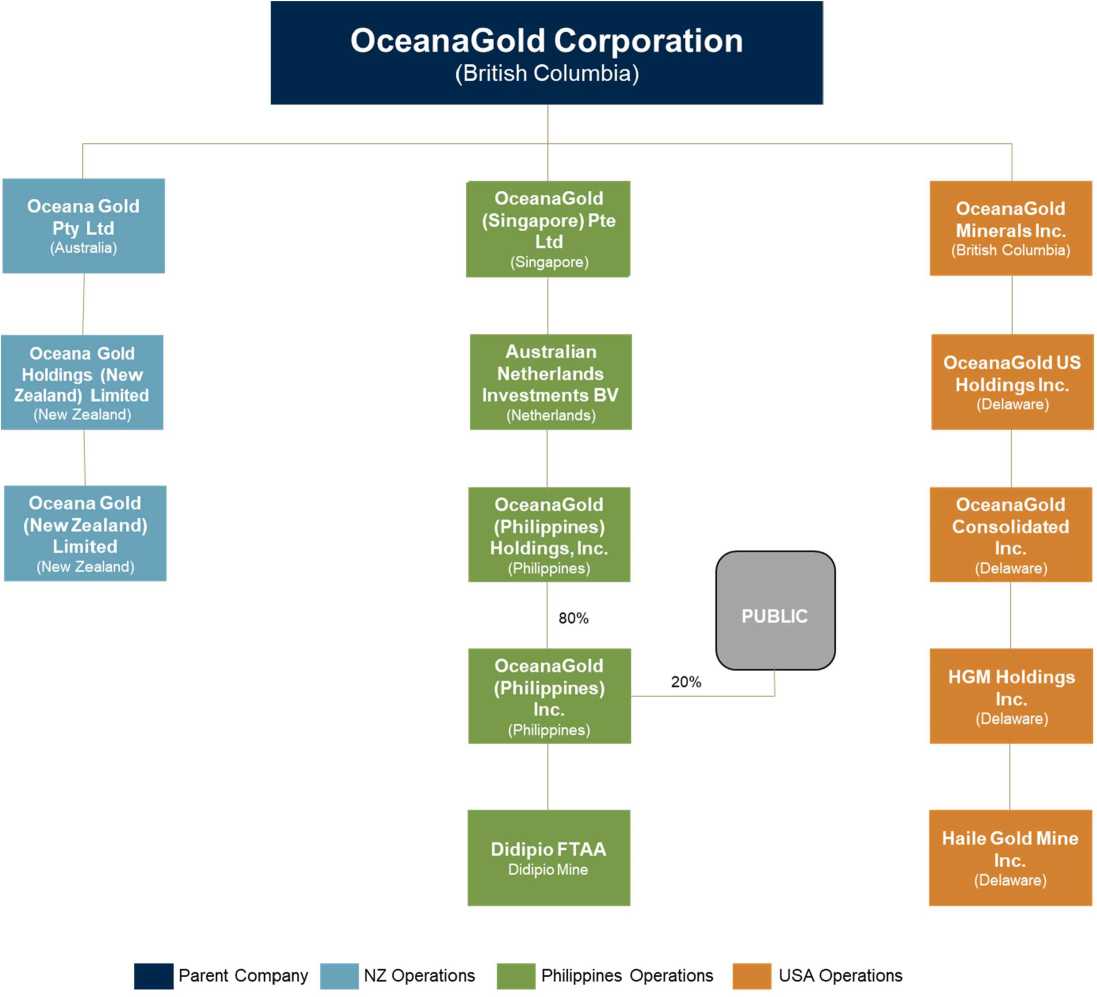
A significant portion of our business is carried on through our subsidiaries. The chart below includes the name and jurisdiction of incorporation of our material subsidiaries and certain subsidiaries that we consider significant as described in this Annual Information Form. All ownership of subsidiaries is 100% unless otherwise indicated.
Note: Pursuant to the FTAA, certain claimowners (the “Addendum Claimowners”) are entitled to a free carried interest of 8% of OceanaGold (Philippines), Inc. (“OGPI”) and 2% net smelter return (“NSR”) royalty of OGPI. Please see “Didipio Operation – Mineral Permits and Regulatory Matters – Entitlements of Additional Claimowners” for further information.
General Development of the Business
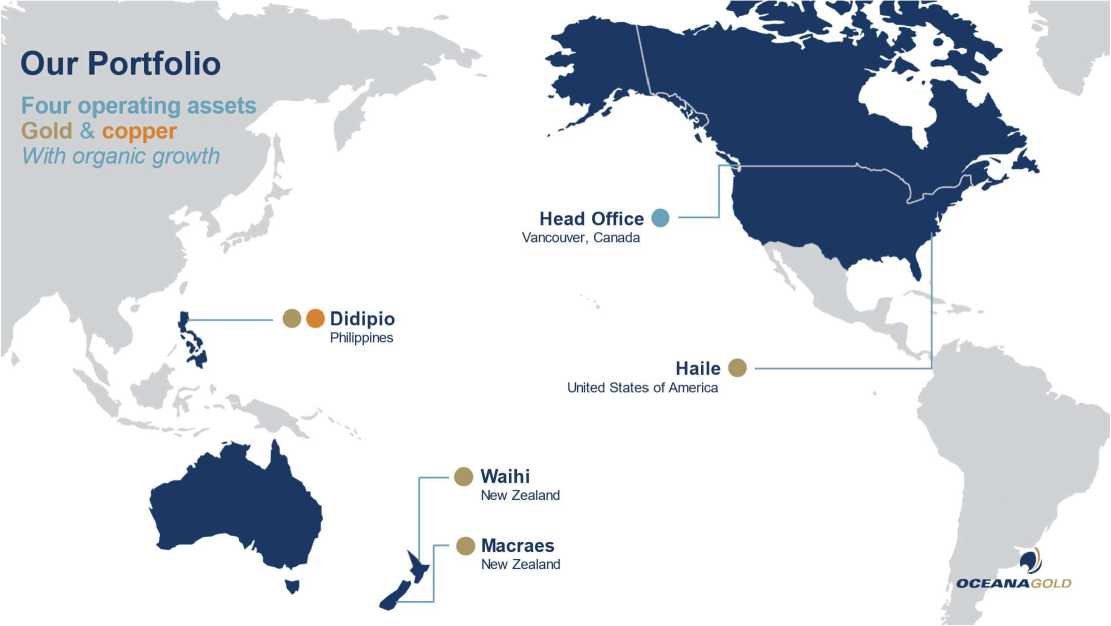
We are an intermediate gold and copper producer with our head office in Vancouver, Canada. We have four operating mines and a number of organic growth projects. Our material properties consist of the following four mines:
•Haile Gold Mine, our wholly owned open pit and underground operation located near Kershaw, South Carolina, United States (“Haile” or “Haile Gold Mine”).
•Didipio Mine, our 80%-owned underground gold and copper mine and surface stockpile operation located in Luzon, Philippines (“Didipio” or “Didipio Mine”);
•Macraes Operation, our wholly owned open pit and underground operation located in the South Island, New Zealand (“Macraes” or the “Macraes Operation”); and
•Waihi Operation, our wholly owned underground operation, which includes the proposed Waihi North Project, including the Wharekirauponga Underground development project (“WUG”), located in the North Island, New Zealand (“Waihi” or the “Waihi Operation”).
Recent Developments
On March 4, 2025, we announced that we lodged our application for the grant of Fast-track approvals for our Waihi North Project, which includes WUG, under the FTA Act for regionally and nationally significant infrastructure and development projects. The Fast-track Approvals process under the FTA Act aims to streamline the consent application process through a “one-stop-shop” designed to reduce regulatory complexity while retaining important environmental, cultural and social standards. The lodging of our application for Fast-track approvals is consistent with our targeted timeline for the grant of approvals by December 2025 and the commencement of decline and underground development work for the proposed WUG mine in 2026.
On February 20, 2025, we appointed Ms. Stefanie Loader as an independent non-executive director to our Board of Directors. Please see “Directors and Executive Officers – Board of Directors” for additional information on Ms. Loader’s experience.
On February 19, 2025, we announced a doubling of our annual dividend payment, to $0.01 per common share (the “Common Shares”) payable quarterly. In addition, our Board of Directors approved the buy back of up to $100 million of Common Shares in 2025 under our NCIB announced in July 2024 (please see “2024 Developments” below for additional information on our NCIB). As of February 28, 2025, we had purchased 3.5 million Common Shares ($9.4 million) under the NCIB in 2025.
On February 19, 2025, we also announced that Mr. David Londoño, our Executive Vice President, Chief Operating Officer Americas, is leaving OceanaGold to return to Colombia for family reasons, effective April 4, 2025. Mr. Bhuvanesh Malhotra, our Executive Vice President, Chief Technical & Projects Officer, will permanently assume Mr. Londoño’s executive accountabilities for the Haile Gold Mine upon Mr. Londoño’s departure. Please see “Directors and Executive Officers – Executive Officers” for additional information on Mr. Malhotra’s experience.
2024 Developments
On January 9, 2024, we announced the appointment of Mr. Bhuvanesh Malhotra as Executive Vice President, Chief Technical & Projects Officer, effective January 22, 2024.
On March 28, 2024, we filed an updated technical report for Haile entitled “NI 43-101 Technical Report Haile Gold Mine Lancaster County, South Carolina” dated March 28, 2024 with an effective date of December 31, 2023, prepared by D. Carr, D. Londoño, J. Moore and B. Drury (OceanaGold), L. Standridge and R. Cook (Call & Nicholas, Inc.), J. Newton Janney-Moore and W. Kingston (NewFields Mining & Technical Services LLC) and M. Sullivan and B. Miller Clarkson (SRK Consulting (U.S.), Inc.) (the “Haile Technical Report”). Please see “Haile Operation” for additional information.
On March 28, 2024, we also filed an updated technical report for our Macraes Operation entitled “NI 43-101 Technical Report Macraes Gold Mine Otago, New Zealand” dated March 28, 2024 with an effective date of December 31, 2023, prepared by M. Grant, J. Moore, K. Madambi, E. Leslie and D. Carr (OceanaGold) (the “Macraes Technical Report”). Please see “Macraes Operation” for additional information.
On May 13, 2024, we announced that OGPI completed the initial public offering (the “Philippines Offering”) of 20% of the issued and outstanding common shares in the capital of OGPI on The Philippine Stock Exchange, Inc. (the “PSE”). The shares are listed under the ticker “OGP”. OGPI holds our interest in the Didipio Mine and, pursuant to the terms of the renewed FTAA, was required to list its common shares on the PSE. The Philippines Offering was a secondary offering of OGPI common shares, and the proceeds were received by one of our wholly owned subsidiaries. The final Philippines Offering price was ₱13.33 per share for 456,000,000 common shares in the capital of OGPI and gross proceeds totaling ₱6.08 billion (approximately $106 million (based on an exchange rate of $1=₱57.32)) were raised. Available proceeds from the Philippines Offering, net of fees and taxes, was applied to the repayment of the debt owing under the OceanaGold revolving credit facility (the “Facility”).
On June 24, 2024, we announced that we completed the sale of our interest in the Blackwater project in New Zealand to Tasman Mining Limited, a wholly owned subsidiary of Federation Mining Inc., for proceeds of $30 million in cash.
On July 22, 2024, we announced that we received approval from the Toronto Stock Exchange (“TSX”) to buy back up to 35.5 million of our Common Shares, representing approximately 5% of our outstanding Common Shares and approximately 5% of the public float of Common Shares, pursuant to the NCIB in the open market through the facilities of the TSX or alternative Canadian trading systems over a 12 month period commencing on July 24, 2024 and ending on or before July 23, 2025. Decisions regarding purchases are based on market conditions, share price, best use of available cash and other factors. Any Common Shares purchased under the NCIB are subsequently cancelled. We purchased 8.8 million Common Shares ($24.1 million) under the NCIB in 2024.
On October 6, 2024, we announced that both of our Waihi North Project and Macraes Phase 4 Project were included in the 149 projects listed in Schedule 2 of the FTA Act. The New Zealand Parliament passed the FTA Act in December 2024.
On December 11, 2024, we filed an updated technical report for our Waihi Operation entitled “NI 43-101 Technical Report Waihi Operations and Wharekirauponga Underground Pre-feasibility Study, New Zealand” dated December 11, 2024 with an effective date of June 30, 2024, prepared by D. Townsend, L. Crawford-Flett, K. Hollis, E. Leslie and T. Maton (OceanaGold) (the “Waihi Technical Report”), announcing the results of our Waihi District pre-feasibility study (“PFS”). Highlights of the Waihi Technical Report included: an initial Mineral Reserve estimate for WUG of 4.1 Mt at 9.2 g/t for 1.2 Moz of gold; after-tax NPV5% of $621 million at a gold price of $2,400 per ounce, or $138 million at
a gold price of $1,750 per ounce; an IRR of 24% at a gold price of $2,400 per ounce, or 9.2% at a gold price of $1,750 per ounce; and gold production of 1.6 Moz over a 15-year mine life. Please see “Summary of Mineral Reserves and Mineral Resources Estimates” and “Waihi Operation” for additional information.
2023 Developments
On February 21, 2023, we announced the appointment of Ms. Michelle Du Plessis as Executive Vice President, Chief People & Technology Officer, effective March 2023. Please see “Directors and Executive Officers – Executive Officers” for additional information on the experience of Ms. Du Plessis.
On February 21, 2023, we also announced our Board of Directors’ decision to reinstate our dividend policy and pay a $0.01 per share semi-annual dividend. The first dividend payment was made on April 28, 2023.
On March 22, 2023, we announced the appointment of Mr. Marius van Niekerk as Executive Vice President, Chief Financial Officer. Please see “Directors and Executive Officers – Executive Officers” for additional information on Mr. van Niekerk’s experience.
On April 24, 2023, we appointed Ms. Linda Broughton as an independent non-executive director to our Board of Directors. Please see “Directors and Executive Officers – Board of Directors” for additional information on Ms. Broughton’s experience.
On September 14, 2023, we announced mining of first development ore from the Horseshoe Underground at our Haile Gold Mine. Please see “Haile Operation” for further information.
On September 18, 2023, we announced that we qualified to trade on the OTCQX market in the U.S. and began trading on the OTCQX® Best Market under the symbol “OCANF”.
On December 15, 2023, we refinanced the Facility with seven leading international banks with decreased interest margins, standby fees and certain other key terms. The size of the Facility was restructured from $250 million to $200 million plus a $50 million uncommitted accordion, in line with business requirements. It is secured against present and future assets, property and undertakings and has a term of four years, maturing on December 31, 2027. As of December 31, 2024, we repaid all amounts drawn under the Facility.
2022 Developments
On February 10, 2022, we announced the appointment of Mr. Gerard Bond as our President and Chief Executive Officer and a member of our Board of Directors, effective April 4, 2022. Please see “Directors and Executive Officers – Executive Officers” for additional information on Mr. Bond’s experience.
On March 31, 2022, we filed an updated technical report for Didipio entitled “NI 43-101 Technical Report Didipio Gold / Copper Operations Luzon Island, Philippines” dated March 31, 2022 with an effective date of December 31, 2021, prepared by D. Carr, P. Jones, and J. Moore (OceanaGold) (the “Didipio Technical Report”). Please see “Didipio Operation” for additional information.
On June 13, 2022, we announced the appointment of Mr. Brian Martin as Senior Vice President, Business Development and Investor Relations, effective July 4, 2022.
On July 24, 2022, we announced certain changes to our executive leadership team (“Executive Leadership Team”), which included the appointment of Mr. David Londoño as Executive Vice President, Chief Operating Officer Americas and Mr. Peter Sharpe as Executive Vice President, Chief Operating Officer Asia-Pacific. Please see “Directors and Executive Officers – Executive Officers” for additional information on the experience of each of Messrs. Londoño and Sharpe.
On August 15, 2022, we announced the retirement of Mr. Michael McMullen from our Board of Directors.
On August 31, 2022, we delisted from the Australia Securities Exchange (the “ASX”), following our voluntary request for removal from the official list of the ASX. We continue to maintain the primary listing of our Common Shares on the TSX.
Effective October 1, 2022, we appointed Mr. Alan Pangbourne as an independent non-executive director to our Board of Directors. Please see “Directors and Executive Officers – Board of Directors” for additional information on Mr. Pangbourne’s experience.
On December 19, 2022, we announced that the United States Army Corps of Engineers (the “US ACOE”) issued the Supplementary Environmental Impact Statement Record of Decision (the “SEIS ROD”) and granted a permit under Section 404 of the Clean Water Act (the “404 Permit”) for the expansion of the Haile Gold Mine. The receipt of the SEIS ROD and 404 Permit by the US ACOE completed the federal permitting process for the Haile expansion. In addition, the South Carolina Department of Environmental Services (formerly the South Carolina Department of Health and Environmental Control) (“SC DES”) issued the Mine Operating Permit (the “Haile Mine Operating Permit”) in December 2022, which, following a statutory 15-day period, became final and completed the state permitting process for the Haile expansion. The receipt of the SEIS ROD, 404 Permit and the Haile Mine Operating Permit allowed for development and operation of the underground mine and an expansion of the operating footprint to allow for additional waste containment facilities and expanded tailings storage capacity. Please see “Haile Operation” for additional information.
Effective December 2022, we appointed Ms. Megan Saussey as Executive Vice President, Chief Sustainability Officer. Please see “Directors and Executive Officers – Executive Officers” for additional information on Ms. Saussey’s experience.
Description of Business
Business Strategy
We are an intermediate gold and copper producer committed to safely and responsibly maximizing the generation of Free Cash Flow from our operations and delivering strong returns for our shareholders.
Our Purpose is mining gold for a better future. Our Vision is to be a company people trust, want to work and partner with, supply and invest in, to create value. This Vision is brought to life by our Values – Care, Respect, Integrity, Performance and Teamwork. Our Values guide our behaviours and put our people, local communities, the environment and our stakeholders at the forefront of our decision-making.
Our corporate strategy is to increase and sustain a higher value for our Common Shares by:
•Safely and responsibly delivering gold production;
•Having a caring, inclusive and winning culture;
•Increasing resources and reserves cost effectively;
•Being financially strong and generating returns; and
•Having a premium rating with the investment community.
Principal Products
Each of our operations produce gold doré bars (containing gold and silver) and, at the Didipio Mine, we also produce copper concentrate. Sales from the production of these products form all our revenues.
Our revenue by product category in each of the last two financial years is as follows:
| | | | | | | | |
Product Revenue | 2024 | 2023 |
Gold bullion | 77% | 71% |
| | |
Gold concentrate1 | 14% | 17% |
| | |
Copper concentrate1 | 8% | 11% |
| | |
Silver | 1% | 1% |
1.All concentrate sales are generated by our Didipio Mine. |
Gold is used for production and fabrication in multiple sectors including jewellery and electronics and as a medium of currency exchange and investment. Gold is traded on international markets and individual buyers and individual sellers generally are unable to influence prices.
Copper is a metal with inherent characteristics of excellent electrical conductivity, heat transfer and resistance to corrosion. Copper is used principally in telecommunications, power infrastructure, automobiles, construction and consumer durables.
Our revenues, profitability and viability depend on the market price of gold, copper and silver produced from our operations. The market price of these metals is set in the world market and is affected by numerous factors beyond our control, including: the demand for gold, copper and silver; expectations with respect to the rate of inflation; interest rates; currency exchange rates; the demand for jewellery and industrial products containing precious and base metals; gold, copper and silver production; inventories; costs; change in global or regional investment or consumption patterns; sales by central banks and other holders; speculators and producers of gold, copper, silver and other metals in response to any of the above factors; and global and regional political and economic factors.
Special Skills and Knowledge
Various aspects of our business require specialized skills and knowledge, certain of which are in high demand and in limited supply. Such skills and knowledge include the areas of permitting, engineering, geology, metallurgy, logistical planning, implementation of exploration programs, mine construction and development and mine operation, as well as legal, compliance, finance, accounting, commercial, procurement, risk management, safety and security, environmental management, community relations and human resources. We have highly qualified management personnel and staff and an active recruitment program. Training programs are in place for workers that are recruited locally.
Competitive Conditions
The mining business is a competitive business. We compete with numerous other companies and individuals in the search for and the acquisition of quality properties, mineral claims, permits, concessions and other mineral interests, as well as recruiting and retaining qualified employees. Our ability to acquire and develop properties in the future will depend not only on our ability to develop and operate our present properties, but also on our ability to select and acquire suitable producing properties or prospects for development or mineral exploration.
Cycles
The mineral exploration, development and production business is subject to mineral and metal price cycles. The marketability of minerals is also affected by worldwide economic cycles.
Employees
As at December 31, 2024, our workforce was comprised of 4,643 people across Canada, Australia, the U.S., New Zealand, Singapore and the Philippines. This included 2,841 employees and 1,802 contractors.
Production at our mining operations is dependent upon the efforts of our employees and our relations with our unionized and non-unionized employees. Certain members of our Philippines and New Zealand based operations staff are represented by various labour unions and subject to collective agreements. We consider our labour relations to be positive.
Foreign Operations
Our operations are exposed to various levels of socio-political, economic and other risks and uncertainties. These risks and uncertainties vary from country to country and include, but are not limited to, government regulations (or changes to such regulations) with respect to restrictions on production, export controls, income taxes, royalties, excise and other taxes, expropriation of property, repatriation of profits, environmental legislation, land use, water use, local ownership requirements and land claims of local people, Indigenous Peoples and cultural heritage, regional and national instability and security, mine safety, corruption and sanctions. The effect of these factors cannot be accurately predicted. Please see “Risk Factors” for additional information.
Changes to Contracts
Our business is not expected to experience material adverse impacts in relation to any renegotiation or termination of contracts or subcontracts during the current financial year. Where required, we will undertake major contract renegotiations in a planned and timely manner in accordance with our internal policies and procedures.
Sustainability
At OceanaGold, sustainability is fundamental to the way we do business. Operating responsibly governs every aspect of our business, and these principles fundamentally feed into our core Values. We are committed to responsible mining, managing the effects of our operations and, more broadly, contributing to the communities in which we work and live.
Our approach to sustainability aims to build a positive legacy, protecting and creating value throughout the life of our operations. We recognize that sustainability performance is a business-wide responsibility and that a comprehensive and integrated approach to sustainability can protect and create value for an organization. Our sustainability strategy (the “Sustainability Strategy”) enables us to take a planned and managed approach to sustainability, focusing on
simplifying, maturing and embedding strong sustainability governance, systems and processes across our global operations, to effectively manage our material sustainability risks, impacts and opportunities.
Responsible Mining Governance
Our approach to responsible mining is guided by an overarching responsible mining framework (the “Responsible Mining Framework”) and our integrated management system (“IMS”), which has been independently determined to meet the requirements of International Organization for Standardization (“ISO”) 14001:2015 (Environment) and ISO 45001:2018 (Health and Safety). In March 2024, following an independent audit in February 2024, we received an independent statement confirming that our IMS aligns with, and meets the requirements of, ISO 14001:2015 and ISO 45001:2018.
Our Responsible Mining Framework is a governance tool that helps embed sustainability into our company strategy, planning and operational processes, and commits us to high standards of governance and ethics. It provides the business a consistent and pragmatic approach to achieving our sustainability objectives, and guides business decisions and activities that complements our Sustainability Strategy and the systems and processes for monitoring, enhancing and disclosing our sustainability performance. Our Responsible Mining Framework includes commitments endorsed by our Board of Directors that are contained in a set of policies covering key sustainability areas, including environment and climate change, human rights, community, government and civil society, health and safety, fair employment, anti-bribery and corruption and stakeholder engagement. Some of these policies are supported by performance standards and all are supported by operational processes and systems, internal and external assurance, and regular, transparent reporting on our sustainability performance.
Our Responsible Mining Framework and IMS support our commitment to the World Gold Council’s Responsible Gold Mining Principles (“RGMPs”). Established for World Gold Council member companies in 2019, the intent of the RGMPs is to become a credible and widely recognized framework through which gold mining companies and their stakeholders can provide confidence that their gold has been produced responsibly.
Since making that commitment in 2019, we have undertaken significant steps to align and ultimately conform to the RGMPs. This process has included:
•Developing or updating and implementing policies, systems, processes and controls;
•Disclosing information that helped external stakeholders to understand how conformance with the RGMPs was achieved; and
•Obtaining independent assurance over the process to ensure stakeholder confidence and credibility in the process and conclusions.
As a company, we continue to have our policies, systems, processes and controls independently assured annually to continue to demonstrate conformance against the RGMPs. We also actively monitor emerging, new and/or changing standards and developments that may impact our Responsible Mining Framework and Sustainability Strategy and adopt such standards and adapt to such developments as required and/or appropriate.
Sustainability Committee
Our Board of Directors, Executive Leadership Team and Senior Leadership Team regularly review, monitor and discuss sustainability issues, risks and opportunities. Sustainability matters are included in standard agenda items for these forums and form an integral part of strategic and operational planning and decision-making for our business.
Our Board of Directors has a Sustainability Committee that assists the Board by overseeing, monitoring and reviewing our Sustainability Strategy, policy, governance, performance, risk and reporting, as well as compliance with legal and regulatory requirements relating to safety, occupational health, environment, climate change, social performance, human rights and sustainable development.
Sustainability Policies
Strengthening our corporate sustainability governance is a continual focus for our business. Our Responsible Mining Framework sets out our Responsible Mining Policies with commitments to align business performance and support our Purpose, Vision and Values.
Our Responsible Mining Policies include our aspirations relating to health and safety, environment, government and civil society, communities and human rights, copies of which are available on our website at www.oceanagold.com.
Our Health and Safety Policy sets out our aspirations relating to protecting and promoting the safety and occupational health of our workforce through the implementation of a management system and structure that is focused on, among other matters: compliance with health and safety laws; the identification, elimination and management of health and safety risks to as low as reasonably practicable; key areas to reduce potential harm and optimize health and well-being; providing training, education and resources to ensure a healthy and safe work environment; and continuously monitoring, reviewing and improving our health and safety management systems and performance. Our Health and Safety Policy is supported by standards and manuals for operational safety, health and well-being that outline how we implement our policy.
In our Environment Policy, we strive to: responsibly manage the environmental impacts associated with our operations; comply with all relevant statutory requirements applicable to our operations; and rehabilitate our mine sites so they do not pose any unacceptable risk to the environment. Standards detail how we manage our environmental material risk areas of water, mine closure, biodiversity, cyanide, tailings management and climate change (energy usage and greenhouse gas reduction).
Our aspirations relating to ensuring positive external affairs and social performance are outlined in our Communities Policy, Human Rights Policy and Government and Civil Society Policy. These policies emphasize the importance of being a responsible corporate citizen, and outline our aspirations relating to respecting human rights, undertaking community engagement and supporting sustainable economic and social development. These policies are underpinned by a set of standards which strive to ensure that processes and procedures are implemented consistently across our business to deliver the policy requirements.
The objectives in our Responsible Mining Policies are integral to all aspects of our business, approved by our Board of Directors, and promoted and championed by our Executive Leadership Team.
Health and Safety
The health, safety and wellbeing of our employees and contractors are central to our Values and the success of our business. We continuously strive to inspire and ingrain safe behaviours into the mindset of our people, to improve health and safety outcomes and to integrate them into decision-making and planning. We do this by consulting and communicating with our workforce to ensure we have the processes, resources and information available to maintain a strong culture of safety and transparency. Every person who works at our sites is integral to this process and is responsible for collectively supporting and promoting the safety of themselves and others across the business.
Our goal is to provide a workplace that is free of fatalities and life-altering injuries and where the wellbeing of our people is actively considered and supported. To track our performance across all our sites, we report, investigate and learn from our performance on an ongoing basis – striving for continuous improvement across all aspects of health and safety.
The OurSafe Behaviours program encourages our workforce to lead safety in their work areas. It requires teamwork and encourages speaking up when our workforce identifies the potential for unsafe work. It focuses on developing site-specific behaviours defined and articulated by the workforce, influencing others to follow those safe behaviours and stopping work
when it is not safe to continue. Training our workforce is central to the success of this program to drive the culture, mindset and behaviours required to keep people safe.
Environmental Protection
Our activities are subject to extensive laws and regulations governing the protection of the environment, natural resources and human health. These laws address, among other things: emissions to air; discharges to water; management of waste and hazardous substances; protection of natural resources and protected species; cultural heritage; and reclamation of lands disturbed by mining operations. We are required to obtain regulatory approvals and permits for all our operating sites and to provide bonding requirements under domestic regulatory frameworks. Violations of environmental laws are subject to civil sanctions and, in some cases, criminal sanctions, including the suspension of or revocation of permits. The failure to comply with environmental laws and regulations could result in
project development delays, material financial impacts or other material impacts to our projects, operations and activities, fines, penalties, lawsuits by the government or private parties or material capital expenditures.
Additionally, environmental laws and regulations in the countries in which we operate require that we undertake impact studies, routine environmental monitoring and, in some cases, require periodic independent environmental audits to be performed. These studies, monitoring and independent audits could reveal presently unknown environmental impacts that would require us to make significant capital outlays or cause material changes or delays in our intended operations and activities.
Stakeholder Engagement
Aligned with our Values and policies, we actively engage with our stakeholders to build and maintain strong long-term relationships and continually improve our practices and outcomes to address stakeholder needs and expectations.
Our External Affairs and Social Performance Management System helps identify and analyze how we: impact the communities where we operate; align our operational performance with local aspirations; create opportunities and value for stakeholders; and respect cultural heritage, norms and practices.
As outlined in our External Affairs and Social Performance Manual, each of our operations is required to implement a stakeholder engagement plan that identifies our key stakeholders, facilitates ongoing dialogue and delivers transparent, timely and fact-based communication in an accessible and clear manner. We also maintain complaints and grievance systems and procedures for the on-going management of all operation and project grievances.
Sustainability Report
Each year, we publish a Sustainability Report, which is the annual disclosure of our sustainability performance for the reporting period and incorporates all operating assets (including exploration and project development) during the reporting period. It is prepared with reference to the Global Reporting Initiative (“GRI”) Standards and the GRI G4 Mining and Metals Sector Disclosures. For more information, please refer to our latest Sustainability Report, a copy of which is available on our website at www.oceanagold.com.
We actively monitor the external environment for emerging, new and/or changing developments regarding voluntary and mandatory sustainability-related reporting or disclosure requirements. We also plan for and adapt our reporting approach as required and/or appropriate.
Diversity and Inclusion
We are committed to creating a safe, inclusive and respectful work environment, free from any form of harassment. Diversity in the workplace is a strength and allows for employees to be themselves, feel included at work and speak up if something is wrong. We are also committed to pay equity and a working environment conducive to the needs of our employees. We will continue to respect the unique characteristics of our employees and the unique experience that each individual brings to the workplace. Our Respect at Work Policy and Fair Employment Policy reflect these commitments. A copy of these policies is available on our website at www.oceanagold.com.
To support our diversity objectives at our Board of Directors level, our Governance and Nominations Committee will, when identifying and considering the selection of candidates for election to the Board, give consideration to the level of representation of women on our Board, and diversity criteria other than gender, including age, ethnicity and geographical background of the candidate. Our Board of Directors pursues diversity at Board and senior management levels. As of the date hereof, we have three female directors: Ms. Linda Broughton; Ms. Sandra Dodds; and Ms. Stefanie Loader (three out of eight members, or 37.5%, female representation).
As of the date hereof, we also have three female members on our Executive Leadership Team: Ms. Michelle Du Plessis, Executive Vice President, Chief People & Technology Officer; Ms. Megan Saussey, Executive Vice President, Chief Sustainability Officer; and Ms. Liang Tang, Executive Vice President, General Counsel & Company Secretary (three out of nine members, or 33.3%, female representation).
At an operational level, we have identified various pathways to improve gender diversity, such as inclusive mine operations, competitive parental leave benefits, part-time operator roles, scholarships, leadership training to all aspiring managers and managers, and increased flexible working arrangement practices.
Our approach to diversity, equity and inclusion is to place emphasis on promoting fairness and opportunity at all levels, to adopt measurable objectives to promote an inclusive culture, and to track the achievement of these objectives through our standard People & Culture Group processes and reporting.
Summary of Mineral Reserves and Mineral Resources Estimates
The following tables summarize our Mineral Reserves and Mineral Resources estimates as at December 31, 2024.
Mineral Reserves
The Proven and Probable Mineral Reserves estimates as at December 31, 2024 are presented below.
| | | | | | | | | | | | | | | | | | | | | | | | | | | | | | | | |
Gold | Proven | Probable | Proven & Probable | Cut-off grade |
Tonnes (Mt) | Au (g/t) | Contained Ozs (Moz) | Tonnes (Mt) | Au (g/t) | Contained Ozs (Moz) | Tonnes (Mt) | Au (g/t) | Contained Ozs (Moz) |
Horseshoe underground | 1.12 | 4.72 | 0.17 | 2.66 | 4.49 | 0.38 | 3.78 | 4.56 | 0.55 | 1.79 g/t Au |
Palomino underground | - | - | - | 4.33 | 2.73 | 0.38 | 4.33 | 2.73 | 0.38 | 1.79 g/t Au |
Haile open pits | 4.12 | 1.44 | 0.19 | 30.8 | 1.53 | 1.52 | 34.9 | 1.52 | 1.71 | 0.50 g/t & 0.60 g/t Au |
Haile Total | 5.25 | 2.14 | 0.36 | 37.8 | 1.88 | 2.28 | 43.0 | 1.91 | 2.64 | |
Didipio underground | 15.0 | 1.40 | 0.67 | 14.8 | 0.85 | 0.40 | 29.8 | 1.12 | 1.08 | 0.76 g/t & 1.16 g/t AuEq |
Didipio open pit stockpile | 15.8 | 0.31 | 0.16 | - | - | - | 15.8 | 0.31 | 0.16 | 0.40 g/t AuEq |
Didipio Total | 30.8 | 0.84 | 0.83 | 14.8 | 0.85 | 0.40 | 45.7 | 0.84 | 1.23 | |
Macraes underground | 0.16 | 1.86 | 0.01 | 3.81 | 1.79 | 0.22 | 3.96 | 1.79 | 0.23 | 1.20 g/t & 1.01 g/t Au |
Macraes open pits | 11.5 | 0.58 | 0.22 | 8.02 | 0.70 | 0.18 | 19.5 | 0.63 | 0.40 | 0.30 g/t Au |
Macraes Total | 11.6 | 0.60 | 0.22 | 11.8 | 1.05 | 0.40 | 23.5 | 0.83 | 0.62 | |
Martha underground | - | - | - | 4.13 | 3.80 | 0.50 | 4.13 | 3.80 | 0.50 | 2.60 g/t & 3.10 g/t Au |
Wharekirauponga | - | - | - | 4.10 | 9.20 | 1.21 | 4.10 | 9.20 | 1.21 | 2.40 g/t & 1.40 g/t Au |
Waihi Total | - | - | - | 8.23 | 6.49 | 1.72 | 8.23 | 6.49 | 1.72 | |
Total Gold | 47.7 | 0.92 | 1.42 | 72.7 | 2.06 | 4.80 | 120 | 1.61 | 6.22 | |
| | | | | | | | | | | | | | | | | | | | | | | | | | | | | | | | |
Silver | Proven | Probable | Proven & Probable | |
Tonnes (Mt) | Ag (g/t) | Contained Ozs (Moz) | Tonnes (Mt) | Ag (g/t) | Contained Ozs (Moz) | Tonnes (Mt) | Ag (g/t) | Contained Ozs (Moz) | |
Horseshoe underground | 1.12 | 1.8 | 0.1 | 2.66 | 2.0 | 0.2 | 3.78 | 2.0 | 0.2 | |
Palomino underground | - | - | - | 4.33 | 2.5 | 0.3 | 4.33 | 2.5 | 0.3 | |
Haile open pits | 4.12 | 1.8 | 0.2 | 30.8 | 2.3 | 2.3 | 34.9 | 2.3 | 2.6 | |
Haile Total | 5.25 | 1.8 | 0.3 | 37.8 | 2.3 | 2.8 | 43.0 | 2.3 | 3.1 | |
Didipio underground | 15.0 | 1.8 | 0.8 | 14.8 | 1.3 | 0.6 | 29.8 | 1.5 | 1.5 | |
Didipio open pit stockpile | 15.8 | 2.0 | 1.0 | - | - | - | 15.8 | 2.0 | 1.0 | |
Didipio Total | 30.8 | 1.9 | 1.9 | 14.8 | 1.3 | 0.6 | 45.7 | 1.7 | 2.5 | |
Martha underground | - | - | - | 4.13 | 16 | 2.2 | 4.13 | 16 | 2.2 | |
Wharekirauponga | - | - | - | 4.10 | 16 | 2.1 | 4.10 | 16 | 2.1 | |
Waihi Total | - | - | - | 8.23 | 16 | 4.3 | 8.23 | 16 | 4.3 | |
Total Silver | 36.1 | 1.9 | 2.2 | 60.8 | 4.0 | 7.8 | 96.9 | 3.2 | 9.9 | |
| | | | | | | | | | | | | | | | | | | | | | | | | | | | | | | | |
Copper | Proven | Probable | Proven & Probable | |
Tonnes (Mt) | Cu (%) | Contained (Mt) | Tonnes (Mt) | Cu (%) | Contained (Mt) | Tonnes (Mt) | Cu (%) | Contained (Mt) | |
Didipio underground | 15.0 | 0.40 | 0.1 | 14.8 | 0.31 | 0.05 | 29.8 | 0.36 | 0.11 | |
Didipio open pit stockpile | 15.8 | 0.29 | 0.0 | - | - | - | 15.8 | 0.29 | 0.05 | |
Didipio Total | 30.8 | 0.34 | 0.1 | 14.8 | 0.31 | 0.05 | 45.7 | 0.33 | 0.15 | |
Total Copper | 30.8 | 0.34 | 0.1 | 14.8 | 0.31 | 0.05 | 45.7 | 0.33 | 0.15 | |
Notes:
•Mineral Reserves are defined by mine designs based upon the following assumptions: metal prices of US$1,750/oz gold, US$3.50/lb copper and US$20/oz silver; and NZD/USD exchange rate of 0.61.
•Reported estimates of contained metal are not depleted for processing losses.
•For underground reserves, cut-offs applied to diluted grades.
•Haile:
o Open pit: The primary cut-off grade is 0.5 g/t Au, while oxide material is assigned a cut-off grade of 0.6 g/t Au.
o Underground: The cut-off grade is 1.79 g/t Au, with adjacent lower grade stopes included in the Mineral Reserves estimate based on an incremental stope cut-off grade of 1.69 g/t Au.
•Didipio:
o Gold equivalence (“AuEq”) is based upon the presented gold and copper prices as well as processing recoveries. AuEq = Au g/t + 1.37 x Cu%.
o The 15.8 Mt surface stockpile inventory includes 5.3 Mt of low-grade stocks mined at an approximate cut-off grade of 0.27 g/t AuEq.
o Underground: Incremental stopes proximal to development already planned to access main stoping areas are reported to a lower cut-off grade of 0.76 g/t AuEq.
•Macraes: Golden Point Underground (“GPUG”) cut-off grade is 1.20 g/t Au. Stopes for which access already exists are reported to a lower cut-off grade of 1.01 g/t.
•Waihi:
o Martha underground cut-off grade for previously unmined stoping areas is 2.60 g/t Au, increasing to 3.0 g/t Au for stoping areas in close proximity to remnant workings, while development cut-off grade is 0.90 g/t Au.
o Wharekirauponga cut-off grade for stopes is 2.40 g/t Au, while development cut-off grade is 1.40 g/t Au.
Mineral Resources
The Measured, Indicated and Inferred Mineral Resource estimates (inclusive of Mineral Reserves) as at December 31, 2024 are presented in the table below.
| | | | | | | | | | | | | | | | | | | | | | | | | | | | | | | | | | | | | | | | | |
Gold | Measured | Indicated | Measured & Indicated | Inferred | Cut-off grade |
Tonnes | Au | Contained | Tonnes | Au | Contained | Tonnes | Au | Contained | Tonnes | Au | Contained |
(Mt) | (g/t) | (Moz) | (Mt) | (g/t) | (Moz) | (Mt) | (g/t) | (Moz) | (Mt) | (g/t) | (Moz) |
Horseshoe underground | 1.47 | 4.90 | 0.23 | 3.93 | 4.53 | 0.57 | 5.40 | 4.63 | 0.80 | 0.8 | 3.7 | 0.09 | 1.50 g/t Au |
Palomino underground | - | - | - | 4.72 | 3.18 | 0.48 | 4.72 | 3.18 | 0.48 | 1.1 | 2.3 | 0.08 | 1.50 g/t Au |
Haile open pits | 4.14 | 1.44 | 0.19 | 30.8 | 1.53 | 1.52 | 34.9 | 1.52 | 1.71 | 2.2 | 0.8 | 0.06 | 0.50 g/t & 0.60 g/t Au |
Haile Total | 5.61 | 2.35 | 0.42 | 39.4 | 2.03 | 2.57 | 45.1 | 2.07 | 2.99 | 4.1 | 1.7 | 0.2 | |
Didipio underground | 15.6 | 1.57 | 0.79 | 17.6 | 0.88 | 0.50 | 33.2 | 1.20 | 1.28 | 6.4 | 0.8 | 0.2 | 0.67 g/t AuEq |
Didipio open pit stockpile | 15.8 | 0.31 | 0.16 | - | - | - | 15.8 | 0.31 | 0.16 | - | - | - | 0.27 g/t AuEq |
Didipio Total | 31.4 | 0.93 | 0.94 | 17.6 | 0.88 | 0.50 | 49.0 | 0.92 | 1.44 | 6.4 | 0.8 | 0.2 | |
Macraes underground | 0.30 | 2.34 | 0.02 | 7.91 | 2.23 | 0.57 | 8.22 | 2.23 | 0.59 | 3.0 | 1.7 | 0.2 | 0.90 g/t Au |
Macraes open pits | 13.7 | 0.66 | 0.29 | 25.1 | 0.69 | 0.56 | 38.8 | 0.68 | 0.85 | 23 | 0.7 | 0.5 | 0.30 g/t Au |
Macraes Total | 14.0 | 0.69 | 0.31 | 33.1 | 1.06 | 1.12 | 47.1 | 0.95 | 1.44 | 26 | 0.8 | 0.7 | |
Martha underground | - | - | - | 6.71 | 5.18 | 1.12 | 6.71 | 5.18 | 1.12 | 2.4 | 4.5 | 0.4 | 2.15 g/t Au |
Wharekirauponga | - | - | - | 2.42 | 17.9 | 1.40 | 2.42 | 17.9 | 1.40 | 1.9 | 9.8 | 0.6 | 2.10 g/t Au |
Waihi open pits | - | - | - | 9.72 | 1.76 | 0.55 | 9.72 | 1.76 | 0.55 | 3.1 | 1.8 | 0.2 | 0.50 g/t & 0.56 g/t Au |
Waihi Total | - | - | - | 18.9 | 5.06 | 3.06 | 18.9 | 5.06 | 3.06 | 7.4 | 4.7 | 1.1 | |
Total Gold | 51.0 | 1.02 | 1.68 | 109 | 2.07 | 7.26 | 160 | 1.74 | 8.94 | 44 | 1.6 | 2.2 | |
| | | | | | | | | | | | | | | | | | | | | | | | | | | | | | | | | | | | | | | | | |
Silver | Measured | Indicated | Measured & Indicated | Inferred | |
Tonnes | Ag | Contained | Tonnes | Ag | Contained | Tonnes | Ag | Contained | Tonnes | Ag | Contained | |
(Mt) | (g/t) | (Moz) | (Mt) | (g/t) | (Moz) | (Mt) | (g/t) | (Moz) | (Mt) | (g/t) | (Moz) | |
Horseshoe underground | 1.47 | 1.9 | 0.09 | 3.93 | 2.1 | 0.3 | 5.4 | 2.1 | 0.4 | 0.8 | 2.0 | 0.05 | |
Palomino underground | - | - | - | 4.72 | 2.7 | 0.4 | 4.7 | 2.7 | 0.4 | 1.1 | 2.0 | 0.07 | |
Haile open pits | 4.14 | 1.4 | 0.18 | 30.8 | 2.3 | 2.3 | 35 | 2.2 | 2.5 | 2.2 | 2.2 | 0.2 | |
Haile Total | 5.61 | 1.5 | 0.27 | 39.4 | 2.4 | 3.0 | 45 | 2.3 | 3.3 | 4.1 | 2.1 | 0.3 | |
Didipio underground | 15.6 | 1.9 | 1.0 | 17.6 | 1.4 | 0.8 | 33.2 | 1.6 | 1.7 | 6.4 | 1.1 | 0.2 | |
Didipio open pit stockpile | 15.8 | 2.0 | 1.0 | - | - | - | 15.8 | 2.0 | 1.0 | - | - | - | |
Didipio Total | 31.4 | 2.0 | 2.0 | 17.6 | 1.4 | 0.8 | 49.0 | 1.7 | 2.7 | 6.4 | 1.1 | 0.2 | |
Martha underground | - | - | - | 6.71 | 21 | 4.4 | 6.7 | 21 | 4.4 | 2.4 | 22 | 1.7 | |
Wharekirauponga | - | - | - | 2.42 | 28 | 2.2 | 2.4 | 28 | 2.2 | 1.9 | 15 | 0.9 | |
Waihi open pits | - | - | - | 9.72 | 10 | 3.2 | 9.7 | 10 | 3.2 | 3.1 | 9.6 | 1.0 | |
Waihi Total | - | - | - | 18.9 | 16 | 9.8 | 19 | 16 | 9.8 | 7.4 | 15 | 3.6 | |
Total Silver | 37.0 | 1.88 | 2.2 | 75.9 | 5.6 | 14 | 113 | 4.4 | 16 | 18 | 7.1 | 4.1 | |
| | | | | | | | | | | | | | | | | | | | | | | | | | | | | | | | | | | | | | | | | |
Copper | Measured | Indicated | Measured & Indicated | Inferred | |
Tonnes | Cu | Contained | Tonnes | Cu | Contained | Tonnes | Cu | Contained | Tonnes | Cu | Contained | |
(Mt) | (g/t) | (Mt) | (Mt) | (g/t) | (Mt) | (Mt) | (g/t) | (Mt) | (Mt) | (g/t) | (Mt) | |
Didipio underground | 15.6 | 0.44 | 0.07 | 17.6 | 0.32 | 0.056 | 33.2 | 0.38 | 0.12 | 6.4 | 0.3 | 0.02 | |
Didipio open pit stockpile | 15.8 | 0.29 | 0.05 | - | - | - | 15.8 | 0.29 | 0.046 | - | - | - | |
Didipio Total | 31.4 | 0.36 | 0.11 | 17.6 | 0.32 | 0.056 | 49.0 | 0.35 | 0.17 | 6.4 | 0.3 | 0.02 | |
Total Copper | 31.4 | 0.36 | 0.11 | 17.6 | 0.32 | 0.056 | 49.0 | 0.35 | 0.17 | 6.4 | 0.3 | 0.02 | |
Notes:
•Mineral Resources are reported inclusive of Mineral Reserves. Mineral Resources that are not Mineral Reserves do not have demonstrated economic viability.
•All Mineral Resources estimates are based on the following assumptions: metal prices of US$1,950/oz gold, US$4.0/lb copper and US$23/oz silver; and NZD/USD exchange rate of 0.61.
•Open pit resources are constrained by shells based upon economic assumptions above.
•Underground resources are reported within volumes guided by optimized stope designs based upon economic assumptions above and exclude dilution.
•Haile:
o Open pit resources reported within reserve design pit.
o Open pit primary cut-off grade is 0.50 g/t Au, while oxide cut-off grade is 0.60 g/t Au. Palomino resources and Horseshoe resources cut-off grade is 1.50 g/t Au.
•Didipio:
o The 15.8 Mt surface stockpile inventory includes 5.3 Mt of low-grade stocks mined at an approximate cut-off grade of 0.27 g/t AuEq.
o Underground resources reported at a cut-off grade of 0.67 g/t AuEq between the 2,460 metres Relative Level (“mRL”) and 1,965mRL with AuEq cut-off grade based on presented gold and copper prices. AuEq = Au g/t + 1.39 x Cu %.
•Macraes:
o Open pits cut-off grade is 0.3 g/t Au.
o GPUG cut-off grade is 0.9 g/t Au.
•Waihi:
o Waihi open pit resources reported within a pit design limited by infrastructure considerations.
o Martha underground cut-off grade is 2.15 g/t Au, Wharekirauponga cut-off grade is 2.10 g/t Au, Martha Open Pit cut-off grade is 0.5 g/t Au and Gladstone Open Pit cut-off grade is 0.56 g/t Au.
Notes to Mineral Reserves and Mineral Resources Estimates
All Mineral Reserves and Mineral Resources were estimated as at December 31, 2024, are shown on a 100% basis and have been prepared in accordance with NI 43-101.
All tonnage, grade and contained metal content estimates have been rounded; rounding may result in apparent summation differences between tonnes, grade, and contained metal content.
Mineral Resources are reported inclusive of Mineral Reserves. Mineral Resources that are not Mineral Reserves do not have demonstrated economic viability. It is reasonably expected that the majority of Inferred Mineral Resources could be upgraded to Indicated Mineral Resources with continued exploration, however, there is no guarantee that all or any part of an Inferred Mineral Resource will ever be upgraded to a higher category.
The Mineral Reserves estimate for Haile open pits has been verified and approved by, or is based on information prepared by, or under the supervision of, D. Londoño, our Executive Vice President and Chief Operating Officer Americas. The Mineral Reserves estimate for Haile underground has been verified and approved by, or is based upon information prepared by, or under the supervision of, B. Drury, our Superintendent – Engineering Services (Underground), Haile. The Mineral Resources estimates for Haile open pit and underground have been verified and approved by, or are based on information prepared by, or under the supervision of, J. Moore, our Head of Resource Development.
The Mineral Reserves estimate for Didipio has been verified and approved by, or is based upon information prepared by, or under the supervision of, P. Jones, our Head of Underground Mining. The Mineral Resources estimate for Didipio has been verified and approved by, or is based on information prepared by, or under the supervision of, J. Moore.
The Mineral Reserves estimate for Macraes open pits has been verified and approved by, or is based on information prepared by, or under the supervision of, K. Madambi, our Manager – Technical Services & Projects, Macraes. The Mineral Reserves estimate for Macraes underground has been verified and approved by, or is based upon information prepared by, or under the supervision of, E. Leslie, our Group Mining Engineer. The Mineral Resources estimate for Macraes open pits has been verified and approved by, or is based on information prepared by, or under the supervision of, J. Moore. The Mineral Resources estimate for Macraes underground has been verified and
approved by, or is based on information prepared by, or under the supervision of, M. Grant, our Senior Geologist – Resource Development, Macraes.
The Mineral Reserves estimate for Martha underground (“MUG”) and WUG has been verified and approved by, or is based on information prepared by, or under the supervision of, D. Townsend, our Manager – Mining (Underground), Waihi. The Mineral Reserves estimate for WUG has been verified and approved by, or is based upon information prepared by, or under the supervision of, E. Leslie. The Mineral Resources estimate for Waihi’s WUG, Martha underground MUG, Gladstone Open Pit (“GOP”) and Martha Open Pit (“MOP”) has been verified and approved by, or is based on information prepared by, or under the supervision of, L. Crawford-Flett, our Manager – Exploration and Geology, Waihi.
All such persons noted above are “qualified persons” as defined by NI 43-101. Mr. Londoño is a registered member of the Society of Mining Engineers with the Society of Mining, Metallurgy & Exploration. Each of Messrs. Crawford-Flett, Jones, Leslie, Madambi, Moore and Townsend is a Member and Chartered Professional with the Australasian Institute of Mining and Metallurgy. Mr. Grant is a member of the Australian Institute of Geoscientists. Ms. Drury is a Registered Member with the Society of Mining, Metallurgy & Exploration.
For further scientific and technical information supporting the disclosure in this Annual Information Form (including disclosure regarding Mineral Resources and Mineral Reserves, data verification, key assumptions, parameters, methods used to estimate the Mineral Resources and Mineral Reserves, and risks and other factors), please refer to each of the following NI 43-101 technical reports available under our profile on SEDAR+ at www.sedarplus.com and on our website at www.oceanagold.com: the Haile Technical Report; the Didipio Technical Report; the Macraes Technical Report; and the Waihi Technical Report.
Haile Operation
Certain portions of the following information are derived from and based on the Haile Technical Report, and are based on the assumptions, qualifications and procedures set out therein. For a more detailed overview of the Haile Gold Mine, please refer to the Haile Technical Report, which is available under our profile on SEDAR+ at www.sedarplus.com and on our website at www.oceanagold.com. We have also provided information that post-dates the Haile Technical Report.
Property Description, Location and Access
The Haile Gold Mine is located approximately five kilometres northeast of the town of Kershaw in southern Lancaster County, South Carolina and approximately 30 kilometres southeast of the city of Lancaster, the county seat and, which is approximately 80 kilometres northeast of Columbia, South Carolina. Lancaster County lies in the north-central part of the State of South Carolina.
The Haile property is accessible by U.S. Highway 601 northeast from the town of Kershaw for approximately five kilometres, with the main access via Snowy Owl Road.
Please see “Mineral Permits and Regulatory Matters” below for information relating to the nature and extent of our title to the Haile Gold Mine and permitting matters. Please also see “Environmental and Social Matters” below.
History
Haile is situated in the Carolina Terrane, which was the location of the first gold rush in the U.S. in the early 1800s. Gold was first discovered in 1827 near Haile in the gravels of Ledbetter Creek (now the Haile Gold Mine Creek), which led to placer mining and prospecting until 1829.
In 1882, a sixty-five-stamp mill was constructed and operated continuously until 1908. From mid-1937 to 1942, larger-scale mining was undertaken on site by the Haile Gold Mines Company and was shut down in 1942 because of World War II. By this time, the Haile Gold Mine had produced over $6.4 million worth of gold (in 1940 dollars).
Between 1981 and 1985 Piedmont Land and Exploration Company (later Piedmont Mining Company) (“Piedmont”), explored the historic Haile Gold Mine and surrounding properties. Piedmont mined the Haile deposits from 1985 to 1992, producing 85,000 ounces of gold from open pit heap leach operations that processed oxide and transitional ores.
In May 1992, Amax Gold Inc. (“Amax”) and Piedmont entered into a joint venture agreement and established the Haile Mining Company (“HMC”). At the end of the Amax/HMC program in 1994, a gold reserve estimate was prepared, but due to unfavourable economic conditions at the time, Amax did not proceed with mining but began a reclamation program to mitigate acid rock drainage conditions at the site.
Kinross Gold Corporation (“Kinross”) acquired Amax in 1998, assumed Amax’s portion of the HMC joint venture and later purchased Piedmont’s interest. Kinross decided not to reopen the mine but did continue the closure/reclamation effort.
Romarco Minerals Inc. (“Romarco”) acquired the Haile property from Kinross in October 2007 and began a confirmation drilling program in late 2007. Romarco completed the confirmation drill program in early 2008 and began infill and exploration drilling. The drill program was accelerated in early 2009 with a major reverse circulation (“RC”) drilling program and was discontinued in April 2013 due to low gold prices. Drilling restarted in April 2015.
We acquired Romarco in 2015 and own the Haile Gold Mine through our wholly owned subsidiary, Haile Gold Mine Inc.
Geological Setting, Mineralization and Deposit Types
Geology
Haile is the largest gold deposit in the eastern U.S. It is situated within the northeast-trending Carolina Terrane, also known as the Carolina Slate Belt, which hosts the past-producing Ridgeway, Brewer and Barite Hill gold mines in South Carolina. The Haile district consists of nine gold deposits within a 3.5 kilometre by one kilometre area. The deposits occur within a variably deformed East Northeast (“ENE”)-trending structural zone at or near the contact between metamorphosed Neoproterozoic volcanic and sedimentary rocks. The deposits are hosted in laminated siltstones and volcanic rocks of the Upper Persimmon Fork Formation and is dissected by barren North Northwest-striking diabase dykes. Deformation includes brittle and ductile styles with ENE-trending foliation, faults, brecciation, and isoclinal folds. Sedimentary rocks are folded within an ENE-trending anticlinorium with a steep Southeast limb and a gentle Northwest limb.
Mineralization and Deposit Types
The age of gold mineralization is assumed at approximately 549 million years ago, based on closely associated molybdenite dated using Re-Os, which postdates peak volcanism. Pressure shadows around pyrite grains, stretched pyrite and pyrrhotite grains, and flattened hydrothermal breccia clasts indicate that some deformation has occurred subsequent to sulfide mineralization. The Re-Os date coincides with a major tectonostratigraphic change from intermediate volcanism and tuffaceous to epiclastic sedimentation to basinal turbiditic sedimentation. Quartz-sericite-pyrite alteration is overprinted by regional greenschist facies metamorphism with carbonate-chlorite-pyrite alteration.
Haile gold mineralization occurs as an en-echelon five kilometre long by 1.5-kilometre-wide cluster of northeast-striking moderately-to steeply-dipping ore lenses. Ore body geometry, depth, size, grade, mineralogy and alteration are variable between deposits. Ore body geometry is strongly controlled by post-mineral shearing and rotation. Some of the deposits coalesce, especially in the central part of the district around the large Ledbetter deposit. Ore lenses are typically 50 metres to 300 metres long, 20 metres to 100 metres wide, and five metres to 30 metres thick. Gold mineralization is mostly hosted by laminated siltstone and intermediate volcanics of the upper Persimmon Fork Formation and is overlain by volcanic rocks. Mineralization is typically within 100 metres of the main sediment-volcanic contact. Haile is currently interpreted as a low-sulfidation, disseminated gold deposit.
Mineral Permits and Regulatory Matters
The Haile Gold Mine is subject to the Haile Mine Operating Permit, SC DES 401 Water Quality Certification, National Pollutant Discharge Elimination System (NPDES) permit, Title V Air Quality permit, and the 404 Permit. The current permits for the Haile Gold Mine expire on or around December 2039.
We own or control all land associated with the Haile Gold Mine and within the mining permit boundary. Our interest in the fee simple properties includes surface, water and mineral rights with no associated royalties and is free of all claims and access restrictions.
Haile is unique in that mining occurs wholly on private land owned by Haile Gold Mine and does not impact federal/public (United States Department of the Interior Bureau of Land Management (BLM) or United States Forest Service (USFS)) lands that would be subject to projected modifications from these surface management agencies.
On May 24, 2018, we applied to the US ACOE to initiate the National Environmental Policy Act (“NEPA”) process and launch a Supplemental Environment Impact Statement (“SEIS”). US ACOE has jurisdictional responsibility for all waters of the U.S. and works cooperatively with the U.S. Environmental Protection Agency (“US EPA”) and SC DES for modifications that have impacts to wetlands, groundwater and surface water conditions and air emissions. Haile submitted a Project Description, Alternatives Analysis and additional technical reports in support of this application. These technical reports covered a wide range of matters, including impact assessments to the wetlands, air, land, vegetation, groundwater, surface water, flora and fauna, cultural heritage sites, socioeconomic conditions, and reclamation plans.
To adjust current and supplemental mine plans, a modified application of the 404 Permit under the Clean Water Act of 1972 was submitted in the fourth quarter of 2020. The final SEIS was published in August 2022. The SEIS ROD and modified 404 Permit were received in December 2022. Various permitting approvals/certifications were also required from SC DES, including modification of the Haile Mine Operating Permit, which was received in December 2022, and 401 Water Quality Certification which was received in November 2022. Other federal and state agencies included in the review process during the SEIS included US EPA, United States Fish and Wildlife Service, South Carolina Department of Natural Resources, South Carolina State Historic Preservation Office, South Carolina Department of Transportation and Catawba Indian Nation. The NEPA process also allows non-government or civil society groups (“NGOs”) and other interested parties an opportunity for review and comment on the anticipated impacts.
Since December 2022, SC DES has approved two additional modifications to the Haile Mine Operating Permit. An expansion of the Horseshoe Underground operation was approved on February 21, 2024, and the Palomino Underground operation was approved on March 15, 2024.
Environmental and Social Matters
As required by the Haile Mine Operating Permit, the total estimated financial assurance is $123.8 million over the mine life, consisting of $103.8 million in surety bonds and a $20.0 million interest-bearing cash trust. We have satisfied the current financial assurance payment requirements by using a surety bond of $103.4 million and have paid $9.6 million in trust funding by December 31, 2024. The remaining estimated financial assurance of $10.8 million will be paid over the life of the mine with estimated assurance payments of $1.8 million to occur in 2025. The timing and amounts of these payments could change due to a number of factors, including changes in regulatory requirements, changes in scope and timing of closure activities. The State of South Carolina in the U.S. requires financial assurance for the estimated costs of mine reclamation and closure, including groundwater quality protection programs.
There is a significant amount of existing background and environmental baseline data available for Haile, and we continue with extensive environmental monitoring for both environmental management and regulatory compliance purposes. The permits we currently hold may be kept, modified, terminated or replaced during the mining process.
We are actively engaged with various community and conservation initiatives, including cultural educational initiatives at the Catawba Nation and Native American Studies Center, and community conservation efforts relating to endangered species protection, land preservation and wildlife habitat enhancement in South Carolina. We have been recognized by the South Carolina Wildlife Federation for our corporate responsibility and efforts to ensure the protection of wildlife and critical habitat through on-site accomplishments and initiatives with schools and neighbouring industries.
Exploration
Geologic mapping and surface sampling has been conducted in and around the Haile area. Mapping is challenged by poor bedrock exposure due to extensive saprolitic weathering, Coastal Plains Sands (“CPS”) cover, and dense vegetation.
Historical mapping has been scanned and loaded into 3D software for structural interpretation, exploration planning and geologic modelling. The use of the structural dataset in conjunction with the drilling dataset has provided the foundation for a 3D digital geologic model. Surface samples have been compiled into a database and evaluated. Over 5,000 samples have been compiled based on location, sample type (rock chip, saprolite, soil, stream sediment), rock
type, alteration and assay. Quality analysis/quality control (“QA/QC”) data were generally lacking for these surface samples, and most were assayed only for gold.
In 2016, we conducted proprietary inversion modelling to depths of 1,500 metres using airborne magnetic and EM data. In 2023, we engaged a third party to reprocess previous surface induced polarization (“IP”)/resistivity data and to perform additional downhole IP surveys. Downhole IP/resistivity was able to successfully detect known mineralization in a test hole, but five additional holes did not reveal any priority targets. Re-processed surface IP/resistivity data yielded new potential target areas.
Please see “Production, Development and Exploration” below for information relating to our planned exploration activities in 2025.
Drilling
The Haile database includes 3,754 holes in the Haile district which are securely stored in an acQuire database. Drill hole collar locations, downhole surveys, geological logs, geotechnical logs, density values and assays have been verified and used to build 3D geological models and for grade and tonnage interpolations. Geologic interpretation is based on structure, lithology and alteration as logged in the drill holes. The disseminated style of gold mineralization at Haile enables robust geologic models to be produced. Drill hole spacing typically ranges from 25 metres to 40 metres. Resource drilling at Haile has predominantly been conducted by core and RC drilling. Hole depths have ranged from 50 metres to 700 metres. Sample interval lengths average 1.5 metres and can vary based on geological logging. QA/QC results were validated from assay labs and showed excellent precision and accuracy relative to certified reference materials (“CRMs”).
Full year 2024 exploration drilling totalled 32,436 metres focusing on resource definition and conversion, new exploration targets and geotechnical targets. Resource conversion targeted the Ledbetter deposit and Horseshoe Underground deposit, while geotechnical drilling targeted Ledbetter. Surface drilling targeted early-stage drill targets, including Palomino Extension, Horseshoe Lower, Pisces, Buckskin, and Ledbetter Extension.
Please see “Production, Development and Exploration” below for information relating to our planned drilling in 2025.
Sampling, Analysis and Data Verification
Drill core is cleaned, measured, and photographed at our on-site core shed. Geotechnical and geologic logging are completed on the whole core. All logging and sampling handling is conducted by our personnel. Data collecting during core logging includes structure, rock type, alteration, mineralogy, Rock Quality Designation (RQD), core recovery, hardness and joint condition. Alteration is logged as relative intensity and includes weak, moderate and strong categories. Standardized templates are used for all logging with drop down menus. Our geologists routinely review core together and compare notes to ensure accuracy and consistency.
Density samples are collected every ten metres and use the water immersion method to measure specific gravity. Competent core at Haile does not require plastic or wax coatings for density measurements. Tablet-based geology logging was initiated in 2017 and enables logs to be directly uploaded into an acQuire database. Core is primarily prepared and assayed at the independent ALS Limited (“ALS”) laboratory in Tucson, Arizona and Reno, Nevada, U.S., but has also been prepared and assayed by our Kershaw Mineral Lab (KML) facility in Kershaw, South Carolina and the independent AHK Geochem preparation facility in Spartanburg, South Carolina.
Sample collection, preparation and analysis are according to industry standards. All labs used are certified to ISO-9001 standard or 17025 accredited for gold and silver through the Standards Council of Canada. The primary external labs used for checking assays at ALS Reno, Nevada and Tucson, Arizona are both ISO-9001 certified and 17025 accredited.
Certified standards are routinely inserted at a rate of one in 20 samples (5%). Standards used are purchased from and certified by Rocklabs. Blanks are routinely inserted at a rate of one in 20 samples (5%). Such blanks include commercially available marble, sand and quartz pebble.
Core, pulp and RC samples are stored securely. Sample transport is by our personnel between secure facilities and by approved couriers to external labs. No significant risks have been identified for sample contamination or sample exchange.
All Haile drill hole data (assays, logs, surveys) are stored in a secure acQuire database which is managed by our senior database geologist. Assay data are imported by our exploration and geology personnel and checked by our senior database geologist. Strict data importing and verification protocols are followed to avoid, for example, overlapping or missing intervals, mismatched hole depths in different fields, duplicate hole IDs or sample numbers and invalid logging codes.
Mineral Processing and Metallurgical Testing
Samples of ore were collected for metallurgical testing, which indicated that the ore will respond to flotation and direct agitated cyanide leaching technology to extract gold.
Comminution test work on mineralized samples was performed by independent laboratories, Resource Development Inc. and ALS. Tests included Bond work indices and semi-autogenous grinding (“SAG”) Mill Comminution and JK Drop Weight impact testing. The results of the test work were used to develop the expanded plant comminution circuit design.
Laboratory testing on ore composite samples demonstrated that the mineralization was readily amenable to flotation and cyanide leaching process treatment. A conventional flotation and cyanide leaching flow sheet can be used as the basis of process design. Currently, we use independent laboratories, SGS and PMC, for laboratory work related to processing.
The test work indicates that the different mineralized zones are similar in terms of ore grindability, mineral composition, and flotation and cyanide leaching response. Overall gold recovery will be in the range of 65% to 92%, dependent primarily on head grade to the mill and less related to which zone the ore is mined from. At this time, there are no known deleterious elements that will adversely affect gold recovery.
The data developed in the test programs has been used to establish a relationship between overall gold recovery and head grade. Testing continues to further develop the relationship of gold recovery and head grade as the material composition changes.
Testing of core samples from the Horseshoe and Palomino deposits has been undertaken using the same laboratory flowsheet that correlates well with plant performance. Overall results suggest these deposits will respond well to processing in the existing process plant without modification.
Please see “Processing and Recovery Operations” below for additional information.
Mining Operations
Open Pit Mining
The open pit mining method currently employed at Haile is conventional truck-and-excavator. The material encountered at Haile is a combination of soft (CPS and saprolite) overburden and hard (metavolcanics and metasediments) rock units.
CPS is loosely consolidated sand which can be mined without the need for drilling and blasting. Mineralization is not present in CPS, and thus, ore control and waste classification are not necessary. Saprolite is generally mined without blasting when possible and is sampled for waste classification to meet the requirements in our Overburden Management Plan.
Drilling and blasting are required in all other rock units. Drilling and blasting are performed on ten metre vertical benches. Multiple bit sizes (114 millimetres, 127 millimetres, 171 millimetres) are used depending on material type and application. Blast hole depth is ten metres plus subdrill, and subdrill ranges from 0.8 metres to 1.3 metres.
The number of samples taken per blasthole is material-type dependent. Blastholes in waste are typically sampled once on a 10-metre interval for Non-Acid Generating (NAG)/Potentially Acid Generating (“PAG”) definition. Blastholes in ore are typically sampled three times at 3.3 metre sample intervals.
Flitch height is variable; waste is typically mined on a ten-metre flitch and ore is typically mined on a 3.3 metre flitch. The majority of ore is mined with hydraulic backhoe excavators, while the majority of waste is mined with hydraulic
shovels. Front-end loaders may be used in either application in a backup capacity. The haul truck fleet is a mix of 175 tonne and 140 tonne payload units.
Underground Mining
The current underground reserves include two deposits: Horseshoe Underground and Palomino Underground. These deposits are separated by approximately 800 metres of planned development and encompasses mineralization that extends down at depth and outside the pit extension.
The underground operation is accessed via a production decline and two ventilation drives (one intake and one exhaust) developed from the pit to connect with a series of underground ventilation raises. Emergency egress is provided by a series of underground ladderways connected to the intake drive. Based on the orientation, depth and geotechnical characteristics of the mineralization, a transverse sublevel open stoping method (longhole) with ramp access is used for both deposits. The stopes are a combination of 20 metres and 15 metres wide at Horseshoe Underground and 15 metres wide planned at Palomino Underground. The stope strike length will vary based on mineralization grade and geotechnical considerations. A spacing of 25 metres between levels is used. Cemented rock fill (“CRF”) is used to backfill the stopes, with sufficient strength to allow for mining adjacent to backfilled stopes.
Stope optimization is conducted using Deswik software and a mining schedule. Stoping horizons are accessed via the main production decline with level accesses. Level accesses support all necessary underground infrastructure, including ventilation (both exhaust and intake), along with escapeways, electrical and dewatering infrastructure. Access then connects to the footwall drives that connect to the access of the stopes. Grade control diamond drill holes target stope accesses and stopes prior to mining. Each stope has an access located at the top and bottom of the stope. Top accesses are designed to give access to stopes on the next level and to allow for backfilling. The stopes are drilled from the top and/or bottom and rings are blasted from the end of a stope toward the footwall access. The blasted material is remotely mucked from the bottom stope access into nearby stockpiles. The ore is then loaded from the stockpiles into trucks for haulage to the surface. A primary/secondary stoping sequence is used for scheduling to account for geotechnical constraints and safe extraction.
Processing and Recovery Operations
A conventional flotation and cyanide leaching flow sheet is used at Haile, comprising: Primary Jaw Crushing; conventional SAG–Ball Mill-Pebble Crusher (“SABC”) grinding circuit incorporating flash flotation on the cyclone underflow; rougher flotation; two stage concentrate regrind with a tower mill followed by an Isa Mill; carbon-in-leach (“CIL”) leaching of reground concentrate and flotation tailings; carbon stripping, electrowinning and smelting of bullion; and cyanide destruction.
Additional equipment was installed in some areas of the plant between 2018 and 2020 to achieve the expanded capacity of up to 4.0 million tonnes per annum (“Mtpa”). The production plant sees annual milling rates between 3.2 Mtpa and 3.8 Mtpa being processed depending on the source and ratio of higher competency underground and open pit material.
Infrastructure
The Haile mine infrastructure includes the Duckwood tailings storage facility (“TSF”), workshops, water treatment plant and ore processing facilities. The TSF has been designed to accommodate the mine tailings requirements.
The permitted TSF was expanded by raising the crest height in 2020 and 2021 to store plant tailings. The permitted East PAG Overburden Storage Area was also expanded and completed in the second half of 2021. Construction of the 541 Pond for West PAG Stage 1 completed in early 2024.
TSF Stage 4 will be commissioned in the first half of 2025. During the fourth quarter of 2024, early works for TSF Stage 5 involving ground works, infrastructure relocation and procurement of long lead items commenced. Upgrade of the water treatment plant commenced during the fourth quarter of 2024 and is expected to be completed mid-2025.
Construction of the surface infrastructure to support the underground mining commenced in 2021. To date, the infrastructure installed includes the underground mine office, shotcrete/CRF batch plant, high voltage electrical supply, contact water sediment ponds, raw and fire water pumps, compressor station, run-of-mine (“ROM”) pad area, wash bay, permanent workshop and warehouse.
Capital and Operating Costs
The table below summarizes the 2024 operating and capital costs for Haile:
| | | | | |
Operating Costs and Capital Summary 2024 |
Operating Costs | $M |
Open pit mining costs (net of capitalized amounts) | 60.4 | |
Underground mining (net of capitalized amounts) | 37.5 | |
Process plant costs | 63.0 | |
General and administrative (“G&A”) costs | 36.9 | |
Freight, handling and refining costs | 0.7 | |
Total operating costs | 198.5 | |
Capital and Exploration Expenditures | $M |
Sustaining capital | 47.7 | |
Pre-strip and capitalized mining | 87.0 | |
Growth capital | 36.0 | |
Exploration | 7.4 | |
Total capital and exploration expenditures | 178.1 | |
Unit Metrics | $/t |
Open pit mining cost per tonne mined (including allocation of any capitalized mining costs) | 5.01 |
Underground mining cost per tonne mined (including allocation of any capitalized mining costs) | 92.67 |
Processing cost per tonne milled | 21.25 |
G&A cost per tonne milled | 12.40 |
Production, Development and Exploration
Haile produced 212,560 ounces of gold in 2024 and is expected to produce 170,000 to 200,000 ounces of gold in 2025. Gold production is expected to be second half weighted, following the completion of waste stripping in Ledbetter Phase 3 in the latter half of the year. Mill feed at Haile includes a higher proportion of low-grade stockpiles in the first half, while mining progresses into higher grade ore in the Ledbetter pit in the second half of 2025.
The table below summarizes 2025 capital investment guidance for Haile:
| | | | | |
Capital Investment Guidance 20251 | $M |
Pre-strip and capitalized mining | 135 | |
Sustaining | 75 | |
Growth | 40 | |
Exploration | 10 | |
Total investments | 260 | |
1.Excludes capital leases. |
In 2025, total capital investment is expected at $260 million. Deferred stripping increases in line with the mine plan for Ledbetter Phase 3, sustaining capital includes staged construction of TSF 5 and West PAG 3 and growth capital relates primarily to the Palomino Underground, stripping circuit upgrades and upgrades to the water treatment plant. Exploration expenditure will focus on resource definition and conversion of both Horseshoe and Ledbetter Phase 4, in addition to several early-stage targets, including Pisces, with over 31,000 metres of drilling planned at Haile in 2025.
Study work for the Palomino Underground project, as well as trade-off work that considers whether the Ledbetter Phase 4 open pit should be mined as an underground mine, is ongoing.
Didipio Operation
Certain portions of the following information are derived from and based on the Didipio Technical Report, and are based on the assumptions, qualifications and procedures set out therein. For a more detailed overview of the Didipio Mine, please refer to the Didipio Technical Report, which is available under our profile on SEDAR+ at www.sedarplus.com and on our website at www.oceanagold.com. We have also provided information that post-dates the Didipio Technical Report.
Property Description, Location and Access
The Didipio Mine is located in the northern Luzon region of the Philippines, approximately 270 kilometres north-northeast of Metro Manila. The nearest significant towns are Cabarroguis, in the Province of Quirino, located approximately 20 kilometres to the north, and Kasibu, in the Province of Nueva Vizcaya, to the west.
There are two alternative routes connecting the Didipio Mine by road to the port facilities at Manila and Poro Point, La Union. The main route, approaching from the north via the Municipality of Cabarroguis, is an all-weather route suitable for heavy trucks and bulk freight. The secondary access, approaching from the South via the Municipality of Kasibu, is also an all-weather route and is suitable for smaller trucks and light vehicles.
Following the completion of the Philippines Offering on May 13, 2024, we hold an 80% interest in OGPI, which owns the Didipio Mine. Please see “General Development of the Business – 2024 Developments” for more information with respect to the Philippines Offering.
Please see “Mineral Permits and Regulatory Matters” below for information relating to the nature and extent of our title to the Didipio Mine, applicable royalties and permitting matters. Please also see “Environmental and Social Matters” below.
History
The Didipio area was first recognized as a gold province in the 1970s, when alluvial gold deposits were discovered in the region. There had been no large-scale mining at Didipio at that time and there were no records of artisanal mining.
In May 1975, Victoria Consolidated Resources Corporation and Fil-Am Resources Inc. entered into an exploration agreement with a syndicate of claim owners who had title to an area covering the Didipio valley and undertook exploration activities, including a stream geochemistry program between 1975 and 1977. Marcopper Mining Corporation subsequently investigated the region in 1984, and Benguet Corporation examined the Didipio area in September 1985.
In April 1985, the Didipio area was explored by a consultant geologist engaged by local claim owner Mr. Jorge G. Gonzales, Sr. Geophilippines Inc. (“GPI”) investigated the Didipio area in September 1987 and made mining lease applications in November 1987. In 1989, Cyprus Philippines Corporation (“CPC”) and subsequently Arimco NL (as Arimco Mining Corporation (“AMC”) in the Philippines) entered into an agreement with GPI and Mr. Gonzales to explore the Didipio area. Between April 1989 and December 1991, an exploration program was carried out. Subsequently, Climax Mining (“Climax”) acquired control of AMC (renamed Climax-Arimco Mining Corporation (“CAMC”)) and 100% of the interest of Cyprus Philippines Corporation and Arimco NL in the Didipio Mine in 1992.
The FTAA was executed in 1994 and was subsequently assigned from CAMC to Australasian Philippines Mining Incorporated (“APMI”) (a subsidiary of CAMC and renamed OGPI in 2007). Prior to our acquisition, previous explorers had drilled a total of 230 diamond drill holes totalling 62,769 metres. The drilling metres were mostly for resource delineation of the Didipio porphyry gold-copper deposit, with a small percentage of drilling in nearby prospects.
Geological Setting, Mineralization and Deposit Types
Geology
The Didipio area is situated within the southern part of the meridional Cagayan Valley basin in north-eastern Luzon and is bounded on the east by the Sierra Madre Range, on the west by the Luzon Central Cordillera range and to the south by the Caraballo Mountains. The regional geology comprises late Miocene volcanic, volcanoclastic, intrusive
and sedimentary rocks overlying a basement complex of pre-Tertiary age tonalite and schist, which have been interpreted to represent an island arc depositional and tectonic setting.
The Didipio deposit is hosted within the multiphase Didipio Stock, which is in turn part of a larger alkalic intrusive body, the Didipio Igneous Complex. The deposit has been identified as an alkalic gold-copper porphyry system, roughly elliptical in shape at surface (450 metres long by 150 metres wide) and with a vertical pipe-like geometry that extends to at least 800 metres below the surface. The local geology comprises north-northwest trending, steeply east-dipping composite monzodiorite intrusive, in contact with volcaniclastics of the Mamparang Formation. The monzodiorite lies in a circular topographic depression that is coincident with a circular IP anomaly.
Mineralization and Deposit Types
The porphyry-style mineralization is closely associated with a zone of K-feldspar alteration, the extent of which is marked by the Didipio Ridge, which is approximately 400 metres long and rising steeply to about 100 metres above an area of river flats and undulating ground.
Chalcopyrite and gold, along with pyrite and magnetite, are the main metallic minerals in the deposit. Higher grade gold and copper mineralization is closely associated with the Balut Dykes and Quartz Breccia, both of which are elongate in plan-view along the north-south trending, steeply north-east dipping Tatts Fault Zone.
The deposit was oxidized from the surface to a depth of between 15 metres and 60 metres, averaging 30 metres. The oxide zone formed a blanket over the top of the deposit. A five metre to 15-metre-thick transition zone was present over most of the deposit.
The Philippines Archipelago constitutes one of the world’s premier porphyry copper provinces and is a typical area for the study of island arc porphyry systems (predominantly calc-alkaline porphyry deposits). While the Didipio gold-copper deposit has many broad similarities to calc-alkaline porphyry deposits, it is an alkaline mineralized stock containing disseminated and fracture/vein-controlled gold-copper mineralization with a later stage, higher-grade gold-copper mineralized quartz breccia.
Mineral Permits and Regulatory Matters
Financial or Technical Assistance Agreement (FTAA)
The Didipio Mine is operated under the FTAA with the Philippine Government, which grants title, exploration and mining rights within a fixed fiscal regime. The FTAA was executed in 1994 and was renewed in July 2021 with the execution of the FTAA addendum and renewal agreement (the “FTAA Addendum and Renewal Agreement”) for an additional 25-year period commencing in June 2019.
The Didipio Mine is subject to several ongoing obligations under the FTAA to ensure that Didipio is operated in accordance with the social and environmental policies developed by the Philippine Government and enacted under the Philippine Mining Act of 1995 (“PMA”). Our compliance with the FTAA is measured by the implementation of the approved work programs, verified through regular compliance monitoring audits by the regulators, submission of periodic reporting requirements and payment of fiscal obligations, among others. In addition, other approvals required to be maintained under the FTAA contain conditions relating to community consultation that are required to be satisfied, including our Environmental Compliance Certificate (“ECC”).
Prior to renewal, the then Nueva Vizcaya Provincial Government, with its position that the FTAA expired, ordered the municipal and barangay (the smallest administrative division in the Philippines and the Filipino term for a village, district or ward) local government units and other agencies to enjoin and restrain the operations of the Didipio Mine. This resulted in the setting up of road blockades to the Didipio Mine which prevented the entry of fuel, aggregates and other supplies and stopped the transportation of copper concentrate. The continued restraints of supplies necessary for sustained operations resulted in the temporary suspension of underground mining in mid-July 2019 and processing in October 2019.
After the renewal of the FTAA, blockades were removed, and we commenced ramp up activities for the resumption of full operations. By the end of the first quarter of 2022, the underground mine achieved target mining rates ahead of schedule.
The FTAA Addendum and Renewal Agreement imposed certain additional obligations, including each of the following, all of which have been satisfied:
•Establishing and funding additional social development funds comprising each of the (a) Community Development Fund (“CDF”) (1% of our gross mining revenue (calculated as sales less freight, handling, and refining costs) from the preceding calendar year) for the sustainable social, economic and cultural development of the communities in the region, and (b) Provincial Development Fund (“PDF”) for the provinces of Quirino and Nueva Vizcaya (0.5% of the gross mining revenue from the preceding calendar year);
•Transferring our principal office to either Nueva Vizcaya or Quirino by July 2023, which was completed in February 2022 when our principal office was transferred to the Didipio Mine, Didipio, Kasibu, Nueva Vizcaya;
•Listing of at least 10% of common shares of OGPI on the PSE by July 2024, which was completed in May 2024 pursuant to the Philippines Offering (please see “General Development of the Business – 2024 Developments” for further information on the Philippines Offering);
•Offering not less than 25% of the annual gold doré production of the Didipio Mine to the Bangko Sentral ng Pilipinas, the central bank of the Philippines, to be purchased at a fair market price; and
•Reclassifying the 2% NSR paid or due to the Addendum Claimowners under the Addendum Agreement (defined below) after July 2021 as part of allowable deductions against net revenue (please see “Mineral Permits and Regulatory Matters – Entitlements of Addendum Claimowners” below for more information on the mining claims of certain claim owners).
The fiscal regime under the FTAA is governed by the principle that the Philippine Government expects a reasonable return in economic value for the exploitation of non-renewable natural resources under its national sovereignty. Based on this principle, we share with the Philippine Government in the net revenue (as defined by a formula) arising from the operations of the Didipio Mine on a 60%/40% basis. Hence, the Philippine Government receives 60% of the net revenue while we receive the remaining 40%.
For the purposes of the FTAA, “net revenue” is the gross mining revenue from commercial production from mining operations, less allowable deductions for, among other items, expenses relating to mining, processing, marketing and continuing mineral exploration, consulting fees, mine development, depreciation of capital assets, and certain specified overheads and interest on loans. The FTAA Addendum and Renewal Agreement reclassified the 2% NSR due to the Addendum Claimowners as a deduction from gross mining revenues rather than part of the Philippine Government’s share on net revenue. Please see “Mineral Permits and Regulatory Matters – Entitlements of Addendum Claimowners” below for more information with respect to the 2% NSR.
The Philippine Government receives 60% of the net revenue less costs, taxes, duties, fees and other expenses paid or accrued, provided that payments made in any contract year of an expense accrued the previous year and already charged against the Philippine Government in the previous year shall no longer be chargeable. The chargeable costs and expenses also include:
•2% NSR paid or due to the Addendum Claimowners with respect only to a certain area indicated in the Addendum Agreement;
•8% free carried interest in OGPI equivalent to the Addendum Claimowners’ free carried interest after full recovery of our pre-operating expenses and property expenses and with respect only to a certain area indicated in the Addendum Agreement (please see “Mineral Permits and Regulatory Matters – Entitlements of Addendum Claimowners” below for more information with respect to the 8% free carried interest); and
•Any tax due on dividend payments to OGPI stockholders and any tax due on interest payments on foreign loans extended to OGPI by its stockholders, unless legislation is required to allow the deduction of the foregoing amounts, in which case the deduction shall be made only after the appropriate legislation has been passed.
The Didipio Mine is located within the area defined under the Partial Declaration of Mining Feasibility (“PDMF”) approved by the Department of Environment and Natural Resources (“DENR”) in October 2005. We retain the right to seek further partial declarations of mining feasibility in the future over other deposits in the broader area covered by
the FTAA. The PDMF permits the operation and development of the Didipio Mine. As part of the requirements relating to the PDMF, we submit a three-year utilization work program for commercial production to the Mines and Geosciences Bureau (“MGB”). In December 2023, the MGB approved our three-year work program for the years 2023 to 2025.
Entitlements of Addendum Claimowners
The Addendum Claimowners are entitled to a free carried interest of 8% of OGPI and to a 2% NSR royalty, in each case with respect only to a certain area as defined in an addendum agreement with a syndicate of original claim owners, led by the late Mr. Jorge G. Gonzales, Sr. (the “Gonzales Group”), in respect of a portion covered by the FTAA, including the PDMF area in its entirety, which incorporates the Didipio Mine (the “area of interest”) (such agreement, the “Addendum Agreement”) and the FTAA. Under the Addendum Agreement, the Addendum Claimowners will be entitled to a free carried interest of 8% of OGPI.
It is expected that the 8% free carried interest will be reflected as an equity interest in the capital stock of OGPI through the issuance of new shares in OGPI to the Addendum Claimowners. However, there are a couple of pending cases with respect to the Addendum Agreement. Please see “Legal Proceedings – Didipio Mining Claims” for further information.
Under the Addendum Agreement, the shares of stock corresponding to the 8% interest of the Addendum Claimowners in OGPI, when issued, shall have voting rights and shall have similar rights and privileges as those of the shares of stock of the other shareholders holding the remaining 92% of the equity of OGPI in respect of voting rights and distribution of dividends. Thus, apart from voting rights, the 8% free carried interest will entitle the Addendum Claimowners to a proportionate share of any dividends declared from the net profits of OGPI after full recovery of our pre-operating expenses and property expenses and with respect only to the area defined therein. Pursuant to the FTAA, any entitlements flowing to the Addendum Claimowners after recovery of pre-operating expenses and property expenses form part of the Philippine Government’s share in the net revenue.
The Addendum Claimowners are also entitled to a 2% NSR in respect of a certain area defined in the FTAA. Under the FTAA Addendum and Renewal Agreement, the 2% NSR due after July 2021 is classified as part of allowable deductions against net revenue and therefore shared 60%/40% between the Philippine Government and us, respectively.
Under the Addendum Agreement, the payment of the 2% NSR shall commence upon actual production from the area of interest and shall be derived and payable by OGPI from the sale of gold doré and/or copper concentrate and other by-products from the operation of the area of interest.
We have accrued the 2% NSR since the commencement of actual production in 2013 pending the final resolution of the outstanding cases. Please see “Legal Proceedings – Didipio Mining Claims” for further information. The timing of cash settlement of the accrued NSR remains dependent on resolution of the proceedings. As of December 31, 2024, we have accrued $69.6 million ($63.3 million of royalties and $6.3 million related to free-carried interest) pertaining to this claim.
Environmental and Social Matters
In addition to regular monitoring, inspection and verification mine visits by the MGB, Environmental Management Bureau (“EMB”) and the DENR, our operations are also monitored for, among others, compliance with our annual Environmental Protection and Enhancement Program (“EPEP”) and other environmental laws by the Mine Rehabilitation Fund Committee (MRFC) and the Multipartite Monitoring Team (“MMT”). The MMT is composed of 14 members representing national governmental authorities, local government units and communities in the provinces of Nueva Vizcaya and Quirino and certain NGOs.
In August 1999, we obtained the ECC for the Didipio Mine. The ECC specifies environmental management and protection requirements, including the submission of an annual EPEP, Final Mine Rehabilitation & Decommissioning Plan (FMR/DP) and Social Development and Management Program (“SDMP”).
Under the PMA, we are required during mining operations to allot annually a minimum of 1.5% of our operating costs for the SDMP, whereby 75% of the 1.5% shall be apportioned to the development of host and neighboring barangays. The remainder of the amount would be utilized for the development of mining technology and geosciences and for public awareness and education on mining and geosciences. We also allocate funds equivalent to 10% of our
approved exploration work program budget for the Community Development Program to be implemented, in the areas where we are undertaking exploration activities.
The SDMP aims to facilitate sustained improvement to the living standards of the host and neighboring communities by helping to define, fund and implement development programs. We work collaboratively with the MGB, local government units of the host and adjacent communities, and local contractors to complete SDMP projects.
Under the FTAA Addendum and Renewal Agreement, we are required to annually allot an amount equivalent to 1% of gross mining revenues of the preceding year for the CDF and an amount equivalent to 0.5% of the gross mining revenues of the preceding year for the PDF. These additional social development funds, which are included as an allowable deduction in the computation of our net revenue, contribute to the sustainable social, economic and cultural development of the communities in the region.
Exploration
Exploration from 2015 to 2019 involved fieldwork and a series of drilling campaigns within the FTAA area. The drilling was focused on testing targets generated from various data sets, including geological and alteration mapping and rock sampling, stream sediment geochemistry, soil sampling, and deep imaging geophysics.
Exploration and resource definition activities were placed on hold between July 2019 and February 2022 due to the ongoing FTAA renewal process. During this time, a technical review of near mine exploration opportunities was undertaken. The study determined that at least five exploration targets exist with mine growth potential outside of resource definition areas already identified. Additionally, these zones could be accessed from existing Didipio underground infrastructure if proven economical. The targets have been the focus of drilling from underground since February 2022. In September 2024, we obtained approval for a five-year extension of the exploration period under the FTAA from 2024 to 2029.
Surface exploration drilling commenced at the Napartan prospect in 2024, with a total of four scout drillholes completed for 626 metres, targeting mineralized pegmatitic dykes identified in muck sourced from abandoned small scale mining adits and an associated copper-gold geochemical anomaly. A 2,000-hectare airborne drone magnetic geophysics survey was subsequently initiated at Napartan during the fourth quarter of 2024 and completed in February 2025.
Please see “Production, Development and Exploration” below for information relating to our planned exploration activities in 2025.
Drilling
Drilling recommenced underground in February 2022. Three drill rigs were operating since May 2024 from the 2160 mRL resource definition drill platforms; however, all drilling has been suspended since September 2024 due to flooding of the underground. The drilling focused on the Northern Monzonite, Eastern Monzonite and Eastern Breccia (“EBX”) in Panel 3 and Panel 4. Additional intercepts of Balut Dyke, located immediately north of the Syenite Porphyry, confirm the strike extent of the Northern Balut Dyke below 2100L. Recent drillholes also intersected the Balut Dyke south of the Syenite Porphyry and drilling along the eastern margin of the orebody further defines the extent of the EBX.
Full year 2024 exploration drilling from underground totalled 14,835 metres. While underground drilling operations are currently suspended, underground exploration drilling is expected to resume once access to the lower levels of the mine becomes available, at which time Panel 3 resource conversion drilling will be prioritized.
Please see “Production, Development and Exploration” below for information relating to our planned drilling in 2025.
Sampling, Analysis and Data Verification
Sample preparation of Didipio drill core has been conducted in a number of phases. Starting from 2015, PQ and HQ diamond core has been cut in half. Half core is assayed and the other half is retained. NQ core is submitted whole for assaying. All core is submitted in one meter sample intervals except where sample intervals are split to align with lithology. Drill core is submitted to the independent SGS laboratory on site and staffed with SGS employees. RC holes were sub-sampled either through a cone splitter (Schramm) or riffle splitter (Edson). Blast holes were sub-sampled with a riffle splitter. Underground channel sampling is ongoing as the mine develops.
The SGS sample procedure is as follows: over dry samples; crush using Jaw crusher in approximately four millimetres in size; crush using Boyd crusher into approximately two millimetres in size, and dry screen every 20th sample; split 15% of the sample using BOYD-RSD; pulverize 750 gram to one kilogram samples into 75 microns (“µm”) and wet screen every 20th sample; and riffle split to 250 grams for assaying and 250 grams as pulp retention.
The samples obtained are handled and managed according to documented standard procedures. The entire sample handling process from acquisition, transport and delivery, sample preparation and analysis is supervised and/or monitored by our geology personnel. There is no identified area in the sample chain of custody which can result to mishandling or altering of samples.
SGS has performed the assay analysis at Didipio. Fire assaying is used for the standard gold assay procedure and Atomic Absorption Spectrometry (“AAS”), Inductively Coupled Plasma (“ICP”) and X-Ray Fluorescence (“XRF”) procedures are used for the standard copper assay procedure.
Since commissioning of the SGS onsite laboratory, all samples have gone directly from point of collection to the onsite SGS laboratory or for drill core via the onsite core shed. The core is photographed, split by a core saw (HQ and PQ sized core) and sampled every meter at the onsite core shed. The samples are uniquely numbered with two QA/QC CRM and one quartz blank sample standard inserted for every batch of 50 samples. The CRMs are typically low-grade CRM and medium grade CRM. The quartz blank sample is normally below detection limits. Thereafter, all drill core samples are transported by a technician or geologist directly from the onsite core shed to the onsite SGS laboratory. Upon arrival at the onsite SGS laboratory, samples are checked by the SGS staff in the presence of the mine or exploration geology representative. SGS inserts an additional six QA/QC check samples.
Performance for standards, blanks, field duplicates and laboratory repeats are considered acceptable. SGS field duplicates returned acceptable precision compared to original assays for both gold and copper.
Mineral Processing and Metallurgical Testing
A detailed design was prepared for our processing plant in February 2011 and site construction of the plant commenced in November 2011. First ore was introduced to the plant in December 2012, and commercial production commenced in April 2013.
Operational plant performance since the commencement of operations provides comparison data assisting in validating the recovery models developed in the prior feasibility phase and plant response to changes in grind size and partial oxidation of older stockpiled feed. The plant is generally capable of meeting the modelled recovery estimates and the impacts of partial oxidation of surface stockpiles has been studied and categorized for improved production forecasting.
Test work programs have been conducted in a number of stages as the predominate ore source has changed from open pit to stockpiles to underground. Several processing options and reagent modifications are under evaluation to increase metallurgical performance of stockpile material. To further investigate the variability of the different ore types at the Didipio Mine, a future ore test work was conducted in 2024 with both external and internal laboratories. The project aims to evaluate the variability in ore metallurgical parameters (A*b, work index, gravity, copper and gold recoveries) between the ore types sampled from the underground. The data will also be used to develop models that will estimate the influence of geological and mineralogical attributes of these ore types to plant performance.
Samples selection is based on Bingo charts to represent all future underground ore to be processed. Panel 1 and Panel 2 recovery test works were performed at our in-house metallurgical laboratory facility. The gravity and flotation recoveries of Panel 1 and Panel 2 behaves as expected compared to the recovery model and historical processed underground ore recoveries. Panel 3 was initially sent to independent laboratory AMML for hardness and recovery testing. The hardness results are in line with previous test work which poses no significant concern on the plant throughput. However, the gold and copper recovery results came lower than expected. The Panel 3 samples were shipped back to our metallurgical laboratory for calibration tests, and gold recovery improved and aligned with the existing recovery models. Although there has been improvement in copper recovery, there seems to be a drop in copper recovery along with the depth of underground. Further mineralogical analysis is recommended to understand the copper losses in tails and run further flotation tests to see if we can increase recovery through optimization of flotation reagent dose rates.
Please see “Processing and Recovery Operations” below for additional information.
Mining Operations
Open Pit Mining
Large scale open pit mining was completed in April 2017 with low and medium grade ore stockpiled. During the second quarter of 2019, mining took place at the base of the completed pit in order to extract a portion of ore in the crown pillar as part of the Crown Stabilization Project (“CSP”). Following the renewal of the FTAA, in the fourth quarter of 2021, additional ore was mined at the base of pit. Replacement of the ore mined from the crown pillar with CRF to improve geotechnical stability began in 2022, reducing the risk of potential water ingress into the underground mine and unlocking further Mineral Reserves from the crown pillar which will be extracted from underground. The CSP mining via open pit methods is complete, with CRF backfilling to be undertaken through to end of 2025.
Underground Mining
The underground project commenced in March 2015 with the construction of the underground portal and continued development occurring since then and first ore stoping occurring in December 2017. The long hole open stoping (“LHOS”) method is used, which is a commonly employed, high-production, low-cost mining method that is suited to steeply dipping tabular-like orebodies. The method allows a high degree of mechanization and offers good mining selectivity, good recovery and is relatively flexible to suit variable geometries and ground conditions. The LHOS method can provide a high production rate once sufficient stopes are accessed and is considered low risk because mining crews do not have to enter the stope void. Remote loading of blasted ore is required once the stope brow is open to the extent where the operator may be exposed to uncontrolled sloughing from the stope cavity.
Production can commence from a stope once the top and/or bottom development ore drives (in ore) are established, and the expansion slot raise is mined between the two levels. Production drilling is a combination of upholes and downholes. Once loading and hauling of blasted ore is complete, backfilling commences via the placement of paste backfill that will be re-exposed during the extraction of the next stope in sequence. Once sufficient curing time has been allowed, the slot drive is developed in the immediately adjacent stope and the extraction sequence can commence. A primary/secondary stoping sequence is utilized at Didipio, where primary stopes are separated by a secondary stope. Extraction of the secondary stope can only occur after the two immediately adjacent primary stopes have been mined, backfilled and have had sufficient time to cure.
The ventilation system at Didipio is relatively simple, with multiple intakes (two x portal and one x shaft) and returns (two x shaft) providing adequate ventilation to the underground mine. Emergency egress from the underground is provided via a series of fully enclosed underground ladderways connected to the intake drive.
Processing and Recovery Operations
Ore is processed using a conventional SABC grinding circuit with a secondary pebble crusher circuit followed by froth flotation for recovery of gold and copper concentrate. A gravity circuit is incorporated within the grinding and flotation circuits to produce gold bullion on site.
The processing plant was designed with nameplate capacity of 2.5 Mtpa and is now permitted to operate at a rate of up to 4.3 Mtpa. In 2022 and 2023, throughput was 4.0 Mtpa to 4.1 Mtpa, and 3.8 Mtpa in 2024.
Copper and gold recovery rates have been in line with forecast rates used in the production planning process. Gold recovery ranges from 86% to 91%, while copper recovery ranges from 88% to 91%, in each case depending on the head grade.
Infrastructure
The Didipio Mine infrastructure includes a TSF, workshops, camp, water treatment plants, paste backfill plant and ore processing facilities. The TSF has been designed to accommodate the life of the mine tailings requirement, net of the paste backfill.
Our paste backfill plant was commissioned in December 2018. The plant reduces the TSF’s capacity requirement. The plant also enables the implementation of a ground support strategy for regional stability, as the backfill ensures that no large-scale underground void is left after ore extraction from underground mining operations.
Capital and Operating Costs
The table below summarizes the 2024 operating and capital costs for the Didipio Mine:
| | | | | |
Operating Costs and Capital Summary 2024 |
Operating Costs | $M |
Mining costs (net of capitalized amounts) | 56.4 | |
Process plant costs | 32.9 | |
G&A costs | 46.1 | |
Royalties, freight handling & refining costs | 6.9 |
Total operating costs | 142.3 |
| Capital and Exploration Expenditures | $M |
Sustaining capital | 20.4 | |
Pre-strip and capitalized mining | 8.6 | |
Growth capital | 8.2 | |
Exploration | 2.1 | |
Total capital and exploration expenditures | 39.3 | |
Unit Metrics | $/t |
Mining cost per tonne mined (including allocation of any capitalized mining costs) | 40.50 | |
Processing cost per tonne milled | 8.77 | |
G&A cost per tonne milled | 12.61 | |
Production, Development and Exploration
The Didipio Mine produced 97,000 ounces of gold and 12,292 tonnes of copper in 2024 on a 100% basis and is expected to produce 85,000 to 105,000 ounces of gold and 13,000 to 15,000 tonnes of copper in 2025 on a 100% basis. Expected gold and copper production reflects the planned rate of mining from the higher-grade breccia stopes, as well as continued water management in the lower parts of the mine for much of the 2025 year.
The table below summarizes the 2025 capital investment guidance for the Didipio Mine:
| | | | | |
Capital Investment Guidance 20251 | $M |
Pre-strip and capitalized mining | 10 | |
Sustaining | 25 | |
Growth | 15 | |
Exploration | 10 | |
Total investments | 60 | |
1.Production is on a 100% basis. Excludes capital leases. |
In 2025, total capital investment is expected at $60 million. Sustaining capital for the year primarily relates to improving underground mining operations, while capitalized mining relates to continued development of the underground decline. Exploration expenditure at Didipio in 2025 will focus on resource conversion of Panel 3, as well as early-stage exploration work at Napartan and other prospects within the FTAA, including True Blue and D’Fox.
A PFS for the Didipio Mine is in progress. The PFS will focus on identifying uplift requirements to support an optimized underground mining production rate of approximately 2.5 Mtpa. The PFS will also identify the preferred process plant operational throughput rate for the optimized underground operation and evaluate process plant augmentation requirements to scale to, and sustain, the already permitted 4.3 Mtpa processing rate. The PFS will be released subsequent to the completion of resource conversion drilling, and the completion of other ongoing dewatering work, and is now expected to be completed in 2026.
Macraes Operation
Certain portions of the following information are derived from and based on the Macraes Technical Report, and are based on the assumptions, qualifications and procedures set out therein. For a more detailed overview of the Macraes Operation, please refer to the Macraes Technical Report, which is available under our profile on SEDAR+ at www.sedarplus.com and on our website at www.oceanagold.com. We have also provided information that post-dates the Macraes Technical Report.
Property Description, Location and Access
The Macraes Operation, located on the South Island of New Zealand, is the country’s largest gold producing operation and includes both open pit and underground mining. Macraes is located approximately 60 kilometres north of Dunedin and 30 kilometres to the northwest of Palmerston in the Otago Region. The mining activities occur approximately two kilometres to five kilometres north and east of the Macraes township and is predominantly surrounded by farmland.
Access to the mine is by sealed roads from Dunedin, Oamaru, Middlemarch and Ranfurly. There is adequate access along sealed roads and farm tracks throughout the mine area.
Please see “Mineral Permits and Regulatory Matters” below for information relating to the nature and extent of our title to the Macraes Operation, applicable royalties and permitting matters. Please also see “Environmental and Social Matters” below.
History
The Macraes Operation has been mining and processing gold bearing ore since 1990 and has produced over 5 million ounces. The original permits comprising the Macraes Operation were owned by Golden Point Mining Limited, and by BHP Gold Mines (New Zealand) Ltd. (“BHPNZ”). In December 1989, the Macraes Mining Company Limited (“MMCL”) obtained 100% ownership of these permits.
Two geophysical surveys were carried using IP/resistivity in April 1985. During 1987, an orientation stream sediment sampling survey was conducted by BHPNZ in the Round Hill area. Exploration activities conducted in the Macraes region prior to 1990 included approximately 56,000 metres of rotary air blast, RC and diamond drilling in 779 holes.
In December 1998, MMCL amalgamated with Macraes Mining Company Holdings Limited. This company subsequently changed its name to Gold and Resource Developments (NZ) Limited, and then to GRD Macraes Limited. In 2004, the name was changed to OceanaGold (New Zealand) Limited.
Geological Setting, Mineralization and Deposit Types
Geology
The Macraes Operation centres on a major, low-angle structure known as the Hyde-Macraes Shear Zone (“HMSZ”). This regionally continuous, late metamorphic deformation zone cuts greenschist facies metasedimentary rocks of the Otago Schist, a metamorphic belt that was formed by collisional amalgamation of the Caples and Torlesse terranes in the Early-Middle Jurassic.
The HMSZ is one of the largest Mesozoic structures mapped in the Otago Schist, traceable for at least 30 kilometres along strike in east Otago. Mining to date has occurred along a continuous strike length of six kilometres in numerous staged pits, three smaller discrete satellite pits five kilometres to six kilometres to the north, and at Golden Bar, a further six kilometres to the south. The HMSZ consists of variably altered, deformed and mineralized schist up to 150 metres thick, known as the intrashear schist. The thickest part of the shear zone consists of several mineralized zones stacked on metre-thick shears. These shears have ductile deformation textures overprinted by cataclasis. A shear known as the Hangingwall Shear (“HWS”), defines the upper limit of the intrashear schist. This shear, which can be up to 25 metres thick, is the most strongly mineralised structure at the Macraes Operation.
The Coronation and Coronation North deposits are located five kilometres to six kilometres to the northeast of the processing plant. Coronation consists of a 15 to 20 degrees dipping HWS that is between three metres and ten metres thick. Unlike deposits to the south, there is very little development of stockwork mineralization beneath the HWS. Located one kilometre to the north of Coronation is the Coronation North deposit, which was discovered in
2015. Coronation North differs from previously mined ore bodies along the HMSZ and comprises a high-grade zone of ENE plunging mineralization associated with a left-hand lateral bend in the strike of the HWS.
The Innes Mills open pit is centred on mining the HWS and subparallel stacked lenses beneath. In outcrop, the shears typically dip 15 to 20 degrees to the east and are approximately five metres thick. Within the open pit, gold mineralization comprises mineralized schist and cataclasite, shear-parallel quartz veins and arrays of sub-vertical quartz veins.
Erratic mineralization locally occurs between the base of the HWS and the Footwall Fault. At the resource drilling stage, this mineralization manifests as poorly developed clusters of elevated gold grades, which often appear discontinuous. During mining, however, these typically present as zones of quartz vein arrays and mineralized shears. The Footwall Fault lies between 80 metres and 120 metres below the HWS and is identified as a cataclastic zone up to ten metres thick. To date, no economic mineralization has been located below the Footwall Fault.
GPUG encompasses the down-dip continuation of the HWS mined in the Round Hill and Golden Point open pits. Current drilling has shown this to extend more than 700 metres beyond the limit of the open pit design. The thickest, most mineralized part is a series of stacked lodes proximal to the Golden Point open pit. Mineralization continues as a single higher-grade lode down-dip to the north-northeast. Mineralization is contained within the intrashear schist, which is generally 80 metres to 100 metres thick, with the higher gold grades confined to the upper part, which is dominated by cataclasite, lode schist and local stockwork pelite lithologies. Numerous drill holes have penetrated through the intrashear schist into the Footwall Psammite. Mineralization is consistent with the ore delineated in the Golden Point and Round Hill open pits, however down-dip of Golden Point this is constrained to a single lode. The highest gold grades are contained within the strongly developed and visually distinguishable zone within the upper hangingwall, characterized by quartz cataclasite, and mineralized schist. This typically forms a well mineralized, continuous zone up to five metres to ten metres thick, with a gold grade of approximately 3 g/t.
Mineralization and Deposit Types
The Macraes deposit is an orogenic style gold deposit, with mineralization broadly synchronous with deformation, metamorphism and magmatism during a lithospheric-scale continental-margin orogeny. Most orogenic gold deposits like Macraes occur in greenschist facies rocks. Orogenic deposits typically formed on retrograde portions of pressure-temperature time paths during the last increments of crustal shortening and thus postdate regional metamorphism of the host rocks. The following four types of mineralization occur within the HMSZ at the Macraes Operation:
•Mineralized schist: This style of mineralization involves hydrothermal replacement of schist minerals with sulphides and microcrystalline quartz. Mineralization is accompanied by only minor deformation;
•Black sheared schist: This type of schist is pervaded by small scale anastomosing fine graphite, and sulphide bearing microshears. This type of mineralization is typically proximal to the HWS;
•Shear-parallel quartz veins: These veins lie within and/or adjacent to the black sheared schist and have generally been deformed with the associated shears. The veins locally crosscut the foliation in the host schist at low to moderate angles. Veins are mainly massive quartz, with some internal lamination and localized brecciation. Sulphide minerals are scattered through the quartz, aligned along laminae and stylolitic seams. These veins range from one centimetre to more than two metres; and
•Stockworks: These veins occur in localized swarms that are confined to the intrashear schist. Individual swarms are up to 2,000 square metres in area and consist of numerous subparallel veins. Most of these veins formed sub perpendicular to the shallow east dipping shear fabric of the intrashear schist. Stockwork veins are typically traceable for one metre to five metres vertically with most filling fractures that are five centimetres to ten centimetres thick but can be up to one metre thick.
Mineral Permits and Regulatory Matters
For the Macraes Operation, we hold a contiguous group of permits to the north-west and south-east of Macraes Flat, covering approximately 35 kilometres of strike of the HMSZ. Our permits comprise two minerals permits, MP 41064 and MP 52738, and one exploration permit granted under the Crown Minerals Act 1991 (New Zealand) (the “CMA”), which governs the prospecting, exploration, and mining of Crown-owned minerals in New Zealand.
The Macraes Operation is fully permitted for current operations, operating under mining and exploration permits that provide the exclusive right to explore for and mine Crown-owned minerals (gold and silver) and a suite of resource consents and related permits and approvals that authorize our associated activities. We are the owner of most of the land in the immediate vicinity of the Macraes Operation, and most of the land within and outside of our minerals permits. Where we do not own land, we can obtain rights to access and occupy land from private or Crown landowners. The only access arrangements or surface rights agreements currently in place at the Macraes Operation relate to public roads. Roads are managed by the local Councils and are a temporary arrangement, while road realignments resulting from mining activities are completed and legalized. Covenants are in perpetuity and are for the required environmental biodiversity offset as part of the resource consent (permitting) process.
With respect to MP 41064, an annual royalty is payable to the Crown at the greater of 1% on net sales revenues from gold, silver and (for parts of the permit area) other minerals, including calcium tungstate mineral (“scheelite”), or 5% of accounting profits. With respect to gold and silver recovered from MP 52738, a royalty of 2% ad valorem is payable to the Crown annually. A royalty in an amount that is yet to be fixed will also be payable in respect of any scheelite recovered from the permit area. A royalty is payable to OW Hopgood on any gold, scheelite, or other minerals recovered from a specified project area in an amount equal to 5% of recovered minerals if recovered by open pit mining, and 3% of recovered minerals if recovered by underground mining.
Minerals permits are maintained in good standing by complying with minimum work program commitments and submitting technical and annual reports to the applicable regulators, as required. There are currently no known significant risks to access or title of the Macraes minerals permits or ability to currently perform work at the Macraes Operation under existing resource consents, or environmental liabilities that are not already appropriately bonded and managed under resource consent conditions. There is a programme of work underway during the current financial year to secure permits and resource consents that are required to support the future life of mine plan.
In December 2024, the New Zealand Parliament passed the FTA Act for regionally and nationally significant infrastructure and development projects. The Macraes Phase 4 Project, a mine extension permit, is one of 149 projects listed in Schedule 2 of the FTA Act with staged lodgment of applications. Allowing for preparation of the relevant application documents, it is envisaged that we will lodge our application for the Macraes Phase 4 Project under the FTA in 2025.
Environmental and Social Matters
Environmental management and mitigation measures are maintained at the Macraes Operation, including ongoing monitoring to ensure compliance with resource consent conditions. These consents are issued by the Otago Regional Council, the Waitaki District Council and the Dunedin City Council to authorize use of, and discharges to, land, water, and air, and are issued subject to various conditions.
Conditions of consent include the requirement to lodge a bond that secures environmental performance undertakings, is independently assessed, updated annually and peer reviewed by the applicable Councils. There is also a requirement to avoid, remedy or mitigate significant effects on the environment and offset or compensate residual effects, and monitor and report on compliance and activities undertaken in accordance with the consents. Tailings disposal facilities are maintained and managed in line with New Zealand Society on Large Dams guidelines and authorized by Environment Canterbury, and waste rock disposal is managed on an ongoing basis to ensure geochemical and geotechnical stability. Progressive rehabilitation is ongoing.
A key component of the resource consenting process is consulting with stakeholders, including local iwi (Māori) who maintain a strong cultural connection to the area. Understanding their concerns and, where possible, integrating those concerns into project design and execution forms a key part of maintaining a sound relationship. We are continually engaging with affected individuals and groups on our operational plans and activities.
An extensive volume of environmental data continues to be collected for compliance and operational purposes at the Macraes Operation, including surface water, groundwater, noise, vibration, dust, and terrestrial and aquatic ecology. The data gathered as part of the environmental monitoring program assists in assessing the effectiveness of mitigation strategies and understanding residual impacts from the Macraes Operation.
We have consents in place or in progress for continued mine operations at Macraes through to and potentially beyond 2030. These include replacements for expiring consents and the Macraes Phase 4 Project. This expansion includes extensions to existing pits and the construction of Stage 2 of the new TSF utilizing existing pit capacity in the Frasers Open Pit.
We continue our 20-year partnership with Otago Fish and Game, a semi-government organization, to manage a Trout Hatchery on the Macraes site. During 2024, we strengthened our relationship with local iwi and have a proactive engagement and collaboration plan in place.
Exploration
The Macraes area is a mature exploration province and much of the strike potential has been tested near surface. There remains potential for discovery both down dip of previously mined open cuts and underground operations and along strike to the north and south.
Detailed geological mapping, geophysical surveys (including seismic surveys, magnetic and electromagnetic surveys), geochemical surveys (including stream sediment sampling, soil sampling and trenching), remote sensing and aerial photography, have been completed along the strike of the HMSZ. Target areas with favourable characteristics for gold mineralization have been systematically tested with drilling.
Please see “Production, Development and Exploration” below for information relating to our planned exploration activities in 2025.
Drilling
As at December 31, 2024, over 1,105,000 metres in approximately 8,500 drill holes have been drilled from surface at the Macraes Operation. Full year 2024 exploration drilling totalled 9,389 metres. During 2024, resource definition drilling was ongoing to improve resource confidence at Coronation, Coronation North and GPUG.
Holes usually have been surveyed at 30 metre intervals to the end of the hole. RC holes and diamond core are generally logged and classified at one metre intervals with exceptions for lithology changes in diamond core holes.
Drill hole information is stored in an electronic database. For drill holes prior to 1994, only collar, interval and assay information has been entered into the database, while the database contains all logged information for all drill holes post-1994.
Please see “Production, Development and Exploration” below for information relating to our planned drilling in 2025.
Sampling, Analysis and Data Verification
The sampling approach at the Macraes Operation consists of drill cuttings (RC percussion drilling) and half cut core samples (diamond drill core). The diamond drilling sampling has remained relatively constant over the life of the project, while the sampling of the percussion drilling has changed dependant on the drilling method.
Sampling of the RC percussion drilling is completed by trained employees who are supervised by technical staff. The sampling, splitting, tagging, bagging and storage of RC percussion drill holes is carried out in accordance with industry protocols and standards.
Drill core is logged and photographed, and the sections of core considered to be mineralized, or proximal to mineralized zones, are cut in half using a core saw and sampled by trained technicians and geologists, in accordance with sampling and QA protocols.
Sample recovery from RC percussion drilling and diamond drill core is routinely recorded in geological logs and recovery data is stored in a database. Sample preparation for analysis is carried out by independent laboratory staff (Amdel Limited (“Amdel”) or SGS New Zealand Limited and is not conducted by any of our employees.
Between 2009 and mid-2011, all diamond core samples from surface exploration drilling, and most RC percussion drill samples were processed and analyzed by SGS laboratories in Ngakawau and Waihi. Samples were dried, crushed, split and then pulverized. One 50-gram pulp split was sent to SGS Waihi and analyzed for gold by fire assay. A second 50-gram subsample was retained in Ngakawau and used to make pressed powder pellets for XRF spectrometry analysis for arsenic and tungsten.
In mid-2011, SGS opened a new laboratory facility in Westport and took ownership of the laboratory services contract at the Macraes mine site. All the RC percussion chips and diamond core drill samples since 2011 were analyzed by SGS at the Macraes laboratory in New Zealand, using the process described above.
From 2010 until 2012, the independent ALS Laboratory Group Minerals laboratory in Brisbane, Australia was retained to analyze high value (deep) diamond drill holes from surface drills to test the down dip extent of the FRUG mineralization and potential blind ore shoots. Half-core (NQ or HQ) samples were cut and sampled by our personnel and delivered to ALS Brisbane laboratory by freight companies. All sample preparation and analysis were completed by ALS employees. After crushing and pulverizing, all samples were analyzed by fire assay.
During 2013, selected sample pulps without existing tungsten analyses from Round Hill/Southern Pit and the Frasers 6 areas were retrieved from storage and analyzed for tungsten. The samples were retrieved and were initially analyzed in-house using our portable XRF (“pXRF”) analyzer. Orientation studies were conducted, and sampling protocols were developed to ensure consistent presentation of the samples to the pXRF analyzer.
The QC database is incomplete for the Macraes Operation, in part due to the long exploration and mining history. Where available, the recovery and QA/QC data indicates the assay data is acceptable. The risk associated with the incomplete data is mitigated by the available mining and reconciliation data which supports the quality of the information. The data is suitable for the purposes of grade estimation. Potential biases associated with the sampling of wet RC percussion drilling has been addressed by replacing wet sampled RC percussion drill holes with their corresponding diamond or dry RC twins; or, in cases where no twin drill hole exists, globally determined wet sample bias correction factors have been used to factor gold grades for wet RC percussion drill hole samples.
Mineral Processing and Metallurgical Testing
Over the past 35 years, we have developed considerable experience in development and operation of the complex ore processing technology required to optimize gold recovery from the Macraes refractory ores. Emphasis is placed on efficiency, recoveries and the control of costs. The relatively high tonnage processed, the simple flotation reagent regime and economies resulting from concentration of the gold into a flotation product comprising between 1.5% and 3% of the ore mass treated reduce operating cost. The low operating cost of the core sulphide process is due to low comminution costs (contributed to by the coarse grind, and relatively soft ore).
We conduct a metallurgical ore testing program at the Macraes Operation using core from recently drilled areas to determine ore recovery parameters. The data produced from the test work feeds into the recovery models used in the life of mine plan. Test work checks ore amenability to the Macraes flowsheet of grinding/flotation and leaching.
Please see “Processing and Recovery Operations” below for additional information.
Mining Operations
Open Pit Mining
The open pit mining operation at Macraes utilizes hydraulic excavators and rear dump diesel trucks to extract both waste and ore, while the electric shovel is restricted to bulk waste only. Blasting requires moderate powder factors compared with some other operations due to the comparatively weak and fractured rock mass. Open pit mining is carried out by our personnel using leased or owned mining equipment. Ore concentration is carried out by our personnel.
Mining to date at the Macraes Operation has come from thirteen pits comprising (from north to south), Coronation North, Coronation, Deepdell North, Deepdell South, Golden Point, Northwest Pit, Round Hill, Southern Pit, Innes Mills, Innes Mills West, Frasers, Golden Ridge and Golden Bar. Current operations are based in the Innes Mills pits. The bulk of the future open pit tonnage from the Macraes Operation will be sourced from the Innes Mills deposit.
Mineralization has also been outlined to the north at the Nunns/New Zealand Gold & Tungsten, Longdale, Mt. Highlay and Mareburn deposits, and to the south at the Golden Bar, Taylor’s, Wilson’s, Shaw’s and Ounce deposits.
Underground Mining
The underground longhole open stope uphole retreat mining operation at Macraes utilizes electro-hydraulic development jumbos, diesel load-haul-dump units, diesel haul trucks and longhole drill rigs to extract both waste and ore. The uphole retreat stope voids are not backfilled, and the mine design utilizes yielding pillars between adjacent extracted stopes to gradually deform over a timeframe that permits ore extraction. Development and production mining at GPUG is carried out by our personnel using owned mining equipment.
We commissioned the now closed Frasers Underground (“FRUG”) in January 2008, and access was via declines from within the Frasers open pit. FRUG was retreat mined to closure in August 2024. Over the life of FRUG, 965,000 ounces of gold were mined.
Mining at GPUG commenced in December 2020, becoming the second underground mine at the Macraes Operation. Access is by decline, with a second decline serving as the ventilation exhaust and secondary egress. Both decline portals are located in Golden Point Pit. Macraes open pit production runs in parallel with the underground operations, with all ore being processed through the Macraes processing plant.
During 2024, the underground mining rate ramped up over the year to a sustainable rate of just under 1.1 Mtpa at a gold grade of approximately 1.8 g/t. Underground ore is crushed and treated through the processing plant and blended into the plant feed with open pit ore. Underground ore is similar in its treatment characteristics to the open pit ore.
Processing and Recovery Operations
The Macraes Operation process plant comprises a crushing and grinding circuit that reduces ROM ore to a nominal particle size of 80% passing 120 µm to 140 µm at a treatment rate of approximately 6.4 Mtpa. The sulphide ore is then recovered through the flotation circuit to produce a concentrate, which is reground down to an 80% passing size of 15 µm. Grinding of the flotation concentrate is required to make it suitable for treatment in the pressure oxidation process.
Plant availability and utilization has been maintained at approximately 95% and 94%, respectively, which is at the high end of typical industry benchmarks for similar designed plants of the same age. Overall, recoveries are considered reasonable given the refractory, preg robbing nature and low feed grade of the ores. The processing plant has the capacity to treat up to 6.6 Mtpa and incorporates a SAG mill, flotation circuit, autoclave for pressure oxidation of the concentrate, CIL plant and smelting facilities.
In the pressure oxidation circuit, the sulphide ore in the concentrate is oxidized suitably for gold recovery in the CIL circuit. The CIL and elution processes recover the gold into a concentrated solution from where the precious metal is recovered through electrowinning, with final smelting of the electrowinning cathodes into gold bullion.
Infrastructure
We maintain appropriate infrastructure at the Macraes Operation, including road access, power, water supplies and administration facilities. Environmental management and mitigation measures are maintained at Macraes, including ongoing monitoring to ascertain compliance with resource consent conditions and permit requirements.
The new Frasers TSF project continued to progress in the fourth quarter of 2024 with commencement of construction of the pipelines, pump stations and associated infrastructure. Delivery of long lead time procurement items is in line with plan and the Frasers TSF is on track for commissioning in the first quarter of 2025.
Tailings and waste rock disposal facilities are maintained and managed on an ongoing basis. There is enough tailings storage capacity in the current Top Tipperary TSF to store tailings until June 2025 and then Frasers TSF is utilized for the remainder of mine life. Capacity of the Frasers TSF is sufficient for continued operations beyond 2030.
Capital and Operating Costs
The table below summarizes the 2024 operating and capital costs for the Macraes Operation:
| | | | | |
Operating Costs and Capital Summary 2024 |
Operating Costs | $M |
Mining costs (net of capitalized amounts) | 65.3 | |
Process plant costs | 35.1 | |
G&A costs | 19.6 | |
Royalties, freight, handling and refining costs | 5.7 | |
Total operating costs | 125.7 | |
Capital and Exploration Expenditures | $M |
Sustaining capital | 17.7 | |
Pre-strip and capitalized mining | 62.9 | |
Growth capital | 12.1 | |
Exploration | 2.3 | |
Total capital and exploration expenditures | 95.0 | |
Unit Metrics | $/t |
Open pit mining cost per tonne mined (including allocation of any capitalized mining costs) | 1.45 |
Underground mining cost per tonne mined (including allocation of any capitalized mining costs) | 56.12 | |
Processing cost per tonne milled | 7.61 |
G&A cost per tonne milled | 3.19 |
Production, Development and Exploration
The Macraes Operation produced 125,413 ounces of gold in 2024 and is expected to produce 135,000 to 150,000 ounces of gold in 2025. Gold production will be predominantly from Innes Mills Phase 7 through the first three quarters of 2025 and is expected to increase in the fourth quarter of 2025 when access to ore in Innes Mills Phase 8 is achieved.
The table below summarizes 2025 capital investment guidance for the Macraes Operation:
| | | | | |
Capital Investment Guidance 20251 | $M |
Pre-strip and capitalized mining | 70 | |
Sustaining | 35 | |
Growth | 5 | |
Exploration | 5 | |
Total investments | 115 | |
1.Assumes NZD:USD exchange rate of 0.57 and excludes capital leases. |
In 2025, total capital investment at Macraes is expected at $115 million. Pre-strip and capitalized mining costs are associated primarily with Innes Mills Phase 8, of which the bulk of the investment is in the first half of the year. Sustaining capital will be incurred on mine life extension projects targeting additional cut-backs at existing open pits.
There are 12,500 metres of drilling planned across the Macraes site in 2025, with 2,880 metres of drilling scheduled for the first quarter to convert Inferred Mineral Resources at Coronation Phases 7 and 8, and Innes Mills Phase 9.
Waihi Operation
Certain portions of the following information are derived from and based on the Waihi Technical Report, and are based on the assumptions, qualifications and procedures set out therein. For a more detailed overview of the Waihi Operation, please refer to the Waihi Technical Report, which is available under our profile on SEDAR+ at www.sedarplus.com and on our website at www.oceanagold.com. We have also provided information that post-dates the Waihi Technical Report.
Property Description, Location and Access
The Waihi Operation is located within the Hauraki District on the North Island of New Zealand, 142 kilometres southeast of Auckland, in the North Island of New Zealand. Waihi is located at the foot of the Coromandel Peninsula and is accessed by the State Highway 2 dual carriageway. MUG, MOP and GOP are located within the Waihi town. WUG is located approximately ten kilometres north of Waihi.
The Waihi Operation comprises two areas of mineralization which are at different stages of development, being open pit and underground mining. Open pit operations are currently suspended following a localized ramp failure in April 2015 and a larger failure of the north wall in April 2016. The underground operations, collectively referred to as MUG, comprise mining activities within the Edward, Empire West, Empire, Royal East and Rex mining areas. The proposed Waihi North Project includes WUG.
The Waihi Operation is accessible on paved roads and highways from State Highway 2 to the mine entrance on Baxter Road, located one kilometre south of Waihi, New Zealand. The international airport at Auckland is a 90-minute drive from the Waihi Operation.
Please see “Mineral Permits and Regulatory Matters” below for information relating to the nature and extent of our title to the Waihi Operation, applicable royalties and permitting matters. Please also see “Environmental and Social Matters” below.
History
The town of Waihi became established when the original Martha Mine opened as an underground operation in 1879. The mine was productive, producing approximately 1,056 tonnes of gold-silver bullion from about 12 million tonnes of ore by 1952. The historic mine extracted five main sub-parallel lodes together with numerous branch and cross lodes. Early stoping employed the cut and fill method, but this was phased out and largely replaced after 1914 by the shrink stoping method. Stopes were generally not backfilled after 1914 but left open. The workings reached a total depth of 600 metres from surface on 16 levels. Seven main shafts were used to access the mine and obtain supplies underground. Numerous other shafts were developed for ventilation and exploration. In 1894, the Waihi Gold Mining Company adopted the cyanide process for gold extraction, which was first trialled in the world at a nearby mine in Karangahake.
Historical underground mining took place in Waihi from 1879 to 1952 on the Martha vein system producing approximately 5 million ounces of gold. The Martha vein system was then mined in an open pit from 1988 to 2015 and produced approximately 2 million ounces of gold. Underground mining recommenced in 2004, and various vein systems have since been mined around Waihi to date. Minor historical underground mining took place at Wharekirauponga between 1893 to 1897 producing 19 ounces of gold.
Modern prospecting and exploration at Wharekirauponga recommenced between 1978 and 1993 by Amoco, BP and others which included 5,500 metres of drilling in 23 drill holes. Exploration drilling between 1979 and 1984 by Waihi Mining and Development Ltd. and AMAX Exploration Ltd. identified large open pit mineralization within the confines of the historic mining area.
Following the granting of permits, MOP began operations in 1988 as an unincorporated joint venture between subsidiaries of Normandy Mining Limited Group (“Normandy”) and Otter Gold Mines Ltd (“OGML”). OGML’s holding was acquired by Normandy in 2002 and Newmont Mining Corporation (“Newmont”) acquired full ownership of the Waihi Gold Mine Operation in 2002 through the acquisition of the Normandy Mining Group. We obtained full ownership of the Waihi Operation in October 2015.
Geological Setting, Mineralization and Deposit Types
Geology
MUG and WUG are located within the Coromandel Peninsula which hosts over 50 known gold and silver deposits that make up the Hauraki Goldfield. The peninsula is built up of Miocene to Quaternary volcanic rocks (the Coromandel Volcanic Zone) overlying a Mesozoic basement. It is bound to the west by the Hauraki Rift, a large graben filled with Quaternary and Tertiary sediments, and to the south by volcanics deposited by the presently active Taupo Volcanic Zone (TVZ).
Mineralization and Deposit Types
The gold and silver mineralization occurs within low-sulphidation, epithermal quartz vein systems occupying large, north to northeast trending, normal faults and their subsidiary extensional structures. The vein systems comprise a 3D network of multiple vein sets that collectively strike greater than 1,000 metres, with a current vertical range of 300 metres (Wharekirauponga) and greater than 500 metres (Waihi) and include veins typically between 0.5 metres and five metres in width (but up to 30 metres locally). The main gold bearing minerals are electrum and silver sulphides developed within quartz veins.
All the gold deposits outlined to date are considered to be typical of epithermal vein gold-silver deposits. The Waihi and Wharekirauponga deposits display the following features that are typical of epithermal gold deposits elsewhere in the world:
•Gold-silver mineralization is predominantly confined to localized bands within multiphase quartz veins;
•Host lithologies for veins are volcanic units of andesitic and/or rhyolitic composition;
•Sphalerite, galena, and chalcopyrite commonly occur with gold-silver mineralization within the MUG deposit. This base metal content increases at depth;
•Host rock volcanics have undergone pervasive hydrothermal alteration, often with complete replacement of primary mineralogy. Characteristic alteration minerals include quartz, adularia, albite, carbonate, pyrite, illite, chlorite, interlayered illite-smectite and chlorite-smectite clays extending over tens of metres laterally from major veins; and
•Mineralization is structurally controlled.
The geological controls on mineralization are well understood and are sufficient to support the estimation of Mineral Resources and Mineral Reserves for the Waihi Operation.
Mineral Permits and Regulatory Matters
Our prospecting, exploration and mining permits issued under the CMA provide exclusive rights to minerals owned by the Crown, including gold and silver, and confer rights to access those minerals underground, but not at surface without landowner access approval. All existing gold mining activities in Waihi including the current MUG, the ore processing plant, existing tailings facilities and the inactive Martha open pit are within the existing Favona MP 41808.
MP 41808 extends across an area characterized by urban and rural land use. Land ownership is variable, including parcels we own and those owned by private landowners and government agencies. All requisite landowner approvals are in place as required for surface land access to support the existing operations. In addition to land access and mineral rights, we hold a suite of resource consents from the Hauraki District Council and Waikato Regional Council authorizing mining within the MP 41808 area.
Wharekirauponga is held under MP 60541. The proposed WUG and the related planned access tunnels and surface infrastructure are within land owned and administered by government agencies including the Department of Conservation (“NZ DOC”), are within land we own, or have no surface expression for which land access rights are required. Approvals processes are underway or planned to secure surface access rights over government-owned land as required for exploration, environmental management and monitoring activities, ventilation rise structures, the proposed surface facilities site at Willows, the services trench connecting Willows to the existing Waihi Operation and the new TSF 3.
An access arrangement with NZ DOC has been granted to allow for existing exploration activities (including surface drilling) to take place within MP 60541. Approvals processes are underway or planned to secure land access for additional exploration sites and environmental management and monitoring activities.
WUG, including planned ventilation stacks, the dual access tunnel and surface exploration activities, is within land primarily owned by the Crown and administered by NZ DOC as conservation land. An area of council-owned unformed road reserve, located within the forest park, is effectively zoned as conservation land.
Planned portal access to the mine, together with other associated planned surface infrastructure and the proposed processing plant to Willows access tunnel, are located on land variously owned by us and by private landowners and government agencies and characterized by urban and rural land use. Requirements for third party surface access rights, in the form of access arrangements issued under the CMA or licences and easements, are confined to government agencies, with processes underway or planned to secure these as part of the Waihi North Project, which includes WUG, permitting and consenting work plan.
We will require a suite of resource consents authorizing mining of WUG and the construction and operation of associated infrastructure, mostly within the MP 60541 and MP 41808 areas. Processes are underway or planned to secure these as part of the Waihi North Project permitting and consenting work plan.
On March 4, 2025, we announced that we lodged our application for the grant of Fast-track approvals for the Waihi North Project under the FTA Act. Using the FTA Act, together with existing permitting and consenting processes, we assume resource consent approval, and the other approvals as required for the development of the Waihi North Project to commence, by December 2025. This timetable would allow us to commence decline and underground development work for the proposed WUG mine in 2026.
Annual royalties from MUG and WUG are payable to the Crown at the greater of 1% on net sales revenues from gold and silver or 5% of accounting profits. In addition, parts of MP 60541 and MP 41808 are subject to a 2% royalty payable to Osisko Gold Royalties Limited.
Environmental and Social Matters
Waihi
The Waihi mine holds all environmental permits, water rights, certificates, licenses and agreements required for the operation of the current mine and relevant activities. Since the start of operation, the site has collected well over 30 years of environmental data, relating to noise levels, blast vibration, air quality, surface and treated water discharge quality, ground settlement and ground water levels. This data is reported to various regulatory bodies as required by our various consents and permits.
External independent experts are engaged annually to assist in the review of monitoring reports, required to be submitted to and reviewed by various regulators who utilize independent expert reviewers to assist them. Failure to comply with the conditions of resource consents may lead to payment of fines, prosecution and, in the most severe cases, review or cancellation of consent.
We have established various stakeholder engagement structures for the representation of stakeholders and project affected people including iwi, resident groups, community-based organizations and local government. Community engagement and consultation is an ongoing component of the existing Waihi Operation.
Waihi North Project
As part of existing consenting processes, we have commissioned independent experts to provide a range of specialist environmental technical reports on the actual and potential effects to the environment of allowing the activities associated with developing and operating the Waihi North Project.
The technical assessments conclude that the Waihi North Project’s effects can be responsibly managed through the application of the effects management hierarchy, to produce appropriate environmental, social and cultural outcomes. We will manage the majority of any potential adverse effects through prevention and mitigation, including the use of offsetting and compensation for residual effects on terrestrial and aquatic biodiversity and habitat values, so that residual effects are minimized. The Waihi North Project is targeting a biodiversity net gain, incorporating measures for
the sole purpose of providing benefits to the environment, in recognition of the conservation purpose of the land above the proposed WUG operations.
Community engagement and consultation for the Waihi North Project commenced in 2020, although initial engagement with iwi and regulators began much earlier, around 2017. We have well-established positive working relationships with key stakeholders, and this has provided a solid platform for understanding and respecting diverse viewpoints. Understanding the relationship between the project and the external context is crucial to effective stakeholder engagement. Building trust through the open sharing of information and perspectives helps to inform decision making, and progress the consenting process based on mutual trust and shared values.
We recognize the special relationship that iwi have with land and water, and that this relationship is important to spiritual and cultural wellbeing. We have had a consultation program in place with iwi for many years covering the operating mine, the mineral exploration program and new projects, and this is ongoing.
Of the nine groups that claim cultural interests and associations with the proposed Waihi North Project area, five have agreed that they will provide a Cultural Impact Assessment for the Waihi North Project. The remaining four iwi groups have either chosen not to complete an assessment, defer to another iwi group they recognize as having authority over specific matters, or opted not to engage further.
Exploration
Exploration undertaken at Waihi since the discovery of gold in 1878 has included underground and open pit mapping, geochemical sampling, spectral analysis, airborne geophysical surveys, ground resistivity geophysics, extensive diamond drilling, engineering studies and mining operations. Exploration conducted at Wharekirauponga since 1986 has consisted of geological and structural mapping, geochemical sampling, airborne, ground and downhole geophysical surveys and surface drilling.
Since 2015, we have continued exploration activity within the Waihi and Wharekirauponga areas. Work has included geological mapping and rock sampling for spectral and geochemical analysis, soil surveys, structural analysis and ground resistivity in the form of CSAMT and gravity survey.
Please see “Production, Development and Exploration” below for information relating to our planned exploration activities in 2025.
Drilling
Since 1980, approximately 424 kilometres of diamond core has been drilled within the Martha and Gladstone areas and approximately 76 kilometres of diamond drilling at Wharekirauponga. Additionally, approximately 86 kilometres has been drilled in approximately 4,000 RC grade control holes during the open pit operation. Recent diamond drilling has largely focused on the Wharekirauponga, Martha and Gladstone deposits. The exploration programs completed to date are appropriate to the style of the deposit and prospects.
We have drilled approximately 356 kilometres of diamond core in Waihi (MP 41808) and 64 kilometres at Wharekirauponga (MP 60541) since acquiring the Waihi Operation from Newmont in 2015. Full year 2024 exploration drilling totalled 31,953 metres.
Diamond drill holes are drilled from both underground and the surface using triple tube wireline methods with some surface holes pre-collared through post-mineral rocks by tricone or Stratapac. Surface holes are collared using large-diameter PQ core, both as a means of improving core recovery and to provide greater opportunity to case off and reduce diameter when drilling through broken ground and historic stopes. PQ drill hole diameter is usually reduced to HQ at the base of the post-mineral stratigraphy. Underground drill core diameter is usually HQ and sometimes reduced to NQ and rarely BQ where necessary, particularly around historical underground workings in Waihi. Drill core is routinely oriented below the base of the post-mineral stratigraphy.
Please see “Production, Development and Exploration” below for information relating to our planned drilling in 2025.
Sampling, Analysis and Data Verification
Diamond core is sampled using intervals chosen by the logging geologists based on geological boundaries or assigned a nominal length of one or two metres. Once core is logged, photographed and sample intervals allocated, it is cut in half length ways. If a vein is present, the cut line is preferentially aligned to intercept the downhole apex of the structure. Within each sample interval, one half of the core is bagged for sampling and the other is kept in storage. Whole core is sampled under the following conditions: underground grade control drilling; exploration drilling on occasion where there was significant core loss coupled with visible electrum; and exploration drilling all BQ core is whole core sampled due to reduced sample volumes. BQ diameter core is only rarely drilled.
Underground face samples collected by the ore control geologists are selected according to visual changes in lithology, vein texture and/or alteration. The minimum face sample interval size is 0.3 metres with a maximum interval of two metres. The geologist assigns three QA/QC samples per face. The sample is taken by chipping rock into the collection hoop on a continuous line across the interval, starting with the first interval on the left-hand side of the face.
Labelled calico bags containing the cut core or underground face samples are routinely transported to the local, independent SGS laboratory in Waihi for sample preparation.
Samples are dried and crushed to 80% passing 3.3 millimetres, then ring pulverized to 80% passing 75 µm. Approximately 30 grams of the pulverized material is assayed for gold by fire assay followed by AAS determination. Exploration samples are also analyzed for silver, copper, arsenic, lead, zinc and antimony, by Aqua Regia digest and ICP-MS. Wharekirauponga drill core sample intervals where visible electrum is logged are followed up by a subsequent screen fire assay after the routine 30-gram fire assay.
In addition to routine QC procedures, umpire assays are carried out at the independent Ultratrace Laboratories in Perth and/or ALS in Brisbane, Australia. Multi-element data is obtained routinely from the Waihi SGS laboratory for all exploration assay samples for the elements silver, copper, arsenic, lead, zinc and antimony, which are potential pathfinders for epithermal mineralization. For samples with over-range silver and lead, these elements are found to be extracted more efficiently by using a more dilute Aqua Regia digest (one gram sample weight rather than the standard ten gram per 50 ml). Selected samples from greenfield drilling may undergo additional muti-element analysis at the ALS laboratory in Brisbane, Australia.
Drill core QA/QC sample preparation at the Waihi SGS laboratory is monitored through sieving of jaw crush and pulp products, routine generation of duplicate samples from a second split of the jaw crush and calculation of the fundamental error. One or two standards and a blank are inserted for every 20 core samples. Data acquired by sampling, analysis and test work is reviewed prior to use in estimation. The Waihi protocol requires CRM (standards) to be reported to within two standard deviations of the Certified Value.
The sampling methods have been considered by qualified persons as acceptable, meet industry-standard practice and are acceptable for Mineral Resource and Mineral Reserve estimation and mine planning purposes. The quality of the analytical data is reliable and sample preparation, analysis and security are performed in accordance with exploration best practices and industry standards.
Internal and external data verification programs and audits are performed on a regular basis. This work supports the geological interpretations and the database quality and therefore supports the use of the data in Mineral Resource and Mineral Reserve estimation and in mine planning.
Mineral Processing and Metallurgical Testing
With more than 35 years of proven operating performance, there is a high level of confidence that the Waihi process flowsheet is well suited to regional geology. Significant operating experience and metallurgical test work data have been accumulated over the life-of-mine informing the development and selection of processing options for future orebodies.
Metallurgical test work on Wharekirauponga mineralization has been used to generate recovery and throughput estimates for inclusion in the WUG technical and financial models. To support the test work program, a geometallurgical matrix was developed identifying the main gold bearing domains and composites targeted for metallurgical analysis. The basis was that the existing grind/leach process would be suitable for treatment of the WUG orebody.
Test work results support ongoing use of the existing Waihi plant flowsheet, with plant expansions to enable higher WUG throughput rates. Metallurgical analysis also confirmed that the existing P80 targets of 75 µm for open pit ores and 53 µm for underground ores can be expected to continue to deliver gold recoveries of greater than 90%.
Please see “Processing and Recovery Operations” below for additional information.
Mining Operations
MUG
MUG is accessed via the existing Favona portal through the existing Trio and Correnso workings and shares the ventilation development and shafts as well as the underground workshop, crib room and dewatering systems.
Exploration drives were completed on 800 mRL and 920 mRL in 2018. Development of MUG commenced in mid-2019. Development has focussed on ramp access for Edward, Empire, Rex and Royal mine areas, footwall, fill, and ore drive development, ventilation and secondary egress connections, and drilling platforms. Two portal breakthroughs have been completed in the southwestern corner of MOP and are being used for ventilation and secondary egress purposes and dumping of underground waste into the bottom of the pit.
The development strategy involves mining of declines for access to five main production areas. Access drives are mined to develop drilling and loading levels, generally intersecting the orebodies centrally. Access drives are spaced generally at 14 metres to 18 metres vertically over the height of the mine. Ore drives and access drives will be developed in both directions along strike from the access drives. Stockpiles are mined off the decline and in levels for truck loading.
The key differences with recent operating practices involve the development of footwall drives, crosscuts and pass systems in selected locations mainly confined to Edward, Empire East and Empire West to backfill the historical workings. Crosscut spacing is generally at 15 metres. Historical stopes are backfilled to provide both regional and local stability.
Mining options available for MUG are limited because of the permit conditions, blasting and backfill constraints. Modified Avoca mining was selected as the preferred mining method. MUG has been designed with a 14 metre to 18 metre level spacing, floor to floor primarily to limit blast vibration, but this also assists hanging wall and footwall stability.
Approximately 50% of the Mineral Reserves estimate will involve the extraction of remnant skins in the footwall or hanging wall of previously mined (historical) stopes, or the extraction of both remnant skins. Historical backfill may also be mined, as this material may be above the cut-off grade. However, as this material is currently classified as Inferred Mineral Resource, it is not included in the Mineral Reserves estimate.
Following operating practices and detailed studies over the last nine years, the following methods are applied for the extraction of remnant areas, adjacent to historic workings:
•Modified Avoca method whereby the historic stope is backfilled with cemented fill prior to stoping and the remnant skin is extracted by conventional modified Avoca using rockfill in a bottom-up sequence that exposes the cemented fill;
•Modified Avoca method adjacent to the collapsed historic stope where backfill with CRF is not feasible and a stand off from the historic wall of three metres is maintained with lower estimated recoveries, higher dilution;
•Remote, side ring method where the historic backfill is extracted together with remnant wall rock in a top-down sequence with cemented backfill; and
•Transverse stoping method where the historic backfill is extracted together with remnant wall rock in a top down or bottom-up sequence with cemented or rock backfill.
The side ring and transverse mining method for the extraction of remnant skins and historic backfill use conventional drilling and remote loading methods. This method involves additional waste development adjacent to the remnant stopes, which increases overall development quantities and mining costs. Permit conditions and the mining method require all stopes and selected developments to be backfilled.
WUG
A geotechnical field characterization program has been undertaken to assess the expected rock quality. This program included logging core, laboratory strength testing, in situ stress measurements and oriented core logging of jointing. The results of this program have provided adequate quantity and quality of data for PFS-level design of the underground workings.
A geotechnical assessment of the orebody shape and ground conditions has determined that a combination of longhole open stoping in wide areas and modified Avoca stoping in narrow areas are appropriate mining methods. Stopes have been sized to maintain stability once mucked empty. Within the wider areas, a primary/secondary extraction sequence with tight backfilling allows optimization of ore recovery while maintaining ground stability. Primary stopes and selected secondary stopes will be backfilled with cemented rockfill. The design has been laid out using empirical design methods based on similar case histories. The modelling results confirm that stopes and access drifts are predicted to remain stable during active mining.
Stope optimization was completed on the resource model based on a level interval of 20 metres high. In the wider transverse stoping areas, the stope length was set to 15 metres along strike and the maximum width limited to 20 metres, whereas in the narrower Avoca areas, stope length was based on geotechnical considerations.
Within the transverse mining area, each stope has a five metre by five metre access located at the bottom of the stope. Top accesses (also five metres by five metres) are designed to give access to stopes on the next level and to allow for backfilling. The stopes will be drilled from the top and rings will be blasted from the end of a stope toward the footwall access. The blasted material will be mucked using tele-remote equipment. A primary/secondary stoping sequence will be used. The stopes will be connected to a level access located in waste material and to the main ramp, which is located in the footwall. Each level access is connected to the ventilation system. Ore will be mucked from the bottom stope access using 15 tonne loaders and loaded into 50 tonne trucks for haulage to surface.
The underground mine production schedule is based on the productivity rates developed from a combination of existing MUG benchmarking, first principles and benchmarking against similar projects where applicable. The schedule was completed based on mining operations occurring 365 days/year, 7 days/week, with two 12 hour shifts each day. A production rate of approximately 2,200 tonnes per day is targeted, with ramp-up to full production in mid- to late 2033.
The commencement of surface works is planned for 2025, assuming all consents are received from authorities. Underground portal development is scheduled to begin in 2026. Portal development is required before the decline access can begin. Material development ore is anticipated to be achieved in 2032 with first production from the stopes scheduled to occur in 2033 and last through to 2038 based on the current Mineral Reserves estimate. Further exploration is planned to be undertaken with the objective of increasing the known Mineral Resources and Mineral Reserves.
Processing and Recovery Operations
A conventional process is used for gold recovery at the Waihi Operation. The processing plant has been operational since 1988, undergoing a major upgrade in 1999 to increase overall throughput capacity and a minor upgrade in 2006 to allow campaign treatment of underground ore. Its current throughput capacity is approximately 0.7 Mtpa when milling 100% underground ore.
Ore is processed using a SABC grinding circuit with a secondary pebble crusher, followed by carbon-in-pulp (CIP) leaching. Gold is absorbed onto carbon then stripped in solution, passed through electrowinning and smelted to produce gold doré bullion for sale.
Considerable operating experience and metallurgical test work data have been accumulated over the life-of-mine, and this informs the development and selection of processing options for future orebodies. Metallurgical test work on MUG and WUG orebodies supports ongoing use of the existing Waihi Operation flowsheet with plant expansions to enable higher throughput rates. These expansions are expected to be timed to align with the development of WUG. Key elements of the expansions include: installation of an upstream jaw crusher; replacement of the 1.2 MW ball mill with a 1.8 MW tower mill; refurbishment of the adsorption circuit; and new pumps and pipework for delivery of tailings to TSF3. Such expansions are expected to increase throughput capacity to 0.8 Mtpa of underground ore.
Infrastructure
The modern Waihi Operation has been in production since 1988 with site infrastructure developed to support the MOP and MUG operations. MUG uses the existing process facilities, tailings storage, water treatment facilities and other site infrastructure. The power supply is provided from the national grid and supplied to the site substation at the processing plant area.
New surface facilities and infrastructure will be required for WUG, including a new tailings dam and temporary waste rock disposal, water treatment expansion and power supply upgrade. The Willows property, adjacent to the Coromandel Forest Park, was purchased in 2021. A surface facility area, waste rock stack, containment pond, magazine and parking for employees will be located at Willows and will serve as the access to WUG.
A new tunnel will be developed from Willows to the existing processing plant, to eliminate any surface impacts as the ore is transported from WUG to the mill.
The new TSF3 is to be constructed adjacent to existing tailings facilities at Baxter Road for the Waihi Operation, featuring downstream construction and associated stockpiles, containment ponds and diversion drains.
Capital and Operating Costs
The table below summarizes the 2024 operating and capital costs for the Waihi Operation:
| | | | | |
Operating Costs and Capital Summary 2024 |
Operating Costs | $M |
Mining costs (net of capitalized amounts) | 50.2 | |
Process plant costs | 16.6 | |
G&A costs | 14.4 | |
Royalties, freight, handling and refining costs | 1.5 | |
Total operating costs | 82.7 | |
Capital and Exploration Expenditures | $M |
Sustaining capital | 10.4 | |
Pre-strip and capitalized mining | 22.8 | |
Growth capital1 | 8.8 | |
Exploration1 | 16.8 | |
Total capital and exploration expenditures | 58.8 | |
Unit Metrics | $/t |
Mining cost per tonne mined (including allocation of any capitalized mining costs) | 66.78 |
Processing cost per tonne milled | 29.66 |
G&A cost per tonne milled | 23.79 |
1.Growth capital and exploration includes Waihi North Project costs of $16.9 million.
Production, Development and Exploration
The Waihi Operation produced 53,815 ounces of gold in 2024 and is expected to produce 55,000 to 70,000 ounces of gold in 2025. The increase in production from 2024 is in-line with demonstrated performance in the remnant mining areas during the 2024 year.
The table below summarizes the 2025 capital investment guidance for the Waihi Operation:
| | | | | |
Capital Investment Guidance 20251 | $M |
Pre-strip and capitalized mining | 15 | |
Sustaining | 15 | |
Growth | 40 | |
Exploration | 15 | |
Total investments | 85 | |
1.Assumes NZD:USD exchange rate of 0.57 and excludes capital leases.
In 2025, total capital investment is expected to be $85 million. Sustaining capital for the year primarily relates to underground development and TSF expansion. The largest component of the investment is $40 million to $45 million of growth capital related to early works, study and consenting costs associated with the Waihi North Project. Ongoing exploration will be focused on Mineral Resource growth, Mineral Resource definition and conversion drilling of both the MUG and Wharekirauponga deposits, with 22,000 metres of drilling planned in 2025.
The early-works capital budget of $40 to $45 million for 2025 is for design and staged construction activities to enable tunnel development commencing in 2026, subject to receipt of necessary permits. The 2025 early works include construction of the services trench (power, water and communications) and water treatment plant upgrade.
The Waihi North Project was previously named by the New Zealand Government as being eligible to apply for permitting (consenting) approvals under the FTA Act process. On March 4, 2025, we announced that we lodged our application for the grant of Fast-track approvals under the FTA Act. We remain committed to continued engagement with relevant stakeholders in respect of the Waihi North Project.
Risk Factors
Investment in our securities involves a high degree of risk and should be regarded as speculative due to the nature of our business. Prior to making an investment in our securities, prospective investors should carefully consider the risk factors set out below. Such risk factors could have a material adverse effect on, among other matters, our operating results, earnings, properties, business and condition (financial or otherwise). The risks described below are not the only ones facing us. Additional risks not currently known to us, or that we currently deem immaterial, may also adversely affect our business, exploration and development plans and activities, mining operations, financial condition, results of operations or prospects.
We may not achieve our production estimates, forecasts or guidance.
We cannot give any assurance that we will achieve our production estimates, forecasts and guidance for any reporting period or over the life of our operations. Our failure to achieve our production estimates, forecasts and guidance could have a material adverse effect on any or all our future cash flows, profitability, results of operations and financial condition. The realization of production estimates, forecasts and guidance are dependent on, among other matters: the accuracy of Mineral Resources and Mineral Reserves estimates; the accuracy of mining assumptions regarding ore grades and recovery rates; geotechnical parameters and ground conditions; physical characteristics of ores; the presence or absence of particular metallurgical characteristics; gold, copper and silver price assumptions; and the accuracy of estimated rates and costs of mining, ore haulage and processing.
Actual production may vary from estimates, forecasts and guidance for a variety of reasons, including: the availability of certain types of ores; actual ore mined varying from estimates of grade or tonnage; dilution and geo-metallurgical and other characteristics; short-term operating factors such as the need for sequential development of ore bodies and the processing of new or adjacent ore grades from those planned; mine failures, slope failures or equipment failures; industrial accidents; natural phenomena, such as inclement weather conditions, floods (including water ingress in underground mines), droughts, rock/land slides and earthquakes and related disruption to our supply chain; encountering unusual or unexpected geological conditions; changes in power costs and potential power shortages; shortages of principal consumable supplies needed for mining operations, including explosives, fuels, chemical reagents, water, equipment parts and lubricants; plant and equipment failure; the inability to process certain types of ores; labour shortages or strikes; lack of required labour; civil disobedience and protests; blockades; public health epidemics or outbreaks of diseases and subsequent operation stoppage; decisions from legal proceedings; and restrictions or regulations imposed by governmental authorities or other changes in the regulatory environment. In addition to adversely affecting mineral production, such occurrences could also result in damage to mineral properties, underground mines, open-pit mines (including surface stockpile), interruptions in production, injury or death to persons, damage to our property or others, monetary losses and legal liabilities. These factors may cause a mineral deposit that has been mined profitably in the past to become unprofitable, forcing us to cease production. Each of these factors also applies to our mines not yet in production, and to operations that are to be expanded. In these cases, we do not have the benefit of actual experience in verifying our estimates, forecasts and guidance and there is a greater likelihood that actual production results will vary from the estimates, forecasts and guidance.
Our Mineral Reserves and Mineral Resources are estimates based on interpretation and assumptions and may yield less mineral production under actual conditions than is currently estimated.
The Mineral Resources and Mineral Reserves figures presented herein are estimated by our personnel. There are numerous uncertainties inherent in estimating Mineral Reserves and Mineral Resources, including many factors beyond our control. Mineral Resources estimates are necessarily imprecise and depend upon geological interpretation and statistical inferences drawn from drilling and sampling analysis, which may prove to be unreliable. Accordingly, Mineral Resources estimates may require further consideration as more drilling and sampling information becomes available, as actual production experience is gained or as our mining methods are changed. There can be no assurance that any part or all our Mineral Resources will be accurate or constitute or will be converted into Mineral Reserves or that any or all our Mineral Reserves will be successfully processed and produced into doré or concentrate.
Further, operating factors relating to Mineral Reserves, such as the development of the ore bodies or the processing of new or different ore grades, along with lower market prices, increased production costs, and reduced recovery, rates may result in a revision of our Mineral Reserves estimates or may render our Mineral Reserves estimates unprofitable to exploit. If we encounter mineralization or formations different from those predicted by past drilling, sampling and similar examinations, Mineral Reserves estimates may have to be adjusted in a way that might adversely affect our operations.
An extended period of operational underperformance, including increased production costs or reduced recovery rates, may render Mineral Reserves containing relatively lower grades of mineralization uneconomic to recover and may ultimately result in the restatement of Mineral Reserves and/or Mineral Resources estimates.
In addition, our Mineral Resources estimates include Inferred Mineral Resources. Inferred Mineral Resources have a great amount of uncertainty as to their continuity and physical properties and their economic and legal feasibility. Furthermore, it cannot be assumed and there is no guarantee that all or any part of an Inferred Mineral Resource will ever be upgraded to a higher category.
The inclusion of Mineral Resources estimates should not be regarded as a representation that these amounts can be economically exploited, and no assurances can be given that such Mineral Resources estimates will be converted into Mineral Reserves. There is no guarantee that the Mineral Resources estimated are capable of being directly reclassified as Mineral Reserves, nor that all or any part of the Inferred Mineral Resources will be upgraded to a Measured or Indicated Mineral Resource category. Future fluctuations in the variables underlying our estimates may result in material changes to our Mineral Reserve estimates and such changes could have a material adverse effect on any or all our future cash flows, profitability, results of operations and financial condition.
Our capital expenditure and operating cost estimates may not be accurate.
Capital and operating cost estimates made in respect of our existing mining operations and our growth and exploration projects may not prove accurate. Capital and operating costs are estimates based on the interpretation of geological data, feasibility studies, costs of consumables, anticipated climatic conditions and other factors at the time of making such estimates. Any of the following events, among the other uncertainties described in this Annual Information Form, could affect the ultimate accuracy of such estimates: unanticipated changes in grade and tonnage of ore to be mined and processed; changes in operational conditions; incorrect data on which engineering assumptions are made; delays in construction schedules; unanticipated transportation or other costs; scarcity or disruption in the supply chain; the accuracy of major equipment and construction cost estimates; labour negotiations; changes in government regulation (including regulations regarding prices, cost of consumables, royalties, duties, taxes, permitting, greenhouse gas emissions and restrictions on production quotas for exportation of minerals); decisions from legal proceedings, technology and title claims.
There is no assurance that we will continue to successfully produce gold doré or copper concentrate, that we will be able to meet any production forecasts, or that we will be able to successfully bring new mines into production.
Our ability to sustain or increase the current level of production is dependent on the continued economic operation and development of Haile, Didipio, Macraes and Waihi. No assurances can be given that planned development and expansion projects, including the Waihi North Project, will result in additional Mineral Reserves, that planned development timetables will be achieved, that gold or copper production forecasts will be achieved, or that our development or exploration projects will be successful.
Increased costs and tariffs, changes in metal prices, adverse currency fluctuations, availability of construction services, equipment and supplies, labour shortages, cost of inputs or other factors could have a material adverse effect on our business, financial condition, results of operations and prospects, and could impede current gold production or our ability to bring new gold and copper mines into production or expand existing mines.
There is no assurance that we will be able to maintain, improve or complete development of our mineral projects on time or to budget due to, among other matters, changes in the economics of the mineral projects, the delivery and installation of plant and equipment, cost overruns, and the adequacy of current personnel, systems, procedures and controls to support our operations. Any of these matters would have a material adverse effect on our business, financial condition, results of operations and prospects.
The Didipio Mine is dependent on the FTAA with the Philippine Government; however, there is no guarantee that the validity of the FTAA will not be challenged.
The FTAA with the Philippine Government with an initial term ending in June 2019, was renewed in July 2021 for an additional 25-year period effective from June 2019 and ending in June 2044. The renewal was granted on similar terms and conditions under the original FTAA, with certain additional conditions, all of which have been satisfied. Please see “Didipio Operation – Mineral Permits and Regulatory Matters – Financial or Technical Assistance Agreement (FTAA)” for further information.
The FTAA provides that we or our assignees shall be required, after ten years from the recovery of pre-operating expenses and property expenses under the FTAA or 20 years after the effective date of the FTAA, whichever is later,
to divest our equity within a period of one year by either: (a) disposing 60% of our equity (or such lesser equity requirement as may be imposed by law at that time) to be a qualified entity to Filipinos or any Philippine juridical entity at the end of such year; or (b) allowing the terms of the FTAA to continue to govern the relation of the parties therein and by disposing 60% of our equity holdings or such lesser equity requirement as may be imposed by law at that time to be a qualified entity to Filipinos or any Philippine juridical entity. The one-year divestment period may be extended by the DENR Secretary if there are justifiable economic reasons warranting the extension, and if the divestment requirement is met, we can, at our option, avail of the rights and privileges of converting the FTAA into a mineral production sharing agreement, in which case the revenue sharing under the FTAA shall no longer apply.
In a letter dated October 1999 from the DENR Secretary to our predecessor in interest (CAMC), the DENR stated that it does not interpose any objection to the deletion of the divestment requirement, as the PMA and its implementing rules and regulations do not prescribe or impose any mandatory divestment requirement on mining companies. The deletion of the divestment requirement was not discussed during the FTAA renewal process and the FTAA Addendum and Renewal Agreement does not address the divestment provision in the FTAA. There is no assurance that the Philippine Government will not invoke or enforce such divestment provision.
The FTAA renewal has been challenged in the past, and there is no assurance that the renewed FTAA will not be challenged by third parties, including NGOs who may also initiate legal proceedings to challenge the legality of the renewal. These may create uncertainties around the continuity and validity of the FTAA and subject us to legal proceedings, any of which may interfere with the operations at the Didipio Mine, which may in turn have a material adverse effect on our business, financial condition, results of operations and prospects.
One of our subsidiaries, along with the Philippines Office of the Executive Secretary, the DENR, the MGB and the EMB, as well as several Local Government Units, are parties to a case filed in April 2024 by an NGO group and two individuals. The petitioners questioned the approval of the renewal of the FTAA for alleged failure to conduct prior consultation, and made generalized allegations about violations of the ECC and human rights. The substantive case is currently with the Regional Trial Court of Nueva Vizcaya to determine the merits of the petitioners’ allegations.
There is also an ongoing case involving the DENR, along with a number of mining companies (including OGPI), initiated in 2008 by a group of NGOs and individuals challenging the constitutionality of the PMA and the financial and technical assistance agreements in the Supreme Court of the Philippines. The case is still pending with the Supreme Court of the Philippines for a decision. Notwithstanding the fact that the Supreme Court of the Philippines has previously upheld the constitutionality of the PMA and financial and technical assistance agreements, in general, and the Supreme Court of the Philippines has previously dismissed a petition which assailed the constitutionality of the PMA and its implementing rules and regulations and sought the cancellation of the FTAA, we are mindful that litigation is an inherently uncertain process and the outcome of the case may have a material adverse effect on our business, financial condition, results of operations and prospects.
Please see “Legal Proceedings – FTAA Challenges” for further information.
Our understanding of applicable laws and regulations, and of our agreements with relevant governmental authorities may be different from the interpretation thereof by such governmental authorities.
We are subject to various applicable laws, rules and regulations. While we believe that we have, at all relevant times, materially complied with all applicable laws, rules and regulations, there is no assurance that: the interpretation thereof by relevant governmental authorities is the same as ours; the relevant governmental authorities will not legally or administratively challenge our interpretation of or reliance on these applicable laws, rules and regulations; or we will not have to incur additional costs or payments in order to comply with such applicable laws, rules and regulations and to maintain current operations.
In addition, we are a party to certain agreements with the relevant governmental authorities, including the FTAA. Some of the contractual provisions may be specific to us and there may be no legal precedents in relation to their interpretation. There can be no assurance that the relevant governmental authorities will, in all instances, interpret these agreements in a way that is consistent with our interpretation of the provisions. This variance in interpretation may result in incurring additional costs or payments in order to maintain our operations at the current level or taking other actions that may result in a material adverse effect on our business, financial condition, results of operations and prospects, or in events having a material adverse effect on our business, financial condition, results of operations and prospects.
Our business may require substantial capital investment, and we may be unable to raise additional funding on favourable terms.
The construction and operation of any potential future projects, including the Waihi North Project, and exploration projects may require significant funding. Our operating cash flow and other sources of funding may become insufficient to meet all these requirements. As a result, new sources of capital may be needed to meet the funding requirements of these investments our ongoing business activities. Our ability to raise and service these will depend on a range of factors, such as macroeconomic conditions, future gold, copper and silver prices, our operational performance, sustainability considerations, our current cash flow and debt position and our financial condition, among other factors. If these factors deteriorate, our ability to pursue new business opportunities, invest in existing and new projects, fund our ongoing operations and business activities, service our outstanding debts and pay dividends could be significantly constrained.
Further, global financial conditions have been subject to increased volatility, which may impact on our ability to source debt facilities. If and when we have drawn debt, we are potentially exposed to adverse interest rate movements that may increase the financial risk inherent in our business and could have a material adverse effect on our business, financial condition, results of operations and prospects. Debt financing may additionally expose us to adverse gold, copper and silver price movements (depending on the type and quantity of hedging policies entered into as a requirement of the financing). Such investments may significantly increase the financial risk inherent in our business and could have a material adverse effect on our business, financial condition, results of operations and prospects.
In the ordinary course of our operations and developments, we are required to issue financial assurances, particularly bonding and bank guarantee instruments, to secure statutory and environmental performance undertakings and commitments to local communities. Our ability to provide such assurances is subject to external financial and credit markets and assessments, and our own financial position.
We may not be able to generate sufficient cash to service all our indebtedness.
During the year ended December 31, 2024, we repaid all amounts drawn under the Facility and, as of the date hereof, the Facility remains undrawn. However, we may incur debt from time to time under the Facility or from other sources, and our ability to make scheduled payments on, or refinance, our debt obligations will depend on our financial condition and operating performance, which are subject to prevailing economic and competitive conditions and to certain financial, business, legislative, regulatory and other factors beyond our control. We may be unable to maintain a level of cash flows from operating activities sufficient to permit us to pay the principal, premium, if any, and interest on our indebtedness.
If our cash flows and capital resources are insufficient to fund our debt service obligations, we could face substantial liquidity problems and could be forced to reduce or delay investments and capital expenditures, or to dispose of material assets, seek additional debt or equity capital or restructure or refinance our indebtedness. We may not be able to affect any such alternative measures, if necessary, on commercially reasonable terms or at all and, even if successful, those alternatives may not allow us to meet our scheduled debt service obligations.
Changes in the market price of gold, copper and silver will affect the profitability of our operations and financial condition.
Our revenues, profitability and viability depend on the market price of gold, copper and silver produced from our mining operations. The market price of these metals is set in the world market and is affected by numerous factors beyond our control, including: the demand for precious metals; expectations with respect to the rate of inflation; interest rates; currency exchange rates; the demand for jewelry and industrial products containing precious metals; metal production; inventories; costs; change in global or regional investment or consumption patterns; sales by central banks and other holders; speculators and producers of gold and other metals in response to any of the above factors; and global and regional political and economic factors.
The markets are also affected by demand from the end-user industries of the respective metals. Gold is considered a safe haven during market uncertainties and in high inflationary and weak U.S. dollar environments, whereas copper, as an industrial metal, tends to increase in price when economic and market trends are on an upward or strengthening trajectory.
A sharp, prolonged, or significant decline in the market price of gold, copper or silver below our production costs for any sustained period would have a material adverse impact on our actual and anticipated profit, cash flow and results of our current and anticipated future operations. A decline in the market price of gold, copper or silver may also
require us to write-down our Mineral Reserves, which would have a material adverse effect on the value of our securities. Further, if revenue from gold, copper concentrate or silver declines, we may experience liquidity difficulties. We will also have to assess the economic impact of any sustained lower gold, copper or silver price on recoverability and, therefore, on cut-off grades and the level of our Mineral Reserves and Mineral Resources.
Movements in commodity prices can also create uncertainty in relation to the costs of exploration, development and construction activities, which have resulted in material fluctuations in the demand for, and cost of, exploration, development and construction services, supplies and equipment (including mining fleet equipment). Varying demand for services, supplies and equipment could cause project costs to alter materially, resulting in delays if services, supplies or equipment cannot be obtained in a timely manner due to inadequate availability, and could increase potential scheduling difficulties.
Further, gold, copper and silver are each sold throughout the world based principally on the U.S. dollar price. We pay for goods and services in U.S. dollars and other currencies, including Philippine peso and New Zealand dollar. Adverse fluctuations in these other currencies relative to the U.S. dollar could have a material adverse effect on our business, financial condition, results of operations and prospects.
Increased uncertainty in the global economy caused by the threat or imposition of tariffs could negatively impact our operations.
On February 1, 2025, the President of the U.S. signed an executive order imposing tariffs on goods originating in Canada, Mexico and China and imported to the U.S. The governments of Canada, Mexica and China then promptly announced retaliatory tariffs. On February 3, 2025, the U.S. President announced a pause on the imposition of the U.S. tariffs on Canadian and Mexican goods for a 30-day period and the Canadian government then withdrew its tariffs. The U.S. tariffs came into effect on March 4, 2025, and the Canadian government imposed retaliatory tariffs on certain U.S. goods commencing as of the same date. However, on March 6, 2025, the U.S. President announced a further temporary suspension on the imposition of the U.S. tariffs on goods from Canada and Mexico that claim and qualify for U.S.-Mexico-Canada Agreement preference until April 2, 2025. On March 12, 2025, tariffs on imports of steel and aluminum and downstream products into the U.S. from all countries, including Canada, came into effect. In response, the Canadian government imposed a retaliatory surtax on certain U.S. goods, including many unrelated to aluminum and steel products. These are in addition to the Canadian retaliatory tariffs on other U.S. goods that have been in effect since March 4, 2025.
While we do not export products to the U.S., the economic impact of tariffs or a broader trade war on the Canadian economy, the U.S. economy and the global economy could negatively impact capital markets, commodity prices and our ability to raise funds to undertake capital expenditures.
A Canada-U.S. or a broader trade war also has the potential to adversely impact global supply chains and make supplies that we require more expensive, harder to obtain or unavailable. Scarcity or disruption in the global supply chain would likely increase the cost of supplies required generally, which could impair our ability to operate.
The indirect effects of tariffs imposed by the U.S. or counter tariffs in response are difficult to assess, but the potential for tariffs represents a risk and may adversely affect our business, financial condition and results of operations.
We are subject to various operating risks, which could have an adverse impact on our business, results of operations and financial condition.
In common with other enterprises undertaking business in the mining sector, our mineral exploration, project development, mining and related activities are subject to conditions beyond our control that can reduce, halt or limit production or increase the costs of production. Our mining operations are influenced by changing conditions that can affect production levels and costs for varying periods and as a result can diminish our revenues and profitability, including: the discovery and/or acquisition of Mineral Reserves and Mineral Resources; successful conclusions to feasibility and other mining studies; access to adequate capital for project development and to sustaining capital; design and construction of efficient mining and processing facilities within capital expenditure budgets; the securing and maintaining of title to tenements; obtaining permits, consents and approvals necessary for the conduct of exploration and mining; compliance with the terms and conditions of all permits, consents and approvals during the course of mining activities; access to competent operational management and prudent financial administration, including the availability and reliability of appropriately qualified employees, contractors and consultants; the ability to procure major equipment items and key consumables in a timely and cost-effective manner; supply chain/logistics disruptions or delays; the ability to access reliable and disruption power supply; and the ability to access road and port networks for the shipment of gold and copper concentrate. Increases in oil prices, and in turn diesel fuel prices,
and the cost of equipment and supplies would add significantly to operating costs. These are all beyond our control. An inability to secure ongoing supply of such equipment, supplies and services at prices assumed within the short and long term mine plans, and assumed within feasibility studies, could have a material adverse effect on our business, financial condition, results of operations and prospects. This could render a previously profitable project unprofitable. Costs can also be affected by factors such as changes in market conditions, government policies and exchange rates, all of which are unpredictable and outside our control. Our operations are also exposed to industrial disruption, which can be beyond our control.
Our mining operations are subject to a number of risks and hazards, including: environmental hazards; industrial accidents; labour disputes; catastrophic accidents; fires; blockades or other acts of social activism; changes in the regulatory environment; impact of non-compliance with laws and regulations; climate change transition, physical, legal and social-license related risks; natural phenomena, such as inclement weather conditions (including rainfall), earthquakes, seismicity, natural disasters, open pit and underground floods, pit wall failures, ground movements, tailings dam failures and cave-ins; pipeline failures; encountering unusual or unexpected geological conditions; and technological failure of mining methods.
We also face increased risks related to development in urban areas and extracting around historical workings at Waihi’s MUG. MUG utilizes modified Avoca and remnant mining methods within the historic workings, which results in specific geotechnical risks.
There is no assurance that the foregoing risks and hazards will not result in any or all of the following: death of, or personal injury to, our employees or other personnel; the loss of mining equipment; damage or destruction of our mineral properties or production facilities; delays in, or interruption of, the development of our projects, including the Waihi North Project; monetary losses; deferral or unanticipated fluctuations in production; environmental damage; adverse governmental action and potential legal liabilities. Any of these factors could have a material adverse effect on our business, financial condition, results of operations and prospects.
There is no assurance that our exploration and development activities will be successful.
Mineral resource exploration and the development of mineral projects into mines is highly speculative, characterized by a number of significant risks including, among other matters, unprofitable efforts resulting not only from the failure to discover mineral deposits, but also from finding mineral deposits that, though present, are insufficient in quantity and quality to return a profit from production. There is no assurance as to our ability to sustain or increase our Mineral Reserves and Mineral Resources or replace them as they become depleted. To replace, sustain or increase the current Mineral Reserves and Mineral Resources, further Mineral Reserves and Mineral Resources must be identified and existing ones brought into production. Any gold and copper exploration program entails risks relating to the location of ore bodies that are economically viable to mine, the development of appropriate metallurgical processes, the receipt of necessary governmental permits, licenses and consents and the construction of mining and processing facilities at any site chosen for mining. No assurance can be given that any exploration program will result in the discovery of new Mineral Reserves or Mineral Resources or that the expansion of existing Mineral Reserves or Mineral Resources will be successful.
Our Mineral Reserves may not be replaced, and failure to identify, acquire and develop additional Mineral Reserves could have an adverse impact on our business, results of operations and financial condition.
Our profitability depends substantially on our ability to mine, in a cost-effective manner, gold, copper and silver that possess the quality and characteristics desired or required by our customers. Because our Mineral Reserves decline as we mine our gold, copper and silver Mineral Reserves, our future success and growth depend upon our ability to identify, grow, expand or acquire additional Mineral Resources that are economically recoverable. If we fail to define additional Mineral Reserves on any of our existing or future properties, our existing Mineral Reserves will eventually be depleted.
A failure to discover new Mineral Resources and define Mineral Reserves on such Mineral Resources, to enhance our existing Mineral Reserves or to develop new operations to maintain or grow our Mineral Reserves could have a material adverse effect on our business, financial condition, results of operations and prospects.
Increased competition could adversely affect our ability to acquire suitable producing properties or prospects for mineral exploration in the future.
There is a limited supply of mining rights and desirable mining prospects available in the areas where our current projects are situated. Many companies are engaged in the mining and mine development business, including large,
established mining companies with substantial financial resources, operational capabilities and long earnings records. We compete both with large international global mining companies and domestic mining companies.
We may be at a competitive disadvantage in acquiring mining, exploration and development rights, as some of our competitors have greater financial resources and larger technical staff. Accordingly, there can be no assurance that we will be able to compete successfully against other companies in acquiring new prospecting, development or mining rights.
Regulatory, consenting and permitting risks may delay or adversely affect our gold, copper and silver production.
The business of mineral exploration, project development, mining and processing is subject to extensive national and local laws and plans relating to: permitting and maintenance of title; environmental consents; taxation; employee relations; socio-economic, cultural, heritage and historic matters; health and safety; royalties; land acquisitions; and other matters. There is a risk that the necessary permits, consents, authorizations and agreements to implement planned exploration, project development or mining may not be obtained under conditions or within time frames that make such plans economic. There is also a risk that applicable laws, regulations or governing authorities will change and that such changes will result in additional material expenditures or time delays. Failure to obtain required permits, consents and authorizations or to maintain compliance with such permits, consents and authorizations once obtained could result in injunctions, fines, suspension or revocation of permits, consents and authorizations and other penalties. The permitting and consent process may require extensive consultation and enables many interested third parties to participate in the process. This imposes additional risk that permits and consents may be delayed, plans varied or rejected, and our operations may be materially impacted as a result.
We may fail to fulfill the terms and conditions of licenses, permits, consents and other authorizations, or fail to renew them on expiration.
We are required to maintain business licenses, permits, consents and other authorizations, and are also required to obtain and renew various permits, including business permits and permits concerning, for example, health and safety and environmental standards.
Many of our licenses, permits, consents and other authorizations contain various requirements that must be complied with to keep such licenses, permits, consents and other authorizations valid. If we fail to meet the terms and conditions of any of our licenses, permits, consents or other authorizations necessary for our operations, these may be suspended or terminated, leading to temporary or potentially permanent closing of operations, facilities, properties or other adverse consequences, or we may be subject to the payment of fines, penalties or charges imposed by the relevant regulatory agency. In addition, there is no certainty that any given license, permit, consent or authorization will be deemed sufficient by the relevant governmental authorities to fully cover activities conducted in reliance on such license, permit or authorization.
There can be no assurance that we will have, or continue to be able to obtain or renew, the necessary licenses, permits, consents and other authorizations for our properties or that such licenses, permits, consents and other authorizations will not be revoked. Our failure to obtain, maintain or renew material licenses, permits, consents and other authorizations, respectively, could have a material adverse effect on our business, financial condition, results of operations and prospects.
Continued compliance with safety, health, social and environmental laws and regulations may adversely affect our business, results of operations and financial condition.
We expend significant financial and managerial resources to comply with a complex set of social, environmental, health and safety laws, regulations, guidelines and permitting requirements. We anticipate that we will be required to continue to expend significant financial and managerial resources in the future as the recent trend towards stricter environmental laws is likely to continue. The possibility of more stringent laws or more rigorous enforcement or new judicial interpretation of existing laws exists in the areas of human rights, worker health and safety, the disposition of waste, the decommissioning and rehabilitation of mining sites, climate change and other environmental matters, each of which could have a material adverse effect on our exploration, operations or the cost or the viability of a particular project.
Our facilities operate under various operating and environmental permits, licenses and approvals that contain conditions that must be met and our right to continue operating our facilities is dependent upon compliance with these conditions. Failure to meet certain of these conditions could result in interruption or closure of exploration,
development or mining operations or material fines or penalties, all of which could have a material adverse effect on our business, financial condition, results of operations and prospects.
For example, over recent years, initiatives to reform New Zealand’s laws regulating permitting of land use at both the central government and local government level have proposed and partially implemented restrictions on proposed land use development where this could impact freshwater, biodiversity values and highly productive land. We actively participate in submitting on changes in environmental regulation as they occur and note new government policy following a change of government in 2023, which would be expected to review certain of these reforms within the next two years. There is no assurance that regulatory changes over time will not adversely affect our existing or planned operations and future development opportunities in New Zealand, or our use of land and access to it.
Our investments and operations are subject to numerous risks associated with operating in foreign jurisdictions.
Our investments and operations are subject to the risks normally associated with the conduct of business in foreign countries. The occurrence of events associated with these risks could have a material and adverse effect on our profitability or the viability of our affected foreign operations, which could also have a material and adverse effect on our future cash flows, earnings, results of operations and financial condition. Risks may include, among others: labour disputes; invalidation of governmental orders and permits; corruption; uncertain political, regulatory and economic environments; sovereign risk, including the risk that our mining concessions may be susceptible to revision or cancellation by new laws or changes in direction by the current government; war; human rights violations; civil disturbances and terrorist actions; arbitrary changes in laws or policies of particular countries (including tax laws); the failure of foreign parties to honour contractual relations; delays in obtaining, or the inability to obtain, necessary governmental permits, authorizations and consents; opposition to mining from environmental groups or other NGOs; limitations on foreign ownership; limitations on the repatriation of earnings; limitations on gold, copper and silver exports; instability due to economic under-development; inadequate infrastructure; and increased financing costs. In addition, the enforcement our legal rights to exploit our properties may not be recognized by any foreign government, or by the court system of a foreign country. These risks may limit or disrupt our operations, restrict the movement of funds, or result in the deprivation of mining-related rights or the taking of property by nationalization or expropriation without fair compensation.
While we believe that the governments and populations of each of the U.S., Philippines and New Zealand support the development of natural resources, there can be no assurance that future political and economic conditions in such countries will not result in the adoption of different policies or attitudes affecting the development and ownership of Mineral Resources. This may affect our ability to undertake exploration, development and mining activities in respect of our current and future properties.
We may be subject to sudden tax changes, which can have a material adverse effect on profitability.
The introduction of new tax laws, regulations or rules, or changes to, or differing interpretation of, or application of, existing tax laws, regulations or rules in Canada, the U.S., the Philippines (notwithstanding the protections provided under the FTAA), New Zealand or any of the countries in which our operations or business is or will be located, could result in an increase in taxes, or other governmental charges, duties or impositions, an unreasonable delay in the refund of certain taxes owing to us or the application of unfavourable currency controls or on the repatriation of profits. No assurance can be given that new tax or foreign exchange laws, rules or regulations will not be enacted or that existing such laws, rules or regulations will not be changed, interpreted or applied in a manner that could result in our profits being subject to additional taxation, result in us not recovering certain taxes on a timely basis, be refunded at reasonably equivalent U.S. dollar value as at the time paid, or restricting the manner in and efficiency with which we manage our cash balances, or at all, or that could otherwise have a material adverse effect on our business, financial condition, results of operations and prospects.
The costs of complying with applicable laws and governmental regulations may have an adverse impact on our business, results of operations and financial condition.
Our operations and exploration activities are subject to applicable laws and regulations governing various matters. These include applicable laws and regulations relating to repatriation of capital, exchange controls, taxation, labour standards, occupational health and safety, and historic and cultural preservation. In particular, mining operations are subject to a variety of industry-specific health and safety laws and regulations. These applicable laws and regulations are formulated to improve and protect the health and safety of employees. Should compliance with standards require a material increase in future expenditure, it could have a material adverse effect on our business, financial condition, results of operations or prospects.
Amendments to current applicable laws, regulations and permits governing operations and activities of mining companies, or the more stringent enforcement thereof, could have a material adverse effect on our business, financial condition, results of operations or prospects by increasing exploration expenses, future capital expenditures or future production costs or by reducing the future level of production, or cause the abandonment of or delays in the exploration and development of our mineral projects.
Our insurance coverage does not cover all our potential losses, liabilities and damages related to our business and certain risks are uninsured or uninsurable.
While we are covered by insurance against certain risks, the nature of these risks is such that liability could exceed policy limits or could be excluded from coverage. There are also risks against which we cannot insure or against which we may elect not to insure. The potential costs that could be associated with any liabilities not covered by insurance, or that are in excess of insurance coverage, or associated with compliance with applicable laws and regulations, may cause substantial delays and require significant capital outlays. This could adversely affect our cash flows, earnings, results of operations and financial condition.
We may become subject to liability for pollution or other hazards against which we have not insured or cannot insure, including those in respect of past mining activities. We are also exposed to the liability of the costs of meeting rehabilitation obligations on the cessation of mining operations.
Disruption to the supply of, and/or an increase in prices of power and water supplies, including infrastructure, could negatively affect our business, financial condition and results of operations.
Our ability to obtain a secure supply of power and water at a reasonable cost depends on many factors, including: global and regional supply and demand; political and economic conditions; problems that can affect local supplies; delivery, security and reliability of energy infrastructure; and relevant regulatory regimes, all of which are outside our control. We can provide no assurance that we can obtain or secure supplies of power and water at reasonable costs at all our facilities and the failure to do so could have a material adverse effect on our business, financial condition, results of operations and prospects.
Our properties are subject to environmental risks.
Mining operations have inherent risks and liabilities associated with the pollution of the environment and the disposal of waste produced as a result of mineral exploration and production. Open pit and underground mining, and processing gold, copper and silver, are subject to risks and hazards, including industrial accidents, and discharge of toxic chemicals, breach of tailings dams, fire, flooding, rock falls and subsidence. The occurrence of any of these hazards can delay production, increase production costs or result in liability to us. Such incidents may also result in a breach of the conditions of a mining lease, permit or consent or relevant regulatory regime, with consequent exposure to enforcement procedures, including possible revocation of leases, permits or consents.
Environmental hazards may exist on the properties on which we hold interests which are unknown at present, and which have been caused by previous or existing owners or operators of the properties. We may incur unanticipated costs associated with the reclamation or restoration of mining properties. In addition, we may incur costs from reclamation activities in countries where we have mining and exploration operations in excess of any bonds or other financial assurances which we may be required to give, which costs may have a material adverse effect on our profitability, results of operation and financial condition.
The impacts of climate change may adversely affect our operations.
Climate change may directly or indirectly affect our business and operations.
The physical effects of climate change may have an adverse effect at some of our operations. These may include extreme weather events, natural disasters, resource shortages, changes in rainfall and storm patterns and intensities, water shortages, changing sea levels and changing temperatures. For example, severe drought conditions impacting the regions in which we operate may affect our access to adequate water supplies to sustain operations in the normal course, may result in conflicting needs with local communities, or may materially increase operating costs. Conversely, extraordinary storm events may result in localized flooding directly or indirectly impacting mine personnel and operations. Physical climate risks are particularly relevant for our operations in each of the U.S., Philippines and New Zealand, especially as they relate to rainfall, and if any drought-like conditions were to persist, the relevant mine and local communities may be required to seek out alternative freshwater sources or alter existing water management and/or require treatment facilities which may result in adverse impacts to production and operating costs.
Further, our facilities depend on regular and steady supplies of consumables to operate efficiently. Operations also rely on the availability of energy from public power grids. The supply of consumables and the availability of energy may be put under stress or face service interruptions due to more extreme acute and chronic weather events. If the effects of climate change cause prolonged disruption to the delivery of essential commodities, then production efficiency may be reduced, which may result in a material adverse effect on our business, financial condition, results of operations and prospects.
Climate change transition risks (such as regulatory, technological, legal and societal) may significantly increase our operating costs and adversely affect our operations.
A number of governments or governmental bodies have introduced or are contemplating regulatory changes in response to the potential impacts of climate change, such as those limiting greenhouse gas emissions or the use of specific types of fuels, placing restrictions on access to certain water resources or introducing new carbon or water taxes. Where legislation already exists, regulation relating to emission levels and energy efficiency is becoming more stringent. Some of the costs associated with reducing emissions can be offset by increased energy efficiency and technological innovation. However, if the current regulatory trend continues, and depending on the nature, speed, focus and jurisdiction of these regulatory changes, this may pose varying levels of financial and reputational risk to our business.
Although we continue to take steps to anticipate potential costs, financial and otherwise, associated with climate change, there can be no assurance that the transition risks associated with climate change or related regulatory/governmental actions will not negatively impact our operations. In addition, we may be subject to activism from environmental groups and organizations campaigning against our mining and processing activities, which could affect our reputation and disrupt our operations. The occurrence of any of the foregoing could result in a material adverse effect on our business, financial condition, results of operations and prospects.
Social acceptance of mining activities in the areas where we operate is important for our business operations and we have been, and may be in the future, subject to complaints, activism or negative publicity in respect of issues affecting communities around mines and the environment.
The acceptance by host communities and neighboring communities of our mining activities is important for a secure and stable operating environment and is considered by regulatory agencies in permit applications. Opposition by host and neighboring communities to proposed or ongoing mining activities could result in suspensions or delays in mining operations and our supply chain.
Our operations have been subject to unsubstantiated allegations of human rights violations. We have openly and transparently engaged with the relevant international and local organizations in relation to such allegations. We continue to engage with relevant stakeholders through meaningful dialogue and use the feedback gained from this engagement to improve our management of key issues and impacts, respond to concerns or issues relating to our business activities, identify opportunities, inform our business strategy and activities and develop social investment programs collaboratively.
There is no assurance that we or our operations will not be the target of any protests or will be subject to allegations of violations of human rights or the environment in the future. Any such negative publicity may have a material adverse effect on our business, financial condition, reputation, results of operations and prospects.
Further, while we seek to operate responsibly, NGOs could direct adverse publicity and/or disrupt our operations, regardless of our successful compliance with social and environmental best practices, due to political factors, activities of unrelated third parties on lands in which we have an interest, or our operations specifically. Any such actions could have an adverse effect on our reputation, relationships with host communities, financial condition, results of operations or prospects.
We may be subject to emerging regulatory and legislative requirements and scrutiny with respect to human rights.
Our operations may be subject to emerging regulations and legislation globally with respect to human rights issues, including Indigenous and vulnerable people, forced labour, child labour and other slavery-like practices, and as a result, we may face further scrutiny from investors, shareholders and other stakeholders regarding such matters.
We strongly support and respect human rights consistent with the Universal Declaration of Human Rights and seek to ensure we are not complicit in human rights abuses committed by others, however the mining industry faces increasing scrutiny by human rights groups and is particularly prone to complaints and/or legal disputes in connection
with human rights risks associated with large scale land acquisition and resettlement of people, adverse environmental impacts, health and safety, the use of migrant labour, child labour, forced labour, Indigenous Peoples rights and risks arising from operations in areas that are or may be conflict affected and/or that host artisanal and illegal mining activities.
Compliance with emerging modern slavery, human trafficking and forced labour reporting, training and due diligence regulations and laws could increase our operating costs. Further, if we fail to appropriately identify and respond to human rights abuses or allegations thereof, either internally or externally or through third party business relationships, we could face costly and disruptive enforcement actions, potential litigation, investor and stakeholder dissatisfaction, and reputational damage.
Mining companies are increasingly required to consider and provide benefits to the communities and countries in which they operate in order to maintain operational continuity.
Greater scrutiny on multi-national companies to contribute to sustainable outcomes in the places where they operate has led to a proliferation of standards, reporting initiatives and expectations focused on environmental stewardship, social performance, sustainable development, community engagement and transparency. The resource extraction industry, and mining in particular, has seen significant increases in stakeholder expectations and attention. The sector is increasingly required to meaningfully engage with impacted stakeholders and understand, avoid or mitigate negative impacts while optimizing socio-economic development and other opportunities associated with their operations.
Despite our commitment to responsible environmental management, sustainable development, social investment and on-going engagement with communities and stakeholders, no assurances can be provided that changing stakeholder expectations will not result in interest from activists who seek a more rapid or significant response, or persons seeking undue project benefits under the guise of environmental concerns, or adverse financial, reputational and operational impacts to our business, including, without limitation, operational disruption, increased costs, increased investment obligations and increased taxes and royalties payable to governments.
Our success depends on our ability to attract and retain qualified personnel and to maintain satisfactory labour relations.
Recruiting and retaining qualified personnel is critical to our success. Gold, copper and silver mining is a labour-intensive industry, and the number of persons skilled in the acquisition, exploration and development of mining properties in the jurisdictions in which we operate may be limited and competition for such personnel is intense both from within and outside such jurisdictions.
Production at our mining operations is dependent upon the efforts of our employees and our relations with our unionized and non-unionized employees. Certain members of our Philippines and New Zealand based operations staff are represented by various labour unions and subject to collective agreements. We consider our labour relations to be positive. The status of unionization may change over time due to changes in the number and types of positions filled over time. We cannot give assurance that we will be able to negotiate or renew union agreements without an increase in labour costs, which if not conceded could result in work stoppages and other labour disturbances. Increased labour costs, a strike or other labour disruption could have a material adverse effect on our business, financial condition, results of operations or prospects.
We may be unable to obtain, renew, amend or extend our material agreements or there may be non-compliance by parties thereto.
We have, and may continue to enter into, material agreements such as offtake agreements, loan agreements, bullion sales agreement, concession agreements, consultancy agreements, service agreements and investment agreements, among others.
Our business, cash flows, earnings, results of operations and financial condition could be materially and adversely affected if we are unable to comply with or breach or default on our obligations under any of these agreements, if we are unable to meet our payment obligations under these agreements, if we are unable to renew or enter into substantially similar agreements or if these agreements are suspended, terminated or revoked prior to their expiration.
We enter into contracts with third-party contractors for services, and such third-party contractors may not always be available, or may not be able to meet our quality standards or to deliver services on a timely or satisfactory manner.
We enter into contracts with third-party contractors to provide various services, including maintenance of our mining equipment and heavy machinery, trucking services, blasting works, repair and maintenance of roads and infrastructure, brokerage and logistics services, secured transportation of gold doré and the transportation and treatment of hazardous wastes. There can be no assurance that we will be able to find or engage third-party contractors for any particular service or find a contractor that is willing to undertake a particular service within our budget and schedule (including as a result of a lack of manpower due to a shortage of available and qualified workers), which could result in cost increases or delays. Furthermore, there can be no assurance that the services rendered by any of our third-party contractors will meet our quality standards or will be able to deliver services on a timely or satisfactory manner. Contractors may also experience financial or other difficulties, including insolvency, and shortages or increases in the price of materials or labour may occur, any of which could delay the completion or increase the cost of services, and we may incur additional costs as a result thereof.
We are subject to various anti-corruption laws and regulations and carry on business in jurisdictions which may be subject to sanctions or other similar kinds of measures.
We are subject to various Canadian and foreign anti-corruption laws and regulations, including each of the Canadian Corruption of Foreign Public Officials Act, U.S. Foreign Corrupt Practices Act and Australian Crimes Legislation Amendment (Combatting Foreign Bribery) Act. In general, these laws prohibit a company and its employees and intermediaries from bribing or making other prohibited payments to foreign officials or other persons to obtain or retain business or gain some other business advantage. We cannot predict the nature, scope or effect of future regulatory requirements to which our operations might be subject, or the way existing laws might be administered or interpreted. Failure by us, our predecessors or other persons or entities with whom we do business to comply with the applicable legislation and other similar foreign laws could expose us and our senior management to civil and/or criminal penalties, other sanctions and remedial measures, and legal expenses and reputational damage, all of which could materially and adversely affect our business, financial condition, results of operations and prospects. Likewise, any investigation of any alleged violations of the applicable anti-corruption legislation by Canadian or foreign authorities could also have an adverse impact on our business, financial condition, results of operations and prospects.
Certain jurisdictions in which we carry on business, or certain nationals of those jurisdictions, are or may become subject to sanctions or other similar measures imposed by individual countries, such as Canada, the U.S. or through United Nations sanctions that Canada implements. In addition, there is the risk that individuals or entities with which we currently engage or do business with could be designated or identified under such sanctions or measures. Our failure to comply with such sanctions or measures, whether inadvertent or otherwise, could expose us and our senior management to civil and/or criminal penalties, becoming implicated or designated under such sanctions, becoming subject to additional remedial processes (including limitations on our ability to carry on our business or operations in a given jurisdiction), legal expenses, or reputational damage, all of which could materially and adversely affect our business, financial condition, results of operations and prospects, at both our specific operations and our company as a whole. We are strongly committed to fully complying with all sanctions and other similar measures that affect our business and the jurisdictions in which we operate. Additional or expanded sanctions may have other impacts on our operations.
International conflicts may impact our business.
International conflicts and other geopolitical tensions and events, including war, military action, terrorism, trade disputes and international responses thereto, have historically led to, and may in the future lead to, uncertainty or volatility in global financial markets. For example, Russia’s invasion of Ukraine has led to sanctions being levied against Russia by the international community and may continue to result in additional sanctions or other international action, any of which may have a destabilizing effect on commodity prices (such as coal, gas and oil) and global economies more broadly. Volatility in commodity prices caused by such events may adversely affect our business, financial condition and results of operations.
Global financial conditions have been subject to increased volatility which may impact on our ability to source debt facilities.
As a potential future borrower of money, we are potentially exposed to adverse interest rate movements that may increase the financial risk inherent in our business and could have a material adverse impact on profitability and cash flow. Project financing, if ever undertaken, may additionally expose us to adverse gold, copper and silver price movements (depending on the type and quantity of metal hedging policies entered into as a requirement of project
financing). Such investments may significantly increase the financial risk inherent in our business and could have a material impact on our profitability and cash flow.
In the ordinary course of our operations and developments, we are required to issue financial assurances, particularly bonding or bank guarantee instruments, to secure statutory and environmental performance undertakings and commitments to local communities. Our ability to provide such assurances is subject to external financial and credit markets and assessments, and our own financial position.
Failure of information systems or a component of information systems could, depending on the nature of any such failure, adversely impact our reputation and results of operations.
Our operations, and those of our third-party service providers and vendors, depend in part on the proper functioning and availability of information technology (“IT”) systems, networks, equipment, and software, and the security of those systems. These systems are vulnerable to an increasing threat of continually evolving cybersecurity risks. These risks may take the form of malware, viruses, cyber threats, extortion, employee error, malfeasance, system errors or other types of risks, and may occur from inside or outside of our organization. Cybersecurity risk is increasingly difficult to identify and quantify and cannot be fully mitigated because of the rapid evolving nature of the threats, targets and consequences. Additionally, unauthorized parties may attempt to gain access to these systems or our information through fraud or other means of deceiving our third-party service providers, employees or vendors. A significant breach of, disruption or damage to, or failure to maintain, upgrade or replace our IT systems and software could result in IT system failures, delays, the corruption and destruction of our data, misuse of data, extensive personal injury, property damage, loss of confidential information and significant cost increases. The failure of information systems or a component of information systems could, depending on the nature and extent of any such failure, adversely impact our reputation and results of operations. There can be no assurance that our ability to monitor for or mitigate cybersecurity risks will be fully effective, and we may fail to identify cybersecurity breaches or discover them in a timely way.
Although to date we have not experienced any known material losses or interruptions to our day-to-day operations as a result of a failure of our IT systems and have not experienced any material security breach in the past five years, there can be no assurance that we will not experience any such failure, breach, loss or interruption in the future.
In addition, as the regulatory environment related to information security, data collection and use, and privacy becomes increasingly rigorous, with new and constantly changing requirements applicable to our business, compliance with those requirements could also result in additional costs. As cyber threats continue to evolve, we may be required to expend additional resources to continue to modify or enhance protective measures or to investigate and remediate any security vulnerabilities.
Pandemic, outbreaks of infectious disease or other public health crisis could adversely impact us.
An outbreak of infectious disease, a pandemic or a similar public health threat, such as the COVID-19 outbreak, or a fear of any of the foregoing, could adversely impact us by causing operating, supply chain and project development delays and disruptions, and increased costs. Pandemics and outbreaks of infectious diseases represent a serious threat to maintaining a skilled workforce in the mining industry and is a major challenge. There can be no assurance that our personnel will not be impacted by future pandemic diseases with workforce productivity reduced and increased medical costs and/or insurance premiums as a result of these health risks. Furthermore, our operations may be suspended or restricted due to government-mandated actions.
We are subject to inflation risks, which might adversely affect our financial condition and the results of operations.
Since we are unable to influence or control the market price at which we sell the products we produce, it is possible that higher inflation rates globally and in the countries in which our projects are hosted could increase our operating or capital costs or may result in less revenue from the sale of such products than expected (absent an increase in the price of such products). Country-specific inflation rates are often volatile and unpredictable, and global inflation rates rose consistently at the end of 2021 and through 2022 as a result of numerous global economic factors and the continuing impact of the COVID-19 pandemic. Significantly higher and sustained rates of inflation, with subsequent increases in operational costs, could result in the deferral or closure of projects and mines if operating costs become prohibitive. Any subsequent increases in capital costs from sustained rates of inflation may delay or stop expansion plans at our operations or development activities where such cost increases make such activities not economically viable. This could have a material adverse effect on our business, financial position and results of operations.
We are subject to risks related to the use of derivatives.
We may, from time to time, use certain derivative products to manage the risks associated with gold, copper and silver price volatility, changes in other metal input prices, interest rates, foreign currency exchange rates and energy prices. The use of derivative instruments involves certain inherent risks, including: credit risk, which is the risk that the creditworthiness of a counterparty may adversely effect its ability to perform its payment and other obligations under its agreement with us or adversely effect the financial and other terms of the counterparty is able to offer us; market liquidity risk, which is the risk that we have entered into a derivate position that cannot be closed out quickly, by either liquidating such derivative instrument or by establishing an offsetting position; and unrealized mark-to-market risk, which is the risk that, in respect of certain derivative products, an adverse change in market prices for commodities, currencies of interest rates will result in incurring an unrealized mark-to-market loss in respect of such derivative products.
We are subject to litigation risks.
All industries, including the mining industry, are subject to legal claims, with and without merit. Defense and settlement costs of legal claims can be substantial, even with respect to claims that have no merit. Due to the inherent uncertainty of the litigation process, the resolution of any particular legal proceeding to which we are or may become subject could have a material adverse effect on our business, financial condition, results of operations and prospects, including on our mining and project development operations. We are currently subject to the material legal proceedings described in the section entitled “Legal Proceedings”.
Our shareholders’ interests may be diluted in the future.
We may require additional funding for exploration and development programs and potential acquisitions. If we raise additional funding by issuing equity securities or hybrid securities that are convertible into equity securities, such financing may substantially dilute the interest of existing shareholders. Sales of substantial amounts of our Common Shares, or the availability of Common Shares for sale, could adversely affect the prevailing market prices for our Common Shares. A decline in the market prices of our Common Shares could impair our ability to raise additional capital through the sale of securities should we desire to do so.
The market price for our Common Shares cannot be assured.
Securities markets have experienced volatility in prices and volumes and the market prices of securities of many companies have experienced wide fluctuations which have not necessarily been related to the operating performance, underlying asset values or prospects of such companies. There can be no assurance that such fluctuation will not adversely affect the price of our securities, and the market price of our Common Shares may decline below the price paid by shareholders for their securities. As a result of this volatility, investors may not be able to sell their Common Shares at or above the price they paid. In the past, following periods of volatility in the market price of a company’s securities, shareholders have often instituted class action securities litigation against those companies. Such litigation, if instituted, could result in substantial cost and diversion of management attention and resources, which could significantly harm our profitability and reputation.
Our dividend policy may change and there is no guarantee that we will declare and pay any dividends.
In February 2023, we announced the reinstatement of our dividend policy, and, in February 2025, we announced a doubling of our annual dividend payment, to $0.04 per Common Share ($0.01 payable quarterly). Our dividend policy allows for the payment of an additional amount at the discretion of our Board of Directors based on financial and operating conditions while considering capital and investment requirements for growth opportunities. The policy is reviewed periodically based on, among other things, our current and projected performance and liquidity profile. Any decision to pay cash dividends or distributions on Common Shares in the future will be made by our Board of Directors based on our earnings, financial requirements and other conditions existing at such time. There is no guarantee that we will declare and pay any dividends.
We conduct our major operations through our subsidiaries. Our ability to obtain dividends or other distributions from subsidiaries may be subject to restrictions on dividends or repatriation of earnings under applicable laws, monetary transfer restrictions and credit facilities. There can be no assurance that there will be no future restrictions on repatriation, the payment of dividends or other distributions from our subsidiaries which are necessary to enable us to pay dividends in the future.
Potential future acquisitions or investments in other companies may have a negative impact on our business.
We may seek to expand our business through acquisitions, and we intend to consider and evaluate opportunities for growth through acquisitions when suitable acquisition targets present themselves. There can be no assurance that we will find attractive acquisition candidates in the future, or that we will be able to acquire such candidates on economically acceptable terms, if at all. Acquisitions may require substantial capital and negotiations of potential acquisitions and the integration of acquired operations could disrupt our business by diverting the attention of management and employees away from day-to-day operations. The difficulties of integration may be increased by the necessity of coordinating geographically diverse organizations, integrating personnel with disparate backgrounds and combining different corporate cultures.
At times, acquisition candidates may have liabilities or adverse operating issues that we fail to discover through due diligence before the acquisition. If we consummate any future acquisitions, our capitalization and results of operations may change significantly.
Any acquisition involves potential risks, including, among other things: mistaken assumptions about mineral properties, Mineral Resources or Mineral Reserves and costs, including synergies; an inability to successfully integrate any project that we acquire; an inability to hire, train or retain qualified personnel to manage and operate the operations acquired; the assumption of unknown liabilities; limitations on rights to indemnity from the seller; mistaken assumptions about the overall cost of equity or debt; unforeseen difficulties operating acquired projects, which may be in new geographic areas; and the loss of key employees and/or key relationships at the acquired project.
Acquisitions or investments may require us to expend significant amounts of cash, resulting in our inability to use these funds for other business purposes. The potential impairment or complete write-off of goodwill and other intangible assets related to any such acquisition may reduce our overall earnings and could negatively affect our balance sheet.
The occurrence of any of the foregoing could have a material adverse effect on our business, financial condition, results of operations or prospects.
Canadian investors may have difficulty in the enforcement of statutory civil liability.
Although we are a company existing under the laws of British Columbia, the majority of our assets are located outside of Canada. As a result, it may be difficult for Canadian investors to realize a judgment obtained in Canada with respect to the enforcement of statutory civil liability under applicable Canadian securities laws against our assets located in the Philippines and other foreign jurisdictions.
Canadian investors may have difficulty effecting service of process on our directors and officers.
Since a number of our directors or officers live outside of Canada, it may not be possible to effect service of process on them and since all, or a substantial portion of, their assets are located outside Canada, there may be difficulties in enforcing judgments against them obtained in Canadian courts. Similarly, essentially all our assets are located outside Canada and there may be difficulties in enforcing judgments obtained in Canadian courts.
Conflicts of interest may arise between our directors and officers.
Certain of our directors and officers are directors, officers or shareholders of other natural resource companies. Such associations may give rise to actual or perceived conflicts of interest from time to time. All directors and officers are required to disclose any actual and potential conflicts of interest they might have with our interests. Further, we have instituted processes to identify and address any such conflict of interest. Nevertheless, there is a risk that conflicts of interests may not always be fully or timely identified, which could potentially result in adverse impacts on us.
Our reputation may be negatively affected by social media and other web-based applications, which are beyond our control.
As a result of the increased usage, speed and global reach of social media and other web-based applications used to generate, publish and discuss user-generated content and to connect with others, we are at greater risk of how we may be perceived by the public. Damage to our reputation can be the result of the actual or perceived occurrence of any number of events, and could include any negative publicity, whether credible, factual, true or not. While we place great emphasis on protecting and nurturing our reputation, we do not ultimately have direct control over how we are perceived by others, including how we are viewed on social media and other web-based applications. Harm to our reputation, which could be promulgated through social media and other web-based applications, may lead to
increased challenges in developing and maintaining investor confidence and stakeholder relations, and could act as an obstacle to our overall ability to maintain our current operations, to advance our projects, and to procure capital from investors, which could have a material adverse effect on us and our business.
Dividends and Distributions
In 2015, our Board of Directors declared an inaugural semi-annual dividend of $0.01 per Common Share. Our dividend policy allows for an additional amount to be paid at the discretion of our Board of Directors based on financial and operating conditions, while taking into account capital and investment requirements for growth opportunities.
In 2021, our Board of Directors determined it was prudent to pause semi-annual dividends. In February 2023, our Board of Directors determined to reinstate our dividend policy and, in April 2023, we resumed payment of a $0.01 per Common Share semi-annual dividend. We continued this dividend policy through the end of 2024.
The following table sets forth the dividends we have paid for each of the three most recently completed financial years:
| | | | | | | | |
Year | Dividend Payment Date | Per Common Share ($) |
2024 | October 11, 2024 | $0.01 |
2024 | April 26, 2024 | $0.01 |
2023 | October 6, 2023 | $0.01 |
2023 | April 28, 2023 | $0.01 |
On February 19, 2025, our Board of Directors announced a doubling of the annual dividend payment, to $0.04 per Common Share, $0.01 payable quarterly. The first such dividend is payable on April 25, 2025 to shareholders of record as at the close of business on March 5, 2025.
The amount and timing of any dividends is within the discretion of our Board of Directors. Our Board of Directors reviews the dividend policy periodically based on, among other things, our current and projected performance and liquidity profile. There is no guarantee that we will declare and pay any dividends. Please see “Risk Factors” for additional information.
Description of Share Capital
We are authorized to issue an unlimited number of Common Shares, and an unlimited number of preferred shares, issuable in series (the “Preferred Shares”).
As at December 31, 2024, there were 702,471,037 Common Shares and no Preferred Shares issued and outstanding. All Common Shares are fully paid and have no par value.
In July 2024, we received approval from the TSX to buy back up to 35.5 million of our Common Shares pursuant to the NCIB, representing approximately 5% of our outstanding Common Shares and approximately 5% of the public float of Common Shares, over a 12-month period ending on or before July 23, 2025. Decisions regarding purchases are based on market conditions, share price, best use of available cash and other factors. Any Common Shares purchased under the NCIB are subsequently cancelled.
In 2024, we purchased 8.8 million Common Shares ($24.1 million) under the NCIB.
Our Board of Directors has approved the buy back of up to $100 million of Common Shares in 2025 under the NCIB. As of February 28, 2025, we had purchased 3.5 million Common Shares ($9.4 million) under the NCIB in 2025.
Classes of Shares
Common Shares
Each Common Share entitles the holder thereof to receive notice of any meetings of shareholders, and to attend and cast one vote per Common Share at all such meetings. Holders of Common Shares do not have cumulative voting rights with respect to the election of directors and, accordingly, holders of a majority of the Common Shares entitled to vote in any election of directors may elect all directors standing for election.
Holders of Common Shares are entitled to receive dividends, if any, on a pro-rata basis, as and when declared by our Board of Directors at its discretion from funds available. Upon the liquidation, dissolution or winding up of OceanaGold, holders of Common Shares are entitled to receive on a pro-rata basis our net assets after payment of debts and other liabilities, in each case subject to the rights, privileges, restrictions and conditions attaching to any other series or class of shares ranking in priority to, or equally with, the holders of Common Shares with respect to liquidation, dissolution or winding up of OceanaGold. The Common Shares do not carry any pre-emptive, subscription, redemption or conversion rights, nor do they contain any sinking or purchase fund provisions.
Preferred Shares
We currently have no Preferred Shares issued and outstanding. Preferred Shares may, at any time or from time to time, be issued in one or more series. Our Board of Directors shall fix before issuance, the designation, number and consideration per Preferred Share (in addition to any provisions attaching to the Preferred Shares of each series).
Except as required by law or as otherwise determined by our Board of Directors in respect of a series of Preferred Shares, the holder of a Preferred Share shall not be entitled to vote at meetings of shareholders. The Preferred Shares of each series rank on a priority with the Preferred Shares of every other series and are entitled to preference over the Common Shares and any other shares ranking subordinate to the Preferred Shares with respect to priority and payment of dividends and distribution of assets in the event of liquidation, dissolution or winding-up of OceanaGold.
Employee Equity Incentive Plans
Under the Performance Share Rights Plan approved by our shareholders in 2024 (the “Performance Share Rights Plan”), the number of Common Shares that may be issued on the redemption of performance rights (the “Performance Rights”) that have been granted and remain outstanding under the Performance Rights Plan may not at any time exceed 3.5% of our then issued and outstanding Common Shares. The Performance Share Rights Plan provides for a mechanism whereby outstanding Performance Rights accrue the value, through additional Performance Rights, of dividend payments made on our Common Shares during the performance period of such Performance Rights. Our executives and various senior employees are eligible to participate in the Performance Share Rights Plan.
Subject to our performance relative to our peer group, the Performance Rights may vest at the end of a three-year performance period. In circumstances where some or all the Performance Rights become vested at the end of the performance period, they will be redeemable for Common Shares without any payout by the designated participant.
A total of 3,863,341 Common Shares were issued on the redemption of Performance Rights during the year ended December 31, 2024. As at December 31, 2024, 17,098,326 Performance Rights were outstanding.
Non-Executive Director Deferred Unit Plan
In 2016, we introduced a cash based Deferred Unit Plan for Non-Executive Directors (the “Deferred Unit Plan”). The Deferred Unit Plan provides that our non-executive directors are issued notional units that are economically equivalent to owning Common Shares (the “Deferred Units”). Each Deferred Unit has an initial value equal to the value of a Common Share at the time of grant. No equity is issued pursuant to the Deferred Unit Plan. Whenever cash dividends are paid on the Common Shares, additional Deferred Units are credited to the holders of Deferred Units.
A total of 240,034 Deferred Units were issued during the year ended December 31, 2024. As at December 31, 2024, 1,097,305 Deferred Units were outstanding.
Prior Sales
During the year ended December 31, 2024, we issued the following securities not listed or quoted on a marketplace:
| | | | | | | | | | | |
Date of Issue | Number of Securities | Price per Security (C$) | Type of Security |
January 3, 2024 | 76,013 | $2.46 | Deferred Units |
February 21, 2024 | 7,210,352 | $2.70 | Performance Rights |
March 8, 2024 | 4,138 | $2.75 | Deferred Units |
April 2, 2024 | 62,916 | $3.02 | Deferred Units |
July 3, 2024 | 49,890 | $3.28 | Deferred Units |
August 16, 2024 | 192,308 | $2.70 | Performance Rights |
October 2, 2024 | 43,056 | $3.76 | Deferred Units |
October 11, 2024 | 29,432 | $3.52 | Performance Rights |
October 11, 2024 | 4,021 | $3.52 | Deferred Units |
Market for Securities
Exchange Listings
Our Common Shares are listed and posted for trading on the TSX under the symbol “OGC” and the OTCQX® Best Market in the U.S. under the symbol “OCANF”.
Trading Price and Volume
The following table sets forth the high and low sales price and volume of sales of our Common Shares on the TSX for 2024.
| | | | | | | | | | | |
| High (C$) | Low (C$) | Volume (# Shares) |
January | $2.72 | $2.45 | 14,344,150 |
February | $2.84 | $2.10 | 27,296,990 |
March | $3.06 | $2.44 | 35,141,270 |
April | $3.32 | $2.95 | 46,470,110 |
May | $3.29 | $2.95 | 31,134,110 |
June | $3.35 | $3.04 | 27,118,600 |
July | $3.74 | $3.14 | 27,805,340 |
August | $3.67 | $3.00 | 35,319,760 |
September | $3.97 | $3.33 | 39,350,640 |
October | $4.27 | $3.73 | 27,249,140 |
November | $4.45 | $3.72 | 31,780,920 |
December | $4.49 | $3.91 | 27,657,430 |
As of March 28, 2025, the closing price of our Common Shares on the TSX was C$4.72.
Directors and Executive Officers
Board of Directors
The following table sets forth, for each of our directors, the person’s name, province/state and country of residence, position held with OceanaGold (if any), principal occupation within the immediately preceding five years, the director’s date of appointment and the committees on which the director served as at December 31, 2024. Directors are elected each year at our annual meeting of shareholders to serve until the next annual meeting or until a successor is elected or appointed.
| | | | | | | | | | | |
Name, Province/State & Country of Residence1 | Principal Occupation & Employment for Past 5 years | OceanaGold Director Since | Board Committee Membership |
Mr. Paul Benson Perth, Western Australia, Australia | Non-Executive Director, OceanaGold Director, President & Chief Executive Officer, SSR Mining (from August 2015 to September 2020) | May 6, 2021 | Audit and Risk Governance and Nominations (Chair) Remuneration, People and Culture Sustainability Technical |
Mr. Gerard Bond Vancouver, British Columbia, Canada | Executive Director and President & Chief Executive Officer, OceanaGold Finance Director & Chief Financial Officer, Newcrest Mining Limited (from January 2012 to January 2022) | April 4, 2022 | N/A |
Ms. Linda Broughton Vancouver, British Columbia, Canada | Non-Executive Director, OceanaGold Vice President Technical Services, Alexco Resource Corp./Hecla Mining Company (from November 2014 to June 2023) | April 24, 2023 | Remuneration, People and Culture Sustainability Technical |
Ms. Sandra M. Dodds Melbourne, Victoria, Australia | Non-Executive Director, OceanaGold Director, Fletcher Building (since September 2023) Director, Contact Energy Limited (since September 2021) Director, Snowy Hydro Limited (since July 2019) Director, Beca Group Limited (from April 2021 to March 2024) Director, MACA Limited (from October 2020 to September 2021) | November 5, 2020 | Audit and Risk (Chair) Governance and Nominations Remuneration, People and Culture |
Mr. Craig J. Nelsen Centennial, Colorado, United States | Non-Executive Director, OceanaGold Principal, Nelsen Group LLC (since May 2014) Non-Executive Director and Chair, ATEX Resources Inc (since January 2021) Non-Executive Director, Golden Star Resources Ltd (from May 2011 to January 2022) | February 21, 2019 | Remuneration, People and Culture (Chair) Sustainability Technical |
| | | | | | | | | | | |
Name, Province/State & Country of Residence1 | Principal Occupation & Employment for Past 5 years | OceanaGold Director Since | Board Committee Membership |
Mr. Alan N. Pangbourne
Vancouver, British Columbia,
Canada | Non-Executive Director, OceanaGold
Director, Chesapeake Gold Corp.
(since December 2020)
President & CEO, Chesapeake Gold Corp. (from December 2020 to November 2023)
Non-Executive Director, TMAC Resources (from September 2020 to February 2021)
Director & CEO, Guyana Goldfields (from May 2019 to August 2020) | October 1, 2022 | Audit and Risk Sustainability Technical (Chair) |
Mr. Ian M. Reid
Edmonton, Alberta, Canada | Non-Executive Director, OceanaGold Director, Canadian Western Bank (from March 2011 to February 2025)
Director, Stuart Olson Inc. (from May 2007 to January 2020) | April 26, 2018 | Audit and Risk Governance and Nominations Sustainability (Chair) |
1.On February 20, 2025, Ms. Stefanie Loader was appointed as an independent non-executive director to the Board of Directors. Please see Ms. Loader’s biography below.
The following is biographical information relating to each of our directors:
Mr. Paul Benson was appointed as the Chair of our Board of Directors in October 2021, after joining as non-executive director in May 2021. Mr. Benson is a senior mining executive and company director with demonstrated performance in operations and project management, leadership, capital raising, strategy and business development, focused on value creation. His experience includes gold, copper, tin, lead, zinc, silver, mineral sands, iron ore, uranium and coal, with qualifications and experience in most aspects of the mining value chain from exploration, geology, mining and management through corporate finance. Previously, Mr. Benson was SSR Mining Inc.’s President and Chief Executive Officer and a member of its board of directors. He brings more than 30 years of experience in various technical and business capacities. Mr. Benson was CEO and Managing Director of Troy Resources Limited and for 20 years prior he held a number of executive and operating roles in Australia and overseas with BHP Billiton Ltd. (“BHP”), Rio Tinto and Renison Goldfields. Mr. Benson holds a Bachelor of Science in Geology and Exploration Geophysics and a Bachelor of Engineering in Mining, both from the University of Sydney. He also earned a Graduate Diploma in Applied Finance and Investment from the Securities Institute of Australia and a Masters of Science (Distinction) in Management from the London Business School.
Mr. Gerard M. Bond was appointed as our executive director and President and Chief Executive Officer in April 2022. Mr. Bond’s commodities experience includes gold, copper, nickel and aluminium. He has an extensive background in corporate finance, mergers and acquisitions, treasury, and human resources, and has held numerous senior executive roles across North America, Europe and Australia. He has a proven track record of driving performance and delivering on business potential. Prior to his appointment at OceanaGold, Mr. Bond was the Finance Director and Chief Financial Officer at Newcrest Mining Limited (“Newcrest”) for ten years, from January 2012 to January 2022. Before joining Newcrest, he was at BHP where, over his 14 years there, he held various senior executive roles in mergers and acquisitions, treasury, as Deputy CFO of the aluminium business, CFO and then Acting President of the nickel business, and finally as BHP’s Head of Group Human Resources. Prior to joining BHP, he worked in corporate finance for Coopers & Lybrand. Mr. Bond holds a Bachelor of Commerce from the University of Melbourne and completed a Graduate Diploma in Applied Finance and Investment from the Securities Institute of Australia.
Ms. Linda M. Broughton was appointed a non-executive director in April 2023. Ms. Broughton is an experienced and highly successful mining executive with over 35 years of experience in both corporate and operations roles in a variety of environmental and mining-related fields throughout North and South America. She specializes in environmental geochemistry, water and tailings management, mine reclamation, and closure, as well as risk management. Ms. Broughton was the Vice President Technical Services for Alexco Resource Corp., where she was responsible for the reclamation of an historical mining district in northern Canada. She also managed mine development and mine closure projects through design, permitting, and implementation as Vice President Projects at Alexco Resource Corp. Before that, she held various senior environmental and engineering roles with BHP Closed Sites, BHP Base Metals, SRK (UK and Canada), Compañia Minera Antamina Peru, as well as various independent
consulting roles. Ms. Broughton participates in industry organizations as a corporate representative and is on independent technical review boards. Ms. Broughton holds a Bachelor of Science (Mining Engineering) from Queen’s University and a Master of Applied Science from the University of British Columbia. She is also a graduate of the ICD-Rotman Directors Education Program in Canada and holds the ICD.D designation.
Ms. Sandra M. Dodds was appointed a non-executive director in November 2020 and is the Chair of our Audit and Risk Committee. Ms. Dodds brings to the role over 25 years of operational and financial experience as an executive responsible for the strategy, operations and performance for multiple business units across Australia, New Zealand and Asia. Prior to her role as CEO Infrastructure at Broadspectrum, Ms. Dodds spent ten years at Downer EDI Limited in several executive roles, including as CFO for Downer Works Global, Executive General Manager Operations and CEO of Downer Asia. Ms. Dodds is currently a Non-Executive Director at Snowy Hydro Limited, Beca Group Limited and Contact Energy Limited. Ms. Dodds has served on several boards since 2014 as Chair of TW Power Services Limited, a Director of MACA Limited, Infrastructure Partnerships Australia and Sydney Harbour Ferries Limited. Ms. Dodds received her Bachelor of Commerce from the University of Otago in New Zealand. She is a Fellow for the New Zealand Institute of Chartered Accountants Australia and New Zealand and is a Graduate of the Australian Institute of Company Directors.
Ms. Stefanie Loader was appointed a non-executive director in February 2025. Ms. Loader’s executive experience comprises operations leadership, mineral exploration, project and studies management, and corporate strategy. She also has Board experience, as well as being the Chair of a Health, Safety, Environment and Community Committee and of a Nominations and Remuneration Committee. Ms. Loader’s experience spans a wide range of commodities and regions including copper and gold in Australia, Laos, Chile and Peru, and diamonds in Canada and India. She held the role of Managing Director of Northparkes copper and gold mine in Australia for CMOC International and Rio Tinto from 2012 to 2017. Ms. Loader was Chair of the New South Wales (NSW) Minerals Council from 2015 to 2017. She also served in the office of the CEO for Rio Tinto, supporting the Executive Committee, and as an Exploration Executive. In 2013, Ms. Loader was recognized as one of the Australian Financial Review’s 100 Women of Influence and was the winner of the 2024 Outstanding Contribution to NSW Mining Award. She holds a B.Sc. Honours in Geology from the University of Western Australia and a Graduate Certificate in Applied Statistics from Murdoch University, Australia.
Mr. Craig J. Nelsen was appointed a non-executive director in February 2019 and is the Chair of our Remuneration, People and Culture Committee and a geologist with over 40 years of experience in the mining business. Mr. Nelsen was Founder, CEO, Chair and Director of Avanti Mining. Formerly, he was Executive Vice President, Exploration of Gold Fields Limited, founder, Chief Executive Officer and Chair of the former Metallica Resources (now New Gold) and has also held a variety of strategic positions at Lac Minerals Ltd., culminating in Executive Vice President Exploration. Mr. Nelsen currently serves as Non-Executive Chair and Director of ATEX Resources Inc. Mr. Nelsen holds a M.S. degree in geology from the University of New Mexico and a B.A. in Geology from the University of Montana.
Mr. Alan N. Pangbourne was appointed a non-executive director in October 2022 and is the Chair of our Technical Committee. Mr. Pangbourne has over 35 years of experience in global mining operations and most recently was the President and CEO of Guyana Goldfields Inc. through to its sale to Zijin Mining Group Co., Ltd. in August 2020. Previously, Mr. Pangbourne was Chief Operating Officer of SSR Mining Inc., Vice President Projects South America for Kinross Gold Corporation, and held increasingly senior roles at BHP, including President and Chief Operating Officer of Nickel Americas, Projects Director for BHP’s Uranium Division, which includes the Olympic Dam Expansion, and Project Manager for BHP’s Spence copper project in Chile. He was also General Manager at an engineering company that specialized in gold heap leach and carbon-in-pulp plants. Mr. Pangbourne holds a Bachelor of Applied Science (Extractive Metallurgy) and a Graduate Diploma in Mineral Processing from the Western Australian School of Mines.
Mr. Ian M. Reid joined our Board of Directors in April 2018 as a non-executive director and held the position of Chair from June 2019 until September 2021. Mr. Reid is the Chair of our Sustainability Committee. An experienced leader, he brings to the role more than thirty years’ experience in managing the successful growth and operations of major multinational companies. As a senior executive of Finning International Inc., Caterpillar Inc.’s largest equipment dealer globally, Mr. Reid has extensive experience in servicing and supporting mines and other heavy civil operations in Canada, the United Kingdom and South America. He participated in Caterpillar Inc.’s Global Mining Strategy Council along with the other top ten mining dealers worldwide until his retirement in 2008. Mr. Reid has extensive experience serving as an independent director for numerous public and privately held corporations in a variety of industries, including construction (civil and commercial), energy services, consulting engineering, commercial and retail tire, mining and financial services. Mr. Reid received a Bachelor of Commerce from the University of
Saskatchewan and has completed the Advanced Management Program at Harvard. He supports many charities and has been awarded the Alberta Centennial Medal “for outstanding service” to the people and province of Alberta.
Executive Officers
The following table sets forth, for each of our executive officers (other than our President and Chief Executive Officer, who is listed in the above table), the person’s name, province/state and country of residence, position held with OceanaGold and principal occupation within the immediately preceding five years as at December 31, 2024.
| | | | | | | | |
Name, Province/State & Country of Residence | Principal Occupation & Employment for Past 5 Years | Employed Since |
Ms. Michelle Du Plessis Melbourne, Victoria, Australia | Executive Vice President, Chief People & Technology Officer, OceanaGold (since March 2023) Vice President, Global HR Operations, BHP (from June 2021 to September 2022) Vice President, Transformation, Enterprise Improvement, BHP (from June 2018 to June 2021) | 2023 |
Dr. Craig A. Feebrey Brisbane, Queensland, Australia | Executive Vice President, Chief Exploration Officer, OceanaGold (since November 2015) | 2015 |
Mr. David Londoño Waxhaw, North Carolina, United States | Executive Vice President, Chief Operating Officer Americas, OceanaGold (since July 2022) Executive General Manager, Haile Operations, OceanaGold (from July 2021 to July 2022) Vice President – Special Projects, Kirkland Lake Gold (from June 2020 to January 2021) Mine General Manager, Detour Lake Gold, Kirkland Lake Gold (from October 2018 to June 2020) | 2021 |
Mr. Bhuvanesh Malhotra Brisbane, Queensland, Australia | Executive Vice President, Chief Technical & Projects Officer, OceanaGold (since January 2024) Technical Director (Copper and Simandou), Rio Tinto (from March 2021 to February 2023) General Manager, Technical Services, Rio Tinto Iron Ore (from November 2018 to February 2021) | 2024 |
Ms. Megan Saussey Brisbane, Queensland, Australia | Executive Vice President, Chief Sustainability Officer, OceanaGold (since December 2022) General Manager Net Zero & Climate and General Manager Sustainability and Community, APA Group (from May 2020 to September 2022) Non-Executive Director United Nations Global Compact Network Australia (from October 2012 to November 2020), Acting Chair (from October 2018 to March 2019) Senior Vice President Social Responsibility & Environment, Oil Search Ltd (from June 2019 to January 2020), other General Management roles (from May 2001 to May 2019) | 2022 |
| | | | | | | | |
Name, Province/State & Country of Residence | Principal Occupation & Employment for Past 5 Years | Employed Since |
Mr. Peter Sharpe Brisbane, Queensland, Australia | Executive Vice President, Chief Operating Officer Asia-Pacific, OceanaGold (since October 2022) Integration Director, Newcrest Mining Limited (from October 2021 to July 2022) General Manager Lihir Gold, Newcrest Mining Limited (from February 2020 to September 2021) General Manager Cadia Valley Operations, Newcrest Mining Limited (from August 2016 to January 2020) | 2022 |
Ms. Liang Tang Vancouver, British Columbia, Canada | Executive Vice President, General Counsel & Company Secretary, OceanaGold (since 2016) | 2009 |
Mr. Marius van Niekerk Vancouver, British Columbia, Canada | Executive Vice President, Chief Financial Officer, OceanaGold (since May 2023) Vice President, Finance – Americas, Newcrest Mining Limited (from March 2022 to May 2023) Vice President, Finance – Commercial Management and Integration, Newcrest Red Chris Mining (from November 2020 to March 2022) Director, Destiny Resources (from 2017 to August 2021) | 2023 |
The following is biographical information relating to each of our executive officers:
Ms. Michelle Du Plessis was appointed our Executive Vice President, Chief People & Technology Officer in March 2023. Ms. Du Plessis has over 25 years of experience in human resources, transformation and executive leadership across multiple industries and countries. Prior to joining OceanaGold, Ms. Du Plessis spent 15 years with BHP in operational and strategic roles, leading a cross functional improvement and transformation function and most recently leading Global HR operations. Prior to that, Ms. Du Plessis worked for other international organizations, including Whirlpool and Murray & Roberts spanning human resources, health, safety, environment and community, operational management, continuous improvement and transformation portfolios.
Dr. Craig A. Feebrey was appointed our Executive Vice President, Chief Exploration Officer in November 2015. He is responsible for exploration and geology and Chairs the Resource and Reserve Steering Committee. Mr. Feebrey is an experienced geologist with over 30 years of global exploration and commercial success. He has held several executive, senior technical, and management positions across major international mining organizations and junior exploration companies. His major focus has been in gold and copper exploration, business development, and mining across Australia, Asia-Pacific, and the Americas. Mr. Feebrey is a Chartered Professional Geologist and holds a Doctor of Philosophy (Geology) and Master of Science from Hokkaido University, Japan, and a Bachelor of Science and Graduate Diploma of Science from the University of New England, Australia. He is a fellow of the Society of Economic Geologists, and a member of the Australian Institute of Mining and Metallurgy, and Australian Institute of Company Directors.
Mr. David Londoño was appointed our Executive Vice President, Chief Operating Officer Americas in July 2022 and has over 35 years of experience in the mining industry, having worked in different countries and various commodities, including coal, copper and gold. Mr. Londoño joined OceanaGold in July 2021, as Executive General Manager of the Haile Gold Mine, where he has made a positive impact to the bottom line by driving operational success, focusing on safety, efficiency and profitability. He was previously the General Manager for Detour Gold Corporation where he turned around the operation before being sold to Kirkland Lake Gold. Mr. Londoño has also worked for AngloGold Ashanti and Barrick Gold in different senior operating and technical capacities. Mr. Londoño started his career in Colombia as mine supervisor at the Cerrejon coal mine, one of the world’s largest open pits. He holds a Bachelor of Science degree in Mine Engineering from Universidad Nacional de Colombia, a Master of Science in Earth and Systems Engineering from Colorado School of Mines and an MBA from Regis University. On February 19, 2025, we announced that Mr. Londoño is leaving OceanaGold to return to Colombia for family reasons, effective April 4, 2025.
Mr. Bhuvanesh Malhotra was appointed our Executive Vice President, Chief Technical & Projects Officer in January 2024. He has over 25 years of experience in operational and technical roles across multiple commodities and mining
methods, driving safety performance, operational excellence, and sustainable transformational change. Most recently, Mr. Malhotra was Technical Director (Copper and Simandou) for Rio Tinto, based in Brisbane, Australia, where he was accountable for championing technical and operational excellence to maximize asset performance, including technical and business evaluation of sustaining and growth options across the value chain, driving long term strategic goals. This role included management of a global portfolio of assets in North America, Mongolia, South America, Australia and West Africa. Prior to that, he held various operational and technical roles at Rio Tinto, including General Manager, Technical Services and General Manager Operations for the West Angelas and Robe Valley operations for Rio Tinto Iron Ore. Mr. Malhotra holds a Bachelor of Mining Engineering from Nagpur University, India. On February 19, 2025, we announced that Mr. Malhotra will permanently assume executive accountabilities for the Haile Gold Mine upon Mr. Londoño’s departure.
Ms. Megan Saussey was appointed our Executive Vice President, Chief Sustainability Officer in December 2022. Ms. Saussey has more than 25 years of experience spanning upstream oil and gas, energy infrastructure and property development across Australia, Papua New Guinea, North America and the Middle East. Her deep expertise at operational and corporate levels includes social performance, human rights, climate change, environment, and a range of stakeholder engagement functions on large and complex projects. Prior to joining OceanaGold, Ms. Saussey was the General Manager Sustainability & Community at APA Group where she also led the enterprise transformation for net zero and climate. Her previous experience includes nine years at Oil Search Ltd. where she held a range of executive leadership roles, including SVP Social Responsibility and Environment, and 14 years at Lend Lease in both Australia and the U.S. Ms. Saussey was a non-executive director of the United Nations Global Compact Network Australia for eight years, where her responsibilities included Acting Board Chair and Committee Chair. She holds a Masters of Business Administration and a Master of Laws (Human Rights Law & Policy) from the University of New South Wales and is a Graduate of the Australian Institute of Company Directors.
Mr. Peter Sharpe was appointed our Executive Vice President, Chief Operating Officer Asia-Pacific in October 2022 and is a mining executive with more than 25 years of broad-based industry experience spanning Australia, Papua New Guinea, North America and South America. Prior to joining OceanaGold, Mr. Sharpe spent the vast majority of his career working for various operations across the three major mining companies of Newcrest, South 32 and BHP. At Newcrest, Mr. Sharpe held senior leadership roles including General Manager at Cadia, General Manager at Lihir and as the Director of Integration for the acquisition of Pretivm Resources in Canada. Prior to joining Newcrest, Mr. Sharpe had 18 years with BHP and South32 where he held a number of senior leadership roles including VP Operations Cannington, Asset President NSW Energy Coal and VP Colombia Coal where he represented BHP’s 33% JV interest in Cerrejon in Colombia. He holds a Bachelor of Engineering (Civil) from the University of Newcastle.
Ms. Liang Tang was appointed our Executive Vice President, General Counsel and Company Secretary in January 2013. Ms. Tang is a practising lawyer with a broad range of legal and corporate experience in the gold mining sector, including capital markets, debt financing, and corporate and commercial law. She joined our legal and company secretariat team in April 2009 and is currently responsible for legal affairs, compliance and corporate governance. Prior to joining OceanaGold, Ms. Tang was a commercial lawyer in private practice. Ms. Tang holds a Bachelor of Commerce, a Bachelor of Laws and a Master of Laws from the University of Melbourne. She is fluent in Chinese Mandarin.
Mr. Marius van Niekerk was appointed our Executive Vice President, Chief Financial Officer in May 2023. He is a mining executive with approximately 25 years of broad-based mining and technology industry experience spanning South Africa, the UK (London), Mozambique, Singapore and Canada. Prior to joining OceanaGold, he spent the vast majority of his mining career working for various operations and corporate centers across BHP and Newcrest. Mr. van Niekerk has experience in aluminium, alumina, energy, energy coal, gold and copper and, prior to joining OceanaGold, he was the VP Finance-Americas for Newcrest. From 2019 to 2023, he was responsible for both commercial integrations and financial oversight of the Red Chris and Pretivm/Brucejack mines in British Columbia, Canada. Prior to joining Newcrest, Mr. van Niekerk also spent 13 years with BHP where he held a number of senior leadership roles. Mr. van Niekerk holds a Bachelor in Economic and Management Sciences from the University of Pretoria (South Africa), an Honors in Accounting Sciences from the University of South Africa and he is a Chartered Accountant in South Africa and a CPA Ontario, Canada. He is also a graduate of the ICD-Rotman Directors Education Program in Canada and holds the ICD.D designation.
Shareholdings of Directors and Executive Officers
As at March 28, 2025, our directors and executive officers, as a group, beneficially owned, or controlled or directed, directly or indirectly, 2,920,884 Common Shares, representing approximately 0.42% of our issued and outstanding Common Shares.
Cease Trade Orders or Bankruptcies
None of our directors or executive officers is, as at the date of this Annual Information Form, or was within ten years before the date of this Annual Information Form, a director, chief executive officer or chief financial officer of any company (including OceanaGold) that:
(a)was subject to an order that was issued while the director or executive officer was acting in the capacity as director, chief executive officer or chief financial officer; or
(b)was subject to an order that was issued after the director or executive officer ceased to be a director, chief executive officer or chief financial officer and which resulted from an event that occurred while that person was acting in the capacity as director, chief executive officer or chief financial officer.
For the purposes of subsections (a) and (b), “order” means a cease trade order, an order similar to a cease trade order or an order that denied the relevant company access to any exemption under securities legislation, and in each case that was in effect for a period of more than 30 consecutive days.
None of our directors or executive officers, or a shareholder holding a sufficient number of our securities to affect materially the control of OceanaGold:
(a)is, as at the date of this Annual Information Form, or has been within the ten years before the date of this Annual Information Form, a director or executive officer of any company (including OceanaGold) that, while that person was acting in that capacity, or within a year of that person ceasing to act in that capacity, became bankrupt, made a proposal under any legislation relating to bankruptcy or insolvency or was subject to or instituted any proceedings, arrangement or compromise with creditors or had a receiver, receiver manager or trustee appointed to hold its assets; or
(b)has, within the ten years before the date of this Annual Information Form, become bankrupt, made a proposal under any legislation relating to bankruptcy or insolvency, or was subject to or instituted any proceedings, arrangement or compromise with creditors, or had a receiver, receiver manager or trustee appointed to hold the assets of the director, executive officer or shareholder.
The foregoing information, not being within our knowledge, has been furnished by the respective directors, executive officers and shareholders holding a sufficient number of our securities to affect materially control of OceanaGold.
Penalties or Sanctions
None of our directors or executive officers, or a shareholder holding a sufficient number of our securities to affect materially the control of OceanaGold, has been subject to:
(a)any penalties or sanctions imposed by a court relating to securities legislation or by a securities regulatory authority or has entered into a settlement agreement with a securities regulatory authority; or
(b)any other penalties or sanctions imposed by a court or regulatory body that would likely be considered important to a reasonable investor in making an investment decision regarding OceanaGold.
The foregoing information, not being within our knowledge, has been furnished by the respective directors, officers and shareholders holding a sufficient number of our securities to affect materially control of OceanaGold.
Conflicts of Interest
To our knowledge, and other than as disclosed in this Annual Information Form, there are no known existing or potential conflicts of interest among OceanaGold, our directors and executive officers, or other members of management, or of any proposed director, officer or other member of management as a result of their outside business interests, except that certain of the directors and officers serve as directors and officers of other mineral resource companies, and therefore it is possible that a conflict may arise between their duties to OceanaGold and their duties as a director or officer of such other companies. See “Interest of Management and Others in Material Transactions” and “Risk Factors”.
Our directors are required by law to act honestly and in good faith, with a view to our best interests, and to disclose any interests that they may have in any material contract or material transaction. If a conflict of interest arises at a meeting of our Board of Directors, any director in a conflict is required to disclose his or her interest and abstain from voting on such matter. Our directors and officers are aware of the existence of laws governing accountability of directors and officers for corporate opportunity requiring disclosure by directors of conflicts of interest in respect of OceanaGold. Our directors and officers are required to comply with such laws in respect of any conflicts of interest, or in respect of any breaches of duty.
Code of Conduct
We have adopted a Code of Conduct, which is applicable to all our directors, officers, employees, contractors and anyone acting on our behalf. Our Code of Conduct describes our commitment to conduct our activities to high standards of business ethics and conduct. Our Code of Conduct is a practical guide for everyone at OceanaGold. It helps to guide all of us in our decision-making and is supportive of our Values. A copy of our Code of Conduct is available on our website at www.oceanagold.com.
Our Code of Conduct is supplemented by formal policies and procedures in relation to matters such as continuous disclosure, securities trading, health and safety, anti-bribery and anti-corruption, environment and communities, human rights, respect at work and fair employment, among others. Please see “Description of Business – Sustainability” for further information.
Our Board of Directors monitors compliance with the Code of Conduct through internal audit reporting, reporting on material incidents raised through our whistleblower mechanism and Management reporting on the implementation of various measures, including the gifts and conflicts register, safety records tracking and environmental records monitoring. The relevant member of our Executive Leadership Team is responsible for informing our Board of Directors or relevant Committees of any material breaches of the Code of Conduct.
Audit Committee
We have established an Audit and Risk Committee, comprised of four independent directors, which operates under a charter approved by our Board of Directors. A copy of our Audit and Risk Committee charter is set out in Schedule A to this Annual Information Form.
Our Audit and Risk Committee’s primary responsibility is to oversee our financial reporting process, financial risk management systems and internal control structure. It also reviews the scope and quality of our external audits and makes recommendations to our Board of Directors in relation to the appointment or removal of the external auditor.
Composition of the Audit Committee
The current members of our Audit and Risk Committee are Ms. Sandra M. Dodds (Chair) and Messrs. Paul Benson, Alan Pangbourne and Ian Reid. Each member of our Audit and Risk Committee is independent and financially literate within the meaning of National Instrument 52-110 – Audit Committees (“NI 52-110”).
The education and experience of each Audit and Risk Committee member that is relevant to the performance of his or her responsibilities as a member of our Audit and Risk Committee are set out in the biographical information in the “Directors and Executive Officers” section of this Annual Information Form.
Audit Committee Oversight
At no time since the commencement of our most recently completed financial year was a recommendation of our Audit and Risk Committee to nominate or compensate an external auditor not adopted by our Board of Directors.
Reliance on Certain Exemptions
At no time since the commencement of our most recently completed financial year have we relied on any exemption from NI 52-110.
Pre-Approval Policies and Procedures
Our Audit and Risk Committee is responsible for pre-approving the retention of an external auditor for any permitted non-audit services to be provided to OceanaGold or our subsidiaries, provided that our Audit and Risk Committee is not required to approve in advance non-audit services where: (a) the aggregate amount of all such non-audit services provided to OceanaGold constitutes not more than 5% of the total amount of revenues paid by us to the external auditor during the fiscal year in which the non-audit services are provided; (b) such services were not recognized by us at the time of the engagement to be non-audit services; and (c) such services are promptly brought to the attention of our Audit and Risk Committee and approved prior to the completion of the audit by our Audit and Risk Committee, or by one or more members of our Audit and Risk Committee to whom authority to grant such approvals has been delegated by our Audit and Risk Committee. No non-audit services were approved pursuant to the de minimis exemption to the pre-approval requirement.
External Auditor Service Fees
The aggregate fees incurred by our external auditor, PricewaterhouseCoopers, Chartered Accountants in each of the last two financial years are as follows:
| | | | | | | | | | | | | | |
Financial Year Ended | Audit fees ($000) | Audit-related fees1 ($000) | Tax fees2 ($000) | All other fees3 ($000) |
2024 | 1,497 | 30 | 620 | 277 |
2023 | 1,297 | 91 | 633 | 358 |
1.Audit-related fees include fees associated with the Extractive Sector Transparency Measures Act Annual Report and royalties audit.
2.Tax fees include fees associated with annual tax compliance and with tax consulting advice obtained in relation to ad-hoc projects such as funding restructuring.
3.All other fees include services provided for the listing of OGPI and other consulting fees.
Legal Proceedings and Regulatory Actions
OceanaGold and our subsidiaries are, from time to time, involved in various legal proceedings and claims arising in the ordinary course of business. We cannot predict with reasonable certainty, the likelihood or outcome of these matters. Legal proceedings that are pending against OceanaGold and/or our subsidiaries, as well as claims that may have a material effect on our financial condition or future results of operations, are outlined below.
Didipio Mining Claims
A subsidiary of OceanaGold and the Gonzales Group are involved in an arbitration proceeding with respect to the Addendum Agreement (the “Arbitration”). The Arbitration commenced in 2000 but is presently suspended due to the Liggayu dispute (discussed below) and the irrevocable resignation of the arbitrator.
In a complaint dated July 2008 before the Philippines Regional Trial Court, a third party, Mr. Liggayu, disputed the terms of the Addendum Agreement and the rights of the Gonzales Group to claim an interest in the Didipio Mine. Mr. Liggayu alleged that he is the true and beneficial owner and real-party-in-interest of the Didipio mining claims and sought to enjoin OceanaGold from making any payments to, or in dealing with, the Gonzales Group, and instead to recognize his rights.
In a decision dated March 11, 2025, the Regional Trial Court declared that Mr. Liggayu and the heirs of Mr. Gonzales are partners on a 50-50 basis, to all the rights, participation and interests, as claimowners of the Didipio mining claims in the name of Mr. Gonzales, beginning January 2007 onwards. It further declared that the rights and entitlements of Mr. Liggayu cannot be directly enforced by him against OceanaGold in the existing agreements, specifically the FTAA, which Mr. Liggayu can internally claim and enforce only against the heirs of Mr. Gonzales, and vice versa. All parties have until April 2, 2025 to file a Motion for Reconsideration. If no party files a Motion for Reconsideration, the decision will become final and executory.
We believe there is no near-term impact on our business or operations as the decision does not require payment of money by OceanaGold and the Arbitration proceeding is yet to be resolved.
FTAA Challenges
The DENR, along with a number of mining companies (including OGPI), are parties to a case that began in 2008 whereby a group NGOs and individuals challenged the constitutionality of the PMA and financial and technical assistance agreements in the Supreme Court of the Philippines. The petitioners initiated the challenge despite the fact that the Supreme Court of the Philippines had upheld the constitutional validity of both the PMA and the financial and technical assistance agreements in an earlier landmark case in 2005. In early 2013, the Supreme Court of the Philippines requested the parties to participate in oral debates on the issue. The case is still pending with Supreme Court of the Philippines for a decision.
In addition, OGPI, along with the Philippines Office of the Executive Secretary, the DENR, the MGB and the EMB, as well as several Local Government Units, are parties to a case filed in April 2024 by an NGO group and two individuals. The petitioners questioned the approval of the renewal of the FTAA for alleged failure to conduct prior consultation and made generalized allegations about violations of the ECC and human rights.
Subsequent to the filing of the petition, the Regional Trial Court of Nueva Vizcaya denied the petitioners application for a Temporary Environmental Protection Order against OceanaGold. The substantive case to determine the merits of the petitioners’ allegations is currently in the early stages of the Regional Trial Court process.
Interest of Management and Others in Material Transactions
No director, executive officer, person or company that beneficially owns, or controls or directs, directly or indirectly, more than 10% of our issued Common Shares, or any of their respective associates or affiliates, has any material interest, direct or indirect, in any transaction in which we have participated prior to the date of this Annual Information Form, or in any proposed transaction, which has materially affected or will materially affect us.
Transfer Agent and Registrar
The transfer agent and registrar for our Common Shares is Computershare Investor Services Inc. at its offices in Toronto, Ontario and Vancouver, British Columbia.
Material Contracts
Except for contracts entered into in the ordinary course of business, there are no material contracts that we have entered in the financial year ended December 31, 2024 or before the last financial year but are still in effect.
Interest of Experts
The following persons have been named as having prepared or certified a report, valuation, statement or opinion described or included in a filing, or referred to in a filing, made under National Instrument 51-102 – Continuous Disclosure Obligations during, or relating to, our financial year ended December 31, 2024: D. Carr, L. Crawford-Flett, B. Drury, C. Feebrey, M. Grant, K. Hollis, P. Jones, E. Leslie, D. Londoño, K. Madambi, T. Maton, J. Moore, P. Sharpe and D. Townsend (OceanaGold); L. Standridge and R. Cook (Call & Nicholas, Inc.); J. Newton Janney-Moore and W. Kingston (NewFields Mining & Technical Services LLC); M. Sullivan and B. Miller Clarkson (SRK Consulting (U.S.), Inc.). Please see “Introductory Notes – Technical Information” and “Summary of Mineral Reserves and Mineral Resources Estimates” for further information.
Each of D. Carr, L. Crawford-Flett, B. Drury, C. Feebrey, M. Grant, K. Hollis, P. Jones, E. Leslie, D. Londoño, K. Madambi, T. Maton, J. Moore, P. Sharpe and D. Townsend, at the time of or after such person prepared or certified the applicable report, valuation, statement or opinion: (a) held registered or beneficial interests, direct or indirect, in certain of our securities or other property (or securities or other property of one of our associates or affiliates), representing less than one percent of our outstanding securities; and (b) was, or was expected to be, elected, appointed or employed as a director, officer or employee of OceanaGold (or of one of our associates or affiliates).
Each of L. Standridge and R. Cook (Call & Nicholas, Inc.), J. Newton Janney-Moore and W. Kingston (NewFields Mining & Technical Services LLC) and M. Sullivan and B. Miller Clarkson (SRK Consulting (U.S.), Inc.) are considered to be “independent” of OceanaGold as defined in NI 43-101.
Our independent registered public accounting firm is PricewaterhouseCoopers, Chartered Accountants, who has issued an independent auditor’s report dated February 19, 2025 in respect of our consolidated financial statements as at December 31, 2024 and December 31, 2023 and for each of the years then ended. PricewaterhouseCoopers, Chartered Accountants has advised that they are independent of OceanaGold in accordance with the International Code of Ethics for Professional Accountants (including International Independence Standards) issued by the International Ethics Standards Board for Accountants (IESBA Code) and the ethical requirements that are relevant to the audit of our consolidated financial statements in Canada.
Additional Information
Additional information, including that relating to directors’ and officers’ remuneration and indebtedness, principal holders of our securities and securities authorized for issuance under equity compensation plans, is contained in our management information circular for the annual general and special meeting of shareholders held on June 6, 2024.
Additional financial information is provided in our comparative financial statements and management’s discussion and analysis for the year ended December 31, 2024, which is available under our profile on SEDAR+ at www.sedarplus.com.
Additional information relating to us is available under our profile on SEDAR+ at www.sedarplus.com.
Dated March 31, 2025.
BY ORDER OF THE BOARD OF DIRECTORS
“Gerard Bond”
Gerard Bond
President and Chief Executive Officer
Schedule A – Audit and Risk Committee Charter
1.ROLE
1.1.The Audit and Risk Committee (the Committee) is a sub-committee established by the OceanaGold Board to assist the Board in the effective discharge of its responsibilities in relation to the matters set out in this Charter. The Committee is accountable to the Board for its performance.
1.2.The Committee’s responsibilities are set out in this Charter and include assisting the Board in its oversight in the following key areas:
(a)the quality and integrity of OceanaGold’s financial statements and reporting;
(b)internal and external audit;
(c)risk management and internal controls; and
(d)compliance with legal and regulatory requirements regarding financial disclosure.
1.3.The Committee acts primarily in an advisory and oversight capacity to the Board. In making recommendations to the Board, the Committee does not, of itself, have the power or authority of the Board in dealing with the matter on which it advises except where certain powers are specifically set out in this Charter, as required by applicable laws or the rules of any relevant stock exchange or are otherwise delegated by the Board.
1.4.It is not the duty or responsibility of the Committee or Committee members:
(a)to plan or conduct audits;
(b)to determine that OceanaGold’s financial statements are complete and accurate and are in accordance with generally accepted accounting principles; or
(c)to conduct other types of auditing or accounting reviews or similar procedures or investigations.
1.5.The Committee and its Chairman are members of the OceanaGold Board appointed to the Committee to provide broad oversight of OceanaGold’s financial statements and the risk and control related activities of OceanaGold and to apply necessary and appropriate levels of due diligence, and are specifically not accountable or responsible for the day to day operations or performance of such activities.
1.6.Management is responsible for the preparation, presentation and integrity of OceanaGold’s financial statements. Management is also responsible for implementing appropriate accounting and financial reporting principles and policies and systems of risk management and internal controls and procedures designed to provide reasonable assurance that assets are safeguarded, and transactions are properly authorized, recorded and reported and to assure the effectiveness and efficiency of operations, the reliability of financial reporting and compliance with accounting standards and applicable laws and regulations.
2.KEY RESPONSIBILITIES
The key responsibilities of the Committee in fulfilling its role are set out below.
2.1.Financial Statements and Reporting
The Committee will:
(a)review and recommend to the Board the draft annual financial statements including Management’s Discussion & Analysis and any related media release or presentation pack;
(b)approve the draft quarterly financial statements including Management’s Discussion & Analysis and any related media release or presentation pack; and
(c)review and recommend to the Board any other public disclosure document or regulatory filing containing or accompanying financial information of OceanaGold as requested by the Board from time to time.
In discharging its responsibilities, the Committee will:
(a)verify that a robust system of corporate reporting processes and financial controls are in place to safeguard the quality and integrity of the financial statements including the process supporting the President and Chief Executive Officer and Chief Financial Officer certifications;
(b)review and endorse judgements made by Management that have a material impact on the financial statements as they relate to changes in accounting policy and standards;
(c)review and consider the procedures that are in place for the review of the Company’s public disclosure of financial information extracted or derived from the Company’s financial statements, and periodically assess the adequacy of those procedures;
(d)review and discuss with Management and the external auditor the financial statements and accompanying notes and related public disclosure documents prior to submission to the Board for approval; and
(e)undertake such other due diligence and enquiries and discussions with Management, the external auditor and the internal auditor as the Committee thinks otherwise necessary or appropriate in the circumstances with respect to OceanaGold’s financial statements and other public disclosure documents of a financial nature.
2.2.External Audit
The Committee will review and recommend to the Board the appointment, termination and remuneration of the external auditor, who will report directly to the Committee.
In discharging its responsibilities, the Committee will:
(a)verify the independence of the external auditor at least on an annual basis, including the pre-approval of non-audit engagements with a value greater than that permitted under OceanaGold’s policy from time to time in relation to non-audit services provided by the external auditor;
(b)review and endorse the scope of the external audit plan;
(c)review the outcomes of the external audit plan, highlighting any material issues to the Board;
(d)review and resolve disagreements between Management and the external auditor regarding financial reporting or the application of any accounting principles or practices; and
(e)review and approve OceanaGold’s hiring policies regarding partners, employees and former partners and employees of the present and former external auditor.
2.3.Internal Audit
In discharging its responsibilities, the Committee will:
(a)approve Management’s appointment or termination of the internal auditor;
(b)review and endorse the scope of the internal audit plan;
(c)review the outcomes of the internal audit plan, highlighting any material issues to the Board; and
(d)periodically review resourcing of the internal audit function to ensure its objectivity and independence.
2.4.Risk Management and Internal Controls
The Committee will review and report to the Board in relation to:
(a)the adequacy and effectiveness of OceanaGold’s framework, methodologies and systems of risk management to identify and manage existing, new and emerging material risks;
(b)verification that a robust and sound system of internal controls is in place and operating effectively;
(c)Management’s performance against the risk management framework by means of a regular Enterprise Risk Management Update; and
(d)the adequacy of OceanaGold’s insurance program.
2.5.Compliance and Complaints
The Committee will review and report to the Board in relation to:
(a)the adequacy and effectiveness of the processes and systems in place across OceanaGold to ensure legal and regulatory compliance regarding financial disclosure; and
(b)the effectiveness of the processes and systems in place for detecting, reporting and preventing business or employee misconduct.
(c)The Committee will establish and monitor a process and procedures for the receipt and treatment of “speak up” reports, anonymously or otherwise, by employees and shall review periodically with Management those procedures and any significant complaints received.
3.MEMBERSHIP AND MEETINGS
(a)The Committee will comprise not less than three non-executive directors. All Committee members must be “independent” and “financially literate” (or become financially literate within a reasonable period of time after their appointment to the Committee) as those terms are defined from time to time under relevant statutory and stock exchange listing rules, or if not so defined as interpreted by the Board in its business judgement.
(b)The Chairman of the Committee will be appointed by the Board and cannot be the Chairman of the Board.
(c)The Company Secretary or a delegate shall act as the secretary of the Committee.
(d)A standing invitation to Committee meetings will be extended to all non-executive directors.
(e)The Committee may invite any member of Management, or any other person, to attend a meeting of the Committee, as the Committee thinks appropriate.
(f)The Committee will meet as frequently as required but not less than four times per financial year. Any Committee member or the Company Secretary may convene a Committee meeting and two independent non-executive directors shall constitute a quorum. Each Committee member will have one vote and the Chairman will not have a casting vote.
(g)The Chairman of the Committee (or delegate) shall provide a report to the Board following each Committee meeting.
(h)The Committee may hold a closed session in the absence of Management as and when the Committee deems appropriate.
(i)All recommendations of the Committee are to be referred to the Board, the Sustainability Committee, Remuneration, People and Culture Committee or the Governance and Nominations Committee as appropriate.
4.AUTHORITY
(a)In carrying out its responsibilities, the Committee has the authority to discuss directly with Management, external or internal auditors, independent counsel or experts (including the authority to set and pay the compensation of such independent counsel or expert advisors) any issue or matter within its remit and to request reports, explanations and information of any of the activities or policies, procedures or standards of the OceanaGold group;
(b)The Committee is authorized to take any action required from time to time in relation to its composition, membership and activities to ensure compliance with any relevant statutory or stock exchange listing rule requirements from time to time; and
(c)The Committee is authorized by the Board to obtain external legal and other professional advice or services if it considers this necessary.
5.REVIEW
5.1.Performance
The Committee will each year evaluate its performance against this Charter and agree areas of focus and work program for the following year.
5.2.Review of Terms of Charter
The Committee will review its Charter at least every two years and otherwise as and when required.
Approved by:
Audit and Risk Committee of the Board of
OceanaGold Corporation
February 20, 2024